
Table of Contents
The New Zealand Official Yearbook mirrors New Zealand and its people. It describes the physical resources of the country and their use. It enumerates statistics of the population, their health and education, their employment and their production, their trade and their national finances, their wages and their savings, their housing and food consumption, their means of communication and their international relationships. Supplementary material gives other social, administrative, and legislative information.
There is real value in combining such a breadth of information in one volume. Thus the Official Yearbook is established as a standard reference work both within and beyond New Zealand.
As a series, Official Yearbooks are a rich source of material for research workers and students. The yearly record becomes a survey of both growth and change. Every endeavour is made to give comprehensive accurate information as clearly as possible within the limits of space. Each section is progressively revised and the emphasis varies with economic and social developments.
In this issue the protection of the environment is touched upon in an enlarged section on Land Use and Resource Development.
As a special article there is a centennial survey of the activities of the Ministry of Works since the Vogel era of development in 1871.
The photographic section features accomplishments by the Ministry of Works in road, rail, and electricity development and construction of public buildings.
Additional and more recent detail on many subjects may be obtained from publications of the Department of Statistics. These are listed towards the end of this Yearbook and are available from Government Bookshops.
J. P. Lewin
GOVERNMENT STATISTICIAN
Department of Statistics,
WELLINGTON.
30 July 1971.
The interpretation of the symbols used in the tables throughout this publication is as follows:
| - nil or zero | ...not applicable |
| ..figures not available | - - amount too small to be expressed |
| not yet available — space left blank | x revised |
All values are shown in New Zealand currency, unless another currency is specifically stated. The pound (£) in issues previous to 1967 has been superseded by the dollar ($), two of which are equivalent to the previous pound. The cent is one-hundredth part of the dollar and is equivalent to 1.2 pence.
| 1 yard | = 0.914 metre |
| 1 inch | = 25.4 millimetres |
| 1 mile | = 1.609 kilometres |
| 1 square foot | = 929.03 square centimetres |
| 1 square yard | = 0.836 square metre |
| 1 acre | = 0.405 hectare |
| 1 square mile | = 2.59 square kilometres |
| 1 pound | = 0.454 kilograms |
| 1 hundredweight (cwt) | = 112 lb = 50.8 kilograms |
| °Celsius (centigrade) | = 5/8(°Fahrenheit-32) |
| 1 cubic foot | = 0.028 cubic metre |
| 1 cubic yard | = 0.765 cubic metre |
| 1 gallon | = 4.546 litres |
| 1 bushel | = 36.37 litres |
| 1 long ton | = 1.016 metric tons |
| 1 short ton | = 0.907 metric ton |
On occasions figures are rounded off to the nearest thousand or some other convenient unit. This may result in a total disagreeing slightly with the total of the individual items as shown in tables. Where figures are rounded the unit is in general expressed in words below the table headings, but where space does not allow this the unit may be shown as 000 for thousand, etc.
Figures for fiscal years ended 31 March (the fiscal year) are indicated in the text and headings of tables; otherwise figures are mainly for calendar years.
| bd ft | board feet |
| ch | chains |
| ctd. | continued |
| cu ft | cubic feet |
| cwt | hundredweight |
| d. | pence |
| E | east |
| ft | feet |
| g | gramme |
| gal | gallon |
| h | hour |
| hp | horsepower |
| in. | inch |
| kW | kilowatt |
| kWh | kilowatt-hour |
| lb | pound |
| m | mile |
| min | minute |
| mm | millimetre |
| N | north |
| n.e.i. | not elsewhere included |
| n.e.c. | not elsewhere classified |
| oz | ounce |
| $(000) | thousand dollars |
| $(m) | million dollars |
| c | cent |
| S | south |
| sq | ft square feet |
| sup | ft super feet |
| w | west |
| y | yard |
Table of Contents
Table of Contents
GEOGRAPHICAL POSITION—The islands of New Zealand have been shaped from the projecting crests of earth folds which rise as broad ridges from the floor of the South Pacific Ocean, 1,000 miles east of the continent of Australia. There are three main islands—North, South, and Stewart separated only by relatively narrow straits—with adjacent islets and a small group called Chatham Islands, 530 statute miles to the east of Lyttelton. Dating from 1842 the administrative boundaries of New Zealand, including the minor islands, extend from 33 degrees to 53 degrees south latitude and from 162 degrees east longitude to 173 degrees west longitude. Inhabited outlying minor islands are Raoul Island in the Kermadec Group, 620 statute miles north-east of the Bay of Islands, and Campbell Island, 370 statute miles south of Stewart Island.
New Zealand is also responsible for the administration of two island groups in the Southwest Pacific—Niue and the Tokelau Islands. These are incorporated within the boundaries of New Zealand. Niue is 1,540 statute miles north-east of Auckland, while the Tokelau Islands are 704 statute miles further north. The territorial area reaches to within 8 degrees of the Equator.
The Ross Dependency, some 1,500 statute miles to the south, has been under New Zealand's jurisdiction since 1923 and comprises the sector of the Antarctic continent between 160 degrees east and 150 degrees west longitude, together with the islands lying between those degrees of longitude and south of latitude 60 degrees south.
The administrative area of New Zealand can be classified as follows. In this Yearbook, in general, New Zealand refers to the group of islands shown in (a) only.
| Area in Square Miles | |
|---|---|
*Situated off North Island. †Situated off South Island. ‡26.87 million hectares. | |
| (a) New Zealand: | |
| North Island.. .. .. .. .. .. .. | 44,281 |
| South Island.. .. .. .. .. .. .. | 58,093 |
| Stewart Island .. .. .. .. .. .. | 670 |
| Chatham Islands .. .. .. .. .. .. | 372 |
| Minor islands— | |
| Inhabited—— | |
| Kermadec Islands* .. .. .. .. .. | 13 |
| Campbell Island† .. .. .. .. .. | 44 |
| Uninhabited (areas in parentheses) .. .. .. .. | 263 |
| Three Kings* (3); Snares† (1); Solander† (1/2); Antipodes† (24); Bounty† (1/2); Auckland† (234). | |
| Total | 103,736‡ |
| (b) Overseas territories— | |
| Tokelau Islands, comprised of— | |
| Fakaofo Island, Nukunonu Island, Atafu Island.. .. .. | 4 |
| Niue .. .. .. .. .. .. | 100 |
| (c) Ross Dependency .. .. .. .. | (Estimated) 160,000 |
The 16 Cook Islands achieved a status of self-government in free association with New Zealand on 4 August 1965; more detail is given in Section 38 of this Yearbook.
GEOGRAPHICAL FEATURES: Coastline—Since the combined length of the North and South Islands extends just over a thousand miles, and since the width of neither Island exceeds 280 miles at its broadest point, New Zealand possesses a very lengthy coastline in proportion to its area. With the exception of the low-lying North Auckland Peninsula, the New Zealand land mass lies, along a south-westerly and north-easterly axis, parallel to the direction of its mountain chains.
In the North Island, Whangarei, Auckland, Tauranga and Wellington are natural harbours which have been developed into ports for extensive use by overseas ships. At Napier and Gisborne artificial harbours have been made. On the east coast of the North Auckland Peninsula several other deep and sheltered harbours exist, but production from the hinterland is limited. In the South Island the Marlborough Sounds and the West Coast Sounds form perfect land-locked harbours, but owing to their situations and to the rugged nature of the terrain they have—with the exception of Queen Charlotte Sound—little or no commercial utility. By dredging and by breakwater construction, ports capable of accommodating overseas vessels have been formed in Lyttelton, Otago, and Bluff Harbours and on the coast at Timaru. On the west coast of both Islands the strong ocean drifts and high seas cause shoaling at river mouths and harbour entrances, although an overseas port has been developed at New Plymouth, while on the east coast of the South Island similar circumstances prevail, due to the large quantities of shingle brought down by the rivers being spread along the coast by ocean currents.
Mountains—The mountainous nature of New Zealand is one of its most striking physical characteristics, less than one-quarter of the land surface lying below the 650 ft contour. In the North Island the higher mountains occupy approximately one-tenth of the surface; but, with the exception of the four volcanic peaks of Egmont (8,260 ft), Ruapehu (9,175 ft), Ngauruhoe (7,515 ft), and Tongariro (6,458 ft), they do not exceed an altitude of 6,000 ft. Of these four volcanoes only the first named can be classed as dormant. Ruapehu and Ngauruhoe have been particularly active from time to time. Other volcanoes include Mount Tarawera and White Island, each of which has, upon one occasion within historical times, erupted with disastrous consequences. Closely connected with the volcanic system are the multitudinous hot springs and geysers.
The mountain system of the North Island runs generally in a south-west direction, parallel to the coast, from East Cape to Turakirae Head, and includes the following ranges from the north: Raukumara, Huiarau, Ruahine, Tararua, and Rimutaka. This chain is flanked on the west between the Huiarau and Ruahine by the Ahimanawa, Kaweka, and Kaimanawa Ranges, while west of the Kaimanawa is the National Park volcanic group comprising Mounts Ruapehu, Ngauruhoe, and Tongariro. The Hauhangaroa and Rangitoto Ranges run in a northerly direction from the National Park group. In the east the Moehau Range parallels the length of the Coromandel Peninsula. Mount Egmont forms the only area above 4,000 ft on the west coast of this Island.
The South Island is much more mountainous than the North. Along almost the entire length of the Island runs the massive chain known as the Southern Alps, which attains its greatest height in Mount Cook (12,349 ft), while no fewer than 16 peaks exceed 10,000 ft. West and north-west of the main portion of the Southern Alps are the Victoria, Brunner, and Lyell Ranges and the Tasman Mountains, the Victoria Range being flanked by the Paparoa Range. To the north run the St. Arnaud and Richmond Ranges, while to the north-east are the Spenser Mountains and the Kaikoura and Seaward Kaikoura Ranges, the two latter ranges running parallel to the east coast. The south portion of the Southern Alps breaks up into a miscellany of ranges dominating the mountainous Fiord and north-western Southland regions.
There are at least 223 named peaks of 7,500 ft or more in altitude. Below is a list of the peaks restricted to the four largest volcanic cones in the North Island and to mountains of a minimum height of 9,000 ft in the South Island.
| Mountain or Peak | Height (Feet) |
|---|---|
| NORTH ISLAND | |
| Ruapehu .. .. | 9,175 |
| Egmont .. .. | 8,260 |
| Ngauruhoe .. .. | 7,515 |
| Tongariro .. .. | 6,458 |
| SOUTH ISLAND | |
| Kaikoura Ranges— | |
| Tapuaenuku .. | 9,465 |
| Alarm .. .. | 9,400 |
| Southern Alps— | |
| Cook .. | 12,349 |
| Tasman .. .. | 11,475 |
| Dampier .. .. | 11,287 |
| Silberhorn .. .. | 10,757 |
| Lendenfeldt .. .. | 10,503 |
| Mt. Hicks (St. David's Dome) .. .. | 10,443 |
| Malte Brun .. .. | 10,421 |
| Torres .. .. | 10,376 |
| Teichelmann .. | 10,368 |
| Sefton .. .. | 10,359 |
| Haast .. .. | 10,295 |
| Elie de Beaumont .. | 10,200 |
| Douglas Peak .. | 10,107 |
| La Perouse .. .. | 10,101 |
| Haidinger .. .. | 10,059 |
| Minarets .. .. | 10,058 |
| Aspiring .. .. | 9,960 |
| Hamilton .. .. | 9,915 |
| Glacier Peak .. | 9,865 |
| De la Beche .. .. | 9,817 |
| Aiguilles Rouges .. | 9,731 |
| Nazomi .. .. | 9,716 |
| Darwin .. .. | 9,715 |
| Chudleigh .. .. | 9,686 |
| Annan .. .. | 9,667 |
| Low .. .. | 9,653 |
| Haeckel .. .. | 9,649 |
| Goldsmith .. .. | 9,532 |
| Conway Peak .. | 9,519 |
| Bristol Top .. .. | 9,508 |
| Walter .. .. | 9,507 |
| Grey .. .. | 9,490 |
| Green .. .. | 9,305 |
| Hutton .. .. | 9,297 |
| D'Archiac .. .. | 9,279 |
| Ronald Adair .. | 9,276 |
| Hochstetter Dome .. | 9,258 |
| Earnslaw .. .. | 9,261 |
| Nathan .. .. | 9,200 |
| Barnicoat .. .. | 9,183 |
| Sibbald .. .. | 9,181 |
| Arrowsmith .. | 9,171 |
| Spenser .. .. | 9,167 |
| The Footstool .. | 9,073 |
| Rudolf .. .. | 9,039 |
| The Dwarf .. .. | 9,025 |
| Darran Range— | |
| Tutoko .. .. | 9,042 |
Glaciers—In keeping with the dimensions of the mountain system, New Zealand possesses, in the South Island, a glacial system of some magnitude. Of the glaciers the largest is the Tasman, which, with others of comparable size, rises in the more elevated area surrounding Mount Cook. Flowing down the eastern slope of the range, the Tasman Glacier has a length of 18 miles and a width of 1 1/4 miles. In common with other glaciers on the eastern slope, of which the more important are the Murchison (11 miles), the Mueller (8 miles), the Godley (8 miles), and the Hooker (7 1/4 miles), its rate of flow is slow, while its terminal face is at an altitude of somewhat over 2,000 ft. On the western slope of the range, owing to the greater snow precipitation, the glaciers are more numerous and descend to lower levels, while the steeper slope gives them a more rapid rate of flow. The two largest of these are the Fox and the Franz Josef, with lengths of 9 3/4 miles and 8 1/2 miles respectively, and terminal faces at altitudes of 670 ft and 690 ft.
Rivers—New Zealand rivers, owing to the high relief of the country, are mostly swift-flowing and difficult to navigate. As sources of hydro-electric power the rivers are of considerable importance, since their rapid rate of flow and dependable volume of water make them eminently suitable for this purpose. The Waikato and the Rangitaiki in the North Island and the Waitaki, Cobb, Clutha, and Waipori in the South are used for major hydro-electric schemes.
Following is a list of the more important rivers. For purposes of uniformity, the length of a river is taken to be the distance from the mouth to the farthest point in the system, whether this should happen to bear the same name or that of an affluent, and is inclusive of the estimated course of a river flowing into and emerging from any lake in the system.
| River | Length (Miles) |
|---|---|
| *Cook Strait is defined as follows: northern limit is a line between northern points of Stephens Island and Kapiti Island: southern limit is a line between Cape Palliser and Cape Campbell. | |
| NORTH ISLAND | |
| Flowing into the Pacific Ocean— | |
| Piako.. .. .. .. | 56 |
| Waihou (or Thames) .. .. | 109 |
| Rangitaiki .. .. .. | 120 |
| Whakatane .. .. .. | 65 |
| Waiapu (from source, Mata River).. | 75 |
| Waipaoa (from source, Waipapa Stream) .. .. .. | 70 |
| Wairoa (from source, Hangaroa River).. .. .. .. | 85 |
| Mohaka (from source, Taharua River) .. .. .. | 107 |
| Ngaruroro .. .. .. | 96 |
| Tukituki .. .. .. | 70 |
| Flowing into Cook Strait*— | |
| Ruamahanga .. .. .. | 77 |
| Hutt .. .. .. .. | 35 |
| Flowing into the Tasman Sea— | |
| Otaki .. .. .. | 30 |
| Manawatu .. .. .. | 113 |
| Rangitikei .. .. .. | 150 |
| Turakina .. .. .. | 85 |
| Whangaehu .. .. .. | 100 |
| Wanganui .. .. .. | 180 |
| Waitotara .. .. .. | 67 |
| Patea .. .. .. | 89 |
| Waitara .. .. .. | 61 |
| Mokau .. .. .. | 98 |
| Waikato (from source, Upper Waikato River) .. .. | 264 |
| Wairoa (from source, Waiotu Stream) .. .. .. | 82 |
| Hokianga (from source, Waihou River) .. .. .. | 45 |
| River | Length (Miles) |
|---|---|
| SOUTH ISLAND | |
| Flowing into Cook Strait— | |
| Pelorus .. .. .. | 40 |
| Wairau .. .. .. | 105 |
| Awatere .. .. .. | 78 |
| Flowing into the Pacific Ocean— | |
| Clarence .. .. .. | 130 |
| Conway .. .. .. | 30 |
| Waiau-uha (or Waiau) .. .. | 105 |
| Hurunui .. .. .. | 86 |
| Waipara .. .. .. | 40 |
| Ashley .. .. .. | 60 |
| Waimakariri .. .. .. | 100 |
| Selwyn .. .. .. | 59 |
| Rakaia .. .. .. | 90 |
| Ashburton .. .. .. | 56 |
| Rangitata (from source, Clyde River) .. .. .. | 75 |
| Opihi .. .. .. .. | 50 |
| Pareora .. .. .. | 35 |
| Waihao .. .. .. | 40 |
| Waitaki (from source, Hopkins River) .. .. .. | 130 |
| Kakanui .. .. .. | 40 |
| Shag ... .. .. .. | 45 |
| Taieri .. .. .. .. | 179 |
| Clutha (from source, Makarora River) .. .. .. | 200 |
| Flowing into Foveaux Strait— | |
| Mataura .. .. .. | 149 |
| Oreti .. .. .. .. | 126 |
| Aparima (Jacobs River) .. | 70 |
| Waiau (from source, Clinton River) | 135 |
| Flowing into the Tasman Sea— | |
| Hollyford .. .. .. | 47 |
| Cascade .. .. .. | 40 |
| Arawhata .. .. .. | 42 |
| Haast .. .. .. | 40 |
| Karangarua .. .. .. | 23 |
| Cook .. .. .. | 20 |
| Waiho (from source, Callery River) | 20 |
| Whataroa .. .. .. | 32 |
| Wanganui .. .. .. | 35 |
| Waitaha .. .. .. | 25 |
| Hokitika .. .. .. | 40 |
| Arahura .. .. .. | 35 |
| Taramakau .. .. .. | 50 |
| Grey .. .. .. | 75 |
| Buller (from source, Travers River) | 110 |
| Mokihinui .. .. .. | 35 |
| Karamea .. .. .. | 50 |
| Heaphy .. .. .. | 22 |
| Aorere (from source, Spee River).. | 45 |
| Takaka (from source, Cobb River) | 45 |
| Motueka .. .. .. | 67 |
| Waimea (from source, Wai-iti River) | 30 |
The discovery in 1861 that the beds of rivers in the South Island contained extensive deposits of alluvial gold was of considerable importance in the early economic development of the country.
With the very successful acclimatisation of freshwater fish, notably trout, many rivers now provide exceptionally fine fishing.
Lakes—In considering New Zealand's numerous lakes a distinction can be made, especially from the scenic viewpoint, between the lakes of the two Islands. Surrounded by extremely rugged country the larger lakes of the South Island are distinguished by the grandeur of their alpine settings, while some of the larger ones of the North Island, situated on a volcanic plateau, have their own particular beauty. As reservoirs the lakes of both Islands are of vital importance for the maintenance of the rivers and streams draining them and as a means of flood prevention. More especially is this the case where hydro-electric schemes are involved, Lakes Waikaremoana and Taupo in the North Island, and Lakes Coleridge, Pukaki, Tekapo, Wanaka, Hawea, and Wakatipu in the South Island, being of particular significance in this respect. A series of narrow man-made lakes have been produced in connection with hydro-electric development along some of the rivers. In 1965 Lake Benmore, New Zealand's largest artificial lake, was created. It lies on the Waitaki River in North Otago and covers 30 1/2 square miles in area and consists of two arms, the main arm being 18 1/2 miles in length and the Ahuriri Arm 11 1/2 miles in length.
Some particulars of the more important lakes are given in the following table.
| Lake | Length, in Miles | Greatest Breadth, in Miles | Area, in Square Miles | Drainage Area, in Square Miles | Approximate Volume of Discharge, in Cubic Feet per Second | Maximum Height Above Sea Level in Feet (Range in Brackets)* | Greatest Depth, in Feet |
|---|---|---|---|---|---|---|---|
| *The range in lake levels is not available for all lakes. | |||||||
| NORTH ISLAND | |||||||
| Natural | |||||||
| Taupo | 25 | 17 | 234 | 1,270 | 4,490 | 1,172 (5) | 522 |
| Rotorua | 7 1/2 | 6 | 31 | 203 | .. | 920 (2) | 84 |
| Rotoiti | 10 | 3 | 13 | 248 | 852 | 916 (2) | 230 |
| Tarawera | 7 | 5 1/2 | 14 | 72 | 273 | 981 (2) | 285 |
| Rotoaira | 3 | 1 3/4 | 5 | 50 | 240 | 1,852 (3) | .. |
| Waikaremoana | 12 | 6 | 21 | 165 | 623 | 2,015 (45) | 840 |
| Wairarapa | 12 | 4 | 31 | 1,236 | .. | 5 | 64 |
| Rotoehu | 3 | 2 | 3 | 17 | .. | 968 (4) | .. |
| Rotoma | 3 1/4 | 2 1/4 | 4 1/2 | 12 | .. | 1,036 (6) | .. |
| Okataina | 4 | 3 | 4 | 25 | .. | 1,018 (9) | .. |
| Okareka | 1 1/2 | 1 1/4 | 1 1/4 | 8 | .. | 1,160 (4) | .. |
| Rotomahana | 4 | 1 3/4 | 3 1/2 | 27 | .. | 1,116 (22) | .. |
| Rerewhakaitu | 2 1/2 | 1 3/4 | 3 | .. | .. | 1,441 (4) | .. |
| Tikitapu | 1 | 3/4 | 1/2 | .. | .. | 1,364 | .. |
| Rotokakahi | 2 1/2 | 1 | 1 3/4 | 11 | 40 | 1,298 | .. |
| Artificial | |||||||
| Ohakuri | 21 | 1/4 | 5 1/2 | 1,850 | 5,540 | 942 | .. |
| Atiamuri | 4 | 1/4 | 1/2 | 1,980 | 5,830 | 826 | .. |
| Whakamaru | 13 1/2 | 1/2 | 3 | 2,155 | 6,160 | 742 | .. |
| Maraetai | 4 1/2 | 1/2 | 1 1/2 | 2,390 | 6,730 | 618 | .. |
| Waipapa | 6 | 1/4 | 1/2 | 2,500 | 7,010 | 417 | .. |
| Arapuni | 10 | 1/2 | 5 | 2,655 | 7,310 | 363 (2) | .. |
| Karapiro | 15 | 1/4 | 3 | 2,880 | 7,820 | 176 | .. |
| Whakamarino | 1/2 | 1/4 | 1/10 | .. | .. | 900 | .. |
| SOUTH ISLAND | |||||||
| Natural | |||||||
| Rotoiti | 5 1/2 | 1 3/4 | 4 | 71 | 440 | 2,020 (6) | 250 |
| Rotoroa | 9 | 2 | 9 | 145 | 960 | 1,462 (5) | 499 |
| Brunner | 5 1/2 | 5 1/2 | 15 | 160 | .. | 280 | 357 |
| Kaniere | 6 | 1 1/4 | 6 | 11 | .. | 429 | 646 |
| Coleridge | 11 | 2 | 14 | 216 | .. | 1,672 | 680 |
| Sumner | 6 | 1 1/2 | 5 1/2 | 130 | .. | .. | .. |
| Tekapo | 11 | 3 1/2 | 37 | 550 | 3,060 | 2,347 (25) | 620 |
| Pukaki | 9 1/2 | 5 | 32 | 523 | 4,520 | 1,640 (30) | .. |
| Ohau | 11 | 3 | 23 | 460 | 2,310 | 1,730 (9) | .. |
| Hawea | 19 | 5 | 46 | 567 | 2,240 | 1,133 (53) | 1,285 |
| Wanaka | 28 | 3 | 74 | 982 | 7,150 | 915 (14) | .. |
| Wakatipu | 48 | 3 | 113 | 1,150 | 6,160 | 1,017 (7) | 1,239 |
| Te Anau | 38 | 6 | 133 | 1,275 | 9,730 | 686 (15) | 906 |
| Manapouri | 18 | 5 | 55 | 1,785 | 13,630 | 608 (21) | 1,455 |
| Monowai | 12 | 1 | 11 | 105 | 495 | 643 (13) | .. |
| Hauroko | 22 | 1 1/2 | 27 1/2 | 225 | 1,100 | 513 (6) | .. |
| Poteriteri | 18 | 1 1/2 | 18 | 160 | 1,050 | 96 | .. |
| Waihola | 4 | 1 1/4 | 3 | 2,200 | .. | (Tidal) | 52 |
| Ellesmere | 14 | 8 | 70 | 745 | .. | (Tidal) | 7 |
| Artificial | |||||||
| Cobb | 3 | 1/4 | 1 | 28 | 198 | 2,650 (50) | .. |
| Waitaki | 3 | 1/2 | 2 1/2 | 3,750 | 12,150 | 753 | .. |
| Roxburgh | 20 | 1/4 | 2 1/4 | 6,012 | 17,270 | 430 | .. |
| Mahinerangi | 9 | 1 | 8 | 120 | 230 | 1,282 | .. |
| Benmore— | |||||||
| Ahuriri Arm | 111/2 | 2 3/4 | 30 1/2 | 3,000 | 12,000 | 1,181 | 315 |
| Main Arm | 18 1/2 | ||||||
GEOLOGY—The islands of New Zealand are part of the unstable circum-Pacific Mobile Belt. This is a region where volcanoes are active and where the earth's crust has long been buckling and breaking at a geologically rapid rate. The interplay, in the past, of earth movements and erosion has made the sedimentary rocks that cover almost three-quarters of New Zealand. Land areas that the earth movements have raised have been attacked by erosion, and the sand, mud, shingle, and other debris thus formed has been carried away to the sea, where it has accumulated in great thicknesses to form rocks such as sandstone, mudstone, greywacke, and conglomerate; the shells and other skeletons of sea creatures have accumulated to form thick layers of limestone. Many of the sedimentary rocks are in distinct layers called strata. Earth movements have later raised them above the sea to form land, and the strata are in many places tilted and folded by pressure. Seas have advanced and retreated over New Zealand many times, and these sedimentary rocks represent almost every geological period since the Cambrian (see Time Scale). Their age is revealed by the shells, foraminifera, and other fossils that they contain.
As well as sedimentary rocks, and volcanic rocks of various ages, New Zealand incorporates in its complex structure schist, gneiss, marble and other metamorphic rocks, and granite, diorite, gabbro, serpentine, and other intrusive igneous rocks. Most of these metamorphic and intrusive rocks are hundreds of millions of years old. They were formed at depth in the earth's crust early in New Zealand's history, in the “roots” of ancient mountain ranges, long ago destroyed, and are visible at the land surface today only because erosion has removed thousands of feet thickness of other rocks that once covered them. The metamorphic rocks developed when huge, elongated sea basins (geosynclines) were formed, in which tens of thousands of feet thickness of sediments accumulated. When these geosynclines were slowly compressed during major mountain-building episodes the deeper sediments were subjected to great pressure and shearing stress, which caused new minerals and structures to develop, changing the sediments into metamorphic rocks. The granites and other intrusive rocks are coarsely crystalline, and are usually considered to have intruded into the outer crust in a molten state during mountain building; some, however may be the products of an intense metamorphism of sediments.
| Eras | Periods | Approximate Time Since Period Began (Years) | ||
|---|---|---|---|---|
| Cenozoic | Holocene (Recent) | Quaternary | 10 thousand | |
| Pleistocene | 2 million | |||
| Pliocene | 11 million | |||
| Miocene | Tertiary | 25 million | ||
| Oligocene | 20 million | |||
| Eocene | 60 million | |||
| Paleocene | 70 million | |||
| Mesozoic | Cretaceous | 135 million | ||
| Jurassic | 180 million | |||
| Triassic | 225 million | |||
| Paleozoic | Permian | 270 million | ||
| Carboniferous | 350 million | |||
| Devonian | 400 million | |||
| Silurian | 440 million | |||
| Ordovician | 500 million | |||
| Cambrian | 600 million | |||
Geological History—Evidence of the earliest-known events in New Zealand's history is given by ancient rocks in Nelson, Westland, and Fiordland that were formed in the early Paleozoic era, perhaps as long as 600 million years ago (some in Westland may be older). They include thick, geosynclinal sedimentary rocks. This suggests that a large land mass existed at that time to yield the great volume of sediments, but little has been deduced about its shape or position.
The history of the later part of the Paleozoic era, and the Mesozoic era, is rather better understood. For a vast span of time from the Carboniferous period—probably until the early Cretaceous period—an extensive geosyncline occupied the New Zealand region. At first, during much of late Paleozoic time, huge quantities of submarine lava and volcanic tuff were included in the materials that accumulated in the geosyncline, but in the later Permian and Mesozoic times the sediments were mainly sand and mud, derived probably from some land west of present New Zealand; they were compacted into hard greywacke (a type of sandstone) and argillite (hard, dark mudstone).
In the early Cretaceous period one of the main mountain-building episodes in New Zealand's history took place. Although geosynclinal sedimentation continued through the Cretaceous period in eastern New Zealand, the geosyncline elsewhere was compressed, and the sediments were intensely crumpled and broken and raised above the sea, probably forming a large, mountainous landmass. Some of the geosynclinal deposits, now exposed over much of Otago, alpine Westland, and parts of Marlborough Sounds, were metamorphosed into schist and gneiss by the tremendous deforming pressures to which the geosyncline was subjected.
The time that has elapsed since the intense folding of the strata in the New Zealand Geosyncline in the mid-Cretaceous period may be considered as the later geological history of this country, embracing roughly 100 million years.
During the early part of this late history, erosion slowly wore down the mountains that had risen, producing a land of low relief. Over these worn-down stumps of the Mesozoic mountains the sea gradually advanced, beginning its transgression earlier in some areas than in others. In the early Cretaceous period it began to submerge land in the region of present North Auckland and the eastern margins of the North and South Islands, and thick deposits of mudstone and sandstone accumulated in some parts of these areas. At the close of the Mesozoic era, and in the very early Tertiary, land became so reduced in size and relief that little sediment was formed, and only comparatively thin deposits of fine bentonitic and sulphurous muds, and fine, white, foraminiferal limestone accumulated. In some areas New Zealand's main coal deposits accumulated, in swamps on the surface of the old land. These became buried by marine deposits as the sea continued its transgression in the Eocene period.
By the Oligocene period, most of the land was submerged, and in shallow waters free of land sediments thick deposits of shell and foraminiferal limestone accumulated. (Scattered, remnant patches of this Oligocene limestone furnish most of New Zealand's cement and agricultural lime.)
After the Oligocene submergence earth movements became more vigorous; many ridges rose from the sea as islands, and sank or were worn down again; sea basins formed and rapidly filled with sediments. New Zealand's late Tertiary environment has been described as follows: “The pattern of folds, welts and troughs that developed was on a finer scale than in the Mesozoic ... the land moved up and down as a series of narrow, short, interfingering or branching folds. ... we can think of Tertiary New Zealand as an archipelago. ...a kind of writhing of part of the mobile Pacific margins seems to have gone on ...”* The thick deposits of soft, grey mudstone and sandstone that now make up large areas of the North Island, and some parts of South Island, are the deposits that accumulated rapidly in the many sea basins, large and small, that developed in the later Tertiary.
Very late in the Cenozoic era—in the Pliocene and Pleistocene periods—one of the greatest episodes of mountain building in New Zealand's history took place. Earth movements became intense, and slowly pushed up the Southern Alps and other main mountain chains, and determined the general shape and size of the present islands of New Zealand. Much of the movement during this mountain building period (the Kaikoura Orogeny) took the form of displacement of blocks of the earth's crust along fractures called faults. The total movements of the earth blocks adjacent to major faults amounted to thousands of feet. It must have been achieved very slowly, probably by innumerable small movements, each of a few inches or feet. The blocks adjacent to “transcurrent” faults moved not only vertically but also laterally along the faults. The New Zealand landscape today in some regions shows well preserved tilted fault blocks bounded by fault-scarps—steep faces hundreds or even thousands of feet high. Fault movements continue to the present day, and have accompanied several major earthquakes of the past century. Many minor but revealing landscape features such as scarplets, fault ponds, and shutter ridges show where movement has been occurring in recent centuries.
*“New Zealand Biogeography” by Charles A. Fleming. Tuatara Vol. 10, No. 2, June 1962, pp. 53-108.
Erosion during this time has eaten into the major landscape forms that the earth movements have built, carving the detailed landscape pattern of peaks, ridges, valleys, and gorges, and has built up alluvial plains, shingle fans, and other construction forms. At the coast waves have driven back the headlands and built beaches, spits, and bars. The Pleistocene period was the time of the Ice Age, and in the high mountains of the South Island glaciers carved deep valleys and carried huge loads of rock, dumping them as moraines. The late Pleistocene glaciers carved the fiords of Fiordland and the basins occupied by most South Island lakes; there were small glaciers also on Ruapehu, where remnants survive, and on Mount Egmont and the Tararua Range.
Volcanic activity of the past few million years has played an important part in making the rocks and shaping the landscape of parts of the central and northern North Island. Banks Peninsula, a twin volcanic dome in Canterbury, achieved much of its growth then. The largest volcanic outpourings of late geological times in New Zealand have been in the region between Tongariro National Park and the Bay of Plenty Coast: andesite lava, scoria, and ash were erupted in the Pleistocene period and later to build the huge volcanoes, Ruapehu, Tongariro, and Ngauruhoe. More than 2,000 cubic miles of molten rhyolitic magma was erupted in the form of ignimbrite, pumice, and rhyolite lava, building up the Volcanic Plateau.
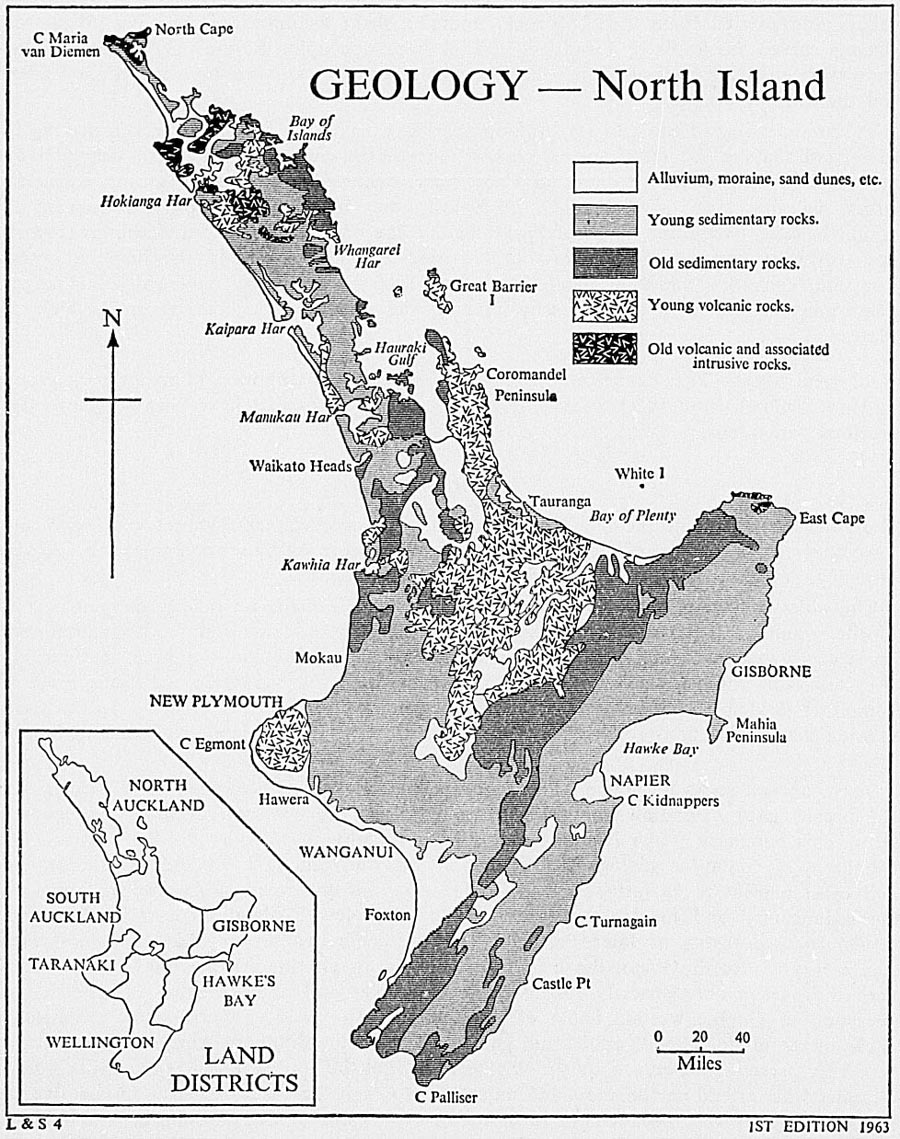
Geological Maps—The geological maps show the present distribution of major rock groups in New Zealand, brought about by the events and processes that have been summarised in previous paragraphs.
Older Rocks—Much of the late Cretaceous and Tertiary sedimentary rock that once must have covered a large part of the South Island has been worn off by erosion since the Kaikoura Orogeny, and the “undermass” of old rocks has been exposed.
The oldest of these rocks lie to the west. Fiordland is made up mainly of metamorphic diorite, granite, and coarse schist, gneiss, and marble, with Ordovician graptolite-bearing slates in its south-west extremity; greywackes and argillites of possibly pre-Cambrian age occur in Westland and south-west Nelson, and further north in Nelson there are large areas of complexly folded Cambrian and Ordovician sedimentary and metamorphic rocks. Large granitic masses, hundreds of square miles in area, occur in Westland, Nelson, and Stewart Island.
These ancient rocks terminate with an abrupt boundary (which shows clearly even on this small-scale map) extending from Milford Sound along the western margin of the Southern Alps. This boundary is the Alpine Fault, a great fracture that divides the South Island into two areas of dissimilar geological structure: to the west and in Fiordland, are the granites and other ancient rocks just described; to the east, the undermass rocks are predominantly the sedimentary and marine volcanic rocks of the New Zealand Geosyncline and their metamorphosed forms of later Paleozoic and Mesozoic age. From Marlborough, through Canterbury to North Otago, the map shows an almost continuous expanse of these rocks; here they are mainly sparsely fossiliferous greywackes and argillite strata of Triassic and Jurassic age. On the western flanks of the Southern Alps, and in Otago, these sedimentary rocks merge gradually with schist and gneiss. Those of the Southern Alps show on the map as a very narrow belt, cut off by the Alpine Fault, but the southern schists form a belt some 60 miles wide extending for about 150 miles across Otago. To the south, also, this schist mass merges gradually with sedimentary rocks of the New Zealand Geosyncline, here of Permian age. These strata, mainly tuffs and tuffaceous greywackes forming a belt that stretches across Southland, are the northern limb of a major downfold or syncline; Triassic and Jurassic strata occupy its core, making up much hill country of Southland. The southern limb rocks include much marine volcanic rock, and in the core of the syncline in western Southland a belt of dunite and serpentine is intruded and is well exposed in the Olivine and Red Hill ranges.
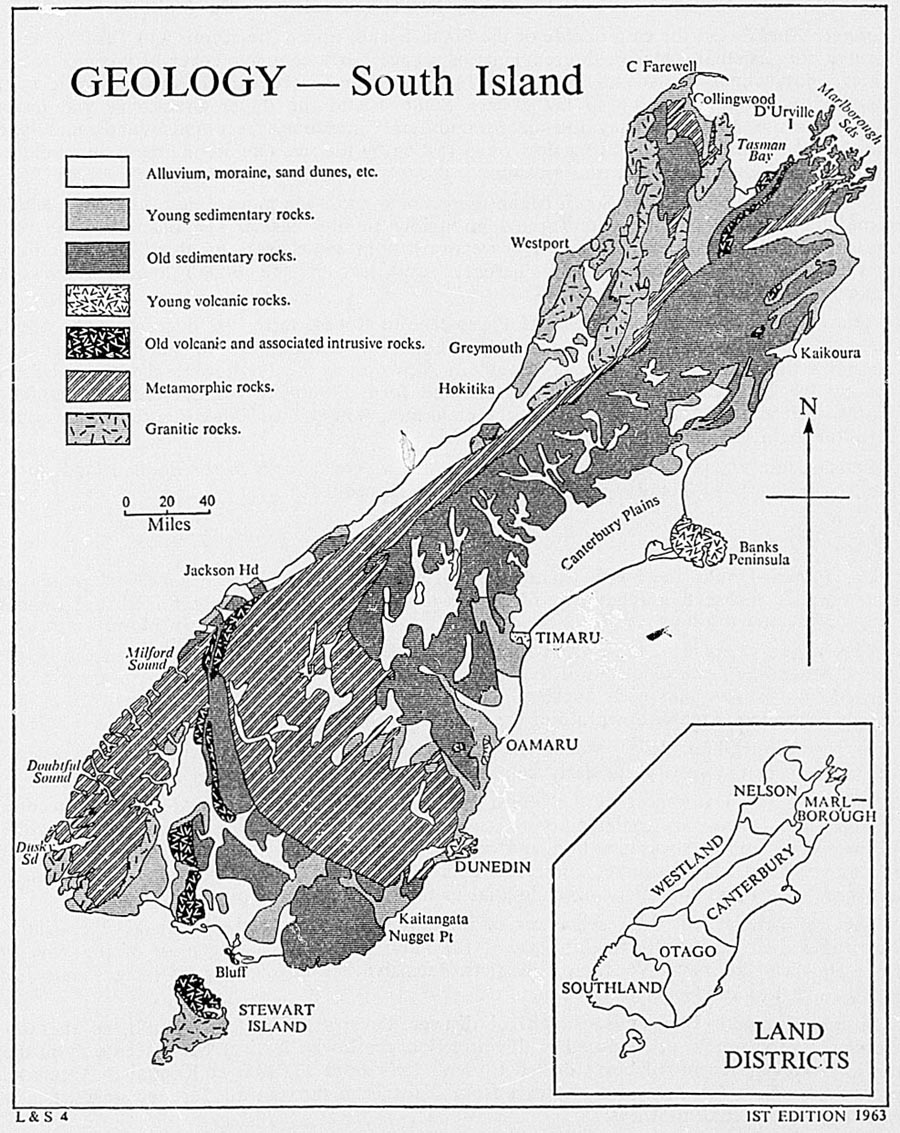
A sequence of rocks very like that of Southland is found also in eastern Nelson. Here, fossiliferous Triassic rocks and Permian sedimentary and volcanic rocks closely resembling those of Southland are found, and a belt of dunite and serpentine (the Nelson “mineral belt”) intrudes them. It has been suggested that the Nelson and Southland rocks, which terminate abruptly at the Alpine Fault and its continuation as the Wairau Fault, were originally joined, and have been displaced some 300 miles by lateral movement at the fault.
Younger Rocks—On the eastern side of the South Island, upper Cretaceous and Tertiary strata survive only as small patches, the remnants of a once fairly complete cover of younger rocks. Thick geosynclinal Cretaceous strata are found in the Clarence and Awatere Valleys of Marlborough, but elsewhere in the eastern South Island the upper Cretaceous and lower Tertiary strata are thin. They include foraminiferal limestone, greensands, sandstones, and other shell deposits formed during slow transgression by the sea. Oligocene limestone remnants mark the period of maximum transgression.
On the western side of the South Island the younger rocks are more widespread, and include some thick sequences that were formed in rapidly sinking basins. The oldest are the coal measures, mainly Eocene in age. They are overlain in some areas by thick lower Tertiary marine strata. In Southland, thick Tertiary strata occupy the Waiau Syncline, between Lake Te Anau and Foveaux Strait.
The map shows some large areas of Pleistocene Recent terrestrial deposits in the South Island. The largest forms the Canterbury Plains, and consists of old shingle deposits of unknown thickness washed from the Southern Alps during the Pleistocene glaciation. Others occupy the Moutere depression of Nelson, and form Southland Plains, and intermontane basins, such as the McKenzie Plains, in the main mountain chains. Thick Pleistocene moraines form the main surface rocks of South Westland.
Banks Peninsula is the only large mass of young volcanic rocks in the South Island; there are smaller areas at Timaru, Oamaru, and in the Dunedin district.
Older Rocks—Unlike the South Island, the North Island has no large expanses of granite or metamorphic rocks: the undermass rocks are almost wholly complexly folded and faulted greywackes and argillites of the New Zealand Geosyncline, predominantly Mesozoic in age.
The largest expanse of these hard rocks forms the main mountain backbone of the North Island, extending from Cook Strait to the East Cape area. Smaller areas of them are exposed between north Taranaki and Auckland. They include the richly fossiliferous strata of the Kawhia Syncline, a major downfold of the undermass rocks.
In North Auckland, deeply weathered undermass rocks, in part of Permian age, form low hill country in the east, particularly between Whangaroa and Whangarei harbours.
Younger Rocks—Over most of the North Island the older rocks are hidden by Cretaceous, Tertiary and Quaternary sedimentary rocks and by young volcanic rocks. In some areas the younger sedimentary rocks are thin and patchy; in others they are many thousands of feet thick over hundreds of square miles. The bulk of them are poorly consolidated sandstones, and grey mudstones to which the colloquial name “papa rock” is often applied.
The main areas with thick sequences of these young strata are the Taranaki - Wanganui -Rangitikei district, and the region east of the main ranges, including most of the Poverty Bay, Hawke's Bay, and Wairarapa districts. Intensive oil prospecting of recent years has greatly added to knowledge of the structures.
In the Taranaki-Wanganui-Rangitikei district the strata dip gently south, so that increasingly young rocks are exposed in this direction, the lower Tertiary being seen only in the north. However, recent oil bores drilled to depths of about 13,000 ft at Kapuni in Taranaki, passed through a full sequence of strata from Pleistocene through all Tertiary stages, finally reaching Eocene coal measures.
In the eastern North Island the structure of the younger rocks is much more complex than in the western area. Upper Cretaceous strata are followed by Tertiary in many sedimentary basins large and small, with many unconformities. The southern part of the region is broken by many transcurrent faults, and hard lower Cretaceous greywacke piercement bodies project from the younger rocks.
Younger rocks of South Auckland do not form such large basins as those just described. The oldest of these strata are the Eocene coal measures of the Waikato region. Upper Cretaceous strata, mainly mudstones, are the most widespread of the younger rocks of North Auckland.
Young volcanic rocks are widespread in the North Island. The largest area of them is the Central Volcanic District: north of the three great andesite volcanoes, Ruapehu, Ngauruhoe, and Tongariro, lies the “volcanic plateau”, an expanse of some 10,000 square miles made up of several thousand cubic miles of ignimbrite, rhyolite lava, and pumice. This is one of the largest and youngest accumulations of acid volcanic rocks in the world. Most of it has been erupted in late Pliocene and Pleistocene times. The belt of most recent activity in the Central Volcanic District is known as the Taupo Volcanic Zone; it contains all this country's active volcanoes, many inactive ones, and all the geysers and boiling springs.
Mount Egmont is a huge, conical, andesite volcano, with the remnants of two other volcanic cones nearby; all are of Pleistocene age. In the Waikato there are eroded Pleistocene cones of approximately basic andesite composition. The largest is Pirongia, some 3,000 ft high. Auckland city and the area immediately to the south has been the scene of many eruptions of basalt lava and scoria in late Pleistocene and Holocene times; and many small scoria cones can be seen in the locality. Late Tertiary and Quaternary basaltic eruptions in North Auckland have built lava plateaus and many young cones.
A Descriptive Atlas of New Zealand contains geological maps of New Zealand and summaries of New Zealand's geology and landscape development. New Zealand Geological Survey Bulletin 66, The Geological Map of New Zealand, 1:2,000,000, is a lengthier summary with a more detailed geological map and cross sections.
EARTHQUAKES: Geophysical Background—Earthquakes are geographically associated with active volcanoes and with major earth movements such as mountain building; these types of disturbance are confined, for the most part, to certain limited regions of the world. Such disturbed regions, of which New Zealand is one, are evidently the site of some kind of development affecting the outer shell of the Earth. Little is yet known about the internal processes that give rise to these geophysical disturbances, nor are the relations connecting them fully understood.
Formerly earthquakes were believed to be caused by volcanic activity, but it is now recognised that volcanic earthquakes are restricted to small shocks in the immediate vicinity of the volcanism. In New Zealand, tremors of this kind are experienced in the zone of active volcanism that extends from Mount Ruapehu to White Island.
In some places geological faulting at the surface gives visible evidence that a major earth movement has occurred. Occasionally movement on a fault has been observed to occur simultaneously with an earthquake in the same vicinity. New Zealand provided one of the earliest examples of this to become generally known, when movement took place on the Wairarapa Fault at the time of the great Wellington earthquake of 1855. Such events as this have led to the idea that earthquakes in general are caused by fault movements, but it has proved difficult to find convincing evidence in support of this theory. It is noteworthy that there seems to be little earthquake activity along much of the Alpine Fault, which has been traced for 300 miles from Milford Sound to Lake Rotoiti and is classed by geologists as one of the largest and most active faults in the world. The nature of the connection between earthquakes and faulting is still somewhat obscure.
The great majority of the world's earthquakes occur at depths of less than 40 miles, and in many earthquake zones there are no shocks at any greater depth. A moderate number of New Zealand earthquakes are classed as intermediate in depth, i.e., originating at between 40 miles and 190 miles deep. The two deepest New Zealand earthquakes recorded so far occurred four and a half minutes apart on 23 March 1960, with a common focus 370 miles deep under North Taranaki, about 80 miles shallower than the deepest earthquake known.
It is difficult to compare the degree of earthquake activity in New Zealand with that in other regions because of the many differences that arise in earthquake type and mode of occurrence. New Zealand and California are often regarded as roughly similar, with an activity very much less than, for example, Japan or Chile.
Regional Distribution—There are two separate regions of earthquake activity in New Zealand. The larger northern region may be roughly defined as lying between latitude 36 1/2 °S and 43 1/2°S. It thus includes the northern half of the South Island, and all the North Island apart from the North Auckland peninsula; but the area from Kaipara Harbour to the lower Waikato River should be excluded. The southern active region lies to the west of longitude 169 1/2 °E, and incorporates Southland, western Otago, and southern Westland. Earthquakes have only occasionally been located in the parts of New Zealand lying outside these two regions.
Within the active regions the occurrence of shallow earthquakes is widely scattered. There has been a tendency, however, for the larger shallow earthquakes to lie towards the Pacific side of the northern active region and towards the Tasman side of the southern active region. Earthquakes with deeper foci are mostly confined to a narrow belt in the northern region, extending from the Bay of Plenty south-westwards to Tasman Bay.
The historical record is too brief to support a quantitative assessment of the frequency with which one might expect earthquakes to be felt at a given intensity in various parts of New Zealand. Considering the distances to which major earthquakes can be effective, in relation to the size of New Zealand, it would be imprudent to regard any part of the country as permanently exempt from the possibility of earthquake damage.
Outside the active regions there are many areas, however, where no damaging intensity has actually been experienced in historical times. Moreover, since the major shallow earthquakes on record have been rather widely distributed within the active regions, there appears to be no particular area of markedly intense seismicity.
The Hawke's Bay earthquake of 3 February 1931 resulted directly or indirectly in 255 deaths. The total of deaths that have been recorded as due to other earthquakes since 1848 is 32, of which three resulted from the Inangahua earthquake of 1968.
Seismological Observatory—Earthquake recorders are operated continuously at the following stations by the Seismological Observatory, Wellington: Apia and Afiamalu (Western Samoa); Suva (Fiji); Rarotonga (Cook Islands); Raoul Island (Kermadecs); Cape Reinga, Onerahi, Auckland, East Cape, Karapiro, Wairakei, Gisborne, Tuai, Tarata, Chateau, Taradale, Castlepoint, Mangahao, and Wellington (North Island); Cobb, Kaimata, Christchurch, Gebbies Pass, Mount John, Milford Sound, Oamaru, Roxburgh, Monowai, and Waipapa Point (South Island); Chatham Islands; Campbell Island; Vanda and Scott Base (Antarctica). The Naval Research Laboratory, Auckland, operates a station on Great Barrier Island, the records from which are analysed at the Seismological Observatory. The installations at the following stations include instruments for recording distant earthquakes: Afiamalu, Rarotonga, Wellington, Roxburgh and Scott Base. At the Pacific and Antarctic stations preliminary readings are made locally and notified by radiogram. The analysis of records from all stations is carried out at the Observatory in Wellington.
The analysis involves using observations from stations in other countries as well as those from the local network, and the Observatory likewise contributes data to the international seismological agencies about distant earthquakes as well as large local ones. Details of tremors felt in New Zealand are supplied to the public and the press. In the study of felt earthquakes the instrumental results are augmented by “felt reports”; these are supplied by a large number of voluntary observers throughout New Zealand in response to a standard questionnaire issued by the Observatory.
Earthquake data are used by the Observatory for studying the fundamental characteristics of the Earth's crust in New Zealand, Antarctica and the neighbouring oceanic regions, and also for contributing to geophysical knowledge of the Earth's interior.
Earthquakes during 1970—Earthquakes did not cause any appreciable damage in 1970. The most noteworthy event was the swarm of small earthquakes, centred near Puru in the Coromandel Peninsula, that began in August and persisted for more than a month. There were several hundred shocks, many of which were felt in the immediate vicinity of the epicentres, and were responsible for minor damage to goods and a few weak structures. A magnitude 4 1/2 shock just after noon on 13 August damaged some old buildings on sandy water-saturated foundations in Thames. The largest of the series, on 27 August, had a magnitude of 4 3/4, and was also felt on the Hauraki Plains and in parts of suburban Auckland. At 4.18 p.m. on 18 December, a shallow earthquake of magnitude 5 3/4 centred between the lower reaches of the Manawatu and Rangitikei Rivers attracted moderate attention in the southern part of the North Island and about Cook Strait; in the Hutt Valley, electric power was briefly interrupted, and telephone communication between Wellington and the Wairarapa was broken; no material damage was reported; there were several small aftershocks. On 28 July the largest event, a submarine shock of about magnitude 6 1/4 centred near East Cape, was felt no further south than Wairoa. A magnitude 5.8 shock at a depth of 75 miles with an epicentre east of Lake Taupo occurred on 12 March and was more widely felt throughout the central North Island. The North Canterbury shocks of 1 May and 14 August were felt from southern Nelson to Westland and Banks Peninsula, and a shock on 13 June, 70 miles beneath Lake Te Anau, affected southern Westland, Southland, and Otago. Other shocks of magnitude 5 or more occurred near Pahiatua on February 14, and in Fiordland on 15 September.
A shock of magnitude 4 3/4 occurred on 29 September on the Chatham Rise, about 100 miles east of Christchurch; it was felt on Banks Peninsula and in the city. On 23 November small shocks were reported from Timaru and Oamaru.
WEATHER INFORMATION—The collection of weather information and the provision of weather forecasts and climatic data for diverse interests in aviation, shipping, agriculture, Government Departments and the general public are functions of the New Zealand Meteorological Service. By arrangement with the administrations concerned the Service performs similar functions for British territories in the Pacific.
Weather reports for use in forecasting are made at about 140 places within New Zealand and 50 in Pacific islands and collected by telegraph and radio, along with measurements of winds at upper levels made at nine radio wind stations and of temperatures made at eight radiosonde stations. Daily observations are made for climatological purposes at about 250 places in New Zealand and 80 in the islands. Rainfall measurements are made at a total of about 2,000 places within New Zealand and 270 outside the country.
Detailed climatological statistics are published annually by the New Zealand Meteorological Service in the Meteorological Observations, in Rainfall Observations, and in Fiji Annual Meteorological Summary. Current statistics appear monthly in the New Zealand Gazette and in the Fiji Gazette.
CLIMATE—Situated between 34°S and 47°S the main islands lie within the road belt of strong westerly winds which encircles the hemisphere south of about latitude 35°S. Just to the north is the high-pressure ridge of the subtropics from which barometric pressure decreases southwards over New Zealand to the deep low-pressure trough located near latitude 70°S.
The weather pattern from day to day is dominated by a succession of anticyclones, separated by troughs of low pressure, which pass more or less regularly from west to east across the Australia - Tasman Sea - New Zealand area and beyond. In this region there is no semi-permanent anti-cyclone such as those found in similar latitudes over the Indian Ocean and eastern Pacific Ocean respectively. The troughs normally have a northwest to southwest orientation and are associated with deep depressions centred far to the south. A typical weather sequence commences with a low-pressure trough approaching from the west. Freshening northwesterly winds prevail with increasing cloud, followed by rain for a period during which winds may reach gale force. The passage of the trough, with its associated cold front, is accompanied by a change to cold southwesterly or southerly winds and showery weather, occasionally with some hail and thunder. Barometers then rise with the approach of the next anticyclone from the west. Winds moderate and fair weather prevails for a few days as the anticyclone moves across the country.
While the sequence just described is very common the situation is frequently much more complex. The troughs are very unstable systems where depressions readily form, some of which develop into vigorous storms that may pass over New Zealand at any time of the year. Occasionally in summer a cyclonic storm of tropical origin passes over or near New Zealand accompanied by gales and heavy rain affecting mainly northern and eastern districts of the North Island. The anticyclones vary in size, intensity, and rate of movement. Their centres, on the average, follow a track across the North Island but individual centres may pass either north or south of the country, the more northerly tracks being favoured in spring and the southerly tracks in autumn. At times when little development occurs within the troughs the anticyclones follow each other at intervals of about 6-7 days.
The other main factors which influence the climate of New Zealand are, first, its position in the midst of a vast ocean, and second, the shape and topography of the country itself.
Australia, the nearest continent, is 1,000 miles to the west and Antarctica is 1,400 miles to the south. Hot air masses from the interior of Australia in summer, or freezing air masses from the Antarctic, which occasionally reach New Zealand, retain little of their original character after their long ocean passage. Thus, there is an absence of extreme variations of temperature. On the other hand, since abundant supplies of moisture are supplied by evaporation from the oceans, and depressions are frequent and vigorous, the average precipitation is high.
The chain of high mountains, which extends from south-west to north-east through the length of the country, rises as a formidable barrier in the path of the prevailing westerly winds. The effect is to produce much sharper climatic contrasts from west to east than in the north-south direction. In some inland areas of the South Island just east of the mountains the climate is distinctly continental in character, despite the fact that no part of New Zealand is more than 80 miles from the sea.
Winds—Winds from a westerly quarter prevail in all seasons, with a general tendency to increase in strength from north to south. However, considerable local modifications to the general air flow occur during its passage across the mountainous terrain. Approaching the main ranges the flow from the west turns towards the north-east and on descending on the eastern side swings towards the south-east. This results in an increased number of south-westerlies in Westland and a predominance of north-westerlies in inland districts of Otago and Canterbury, where strong gales from this quarter occur at times in the late spring and summer. Daytime sea breezes usually extend from the coast inland for 20 miles or more during periods of settled weather in summer. On the Canterbury coast the wind comes most frequently from the north-east, partly because there is a persistent sea breeze from this quarter, but south of Dunedin south-westerlies predominate. Cook Strait, the only substantial gap in the main mountain chain, acts as a natural funnel for the air flow and is a particularly windy locality afflicted by gales from the south-east as well as the north-west. This “funnel” effect is also in evidence about Foveaux Strait. North of Taranaki the general air flow is more from the south-west, and there is a noticeable reduction in windiness in the summer.
An indication of the variation in the frequency of strong winds from summer to winter, and in different parts of the country, is given in the next table. These were all obtained by the use of Dines pressure-tube anemometers at well exposed sites.
| Station | Average Number of Days With Gusts Reaching | Years of Data | |||||
|---|---|---|---|---|---|---|---|
| 40 m.p.h. or More | 60 m.p.h. or More | ||||||
| Nov-Apr | May-Oct | Year | Nov-Apr | May-Oct | Year | ||
| NOTE—These are all aerodromes, with the exception of Auckland (Mechanics Bay) and Wellington (Kelburn). | |||||||
| Kaitaia | 14 | 29 | 43 | 0.6 | 1.6 | 2.2 | 16 |
| Whangarei | 6 | 20 | 26 | 0.2 | 0.4 | 0.6 | 12 |
| Auckland (Mechanics Bay) | 20 | 29 | 49 | 0.9 | 1.6 | 2.5 | 24 |
| Tauranga | 13 | 19 | 32 | 0.3 | 1.1 | 1.4 | 24 |
| Rotorua | 6 | 7 | 13 | 0.2 | 0.1 | 0.3 | 16 |
| Hamilton | 9 | 13 | 22 | 0.0 | 0.6 | 0.6 | 10 |
| Gisborne | 19 | 25 | 44 | 0.3 | 0.9 | 1.2 | 23 |
| Napier | 17 | 20 | 37 | 0.4 | 0.4 | 0.8 | 17 |
| New Plymouth | 34 | 48 | 82 | 2.3 | 4.8 | 7.1 | 27 |
| Wanganui | 35 | 40 | 75 | 2.4 | 4.5 | 6.9 | 10 |
| Palmerston North | 25 | 23 | 48 | 0.7 | 0.8 | 1.5 | 12 |
| Wellington (Kelburn) | 72 | 74 | 146 | 16.0 | 13.9 | 29.9 | 13 |
| Nelson | 23 | 14 | 37 | 0.5 | 0.4 | 0.9 | 26 |
| Blenheim (Woodbourne) | 22 | 16 | 38 | 0.7 | 0.7 | 1.4 | 25 |
| Westport | 13 | 19 | 32 | 0.8 | 1.0 | 1.8 | 18 |
| Hokitika | 15 | 18 | 33 | 1.2 | 1.6 | 2.8 | 21 |
| Christchurch | 32 | 24 | 56 | 1.8 | 1.5 | 3.3 | 24 |
| Timaru | 13 | 8 | 21 | 0.6 | 0.4 | 1.0 | 10 |
| Taieri | 30 | 25 | 55 | 1.3 | 1.4 | 2.7 | 26 |
| Gore | 29 | 20 | 49 | 0.9 | 0.0 | 0.9 | 5 |
| Invercargill | 48 | 42 | 90 | 5.4 | 4.7 | 10.1 | 24 |
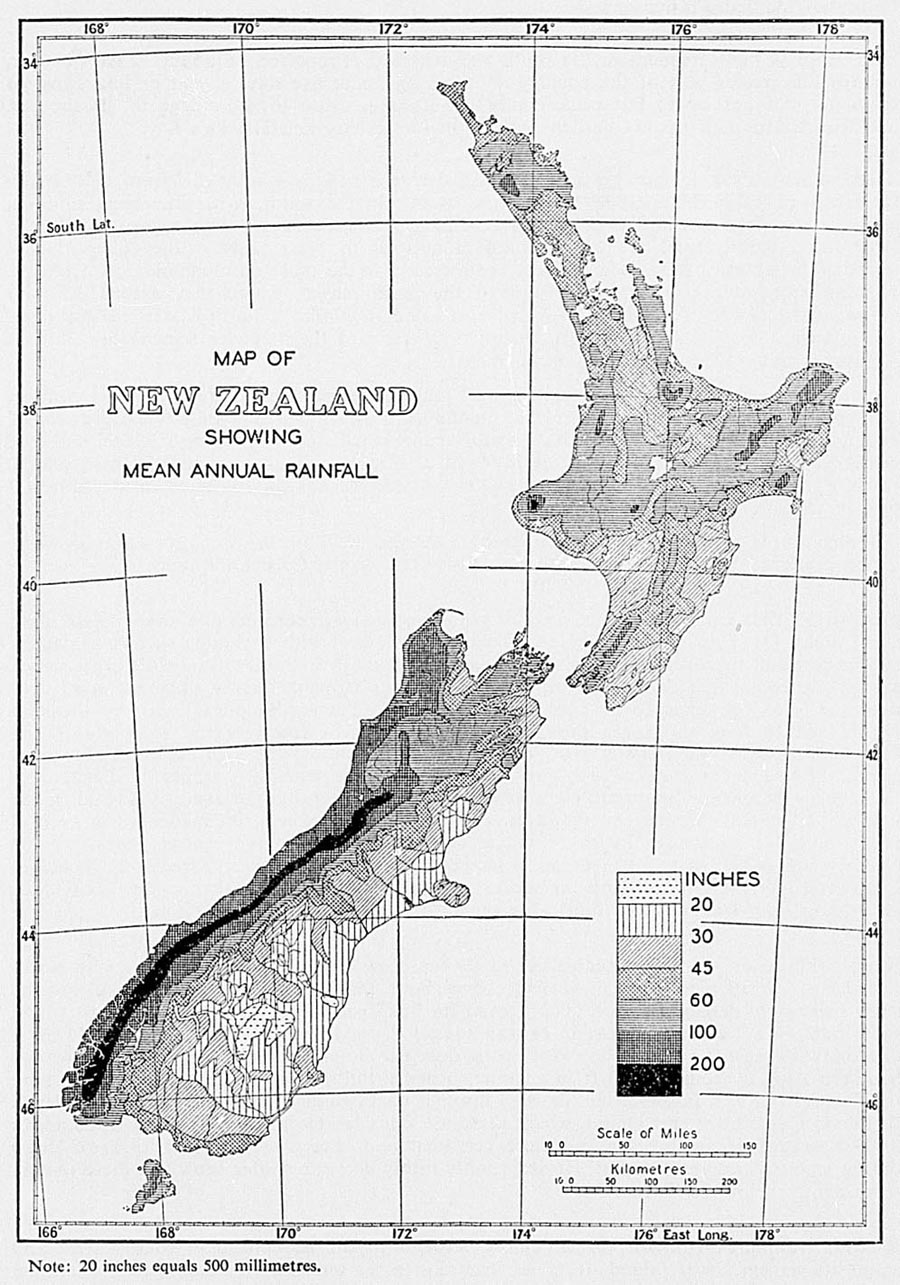
Rainfall—The distribution of rainfall is mainly controlled by mountain features, and the highest rainfalls occur where the mountains are exposed to the direct sweep of the westerly and north-westerly winds. The mean annual rainfall (see map) ranges from as little as 300 mm in a small area of Central Otago to over 7000 mm in the Southern Alps. The average for the whole country is high, but for the greater part it lies between 600 and 1500 mm, a range regarded as favourable for plant growth in the temperate zone. The only areas with under 600 mm are found in the South Island, to the east of the main ranges. These include most of Central and North Otago, and South Canterbury. In the North Island, the driest areas are central and southern Hawke's Bay, Wairarapa, and Manawatu where the average rainfall is 800-1000 mm a year. Of the remainder, much valuable farm land, chiefly in northern Taranaki and Northland, has upwards of 1500 mm. Over a sizeable area of both Islands rainfall exceeds 2500 mm a year but, with the exception of Westland, this is mountainous and unoccupied, much of it being forest covered.
For a large part of the country the rainfall is spread evenly through the year. The greatest contrast is found in the north, where winter has almost twice as much rain as summer. This predominance of winter rainfall diminishes southwards. It is still discernible over the northern part of the South Island but, over the southern half, winter is the season with least rainfall, and a definite summer maximum is found inland due to the effect of convectional showers. The rainfall is also influenced by seasonal variations in the strength of the westerly winds. Spring rainfall is increased in and west of the ranges as the westerlies rise to their maximum about October, while a complementary decrease occurs at the same time in the lee of the ranges.
Areas which are exposed to the west and south-west experience much showery weather, and rain falls on roughly half the days of the year. Over most of the North Island rain can be measured on at least 150 days a year except to the east of the ranges where there are, in places, fewer than 125 rain days. Those areas of the South Island with annual rainfall under 600 mm generally have about 100 rain days a year. In the far south the frequency of rain increases sharply; in Stewart Island and Fiordland rain days exceed 200 a year. Over most of the country between 55 and 65 percent of the rain days also qualify as wet days (2.5 mm or more). The percentage increases to over 70 in Westland, but in the low rainfall area of inland Otago there are only about 40 wet days a year compared with 100 rain days.
On the whole the seasonal rainfall does not vary greatly from year to year, the reliability in spring being particularly advantageous for agricultural purposes. It is least reliable in late summer and autumn when very dry conditions may develop east of the ranges, particularly in Hawke's Bay.
The highest daily rainfall on record is 560 mm which occurred at Milford Sound where the mean annual rainfall exceeds 6000 mm. Other areas with considerably lower rainfall are also subject to very heavy daily falls; such areas are to be found in northern Hawke's Bay and in north-eastern districts of the Auckland Province. By contrast, in the Manawatu district and in Otago and Southland daily falls reaching 80 mm are very rare.
| NORMAL MONTHLY AND ANNUAL RAINFALL (MILLIMETRES)* (1921-50) | |||||||||||||
|---|---|---|---|---|---|---|---|---|---|---|---|---|---|
| Station | Jan | Feb | Mar | Apr | May | Jun | July | Aug | Sep | Oct | Nov | Dec | Year |
| * 25 millimetre equal 1 inch. | |||||||||||||
| Te Paki | 84 | 91 | 84 | 142 | 165 | 183 | 185 | 142 | 114 | 97 | 76 | 79 | 1,442 |
| Kerikeri | 114 | 99 | 91 | 145 | 188 | 188 | 185 | 157 | 140 | 119 | 97 | 94 | 1,617 |
| Dargaville | 81 | 86 | 69 | 104 | 135 | 140 | 130 | 122 | 102 | 94 | 81 | 76 | 1,220 |
| Auckland | |||||||||||||
| (Albert Park) | 84 | 104 | 71 | 109 | 122 | 140 | 140 | 109 | 97 | 107 | 81 | 79 | 1,243 |
| Tauranga Aerodrome | 89 | 89 | 97 | 127 | 124 | 142 | 127 | 122 | 97 | 117 | 84 | 86 | 1,301 |
| Hamilton (Ruakura) | 84 | 81 | 74 | 102 | 109 | 124 | 117 | 104 | 94 | 109 | 94 | 74 | 1,166 |
| Rotorua | 122 | 104 | 89 | 124 | 150 | 150 | 119 | 130 | 114 | 135 | 104 | 109 | 1,450 |
| Gisborne Aerodrome | 71 | 81 | 76 | 86 | 127 | 99 | 124 | 99 | 74 | 66 | 56 | 51 | 1,010 |
| Lake Waikaremoana | |||||||||||||
| (Onepoto) | 196 | 193 | 188 | 211 | 272 | 231 | 241 | 221 | 188 | 170 | 163 | 147 | 2,421, |
| Taupo | 94 | 99 | 61 | 94 | 122 | 124 | 109 | 112 | 99 | 107 | 97 | 79 | 1,197 |
| Taumarunui | 99 | 99 | 84 | 122 | 130 | 150 | 124 | 135 | 122 | 145 | 117 | 99 | 1,426 |
| New Plymouth | 119 | 104 | 94 | 127 | 135 | 163 | 157 | 150 | 122 | 147 | 114 | 122 | 1,554 |
| Napier | 66 | 71 | 56 | 69 | 97 | 79 | 89 | 71 | 48 | 48 | 48 | 51 | 793 |
| Wanganui | 69 | 76 | 56 | 71 | 79 | 86 | 74 | 76 | 64 | 81 | 69 | 74 | 875 |
| Palmerston North | 76 | 76 | 61 | 84 | 89 | 99 | 79 | 89 | 74 | 97 | 84 | 84 | 992 |
| Masterton (Waingawa) | 64 | 69 | 56 | 69 | 104 | 102 | 99 | 107 | 79 | 79 | 66 | 74 | 968 |
| Wellington (Kelburn) | 71 | 89 | 76 | 91 | 114 | 117 | 124 | 130 | 94 | 117 | 79 | 104 | 1,206 |
| Nelson Aerodrome | 69 | 58 | 66 | 76 | 86 | 79 | 74 | 91 | 74 | 91 | 69 | 79 | 912 |
| Blenheim | 51 | 48 | 41 | 48 | 66 | 58 | 61 | 64 | 61 | 64 | 46 | 48 | 656 |
| Westport Aerodrome | 185 | 155 | 165 | 178 | 165 | 191 | 178 | 185 | 168 | 206 | 178 | 206 | 2,160, |
| Hanmer | 89 | 94 | 84 | 86 | 122 | 89 | 94 | 102 | 102 | 109 | 84 | 97 | 1,152 |
| Hokitika Aerodrome | 246 | 216 | 211 | 221 | 226 | 201 | 208 | 234 | 208 | 272 | 239 | 246 | 2,728, |
| Lake Coleridge | 66 | 61 | 53 | 71 | 71 | 66 | 79 | 79 | 79 | 81 | 81 | 71 | 838 |
| Christchurch | |||||||||||||
| (Botanic Gardens) | 56 | 46 | 43 | 46 | 76 | 69 | 61 | 58 | 51 | 51 | 51 | 61 | 669 |
| Lake Tekapo | 53 | 46 | 41 | 48 | 46 | 36 | 41 | 41 | 53 | 56 | 46 | 58 | 565 |
| Timaru | 64 | 64 | 46 | 46 | 43 | 41 | 38 | 36 | 46 | 53 | 48 | 74 | 599 |
| Milford Sound | 648 | 587 | 566 | 554 | 549 | 373 | 373 | 439 | 503 | 660 | 587 | 594 | 6,433, |
| Queenstown | 81 | 64 | 79 | 74 | 66 | 56 | 56 | 64 | 66 | 76 | 64 | 61 | 807 |
| Alexandra | 46 | 38 | 30 | 33 | 23 | 20 | 18 | 15 | 20 | 20 | 28 | 33 | 334 |
| Dunedin (Musselburgh) | 71 | 64 | 64 | 64 | 66 | 74 | 64 | 58 | 56 | 64 | 71 | 74 | 790 |
| Gore | 81 | 79 | 81 | 71 | 66 | 74 | 53 | 53 | 64 | 69 | 81 | 79 | 851 |
| Invercargill Aerodrome | 91 | 97 | 109 | 97 | 94 | 99 | 71 | 76 | 84 | 86 | 91 | 91 | 1,086 |
Thunderstorms—Thunderstorms are not numerous. Their frequency is greatest in the north and west where thunder is heard on 15 to 20 days a year; east of the ranges (except in Gisborne) the figure is five or less.
Hail—Hail is most frequent in the south-west where it is reported on about 20 days a year, but for the greater part of the country it occurs on about five days a year or less. Most of the hailstones are small, but occasionally large stones cause local damage to glasshouses, and to orchards and market gardens, chiefly in Canterbury and Hawke's Bay.
Temperature—Mean temperatures at sea level decrease steadily southwards from 15°c in the far north to 12°c about Cook Strait, then to 9°c in the south. With increasing altitude, temperatures drop about 2°c per 1,000 ft. January and February, with approximately the same mean temperature, are the warmest months of the year. July is the coldest. Some temperature statistics for selected places are included in the table on climatological averages. Highest temperatures are recorded east of the main ranges, where they exceed 30°c on a few afternoons in most summers, usually in association with a north-westerly Föhn wind. The extremes for New Zealand (measured in a standard thermometer screen) are 38°c at Ashburton and — 19°c at Ophir (Central Otago).
As is to be expected, there is a small annual range of temperature (difference between mean temperature of the warmest and coldest months). In Northland and in western districts of both Islands the annual range is about 8°c. For the remainder of the North Island, and east coast districts of the South Island, it is 9°-10°c. Further inland it exceeds 11°c in places, reaching a maximum of 14°c in Central Otago where there is an approach to a continental type of climate.
Temperatures in the preceding paragraphs are recorded on the Celsius scale (formerly called centigrade), and not the Fahrenheit scale. The degree Celsius (°c) equals 5/9 (°F—32).
Frost—It is well known that local variations in frostiness are considerable, even within quite small areas. On a calm, clear night the cold air in contact with a sloping surface gravitates slowly downhill to collect in valleys and depressions, and it is these “Katabatic” drifts which are mainly responsible for local temperature variations at night. Gently sloping ground with a northerly aspect tends to be least affected by frost. Favourable sites in coastal areas of Northland are free of frost, although further inland light frosts occur frequently in the winter months. At Albert Park, Auckland, the screen minimum thermometer (4 ft above the ground) has registered below 0°c only once in nearly 50 years, yet across the harbour at Whenuapai Aerodrome there are eight screen frosts per annum on the average. Excluding the uninhabited mountainous areas, the most severe winter conditions are experienced in Central Otago and the Mackenzie Plains of inland Canterbury, and on the central plateau of the North Island. Even in these areas night temperatures as low as —12°c are rarely recorded. Elsewhere over the North Island the winters are very mild and pastures maintain continuous growth. In both Islands sheep and cattle remain in the open all the year round.
Snow—The majority of New Zealanders rarely see snow except on the mountains. The North Island has a small permanent snow field above about 8,000 ft on the central plateau, but the snow line rarely descends below 2,000 ft even for brief periods in winter. In the South Island snow falls on a few days a year in eastern coastal districts and in some years may lie for a day or two even at sea level. In Westland it does not lie at sea level. The snow line on the Southern Alps is around 7,000 ft in summer, being slightly lower on the western side where the Franz Josef and Fox Glaciers descend through heavy bush to within 1,000 ft of sea level. In inland Canterbury and Otago, where there are considerable areas of grazing lands above 1,000 ft, snowfalls are heavier and more persistent and have caused serious losses of sheep during severe winters in the past. However, only rarely does the winter snow line there remain permanently below 3,000 ft.
Relative Humidity—Humidity is commonly between 70 and 80 percent in coastal areas and about 10 percent lower inland. It varies inversely to the temperature, falling to a minimum in the early afternoon when temperature is highest and frequently lying between 90 and 100percent during clear nights. As the following table shows, the diurnal variation is greater than the difference between summer and winter.
| Station | Mean Relative Humidity | |||
|---|---|---|---|---|
| January | July | |||
| 3 a.m. | 3 p.m. | 3 a.m. | 3 p.m. | |
| percent | ||||
| Auckland (Mechanics Bay) | 85 | 63 | 90 | 74 |
| Gisborne | 89 | 62 | 90 | 72 |
| Ohakea Aerodrome | 87 | 62 | 89 | 72 |
| Wellington | 89 | 71 | 87 | 77 |
| Christchurch | 87 | 61 | 89 | 73 |
| Hokitika | 95 | 78 | 93 | 75 |
| Invercargill | 90 | 72 | 91 | 78 |
Very low humidities—between 20 and 30 percent or lower—occur at times in the lee of the Southern Alps where the Föhn effect is often very marked. In summer the hot, dry “Canterbury Norwester” is generally a most unpleasant wind. Cool south-westerlies are also at times very dry when they reach eastern districts. In Northland the humid mid-summer conditions are inclined to be rather oppressive though temperatures rarely reach 30°c. Dull, humid spells are generally not prolonged anywhere, but their frequency shows a marked increase in the south.
Sunshine—The sunniest areas are to be found near Blenheim, Nelson, and Whakatane, where the average duration of bright sunshine exceeds 2,400 hours per annum. The rest of the Bay of Plenty and Napier are only slightly less sunny. A large portion of the country is favoured with at least 2,000 hours. Even Westland, despite its high rainfall, has 1,800 hours. Southland, where sunshine drops sharply to 1,700 hours per annum, lies on the northern fringe of a broad zone of increasing cloudiness. Four hundred miles further to the south at Campbell Island the sunshine has the extremely low value of 650 hours per annum. A pleasant feature of the New Zealand climate in the high proportion of sunshine during the winter months. To eliminate the effect of varying day-length the summer and winter sunshine at a few selected stations have been expressed as a percentage of the possible sunshine.
| Summer | Winter | |
|---|---|---|
| percent | ||
| Auckland | 51 | 44 |
| Hamilton | 52 | 44 |
| New Plymouth | 53 | 47 |
| Napier | 57 | 52 |
| Wellington | 52 | 42 |
| Nelson | 58 | 57 |
| Hokitika | 43 | 44 |
| Christchurch | 46 | 45 |
| Dunedin | 41 | 43 |
| Invercargill | 42 | 35 |
Climatological Averages—The following table provides a brief summary of the main climatological elements for selected locations.
| Station | Altitude | Annual Averages | Air Temperature (Degrees Celsius) | |||||||||
|---|---|---|---|---|---|---|---|---|---|---|---|---|
| Rain Days (0.2 mm or More) | Wet Days (2.5 mm or More)* | Bright Sunshine | Days of Screen Frost (min. air temp. less than 0° c) | Mean Temp. | Mean Daily Maximum | Mean Daily Minimum | Mean Annual | |||||
| Jan | Jul | Jan | Jul | Maximum | Minimum | |||||||
| * 2.5 mm. equals 0.10 in. | ||||||||||||
| Te Paki | 190 | 181 | 105 | 2,140 | 2 | 15.1 | 23 | 15 | 14 | S | 26 | -1 |
| Kerikeri | 240 | 180 | 102 | 2,010 | 3 | 14.7 | 24 | 15 | 13 | 6 | 29 | 0 |
| Dargaville | 64 | 185 | 107 | 1,940 | 6 | 14.3 | 23 | 15 | 14 | 6 | 29 | -2 |
| Auckland (Albert Park) | 160 | 173 | 101 | 2,090 | 0 | 15.3 | 23 | 14 | 16 | 8 | 27 | 3 |
| Tauranga Aerodrome | 12 | 153 | 93 | 2,320 | 8 | 14.0 | 24 | 14 | 13 | 4 | 29 | -2 |
| Hamilton (Ruakura) | 131 | 169 | 100 | 1,980 | 25 | 13.0 | 23 | 13 | 11 | 3 | 29 | -5 |
| Rotorua | 1,006 | 149 | 97 | 2,000 | 24 | 12.1 | 23 | 12 | 12 | 2 | 30 | -4 |
| Gisborne Aerodrome | 16 | 156 | 83 | 2,210 | 7 | 13.8 | 24 | 14 | 13 | 4 | 32 | -2 |
| Lake Waikaremoana (Onepoto) | 2,110 | 195 | 133 | .. | 5 | 10.9 | 20 | 9 | 11 | 3 | 28 | -1 |
| Taupo | 1,232 | 157 | 93 | 2,030 | 39 | 11.7 | 23 | 11 | 11 | 2 | 29 | -4 |
| Taumarunui | 562 | 175 | 111 | 1,690 | 34 | 12.7 | 24 | 12 | 12 | 2 | 31 | -5 |
| New Plymouth | 160 | 177 | 112 | 2,110 | 0 | 13.4 | 21 | 13 | 13 | 6 | 26 | 0 |
| Napier | 5 | 126 | 64 | 2,280 | 8 | 13.9 | 24 | 13 | 14 | 4 | 32 | -2 |
| Wanganui | 72 | 146 | 85 | 2,120 | 4 | 13.4 | 22 | 12 | 14 | 5 | 29 | -1 |
| Palmerston North | 110 | 167 | 92 | 1,810 | 15 | 12.8 | 22 | 12 | 13 | 4 | 28 | -3 |
| Masterton (Waingawa) | 340 | 171 | 90 | 2,060 | 28 | 12.2 | 24 | 12 | 11 | 2 | 31 | -4 |
| Wellington (Kelburn) | 415 | 158 | 97 | 2,010 | 0 | 12.4 | 20 | 11 | 13 | 5 | 26 | 1 |
| Nelson Aerodrome | 6 | 123 | 72 | 2,410 | 41 | 11.8 | 22 | 12 | 12 | 1 | 28 | -5 |
| Blenheim | 17 | 105 | 57 | 2,430 | 34 | 12.5 | 24 | 12 | 12 | 1 | 32 | -4 |
| Westport Aerodrome | 6 | 188 | 138 | 1,960 | 1 | 11.9 | 19 | 12 | 12 | 4 | 25 | 0 |
| Hanmer | 1,270 | 143 | 90 | 1,910 | 84 | 9.8 | 22 | 9 | 9 | -2 | 32 | -9 |
| Hokitika Aerodrome | 127 | 191 | 137 | 1,860 | 25 | 11.9 | 19 | 11 | 11 | 2 | 26 | -2 |
| Lake Coleridge | 1,195 | 120 | 71 | .. | 69 | 10.0 | 21 | 9 | 10 | -1 | 31 | -8 |
| Christchurch (Botanic Gardens) | 22 | 117 | 55 | 1,990 | 36 | 11.4 | 22 | 10 | 12 | 1 | 32 | -4 |
| Lake Tekapo | 2,240 | 97 | 54 | 2,200 | 105 | 9.1 | 21 | 6 | 8 | -3 | 20 | -10 |
| Timaru | 56 | 113 | 57 | 1,910 | 39 | 11.0 | 22 | 10 | 11 | 0 | 32 | -4 |
| Milford Sound | 5 | 197 | 161 | .. | 27 | 10.1 | 18 | 9 | 10 | 2 | 25 | -3 |
| Queenstown | 1.080 | 128 | 72 | 1,980 | 54 | 10.1 | 21 | 8 | 10 | -1 | 30 | -5 |
| Alexandra | 461 | 97 | 39 | 2,080 | 88 | 10.5 | 23 | 7 | 11 | -2 | 32 | -8 |
| Dunedin (Musselburgh) | 5 | 167 | 78 | 1,730 | 12 | 10.9 | 19 | 10 | 11 | 3 | 31 | -2 |
| Gore | 235 | 172 | 93 | 1,750 | 46 | 10.2 | 21 | 9 | 9 | 0 | 31 | -8 |
| Invercargill Aerodrome | 1 | 199 | 106 | 1,660 | 50 | 9.5 | 18 | 9 | 9 | 1 | 28 | -5 |
NOTES: (1) Averages of rain days and wet days 1950-66; sunshine 1935-60; mean temperature 1931-60; other temperature data and days of screen frost, various periods—all exceeding 10 years.
(2) For normal monthly and annual rainfall for these stations, see table under subsection on Rainfall.
Brief Review of 1970:Year—Rainfall was 10 to 30 percent above normal in Fiordland, the Alps, the Canterbury high country, parts of Nelson and Marlborough, in Bay of Plenty, Hauraki Plains, and parts of Gisborne, Hawke's Bay and Taupo. It was the same proportion below normal in most eastern districts of the South Island; Wellington, southern Wairarapa, and over the greater part of Northland.
1970 was equal with 1956 and 1962 as the warmest year recorded in New Zealand since temperature observations were first taken in 1862. The average departure above normal was 0.9° Celsius.
Sunshine was 50 to 250 hours below normal east of the main ranges in both Islands, except in parts of Otago and Southland and inland Canterbury. It was also below normal in Bay of Plenty and Buller. Greatest drops below average were recorded on the Canterbury Plains from Methven through Ashburton to Timaru. Northland, Auckland and western districts of the North Island as far south as North Taranaki and Taumarunui were favoured with 50 to 250 hours above normal sunshine.
Seasonal Notes—January was a warm month; in the North Island it was sunny and dry but in the South Island cloudy and wet. The drought which had affected North Otago and South Canterbury for several months, and also other parts of Canterbury to a lesser extent, broke at this time.
February was a dry month over the greater part of the country. For the first two months of the year the total rainfall was unusually low in many western North Island districts. Serious drought conditions affected the main dairying areas of the North Island, with some herds of cows drying off and winter silage being fed early to others. Sheep were also short of feed and lost condition. Forest fires were sparked off in many areas.
March was wet and warm. The very dry conditions which had been affecting the country, especially the North Island, were relieved by good rains commencing mainly from the middle of the month.
April was dry and warm. May was a sunny month marked by an unusually high frequency of southerly to easterly winds, and it was the only month of 1970 with temperatures below normal over the whole country; a cold southerly spell from the 23rd to the 27th brought considerable snow, especially in the central high country of the North Island.
June was a mild month with rainfall close to normal in many parts of the country; growth was good for the time of the year, with stock wintering well. July was unusually mild with a high frequency of westerly winds; snow was reported in the high country of both Islands after southerly changes on the 13th and 27th. Stock were in good condition and the weather proved favourable for early lambs.
August was marked by an unusually high frequency of northerly to easterly winds. It was cloudy, mild, and wet with some major floods. Widespread flooding of the Rangitaiki Plains and other parts of eastern Bay of Plenty occurred following heavy rain.
The winter months of June, July and August were the mildest for many years in parts of the South Island, including Christchurch, the Hermitage, and Naseby (Central Otago).
September was marked by an unusually high frequency of north-westerly winds. It was the wettest September over the country as a whole since 1943 and also stormy and very cloudy. A particularly cold southerly change on the 24th brought snow to many inland districts of the South Island, causing considerable losses of lambs; severe frosts which followed in the south on the 25th and 26th proved disastrous to the Central Otago fruit crop.
October was a cloudy month with low rainfall in most areas east of the main ranges. In northern districts of the North Island the lack of sun caused poor growth and low dairy production.
Barometric pressures were unusually high in November, which was dry, warm, and sunny. December was also warm and dry. The total rainfall for these two months was particularly low about Cook Strait. By the end of the year pastures were badly dried up in many areas, causing a drop in dairy production.
Summary of Meteorological Observations for 1970—The observation from which the following summary was compiled for the year 1970 were at 0900 hours New Zealand standard time, i.e., 2100 hours Greenwich meantime.
| Station | Rainfall | Rain Days (0.2mm‡ or More) | Bright Sunshine | Days of Screen Frost* | Air Temperature (Degrees Celsius)† | ||||||
|---|---|---|---|---|---|---|---|---|---|---|---|
| Mean Temp. | Mean Daily Maximum | Mean Daily Minimum | 1970 Extremes | ||||||||
| Jan | Jul | Jan | Jul | Maximum | Minimum | ||||||
*Minimum Air Temperatures Less than 0.0°C. †°C = 5/9 (°F - 32). ‡0.01 in. | |||||||||||
| mm | hours | ||||||||||
| Kerikeri | 1,420 | 166 | 2,162, | 1 | 15.6 | 26.5 | 15.9 | 15.3 | 5.2 | 29.4 | -0.3 |
| Dargaville | 1,129 | 148 | 2,181, | 10 | 15.2 | 25.2 | 15.3 | 14.9 | 6.6 | 30.0 | -2.7 |
| Auckland | 1,522 | 158 | 2,313, | 0 | 16.3 | 25.4 | 15.6 | 17.7 | 8.4 | 28.8 | 3.3 |
| Tauranga Aerodrome | 1,254 | 152 | 2,264, | 2 | 15.0 | 25.9 | 14.4 | 15.7 | 5.2 | 29.3 | -1.1 |
| Hamilton (Ruakura) | 1,148 | 162 | 2,126, | 27 | 14.1 | 26.0 | 14.6 | 12.7 | 4.1 | 30.0 | -3.8 |
| Rotorua | 1,645 | 156 | 1,824 | 19 | 13.4 | 25.1 | 12.4 | 13.7 | 4.0 | 28.5 | -1.8 |
| Gisborne Aerodrome | 1,144 | 156 | 2,122, | 5 | 14.6 | 25.4 | 15.1 | 14.0 | 4.4 | 34.5 | -1.7 |
| Taupo | 1,068 | 147 | 1,979 | 29 | 12.9 | 26.5 | 11.9 | 12.2 | 3.4 | 31.2 | -2.8 |
| Lake Waikaremoana | 2,268, | 190 | .. | 6 | 11.6 | 23.1 | 10.9 | 12.7 | 3.5 | 30.0 | -1.0 |
| Taumarunui | 1,341 | 169 | 1,753 | 23 | 13.6 | 27.2 | 13.0 | 13.3 | 3.1 | 31.8 | -3.1 |
| New Plymouth | 1,757 | 169 | 2,170, | 0 | 14.3 | 22.8 | 13.5 | 15.7 | 7.4 | 27.2 | 1.4 |
| Napier | 859 | 124 | 2,141, | 13 | 14.7 | 25.8 | 15.5 | 14.6 | 4.2 | 30.4 | -3.7 |
| Wanganui | 912 | 142 | 2,107, | 0 | 14.2 | 22.6 | 13.8 | 14.1 | 7.3 | 29.4 | 0.1 |
| Palmerston North | 925 | 153 | 1,813 | 6 | 13.7 | 24.1 | 12.7 | 14.8 | 5.6 | 28.8 | -1.6 |
| Masterton | 818 | 144 | 1,888 | 20 | 13.0 | 25.7 | 13.8 | 12.4 | 4.1 | 32.8 | -3.1 |
| Wellington (Kelburn) | 1,246 | 153 | 1,992 | 0 | 13.2 | 21.9 | 12.3 | 14.5 | 7.1 | 27.8 | 1.4 |
| Nelson Aerodrome | 1,324 | 121 | 2,438, | 28 | 13.0 | 23.2 | 12.6 | 14.8 | 2.9 | 31.7 | -2.6 |
| Blenheim | 704 | 103 | 2,394, | 29 | 13.5 | 25.4 | 14.0 | 14.1 | 3.4 | 32.6 | -2.7 |
| Westport Aerodrome | 2,170, | 181 | 1,858 | 0 | .. | 21.6 | .. | 13.8 | 5.5 | 25.0 | 0.3 |
| Hanmer Forest | 978 | 137 | 1,878 | 77 | 10.9 | 24.5 | 11.2 | 10.0 | 0.2 | 31.1 | -6.1 |
| Hokitika Aerodrome | 2,952, | 196 | 1,826 | 8 | 11.6 | 20.9 | 11.8 | 13.6 | 3.9 | 27.3 | -0.7 |
| Lake Coleridge | 952 | 132 | .. | 64 | 10.8 | 22.1 | 10.7 | 11.4 | 0.8 | 29.4 | -5.1 |
| Christchurch | 623 | 114 | 1,846 | 31 | 12.4 | 23.1 | 12.4 | 13.1 | 1.8 | 32.3 | -3.3 |
| Lake Tekapo | 735 | 106 | 2,258, | 82 | 9.7 | 22.2 | 8.5 | 10.9 | -0.5 | 29 2 | -6.7 |
| Timaru | 492 | 117 | 1,672 | 32 | 11.7 | 20.9 | 11.6 | 12.8 | 1.5 | 31.7 | -2.8 |
| Milford Sound | 7,622, | 214 | .. | 27 | 11.2 | 19.7 | 9.1 | 12.6 | 1.9 | 25.0 | -1.8 |
| Queenstown | 929 | 140 | 1,934 | 38 | 11.0 | 23.0 | 8.9 | 11.8 | 0.7 | 30.4 | -3.8 |
| Alexandra | 316 | 99 | 2,125, | 86 | 11.1 | 23.6 | 9.0 | 12.6 | -1.2 | 31.9 | -6.8 |
| Dunedin (Musselburgh) | 778 | 173 | 1,604 | 2 | 11.3 | 19.6 | 11.1 | 12.2 | 3.4 | 30.2 | -1.1 |
| Gore | 946 | 177 | 1,673 | 28 | 10.6 | 21.1 | 9.8 | 8.6 | 1.6 | 29.4 | -3.8 |
| Invercargill Aerodrome | 1,042 | 196 | 1,639 | 36 | 10.1 | 18.8 | 10.7 | 10.8 | 1.3 | 27.1 | -4.2 |
For 1970 the mean sea level pressure values in millibars at 0900 hours New Zealand standard time were: Auckland 1017.4; Kelburn, Wellington, 1015.3; Nelson Aerodrome, 1015.7; Hokitika Aerodrome, 1015.4; Christchurch, 1013.1; and Dunedin Airport, 1011.4.
EARLY HISTORY: General—When New Zealand was discovered by Europeans in 1642 it was found to be inhabited by a race of Polynesians called Maoris, who had migrated to these islands at least 300 years previously. It is generally accepted that the Maoris came originally from South-East Asia, whence, as proto-Polynesians, they moved eastwards from island to island until they reached the eastern Pacific, where they settled the islands now known collectively as Polynesia. From Polynesia the ancestors of the Maori sailed south-west in ocean-going canoes to reach New Zealand and these voyages were probably spread over several generations, perhaps several centuries. Oral Maori history and genealogy support the view that there was a final wave of migration of considerable magnitude about A.D. 1350. Adapting themselves to a new physical environment, in isolation from the outside world, the Maoris produced forms of social and economic organisation and material culture which were significantly different from their Polynesian prototypes.
Coming from tropical latitudes, the Maoris mainly confined themselves to the warmer North Island, and when discovered by Europeans were in a high state of neolithic civilisation, with marked superiority in the arts of wood carving and military engineering. Their principal social unit was the family group, and from combinations of the numerous groups were formed the subtribes and tribes. They had highly developed social and ritualistic customs, and their system of land tenure and methods of cultivation were communal within the subtribes. Inter-tribal and intra-tribal warfare was common, and as individuals they displayed exceptional courage and intelligence.
The immediate effect of European contacts on the Maoris was the outburst of a series of tribal wars waged with greater ferocity and a vastly greater loss of life than was customary in pre-European tribal engagements. The high mortality could, of course, be credited to the acquisition of a more lethal weapon, the musket. The advantage lay originally with the coastal tribes as a result of their earlier contact with Europeans, the wars continuing until all tribes were equally well armed. These wars were later followed by wars against the colonists, but after 1870 the story has been one of unbroken peace between Maoris and Europeans.
The introduction of European diseases and firearms, and the impact of European civilisation on the traditional way of life and customs of the Maoris, had such an adverse effect that their numbers must have been reduced by over half during the nineteenth century. However, the virility of the race gradually asserted itself, and from the beginning of the twentieth century the Maori population has been rapidly increasing.
The overseas territories of Niue Island and the Tokelau Islands had also long been inhabited by Polynesians from various successive migrations extending over considerable periods prior to their discovery by Europeans.
Discovery by Europeans—On 13 December 1642, Abel Janszoon Tasman, a navigator of the Dutch East India Company, discovered the country to which he gave the name of Staten Land, and which later became known as “Nieuw Zeeland”. Tasman had left Batavia on 14 August 1642, and, after having discovered Tasmania, he steered eastward and sighted the west coast of the South Island, described by him as a high mountainous country. Sailing north, he had the misfortune to come into conflict with the Maoris at Golden Bay, on the north coast of the South Island, so that, though he continued his northward journey until he reached the northern tip of the country, he did not again attempt to land. His exploration was of necessity very cursory, for having explored only part of one coast he had no knowledge of the country's extent or shape.
There is no record of any European visit to New Zealand after Tasman's departure until Captain James Cook sighted land on 7 October 1769 near Gisborne. Cook and a party of men from the Endeavour landed at Gisborne on 9 October 1769. On his first voyage Cook spent 6 months exploring the New Zealand coastline, and he completely circumnavigated the North and South Islands. His activities can be best described by saying “he found New Zealand a line on a map, and left it an archipelago”. Not only was Cook's ability shown by his cartographical accuracy, but also in his peaceful dealings with the Maoris.He returned to New Zealand again in 1773, 1774, and in 1777. His careful observations made New Zealand known to the western world; the accounts of his voyages were translated into a dozen languages. The bi-centenary of Cook's first visit to New Zealand was celebrated in 1969; an account of his voyages of discovery in the Pacific is given on pages 1116 to 1128 of the 1969 issue of the Official Yearbook.
Several other explorers also visited New Zealand during the latter portion of the eighteenth century, amongst whom may be mentioned M. de Surville 1769, M. Marion du Fresne 1772, Captains Vancouver and Broughton 1791, Captain Raven 1792-93, Alejandro Malaspina and Jose de Bustamente y Guerra 1793, and Lieutenant Hanson 1793.
The European discovery of Niue Island was made by Captain Cook in 1774. The first recorded discovery of the Tokelau Islands was made by Quiros in 1606.
European Settlement and Colonisation—So far as is known, the first instance of Europeans being left in New Zealand to their own resources occurred in 1792, when Captain Raven of the Britannia landed a sealing party at Facile Harbour, on the west coast of the South Island, where they remained a little months before being called for.
In the years that followed, whaling stations sprang up along the coast, and a trade with New South Wales began not only in whale oil and seal skins, but also in flax and timber. In 1814 Samuel Marsden, chaplain to the Governor of New South Wales, obtained permission to send two of his protégés, Kendall and Hall, to the Bay of Islands to consider the desirability of establishing a mission station. Later they returned to Sydney for Marsden, who arrived in New Zealand to preach his first sermon at the Bay of Islands on Christmas Day, 1814. Of the many admirable activities undertaken by the missionaries, their action in having the Maori language “reduced to a rational orthography” deserves special mention.
In 1825 three separate, but abortive, attempts were made to found colonies; however for some years the only settlements were those round the principal whaling stations, although a number of Europeans gradually penetrated inland and resided there permanently, many marrying Maori women.
The first body of immigrants under a definite scheme of colonisation arrived in Port Nicholson in January 1840, there to found the town of Wellington, just one week before Captain William Hobson arrived at the Bay of Islands as Governor to proclaim British sovereignty (see later). These settlers were brought out from England by the New Zealand Company, whose moving spirit was Edward Gibbon Wakefield.
It was hoped that, by producing a proper balance of capitalists and artisans, self-contained communities could be successfully established. However, owing to the unsatisfactory nature of the land purchases, considerable difficulty was experienced in these initial settlements, and friction grew up not only between settlers and the Maoris, but also between the Governor and the settlers. Before his death in 1842 Governor Hobson had transferred his capital from Russell to Auckland, but this transfer was of little assistance to the colonists, who had extended their settlements to Wanganui, New Plymouth, and Nelson.
Following the death of Hobson, the existence of the colony became precarious, for, through lack of funds and weak administration, Maori aggression became a real menace. To cope with the situation, the Colonial Office appointed Captain George Grey as Governor. Being well equipped with troops and funds, as well as being a man of vigour and perception, Grey soon restored order and won the confidence of both the settlers and the Maoris. During Grey's term two further organised settlements were made. In co-operation with the New Zealand Company the Free Church of Scotland sponsored the Dunedin Settlement of 1848, and the Church of England the Canterbury Settlement of 1850. These settlements, owing to their more favoured situations, their satisfactory land-purchase agreements, and their freedom from trouble with the Maoris, achieved a greater measure of success in carrying out the company's avowed aims.
After Grey's departure the question of relationship with the Maoris again came to the fore through the land-purchasing activities of the settlers—a situation aggravated by subsequent lack of consideration for the Maori system of land tenure. Following an incident at Waitara in the Taranaki district, where a dispute arose concerning land titles, war broke out in 1860 and lasted spasmodically till 1870. The recall of Grey did not solve the problem, as Grey, an autocrat, could not work with the elected Ministers, nor did his presence prevent the confiscation of land belonging to the Maoris, whether friendly or hostile. It was under the sympathetic administration of Sir Donald McLean as Minister for Maori Affairs that the dispute finally died down.
These hostilities were confined to the North Island; and, in the meantime, in 1861, large alluvial deposits of gold had been discovered in the South Island—leading to a tremendous influx of population and an alteration of the economic structure of the country.
No organised form of European colonisation has at any time taken place in Niue Island or the Tokelau Islands.
SUBSEQUENT HISTORY AND DEVELOPMENT (1870 ONWARDS)—The discovery of gold, by increasing the wealth of the South Island, allowed it to obtain a lead in commercial and political development which it long maintained. Moreover, with the subsequent agrarian expansion, especially in the development of the large pastoral holdings, the country ceased to be merely self-sufficient agriculturally, but began to develop a substantial export trade, mainly in wool.
These factors, together with freedom from strife with the Maori population, led after 1870 to a quickening in political activities. Under the leadership of Sir Julius Vogel a policy of extensive borrowing for railway and road construction was begun. The provincial system, which really commenced in 1853, had largely outlived its usefulness; in fact, the parochialism of the provincial assemblies had frequently proved obstructive, and in consequence the system was abolished in 1875, local administration being provided for by the Counties Act and the Municipal Corporations Act of 1876.
Of great social significance was the passing in 1877 of the Education Act, making education free, compulsory, and secular, while the laying during that decade of the first cable between Australia and New Zealand was a major advance in communications. At this time party politics began to enter into the parliamentary system, and the stamp conditions which prevailed in the eighties (due to a fall in the world price level) intensified the political atmosphere. By the abolition of plural voting in 1889, and the introduction of female suffrage in 1893, the way was opened for a practical expression of political convictions by all adult members of the community.
In 1891 Ballance, as Leader of the Liberal Party, became Premier, to be followed on his death in 1893 by Seddon, and during the next decade the legislative essays of this party evoked world-wide interest. The main aim of the legislation was social justice, and its principal manifestations were in land division, the establishment of the Court of Arbitration, and the introduction of old-age pensions. The policy of land division aimed at closer land settlement, and it was achieved by the compulsory subdivision of large estates, with subsequent loans to small independent farmers wishing to establish themselves. In inaugurating the Court of Arbitration the object was to eliminate strikes by giving labour a recognised bargaining status; and the enactment was in accord with the enlightened code of labour legislation passed at that time.
With the commencement of the refrigerated trade in 1882, the move to closer land settlement progressed rapidly, since the production of frozen meat and dairy produce for export encouraged more intensive farming. Thus, there arose a new farming class which in 1911, some five years after Seddon's death, was mainly responsible for the overthrow of the Liberal regime.
The policy of the succeeding Reform Party under Massey was one favouring agricultural production. Farming interests were given constant encouragement by a of enactments of which the extension of rural credit was typical. Three years after the advent of the Reform. Party the First World War, 1914-18, broke out, leading to the formation if a Coalition Government and an Imperial commandeer of exports. War activities were marked by heavy casualty lists, in proportion to the population, and by enhanced cordiality in Imperial relations. One noteworthy outcome of the war commandeer was the precedent for the establishment, after the war, of control boards to regulate the export of pastoral products.
Though the effects of the post-war depression during the period 1921-24 showed themselves in an increase in unemployment and slight wage reduction, no drastic legislation was necessary to stabilise economic conditions. During the following years the price level rose; and from the administrative side, the period was characterised by extensive public works expenditure, with particular attention to hydro-electric schemes and highways.
Owing to the encouragement given to farming, pastoral production constantly expanded, so that New Zealand became one of the world s greatest exporters of pastoral produce. As a consequence, her national income was extremely sensitive to price fluctuations of these products; so that, with the advent of the depression in 1930, her economic position became extremely vulnerable. In order to produce balanced budgets, both public and private, various legislative remedies were attempted. In particular, enactments were provided for unemployment relief, for the suspension, in effect, of compulsory arbitration, for the establishment of a Reserve Bank, for a mortgage moratorium, for raising the exchange rate, and for reduction in interest rates and wages. With the recovery in price levels and consequent general economic revival, amendments were made to several of these Acts, removing the more stringent measures. The election of a Labour Government in 1935 led to a change in administrative policy, the preoccupation being mainly with social problems. Further amendments were made to the depression legislation, certain restrictive measures were removed, and other temporary adjustments made permanent.
The general climate of opinion and gradual maturity of outlook furnished the background in which certain distinctive trends appear in legislation passed since 1936.
The first major influence was a humanitarian attitude reinforced by a progressive economic policy. Evidence of this is implicit in the provision for a basic wage, and later for a minimum wage, employment-promotion legislation, amendments to workers' compensation, industrial conciliation and arbitration, mining, etc., legislation, the system of basic prices for certain primary produce, the creation of farm industry reserves, and the rationalisation of production and marketing by the establishment of boards for certain items of primary produce.
The second major influence on legislation was conditioned by the outbreak of the Second World War, 1939-45. A vast body of legislation was placed on the statute book during the war period dealing with the control of manpower and materials, stabilisation of prices, wages, and rents, conditions of employment and suspension of certain peacetime features of industrial activity, discouragement of some industries and diversion to or encouragement of other industries, provision for rehabilitation, etc.
A third dominant trend was the acceptance of the principle that society should take active steps towards the improvement of the working, living, and social circumstances of its members. Foremost in this category was the Social Security Act and its later extensions providing for monetary benefits such as age, superannuation, family allowances, sickness, and unemployment, and by the provision of a system of medical, pharmaceutical, hospital, maternity, and other related benefits.
Other legislative enactments under this heading include the provision for paid annual holidays, reduction of working hours, extension of workers' compensation insurance, improvement in safety and health and welfare conditions in industry, and extension of educational facilities and opportunities.
A fourth approach to law making resulting from maturity of outlook has been the increased participation by New Zealand in international affairs consequent on its acceptance of responsibility in the wider issues of the present era. Legislation authorising participation in United Nations activities generally and in particular emergencies, such as military service in Korea, Malaya, and elsewhere; the extension of New Zealand representation in overseas countries and with the United Nations; the greater frequency of Commonwealth consultation; extension of aid to less developed countries, e.g., participation in the Colombo Plan, all bear witness to this change in outlook.
Another influence on legislation presents some parallels to that last mentioned, but is more concerned with the domestic sphere. It is exemplified in the increasing interest taken in welfare and social development generally of both the rapidly growing Maori population and the inhabitants of the islands of the Pacific with New Zealand ties.
Contemporaneously with the expansion of the field of legislative interest, the economic and industrial development of the country has proceeded with marked impetus in recent years. Expansion and diversification of manufacturing and servicing industries have provided avenues of employment for the growing labour force. At the same time the basic industries of the country, those concerned with farm production, have increased output, assisted by the rapid application of technological improvements and research findings.
In early days the New Zealand Government saw its role in the country's overseas territories as that of providing direction and guidance to less-developed areas. More recently, successive Governments have in various ways encouraged the inhabitants to take an increasing share in the administration of their communities, thus paving the way for self-government. Financial and other assistance was provided by the New Zealand Government for the expansion of educational facilities and opportunities, and for public works such as roading. Western Samoa, which had been administered as a Trust territory since 1946, became an independent territory from 1 January 1962. The Cook Islands became self-governing from 4 August 1965, although New Zealand continues to be responsible for their external affairs and defence. Cook Islanders remain New Zealand citizens. Fuller information is given in Section 38 of this Yearbook.
For detailed information, reference should be made to the many excellent books dealing with the subject of New Zealand history, of which the more recent ones are listed in the Select Bibliography in this Yearbook. A useful reference is the Encyclopaedia of New Zealand, published in 1966.
SOVEREIGNTY—Following representations from Maori chiefs for protection from the prevailing turmoil and lawlessness caused by tribal warfare and the rough element around the whaling stations, the New South Wales Government appointed, in 1832, Mr James Busby as British Resident at Russell. Owing to the failure to supply him with any means of exerting authority, his appointment was largely ineffective. Finally the disorder, and the friction between the two races, became so intolerable that even the missionaries, who were opposed to annexation, made representations for British sovereignty.
On 29 January 1840, Captain William Hobson, RN, arrived at the Bay of Islands, empowered, with the consent of the Maoris, to proclaim the sovereignty of Queen Victoria over the Islands of New Zealand, and to assume the government thereof. Hobson formally read his commissions at Kororareka on 30 January 1840, and on 6 February of the same year a compact called the Treaty of Waitangi was entered into, whereby all rights and powers of sovereignty were ceded to the Queen, all territorial rights being secured to the chiefs and their tribes.
On 21 May 1840 Governor Hobson proclaimed British sovereignty in the case of the North Island by virtue of the Treaty of Waitangi, and in the case of the South Island and Stewart Island by right of discovery. New Zealand remained a dependency of New South Wales until 3 May 1841, when it was created a separate colony by Royal Charter dated 16 November 1840. The capital was at first transferred from Russell to Auckland, but in 1865 it was again transferred, on this occasion to Wellington, where the seat of Government has since remained.
During Governor Grey's term, steps were taken to draft a constitution for the colony. An Act granting representative institutions was passed by the Imperial Parliament on 30 June 1852, and was published in New Zealand by Proclamation on 17 January 1853. Under it, provision was made for the constitution of a General Assembly consisting of a Legislative Council and a House of Representatives. Provision was also made for the division of the country into provinces, each province having an elected Council and Superintendent. (The provincial system was abolished in 1875 and the Legislative Council in 1950.) In the first General Assembly of 27 August 1854 certain members of this body were associated with the permanent members of the executive but they did not hold any portfolios. It was not until 7 May 1856 that responsible government was actually established.
With the gradual development of the country's economy, the acquisition of political and administrative experience, and the increasing desire for self-reliance in political matters, the degree of self-government became more complete. In recognition of this and of a nascent sense of nationality, New Zealand was given the title of Dominion in lieu of Colony, the new title taking effect on 26 September 1907.
Of the constitutional events in recent years the passing by the United Kingdom Parliament of the Statute of Westminster in December 1931 was of major importance. The draft of this statute was submitted for the confirmation of the various Commonwealth Legislatures before its passage through the United Kingdom Parliament. The statute granted complete autonomy to the various self-governing member countries, but it did not automatically apply to Australia or New Zealand. In other words, its operation in the latter self-governing members of the Commonwealth was declared to require specific adoption by the Legislatures of those countries. It was not until 1947 that the New Zealand Government formally adopted the Statute of Westminster.
NEW ZEALAND'S INTERNATIONAL ACTIVITIES—Though in the nineteenth century Sir Julius Vogel and the Right Hon. R. J. Seddon had original views about the policy which Britain and New Zealand should pursue in the Pacific area—views which they announced with vigour—New Zealand did not acquire the right to conduct an independent foreign policy until the end of the First World War when the full nationhood of the “Dominions” was recognised. For some years after this, however, successive New Zealand Governments chose not to exercise this right and (pursuing a passive role in the League of Nations and refraining from establishing diplomatic relations with foreign Governments, or with other members of the Commonwealth apart from Britain) preferred to make known any views on matters of foreign affairs only to the British Government and through the confidential channels of intra-Commonwealth consultation.
Few pressures existed in the 1920s and early 1930s to impel New Zealand towards enunciating an independent foreign policy. The population was mainly British in composition and comparatively few were concerned to distinguish between New Zealand's interests and those of Britain. Nor had they much cause to do so: New Zealand had established a fruitful economic partnership with Britain, upon which country nearly all her material and cultural links were centred; and New Zealand's surest protector against dangers which it was incapable of meeting alone was the Royal Navy. It was, moreover, realised that New Zealand in her own right could make little impact on world affairs, whereas Britain was a great power capable of affecting the pattern of world events. New Zealand “foreign policy” therefore consisted chiefly in seeking to modify British policy in those few cases where New Zealand had a strong interest or a viewpoint rather different from that of Britain.
The emergence of an independent New Zealand foreign policy is usually held to date from 1935. Some Ministers in the new Government were deeply interested in world affairs in general, and the Government's approach was influenced by theory and principle. In particular, they held strong views on the principle of collective security and upon the League of Nations as the embodiment of that principle. In its method of championing the principles of collective security, pressing for the restoration of the authority of the League of Nations and, at a time when the United Kingdom Government was pursuing the policy which came to be known as appeasement, urging positive League action over Abyssinia, Spain, and China, the Government came to depart from the pattern of the previous 16 years: for, in addition to making its views known in confidential communications to the United Kingdom Government, it also stated them with vigour in the international forum of the Council and the Assembly of the League of Nations.
There was nevertheless, no fundamental departure from the traditional policy of association with Britain. Moreover, the course that would be followed in the event of war was never in doubt. As early as 16 May 1938 a leading member of the Government had said, “If the Old Country is attacked, we are too . . . we will assist her to the fullest extent possible”. When war broke out the Prime Minister, the Right Hon. M. J. Savage, expressed New Zealand's position in terms that were as true in 1939 as they would have been in 1914:
“Behind the sure shield of Britain we have enjoyed and cherished freedom and self-government. Both with gratitude for the past, and with confidence in the future, we range ourselves without fear behind Britain. Where she goes, we go. Where she stands, we stand.”
But the Second World War changed the pattern of power in the world and made it necessary for New Zealand gradually to revise its foreign policy and its method of implementing that policy. Even though the basic attachment of New Zealanders to Britain was little affected, the fact became manifest that Britain was no longer a power able to determine events on a world scale and that, since New Zealand interests could no longer be protected by British actions alone, it did not suffice to confine New Zealand foreign policy to occasional attempts to persuade the British Government to take note of New Zealand views. Japanese aggression and, later, the rise of Communist China forced New Zealand to face the reality of its geographical location with respect to Asia and the Pacific and to develop an additional relationship with the only other friendly power capable of protecting New Zealand—the United States of America—with the least possible prejudice to its association with the United Kingdom.
During the war years New Zealand was admitted to the councils of the Allies and was expected to advance informed views. The Government honoured its responsibility and, having established in wartime the habit of participating in the making of international decisions,accepted it as natural that New Zealand should continue to participate in the development of a post-war world order and in subsequent international consultations. To this end New Zealand established (in effect from 1943) a professional Department of External Affairs and a career foreign service, and proceeded slowly to establish diplomatic missions in countries where New Zealand's interests merited protection. In particular, New Zealand sought increasingly to make its individual contribution to fostering good relationships with its neighbours in the Pacific and Asia and to increasing the measure of security and welfare in these areas.
To be woven into any post-war policy was the now traditional New Zealand belief in the principle of collective security and international justice, especially as symbolised by the United Nations. This was by no means an easy task in a world where the divisions of the cold war were reflected in competing regional alliances. There had to be a place, too, for belief in the ability of international co-operation to control armaments and to eliminate poverty, disease, and other economic and social causes of international tension.
The threat to New Zealand's security, posed by the entry of Japan into the war at a time when the United Kingdom was fully committed in Europe, brought New Zealand into the closest relations with two of her neighbours on the borders of the Pacific—Australia and the United States. Recognition of the need for a greater measure of collaboration with Australia resulted in the signing in 1944 of the Canberra Pact which provided machinery for continuing consultation between the two Governments. Upon the entry of Japan into the war, both New Zealand and Australia had looked principally to the United States for protection. Relations among the three countries thus entered a new phase. The close association of wartime found expression in peacetime in the Anzus Treaty, in which, for the first time, New Zealand and Australia entered into a treaty of alliance and mutual defence with a foreign country and achieved the aim of both countries to enter into a close relationship with the major Pacific power. The Anzus Treaty, which came into force in April 1952, gives an assurance of United States support in the event of an armed attack from any quarter in the Pacific and so constitutes New Zealand's major safeguard from aggression in the area.
The establishment of SEATO, like the formation of the ANZUS alliance, took place against a background of continuing insecurity and of danger in the Far East. In 1950 New Zealand had participated in collective action by the United Nations in Korea. In 1954, following the Indo-China crisis and the Geneva Accords, a broader collective defence treaty covering South-East Asia and the South West Pacific, known as the Manila Treaty, was signed by New Zealand and Australia, France, Pakistan, the Philippines, Thailand, the United Kingdom, and the United States. The parties agreed that in the event of armed attack on the parties or on a “protocol” State (Laos, Cambodia, and South Vietnam) they would act to meet the common danger. The parties established the South East Asia Treaty Organisation (SEATO) in Bangkok. In furtherance of its obligations under the Manila Treaty, New Zealand sent forces to Thailand for some months in 1962 and to South Vietnam in 1965. In 1955 New Zealand had transferred its war-time commitment from the Middle East to South-East Asia and agreed to contribute forces to a Commonwealth Far East Strategic Reserve. These forces participated in the Malayan Emergency and in the defence of Malaysia and Singapore against Indonesian confrontation. New Zealand, with Australia, became associated with the Anglo-Malayan Defence Agreement concluded in 1957, which subsequently became the Anglo-Malaysian Defence Agreement upon the formation of Malaysia in 1963. More recently New Zealand has participated in discussions on defence problems with Britain, Malaysia, Singapore, and Australia in the light of developing British policy concerning the British military presence in Malaysia and Singapore.
These developments reflected a new awareness of the international and strategic implications of New Zealand's position. In 1955 the Minister of External Affairs, the Hon. T. L. Macdonald, discussing New Zealand's foreign policy, said that the only possible threat to New Zealand's security could come from Asia and in particular from the spread of Communist power in South-East Asia. “New Zealand foreign policy grows”, he said, “from the need to reconcile geography and history, economic fact and strategic fact. In practical terms at present this seems that without weakening the many links which bind us to Britain and the whole Atlantic Community we must increase our concern with South-East Asia.”
This concern was already being expressed in social and economic terms as well as in defence. In 1950, New Zealand, along with a group of other Commonwealth countries, had become a member of the Colombo Plan established to assist the countries of South-East Asia to improve their standards of living. To New Zealand, a pioneer in the field of social legislation and a country with a high standard of living fairly evenly shared, the Colombo Plan has a special significance. Contributions, large by New Zealand standards (if small when measured against the potential need), have been made to it. The scope of New Zealand's presence in Asia widened considerably in the years following signature of the Manila Treaty—diplomatic relations were established with a growing number of countries in the area, and increased activity in other fields of co-operation besides that of defence followed the extension of this network of diplomatic posts. By the mid 1960s New Zealand had more complete representation in Asia than in Western Europe. Subsequent accession to regional membership of ECAFE, the Asian Development Bank and ASPAC (the Council for Asian and Pacific Co-operation) is further demonstration of this country's acceptance that it has a role to play in the Asian area.
New Zealand's direct interest in political, social, and economic developments in the South Pacific is reflected not only in its membership of such regional organisations as the South Pacific Commission, but also in a wide and growing range of contacts with island people and an increased sense of involvement in their problems. The evolution of self-government and nationalism in the South Pacific reached a new stage when Western Samoa became the first independent Polynesian state on 1 January 1962. Three years later the Cook Islands achieved internal self-government. In the course of 1970 both the Kingdom of Tonga and Fiji attained full independence. Including Nauru there are, therefore, now four independent states in the South Pacific. New Zealand's own colonial past, its liberal tradition of friendship for emergent peoples, and the fact that large numbers of Polynesian people have settled there, means that the islanders tend to look to New Zealand for leadership and encouragement. In particular, Western Samoa, Tonga, and Fiji already regard New Zealand as an important export market and as a source of administrative and technical assistance. Inevitably, New Zealand is going to be increasingly involved in the South Pacific region.
These regional concerns have implied no weakening of the belief in the pre-eminent value of action organised on a world basis to deal with social and economic, as well as security problems. New Zealand has continued to place special importance upon its membership of the United Nations. It has been an active participant in the work of the General Assembly, has been a member of all Councils of the Organisation, has provided troops to the United Nations Force in Korea, and military observers in Palestine, Kashmir, and Lebanon, and has endeavoured to assist all efforts to attain the political and social objectives outlined in the Charter.
If, since the Second World War, the facts of geography have had an important influence on New Zealand's attitudes towards foreign affairs, history and tradition continue nevertheless to mould its outlook. The historic links with the United Kingdom and with Western Europe and North America remain as close as ever; and the economic links with the United Kingdom, New Zealand's best customer, remain strong. No situation is, however, constant. One of the key problems of external political and economic policy now presented to New Zealand arises out of the movement towards political and economic integration in Europe and the continuing possibility of Britain's membership of the European Economic Community. New Zealand must expand the volume and value of its exports of primary products if the standard of living of its rapidly growing population is to be maintained and improved. In recent years it has become increasingly apparent, however, that the United Kingdom market is capable of only a limited expansion. The development of new markets in Asia and other less developed countries has been slowed by low income levels as well as by consumption patterns in which the type of foodstuff exported by New Zealand has not figured prominently. New Zealand's foreign policy is likely to continue the endeavour to reconcile geography and history, economic fact and strategic fact.
Ministry of Foreign Affairs—The External Affairs Act 1943 provided for the appointment of a Minister of External Affairs responsible for the conduct of New Zealand's foreign relations and for the establishment of a Ministry of External Affairs to assist him (formerly, the country's overseas interests had been handled by a section of the Prime Minister's Department). From 1 March 1970 the title of the Minister and Ministry was changed to Foreign Affairs.
The Ministry's primary responsibility is for the formulation and execution of New Zealand foreign policy. It conducts relations with other countries and communications with their governments and representatives in New Zealand. It operates New Zealand's aid programme and maintains diplomatic and consular representation abroad. Its overseas functions are discharged through a network of 27 diplomatic and consular posts consisting of embassies, high commissions, consulates-general, and other permanent missions. At home, the preparation and co-ordination of foreign policy recommendations is carried out in close association with a number of other government departments. The Ministry is administered jointly with the Prime Minister's Department. On three occasions since 1943 the Prime Minister has found it appropriate to hold the Foreign Affairs portfolio. The Secretary of Foreign Affairs is also Permanent Head of the Prime Minister's Department. For the first 23 years of the Ministry, Mr A. D. McIntosh held the two posts, and his successor, Mr G. R. Laking, also fills both positions.
Several other Government departments have an interest in the substantive aspects of New Zealand foreign affairs. For example, in economic and commercial matters the Ministry works closely with the Department of Industries and Commerce and with the Treasury. The Ministry has a special role too as a clearing house for material provided by New Zealand posts overseas for other departments, and through its posts it performs numerous services on behalf of departments without representatives abroad.
In the Official Section at the end of the Yearbook the diplomatic and other New Zealand representation overseas is listed.
New Zealand in the Commonwealth—Despite the emphasis in New Zealand's approach to international affairs resulting from the realities of its geographical position, membership of the Commonwealth remains a significant feature of its policy. In the past the Commonwealth, for New Zealand, has tended to be identified with Britain through special and historic ties. As these ties have loosened, with the growing orientation of Britain towards Europe, the Commonwealth has assumed a rather different perspective for New Zealand. Providing as it does for contacts with a wide range of countries, and on a great variety of subjects, it is a ready-made forum for co-operative effort and as such has particular value for the smaller and more isolated members such as New Zealand. Thus, while the Commonwealth association no longer reflects the similarity of outlook that was formerly apparent among its members, it has taken on new importance as a broadly-based grouping of nations that hold certain elements of their heritage in common and that adhere to the same fundamental principles, such as mutual respect and tolerance, in their dealings with others.
Although one of the oldest members, New Zealand, unlike some of its fellow members, did not seek to hasten the process of constitutional transition within the Commonwealth. At the Imperial Conference in 1930 the Prime Minister, the Right Hon. G. W. Forbes, stated that “We have felt that at all times within recent years we have had ample scope for our national aspirations and ample freedom to carry out in their entirety such measures as have seemed to us to be desirable”. There was little interest in the adoption of the relevant provisions of the Statute of Westminster enacted in 1931 to give legal endorsement to the transformation that had taken place in the relationship between Britain and the Dominions. It was not, in fact, until 1947 that the necessary formalities were completed in New Zealand by the passing of the Statute of Westminster Adoption Act.
Since that time there have been many changes in the Commonwealth association both in constitutional respects and in numbers of members. At the beginning of the Second World War there were only 5 members; in 1970 there were 31, three new members, Tonga, Western Samoa, and Fiji having joined in the course of that year. The adherence of these island nations of the South Pacific will not only bring another distinctive, cultural tradition to the association. It will also reinforce co-operation in a region of particular concern to New Zealand, as Commonwealth co-operation has done in Africa, Asia, and elsewhere. The Commonwealth has thus become an entity embracing several continents and its relationships have taken on a new scope and emphasis. New Zealand, itself a country where two races live side by side, sees in the Commonwealth a special opportunity for multi-racial cooperation and understanding.
The importance New Zealand attaches to the Commonwealth association has been given practical expression in its membership of a number of Commonwealth organisations. As well, New Zealand contributes to the budgets of the Commonwealth Secretariat and the Commonwealth Foundation, which were both established at the Commonwealth Prime Ministers' meeting in 1965. The Commonwealth Foundation, an independent fund administered by a board of trustees consisting of representatives of “member nations”, has contributed greatly to the growing areas of common endeavour. It has sponsored official and non-official Commonwealth organisations that provide links between administrators, engineers, lawyers, accountants, scientists, and private individuals in the different Commonwealth countries. Similarly, the Commonwealth Secretariat, under the leadership of its Secretary-General, has provided a focus for Commonwealth activities, and a basis for extending co-operation between Commonwealth Governments.
New Zealand and the South Pacific—The first area of the world towards which New Zealanders developed a distinct and characteristic attitude was the South Pacific. This is New Zealand's immediate environment, its Polynesian peoples close kin to the New Zealand Maori, its islands nearest and most important in the lines of communication which link New Zealand with America and Europe.
Within a decade of New Zealand's establishment as a British colony Bishop Selwyn had made it the base for Anglican missions in the South Pacific and Sir George Grey as Governor had begun to advocate a policy of expansion in the area. The increasing involvement of other powers and a desire to develop trade led Sir Julius Vogel in the 1870s to take up Grey's idea and to put forward various schemes for political and commercial expansion, which, however, found no favour in London. In the 1880s New Zealand joined the Australian colonies in an effort to preserve “Oceania for the Anglo-Saxons”, and soon after the movement reached its peak in the robust opposition of Richard John Seddon to the bargaining away of Samoa in 1899.
The meagre fruit of half a century's agitation was the annexation in 1901 of the Cook Islands and their inclusion within the boundaries of New Zealand. Thereafter, New Zealand's interest in the South Pacific declined as its trade and its thoughts came to centre more and more on Great Britain. But though declining, the tradition was still strong enough to provide support for the Imperial Federation movement in the first decade of the twentieth century and, more practically, to inspire New Zealand on the outbreak of war in 1914 to occupy Germany's colony of Western Samoa.
At the end of the war Western Samoa, like other former German possessions, was retained by the occupying power under a League of Nations Mandate. New Zealand embarked on its new responsibility with greater enthusiasm than it had shown in the Cook Islands and much effort was devoted to solving the problems of the territory. The rate of change thus created, however, proved too rapid for the tradition-loving Samoans. In the late 1920s a series of unfortunate incidents occurred and, for some time afterwards, the pace slackened. The opening up in the late 1930s of air routes across the Pacific led New Zealand, along with other countries, to take an increased interest in some of the more remote islands in the area, but it was the outbreak of the Second World War which forcibly reminded the country of its situation.
Overnight half-forgotten islands became strategic points for the defence of New Zealand and its allies, and New Zealanders again became aware of the need to prevent them from falling into unfriendly hands. Accordingly, New Zealand joined with Australia in seeking ways to guarantee the future security of the area, and there emerged first the Canberra Pact of 1944 and later the 1947 Agreement to establish the South Pacific Commission.
Through the Commission the Governments administering territories in the South Pacific—Britain, the United States, France, Australia, New Zealand, and (until 1962) the Netherlands—have made a concerted effort to promote the economic and social development of the area and its peoples. In the 22 years of its existence the Commission has, within its budgetary limits (its budget for 1970, $1,022,730), done much valuable work, particularly in bringing the islanders together and developing a sense of community amongst them. Originally laying much stress on research, the Commission has come to concentrate mainly on providing technical assistance and on pooling experience of handling common problems of development. Its membership has grown to include Western Samoa and Nauru. At the same time the importance of the South Pacific Conference has increased. The territorial representatives who attend the Conference now have a decisive voice in determining the Commission's work programme. Close working links are maintained with United Nations specialised agencies which take an active interest in the region.
But New Zealand has not been content with promoting progress in the economic and social spheres only. At the San Francisco Conference in 1945 it took a leading part in working out the trusteeship system embodied in the United Nations Charter, and subsequently the League of Nations Mandate for Western Samoa was replaced by a trusteeship agreement.
In accordance with the wishes of the Samoan people, a programme of political and constitutional development was launched which continued throughout the 1950s and which culminated in the establishment of the independent State of Western Samoa on 1 January 1962. The transfer of sovereignty did not, however, weaken the close and friendly relationship which had grown up between Western Samoa and New Zealand and this was confirmed in Treaty of Friendship between the two countries signed in August 1962. In the educational as well as in other fields New Zealand assists Western Samoa.
Whilst Western Samoa was moving towards independence, constitutional development was taking place in New Zealand's other island territories. Following expert surveys a programme of economic and social development for the Cook Islands was formulated in 1955 and legislative assemblies for the Cook Islands and for Niue were set up in 1957. In 1962 the New Zealand Government gave these bodies full responsibility for allocating the large subsidies granted by New Zealand. In the same year possible alternatives concerning constitutional development were submitted to the assemblies. Both chose full internal self-government together with a continued association with New Zealand. Events thereafter moved most rapidly in the Cook Islands. In 1963 a “Shadow” Cabinet was set up and a Leader of Government Business elected. The following year the New Zealand House of Representatives passed the Cook Islands Constitution Act, with provision for the Act itself to come into force after a General Election in the Cook Islands. This election was held on 20 April 1965 and, after the New Zealand Parliament had at the request of the Cook Islands Government made certain amendments to the Constitution Act, the new Constitution was brought into force on 4 August 1965 and the Cook Islands became a self-governing nation in free association with New Zealand. The Legislative Assembly, assured of New Zealand's financial assistance, is fully responsible for the internal affairs of the Cook Islands.
Progress in the constitutional field has also been made in Niue and the Tokelau Islands, New Zealand's remaining dependent territories. On 1 November 1968, at the request of the Niue Assembly, a full member system of Government was introduced, giving the Executive Committee responsibility for the portfolios controlling all Government Departments. Responsibility for deciding priorities for government works and expenditure has been given by the Administrator to the Tokelau Islands Councils or Fonos which have also fully discussed their future development and have expressed the wish (as have the people of Niue) to retain their association with New Zealand. At the request of the Fonos, the New Zealand Government has instituted a pilot programme to assist Tokelau Islanders to resettle in New Zealand.
The independence of Western Samoa, self-government in the Cook Islands and the progress of the remaining New Zealand territories are indicative of broader developments in the South Pacific, developments which included in 1970 the attainment of full independence by the Kingdom of Tonga and by Fiji. Economic, social, and educational development has made the peoples of the area more self-conscious and desirous of managing their own affairs. New Zealand supports these changes, especially those which promote the development of regional co-operation amongst territories of the area and the Government's assistance is increasingly being directed to forms of aid of benefit to a wider group of territories; an example of this is the New Zealand Bursary Scheme under which students from certain English-speaking territories in the South Pacific will be able to undertake courses at the new University of the South Pacific in Fiji.
New Zealand in the United Nations—For New Zealand, geographically isolated and with limited direct diplomatic relations, the United Nations is inevitably one of the most important forums available, not only to influence the course of international events, but also to secure the friendship and understanding of the world community. For any country, its international reputation is a valuable asset. If New Zealand is better known and commands more influence in international affairs than some other small States similarly situated, this is, in some measure at least, due to New Zealand's record of active participation in the United Nations.
New Zealand's share of the United Nations' regular budget is 0.36 percent although a reduction to 0.32 percent is in prospect; in 1969-70 this meant a New Zealand contribution to the organisation of $404,373.
United Nations Security and Peacekeeping Activities—It has been noted earlier that the first significant expression of an independent New Zealand foreign policy occurred in the League of Nations and was directed to supporting the principle of collective security. Support for this principle later and through the United Nations has remained a cornerstone of New Zealand's foreign policy.
The purposes which motivated the policy in 1935 were strongly held beliefs, rather than principles developed from any careful assessment by a national foreign service. The beliefs were nevertheless a reflection of widely held concern over world events, a concern which the succeeding years were to reinforce. It was, therefore, perhaps understandable that at San Francisco in 1945 New Zealand should argue so forcibly, if unsuccessfully, to eliminate the veto and to strengthen the collective security provisions of the United Nations Charter.
Despite its physical isolation, New Zealand has felt unable to regard with unconcern the fate of other small countries helpless to defend themselves against a powerful aggressor and thus liable to be picked off one by one.
The United Nations does not, it is true, offer a complete guarantee of New Zealand's or any other small country's security against aggression. Nor has it yet achieved agreement on other than limited measures in the field of disarmament. But New Zealand Governments have acted upon the conviction that the United Nations, and it alone, contains the rudiments of a universal collective system, and that it is through the United Nations, and not through its abandonment in favour of some alternative, that an effective and comprehensive collective security system may eventually be developed and agreement on disarmament achieved.
Within the United Nations the expression of this policy has taken several forms. New Zealand has sought to remove the causes which might produce the need for recourse to collective security action. Its representatives have urged that the Assembly be used as a place for harmonising relations between nations: they have voiced the need for restraint in the pursuit of national objectives; they have consistently sought and supported responsible action in aid of an effective international organisation; and they have reiterated the need for the early adoption of a broad programme of supervised disarmament.
New Zealand was elected to the Security Council, which is charged with the primary responsibility for the maintenance of international peace and security, for the years 1954 and 1955, and for a second term in 1966 when membership for the council was increased from 10 to 15.
New Zealand has also advocated adequate and timely preparations in case aggression should occur and has supported the fullest possible development of the United Nations' capacity for peacekeeping. New Zealand has been prepared to play its part: forces were supplied to the United Nations Force in Korea and military observers to the United Nations Observer Groups in Palestine, Kashmir, and Lebanon; a civilian police unit has served in Cyprus; and the Government has indicated to the Secretary-General its intention in principle to designate a stand-by unit which would be available for properly instituted peace-keeping operations of the Organisation in the future.
In some respects, however, the United Nations has not lived up to the hopes placed in it. There has never been complete agreement in the United Nations itself on peacekeeping issues, and further practical developments to increase United Nations capability for peacekeeping are difficult to foresee, due to the existing power conflicts in the world, or in view of the divergent interests of many of its present members. New Zealand has therefore recognised that the objective of developing the United Nations potential in security and peacekeeping is a long-term one, and that the United Nations in its present form must be buttressed by regional defensive alliances.
Economic and Social Activities—Apart from this substantial and primary concern with international peace and security, other aspects of the work of the United Nations have increased greatly in importance in recent years. Article 55 of the United Nations Charter recognised that peaceful and friendly relations among nations depend largely on conditions of economic and social progress. Advancement in these latter fields absorbs annually more and more of the United Nations' resources, and represents at least one area in which international understanding and co-operation are reaping tangible rewards. First the ‘60s and now the 70s have been designated as “Development Decades” and an International Development Strategy—an overall plan setting targets for development during the Second Decade—was adopted by the twenty-fifth anniversary Commemorative Session in 1970.
The United Nations organ with primary responsibility in this vast field is the Economic and Social Council (or ECOSOC), an elective body of 27 members, which co-ordinates the activities of the wide variety of bodies with interests in these fields, ranging from the functional Commissions and Committees of the United Nations itself to the independent specialised agencies.
The biggest single task now facing ECOSOC is to promote and direct programmes for economic development in underdeveloped countries. New Zealand had always recognised the need for this type of development, and has been concerned to ensure that the international programmes in this field should be effective and realistic. Its interest in social and economic questions is illustrated by its membership of ECOSOC from 1947-49, and 1959-61; and it has again been elected by the General Assembly to serve over the period 1971-73. New Zealand in 1963 became a full regional member of the Economic Commission for Asia and the Far East (ECAFE), a body of which it had previously been a non-regional member. New Zealand has also served terms of office from time to time on the Status of Women Commission, the Technical Assistance Committee, and on the Statistical, Social, and Fiscal Commissions. It is currently serving on the Commission on Human Rights for a second consecutive term for the period 1969-71, and on the Population Commission for the period 1969-72.
In undertaking these responsibilities, New Zealand may to some extent be regarded as “taking its turn”. It is, however, keenly aware of the advantages of doing so. It certainly shares with others an interest in ensuring that economic and social conditions are such as to permit ordered political progress. It is concerned to ensure that where political principles are at issue, the beliefs which New Zealanders hold as essential should be recognised and, if possible, accepted by the world community. Sometimes, too, there are strong reasons of self-interest; it is important that New Zealand's interests and its special problems be taken into account in the work of these bodies. Moreover, the international activities of the various agencies are nowadays on such a scale (the United Nations Development Programme, for example, spends more than $200 million a year), that detailed knowledge of their work can provide mutually valuable opportunities for New Zealand to provide goods and expert services for their programmes.
Specialised Agencies—New Zealand is a member of all specialised agencies except the International Development Association, and is also a member of the International Atomic Energy Agency (IAEA), which, though not strictly a specialised agency, exists under the aegis of the United Nations. New Zealand's contributions to the regular budgets of the agencies, which are based for the most part on a scale of assessment similar to that used in the United Nations itself, range from $2,600 to $199,000 annually and totalled some $720,000 in 1969-70. New Zealand has also subscribed capital to the financial agencies.
Convinced of the value of the form of international co-operation that the agencies represent, New Zealand participates actively in their work. In the case of the technical agencies, there are direct benefits to New Zealand in membership. Membership of the Universal Postal Union, for example, is essential to facilitate the efficient international movement of mails to and from this country; and the International Telecommunication Union works to promote the most rational and efficient operation of world-wide telecommunications services. The World Meteorological Organisation is the medium for establishing a world-wide network for the rapid exchange of meteorological information, which is of particular value to remote areas like New Zealand. In other cases, New Zealand benefits by the free interchange of knowledge and experience, and from the endeavours of the agencies to establish world-wide standards of safety, to promote facilitation of international traffic, and to examine restrictive or discriminatory practices in these fields. The ILO is concerned with protecting the basic dignities and freedoms of the wage earner and brings together representatives of governments, employers, and workers to frame international conventions on working and living conditions.
In addition to its contributions to the regular budgets of the agencies, New Zealand gives voluntary assistance in the form of further monetary grants, the service of experts to developing countries (for example in physiotherapy, police work, forestry and education), and donations of equipment or commodities.
Two major fields of this sort of additional assistance arc the contributions made to the United Nations Development Programme and to the World Food Programme. New Zealand has given annual contributions to UNDP (in 1969-70 we gave $450,000), and in addition has sent experts abroad to work in the field on UNDP assignments. The WFP is a programme approved by the United Nations and FAO in 1961 and administered jointly by them. For the 8 years 1963-70 New Zealand made total grants of US$1,670.000, of which US$610,000 was in cash, and US$1,060,000 in commodities. For 1971-72, New Zealand has pledged a further US$630,000, of which US$210,000 will be in cash and USS420,000 in commodities. New Zealand is a member of the Inter-Governmental Committee which supervises the Programme.
New Zealand's accession to The International Bank for Reconstruction and Development, the International Monetary Fund, and the International Finance Corporation not only allows this country to participate in measures designed to increase the stability of international trade and promote the economic development of the underdeveloped areas of the world, but also serves to strengthen New Zealand's own economic position by providing access to more varied sources of capital for capital projects or for balance of payments purposes.
New Zealand is also a foundation member of the Asian Development Bank, established in 1967 under the auspices of ECAFE “to foster economic growth and co-operation in the ECAFE region”.
New Zealand has strongly supported any expansion of agency activity which will help the social and economic development of the Pacific Islands for which it is directly responsible. WHO has assisted in the past in the eradication of yaws and tuberculosis; FAO is at present the executing agency for a UNDP project designed to control the rhinoceros beetle which ravages much of the islands' coconut crops, and is also establishing a regional Fisheries Development Agency; UNESCO is setting up a Curriculum Development Unit at the University of the South Pacific; and expert services have supplied assistance in several smaller projects. Within the General Assembly of the United Nations and in specialised forums, New Zealand will continue to draw attention to the needs of the South Pacific.
New Zealand has in the past served on the governing bodies of WHO, FAO, and UNESCO, it served on the Executive Council of the UPU from 1964 to 1969 and is a member of the FAO Council for 1970-72. Although because of its size and limited scale of contributions, New Zealand is not likely to be elected frequently to the boards of at least the larger agencies, it can expect, over the years, to bear its share of administrative responsibility within them. In any case, by participation in the plenary sessions of the assemblies of the agencies, New Zealand is able to play some part in trying to ensure that the agencies do not duplicate activities with one another, that there is rational budgetary growth and that the rightful spheres of activity of the agencies are not unduly disrupted by the political conflicts that occur in the main United Nations forums.
Conference on Trade and Development (UNCTAD)—As a result of the United Nations Conference on Trade and Development held in Geneva in 1964, the General Assembly agreed to hold a triennial conference on Trade and Development with the objective of promoting international trade, particularly between countries at different stages of development, with a view to accelerating the economic growth of developing countries. UNCTAD held its second session in New Delhi early in 1968. UNCTAD is the United Nations body generally responsible for all matters relating to trade development. It is open to all United Nations members and other states who are members of the specialised agencies and the International Atomic Energy Agency. The conference has become a permanent organisation, with a Trade and Development Board which conducts the affairs of the organisation between plenary conferences. New Zealand commenced its second consecutive term on the Board in 1968. There are also within the organisation functional committees on commodities, manufacturers, financing of trade and shipping. New Zealand held a seat on the Committee on Commodities from 1967 to 1969, and is currently a member of the Committee on Shipping until 1971.
GATT—New Zealand has been a contracting party to the General Agreement on Tariffs and Trade since its inception in 1947. Although not strictly a specialised agency, the GATT has assumed some of the characteristics of one, and its activities have extended into all aspects of international trade including, more recently, measures to liberalise non-tariff barriers to agricultural trade and to provide special export opportunities for the goods of the developing countries.
New Zealand Collective Security—The defence of New Zealand has been judged by successive governments to call for active support for the concept of collective security. New Zealand alone is unable to defend its considerable but very isolated territory against aggression by any militarily significant power. As a small country with limited resources, New Zealand is in no position to maintain the extensive defence effort needed if all possible contingencies are to be met. As mentioned previously, it has therefore supported efforts to promote the effective implementation of the provisions of the United Nations Charter designed to establish a universal system of collective security and, until this goal is reached, has accepted that its defence efforts should be made in concert with like-minded countries in order to create a broader framework for security than its individual national effort could provide. This in turn involves the obligation to make credible and effective contributions to collective defence arrangements from New Zealand's own armed services.
Since the Second World War, New Zealand has contributed to collective security action on several occasions both within the United Nations and other arrangements. New Zealand's contribution to United Nations security and peacekeeping operations has already been noted. From 1955, units from the three services were based in Malaya as part of the Commonwealth Strategic Reserve, where they took part in actions during the Emergency. During 1962, New Zealand took part in a deployment to Thailand by SEATO member countries. New Zealand forces supported Malaysia in its successful resistance to Indonesian Confrontation. Elements of the New Zealand Army have been deployed in South Vietnam since 1964.
ANZUS—A basic expression of New Zealand's support for the principles of collective security is provided by the ANZUS Pact. This tripartite security treaty between Australia, New Zealand, and the United States was signed at San Francisco on 1 September 1951 and came into force on 29 April 1952. It assured New Zealand and Australia of American support in the event of aggression in the Pacific.
The main provision of the ANZUS Pact is that each party recognises “that an armed attack in the Pacific area on any of the Parties would be dangerous to its own peace and safety and declares that it will act to meet the common danger in accordance with its constitutional processes”. In the context of the agreement, an armed attack on any of the Parties is deemed to include “an armed attack on the metropolitan territory of any of the Parties or on the island territories under its Jurisdiction in the Pacific or on its armed forces, public vessels, or aircraft in the Pacific”.
In keeping with the close ties between the three countries, the machinery for consultation has been kept as simple and flexible as possible. Meetings of a Council of Ministers are generally held once a year to review situations affecting the treaty area.
SEATO—The Geneva Agreements for Vietnam, Laos, and Cambodia, which were concluded on 21 July 1954, brought an end to the fighting in Indo-China, but they fell short of a fully guaranteed settlement of the security problems of the area. Eight governments—Australia, Britain, France, New Zealand, Pakistan, the Philippines, Thailand, and the United States—signed the South-East Asia Collective Defence Treaty, also known as the Manila Treaty, 8 September 1954. The Treaty came into force on 19 February 1955. Under its terms, each party recognised that aggression by means of armed attack in South-East Asia or the South-West Pacific against any of the Parties or against “a protocol state” (Cambodia, Laos, and South Vietnam) would endanger its own peace and safety, and agreed that it would act to meet the common danger in accordance with its constitutional process. In the event of any other threat, the parties would consult on the measures to be taken for the common defence.
The South-East Asia Treaty Organisation (SEATO) established under the Treaty is headed by a Council, made up of the Foreign Ministers of the signatory governments, which meets annually in members' capitals. Between meetings a body known as the Council Representatives provides continuity with representation generally provided by the heads of member countries' diplomatic missions in Bangkok; New Zealand is thus represented by its Ambassador to Thailand. From time to time various expert committees and study groups are convened to give collective advice to Council Representatives. The Council also agreed in February 1955 that the Military Advisers to the Ministers should meet as a group to advise it on measures for common defence. The civil and military Secretariat has its head-quarters at Bangkok.
The Manila Treaty has special significance because it is the only multilateral defence treaty applying to South-East Asia and the only treaty under which the United States has an obligation towards mainland South-East Asia. It is also the only treaty under which Thailand has any security guarantee. Thus the treaty helps maintain the fabric of collective defence without which the region would become the target of intensified Communist pressure. It provides a backing for the efforts of those countries of the area striving, as the Manila Treaty states, “to uphold the principles of democracy, individual liberty and the rule of law”. The military planning and exercises carried out under the Treaty are valuable in improving the capacity of the members to act together against aggression.
Neither in concept nor in structure is SEATO fitted for a major role in spheres other than defence. Nevertheless, the nature of the challenge in South-East Asia was recognised by making provision in the treaty for the parties separately and jointly, to increase their capacity to counter subversion and to co-operate in economic measures to promote economic progress and social well-being. While most of this action is taken outside the framework of SEATO, the Organisation has a useful aid programme designed to meet particular needs of the members of the treaty area. Thus SEATO has sponsored wide-ranging research efforts in the field of tropical medicine, agriculture, and engineering. A number of special SEATO professorships, post and under-graduate scholarships, research fellowships and travelling lectureships have been established. The SEATO Graduate School of Engineering, established in Bangkok in September 1959, has now developed into an independent institution known as the Asian Institute of Technology. A programme to provide for a SEATO agricultural survey of the farming problems of the South-East Asian member governments has recently been initiated; New Zealand has contributed one expert to this programme. Seminars and study groups have been organised to consider particular problems. Cultural exchanges have been promoted. The New Zealand Government funded $20,000 a year from which to contribute to SEATO aid programmes.
Commonwealth Arrangements—The Commonwealth defence arrangement known as ANZAM has provided a further basis for co-operation in defence matters, between Britain, Australia, and New Zealand. Unlike SEATO or ANZUS, it is not an organisation established by a formal treaty but has gradually evolved from the practice of close defence co-ordination among the three countries. One of the main functions of the ANZAM machinery has been the preparation of a joint plan for the defence of the area as a whole, and the co-ordination of existing plans drawn up by the respective national authorities. The three Governments, however, retain full control over their individual defence policies. ANZAM meetings are usually held in Canberra.
In 1965, New Zealand transferred its wartime commitments from the Middle East to South-East Asia and agreed to contribute with Britain and Australia to a Commonwealth Strategic Reserve to be established in Malaya and Singapore.
Upon its accession to independence in 1957, the Federation of Malaya concluded the Anglo-Malayan Defence Agreement, which was subsequently extended to Malaysia on its formation in September 1963 and re-named the Anglo-Malaysian Defence Agreement. Under its provisions, the United Kingdom undertook to assist in the defence of Malaysia and was accorded the right to maintain such forces, including a Commonwealth Strategic Reserve, as are agreed to be necessary for the defence of Malaysia and for the fulfilment of Commonwealth and international obligations. The Agreement has been accepted as applying generally to Singapore upon its accession to independence in August 1965. New Zealand, together with Australia, is associated with the Anglo-Malaysian Defence agreement by an exchange of letters placing on record the fact that the provisions of the Agreement applicable to the Commonwealth Strategic Reserve, in particular the provisions dealing with the status of forces, apply in respect of New Zealand forces in the Reserve. In a statement made when tabling the relevant documents in Parliament on 20 September 1963, the Prime Minister noted that “New Zealand has always given cause to believe that she would not stand idly aside in the event on an armed attack on Malaysia” and stated that “in the event of any armed threat against Malaysia the New Zealand Government would promptly consult with the Malaysian and other Governments concerned in the measures to be taken”.
New Zealand's military contribution in the area of Malaysia and Singapore has varied according to the circumstances of the time. In general, however, New Zealand has in recent years maintained in the area one infantry battalion, one RNZN frigate and one squadron of RNZAF transport. These forces took part in the Malayan Emergency and in the defence of Malaysia and Singapore against Indonesian confrontation.
Ministers of the five Commonwealth countries concerned—Australia, Britain, Malaysia, New Zealand, and Singapore—met in Kuala Lumpur in June 1968 and in Canberra in June 1969 to discuss defence problems.
At these meetings, the five powers reaffirmed their continuing interest in the peace and stability of the area and declared their intention to maintain close co-operation among themselves. Malaysia and Singapore took steps to improve their defence capability and in February 1969 Australia and New Zealand announced their intention to maintain forces at about existing levels. Progress was made towards the development of new five-power arrangements for the area. After June 1970, discussions continued on future defence arrangements.
The concept of collective security continues to underline the New Zealand approach. New Zealand forces are designed as a contribution to the security of South-East Asia as a whole and will have a particular function of assistance to Malaysia and Singapore. They will be maintained only so long as their presence has the consent and encouragement of the Governments of Malaysia and Singapore and is seen by them as a contribution to security. They will not be involved in internal security problems and their deployment on active operations will require the express consent of the New Zealand Government.
New Zealand Aid—New Zealand's aid to developing countries takes many forms—capital aid (cash grants and equipment), technical assistance (the provision of experts and student training), food aid, and loans. It is channelled through a number of diverse programmes; multilateral, bilateral, and non-governmental.
New Zealand has for many years played an active role in multilateral schemes initiated by the United Nations and its specialised agencies, e.g., the United Nations Development Programme, the World Food Programme, the United Nations Children's Fund, and the programmes of aid to refugees.
The largest individual bilateral programme is the Colombo Plan, the main vehicle for the New Zealand Government's civil aid to South and South-East Asia. Other bilateral programmes undertaken by New Zealand include those involving the Cook Islands, Niue Island, the Tokelau Islands, and Western Samoa. Bilateral aid to Asia under the Colombo Plan amounted to $3,645,535 in the 1969-70 financial year while aid to the islands of the south-west Pacific totalled $4,073,000.
Contributions to the Asian Development Bank amounted to $1,007,000 in the 1969-70 financial year and formed an important adjunct to New Zealand's bilateral aid to Asia.
Other programmes in which the New Zealand Government participates include the Special Commonwealth African Assistance Plan under which African students are brought to New Zealand for higher education and special training courses; the Commonwealth Education Scheme under which students and scholars from developing countries study in New Zealand; the Commonwealth Medical Scheme and the Commonwealth Programme for Technical Co-operation.
New Zealand and the Colombo Plan—New Zealand was a foundation member of the Colombo Plan which had its origin in and takes its name from a meeting of Commonwealth Foreign Ministers held in January 1950 in Colombo to exchange views on world problems, particularly on the economic needs of the countries of South and South-East Asia. The Colombo Plan is not a single plan but rather an aggregation of a series of separate plans drawn up and administered by each country in the region: the external assistance required and made available to help implement these plans is negotiated on a bilateral basis. What was once a Commonwealth idea has grown into a truly international co-operative effort with 24 member countries.
Up to 31 March 1970, New Zealand has made available under the Colombo Plan capital aid and technical assistance amounting to $38,492,621.
The major capital aid projects with which New Zealand has been associated in 1969-70 include dairy schemes in India, a road building programme in north-east Thailand, school buildings at Rajang and Likas in Malaysia, the Indus Basin Development Scheme in Pakistan, the Nam Ngum Dam in Laos, and the provision of cattle to Korea and Ceylon. Total expenditure on capital aid has amounted to $23,461,513, including $1,852,176 in the 1969-70 financial year.
Up to 31 March 1970 New Zealand had spent a total of $9,620,442 on student training and $5,410,666 on the provision of experts, advisers, and consultants. The number of students and trainees brought to New Zealand under Colombo Plan awards had reached 2,916, of whom 556 were in New Zealand on 31 March 1970. The number of experts who have served in Asia under the Colombo Plan had reached 468 by the same date. Major technical assistance projects overseas include the provision of a road construction team in north-east Thailand, a civilian surgical team in Vietnam, and teachers for Malaysia. Increasing use is being made of New Zealand architectural, engineering, and other services under the Colombo Plan and a number of new projects involving participation by the private sector of the New Zealand economy were approved in 1969-70.
Volunteer Service Abroad—The Council for Volunteer Service Abroad, although a non-governmental organisation, receives government assistance in carrying out its programme of dispatching volunteer workers for assignments in many Asian and Pacific countries. At 31 March 1970 there were 123 volunteers in the field. The government grant to VSA during the 1969-70 year was $64,650.
Distribution of New Zealand Aid—The distribution of New Zealand Government aid to overseas countries during the 1969-70 financial year is set out in the following table. The aid is shown as bilateral where the arrangements were concluded directly between the New Zealand Government and the Government of the recipient country or countries and multi-lateral where the aid was contributed to an international agency or fund. The table lists only government aid. It docs not take into account the substantial aid given privately in cash and kind through CORSO and other private organisations.
| Bilateral Assistance— | NZ $(000) |
| South Pacific— | |
| Cook Islands— | |
| Grants | 2,079 |
| Loans | 180 |
| Niue— | |
| Grants | 881 |
| Loans | 60 |
| Tokelau Islands—Grants | 197 |
| Western Samoa— | |
| Grants | 250 |
| Loans | 150 |
| Training Scheme—Cook, Niue, Tokelau Islands | 105 |
| Other South Pacific technical assistance | 12 |
| South Pacific airports (excluding Rarotonga) | 131 |
| General | 28 |
| 4,073 | |
| South and South-east Asia— | |
| Colombo Plan | 3,646 |
| SEATO Aid Fund | 20 |
| Ministry of Defence Contributions— | |
| Road Construction Team, Thailand | 110 |
| Services Medical Team, Vietnam | 115 |
| 3,891 | |
| Commonwealth— | |
| SCAAP | 188 |
| Commonwealth Education Scheme | 105 |
| Commonwealth Medical Scheme | 39 |
| Commonwealth Programme for Technical Co-operation | 5 |
| 337 | |
| Other- | |
| Volunteer Service Abroad | 65 |
| Disaster Relief | 2 |
| 67 | |
| Total bilateral assistance | 8,368 |
| Multilateral Assistance— | |
| Voluntary Programmes— | |
| United Nations Development Programme | 450 |
| United Nations Children Fund | 120 |
| United Nations High Commissioner for Refugees | 20 |
| United Nations Relief and Works Agency for Palestine Refugees | 60 |
| World Food Programme | 224 |
| South Pacific Commission | 142 |
| International Red Cross | 6 |
| Bank Subscriptions— | |
| Convertible currency subscription to Asian Development Bank | 1,007 |
| Total multilateral assistance | 2,029 |
| Other Official Flows— | |
| World Bank Bonds | 4,465 |
| Total other official flows | 4,465 |
| Total aid | 14,862 |
General Aims—It is clear that, as New Zealand has assumed the international responsibilities appropriate to an independent country, its foreign policy has changed in emphasis and scope. The foundations of New Zealand's pre-war position in international affairs—its identification with Britain and its membership of the Commonwealth—have been modified and extended to meet the demands of an international situation greatly changed from that of 1939. As a country of predominantly European settlement, New Zealand retains its traditional loyalties to the United Kingdom and a sense of identity with Europe and of involvement in its destiny. As a Pacific power, it has sought security in friendship and formal defensive arrangements with Australia and the United States of America. New Zealand's growing involvement in the problems of the South Pacific region and its close ties with the island people are giving rise to a new recognition of the importance of the role it will have to play in this area in the future. New Zealand is in a unique position to encourage the growth of a regional consciousness in the South Pacific which is essential if the problems of the area are to be seen and tackled as a whole. At the same time it has recognised the importance of regional developments in Asia and the future security of that region, and has sought to develop its associations with Asian countries. As a country concerned with the preservation of world peace and the organisation of defence against aggression it has placed prime importance upon development of the United Nations as an agency for peaceful settlement of international disputes and for the achievement of collective security. Pending the establishment of a broadly based United Nations security system, however, New Zealand has been prepared, in respect of South-East Asia, to participate in a protective grouping concerned with the defence of a single area. Moreover, while it sees aggressive Communism as the greatest threat to individual liberty at the present time, it is well aware of the powerful stirrings of other forces—the yearning for political emancipation, the antagonism to systems of racial discrimination, the demand of underprivileged countries for a greater share of the world's prosperity, or social advancement and opportunity. New Zealand's actions in the international field are designed to take account of these forces and, where possible, to assist the people of other countries in their striving for a better life. The limits of what it is able to do are those imposed by its size and capacity; its disposition is towards peaceful and friendly relations with all nations and (whatever the modifications which the needs of national security may impose) it is to that ultimate goal that its foreign policy is directed.
CONSTITUTION OF NEW ZEALAND: General—New Zealand is a monarchical State; it is also a constituent member of the Commonwealth. It is in this context that the preamble to the Royal Titles Act 1953 is significant “. . . whereas it is expedient that the style and titles at present appertaining to the Crown should be altered so as to reflect more clearly the existing relationships of the Members of the Commonwealth to one another and their recognition of the Crown as the Symbol of their free association and of the Sovereign as the Head of the Commonwealth . . .”
Constitutional elements besides that of the titular head, the Monarch, can be reviewed under the categories of legislative authority, the executive and administrative structure, and the judiciary. This division is a convenient one, even though there is no absolute line of demarcation between the three phases (e.g., legislation may and often does arise through the day-to-day experience of those responsible for administration and execution of policy, or through difficulties or anomalies made explicit in the course of dispensing justice or interpreting law). Conversely, in the exercise of the powers and functions of industrial and other tribunals, commissions, authorities, etc., both administrative and judicial elements may be discerned.
THE MONARCH—The New Zealand Parliament in the Royal Titles Act 1953 gave its assent to the use of the Royal style and titles as follows: Elizabeth the Second, by the Grace of God of the United Kingdom, New Zealand, and Her Other Realms and Territories Queen, Head of the Commonwealth, Defender of the Faith.
While the seat of the Monarch is normally in the United Kingdom, the Queen is represented in New Zealand by the Governor-General appointed by the Crown on the advice of Her New Zealand Ministers. The Governor-General has, however, an official existence, even in the country to which he has been appointed, only in the absence of the Queen from that country. In the island territories the Crown is represented by the Resident Commissioner or Resident Agent. These officials carry out the constitutional functions of the Crown, but they also possess in varying degrees certain executive and legislative powers, being responsible to the New Zealand Government for the administration and good government of the islands concerned.
Many powers held by the Monarch (or her representative) comprise but the means of giving effect to the public will. In New Zealand the Governor-General acts on the advice of the Ministers, which cannot constitutionally be ignored. Despite the long-term trend for powers to be assigned directly to Ministers without any necessity for vice-regal consultation, there are still many phases of Government which require Royal participation.
The Queen (in her absence the Governor-General) gives consent or approval prior to a Minister taking office or the formation of a Ministry; summons, prorogues, and dissolves Parliament; delivers the Speech from the Throne at the opening of a session; gives the Royal Assent to measures which have passed all stages in the House of Representatives, without which they have not the force of laws; makes appointments to most important State offices; confers knighthoods and other honours, etc.; and also provides that background of stability, continuity, and experience in many facets of government which is so desirable whenever there are sweeping changes in the dominance of political parties.
Besides those duties associated with the constitutional role, the Royal personage or representative makes an important contribution to the ceremonial life of the nation. This was particularly well illustrated during the sojourn of the Royal visitors in New Zealand in 1953-54 and in 1963. Both as the symbol of the nation and in virtue of her identification with the life and interests of her people, the Queen becomes the focus for all State occasions, as does the Governor-General in her absence.
LEGISLATIVE AUTHORITY—The supreme law-making body with power to legislate for the whole country is the General Assembly, which now consists of the Governor-General and the House of Representatives, the former Legislative Council having been abolished since the close of 1950.
The powers of Parliament to make laws are legally untrammelled. This was not always so, for prior to the adoption by New Zealand to the Statute of Westminster in 1947 there was incapacity to make laws on certain matters which conflicted with United Kingdom statutes extending to New Zealand. There was also some doubt as to New Zealand's power to make laws possessing extra-territorial effect.
Although they do not limit the legal powers of Parliament as stated earlier, the provisions of the Electoral Act 1956 creating reserved sections in that Act are of great constitutional significance. The Act provides that certain of its sections may not be repealed except by a 75 percent majority of the House of Representatives or following a referendum. These sections are those relating to:
The constitution and order of reference of the Representation Commission.
The number of European electoral districts and the basing of their boundaries on the total population.
The fixing of the tolerance within which the Commission must work at 5 percent.
The age of voting.
The secret ballot.
The duration of Parliament.
This innovation is not legally effective in the sense that it does not prevent a subsequent Parliament from repealing it, since one Parliament cannot bind its successors. It should not be thought, however, that the provision is a mere gesture. It records the unanimous agreement of both parties represented in Parliament that certain provisions have a fundamental character in the system of Government and should not be altered at the whim of a bare majority. Considered in this light the provision creating reserved sections introduces something in the nature of a formal convention which could not constitutionally be ignored.
While the law-making function is the prerogative of Parliament, it must be remembered that, as in most democracies, laws are passed because of their acceptability to the majority party in Parliament—i.e., the Government party. Furthermore the initial acceptance will have probably been made in the deliberations of Cabinet.
With the increasing range and complexity of the statutory field, the multifarious concerns of a modern twentieth century government, and the necessity of conserving time for consideration of more important issues, much of the detailed procedural steps and other amplifying matter must become the subject of regulations made by Order in Council under the authority of some statute, rather than being incorporated in the statute itself. The power to make such regulations lies with the Executive Council which comprises those senior members of the majority party in Parliament who are appointed thereto, together with the Governor-General. Regulations, though originating in Cabinet and becoming effective in the formal proceedings of the Executive Council, rest fundamentally on the will of Parliament as a whole and are now subject to its supervisory jurisdiction. A general provision contained in the Regulations Amendment Act 1962 requires all such regulations to be laid before Parliament, though most empowering Acts contained a similar provision prior to that date. An amendment to the Standing Orders of the House of Representatives, also passed in 1962, enables the House or any member thereof to refer any regulation to the Statutes Revision Committee, a Select Committee of the House, which is empowered to consider the regulation and to determine whether the special attention of the House should be drawn to it on any of the following grounds: (a) That it trespasses unduly on personal rights and liberties: (b) That it appears to make some unusual or unexpected use of the powers conferred by the statute under which it is made: (c) That for any special reason its form or purport calls for elucidation.
Meeting of Parliament—Parliament is summoned, prorogued, or dissolved by Proclamation issued by the Governor-General. A session is that period between the summoning of Parliament and its prorogation. Its length varies, but it usually occupies the months from June to November. When Parliament is prorogued all the business on hand lapses, and if this is to be proceeded with in the next session it must be re-introduced.
The course of a session may be interrupted by an adjournment.
Parliamentary Privileges—While in session these include freedom of speech and freedom from arrest in civil cases, and also the right to engage in secret debate, if required, etc.
The Party System—The two main political parties represented in Parliament are National and Labour. A third party—Social Credit—obtained a seat for the first time at the 1966 General Election but lost it at the 1969 election. At any general election these parties, together with any other political parties which may be desirous of so doing and also those candidates standing as independants, state their respective policies before the electors. Each party normally puts forward one candidate for each of the 84 electorates into which the country is divided. The party which wins the majority of seats, although not necessarily the majority of votes, at the general election forms the Government. The leader of the elected members of the majority party becomes the Prime Minister, who makes Ministerial appointments from elected members of his party. The leader of the minority party in Parliament becomes the Leader of the Opposition. The effectiveness of the party system relies largely on the general agreement that the majority party is to govern and the minority is to criticise—so that there is ample time allocated for debate on Government measures in Parliament. While party control is exercised by national and local organisations outside Parliament, within the latter it is maintained by the respective party whips.
Parliamentary Procedure—The House of Representatives has its Standing Orders, which govern its procedure and which are administered by Mr Speaker in the exercise of his control of the House. Mr Speaker's rulings on interpretation of the Standing Orders are followed in a similar manner to judicial decisions in the ordinary Courts of law. The main means by which Parliament does its work is through the system of debate and committees. The election of a Speaker is the first business of a new House after the members have been sworn. A Chairman of Committees is elected as soon afterwards as is convenient. Twenty members, inclusive of the Speaker, constitute a quorum.
Parliamentary Functions and Control—The Parliament controls the Government in power in the last resort by its power to pass a resolution of no confidence in the Government, or to reject a proposal which the Government considers so necessary that it is made a matter of confidence, and thus force the Government to resign.
Financial control is exercised by the fact that expenditure of public money must be authorised by the House of Representatives in the form of an Appropriation Act, which authorises or grants money to the Government for the purposes approved. The authority for the raising of revenue by taxation or borrowing must also be given by Parliament. The functions of Parliament are, of course, the passing of legislation and taking action to make available finances or funds as required for State expenditure, while it also controls the Government. Legislation can be initiated by any member of Parliament, but in practice almost all Bills are introduced by the Government in power as a result of policy taken in Cabinet, sometimes at the instigation of those Government Departments which will be responsible for their administration when the Bills become law. The chief exceptions are private Bills, which are designed for the particular interest or benefit of a person or body of persons, whether incorporated or not, and local Bills which relate largely to matters of local (as distinct from central) government business. The process of passing a public Bill is as follows: it receives a formal first reading on introduction, is then printed, and after some time it is given a second reading as a result of a debate on its general merits or principles. It may then be referred to one of the Select Committees, for consideration in the closest detail, before being considered by the whole House sitting in Committee. During these stages members have opportunities to suggest amendments which may be incorporated in the Bill if the majority so decide. The Bill is then reported to the House, and later read a third time; debate rarely occurs at these stages. The final stage is to send the Bill to the Governor-General for the Royal Assent and, unless provision is made for commencement on another date, it then becomes law. Bills providing for receipt of moneys, such as the Finance Bill, and expenditure of moneys, such as the Appropriation Bill, are introduced only by a Minister of the Crown, normally the Minister of Finance. No Bill involving an appropriation of public moneys or affecting the rights of the Crown can be passed without the recommendation of the Crown, which is given by Message from the Governor-General.
Duration of Parliaments—Quinquennial Parliaments, instituted under the Constitution Act, were abolished by the Triennial Parliaments Act 1879, which fixed the term at three years. General elections have been held at three-yearly intervals since 1881, with a few exceptions. The term of the nineteenth Parliament was during the First World War extended to five years by special legislation, and that of the twenty-fourth (1931-35) and subsequent Parliaments to four years under the Electoral Amendment Act 1934. By the Electoral Amendment Act 1937 the three-year term was restored, but on account of war conditions the term of the twenty-sixth Parliament was extended to four years by the Prolongation of Parliament Act 1941. The Prolongation of Parliament Act 1942 extended the term still further to one year from the termination of the war, but with a proviso for a motion to be moved in the House of Representatives each year after the year 1942 either approving the continuation of the House or fixing an earlier date for its expiry. During the 1943 session a motion in favour of dissolution was carried, and Parliament was dissolved on 30 August 1943. Since then the duration of Parliaments has been of three years, with the exception that the twenty-ninth Parliament was dissolved after the expiration of approximately 20 months. The three-year limit was re-enacted in the Electoral Act 1956, this being one of the reserved provisions referred to earlier. A referendum on 23 September 1967 favoured the continuation of terms of three years.
Number of Representatives—There are 84 electorates (80 European and four Maori) returning members to the House of Representatives. The number was originally fixed by the Constitution Act as not more than 42 and not less than 24, and the first Parliament called together in 1854 consisted of 37 members. Legislation passed in 1858 fixed the number of European members at 41; in 1860, at 53; in 1862, at 57; in 1865, at 70; in 1867, at 72; in 1870, at 74; in 1875, at 84; in 1881, at 91; in 1887, at 70; in 1900, at 76; and in 1969 at 80. Since 1867 there have been four Maori representatives, and provision for this number was retained in the Electoral Act 1956. In 1954 the boundaries of the Maori electoral districts, which had remained unaltered since 1867, were changed by Proclamation so as to give a greater degree of equality of population among the four districts (in effect the Southern Maori Electoral District now includes a considerable area of the North Island). The Electoral Amendment Act 1965 fixed the number of European electorates in the South Island at 25 (an increase of one) and provided that the number of European electorates in the North Island shall be ascertained by the Representation Commission after each quinquennial census of population on the basis of the quota fixed for the South Island. In 1967 the Commission considered the results of the 1966 census and fixed the number of electorates in the North Island at 55 (an increase of three). Thus there were 84 electorates for the general election in 1969.
Qualifications of Members—Under the Electoral Act 1956 every registered elector of either sex, but no other person, is qualified to be a parliamentary candidate. It is provided, however, that a person shall not be so elected who is disqualified as an elector under any of the provisions of the Act (see under “Franchise” later); or is an undischarged bankrupt; or is a contractor to the Public Service of New Zealand to whom any public money above the sum of $400 is payable, directly or indirectly (but not as a member of a registered company or incorporated body), in any one financial year. If a public servant is elected to Parliament he must vacate his office forthwith and he cannot resume employment in the Public Service within 12 months of ceasing to be a member of Parliament unless he had previously been a public servant for at least five years.
Salaries, etc.—Section 27 of the Civil List Act 1950 provides that on the recommendation of a Royal Commission the Governor-General may from time to time, by Order in Council, fix the salaries and allowances to be paid to the Prime Minister and other Ministers of the Crown or members of the Executive Council, to Parliamentary Under-Secretaries, and to the Speaker and Chairman of Committees and other members of the House of Representatives, and that a Royal Commission shall be appointed for this purpose within three months after the date of every general election of members of Parliament. At April in the intervening years adjustments are made on a basis matching that for the State Services Remuneration and Conditions of Employment Act 1969; the Government Statistician provides the Prime Minister with a certificate specifying the percentage movements in average weekly ordinary time earnings outside the State Services (as ascertained from the April half-yearly survey of industries in the private sector conducted by the Department of Labour) and adjustments may be made by Order-in-Council to the salaries of Ministers and members.
The following table sets out the salaries and allowances payable from 1 April 1970 in accordance with the recommendations of the Royal Commission upon Parliamentary Salaries and Allowances 1970.
| Office | Salary | Expense Allowance |
|---|---|---|
*Where the ministerial office of Minister of Foreign Affairs is held by a Minister other than the Prime Minister an additional allowance would be paid. †Additional to normal allowance as member. | ||
| $ | $ | |
| Prime Minister | 17,000 | 4,000 |
| Deputy Prime Minister | 12,500 | 1,625 |
| Minister with Portfolio | 11,250 | 1,500* |
| Minister without Portfolio | 8,650 | 1,275 |
| Parliamentary Under-Secretaries | 7,450 | 1,275 |
| Speaker | 10,000 | l,300† |
| Chairman of Committees | 7,750 | 700† |
| Leader of the Opposition | 10,500 | 1,500 |
| Deputy Leader of the Opposition | 6,850 | 575† |
| Chief Whips | 6,600 | 1,250 |
| Junior Whips | 6,400 | 1,250 |
| Members | 6,100 | 1,250 |
There is an additional allowance depending on classification of electorates: (a) Electorates which are wholly urban, $90; (b) Electorates which are substantially urban, $230; (c) Electorates which are partially urban and partially rural, $520; (d) Electorates which are ordinary rural, $920; (e) Electorates which are predominantly rural, $1,150. The special additional allowance for Southern Maori electorate is $350 and for each of the other Maori electorates is $175. The daily sessional allowance is $3 and the night allowance for members entitled thereto is $8. In addition to the salary and allowances, members are entitled to certain travel concessions and a stamp allowance.
Former Prime Ministers receive an annual payment of $400 for each full year in office, with a maximum of $2,000 a year, after retirement, defeat at the polls, or when a member only. This is subject to a two-year minimum period having been served as Prime Minister.
Under the Superannuation Act 1956 there is a compulsory contributory superannuation scheme for members of the House of Representatives. The scheme provides that a retiring allowance shall be payable to a member after nine years' service and the attainment of 50 years of age, and shall be calculated at the rate of one thirty-second of the basic salary for a member as at the date of his ceasing to be a member, for each year of service with a maximum of two-thirds of that basic salary, or alternatively the member may elect to take a variable retiring allowance so as to secure a level income, or he may elect to receive a refund of his contributions. The annual contribution is 11 percent of an ordinary member's salary, and the Government subsidises the fund. The rate of contribution was increased by 1 percent from 1 April 1970 to provide for cost-of-living adjustments to be made to retiring allowances. In the case of a male member dying and leaving a widow surviving she becomes entitled during her widowhood to receive an annuity of half of the retiring allowance to which her husband would have been entitled had he retired aged 60 years at the time of his death, or $260 a year, whichever is the greater.
ADMINISTRATION AND EXECUTIVE RESPONSIBILITY—After the election of a new Parliament, it is the responsibility of the leader of the party, which is most likely to secure and retain the support of the majority of members in the House, to form a Government. Although procedures for the selection of new Ministers have varied between the two principal parties, the Prime Minister has the final responsibility for allocating portfolios. A portfolio comprises a specific field of Government activity—for instance all matters relating to education will be allocated to one Minister who is henceforth known as the Minister of Education.
A Minister may have more than one portfolio and in addition responsibility for the supervision of one or more Government departments in which the activities carried out, though important, do not rank as portfolios. Occasionally a Minister is appointed without portfolio, as in 1969 when the Associate Minister of Finance had no portfolio responsibility.
Executive Council—In the legal sense those members of Parliament who have been appointed Ministers comprise the Executive Council. The Governor-General normally presides over meetings of the Council. The powers, duties, and responsibilities of the Governor-General and the Executive Council under the present system of responsible government are set out in Royal Letters Patent and Instructions thereunder of 11 May 1917, published in the New Zealand Gazette of 24 April 1919. The Royal Powers Act 1953 provides that the statutory powers conferred on the Governor-General may be exercised either by Her Majesty the Queen in person or by the Governor-General. In the execution of the powers and authorities vested in him the Governor-General must be guided by the advice of the Executive Council; but, if in any case he sees sufficient cause to dissent from the opinion of the Council, he may act in the exercise of his powers and authorities in opposition to the opinion of the Council, reporting the matter to Her Majesty without delay, with the reasons for his so acting.
In any such case any member of the Executive Council may require that there be recorded in the minutes of the Council the grounds of any advice or opinion that he may give upon the question.
A point of interest is that the Civil List Act 1950, in section 6, provided that no person shall be appointed a Minister or a member of the Executive Council unless he is a member of Parliament and that a person who ceases to be a member of Parliament cannot continue to be a Minister or a member of the Executive Council for more than 21 days. This gave statutory recognition for the first time to what had long been the convention.
At January 1971 the Executive Council consisted of 18 members. Two members, exclusive of His Excellency or the presiding member, constitute a quorum.
Under the Civil List Act 1950 and its amendments, His Excellency the Governor-General receives a salary of $19,500, and an allowance of $12,000 a year for the salaries and expenses of his personal establishment, plus all expenditure incurred in respect of the transport to and from New Zealand and the travel within or outside New Zealand of the Governor-General and his family and staff.
Cabinet—The membership of the Executive Council and Cabinet is identical but Cabinet, unlike the Executive Council, is not a body created by any legal document. The existence of Cabinet was not recognised by Statute until a passing reference was made in the Parliamentary Commissioner (Ombudsman) Act 1962.
The fact that the Juridical Acts to give legal force to certain of the decisions of Cabinet are taken by others—the Crown, the Executive Council, a Minister of the Crown or a Statutory Commission—does not diminish the power and authority of Cabinet.Cabinet is the top committee of the administrative system, with responsibility for coordinating the work of the various Ministers and taking those decisions which largely determine the nature of the legislation put before Parliament and the regulations which the Executive Council is asked to approve.
Cabinet discussions are informal and confidential, anonymity being maintained as to the individual advocacy or opposition to particular proposals. The Cabinet system enables general agreement to be reached on any line of action proposed by either an individual Minister or by the Government as a whole. As a result the Executive Council confirmation can proceed smoothly and expeditiously. In Parliament a Minister can be confident that his legislative or other proposals will have the unqualified support of the Government no matter what divergences of opinion may have been apparent before general agreement was reached in Cabinet. A consistent and agreed course of action on any particular issue can be determined. The work of Cabinet thus exemplifies the concept of the collective responsibility of the Government.
Certain questions are considered by committees of Cabinet, the membership of which includes those Ministers primarily concerned with the subject matters. Authority to determine some issues may be delegated to a Cabinet committee by Cabinet. In other cases a committee may be called upon to study a particular question and submit its recommendations to Cabinet for determination. Some Cabinet committees are established on a permanent basis for the consideration of matters arising in broad fields of Government policy. Examples are the Cabinet Economic Committee and the Cabinet Works Committee. Several of these committees are supported by inter-departmental committees of officials. Other committees are of a temporary nature; they are established to consider particular problems and after having studied the question in detail, normally with appropriate officials advising, the committee reports back to Cabinet with its recommendations; and after the final decision has been made by Cabinet, the committee's work is completed.
The Cabinet Secretariat is responsible for the servicing of Cabinet and its committees to ensure their smooth functioning.
Government Departments—The Minister as the political head of a Department of State may in fact have several Departments under his control. There are, however, some 40 different Departments with separate functions in New Zealand. Each of these have a permanent head who is responsible for the work and administration of the Department. He is of course responsible to the Minister in charge of the Department, while he also acts as adviser to the Minister on all matters within his appointed competence. Besides ensuring that the ministerial policy and directions communicated to him are effectively put into practice, his functions as the adviser include assessing the consequences of any executive action resulting from his departmental activity, evaluating the merits and demerits, whether political, social, or financial, of various modes of action, and making suggestions for improvements and for new policy measures as derived from departmental experience in the day-to-day execution of policy.
Departments can be broadly classified according to the administrative or regulatory, developmental, or social nature of their activities. Within the first group are the servicing subgroup, such as the Legislative, Prime Minister's, Ministry of Foreign Affairs, Printing Office, Law Drafting, Valuation, Statistics, and Audit; the finance subgroup—Treasury, Customs, Inland Revenue; the regulatory subgroup—State Services Commission, Internal Affairs, Labour, Marine; the defence and law and order subgroup—Ministry of Defence, Justice, Crown Law, and Police; the publicity and research subgroup—Tourist and Publicity, Scientific and Industrial Research.
In the second group are the transport and communications subgroup, such as Ministry of Transport, Post Office, and Railways; the developmental—Ministry of Works, Agriculture, Lands and Survey, Forest Service, Mines, Electricity, Maori and Island Affairs, and Industries and Commerce; the commercial—Public Trust, Government Life Insurance, State Advances Corporation, and State Insurance.
The third group comprises the Education, Health, and Social Security Departments.
This broad division serves merely to indicate the field of the dominant activity or purpose of the particular Department. Most Departments have servicing, informative, and regulatory functions, and many are equally regulatory and developmental in nature.
In addition to the system of direct administration in the form of Government Departments, there are other activities over which the State exercises some ultimate measure of control or ownership, though divorced in varying degrees from immediate supervision. The Reserve Bank of New Zealand (the central bank), and one trading bank, are entirely State-owned, although the actual administration is quite independent, subject in the case of the Reserve Bank to the proviso that it must give effect to the monetary policy of the Government, as communicated to the bank by the Minister of Finance, and to any resolution of Parliament in respect of Government monetary policy.
Further instances of this principle are shown by the National Airways Corporation, which, although owned by the State, is administratively self-contained, and by the Tourist Hotel Corporation. In certain other avenues the type of administration is in between the normal departmental form and that evident in the corporation type; of such is the National Roads Board, which, though determining policy to a large degree, yet makes use of departmental administrative structures for implementation of policy.
Some administrative organisations have also quasi-judicial functions. Examples of this class are the Price Tribunal, Transport Charges Authority, Licensing Control Commission, and Local Government Commission.
JUDICIARY—The hierarchy of Courts in New Zealand comprises the Court of Appeal, the Supreme Court, and the Magistrate's Court. Apart from these Courts of general jurisdiction there are other Courts dealing with specific fields. In the latter category are the Court of Arbitration concerned with awards and general orders governing wage determination and conditions of employment in industry; the Compensation Court dealing with workers' compensation. For further details refer to Section 8 (Justice) of this issue.
ELECTORAL PROVISIONS—The law on these matters is now contained in the Electoral Act 1956. Following each population census, which is normally taken every five years, the boundaries of European electorates are revised. In addition, there are four Maori electoral districts, three in the North Island and one covering a portion of the North Island together with the whole of the South Island, where the Maori population is comparatively small. The Governor-General may at any time by Proclamation alter the boundaries of the Maori electoral districts, and, as in the case of European electoral districts, any alterations are to come into force at the expiry of the Parliament existing when the Proclamation is issued.
The Government Statistician is required to supply population figures to the Surveyor-General as soon as possible after the census. The population used as the basis in obtaining the quota for each European electoral district is defined in section 2 (1) of the Electoral Act 1956.
The term “European population” means total population with the following exceptions:
Maoris:
Persons residing on board ship, whether as passengers or members of the crew or otherwise:
Persons residing temporarily as guests in any licensed hotel:
Persons residing temporarily in any naval, military, or air force camp, station, or establishment:
Persons residing as patients and inmates in any hospital:
Persons in respect of whom reception orders under the Mental Health Act 1969 are in force:
Persons detained pursuant to convictions in any penal institution.
After the population figures are supplied by the Government Statistician it is then the responsibility of the Representation Commission to define new electoral districts for Europeans. The Commission is constituted by virtue of section 15 of the Electoral Act 1956 and comprises seven members. Four of these, the Surveyor-General, the Government Statistician, the Chief Electoral Officer, and the Director-General of the Post Office, are official members. Two are unofficial members, being persons nominated by the House of Representatives, one nominated to represent the Government, and one to represent the Opposition. The seventh member is appointed, on the nomination of the official and unofficial members of the Commission or a majority of them, to be the Chairman of the Commission. The Chairman and unofficial members cease to be members on the date on which the first periodical census is taken after the date of their appointment.
The European population of the South Island is divided by 25 and the quotient so obtained is the quota for the South Island. Then the European population of the North Island is divided by the quota for the South Island, and the quotient so obtained is the number of European electoral districts in the North Island. In applying the quota the Commission may make an allowance by way of addition or subtraction of 5 percent of the quota to enable districts to be adjusted to meet considerations of topography, community of interest, communications, and existing electoral boundaries.
When the boundaries have been provisionally determined, maps are prepared illustrating the proposed electoral districts, and descriptions of each electoral district are published in the New Zealand Gazette. A time limit of one month is given during which objections to the proposed boundaries may be lodged. These objections are then considered by the Representation Commission and a final decision reached on boundaries which then become the new electoral districts.
In addition to determining new European electoral districts the Representation Commission is also charged with the responsibility of classifying them for the purpose of allowances as provided by the current Parliamentary Salaries and Allowances Order. Under this order provision is made for an allowance based on the size, topography, and transport facilities of the electorate, the nature of its roads, the distribution of its population, and all other considerations that the Commission deems relevant.
The Act provides that all general elections and by-elections shall be held on a Saturday and for both European and Maori elections to be held on the same day. Polling hours in all electorates are from 9 a.m. to 7 p.m.
The Act provides that, if at any time Parliament is dissolved before it has been two years in existence, the main and supplementary rolls used in the previous general election, together with a further supplementary roll, may be used if in the opinion of the Chief Electoral Officer it is impracticable to print new main rolls. The same rolls, together with a further supplementary roll, are to be used for any by-election occurring before the next following general election.
Provision is made for the voting at elections and licensing polls by servicemen serving overseas, who are or will be of, or over the age of, 20 years before the date of the election or poll, whether or not registered as electors of any electoral district. Each such serviceman shall be qualified to vote as an elector of the electoral district in which he last resided before he left New Zealand.
FRANCHISEE—Since 1969, persons 20 years of age and over have had the right to vote in the election of members of the House of Representatives. (From 1893 onwards all persons aged 21 years had voting rights.) Some of the more important provisions of the Electoral Act 1956 are now given.
Qualification for Registration as Elector—To be qualified for registration as a parliamentary elector in New Zealand a person must have attained the age of 20 years and must (a) be a British subject or Irish citizen, (b) be ordinarily resident in New Zealand, (c) at some period have resided continuously in New Zealand for at least a year, and (d) except in special cases have resided continuously for three months or more in the electoral district in respect of which application for registration is made, and not have subsequently resided for three months or more in any other electoral district.
The Act defines what is meant by the term “ordinarily resident”. To be ordinarily resident in New Zealand, a person must be or have been actually resident in New Zealand with the intention of residing there indefinitely. If he is absent from New Zealand he must have had, even since he left New Zealand, an intention to return to reside there indefinitely, and (except in the case of a public servant or the wife or husband of a public servant) must not have been absent from New Zealand for more than three years. Broadly speaking, the qualifications restrict the right to vote to permanent residents, the test laid down being similar to the legal concept of domicile.
The following persons are disqualified from registration as electors: (a) Those in respect of whom reception orders under the Mental Health Act 1969 are in force, (b) those detained pursuant to a conviction in any penal institution, and (c) those whose names are on the Corrupt Practices List for any district.
These qualifications and disqualifications apply alike to Maoris and Europeans.
Registration of Electors—A system of compulsory registration of electors has been in operation in respect of Europeans since 1924 and was introduced in respect of Maoris in 1948. Every person qualified to be registered as an elector of any district must, if he is in New Zealand, apply for registration within one month after the date on which he first becomes qualified to be registered as an elector. He must also apply for registration within three months after the issue of every Proclamation proclaiming the names and boundaries of electoral districts or within such later period as may be provided by Order in Council. Qualified electors who are outside New Zealand may apply for registration if they wish.
A European is not entitled to be registered as an elector of a Maori district and a Maori (other than a half-caste) is not entitled to be registered as an elector of a European district. A half-caste Maori may choose to be registered either for a Maori or European district, and special rules are laid down to govern a change from one to the other.
Voting at Elections—Voting at parliamentary elections is by secret ballot, a method which was first introduced in New Zealand in 1870. Recognition of the fundamental character which the secret ballot has attained in New Zealand was given in the Electoral Act 1956, which included the section providing for this method of voting among the reserved sections which may be repealed only by a 75 percent majority vote of all the members of the House of Representatives or following a referendum.
In general, only those persons whose names are lawfully on the main and supplementary rolls of electors compiled prior to an election may vote at that election. The following classes of persons whose names are not on the roll are, however, entitled to vote:
Those who have applied for registration between writ day and polling day and have satisfied the Registrar that they became qualified for registration not earlier than one month before writ day.
Those who are qualified for registration and were at the last preceding election registered in that district or, where boundary changes have intervened, in some other district in which their then residence within the first-mentioned district was then situated.
Those who are qualified for registration and have since the last election and before 6 p.m. on writ day applied for registration in that district, or where boundary changes have intervened, in some other district in which their then residence within the first-mentioned district was then situated.
Servicemen outside New Zealand, if they are or will be 20 years of age or more on polling day and their place of residence before they left New Zealand is within the district.
Special Voters—A vote is normally cast by the elector at a polling booth within his district. An elector may, however, vote as a “special voter”, either at a polling booth outside his district or by post, in the following cases:
If his name does not appear on the main roll, or any supplementary roll for the district, or has been wrongly deleted from the roll.
If he will be outside New Zealand on polling day.
If he is or will be absent from the district on polling day.
If he will not be within 2 miles by the nearest practicable route of any polling place in the district during the hours of polling.
If he will be travelling during the hours of polling under conditions which will preclude him from voting at a polling place in the district.
If he is ill or infirm.
If, in the case of a woman, she is precluded from attending at a polling place by reason of approaching or recent maternity.
If he is a lighthouse keeper or a member of a lighthouse keeper's staff, or if she is the wife of a lighthouse keeper or of one of his staff.
If he has a religious objection to voting on the day of the week on which polling day falls.
If he satisfies the Returning Officer or Deputy Returning Officer that on any other ground he cannot vote at a polling place in the district without hardship or undue inconvenience.
These special votes replace the former classes of absentee, postal, and declaration votes, including servicemen outside New Zealand.
LOCAL GOVERNMENT—In 1876, following the abolition of the provinces, local government assumed the form it still basically retains. The Counties Act of 1876 divided the country into 63 counties, with provision for administration by elective councils having powers considerably less than those enjoyed by the Provincial Councils. In the same year the Municipal Corporations Act provided for the incorporation of the 36 boroughs then in existence and for the creation of new boroughs.
A description of the development of counties, boroughs, and town districts follows.
Counties—Counties are now constituted under the Counties Act 1956, which consolidated legislation relating to counties and road districts. In general, the county organisation makes provision for the primary needs of a scattered population within a large area. With increasing settlement the original 63 counties were gradually subdivided until in 1920 the maximum of 129 was reached, although the number of councils formed and actively functioning never exceeded 126. The number of counties has been reduced by amalgamations and mergers by the Local Government Commission. At April 1970 there were 109 counties constituted, of which 108 were actively functioning, Fiord being a sparsely populated county in which the Counties Act is not wholly in force. The Local Government Commission operates under the Local Government Commission Act 1967.
County councils may, under the provisions of the Counties Act 1956, declare areas within counties to be county towns. To qualify, the areas concerned must have a population of at least 200, with an average density of not less than one person to the acre or not less than 60 houses with an average density of not less than one house to three acres. After the constitution of a county town the county council is required to appoint a county town committee of not less than three nor more than seven members, to advise it on the administration of the county town. The Counties Amendment Act 1968 contains provisions for the constitution of county boroughs. This is a new unit of local government which can only be formed from an existing county town or borough or town district. It remains an integral part of the parent county, but the county borough council, which is a fully elected body, has a statutory right to exercise some, but not all, the powers of the county council within the district of the county borough. The minimum population required for a county borough is 1,500.
Boroughs—Dealing with the needs of a concentrated population, the borough organisation is concerned with a wide range of functions of a purely local nature. With the growth and centralisation of population the number of boroughs, despite numerous amalgamations of adjacent boroughs, steadily increased until 1955 when the total was 146. In October 1970 the total was 138.
Under the Municipal Corporations Act 1954 for the constitution of a borough there must be a population of at least 1,500 with an average density of population of at least one person per acre. A borough containing a population of 20,000 or more may be proclaimed a city, although the corporation remains unaltered.
Town Districts—The town district represents a form of local government intermediate between the county and the borough. It implies a certain concentration of population and the presence of interests which, from their purely local nature, cannot be satisfactorily met by the county organisation. In its early stages a town district usually remained subject to county control, although such control was practically confined to the main and county roads in the town district; in such circumstances it was known as a dependent town district. The Town Boards Amendment Act 1908 enabled town districts on reaching a population of more than 500 to become independent. On attaining its independence a town district becomes in all respects a separate entity, and, apart from its smaller population, is not essentially different from a borough. The constitution and powers of town districts have been brought into closer relationship to boroughs over the years, and independent town districts are now constituted under the Municipal Corporations Act 1954. The Act required that the area should not be more than 2 square miles, within which no two points are more than 4 miles distant and with a density of population of not less than one person to the acre. No new dependent town districts can be constituted. The number of town districts in October 1970 was 16 (10 independent and 6 dependent).
General Powers—Local authorities in New Zealand derive their powers from the Acts under which they are constituted, and also from special empowering Acts. In addition to legislation providing for particular types of local authority or for individual local authorities, there are several statutory measures which are more or less applicable to all local authorities, such as the Local Elections and Polls Act 1966 and the Local Authorities Loans Act 1956. For most harbour boards, there is in addition to the general Harbours Act a special Act for each board, which is subordinate to the general Act. Certain types of local authority—urban drainage boards, transport boards, the Auckland Regional Authority, the Auckland Harbour Bridge Authority, the Christchurch-Lyttelton Road Tunnel Authority, and the Waikato Valley Authority—derive their principal powers from special constituting Acts.
Local authorities have general powers of entering into contracts for any of the purposes for which they are constituted; of selling and leasing land; and of taking or purchasing any land which may be necessary or convenient for any public work.
Number of Local Authorities—The number of local authorities actively functioning at 1 April 1970 was 655 made up as follows: County councils, 108; borough (including city) councils, 138; town councils (independent), 10; town councils (dependent), 6; catchment authority, 1; river boards (2 boards also have the power of land-drainage board), 9; catchment boards, 13; catchment commissions, 4; land-drainage boards, 34; electric power boards, 41; water-supply boards, 2; urban drainage boards, 4; transport board, 1; local railway board, 1; museum authority, 1; power and gas boards, 2; nassella tussock boards, 2; harbour bridge authority, 1; road tunnel authority, 1; valley authority, 1; plantation board, 1; underground water authorities, 3; pest destruction boards (separately elected), 163; independent fire boards, 60; independent harbour boards, 17; and hospital boards, 31. Borough and county councils also function as fire authorities in 199 cases, as harbour boards in 9 cases, as underground water authorities in 2 cases and as county pest destruction boards in 40 cases. In addition, there were 22 district councils of the National Roads Board constituted under the National Roads Act 1954. Although these district roads councils are not local authorities in the strict sense of the term they are intimately connected with certain aspects of local government providing an advisory service to the National Roads Board concerning the roading needs and the allocation of national roading funds within their respective districts.
Administratively, boroughs and independent town districts, which are contained within the areas of the several counties, are regarded as separate entities. From an administrative point of view, therefore, the fundamental districts are counties, boroughs, and independent town districts. Upon this foundation a considerable superstructure of districts of other types has been erected. These overlapping districts may be divided into two broad classes, viz: (1) Districts formed from parts of counties, e.g., road districts; and (2) those which are composed of a group of adjacent districts of other types united for a common purpose, e.g., electric power districts.
Franchise—Under the Local Election and Polls Act 1966, elections are held on the second Saturday in October every third year. Enrolment of residential electors is compulsory. On any proposal relating to loans or rates a rate paying or a freehold qualification is necessary. Details of the franchise as it affects each type of local district are now given.
Counties—Any person of 20 years of age and over who possesses either of the following qualifications is entitled to be enrolled on the county electors roll:
Rating qualification, which may be held by any person whose name appears in the valuation roll as the occupier of any rateable property within a riding of the county. One vote is allowed where the rateable value does not exceed $2,000, two votes where the value is greater than $2,000 but not in excess of $4,000 and three votes where the value exceeds $4,000.
Residential qualification, which may be held by a person who is or has the status of a British subject or is an Irish citizen, and who has resided for one year in New Zealand and has had permanent residence of not less than three months in the riding of the county to which the roll relates.
Boroughs—Any person of 20 years of age and over who possesses any of the following qualifications is entitled to enrolment:
Freehold qualification—meaning the beneficial and duly registered ownership of a freehold estate in land of a capital value of not less than $50 situated in the borough, notwithstanding that any other person is the occupier thereof.
Rating qualification, which may be held by any person whose name appears in the valuation roll as the occupier of any rateable property within the borough.
Residential qualification, which may be held by a person who is or has the status of a British subject or is an Irish citizen, and who has resided for one year in New Zealand and who has had permanent residence during the last three months in the borough to which the roll relates.
Town Districts—In independent town districts the franchise is the same as for boroughs, and in dependent town districts the county qualification is necessary.
Pest Destruction Districts—Where the rates of the district are based on the acreage and rateable value of land occupied by the ratepayer, the franchise is the same as that exercised for county council elections. Where the franchise is based on stock ownership, from one to five votes are allowed according to the number of stock units owned. In the case of county pest destruction districts, no separate elections are held as the county council is also the board.
Land Drainage Districts—Where the rates of the district are based on the acreage of land occupied by the ratepayer, from one to three votes are allowed according to the area of land owned. Where the rates are based on rateable value of the land, the franchise is the same as that derived from a rating qualification in a county.
Other Districts—River districts, water-supply districts, and the local railway district all have a franchise similar to that of counties. Districts composed of a grouping of districts of other types united for a common purpose have a franchise as for the component districts. Such districts are urban drainage districts, electric power districts, harbour districts, hospital districts, urban transport districts, and catchment districts. In some cases—e.g., the Hutt Valley Drainage Board—the members are appointed or elected by the territorial local authorities included in the district.
Voting Procedures—Prior to 1962 the franchise could only be exercised by personal attendance at the polling booth. However, as a result of experience gained from experiments carried out over three separate elections in the use of postal voting, voting spread over consecutive days, and mobile polling booths, the Local Elections and Polls Act 1966 was amended in 1970 to permit local authorities to use these procedures on a general basis. (Authority to use postal voting is limited to county councils. Other local authorities are able to use this method only on approval being granted by Order in Council.)
Local Government Commission—The Local Government Commission Act 1967, which replaced the Local Government Commission Act 1961, set up a revised Local Government Commission which is a permanent institution deemed to be a Commission of Inquiry under the Commissions of Inquiry Act 1908.
The Act provides that the Commission shall consist of a Chairman with knowledge of local Government, one member with a special knowledge of finance and economics, and another member with a special knowledge of administration.
The functions of the Commission are to carry out investigations, prepare reorganisation schemes, and make recommendations and reports for the purpose of ensuring that the system of local government in any locality will best provide for the needs and continued development of the locality, that local authorities have such district boundaries and such functions and powers as will enable them to provide most effectively and economically essential or desirable local government services and facilities, that local authorities shall have such resources as will enable them to engage adequate services and to obtain and operate adequate technical facilities, plant, and equipment, and that districts shall be of such size and nature as will promote efficient local government and avoid the necessity of uneconomic expenditure.
The Commission has a duty to prepare local government area schemes to cover the whole of New Zealand by 31 December 1972. These schemes are to come into force as final schemes after the hearing of objections to publicly notified provisional schemes. These schemes will have no immediate effect on the local authorities in the local government area, but will set the general pattern to which individual local schemes will be required to conform.
TOWN AND COUNTRY PLANNING—The Town and Country Planning Act 1953 provides for the making and enforcement of regional and district planning schemes, and the detailed procedure to be followed in each case is amplified by the Town and Country Planning Regulations 1960. The Government administers the Act through the Minister of Works who may delegate his authority to the Commissioner of Works.
Regional Planning—Regional Planning Authorities may be established under provisions of the Town and Country Planning Act 1953. As provided in the Act the authorities consist of representatives of the several councils whose districts are wholly or partly within the region. Every local authority within the region, other than the constituent councils, is entitled to be represented by at least one associate member. The Regional Planning Authority may also appoint any person who may be possessed of special knowledge, or representatives of any Department of State, to be associate members. Authorities are now operating in the four main centres and in Northland and Marlborough.
Finance for administration purposes is provided for by way of a maximum rate of one-sixtieth of a cent in the dollar on the rateable capital value of those portions of the councils' territories inside the regional area. The Act also makes provision whereby any of the constituent councils may enter into and carry out agreements for the execution of combined works.
Regional planning schemes must be preceded by a comprehensive survey of the natural resources of the areas concerned, and of the present and potential uses and values of all lands in relation to public utilities or amenities. Regional schemes envisage the conservation and economic development of natural resources by classification of lands according to their best uses and by the co-ordination of all such public improvements, utilities, and amenities as are not limited to the territory of any one local authority. Every regional planning scheme is intended to be a guide to councils engaged in the preparation of district planning schemes and to public authorities and all persons in relation to conservation and development within the region. Regional schemes are required to be reviewed at intervals of not more than 10 years.
District Planning—Every district scheme is required to have for its general purpose the development of the area to which it relates (including where necessary the replanning and reconstruction of an area already built on) in such a way as will most effectively tend to promote and safeguard the health, safety and convenience, the economic and general welfare of its inhabitants, and the amenities of every part of the area. The council of every city, borough, county, and independent town district must provide and maintain a district scheme whether or not a regional planning scheme including its district has been prepared or become operative.
While a district scheme is being prepared a council may refuse its consent to the carrying out of any development that would be in contravention of the scheme and falls within the definition of a “detrimental work”, but the owner or occupier affected may appeal against such a decision to the Town and Country Planning Appeal Board. The Minister can require the council to exercise these powers where the development would or might adversely affect Government works or the public interest, and local authorities have similar rights in respect of their works. Any appeal proceedings lie against the Minister or the local authority concerned.
In the period before a district scheme becomes operative, any change of use of land that detracts or is likely to detract from the amenities of the neighbourhood is required to have the prior consent of the council. Where an application is made to the council for consent, the applicant and every person who claims to be affected by the proposed use has a right to be heard by the council and may appeal to the Appeal Board against the council's decision.
When completed and recommended by the council, copies of a district scheme are submitted to the Minister of Works and to adjoining councils and to local authorities within the area covered by the scheme for consideration, particularly in relation to their public works. When the Minister and each local authority is satisfied that all their respective public works have been properly provided for in the scheme and have certified accordingly, the district scheme is publicly notified for inspection for three months. Any owner or occupier of land affected may object to any provision of the scheme, and the Minister, other local authorities, professional, business, sporting or other such organisations, may also object to the scheme on grounds of public interest. In the event of an objection not being sustained by the council the objector may appeal to the Appeal Board whose decision is final.
Where any council has not an operative district scheme for its district by 1 January 1971, the Minister of Works is empowered to take such steps as he may consider necessary to have such a district scheme made operative as quickly as possible. The costs and expenses incurred by the Minister are recoverable from the local authority, or they may be deducted from any moneys payable to the local authority by the Crown.
When a district scheme has been finally approved and made operative the council and all local authorities having jurisdiction in the district are bound to observe, and enforce observance of, the requirements of the scheme. The provisions of an operative regional planning scheme are also obligatory, but a constituent council has a right of appeal to the Town and Country Planning Appeal Board where a provision of a proposed or operative district scheme conflicts with the regional scheme; the Minister has, incidentally, a similar right of appeal so far as the regional scheme conflicts with the public interest.
Operative district schemes may be changed at any time, and must be reviewed when any part of the scheme has been operative for a period of five years. In preparing, recommending, and approving a change or a review of a district scheme the proposed change or review is publicly notified for inspection by owners and occupiers of property and simultaneously submitted to the Minister, to the Regional Planning Authority, and to the local authorities within the district for their consideration and objection where necessary in the light of their respective public works and other responsibilities.
Once a district scheme has been made operative it cannot be cancelled unless it is replaced at the same time by another operative district scheme. Furthermore, once a proposed change to an operative district scheme has been publicly notified for inspection and objection by owners and occupiers of property, no development work, subdivision, or change of use of land or buildings that would conflict with the proposed change may be carried out without permission by order of the Appeal Board.
Where a district scheme is operative the local authority may take, under the Public Works Act 1928, any land in its district if in accordance with the scheme it considers it is necessary or expedient to do so for the proper development or use of the land, or for the provision or preservation of amenities, or for the improvement of areas that are too closely subdivided or are occupied by decadent buildings.
POPULATION GROWTH—The most significant features of population changes in recent years have been the continuing growth of urban areas and the rapid population expansion in many centres in the northern half of the North Island. Approximately 45 percent of New Zealand's total population live in the northern portion of the country, above a line drawn from just north of Wairoa to just north of New Plymouth, roughly the old Auckland provincial district. Over half of this population resides in Central Auckland statistical area or from a line just below Mercer to a line just above Wellsford, illustrating the intensive growth of Auckland and its environs. More people than ever before are urban dwellers; 77.3 percent of the population were living in cities, boroughs or townships with populations greater than 1,000 at the 1966 Census.
New Zealand's first million of population was recorded in 1908, 68 years after the signing of the Treaty of Waitangi. In 1952, 44 years later, the second million was reached, and the third million is expected to be reached in the mid-1970s. Throughout the main period of European settlement in New Zealand, which lasted from 1850 to 1880, the rate of population growth was very rapid. The 1858 Census recorded 115,462 inhabitants of whom one-half were Maoris. At the 1886 Census the population had reached 620,451, though the Maori population had in the meantime fallen from 56,049 to 43,927.
Thereafter, as the wave of immigration subsided, the rate of growth slowed down. The average annual increase has varied between 0.8 and 2.8 percent, with low rates during the depression periods of 1886-1891 and 1929-1936, and also during the two World Wars. In the 20 years from 1945 the annual rate of growth was over 2 percent a year. The lower birth rate since 1964 together with changes in migration flow has resulted in a lower rate of growth in recent years.
During the present century, natural increase has been the principal element in the growth of population. Details are given in the following table.
| Period | March years | Calendar years | ||||
|---|---|---|---|---|---|---|
| Births | Deaths | Natural Increase | Births | Deaths | Natural Increase | |
| *Non-Maori population. | ||||||
| (000) | ||||||
| 1901-1905* | .. | .. | .. | 109.4 | 40.7 | 68.7 |
| 1906-1910* | .. | .. | .. | 127.8 | 46.0 | 81.7 |
| 1911-1915* | .. | .. | .. | 138.0 | 49.0 | 89.0 |
| 1916-1920 | .. | .. | .. | 142.5 | 66.1 | 76.4 |
| 1921-1925 | .. | .. | .. | 148.3 | 59.0 | 89.4 |
| 1926-1930 | 146.5 | 64.6 | 81.9 | 146.3 | 64.3 | 82.0 |
| 1931-1935 | 139.8 | 66.2 | 73.6 | 138.4 | 66.3 | 72.1 |
| 1936-1940 | 150.9 | 76.7 | 74.2 | 159.4 | 78.6 | 80.8 |
| 1941-1945 | 188.6 | 85.3 | 103.3 | 191.6 | 87.0 | 104.6 |
| 1946-1950 | 239.9 | 88.0 | 151.9 | 244.9 | 88.1 | 156.8 |
| 1951-1955 | 258.5 | 93.1 | 165.4 | 263.6 | 94.2 | 169.4 |
| 1956-1960 | 295.0 | 101.5 | 193.5 | 300.4 | 102.9 | 197.5 |
| 1961-1965 | 320.0 | 110.5 | 209.5 | 317.9 | 112.1 | 205.8 |
| 1966-1970 | 306.9 | 118.6 | 188.3 | 308.4 | 120.2 | 188.2 |
| Totals 1916-1970 | .. | .. | .. | 2,361.8 | 938.8 | 1,413.0 |
The other element in the population growth—the gains from external migration—is shown in the following table. Movements of the armed forces are not included.
| Period | March Years* Migration Gain | Calendar Years Migration Cain |
|---|---|---|
*March years ended in years listed. † Excess of departures. | ||
| (000) | (000) | |
| 1901-1905 | .. | 45.4 |
| 1906-1910 | .. | 41.0 |
| 1911-1915 | .. | 35.6 |
| 1916-1920 | .. | 14.9 |
| 1921-1925 | .. | 50.1 |
| 1926-1930 | 27.4 | 24.6 |
| 1931-1935 | -2.1† | -9.9† |
| 1936-1940 | 11.9 | 12.4 |
| 1941-1945 | 1.3 | 2.1 |
| 1946-1950 | 27.4 | 32.6 |
| 1951-1955 | 66.6 | 69.1 |
| 1956-1960 | 49.2 | 44.3 |
| 1961-1965 | 63.9 | 70.7 |
| 1966-1970 | 6.0 | 6.5 |
| Total 1901-1970 | ... | 439.4 |
Most of the inward migration has been from the United Kingdom, Australia, and the Netherlands. In more recent years increasing numbers have come from the Pacific Islands, notably Western Samoa. A changed economic climate in the country brought a net migration loss to population for 1967, 1968, and 1969 calendar years.
CENSUS STATISTICS—Population statistics are based primarily on the five-yearly population census. Intercensal population estimates are based on the most recent census data available, adjusted in accordance with later figures of births, deaths, and migration. Estimates of the populations of particular localities, e.g., cities and boroughs, also take into account local economic developments, housing schemes, the numbers on school rolls, changes in boundaries, and any other factors leading to, or indicating, changes in population.
The basis adopted for the population census, and virtually throughout population statistics in New Zealand, is that of population physically present in the place of enumeration at the time of enumeration.
All references to New Zealand relate solely to geographic New Zealand, i.e., island territories are omitted except where their inclusion is specifically stated. Though Niue Island and Tokelau Islands are constitutionally part of New Zealand, for geographical reasons they are administered separately. The Cook Islands are self-governing but the islanders are New Zealand citizens.
PRESENT POPULATION—The following table gives a summary of population. A 50-year time series is given in the Statistical Summary towards the back of this Yearbook.
| Territory | Date | Males | Females | Total |
|---|---|---|---|---|
*Includes population of the inhabited minor islands, i.e., Kermadec Islands, 9 (males); and Campbell Island, 9 (males) and movements of Armed Forces. †Provisional. | ||||
| New Zealand*—Total | 31 December 1970 | 1,429,597 | 1,428,265 | 2,857,862 |
| (a)—Maoris (included above)† | 31 December 1970 | 117,433 | 114,589 | 232,022 |
| (b) Island Territories | ||||
| Tokelau Islands | 25 September 1970 | 779 | 908 | 1,687 |
| Niue Island | 31 December 1970 | 2,592 | 2,592 | 5,184 |
| (c) Cook Islands | 31 December 1970 | 10,740 | 10,520 | 21,260 |
| (d) Ross Dependency | 31 December 1968 | 24 | - | 24 |
INCREASE OF POPULATION—The growth of population has been substantial in each intercensal period. The lowest rates are those of 1926-36, which included some years of economic depression, and of 1936-45, which included six years of international war.
| Date of Census | Total Population | Intercensal Numerical Increase | Intercensal Percentage Increase | Average Annual Percentage Increase |
|---|---|---|---|---|
*Excludes New Zealand armed forces personnel overseas; numbers of armed forces personnel overseas at the respective dates were: 1901,2,500 (approx.); 1916,44,000(approx.); 1945,45,381; 1951,1,894; 1956,2,162; 1961,2,559; and 1966,1,936. †Includes New Zealand armed forces personnel overseas. ‡Provisional. | ||||
| March 1901* | 815,853 | 72,646 | 9.8 | 1.9 |
| April 1906 | 936,304 | 120,451 | 14.8 | 2.8 |
| April 1911 | 1,058,308 | 122,004 | 13.0 | 2.5 |
| October 1916* | 1,149,225 | 90,917 | 8.6 | 1.5 |
| April 1921 | 1,271,664 | 122,439 | 10.7 | 2.3 |
| April 1926 | 1,408,139 | 136,475 | 10.7 | 2.1 |
| March 1936 | 1,573,810 | 165,671 | 11.8 | 1.1 |
| September 1945* | 1,702,298 | 128,488 | 8.2 | 0.8 |
| September 1945† | 1,747,679 | 173,869 | 11.0 | 1.1 |
| April 1951* | 1,939,472 | 237,174 | 13.9 | 2.4 |
| April 1951† | 1,941,366 | 193,687 | 11.1 | 1.9 |
| April 1956* | 2,174,062 | 234,590 | 12.1 | 2.3 |
| April 1956† | 2,176,224 | 234,858 | 12.1 | 2.3 |
| April 1961* | 2,414,984 | 240,922 | 11.1 | 2.1 |
| April 1961† | 2,417,543 | 241,319 | 11.1 | 2.1 |
| March 1966* | 2,676,919 | 261,935 | 10.8 | 2.1 |
| March 1966† | 2,678,855 | 261,312 | 10.8 | 2.1 |
| March 1971*‡ | 2,860,475 | 183,556 | 6.9 | 1.3 |
COMPARISON WITH OTHER COUNTRIES—The annual average percentage increases of population for the period 1963-68 are given in the following table for certain selected countries. (Source: United Nations Statistical Yearbook.)
| Country | Average Annual Percentage Increase |
|---|---|
| Australia | 1.9 |
| Canada | 1.9 |
| Denmark | 0.8 |
| France | 0.9 |
| Germany, West | 0.9 |
| India | 2.5 |
| Ireland, Republic | 0.4 |
| Japan | 1.1 |
| Netherlands | 1.3 |
| New Zealand | 1.7 |
| Norway | 0.8 |
| Pakistan | 2.1 |
| Singapore | 2.3 |
| South Africa | 2.4 |
| Sweden | 0.8 |
| Switzerland | 1.3 |
| Thailand | 3.1 |
| United Kingdom | 0.6 |
| United States | 1.2 |
| U.S.S.R. | 1.1 |
| Western Samoa | 2.7 |
INTERCENSAL RECORDS—Intercensal statements of total population are prepared from the records of vital statistics and of external migration.
The following population figures exclude members of New Zealand armed forces who were overseas, and also members of the armed forces of other countries who were in New Zealand.
| Year | Total Population at End of Year | Increase During Year | Mean Population for Year | |||
|---|---|---|---|---|---|---|
| Males | Females | Total | Numerical | Percent | ||
| Years Ended 31 March | ||||||
| 1965 | 1,318,573 | 1,310,327 | 2,628,900 | 46,493 | 1.8 | 2,601,219 |
| 1966 | 1,343,803 | 1,333,006 | 2,676,809 | 47,909 | 1.8 | 2,647,199 |
| 1967 | 1,368,767 | 1,358,381 | 2,727,148 | 50,339 | 1.9 | 2,695,310 |
| 1968 | 1,378,785 | 1,376,307 | 2,755,092 | 27,944 | 1.0 | 2,737,036 |
| 1969 | 1,389,409 | 1,391,430 | 2,780,839 | 25,747 | 0.9 | 2,763,107 |
| 1970 | 1,410,517 | 1,410,297 | 2,820,814 | 39,975 | 1.4 | 2,793,069 |
| Years Ended 31 December | ||||||
| 1965 | 1,336,731 | 1,327,112 | 2,663,843 | 46,873 | 1.8 | 2,635,352 |
| 1966 | 1,360,966 | 1,351,284 | 2,712,250 | 48,407 | 1.8 | 2,682,968 |
| 1967 | 1,375,122 | 1,371,971 | 2,747,093 | 34,843 | 1.3 | 2,729,188 |
| 1968 | 1,387,804 | 1,388,462 | 2,776,266 | 29,173 | 1.1 | 2,756,242 |
| 1969 | 1,403,134 | 1,405,456 | 2,808,590 | 32,324 | 1.2 | 2,784,032 |
| 1970 | 1,429,597 | 1,428,265 | 2,857,862 | 49,272 | 1.8 | 2,824,729 |
The figures given in the preceding table are for total population inclusive of Maoris. The following table shows the Maori population.
| Year | Maori Population at End of Year | Increase During Year | Mean Population for Year | |||
|---|---|---|---|---|---|---|
| Males | Females | Total | Numerical | Percent | ||
| *Provisional | ||||||
| Years Ended 31 March | ||||||
| 1965 | 98,779 | 95,822 | 194,601 | 6,987 | 3.7 | 191,045 |
| 1966 | 102,187 | 99,149 | 201,336 | 6,735 | 3.5 | 197,905 |
| 1967 | 105,434 | 102,318 | 207,752 | 6,416 | 3.2 | 204,409 |
| 1968 | 108,754 | 105,611 | 214,365 | 6,613 | 3.1 | 211,059 |
| 1969 | 111,848 | 108,870 | 220,718 | 6,353 | 3.0 | 217,508 |
| 1970 | 114,932 | 112,158 | 227,090 | 6,372 | 2.9 | 223,793 |
| Years Ended 31 December | ||||||
| 1965 | 101,326 | 98,248 | 199,574 | 6,769 | 3.5 | 196,217 |
| 1966 | 104,631 | 101,422 | 206,053 | 6,479 | 3.2 | 202,798 |
| 1967 | 107,863 | 104,733 | 212,596 | 6,543 | 3.2 | 209,415 |
| 1968 | 111,041 | 108,001 | 219,042 | 6,446 | 3.0 | 215,908 |
| 1969 | 114,165 | 111,270 | 225,435 | 5,993 | 2.7 | 222,198 |
| 1970* | 117,433 | 114,589 | 232,022 | 6,587 | 2.9 | 228,662 |
POPULATION PROJECTIONS—An indication of future population growth, including Maoris, in New Zealand is given by the detailed projections for the period to 2000.
Projections of future population involve an element of uncertainty owing to incomplete knowledge of the factors underlying changes in fertility, mortality, and migration levels, coupled with the difficulty of accurately forecasting the future course of the factors which are known to affect these components of population change. It should be understood, therefore, that these projections merely show the effect of the assumptions stated below the table on the future growth of the existing population. The assumptions, however, have been adopted only after careful studies of trends in the patterns of fertility, mortality, and migration and, in the light of available current information, are regarded as those most likely to produce realistic projections over the length of the projection period.
| As at 31 December | Projected New Zealand Population* Assumming Net Annual Immigration of | |||||
|---|---|---|---|---|---|---|
| 5,000 | 10,000 | |||||
| Males | Females | Total | Males | Females | Total | |
*The base population for these projections is the estimated actual population at 31 December 1970. The assumptions on which these projections depend are as follows: (1) That 1967 age-of-mother and marital status specific birth rates will continue. (2) That age-specific mortality rates will continue in accordance with the New Zealand Life Tables, 1960-62. | ||||||
| (000) | ||||||
| 1970 (base) | 1,430 | 1,428 | 2,858 | 1,430 | 1,428 | 2,858 |
| 1971 | 1,454 | 1,452 | 2,906 | 1,457 | 1,455 | 2,912 |
| 1972 | 1,479 | 1,477 | 2,956 | 1,485 | 1,482 | 2,967 |
| 1973 | 1,506 | 1,503 | 3,009 | 1,514 | 1,511 | 3,025 |
| 1974 | 1,533 | 1,530 | 3,063 | 1,543 | 1,540 | 3,083 |
| 1975 | 1,561 | 1,558 | 3,119 | 1,574 | 1,570 | 3,144 |
| 1976 | 1,589 | 1,586 | 3,175 | 1,606 | 1,601 | 3,207 |
| 1977 | 1,619 | 1,615 | 3,234 | 1,638 | 1,633 | 3,271 |
| 1978 | 1,650 | 1,646 | 3,296 | 1,672 | 1,666 | 3,338 |
| 1979 | 1,681 | 1,677 | 3,358 | 1,706 | 1,700 | 3,406 |
| 1980 | 1,713 | 1,708 | 3,421 | 1,741 | 1,734 | 3,475 |
| 1981 | 1,746 | 1,741 | 3,487 | 1,777 | 1,769 | 3,546 |
| 1982 | 1,780 | 1,774 | 3,554 | 1,814 | 1,806 | 3,620 |
| 1983 | 1,814 | 1,808 | 3,622 | 1,851 | 1,842 | 3,693 |
| 1984 | 1,849 | 1,842 | 3,691 | 1,889 | 1,879 | 3,768 |
| 1985 | 1,884 | 1,877 | 3,761 | 1,927 | 1,917 | 3,844 |
| 1986 | 1,920 | 1,912 | 3,832 | 1,966 | 1,955 | 3,921 |
| 1987 | 1,955 | 1,947 | 3,902 | 2,005 | 1,994 | 3,999 |
| 1988 | 1,991 | 1,983 | 3,974 | 2,044 | 2,032 | 4,076 |
| 1989 | 2,028 | 2,019 | 4,047 | 2,084 | 2,071 | 4,155 |
| 1990 | 2,064 | 2,055 | 4,119 | 2,124 | 2,110 | 4,234 |
| 1991 | 2,101 | 2,091 | 4,192 | 2,164 | 2,150 | 4,314 |
| 1992 | 2,139 | 2,128 | 4,267 | 2,205 | 2,190 | 4,395 |
| 1993 | 2,177 | 2,166 | 4,343 | 2,247 | 2,231 | 4,478 |
| 1994 | 2,215 | 2,204 | 4,419 | 2,290 | 2,273 | 4,563 |
| 1995 | 2,255 | 2,243 | 4,498 | 2,333 | 2,315 | 4,648 |
| 1996 | 2,295 | 2,283 | 4,578 | 2,377 | 2,359 | 4,736 |
| 1997 | 2,337 | 2,323 | 4,660 | 2,422 | 2,403 | 4,825 |
| 1998 | 2,379 | 2,365 | 4,744 | 2,469 | 2,448 | 4,917 |
| 1999 | 2,423 | 2,408 | 4,831 | 2,516 | 2,495 | 5,011 |
| 2,000, | 2,468 | 2,452 | 4,920 | 2,565 | 2,542 | 5,107 |
The following diagram presented on a ratio scale shows the growth of actual population from 1880 to 1968 and projections through to 2000.
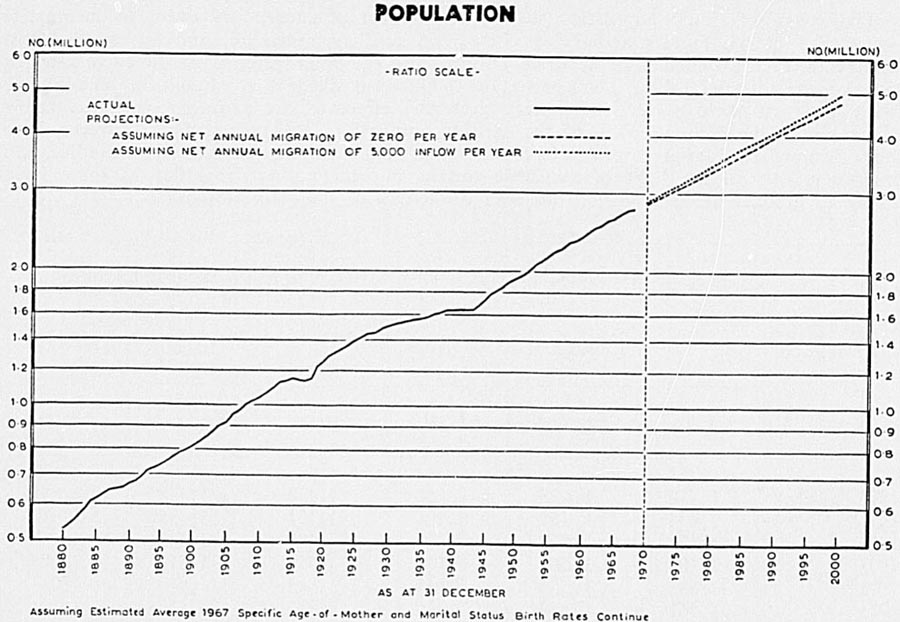
DISTRIBUTION OF POPULATION—Detailed population statistics are compiled for each census and are published in Volume 1, Increase and Location of Population, of the Census of Population and Dwellings.
North and South Islands—In 1858 the North Island had a larger population than the South, but this position was reversed at the succeeding enumeration, and the South Island had the larger population (exclusive of Maoris) at each census from 1861 to 1896. In 1901 the North Island was found to have slightly the larger total and since then has steadily increased its lead.
The following table gives the population, excluding Maoris, of the North and South Islands as disclosed by each census since 1901.
| Census Year | Population (Excluding Maoris) | Percentages | |||
|---|---|---|---|---|---|
| North Island | South Island | Total | North Island | South Island | |
| 1901 | 388,626 | 381,678 | 770,304 | 50.5 | 49.5 |
| 1906 | 474,605 | 411,390 | 885,995 | 53.6 | 46.4 |
| 1911 | 561,281 | 444,304 | 1,005,585 | 55.8 | 44.2 |
| 1916 | 648,439 | 447,789 | 1,096,228 | 59.2 | 40.8 |
| 1921 | 741,255 | 477,658 | 1,218,913 | 60.8 | 39.2 |
| 1926 | 831,813 | 512,656 | 1,344,469 | 61.9 | 38.1 |
| 1936 | 938,939 | 552,545 | 1,491,484 | 63.0 | 37.0 |
| 1945 | 1,050,984 | 552,570 | 1,603,554 | 65.5 | 34.5 |
| 1951 | 1,202,357 | 621,439 | 1,823,796 | 65.9 | 34.1 |
| 1956 | 1,365,470 | 671,441 | 2,036,911 | 67.0 | 33.0 |
| 1961 | 1,524,839 | 723,059 | 2,247,898 | 67.8 | 32.2 |
| 1966 | 1,702,802 | 772,958 | 2,475,760 | 68.8 | 31.2 |
The population of the North Island increased at a greater proportionate rate than that of the South Island between the 1961 and 1966 censuses. At the 1966 census the North Island population was 1,893,326, including 190,524 Maoris, and the South Island population 783,593, inclusive of 10,635 Maoris. The increase since the 1961 census was 208,541 for the North Island and 53,394 for the South Island.
The natural increase of population (i.e., excess of births over deaths) for the North Island during the 1961-66 intercensal period was 152,942, and for the South Island the natural increase was 48,312. External migration has also added to the population and there has been population movement between the islands.
Statistical Areas—The boundaries of statistical areas are shown on the map inside the back cover. Northland comprises the northern counties from Mangonui to Otamatea; central Auckland, the counties from Rodney to Franklin (including islands in the Hauraki Gulf); East Coast, the area north of Wairoa; while South Auckland - Bay of Plenty comprises the remainder of the provincial district. Hawke's Bay, Taranaki, and Wellington statistical areas are the same as the provincial districts of the same names.
In the South Island the statistical areas coincide with the provincial district boundaries, except for the transfer of Amuri and Cheviot counties from Nelson to Canterbury, and the transfer of all that area of Grey county north of Grey River from Nelson to Westland.
In the following table the approximate areas and the populations as at the census of March 1966 and estimated at 1 April 1970 of the statistical areas are shown.
| Statistical Area | Area (Square Miles) | Population Census 22 March 1966 | Estimated Population 1 April 1970 |
|---|---|---|---|
| Northland | 4,880 | 93,514 | 95,400 |
| Central Auckland | 2,150 | 613,671 | 673,852 |
| South Auckland—Bay of Plenty | 14,187 | 389,334 | 415,900 |
| East Coast | 4,200 | 46,988 | 47,400 |
| Hawke's Bay | 4,260 | 124,960 | 131,900 |
| Taranaki | 3,750 | 101,104 | 101,900 |
| Wellington | 10,870 | 523,755 | 551,200 |
| Totals North Island | 44,297 | 1,893,326 | 2,017,552 |
| Marlborough | 4,220 | 29,428 | 30,600 |
| Nelson | 6,910 | 67,208 | 68,700 |
| Westland | 6,010 | 24,353 | 23,800 |
| Canterbury | 16,769 | 376,441 | 390,962 |
| Otago | 14,070 | 183,477 | 182,600 |
| Southland | 11,460 | 102,686 | 106,600 |
| Totals South Island | 59,439 | 783,593 | 803,262 |
| Totals New Zealand | 103,736 | 2,676,919 | 2,820,814 |
Urban Areas—Urban areas are statistical conceptions and not administrative units. Their purpose is to provide definite, stable, and comparable boundaries for the larger centres of population. In addition to the central city or borough, they include neighbouring boroughs and town districts and parts of counties which are regarded as suburban to the centre of population.
For the 1961 Census, three new urban areas were defined at Whangarei, Tauranga, and Rotorua and comparable figures compiled for past years.
In the following table statistics of urban areas are given; 62.5 percent of the population lived in these areas in 1966.
| Urban Area | Total Population | Increase 1961-66 | ||||
|---|---|---|---|---|---|---|
| 1951 | 1956 | 1961 | 1966 | Estimates 1 April 1970 | Percentage | |
| Whangarei | 15,431 | 18,369 | 21,790 | 29,503 | 32,600 | 35.4 |
| Auckland | 329,123 | 381,063 | 448,365 | 548,293 | 603,500 | 22.3 |
| Hamilton | 33,137 | 40,646 | 50,505 | 63,303 | 71,900 | 25.3 |
| Tauranga | 13,010 | 18,724 | 24,659 | 31,606 | 35,300 | 28.2 |
| Rotorua | 14,693 | 19,004 | 25,068 | 33,229 | 37,300 | 32.6 |
| Gisborne | 19,774 | 22,622 | 25,065 | 27,804 | 29,500 | 10.9 |
| Napier | 24,538 | 27,507 | 32,716 | 38,309 | 41,500 | 17.1 |
| Hastings | 23,797 | 27,787 | 32,490 | 37,466 | 41,000 | 15.3 |
| New Plymouth | 24,923 | 28,292 | 32,387 | 35,280 | 36,700 | 8.9 |
| Wanganui | 29,717 | 32,100 | 35,694 | 38,174 | 38,800 | 6.9 |
| Palmerston North | 32,908 | 37,775 | 43,185 | 49,140 | 52,700 | 13.8 |
| Hutt | 74,878 | 86,053 | 98,988 | 114,628 | 122,000 | 15.8 |
| Wellington | 133,414 | 138,297 | 150,544 | 167,859 | 179,300 | 11.5 |
| Nelson | 20,497 | 22,503 | 25,321 | 27,615 | 28,700 | 9.1 |
| Christchurch | 174,221 | 193,367 | 220,510 | 247,248 | 260,200 | 12.1 |
| Timaru | 22,851 | 24,694 | 26,424 | 27,946 | 28,600 | 5.8 |
| Dunedin | 95,457 | 99,370 | 105,003 | 108,734 | 110,100 | 3.6 |
| Invercargill | 31,613 | 35,107 | 41,088 | 46,016 | 49,300 | 12.0 |
| Totals | 1,113,982 | 1,253,280 | 1,439,802 | 1,672,153 | 1,799,000 | 16.1 |
The next table gives the component parts of the five largest centres of population as estimated at 1 April 1970.
| Urban Area | Estimated Population 1 April 1970 |
|---|---|
| Auckland | |
| *Excludes portion of city outside the defined urban area boundary. | |
| Auckland city | 152,300 |
| East Coast Bays borough | 14,250 |
| Takapuna city | 24,200 |
| Devonport borough | 11,100 |
| Northcote borough | 8,920 |
| Birkenhead borough | 13,850 |
| Henderson borough | 6,040 |
| Glen Eden borough | 6,430 |
| New Lynn borough | 10,400 |
| Newmarket borough | 1,010 |
| Mt. Albert borough | 25,600 |
| Mt. Eden borough | 18,450 |
| Mt. Roskill borough | 34,900 |
| Onehunga borough | 15,800 |
| One Tree Hill borough | 12,900 |
| Ellerslie borough | 4,310 |
| Mt. Wellington borough | 20,100 |
| Howick borough | 10,850 |
| Otahuhu borough | 10,150 |
| Papatoetoe city | 22,000 |
| Manukau city | 96,000 |
| Papakura borough | 15,150 |
| Remainder of urban area | 68,790 |
| Total | 603,500 |
| Hutt | |
| Lower Hutt city | 59,400 |
| Upper Hutt city | 20,300 |
| Petone borough | 10,250 |
| Eastbourne borough | 4,640 |
| Remainder of urban area | 27,410 |
| Total | 122,000 |
| Wellington | |
| Wellington city | 134,900 |
| Tawa borough | 11,000 |
| Porirua city | 28,500 |
| Remainder of urban area | 4,900 |
| Total | 179,300 |
| Christchurch | |
| Christchurch city | 166,100 |
| Riccarton borough | 7,150 |
| Lyttelton borough | 3,550 |
| Heathcote county | 7,560 |
| Remainder of urban area | 75,840 |
| Total | 260,200 |
| Dunedin | |
| Dunedin city | 80,900* |
| Port Chalmers borough | 2,990 |
| St. Kilda borough | 6,700 |
| Green Island borough | 6,090 |
| Mosgiel borough | 8,340 |
| Remainder of urban area | 5,080 |
| Total | 110,100 |
Cities and Boroughs—The population of cities and boroughs is now given.
| City or Borough | Population Estimate 1 April 1970 | Approximate Area in Acres, 1 April 1970 |
|---|---|---|
| North Island: | ||
| Kaitaia | 3,290 | 1,300 |
| Kaikohe | 3,280 | 1,345 |
| Whangarei (city) | 30,600 | 10,760 |
| Dargaville | 4,060 | 2,800 |
| Helensville | 1,330 | 1,315 |
| East Coast Bays | 14,250 | 3,850 |
| Takapuna (city) | 24,200 | 3,282 |
| Devonport | 11,100 | 1,100 |
| Northcote | 8,920 | 1,334 |
| Birkenhead | 13,850 | 3,129 |
| Henderson | 6,040 | 1,278 |
| Glen Eden | 6,430 | 1,244 |
| New Lynn | 10,400 | 1,393 |
| Auckland (city) | 152,300 | 18,507 |
| Newmarket | 1,010 | 182 |
| Mt. Albert | 25,600 | 2,430 |
| Mt. Eden | 18,450 | 1,477 |
| Mt. Roskill | 34,900 | 4,602 |
| Onehunga | 15,800 | 1,878 |
| One Tree Hill | 12,900 | 2,430 |
| Ellerslie | 4,310 | 745 |
| Mt. Wellington | 20,100 | 4,075 |
| Howick | 10,850 | 1,534 |
| Otahuhu | 10,150 | 1,378 |
| Papatoetoe (city) | 22,000 | 2,241 |
| Manukau (city) | 96,000 | 153,855 |
| Papakura | 15,150 | 3,410 |
| Pukekohe | 6,940 | 3,471 |
| Waiuku | 2,700 | 1,465 |
| Tuakau | 1,720 | 1,091 |
| Huntly | 5,440 | 1,941 |
| Cambridge | 6,310 | 2,646 |
| Ngaruawahia | 3,880 | 1,112 |
| Hamilton (city) | 71,600 | 13,726 |
| Te Awamutu | 6,890 | 1,762 |
| Otorohanga | 1,910 | 560 |
| Te Kuiti | 4,880 | 1,668 |
| Taumarunui | 6,260 | 3,234 |
| Thames | 5,810 | 2,725 |
| Paeroa | 3,240 | 1,419 |
| Waihi | 3,180 | 1,332 |
| Te Aroha | 3,300 | 2,783 |
| Morrinsville | 4,600 | 1,177 |
| Matamata | 4,140 | 934 |
| Putaruru | 4,640 | 975 |
| Mt. Maunganui | 7,630 | 3,487 |
| Tauranga (city) | 26,800 | 9,398 |
| Te Puke | 3,140 | 1,314 |
| Rotorua (city) | 29,300 | 6,590 |
| Taupo | 9,480 | 3,572 |
| Whakatane | 9,830 | 2,775 |
| Kawerau | 6,380 | 2,280 |
| Murupara | 2,830 | 710 |
| Opotiki | 2,570 | 739 |
| Gisborne (city) | 26,500 | 4,074 |
| Wairoa | 5,490 | 1,603 |
| Napier (city) | 38,200 | 6,018 |
| Hastings (city) | 29,100 | 4,222 |
| Havelock North | 6,790 | 1,270 |
| Waipawa | 1,890 | 1,710 |
| Waipukurau | 3,840 | 1,038 |
| Dannevirke | 5,830 | 1,300 |
| Woodville | 1,520 | 1,054 |
| Waitara | 4,970 | 1,610 |
| New Plymouth (city) | 33,100 | 5,722 |
| Inglewood | 2,030 | 703 |
| Stratford | 5,510 | 2,016 |
| Eltham | 2,320 | 1,599 |
| Hawera | 8,320 | 1,270 |
| Patea | 2,000 | 1,420 |
| Ohakune | 1,390 | 2,079 |
| Raetihi | 1,340 | 958 |
| Wanganui (city) | 36,600 | 7,406 |
| Taihape | 2,900 | 1,923 |
| Marton | 4,860 | 1,415 |
| Feilding | 9,710 | 2,105 |
| Foxton | 2,900 | 757 |
| Palmerston N. (city) | 51,000 | 10,630 |
| Levin | 12,300 | 2,167 |
| Otaki | 3,720 | 1,639 |
| Upper Hutt (city) | 20,300 | 2,165 |
| Lower Hutt (city) | 59,400 | 12,174 |
| Petone | 10,250 | 2,580 |
| Eastbourne | 4,640 | 3,146 |
| Porirua (city) | 28,500 | 8,075 |
| Tawa | 11,000 | 1,359 |
| Wellington (city) | 134,900 | 18,369 |
| Pahiatua | 2,590 | 720 |
| Eketahuna | 700 | 948 |
| Masterton | 18,650 | 3,541 |
| Carterton | 3,730 | 1,265 |
| Greytown | 1,780 | 1,093 |
| Featherston | 2,030 | 759 |
| Martinborough | 1,460 | 1,070 |
| Totals, North Island cities and boroughs | 1,426,730 | 432,732 |
| South Island: | ||
| Picton | 2,700 | 1,052 |
| Blenheim | 14,250 | 2,502 |
| Nelson (city) | 28,300 | 11,767 |
| Richmond | 5,070 | 2,600 |
| Motueka | 3,870 | 2,523 |
| Westport | 5,200 | 760 |
| Runanga | 1,620 | 1,204 |
| Greymouth | 8,540 | 2,594 |
| Brunner | 600 | 5,700 |
| Hokitika | 3,470 | 674 |
| Ross | 380 | 3,800 |
| Rangiora | 4,660 | 883 |
| Kaiapoi | 3,730 | 786 |
| Riccarton | 7,150 | 728 |
| Christchurch (city) | 166,100 | 26,279 |
| Lyttelton | 3,550 | 2,560 |
| Ashburton | 13,150 | 2,604 |
| Geraldine | 1,900 | 745 |
| Temuka | 3,240 | 977 |
| Timaru (city) | 28,000 | 5,825 |
| Waimate | 3,270 | 771 |
| Oamaru | 13,450 | 2,836 |
| Port Chalmers | 2,990 | 1,012 |
| Dunedin (city) | 81,300 | 40,920 |
| St. Kilda | 6,700 | 616 |
| Green Island | 6,090 | 1,818 |
| Mosgiel | 8,340 | 1,602 |
| Milton | 2,190 | 503 |
| Kaitangata | 1,140 | 1,280 |
| Balclutha | 4,650 | 1,258 |
| Tapanui | 870 | 300 |
| Lawrence | 480 | 615 |
| Roxburgh | 710 | 515 |
| Naseby | 80 | 188 |
| Alexandra | 3,240 | 1,118 |
| Cromwell | 1,110 | 972 |
| Arrowtown | 210 | 330 |
| Queenstown | 1,750 | 1,029 |
| Gore | 8,600 | 2,338 |
| Mataura | 2,760 | 1,272 |
| Winton | 1,850 | 570 |
| Invercargill (city) | 46,700 | 10,834 |
| Bluff | 3,310 | 2,141 |
| Riverton | 1,260 | 997 |
| Totals, South Island cities and boroughs | 508,530 | 152,398 |
| Grand totals, all cities and boroughs | 1,935,260 | 585,130 |
Town Districts—The population of independent town districts—i.e., those contained in section (a) of the following table—is not included with that of the county in which the town district is located, but the population of dependent town districts—section (b) — is included in that of the respective parent county.
| Town District | Population Estimate 1 April 1970 | Approximate Area in Acres, 1 April 1970 |
|---|---|---|
| *Parent county shown in parentheses. | ||
| (a) Town Districts not forming parts of Counties | ||
| North Island: | ||
| Kawakawa | 1,260 | 565 |
| Hikurangi | 1,130 | 960 |
| Warkworth | 1,320 | 1,427 |
| Ohura | 630 | 815 |
| Manunui | 940 | 1,251 |
| Manaia | 920 | 510 |
| Waverley | 1,090 | 499 |
| Hunterville | 570 | 791 |
| Totals, North Island | 7,860 | 6,818 |
| South Island: | ||
| Wyndham | 800 | 680 |
| Otautau | 830 | 490 |
| Totals, South Island | 1,630 | 1,170 |
| Grand totals | 9,490 | 7,988 |
| (b) Town Districts forming parts of Counties* | ||
| North Island: | ||
| Russell (Bay of Islands) | 630 | 1,066 |
| Ohaupo (Waipa) | 370 | 1,281 |
| Kihikihi (Waipa) | 1,260 | 523 |
| Patutahi (Cook) | 290 | 1,275 |
| Kaponga (Eltham) | 480 | 558 |
| Totals, North Island | 3,030 | 4,703 |
| South Island: | ||
| Edendale (Southland) | 590 | 696 |
| Totals, South Island | 590 | 696 |
| Grand totals | 3,620 | 5,399 |
County Towns—The following table lists those county towns with populations of 1,000 or more at the time of the 1966 census. The parent county is shown in parentheses. The populations of county towns are included in the administrative county populations given in the table following.
| County Town | Population Estimate 1 April 1970 | Approximate Area, in Acres, 1 April 1970 |
|---|---|---|
| North Island | ||
| Moerewa (Bay of Islands) | 1,190 | 121 |
| Wellsford (Rodney) | 1,530 | 1,368 |
| Glenfield (Waitemata) | 20,100 | 4,595 |
| Kelston West (Waitemata) | 7,790 | 1,621 |
| Green Bay (Waitemata) | 2,500 | 471 |
| Titirangi (Waitemata) | 6,230 | 2,299 |
| Orewa (Waitemata) | 1,740 | 1,429 |
| Raglan (Raglan) | 1,030 | 919 |
| Tokoroa (Matamata) | 13,500 | 1,057 |
| Katikati (Tauranga) | 1,170 | 2,046 |
| Ngongotaha (Rotorua) | 2,140 | 1,242 |
| Mangakino (Taupo) | 1,670 | 644 |
| Edgecumbe (Whakatane) | 1,320 | 375 |
| Bulls (Rangitikei) | 1,860 | 995 |
| Waikanae (Horowhenua) | 1,900 | 2,418 |
| Shannon (Horowhenua) | 1,570 | 844 |
| Paraparaumu (Hutt) | 8,360 | 6,830 |
| Paekakariki (Hutt) | 2,030 | 6,070 |
| Pukerua Bay (Hutt) | 1,300 | 2,062 |
| Plimmerton-Paremata (Hutt) | 4,070 | 2,651 |
| Wainuiomata (Hutt) | 16,000 | 65,830 |
| Heretaunga-Pinehaven (Hutt) | 5,240 | 13,618 |
| South Island | ||
| Kaikoura (Kaikoura) | 1,630 | 700 |
| Hornby (Paparua) | 7,260 | 1,214 |
| Sockburn (Paparua) | 1,850 | 2,673 |
| Halswell (Paparua) | 2,740 | 504 |
| Fairfield (Taieri) | 1,180 | 330 |
Extra-county Islands and Shipboard Population—In addition to the populations quoted for administrative counties, cities and boroughs, and independent town districts, the New Zealand totals include shipboard population and persons located on islands not within the boundaries of any county. The two latter categories comprised a total of 5,074 people as at 1 April 1970.
Counties—The following table gives the population of individual counties at 1 April 1970, together with the approximate area of each. It should be noted that “Administrative Counties” do not include boroughs or town districts independent of county control, but include town districts and county towns which form parts of counties.
| Administrative County | Population Estimate 1 April 1970 | Approximate Area, in Square Miles, 1 April 1970 |
|---|---|---|
| North Island: | ||
| Mangonui | 6,600 | 958 |
| Whangaroa | 1,930 | 240 |
| Hokianga | 4,020 | 613 |
| Bay of Islands | 12,790 | 823 |
| Whangarei | 14,500 | 1,031 |
| Hobson | 5,450 | 745 |
| Otamatea | 6,160 | 422 |
| Rodney | 7,320 | 485 |
| Waitemata | 96,360 | 600 |
| Waiheke | 2,320 | 60 |
| Great Barrier Is. | 260 | 110 |
| Franklin | 18,000 | 548 |
| Raglan | 9,610 | 931 |
| Waikato | 15,460 | 639 |
| Waipa | 15,480 | 436 |
| Otorohanga | 8,070 | 762 |
| Waitomo | 7,530 | 1,303 |
| Taumarunui | 7,510 | 1,873 |
| Coromandel | 3,070 | 439 |
| Thames | 3,700 | 401 |
| Hauraki Plains | 5,650 | 233 |
| Ohinemuri | 4,170 | 241 |
| Piako | 11,900 | 451 |
| Matamata | 28,840 | 987 |
| Tauranga | 14,780 | 706 |
| Rotorua | 17,040 | 1,035 |
| Taupo | 16,570 | 2,797 |
| Whakatane | 15,270 | 1,620 |
| Opotiki | 4,260 | 1,206 |
| Waiapu | 5,060 | 1,088 |
| Waikohu | 3,220 | 1,023 |
| Cook | 10,030 | 1,101 |
| Wairoa | 6,030 | 1,594 |
| Hawke's Bay | 20,800 | 1,871 |
| Waipawa | 3,660 | 520 |
| Patangata | 3,180 | 655 |
| Waipukurau | 1,320 | 128 |
| Dannevirke | 4,140 | 546 |
| Woodville | 1,600 | 156 |
| Clifton | 2,210 | 454 |
| Taranaki | 8,200 | 227 |
| Inglewood | 3,090 | 201 |
| Stratford | 5,460 | 833 |
| Egmont | 6,120 | 240 |
| Eltham | 3,290 | 206 |
| Waimate West | 2,520 | 83 |
| Hawera | 4,800 | 191 |
| Patea | 3,100 | 591 |
| Waimarino | 1,760 | 829 |
| Waitotara | 2,910 | 467 |
| Wanganui | 3,030 | 459 |
| Rangitikei | 14,460 | 1,732 |
| Kiwitea | 2,080 | 359 |
| Pohangina | 990 | 259 |
| Oroua | 4,670 | 190 |
| Manawatu | 6,220 | 267 |
| Kairanga | 5,830 | 178 |
| Horowhenua | 12,110 | 542 |
| Hutt | 47,650 | 524 |
| Pahiatua | 2,370 | 286 |
| Akitio | 930 | 321 |
| Eketahuna | 1,580 | 318 |
| Masterton | 4,160 | 923 |
| Wairarapa South | 2,560 | 440 |
| Featherston | 3,300 | 954 |
| Totals, North Is. counties | 579,060 | 43,452 |
| South Island: | ||
| Marlborough | 9,050 | 2,563 |
| Awatere | 1,790 | 1,497 |
| Kaikoura | 3,060 | 905 |
| Golden Bay | 3,500 | 1,011 |
| Waimea | 16,300 | 2,900 |
| Buller | 3,510 | 1,944 |
| Inangahua | 2,650 | 942 |
| Grey | 4,030 | 1,579 |
| Westland | 5,140 | 4,411 |
| Amuri | 2,860 | 1,650 |
| Cheviot | 1,490 | 327 |
| Waipara | 2,970 | 956 |
| Ashley | 2,790 | 479 |
| Rangiora | 3,990 | 102 |
| Eyre | 2,320 | 177 |
| Oxford | 1,540 | 314 |
| Malvern | 6,450 | 1,926 |
| Paparua | 24,720 | 172 |
| Waimairi | 58,400 | 43 |
| Heathcote | 7,560 | 12 |
| Mt. Herbert | 540 | 66 |
| Akaroa | 1,470 | 170 |
| Chatham Islands | 530 | 372 |
| Wairewa | 710 | 170 |
| Ellesmere | 7,290 | 457 |
| Ashburton | 11,500 | 2,350 |
| Geraldine | 4,470 | 774 |
| Levels | 4,760 | 260 |
| Mackenzie | 3,360 | 2,853 |
| Waimate | 5,780 | 1,383 |
| Waitaki | 10,050 | 2,413 |
| Waihemo | 1,790 | 339 |
| Waikouaiti | 4,040 | 319 |
| Taieri | 7,930 | 900 |
| Bruce | 3,540 | 519 |
| Clutha | 5,840 | 1,049 |
| Tuapeka | 4,250 | 1,384 |
| Maniototo | 2,720 | 1,340 |
| Vincent | 4,400 | 2,922 |
| Lake | 2,490 | 3,871 |
| Southland | 27,720 | 3,702 |
| Wallace | 12,040 | 3,728 |
| Fiord | 250 | 3,035 |
| Stewart Island | 340 | 675 |
| Totals, South | ||
| Island counties | 291,930 | 58,961 |
| Grand totals, all counties | 870,990 | 102,414 |
Most of those counties showing considerable gains of population are adjacent to large cities.
Population Growth and Urbanisation—With the growth in the efficiency of farming, with increased specialisation, and general development of the economy, urban centres have increased rapidly in size and population has tended to concentrate in them; employment opportunities have been provided in manufacturing and service industries for the expanding labour force. In 1874 two-thirds of the population lived in settlements of less than 500 persons, that is to say on farms or in hamlets. Under a changed classification in 1900, 54 percent were living in counties and the remainder in boroughs. It is a characteristic of most countries that agriculture's share of total population declines with more advanced economic development. By 1961 only one-quarter of the population lived in rural areas and the proportion declined further by 1966. The following table indicates the urban movement of the total population; the urban content has been taken as the population of the defined urban areas, as enumerated previously, plus that of all boroughs, town districts, townships, and (for 1961 and 1966) county towns with population of 1,000 or over.
| Census | Urban | Rural* | ||
|---|---|---|---|---|
| Number | Percent | Number | Percent | |
| *Excludes shipping. | ||||
| 1926 | 888,585 | 63.4 | 512,416 | 36.6 |
| 1936 | 992,440 | 63.2 | 576,671 | 36.8 |
| 1945 | 1,148,101 | 67.6 | 551,012 | 32.4 |
| 1951 | 1,345,292 | 69.6 | 588,302 | 30.4 |
| 1956 | 1,535,951 | 70.8 | 633,663 | 29.2 |
| 1961 | 1,779,754 | 73.9 | 629,665 | 26.1 |
| 1966 | 2,064,574 | 77.3 | 607,534 | 22.7 |
In recent years urbanisation has helped to absorb the increasing Maori population and likewise rapid expansion in the number of Maoris of working age has contributed to economic growth. The following table indicates the urban movement of the Maori population.
| Census | Urban | Rural* | ||
|---|---|---|---|---|
| Number | Percent | Number | Percent | |
| *Excludes shipping. | ||||
| 1936 | 10,909 | 13.3 | 71,390 | 86.7 |
| 1945 | 20,317 | 20.6 | 78,407 | 79.4 |
| 1951 | 29,115 | 25.2 | 86,468 | 74.8 |
| 1956 | 41,897 | 30.6 | 95,185 | 69.4 |
| 1961 | 71,499 | 42.8 | 95,533 | 57.2 |
| 1966 | 118,228 | 58.7 | 82,867 | 41.3 |
In the process of urbanisation some cities and areas have grown more quickly than others. There is a tendency towards concentration of population in the largest centres and also a drift of population from the south to the north. Where the two tendencies reinforce each other, as they do in the case of Auckland, the rate of growth has been very rapid. Likewise the urban areas of Whangarei, Hamilton, Tauranga, and Rotorua, which had a combined population in 1926 of 36,084, in 1966 comprised 157,641 inhabitants.
The initial reason for the drift to the north lay in the change in emphasis of farming activities in which the development of dairying played an important part. The expansion of dairying in itself called for the development of factory processing facilities and service industries. These farming trends have been reinforced by the growth of forest processing industries in the North Island and compounded further by the general tendency for the large-scale manufacturing units to be located close to the biggest local markets.
In the larger cities a notable feature of the past 35 years has been a movement of population from the central or “inner” areas to the perimeter or “outer” areas as families in decayed areas have moved to State rental houses and as residential units in the city centres have been replaced by shops, offices, places of entertainment, and other commercial or industrial buildings. In recent years there has been an offsetting movement with the building of multi-storey flats in the inner areas.
The distribution of population by size of centres is shown in the following table.
| Size of Centre (City, Borough, Town District, or County Town) | Number of Centres | Percentage of Population in These Centres | ||||||
|---|---|---|---|---|---|---|---|---|
| 1926 | 1956 | 1961 | 1966 | 1926 | 1956 | 1961 | 1966 | |
| 1,000- 2,499 | 63 | 40 | 45 | 44 | 7.5 | 3.0 | 3.0 | 2.4 |
| 2,500- 4,999 | 23 | 47 | 46 | 41 | 6.2 | 7.3 | 6.8 | 5.5 |
| 5,000- 9,999 | 11 | 19 | 35 | 34 | 5.9 | 6.2 | 9.9 | 8.8 |
| 10,000-24,999 | 12 | 19 | 21 | 23 | 13.3 | 13.7 | 14.9 | 13.5 |
| 25,000 and over | 4 | 11 | 12 | 19 | 24.1 | 32.4 | 32.4 | 40.9 |
| 113 | 136 | 159 | 161 | 57.0 | 62.6 | 67.0 | 71.1 | |
In the South Island a higher proportion of the population is rural, that is, outside urban communities, than in the North Island.
Sex Proportions—The census of 22 March 1966 showed that males outnumbered females by 10,567 in the total population but, because of changes since 1966, there were just over 1,200 more males by 30 June 1970. Females per 1,000 males at the last 6 censuses have been:
| Census | Excluding Armed Forces Abroad | Including Armed Forces Abroad |
|---|---|---|
| 1936 | 970 | ... |
| 1945 | 1,044 | 991 |
| 1951 | 991 | 989 |
| 1956 | 989 | 987 |
| 1961 | 990 | 988 |
| 1966 | 992 | 991 |
There are marked differences in the sex proportions of the population of different parts of New Zealand, depending largely on educational and employment opportunities. The following figures give the number of females per 1,000 males at the Census of 1966.
| Statistical areas | |
| Central Auckland | 1,019 |
| Otago | 1,014 |
| Hawke's Bay | 1,012 |
| Canterbury | 1,012 |
| Nelson | 1,004 |
| East Coast | 992 |
| Taranaki | 991 |
| Urban areas | |
| Timaru | 1,103 |
| Hastings | 1,085 |
| Gisborne | 1,083 |
| New Plymouth | 1,081 |
| Nelson | 1,077 |
| Dunedin | 1,077 |
| Wanganui | 1,062 |
| Palmerston North | 1,059 |
| Hamilton | 1,058 |
| Wellington | 986 |
| South Auckland - Bay of Plenty | 960 |
| Marlborough | 953 |
| Westland | 947 |
| Northland | 942 |
| Southland | 923 |
| Christchurch | 1,054 |
| Napier | 1,052 |
| Tauranga | 1,045 |
| Auckland | 1,032 |
| Rotorua | 1,019 |
| Invercargill | 1,019 |
| Wellington | 1,013 |
| Whangarei | 1,010 |
| Hutt | 971 |
DENSITY OF POPULATION—Generally speaking, a dense population must depend upon intensive land utilisation or industrialisation. In New Zealand there is a great area of high mountainous country, particularly in the South Island, while there are also large areas of hilly country which cannot be closely settled, while the growth of mechanisation in farming tends to reduce the size of the labour force engaged in farming operations.
Nevertheless, economic development is providing employment for a growing labour force. More extensive mechanisation, further advances in science and technology, and increases in productivity, wealth, and consumption have paved the way for further specialisation of production and more concentrated urbanisation.
Within New Zealand there are wide variations in density of population. The following table provides comparative density figures on a statistical area basis from 1926 to 1966 censuses.
| Statistical Area | Area, in Square Miles | Persons per Square Mile | |||||
|---|---|---|---|---|---|---|---|
| 1926 | 1936 | 1945 | 1951 | 1961 | 1966 | ||
| Northland | 4,880 | 11.2 | 13.2 | 13.6 | 15.4 | 17.7 | 19.2 |
| Central Auckland | 2,150 | 109.6 | 123.4 | 154.0 | 177.3 | 238.8 | 285.4 |
| South Auckland - Bay of Plenty | 14,187 | 10.2 | 12.6 | 14.4 | 17.4 | 24.6 | 27.4 |
| East Coast | 4,200 | 8.0 | 8.8 | 9.0 | 9.9 | 11.1 | 11.2 |
| Hawke's Bay | 4,260 | 16.5 | 18.1 | 18.6 | 21.4 | 26.9 | 29.3 |
| Taranaki | 3,750 | 19.2 | 20.7 | 20.5 | 23.2 | 26.6 | 27.0 |
| Wellington | 10,870 | 25.9 | 29.1 | 32.1 | 35.9 | 43.6 | 48.2 |
| Totals, North Island | 44,297 | 20.2 | 23.0 | 25.9 | 29.7 | 38.0 | 42.7 |
| Marlborough | 4,220 | 4.5 | 4.5 | 4.9 | 5.4 | 6.6 | 7.0 |
| Nelson | 6,910 | 6.0 | 7.0 | 6.8 | 8.2 | 9.1 | 9.7 |
| Westland | 6,010 | 3.6 | 4.3 | 4.0 | 4.2 | 4.1 | 4.1 |
| Canterbury | 16,769 | 13.0 | 14.2 | 14.9 | 16.9 | 20.5 | 22.4 |
| Otago | 14,070 | 10.7 | 10.8 | 10.3 | 11.3 | 12.5 | 13.0 |
| Southland | 11,460 | 5.9 | 6.4 | 6.3 | 6.8 | 8.2 | 9.0 |
| Totals, South Island | 59,439 | 8.7 | 9.4 | 9.4 | 10.5 | 12.3 | 13.2 |
| Totals, New Zealand | 103,736 | 13.6 | 15.2 | 16.5 | 18.7 | 23.3 | 25.8 |
MAORI POPULATION—All persons of half or more Maori ancestry are defined as Maoris.
According to census records the Maori population suffered a period of almost unbroken decline from 1858 to 1896. Among the causes of this were the susceptibility of the Maori to tuberculosis, measles, typhoid, and other diseases introduced by immigrants; the abandonment in some areas of healthy hilltop villages for low, often swampy sites; low birth rates coupled with high child-mortality rates; and a feeling of race-despair engendered by loss of land, defeat in war, and the general breakdown in health.
Since 1896, however, the Maori population has increased continuously, at first steadily and of later years at a very rapid rate. In fact, the vitality exhibited by the Maori race in recent years has been an outstanding demographic feature.
A statement of Maori population is now given for each census from 1901.
| Year | Maori Population | Intercensal Increase | Intercensal Increase | Average Annual Increase |
|---|---|---|---|---|
| *Includes members of armed forces overseas at census date. | ||||
| Percent | ||||
| 1901 | 45,549 | 3,436 | 8.2 | 1.6 |
| 1906 | 50,309 | 4,760 | 10.5 | 2.0 |
| 1911 | 52,723 | 2,414 | 4.8 | 1.0 |
| 1916 | 52,997 | 274 | 0.5 | 0.1 |
| 1921 | 56,987 | 3,990 | 7.5 | 1.6 |
| 1926 | 63,670 | 6,683 | 11.7 | 2.2 |
| 1936 | 82,326 | 18,656 | 29.3 | 2.6 |
| 1945 | 98,744 | 16,418 | 19.9 | 1.9 |
| 1945* | 100,044 | 17,718 | 21.5 | 2.1 |
| 1951 | 115,676 | 16,932 | 17.1 | 2.9 |
| 1951* | 115,740 | 15,696 | 15.7 | 2.7 |
| 1956 | 137,151 | 21,475 | 18.6 | 3.5 |
| 1956* | 137,341 | 21,601 | 18.7 | 3.5 |
| 1961 | 167,086 | 29,935 | 21.8 | 4.0 |
| 1961* | 167,390 | 30,049 | 21.9 | 4.0 |
| 1966 | 201,159 | 34,073 | 20.4 | 3.8 |
| 1966* | 201,479 | 34,089 | 20.4 | 3.8 |
Of the 201,159 Maoris at the 1966 census, 190,524 were in the North Island. Most Maoris used to live in rural communities. A marked change has, however, taken place during and since the war as a result of employment conditions. As late as the 1936 census only 8,249 Maoris (10.0 percent) dwelt in cities, boroughs, or independent town districts. By the 1966 census the comparative figure was 101,677 (50.5 percent); the largest concentration is in Auckland Urban Area, where 33,926 Maoris were enumerated in 1966.
EXTERNAL MIGRATION—In recent years there has been a large increase in New Zealanders going overseas on business, on pleasure trips, and on working holidays, so that arrivals and departures have both been greatly swollen. The arrivals include many New Zealanders returning from travel overseas, as well as growing numbers of tourists from overseas countries.
The numbers of arrivals and departures during the last 11 years are given in the table following. Crews of vessels, through passengers, tourists on cruising liners and members of the armed forces, etc., have not been taken into account in this table.
| Year Ended 31 March | Arrivals | Departures | Excess of Arrivals Over Departures | ||||
|---|---|---|---|---|---|---|---|
| Males | Females | Total | Males | Females | Total | ||
| 1960 | 47.894 | 41.483 | 89.377 | 46.467 | 39.697 | 86.164 | 3.213 |
| 1961 | 57.306 | 48.932 | 106.238 | 56.423 | 48.195 | 104.618 | 1.620 |
| 1962 | 72.500 | 60.156 | 132.656 | 61.367 | 52.457 | 113.824 | 18.832 |
| 1963 | 78.613 | 65.259 | 143.872 | 71.863 | 58.370 | 130.233 | 13.639 |
| 1964 | 89.870 | 74.776 | 164.646 | 81.956 | 67.206 | 149.162 | 15.484 |
| 1965 | 104.421 | 85.870 | 190.291 | 98.147 | 80.153 | 178.300 | 11.991 |
| 1966 | 121.106 | 98.833 | 219.939 | 114.000 | 93.918 | 207.918 | 12.021 |
| 1967 | 136.275 | 114.131 | 250.406 | 128.228 | 107.743 | 235.971 | 14.435 |
| 1968 | 136.760 | 122.621 | 259.381 | 143.259 | 124.212 | 267.471 | - 8.090 |
| 1969 | 136.457 | 119.279 | 255.736 | 142.653 | 123.931 | 266.584 | -10.848 |
| 1970 | 156.645 | 136.760 | 293.405 | 157.829 | 137.636 | 295.465 | - 2.060 |
New Zealand usually has a net migration gain of a lower rate than that of Australia, but has a higher rate of natural increase. The total population of New Zealand grew faster (40.7 percent) than that of Australia (40.2 percent) from 1951 to 1966. New Zealand, however, had migration losses from 1967 to 1969. Annual percentage increases are shown in the following table.
| Calendar Years | Rate of Population Increase (Percent) | |
|---|---|---|
| New Zealand | Australia | |
| 1951 | 2.23 | 2.65 |
| 1952 | 2.74 | 2.48 |
| 1953 | 2.48 | 1.87 |
| 1954 | 2.10 | 2.10 |
| 1955 | 2.19 | 2.44 |
| 1956 | 2.05 | 2.35 |
| 1957 | 2.43 | 2.24 |
| 1958 | 2.35 | 2.09 |
| 1959 | 1.89 | 2.15 |
| 1960 | 1.86 | 2.27 |
| 1961 | 2.40 | 2.04 |
| 1962 | 2.22 | 1.95 |
| 1963 | 2.03 | 1.97 |
| 1964 | 1.95 | 2.07 |
| 1965 | 1.79 | 2.03 |
| 1966 | 1.82 | 1.78 |
| 1967 | 1.28 | 1.87 |
| 1968 | 1.06 | 2.05 |
| 1969 | 1.16 | 2.22 |
Classes of Arrivals and Departures—The following table gives an analysis of all classes of arrivals during the last five March years, including through passengers, tourists on cruising liners, and crews. In classifying arrivals or departures as permanent the commonly used international rule is applied—i.e., intended residence or absence of one year or more.
| Class | 1965-66 | 1966-67 | 1967-68 | 1968-69 | 1969-70 |
|---|---|---|---|---|---|
| * Persons who intend to spend less than one week in New Zealand in transit to other destinations. | |||||
| Immigrants intending permanent residence | 35,299 | 38,999 | 30,660 | 23,225 | 26,825 |
| New Zealand residents returning | 86,624 | 98,536 | 105,533 | 100,609 | 111,589 |
| Visitors— | |||||
| Tourists | 65,039 | 74,275 | 89,953 | 100,341 | 118,706 |
| On business | 9,969 | 10,006 | 12,858 | 13,736 | 17,389 |
| Theatrical, entertaining, etc. | 1,072 | 1,261 | 2,159 | 2,285 | 1,819 |
| For educational purposes | 829 | 1,828 | 2,254 | 2,031 | 2,637 |
| On working holidays | 11,905 | 18,242 | 7,560 | 5,495 | 7,724 |
| Other, official, etc. | 7,786 | 3,974 | 4,629 | 4,406 | 3,882 |
| In transit* | 1,416 | 3,285 | 3,775 | 3,608 | 2,834 |
| Through passengers, mainly on cruising liners | 55,265 | 72,561 | 84,839 | 88,783 | 86,119 |
| Crews | 120,127 | 131,420 | 131,743 | 140,884 | 133,559 |
| Totals | 395,331 | 454,387 | 475,963 | 485,403 | 513,083 |
The following table gives an analysis of departures.
| Class | 1965-66 | 1966-67 | 1967-68 | 1968-69 | 1969-70 |
|---|---|---|---|---|---|
| New Zealand residents departing— | |||||
| Permanently (i.e. over 12 months) | 18,589 | 21,128 | 28,472 | 29,802 | 29,822 |
| Temporarily | 88,145 | 99,890 | 104,094 | 100,819 | 112,082 |
| Visitors departing | 101,184 | 114,953 | 134,905 | 135,963 | 153,561 |
| Through passengers, mainly on cruising liners | 55,265 | 72,561 | 84,839 | 88,783 | 86,119 |
| Crews | 19,198 | 131,851 | 134,249 | 141,217 | 130,699 |
| Totals | 382,381 | 440,383 | 486,559 | 496,584 | 512,283 |
Ages—The following table gives the age-distribution of permanent arrivals and departures for the year ended 31 March 1970.
| Age, in Years | Permanent Arrivals | Permanent Departures | Excess of Arrivals Over Departures | ||||
|---|---|---|---|---|---|---|---|
| Males | Females | Totals | Males | Females | Totals | ||
| 0-14 | 3,085 | 2,807 | 5,892 | 3,189 | 3,086 | 6,275 | - 383 |
| 15-24 | 3,523 | 4,371 | 7,894 | 5,935 | 5,848 | 11,783 | -3,889 |
| 25-34 | 3,499 | 3,036 | 6,535 | 3,750 | 2,794 | 6,544 | - 9 |
| 35-44 | 1,542 | 1,189 | 2,731 | 1,536 | 1,078 | 2,614 | 117 |
| 45-59 | 1,084 | 1,120 | 2,204 | 919 | 900 | 1,819 | 385 |
| 60 and over | 629 | 940 | 1,569 | 342 | 445 | 787 | 782 |
| Totals | 13,362 | 13,463 | 26,825 | 15,671 | 14,151 | 29,822 | -2,997 |
Origin—The following table shows for the last three years the birthplaces of immigrants intending permanent residence and of New Zealand residents departing permanently. (“Permanent” is defined as 12 months or more.)
| Country of Birth | Immigrants Intending Permanent Residence | New Zealand Residents Departing Permanently | ||||
|---|---|---|---|---|---|---|
| 1967-68 | 1968-69 | 1969-70 | 1967-68 | 1968-69 | 1969-70 | |
| Commonwealth Countries | ||||||
| United Kingdom— | ||||||
| England and Wales | 11.732 | 6,904 | 7,569 | 4,482 | 4,373 | 4,134 |
| Scotland | 2,082 | 964 | 1,041 | 835 | 772 | 747 |
| Northern Ireland | 233 | 165 | 201 | 168 | 140 | 147 |
| Other or undefined | 2 | 41 | 89 | 18 | 30 | 25 |
| Australia | 4,053 | 2,848 | 3,507 | 2,658 | 2,276 | 1,844 |
| Canada | 325 | 337 | 502 | 266 | 197 | 167 |
| India | 262 | 213 | 173 | 117 | 111 | 123 |
| New Zealand | 7,083 | 7,588 | 8,717 | 16,549 | 18,953 | 19,569 |
| Pacific Islands— | ||||||
| Cook Islands and Niue | 477 | 317 | 664 | 140 | 72 | 86 |
| Western Samoa | 134 | 195 | 210 | 151 | 100 | 119 |
| Fiji | 185 | 220 | 167 | 154 | 128 | 153 |
| Other Pacific | 199 | 227 | 261 | 112 | 97 | 112 |
| Other | 670 | 567 | 580 | 343 | 287 | 335 |
| Totals, Commonwealth countries | 27,437 | 20,586 | 23,681 | 25,993 | 27,536 | 27,561 |
| Other Countries | ||||||
| Austria | 57 | 43 | 38 | 60 | 41 | 35 |
| China | 94 | 85 | 56 | 40 | 38 | 20 |
| Denmark | 63 | 31 | 47 | 38 | 58 | 32 |
| Germany | 261 | 169 | 181 | 124 | 140 | 119 |
| Greece | 101 | 63 | 44 | 63 | 72 | 54 |
| Hungary | 21 | 28 | 32 | 43 | 63 | 36 |
| Ireland, Republic of | 301 | 155 | 181 | 161 | 155 | 134 |
| Italy | 132 | 92 | 129 | 55 | 72 | 119 |
| Indonesia | 52 | 50 | 125 | 44 | 44 | 49 |
| Netherlands | 711 | 493 | 578 | 451 | 489 | 402 |
| Switzerland | 119 | 75 | 52 | 77 | 55 | 52 |
| United States | 502 | 659 | 992 | 657 | 419 | 615 |
| Yugoslavia | 151 | 94 | 100 | 111 | 121 | 84 |
| Others | 658 | 602 | 589 | 555 | 499 | 510 |
| Totals, other countries | 3,223 | 2,639 | 3,144 | 2,479 | 2,266 | 2,261 |
| Grand totals | 30,660 | 23,225 | 26,825 | 28,472 | 29,802 | 29,822 |
Assisted Immigration—Two assisted immigration schemes from Britain are in operation at present—the assisted passage scheme and the subsidy scheme. The contribution made by migrants under each scheme was reduced in 1970 to £10 sterling for single persons and £20 for married persons. Arrangements are made with the Department of Labour, Wellington, and the Chief Migration Officer, New Zealand House, London.
The assisted passage scheme is limited to 500 migrants a year and they must possess minimum skills (usually at tradesman level) in specific occupations approved by the Department of Labour. Single persons between the ages of 18 and 35 years are eligible and married couples up to age 40 years without children. Employers sponsor migrants by offering a job and arranging accommodation.
The subsidy scheme, as previously operating, was amended in February 1970. The quota (which had varied between 1,500 and 4,500 a year) was abolished; employers now have to pay only one quarter of the air fare instead of half (the remainder being subsidised by the Government); travel by sea is subsidised at $200 a person; and the migrants no longer need to have specific skills to qualify for the scheme. Single men between the ages of 18 and 35 years may be sponsored and married men between 18 and 45 years without limit on the number of dependent children. Employers are obliged to provide employment, arrange suitable accommodation in advance for a married migrant and meet their share of the cost of fares to New Zealand.
In September 1970 the subsidy scheme was extended to the United States and to countries in Western Europe for the recruitment of skilled and semi-skilled workers. Migrants from these countries must possess the skill or experience to meet the employer's requirements and pay the same contribution as British migrants.
A system of matching skills of immigrants with specific vacancies in New Zealand has been developed by the Chief Migration Officer, New Zealand House, London, and a similar register has been established by the N.Z. Consul-General in Los Angeles. Employers interested in recruiting migrants with certain skills may file details of their vacancies through the Department of Labour in Wellington.
The numbers of assisted immigrants (excluding displaced persons and Hungarian and Czech refugees) arriving in the last 11 years are as follows.
| Year Ended 31 March | British | Dutch | Austrian | German | Danish | Swiss | Belgian | Maltese | Greek | Other | Total |
|---|---|---|---|---|---|---|---|---|---|---|---|
| 1960 | 2,360 | 90 | 25 | 39 | 13 | 22 | - | - | - | - | 2,549 |
| 1961 | 2,217 | 12 | 2 | - | - | - | - | - | - | - | 2,231 |
| 1962 | 3,474 | 84 | 14 | - | - | 10 | 2 | - | - | - | 3,584 |
| 1963 | 4,283 | 42 | 33 | 27 | - | - | 10 | - | 137 | - | 4,532 |
| 1964 | 4,171 | - | 6 | 16 | 5 | 14 | 5 | - | 130 | - | 4,347 |
| 1965 | 4,300 | - | 9 | 12 | 5 | 11 | 2 | 31 | 29 | 1 | 4,400 |
| 1966 | 3,963 | - | 19 | 7 | 8 | 27 | - | 5 | 18 | - | 4,047 |
| 1967 | 4,020 | - | 9 | 9 | 10 | 36 | 1 | - | 11 | 1 | 4,097 |
| 1968 | 2,732 | - | 2 | 4 | 5 | 17 | - | - | 4 | - | 2,764 |
| 1969 | 485 | - | - | 2 | - | 2 | - | - | 1 | - | 490 |
| 1970 | 377 | - | - | - | 2 | - | - | - | 1 | 2 | 382 |
In the preceding migration tables assisted immigrants are included in the totals of “Immigrants intending permanent residence”.
Refugees—Apart from displaced persons from Europe, of which New Zealand accepted 4,582 in the three year period 1949-52 as a member of the International Refugee Organisation, and the 1,117 Hungarian refugees accepted during 1956-58, New Zealand has accepted and continues to accept refugees from Europe and the mainland of China. In 1958 it was decided to offer resettlement opportunities to 20 “hard core” refugee families from Europe who, because of handicapped persons in each family unit, were unacceptable elsewhere. These families arrived during 1959. In 1959 it was decided to accept a further 100 “hard core” families. This figure was subsequently increased to 200. New Zealand has continued to accept a steady flow of refugees including families sponsored by the Churches who also accepted responsibility for 50 orphan children from Hong Kong, Chinese refugee families, and White Russians (including 80 Old Believers who arrived during 1965 and are now settled in the Southland area).
From November 1968, 100 Czech refugees had arrived by 1969 and it was decided to accept an additional 100.
IMMIGRATION—The legislation respecting immigration into New Zealand is contained in the Immigration Act 1964, and the Undesirable Immigrants Exclusion Act 1919. The Immigration Act is administered by the Department of Labour, while the Undesirable Immigrants Exclusion Act is administered by the Department of Justice.
Under the Immigration Act all persons other than New Zealand citizens must be in possession of an entry permit before they may land in New Zealand.
To obtain permission to settle in New Zealand, intending immigrants should first write to or call on the nearest overseas representative of the New Zealand Government or write direct to the Secretary of Labour, P.O. Box 6310, Wellington, New Zealand. The application must be made in the prescribed form and must be supported by documents duly attested in the country of origin. Each application is considered individually on its own merits.
PASSPORTS—Authority for the issue of passports in New Zealand and by New Zealand representatives overseas is contained in the Passports Act 1946 and the Passport Regulations 1946.
New Zealand passports are issued and renewed within New Zealand by the Department of Internal Affairs at Wellington, Auckland, and Christchurch, at Rarotonga by the High Commissioner, at Niue by the Resident Commissioner, and overseas by the representatives of New Zealand at Apia, Athens, Bangkok, Bonn, Brisbane, Brussels, Canberra, Djakarta, Fiji, Geneva, The Hague, Kuala Lumpur, London, Los Angeles, Melbourne, New Delhi, New York, Ottawa, Paris, Rome, Saigon, San Francisco, Singapore, Sydney, Tokyo, and Washington. United Kingdom, Canadian, Australian, and Indian passports are issued and renewed in New Zealand by the respective High Commissioners for those countries.
Entry into New Zealand—Apart from British subjects and the wives of British subjects arriving from Australia, no person 16 years of age or over may land in New Zealand unless he is in possession of a valid passport or other recognised travel document. Exemption from the passport requirement (which is additional to the requirements of the Immigration Act and Undesirable Immigrants Exclusion Act) may be granted in exceptional circumstances by the Minister of Internal Affairs. A British subject who is a master or a member of the crew of the vessel in which he arrives does not need to produce a passport.
With the exception of nationals of those countries with which New Zealand has concluded agreements for the mutual abolition of visas, every alien landing in New Zealand requires a visa.
Persons born in the Cook Islands and the Tokelau Islands are British subjects and New Zealand citizens. They are required to obtain formal exit permission from the High Commissioner or Administrator respectively if they wish to proceed to New Zealand.
Departure from New Zealand—Every person leaving New Zealand, with the exception of a British subject travelling to Australia or making the round trip to New Zealand's island territories, should be in possession of a valid passport or other travel document.
NATIONALITY AND NATURALISATION—The basic nationality law is the British Nationality and New Zealand Citizenship Act 1948. Citizens of all Commonwealth countries are recognised as British subjects.
New Zealand citizenship may be acquired in the following ways: (a) by birth in New Zealand; (b) by descent; (c) by registration; and (d) by naturalisation. Citizens of other Commonwealth countries and the Republic of Ireland acquire New Zealand citizenship by registration, as do alien wives and children of New Zealand citizens. Other aliens acquire it by naturalisation. To be eligible for New Zealand citizenship, an alien or a citizen of another Commonwealth country (other than a woman married to a New Zealand citizen, or a minor) must—(a) have resided in New Zealand for the prescribed period, (b) be of full age and capacity, (c) be of good character, (d) have a sufficient knowledge of the English language, and of the responsibilities and privileges of New Zealand citizenship, (e) intend to reside in New Zealand, or to enter or continue Crown service under the New Zealand Government. The residential qualification for naturalisation is five years, for registration it is generally three years but can be reduced to one year.
A person who acquires New Zealand citizenship by naturalisation must take the oath of allegiance; a person who acquires it by registration may be required to take the oath. Ceremonies are held at which applicants, in an atmosphere of dignity and solemnity, take the oath of allegiance and are presented with their certificates of naturalisation or registration as New Zealand citizens. During the 1969-70 year there were 124 such ceremonies, at which 1,224 persons took the oath of allegiance.
New Zealand citizens may be deprived of New Zealand citizenship if they voluntarily acquire a foreign nationality by any formal act other than marriage, or if they voluntarily exercise the privileges or perform any of the duties of a foreign nationality possessed by them. Citizenship obtained by fraud, false representation, or the concealment of any material fact may be withdrawn.
The following table shows the number of persons, by country of birth, who were granted citizenship in the latest two years ended 31 March. Of the total of 1,959 in 1969-70, 575 were wives of New Zealand citizens and 371 were children.
| Country of Birth | 1968-69 | 1969-70 |
|---|---|---|
| Australia | 23 | 28 |
| Austria | 21 | 12 |
| Burma | 11 | 2 |
| Canada | 6 | 7 |
| China | 117 | 112 |
| Czechoslovakia | 15 | 3 |
| Denmark | 18 | 16 |
| Fiji | 61 | 64 |
| Germany | 40 | 36 |
| Greece | 33 | 46 |
| Hong Kong | 16 | 12 |
| Hungary | 61 | 62 |
| India | 116 | 121 |
| Indonesia | 43 | 20 |
| Ireland | 10 | 13 |
| Italy | 24 | 19 |
| Kenya | 14 | 16 |
| Malaysia | 12 | 13 |
| Mauritius | 10 | 7 |
| Netherlands | 462 | 449 |
| Poland | 54 | 55 |
| Rhodesia | 10 | 4 |
| Romania | 31 | 12 |
| Singapore | 6 | 6 |
| South Africa | 31 | 30 |
| Switzerland | 14 | 44 |
| Tonga | 25 | 14 |
| U.S.S.R. | 8 | 15 |
| United Arab Republic | 12 | 7 |
| United States | 9 | 19 |
| Western Samoa | 106 | 120 |
| Yugoslavia | 65 | 76 |
| Other countries | 384 | 499 |
| Totals | 1,868 | 1,959 |
REGISTRATION OF ALIENS—The registration of aliens in New Zealand is provided for by the Aliens Act 1948, which is administered by the Department of Internal Affairs.
The number of aliens on the New Zealand register at any particular date does not constitute the total number in New Zealand, as certain classes are not required to register, including the following: (a) children under 16 years of age; (b) persons holding diplomatic status, consuls, or employees of embassies, legations, and consulates who are resident in New Zealand solely for the purpose of performing official duties; (c) certain temporary visitors to New Zealand. Under the British Nationality and New Zealand Citizenship Act 1948 a citizen of the Republic of Ireland, though not possessing the status of British subject (or, in alternative phraseology, Commonwealth citizen), is nevertheless not classed as an alien and is not required to register.
The following table shows, by country of nationality, the number of males and females on the register.
| Country of Nationality | 1 April 1969 | 1 April 1970 | ||||
|---|---|---|---|---|---|---|
| Males | Females | Total | Males | Females | Total | |
| Afghanistan | 14 | 1 | 15 | 16 | 1 | 17 |
| Albania | 11 | - | 11 | 11 | - | 11 |
| Austria | 367 | 129 | 496 | 353 | 130 | 483 |
| Belgium | 57 | 38 | 95 | 53 | 37 | 90 |
| Bulgaria | 69 | 4 | 73 | 65 | 4 | 69 |
| Burma | 33 | 4 | 37 | 41 | 4 | 45 |
| Chile | 13 | 4 | 17 | 13 | 6 | 19 |
| China | 1,102 | 876 | 1,978 | 1,053 | 846 | 1,899 |
| Czechoslovakia | 83 | 41 | 124 | 93 | 52 | 145 |
| Denmark | 524 | 279 | 803 | 505 | 285 | 790 |
| Egypt | 11 | 6 | 17 | 9 | 6 | 15 |
| Estonia | 21 | 22 | 43 | 18 | 19 | 37 |
| Finland | 93 | 73 | 166 | 88 | 71 | 159 |
| France | 91 | 109 | 200 | 92 | 112 | 204 |
| Germany | 512 | 461 | 973 | 518 | 447 | 965 |
| Greece | 737 | 832 | 1,569 | 724 | 788 | 1,512 |
| Hungary | 350 | 188 | 538 | 321 | 170 | 491 |
| Indonesia | 74 | 31 | 105 | 80 | 34 | 114 |
| Israel | 9 | 10 | 19 | 9 | 6 | 15 |
| Italy | 419 | 203 | 622 | 435 | 212 | 647 |
| Japan | 71 | 98 | 169 | 80 | 106 | 186 |
| Korea | 18 | 4 | 22 | 23 | 4 | 27 |
| Latvia | 58 | 60 | 118 | 56 | 55 | 111 |
| Lebanon | 27 | 24 | 51 | 22 | 25 | 47 |
| Lithuania | 21 | 23 | 44 | 18 | 23 | 41 |
| Nepal | 9 | 1 | 10 | 12 | 1 | 13 |
| Netherlands | 7,687 | 5,643 | 13,330 | 7,557 | 5,572 | 13,129 |
| Norway | 100 | 56 | 156 | 99 | 52 | 151 |
| Philippines | 17 | 14 | 31 | 33 | 22 | 55 |
| Poland | 452 | 336 | 788 | 422 | 316 | 738 |
| Romania | 20 | 11 | 31 | 19 | 11 | 30 |
| South Africa | 90 | 101 | 191 | 96 | 106 | 202 |
| Spain | 49 | 11 | 60 | 40 | 11 | 51 |
| Sweden | 75 | 60 | 135 | 73 | 66 | 139 |
| Switzerland | 532 | 306 | 838 | 519 | 299 | 818 |
| Thailand | 79 | 80 | 159 | 86 | 89 | 175 |
| Turkey | 16 | 13 | 29 | 17 | 14 | 31 |
| U.S.A | 1,602 | 944 | 2,546 | 1,651 | 974 | 2,625 |
| U.S.S.R | 80 | 87 | 167 | 79 | 85 | 164 |
| Vietnam | 73 | 28 | 101 | 79 | 33 | 112 |
| Yugoslavia | 1,078 | 584 | 1,662 | 1,045 | 571 | 1,616 |
| Other countries | 38 | 40 | 78 | 46 | 49 | 95 |
| Stateless | 15 | 6 | 21 | 13 | 4 | 17 |
| Totals | 16,797 | 11,841 | 28,638 | 16,582 | 11,718 | 28,300 |
Gains in numbers on the register for any nationality occur for several reasons—mainly, (a) immigrants of 16 years of age and over who arrive during the year, (b) registration (on reaching the age of 16) of children whose parents may have arrived in previous years but are still registered aliens.
Reductions in the numbers of registered aliens in the main come from naturalisations, deaths or departure overseas.
Five years residence in New Zealand is necessary before an alien can qualify for naturalisation.
STATISTICS OF THE POPULATION CENSUS—Publications resulting from the Census of Population and Dwellings are listed towards the back of this Yearbook. Provisional population figures from the census of population of 23 March 1971 may be published in Latest Statistical Information at the end of this Yearbook.
MARITAL STATUS—The marital status of persons aged 16 years and over as returned at the census of 1966 is summarised in the following tables.
| Age (Years) | Never Married | Married | Legally Separated | Widowed | Divorced | Not Specified | Total |
|---|---|---|---|---|---|---|---|
| Males | |||||||
| 16-19 | 97,877 | 1,666 | 10 | 1 | - | 151 | 99,705 |
| 20 | 18,998 | 2,220 | 13 | 1 | - | 60 | 21,292 |
| 21-24 | 47,432 | 28,058 | 285 | 30 | 60 | 237 | 76,102 |
| 25-29 | 22,656 | 60,983 | 663 | 89 | 306 | 230 | 84,927 |
| 30-34 | 10,960 | 63,935 | 736 | 175 | 519 | 204 | 76,529 |
| 35-39 | 9,629 | 73,055 | 876 | 316 | 867 | 168 | 84,911 |
| 40-44 | 8,047 | 70,420 | 965 | 569 | 1,203 | 181 | 81,385 |
| 45-19 | 6,359 | 62,639 | 864 | 938 | 1,332 | 140 | 72,272 |
| 50-54 | 5,819 | 59,273 | 737 | 1,468 | 1,352 | 129 | 68,778 |
| 55-59 | 5,030 | 52,250 | 628 | 2,142 | 1,289 | 99 | 61,438 |
| 60-64 | 4,027 | 40,710 | 464 | 2,867 | 1,010 | 80 | 49,158 |
| 65-69 | 3,085 | 28,783 | 258 | 3,592 | 690 | 60 | 36,468 |
| 70-74 | 2,035 | 18,084 | 146 | 3,798 | 403 | 31 | 24,497 |
| 75-79 | 1,506 | 11,613 | 102 | 4,545 | 255 | 24 | 18,045 |
| 80-84 | 857 | 5,626 | 44 | 3,951 | 114 | 24 | 10,616 |
| 85-89 | 396 | 1,927 | 23 | 2,171 | 30 | 14 | 4,561 |
| 90 and over | 121 | 318 | 5 | 719 | 5 | 2 | 1,170 |
| Totals, 1966 | 244,834 | 581,560 | 6,819 | 27,372 | 9,435 | 1,834 | 871,854 |
| Totals, 1961 | 212,976 | 527,842 | 5,788 | 27,291 | 8,515 | 1,545 | 783,957 |
| Females | |||||||
| 16-19 | 86,421 | 9,149 | 81 | 12 | 3 | 46 | 95,712 |
| 20 | 13,110 | 7,429 | 81 | 10 | 7 | 24 | 20,661 |
| 21-24 | 23,145 | 48,531 | 649 | 110 | 128 | 34 | 72,597 |
| 25-29 | 9,746 | 70,726 | 1,049 | 315 | 462 | 21 | 82,319 |
| 30-34 | 4,995 | 65,767 | 955 | 509 | 620 | 21 | 72,867 |
| 35-39 | 4,712 | 71,221 | 1,070 | 986 | 971 | 18 | 78,978 |
| 40-44 | 4,864 | 69,439 | 1,170 | 2,034 | 1,261 | 27 | 78,795 |
| 45-49 | 4,941 | 62,377 | 1,043 | 3,612 | 1,520 | 23 | 73,516 |
| 50-54 | 5,346 | 55,436 | 832 | 5,997 | 1,588 | 27 | 69,226 |
| 55-59 | 5,581 | 44,063 | 613 | 8,564 | 1,458 | 37 | 60,316 |
| 60-64 | 5,151 | 31,948 | 410 | 11,322 | 1,100 | 62 | 49,993 |
| 65-69 | 4,704 | 22,434 | 297 | 14,707 | 774 | 45 | 42,961 |
| 70-74 | 3,980 | 13,678 | 157 | 15,691 | 515 | 29 | 34,050 |
| 75-79 | 3,081 | 7,131 | 87 | 14,878 | 302 | 24 | 25,503 |
| 80-84 | 2,022 | 2,855 | 40 | 10,688 | 106 | 19 | 15,730 |
| 85-89 | 963 | 848 | 13 | 5,395 | 32 | 9 | 7,260 |
| 90 and over | 331 | 140 | 1 | 1,747 | 6 | 7 | 2,232 |
| Totals, 1966 | 183,093 | 583,172 | 8,548 | 96,577 | 10,853 | 473 | 882,716 |
| Totals, 1961 | 159,086 | ,996 | 7,202 | 87,608 | 9,410 | 282 | 790,584 |
The percentage distribution of the population aged 16 years or over according to marital status is given in the following summary.
| Marital Status | 1956 | 1961 | 1966 | |||
|---|---|---|---|---|---|---|
| Males | Females | Males | Females | Males | Females | |
| Never married | 27.7 | 20.8 | 27.2 | 20.1 | 28.1 | 20.7 |
| Married | 66.6 | 66.2 | 67.5 | 66.7 | 66.8 | 66.1 |
| Legally separated | 0.8 | 0.9 | 0.7 | 0.9 | 0.8 | 1.0 |
| Widowed | 3.8 | 10.9 | 3.5 | 11.1 | 3.2 | 11.0 |
| Divorced | 1.1 | 1.2 | 1.1 | 1.2 | 1.1 | 1.2 |
| Totals | 100.0 | 100.0 | 100.0 | 100.0 | 100.0 | 100.0 |
DEPENDENT CHILDREN—Married men, widowers, and widows were asked at the census in 1966 to state the number of their living children under 16 years (including stepchildren and children adopted by them). Married women, divorced and legally separated persons were not asked to supply the information as this would have created the risk of duplication of children counted.
The numbers of persons having dependent children, including Maoris, are now shown. The category “nil” includes those cases where members of the family were 16 years of age and over, as well as those cases where there were no children in the family.
| Number of Dependent Children Under 16 Years | 1961 Census | 1966 Census | ||||
|---|---|---|---|---|---|---|
| Of Married Men | Of Widowers | Of Widows | Of Married Men | Of Widowers | Of Widows | |
| Nil | 204,735 | 24,823 | 80,574 | 233,820 | 24,892 | 89,258 |
| 1 | 90,524 | 1,167 | 3,323 | 93,229 | 1,112 | 3,322 |
| 2 | 99,932 | 601 | 1,790 | 106,669 | 614 | 1,839 |
| 3 | 68,166 | 329 | 870 | 73,926 | 341 | 1,015 |
| 4 | 35,450 | 155 | 459 | 40,400 | 169 | 498 |
| 5 | 15,247 | 82 | 203 | 17,400 | 82 | 247 |
| 6 | 6,935 | 37 | 114 | 8,031 | 38 | 114 |
| 7 | 3,166 | 20 | 50 | 3,878 | 23 | 55 |
| 8 | 1,606 | 13 | 21 | 1,939 | 10 | 35 |
| 9 and over | 1,317 | 8 | 15 | 1,545 | 14 | 15 |
| Not specified | 764 | 56 | 189 | 723 | 77 | 179 |
| Totals | 527,842 | 27,291 | 87,608 | 581,560 | 27,372 | 96,577 |
The numbers of dependent children in each of the three groups in 1966 were: dependent on married men, 883,239; dependent on widowers, 5,058; and dependent on widows, 14,771, a total of 903,068 dependent children out of a 1966 census total of 922,349 children under 16 years of age. The difference is accounted for mainly by the exclusion of children whose parents were legally separated; those whose parents were divorced and had not remarried; children who had lost both parents; and ex-nuptial children (the last two classes excluding cases of adoption). It should be noted also, that some children listed by married men, widowers, and widows were, in fact, not counted in the 922,349 at 1966 Census, in so far as they were domiciled outside New Zealand. These remarks also apply to earlier censuses.
Comparable numbers of dependent children in the three groups in 1961 were: dependent on married men, 802,711; dependent on widowers, 4,932; and dependent on widows, 13,716; a total of 821,359 out of a total of 840,443 children under 16 years.
Between the 1961 and 1966 censuses the total number of dependent children of married men increased from 802,711 to 883,239, a rise of 10.0 percent. The number of married men increased by 53,718 or 10.2 percent. Those recording “nil” dependent children increased by 14.2 percent, while those with dependent children increased by 7.7 percent.
Married men with two children recorded the largest numerical increase, rising from 99,932 to 106,669, this representing a 6.7 percent increase. The greatest percentage increase, however, was recorded by married men with seven children, this group increasing from 3,166 in 1961 to 3,878 in 1966, a rise of 712 or 22 percent.
The next table shows within each group, the average number of dependent children, firstly for all persons within the group, and then for persons with dependent children in that group.
| Average Number of Dependent Children | 1956 Census | 1961 Census | 1966 Census |
|---|---|---|---|
| Married men— | |||
| Per person | 1.42 | 1.52 | 1.52 |
| Per person with dependent children | 2.38 | 2.49 | 2.54 |
| Widowers— | |||
| Per person | 0.18 | 0.18 | 0.18 |
| Per person with dependent children | 2.09 | 2.04 | 2.10 |
| Widows— | |||
| Per person | 0.16 | 0.16 | 0.15 |
| Per person with dependent children | 2.01 | 2.00 | 2.07 |
HOUSEHOLDS—There were 716,104 households in permanent private dwellings at the Census in 1966. The following table analyses the type of household by the number of occupants. A one-family-only household consists of a husband and wife with or without unmarried children of any age.
| Type of Household | Total House-holds | Number of Households with Occupants of | ||||||
|---|---|---|---|---|---|---|---|---|
| 1 | 2 | 3 | 4 | 5 | 6 | 7 or more | ||
| *While not strictly an “extended family”, other groupings are included, mainly consisting of such relationships as a mother and widowed daughter. | ||||||||
| One-family-only households (complete) | 432+338 | - | 125,444 | 78,936 | 95,918 | 67,856 | 36,693 | 27,491 |
| Incomplete with child absent | 24,700 | - | 5,039 | 4,823 | 5,173 | 3,932 | 2,377 | 3,356 |
| Incomplete with one parent absent | 37,491 | - | 18,300 | 9,523 | 5,124 | 2,518 | 1,059 | 967 |
| Totals | 494,529 | - | 148,783 | 93,282 | 106,215 | 74,306 | 40,129 | 31,814 |
| Family with related persons only present (e.g., married children, grandchildren, parents) | 31,272 | - | 1,345* | 7,257 | 6,316 | 6,226 | 4,321 | 5,807 |
| Family plus related persons, but with non-related persons present | 58,268 | - | - | 11,565 | 12,566 | 12,392 | 9,418 | 12,327 |
| One-person households | 89,384 | 89,384 | - | - | - | - | - | - |
| Other households | 42,651 | - | 27,402 | 9,122 | 3,862 | 1,363 | 521 | 381 |
| Grand Totals | 716,104 | 89,384 | 177,530 | 121,226 | 128,959 | 94,287 | 54,389 | 50,329 |
Of the 716,104 households at the 1966 Census of Population and Dwellings, there were 432,338 complete one-family-only households, that is, a husband and wife with or without unmarried children of any age.
In the following table these households are analysed by distribution of the occupants and the occupational status of the head of the household.
| Occupational Status of Head | Total Households | Husband and Wife only | Husband and wife with— | ||||
|---|---|---|---|---|---|---|---|
| One Child | Two Children | Three Children | Four Children | Five or more Children | |||
| * Including relative assisting heads and not specified but who are in the labour force. | |||||||
| Actively Engaged Head-Employer | 41,012 | 7,329 | 7,231 | 10,127 | 8,272 | 4,920 | 3,133 |
| Own account | 39,911 | 7,893 | 6,692 | 9,621 | 7,893 | 4,609 | 3,203 |
| Wages or salary | 302,732 | 71,383 | 58,607 | 74,214 | 50,929 | 26,816 | 20,783 |
| Unemployed | 1,124 | 379 | 202 | 219 | 143 | 83 | 98 |
| Totals* | 385,074 | 87,084 | 72,778 | 94,228 | 67,276 | 36,458 | 27,250 |
| Not Actively Engaged Head-Retired | 45,584 | 37,325 | 5,898 | 1,541 | 485 | 174 | 161 |
| Dependent on public or private support | 1,680 | 1,035 | 260 | 149 | 95 | 61 | 80 |
| Totals | 47,264 | 38,360 | 6,158 | 1,690 | 580 | 235 | 241 |
| Totals, all heads | 432,338 | 125,444 | 78,936 | 95,918 | 67,856 | 36,693 | 27,491 |
The following table shows the composition of one-complete-family-only households in 1966 by the age group of the head of the household.
| Age Group of Head (in Years) | Husband and Wife Only | Husband and Wife With | ||
|---|---|---|---|---|
| 1 Child* | 2 Children* | 3 or More Children* | ||
| *Unmarried children of any age living at home. | ||||
| Numbers | ||||
| Under 21 | 978 | 1,096 | 171 | 19 |
| 21-24 | 9,270 | 6,887 | 3,628 | 991 |
| 25-44 | 20,737 | 28,211 | 59,821 | 97,020 |
| 45-64 | 53,689 | 36,359 | 30,850 | 33,283 |
| 65 and over | 40,770 | 6,383 | 1,448 | 727 |
| Totals | 125,444 | 78,936 | 95,918 | 132,040 |
| Percentages | ||||
| Under 21 | 43.2 | 48.4 | 7.6 | 0.8 |
| 21-24 | 44.6 | 33.1 | 17.5 | 4.8 |
| 25-44 | 10.1 | 13.7 | 29.1 | 47.1 |
| 45-64 | 34.8 | 23.6 | 20.0 | 21.6 |
| 65 and over | 82.7 | 12.9 | 2.9 | 1.5 |
| All ages | 29.0 | 18.3 | 22.2 | 30.5 |
The following tables show, for one-complete-family-only households, the number of unmarried children of any age living with their parents on Census night 1966. The income given in the first table is the income of the head of the household, while in the second table the total household income is shown. In a considerable proportion of households, the total household income was substantially above the income of the head of the household, usually indicating at least one other income recipient in the family.
| Income of Head | Husband and Wife Only | Husband and Wife With | ||||
|---|---|---|---|---|---|---|
| One Child | Two Children | Three Children | Four Children | Five or More Children | ||
| $ | ||||||
| Under 600 | 25,718 | 4,497 | 1,545 | 767 | 353 | 420 |
| 600-1,399 | 9,926 | 2,797 | 1,731 | 970 | 534 | 604 |
| 1,400-2,199 | 38,082 | 25,714 | 25,481 | 16,420 | 9,477 | 8,696 |
| 2,200-2,999 | 30,320 | 27,239 | 38,299 | 26,901 | 14,197 | 10,324 |
| 3,000-3,999 | 10,607 | 9,509 | 15,024 | 11,481 | 5,788 | 3,576 |
| 4,000-7,999 | 8,443 | 7,247 | 11,103 | 8,987 | 4,875 | 2,933 |
| 8,000 and over | 1,799 | 1,592 | 2,338 | 2,049 | 1,302 | 743 |
| Totals (including not specified) | 125,444 | 78,936 | 95,918 | 67,856 | 36,693 | 27,491 |
| Total Income of Household | Husband and Wife Only | Husband and Wife With | ||||
|---|---|---|---|---|---|---|
| One Child | Two Children | Three Children | Four Children | Five or More Children | ||
| $ | ||||||
| Under 600 | 23,992 | 1,477 | 854 | 567 | 314 | 405 |
| 600-1,399 | 8,609 | 1,925 | 1,100 | 630 | 345 | 452 |
| 1,400-2,199 | 23,511 | 15,889 | 16,028 | 10,770 | 6,316 | 5,676 |
| 2,200-2,999 | 23,989 | 21,294 | 29,811 | 21,003 | 11,316 | 8,017 |
| 3,000-3,999 | 20,544 | 14,446 | 18,417 | 13,488 | 6,814 | 4,616 |
| 4,000-7,999 | 22,254 | 21,010 | 25,559 | 18,008 | 9,489 | 6,889 |
| 8,000 and over | 2,545 | 2,895 | 4,149 | 3,390 | 2,099 | 1,436 |
| Totals (including not specified) | 125,444 | 78,936 | 95,918 | 67,856 | 36,693 | 27,491 |
The following table shows persons living alone in 1966 by age and marital status; those not actively engaged in the labour force totalled 52,062.
| Age Group (in Years) | Marital Status | Total* | |||
|---|---|---|---|---|---|
| Never Married | Married† | Legally Separated or Divorced | Widowed | ||
*Includes those who did not specify marital status. †in some cases the partner was temporarily absent on census night. | |||||
| Males | |||||
| Under 21 | 878 | 40 | 2 | - | 921 |
| 21-24 | 1,542 | 301 | 24 | 3 | 1,873 |
| 25-44 | 5,467 | 1,845 | 1,088 | 168 | 8,582 |
| 45-64 | 5,238 | 2,471 | 2,001 | 2,228 | 11,971 |
| 65 and over | 2,261 | 1,704 | 677 | 6,188 | 10,866 |
| Totals | 15,386 | 6,361 | 3,792 | 8,587 | 34,213 |
| Females | |||||
| Under 21 | 413 | 52 | 3 | 1 | 469 |
| 21-24 | 466 | 169 | 26 | 3 | 665 |
| 25-44 | 2,269 | 557 | 515 | 197 | 3,545 |
| 45-64 | 5,596 | 1,940 | 2,169 | 8,990 | 18,717 |
| 65 and over | 4,842 | 1,587 | 958 | 24,356 | 31,775 |
| Totals | 13,586 | 4,305 | 3,671 | 33,547 | 55,171 |
RELIGIOUS PROFESSIONS—The following summary presents the main religious professions returned at the 1961 and 1966 censuses.
| Religious Profession | Number of Adherents | Percentage | ||
|---|---|---|---|---|
| 1961 Census | 1966 Census | 1961 | 1966 | |
| Anglican (Church of England) | 835,434 | 901,701 | 34.6 | 33.7 |
| Presbyterian | 539,459 | 582,976 | 22.3 | 21.8 |
| Roman Catholic (including Catholic undefined) | 364,098 | 425,280 | 15.1 | 15.9 |
| Methodist | 173,838 | 186,260 | 7.2 | 7.0 |
| Baptist | 40,886 | 46,748 | 1.7 | 1.7 |
| Protestant (undefined) | 45,100 | 46,090 | 1.9 | 1.7 |
| Ratana | 23,126 | 27,570 | 1.0 | 1.0 |
| Latter Day Saints | 17,978 | 25,564 | 0.8 | 0.9 |
| Brethren | 25,764 | 23,139 | 1.1 | 0.9 |
| Christian (undefined) | 12,130 | 21,548 | 0.5 | 0.8 |
| Salvation Army | 15,454 | 17,737 | 0.6 | 0.7 |
| Congregational | 9,377 | 12,101 | 0.4 | 0.4 |
| Church of Christ | 10,485 | 10,301 | 0.4 | 0.4 |
| Seventh Day Adventist | 8,220 | 9,551 | 0.3 | 0.3 |
| Jehovah's Witness | 5,944 | 7,455 | 0.2 | 0.3 |
| Lutheran | 4,817 | 5,730 | 0.2 | 0.2 |
| Ringatu | 5,377 | 5,605 | 0.2 | 0.2 |
| Atheist | 3,359 | 5,474 | 0.1 | 0.2 |
| Agnostic | 2,288 | 4,960 | 0.1 | 0.2 |
| Hebrew | 4,006 | 4,104 | 0.2 | 0.2 |
| Eastern Orthodox | 3,328 | 3,605 | 0.1 | 0.1 |
| Hindu | 2,074 | 3,599 | 0.1 | 0.1 |
| Undenominational | 1,514 | 3,069 | 0.1 | 0.1 |
| Assemblies of God | 1,060 | 2,028 | –– | 0.1 |
| Undenominational Christian | 2,170 | 1,968 | 0.1 | 0.1 |
| Apostolic Church | 1,399 | 1,841 | 0.1 | 0.1 |
| Rationalist | 956 | 1,696 | –– | 0.1 |
| Christadelphian | 1,498 | 1,628 | 0.1 | 0.1 |
| Christian Scientist | 3,719 | 1,161 | 0.2 | –– |
| No Religion (so returned) | 17,486 | 32,780 | 0.7 | 1.2 |
| All other religious professions | 14,386 | 23,499 | 0.6 | 0.9 |
| Object to state | 204,056 | 210,851 | 8.4 | 7.9 |
| Not specified | 14,198 | 19,300 | 0.6 | 0.7 |
| Totals | 2,414,984 | 2,676,919 | 100.0 | 100.0 |
The category recorded as “Object to state” represents those persons availing themselves of the special statutory right of objecting to answer a question on this subject. It is probable that the “not specified” group includes a number of persons objecting to the question.
AGE DISTRIBUTION—Census age-group figures are shown in the following table.
| Age (Years) | 1961 Census | 1966 Census | Percentage of Total Population | |||||
|---|---|---|---|---|---|---|---|---|
| Males | Females | Total | Males | Females | Total | 1961 | 1966 | |
| 0-4 | 149,032 | 143,041 | 292,073 | 156,954 | 149,689 | 306,643 | 12.1 | 11.5 |
| 5-9 | 133,880 | 127,821 | 261,701 | 152,816 | 146,441 | 299,257 | 10.8 | 11.2 |
| 10-14 | 125,339 | 119,829 | 245,168 | 136,498 | 130,001 | 266,499 | 10.2 | 10.0 |
| 15 | 21,168 | 20,333 | 41,501 | 25,621 | 24,329 | 49,950 | 1.7 | 1.9 |
| 16-19 | 74,156 | 70,562 | 144,718 | 99,705 | 95,712 | 195,417 | 6.0 | 7.3 |
| 20 | 18,691 | 18,013 | 36,704 | 21,292 | 20,661 | 41,953 | 1.5 | 1.6 |
| 21-24 | 61,352 | 60,007 | 121,359 | 76,102 | 72,597 | 148,699 | 5.0 | 5.6 |
| 25-29 | 73,600 | 70,173 | 143,773 | 84,927 | 82,319 | 167,246 | 6.0 | 6.2 |
| 30-34 | 81,923 | 75,976 | 157,899 | 76,529 | 72,867 | 149,396 | 6.5 | 5.6 |
| 35-39 | 81,024 | 77,846 | 158,870 | 84,911 | 78,978 | 163,889 | 6.6 | 6.1 |
| 40-44 | 71,232 | 72,764 | 143,996 | 81,385 | 78,795 | 160,180 | 6.0 | 6.0 |
| 45-49 | 71,203 | 70,290 | 141,493 | 72,272 | 73,516 | 145,788 | 5.9 | 5.4 |
| 50-54 | 64,307 | 61,836 | 126,143 | 68,778 | 69,226 | 138,004 | 5.2 | 5.1 |
| 55-59 | 53,424 | 51,258 | 104,682 | 61,438 | 60,316 | 121,754 | 4.3 | 4.5 |
| 60-64 | 41,573 | 44,682 | 86,255 | 49,158 | 49,993 | 99,151 | 3.6 | 3.7 |
| 65-69 | 31,396 | 39,413 | 70,809 | 36,468 | 42,961 | 79,429 | 2.9 | 3.0 |
| 70-74 | 25,925 | 32,565 | 58,490 | 24,497 | 34,050 | 58,547 | 2.4 | 2.2 |
| 75-79 | 19,054 | 23,855 | 42,909 | 18,045 | 25,503 | 43,548 | 1.8 | 1.6 |
| 80-84 | 10,336 | 14,092 | 24,428 | 10,616 | 15,730 | 26,346 | 1.0 | 1.0 |
| 85-89 | 3,731 | 5,422 | 9,153 | 4,561 | 7,260 | 11,821 | 0.4 | 0.4 |
| 90 and over | 1,030 | 1,830 | 2,860 | 1,170 | 2,232 | 3,402 | 0.1 | 0.1 |
| Totals | 1,213,376 | 1,201,608 | 2,414,984 | 1,343,743 | 1,333,176 | 2,676,919 | 100.0 | 100.0 |
| Under 15 years | 408,251 | 390,691 | 798,942 | 446,268 | 426,131 | 872,399 | 33.1 | 32.6 |
| 15-64 years | 713,653 | 693,740 | 1,407,393 | 802,118 | 779,309 | 1,581,427 | 58.3 | 59.1 |
| 65 years and over | 91,472 | 117,177 | 208,649 | 95,357 | 127,736 | 223,093 | 8.6 | 8.3 |
| Minors (under 21 years) | 522,266 | 499,599 | 1,021,865 | 592,886 | 566,833 | 1,159,719 | 42.3 | 43.3 |
| Adults (21 years and over) | 691,110 | 702,009 | 1,393,119 | 750,857 | 766,343 | 1,517,200 | 57.7 | 56.7 |
ETHNIC GROUPS—The following table gives broad ethnic origins.
| Ethnic Group | Census | ||
|---|---|---|---|
| 1956 | 1961 | 1966 | |
| Non-Maori | 2,016,287 | 2,216,886 | 2,426,352 |
| Maori | 137,151 | 167,086 | 201,159 |
| Other Origins— | |||
| Pacific Islanders Cook Island Maori | 2,320 | 4,499 | 8,663 |
| Samoan | 3,740 | 6,481 | 11,842 |
| Niuean | 848 | 1,728 | 2,846 |
| Tongan | 917 | 1,043 | 1,389 |
| Other | 278 | 589 | 1,531 |
| Sub-totals, Pacific Islanders | 8,103 | 14,340 | 26,271 |
| Chinese | 6,667 | 8,333 | 9,982 |
| Indian | 3,087 | 4,027 | 6,655 |
| Syrian, Lebanese, and Arab | 1,055 | 1,057 | 1,049 |
| Fijian | 479 | 746 | 1,323 |
| Other races | 1,233 | 2,509 | 4,128 |
| Sub-totals, others | 12,521 | 16,672 | 23,137 |
| Totals | 2,174,062 | 2,414,984 | 2,676,919 |
COUNTRY OF BIRTH—From 1945 to 1961 the New Zealand-born population remained at about 86 percent of the total population; for 1966 the proportion dropped to 85 percent, partly as a result of the growth of travel and tourism internationally.
The following table classifies persons by country of birth.
| Country of Birth | Census | ||
|---|---|---|---|
| 1956 | 1961 | 1966 | |
| New Zealand (excluding Cook Islands and Niue) | 1,863,344 | 2,074,509 | 2,279,994 |
| United Kingdom | 206,181 | 218,649 | 244,601 |
| Australia | 35,916 | 35,412 | 43,374 |
| Netherlands | 12,544 | 17,844 | 20,461 |
| Ireland (excluding Northern Ireland) | 8,423 | 8,810 | 8,448 |
| Pacific Islands— | |||
| Cook Islands and Niue | 2,745 | 4,788 | 7,852 |
| Fiji | 2,273 | 3,038 | 5,384 |
| Tonga | 768 | 777 | 1,005 |
| Western Samoa | 2,995 | 4,450 | 7,447 |
| India | 4,468 | 4,753 | 5,368 |
| China | 3,883 | 4,194 | 4,218 |
| Other countries, and born at sea | 30,522 | 37,760 | 48,767 |
| Totals | 2,174,062 | 2,414,984 | 2,676,919 |
The next table shows the duration of residence in New Zealand of persons born overseas.
| Years of Residence | 1956 Census | 1961 Census | 1966 Census | |||
|---|---|---|---|---|---|---|
| Number | Percentages Specified Cases | Number | Percentages Specified Cases | Number | Percentages Specified Cases | |
| 0-4 | 77,545 | 25.6 | 72,685 | 21.7 | 103,064 | 26.5 |
| 5-9 | 42,722 | 14.1 | 64,468 | 19.3 | 56,877 | 14.6 |
| 10-14 | 8,848 | 2.9 | 42,313 | 12.7 | 61,351 | 15.7 |
| 15-19 | 10,811 | 3.6 | 8,147 | 2.4 | 38,957 | 10.0 |
| 20-24 | 5,236 | 1.7 | 10,362 | 3.1 | 8,212 | 2.1 |
| 25-29 | 17,790 | 5.9 | 4,361 | 1.3 | 9,380 | 2.4 |
| 30-34 | 39,094 | 12.9 | 18,381 | 5.5 | 4,987 | 1.3 |
| 35-39 | 20,928 | 6.9 | 32,827 | 9.8 | 14,936 | 3.8 |
| 40-44 | 24,868 | 8.2 | 20,501 | 6.1 | 31,456 | 8.1 |
| 45-49 | 23,410 | 7.7 | 19,303 | 5.8 | 15,655 | 4.0 |
| 50-54 | 13,934 | 4.6 | 20,564 | 6.2 | 17,311 | 4.4 |
| 55 and over | 18,088 | 5.9 | 20,591 | 6.1 | 27,360 | 7.0 |
| Not specified | 7,444 | 5,972 | 7,379 | |||
| Totals | 310,718 | 100.0 | 340,475 | 100.0 | 396,925 | 100.0 |
STATISTICS OF WORLD POPULATION—The area and estimated population of the continents and selected countries at 1 July 1969 are shown in the following table. (Source: United Nations Population and Vital Statistics Report and Demographic Yearbook.)
| Continents and Countries | Area | Population |
|---|---|---|
| sq miles (000) | million | |
| Continents | ||
| Europe | 1,903 | 460.0 |
| Asia | 10,480 | 1,988.0 |
| U.S.S.R | 8,650 | 240.0 |
| Africa | 11,670 | 345.0 |
| North America | 9,359 | 314.0 |
| Latin America | 6,870 | 186.0 |
| Oceania | 3,304 | 18.9 |
| Totals, world | 52,236 | 3,552.0 |
| Selected Countries | ||
| Europe— | ||
| Belgium | 12 | 9.6 |
| Denmark | 17 | 4.9 |
| France | 213 | 50.3 |
| Germany, West | 96 | 60.8 |
| Germany, East | 41 | 17.1 |
| Ireland, Republic of | 27 | 2.9 |
| Italy | 116 | 53.2 |
| Netherlands | 14 | 12.9 |
| Norway | 125 | 3.9 |
| Spain | 194 | 32.9 |
| Sweden | 174 | 8.0 |
| Switzerland | 16 | 6.2 |
| United Kingdom | 94 | 55.5 |
| Oceania— | ||
| Australia | 2,975 | 12.3 |
| New Zealand | 104 | 2.8 |
| Asia— | ||
| China | 3,769 | 740.0 |
| India | 1,267 | 537.0 |
| Indonesia | 576 | 116.0 |
| Japan | 143 | 102.3 |
| Malaysia | 128 | 10.6 |
| Pakistan | 365 | 111.8 |
| Africa— | ||
| Congo | 905 | 17.1 |
| Ghana | 92 | 8.6 |
| Malawi | 37 | 4.4 |
| Nigeria | 339 | 63.9 |
| Rhodesia | 150 | 5.1 |
| South Africa | 472 | 19.6 |
| United Arab Republic | 457 | 32.5 |
| Zambia | 288 | 4.2 |
| North America— | ||
| United States | 3,615 | 203.2 |
| Canada | 3,851 | 21.1 |
| South America— | ||
| Argentina | 1,073 | 24.0 |
| Brazil | 3,287 | 90.8 |
Table of Contents
The rate of natural increase (excess of births over deaths) is important to national planning. In recent years the rate of natural increase in New Zealand has been higher than for most other countries of predominantly European stock. The following table shows the numbers and rates of natural increase for the last 11 years, and emphasises the high rate for the Maori component of the population.
| Year | Total Population | Maoris | Natural increase Rates per 1,000 Mean Population | |||||
|---|---|---|---|---|---|---|---|---|
| Births | Deaths | Natural Increase | Births | Deaths | Natural Increase | Total | Maori | |
| 1,960 | 62,850 | 20,892 | 41,958 | 7,415 | 1,368 | 6,047 | 17.65 | 37.85 |
| 1,961 | 65,476 | 21,782 | 43,694 | 7,770 | 1,385 | 6,385 | 18.01 | 38.12 |
| 1,962 | 65,127 | 22,081 | 43,046 | 7,664 | 1,224 | 6,440 | 17.32 | 36.74 |
| 1,963 | 64,675 | 22,416 | 42,259 | 8,127 | 1,198 | 6,929 | 16.55 | 38.01 |
| 1,964 | 62,459 | 22,861 | 39,598 | 7,955 | 1,168 | 6,787 | 15.29 | 35.85 |
| 1,965 | 60,178 | 22,976 | 37,202 | 7,855 | 1,217 | 6,638 | 14.11 | 33.83 |
| 1,966 | 60,188 | 23,778 | 36,410 | 7,848 | 1,291 | 6,557 | 13.57 | 32.33 |
| 1,967 | 61,169 | 23,007 | 38,162 | 8,084 | 1,222 | 6,862 | 13.98 | 32.76 |
| 1,968 | 62,284 | 24,464 | 37,820 | 8,198 | 1,324 | 6,874 | 13.72 | 31.84 |
| 1,969 | 62,564 | 24,161 | 38,403 | 8,305 | 1,330 | 6,975 | 13.79 | 31.39 |
| 1,970 | 62,207 | 24,840 | 37,367 | 8,281 | 1,399 | 6,882 | 13.23 | 30.10 |
In the 10 years to 31 December 1970 New Zealand has gained by natural increase of population a total of 393,691.
COMPARISON WITH OTHER COUNTRIES—An international comparison of birth and natural-increase rates for certain countries is made in the following table. The rates, which are for 1969 are taken from the United Nations Monthly Bulletin of Statistics.
| Country | Rate per 1,000 of Population | ||
|---|---|---|---|
| Births | Deaths | Natural Increase | |
| Mexico | 42.2 | 9.1 | 33.1 |
| Israel | 26.1 | 6.8 | 19.3 |
| Singapore | 23.1 | 5.1 | 18.0 |
| Hong Kong | 20.7 | 4.8 | 15.9 |
| New Zealand | 22.5 | 8.7 | 13.8 |
| Japan | 18.3 | 6.7 | 11.6 |
| Australia | 20.3 | 8.7 | 11.6 |
| Spain | 20.4 | 9.2 | 11.2 |
| Netherlands | 19.2 | 8.3 | 10.9 |
| Canada | 17.6 | 7.3 | 10.3 |
| Ireland, Republic | 21.5 | 11.5 | 10.0 |
| United States | 17.7 | 9.5 | 8.2 |
| Norway | 17.7 | 9.9 | 7.8 |
| Italy | 17.6 | 10.1 | 7.5 |
| Switzerland | 16.4 | 9.2 | 7.2 |
| France | 16.7 | 11.3 | 5.4 |
| United Kingdom | 16.6 | 11.9 | 4.7 |
| Germany, West | 15.0 | 11.9 | 3.1 |
| Sweden | 13.5 | 10.4 | 3.1 |
| Belgium | 14.6 | 12.4 | 2.2 |
The following diagram shows birth and death rates and indicates the relatively high rate of natural increase in New Zealand.
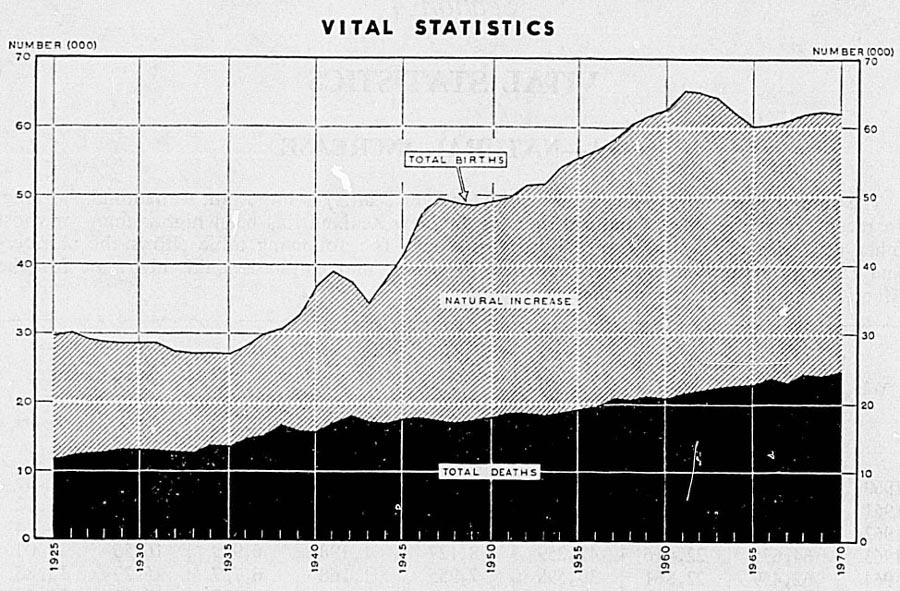
The period since the Second World War was marked by a high birth rate until 1961, when the level dropped for a period of six years; this experience was also shared by Australia, Canada and the United States, as is shown in the following table.
(Source: United Nations Monthly Bulletin of Statistics and Statistical Yearbook)
| Country | Birth Rate per 1,000 Mean Population | |||||||
|---|---|---|---|---|---|---|---|---|
| 1962 | 1963 | 1964 | 1965 | 1966 | 1967 | 1968 | 1969 | |
| New Zealand | 26.2 | 25.5 | 24.1 | 22.8 | 22.4 | 22.4 | 22.6 | 22.5 |
| Australia | 22.2 | 21.6 | 20.6 | 19.7 | 19.3 | 19.4 | 20.0 | 20.3 |
| Canada | 25.3 | 24.6 | 23.5 | 21.4 | 19.3 | 18.1 | 17.7 | 17.6 |
| United States | 22.4 | 21.7 | 21.0 | 19.4 | 18.4 | 17.8 | 17.4 | 17.7 |
The decline of the birth rates over the period from 1961 was the subject of discussion by demographers, notably at the World Population Conference in 1965. This change in fertility pattern has coincided in time with increasing use of oral contraceptives; their greater effectiveness in birth control appears to have a significant influence on fertility, on at least a short-term basis. Demographers have emphasised the need for further research, stating that it is important to study demographic variables involved in the recent decline in the birth rate, including changes in age distribution, timing of marriage and birth, past success in achieving the desired family size, and changes in the desired number of children. In New Zealand, changes in the proportion of women in the child-bearing groups were not of a nature to have any significant effect on the downward trend in the birth rate.
REGISTRATION—The law as to registration of births is contained in the Births and Deaths Registration Act 1951. A birth may be registered within two months without fee at the office of the Registrar nearest the place of birth. After two months a birth is registrable only after a statutory declaration of the particulars required to be registered has been made before the Registrar by the parent or some person present at birth, and on payment of the prescribed fee. The Registrar-General may, however, register an unregistered birth irrespective of the time that may have elapsed.
Birth statistics are compiled from the records of the Registrar-General. The births covered by a year's statistics are those registered during the year. The figures do not include still births, except where multiple births are discussed. A special classification of still births is given later in this subsection.
NUMBERS AND RATES—The following table shows the numbers of births and the rates for the last 11 years.
| Year | Numbers | Rates per 1,000 of Mean Population | ||
|---|---|---|---|---|
| Total | Maori | Total | Maori | |
| 1,960 | 62,850 | 7,415 | 26.44 | 46.41 |
| 1,961 | 65,476 | 7,770 | 26.99 | 46.39 |
| 1,962 | 65,127 | 7,664 | 26.21 | 43.72 |
| 1,963 | 64,675 | 8,127 | 25.49 | 44.58 |
| 1,964 | 62,459 | 7,955 | 24.12 | 42.02 |
| 1,965 | 60,178 | 7,855 | 22.83 | 40.03 |
| 1,966 | 60,188 | 7,848 | 22.43 | 38.70 |
| 1,967 | 61,169 | 8,084 | 22.41 | 38.60 |
| 1,968 | 62,284 | 8,198 | 22.60 | 37.97 |
| 1,969 | 62,564 | 8,305 | 22.47 | 37.38 |
| 1,970 | 62,207 | 8,281 | 22.02 | 37.72 |
REFINED BIRTH RATE—“Crude” rates of the number of births per 1,000 of the mean population, irrespective of sex or age, do not take account of variations in the proportion of women of the child-bearing ages. Refined rates are provided by computations of the legitimate birth rate per 1,000 married women of 16-44 years of age, or the total birth rate per 1,000 of all women of these ages. The following table gives both rates for census years (on the basis of the births registered in that year and the population as at the census) together with the “crude” rate for the year.
| Census Year | Birth rate per 1,000 Women 16-44 Years | “Crude” Birth rate | |
|---|---|---|---|
| Married Women | Total Women | ||
| 1,926 | 176.9 | 92.1 | 21.23 |
| 1,936 | 155.1 | 79.0 | 18.07 |
| 1,945 | 186.5 | 106.5 | 24.58 |
| 1,951 | 190.8 | 123.0 | 25.62 |
| 1,956 | 191.7 | 130.2 | 25.93 |
| 1,961 | 199.3 | 140.6 | 26.99 |
| 1,966 | 200.4 | 112.2 | 22.43 |
The percentage of married women in the child-bearing ages was 68.2 in 1966 compared with 51.6 in 1926. A study of the figures for successive censuses reveals considerable changes in the age constitution of married women within the child-bearing ages; as the birth rate varies with age, the change in age constitution over the period is a factor which should be taken into account.
REPRODUCTION INDEX—The reproduction index is based on the fact that the future size of a population is related to the number of women in the reproductive age groups at any given time. The gross rate is based on the number of female children born, and the average number of girls that will be born to a woman during her reproductive period, while the net rate takes into account fertility rates at different ages and the percentages of female survivors at those ages, obtained from life tables. A net rate of 1.0 indicates a stationary population, and a higher rate a rising population.
Reproduction rates for the non-Maori population during the latest 11 years were as follows.
| Year | Gross Rate | Net Rate |
|---|---|---|
| 1,959 | 1.950 | 1.878 |
| 1,960 | 1.968 | 1.905 |
| 1,961 | 2.028 | 1.964 |
| 1,962 | 1.970 | 1.908 |
| 1,963 | 1.855 | 1.796 |
| 1,964 | 1.753 | 1.698 |
| 1,965 | 1.624 | 1.571 |
| 1,966 | 1.579 | 1.534 |
| 1,967 | 1.566 | 1.521 |
| 1,968 | 1.541 | 1.498 |
| 1,969 | 1.520 | 1.481 |
It must be remembered that, in New Zealand, population growth has two important components—natural increase and net migration—and that the reproduction index takes into account only natural increase. Statistics of external migration in recent years are included in the section on “Population”.
SEXES OF CHILDREN BORN—Statistics for the latest six years are given in the following table.
| Year | Number of Births of | Male Births per 1,000 Female Births | |
|---|---|---|---|
| Males | Females | ||
| 1,965 | 31,105 | 29,073 | 1,070 |
| 1,966 | 30,879 | 29,309 | 1,054 |
| 1,967 | 31,097 | 30,072 | 1,034 |
| 1,968 | 31,955 | 30,329 | 1,054 |
| 1,969 | 32,028 | 30,536 | 1,049 |
| 1,970 | 31,924 | 30,283 | 1,054 |
MULTIPLE BIRTHS—The number of cases of multiple births and the proportion per 1,000 of the total (live births only) during the latest six years are shown in the following table.
| Year | Total Births | Total Cases | Cases of Twins | Cases of Triplets | Multiple Cases per 1,000 of Total Cases |
|---|---|---|---|---|---|
†Includes one case of quintuplets. *Includes one case of quadruplets. | |||||
| 1,965 | 60,178 | 59,560 | 600 | 8† | 10.21 |
| 1,966 | 60,188 | 59,588 | 589 | 5* | 9.97 |
| 1,967 | 61,169 | 60,565 | 590 | 7* | 9.86 |
| 1,968 | 62,284 | 61,603 | 666 | 8 | 10.94 |
| 1,969 | 62,564 | 61,921 | 627 | 8 | 10.26 |
| 1,970 | 62,207 | 61,548 | 647 | 6 | 10.61 |
There were 61,921 confinements in 1969 resulting in live births; of these, 635 produced multiple living births and in a further 11 cases one of the twins was still born. The ratio of multiple confinements with live births to total live confinements was 1.96. In eight additional cases both twins were still born.
| Year | Cases of Twins | Cases of Triplets, Quads and Quins | Total Multiple Cases | Rate per 1,000 Confinements | |||||||||
|---|---|---|---|---|---|---|---|---|---|---|---|---|---|
| Both Born Alive | One Born Alive, One Still Born | Both Still Born | Total | All Born Alive | One Born Alive, Two Still Born | Two Born Alive, One Still Born | All Still Born | Quads, All Alive | Quins, All Alive | Total | |||
| *The eight cases of triplets in 1969 comprised two cases where there were two males and one female; four cases all males; and two cases all females. | |||||||||||||
| 1,965 | 600 | 27 | 6 | 633 | 7 | - | - | - | - | 1 | 8 | 641 | 10.6 |
| 1,966 | 589 | 24 | 6 | 619 | 4 | - | - | - | 1 | - | 5 | 624 | 10.4 |
| 1,967 | 590 | 19 | 6 | 615 | 5 | - | 1 | - | 1 | - | 7 | 622 | 10.3 |
| 1,968 | 666 | 18 | 6 | 690 | 7 | - | 1 | - | - | - | 8 | 698 | 11.3 |
| 1,969 | 627 | 11 | 8 | 646 | 8* | - | - | - | - | - | 8 | 654 | 10.6 |
| Average of five years | 614 | 20 | 6 | 641 | 6 | - | –– | - | –– | –– | 7 | 648 | 10.6 |
The likelihood of still births occurring is much greater in cases of multiple births than in single cases. This is exemplified in the following table. The figures in respect of multiple cases include all cases where one or more of the children were still born.
| Year | Still-birth Cases per 100 of Total Cases (Including Still Births) | |
|---|---|---|
| Single Cases | Multiple Cases | |
| 1,965 | 1.14 | 5.15 |
| 1,966 | 1.06 | 4.81 |
| 1,967 | 1.16 | 4.18 |
| 1,968 | 1.17 | 3.58 |
| 1,969 | 0.97 | 2.91 |
| Average of 5 years | 1.10 | 4.13 |
AGES OF PARENTS—Information as to the relative ages of parents of legitimate living children whose births were registered in 1969 is shown in the following table for the total population.
| Age of Father, in Years | Age of Mother, in Years | ||||||||||
|---|---|---|---|---|---|---|---|---|---|---|---|
| Under 21 | 21-24 | 25-29 | 30-34 | 35-39 | 40-44 | 45-49 | 50-54 | 55-64 | 65 and Over | Total Cases | |
| *Including seven cases of triplets and nine cases where one of the twins was still born. | |||||||||||
| Single Births | |||||||||||
| Under 21 | 2+168 | 4+167 | 1+115 | 166 | 35 | 9 | 3 | 4 | 2 | - | 7+669 |
| 21-24 | 349 | 6+220 | 8+303 | 1+529 | 350 | 77 | 23 | 6 | 5 | - | 16+862 |
| 25-29 | 20 | 701 | 8+675 | 5+726 | 1+307 | 338 | 75 | 20 | 13 | 2 | 16+967 |
| 30-34 | 2 | 43 | 715 | 3+280 | 2+500 | 712 | 186 | 40 | 16 | 4 | 7+498 |
| 35-39 | - | 7 | 49 | 303 | 1+368 | 1+080 | 307 | 73 | 38 | 5 | 3+230 |
| 40-44 | - | 1 | 2 | 26 | 119 | 478 | 277 | 78 | 34 | 1 | 1+016 |
| 45 and over | - | 1 | - | - | 3 | 15 | 32 | 8 | 6 | 2 | 67 |
| Totals | 2+539 | 11+140 | 18+859 | 11+030 | 5+772 | 2+709 | 903 | 229 | 114 | 14 | 53+309 |
| Multiple Births | |||||||||||
| Under 21 | 14 | 25 | 13 | 1 | - | - | - | - | - | - | 53 |
| 21-24 | 4 | 53 | 73 | 11 | 5 | 1 | - | - | - | - | 147 |
| 25-29 | - | 10 | 93 | 62 | 22 | 5 | - | - | - | - | 192 |
| 30-34 | - | 1 | 10 | 53 | 35 | 14 | 3 | - | - | - | 116 |
| 35-39 | - | - | 1 | 5 | 21 | 16 | 1 | 1 | 1 | - | 46 |
| 40-44 | - | - | - | - | 1 | 7 | 1 | 2 | - | - | 11 |
| 45 and over | - | - | - | - | - | - | - | - | - | - | - |
| Totals | 18 | 89 | 190 | 132 | 84 | 43 | 5 | 3 | 1 | - | 565 |
| Grand totals | 2+557 | 11+229 | 19+049 | 11+162 | 5+856 | 2+752 | 908 | 232 | 115 | 14 | 53+874* |
PREVIOUS ISSUE OF PARENTS—The following table gives for 1969 the number of previous issue, i.e., children born alive, in conjunction with the age of mother.
| Age of Mother in Years | Number of Previous Issue | Total Legitimate Cases | ||||||||
|---|---|---|---|---|---|---|---|---|---|---|
| 0 | 1 | 2 | 3 | 4 | 5 | 6-9 | 10-14 | 15 and Over | ||
| *This number represents 53,309 single cases and 565 multiple cases. | ||||||||||
| Under 20 | 5,542 | 1,878 | 274 | 27 | 1 | - | - | - | - | 7,722 |
| 20-24 | 7,635 | 6,198 | 2,348 | 630 | 158 | 36 | 4 | - | - | 17,009 |
| 25-29 | 3,863 | 5,350 | 4,453 | 2,096 | 808 | 345 | 242 | 2 | - | 17,159 |
| 30-34 | 877 | 1,398 | 1,810 | 1,573 | 871 | 480 | 569 | 36 | - | 7,614 |
| 35-39 | 300 | 336 | 518 | 591 | 530 | 294 | 591 | 109 | 7 | 3,276 |
| 40-44 | 105 | 66 | 127 | 163 | 141 | 125 | 218 | 73 | 9 | 1,027 |
| 45 and over | 9 | 5 | 3 | 10 | 10 | 5 | 17 | 7 | 1 | 67 |
| Totals | 18,331 | 15,231 | 9,533 | 5,090 | 2,519 | 1,285 | 1,641 | 227 | 17 | 53,874* |
In the following table the total issue and average issue are shown for mothers by age groups where a birth occurred in 1969.
| Age of Mother, in Years | Total Mothers | Total Issue | Average Issue |
|---|---|---|---|
| Under 20 | 4,727 | 5,803 | 1.33 |
| 20-24 | 20,004 | 35,263 | 1.81 |
| 25-29 | 17,159 | 44,454 | 2.59 |
| 30-34 | 7,614 | 27,653 | 3.63 |
| 35-39 | 3,276 | 15,512 | 4.74 |
| 40-44 | 1,027 | 5,589 | 5.44 |
| 45 and over | 67 | 393 | 5.87 |
| Totals | 53,874 | 134,667 | 2.50 |
It should be stressed that the averages are no more than they purport to be—viz., the average number of children (including those registered in 1969) born up to the present time to those mothers of legitimate children whose births were registered during the year. They do not purport to represent, nor do they represent, the average issue of all women of the ages shown. Furthermore, they include issue born to the existing marriages only. The averages for recent years have been as follows: 1965, 2.70; 1966, 2.61; 1967, 2.57; 1968, 2.53; and 1969, 2.53.
FIRST BIRTHS—Statistics of nuptial first confinements show that in recent years there have been reduced proportions occurring within one year after marriage and within two years after marriage.
| Year | Total Legitimate Cases | Total Legitimate First Cases | Proportion of First Cases to Total Cases | First Cases Within One Year After Marriage | First Cases Within Two Years After Marriage | ||
|---|---|---|---|---|---|---|---|
| Number | Proportion to Total First Cases | Number | Proportion To Total First Cases | ||||
| percent | percent | percent | |||||
| 1,965 | 53,044 | 16,538 | 31.18 | 8,145 | 49.25 | 12,414 | 75.06 |
| 1,966 | 52,681 | 17,222 | 32.69 | 8,339 | 48.42 | 12,683 | 73.64 |
| 1,967 | 52,845 | 17,564 | 33.24 | 8,287 | 47.18 | 12,621 | 71.86 |
| 1,968 | 53,580 | 17,960 | 33.52 | 8,160 | 45.43 | 12,573 | 70.01 |
| 1,969 | 53,874 | 18,331 | 34.03 | 7,975 | 43.51 | 12,357 | 67.41 |
The following table gives the duration-of-marriage factor in first confinements over a longer time-series. Prior to 1962 the statistics concern births of non-Maoris only.
| Duration of Marriage in Years | Percentage of Total First Confinements | ||||||
|---|---|---|---|---|---|---|---|
| 1934 | 1944 | 1954 | 1964 | 1967 | 1968 | 1969 | |
| Under 1 | 46.25 | 38.47 | 42.64 | 49.85 | 47.18 | 45.43 | 43.51 |
| 1 | 26.79 | 26.30 | 30.56 | 26.42 | 24.68 | 24.58 | 23.90 |
| 2 | 10.24 | 11.28 | 11.56 | 11.42 | 13.76 | 14.59 | 15.48 |
| 3 | 6.16 | 7.88 | 5.95 | 5.07 | 6.89 | 7.11 | 8.37 |
| 4 | 3.96 | 7.18 | 3.30 | 2.82 | 3.16 | 3.58 | 3.89 |
| 5-9 | 5.49 | 7.36 | 5.05 | 3.56 | 3.61 | 4.04 | 4.15 |
| 10 and over | 1.11 | 1.53 | 0.94 | 0.86 | 0.72 | 0.67 | 0.70 |
| Totals | 100.00 | 100.00 | 100.00 | 100.00 | 100.00 | 100.00 | 100.00 |
In the following table first confinements occurring to mothers in different age groups are expressed as a percentage of the total first confinements. Prior to 1962 the statistics concern confinements of non-Maoris only.
| FIRST CONFINEMENTS, BY AGE OF MOTHER | |||||||
|---|---|---|---|---|---|---|---|
| Age of Mother, in Years | Percentage of Total First Confinements | ||||||
| 1934 | 1944 | 1954 | 1964 | 1967 | 1968 | 1969 | |
| Under 20 | 8.90 | 7.33 | 9.08 | 19.64 | 22.12 | 20.98 | 20.55 |
| 20-24 | 40.39 | 41.79 | 47.71 | 52.67 | 49.62 | 51.20 | 51.33 |
| 25-29 | 32.79 | 29.54 | 27.79 | 18.28 | 21.28 | 20.49 | 21.07 |
| 30-34 | 13.10 | 14.61 | 10.39 | 6.00 | 4.49 | 4.82 | 4.79 |
| 35-39 | 3.79 | 5.36 | 3.92 | 2.57 | 1.85 | 1.90 | 1.64 |
| 40-44 | 0.99 | 1.34 | 1.02 | 0.81 | 0.58 | 0.58 | 0.57 |
| 45 and over | 0.04 | 0.03 | 0.09 | 0.03 | 0.06 | 0.03 | 0.05 |
| Totals | 100.00 | 100.00 | 100.00 | 100.00 | 100.00 | 100.00 | 100.00 |
The average ages of mothers at the birth of their first child were as follows: 1924, 26.39; 1934, 25.90; 1944, 25.18; 1954, 25.32; 1964, 23.65; 1967, 23.31 years; 1968, 23.39 years; and 1969, 23.42 years.
EX-NUPTIAL BIRTHS—The numbers of ex-nuptial births registered during each of the latest 11 years, with the percentages, they bear to total births registered, are given in the following table. Statistics prior to 1962 concern non-Maoris only. The percentages in recent years are higher than those for Australia, Canada, United Kingdom and United States but lower than those for Sweden. Meaningful international comparisons can only be made with caution; some of the difficulties are discussed in a supplement to the January 1967 issue of the Monthly Abstract of Statistics.
| Year | Number | Percentage of Total Live Births |
|---|---|---|
| 1,960 | 2,911 | 5.25 |
| 1,961 | 3,332 | 5.77 |
| 1,962 | 5,242 | 8.05 |
| 1,963 | 5,698 | 8.81 |
| 1,964 | 6,189 | 9.91 |
| 1,965 | 6,554 | 10.89 |
| 1,966 | 6,960 | 11.56 |
| 1,967 | 7,783 | 12.72 |
| 1,968 | 8,094 | 13.00 |
| 1,969 | 8,127 | 12.99 |
| 1,970 | 8,300 | 13.34 |
The long-term trend in the rate of ex-nuptial births is indicated by the movement in the proportion of ex-nuptial births per 1,000 unmarried women—i.e., spinsters, widows, and divorced women—at the reproductive ages. The figures for census years are as follows. Up to 1961 the statistics relate to non-Maoris only; from 1966 Maoris are included.
| Census Year | Unmarried Women 15-44 Years of Age | Ex-nuptial Births | Ex-nuptial Birth rate per 1,000 Unmarried Women |
|---|---|---|---|
| 1,911 | 120,778 | 1,078 | 8.93 |
| 1,916 | 125,461 | 1,159 | 9.24 |
| 1,921 | 136,539 | 1,258 | 9.21 |
| 1,926 | 148,551 | 1,473 | 9.92 |
| 1,936 | 167,781 | 1,126 | 6.71 |
| 1,945 | 156,326 | 1,824 | 11.67 |
| 1,951 | 130,343 | 1,935 | 14.85 |
| 1,956 | 129,877 | 2,310 | 17.79 |
| 1,961 | 138,018 | 3,332 | 24.14 |
| 1,966 | 171,322 | 6,960 | 40.63 |
In 1969 the total number of ex-nuptial confinements was 8,047. Of these 7,966 cases were single births, 78 were twins, while there were two cases of twins in which one child was still born, and one case of live triplets. The total number of ex-nuptial live births was 8,127. From the following table, it will be seen that of the 8,047 mothers, 4,047 or 50.29 percent, were under 21 years of age.
| Age | Number of Mothers |
|---|---|
| 11 | 1 |
| 12 | 1 |
| 13 | 5 |
| 14 | 30 |
| 15 | 187 |
| 16 | 441 |
| 17 | 782 |
| 18 | 936 |
| 19 | 888 |
| 20 | 776 |
| 21 | 669 |
| 22 | 551 |
| 23 | 451 |
| 24-29 | 1,459 |
| 30-34 | 489 |
| 35-39 | 288 |
| 40-44 | 83 |
| 45 and over | 10 |
| Total | 8,047 |
Legitimation Act—The Legitimation Act 1939 stipulates that every ex-nuptial child whose parents have later married shall be deemed to have been legitimated from birth by reason of such marriage. Applications for registration must be made within three months after the date of the marriage.
The numbers of legitimations registered in each of the latest five years were as follows: 1966, 1,042; 1967, 1,387; 1968, 1,310; 1969, 1,386; 1970, 1,513.
ADOPTIONS—The Adoption Act 1955 sets out the provisions regarding the adoption of children.
The following table shows the number of adoptions which have been registered during the latest five years.
| Year | Males | Females | Total |
|---|---|---|---|
| 1,966 | 1,747 | 1,715 | 3,462 |
| 1,967 | 1,803 | 1,710 | 3,513 |
| 1,968 | 1,854 | 1,926 | 3,780 |
| 1,969 | 1,924 | 1,964 | 3,888 |
| 1,970 | 1,972 | 1,865 | 3,837 |
Of the 3,888 adoptions registered in 1969, 2,001 were children under the age of one year, 1,299 were aged one to four years, 359 were aged five to nine years, and 229 were aged 10 years or over.
Of the 3,888 adoptions in 1969, there were 3,500 handled by the Child Welfare Division, and, of these, 85 percent were of children of ex-birth. Of those born ex-nuptial, 95 percent were less than a year old at placement and 82 percent were placed with singers; these proportions have remained fairly constant over a number of years. As pointed out in Section 6C, Child Welfare, only about 35 percent of children of ex-nuptial birth become available for adoption.
STILL BIRTHS—Although it is compulsory to effect a birth-registration entry for a still-born child, no entry is made in the register of deaths. Particulars of causes of still births will be found in Section 4C relating to deaths. A still-born child is defined as one “which has issued from its mother after the expiration of the twenty-eighth week of pregnancy and which was not alive at the time of such issue”. Still births are not included either as births or as deaths in the various numbers and rates shown in this subsection and in that relating to deaths. The rate of 0.99 per 100 births in 1969 is the lowest rate yet recorded.
The registrations of still births during each of the latest five years were as follows.
| Year | Male Still Births | Female Still Births | Total | Male Still Births per 1,000 Female Still Births | Percentage of Still Births to— | |
|---|---|---|---|---|---|---|
| Living Births | All Births | |||||
| 1,966 | 354 | 314 | 668 | 1,127 | 1.14 | 1.10 |
| 1,967 | 377 | 358 | 735 | 1,053 | 1.20 | 1.19 |
| 1,968 | 379 | 373 | 752 | 1,016 | 1.21 | 1.19 |
| 1,969 | 327 | 298 | 625 | 1,097 | 1.00 | 0.99 |
| 1,970 | 354 | 317 | 671 | 1,117 | 1.08 | 1.07 |
The rate of masculinity for still births in 1969 was 1,097 males per 1,000 females as compared with 1,049 for living births.
The percentage of ex-nuptial births among still-born infants was, in 1969, 15.84 and among infants born alive 12.99.
Of the living legitimate births registered in 1969, 34 percent were first births, while of legitimate still births 37 percent were first births. Statistics over many years indicate that there is a considerably greater probability of still births at first confinements than subsequent confinements. Of the total of 625 still births in 1969, 519 were non-Maori and 106 Maori; of the Maori total 60 were males and 46 females.
FOETAL DEATHS—The Births and Deaths Registration Act 1951 stipulates that in the case of a foetal death where the child has issued from its mother after the twentieth week, and up to and including the twenty-eighth week of pregnancy, a medical practitioner or a midwife who was in attendance at the confinement shall sign and supply a certificate stating to the best of his or her knowledge and belief the cause of the foetal death, and such other particulars as may be required by the Registrar-General. A foetal death is not required to be registered as in the case of a still-born child.
REGISTRATION—The law as to registration of deaths is contained in the Births and Deaths Registration Act (Maoris are defined as persons with half or more of Maori blood and the term European or non-Maori covers all other persons.) Particulars required in the registration of a death include date, place of residence and domicile, name, occupation, sex, age, cause of death, birthplace, duration of residence in New Zealand, marital status, living issue of married persons, degree of Maori blood (if any), medical attendant by whom certified, particulars as to burial, and, in the case of the death of a married male, age of widow. Deaths are required to be registered by the funeral director within three days after the day of burial.
Although it is compulsory to effect a birth-registration entry in the case of a still-born child, no entry is made in the register of deaths. The principal Act stipulates, however, that a medical practitioner or a midwife in attendance at a confinement where a still birth occurs must furnish a certificate stating to the best of his or her knowledge and belief the cause of the still birth.
It is incumbent upon a medical practitioner to give the certificate of cause of death of any deceased person to the person required to supply information for the purpose of registering the death (the funeral director in charge of the burial). The practitioner is required to report forthwith to the Coroner any case where, in his opinion, there are any suspicious circumstances.
Deaths of Members of the Forces While Overseas—The Births and Deaths Registration Act 1951 requires the Registrar-General to compile a register containing particulars of all persons who have died while out of New Zealand on service with any Commonwealth force within the meaning of the Army Act 1950 and who at the time of their deaths were domiciled in New Zealand. Deaths registered in the War Deaths Register from 1940 onwards were not taken into account in arriving at the number and rate of deaths in New Zealand, nor were deaths of visiting overseas servicemen or prisoners of war in New Zealand. Deaths of New Zealand servicemen which occurred in New Zealand were, however, included.
NUMBERS AND RATES—New Zealand has had for many years a favourable death rate in its non-Maori population. Despite the ageing of population, the non-Maori crude death rate has remained low and this is undoubtedly due to the introduction of antibiotics and new medical techniques as well as to the expansion of health services. There has, for example, been for some years a low incidence of serious outbreaks of epidemic disease, a reduction in tuberculosis mortality, and a remarkably low non-Maori infant-rate.
The general trend of the crude non-Maori death rate in New Zealand was downward over a long period of years, reaching its lowest level during the early thirties. After that an upward trend was in evidence for some years, the figures recorded during the war years being the highest for a long time. Some of the increase over this period can be attributed to population changes in that numbers of the healthiest of the young male adult population were serving overseas, but on the other hand the strains of wartime did exact a toll on the elderly which was shown in the sharp rise in deaths resulting from diseases of the heart and nervous system.
The following table sets out the numbers of deaths and the crude death rates per 1,000 of mean population over the latest 21 years.
| Year | Numbers | Crude Rate per 1,000 of Mean Population | ||||
|---|---|---|---|---|---|---|
| Non-Maori | Maori | Total | Non-Maori | Maori | Total | |
| *Provisional. | ||||||
| 1,950 | 16,715 | 1,369 | 18,084 | 9.31 | 12.09 | 9.47 |
| 1,951 | 17,512 | 1,324 | 18,836 | 9.56 | 11.37 | 9.67 |
| 1,952 | 17,413 | 1,483 | 18,896 | 9.28 | 12.34 | 9.47 |
| 1,953 | 17,009 | 1,345 | 18,354 | 8.84 | 10.84 | 8.96 |
| 1,954 | 17,667 | 1,209 | 18,876 | 8.98 | 9.41 | 9.01 |
| 1,955 | 17,953 | 1,272 | 19,225 | 8.95 | 9.56 | 8.99 |
| 1,956 | 18,403 | 1,293 | 19,696 | 9.00 | 9.36 | 9.02 |
| 1,957 | 19,411 | 1,451 | 20,862 | 9.29 | 10.13 | 9.34 |
| 1,958 | 19,014 | 1,287 | 20,301 | 8.90 | 8.67 | 8.88 |
| 1,959 | 19,814 | 1,314 | 21,128 | 9.09 | 8.53 | 9.05 |
| 1,960 | 19,524 | 1,368 | 20,892 | 8.81 | 8.56 | 8.79 |
| 1,961 | 20,397 | 1,385 | 21,782 | 9.03 | 8.27 | 8.98 |
| 1,962 | 20,857 | 1,224 | 22,081 | 9.03 | 6.98 | 8.89 |
| 1,963 | 21,218 | 1,198 | 22,416 | 9.01 | 6.57 | 8.84 |
| 1,964 | 21,693 | 1,168 | 22,861 | 9.04 | 6.17 | 8.83 |
| 1,965 | 21,759 | 1,217 | 22,976 | 8.92 | 6.20 | 8.72 |
| 1,966 | 22,487 | 1,291 | 23,778 | 9.07 | 6.37 | 8.86 |
| 1,967 | 21,785 | 1,222 | 23,007 | 8.65 | 5.84 | 8.43 |
| 1,968 | 23,140 | 1,324 | 24,464 | 9.11 | 6.13 | 8.88 |
| 1,969 | 22,831 | 1,330 | 24,161 | 8.99 | 5.99 | 8.68 |
| 1,970 | 23,441 | 1,399 | 24,840 | 9.17* | 6.29* | 8.79 |
Maori crude death rates have dropped steadily over the 21-year period surveyed and have become lower than the non-Maori figures over recent years. Crude death rates do not reflect the true levels of mortality which exist in populations which have different age structures. The Maori population has a very much higher proportion of those at younger ages who do not contribute many deaths to the total and conversely relatively few persons at older ages where the rate of dying is high. The effect of this is to produce a very deflated crude rate.
Simple arithmetic can be employed to produce a figure for the Maori which compares directly with the non-Maori crude rate. By applying the Maori death rates at each age to the non-Maori population of this age it is possible to total these and arrive at the number of deaths which would have occurred in the non-Maori population had the Maori rates of dying applied. This figure divided by the total non-Maori population produces a Maori rate which is adjusted to the age structure of the non-Maori in that particular year and which is directly comparable with the non-Maori crude rate. The adjusted Maori rates computed on this system are entered in the following table for 1966 and show in a true comparison Maori mortality to be approximately twice that of the non-Maori. In addition, a comparison is supplied in age-specific rates for the two races in each sex.
| Race | All Ages Rates per 10,000 Mean Population | Age-specific Rates per 10,000 of Population at Ages | ||||||
|---|---|---|---|---|---|---|---|---|
| Crude Rate | Maori Rate Adjusted to Non-Maori Population | Under 5 Years | 5-14 Years | 15-24 Years | 25-44 Years | 45-64 Years | 65 Years and Over | |
| Males | ||||||||
| Maori | 71.3 | 144.1 | 82.4 | 10.1 | 22.5 | 36.3 | 217.4 | 1,041.4 |
| Non-Maori | 100.4 | ... | 45.2 | 4.7 | 14.4 | 20.0 | 131.4 | 822.8 |
| Females | ||||||||
| Maori | 55.8 | 140.4 | 66.4 | 8.1 | 8.0 | 34.2 | 200.2 | 814.4 |
| Non-Maori | 80.9 | ... | 33.0 | 3.1 | 4.9 | 12.4 | 69.9 | 583.0 |
| Both Sexes | ||||||||
| Maori | 63.7 | 144.4 | 74.5 | 9.1 | 15.3 | 35.2 | 209.2 | 935.2 |
| Non-Maori | 90.7 | ... | 39.2 | 3.9 | 9.8 | 16.3 | 100.4 | 685.0 |
For both Maoris and non-Maoris the death rate in males exceeds the death rate in females by a considerable margin. The following table sets out the respective crude rates for each sex separately for the latest 11 years in the total population.
| Year | Deaths per 1,000 of Mean Population | Male Deaths to Every 100 Female Deaths | ||
|---|---|---|---|---|
| Males | Females | Total | ||
| 1,960 | 9.66 | 7.90 | 8.79 | 124 |
| 1,961 | 9.75 | 8.19 | 8.98 | 120 |
| 1,962 | 9.80 | 7.97 | 8.89 | 124 |
| 1,963 | 9.75 | 7.91 | 8.84 | 124 |
| 1,964 | 9.73 | 7.93 | 8.83 | 124 |
| 1,965 | 9.58 | 7.86 | 8.72 | 123 |
| 1,966 | 9.82 | 7.90 | 8.86 | 125 |
| 1,967 | 9.29 | 7.57 | 8.43 | 123 |
| 1,968 | 9.80 | 7.95 | 8.88 | 123 |
| 1,969 | 9.58 | 7.78 | 8.68 | 123 |
| 1,970 | 9.64 | 7.95 | 8.79 | 121 |
DISTRIBUTION OF DEATHS OVER THE YEAR—An examination of the total number of deaths registered in each quarter of the last 12 years gives the following averages: March quarter, 4,806; June quarter, 5,642; September quarter, 6,533; and December quarter, 5,507.
A classification according to month of death shows that in 1969 the months during which the greatest number of deaths occurred were July, August, and June, with totals of 2,452, 2,292, and 2,165 respectively. Excluding December (a proportion of deaths occurring in that month not being registered till January) February had the least number of deaths, 1,659, followed by January with 1,792.
AGES AT DEATH—Deaths registered during the year 1969 are shown according to age in the following tables.
| Age, in Years | Males | Females | Total |
|---|---|---|---|
| Under 1 | 631 | 426 | 1,057 |
| 1- 4 | 147 | 90 | 237 |
| 5- 9 | 93 | 48 | 141 |
| 10-14 | 57 | 43 | 100 |
| 15-19 | 171 | 61 | 232 |
| 20-24 | 171 | 52 | 223 |
| 25-29 | 128 | 53 | 181 |
| 30-34 | 123 | 81 | 204 |
| 35-39 | 158 | 114 | 272 |
| 40-44 | 281 | 192 | 473 |
| 45-49 | 446 | 318 | 764 |
| 50-54 | 621 | 394 | 1,015 |
| 55-59 | 1,028 | 557 | 1,585 |
| 60-64 | 1,346 | 737 | 2,083 |
| 65-69 | 1,660 | 953 | 2,613 |
| 70-74 | 1,643 | 1,281 | 2,924 |
| 75-79 | 1,676 | 1,602 | 3,278 |
| 80-84 | 1,487 | 1,776 | 3,263 |
| 85-89 | 995 | 1,304 | 2,299 |
| 90-94 | 362 | 603 | 965 |
| 95-99 | 92 | 136 | 228 |
| 100 and over | 8 | 16 | 24 |
| Totals | 13,324 | 10,837 | 24,161 |
The Maori population is a very young one compared with the non-Maori and as a result there is a considerable variation in the proportions of Maori deaths which take place at various ages to the proportions of non-Maori deaths at various ages. Thus it follows that there is a considerable difference in the proportion of Maori deaths in the total of deaths at various ages, and whereas at preschool, school, adolescent, and early working ages the Maori contributes substantially to the total of all deaths, in old age the Maori percentage is almost insignificant. The following table illustrates these points for the year 1969.
| Age, in Years | Number of Deaths | Percentage of Total Deaths | Percentage of Maori Deaths in Total Deaths per Age Group | ||
|---|---|---|---|---|---|
| Non-Maori | Maori | Non-Maori | Maori | ||
| Under 5 | 1,057 | 237 | 4.63 | 17.82 | 18.32 |
| 5-14 | 183 | 58 | 0.80 | 4.36 | 24.07 |
| 15-24 | 391 | 64 | 1.71 | 4.81 | 14.07 |
| 25-44 | 939 | 191 | 4.11 | 14.36 | 16.90 |
| 45-64 | 7,533 | 400 | 33.00 | 30.08 | 5.04 |
| 65 and over | 12,728 | 380 | 55.75 | 28.57 | 2.90 |
| Totals | 22,831 | 1,330 | 100.00 | 100.00 | 5.50 |
Considerable changes have taken place over the last 30 years in the age distribution of persons dying. The movement in the proportions of deaths occurring at the different age groups is very striking. The results of three main factors are illustrated, viz, health measures, which have achieved an immense saving of young life; the fluctuations in the birth rate over the period; and the great increase in the proportion of old people in the community.
| Age, in Years | Number of Deaths | Percentage of Total | ||||||
|---|---|---|---|---|---|---|---|---|
| 1935 | 1945 | 1955 | 1965 | 1935 | 1945 | 1955 | 1965 | |
| Under 1 | 1,128 | 1,449 | 1,365 | 1,174 | 8.25 | 8.19 | 7.10 | 5.11 |
| 1-4 | 429 | 405 | 319 | 268 | 3.14 | 2.29 | 1.66 | 1.17 |
| 5-9 | 198 | 187 | 132 | 111 | 1.45 | 1.06 | 0.69 | 0.48 |
| 10-14 | 170 | 150 | 101 | 107 | 1.24 | 0.85 | 0.53 | 0.47 |
| 15-19 | 254 | 215 | 151 | 201 | 1.86 | 1.22 | 0.79 | 0.87 |
| 20-24 | 355 | 267 | 187 | 188 | 2.60 | 1.51 | 0.97 | 0.82 |
| 25-29 | 324 | 282 | 181 | 186 | 2.37 | 1.60 | 0.94 | 0.81 |
| 30-34 | 316 | 243 | 195 | 209 | 2.31 | 1.37 | 1.01 | 0.91 |
| 35-39 | 326 | 363 | 287 | 284 | 2.39 | 2.05 | 1.49 | 1.24 |
| 40-44 | 425 | 396 | 365 | 482 | 3.11 | 2.24 | 1.90 | 2.10 |
| 44-49 | 585 | 638 | 593 | 651 | 4.28 | 3.61 | 3.08 | 2.83 |
| 50-54 | 804 | 761 | 870 | 1,051 | 5.88 | 4.30 | 4.52 | 4.57 |
| 55-59 | 1,008 | 1,144 | 1,094 | 1,504 | 7.38 | 6.47 | 5.69 | 6.55 |
| 60-64 | 1,177 | 1,763 | 1,451 | 1,937 | 8.61 | 9.97 | 7.55 | 8.43 |
| 65-69 | 1,384 | 2,135 | 2,168 | 2,339 | 10.13 | 12.07 | 11.28 | 10.18 |
| 70-74 | 1,374 | 2,328 | 2,745 | 2,694 | 10.06 | 13.16 | 14.28 | 11.73 |
| 75-79 | 1,322 | 2,084 | 3,003 | 3,337 | 9.68 | 11.78 | 15.62 | 14.52 |
| 80 and over | 2,085 | 2,876 | 4,018 | 6,253 | 15.26 | 16.26 | 20.90 | 27.21 |
| Totals | 13,664 | 17,686 | 19,225 | 22,976 | 100.00 | 100.00 | 100.00 | 100.00 |
During the earlier period covered by the next table the fall in the death rate was common to all ages and to both sexes. In more recent years, however, there has been a tendency for the male rates at ages over 65 years to rise to the level of earlier years. Of special significance are the low rates recorded in infancy and childhood and in the early adult life age groups in recent years despite the inclusion of Maori figures, which are considerably higher than the non-Maori. The female rate for the various age groups is now lower than the male rate in all instances. The increase in the death rate at successive age groups from 15 years onward is well exemplified.
| Year | Under 1* | 1-4 | 5-14 | 15-24 | 25-34 | 35-44 | 45-54 | 55-64 | 65-74 | 75 and Over |
|---|---|---|---|---|---|---|---|---|---|---|
*Per 1,000 live births in this case. †Non-Maori figures only as Maori deaths at ages not available for these years. | ||||||||||
| (Rates per 1,000 of mean population in each age group) | ||||||||||
| Males | ||||||||||
| 1901† | 78.60 | 6.81 | 1.89 | 3.52 | 3.97 | 6.16 | 11.94 | 23.12 | 50.59 | 141.67 |
| 1911† | 63.48 | 5.36 | 1.91 | 2.42 | 3.87 | 6.27 | 11.02 | 20.83 | 53.22 | 130.58 |
| 1921† | 53.10 | 4.78 | 1.85 | 2.44 | 3.56 | 5.55 | 9.61 | 19.96 | 46.17 | 128.60 |
| 1931† | 38.21 | 2.83 | 1.35 | 2.28 | 2.77 | 4.64 | 8.69 | 18.25 | 44.18 | 130.57 |
| 1,941 | 43.65 | 4.39 | 1.36 | 2.53 | 2.93 | 3.95 | 9.20 | 21.13 | 47.44 | 140.27 |
| 1,951 | 31.69 | 1.87 | 0.75 | 1.82 | 1.95 | 3.15 | 7.57 | 20.46 | 47.52 | 121.66 |
| 1,961 | 25.86 | 1.34 | 0.49 | 1.28 | 1.47 | 2.68 | 7.39 | 19.65 | 47.33 | 126.31 |
| 1,967 | 20.55 | 1.13 | 0.50 | 1.55 | 1.58 | 2.78 | 8.10 | 20.38 | 46.31 | 129.17 |
| 1,968 | 21.03 | 1.18 | 0.51 | 1.52 | 1.42 | 2.84 | 7.47 | 20.53 | 49.65 | 143.53 |
| 1,969 | 19.70 | 1.23 | 0.49 | 1.42 | 1.49 | 2.71 | 7.37 | 20.17 | 49.12 | 141.57 |
| Females | ||||||||||
| 1901† | 63.87 | 5.50 | 1.64 | 3.58 | 4.72 | 6.70 | 10.62 | 19.44 | 43.32 | 127.98 |
| 1911† | 48.74 | 5.37 | 1.48 | 2.76 | 4.34 | 4.92 | 8.38 | 17.89 | 40.44 | 119.60 |
| 1921† | 42.31 | 4.49 | 1.31 | 2.34 | 3.38 | 4.46 | 8.00 | 14.88 | 36.81 | 120.23 |
| 1931† | 25.67 | 2.47 | 0.97 | 1.85 | 3.20 | 3.81 | 6.84 | 15.36 | 36.83 | 122.87 |
| 1,941 | 37.75 | 3.84 | 1.20 | 1.94 | 2.44 | 3.50 | 6.90 | 15.04 | 38.60 | 118.92 |
| 1,951 | 23.09 | 1.59 | 0.54 | 0.89 | 1.30 | 2.27 | 5.67 | 13.85 | 32.80 | 109.79 |
| 1,961 | 19.50 | 1.16 | 0.35 | 0.53 | 0.87 | 1.95 | 4.59 | 11.22 | 29.89 | 104.74 |
| 1,967 | 15.40 | 0.95 | 0.23 | 0.52 | 0.80 | 1.87 | 4.96 | 11.20 | 26.87 | 98.21 |
| 1,968 | 16.22 | 0.99 | 0.31 | 0.53 | 0.90 | 1.80 | 4.84 | 10.84 | 28.75 | 103.55 |
| 1,969 | 13.95 | 0.79 | 0.31 | 0.49 | 0.81 | 1.99 | 4.83 | 10.73 | 27.40 | 102.58 |
| Both Sexes | ||||||||||
| 1901† | 71.40 | 6.17 | 1.77 | 3.55 | 4.33 | 6.40 | 11.37 | 21.63 | 47.87 | 135.71 |
| 1911† | 56.31 | 5.36 | 1.70 | 2.58 | 4.09 | 5.64 | 9.82 | 19.55 | 47.74 | 126.13 |
| 1921† | 47.82 | 4.64 | 1.58 | 2.39 | 3.47 | 5.10 | 8.85 | 17.59 | 41.90 | 124.84 |
| 1931† | 32.15 | 2.65 | 1.17 | 2.07 | 2.98 | 4.22 | 7.80 | 16.88 | 40.56 | 126.87 |
| 1,941 | 39.81 | 4.12 | 1.28 | 2.22 | 2.67 | 3.72 | 8.02 | 18.16 | 43.04 | 129.15 |
| 1,951 | 27.54 | 1.73 | 0.65 | 1.36 | 1.63 | 2.71 | 6.67 | 17.03 | 39.93 | 115.26 |
| 1,961 | 22.76 | 1.25 | 0.42 | 0.91 | 1.18 | 2.31 | 6.00 | 15.41 | 37.67 | 114.01 |
| 1,967 | 18.02 | 1.00 | 0.37 | 1.15 | 1.20 | 2.34 | 6.52 | 15.77 | 35.54 | 110.45 |
| 1,968 | 18.69 | 1.09 | 0.41 | 1.04 | 1.17 | 2.33 | 6.14 | 15.64 | 38.15 | 119.08 |
| 1,969 | 16.89 | 1.01 | 0.40 | 0.96 | 1.15 | 2.36 | 6.09 | 15.39 | 37.21 | 117.43 |
The average (arithmetic mean) age at death of non-Maori persons of each sex at 10-yearly intervals, since 1901 and during each of the latest six years is as follows:
| Year | Males | Females |
|---|---|---|
| age (years) | ||
| 1,901 | 41.64 | 37.68 |
| 1,911 | 46.17 | 42.37 |
| 1,921 | 48.45 | 46.97 |
| 1,931 | 54.14 | 55.48 |
| 1,941 | 58.65 | 59.60 |
| 1,951 | 61.58 | 65.25 |
| 1,961 | 63.80 | 67.32 |
| 1,964 | 64.74 | 69.29 |
| 1,965 | 64.24 | 69.28 |
| 1,966 | 64.57 | 69.89 |
| 1,967 | 63.75 | 69.40 |
| 1,968 | 64.62 | 69.63 |
| 1,969 | 64.65 | 70.10 |
There has been a striking upward movement in the average age at death of non-Maoris since 1901. A noticeable feature is that in the earlier years the age for females was considerably lower than that for males, the margin gradually narrowing until virtual equality was reached in 1927-28, since when the female average age at death has been higher than the male.
The average age of death of Maoris in 1969 was 44.67 and 45.89 years for males and females respectively. The great disparity between Maori figures and those for non-Maoris quoted in the above table is of course due in the main to the small numbers of persons at older ages in the Maori population and the comparatively large numbers at younger ages. This factor combined with high death rates in infancy and childhood produces a low average age at death.
EXPECTATION OF LIFE—Life tables depicting the pattern of mortality over the age span of life for the non-Maori component of New Zealand's population have been constructed at various times since 1880. The most recent tables prepared by the Department of Statistics are based on the 1966 population census, together with mortality statistics for 1965-67.
Life tables contain a measure of the degree of longevity of the population called the “expectation of life”. The expectation of life at any age is the average remaining lifetime for persons of this age, assuming that mortality rates at each age continue at the level shown by the life table. The life expectancy at selected ages at the present time, for the non-Maori population in New Zealand, is shown in the table below. The overall longer span of life enjoyed by females compared with males, is evident, as is the improvement in life expectancy once the first year of life is survived.
| LIFE EXPECTANCY FOR NON-MAORI POPULATION, SELECTED AGES | |||||
|---|---|---|---|---|---|
| Exact Age (Years) | Life Expectancy (Years) | Exact Age (Years) | Life Expectancy (Years) | ||
| Males | Females | Males | Females | ||
| 0 | 68.67 | 74.84 | 25 | 46.26 | 51.60 |
| 1 | 69.02 | 74.91 | 30 | 41.56 | 46.75 |
| 2 | 68.14 | 74.00 | 40 | 32.23 | 37.16 |
| 3 | 67.20 | 73.06 | 50 | 23.41 | 28.09 |
| 4 | 66.25 | 72.11 | 60 | 15.82 | 19.68 |
| 5 | 65.28 | 71.15 | 70 | 9.81 | 12.39 |
| 10 | 60.42 | 66.24 | 80 | 5.63 | 6.70 |
| 15 | 55.57 | 61.33 | 90 | 3.05 | 3.32 |
| 20 | 50.89 | 56.46 | 100 | 1.60 | 1.71 |
The long-term trend since 1880 for non-Maoris has been a steady improvement in life expectancy for both sexes. The improvement has been striking for the younger ages but relatively small for the advanced ages. Progress in medical science, coupled with improved social conditions, has resulted in substantial reductions in mortality for all ages up to middle age. However, over the 1960-62 to 1965-67 period higher rates of mortality have occurred for males for most ages beyond childhood, resulting from a higher prevalence of organic diseases (heart disease, cancer) and accidents. This has resulted in a marginal decrease of life expectancy at most ages, while for females, life expectancy has increased, though at a reduced rate. The next table displays the life expectancy revealed by each life table compiled since 1880 for the three exact ages of 0, 20, and 60 years.
| NON-MAORI LIFE EXPECTANCY SINCE 1880 | ||||||
|---|---|---|---|---|---|---|
| Life Table | Life Expectancy (Years) | |||||
| Males Aged Exactly | Females Aged Exactly | |||||
| 0 | 20 | 60 | 0 | 20 | 60 | |
| 1880-92 | 54.44 | 44.55 | 14.95 | 57.26 | 46.39 | 16.39 |
| 1891-95 | 55.29 | 45.47 | 15.06 | 58.09 | 47.19 | 16.55 |
| 1896-1900 | 57.37 | 46.34 | 15.33 | 59.95 | 47.91 | 16.54 |
| 1901-05 | 58.09 | 46.74 | 15.40 | 60.55 | 48.23 | 16.64 |
| 1906-10 | 59.17 | 47.20 | 15.51 | 61.76 | 48.77 | 16.77 |
| 1911-15 | 60.96 | 47.61 | 15.54 | 63.48 | 49.14 | 16.72 |
| 1921-22 | 62.76 | 48.66 | 16.03 | 65.43 | 50.36 | 17.29 |
| 1925-27 | 63.99 | 48.93 | 15.79 | 66.57 | 50.96 | 17.23 |
| 1,931 | 65.04 | 49.61 | 16.22 | 67.88 | 51.28 | 17.30 |
| 1934-38 | 65.46 | 49.89 | 16.06 | 68.45 | 52.02 | 17.49 |
| 1950-52 | 68.29 | 51.15 | 16.19 | 72.43 | 54.64 | 18.53 |
| 1955-57 | 68.88 | 51.44 | 16.19 | 73.88 | 55.87 | 19.16 |
| 1960-62 | 69.17 | 51.53 | 16.09 | 74.51 | 56.33 | 19.39 |
| 1965-67 | 68.67 | 50.89 | 15.82 | 74.84 | 56.46 | 19.68 |
The table below compares the life expectancy at birth for the total population of New Zealand with that for selected overseas countries. (Source: United Nations Demographic Yearbook 1967).
| LIFE EXPECTANCY AT BIRTH, SELECTED COUNTRIES | |||
|---|---|---|---|
| Country | Period | Life Expectancy at Birth (Years) | |
| Males | Females | ||
| *Excluding full-blooded aborigines. | |||
| Australia* | 1960-62 | 67.92 | 74.18 |
| Canada | 1960-62 | 68.35 | 74.17 |
| Denmark | 1964-65 | 70.2 | 74.7 |
| England and Wales | 1963-65 | 68.3 | 74.4 |
| France | 1,965 | 67.8 | 75.0 |
| Netherlands | 1961-65 | 71.1 | 75.9 |
| New Zealand | 1965-67 | 68.19 | 74.30 |
| Norway | 1961-65 | 71.03 | 75.97 |
| Scotland | 1964-65 | 66.60 | 72.64 |
| Sweden | 1961-65 | 71.60 | 75.70 |
| United States | 1,966 | 66.7 | 73.8 |
| U.S.S.R | 1965-66 | 66.0 | 74.0 |
The expectation of life at various ages for the Maori population is shown below. These expectations are taken from Maori Life Tables, 1965-67.
| LIFE EXPECTANCY FOR MAORI POPULATION, SELECTED AGES | ||
|---|---|---|
| Exact Age (Years) | Life Expectancy (Years) | |
| Males | Females | |
| 0 | 61.44 | 64.78 |
| 1 | 62.56 | 65.41 |
| 2 | 61.83 | 64.64 |
| 3 | 60.96 | 63.77 |
| 4 | 60.07 | 62.88 |
| 5 | 59.16 | 61.95 |
| 10 | 54.43 | 57.10 |
| 20 | 45.13 | 47.48 |
| 30 | 36.15 | 38.12 |
| 40 | 27.49 | 29.10 |
| 50 | 19.43 | 21.03 |
| 60 | 12.89 | 15.09 |
| 70 | 8.35 | 10.20 |
| 80 | 4.53 | 6.44 |
Life expectancy at birth for a Maori male increased by 2.39 years in the interval 1960-62 to 1965-67, with that for females increasing by 3.41 years. These increases are larger than those over the period 1955-57 to 1960-62, when they were 1.82 years for males and 2.69 years for females. This shows the continuing improvement in Maori life expectancy.
The expectation of life of Maoris is shorter than that of the non-Maori population, but the differences are being gradually reduced. A comparison at age 0 shows that life expectancy is 7.23 years greater for non-Maori males and 10.06 years greater for non-Maori females. For the period 1960—62, the differences were 10.12 years and 13.14 years respectively.
DEATHS BY CAUSES—The accuracy of death data even in medically certified deaths will be affected by two factors—the proportion of deaths in hospitals where diagnostic equipment is available and the proportion of deaths in which a post-mortem report is available for reference. In 1969, 66 percent of deaths of non-Maoris and 53 percent of deaths of Maoris took place in a hospital, and in 31 percent of non-Maori and 35 percent of Maori deaths a post-mortem was held. The Maori figure of post-mortems held is a little misleading as deaths from accident and violence form a much higher proportion of Maori deaths and in these circumstances a post-mortem is ordered to be held in almost every case. The lower proportion of other deaths followed by an autopsy in Maoris is due to the traditional resistance to interference with a body after death, as well as to the proportion of Maoris who live in rural areas where the services of a pathologist are not available to conduct post-mortem examinations.
The Eighth (1965) Revision of the International Classification of Diseases, Injuries, and Causes of Death replaced the Seventh (1955) Revision with effect from 1 January 1968. Where component diseases or conditions of certain categories were changed radically, there are no comparable categories under previous classifications. Where this is the case, figures for previous years have been omitted from some tables and replaced with an asterisk (*).
Total deaths and the rates per million of total population for the latest three years, classified according to the Abbreviated List of 50 Causes for Tabulation of Mortality, are contained in the following table. Certain diseases (cholera, plague, smallpox, typhus, and malaria) are not listed in the table as there were no deaths from these causes in the years shown.
| Causes of Death | Number of Deaths | Rate per Million of Mean Population | ||||||
|---|---|---|---|---|---|---|---|---|
| 1966 | 1967 | 1968 | 1969 | 1966 | 1967 | 1968 | 1969 | |
| *No comparable category in earlier years. | ||||||||
| Typhoid fever | - | - | - | - | - | - | - | - |
| Bacillary dysentery and amoebiasis | - | - | - | - | - | - | - | - |
| Enteritis and other diarrhoeal diseases | * | * | 48 | 47 | * | * | 17 | 17 |
| Tuberculosis of respiratory system | 99 | 62 | 78 | 73 | 37 | 23 | 28 | 26 |
| Other tuberculosis, including late effects | 12 | 15 | 27 | 27 | 5 | 5 | 10 | 10 |
| Diphtheria | - | - | 1 | - | - | - | - | - |
| Whooping cough | 3 | - | 1 | - | 1 | - | - | - |
| Streptococcal sore throat and scarlet fever | - | - | - | - | - | - | - | - |
| Meningococcal infection | 13 | 13 | 10 | 7 | 5 | 5 | 4 | 3 |
| Measles | 5 | 14 | 2 | 7 | 2 | 5 | 1 | 3 |
| Syphilis and its sequelae | 9 | 7 | 8 | 8 | 3 | 3 | 3 | 3 |
| All other infective and parasitic diseases | 81 | 48 | 67 | 101 | 30 | 18 | 24 | 37 |
| Malignant neoplasms, including neoplasms of lymphatic and haematopoietic tissue | 3,852 | 3,841 | 4,069 | 4,188 | 1,432 | 1,411 | 1,476 | 1,516 |
| Benign neoplasms and neoplasms of unspecified nature | 51 | 42 | 42 | 42 | 19 | 15 | 15 | 15 |
| Diabetes mellitus | 327 | 310 | 335 | 417 | 122 | 114 | 122 | 151 |
| Avitaminosis and other nutritional deficiency | * | * | 10 | 12 | * | * | 4 | 4 |
| Anaemias | 77 | 62 | 69 | 74 | 29 | 23 | 25 | 27 |
| Meningitis | 42 | 30 | 48 | 34 | 16 | 11 | 17 | 12 |
| Active rheumatic fever | 12 | 6 | 6 | 8 | 5 | 2 | 2 | 3 |
| Chronic rheumatic heart disease | 190 | 174 | 300 | 292 | 71 | 64 | 109 | 106 |
| Hypertensive disease | * | * | 373 | 402 | * | * | 136 | 145 |
| Ischaemic heart disease | * | * | 6,953 | 6,699 | * | * | 2,523 | 2,424 |
| Other forms of heart disease | * | * | 1,165 | 1,109 | * | * | 423 | 401 |
| Cerebrovascular disease | 3,067 | 2,825 | 3,110 | 3,070 | 1,143 | 1,035 | 1,128 | 1,111 |
| Influenza | 49 | 17 | 39 | 51 | 18 | 6 | 14 | 18 |
| Pneumonia | 1,214 | 1,050 | 1,370 | 1,379 | 453 | 385 | 497 | 499 |
| Bronchitis, emphysema and asthma | * | * | 920 | 943 | * | * | 334 | 341 |
| Peptic ulcer | 110 | 122 | 130 | 121 | 41 | 45 | 47 | 44 |
| Appendicitis | 19 | 19 | 15 | 14 | 7 | 7 | 6 | 5 |
| Intestinal obstruction and hernia | 134 | 122 | 116 | 88 | 50 | 45 | 42 | 32 |
| Cirrhosis of liver | 72 | 73 | 79 | 79 | 27 | 27 | 29 | 29 |
| Nephritis and nephrosis | 135 | 146 | 97 | 112 | 50 | 53 | 35 | 41 |
| Hyperplasia of prostate | 92 | 74 | 72 | 64 | 34 | 27 | 26 | 23 |
| Abortion | * | * | 2 | 1 | * | * | 1 | - |
| Other complications of pregnancy, child-birth and the puerperium, delivery without mention of complication | * | * | 13 | 13 | * | * | 5 | 5 |
| Congenital anomalies | 314 | 316 | 286 | 349 | 117 | 116 | 104 | 126 |
| Birth injury, difficult labour and other anoxic and hypoxic conditions | * | * | 253 | 177 | * | * | 92 | 64 |
| Other causes of perinatal mortality | * | * | 318 | 316 | * | * | 115 | 114 |
| Symptoms and ill-defined conditions | 146 | 103 | 134 | 123 | 54 | 38 | 49 | 45 |
| All other diseases | 2,201 | 2,191 | 2,145 | 2,019 | 820 | 803 | 778 | 731 |
| Motor vehicle accidents | 567 | 620 | 548 | 582 | 211 | 227 | 199 | 211 |
| All other accidents | 853 | 820 | 906 | 778 | 318 | 300 | 329 | 282 |
| Suicide and self-inflicted injuries | 246 | 274 | 265 | 278 | 92 | 100 | 96 | 101 |
| All other external causes | 22 | 38 | 34 | 57 | 8 | 14 | 12 | 21 |
| Totals | 23,778 | 23,007 | 24,464 | 24,161 | 8,863 | 8,430 | 8,876 | 8,744 |
In a variety of conditions and in external causes of death the mortality rate for Maoris is very much higher than the non-Maori experience. Much of this disparity is concealed, however, by crude rates which are calculated by dividing the total population into the number of deaths from any particular disease or circumstance. With two populations so very dissimilar in age structure as are the two races in New Zealand (at ages under five years non-Maoris are seven times more numerous than Maoris, but at ages 75 years and upward they are 85 times as numerous), it is necessary to resort to an adjustment of Maori rates so that the figures for any condition become directly comparable in any particular year. This has been done in the following table by firstly calculating age-specific rates for the Maori and then applying these to the non-Maori population, age group to age group. This computation provides an “expected” number of Maori deaths in each age group and these added together and then divided by the non-Maori population give an adjusted rate. In addition to the rates expressed per million of population the absolute numbers of deaths in the two races are furnished for the same 50 causes.
| Causes of Death | Number of Deaths | Rates per Million of Population (Non-Maori: Crude Rate—Maori: Adjusted Rate) | ||||||
|---|---|---|---|---|---|---|---|---|
| 1968 | 1969 | 1968 | 1969 | |||||
| Non-Maori | Maori | Non-Maori | Maori | Non-Maori | Maori | Non-Maori | Maori | |
| *No comparable category in earlier years. | ||||||||
| Typhoid fever | - | - | - | - | - | - | - | - |
| Bacillary dysentery and amoebiasis | - | - | - | - | - | - | - | - |
| Enteritis and other diarrhoeal diseases | 30 | 18 | 34 | 13 | 12 | 51 | 13 | 60 |
| Tuberculosis of respiratory system | 60 | 18 | 48 | 25 | 24 | 214 | 19 | 271 |
| Other tuberculosis, including late effects | 14 | 13 | 19 | 8 | 6 | 136 | 7 | 67 |
| Diphtheria | 1 | - | - | - | - | - | - | - |
| Whooping cough | 1 | - | - | - | - | - | - | - |
| Streptococcal sore throat and scarlet fever | - | - | - | - | - | - | - | - |
| Meningococcal infection | 7 | 3 | 4 | 3 | 3 | 8 | 2 | 10 |
| Measles | 1 | 1 | 2 | 5 | - | 3 | 1 | 13 |
| Syphilis and its sequelae | 7 | 1 | 7 | 1 | 3 | 5 | 3 | 34 |
| All other infective and parasitic diseases | 54 | 13 | 84 | 17 | 21 | 52 | 33 | 83 |
| Malignant neoplasms, including neoplasms of lymphatic and haematopoietic tissue | 3,896 | 173 | 4,036 | 152 | 1,534 | 2,355 | 1,575 | 2,105 |
| Benign neoplasms and neoplasms of unspecified nature | 37 | 5 | 39 | 3 | 15 | 46 | 15 | 25 |
| Diabetes mellitus | 321 | 14 | 386 | 31 | 126 | 179 | 151 | 422 |
| Avitaminosis and other nutritional deficiency | 10 | - | 12 | - | 4 | - | 5 | - |
| Anaemias | 67 | 2 | 70 | 4 | 26 | 36 | 27 | 62 |
| Meningitis | 34 | 14 | 22 | 12 | 13 | 68 | 9 | 47 |
| Active rheumatic fever | 3 | 3 | 6 | 2 | 1 | 10 | 2 | 12 |
| Chronic rheumatic heart disease | 257 | 43 | 256 | 36 | 101 | 484 | 100 | 328 |
| Hypertensive disease | 352 | 21 | 362 | 40 | 139 | 330 | 141 | 555 |
| Ischaemic heart disease | 6,755 | 198 | 6,490 | 209 | 2,659 | 3,564 | 2,533 | 3,525 |
| Other forms of heart disease | 1,074 | 91 | 1,024 | 85 | 423 | 1,666 | 400 | 1,610 |
| Cerebrovascular disease | 3,040 | 70 | 3,000 | 70 | 1,197 | 1,291 | 1,171 | 1,193 |
| Influenza | 36 | 3 | 42 | 9 | 14 | 65 | 16 | 80 |
| Pneumonia | 1,246 | 124 | 1,297 | 82 | 490 | 1,114 | 506 | 956 |
| Bronchitis, emphysema and asthma | 855 | 65 | 885 | 58 | 337 | 1,183 | 346 | 963 |
| Peptic ulcer | 125 | 5 | 116 | 5 | 49 | 92 | 45 | 98 |
| Appendicitis | 14 | 1 | 11 | 3 | 6 | 5 | 4 | 25 |
| Intestinal obstruction and hernia | 110 | 6 | 82 | 6 | 43 | 64 | 32 | 35 |
| Cirrhosis of liver | 73 | 6 | 73 | 6 | 29 | 74 | 28 | 79 |
| Nephritis and nephrosis | 87 | 10 | 97 | 15 | 34 | 88 | 38 | 186 |
| Hyperplasia of prostate | 71 | 1 | 63 | 1 | 28 | 14 | 25 | 34 |
| Abortion | 2 | - | 1 | - | 1 | - | - | - |
| Other complications of pregnancy, childbirth and the puerperium, delivery without mention of complication | 11 | 2 | 10 | 3 | 4 | 10 | 4 | 14 |
| Congenital anomalies | 262 | 24 | 315 | 34 | 103 | 97 | 123 | 89 |
| Birth injury, difficult labour and other anoxic and hypoxic conditions | 222 | 31 | 143 | 34 | 87 | 83 | 56 | 88 |
| Other causes of perinatal mortality | 278 | 40 | 269 | 47 | 109 | 106 | 105 | 122 |
| Symptoms and ill-defined conditions | 126 | 8 | 113 | 10 | 50 | 116 | 44 | 231 |
| All other diseases | 2,015 | 130 | 1,887 | 132 | 793 | 1,647 | 737 | 1,695 |
| Major vehicle accidents | 469 | 79 | 492 | 90 | 185 | 426 | 192 | 531 |
| All other accidents | 827 | 79 | 698 | 80 | 326 | 590 | 273 | 422 |
| Suicide and self-inflicted injuries | 259 | 6 | 271 | 7 | 102 | 41 | 106 | 51 |
| All other external causes | 31 | 3 | 44 | 13 | 12 | 11 | 17 | 73 |
| Totals | 23,140 | 1,324 | 22,810 | 1,351 | 9,109 | 16,324 | 8,904 | 16,194 |
Age-specific rates and Maori age-adjusted rates have been published for a comprehensive list of diseases in Maori-European Standards of Health, one of a series of special reports issued by the Department of Health.
The comparatively poor state of health of the Maori is shown by the excess in the Maori adjusted rates for most diseases. As can be seen in the table, the absolute numbers of Maoris dying from any cause of death is small. This is because the Maori population has a high proportion of young people, and most diseases which cause death develop at the older ages.
The susceptibility of the Maori to epidemic and communicable disease is well known. Again there is a Maori excess mortality in cancer and diabetes. The disparity is also very noticeable in acute rheumatic fever and chronic rheumatic heart disease; in certain other forms of degenerative heart disease and hypertension; in both acute and chronic chest conditions, and in gastro-intestinal and kidney infections. Recent health surveys have indicated that an inclination towards overnutrition, combined with a racial predisposition to excess weight, may underlie the early development of degenerative conditions and the high incidence of metabolic disorders.
In addition to the greater susceptibility to disease processes, the Maori shows a much higher accident rate. Especially accident prone is the Maori child and young adult, while proportionately many more Maoris are involved in road fatalities.
Tuberculosis—While there has been a remarkable reduction in tuberculosis mortality in recent years due to the introduction of modern drug treatment, this disease is far from eradicated and still takes its toll of life.
The following table shows the number of deaths from tuberculosis in 1969 by race, sex, and age groups. The disease has almost entirely disappeared as a cause of death in non-Maori children and 85 percent of the deaths occurred at ages upward of 45 years. In the Maori the highest proportion of the total deaths from tuberculosis occurs in the ages between 35 and 54 years.
Of the 67 non-Maori deaths, 48 were due to respiratory tuberculosis and of the 33 Maori deaths, 25 were from a respiratory form.
| Age, in Years | Non-Maori | Maori | Total Population | ||||||
|---|---|---|---|---|---|---|---|---|---|
| Male | Female | Total | Male | Female | Total | Male | Female | Total | |
| Under 5 | 1 | 1 | 2 | 3 | - | 3 | 4 | 1 | 5 |
| 5-14 | - | - | - | - | - | - | - | - | - |
| 15-24 | 1 | - | 1 | 3 | - | 3 | 4 | - | 4 |
| 25-34 | 1 | 2 | 3 | - | - | - | 1 | 2 | 3 |
| 35-44 | 3 | 1 | 4 | 4 | 3 | 7 | 7 | 4 | 11 |
| 45-54 | 3 | 4 | 7 | 5 | 2 | 7 | 8 | 6 | 14 |
| 55-64 | 8 | 5 | 13 | - | 9 | 9 | 8 | 14 | 22 |
| 65-74 | 14 | 2 | 16 | 1 | 1 | 2 | 15 | 3 | 18 |
| 75-84 | 13 | 3 | 16 | - | - | - | 13 | 3 | 16 |
| 85 and over | 4 | 1 | 5 | 1 | 1 | 2 | 5 | 2 | 7 |
| Totals | 48 | 19 | 67 | 17 | 16 | 33 | 65 | 35 | 100 |
| All ages, rates per 100,000 of mean population | 3.8 | 1.5 | 2.6 | 15.1 | 14.6 | 14.8 | 4.7 | 2.5 | 3.6 |
The fall in tuberculosis mortality became steep from 1945 onwards. The extent of this decline at various age levels in both numbers and rates is shown in the table which follows. All forms of tuberculosis are included and both sexes have been combined in the periods stated.
| Age Groups, in Years | Annual Average Number of Deaths | Rate per Million Mean Population | ||||||||
|---|---|---|---|---|---|---|---|---|---|---|
| 1959-61 | 1962-64 | 1965-67 | 1968 | 1969 | 1959-61 | 1962-64 | 1965-67 | 1968 | 1969 | |
| Non-Maori | ||||||||||
| Under 5 | 2 | 2 | 2 | 1 | 2 | 8 | 5 | 9 | 4 | 8 |
| 5-14 | 1 | - | - | 1 | - | 2 | 1/2 | 1 | 2 | - |
| 15-24 | 1 | 1 | 1 | - | 1 | 3 | 1 | 2 | - | 2 |
| 25-44 | 13 | 11 | 9 | 3 | 7 | 22 | 17 | 14 | 5 | 12 |
| 45-64 | 39 | 29 | 21 | 23 | 20 | 89 | 57 | 43 | 46 | 39 |
| 65 and over | 36 | 35 | 36 | 46 | 37 | 181 | 175 | 163 | 203 | 161 |
| All ages | 92 | 78 | 69 | 74 | 67 | 42 | 31 | 28 | 29 | 26 |
| Maori | ||||||||||
| Under 5 | 3 | 4 | 1 | 1 | 3 | 84 | 112 | 34 | 26 | 78 |
| 5-14 | 1 | - | - | - | - | 15 | 6 | - | - | - |
| 15-24 | 2 | 1 | 1 | 2 | 3 | 77 | 31 | 9 | 51 | 72 |
| 25-44 | 11 | 8 | 7 | 10 | 7 | 304 | 202 | 167 | 214 | 146 |
| 45-64 | 12 | 15 | 9 | 12 | 16 | 860 | 881 | 470 | 636 | 823 |
| 65 and over | 7 | 6 | 5 | 6 | 4 | 2,185 | 1,720 | 1,397 | 1,465 | 962 |
| All ages | 36 | 34 | 23 | 31 | 33 | 224 | 186 | 112 | 144 | 149 |
Over a period both the non-Maori and the Maori rates have dropped; the greatest reduction being at ages under 25 years. The more chronic forms of tuberculosis remain a problem in middle and old age.
Latest international statistics from the 1970 World Health Statistics Report give the following mortality rates per 100,000 population for tuberculosis of the respiratory system for selected countries; Netherlands, 1.1; New Zealand, 3.4; Denmark, 1.4; Canada, 2.7; Australia, 1.5; United States, 3.2; Norway, 3.0; Sweden, 4.0; England and Wales, 3.0. Many other countries have much higher rates.
Cancer—A detailed report on cancer mortality and morbidity in New Zealand was issued in 1969 by the National Health Statistics Centre of the Department of Health. This report covers mortality from cancer from 1957 to 1968, and also surveys all cases reported to the National Cancer Registry by hospitals and by the various cancer clinics established in New Zealand under the auspices of the Cancer Society of New Zealand. In addition to discussion of the total cancer picture in New Zealand, an analysis is made by specific sites broken down under the following subheadings: the age and sex of new cases registered, incidence, survival experience, treatment stage of disease at time of diagnosis, and period elapsing between first symptoms and diagnosis. Under each of these headings a comparison is made of the New Zealand figures with those available from registries in some other countries, while in the principal sites the New Zealand mortality is contrasted with that of some 24 other countries of the world.
Attention is drawn to the transference, under the 1948 Revision of the International Classification, of Hodgkin's disease, leukaemia, etc., into the category of malignant disease. This classification was introduced in New Zealand in 1950, and all cancer figures quoted for that and subsequent years include these conditions*.
Cancer is annually responsible for more deaths in New Zealand than any other cause except diseases of the heart. While it is most prevalent in middle and old age, cancer is a leading cause of death at all ages, even among children and adolescents.
In 1969 there were 4,175 deaths from cancer, of which 150 were Maori. While the 1969 non-Maori crude cancer death rate of 155.1 was twice as high as the Maori crude rate of 66.5 (both per 100,000 of population), these figures are misleading as a measure of the incidence of malignant disease in the two groups. When allowance is made for the comparatively few persons in the Maori population at older ages where cancer is most frequently diagnosed, it is seen that Maori cancer mortality is markedly higher than non-Maori cancer mortality. This fact is no indication at all that in general the Maori is more prone to cancer (in cancers of the intestines in both sexes and in two sites in the Maori female, the cervix and the lung, the incidence appears to be higher), but that there is more delay in reporting the symptoms of cancer by Maoris and that more cancer in Maoris goes untreated.
A summary of numbers, crude rates and standardised mortality ratios is provided in the following table.
| Year | Number of Deaths from Cancer | Crude Death Rate per 100,000 | Standardised Mortality Ratios* | Number of Deaths from Cancer | Crude Death Rate per 100,000 | Standardised Mortality Ratios* |
|---|---|---|---|---|---|---|
| *The 1965 Revision of the International Classification transferred Polycythaemia Vera and Myelofibrosis into the malignant categories but these are not included in cancer figures quoted for 1969. | ||||||
| Males | Females | |||||
| 1,950 | 1,431 | 148.2 | 99 | 1,286 | 134.6 | 97 |
| 1,955 | 1,660 | 154.3 | 104 | 1,511 | 142.2 | 100 |
| 1,960 | 1,724 | 144.3 | 101 | 1,566 | 132.5 | 92 |
| 1,961 | 1,870 | 153.2 | 108 | 1,671 | 138.4 | 96 |
| 1,962 | 1,936 | 154.7 | 110 | 1,661 | 134.3 | 94 |
| 1,963 | 2,044 | 160.0 | 115 | 1,708 | 135.0 | 94 |
| 1,964 | 1,962 | 150.3 | 109 | 1,712 | 132.4 | 93 |
| 1,965 | 2,034 | 153.0 | 112 | 1,783 | 135.3 | 95 |
| 1,966 | 2,067 | 153.5 | 112 | 1,774 | 132.7 | 93 |
| 1,967 | 2,037 | 148.9 | 109 | 1,815 | 133.4 | 93 |
| 1,968 | 2,225 | 161.3 | 117 | 1,844 | 133.9 | 93 |
| 1,969 | 2,282 | 164.1 | 119 | 1,875 | 134.6 | 93 |
The Standardised Mortality Ratio shows the number of deaths registered in the year of experience expressed as a percentage of those which would have been expected in that year had there operated the sex-age mortality of a standard period (the three years 1950-52 were chosen). The Standardised Mortality ratio has been adopted to eliminate the distorting effect of the changes which take place over a period in the age structure of the population. The standardised mortality ratio for males has risen from 96.2 in the five years 1944-48, to 103.4 in 1954-58 and 111.8 in 1964-68. This would indicate that there has been a real increase in the death toll in the male sex and this, as discussed later, is attributable to the rise in lung cancer. The mean standardised mortality ratio for females in 1944-48 was 98.0 compared with 95.2 in 1954-58 and 93.4 in 1964-68, indicating that there has been a slight fall in death rates since 1941.
A classification of cancer deaths according to age subdivisions, ethnic origin, and sex is now given. Ninety-one percent of deaths from cancer during 1969 were at ages 45 and upwards, and 56 percent were at ages 65 years and upwards.
| Age Group, in Years | Race | Males | Females | ||||
|---|---|---|---|---|---|---|---|
| Numbers | Rate per 100,000 of Population at Ages | Percentage of Total Deaths at Ages | Numbers | Rate per 100,000 of Population at Ages | Percentage of Total Deaths at Ages | ||
| *All ages crude rate. | |||||||
| Under 5 | Non-Maori | 20 | 15.3 | 3.2 | 6 | 4.8 | 1.5 |
| Maori | 2 | 10.2 | 1.3 | 2 | 10.6 | 1.9 | |
| 5-14 | Non-Maori | 17 | 6.3 | 15.0 | 14 | 5.4 | 20.3 |
| Maori | 3 | 8.4 | 8.3 | 5 | 14.3 | 22.7 | |
| 15-24 | Non-Maori | 20 | 9.1 | 6.7 | 8 | 3.8 | 8.6 |
| Maori | 3 | 14.3 | 6.8 | 3 | 14.6 | 15.0 | |
| 25-44 | Non-Maori | 109 | 35.6 | 18.9 | 120 | 40.5 | 33.2 |
| Maori | 8 | 33.3 | 7.3 | 12 | 50.2 | 15.0 | |
| 45-64 | Non-Maori | 748 | 296.4 | 23.2 | 648 | 250.6 | 35.4 |
| Maori | 32 | 319.4 | 14.5 | 35 | 371.9 | 19.4 | |
| 65 and over | Non-Maori | 1,290 | 1,320.4 | 16.8 | 1,007 | 759.6 | 13.4 |
| Maori | 30 | 1,376.1 | 12.7 | 15 | 757.6 | 10.5 | |
| All ages | Non-Maori | 2,204 | 172.4* | 17.6 | 1,803 | 140.5* | 17.5 |
| Maori | 78 | 69.3* | 9.7 | 72 | 65.7* | 13.1 | |
Cancer contributes substantially to the total of non-Maori deaths at all ages. At school ages of five to 14 years one non-Maori death in every five is due to cancer (mainly leukaemia and tumours of the brain), while in the non-Maori female from 25 to 64 years one death in three is a cancer death.
For Maoris the proportion of cancer deaths to total deaths are very much lower than the proportions for non-Maoris, by reason that the competing risks from other diseases are so very much higher. Whereas in the non-Maori easily the highest numbers of cancer deaths occur at ages upwards of 65 years, the highest numbers in the Maori are at ages from 45 to 64 years. This is because of the lower expectation of life which results in few Maoris coming through to old age.
A summary of all cancer deaths occurring in New Zealand during 1969 by location of the disease is shown in the table which follows. Figures by site for Maoris have not been separated as the numbers are so small for most sites. Rates for Maoris tend to be higher in cancers involving the digestive tract, the respiratory organs, and the female genital organs.
| CANCER DEATHS 1969 | ||||||
|---|---|---|---|---|---|---|
| Site of Disease | Numbers | Rates per Million of Mean Population | ||||
| Males | Females | Total | Males | Females | Total | |
| Buccal cavity and pharynx | 43 | 14 | 57 | 31 | 10 | 20 |
| Oesophagus | 51 | 34 | 85 | 37 | 24 | 31 |
| Stomach | 234 | 132 | 366 | 168 | 95 | 131 |
| Intestine, except rectum | 197 | 296 | 493 | 142 | 212 | 177 |
| Rectum | 120 | 90 | 210 | 86 | 65 | 75 |
| Larynx | 18 | 3 | 21 | 13 | 2 | 8 |
| Lung bronchus and trachea | 645 | 117 | 762 | 464 | 84 | 274 |
| Bone and connective tissue | 25 | 14 | 39 | 18 | 10 | 14 |
| Skin | 52 | 23 | 75 | 37 | 17 | 27 |
| Breast | - | 369 | 369 | - | 265 | 133 |
| Cervix uteri | - | 85 | 85 | - | 61 | 31 |
| Other and unspecified parts of uterus | - | 54 | 54 | - | 39 | 20 |
| Prostate | 204 | - | 204 | 147 | - | 73 |
| All other and unspecified sites | 485 | 452 | 937 | 349 | 324 | 337 |
| Leukaemia and aleukaemia | 97 | 94 | 191 | 70 | 67 | 69 |
| Lymphosarcoma and other neoplasms of lymphatic and haematopoietic | 111 | 98 | 209 | 80 | 70 | 75 |
| Totals | 2,282 | 1,875 | 4,157 | 1,641 | 1,346 | 1,493 |
There is considerable variation in the numbers and rates for different sites in both males and females. The site principally involved in the male is the lung and bronchus and almost one male cancer death in every four relates to this site. Cancer of the stomach is very much more common in the male than the female but the position is reversed in cancer involving the intestines. The leading site in the female is the breast, which contributes almost one-fifth to total female cancer deaths.
The world-wide phenomenal increase over the last 30 years in cancer of the lung and bronchus (excluding trachea and pleura) is accepted as being associated with cigarette smoking and atmospheric pollution. The following table shows the increase in deaths from cancer of this site in each group and in each sex over the latest 11 years.
| Year | Number of Deaths from Cancer of Lung and Bronchus | Crude Rate per 100,000 of Mean Population | ||||||
|---|---|---|---|---|---|---|---|---|
| Non-Maori | Maori | Non-Maori | Maori | |||||
| Male | Female | Male | Female | Male | Female | Male | Female | |
| 1,959 | 350 | 53 | 13 | 3 | 31.9 | 4.9 | 16.6 | 4.0 |
| 1,960 | 328 | 52 | 14 | 11 | 29.5 | 4.7 | 17.2 | 14.0 |
| 1,961 | 386 | 70 | 18 | 5 | 34.0 | 6.2 | 21.1 | 6.1 |
| 1,962 | 422 | 58 | 17 | 5 | 36.3 | 5.0 | 19.1 | 5.8 |
| 1,963 | 448 | 68 | 18 | 12 | 37.8 | 5.8 | 19.5 | 13.4 |
| 1,964 | 459 | 71 | 19 | 9 | 37.9 | 5.9 | 19.9 | 9.7 |
| 1,965 | 469 | 57 | 20 | 13 | 38.1 | 4.7 | 20.3 | 13.6 |
| 1,966 | 522 | 69 | 24 | 6 | 42.0 | 5.6 | 23.3 | 6.0 |
| 1,967 | 492 | 78 | 17 | 16 | 39.0 | 6.2 | 16.0 | 15.5 |
| 1,968 | 597 | 91 | 31 | 12 | 47.0 | 7.2 | 28.3 | 11.3 |
| 1,969 | 619 | 104 | 26 | 13 | 48.4 | 8.1 | 23.1 | 11.9 |
The crude rates for the Maori conceal the true relative incidence of lung cancer. Adjusted to the non-Maori population structure, the Maori rates exceed the non-Maori rates, the greatest margin being in the female.
While cancer is undoubtedly increasing in numerical incidence it is not doing so out of proportion to the population exposed to the cancer risk. The following table shows the movement in the standardised mortality ratio, the standard population employed being that of New Zealand 1950-52.
| Site | 1962-64 | 1965-67 | 1968 | 1969 | 1962-64 | 1965-67 | 1968 | 1969 |
|---|---|---|---|---|---|---|---|---|
| Male | Female | |||||||
| Buccal cavity and pharynx | 65 | 63 | 59 | 74 | 102 | 72 | 111 | 50 |
| Oesophagus | 74 | 94 | 86 | 80 | 83 | 85 | 85 | 83 |
| Stomach | 70 | 65 | 61 | 63 | 65 | 60 | 52 | 52 |
| Large intestine, except rectum | 97 | 107 | 122 | 108 | 97 | 88 | 87 | 99 |
| Rectum | 100 | 107 | 95 | 111 | 89 | 86 | 75 | 89 |
| Biliary passages and liver | 144 | 135 | 62 | 129 | 105 | 80 | 29 | 86 |
| Pancreas | 118 | 98 | 84 | 96 | 103 | 109 | 97 | 81 |
| Larynx | 57 | 81 | 117 | 62 | 23 | 25 | 75 | 30 |
| Lung, bronchus and trachea | 185 | 197 | 232 | 236 | 155 | 158 | 198 | 221 |
| Skin (including melanoma) | 100 | 112 | 120 | 185 | 122 | 132 | 163 | 110 |
| Breast | 78 | 122 | 67 | - | 95 | 99 | 102 | 96 |
| Uterus all parts | - | - | - | - | 74 | 78 | 63 | 67 |
| Ovary fallopian tube | - | - | - | - | 103 | 96 | 99 | 105 |
| Prostate | 108 | 103 | 107 | 104 | - | - | - | - |
| Kidney | 117 | 99 | 137 | 98 | 62 | 85 | 66 | 95 |
| Bladder, urinary organs | 123 | 108 | 120 | 95 | 104 | 87 | 117 | 113 |
| Brain nervous system | 129 | 117 | 104 | 158 | 150 | 135 | 115 | 100 |
| Lympho sarcoma and reticulo sarcoma | 122 | 98 | 91 | 105 | 135 | 103 | 119 | 125 |
| Hodgkin's disease | 105 | 135 | 173 | 104 | 102 | 140 | 125 | 125 |
| Leukaemia and aleukaemia | 127 | 110 | 115 | 118 | 129 | 145 | 115 | 157 |
The upward trend in the total male cancer death toll can be ascribed chiefly to the steep rise in lung and bronchus cancer, already commented upon. The total female rate has risen slightly in more recent years possibly attributable to the rise in female lung cancer.
Although there was a slight increase in 1969, stomach cancer is on the decline in both sexes and this is in accordance with the experience in several other countries. Some changes in the conditions of living are thought to underlie this drop in incidence.
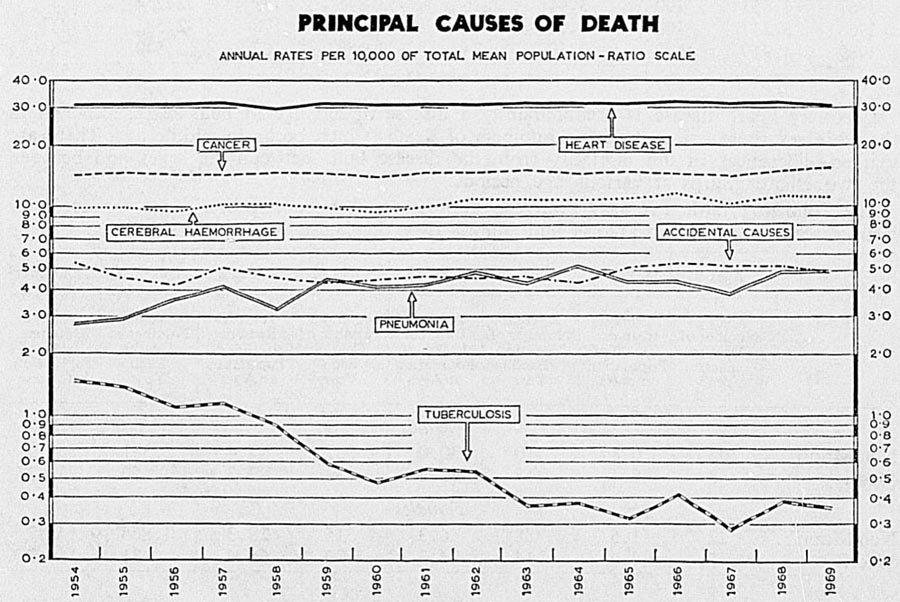
Heart Disease—Diseases of the heart are the leading killer in New Zealand, accounting for 37 percent of all male deaths and 32 percent of all female deaths in 1969. In accordance with the increasing numbers of the population in the older age groups, the total numbers of deaths from heart disease have steadily increased. However, when allowance is made for the general ageing of the population by employing the standardised mortality ratio it becomes evident that there has been an increase of 6 percent in the male rate of loss from heart conditions, but in the female sex there has been a slight fall for 1965-69 as against 1959-63.
A disease phenomenon of recent years has been the rapid increase in deaths assigned to coronary heart disease, and in 1969 no less than 28 percent of all deaths were due to this single disease entity. Comparing coronary heart diseases for 1959-63 with the latest quinquennium of 1965-69 the rise in the toll of deaths assigned to coronary conditions has been 21 percent for males and 33 percent for females. It is a matter of conjecture as to whether the real incidence of coronary heart disease in the community has risen to this extent or whether it is due in part at least to increased recognition of the condition.
The numbers of deaths and standard mortality ratios for heart disease, excluding acute rheumatic forms and congenital malformations, for the last 11 years are shown in the following table, males and females separately.
| Year | All Forms of Heart Disease | Coronary Heart Disease | ||||||
|---|---|---|---|---|---|---|---|---|
| Males | Females | Males | Females | |||||
| Number | Standardised Mortality Ratio* | Number | Standardised Mortality Ratio* | Number | Standardised Mortality Ratio* | Number | Standardised Mortality Ratio* | |
| *Base years 1950-52 = 100 | ||||||||
| 1,959 | 4,153 | 94 | 3,088 | 83 | 2,812 | 129 | 1,615 | 139 |
| 1,960 | 4,172 | 94 | 3,055 | 80 | 2,983 | 135 | 1,681 | 142 |
| 1,961 | 4,289 | 95 | 3,223 | 82 | 3,175 | 142 | 1,785 | 146 |
| 1,962 | 4,396 | 96 | 3,205 | 79 | 3,187 | 141 | 1,828 | 146 |
| 1,963 | 4,628 | 100 | 3,302 | 80 | 3,495 | 153 | 1,980 | 156 |
| 1,964 | 4,737 | 102 | 3,322 | 79 | 3,637 | 157 | 2,082 | 161 |
| 1,965 | 4,710 | 100 | 3,394 | 79 | 3,619 | 154 | 2,159 | 163 |
| 1,966 | 4,941 | 104 | 3,496 | 79 | 3,893 | 164 | 2,275 | 169 |
| 1,967 | 4,851 | 100 | 3,446 | 76 | 3,845 | 159 | 2,254 | 164 |
| 1,968 | 5,217 | 106 | 3,506 | 76 | 4,372 | 178 | 2,581 | 183 |
| 1,969 | 4,919 | 100 | 3,500 | 74 | 4,150 | 167 | 2,549 | 178 |
Coronary heart disease is predominantly a disease of old age in both sexes, although in the male sex there are appreciable numbers of deaths which occur in middle age. There are marked differences in the mortality from the disease both between the sexes and between the two ethnic groups at various age periods.
The following table averages both the numbers and the age-specific rates for coronary heart disease in both non-Maoris and Maoris over the latest five years 1965-69.
| Race | Ages 35 to 44 Years | Ages 45 to 54 Years | Ages 55 to 64 Years | Ages 65 Years and Over | ||||
|---|---|---|---|---|---|---|---|---|
| Average Number of Deaths Each Year | Average Rate per 10,000 of Population at Ages | Average Number of Deaths Each Year | Average Rate per 10,000 of Population at Ages | Average Number of Deaths Each Year | Average Rate per 10,000 of Population at Ages | Average Number of Deaths Each Year | Average Rate per 10,000 of Population at Ages | |
| Males | ||||||||
| Non-Maori | 105 | 6.8 | 410 | 30.0 | 957 | 87.4 | 2,381 | 251.5 |
| Maori | 8 | 8.4 | 17 | 29.3 | 32 | 87.3 | 50 | 239.3 |
| Females | ||||||||
| Non-Maori | 22 | 1.5 | 88 | 6.3 | 315 | 28.3 | 1,865 | 145.7 |
| Maori | 5 | 4.9 | 14 | 24.3 | 20 | 65.4 | 31 | 168.2 |
For non-Maoris at ages 35 to 44 years male coronary heart disease rates exceed female rates by almost 5 to 1, the ratio decreasing as age advances to a ratio of under 2 to 1 at ages 65 years and upwards.
The absolute numbers of Maori deaths from the disease are small but when related to the population at risk produce rates fairly similar to the non-Maori population in the male sex.
Maori women have a very much greater chance of dying from a coronary condition than non-Maori women, the risk being three times greater at ages 35 to 44 years, almost four greater at ages 45 to 54, but twice as great at ages 55 to 64 years. Hypertensive forms of heart disease are also very much more common in Maori women in middle age while both sexes in the Maori have a higher mortality from rheumatic valvular heart disease.
INTERNATIONAL COMPARISON OF PRINCIPAL CAUSES OF DEATH—In the following table the rates per million of mean population are given for principal causes of death for selected countries for the latest available year in each case.
| Country | Year | Rates per 1,000,000 of Population | |||||
|---|---|---|---|---|---|---|---|
| Heart Disease | Vascular Lesions of Central Nervous System | Cancer | Pneumonia | Accidental | Total Including Other | ||
| Japan | 1,965 | 878 | 1,758 | 1,084 | 280 | 409 | 7,127 |
| Canada | 1,966 | 2,696 | 781 | 1,339 | 268 | 572 | 7,474 |
| Netherlands | 1,966 | 2,277 | 989 | 1,868 | 142 | 469 | 8,070 |
| Bulgaria | 1,966 | 1,847 | 1,629 | 1,351 | 559 | 397 | 8,280 |
| South Africa | 1,962 | 2,396 | 961 | 1,347 | 551 | 597 | 8,800 |
| New Zealand | 1,969 | 2,698 | 1,103 | 1,493 | 495 | 488 | 8,678 |
| Australia | 1,966 | 3,388 | 1,206 | 1,368 | 342 | 540 | 9,005 |
| Switzerland | 1,966 | 2,789 | 1,160 | 1,883 | 350 | 596 | 9,432 |
| Finland | 1,966 | 3,421 | 1,334 | 1,570 | 248 | 608 | 9,391 |
| Norway | 1,966 | 3,012 | 1,536 | 1,722 | 596 | 478 | 9,596 |
| United States of America | 1,966 | 3,709 | 1,046 | 1,551 | 310 | 580 | 9,509 |
| Italy | 1,966 | 2,633 | 1,315 | 1,641 | 323 | 423 | 9,341 |
| Czechoslovakia | 1,966 | 2,526 | 1,150 | 2,074 | 343 | 514 | 9,982 |
| Sweden | 1,966 | 3,593 | 1,179 | 1,898 | 503 | 462 | 10,046 |
| Denmark | 1,966 | 3,731 | 1,205 | 2,165 | 275 | 504 | 10,285 |
| France | 1,966 | 1,996 | 1,283 | 2,066 | 255 | 707 | 10,638 |
| Northern Ireland | 1,966 | 3,917 | 1,440 | 1,705 | 663 | 383 | 11,124 |
| West Germany | 1,966 | 2,621 | 1,822 | 2,301 | 293 | 605 | 11,508 |
| England and Wales | 1,966 | 3,784 | 1,640 | 2,250 | 739 | 397 | 11,724 |
| Belgium | 1,966 | 2,997 | 1,582 | 2,366 | 320 | 593 | 12,134 |
| Scotland | 1,966 | 4,140 | 1,988 | 2,306 | 498 | 481 | 12,270 |
| Austria | 1,966 | 3,166 | 1,784 | 2,613 | 319 | 704 | 12,542 |
INFANT MORTALITY—Over a long period of years New Zealand has been renowned for the low rate of infant mortality in its non-Maori population, a fact attributable partly to such matters as climate, virility of the people, comparative absence of densely settled areas, etc., and partly to legislative and educative measures—the latter conducted by the State as well as by various organisations (one of the most important of these is the Royal New Zealand Society for the Health of Women and Children which was founded in 1907).
The trend in infant and peri-natal mortality in New Zealand up to the year 1961 and comparisons in causes with the rates of other countries which show improved figures on New Zealand's are contained in one of the Special Report Series issued by the National Health Statistics Centre of the Department of Health.
The infant-mortality rate of the non-Maori population of New Zealand is among the world's lowest, and recently has declined to a particularly low level. The Maori rate has shown a noticeable improvement in recent years. Infant-mortality figures are given in the next table.
| Year | Numbers | Rates per 1,000 of Live Births | ||||
|---|---|---|---|---|---|---|
| Non-Maori | Maori | Total | Non-Maori | Maori | Total | |
| 1,940 | 990 | 372 | 1,362 | 30.21 | 87.22 | 36.78 |
| 1,945 | 1,036 | 413 | 1,449 | 27.99 | 88.93 | 34.79 |
| 1,950 | 1,008 | 356 | 1,364 | 22.75 | 69.74 | 27.60 |
| 1,955 | 1,002 | 363 | 1,365 | 20.09 | 62.51 | 24.52 |
| 1,960 | 1,090 | 330 | 1,420 | 19.66 | 44.50 | 22.59 |
| 1,965 | 940 | 234 | 1,174 | 17.97 | 29.79 | 19.51 |
| 1,966 | 844 | 220 | 1,064 | 16.13 | 28.03 | 17.68 |
| 1,967 | 862 | 240 | 1,102 | 16.24 | 29.69 | 18.02 |
| 1,968 | 939 | 225 | 1,164 | 17.36 | 27.45 | 18.69 |
| 1,969 | 855 | 202 | 1,057 | 15.76 | 24.32 | 16.89 |
Male rates of infant loss are about 41 percent above female rates and this tends to counterbalance the male excess in births.
In the following table New Zealand's infant mortality rates, for both races combined, are shown in comparison with the rates for other countries. The figures are averaged over several recent years for which figures are available and the data has been extracted from the United Nations Demographic Yearbook 1968.
It is interesting to observe that Sweden has the distinction of having the lowest infant death rate in the world. Swedish figures have been based on local definitions of foetal death, livebirth, and infant death which would result in the rates being a slight understatement in a comparison with New Zealand's. Differences in definitions and practices exist also in some other countries.
| Country | Period | Deaths Under 1 Year per 1,000 Live Births |
|---|---|---|
| Sweden | 1964-67 | 13 |
| Netherlands | 1964-67 | 14 |
| Iceland | 1964-67 | 15 |
| Finland | 1964-68 | 16 |
| Norway | 1964-66 | 16 |
| New Zealand | 1965-69 | 18 |
| Denmark | 1964-67 | 18 |
| Switzerland | 1964-67 | 18 |
| Japan | 1964-67 | 18 |
| Australia | 1964-67 | 19 |
| England and Wales | 1964-68 | 19 |
| Scotland | 1964-68 | 22 |
| China (Taiwan) | 1964-67 | 22 |
| France | 1964-68 | 22 |
| United States | 1964-68 | 23 |
| Canada | 1964-67 | 23 |
| Czechoslovakia | 1964-67 | 23 |
| Belgium | 1964-67 | 24 |
| Germany, Fed. Rep. | 1964-67 | 24 |
| Ireland, Rep. | 1964-67 | 25 |
| Austria | 1964-68 | 28 |
| Bulgaria | 1964-68 | 31 |
| Italy | 1964-67 | 35 |
| Hungary | 1964-67 | 39 |
| Poland | 1964-67 | 42 |
| Romania | 1964-68 | 49 |
| Argentina | 1964-67 | 59 |
| Mexico | 1964-67 | 63 |
| Portugal | 1964-67 | 64 |
| Yugoslavia | 1964-67 | 68 |
| Guatemala | 1964-66 | 91 |
| Chile | 1964-67 | 105 |
One out of every four infant deaths is a Maori infant death and the Maori rate of loss is nearly twice that of the non-Maori. The excess in the Maori rate is largely due to infants who die between the end of the fourth week of life and the first birthday. This is illustrated in the following table showing numbers and rates by race and age for the year 1969.
| Race | Under 1 Day | 1 Day and Under 1 Week | 1 Week and Under 28 Days | Total Under 28 Days | 28 Days and Under 12 Months | Total Under 1 Year |
|---|---|---|---|---|---|---|
| Non-Maori | 290 | 209 | 73 | 572 | 283 | 855 |
| Maori | 47 | 50 | 8 | 105 | 97 | 202 |
| All races | 337 | 259 | 81 | 677 | 380 | 1,057 |
| Rates per 1,000 Live Births | ||||||
| Non-Maori | 5.34 | 3.85 | 1.35 | 10.54 | 5.22 | 15.76 |
| Maori | 5.66 | 6.02 | 0.96 | 12.64 | 11.68 | 24.32 |
| All races | 5.39 | 4.14 | 1.29 | 10.82 | 6.07 | 16.89 |
The explanation of the higher rate for Maoris between the twenty-eighth day and the end of the first year is the susceptibility of the Maori baby in its generally inferior home environment to forms of infection such as gastro-enteritis and pneumonia.
The rates per 1,000 live births for the two sexes combined at different ages during the first year of life are now given for each of the last 11 years.
| Year | Under 1 Day | 1 Day and Under 2 Days | 2 Days and Under 1 Week | 1 Week and Under 28 Days | 28 Days and Under 12 Months 1 | Under 1 Day 1 | 1 Day and Under 2 Days | 2 Days and Under 1 Week | 1 Week and Under 28 Days | 28 Days and Under 12 Months |
|---|---|---|---|---|---|---|---|---|---|---|
| Non-Maori | Maori | |||||||||
| 1,959 | 7.1 | 1.8 | 3.3 | 1.8 | 6.0 | 8.8 | 3.4 | 2.9 | 4.1 | 35.2 |
| 1,960 | 7.5 | 2.2 | 3.2 | 1.6 | 5.2 | 9.8 | 2.6 | 2.6 | 2.3 | 27.2 |
| 1,961 | 6.9 | 2.0 | 3.3 | 1.6 | 5.3 | 9.8 | 3.1 | 4.2 | 3.1 | 29.5 |
| 1,962 | 6.2 | 2.0 | 3.0 | 1.2 | 5.6 | 6.6 | 3.4 | 2.5 | 2.5 | 23.8 |
| 1,963 | 5.8 | 2.4 | 3.0 | 1.3 | 5.3 | 6.3 | 3.4 | 3.0 | 2.5 | 17.5 |
| 1,964 | 6.6 | 2.3 | 2.1 | 1.3 | 5.2 | 7.7 | 1.6 | 1.6 | 1.8 | 17.3 |
| 1,965 | 5.8 | 2.0 | 2.8 | 1.4 | 6.0 | 5.7 | 2.5 | 2.2 | 2.3 | 17.1 |
| 1,966 | 5.9 | 1.8 | 2.0 | 1.4 | 5.1 | 6.5 | 2.0 | 2.4 | 1.5 | 15.5 |
| 1,967 | 5.9 | 1.5 | 2.3 | 1.4 | 5.2 | 4.6 | 2.8 | 2.8 | 2.2 | 17.2 |
| 1,968 | 6.2 | 1.7 | 2.5 | 1.5 | 5.4 | 5.2 | 2.1 | 1.8 | 2.1 | 16.2 |
| 1,969 | 5.3 | 1.5 | 2.4 | 1.3 | 5.2 | 5.7 | 1.6 | 4.4 | 1.0 | 11.7 |
The following diagram illustrates infant mortality rates.
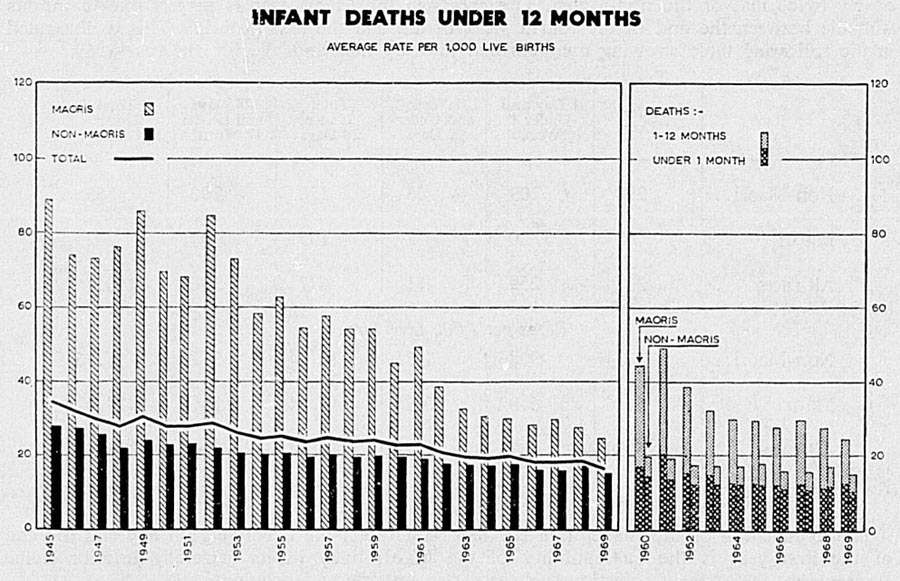
The next table shows the movement in the rates since 1922 in nine quinquennia and the years 1967-68, and 1969.
| Period | Neonatal Mortality (Under 28 Days) | Post-neonatal Mortality (28 Days and Under 12 Months) | Infant Mortality (Under 1 Year) | |||
|---|---|---|---|---|---|---|
| Non-Maori | Maori | Non-Maori | Maori | Non-Maori | Maori | |
| 1922-26 | 26.43 | 26.70 | 14.70 | 104.30 | 41.13 | 131.00 |
| 1927-31 | 24.26 | 25.64 | 10.90 | 86.92 | 35.16 | 112.56 |
| 1932-36 | 22.25 | 21.28 | 9.38 | 76.86 | 31.63 | 98.14 |
| 1937-41 | 21.94 | 26.71 | 9.51 | 86.13 | 31.45 | 112.84 |
| 1942-46 | 19.79 | 20.99 | 8.88 | 71.67 | 28.67 | 92.66 |
| 1947-51 | 16.73 | 26.11 | 6.53 | 48.48 | 23.26 | 74.59 |
| 1952-56 | 14.23 | 22.16 | 6.02 | 44.03 | 20.25 | 66.19 |
| 1957-61 | 13.92 | 19.77 | 5.68 | 32.20 | 19.60 | 51.97 |
| 1962-66 | 12.05 | 13.53 | 5.43 | 18.28 | 17.48 | 31.81 |
| 1967-68 | 11.47 | 11.85 | 5.33 | 16.71 | 16.80 | 28.56 |
| 1,969 | 10.54 | 12.64 | 5.22 | 11.68 | 15.76 | 24.32 |
The sharp drop in rates in the post-war years reflects the general availability of antibiotics. Three conditions, prematurity, birth injury, and post-natal asphyxia, together cause about two-thirds of the total neonatal deaths. Factors which underlie the generally higher rates for Maoris are the higher proportion of Maori confinements outside of hospitals, more frequent child bearing, and a reluctance to seek and heed antenatal advice.
The Maori infant who survives the first month of life is especially susceptible to respiratory infections such as influenza, pneumonia, and bronchitis, and to gastro-intestinal disorders. Environmental factors and circumstances associated with the Maori way of life underlie the onset of these diseases, such as unsatisfactory feeding associated with failure to seek and act upon skilled advice from Plunket and district nurses on matters such as feeding, and also poor housing and sanitary conditions.
Causes of Infant Mortality—In the following table are shown the absolute numbers and the rate per 1,000 live births of the principal causes of infant mortality during 1968 and 1969, for non-Maoris, Maoris and both groups combined.
| Cause of Death | Number of Deaths | Rate per 1,000 Live Births | ||||||
|---|---|---|---|---|---|---|---|---|
| 1968 | 1969 | 1968 | 1969 | |||||
| Non-Maori | Maori | Total | Non-Maori | Maori | Total | |||
| Influenza, pneumonia, and bronchitis | 206 | 141 | 2.4 | 9.0 | 3.3 | 1.8 | 5.5 | 2.2 |
| Congenital anomalies | 198 | 253 | 3.4 | 1.9 | 3.2 | 4.2 | 3.3 | 4.0 |
| Birth injury, with and without mention of cause, including asphyxia, anoxia or hypoxia | 67 | 46 | 1.1 | 0.9 | 1.1 | 0.6 | 1.3 | 0.7 |
| Complications of pregnancy and childbirth, including conditions of placenta and umbilical cord | 178 | 228 | 2.9 | 2.8 | 2.8 | 3.5 | 4.5 | 3.6 |
| Anoxic and hypoxic conditions not elsewhere classified | 186 | 124 | 3.0 | 2.9 | 3.0 | 1.9 | 2.4 | 2.0 |
| Immaturity, unqualified | 50 | 37 | 0.8 | 1.1 | 0.8 | 0.6 | 0.6 | 0.6 |
| Other and undefined causes | 279 | 228 | 3.8 | 8.8 | 4.5 | 3.2 | 6.7 | 3.6 |
| Total causes | 1,164 | 1,057 | 17.4 | 27.4 | 18.7 | 15.8 | 24.3 | 16.9 |
There has been a considerable saving of life in Maori babies in almost all the leading causes over the last 10 years.
CAUSES OF STILL BIRTH—A still-born child or late foetal death is defined in New Zealand as one “which has issued from its mother after the expiration of the twenty-eighth week of pregnancy and which was not alive at the time of such issue”. A certificate of the cause of death is required to be furnished for each still birth and also for cases of intermediate foetal deaths—i.e., deaths after the end of the twentieth but before the end of the twenty-eighth week of pregnancy. The certificates of causes of still birth and foetal death provide for both maternal and foetal causes to be entered.
The following table sets down the causes of the still births registered during 1969.
| Causes of Still Birth | Number of Cases | ||
|---|---|---|---|
| Males | Females | Total | |
| *Includes 5 cases of sex not determined. | |||
| Maternal Causes | |||
| Diseases and conditions not associated with pregnancy | 16 | 10 | 26 |
| Toxaemias of pregnancy | 55 | 38 | 93 |
| Other diseases and conditions of pregnancy and childbirth | 28 | 21 | 49 |
| Difficulties in labour | 18 | 10 | 28 |
| Totals | 117 | 79 | 196 |
| Foetal Causes | |||
| Placental and cord conditions | 94 | 99 | 193 |
| Birth injuries | 9 | 2 | 11 |
| Congenital anomalies | 36 | 47 | 88* |
| Diseases of foetus and ill-defined causes | 67 | 70 | 137 |
| External causes | |||
| Totals | 206 | 218 | 424 |
| Totals, all causes | 323 | 297 | 625 |
PERINATAL MORTALITY—Perinatal deaths comprise still births and deaths in the first week of life. Numbers and rates are shown in the following table. The still births and the perinatal mortality rate are calculated per 1,000 total births (still births plus live births), while the death rate for the first week of life is calculated per 1,000 live births.
| Cause | Number | Rate | ||||||
|---|---|---|---|---|---|---|---|---|
| 1968 | 1969 | |||||||
| 1968 | 1969 | Non-Maori | Maori | Total | Non-Maori | Maori | Total | |
| Still births | 752 | 625 | 11.6 | 13.8 | 11.9 | 9.5 | 12.6 | 9.9 |
| Deaths under 1 week | 638 | 596 | 10.4 | 9.1 | 10.2 | 9.2 | 11.8 | 9.5 |
| Perinatal deaths | 1,390 | 1,221 | 21.9 | 22.9 | 22.1 | 18.6 | 24.3 | 19.3 |
PUERPERAL CAUSES—Improvements in the standard of antenatal care and obstetrical skill, as well as advances in medical science, have reduced the numbers of deaths from septic abortion, puerperal sepsis, and toxaemia, and deaths from complications of childbirth are few. A summary of maternal mortality from all puerperal causes, in triennial periods, is given in the following table.
| Cause of Death | 1947-49 | 1950-52 | 1953-55 | 1956-58 | 1959-61 | 1962-64 | 1965-67 | 1968 | 1969 |
|---|---|---|---|---|---|---|---|---|---|
| Non-Maori | |||||||||
| Puerperal sepsis | 7 | 4 | 1 | 2 | 3 | 1 | 3 | 1 | 1 |
| Eclampsia and other toxaemias | 38 | 33 | 28 | 24 | 10 | 13 | 8 | 1 | 2 |
| Septic abortion | 22 | 14 | 9 | 8 | 12 | 7 | 4 | - | - |
| Accidents, haemorrhage, and other mortality | 82 | 53 | 34 | 43 | 40 | 24 | 20 | 11 | 8 |
| Total maternal mortality | 149 | 104 | 72 | 77 | 65 | 45 | 35 | 13 | 11 |
| Maternal mortality, excluding septic abortion | 127 | 90 | 63 | 69 | 53 | 38 | 31 | 13 | 11 |
| Maori | |||||||||
| Puerperal sepsis | 3 | 3 | 2 | 1 | - | 1 | 1 | - | - |
| Eclampsia and other toxaemias | 7 | 5 | 3 | 2 | 5 | 2 | 2 | - | 1 |
| Septic abortion | - | 3 | 3 | 2 | - | 1 | - | - | - |
| Accidents, haemorrhage, and other mortality | 27 | 20 | 21 | 24 | 15 | 16 | 11 | 2 | 2 |
| Total maternal mortality | 37 | 31 | 29 | 29 | 20 | 20 | 14 | 2 | 3 |
| Maternal mortality, excluding septic abortion | 37 | 28 | 26 | 27 | 20 | 19 | 14 | 2 | 3 |
| All Races | |||||||||
| Puerperal sepsis | 10 | 7 | 3 | 3 | 3 | 2 | 4 | 1 | 1 |
| Eclampsia and other toxaemias | 45 | 38 | 31 | 26 | 15 | 15 | 10 | 1 | 3 |
| Septic abortion | 22 | 17 | 12 | 10 | 12 | 8 | 4 | - | - |
| Accidents, haemorrhage, and other mortality | 109 | 73 | 55 | 67 | 55 | 40 | 31 | 13 | 10 |
| Total maternal mortality | 186 | 135 | 101 | 106 | 85 | 65 | 49 | 15 | 14 |
| Maternal mortality, excluding septic abortion | 164 | 118 | 89 | 96 | 73 | 57 | 45 | 15 | 14 |
The following table shows the progressive reduction that has been achieved in the rates of deaths due to puerperal causes.
| Year | Rate per 1,000 Live Births | ||
|---|---|---|---|
| Non-Maori | Maori | Total Population | |
| 1,949 | 1.02 | 3.46 | 1.27 |
| 1,950 | 0.90 | 2.35 | 1.05 |
| 1,951 | 0.69 | 0.76 | 0.70 |
| 1,952 | 0.71 | 2.56 | 0.91 |
| 1,953 | 0.54 | 1.45 | 0.64 |
| 1,954 | 0.51 | 1.58 | 0.63 |
| 1,955 | 0.44 | 2.07 | 0.61 |
| 1,956 | 0.40 | 1.78 | 0.55 |
| 1,957 | 0.67 | 1.35 | 0.75 |
| 1,958 | 0.41 | 1.31 | 0.51 |
| 1,959 | 0.49 | 1.26 | 0.58 |
| 1,960 | 0.34 | 0.67 | 0.38 |
| 1,961 | 0.33 | 0.77 | 0.38 |
| 1,962 | 0.17 | 1.17 | 0.29 |
| 1,963 | 0.37 | 0.62 | 0.40 |
| 1,964 | 0.26 | 0.75 | 0.32 |
| 1,965 | 0.17 | 0.51 | 0.22 |
| 1,966 | 0.32 | 0.64 | 0.37 |
| 1,967 | 0.17 | 0.62 | 0.23 |
| 1,968 | 0.24 | 0.24 | 0.24 |
| 1,969 | 0.20 | 0.36 | 0.22 |
DEATHS FROM EXTERNAL CAUSES—Deaths from external causes, apart from suicide, claim approximately 6 percent of the total deaths and again the Maori rate higher than the non-Maori. The following table shows deaths from external causes for the three latest years classified according to the Intermediate List of the 1965 Revision of the International Classification which has made no changes in the categories listed. In this table falls on board ship and from horseback are included as transport fatalities.
| Causes of Death | Number of Deaths | Rate per Million of Mean Population | ||||
|---|---|---|---|---|---|---|
| 1967 | 1968 | 1969 | 1967 | 1968 | 1969 | |
| *Includes drowning from water transport. | ||||||
| Motor-vehicle accidents | 620 | 548 | 582 | 227 | 199 | 209 |
| Other transport accidents | 46 | 42 | 35 | 17 | 15 | 13 |
| Accidental poisoning | 35 | 61 | 37 | 13 | 22 | 13 |
| Accidental falls | 356 | 364 | 337 | 130 | 132 | 121 |
| Accidents caused by machinery | 44 | 45 | 48 | 16 | 16 | 17 |
| Accidents caused by fire and explosion of combustible material | 62 | 31 | 34 | 23 | 11 | 12 |
| Accidents caused by hot substance, corrosive liquid, steam, and radiation | 18 | 8 | 6 | 7 | 3 | 2 |
| Accidents caused by firearms | 25 | 21 | 9 | 9 | 8 | 3 |
| Accidental drowning and submersion* | 129 | 205 | 123 | 47 | 75 | 44 |
| All other accidental causes | 106 | 129 | 133 | 39 | 47 | 48 |
| Homicide and injury purposely inflicted by other persons (not in war) | 37 | 20 | 31 | 14 | 7 | 11 |
| Totals | 1,478 | 1,474 | 1,375 | 542 | 535 | 494 |
The number of deaths recorded from all accidental causes in 1969 was 1,375 corresponding to a rate of 4.9 per 10,000 of population.
Drownings are a leading cause of accidental death in New Zealand. Included in the preceding table for 1969 are 46 deaths from drowning due to accidents in water transport, of which nine were crew members of fishing trawlers.
Transport Accidents—In classifying deaths attributable to transport accidents under the various subheadings shown in the following table the rule of assignment is that in fatalities due to collisions of railway trains and electric tram cars with motor vehicles, the death is assigned to the railway train or electric tram car as being the heavier and more powerful vehicle. For 1969 there were 5 deaths from such accidents, bringing the total number of deaths in cases where a motor vehicle was involved up to 587. In the case of collisions between motor vehicles and horse—drawn vehicles, the death is assigned to the motor vehicle.
The number and rate of deaths resulting from railway, tramway, motor vehicle, and aircraft accidents during each of the last 11 years are as follows.
| Year | Deaths Due to Accident | Rate per 10,000 of Mean Population | ||||||
|---|---|---|---|---|---|---|---|---|
| Railway | Tramway | Motor Vehicle | Aircraft | Railway | Tramway | Motor Vehicle | Aircraft | |
| 1,959 | 28 | 1 | 348 | 9 | 0.12 | - | 1.49 | 0.04 |
| 1,960 | 32 | 1 | 340 | 10 | 0.13 | - | 1.43 | 0.04 |
| 1,961 | 26 | 2 | 393 | 13 | 0.11 | 0.01 | 1.62 | 0.05 |
| 1,962 | 27 | - | 408 | 11 | 0.11 | - | 1.64 | 0.04 |
| 1,963 | 16 | - | 416 | 20 | 0.06 | - | 1.64 | 0.08 |
| 1,964 | 26 | 3 | 428 | 30 | 0.10 | 0.01 | 1.65 | 0.12 |
| 1,965 | 14 | - | 551 | 26 | 0.05 | - | 2.08 | 0.10 |
| 1,966 | 13 | - | 567 | 16 | 0.05 | - | 2.11 | 0.06 |
| 1,967 | 15 | - | 620 | i2 | 0.05 | - | 2.27 | 0.04 |
| 1,968 | 10 | - | 548 | 16 | 0.04 | - | 1.99 | 0.06 |
| 1,969 | 5 | - | 582 | 17 | 0.02 | - | 2.09 | 0.06 |
In recent years the wide use of aircraft in agricultural operations such as aerial topdressing has resulted in a number of deaths from aircraft accidents. Road accidents are further analysed in the section on Roads and Road Transport.
Non-transport Accidents—The 1965 Revision of the International List makes provision for non-transport accidents (excluding therapeutic misadventure in treatment, complications following vaccination or inoculation, and late effects of injury and poisoning) to be grouped according to the place where the accident or poisoning occurred. The following table shows the deaths, both numbers and rates, for the latest three years, according to this classification.
| Place of Occurrence | Number | Rate per Million of Mean Population | ||||
|---|---|---|---|---|---|---|
| 1967 | 1968 | 1969 | 1967 | 1968 | 1969 | |
| Home (including home premises and vicinity and any non-institutional place of residence) | 336 | 347 | 262 | 123 | 126 | 94 |
| Farm (including buildings and land under cultivation, but excluding farm and home premises) | 46 | 50 | 51 | 17 | 18 | 18 |
| Mine and quarry | 25 | 7 | 7 | 9 | 2 | 2 |
| Industrial place and premises | 29 | 39 | 27 | 11 | 15 | 10 |
| Place for recreation and sport | 8 | 13 | 26 | 3 | 5 | 9 |
| Street and highway | 12 | 11 | 25 | 4 | 4 | 9 |
| Public building (building used by the general public or a particular group of the public) | 8 | 12 | 12 | 3 | 4 | 4 |
| Resident institution (homes, hospitals, etc.) | 94 | 125 | 116 | 34 | 43 | 42 |
| Other specified places | 136 | 118 | 114 | 50 | 45 | 41 |
| Place not specified | 60 | 25 | 72 | 22 | 9 | 26 |
| Totals | 754 | 747 | 712 | 276 | 271 | 256 |
One in every two fatal non-traffic accidents occurs in or about the home.
Falls are the chief cause of home fatalities, exacting a heavy toll of the aged and infirm. This is clearly illustrated in a special report on domestic accidents issued by the Department of Health in 1970. Another important cause of death in the home is asphyxia from regurgitation of food and inhalation of other objects, or mechanically from pillows and bedclothes; this is the principal hazard of the first six months of life, though a proportion of these deaths is probably due to some undisclosed respiratory infections. Almost all the home drowning fatalities are amongst toddlers between one and two years of age who fall into rivers, creeks, and ponds in the vicinity of the home.
Twenty-nine of the 51 accidental deaths on farms in 1969 were caused by farm machinery (usually tractors). Further data regarding accidents will be found elsewhere in this volume (see Index). Later sections are devoted wholly to statistics of industrial and farm accidents.
Suicide—There were 271 suicidal deaths of non-Maoris in 1969—177 males and 94 females—the death rate per 100,000 of population being 13.8 for males and 7.3 for females. For Maoris there were seven suicidal deaths—four males and three females—the death rates per 100,000 population being 3.6 for males and 2.7 for females.
Rates per 100,000 of population showing the age distributions, averaged over the years 1967, 1968 and 1969 are shown next for the total population.
| Sex | 10/14 | 15/19 | 20/24 | 25/29 | 30/34 | 35/39 | 40/44 | 45/49 | 50/54 | 55/59 | 60/64 | 65/69 | 70/74 | 75/79 | 80 + |
|---|---|---|---|---|---|---|---|---|---|---|---|---|---|---|---|
| Males | 0.9 | 4.4 | 14.4 | 11.9 | 17.7 | 22.3 | 22.0 | 27.3 | 21.6 | 30.0 | 30.0 | 32.6 | 26.2 | 38.6 | 27.3 |
| Females | 0.2 | 2.7 | 4.8 | 3.8 | 7.1 | 6.5 | 8.5 | 13.2 | 17.5 | 16.2 | 17.3 | 19.4 | 15.1 | 7.6 | 6.4 |
These figures show the typical increase in the suicide rates with increasing age and the fall in the rates after the age of 75.
The next table presents the average, over three-yearly periods, of standardised mortality ratios of suicides, standardised on years 1950-52 = 100.
| Annual Average During | Males | Females |
|---|---|---|
| 1953-55 | 93 | 102 |
| 1956-58 | 97 | 120 |
| 1959-61 | 99 | 99 |
| 1962-64 | 83 | 136 |
| 1965-67 | 95 | 142 |
| 1,968 | 98 | 139 |
| 1,969 | 98 | 154 |
The following table provides an international comparison of suicide rates for various countries. The figures have been extracted from the United Nations Demographic Yearbook 1969.
| Country | Year | Rate per 100,000 of Population |
|---|---|---|
| Mexico | 1,968 | 1.6 |
| Ireland, Rep. | 1,968 | 2.5 |
| Spain | 1,967 | 4.5 |
| Italy | 1,967 | 5.4 |
| Netherlands | 1,968 | 6.3 |
| Norway | 1,967 | 7.0 |
| Scotland | 1,968 | 7.2 |
| England and Wales | 1,968 | 9.4 |
| New Zealand | 1,968 | 9.6 |
| Canada | 1,968 | 9.7 |
| Poland | 1,968 | 10.6 |
| United States | 1,967 | 10.8 |
| Australia | 1,968 | 12.7 |
| Japan | 1,967 | 14.1 |
| Belgium | 1,967 | 15.0 |
| Switzerland | 1,967 | 17.3 |
| Denmark | 1,966 | 17.8 |
| Germany, Fed. Rep | 1,967 | 21.3 |
| Sweden | 1,967 | 21.6 |
| Finland | 1,968 | 21.6 |
| Austria | 1,968 | 21.9 |
| Czechoslovakia | 1,967 | 23.9 |
GENERAL—Marriage may be solemnised in New Zealand either by a person whose name is on the list of officiating ministers under the Marriage Act 1955, or before a duly appointed Registrar or Deputy Registrar of Marriages. A licence must be obtained from a Registrar of Marriages before a marriage by an officiating minister can be solemnised. Marriage by an officiating minister may be solemnised at any time between 6 o'clock in the morning and 8 o'clock in the evening. Marriage before a Registrar can be solemnised at any time during the hours the office of the Registrar is open for the transaction of public business; notice of intended marriage must be given to a Registrar of Marriages by one of the parties to the proposed marriage.
In the case of a person under 21 years of age, not being a widow or widower, the consent of parents or guardian is necessary. Consent of a Magistrate may also be given in cases of refusal by any person whose consent is required.
Since 1933 the minimum age for marriage has been 16 years of age. No marriage shall be deemed to be void, however, by reason only of an infringement of the minimum age.
Since 1 April 1952 it has been required under the Maori Purposes Act 1951 that every marriage to which a Maori is a party shall be solemnised in the same manner, and its validity shall be determined by the same law, as if each of the parties was a non-Maori.
Particulars regarding divorce will be found later in this subsection.
NUMBERS AND RATES—The numbers of marriages and rates during the last 21 years are now given.
| Year | Number | Rate per 1,000 of Population |
|---|---|---|
| 1,950 | 17,099 | 8.96 |
| 1,951 | 16,915 | 8.69 |
| 1,952 | 17,061 | 8.55 |
| 1,953 | 17,224 | 8.41 |
| 1,954 | 17,557 | 8.38 |
| 1,955 | 17,795 | 8.32 |
| 1,956 | 17,531 | 8.03 |
| 1,957 | 17,614 | 7.89 |
| 1,958 | 18,305 | 8.01 |
| 1,959 | 18,315 | 7.84 |
| 1,960 | 18,909 | 7.96 |
| 1,961 | 19,426 | 8.01 |
| 1,962 | 19,572 | 7.88 |
| 1,963 | 19,856 | 7.83 |
| 1,964 | 20,720 | 8.00 |
| 1,965 | 21,702 | 8.23 |
| 1,966 | 22,949 | 8.55 |
| 1,967 | 23,515 | 8.62 |
| 1,968 | 24,057 | 8.73 |
| 1,969 | 24,971 | 8.97 |
| 1,970 | 25,953 | 9.19 |
Comparison with Other Countries—Marriage rates for certain countries for 1969 are given below. (Source: United Nations Monthly Bulletin of Statistics.)
| Country | Rate per 1,000 Mean Population |
|---|---|
| Australia | 9.1 |
| Austria | 7.4 |
| Belgium | 7.5 |
| Canada | 8.6 |
| Finland | 8.7 |
| France | 7.6 |
| Germany, East | 7.3 |
| Germany, West | 7.3 |
| Hungary | 9.3 |
| Ireland, Republic | 6.8 |
| Israel | 8.9 |
| Italy | 7.2 |
| Japan | 9.4 |
| Mexico | 7.1 |
| Netherlands | 9.1 |
| New Zealand | 9.0 |
| Norway | 7.7 |
| Spain | 7.2 |
| Sweden | 6.0 |
| Switzerland | 7.4 |
| United Kingdom | 8.1 |
| United States | 10.6 |
| Yugoslavia | 8.5 |
MARITAL STATUS PRIOR TO MARRIAGE—The following table gives marital status prior to marriage for the latest five years.
| Year | Single | Widowed | Divorced | Total Persons Married | |||
|---|---|---|---|---|---|---|---|
| Bridegroom | Bride | Bridegroom | Bride | Bridegroom | Bride | ||
| 1,965 | 19,531 | 19,580 | 766 | 844 | 1,405 | 1,278 | 43,404 |
| 1,966 | 20,690 | 20,695 | 887 | 921 | 1,372 | 1,333 | 45,898 |
| 1,967 | 21,230 | 21,369 | 856 | 862 | 1,429 | 1,284 | 47,030 |
| 1,968 | 21,675 | 21,811 | 905 | 847 | 1,477 | 1,399 | 48,114 |
| 1,969 | 22,168 | 22,339 | 981 | 1,023 | 1,822 | 1,609 | 49,942 |
The position is more easily seen by studying the percentages given in the next table.
| Year | Bridegrooms | Brides | ||||
|---|---|---|---|---|---|---|
| Single | Widowed | Divorced | Single | Widowed | Divorced | |
| percent | ||||||
| 1,965 | 90.00 | 3.53 | 6.47 | 90.22 | 3.89 | 5.89 |
| 1,966 | 90.15 | 3.87 | 5.98 | 90.18 | 4.01 | 5.81 |
| 1,967 | 90.28 | 3.64 | 6.08 | 90.87 | 3.67 | 5.46 |
| 1,968 | 90.10 | 3.76 | 6.14 | 90.66 | 3.52 | 5.82 |
| 1,969 | 88.77 | 3.93 | 7.30 | 89.46 | 4.10 | 6.44 |
Divorce statistics at the end of this subsection show the numbers of decrees granted in recent years, the numbers varying from 1,400 to 2,200 a year. Widowed persons remarrying constituted 40 per 1,000 persons married in 1969.
The marital status of persons prior to marriage for each of the latest five years is next given.
| Year | Marriages Between Bachelors and | Marriages Between Widowers and | Marriages Between Divorced Men and | ||||||
|---|---|---|---|---|---|---|---|---|---|
| Spinsters | Widows | Divorced Women | Spinsters | Widows | Divorced Women | Spinsters | Widows | Divorced Women | |
| 1,965 | 18,586 | 272 | 673 | 232 | 370 | 164 | 762 | 202 | 441 |
| 1,966 | 19,751 | 290 | 649 | 251 | 434 | 202 | 693 | 197 | 482 |
| 1,967 | 20,351 | 242 | 637 | 257 | 408 | 191 | 761 | 212 | 456 |
| 1,968 | 20,764 | 248 | 663 | 251 | 413 | 241 | 796 | 186 | 495 |
| 1,969 | 21,142 | 270 | 756 | 231 | 498 | 252 | 966 | 255 | 601 |
During the years 1938-40 there were 95 male divorcees who remarried for every 100 female divorcees who remarried. In the period 1965-69 more male divorcees than female divorcees remarried.
The number of widows per 100 widowers who remarried was 67 in 1938-40, but with a changed social outlook the position in 1967-69 was that 100 widows remarried for every 100 widowers.
AGES OF PERSONS MARRIED—The proportion of minors among persons marrying has been increased over a fairly long period. In the latest year five brides in every 11 were under 21 years of age, the proportion for grooms being one in six.
Of the 49,942 persons married in 1969, 15,354 or 30.74 percent, were under 21 years of age; 20,112 or 40.27 percent, were returned as 21-24 years; 6,969, or 13.96 percent, as 25-29 years; 3,466, or 6.94 percent, as 30-39 years; and 4,041, or 8.09 percent, as 40 years of age or over. The following table relates to the year of 1968.
| Age of Bridegroom, in years | Age of Bride, in Years | Total Bridegrooms | ||||||
|---|---|---|---|---|---|---|---|---|
| 16-20 | 21-24 | 25-29 | 30-34 | 35-39 | 40-44 | 45 and over | ||
| Under 21 | 3,551 | 469 | 31 | 3 | 1 | - | - | 4,055 |
| 21-24 | 6,217 | 4,885 | 442 | 45 | 13 | 1 | - | 11,603 |
| 25-29 | 1,292 | 2,425 | 890 | 138 | 38 | 9 | 4 | 4,796 |
| 30-34 | 179 | 506 | 440 | 183 | 67 | 23 | 10 | 1,408 |
| 35-39 | 38 | 137 | 228 | 176 | 128 | 56 | 38 | 801 |
| 40-44 | 15 | 52 | 87 | 114 | 130 | 115 | 84 | 597 |
| 45 and over | 7 | 35 | 55 | 92 | 129 | 223 | 1,170 | 1,711 |
| Total brides | 11,299 | 8,509 | 2,173 | 751 | 506 | 427 | 1,306 | 24,971 |
The following table shows since 1950 the proportions of men and women married at each age group to every 100 marriages.
| Period | Under 21 | 21-24 | 25-29 | 30-34 | 35-39 | 40-44 | 45 and Over | Totals |
|---|---|---|---|---|---|---|---|---|
| *Periods prior to 1950 are for non-Maoris only. | ||||||||
| Males | ||||||||
| 1950-54 | 5.05 | 35.42 | 31.21 | 10.95 | 5.86 | 3.56 | 7.95 | 100.00 |
| 1955-59 | 7.18 | 36.68 | 29.44 | 11.21 | 4.81 | 2.97 | 7.71 | 100.00 |
| 1960-64 | 10.95 | 41.99 | 23.49 | 9.04 | 4.50 | 2.62 | 7.41 | 100.00 |
| 1,965 | 13.52 | 43.99 | 22.36 | 6.95 | 4.07 | 2.45 | 6.66 | 100.00 |
| 1,966 | 14.97 | 43.84 | 21.96 | 6.36 | 3.53 | 2.42 | 6.92 | 100.00 |
| 1,967 | 15.73 | 43.65 | 22.02 | 6.49 | 3.39 | 2.20 | 6.52 | 100.00 |
| 1,968 | 15.48 | 45.80 | 20.90 | 6.15 | 3.19 | 2.26 | 6.22 | 100.00 |
| 1,969 | 16.24 | 46.47 | 19.21 | 5.64 | 3.21 | 2.38 | 6.85 | 100.00 |
| Females | ||||||||
| 1950-54 | 25.78 | 38.65 | 16.85 | 6.96 | 4.12 | 2.59 | 5.05 | 100.00 |
| 1955-59 | 32.99 | 35.71 | 13.76 | 6.11 | 3.65 | 2.49 | 5.29 | 100.00 |
| 1960-64 | 39.63 | 35.19 | 10.13 | 4.42 | 3.05 | 2.21 | 5.37 | 100.00 |
| 1,965 | 43.19 | 34.66 | 9.35 | 3.55 | 2.21 | 1.99 | 5.05 | 100.00 |
| 1,966 | 45.50 | 32.90 | 9.22 | 2.94 | 2.19 | 1.96 | 5.29 | 100.00 |
| 1,967 | 46.64 | 32.40 | 9.32 | 2.88 | 2.11 | 1.76 | 4.89 | 100.00 |
| 1,968 | 45.89 | 34.09 | 8.87 | 2.93 | 1.97 | 1.66 | 4.59 | 100.00 |
| 1,969 | 45.25 | 34.08 | 8.70 | 3.01 | 2.03 | 1.70 | 5.23 | 100.00 |
The average ages (arithmetic mean) at marriage for both males and females are shown in the following table.
| Year | Average Age at Marriage | |
|---|---|---|
| Bridegrooms | Brides | |
| 1,959 | 28.70 | 25.26 |
| 1,960 | 28.56 | 25.11 |
| 1,961 | 28.29 | 24.90 |
| 1,962 | 27.93 | 24.61 |
| 1,963 | 27.93 | 24.63 |
| 1,964 | 27.74 | 24.45 |
| 1,965 | 27.43 | 24.24 |
| 1,966 | 26.76 | 23.65 |
| 1,967 | 26.53 | 23.45 |
| 1,968 | 26.33 | 23.29 |
| 1,969 | 26.45 | 23.56 |
The average ages of bachelors and spinsters at marriage are considerably lower than those shown in the preceding table, which covers all parties and is naturally affected by the inclusion of remarriages of widowed and divorced persons. The average ages of grooms and brides for each of the latest five years according to marital status were as shown in the next table.
| Year | Bridegrooms | Brides | ||||
|---|---|---|---|---|---|---|
| Bachelors | Divorced | Widowers | Spinsters | Divorced | Widows | |
| Years | ||||||
| 1,965 | 25.17 | 42.39 | 57.48 | 22.21 | 37.46 | 51.11 |
| 1,966 | 24.46 | 42.26 | 56.30 | 21.54 | 38.15 | 49.93 |
| 1,967 | 24.30 | 41.67 | 56.67 | 21.50 | 37.90 | 50.20 |
| 1,968 | 24.15 | 40.53 | 55.36 | 21.40 | 36.81 | 49.64 |
| 1,969 | 23.90 | 41.02 | 57.06 | 21.36 | 37.03 | 50.45 |
The foregoing figures give the average age at marriage, but these do not correspond with the modal or popular age, if the age at which the most marriages are celebrated may be so termed. The modal age for brides (21) has remained unchanged for very many years, but in the case of bridegrooms the most popular age has varied, and for recent years it has been 21 to 24. The modal age for bridegrooms in 1969 was 22 years.
Marriage of Minors—Of every 1,000 men married in 1969, 162 were under 21 years of age, while 452 in every 1,000 brides were under 21.
In 3,551 marriages in 1969 both parties were given as under 21 years of age, in 7,748 marriages the bride was returned as a minor and the bridegroom as an adult, and in 504 marriages the bridegroom was a minor and the bride an adult.
The proportion of minors among persons marrying has been increasing over a fairly long period, and in the table below figures are given for the last five years.
| Year | Age in Years | Totals | |||||
|---|---|---|---|---|---|---|---|
| 16 | 17 | 18 | 19 | 20 | Number | Rate per 100 Marriages | |
| Bridegrooms | |||||||
| 1,965 | 28 | 151 | 503 | 883 | 1,370 | 2,935 | 13.52 |
| 1,966 | 24 | 168 | 565 | 1,058 | 1,621 | 3,436 | 14.97 |
| 1,967 | 20 | 164 | 559 | 1,111 | 1,845 | 3,699 | 15.73 |
| 1,968 | 14 | 164 | 531 | 1,084 | 1,931 | 3,724 | 15.48 |
| 1,969 | 29 | 197 | 657 | 1,175 | 1,997 | 4,055 | 16.24 |
| Brides | |||||||
| 1,965 | 512 | 1,155 | 2,099 | 2,698 | 2,910 | 9,374 | 43.19 |
| 1,966 | 578 | 1,246 | 2,156 | 3,230 | 3,232 | 10,442 | 45.50 |
| 1,967 | 545 | 1,199 | 2,248 | 3,245 | 3,732 | 10,969 | 45.64 |
| 1,968 | 550 | 1,239 | 2,258 | 3,295 | 3,697 | 11,039 | 45.89 |
| 1,969 | 624 | 1,338 | 2,287 | 3,364 | 3,686 | 11,299 | 45.25 |
MARRIAGES BY MINISTERS OF VARIOUS CHURCHES—Of the 24,971 marriages performed in 1969, Anglican clergymen officiated at 6.479, Presbyterians at 5,955, Roman Catholics at 3,828, Methodists at 1,999, and clergymen of other churches at 1,960 while 4,750 marriages were solemnised by Registrars.
The following table shows the proportions of marriages by ministers of the largest churches and before Registrars in each of the seven latest years.
| Church | Percentage of Marriages | ||||||
|---|---|---|---|---|---|---|---|
| 1963 | 1964 | 1965 | 1966 | 1967 | 1968 | 1969 | |
| Anglican | 24.53 | 25.06 | 25.71 | 25.89 | 26.14 | 26.64 | 25.95 |
| Presbyterian | 24.29 | 23.68 | 23.62 | 23.54 | 23.81 | 23.46 | 23.85 |
| Roman Catholic | 14.87 | 14.95 | 15.45 | 15.33 | 15.45 | 15.83 | 15.33 |
| Methodist | 8.30 | 8.20 | 7.73 | 8.17 | 8.19 | 7.96 | 8.00 |
| Others | 8.32 | 8.36 | 8.25 | 7.73 | 7.95 | 8.12 | 7.85 |
| Before Registrars | 19.69 | 19.75 | 19.24 | 19.34 | 18.46 | 17.99 | 19.02 |
| Totals | 100.00 | 100.00 | 100.00 | 100.00 | 100.00 | 100.00 | 100.00 |
The foregoing figures must not be taken as an exact indication of the religious professions of the parties married, as it does not necessarily follow that both (or even one) of the parties are adherents of the Church whose officiating minister performed the ceremony, and persons married before Registrars may belong, in greater or lesser proportion, to any or none of the churches. Of the total population at the general census of 1966, 33.7 percent were recorded as adherents of the Anglican Church, 21.8 percent Presbyterian, 15.9 percent Roman Catholic, 7.0 percent Methodist, and 21.6 percent of other religions or of no religion, or who objected to state their religious profession.
NUMBER OF OFFICIATING MINISTERS—The number of names on the list of officiating ministers under the Marriage Act was 3,897 in January 1970 and the churches to which they belong are shown hereunder.
| Church | Number |
|---|---|
| Roman Catholic Church | 904 |
| Anglican (Church of England) | 692 |
| Presbyterian Church of New Zealand | 635 |
| Methodist Church of New Zealand | 351 |
| Baptist | 198 |
| Salvation Army | 184 |
| Ratana Church of New Zealand | 141 |
| Latter Day Saints | 141 |
| Brethren | 86 |
| Ringatu Church | 73 |
| Associated Churches of Christ | 46 |
| Jehovah's Witness | 40 |
| Seventh Day Adventist | 36 |
| Assemblies of God | 36 |
| Apostolic Church | 32 |
| Liberal Catholic Church | 24 |
| Christian Revival Crusade | 18 |
| Evangelical Lutheran Concordia Conference | 15 |
| Congregational Union | 14 |
| Absolute Reformed Maori Church of Aotearoa | 13 |
| Church of Te Kooti Rikirangi | 11 |
| Commonwealth Covenant Church | 10 |
| Reformed Churches of New Zealand | 9 |
| Evangelistic Church of Christ | 9 |
| Elim Church | 8 |
| Others | 171 |
| Total | 3,897 |
The Ratana Church of New Zealand, the Ringatu Church, the United Maori Mission, and the Church of Te Kooti Rikirangi are Maori organisations.
DISSOLUTION OF MARRIAGE AND NULLITY—Applying from 1 January 1969, the Matrimonial Proceedings Amendment Act 1968 made some important changes in the legislation for grounds for divorce; the period of three years was reduced to two years for separation by agreement and decree of separation or separation order, and in cases living apart and unlikely to be reconciled the period of seven years was reduced to four years. This amending legislation had an accelerating effect on divorce statistics in 1969.
Divorce—A petition for divorce may be presented to the Supreme Court on one or more of several grounds, which include adultery, desertion, separation by agreement for not less than two years, separation by decree of separation or separation order for not less than two years, and the parties living apart for four years and not likely to be reconciled. Only a very small percentage of divorces each year are concerned with the other grounds, as a subsequent table shows. Where the parties are separated or living apart one of the parties must have been resident in New Zealand for at least two years immediately preceding the filing of the petition. The Court is required to give consideration to the possibility of reconciliation of the parties to the marriage.
Dissolution of a Voidable Marriage—Proceedings for the dissolution of a voidable marriage may be instituted by a person domiciled in New Zealand or a person whose spouse is domiciled in New Zealand on any of the following grounds, namely, that at the time of the marriage one of the parties was mentally defective, that the respondent was at that time suffering from communicable venereal disease, that the woman was then pregnant by some other man than the petitioner, or that some woman other than the petitioner was then pregnant by the respondent, or that the marriage has not been consummated because of the incapacity of either party or the respondent's wilful refusal. A decree of dissolution of a voidable marriage puts an end to the marriage from the date of the decree.
Nullity—In certain circumstances a marriage is void, that is, it is of no effect whether or not proceedings in respect of it are taken in the Courts. A decree of nullity in respect of a void marriage may, however, be obtained if either party is domiciled or resident in New Zealand or the marriage was solemnised here. The grounds on which a marriage governed by New Zealand law is void are that at the time of the ceremony one of the parties was already married or did not give consent, that the parties were within the prohibited degree of relationship or that the marriage was not solemnised in due form. Any children of a void marriage are legitimate unless at the time of the conception of the child or at the time of the marriage (whichever was later) both parties knew the marriage was void.
Petitions filed and decrees granted by the Supreme Court in recent years are shown in the following table.
| Year | Dissolution or Nullity of Marriage | Judicial Separation | |||
|---|---|---|---|---|---|
| Petitions Filed | Decrees Nisi | Decrees Absolute | Petitions Filed | Decrees for Separation | |
| 1,959 | 1,912 | 1,648 | 1,639 | 21 | 6 |
| 1,960 | 2,058 | 1,627 | 1,648 | 9 | 5 |
| 1,961 | 2,223 | 1,824 | 1,733 | 23 | 3 |
| 1,962 | 2,186 | 1,790 | 1,755 | 20 | 6 |
| 1,963 | 2,138 | 1,842 | 1,905 | 15 | 7 |
| 1,964 | 2,234 | 1,916 | 1,894 | 14 | 5 |
| 1,965 | 2,440 | 2,050 | 1,814 | 6 | 1 |
| 1,966 | 2,351 | 2,099 | 2,064 | 13 | 1 |
| 1,967 | 2,554 | 2,263 | 2,047 | 13 | 1 |
| 1,968 | 2,680 | 2,381 | 2,172 | 15 | 2 |
| 1,969 | 4,108 | 3,496 | 2,996 | 10 | - |
The next table gives the grounds (dissolution or nullity cases) of petitions and decrees during 1968 and 1969.
| Grounds | Petitions Filed | Decrees Absolute Granted | ||||||
|---|---|---|---|---|---|---|---|---|
| Husbands' Petitions | Wives' Petitions | Husbands' Petitions | Wives' Petitions | |||||
| 1968 | 1969 | 1968 | 1969 | 1968 | 1969 | 1968 | 1969 | |
*For three years until 1968; reduced to two years 1 January 1969 †For seven years until 1968; reduced to four years 1 January 1969. | ||||||||
| Separation by agreement* | 603 | 1,062 | 636 | 1,248 | 457 | 742 | 545 | 795 |
| Separation by Court order or decree* | 1 | 3 | - | 2 | 28 | 18 | 51 | 84 |
| Living apart† | 166 | 316 | 118 | 312 | 129 | 233 | 105 | 217 |
| Adultery | 512 | 432 | 380 | 334 | 365 | 380 | 259 | 273 |
| Desertion | 117 | 186 | 92 | 144 | 114 | 119 | 90 | 102 |
| Drunkenness with cruelty, failure to maintain, etc. | 1 | 2 | 25 | 10 | - | - | 3 | 3 |
| Murder | - | - | 1 | 1 | - | - | 1 | _ |
| Insanity | 6 | 2 | 1 | 2 | 2 | 1 | 3 | 3 |
| Non-compliance with order for restitution of conjugal rights | - | 1 | - | - | - | - | - | - |
| Presumption of death | 1 | 1 | 1 | - | - | - | 1 | 3 |
| Sodomy, etc. | - | - | 1 | 1 | - | - | 1 | 2 |
| Nullity | - | - | 1 | - | - | 1 | 1 | 1 |
| Non-consummation | 4 | 15 | 9 | 10 | 3 | 6 | 10 | 7 |
| Bigamy | 3 | - | 5 | 1 | - | - | - | 3 |
| Rape | - | - | 2 | 2 | - | - | 1 | 2 |
| Incest | - | - | - | - | - | 3 | - | |
| Pregnant to another man | 2 | 2 | - | - | - | 1 | - | - |
| Drug addiction | - | 1 | - | - | - | - | - | - |
| Totals | 1,416 | 2,023 | 1,272 | 2,085 | 1,098 | 1,501 | 1,074 | 1,495 |
The. figures shown for decrees absolute cover all such granted during the year, whether the antecedent decree nisi was granted in the same or in a previous year.
In 749 of the 2,996 cases where decrees absolute were granted during 1969 there was no living issue of the marriage. The number of living issue was one in 627 cases, two in 700 cases, three in 459 cases, and four or more in 461 cases.
The table which follows shows the duration of marriage in all cases for which decrees absolute were granted in the latest five years.
| Duration of Marriage, in Years | Husbands' Decrees Absolute Granted | Wives' Decrees Absolute Granted | ||||||||
|---|---|---|---|---|---|---|---|---|---|---|
| 1968 | 1966 | 1967 | 1968 | 1969 | 1965 | 1966 | 1967 | 1968 | 1969 | |
| Under 5 | 73 | 82 | 93 | 98 | 128 | 71 | 53 | 57 | 102 | 138 |
| 5-9 | 236 | 265 | 266 | 295 | 410 | 228 | 262 | 264 | 296 | 462 |
| 10-14 | 178 | 218 | 215 | 217 | 291 | 194 | 191 | 236 | 205 | 303 |
| 15-19 | 178 | 162 | 188 | 167 | 222 | 134 | 173 | 156 | 175 | 216 |
| 20-29 | 203 | 244 | 217 | 223 | 317 | 179 | 239 | 224 | 239 | 278 |
| 30 and over | 80 | 118 | 82 | 98 | 133 | 60 | 57 | 49 | 57 | 98 |
| Totals | 948 | 1,089 | 1,061 | 1,098 | 1,501 | 866 | 975 | 986 | 1,074 | 1,495 |
The number of living issue affected by the decrees absolute of their parents during each of the last five years as follows: 1965, 3,478; 1966, 3,984; 1967, 3,838; 1968, 4,099, and 1969, 5,604.
MARRIAGE GUIDANCE—A National Marriage Guidance Council was established in 1950 as a voluntary agency to assist with social problems arising from unhappy or maladjusted marriages. In 1959 an adviser in marriage guidance was appointed to the staff of the Justice Department. At the same time an advisory committee was set up to keep Government informed and to organise, with the assistance of appropriate professional groups, a programme for the selection, training, and accrediting of voluntary marriage counsellors.
There are now 24 councils affiliated with the National Marriage Guidance Council and these provide counselling centres staffed by nearly 100 accredited counsellors and some 40 counsellors in training. Accredited counsellors, in many centres, assist the Courts by serving as conciliators under the Domestic Proceedings Act.
The National Marriage Guidance Council employs a full-time Director to organise and co-ordinate the work of affiliated councils. There are also seven full-time Directors employed by the larger of the local councils. These appointments, made over the last three years, were necessary because of the rapid development of the Marriage Guidance Service.
Educational work includes the conducting of courses for young couples in preparation for marriage. Secondary schools have been assisted by Local Marriage Guidance Councils with the arranging of courses in personal relationships. In many cases tutors are recruited and trained by local councils.
The Marriage Guidance Service is freely available to those whose marriages are in difficulty. There is a growing acceptance by the public of the importance of this service and a greater readiness of people in trouble to make use of it.
Table of Contents
GENERAL—Responsibility for the nation's health is undertaken by a partnership of central and local government, private medical practitioners, para-medical workers, charitable and religious organisations and private citizens, with central Government providing encouragement, financial assistance and incentives, and assuming final responsibility. This has been a deliberate policy of successive Governments, although emphases have varied from time to time according to political and economic conditions and demands for specific services. Growing urbanisation and industrialisation, with consequent intensification of the problems of pollution of water, air and land, are imposing a current emphasis nationally and locally on environmental health.
In 1900, the control and supervision of public health services was centralised in a Department of State. The period 1900 to 1920 saw steady progress in the building up of public health services now that the essential basic structure had been created. Legislation was passed dealing with the sale of food and drugs, the registration of professional groups, and the control of quackery. Sanitoria were established, school medical services developed, and problems of maternal and infant health attacked. The first link between preventive and curative medicine was made in 1909 with the merging of the former Hospital and Charitable Aid Department with the new Department of Public Health.
In this period there was an increasing public interest taken in health matters, and, as a result, a number of voluntary health organisations were established with the objects of promoting better knowledge of infant welfare, first aid, and home nursing.
The influenza epidemic of 1918-19 brought to light a number of defects in the public health organisation, particularly the need for a simplification of legislation and the need for a clear definition of the duties of local authorities, hospital boards, and the Department of Public Health. The result of this experience was the passing of the Health Act 1920, which established the Department of Health in its present form, returned to local authorities a measure of responsibility for environmental health, and encouraged them to employ appropriate staff. To meet new needs and changing public attitudes, the professional resources of the Department were strengthened. Health education activity was intensified, a Medical Research Council was sponsored, and the number of groups subject to professional registration was extended. New health districts were created, and the existing activities of the Department were expanded. Among the more important of the new activities of the Department was the establishment of a school dental service in 1920 and, in 1937, the institution of the Medical Research Council.
Developments since the Second World War included a more positive attack on tuberculosis marked by the passing of the Tuberculosis Act 1948, the establishment as a Government agency of the National Radiation Laboratory at Christchurch, and the creation of the National Health Institute in Wellington. At the end of 1947 the Mental Hospitals Department ceased to be a separate Government Department, and became the Division of Mental Health of the Department of Health. Public health services have also been extended to cover occupational health, air pollution, and health education.
The Health Act 1956 is the main legislation relating to public health.
A general history of public health services may be found in Challenge for Health, by F. S. Maclean (Government Printer, 1964), while philosophy and policy are discussed in Health Administration in New Zealand (Institute of Public Administration, 1969).
ORGANISATION OF PUBLIC HEALTH SERVICES: Local Authorities—Part II of the Health Act 1956 lays definite obligations on local authorities in regard to public health. Each local authority must either appoint its own health inspectors or contribute to the salary of an inspector of the Department of Health. Each inspector must hold a certificate of the Royal Society for the Promotion of Health before he can be appointed. A local authority's responsibility in health matters is wide. It must promote and conserve the public health within its district—a function which includes regular inspections of its district; abatement of nuisances as defined in the Health Act; provision of efficient refuse, nightsoil, and sanitary services; protection and purification of water supplies; closing and demolition of insanitary buildings; registration and regulation of various kinds of premises and the enforcement of certain minimum sanitary requirements for such premises and for residences. It may also make bylaws dealing with public health matters.
Department of Health—The Department is organised into the following Divisions: Public Health, Nursing, Hospitals (described in Section 5B), Clinical Services, Dental Health, and Mental Health (Section 5c).
New Zealand as a whole is divided into 18 health districts, each under the control of a medical officer of health, a medical practitioner with special qualifications in public health.
The Department is required to ensure effective planning, execution, and co-ordination of measures necessary to promote public health. It administers all Acts relating to public health; it advises local authorities on public health; it must do whatever is possible to prevent, limit, or suppress disease; it promotes research into public health fields and the prevention and treatment of disease; it conducts health publicity and organises and controls medical, dental, and nursing services paid for from public funds. With the authority of the Minister, a medical officer of health may exercise very wide powers in the event of an epidemic or serious outbreak of infectious disease, including the requisitioning of land and buildings, prohibition of public gatherings, and controlling the movements of cases and contacts of any infectious disease. Certain diseases, mostly infectious, but including some non-communicable, must be notified by medical practitioners. Provisions relating to quarantine are included in the Health Act, and extensive power is given to make regulations relating to the conservation and promotion of public health.
The Health Act provides for a Board of Health. The Board, in addition to its traditional responsibilities in relation to local authorities and their sanitary works, now has the much wider function of giving the Minister authoritative advice on the broad aspects of public health policy and the relationship between the various health services.
In addition to the Health Act 1956, the following Acts are administered by the Department:
| Burial and Cremation Act 1964 | Mental Health Act 1969 |
| Dental Act 1963 | Narcotics Act 1965 |
| Dietitians Act 1950 | Nurses and Midwives Act 1945 |
| Food and Drug Act 1969 | Occupational Therapy Act 1949 |
| Hospitals Act 1957 | Opticians Act 1928 |
| Human Tissue Act 1964 | Physiotherapy Act 1949 |
| King George the Fifth Memorial Children's Health Camps Act 1953 | Plumbers and Gasfitters Registration Act 1964 |
| Maternal Mortality Research Act 1968 | Poisons Act 1960 |
| Medical and Dental Auxiliaries Act 1966 | Radioactive Substances Act 1949 |
| Medical Practitioners Act 1968 | Social Security Act 1964 (Part II) |
| Medical Research Council Act 1950 | Tuberculosis Act 1948 |
A detailed report of the activities of the Department of Health is given in the annual report of the Director-General of Health (parliamentary paper K. 31).
The net expenditure of the Department in the four latest years is given in the following table.
| Item | 1966-67 | 1967-68 | 1968-69 | 1969-70 | |
|---|---|---|---|---|---|
| Vote: Health— | $(000) | ||||
| General health services | 4,914 | 5,018 | 5,455 | 5,709 | |
| Dental health | 4,062 | 4,340 | 4,604 | 4,977 | |
| Health education | 70 | 61 | 67 | 74 | |
| Medical Research Council | 331 | 578 | 581 | 585 | |
| Homes for the aged | 896 | 640 | 634 | 1,321 | |
| Pensioners' housing: Local authorities | 872 | 1,010 | 1,008 | 786 | |
| Youth hostels | 157 | 42 | 22 | 1 | |
| Plunket Societies subsidies | 436 | 459 | 442 | 563 | |
| Intellectually Handicapped Children's Society Incorporated and other approved organisations | 141 | 107 | 48 | 202 | |
| King George V Memorial Children's Health Camps Board | 105 | 113 | 124 | 154 | |
| Miscellaneous grants and subsidies | 42 | 42 | 39 | 128 | |
| Bursaries | 179 | 172 | 173 | 171 | |
| Totals | 12,205 | 12,582 | 13,197 | 14,671 | |
| Vote: Health Benefits— | |||||
| Maternity, medical, pharmaceutical, etc., benefits | 37,470 | 39,314 | 41,937 | 46,914 | |
| Vote: Hospitals— | |||||
| Mental hospitals | 17,125 | 18,353 | 19,631 | 21,621 | |
| Other departmental hospitals and institutions | 542 | 637 | 320 | 11 | |
| Public hospitals: Grants to hospital boards | 92,504 | 94,935 | 101,129 | 113,313 | |
| Private hospitals | 4,839 | 5,216 | 5,466 | 6,160 | |
| Totals | 115,010 | 119,141 | 126,546 | 141,105 | |
| Grand totals | 164,685 | 171,037 | 181,680 | 202,690 | |
| Less Departmental receipts | 1,165 | 962 | 966 | 980 | |
| 163,520 | 170,075 | 180,714 | 201,710 | ||
| Expenditure as percentage of national income | 4.2 | 4.2 | 4.2 | 4.2 | |
Information on hospitals is given in Sections 5B and 5c, while information on medical, hospitals, and other related benefits, which are administered by the Department of Health, is given in Section 6A (Social Security and General Welfare).
PUBLIC HEALTH—The Division of Public Health is responsible for activities under the following headings: Communicable disease and health education, food and nutrition, occupational health and toxicology, health protection (including maternal health and child health), environmental health (including food hygiene, plumbing, and drainage), burial and cremation, water supply and sewage disposal, and air pollution (including clean air and chemical works).
The Director of the Division is assisted by a Deputy, four Assistant Directors (three medical practitioners and one public health engineer), and other scientific and technical officers.
Notifiable Diseases—The control of disease is based on a system of notification which has long been in force. A list of cases in the latest year is given in Section 5B.
Venereal Diseases—Venereal diseases are only notifiable if the patient discontinues treatment before cure is effected. The Venereal Diseases Regulations 1964 give adequate powers for the examination and treatment of persons suspected of suffering from the diseases. Free treatment has been established in the larger cities and treatment is available to seamen at the main ports in accordance with the Brussels Agreement. Restrictions are also placed on the nature of the employment such persons may undertake if they are suffering from the diseases in a communicable form.
In the administration of the regulations, every precaution is taken to ensure that personal details are kept strictly confidential.
Tuberculosis Control—The Department's programme for control of tuberculosis is based on adequate case-finding and notification procedures, the proper treatment and surveillance of notified cases, investigation and control of contacts. This calls for close co-ordination of the staff and services of hospital boards (which are responsible for the diagnosis and treatment of tuberculosis) and officers of the Department of Health who deal with the social and epidemiological aspects of the disease. The latter involves supervision of tuberculosis families, tracing of contacts, and the maintenance of tuberculosis statistics.
Mass miniature radiography is now an established and important feature of the Department's case-finding programme, and, during the years 1965 to 1969, 1,388,878 persons were X-rayed in the nine mass X-ray units operated by the Department. This resulted in the discovery of 507 active cases.
B.C.G. vaccination is also undertaken by the Department and, in particular, is offered to the contacts of registered cases, secondary school children in the North Island and hospital workers possibly exposed to infection.
Over the past decade, there has been a steady decrease each year in new notifications particularly in the younger age groups together with a marked decrease in mortality.
Hydatids Eradication—The Hydatids Act 1968 provides positive methods of attack in the campaign for the eradication of hydatid disease. The Act is administered by the Department of Agriculture. Under it there has been set up a National Hydatids Council on which the Department of Health has representation.
Environmental Hygiene is concerned with the provision and proper maintenance of public water supplies and sewerage systems, the disposal of refuse, the condition of dwellinghouses, the control of offensive trades, and the hygiene of premises in which food is manufactured and sold, including eating houses. These matters are primarily the responsibility of the local authorities, but the Department of Health acts in a general advisory capacity. In the case of some of the smaller local authorities the necessary inspections are made by departmental inspectors on behalf of and by arrangement with the local authorities. The Department undertakes the basic training of health inspectors and the running of specialist and refresher courses for health inspectors.
Air Pollution—The air pollution provisions of Part V of the Health Act have been enforced since 1958. The chief chemical inspector is resident in Wellington. He has deputies in Auckland and Christchurch.
There are 26 classes of process requiring registration and they include the control of odours, and the supervision of rendering processes. Most registrable processes are governed by the requirement to adopt the best practicable means to control noxious discharges and emissions, but there are limiting standards for lead and acid gases. All new installations or extensions of these registrable processes require approval by the Department of Health.
There are some 240 works registered and regularly inspected by air pollution control officers. Industries not registered are the responsibility of local authorities. New industrial plant being established in New Zealand is required to meet standards as rigorous as any in the world for industrial sources of air pollution.
The air pollution committee of the Board of Health surveyed, in 1969, the air pollution problems of New Zealand and, in August 1970, published its report.
The Smoke Restriction Regulations 1964 were enacted with a view to giving local authorities stricter control of industrial smoke emissions.
Cemeteries—The law governing burial and cremation in New Zealand is found in the Burial and Cremation Act 1964. The registration by local authorities of funeral directors and mortuaries operated by them is provided for in the Health (Burial) Regulations 1946. Local authorities are charged with ensuring that adequate provision exists for the disposal of the dead.
Cremation may be carried out if the deceased is not known to have left any written direction to the contrary. Crematoria have been established in Auckland (two), Wellington, Christchurch (two), Dunedin, Hastings, Wanganui, Nelson, Palmerston North, Hamilton, New Plymouth, Rotorua, Tauranga, and Timaru.
DRUGS—The definitions of “drug” in the Food and Drug Act 1969 establish groups to which differing provisions apply. Therapeutic drugs, that is those substances or mixtures whether used internally or externally for the diagnosis, prevention, or treatment of any illness or injury of the human body or for modifying physiological process or desires or emotions, and chemical contraceptives are required, before being introduced commercially, to be “acceptable”, according to a procedure under the Food and Drug Act. No new therapeutic drug may be distributed in New Zealand without the consent of the Minister of Health, under sections 12 and 14 of the Act.
This Act also requires that any drug which has been changed in any way, in use, strength, or labelling must not be distributed until 90 days after notice of the change has been given to the Director-General of Health. He may consent to earlier distribution of a changed drug if he is satisfied on the drug's safety, or he may refer the facts to the Minister, in which case the drug cannot be marketed until the Minister's specific consent has been notified in the Gazette. A new therapeutic drug is also restricted to sale from pharmacies only, unless special authority is given for general distribution in a schedule to the Therapeutic Drugs (permitted sales) Regulations 1970. Drugs already on the market prior to 1 April 1970 are exempted from this provision until 31 March 1973.
A cosmetic, dentifrice, detergent, disinfectant, or antiseptic does not have to be “cleared” for marketing unless claims in labelling or advertising bring it within the definition of a “therapeutic drug”.
As in the case of food, the Food and Drug Act 1969 provides for the analysis, by analysts appointed under the Act, of any drug, which may be sold, offered for sale, or exposed for sale, and for the inspection of any place where there is any drug intended for sale. Measures provide for the prevention of adulteration and for the inspection of places where drugs are manufactured or packed. The Act controls all kinds of publicity concerning any drug whereby a purchaser would possibly be deceived in regard to its properties. Control over medical advertisements, and particularly the restraint of claims to cure or treat ailments listed in a statutory schedule is also incorporated in this legislation.
Under the Poisons Act 1960 and the Poisons Regulations 1964, certain drugs may not be sold to the public except on the prescription of a doctor, a dentist, or a veterinary surgeon. This legislation also requires specific warning statements to be included in the labelling of certain drugs such as the antihistamines, aspirin, phenacetin, and paracetamol.
NARCOTICS—Under the Narcotics Act 1965, and the Narcotics Regulations 1966, the Director-General of Health is the competent authority for the purpose of the international conventions and for the oversight of the legitimate distribution and use of narcotics within the country. Written approval of the Minister of Health is required for the import or export of cannabis, desomorphine, heroin, and ketobemidone, including their salts, and preparations containing them. The import, export, cultivation, production, possession, distribution, supply, and administration of narcotics is strictly controlled. Balanced quantitative records of transactions and stock are generally required to be kept. There is an extensive system of notification to Medical Officers of Health of narcotics supplied and a system of control of habituated persons.
FOOD AND NUTRITION—The Food and Drug Act 1969 provides for the analysis, by analysts appointed under the Act, of any articles of food or drink which may be sold, offered for sale, or exposed for sale, and for the inspection of any place where there is any food intended for sale. Stringent measures are provided for the prevention of adulteration and for the inspection of places where food is manufactured or packed. Regulations lay down minimum standards for many classes of food, control additives of all kinds, and deal coming into contact with food. Regular sampling of foods is undertaken by departmental inspectors and the samples are analysed in the Chemistry Division (DSIR) or its branch laboratories.
An important provision of the Act controls all kinds of publicity concerning any food whereby a purchaser would possibly be deceived in regard to the properties of such food, whether or not it is standardised by regulations.
The nutrition section of the Department of Health provides advisory services on nutrition and dietetics to dietary departments of hospitals, and food service departments of welfare and other institutions. It is responsible for nutrition education programmes and provides a nutrition information service for Government departments, organisations concerned with production and marketing of food, and the public. The section also carries out dietary research projects, generally in liaison with medical research teams concerned with nutrition research.
OCCUPATIONAL HEALTH AND TOXICOLOGY—The objective of the occupational health programme is to work with labour, management, the medical profession, and other groups to assist in improving the health of the worker.
The Department of Labour, which is responsible for accident prevention, hours of work, employment of women and children, etc., calls to the attention of the Department of Health any health problems which the factory inspectors may encounter. The Factories Act 1946 gives to medical officers of health or other authorised officers of the Department of Health the same powers and authorities as inspectors of factories with regard to the health and welfare sections of the Act. The suspension of workers on health grounds, approval of respirators and similar protective equipment, and the arrangements for medical examinations are undertaken by the Department of Health. A series of regulations deal with health hazards, many of them being administered by the two Departments, each in its own sphere.
A similar understanding has been established with the Waterfront Industry Commission and New Zealand Railways, and illustrates the general pattern of arrangements between the Department of Health and other Government Departments or agencies concerned with particular aspects of workers' health. An occupational health laboratory was established at Wellington in 1964.
Occupational Disease—The notifiable occupational diseases are scheduled in the Health Act 1956 and details of diseases notified are published annually in the report of the Director-General of Health.
Commercial, household, and agricultural poisons—The advertising, distribution, use, labelling, and packing of all poisons and toxic substances is controlled under the Poisons Act 1960 and the Poisons Regulations 1964. A manufacturer or importer must notify the Registrar of Poisons before importing or putting on the market any new substance which might be toxic, be it a chemical, household preparation, cosmetic, or drug. Special safeguards are provided for certain hazardous chemicals used in agriculture or horticulture. It is an offence to pack poisons in bottles that are ordinarily used for food, drink, or medicine. Labels for “Restricted Poisons” must bear statements of the precautions to be taken in use, the symptoms of poisoning and the remedial treatment, and must be approved by the Registrar of Poisons.
Control of Health Hazards—An increasing number of specific health hazards are coming under formal control, namely lead processes, electroplating, spray painting, sand blasting (siliceous blasting agents in factories are prohibited), fumigation, aerial application of poisons, where in conjunction with the Civil Aviation Division of Ministry of Transport a special rating is required by pilots, and agricultural chemicals. The organisation of radiation protection is dealt with by the National Radiation Laboratory, while a number of other specific hazards are currently receiving consideration.
Medical, Nursing, and First-aid Services—Minimal first-aid requirements have been laid down by the Department, which generally endeavours to encourage both the development of medical and nursing services and the raising of first-aid standards throughout industry generally. While there are no statutory obligations on industry to provide medical and nursing services, an increasing number of factories do provide such services. To meet the needs of small plants the Department has developed and is developing industrial health centres with financial support from the Waterfront Industry Commission in the case of harbour areas, and the
Pre-employment Examinations—Pre-employment medical examinations are required for young workers before entering factory employment.
CHILD HEALTH—The Health Department is responsible for the supervision of all measures for safeguarding the health of preschool and school children, and also for ensuring a satisfactory environment at school.
These services are under the direction of the Assistant Director of the Public Health Division, who is a medical practitioner, with a staff of full-time and part-time medical officers. The medical officer of health in charge of a health district is responsible, within the limits of the policy laid down and the instructions he receives, for the direction and control of all child health work in his district.
An effort is being made to have every child examined in infancy and before school entry. The examination of preschool children is carried out by medical officers of the division in Plunket rooms in conjunction with Plunket nurses, and at kindergartens, day nurseries, and other preschool centres assisted by public health nurses.
In keeping with modern thought, routine examinations by medical and nursing staff of specific age groups (except the testing of vision and hearing) has been replaced by continuous supervision of all children at school with examination when necessary. This supervision is effected largely by means of consultations between parents, teachers, nurses, and medical staff. These consultations are based on preschool records, questionnaires, and regular visits to the school by medical and nursing staff. The children found to be suffering from defects are kept under observation until the necessary treatment is obtained from the private practitioner or the hospital.
Mentally backward children are given special attention, arrangements being made in conjunction with the Department of Education for their entry into a special school or other institution as may be necessary. In addition, physically handicapped children enrolled with the Correspondence School are examined. A consultative service is available for secondary school children.
Throughout the work in this field, officers try to secure the interest and co-operation of parents and family doctors, because only in this way can the work be made effective. With this object in view it is considered important that parents be present at the medical examination of their children, an opportunity of which the majority take advantage.
Prevention of Disease—The activities in this field of child health are not confined to the routine medical examination of school children. In addition, certain positive measures are taken to prevent disease and correct physical defects. The more important of these measures are:
Immunisation Programme for Children—The protection of four doses of the oral vaccine for poliomyelitis is available to all infants and to all new settlers who have not received it in their countries of origin. Vaccination is available through general practitioners and departmental clinics. Protection against diphtheria, whooping cough, and tetanus is a routine procedure and a triple vaccine is used. It is preferable that immunisation be done by the family doctor, and the course of injections should be commenced as soon as possible after babies are three months old. Arrangements can be made for mothers who are unable to have the immunisation done privately to attend with the infant at a departmental clinic. If necessary in country areas the public health nurse will visit the home to immunise the child. Booster doses (against diphtheria and tetanus) are given at 18 months and after the child's fourth birthday or as soon as possible after the child commences school. Further booster doses (against tetanus only) are recommended at 10-yearly intervals and on injury. Measles vaccination is available from family doctors for infants from 10 months of age onwards. Rubella vaccination is available for pre-school children For girls and women prior consultation with a medical practitioner is essential.
Health Education—Officers are available to advise individuals and for lectures and discussions on aspects of family and community health for school and community groups.
Health Camps are established for the short-stay residential placement of children with special health problems. There are six permanent health camps in New Zealand maintained by the King George the Fifth Memorial Children's Health Camps Federation. They were originally established to cater for the needs of delicate and under-nourished children and now admit children who are convalescent after illness, those whose health is generally unsatisfactory, and also those suffering from minor emotional and behaviour disorders. Medical officers select the children to attend and exercise general health supervision of the camps In the relaxed but ordered routine of camp life with a satisfactory diet and a balance of activity, rest, and sleep, children benefit from this placement. Remedial teaching is provided by the Department of Education in the schools attached to the camps.
(d) Child Health Clinics—Child health clinics have been established in the larger centres and elsewhere for children with emotional or psychological disturbances and behaviour problems. These are staffed by a team consisting of a pediatrician, psychiatrist, psychologist, play therapist, and social worker. Children are referred to these clinics through the family doctor.
MATERNAL WELFARE—Maternal welfare is the responsibility of an Assistant Director in the Public Health Division. Maternal and infant welfare work in New Zealand is based on co-operation between the Department of Health, hospital boards, the medical and nursing professions, and the Royal New Zealand Society for the Health of Women and Children (Plunket Society).
The Assistant Director is a medical practitioner who, while not concerned with the particulars of day-to-day administration of maternity hospitals, is responsible for maternal welfare generally in its broadest sense. She keeps abreast of overseas and local developments and is regarded as a consultant on matters of national significance. For instance, in the event of an outbreak of infection affecting mothers or infants, she conducts and directs any necessary investigations as to causes and remedial measures required, in consultation with such other divisions as may be necessary.
The Assistant Director has the benefit of the advice of the Maternity Services Committee of the Board of Health, of which she is a member. This committee was formed to advise the Minister on matters relating to obstetric and maternal welfare generally.
The medical officers of health, through their staff of nurse inspectors, exercise a general supervision over the work of midwives and closely control the private hospitals throughout the country. All private hospitals are required to be licensed under the Hospitals Act 1957, and the Department of Health sees that standards regarding buildings, equipment, and staff are observed.
Except in an emergency, no persons other than registered medical practitioners and registered midwives are allowed to conduct confinements, and only registered midwives and registered maternity nurses are permitted to nurse women in childbirth. Approximately 99 percent of all confinements take place in the various types of maternity hospitals—a maternity annex to a public hospital, or a private maternity hospital.
Important contributions to maternal welfare are made by the Division of Nursing, which includes in its duties the supervision of the training of midwives and maternity nurses, and by the Hospitals Division, which approves plans for accommodation to be provided by the various types of maternity hospital. The work of these two Divisions is surveyed elsewhere in this section.
A review of the history and development of maternal and child health services in New Zealand is appended to the 1969 annual report of the Director-General of Health (parliamentary paper H.31).
HEALTH EDUCATION—The aim is to work with the public and to encourage action that will improve personal, family, and community health. The Health Education Branch is under the control of an Assistant Director, Division of Public Health, who is a medical practitioner with training in health education, a small staff of writers, technicians, and clerks at Head Office, and lay health education officers who are seconded to district offices and are responsible to the Assistant Director through their medical officers of health.
Medical and dental officers, public health nurses, dental nurses, and inspectors of health all devote some of their time to health education. The health education officer acts as a. coordinator and stimulates and extends health teaching and health programmes in the district. All the health education officers are women and several hold the diploma in health education issued by the Royal Society for the Promotion of Health. All are given special training before taking up their appointments. Various media are used to make the teaching as attractive, as direct, and as acceptable as possible. Daily newspapers and national periodicals carry regular advertisements on health subjects. Radio broadcasts are given at least twice a week and leaflets, pamphlets, and posters are available on many health topics.
The Division also publishes the Department's official bulletin Health which has a circulation of over 75,000 and is issued free to the public four times a year. It gives health information and publishes various aspects of the Department's work.
To assist field officers in their education work, visual aids, displays, and other publicity material is provided and in addition district offices arc encouraged to produce their own.
Voluntary organisations, too, are assisted in their work by the supply of teaching aids and other materials and by assistance with their training programmes.
Each district office has a health education committee consisting of senior administrative and professional officers which plans and budgets local health programmes. A central committee at Head Office largely plans and budgets for overall national requirements.
DENTAL HEALTH—The Division of Dental Health, which was instituted in 1921, is concerned with the administration of the various dental activities of the Government, and in particular—(a) The National Dental Service, which comprises (i) the School Dental Service and (ii) the Adolescent Dental Service; (b) the Social Security (Dental Benefits) Regulations; (c) the Dental Act 1963 and regulations; (d) dental bursaries; (e) dental research; (f) dental health education; (g) the Dental Technicians Regulations 1968 under the Medical and Dental Auxiliaries Act 1966.
The Division of Dental Health has at its head a Director (a dental surgeon), and there is also a Deputy Director, two Assistant Directors, and a dental research officer. The service is organised in 16 units, each of which is controlled by a senior dental officer, who is directly responsible to the Director. These officers are: the principals of the schools for dental nurses at Auckland, Wellington, and Christchurch, and the principal dental officers in charge of the 13 dental districts into which New Zealand is divided.
The School Dental Service staffed by 1,341 trained school dental nurses provided systematic treatment for 582,964 pre-school and primary school children in the year ended 31 March 1969. A further 151,632 children under 16 years of age received regular treatment from private dentists under the Social Security (Dental Benefits) Scheme, and from a limited number of salaried dental officers.
The School Dental Service—Briefly, the functions of the service are to improve the standard of dental health of school children (and of preschool children) by affording them regular and systematic treatment at six-monthly intervals, commencing from the primer classes (or earlier when possible), and continuing through to the highest class of the primary (or intermediate) school. Thereafter they are eligible for enrolment in the Adolescent Service.
Two years are devoted to the theoretical and practical training of school dental nurses. Approximately 500 student dental nurses can be trained at the one time. The course is carefully graduated and is in the hands of a staff of dental surgeons and dental tutor sisters. Private dental practitioners are represented on the examining boards for the final examination. During the period of training, student dental nurses reside in hostels owned and controlled by the Department of Health.
On completing her training, a school dental nurse is posted to a school dental clinic, where she becomes responsible to the principal dental officer of her district for the dental treatment of a group of approximately 500 patients. She is visited at regular intervals by the principal dental officer and by a dental nurse inspector who assist the dental nurse to maintain a high standard of performance in all aspects of work.
Dental treatment comprises fillings in both temporary teeth and permanent teeth, cleaning and scaling of the teeth, extractions when necessary, and sodium fluoride treatment. The aim of the service is to promote dental health by conserving the natural teeth and preventing dental decay. Only a small number of teeth have to be extracted as unsavable, slightly less than three for every 100 saved by conservative treatment.
Adolescent Dental Service—Dental care for adolescents is provided by private practitioners as a dental benefit under the Social Security Act, the practitioners being reimbursed on a fee-for-service basis.
Eligibility for dental treatment as an adolescent is contingent upon a person's having undergone regular dental care up to within three months of the time of application, either at a school dental clinic or from a private dental practitioner.
Treatment of adolescents, which has been available since 1946, is in effect a continuation of the treatment provided by the School Dental Service, and is continued until a patient has reached his sixteenth birthday.
Treatment is essentially of a nature designed to conserve the natural teeth. Dental supervision of adolescents is on a basis of examination and treatment at six-monthly intervals. There is free choice of dentists, and dentists have the right to decline patients.
The treatment (other than treatment requiring special approval) which may be provided as dental benefits, and the fees payable, are indicated in the Schedule to the Social Security (Dental Benefits) Regulations 1960. Dentists are free to exercise their professional judgment, and, if in their opinion a case demands a form of treatment that is not provided for in the Schedule, there is provision, with certain limitations, for such treatment to be approved as a charge on social security funds.
Dental Health Education—The dental health education activities of the Department include the production of posters, pamphlets, sound films, filmstrips, radio talks, newspaper advertisements, and all other types of advertising media.
Officers of the service are kept in touch with health education and other matters by means of the School Dental Service Gazette, which is published bi-monthly.
Dental officers and school dental nurses are expected to impress on their patients the necessity of maintaining a high standard of oral health. To further this end every opportunity is taken of distributing health educational literature, displaying posters, and devoting reasonable clinical time to instruction in oral hygiene. Opportunities to address meetings of various kinds are availed of whenever possible.
Dental Research—Dental research is directed by the Dental Research Committee of the Medical Research Council. The staff consisting of a director, three professional assistants, and three associated workers are primarily engaged in a long-term programme of research in dental problems.
In addition, a dental research officer is employed by the Department to undertake investigations of operational methods, materials, and equipment, etc., which have a direct bearing on the efficiency and effectiveness of the Division's programme.
Dental Bursaries—The Government grants bursaries each year to selected students to assist them to qualify as dentists. The bursaries are the equivalent of the bursary that would be payable under the University Bursary Regulations plus $200 a year. Students who are granted bursaries must enter into an agreement to pursue their studies diligently and, on graduating, to enter the service of the Crown or of a hospital board appointed by the Crown for a specified period not exceeding three years.
Fluoridation—The Division of Dental Health actively supports the fluoridation of public water supplies. At the present time approximately two-thirds of all persons living in water-reticulated areas are drinking fluoridated water. The beneficial effects of this are already becoming evident. In towns which adopted this measure early the teeth of the children show a remarkable improvement and the need for dental treatment has become considerably less.
RADIATION PROTECTION—Under the Radioactive Substances Act 1949 the protection of the population from radiation hazards is a responsibility of the Department of Health. Within the Department the National Radiation Laboratory (formerly the Dominion X-ray and Radium Laboratory) provides the administrative and technical services required, and, in addition, the educational programme, without which effective co-operation in any safety field is not likely to be achieved. An important feature of the Act was the setting up of the Radiological Advisory Council on whose advice the Minister of Health may take action on radiation problems concerning the welfare of the people. Further legislation by way of regulations followed in 1951 and these include the Radiation Protection Regulations and the Transport of Radioactive Substances Regulations.
The National Radiation Laboratory is required to maintain the primary X-ray standard for New Zealand and also reference standards for the accurate measurement of radioactive substances used in clinical work. Control of radiation sources is effectively obtained by licensing operators at each place where ionising sources are used, and the Electrical (X-ray) Wiring Regulations 1944 provide for the compulsory registration of all X-ray plants in the country. The importation and use of radioactive materials is strictly controlled, and requests for such materials on overseas suppliers must be authorised by the laboratory, which acts as the procurement agency for most of the radio-isotopes required.
The laboratory operates a field service whereby trained physicists regularly visit all places where ionising sources are used. During these visits measurements are taken, protection problems discussed, and everything possible is done to ensure that persons associated with the ionising sources adopt safe working habits. Apart from the obvious groups, e.g., medical and dental users, the laboratory is also concerned with specialised equipment, such as mass X-ray units, X-ray apparatus used in schools, radar and television equipment, X-ray diffraction units, electron microscopes, research accelerators, etc. Good protection, of course, depends not only on careful working habits but also on material protection.
In recent years the Department of Health has undertaken responsibility for the monitoring of air, rainwater, and soil for the incidence of radioactive contamination from fall-out.
PHYSICAL MEDICINE—Physical medicine is concerned with potentially disabling conditions such as rheumatic diseases, cerebral palsy, and other disorders of the locomotor system. Within the Department physical medicine is the responsibility of an Assistant Director of the Hospitals Division who is also responsible for the general organisation and development of physiotherapy and occupational therapy services throughout the country.
The centre for the treatment of rheumatism is established at the Queen Elizabeth Hospital, Rotorua which has approximately 100 beds set aside for diagnosis, research, and treatment of these diseases. Full physiotherapy and occupational therapy facilities are provided and active steps towards rehabilitation of patients are carried out. A large number of outpatients referred from all parts of New Zealand and a few from overseas are seen every year.
Admission of patients to the hospital is arranged with the Medical Superintendent, who also arranges for outpatient consultations. Physiotherapists and occupational therapists work together in preventing and controlling deformity, and teaching people how to live with their disabilities. Social workers assist in bridging the gap between rehabilitation and vocational and social resettlement.
A cerebral palsy unit is also situated at Queen Elizabeth Hospital providing residential accommodation for 20 children. At this unit the activities of a team of physiotherapists, occupational therapists, teachers, and speech therapists are co-ordinated by the supervisor of the unit working under a physician. In addition to treatment, post-graduate courses are given to physiotherapists, occupational therapists, teachers, and speech therapists. Patients can be referred by their doctors to the physician in charge of the unit for advice only, or for admission and treatment. Cerebral palsy visiting therapist services are now operating in certain health districts.
Cerebral palsy day schools have been established in Auckland, Wellington, Christchurch, Dunedin, and Invercargill. Parents of cerebral palsy cases who seek their children's admission first apply to the appropriate medical officer of health or education board. The schools are administered by education boards under the Department of Education, but close liaison exists between the schools, the Rotorua unit, and the visiting cerebral palsy therapists.
REHABILITATION OF DISABLED CIVILIANS—The rehabilitation of disabled and handicapped civilians has received increasing emphasis over recent years in New Zealand. Basically, public hospitals are the hub for development of an adequate medical rehabilitation service, with co-operation from Government and voluntary agencies in furthering the medical, social, and vocational welfare of the disabled.
A Civilian Rehabilitation Centre is established at Otara, under the Auckland Hospital Board's administration, for the treatment and overall restoration of those injured in employment or road accidents. For the rehabilitation of persons suffering from spinal injuries and paraplegia, specialist spinal injury centres are in course of development at Auckland and Christchurch. Rehabilitation activities are also being carried out at the Queen Elizabeth Hospital, the Palmerston North Hospital, and in many of the psychiatric and psychopaedic hospitals of the Mental Hospitals Division.
On 1 April 1969 the Disabled Servicemen's Re-establishment League altered its name to the Disabled Re-establishment League and became the principal agent of Government in the field of rehabilitation. The main function of the newly constituted League is to provide facilities for work assessment and work experience for the disabled. Policy is decided by a central Board of Management and District Committees administer the centres which are established in Auckland, Wellington, Christchurch, Dunedin, Napier, and Invercargill.
A National Civilian Rehabilitation Committee, comprising representatives from the Departments of Labour, Social Security, and Health, advise Government on steps to co-ordinate and promote rehabilitation in New Zealand.
NURSING SERVICES—The Division of Nursing of the Department of Health is responsible for the organisation and control of nursing service to the public in general, in hospitals (departmental, public or private); in homes for the aged, incapacitated, or infirm; or in any other places where the Department of Health has statutory responsibility. Considerable delegation has taken place mainly to hospital boards whose chief nursing officer is responsible to the chief medical officer for the day to day administration of the services provided. The Division of Nursing advises, reviews, and reports on nursing services in public and departmental hospitals, district nursing services, and public health nursing services for the purpose of ensuring the most efficient and economical use of public moneys and to determine that legislation is complied with in these fields.
Nursing education is provided in 58 schools of nursing in New Zealand (56 operated by hospital boards and 2 by private hospital organisations). As at 31 March 1970 there were 7,243 students undertaking basic nursing programmes. The Department of Health organises and controls the School of Advanced Nursing Studies.
MEDICAL STATISTICS—The National Health Statistics Centre is responsible for the compilation of the statistics included in the Annual Report on the Medical Statistics of New Zealand. The Centre also prepares special statistics for the various Divisions of the Department and for research workers in different fields both in New Zealand and overseas. A constant liaison is maintained with the World Health Organisation, which is supplied with statistical material giving a picture of health trends in New Zealand. In addition, from time to time special statistical investigations are made into important aspects of public health and diseases that warrant specific study.
NATIONAL HEALTH INSTITUTE—Opened in 1954, the National Health Institute is the Department of Health's centre for the study of public health problems. It contains an Epidemiology Section and Public Health Laboratories.
The Epidemiology Section conducts field research into matters of public health interest. It is also responsible for the organisation of examinations for medical laboratory technicians.
The Public Health Laboratories provide diagnostic and reference services in bacteriology and virology for medical officers of health and hospital laboratories as well as for the other sections of the institute. The institute is the national centre for those reference services which are organised on an international basis.
MEDICAL RESEARCH COUNCIL—Under the Medical Research Council Act 1950, as amended, the Medical Research Council of New Zealand was established as a corporate body with the following functions:
To initiate, foster, and support medical research;
To furnish information, advice, and assistance to persons and organisations concerned with medical research;
To collect and disseminate scientific information, including the publication of reports.
This Council took over and developed the work of the departmental committee, bearing the same name, which had been in existence since 1938. At the end of 1969 research in the following fields was in progress; dentistry; experimental endocrinology and metabolism; human genetics; hydatids; Island Territories research; toxicology; virus; electron microscopy; biochemistry of fat metabolism; body fluids and renal physiology; cardiovascular epidemiology; cell injury; cellular immunity; clinical and experimental studies on hypertension; clinical studies of autoimmune disease; connective tissue cytology; dental tissue trauma; electrolyte and acid-base metabolism; experimental cardiac surgery; experimental studies of autoimmune disease; fat metabolism in coronary disease; foetal and neonatal health; general practice and medical care; kidney disease and transplantation; luteal activity and pregnancy; metabolism in diabetics and obesity; microbiological studies; molecular biology of bacterial viruses; pancreatitis and amino acid metabolism; research into growth and metabolism; steroids and metabolism; synthesis of enzymes; the structure of dental enamel; tumor virology; vascular and general surgical studies; anaemia in the Maori; eclampsia in New Zealand; Maori maternal and infant health.
The Council maintains liaison with the research work being carried out by the Cancer Society of New Zealand and medical research foundations established in Auckland, Wellington, Christchurch, Palmerston North, Hawke's Bay, Otago, and Southland.
The Council administers the Medical Research Endowment Fund, from which an annual expenditure of $1.2 million is incurred in supporting research projects at the University of Otago, the University of Auckland, the Massey University and the institutions of the Auckland, Wellington, North Canterbury, Palmerston North and Otago Hospital Boards.
The Council employs a staff of about 80 full-time workers, and some 80 associated workers contribute to the activities of the Council. A further 70 workers are employed by the University of Otago and the University of Auckland under project grants from the Council.
The Council awards scholarships and fellowships to selected graduates and undergraduates who wish to engage in medical research.
The Council is empowered to receive bequests and donations to the fund for furthering the objects of the Council as set out in the Medical Research Council Act 1950.
MEDICAL COUNCIL—The Medical Council of New 2:ealand, constituted under the Medical Practitioners Act 1968, consists of the Director-General of Health, the Deans of the Faculties of Medicine in the Universities of Otago and Auckland and eight registered medical practitioners appointed on a representative basis.
The Council deals with all applications for registration under the Act. The Council may require the holder of a foreign diploma to attend a course and pass an examination in medicine and surgery. Until an applicant is able to satisfy the Council that he has obtained house officer experience, in a resident medical capacity, of not less than 12 months or has otherwise obtained comparable experience, registration is on a conditional basis. Persons registered conditionally may practise only in an approved hospital. A Medical Education Committee responsible to the Council exercises general supervision over the training of persons conditionally registered. The number of medical practitioners on the register at 30 June 1969 was 4,435.
The Medical Council is vested with certain disciplinary powers. Right of appeal to the Supreme Court is provided.
DOCTORS IN ACTIVE PRACTICE—A report made in 1970 by the Joint Committee on Medical Graduate Needs assessed that in 1968 the doctors in active practice in New Zealand totalled 3,182 and that they were engaged as follows:
| Medical Practitioners | Numbers |
|---|---|
*Specialties. †Non-specialist psychiatrist medical officers. ‡Includes preventive and social medicine and medically qualified teachers in non-clinical subjects. §Hospital boards, armed services, student health, trainees and industry Government (other than Department of Health), family planning association, research, etc. | |
| General practice | 1,335 |
| Surgery* | 303 |
| Medicine* | 290 |
| Registrars | 296 |
| House surgeons | 247 |
| Psychiatry | 90 |
| Anaesthetics | 88 |
| Pathology | 85 |
| Radiology | 83 |
| Obstetrics and gynaecology | 82 |
| Ophthalmology | 50 |
| Health administration— | |
| Department of Health | 36 |
| Hospital boards | 22 |
| Medical Officers in Department of Health— | |
| Mental hospitals† | 48 |
| Other | 35 |
| Medical education not included elsewhere‡ | 26 |
| Other§ | 66 |
| 3,182 | |
On this basis the doctor to population ratio in 1968 was 1:866. For Australia in 1966 the ratio was reported by the World Health Organisation as 1:840 and for selected other countries in 1965 as: Sweden 1:910; England and Wales 1:870; Canada 1:820; United States 1:700.
REGISTRATION COUNCILS AND BOARDS: Dentists—Under the Dental Act 1963 there is constituted a Dental Council, the functions of which are to examine and approve of the qualifications of applicants desiring registration as dentists and to exercise disciplinary control over registered dentists.
The number of private dental practitioners holding annual practising certificates at 1 September 1970 was 901 and in addition there were 150 dentists in Government, hospital, research, and university employment.
Under provisions of the Dental Technicians Regulations 1968 as authorised by the Medical and Dental Auxiliaries Act 1966, a Registration Board for Dental Technicians has been constituted and 310 dental technicians have been registered.
Nurses and Midwives—Under the Nurses and Midwives Act 1945 is constituted the Nurses and Midwives Board, consisting of 11 members—the Director-General of Health (Chairman), the Director, Division of Mental Health, the Director, Division of Nursing (Registrar), two registered medical practitioners, one of whom is nominated by the Medical Superintendents' Association of New Zealand, a nominee of the Hospital Boards Association of New Zealand, and five nominees of the New Zealand Registered Nurses Association, three of whom are registered nurses, one is a registered midwife, and one is a registered psychiatric nurse. Members, other than those holding office by virtue of their official appointments, are appointed on the recommendation of the Minister of Health.
The Board controls nursing education programmes, conducts examinations and effects registrations.
Provision is made in Nurses Registration Regulations 1966 for 3-year programmes for registration as nurse and maternity nurse, male nurse, psychiatric nurse, and psychopaedic nurse. Provision is also made for 18-month programmes for registration as maternity nurse and community nurse, and 6-month programmes for registration as midwife and, where registration has already been obtained as nurse, as maternity nurse.
Physiotherapists—Under the Physiotherapy Act 1949 is constituted the New Zealand Physio-therapy Board. The Board's functions arc the training, examination, and registration of candidates for physiotherapy practice, the issuing of special licences, the approval of physiotherapy training schools, and the conduct of those registered under the Act.
The training period for physiotherapists is three years. Full-time training is conducted at the New Zealand School of Physiotherapy, Dunedin, administered by the Otago Hospital Board, and the final year is spent at one of the subsidiary training schools in various parts of New Zealand. All students are required to pass the State Examination in Physiotherapy to qualify for registration.
Occupational Therapists—Under the Occupational Therapy Act 1949 is constituted the Occupational Therapy Board. The Board is concerned with the training, examination, registration, and conduct of persons engaged in the practice of occupational therapy.
The training period is 3 years, which is undertaken primarily at the Central Institute of Technology, Wellington. In the third year, clinical experience is gained at hospitals. Students who successfully complete the course are awarded a Diploma in Occupational Therapy and then registered. There are some 140 occupational therapists in active practice.
Dietitians—Under the Dietitians Act 1950 is constituted the Dietitians Board, which is concerned with the training, examination, and registration of persons engaged in the practice of dietetics.
The training period for a dietitian is, in the case of the holder of a degree of bachelor of home science conferred by the University of Otago or of the holder of a diploma in home science of the University of Otago, 12 months in a hospital training school.
Opticians—The Opticians Act 1928 provides for the constitution of an Opticians Board, consisting of the Director-General of Health (the Registrar), three persons engaged in practice as opticians in New Zealand, and a registered medical practitioner with special knowledge of diseases of the eyes. The Board deals with all applications for registration under the Act.
There are approximately 250 opticians registered, but not all are engaged in active practice.
Plumbers—The Plumbers and Gasfitters Board consists of 10 members—the Director-General of Health as Chairman, and representatives of the Department of Education, the Municipal and Counties Associations, the Gas Association, the Master Plumbers Society (2), the Plumbers, Gasfitters, and Related Trades Industrial Union of Workers (2), and a nominee of a Borough Council or Drainage Board.
The Board is concerned with the registration of plumbers and gasfitters. It issues annual licences and limited certificates for plumbers and gasfitters. It has also authority and responsibility for disciplinary action against registered plumbers and gasfitters if it is established they have done unsatisfactory work.
In New Zealand, except in specially exempted areas, all sanitary plumbing as defined in the Plumbers and Gasfitters Registration Act 1964 can only be performed by registered plumbers and holders of limited certificates working in the employment or under the supervision of registered plumbers.
Specifications and standards of workmanship and materials in plumbing work are prescribed in the provisions of the Drainage and Plumbing Regulations enacted under the Health Act.
Pharmaceutical Chemists—There are now 2,276 names on the Register of Pharmaceutical Chemists in New Zealand. All registered pharmaceutical chemists, except those who notify the Registrar that they have conscientious objection to membership, automatically become members of the Pharmaceutical Society of New Zealand, the society's affairs being managed by the Council constituted by the Pharmacy Act 1970.
The Council consists of 12 members, 11 being chemists, and one a barrister appointed by the Minister of Health. Nine members are elected on a district basis by registered pharmaceutical chemists who are proprietors or enrolled managers of pharmacies and two by members of the Pharmaceutical Society who are not in the previous category. The main function of the Council of the Pharmaceutical Society is to administer the Pharmacy Act and generally to protect and promote the interests of the profession of pharmacy and the public interests.
It is a specific requirement of the Pharmacy Act that pharmacies in New Zealand be at all times maintained under the immediate supervision and control of a registered pharmaceutical chemist, either in the capacity of proprietor or enrolled manager.
The present system for pharmacy education requires a minimum of 3 years' attendance at the School of Pharmacy, Central Institute of Technology, Petone, at which the Diploma in Pharmacy is obtained. There is also a 4-year degree course in pharmacy at the University of Otago. Graduates from both courses are required to serve 12 months' practical training before becoming eligible for registration as chemists. Of this practical training, 6 months may be served prior to graduation in periods of not less than 2 months.
Any chemist or company in which not less than 75 percent of the share capital is owned by a chemist or chemists may establish one pharmacy. Unqualified persons or companies in which less than 75 percent of the share capital is chemist-owned must, however, secure the consent of the Pharmacy Authority, set up under the Act, before commencing business, and in all cases the establishment of more than one pharmacy under the same ownership is subject to the consent of the Authority. All pharmacies must be registered with the Board. There are about 1,150 pharmacies in New Zealand.
VOLUNTARY WELFARE ORGANISATIONS—Over the years voluntary welfare organisations have made valuable contributions to certain aspects of the field of public health. In many cases they are encouraged and assisted in their work by grants from public funds. Among the more important of these organisations are the Plunket Society, the King George the Fifth Memorial Children's Health Camps Federation, St. John Ambulance (N.Z.), the New Zealand Red Cross Society, the Crippled Children Society, and the New Zealand Federation of Tuberculosis Associations, the New Zealand Foundation for the Blind, and the New Zealand Epilepsy Association.
The Plunket Society—the Royal New Zealand Society for the Health of Women and Children—is concerned with the welfare of all babies. The society trains its own infant-welfare nurses, conducts infant-welfare clinics, and maintains Karitane hospitals throughout the country for premature babies or difficult feeders. In rural areas where there is no Plunket clinic, public health nurses do infant-welfare work.
The King George the Fifth Memorial Children's Health Camps Federation maintains six health camps for children with physical health problems and minor emotional disorders. The federation works in close co-operation with the Department of Health. Much of the finance for the federation's activities is derived from the proceeds of the annual health-stamp appeal.
The St. John Ambulance (N.Z.) has divisions throughout the country carrying out free ambulance and first aid work and instruction in first aid and home nursing. It is a branch of the Venerable Order of the Hospital of Saint John of Jerusalem.
The New Zealand Red Cross Society, a part of the International Red Cross Committee, has centres and subcentres throughout the country. It gives training in first aid, home nursing, hygiene and sanitation, and emergency transportation of the injured. Graduates of these classes form voluntary-aid detachments that in peacetime are recruited as aids in hospitals, and in wartime may be recruited for service overseas as well.
The Crippled Children Society keeps a register of all crippled children, helps them to acquire all possible medical treatment, and undertakes vocational training and home education where these are required.
The New Zealand Federation of Tuberculosis Associations looks after the interests of patients suffering from tuberculosis. It assists the Department of Health with health education of the public regarding tuberculosis and concerns itself with after-care and vocational training and guidance of patients.
The New Zealand Epilepsy Association, with a Dominion Council and 11 Branches, helps epileptics and their families in every possible way. It issues pamphlets, gives lectures, shows films and fosters medical research. Social workers are employed by branches who can afford to do so. A residential Hostel, Park Lodge, for young men and women who have regular employment or who require short term accommodation for special reasons, is maintained in Auckland. The Association is affiliated to the International Bureau for Epilepsy.
SPORT AND RECREATION—New Zealand is fortunate in having excellent natural facilities for outdoor pursuits and sports. The climate is temperate and equable.
The long coastline, the numerous rivers, lakes, and mountain ranges give full opportunity for yachting, boating, swimming, surfing, mountaineering, tramping, and ski-ing. Sea and freshwater fishing, both by rod and by line, hunting, and shooting arc extremely popular and relatively inexpensive.
The cities and outlying districts are well provided with grounds for outdoor sport and recreation. Tennis, cricket, athletics, lawn bowls, softball, water sports, and rowing are the most popular summer games and sports.
Rugby football is the leading winter sport but many people play rugby league football, association football, outdoor and indoor basketball, hockey, indoor bowls, table tennis, and badminton.
Golf is a popular summer and winter sport. Boxing and wrestling have a small following.
While some sports, for instance rugby football, attract many spectators, the high proportion of persons who actually take an active part in various sports and games compared with those who merely watch, is a striking characteristic of New Zealand life. In many sports there is a close association between school and club activities.
The administration of various sports clubs is generally controlled by national bodies within New Zealand through their district associations. The various sports in New Zealand are amateur. Promising players or performers have ample and equal opportunity on merit to represent first their clubs, then the district, and ultimately New Zealand in competitive play.
In major sports each organisation administers its own affairs. However, competitors to represent New Zealand at Olympic and Commonwealth Games arc selected by an Olympic Council made up of representatives of the various sports associations.
The National Mountain Safety Council, together with its member organisations, conducts a national campaign for safety on the mountains. Similarly, the National Water Safety Council, its member organisations, and swimming and lifesaving organisations, conduct a national water safety campaign, which includes general instruction in resuscitation procedures.
The Cobham Outward Bound School was established in Queen Charlotte Sound, Marlborough, in 1962, and several thousand boys aged 16 to 20 years have completed its short courses which use the challenges of the outdoors to promote self-confidence and self-discipline.
Financial assistance—Grants from Government to national youth organisations to assist their development and leadership training programmes are made to organisations such as the National Youth Council, the Young Men's Christian Association, the Young Women's Christian Association, and the Youth Hostels' Association.
Sporting and recreational organisations receive some financial assistance from lottery profits but to qualify for assistance the organisation must show a substantial degree of self help.
GENERAL—In recent years the provision by the State of free hospital services has come to occupy a prominent place in the welfare services of the country. In 1939 the fees paid by patients in public hospitals were replaced by the payment by the State to the hospital boards of hospital benefits for each patient. The burden of hospital fees was thus taken from the citizen as an individual, and the cost of public hospitals apportioned between the Government and local authorities. Since then local authority contributions through hospital rating have been abolished, and from 1 April 1958 the cost of hospital treatment in public hospitals has been borne entirely by the State. The Minister of Health is responsible for the provision of a comprehensive and integrated hospital service for the whole country. Private hospitals assist in the provision of hospital services and provide about one-sixth of the available beds. Since 1939 private hospitals have received payment from the Government in respect of hospital treatment supplied by them. This payment does not cover the full cost of treatment, and additional fees may be claimed from the patients. Private hospitals are required to be licensed by the Department of Health and arc subject to regular inspection by the Department.
HISTORY—The Government in 1846 granted money for the erection of hospitals in each of the four centres—Auckland, Wellington, Wanganui, and New Plymouth—for the treatment of sick and destitute Europeans and free treatment for all Maoris. The foundation stone of the Wellington Hospital was laid in November 1846, whilst the Auckland Hospital was founded the following year. The first Dunedin Hospital was built in 1851, and Christchurch was first served by a hospital at Lyttelton known to have been operating in 1853. In 1854 control of public hospitals was vested in the six Provincial Councils of Auckland, Taranaki, Wellington, Nelson, Canterbury, and Otago, but in 1876, following the abolition of the provinces, control reverted to the Central Government.
Hospitals generally remained under Government control until 1885, when the first Hospitals and Charitable Institutions Act was passed. By it New Zealand was divided into 38 hospital districts, each under the control of its own board. The number of districts gradually increased until by 1926 there were 47; amalgamations since that date have reduced the number to 31.
A Consultative Committee on Hospital Reform was appointed in May 1953 to inquire into and report on matters affecting the administrative control of public hospitals and other services provided by hospital boards and, after taking evidence, it made recommendations to the Government for the reform of the hospital system. A new Hospitals Act passed in 1957 broke new ground in the central principle of its operation. The Act came into force on 1 April 1958. It incorporated as a basic principle the main recommendation of the Consultative Committee on Hospital Reform that the Minister of Health on behalf of the Government should have the responsibility of ensuring the provision by hospital boards of hospital and associated services. The Government assumed complete financial responsibility for hospitals. Consonant with the new responsibilities the Minister was given wide powers of direction and regulation to ensure the establishment of a comprehensive and integrated hospital service for the whole country. Elected boards were retained to manage institutions and administer the services provided under the Act.
HOSPITAL BOARDS—A hospital board of 8 to 14 members is elected every three years for each hospital district, and has power to establish, control, and manage hospitals, relief institutions, maternity homes, convalescent homes, and institutions for children. In recent years there has been a pressure of activity, replanning, and development in all medical services for which hospital boards are responsible. This replanning of medical services has been undertaken against a background of sharp population increases in most urban areas. More rapid and comfortable transport is encouraging the build up of specialist diagnostic and therapeutic resources in regional centres.
AUTHORITY OF MINISTER OF HEALTH—It is the duty of every hospital board to provide and maintain such institutions, hospital accommodation, and medical, nursing, and other services as the Minister of Health considers necessary in any part of the district for the reception, relief, care, treatment, isolation, and removal to hospital or “other place” of persons who are suffering from infectious or other disease or from injury, and for maternity cases. The Minister is specifically charged with the function of ensuring the provision of these services and of co-ordinating, guiding, and supervising the activities of hospital boards.
A board must appoint such number of medical practitioners, dentists, nurses, dental nurses, midwives, and other officers as the Minister may from time to time deem necessary for the efficient performance of the functions of the board, whether within an institution under the control of the board or elsewhere within the district.
The Director-General is authorised to visit and inspect hospitals and to appoint assistant inspectors, and is required to report to Parliament through the Minister on the administration of the Hospitals Act.
PATIENTS: Public Institutions—The number of beds in public institutions available at 31 March 1970 and the average number occupied during the year are set out in the following table. These statistics relate to patients and inmates in all institutions (general, maternity, special hospitals, and old people's homes) including institutions under the control of the Department of Health.
| Type of Bed | Beds Available | Average Number of Occupied Beds per Day | ||
|---|---|---|---|---|
| Number | Proportion per 1,000 of Population | Number | Proportion per 1,000 of Population | |
| General | 13,798 | 4.9 | 11,074.7 | 4.0 |
| Maternity | 2,955 | 1.1 | 1,858.6 | 0.7 |
| Total hospital beds | 16,753 | 6.0 | 12,933.3 | 4.7 |
| Non-hospital beds | 1,121 | 0.4 | 967.8 | 0.3 |
| Totals | 17,874 | 6.4 | 13,901.1 | 5.0 |
In addition to the 16,753 hospital beds in public institutions there were 3,629 (3,384 general and 245 maternity) in the 149 licensed private hospitals. If the beds in licensed private hospitals are included, the ratio of beds per 1,000 of population become 6.0 for general beds and 1.2 for maternity beds.
The average number of occupied hospital beds per 1,000 of population in hospital districts varies from 3.6 to 9.6.This variation can be accounted for in the main by the fact that many hospitals to a varying extent draw patients from other districts. Other factors which influence the figures are the availability of medical practitioners and their habits in sending patients to hospital or retaining them for home treatment, the availability of private-hospital beds, housing facilities, domestic assistance, private or district nursing assistance, and the efficiency of the outpatient departments.
The number of institutions coming under the heading of public institutions for the year ended 31 March 1970 was 199, comprising 76 general hospitals (3 of which were also old people's homes), 2 homes for cripples, 12 non-acute hospitals, 4 convalescent hospitals, 82 maternity hospitals, a hospital for physical disorders, 21 old people's homes, and 1 children's home.
The following statistics for the latest two years relate to all institutions:
| 1968-69 | 1969-70 | |
|---|---|---|
| Number of beds of all descriptions for patients or inmates in all public institutions, including institutions under the control of the Department of Health | 17,385 | 17,874 |
| Number of such beds per 1,000 of population | 6.3 | 6.4 |
| Average number occupied per 1,000 of population | 5.0 | 5.0 |
| Number of persons who, as inpatients or inmates, availed themselves of institutional services during the year | 325,565 | 331,460 |
| Number per 1,000 of population who, as inpatients or inmates, availed themselves of institutional services during the year | 118.0 | 118.9 |
| Number of attendances by outpatients (including attendances for dental treatment) during the year | 3,110,082 | 3,235,890 |
| Number per 1,000 of population of attendances (including dental) outpatients | 1,127.3 | 1,160.4 |
The supplement to the Annual Report of the Director-General of Health on Hospital Statistics contains further detail on public institutions.
General Hospitals—In the following table the figures relate only to general hospitals under the control of hospital boards.
| Year | Inpatients Treated | Average Number of Occupied Beds per Day | Average Turnover of Patients Treated per Occupied Bed | Available Beds | Outpatient Attendances (Including Dental) | ||||
|---|---|---|---|---|---|---|---|---|---|
| Number | Proportion per 1,000 of Population | Number | Proportion per 1,000 of Population | Number | Proportion per 1,000 of Population | Number | Proportion per 1,000 of Population | ||
| 1964-65 | 244,792 | 93.8 | 9,733.9 | 3.7 | 24.3 | 12,490 | 4.8 | 2,580,498 | 990.7 |
| 1965-66 | 251,316 | 93.9 | 9,928.8 | 3.7 | 24.3 | 12,776 | 4.8 | 2,634,880 | 984.3 |
| 1966-67 | 256,585 | 95.1 | 10,004.4 | 3.7 | 24.8 | 12,989 | 4.8 | 2,711,122 | 1,005,3 |
| 1967-68 | 269,098 | 98.2 | 10,243,9 | 3.7 | 25.4 | 13,021 | 4.7 | 2,763,215 | 1,007,9 |
| 1968-69 | 276,248 | 100.1 | 10,334,0 | 3.7 | 24.9 | 13,045 | 4.7 | 2,923,605 | 1,059,7 |
| 1969-70 | 279,400 | 100.0 | 10,438,5 | 3.7 | 25.8 | 13,430 | 4.8 | 3,027,689 | 1,084.0 |
Private Hospitals—The total number of private hospitals licensed in New Zealand at 31 March 1970 was 149, providing 245 maternity, 33 psychiatric, and 3,351 beds for general cases.
STAFF—The numbers of staff employed in public hospitals and other institutions and activities controlled by hospital boards in the latest four years were as follows.
| Category of Staff | At 31 March | ||||
|---|---|---|---|---|---|
| 1966 | 1967 | 1968 | 1969 | 1970 | |
| * Includes part-time staff and duplication where persons provide medical services at more than one institution. | |||||
| Institutional medical | 1,719* | 1,853* | 1,890* | 1,923* | 1,947* |
| Other professional and technical | 2,497 | 2,742 | 2,817 | 3,084 | 3,332 |
| Nursing | 13,290 | 14,112 | 14,370 | 15,185 | 15,740 |
| Other treatment staff | 444 | 496 | 592 | 631 | 656 |
| Domestic and other institutional staff | 10,030 | 10,494 | 9,769 | 10,046 | 10,126 |
| Administrative staff | 642 | 665 | 645 | 702 | 712 |
| Domiciliary services | 948 | 1,080 | 1,018 | 1,092 | 1,182 |
| Farm and garden | 23 | 22 | 16 | 18 | 67 |
| Other non-institutional | 227 | 201 | 233 | 193 | 180 |
| Totals | 29,820 | 31,665 | 31,350 | 32,874 | 33,942 |
MATERNITY SERVICES: Beds—At 31 March 1970 available hospital-bed accommodation for maternity cases was 3,200 made up as follows:
| Public hospitals | 2,955 |
| Private hospitals | 245 |
| Total | 3,200 |
The total number of confinements in maternity hospitals in 1969 was 61,891, of which 56,721 were in public maternity hospitals, 5,170 in private hospitals. There were 9,610 admissions for ante-natal treatment. All these figures are inclusive of Maoris.
Domiciliary Midwifery Services—Public health nurses and hospital board district nurses carry out some pre-natal work and a limited amount of obstetrical work in back-country areas. In general, however, most of the population is within reach of a maternity hospital, and home deliveries are not encouraged. There remain, however, a few midwives who contract with the Department of Health to give home maternity service under the Social Security Act.
Ante-natal Services—Medical practitioners give ante-natal, neo-natal, and post-natal attention under the Social Security Act. The doctor's attendance, if desired, is supplemented by that of the midwife in charge of an ante-natal clinic. These free ante-natal clinics are established in connection with the three St. Helens Hospitals, all public maternity hospitals or maternity wards, and a number of clinics conducted by the Plunket Society. Ante-natal classes to prepare mothers for the baby's arrival are also being developed, and doctors can refer patients to these to supplement their own ante-natal instructions. In the case of women living far away from the main centres of population, ante-natal work is supplemented by the public health nurses, employed by the Department of Health, or by district nurses, employed by hospital boards.
FINANCE: Institutional Operating Expenditure—The average operating expenditure per occupied bed, relating to hospitals of all types and to general hospitals, is shown in the following table.
| Year | Treatment | Institutional Administration | Heat Light, Power, and Water | Household Expenses | Buildings and Grounds | Miscellaneous | Total |
|---|---|---|---|---|---|---|---|
| All Institutions | |||||||
| $ | $ | $ | $ | $ | $ | $ | |
| 1964-65 | 2,157.2 | 322.4 | 312.4 | 1,218.6 | 193.6 | 4.4 | 4,208.6 |
| 1965-66 | 2,560.4 | 360.4 | 326.4 | 1,249.4 | 205.6 | 4.6 | 4,706.8 |
| 1966-67 | 2,803.6 | 399.8 | 342.4 | 1,342.6 | 209.4 | 3.8 | 5,101.6 |
| 1967-68 | 2,935.7 | 399.7 | 341.5 | 1,233.7 | 186.0 | 3.1 | 5,099.7 |
| 1968-69 | 3,141.5 | 423.8 | 359.6 | 1,275.8 | 195.0 | 4.7 | 5,400.4 |
| 1969-70 | 3,475.2 | 486.7 | 384.5 | 1,357.4 | 212.6 | 5.3 | 5,930.7 |
| General Hospitals | |||||||
| 1964-65 | 2,355.6 | 362.6 | 330.8 | 1,283.2 | 203.0 | 3.6 | 4,538.8 |
| 1965-66 | 2,799.2 | 405.6 | 342.8 | 1,304.2 | 215.8 | 4.0 | 5,071.6 |
| 1966-67 | 3,069.0 | 454.2 | 362.8 | 1,409.8 | 219.8 | 4.0 | 5,519.6 |
| 1967-68 | 3,226.9 | 464.9 | 362.7 | 1,293.0 | 185.4 | 2.8 | 5,535.7 |
| 1968-69 | 3,481.5 | 487.1 | 381.8 | 1,338.3 | 204.7 | 4.6 | 5,898.0 |
| 1969-70 | 3,857.6 | 558.0 | 411.1 | 1,409.1 | 230.4 | 5.1 | 6,471.3 |
Each of these averages includes the direct expenditure of each activity for labour, materials, and incidental expenses, but excludes overheads such as depreciation and interest on capital.
For 1969-70 the average daily expenditure for individual inpatients treated in hospitals classed as general hospitals was $17.73 and the average total expenditure for each inpatient was $241.77.
Loans—Boards have been authorised by the Minister of Health to raise loans to cover a very extensive building programme. The position of loan liability is as under.
| Year | Amount Uplifted | Repayment* | Balance Owing |
|---|---|---|---|
| * Includes payments from Sinking Funds. | |||
| $(000) | |||
| 1964-65 | 11,658 | 6,380 | 78,585 |
| 1965-66 | 10,376 | 7,637 | 81,324 |
| 1966-67 | 9,021 | 6,754 | 83,591 |
| 1967-68 | 13,566 | 6,724 | 90,433 |
| 1968-69 | 23,566 | 7,931 | 106,070 |
| 1969-70 | 19,170 | 9,436 | 115,797 |
Payments—Hospital board expenditure is subject to control by the Minister of Health. The sum provided by Government for public hospital maintenance expenditure is allocated to the individual hospital boards on the basis of allocations made in the previous year, adjusted to take account of known increases in commitments plus an allowance for normal growth. A portion of the total is, however, held in reserve, to enable special allocations to be made to boards having to meet the cost of commissioning major capital works reaching completion during the year. Additional grants are also made for general wage increases which may be approved after the basic allocation has been made. Grants for minor capital works and equipment are made to boards on the basis of population and average occupied beds. Major works over $20,000 are financed by loans raised by hospital boards, interest and principal repayments being met by Government grants.
| Item of Expenditure | 1965-66 | 1966-67 | 1967-68 | 1968-69 | 1969-70 |
|---|---|---|---|---|---|
| * Includes payments to Sinking Funds. | |||||
| $ (thousand) | |||||
| Institutional operating expenses | 67,566 | 75,042 | 77,434 | 83,091 | 91,882 |
| Outdoor relief | 86 | 114 | 94 | 118 | 153 |
| Grants to private hospitals, etc. | 102 | 136 | 134 | 129 | 124 |
| Other grants | 18 | 19 | 18 | 12 | 16 |
| Transport of patients | 723 | 865 | 826 | 942 | 920 |
| Domiciliary services | 1,433 | 1,687 | 1,717 | 1,762 | 2,023 |
| Administration | 1,807 | 1,977 | 2,042 | 2,172 | 2,342 |
| Superannuation | 494 | 570 | 606 | 647 | 718 |
| Other expenses | 1,715 | 1,879 | 2,232 | 1,049 | 2,211 |
| Interest on loans | 3,968 | 4,084 | 4,301 | 4,961 | 5,794 |
| Repayment of loans* | 6,701 | 6,368 | 6,246 | 7,088 | 8,107 |
| Capital works other than “loan” | 3,139 | 2,908 | 3,108 | 3,400 | 3,782 |
| Totals, excluding loans | 87,752 | 95,649 | 98,758 | 105,371 | 118,072 |
| Loan works | 9,139 | 11,359 | 14,109 | 15,179 | 15,465 |
| Totals | 96,891 | 107,008 | 112,867 | 120,550 | 133,537 |
NOTIFIABLE DISEASES—Notifications for some of the notifiable diseases for each of the latest five years are shown in the following table. Attention is drawn to the fact that these figures are not considered to be a complete coverage of the incidence of these diseases as medical practitioners frequently overlook the necessity of notifying the Medical Officer of Health.
| Disease | 1965 | 1966 | 1967 | 1968 | 1969 |
|---|---|---|---|---|---|
| * Prior to 1 April 1965 notifiable as cerebro-spinal fever (cerebro-spinal meningitis). | |||||
| Diphtheria All cases | 1 | 7 | 3 | 8 | 11 |
| Maori | 1 | 1 | 1 | 3 | 2 |
| Typhoid and paratyphoid fever All cases | 28 | 40 | 29 | 37 | 18 |
| Maori | 24 | 32 | 16 | 14 | 8 |
| Pulmonary tuberculosis All cases | 938 | 942 | 900 | 763 | 698 |
| Maori | 307 | 333 | 368 | 273 | 233 |
| Meningococcal meningitis* All cases | 78 | 162 | 157 | 74 | 46 |
| Maori | 21 | 59 | 51 | 31 | 17 |
| Poliomyelitis All cases Maori | - | - | - | - | |
| Puerperal infections All cases | 26 | 24 | 18 | 25 | 12 |
| Maori | 7 | 8 | 8 | 5 | 4 |
| Tetanus All cases | 17 | 12 | 14 | 21 | 13 |
| Maori | 6 | 2 | 1 | 3 | 6 |
| Hydatids All cases | 26 | 37 | 29 | 24 | 19 |
| Maori | 6 | 15 | 13 | 5 | 9 |
| Food poisoning All cases | 221 | 394 | 245 | 552 | 331 |
| Maori | - | 25 | 5 | 7 | 21 |
| Bacillary dysentery All cases | 1,977 | 642 | 165 | 531 | 397 |
| Maori | 101 | 70 | 58 | 121 | 61 |
| Undulant fever All cases | 31 | 26 | 30 | 41 | 61 |
| Maori | 2 | 3 | 7 | 5 | 14 |
| Infective hepatitis All cases | 2,187 | 3,376 | 4,818 | 4,551 | 4,693 |
| Maori | 246 | 389 | 623 | 585 | 587 |
Poliomyelitis—The wide use of Sabin oral poliomyelitis vaccine has had dramatic results, no confirmed case of poliomyelitis having occurred in New Zealand since 1 April 1962. One case, a 2-year-old with late effects of poliomyelitis, was treated on arrival from Niue in 1969.
Hydatids—The following table gives details of hydatid cases treated in hospitals. It can be seen that the number of new cases exceeds the notifications in the preceding table.
| Year | Number of New Public Hospital Cases | Public Hospital Cases Readmitted | Total Public Hospital Cases | Total Deaths |
|---|---|---|---|---|
| 1,958 | 75 | 48 | 123 | 3 |
| 1,959 | 77 | 67 | 144 | 5 |
| 1,960 | 78 | 88 | 166 | 9 |
| 1,961 | 69 | 68 | 137 | 6 |
| 1,962 | 68 | 35 | 103 | 10 |
| 1,963 | 59 | 57 | 116 | 4 |
| 1,964 | 69 | 40 | 109 | 3 |
| 1,965 | 37 | 37 | 74 | 2 |
| 1,966 | 50 | 41 | 91 | 5 |
| 1,967 | 38 | 44 | 82 | 1 |
| 1,968 | 39 | 38 | 77 | 1 |
Tuberculosis—The Department of Health is continuing its efforts to reduce further both incidence and mortality. In fact the mortality per 100,000 of population has decreased from 21.1 in 1952 to 3.6 in 1969. The number of public health nurses available for tuberculosis case-finding work has been increased, and hospital clinics in the charge of chest specialists have been provided to give a wide geographical coverage. The responsibilities of the Department of Health in case finding and domiciliary care are co-ordinated with those of the hospital boards, which are responsible for diagnosis and treatment.
Medical officers of the Department of Health assist the public health nurses in the examination of contacts and arrange tuberculin tests and X-ray examinations. There are at present some 9 mass miniature X-ray units strategically sited throughout the country. In 1969 they carried out a total of 287,984 chest X-ray examinations, and found that 0.28 in every thousand examined required supervision and treatment for tuberculous disease. In addition to tuberculosis, many other conditions of lungs and heart were discovered and, where necessary, were referred to the individual's private doctor for further investigation and follow-up.
As a contribution to prophylaxis, BCG vaccination against tuberculosis is given to hospital staffs, contacts, and adolescents. During 1969 vaccinations were performed on 46,651 persons after preliminary Mantoux testing.
The Department of Health maintains a tuberculosis register in each health district: the number of cases on the registers (inclusive of Maoris) at 31 December 1969 was 6,254.
A central new case index for the whole country was commenced in 1968. As a result it has been possible to standardise the national tuberculosis statistics, identify high risk groups and evaluate control measures. New cases notified in 1969 totalled 860, of which 561 were non-Maori and 299 Maori. Of the non-Maori cases, 465 were respiratory and 96 nonrespiratory, and of the Maori cases 233 were respiratory and 66 non-respiratory.
PUBLIC HOSPITAL PATIENTS—Detailed statistical information is supplied to the Department of Health about every patient, except normal maternity cases, discharged from or dying in public hospitals in New Zealand. After tabulation in accordance with the International Classification of Diseases, this information is published annually in the Department of Health publication Hospital and Selected Morbidity Data. According to the census of non-psychiatric hospitals conducted by the Department of Health in 1966, patients in public hospitals comprised 81.1 percent of hospital patients.
Patients Treated—The following table shows the number of patients treated in public hospitals for the latest six years.
| Year | Remaining on 1 January from Previous Year | Admissions | Discharges | Deaths | Total Number of Indoor Patients | Remaining on 31 December |
|---|---|---|---|---|---|---|
* Excludes 51 patients shown as remaining in Buchanan Ward, Greytown, on 31 December 1965. †Provisional. | ||||||
| 1,964 | 8,527 | 215,181 | 204,158 | 10,883 | 223,708 | 8,667 |
| 1,965 | 8,667 | 221,772 | 210,394 | 11,267 | 230,439 | 8,778 |
| 1,966 | 8,727* | 228,087 | 216,322 | 11,626 | 236,814 | 8,866 |
| 1,967 | 8,866 | 234,521 | 222,910 | 11,299 | 243,387 | 9,178 |
| 1,968 | 9,178 | 242,713 | 230,276 | 12,254 | 251,891 | 9,361 |
| 1969† | 9,361 | 244,347 | 231,907 | 12,026 | 253,708 | 9,372 |
Age and Sex of Patients—The age and sex of patients discharged from or dying in public hospitals during 1968 are shown below.
| Age Groups | Males | Females | Total |
|---|---|---|---|
| Under 1 year | 6,207 | 4,564 | 10,771 |
| 1- 4 years | 10,971 | 7,926 | 18,897 |
| 5- 9 years | 10,873 | 8,377 | 19,250 |
| 10-14 years | 7,685 | 5,632 | 13,317 |
| 15-19 years | 9,158 | 10,014 | 19,172 |
| 20-24 years | 8,281 | 10,962 | 19,243 |
| 25-29 years | 5,295 | 8,687 | 13,982 |
| 30-34 years | 4,232 | 6,763 | 10,995 |
| 35-39 years | 4,730 | 6,510 | 11,240 |
| 40-44 years | 5,379 | 6,738 | 12,117 |
| 45-49 years | 5,906 | 6,689 | 12,595 |
| 50-54 years | 6,237 | 6,323 | 12,560 |
| 55-59 years | 7,289 | 5,590 | 12,879 |
| 60-64 years | 7,122 | 5,555 | 12,677 |
| 65-69 years | 6,682 | 5,255 | 11,937 |
| 70-74 years | 5,167 | 5,035 | 10,202 |
| 75-79 years | 4,426 | 4,587 | 9,013 |
| 80-84 years | 3,181 | 3,437 | 6,618 |
| 85 years and over | 2,197 | 2,868 | 5,065 |
| Totals | 121,018 | 121,512 | 242,530 |
Although there is little overall difference in the totals of males and females, there is a well defined pattern when figures for each sex are compared, age group by age group. In all ages under 15 years there is a preponderance of males. This difference is common to most disease groups but is more marked in diseases of the digestive, genito-urinary, musculoskeletal, and respiratory systems, in congenital malformations, and in accidental injuries. For the ages between 15 and 54 years there are more females than males. This age group covers the child-bearing ages in women, and the higher proportion of female patients is a reflection of this fact. Apart from conditions associated with pregnancy, abortion, delivery, and the puerperium, female patients considerably outnumbered male patients in both malignant and non-malignant tumours, in diseases of the thyroid gland and the genito-urinary system and in symptomatic conditions. In the age groups from 55 years upwards the males once more predominate, except for 75 years and over, particularly in diseases of the circulatory, respiratory, and digestive systems.
Principal Diseases and Disabilities—The following summary shows the principal diseases and injuries treated, together with the number of deaths and the fatality rate percent of total cases treated, in public hospitals in 1968. The disease headings are the subtitles of the International Classification of Diseases. More detailed information is published annually in Part III— Hospital and Selected Morbidity Data, Medical Statistics Report.
It should be noted that the disease or condition for which a patient is admitted to hospital is not necessarily that which would rank as the cause of death in mortality statistics. Congestive heart failure, for instance, is comparatively highly ranked in hospital cases as the condition immediately affecting the patient, but is frequently only the consequence of some underlying disease, which would take precedence over congestive heart failure in the statistics of causes of death. Hospital returns show each disease for which the patient was treated while in hospital, but the classification for statistical purposes has been made on the basis of the principal disease for which the patient was admitted, regardless of what other unrelated diseases may have been present or developed during the stay in hospital. In mortality statistics, on the other hand, the underlying cause of death is of paramount importance. In the summary below a patient admitted on account of an injury is classified according to the nature of the injury. Should the patient die, however, the death would be classified in the mortality statistics according to the cause of the injury, e.g., motor-vehicle accident, accidental fall, etc.
| DISEASES AND DISABILITIES TREATED IN PUBLIC HOSPITALS DURING 1968 | |||
|---|---|---|---|
| Disease or Disability | Total Discharges and Deaths in Public Hospitals | Deaths in Public Hospitals | Fatality Rate Percent |
| Tuberculosis of respiratory system | 1,168 | 56 | 4.8 |
| Tuberculosis, other forms | 339 | 15 | 4.4 |
| Syphilis and its sequelae | 52 | 4 | 7.7 |
| Gonococcal infection and other venereal diseases | 182 | - | - |
| Infectious diseases commonly arising in intestinal tract | 217 | 1 | 0.5 |
| Other bacterial diseases | 473 | 45 | 9.5 |
| Spirochaetal diseases except syphilis | 103 | - | - |
| Diseases attributable to viruses | 2,051 | 17 | 0.8 |
| Malaria | 21 | - | - |
| Other infective or parasitic diseases | 456 | 8 | 1.7 |
| Cancer, malignant disease | 13,240 | 2,750 | 20.8 |
| Benign neoplasm | 5,052 | 28 | 0.6 |
| Neoplasm of unspecified nature | 212 | 1 | 0.5 |
| Allergic disorders | 3,215 | 56 | 1.7 |
| Diseases of thyroid gland | 893 | 12 | 1.3 |
| Diabetes mellitus | 2,115 | 151 | 7.1 |
| Diseases of other endocrine glands | 344 | 11 | 3.2 |
| Avitaminoses and other metabolic diseases | 762 | 28 | 3.7 |
| Diseases of the blood and blood-forming organs | 1,269 | 71 | 5.6 |
| Psychoses | 2,453 | 86 | 3.5 |
| Psychoneurotic disorders | 2,200 | 5 | 0.2 |
| Disorders of character, behaviour, and intelligence | 1,520 | 13 | 0.9 |
| Vascular lesions affecting central nervous system | 5,225 | 2,112 | 40.4 |
| Inflammatory diseases of central nervous system | 1,030 | 81 | 7.9 |
| Other diseases of central nervous system | 2,837 | 246 | 8.7 |
| Diseases of nerves and peripheral ganglia | 678 | 5 | 0.7 |
| Inflammatory diseases of eye | 682 | - | - |
| Other diseases and conditions of eye | 4,516 | 11 | 0.2 |
| Diseases of ear and mastoid process | 3,065 | 2 | 0.1 |
| Rheumatic fever | 806 | 8 | 1.0 |
| Chronic rheumatic heart disease | 638 | 55 | 8.6 |
| Arteriosclerotic and degenerative heart disease | 8,377 | 1,848 | 22.1 |
| Other diseases of heart | 3,322 | 681 | 20.5 |
| Hypertensive heart disease | 365 | 59 | 16.2 |
| Other hypertensive disease | 980 | 35 | 3.6 |
| Diseases of arteries | 2,231 | 345 | 15.5 |
| Diseases of veins and other diseases of circulatory system | 6,948 | 96 | 1.4 |
| Acute upper respiratory infections | 2,348 | 4 | 0.2 |
| Influenza | 406 | 2 | 0.5 |
| Pneumonia | 5,592 | 555 | 9.9 |
| Bronchitis | 3,518 | 203 | 5.8 |
| Other diseases of respiratory system | 13,763 | 210 | 1.5 |
| Diseases of buccal cavity and oesophagus | 2,450 | 7 | 0.3 |
| Diseases of stomach and duodenum | 2,193 | 96 | 4.4 |
| Appendicitis | 5,472 | 10 | 0.2 |
| Hernia of abdominal cavity | 5,434 | 38 | 0.7 |
| Other diseases of intestines and peritoneum | 5,508 | 183 | 3.3 |
| Diseases of liver, gallbladder, and pancreas | 4,228 | 166 | 3.9 |
| Nephritis and nephrosis | 915 | 93 | 10.2 |
| Other diseases of urinary system | 3,615 | 80 | 2.2 |
| Diseases of male genital organs | 3,230 | 77 | 2.4 |
| Diseases of breast, ovary, Fallopian tube, and parametrium | 1,948 | 1 | - |
| Diseases of uterus and other female genital organs | 8,410 | 4 | - |
| Complications of pregnancy | 3,542 | 1 | - |
| Abortion | 4,541 | 3 | - |
| Delivery without mention of complication | 319 | 1 | - |
| Delivery with specified complication | 1,178 | - | - |
| Complications of the puerperium | 645 | 2 | 0.3 |
| Infections of skin and subcutaneous tissue | 3,065 | 5 | 0.2 |
| Other diseases of skin and subcutaneous tissue | 2,431 | 17 | 0.7 |
| Arthritis and rheumatism, except rheumatic fever | 3,901 | 104 | 2.7 |
| Osteomyelitis and other diseases of bone and joint | 4,486 | 39 | 0.9 |
| Other diseases of musculoskeletal system | 3,582 | 7 | 0.2 |
| Congenital malformations | 4,734 | 150 | 3.2 |
| Birth injuries, asphyxia, and infections of newborn | 869 | 156 | 17.9 |
| Other diseases peculiar to early infancy | 1,761 | 71 | 4.0 |
| Symptoms referable to systems or organs | 11,969 | 49 | 0.4 |
| Senility and ill defined diseases | 1,971 | 253 | 12.8 |
| Fracture of skull, spine, and trunk | 3,746 | 140 | 3.7 |
| Fracture of upper limb | 4,037 | 6 | 0.1 |
| Fracture of lower limb | 5,875 | 353 | 6.0 |
| Dislocation without fracture | 967 | 2 | 0.2 |
| Sprains and strains of joints and adjacent muscles | 1,067 | 3 | 0.3 |
| Head injury (excluding skull fracture) | 8,859 | 90 | 1.0 |
| Internal injury of chest, abdomen, and pelvis | 542 | 38 | 7.0 |
| Laceration and open wound of face, neck, and trunk | 1,413 | 4 | 0.3 |
| Laceration and open wound of upper limb | 2,852 | - | - |
| Laceration and open wound of lower limb | 1,409 | - | - |
| Laceration and open wounds of multiple location | 180 | 2 | 0.1 |
| Superficial injury | 339 | 2 | 0.6 |
| Contusion and crushing with intact skin surface | 2,203 | 10 | 0.5 |
| Effects of foreign body entering through orifice | 892 | 2 | 0.2 |
| Burns | 1,733 | 25 | 1.4 |
| Injury to nerves and spinal cord without bone injury | 268 | 1 | 0.4 |
| Effects of poisons | 4,170 | 32 | 0.8 |
| Effects of weather, exposure, and related conditions | 140 | 2 | 1.4 |
| Other and unspecified injuries and reactions | 1,399 | 13 | 0.9 |
| Special conditions and examinations without sickness | 2,313 | - | - |
| Admissions for convalescent care, plastic treatment, and fitting of prosthetic devices | 80 | - | - |
| Totals | 242,545 | 12,254 | 4.6 |
Duration of Stay in Public Hospitals—The average duration of stay of patients in public hospitals is shown in the following table.
| AVERAGE DURATION OF STAY IN PUBLIC HOSPITALS, 1968 | ||
|---|---|---|
| Disease or Disability | Total Discharges and Deaths in Public Hospitals | Average Stay (Days) |
| Tuberculosis—all forms | 1,507 | 70.0 |
| Infective and parasitic diseases (except tuberculosis) | 3,554 | 14.5 |
| Malignant neoplasms | 13,241 | 21.0 |
| Non-malignant neoplasm | 5,254 | 9.4 |
| Allergic disorders | 3,215 | 10.5 |
| Diseases of thyroid gland | 893 | 13.2 |
| Diabetes mellitus | 2,115 | 24.5 |
| Diseases of other endocrine glands and metabolic diseases | 1,106 | 19.0 |
| Diseases of blood and blood-forming organs | 1,269 | 17.5 |
| Psychosis | 2,453 | 31.0 |
| Psychoneurotic, character, personality, and intelligence disorders | 3,721 | 13.1 |
| Vascular lesions affecting central nervous systems | 5,225 | 65.9 |
| Other diseases of central nervous system, nerves, and peripheral ganglia | 4,545 | 44.2 |
| Diseases of eye | 5,198 | 9.9 |
| Diseases of ear and mastoid process | 3,065 | 8.3 |
| Rheumatic fever and rheumatic heart disease | 1,444 | 36.3 |
| Arteriosclerotic and degenerative heart disease | 8,377 | 25.7 |
| Hypertensive and other diseases of heart | 4,667 | 24.6 |
| Diseases of arteries | 2,231 | 38.2 |
| Diseases of veins and other diseases of circulatory system | 6,948 | 11.9 |
| Acute upper respiratory infections and influenza | 2,754 | 6.2 |
| Pneumonia | 5,592 | 18.3 |
| Bronchitis | 3,513 | 18.5 |
| Hypertrophy of tonsils and adenoids | 9,967 | 3.7 |
| Other diseases of respiratory system | 3,796 | 12.5 |
| Diseases of buccal cavity and oesophagus | 2,450 | 3.7 |
| Diseases of stomach and duodenum | 2,193 | 16.0 |
| Appendicitis | 5,472 | 8.7 |
| Hernia of abdominal cavity | 5,434 | 9.8 |
| Other diseases of intestines and peritoneum | 5,508 | 12.2 |
| Diseases of liver, gallbladder, and pancreas | 4,228 | 15.3 |
| Diseases of urinary system | 4,530 | 14.7 |
| Diseases of male genital organs | 3,230 | 12.6 |
| Diseases of breast and female genital organs | 10,358 | 6.9 |
| Complications of pregnancy | 3,542 | 10.5 |
| Abortion | 4,541 | 3.9 |
| Delivery and complications of the puerperium | 2,142 | 9.5 |
| Diseases of skin and cellular tissue | 5,496 | 11.7 |
| Arthritis and rheumatism, except rheumatic fever | 3,902 | 48.5 |
| Osteomyelitis and other diseases of musculoskeletal system | 8,668 | 18.2 |
| Congenital malformations | 4,734 | 17.2 |
| Certain diseases of early infancy | 2,626 | 20.0 |
| Symptoms, senility, and ill defined conditions | 13,942 | 17.4 |
| Fractures | 13,658 | 21.5 |
| Head injury (except fracture) | 8,859 | 4.4 |
| Laceration and open wound | 5,854 | 7.4 |
| Burns | 1,733 | 20.4 |
| Effects of poisons | 4,170 | 3.7 |
| Other injuries and adverse reactions | 7,817 | 8.3 |
| Special admissions without sickness | 2,393 | 7.6 |
| All conditions | 242,530 | 16.5 |
Accident Cases—A summary is given below of accident cases treated as inpatients in public hospitals during 1968.
| Type of Accident | Total Cases | Percentage of All Accident Cases | Average Stay (Days) | Aggregate Stay (Days) | Aggregate Stay as Percentage of Total |
|---|---|---|---|---|---|
| Transport— | |||||
| Railway | 92 | 0.2 | 18.0 | 1,660 | 0.3 |
| Motor-vehicle traffic | 9,421 | 21.4 | 12.0 | 113,018 | 20.1 |
| Motor-vehicle non-traffic | 207 | 0.5 | 12.7 | 2,630 | 0.5 |
| Other road vehicles | 1,735 | 3.9 | 6.7 | 11,726 | 2.1 |
| Water | 334 | 0.8 | 10.7 | 3,582 | 0.6 |
| Aircraft | 51 | 0.1 | 21.9 | 1,118 | 0.2 |
| Total transport | 11,840 | 26.9 | 11.3 | 133,734 | 23.8 |
| Non-transport— | |||||
| Accidental poisoning | 2,655 | 6.0 | 2.7 | 7,266 | 1.3 |
| Accidental falls | 10,632 | 24.2 | 20.0 | 212,412 | 37.8 |
| Other accidents | 12,424 | 28.3 | 9.8 | 121,191 | 21.6 |
| Total non-transport | 25,711 | 58.5 | 13.3 | 340,869 | 60.7 |
| Complications due to non-therapeutic medical and surgical procedures | 34 | 0.1 | 4.8 | 162 | |
| Therapeutic misadventure and late complications of therapeutic procedures | 2,592 | 5.9 | 17.5 | 45,290 | 8.1 |
| Late effects of injury and poisoning | 882 | 2.0 | 25.0 | 22,053 | 3.9 |
| Suicide and self-inflicted injury | 1,735 | 3.9 | 6.9 | 12,022 | 2.2 |
| Homicide and injury purposely inflicted by other persons | 1,156 | 2.6 | 5.7 | 6,641 | 1.2 |
| Injury resulting from operations of war | 24 | 0.1 | 27.0 | 648 | 0.1 |
| Grand totals | 43,974 | 100.0 | 12.8 | 561,419 | 100.0 |
Most cases come under the heading “Non-transport—Other accidents”, which includes accidents caused by cutting and piercing instruments, machinery, falling objects, fire and hot objects, and so on. Of these most occurred in the home.
The second largest group is “Accidental falls”, which has an aggregate stay greater than any other group. This is due to the long periods spent in hospital by elderly people who have sustained fractures of the femur in falls. Almost one in every four patients had been injured in a fall of some kind.
Motor-vehicle traffic accidents comprise the third largest group, and have the third largest aggregate stay. It is interesting to note that there were three times as many admissions to hospital and three times as many beds occupied by people injured in non-transport accidents as there were in motor-vehicle traffic accidents. Traffic accidents on roads are analysed in tables in Section 11C Roads and Road Transport.
Patients discharged from, or dying in, public hospitals in 1968 after treatment for accidents sustained in the home are given in the following table.
| Cause of Accident | Total Patients | Days Stay |
|---|---|---|
| Accidental poisoning by barbituric acid and derivatives | 126 | 510 |
| Accidental poisoning by aspirin and salicylates | 124 | 216 |
| Accidental poisoning by petroleum products | 258 | 515 |
| Accidental poisoning by industrial solvents | 250 | 429 |
| Accidental poisoning by corrosive aromatics, acids, and caustic alkalis | 227 | 512 |
| Accidental poisoning by other and unspecified liquid and solid substances | 1,401 | 3,592 |
| Accidental poisoning by gases and vapours | 31 | 242 |
| Accidental falls | 5,042 | 114,197 |
| Blow from falling object | 249 | 2,154 |
| Accident caused by machinery | 653 | 5,117 |
| Accident caused by cutting and piercing instruments | 1,312 | 8,643 |
| Accidental burns | 1,215 | 25,052 |
| Accident caused by foreign bodies | 653 | 1,744 |
| All other and unspecified accidents | 1,034 | 7,705 |
| Totals | 12,575 | 170,628 |
Deaths in Public Hospitals—The percentage of deaths in public hospitals to all deaths has increased over the last 11 years. Examination of the following table shows the trend.
| Year | Deaths in Public Hospitals | Total Deaths | Percentage of Deaths in Public Hospitals to Total Deaths |
|---|---|---|---|
| 1,958 | 9,248 | 20,301 | 45.6 |
| 1,959 | 10,020 | 21,128 | 47.4 |
| 1,960 | 9,768 | 20,892 | 46.8 |
| 1,961 | 10,289 | 21,782 | 47.2 |
| 1,962 | 10,436 | 22,081 | 47.3 |
| 1,963 | 10,784 | 22,416 | 48.1 |
| 1,964 | 10,883 | 22,861 | 47.6 |
| 1,965 | 11,265 | 22,976 | 49.0 |
| 1,966 | 11,626 | 23,778 | 48.9 |
| 1,967 | 11,299 | 23,007 | 49.1 |
| 1,968 | 12,254 | 24,464 | 50.1 |
GENERAL—Statutory psychiatric hospitals (11) and psychopaedic (mental subnormality) hospitals and training schools (4) are administered, under the direction of the Minister of Health, by the Mental Health Division of the Department of Health. There is one private “licensed institution” operated under the Mental Health Act. The Mental Health Division administers one small hospital which treats neurotic and alcoholic patients and has commissioned three psychiatric units at district general hospitals. Designed to provide up to 40 inpatient beds with space for day patients and full outpatient facilities, these units are to form the nucleus of the mental health services in their areas.
Under the Mental Health Act 1969, which came into force on 1 April 1970, there is provision for transfer of control of all these hospitals (with the exception of Lake Alice Hospital, Marton, which will continue to make national provision for security patients) to local hospital boards. Much of the planning for this move has already been accomplished.
The new Mental Health Act simplifies procedures and eliminates all statutory restriction on admission of informal patients. Arrangements for formal admissions have been changed in minor ways and now include a statutory review of committed patients at stated intervals and an enlarged scope for appeal against committal or refusal to discharge a patient. Statutory responsibility for the formal patients under their care is now vested in the individual psychiatrists.
A detailed report Mental Health Data is published annually by the National Health Statistics Centre of the Department of Health. The report contains administrative and clinical data about first admissions and readmissions (including replacements from leave), transfers, discharges, and deaths for all inpatients under psychiatric care. The report also presents information about psychiatric disorders in terms of age and sex, etiological factors, country of birth, domicile, race, and length of stay.
In 1967 the statistical system was enlarged to include, in addition to people treated as inpatients in mental hospitals, people treated in psychiatric inpatient units in public hospitals. The system was further enlarged in 1969 with the inclusion of alcoholics treated at Rotoroa Sanatorium. These developments provide more comprehensive data about treatment of people with psychiatric disorders in the community but the greater coverage prevents strict comparability with statistical data published for past years.
At the end of 1969 there were 12,382 people on the registers of mental hospitals, 126 in psychiatric units of public hospitals, and 65 in Rotoroa Sanatorium, a total of 12,573. There were 10,679 registrations during the year (excluding transfers and changes of status), of which 8,626 or 80.8 percent were voluntary patients. The average number of occupied mental hospital beds was 10,245, which was 25 fewer than in 1968. The average number of resident patients per 100,000 mean population has declined steadily over the last 25 years.
The following table gives the annual averages and the rates per 100,000 mean population for those in mental hospitals and public hospitals.
| Year | Resident in Mental Hospitals | On Leave from Mental Hospitals | Total for Mental Hospitals | Patients in Public Hospitals | ||||
|---|---|---|---|---|---|---|---|---|
| Average Number | Rate | Average Number | Rate | Average Number | Rate | Average Number | Rate | |
| All Patients | ||||||||
| 1,942 | 7,926 | 483.4 | 459 | 28.0 | 8,385 | 511.4 | .. | .. |
| 1,947 | 8,439 | 469.3 | 591 | 32.9 | 9,030 | 502.2 | .. | .. |
| 1,952 | 9,070 | 454.3 | 807 | 40.5 | 9,877 | 494.8 | .. | .. |
| 1,957 | 9,850 | 441.2 | 945 | 42.3 | 10,795 | 483.5 | .. | .. |
| 1,962 | 10,267 | 413.2 | 1,235 | 49.7 | 11,502 | 462.9 | .. | .. |
| 1,964 | 10,489 | 405.1 | 1,317 | 50.9 | 11,806 | 456.0 | .. | .. |
| 1,965 | 10,492 | 398.1 | 1,386 | 52.6 | 11,878 | 450.7 | .. | .. |
| 1,966 | 10,413 | 388.1 | 1,496 | 55.8 | 11,909 | 443.9 | .. | .. |
| 1,967 | 10,415 | 381.6 | 1,681 | 61.6 | 12,096 | 443.2 | .. | .. |
| 1,968 | 10,270 | 372.6 | 1,938 | 70.3 | 12,208 | 442.9 | 134 | 4.9 |
| 1,969 | 10,245 | 368.0 | 2,049 | 73.6 | 12,294 | 441.6 | 158 | 5.7 |
FIRST ADMISSIONS—In 1969 there were 3,483 first admissions (1,912 male and 1,571 female) to mental hospitals, 1,577 (587 male, 990 female) to psychiatric inpatient units, and 16 males to Rotoroa Sanatorium, a total of 5,076. The number of voluntary patients (4,186) exceeded the number of non-voluntary patients (890) by more than four to one.
The numbers and rates of first admissions, together with the percentage of first admissions in total admissions and the percentage of voluntary patients in first admissions, are shown in the next tables.
| Years | Voluntary Patients | Non-voluntary Patients | All Patients | ||||||
|---|---|---|---|---|---|---|---|---|---|
| Male | Female | Total | Male | Female | Total | Male | Female | Total | |
| * Average over five years. | |||||||||
| Numbers | |||||||||
| 1935-39* | 115 | 97 | 212 | 481 | 462 | 943 | 596 | 559 | 1,155 |
| 1940-44* | 110 | 126 | 236 | 470 | 526 | 996 | 580 | 652 | 1,232 |
| 1945-49* | 235 | 267 | 502 | 544 | 607 | 1,151 | 779 | 874 | 1,653 |
| 1950-54* | 349 | 384 | 733 | 625 | 746 | 1,371 | 974 | 1,130 | 2,104 |
| 1955-59* | 489 | 577 | 1,066 | 669 | 731 | 1,400 | 1,158 | 1,308 | 2,466 |
| 1960-64* | 1,228 | 1,372 | 2,600 | 602 | 522 | 1,124 | 1,830 | 1,894 | 3,724 |
| 1,965 | 1,502 | 1,595 | 3,097 | 590 | 396 | 986 | 2,092 | 1,991 | 4,083 |
| 1,966 | 1,415 | 1,604 | 3,019 | 668 | 407 | 1,075 | 2,083 | 2,011 | 4,094 |
| 1,967 | 1,645 | 2,236 | 3,881 | 599 | 383 | 982 | 2,244 | 2,619 | 4,863 |
| 1,968 | 1,780 | 2,168 | 3,948 | 588 | 361 | 949 | 2,368 | 2,529 | 4,897 |
| 1,969 | 1,901 | 2,285 | 4,186 | 614 | 276 | 890 | 2,515 | 2,561 | 5,076 |
| Rates per 100,000 of Mean Population | |||||||||
| 1935-39* | 14.2 | 12.4 | 13.3 | 59.5 | 58.9 | 59.2 | 73.7 | 71.3 | 72.5 |
| 1940-44* | 13.7 | 15.0 | 14.4 | 58.5 | 62.8 | 60.8 | 72.2 | 77.8 | 75.2 |
| 1945-49* | 26.2 | 29.6 | 27.9 | 61.1 | 67.5 | 64.5 | 87.3 | 97.1 | 92.4 |
| 1950-54* | 34.6 | 38.5 | 36.6 | 62.2 | 74.9 | 68.5 | 96.8 | 113.4 | 105.1 |
| 1955-59* | 43.4 | 51.7 | 47.5 | 59.6 | 65.8 | 62.7 | 102.9 | 117.5 | 110.2 |
| 1960-64* | 97.6 | 110.1 | 103.8 | 48.4 | 42.6 | 45.5 | 146.0 | 152.7 | 149.3 |
| 1,965 | 112.9 | 121.1 | 117.0 | 44.4 | 30.1 | 37.2 | 157.3 | 151.1 | 154.2 |
| 1,966 | 105.1 | 120.0 | 112.5 | 49.6 | 30.4 | 40.1 | 154.7 | 150.4 | 152.6 |
| 1,967 | 120.2 | 164.3 | 142.2 | 43.8 | 28.1 | 36.0 | 164.0 | 192.4 | 178.2 |
| 1,968 | 129.1 | 157.4 | 143.2 | 42.6 | 26.2 | 34.4 | 171.7 | 183.6 | 177.7 |
| 1,969 | 136.7 | 164.0 | 150.4 | 44.1 | 19.8 | 32.0 | 180.8 | 183.8 | 182.3 |
| Years | Percentage of First Admissions in Total Admissions | Percentage of Voluntary Patients in First Admissions |
|---|---|---|
| * Average over five years. | ||
| 1935-39* | 80.1 | 18.3 |
| 1940-44* | 76.7 | 19.0 |
| 1945-49* | 75.6 | 30.1 |
| 1950-54* | 74.0 | 34.7 |
| 1955-59* | 67.5 | 43.0 |
| 1960-64* | 61.1 | 69.8 |
| 1,965 | 55.2 | 75.9 |
| 1,966 | 53.4 | 73.7 |
| 1,967 | 49.5 | 79.8 |
| 1,968 | 48.9 | 80.6 |
| 1,969 | 47.5 | 82.5 |
NOTES—For 1962 and subsequent years, voluntary patient totals include informal patients. Since 1967 the figures include psychiatric inpatients in public hospitals. The figures for 1969 include patients in Rotoroa Sanatorium.
Diagnosis—The three leading diagnoses in 1969 were: depressive neurosis, 857 cases; schizophrenia and paranoid states, 600 cases; and depressive psychosis, 654 cases. These three diagnoses accounted for 41.6 percent of first admissions.
The number of first admissions to each division of psychiatric care by short list diagnosis are shown for 1969.
| Diagnosis | All Hospitals | Mental Hospitals | Public Hospital Psychiatric Units | Rotoroa Sanatorium |
|---|---|---|---|---|
| Senile and pre-senile dementia | 310 | 285 | 25 | - |
| Alcoholic psychosis | 64 | 38 | 26 | - |
| Other organic psychoses | 183 | 142 | 41 | - |
| Schizophrenia and paranoid states | 600 | 459 | 141 | - |
| Depressive psychosis | 654 | 318 | 336 | - |
| Other functional psychoses | 153 | 95 | 58 | - |
| Depressive neurosis | 857 | 474 | 383 | - |
| Other neuroses and psychosomatic disorders | 339 | 210 | 129 | - |
| Alcoholism | 438 | 370 | 52 | 16 |
| Other personality disorders | 516 | 315 | 201 | - |
| Transient situational disturbances and behaviour disorders of children | 111 | 58 | 53 | - |
| Non-psychotic mental disorders associated with physical condition | 116 | 93 | 23 | - |
| Mental retardation | 401 | 396 | 5 | - |
| No psychiatric diagnosis (includes observation) | 334 | 230 | 104 | - |
| Totals | 5,076 | 3,483 | 1,577 | 16 |
Numbers and rates of first admissions by diagnosis are shown in the following table.
| Diagnosis | Numbers | Rates per Million of Mean Population | ||||
|---|---|---|---|---|---|---|
| 1967 | 1968 | 1969 | 1967 | 1968 | 1969 | |
| Senile and pre-senile dementia | 386 | 325 | 310 | 141 | 118 | 111 |
| Alcoholic psychosis | 64 | 85 | 64 | 23 | 31 | 23 |
| Other organic psychoses | 295 | 265 | 183 | 108 | 96 | 66 |
| Schizophrenia and paranoid states | 640 | 592 | 600 | 235 | 215 | 216 |
| Depressive psychosis | 623 | 715 | 654 | 228 | 259 | 235 |
| Other functional psychoses | 149 | 190 | 153 | 55 | 69 | 55 |
| Depressive neurosis | 798 | 774 | 857 | 292 | 281 | 308 |
| Other neuroses and psychosomatic disorders | 401 | 366 | 339 | 147 | 133 | 122 |
| Alcoholism | 350 | 319 | 438 | 128 | 116 | 157 |
| Other personality disorders | 440 | 501 | 516 | 161 | 182 | 185 |
| Transient situational disturbances and behaviour disorders of children | 79 | 96 | 111 | 29 | 35 | 40 |
| Non-psychotic mental disorders associated with physical condition | 55 | 100 | 116 | 20 | 36 | 42 |
| Mental retardation | 345 | 337 | 401 | 126 | 122 | 144 |
| No psychiatric diagnosis (includes observation) | 238 | 232 | 334 | 87 | 84 | 120 |
| All cases | 4,863 | 4,897 | 5,076 | 1,782 | 1,777 | 1,823 |
The first admission rates for senile and pre-senile dementia, for other organic psychoses, and for other neuroses and psychosomatic disorders decreased during the latest 3 years. In 1969, the rates for alcoholism increased substantially, largely, but. not solely, because of the admission of patients from the beginning of the year under the Alcoholism and Drug Addiction Act.
READMISSIONS—A readmission is a person admitted as an inpatient for psychiatric care who has previously received psychiatric care in a New Zealand hospital.
Diagnosis—In the following table the numbers and rates of readmissions are shown by short List diagnoses.
| Diagnosis | Numbers | Rates per Million of Mean Population | ||||
|---|---|---|---|---|---|---|
| 1967 | 1968 | 1969 | 1967 | 1968 | 1969 | |
| Senile and pre-senile dementia | 156 | 123 | 125 | 57 | 45 | 45 |
| Alcoholic psychosis | 96 | 134 | 136 | 35 | 49 | 49 |
| Other organic psychoses | 163 | 247 | 271 | 60 | 90 | 97 |
| Schizophrenia and paranoid states | 1,590 | 1,778 | 1,756 | 583 | 645 | 631 |
| Depressive psychosis | 844 | 942 | 919 | 309 | 342 | 330 |
| Other functional psychoses | 363 | 423 | 492 | 133 | 153 | 177 |
| Depressive neurosis | 708 | 640 | 701 | 259 | 232 | 252 |
| Other neuroses and psychosomatic disorders | 281 | 276 | 256 | 103 | 100 | 92 |
| Alcoholism | 738 | 691 | 1,001 | 270 | 251 | 360 |
| Other personality disorders | 471 | 604 | 680 | 173 | 219 | 244 |
| Transient situational disturbances and behaviour disorders of children | 57 | 35 | 44 | 21 | 13 | 16 |
| Non-psychotic mental disorder associated with physical condition | 65 | 131 | 168 | 24 | 48 | 60 |
| Mental retardation | 498 | 649 | 799 | 182 | 235 | 287 |
| No psychiatric diagnosis (includes observation) | 111 | 153 | 170 | 41 | 56 | 61 |
| All cases | 6,141 | 6,826 | 7,518 | 2,250 | 2,477 | 2,700 |
DISCHARGES—There are three principal ways of being discharged from mental hospital:
outright discharge, which means being formally discharged at the time of leaving hospital;
discharge on leave; and (c) discharged “not committed”, which means being discharged from a mental hospital on the grounds that the patient's mental condition does not warrant his being detained All people discharged from a psychiatric unit of a public hospital are discharged outright.
There were 11,754 discharges in 1969. Of these 7,373 were outright discharges, 3,979 were discharges on leave, and 402 were discharged “not committed”.
The principal diagnoses were: schizophrenia and paranoid states, 2,296 cases; depressive psychosis, 1,601 cases; depressive neurosis, 1,563 cases; and all forms of alcoholism, 1,462 cases.
The following table shows the number of discharges for 1969 by short list diagnoses.
| Diagnosis | Outright Discharge | Leave | Not Committed | Total |
|---|---|---|---|---|
| Senile and pre-senile dementia | 77 | 89 | 1 | 167 |
| Alcoholic psychosis | 115 | 58 | 3 | 176 |
| Other organic psychoses | 192 | 178 | 1 | 371 |
| Schizophrenia and paranoid states | 1,056 | 1,220 | 20 | 2,296 |
| Depressive psychosis | 1,210 | 390 | 1 | 1,601 |
| Other functional psychoses | 347 | 277 | 9 | 633 |
| Depressive neurosis | 1,295 | 260 | 8 | 1,563 |
| Other neuroses and psychosomatic disorders | 471 | 103 | 6 | 580 |
| Alcoholism | 1,018 | 258 | 10 | 1,286 |
| Other personality disorders | 794 | 270 | 103 | 1,167 |
| Transient situational disturbances and behaviour disorders of children | 101 | 36 | 2 | 139 |
| Non-psychotic mental disorders associated with physical condition | 149 | 101 | 3 | 253 |
| Mental retardation | 336 | 707 | 11 | 1,054 |
| No psychiatric diagnosis (includes observation) | 212 | 32 | 224 | 468 |
| Totals | 7,373 | 3,979 | 402 | 11,754 |
Duration of Stay—Almost half (48.4 percent) of those discharged left hospital within a month of admission, 29.6 percent left in the next two months, and a further 10.4 percent were discharged in the subsequent three months. The average stay of all discharges was 34 weeks.
Deaths—In 1969 there were 702 deaths in mental hospitals, 14 in psychiatric units of public hospitals, and 1 in Rotoroa Sanatorium. In addition 115 people died while on leave.
The principal diagnosis was senile and pre-senile dementia, 287 cases. Next came schizophrenia and paranoid states, 121 cases, and other organic psychoses, 111 cases.
In 1969 105 people died during the first month in hospital, and a further 68 deaths occurred in people who had been in hospital for over one month but under three months.
EXPENDITURE, ETC.—The total expenditure on public mental hospitals (not including the cost of new buildings and additions) and particulars of receipts during the last 11 financial years are shown in the next table. As from 1 April 1939 free maintenance and treatment of patients have been provided in all public mental hospitals in accordance with the provisions of the Social Security Act 1964.
| Year Ended 31 March | Total Expenditure | Receipts | Net Expenditure | Net Average Cost per Patient |
|---|---|---|---|---|
| $(000) | $(000) | $(000) | $ | |
| 1,960 | 7,931 | 224 | 7,707 | 779 |
| 1,961 | 8,782 | 226 | 8,556 | 859 |
| 1,962 | 9,880 | 206 | 9,674 | 965 |
| 1,963 | 10,999 | 208 | 10,791 | 1,059 |
| 1,964 | 12,109 | 212 | 11,897 | 1,143 |
| 1,965 | 13,783 | 686 | 13,097 | 1,258 |
| 1,966 | 14,778 | 692 | 14,086 | 1,353 |
| 1,967 | 17,330 | 699 | 16,631 | 1,610 |
| 1,968 | 18,559 | 556 | 18,003 | 1,743 |
| 1,969 | 19,901 | 362 | 19,539 | 1,919 |
| 1,970 | 21,873 | 488 | 21,385 | 2,106 |
As already stated, the expenditure included in the foregoing table does not include amounts spent on new buildings, additions, etc., the cost of which is met by the Ministry of Works. Expenditure for the last five financial years has amounted to $1,810,000 in 1965-66, $1,653,000 in 1966-67, $2,137,000 in 1967-68, $2,429,000 in 1968-69, and $2,640,000 in 1969-70.
GENERAL—Increasing interest is being shown in the heights and weights of New Zealanders—adults as well as children. Medical and health experts have formed the impression that the heights of persons in New Zealand have increased significantly over the past 50 years. It is likely that weights have also increased.
Most recent New Zealand figures certainly show that the above impression is justified, at least as far as school children are concerned. They also show that maturity as judged by the development of secondary sex characteristics in both male and female children occurs on the average at an earlier age.
In the interests of continued medical research it is important that statistical material be made available on this and other aspects of growth and development. The statistics in this section have been assembled for future research purposes as much as for current interest and use by manufacturers and educational authorities.
CHILDREN—Surveys of heights and weights of primary school children in New Zealand have been made from time to time—namely in 1913, 1925, 1934, 1954 and now more recently in 1969. Each successive survey has shown general increases over the preceding survey in heights and weights at all ages, in some decades more marked than others. The 1969 survey shows that the very marked gain in both heights and weights which occurred between 1934 and 1954 now tends to be slowing down, especially at the lower age levels, although a significant gain in weights at the higher age levels still seems to be continuing.
In 1954 the survey covered 22,078 boys and 21,845 girls selected on a nation-wide sample basis. Compared with the 1934 survey it was found that for both boys and girls the average heights and weights had increased fairly uniformly on a geographic basis, that is, for main urban areas, minor urban areas and rural areas; they also applied to both non-Maoris and Maoris, (Other evidence indicated that the increases were primarily due to earlier maturity rather than to changes in racial characteristics.)
In the 1969 survey the total number of school children included in the sample was 24,901, taken from 19 health districts in proportion to the populations of the districts. Approximately equal numbers, about 2,000, were sampled from each age-group from 5 to 15 years. Roughly one-sixth of the children were Maoris and five-sixths were, in the main, Europeans but included small numbers of Indians, Chinese, Samoans and other Pacific Islanders of the same Polynesian stock as the Maoris themselves. The number of Maoris was chosen again in relation to the total Maori population in each district.
As previous surveys had shown little significance in the difference of heights and weights between urban areas and rural districts no attempt was made during the 1969 survey to obtain separate figures for geographical groupings although, in selecting schools, allowance was made in the choice so as not to overload the figures in the direction of either urban, rural or socio-economic groups.
Information from the three latest surveys is related in the following table. It should be noted that in 1934 the age was related to the nearest birthday and is therefore overstated in relation to later surveys where the age is that of last birthday, that is, in 1934 some of the children at given ages were relatively younger than those at the given ages in 1954 and 1969.
| Age (Years) | Survey Year | Average Height | Average Weight | ||
|---|---|---|---|---|---|
| Boys | Girls | Boys | Girls | ||
| in. | in. | lb | lb | ||
| 5 | 1,934 | 43 | 43 | 42 | 41 |
| 1,954 | 44.4 | 44.0 | 45.7 | 44.2 | |
| 1,969 | 44.2 | 44.1 | 44.9 | 44.0 | |
| 6 | 1,934 | 45 | 45 | 46 | 45 |
| 1,954 | 46.7 | 46.4 | 50.5 | 49.6 | |
| 1,969 | 46.8 | 46.5 | 50.7 | 49.4 | |
| 7 | 1,934 | 47 | 47 | 50 | 49 |
| 1,954 | 49.1 | 48.7 | 56.1 | 55.2 | |
| 1,969 | 49.1 | 48.8 | 55.8 | 55.8 | |
| 8 | 1,934 | 49 | 49 | 55 | 54 |
| 1,954 | 51.3 | 50.8 | 62.0 | 61.3 | |
| 1,969 | 51.2 | 50.8 | 62.2 | 61.2 | |
| 9 | 1,934 | 51 | 51 | 61 | 60 |
| 1,954 | 53.3 | 52.9 | 69.0 | 68.3 | |
| 1,969 | 53.3 | 52.9 | 68.1 | 67.8 | |
| 10 | 1,934 | 53 | 53 | 66 | 65 |
| 1,954 | 55.3 | 55.2 | 76.0 | 77.1 | |
| 1,969 | 55.1 | 55.2 | 74.8 | 76.3 | |
| 11 | 1,934 | 54 | 55 | 72 | 73 |
| 1,954 | 57.1 | 57.6 | 82.65 | 86.8 | |
| 1,969 | 57.2 | 58.1 | 83.5 | 89.1 | |
| 12 | 1,934 | 57 | 57 | 78 | 82 |
| 1,954 | 59.2 | 60.0 | 92.0 | 98.4 | |
| 1,969 | 59.5 | 60.2 | 93.3 | 99.2 | |
| 13 | 1,934 | 59 | 59 | 88 | 94 |
| 1,954 | 61.7 | 61.8 | 103.7 | 109.9 | |
| 1,969 | 62.0 | 62.2 | 105.8 | 111.8 | |
| 14 | 1,934 | 61 | 61 | 97 | 101 |
| 1,954 | 64.15 | 62.8 | 117.5 | 119.8 | |
| 1,969 | 64.8 | 63.2 | 120.2 | 120.2 | |
| 15 | 1,934 | 62 | 62 | 103 | 108 |
| 1,954 | 66.1 | 63.45 | 129.35 | 124.9 | |
| 1,969 | 66.5 | 63.8 | 132.3 | 128.0 | |
In a comparison of Maoris and non-Maoris in 1954, the Maori boys and girls were found to be on average shorter than non-Maori boys and girls, the difference amounting to a little under an inch at most ages. In weight, however, Maoris were shown to be heavier than non-Maoris. At the younger ages the difference was negligible being less than half a pound, but from 9 years onwards the difference was marked—at 11 years it was 2 lb, at 12 years 3 lb for boys and 7 lb for girls, and at 15 years 6 lb for boys and nearly 11 lb for girls.
In the 1969 survey the weight increases for each year of age for both non-Maoris and Maoris of either sex show a growth spurt beginning at about 10 years of age in both races but reaching its peak slightly earlier in Maoris of both sexes
Curves for the average increases in height showed a peak at ages 10-11 years for Maori and non-Maori females, a peak at ages 11-12 years for Maori males and a broader range of increase from 10—14 years for non-Maori males. In all cases a sharp decline was shown after the peak. Thus height, as with weight, showed a maximum increase at the onset of maturity, with the Maoris slightly in advance of non-Maoris and girls slightly ahead of boys.
There is no evidence at the moment that this forward movement in growth or maturation has ceased.
Maoris and non-Maoris—In a comparison between Maoris and non-Maoris it was shown by the 1969 survey that for males up to 11 years of age non-Maoris were consistently taller than Maoris—the maximum height difference of 0.63 in. occurring at age 8 years. From the age of 12 to 15 years Maoris were seen to be taller, the greatest difference of 0.50 in. being at 13 years of age so that by age 15 years Maoris were taller by only 0.01 in. This difference in Maori and non-Maori heights would seem to be mostly in the trunk measurements.
With girls in the 1969 survey non-Maoris were taller than Maori counterparts up to the age of 9 years. The maximum difference of 0.61 in. occurring at age 6 years. For ages 11 and 12 years Maoris were taller than non-Maoris, the greatest difference being 0.79 in. at age 12 years. At age 13 to 15 years non-Maori girls were again taller, the greatest difference being 0.71 in. occurring at age 15 years.
This difference in height patterns shows a slight change from the 1954 survey in which both Maori boys and girls tended to be shorter than non-Maoris at all ages. In all, however, these height differences between the races were small enough to suggest that Maoris and non-Maoris were approaching similar heights at each age.
In the case of weight, however, the picture is rather different. Both males and females, Maoris in each age group were heavier than non-Maoris, except at age 16 years where female non-Maoris were heavier by 0.07 lb and non-Maori males were minimally heavier than their Maori counterparts. For males at other ages, the difference showed a gradual increase from the age of 5 years to a maximum difference of 6.75 lb at the age of 15 years. With females, the same pattern was evident but the maximum difference of 11.86 lb occurred a year earlier at the age of 12 years decreasing to 5.95 lb at the age of 15 years.
Thus Maori children were seen to be consistently heavier than non-Maori children of the same age, more predominantly so for females in whom the maximum difference occurred a year earlier than in the males. From studying the ratio of average height to weight it can be postulated that at all ages Maoris were consistently heavier per inch of height than non-Maoris.
A detailed report on the 1969 survey has been published in the special report series of the Department of Health.
Comparisons with Children of other Countries—In a study made in 1966 for the School of Physical Education at the University of Otago, Miss Kathryn McQuarrie showed that for Norwegian and Swedish children similar increases in heights and weights had been recorded, and that for Japanese children the increases were relatively greater. It is of interest to note that for Norwegian and Swedish boys and girls over a period of 50 years, there have been close correlations with the changes for New Zealand boys and girls, though in more recent years the New Zealand children have become relatively heavier.
In an article in the British Medical Journal of 24 October 1953 by E. M. B. Clements dealing with changes in the mean stature and weight of children aged 5 to 13 years in Britain over the period 1880 to 1947, it was shown that the average height increased by 2.5 to 3.5 inches and the average weight by 4 to 11 lb over the period; the greatest increases were in the lower income groups. This and other studies point to an earlier maturity among children as a result of improved nutrition and health. There is evidence that maximum height was not reached until 27 years of age a century ago, but it is accepted that this stage is reached now by boys of 18-19 years and girls of 16-17 years.
ADULTS: RNZAF Survey 1960—In 1960 a survey was made of the height, weight (stripped), and age of the officers and men of the Royal New Zealand Air Force in New Zealand, Fiji, and Singapore. There were about 4,200 personnel involved; they had all been judged by the medical officers as fit, without any concern for apparent overweight. To an extent the RNZAF personnel would have constituted a select sample.
The average height was found to be 5 ft 8 in.; for those over 40 years of age the average was between 5 ft 7 in. and 5 ft 8 in.; for those under 30 years of age the average was between 5 ft 8 in. and 5 ft 9 in.
The average weight in pounds related to height and age of the officers and men is shown in the following table.
| Height (in.) | Age Group (Years) | ||||||
|---|---|---|---|---|---|---|---|
| 17-19 | 20-24 | 25-29 | 30-34 | 35-39 | 40-44 | 45+ | |
| Weight (lb) | |||||||
| 63 | 131 | 132 | 137 | 139 | 140 | 141 | 142 |
| 64 | 135 | 136 | 141 | 143 | 144 | 145 | 147 |
| 65 | 139 | 140 | 145 | 147 | 148 | 149 | 152 |
| 66 | 142 | 144 | 149 | 151 | 152 | 153 | 156 |
| 67 | 146 | 149 | 153 | 155 | 156 | 157 | 161 |
| 68 | 150 | 153 | 157 | 159 | 160 | 161 | 165 |
| 69 | 153 | 157 | 160 | 163 | 164 | 165 | 169 |
| 70 | 157 | 161 | 164 | 167 | 168 | 169 | 174 |
| 71 | 161 | 165 | 168 | 171 | 172 | 173 | 178 |
| 72 | 164 | 169 | 172 | 175 | 176 | 177 | 183 |
| 73 | 168 | 173 | 176 | 178 | 179 | 180 | 187 |
A detailed analysis of the 528 persons in the age group 20-24 years gave the following statistics.
| Height (in.) | Number of Persons | Weight (lb) | Number of Persons |
|---|---|---|---|
| 63 | 2 | 120 | 7 |
| 64 | 7 | 125 | 13 |
| 65 | 44 | 130 | 20 |
| 66 | 48 | 135 | 28 |
| 67 | 67 | 140 | 44 |
| 68 | 102 | 145 | 51 |
| 69 | 79 | 150 | 83 |
| 70 | 82 | 155 | 48 |
| 71 | 47 | 160 | 37 |
| 72 | 35 | 165 | 48 |
| 73 | 9 | 170 | 36 |
| 74 | 5 | 175 | 26 |
| 75 | 1 | 180 | 23 |
| 185 | 19 | ||
| 190 | 12 | ||
| 195 | 33 | ||
| and over | |||
| Totals | 528 | Totals | 528 |
As a guide to medical examiners on height-weight relationships the following table is used by the New Zealand Army; it reflects the rather heavier build of Maoris.
| Height | 20-24 Years | 25-29 Years | 30-34 Years | 35-39 Years | 40-45 Years | |||||
|---|---|---|---|---|---|---|---|---|---|---|
| Non-Maori | Maori | Non-Maori | Maori | Non-Maori | Maori | Non-Maori | Maori | Non-Maori | Maori | |
| NOTE—All weights equal stripped weights, in pounds. | ||||||||||
| 60 | 128 | 140 | 132 | 143 | 137 | 147 | 141 | 150 | 145 | 152 |
| 61 | 132 | 143 | 137 | 148 | 141 | 151 | 145 | 154 | 148 | 156 |
| 62 | 136 | 147 | 141 | 152 | 145 | 155 | 148 | 157 | 151 | 160 |
| 63 | 140 | 151 | 145 | 156 | 148 | 158 | 151 | 160 | 154 | 163 |
| 64 | 143 | 155 | 148 | 159 | 151 | 161 | 155 | 164 | 157 | 166 |
| 65 | 146 | 159 | 151 | 162 | 155 | 165 | 158 | 167 | 160 | 169 |
| 66 | 150 | 163 | 155 | 166 | 158 | 168 | 160 | 169 | 163 | 171 |
| 67 | 154 | 167 | 158 | 169 | 161 | 171 | 163 | 172 | 166 | 173 |
| 68 | 158 | 170 | 161 | 172 | 164 | 174 | 166 | 175 | 168 | 176 |
| 69 | 162 | 173 | 165 | 176 | 168 | 177 | 169 | 178 | 170 | 179 |
| 70 | 165 | 176 | 168 | 179 | 171 | 180 | 172 | 181 | 173 | 182 |
| 71 | 168 | 178 | 172 | 182 | 174 | 182 | 175 | 184 | 176 | 185 |
| 72 | 172 | 181 | 176 | 185 | 178 | 184 | 179 | 187 | 180 | 188 |
| 73 | 176 | 183 | 179 | 188 | 181 | 186 | 182 | 189 | 183 | 190 |
| 74 | 179 | 185 | 182 | 191 | 183 | 188 | 184 | 190 | 185 | 191 |
| 75 | 182 | 186 | 184 | 193 | 185 | 190 | 186 | 191 | 186 | 192 |
Likewise the following table used by the New Zealand Army sets out approximate height-weight relationships of New Zealand women; it does not provide any information on average height and average weight.
| Height | 18-19 years | 20-24 years | 25-29 years | 30-39 years | 40-49 years |
|---|---|---|---|---|---|
| NOTE—Clothing would add 6 lb to the above net weights. | |||||
| 60 | 104 | 120 | 121 | 129 | 135 |
| 61 | 107 | 122 | 123 | 131 | 137 |
| 62 | 110 | 124 | 125 | 133 | 139 |
| 63 | 114 | 126 | 127 | 135 | 143 |
| 64 | 118 | 128 | 130 | 137 | 145 |
| 65 | 121 | 130 | 133 | 140 | 146 |
| 66 | 125 | 132 | 136 | 143 | 147 |
| 67 | 130 | 135 | 140 | 146 | 148 |
| 68 | 135 | 139 | 145 | 149 | 151 |
| 69 | 140 | 143 | 148 | 152 | 153 |
| 70 | 144 | 146 | 153 | 157 | 158 |
| 71 | 149 | 151 | 157 | 163 | 164 |
| 72 | 154 | 157 | 162 | 170 | 171 |
Other Surveys of Military Personnel—A study of the medical examination records of 10,742 compulsory military trainees in 1950-52 was made by H. C. A. Somerset and included in a thesis “Some Investigations into Dimensions of Physique and their Relationship to Rorschach Responses” submitted to the Victoria University of Wellington. These trainees, all youths and mostly aged 18 years, showed an average height of 68.38 inches and an average weight of 142.5 pounds.
In 1965 a study “The Physiques of Royal New Zealand Air Force Men” was made by J. E. Lindsay Carter and Maurice L. Rendle. The personnel measured were 458 regular servicemen of the RNZAF aged 16 to 52 years and constituting a haphazard sample from all trades and ranks up to and including wing commander. The typical RNZAF male was described as 68.6 inches tall and weighing 153.5 pounds. This sample would include some older men who tend to be heavier.
A study of Maori somatology was made by Sir Peter Buck using as his subjects the remnants of the Maori Battalion after the First World War. According to Buck, the weight and height of the men was fairly representative of the race as a whole, the average being, if anything, rather on the low side. The average height of 424 men was found to be 67.3 inches and the average weight of 384 men was 163.9 pounds. (Sir Peter Buck's study covered a wide range of other physical characteristics and was published in the Journals of the Polynesian Society in 1922 and 1923).
Comparative Studies of Adults—Examinations of conscripts in Sweden have shown an increase in mean height of no less than 2.3 cm or nearly 1 inch (from 174.4 to 176.7 cm) from 1940 to 1960 (Official Statistics of Sweden).
In an article in the British Medical Journal of 24 October 1953 by E. M. B. Clements it is stated that there is no clear evidence to show that the mean height of men in Britain had increased since 1880.
Other studies by McCane, 1962, and Tanner, 1962, have led to the conclusion that during the past century the growth in height of the population of Western Europe has increased by approximately 1 centimetre each decade, with no signs of ceasing. (2.54 centimetres equal 1 inch).
A report in Newsweek of 29 July 1968 of studies at Vassar and Smith Colleges shows that between 1920 and 1968 the average height of 18-year-old boys increased from 69.0 in. to 70.2 in. and their average weight from 126.6 lb to 144.8 lb. For 18-year old girls the average height, increased from 62.4 in. to 64.4 in. and the average weight from 116.2 lb to 126.2 lb.
For purposes of comparison, some United States averages are given in the following table; they are based on a nationwide sample of 6,672 persons aged 17 to 79 years selected for the health examination survey conducted from October 1959 to December 1962 by the Department of Health, Education and Welfare (Source: Statistical Abstract of the United States, 1966).
| Item | Age Group (Years) | |||||||
|---|---|---|---|---|---|---|---|---|
| 17-19 | 20-24 | 25-34 | 35-44 | 45-54 | 55-64 | 65-74 | 75-79 | |
| Men— | ||||||||
| Height in. | 68.2 | 68.7 | 69.1 | 68.5 | 68.2 | 67.4 | 66.9 | 65.9 |
| Weight lb | 168 | 160 | 171 | 172 | 172 | 166 | 160 | 150 |
| Women— | ||||||||
| Height in. | 63.0 | 63.8 | 63.7 | 63.5 | 62.9 | 62.4 | 61.5 | 61.1 |
| Weight lb | 142 | 129 | 136 | 144 | 147 | 152 | 146 | 138 |
Table of Contents
GENERAL—Social services are continually evolving as a collective response to the changing needs of society. The operative basis for social security administration has been the acceptance by the community of responsibility for income maintenance and medical treatment of those who are handicapped or otherwise in need.
Social welfare policies and programmes have received increased emphasis at the personal level in New Zealand in recent years, and measures of co-ordination between Government and voluntary agencies have been strengthened. The Social and Cultural Committee of the National Development Conference in 1969 recommended that the possibility of establishing one Government department responsible for all aspects of social welfare be given further consideration, as it would provide greater co-ordination and a more efficient service.
Following this an interdepartmental committee was set up by the Minister of Social Security and has produced a provisional plan for the merger of the Social Security Department and the Child Welfare Division of the Department of Education; Government has announced that legislation will be introduced in 1971 to constitute a Social Welfare Department based on the proposed merger. This would provide, among other things, for a greater centralisation of social casework and sounder administration of supplementary and needy family assistance.
Also involved in social welfare are the Departments of Health, Justice, Labour, and Maori and Island Affairs.
SOCIAL SECURITY DEVELOPMENT—Social security is a comprehensive plan of State assistance by a system of monetary benefits and free or subsidised medical and hospital provisions for the safeguarding of health. The principal objects of the legislation which came into operation on 1 April 1939 were (a) to substitute a system of extended monetary benefits on a contributory basis for the system of non-contributory civil pensions, e.g., old age, widows', and other pensions; (b) the inauguration of a system of medical and hospital benefits and of other related benefits. The governing legislation is now the Social Security Act 1964.
Universal family benefits were introduced on 1 April 1946, since which date each mother has received a benefit in respect of each of her dependent children irrespective of the family income or property.
There is reciprocity of social security benefits with Australia, and with the United Kingdom and Northern Ireland. Under the Social Security (Reciprocity with Australia) Act 1948 the classes of benefits cover the following: age pensions and age benefits, invalid pensions (including wives' and children's allowances) and invalids' benefits, widows' pensions and widows' benefits, child endowment and family benefits, unemployment benefits, and sickness benefits. The Social Security (Reciprocity with the United Kingdom) Act 1969 provides for reciprocity between the United Kingdom and Northern Ireland and New Zealand to cover age, superannuation, widows', orphans', invalids', family, sickness, and unemployment benefits. A Royal Commission to inquire into social security began hearing submissions in December 1969.
ADMINISTRATION—The Social Security Department, which is under the control of a Commission, administers, under the direction of the Minister of Social Security, Part I of the Act dealing with monetary benefits, while matters concerning medical, hospital, and other related benefits, are administered by the Department of Health under the direction of the Minister of Health.
The War Pensions Act 1954 is also administered by the Social Security Department, one of whose officers is designated Secretary for War Pensions.
Since 1960, the War Pensions Branch of the Social Security Department has handled ex-servicemen's rehabilitation.
FINANCIAL PROVISIONS—Finance to enable the provisions of the Act to be carried out was originally provided for by the establishment within the Public Account of the Social Security Fund. The principal revenue of the fund was derived from a charge (collected by the Inland Revenue Department) on salaries, wages, and other income, including the income of companies, but the Act also made provision for the payment to the fund of such other moneys as might be appropriated by Parliament from time to time. Social security tax and income tax were combined in the tax deduction tables prepared for the operation of the PAYE system from 1 April 1958. (An assessment for accounting purposes of the social security proportion was made until 31 March 1969, when this calculation was discontinued.)
On 1 April 1964 the Social Security Fund was absorbed into the Consolidated Revenue Account in connection with a rearrangement of Government accounts.
From 1 April 1964 the payment of medical benefits has been made by the Department of Health from money appropriated by Parliament for this purpose. From 1 April 1958, the cost of public hospital administration has been borne directly by general taxation; treatment in public hospitals is free.
Payments—Particulars of payments under the Social Security Act during the last five financial years are contained in the following table.
| Item | 1965-66 | 1966-67 | 1967-68 | 1968-69 | 1969-70 |
|---|---|---|---|---|---|
| $(thousand) | |||||
| Monetary benefits— | |||||
| Superannuation | 62,579 | 70,193 | 76,374 | 80,605 | 88,819 |
| Age | 51,457 | 55,102 | 57,495 | 60,833 | 67,003 |
| Widows' | 10,480 | 11,316 | 11,995 | 12,622 | 13,742 |
| Orphans' | 116 | 122 | 127 | 137 | 150 |
| Family | 70,163 | 66,816 | 71,452 | 68,266 | 72,318 |
| Invalids' | 4,786 | 5,071 | 5,296 | 5,514 | 6,093 |
| Miners' | 137 | 131 | 118 | 106 | 99 |
| Unemployment | 141 | 141 | 2,176 | 3,302 | 1,465 |
| Sickness | 4,076 | 4,559 | 5,156 | 5,589 | 6,073 |
| Emergency | 1,753 | 1,922 | 2,237 | 3,077 | 4,025 |
| Supplementary assistance | 1,800 | 2,108 | 2,520 | 2,764 | 2,703 |
| Advances for repairs to homes | 64 | 82 | 73 | 69 | 54 |
| Employment subsidy for disabled civilians | 3 | 7 | 6 | 8 | 8 |
| Capitalisation of family benefits | 8,596 | 7,576 | 7,237 | 7,790 | 7,486 |
| Total, monetary benefits | 216,151 | 225,146 | 242,262 | 250,682 | 270,038 |
| Medical benefits— | |||||
| Medical | 8,790 | 8,684 | 8,848 | 8,785 | 9,695 |
| Hospital | 3,719 | 4,133 | 4,441 | 4,849 | 5,487 |
| Maternity | 1,519 | 1,953 | 2,047 | 2,069 | 2,956 |
| Pharmaceutical | 19,514 | 21,072 | 22,272 | 24,458 | 27,308 |
| Supplementary | 6,081 | 6,392 | 6,855 | 7,241 | 7,628 |
| Total, medical benefits | 39,622 | 42,234 | 44,462 | 47,402 | 53,074 |
During the year ended 31 March 1970 $161,237,018 or 61.4 percent of the total expenditure ($269,985,141) by the Social Security Department on monetary benefits (including supplementary assistance, advances for repairs to homes, and employment subsidy for disabled civilians) was paid without a means test.
The administration expenses of the Social Security Department for the year ended 31 March 1970 were $5,260,700 as compared with $4,875,730 the previous year.
The following table gives details of expenditure on the various classes of medical benefits during the last five financial years.
| Item | 1965-66 | 1966-67 | 1967-68 | 1968-69 | 1969-70 |
|---|---|---|---|---|---|
| * Mainly on account of hospital benefits. | |||||
| $ (thousand) | |||||
| Maternity benefits— | |||||
| Private hospital fees | 387 | 387 | 379 | 331 | 341 |
| Medical practitioners' fees | 1,093 | 1,522 | 1,630 | 1,697 | 2,542 |
| Mileage fees | 34 | 33 | 34 | 38 | 72 |
| Obstetric nurses' fees | 5 | 4 | 3 | 4 | 2 |
| Private hospital loans | - | 6 | - | - | - |
| Totals | 1,519 | 1,953 | 2,047 | 2,069 | 2,956 |
| Medical benefits— | |||||
| Mileage fees | 287 | 248 | 230 | 209 | 191 |
| General medical services | 8,194 | 8,101 | 8,289 | 8,210 | 9,099 |
| Special arrangements, purchase of sites and erection of residences for medical officers | 309 | 335 | 329 | 366 | 406 |
| Totals | 8,790 | 8,684 | 8,848 | 8,785 | 9,695 |
| Hospital benefits— | |||||
| Private hospitals | 3,324 | 3,776 | 4,027 | 4,140 | 4,590 |
| Approved institutions | 251 | 306 | 355 | 386 | 421 |
| Private hospital loans | 123 | 32 | 31 | 300 | 446 |
| Grants towards operating costs of Karitane hospitals | 21 | 19 | 28 | 23 | 28 |
| Totals | 3,719 | 4,132 | 4,441 | 4,849 | 5,487 |
| Pharmaceutical benefits— | |||||
| Chemists | 19,196 | 20,655 | 21,765 | 23,968 | 26,697 |
| Medical practitioners | 173 | 178 | 180 | 205 | 278 |
| Institutions | 1 | 2 | –– | - | - |
| Private hospitals | 144 | 237 | 327 | 285 | 332 |
| Totals | 19,514 | 21,072 | 22,272 | 24,458 | 27,308 |
| Supplementary benefits— | |||||
| Radiological services | 600 | 646 | 673 | 677 | 708 |
| Laboratory services | 2,377 | 2,689 | 3,143 | 3,630 | 4,142 |
| Physiotherapy services | 215 | 222 | 222 | 237 | 227 |
| Specialist services (neuro-surgery) | 7 | 3 | 5 | 5 | 4 |
| Dental services | 2,810 | 2,741 | 2,683 | 2,513 | 2,339 |
| Domestic assistance | 30 | 29 | 35 | 55 | 49 |
| Artificial-aids benefits | 3 | 5 | 5 | 7 | 16 |
| Other | 40 | 56 | 89 | 117 | 143 |
| Totals | 6,081 | 6,392 | 6,855 | 7,241 | 7,628 |
| Grand totals | 39,622 | 42,234 | 44,462 | 47,402 | 53,074 |
| Recoveries* | 6 | 12 | 18 | 16 | 16 |
| Net totals | 39,616 | 42,222 | 44,444 | 47,385 | 53,058 |
The following table summarises social security expenditure according to type of benefit and per head of mean population, and also relates expenditure to national income.
| Year Ended 31 March | Net National Income at Factor Cost | Expenditure* | ||||
|---|---|---|---|---|---|---|
| Medical Benefits | Family Benefits | Other Benefits | Total | Per Head of Mean Population | ||
* Excluding capitalised family benefits. †Benefits no longer paid to public hospitals. | ||||||
| Amount $(million) | ||||||
| 1,960 | 2,075 | 39.8 | 63.6 | 104.0 | 207.4 | 88.40 |
| 1,961 | 2,242 | 42.4 | 61.8 | 113.2 | 217.4 | 91.00 |
| 1,962 | 2,315 | 45.9 | 66.9 | 115.4 | 228.2 | 93.47 |
| 1,963 | 2,504 | 47.5 | 64.6 | 118.6 | 230.7 | 92.34 |
| 1,964 | 2,742 | 48.4 | 68.5 | 126.2 | 243.1 | 95.32 |
| 1,965 | 3,002 | 36.5† | 65.9 | 132.8 | 235.3† | 90.46† |
| 1,966 | 3,261 | 39.6† | 70.2 | 137.3 | 247.0† | 93.31† |
| 1,967 | 3,356 | 42.2† | 66.8 | 150.7 | 259.7† | 96.35† |
| 1,968 | 3,457 | 44.4† | 71.4 | 163.5 | 279.3† | 102.04† |
| 1,969 | 3,683 | 47.4† | 68.3 | 174.5 | 290.2† | 105.03† |
| 1,970 | 4,034 | 53.1 | 72.3 | 190.2 | 315.6† | 112.10† |
| Percentage of Expenditure to National Income | ||||||
| 1,960 | ... | 1.9 | 3.1 | 5.0 | 10.0 | ... |
| 1,961 | ... | 1.9 | 2.8 | 5.0 | 9.7 | ... |
| 1,962 | ... | 2.0 | 2.9 | 5.0 | 9.9 | ... |
| 1,963 | ... | 1.9 | 2.6 | 4.7 | 9.2 | ... |
| 1,964 | ... | 1.8 | 2.5 | 4.6 | 8.9 | ... |
| 1,965 | ... | 1.2 | 2.2 | 4.4 | 7.9 | ... |
| 1,966 | ... | 1.2 | 2.2 | 4.3 | 7.6 | ... |
| 1,967 | ... | 1.3 | 2.0 | 4.5 | 7.7 | ... |
| 1,968 | ... | 1.3 | 2.1 | 4.7 | 8.1 | ... |
| 1,969 | ... | 1.3 | 1.8 | 4.7 | 8.0 | ... |
| 1,970 | ... | 1.3 | 1.8 | 4.7 | 7.8 | ... |
Benefits and Pensions in Force—The total number of persons in respect of whom social security cash benefits (including dependent wives and children) were payable at 31 March 1970 was 1,280,147, or 4,538 per 10,000 of population. For the previous year the corresponding figures were 1,300,837 and 4,679 respectively. Particulars of the various social security benefits in force at 31 March for the three latest years and the annual value at 31 March 1970 are as follows.
| Class of Benefit | Number in Force at 31 March | Annual Value at 31 March 1970 | ||
|---|---|---|---|---|
| 1968 | 1969 | 1970 | ||
| $(000) | ||||
| Superannuation | 134,701 | 139,041 | 142,867 | 93,336 |
| Age | 94,948 | 97,125 | 98,905 | 69,022 |
| Widows' | 15,512 | 15,548 | 15,663 | 14,473 |
| Orphans' | 301 | 310 | 315 | 151 |
| Family | 401,278 | 405,389 | 408,397 | 71,902 |
| Invalids' | 7,842 | 7,989 | 8,342 | 6,441 |
| Miners' | 125 | 112 | 98 | 90 |
| Unemployment | 4,424 | 2,082 | 983 | ... |
| Sickness | 5,976 | 5,928 | 5,876 | ... |
| Emergency | 4,166 | 4,558 | 5,266 | ... |
| Supplementary assistance | 12,625 | 12,856 | 12,887 | 1,915 |
| Totals | 681,898 | 690,938 | 699,599 | ... |
In addition there were 990 pensions at 31 March 1970 classed as “sundry pensions and annuities”. This class covers ex-officers of the Legislative Department, ex-members of the defence forces, certain ex-members of the Legislature, and others, by way of compassionate allowance, etc.
MONETARY BENEFITS—A summarised account of the changes in monetary benefits from the inception of the social security scheme to 1957 was given on pages 205-206 of the 1958 issue of the Yearbook, and from 1957 to 1968 on page 176 of the 1969 issue. Since 1939 the original provisions have been considerably amended and enlarged to correct anomalies and to cover more comprehensively the needs of the people. In addition the rates of benefits have been increased from time to time, mainly as a result of the increased cost of living.
From 14 May 1969 age, invalids, widows (and mothers' allowances), and miners' benefits were increased by $1.50 a week or $78 a year for married couples and by $1.00 a week or $52 a year for unmarried beneficiaries.
The income exemption for age, widows' and invalids' benefits was increased to $572 a year from 14 May 1969.
From 15 April 1970 maximum rates of benefits were increased by $1 a week for married couples and by 50 cents a week for unmarried beneficiaries.
From 2 September 1970 maximum rates of benefits were increased by $2 a week for married couples and by $1 a week for unmarried beneficiaries.
The income exemption for age, widows', and invalids' benefits was increased to $676 a year from 2 September 1970.
Age, invalids, sickness, and unemployment beneficiaries with dependent children may also receive family maintenance allowance which has applied from 7 August 1968.
Persons employed outside New Zealand are deemed to be resident in New Zealand, where they are liable for the payment of income tax on their earnings. In each case the wife and children are also included.
The receipt of a war disablement pension or a basic war widow's pension does not affect a person's eligibility to receive a social security benefit.
The Commission may, in its discretion, refuse to grant any benefit or terminate any benefit or reduce any benefit on moral grounds, or where the applicant or in the case of family benefit the father or mother of the child, is not ordinarily resident in New Zealand, or has defaulted in payment of income tax or has deprived himself of income or property to qualify for a higher rate of benefit than would otherwise have been the case
SUMMARY OF RATES OF SOCIAL SECURITY BENEFITS—The list below gives a summary of the annual and weekly rates for monetary benefits as from 2 September 1970. (The rates were increased by $2 a week for married couples and by $1.25 for unmarried beneficiaries from 9 June 1971.)
| Benefit | Annual Rate | Weekly Rate |
|---|---|---|
| * According to circumstances, but in general, standard rates will be increased by $2 a week for beneficiary, $1 a week for his wife. In addition an allowance of 50c a week for each dependent child, or the family maintenance allowance, may also be paid. | ||
| $ | $ | |
| Superannuation— | ||
| Unmarried person | 767 | 14.75 |
| Married person | 702 | 13.50 |
| Age— | ||
| Unmarried person | 767 | 14.75 |
| Married couple if both eligible (each) | 702 | 13.50 |
| Married woman whose husband is not eligible | 702 | 13.50 |
| Married man whose wife is not eligible | 1,404 | 27.00 |
| Widows'— | ||
| Widow | 767 | 14.75 |
| Additional mother's allowance where widow has— | ||
| One dependent child | 624 | 12.00 |
| Two dependent children | 702 | 13.50 |
| Each additional dependent child | 78 | 1.50 |
| Orphans' (each child) | 429 | 8.25 |
| Family (each child) | 98 | 1.50 |
| Invalids'— | ||
| Unmarried person, 20 years or over | 767 | 14.75 |
| Unmarried person under 20 years | 663 | 12.75 |
| Married man with wife included | 1,404 | 27.00 |
| Married woman | 702 | 13.50 |
| Family maintenance allowances— | ||
| Sole parent— | ||
| One child | 624 | 12.00 |
| Each additional child | 78 | 1.50 |
| Married couple— | ||
| One child | 104 | 2.00 |
| Each additional child | 78 | 1.50 |
| Miners'— | ||
| Unmarried person | 767 | 14.75 |
| Married man with wife included | 1,404 | 27.00 |
| Miner's widow | 702 | 13.50 |
| Sickness or Unemployment— | ||
| Unmarried person under 20 years without dependants | ... | 11.75 |
| Unmarried person 20 years and over | ... | 14.75 |
| Married man with wife included | ... | 27.00 |
| Married woman 20 years and over | ... | 13.50 |
| Supplementary Assistance | According to circumstances | |
| Emergency | According to circumstances | |
| Emergency—Sufferers from tuberculosis* | .. | .. |
Superannuation Benefits—Every person over the age of 65 years who satisfies the prescribed residential qualification is entitled to a superannuation benefit without regard to financial circumstances. The superannuation benefit is, however, regarded as assessable income for income-tax purposes but a special tax rebate is allowed for persons in receipt of superannuation benefit. The residential qualification is, in general, a period of residence in New Zealand of 20 years. Allowances are made for occasional absences and for special circumstances such as service overseas with the armed forces, on missionary work, and with Volunteer Service Abroad.
A superannuation benefit is not payable in addition to any other cash benefit except a family benefit. For example, a superannuation benefit and an invalid's benefit cannot be paid to the one person. Similarly, a superannuation benefit and an age benefit are not payable to the one person concurrently.
Since 1960 the amount of the superannuation benefit has been equal to the age benefit.
Age Benefits—Every person who has attained the age of 60 years is entitled to receive an age benefit, subject to residential qualifications.
Particulars of additions to and deductions from the basic rate are as follows:
Unmarried applicants: The basic rate is increased by $65, although reduced by $2 for every $2 of income in excess of $676 a year.
Married applicants: Where husband and wife are both entitled to the benefit the basic rate of each benefit is reduced by $1 for every $2 of their combined incomes in excess of $676 a year. In cases where only one of them is entitled to the benefit the reduction is at the rate of $2 for every $2 of their income (excluding a family benefit) in excess of $1,378 a year. The basic rate for a male recipient is doubled when his wife is ineligible for any benefit, except family benefit; this is payable only up to a limit of the total income of the couple, plus benefit, of $2,080 a year.
Age benefits are payable, at the discretion of the Commission, to unmarried women between 55 and 60 years of age who are unable to engage in regular employment.
Age beneficiaries may surrender their benefits while their earnings are excessive and apply for reinstatement immediately the employment ceases. The earnings received during the period that both husband and wife were not in receipt of age benefits are not taken into account.
Any deduction from the maximum rate of benefit because of excess income may be diminished by $13 for each year that an applicant, on having attained the age of 65 years, has deferred applying for a benefit between the ages of 60 and 65 years, provided that he was residentially qualified to receive the benefit during that period. During 1969-70, 465 existing beneficiaries and new applicants received additional benefit for the first time on account of the deferment concession. The periods of deferment were: one year, 30; two years, 32; three years:, 71; four years, 65; and five years, 267.
At 31 March 1970, 7,305 husbands received benefits on account of dependent wives who were not eligible for benefits in their own right, and 11 males received the additional allowance of $52 a year paid to veterans of the South African War.
The following table shows the estimated age distribution of (a) persons who were granted age benefits during the calendar year 1969 (including transfer from widows' and invalids' benefits), and (b) total age beneficiaries at 31 December 1969.
| Age in Years | Persons Granted Age Benefits During 1969 | Total Age Beneficiaries at December 1969 | ||||
|---|---|---|---|---|---|---|
| Males | Females | Total | Males | Females | Total | |
| 60 | 1,580 | 2,970 | 4,550 | 970 | 1,260 | 2,230 |
| 61 | 330 | 940 | 1,270 | 1,690 | 3,010 | 4,700 |
| 62 | 460 | 580 | 1,040 | 2,120 | 3,860 | 5,980 |
| 63 | 270 | 580 | 850 | 2,240 | 3,830 | 6,070 |
| 64 | 350 | 330 | 680 | 2,520 | 4,310 | 6,830 |
| Totals, 60-64 | 2,990 | 5,400 | 8,390 | 9,540 | 16,270 | 25,810 |
| 65-69 | 1,120 | 430 | 1,550 | 12,341 | 14,763 | 27,104 |
| 70-74 | 280 | 260 | 540 | 5,735 | 9,794 | 15,529 |
| 75 and over | 130 | 340 | 470 | 9,215 | 22,641 | 31,856 |
| Totals | 4,520 | 6,430 | 10,950 | 36,831 | 63,468 | 100,299 |
Widows' Benefits—Subject to an income qualification every widow who is the mother of one or more dependent children under 16 years of age is entitled to a benefit in respect of widowhood. In addition, any widow not being the mother of a dependent child under 16 years of age who satisfies certain conditions is also entitled to the benefit. No widow under 50 years of age who has not had one or more children can qualify for the benefit. The term “children” may include (in the discretion of the Commission) any child who is being maintained by the applicant and was at any time maintained by the husband of the applicant.
Other classes of women (not being widows) may receive benefits as if they were widows. Any married woman who satisfies the Commission that she has been deserted by her husband and has taken proceedings against him for a maintenance order under the Domestic Proceedings Act 1969 may be granted a widow's benefit as though she were a widow, provided that she would have been able to qualify for widow's benefit if her husband had died on the date he deserted her. Any moneys paid by a husband, whether by way of a maintenance order or otherwise, are required to be paid to the Department and any balance over and above the amount of the benefit is paid to the beneficiary. Benefits for deserted wives may be continued after divorce at the discretion of the Commission.
The rate of benefit payable to a widow is $767 a year plus a supplementary benefit (mother's allowance) of $624 a year in cases where there is one dependent child and $702 a year where there are two dependent children under 16 years of age. For each additional dependent child under 16 years the mother's allowance is increased by $78 a year.
Where a widow's income exceeds $676 the annual rate of benefit is reduced by $2 for every $2 of such excess, but in the case of a widow supporting a dependent child or children the allowable income without reduction is $884 a year. The maximum of income plus benefit in the case of a widow without dependent children is $1,443 a year and for a widow with one dependent child is $2,275 a year. This maximum is increased by $78 a year for each additional dependent child. A widow with dependent children will, of course, receive in addition the family benefit of $1.50 a week for each child.
Widows' benefits cease on remarriage.
“Special” benefits are paid to married women whose husbands have been patients in mental hospitals for at least six months.
The following table affords an analysis of widows' and “special” benefits in force at 31 March 1970.
| Status | With One Dependent Child | With Two or More Dependent Children | Without Dependent Children | Total |
|---|---|---|---|---|
| Widows | 2,650 | 2,948 | 8,735 | 14,333 |
| Deserted wives | 230 | 596 | 423 | 1,249 |
| Totals | 2,880 | 3,544 | 9,158 | 15,582 |
| “Special” benefits | 22 | 24 | 35 | 81 |
| Totals | 2,902 | 3,568 | 9,193 | 15,663 |
Orphans' Benefits—A benefit in respect of complete orphanhood is payable in the case of a child under 16 years of age who was born in New Zealand or whose last surviving parent was ordinarily resident in New Zealand for a period of not less than three years preceding the date of his or her death. A stepchild or an adopted child comes within the definition of the term, and payment may be made to any person for the time being having the care and control of the child. No payment is made on account of any orphan maintained in a State institution, but payment may be made to the governing bodies of homes and orphanages of religious or other organisations. For the purpose of assisting in the further education of any child, the benefit may be continued until the end of the year in which the child reaches the age of 18 years.
The number of benefits in force at 31 March 1970 was 315 (in respect of 402 children)
Family Benefits—Family benefits are payable, irrespective of the income or property of the parents or children. Prior to 1 April 1946 family benefits were subject to a means test.
The rate of the benefit is $1.50 a week for each child, and is normally paid to the mother of the children.
The term “children” includes stepchildren and adopted children, but does not include—
Any child who has attained the age of 16 years, unless such child is continuing its education as a full-time day pupil at a school or college, or is by reason of some physical or mental defect totally incapacitated from earning a living. In such cases the Commission may grant or continue the benefit until the end of the year in which the child reaches the age of 18 years.
Any child who is not in fact maintained as a member of the family of the applicant.
Any child in respect of whom any other benefit or pension (other than a war pension or allowance in respect of his own disablement) is payable out of public moneys.
The Commission may regard as a member of the applicant's family any child who, although not a child of the applicant, is being maintained as a member of the family.
In order to qualify for a family benefit at least one of the following conditions must be satisfied, namely—
The child was born in New Zealand.
The mother of the child was only temporarily absent from New Zealand at the time of its birth.
The Commission is satisfied that the child is likely to remain permanently in New Zealand.
The child has resided continuously in New Zealand for not less than 12 months.
A benefit is not payable in respect of any child committed to the care of the Child Welfare Division nor in respect of any child residing in an institution under the care of the Division of Mental Heath of the Department of Health.
A family benefit or portion of a family benefit may be paid in a lump sum in advance for a period not exceeding 52 weeks in respect of the first child of a marriage or a child who has commenced his first year of secondary education.
A family benefit may be paid in cash, or to the credit of the Post Office Savings Bank account of the mother. The number of family benefits being paid to post Office Savings Bank accounts at 31 March 1970 was 144,851 and the amount lodged during the year was $26,774,567. The total number of benefits in force at 31 March 1970 was 408,397 covering 990,030 children, compared with corresponding figures of 405,389 and 1,016,675 at 31 March 1969. Included in the total were 8 incapacitated children over the age of 16 years; and at the end of 1969 school year there were 56,175 children over 16 at school in respect of whom benefits were being paid.
The following table gives the number of family benefits in force at 31 March 1966 classified according to the number of children for whom the benefit was paid. (This classification is available only at five-yearly intervals.)
| Number of Children in Each Case | Number of Benefits at 31 March 1966 |
|---|---|
| 1 | 107,602 |
| 2 | 113,644 |
| 3 | 78,363 |
| 4 | 42,262 |
| 5 | 18,181 |
| 6 | 8,388 |
| 7 | 4,208 |
| 8 | 2,058 |
| 9 | 1,035 |
| 10 or over | 852 |
| Total | 376,593 |
The average number of children in respect of whom benefit was paid was 2.25 per family in 1950-51, 2.30 in 1952-53, 2.33 in 1954-55, 2.36 in 1956-57, 2.39 in 1958-59, 2.45 in 1960-61, and 2.51 in 1965-66.
Under the provisions of the Family Benefits (Home Ownership) Act 1964, family benefits may be capitalised and paid in advance to assist parents with the erection or purchase of house properties, whether previously occupied or not, additions or alterations to existing homes, or in certain circumstances the repayment of mortgages and other obligations on family homes. In outline, the measure provides for the capitalisation of the family benefit in respect of one or more children from the age of one year up to the age of 16 years, provided that the total of the advance or advances in the case of any one family is not less than $400 nor more than $2,000.
Details of family benefit capitalisation are shown in the following table.
| Year Ended 31 March | Applications for Capitalisation Approved | Number of Children Concerned | Capitalised Value of Benefits |
|---|---|---|---|
| $(000) | |||
| 1,961 | 11,442 | 21,170 | 14,470 |
| 1,962 | 9,739 | 16,988 | 11,919 |
| 1,963 | 8,884 | 14,931 | 10,503 |
| 1,964 | 8,137 | 13,604 | 9,756 |
| 1,965 | 8,288 | 14,074 | 10,102 |
| 1,966 | 7,485 | 12,986 | 9,250 |
| 1,967 | 6,621 | 11,283 | 8,238 |
| 1,968 | 6,553 | 10,811 | 7,901 |
| 1,969 | 7,708 | 12,744 | 9,212 |
| 1,970 | 8,373 | 14,889 | 10,696 |
Invalids' Benefits—Subject to certain residential and other qualifications, every person of the page of 16 years and upwards who is not qualified to receive an age benefit is entitled to an invalid's benefit if he—(a) Is totally blind; or (b) Is permanently incapacitated for work has the result of an accident or by reason or of any congenital defect.
Provision is made for a medical examination, when necessary, to determine the extent of incapacity. An invalid's benefit may be paid in respect of a period of absence from New Zealand not exceeding two years in the aggregate, if the Commission is satisfied that such absence was for the purpose of obtaining any special medical or surgical treatment, or in the case of blindness, for the purpose of undertaking vocational training or treatment of the eyes.
Dependent children are provided for by way of family maintenance allowance. In addition family benefit is payable at $1.50 a week for each child.
In computing the income of any blind person no account is taken of his personal earnings. In addition, the benefit of a totally blind person may be increased by up to 25 percent of his personal earnings provided his total personal income from all sources including the benefit does not exceed $1,599 for an unmarried person and $1,534 for a married person.
Of 841 new benefits granted in 1969 the marital status was: single 401 (229 males, 172 females), married 292 (285 males, 7 females), widowed 38 (23 males, 15 females), and apart, separated, divorced 110 (42 males, 68 females). By far the greatest number were aged 50 years or over, 453, the numbers for other age groups being as follows: under 20 years, 157; 20-39 years, 123; and 40-49 years, 108.
Miners' Benefits—Subject to the qualifications set out hereunder, a miners benefit is payable to any person who, while engaged as a miner in New Zealand, contracted pneumoconiosis or any other occupational or heart disease and is thereby permanently and seriously incapacitated for work, provided that compensation under the Workers' Compensation Act in respect of the same disability is not being received.
There is no reduction in the benefit on account of the income or property of the applicant and/or his wife. If a person in receipt of a miner's benefit dies leaving a widow, such widow is entitled to a benefit during widowhood. This benefit is payable regardless of the circumstances of the widow.
Unemployment Benefits— An applicant for unemployment benefit is required to satisfy the Commission: (a) That he is unemployed; (b) That he is capable of undertaking and is willing to undertake suitable work; (c) That he has taken reasonable steps to obtain suitable employment; (d) That he has resided continuously in New Zealand for not less than 12 months at any time.
An unemployment benefit is not payable in respect of the first seven days of any period of unemployment, except in special circumstances. The Commission may postpone, for a period not exceeding six weeks, the commencement of the benefit if the applicant: (a) has voluntarily become unemployed without good and sufficient reason: (b) has lost his employment by reason of any misconduct as a worker. The benefit may be terminated if the beneficiary has refused or failed, without a good and sufficient reason, to accept any offer of suitable employment.
The benefit is payable so long as the beneficiary is unemployed or until he becomes eligible to receive another class of benefit, other than a family benefit—e.g., an age benefit.
A married woman is entitled to receive the benefit only if her husband is unable to maintain her. If a beneficiary is not receiving a benefit in respect of a wife, an allowance may be paid in respect of any person who has the care of his home.
The rates of benefit may be reduced, having regard to the income received by the applicant or his wife in excess of $13 a week.
The number of applications for unemployment benefits dealt with during the years ended 31 March 1969 and 1970 were 34,515 and 13,439 respectively, 24,206 persons being granted a benefit in 1968-69 and 8,924 in 1969-70. At the end of March 1970, 983 benefits were in force, compared with 2,082 at the end of the previous year. Payment of additional benefit for a dependent wife was included in 2,764 of the benefits granted during 1969-70 and in 344 of the benefits in force at 31 March 1970.
Persons classed as semi-employable are granted emergency benefits; in 1969, 274 men and 145 women received benefits for most of the year under this category.
Sickness Benefits—A person over the age of 16 years who is temporarily incapacitated for work through sickness or accident, and as a result suffers a loss of salary, wages, or other earnings, may apply for a sickness benefit. The amount of the benefit is limited to the amount by which the weekly earnings of the applicant have been reduced by reason of his incapacity or to a maximum of $27 a week payable to a man and his wife.Where a person is engaged in business on his own account and by reason of sickness or accident is obliged to employ a substitute during the period of incapacity, the remuneration paid to the substitute is regarded as loss of earnings. Every application for a benefit must be supported by a medical certificate, and no benefit is payable for the first seven days of incapacity except under special circumstances.
A married woman is entitled to receive a sickness benefit only if the Commission is satisfied that her husband is unable to maintain her.
Any applicant who is maintaining a home and who is not drawing a benefit in respect of a wife, may receive a benefit of up to $11.75 a week in respect of any person who has the care of his home.
The rate of benefit is reduced by 10c for every complete 10c of the total income, exclusive of war disablement or basic war-widow's pensions, of the applicant and of his wife or her husband, as the case may be, in excess of $13 a week.
The numbers of applications for sickness benefits dealt with during the years ended 31 March 1969 and 1970 were 34,449 and 35,757 respectively. The number of persons granted sickness benefits was 31,316 in 1968-69 and 32,358 in 1969-70.
In this following table sickness benefits which ceased during the calendar year 1968 are shown according to the duration of the sickness benefit.
| Duration of Sickness Benefit (Weeks) | Number of Benefits | ||
|---|---|---|---|
| Males | Females | Total | |
| Up to 4 | 9,480 | 2,700 | 12,180 |
| 5-8 | 4,620 | 1,640 | 6,260 |
| 9-13 | 2,530 | 1,610 | 4,140 |
| 14-26 | 2,220 | 2,880 | 5,100 |
| 27-39 | 670 | 400 | 1,070 |
| 40-52 | 410 | 150 | 560 |
| 53-78 | 380 | 160 | 540 |
| 79-104 | 220 | 80 | 300 |
| 105 and over | 260 | 90 | 350 |
| Totals | 20,790 | 9,710 | 30,500 |
The following table gives a classification of sickness benefits according to the disease suffered by the beneficiary. The data are obtained from an analysis of the benefits which ceased during the calendar year 1968.
| Disease or Injury | Males | Females | Percentage of Total |
|---|---|---|---|
| Infective and parasitic diseases | 1.060 | 350 | 4.6 |
| Neoplasms | 590 | 120 | 2.3 |
| Allergic, endocrine system, metabolic, and nutritional diseases | 580 | 200 | 2.6 |
| Diseases of the blood and blood-forming organs | 50 | 40 | 0.3 |
| Mental, psychoneurotic, and personality disorders | 1.540 | 950 | 8.2 |
| Diseases of the nervous system and sense organs | 890 | 150 | 3.4 |
| Diseases of the circulatory system | 2.290 | 330 | 8.6 |
| Diseases of the respiratory system | 2.430 | 590 | 9.9 |
| Diseases of the digestive system | 2.730 | 640 | 11.0 |
| Diseases of the genito-urinary system | 540 | 340 | 2.9 |
| Deliveries and complications of pregnancy | 4.000 | 13.1 | |
| Diseases of the skin and cellular tissue | 860 | 160 | 3.3 |
| Diseases of the bones and organs of movement | 1.130 | 320 | 4.8 |
| Congenital malformations | 70 | 20 | 0.3 |
| Senility, and ill-defined conditions | 1.700 | 740 | 8.0 |
| Accidents, poisonings, and violence | 4.330 | 760 | 16.7 |
| Totals | 20.790 | 9.710 | 100.0 |
Emergency Benefits—An emergency benefit may be granted by the Commission on the grounds of hardship to any person who by reason of age, physical or mental disability, or any other reason is unable to earn a sufficient livelihood for himself and those dependent on him and is ineligible for any other monetary benefit other than family benefit.
Emergency benefits are paid to separated women and women who lose the support of de facto husbands of long-standing unions, wives of prisoners, unmarried mothers, etc. In return, the Department has the authority to recover maintenance from the husbands where this is legally possible.
Family Maintenance Allowance—The family maintenance allowance, which was introduced from 7 August 1968, is a supplement to certain basic social security benefits. It is payable, in the discretion of the Social Security Commission, to beneficiaries who have dependent children and are receiving one of the following benefits—age, invalids, sickness, unemployment, or related emergency benefits.
The allowance is paid to a married couple at a rate not exceeding $2 a week for the first dependent child, increased by not more than $1.50 a week for each additional dependent child. A sole parent is paid at the rate of $12 a week for the first dependent child, increased by $1.50 a week for each additional dependent child. (This rate is the same as the mother's allowance paid in conjunction with widows' benefit to beneficiaries who have dependent children.) As at 31 March 1970, there were 4,360 allowances in force in respect of 12,671 children.
Supplementary Assistance—Supplementary assistance is available to social security beneficiaries and others who have special commitments which cannot be met out of current income, have insufficient other resources, and are unable to help themselves. Continuing grants are made where the applicant's continuing commitments, e.g., food, fuel, rent, are in excess of the income received by this applicant, and lump sum grants may be made to meet some non-recurring expense. An analysis of these grants showing purpose and amounts of grants, is given in the parliamentary paper H. 9.
In the 1969-70 year, 21,550 applications for assistance were granted, expenditure totalling $2,702,992 compared with 22,220 grants totalling $2,764,451 in 1968-69.
Reciprocity with Australia—The Social Security (Reciprocity with Australia) Act 1948, provided for reciprocity in relation to a wide range of benefits between New Zealand and the Commonwealth of Australia. The Act came into force on 1 July 1949. (A similar Act was passed in Australia and came into force on the same date.)
For the purpose of any application for a benefit (except the New Zealand non-means-test superannuation benefit) residence in Australia or birth in Australia is regarded as residence or birth in this country.
Applicants for age, invalids', or widows' benefits must be qualified on residential grounds to receive the corresponding pensions under the Social Services Act (Australia) as if their residence in New Zealand had been residence in Australia. No male person is entitled to receive an age benefit unless he has attained the age of 65 years. The Act also provides that the Commission shall treat blindness or permanent incapacity for work occurring in Australia as if it had occurred in New Zealand.
Part III of the Act deals with persons who, although ordinarily resident in New Zealand, are temporarily resident in Australia. Such residence is not a disqualification for a benefit. Benefits may be applied for and paid in Australia for a limited period, although the Commission may, in its discretion, postpone payment of the whole or any part of the benefit until the return of the beneficiary to New Zealand.
Reciprocal benefits in force in New Zealand at 31 March 1970 comprised 468 age benefits, 36 widows' benefits, 33 invalids' benefits, and 4 sickness benefits, a total of 531 compared with 527 a year earlier.
Reciprocity with United Kingdom—The Social Security (Reciprocity with United Kingdom) Act 1969 provides for reciprocity in a comprehensive range of benefits between New Zealand and the United Kingdom. The general principle of the agreement is that persons migrating from one country to the other will be taken into the social security scheme of the receiving country and paid benefits by the receiving country under the laws and conditions applicable to other residents of that country.
United Kingdom Residents in New Zealand—In New Zealand the agreement applies to former residents of England, Scotland, Wales, Northern Ireland, and the Isle of Man who claim age, superannuation, widows', orphans', family, invalids', sickness, and unemployment benefits under the Social Security Act. Permanent residence in New Zealand is a requirement for age, superannuation, widows', and invalids' benefits.
The agreement modifies the residential requirements of the Social Security Act and enables persons who formerly lived in the United Kingdom to be treated as if they resided in New Zealand during any period they lived in the United Kingdom. This does not, however, apply in respect of any period an applicant for age or superannuation benefit, resided in the United Kingdom before reaching the age of 16. Though the normal qualifying age for a grant of age benefit in New Zealand is 60 years, no man claiming age benefit by virtue of the agreement is entitled to receive it till he reaches 65 years.
The United Kingdom continues to pay retirement pensions and widows' pensions to persons in New Zealand who are qualified under the national insurance scheme and, in such cases, New Zealand, where necessary, supplements the national insurance pensions to bring them up to the rate of the appropriate New Zealand benefit. There is no supplementation in cases where the national insurance retirement or widow's pension is equal to, or greater than, the corresponding New Zealand social security benefit. Reciprocal benefits in force in New Zealand at 31 March 1970 comprised 5,689 superannuation benefits, 3,671 age benefits, 271 widows' benefits, 8 family benefits, 98 invalids' benefits, 9 sickness benefits, and 6 unemployment benefits, a total of 9,752, compared with 9,821 a year earlier.
New Zealand Residents in the United Kingdom—In the United Kingdom the agreement applies to former residents of New Zealand who claim retirement pensions, widows' pensions, widowed mother's and guardian's allowances, family allowances, sickness and employment benefits under the National Insurance Act.
The United Kingdom scheme is a contributory scheme, and payment of benefits is dependent upon the satisfaction of specified contributory conditions. Persons who formerly lived in New Zealand are treated as if they had paid contributions under the national insurance scheme for each week during which they were resident in New Zealand. The qualifying age for retirement pension under the National Insurance Act is 60 years for woman and 65 years for men.
It is to be noted that, although a man may have been in receipt of age benefit when he left New Zealand, he is not entitled to retirement pension in the United Kingdom unless he is 65 years of age. Special provisions apply to married women arriving in the United Kingdom from New Zealand as far as entitlement to the United Kingdom retirement pension is concerned.
Persons in receipt of social security benefits in New Zealand otherwise than by virtue of the Reciprocal Agreement, who leave New Zealand wholly or mainly for a visit to the United Kingdom will normally have their benefits suspended on departure, but if they return to New Zealand within 12 months they will be paid arrears of their social security benefit for the period of their absence. If the absence exceeds one year but not two years, on return to New Zealand, consideration is given to paying arrears of benefit for the first six months of the absence. If they apply for, and receive, national insurance pensions while in the United Kingdom, the amount paid by the United Kingdom will be deducted from the arrears of social security benefit payable on their return.
MEDICAL, HOSPITAL, AND OTHER RELATED BENEFITS—Part II of the Social Security Act 1964, administered by the Department of Health and dealing with medical and like benefits, is of general application to all persons ordinarily resident in New Zealand, and makes provision for medical, pharmaceutical, hospital, maternity, and other related benefits.
Medical Benefits—Medical benefits apply to such medical treatment as is ordinarily given by medical practitioners in the course of a general practice. Certain services are excluded, these being principally:
Medical services in maternity cases. (These services are covered by maternity benefits and are described under a later heading):
Medical services involved in any medical examination of which the sole or primary purpose is the obtaining of a medical certificate:
Medical services other than anaesthetic services, involved in or incidental to the extraction of teeth by a medical practitioner:
Medical services in respect of which fees are payable under the Social Security (X-ray Diagnostic Services) Regulations 1941, Social Security (Physiotherapy Benefits) Regulations 1951, and Social Security (Laboratory Diagnostic Services) Regulations 1946—see later headings:
Medical services afforded by means of advice given by telephone, telegram, or letter except under circumstances specifically approved by the Director-General of Health and medical services not rendered by a medical practitioner in person.
Every medical practitioner who renders any of the prescribed services is entitled, on behalf of the patient, to receive from the Department of Health a reasonable fee not exceeding 75c for every occasion on which any such service is provided. Mileage fees are also provided for in certain cases. Where the practitioner is called upon to provide, in response to an urgent request, services on a Sunday or holiday, or between the hours of 8 p.m. and 8 a.m., the appropriate fee shall be a reasonable one not exceeding $1.25. In the case of medical services afforded to certain beneficiaries and pensioners, and their dependent wives and children, the fee payable to the doctor by the Department of Health is $1.50 for attendance during normal hours, and $2 for night, Sunday, or holiday services. For consultations with a recognised specialist, the Department pays a fee of $5 for an initial consultation with a recognised specialist physician, psychiatrist, neurologist, neurosurgeon, or paediatrician, and of $3.50 in the case of other recognised specialists. These rates apply only to the first occasion on which a patient is referred by a general practitioner to a specialist and, in the case of inter-specialist referral, with the prior concurrence of the original doctor. For subsequent visits, the fee paid by the Department reduces to 75c for each visit, except in the case of social security beneficiaries and pensioners and their dependants for whom the fee is $1.50. A doctor may claim directly from the Department of Health and require the patient to pay the balance of his fee, or may require the patient to pay the whole fee and himself claim a refund from the Department of Health. There has been a steady swing towards the direct-claim system by doctors, and 88 percent now follow this practice.
The number of doctors providing general and specialist medical services in March 1970 was 1,966 and the cost per head of population in the year ended 31 March 1970 was $3.36; the average population per active practitioner was 1,407.
Pharmaceutical Benefits—Under these benefits, which came into operation on 5 May 1941, persons receiving medical attention under the Act are entitled, generally without cost to themselves, to those medicines, drugs, approved appliances, and materials, prescribed for their use by medical practitioners and which are included in the Drug Tariff.
Prescriptions passed for payment in the year ended 31 March 1970 totalled 18,950,688, or 6.8 per head of population. The average cost per prescription was $1.44, the cost per head of population being $9.78.
Hospital Benefits—Treatment is provided free by public hospitals where a patient is entitled to hospital benefits under the Act. The Act provides for the payment to the proprietors of private hospitals and to other approved institutions of prescribed amounts in respect of hospital treatment afforded by them. In the case of private hospitals and other institutions the amount paid is in partial satisfaction of claims against the patients or other persons liable for the hospital charges.
These benefits came into force on 1 July 1939, and the rates from 1 October 1969, which vary for different classes of treatment, are as follows:
For surgical treatment $7.40 a day, with a minimum of $14.80.
For medical (including psychiatric) treatment $4.50 a day.
The Act also provides that in lieu of payment being made in respect of individual hospital patients the Minister may from time to time authorise the payment of a grant in respect of hospital treatment afforded in any private hospital or other approved institution.
In addition to the public hospitals and licensed private hospitals, there is another limited class of semi-public hospitals which, in accordance with the Act, has been approved for the purposes of hospital benefits. Special rates were determined for these classes of hospital, and such payments must be accepted in full satisfaction of the claim of the institution authorities.
Hospital benefits are also available in respect of maintenance and treatment afforded to any inpatient of Queen Mary Neurological Hospital, Hanmer Springs, or of the Queen Elizabeth Hospital, Rotorua, which is concerned with the treatment of arthritis and cerebral palsy. Treatment is free except that a small charge is made in respect of single-room accommodation at Queen Mary Hospital when obtained at the request of the patient.
Free treatment is accorded outpatients at public hospitals. “Hospital treatment” in relation to an outpatient of any public hospital covers the supply of artificial aids, including contact lenses (introduced 1 June 1947), hearing aids (1 November 1947), artificial limbs (1 April 1948), surgical footwear (1 December 1951), ileostomy and colostomy appliances (27 April 1955), urinals: men's (25 July 1955), women's (29 October 1959), and all medical, surgical, or other treatment afforded by the staff of the hospital; but does not include dental treatment or services in respect of which fees are payable under specific Social Security Regulations (X-ray diagnostic services, laboratory diagnostic services) referred to under later headings. In respect of surgical footwear the conditions of supply provide for part payment by the patient. Inpatient treatment is provided free by public hospitals where the patient is entitled to hospital benefits under the Act.
Mental Hospitals—Treatment of patients in public mental hospitals has been without charge from 1 April 1939. A licensed (private) mental hospital may be recognised and approved by the Minister as a hospital for the purposes of the Act, and hospital benefits in respect of treatment are payable accordingly.
Maternity Benefits—Maternity benefits include ante-natal and post-natal advice and treatment by medical practitioners, and the services of doctors and nurses at confinements in maternity hospitals or elsewhere.
The main provisions in regard to maternity benefits apart from the medical practitioner service are as follows:
Licensed (private) maternity hospitals: Licensees of licensed maternity hospitals who have entered into contracts under the Act are entitled to receive fees of $7.40 in respect of the day of birth of the child and for each of the succeeding 14 days. The licensee's contract permits a specified additional charge to the patient.
Midwives and maternity nurses: Approved midwives and maternity nurses who are in attendance in cases where confinement takes place other than in a maternity hospital are entitled to receive from the Department fees at the rate of $8 for the day or days of labour and $5.40 per day for each of the 14 days succeeding the birth of the child or $1.60 per day if a visiting obstetric nurse only. These amounts are in full satisfaction of a nurse's claims in respect of the nursing services.
X-ray Diagnostic Services—The benefits provided for comprise the following:
The making of X-ray examinations with the aid of a fluorescent screen:
The taking of X-ray photographs:
The supply and administration of any drugs or other substances for the purposes of any such examination or photograph:
The provision of medical services incidental to any such examination or photograph, except medical services of a kind not ordinarily performed by radiologists as such:
The provision of any other incidental services for the purposes of any such examinations or photographs.
X-ray photographs or X-ray examinations made or taken for dental purposes or for the purposes of life assurance, visas, emigration permits, and examinations for the sole or primary purpose of obtaining medical certificates for production to some other person, are not included in the services that may be provided. This does not exclude examinations for medical certificates for the purposes of benefits under the Social Security Act or “sickness benefits” from a friendly society, or group examinations approved by the Director-General of Health.
Laboratory Diagnostic Services—The benefits concerning laboratory diagnostic services came into operation on 1 April 1946, and comprise the supply of all materials or substances required for the purpose of providing laboratory diagnostic services, and the provision of medical services incidental to any laboratory diagnostic service, except medical services of a kind that are not ordinarily performed by pathologists as such, and the provision of any other incidental services for the purposes of laboratory diagnostic services.
The following services are not included:
Examination of specimens for public health.
Post-mortem examinations.
Laboratory services for dental purposes or for the purposes of life insurance.
The preparation of sera and vaccines.
Physiotherapy Benefits—Physiotherapy treatment by private physiotherapists is covered by the Social Security (Physiotherapy Benefits) Regulations 1951. The general arrangement for these benefits consists of contracts with registered physiotherapists under which they are paid from the Department of Health a fee of 50c.
No physiotherapy treatment is recognised for the purpose of the benefits unless it is given on the recommendation of a medical practitioner, and not more than six weeks' treatment may be given on a single recommendation except in the case of certain specified diseases, illness, etc., approved by the Director-General of Health, when the period of treatment on any one recommendation may be extended up to six months.
Home-nursing Services—Home-nursing services are provided free of cost under the Social Security (District Nursing Services) Regulations 1944.
Domestic Assistance—Monetary assistance is given to approved incorporated associations formed for the purpose of providing domestic assistance in homes. Assistance in this connection is restricted to the following classes:
Cases where there are one or more children under 12 years of age permanently residing in a home and the mother or other woman in charge of the home is wholly or partially incapacitated from undertaking her ordinary domestic duties by reason of pregnancy or maternity, or by reason of accident, sickness, etc.:
Cases where there are three or more children under 12 years of age permanently residing in the home, and any member of the household requires special care and attention by reason of sickness or infirmity:
Cases where all members of the household of an age or condition to help in the home are wholly or partially incapacitated from work by sickness or otherwise:
Cases where lack of domestic assistance in the home is a cause of undue hardship.
Dental Services—The Social Security (Dental Benefits) Regulations 1960 provide for free dental treatment. These benefits commenced on 1 February 1947, and at present are confined to persons who are under 16 years of age.
The regulations provide that the services may be provided—
By a registered dentist in a State dental clinic; or
By a State dental nurse in a State dental clinic; or
By a contracting dentist pursuant to a contract under these regulations; or
By a contracting authority in the dental department of a public hospital or in a dental school, pursuant to a contract under these regulations.
A schedule to the regulations prescribes the nature of the benefits that may be provided and a scale of fees payable to contracting dentists and authorities in respect thereof.
Artificial Aids—The Social Security (Hospital Benefits for Outpatients) Regulations 1947 made provision for the supply of artificial aids, such as artificial limbs, hearing aids, and contact lenses.
Contact Lenses—These may be supplied in respect of the following optical disabilities: (a) conical cornea, (b) high myopia, where the degree of myopia present in the greatest axis of the better eye is not less than —10 diopters, (c) monocular aphakia, if the restoration of binocular vision is highly desirable by reason of the patient's occupation or other circumstances and binocular vision cannot be restored without the use of contact lenses. In each case the supply of such lenses must be recommended by an approved ophthalmologist
Lenses may also be supplied in respect of any other ocular condition which cannot be corrected by ordinary spectacles; in these cases recommendation by two ophthalmologists is necessary.
Hearing Aids—Individual electrical hearing aids may be supplied subject to the following conditions:
The patient possesses a hearing loss of at least 35 decibels in the better ear over the significant frequencies of speech or such other loss of a lesser degree as, in the opinion of an otologist employed or engaged by a hospital board, renders the use of an aid necessary.
The patient's hearing loss is such that in the opinion of the otologist it is capable of correction or marked improvement by the use of the type of hearing aid supplied or approved for the purpose of the benefit.
It is provided that in respect of patients who satisfy these conditions but who do not wish to avail themselves of the hearing aid issued free of charge by hospital boards there may be paid a sum not exceeding $26 towards the purchase of any aid approved for the purposes of these benefits. If a patient has received a benefit for a hearing aid within the preceding five years, the hospital board may pay half (or up to a maximum of $13) of the cost of replacement, provided that the replacement aid will assist hearing more than the existing aid and that the patient is otherwise eligible.
Artificial Limbs—The free supply of artificial limbs is subject to the following conditions:
The patient has not obtained or is not entitled to obtain a limb as an ex-serviceman under the provisions of the War Pensions Regulations 1956 or under the provisions of section 22 of the Workers' Compensation Act 1956:
The supply of the limb is recommended by an approved orthopaedic surgeon:
The limb is of an approved type and can, in the opinion of the supplier's orthopaedic adviser, be satisfactorily fitted.
For the purposes of the regulations “artificial limb” includes artificial arms, artificial hands, artificial legs, and artificial feet, and includes limb socks for such limbs and for female amputees, replacement understockings.
ACCOMMODATION SERVICES: (Old People's Flats, Homes, Hospitals, Youth Hostels, and Homes for Intellectually Handicapped Children)—Government assistance is offered to religious and voluntary organisations and local authorities in providing housing, accommodation, and services for elderly people and others whom it is considered are in special need. Under this partnership with Government, the social service agencies of all the major religious bodies, as well as other welfare organisations, have established additional accommodation for the aged, frail, and sick who need residential care in either an old people's home or a geriatric hospital. Where it is not possible to meet the need of elderly people through these agencies, the provision of residential care for the aged becomes a hospital board responsibility. Religious and welfare organisations at present provide 5,472 home and hospital beds for the elderly. Hospital boards maintain 1,031 old people's home beds, while approximately 4,300 of their hospital beds (38 percent) are required for care of the elderly sick, either on a short-stay or long-term basis.
For the elderly who are ambulant and able to care for themselves but have a housing need and whose resources are limited, local authorities are encouraged and assisted by Government to build specially designed flats. These flats enable many elderly people to retain their independence for longer than would otherwise be the case. Some 730 flats have also been provided by religious and voluntary organisations for this category of elderly persons, generally in conjunction with their residential accommodation.
Other measures which are of importance in assisting elderly people to remain in their homes as long as possible are receiving increased attention. Chief amongst these are the provision of district nursing services, home aid, meals-on-wheels, laundry services, and occupational therapy. In general, the services are provided by hospital boards with voluntary organisations and Old People's Welfare Councils assisting in various ways. The importance of old people's clubs and social centres, with an adequate range of services, is also receiving increasing recognition. Government lottery funds are being used to assist in providing suitable premises and assisting welfare councils with administrative costs.
Old People's Homes and Hospitals—Subject to a maximum subsidy, capital cost limit per bed, and certain other conditions, religious or welfare organisations may be granted 100 percent of the approved capital cost of providing accommodation for old people. In addition, since April 1966, the policy has been widened to provide a 50 percent subsidy towards the cost of approved improvements and the upgrading of existing accommodation. The administration of policy is a Department of Health responsibility.
During the year 1969-70, subsidies amounting to $1,101,200 were approved to assist in the provision of accommodation for 266 old people. From April 1950 to 31 March 1970, subsidies totalling $1,578,171 have been approved, and buildings erected as a result will accommodate 4,638 old people. In addition, subsidies totalling $267,982 have been approved towards upgrading old people's homes.
Pensioner Housing—Since 1950 the Government has offered subsidies and low-interest loan finance to local authorities, towards flats for age beneficiaries or elderly people in comparable circumstances. Pensioner flats erected by religious and welfare organisations are also eligible for subsidy. Since February 1971 the first $3,000 of the cost of construction of a flat is met by a State Advances loan of 31/2 percent, while the balance of the cost of construction, with a maximum of $3,000, is available by subsidy. A subsidy of up to $1,000 a flat is now available for the cost and development of land. The assets limitation for eligible applicants is $5,000. Up to 31 March 1970, a total of $9,944.887 had been approved on subsidies to provide suitable housing for 6,924 elderly persons.
There is also a growing awareness of the elderly with housing problems, but whose resources disqualify them for a flat under the subsidy policy. Some local authorities have already established flats for elderly folk in this category and others are interested in planning schemes. The flats are financed with a contribution from the owner-occupier and a measure of Government loan. This type of programme has been adopted by one welfare agency and others are known to be interested.
Hostels for Young People—Since 1951, religious and welfare organisations have been assisted to establish hostels for young people by subsidies of establishment costs. As from April 1966, the subsidy has been 70 percent, with a limit of $2,000 per young person accommodated. The purpose is to assist young men and women who are living away from their homes in order to study or undertake employment and find it difficult to obtain suitable living accommodation. Subsidies of up to 50 percent may also be granted for authorised improvements to existing hostels. The Department of Health is responsible for administering this policy.
Since the policy commenced, subsidies totalling $1,390,330 had been approved up to 31 March 1970, to assist in providing hostel accommodation for 1,289 young people, and for upgrading purposes.
Government also helps with substantial subsidies for university halls of residence established by religious and welfare agencies. Administration is handled by University Grants Committee.
Short-stay Homes for Intellectually Handicapped Children—Since 1954 there has been a subsidy of up to 50 percent on the capital cost of approved buildings and furnishings acquired for the purpose of providing short-stay homes for intellectually handicapped children. In 1963 Government also extended the capital subsidy to include hostels built by the Intellectually Handicapped Children's Society for children who are attending occupation groups run by the Education Department. In 1966, the cost of land and professional fees (architect and quantity surveyor) where included in assessing subsidy on hostels and sheltered workshops with a maximum subsidy on hostels of $2,400 per bed. In addition, a maintenance subsidy of $1.60 per day is paid in respect of these children under 16 years of age. Since 1968 there has been a capital subsidy of $400 per place for day care centres. In 1969 Government approved subsidies of 50 percent of salaries of staff for day care centres and of approved branch administrators.
The administration of this policy is the responsibility of the Mental Health Division of the Department of Health.
The total amount expended on special subsidies for short-stay homes, hostels, and sheltered workshops during the year ended 31 March 1969 was $46,976. In addition, $45,826 was paid by way of maintenance subsidy during the same period.
WELFARE OF MAORIS AND PACIFIC ISLANDERS—The legislative basis of the Maori welfare programme is the Maori Welfare Act 1962 and the aim is the social and economic advancement and the promotion and maintenance of the health and general well-being of the Maori community and the facilitation of full integration of the Maori race into the social and economic life of the country. An important feature of the programme is that it does not seek to impose standards from without; rather, it calls upon the Maori people to exercise control and direction of their own communities in the essentials of good citizenship and civic responsibility.
The Maori welfare organisations consist of two statutory groups and various voluntary groups. The statutory groups are:
Maori associations comprising the New Zealand Maori Council, the District Maori Councils, Maori Executive Committees, and Maori Committees. All are democratically elected and work independently of the Department.
The Department of Maori and Island Affairs which works closely with all Maori groups as it realises that its main objectives cannot be achieved without full acceptance and participation by the people themselves.
The main organisation in the non-statutory group is the Maori Women's Welfare League. It was formed in 1951 and has branches throughout the country. Its membership approximates 3,000. Special tribal groups, social, sports, and cultural clubs, church groups, women's and other organisations are some of the many other groups which have their own spheres of action promoting and furthering the physical, social, spiritual, and moral well-being of the people.
The primary function of the New Zealand Maori Council is to encourage Maoris as individuals and in groups to take the initiative in matters affecting their own welfare and that of their kinsfolk, to be a forum of discussion in which they can crystallise their ideas and gain the co-operation of others in actively pursuing mutually agreed objectives and eventually achieving progressive improvement in the various spheres of welfare. By its own request it is charged with the duty of maintaining and promoting harmony between Maori and non-Maori.
The Department of Maori and Island Affairs, through the activities of its Welfare Division in particular, collaborates with and gives Maori associations and other groups such assistance and advice as may be necessary or helpful so that the members themselves may find and apply their own solutions to their problems and develop and achieve the utmost satisfaction from their own culture. The Department also collaborates with appropriate social welfare agencies, State and voluntary, in helping individuals and families who are experiencing difficulties in adapting themselves to their social and economic environment, accepting the full responsibility where a need is not being met. The Department actively encourages these State and voluntary organisations to understand and to communicate successfully with the Maori so that they can work more effectively with him.
The primary function of the Maori Women's Welfare League is to educate the mothers of the race to an appreciation of the higher standards of attainment on the home front. It also interests itself actively in education particularly pre-school.
Maori wardens carry out special functions. They are appointed by the Minister at the initiative of Maori Committees to whom they are responsible. Their function is to assist in the maintenance of order and in stamping out mischief before it becomes crime. Wardens do not usurp the duties of the police but are an influence among the people in maintaining law and order.
The Act provides for subsidies to be paid on moneys raised by the Maori people through their associations for the promotion of welfare. The subsidy granted in the financial year ended 31 March 1969 amounted to $31,200.
The Department of Maori and Island Affairs, again primarily through its welfare division, assists Pacific Islanders of New Zealand nationality to adjust to the New Zealand situation and provides advisory services to individuals or groups facing difficulties. Special responsibilities are accepted for the housing, employment, educational, and welfare needs of Tokelau Islanders arriving under the official resettlement scheme.
GENERAL—The war pensions programme is largely the outcome of New Zealand participation in two world wars in which large numbers of citizens served as members of the forces. It applies also to service in Korea, South-east Asia and in any emergency, including obligations undertaken under the charter of United Nations. The war pensions scheme gives a comprehensive coverage to those ex-servicemen who were disabled as a result of their service and for their dependants and for the dependants of those who have died as a result of service. The principles of the war pensions legislation since 1923 have been: (a) the provision of disablement pensions which are assessed in proportion to physical loss, being compensatory in character; (b) supplementary payments, in appropriate cases, depending on the means of the pensioner.
LEGISLATIVE AUTHORITY—All pensions payable to or on account of former members of the armed forces, the Mercantile Marine, and the Emergency Reserve Corps are governed by the War Pensions Act 1954.
ADMINISTRATION—The Secretary for War Pensions is charged with the administration of war pensions under the general direction and control of the Minister in Charge of War Pensions. The War Pensions Board decides on claims for pensions. Claimants have the right of appeal to a War Pensions Appeal Board.
It is laid down that the onus of proving that death or disablement was attributable to service, or that the condition which resulted in death or disablement was aggravated by such service, shall not be on the claimant and that the War Pensions Board and the War Pensions Appeal Board shall give claimants the full benefit of all presumptions in their favour. A member who was graded fit for service when he entered the forces is deemed to have been absolutely fit at that time unless any defects were noted then or within the first two months of service. This presumption does not operate if the member failed to disclose any material fact to the medical examiner. The boards are not bound by technicalities or legal forms or rules of evidence, but determine all claims in accordance with their merits.
RATES AND ALLOWANCES—The list below summarises the rates of war pensions and allowances as from 2 September 1970. (The rates were increased by $1.25 for single people and by $2 a week for married couples from 9 June 1971.)
| Pension | Weekly Rate $ |
|---|---|
* Increased to $15.40 at 1 April 1971 † Increased to $11.35 at 1 April 1971 | |
| Disablement pension | |
| Total disablement | 13.30* |
| Special additional pension for blindness or serious disablement | 7.90 |
| Economic pension | |
| Unmarried person* | 14.75 |
| Married person | 13.50 |
| Wife's pension* | 13.50 |
| War widow's pension | |
| Basic pension | 9.80† |
| Economic pension | 14.75 |
| Mother's allowance | |
| One dependent child | 12.00 |
| Each additional child | 1.50 |
| Orphan's pension | 9.30 |
| Child's pension | 1.50 |
| Widowed mother's pension (total dependent) | |
| Basic pension | 9.80 |
| Economic pension* | 14.75 |
| Pension | Weekly Rate |
|---|---|
| *Family maintenance allowance is payable in addition to these pensions and allowances. | |
| Widowed mother's pension (partially dependent) | |
| Basic pension | 4.00 |
| Economic pension* | 12.50 |
| War service pension and war veteran's allowance* | |
| Unmarried male | 14.75 |
| Married male | 27.00 |
| Married female | 13.50 |
| Age supplement (each) | 1.50 |
| Family maintenance allowance | |
| Sole parent: | |
| One dependent child | 12.00 |
| Each additional child | 1.50 |
| Married couple: | |
| One dependent child | 2.00 |
| Each additional child | 1.50 |
Economic pensions, war service pensions, and war veterans' allowances are subject to a means test on income and are reducible if income from sources exceeds $13 a week or $676 a year. In the case of a widow supporting a dependent child or children the allowable income without reduction in pension is, however, $17 a week. In the computation of a wife's pension, the income of the husband only is taken into account.
Travel grants and other concessions may be made to severely disabled persons.
Pensions to Dependants (other than Wives or Children)—In addition to pensions for wives and children, a pension may be granted to any member of a deceased or disabled serviceman's family. The parents of a male member of the forces are included in the definition of dependant in every case, without proof of preservice dependency.
Economic Pensions—An “economic pension” is defined as a supplementary pension granted on economic grounds and is in addition to any pension payable as of right in respect of death or disablement. In considering a claim for an economic pension a War Pensions Board is required to take into consideration the ability of the claimant to obtain and retain suitable employment, the personal income and ownership of any property, the cost of living, and other relevant matters.
Servicemen pensioned for minor disablement do not receive economic pensions.
Servicemen pensioned in respect of service on or after 3 September 1939 are, from 1 April 1971, not eligible to receive economic pension unless already in receipt of economic pension at that date.
WAR VETERANS' ALLOWANCES—These make provision for ex-servicemen, mainly of the First World War, who have become unfit for permanent employment by reason of mental or physical incapacity.
WAR SERVICE PENSIONS—From 1 April 1971 the war service pension is payable in respect of overseas service in the Second World War or any subsequent war or emergency in which members of the New Zealand forces have served. Payable subject to an income test, the pension is designed for disabled or prematurely retired ex-servicemen who saw service overseas after 3 September 1939. Ex-servicemen of other Commonwealth countries may also qualify as applicants for the pension. Eventually this will be the only war pension payable on economic grounds.
An applicant must also fulfil one of the following conditions: (a) Be in receipt of a war disablement pension of not less than 70 percent of the maximum pension payable for total disablement; or, (b) being in receipt of a war disablement pension of less than 70 percent, is unable by reason of physical or mental infirmity to undertake permanent employment.
There are residential qualifications of five years for an ex-member of New Zealand Forces, or an ex-member of other Commonwealth forces, who was a bona fide resident of New Zealand at the commencement of the war or emergency in which he served, and 20 years for other applicants.
No account is taken of the amount of war disablement pension in determination of the amount of the basic war service pension. A war service pension cannot be paid concurrently with a social security benefit other than a family benefit.
Where any war service pensioner and/or his wife has attained the age of 65 years, an age supplement of a maximum of $78 a year each, is added to the basic war service pension.
Pensions for Dependants—From 1 April 1971 wives' pensions are not payable in respect of service on or after 3 September 1939 unless such pension was already payable at that date. From 1 April 1971 the wife of a member of the forces pensioned for total blindness in respect of service on or after 3 September may receive a war service pension but not an age supplement.
EMERGENCY RESERVE CORPS PENSIONS—These pensions are payable where death or disablement was suffered by a member of the Emergency Reserve Corps in the course of service (including training), or was directly attributable to such service.
MERCANTILE MARINE PENSIONS—Pensions and allowances are paid in respect of death or disablement of members of the mercantile marine as a result of the Second World War.
FAMILY MAINTENANCE ALLOWANCE—The family maintenance allowance, which was introduced from 7 August 1968, is a supplement to certain war pensions. It is payable, in the discretion of the War Pensions Board, to pensioners who have dependent children and are receiving an economic pension, a wife's pension, a war veteran's allowance, or a war service pension. The allowance is paid to a married couple at a rate not exceeding $2.00 a week for the first dependent child, increased by not more than $1.50 a week for each additional dependent child. A sole parent is paid at the rate of $12.00 a week for the first dependent child, increased by $1.50 a week for each additional dependent child (this rate is the same as the mother's allowance paid in conjunction with a widow's pension paid to widows with dependent children).
SUPPLEMENTARY ASSISTANCE—Supplementary assistance is available on a similar basis to social security supplementary assistance. During the year ended 31 March 1970 there were 682 grants totalling $70,590, compared with 699 grants totalling $102,319 in the previous year.
WAR BURSARIES—Bursaries for educational purposes are available to children of ex-servicemen in receipt of war service pension or 70 percent disablement pension and of deceased ex-servicemen in respect of whose deaths war pensions are paid.
During 1969-70, 2,162 bursaries were granted, expenditure being $178,440 for the year. The 1968-69 figures were 2,804 bursaries and $196,442.
WAR PENSIONS MEDICAL RESEARCH TRUST BOARD—When a pensioner dies any unpaid pension money not paid to dependants in the normal way may be paid to the War Pensions Medical Research Trust Fund for research into mental disorders or other fields of medical research beneficial to former members of the forces. This Medical Research Trust Fund is administered by a Trust Board which ensures that the money is applied to research for the benefit of ex-servicemen and the community in general.
STATISTICAL REVIEW OF WAR PENSIONS, ALLOWANCES, ETC.—During the year ended 31 March 1970 the Department dealt with 2,852 applications for war pensions. Of these, 758 applications were lodged by ex-servicemen in respect of their own disabilities, the balance being made up of claims by dependants, applications for economic pensions, and war veterans' allowances. The total for the previous year was 3,121, of these, 644 were in respect of the applicants' own disability. In addition there were 187 claims received during the year in respect of disablement arising from service with peacetime armed forces, of which 91 were granted and 96 declined.
The number of appeals to the War Pensions Board dealt with in 1969-70 was 170, of which 45 were upheld.
Summary of Disabilities for Which Pensions Granted 1939-70—The following is a summary of the disabilities attributed to war service from 1939 onwards and for which ex-service personnel had been granted pensions up to 31 March 1970.
| Class of Disability or Disease | Type of Service | Total | Percentage of Total | |||
|---|---|---|---|---|---|---|
| Overseas (1939-45) | K Force | J Force | New Zealand | |||
| Infections and infestations | 2,062 | 92 | 7 | 158 | 2,319 | 3,7 |
| Nervous system | 9,819 | 44 | 13 | 1,752 | 11,628 | 18,5 |
| Eye, ear, and nose | 7,303 | 102 | 20 | 1,557 | 8,982 | 14,2 |
| Circulatory and blood system | 2,699 | 10 | 2 | 1,080 | 3,791 | 6,0 |
| Metabolism and endocrine system | 444 | 2 | 1 | 179 | 626 | 1.0 |
| Respiratory system | 3,811 | 31 | 54 | 1,241 | 5,137 | 8.2 |
| Diseases of bones, joints, muscles, tendons, and ligaments | 5,515 | 33 | 9 | 1,895 | 7,452 | 11.8 |
| Digestive system | 4,773 | 39 | 13 | 1,238 | 6,063 | 9.6 |
| Generative system | 351 | 1 | 1 | 126 | 479 | 0.8 |
| Gunshot wounds and accidental injuries to bones, joints, and soft tissues | 8,352 | 125 | 30 | 2,124 | 10,631 | 16.9 |
| Skin | 2,587 | 30 | 12 | 555 | 3,184 | 5.0 |
| Areolar tissue | 50 | 2 | - | 29 | 81 | 0.1 |
| Tumours and neoplastic growth | 229 | 2 | - | 57 | 288 | 0.4 |
| Malformations | 307 | 1 | - | 132 | 440 | 0.7 |
| Amputations (not including fingers and toes) | 514 | 4 | - | 27 | 545 | 0.9 |
| Urinary tract | 650 | 8 | 3 | 162 | 823 | 1.3 |
| Debility | 445 | - | - | 109 | 554 | 0.9 |
| Totals | 49,911 | 526 | 165 | 12,421 | 63,023 | 100.0 |
The following table shows for all classes of war pensions the number in force at the end of March in each year and the expenditure during the years given.
| Year Ended 31 March | First World War (1914-18) | Second World War (1939-45) | K Force | War Veterans | South African War | Mercantile Marine | Emergency Reserve Corps | Supplementary Assistance | Total |
|---|---|---|---|---|---|---|---|---|---|
| Number in Force | |||||||||
| 1,960 | 14,890 | 24,430 | 209 | 12,961 | 21 | 24 | 9 | 127 | 52,671 |
| 1,961 | 14,339 | 24,518 | 197 | 14,251 | 19 | 28 | 9 | 161 | 53,522 |
| 1,962 | 13,845 | 24,676 | 209 | 14,749 | 17 | 29 | 8 | 178 | 53,711 |
| 1,963 | 13,104 | 24,737 | 203 | 15,185 | 16 | 27 | 8 | 174 | 53,454 |
| 1,964 | 12,556 | 24,521 | 184 | 14,350 | 14 | 25 | 8 | 212 | 51,870 |
| 1,965 | 11,946 | 24,629 | 167 | 13,894 | 12 | 23 | 8 | 295 | 50,974 |
| 1,966 | 11,389 | 24,716 | 190 | 13,488 | 11 | 21 | 8 | 377 | 50,200 |
| 1,967 | 10,676 | 24,508 | 204 | 12,845 | 10 | 23 | 5 | 386 | 48,657 |
| 1,968 | 10,160 | 24,497 | 239 | 12,642 | 7 | 20 | 6 | 419 | 47,990 |
| 1,969 | 9,507 | 24,377 | 261 | 12,366 | 7 | 25 | 9 | 442 | 46,994 |
| 1,970 | 8,836 | 24,254 | 255 | 12,032 | 6 | 25 | 8 | 423 | 45,839 |
| Expenditure $(000) | |||||||||
| 1,960 | 6,780 | 5,676 | 35 | 9,855 | 11 | 8 | 4 | 19 | 22,388 |
| 1,961 | 6,639 | 5,759 | 35 | 11,410 | 11 | 8 | 4 | 19 | 23,884 |
| 1,962 | 6,583 | 5,876 | 26 | 12,250 | 11 | 8 | 4 | 22 | 24,780 |
| 1,963 | 6,378 | 6,418 | 18 | 12,720 | 10 | 8 | 4 | 17 | 25,573 |
| 1,964 | 6,756 | 6,967 | 27 | 12,928 | 10 | 10 | 4 | 29 | 26,731 |
| 1,965 | 6,586 | 7,126 | 22 | 13,348 | 9 | 9 | 4 | 37 | 27,142 |
| 1,966 | 6,507 | 7,829 | 23 | 13,299 | 9 | 8 | 5 | 48 | 27,728 |
| 1,967 | 6,571 | 8,018 | 33 | 13,636 | 8 | 9 | 5 | 56 | 28,336 |
| 1,968 | 6,399 | 8,310 | 42 | 13,521 | 8 | 9 | 5 | 58 | 28,352 |
| 1,969 | 6,125 | 8,517 | 46 | 13,582 | 4 | 9 | 4 | 102 | 28,389 |
| 1,970 | 6,303 | 9,434 | 54 | 14,195 | 4 | 10 | 5 | 71 | 30,077 |
The foregoing figures of expenditure include the following: (a) travelling allowances of $1 a week paid to 1,100 pensioners at 31 March 1970; (b) clothing allowances, of which 1,185 were being paid at 31 March 1970 and the annual value of which for 1969-70 was $59,543; (c) gallantry awards of an annual value of $7,290. The following are not included: (a) costs of certain medical treatment not available under social security amounting to $175,327 in 1969-70 and $156,738 in 1968-69; (b) railway and bus concessions to pensioners for total and permanent disablement and locomotive disabilities for which a permanent pension of over 50 percent disablement has been granted, costing $41,765 in 1969-70 and $43,127 in the previous year; (c) loadings on life-assurance policies where the loadings are due to war disabilities, expenditure under this heading being $328 in 1969-70; (d) funeral grants which cost $57,513 in 1969-70; and (e) 24 interest-free loans in 1969-70 totalling $16,345 towards the purchase of motor vehicles by certain seriously disabled pensioners.
Administration costs in connection with war pensions and allowances are included in the administration costs of the Social Security Department which are given in Section 6A.
The numbers of First and Second World War and K Force pensions in force as at 31 March of each of the latest six years are given below.
| At 31 March | Disablement Pensions | Dependants of Disabled Ex-members | On Account of Death | Total | ||
|---|---|---|---|---|---|---|
| Permanent | Temporary | Widows | Parents and Other Dependants | |||
| First World War, 1914-18 | ||||||
| 1,965 | 7,503 | 133 | 1,151 | 3,130 | 29 | 11,946 |
| 1,966 | 7,066 | 122 | 1,023 | 3,154 | 24 | 11,389 |
| 1,967 | 6,520 | 106 | 895 | 3,141 | 14 | 10,676 |
| 1,968 | 6,098 | 88 | 781 | 3,176 | 17 | 10,160 |
| 1,969 | 5,569 | 70 | 663 | 3,193 | 12 | 9,507 |
| 1,970 | 5,041 | 65 | 582 | 3,135 | 13 | 8,836 |
| Second World War, 1939-45 | ||||||
| 1,965 | 17,554 | 3,841 | 918 | 1,779 | 537 | 24,629 |
| 1,966 | 17,635 | 3,789 | 961 | 1,867 | 464 | 24,716 |
| 1,967 | 17,672 | 3,555 | 953 | 1,895 | 433 | 24,508 |
| 1,968 | 17,692 | 3,465 | 937 | 2,004 | 399 | 24,497 |
| 1,969 | 17,563 | 3,434 | 965 | 2,045 | 370 | 24,377 |
| 1,970 | 17,784 | 3,078 | 953 | 2,092 | 347 | 24,254 |
| K Force | ||||||
| 1,965 | 101 | 58 | 5 | - | 3 | 167 |
| 1,966 | 116 | 62 | 8 | - | 4 | 190 |
| 1,967 | 131 | 61 | 8 | - | 4 | 204 |
| 1,968 | 139 | 86 | 9 | - | 5 | 239 |
| 1,969 | 154 | 90 | 8 | 6 | 3 | 261 |
| 1,970 | 169 | 67 | 10 | 5 | 4 | 255 |
The number of children for whom payments were made in 1969-70 but who were not included in the preceding table totalled 718, being 30 in respect of First World War pensions, 676 for Second World War pensions, and 12 for K force pensions.
REHABILITATION—The Rehabilitation Act 1941 and its amendments made provision for the re-establishment in civil life of discharged servicemen, and an extensive programme was promoted by the Rehabilitation Board, the National Rehabilitation Council, and the Rehabilitation Department. Under the Emergency Forces Rehabilitation Act 1953, regulations were made for the rehabilitation and protection of servicemen and dependants of servicemen who served overseas in connection with any emergency under the United Nations Charter or otherwise.
The Rehabilitation Board determines the nature and extent of the assistance that may be granted to any class of servicemen, and approves the granting of such assistance.
Rehabilitation Assistance—All forms of rehabilitation assistance available to ex-servicemen of the Second World War and K Force ceased on 31 March 1965.
Resettlement assistance is available to ex-servicemen with service in the South-east Asia area. Closing dates for housing and furniture loans have been set at five years from the date qualifying service ceased. Applications for subsidised trade training, and education assistance must be lodged within two years of return to New Zealand.
Special provisions exist to ensure that rehabilitation assistance will continue to be available to all ex-servicemen whose rehabilitation may at any time be interrupted or become necessary as a result of disability arising from service.
Expenditure—Rehabilitation expenditure (including loan authorisations) for the two latest years ended 31 March was as follows.
| Item | Year Ended 31 March 1969 | Year Ended 31 March 1970 |
|---|---|---|
| $(000) | $(000) | |
| Educational facilities, including books, tuition fees, and subsistence allowance | 21 | 26 |
| Trade training— | ||
| Payments to Disabled Servicemen's Re-establishment League, etc. | 32 | 22 |
| Training of blinded ex-servicemen | 7 | 14 |
| Farm training and settlement (excluding loans) | 2,743 | 2,724 |
| Loans— | ||
| Interest concessions | 1,303 | 1,244 |
| Loans authorised | 2,571 | 2,876 |
| Reserve Fund contributions | 33 | 42 |
| Suspensory loans, etc. | 4 | 5 |
| 6,714 | 6,953 |
The next table shows the number of disability pensions in force at 31 March 1970, classified according to percentage of disablement.
| Percentage of Disablement | First World War | Second World War 1939-45 | K Force | Total | |||
|---|---|---|---|---|---|---|---|
| Permanent | Temporary | Permanent | Temporary | Permanent | Temporary | ||
| *Includes “over 100 percent” disablement which is a special rate pension for total blindness or other serious disablement. | |||||||
| 100* | 1,093 | 20 | 1,501 | 366 | 13 | 4 | 2,997 |
| 90-99 | 58 | 1 | 112 | 28 | - | - | 199 |
| 80-89 | 219 | 5 | 311 | 122 | 2 | 1 | 660 |
| 70-79 | 441 | 8 | 733 | 188 | 4 | 3 | 1,377 |
| 60-69 | 231 | 7 | 469 | 229 | 3 | 7 | 946 |
| 50-59 | 486 | 8 | 1,011 | 391 | 11 | 3 | 1,910 |
| 40-49 | 683 | 6 | 1,270 | 319 | 15 | 6 | 2,299 |
| Under 40 | 1,830 | 10 | 12,377 | 1,435 | 121 | 43 | 15,816 |
| Totals | 5,041 | 65 | 17,784 | 3,078 | 169 | 67 | 26,204 |
Details of economic pensions payable at 31 March 1970 are now given, together with the totals as at 31 March 1969.
| Class of Pension | First World War 1914-18 | Second World War 1939-45 | K Force | |||
|---|---|---|---|---|---|---|
| Number | Annual Value | Number | Annual Value | Number | Annual Value | |
| $(000) | $(000) | $(000) | ||||
| Ex-members with permanent pensions | 878 | 719 | 1,087 | 672 | 8 | 5.0 |
| Ex-members with temporary pensions | 6 | 3 | 252 | 161 | 2 | 1.3 |
| Widows | 2,318 | 1,972 | 1,522 | 1,285 | 5 | 2.8 |
| Widowed mothers | 3 | 2 | 217 | 125 | 1 | 0.6 |
| Totals at 31 March 1970 | 3,205 | 2,696 | 3,078 | 2,243 | 16 | 9.7 |
| Totals at 31 March 1969 | 3,370 | 2,083 | 2,991 | 1,791 | 14 | 8.6 |
GENERAL—Child welfare increasingly means involvement with social problems outside the possibility of control by legislation. There is no specific statutory requirement that the Child Welfare Division should undertake preventive work, but it is clear that the earlier that assistance is given to prevent children becoming delinquent or suffering through neglect or ill-treatment, the more likelihood there is of it being successful. Child welfare policy has developed along these lines and the Division provides care, protection, and treatment for all kinds of children in need. There is a general realisation in the community that the whole of society is affected by the problems which child welfare officers and other social workers grapple with. Most of the children with whom the Division works suffer from disabilities other than those manifested in delinquency; and, like children born out of wedlock, the majority of children are brought to notice through no fault of their own.
CHILD WELFARE DIVISION—The Child Welfare Division was established by the Child Welfare Act 1925 for the purpose of the maintenance, care, and control of children who are under the protection of the State, and to provide generally for the protection and training of indigent, neglected, and delinquent children. While this Act is the general statutory authority for the work of the Division, the Infants Act 1908, the Adoption Act 1955, and the Child Care Centre Regulations 1960 provide the legislative basis for other particular aspects of the work.
The Division is administered from a Head Office in Wellington. It employs 290 social workers in 29 district offices, 464 institution workers, and 270 clerical officers. Casework duties include preventive work; investigation and reporting for the Children's Court; supervision of children in their own homes; foster home, institution, and work placement; adoption and ex-nuptial birth inquiry work; the licensing of foster parents defined in the Infants Act 1908; reporting to Courts on matrimonial proceedings affecting custody of children; registration of child care centres; inspection of children's homes run by voluntary organisations and examination of requests made by them for financial subsidies; the oversight of immigrant and refugee children. Social workers receive assistance in many of these duties from 140 honorary child welfare officers, who are people of integrity and local standing in the communities.
Facilities for institutional care and training include short and long-term training centres for difficult and delinquent children and residential special schools for the deaf, mentally retarded, and emotionally disturbed children. There are also small hostels for girls and boys who have commenced work, but are not yet ready to live independently in the community.
Welfare of Children—Child welfare officers undertake a wide variety of miscellaneous investigations and inquiries concerning the welfare of children. In the year ended 31 December 1969, 16,624 cases were handled. Cases may be referred by neighbours, police, teachers, employers, doctors, solicitors, etc., or by parents themselves who are seeking advice and guidance. Some of these cases will respond quickly to help. Others may need preventive oversight and guidance over several months or even two or three years. Financial help can be given in special cases. In a relatively small number of cases preventive help is not sufficient and Court action is the outcome of inquiries.
As provided for in the Child Welfare Act 1925, child welfare officers, on receiving from the Registrars notifications of ex-nuptial births, make confidential inquiries and assist the mother as necessary in making provision for her child. The higher numbers of such births in recent years has had its effect in the adoption situation. However, half of these children born each year remain with their mothers or with both parents who are cohabiting or who subsequently marry, and not all the remainder are made available for adoption. In fact only 32 percent of children born out of wedlock in 1969 were available for adoption. Placements in adoption homes are made by child welfare officers for those children (about three-fifths) for whom placements have not been made by private persons and other organisations.
The smaller proportion of children being offered for adoption are thought to reflect the beginnings of a changing pattern in society, with an increase both in de facto marriages and in the numbers of mothers willing to undertake the sole care of a child. It has also to be recognised that because speedy placements for adoption have been more difficult to effect over recent years some mothers may have been obliged to keep children they would otherwise have offered for adoption.
Under the Adoption Act 1955 a child welfare officer must give prior approval to the placement for adoption of a child under 15 years, or alternatively, the applicants must apply for an interim order of adoption from the Court. The Court is required to obtain a child welfare officer's report on such a placement before granting an order. A waiting period of at least six months is normally required, during which the placement is supervised by a child welfare officer, before a final order can be made.
The Division also has a measure of responsibility towards handicapped children generally, partly because of its role in assisting the Department of Education in the administration of residential schools for children who are deaf, mentally backward, or emotionally maladjusted. Child welfare officers, more especially in country areas, also assist in locating children who require special education, in advising parents or teachers concerning the facilities available, and in ensuring that the circumstances become known to appropriate agencies.
Under Part V of the Infants Act 1908 any person who is not a close relative and who undertakes to care for a child under the age of six years apart from its mother for a period of more than seven days for payment or reward must have her home licensed by a child welfare officer. At 31 December 1969 child welfare officers were visiting 519 children so placed.
Inspecting children's homes operated by private organisations and administering schemes of Government financial assistance to these homes is another important function of the Division. Financial assistance is given by payments of $1.50 per week for each child in care and subsidies of up to 50 percent on expenditure for extension or replacement of buildings or additions to facilities. A similar capital subsidy is available for private organisations to help in providing accommodation for unmarried mothers and their children.
Regulations for the registration and licensing of Child Care Centres (e.g., day nurseries, creches, etc.) have been in force since 1961.
The Division has built up a considerable body of knowledge on new trends and methods in the fields of both residential and day care for children. As a result, it has become an important point of reference for information and advice.
Children's Courts—Children's Courts are presided over by Stipendiary Magistrates who are authorised to exercise jurisdiction in these Courts. Very wide discretionary powers are given to Children's Courts. Wherever practicable the hearings are conducted in premises apart from the Magistrate's Court, and no newspaper is permitted to publish either the names of children appearing before these Courts or any particulars that are likely to identify a child.
A child for the purposes of the Act is a person up to 17 years of age.
Children's Courts deal with cases of children brought either (a) on a complaint under the Child Welfare Act that a child is neglected, indigent, delinquent, not under proper control, or living in a detrimental environment or (b) charged with an offence. After the Court has heard the complaint or the charge and considered the child welfare officer's report, the child—according to the needs of the case—may be committed to the care of the Superintendent of Child Welfare, or placed under the supervision of a child welfare officer for a period (usually one year or two years), or discharged with an admonition. Occasionally, orders for the payment of restitution may be made against either the child or parent, and fines also may be imposed. Alternatively, if the case warrants it, the child may be sent to borstal or to a detention centre or be placed on probation.
Appearances before the Children's Courts in the three latest calendar years and the rates per 10,000 children aged 10 to 17 years are given in the following table:
| Reason for Appearance | Number | Rate | ||||
|---|---|---|---|---|---|---|
| 1967 | 1968 | 1969 | 1967 | 1968 | 1969 | |
| *The discrepancy between the totals of this and the “Decisions” table is owing to the exclusion from this table of two cases in 1968 of applications by the manager of a private children's home for an agreement to be enforced. | ||||||
| For offences against special Acts, regulations, or bylaws | 534 | 714 | 694 | 12 | 16 | 6 |
| For more serious offences | 5,647 | 6,328 | 6,335 | 132 | 144 | 141 |
| Subtotals | 6,181 | 7,042 | 7,029 | 144 | 160 | 157 |
| On “complaints” under the Child Welfare Act | 981 | 1,069 | 1,346 | ... | ... | ... |
| Totals | 7,162 | 8,111* | 8,375 | ... | ... | ... |
The decisions made in Children's Courts are shown in the summary below for the three latest calendar years.
| Decision | 1967 | 1968 | 1969 |
|---|---|---|---|
| Committed to the care of the Child Welfare Superintendent | 747 | 881 | 839 |
| Placed under supervision of child welfare officers | 2,672 | 2,936 | 3,065 |
| Admonished and discharged with or without costs, restitution, or fine | 2,500 | 3,018 | 3,064 |
| All other decisions | 1,243 | 1,278 | 1,407 |
| Totals | 7,162 | 8,113 | 8,375 |
A new approach to the problem of delinquency was the establishment throughout New Zealand in 1959 of a Youth Aid Section of the New Zealand Police. The aim is to detect delinquency at an early stage and, by close co-operation between child welfare officers and specialist police officers, to deal with the less serious offenders without Court action. The police, after consultation with child welfare officers, decide whether or not there will be a prosecution. For those not being prosecuted appropriate action is taken, for example, in the form of a warning from the Police or continuing informal supervision by child welfare officers. During the year ended 31 December 1969, 7,104 cases were dealt with under this scheme without prosecution, an increase of 48 percent over the previous year's figures.
State Wards—Where a child's circumstances or behaviour causes such concern that it is in his best interests for him to be removed from his own home, a Magistrate in a Children's Court may make an order committing the child to the care of the Superintendent of Child Welfare. This means that the legal guardianship is transferred from the parents to the Superintendent, and the child is taken from home. However, continuing efforts are made to keep the child in touch with his own family and, if possible, to return him home eventually. Many of the children who are committed to the care of the Superintendent of Child Welfare and who are thereby under his guardianship are placed immediately in foster homes and go to school or work. Those who require special care and training which cannot be provided in the ordinary life of the community are placed in institutions administered by the Superintendent. Some few reside in private institutions and some are in boarding schools.
Of the total of 15,874 children under the control and supervision of the Child Welfare Superintendent and his officers at 31 December 1969, 4,814 were under the guardianship of the Superintendent and were placed as shown in the following summary.
| — | Number | Percentage of Total |
|---|---|---|
| Residing in individual private homes (foster homes, employers' or relatives homes) | 3,513 | 73 |
| In institutions administered by the Child Welfare Division (including those temporarily admitted) | 841 | 17 |
| In psychiatric hospitals | 163 | 3 |
| In residential schools and colleges (including schools for handicapped children) | 145 | 3 |
| In hospitals, convalescent homes, etc. | 18 | 1 |
| In children's homes (including orphanages, etc.) | 128 | 3 |
| Attending university or teachers' training colleges | 6 | –– |
| Totals | 4,814 | 100 |
For the children requiring institutional care and training the Child Welfare Division administers several different types of institution. There are long-term training institutions for disturbed and delinquent adolescents. They are essentially open institutions providing full educational facilities with qualified and trained teachers and also a wide range of vocational training. Two other small institutions provide separately for girls and boys of primary school age who are so difficult or disturbed as to require special educational and social training. A small hostel for girls at Wellington provides for some who, while in ordinary employment, require for the time being the conditions of supervision and care obtainable in a hostel. There are 11 girls' homes and boys' homes in the larger centres and a receiving home in Auckland which provide remand facilities, temporary care, and observation. Children not requiring institutional care but presenting behaviour and personality problems beyond the capacity of most ordinary foster parents are provided for in “Family Homes”. These are private houses owned by the Division and occupied rent-free by specially selected married couples who receive board payments and agree to care for children on a long-term basis as a condition of the tenancy. These homes are also used to provide transit accommodation in areas in which there is no receiving home, girls' or boys' home. Of the 51 homes in operation at 31 December 1969, 16 were used as hostels for working adolescents and for children being discharged from institutions.
Children Under Supervision—Children placed by the Courts under supervision of child welfare officers are supervised in their own homes, except that in a few cases, with the approval of the parents or guardians, the child welfare officer arranges placement elsewhere—e.g., in employment. Magistrates have the authority to order that part or all of the period of supervision be spent in an institution. Most children placed under supervision respond well; where they do not they may appear before the Court again and be committed to the care of the Superintendent. There were 3,506 children under supervision at 31 December 1969.
Preventive cases, numbering 4,400 at 31 December 1969, consist of children who, without any Court appearance, are being supervised and assisted by child welfare officers under arrangements made voluntarily with the parents or guardians.
GENERAL—Superannuation for all Government employees is provided for under the authority of the Superannuation Act 1956.
Local Government employees, and employees of all statutory bodies are provided for under the National Provident Fund Act 1950 which also authorises certain schemes for members of the general public.
There are also a considerable number of private superannuation funds and some information about them is given at the end of this subsection.
GOVERNMENT SUPERANNUATION FUND—The Government Superannuation Fund in its present form was established on 1 April 1948. Its revenues consist of contributions, subsidies from the Consolidated Revenue Account and other funds, and interest earned on investments.
The Fund is administered by a board consisting of the Minister of Finance as chairman, the Secretary to the Treasury, the Chairman of the State Services Commission, the General Manager of Railways, the Director-General of Education, the Director-General of the Post Office, the Commissioner of Police, five members appointed on the nomination of the various employee organisations, and one on the nomination of the Minister of Defence.
Membership—Membership of the Superannuation Fund is now available for all employees of the State. These include employees of Departments of State under the control of the State Services Commission, and also those employed in the Education Service, the Railways Department, and the Post Office. Membership is compulsory for permanent members of the Armed Forces, the Police and Prisons Service, also for members of the Judicature (Judges of the Supreme Court and Court of Arbitration), Maori Land Court Judges, Magistrates, and Members of Parliament. A contributor to the Fund who enters the service of the Government of Western Samoa or of the Western Samoa Trust Estates Corporation may, if the Board agrees continue to contribute to the Fund. In addition, the Fund has continued to be the vehicle for the superannuation scheme for the Cook Islands and Niue Public Services.
Compulsory membership also applies to any person, other than a married woman, who has become permanently employed in the Government service after 1 January 1964, and who is at least 17 and less than 25 years of age.
Contributions—Those who decided not to join the adjustment scheme which commenced on 15 June 1969 (see under benefits), pay contributions ranging from 5 percent to 10 percent of salary, depending on the age at which contributory service began. The rate of increase is in 1 percent steps for each five years of age, 5 percent being the percentage for those who join when under 30 years of age.
Those who have not opted out of the adjustment scheme and those who have begun their contributory service after 31 December 1969 pay 1 percent of salary additional to the above rates.
An alternative modified scheme, applicable to both situations, was introduced in 1955 under which contributors may elect to contribute only 60 percent of contribution rates and receive only 60 percent of the standard benefits.
Benefits—Upon retirement a contributor entitled to a retiring allowance may elect to accept a refund of his contributions, or an allowance. If he chooses the latter he may vary the normal allowance by electing to (a) take an increased allowance to age 65, reducing thereafter, (b) surrender a portion of the allowance to provide after his death an annuity for his widow or other approved dependant, (c) surrender not more than one-quarter of his retiring allowance and to receive in lieu a lump sum payment equal to nine times the amount of the allowance surrendered.
Standard retiring allowances are computed at the rate of one hundred and twentieth part of the annual salary for each year of contributory service, to which is added an equal amount by way of employer subsidy. However the latter is not permitted to exceed one-third of the annual salary. The annual salary for the purpose of this computation is taken to be the average of that received during the five years immediately preceding retirement, although in special cases (i.e., where the first computed portion of the retiring allowance is less than $300) the average salary received during the last three years may be used if it results in a more favourable computation.
A scheme for adjusting retiring allowances in accordance with increases in the cost of living (as measured by the Consumers' Price Index) was introduced as from 15 June 1969. Annuitants qualify for these adjustments as from their 60th birthday or their date of retirement, whichever is the later (although there is provision for earlier qualification in the case of those who retire medically unfit). For those who had retired before 15 June 1969 their adjustments will be based on 60 percent of cost of living movement. For those who were contributing 21 that date and came into the adjustment scheme (see under Contributions) their adjustments will be based on 60 percent of cost of living increases plus a proportion of the additional 40 percent based on the relationship between the period during which they pay the additional contributions involved and their total period of contributory service. Those members with contributory service commencing after 15 June 1969 will receive adjustments based on 100 percent of cost of living changes.
Retiring allowances and other benefits are paid in advance in instalments every 28 days. No recovery is made should the beneficiary die during the benefit period.
When a married contributor dies, his widow may elect to receive a refund of his contributions or an allowance at half the rate of the allowance to which her husband would have been entitled had he retired on the date of his death. The widow of a superannuitant may elect to receive a refund of the amount of his contributions less any sums received by him during his lifetime, or to receive an annuity at one-half the rate of his retiring allowance, disregarding any election to take a variable allowance or to surrender part of the allowance for an approved dependant. Widows' annuities are included in the cost of living adjustment mentioned above, with the qualifying age reduced from 60 to 55 years.
The amount of the widow's annuity cannot be less than $260 ($156 in the modified scheme). In addition, $78 per annum ($46.80 in the modified scheme) is paid for each child under 16 years of age (or 18 if still receiving full-time education) left by a deceased contributor or superannuitant. The widow's benefit is payable only during widowhood but is reinstated if after remarrying she again becomes a widow.
When a female contributor or superannuitant dies leaving a husband who can satisfy the Board that he was totally or partially dependent on her immediately before her death, a widower's annuity, calculated on a similar basis to the widow's benefit, may be paid.
Variation of General Conditions—As stated above, membership of the Fund is compulsory for the Police, members of the Prisons Service, and for the Armed Forces. Members of the Police and Prisons Service are obliged to retire at age 60 and to enable late entrants to obtain the equivalent of 40 years' service for superannuation purposes, there are special provisions for the computation of their allowances. Where contributory service commenced after age 25, each year in the Police and Prisons Service is deemed to be one year and one-seventh. Where contributory service commenced after age 20 but before age 25, a lesser proportion is added. An increased rate of contributions is payable by those whose service is scaled up. The standard benefits apply.
Contributions for members of the Armed Forces are the same percentage of salary as for the general State Services (i.e., excluding the Police and Prisons groups already mentioned) and their retiring allowances are computed in the normal manner. However, they may qualify for a retiring allowance after 20 years' service, irrespective of age, while for the general Service, qualifications range from 40 years' service to 65 years of age, in accordance with date of entry into the Fund.
Prior to the implementation in 1962 of equal pay for women in the State Services, female contributors could retire on completion of 30 years' service or on reaching 55 years of age. Those employed at 1 April 1962 may still do so but women who have joined the Fund since then have to satisfy the same retiring allowance qualifications as do males.
Members of the Judicature contribute at the rate of 7 percent of their salary. Their retiring allowances are based on a scale which varies according to length of service. The result of the formula is that after 10 years' service a pension equal to six twenty-fourths of the annual salary at date of retirement is payable, increasing by one twenty-fourth of that salary for each year over 10. The allowance, however, is not to exceed 16 twenty-fourths of that salary. A widow of a Judge is entitled to half her husband's retiring allowance subject to a minimum of 15 percent and a maximum of 25 percent of the husband's final salary.
Magistrates and Judges of the Maori Land Court contribute 8 percent of their salary. Their retiring allowances are based on one thirty-sixth of the annual salary at the date of retirement for each year of service, up to a maximum of two-thirds of that salary. The widow's benefit is calculated in the same way as for Judges' widows.
Members of all the groups mentioned above are entitled to a retiring allowance at any stage if they become substantially unfit for further duty. The allowances are based on the period of contributory service completed and are computed in the normal manner.
Members of Parliament contribute 10 percent of an ordinary member's salary. A member qualifies for a pension if he retires from Parliament having completed not less than nine years service as a member, or not less than eight years when he has served throughout the duration of not less than three sessions. The allowance is payable from age 50 onwards. The allowance is computed at the rate of one thirty-second part of an ordinary member's salary for each year of service, with a maximum of two-thirds of that salary. The standard provisions for widows', widowers' and children's benefits apply.
The superannuation adjustment scheme has applied to parliamentary superannuation (and also to Judges and Magistrates) since 1 April 1970, with the rate of contribution increased by 1 percent; contributors before 1 January 1971 were given the right to opt out before that date.
STATISTICS—At 31 March 1970 there were 105,000 contributors who paid $17,426,246 for the year into the Fund. The pensioners at the same time numbered 27,727 and were entitled to $30,250,889 a year, made up as follows:
| Class of Payee | Males | Females | Total | Annual Allowances |
|---|---|---|---|---|
| $(000) | ||||
| Retired for age or length of service | 14,507 | 3,339 | 17,846 | 25,429 |
| Retired for ill-health | 939 | 194 | 1,133 | 676 |
| Widows and dependent widowers | 1 | 7,408 | 7,409 | 4,041 |
| Children | 710 | 629 | 1,339 | 104 |
| Totals | 16,157 | 11,570 | 27,727 | 30,250 |
Accumulated funds at 31 March 1970 amounted to $151,901,467. Total assets, which amounted to $153,033,061 included—investments $146,286,600, interest due and accrued $1,675,922, contributions in course of transmission, etc., $1,410,201, and cash in hand and at bank $3,660,338.
The average effective interest earnings of the Fund for the year ended 31 March 1970 was 5.14 percent.
The total revenue of the Fund for the year ended 31 March 1970 was $49,591,612, including members' contributions $17,572,190, interest on investments and on contributions $7,277,036, other items $1,513, and subsidy $22,740,873. The total amount expended during the year was $35,993,707, including retiring and other allowances $31,621,640 and refunds of contributions $4,372,067.
In the Parliamentary Superannuation Account revenue was $73,511, including contributions $34,791, subsidy $34,791, and interest $3,929. Expenditure on retiring and other allowances was $67,117 while refunds of contributions totalled $3,884.
| Year Ended 31 March | Number of Contributors | Annual Contributions* | Interest Received From Investments | Subsidy From Government Trading Departments, and Others | Annual Value of Allowances | Accumulated Fund |
|---|---|---|---|---|---|---|
| *Includes transfers from National Provident Fund. | ||||||
| $(000) | $(000) | $(000) | $(000) | $(000) | ||
| 1,966 | 92,205 | 11,040 | 4,590 | 16,220 | 21,690 | 103,002 |
| 1,967 | 95,772 | 11,843 | 5,179 | 18,689 | 23,161 | 113,063 |
| 1,968 | 100,753 | 13,711 | 5,831 | 19,531 | 24,396 | 125,776 |
| 1,969 | 103,451 | 14,510 | 6,574 | 20,173 | 25,405 | 138,319 |
| 1,970 | 105,000 | 17,572 | 7,277 | 22,741 | 30,250 | 151,901 |
NATIONAL PROVIDENT FUND—The National Provident Fund was established on 1 March 1911 with the object of providing a superannuation scheme for the public. The present legislative authority is contained in the National Provident Fund Act 1950 and its amendments.
The Fund is administered by a board comprising the Minister of Finance as chairman, the Secretary to the Treasury, the Director-General of Health, the Valuer-General, the Superintendent of the Fund, and up to three other members appointed by the Governor-General.
The Board now provides five distinct services:
Public Fund—It provides pension schemes for individual members of the general public and schemes for members of approved friendly societies, employees of firms, trade unions, etc.
Local Authorities Superannuation—It administers superannuation schemes for employees of all local authorities and quasi-government organisations.
National Farm Workers Superannuation Scheme—It administers a superannuation scheme for farm employees.
National Superannuation Scheme—It administers an employer subsidised superannuation scheme for employees of firms and companies.
Local Authorities Investment Pool—It controls the investment pool into which local authorities may temporarily invest otherwise idle funds.
The State guarantees the benefits payable under the schemes and in most cases provides a subsidy to the extent of one-fourth of contributions. However, no State subsidy is payable in the National Farm Workers Superannuation Scheme and the National Superannuation Scheme. The Government guarantees minimum interest earnings instead. The trading quasi-government organisations in the local authorities schemes themselves meet the subsidy which is payable by the State in the case of the local authorities.
The State meets all administration expenses.
Public Fund—Membership of the public part of the National Provident Fund is open to any resident of New Zealand over the age of 15 years, and under the age of 60 years.
There are two schemes. The Level Premium Scheme, which is not at present available to new contributors, permits a contributor to purchase a predetermined amount of pension from age 60 years by the payment of fixed, regular contributions, with the first $20 per week of pension attracting the State subsidy of 25 percent of contributions. After five years' membership contributors qualify for ancillary benefits in the form of incapacity allowances and widows' and dependent children's allowances.
The Annual Single Premium Scheme, which is currently available, enables members to purchase a pension by making contributions of any amount as and when they like. At the end of each 12-monthly period the total contributions made during that period are applied towards the purchase of a pension from age 60 years. Only the first $1,000 of contributions in any twelve-monthly period attracts State subsidy while, as in the Level Premium Scheme, the subsidy is limited to the first $20 per week of pension purchased. There is a widow's benefit provided.
In both the schemes the contributor, when he reaches 60 years of age, may defer uplifting the pension (but to not later than age 65) and the pension ultimately payable increases 10 percent for each year of deferment. At the same time he may elect to continue contributing and thus further increase the ultimate benefits.
When the pension becomes payable the following options are provided:
Both schemes—Up to one-quarter of the pension may be surrendered in exchange for a lump sum equivalent to nine times the amount of annual pension forgone.
Level Premium Scheme—The contributor may elect to receive a joint and survivorship pension with wife (husband). This means that the pension is immediately reduced but continues unchanged until the death of the surviving spouse.
Annual Single Premium Scheme—The contributor may elect to surrender portion of his pension to provide an additional amount for his widow or an annuity for an approved dependant.
Local Authorities Superannuation—There are uniform superannuation conditions for the employees of all local authorities in New Zealand, although slight variations are made to suit the special needs of particular groups, e.g., nurses and firemen. The schemes embrace the staff of quasi-government organisations, e.g., producer boards, but again there are special variations when required (e.g., aircrew of the National Airways Corporation and of Air New Zealand). The schemes also cover teachers in private schools.
The standard benefits and contributions are substantially the same as those for the Government Superannuation Fund (see section on that fund). As there is provision for transfer to and from the Government Superannuation Scheme the result is that State and local authority employees have a wide range of transfer without loss of accrued superannuation rights.
By inter-Government agreement the National Provident Fund salary/service scheme is also the vehicle for superannuation for the Western Samoa Public Service, the Western Samoa Trust Estates Corporation, and the Bank of Western Samoa.
National Farm Workers Superannuation Scheme—This scheme, which is employer-subsidised, was prepared with the co-operation of the Federated Farmers of New Zealand and is designed to meet the special needs of farm employees who are accustomed to serve more than one employer during their working lifetime. The basis of the scheme is contributions by the employees matched by the employer. They are accumulated with interest and bonus (with the State guaranteeing a minimum return of 4 percent) and used to purchase an annuity on retirement (normally between 60 and 65 years of age). At this stage the employee may take a quarter of the proceeds in a lump sum, or up to the whole proceeds if the money is needed for housing purposes. The scheme includes a benefit for widows while, unlike other schemes within the Fund, a withdrawing contributor receives interest, at the rate of 3 percent, on his personal contributions as they are refunded. Interest on contributions to this scheme are currently accumulating at 5 1/2 percent a year.
National Superannuation Scheme—This scheme was introduced in 1969. It is based on the same principle as the National Farm Workers Superannuation scheme. It is divided into sub-schemes for each of 10 different occupational groups. The scheme permits an employee to vary his contribution rate from time to time as his financial circumstances change, to transfer his interest in the scheme from one employer to another or to cease contributions without loss of his accumulated superannuation rights.
Employers may subsidise staff into the National Scheme without the usual requirements of a trust deed, but may still claim the subsidy as a cost for taxation purposes. Interest on contributions to this scheme are currently accumulating at 5 1/2 percent a year.
Contributions to the National Provident Fund Schemes may be claimed as a special exemption from income, for income tax purposes within the limits allowed by the Inland Revenue Department for superannuation contributions and life assurance premiums.
Investment Pool—Nearly 600 local authorities and other approved bodies are now paying money into the Fund for investment. Since the inauguration of the pool in 1955 the total amount invested in the Fund has been $948.5 million and the total amount withdrawn $835.0 million, leaving a balance of $113.5 million invested in the Fund at as 31 March 1970. The following table shows the various terms for which the money is invested in the Fund and the different classes of local authorities supporting the pool as at 31 March 1970.
| Class of Local Authority | At Call | 3-6 months | 6-12 months | 1 and under 2 years | 2 and under 3 years | 3 and under 5 years | 5 years and over | Sinking Funds | Total |
|---|---|---|---|---|---|---|---|---|---|
| $ (million) | |||||||||
| Cities and boroughs | 14.108 | 0.866 | 3.072 | 4.685 | 0.848 | 1.164 | 4.640 | 3.266 | 32.649 |
| Counties | 3.621 | 0.276 | 0.373 | 0.563 | 0.346 | 1.454 | 0.946 | 0.976 | 8.555 |
| Electric power boards | 2.298 | 0.831 | 0.128 | 0.254 | 0.160 | 2.023 | 2.801 | 1.970 | 10.465 |
| Fire boards | 0.420 | - | 0.006 | 0.005 | 0.035 | 0.023 | 0.069 | 0.092 | 0.650 |
| Harbour boards | 1.957 | 0.131 | 3.365 | 0.327 | 0.480 | 2.310 | 3.439 | 0.703 | 12.712 |
| Hospital boards | 6.618 | 1.093 | 4.668 | 2.296 | 0.131 | 0.848 | 0.522 | 5.797 | 21.973 |
| Sundry local authorities | 1.386 | 0.032 | 0.651 | 1.025 | 0.112 | 0.035 | 2.354 | 0.671 | 6.266 |
| Other approved bodies | 7.968 | 2.094 | 3.994 | 0.904 | 1.538 | 0.076 | 3.651 | - | 20.225 |
| Totals | 38.376 | 5.323 | 16.257 | 10.059 | 3.650 | 7.933 | 18.422 | 13.475 | 113.495 |
About one-half of the pool is made up of short-term money which cannot be expected to be retained by the Fund for very long and, as a result, a considerable portion must of necessity be invested in readily realisable short-term Government stocks. From the longer-term money has developed a “hard core” from which it has been possible for the Fund to augment substantially its normal investable income for lending to local authorities.
Investment of Funds—The following table shows the details of investment of all funds, i.e., including pool moneys.
| Class of Security | Investments at 31 March | ||
|---|---|---|---|
| 1968 | 1969 | 1970 | |
| $(thousand) | |||
| Government stock | 63,376 | 84,776 | 84,776 |
| Local authority debentures | 118,555 | 131,124 | 145,284 |
| Mortgages | 1,642 | 1,571 | 1,511 |
| Company shares and debentures | 478 | 478 | 478 |
| Western Samoan Government stock | 100 | 100 | 224 |
| Totals | 184,151 | 218,049 | 232,273 |
Other Statistical Information—The numbers of contributions at 31 March 1970 were as follows.
| Fund | Males | Females | Total |
|---|---|---|---|
| Public Fund | 23,238 | 2,698 | 25,936 |
| Local Authorities | 12,160 | 3,753 | 15,913 |
| Totals | 35,398 | 6,451 | 41,849 |
Summarised statistics are set out for the last three years.
| Item | Year Ended 31 March | ||
|---|---|---|---|
| 1968 | 1969 | 1970 | |
| New contributors | 5,125 | 5,310 | 5,135 |
| Total contributors at end of year | 38,553 | 40,437 | 41,849 |
| Pensioners and other beneficiaries | 7,200 | 7,461 | 7,732 |
| Income— | $(000) | ($000) | $(000) |
| Contributions | 7,219 | 8,290 | 8,896 |
| Interest | 5,468 | 6,223 | 7,694 |
| State subsidy | 1,602 | 1,754 | 1,866 |
| Total income (including State subsidy) | 14,289 | 16,267 | 18,456 |
| Outgo— | |||
| Pensions | 2,899 | 3,123 | 3,978 |
| Other benefits (includes capitalisation of retiring allowances) | 1,615 | 1,860 | 1,616 |
| Total outgo | 4,514 | 4,983 | 5,594 |
| Funds at end of year | 102,433 | 113,718 | 126,579 |
| Investment Pool at end of year | 88,621 | 111,700 | 113,647 |
| Effective earning rate of Fund | 5.88 | 5.93 | 6.18 |
PRIVATE SUPERANNUATION FUNDS—A survey of almost all private superannuation funds in active operation in New Zealand during the 1967-68 financial year was conducted by the Department of Statistics. Of the 2,444 firms surveyed, 2,258 were operated through life insurance offices, 154 were separately constituted, and 32 were combined schemes. The membership of these private superannuation funds was as follows.
| Item | Schemes Through Life Insurance Offices | Separately Constituted Schemes | Total |
|---|---|---|---|
| Members at beginning of year | 65,800 | 44,765 | 110,565 |
| New entrants during year | 9,304 | 8,298 | 17,602 |
| Withdrawals during year— | |||
| (a) Death | 298 | 256 | 554 |
| (b) Retirement (age) | 676 | 755 | 1,431 |
| (c) Retirement (invalidity) | 87 | 138 | 225 |
| (d) Resignation, dismissal, etc. | 6,457 | 5,639 | 12,096 |
| Members at end of year— | |||
| Total | 67,586 | 46,275 | 113,861 |
| Males | 62,988 | 40,325 | 103,313 |
| Females | 4,598 | 5,950 | 10,548 |
| Persons receiving pensions at end of financial year— | |||
| (a) Former members | 849 | 2,266 | 3,115 |
| (b) Widows or children | 247 | 581 | 828 |
| Withdrawing members to whom policies were assigned during year | 479 | 54 | 533 |
Contributions and payments—The following table shows the details of amounts contributed to and paid out of private superannuation funds during 1967-68.
| Item | Schemes Through Life Insurance Offices | Separately Constituted Schemes | Total |
|---|---|---|---|
| Amounts Contributed | $(000) | ||
| By members | 6,850 | 4,708 | 11,558 |
| By employers | |||
| (a) regular contributions | 9,321 | 6,953 | 16,274 |
| (b) special (capital) contributions | 812 | 555 | 1,367 |
| Total contributions | 16,983 | 12,216 | 29,199 |
| Benefits Paid | |||
| Superannuation and pensions— | |||
| (a) to former members | 757 | 2,632 | 3,389 |
| (b) to widows or children | 140 | 346 | 486 |
| Lump sum payments— | |||
| (a) to former members on retirement | 2,024 | 2,481 | 4,505 |
| (b) to widows or children | 1,043 | 451 | 1,494 |
| Other Payments | |||
| To members on resignation or dismissal | 1,468 | 1,515 | 2,983 |
| Total amounts paid | 5,432 | 7,425 | 12,857 |
The number of members of private superannuation funds in each industry group is now shown.
| Group | Number of Members |
|---|---|
| Agriculture and livestock production | 579 |
| Forestry, hunting, and fishing | 48 |
| Mining and quarrying | 225 |
| Manufacturing— | |
| Food, beverages, and tobacco | 10,341 |
| Textiles, footwear, and apparel | 3,930 |
| Woodwork and furniture | 1,703 |
| Paper and paper products | 5,683 |
| Printing, publishing, and allied industries | 6,571 |
| Rubber products | 1,742 |
| Chemical and chemical products | 2,800 |
| Metal products | 2,621 |
| Machinery | 6,711 |
| Transport equipment | 4,926 |
| Other | 3,529 |
| Construction | 6,060 |
| Commerce— | |
| Wholesale and retail trade | 27,916 |
| Banks and other financial institutions | 7,647 |
| Insurance | 3,228 |
| Transport, storage, and communication | 12,668 |
| Services— | |
| Community and business | 3,847 |
| Recreation | 393 |
| Personal | 369 |
| Miscellaneous | 324 |
| Total | 113,861 |
Some organisations make direct payments of pension and retiring allowances either instead of, or in addition to, operating a superannuation fund. The following payments were made during the 1967-68 financial year.
| Payment | Number of Recipients | Amount Paid | Average Payment Per Recipient |
|---|---|---|---|
| $(000) | $ | ||
| Pensions | 1,445 | 687 | 475 |
| Lump sum payments | 287 | 324 | 1,129 |
THE legislation dealing with friendly societies is contained in the Friendly Societies Act 1909 and its amendments. Provision is made for the registration of all societies and branches with the Registrar of Friendly Societies, and also for the general superintendence by the Government of the administration of the funds of the societies.
LODGES AND MEMBERS—The table following gives the number of registrations (i.e., of friendly societies proper, or lodges, together with benevolent societies, working-men's clubs, etc., registered under the Act) and of lodge members as at 31 December of the years shown.
| Name of Order | Registrations | Lodge Members | ||||
|---|---|---|---|---|---|---|
| 1967 | 1968 | 1969 | 1967 | 1968 | 1969 | |
| *Membership figures relate to “actuarial” societies only. | ||||||
| Manchester Unity Independent Order of Oddfellows | 229 | 230 | 230 | 30,058 | 29,850 | 29,569 |
| Independent Order of Oddfellows | 180 | 179 | 178 | 6,410 | 6,401 | 6,313 |
| National Independent Order of Oddfellows | 1 | 1 | 1 | 30 | 27 | 23 |
| Ancient Order of Foresters | 103 | 102 | 100 | 8,816 | 8,668 | 8,532 |
| United Ancient Order of Druids | 134 | 133 | 133 | 11,727 | 11,464 | 11,096 |
| Independent Order of Rechabites | 41 | 40 | 32 | 2,119 | 2,031 | 1,959 |
| Order of Sons of Temperance | 6 | 4 | 3 | 307 | 300 | 284 |
| Sons and Daughters of Temperance | 1 | 1 | 1 | 51 | 49 | 46 |
| Hibernian-Australasian Catholic Benefit Society | 69 | 68 | 68 | 3,821 | 4,025 | 4,318 |
| Protestant Alliance Friendly Society of Australasia | 10 | 10 | 9 | 300 | 291 | 276 |
| Isolated friendly societies | 73 | 75 | 74 | 414* | ... | ... |
| Working-men's clubs | 28 | 28 | 28 | ... | ... | ... |
| Specially authorised societies | 55 | 73 | 85 | ... | ... | ... |
| Totals | 930 | 944 | 942 | 64,053 | 63,106 | 62,416 |
Annual returns of receipts, expenditure, etc., of lodges are required by law. For the year 1969 the Registrar of Friendly Societies received returns from 715 “actuarial” lodges, with an aggregate membership of 62,416 at the end of the year, as compared with 729 lodges and 63,106 members for 1968. During the year 2,378 members were admitted by initiation, etc., and 528 by clearance; 1,420 died, 548 left by clearance, and 1,690 by arrears, etc.
The various benefits under the social security scheme, particularly medical and hospital benefits (see Section 6A), have no doubt had a considerable effect on the membership of friendly societies; the number of members is now less than half the figure for 1938.
The statistics given subsequently relate to the lodges (715 in 1969) for which returns were received and tabulated by the Treasury.
MORTALITY AND SICKNESS—In the following statement of the mortality experience for the last five years no account has been taken of age incidence.
| Year | Deaths of Members | Per 1,000 Members at Risk | Deaths of Members Wives | Per 1,000 Members at Risk |
|---|---|---|---|---|
| 1,965 | 1,338 | 20.62 | 302 | 4.66 |
| 1,966 | 1,510 | 22.99 | 290 | 4.42 |
| 1,967 | 1,351 | 20.80 | 289 | 4.45 |
| 1,968 | 1,343 | 20.90 | 268 | 4.17 |
| 1,969 | 1,420 | 22.37 | 231 | 3.64 |
The number of members sick during 1969 was 7,387 equal to 12.1 per 100 members at risk. The sickness experienced during 1969 was 197,782 weeks, equal to 26 weeks 4 days per sick member and three weeks 1 day for each member at risk.
FUNDS OF FRIENDLY SOCIETIES—The total funds of the societies and branches as at 31 December 1969 amounted to $31,622,776 made up as follows.
| Funds | Amount |
|---|---|
| $(000) | |
| Sick and funeral funds | 16,944 |
| Surplus appropriation funds, etc. | 4,093 |
| Management funds, goods, etc. | 1,130 |
| Distress, loan funds, etc. | 9,456 |
| Total | 31,623 |
| Investments at interest | 26,084 |
| Value of land and buildings | 5,235 |
| Cash not bearing interest | 7 |
| Value of goods | 123 |
| Other assets | 107 |
| Owing by management funds | 67 |
| Total | 31,623 |
The net income from investments credited to the sick and funeral funds for 1969 amounted to $1,030,017 the average rate being $6.18 percent, as against $5.88 percent in 1968.
There has been over many years a continuous increase in the amount of accumulated funds standing to the credit of friendly societies, the increase in the last 10 years amounting to $12,574,000 or 66 percent. The average capital per member has also appreciably increased, the gain in the last 10 years amounting to $224.78 (80 percent).
| Year | Total Funds | Average Capital per Member |
|---|---|---|
| $(000) | $ | |
| 1,959 | 19,049 | 281.87 |
| 1,960 | 19,980 | 301.14 |
| 1,961 | 20,985 | 317.81 |
| 1,962 | 21,964 | 330.62 |
| 1,963 | 23,045 | 348.62 |
| 1,964 | 23,759 | 362.88 |
| 1,965 | 25,580 | 391.58 |
| 1,966 | 27,133 | 420.51 |
| 1,967 | 28,642 | 447.17 |
| 1,968 | 30,309 | 480.29 |
| 1,969 | 31,623 | 506.65 |
Table of Contents
GENERAL—The strongly egalitarian temper of New Zealand society—a product of historical, geographical, and economic factors—is reflected in education administration by the policy of making education at all levels freely available. In few other countries is there closer approximation to equality of educational opportunity.
The Education Act 1964 provides for free and secular education in State primary and secondary schools, and compulsory education for all children between the ages of 6 and 15 years. University education is provided under the Universities Act 1961, and funds for universities are distributed by the University Grants Committee.
The original Education Act of 1877, which was mainly concerned with the provision of State primary education, created the Department of Education and prescribed the constitution and functions of education boards and school committees. As far as the structure is concerned, this still remains the pattern of the system of State primary school administration, but there have been, in the intervening years, great changes in the relative functions of the three authorities. The general tendency over the first 50 years of the national system of education was for final power and responsibility to shift from the school committees to the education boards and from the education boards to the Department, but since 1930 this tendency has been arrested.
An Advisory Council on Educational Planning was set up in 1969 to advise the National Development Council and the Minister of Education on the implementation of the National Development Conference recommendations on education and on priorities in educational development.
The Department of Education determines educational policy, sees that standards are maintained throughout the country on an equitable basis, and is responsible for the curriculums in State primary and secondary schools. The curriculums are designed to meet the needs of New Zealand children growing up in their own country. Curriculum revision is a continuing process, originating with an expert team in the department, and evolving by consultation with practising teachers through curriculum committees, trial procedures and discussion.
The control and management of State primary schools are the responsibility of the ten education boards, and local secondary school boards control State secondary schools.
The Department directly administers the Correspondence School, the Technical Correspondence Institute, and State special schools. It controls the inspectorate, supervises the staffing of schools, and conducts the School Certificate Examination. All State and registered private schools are visited regularly by inspectors who give assistance and guidance to teachers in educational matters. The inspectors also assess teaching efficiency for grading purposes in State schools.
The Department also distributes the funds voted annually by Parliament for education and administers the capital expenditure voted for school buildings. Regional offices of the Department are situated in Auckland, Wellington, and Christchurch.
There are a number of private primary and secondary schools in New Zealand conducted either by religious bodies or private individuals. These schools are required by the Education Act 1964 to comply with defined standards of accommodation and teaching as a pre-requisite for compulsory registration under the Education Act.
The Department of Education has official contacts with the National Council of Adult Education and the University Grants Committee but the universities are independent in their educational activities.
Education Boards and School Committees—Statutory boards (i.e., educational boards administering State primary schools and governing bodies of secondary schools) are responsible for the schools in their area. They are the employing authorities of the teachers. They disburse the grants received from the Department of Education for maintenance of schools and building of new schools, and for equipment and teaching materials. No local rates are levied for education either by municipal or local education authorities.
Each State primary school controlled by an education board has its school committee, elected by the parents of pupils and adults resident in the school district, which is a statutory body charged with management of property and other matters on behalf of the board. The members of the school committee form the electorate for electing the board members. The local boards controlling secondary schools (either singly, or several schools in the same town) are made up of representatives of the parents of pupils, of the education board of the district, and of other local groups and organisations.
Although the boards and the school committees have lost many of their original powers, they have continued to play an important part in the system. A school committee's essential function is the care of school buildings, grounds, and equipment, but, in addition to this, many interest themselves very keenly in the general activities of the school and provide, along with voluntary parent-teacher associations, a focusing point for local opinion on educational matters. In the primary field in particular, the education boards are still the initiating bodies on matters of buildings, sites, conveyance of pupils, consolidation, and provision of school life facilities generally, and, although the final word often lies with the Minister of Education or the Department, the boards have no small influence in the fixing of policy within their districts.
Secondary School Boards—Secondary education, with the exception of that given in the district high schools (primary schools with a secondary department attached) was not brought within the province of Education Boards by the Act of 1877 (or subsequent legislation). Secondary schools are controlled and administered by their own boards of governors constituted by statute, or, more commonly, by Order in Council, and are in no way related to the Education Boards. In some metropolitan areas, groups of secondary schools have been linked together for administrative purposes under secondary school councils but each school still retains its own board of governors which has a large measure of autonomy in the control and management of its own school.
School Certificate—A School Certificate Examination conducted by the Department of Education is taken by the majority of pupils at the end of three years of secondary education. The course of each candidate must include English, history, or geography, or a foreign language, mathematics and science. A candidate may enter the examination in any number of subjects up to six and is credited with passes in the individual subjects in which he is successful.
Sixth Form Certificate—The new certificate was introduced in 1969 to replace the Endorsed School Certificate. Sixth Form Certificates are awarded to pupils who have been accepted for entry to the sixth form and have satisfactorily completed an advanced course of one year in at least four subjects beyond the level of School Certificate.
University Entrance—Prior to 1944 all pupils desiring to undertake a university course were required to sit and pass the University Entrance Examination conducted by the University of New Zealand. In 1944 a system of partial accrediting came into operation. Under this system pupils attending certain approved schools may be accredited for matriculation purposes provided they have completed a four years' secondary school course. Pupils not accredited for entrance to university may qualify by passing the examination. The standard of the present entrance examination is somewhat higher than that maintained prior to the introduction of the accrediting system. The University Entrance Examination is now conducted by the Universities Entrance Board.
Pupils who have been accredited for, or who have passed, a University Entrance Examination, may without further secondary education receive a fees bursary entitling them to tuition fees for a recognised course at a university. The term of a fees bursary is normally the minimum period in which a student pursuing a full-time course of study in each year could complete the recognised course taken under the bursary. Where pupils have obtained a Higher School Certificate, they may receive a fees and allowances bursary. Also, a person who has obtained passes in the subjects or units comprising a full-time course in any year, may receive a fees and allowances bursary. A fees and allowances bursary is tenable for any recognised course at a university provided that the student pursues a full-time course of study during each year of the bursary. The term of a fees and allowances bursary is similar to that of a fees bursary. Students who complete a bachelor's degree in not more than one year in excess of the minimum period in which that degree may be completed by a student taking a full-time course each year are eligible for the award of a master's bursary. Further details of bursaries are set out later.
Higher School Certificate—Higher School Certificates are awarded after a five years' course to pupils who have been accepted for entry to the Sixth Form and satisfactorily completed an advanced course of two years; and to pupils who have obtained a qualification recognised by the Universities Entrance Board for admission to a University in New Zealand and satisfactorily completed an advanced course of one year.
Private Schools—There are a number of private primary and secondary schools conducted by religious bodies or private individuals. Financial assistance is provided by the State. Academic bursaries, secondary school bursaries, and Maori scholarships may be tenable at private secondary schools. Assistance for transport by rail and road and a boarding allowance under certain conditions may also be given to pupils attending private schools, whether primary or secondary. School publications are supplied to private schools.
Co-education—Co-education applies at all stages of the school system. All State primary schools and some private primary schools teach boys and girls together. At the secondary level all district high schools and three-quarters of the State secondary schools have both boys and girls on their rolls, whilst the remaining quarter of the State secondary schools and nearly all of the private secondary schools are single-sex schools. A comparison of the total enrolment of all secondary schools (State as well as private) shows that over the last two decades, there has been a trend toward the provision of more co-educational than single-sex schools.
Special Education—A comprehensive range of education services has been developed for handicapped children whose special needs cannot be met in an ordinary classroom.
Special classes for children who are backward (mildly mentally retarded), physically handicapped, deaf, visually handicapped, or maladjusted are established at ordinary primary schools, and are administered by the education boards. The boards also administer special schools for intellectually handicapped (moderately or severely mentally retarded) or severely physically handicapped children, classes in hospitals, schools in psychiatric hospitals, and speech clinics. Reading clinics have been established in some major centres to complement the help given in ordinary schools to those pupils who find learning to read particularly difficult.
Special classes for backward pupils are also provided in selected secondary schools, and classes for deaf pupils have been established in secondary schools in four cities. Most of these classes are administered by the boards of governors of the secondary schools concerned.
The Department of Education itself administers six residential schools—two for deaf children, two for backward children and two for maladjusted children. The Department also provides the teaching service in Child Welfare Division institutions for socially maladjusted children and the education service in adult penal institutions administered by the Department of Justice. The Department of Education also administers two important special education services. The advisers on deaf children provide guidance for the parents and teachers of deaf children, and the psychological service provides a comprehensive diagnostic advisory and counselling service for children whose scholastic or social progress is causing concern. The psychological service maintains close links with all other social and educational services for children, with the visiting teachers working with primary schools in city areas, and with the guidance counsellors on the staff of an increasing number of secondary schools.
In 1970, approximately 1,000 teachers were employed in the special education services, which enrolled some 6,500 children in special classes and schools and provided part-time tuition in speech and reading clinics for some 3,500 children.
The Department of Education co-ordinates the administration and development of the special education services for handicapped children through the district senior inspectors of primary and secondary schools.
Pre-school Education—Children below the age of five years are not enrolled in the State primary schools. They may be enrolled, however, at free kindergartens controlled by local free kindergarten associations, which are voluntary bodies formed for the purpose, or at play centres controlled by play centre associations.
The Government makes grants available to kindergarten students in training, and accepts responsibility for the cost of sites and buildings for training centres and for their running costs. The salaries of kindergarten teachers and full-time training centre staff are paid by the Department of Education. Subsidies of $2 to $1 on voluntary contributions raised for the purchase of land, buildings, and initial equipment for free kindergartens are paid by the Government. In July 1969 there were 22,933 children enrolled at 293 free kindergartens.
Play centre associations receive from the Government annual maintenance and liaison grants in respect of play centres which meet a required standard of equipment, and a small establishment grant towards initial costs is paid to new centres. In July 1969 there were 520 recognised play centres for approximately 15,042 children.
PRIMARY EDUCATION—At the age of five years a child may enter, and at six years must enter, a primary school, or, if living in an isolated area, must enrol with the primary department of the Education Department's Correspondence School. The top two years of the primary course, Forms I and II, may be taken at an intermediate school. On completing instruction in Form II, after usually eight years school attendance, a child normally enters Form III of a secondary school, or alternatively the secondary department of a district high school or a Forms I-VI school. All children are required to attend school until they reach the age of 15 years.
At the end of 1969 there were 2,237 State primary schools (including 95 intermediates), 344 registered private primary schools (including eight Maori private church schools), and two lower departments of secondary schools.
The curriculum of the primary and intermediate schools, as set out in the syllabuses of instruction, covers character training, oral and written language (including reading and handwriting), mathematics, social studies, art and crafts, science, physical education (including swimming), health education, music, and, for some children in Form II, French. At the Forms I and II levels woodwork and metalwork instruction is given to boys, and girls are taught homecraft and sewing.
Teachers have the assistance of specialist teachers in a variety of fields, including science, physical education, art and crafts, reading, mathematics, and music. Itinerant specialists are also available to help teachers in small rural schools and teachers of infant classes. Specialist assistance in helping children with special needs is provided by the psychological service, speech therapists, visiting teachers and advisers on deaf children.
Textbooks are issued free to pupils in all schools, both State and private. A series of basic primer readers and a considerable amount of equipment for primer classes are also provided by the Government.
State Primary Schools—The figures set out in the following table refer to all pupils in State primary schools and intermediate schools and departments, including Chatham Islands and Maori schools.
| Year | Schools (Including Intermediate Schools and Departments) | Pupils at End of Year | Pupils for First Four Weeks of Third Term | ||
|---|---|---|---|---|---|
| Average of Mean Weekly Roll | Average Attendance | Average Attendance as Percentage of Weekly Roll | |||
| 1,964 | 2,239 | 429,449 | 417,850 | 389,479 | 93.2 |
| 1,965 | 2,254 | 441,581 | 429,268 | 400,763 | 93.4 |
| 1,966 | 2,265 | 454,604 | 442,665 | 415,647 | 93.8 |
| 1,967 | 2,273 | 468,021 | 460,982 | 432,034 | 93.7 |
| 1,968 | 2,294 | 478,530 | 465,818 | 433,906 | 93.2 |
| 1,969 | 2,259 | 481,847 | 472,482 | 444,446 | 94.1 |
The changes which have taken place in the size of schools in the latest ten years may be seen from the following table. Twenty years ago over half the schools had rolls of 70 and under, but over the period many small rural schools have been consolidated.
| Number of Public Schools | 1959 | 1969 | Increase (+) or Decrease (-) |
|---|---|---|---|
| Roll 70 and under | 880 | 859 | - 21 |
| Roll 71 to 350 | 716 | 742 | + 26 |
| Roll 351 and over | 432 | 614 | + 182 |
| Totals | 2,028 | 2,215 | + 187 |
In each of the education districts are located inspectors of primary schools who form part of the staff of the Department of Education. The total number of primary-school inspectors at 1 July 1969 was 98, allocated as follows: Auckland, 20; South Auckland. 14: Hawke's Bay, 7; Taranaki, 4; Wanganui, 7; Wellington, 11; Nelson, 2; Canterbury, 13; Otago, 7; Southland, 4. In addition, there were six inspectors in the Head Office of the Department, and three inspectors in the Auckland office of the Department.
The following table relates to pupils on the rolls of the State primary schools, Chatham Islands schools, and Forms I and II at intermediate schools at 1 July in each of the years shown. Maori schools are not included.
| Age in Years | 1967: Total Pupils | 1968: Total Pupils | 1969 | Percentage of Total Pupils | ||||
|---|---|---|---|---|---|---|---|---|
| Boys | Girls | Total | 1967 | 1968 | 1969 | |||
| 5 | 58,950 | 57.603 | 29,406 | 28,017 | 57,423 | 13.5 | 13.0 | 12.6 |
| 6 | 57,902 | 59,142 | 30,012 | 28,480 | 58,492 | 13.4 | 13.3 | 12.8 |
| 7 | 54,221 | 56,953 | 30,112 | 28,730 | 58,842 | 12.5 | 13.0 | 12.9 |
| 8 | 53,962 | 54,554 | 29,658 | 28,123 | 57,781 | 12.5 | 12.3 | 12.6 |
| 9 | 50,994 | 53,472 | 28,220 | 27,077 | 55,297 | 11.8 | 12.0 | 12.1 |
| 10 | 49,631 | 51,049 | 28,050 | 27,039 | 55,089 | 11.5 | 11.5 | 12.0 |
| 11 | 48,077 | 49,040 | 25,716 | 24,451 | 50,167 | 11.1 | 11.1 | 10.9 |
| 12 | 44,032 | 45,466 | 24,821 | 22,690 | 47,511 | 10.1 | 10.0 | 10.4 |
| 13 | 15,078 | 15,642 | 9,563 | 6,603 | 16,166 | 3.4 | 3.5 | 3.5 |
| 14 | 1,285 | 1,256 | 753 | 381 | 1,134 | 0.2 | 0.3 | 0.2 |
| 15 | 172 | 190 | 86 | 87 | 173 | –– | –– | –– |
| 16 and over | 189 | 182 | 113 | 96 | 209 | –– | –– | –– |
| 434,493 | 444,549 | 236,510 | 221,774 | 458,284 | 100.0 | 100.0 | 100.0 | |
The next table gives the number of State primary schools in each education district as at 30 September 1969, classified according to roll numbers. The number of intermediate schools and departments is also shown.
| Roll Numbers | Education District | Total Number of Schools | |||||||||
|---|---|---|---|---|---|---|---|---|---|---|---|
| Auckland | South Auckland | Taranaki | Wanganui | Hawke's Bay | Wellington | Nelson | Canterbury | Otago | Southland | ||
* Includes one normal intermediate school. † Includes three normal intermediate schools. | |||||||||||
| 1-8 | - | - | - | - | 2 | 3 | 1 | 3 | - | - | 9 |
| 9-24 | - | 24 | 13 | 30 | 28 | 31 | 10 | 48 | 27 | 17 | 228 |
| 25-30 | 31 | 3 | 3 | - | 10 | 4 | 2 | 13 | 4 | 9 | 79 |
| 31-70 | 77 | 96 | 43 | 42 | 54 | 27 | 18 | 87 | 47 | 52 | 543 |
| 71-110 | 35 | 51 | 12 | 20 | 22 | 18 | 5 | 28 | 12 | 12 | 215 |
| 111-150 | 28 | 40 | 8 | 6 | 14 | 11 | 8 | 10 | 10 | 6 | 141 |
| 151-190 | 21 | 26 | 6 | 6 | 9 | 9 | 1 | 10 | 7 | 4 | 99 |
| 191-230 | 13 | 12 | 4 | 8 | 5 | 9 | 1 | 10 | 13 | 8 | 83 |
| 231-270 | 19 | 13 | 2 | 1 | 2 | 9 | 3 | 12 | 4 | 2 | 67 |
| 271-310 | 20 | 10 | 4 | 3 | 8 | 11 | 1 | 12 | 9 | 5 | 83 |
| 311-350 | 10 | 6 | 2 | 2 | 3 | 11 | 2 | 11 | 6 | 1 | 54 |
| 351-390 | 17 | 11 | 5 | 4 | 6 | 13 | 2 | 9 | 6 | 1 | 74 |
| 391-430 | 18 | 8 | 1 | 6 | 7 | 16 | 1 | 3 | 6 | 4 | 70 |
| 431-470 | 21 | 17 | 2 | 4 | 4 | 11 | 4 | 7 | 1 | 4 | 75 |
| 471-500 | 15 | 12 | 4 | 3 | 7 | 5 | 2 | 2 | 3 | 2 | 55 |
| 501-540 | 16 | 7 | - | 3 | 3 | 8 | 2 | 8 | 2 | - | 49 |
| 541-580 | 15 | 13 | 2 | 3 | 5 | 3 | 1 | 6 | - | 4 | 52 |
| 581-620 | 8 | 6 | 2 | 1 | 2 | 5 | - | 7 | 2 | - | 33 |
| 621-660 | 12 | 6 | - | 3 | 3 | 3 | - | 10 | 1 | 1 | 39 |
| 661-700 | 4 | 1 | - | 1 | - | 4 | - | 1 | - | - | 11 |
| 701-740 | 3 | 1 | - | 1 | - | 4 | - | 4 | - | - | 13 |
| 741-780 | 1 | 1 | - | 1 | - | 2 | - | 3 | - | - | 8 |
| 781-820 | 1 | 2 | - | - | - | 1 | - | 3 | - | - | 7 |
| 821-860 | 5 | - | - | - | - | - | - | - | - | - | 5 |
| 861-900 | - | - | - | - | - | 2 | - | 1 | - | - | 3 |
| Normal schools | 4 | 2 | - | 1 | - | 3 | - | 1 | 2 | - | 13 |
| Intermediate schools and departments | 40† | 18* | 4 | 6* | 7* | 13 | 2 | 9* | 5* | 3 | 107 |
| Totals | 434 | 386 | 117 | 155 | 201 | 236 | 66 | 318 | 167 | 135 | 2,215 |
In addition, there were four State primary schools in the Chatham Islands and 36 special schools for handicapped children.
Primary Education for Maori Children—In 1969 all Maori schools previously under the control of the Department of Education were transferred to the control of the local education boards. At 1 July 1969 there were 69,228 Maori children attending State schools and 2,628 attending private schools.
Intermediate Schools—Pupils on the rolls of the 95 intermediate schools and 3 intermediate departments at the end of 1969 numbered 54,741. Of all children in Forms I and II of State primary schools at 1 July 1969, 52.7 percent were enrolled at the intermediate schools. The ages of pupils on the roll at 1 July of each of the latest three years were as follows.
| Age, in Years | 1967 | 1968 | 1969 | ||||||
|---|---|---|---|---|---|---|---|---|---|
| Boys | Girls | Total | Boys | Girls | Total | Boys | Girls | Total | |
| 10 | 236 | 399 | 635 | 240 | 415 | 655 | 291 | 474 | 765 |
| 11 | 7,890 | 8,603 | 16,493 | 8,150 | 8,826 | 16,976 | 8,223 | 9,030 | 17,253 |
| 12 | 11,327 | 10,517 | 21,844 | 12,112 | 11,461 | 23,573 | 13,185 | 12,131 | 25,316 |
| 13 | 4,411 | 3,067 | 7,478 | 4,833 | 3,225 | 8,058 | 5,039 | 3,428 | 8,467 |
| 14 | 366 | 261 | 627 | 406 | 219 | 625 | 382 | 188 | 570 |
| 15 | 35 | 22 | 57 | 33 | 20 | 53 | 26 | 29 | 55 |
| 16 and over | 5 | 1 | 6 | 7 | 5 | 12 | 3 | 1 | 4 |
| Totals | 24,270 | 22,870 | 47,140 | 25,781 | 24,171 | 49,952 | 27,149 | 25,281 | 52,430 |
The average roll at September 1969 was 52,561 and the average attendance for the same period was 50,010.
Private Schools—The following table contains the principal statistics of private primary schools for each of the last five years. The figures include Maoris at private church schools.
| Year | Number of Schools | Roll at End of Year | Average Attendance* | Teachers | ||||
|---|---|---|---|---|---|---|---|---|
| Boys | Girls | Total | Males | Females | Total | |||
| *Average attendance as at September. | ||||||||
| 1,965 | 340 | 28,967 | 29,232 | 58,199 | 55,172 | 222 | 1,432 | 1,654 |
| 1,966 | 340 | 28,318 | 28,704 | 57,022 | 53,948 | 225 | 1,446 | 1,671 |
| 1,967 | 342 | 27,886 | 28,088 | 55,974 | 52,657 | 234 | 1,427 | 1,661 |
| 1,968 | 344 | 27,306 | 27,646 | 54,952 | 51,560 | 233 | 1,405 | 1,638 |
| 1,969 | 344 | 26,705 | 27,045 | 53,750 | 50,833 | 241 | 1,418 | 1,659 |
The majority of the schools included in the preceding table are Roman Catholic Church schools, of which there were 276 at the end of 1969, with 46,014 pupils and 1,306 teachers (112 males and 1,194 females). The remaining private schools comprised 53 church schools of other denominations, with 282 teachers and 6,359 pupils, and 15 undenominational schools, with 71 teachers and 1,377 pupils.
SECONDARY EDUCATION—The secondary syllabus is based on a common core, consisting of English, social studies, general science, elementary mathematics, music, arts and crafts, and physical education, to be followed by a degree of specialisation within a wide range of subjects that may be taken to the School Certificate stage. All types of secondary schools are required to give all pupils during the first two years of their secondary course a minimum number of units of instruction in the common core subjects.
The following table shows the number of secondary schools in existence during each of the latest five years.
| Year | State Secondary Schools | Secondary Departments of District High Schools | Private Secondary Schools | Total |
|---|---|---|---|---|
| 1,965 | 186 | 78 | 112 | 376 |
| 1,966 | 194 | 71 | 115 | 380 |
| 1,967 | 194 | 71 | 115 | 380 |
| 1,968 | 196 | 70 | 116 | 382 |
| 1,969 | 204 | 66 | 116 | 386 |
District high schools are State primary schools with a secondary “top” and the basic course is academic, as in the normal secondary school. Where staffing and equipment allow, special courses are provided in agriculture, commercial work, and domestic science. Most State secondary schools are established under their own controlling authority, and district high schools are controlled by the education boards. Where a secondary school is established in place of a secondary department of a district high school, the education board of the district will usually control the new school for the first few years. Thereafter, the school will be placed under its own board.
The inspection of secondary schools is carried out by inspectors of secondary schools attached to the Department of Education. In 1970 there were 51 inspectors.
The number of secondary school pupils in Forms III to VI at the end of each of the latest five years is shown in the following table.
| Year | State Secondary Schools | District High Schools | Private Secondary Schools | Correspondence Schools | Total |
|---|---|---|---|---|---|
| 1,965 | 117,873 | 5,937 | 24,486 | 419 | 148,715 |
| 1,966 | 123,342 | 5,299 | 25,038 | 450 | 154,129 |
| 1,967 | 130,564 | 5,228 | 25,733 | 367 | 161,892 |
| 1,968 | 138,120 | 5,487 | 26,693 | 519 | 170,819 |
| 1,969 | 142,409 | 4,829 | 27,553 | 562 | 175,353 |
The numbers of each sex attending schools providing secondary education at the end of 1969 were: State secondary schools, 74,725 boys and 67,684 girls; secondary departments of district high schools, 2,359 and 2,470; private secondary schools, 13,759 and 13,794; and full-time pupils of Correspondence School, 156 and 324.
Duration of Stay at State and Private Secondary Schools—The following table gives particulars of pupils who left schools providing secondary education in 1969, classified according to years of attendance.
| Year of Attendance | State Secondary Schools | District High Schools | Private Secondary | All Schools | |
|---|---|---|---|---|---|
| Totals | Percent | ||||
| First | 1,309 | 71 | 46 | 1,426 | 2.7 |
| Second | 7,048 | 352 | 389 | 7,789 | 15.0 |
| Third | 14,830 | 610 | 1,596 | 17,036 | 32.7 |
| Fourth | 12,888 | 364 | 2,452 | 15,704 | 30.2 |
| Fifth | 7,530 | 46 | 1,780 | 9,356 | 18.0 |
| Sixth and over | 662 | 2 | 87 | 751 | 1.4 |
| Totals | 44,267 | 1,445 | 6,350 | 52,062 | 100.0 |
Secondary Education for Maoris—At 1 July 1969, 16,606 Maori pupils were receiving secondary education. This number comprised 14,840 pupils attending State secondary schools and Maori district high schools, and 1,766 pupils attending private secondary schools.
Maori pupils receiving secondary education in private secondary schools at the end of 1969 included 1,089 pupils attending 9 Maori private secondary schools. Of this number, 195 pupils were holders of Maori post-primary scholarships, awarded by Government and tenable at a secondary school with approved boarding accommodation. A further 47 Maori post-primary scholarship holders were attending other private secondary schools and 131 were enrolled at State secondary schools.
Maori primary schools and the Maori district high schools were transferred to education board control at the beginning of 1969.
Thirty State and private schools give instruction in Maori language. This includes the Correspondence School.
Academic Bursaries—Bursaries up to an annual value of $200 may be granted to pupils of above-average ability in order to obtain tuition in all of the subjects of their chosen course of study for the School Certificate Examination. The bursary, limited to 400 awards each year, is tenable for up to three years subject to satisfactory reports on the pupils' progress.
Secondary School Bursaries—Bursaries, of a maximum annual value of $200 and tenable for a period of up to two years, may be granted to pupils obliged to live away from home in order to take a sixth form course at a secondary school (State or private) which is approved for accrediting purposes. In order to qualify, applicants must be under 18 years of age and must either have been accepted for entry to the Lower Sixth Form or have passed the University Entrance Examination or have been accredited for the latter.
Technical Bursaries—Bursaries up to an annual value of $200 may be awarded to pupils who have completed at any secondary school a two years' course preparatory to a specialised course in agriculture, fine arts, engineering, building construction, commerce, or home science. The bursaries are tenable at secondary schools approved for that purpose and may be held for a maximum of two years. Applicants must be under the age of 17 years at the commencement of the specialised course.
Probable Destination of State and Private Secondary Pupils—An indication of the vocations intended to be followed by pupils leaving secondary schools during 1969 is contained in the next table. Of the totals, 14.1 percent of boys and 6.8 percent of girls intended to proceed to full-time university studies, while 3.6 percent of boys and 14.3 percent of girls stated their intention of entering the teaching profession. Clerical occupations (including typing) claimed 10.0 percent of boys and 29.1 percent of girls; shops and warehouses, 6.0 percent and 10.6 percent; manual trades, 25.5 percent and 3.7 percent; farming, 11.6 percent and 0.8 percent; 0.5 percent and 5.1 percent intended to stay at home and take up domestic duties; various other occupations claimed 28.7 percent and 29.6 percent.
| Occupation | Totals | Maoris Included in Totals | ||
|---|---|---|---|---|
| Boys | Girls | Boys | Girls | |
| University | 3,747 | 1,730 | 66 | 30 |
| Teachers' college | 958 | 3,638 | 64 | 109 |
| Professional cadetship | 1,223 | 306 | 76 | 3 |
| Health services | 77 | 3,024 | 4 | 232 |
| Office work— | ||||
| (a) Government or local authority | 941 | 1,842 | 58 | 167 |
| (b) Industry and commerce | 1,697 | 5,557 | 44 | 342 |
| Shop and warehouse assistants | 1,595 | 2,705 | 106 | 239 |
| Skilled trades— | ||||
| (a) Government or local authority | 1,017 | 96 | 204 | 18 |
| (b) With private employers | 5,784 | 862 | 451 | 61 |
| Farming (including those engaged at their own homes) | 3,105 | 195 | 432 | 48 |
| Factory operatives and clothing workers | 1,027 | 1,597 | 295 | 560 |
| Domestic work and at home | 135 | 1,298 | 56 | 538 |
| Armed forces (not included elsewhere) | 587 | 104 | 72 | 33 |
| Other occupations or not known | 4,714 | 2,501 | 965 | 550 |
| Totals | 26,607 | 25,455 | 2,893 | 2,930 |
RURAL EDUCATION: Consolidation of Schools—In order to give children in country districts the advantage of special equipment and more specialised teaching in larger schools, the consolidation of the smaller rural schools has been a feature of the last 20 years.
The problem of full intermediate-type education has remained, however, for a large proportion of Form I and II children in smaller country districts. To provide for these children, another type of school—the area school—has been introduced. The first of this new type of school was opened in 1969. Area schools may be established in districts where there are no district high schools, or in other centres where there is a district high school which is too small to be replaced by a Form I-VI school. The area school is a unified school providing education from primers to Form V for all children in the immediate vicinity and from Form I-V from contributing schools in a wider area.
Transport and Boarding Allowance—In recent years school transport facilities have been steadily developed until now 17 percent of the total school population receive assistance in one form or another. Most of these pupils are conveyed by buses under contract to education boards or operated by the Department of Education. A refund of the cost of fares is given in some cases where a suitable public passenger service is available. In addition, free passes on the railway to the nearest State or private school are granted to eligible children living near a railway line but at some distance from a primary school, and the same privilege is enjoyed by pupils having to travel to attend secondary schools, district high schools, and private secondary schools.
In areas where there is no organised transport, capitation payments are made to parents for the conveyance of their children to school by car.
The expenditure on transport of pupils for the financial year 1969-70 was $5,574,340 as compared with $5,163,183 in 1968-69.
In certain cases, boarding allowances are granted to pupils living in areas where there are no available or convenient transport services to enable them to attend school.
The expenditure on boarding allowances of pupils attending schools for the last four years is given in the table below.
| Type of School | 1966-67 | 1967-68 | 1968-69 | 1969-70 |
|---|---|---|---|---|
| * Now included in State school figures. | ||||
| $ | $ | $ | $ | |
| State primary and intermediate | 15,786 | 12,408 | 8,396 | 13,352 |
| Private primary | 21,214 | 17,013 | 17,973 | 15,719 |
| State secondary | 289,496 | 305,866 | 285,334 | 320,270 |
| Maori | 10,430 | 13,610 | 11,095 | * |
| Private secondary | 166,864 | 168,386 | 168,149 | 199,198 |
| Totals | 503,790 | 517,283 | 490,947 | 548,539 |
The next table gives particulars of the number of children transported to school and the number in receipt of boarding allowances as at 1 July 1969, according to the type of school attended. Totals for the three preceding years are also shown.
| Type of School | Number of Pupils on Roll | Total Pupils Transported to School | Number Receiving Boarding Allowance |
|---|---|---|---|
| State primary schools | 458,104 | 63,764 | 79 |
| State secondary schools (including district high schools) | 155,873 | 41,706 | 2,499 |
| Private primary schools | 52,407 | 2,755 | 105 |
| Private secondary schools | 27,910 | 2,832 | 1,546 |
| Totals, 1969 | 694,294 | 111,057 | 4,229 |
| Totals, 1968 | 685,800 | 107,694 | 4,247 |
| Totals, 1967 | 666,818 | 106,137 | 4,306 |
| Totals, 1966 | 647,270 | 105,158 | 4,137 |
Correspondence School—Since 1922 correspondence classes have been conducted for the education of children in very remote areas and of those unable to attend school because of lengthy illness or other causes. The usual subjects of the syllabus of instruction are taught at the school, and in addition pupils who require instruction which is usually available in a special class in a State primary school can receive instruction by correspondence. One of the features of the school is the provision of instruction in subjects involving practical work, such as needlework, woodwork, and the science subjects. A corporate school spirit is developed through the school badge and uniform, daily radio lessons, club activities, the publication of a school magazine, periodical exhibitions of work, and by parents' and ex-pupils' associations. The personal link between the pupil and the school is strengthened and the work of the school facilitated by a number of teachers from the school visiting pupils in their homes in the first term each year, in five areas, by round-the-year visiting by resident teachers. Residential schools are held in November each year to give pupils the opportunity of taking part in group activities and of intensive tutorial work in subjects not readily dealt with by correspondence. At a district level, school day and school week gatherings are held in order to enable pupils to gain the opportunity of social education by working in the classroom.
Young persons in employment, including uncertificated teachers of small State primary schools, inmates of Department of Justice institutions, pupils of secondary schools who require examination subjects which their own schools cannot provide, officers of Government Departments, and others who are unable to attend classes at secondary schools, also receive tuition as part-time students of the Correspondence School. In addition, the school enrols teachers for the diploma in teaching courses.
In 1970 there were 7,346 pupils on the roll of the Correspondence School, 1,177 being in the primary division, 505 full-time and 3,946 part-time students in the secondary division, and 1,126 students taking the Diploma in Teaching course, and 314 students studying for Trained Teachers' Certificate. The staff of the school consists of the Principal, Deputy Principal, 160 teachers, 26 tutors, and 44 clerical personnel.
Agricultural Clubs—More particularly in rural schools, practical interest in agriculture has been stimulated by the widespread formation of boys' and girls' agricultural clubs. The pupils undertake projects in livestock rearing and crop growing which are adjudged annually on the club field day, usually held at the school or local centre.
The agricultural instructors and advisers on school science employed by the education boards play an important part in the formation of the clubs, and by giving technical advice do much to assure the successful completion of the various projects. The clubs receive active support from parents, teachers, and the farmers' organisations.
HEALTH SERVICES—Information on the medical and dental inspection of school children and the dental-clinic system is given in Section 5A (Public Health) of this Yearbook.
EDUCATION BUILDINGS—The increases in school population coupled with the development of new housing areas has led to a continued expansion of the school building programme. Figures for additional classrooms completed in recent years are shown below. The figures do not include classrooms to replace obsolete accommodation.
| Primary | Secondary | |
|---|---|---|
| 1,962 | 602 | 457 |
| 1,963 | 521 | 330 |
| 1,964 | 501 | 305 |
| 1,965 | 500 | 266 |
| 1,966 | 479 | 264 |
| 1,967 | 528 | 304 |
| 1,968 | 559 | 295 |
| 1,969 | 578 | 302 |
An important step in the building of new schools was the use of standard plans for both primary and secondary schools. In 1951 a Dominion Basic Plan for primary schools was introduced, while, in the secondary field, three standard designs were evolved; and a number of new schools were built to each of these plans over the period 1953 to 1956.
The year 1955 saw the application in New Zealand of the “block” principle in the planning of schools, giving improved teaching facilities and amenities at a lower cost. The first primary schools planned on the “block” principle opened in 1955, and the first secondary school in 1957. These planning principles were later developed further in two-storeyed secondary schools, the first group of which opened in 1960. Development has continued, with the design of new secondary schools in the light of changing needs, and a single-storey design known as S.68 has been introduced. This design incorporates many new features and will accommodate larger rolls than previous designs.
Education boards are able to plan and build primary schools within specified limits or “white lines” defined on the one hand by a building code which lays down minimum requirements for each type of building, and on the other by the upper limit placed by the Government on the amount of money which it is prepared to allocate to any particular project. This provides for considerable flexibility in planning allied with cost control.
Further development has also taken place in the design and provision of relocatable classrooms.
University Buildings—Building and other capital requirements of universities are handled through the University Works Committee. This committee prepares for the approval of the Government each year an annual programme of projected expenditure on university capital works—buildings, land purchase, furniture and equipment, and subsidies on halls of residence. Expenditure in recent March years has been: 1963-64, $3.9 million; 1964-65, $6.2 million; 1965-66, $7.6 million; 1966-67, $11.1 million; 1967-68, $13.8 million; 1968-69, $10.0 million.
A new scheme is being tested experimentally whereby, after agreement on a particular project, a university itself undertakes to plan, erect, furnish and equip a building from a predetermined grant for the project.
SCHOLARS AND STUDENTS—The numbers of scholars and students receiving instruction in educational institutions are shown in the following summary. The table refers to roll numbers at 1 July.
| Class of Institution | 1965 | 1966 | 1967 | 1968 | 1969 |
|---|---|---|---|---|---|
| *Now included with State primary schools. | |||||
| Pre-school Education | |||||
| Play centres | 8,950 | 10,143 | 11,802 | 13,436 | 15,042 |
| Kindergartens | 18,829 | 19,964 | 20,886 | 22,050 | 22,933 |
| Totals, pre-school | 27,779 | 30,107 | 32,688 | 35,486 | 37,975 |
| Primary Education | |||||
| State primary schools | 356,069 | 367,392 | 378,823 | 385,245 | 395,929 |
| Maori (primary) schools | 9,613 | 9,110 | 8,404 | 8,200 | * |
| Intermediate schools and departments | 42,216 | 45,169 | 48,640 | 51,664 | 54,741 |
| Chatham Islands schools | 119 | 125 | 143 | 170 | 180 |
| Correspondence classes | 959 | 939 | 943 | 940 | 1,062 |
| Registered private primary schools | 57,244 | 56,050 | 54,910 | 53,782 | 52,407 |
| Departmental special schools | 564 | 471 | 549 | 565 | 622 |
| New Zealand Foundation for the Blind | 95 | 71 | 99 | 93 | 88 |
| Special classes | 6,906 | 7,578 | 8,387 | 9,182 | 9,745 |
| Totals, primary | 473,785 | 486,905 | 500,898 | 509,841 | 514,774 |
| Secondary Education | |||||
| State secondary schools | 125,569 | 130,328 | 136,431 | 146,409 | 150,562 |
| Secondary departments of district high schools | 6,525 | 5,776 | 5,491 | 6,013 | 5,311 |
| Correspondence classes | 466 | 449 | 380 | 480 | 518 |
| Registered private secondary schools | 25,073 | 25,585 | 26,232 | 27,020 | 27,910 |
| Totals, secondary | 157,633 | 162,138 | 168,534 | 179,922 | 184,301 |
| Technical Education | |||||
| Technical institutes— | |||||
| (a) Part-time students | 12,011 | 12,161 | 12,584 | 12,692 | 13,563 |
| (b) Full-time students | 985 | 1,211 | 1,344 | 1,485 | 1,661 |
| Technical Correspondence Institute | 11,257 | 13,247 | 12,639 | 13,334 | 14,165 |
| Secondary schools— | |||||
| Part-time students | 56,403 | 60,682 | 60,314 | 62,295 | 69,232 |
| Agricultural colleges— | |||||
| Short courses | 399 | 344 | 493 | 525 | 356 |
| Totals, technical | 81,055 | 87,645 | 87,374 | 90,331 | 98,977 |
| Higher Education | |||||
| Teachers colleges | 4,790 | 5,022 | 5,156 | 6,096 | 6,912 |
| University institutions | 22,145 | 24,302 | 26,331 | 28,882 | 31,542 |
| Totals, scholars and students | 767,187 | 796,119 | 820,981 | 850,558 | 874,481 |
The rise in enrolments at university institutions, due both to the increased number of post-war births and to the higher retention rates at secondary schools, continues. This is shown by the rise of internal students from 10,850 in 1957 to over 24,400 in 1967. At the same time there is now a minority of part-time students, thus producing a much heavier student load.
A statement by the Minister of Education (E. 2, 1967) on school and university enrolment projections for the years 1967-80 shows that further increases in the rolls at primary and secondary schools and at the universities must be expected in the period. With the assumed further rise in retention rates, secondary school enrolment is expected to increase substantially until 1977, when the total roll will be of the order of 240,000 (that is, one and a half times its present total). Between 1977 and 1980 secondary school rolls as a whole are expected to become stationary but enrolment at sixth form level alone will rise further. The school leaver projections suggest that in the next 14 years the proportion of all school leavers who are unqualified will decline from one-half to one-third, whereas the proportion qualified by Sixth Form Certificate or better will increase from approximately one-quarter to one-third of all school leavers. The enrolment of students at the universities, according to these projections, will increase from 22,400 in 1966 to between 42,100 and 51,800 by 1980, that is, it will approximately double during the 14-year period. University buildings in use in 1965 had an area of 2 million sq ft; estimated requirements for 1980 are 8 million sq ft for teaching, library, administration, and student union buildings.
The growth in school and university student population is illustrated by the diagram below, which is drawn on a logarithmic scale.
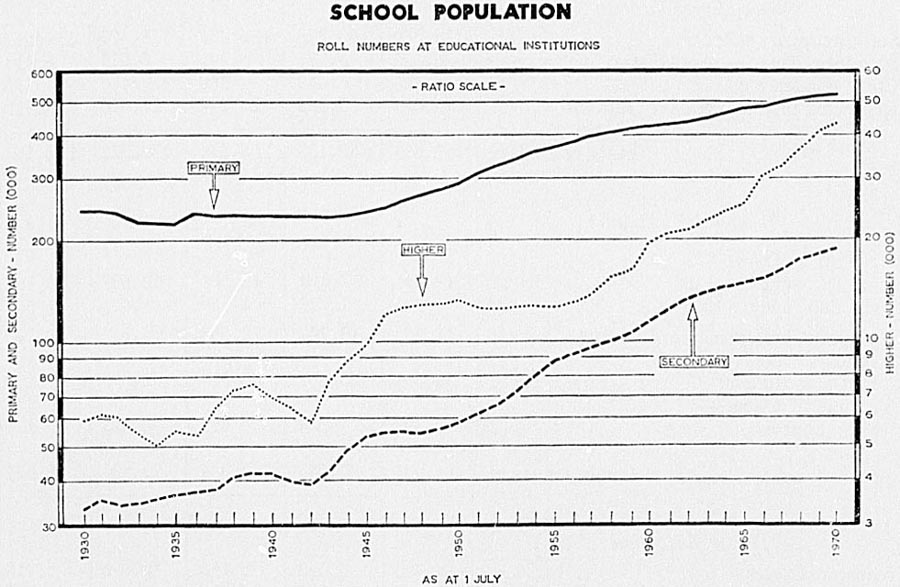
Projected figures for student enrolments are given in the following table. The totals given are “middle figures”, and expected percentage variations on these are given in Parliamentary paper £.2, 1967, School and University Enrolment Projections, which should be consulted for fuller explanations.
| As at 1 July | Projected Student Enrolments | ||
|---|---|---|---|
| State and Private Schools | Universities* | ||
| Primary | Secondary | ||
| * Academic year. Full-time and part-time internal students. | |||
| 1,970 | 523,700 | 185,600 | 28,100 |
| 1,971 | 528,200 | 191,300 | 29,400 |
| 1,972 | 526,800 | 200,600 | 30,600 |
| 1,973 | 526,700 | 209,500 | 32,100 |
| 1,974 | 526,700 | 217,900 | 33,900 |
| 1,975 | 525,600 | 228,100 | 35,700 |
| 1,976 | 528,800 | 233,900 | 37,500 |
| 1,977 | 534,800 | 238,300 | 39,900 |
| 1,978 | 546,600 | 237,800 | 42,200 |
| 1,979 | 562,200 | 236,000 | 44,500 |
| 1,980 | .. | 233,400 | 46,900 |
ANNUAL EXAMINATIONS—The numbers of candidates who presented themselves for the various examinations conducted by the Department of Education and by the Trades Certification Board during the latest five years are given below.
| Examination | 1965 | 1966 | 1967 | 1968 | 1969 |
|---|---|---|---|---|---|
| Teacher's Certificate | 387 | 373 | 280 | 259 | 236 |
| School Certificate | 37,980 | 38,411 | 41,234 | 49,937 | 53,666 |
| Technological | 138 | 133 | 11 | - | - |
| Samoan Public Service | 57 | - | - | - | - |
| Engineers' and Surveyors' Assistants | 89 | 45 | 26 | 18 | 22 |
| New Zealand Certificates | 1,533 | 2,005 | 2,550 | 2,924 | 3,210 |
| Technical Teacher's Certificate | 52 | 50 | 56 | 43 | 35 |
| Diploma in Teaching | 516 | 532 | 542 | 507 | 717 |
| Totals | 40,752 | 41,549 | 44,699 | 53,688 | 57,886 |
| Trades Certification | 13,410 | 14,280 | 15,701 | 15,815 | 19,366 |
Of the candidates in 1969 for School Certificate, 40,844, or 76.1 percent, gained a pass in one or more subjects, while 21 persons were awarded Certificates of Attainment.
Comparative figures for the number of candidates for the University Entrance Examination and the number of passes by accrediting and by examination are given in the following table.
| Year | Candidates | Passes | |
|---|---|---|---|
| Accredited | By Examination | ||
| 1,963 | 11,957 | 6,427 | 862 |
| 1,964 | 13,445 | 6,984 | 873 |
| 1,965 | 14,555 | 7,246 | 1,317 |
| 1,966 | 15,315 | 7,630 | 1,398 |
| 1,967 | 16,651 | 8,307 | 1,455 |
| 1,968 | 18,803 | 9,487 | 1,501 |
| 1,969 | 21,580 | 10,698 | 1,953 |
The universities conduct examinations in the faculties of arts, science, medicine, dentistry, home science, law, engineering, commerce, agriculture, music, architecture, and divinity; for diplomas in journalism, in fine arts, in banking, in social science, and in physical education; and for admission to the legal and accountancy professions. There were 31,494 entrants for the degree and professional examinations in 1969, compared with 28,821 in 1968.
PUBLIC EXPENDITURE ON EDUCATION—The following table shows the expenditure (after recoveries have been deducted) from public funds on each branch or service of education for the latest four years.
| Item | Expenditure Year Ended 31 March | |||
|---|---|---|---|---|
| 1967 | 1968 | 1969 | 1970 | |
| *Expenditure previously shown under Maori schools now appears under the appropriate branch of the Education Service | ||||
| Expenditure on education— | $(000) | |||
| General | 8,634 | 9,062 | 9,689 | 10,426 |
| Buildings, land, furniture, and equipment | 37,578 | 40,031 | 40,000 | 42,337 |
| Primary education | 46,284 | 50,690 | 55,035 | 62,464 |
| Secondary education | 27,718 | 30,383 | 33,277 | 38,262 |
| Senior technical education | 4,068 | 4,540 | 5,160x | 6,044 |
| University education | 15,685 | 19,212 | 21,863 | 25,276 |
| Training of teachers | 8,883 | 9,918 | 11,461 | 13,331 |
| Maori schools | 1,276 | 1,322 | 1,133x | * |
| Education of the blind | 546 | 610 | 475 | 527 |
| Special schools | 685 | 749 | 799 | 930 |
| Child welfare | 3,057 | 3,352 | 3,808 | 4,136 |
| Miscellaneous grants | 1,443 | 1,714 | 1,768 | 2,005 |
| National Library Service | 1,352 | 1,466 | 1,549 | 1,604 |
| Totals | 157,209 | 173,049 | 186,017 | 207,342 |
The foregoing figures do not include revenue received by universities from endowments, fees, etc., which are available for educational purposes.
The following figures show Government expenditure on education during the latest 12 years.
| Year Ended 31 March | Expenditure from Public Funds | Expenditure as Percentage of National Income | Expenditure per Head of Mean Population |
|---|---|---|---|
| *Provisional. | |||
| $(000) | percent | $ | |
| 1,959 | 71,858 | 3.7 | 31.26 |
| 1,960 | 78,336 | 3.7 | 33.40 |
| 1,961 | 87,106 | 3.9 | 36.47 |
| 1,962 | 93,658 | 4.0 | 38.34 |
| 1,963 | 102,832 | 4.1 | 41.16 |
| 1,964 | 113,574 | 4.1 | 44.54 |
| 1,965 | 128,988 | 4.3 | 49.59 |
| 1,966 | 140,509 | 4.4 | 53.08 |
| 1,967 | 157,209 | 4.7 | 58.33 |
| 1,968 | 173,049 | 5.0 | 63.22 |
| 1,969 | 186,017 | 5.0 | 67.32 |
| 1,970 | 207,342 | 5.1* | 74.23 |
An international comparison of public expenditure on education as a percentage of national income is given in the following table for selected countries. (Source: Organisation for Economic Co-operation and Development). Educational expenditures in many countries have been rising twice as fast as national income.
| Country | Public Expenditure on Education as percentage of National Income | |
|---|---|---|
| 1955 | 1965 | |
| Austria | 3.98 | 4.79 |
| Belgium | 3.99 | 6.48 |
| Canada | 3.50 | 7.63 |
| Denmark | 4.00 | 6.98 |
| France | 3.73 | 6.05 |
| Germany, West | 2.80 | 3.84 |
| Italy | 3.79 | 6.48 |
| Netherlands | 4.41 | 7.53 |
| Norway | 4.27 | 6.98 |
| Switzerland | 3.58 | 4.31 |
| United Kingdom | 3.32 | 5.21 |
| United States | 4.07 | 6.28 |
Australia's figure for 1965-66 (4.36 percent) was very similar to that for New Zealand. International comparisons need to be treated with reserve because of the differing education systems and expenditure measures.
Government Assistance for Independent Schools—From February 1970 central Government has made grants to independent schools on the basis of teachers' salaries. For the first year the proportion was 20 percent and the estimated cost $2.5 million; the proportion is to rise to a maximum of 35 percent over seven years. Associated government controls are approval before new independent schools can be built and the requirement that after a transitional period, new teacher entrants to independent schools must possess certain minimum qualifications.
TEACHING PROFESSION: Training of Teachers—In 1969 there were nine teachers colleges (North Shore, Auckland, Auckland Secondary, Ardmore, Hamilton, Palmerston North, Wellington, Christchurch, and Dunedin), catering for students who desired to enter the teaching profession. At 1 July 1968 there were 8,935 students in training. This number includes 1,751 holders of secondary teacher studentships (Division U) and 239 holders of primary teacher studentships (Division S) who are attached to teachers colleges while attending universities as full-time students as part of their training for teaching, and 543 Division C students undertook training for secondary teaching. From 1964, Endorsed School Certificate (now Sixth Form Certificate) has been the minimum academic qualification for admission to Division A. Division C students are university graduates or near graduates at the time of admission.
The following table shows the number of students in these two groups at 1 July.
| Year | Division A | Division C | Totals | ||
|---|---|---|---|---|---|
| Males | Females | Males | Females | ||
| 1,965 | 951 | 3,043 | 180 | 209 | 4,383 |
| 1,966 | 964 | 3,227 | 158 | 204 | 4,553 |
| 1,967 | 932 | 3,296 | 183 | 208 | 4,619 |
| 1,968 | 1,147 | 3,767 | 206 | 334 | 5,454 |
| 1,969 | 1,324 | 4,228 | 232 | 311 | 6,095 |
The normal course of training for Division A students has been a period of two years at a teachers college, followed by a further period of one year as a probationary assistant attached to a State primary school. The two-year course has been replaced progressively by a three-year course which was introduced at the Hamilton and Dunedin colleges in 1966, at Christchurch and Ardmore in 1967, Auckland and Wellington in 1968, and Palmerston North and North Shore (Auckland) in 1969. The primary teachers' studentship scheme which was introduced in 1965 enables a number of selected students to attend university full-time as part of the primary teacher training course. Specialist studentships are available to selected students who wish to become speech therapists or teachers of deaf children.
For students of Division C the course is for one year. These students are university graduates or near graduates who train for service in secondary schools. To enable students to qualify to teach home economics subjects, bursaries providing training at a teachers college and at a technical high school were instituted in 1943. There were 206 home economics students in the Auckland and Christchurch Teachers' Colleges in 1969. In 1969 approval was gained for the 2-year Homecraft and Commercial courses for teacher trainees to be lengthened to 3 years. The first 3-year Home Economics and Commercial courses began in 1970. A further 51 trainees were being trained in 1969 as manual training instructors. A concurrent secondary teacher training course (Division B) was introduced in 1966. The course provides for three years of concurrent training at a university or a technical institute and at a teachers college, and is available at Auckland Secondary Teachers College and at Christchurch Teachers College. There were 126 direct entrants to this course in 1969.
A special course for married women was introduced at Auckland in 1967. Twenty-eight students enrolled for this primary teacher training course in 1969 and attended the College during mornings only.
Secondary teachers' bursaries, although still awarded in some cases, have been largely replaced by secondary teacher studentships. To be eligible for one of these awards an applicant must have reached the age of 16 years on 31 December of the year of application, and must at the time of application have qualified for entrance to the university, or hold some equivalent or higher qualification approved by the Director-General of Education. Students are attached to the teachers college in the appropriate university centre, and a principal lecturer, appointed to each teachers college, supervises the work of the students and guides them during their university courses. Each student, on accepting the award, signs a bond that he will satisfy the stated conditions. One important condition is that if he does not achieve reasonable success in his university studies he will transfer to some other teacher training course at a teachers college and there complete his training as a teacher.
Students awarded a secondary teacher studentship are paid on the following scale, first year $455; second year $575; third year $700; fourth year $805. The student may also claim any university bursaries, boarding bursary, or supplementary allowances for which they are eligible under the University Bursaries Regulations 1966. The allowances for the year of post-graduate teacher-training are: with three-year bachelor's degree or three-year diplomas, $1,970; with master's degree without honours, or bachelor's degree with third class honours, $2,205; with honours degrees first and second class, $2,320.
In 1969, 600 secondary teacher studentships were taken up. In addition, 21 holders of secondary teachers' bursaries in 1968 qualified to transfer in 1969 to secondary teacher studentships.
There were 28 holders of secondary teachers' bursaries and 1,757 holders of secondary teacher studentships attending university institutions in 1969.
State Primary-school Teachers—The following table shows the number of teachers in State primary schools in the various education districts as at 30 September 1969, together with totals for 1968.
| — | Head Teachers | Sole Teachers | Assistant Teachers | Special Teachers | Probationary Assistants and First Year Teachers | Total Number of Teachers |
|---|---|---|---|---|---|---|
| Education District— | ||||||
| Auckland | 433 | 35 | 3,140 | 74 | 532 | 4,214 |
| South Auckland | 362 | 28 | 1,993 | 13 | 329 | 2,727 |
| Taranaki | 101 | 15 | 423 | 8 | 59 | 606 |
| Wanganui | 127 | 30 | 739 | 16 | 97 | 1,009 |
| Hawke's Bay | 162 | 38 | 863 | 15 | 132 | 1,210 |
| Wellington | 199 | 34 | 1,531 | 35 | 182 | 1,981 |
| Nelson | 54 | 12 | 308 | 6 | 44 | 424 |
| Canterbury | 262 | 49 | 1,626 | 28 | 262 | 2,227 |
| Otago | 139 | 30 | 639 | 19 | 114 | 941 |
| Southland | 113 | 22 | 472 | 8 | 65 | 680 |
| Totals, 1969 | 1,952 | 293 | 11,736 | 222 | 1,816 | 16,019 |
| Totals, 1968 | 1,934 | 323 | 11,548 | 178 | 1,613 | 15,596 |
The average number of pupils per teacher (including probationary assistants) in all public primary schools was 31.4 in 1933, 30.0 in 1940, 29.5 in 1968, and 29.5 in 1969; but the basis in recent years is September rolls and not average yearly attendance.
Secondary-school Teachers—The following table indicates the number of full-time teachers employed in the State schools providing secondary education. The principals are included except in the case of district high schools, the figures for which apply to assistants in the secondary department only.
| Year | State Secondary Schools | District High Schools | Totals | ||||
|---|---|---|---|---|---|---|---|
| Males | Females | Males | Females | Males | Females | Combined | |
| 1,964 | 3,468 | 2,064 | 240 | 103 | 3,708 | 2,167 | 5,875 |
| 1,965 | 3,913 | 2,424 | 215 | 90 | 4,128 | 2,514 | 6,642 |
| 1,966 | 4,055 | 2,503 | 197 | 83 | 4,252 | 2,586 | 6,838 |
| 1,967 | 4,171 | 2,691 | 179 | 91 | 4,350 | 2,782 | 7,132 |
| 1,968 | 4,326 | 2,947 | 183 | 93 | 4,509 | 3,040 | 7,549 |
| 1,969 | 4,618 | 3,392 | 160 | 81 | 4,778 | 3,473 | 8,251 |
The numbers of teachers employed in State schools providing secondary education rose from 908 male teachers and 630 female teachers in 1940 to 4,509 and 3,040 respectively in 1969. In the latter year there were also 1,290 teachers (652 male and 638 female) employed in private secondary schools.
FREE TEXTBOOKS IN SCHOOLS—Free textbooks were supplied to all primary and secondary pupils in both State and private schools from the beginning of 1959. Under the free textbooks scheme, the books remain the property of the school controlling authorities and are issued on loan to pupils. The school authorities have a wide discretion in their choice of suitable books.
SCHOOL LIBRARY SERVICE—This service, which is financed by the Department of Education and administered by the National Library of New Zealand, aims at giving children access to the best literature. Regular exchanges of children's and young people's books are sent on a circulating basis to approximately 2,500 schools. The schools served are primary, both public and private, intermediate, and district high schools. Pupils of the Correspondence School also receive books regularly.
All schools, including secondary schools, receive additional books on request. Some 910,041 requests were filled during the year 31 March 1968.
AUDIO-VISUAL TEACHING AIDS—Regular broadcasting programmes for schools were initiated in 1931. A varied series of programmes linked with the curriculum are broadcast each school day from all main national stations. Special lessons are also broadcast each day for Correspondence School pupils.
Audio-Visual Aids—The National Film Library, a branch of the Department of Education, lends films and gramophone records free of charge to schools. It also lends films free-of-charge to other organisations having some educational purpose. Films are also supplied to the education services in Western Samoa, and in the Tokelau, Niue, Pitcairn, Cook, and Chatham Islands. A branch of the library situated in Auckland supplies films to schools and organisations in the upper half of the North Island and another in Christchurch serves the South Island except Nelson and Marlborough. The rest of New Zealand is serviced from Wellington.
The Library contains more than 32,000 films with over 8,000 titles. Up to 7,500 reels of film are issued each week, and of these 80 percent go to schools or colleges. Approximately 2,700 schools and 2,800 other organisations having some educational purposes benefit from this service.
A Number of filmstrips are produced each year by the Visual Production Unit. These and selected productions from overseas are available to schools on free loan from filmstrip libraries in the offices of education boards. They can also be purchased by schools for a nominal sum from the Department of Education. More than 1,500 titles are available to primary and secondary schools. Up to 36,000 issues of filmstrips are made each year. Nearly all schools are equipped with filmstrip projectors.
A tape-copying service is also provided by the National Film Library for schools, teachers colleges, and universities. Tapes submitted are transcribed from master tapes held by the National Film Library. The catalogue includes more than 200 master tapes.
A gramophone record library of 2,540 titles and 5,069 records is available for use by schools and teachers colleges. Issues exceed 12,600 records a year.
Museums—To assist schools to make the fullest use of the museums, an education officer is attached jointly to the museum and the teachers' training college in each of the four main centres. Cases of exhibits are circulated amongst schools where pupils are unable to make regular visits to a museum.
School Publications—The School Journal, an illustrated paper, is published in four separate parts suitable for pupils in the various standard classes. Parts 1 and 2 are published six times in the year while Parts 3 and 4 for the senior classes appear four times a year. Bulletins dealing with topics of New Zealand history, geography, and nature study, and family life in other countries, are published every year. These and other publications are prepared in the School Publications Branch of the Department of Education and issued free to all primary and intermediate schools, both State and private.
New mathematics textbooks are being issued to all primary pupils in standards one to four and Forms I and II. Teachers of these classes have received manuals for the teaching of mathematics. This is part of a programme to replace the present series of arithmetic books used in all classes in primary schools with modern mathematics books.
A wide range of syllabuses, textbooks, and handbooks is published for secondary and primary schools.
Bulletins for Schools (secondary) are published five times a year and issued free to all State and private secondary schools. They provide background reading for subjects of the revised curriculum, particularly in social studies, science, and literature. Te Wharekura, a bulletin in the Maori language, is published three times a year and issued free to secondary pupils studying Maori language.
The Education Gazette is published by the Department twice a month. It is a medium for the dissemination of official information and for the advertisement of vacancies. Copies are distributed to educational authorities and to State and private schools.
Education, a magazine for teachers, is published 10 times a year.
A number of publications are published for the New Zealand Broadcasting Corporation to accompany the broadcasts to schools.
VOCATIONAL GUIDANCE—There are vocational guidance centres at Auckland, Papatoetoe, Hamilton, Napier, Wellington, Lower Hutt, Christchurch, and Dunedin. Vocational guidance officers see young people, and often their parents, at the centres, as well as visiting the secondary schools throughout the country. In the secondary schools, careers advisers are appointed from among the teachers. They spend part of their time on careers work, in close contact with the vocational guidance officers who keep them informed, by means of careers leaflets and bulletins, with up-to-date particulars about qualifications, entry, and training for some 700 occupations.
For the year ended 31 December 1969 interviews with young people at the centres numbered 17,066 and an additional 11,392 interviews were undertaken by vocational guidance officers in schools. Various one-week courses are conducted, mostly for pupils, by all centres. These include careers courses (visits to and discussions on places of employment), “Living in the City” or citizenship courses for rural pupils, and two residential courses for newly-appointed careers advisers. Short seminars for careers advisers are conducted in Auckland. These are to be extended to other districts.
UNIVERSITY EDUCATION—The system of university education in New Zealand has evolved in recent years from a federal university with constituent colleges to a system of separate universities and a university college of agriculture. These are the University of Auckland, the University of Waikato (at Hamilton), Massey University (at Palmerston North), the Victoria University of Wellington, the University of Canterbury (at Christchurch), and the University of Otago (at Dunedin), with Lincoln College a constituent agricultural college of the University of Canterbury.
At the centre there is the University Grants Committee which functions under the Universities Act 1961. The primary functions of the University Grants Committee is to advise the Government of the needs of New Zealand for university education and research. It determines the allocation of grants of money which it recommends for appropriation by Parliament to meet these needs, and reviews the expenditure by the universities of money appropriated by Parliament. The University Grants Committee is also responsible for the award of scholarships, and through its statutory subcommittee, the Research Committee for the distribution of a Government grant for research. Another statutory subcommittee of the University Grants Committee, the Curriculum Committee, has responsibility in respect of the development of courses for degrees and diplomas. In the performance of its duties it is required to have regard to the comparative equivalence of courses.
The Universities Entrance Board was established on 1 January 1962 to maintain a common educational standard for admission to the universities. The Board prescribes the conditions of examinations for University Entrance, Entrance Scholarships, the University Bursaries Examination, and Fine Arts Preliminary.
The special problems of legal education are the province of the Council of Legal Education which prescribes the examination requirements for admission of candidates as barristers and solicitors of the Court.
The characteristics of university systems vary from country to country. They show marked differences in levels and sources of finance, public or private; in the constitution of the student population and the means adopted to support it; and in the relationships of the universities to other forms of tertiary education. The characteristics of the New Zealand university system are distinguishable from those of other national systems and may be partly explained as reflecting the New Zealand point of view. Thus, in our welfare state, there has arisen a public expectation that most of the finance required for the capital and running needs of the universities, and for a contribution towards the support of students by bursaries will come from the public purse.
The test which applies to enter a university is not financial but achievement at secondary school, and this test has been diversified and sharpened in recent years. In a country where equality of opportunity for self-improvement still counts for much, the right to a university education is conferred by qualifying for University Entrance. It is true that the relatively open system of admission entails some uncertainties about student numbers and planning university facilities for them. It also leads to higher failure rates arising from the mixed quality of the first-year intake. But this situation is improving in some respects without depriving the universities of their characteristic of open entry. Upper sixth-form work is now taken by the majority of entrants to the universities, and the fees charged and bursaries paid are now more closely geared to successful study after entry. It is likely, too, that the strengthening and diversifying of courses offered in the technical institutes will enable them to cater better for some students and improve the efficiency of tertiary education as a whole. In the meantime, however, relatively ready access to university education associated with flexible degree structures meets the national needs well and at a cost which is modest by overseas standards.
Apart from the income from students' fees and the relatively small amounts now available to some of the universities from endowments, the block grants from the Government determine the income of the universities to meet their running costs for each 5 years. Under the block grant system that has been in operation since 1950, grants have been calculated and approved 5 years in advance to enable the universities to plan their activities ahead in the knowledge of what their income from the Government will be. They are block grants in the sense that they are not itemised and their detailed calculation is not disclosed to the universities. This has the effect of making the governing bodies—the university councils—not only responsible for arranging their budgets within their incomes, but also free to make their own decisions about the allocation of new expenditure among the many competing academic proposals which arise within the institutions. With these grants the university councils have an obligation to cater for substantially increased student numbers by expanding existing classes and, subject to the scrutiny of the Curriculum Committee, to offer such new courses as they see to be warranted by the demands put on them by the students and by the New Zealand community in which they exist.
The universities regard as their primary function the pursuit and dissemination of knowledge through study, teaching and research. They have always endeavoured to perform this function with due regard to the specific needs of New Zealand, through their professional schools and through the general disciplines.
The universities in Auckland, Wellington, Canterbury, and Otago, besides offering courses in the faculties of arts, science, commerce, law, and music, specialise in certain fields. The University of Otago provides courses in medicine and dentistry, mineral technology, home science, and physical education; the University of Canterbury provides courses in engineering (mechanical, electrical, civil, and chemical) and fine arts; the University of Auckland provides courses in architecture, fine arts, engineering (mechanical, chemical and materials, electrical, engineering science, and civil), and medicine; and the Victoria University of Wellington provides courses in public administration and social science. Massey University provides courses in agriculture, horticulture, food technology, and veterinary science, as well as courses in arts and science, and also provides extramural tuition in a number of subjects to students throughout New Zealand. The establishment of a veterinary faculty at Massey University in 1964 removed New Zealand's dependence on Australia for the training of veterinary surgeons. The University of Waikato offers courses in the schools of humanities, social sciences and science, and in association with the Hamilton Teachers College, offers courses in its School of Education leading to a Diploma in Education and the degree of Bachelor of Education.
Free University Education: Scholarships—The most important awards for those entering university are the University Junior Scholarships. These scholarships are tenable for three to six years, depending upon the minimum time in which the holder, studying full-time, could complete the recognised course taken under the scholarship. The University Junior Scholarship provides a scholarship allowance of $220 a year and is tenable with a fees and allowances bursary (see Bursaries below). These scholarships, together with certain privately endowed scholarships, are awarded on the results of the Entrance Scholarships Examination conducted by the Universities Entrance Board.
Scholarships awarded during degree courses include Senior Scholarships awarded by the individual universities and Lincoln College (and of a value to be determined by them). The various university institutions also have private scholarships for which their own students may compete. The scholarships awarded at the end of the university course, which are listed in full in the university calendars, include the Rhodes Scholarships, the 1851 Exhibition Scholarships, Post-graduate Scholarships and Post-doctoral Fellowships, the Macmillan Brown Agricultural Scholarship, the Shirtcliff Scholarships, the Gordon Watson Scholarship, the Shell Post-graduate Scholarship, the Michael Hiatt Baker Scholarship, the Rutherford Scholarships, and the National Research Scholarships. Many of the Postgraduate Scholarships and some of the Post-doctoral Fellowships are tenable in New Zealand. The other awards are in general tenable overseas.
University Bursaries—The system of bursaries for students entering upon a university course is set out in the University Bursaries Regulations 1966, which were made following a full review of the scheme that had been in operation from 1912 to 1965. Bursaries available to students are fees bursaries, fees and allowances bursaries, and masters bursaries. There is provision for the award of supplementary allowances with a fees and allowances bursary to students who satisfy the scholastic or academic requirements. The supplementary allowances were paid for the first time in 1967. In general, fees and fees and allowances bursaries are tenable for the minimum period, not exceeding six years for medicine, or five years for other courses, in which a student following a full-time course in each year could complete the recognised course taken under the bursary. There is provision for these bursaries to be extended for an additional year in any case where, in the opinion of the Director-General of. Education, the personal circumstances of the bursar warrant it. There is also provision for the extension of a bursary for a limited period to assist students undertaking a second recognised course of study.
Fees Bursaries are awarded to students following part-time or full-time courses who have qualified for entrance to the university either by examination or accrediting, been admitted ed eundum statum, or who, having been granted provisional admission, pass two units in any one year. These bursaries provide for payment of tuition fees during their term.
Fees and Allowances Bursaries are awarded to students who hold the Higher School Certificate and are tenable for any recognised course at a university provided that the bursar undertakes a full-time course of study in each year of the bursary. Also, a student who in any year is credited with passes in the subjects or units comprising a full-time course may transfer from the fees bursary to a fees and allowances bursary.
A fees and allowances bursary entitles the holder to payment of tuition fees plus allowances of $120 in the first year of the bursary, $165 in the second year, $210 in the third year, $255 in the fourth year, $300 in the fifth year, and $345 in the sixth and later years.
The allowances at these higher rates apply from 1972. Masters bursaries have been eliminated. Instead, students whose bursaries are extended for masters courses will receive the allowance appropriate to the year of tenure of their bursaries, plus whatever supplementary allowance they may be qualified for.
The holder of a fees and allowances bursary who is obliged to live away from his home or his usual place of residence in order to attend a university affording tuition in the subjects appropriate to his course and year may also qualify for a boarding allowance of $300 a year.
Supplementary Allowances are awarded to students who gain the required standard of passes in the university bursaries examination or in the entrance scholarship examination and who are holding a fees and allowances bursary. A supplementary allowance may also be awarded to a student who gains the requisite grade of pass in the subjects or units of a full-time university course.
All these bursaries are subject to strict rules as to suspension and cancellation. A student who in any year does not pass in a prescribed number of units or subjects will have his bursary suspended and it will not be reinstated unless in the following year he is credited with a prescribed number of passes. Only one such suspension is allowed and subsequent failure results in the termination of the bursary.
Further details of the amounts payable and other qualifying conditions for the various classes of bursaries are available from vocational guidance centres and from the Head Office of the Department of Education, Wellington.
The Government offers for competition annually four bursaries to students wishing to attend the School of Social Science at the Victoria University of Wellington. Preference is given to candidates nominated by church or other organisations engaged in social work. These bursaries provide for full fees, a bursary allowance of $210, and a boarding allowance of $300 where appropriate.
The total number of University National, Entrance, Higher School Certificate, fees, and fees and allowances bursaries current in 1969 was 15,257.
Bursaries, scholarships, and fellowships are also awarded annually by other Government Departments and include medical, dental, physiotherapy, and dietetic bursaries (Department of Health), national research scholarships and national research fellowships (Department of Scientific and Industrial Research), rehabilitation bursaries (Social Security Department), coal-mining bursaries (Mines Department). Study awards are made to selected public servants to enable them to undertake university study. The Department of Education has a system of studentships with generous allowances available for those intending ultimately to qualify as secondary teachers.
The following table gives the number of students, including those taking short courses at agricultural colleges, who received free university education during each of the latest five years.
| Year | Junior University, University National, and Taranaki Scholarships | Senior University Scholarships | University National, Entrance, and H.S.C. Bursaries* | Teachers' College Studentships | Other | Total |
|---|---|---|---|---|---|---|
| *Includes also fees, fees and allowances, and Masters' Bursaries awarded under University Bursaries Regulations. | ||||||
| 1,965 | 266 | 57 | 9,260 | 1,865 | 2,850 | 14,298 |
| 1,966 | 296 | 64 | 10,719 | 1,913 | 3,409 | 16,401 |
| 1,967 | 343 | 72 | 12,319 | 1,968 | 3,493 | 18,195 |
| 1,968 | 369 | 75 | 14,640 | 2,027 | 2,899 | 20,010 |
| 1,969 | 387 | 84 | 15,999 | 1,990 | 3,467 | 21,927 |
Holders of rehabilitation bursaries numbered 54 in 1965, 59 in 1966, 53 in 1967, 43 in 1968, and 45 in 1969.
Students—In 1969 there were 31,494 students actually in attendance at the seven universities; 2,800 were graduates, 26,861 undergraduates (452 were enrolled in more than one course). In addition, there were 2,285 students attached to the various universities, but exempt from lectures, and 404 students who were taking short courses. Comparable figures for the latest five years are given in the following table. Students now exceed one percent of the population.
| Year | Students Attending Lectures | Exempt Students | Total | ||
|---|---|---|---|---|---|
| Males | Females | Males | Females | ||
| 1,965 | 14,937 | 5,332 | 1,252 | 624 | 22,145 |
| 1,966 | 16,300 | 6,077 | 1,273 | 652 | 24,302 |
| 1,967 | 17,571 | 6,860 | 1,219 | 663 | 26,313 |
| 1,968 | 19,170 | 7,624 | 1,272 | 755 | 28,821 |
| 1,969 | 20,732 | 8,477 | 1,385 | 900 | 31,494 |
The following table gives particulars of internal students who were taking definite courses at universities, including agricultural college, during the latest three years. Additional information is published in Education Statistics of New Zealand available from the Department of Education, Wellington.
| Course | 1967 | 1968 | 1969 | ||||||
|---|---|---|---|---|---|---|---|---|---|
| Males | Females | Total | Males | Females | Total | Males | Females | Total | |
| Agricultural | 1,261 | 47 | 1,308 | 1,756 | 84 | 1,840 | 1,712 | 83 | 1,795 |
| Architectural | 516 | 12 | 528 | 512 | 13 | 525 | 489 | 14 | 503 |
| Arts and music | 4,501 | 4,551 | 9,052 | 5,090 | 5,162 | 10,252 | 5,080 | 5,514 | 10,594 |
| Commerce | 2,684 | 138 | 2,822 | 2,741 | 166 | 2,907 | 2,896 | 190 | 3,086 |
| Divinity | 27 | - | 27 | 31 | 1 | 32 | 22 | 5 | 27 |
| Education | 146 | 89 | 235 | 233 | 355 | 588 | 243 | 349 | 592 |
| Engineering | 1,821 | 10 | 1,831 | 1,975 | 12 | 1,987 | 2,213 | 19 | 2,232 |
| Fine Arts | 154 | 148 | 302 | 149 | 147 | 296 | 133 | 134 | 267 |
| Food Technology | 48 | 7 | 55 | 42 | 9 | 51 | 117 | 20 | 137 |
| Home Science | - | 229 | 229 | - | 232 | 232 | - | 236 | 236 |
| Law | 1,617 | 100 | 1,717 | 1,741 | 134 | 1,875 | 1,907 | 181 | 2,088 |
| Medical and Dental | 1,103 | 265 | 1,368 | 1,027 | 207 | 1,234 | 1,041 | 212 | 1,253 |
| Physical Education | 67 | 115 | 182 | 71 | 121 | 192 | 79 | 120 | 199 |
| Science | 3,414 | 851 | 4,265 | 3,912 | 953 | 4,865 | 4,243 | 1,073 | 5,316 |
| Surveying | 88 | - | 88 | 65 | - | 65 | 65 | - | 65 |
| Veterinary Science | 91 | 15 | 106 | 93 | 6 | 99 | 270 | 31 | 301 |
| Others | 393 | 339 | 732 | 185 | 117 | 302 | 582 | 388 | 970 |
| 17,931 | 6,916 | 24,847 | 19,623 | 7,719 | 27,342 | 21,092 | 8,569 | 29,661 | |
| Adjustment for students enrolled in more than one course | 360 | 56 | 416 | 453 | 95 | 548 | 360 | 92 | 452 |
| Totals | 17,571 | 6,860 | 24,431 | 19,170 | 7,624 | 26,794 | 20,732 | 8,477 | 29,209 |
The spread of these students over the universities in 1969 was: University of Auckland, 8,622; University of Waikato, 538; Victoria University of Wellington, 5,438; University of Canterbury, 6,243; University of Otago, 4,880; Massey University, 2,494; Lincoln College, 994.
In addition, there were 2,285 extra-mural students, 1,733 taking courses at Massey University and 552 taking courses at their own university.
Staff—The teaching staff of the universities and agricultural colleges in 1969 consisted of 1,938 persons on full-time appointment and 657 persons working part-time. On full-time appointment there were 265 professors, 754 senior lecturers, 664 lecturers, 224 junior lecturers, and 31 instructors and demonstrators engaged in teaching. Non-teaching staff numbered 2,096 full-time and 271 part-time workers.
Graduates—The numbers of degree graduates from New Zealand universities in 1968 and 1969 are shown in the following table.
| Course | First Degree | Post-Graduate | Post-Graduate Honours | |||
|---|---|---|---|---|---|---|
| 1968 | 1969 | 1968 | 1969 | 1968 | 1969 | |
| Agriculture | 1 | 4 | - | - | - | - |
| Agricultural Science | 68 | 82 | 8 | 4 | 20 | 24 |
| Horticulture | 2 | - | - | - | - | - |
| Horticultural Science | 4 | 16 | - | - | 3 | 1 |
| Architecture | 39 | 29 | 1 | 2 | - | - |
| Arts | 1,089 | 1,190 | 83 | 90 | 289 | 310 |
| Commerce | 234 | 307 | 4 | 9 | 21 | 28 |
| Dental Surgery | 48 | 50 | 1 | - | 4 | 3 |
| Divinity | - | - | 17 | 13 | - | - |
| Education | - | - | - | 1 | - | - |
| Engineering (Chemical) | 21 | 21 | 13 | 27 | 4 | 2 |
| Engineering (Civil) | 109 | 144 | ||||
| Engineering (Electrical) | 71 | 70 | ||||
| Engineering (Mechanical) | 46 | 37 | ||||
| Engineering (Metallurgical) | - | 5 | ||||
| Food Technology | 9 | 15 | 3 | 2 | 1 | 1 |
| Home Science | 3 | 23 | 1 | 1 | - | - |
| Laws | 154 | 181 | 1 | 5 | 22 | 14 |
| Medical Science | 4 | 5 | - | - | - | - |
| Medicine and Surgery | 108 | 118 | - | - | - | 2 |
| Music | 11 | 20 | - | 6 | 3 | - |
| Pharmacy | 11 | 10 | - | - | - | - |
| Science | 613 | 727 | 45 | 70 | 140 | 117 |
| Veterinary Science | 21 | 22 | - | - | 2 | 1 |
| Totals | 2,666 | 3,076 | 177 | 230 | 509 | 503 |
In addition in 1968 doctorates were completed in Science (3), Medicine (4), and Philosophy (63), Literature (1), and Laws (1), while in 1969 there were Science (7), Medicine (10), Philosophy (89), Dental Surgery (1), Letters (1), and Literature (1).
Of those graduating with first degrees in 1968, 43 percent completed their qualifications in the minimum time, 27 percent in the minimum time plus one year, 12 percent in the minimum time plus two years, and 18 percent took, over two years beyond the minimum time.
Time taken to complete First Degrees—The following table shows the time taken to complete first degrees for the year ending with the graduation ceremonies in 1969.
| Degree | Minimum Time | Minimum Time + One Year | Minimum Time + Two Years | Minimum Time + Over Two Years | All Students | |||||
|---|---|---|---|---|---|---|---|---|---|---|
| Total | Women | Total | Women | Total | Women | Total | Women | Total | Women | |
| Bachelor Honours | ||||||||||
| Law | 15 | 1 | 3 | 1 | 2 | - | - | - | 20 | 2 |
| Science | 112 | 13 | 15 | 3 | - | - | - | - | 127 | 16 |
| Engineering | 96 | - | 7 | - | - | - | - | - | 103 | - |
| Other | 9 | 1 | 1 | - | - | - | 1 | 1 | 11 | 2 |
| Totals | 232 | 15 | 26 | 4 | 2 | - | 1 | 1 | 261 | 20 |
| Bachelor | ||||||||||
| Arts | 476 | 301 | 384 | 217 | 131 | 60 | 199 | 70 | 1,190 | 648 |
| Commerce | 109 | 9 | 81 | 4 | 53 | 2 | 64 | 1 | 307 | 16 |
| Laws | 80 | - | 36 | 1 | 17 | 2 | 28 | 1 | 161 | 4 |
| Science | 239 | 76 | 225 | 57 | 68 | 11 | 68 | 8 | 600 | 152 |
| Engineering | 69 | 1 | 49 | 2 | 28 | - | 28 | - | 174 | 3 |
| Medicine and Surgery | 76 | 13 | 23 | - | 12 | 1 | 7 | - | 118 | 14 |
| Agricultural Science | 47 | 3 | 23 | - | 8 | 1 | 4 | - | 82 | 4 |
| Other | 93 | 34 | 61 | 10 | 18 | 5 | 11 | 1 | 183 | 50 |
| Totals | 1,189 | 437 | 882 | 291 | 335 | 82 | 409 | 81 | 2,815 | 891 |
TECHNICAL EDUCATION—Technical education (in its broadest sense of vocational education) falls into two categories—that provided while the student is still a secondary school pupil and that available to those who have completed their secondary school education but who wish to undertake training either full-time or while employed.
The technical education of adolescents who have completed their secondary schooling but who wish to begin or extend the training for their chosen vocation other than at university is provided in a number of ways. In the four main centres, plus one provincial centre, there are technical institutes which are concerned solely with vocational training. In smaller centres tertiary education of this sort is provided at secondary schools on a part-time basis (very occasionally as full-time courses), often in the evening. The work of these two groups is supplemented by the Technical Correspondence Institute, which, as its name implies, restricts its activities to correspondence tuition for technical subjects. Its instruction is an important addition to that of the “live” classes in that it enables instruction to be given to people living in areas where numbers are insufficient to justify local classes and also to supplement day practical classes where numbers are insufficient for local evening theory classes.
A considerable element of the technical education concerns apprentices, who receive both practical and theoretical training. The practical training is given at either day classes, with the employers granting apprentices the equivalent of half a day a week to attend, or else at block courses where the employers release the apprentices usually for three weeks each year to attend concentrated full-time instruction up to Trade Certificate level. In both cases the employers pay the apprentices for the time spent at classes. The full-time block courses are usually at regional or national centres and there is a growing trend towards this type of practical instruction as more National Apprenticeship Committees press for block courses and as the numbers of apprentices in individual trades grow to the stage where they are sufficient for block courses in regional centres. In 1969 over 90 percent of apprentices received their practical instruction at block courses. This practical instruction is supplemented by instruction in theory at evening classes, where numbers are sufficient to justify local classes, or else by correspondence tuition from the Technical Correspondence Institute. The examinations for apprentices are administered by the Trades Certification Board.
An important section of technical education which is growing steadily is that available at the technician level. The term “technician” covers a wide field, but national New Zealand certificate courses have been devised for engineering, draughting, draughting (architectural), science, building, quantity surveying and commerce. In addition, at a lower level, there is a certificate in garage management and courses leading to certificates for radio technicians, telegraph and telephone technicians, engineering technicians, survey technicians, automotive engineering technicians and forest rangers. The courses for these qualifications, and other courses not on a certificate basis, are devised by the Technicians Certification Authority, which was established under the Technicians Certification Act 1958 to prescribe courses and syllabuses and conduct examinations appropriate to the needs of persons in occupational groups. The instruction for the New Zealand certificate courses is given at part-time classes, or on a sandwich basis (i.e., regular intermittent periods in full-time classes), or by correspondence tuition from the Technical Correspondence Institute supplemented in the case of science and workshop by short practical courses, usually of one week per subject at junior levels and three weeks at the senior levels. All these practical block courses are at the Central Institute of Technology. In a few cases the stages can be taken at full-time courses in the technical institute, but for the first two or three years only. All New Zealand Certificates require students to be suitably employed during the last two stages of the courses.
In addition to the national trade and technician courses, there are a large number of courses available which have been organised regionally to meet local demands. These include commercial courses for girls, work study and electronic data processing courses, courses in journalism and in industrial and commercial design. In addition, instruction is given on the examination syllabuses devised by independent organisations, e.g., the New Zealand Society of Accountants, Chartered Institute of Secretaries, New Zealand Institute of Valuers, etc.
Besides the Technical Correspondence Institute, there are the following technical institutes: Auckland Technical Institute, Waikato Technical Institute (at Hamilton), Wellington Polytechnic, Christchurch Technical Institute, and Otago Polytechnic (at Dunedin). At Auckland, the first “satellite” institute at Manukau opened in 1970. There is also a Central Institute of Technology at Petone; this is to move to a new site in a few years' time, when it will become a purely national school offering courses for which there is not a sufficient regional demand to justify local courses. The facilities at Petone will be used for a second institute serving the Wellington region. Expansion into smaller provincial cities has commenced in 1971 with the opening of a technical institute in Palmerston North.
In 1969 there were 183 centres at which technical classes for part-time day and evening students were provided and the numbers of students are shown in the following tables; the figures in brackets indicate the students attending technical institutes.
| Class | Day Only or Day and Evening | Evening | Sandwich and Block | Total |
|---|---|---|---|---|
*Includes 8,535 taking Technical Correspondence Institute courses. †Includes 5,630 taking Technical Correspondence Institute courses. | ||||
| Part-time Students | ||||
| Trade | 2,188 | 20,033 | 13,465 | 35,686 |
| (807) | (16,400)* | (12,045) | (29,252) | |
| Professional and technical | 6,151 | 13,050 | 3,081 | 22,282 |
| (5,888) | (10,086)† | (3,081) | (19,055) | |
| Other (includes hobby classes) | 3,167 | 52,406 | - | 55,573 |
| (1,235) | (6,221) | (-) | (7,456) | |
| Sub-totals | 11,506 | 85,489 | 16,546 | 113,541 |
| (7,930) | (32,707) | (15,126) | (55,763) | |
| Full-time Students | ||||
| All classes | 1,661 | ... | ... | 1,661 |
| (1,536) | (1,536) | |||
| Totals | 13,167 | 85,489 | 16,546 | 115,202 |
| (9,466) | (32,707) | (15,126) | (57,299) | |
N.Z. Technical Correspondence Institute—The Technical Correspondence Institute was established in Wellington in 1946 as a school to provide correspondence instruction in vocational and technical subjects for apprentices and advanced students unable to attend technical schools or classes.
The expansion of the work of the institute has been remarkable. In 1946 it had a staff of two teachers and gave instruction in 12 technical subjects. Instruction is now given in 589 technical subjects. This work is mainly in three categories: first, the teaching of students through marking and commenting on their test papers, and the supervision of their studies; second, the preparation of new, and the revision of old, lessons for students' use; third, the preparation of textbooks on technical subjects. So far the institute has published 13 textbooks.
The main function of the Institute, is to provide technical education from apprentice up to advanced technician level for those who are unable to obtain such education through the usual institutions. In particular, the Institute meets many demands for technical education in the building, electrical, and engineering occupations, and also provides courses in agriculture and horticulture, dairy manufactures, management and commerce, mining and fire engineering, surveying, textiles, and valuation. As all students are employed in an industry or profession, their correspondence studies are supported by the practical experience.
The work of the Technical Correspondence Institute parallels the teaching given in the other senior technical institutes, and instruction is given in many subjects not taught elsewhere. The Institute plays an important role in the education of many of the apprentices who sit the annual examinations of the Trades Certification Board. It also prepares a large percentage of candidates for the various examinations of the Technicians Certification Authority in engineering, building, commerce, draughting, and science as well as for other professional and industrial examinations.
The number of students on the roll at 1 August 1969 was 14,165. There is an establishment of 236 full-time tutors, besides the Principal, and some 60 administrative staff.
Vocational Training Council—This Council was established by the Vocational Training Council Act 1968. Its responsibilities and activities are set out in Section 32, Employment.
In addition to the Chairman, other members are the Director-General of Education; the Secretary of Labour; two nominees of the New Zealand Employers' Federation Incorporated and the New Zealand Federation of Labour; one nominee of the New Zealand Manufacturers' Federation Incorporated, the Technical Education Association, and the Technicians Certification Authority of New Zealand; and three associate members, namely, a representative each from the State Services Co-ordinating Committee, and the Combined State Service Organisations, and the Chairman of the University Grants Committee.
EDUCATIONAL QUALIFICATIONS OF LABOUR FORCE—The Census of Population and Dwellings 1966 included a question on the highest educational qualifications obtained. An analysis concerning persons in the labour force is set out in the following table; where persons have more than one qualification they have been included only once in the higher academic qualifications, for example, certificated teachers with a university degree are included in the university qualification group.
| Qualification | Males | Females | Total |
|---|---|---|---|
*Includes electricians', plumbers', carpenters', joiners', radio and T.V. servicemen's, and motor mechanics'. †Includes Intermediate grades of Technician Certification Authority examinations, Police, Fire Brigade and Armed Forces examinations, overseas trade examinations, etc. ‡Mainly the Proficiency Certificate or Junior Free Place (43,029 males, and 11,308 females) and other primary certificates including the Certificate of Competency (6,531 males and 1,470 females). | |||
| University— | |||
| Doctorate | 897 | 69 | 966 |
| Master's degree | 4,014 | 848 | 4,862 |
| Bachelor's degree | 14,876 | 2,652 | 17,528 |
| Diploma | 3,388 | 683 | 4,071 |
| Other | 3,419 | 81 | 3,500 |
| Teacher's Certificate | 7,164 | 9,925 | 17,089 |
| Secondary— | |||
| Higher School Certificate or equivalent, University Entrance Scholarship Examination | 5,538 | 2,028 | 7,566 |
| University Entrance | 25,259 | 9,968 | 35,227 |
| School Certificate | 33,879 | 22,538 | 56,417 |
| Other | 22,343 | 8,532 | 30,875 |
| Professional and higher trade | 16,895 | 9,135 | 26,030 |
| Trade certificate* | 8,136 | 7 | 8,143 |
| Other trade certificate† | 7,495 | 498 | 7,993 |
| Business college | 795 | 9,376 | 10,171 |
| Other qualification‡ | 50,478 | 13,612 | 64,090 |
| No qualification | 541,019 | 190,492 | 731,511 |
| Totals | 745,595 | 280,444 | 1,026,039 |
NATIONAL DEVELOPMENT—In 1969 the National Development Conference adopted a number of recommendations on education in relation to national development. Background information to the recommendations is contained in the Report of the Education, Training, and Research Committee available in Government bookshops. An Advisory Council on Educational Planning has been set up as a continuation measure.
NEW ZEALAND COUNCIL FOR EDUCATIONAL RESEARCH—The Carnegie Corporation of New York was instrumental in founding the New Zealand Council for Educational Research in 1933 and supported it with grants for 10 years. Since 1945 the Council has been supported partly by State funds, the remainder coming from contributions from educational bodies, philanthropic foundations, business organisations, and its own trading operations. It has remained however under independent control as provided for in the New Zealand Council for Educational Research Act 1945.
In its research programme, the Council has concentrated on New Zealand problems, and its publications (47 research reports and 19 shorter studies in education) include critical surveys of major policy issues in New Zealand education and accounts of outstanding experiments in school practice. These have brought about or helped reshape major developments in such areas as secondary, university, and adult education, intermediate schools, consolidation of rural schools, and care of children with special needs.
In 1955 the Council established a special Test Development Division to produce achievement tests designed specifically to suit the curriculums of New Zealand schools. The first of these tests, now known as the Progressive Achievement Tests, were published in 1969. The Council has been the major publishing organisation for the educational tests used in New Zealand schools since the 1930's, and it also serves as the principal distributor of the overseas educational and psychological tests used by universities, governmental agencies, hospitals and business firms.
The Council employs its own permanent research staff as well as temporary research fellows or project assistants, and it also assists honorary research workers in other institutions such as universities, teachers colleges and schools. Its current research programme includes major projects related to educational planning, the supply of qualified people in the community, teaching practices, Maori and pre-school education, and services for children with special needs. The Council also acts as a clearing house for information on educational matters and maintains six local institutes for educational research in Auckland, Wellington Christchurch, Dunedin, Palmerston North, and Hamilton.
MAORI EDUCATION FOUNDATION—The Maori Education Foundation Act 1961 established the Maori Education Foundation for the general purpose of promoting and encouraging the better education of Maoris and of providing financial assistance for that purpose. The Act provided for the constitution of a Board of Trustees of the Foundation consisting of a chairman appointed by the Governor-General; the Director-General of Education (deputy-chairman); the Secretary for Maori and Island Affairs; the officer for Maori Education or some other officer of the Department of Education appointed by the Director-General of Education; and four Trustees appointed by the Governor-General, one a Maori member of Parliament appointed on the nomination of the other Maori members of Parliament, one appointed on the nomination of the Maori Council of Tribal Executives, one appointed on the nomination of the Dominion Executive of the Maori Women's Welfare League, and one appointed on the nomination of the Minister of Maori Affairs. The Government made an initial grant of $250,000 and the Minister of Finance may approve further grants and also subsidies on contribution to the Foundation of money, land, and other property. By the end of 1969 the capital resources of the Foundation had risen to $2,050,000. Some of the principal purposes for which the Board of Trustees is empowered to apply the income of the Foundation include the education and vocational training of Maoris; the granting of financial assistance or of equipment to schools and institutions at which Maoris are receiving education; the provision of bursaries to assist Maoris attending secondary schools or any New Zealand or overseas university, agricultural college, or institution of similar status; the provision of post-graduate scholarships for Maoris holding university degrees or diplomas; and the making of special research or study grants to Maoris undertaking special research or study projects. Although the bulk of the Foundation's income is expended on grants to individuals, the major endeavours of the Foundation are being concentrated on fostering the greater participation of Maori parents and children in play centres and kindergartens. During the 1970 academic year assistance was granted to 1,608 pupils and students. While 518 grants were of comparatively small amounts for school clothing or equipment, the bulk of the grants were towards the cost of board and tuition of secondary boarding school pupils. In a number of cases Foundation grants are a necessary supplement to other scholarships and awards. Financial assistance towards the cost of tertiary studies was offered to 129 students in 1970.
ADULT EDUCATION: National Council of Adult Education—The functions and powers of the National Council of Adult Education are set out in the Adult Education Act 1963
The National Council consists of two members appointed by the Minister of Education, two appointed by the University Grants Committee (one from a list of names suggested by the universities, and one from a list of names suggested by the voluntary bodies actively engaged in adult education), the Chairman of the University Grants Committee, and the Director-General of Education (or their nominees) ex officio. The Council has the power to co-opt one member. The Council advises the University Grants Committee, the Director of Education and other bodies on adult education, co-ordinates, conducts pilot projects and experiments, maintains a national library and documentation centre on adult education, and publishes occasional papers and reports as well as a substantial Newsletter.
Each university's department (formerly known as adult education department) is now financed from the block grants negotiated for the universities by the University Grants Committee. Although full responsibility and control of their adult education activities rests with the universities, they use various systems to ascertain the views and in some cases to seek advice from various community interests.
The typical extension department in each university has a director in charge and a staff of lecturers in a range of academic disciplines. In addition to teaching, the lecturers may be responsible for planning and developing sections of the Department's programme or have special responsibility for a geographical area and its programme. Two of the North Island universities also have lecturers specialising in work among the Maori people. The six universities now carry out extension work, and show marked differences in their approaches and systems of organisation. A large number of part-time lecturers supplement the activity of the full-time staff (numbering approximately 60). The work is carried out by various methods—lecture courses, study conferences, seminars, schools of varying length (both residential and non-residential), and correspondence courses written for group study and discussion.
In addition to the adult education activities of the universities, a growing amount of adult education is being done by evening classes in secondary schools. This is now the largest sector of adult education. Since the revision of the School Certificate regulations to allow single-subject passes, there has been a marked increase in adult classes leading to the School Certificate examination, though the bulk of the schools' evening classes remain of a practical hobby nature. There has also been an increase in the number of technical institutes which cater for a wide variety of adult education interests. The National Council is interested in the co-ordination of these wider developments and provides advice and assistance.
Voluntary Agencies: Workers' Educational Association—District Councils of the Workers' Educational Association exist in Auckland, New Plymouth, Wellington, Canterbury, Otago, and Southland. Small administrative grants are received from the respective universities with which the Councils are associated, together with payment of tutors' fees for a limited number of courses approved by them. District Councils, in their own right, organise additional courses, summer schools, public forums and seminars. The co-ordinating body is the New Zealand Workers' Education Association which also publishes the WEA Review.
Countrywomen's Co-ordinating Committee—This is a national liaison committee of the Country Women's Institute and the Women's Division of Federated Farmers; it has regional committees at Auckland, Wellington, Christchurch and Dunedin and over fifty district committees. The organisation co-operates with other adult education organisations and also arranges classes of special interest to women.
Community Centres—Community centres on an experimental basis were opened some 20 or more years ago at Feilding, Christchurch, Westport, Dunedin, and Hawera. These centres received some assistance, directly or indirectly, from public funds. There are, however, many other community schemes supported by voluntary effort and without professional staff. For whatever reasons, community centres in the overseas mould have not spread in New Zealand as was originally expected, and many which exist are merely sets of buildings available for community use.
PACIFIC ISLANDS EDUCATION—The Department of Education, in liaison with the Ministry of Foreign Affairs and the Department of Maori and Island Affairs, assists other administrations, including those in the Cook Islands, Niue, Tokelaus, Fiji, Tonga, Western Samoa, the Gilbert and Ellice Islands, Pitcairn Island, New Hebrides, and British Solomon Islands Protectorate with their educational problems.
As part of the assistance, the Department of Education assumes responsibility for filling about 200 teaching and administration positions in the Pacific. Officers and teachers are inspected and their service, grading, and superannuation rights protected while serving in Island positions. Advisory visits are made to most of the Islands and supplies of modern textbooks and apparatus are sent regularly to some territories. The Islands Education Division has also printed books in the vernacular for some areas, and has helped in the development of a system for teaching English as a second language.
In addition, a very important function of the Islands Education Division is to operate and supervise closely a scholarship system which in 1970 enabled 374 island students to obtain in New Zealand schools, trade centres, teachers colleges, universities, Government departments, and private firms more advanced education and training than would otherwise be available to them. During the term of their scholarship these students are fully maintained by the Department of Maori and Island Affairs and the Ministry of Foreign Affairs.
Each year officers from the Pacific come to New Zealand to undertake special training at in-service courses of six months to one year.
Increasing numbers of students in Islands schools are availing themselves of the facility to sit New Zealand Examinations. In 1969, 54 schools offered candidates for New Zealand School Certificate, and 24 schools offered candidates for New Zealand University Entrance.
The modern epoch is distinguished by application of science to problems of economic and human welfare . . . it is distinguished by a climate of human opinion, by some dominant views on the relation of man to the universe that foster science and its application.
(Simon Kuznets in Modern Economic Growth, Yale University, 1966.)
GENERAL—Economic growth and higher living standards depend on increased productivity and full development of national resources. In an age of technological advancement, progress depends in a large part on the application of research. In past years production, in particular that in agriculture, has been promoted by scientific research.
More than three-quarters of the scientific research in New Zealand is financed from Government sources. The Government supports science as a cultural, educational, and intellectual activity through the schools, universities, museums, and other ways; and itself engages in scientific research for its social and economic values. Industry supports research which may be of short or long-term benefit to its business and, together with private individuals, supports research for philanthropic reasons.
The importance of the social sciences (e.g., economics, education, sociology, political science, demography) in a world increasingly dominated by science and technology is often overlooked. In a period marked by a rapid advance of scientific and technological progress, most evident in the development of industrialisation and the resulting changes in our culture and society, the social sciences have a vital role to play in making it possible to recognise, understand, and counteract the human and social problems brought about by these rapid changes.
The National Research Advisory Council realising that trained manpower can be a problem in any expansion of research activities is conducting a number of inquiries into the availability of trained professional and technical staff. New developments in instruments and equipment, such as computers, facilitate the work of the scientist, but the analysis and solving of problems derive essentially from the efforts of trained minds.
The place of science in national development was discussed as part of a special article in the 1967 Yearbook.
DEPARTMENT OF SCIENTIFIC AND INDUSTRIAL RESEARCH—The establishment of the Department of Scientific and Industrial Research in 1926 arose largely from the need for an organisation to co-ordinate investigations into the problems of farming, and to provide research and technical assistance to developing secondary industries.
Today, by far the greatest part of finance for research is provided by the Government, and most of this is spent by the Department of Scientific and Industrial Research, through its 21 divisions and branches, in subsidies to nine grant-aided industrial research associations, and through special research grants to universities and other organisations.
Agricultural research still predominates, but expanding population and development of a broader-based economy have called for increasing industrial research, and there has been growing activity in the natural sciences and in scientific services for other Government departments and the general public. Further information is provided in the DSIR Information Series Bulletins on Research.
Agricultural and Related Research—Scientific research has strongly influenced the long-continued trend towards more intensive farming, and the drive for intensification has in turn brought increasing sophistication to research.
The Soil Bureau has advanced from fundamental studies of soil genesis and the preparation of soil maps to examination of the balance of plant nutrients and the effect on this balance of man's use of the land.
Pasture improvement studies of the Grasslands and Plant Chemistry (now Applied Biochemistry) Divisions, and later of the Plant Physiology Division, at first concerned mainly with increasing plant yield per acre, are now seeking more knowledge of the plant substances that contribute to the successful performance of the grazing animal, so that future plant selection can be guided by the yield of these nutrient constituents.
Biological and ecological research into plant pests and diseases by the Entomology and Plant Diseases Divisions seeks for more effective control by biological as well as chemical means.
The current change in research emphasis is evident right through to the end product, of which an ever-increasing variety is being developed. In the breeding and selection of cereals and vegetables (Crop Research Division) and fruit (Plant Diseases Division), account must be taken of storage and processing quality as well as field performance. Research in tobacco and hops is carried out at two special stations in the Nelson district
A wheat testing service and technical advice to millers and bakers are provided by the Wheat Research Institute, which is partly financed by a levy on the flourmilling and baking industries.
Competition for pasturage of introduced noxious animals such as rabbits, hares, and deer with economic livestock and the effect on forests and vegetative cover, continue to be problems in intensive land use and conservation. As a basis for more effective control methods, the Ecology Division has intensified its study of these animals, and of bird species that damage farm and orchard crops. The Division's work has recently been expanded to embrace environmental research on a broad basis, with the aim of enhancing the quality of living by protecting and improving the natural environment and ensuring that its management is to the benefit of man.
The Botany Division's study of all plant life provides basic information to several other divisions concerned with the role of plants in agricultural, pastoral, and horticultural production.
The increasing sophistication of research applied to agricultural production is nowhere more evident than in the extent to which the Applied Mathematics Division is now involved in the design of experiments so that they yield the maximum information, and in interpretation of the results. The volume of research statistics being handled by the division's computer service is rapidly increasing.
Research associations closely associated with the Department, and jointly financed by the Department and the respective industries, are carrying out work of importance to agricultural production in the following fields: the production, distribution, and use of fertilisers; wool manufacture, the physical, chemical, and biological properties of wool, and its handling, storage, transport, and marketing; basic and applied investigations to improve the quality of export meat; the production of milk in relation to the feeding, breeding, and management of dairy animals and the manufacture of dairy products, and the building, design, and efficiency of dairy machinery.
Industrial and Related Research—Because of the small scale of many industries in New Zealand, it is even more necessary than in highly industrialised countries that Government should give some form of technical assistance. A number of branches of the Department of Scientific and Industrial Research carry out research and service work for industry; and the National Research Advisory Council has recommended expansion of mineral exploration and development, building research, the application of mathematical techniques to industrial problems, and liaison and advisory services to manufacturers. A Science and Industry Unit has been specially set up in the Department to co-ordinate and facilitate liaison with industry.
The Chemistry Division laboratories carry out materials and equipment testing for other Government Departments and investigate the extraction and processing of natural products and minerals.
In the Geological Survey, emphasis on economic minerals has increased since the establishment several years ago of an economic geology unit, and commercial interest in the development of petroleum, natural gas and other minerals has been encouraged and assisted.
Assistance to industry by the Physics and Engineering Laboratory is principally in providing servicing equipment beyond the resources of small private enterprises and designing and developing installations and techniques especially for the small-scale units that predominate in local industry. From chemical studies of indigenous timber and byproducts of the pulp and paper and fruit industries, several products of potential economic importance in domestic and export markets have been developed.
Departmental geologists, engineering geologists, geophysicists, and chemists played a large part in the development of electrical power from geothermal steam in the volcanic centre of the North Island, and at Kawarau this work led to the direct use of geothermal steam in the pulp and paper industry. Continued geothermal exploration has revealed further extensive fields for geothermal power development.
Foundry and fuel technology and industrial measurement are the main field of work of the Auckland Industrial Development Division, but it gives technical assistance in many fields of manufacturing industry, and has made outstanding contributions in medical instrumentation. A similar organisation, the Industrial Development Department, University of Canterbury, has been transferred to the DSIR and will provide assistance to industry as the Christchurch Industrial Development Division.
A 3 MeV proton-electron accelerator at the Institute of Nuclear Sciences is being used on work concerned with the development of both primary and secondary industry, as well as the natural sciences. The Institute gives advice and assistance in the industrial use of isotopes.
Research associations concerned particularly with manufacturing industries carry out investigations and information and liaison services in fellmongery, hide processing, tanning, and footwear manufacture; pottery, ceramics, and structural clay products; laundering, dry-cleaning, and dyeing; wool manufacture; the coal industry and its products; and the building industry.
Under a system of research contracts administered by the Department, the food industry may propose projects for investigation by the department of food science and biotechnology at Massey University.
Scientific Services—Continuous magnetic, ionospheric, and seismological observations are carried out by the Geophysics Division, as well as special projects on natural phenomena, and networks of geophysical and seismological stations are maintained from the Pacific to Antarctica. This Division also operates the official New Zealand time service.
Physical, geological, and biological studies in the oceans round New Zealand are carried out by the Oceanographic Institute, with recent emphasis on work likely to help development of mineral resources and the fishing industry.
Chemical work in the investigation of crime and toxicology, and chemical and bacteriological examination of food, drugs, and water supplies form a large part of Chemistry Division's services to other Departments.
Because of New Zealand's nearness to the Antarctic and its large dependency there, the work of the Antarctic Division as a co-ordinating agency for scientific studies and exploration in that area is of special importance. The International Geophysical Year 1957-58 had a considerable influence on research in the Ross Dependency, and since that time New Zealand has maintained a permanent scientific base in the Antarctic at Scott Base, with a temporary station at Vanda and a summer station at Cape Byrd.
Scientific and industrial research must become of increasing importance to the country's development; and for the natural scientist New Zealand must continue to offer a fertile field of study, because of the large range of interests and problems it offers in a relatively small area.
AGRICULTURE—In the nineteenth century there was an increasing area being used for farming, and ploughing up much of the virgin soil and sowing it down in imported pastures enabled the number of stock to be increased continually. Very little was done to improve the grasslands once they were established. In the twentieth century, however, especially since 1920, there has also been huge increase in stock carried—but with very little increase in the total area of land farmed. This achievement in the expansion of numbers of stock carried is fundamental to New Zealand's economy and this result Cockayne, the research pioneer, attributed to seven factors—the realisation that grass was a crop and that the grassland farmer was the most important crop-farmer in New Zealand; the development of agricultural instruction and research devoted mainly to grassland farming; the rise of topdressing to a major factor in grassland farming; research leading to the control of bush sickness; research leading to the development of superior strains of grasses and clovers and their use; better stock management; and drainage.
The general improvement in the productive capacity of the grass and clover plants, which form the basis of our swards, has been the work of the agrostologists and plant breeders, and if we add to their work that of a host of other research workers in closely related fields—animal and field husbandry, irrigation, drainage, plant chemistry, veterinary science, animal diseases, and so on—we have the answer to the phenomenal increase in stock carried over the past 30 years.
The establishment of the Plant Research Station at Palmerston North adjacent to Massey Agricultural College in 1929 marked a great step forward in the progress of grassland research. The seed certification scheme inaugurated in 1929-30 was an immediate result with far-reaching consequences. The extension of plant breeding was an associated development. Another broad field of research was that of fertility in relation to pasture growth and the grazing animal. In 1936 the research station became the Plant Research Bureau of the Department of Scientific and Industrial Research and has since become the Grassland Division.
DEPARTMENT OF AGRICULTURE—Almost all research within the Department of Agriculture is now conducted by the Research Division, which has a staff of approximately 200 scientists and 300 technicians; the headquarters is at Ruakura Agricultural Research Centre, Hamilton.
A large proportion of resources is devoted to servicing activities for farmers and advisory personnel. Chief among these are veterinary diagnostic and soil testing services. The veterinary diagnostic service operates through local veterinarians who send specimens from diseased or dead animals to one of the five diagnostic centres strategically located throughout the country. Advice, following laboratory examinations, is relayed back to the farmers by the investigating veterinarian. In two soil-testing laboratories approximately 30,000 samples of soil from farms are analysed for pH and major elements to provide an estimate of the types and quantities of fertilisers required.
Research work is carried out at seven stations, at smaller experimental centres and areas, and on farmers' properties throughout the country. Of the six larger stations and centres, two undertake a range of experimental work embracing plant and animal research; two specialise in research on animal production and animal health, while the other two concentrate on soil fertility and horticultural problems respectively. In addition there is a Field Research Section whose function is to investigate local problems throughout the country and to test out, where possible, the findings of research stations in different environments. Such work is under the control of a number of research workers located in different parts of the country and is carried out on experimental areas and farms. A Biometrics Unit provides statistical services for research workers.
Major Agricultural Research Projects—Because of the vital importance of fertilisers to agricultural production, considerable work is being done on the fertiliser requirements of soils throughout New Zealand. Most major soil groups are being studied in detail. There are very few, if any, soils or areas where it has not been possible to establish pastures satisfactorily with suitable fertilisers, seed, inoculants, and in some cases drainage. Problem areas such as sands, peats, gumlands, pakihi soils, and high country (up to about 3,000 ft) have been successfully and profitably improved, using specialised techniques and often specialised equipment.
From animal production research, targets have been set which are acting as a spur to producers. Six hundred pounds of butterfat or beef per acre; 300 lb of lamb and over 100 lb of wool—these are the levels of production which have been achieved from selectively-bred animals grazed on productive, well-utilised pastures. Studies made of different classes of sheep in relation to beef cattle are providing valuable information on the most profitable type of stock to run.
Recently established projects are also examining the profitability and the problems involved in beef production from animals of dairy breed origin both as an integrated system with conventional dairying and as a separate specialist enterprise.
Animal health research is concerned with most of the important diseases which afflict sheep and cattle. Internal parasites, mastitis, salmonellosis, facial eczema, bloat, tuberculosis, brucellosis, and hypomagnesaemia are all being investigated with the aim of finding more effective methods of prevention and control.
As farming becomes more intensive, diseases can have much greater effects, and science must continue to find answers to existing and changing problems.
OTHER SCIENTIFIC ORGANISATIONS—As may be seen from the tables which are included on the following pages these two departments (Department of Scientific and Industrial Research and Department of Agriculture) between them spend directly, approximately 47 percent of the total national science expenditure, and if their grants to other scientific organisations are included they are responsible for about 52 percent of the total national science expenditure. Another large expenditure is that of New Zealand Forest Service whose science functions are discussed in the section of forestry.
The Meteorological Service (Ministry of Transport) founded in 1861 as one of the first scientific units, the Department of Health, other government departments, the universities, the Medical Research Council, private industry, and research associations are the other major areas in which scientific activities are undertaken.
The only major endowed research organisation in New Zealand, the Cawthron Institute at Nelson, was established in 1920. The Institute was founded in Nelson as a result of about $500,000 under the will of Thomas Cawthron. As the value of the investment of the bequest has declined the Institute has received increasing grants from the Government through the Department of Scientific and Industrial Research. The grant now amounts to about half the annual income of the Institute.
Among the other organisations undertaking research are the various museums, the Carter Observatory, and a number of amateur and near amateur groups, particularly in astronomy.
Medical Research—The organisation of medical research is discussed in Section 5A, Public Health, with particular reference to the Medical Research Council and the National Health Institute. The Medical Research Council funds various units (mainly in Dunedin associated with the University of Otago) and in addition research is carried on by the local medical research foundations and the Cancer Society and the Heart Foundation.
Social Sciences—Most of the research material published in the social sciences has been prepared by such organisations as the New Zealand Council for Educational Research, the New Zealand Institute of Economic Research, the Agricultural Economics Research Unit, the Monetary and Economic Council, and the universities.
Since 1945 the New Zealand Council for Educational Research has been supported in the main by State funds, supplemented by contributions from educational bodies and business organisations. The Council which is under independent control, has concentrated on New Zealand problems, and many of its publications (46 research reports and 19 shorter studies in education) consist of critical surveys on various aspects of New Zealand education and of accounts of outstanding experiments in school practice. There are local institutes for educational research in Auckland, Wellington, Palmerston North, Christchurch, and Dunedin.
The New Zealand Institute of Economic Research was founded in 1958 and is an independent non-profit making incorporated society. Its object is to increase knowledge of New Zealand's economic development through research, education, and training of research workers. It conducts its research in co-operation with the universities and other agencies.
The Agricultural Economics Research Unit was established at Lincoln College in 1962 with an annual grant from the Department of Scientific and Industrial Research. It also receives grants for particular projects from other sources. The unit has a long-term programme of research in the fields of agricultural marketing and agricultural production and the relationship between agriculture and the general economy.
In addition to these three organisations and the universities a number of Government Departments and agencies undertake research work for their own needs.
Government Departments which undertake some research in the social sciences for their own requirements include: Department of Education; Department of Justice; Department of Statistics; Social Security Department.
PRESENT ORGANISATION OF SCIENTIFIC RESEARCH—About 78 percent of the money spent on scientific research in New Zealand comes directly from Government sources. The expenditure by the various organisation groups is approximately:
| Government departments | 68 percent |
|---|---|
| Universities | 9 percent |
| Industry | 10 percent |
| Research associations | 8 percent |
| Other organisations | 5 percent |
Therefore the pattern of organisation in government for research plays a large part in the national research pattern.
The National Research Advisory Council was established on 1 April 1964 to advise the Minister of Science on—
The promotion and development of scientific research in New Zealand:
The planning and co-ordination of scientific research and services in New Zealand, including—
The determination of priorities among research activities of government departments, having regard to research done by other organisations:
The provision of scholarships and fellowships and the promotion of the training of research workers:
The association of government with industry in the promotion of fundamental and applied research, including the promotion of research associations:
The collection and dissemination of scientific information including the publication of reports and journals:
The promotion of co-operation with the governments of or organisations in other countries, or with international organisations, in scientific matters:
Any other matters that are appropriate for the carrying out of any other above mentioned functions, or that are referred to it by the Minister.
The Council has nine members, six (including the Chairman) appointed by the Governor-General together with the Director-General of Agriculture, Director-General of the Department of Scientific and Industrial Research, and Secretary to the Treasury. The Council is responsible to the Minister of Science who discusses reports or proposals with other Cabinet Ministers whose departments may be affected. The Council replaced the Council of Scientific and Industrial Research established in 1926.
At present, Government scientific activities are distributed amongst nine Government departments—the Department of Scientific and Industrial Research, the Department of Agriculture, the New Zealand Forest Service, the Marine Department, the Department of Internal Affairs, the Ministry of Transport, the Department of Health, the Ministry of Works, and the Ministry of Defence (Navy).
Science Budget—A science budget for all government expenditure on scientific activities, including social sciences, was introduced on 1 April 1970. The formation of a science budget was recommended by the National Research Advisory Council in their 1968 Annual Report and was approved by Cabinet in that year. The budget, which is both a financial and a manpower budget, contains a forward programme for science.
Research Expenditure—The following tables on research expenditure are based on figures published by the National Research Advisory Council.
| ESTIMATED EXPENDITURE ON SCIENCE | ||||||
|---|---|---|---|---|---|---|
| Department or Agency | Gross Expenditure on Science | Grants | ||||
| 1967-68 | 1968-69 | 1969-70 | 1967-68 | 1968-69 | 1969-70 | |
| $(000) | ||||||
| Scientific and Industrial Research | 7,903 | 8,664 | 9,572 | 916 | 1,049 | 1,193 |
| Agriculture | 3,711 | 3,917 | 4,379 | 98 | 119 | 153 |
| Transport (Meteorological Service) | 1,549 | 1,649 | 1,729 | 13 | 14 | 15 |
| Forest Service | 1,055 | 1,402 | 1,595 | 3 | 13 | 13 |
| Health | 931 | 949 | 979 | 579 | 581 | 585 |
| Other Departments | 1,578 | 1,844 | 2,630 | 540 | 570 | 629 |
| Totals | 16,727 | 18,425 | 20,884 | 2,149 | 2,346 | 2,588 |
| Buildings (Government) | 1,070 | 1,048 | 1,600 | ... | ... | ... |
| Totals, Government | 17,797 | 19,473 | 22,484 | 2,149 | 2,346 | 2,588 |
| Department or Agency | Net Expenditure on Science | Percentage of Total Net Government Expenditure on Science (Excluding Buildings) | ||||
|---|---|---|---|---|---|---|
| 1967-68 | 1968-69 | 1969-70 | 1967-68 | 1968-69 | 1969-70 | |
| $(000) | Percent | |||||
| Scientific and Industrial Research | 6,986 | 7,615 | 8,379 | 47.9 | 47.4 | 45.8 |
| Agriculture | 3,613 | 3,798 | 4,226 | 24.8 | 23.6 | 23.1 |
| Transport (Meteorological Service) | 1,539 | 1,635 | 1,714 | 10.6 | 10.2 | 9.4 |
| Forest Service | 1,052 | 1,389 | 1,582 | 7.2 | 8.6 | 8.6 |
| Health | 352 | 368 | 394 | 2.4 | 2.3 | 2.2 |
| Other departments | 1,049 | 1,274 | 2,001 | 7.1 | 7.9 | 10.9 |
| Totals | 14,591 | 16,079 | 18,296 | 100.0 | 100.0 | 100.0 |
| Buildings (Government) | 1,070 | 1,048 | 1,600 | ... | ... | ... |
| Totals, Government | 15,661 | 17,127 | 19,896 | ... | ... | ... |
| Universities | 2,100 | 2,250 | 2,400 | ... | ... | ... |
| Research Associations | 1,444 | 1,622 | 2,065 | ... | ... | ... |
| Industry | 2,157 | 2,445 | 2,675 | ... | ... | ... |
| Other organisations | 1,093 | 1,139 | 1,250 | ... | ... | ... |
| Grand totals | 22,455 | 24,583 | 28,286 | ... | ... | ... |
| APPROXIMATE EXPENDITURE BY EACH INDUSTRY GROUP | ||||||
|---|---|---|---|---|---|---|
| (Excluding Buildings) | ||||||
| Type of Scientific Work | Estimated Expenditure (Excluding Buildings) | Percentage of Total | ||||
| 1967-68 | 1968-69 | 1969-70 | 1967-68 | 1968-69 | 1969-70 | |
| $(000) | Percent | |||||
| Agricultural production and processing | 8,443 | 9,192 | 10,160 | 39.5 | 39.9 | 38.1 |
| Forestry and forest products | 1,649 | 1,744 | 2,037 | 7.7 | 7.6 | 7.6 |
| Building research | 780 | 810 | 970 | 3.6 | 3.5 | 3.6 |
| Oceanography, limnology and fisheries | 876 | 910 | 1,353 | 4.1 | 3.9 | 5.1 |
| Geology and geophysics, including Antarctica and upper atmosphere | 1,326 | 1,424 | 1,542 | 6.2 | 6.2 | 5.8 |
| Scientific services (n.e.i.), including meteorology | 3,392 | 3,620 | 3,961 | 15.8 | 15.7 | 14.8 |
| Secondary industry | 3,109 | 3,407 | 4,473 | 14.6 | 14.8 | 16.8 |
| Medical research | 1,810 | 1,930 | 2,190 | 8.5 | 8.4 | 8.2 |
| Totals | 21,385 | 23,037 | 26,686 | 100.0 | 100.0 | 100.0 |
| GOVERNMENT RESEARCH EFFORT | |||||
|---|---|---|---|---|---|
| Year Ended 31 March | Gross Expenditure on Science | Percentage of Total Government Expenditure | Percentage of Gross National Product | Permanent Staff Employed | |
| Professional | Technical | ||||
| *Second World War—satisfactory figures not available. | |||||
| $(000) | Percent | Percent | |||
| 1,926 | 92 | 0.20 | .. | 37 | |
| 1,931 | 100 | 0.36 | .. | 50 | |
| 1,936 | 184 | 0.35 | 0.06 | 68 | 2 |
| 1941* | .. | .. | .. | .. | .. |
| 1,946 | 1,062 | 0.85 | 0.13 | 227 | 60 |
| 1,951 | 3,150 | 1.16 | 0.23 | 550 | 574 |
| 1,956 | 4,652 | 1.20 | 0.24 | 573 | 550 |
| 1,961 | 7,864 | 1.38 | 0.30 | 668 | 756 |
| 1,966 | 13,728 | 1.41 | 0.37 | 817 | 1,016 |
| 1,967 | 16,137 | 1.54 | 0.41 | 852 | 1,058 |
| 1,968 | 17,797 | 1.62 | 0.44 | 869 | 1,058 |
| 1,969 | 19,473 | 1.76 | 0.46 | 918 | 1,125 |
| 1,970 | 22,484 | 1.82 | 0.47 | 980 | 1,234 |
In New Zealand the total expenditure on research in the social sciences is probably about an additional $550,000 a year or about 2 percent of total science expenditure.
NATIONAL DEVELOPMENT—In 1969 the National Development Conference adopted a number of recommendations on research in relation to national development. These recommendations have been referred to the National Research Advisory Council, which is a sector council of The National Development Council.
Bibliography—Further information on New Zealand scientific services may be obtained from:
Department of Scientific and Industrial Research: Annual Reports, Parl. Paper, H.34.
Department of Agriculture: Annual Reports, Parliamentary Paper, H.29.
Medical Research Council: Annual Reports, Parliamentary Paper, H.31B.
National Research Advisory Council: Annual Reports, Parliamentary Paper, H.41.
DSIR Research 1970: DSIR Information Series Bulletin No. 77.
National Research Advisory Council: Some Aspects of Technical Manpower in New Zealand, N.R.A.C. Publication 2, Wn, 1967.
Callaghan F. R. ed.: Science in New Zealand, Wn, Reed 1957.
Jansen, H. ed.: Directory of New Zealand Science, 4th Ed., 1962, Wn.
McBride, C. P. and de Joux, Christine: Scientific Research in New Zealand, Government Expenditure and Manpower, 1926-66, N.R.A.C. Publication 1, Wn., 1966.
Otago University Science Students' Association: Science Record (this contains the only published list of science research topics studied in all New Zealand Universities).
Report of the Committee on Education, Training, and Research to the National Development Conference—May 1969.
LAW OF NEW ZEALAND—The law applied in the Courts of New Zealand has three principal sources—the common law of England, certain statutes of the United Kingdom Parliament enacted prior to 1947, and statutes of the New Zealand Parliament.
The initial law of New Zealand when it became a British colony was the law of England as it existed on 14 January 1840—that is, the common law together with those statutes of the United Kingdom Parliament which were applicable to the circumstances of the colony at that date. Subsequent law consists of those enactments of the United Kingdom Parliament between 1840 and 1947 which extended expressly or by necessary implication to New Zealand, and the enactments of the New Zealand Legislature.
In interpreting the common law the Courts have been concerned to preserve uniformity with the common law as interpreted in England. This unity is ensured not only by the existence of the Privy Council as the final Court of appeal for New Zealand, but by the practice of the Judges of following English decisions even though they are in theory not bound by them.
The New Zealand Parliament is the sole authority with inherent power to legislate for the country, and there are no constitutional restrictions on the law which it can pass. Before the adoption by New Zealand of the Statute of Westminster in 1947 the powers of Parliament were limited in two respects. First, there was a somewhat uncertain and ill-defined incapacity to make laws having extra-territorial application, and, secondly, there was an incapacity to make laws conflicting with a statute of the United Kingdom Parliament extending to New Zealand. Since 1947, however, both these limitations have disappeared, although the United Kingdom Parliament still has the power to make laws extending to New Zealand at the request and with the consent of the New Zealand Legislature.
LAW REFORM—In any progressive society the law requires alteration from time to time if it is to reflect the life of the community and adequately give effect to the needs of the people. As in other countries in modern times, legislation is by far the most important means by which the law of New Zealand is adapted to changing circumstances. The responsibility of bringing before Parliament proposals for the revision of the common law and that part of the statute law not administered by other Departments of State is in the hands of the Minister of Justice. The Minister is assisted in carrying out his responsibility by the Law Revision Commission, an advisory body set up in 1965 as successor to the Law Revision Committee. The Commission is a part-time body with the Attorney-General or Minister of Justice as chairman, and includes a Judge of the Supreme Court, a representative of the Parliamentary Opposition, the heads of the three principal legal Departments of State, and representatives of the practising legal profession and of the university law faculties. The principal functions of the Commission are to prepare programmes for the reform of the law, to indicate the order in which topics should be examined, to allocate the work, to study particular topics from time to time, and to exercise a general oversight over law reform. In addition to the Commission there are four standing committees each specialising in a particular area of the law. These committees consider topics referred to them by the Commission or by the Minister and report thereon to the Minister of Justice. The chairman of each committee is a member of the Commission.
COURTS—The hierarchy of Courts in New Zealand comprises the Court of Appeal, the Supreme Court, and the Magistrates' Courts.
As constituted by the Judicature Amendment Act 1957 the Court of Appeal consists of the Chief Justice by virtue of his office as head of the judiciary and of a President and two Judges of the Court of Appeal appointed by the Governor-General. An additional Judge or Judges of the Supreme Court may be nominated by the Chief Justice to sit on the Court of Appeal in any particular case where it is expedient. The Judges of the Court of Appeal are also Judges of the Supreme Court, but have seniority over all other Judges of that Court except the Chief Justice or the acting Chief Justice.
The Court of Appeal may from time to time appoint ordinary or special sittings and may make rules in respect of places and times for sittings and similar matters.
The Court of Appeal, unlike other Courts, exercises an appellate jurisdiction only. In addition to ordinary appeals from the Supreme Court, certain other proceedings in inferior Courts may, on an order from the Supreme Court, be removed into the Court of Appeal for argument. The Court of Appeal also determines criminal appeals under the Crimes Act 1961.
All decisions of the Court of Appeal are final except where an appeal lies to Her Majesty in Council (the Privy Council). In cases where the amount at issue exceeds $1,000 there is an appeal as of right. In other cases leave to appeal is required. This leave may in most cases be granted either by the Court of Appeal or by the Privy Council itself. The Privy Council thus remains the final court of appeal in almost all civil cases and may also occasionally hear appeals in special criminal cases.
The Supreme Court, which was first established by the Supreme Court Ordinance 1841, is now constituted under the Judicature Act 1908. The Members of the Court are a Chief Justice and 16 other Judges, the number being fixed by statute. An additional Judge or Judges may be appointed whenever the Governor-General deems it necessary by reason of absence or anticipated absence of any of the Judges on leave prior to retirement, each appointment being a permanent one from the time when it is made. The fixing of the number of Judges, together with the provision that the salary of a Judge shall not be diminished during his term of office, is an important safeguard for the principle of judicial independence. Judges, who retire at 72 years, are appointed to hold office during good behaviour and may be removed only by the Queen upon an Address by the House of Representatives. The Governor-General may suspend a Judge upon a like Address. In 1968 a separate Administrative Division of the Supreme Court was created. It consists of not more than four Judges of the Supreme Court assigned to the Administrative Division by the Chief Justice. The functions of the Division are to hear such appeals and other proceedings as are required by any enactment to be heard by the Division, and such applications or classes of applications for the writs of certiorari, prohibition or mandamus, or for declaratory judgments or orders or injunctions as the Chief Justice may refer to the Division. The Administrative Division has taken over the jurisdiction of the Land Valuation Court (now abolished) and is to hear appeals that formerly went to the Supreme Court from the Licensing Control Commission and Licensing Committees. It also hears appeals under the Broadcasting Authority Act 1968, and from decisions of the Animal Remedies Board, of certain tribunals established by the Cinematograph Films Act 1961, and of the War Pensions Board.
Magistrates' Courts are set up under the Magistrates' Courts Act 1947 and possess an extensive jurisdiction in both civil and criminal cases. The jurisdiction of the Court is exercised by Stipendiary Magistrates, whose number is limited by statute to 45, there being 42 at present holding office. Justices of the Peace, however, still sit as a Magistrate's Court to hear a limited number of minor criminal charges, including in one centre traffic offences.
Stipendiary Magistrates must have been qualified as barristers and solicitors of the Supreme Court for at least seven years. They are appointed by the Governor-General, and may be removed by the Governor-General for inability or misbehaviour only. They retire at 68 years of age.
Apart from these Courts of general jurisdiction there are in New Zealand several Courts with specialist functions. These include the Court of Arbitration, which makes awards governing pay and working conditions in industry, and also makes general wage orders; the Compensation Court, which determines claims under the Workers' Compensation Act; and the Maori Land, Court and Maori Appellate Court, which have jurisdiction in respect of questions relating to Maori land.
JURIES—The institution of the jury is regulated in New Zealand by the Juries Act 1908. Subject to certain exceptions, every British subject between 21 and 65 years of age and resident within 15 miles of a Supreme Court centre is liable to serve on a jury. Women have the right to exemption on request.
The list of exempted persons is contained in the Juries Amendment Act 1951. The following is a summary of the persons now exempted from jury service:
Members of the Executive Council and of the House of Representatives; Judges of the Supreme Court and of the Compensation Court; Judges and Members of the Court of Arbitration; Judges and Commissioners of the Maori Land Court; Magistrates; Visiting Prison Justices and members of Parole Boards; Coroners; the Chairman of the Local Government Commission: the Chairman and Members of the Licensing Control Commission; Officers of Parliament; clergymen; nuns; persons wholly engaged in teaching and school inspectors; barristers and solicitors; medical practitioners, nurses, ambulance drivers, and dentists; registered chemists; members of the armed forces; Police and traffic officers; pilots, masters, and crews of vessels; members of fire brigades; certain Civil Defence personnel; members of an Inland Revenue Board of Review and certain officers of the Department of Justice, including those engaged in Court or prison work, and wives of prison officers.
Special juries are provided for in section 71 of the Juries Act. That section provides that in a civil action in the Supreme Court triable by jury either party may, by leave of the Court or a Judge thereof, procure trial by a special jury instead of a common jury. Except with the consent of all the parties, however, no action may be tried with a special jury unless in the opinion of the Court or a Judge difficult questions in relation to scientific, technical, business, or professional matters are likely to arise.
LEGAL PROFESSION—In June 1970 there were 2,671 members of the New Zealand Law Society holding practising certificates. These members included 29 women.
LEGAL AID—The Legal Aid Act 1969 introduced from 1 April 1970 a scheme of legal aid in civil proceedings for persons of small or moderate means, and gave effect to the principle that no persons should be prevented by lack of means from having his grievances heard and determined fairly by the Courts of the land. The scheme applies to practically all civil proceedings other than divorce. In order to receive legal aid the applicant must have a sufficiently meritorious case. Except in special cases of hardship, every aided person is required to make a contribution of $30 towards the cost of proceedings, and he will be liable to make an additional contribution proportionate to his income and capital resources.
CIVIL JURISDICTION: Magistrates' Courts—Magistrates' Courts have existed in New Zealand since 1846. The Courts may now hear all claims up to $2,000, but if the parties agree in writing that the Court shall hear their case it has jurisdiction whatever the amount claimed. In the exercise of this jurisdiction it may grant the same remedies, legal and equitable, as the Supreme Court.
The following table shows the number of plaints entered, cases disposed of, amounts sued for, and amounts for which judgment was recorded in the Magistrates' Courts during the latest 11 years.
| Year | Plaints Entered | Cases Disposed of | |||
|---|---|---|---|---|---|
| Number | Total Amount Sued for | Number | Total Amount Claimed | Total Amount for which Judgment Entered | |
| $(000) | $(000) | $(000) | |||
| 1959 | 80,856 | 5,772 | 51,386 | 3,612 | 2,942 |
| 1960 | 81,185 | 6,296 | 49,499 | 2,952 | 2,556 |
| 1961 | 92,383 | 7,394 | 54,266 | 3,848 | 3,434 |
| 1962 | 108,698 | 8,924 | 60,537 | 4,684 | 4,102 |
| 1963 | 112,692 | 9,520 | 66,663 | 5,192 | 4,472 |
| 1964 | 115,902 | 9,444 | 69,016 | 5,154 | 4,554 |
| 1965 | 112,813 | 11,526 | 69,690 | 5,244 | 4,644 |
| 1966 | 118,976 | 10,991 | 67,805 | 5,487 | 4,934 |
| 1967 | 128,518 | 12,351 | 73,508 | 6,257 | 5,425 |
| 1968 | 127,517 | 13,781 | 81,155 | 7,536 | 6,393 |
| 1969 | 115,018 | 12,708 | 71,435 | 6,916 | 6,102 |
The average amount claimed in each plaint was $71 in 1959 and $110 in 1969.
Supreme Court—The jurisdiction of the Supreme Court is twofold, original and appellate. It has by statute a general jurisdiction to administer the laws of New Zealand. One important aspect of this original jurisdiction is an inherent power to control inferior Courts and judicial tribunals through the writs of certiorari and prohibition. This is essentially a power to determine the limits of jurisdiction of other Courts and is to be distinguished from its appellate function by which the Supreme Court reviews a case which was properly heard and determined by a lower Court. An appeal to the Supreme Court lies only where it is provided for by statute. With certain exceptions, all cases determined in the Magistrate's Court are subject to appeal to the Supreme Court.
The next table shows the number of actions commenced, cases tried, and judgments entered, together with the amounts for which judgments were recorded in the civil jurisdiction of the Supreme Court in the latest 11 years.
| Year | Number of Actions Commenced | Cases Tried | Judgments Recorded (Entered or in Cases Tried) | |||
|---|---|---|---|---|---|---|
| With Jury | Without Jury | Number | Amount Claimed | Amount Recovered | ||
| $(000) | $(000) | |||||
| 1959 | 2,136 | 138 | 240 | 471 | 2,034 | 1,172 |
| 1960 | 2,162 | 138 | 248 | 443 | 1,862 | 1,010 |
| 1961 | 2,201 | 128 | 278 | 466 | 2,086 | 871 |
| 1962 | 1,891 | 144 | 286 | 466 | 1,902 | 1,037 |
| 1963 | 2,008 | 141 | 256 | 436 | 3,035 | 1,865 |
| 1964 | 1,967 | 106 | 241 | 345 | 1,601 | 889 |
| 1965 | 2,183 | 98 | 296 | 319 | 2,105 | 1,181 |
| 1966 | 2,555 | 89 | 296 | 325 | 2,419 | 1,370 |
| 1967 | 2,952 | 166 | 273 | 425 | 3,373 | 1,850 |
| 1968 | 2,976 | 157 | 340 | 578 | 3,565 | 1,850 |
| 1969 | 2,935 | 133 | 279 | 469 | 3,865 | 2,171 |
Court of Appeal—During the five years 1965 to 1969 there were 206 civil appeals, of which 71 were allowed, and also 5 cases removed to the Appeal Court, resulting in 3 judgments for the plaintiffs and 2 for the defendants.
CRIMINAL JURISDICTION: Magistrates' Courts—Since 1952, Magistrates have had jurisdiction, which was confirmed by the Summary Proceedings Act 1957, to deal with the majority of indictable offences. This Act gives a Magistrate jurisdiction over all crimes against property and all but the most grave of other crimes, such as treason, homicide, rape, and perjury. If the Magistrate deals summarily with an indictable offence, he may impose a sentence of imprisonment of up to three years or a fine of up to $1,000, or both. A Magistrate may, however, decline to deal with an offence summarily, in which case the accused is committed for trial in the Supreme Court in the ordinary way. The accused person has, moreover, the right to claim jury trial if he is charged with any offence, indictable or summary, punishable by imprisonment for more than three months.
Justices of the Peace now hear only a small number of summary cases where the statute creating the offence provides that one Justice or two or more Justices are to have power to deal with it, or where jurisdiction is expressly conferred on Justices in a particular case. The tendency is to have all but the most trivial criminal cases dealt with by Stipendiary Magistrates, although the extent to which this is practicable varies from district to district.
The following table shows the number of charges dealt with in Magistrates' Courts in the latest 11 years. These figures and all the figures relating to Magistrates' Courts, Supreme Court, and prisons, include Maoris; Children's Court cases are excluded and will be found under the section relating to juvenile offences.
| Year | Charges Against Males | Charges Against Females | All Charges | ||||||
|---|---|---|---|---|---|---|---|---|---|
| Traffic | Other | Total | Traffic | Other | Total | Traffic | Other | Total | |
| 1959 | 69,095 | 37,265 | 106,360 | 4,213 | 2,409 | 6,622 | 73,308 | 39,674 | 112,982 |
| 1960 | 77,628 | 39,433 | 117,061 | 5,265 | 2,470 | 7,735 | 82,893 | 41,903 | 124,796 |
| 1961 | 85,393 | 40,637 | 126,030 | 6,000 | 2,925 | 8,925 | 91,393 | 43,562 | 134,955 |
| 1962 | 96,720 | 44,272 | 140,992 | 6,851 | 3,067 | 9,918 | 103,571 | 47,339 | 150,910 |
| 1963 | 102,332 | 44,769 | 147,101 | 7,271 | 3,488 | 10,759 | 109,603 | 48,257 | 157,860 |
| 1964 | 123,994 | 44,946 | 168,940 | 9,680 | 4,014 | 13,694 | 133,674 | 48,960 | 182,634 |
| 1965 | 141,018 | 45,678 | 186,696 | 10,838 | 3,668 | 14,506 | 151,856 | 49,346 | 201,202 |
| 1966 | 159,210 | 48,134 | 207,344 | 13,027 | 4,017 | 17,044 | 172,237 | 52,151 | 224,388 |
| 1967 | 181,747 | 52,668 | 234,415 | 17,927 | 4,809 | 22,736 | 199,674 | 57,477 | 257,151 |
| 1968 | 194,452 | 58,145 | 252,597 | 22,650 | 5,972 | 28,622 | 217,102 | 64,117 | 281,219 |
| 1969 | 177,500 | 53,134 | 230,634 | 17,059 | 5,597 | 22,656 | 194,559 | 58,731 | 253,290 |
Road traffic offences accounted for more than three-quarters of the convictions in the Magistrate's Court in 1969; of the 227,756 convictions, 174,033 were for traffic offences, while 7,060 were for offences against the liquor laws, and 4,172 for drunkenness. The decrease in traffic offences followed a change in the legislation whereby overparking in a metered space was handled administratively instead of judicially.
The following table classifies the convictions in Magistrates' Courts into more common offences or groups of offences for the latest five years. The figures refer to total charges, with the corresponding number of distinct cases following the totals in each year. There were 20,667 charges against females in the 227,756 total charges and 18,560 females in the 189,326 distinct cases for 1969.
| Type of Offence | 1965 | 1966 | 1967 | 1968 | 1969 |
|---|---|---|---|---|---|
* Counting only the principal offence in cases where a person is charged simultaneously with two or more offences. †Excludes offences of negligence or drunk in charge causing death or injury; conversion; drunk in charge; failing to stop after accident involving injury. ‡From 1 April 1969 excludes overparking in a metered space handled by local authorities, and previously dealt with as court cases. §Not offences; included only for administration purposes. | |||||
| Common assault | 1,434 | 1,836 | 2,028 | 2,341 | 2,313 |
| Sexual offences | 731 | 751 | 677 | 706 | 600 |
| Other offences against the person | 971 | 1,035 | 1,199 | 1,107 | 1,448 |
| Theft | 4,299 | 5,171 | 5,506 | 6,830 | 6,668 |
| Wilful damage | 879 | 1,085 | 1,164 | 1,179 | 1,231 |
| Other offences against property (including forgery) | 6,890 | 7,514 | 9,318 | 10,211 | 9,538 |
| Drunkenness (including drunk in charge, etc.) | 4,568 | 4,703 | 4,915 | 4,999 | 4,172 |
| Offensive conduct or language, and vagrancy | 3,848 | 4,481 | 4,442 | 4,798 | 5,168 |
| Offences against good order | 1,351 | 1,316 | 1,163 | 1,073 | 3,122 |
| Breach of probation | 563 | 583 | 631 | 639 | 737 |
| Offences relating to dangerous drugs | 94 | 81 | 70 | 183 | 170 |
| Failing to pay maintenance | 1,988 | 1,917 | 2,117 | 2,096 | 2,064 |
| Other offences relating to administration of justice, drugs, etc. | 457 | 485 | 850 | 960 | 874 |
| Breach of price control orders | 1 | 19 | 5 | .. | 135 |
| Failing to furnish return and making false return of land and income | 879 | 737 | 1,146 | 1,721 | 1,986 |
| Unlawfully on licensed premises and other breaches of Licensing and Sale of Liquor Acts | 6,320 | 5,907 | 7,062 | 7,478 | 7,060 |
| Deserting merchant ships | 210 | 203 | 139 | 134 | 155 |
| Other offences | 4,482 | 4,325 | 5,059 | 5,896 | 6,569 |
| Sub-totals | 39,965 | 42,149 | 47,491 | 52,351 | 54,010 |
| Minor traffic offences† | 142,217 | 160,433 | 187,681 | 203,003 | 171,440‡ |
| Application for prohibition order § | 635 | 703 | 647 | 651 | 605 |
| Applications for maintenance, separation order, etc. § | 819 | 969 | 1,077 | 1,177 | 1,301 |
| Application for affiliation order§ | 219 | 292 | 368 | 389 | 400 |
| Totals | 183,855 | 204,546 | 237,264 | 257,571 | 227,756‡ |
| Distinct Cases* | 156,662 | 174,756 | 201,961 | 217,357 | 189,326‡ |
| Rate per 10,000 mean population for convictions, excluding minor traffic offences and applications | 151.6 | 157.1 | 174.0 | 189.9 | 194.0 |
The next table classifies the result of hearing in all cases heard in 1969.
| Result of Hearing | Offences Against the Person | Offences Against Property | Offences Against Good Order | Offences Affecting Administration of Justice, etc. | Other Offences | Total |
|---|---|---|---|---|---|---|
*Minor traffic offences accounted for 166,860 of the cases where fines were imposed. †Mostly orders granted in response to applications — see preceding table. | ||||||
| Committed for trial or sentence | 219 | 977 | 35 | 47 | 64 | 1,342 |
| Imprisonment | 508 | 4,066 | 691 | 309 | 196 | 5,770 |
| Detention in detention centre | 76 | 665 | 137 | 61 | 2 | 941 |
| Periodic detention | 128 | 608 | 110 | 34 | 20 | 900 |
| Detention in borstal institution, etc. | 117 | 1,451 | 142 | 90 | 7 | 1,807 |
| Released on probation | 498 | 4,303 | 643 | 126 | 294 | 5,864 |
| Convicted and ordered to come up for sentence if required | 268 | 409 | 218 | 77 | 51 | 1,023 |
| Fined* | 2,574 | 4,845 | 176,222 | 757 | 14,358 | 198,756 |
| Convicted and discharged (or pay costs) | 185 | 1,035 | 5,619 | 377 | 961 | 8,177 |
| Suspended imprisonment (maintenance cases) | - | - | - | 2,005 | - | 2,005 |
| Miscellaneous† | 7 | 60 | 729 | 1,710 | 16 | 2,522 |
| Dismissed, withdrawn, or struck out | 779 | 1,485 | 12,932 | 4,497 | 2,193 | 21,886 |
| Discharged under section 42 of Criminal Justice Act | 189 | 810 | 1,051 | 73 | 174 | 2,297 |
| Totals | 5,548 | 20,714 | 198,529 | 10,163 | 18,336 | 253,290 |
| Distinct cases | 4,594 | 10,346 | 171,001 | 9,154 | 13,348 | 208,443 |
Traffic Offences—Traffic offences form so large a proportion of summary convictions that a further analysis is of interest. The most frequent traffic offences dealt with are breaches of parking regulations and excessive speed. Since 1 April 1969 parking infringements which result merely from overstaying a time limit have been dealt with outside the criminal law.
The following table analyses all traffic convictions dealt with in Magistrates' Courts for the latest five years.
| Offence | 1965 | 1966 | 1967 | 1968 | 1969 |
|---|---|---|---|---|---|
*Excludes trailers. †Drop from previous year is due to a change in legislation. | |||||
| Reckless, dangerous, or careless use or driving of motor vehicle causing death | 78 | 87 | 86 | 62 | 81 |
| Reckless, dangerous, or careless use or driving of motor vehicle causing injury | 134 | 131 | 135 | 135 | 134 |
| Driving, or in charge of, motor vehicle under the influence of drink or drugs causing death | 2 | - | - | 2 | 1 |
| Driving, or in charge of, motor vehicle under the influence of drink or drugs causing injury | 4 | 5 | 2 | 3 | 5 |
| Failing to stop motor vehicle after accident involving bodily injury | 50 | 64 | 90 | 98 | 122 |
| Unlawfully converting vehicle to own use | 953 | 1,125 | 1,324 | 1,498 | 1,297 |
| Driving, or in charge of, motor vehicle under the influence of drink or drug | 847 | 899 | 1,155 | 1,422 | 951 |
| Driving, or in charge of, other vehicle under the influence of drink or drug | 4 | 2 | 13 | 4 | 2 |
| Exceeding speed limits | 40,865 | 48,586 | 54,035 | 55,671 | 50,862 |
| Reckless, dangerous, or careless use or driving, of motor vehicle | 23,999 | 26,625 | 29,242 | 29,839 | 29,817 |
| Reckless, dangerous, or careless use or driving, of other vehicle | 153 | 231 | 194 | 238 | 196 |
| Incorrect lighting of vehicles | 5,062 | 6,130 | 6,178 | 7,253 | 6,324 |
| Offences relating to the registration, etc., of motor vehicles | 9,860 | 11,519 | 14,852 | 15,049 | 11,976 |
| Offences relating to driver's licence | 9,678 | 10,177 | 12,094 | 14,576 | 15,977 |
| Breaches of parking regulations | 34,748 | 37,360 | 49,392 | 56,533 | 31,267† |
| Other traffic offences | 17,852 | 19,805 | 21,694 | 23,844 | 25,021 |
| Totals | 144,289 | 162,746 | 190,486 | 206,227 | 174,033 |
| Convictions per 1,000 of mean population | 54.50 | 60.66 | 69.79 | 74.82 | 62.51 |
| Convictions per 1,000 motor vehicles* | 145.68 | 156.44 | 176.38 | 185.01 | 148.22 |
The previous table excludes the more serious cases involving death or injury, which are sent forward to the Supreme Court for trial or sentence. In 1969, 4 such cases were sent forward and there were 4 sentences, comprising 2 for careless, reckless, dangerous, or drunken driving causing death, and 2 for careless, reckless, dangerous or drunken driving causing injury.
Disqualification of drivers by length of disqualification are shown in the following table.
| Period for which Driver Disqualified | 1965 | 1966 | 1967 | 1968 | 1969 |
|---|---|---|---|---|---|
| Under 3 months | 2,379 | 2,649 | 3,192 | 2,443 | 2,186 |
| 3 months and under 6 months | 2,505 | 3,376 | 4,166 | 5,230 | 5,996 |
| 6 months and under 1 year | 880 | 1,205 | 1,467 | 1,339 | 2,330 |
| 1 year and under 2 years | 2,000 | 2,246 | 2,496 | 2,428 | 3,217 |
| 2 years and under 3 years | 317 | 413 | 408 | 494 | 530 |
| 3 years and under 4 years | 850 | 905 | 1,093 | 1,308 | 998 |
| 4 years and under 5 years | 31 | 37 | 94 | 97 | 51 |
| 5 years and over | 129 | 88 | 135 | 141 | 117 |
| Total disqualifications | 9,091 | 10,919 | 13,051 | 13,480 | 15,425 |
In addition to the above there were 408 probationary licence holders disqualified.
Drunkenness—The following table shows the number of convictions for all types of drunkenness, together with the rate per 1,000 of mean population, for each of the latest five years.
| Year | Convictions for Drunkenness | Per 1,000 of Mean Population | ||||
|---|---|---|---|---|---|---|
| Males | Females | Total | Males | Females | Total | |
| 1965 | 4,392 | 176 | 4,568 | 3.30 | 0.13 | 1.73 |
| 1966 | 4,525 | 178 | 4,703 | 3.36 | 0.13 | 1.75 |
| 1967 | 4,715 | 200 | 4,915 | 3.45 | 0.15 | 1.80 |
| 1968 | 4,814 | 185 | 4,999 | 3.50 | 0.13 | 1.81 |
| 1969 | 4,001 | 171 | 4,172 | 2.88 | 0.12 | 1.50 |
Repeated (or duplicate) convictions against the same person are included in the statistics shown in the preceding table, but the figures do not include cases of application for prohibition orders of which there were 605 in 1969, compared with 651 in 1968.
Supreme Court—Criminal cases in the Supreme Court are of two classes—those in which the accused person has pleaded guilty in the Magistrate's Court and has been committed to the Supreme Court for sentence or has been committed for trial and subsequently changed his plea to guilty, and those actually tried in the Supreme Court.
The following table gives a summary of criminal cases dealt with in the Supreme Court during each of the latest five years. Frequently a series of charges is preferred against the one offender and this serves to explain the distinction between total cases and distinct persons.
| Year | Tried in Supreme Court | Sentences in Case of Committal for Sentence | Total Sentences | ||||||
|---|---|---|---|---|---|---|---|---|---|
| Indictments and Informations | Convictions | ||||||||
| M | F | M | F | M | F | M | F | Total | |
| (a) Total Cases | |||||||||
| 1965 | 1,052 | 117 | 522 | 52 | 277 | 3 | 799 | 55 | 854 |
| 1966 | 966 | 113 | 521 | 40 | 304 | 2 | 825 | 42 | 867 |
| 1967 | 1,000 | 81 | 487 | 47 | 191 | 11 | 678 | 58 | 736 |
| 1968 | 1,468 | 53 | 857 | 35 | 443 | 4 | 1,300 | 39 | 1,339 |
| 1969 | 1,112 | 91 | 603 | 26 | 440 | 9 | 1,043 | 35 | 1,078 |
| (b) Distinct Persons | |||||||||
| 1965 | 398 | 29 | 229 | 19 | 53 | 3 | 282 | 22 | 304 |
| 1966 | 371 | 27 | 207 | 16 | 56 | 1 | 263 | 17 | 280 |
| 1967 | 410 | 33 | 246 | 20 | 50 | 2 | 296 | 22 | 318 |
| 1968 | 432 | 22 | 267 | 13 | 68 | 3 | 335 | 16 | 351 |
| 1969 | 390 | 24 | 241 | 12 | 56 | 5 | 297 | 17 | 314 |
Of the 414 distinct persons indicted during 1969, 253 were convicted and 108 acquitted, and the prosecution was not proceeded with in the remaining 53 cases.
The next table summarises the offences of persons convicted and sentenced in the Supreme Court during each of the latest five years.
| Year | Total Convictions and Sentences | Distinct Persons Convicted and Sentenced | ||||||||
|---|---|---|---|---|---|---|---|---|---|---|
| Offences Against the Person | Offences Against Property | Forgery and Offences Against the Currency | Other Offences | Total | Offences Against the Person | Offences Against Property | Forgery and Offences Against the Currency | Other Offences | Total | |
| 1965 | 196 | 578 | 11 | 69 | 854 | 124 | 132 | 2 | 46 | 304 |
| 1966 | 173 | 593 | 57 | 44 | 867 | 108 | 149 | 4 | 19 | 280 |
| 1967 | 228 | 434 | 18 | 56 | 736 | 137 | 137 | 6 | 38 | 318 |
| 1968 | 232 | 808 | 217 | 82 | 1,339 | 126 | 175 | 14 | 36 | 351 |
| 1969 | 219 | 743 | 47 | 69 | 1,078 | 130 | 156 | 3 | 25 | 314 |
The table which follows shows the number of distinct persons sentenced in the Supreme Court during each of the latest five years classified according to the principal types of offences.
| Type of Offence | 1965 | 1966 | 1967 | 1968 | 1969 |
|---|---|---|---|---|---|
| *Includes persons charged with murder but convicted of manslaughter. | |||||
| Murder | 2 | 5 | 3 | 4 | 2 |
| Attempted murder | - | - | 4 | 2 | 3 |
| Manslaughter* | 8 | 10 | 11 | 4 | 9 |
| Traffic offences involving death or injury | 5 | 8 | 6 | 4 | 4 |
| Assaults and wounding | 40 | 20 | 39 | 45 | 48 |
| Sexual offences | 54 | 48 | 57 | 58 | 60 |
| Other offences against the person | 15 | 17 | 17 | 9 | 4 |
| Robbery, burglary, and breaking and entering | 50 | 66 | 52 | 80 | 69 |
| Theft, receiving, and fraud | 64 | 66 | 82 | 85 | 80 |
| Other offences against property | 18 | 17 | 3 | 10 | 7 |
| Forgery and uttering | 2 | 4 | 6 | 14 | 3 |
| Other offences | 46 | 19 | 38 | 36 | 25 |
| Totals | 304 | 280 | 318 | 351 | 314 |
| Per 10,000 mean population | 1.15 | 1.04 | 1.17 | 1.27 | 1.13 |
Sentences imposed in the Supreme Court during each of the latest five years were as follows:
| Sentence | 1965 | 1966 | 1967 | 1968 | 1969 |
|---|---|---|---|---|---|
| Probation (under Criminal Justice Act) | 33 | 31 | 28 | 38 | 34 |
| Ordered to come up for sentence | 12 | 8 | 15 | 16 | 23 |
| Discharged | 1 | 1 | 4 | 10 | 6 |
| Fined | 56 | 35 | 66 | 48 | 62 |
| Imprisoned | 190 | 188 | 192 | 210 | 171 |
| Detention centre | 2 | 1 | - | 6 | 3 |
| Borstal training | 6 | 14 | 9 | 19 | 13 |
| Preventive detention | 4 | 2 | 4 | 4 | 2 |
| Totals | 304 | 280 | 318 | 351 | 314 |
In 1941 the death sentence for murder was abolished. It was restored in 1950 by the Capital Punishment Act but was again abolished by the Crimes Act 1961. The only crime for which the death penalty may be imposed is treason. On conviction for murder a mandatory sentence of life imprisonment is imposed.
Flogging and whipping were also abolished in 1941 and have not been restored.
CRIMINAL APPEALS—The law relating to criminal appeals from the Supreme Court is contained in the Crimes Act 1961.
If it allows an appeal, the Court of Appeal may quash the conviction, vary the sentence, or order the case to be retried in the Supreme Court.
Applications filed in criminal cases and the results of the appeals are shown in the following table.
| Year | Application Filed | Sentence Varied | Appeal Dismissed or Disallowed |
|---|---|---|---|
| 1964 | 78 | 13 | 65 |
| 1965 | 84 | 10 | 74 |
| 1966 | 88 | 12 | 76 |
| 1967 | 82 | 16 | 66 |
| 1968 | 108 | 14 | 94 |
| 1969 | 86 | 14 | 72 |
OFFENCES BY WOMEN—Of the 253,290 criminal charges dealt with in the Magistrates' Courts in 1969, 22,656 or 8.9 percent, were preferred against females. This figure showed a decrease of 8.8 percent on the 1968 total of 28,622.
Most of the offences for which summary convictions are entered against women are of a relatively trivial nature, such as minor breaches of traffic regulations.
Convictions for more serious offences are set out in the following table.
| Offence | 1965 | 1966 | 1967 | 1968 | 1969 |
|---|---|---|---|---|---|
| Common assault | 31 | 26 | 43 | 62 | 55 |
| Drunkenness | 155 | 158 | 165 | 149 | 151 |
| Burglary, breaking and entering, etc. | 111 | 50 | 60 | 296 | 81 |
| Theft | 847 | 1,031 | 1,228 | 1,446 | 1,380 |
| Fraud and false pretences | 321 | 243 | 454 | 406 | 247 |
| Offensive conduct or language | 112 | 168 | 158 | 183 | 197 |
| Vagrancy | 185 | 298 | 260 | 328 | 262 |
Women received into prison under sentence during 1969 numbered 174 compared with 217 in 1968. The principal offences concerned were (with the previous year's figures in parenthesis): cruelty to children, 1 (2); burglary, breaking and entering, etc., 9 (20); theft 26 (39); fraud and false pretences, 16 (16); vagrancy, 42 (62); failing to pay fine, 19 (19); breach of probation, 20 (11).
JUVENILE OFFENDERS—Children's Courts were established in New Zealand under the Child Welfare Act 1925. All offences, except murder or manslaughter on the one hand, and certain traffic offences not punishable by imprisonment on the other, committed by children under 17 years are dealt with in Children's Courts, the procedure and rules of which differ widely from those of the ordinary Courts. In addition, when an offender between 17 and 18 years comes before a regular Court, the Court may order his case to be heard in the Children's Court.
Unless no other suitable room is available, sittings of the Children's Court are not held in a courtroom and, where a Children's Court is in the same building as any other Court, it does not sit when that other Court is in session. Proceedings in Children's Courts are not open to the public, and no report of them may be published except with the consent of the presiding Magistrate.
When a child is brought before a Children's Court and charged with any offence, it is not necessary to record a conviction even if the charge is proved. The Court has power without recording a conviction to impose any penalty or make any order as if a conviction had been recorded.
The following table shows the number of cases dealt with in Children's Courts during each of the latest 11 years. It is shown in two ways; i.e., total charges (meaning each offence counted once irrespective of the number with which a person is charged at the one time); and distinct cases (meaning only one charge, the most serious, is counted, irrespective of the number a person is charged with at the time). All the Children's Court tables are shown in this way.
| Year | Total Charges | Distinct Cases | ||||
|---|---|---|---|---|---|---|
| Males | Females | Total | Males | Females | Total | |
| 1959 | 7,158 | 809 | 7,967 | 3,525 | 640 | 4,165 |
| 1960 | 9,297 | 1,068 | 10,365 | 4,803 | 806 | 5,609 |
| 1961 | 9,104 | 1,356 | 10,460 | 4,678 | 867 | 5,545 |
| 1962 | 8,092 | 1,330 | 9,422 | 3,713 | 897 | 4,610 |
| 1963 | 9,000 | 1,414 | 10,414 | 4,139 | 1,047 | 5,186 |
| 1964 | 9,099 | 1,665 | 10,764 | 4,547 | 1,195 | 5,742 |
| 1965 | 9,654 | 2,000 | 11,654 | 4,764 | 1,453 | 6,217 |
| 1966 | 11,512 | 2,450 | 13,962 | 5,576 | 1,656 | 7,232 |
| 1967 | 12,476 | 2,638 | 15,114 | 5,972 | 1,841 | 7,813 |
| 1968 | 13,778 | 3,140 | 16,918 | 6,681 | 1,996 | 8,677 |
| 1969 | 14,835 | 3,153 | 17,988 | 7,261 | 2,070 | 9,331 |
Detailed statistics for Children's Court cases during each of the latest five years are as follows.
| Type of Offence | 1965 | 1966 | 1967 | 1968 | 1969 |
|---|---|---|---|---|---|
*Includes forgery and uttering. NOTE—Distinct cases figures are included in those for total charges. | |||||
| Total Charges | |||||
| Sexual offences | 161 | 180 | 137 | 148 | 169 |
| Assaults | 138 | 216 | 277 | 342 | 463 |
| Other offences against the person | 22 | 37 | 23 | 35 | 38 |
| Robbery, burglary, and breaking and entering | 2,752 | 3,306 | 3,864 | 4,312 | 4,118 |
| Theft, receiving, and fraud | 3,447 | 4,198 | 4,707 | 5,337 | 5,431 |
| Unlawful conversion of vehicles | 1,316 | 1,652 | 1,671 | 1,562 | 2,166 |
| Wilful damage | 426 | 396 | 415 | 477 | 471 |
| Other offences against property* | 58 | 110 | 62 | 126 | 216 |
| Offences against good order | 872 | 1,241 | 1,293 | 1,242 | 1,553 |
| Indigent or delinquent child | 1,722 | 1,794 | 1,752 | 1,991 | 2,109 |
| Other offences | 740 | 832 | 913 | 1,346 | 1,254 |
| Totals | 11,654 | 13,962 | 15,114 | 16,918 | 17,988 |
| Distinct Cases | |||||
| Sexual offences | 122 | 136 | 107 | 111 | 128 |
| Assaults | 115 | 181 | 232 | 287 | 386 |
| Other offences against the person | 21 | 30 | 22 | 32 | 33 |
| Robbery, burglary, and breaking and entering | 1,142 | 1,403 | 1,515 | 1,744 | 1,715 |
| Theft, receiving, and fraud | 1,521 | 1,783 | 2,120 | 2,309 | 2,400 |
| Unlawful conversion of vehicles | 414 | 546 | 537 | 563 | 733 |
| Wilful damage | 219 | 197 | 222 | 215 | 200 |
| Other offences against property* | 23 | 26 | 34 | 47 | 81 |
| Offences against good order | 599 | 809 | 849 | 843 | 989 |
| Indigent or delinquent child | 1,554 | 1,588 | 1,600 | 1,641 | 1,849 |
| Other offences | 487 | 533 | 575 | 885 | 817 |
| Totals | 6,217 | 7,232 | 7,813 | 8,677 | 9,331 |
The cases heard in the latest two years resulted as follows:
| Decision | Total Charges | Distinct Cases | ||
|---|---|---|---|---|
| 1968 | 1969 | 1968 | 1969 | |
| *Includes periodic detention. | ||||
| Dismissed or withdrawn | 1,134 | 1,199 | 676 | 716 |
| Admonished and discharged | 2,899 | 3,308 | 1,765 | 1,950 |
| Committed to care of Child Welfare Division | 2,131 | 2,210 | 1,006 | 1,012 |
| Placed under supervision | 6,452 | 6,529 | 2,949 | 3,116 |
| Committed to an institution* | 1,037 | 986 | 257 | 264 |
| Fined | 1,889 | 2,225 | 1,433 | 1,625 |
| Otherwise dealt with | 1,376 | 1,531 | 591 | 648 |
| Total cases | 16,918 | 17,988 | 8,677 | 9,331 |
PENAL SYSTEM—The penal system exists to protect the community against those who would break the laws which are laid down so that citizens may live harmoniously together and the common good be promoted. This purpose is achieved principally through the processes of deterrence and reformation; in modern times in New Zealand as in other countries an increasing emphasis is being placed on the reformation and rehabilitation of the offender.
The paramount policy is to ensure first that those who by reason of the nature of their offences or the character of their offending are a serious danger to society are removed from the community. Subject to that the goal is to deal with offenders within the community wherever possible—that is, to impose sanctions that do not involve imprisonment. Where prison or other forms of detention are necessary the aim is to do as much as possible during the sentence to rehabilitate the offender and to bridge the gap between institution and free society. The interest of the community as well as of the offender is promoted by his reformation.
Treatment of Offenders Within the Community—The principal penalties available to the Courts in dealing with offenders outside a prison are fines, probation, and periodic detention.
Fines—Fines are by far the most common sentence imposed by the Courts in New Zealand, even if traffic offences are not taken into account. For very minor offences the imposition of a fine is the only sanction available to the Courts, but even where there is power to sentence the offender to a term of imprisonment the Courts often content themselves with fining him. In the Supreme Court also, which deals with more serious offences, there has been a trend in recent years to make greater use of fines as a punishment.
Probation—The legislation on probation is contained in Part I of the Criminal Justice Act 1954. The Court may release on probation any offender guilty of an offence punishable by imprisonment either on indictment or summarily. Probation is a conditional suspension of imprisonment and provides the opportunity for an offender to rehabilitate himself in the community. An offender may be released on probation for a period of not less than one year or more than three years and during this time he must accept the supervision of a probation officer and observe conditions imposed regarding employment and residence, associates, and general behaviour. These conditions are automatic, but the Courts have power to impose further conditions at their discretion on granting probation. This power makes probation a very flexible type of treatment and is coming to be more freely and imaginatively used. Where the offence consists of the destruction or damage of property, restitution of the whole or part of the loss is commonly required as a condition of probation. Some Courts have in suitable cases made it a condition of probation that the offender do particular work of value to the community in his spare time.
The probation method is widely used. The following figures show the numbers of persons placed on probation during each of the latest 11 years.
| Year | Number Admitted to Probation |
|---|---|
| 1959 | 1,804 |
| 1960 | 1,979 |
| 1961 | 1,944 |
| 1962 | 1,978 |
| 1963 | 2,162 |
| 1964 | 2,024 |
| 1965 | 2,456 |
| 1966 | 2,773 |
| 1967 | 3,033 |
| 1968 | 3,345 |
| 1969 | 3,794 |
The next table gives the number of offenders in each group placed on probation during 1969, together with the period of their probation.
| Age in Years | Period of Probation | Total | ||||||||||
|---|---|---|---|---|---|---|---|---|---|---|---|---|
| 1 Year | 15 Months | 18 Months | 2 Years | 3 Years | ||||||||
| M. | F. | M. | F. | M. | F. | M. | F. | M. | F. | M. | F. | |
| Under 20 | 618 | 123 | 38 | 4 | 686 | 111 | 486 | 73 | 54 | 6 | 1,882 | 317 |
| 20-24 | 295 | 56 | 12 | - | 241 | 46 | 195 | 17 | 34 | 3 | 777 | 122 |
| 25-29 | 79 | 17 | 4 | - | 76 | 14 | 79 | 9 | 10 | - | 248 | 40 |
| 30-39 | 98 | 12 | 1 | - | 55 | 10 | 56 | 12 | 13 | 1 | 223 | 35 |
| 40-49 | 27 | 6 | 1 | - | 21 | 6 | 34 | 3 | 9 | 1 | 92 | 16 |
| 50-59 | 11 | 5 | - | - | 6 | 1 | 11 | 1 | 2 | - | 30 | 7 |
| 60-69 | 1 | - | - | - | 1 | - | 1 | - | - | - | 3 | - |
| 70 and over | 1 | 1 | - | - | - | - | - | - | - | - | 1 | 1 |
| Totals | 1,130 | 220 | 56 | 4 | 1,086 | 188 | 862 | 115 | 122 | 11 | 3,256 | 538 |
Periodic Detention—The Criminal Justice Amendment Act 1962 made provision for sentences of periodic detention. Pursuant to this legislation work centres have been set up in Auckland, Otahuhu, Hamilton, Lower Hutt, Wellington, Christchurch, Dunedin, and Invercargill. Some of these are available for offenders under 21 years, some for the 17-25 year age group and some for adults generally. Where the Act applies, any person of the ages specified who is convicted of an offence punishable by imprisonment or who wilfully refuses to pay a fine may be sentenced to periodic detention for any term up to 12 months. Under the sentence he is required to attend at a work centre on a certain number of occasions each week and while in custody must attend classes or groups, undergo physical training, or perform work either in the centre or outside it. Work outside a centre may be at a hospital or school, at the home of an elderly or infirm person, or on Crown or local authority property. Work centres for young people provide sleeping accommodation as well as other facilities, and in practice such offenders sentenced to periodic detention are usually required to attend during the whole of a weekend.
Other Powers of the Court—Although not sentences in the strict sense various other means are available to the Courts in dealing with offenders whose offences are not serious. They include conviction and discharge, the effect of which is that the offender has a conviction recorded against him but no sanction is imposed, and conviction coupled with an order that the offender come up for sentence if called upon within a specified period. This is a suspension of punishment conditional upon good behaviour but is not subject to the positive conditions of a probation order.
Finally the Court, although it may find an offender guilty, may discharge him without conviction if it considers the offence to be of a trivial or technical character.
Detention in Penal Institution—The sentences of detention which the Courts may now impose are as follows—
Borstal training, which means detention in a borstal institution for an indefinite period not exceeding two years. The offender must be at least 17 years (in special cases 15) but under 21 years. The time of his release is decided by the appropriate Borstal Parole Board, which must consider his case from time to time. After his release he is on probation for 12 months.
Detention in a detention centre, the term fixed by statute being three months. The offender must be at least 16 but under 21 years of age, and he may earn up to one month's remission of his sentence by good conduct. After his release the offender is on probation for 12 months.
Imprisonment for a stated number of years or for life. An offender sentenced to imprisonment for a fixed term may earn remission of up to one-quarter of his sentence, or, in exceptional circumstances, up to one-third.
Preventive detention, which means detention in prison for an indefinite term to be decided by the Prisons Parole Board, but in any event not less than seven years. This sentence may be imposed on conviction for certain sexual offences if the offender has been convicted for a sexual offence on at least one previous occasion. The offender must be 25 years of age or over. After serving seven years of his sentence the offender may be released on probation on the recommendation of the Parole Board, provided the Board is of opinion that he is not likely to resume his criminal career. The period of probation in each case extends for life. Preventive detention was restricted to sexual offenders by the Criminal Justice Amendment Act 1967. Hitherto, it had been available for persistent offenders in a number of other cases.
Restrictions on Imprisonment—The policy is to restrict detention of offenders in an institution as far as is practicable consistent with the protection of the community from dangerous criminals. In particular short-term imprisonment is usually open to objection on several counts. The Criminal Justice Amendment Act 1967 accordingly provides that no Court is to sentence any person to imprisonment for a term of less than six months unless having regard to the nature of the offence and all the circumstances of the case the Court is of opinion that no other punishment than imprisonment is appropriate.
Since 1939, there has been a provision restricting in a similar manner the imprisonment for any term of offenders under the age of 21 years.
Classification—The key to successful prison work lies in understanding the individual prisoner, and in order to assist the prisons administration to this end classification boards operate in the three main reception centres, Mt. Eden Prison, Wellington Prison, and Christchurch Prison, and in Wi Tako Prison, an institution for those in prison for the first time.
Every man sentenced to imprisonment for a term of six months or more (or in some cases for shorter terms) comes before the classification board which can call upon a chaplain, psychologist, psychiatrist, education officer, probation officer, or any other form of specialist service to assist in defining the offender's character and potential and advise upon the most hopeful form of treatment while he is in prison.
Measures Employed in Treatment:Vocational Training—Prisoners are put to work on some form of constructive employment, whether it be industrial production in a secure institution or food production on a prison farm. In addition, and particularly for the younger offender, an attempt is made to teach some trade skills.
Non-vocational Training—A variety of evening activities have been introduced into the prisons and training benefit is derived from these activities, whether they be recreational educational, cultural, individual, or collective.
There are full-time teachers in Mt. Eden Prison, Christchurch Prison, Wi Tako Prison, Waikeria and Waipiata Youth Centres, Arohata and Invercargill Borstal Institutions, and part-time teachers in many other institutions. It is their task to seek to improve the general education of those prisoners who have been unable to reach the level of Form II, and also to assist those who are undertaking further education or technical courses through a Correspondence School. The interest shown in education is encouraging, since in many cases it fits a prisoner for better employment on his release and thereby helps to reduce the chances of his further offending.
All institutions receive at regular intervals a supply of well chosen books from the National Library Service and, in addition, inmates are permitted a free use of the library's request service.
Group Therapy—Group discussions are part of the programme of institutions. These groups of about seven or eight inmates meet regularly with an officer under informal conditions to discuss their problems and attitudes.
The leadership of a group is not confined solely to professional psychologists. Most are led by selected custodial officers who receive subsequent help and guidance from professional staff.
The primary aim of group discussion is to help inmates to come to a closer understanding of themselves and their problems. At the same time the groups also encourage inmates to form constructive relationships with officers.
Earnings—All prisoners are credited with modest earnings based on a system of marks assessed according to diligence and conduct. A portion of the earnings may be spent on tobacco, confectionery, and toilet necessities in a prison canteen, and this provides an incentive to good work and conduct. At the same time the loss of this privilege is a useful disciplinary measure.
Punishments—An inmate charged with one of the less serious offences against discipline appears before the Superintendent, who may impose a penalty or in his discretion refer the case to a Visiting Justice or to the Court. A Visiting Justice may deal with all cases of offences against discipline and must deal with those which are outside the jurisdiction of the Superintendent, unless he thinks they should be brought before the Court. His powers of punishment are wider than those of a Superintendent. The provisions as to offences and punishments are the same for both prisons and borstals.
Pre-release Hostels—The setting up in 1961 of the first pre-release hostel at Invercargill for male borstal inmates was an important step forward toward the goal of bridging the gap between the wholly controlled life of the penal institution and the responsibilities and temptations of free society. Further pre-release hostels have been established for male borstal inmates at Auckland, Hamilton, and Wellington, at Auckland and Christchurch for adult male inmates, and one in Wellington for female borstal inmates. Selected inmates are sent to these hostels during the last part of their sentence. They live at these hostels and spend their leisure time there under supervision while working in the community.
Release to Work—Under the Penal Institutions Amendment Act 1961, inmates may be released during the day to engage in private employment. The selection of inmates for this privilege is made on the recommendation of the Superintendent of a penal institution, by a special committee chaired by a Magistrate. The inmates are required to contribute part of their wages towards the cost of their maintenance in the institution and part may also be withheld in satisfaction of outstanding fines or debts. The balance is made available to their dependants or is held by the Department of Justice for payment upon final release.
Post-release Care—Offenders serving a sentence of borstal training, preventive detention, or imprisonment for 12 months or more are discharged on probation. For a period of time they must be under the supervision of a Probation Officer and, during any part of that period falling within the maximum period they could have been detained in an institution, are subject to recall if their behaviour on release is not satisfactory. Offenders sentenced to detention in a detention centre are also subject to probationary supervision for 12 months following release. The period of supervision has a dual purpose—it is the protection of the community against further offending and it is at the same time an aid to the prisoner to re-establish himself. The step from custody to freedom is a difficult one for prisoners, many of whom require assistance, advice, and discipline during this period.
An offender serving a sentence of imprisonment of less than 12 months is on probation after release if the sentencing Court so orders.
Parole System—The introduction of types of sentences designed to encourage the rehabilitation of an offender or to protect society against the hardened criminal, rather than merely to inflict punishment for an offence which has been committed, has created the need for a procedure to enable a person serving one of these sentences to be released as soon as he shows that he is fit to be returned to society.
This need is filled by the parole boards which have the responsibility of reviewing the cases of all persons sentenced to borstal training, preventive detention, or life imprisonment, and of recommending, or in the case of borstal trainees directing, release on probation at the appropriate time.
There are at present five parole boards: the Prisons Parole Board, which deals with all offenders except those sentenced to borstal training, and four Borstal Parole Boards which between them have jurisdiction over all borstal trainees. The Prisons Parole Board is now required to consider the case of every offender sentenced to a finite term of imprisonment for six years or more (thus excluding those sentenced to preventive detention or to life imprisonment, whose cases are dealt with, under separate provisions) after the offender has served three and a half years of his sentence, and annually thereafter until the offender is released.
The Prisons Parole Board consists of a Judge of the Supreme Court as Chairman, the Secretary for Justice, and at least one but not more than five other members, all except the Secretary for Justice being appointed by the Governor-General for three years and being eligible for reappointment.
Each Borstal Parole Board consists of a Magistrate as Chairman, the Secretary for Justice, the superintendent of the local borstal institution in respect of which the board is appointed, and two residents of the locality in which the institution is situated. All the members except the Secretary for Justice and the superintendent are appointed by the Governor-General for three years and are eligible for reappointment.
Categories of persons whose cases were considered by the Prisons Parole Board and the Borstal Parole Boards during each of the latest five years were as follows:
| Year | Borstal Detention* | Corrective Training | Imprisonment or Hard Labour | Habitual Criminals or Preventive Detention | Person on Parole | Total |
|---|---|---|---|---|---|---|
*Under jurisdiction of the Borstal Parole Boards from November 1961. †Abolished during 1963. | ||||||
| 1965 | 1,285 | 3† | 14 | 87 | 14 | 1,403 |
| 1966 | 1,439 | - | 18 | 74 | 8 | 1,539 |
| 1967 | 1,641 | - | 15 | 41 | 9 | 1,706 |
| 1968 | 1,592 | - | 22 | 49 | 39 | 1,702 |
| 1969 | 1,673 | - | 21 | 35 | 17 | 1,746 |
Of the cases coming before the Boards in 1969, there were 593 recommendations made for release on probation and 10 persons on parole were favourably recommended for discharge.
COMPENSATION FOR VICTIMS OF CRIME—The Criminal Injuries Compensation Act 1963 introduced the first statutory scheme in the world for compensation by the State to persons injured by crimes of violence and to the dependants of persons killed by such acts. The scheme is administered by the Crimes Compensation Tribunal, consisting of a Judge, or a person qualified to hold judicial office, as chairman and two other members. Compensation may be awarded in respect of any one or more of the following matters.
Expenses actually and reasonably incurred as a result of the victim's injury or death.
Pecuniary loss of the victim as a result of total or partial incapacity for work.
Pecuniary loss to dependants as a result of the victim's death.
Other pecuniary loss resulting from the victim's injury and any expenses which in the opinion of the Tribunal it is reasonable to incur.
Pain and suffering of the victim.
The maximum amounts that may be paid in respect of (b) and (c) are the same as those payable under the Workers' Compensation Act. The maximum amount for other pecuniary loss and for expenses is $2,000 and the maximum for pain and suffering is $1,000.
In considering any application for compensation the Tribunal may take into account any behaviour by the victim which may have contributed to his injury. It is not the policy of the Act to permit double compensation, and the Tribunal is therefore directed to deduct any amount that may be received by the victim or his dependants in consequence of the injury, for example, social security benefits or worker's compensation. However, the proceeds of any accident insurance policy need not be taken into account.
The Act makes provision for recovery from the offender, where appropriate, of any compensation paid to his victim under the scheme. The Secretary for Justice has a discretion to apply to the Tribunal for an order requiring the offender to pay to the State the whole or any part of the compensation awarded to the victim or his dependants.
The following table shows the trend of operations under the Act.
| Action | 1965 | 1966 | 1967 | 1968 | 1969 |
|---|---|---|---|---|---|
| Applications filed | 23 | 23 | 38 | 34 | 44 |
| Cases in which an award made | 18 | 9 | 21 | 25 | 32 |
| Amounts of awards | $4,444 | $2,960 | $6,039 | $11,261 | $15,605 |
STATISTICS OF PRISONERS—There are 16 institutions serving as prisons or borstals in New Zealand, and 9 police jails. Any person serving a sentence of not more than eight days may be detained at any police station, which is deemed to be a prison for that period.
The prison population during the year 1969 is shown in the following table.
| Category | Males | Females | Total |
|---|---|---|---|
| Persons in prison at January 1969 | 2,002 | 94 | 2,096 |
| Receptions during the year (including multiple receptions of the same person, but excluding transfers) | 7,780 | 454 | 8,234 |
| Discharges during the year (including multiple discharges of the same person, but excluding transfers) | 7,822 | 461 | 8,283 |
| Persons in prison at 31 December 1969 | 1,960 | 87 | 2,047 |
| Daily average number of prisoners | 2,034 | 88 | 2,122 |
Not all prisoners received were actually persons undergoing sentence on conviction for criminal offences. Many, for example, are in custody awaiting their trial. In 1969, 286 debtors were released after being detained or imprisoned for non-payment of debt following a Court order, 38 were classed as mental defectives and transferred to mental hospitals, while 3,525 persons were not returned to prison after release for hearing of the charge, being acquitted, fined, placed on probation, etc.
The following table analyses the ages and offences of distinct persons received into prison under sentence during 1969.
| Age, in Years | Offences Against the Person | Burglary, Theft, and Fraud | Conversion, Wilful Damage, etc. | Vagrancy and Drunkenness | Other Offences | Total | ||
|---|---|---|---|---|---|---|---|---|
| Sexual Offences | Assaults | Other | ||||||
| Under 21 | 29 | 155 | 14 | 660 | 209 | 41 | 402 | 1,510 |
| 21-24 | 27 | 82 | 10 | 277 | 65 | 38 | 298 | 797 |
| 25-29 | 16 | 40 | 4 | 212 | 32 | 25 | 170 | 499 |
| 30-39 | 31 | 27 | 10 | 177 | 15 | 50 | 269 | 579 |
| 40-49 | 26 | 9 | 3 | 106 | 7 | 55 | 159 | 365 |
| 50-59 | 8 | 5 | 3 | 40 | 2 | 27 | 64 | 149 |
| 60 and over | 6 | 1 | 1 | 7 | - | 12 | 14 | 41 |
| Totals | 143 | 319 | 45 | 1,479 | 330 | 248 | 1,376 | 3,940 |
| Maoris (included above) | 55 | 136 | 12 | 528 | 176 | 62 | 452 | 1,421 |
The next table gives particulars of ages and length of sentence of distinct persons received into prison under sentence during 1969.
| Age, in Years | Length of Sentence | |||||||
|---|---|---|---|---|---|---|---|---|
| Under 1 Month | 1 Month and Under 3 Months | 3 Months and Under 12 Months | 1 Year and Under 3 Years | 3 Years and Under 5 Years | 5 Years and over | Other | Total | |
*Includes Detention in a Detention Centre. †Includes Borstal Detention. ‡Sentenced to life imprisonment. | ||||||||
| Under 21 | 146 | 138 | 545 | 668 | 12 | 1 | - | 1,510 |
| 21-24 | 161 | 172 | 313 | 126 | 21 | 4 | - | 797 |
| 25-29 | 90 | 86 | 186 | 116 | 19 | 2 | - | 499 |
| 30-39 | 144 | 113 | 200 | 101 | 18 | 2 | 1 | 579 |
| 40-49 | 112 | 87 | 100 | 54 | 10 | 2 | - | 365 |
| 50-59 | 48 | 38 | 40 | 17 | 4 | 1 | 1 | 149 |
| 60 and over | 17 | 8 | 8 | 6 | 1 | 1 | - | 41 |
| Totals | 718 | 642 | 1,392* | 1,088† | 85 | 13 | 2‡ | 3,940 |
The special types of detention (or imprisonment) imposed during 1969 are included in the previous table. The following table gives these special types of detention by age of detainee at the time of conviction.
| Sentence | Age in Years | Total | |||||||
|---|---|---|---|---|---|---|---|---|---|
| 15 | 16 | 17 | 18 | 19 | 20 | 35-39 | 50-54 | ||
| Borstal training | |||||||||
| Males | 22 | 80 | 156 | 156 | 104 | 30 | - | - | 548 |
| Females | 3 | 10 | 20 | 15 | 10 | 3 | - | - | 61 |
| Detention centre | - | 65 | 127 | 108 | 66 | 31 | - | - | 397 |
| Preventive detention | - | - | - | - | - | - | 1 | 1 | 2 |
Of the total of distinct persons received into prison in 1969 more than 80 percent had been convicted for an offence on at least one previous occasion, and 53.3 percent of these had been convicted more than six times.
The number of prisoners received to serve sentence imposed during the year 1969 for criminal offences was 4,375 but deducting multiple receptions of the same prisoner, the number of distinct persons was 3,940 (3,766 males and 174 females). The corresponding figures for 1968 were 4,896 of which 4,325 were distinct persons (4,108 males and 217 females).
An analysis is given below of distinct persons received into prison according to nature of sentence imposed for the five latest years.
| Nature of Sentence | 1965 | 1966 | 1967 | 1968 | 1969 |
|---|---|---|---|---|---|
| Imprisonment | 2,831 | 3,011 | 3,381 | 3,361 | 2,932 |
| Detention centre | 251 | 289 | 319 | 344 | 397 |
| Borstal training | 435 | 589 | 550 | 616 | 609 |
| Preventive detention | 3 | 2 | 3 | 4 | 2 |
| Totals | 3,520 | 3,891 | 4,253 | 4,325 | 3,940 |
| Rate per 10,000 of mean population | 13.36 | 14.50 | 15.58 | 15.69 | 14.15 |
The next table shows the number of persons in prison at 31 December in each of the latest 11 years.
| At 31 December | Persons in Jail | Proportion per 10,000 of Population as at 31 December | |||
|---|---|---|---|---|---|
| Undergoing Sentence | On Remand and Awaiting Trial, etc. | Total | Undergoing Sentence | Total in Prison | |
| 1959 | 1,702 | 44 | 1,746 | 7.29 | 7.48 |
| 1960 | 1,770 | 58 | 1,828 | 7.45 | 7.69 |
| 1961 | 1,810 | 56 | 1,866 | 7.46 | 7.69 |
| 1962 | 1,704 | 56 | 1,760 | 6.85 | 7.07 |
| 1963 | 1,744 | 60 | 1,804 | 6.86 | 7.09 |
| 1964 | 1,685 | 72 | 1,757 | 6.49 | 6.76 |
| 1965 | 1,652 | 50 | 1,702 | 6.24 | 6.43 |
| 1966 | 1,897 | 67 | 1,964 | 7.07 | 7.32 |
| 1967 | 1,977 | 76 | 2,053 | 7.24 | 7.52 |
| 1968 | 2,021 | 72 | 2,093 | 7.33 | 7.59 |
| 1969 | 1,963 | 84 | 2,047 | 7.05 | 7.35 |
POLICE—The Police in New Zealand are maintained wholly by the Central Government. The law relating to the establishment and regulation of the police is contained in the Police Act 1958.
Organisation and Duties—A Commissioner with headquarters at Wellington, subject to the directions of the Minister in Charge of Police, has the general direction and control of the Police. His senior assistants at the national headquarters are his deputy who holds the rank of Assistant Commissioner, the national head of the Criminal Investigation Branch, also an Assistant Commissioner, and the Secretary for Police. The latter officer is a member of the public service seconded to the Police.
For operational purposes the country is divided into 16 police districts, each under the control of an Assistant Commissioner (in the case of Auckland), a Chief Superintendent, Superintendent or Chief Inspector. The Auckland District, which includes the largest metropolitan centre in New Zealand, is again divided into five divisions each under the control of a Superintendent or Chief Inspector.
Districts and divisions are divided into sub-districts under the charge of Chief Inspectors, Inspectors, senior sergeants, sergeants or constables, and cities and the larger towns, where regular beat duty is performed, are divided into beats, patrolled by constables under the supervision of sergeants, and supplemented by mobile patrols.
In addition to the enforcement of the criminal law and the Police Offences and Official Secrets Acts, there are various statutes of a regulatory nature which the members of the Police are called upon to administer, wholly or partly, such as the Arms Act, Sale of Liquor Act, Gaming Act, Dangerous Drugs Act, Transport Act, Pawnbrokers' Act, Secondhand Dealers' Act. They also undertake certain inquiries and other duties on behalf of other Departments of the Government Service.
Police in country districts in some cases hold such additional appointments as Registrars and Bailiffs at Magistrates' Courts, Probation Officers, and Honorary Fishery Officers.
Recruiting—Male recruits for the Police, for entry as constables, must be between the ages of 19 and 35 years. Cadets must be between the ages of 17 years and 18 years 3 months. Male recruits and cadets must have a height of not less than 5 ft 8 1/2 in. The term of cadetship at the Police Training School is 19 months and on successful completion of the course and on attaining the age of 19 years, cadets are appointed constables; if they complete the course before reaching 19 years they are given further training at police stations until they reach the required age.
Female recruits, who enter as constables, must be between the ages of 20 and 33 years with a height of not less than 5 ft 5 in.
All candidates for entry into the Police must pass a departmental education pre-entry test and also a medical test. They must be of British nationality, of good character, smart, active, and intelligent. Selection is made only after exhaustive inquiries into the character, antecedents, and qualifications of the applicants. On appointment, male and female constable recruits undergo a three months' course of training at the Police Training School, Trentham, where they receive training in their powers and responsibilities as police officers, fitting them to deal with the situations which may be faced on duty.
Examinations are required to be passed for promotion to sergeant and senior sergeant and to commissioned rank. Promotion through the ranks of those qualified by examination is governed principally by merit, seniority being a deciding factor only when equality in merit exists.
Members who show an aptitude for detective duty are detailed for service in the Criminal Investigation Branch. Detectives are attached to each of the 16 district headquarters and to some of the larger outlying police stations, and they undertake duty, as required, in the investigation and detection of serious crime throughout the country.
Strength—The effective strength of the Police at 31 March 1970, inclusive of 74 women police, was 3,119 (2,743 Uniform Branch, 376 Criminal Investigation Branch). Details of the effective strength were—Commissioner, 1 Assistant Commissioner, 11 Chief Superintendents, 19 Superintendents, 24 Chief Inspectors, 64 Inspectors, 166 senior sergeants, 440 sergeants, and 2402 constables. In addition there were 146 police cadets, 7 matrons, one district constable, and 235 public service employees.
Women Police—At 31 March 1970 the women police consisted of 1 Inspector, 2 sergeants, and 71 constables, and these were stationed at Whangarei, Auckland, Rotorua, Hamilton, Gisborne, Napier, Hastings, New Plymouth, Wanganui, Palmerston North, Wellington, Lower Hutt, Porirua, national headquarters (Wellington), Nelson, Christchurch, Timaru, Dunedin, and Invercargill.
Women police receive the same pay as the men, they are called upon to perform similar duties, and they are required to compete with the men for promotion.
DEFENCE POLICY—The principles which successive Governments have over the years accepted as providing the framework for the formation of defence policy, as well as the responsibilities and obligations which have been accepted in conformity with those principles, and the forces and equipment required to discharge them, are described in a series of White Papers on defence policy. The most recent of these have been published as parliamentary papers A. 19 in 1961 and A. 8 in 1966.
CONTROL AND CO-ORDINATION OF DEFENCE—The Governor-General as Commander-in-Chief is empowered to raise and maintain the New Zealand Naval Forces, the New Zealand Army and the Royal New Zealand Air Force. These forces, together with public servants appointed under the State Services Act 1962, constitute the Ministry of Defence, which is responsible under the Minister for the central control of the whole field of national defence.
The Secretary of Defence is Permanent Head of the Ministry and principal civilian adviser to the Minister, responsible in particular for co-ordinating the business of the Ministry as a whole, including long-term financial planning as well as supervision of defence expenditure. In accordance with the State Services Remuneration and Conditions of Employment Act 1969, the Secretary of Defence prescribes the pay, allowances, expenses and other conditions of employment of all servicemen and public servants in the Ministry.
The Chief of Defence Staff is principal military adviser to the Minister; he is convenor and chairman of the Chiefs of Staff Committee and conveys its advice to the Minister. Like the Secretary of Defence, he carries out inspections of the Services and reports to the Minister.
Command and Administration—The Defence Council is responsible for the administration and, through the Boards or officers appointed for the purpose, the command of the New Zealand Armed Forces. The Defence Council consists of the Minister as Chairman, the Secretary of Defence and the Chief of Defence Staff as deputy chairmen, and the Chiefs of Staff of the three Services. In addition, the Council may from time to time co-opt officers of other Departments of State. Without limiting the duties of the Secretary of Defence or the Chief of Defence Staff, the Defence Council is responsible for advising the Minister on important matters of defence policy. It is also specifically required constantly to examine the possibilities of integrating common functions in the Services.
Roles of the New Zealand Armed Forces—The roles and missions of the New Zealand Armed Forces are related to the following tasks:
To maintain an ability to deploy, in the area immediately around New Zealand and in the South Pacific, forces to deal with situations affecting New Zealand's interests for which our allies would expect New Zealand to assume primary responsibility:
To contribute to the protection of sea and air communications vital to New Zealand:
To maintain an ability to contribute in time of war to the fullest extent possible towards the collective defence of the friendly countries of the areas of primary strategic importance to New Zealand:
To contribute forces as appropriate to assist the United Nations, our partners in defence arrangements, and other friendly countries in situations short of large-scale hostilities where the presence or use of restricted forces is required:
To contribute to the general deterrent effect of Western forces in keeping the peace and/or preventing escalation.
Co-operation With Other Countries—To facilitate exchanges on military matters New Zealand Defence Liaison Staffs are maintained in London, Canberra, Washington, Kuala Lumpur, and Singapore. In addition the Head and Deputy Heads of the New Zealand Defence Staff, Washington, are accredited to the Canadian Service authorities as advisers to the New Zealand High Commissioner in Ottawa. New Zealand officers are also employed in the SEATO Military Planning Office, Bangkok. The United Kingdom and Australia have Service representatives attached to their respective High Commissions in Wellington and there are Service attaches on the staff of the United States Embassy in Wellington. Several other countries have Service attaches accredited to, but not resident in, New Zealand.
DEFENCE SCIENCE—The Defence Scientific Establishment is at Auckland and is particularly concerned with research in fields of concern to the Royal New Zealand Navy and the Royal New Zealand Air Force. The establishment also carries out metallurgical and other specialised studies related to the adaption of equipment to the New Zealand environment.
Co-ordination of defence science policy is achieved through the Ministry of Defence, the Department of Scientific and Industrial Research and the National Research Advisory Council. Commonwealth and allied co-ordination is achieved by membership of specialised bodies.
LEGISLATIVE AUTHORITY FOR THE ARMED SERVICES—The principal statutes governing the armed services are as follows: The Defence Act 1964; the New Zealand Army Act 1950; the Military Manoeuvres Act 1915; the Navy Act 1954; the Naval Discipline Act (U.K.); the Naval and Victualling Stores Act 1908; and the Royal New Zealand Air Force Act 1950.
Two other Acts of general application, are the National Military Service Act 1961 and the Courts-Martial Appeals Act 1953. The latter provides for the establishment of a special Court of Appeal for the Navy, Army, and Air Force, to which persons convicted by a court martial may appeal against conviction.
National Military Service Act 1961—This Act, as amended in 1968, provides that every male British subject ordinarily resident in New Zealand (normally one who has lived in New Zealand for a continuous period of not less than a year) becomes liable to serve in the Army upon reaching 19 years of age and must then register. Selection of those who will be called upon to serve is made by ballot based on birth dates in a given period. Those selected may then be required to serve in the Army for (a) a period of whole-time service in camp not exceeding 14 weeks; (b) three years' part-time service during which training may be required for a total of 60 days; (c) three years in the Reserve. The current annual intake averages 3,000 out of an estimated total number of some 15,000 persons fit and eligible for service. Provision is made in the Act for persons to apply for postponement of liability for service on grounds of hardship or for registration as conscientious objectors.
DEFENCE EXPENDITURE—Expenditure on defence in the two latest years ended 31 March was made up as follows.
| Item | 1967-68 | 1968-69 | 1969-70 |
|---|---|---|---|
| *Does not include New Zealand pay and allowances, $3.2 million in 1967-68, $3.7 million in 1968-69 and $3.9 million in 1969-70. | |||
| $(m) | $(m) | $(m) | |
| Pay and allowances | 45.8 | 48.2 | 50.1 |
| Stores and equipment | 17.3 | 15.2 | 14.7 |
| Repairs and maintenance | 2.7 | 2.6 | 2.8 |
| Cost of forces in SE Asia | 5.1* | 6.1* | 7.1* |
| Administrative expenses | 4.0 | 4.2 | 4.8 |
| Works and maintenance | 2.7 | 3.1 | 3.6 |
| Capital equipment | 7.5 | 3.9 | 3.9 |
| Capital works | 2.2 | 1.9 | 2.7 |
| Totals | 87.3 | 85.3 | 89.7 |
Defence expenditure is related to Government expenditure and gross national product in the following table.
| Year Ended 31 March | Defence Expenditure | Percentage of Government Expenditure* | Percentage of Gross National Product |
|---|---|---|---|
| *Excludes repayment of public debt. | |||
| $(m) | Percent | Percent | |
| 1960 | 57.57 | 7.1 | 2.3 |
| 1961 | 58.77 | 6.7 | 2.2 |
| 1962 | 55.56 | 6.2 | 2.0 |
| 1963 | 56.16 | 6.0 | 1.9 |
| 1964 | 58.20 | 5.9 | 1.8 |
| 1965 | 73.94 | 6.8 | 2.1 |
| 1966 | 81.20 | 6.9 | 2.1 |
| 1967 | 88.58 | 7.0 | 2.2 |
| 1968 | 87.11 | 6.8 | 2.1 |
| 1969 | 86.34 | 6.3 | 2.0 |
| 1970 | 89.72 | 6.1 | 1.9 |
STRENGTH OF DEFENCE SERVICES—The following table gives the strengths of the regular forces of the three services over the last 11 years.
| As at 31 March | Navy | Army | Air Force | Total |
|---|---|---|---|---|
| 1960 | 2,919 | 5,342 | 4,510 | 12,771 |
| 1961 | 2,853 | 4,905 | 4,390 | 12,148 |
| 1962 | 2,848 | 5,434 | 4,505 | 12,787 |
| 1963 | 2,877 | 5,049 | 4,058 | 11,984 |
| 1964 | 3,035 | 5,559 | 4,338 | 12,932 |
| 1965 | 2,976 | 5,374 | 4,390 | 12,740 |
| 1966 | 2,922 | 5,549 | 4,381 | 12,852 |
| 1967 | 2,934 | 5,620 | 4,378 | 12,932 |
| 1968 | 2,912 | 5,840 | 4,485 | 13,237 |
| 1969 | 2,935 | 5,730 | 4,498 | 13,163 |
| 1970 | 2,975 | 5,782 | 4,530 | 13,287 |
THE ROYAL NEW ZEALAND NAVY—The Government in New Zealand has since the earliest days made provision for naval forces in its defence measures. Royal Naval vessels regularly visited New Zealand waters, but these were soon supplemented by a number of Government-owned vessels, the first of which was the Australia, a schooner purchased from India in 1842. In addition, in 1877 the New Zealand Government began regular financial contributions towards maintaining Royal Naval ships in New Zealand waters. In 1921 the naval forces became the New Zealand Division of the Royal Navy, and in 1941 they became the Royal New Zealand Navy.
Command Administration—The Chief of Naval Staff exercises command and administration of the Royal New Zealand Navy assisted in the performance of his functions by the Naval Staff as well as the integrated staff of Defence Headquarters.
State of the Navy—Her Majesty's New Zealand ships, as at 30 September 1969 were:
*On loan from Royal Navy. †On loan from U.S. Navy. | ||
|---|---|---|
| Frigate (Leander class) | Waikato | One frigate is permanently attached to the Commonwealth Strategic Reserve and others could reinforce it at short notice. The remaining ships in commission are normally employed on exercises in New Zealand and overseas and undertake visits to foreign ports and around New Zealand and the South Pacific. |
| Frigates (Otago class) | Otago Taranaki | |
| Frigate (Whitby class) | Blackpool* | |
| Survey ship | Lachlan | |
| Supply ship | Endeavour | Antarctic support and fleet replenishment. |
| Research Ship | Tui† | Training and fishery protection. |
| Ocean minesweepers | Kiama Inverell | |
| Motor launches | Twelve | Fishery protection, training, survey work, harbour duties, RNZNVR Divisions. |
Shore Establishments—Navy Office, Wellington, is the office of the New Zealand Naval Board and its associated naval and administrative staffs.
The Naval Base at Devonport, Auckland, consists of the office of the Commodore, Auckland, HMNZS Philomel (the naval barracks and training establishment), the Royal New Zealand Naval Hospital, and Dockyard.
The Dockyard (administered by a Captain Superintendent) includes the Naval Store Depot and the RNZN Armament Depot at Kauri Point. The Dockyard is capable of refitting ships up to light cruisers.
HMNZS Tamaki is the new entry training establishment for the Navy and is situated near HMNZS Philomel, Auckland. HMNZS Irirangi is the wireless station for the New Zealand Naval Station and is situated at Waiouru in the centre of the North Island.
HMNZS Wakefield is the Wellington shore establishment of the Royal New Zealand Navy.
Personnel—Entry into the Royal New Zealand Navy is open to young men through the following channels:
| Artificer apprentices | Ages 15 years to 17 years 6 months on day of entry. |
| Youth/Adult entries | Over 16 years and under 25 years on day of entry. |
All new entries receive their basic training in Tamaki. Technical and specialist training is, as far as possible, carried out in New Zealand, but where no facilities exist, ratings attend courses in naval establishments in Australia and the United Kingdom.
There are two schemes for direct entry as officer cadets on the General List. Candidates between the ages of 15 years and 16 years 6 months are eligible for selection as cadet midshipmen; these cadets carry out training at the Royal Australian Naval College, Jervis Bay, New South Wales, before either proceeding to the United Kingdom for specialist technical training or returning to New Zealand to attend a university degree course at the University of Auckland, followed by technical specialist training. The degree course undertaken is dependent on the specialisations which are: B.A. or B.SC.—Seamen Specialisation; B.E. (Electrical or Marine Engineering)—Engineering Specialisation; B.COM. or LL.B.—Supply Specialisation.
To cater for the older age group, young men between the ages of 17 years and 20 years on 1 January of year of entry are eligible for selection as Midshipmen to attend a university degree course at the University of Auckland followed by professional technical training. On completion of their training they take up appointments as trained officers in the Royal New Zealand Navy.
Suitable ratings who qualify educationally and professionally are eligible for promotion to officer rank.
Women's Royal New Zealand Naval Service—The Women's Royal New Zealand Naval Service was first formed in 1942 as a wartime service. In 1949 the WRNZNS became a permanent part of the Royal New Zealand Navy. Employment of members of the WRNZNS is varied and includes duties as cooks, stewards, writers, shorthand typists, motor-transport drivers, and teleprinter operators.
Royal New Zealand Naval Volunteer Reserve—There is a division of the Royal New Zealand Naval Volunteer Reserve in each of the four main centres—Auckland, Wellington, Christchurch, and Dunedin—where reservists are given the basic elements of naval training.
Strength of the Navy—The strength of the Navy as at 31 August 1970 was as follows:
| Officers | Ratings | Total | |
|---|---|---|---|
| Regular Forces (including WRNZNS) | 321 | 2,565 | 2,886 |
| Active Reserves: | |||
| Royal New Zealand Naval Reserve | 6 | - | 6 |
| Royal New Zealand Naval Volunteer Reserve | 85 | 217 | 302 |
| Totals | 91 | 217 | 308 |
| Inactive (Supplementary) Reserves: | 5 | 2,182 | 2,187 |
| Royal New Zealand Fleet Reserve | 209 | 118 | 327 |
| Retired Officers and Pensioners | 106 | 91 | 197 |
| Totals | 320 | 2,391 | 2,711 |
THE ARMY—The New Zealand Army is raised, maintained and organised under the authority of the New Zealand Army Act 1950, the Defence Act 1964, and the policy outlined in the Defence White Paper 1966. It comprises a Regular Force, Territorial Force, and the Army Reserves.
Personnel are posted to one of the following Corps:
| Royal Regiment of New Zealand Artillery. |
| Royal New Zealand Armoured Corps. |
| Corps of Royal New Zealand Engineers. |
| Royal New Zealand Corps of Signals. |
| Royal New Zealand Infantry Regiment. |
| New Zealand Special Air Service. |
| New Zealand Army Air Corps. |
| Royal New Zealand Army Service Corps. |
| Royal New Zealand Army Medical Corps. |
| Royal New Zealand Army Ordnance Corps. |
| Corps of Royal New Zealand Electrical and Mechanical Engineers. |
| Royal New Zealand Dental Corps. |
| Royal New Zealand Chaplains Department. |
| New Zealand Army Pay Corps. |
| New Zealand Army Legal Service. |
| Royal New Zealand Provost Corps. |
| Royal New Zealand Army Education Corps. |
| Royal New Zealand Nursing Corps. |
| New Zealand Women's Royal Army Corps. |
Command and Administration—The Chief of General Staff exercises command and administration of the Army assisted in the performance of his functions by the General Staff as well as the integrated staff of Defence Headquarters.
Organisation—In New Zealand the Army is now organised into two commands, each of which has a functional responsibility nationwide, and is directly responsible to Defence Headquarters for the performance of its functions.
Home Command—Provides the home support for the Army in New Zealand.
Field Force Command—Commands and administers those elements of the Army in New Zealand which have an operational role in the event of mobilisation.
Units deployed in South-East Asia are grouped under command of Headquarters New Zealand Army Force, Far East, located in Singapore
Training—(a) Regular Force—Officers are commissioned on graduation from officer training colleges in England and Australia except in the cases of special entry and quartermaster officers who are commissioned from the ranks. Post-graduate and specialist training is received either in New Zealand or overseas.
Regular soldiers are trained at Corps Schools or Depots and in Army units stationed within New Zealand and overseas. In certain cases specialist training is received at overseas training establishments in Australia, England, or the United States.
(b) Territorial Force—After completing a full-time basic course of 14 weeks, National Service Officers and soldiers are required to carry out annually, for a period of three years, a minimum of 20 days training of which not less than 14 days must be at an annual unit camp.
(c) Training Establishments—Units of the Army are responsible for the continuation training of all members of their units. Certain schools and depots are, however, provided to conduct basic soldier training and other formal courses in specialised fields. The majority of these training establishments are located in Waioura Camp.
Manning—Manpower for the Army is provided from the following sources:
Regular Force Enlistment
Officers who volunteer to serve in the Regular Force for initial periods of from eight to twelve years, depending on method of entry.
Soldiers who volunteer for a minimum period of three years.
National Servicemen who are selected by ballot, and after initial training are posted to units of the Field Force.
Voluntary Enlistment for the Territorial Force. Males or females between the ages of 17 and 36 years who volunteer to serve in the Field Force for periods varying from three years to retiring age for rank.
Strength of the Army—The strength of the Army as at 31 August 1970 was as follows.
| Officers | Soldiers | Total | |
|---|---|---|---|
| Regular Forces (including forces in Malaysia, Singapore, Thailand, and South Vietnam) | 738 | 4,982 | 5,720 |
| Territorial Forces | 730 | 9,862 | 10,592 |
| Reserve of Officers | 969 | - | 969 |
| Class A Reserve (Territorial Forces) | - | 5,249 | 5,249 |
| Class-B Reserve (Regular Force) | - | 1,792 | 1,792 |
THE ROYAL NEW ZEALAND AIR FORCE—The Royal New Zealand Air Force was constituted as a separate armed service by the Air Force Act 1937 and its administration was vested in an Air Department which was responsible for military aviation and the regulation of civil aviation in New Zealand. The 1964 Defence Act provided for the integration of the Air Department into the Ministry of Defence. Representatives of the Civil Aviation Division of the Ministry of Transport are associated in discussions where military and civil aviation interests are both concerned.
Command and Administration—The Chief of Air Staff exercises command and administration of the Royal New Zealand Air Force assisted in the performance of his functions by the Air Staff as well as the integrated staff of Defence Headquarters.
Organisation—The RNZAF consists of: (a) the Regular Air Force; (b) the Women's Royal New Zealand Air Force; (c) the Territorial Air Force; (d) the Air Force Reserve.
There are six RNZAF bases, all located in New Zealand. The RNZAF is divided into two groups, namely, Operations Group which has responsibility for the operational functions of the RNZAF, and Training Group which is responsible for all RNZAF training and certain support functions. Headquarters Operations Group is at RNZAF Auckland and Headquarters Training Group at RNZAF Wigram. In addition, the RNZAF provides support for the search and rescue organisations in New Zealand and the South Pacific area.
Operational Units—The operational units of the RNZAF comprise: a medium/short range transport squadron based with the Royal Air Force in Singapore; and a maritime squadron based at RNZAF Auckland; a ground attack squadron, an operational conversion squadron and a communication transport squadron at RNZAF Ohakea.
Technical Services—The Technical Branch of the RNZAF consists of aircraft, armament and radio divisions. Technical direction of RNZAF engineering services is co-ordinated in Air Staff, Defence Headquarters. Specific levels of aircraft maintenance are assigned to bases and squadrons. A range of overhaul and repairs and some manufacture of aeronautical equipment is carried out at No. 1 Repair Depot, RNZAF Base, Woodbourne. A proportion of repair and overhaul work is contracted to civil industry in New Zealand and overseas.
Supply Support—Spares and equipment required by the RNZAF are provided through the Support Branch of Defence Headquarters, which is also responsible for the control and administration of catering and movements. Supply procedures and systems are patterned on the Royal Air Force and the United States Services, which are also the main sources of supply for technical spares and equipment.
Personnel:Regular Air Force, Officers—Candidates for commissions in the General Duties (Flying) Branch are drawn mainly from civil life. Candidates for other officer branches are mostly selected from the ranks. After a probationary period of service, candidates are granted short service commissions (with the opportunity of qualifying for a permanent commission later). Some personnel are enlisted as officer cadets and on completion of up to four years' military and university studies are granted permanent commissions in the General Duties, Technical, Administrative and Supply or Education Branches.
Airmen and Airwomen—Service for airmen in the Regular Air Force is mainly through initial engagement of eight years on the Active List with a Reserve liability of four years. Twelve-year engagements are granted to personnel who are selected for administrative and technical training under the New Zealand Certificate (NZC) Trainee Scheme. NZC Trainees commence service at the Airman Cadet School, RNZAF Woodbourne, and over a four-year period are trained to an advanced level in their Air Force trade and at the same time qualify for the appropriate New Zealand Certificate. For airwomen, the initial term of engagement is normally three years with no reserve obligation. Opportunities exist for both airmen and airwomen to extend their initial period of service.
Non-Regular Forces—The non-regular forces of the RNZAF consist of:
Territorial Air Force;
the Active Reserve;
the General Reserve.
The Territorial Air Force is manned by specialist officer branches and the members of the Band of the RNZAF. The Active Reserve comprises personnel who either have Reserve obligations following service in the Regular Air Force or who volunteer on the expiry of this obligation. The General Reserve has no training obligations in time of peace.
Training:Flying Training—The initial training of all RNZAF aircrew and the basic flying training of pilots, navigators and air electronic operators are undertaken at the Flying Training Wing at RNZAF Wigram. New Zealand Navy and Army pilots and RNZAF flying and navigation instructors are also trained by the Wing.
Ground Training—Airmen complete two levels of training, specialist and advanced. Courses vary in length and advanced training follows approximately two to three years after specialist training. Both levels of training are conducted at Trade Training Schools. Airman cadets take an education, general service, and basic training course for 12 months at the Airman Cadet School, RNZAF, Woodbourne. Specialist courses in management and leadership for junior non-commissioned officers are held. An increasing amount of training is now conducted at Joint Service Schools and by civilian training establishments.
Officer Training—The RNZAF conducts formal courses of officer training in New Zealand at three levels: indoctrination of officer cadets; junior command and staff training for Flight Lieutenants and senior command and staff training for Squadron Leader and Wing Commanders. In addition, selected RNZAF officers attend Staff Colleges in Australia, the United Kingdom and the United States. Each year up to 10 officer cadets are recruited under a University Cadetship Scheme conducted in conjunction with the University of Canterbury where they study for bachelor's degrees. Officer cadet and university cadet training is carried out at RNZAF Wigram and the two levels of command and staff training are carried out at the Command and Staff College, RNZAF, Auckland.
Strength of the Air Force—The strength of the RNZAF at 31 August 1970 was as follows: Regular Air Force 4,119; WRNZAF 290; TAF and Active Reserves 583; General Reserve 1,143.
New Zealand Cadet Corps. A reorganisation of the non-regular forces was approved by the Defence Council on 11 March 1970. In general, the reorganisation was in line with the principles of the overall reorganisation of the Ministry. By means of the centralised policy control, direction and management, the support of both open units (Sea cadet units and air training corps squadrons) and school cadets are rationalised under an organisation known as the New Zealand Cadet Corps. The reorganisation was implemented on 11 May 1970.
The strength of the New Zealand Cadet Corps at 31 August 1970 was:
| Officers | Cadets | |
|---|---|---|
| School units: Sea cadets | 14 | 320 |
| Army cadets | 162 | 7,853 |
| Air cadets | 37 | 1,688 |
| 213 | 9,861 | |
| Open Units: Sea cadets | 74 | 1,068 |
| Air cadets | 141 | 2,095 |
| 428 | 13,024 |
ARMED FORCES OVERSEAS—A brief summary of forces raised and employed overseas up till 1959 in Japan; with the United Nations forces in Korea; in Cyprus; and in the former Federation of Malaya is given in the 1959 and earlier issues of the Yearbook. The following is a brief account of New Zealand's contributions to the Commonwealth Strategic Reserve, and of other elements of the New Zealand Armed Forces serving overseas since the end of 1967.
Commonwealth Strategic Reserve: New Zealand agreed in 1955 to contribute forces to a Commonwealth Far East Strategic Reserve to be established in the South-East Asian area. That year an Army Special Air Service Squadron was formed and began anti-terrorist operations in Malaya in January 1956. The Squadron comprised 133 officers and men and operated as a sub-unit of the British Army's 22nd Special Air Service Regiment. It was replaced in late 1957 by a regular infantry battalion which has remained in Malaysia as part of the Commonwealth Strategic Reserve. Like its predecessors, the 1st Battalion, Royal New Zealand Infantry Regiment has carried out operations against the terrorist remnants in the area in northern peninsular Malaysia bordering on Thailand. It was also engaged on operations against Indonesian infiltrators in both eastern and western Malaysia. From 1965 to 1966 an SAS detachment was deployed in the Borneo States of Malaysia. The Battalion has been reduced from its initial strength of 750 officers and men as a result of the deployment of personnel to Vietnam.
Regular contributions of air and naval units have also been made. From 1955 to 1958 No. 14 Squadron RNZAF, a day fighter ground attack squadron, was based in Singapore. It was replaced by No. 75 Squadron RNZAF, a light bomber squadron, which was withdrawn to New Zealand in early 1962. No. 14 Squadron RNZAF, equipped with Canberra light bombers, served in Singapore from late 1964 to 1966. No. 41 Squadron RNZAF, a medium range transport squadron, continues to be based in Singapore as part of the Strategic Reserve.
The naval contribution to the Reserve consists of one modern frigate. The frigates take this duty in turn and while so engaged form part of the Royal Navy's Far East Fleet. Each ship's absence from New Zealand is usually just under one year.
In 1968 the then British Government had proposed to withdraw British forces from South-East Asia by the end of 1971, disbanding the Commonwealth Strategic Reserve. The five powers concerned—Australia, Britain, Malaysia, New Zealand and Singapore—accordingly examined the establishment of a new basis for defence co-operation. Ministerial meetings were held in Kuala Lumpur in June 1968 and in Canberra in June 1969 to carry forward this collaboration. The New Zealand and Australian Prime Ministers announced on 25 February 1969 that the two countries would maintain forces in the area, subject to the continuing consent of the Malaysian and Singaporean Governments.
The New Zealand Prime Minister said that in the future New Zealand forces in the area would in general comprise a battalion, a frigate and probably medium-range transport aircraft, with the periodic deployment of strike aircraft. He noted that New Zealand military contributions to the area are designed to make a contribution to the security of South-East Asia as a whole. As with existing arrangements they would not be involved in internal security problems and would be deployed on active operations only with the express consent of the New Zealand Government.
Following the British general election in June 1970, however, the new Government announced that some British forces would be retained in the area after 1971. The other four powers, Malaysia, Singapore, Australia and New Zealand, welcomed this announcement. The British Supplementary Statement on Defence Policy, issued in October 1970, announced the composition of the British forces to be maintained in the area.
Thailand: As a result of the worsening situation in neighbouring Laos during early 1962, the Thai Government appealed to the New Zealand Government for assistance. On 22 May of that year a token force of four officers and 27 other ranks of the 1st Special Air Service Squadron left New Zealand for service in Thailand. The force operated with United States and Thailand units. It was withdrawn in September 1962.
As part of general efforts to improve communication facilities in Thailand, British, Australian, and New Zealand forces were engaged, between March 1964 and October 1965, in building an airfield in North-East Thailand. The New Zealand component of 33 men was provided by 2nd Plant Troop, 2nd Construction Squadron, Royal New Zealand Engineers. Elements of the RNZAF transport squadron based in Singapore as part of the Commonwealth Strategic Reserve assisted in this project and in a United States programme for the improvement of logistic and communications facilities in North-East Thailand
In January 1966 a specialist team of some 15 men of the Corps of Royal New Zealand Engineers went to Thailand to provide capital and technical assistance under the Colombo Plan in the building of a road in North-East Thailand, from Borabu towards Buriram, a distance of 170 kilometres. In addition to providing the supervisors and instructors for the project, New Zealand provides much of the equipment for the building of the road. In October 1967 the strength of the team was increased to 21, and the attachment of two Ministry of Works overseers to the project was also approved.
Periodic attachments of mechanical staff have been made since the middle of 1969 and the Thai and New Zealand Governments have provided much additional equipment for the project, which is due for completion in 1971.
South Vietnam: In June 1964, at the request of the Republic of South Vietnam, an Army engineer detachment was sent to South Vietnam to help in reconstruction and development projects. The team returned to New Zealand in June 1965. The following month, in response to a further request from the South Vietnamese Government, an artillery battery was sent to South Vietnam. In May 1967 this was joined by a reinforced infantry company drawn largely from the battalion in Malaysia. The Company, which serves with the Australian Task Force, was joined late in 1967 by a further reinforced infantry company from Malaysia, thus increasing the New Zealand forces in Vietnam to some 550 personnel. In May 1967 a Joint Services Medical Team was deployed to South Vietnam for operations with United States Agency for International Development.
The Prime Minister announced in August 1970 that as a first step in phasing out New Zealand forces an infantry company comprising 144 men would be withdrawn without replacement later in the year. This change was implemented in November. At the same time plans were made to provide assistance with the training of Vietnamese forces; five personnel were attached to the 1st Australian Army Training Team, Vietnam, in October 1970; other measures were under consideration.
United Nations Observers: At the request of the Secretary-General of the United Nations, New Zealand has provided military observers in United Nations truce supervisory operations in Kashmir since 1951 and in the Middle East since 1954. The number of observers in Kashmir has been four, except for the period of hostilities in mid-1965 when, for a short time, New Zealand provided nine officers. The number of observers in the Middle East has varied between two and seven with five being the strength in 1970.
New Zealand continues to provide one military member of the Commonwealth Liaison Mission to the United Nations Command in South Korea.
Aid to Malaysia and Singapore—In addition to direct military help in maintaining security in the area, New Zealand has since early 1964 undertaken a programme of defence aid to Malaysia and Singapore. Up to 31 March 1970, military equipment valued at approximately $923,720 had been given to Malaysia and $254,860 to Singapore and a total of 681 Malaysians and 48 Singaporeans had received training in New Zealand. In addition, New Zealand military personnel have been seconded to the Malaysian and Singaporean Armed Forces to assist with training. In 1970 one New Zealand naval officer and 12 ratings were serving at the Singapore Sea Defence Force to assist with the establishment of a training school for Singaporean naval personnel, while three marine engineering ratings were on loan service with the Royal Malaysian Navy.
Provision was made for the expenditure of a total of $300,000 on defence aid for the period 1 April 1967 to 31 March 1969 and this has been extended for a further three years at an estimated cost of $450,000 up to 31 March 1972.
STRENGTHS OF THE ARMED SERVICES IN WAR: South African War—Approximately 6,500 troops from New Zealand served in the South African War.
First World War, 1914-18—A total of 124,211 persons (including 91,941 volunteers) were called up for overseas and home service prior to 12 November 1918. Of these 100,444 went overseas. This total comprised 98,950 troops serving with the New Zealand Expeditionary Forces in the European, Mediterranean, or Samoan areas; 550 nurses; and 944 others (including 211 British Army reservists, 541 naval personnel, and 192 Royal Flying Corps personnel). In addition, it was known that 3,370 (not included above) left New Zealand and enlisted in British and Australian forces, while others (exact numbers unknown) are known to have joined Canadian and South African forces.
At Armistice date in November 1918 New Zealand had over 56,000 troops overseas, and a further 10,000 were ready to embark or in training.
The troops provided for overseas service represented nearly 10 percent of the total population of New Zealand in 1914 and over 40 percent of the male population between the ages of 20 and 45 years. These percentages do not take into account New Zealanders who served in the British or Australian naval or military forces.
Second World War, 1939-45—Approximately 60,000 men volunteered for service in the New Zealand forces in the Second World War before conscription was introduced in July 1940.
The net intake of men to the armed forces—i.e., exclusive of transfers between the services and of re-entries—was 194,000, equivalent to 67 percent of the male population between the ages of 18 and 45 years. In addition, approximately 10,000 women served in the forces. It is estimated that approximately 140,000 persons served overseas.
A total of 104,988 Army personnel served overseas with the Second New Zealand Expeditionary Force, and, of these, 99,343 (97,893 males and 1,450 females) left New Zealand on or before 15 August 1945, and 5,645 (5,491 males and 154 females) left New Zealand on or after 16 August 1945. (Some detailed tables are given on pages 269-271 of the 1956 issue of the Yearbook.)
The following table shows the approximate strength of each of the services from the outbreak of war in September 1939 at yearly intervals until August 1945, when hostilities ceased. The figures at July 1942 are also shown, as that month marked the peak for mobilisation, there being 151,073 men in the armed forces at that time, representing approximately 43 percent of the male population of military age.
| As at 31 March | Navy | Army | Air Force | All Services | Total | Female Personnel (Included in Previous Columns) | |
|---|---|---|---|---|---|---|---|
| In New Zealand | Overseas | ||||||
| 1939 (September) | 1,320 | 18,000 | 1,486 | 20,392 | 414 | 20,806 | - |
| 1940 | 1,791 | 29,300 | 3,808 | 27,628 | 7,271 | 34,899 | 18 |
| 1941 | 3,579 | 75,148 | 10,213 | 54,997 | 33,943 | 88,940 | 202 |
| 1942 | 5,605 | 109,389 | 18,228 | 82,201 | 51,021 | 133,222 | 2,356 |
| 1942 (July) | 6,110 | 124,773 | 23,666 | 104,490 | 50,059 | 154,549 | 3,476 |
| 1943 | 7,657 | 104,087 | 33,777 | 82,740 | 62,781 | 145,521 | 7,302 |
| 1944 | 10,018 | 72,662 | 41,595 | 55,039 | 69,236 | 124,275 | 7,942 |
| 1945 | 10,412 | 46,698 | 35,004 | 42,731 | 49,383 | 92,114 | 5,609 |
| 1945 (August) | 10,466 | 40,942 | 31,578 | 36,962 | 46,024 | 82,986 | 4,632 |
CASUALTIES ON ACTIVE SERVICE—The following table gives particulars of casualties suffered on active service by members of the armed forces in the wars, etc., listed. For the Second World War the figures shown for Navy and Air Force include New Zealand personnel serving with the Royal Navy and Royal Air Force respectively. Deaths and injuries due to accidental causes while on active service are included in the figures of deaths and wounded respectively. The number shown as “missing” refers to the number so classified at the end of the period quoted.
| — | Deaths (Including Died as Prisoner of War) | Wounded and Injured | Prisoners of War | Wounded and Taken Prisoner of War | Interned | Missing | Total |
|---|---|---|---|---|---|---|---|
| *At 4 August 1919 this total comprised 16,688 deaths, 41,315 wounded and 1 missing. | |||||||
| South African War, 1899-1902 | 228 | 166 | - | - | - | - | 394 |
| First World War, 1914-18 (up to 12 November 1918)— | |||||||
| 1, N.Z.E.F. | 16,302 | 41,262 | 356 | - | - | 84 | 58,004* |
| Samoa | 2 | - | - | - | - | - | 2 |
| Nurses | 13 | - | - | - | - | - | 13 |
| Totals | 16,317 | 41,262 | 356 | - | - | 84 | 58,019 |
| Second World War, 1939-45 (up to 31 December 1946)— | |||||||
| Navy | 573 | 170 | 54 | - | 3 | - | 800 |
| Army | 6,793 | 15,324 | 6,644 | 1,219 | - | 46 | 30,026 |
| Air Force | 4,149 | 255 | 520 | 32 | 23 | - | 4,979 |
| Mercantile Marine | 110 | - | - | - | 123 | - | 233 |
| Totals | 11,625 | 15,749 | 7,218 | 1,251 | 149 | 46 | 36,038 |
| Jayforce (up to December 1948) | 11 | - | - | - | - | - | 11 |
| Korea (up to December 1954)— | |||||||
| Navy | 2 | 1 | - | - | - | - | 3 |
| Army | 37 | 80 | 1 | - | - | - | 118 |
| Totals | 39 | 81 | 1 | - | - | - | 121 |
| Malaya (up to September 1960)— | |||||||
| Army | 10 | 21 | - | - | - | 31 | |
| Air Force | 5 | 2 | - | - | - | - | 7 |
| Totals | 15 | 23 | - | - | - | - | 38 |
| Vietnam (up to September 1969)— | |||||||
| Army | 20 | 119 | - | - | - | - | 139 |
| Totals | 20 | 119 | - | - | - | - | 139 |
SUMMARY OF WARTIME ACTIVITIES OF ARMED FORCES—A condensed account of the wartime activities of the three armed services was given in the 1958 and earlier issues of the Yearbook.
PERSONS WITH OVERSEAS WAR SERVICE—Census statistics on overseas war service are now given.
| Wars | 1961 | 1966 | ||||
|---|---|---|---|---|---|---|
| Males | Females | Total | Males | Females | Total | |
| *Plus any with service in both World Wars. | ||||||
| Overseas service— | ||||||
| Only in Korean War | 4,948 | 34 | 4,982 | 5,459 | 22 | 5,481 |
| Only in Second World War | 140,549 | 5,447 | 145,996 | 139,021 | 5,703 | 144,724 |
| Only in First World War | 45,879 | 1,064 | 46,943 | 34,300 | 787 | 35,087 |
| Only in South African War | 991 | 14 | 1,005 | 450 | 4 | 454 |
| In Korean War and Second World War | 1,397 | 5 | 1,402 | 1,529 | 7 | 1,536 |
| In Second World War and First World War | 3,274 | 62 | 3,336 | 2,616 | 47 | 2,663 |
| In South African War and First World War | 470 | 5 | 475 | 194 | 1 | 195 |
| In South African War and Second World War* | 44 | - | 44 | 35 | - | 35 |
| Totals with overseas war service | 197,552 | 6,631 | 204,183 | 183,604 | 6,571 | 190,175 |
Although the number of First World War veterans declined by 26 percent between the censuses of 1961 and 1966, there still remained 37,979 (37,144 men and 835 women). Of this figure, 27,765 served with the New Zealand Forces, and the remaining 10,214 served with the Australian, United Kingdom, Indian, and Other Commonwealth Forces, will include an unknown number of immigrants who have arrived in New Zealand since 1918.
The number of those with overseas service in New Zealand Forces in the Second World War declined from 122,939 (120,885 men and 2,054 women) to 117,631 (115,812 men and 1,819 women) between 1961 and 1966, the decline being accounted for by emigration as well as deaths.
PERSONS WITH WAR SERVICE IN NEW ZEALAND ONLY—In the following table the numbers of persons in New Zealand in 1961 mobilised for at least 28 days in home service only are given.
| — | Males | Females | Total |
|---|---|---|---|
| Home service only, First World War | 9,120 | 217 | 9,337 |
| Home service only, Second World War | 84,278 | 8,275 | 92,553 |
| Home service, First World War and overseas service Second World War | 210 | - | 210 |
| Home service Second World War and overseas service First World War | 7,754 | 43 | 7,797 |
CIVIL DEFENCE—In 1959, a Ministry of Civil Defence was established within the framework of the Department of Internal Affairs, and three Regional Commissioners were appointed to implement Central Government policy within their regions. For civil defence purposes, the North Island was divided into two regions and the South Island formed a third region.
The Civil Defence Act 1962 put into legislative form the concept and machinery of a national civil defence scheme. It provided for the formation of National and Regional Civil Defence Committees, advisory planning committees, the appointment of a Secretary for Civil Defence, and a Director and Deputy Director of Civil Defence.
Various planning committees have been established and are responsible for formulating national civil defence plans for consideration by the National Civil Defence Committee prior to being submitted to the Minister of Civil Defence, who is given power under the Civil Defence Act to approve them as national plans.
The civil defence roles and responsibilities of Government Departments and other organisations have been defined in national plans which have been approved. They provide the basic principles for Government Action in Major Disaster, Communications, Traffic Control, Emergency Supplies, Medical Arrangements, Law and Order, Transport, Welfare, Evacuation, and Fire Fighting, in the event of a civil defence emergency.
The preparation of local civil defence plans and the establishment of an organisation to implement such plans, are the responsibility of local authorities. Every local authority was required to prepare a local civil defence plan by 31 December 1969 and submit it to the Regional Commissioner for approval. Central Government assists by conducting regional training courses, sending local authority civil defence officials for training at the civil defence training school in Australia, providing some stores including radio transceivers and subsidising on a $1 for $1 basis certain categories of civil defence expenditure. It also issues training manuals and standard forms for the various sections of civil defence. In each region a Training Officer has been appointed to assist local authorities with civil defence training programmes and exercises.
Civil Defence Police are trained by the New Zealand Police and at present their numbers total 3,000, the establishment being 3,500. Some 2,000 Civil Defence Traffic Officers are being trained either by the Transport Department or the local authority, as is appropriate.
Security Intelligence Service—The New Zealand Intelligence Service Act 1969 gave statutory recognition to the Security Service which was established on 28 November 1956. Subject to the control of the Minister in charge of the Service, functions of the New Zealand Security Intelligence Service are to obtain, correlate, and evaluate intelligence relevant to security and, as appropriate, to advise Ministers on matters relevant to security. It is not a function of the Security Intelligence Service to enforce measures for security. Offences under the Act include subversion, espionage, and sabotage. There is a commissioner of security appeals.
REGISTRATION OF LAND OWNERS—Practically all title to privately owned land and interests in land in New Zealand is held under the land transfer system administered under the Land Transfer Act 1952. This system was introduced into New Zealand by the Land Transfer Act 1870. While that Act retained some of the provisions and innovations of the Land Transfer Act 1860 which it repealed and superseded, it was largely based on the revolutionary Torrens system of registration of title devised for South Australia.
Under this land transfer system, which with certain modifications has operated in New Zealand since 1870, the title to land is not secured or effected by the mere execution of deeds or documents. Registration of a valid title is the fundamental principle, and it is only by such registration that title to land or any interest therein may pass or be obtained. The District Land Registrar appointed in and for each of the land registration districts is responsible for the registration in his district, and any person named in the register as taking an interest under a registered instrument acquires a practically indefeasible title.
No instrument or dealing may be registered unless it is in accordance with statute or general law nor if forbidden by positive law. An increasing number of statutes and regulations expressly impose upon the District Land Registrar the duty and responsibility of ensuring that no instrument is registered or no interests in land are acquired in contravention of the statutory provisions and requirements regulating the aggregation and subdivision of land, the alienation of Crown land, Maori land, or public reserves, the dedication or constitution of roads, streets, and access ways, and many other matters involving Government policy.
The land transfer system has proved so successful and has provided such a reliable record of dealings with land that over the last half century there has been an increasing tendency on the part of local authorities and other statutory bodies to use its facilities to give specific notice of obligations and restrictions attaching to land by virtue of their respective statutes. When national or district schemes for drainage, irrigation, water supply, or sewerage which result in improvement to land are undertaken today, statutory authority is customarily given to charge part of the cost against the land. These charges are recorded against the titles concerned. While entries of this nature on the register were not envisaged in the original land transfer system they do ensure that a prospective purchaser, by inspection of the Register, can acquaint himself with all matters affecting the property. The land transfer registration system is also used extensively to ensure that other statutory restrictions governing the acquisition and subdivision of land and dealings with land are not contravened.
Special procedures are necessary for the registration of dealings with Crown land and Maori land and these are contained in the Land Act 1948, the Maori Affairs Act 1953, and the various related Acts respectively.
The demand for land for housing development has resulted in adaptations to the system. The normal procedures relating to subdivision title and finance have been streamlined and, as in most forms of substantial purchase today, provision made for payment by instalment. The State-sponsored group building schemes, the Housing Act 1955, and the housing provisions in the Municipal Corporations Act 1954 and the Counties Act 1956 have met this situation. Agreements for sale and purchase and occupation licences are registered today in great numbers in the same way as the traditional forms of dealing with land.
The Joint Family Homes Act 1964 provides for settlements of land as “joint family homes” and wide use is made of this procedure year by year. (See Section 19.)
Certificates of Title Issued—The following table shows the number of certificates issued for the latest 11 years.
| Year Ended 31 March | Total |
|---|---|
| 1,960 | 26,953 |
| 1,961 | 29,337 |
| 1,962 | 31,743 |
| 1,963 | 28,764 |
| 1,964 | 29,049 |
| 1,965 | 35,258 |
| 1,966 | 39,760 |
| 1,967 | 42,692 |
| 1,968 | 46,118 |
| 1,969 | 42,669 |
| 1,970 | 37,525 |
MAORI LANDS—Before European settlement, all the land in the country was held by the various groups and tribes of the Maori people in accordance with their traditional customs and usages, and the land so held was described as Maori customary land. By the Treaty of Waitangi the exclusive right to purchase such land was reserved to the Crown. Practically all of the land which was formerly Maori customary land has now been converted to other forms of title by one or other of the following processes:
Purchase or other acquisition by the Crown (from whom in turn the European colonists obtained land for farms, etc.).
The issue of a Crown grant to a Maori owner on the recommendation of the Maori Land Court.
The issue of a freehold order by the Maori Land Court in favour of the Maori or Maoris found entitled upon an investigation of title. This process was used instead of process (b) after the introduction of the land transfer system into New Zealand.
Land which was included in titles issued under processes (b) and (c) became known as Maori freehold land.
Maori freehold land becomes Crown land if all interests in it are purchased or otherwise acquired by the Crown, or becomes European land when bought or inherited by a person of less than half Maori blood, or is declared to be so by the Maori Land Court. Provision exists in Part I of the Maori Affairs Amendment Act 1967 for the removal of the special status of “Maori land” from land owned by up to four persons and meeting certain other requirements.
Since 1954, by virtue of various provisions in the Maori Affairs Act 1953, emphasis has been placed on the need for the improvement of existing Maori land titles by the elimination of small fractional interests and the reduction in the number of owners. The idea behind this is to clear the way for the better use of the land. By the Maori Affairs Amendment Act 1967 greater powers of disposition of Maori land was given to the owners.
Maori Land Court—The Maori Land Court consists of a Chief Judge and such other Judges as the Governor-General may from time to time appoint. It is a Court of Record and its general function is to deal with problems peculiar to multiple ownership of Maori lands including the partitioning and combining of titles for better utilisation, the effecting of exchanges, directing the holding of meetings of owners, and confirming or disallowing resolutions passed by such meetings, confirming sales, and making other miscellaneous orders.
The Maori Appellate Court consists of any two or more Judges of the Maori Land Court, provided that two Judges at least shall concur in every decision of the Court. With certain exceptions, the Appellate Court determines appeals, whether on law or on fact, from all final orders of the Maori Land Court.
With regard to Maori freehold land, the Court during 1969-70 approved of leases comprising 15,283 acres to non-Maoris and 4,436 acres to Maoris, the previous year's figures being 10,797 and 8,243 acres respectively. It confirmed transfers (apart from sales to the Crown) affecting 23,984 acres of freehold land to non-Maoris and 7,498 acres to Maoris in 1969-70, the corresponding 1968-69 figures being 35,301 and 26,753 acres respectively. During the year ended 31 March 1970 timber cutting rights were confirmed by the Court in respect of 1,910 acres. The principal point upon which the Court, before confirming an alienation, must satisfy itself is that the consideration is adequate.
LAND SETTLEMENT PROMOTION AND LAND ACQUISITION ACT 1952—Part I of the Act authorises the Minister of Lands to take in certain circumstances any farm land that is suitable for settlement, and is, or when subdivided and developed will be, capable of substantially increased production. Land cannot be taken from any person owning less than the equivalent to two economic farms, and provision is also made for the retention of land for the owner's children. The owner may object to a Land Valuation Committee or the Administrative Division of the Supreme Court to the taking of land. The Court may also be called in to assess compensation for land taken if the owner does not accept the Crown's offer.
Part II deals with the control of sales and leases of farm land to prevent undue aggregation. The Act applies to sales of freehold farm land and, with certain exceptions, to leases of farm land for terms of three years or more. The consent of the Land Valuation Court is required to such transactions unless the purchaser or lessee files a declaration with the District Land Registrar within one month of the date of the transaction to the effect that he owns no farm land, has no interest in any estate or trust owning farm land, has not since the passing of the Act transferred any farm land to any person as trustee or created any trust in respect of farm land, and that he has entered into the transaction solely on his own behalf.
The Act prevents, without the consent of the Land Valuation Court or Committee, the purchase of farm land by a trustee for any person under the age of 17 years, or the purchase by a company or trustee for a company to be formed where the shareholders are fewer than 10 in number and any member of such company is under the age of 17 years or where shares will be held in trust for any person under that age at the date of the transaction.
Part IIA of the Act restricts the purchase of land by overseas interests where the transaction relates to—(a) Any land of 1 acre or over in area which under any operative regional planning scheme or proposed or operative district scheme under the Town and Country Planning Act 1953, is designated or zoned as a reserve, or as a public park, or for recreation purposes, or as private open space, or for preservation as a place of or containing an object of historical or scientific interest or natural beauty, or any proposed such purpose; or (b) Any land of 5 acres or over in area which under any such proposed or operative district scheme is zoned for rural purposes or is so zoned that farming of any kind is a predominant or conditional use in that zone; or (c) Any land of 1 acre or over in area which is not included in any proposed or operative district provided and maintained by any council or other local authority under that Act; or (d) Any land being or forming part of any island (except the North and the South Island) which is less than 100 miles from the nearest part of the coast of the North or of the South Island; or (e) Any land being or forming part of any island of the Chatham Islands.
The Land Valuation Court shall grant its consent where the purchaser or lessee is a person ordinarily resident in New Zealand, i.e., who has resided in New Zealand for 2 1/2 years and the Court is satisfied that he intends to continue to reside in New Zealand. Where the purchaser or lessee is not a person ordinarily resident in New Zealand or is an overseas company, the Court shall not grant its consent unless it is satisfied that the land is not required for any reserve, public park, recreation purposes, or for preservation as an object of historical or scientific interest or natural beauty and that the land is not an island less than 100 miles from the nearest part of the coast of the North Island or the South Island or forms part of the Chatham Islands, and, in the case of farm land, that the purchaser or lessee intends to conduct experimental or research work on the land which will benefit agricultural industries in New Zealand or the community generally or that the land will be used for purposes other than agricultural with greater advantage to the community or in the case of an individual that he intends to reside permanently in New Zealand and farm the land exclusively for his own use and benefit and has the ability and means to do this.
LAND TRANSFERS—The following table shows transfers registered under the Land Transfer Act during the latest 11 years.
| Year Ended 31 March | Urban Properties | Rural Properties | All Properties: Total Consideration | ||||||
|---|---|---|---|---|---|---|---|---|---|
| Number | Area | Consideration | Freehold | Total Freehold and Leasehold | |||||
| Number | Area | Consideration | Number | Consideration | |||||
| acres | $(m) | acres (000) | $(m) | $(m) | $(m) | ||||
| 1,960 | 45,125 | 10,999 | 189.7 | 7,204 | 1,263 | 89.2 | 7,730 | 95.7 | 285.5 |
| 1,961 | 52,233 | 16,000 | 239.8 | 8,403 | 1,710 | 124.4 | 9,179 | 135.8 | 375.6 |
| 1,962 | 49,358 | 13,979 | 233.4 | 7,787 | 1,408 | 117.2 | 8,455 | 126.7 | 360.1 |
| 1,963 | 46,277 | 15,108 | 237.3 | 6,782 | 1,135 | 92.5 | 7,289 | 99.1 | 336.4 |
| 1,964 | 51,942 | 16,572 | 299.1 | 7,269 | 1,297 | 111.0 | 7,894 | 120.8 | 419.9 |
| 1,965 | 59,983 | 18,207 | 362.7 | 8,642 | 1,589 | 156.6 | 9,565 | 173.5 | 536.2 |
| 1,966 | 61,581 | 18,349 | 394.0 | 9,281 | 1,560 | 185.3 | 9,927 | 198.6 | 592.6 |
| 1,967 | 59,151 | 15,237 | 394.0 | 8,914 | 1,592 | 184.0 | 9,488 | 195.2 | 589.2 |
| 1,968 | 55,820 | 14,019 | 390.5 | 7,566 | 1,115 | 141.2 | 8,105 | 151.4 | 541.8 |
| 1,969 | 57,854 | 13,890 | 426.4 | 7,329 | 1,247 | 141.2 | 7,801 | 150.1 | 576.5 |
| 1,970 | 63,728 | 16,077 | 530.7 | 8,480 | 1,419 | 184.1 | 8,896 | 193.7 | 724.4 |
The numbers of transfers shown in the table relate only to transfers of land on sale, i.e., they do not include transfers of land from trustees to beneficiaries or to new trustees, transfers of mortgages, easements, etc.
It should be noted that very diverse types of property are included in the land transfer figures, and consequently the averages should not be taken for more than they purport to show, e.g., average consideration figures per acre for rural freehold properties should not be taken as representing average prices per acre for farm property.
In the case of town and suburban properties, however, the numbers involved are probably sufficient to smooth out changes from year to year in the proportions of different classes of property included in the total.
Urban Land Transfers—The following table shows urban land transfers by consideration group for March years. The land transfers are also broken down into freehold and leasehold transactions. The majority of both urban and rural transactions are freehold.
| Consideration Group | Freehold | Leasehold | All Urban Transfers | ||||||
|---|---|---|---|---|---|---|---|---|---|
| Number | Total Consideration | Average Consideration | Number | Total Consideration | Average Consideration | Number | Total Consideration | Average Consideration | |
| $ | $ (million) | $ (000) | $ (million) | $ (000) | $ (million) | $ (000) | |||
| 1968-69 | |||||||||
| Under 2,000 | 13,184 | 15.8 | 1.2 | 410 | 0.4 | 0.8 | 13,594 | 16.1 | 1.2 |
| 2,000- 2,999 | 5,506 | 13.2 | 2.4 | 100 | 0.2 | 2.4 | 5,606 | 13.4 | 2.4 |
| 3,000- 3,999 | 4,057 | 13.7 | 3.4 | 97 | 0.3 | 3.4 | 4,154 | 14.1 | 3.4 |
| 4,000- 9,999 | 20,328 | 141.1 | 6.9 | 506 | 3.5 | 6.9 | 20,834 | 144.6 | 6.9 |
| 10,000- 19,999 | 11,111 | 143.9 | 13.0 | 223 | 2.9 | 13.1 | 11,334 | 146.9 | 13.0 |
| 20,000- 49,999 | 1,840 | 50.4 | 27.4 | 105 | 2.9 | 27.6 | 1,945 | 53.3 | 27.4 |
| 50,000-199,999 | 341 | 27.4 | 80.2 | 16 | 1.3 | 79.1 | 357 | 28.6 | 80.2 |
| 200,000 and over | 30 | 9.4 | 312.1 | - | - | - | 30 | 9.4 | 312.1 |
| Totals | 56,397 | 414.9 | 7.4 | 1,457 | 11.5 | 7.9 | 57,854 | 426.4 | 7.4 |
| Consideration Group | Freehold | Leasehold | All Urban Transfers | ||||||
|---|---|---|---|---|---|---|---|---|---|
| Number | Total Consideration | Average Consideration | Number | Total Consideration | Average Consideration | Number | Total Consideration | Average Consideration | |
| $ | $ (million) | $ (000) | $ (million) | $ (000) | $ (million) | $ (000) | |||
| 1969-70 | |||||||||
| Under 2,000 | 12,171 | 14.7 | 1.2 | 318 | 0.3 | 0.9 | 12,489 | 15.0 | 1.2 |
| 2,000- 2,999 | 5,762 | 13.7 | 2.4 | 117 | 0.3 | 2.4 | 5,879 | 14.0 | 2.4 |
| 3,000- 3,999 | 4,286 | 14.5 | 3.4 | 89 | 0.3 | 3.3 | 4,375 | 14.8 | 3.4 |
| 4,000- 9,999 | 22,076 | 155.3 | 7.0 | 503 | 3.6 | 7.1 | 22,579 | 158.8 | 7.0 |
| 10,000- 19,999 | 14,944 | 195.8 | 13.1 | 265 | 3.6 | 13.5 | 15,209 | 199.3 | 13.1 |
| 20,000- 49,999 | 2,579 | 70.5 | 27.4 | 88 | 2.4 | 27.4 | 2,667 | 72.9 | 27.4 |
| 50,000-199,999 | 464 | 39.1 | 84.3 | 24 | 2.0 | 81.5 | 488 | 41.1 | 84.1 |
| 200,000 and over | 40 | 14.1 | 351.5 | 2 | 0.7 | 337.5 | 42 | 14.7 | 350.8 |
| Totals | 62,322 | 517.6 | 8.3 | 1,406 | 13.0 | 9.3 | 63,728 | 530.7 | 8.3 |
In general, transactions included in the under $2,000 group would involve vacant sections, although many building sections are now priced above this level.
Urban land transfers involving consideration between $2,000 and $19,999 would be, in the main, residential properties, although the group would include a considerable number of building sections, particularly in the main urban areas.
The range of transactions involving $20,000 or above would represent mainly commercial and industrial properties, although increasing numbers of residential properties will be included near the lower end of the range.
The following table shows urban land transfers by land registration districts.
| Registered in Land Registration District | 1968-69 | 1969-70 | ||||
|---|---|---|---|---|---|---|
| Number | Area | Total Consideration | Number | Area | Total Consideration | |
| Acres (000) | (million) | Acres (000) | $ (million) | |||
| North Auckland | 19,804 | 5.0 | 164.1 | 21,086 | 5.2 | 203.0 |
| South Auckland | 7,286 | 1.9 | 47.1 | 8,181 | 2.1 | 59.5 |
| Gisborne | 594 | 0.2 | 3.7 | 714 | 0.2 | 4.9 |
| Hawke's Bay | 2,239 | 0.6 | 14.0 | 2,700 | 0.7 | 19.3 |
| Taranaki | 1,335 | 0.3 | 7.9 | 1,481 | 0.3 | 9.9 |
| Wellington | 10,666 | 2.3 | 89.5 | 11,851 | 3.5 | 113.3 |
| Marlborough | 596 | 0.2 | 4.2 | 638 | 0.2 | 3.9 |
| Nelson | 1,374 | 0.3 | 8.2 | 1,638 | 0.4 | 10.0 |
| Westland | 378 | 0.1 | 1.2 | 372 | 0.1 | 1.2 |
| Canterbury | 8,089 | 1.7 | 53.3 | 9,060 | 2.0 | 65.3 |
| Otago | 3,605 | 0.8 | 21.7 | 3,791 | 0.8 | 25.1 |
| Southland | 1,888 | 0.5 | 11.5 | 2,216 | 0.5 | 15.3 |
| Totals | 57,854 | 13.9 | 426.4 | 63,728 | 16.1 | 530.7 |
Rural Land Transfers—The following analysis shows for 1969-70, transfers of country freehold properties classified by size groups.
| Size Group (Acres) | Number | Area | Total Consideration | Average Consideration Per Acre |
|---|---|---|---|---|
| acres | $(000) | $ | ||
| Under 30 | 4,140 | 32,321 | 42,018 | 1,300.01 |
| 30- 49 | 508 | 20,338 | 8,108 | 398.66 |
| 50-99 | 1,035 | 77,176 | 23,580 | 305.54 |
| 100-149 | 688 | 83,119 | 21,400 | 257.46 |
| 150-249 | 749 | 144,767 | 26,258 | 181.38 |
| 250-499 | 748 | 262,782 | 31,474 | 119.77 |
| 500 and over | 612 | 798,083 | 31,246 | 39.15 |
| All Transfers | 8,480 | 1,418,586 | 184,084 | 129.77 |
The next table gives average consideration per acre by size group and weighted average price per acre of rural freehold land transfers for the latest five years. (The weighted average price is based on total acreages transferred during the period April 1953-March 1966.)
| Size Groups (Acres) | 1965-66 | 1966-67 | 1967-68 | 1968-69 | 1969-70 |
|---|---|---|---|---|---|
| $ | $ | $ | $ | $ | |
| Under 30 | 1,169.94 | 1,231.99 | 1,164.94 | 1,238.23 | 1,300.01 |
| 30-49 | 369.30 | 355.85 | 311.08 | 418.23 | 398.66 |
| 50-99 | 265.30 | 303.43 | 307.84 | 315.25 | 305.54 |
| 100-249 | 178.61 | 187.25 | 190.06 | 189.33 | 209.13 |
| 250-499 | 102.98 | 103.68 | 103.61 | 107.30 | 119.77 |
| 500 and over | 39.96 | 36.69 | 35.26 | 28.86 | 39.15 |
| Weighted overall average price per acre | 109.70 | 112.23 | 110.25 | 110.16 | 121.84 |
Further particulars relating to transfers of country freehold properties are contained in the next table.
| Year Ended 31 March | Average Value per Transaction | Average Value per Acre |
|---|---|---|
| $ | $ | |
| 1,957 | 10,810 | 59.88 |
| 1,958 | 11,972 | 64.06 |
| 1,959 | 11,660 | 73.94 |
| 1,960 | 12,376 | 70.60 |
| 1,961 | 14,798 | 72.72 |
| 1,962 | 15,044 | 83.18 |
| 1,963 | 13,634 | 81.44 |
| 1,964 | 15,268 | 85.54 |
| 1,965 | 18,116 | 98.54 |
| 1,966 | 19,960 | 118.76 |
| 1,967 | 20,643 | 115.60 |
| 1,968 | 18,660 | 126.64 |
| 1,969 | 19,267 | 113.26 |
| 1,970 | 21,708 | 129.77 |
Differences exist in average consideration, average value per transaction, and average acreage per transaction in sales of rural freehold property in the North Island and in the South Island. The following table shows the figures for the two Islands for the year ended 31 March 1970.
| Item | Size Group (Acres) | All Rural Sales | ||||||
|---|---|---|---|---|---|---|---|---|
| Under 30 | 30-49 | 50-99 | 100-149 | 150-249 | 250-499 | Over 500 | ||
| Average consideration per acre by size group— | ||||||||
| North Island $ | 1,392.09 | 389.91 | 319.16 | 276.23 | 187.39 | 116.94 | 34.64 | 140.63 |
| South Island $ | 1,102.34 | 423.79 | 266.07 | 201.30 | 169.46 | 123.79 | 45.97 | 111.62 |
| New Zealand $ | 1,300.01 | 398.66 | 305.54 | 257.46 | 181.38 | 119.77 | 39.15 | 129.77 |
| Average value per transaction by size group— | ||||||||
| North Island $ | 11,436 | 15,799 | 23,903 | 33,285 | 35,793 | 40,673 | 46,322 | 22,104 |
| South Island $ | 7,776 | 16,403 | 19,594 | 24,509 | 33,543 | 44,118 | 57,772 | 20,919 |
| New Zealand $ | 10,149 | 15,961 | 22,783 | 31,104 | 35,057 | 42,078 | 51,055 | 21,708 |
| Average area per transaction by size group— | ||||||||
| North Island acres | 8 | 41 | 75 | 120 | 191 | 348 | 1,337 | 157.2 |
| South Island acres | 7 | 39 | 74 | 122 | 198 | 356 | 1,257 | 187.4 |
| New Zealand acres | 8 | 40 | 75 | 121 | 193 | 351 | 1,304 | 167.3 |
In 1969-70 rural freehold land transfers in the North Island totalled 5,645 involving 887,274 acres of land and a total consideration of $124.8 million, as compared with the 1968-69 figure of 5,086 transfers, involving 865,000 acres and a total consideration of $104.6 million.
South Island rural freehold land transfers in 1969-70 numbered 2,835, involving 531,312 acres and a total consideration of $59.3 million as compared with the 1968-69 figures of 2,243 transfers, involving 381,700 acres, and a total consideration of $36.6 million.
The following table shows all rural land transfers, freehold and leasehold, by land registration districts for the year ended 31 March 1970.
| Land Registration District | Freehold | Leasehold | Total | ||||||
|---|---|---|---|---|---|---|---|---|---|
| Number | Area | Consideration | Number | Area | Consideration | Number | Area | Consideration | |
| Acres (000) | $ (million) | Acres (000) | $ (million) | Acres (000) | $ (million) | ||||
| North Auckland | 1,823 | 155.3 | 33.2 | 21 | 4.5 | 0.2 | 1,844 | 159.8 | 33.4 |
| South Auckland | 1,622 | 239.9 | 39.6 | 38 | 8.7 | 1.0 | 1,660 | 248.6 | 40.7 |
| Gisborne | 216 | 81.5 | 3.5 | 20 | 14.0 | 0.3 | 236 | 95.5 | 3.8 |
| Hawke's Bay | 426 | 91.2 | 12.4 | 29 | 13.6 | 1.2 | 455 | 104.9 | 13.7 |
| Taranaki | 462 | 74.8 | 10.7 | 30 | 13.9 | 0.8 | 492 | 88.7 | 11.5 |
| Wellington | 1,096 | 244.6 | 25.4 | 42 | 7.5 | 0.8 | 1,138 | 252.1 | 26.2 |
| Marlborough | 312 | 39.1 | 2.7 | 36 | 30.8 | 0.8 | 348 | 69.9 | 3.6 |
| Nelson | 282 | 36.1 | 3.6 | 32 | 18.3 | 0.4 | 314 | 54.4 | 4.0 |
| Westland | 63 | 10.2 | 0.7 | 23 | 5.5 | 0.3 | 86 | 15.7 | 1.0 |
| Canterbury | 1,205 | 240.5 | 30.4 | 50 | 17.3 | 1.4 | 1,255 | 257.8 | 31.7 |
| Otago | 488 | 111.1 | 9.9 | 58 | 28.6 | 1.4 | 546 | 139.6 | 11.4 |
| Southland | 485 | 94.3 | 12.0 | 37 | 19.1 | 0.9 | 522 | 113.4 | 12.9 |
| Totals | 8,480 | 1,418.6 | 184.1 | 416 | 181.8 | 9.7 | 8,896 | 1,600.4 | 193.7 |
GENERAL—Equitable land values are a basis for many of the relations of the Central Government and local authorities with the individual. In particular they are required in connection with the following: (a) the levying of land tax; (b) the apportionment of rating levies over contributory local authorities; (c) the levying of rates by local authorities; (d) the advancing of money on mortgage by Government departments and by trustees under the Trustee Act; (e) the assessing of stamp, estate, and gift duties; (f) the fixing of prices payable to the Crown or by the Crown for transfers of land.
SYSTEM AND PROCEDURE—The Government Valuation of Land Act 1896 set up a separate Government department charged with the duty of assessing the values of real estate for taxation and other purposes of the Central Government and for local rating purposes. The present law relating to the valuation of land is contained in the Valuation of Land Act 1951, and in the Land Valuation Proceedings Act 1948.
The work of the Valuation Department is directed by the Valuer-General, the actual work of valuing being done by District Valuers and assistant valuers. The duty of a valuer is to examine each property and to estimate (1) the unimproved value of the land contained therein, (2) the value of the buildings (if any) and other improvements (if any) upon such land, and (3) the capital value of the property.
Valuers are enjoined not to strain after high values, nor to accept special prices paid for land in exceptional circumstances, but to determine the value neither above nor below the fair selling value in view of the many and diverse purposes for which the values are used.
Generally, under the New Zealand law, the increased value attaching to any piece of land which is due to the successful working of other lands in the district, or to State or local authority expenditure on public works, or to the general prosperity and development of the country, forms portion of the “unimproved value”.
“Improvements” on land are defined, with certain provisos, as any work done or materials used on or for the benefit of the land by any owner or occupier resulting in an increase in the value of the land.
The “capital value” is, broadly speaking, the unencumbered market value of the land at date of valuation, and the “value of improvements” is the added value given by the “improvements”.
THE VALUATION ROLL—A valuation roll is prepared for each district over which a territorial local authority has rating jurisdiction, setting forth the ownership, description, and valuation of each property, including rates postponement and special rateable values where these are required to be determined.
Revision of Rolls—District valuation rolls are revised by the Valuer-General at intervals of not more than five years unless for good reason he decides otherwise.
The Supplementary Roll—There is, in addition to the district valuation roll for each district, a supplementary roll for that district. Generally, all special valuations of land made during the currency of a district roll for particular purposes—e.g., the granting of loans by Government Departments or trustees on the security of lands, the assessment of stamp, gift, and estate duties—are entered on the supplementary roll.
Objections to Valuations—In the case of a revision of a district roll, the Valuer-General, any local authority, or any owner whose name appears on the roll, may object to any valuation thereon. Where a particular property only is revalued, only the owner has a right of objection. If, after the Valuer-General has reconsidered the matter, the objector is still dissatisfied he may ask for the objection to be heard by the Administrative Division of the Supreme Court.
ADMINISTRATIVE DIVISION OF THE SUPREME COURT—The Land Valuation Proceedings Act 1948 as amended in 1968, provides for objections under the Valuation of Land Act to be determined by the Administrative Division of the Supreme Court. In addition to its jurisdiction under the Land Valuation Proceedings Act 1948, the Division hears claims for compensation under the Public Works Act 1928 and determines values under the Land Settlement Promotion Act 1952. Land valuation committees for particular localities operate under the general jurisdiction of the Division. There is a right of appeal from a committee's decision to the Court with a further right of appeal to the Court of Appeal in certain cases.
If any owner who has objected to a valuation made at a revision of a district roll is not satisfied with the value of the land as fixed by the Division's order, he may, within 14 days of the sealing of the order, give notice to the Valuer-General that he requires the capital value to be reduced to the value which he (the owner) considers to be the fair selling value as specified in his notice (but not less than the aggregate amount owing on mortgages or other charges on the land), or the land to be acquired on behalf of Her Majesty, or sold, at that value. There is also provision that if the Valuer-General is of the opinion that the value has been fixed by the Division at less than the capital value, he may within 14 days after the sealing of the Division's order require the owner to consent to what he (the Valuer-General) considers is the fair capital value, and, failing such consent being given within 30 days after notice is delivered, he may, with the approval of the Governor-General in Council, acquire the property at that value on behalf of Her Majesty.
VALUATIONS IN RELATION TO RATING—The district valuation roll so long as it continues in force is by law the roll from which the valuation roll of every local authority rating on the capital or on the unimproved value is framed.
The third major rating system is the annual (rental) value system, where the annual values are assessed by valuers appointed by the local authorities concerned. The Valuer-General may be so appointed. The annual value is defined as the rent at which a property would let from year to year reduced by 20 percent in the case of houses, buildings, and other perishable property, and by 10 percent in the case of land, but it may not be less than 5 percent of the value of the fee simple. A new valuation roll in this regard is prepared either annually or triennially.
Parts IV and V of the Rating Act 1967 provide for local authorities to grant applications for rates postponement in respect of certain residences in commercial and industrial zones and for farmlands in counties with valuations reflecting potential use for urban development. Rates postponement values are determined either under the Valuation of Land Act or the Rating Act. According to the system of rating in force, special rateable values for nonconforming commercial or industrial land in residential or rural zones are also provided for in order that these classes of properties will not enjoy a rating advantage.
Part VI of the Rating Act provides for rating relief for farmlands subject to rates levied by borough (or city) councils, independent town councils, and county councils in respect of county towns. The Act provides that these local authorities may assess valuations for rating purposes for such farmlands lower than the normal rateable values.
Equalisation of Values—The Rating Act 1967, Part IX, provides for an equitable adjustment of rates and of levies based on rateable values as between the several constituent districts comprising the district of an ad hoc local authority where those constituent districts have been revalued by the Valuer-General at different times.
CAPITAL AND UNIMPROVED VALUES OF LAND—The figures in the following table show valuations over a long period of years for the whole of New Zealand; they are gross values and include the value not only of rateable properties but also of churches, schools, unoccupied Crown lands, and other lands exempt from local rating.
| At 31 March | Capital Value (Land and Improvements) | Unimproved Value of Land (Included in Previous Column) |
|---|---|---|
| $ (million) | ||
| 1,878 | 199.1 | 125.1 |
| 1,885 | 226.5 | |
| 1,888 | 222.3 | 151.0 |
| 1,891 | 244.4 | 151.7 |
| 1,897 | 277.2 | 168.8 |
| 1,902 | 309.6 | 189.7 |
| 1,906 | 395.4 | 245.9 |
| 1,907 | 473.3 | 299.4 |
| 1,909 | 543.0 | 345.5 |
| 1,911 | 586.2 | 368.1 |
| 1,913 | 681.1 | 425.9 |
| 1,915 | 742.1 | 461.4 |
| 1,916 | 778.3 | 482.6 |
| 1,917 | 810.9 | 502.2 |
| 1,918 | 842.8 | 521.8 |
| 1,919 | 891.1 | 552.0 |
| 1,920 | 940.2 | 581.8 |
| 1,921 | 1,037.2 | 635.3 |
| 1,922 | 1,089.0 | 658.3 |
| 1,923 | 1,106.8 | 661.6 |
| 1,924 | 1,137.0 | 667.7 |
| 1,925 | 1,174.7 | 678.6 |
| 1,926 | 1,206.5 | 682.1 |
| 1,927 | 1,236.5 | 683.0 |
| 1,928 | 1,262.9 | 670.4 |
| 1,929 | 1,301,8 | 689.5 |
| 1,930 | 1,329.1 | 677.8 |
| 1,931 | 1,335.6 | 663.3 |
| 1,932 | 1,325.7 | 643.6 |
| 1,933 | 1,307.4 | 629.1 |
| 1,934 | 1,300.7 | 619.5 |
| 1,935 | 1,275.2 | 602.3 |
| 1,936 | 1,271.6 | 591.4 |
| 1,937 | 1,264.5 | 575.7 |
| 1,938 | 1,272.7 | 564.7 |
| 1,939 | 1,305.8 | 565.6 |
| 1,940 | 1,321,0 | 557.8 |
| 1,941 | 1,346.2 | 555.1 |
| 1,942 | 1,363.8 | 553.8 |
| 1,943 | 1,368.4 | 553.8 |
| 1,944 | 1,377.6 | 554.1 |
| 1,945 | 1,394.7 | 555.0 |
| 1,946 | 1,420.9 | 558.4 |
| 1,947 | 1,492.8 | 568.5 |
| 1,948 | 1,592.1 | 583.2 |
| 1,949 | 1,778.5 | 614.3 |
| 1,950 | 1,971.8 | 648.9 |
| 1,951 | 2,225.5 | 698.3 |
| 1,952 | 2,629.8 | 788.5 |
| 1,953 | 3,064.7 | 899.6 |
| 1,954 | 3,405.5 | 974.3 |
| 1,955 | 4,136.6 | 1,158.2 |
| 1,956 | 4,613.2 | 1,288.8 |
| 1,957 | 4,992.7 | 1,395.1 |
| 1,958 | 5,354.5 | 1,502.3 |
| 1,959 | 5,664.5 | 1,610.6 |
| 1,960 | 6,132.5 | 1,779.6 |
| 1,961 | 6,497.4 | 1,905.7 |
| 1,962 | 6,945.7 | 2,061.1 |
| 1,963 | 7,373.6 | 2,212.1 |
| 1,964 | 7,760.4 | 2,345.8 |
| 1,965 | 8,459.2 | 2,644.5 |
| 1,966 | 9,085.0 | 2,865.5 |
| 1,967 | 9,836.1 | 3,184.2 |
| 1,968 | 10,631.6 | 3,487.0 |
| 1,969 | 11,349.7 | 3,705.2 |
| 1,970 | 12,515.6 | 4,170.7 |
The table shows a continuous decrease in land values from 1929 to 1943. Probably the lowest point in real values was reached about 1934, and the decreases shown after that year merely indicate that the new valuations being made were still at levels lower than the existing pre-depression figure. Between 1943 and 1950 land values were stabilised through the operation of the Servicemen's Settlement and Land Sales Act 1943, and the increases shown in this period mainly reflect the writing into new valuations of increases which had occurred prior to 1943.
The lifting of land sales control on urban properties from 23 February 1950 was reflected in the 1951 general revaluations of boroughs and cities. County revaluations did not, however, reflect the transition to a free market basis until the 1952 revaluations, the effect of the higher basis having been postponed 12 months as provided for by section 38 of the Statutes Amendment Act 1950. After the relaxation of land sales control, land values have continued to rise steadily.
In the following table the gross values are analysed in more detail.
| At 31 March | North Island | South Island | New Zealand | |||
|---|---|---|---|---|---|---|
| Capital Value (Land and Improvements) | Unimproved Value of Land (Included in Previous Column) | Capital Value (Land and Improvements) | Unimproved Value of Land (Included in Previous Column) | Capital Value (Land and Improvements) | Unimproved Value of Land (Included in Previous Column) | |
| $ (million) | ||||||
| Counties | ||||||
| 1,965 | 2,243.2 | 662.6 | 1,155.6 | 435.5 | 3,398.7 | 1,098.1 |
| 1,966 | 2,223.7 | 640.8 | 1,271.4 | 494.4 | 3,495.1 | 1,135.2 |
| 1,967 | 2,371.7 | 682.8 | 1,456.3 | 602.2 | 3,828.0 | 1,285.0 |
| 1,968 | 2,597.8 | 747.0 | 1,565.5 | 652.1 | 4,163.3 | 1,399.1 |
| 1,969 | 2,857.7 | 836.4 | 1,624.3 | 649.6 | 4,482.0 | 1,486.0 |
| 1,970 | 3,136.5 | 910.9 | 1,718.6 | 675.3 | 4,855.1 | 1,586.2 |
| Boroughs | ||||||
| 1,965 | 3,795.3 | 1,186.6 | 1,242.4 | 355.7 | 5,037.7 | 1,542.2 |
| 1,966 | 4,286.2 | 1,366.8 | 1,285.4 | 360.8 | 5,571.6 | 1,727.6 |
| 1,967 | 4,622.7 | 1,495.6 | 1,365.5 | 400.6 | 5,988.2 | 1,896.2 |
| 1,968 | 5,012.8 | 1,673.1 | 1,436.1 | 411.8 | 6,448.9 | 2,084.9 |
| 1,969 | 5,325.4 | 1,779.0 | 1,513.6 | 433.5 | 6,839.0 | 2,212.6 |
| 1,970 | 5,979.3 | 2,068.0 | 1,659.2 | 512.4 | 7,638.5 | 2,580.4 |
| Independent Town Districts | ||||||
| 1,965 | 19.2 | 3.8 | 3.6 | 0.3 | 22.8 | 4.1 |
| 1,966 | 14.3 | 2.6 | 4.1 | 0.3 | 18.3 | 2.8 |
| 1,967 | 15.6 | 2.8 | 4.3 | 0.2 | 19.9 | 3.1 |
| 1,968 | 15.8 | 2.7 | 3.6 | 0.3 | 19.4 | 3.0 |
| 1,969 | 25.2 | 6.3 | 3.5 | 0.3 | 28.7 | 6.6 |
| 1,970 | 18.2 | 3.8 | 3.8 | 0.3 | 22.0 | 4.1 |
| Grand Totals | ||||||
| 1,960 | 4,318.9 | 1,224.1 | 1,813.5 | 555.6 | 6,132.5 | 1,779,6 |
| 1,961 | 4,575.0 | 1,306.6 | 1,922.4 | 599.1 | 6,497.4 | 1,905.7 |
| 1,962 | 4,885.7 | 1,412.4 | 2,060.0 | 648.7 | 6,945.7 | 2,061.1 |
| 1,963 | 5,211.5 | 1,526.2 | 2,162.1 | 686.0 | 7,373.6 | 2,212.1 |
| 1,964 | 5,511.9 | 1,630.7 | 2,248.5 | 715.1 | 7,760.4 | 2,345.8 |
| 1,965 | 6,057.6 | 1,853.0 | 2,401.6 | 791.5 | 8,459.2 | 2,644.5 |
| 1,966 | 6,524.2 | 2,010.2 | 2,560.9 | 855.5 | 9,085.0 | 2,865.5 |
| 1,967 | 7,010.0 | 2,181.2 | 2,826.1 | 1,003.0 | 9,836.1 | 3,184.2 |
| 1,968 | 7,626.4 | 2,422.8 | 3,005.2 | 1,064.2 | 10,631.6 | 3,487.0 |
| 1,969 | 8,208.2 | 2,621.8 | 3,141.4 | 1,083.4 | 11,349.7 | 3,705.2 |
| 1,970 | 9,134.0 | 2,982.7 | 3,381.6 | 1,188.0 | 12,515.6 | 4,170.7 |
The fact that land valuations are not continuously up to date has the effect in the preceding tables of delaying the appearance of other than the steepest movements and of reducing their apparent magnitudes.
With the present resources at the Valuation Department's disposal an up-to-date revaluation of all properties in New Zealand would be an impossible task, but by using the principle of valuation equalisation, mentioned earlier, it is possible to compile up-to-date gross values by local body districts for the whole country. These gross figures have been compiled, on the level of values as at 31 March 1966; they are recorded in a research paper issued by the Department and are shown in the following table.
| Territorial Areas | Capital Value | Unimproved Value |
|---|---|---|
| $ (million) | $ (million) | |
| Counties | 4,268.0 | 1,469.4 |
| Boroughs and cities | 6,218.3 | 2,105.3 |
| Town districts | 18.6 | 2.9 |
| Miscellaneous | 4.2 | 2.2 |
| Totals | 10,509.1 | 3,579.8 |
A comparison of these totals with the gross values shown for the year ended 31 March 1966, given previously, illustrates the point that valuation statistics tend to have the effect of delaying current movements in the property market.
RATEABLE VALUES—The following summary indicates rateable values for counties, boroughs, and independent town districts as at 31 March 1970. The value of improvements in urban areas is much higher than in rural areas.
| Local Authority District | North Island | South Island | New Zealand | |||
|---|---|---|---|---|---|---|
| Capital Value (Land and Improvements) | Unimproved Value of Land (Included in Previous Column) | Capital Value (Land and Improvements) | Unimproved Value of Land (Included in Previous Column) | Capital Value (Land and Improvements) | Unimproved Value of Land (Included in Previous Column) | |
| $ (million) | ||||||
| Counties | 2,943.6 | 868.4 | 1,620.5 | 657.1 | 4,564.1 | 1,525.5 |
| Boroughs | 5,456.4 | 1,910.4 | 1,497.1 | 474.5 | 6,953.5 | 2,384.9 |
| Town districts (independent) | 15.9 | 3.5 | 3.4 | 0.3 | 19.3 | 3.8 |
| Totals | 8,415.9 | 2,782.3 | 3,121.0 | 1,131.9 | 11,536.9 | 3,914.2 |
The next table shows the percentage distribution of area and population as at 1 April 1970, and of rateable property values between the different types of local authority districts as at 31 March 1970.
| Local Authority District | Area | Population | Rateable Property Values | ||
|---|---|---|---|---|---|
| Capital Value | Unimproved Value | Value of Improvements | |||
| Percentage Distribution | |||||
| Counties | 99.1 | 30.9 | 39.5 | 39.0 | 39.9 |
| Boroughs | 0.9 | 68.7 | 60.3 | 60.9 | 59.9 |
| Town districts (independent) | –– | 0.3 | 0.2 | 0.1 | 0.2 |
| Totals | 100.0 | 100.0 | 100.0 | 100.0 | 100.0 |
Particulars of values for each county, borough, and independent town district in considerable detail are contained in the Report on Local Authority Statistics, where similar data are also given for dependent town districts and for road districts.
VALUERS' REGISTRATION BOARD—The Valuers Act 1948 provides for the registration of land valuers and for some control of their work. There is a Registration Board under the chairmanship of the Valuer-General, which issues certificates for registration to all valuers and annual practising certificates to public valuers. The main objects of the Act are to secure a high standard of valuation work throughout the country and to encourage competent valuers. There were 949 registered valuers at 31 March 1970.
Table of Contents
PORT DEVELOPMENT—New Zealand is on the threshold of unit and container techniques which in a number of countries are bringing about a revolution in handling methods and a new concept of co-ordination of transport through the substitution of capital-intensive for labour-intensive operations. A Ministry of Transport has been established and its major statutory function is the investigation of the economics of transport. A Transport Advisory Council, chaired by the Minister of Transport, has as its purpose the co-ordination and development of transport generally.
An Exports and Shipping Council was set up in 1964 to promote economy and efficiency in the handling of New Zealand's exports and to speed up the turnround of ships by streamlining procedures. Streamlining primarily involves a reduction in the number of calls made by overseas ships at New Zealand ports, and such activities arise partly from the need to offset increases in the freight bill following rises in freight rates. (Outward freight on exports exceeds $100 million and inward freight on imports exceeds $70 million). There is a cargo-handling co-ordination committee serviced by the Marine Department and affiliated to an international association with a control office in the United Kingdom.
A New Zealand Ports Authority has been set up by the Government to produce a national ports plan in the interests of higher port efficiency; its approval will be required for future large development projects by harbour boards. The Authority has designated Auckland and Wellington as the first container ports.
In recent years most harbour boards have undertaken extensive port development. New Zealand's first loan from the International Bank for Reconstruction and Development (the World Bank) was authorised in 1963 for port development. It involved $5.08 million which was loaned to the harbour boards of Auckland, Lyttelton, Napier, Timaru, and Whangarei.
Among major port improvements in recent years have been: a new wharf at Whangarei for the Marsden Point oil refinery; new overseas passenger terminal buildings at Auckland and Wellington; facilities for roll-on roll-off vessels at Wellington, Picton, Auckland. Lyttelton, and Otago; the installation of all-weather mechanical loaders at Bluff and Timaru; extensions to the port of Tauranga to serve the growing timber, wood pulp, and paper industries of the Bay of Plenty area. Auckland, Wellington, and Lyttelton are now making provision for containerised cargo.
Additional information to that contained in this section on port, cargo, and shipping statistics may be found in the Report on Transport Statistics, an annual publication of the Department of Statistics.
PORT STATISTICS—Demands made on ports by overseas and coastal vessels is illustrated in the following table, which gives the total number and tonnage of all calls made each year.
| Year | Overseas Vessels | Coastal Vessels | Total | |||
|---|---|---|---|---|---|---|
| Number of Calls | Net Tonnage | Number of Calls | Net Tonnage | Number of Calls | Net Teenage | |
| tons (000) | tons (000) | tons (000) | ||||
| 1,959 | 2,875 | 12,700 | 10,999 | 4,973 | 13,874 | 17,672 |
| 1,960 | 3,124 | 13,549 | 10,249 | 4,978 | 13,373 | 18,527 |
| 1,961 | 3,652 | 16,177 | 10,247 | 5,036 | 13,899 | 21,213 |
| 1,962 | 3,603 | 16,457 | 10,654 | 5,467 | 14,257 | 21,924 |
| 1,963 | 3,764 | 16,433 | 11,076 | 6,189 | 14,840 | 22,622 |
| 1,964 | 3,568 | 15,690 | 10,653 | 7,022 | 14,221 | 22,711 |
| 1,965 | 3,452 | 15,486 | 9,766 | 7,213 | 13,218 | 22,699 |
| 1,966 | 3,605 | 16,783 | 9,427 | 8,063 | 13,032 | 24,845 |
| 1,967 | 3,331 | 15,621 | 9,156 | 8,791 | 12,487 | 24,412 |
| 1,968 | 3,497 | 16,538 | 8,704 | 8,632 | 12,201 | 25,170 |
| 1,969 | 3,648 | 17,070 | 8,150 | 8,241 | 11,798 | 25,311 |
Up to and including 1963, overseas ships made an increasing number of calls at ports while on the New Zealand coast. Since 1964 there has been some reduction in calls as the recommendations of the Exports and Shipping Council have been adopted. Overseas ships have usually made at least three calls on average on the New Zealand coast while loading.
Movements of coastal vessels declined from 1953 to 1962 when the rail-road ferry Aramoana came into operation. The Aramoana displaced other coastal vessels but its daily return trips between Wellington and Picton added to the number of calls at ports. The second rail-road ferry, Aranui, was brought into service in June 1966, and had a similar effect. Since 1967 additional roll-on roll-off freighters specialising in unit cargo loads have operated between all main ports gradually superseding the more traditional trading vessels. In 1966 the ships sailing between Wellington and Lyttelton provided a roll-on service but this was reduced by the loss of the Wahine in April 1968; extra sailings were made by other vessels to meet cargo and passenger demands. Coastal shipping has advanced to the stage where about half the general cargo is carried in units, including containers. Several colliers on the Greymouth-Wellington service have been withdrawn as coal ceded to electricity, oil, and natural gas.
The following table shows for the three latest years the total entrances of merchant shipping at the various ports. Overseas and coastal vessels calling at more than one port in the course of a single voyage have been recorded as entered at every port visited.
| Port | 1967 | 1968 | 1969 | |||
|---|---|---|---|---|---|---|
| Number of calls | Tonnage | Number of calls | Tonnage | Number of calls | Tonnage | |
| Houhora | 11 | 2,081 | 9 | 1,669 | 7 | 1,221 |
| Awanui | 41 | 4,998 | 35 | 5,457 | 46 | 7,475 |
| Mangonui | 35 | 5,832 | 22 | 4,037 | 26 | 4,378 |
| Whangaroa | 8 | 1,394 | 9 | 1,580 | 10 | 1,796 |
| Bay of Islands | 49 | 153,211 | 62 | 178,967 | 66 | 160,474 |
| Whangarei | 763 | 2,231,257 | 609 | 2,426,757 | 617 | 2,521,180 |
| Auckland | 2,479 | 4,622,483 | 2,790 | 4,884,917 | 2,710 | 4,977,623 |
| Onehunga | 289 | 112,359 | 209 | 89,327 | 190 | 87,428 |
| Raglan | 49 | 18,437 | 35 | 16,080 | 39 | 17,276 |
| Thames | 61 | 8,491 | 40 | 5,970 | 28 | 3,947 |
| Coromandel | 111 | 5,077 | 91 | 4,074 | - | - |
| Tauranga | 459 | 1,261,689 | 517 | 1,590,007 | 513 | 1,691,548 |
| Gisborne | 170 | 111,612 | 129 | 192,687 | 107 | 170,964 |
| Napier | 413 | 1,258,919 | 399 | 1,416,990 | 376 | 1,508,807 |
| Taranaki | 238 | 801,411 | 217 | 751,903 | 280 | 823,607 |
| Wanganui | 128 | 59,978 | 102 | 57,724 | 97 | 51,353 |
| Wellington | 2,340 | 5,328,146 | 2,236 | 5,060,543 | 2,170 | 4,896,074 |
| Picton | 963 | 1,477,293 | 1,062 | 1,692,863 | 1,078 | 1,680,721 |
| Nelson | 655 | 445,837 | 595 | 502,107 | 497 | 506,504 |
| Motueka | 123 | 12,383 | 87 | 6,211 | 64 | 4,904 |
| Tarakohe | 201 | 118,296 | 207 | 121,450 | 223 | 131,392 |
| Westport | 146 | 115,401 | 135 | 98,230 | 150 | 100,885 |
| Greymouth | 95 | 79,537 | 85 | 53,670 | 71 | 38,152 |
| Jackson Bay | 11 | 5,707 | 15 | 7,809 | 14 | 5,172 |
| Kaiapoi | 44 | 4,221 | - | - | - | - |
| Lyttelton | 1,108 | 3,166,628 | 1,096 | 2,964,683 | 1,061 | 2,927,280 |
| Timaru | 301 | 674,434 | 295 | 790,774 | 263 | 750,891 |
| Oamaru | 108 | 44,307 | 81 | 30,908 | 83 | 34,165 |
| Otago | 468 | 1,210,679 | 374 | 1,042,705 | 380 | 1,110,835 |
| Deep Cove | 33 | 113,891 | 48 | 96,492 | 24 | 59,052 |
| Bluff | 443 | 914,412 | 466 | 1,032,340 | 453 | 991,595 |
| Half-moon Bay | 144 | 41,757 | 144 | 40,796 | 155 | 44,664 |
| Totals | 12,487 | 24,412,158 | 12,201 | 25,169,727 | 11,798 | 25,311,363 |
In the case of Wellington, Lyttelton, Picton, Bluff, and Half-moon Bay the figures are inflated by the recording of inter-island ferry services.
All Calls of Overseas Vessels—The following table shows for the three latest years the number of calls and net tonnage of overseas vessels arriving at New Zealand ports, either direct or coastwise.
| Port | 1967 | 1968 | 1969 | |||
|---|---|---|---|---|---|---|
| Number of Calls | Tonnage of Vessels | Number of Calls | Tonnage of Vessels | Number of Calls | Tonnage of Vessels | |
| Bay of Islands | 27 | 148,254 | 30 | 171,816 | 29 | 152,428 |
| Whangarei | 116 | 1,296,656 | 117 | 1,393,568 | 122 | 1,511,806 |
| Auckland | 865 | 4,146,712 | 927 | 4,411,818 | 971 | 4,490,125 |
| Onehunga | 11 | 4,113 | 2 | 762 | 18 | 9,344 |
| Raglan | 2 | 770 | 2 | 770 | 1 | 385 |
| Tauranga | 349 | 1,218,317 | 420 | 1,548,498 | 424 | 1,648,677 |
| Gisborne | 16 | 69,831 | 35 | 159,697 | 32 | 143,985 |
| Napier | 241 | 1,090,223 | 267 | 1,224,441 | 276 | 1,346,359 |
| Taranaki | 144 | 681,134 | 129 | 600,251 | 148 | 679,723 |
| Wanganui | 2 | 768 | 5 | 9,042 | 3 | 5,154 |
| Wellington | 498 | 2,443,104 | 473 | 2,287,547 | 499 | 2,281,450 |
| Picton | 18 | 91,387 | 29 | 155,545 | 26 | 122,022 |
| Nelson | 74 | 284,936 | 95 | 355,160 | 91 | 386,937 |
| Westport | 8 | 2,655 | 8 | 4,820 | 10 | 6,022 |
| Greymouth | 1 | 385 | - | - | - | - |
| Jackson Bay | 1 | 1,239 | 3 | 2,861 | - | - |
| Lyttelton | 424 | 1,793,834 | 421 | 1,808,838 | 460 | 1,857,251 |
| Timaru | 111 | 554,399 | 136 | 664,808 | 136 | 648,645 |
| Oamaru | 2 | 2,346 | - | - | 2 | 3,304 |
| Otago | 237 | 966,836 | 201 | 841,101 | 221 | 918,829 |
| Deep Cove | 11 | 43,636 | 5 | 15,356 | - | |
| Bluff | 173 | 779,155 | 192 | 880,934 | 179 | 857,535 |
| Totals | 3,331 | 15,620,690 | 3,497 | 16,537,633 | 3,648 | 17,069,981 |
The inward overseas tonnages of ships in the preceding table are converted to percentages for the major ports in the next table.
| Port | 1965 | 1966 | 1967 | 1968 | 1969 |
|---|---|---|---|---|---|
| percent | |||||
| Whangarei | 8.4 | 8.5 | 8.3 | 8.4 | 8.9 |
| Auckland | 26.8 | 26.7 | 26.5 | 26.7 | 26.3 |
| Tauranga | 5.4 | 6.0 | 7.8 | 9.4 | 9.7 |
| Napier | 6.7 | 7.0 | 7.0 | 7.4 | 7.9 |
| Taranaki | 5.0 | 4.8 | 4.4 | 3.6 | 4.0 |
| Wellington | 14.6 | 14.9 | 15.6 | 13.8 | 13.4 |
| Other North Island | 2.1 | 1.7 | 1.4 | 2.1 | 1.8 |
| North Island | 69.0 | 69.6 | 71.1 | 71.4 | 71.9 |
| Lyttelton | 12.4 | 12.5 | 11.5 | 10.9 | 10.9 |
| Timaru | 4.1 | 3.7 | 3.5 | 4.0 | 3.8 |
| Otago | 6.9 | 6.7 | 6.2 | 5.1 | 5.4 |
| Bluff | 5.2 | 5.0 | 5.0 | 5.3 | 5.0 |
| Other South Island | 2.4 | 2.5 | 2.7 | 3.2 | 3.0 |
| South Island | 31.0 | 30.4 | 28.9 | 28.6 | 28.1 |
OVERSEAS SHIPPING: Ports of Arrival and Departure—The next table shows the extent to which various ports were made the first port of arrival or the last port of departure by overseas vessels during the last three years.
| Port | Entered as First Call | Cleared as Last Call | ||||
|---|---|---|---|---|---|---|
| 1967 | 1968 | 1969 | 1967 | 1968 | 1969 | |
| net tonnage of vessels | ||||||
| Whangarei | 1,140,837 | 1,276,610 | 1,328,097 | 1,120,565 | 1,232,073 | 1,294,633 |
| Auckland | 2,578,272 | 2,773,726 | 2,891,865 | 1,900,864 | 2,184,296 | 2,243,145 |
| Onehunga | 1,173 | - | 6,176 | 2,486 | - | 6,561 |
| Raglan | 770 | 770 | 385 | 385 | 770 | 385 |
| Tauranga | 381,686 | 584,813 | 678,787 | 726,731 | 949,583 | 939,777 |
| Gisborne | 8,418 | 13,009 | 6,875 | 4,837 | 44,479 | 40,514 |
| Napier | 142,830 | 204,816 | 185,654 | 253,031 | 384,308 | 385,335 |
| Taranaki | 58,404 | 176,967 | 131,390 | 190,261 | 211,860 | 221,503 |
| Wanganui | 385 | - | - | 385 | 5,425 | 6,963 |
| Wellington | 1,001,619 | 812,302 | 811,879 | 747,557 | 644,654 | 560,326 |
| Picton | 9,006 | 22,712 | 20,148 | 22,778 | 31,878 | 40,000 |
| Nelson | 57,323 | 113,853 | 172,085 | 44,107 | 90,067 | 160,026 |
| Greymouth | 385 | 1,317 | 1,143 | 385 | 385 | 220 |
| Lyttelton | 299,790 | 431,209 | 389,491 | 310,051 | 184,386 | 262,483 |
| Timaru | 23,331 | 76,830 | 104,316 | 64,844 | 106,743 | 193,682 |
| Otago | 62,282 | 45,453 | 79,559 | 292,466 | 191,012 | 249,089 |
| Bluff | 71,054 | 111,179 | 126,371 | 204,647 | 290,742 | 282,131 |
| Totals | 5,837,565 | 6,645,566 | 6,934,221 | 5,886,380 | 6,552,661 | 6,886,773 |
As will be seen, in 1969, 53 percent of overseas vessels (on a tonnage basis) arriving in New Zealand made Auckland or Wellington their first ports of entry, and 41 percent used one of these two ports as the final departure point. Most of the tonnage at Whangarei comprises overseas oil tankers, whose calls are practically limited to that port.
Passengers—The overseas passenger traffic is concentrated principally at Auckland and Wellington. Small numbers of overseas passengers, however, arrive at and leave from the other ports. The following table gives the numbers of passengers arriving at and departing from each port for the latest five years.
| Port | Passengers Arriving from Overseas | Passengers Departing for Overseas | ||||||||
|---|---|---|---|---|---|---|---|---|---|---|
| Year Ended 31 March | Year Ended 31 March | |||||||||
| 1965 | 1966 | 1967 | 1968 | 1969 | 1965 | 1966 | 1967 | 1968 | 1969 | |
| Auckland | 25,671 | 29,000 | 31,507 | 24,097 | 22,217 | 23,534 | 26,473 | 28,250 | 23,234 | 24,011 |
| Napier | 29 | 15 | 88 | 68 | 157 | 145 | 100 | 155 | 159 | 124 |
| Wellington | 15,224 | 15,225 | 22,064 | 18,567 | 11,069 | 10,790 | 10,202 | 14,257 | 17,263 | 10,435 |
| Lyttelton | 309 | 134 | 290 | 160 | 75 | 212 | 230 | 207 | 284 | 502 |
| Dunedin | 17 | 14 | 8 | 16 | 4 | 84 | 88 | 82 | 90 | 92 |
| Invercargill | 33 | 12 | 36 | 75 | 10 | 114 | 47 | 113 | 97 | 129 |
| Other | 557 | 395 | 340 | 437 | 258 | 361 | 916 | 443 | 758 | 289 |
| Totals | 41,840 | 44,795 | 54,333 | 43,416 | 33,790 | 35,240 | 38,056 | 43,507 | 41,885 | 35,582 |
Entrances and Clearances of Overseas Vessels—The following table gives the number and net tonnage of overseas vessels entering and clearing New Zealand ports during the last 11 years (recorded at the first port of arrival and final port of departure only), and distinguishes those entered and cleared “with cargo” from those “in ballast”.
| Year | With Cargo | In Ballast* | Total | |||
|---|---|---|---|---|---|---|
| Vessels | Net Tonnage | Vessels | Net Tonnage | Vessels | Net Tonnage | |
| *“In ballast”means (a) inwards—“having no cargo for discharge in New Zealand”, such as cruise ships and vessels to load exports; (b) outwards—“having no cargo loaded in New Zealand”, such as cruise ships, empty tankers, and phosphate ships. | ||||||
| Entered | ||||||
| 1,959 | 750 | 3,355,648 | 133 | 671,477 | 883 | 4,027,125 |
| 1,960 | 818 | 3,800,255 | 154 | 700,637 | 972 | 4,500,892 |
| 1,961 | 865 | 4,150,015 | 173 | 803,914 | 1,038 | 4,953,929 |
| 1,962 | 850 | 4,054,820 | 141 | 734,012 | 991 | 4,788,832 |
| 1,963 | 883 | 4,145,525 | 146 | 764,313 | 1,029 | 4,909,838 |
| 1,964 | 901 | 4,592,275 | 169 | 848,954 | 1,070 | 5,441,229 |
| 1,965 | 897 | 4,637,483 | 171 | 986,969 | 1,068 | 5,624,452 |
| 1,966 | 915 | 4,981,326 | 203 | 1,147,143 | 1,118 | 6,128,469 |
| 1,967 | 788 | 4,179,566 | 244 | 1,657,999 | 1,032 | 5,837,565 |
| 1,968 | 817 | 4,326,337 | 377 | 2,319,229 | 1,194 | 6,645,566 |
| 1,969 | 839 | 4,467,277 | 391 | 2,466,944 | 1,230 | 6,934,221 |
| Cleared | ||||||
| 1,959 | 577 | 2,506,593 | 326 | 1,608,136 | 903 | 4,114,729 |
| 1,960 | 610 | 2,643,682 | 351 | 1,764,743 | 961 | 4,408,425 |
| 1,961 | 651 | 2,999,025 | 380 | 1,924,397 | 1,031 | 4,923,422 |
| 1,962 | 680 | 3,064,190 | 320 | 1,821,239 | 1,000 | 4,885,429 |
| 1,963 | 730 | 3,043,665 | 304 | 1,832,120 | 1,034 | 4,875,785 |
| 1,964 | 733 | 3,385,294 | 319 | 1,973,147 | 1,052 | 5,358,441 |
| 1,965 | 743 | 3,280,389 | 325 | 2,264,752 | 1,068 | 5,545,141 |
| 1,966 | 737 | 3,294,918 | 381 | 2,805,989 | 1,118 | 6,100,907 |
| 1,967 | 730 | 3,149,429 | 327 | 2,736,951 | 1,057 | 5,886,380 |
| 1,968 | 879 | 3,445,199 | 316 | 3,107,462 | 1,195 | 6,552,661 |
| 1,969 | 940 | 3,891,073 | 290 | 2,995,700 | 1,230 | 6,886,773 |
Direction of Overseas Shipping—Particulars of the number and net tonnage of vessels entered and cleared between New Zealand and various countries are given in the following table.
| Country | 1968 | 1969 | ||||||
|---|---|---|---|---|---|---|---|---|
| Entered | Cleared | Entered | Cleared | |||||
| No. | Net Tonnage | No. | Net Tonnage | No. | Net Tonnage | No. | Net Tonnage | |
| Australia | 415 | 1,932,335 | 367 | 1,677,878 | 429 | 2,176,045 | 375 | 1,681,034 |
| Bahrain | 1 | 7,904 | 1 | 7,904 | - | - | - | - |
| Belgium | 1 | 1,486 | 1 | 7,036 | - | - | 3 | 17,068 |
| Canada | 23 | 122,186 | 4 | 12,703 | 30 | 165,391 | 4 | 10,934 |
| Fiji | 63 | 388,368 | 60 | 359,055 | 69 | 333,084 | 63 | 415,909 |
| France | 4 | 17,162 | 25 | 119,673 | 4 | 16,178 | 42 | 210,871 |
| French Polynesia | 8 | 64,629 | 25 | 166,439 | 4 | 25,933 | 20 | 129,278 |
| Germany, West | 13 | 65,551 | 7 | 28,465 | 16 | 75,740 | 5 | 22,491 |
| Gilbert and Ellice Islands | 9 | 54,333 | 9 | 56,229 | 10 | 65,088 | 8 | 57,234 |
| Hong Kong | 23 | 55,699 | 3 | 10,344 | 13 | 38,630 | 6 | 17,305 |
| India | 3 | 29,303 | 4 | 17,751 | 11 | 53,925 | 2 | 11,134 |
| Iran | 16 | 314,920 | 27 | 399,610 | 19 | 329,410 | 30 | 415,799 |
| Japan | 216 | 862,563 | 260 | 1,054,746 | 239 | 1,097,505 | 241 | 1,104,080 |
| Kuwait | 25 | 525,469 | 20 | 388,365 | 22 | 541,562 | 22 | 514,604 |
| Malaysia | 7 | 46,693 | 3 | 8,573 | 5 | 73,121 | 2 | 36,726 |
| Nauru | 30 | 218,684 | 28 | 219,484 | 29 | 239,116 | 27 | 222,600 |
| Netherlands Antilles | 1 | 5,164 | 1 | 7,059 | 2 | 10,328 | 1 | 6,922 |
| South Africa | 12 | 39,679 | 5 | 15,097 | 6 | 27,639 | 5 | 18,648 |
| Tonga | 12 | 64,959 | 6 | 88,281 | 9 | 40,341 | 5 | 77,711 |
| United Kingdom | 111 | 778,067 | 113 | 726,409 | 106 | 652,843 | 121 | 795,658 |
| United States | 88 | 475,788 | 73 | 377,759 | 71 | 400,760 | 72 | 365,218 |
| Other countries | 113 | 574,624 | 153 | 803,801 | 136 | 571,582 | 176 | 755,549 |
| Totals | 1,194 | 6,645,566 | 1,195 | 6,552,661 | 1,230 | 6,934,221 | 1,230 | 6,886,773 |
CARGO STATISTICS—With cargo statistics it should be noted that the term “ton” does not invariably denote a weight of 2,240 lb. It is practicable to obtain the actual weights involved for only a portion of the goods handled. In other cases close approximations are made by applying uniform formulas as to the number of bales, cases, sacks, etc., to the ton. A considerable portion of trading goods, however, is recorded in measurement tons, 40 cubic feet of space being regarded as the equivalent of a ton. As the practice is uniform, comparisons from year to year are not appreciably affected, nor are comparisons between ports, unless there is a radical difference in the class of trade carried on, in which case recourse should be had to consideration of items of trade. Since a much larger proportion of imports are in measurement tons direct comparisons of tonnages of imports and exports are not always valid.
The following table gives a summary of the tonnage of cargo handled at all port for the last 11 years.
| Year | Inward* | Transhipments | Outward* | Total Tonnage† | ||
|---|---|---|---|---|---|---|
| Coastal | Overseas | Coastal | Overseas | |||
*Excluding transhipments. †Transhipments included twice. | ||||||
| manifest tons (000) | ||||||
| 1,959 | 2,180 | 4,495 | 128 | 1,930 | 1,913 | 10,772 |
| 1,960 | 2,283 | 5,059 | 110 | 1,996 | 1,933 | 11,490 |
| 1,961 | 2,433 | 5,704 | 158 | 2,164 | 1,983 | 12,600 |
| 1,962 | 2,464 | 5,157 | 116 | 2,231 | 2,045 | 12,130 |
| 1,963 | 2,882 | 5,697 | 109 | 2,550 | 2,120 | 13,467 |
| 1,964 | 3,838 | 7,187 | 103 | 3,504 | 2,593 | 17,328 |
| 1,965 | 4,945 | 7,181 | 85 | 4,688 | 2,574 | 19,558 |
| 1,966 | 5,542 | 7,942 | 74 | 5,214 | 2,677 | 21,523 |
| 1,967 | 5,407 | 6,887 | 52 | 5,105 | 2,927 | 20,431 |
| 1,968 | 5,610 | 7,286 | 40 | 5,413 | 3,951 | 22,341 |
| 1,969 | 5,664 | 7,527 | 34 | 5,448 | 4,599 | 23,305 |
From about 1964 the pattern of shipping (and cargo) movements between New Zealand ports has been substantially altered. 1964 saw the opening of the oil refinery at Whangarei and the distribution to other ports of the refined products, currently amounting to some 2 million tons annually, has been by coastal delivery instead of by direct overseas discharge. The emergence of more and more specialised ships, e.g., roll-on roll-off freighters, dry bulk carriers, both in the coastal and overseas services, coupled with the technical improvements in port facilities, has led to the rise of ports handling specialised cargoes and the virtual elimination of the small regional port and the traditional small coastal shipping services.
The next table shows for each port the total inward and outward cargo in 1969. Loadings of bunker fuels amounting to 318,572 tons are not included.
| Port | Inward* | Transhipments | Outward* | Total Tonnage† | ||
|---|---|---|---|---|---|---|
| Coastal | Overseas | Coastal | Overseas | |||
*Excluding transhipments. †Transhipments included twice. | ||||||
| manifest tons | ||||||
| Houhora | 1,460 | - | - | - | - | 1,460 |
| Awanui | 11,351 | - | - | - | - | 11,351 |
| Mangonui | 5,843 | - | - | - | - | 5,843 |
| Whangaroa | 1,885 | - | - | - | - | 1,885 |
| Bay of Islands | 10,629 | - | - | - | 24,598 | 35,227 |
| Whangarei | 137,208 | 3,122,089 | - | 2,626,024 | 147,901 | 6,033,222 |
| Auckland | 1,341,523 | 1,804,091 | 25,916 | 131,728 | 742,368 | 4,071,542 |
| Onehunga | 94,517 | 3,138 | 96 | 98,369 | 6,559 | 202,775 |
| Raglan | 15,979 | 776 | - | 308 | - | 17,063 |
| Thames | - | - | - | 4,713 | - | 4,713 |
| Tauranga | 396,921 | 187,421 | - | 23,674 | 1,658,534 | 2,266,550 |
| Gisborne | 19,307 | 2,903 | - | 9,022 | 38,919 | 70,151 |
| Napier | 244,668 | 265,792 | - | 12,146 | 383,304 | 905,910 |
| Taranaki | 171,997 | 304,088 | 528 | 5,358 | 193,722 | 676,221 |
| Wanganui | 74,503 | 2,532 | - | 1,846 | - | 78,881 |
| Wellington | 1,212,737 | 832,265 | 3,092 | 850,592 | 269,810 | 3,171,588 |
| Picton | 647,861 | 206 | - | 608,707 | 39,772 | 1,296,546 |
| Nelson | 130,303 | 40,124 | 189 | 29,726 | 324,992 | 525,523 |
| Motueka | 3,128 | - | - | 3,969 | - | 7,097 |
| Tarakohe | 29,387 | - | - | 212,443 | - | 241,830 |
| Westport | 1,302 | 7,184 | - | 209,734 | 761 | 218,981 |
| Greymouth | 2,887 | - | - | 75,484 | - | 78,371 |
| Jackson Bay | 90 | - | - | 5,231 | - | 5,321 |
| Lyttelton | 600,694 | 553,921 | 1,117 | 366,056 | 204,162 | 1,727,067 |
| Timaru | 93,020 | 61,076 | 25 | 57,735 | 211,457 | 423,338 |
| Oamaru | 3,113 | 664 | - | 30,396 | 25 | 34,198 |
| Otago | 213,378 | 165,632 | 3,055 | 51,114 | 110,157 | 546,391 |
| Deep Cove | 33,124 | - | - | - | - | 33,124 |
| Bluff | 160,297 | 173,007 | - | 31,305 | 241,733 | 606,342 |
| Half-moon Bay | 4,729 | - | - | 1,981 | - | 6,710 |
| Totals | 5,663,841 | 7,526,909 | 34,018 | 5,447,661 | 4,598,774 | 23,305,221 |
Transhipments—Developments in all transport services have led to marked and rapid decline over the last few year in the volume of cargo transhipped. The 1969 figure of 34,018 tons is the lowest recorded, the bulk being “overseas to coastal” and “overseas to overseas” through the port of Auckland.
Inward Overseas Cargo—The following table shows the tonnage of some major items of inward overseas cargo handled in 1969. Transhipments are included.
| Port | Fresh Fruit | Grain | Gypsum, Plaster of Paris | Iron and Steel | Machinery | Fertilisers | Motor Spirit, Kerosene |
|---|---|---|---|---|---|---|---|
| manifest tons | |||||||
| Whangarei | - | - | 8,796 | 353 | 1 | 121,156 | - |
| Auckland | 65,037 | 146 | 47,319 | 275,335 | 60,218 | 312,138 | 194,728 |
| Tauranga | - | - | - | 8,668 | 74 | 146,977 | - |
| Gisborne | - | - | - | - | - | 731 | - |
| Napier | - | - | 40 | 16,650 | 967 | 215,724 | 803 |
| Taranaki | 963 | 5 | - | 5,698 | 1,049 | 269,627 | 91 |
| Wellington | 12,319 | 724 | 190 | 81,709 | 23,440 | 1,749 | 146,757 |
| Nelson | - | - | 10,157 | 1,436 | 846 | 4,416 | 5,059 |
| Westport | - | - | 6,718 | - | - | - | - |
| Lyttelton | 19,597 | - | 20,426 | 35,062 | 14,925 | 142,682 | 84,197 |
| Timaru | - | - | - | 1,476 | 969 | 44,995 | 4,723 |
| Otago | - | - | 4,192 | 15,156 | 2,703 | 71,676 | 5,744 |
| Bluff | - | - | - | 7,968 | 2,391 | 147,614 | - |
| All other ports | - | - | - | 518 | 31 | 2,532 | - |
| Totals | 97,916 | 875 | 97,838 | 450,029 | 107,614 | 1,482,017 | 442,102 |
| Port | Motor Vehicles and Parts | Oil, Other Minerals | Sugar | Textiles | All Other Goods | Total |
|---|---|---|---|---|---|---|
| manifest tons | ||||||
| Whangarei | - | 2,986,819 | - | - | 4,964 | 3,122,089 |
| Auckland | 91,152 | 14,111 | 150,505 | 64,020 | 551,050 | 1,825,759 |
| Tauranga | 4 | - | - | - | 31,698 | 187,421 |
| Gisborne | - | - | - | - | 2,172 | 2,903 |
| Napier | 175 | - | - | 31 | 31,402 | 265,792 |
| Taranaki | 242 | - | - | 194 | 26,747 | 304,616 |
| Wellington | 163,923 | 36,832 | - | 24,401 | 342,735 | 834,779 |
| Nelson | 9,931 | - | 548 | 4 | 7,827 | 40,224 |
| Westport | - | - | - | - | 466 | 7,184 |
| Lyttelton | 22,782 | 4,930 | 4 | 24,282 | 186,115 | 555,002 |
| Timaru | 62 | 24 | - | 620 | 8,232 | 61,101 |
| Otago | 3,153 | 1,590 | - | 2,325 | 61,743 | 168,282 |
| Bluff | 692 | - | - | 176 | 14,166 | 173,007 |
| All other ports | 317 | - | - | 6 | 4,008 | 7,412 |
| Totals | 292,433 | 3,044,306 | 151,057 | 116,059 | 1,273,325 | 7,555,571 |
Outward Overseas Cargo—In the section dealing with the export trade it is pointed out that pastoral products make up over 80 percent of New Zealand's exports. The following table shows how the various ports participated in the handling of the main items in the outward overseas cargo, including transhipments, during 1969. Although pastoral products constitute the bulk of New Zealand's exports on a value basis, a number of other types of commodities constitute an important part of the total outward overseas cargo. The table shows the extent to which ports of loading participated in the handling of the major remaining items.
| Port | Butter | Cheese | Other Milk Products | Frozen and Preserved Meat | Hides and Skins | Tallow | Wool |
|---|---|---|---|---|---|---|---|
| manifest tons | |||||||
| Bay of Islands | 7,329 | - | 1,123 | 13,525 | 105 | 2,459 | 27 |
| Whangarei | 23,909 | - | 20,673 | 172 | - | 1,486 | 9 |
| Auckland | 81,766 | 16,980 | 166,454 | 155,001 | 21,531 | 21,843 | 65,474 |
| Onehunga | 46 | 30 | 46 | 415 | - | 1 | - |
| Tauranga | 42,983 | 21 | 79,399 | - | - | 1,584 | 1,810 |
| Gisborne | - | - | 139 | 13,244 | 547 | 27 | 2,424 |
| Napier | 127 | 49 | 5,398 | 99,400 | 13,006 | 13,322 | 74,795 |
| Taranaki | 26,500 | 70,133 | 20,070 | 55,285 | 3,017 | 3,727 | 3,365 |
| Wellington | 11,945 | 5,219 | 23,320 | 93,136 | 14,444 | 9,039 | 54,040 |
| Picton | - | - | 71 | 5,434 | - | 808 | 574 |
| Nelson | 128 | 2,342 | 905 | 3,886 | 210 | 1,294 | 247 |
| Lyttelton | - | 700 | 3,723 | 46,921 | 8,843 | 8,824 | 39,594 |
| Timaru | - | 1,257 | 1,270 | 87,900 | 4,393 | 4,599 | 25,177 |
| Otago | 166 | 1,045 | 334 | 13,646 | 3,579 | 5,648 | 34,112 |
| Bluff | 155 | 5,737 | 1,089 | 124,196 | 9,499 | 9,424 | 47,351 |
| Totals | 195,054 | 103,513 | 324,014 | 712,161 | 79,174 | 84,085 | 348,999 |
| Port | Fresh Fruit | Beans and Peas | Paper, Newsprint, etc. | Timber, Softwood | Wood Pulp | All Other Goods | Total |
|---|---|---|---|---|---|---|---|
| manifest tons | |||||||
| Bay of Islands | - | - | - | - | - | 30 | 24,598 |
| Whangarei | 4 | - | - | 36 | - | 101,612 | 147,901 |
| Auckland | 8,464 | 176 | 10,190 | 9,103 | 1,028 | 192,949 | 750,959 |
| Onehunga | 593 | 4 | 110 | 398 | - | 4,916 | 6,559 |
| Tauranga | 54 | - | 134,257 | 1,292,305 | 84,338 | 21,783 | 1,658,534 |
| Gisborne | - | - | - | 20,475 | - | 2,063 | 38,919 |
| Napier | 23,963 | 1,030 | - | 125,536 | - | 26,678 | 383,304 |
| Taranaki | 5 | 16 | 72 | 3,806 | - | 8,062 | 194,058 |
| Wellington | 1,048 | 3,373 | 348 | 2,483 | - | 52,010 | 270,405 |
| Picton | 7,664 | 735 | 14 | 18,918 | - | 5,554 | 39,772 |
| Nelson | 56,650 | 313 | - | 255,114 | - | 3,903 | 324,992 |
| Lyttelton | 2,704 | 21,005 | 158 | 2,453 | - | 69,237 | 204,162 |
| Timaru | - | 7,282 | - | 34,105 | - | 45,474 | 211,457 |
| Otago | 1,622 | 272 | - | 23,552 | 797 | 25,409 | 110,182 |
| Bluff | 328 | 15 | - | 820 | - | 43,119 | 241,733 |
| All other ports | - | - | - | 611 | - | 175 | 786 |
| Totals | 103,099 | 34,221 | 145,149 | 1,789,715 | 86,163 | 602,974 | 4,608,321 |
Shipping Between New Zealand Overseas Territories and the Cook Islands—In the tables of overseas shipping no account is taken of ships moving between the main islands of New Zealand and New Zealand Overseas Territories and Cook Islands. Information on cargoes will be found in Section 38, Overseas Territories and the Cook Islands.
SHIPPING ON INLAND WATERS—Although New Zealand is well supplied with rivers few can be used by shipping for other than short distances. There are no regular passenger or cargo services of any size on any of the rivers. The only inland water shipping of any consequence is the service running on Lake Wakatipu, operated with the Earnslaw. Until 31 December 1968, the service was owned and operated by the New Zealand Railways, and statistics in the following table are up to that date only. From 1 January 1969, the vessel has been transferred to private ownership and data are now unavailable.
| Year Ended 31 March | Passengers | Livestock | Timber | Other Goods | Revenue | Expenditure |
|---|---|---|---|---|---|---|
| *To 31 December 1968. | ||||||
| No. | No. | super. ft (000) | tons | $ | $ | |
| 1,964 | 36,978 | 12,296 | 162 | 3,577 | 42,294 | 69,552 |
| 1,965 | 25,432 | 3,242 | 139 | 4,158 | 38,254 | 69,648 |
| 1,966 | 21,943 | 827 | 304 | 4,144 | 35,816 | 71,526 |
| 1,967 | 23,007 | 3,542 | 331 | 3,658 | 37,360 | 73,016 |
| 1,968 | 27,352 | 7,621 | 326 | 2,653 | 38,554 | 81,577 |
| 1969* | 9,092 | 7,805 | 331 | 2,371 | 22,440 | 67,903 |
REGISTRY OF OVERSEAS SHIPS—The following table shows the country of registry of vessels arriving in New Zealand during the latest six years.
| Country of Registry | 1964 | 1965 | 1966 | 1967 | 1968 | 1969 |
|---|---|---|---|---|---|---|
| British Commonwealth— | net tons (000) | |||||
| United Kingdom | 2.704 | 2.605 | 2.544 | 2.625 | 2.630 | 2.546 |
| New Zealand | 472 | 470 | 463 | 395 | 366 | 374 |
| Other British Commonwealth | 29 | 35 | 46 | 42 | 111 | 41 |
| With cargo | 2.728 | 2.618 | 2.521 | 2.320 | 2.197 | 1.965 |
| In ballast | 477 | 493 | 532 | 742 | 910 | 996 |
| Totals, British Common wealth countries | 3.205 | 3.111 | 3.053 | 3.062 | 3.107 | 2.962 |
| Percentage of total | 59 | 55 | 50 | 52 | 47 | 43 |
| Other— | ||||||
| Italy | 61 | 128 | 250 | 302 | 265 | 158 |
| Japan | 343 | 449 | 534 | 468 | 837 | 1.046 |
| Liberia | 168 | 263 | 452 | 466 | 519 | 746 |
| Norway | 469 | 500 | 576 | 364 | 488 | 498 |
| Netherlands | 343 | 321 | 375 | 343 | 313 | 341 |
| Remaining countries | 852 | 852 | 888 | 832 | 1.116 | 1.184 |
| With cargo | 1.864 | 2.019 | 2.460 | 1.860 | 2.129 | 2.502 |
| In ballast | 372 | 494 | 615 | 915 | 1.409 | 1.471 |
| Totals, other countries | 2.236 | 2.513 | 3.075 | 2.775 | 3.538 | 3.973 |
| Percentage of total | 41 | 45 | 50 | 48 | 53 | 57 |
| Grand totals | 5.441 | 5.624 | 6.128 | 5.837 | 6.645 | 6.934 |
NEW ZEALAND SHIPPING REGISTER—The figures for vessels registered in New Zealand as at the end of each of the last 11 years are as follows.
| Year | Steam and Motor Vessels | Other Vessels* | Totals | ||||||
|---|---|---|---|---|---|---|---|---|---|
| Vessels | Gross Tonnage | Net Tonnage | Vessels | Gross Tonnage | Net Tonnage | Vessels | Gross Tonnage | Net Tonnage | |
| *Includes sailing vessels, and barges, dredges, etc., not self-propelled. | |||||||||
| 1,959 | 490 | 260,248 | 131,409 | 41 | 2,338 | 1,898 | 531 | 262,586 | 133,307 |
| 1,960 | 491 | 243,008 | 122,631 | 42 | 2,471 | 2,031 | 533 | 245,479 | 124,662 |
| 1,961 | 503 | 241,096 | 120,992 | 42 | 2,471 | 2,031 | 545 | 243,567 | 123,023 |
| 1,962 | 493 | 250,399 | 124,724 | 40 | 2,652 | 2,096 | 533 | 253,051 | 126,820 |
| 1,963 | 496 | 244,047 | 120,603 | 50 | 4,051 | 3,505 | 546 | 248,098 | 124,108 |
| 1,964 | 521 | 251,032 | 122,798 | 53 | 4,180 | 3,628 | 574 | 255,212 | 126,426 |
| 1,965 | 534 | 235,506 | 114,309 | 60 | 4,273 | 3,699 | 594 | 239,779 | 118,008 |
| 1,966 | 556 | 238,149 | 112,520 | 65 | 4,335 | 3,720 | 621 | 242,484 | 116,240 |
| 1,967 | 589 | 223,571 | 103,090 | 68 | 5,244 | 4,612 | 657 | 228,815 | 107,702 |
| 1,968 | 597x | 223,573x | 102,461 | 72 | 6,114 x | 5,318 | 669x | 229,687x | 107,779x |
| 1,969 | 625 | 208,986 | 95,282 | 64 | 5,402 | 4,599 | 689 | 214,388 | 99,881 |
In the table which follows, the vessels on the New Zealand register at 31 December 1969 are classified and listed for the various ports of registry.
| Port of Registry | Steam Vessels | Motor Vessels | Other Vessels* | ||||||
|---|---|---|---|---|---|---|---|---|---|
| Vessels | Gross Tonnage | Net Tonnage | Vessels | Gross Tonnage | Net Tonnage | Vessels | Gross Tonnage | Net Tonnage | |
| *Includes sailing vessels and barges, dredges, etc., not self-propelled. | |||||||||
| Whangarei | - | - | - | 20 | 2,111 | 409 | - | - | - |
| Auckland | 11 | 3,120 | 1,409 | 382 | 74,902 | 34,652 | 45 | 5,007 | 4,275 |
| Tauranga | - | - | - | 5 | 5,083 | 2,235 | - | - | - |
| Napier | 1 | 819 | 449 | 13 | 3,314 | 1,317 | - | - | - |
| Wellington | 15 | 21,351 | 9,163 | 81 | 57,197 | 27,054 | 15 | 286 | 232 |
| Nelson | - | - | - | 20 | 5,316 | 2,101 | - | - | - |
| Lyttelton | 5 | 3,578 | 1,253 | 17 | 3,134 | 1,426 | 2 | 19 | 5 |
| Timaru | - | - | - | 4 | 1,517 | 553 | 1 | 5 | 2 |
| Otago | 2 | 2,435 | 995 | 19 | 22,283 | 11,032 | - | - | - |
| Bluff | 2 | 969 | 368 | 28 | 1,857 | 866 | 1 | 85 | 85 |
| Totals | 36 | 32,272 | 13,637 | 589 | 176,714 | 81,645 | 64 | 5,402 | 4,599 |
Auckland is the port of registry of the majority of the vessels forming New Zealand's “mosquito” fleet, the average net tonnage of the 438 vessels on the Auckland register being only 92 tons.
Of the 689 vessels registered in New Zealand at the end of 1969 only 72 were classified as employed in the coastal or foreign trade. A great number of vessels are employed exclusively within “restricted limits” or are pleasure craft.
MARINE OFFICERS' CERTIFICATES—The examinations for masters, mates, and engineers serving in the Mercantile Marine are conducted by the Marine Department, the regulations relating to these examinations being based upon those of the United Kingdom Board of Trade with such modifications as are necessitated by local conditions. The Board of Trade recognises the following certificates only as of Commonwealth validity: extra master, master, first mate, and second mate foreign-going ships, first- and second-class steam and motor engineers. It is a condition of such recognition that candidates must possess service qualifications and pass examinations similar and not inferior to those prescribed by the Board of Trade. There are examinations for masters and mates, and for marine engineers in both the foreign-going and home trade.
SHIP SURVEY STATISTICS—The Marine Department carries out the survey of ships as required by the Shipping and Seamen Act 1952, and 1,097 certificates of survey were issued in 1969. The Department is also required to issue certificates to vessels engaged in international voyages in accordance with the provisions of the International Convention for the Safety of Life at Sea 1960, to which New Zealand is a signatory. Also special surveys are made for seaworthiness after damage, for efficiency of equipment, and for tonnage measurement.
LIGHTHOUSE SERVICE—On headlands, capes, reefs, and shoals around the 4,330 miles of coastline there are 296 navigational aids. These aids comprise 25 manned lighthouses, 130 automatic lights, 105 day beacons. 20 navigational buoys, 3 fog signals, and 13 radio beacons, and represent a capital investment of $5 million approximately. Their maintenance and servicing is a responsibility of the Marine Department and involves an expenditure of approximately $600,000 annually. Lighthouse tenders, aircraft, helicopters, and road transport along with a number of workshops are used to provide the mariner with reliable “signposts.” Light dues collected from ships meet most of the running costs of the service.
The “Xenon gas” light installed on Tiri Tiri Island, the main coastal approach light tower to Waitemata Harbour, is of 11 million candlepower, and is one of the most powerful in the southern hemisphere.
WRECKS—In the case of any wreck or shipping casualty in New Zealand waters a Superintendent of Mercantile Marine, or other person empowered by the Minister of Marine, institutes an inquiry into the cause and circumstances of such casualty. If necessary, a formal investigation is held by a Magistrate, who has power to cancel or suspend the certificate of any officer from whose wrongful act or default damage has resulted.
Should any wreck occur on the coast, or in any river or lake, the Receiver of Wreck for that district has the necessary authority to be used in the preservation of life and property.
The numbers of shipping casualties reported to the Marine Department during the year ended 31 December 1969 are shown in the following table. It should be noted that figures list all casualties including small craft.
| Type of Ship | Miscellaneous, Berthing, Machinery Breakdown, etc. | Collision | Fire | Foundering | Stranding and Grounding | Total |
|---|---|---|---|---|---|---|
| Cargo | 1 | 1 | 2 | - | 3 | 7 |
| Fishing | 18 | 5 | 18 | 18 | 2 | 61 |
| Pleasure craft | 41 | 5 | 14 | 25 | 13 | 98 |
| Totals | 60 | 11 | 34 | 43 | 18 | 166 |
RAILWAY DEVELOPMENT—A network of railways extending over more than 3,000 route miles links almost all the principal centres of population in New Zealand and carries a large share of the passenger and freight traffic to and from the towns and cities. Practically all the railway services in the country are provided by the New Zealand Government Railways Department, using the title New Zealand Railways for trading purposes. The Department also operates road services over more than 5,000 route miles of highways; a rail and road vehicle and passenger ferry service across Cook Strait between Wellington and Picton; and an air-freight service across Cook Strait. A total staff of about 21,000 people is employed by the Department.
Recent years have witnessed notable progress in development of the system and a steady increase in the carrying capacity of its main lines. Extensive use is being made of the latest developments in railway-transport technology, including diesel and electric traction, transistorised equipment for centralised traffic control, mechanised equipment for freight handling and track-maintenance work, and electronic data-processing machines to assist with accounting and statistical operations. Many new types of goods wagons have been and are being introduced, and numerous station buildings, goods sheds, bridges, etc., are being replaced by up-to-date structures in a continuing programme.
A major project in the course of construction is the 15-mile railway link, including a 51/2-mile tunnel through the Kaimai Hills, to shorten the railway distance between the Waikato and the Bay of Plenty districts.
A World Bank loan of $36 million (US$42 million) was made available in 1965 for a rolling stock re-equipment programme which was completed in 1970 at a cost of $54 million.
BRIEF HISTORY—In 1860 a contract was let by the provincial government of Canterbury for the construction of a railway from Lyttelton to Christchurch, and the first portion of this line was opened on 1 December 1863*. A line from Invercargill to Bluff Harbour was opened on 5 February 1867, and meanwhile, in 1865, the Auckland Provincial Council had begun construction of a line from Auckland to Drury.
In 1870 the Central Government established an Immigration and Public Works Department which had as one of its main objects the building of a system of railways to open up the country for settlement. By 31 March 1880, 1,182 route miles of State-owned railways were open for traffic, and by 31 March 1900 more than 2,100 route miles in 10 separate sections were in use. The 369-mile trunk line between Christchurch and Invercargill was complete in January 1879, but it was November 1908 before the 426-mile North Island main trunk railway between Auckland and Wellington was ready for traffic throughout.
More recently other main lines have been completed, to link most of the short isolated sections. The last link to be completed was that from Christchurch to Picton, in 1945. Since then, between 1950 and 1957, 63 miles of branch lines have been built in the North Island to serve the extensive man-made forests.
In 1957 the main highway between Blenheim and Nelson was deemed, for the purpose of calculating passenger fares and freight charges, to be a “notional railway” connected at Blenheim to the railway system.
Over the years since the railways were first built, vast improvements have been made and many sections reconstructed at considerable expense to ease gradients, shorten distances, and reduce curvature. Several of these major railway deviations involved the boring of long tunnels, such as those on the Wellington-Tawa deviation, opened in June 1937; the Turakina-Okoia deviation, opened in December 1947; and the Rimutaka deviation between Upper Hutt and Featherston, opened in November 1955.
EXTENT OF THE SYSTEM—The total route mileage of railways vested in the New Zealand Government Railways Department and open for traffic at 31 March 1970 was 3.063—1,625 miles in the North Island and 1,438 in the South Island. In addition, the Railways Department was working traffic over a further 4 miles of railways owned by other Government Departments. Double line was provided over a total of 161 route miles, of which 129 miles were in the North Island.
A total of 68 route miles has been electrified since 1922 on the 1,500-volt direct-current, overhead contact system. The 81/2-mile Otira - Arthur's Pass section of the South Island transalpine line, including the Otira Tunnel, was electrified in 1923; the 61/2-mile Christchurch-Lyttelton section in 1929; the 61/2-mile Wellington-Johnsonville line in 1938; and the 241/2-mile Wellington-Paekakariki line in 1940. The first section of the Wellington - Hutt Valley electrification was brought into operation in 1953, and the last stage of this project, covering 22 route miles, was completed in July 1955.
RAILWAY CONSTRUCTION AND ENGINEERING—In most instances, Government railways in New Zealand have been constructed by the Public Works Department, now the Ministry of Works, and handed over to the Railways Department upon completion. Recent practice has been for the Ministry of Works to construct the earthworks, bridges, tunnels, and buildings, and for the Railways Department to lay the track and install signals.
*A special article in the 1963 issue of the Yearbook (pp. 1175-1195) outlined the first 100 years of railway development in New Zealand.
Track—All track is laid to a gauge of 3 ft 6 in. Steel rails for main lines weigh 91 lb per yard, but several secondary and branch lines have been laid with rails weighing 72 lb per yard. Much of the track, not yet renewed since these standards were adopted in 1950, is still laid with rails weighing 85, 70, and 55 lb per yard. About 70 miles of track are completely renewed each year. Timber sleepers, laid 2,400 to the mile, have traditionally been of Australian hardwood, but since 1960 substantial and increasing use has been made of treated radiata pine sleepers from New Zealand mills.
Bridges—To carry the railways across gorges, rivers, and streams in New Zealand, more than 2,600 bridges and viaducts have been built with an aggregate length of 55 miles. The longest railway bridge is that over the Rakaia River, 34 miles south of Christchurch. Completed in 1939 to replace an original timber structure of the 1870s, it is 5,720 ft (1.08 miles) long.
The highest viaduct is the Mohaka, completed in 1937 to carry the Napier-Gisborne railway 318 ft above the bed of the Mohaka River. Twenty New Zealand railway viaducts altogether carry the rails more than 110 ft above the streams they cross.
Tunnels—There are 186 railway tunnels with an aggregate length of 53 miles in use, 108 in the North Island and 78 in the South Island. Two longest tunnels are the Otira (5 miles 26 chains) on the Midland Line in the South Island, opened in 1923; and the Rimutaka (5 miles 37 chains) on the Wairarapa line in the North Island, opened in 1955. Excluding city tube railways, these stand fifteenth and twelfth respectively in a list of the world's longest railway tunnels. The Kaimai Tunnel, to be constructed on the Kaimai deviation, will be 5 miles 39 chains long.
Cook Strait Rail/Air Freight Service—An air freight service across Cook Strait was commenced in February 1947; information on its operation is given in Subsection 11D.
Cook Strait Rail Ferry Service—Two ferries carrying rail and road vehicles, and passengers, are operated by the Railways Department between Wellington and Picton. The Aramoana (4,160 tons) and Aranui (4,542 tons) are each designed to carry a maximum of 34 railway wagons, or about 85 motorcars, on the vehicle deck and a further 30 motorcars in an upper-deck garage. There is all-weather accommodation in lounges and cabins in each vessel for about 500 passengers, but it is possible to carry up to 1,130 passengers per ship on special occasions Regular sailings with the Aramoana began on 13 August 1962 and a two-ship timetable was introduced with the advent of the Aranui on 27 June 1966. A third ferry, mainly for freight traffic, is at present under construction to enter service about the end of 1971. A fourth ferry also for rail freight traffic, is planned for delivery in 1974.
ROLLING STOCK: Passenger Cars—The first diesel railcars on New Zealand railways were placed in service in 1936. At 31 March 1970 a fleet of 48 was in use on fast passenger services. Because the railcar services as a whole were losing approximately $500,000 a year the Government decided early in 1967 that the 35 twin-unit railcars should be phased out wherever possible in favour of road services, when they became due for replacement of engines and transmissions. Three railcars were completely overhauled, refurbished, and upgraded for the high-class hostess-served “Blue Streak” daytime express service between Wellington and Auckland which was instituted in October 1968. This service runs 3 days a week in each direction. A contract was let in 1970 for the supply in 1971 of three railcars of a new design for this service. The new design provides for air conditioning, sound proofing, and a high standard of passenger comfort. Each 155-ft-long twin-coach railcar is to seat 96 passengers and have an operating speed of 70 miles per hour.
Multiple-unit electric coaches were first introduced on the Johnsonville line in 1938. By 1956 a fleet of 49 motor coaches and 79 trailer coaches was in use on Wellington suburban train services. A typical three-coach set comprising one 600 h.p. motor coach and two trailer coaches weighs 96 tons unladen, measures 188 ft 6 in. overall, and seats 200 passengers. This stock can accelerate rapidly from stops and operates up to 50 m.p.h. in normal service.
The new “Silver Star” sleeping-car trains now in service between Wellington and Auckland each normally comprise 10 sleeping cars with accommodation for 160 passengers, a 48-seat buffet car, and a power/luggage van. The sleeping cars consist of roomette cars with single-berth cabins, and twinette cars with two-berth cabins each with its own private shower compartment.
In the South Island, the new “Southerner” express trains, running to an accelerated timetable between Christchurch and Invercargill, comprise entirely refurbished and upgraded cars and a buffet car in which light meals are served.
Wagons—Of the total of 30,752 goods and livestock wagons in use at 31 March 1970, more than half have been built since 1950. Typical of the modern wagons now in use are steel high-side open wagons with a capacity of 15 tons; long, covered bogie wagons for express goods trains; and high-capacity, all-steel, insulated wagons for frozen-meat traffic. Special types of wagons were designed for the Murupara-Kawerau log traffic, and for the conveyance of coal to the steel mill at Mission Bush near Waiuku, and other wagons have been designed or modified for palletised and container traffic. Other types of wagons have been developed for the carriage of packaged timber, and for cement, flour, plaster, stock food, pitch, heated tallow, sulphuric acid, and aluminium, all in bulk. In addition to the wagons owned by the Department, another 239 privately-owned wagons were also in use, mainly for petrol and cement traffic.
MOTIVE POWER—At 31 March 1970 there were 299 diesel-electric locomotives. 18 steam locomotives, and 20 electric locomotives, apart from shunting locomotives. Since 1949 steam power has been steadily replaced by diesel traction. All steam locomotives in the North Island were replaced by diesel locomotives by the end of 1967, and those in the South Island in 1971.
The proportions of railway traffic moved by the different types of motive power are shown in the following table.
In these traffic figures, the weight of motive power is excluded—except in the case of diesel railcars and multiple-unit electric trains.
| Year Ended 31 March | Percentage of Total Traffic Moved by | ||||
|---|---|---|---|---|---|
| Steam Locomotives | Diesel Locomotives | Diesel Railcars | Electric Locomotives | Electric Multiple Units | |
| 1,960 | 52.0 | 36.4 | 4.2 | 3.1 | 4.3 |
| 1,961 | 50.0 | 38.4 | 4.2 | 3.0 | 4.4 |
| 1,962 | 46.2 | 42.0 | 4.2 | 3.0 | 4.6 |
| 1,963 | 40.1 | 48.1 | 4.3 | 2.9 | 4.6 |
| 1,964 | 34.3 | 54.2 | 4.2 | 2.9 | 4.4 |
| 1,965 | 30.8 | 58.3 | 3.8 | 2.9 | 4.2 |
| 1,966 | 26.3 | 63.0 | 3.7 | 2.8 | 4.2 |
| 1,967 | 21.8 | 67.6 | 3.7 | 2.8 | 4.1 |
| 1,968 | 18.1 | 72.6 | 3.1 | 2.0 | 4.2 |
| 1,969 | 8.4 | 83.7 | 2.7 | 1.1 | 4.1 |
| 1,970 | 1.2 | 91.7 | 2.5 | 1.0 | 3.6 |
REVENUE AND EXPENDITURE—Gross revenue and expenditure on the railways (including subsidiary services) are shown in the following table.
| Year Ended 31 March | Gross Revenue | Expenditure | Net Revenue |
|---|---|---|---|
| *In addition, a 53rd week's revenue of $2,014,433 was taken into the Department's accounts for the year ended 31 March 1969, Because there was no corresponding expenditure, this sum has not been included in the tabulated figures, in order to maintain comparability with previous years. The additional revenue became available because accounting procedures over the past few years had taken only 52 weeks' (364 days') revenue into account each year, and the additional days had now accumulated into a full week. | |||
| $(thousand) | |||
| 1,965 | 85,318 | 82,948 | 2,370 |
| 1,966 | 87,552 | 84,184 | 3,368 |
| 1,967 | 88,756 | 87,878 | 878 |
| 1,968 | 85,832 | 84,660 | 1,172 |
| 1,969 | 90,015* | 86,495 | 3,520* |
| 1,970 | 99,729 | 94,121 | 5,607 |
The chief items of expenditure for 1969-70 were: wages $57,263,367; locomotive fuel (including electricity), $2,153,260; stores and material, $514,577,425; depreciation $8,645,880; miscellaneous, $11,481,514.
The revenue and expenditure for recent years, distinguishing between railway operation and other items, are given in the following table.
| Year Ended 31 March | Gross Revenue | Expenditure | Net Revenue or Loss | |||||
|---|---|---|---|---|---|---|---|---|
| Railway Operation | Subsidiary Services, etc. | Railway Operation | Subsidiary Services, etc. | Railway Operation | Subsidiary Services, etc. | |||
| *See footnote to preceding table. | ||||||||
| $ (thousand) | ||||||||
| 1,965 | 72,786 | 12,531 | 71,932 | 11,015 | + 854 | +1,516 | ||
| 1,966 | 74,753 | 12,799 | 73,228 | 10,956 | +1,525 | +1,843 | ||
| 1,967 | 75,028 | 13,728 | 75,151 | 12,727 | - 123 | +1,001 | ||
| 1,968 | 71,653 | 14,179 | 71,880 | 12,780 | - 227 | +1,399 | ||
| 1,969 | 74,602 | 15,413 | 72,892 | 13,603 | +1,710 | +1,810* | ||
| 1,970 | 83,194 | 16,535 | 79,836 | 14,286 | +3,358 | +2,249 | ||
The respective Island figures of revenue and expenditure for railway operation only (i.e. omitting subsidiary service) are given below for the 1969-70 year.
| Area | Revenue | Expenditure | Net Revenue or Loss | Ratio of Expenditure to Revenue |
|---|---|---|---|---|
| $(thousand) | percent | |||
| North Island | 60,043 | 54,498 | +5,545 | 90.8 |
| South Island | 23,151 | 25,338 | -2,187 | 109.4 |
| Totals | 83,194 | 79,836 | +3,358 | 96.0 |
The revenue and expenditure of the various subsidiary services conducted by the Railways Department, is set out in the following table. Full working costs are charged against these services, and interest which is debited to road services and rail ferries is credited to miscellaneous receipts as revenue.
| Service | Revenue | Expenditure | ||||
|---|---|---|---|---|---|---|
| 1967-68 | 1968-69 | 1969-70 | 1967-68 | 1968-69 | 1969-70 | |
*This service was transferred to a private operator in January 1969. †This figure excludes the 53rd week's revenue. | ||||||
| $(thousand) | ||||||
| Lake Wakatipu steamer | 38 | 22 | -* | 82 | 68 | -* |
| Advertising service | 224 | 235 | 273 | 150 | 179 | 195 |
| Departmental dwellings | 1,029 | 976 | 953 | 1,854 | 1,894 | 1,882 |
| Road services— | ||||||
| Passenger and goods | 6,729 | 7,208 | 7,760 | 6,906 | 7,241 | 7,714 |
| Cook Strait rail ferry service | 4,630 | 5,323 | 5,891 | 3,788 | 4,221 | 4,495 |
| Miscellaneous | 1,529 | 1,649 | 1,658 | - | - | - |
| Totals | 14,179 | 15,413† | 16,535 | 12,780 | 13,603 | 14,286 |
Revenue—In the following table the railway operating revenue is classified according to the class of traffic, etc., from which it was derived.
| Year Ended 31 March | Passenger Traffic | Goods, Livestock, and Parcels | Refreshments and Bookstalls | Total |
|---|---|---|---|---|
| $ (thousand) | ||||
| 1,965 | 5,760 | 65,546 | 1,480 | 72,786 |
| 1,966 | 5,897 | 67,313 | 1,543 | 74,753 |
| 1,967 | 5,915 | 67,448 | 1,665 | 75,028 |
| 1,968 | 5,294 | 64,785 | 1,574 | 71,653 |
| 1,969 | 5,419 | 67,477 | 1,706 | 74,602 |
| 1,970 | 5,672 | 75,709 | 1,813 | 83,194 |
The revenue from passenger fares and luggage during the year 1969-70 represented an expenditure on railway travel of $2.03 per head of mean population. The total railway operating revenue was equal to $29.79 per head.
Expenditure—The railway operating expenditure under various heads is now given.
| Year Ended 31 March | Maintenance of Way and Works | Maintenance of Rolling | Locomotive Transportation | Traffic Transportation | Head Office and General Charges* | Refreshments and Bookstalls | Total |
|---|---|---|---|---|---|---|---|
| *Includes superannuation subsidy. | |||||||
| $ (thousand) | |||||||
| 1,965 | 17,298 | 17,000 | 12,226 | 21,798 | 2,040 | 1,570 | 71,932 |
| 1,966 | 17,923 | 17,176 | 12,211 | 22,118 | 2,134 | 1,666 | 73,228 |
| 1,967 | 19,012 | 17,671 | 12,105 | 22,383 | 2,232 | 1,748 | 75,151 |
| 1,968 | 17,329 | 17,189 | 11,535 | 21,669 | 2,454 | 1,704 | 71,880 |
| 1,969 | 17,229 | 18,152 | 11,513 | 21,674 | 2,501 | 1,823 | 72,892 |
| 1,970 | 19,278 | 20,478 | 11,833 | 23,475 | 2,856 | 1,916 | 79,836 |
Expenditure has been influenced by progressively higher rates of pay and improved conditions of employment.
PASSENGER TRAFFIC—From 1958 to 1965 the number of journeys represented by railway passenger tickets sold remained over the 25 million mark, reaching a peak of 26,324,017 in 1961-62. The traffic had shown a steady upward trend since 1951-52, when the number of journeys was 21,292,556. This trend reflected the improvements in service made possible by completion of the suburban railway electrification at Wellington in 1955 and by the introduction of fast railcar services between 1955 and 1959. Since 1961-62 there has been a steady decline in passenger journeys in face of competition from other forms of transport.
The annual number of suburban passenger journeys at Auckland, Wellington, Christchurch, and Dunedin attained a record total of 23,311,438 in 1961-62. Although suburban traffic at Wellington continued to increase after that year (until 1966-67), the opening of the Lyttelton road tunnel in February 1964 and other factors caused a decline in other districts.
The decline in non-suburban passenger traffic is attributable to numerous factors, among them the increased use of private cars and the development of air services. Much of the short-distance passenger traffic formerly carried by train in rural areas has been taken over by road services operated by the Railways Department. The operations of the Department's Road Services Branch are outlined under another heading at the end of this section.
The following table sets out the numbers of rail passenger journeys and the corresponding receipts.
| Year Ended 31 March | Number of Journeys | Passenger Revenue | ||||
|---|---|---|---|---|---|---|
| Suburban | Non-suburban | Total | Suburban | Non-suburban | Total | |
| *Traffic in this year was affected by the suspension of services for 10 days in May 1967 because of a strike by a section of the staff. | ||||||
| (000) | (000) | (000) | $(000) | $(000) | $(000) | |
| 1,965 | 22,328 | 2,809 | 25,137 | 1,922 | 3,838 | 5,760 |
| 1,966 | 21,234 | 2,654 | 23,889 | 1,976 | 3,921 | 5,897 |
| 1,967 | 21,209 | 2,514 | 23,723 | 2,005 | 3,909 | 5,914 |
| 1968* | 20,122 | 2,064 | 22,186 | 1,947 | 3,347 | 5,294 |
| 1,969 | 20,300 | 1,962 | 22,261 | 2,052 | 3,367 | 5,419 |
| 1,970 | 19,183 | 1,848 | 21,031 | 2,181 | 3,491 | 5,672 |
GOODS AND LIVESTOCK TRAFFIC—The following table shows the tonnage of goods and livestock traffic and revenue received.
| Year Ended 31 March | Goods and Livestock (excluding Parcels) Carried | Goods, Livestock, and Parcels Revenue | |||
|---|---|---|---|---|---|
| Tonnage | Net Ton-miles | North Island | South Island | Total | |
| *Revenue from parcels traffic was $2,284,000. | |||||
| (000) | million | $(000) | $(000) | $(000) | |
| 1,965 | 11,972 | 1,406,8 | 45,253 | 20,292 | 65,545 |
| 1,966 | 11,888 | 1,473,1 | 46,804 | 20,509 | 67,313 |
| 1,967 | 11,534 | 1,483,9 | 47,139 | 20,309 | 67,448 |
| 1,968 | 10,581 | 1,405,1 | 45,614 | 19,171 | 64,785 |
| 1,969 | 10,798 | 1,502,9 | 47,649 | 19,827 | 67,476 |
| 1,970 | 11,593 | 1,676,6 | 54,210 | 21,499 | 75,709* |
RAIL FERRY TRAFFIC—Traffic statistics for the rail ferry service across Cook Strait are given in the following table.
| Year Ended 31 March | Return Crossings | Passenger Journeys | Motor Vehicles | Freight in Railway Wagons | ||
|---|---|---|---|---|---|---|
| Number | Manifest Tonnage | Deadweight Tons | Manifest Tons | |||
| *Two-ship service from 27 June 1966. | ||||||
| 1,965 | 571 | 206,712 | 45,592 | 227,960 | 180,650 | 361,110 |
| 1,966 | 563 | 211,520 | 51,396 | 256,980 | 215,480 | 432,142 |
| 1967* | 810 | 322,224 | 60,690 | 303,450 | 294,933 | 521,383 |
| 1,968 | 974 | 339,124 | 66,067 | 330,335 | 343,791 | 581,542 |
| 1,969 | 1,032 | 372,984 | 76,067 | 380,335 | 421,064 | 679,948 |
| 1,970 | 1,049 | 433,699 | 89,055 | 445,275 | 507,281 | 752,098 |
Financial statistics for the Cook Strait ferry service are as follows.
| Year Ended 31 March | Revenue | Expenditure, Total | ||||
|---|---|---|---|---|---|---|
| Passengers | Refreshments | Motor Vehicles | Other Goods | Total | ||
| $(000) | $(000) | $(000) | $(000) | $(000) | $(000) | |
| 1,965 | 443 | 74 | 534 | 2,317 | 3,368 | 1,778 |
| 1,966 | 431 | 79 | 481 | 2,793 | 3,784 | 1,960 |
| 1,967 | 553 | 137 | 620 | 2,870 | 4,180 | 3,200 |
| 1,968 | 569 | 154 | 681 | 3,225 | 4,630 | 3,788 |
| 1,969 | 634 | 169 | 770 | 3,749 | 5,323 | 4,221 |
| 1,970 | 720 | 202 | 893 | 4,076 | 5,891 | 4,495 |
The following diagram illustrates the traffic on the railways and road services.
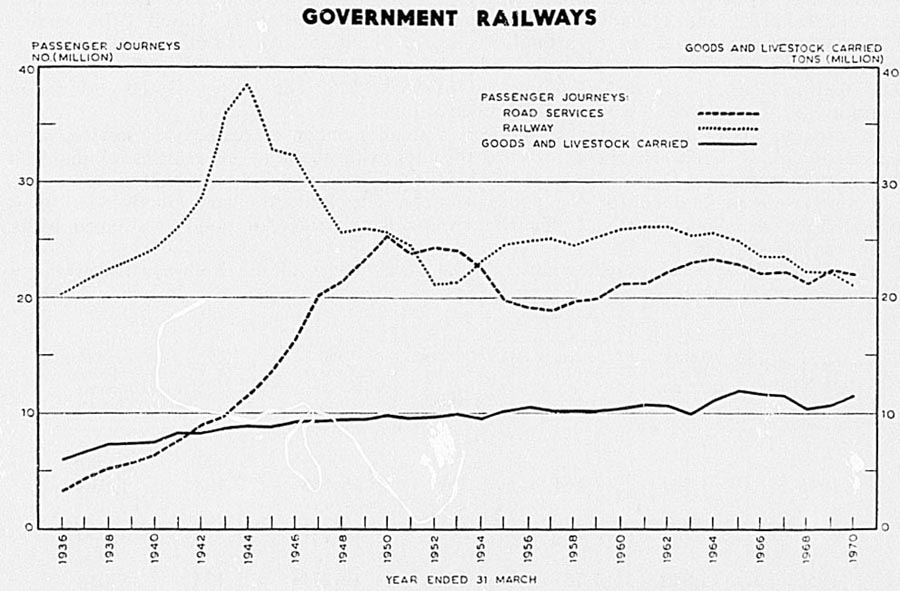
RAILWAY EMPLOYEES—The average number of persons employed by the State railways throughout the year ended 31 March 1970 was 21,082 compared with 22,154 a year earlier.
RAILWAY ACCIDENTS—No passengers lost their lives in train accidents during the year ended 31 March 1970, but 10 passengers and seven employees received injuries. Sixteen persons were killed and 213 injured in accidents associated with train working and movement of rolling stock. Comparative figures for 1968-69 were 13 killed and 235 injured, 18 of the latter in train accidents. These figures do not include employees who were killed or injured whilst engaged in other duties, e.g., railway workshops.
Accidents at level crossings with roads resulted in the death of 11 people and injury to 34 others in 1969-70; in the previous year 7 were killed and 31 injured. In furtherance of departmental policy, an additional 20 automatic road-crossing alarms were installed in 1969-70, bringing the total number of automatic alarms at 31 March 1970 up to 651.
PRIVATE RAILWAYS—There are a number of short private railways in New Zealand, principally lines serving collieries and sawmills. There is a 7-mile line of the Ohai Railway Board, extending from Wairio (north-west of Invercargill) to coal mines at Ohai. The Whakatane Board Mills Ltd. in the North Island operates a 61/2-mile private line from Awakeri to their mill at Whakatane in the Bay of Plenty.
RAILWAY OPERATED ROAD SERVICES—There is a network of railway-operated road services whose origin dates back to November 1926 when a bus service between Napier and Hastings was purchased. Others were acquired in the following years (notably the services within the Hutt Valley and between the Hutt Valley and Wellington in 1927 and 1928), but it was 1934 before the first long-distance coach service was taken over. The main development of the network took place between 1936 and 1951, when the route milage over which licences were held rose from 260 to 5,992. Now the Railways Department runs more than 25 percent of the total vehicle mileage of all licensed road passenger service operators in New Zealand (see Section 11C), and maintains in its fleet more than 25 percent of all the vehicles used to provide road passenger services throughout the country. During the year ended 31 March 1970, the Railways Department's Road Services Branch employed a staff of 1,459 on average.
Suburban bus services at Auckland, Hastings, Hutt Valley, Wellington-Khandallah, Titahi Bay, Paekakariki, and Dunedin, with a fleet of 218 vehicles at 31 March 1970, carried 12,570,000 passengers and earned a total revenue of $1,346,359. All the other road passenger services, both long and short distance, with 634 coaches, buses, and other vehicles, carried 9,605,000 passengers and earned a revenue of $5,049,225. The routes of the services in operation at 31 March 1970 covered 5,423 miles of highway.
In addition to the road passenger services, a small number of road goods services were operated. Goods traffic on these services, together with the hire of vehicles to the Rail Ancillary Goods Service, produced a further $1,364,270 in 1969-70. Some 271 motor trucks and vans were maintained for the goods services. The Rail Ancillary Goods Services is operated by the Department's Traffic Branch for the carriage of goods consigned to or from wayside stations.
The following selected statistics illustrate the development of the Railways Department's-road services operations.
| Year Ended 31 March | Route Miles at 31 March* | Number of Passenger Vehicles at 31 March | Number of Other Vehicles at 31 March | Total Passenger Journeys | Total Passenger and Goods Revenue | Total Expenditure, Including Interest Charges |
|---|---|---|---|---|---|---|
| *Route mileage for which licences are held. | ||||||
| (000) | $ (000) | $ (000) | ||||
| 1,946 | 4,507 | 464 | 154 | 16,588 | 2,198 | 1,918 |
| 1,951 | 5,992 | 749 | 301 | 24,091 | 4,216 | 4,320 |
| 1,956 | 5,842 | 763 | 356 | 19,271 | 5,170 | 5,036 |
| 1,961 | 5,754 | 735 | 332 | 21,370 | 5,674 | 5,638 |
| 1,966 | 5,858 | 729 | 378 | 22,297 | 6,385 | 6,343 |
| 1,967 | 5,872 | 748 | 386 | 22,240 | 6,670 | 6,660 |
| 1,968 | 5,899 | 762 | 377 | 21,396 | 6,729 | 6,906 |
| 1,969 | 5,919 | 765 | 372 | 22,585 | 7,208 | 7,241 |
| 1,970 | 5,925 | 777 | 377 | 22,175 | 7,760 | 7,714 |
GENERAL—Capital investment in New Zealand's roading and road transport system exceeds that of all other forms of transport services. There are over 58,000 miles of roads and over 1 million motor vehicles, while the population census in 1966 revealed that there were 34,906 road transport drivers, 13,533 persons engaged in the construction and maintenance of roads, 16,653 persons whose occupations involved carrying and cartage services, 22,206 persons occupied in the repair of motor vehicles, and 7,205 persons engaged in motor-vehicle assembly and body building.
Road transportation has become an integral part of the economy and grows along with it. Primary production, for example, relies heavily on road transport. An increasing amount must be spent on the roading system not only to maintain and increase national production but also, among other things, to prevent economic waste due to congestion on main traffic routes. Urban motorways are a development feature of recent years.
The National Roads Board and the Ministry of Works, together with local authorities, have an impressive record of road improvements since 1954.
ROADS AND BRIDGES—Two noteworthy constructions have been the Auckland Harbour Bridge and the Christchurch-Lyttelton Road Tunnel; tolls are charged to users to provide for upkeep and repay the loans raised for their construction. The Auckland Harbour Bridge, with its approaches, is nearly 2 miles long and was opened in 1959. The Christchurch-Lyttelton Road Tunnel, which was opened in 1964, comprises 21/2 miles of motorway, of which 11/2 miles is actual tunnel.
Another major development has been the construction of the 130-mile Haast Pass Road in South Westland which was opened on 6 November 1965; construction extended over 19 years and involved an expenditure of $9 million. It connects Westland and Otago and opens up areas of scenic beauty.
Details of formed roads at 31 March 1969 are given in the following table.
| Nature of Surface | Cities and Boroughs | Counties | Roads Districts | Town Districts | Total | |
|---|---|---|---|---|---|---|
| County Roads | State Highways and Motorways | |||||
| *All on county roads. | ||||||
| Miles | ||||||
| Paved | 5,472 | 12,743 | 5,924 | 14 | 92 | 24,245 |
| Metal or gravel | 551 | 27,872 | 1,012 | 60 | 47 | 29,542 |
| Unmetalled | 85 | 4,842 | - | 16 | 8 | 4,951 |
| Totals: formed roads | 6,108 | 45,457 | 6,936 | 90* | 147 | 58,738 |
The configuration of the country has presented problems in the construction of roads, while the numerous rivers and streams have called for many bridges. The following table shows the numbers and total lengths of bridges incorporated in the roads system at 31 March 1969. Only bridges of 25 ft or over in length have been taken into account. There is an average of slightly over 15 ft of bridging per mile of formed road.
| Materials of Which, Bridge Constructed | Cities and Boroughs | Counties | Road Districts | Town Districts | Totals | |||||
|---|---|---|---|---|---|---|---|---|---|---|
| No. | Total Length | No. | Total Length | No. | Total Length | No. | Total Length | No. | Total Length | |
*Includes Bailey Bridges erected as a temporary measure. † All on county roads. | ||||||||||
| Concrete reinforced | ft | ft | ft | ft | ft | |||||
| or stone | 367 | 42,450 | 3,509 | 335,668 | - | - | 14 | 852 | 3,890 | 378,970 |
| Steel girders and concrete deck* | 68 | 11,745 | 1,559 | 151,058 | - | - | 2 | 120 | 1,629 | 162,923 |
| Timber with steel or concrete | 54 | 4,691 | 1,761 | 160,473 | 3 | 85 | 2 | 134 | 1,820 | 165,383 |
| Timber | 64 | 5,039 | 2,205 | 174,724 | - | - | - | - | 2,269 | 179,763 |
| Totals | 553 | 63,925 | 9,034 | 821,923 | 3 | 85† | 18 | 1,106 | 9,608 | 887,039 |
Auckland Harbour Bridge Traffic—Before the Auckland Harbour Bridge of four lanes was opened in 1959, it was expected that it would take 19 years for traffic to reach 8 million vehicles a year, but instead it took only five years. Extensions have now been made by way of two additional lanes on each side of the existing bridge making a total of eight traffic lanes.
Traffic totals for March years are shown in the following table.
| Class of Vehicle | 1965-66 | 1966-67 | 1967-68 | 1968-69 | 1969-70 |
|---|---|---|---|---|---|
| (000) | |||||
| Cars | 9,471 | 10,559 | 11,433 | 12,385 | 13,976 |
| Motor cycles, etc. | 240 | 213 | 233 | 242 | 248 |
| Buses | 268 | 268 | 272 | 264 | 270 |
| Trucks | 478 | 444 | 446 | 465 | 505 |
| Non-revenue traffic | 146 | 171 | 201 | 204 | 154 |
| Totals | 10,603 | 11,655 | 12,585 | 13,560 | 15,154 |
Christchurch-Lyttelton Road Tunnel—There is an increasing volume of traffic using the Christchurch-Lyttelton road tunnel as shown in the following table.
| Class of Vehicle | Year Ended 31 March | ||||
|---|---|---|---|---|---|
| 1966 | 1967 | 1968 | 1969 | 1970 | |
| Cars | 771,737 | 916,546 | 964,659 | 931,669 | 991,400 |
| Motor cycles, etc, | 98,781 | 99,734 | 84,647 | 68,421 | 62,003 |
| Buses | 12,780 | 14,149 | 14,356 | 14,233 | 14,377 |
| Trucks | 112,776 | 137,016 | 154,512 | 182,970 | 200,505 |
| Non-revenue traffic | 31,082 | 34,144 | 34,154 | 33,206 | 34,138 |
| Totals | 1,027,156 | 1,201,589 | 1,252,328 | 1,230,499 | 1,302,423 |
ROADS ADMINISTRATION—The main statutes covering roads administration in New Zealand are the Public Works Act 1928, the Municipal Corporations Act 1954, the Counties Act 1956, and the National Roads Act 1953. Administration of the country's roading system is exercised by municipalities in respect of streets, by county councils in respect of county roads, and by the National Roads Board in respect of State Highways. There are 7,240 miles of State highways.
By the National Roads Act a National Roads Board was established from 1 April 1954, and its functions are defined as follows:
To administer the National Roads Fund in accordance with the provisions of the Act.
To provide an advisory service in respect of the whole roading system of counties, boroughs, and town districts throughout New Zealand, and to report to the Government from time to time on the progress being made in providing a roading system adequate for needs arising from current developments in motor traffic.
To advise the Government of any changes necessary in the legislation and regulations relating to the use of roads.
To act as the final authority in disputes relating to road classifications.
To advise the Government of changes necessary in the provision of finance for road construction and maintenance, particularly of changes considered advisable in the levying and collection of motor taxation, including exemptions therefrom.
To assist and advise local authorities generally on roading matters and any special roading problems arising from development of industries, etc.
To undertake at not more than five- or less than three-year intervals a comprehensive survey into the roading position in New Zealand, including standards, growth of traffic, traffic, adequacy, etc.
To give effect to any special matter of roading policy communicated to it by the Government.
To initiate and conduct research into roading problems in New Zealand.
To collect information on roading developments in other countries and make this available to roading authorities in New Zealand.
To undertake any other activity for the provision of a roading system adequate both for the needs of an efficient road transport system and for the benefit generally of motor-vehicle operators and the safety of the public in relation to motor traffic.
The composition of the National Roads Board is: (a) one member, to be appointed Chairman of the Board; (b) the person holding the appointment in the Ministry of Works as Director of Roading; (c) an officer of the Ministry of Works; (d) an officer of the Ministry of Transport; (e) two nominees of the New Zealand Counties Association (incorporated); (f) two nominees of the Municipal Association of New Zealand (incorporated); (g) a representative of commercial road users; and (h) a representative of private motorists.
District Roads Councils—New Zealand is divided into 22 roads districts, composed of local authorities grouped according to geographic situation and community interest.
For each roads district there is an advisory body, known as the District Roads Council, which is constituted to include the District Commissioner of Works, one representative of each constituent county, one person to represent boroughs and independent town districts for each two members representing counties (but where the number of borough councils and town districts exceeds the number of county councils, the Board may appoint such additional persons as it thinks fit to represent borough councils and town districts), a representative of commercial road users, a representative of private motorists, and a nominee of the Secretary for Transport.
District Roads Councils function as advisory bodies, with the principal duties of recommending upon the maintenance and improvement programmes for State highways, and upon the yearly allocation of subsidies and grants from the National Roads Fund for local authority roading. They also make recommendations to the National Roads Board on standards and requirements for roads and highways in their particular districts, and on general matters affecting road users or road safety.
Finance—A National Roads Fund has been established within the Public Account, the revenue of the Fund being derived mainly from motor taxation together with an annual contribution from the Government. Expenditure from the Fund is for the purpose of developing State highways to modern standards and of subsidising the roading programmes of local authorities.
Motor spirits tax of 17.10c per gallon is paid into the National Roads Fund. (Additional tax of 3.30c per gallon imposed on 4 May 1967 was credited to the Consolidated Revenue Account until 1 April 1969, when 2.30c per gallon was transferred to the National Roads Fund, leaving 1.00c per gallon credited to the Consolidated Revenue Account). Tax imposed under the Local Authorities (Petroleum Tax) Act 1970 (3c per gallon from February 1971) is not credited to the National Road Fund. An equivalent mileage tax is payable for diesel-powered motor vehicles; this is apportioned to National Roads Fund and Consolidated Revenue Account on the same basis as for motor spirits tax. Quarterly licence fees under the Heavy Motor Vehicles Regulations range from $4.83 (not above 21/2 tons) to $63 (11 tons), with $7 for each additional ton above 11. The fees for farmers' trucks range from $2.66 on a corresponding basis. Heavy traffic fees, less the cost of collection, are paid into the National Roads Fund.
Following is a statement of receipts and expenditure of the National Roads Fund for the latest three March years.
| Item | 1967-68 | 1968-69 | 1969-70 |
|---|---|---|---|
| Receipts— | $ | $ | $ |
| Petrol tax (net) | 50.475.197 | 53.557.584 | 64.933.108 |
| Mileage tax | 3.167.446 | 3.573.046 | 3.876.348 |
| Fees and charges— | |||
| Registration and licence fees | 289.181 | - | - |
| Heavy traffic fees | 8.497.743 | 8.803.122 | 9.522.825 |
| Contribution from Consolidated Revenue Account | 3.250.000 | 3.000.000 | 10.000 |
| Miscellaneous receipts— | |||
| Repayments of plant purchases | 5.378 | 7.057 | 6.158 |
| Repayments of advances to local authorities | 4.796 | 7.433 | 5.464 |
| Rents | 254.063 | 380.114 | 462.211 |
| Sales of land and buildings | 83.291 | 93.557 | 176.745 |
| Interest on plant purchases | - | 1.182 | 662 |
| Interest on advances to local authorities | 1.580 | 894 | 278 |
| Bailey bridging hire | 13.145 | 25.580 | 18.509 |
| Interest on investments | 48.167 | 69.750 | 60.083 |
| Miscellaneous | 22.628 | 6.560 | - |
| Contribution from local authorities for work done by Ministry of Works | 600 | - | - |
| Fabricated steel and Calender Hamilton bridging | - | 6.193 | 21.492 |
| Total receipts | 66.113.215 | 69.532.072 | 79.093.883 |
| Expenditure— | |||
| Highways maintenance | 10.265.720 | 12.410.293 | 12.167.153 |
| Highways construction | 22.578.777 | 25.709.111 | 28.648.061 |
| Local authority roading subsidies and grants | 28.473.976 | 30.327.236 | 32.251.202 |
| Administration and general expenses— | |||
| Ministry of Works administration | 3.272.000 | 3.246.686 | 3.459.507 |
| Fees and travelling expenses | 15.273 | 18.522 | 25.022 |
| Miscellaneous expenses | 328.041 | 374.768 | 375.059 |
| Bridging expenses— | |||
| Bailey bridging, etc. | 28.883 | 42.942 | 64.961 |
| Unauthorised expenditure | 5.903 | 5.843 | 7.133 |
| Total expenditure | 64.968.573 | 72.135.401 | 76.998.098 |
| Balance in Fund at end of year | 4.170.248 | 1.566.919 | 3.662.704 |
In the following table are shown the amounts which have been expended on State highways construction, renewal, or maintenance during the last five years. Maintenance figures include the cost of flood damage restoration when applicable. There are 7,240 miles of State highways, of which 88 percent are now sealed.
| Class of Expenditure | 1965-66 | 1966-67 | 1967-68 | 1968-69 | 1969-70 |
|---|---|---|---|---|---|
| * Motorway structures included from 1968-69 | |||||
| $ (thousand) | |||||
| Construction and improvement | 26,424 | 23,821 | 20,411 | 20,128 | 22,735 |
| Bridges and other structures* | 2,588 | 2,547 | 2,168 | 5,581 | 5,913 |
| Maintenance, repairs, etc. | 9,260 | 9,469 | 10,265 | 12,410 | 12,167 |
| Totals | 38,272 | 35,837 | 32,844 | 38,119 | 40,815 |
An analysis of the actual expenditure on maintenance in each Island, as compared with the number of motor vehicles in each Island at 31 March of each of the last five years, appears in the following table, the percentages relating to New Zealand totals.
| Item | 1965-66 | 1966-67 | 1967-68 | 1968-69 | 1969-70 |
|---|---|---|---|---|---|
| North Island— | Percentage of New Zealand Totals | ||||
| Maintenance expenditure | 66.72 | 66.83 | 64.38 | 64.37 | 62.17 |
| Motor vehicles | 68.66 | 68.98 | 69.22 | 69.26 | 69.51 |
| South Island— | |||||
| Maintenance expenditure | 33.28 | 33.17 | 35.62 | 35.63 | 37.83 |
| Motor vehicles | 31.34 | 31.02 | 30.78 | 30.74 | 30.49 |
The following table shows the mileage of State highways in the North and South Islands at 31 March 1970, together with a classification as to the type of construction or surface.
| Island | Length of Highways (including Motorways) | ||
|---|---|---|---|
| Sealed Surface | Gravel or Macadam Surface | Total | |
| miles | |||
| North Island | 3,413 | 437 | 3,850 |
| South Island | 2,936 | 454 | 3,390 |
| Totals | 6,349 | 891 | 7,240 |
State Highways—The National Roads Act provides for the declaration of roads as State highways with the approval of the Minister of Works. In 1969, the National Roads Board reviewed the State Highway system, and re-affirmed the principle that the network must continue to be based on the pattern of national development, needs of defence, and directness of route and main travel desire lines. The most important principles in designing a State Highway system are that the total mileage of the system must be based on routes of primary importance; that routes must be equitably distributed in relation to the pattern of national development, and that routes must be confined to those which have characteristics in keeping with the function of the system. To achieve the National Development Conference target of an annual income of 4.5 percent in real product, it has been estimated that there will be increases of 5.71 percent in motor vehicle mileage and 6.01 percent in commodity cartage.
Although urban development with its growing industrialisation is a predominant problem, the National Roads Board is also aware of the need for continued development of a fully effective inter-regional network with adequate rural feeder roads. Balanced development of the total network is essential if primary production is to increase and production costs are to be restrained.
The National Roads Board has the sole power of construction, maintenance, and control of all State highways. These powers may be delegated, for any State highway or portion thereof, to the local authority in whose district the road is situated. Any construction or maintenance work that is not delegated by the Board to a local authority is carried out by or through the agency of the Ministry of Works and the cost borne by the Fund. The Board may also delegate to the Ministry of Works its duties in connection with design, supervision, construction, or maintenance, or the administration of any specified State highway.
Highway Standards—In order to qualify for highway subsidies local authorities are required to carry out works to a standard approved by the National Roads Board. Subsidies are not payable unless the approved standard is observed, although work of a higher standard may be undertaken provided that the additional expenditure involved is found by the local authorities concerned. From time to time the Board's standards are revised to meet the latest developments in highway practice and engineering design and also to cater for the requirements of increasing traffic. Roadmaking materials used in highway works are subject to standard tests.
Motorways—The Public Works Act makes provision for the declaration of motorways. Motorways provide efficient and economic means of communication, while the control of access and the total elimination of ribbon development will go far to improve road safety and prevent obsolescence.
The total mileage of motorways in use at 31 March 1970 was 62.43 miles. During 1969-70 5 motorway bridges, totalling 5,575 ft, were completed. Under construction at 31 March 1970 were 13 bridges with a total length of 3,413 ft.
Activities During the Year Ended 31 March 1970—During the year ended 31 March 1970, 102 miles of new sealing on highways were completed, giving an aggregate of 6,349 miles sealed, or 88 percent of total highway mileage. In addition improvements to existing sealed surfaces were effected on 567 miles of highways.
New bridging totalled 7,698 linear feet, compared with 5,083 linear feet in the previous year.
Local Authority Roading—The National Roads Board pays a subsidy at the rate of $1.50 for each $2 that is spent by local authorities out of their own funds on such programmes of subsidised works as have been accepted for a financial year by the Board; from 1 April 1970 the amount of subsidy is not less than 16 percent of the Board's revenue in the case of boroughs and independent town districts, and not less than 23 percent in the case of counties and dependent town districts.
Within the above percentage allocations, the Board may make a grant to a local authority, having regard to its particular financial problems or special circumstances.
In recognition of the urgency and importance of the country's bridge renewal problem, the Board makes generous grants for bridge replacement. Wooden bridges built 50 and 60 years ago, which have served the country well, continue to deteriorate at a greater rate than replacements can be built. In 10 years to March 1970 there have been 2,887 bridges completed.
For the year ended 31 March 1970 the following amounts were paid to local authorities from the National Roads Fund for roading.
| Local Authority | Subsidy | Grants | Total | |
|---|---|---|---|---|
| $ (thousand) | ||||
| Municipalities | 8,409 | 3,082 | 11,491 | |
| County councils (including road boards) | 11,104 | 8,002 | 19,106 | |
| Totals | 19,513 | 11,084 | 30,597 | |
Loan Assistance—In special circumstances the Board may advance money by way of loan to local authorities to provide for the proportion of cost payable by a local authority in respect of a subsidised work. Such loans must be repaid by instalments extending over a period (not exceeding 10 years) to be agreed upon between the Board and the local authority, and interest is payable at a rate approved by the Minister of Finance.
The Board is also empowered to sell roadmaking machinery, plant, and equipment to local authorities on such terms as it thinks fit, including terms for the repayment of the purchase money by instalments extending over not more than four years, with interest on the unpaid balance at such rate as is fixed by the Board. Since this scheme was introduced by the Main Highways Board, plant, etc., has been purchased to the value of $2,351,585. Repayments received during 1969-70 totalled $6,158.
Development Roading—In addition to the expenditure on roading from the National Roads Fund, moneys are provided annually by the Consolidated Revenue Account (Vote Roads) for development road construction. Under this heading subsidies are paid to local authorities for the construction of new roads giving access to farm lands being brought into production. This Vote also finances access roading to lands being prepared for farm settlement by the Lands and Survey and Maori and Island Affairs Departments, as well as certain new roading of a national development character.
New roads constructed for farm access are handed over to the care of local authorities, while national roading normally becomes the responsibility of the National Roads Board for maintenance as part of the State highway system.
Government roading expenditure from the Consolidated Revenue Account (Vote Roads) for the year ended 31 March 1970 was $2,078,204.
Overall Roading Expenditure—The following table shows the total expenditure on roading from all sources for the year ended 31 March 1970.
| National Roads Fund— | $ (000) | $ (000) |
| State highways | 40,815 | |
| Subsidies, etc. - local roading | 32,233 | |
| —— | 73,048 | |
| Consolidated Revenue Account (Vote Roads) | .. | 2,078 |
| Local authority funds— | ||
| Municipalities | 17,627 | |
| County councils, etc. | 16,760 | 34,387 |
| Total | 109,513 |
Roading expenditure over the latest 11 years is related to gross national product in the following table.
| Year Ended 31 March | Roading Expenditure Central and Local Government | Total as Percentage of Gross National Product | ||
|---|---|---|---|---|
| Maintenance | Construction | Total | ||
| *Provisional. | ||||
| $ (million) | percent | |||
| 1,960 | 21.56 | 44.54 | 66.10 | 2.72 |
| 1,961 | 25.05 | 45.47 | 70.52 | 2.69 |
| 1,962 | 26.75 | 45.41 | 72.16 | 2.65 |
| 1,963 | 27.16 | 47.25 | 74.41 | 2.47 |
| 1,964 | 27.47 | 56.36 | 83.83 | 2.62 |
| 1,965 | 27.67 | 58.82 | 86.49 | 2.48 |
| 1,966 | 29.63 | 69.52 | 99.15 | 2.65 |
| 1,967 | 31.34 | 67.48 | 98.82 | 2.53 |
| 1,968 | 31.62 | 60.96 | 92.58 | 2.30 |
| 1,969 | 36.09 | 66.20 | 102.29 | 2.35 |
| 1,970 | 35.58 | 73.93 | 109.51 | 2.30* |
REGISTRATION AND LICENSING OF MOTOR VEHICLES—The amounts for initial registration fees are: motorcars, from $16 to $50 according to engine capacity; motor cycles, $10; power cycles, $6; light trucks, $30; heavy trucks, $50; trailers, $10; tractors, $2; traction engines, $10; and any other motor vehicles, $20. Annual licence fees are as follows: Power cycles, $4; motor cycles, $6; motorcars and private station wagons, $10; traction engines, $3; trailers (not exceeding 2 tons laden weight), $6. Other fees include drivers' licences, $1; changes of ownership, $5; and dealers' licences (motor cycles, $6; any other motor vehicles, $10). All such fees, except those for drivers' licences which are payable to the local authorities, were credited to the National Roads Fund until 30 June 1967; since 1 July 1967 they have been credited to the Consolidated Revenue Account.
The various types of motor vehicles licensed as at 31 March in each of the last five years are itemised below.
| Type of Vehicle | Licensed as at 31 March | ||||
|---|---|---|---|---|---|
| 1966 | 1967 | 1968 | 1969 | 1970 | |
| Cars | 724,582 | 781,047 | 807,962 | 833,488 | 861,958 |
| Rental cars | 3,100 | 3,087 | 2,980 | 3,068 | 3,222 |
| Private taxicabs | 187 | 188 | 146 | 165 | 157 |
| Light goods service vehicles (i.e. gross laden weight 2 tons and under) | 64,701 | 88,732 | 91,099 | 99,073 | 101,814 |
| Heavy goods service vehicles (i.e. gross laden weight over 2 tons) | 98,698 | 74,310 | 73,576 | 67,914 | 69,663 |
| Contract vehicles | 1,659 | 1,403 | 1,401 | 1,579 | 1,594 |
| Omnibuses | 2,734 | 2,744 | 2,727 | 2,713 | 2,688 |
| Public taxicabs | 3,133 | 2,915 | 2,898 | 2,900 | 2,891 |
| Service coaches | 502 | 466 | 489 | 499 | 455 |
| Vehicles including cycles exempted from payment of annual licence fees | 87,508 | 76,958 | 74,888 | 75,606 | 77,889 |
| Motor cycles | 31,731 | 31,337 | 30,068 | 29,647 | 29,176 |
| Power cycles | 17,971 | 18,291 | 18,359 | 18,233 | 18,826 |
| Totals, motor vehicles | 1,036,506 | 1,081,478 | 1,106,593 | 1,134,885 | 1,170,333 |
| Trailers, including trailers exempted from payment of annual licence fees | 180,616 | 189,735 | 191,337 | 201,264 | 211,539 |
| Dealers' cars | 3,110 | 3,760 | 3,670 | 3,569 | 3,636 |
| Dealers' motor cycles | 104 | 101 | 91 | 103 | 109 |
| Totals, all vehicles | 1,220,336 | 1,275,074 | 1,201,691 | 1,339,821 | 1,385,617 |
Motor vehicles exempted from the annual licence fee include a miscellaneous collection of machines such as farmers' motor vehicles used solely on the farm and only venturing on roads to proceed from one part of the farm to another, or from farm to garage for repair, etc., excavators, scoops, trench diggers, cranes, and logging trucks (used on private roads) etc.
The rate of increase in the number of motor vehicles has exceeded the rate of increase in population. The following table shows the changes in relationship between the number of licensed vehicles and population as at 31 March in the latest 11 years.
| As at 31 March | Number of Persons in Population per Car | Number of Persons in Population per Motor Vehicle (Excluding Trailers) |
|---|---|---|
| 1,960 | 4.7 | 3.2 |
| 1,961 | 4.6 | 3.1 |
| 1,962 | 4.5 | 3.0 |
| 1,963 | 4.3 | 2.9 |
| 1,964 | 4.1 | 2.8 |
| 1,965 | 3.8 | 2.7 |
| 1,966 | 3.7 | 2.6 |
| 1,967 | 3.5 | 2.5 |
| 1,968 | 3.4 | 2.5 |
| 1,969 | 3.3 | 2.4 |
| 1,970 | 3.2 | 2.4 |
The countries with fewest persons per motor vehicle are, in order, United States, Canada, Australia, and New Zealand, but the standard of vehicles is not uniform.
The next table shows the estimated total consumption of motor spirits in New Zealand, together with the quantity consumed by motor vehicles on public roads, for each year during the last 11 years.
| Calendar Year | Consumption of Motor Spirits | |
|---|---|---|
| By Motor Vehicles on Public Roads | Total Consumption | |
| million gallons | ||
| 1,959 | 218.5 | 261.0 |
| 1,960 | 234.3 | 280.4 |
| 1,961 | 245.4 | 296.4 |
| 1,962 | 253.0 | 298.7 |
| 1,963 | 273.0 | 317.1 |
| 1,964 | 294.9 | 339.7 |
| 1,965 | 312.7 | 356.8 |
| 1,966 | 333.8 | 373.8 |
| 1,967 | 339.7 | 378.4 |
| 1,968 | 344.6 | 382.9 |
| 1,969 | 367.4 | 400.9 |
The following diagram illustrates the movement that has taken place in the number of motor vehicles licensed, and in the consumption of motor spirits by motor vehicles.
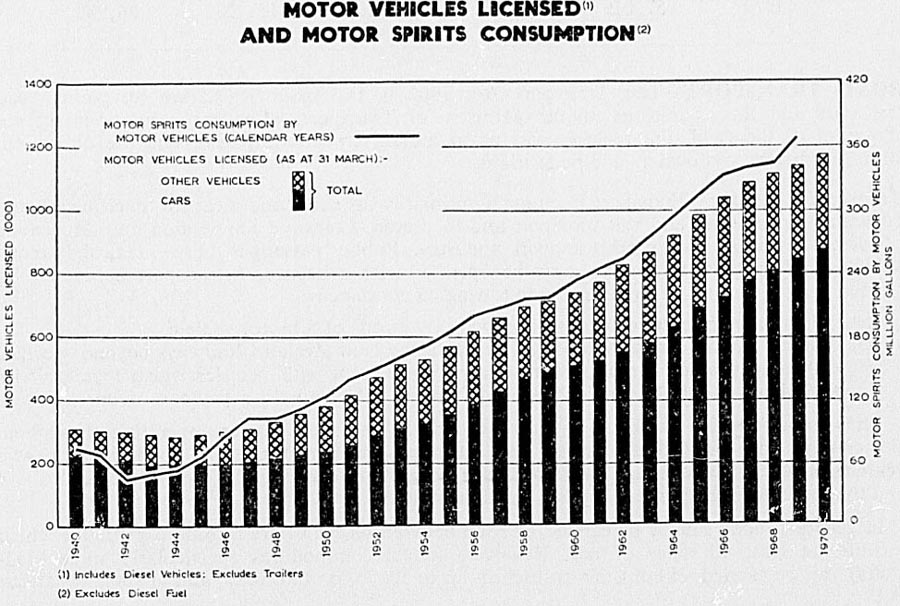
The following table gives particulars of the numbers of motor vehicles newly registered during each of the last 11 financial years. It should be noted that if a vehicle is again brought into use after its registration has been cancelled, it is treated as a new registration.
| Year Ended 31 March | Cars | Motor Cycles (including Power Cycles) | Commercial Vehicles | Trailers | Total Registrations |
|---|---|---|---|---|---|
| 1,960 | 30,932 | 5,980 | 24,291 | 16,667 | 77,870 |
| 1,961 | 36,385 | 6,640 | 17,711 | 29,182 | 89,918 |
| 1,962 | 40,400 | 6,705 | 20,720 | 24,577 | 92,402 |
| 1,963 | 45,260 | 6,623 | 18,586 | 21,091 | 91,560 |
| 1,964 | 62,320 | 6,207 | 19,955 | 21,583 | 110,065 |
| 1,965 | 69,071 | 8,074 | 22,091 | 23,034 | 122,270 |
| 1,966 | 70,361 | 6,194 | 22,517 | 26,551 | 125,623 |
| 1,967 | 64,464 | 6,042 | 23,414 | 30,540 | 124,460 |
| 1,968 | 54,908 | 4,947 | 16,797 | 21,870 | 98,522 |
| 1,969 | 50,380 | 4,471 | 15,442 | 20,587 | 90,880 |
| 1,970 | 57,675 | 5,366 | 21,491 | 19,892 | 104,424 |
Registrations of new vehicles and those vehicles previously registered only in another country are available separately from total new registrations. Particulars (which exclude re-registrations) are as follows for the six latest years.
| Year Ended 31 March | Cars | Motor Cycles (Including Power Cycles) | Commercial Vehicles | Trailers | Total Registrations |
|---|---|---|---|---|---|
| 1,965 | 67,426 | 5,934 | 16,162 | 19,261 | 108,783 |
| 1,966 | 68,530 | 4,786 | 15,959 | 22,743 | 112,018 |
| 1,967 | 62,982 | 4,827 | 17,791 | 24,942 | 110,542 |
| 1,968 | 53,508 | 3,867 | 13,439 | 19,052 | 89,866 |
| 1,969 | 49,817 | 3,465 | 12,041 | 18,005 | 83,328 |
| 1,970 | 57,019 | 4,242 | 18,007 | 17,720 | 96,988 |
ROAD TRANSPORT—The Transport Act 1962 is the main legislation governing road transport and the operations of the Ministry of Transport; attendant regulations set out the rules of the road, the requirements as to motor vehicle equipment, and the obligations of motor drivers and owners and pedestrians.
Transport Licensing—Transport licensing is primarily an economic measure to achieve better co-ordination of road and rail transport and to prevent excessive competition and duplication of services within the road transport industry. Public passenger buses, taxicabs, rental vehicles and harbour ferries can only be operated with a licence. A transport licence is also needed for the cartage of goods in the following circumstances:
When they are carried for hire or reward by means of a motor vehicle.
When they are carried in competition with the New Zealand Railways beyond specified distances whether for hire or reward or not, except with vehicles which together with their load, weigh 2 1/2 tons or less and farmers' vehicles with a payload of up to 5 tons.
Thus goods service licensing extends beyond the common carriers operating throughout the country and can include farmers and businesses carrying their own goods in their own vehicles, if these vehicles are over the laden weights or carrying the load prescribed above and they wish to operate them beyond certain distances.
In general, goods cannot be carried by road between places where a route is available which includes at least 40 miles of rail. However, certain commodities (particularly some foodstuffs) can be carried without this restriction up to 50, 75, or 100 miles, and in some instances,such as livestock, fresh meat, poultry, or fresh fish there is no restriction at all. In addition, this restriction ceases to apply where use of the railway would increase the journey by more than one-third of the shortest road route available. The licensing authorities (see below) may also grant exemption from the railway restriction in particular cases where this is in the public interest.
Apart from these exemptions in respect of competition with the railways, there is complete freedom from transport licensing for certain special or limited transport services.
New Zealand is divided into 17 transport licensing districts (including one harbour ferry district at Auckland) which are administered by five full-time licensing authorities appointed by the Minister of Transport for terms of up to 5 years. They adjudicate on applications for a licence to enter the industry, on transfer or renewals of licences, and on changes to or withdrawals of transport services.
The factors to be considered in dealing with these applications are specified in the Transport Act 1962, and emphasis is placed on consideration of the public interest and of users of public transport. There is a right of appeal from the decisions of licensing authorities to the Transport Licensing Appeal Authority.
Charges for transport services do not come within the jurisdiction of the licensing authorities. Public bodies operating public passenger services fix their own charges; the Secretary for Transport all others. In every case there is a right of appeal to a Transport Charges Appeal Authority.
Both the Minister of Transport and licensing authorities have powers in respect of public enquiries into or reviews of transport services and licences. Reviews of taxicab services must be made at least every three years in the four main centres and in other centres with a population of more than 10,000.
In general, licences may be either continuous, seasonal or temporary (not more than 14 days). However, all rental service licences have a duration of three years after which application must be made for their renewal.
Operations of Licensed Goods and Passenger Services—The following tables review the operations of licensed road transport services. The first of these tables gives the estimated overall figures concerning licensed road goods services for each of the five latest years ended 31 March.
| Road Goods Services | 1964-65 | 1965-66 | 1966-67 | 1967-68 | 1968-69 |
|---|---|---|---|---|---|
| *As shown at 31 December 1968. | |||||
| Revenue $ (000) | 114,000 | 126,000 | 139,600 | 139,600 | 153,100 |
| Capital invested $ (000) | 84,000 | 96,000 | 109,600 | 104,900 | 114,900 |
| Total vehicle-miles (000) | 288,500 | 315,000 | 325,000 | 324,100 | 330,000 |
| Number of goods-service licences | 6,781 | 6,865 | 6,824 | 6,762 | 6,694* |
| Average revenue per vehicle-mile | 39.62 | 40.20 | 42.94 | 44.43 | 46.39 |
| Average number of miles per vehicle | 15,825 | 16,463 | 16,560 | 15,795 | 16,421 |
The second table shows traffic data, revenue, and number of vehicles used by the road passenger services operating in New Zealand, and is inclusive of services in the four metropolitan transport districts, for each of the five latest years ended 31 March.
| Road Passenger Services | 1964-65 | 1965-66 | 1966-67 | 1967-68 | 1968-69 |
|---|---|---|---|---|---|
| Traffic statistics— | |||||
| Passengers carried (000) | 195,207 | 183,009 | 175,301 | 172,948 | 171,148 |
| Vehicle-miles (000) | 83,898 | 79,548 | 79,618 | 81,440 | 83,324 |
| Total revenue $(000) | 25,085 | 24,036 | 24,253 | 25,890 | 27,289 |
| Total revenue, per mile c | 29.89 | 30.21 | 30.46 | 31.79 | 32.75 |
| Number of vehicles included | 4,076 | 3,594 | 3,774 | 3,816 | 3,919 |
Statistics on bus services run by the New Zealand Railways (included above) are given separately in Section 11B.
The following table sets out statistics of taxicab services for the five latest March years.
| Item | 1964-65 | 1965-66 | 1966-67 | 1967-68 | 1968-69 |
|---|---|---|---|---|---|
| *Also includes private-hire taxicabs. At 31 December 1968, there were 2,893 cab authorities issued by transport licensing authorities. | |||||
| Passengers carried (000) | 27,500 | 28,000 | 28,000 | 28,000 | 28,500 |
| Mileage run (000) | 94,000 | 99,000 | 102,700 | 102,900 | 106,600 |
| Total revenue $ (000) | 12,000 | 12,600 | 13,600 | 13,980 | 14,700 |
| Revenue per mile c | 12.77 | 12.73 | 13.24 | 13.59 | 13.79 |
| Number of vehicles* | 3,206 | 3,320 | 3,103 | 3,044 | 3,065 |
Statistics of the rental vehicle industry are set out in the following table.
| Item | 1964-65 | 1965-66 | 1966-67 | 1967-68 | 1968-69 |
|---|---|---|---|---|---|
| *As at 31 December 1968. | |||||
| Number of cars | 3,052 | 3,249 | 3,471 | 3,545 | 3,661* |
| Number of other vehicles | 874 | 938 | 937 | 870 | 907* |
| Mileage run (000) | 42,600 | 48,800 | 51,800 | 45,960 | 53,968 |
| Estimated total revenue $ (000) | 4,000 | 4,800 | 5,500 | 5,300 | 6,500 |
| Revenue per mile c | 9.39 | 9.84 | 10.62 | 11.53 | 12.04 |
Economic Research—The Economic Research branch of the Ministry of Transport was established in 1968 and since its inception it has: (a) Conducted a survey into the demand for freight transport, (b) Collected and analysed statistical data for a new publication Car and Truck Operating Costs. (c) Analysed the financial and operating statistics of the licensed road transport industry with its findings published in Statistics of the Road Transport Industry. (d) Conducted studies on the costs of moving New Zealand's exports of fruit, meat, and wool. (e) Published an outline of the Ministry's long-term research plan.
In addition, investigations have been carried out for the Transport Advisory Council.
TRAFFIC ACCIDENTS ON ROADS—Motor-vehicle accidents involving death or personal injury are required by law to be reported to the Police. For the year ended 31 December 1969, 12,554 such accidents, resulting in 570 fatalities and in injuries to 18,726 other people were reported. Comparative figures for 1968 and 1967 were (1967 figures being given in parentheses): Number of accidents 12,065 (11,947); fatalities 522 (570); persons injured 17,698 (17,409). The increases must be related to the growing number of vehicles on the roads. Details of the nature of road accidents for the latest five calendar years, which have been compiled by the Ministry of Transport, are set out in the following table.
| Nature of Accident | Number of Accidents | ||||
|---|---|---|---|---|---|
| 1965 | 1966 | 1967 | 1968 | 1969 | |
| Collisions between a motor vehicle and— | |||||
| Another motor vehicle | 5,609 | 5,893 | 5,529 | 5,510 | 5,687 |
| A bicycle | 1,297 | 1,223 | 1,142 | 1,099 | 1,050 |
| A pedestrian | 1,586 | 1,613 | 1,560 | 1,663 | 1,708 |
| A fixed object | 1,017 | 1,003 | 936 | 1,013 | 1,232 |
| An animal | 71 | 66 | 74 | 72 | 69 |
| A railway train | 41 | 43 | 36 | 33 | 35 |
| Multiple and other collisions | 354 | 316 | 310 | 260 | 297 |
| Totals, collisions | 9,975 | 10,157 | 9,587 | 9,650 | 10,078 |
| Non-collisions— | |||||
| Drove off road | 550 | 995 | 1,047 | 1,025 | 1,011 |
| Went over bank | 431 | 397 | 397 | 425 | 412 |
| Overturned on roadway | 713 | 742 | 724 | 795 | 874 |
| Person fell from vehicle | 136 | 148 | 155 | 119 | 134 |
| Other | 66 | 45 | 37 | 51 | 45 |
| Totals, non-collisions | 1,896 | 2,327 | 2,360 | 2,415 | 2,476 |
| Total accidents | 11,871 | 12,484 | 11,947 | 12,065 | 12,554 |
Particulars of fatal motor vehicle accidents included in the foregoing table are now given.
| Nature of Accident | Number of Fatal Accidents | ||||
|---|---|---|---|---|---|
| 1965 | 1966 | 1967 | 1968 | 1969 | |
| Collisions, motor vehicle with— | |||||
| Pedestrian | 118 | 109 | 105 | 110 | 113 |
| Motor vehicle | 153 | 158 | 157 | 150 | 161 |
| Train | 9 | 7 | 5 | 6 | 6 |
| Bicycle | 32 | 29 | 25 | 24 | 33 |
| Other | 62 | 58 | 78 | 70 | 64 |
| Non-collisions | 120 | 137 | 131 | 105 | 127 |
| Totals | 494 | 498 | 501 | 465 | 504 |
Statistics of deaths resulting from motor vehicle accidents are available for many years from vital statistics, these figures being discussed briefly in Section 4c.
The following table shows motor accident death and injury rates in 1969 for New Zealand in comparison with other countries.
| Country | Persons Killed | Persons Injured | Killed per 10,000 Vehicles | Killed per 100,000 Population | Injured per 10,000 Vehicles | Injured per 100,000 Population |
|---|---|---|---|---|---|---|
| *Year ended 30 June 1969. | ||||||
| New Zealand | 570 | 18,726 | 5.0 | 20.5 | 165.1 | 672.6 |
| Australia* | 3,461 | 84,044 | 8.0 | 28.0 | 192.0 | 690.0 |
| Great Britain | 7,383 | 345,811 | 5.0 | 13.7 | 234.4 | 640.1 |
| United States of America | 56,400 | 2,000,000 | 5.3 | 27.9 | 186.9 | 990.5 |
ROAD SAFETY: Enforcement of Traffic and other Laws—Traffic on roads in seven cities and boroughs is controlled by local authorities. Elsewhere throughout the country it is controlled by the Ministry of Transport which is also responsible for traffic on motorways within all urban areas. In national emergencies or major disasters, all traffic control comes under the supervision of the Ministry of Transport.
In addition to regulation of traffic and standards of driving, traffic officers enforce the laws relating to heavy traffic, tyre pressures, and the allowable weights of vehicles and loads on different classes of road. They also enforce the legislation concerning the licensing of road transport services.
Traffic officers are not part of the Police and do not engage in criminal investigations. They form however, a uniformed and disciplined enforcement body and a close liaison is maintained with the Police. Traffic officers have the power to arrest without warrant persons driving under the influence of drink or drugs, or being in charge of a motor vehicle while under the influence of drinks or drugs and refusing to deliver ignition keys.
Offences—Penalties are awarded by Courts for driving and other offences under the Transport Act 1962 and attendant regulations. There is also a system in operation whereby points are automatically registered according to a fixed scale against persons convicted of driving offences.
The Secretary for Transport has authority to suspend drivers' licences for six months where 100 or more demerit points are received in less than one year, or for three months where this number of points are received within two years. Official warnings are issued and compulsory interviews take place before these levels are reached.
Infringements of certain parking, speeding, and overloading laws are not offences. A person committing an infringement must pay a specified fee within a certain time. Failure to pay the fee is an offence.
Speed Limits—The maximum speed for highways generally is 55 miles an hour, although there are 60 mph zones on suitable highways. However lower limits are prescribed for certain vehicles, e.g., 45 mph for motor cycles with pillion passengers (but 30 mph for motor cyclists not wearing safety helmets): 50 mph. for heavy passenger vehicles; and 40 mph for heavy goods vehicles.
A general speed limit of 30 mph is fixed in cities, boroughs, town districts, or other localities declared to be closely populated districts. Zones with a speed limit of 40 mph may also be specified by the Minister of Transport; and limited-speed zones may be established for which the maximum permitted speed may be either 55 mph or 30 mph depending on conditions and circumstances.
Inspection of Motor Vehicles—All vehicles using the roads must be inspected every six months to ensure that their mechanical and structural fitness is of a satisfactory standard. Most lightweight vehicles are required to have a warrant of fitness which can be issued at approved garages, or at testing stations operated by local authorities or the Ministry of Transport. All heavy vehicles, with minor exceptions, undergo a more exacting examination for a certificate of fitness, which, in respect of passenger service buses, has special regard for the safety and comfort of passengers. Taxicabs and rental vehicles also require a certificate of fitness.
The design and standard of construction of vehicles manufactured, assembled or modified in New Zealand are also regulated to ensure safety.
Third-Party Insurance—Every motor vehicle operated on the road is required to be insured against the owner's (or his driver's) liability for damages as a result of injury or death arising from the negligent use of the vehicle. The transport legislation also provides indemnity in respect of victims killed or injured by the negligent use of uninsured or unidentified vehicles. The premium for third-party insurance is paid with the annual licence fee.
Road Safety Education—Publicity directed towards road safety is carried out through the press, radio and television and by means of posters, etc. Special road safety campaigns and traffic improvement courses are held from time to time. Great emphasis is placed on instruction in schools by uniformed road traffic instructors who visit all schools at least twice a year, and also lecture to teachers' colleges and other groups.
Road Safety Council—The New Zealand Road Safety Council also advises the Government on matters of road safety. Safety committees deal with local issues and make recommendations to the Council.
TRAFFIC OFFENCES—The following table shows the nature of the offences resulting in convictions during the latest three calendar years. The table covers only offences reported by officers of the Ministry of Transport; in addition some city councils employ their own traffic control staff and total convictions are therefore rather higher. Convictions in Magistrates' Courts for the calendar year 1969 were, for instance, 171,440.
| Type of Offence | 1967 | 1968 | 1969 |
|---|---|---|---|
| *Since April 1969 parking infringements which result merely from overstaying a time limit have been dealt with outside the criminal law. | |||
| (a) Road traffic offences— | |||
| In charge of motor vehicle while under the influence of drink or drugs | 42 | 105 | 90 |
| Driving, or attempting to drive, while under the influence of drink or drugs | 356 | 414 | 297 |
| Reckless driving | 71 | 96 | 103 |
| Driving in a dangerous manner | 413 | 349 | 414 |
| Driving at dangerous speed | 313 | 323 | 385 |
| Using motor vehicle without reasonable consideration and careless driving or careless use | 3,035 | 2,751 | 2,746 |
| Exceeding 30 mph | 22,376 | 22,783 | 19,859 |
| Exceeding 55 mph | 6,638 | 6,535 | 5,427 |
| Exceeding 45 mph with trailer | 1,127 | 1,259 | 1,176 |
| Exceeding 45 mph with pillion passenger | 369 | 381 | 293 |
| Learners plate offences | 273 | 364 | 712 |
| Overtaking offences | 1,675 | 1,409 | 1,604 |
| Failure to keep to the left | 2,446 | 2,817 | 2,719 |
| Failure to yield right of way | 1,311 | 1,171 | 1,114 |
| Failure to yield right of way at pedestrian crossing | 230 | 155 | 104 |
| Failure to stop at compulsory stop sign | 4,616 | 5,281 | 5,009 |
| Driver's licence offences | 6,095 | 6,122 | 6,596 |
| Vehicle licences and registration offences | 2,722 | 3,057 | 2,761 |
| Lighting offences | 3,425 | 4,101 | 3,200 |
| Failure to dip lights | 189 | 220 | 126 |
| Defective brakes | 433 | 486 | 432 |
| Warrant of fitness offences | 8,529 | 9,705 | 8,788 |
| Loading offences | 348 | 474 | 232 |
| Railway crossing offences | 136 | 201 | 115 |
| Parking offences | 17,481 | 24,304 | 11,754* |
| Cycling offences | 1,135 | 1,209 | 861 |
| Noisy vehicles | 1,533 | 1,405 | 1,410 |
| Motor cyclist exceeding 30 mph without safety helmet (rider or pillion) | 1,245 | 1,186 | 935 |
| Mechanically defective or unsafe vehicle | 1,483 | 1,666 | 1,052 |
| Aiding and abetting | 148 | 153 | 300 |
| Exceeding temporary speed limit | 477 | 611 | 710 |
| Breaches of limited speed zone | 12 | 100 | 89 |
| Failure to stop in half clear road ahead or following too closely | 335 | 308 | 296 |
| Driving whilst disqualified | 398 | 429 | 494 |
| Power cyclist offences | 32 | 24 | 180 |
| Pedestrian offences | 84 | 58 | 103 |
| Exceeding 40 mph | - | 92 | 436 |
| Exceeding 60 mph | - | - | 193 |
| Parking infringements (failure to pay only) | - | - | 128 |
| Breath test blood alcohol offences | - | - | 397 |
| Miscellaneous | 2,786 | 4,187 | 6,017 |
| (b) Heavy motor vehicle offences— | |||
| Exceeding heavy traffic licence | 2,432 | 1,963 | 1,268 |
| Heavy traffic licence not carried, or no heavy traffic licence | 1,555 | 1,708 | 1,654 |
| Exceeding gross weight | 39 | 77 | 63 |
| Exceeding axle weight | 1,573 | 1,517 | 1,318 |
| Road classification exceeded | 2,638 | 2,216 | 485 |
| Exceeding weight or speed limit on bridge | 67 | 53 | 73 |
| Exceeding 45 mph with heavy motor vehicle | 860 | 830 | 605 |
| Miscellaneous heavy motor vehicle offences | 369 | 348 | 822 |
| (c) Transport offences— | |||
| Unlicensed goods service | 97 | 64 | 61 |
| Exceeding rail restriction mileage | 15 | 35 | 21 |
| Unlicensed ancillary goods service | 17 | 39 | 61 |
| Breach of goods service licence | 131 | 88 | 103 |
| No certificate of fitness | 605 | 667 | 594 |
| Failure to carry certificate of fitness | 184 | 81 | 175 |
| Exceeding certificate of loading | 202 | 167 | 102 |
| No vehicle authority carried | 148 | 130 | 104 |
| Breach of drivers' hours regulations | 37 | 169 | 13 |
| Rental vehicle offences | 57 | 62 | 24 |
| Taxicab offences | 20 | 12 | 14 |
| Failure to carry certificate of loading | - | - | 63 |
| Miscellaneous offences | 244 | 269 | 114 |
| (d) Offences under miscellaneous Acts and regulations | 38 | 37 | 41 |
| Totals | 105,645 | 116,823 | 97,435 |
URBAN PASSENGER SERVICES OPERATED BY LOCAL AUTHORITIES—The data provided in this section covers the whole of the urban passenger transport services operated by local authorities, and no account is taken of the various motor-bus services operated by the New Zealand Government Railways, or by any private enterprise.
In the last 20 years motor and trolley bus services have increased and electric tramways have been superseded. The last tramway system serving a city area was in Wellington, and this was terminated in May 1964. Wellington, however, still retains 31 chains of track for the only electric cable tram service now operating in New Zealand.
From 1 November 1969 local authorities received grants from the Ministry of Transport of twice the amount of heavy traffic fees paid in relation to urban passenger service operations.
Details of revenue and expenditure are given in the following table. In the latest year losses rose to $2.2 million, with only Eastbourne Borough Council making a profit.
| Year Ended 31 March | Revenue | Average Fare per Passenger | Revenue per Mile Run | Expenditure | Expenditure per Mile Run | |||
|---|---|---|---|---|---|---|---|---|
| Passenger Fares | Total | Operating Expenses | Capital Charges | Total (incl. “Other”) | ||||
| $ (000) | $ (000) | c | c | $ (000) | $ (000) | $ (000) | c | |
| Auckland— | ||||||||
| 1966 | 3,266 | 3,326 | 7.16 | 41.62 | 3,099 | 693 | 3,792 | 47.45 |
| 1967 | 3,410 | 3,470 | 7.75 | 44.07 | 3,166 | 701 | 3,867 | 49.10 |
| 1968 | 3,483 | 3,546 | 8,36 | 46.33 | 3,180 | 686 | 3,866 | 50.51 |
| 1969 | 3,364 | 3,462 | 8.43 | 46.10 | 3,233 | 667 | 3,900 | 51.93 |
| 1970 | 3,364 | 3,533 | 8.48 | 47.77 | 3,433 | 650 | 4,083 | 55.21 |
| Gisborne— | ||||||||
| 1966 | 57 | 61 | 7.82 | 30.51 | 55 | 8 | 63 | 31.12 |
| 1967 | 54 | 58 | 8.75 | 29.85 | 57 | 8 | 65 | 33.23 |
| 1968 | 56 | 59 | 9.45 | 30.93 | 57 | 8 | 64 | 33.54 |
| 1969 | 59 | 63 | 10.04 | 34.01 | 59 | 8 | 67 | 36.51 |
| 1970 | 59 | 63 | 10.71 | 33.68 | 60 | 8 | 68 | 36.48 |
| New Plymouth— | ||||||||
| 1966 | 123 | 127 | 4.43 | 24.55 | 150 | 12 | 162 | 31.42 |
| 1967 | 126 | 130 | 4.93 | 25.64 | 151 | 12 | 163 | 32.16 |
| 1968 | 126 | 129 | 5.42 | 25.36 | 146 | 12 | 158 | 31.01 |
| 1969 | 126 | 129 | 5.44 | 25.53 | 148 | 15 | 163 | 32.38 |
| 1970 | 135 | 143 | 5.86 | 28.60 | 158 | 15 | 173 | 34.64 |
| Palmerston North— | ||||||||
| 1966 | 81 | 83 | 5.46 | 24.14 | 81 | 14 | 95 | 27.39 |
| 1967 | 79 | 82 | 5.38 | 24.19 | 83 | 15 | 98 | 28.80 |
| 1968 | 92 | 94 | 7.09 | 26.97 | 96 | 16 | 111 | 31.88 |
| 1969 | 94 | 97 | 9.51 | 27.28 | 93 | 17 | 110 | 30.89 |
| 1970 | 95 | 99 | 9.68 | 28.45 | 96 | 18 | 113 | 32.56 |
| Eastbourne— | ||||||||
| 1966 | 155 | 163 | 13.70 | 31.99 | 121 | 34 | 155 | 30.40 |
| 1967 | 151 | 160 | 13.59 | 32.19 | 122 | 33 | 154 | 30.94 |
| 1968 | 153 | 163 | 14.02 | 33.62 | 120 | 33 | 154 | 31.66 |
| 1969 | 152 | 162 | 14.00 | 34.85x | 123 | 32x | 158 | 33.87x |
| 1970 | 152 | 166 | 14.03 | 38.25 | 129 | 34 | 164 | 37.63 |
| Wellington— | ||||||||
| 1966 | 2,023 | 2,066 | 6.60 | 46.24 | 2,133 | 429 | 2,564 | 57.36 |
| 1967 | 2,126 | 2,171 | 7.23 | 49.08 | 2,255 | 413 | 2,668 | 60.44 |
| 1968 | 2,191 | 2,237 | 7.76 | 51.84 | 2,366 | 408 | 2,779 | 64.40 |
| 1969 | 2,054 | 2,098 | 7.70 | 51.18 | 2,291 | 428 | 2,719 | 66.33 |
| 1970 | 2,034 | 2,080 | 7.65 | 50.91 | 2,463 | 418 | 2,881 | 70.50 |
| Christchurch— | ||||||||
| 1966 | 1,271 | 1,303 | 6.54 | 28.92 | 1,389 | 239 | 1,628 | 36.15 |
| 1967 | 1,267 | 1,301 | 6.59 | 28.75 | 1,418 | 275 | 1,693 | 37.42 |
| 1968 | 1,448 | 1,476 | 8.18 | 32.19 | 1,489 | 282 | 1,771 | 38.64 |
| 1969 | 1,421 | 1,444 | 8.22 | 31.68 | 1,546 | 296 | 1,842 | 40.42 |
| 1970 | 1,454 | 1,524 | 8.28 | 33.34 | 1,637 | 290 | 1,927 | 42.15 |
| Timaru— | ||||||||
| 1966 | 74 | 76 | 6.44 | 26.15 | 92 | 24 | 116 | 39.97 |
| 1967 | 73 | 76 | 6.52 | 24.81 | 90 | 26 | 116 | 37.91 |
| 1968 | 67 | 73 | 6.56 | 28.62 | 78 | 23 | 102 | 39.78 |
| 1969 | 68 | 73 | 6.05 | 27.65 | 81 | 23 | 104 | 39.38 |
| 1970 | 73 | 81 | 6.92 | 30.75 | 87 | 28 | 115 | 43.70 |
| Dunedin— | ||||||||
| 1966 | 759 | 787 | 6.63 | 41.53 | 802 | 250 | 1,053 | 55.55 |
| 1967 | 832 | 864 | 7.92 | 45.78 | 807 | 230 | 1,037 | 54.95 |
| 1968 | 812 | 845 | 7.96 | 45.12 | 825 | 230 | 1,055 | 56.30 |
| 1969 | 779 | 810 | 8.02 | 46.88 | 840 | 228 | 1,068 | 61.81 |
| 1970 | 766 | 802 | 8.05 | 48.68 | 863 | 188 | 1,051 | 63.77 |
| Invercargill— | ||||||||
| 1966 | 119 | 123 | 5.37 | 23.71 | 160 | 30 | 190 | 36.62 |
| 1967 | 120 | 123 | 5.70 | 24.81 | 152 | 32 | 184 | 37.10 |
| 1968 | 119 | 125 | 5.87 | 27.04 | 152 | 32 | 184 | 39.79 |
| 1969 | 117 | 122 | 6.18 | 26.74 | 153 | 33 | 185 | 40.57 |
| 1970 | 119 | 121 | 6.47 | 25.28 | 159 | 31 | 190 | 39.60 |
| Totals, All Services— | ||||||||
| 1966 | 7,929 | 8,116 | 6.80 | 38.20 | 8,083 | 1,734 | 9,818 | 46.22 |
| 1967 | 8,238 | 8,435 | 7.35 | 40.07 | 8,300 | 1,744 | 10,044 | 47.74 |
| 1968 | 8,548 | 8,749 | 8.05 | 42.30 | 8,510 | 1,731 | 10,245 | 49.53 |
| 1969 | 8,235 | 8,460 | 8.11 | 42.03x | 8.567 | 1,747x | 10,317 | 51.26x |
| 1970 | 8,251 | 8,613 | 8.16 | 43.25 | 9,085 | 1,680 | 10,765 | 54.06 |
Details of vehicles, miles run and passengers carried are given in the following table.
| Year Ended 31 March | Number of Vehicles | Number of Miles Run | Total Passengers Carried | Passengers per Mile Run | |||
|---|---|---|---|---|---|---|---|
| Trolley Buses | Motor Buses | Trolley Buses | Motor Buses | ||||
*Includes two cable cars. †Includes cable car mileage; 1965-66, 40,000; 1966-67, 38,000; 1967-68, 38,000; 1968-69, 38,000; 1969-70, 38,000. | |||||||
| Auckland— | (000) | (000) | (000) | ||||
| 1966 | 133 | 235 | 3,420 | 4,570 | 45,600 | 5.71 | |
| 1967 | 133 | 235 | 3,321 | 4,554 | 43,979 | 5.58 | |
| 1968 | 128 | 235 | 3,186 | 4,469 | 41,657 | 5.44 | |
| 1969 | 127 | 235 | 2,993 | 4,517 | 39,912 | 5.31 | |
| 1970 | 127 | 227 | 2,917 | 4,479 | 39,658 | 5.36 | |
| Year Ended 31 March | Number of Vehicles | Number of Miles Run | Total Passengers Carried | Passengers per Mile Run | |||
| Trolley Buses | Motor Buses | Trolley Buses | Motor Buses | ||||
| Gisborne— | (000) | (000) | (000) | ||||
| 1966 | - | 10 | - | 202 | 735 | 3.65 | |
| 1967 | - | 11 | - | 194 | 616 | 3.17 | |
| 1968 | - | 10 | - | 192 | 591 | 3.08 | |
| 1969 | - | 10 | - | 185 | 589 | 3.19 | |
| 1970 | - | 11 | - | 188 | 555 | 2.96 | |
| New Plymouth— | |||||||
| 1966 | 3 | 18 | 60 | 458 | 2,784 | 5.38 | |
| 1967 | 3 | 18 | 58 | 448 | 2,559 | 5.06 | |
| 1968 | 3 | 18 | 31 | 480 | 2,332 | 4.57 | |
| 1969 | - | 22 | - | 505 | 2,310 | 4.58 | |
| 1970 | - | 22 | - | 501 | 2,305 | 4.60 | |
| Palmerston North— | |||||||
| 1966 | - | 14 | - | 346 | 1,476 | 4.27 | |
| 1967 | - | 14 | - | 339 | 1,474 | 4.34 | |
| 1968 | - | 14 | - | 350 | 1,293 | 3.70 | |
| 1969 | - | 15 | - | 355 | 990 | 2.79 | |
| 1970 | - | 14 | - | 348 | 982 | 2.82 | |
| Eastbourne— | |||||||
| 1966 | - | 21 | - | 510 | 1,132 | 2.22 | |
| 1967 | - | 19 | - | 498 | 1,113 | 2.23 | |
| 1968 | - | 19 | - | 485 | 1,093 | 2.25 | |
| 1969 | - | 19 | - | 466 | 1,088 | 2.34 | |
| 1970 | - | 19 | - | 435 | 1,083 | 2.49 | |
| Wellington— | |||||||
| 1966 | 121* | 144 | 2,466† | 2,004 | 30,668 | 6.86 | |
| 1967 | 121* | 135 | 2,480† | 1,944 | 29,417 | 6.65 | |
| 1968 | 121* | 150 | 2,287† | 2,028 | 28,227 | 6.54 | |
| 1969 | 121* | 146 | 1,885† | 2,215 | 26,670 | 6.51 | |
| 1970 | 121* | 141 | 1,862† | 2,224 | 26,584 | 6.51 | |
| Christchurch— | |||||||
| 1966 | - | 166 | - | 4,504 | 19,432 | 4.31 | |
| 1967 | - | 166 | - | 4,524 | 19,243 | 4.25 | |
| 1968 | - | 166 | - | 4,584 | 17,699 | 3.86 | |
| 1969 | - | 166 | - | 4,558 | 17,291 | 3.79 | |
| 1970 | - | 166 | - | 4,571 | 17,571 | 3.84 | |
| Timaru— | |||||||
| 1966 | - | 15 | - | 291 | 1,151 | 3.96 | |
| 1967 | - | 15 | - | 305 | 1,125 | 3.69 | |
| 1968 | - | 13 | - | 255 | 1,024 | 4.01 | |
| 1969 | - | 13 | - | 264 | 1,128 | 4.27 | |
| 1970 | - | 13 | - | 262 | 1,051 | 4.00 | |
| Dunedin— | |||||||
| 1966 | 68 | 43 | 1,067 | 828 | 11,448 | 6.04 | |
| 1967 | 68 | 43 | 993 | 894 | 10,506 | 5.57 | |
| 1968 | 68 | 43 | 962 | 912 | 10,191 | 5.44 | |
| 1969 | 59 | 43 | 839 | 889 | 9,703 | 5.62 | |
| 1970 | 54 | 43 | 723 | 925 | 9,511 | 5.77 | |
| Year Ended 31 March | Number of Vehicles | Number of Miles Run | Total Passengers Carried | Passengers per Mile Run | |||
| Trolley Buses | Motor Buses | Trolley Buses | Motor Buses | ||||
| Invercargill— | (000) | (000) | (000) | ||||
| 1966 | - | 21 | - | 520 | 2,219 | 4.27 | |
| 1967 | - | 21 | - | 497 | 2,097 | 4.22 | |
| 1968 | - | 21 | - | 464 | 2,034 | 4.39 | |
| 1969 | - | 23 | - | 457 | 1,893 | 4.14 | |
| 1970 | - | 23 | - | 479 | 1,834 | 3.83 | |
| Totals: All Services— | |||||||
| 1966 | 325* | 687 | 7,013† | 14,231 | 116,645 | 5.49 | |
| 1967 | 325* | 677 | 6,852† | 14,197 | 112,128 | 5.33 | |
| 1968 | 320* | 689 | 6,465† | 14,218 | 106,143 | 5.13 | |
| 1969 | 307* | 692 | 5,717† | 14,409x | 101,574 | 5.05x | |
| 1970 | 302* | 679 | 5,502† | 14,411 | 101,133 | 5.08 | |
The length of routes covered by the services are given in the following table.
| Area and Service | At 31 March | ||||
|---|---|---|---|---|---|
| 1966 | 1967 | 1968 | 1969 | 1970 | |
| Auckland— | m ch | m ch | m ch | m ch | m ch |
| Trolley bus | 61 40 | 61 40 | 57 67 | 57 67 | 57 67 |
| Motor bus | 140 0 | 140 64 | 151 0 | 152 32 | 155 0 |
| Gisborne— | |||||
| Motor bus | 14 40 | 18 0 | 18 0 | 18 0 | 18 0 |
| New Plymouth— | |||||
| Trolley bus | 3 29 | 3 29 | - - | - - | - - |
| Motor bus | 20 39 | 20 39 | 23 68 | 23 68 | 23 68 |
| Palmerston North— | |||||
| Motor bus | 56 0 | 56 0 | 56 0 | 56 0 | 56 0 |
| Eastbourne— | |||||
| Motor bus | 16 0 | 16 0 | 16 0 | 16 0 | 16 0 |
| Wellington— | |||||
| Trolley bus | 32 56 | 32 4 | 32 4 | 32 4 | 32 4 |
| Motor bus | 57 27 | 58 51 | 59 11 | 59 43 | 59 43 |
| Tram, cable | 0 31 | 0 31 | 0 31 | 0 31 | 0 31 |
| Christchurch— | |||||
| Motor bus | 158 4 | 161 40 | 162 68 | 163 40 | 164 79 |
| Timaru— | |||||
| Motor bus | 23 11 | 23 11 | 20 3 | 25 0 | 25 0 |
| Dunedin— | |||||
| Trolley bus | 25 20 | 25 20 | 25 20 | 25 20 | 25 20 |
| Motor bus | 42 35 | 44 35 | 44 35 | 44 35 | 44 35 |
| Invercargill— | |||||
| Motor bus | 26 6 | 26 6 | 26 6 | 27 0 | 27 0 |
GENERAL—New Zealand today ranks among the leading nations of the world in terms of use of air transport per head of population. A further significant increase in international air traffic, with some resultant effect on domestic air traffic, is taking place following the opening of the new International Airport at Auckland in November 1965, and the use of that airport and Christchurch by large jet aircraft. The main runway at Auckland International Airport is 8,500 ft long and the airport cost $20 million to construct.
DEVELOPMENT OF AVIATION—Aviation developed early in New Zealand. Richard William Pearse, of the Waitohi Valley near Timaru, designed and built a successful heavier-than-air machine which flew at least as early as 31 March 1904, thus almost forestalling the Wright Brothers. There were numerous other important New Zealand pioneers.
In the 1920's aviation activities spread, notably through the aero-club movement, and commercial air services came into being in the 1930's. Scheduled air transport operations over specific routes were first commenced in New Zealand in 1934, on the route Inchbonnie —Hokitika—Franz Josef Glacier, on the West Coast of the South Island. Subsequent extensions of services up to the outbreak of war in September 1939 resulted in a network over most of New Zealand. During 1946 and 1947 the New Zealand National Airways Corporation absorbed all then existing scheduled commercial services, and by adding to the fleet of aircraft was able to commence new services.
Regular international air services did not begin before the Second World War despite a number of gallant pioneer flights. Tasman Empire Airways Ltd. (TEAL) was incorporated in New Zealand on 26 April 1940, following a formal inter-governmental agreement on air traffic rights across the Tasman Sea of 10 April 1940. The company's first operation commenced between Auckland and Sydney on 30 April 1940 with the flying boat Aotearoa.
In June 1950 the company took over the Auckland-Suva service from New Zealand National Airways Corporation. The Wellington-Sydney service was inaugurated on 3 October 1950 and the Christchurch-Melbourne service on 28 June 1951. With the withdrawal of flying boats from Tasman routes, the Wellington-Sydney service was temporarily discontinued in June 1954 and a new service from Christchurch to Sydney using Douglas DC6 aircraft was commenced in the following month. The same type of aircraft were also employed on the Auckland-Fiji route from June 1954. The first Lockheed Electra turboprop aircraft was brought into use on the trans-Tasman service in December 1959, and by March 1960 all TEAL services between Australia, New Zealand, and Fiji, were being operated by the company's fleet of three Electras.
The Coral Route to Tahiti via Suva and Aitutaki was inaugurated in December 1951. In October 1952 Apia in Western Samoa was added to the route, and in August 1953 a service to Tonga was inaugurated. This Suva-Tonga service was discontinued in June 1957. TEAL changed from flying boats to land planes on its Coral Route services late in 1960; DC6s were used initially, but in March 1961 they were replaced by Lockheed Electras. The service was originally direct from Nandi in Fiji to Faa'a Airport at Papeete, Tahiti; an intermediate stop at Pago Pago, Eastern Samoa, was added in September 1961. The Tahiti extension was withdrawn in 1964.
It had become clear that the monopoly of the Tasman air traffic formerly reserved to TEAL could not be much longer maintained in New Zealand's interests and this fact, together with the spread of jet aircraft throughout the world, led to planning for the company to extend its services to the United States and elsewhere, for which purposes it would require large jet aircraft. In these new circumstances the Australian and New Zealand Governments agreed that New Zealand should purchase the Australian shareholding and thus become the sole owner of the company. In March 1961, an agreement to this effect was concluded and at the same time a bilateral air services agreement was negotiated between Australia and New Zealand whereby each country granted to the airline of the other rights to and beyond its territory. Subsequently, the New Zealand Government negotiated traffic rights for Air New Zealand in Honolulu, Los Angeles, Pago Pago, Hong Kong, Tahiti, Noumea, Kuala Lumpur, and Singapore in addition to the company's traditional rights in Fiji and the rights already obtained in Australia. (The change of name from TEAL to Air New Zealand was made on 1 April 1965.) Pure jet services to the United States, Singapore, and Hong Kong were inaugurated during 1965-66; prop-jet Electra services were retained for Wellington Tasman flights. Services to Los Angeles are operated via Honolulu and via Tahiti.
The operations of Air New Zealand earn or save an estimated $20 million in overseas funds and make an important contribution to the country's external balance of payments; approximately 40 percent of the total sales revenue in 1969-70 was of New Zealand origin. Air New Zealand made a profit of $2.5 million in 1969-70; a profit was also made in each of the 15 preceding years. The abolition of visa requirements in 1970 for short-stay tourists from the United States helped to improve profitability. International aviation plays an important role in the promotion of tourism.
PRESENT POSITION—The major air transport services within New Zealand are provided by the National Airways Corporation which operates a network linking all major centres.
Secondary services are provided by smaller operators such as Mt. Cook Airlines, Golden Coast Airways, New Zealand Tourist Air Travel, and Geyserland Airways. In addition, air charter and air taxi services are provided from most major aerodromes by licensed aero club, or small operators.
Air freight services are provided by Safeair Ltd., which operates under contract to the Railways Department, the Post Office and the National Airways Corporation. Safeair Ltd. also provides a regular passenger and freight service between both Wellington and Christchurch and the Chatham Islands under a contract arrangement with the Government.
Aero clubs and flying schools provide facilities for learning to fly and for private flying and at most aerodromes, licensed air charter and air taxi services are provided by the smaller operators.
Agricultural aviation, in particular topdressing and spraying, forms a large and most important industry which plays a vital part in farming in New Zealand.
International air services are operated by New Zealand's own international airline, Air New Zealand Ltd., and other regular international air services are provided by BOAC, QANTAS, Pan American World Airways, American Airlines, and UTA French Airlines. American Airlines in 1970 commenced two services a week to New Zealand from inland points in the United States after being designated as the second carrier by the United States Government under its air transport agreement with New Zealand; the operation of the additional services is expected to promote New Zealand's earnings from tourism.
LEGISLATION—The principal legislation affecting civil aviation in New Zealand is the Civil Aviation Act 1964. This Act established the Department of Civil Aviation which later under the Ministry of Transport Act 1968 became a Division of the Ministry of Transport. The principal functions of the Division are stated to be: (a) To promote and encourage the orderly and economic development of civil aviation: (b) To exercise such functions as may be necessary to ensure the safe operation of aircraft: (c) To initiate and carry out surveys into any aspect of civil aviation: (d) To provide for the investigation of accidents in which aircraft are involved.
The Director of the Civil Aviation Division has statutory powers of his own in regulatory matters. The Ministry of Transport embraces also the New Zealand Meteorological Service and the Chief Inspector of Accidents, formerly part of the Department of Civil Aviation.
In May 1966 most international airlines, including Air New Zealand, entered into what is known as the Montreal Agreement which also has provisions concerning the liabilities of international air carriers towards their passengers. As a result of the number of different conventions covering the subject there are different limits of liability for the death of a passenger depending on the routes over which the passenger has arranged to travel. The limits may be either $6,000, $12,000, or $42,000.
The Carriage by Air Act 1967 governs the liabilities of domestic air carriers towards their passengers and consignors of goods. Briefly, it provides that an air carrier is liable for damage resulting from the death or personal injury of a passenger as a result of an accident unless the carrier can prove that it took all necessary measures to avoid the damage. The limit of liability is set at $42,000. This compares with the situation under the former law whereby the claimant had to prove the negligence of the air carrier and the maximum amount which could be claimed in damages was $10,000.
AIR NAVIGATION SERVICES AND FACILITIES—The Civil Aviation Division of the Ministry of Transport is the responsible authority for the provision of all facilities for air navigation in New Zealand, its island territories, and the Cook Islands and by delegation the facilities for flying operations in Western Samoa.
Air navigation facilities include a variety of electronic aids such as non-directional medium-frequency beacons (NDB), very high-frequency beacons (VOR), instrument landing systems (ILS), surveillance radar (SRE), precision approach radar (PAR), distance measuring equipment (DME), and also visual aids to navigation including visual glide slope indicators (VASI), high and low intensity approach, runway and taxiway lights, aerodrome identification beacons, obstruction lights, hazard beacons, runway markings, cloud height measuring devices, wind strength and direction indicators, etc.
To assist the safe, orderly, and expeditious use of the air navigation system the Division provides a comprehensive ground services organisation comprising air traffic control units, communications services, crash-fire services, a search and rescue service and ground safety organisations. Units of the ground services organisations are located at the majority of aerodromes served by regular scheduled air transport services in New Zealand and Pacific island territories operating from control towers and associated departmental buildings. In addition, control centres and communications centres are established at Auckland and Fiji for the conduct of international operations and at Wellington, Christchurch, and Dunedin to provide services to en-route aircraft throughout the entire country. A search and rescue service is provided from rescue co-ordination centres established by the Division whose responsibility it is to co-ordinate the effort and resources of military and civil agencies in the planning and direction of major search and rescue operations, whether air, land, or sea.
The Division maintains a flight supervision and standards service and conducts examinations and issues licences for all categories of aircrew and ground personnel. Specially equipped aircraft and qualified aircrew are continuously engaged on the checking and calibration of all air navigation facilities.
An Aeronautical Information Service prepares and publishes the New Zealand Aeronautical Information Publication and Notices to Airmen and, in collaboration with Lands and Survey Department, produces aeronautical maps and charts, etc.
An aeronautical training college is established at Christchurch International Airport where regular courses are conducted in air traffic control, meteorology, radio engineering, communications and crash-fire procedure.
GOVERNMENT EXPENDITURE—A summary statement of operating and capital costs and recoveries of the Civil Aviation Division for the year ended 31 March 1970 is now given.
| Item | Costs | Recoveries |
|---|---|---|
| Operating | $(000) | $(000) |
| Civil Aviation, New Zealand— | ||
| (a) Regulatory and general | 961 | 137 |
| (b) Airports | 141 | 63 |
| (c) Airways | 5,644 | 3,056 |
| Civil Aviation, South Pacific territories | 204 | 3 |
| Meteorological Services, New Zealand and South Pacific territories | 1,789 | 27 |
| Totals | 8,739 | 3,286 |
| Capital | ||
| Civil Aviation, New Zealand— | - | |
| (a) Regulatory and general | 129 | - |
| (b) Airports | 678 | 166 |
| (c) Airways | 1,423 | 6 |
| Civil Aviation, South Pacific territories | 159 | - |
| Meteorological Services, New Zealand and South Pacific Territories | 63 | 7 |
| Totals | 2,452 | 179 |
| Grand totals | 11,191 | 3,465 |
AIR SERVICES LICENSING—The Air Services Licensing Act 1951 made provision for the establishment of the Air Services Licensing Authority, a four-man independent body, with the primary function of receiving and determining applications for the grant, renewal, amendment, or transfer of air service licences. Under the Act, an air service licence is essential for any air transport or specified aerial work conducted for hire or reward.
NATIONAL AIRWAYS CORPORATION—The major domestic air transport operator is the New Zealand National Airways Corporation which provides regular services to 26 centres throughout the North and South Islands.
The Corporation's fleet consists of 4 Boeing 737s, 5 Vickers Viscount 807s, and 13 Fokker Friendships.
Statistics of operation of the National Airways Corporation for the four latest years are shown in the following table.
| Item | 1966-67 | 1967-68 | 1968-69 | 1969-70 |
|---|---|---|---|---|
| Revenue mileage flown | 11,258,137 | 11,231,261 | 10,670,199 | 10,097,265 |
| Revenue passengers carried— | ||||
| Schedule | 1,148,213 | 1,145,185 | 1,267,712 | 1,440,135 |
| Charter | 11,102 | 10,595 | 16,047 | 15,945 |
| Passenger-miles created (000)— | ||||
| Schedule | 437,288 | 453,362 | 483,394 | 547,105 |
| Charter | 6,435 | 4,702 | 8,639 | 8,580 |
| Revenue passenger-miles (000)— | ||||
| Schedule | 307,541 | 306,118 | 337,364 | 383,901 |
| Charter | 3,826 | 3,199 | 5,266 | 5,292 |
| Average passenger journey (miles) | 268 | 267 | 267 | 267 |
| Freight, excess baggage, mail (lb) (000)— | ||||
| Schedule | 37,932 | 37,528 | 37,849 | 44,470 |
| Charter | 1,313 | 1,348 | 1,175 | 1,513 |
| Excess baggage ton-miles | 271,087 | 274,222 | 301,005 | 343,601 |
| Freight ton-miles (000)— | ||||
| Schedule | 4,881 | 4,901 | 4,877 | 5,872 |
| Charter | 213 | 224 | .. | - |
| Mail ton-miles | 469,310 | 644,769 | 673,845 | 746,999 |
| Total revenue load factor | 66.74 | 64.35 | 63.69 | 63.73 |
| Revenue passenger load factor | 70.33 | 67.52 | 69.79 | 70.17 |
| Operating expenditure | $17,479,414 | $18,669,565 | $20,927,368 | $14,427,088 |
| Operating profit | $689,996 | $376,764 | $274,050 | $964,854 |
The Corporation is charged under the National Airways Act 1945 “with establishing and operating national air transport services to meet the needs of the people of New Zealand”. The Corporation has therefore sought constantly to improve the standard and scope of its service whilst keeping fares at a low level. The Corporation has not therefore sought high profits. The expansion achieved during recent years is indicated by the increase in revenue passenger miles on scheduled services from 308 million in 1966-67 to 384 million in 1969-70.
FLYING OPERATIONS—The following table gives the summarised results of the operations of scheduled commercial air services during the last 11 years.
| Year Ended 31 March | Hours Flown | Miles Flown (000) | Passengers | Freight lb (000)* | Mail lb (000) | Passenger-miles (000) | Freight Ton-miles* (000) | Mail Ton-miles (000) |
|---|---|---|---|---|---|---|---|---|
| *Includes Excess Baggage. | ||||||||
| 1,960 | 59,241 | 8,243 | 653,726 | 111,901 | 1,993 | 170,234 | 5,925 | 313 |
| 1,961 | 65,660 | 9,174 | 745,256 | 142,775 | 2,226 | 189,661 | 6,769 | 355 |
| 1,962 | 72,789 | 10,367 | 843,340 | 153,148 | 2,319 | 214,189 | 7,400 | 375 |
| 1,963 | 64,072 | 9,575 | 822,950 | 139,653 | 2,464 | 211,899 | 6,775 | 397 |
| 1,964 | 64,445 | 9,887 | 873,246 | 115,784 | 2,552 | 228,209 | 6,243 | 394 |
| 1,965 | 71,787 | 10,894 | 984,511 | 127,699 | 2,542 | 262,367 | 7,041 | 431 |
| 1,966 | 78,853 | 11,969 | 1,113,363 | 151,169 | 2,815 | 296,629 | 8,160 | 453 |
| 1,967 | 74,698 | 12,261 | 1,170,949 | 128,483 | 2,983 | 311,036 | 7,709 | 470 |
| 1,968 | 75,582 | 12,196 | 1,173,116 | 104,022 | 3,708 | 310,631 | 7,376 | 646 |
| 1,969 | 71,887 | 11,606 | 1,305,020 | 113,616 | 3,692 | 344,442 | 8,491 | 684 |
| 1,970 | 66,811 | 11,797 | 1,478,785 | 150,157 | 4,196 | 391,395 | 9,615 | 754 |
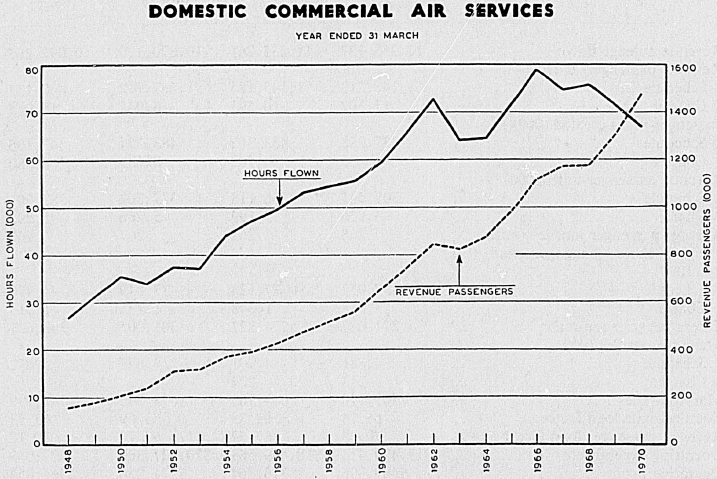
Cook Strait Rail/Air Freight Service—The New Zealand Railways Air Freight Service was commenced officially in February 1947 following a number of special inter-island freight flights which had been carried out by the Royal New Zealand Air Force at the request of the Railways Department to meet a shipping emergency. The service was conducted by the RNZAF, operating Dakota aircraft, until June 1947, when the service was handed over to the New Zealand National Airways Corporation, which continued to operate with Dakotas.
In 1950 the Railways Department decided to allow private enterprise the opportunity of tendering for the contract to run the service, and the successful tenderer was Straits Air Freight Express Ltd. (now known as Safeair Ltd.), which took over on 1 April. The service is at present being maintained by five Bristol Freighter aircraft on a daily basis, the number of trips varying according to the amount of cargo offering. Some charter work has been undertaken in recent years.
Traffic statistics for this freight service for the last 11 years are as follows. The drop from the peak figures of 1961-62 can be attributed in part to the operation of the rail-road ferry G.m.v. Aramoana across Cook Strait between Wellington and Picton from August 1962. There was further competition when the sister ship G.m.v. Aranui was introduced in 1966.
| Year Ended 31 March | Trips Flown | Hours Flown | Miles Flown | Freight lb (000) | Freight Ton-miles (000) | Passengers |
|---|---|---|---|---|---|---|
| 1,960 | 9,509 | 4,465 | 628,113 | 87,612 | 2,566 | 1,225 |
| 1,961 | 11,853 | 4,864 | 635,078 | 112,771 | 2,693 | 1,231 |
| 1,962 | 13,739 | 5,534 | 765,022 | 122,360 | 3,041 | 1,557 |
| 1,963 | 12,381 | 5,050 | 660,924 | 110,625 | 2,650 | 927 |
| 1,964 | 10,588 | 4,265 | 560,130 | 87,656 | 2,067 | 809 |
| 1,965 | 11,315 | 4,558 | 591,796 | 95,764 | 2,239 | 899 |
| 1,966 | 13,182 | 5,894 | 778,501 | 116,870 | 2,993 | 1,500 |
| 1,967 | 10,922 | 5,139 | 677,003 | 93,535 | 2,549 | 902 |
| 1,968 | 8,537 | 4,167 | 557,846 | 69,354 | 2,170 | 531 |
| 1,969 | 8,191 | 3,952 | 532,426 | 72,984 | 2,143 | 480 |
| 1,970 | 15,898 | 6,337 | 849,437 | 108,685 | 3,434 | 413 |
AERIAL WORK—Aerial topdressing as a means of improving hill pastures and checking and preventing soil erosion was begun commercially in 1949. The industry developed rapidly and is now an established feature of the national economy. About half of the total fertiliser and lime applied to farms in New Zealand is spread by means of aircraft.
Aerial spraying (i.e., the release from the aircraft of agricultural chemicals in liquid form, such as insecticides and weedicides) has also been developed. The volume of this work has increased to more than 4,000,000 gallons a year. A technical qualification is now mandatory for pilots engaged in the application of all agricultural chemicals. The qualification is to ensure that pilots are familiar with the chemical properties and correct techniques in applying the agricultural chemicals, many of which are highly toxic.
A summary of aerial work operations follows.
| Item | Year ended 31 March | ||
|---|---|---|---|
| 1968 | 1969 | 1970 | |
| Hours flown | 108,204 | 108,011 | 109,370 |
| Number of operators | 72 | 71 | 77 |
| Material distributed— | |||
| Fertiliser and lime (tons) | 754,280 | 793,552 | 923,741 |
| Seed (tons) | 1,422 | 1,408 | 1,574 |
| Spray (gallons) | 3,048,315 | 3,551,636 | 4,813,563 |
| Animal poison (tons) | 3,241 | 3,881 | 3,130 |
| Supplies (tons) | 578 | 441 | 901 |
| Fencing (tons) | 1,403 | 1,031 | 740 |
| Dusts (tons) | 59 | 21 | 80 |
| Prills (tons) | 477 | 420 | 315 |
| Miscellaneous (tons) | 4,267 | 8,129 | 3,154 |
INTERNATIONAL AIR SERVICES—New Zealand's own airline, Air New Zealand Ltd., provides services with jet aircraft to Sydney, Melbourne, Brisbane, Hong Kong, Singapore, Norfolk Island, New Caledonia, Fiji, American Samoa, Tahiti, Honolulu, and Los Angeles. At 1 April 1970 Air New Zealand's fleet comprised four Douglas DC8s and two Lockheed Electras. Re-equipment proposals envisage the use of Douglas DC10s. Air New Zealand expects to operate international services to and through the new Cook Islands airport at Rarotonga in 1972.
Other services through New Zealand include: Pan American World Airways—from the United States to Auckland via Tahiti; through Honolulu and Pago Pago to Auckland and beyond to Sydney; British Overseas Airways Corporation—twice weekly from the United Kingdom (via intermediate points) to Sydney, Auckland, and beyond to Fiji; Union de Transport Aeriens—weekly from Los Angeles via Tahiti to Auckland and beyond to Noumea; American Airlines—twice weekly from United States to Auckland; and QANTAS—a full range of trans-Tasman services linking with regional and round-the-world services out of Sydney.
A minority financial interest is retained in the regional South Pacific operators: Polynesian Airlines Ltd. (PAL)—operating between Western Samoa, American Samoa, Tonga, and Nandi; and Fiji Airways Ltd. operating between Fiji, the British Solomons, the Gilbert and Ellice Islands, the New Hebrides, Western Samoa, Tonga, Nauru, and Port Moresby.
TOTAL TRAFFIC FOR OVERSEAS AIRLINES—Total traffic figures for overseas airlines operating to and from New Zealand, showing passenger movements, freight and mail separately, are given in the following tables for March years.
| INTERNATIONAL REVENUE PASSENGER MOVEMENTS YEARS ENDED 31 MARCH | ||||||
|---|---|---|---|---|---|---|
| Routes | Entering New Zealand | Leaving New Zealand | Total | |||
| 1968-69 | 1969-70 | 1968-69 | 1969-70 | 1968-69 | 1969-70 | |
| Trans-Tasman | ||||||
| Auckland-Sydney | 67,208 | 77,234 | 69,025 | 77,483 | 136,233 | 154,717 |
| Auckland-Melbourne | 8,408 | 9,864 | 8,106 | 8,738 | 16,514 | 18,602 |
| Auckland-Brisbane | 9,212 | 11,156 | 11,450 | 11,885 | 20,662 | 23,041 |
| Wellington-Sydney | 26,046 | 27,500 | 24,864 | 27,597 | 50,910 | 55,097 |
| Wellington-Melbourne | 5,516 | 6,381 | 6,506 | 6,773 | 12,022 | 13,154 |
| Wellington-Brisbane | 1,992 | 2,638 | 2,786 | 3,009 | 4,778 | 5,647 |
| Christchurch-Sydney | 29,687 | 35,814 | 32,313 | 38,566 | 62,000 | 74,380 |
| Christchurch-Melbourne | 9,452 | 12,417 | 12,420 | 14,066 | 21,872 | 26,483 |
| Total | 157,521 | 183,004 | 167,470 | 188,117 | 324,991 | 371,121 |
| Pacific | ||||||
| Long haul | 16,533 | 19,713 | 15,284 | 18,551 | 31,817 | 38,264 |
| Short haul | 33,184 | 40,477 | 31,825 | 37,312 | 65,009 | 77,789 |
| Total | 49,717 | 60,190 | 47,109 | 55,863 | 96,826 | 116,053 |
| INTERNATIONAL REVENUE FREIGHT (KILOGRAMMES) YEARS ENDED 31 MARCH | ||||||
|---|---|---|---|---|---|---|
| Routes | Entering New Zealand | Leaving New Zealand | Total | |||
| 1968-69 | 1969-70 | 1968-69 | 1969-70 | 1968-69 | 1969-70 | |
| Trans-Tasman | ||||||
| Auckland-Sydney | 1,329,356 | 1,718,641 | 2,509,328 | 2,882,539 | 3,838,684 | 4,601,180 |
| Auckland-Melbourne | 123,114 | 151,178 | 205,742 | 199,401 | 328,856 | 350,579 |
| Auckland-Brisbane | 109,610 | 21,387 | 233,140 | 266,874 | 342,750 | 288,261 |
| Wellington-Sydney | 447,686 | 427,206 | 342,958 | 273,468 | 790,644 | 700,674 |
| Wellington-Melbourne | 58,763 | 83,185 | 113,578 | 82,548 | 172,341 | 165,733 |
| Wellington-Brisbane | 3,212 | 4,162 | 18,350 | 24,580 | 21,562 | 28,742 |
| Christchurch-Sydney | 360,199 | 558,074 | 1,125,508 | 931,992 | 1,485,707 | 1,490,066 |
| Christchurch-Melbourne | 39,308 | 60,817 | 127,810 | 104,855 | 167,118 | 165,672 |
| Total | 2,471,248 | 3,024,650 | 4,676,414 | 4,766,257 | 7,147,662 | 7,790,907 |
| Pacific | ||||||
| Long haul | 123,738 | 300,994 | 1,487,920 | 1,920,646 | 1,611,658 | 2,221,640 |
| Short haul | 173,720 | 209,305 | 953,247 | 1,025,984 | 1,126,967 | 1,235,289 |
| Total | 297,458 | 510,299 | 2,441,167 | 2,946,630 | 2,738,625 | 3,456,929 |
| INTERNATIONAL MAIL (KILOGRAMMES) YEARS ENDED 31 MARCH | ||||||
|---|---|---|---|---|---|---|
| Routes | Entering New Zealand | Leaving New Zealand | Total | |||
| 1968-69 | 1969-70 | 1968-69 | 1969-70 | 1968-69 | 1969-70 | |
| Trans-Tasman | ||||||
| Auckland-Sydney | 362,523 | 401,882 | 162,318 | 134,047 | 524,841 | 535,929 |
| Auckland-Melbourne | 20,203 | 16,548 | 11,423 | 10,170 | 31,626 | 26,718 |
| Auckland-Brisbane | 5,398 | 6,208 | 4,796 | 4,052 | 10,194 | 10,260 |
| Wellington-Sydney | 134,640 | 132,118 | 101,280 | 63,796 | 235,920 | 195,914 |
| Wellington-Melbourne | 4,409 | 5,304 | 6,781 | 11,091 | 11,190 | 16,395 |
| Wellington-Brisbane | 1,228 | 2,136 | 696 | 608 | 1,924 | 2,744 |
| Christchurch-Sydney | 46,136 | 37,395 | 47,074 | 29,959 | 93,210 | 67,354 |
| Christchurch-Melbourne | 4,028 | 8,941 | 2,244 | 5,941 | 6,272 | 14,882 |
| Total | 578,565 | 610,532 | 336,612 | 259,664 | 915,177 | 870,196 |
| Pacific | ||||||
| Long haul | 117,756 | 111,552 | 56,697 | 66,232 | 174,453 | 177,784 |
| Short haul | 75,078 | 118,513 | 70,657 | 192,204 | 145,735 | 310,717 |
| Total | 192,834 | 230,065 | 127,354 | 258,436 | 320,188 | 488,501 |
AIRPORT STATISTICS—The following table shows airport activities for the two latest years ended 31 March.
| Airport | Aircraft Movements of Passenger Planes | Freighter Plane Movements | Passenger Arrivals and Departure | |||||
|---|---|---|---|---|---|---|---|---|
| International | Domestic | |||||||
| 1968-69 | 1969-70 | 1968-69 | 1969-70 | 1968-69 | 1969-70 | 1968-69 | 1969-70 | |
| *Those airports serviced by N.A.C., Safeair and Mount Cook Airlines not separately listed. | ||||||||
| Auckland | 4,713 | 4,402 | 18,992 | 18,886 | 820 | 642 | 750,543 | 917,403 |
| Blenheim | - | - | 3,909 | 4,013 | 9,515 | 11,123 | 64,888 | 68,115 |
| Christchurch | 1,326 | 1,334 | 17,589 | 18,079 | 2,003 | 2,461 | 578,739 | 690,996 |
| Dunedin | 2 | - | 8,362 | 8,785 | 451 | 284 | 139,940 | 162,287 |
| Gisborne | - | - | 4,399 | 5,363 | 104 | 6 | 48,877 | 60,406 |
| Hamilton | 4 | 1 | 4,839 | 5,387 | 137 | 64 | 65,493 | 77,954 |
| Invercargill | 2 | 12 | 5,196 | 5,761 | 137 | 6 | 74,831 | 84,450 |
| Napier | 1 | - | 5,319 | 6,686 | 162 | 24 | 70,795 | 85,889 |
| Nelson | - | - | 9,735 | 9,328 | 620 | 733 | 127,579 | 135,392 |
| New Plymouth | - | - | 4,235 | 3,940 | 212 | 176 | 58,268 | 65,589 |
| Palmerston North | 5 | - | 6,610 | 6,221 | 68 | 128 | 77,948 | 83,788 |
| Rotorua | - | - | 6,944 | 5,405 | - | - | 46,017 | 57,331 |
| Wellington | 1,415 | 1,359 | 31,607 | 30,063 | 10,319 | 13,431 | 766,684 | 888,868 |
| Other* | 13 | - | 18,667 | 24,214 | 163 | 186 | 233,057 | 264,432 |
| Totals | 7,481 | 7,108 | 146,403 | 152,131 | 24,711 | 29,264 | 3,103,659 | 3,642,900 |
AERO CLUBS AND COMMERCIAL FLIGHT TRAINING ORGANISATIONS—The next table gives a summary of the training activities of aero clubs and other flying organisations for the last six years.
| Year Ended 31 March | Clubs* Operating | Membership | Aircraft in Use | Hours Flown | Ab Initio Pupils Under Training | ||
|---|---|---|---|---|---|---|---|
| Associate | Flying | Dual | Solo | ||||
| *Other organisations included are given in brackets. | |||||||
| 1965 | 37 (3) | 2,738 | 5,264 | 149 | 23,259 | 47,230 | 1,306 |
| 1,966 | 36 (7) | 2,448 | 5,202 | 169 | 28,203 | 58,571 | 1,143 |
| 1,967 | 36 (12) | 2,481 | 6,546 | 217 | 40,801 | 74,238 | 1,667 |
| 1,968 | 39 (16) | 2,413 | 7,274 | 238 | 47,529 | 83,777 | 1,803 |
| 1,969 | 39 (13) | 2,103 | 6,781 | 239 | 44,099 | 71,142 | 1,816 |
| 1,970 | 40 (18) | 1,913 | 6,308 | 252 | 48,896 | 76,253 | 1,857 |
LICENCES—A summary of licences and certificates current at 31 March in the five latest years is given below.
| Type of Licence | At 31 March | ||||
|---|---|---|---|---|---|
| 1966 | 1967 | 1968 | 1969 | 1970 | |
| Flight Crew (ICAO) Type— | |||||
| Pilot licences— | |||||
| Student Pilot | 2,238 | 2,964 | 3,413 | 3,498 | 3,330 |
| Private Pilot | 1,975 | 2,287 | 2,843 | 2,909 | 2,837 |
| Commercial Pilot | 754 | 804 | 893 | 896 | 908 |
| Airline Transport Pilot | 267 | 311 | 335 | 376 | 397 |
| Pilot Licence Ratings— | |||||
| Instructor | 285 | 376 | 407 | 420 | 395 |
| Instrument | 445 | 490 | 537 | 545 | 548 |
| Compass | 21 | 22 | 20 | 26 | 27 |
| Chemical | 167 | 230 | 246 | 239 | 243 |
| Towing | 176 | 200 | 261 | 237 | 260 |
| Navigator Licences— | |||||
| Flight Navigator | 70 | 83 | 88 | 94 | 104 |
| Licences to Operate Radio Equipment in Aircraft— | |||||
| Flight Radio Operator | 3 | 2 | 2 | - | - |
| Flight Radio Telephone Operator Rating | 2,034 | 2,475 | 3,220 | 3,887 | 4,046 |
| Flight Engineer Licences— | |||||
| Flight Engineer | 53 | 59 | 62 | 59 | 61 |
| Other Licences, Certificates, etc.— | |||||
| Aircraft Maintenance Engineer Licences | 425 | 407 | 475 | 513 | 534 |
| Aircraft— | |||||
| Certificates of Registration | 889 | 1,011 | 1,052 | 1,047 | 1,073 |
| Aerodromes— | |||||
| Public Licences | 50 | 52 | 50 | 49 | 46 |
| Private | 45 | 49 | 47 | 45 | 46 |
| Authorised Places | 6 | 7 | 8 | 3 | 6 |
| Government Civil | 23 | 21 | 21 | 21 | 18 |
| Air Service Certificates | 56 | 54 | 55 | 55 | 68 |
Table of Contents
GENERAL—The main role of the New Zealand Post Office is to provide the nation with telecommunication and postal services, to operate a savings bank, and conduct agency services on behalf of Government.
The demands on the Department are growing and will continue to grow, if anything at an increasing rate, as the public demands more and better services in the postal and telecommunications field. The improvements and changes in the immediate past will, it is considered, appear relatively minor compared with those which will need to be faced in the next decade and with technological advancement. For instance, there is a growing requirement for the use of Post Office circuits for data transmission purposes. Plans developed to meet this demand include the provision of facilities for transmitting data over the telephone network.
In the new Wellington Postal Centre, automatic sorting equipment has been provided for parcels, with provision for the later introduction of automatic letter-sorting equipment when the volume of traffic is sufficient to warrant it. Up-to-date conveying equipment for the movement of postal articles between the main processing points is included. The completion of the installation of the equipment in 1970 climaxed many years of planning and intensive study of postal mechanisation in other countries.
International telecommunications are vital to international commerce and trade and have social importance. High quality outlets from New Zealand provided via the COMPAC cable system (1963) and the SEACOM cable system (1967) have been needed to cope with public demand.
With the continued growth in traffic demand, Government approved the establishment of a communications satellite earth station. In addition to providing additional international telecommunications facilities, the new system makes live television relays practicable. The earth station, which is located some 3 miles south of Warkworth, works through a satellite over the Pacific Ocean. The earth station was brought into service in 1971.
A new international Gateway telephone exchange was opened at Auckland in March 1969. The exchange, which handles all of New Zealand's outgoing and incoming international telephone calls, enables the international operators to connect calls by dialling direct to subscribers in other countries, as well as enabling operators in overseas countries to dial direct to subscribers on automatic telephone exchanges in New Zealand.
An automatic message relay centre has been installed at Auckland for international telegraph traffic. The centre works to, and is compatible with, those operated by other countries, and provides an economical and more efficient means of transmitting and receiving international telegrams.
An important development in New Zealand's international telex service was the introduction in July 1968 of automatic subscriber-to-subscriber calling. Telex subscribers in New Zealand can now dial direct to subscribers in Australia, Britain, Canada, Japan, United States, and certain European countries.
HISTORICAL—With the arrival of Governor Hobson in 1840 the first post office proper was set up at Kororareka (now Russell). The same year saw the establishment of offices at other settlements in the north and at Port Nicholson (Wellington), and the beginnings of overland mail routes. By 1858 seventy-three post offices had been opened to provide communication services for the scattered settlers. In that year a Post Office Act was passed making the Post Office an independent Department of State.
The system of communication by telegraph was inaugurated in the 1860s. A separate Department, the Telegraph Department, was created by Act of Parliament in 1865 to take responsibility for the erecting of telegraph lines and the opening of morse telegraph offices. The North and South Islands were linked by telegraph cable in 1866 and by telephone cable in 1926.
The telegraph and postal services were amalgamated in 1881. Under the Post Office Act 1959, the name of the Department became the Post Office, and the Minister's title became Postmaster-General.
A table in the Statistical Summary towards the back of Yearbook shows the growth of postal and telecommunication activities over the last 50 years.
POSTAL BUSINESS—At 31 March 1970 there were 1,514 post offices in New Zealand. The following table shows the numbers of articles posted in the latest five years.
| Year Ended 31 March | Letters, Lettercards, and Postcards | Accounts, Circulars, Newspapers, Packets, etc. | Parcels | Total Articles Posted |
|---|---|---|---|---|
| million | ||||
| 1,966 | 273.6 | 291.8 | 7.9 | 573.3 |
| 1,967 | 275.6 | 292.6 | 8.2 | 576.4 |
| 1,968 | 269.1 | 292.0 | 7.1 | 568.2 |
| 1,969 | 279.9 | 288.2 | 6.8 | 574.9 |
| 1,970 | 288.6 | 299.8 | 7.0 | 595.4 |
The average numbers of letters, etc., posted in New Zealand per head of population during the year ended 31 March 1970 were: letters, lettercards, and postcards, 103.4; accounts circulars, newspapers, packets, etc., 107.3; parcels, 2.5.
Chartered air services are used to convey the bulk of surface mail between the North and South Islands.
There are 90,968 private boxes installed at 594 post offices, mainly for business mail.
Rural Mail Delivery—The rural delivery system enables country residents to obtain postal notes, money orders, and stamps, to register correspondence, and to collect or post their mail in boxes at or near their gates. The deliveries are generally performed by contractors who handle the mail in conjunction with the carriage of goods, and thus the rural-mail delivery is in many areas the medium by which residents obtain their newspapers, bread, parcels, etc. The development of this scheme can be gauged by the following figures: 1921, 8,700; 1940, 32,382; 1955, 63,859; 1965, 75,591; 1966, 76,055; 1967, 76,204; 1968, 77,069; 1969, 76,477, and in March 1970, 77,379 boxholders. The cost of the rural delivery service is $1.4 million a year.
Inland Air Mails—On 16 March 1936 the first regular air-mail services linking up larger centres of population were established between Palmerston North and Dunedin, and between Nelson, Blenheim, and Wellington. As air services increased in frequency and extent the air-mail facilities were correspondingly expanded. The present network extends from Kaitaia to Invercargill.
The number of letters and parcels carried by air in New Zealand is now shown.
| Year Ended 31 March | Letters | Parcels |
|---|---|---|
| 1,966 | 21,731,000 | 218,460 |
| 1,967 | 23,045,000 | 237,462 |
| 1,968 | 19,513,000 | 282,938 |
| 1,969 | 22,429,000 | 293,545 |
| 1,970 | 22,971,000 | 304,791 |
Overseas Air Mails: The weight of airmail dispatched from New Zealand is about 20 percent of the total amount of mail forwarded overseas each year. In 1969-70, 471,607 lb of letters, 297,743 lb of newspapers and packets, and 293,518 lb of parcels were posted by overseas airmail.
Trans-Tasman Air Services—The first flight of the regular trans-Tasman service linking Auckland and Sydney took place on 30 April 1940, connection being made at Sydney with the Empire service to London. The existing service provides for flights between New Zealand (Auckland, Wellington, and Christchurch) and Australia (Sydney, Melbourne, and Brisbane) with a frequency overall of at least one flight each day.
New Zealand - United Kingdom Air Service—This service is now operating daily via Fiji to London, the transit time New Zealand to the United Kingdom being normally one to two days.
New Zealand - Hong Kong and Singapore Air Services—There is a twice-weekly direct service from Auckland to Hong Kong and a thrice-weekly direct service from Auckland to Singapore. Air mail to countries in the Far East is also dispatched to Sydney for reforwarding.
Trans-Pacific Services—The trans-Pacific service operating between New Zealand and North America commenced on 20 July 1940. Airlines now operate a daily service to San Francisco and Los Angeles.
Pacific Island Services—Airmails are forwarded by New Zealand operated air services to Fiji, French Polynesia, New Caledonia, and American Samoa (Pago Pago). Local air services provide connections from Pago Pago to Apia, and from Nandi (Fiji) to Nukualofa (Tonga), Apia (Western Samoa), the Gilbert and Ellice Islands, Nauru Island, and Wallis and Futuna Islands. Direct airmail services from New Zealand also operate to Norfolk Island.
Overseas Parcel Post—Particulars of overseas parcels received and dispatched in each of the latest five years are contained in the following table.
| Year Ended 31 March | Overseas Parcels Received | Overseas Parcels Dispatched | |||
|---|---|---|---|---|---|
| Number | Weight | Customs Duty | Number | Weight | |
| lb | $(000) | lb | |||
| 1,966 | 555,088 | 4,995,792 | 1,483 | 263,496 | 1,763,674 |
| 1,967 | 579,662 | 5,216,958 | 1,350 | 310,126 | 1,805,036 |
| 1,968 | 533,164 | 4,740,252 | 1,252 | 365,459 | 2,024,821 |
| 1,969 | 533,405 | 4,691,511 | 1,630 | 400,231 | 2,077,052 |
| 1,970 | 554,722 | 4,803,044 | 1,626 | 418,392 | 2,154,185 |
MONEY ORDER AND POSTAL NOTE SERVICES—Details of these services are now given.
Money Orders—New Zealand has reciprocal money-order agreements with all British Commonwealth countries and also with the United States of America, the Republic of Ireland, South Africa, and Tonga. Money orders may also be issued in New Zealand for payment in any other country with which the United Kingdom has exchanges of money orders.
For payment within New Zealand the maximum amount for a single order is $200, but there is no limit to the amount which may be remitted. The commission is computed on each individual order.
For money orders issued for payment overseas there is a limit for most countries of $80 for a single order. There are two special rates of commission, one rate applying to Australia (and countries advised through Australia), Fiji, Norfolk Island, and Tonga, and the other rate to all other countries.
During 1969, 2,030,703 money orders were issued in New Zealand for a total of $48,415,314, and of that total 78,589 orders of a value of $1,251,246 were issued for payment overseas. Money orders issued overseas for payment in New Zealand in 1969 numbered 41.679 with a value of $538,914.
Postal Notes—Postal notes ranging from 10c to $2 and for $3, $4, and $5 are issued New Zealand for payment within New Zealand, Niue, and the Cook Islands.
Postal notes are negotiable, and their period of validity is unlimited. They are, therefore, a popular medium for making small inland remittances by post, and during the year ended 31 March 1970, 2,896,757 postal notes valued at $5,315,573 were purchased by the public.
British Postal Orders—These are both issued and paid in New Zealand. Denominations sold in this country are 5p, 7 1/2p, 10p, 12 1/2p, 15p, 25p, 50p, 75p, £1 and £2 sterling. (In decimal currency, which has applied in the United Kingdom from 15 February 1971, 5 pence equals the previous 1 shilling.) Commission is payable. For all remittances in excess of £2 per day a permit is required.
As these orders are payable in several British Commonwealth countries they are a popular medium for making small postal remittances to overseas countries, particularly the United Kingdom.
During the year ended 31 March 1970 the Post Office sold 2,030,004 British postal orders valued at $1,851,295, and paid 144,543 orders valued at $415,760
Gift Tokens—Post Office gift tokens were introduced on 15 December 1969 to enable people to buy savings gifts from the Post Office. They are issued free of commission in denominations of $1, $2, and $5. They may be credited to any type of Savings Bank account, or used to purchase bonus bonds or national development bonds. Gift tokens issued to 31 March 1970 amounted to $61,096.
POST OFFICE SAVINGS BANK—Details on the Post Office Savings Bank are given in Section 29, Banking and Currency.
TELEPHONE SERVICES—The following table indicates the growth of telephone installations (the figures are as at 31 March).
| Item | 1960 | 1968 | 1969 | 1970 |
|---|---|---|---|---|
| Main telephones— | ||||
| Automatic | 331,087 | 608,326 | 634,824 | 675,729 |
| Manual | 164,967 | 149,434 | 141,698 | 127,076 |
| Extension telephones | 183,399 | 355,110 | 372,435 | 393,228 |
| Public telephones | 3,058 | 4,376 | 4,526 | 4,638 |
| Private line telephones | 2,020 | 784 | 633 | 603 |
| Toll offices | 1,490 | 1,392 | 1,349 | 1,316 |
| Total telephones | 686,021 | 1,119,422 | 1,155,465 | 1,202,590 |
| Telephones (all types per 1,000 population) | 289.4 | 406 | 416 | 426 |
| Applicants awaiting installations | 28,711 | 11,639 | 13,555 | 13,923 |
| Number of toll calls | 47,499,416 | 67,671,515 | 68,273,668 | 66,956,193 |
About one-sixth of the main telephones are business telephones (in 1968 there were 128,018 business telephones).
According to the latest comparative data available (January 1969), compiled by the Chief Statistician of the American Telephone and Telegraph Co., New Zealand ranks fifth in the number of telephones per 100 of population, the leading countries being the United States of America (54.02), Sweden (51.76), Switzerland (43.42), Canada (42.12), and New Zealand (41.55).
A broadband toll link, comprising microwave, radio and co-axial cable systems, connects main centres from Whangarei to Dunedin.
Free local telephone calling is provided in New Zealand, as distinct from charging for each local call as followed by many overseas administrations.
The following table shows the classification of telephone exchanges and the annual rental rates for different classes of connection as from 15 February 1971.
| Class of Exchange | Class of Connection | Annual Rate Within Base-rate Area | |
|---|---|---|---|
| Business | Residential | ||
| $ | $ | ||
| Class I Automatic exchanges with more than 10,000 paying subscribers. | Individual | 110.00 | 52.00 |
| 2-party | 80.00 | 45.00 | |
| (Typical exchanges are Auckland, Christchurch, Dunedin, Hamilton, Invercargill, Palmerston North, and Wellington.) | 3-party | 76.00 | 44.00 |
| 4-party | 72.00 | 43.00 | |
| 5-party | 66.00 | 40.00 | |
| 6-10 party | 60.00 | 36.00 | |
| Class II Automatic exchanges with 3,001-10,000 paying subscribers. | Individual | 105.00 | 52.00 |
| 2-party | 78.00 | 45.00 | |
| (Typical exchanges are Blenheim, Masterton, Levin, and Oamaru.) | 3-party | 74.00 | 44.00 |
| 4-party | 70.00 | 43.00 | |
| 5-party | 64.00 | 40.00 | |
| 6-10 party | 58.00 | 36.00 | |
| Class III Automatic exchanges with 201-3,000 paying subscribers. | Individual | 95.00 | 50.00 |
| 2-party | 75.00 | 43.00 | |
| (Typical exchanges are Alexandra, Dannevirke, Marton, Westport.) | 3-party | 71.00 | 42.00 |
| 4-party | 67.00 | 41.00 | |
| Manual exchanges with over 3,000 paying subscribers. | 5-party | 62.00 | 38.00 |
| (A typical exchange is Feilding.) | 6-10 party | 56.00 | 34.00 |
| Class IV Other exchanges affording continuous service. | Individual | 90.00 | 46.00 |
| (Typical exchanges are Hokitika, Picton, and Queens-town.) | 2-party | 70.00 | 40.00 |
| 3-party | 66.00 | 39.00 | |
| 4-party | 62.00 | 38.00 | |
| 5-party | 56.00 | 36.00 | |
| 6-10 party | 50.00 | 32.00 | |
| Class V Exchanges observing restricted hours of service. | Individual | 70.00 | 39.00 |
| (Typical exchanges are Kawhia, and Waitotara.) | 2-party | 58.00 | 34.00 |
| 3-party | 54.00 | 33.00 | |
| 4-party | 52.00 | 31.00 | |
| 5-party | 48.00 | 29.00 | |
| 6-10 party | 46.00 | 28.00 | |
For stations located outside the boundary of the base-rate or special rate area of an exchange a mileage rate is added to the rental, depending on the distance by line measurement from the base-rate or special rate boundary to the respective subscriber's station.
In March 1970 there were 50,098 party lines serving 133,247 telephones.
TELEGRAPH SERVICES:Telegrams—There is a downtrend in inland telegrams, which is in keeping with world experience, telegrams having declined in popularity compared with other forms of communication. In the year to 31 March 1970 5.7 million telegrams were lodged; the peak post-war year was 1955-56 with 7.6 million.
Telex Service:Telex—The international abbreviation for Teleprinter Exchange Service—is a customer-to-customer service using page teleprinters. An international telex service for communicating with overseas subscribers only commenced in New Zealand on 1 September 1960 with 16 subscribers. Service was then available with 23 overseas countries.
Automatic telex service was introduced in New Zealand on 13 May 1964 with 150 subscribers. This service absorbed the previous international connections and all New Zealand telex subscribers may now communicate with each other as well as with overseas telex subscribers. International service is now available with 122 countries. At 31 March 1970 there were 1,015 subscribers.
The annual rental is $500 for a standard machine and $700 for a teleprinter equipped with a tape reperforator and transmitter. In the year to 31 March 1970 rentals totalled $468,865 and call revenue was $776,518 (internal $528,202 and international $248,316.)
INTERNATIONAL TELECOMMUNICATIONS:Cable Links—Telegraphic communication overseas was first established between New Zealand and Australia by means of the Eastern Extension Telegraph Company's cable from Wakapuaka (Nelson) to Sydney in 1876, and between Auckland and Canada via Norfolk Island, Suva, and Fanning Island in 1902. In 1945, the Commonwealth's external telecommunications systems were brought under Government control and, in accordance with the Commonwealth Telegraphs Agreement 1948, the New Zealand Post Office purchased the assets in New Zealand of Cable and Wireless Ltd., the private company previously controlling these services, and took over the operation of the overseas cable services.
In July 1962 a new submarine cable with a capacity of 80 telephone channels was brought into operation between New Zealand and Australia as part of a Commonwealth round-the-world cable project. The cable was extended from New Zealand to Fiji in December 1962, and in December 1963 was further extended, via Hawaii, to Vancouver and across Canada by microwave to Montreal. At Montreal it links up with the trans-Atlantic telephone cables, to connect with Britain, and provide high quality circuits for telephone, telegraph, and telex communication between New Zealand, Australia, Fiji, Canada, the United States of America, and Britain. This cable system links New Zealand with most of the world's major countries, and it was supplemented by the bringing into service in March 1967 of the South-East Asia Commonwealth Telephone Cable which extended the system from Australia to New Guinea, and (via Guam) to Malaysia, Hong Kong, and Singapore.
International Telephone Service—Telephone communication by cable and radio is now available to almost all countries of the world, as well as to Ross Dependency (Scott Base), Raoul Island, Chatham Islands, Campbell Island, passenger ships, and H.M. New Zealand and Australian warships.
Satellite Communications—Because of the rapid increase in international telecommunication traffic, an earth station has been constructed in New Zealand for communicating with other countries via satellites in space.
International Radio Services—The first wireless-telegraph station in New Zealand for communicating with ships at sea was opened at Wellington on 26 July 1911.
In November 1953 a high-power radio transmitting station was opened at Himatangi providing at that time for direct New Zealand-United Kingdom radiotelephone and telegraph circuits. These circuits are now provided via cable, and the Himatangi radio station is used generally for services with places in the Pacific area to which there are no cable facilities. The receiving station complementary to Himatangi is Makara Radio.
Direct radio circuits are operated from New Zealand to Apia, Rarotonga, Niue, and Noumea. Communication is effected with outer islands in the Cook group by Rarotonga Radio through small feeder stations. Small stations in the Tokelau Islands communicate with Apia Radio.
Other principal stations under the control of the New Zealand Government are located at Auckland, Wellington, and Awarua on the New Zealand mainland, at Niue, and at Chatham Islands. Facilities are provided for the transmission of radiotelegrams to ships at sea, and special rates operate for vessels registered in New Zealand and Australia.
INLAND RADIO SERVICES—The use of mobile radiotelephone services continues to grow. Post Office very-high-frequency service available from 55 base stations meets the mobile communication requirements of 3,106 subscribers operating 20,443 mobile units. A miscellany of private and Government owner-operated stations provide mobile radiotelephone services through 2,236 base stations for a further 7,790 mobile units. Radiotelephone services continue to provide essential service for isolated communities which cannot reasonably be reached by landline—e.g., isolated settlers, alpine huts, etc. There is also a free radio-medical service for ships at sea and for lighthouses on the New Zealand coast for use in emergency cases.
Direct radio circuits are operated between the New Zealand mainland and the Chatham Islands.
Smaller stations are established at certain lighthouses on the New Zealand coast and also on a number of adjacent islands. Marine radio beacons are operated at the lighthouses at Cape Reinga, Cuvier Island, Moko Hinau Island, East Cape, Portland Island, Stephens Island, Baring Head, Cape Campbell, The Brothers, Godley Head, Taiaroa Head, Dog Island, and Puysegur Point.
Ordinary radio-receiving licences and television-receiving licences authorise reception from broadcasting stations, and may be obtained at any Post Office Savings Bank on payment of the prescribed fee. Further reference to these licences will be found in Section 12B, Radio and Television Broadcasting.
Licences for amateur stations are intended to provide facilities for experimental transmission to those interested in radio science, and are issued only to holders of amateur operators' certificates.
REVENUE—The revenue of the Post Office for the latest financial years is now shown.
| Item | 1967-68 | 1968-69 | 1969-70 |
|---|---|---|---|
| $(000) | $(000) | $(000) | |
| Postal revenue— | |||
| Postages | 23,071 | 23,672 | 25,085 |
| Private box and bag rentals and rural mail delivery fees | 477 | 490 | 504 |
| Miscellaneous | 90 | 77 | 48 |
| 23,639 | 24,239 | 25,637 | |
| Telecommunications revenue— | |||
| Telex | 910 | 1,079 | 1,235 |
| Telegraph | 4,137 | 4,043 | 4,054 |
| Tolls | 25,965 | 27,456 | 29,677 |
| Telephones | 43,961 | 46,906 | 49,062 |
| Overseas telecommunications | 3,450 | 4,086 | 4,678 |
| Radio | 231 | 294 | 298 |
| 78,655 | 83,864 | 89,004 | |
| Miscellaneous revenue— | |||
| Fees from Government Departments, etc. | 3,320 | 3,428 | 3,446 |
| Money order and postal note commission | 424 | 391 | 404 |
| Rents received | 226 | 272 | 284 |
| Other revenue | 343 | 599 | 704 |
| 4,313 | 4,690 | 4,838 | |
| Total revenue | 106,607 | 112,793 | 119,499 |
Revenue and expenditure for the latest 11 years are shown in the following table.
| Year Ended 31 March | Revenue $(000) | Expenditure $(000) |
|---|---|---|
| 1,960 | 48,474 | 48,395 |
| 1,961 | 53,310 | 53,243 |
| 1,962 | 60,112 | 50,003 |
| 1,963 | 64,874 | 64,777 |
| 1,964 | 70,183 | 70,068 |
| 1,965 | 77,841 | 76,586 |
| 1,966 | 86,962 | 84,890 |
| 1,967 | 91,526 | 93,582 |
| 1,968 | 106,607 | 100,781 |
| 1,969 | 112,793 | 106,575 |
| 1,970 | 119,499 | 117,087 |
CAPITAL—Capital expansion necessary to meet demand requires substantial provisions for new telecommunications systems and the replacement of those which have become obsolete. Accommodation to house this equipment, to provide post offices in newly developed areas, and to replace old and inadequate offices is an important part of Post Office capital development.
Capital expenditure on telecommunications development and buildings is financed partly by the Post Office, and partly from National Development Loans Account on which interest is paid at the rate of 5 percent. The interest payment amounted to $12.2 million in 1969-70.
In 1969-70, $21.1 million was spent on the development of telecommunications systems of which $11.3 million (53.6 percent) was provided from Post Office resources. Of $6.9 million spent on buildings $4.2 million (60.4 percent) was provided by the Post Office, the balance in both cases being drawn from National Development Loans Account, making the total Post Office indebtedness $256.5 million at 31 March 1970. In addition, capital investment amounting to $1.6 million in other assets such as motor vehicles, tools and plant, and office equipment was financed wholly by the Post Office.
WORK PERFORMED FOR OTHER DEPARTMENTS—Because it has numerous small offices readily accessible to the public, the Post Office also undertakes agency work for other Government Departments. Among the principal activities in this connection are the receipt and payment of moneys on behalf of the various Departments, the more important of which are enumerated below.
Receipts—For the following Departments: Education (examination fees, etc.), Health, Inland Revenue (land tax and income tax, under PAYE system), Lands and Survey, National Roads Board (special mileage tax on motor vehicles), Public Trust Office, State Advances Corporation (State rents, loan and interest repayments), Electricity (some electric-power receipts), Ministry of Transport, Tourist and Publicity, Valuation, Customs (collection of Customs duty and sales tax), Treasury (Government Superannuation and National Provident Fund receipts).
Payments—Departments of Social Security (social security benefits and war pensions, etc.), Health (refunds of medical expenses), Defence, Labour (subsidised wage payments and military training medical examination payments), Maori and Island Affairs (Maori trust payments), Public Trust Office, Police (witness warrants), Treasury (Government Superannuation payments and miscellaneous payments for other Departments), Ministry of Works, and for Reserve Bank (interest warrants and coupons).
Other services performed by the Post Office are the issue of licences in respect of motor vehicles and radio apparatus, and assistance to the Marine Department and the Civil Aviation Division of Ministry of Transport on radio matters. In some of the smaller centres postmasters act as Registrars of Births, Deaths, and Marriages, also as Registrars of Electors.
Other activities, not strictly departmental, include the receipt of motor vehicles insurance (third-party risks) premiums under the Transport Act 1962, the issue of fishing and game licences on behalf of acclimatisation societies, organising and selling health stamps, and collecting revenue for such outside bodies as the New Zealand Poultry Board, the New Zealand Trade Certification Board, the Armed Forces Canteen Council, and the New Zealand Broadcasting Corporation.
STAFF—Staff numbers at 31 March are shown in the following table.
| Classification | 1960 | 1968 | 1969 | 1970 |
|---|---|---|---|---|
| Permanent staff— | ||||
| Administrative | 16 | 23 | 23 | 23 |
| First Division | 7,834 | 11,293 | 12,165 | 11,605 |
| Second Division | 9,785 | 14,489 | 14,201 | 15,284 |
| 17,635 | 25,805 | 26,389 | 26,912 | |
| Temporary staff— | 6,088 | 3,557 | 3,662 | 4,244 |
| Employed on an agency basis | 853 | 654 | 620 | 617 |
| Total staff | 24,576 | 30,016 | 30,671 | 31,773 |
VEHICLES—The Post Office fleet as at 31 March 1970 consisted of 3,703 vehicles—1,263 trucks, 1,381 vans, 1,052 cars, and 7 motor scooters. Of this fleet, 454 vehicles are used for hire to other Departments, 2,468 for engineering construction work, and 781 on postal, telegram delivery, and other general work. The fleet travelled 33.2 million miles in the year ended 31 March 1970.
GENERAL: Radio Broadcasting Company—The initial development of broadcasting on a Dominion-wide basis was confirmed by the agreement of the Radio Broadcasting Company of New Zealand on 1 August 1925 to establish and maintain an efficient broadcasting service. The company purchased existing stations in the four main centres and began operation of its new stations at Auckland and Christchurch in August-September 1926. Stations at Wellington and Dunedin followed soon after. By the end of 1931 the number of receiving licences in the country had risen to about 70,000.
New Zealand Broadcasting Board—With the expiry of the Radio Broadcasting Company's contract in January 1932, control of the broadcasting service, under the Broadcasting Act 1931, was vested in the New Zealand Broadcasting Board. Existing plant was purchased from the company.
New Zealand Broadcasting Service—The Broadcasting Act 1936 abolished the New Zealand Broadcasting Board and vested control of the newly constituted National Broadcasting Service in a Minister of the Crown. Administration of the service was placed in the hands of a Director of Broadcasting, appointed by the Governor-General in Council. Permanent officers previously employed by the board became officers of the Public Service from 1 July 1936.
By the 1936 Act the Minister of Broadcasting was empowered also to establish and operate commercial radio stations broadcasting advertising matter. The Broadcasting Amendment Act 1937 provided for the establishment of a National Commercial Broadcasting Service which existed separately until the two services were combined under the Director of Broadcasting on 26 August 1943.
The Broadcasting Amendment Act 1960 provided for the establishment of a television service to be operated by the Minister in Charge of Broadcasting in association with the existing broadcasting service.
New Zealand Broadcasting Authority—Under the Broadcasting Authority Act 1968 an Authority of three members has been appointed to consider and adjudicate upon applications for warrants to establish and operate broadcasting stations, either sound radio or television. The Authority is required to make rules from time to time on the balance and quality of programmes, the character and standard of advertising, the accuracy and impartiality of news, and other matters, after consultation with the New Zealand Broadcasting Corporation and representatives of owners of private broadcasting stations holding warrants under the Act. Several private commercial radio broadcasting stations have been approved and some commenced operation in 1970, including Radio Hauraki (N.Z.) Ltd. and Radio i Ltd. in Auckland, Radio Waikato in Hamilton, and Radio Whakatane.
In October 1969 the Minister of Broadcasting directed the Authority to carry out an inquiry into television services and extensive hearings took place in 1970, particularly as regards the operation of a second channel.
NEW ZEALAND BROADCASTING CORPORATION—The Broadcasting Corporation Act 1961 repealed all previous legislation and established a Corporation of three members empowered from 1 April 1962 to take over and operate the existing service. The Broadcasting Corporation Amendment Act 1965 allows the membership of the Corporation to be from three to seven, and extended the powers of the Corporation to permit assistance to performing art and cultural organisations. General or special directions in line with Government policy may be given in writing to the Corporation by the Minister of Broadcasting. A copy of every such notice must be laid by the Minister before Parliament. The Director-General, who is appointed by the Corporation, is paid out of the Consolidated Revenue Account, but any such money is repaid to this Account from the Broadcasting Account.
RADIO—The New Zealand Broadcasting Corporation operates 47 medium-wave broadcasting stations and two short-wave transmitters of Radio New Zealand, the latter having 19 assigned frequencies. Of these, 28 stations—shown with an asterisk in the following list—broadcast advertising material. No advertising is broadcast on Sundays, Christmas Day or Good Friday. Stations 2YA, 1YA, 3YA, 4YA, and 4YW maintain a daily 24-hour service apart from shutdowns once a fortnight between the hours of 11.20 p.m. Sunday and 5 a.m. Monday in the case of 2YA, and 6 a.m. in the case of the other four stations. The shutdowns are staggered so that at least two of these stations are always on the air.
A list of medium-wave stations of the New Zealand Broadcasting Corporation follows.
| MEDIUM-WAVE STATIONS | |||
|---|---|---|---|
| Call Sign and Locality | Radiated Power | Frequency | Normal Hours of Transmission per Week |
*Broadcasts advertising material. †Operates when 2YA broadcasts the proceedings of the House of Representatives. | |||
| kilowatts | kilo Hertz | hr min | |
| 1ZK, Kaitaia* | 2.00 | 1,440 | 124 30 |
| 1ZE, Kaikohe* | 2.00 | 1,220 | 124 30 |
| 1ZN, Whangarei* | 2.00 | 970 | 124 30 |
| 1YX, Whangarei | 2.00 | 830 | 121 20 |
| 1YA, Auckland | 20.00 | 760 | 164 40 |
| 1YC, Auckland | 10.00 | 880 | 43 30 |
| 1ZB, Auckland* | 10.00 | 1,070 | 132 00 |
| 1ZM, Auckland* | 2.00 | 1,250 | 121 00 |
| 1ZD, Tauranga* | 10.00 | 1,000 | 119 30 |
| 1ZH, Hamilton* | 2.00 | 1,310 | 129 30 |
| 1YW, Hamilton | 2.00 | 1,140 | 121 20 |
| 1YZ, Rotorua | 10.00 | 860 | 121 20 |
| 1ZC, Rotorua* | 2.00 | 1,350 | 119 30 |
| 1ZO, Tokoroa* | 2.00 | 1,420 | 127 20 |
| 1ZU, Taumarunui* | 1.00 | 1,520 | 127 20 |
| 1ZA, Taupo* | 2.00 | 1,500 | 127 20 |
| 1ZT, Turangi | 0.10 | 1,390 | 127 20 |
| 2ZG, Gisborne* | 2.00 | 1,060 | 116 30 |
| 2YW, Gisborne | 2.00 | 1,180 | 121 20 |
| 2ZP, New Plymouth* | 2.00 | 1,370 | 116 30 |
| 2ZH, Hawera* | 1.00 | 1,560 | 116 30 |
| 2YZ, Napier | 20.00 | 630 | 121 20 |
| 2ZC, Napier* | 2.00 | 1,280 | 123 30 |
| 2ZW, Wanganui* | 2.00 | 1,200 | 116 30 |
| 2ZA, Palmerston North* | 2.00 | 940 | 123 30 |
| 2ZD, Masterton* | 2.00 | 840 | 113 30 |
| 2YA, Wellington | 100.00 | 570 | 165 10 |
| 2YC, Wellington | 60.00 | 660 | 43 30 |
| 2YB, Wellington† | 20.00 | 800 | † |
| 2ZB, Wellington* | 20.00 | 980 | 126 00 |
| 2ZM, Wellington* | 2.00 | 1,130 | 121 00 |
| 2ZE, Blenheim* | 1.00 | 1,540 | 38 00 |
| 2ZN, Nelson* | 2.00 | 1,340 | 116 30 |
| 3YW, Westport | 2.00 | 1,460 | 121 20 |
| 3YZ, Greymouth | 10.00 | 920 | 121 20 |
| 3ZA, Greymouth* | 2.00 | 750 | 39 00 |
| 3YA, Christchurch | 20.00 | 690 | 164 40 |
| 3YC, Christchurch | 10.00 | 960 | 43 30 |
| 3ZB, Christchurch* | 10.00 | 1,100 | 126 00 |
| 3ZM, Christchurch* | 2.00 | 1,400 | 121 00 |
| 3ZC, Timaru* | 2.00 | 1,160 | 116 30 |
| 4YW, Alexandra | 2.00 | 640 | 164 40 |
| 4YA, Dunedin | 20.00 | 780 | 164 40 |
| 4YC, Dunedin | 10.00 | 900 | 43 30 |
| 4ZB, Dunedin* | 10.00 | 1,040 | 126 00 |
| 4YZ, Invercargill | 20.00 | 720 | 121 20 |
| 4ZA, Invercargill* | 10.00 | 820 | 123 30 |
Of the two short-wave transmitters employed by Radio New Zealand, each has a power of 7.50 kilowatts, and frequencies used are in the 6, 9, 11, and 15 metre bands. Frequencies are adjusted throughout the day as well as seasonally to give best reception in the target areas. 15.28, and 11.78 mega Hertz being commonly used for daily transmissions of the home service programme, and the additional one of 6.08 mega Hertz being employed for transmissions to Australia and Antarctica. Broadcasting hours amount to approximately 15 1/2 hours daily to the Pacific Islands and 12 1/2 hours daily to Australia.
Coverage of NZBC Medium-wave Service—The basic function of medium-wave stations in the programme coverage of New Zealand is as follows:
Stations 1YA, 2YA, 3YA, 4YA, 1YX, 1YZ, 2YZ, 3YZ, 4YZ, 1YW, 2YW, 3YW, and 4YW broadcast the national (non-advertising) programme to listeners throughout the country.
Stations 1YC, 2YC, 3YC, 4YC, provide alternative non-advertising programmes to those of the national programme stations in (a) but with slightly less extensive coverage.
Stations 1ZB, 2ZB, 3ZB, 4ZB, 1ZK, 1ZE, 1ZN, 1ZH, 1ZD, 1ZC, 1ZA, 1ZT, 1ZO, 1ZU, 2ZP, 2ZH, 2ZW, 2ZA, 1ZG, 2ZC, 2ZD, 2ZN, 2ZE, 3ZC, 3ZA, 4ZA, 1ZM, 2ZM and 3ZM serve the immediate locality of the centres in which they operate and present advertising programmes mainly of a light character. Within their coverage range these stations give alternative programmes to those provided by stations listed in (a) and (b).
Stations 1ZA, 1ZO, 1ZU listed in (c) broadcast advertising programmes part of the time only. At other times they link with stations in (a) to rebroadcast the national programme.
Stations 1ZK, 1ZE, 1ZT, 2ZH, 3YW and 4YW are satellite stations rebroadcasting for local reception the programmes of more distant stations with which they are linked.
Coverage of Short-wave Service—Radio New Zealand broadcasts to the Pacific islands a daily home service programme from 5 a.m. to 5.45 p.m. on one frequency and a special evening programme from 6 p.m. to 8.45 p.m. on two frequencies. Its transmission to Australia comprises a daily home-service programme from 8 a.m. to 5.45 p.m. on one frequency and a special evening programme from 9 p.m. to 11.45 p.m. on two frequencies. In addition to its large radio audience throughout the Pacific, Radio New Zealand has listeners as far distant as the United Kingdom, Sweden, France, the United States, and Japan. Radio New Zealand programmes illustrate many different aspects of life in this country.
National Programmes—Programmes from national non-commercial stations include, as well as all types of music, plays, short stories, serials, sports commentaries and results, talks, documentaries, women's programmes, children's educational and entertainment programmes, news, and devotional programmes.
Proceedings of the House of Representatives are broadcast from Station 2YA. During broadcasts of Parliament the scheduled programmes of Station 2YA are broadcast by Station 2YB.
Time signals from the New Zealand Time Service are broadcast every day from Station 2YA or 2YB. The signals take the form of a series of six “dots” at intervals of one second, the last “dot” denoting the exact minute.
Commercial Programmes—Commercial stations broadcast music, serials, variety and quiz programmes, sports commentaries and results, children's and women's programmes, news and other spoken programmes.
A brief historical outline of the commercial stations is given in the 1961 and earlier issues of the Yearbook.
TELEVISION—In August 1958 the Postmaster-General and the Minister of Broadcasting jointly announced that, on a recommendation of the Inter-departmental Committee on Television (established in 1949) and with the advice of the New Zealand Radio and Television Manufacturers Federation, it had been decided to establish the 625 line system as the standard for any television service in New Zealand.
In October 1958 approval was given to the New Zealand Broadcasting Corporation to purchase equipment to enable technical investigations to be made. The Corporation established a television station in Auckland on an experimental basis in 1959 and began its regular programme service on 1 June 1960 with a weekly two-hour transmission. By November 1960 the hours of telecasting had increased to two and a half each evening, Monday to Friday. On 1 January 1961 telecasting on seven nights a week began.
Television stations commenced transmissions in Christchurch on 1 June 1961, Wellington on 1 July 1961, and in Dunedin on 31 July 1962.
Extensions to Coverage—The Corporation has been steadily surveying for transmitter sites to extend TV coverage to all areas of New Zealand. At June 1970, it was operating five 100 kW transmitters, one 50 kW, and eight of from one to 10 kW, and 58 installations of less than one kW.
As a temporary measure, the Corporation has laid down a policy whereby it will license low-power translators and repeaters to serve fringe-area localities until permanent high-power regional transmitters are operating. The arrangement is that the Corporation takes out the transmitting licence and comes to an agreement with a non-profit society of local interested persons, or with individuals, to provide the equipment and to maintain it. More than 300 such translators and repeaters were in operation at June 1970.
By the end of July 1970, 78.4 percent of homes in New Zealand were equipped with television sets. Comparative figures for other countries are: United States, 93 percent; Canada, 92 percent; Britain, 86 percent; Australia, 80 percent.
Details of television broadcasting stations in operation at the four main centres are as follows.
| TELEVISION STATIONS | |||||
|---|---|---|---|---|---|
| Call Sign and Location of Studio | Radiated Power | Frequency | Normal Hours of Transmission per Week | ||
| Vision | Sound | Vision | Sound | ||
| kilowatts | mega Hertz | hr min | |||
| AK TV-2, Auckland | 100.0 | 20.0 | 55.25 | 60.75 | 65 0 |
| WN TV-1, Wellington | 100.0 | 20.0 | 45.25 | 50.75 | 65 0 |
| CH TV-3, Christchurch | 100.0 | 20.0 | 62.25 | 67.75 | 65 0 |
| DN TV-2, Dunedin | 10.0 | 2.0 | 55.25 | 60.75 | 65 0 |
The hours of telecasting are from 2 p.m. to 11 p.m. from Monday to Thursday and on Sunday, from 2 p.m. to midnight on Friday and Saturday. Advertising material is included on Tuesday, Wednesday, and Thursday from 2 p.m. till 11 p.m., except for an hour, between 4.30 and 5.30 p.m.; and on Saturday from 2 p.m. till midnight.
Television Programmes—Film purchased overseas makes up a substantial portion of TV programmes. Nevertheless all stations are active in the exploitation of New Zealand news and talent as much as possible. An analysis of TV programmes for the month of March 1970 showed that of the total hours telecast 28 percent were devoted to news, talks and information programmes (including religion), 11 percent to variety, 17 percent to drama, 10 percent to comedy, 11 percent to adventure, mystery and westerns, 9 percent to children's programmes, 6 percent to cinema films and 8 percent to sports. Four mobile outside telecast units have been in use since the beginning of 1963.
ORCHESTRAS: NZBC Symphony Orchestra—Formed in 1946 as the National Orchestra, this is a full Symphony Orchestra widely known for the high standard of its public concerts as well as its performances over the air. Distinguished guest conductors and celebrity artists from other countries along with New Zealand choirs appear regularly with the Orchestra. Free concerts for school children are an established part of its tour programme.
During 1966 a start was made to enlarge the playing strength of the Orchestra which has now reached approximately 90 players. This enables the NZBC Symphony to undertake the complete symphonic repertoire.
The Corporation has established its own Orchestral Training Scheme, which gives full-time training to selected young New Zealanders, and a National Youth Orchestra which gives a series of concerts once a year.
NEW ZEALAND LISTENER—Programmes and advance information for all NZBC television channels and radio stations are published in the weekly journal, the New Zealand Listener, first issued on 30 June 1939. In recent years the circulation of the Listener has risen to over 133,000. On 1 April 1966 web offset colour printing was introduced. As well as containing programme information the Listener occupies a special place in New Zealand journalism as a leading periodical dealing with the current scene. It publishes interviews, talks and discussions as well as fiction, poetry and criticisms. Through its editorial and correspondence columns the Listener provides a forum for serious public discussion on important New Zealand and overseas questions.
FINANCIAL STATISTICS—The following tables show the financial results of the principal activities of the New Zealand Broadcasting Corporation.
| Item | 1965-66 | 1966-67 | 1967-68 | 1968-69 | 1969-70 |
|---|---|---|---|---|---|
| Commercial Activities | $(thousand) | ||||
| Income— | |||||
| Net revenue from advertising services and New Zealand Listener after deducting commission | 7,821 | 9,416 | 10,701 | 11,340 | 13,327 |
| Expenditure— | |||||
| Purchase of programmes | 1,371 | 1,598 | 1,796 | 2,068 | 2,192 |
| Operating costs, including programming, engineering, administrative, publishing, general running and selling expenses | 5,010 | 5,796 | 6,436 | 7,008 | 8,391 |
| Provision of technical facilities and services | 495 | 910 | 1,137 | 1,196 | 1,092 |
| 6,876 | 8,304 | 9,369 | 10,272 | 11,676 | |
| Surplus before taxation | 945 | 1,112 | 1,332 | 1,068 | 1,651 |
| Provision for taxation | 324 | 152 | 486 | 392 | 711 |
| Surplus, commercial activities | 621 | 960 | 846 | 676 | 940 |
| Concert Activities— | |||||
| Net expenditure on orchestras and concert presentation | 478 | 603 | 637 | 628 | 692 |
| Non-Commercial Activities | |||||
| Income— | |||||
| Gross licence fees | 7,466 | 8,839 | 9,233 | 9,637 | 10,063 |
| Less Post Office collection charges | 547 | 663 | 673 | 671 | 720 |
| 6,919 | 8,176 | 8,560 | 8,966 | 9,343 | |
| Interest on investments | 12 | 24 | 99 | 194 | 290 |
| Miscellaneous receipts | 53 | 66 | 64 | 73 | 59 |
| 6,984 | 8,266 | 8,723 | 9,233 | 9,693 | |
| Expenditure— | |||||
| Purchase of programmes | 1,192 | 1,453 | 1,665 | 1,764 | 1,789 |
| Operating costs, including programming, engineering, administrative, and general running expenses | 2,802 | 3,338 | 3,723 | 3,956 | 4,278 |
| Depreciation provision | 908 | 1,696 | 2,114 | 2,202 | 1,942 |
| 4,902 | 6,487 | 7,502 | 7,922 | 8,010 | |
| Credit for provision of commercial, technical, and other facilities | 495 | 910 | 1,137 | 1,196 | 1,092 |
| 4,407 | 5,577 | 6,365 | 6,726 | 6,918 | |
| Net expenditure—Radio New Zealand | .. | .. | .. | 126 | 134 |
| Surplus, non-commercial activities | 2,577 | 2,689 | 2,358 | 2,507 | 2,493 |
| Net surplus | 2,720 | 3,046 | 2,567 | 2,555 | 2,741 |
There are two principal sources of revenue, radio and television-licence fees and radio and television advertising. While licence fee revenue is credited to the accounts of the noncommercial stations and sales revenue to those of the commercial stations, a common fund is in fact operated, all revenue being available for the general purpose of broadcasting.
Gross revenue from licence fees and from advertising for the latest five financial years is shown in the following table.
| Item | 1965-66 | 1966-67 | 1967-68 | 1968-69 | 1969-70 |
|---|---|---|---|---|---|
| $(thousand) | |||||
| Radio-licence fees | 1,889 | 1,952 | 1,929 | 1,949 | 2,063 |
| TV-licence fees | 5,577 | 6,887 | 7,305 | 7,688 | 8,000 |
| Radio advertising | 4,371 | 4,727 | 4,614 | 5,204 | 5,862 |
| TV advertising | 4,307 | 5,737 | 7,396 | 7,541 | 9,213 |
| Totals | 16,144 | 19,303 | 21,244 | 22,382 | 25,138 |
PRIVATE RADIO STATIONS—Several private commercial radio stations have been licensed by the New Zealand Broadcasting Authority. They include Radio Hauraki and Radio i operating in Auckland, Radio Waikato in Hamilton, Radio Whakatane and Radio Otago.
LICENCES—The licence fee for a radio receiving set is $3 a year, for a television receiving set $13 a year; and for a combined licence the annual fee is $16.
A licence issued for a radio or television receiving set situated in a family residence is sufficient in respect of all radio or television receivers in that residence other than those owned and used by subtenants or lodgers occupying part of the premises in the residence.
Free licences are issued to blind persons and institutions for the blind, as well as to public hospitals and orphan and other charitable institutions where radio or television receivers are used for the benefit of patients or inmates. Free licence privileges are also extended to the operation of radio or television sets in schools for educational broadcasting purposes. At 31 March 1970 there were 4,034 free licences.
A penalty is attached to the operating of unlicensed radio or television apparatus. Requirements with respect to licences are set out in the Radio Regulations 1970.
The following table shows radio receiving licences issued for engineering districts.
| At 31 March | Auckland | Wellington | Christchurch | Dunedin | New Zealand Total | Licences per Hundred of Population |
|---|---|---|---|---|---|---|
| *As at 30 September | ||||||
| 1,960 | 219,918 | 193,197 | 93,944 | 70,344 | 577,403 | 24.36 |
| 1,961 | 224,491 | 193,625 | 97,492 | 71,437 | 587,045 | 24,32 |
| 1,962 | 224,739 | 202,701 | 101,673 | 72,428 | 601,541 | 24.28 |
| 1,963 | 227,745 | 207,348 | 102,036 | 73,601 | 610,730 | 24.11 |
| 1,964 | 227,166 | 204,394 | 104,914 | 76,259 | 612,733 | 23.73 |
| 1,965 | 251,476 | 206,370 | 106,960 | 75,588 | 640,394 | 24.25 |
| 1,966 | 247,797 | 217,215 | 105,256 | 73,855 | 644,123 | 24.08 |
| 1,967 | 272,305 | 205,599 | 104,825 | 76,520 | 659,249 | 24.17 |
| 1,968 | 269,667 | 202,202 | 110,621 | 74,478 | 656,968 | 23.92 |
| 1,969 | 268,460 | 227,251 | 111,946 | 75,019 | 682,676 | 24.56 |
| 1970* | 264,574 | 228,438 | 111,229 | 74,197 | 678,438 | 24.05 |
At 31 March 1970 there were also 3,171 radio dealers' licences.
The following table summarises licences for television receivers issued for districts. These districts correspond approximately to reception areas; Auckland includes Taupo; Wellington includes Taranaki, East Coast, Hawke's Bay, Nelson and Marlborough; Christchurch includes West Coast and its southern boundary is the Waitaki river.
| At 31 March | Auckland | Wellington | Christchurch | Dunedin | Total* | Number of Sets Covered by Hirers' Licences† |
|---|---|---|---|---|---|---|
*Includes sets hired on ships, 92 in 1970. †Included in preceding figures. | ||||||
| 1,965 | 147,818 | 94,480 | 45,011 | 26,587 | 313,920 | 33,257 |
| 1,966 | 189,337 | 139,552 | 61,800 | 44,142 | 434,877 | 56,922 |
| 1,967 | 225,975 | 169,588 | 78,615 | 55,656 | 529,888 | 70,233 |
| 1,968 | 240,845 | 186,191 | 89,294 | 59,563 | 575,947 | 74,062 |
| 1,969 | 252,841 | 197,954 | 94,104 | 62,821 | 607,815 | 81,089 |
| 1,970 | 256,962 | 209,001 | 97,402 | 64,160 | 627,617 | 91,697 |
NEWSPAPERS—There are eight daily newspapers in the four main metropolitan areas with a total circulation of 728,000. In the smaller cities and provincial towns there are 33 daily newspapers with a total circulation of 317,000.
When circulation figures for daily newspapers are related to population figures, it is found that New Zealand has 375 copies per 1,000 inhabitants. The latest comparative figures for other countries include United Kingdom, 477; Australia, 375; Canada, 212; United States, 309; U.S.S.R., 295; Sweden, 514; Norway, 382; Denmark, 354; and France, 248. (Source: UN Statistical Yearbook.)
Statistics compiled from various sources disclose that from 1840 to 1940, altogether 468 newspapers (of all categories) were established in New Zealand. The acceleration of motor transport had a speedy and decisive effect on the small-town press. Many local papers which, by publishing once, twice, or three times a week, had been serving adequately the needs of a district and backblocks were unable to survive when city papers were able to reach remote settlements within a few hours of publication, offering to country dwellers such superior attractions as daily publication, full services of New Zealand and world news, sporting news, and attractive magazine features. Under the steady pressure of competition, mergers were effected in a number of provincial towns to reduce the quota of papers, generally to a single daily.
The circulation of all periodicals is not known, but for 147 periodicals (not including two national weeklies classified as newspapers) the circulation is 2,026,000. (These statistics are compiled from information gathered by the Association of New Zealand Advertisers.)
The total number of magazines, reviews, journals, and periodicals printed (but not necessarily all sold) in 1968-69 was 109,025,000 compared with 92,697,000 in 1967-68.
Advertising—The advertising revenue of newspapers and periodicals is shown in the following table, along with the selling value of the newspapers and periodicals at the factory door.
| Type of Publication | Advertising Revenue | Selling Value | ||
|---|---|---|---|---|
| 1967-68 | 1968-69 | 1967-68 | 1968-69 | |
| $(000) | ||||
| Newspapers, daily | 24,702 | 25,792 | 7,991 | 8,777 |
| Newspapers other than daily | 2,234 | 2,472 | 3,251 | 3,087 |
| Magazines, reviews, journals, and periodicals | 1,039 | 1,541 | 1,537 | 2,542 |
LIBRARIES—New Zealand is fairly well served with libraries and the book stocks and circulation figures compare favourably with those of other English-speaking nations. In most centres the local authority maintains a public library.
Under the auspices of the New Zealand Library Association, a comprehensive system of inter-library co-operation has been developed, particularly in the use of resources by means of inter-library loans.
National Library of New Zealand—By the National Library Act 1965, the Alexander Turnbull Library, the General Assembly Library and the National Library Service were combined to form the National Library of New Zealand.
A comprehensive collection of New Zealand material within the requirements of the Act is maintained by the Alexander Turnbull Library which also compiles the National Bibliography.
The National Library is also responsible for maintaining and developing a national lending and reference collection, and for making its resources available to other libraries. On 31 March 1970, this collection comprised approximately 290,000 titles together with 20,000 volumes of bound periodicals.
Other functions are concerned with the national system of inter-library lending and national bibliographical projects. The National Union Catalogue records the non-fiction holdings of the major New Zealand libraries and now contains over 900,000 entries. The Union List of Serials in New Zealand Libraries, available in published form, is a similar record covering periodicals and other serial publications. The Index to New Zealand Periodicals, published annually, indexes significant articles from a wide range of New Zealand periodicals.
The Library also acts as purchasing agent for most Government department libraries operating within the Public Account and provides a cataloguing, reference and library advisory service for departments.
General Assembly Library—The General Assembly Library was established in 1858 and provides library services for Parliament. The Chief Librarian is guided by a committee of Members of Parliament headed by the Speaker.
Since 1903 the Library has been the depository for books, periodicals, etc., published in New Zealand. It contains about 10,000 bound volumes of New Zealand newspapers as well as many stored on microfilm; about 16,000 volumes of periodicals and, in addition, some 15,000 books or pamphlets relating to New Zealand. Several New Zealand newspapers are indexed daily.
The Library has its strongest collections in subjects necessary to provide information for Members of Parliament in their legislative duties. These include economics, politics, administration and law, biography and history. It has a good collection of Government documents, mainly from English-speaking countries—particularly parliamentary papers and debates—as well as publications of international organisations such as United Nations, UNESCO, and the International Labour Office.
In all, the Library holds about 340,000 volumes.
During the Parliamentary recess, the Library is open to the public on the recommendation of a Member of Parliament.
Alexander Turnbull Library—The Alexander Turnbull Library in Wellington is a State research and reference library, bequeathed to the nation in 1918 by Alexander Horsburgh Turnbull (1868-1918).
The original bequest has now been increased to approximately 117,500 books, together with many thousands of manuscripts, totalling 1,160 linear feet; 17,992 paintings, of which 7,742 are originals; 8,900 maps; and an extensive photograph collection. Acquisitions increase steadily in number, by purchase and gift. The Turnbull material has been augmented by many important donations and bequests, including some entire collections.
The fields covered by the Library fall into two main divisions. The Pacific Collections (inclusive of Antarctica) are strongest in material relating to history, early voyaging, ethnology and literature, with particular emphasis upon New Zealand publications and the work of New Zealand authors; the Trustees of the National Library have decided that these holdings should be regarded as the comprehensive national collection of New Zealand material. The General or non-Pacific Collections are primarily concerned with English literature, rare books and the development of the art of printing. The Milton collection, which was of especial concern to Turnbull himself, is of particular importance. There are about 9,500 volumes in the rare book collection of first editions of works in English literature, early printed books, examples of fine printing, and important historical and scientific works.
The Library's extensive holdings of manuscript material include private archives relating to most aspects of New Zealand history. The Library's resources of early paintings of historical and topographical interest are outstanding, as is the collection of photographs and negatives which has been built to about 162,000 pieces during the past 20 years.
The Alexander Turnbull Library is responsible for the compilation and publication of the National Bibliography, begun by the National Library Service in 1947, and for the centralised cataloguing of current New Zealand material.
Extension Division—This division has two parts:
(a) Country Library Service—The Country Library Service, founded in 1938 under the control of the Minister of Education, has been extended through regional offices in Hamilton, Palmerston North, and Christchurch for closer contact with participating libraries. Bulk loans of books are made free of charge to libraries controlled by local authorities, both borough and county, which operate a free library service locally and maintain it at a reasonable standard of efficiency. To towns where the population is less than 15,000, loans are made from book vans, special subject collections are sent, and thousands of books are supplied in response to requests for information and for individual titles. Libraries in towns with a greater population, excluding the main centres, also receive assistance. Their bulk loans are made direct from regional offices instead of or in addition to loans from book vans. Outside the boundaries of boroughs and town districts, groups of people may have books at the rate of $6 for 50 changed three times a year. Nine specially equipped vans, each carrying 1,600-2,000 books, travel over the whole territory.
Libraries obtaining books from the Country Library Service on 31 March 1970 included the following: free libraries, 143; county libraries, 809; groups 22; Ministry of Works, Electricity Department, and New Zealand Forest Service camps, 67; psychiatric and general hospitals, and prisons and borstal institutions, 67. The number of books on loan to these libraries totalled 328,936 and 149,706 books were lent on request and in loan collections during the year.
(b) School Library Service—The School Library Service, established in 1941, is responsible for providing a wide and varied choice of books of high imaginative quality or technical excellence for children at all levels of ability and stages of development. The bookstock at 31 March 1970 totalled 2,212,572 books.
General exchanges of books for recreational reading are made by 13 district offices to State and private primary schools from Standard 1 upwards. An information and request service is available to teachers and pupils of primary and secondary schools. Public libraries which give free service to children and young people also receive circulating loans of books. Services to pre-school groups are given through local public libraries or direct from district offices.
For the year ended 31 March 1970 books exchanged totalled 965,142 and there were 822,514 books on loan at 31 March. 1,011,475 books were provided through the information and request service.
Library School—Since 1946 the New Zealand Library School has offered to university graduates a full-time, 1-year course. It leads to a diploma and to library posts at the professional level. Some 496 students had successfully completed the course by the end of 1969 and in 1970 there were 40 New Zealand students and three under the Colombo Plan enrolled. Students doing this course receive the same allowances as do students at teachers' colleges. The School also conducts the block course for library assistants with University Entrance leading to the New Zealand Library Association Certificate and to library posts at the intermediate level. Students attend on a full-time basis, usually on leave with pay from their libraries, for three blocks of tuition spaced at intervals of about nine months and each taking four weeks.
The School is discussed in the report of the Working Party on Education for Librarianship, published by the Government Printer in 1969.
CENSUS OF LIBRARIES 1969—The quinquennial census of libraries for the year ended 31 March 1969 covered a total of 445 libraries, namely 266 public libraries (including 56 suburban branches), 33 tertiary education libraries, the National Library, and 144 libraries of a technical nature.
Tertiary education libraries comprised the libraries of the 6 universities, with 3 libraries closely associated with them; libraries of 9 teachers' training colleges; 1 agricultural college library; 10 libraries of theological colleges and 5 libraries of technical institutes. Libraries of secondary and primary schools were not covered in the census.
In the period 1964 to 1969 public library membership increased by 35 percent but circulation per member dropped at most libraries, both large and small. This could be due to the increased viewing of television. (Licensed television sets in the country increased from 144,000 at 31 December 1963 to 604,000 at 31 December 1968). There was, on average, 26 issues per adult member and 16 issues per child member for the year 1968-69. There were in the public libraries 4.37 books to every member and on average these books circulated 5.12 times annually; thus members took out an average of 22.40 public library books a year. (This compares with 29.06 books for the year ended March 1964). These circulation figures for public libraries were relatively high by international standards. Junior readers read four times as much fiction as non-fiction, while adults read three times as much.
The following are summarised tables of the results of the 1969 census. Full details containing the census data have been published in a separate report prepared by the Department of Statistics.
| NATIONAL, UNIVERSITY, AND SPECIAL LIBRARIES—BOOK STOCK AND CIRCULATION | ||||||||
|---|---|---|---|---|---|---|---|---|
| Class of Library | Number of Libraries | Book Stock at 31 March 1969 | Circulation During Year | |||||
| Books* | Serials† | Pamphlets | Total | Items Lent Outside the Library | Items Lent to Other Libraries | Items Borrowed From Other Libraries | ||
*Microforms (films and cards), included in books. † Periodicals included in serials. ‡ Excludes Armed Forces and institutional (penal etc.) libraries which are included under public libraries. | ||||||||
| National libraries | 1 | 3,484,035 | 178,695 | 10,618 | 3,673,348 | 2,539,496 | 11,877 | 4,147 |
| Libraries in universities, etc. | 34 | 1,505,131 | 313,529 | 5,851 | 1,824,511 | 1,133,876 | 13,051 | 20,819 |
| Special libraries— | ||||||||
| Learned societies and commercial interests | 61 | 167,370 | 195,782 | 19,326 | 382,478 | 54,270 | 3,965 | 4,322 |
| Government departments and associated organisations | 83‡ | 606,645 | 424,410 | 69,633 | 1,100,688 | 169,473 | 14,391 | 22,100 |
| Totals, special libraries | 144 | 774,015 | 620,192 | 88,959 | 1,483,166 | 223,743 | 18,356 | 26,422 |
| Grand totals | 179 | 5,763,181 | 1,112,416 | 105,428 | 6,981,025 | 3,897,115 | 43,284 | 51,388 |
| PUBLIC LIBRARIES—BOOK STOCK AT 31 MARCH 1969 | ||||||||||
|---|---|---|---|---|---|---|---|---|---|---|
| Class of Public Library | Number of Library Systems | Own Stock | For Reference Only (Included in Own Stock) | Country Library Service Stock | ||||||
| Adult | Junior | Total | Adult | Junior | ||||||
| Rental | Free Fiction | Free Non-fiction | Fiction | Non-fiction | ||||||
*191 library systems covering 266 libraries. †Includes Canterbury suburban pool stock, adult 19,722, junior 35,773. | ||||||||||
| In centres with an estimated population of— | ||||||||||
| 50,000 and over | 7 | 316,431 | 237,531† | 829,802 | 255,753† | 97,666 | 1,737,183† | 60,823 | 2,200 | 834 |
| 20,000-49,999 | 16 | 98,615 | 180,247 | 333,228 | 153,366 | 47,777 | 813,233 | 30,835 | 25,281 | 6,549 |
| 10,000-19,999 | 18 | 33,727 | 73,019 | 93,310 | 62,004 | 15,781 | 277,841 | 2,821 | 21,311 | 9,915 |
| 5,000- 9,999 | 29 | 80,164 | 71,344 | 84,806 | 54,373 | 14,201 | 304,888 | 4,702 | 30,906 | 14,157 |
| 3,000- 4,999 | 35 | 70,500 | 64,703 | 39,032 | 33,160 | 5,922 | 213,317 | 1,658 | 22,096 | 12,767 |
| Under 3,000 | 58 | 103,628 | 54,259 | 27,437 | 22,380 | 5,016 | 212,720 | 1,492 | 25,964 | 9,256 |
| Sub-total | 163 | 703,065 | 681,103 | 1,407,615 | 581,036 | 186,363 | 3,559,182 | 102,331 | 127,758 | 53,478 |
| Armed Forces and Institutions | 28 | 28,441 | 54,006 | 73,088 | 3,095 | 545 | 159,175 | 1,964 | 4,618 | 1,738 |
| Grand totals | 191* | 731,506 | 735,109 | 1,480,703 | 584,131 | 186,908 | 3,718,357 | 104,295 | 132,376 | 55,216 |
| PUBLIC LIBRARIES—BOOKS: CIRCULATION AND USE | |||||||||||
|---|---|---|---|---|---|---|---|---|---|---|---|
| Public Library | Number of Libraries | Issues from Own Stock | Issues from Country Library Service Stock | Inter-library Loans | |||||||
| Adult | Junior | Total | Adult | Junior | Lent to Other Libraries | Borrowed from Other Libraries | |||||
| Rental | Free Fiction | Free Non-fiction | Periodicals | ||||||||
| * 191 library systems covering 266 libraries. | |||||||||||
| In centres with an estimated population of— | |||||||||||
| 50,000 and over | 7 | 1,754,892 | 1,777,633 | 1,448,345 | 407,014 | 2,114,148 | 7,502,032 | - | - | 2,762 | 12,919 |
| 20,000-49,999 | 16 | 1,123,294 | 1,738,992 | 756,425 | 157,006 | 1,750,152 | 5,525,869 | 65,322 | 34,677 | 398 | 15,592 |
| 10,000-19,999 | 18 | 497,721 | 378,062 | 426,007 | 91,258 | 713,521 | 2,106,569 | 101,279 | 55,209 | 70 | 15,590 |
| 5,000- 9,999 | 29 | 675,663 | 319,679 | 356,254 | 50,783 | 552,607 | 1,954,986 | 137,413 | 82,306 | 50 | 18,546 |
| 3,000- 4,999 | 35 | 413,339 | 248,790 | 149,955 | 21,322 | 265,500 | 1,098,906 | 102,000 | 47,745 | 30 | 14,439 |
| Under 3,000 | 58 | 340,498 | 104,665 | 77,962 | 5,021 | 167,403 | 695,549 | 85,649 | 44,906 | 95 | 10,361 |
| Sub-total | 163 | 4,805,407 | 4,567,821 | 3,214,948 | 732,404 | 5,563,331 | 18,883,911 | 491,663 | 264,843 | 3,405 | 87,447 |
| Armed Forces and Institutions | 28 | 63,897 | 66,997 | 25,541 | 2,481 | 4,446 | 163,362 | 6,642 | 2,232 | 348 | 7,889 |
| 191* | 4,869,304 | 4,634,818 | 3,240,489 | 734,885 | 5,567,777 | 19,047,273 | 498,305 | 267,075 | 3,753 | 95,336 | |
International Statistics on Libraries—The following tables compiled from published UNESCO and other statistics show New Zealand's position in relation to other English-speaking countries as regards library resources, borrowers, and book circulation.
| NATIONAL, UNIVERSITY, AND SPECIAL LIBRARIES | ||||||
|---|---|---|---|---|---|---|
| Country | Population (Million) | Year | Type of Data | Library Category | ||
| National | University | Special | ||||
| New Zealand | 2.8 | 1,969 | Libraries | 1 | 34 | 144 |
| Volumes (000) | 3,673 | 1,824 | 1,483 | |||
| Australia | 11.6 | 1,966 | Libraries | 1 | 15 | .. |
| Volumes (000) | 1,000 | 4,241 | .. | |||
| Canada | 20.0 | 1,966 | Libraries | 1 | 76 | 580 |
| Volumes (000) | 400 | 12,127 | 5,613 | |||
| South Africa | 14.4 | 1,958 | Libraries | 2 | .. | .. |
| Volumes (000) | 700 | .. | .. | |||
| United Kingdom | 53.7 | 1,963 | Libraries | 3 | 478 | 1,177 |
| Volumes (000) | 11,000 | 27,688 | 14,850 | |||
| United States of America | 194.6 | 1,965 | Libraries | 1 | 2,168 | 6,000 |
| Volumes (000) | 12,534 | 241,000 | 130,000 | |||
| PUBLIC LIBRARIES | ||||||
|---|---|---|---|---|---|---|
| Country | Population (Million) | Year | Number of Libraries | Book Stock, Number of Volumes | Borrowers | Circulation, Number of Volumes |
| (000) | (000) | (000) | ||||
| New Zealand | 2.8 | 1,969 | 210 | 3,728 | 851 | 19,047 |
| Australia | 11.6 | 1,966 | 552 | 9,547 | 1,888 | .. |
| Canada | 20.0 | 1,966 | 890 | 20,573 | .. | 80,824 |
| South Africa | 14.4 | 1,958 | 368 | 4,933 | 537 | .. |
| United Kingdom | 53.7 | 1,963 | 562 | 77,200 | .. | .. |
| United States of America | 194.6 | 1,965 | 1,113 | 199,533 | .. | .. |
CINEMA—Statistics relating to cinemas are normally collected every alternate year. The survey of cinemas for the year ended 31 March 1969 covered 227 theatres, compared with 312 in 1967.
The extensive development of television since 1961 has influenced cinema patronage. Cinema attendances during the year 1968-69 were 5.3 million fewer than when the previous survey was made in 1966-67. The average number of admissions per head of mean population fell from 7 in 1966-67 to 5 in the latest survey.
The following table gives figures of cinema attendances and takings.
| Year | Theatres | Admissions | Gross Admission Takings | Average Admission Price* | Admissions Per Head of Mean Population |
|---|---|---|---|---|---|
| *Including amusement tax up to and including 1964-65. This tax was abolished as from 14 June 1965. | |||||
| (000) | $(000) | c | No. | ||
| 1939-40 | 574 | 31,171 | 4,020 | 12.9 | 19.1 |
| 1944-45 | 551 | 35,420 | 5,176 | 14.6 | 21.3 |
| 1949-50 | 600 | 36,353 | 5,580 | 15.3 | 19.3 |
| 1953-54 | 582 | 37,368 | 7,360 | 19.7 | 18.1 |
| 1956-57 | 578 | 37,596 | 8,966 | 23.8 | 17.1 |
| 1958-59 | 547 | 38,208 | 9,700 | 25.4 | 16.6 |
| 1960-61 | 545 | 40,632 | 10,792 | 26.6 | 17.0 |
| 1962-63 | 491 | 37,584 | 10,136 | 27.0 | 15.0 |
| 1964-65 | 397 | 26,026 | 8,180 | 31.4 | 10.0 |
| 1966-67 | 312 | 19,606 | 7,789 | 39.7 | 7.3 |
| 1968-69 | 227 | 14,308 | 6,614 | 46.2 | 5.2 |
The following statistics for the last three collections cover the operations of all classes of cinemas—viz, (a) those operating six days per week; (b) those operating on odd days per week; (c) circuit, or itinerant operators. The average number of screenings per week in these categories in 1968-69 were 12.0, 2.6, and 1.3 respectively.
| Item | 1964-65 | 1966-67 | 1968-69 |
|---|---|---|---|
| Cinemas— | |||
| Screening six days per week | 176 | 163 | 130 |
| Screening odd days per week | 197 | 133 | 93 |
| Circuit | 24 | 16 | 4 |
| Totals | 397 | 312 | 227 |
| Cinemas according to seating accommodation— | |||
| Other than circuits— | |||
| Under 200 | 42 | 27 | 17 |
| 200 and under 500 | 144 | 103 | 67 |
| 500 and under 1,000 | 157 | 140 | 115 |
| 1,000 and over | 30 | 26 | 24 |
| Circuit cinemas | 24 | 16 | 4 |
| Totals | 397 | 312 | 227 |
| Seating accommodation (all cinemas) No. | 209,991 | 178,722 | 143,428 |
| Average seating capacity per cinema No. | 529 | 573 | 632 |
| Persons engaged— | |||
| Full time— Males No. | 518 | 439 | 360 |
| Females No. | 418 | 349 | 333 |
| Part time— Males No. | 722 | 566 | 422 |
| Females No. | 1,182 | 984 | 697 |
| Performances per year No. | 138,314 | 114,987 | 94,086 |
| Average attendance per performance No. | 188 | 171 | 152 |
Statistics on the commercial operation of theatres are given in the following table. These statistics relate only to cinemas, and do not purport to show employees, revenue, and expenditure of the motion-picture industry as a whole. In particular, the full revenue and expenditure in connection with screen advertising, and also head office expenses of controlling companies (including such items as interest on debentures and mortgage charges), unless recovered from exhibitors, are not recorded in the statistics. The item “Rent” under “Theatre expenditure” does not represent the rental value of all theatres, but only the rent paid where theatres were leased or rented.
| Item | 1964-65 | 1966-67 | 1968-69 |
|---|---|---|---|
| *Includes drawings of working proprietors. | |||
| Revenue— | $(000) | ||
| Admission receipts (including amusement tax) | 8,180 | 7,789 | 6,614 |
| Screen advertising | 384 | 251 | 137 |
| Other receipts | 304 | 484 | 564 |
| Totals | 8,868 | 8,524 | 7,315 |
| Expenditure— | |||
| Salaries and wages* | 2,128 | 2,019 | 1,732 |
| Film hire | 2,604 | 2,833 | 2,188 |
| Advertising | 598 | 611 | 556 |
| Amusement tax | 180 | ... | ... |
| Rent | 370 | 368 | 339 |
| Repairs and maintenance | 226 | 307 | 343 |
| Depreciation | 212 | 139 | 91 |
| Other expenses | 1,452 | 1,488 | 1,402 |
| Totals | 7,768 | 7,765 | 6,650 |
Classification by Statistical Areas—The following two tables show some of the principal statistics for cinemas for 1968-69 by statistical areas. Attendances per person in 1968-69 declined in all areas.
| Statistical Area | Population 1 April 1969 | Number of Cinemas | Seating Accommodation | Paid Admissions | Average Admission Charge | Admissions per Head of Population |
|---|---|---|---|---|---|---|
| *Based on mean population in this case. | ||||||
| Number of Seats | (000) | c | No. | |||
| Northland | 94,900 | 12 | 5,275 | 371 | 36.8 | 3.9 |
| Central Auckland | 656,200 | 41 | 29,143 | 3,790 | 51.8 | 5.8 |
| South Auckland - Bay of Plenty | 408,800 | 43 | 22,439 | 1,854 | 38.1 | 4.5 |
| East Coast - Hawke's Bay | 176,700 | 14 | 9,059 | 905 | 39.8 | 5.1 |
| Taranaki | 101,500 | 9 | 5,524 | 481 | 38.4 | 4.7 |
| Wellington | 542,000 | 36 | 30,506 | 3,021 | 48.5 | 5.6 |
| Marlborough - Nelson | 98,800 | 9 | 5,022 | 436 | 38.6 | 4.4 |
| Westland | 23,900 | 7 | 3,267 | 157 | 30.9 | 6.6 |
| Canterbury | 388,100 | 29 | 17,590 | 1,973 | 50.5 | 5.1 |
| Otago | 182,300 | 19 | 10,480 | 839 | 47.2 | 4.6 |
| Southland | 107,600 | 8 | 5,123 | 481 | 39.3 | 4.5 |
| All areas | 2,780,800 | 227 | 143,428 | 14,308 | 46.2 | 5.2* |
| Statistical Area | Admission Takings | Film Hire | Film Hire as a Proportion of Admission Takings | Number of Performances for Year | Average Attendance per Performance | Average Seating Capacity per Hall |
|---|---|---|---|---|---|---|
| $(000) | $(000) | Percent | No. | No. | No. | |
| Northland | 136 | 43 | 31.2 | 3,457 | 107 | 440 |
| Central Auckland | 1,963 | 686 | 35.0 | 21,441 | 177 | 711 |
| South Auckland - Bay of Plenty | 707 | 234 | 33.1 | 13,388 | 139 | 522 |
| East Coast - Hawke's Bay | 360 | 118 | 32.7 | 7,380 | 123 | 647 |
| Taranaki | 185 | 61 | 33.1 | 3,701 | 130 | 614 |
| Wellington | 1,465 | 460 | 31.4 | 19,408 | 156 | 847 |
| Marlborough - Nelson | 168 | 51 | 30.6 | 3,139 | 139 | 558 |
| Westland | 49 | 14 | 29.7 | 1,387 | 113 | 467 |
| Canterbury | 996 | 336 | 33.7 | 12,222 | 161 | 607 |
| Otago | 396 | 125 | 31.6 | 5,488 | 153 | 552 |
| Southland | 189 | 59 | 31.1 | 3,075 | 156 | 640 |
| All areas | 6,614 | 2,188 | 33.1 | 94,086 | 152 | 632 |
Classification by Urban Areas—Statistics have been prepared for the principal urban areas for the latest year and are shown in the next table. The Hutt urban area has been included with Wellington for the purposes of these statistics.
Seating accommodation in relation to population in these areas shows Dunedin to have one seat for every 20.1 persons, Wellington one for every 20.6, Auckland one for every 21.0, and Christchurch one for every 23.2.
| Urban Areas | Population 1 April 1969 | Number of Cinemas | Seating Accommodation | Paid Admissions | Admissions per Seat | Average Admission Charge | Admissions per Head of Population |
|---|---|---|---|---|---|---|---|
| (000) | No. | No. of Seats | (000) | No. | c | No. | |
| Auckland | 588 | 38 | 27,983 | 3,747 | 134 | 52.0 | 6.4 |
| Wellington (including Hutt) | 295 | 15 | 14,312 | 1,914 | 134 | 54.0 | 6.5 |
| Christchurch | 258 | 15 | 11,126 | 1,572 | 141 | 53.3 | 6.1 |
| Dunedin | 110 | 6 | 5,493 | 620 | 113 | 51.5 | 5.6 |
| All areas | 1,252 | 74 | 58,914 | 7,853 | 133 | 52.7 | 5.3 |
| Urban Areas | Admission Takings | Film Hire | Film Hire as Proportion of Admission Takings | Number of Performances for Year | Average Attendance per Performance | Average Number of Seats Available per Performance | Proportion of Hall Capacity Filled per Performance |
|---|---|---|---|---|---|---|---|
| $(000) | $(000) | Percent | No. | No. | No. | Percent | |
| Auckland | 1,949 | 681 | 34.9 | 20,841 | 180 | 945 | 19.0 |
| Wellington (including Hutt) | 1,034 | 322 | 31.2 | 11,371 | 168 | 1,019 | 16.5 |
| Christchurch | 838 | 284 | 33.8 | 8,741 | 180 | 810 | 22.2 |
| Dunedin | 319 | 103 | 32.2 | 3,754 | 165 | 952 | 17.3 |
| All areas | 4,140 | 1,389 | 33.5 | 44,707 | 176 | 938 | 18.7 |
Classification of Cinemas—The following table shows the classification of cinemas according to number of screening days per week and of circuit operators.
| Screening | Number of Cinemas | Seating Accommodation | Paid Admissions | Admissions per Seat | Average Admission Charge | Admission Takings | Film Hire |
|---|---|---|---|---|---|---|---|
| *Seven circuits. | |||||||
| No. | No. of Seats | (000) | No. | c | $(000) | $(000) | |
| Six days per week | 130 | 108,042 | 13,100 | 121 | 47.3 | 6,201 | 2,053 |
| Odd days per week | 93 | 35,386 | 1,209 | 34 | 34.2 | 413 | 134 |
| Circuit | 4 | ||||||
| All cinemas | 227 | 143,428 | 14,308 | 100 | 46.2 | 6,614 | 2,188 |
| Screening | Persons Engaged | Number of Performances for Year | Average Attendance per Performance | Average Number of Seats Available per Performance | Proportion of Hall Capacity Filled per Performance | |||
|---|---|---|---|---|---|---|---|---|
| Full Time | Part Time | |||||||
| Male | Female | Male | Female | |||||
| No. | No. | No. | No. | No. | No. | No. | Percent | |
| Six days per week | 311 | 302 | 270 | 550 | 81,324 | 161 | 898 | 17.9 |
| Odd days per week | 49 | 31 | 152 | 147 | 12,762 | 95 | 442 | 21.6 |
| Circuit | ... | ... | ||||||
| All cinemas | 360 | 333 | 422 | 697 | 94,086 | 152 | ... | ... |
Cinema Attendance in Principal Countries—The table below shows the number of admissions per head in the years quoted in a number of selected countries. These figures are taken from the United Nations Statistical Yearbook.
| Country | Year | Number of Admissions | |
|---|---|---|---|
| Total (Million) | Per Head | ||
| Australia | 1,966 | 38 | 3 |
| Canada | 1,966 | 99 | 5 |
| Denmark | 1,967 | 30 | 6 |
| France | 1,967 | 216 | 4 |
| Germany, West | 1,968 | 192 | 3 |
| Israel | 1,966 | 58 | 22 |
| Italy | 1,967 | 567 | 11 |
| Japan | 1,968 | 313 | 3 |
| New Zealand | 1968-69 | 14 | 5 |
| Norway | 1,966 | 19 | 5 |
| Russia (U.S.S.R.) | 1,968 | 4,715 | 20 |
| Spain | 1,968 | 358 | 11 |
| Sweden | 1,968 | 30 | 5 |
| Switzerland | 1,968 | 35 | 6 |
| United Kingdom | 1,968 | 237 | 4 |
| United States | 1,967 | 1,301 | 7 |
| Yugoslavia | 1,968 | 100 | 5 |
Table of Contents
Table of Contents
PHYSICAL ENVIRONMENT AND ECONOMIC GROWTH—Accelerated development due to demographic and economic growth has produced interactions with the natural environment that were not so evident in earlier history. “Until this point in history the nations of the world have lacked considered comprehensive policies for managing the environment. It is now abundantly clear that national policies are mandatory if environmental quality is to be restored and preserved and land-use planning is to have a sound base”. (UNESCO Conference on the use and conservation of the biosphere, 1968.)
The problem now facing New Zealand is of a different order and scale from the slow process of change of the past 150 years. Individual projects must now be judged in relation to a total environment undergoing rapid physical change and responding to continuously developing social needs. In this situation there is no acceptable alternative to integrated physical planning at national, regional, and district levels as a means of management. Environmental objectives must be set and development planned accordingly. Failure to do this must inevitably result in waste of capital resources and a decline of environmental standards. Land degradation, pollution of water, and slums are the result of environmental neglect. A special article in the 1970 Yearbook elaborated some of the results of human pressures on the natural environment.
Just as land and people are the fundamental resources of production, this country's environment is a fundamental resource as a reservoir of social well-being. Its enjoyment can be negated by economic and population pressure unless there is adequate planning of resource development. Protection and conservation should be seen as positive activities contributing to national development. Only if this concept is accepted will the full social benefits of economic growth be obtained.
LAND USE—The total area of New Zealand, excluding the island territories in the Pacific, but including the minor islands since these form parts of land districts, is 66,390,700 acres.
The broad grouping of land use is shown in the following table:
| Acres (million) | ||
|---|---|---|
| Occupied farm land— | ||
| Improved grassland | 18.4 | |
| Tussock and other native grassland | 13.0 | |
| Total grassland | —— | 31.4 |
| Land in field crops, gardens, and orchards | 1.4 | |
| Plantations | 0.9 | |
| Land in fern, scrub, and second growth | 5.7 | |
| Standing bush | 2.7 | |
| Barren and unproductive land | 1.9 | |
| Total other occupied farm land | —— | 12.6 |
| Total occupied farm land | —— | 44.0 |
| Land in cities and boroughs | 0.4 | |
| National parks, reserves, and domains | 6.2 | |
| State forest land | 9.8 | |
| Other land, including waste land such as mountains, bare rock, water surfaces, roads, etc. | 6.0 | |
| Total land | 66.4 | |
QUALITY OF ENVIRONMENT—A Physical Environment Committee made a preliminary report to the National Development Conference 1969 and a Physical Environment Conference was held in May 1970 in conjunction with the New Zealand Institute of Engineers. The Conference studied the machinery of Government for conservation of the physical environment, urban development and the needs of an urbanised population, land resources and land use for productive, recreational, and aesthetic purposes, and control of pollution and the creation of a healthy environment in which the people of New Zealand can enjoy a full life.
In December 1970 a 15-member Environmental Council was appointed to keep under review the objectives of preserving and developing a high quality in the environment and to make recommendations to appropriate Ministers and the National Development Council on policies, measures and resources required to attain the objectives.
A new awareness of environmental quality is occurring throughout the world. Governments and specialised agencies are preparing for the United Nations Conference on Human Environment in Stockholm in 1972. In calling for the Conference the General Assembly of United Nations noted the continuing and accelerating impairment of the quality of the human environment caused by such factors as air and water pollution, erosion and other forms of soil deterioration, waste, noise and the secondary effects of biocides, which are accentuated by rapidly increasing population and accelerated urbanisation.
An environmental problem does not stand alone. Any solution to a particular problem must be firmly grounded on an understanding of the inter-relationship between all environmental factors. Conservation implies the preservation through wise use of all natural resources, and is a dynamic rather than a static principle. New attitudes are emerging on the exploitation or waste of resources. The essential problem is how to combine the most effective economic and socially desirable uses of New Zealand's unique soil, water and plant resources along with the maintenance of scientific and aesthetic values.
Pollution—Public concern for the quality of the environment is reflected in an increasing awareness of the presence of air, water and soil pollutants. There is a growing recognition of the fact that not only do extreme forms of pollution cause an immediate hazard to human health, but that all forms of pollution in some way impair physical, mental and social well-being. Some forms of pollution are easily recognised and are relatively simple to define, such as oil slicks and radio-activity; other forms of pollution, such as objectionable noise and odour are more subtle, since these are particularly subject to individual response.
The geographical isolation of New Zealand has provided this country with certain natural advantages. New Zealand rivers are not polluted with the waste products of other countries further upstream. This country enjoys a climate which is, on the whole favourable to the dispersion of air pollution. There are, of course, external threats to the New Zealand environment. The National Radiation Laboratory of the Department of Health continuously monitors the additional amount of radio-activity in the environment caused by the testing of nuclear weapons and, to date, this has been well within safe limits and lower than in countries in the Northern Hemisphere. Oil discharged from ships at sea, whether the discharge is accidental or not, constitutes a threat to New Zealand's coastal beaches and to marine life. Legislation already exists to combat this. The quality of the New Zealand environment, therefore, is to a considerable degree controlled by New Zealanders.
Pollution is usually most acutely noticeable in the form of air pollution, whether by offensive gases, sounds or odours. At the present time, except for a few limited situations such as domestic smoke pollution in Christchurch, the concentrations of pollutants in the New Zealand atmosphere are well below those causing concern overseas. In part this situation is the result of climatic conditions and of the comparatively recent growth of urban communities and industry to a size at which they become significant as a source of pollution. Legislation and supervision in recent years have ensured that new technical processes being established are equipped to the highest standards of pollution control now enforced overseas.
Water pollution can be caused by sewage from towns and liquid wastes from industries, while fertilisers washed from farmlands by rain add nutrients to natural waters. These nutrients encourage the development of water weeds and other aquatic plants which may lead to a deterioration of the water environment.
Legislation—In 1953, the Waters Pollution Act was passed. This Act set up the Pollution Advisory Council, whose responsibility was to formulate policies such as to prevent and/or reduce water pollution throughout the country. In 1963 the Waters Pollution Regulations were issued. These defined water quality standards to which waters could be classified and prescribed that each waste outfall must have a permit to ensure that the water quality is not reduced to below the classified standard.
In 1970 the Pollution Advisory Council's title was changed to the Water Pollution Control Council. At the same time responsibility for the Waters Pollution Act was transferred from the Minister of Marine to the Minister of Works, who is also in charge of the Soil Conservation and Rivers Control Act 1941 and the Water and Soil Conservation Act 1967. The Water Pollution Control Council is responsible for maintaining the quality of natural water in New Zealand at a satisfactory level. The Council is at present classifying all rivers and coastal waters throughout New Zealand. These classifications divide rivers or coastlines into sections according to quality standards that must be maintained, e.g., certain areas are suitable for discharges, others must be kept sufficiently pure to allow swimming, and so on.
CONSERVATION OF NATURAL ASSETS—In New Zealand the traditional, and still largely current attitude towards conservation, is to emphasise the desirability of preserving, at least in selected areas, the characteristic beauty of the landscape and providing access and facilities for recreation and enjoyment of such natural features. This emphasis has resulted in a significant provision of extensive national parks and smaller reserves.
Scientific investigation and research have already reinforced the validity of the beliefs based on sentiment and aesthetics that there are dangers in any disturbance of natural equilibrium of air, water, soil, plants, animals and stabilised land-forms, or in the pollution of any of them. Changes in the balance of dominance of even obscure organisms or a slowly declining water-table can be factors in the deterioration of countryside.
Conservation however means much more than the preservation of scenic and scientific values. Conservation in the widest sense implies the maintenance without diminution of the basic resources on which New Zealand's economy and way of life are based.
There already exist many organisations concerned with problems of conservation in its many fields. National agencies or Government departments charged with the implementation of legislation include the National Water and Soil Conservation Authority which promotes soil and water conservation through the Water and Soil Division of Ministry of Works, catchment authorities and regional water boards; the New Zealand Forest Service concerned with the welfare and management of vast areas of protection forest and mountain lands and with the control of fire and noxious animals on all unoccupied Crown land; the Department of Lands and Survey which supervises the management of millions of acres of tussock grassland and which through the National Parks Authority administers over six million acres of national parks, scenic reserves and reserves for the preservation of fauna and flora; the Marine Department concerned with fresh water fish; and the Department of Internal Affairs which has a special interest in the preservation and propagation of game birds and of protected native birds.
Societies with membership open to the public which are vitally concerned with aspects of conservation include the Royal Forest and Bird Protection Society, the Scenery Preservation Society and the Federated Mountain Clubs. Basically such societies act as public watch-dogs but some are also involved in the actual care and study of natural areas. In addition, acclimatisation societies have statutory responsibilities in some aspects of conservation.
While there is no body specifically charged with research into the preservation of natural resources, several Government departments, notably the Department of Scientific and Industrial Research and the New Zealand Forest Service, carry out investigations aimed at solving conservation problems. Also the Royal Society of New Zealand and some of its affiliated bodies as well as the universities and museums foster or carry out research and enquiry in the field of conservation.
FOREST CONSERVATION—Direct and indirect responsibilities bestow on the Forest Service a vital role in the conservation of the nation's resources.
Of the many definitions of conservation the one adopted by the Society of American Foresters is regarded by the Forest Service as equally appropriate in New Zealand: “Conservation as applied to the forest is the management and husbandry of the forest for specific objective or objectives to fulfil human needs. The objective may involve the management of the forest for water, timber, wildlife, forage, or recreation or for a combination of these uses. It may include the maintenance of the forest in the wilderness state for spiritual enjoyment and primitive recreation.”
In respect of State forests (nearly 10 million acres) this definition embraces: (a) The husbanding of indigenous forests yielding timber needed for special purposes, but which are difficult to perpetuate and must therefore be used as sparingly as possible; (b) the management in selected areas of less silviculturally difficult forests, such as Westland terrace rimu and beech, on a sustained yield basis; (c) the creation and management of exotic forests on a sustained yield basis for the production of wood for a wide range of uses; (d) the establishment or maintenance in a healthy state of protective vegetation on hill and mountain land to preserve soil and to control the flow and protect the quality of water; (e) the protection of exotic and indigenous forest against fire, disease, and noxious animals for the maintenance of: a supply of exotic and indigenous wood, a vegetative cover to preserve soil and water values, a habitat for wild life, and scenic and other amenity values in perpetuity; (f) the legal reservation of selected forest types as forest sanctuaries and scenic reserves; (g) the use of exotic and indigenous forest for recreational and other purposes, including spiritual enjoyment, where this is not incompatible with essential timber-production or soil and water conservation.
Recreation in State forests—Policy in regard to recreational use of State forests has entered a positive phase in recent years. There has arisen fuller recognition of the appeal of the wild lands, particularly for the dweller in urban surroundings. Many indigenous State forests offer scope for leisure pursuits in surroundings of great natural beauty—for study of wild life (plant and animal); for strenuous travel through difficult country; and for the sports of shooting and fishing enthusiasts. Most of the attractive forested hill country is managed primarily for soil and water conservation; recreational use can be allowed in almost all such protection forests without interfering with the main management objectives. In fact, private hunting can be of benefit through its contribution in destroying wild animal pests.
There is being developed a system of State forest parks where management planning incorporates provision for recreation. Such provision includes improvement of access from the main roads to the forest boundaries, clearing and maintaining tracks, erecting bridges, making camp sites and picnic places, and (sometimes in co-operation with tramping and alpine clubs) building and maintaining shelter huts, assets also of use to Forest Service personnel. Entry is unrestricted except that, in the interests of safety, persons carrying firearms require permits from the Forest Service.
State forest park status does not sterilise the resources of the area so designated. The Forest Service retains full control of disposal of timber, minerals, or other produce and remains responsible for any forestry operations needed for the well-being or improvement of the park, whether for production or recreation. Advisory committees representative of the recreational users are appointed to help with the planning of this aspect.
The older exotic forests also offer the attractions that only a sylvan setting can provide and have the advantage of accessibility. In many places walks and picnic spots have been prepared for use by the public and selected areas will be preserved from felling for their scenic value. Because of the dangers which may be encountered in the working areas of what are essentially timber production forests, to grant complete freedom of entry is not practicable.
WATER AND SOIL CONSERVATION—In New Zealand today water and soil conservation is organised on a national and local basis and in such a way as to provide for informed management of two of the country's most important natural resources in the best interests of the district and the nation.
The National Water and Soil Conservation Authority is the central policy-making body and, with the Soil Conservation and Rivers Control Council, the Water Pollution Control Council, and the Water Allocation Council, comprises the National Water and Soil Conservation Organisation. The Authority is responsible for formulating general policy guidelines concerning water and soil conservation and each of the three Councils is represented on it. Each Council has certain functions delegated to it by the Authority to deal with particular matters that concern them to formulate specific policies.
Representation on the Authority and Councils includes counties and municipalities, catchment authorities, regional water boards, drainage and river boards, farming, manufacturing, and recreational interests, and appropriate Government departments.
Most of the technical, administrative, and information services used by the National Water and Soil Conservation Organisation are provided by the Water and Soil Division of the Ministry of Works. Some assistance is also given by the Departments of Health, Agriculture, and Lands and Survey, and the New Zealand Forest Service.
Regional water boards and catchment authorities have been formed over much of the country. These local government bodies are the action arms of the organisation and are responsible for putting its policies into operation.
History—By 1941 increasing public awareness of the chaotic and wasteful results of flooding and soil erosion virtually forced the passing of the Soil Conservation and Rivers Control Act. This Act set up the Soil Conservation and Rivers Control Council and provided the necessary machinery for setting up catchment boards to carry out Council policies. These authorities were local government bodies and consisted of elected and appointed members.
By 1967 there were 17 catchment authorities—13 catchment boards, 3 catchment commissions (these differ from boards in that they consist of appointed members only, the majority being nominated by territorial authorities, and may have a more limited function), and the Waikato Valley Authority (Set up by the Waikato Valley Authority Act 1956, this authority is organised on a similar basis to a catchment commission and, in the main relies on territorial local authorities to construct works.) These 17 authorities covered three-quarters of the country. The remainder of the country was serviced by the Ministry of Works district offices as agents for the Soil Conservation and Rivers Control Council.
In 1967, the Water and Soil Conservation Act was passed. This Act promoted a national policy in respect of natural water. It established the National Water and Soil Conservation Authority with the Minister of Works as chairman, and a new Council, the Water Allocation Council. These two bodies, together with the existing Soil Conservation and Rivers Control Council and the Pollution Advisory Council, formed the National Water and Soil Conservation Organisation.
This 1967 Act requires the whole of New Zealand to be covered by regional water boards having the power to grant water rights and to plan for the best use of New Zealand's water resources. The existing catchment authorities were given added functions to allow them to be regional water boards. Those areas not covered by catchment authorities are being incorporated into existing catchment authority areas or established as new water regions. Whether these new regions wish to exercise functions relating to erosion and river control is optional, but those functions relating to the use of natural water are mandatory.
Since the Act came into operation in 1968 one new catchment commission (regional water board) has been formed and a number of areas have been added to existing regions. There are now 18 catchment authorities (regional water boards) throughout New Zealand.
Catchment Control Schemes—The policy of the Soil Conservation and Rivers Control Council is to foster complete catchment control schemes wherever possible, i.e., the integration of river control work with water and soil conservation practice on the land areas in individual river catchments.
This concept has developed from the realisation that many problems of river flooding have been aggravated by inadequate management practices of the land in a river catchment. If run-off can be restricted to a minimum, then this will help to lessen flooding in small streams. It will also greatly reduce soil erosion and the aggradation of river beds.
By applying this concept, water and soil conservation problems within a catchment can be overcome far more effectively than if work is done in an unco-ordinated fashion. It may still take some time for all of the necessary work to be undertaken, but the various actions can be fitted into a properly prepared plan.
Drainage—The high rainfall and run-off factors in New Zealand have created drainage problems in many areas, particularly in low-lying sections of valleys, where river gradients are flat, and coastal areas. Drainage works are often carried out in conjunction with river-control schemes, in which case they must be properly co-ordinated with the river works, and may include floodgates and pumping stations. In the North Island particularly there are large areas of peat swamps that pose a special problem in development because of the danger of excessive shrinkage with overdrainage.
Drainage work is generally straightforward with quick returns, therefore cost-sharing rates rarely exceed $1 for $1. Only community drains giving benefits to more than one owner qualify for cost-sharing. Drain maintenance is also cost-shared to encourage a higher standard of maintenance, the rate usually being $1 for $2.
Drainage works are carried out primarily by catchment authorities and a large number of drainage boards, but are also carried out by the Ministry of Works on behalf of the Lands and Survey Department and by counties.
River Control—New Zealand has a generous and well-distributed rainfall that exceeds 45 in. over about 70 percent of the country, and has only a very small area receiving less than 25 in. In some districts, such as the west coast of the South Island and the western central plateaus of the North Island, annual rainfall exceeds 100 in., with extremes of over 200 in.
The topography and soils over most of the country generally favour high run of as shown by both total annual river flows and peak flood discharges. There are, however, some areas in the North Island where flood peaks are greatly reduced by porous pumice soils, while on some river systems natural lake storage in headwaters helps to control flooding.
Severe storms are likely to occur in any season of the year and extreme falls of 12-20 in. in 24 hours have been experienced in certain areas. With total run-off and peak flood discharges being among the highest in the world, it is not surprising that flood control is a major problem in New Zealand.
With the passing of the Soil Conservation and Rivers Control Act 1941 and the setting up of catchment authorities with their specialist staff, great progress has been made with river-control work throughout the country. Action has naturally been focused first on the major river valleys where there has been a history of severe flood damage and where the property-owners have been able to meet their share of the cost. Schemes are now in hand, or planned, for controlling the lower reaches of most of the major problem rivers.
Schemes range from channel clearing, draining, and bank protection which provide protection from floods having frequencies of 5-10 years, to complete protection with stop-banks from floods having 100-year frequencies. The latter type of scheme may cost as much as $5,000,000. Generally cost-sharing rates range from $1 for $1 to $3 for $1.
There are still many rivers in New Zealand where major control schemes cannot be justified at the present time, but where a great many smaller, individual works are being carried out. Such works primarily serve to hold the river in check and prevent serious deterioration until such time as more comprehensive planning can be justified.
The Soil Conservation and Rivers Control Council encourages the planning of comprehensive schemes where rating districts are established to ensure that capital charges and adequate maintenance costs are met. A cost-sharing rate of $1 for $2 is available for maintenance.
Most river-control works are carried out by catchment authorities or river boards, but some smaller works are also carried out by Ministry of Works, counties, and drainage boards.
Hydrology—The effective use of new technologies in projects involving the use and control of water depends upon the availability of accurate long-term data on water movement such as run-off and river flows.
In 1959 New Zealand began a new phase in hydrological work when a regional system for collecting comprehensive data was initiated. This involves subdividing New Zealand into 89 regions, based on similarity of slope, rock type, and precipitation, and is designed to avoid uneconomic fragmentation of work.
For each region there is a representative catchment from which accurate run-off data are collected and published. Intensive observation of precipitation and flows are made on these representative catchments. Sites for 74 catchments have been selected and 53 are operating.
Long-term data obtained from these representative catchments are then used within the particular region for such projects as hydro-electric power development, town water supplies, and other public services. The information is also used when applications for water rights are being considered.
Since 1965 a programme of hydrological research on small catchments has been operating as part of New Zealand's International Hydrological Decade programme. This is the experimental basis programme, and is designed to provide information relating to the effect of land use on hydrology. The number of experimental basins required is 19, of which the sites for 11 have been selected and 10 are operating.
Hydrological work is largely carried out by the Ministry of Works although some field work is done by catchment authorities.
Irrigation—New Zealand's climate allows a wide range of crops to be grown successfully. However, many of its soils, although potentially capable of high production levels, suffer from a seasonal moisture deficit and require irrigation to reach their maximum productivity. Irrigation therefore plays an important part in New Zealand's agricultural economy.
Reserves of undeveloped but productive land are virtually exhausted. The increases in primary production that will be needed to keep pace with increases in population will have to come from soils already farmed but not developed to their full potential. Many soils at present farmed under dryland conditions are capable of substantially increased production under irrigation.
Otago—The earliest schemes were constructed in Central Otago by local people and used old mining races as the source of their water. These races were not originally planned for irrigation and land suitable to irrigate from them often occurred in small, separated areas.
The early schemes were followed by others planned, built and controlled by the Government, the first being the Ida Valley scheme completed in 1917 and serving an area of 12,360 acres. Many more schemes have been completed by the Government, and others are under construction or proposed.
The Upper Waitaki scheme, which takes its water from the Waitaki Dam, serves an area of 3,400 acres; it was completed in 1965 at a cost of $487,630 or $144 per acre. Recently the Lower Waitaki scheme was approved for construction. This scheme will serve an area of 35,000 acres at an estimated cost of $2.25 million and will draw its water from the Waitaki River.
Canterbury—The average rainfall between Canterbury's foothills and its coast is 30 inches, and experience has shown that with irrigation a substantial increase in farm production is possible. It was possible to plan irrigation of the Canterbury Plains on a much larger scale than had been possible in Central Otago. This was because of the large areas of suitable land and a plentiful supply of water from the main rivers crossing the plains.
In 1935 the Government was anxious to provide productive employment and so decided to go ahead with a number of schemes. This was done on the assumption that the benefits to be gained would induce landowners to irrigate immediately water was available. Some schemes were started without any prior commitment by the landowners to use the water.
On this basis, the Redcliff scheme (serving about 4,000 acres and drawing water from the Waitaki River) and the Levels scheme (serving about 4,000 acres and drawing water from the Opihi River) were completed in 1936 and 1937.
Work was also started on the Rangitata River diversion race. This race has a capacity of 1,200 cusecs and runs from the Rangitata River to the Rakaia River, the water being used partly for irrigation and partly to generate electricity. The Ashburton-Lyndhurst, Mayfield-Hinds, and Valetta Farm Settlement schemes, which draw their water from this race, were completed in 1944, 1948, and 1957.
The latest scheme is the Morven-Glenavy scheme on which construction is about to start. This will serve 24,000 acres north of the Waitaki River and will use water from that river. The total cost of the scheme is estimated at $1.5 million.
In addition to these large, Government-controlled community schemes, irrigation is used on single farms or orchards in many parts of New Zealand, in particular in Hawke's Bay, Nelson, and Marlborough. Water is generally drawn from underground sources, or pumped from rivers and drains, and applied by spraying.
Major irrigation schemes are. financed, constructed, and operated by the Government. The present Government policy is to make an acreage charge for the supply of half the quantity of water required in a normal season. A charge, based on the amount of water used is also made for extra water supplied in excess of the half quota.
These charges are fixed so that over a period of 40 years the revenue should meet the costs of operation and maintenance of periodic renewal of items of capital works, and of interest on one-quarter of the capital cost of the scheme.
Reduced charges apply until the end of a development period of 10 years, taken from the start of operation of the scheme.
Soil Conservation—The problem is one of restoring an erosion resistant and water-absorbant combination of soil and vegetation, while ensuring that maximum permanent production is maintained or achieved under various systems of land use.
The changes in vegetation consequent on land development has been reflected in disturbed soil conditions in many parts of New Zealand. The protective, stabilising, and water-controlling combination of vigorous native vegetation, litter, and spongy soil has given way to a shallow-rooted, less protective carpet of grass on a compacted, impervious, and often exhausted soil. Soil erosion now occurs on more than 20 million acres of hill country and mountain land, about one-third of the total area of New Zealand.
Successful techniques that have been developed to control erosion include spelling, control of burning and animal pests, oversowing, topdressing, strict grazing control, the wider use of cattle, soil conservation fencing, stock water ponds, gully control, contour ploughing, terraces, grassed waterways, and open and close tree planting. Cost-sharing rates available to farmers carrying out these control practices range from $1 for $4 to S2 for $1.
Land classification is extensively used in New Zealand. Initially this technique involves making an inventory of the physical factors of slope, soil type, climate, vegetation, and erosion types and severity existing, either over a whole catchment or over an individual farm. This basic information then allows soil conservators to recommend the best treatment (conservation practices) and use of particular areas of land so as to ensure maximum permanent production from any one area.
Water and soil conservation farm plans are a vital means of helping landowners make the best use of their land and of their sometimes scarce water resources. These plans involve the integration of conventional farm practices with those recommended under the land classification system.
A plan is formulated by a soil conservator and then discussed with the landowner concerned. The plan may then be adjusted to suit the landowner's ability to carry it out over several years. By carrying out these plans landowners can confidently expect to have no water or soil conservation problems.
A valuable aid in promoting water and soil conservation practices on farms has been the setting up of reserves and demonstration areas throughout the country. These areas are used to show local farmers in particular just how their problems can be overcome by the use of correct practices. Many of these areas also serve as research centres.
Soil conservation works are largely carried out by catchment authorities, with some being done by Ministry of Works conservators (in those areas not covered by a catchment authority). Research into soil conservation is largely the function of Ministry of Works scientists and soil conservators.
Water Allocation—The allocation of water in New Zealand is the responsibility of the Water Allocation Council. Broadly, the Council's functions involve developing and co-ordinating a national policy concerning New Zealand's water resources to ensure that the greatest local and national benefits are obtained from its use.
By 1970 the Council and regional water boards had granted some 2,300 water rights, with about 1,100 under action and 10 declined.
Since its inception, the Council has developed a standard set of conditions for rights granted; developed a computer system for recording and retrieving information on water rights granted throughout New Zealand; and has set up a committee to report on a national irrigation policy.
The Council is also actively encouraging regional water boards to carry out water resource surveys in their respective areas.
Information and Publicity—Information and publicity services include publications, displays, posters, slide programmes, films, news releases, and radio and TV broadcasts.
Staffing and Finance—The Water and Soil Division of the Ministry of Works provides the majority of technical, administrative, and information and publicity services to the National Water and Soil Conservation Organisation. The Department of Health provides some technical services also to the Water Pollution Control Council.
Catchment authorities and regional water boards action the policies of the whole organisation at the local level. All servicing bodies and catchment authorities have built up teams of specialist staff to ensure that investigation, planning, supervision, and execution of work is carried out in keeping with the high standards required.
Catchment authorities can levy a rate of up to 0.0347 cents in the dollar on capital value over their district to cover their administrative costs. The local share for actual works is met by striking special rates. In such cases a rating classification is made of the area affected by the scheme and a rate levied according to the benefits received by the property owners.
The remaining share of work costs is met by the central Government. During the year ending March 1971 the Government will provide an estimated $7.5 million for catchment authority operations.
Catchment authorities obtain administrative finance for their regional water board activities by charging a fee for granting water rights. This fee covers part of the costs of advertising the application, hearing objections, investigation of the application, and so on. The remaining costs are at present met from the administrative rate.
GENERAL—There are 15.0 million acres of Crown land which are held under lease or licence by individuals for farming or other purposes. Crown land permanently set aside for national parks, reserves, and domains comprises 6.2 million acres. The Department of Lands and Survey is also developing 1.25 million acres of land for subdivision and settlement as individual farms. Unoccupied Crown land can be broadly defined as land vested in the Crown which is not for the time being set aside for any public purpose, held by any person in fee simple or on lease or licence, or under development by the Department of Lands and Survey.
RESERVES AND NATIONAL PARKS: History—Land has been set aside for public purposes from the early years of colonial administration in New Zealand. The New Zealand Act 1840 (Imperial) authorised the disposal of land “to any persons, bodies, public or corporate, for the public uses of our subjects there resident or any of them”. Royal Instructions of 1840 to Governor Hobson elaborated on this and provided that such lands were not to be granted conveyed or demised or occupied by any private person or for any private purpose. A subsequent Royal Instruction dated 1846 and the New Zealand Company's Colonisation Act 1847 (Imperial) authorised the vesting of reserves in trust for public purposes or uses.
Scenic and historic reserves are controlled by scenic and historic boards, by local authorities, or by the Commissioner of Crown Lands for the district. A large number of honorary rangers help in the supervision of these reserves. The legislation governing these and all other reserves is the Reserves and Domains Act 1953. Once land has been reserved for a specific purpose, either by notice in the New Zealand Gazette or by deposit of a subdivisional plan, the purpose of the reservation can be changed or the reservation revoked only by the Minister of Lands.
Subdivision of land into residential sections is controlled by the local authority under the Municipal Corporations Act 1954 or the Counties Amendment Act 1961. Land is normally set aside as reserves, but the local authority may take a cash payment for reserve development. Local authorities are charged with ensuring that adequate provision is made on subdivision for reserves and with subsequent administration of reserves. The Crown is not bound by this legislation, but in practice refers its subdivisions to local bodies for approval and makes generous provision for reserves.
It was in 1887 that the three mountain peaks of Ruapehu, Ngauruhoe, and Tongariro were given to the nation by Te Heuheu Tukino and associated chiefs as “a national park for the benefit of everybody”. The gift area formed the nucleus of New Zealand's first national park—Tongariro—in 1894. The second national park—Egmont—was constituted by special legislation in 1900.
The first general legislation on national parks was enacted in 1928—this provided a uniform means of setting up and administering new parks. Under this legislation two new parks were established—Arthur's Pass in 1929 and Abel Tasman in 1942. Interest in national parks increased after the Second World War and a review of the administration led to the passing of the National Parks Act 1952. This made the Minister of Lands responsible to Parliament for national parks and laid the foundations for an integrated system of parks. Fiordland (part of which was first reserved in 1905) became a national park and five new parks were constituted—Mount Cook (1953), Urewera (1954), Nelson Lakes (1956), Westland (1960), and Mount Aspiring (1964).
The National Parks Act established the National Parks Authority consisting of the Director-General of Lands (Chairman), the Assistant Director-General of Lands, the Secretary for Internal Affairs, the Director-General of Forests, the General Manager of Department of Tourist and Publicity, three persons appointed by the Minister of Lands on the recommendation of the Royal Forest and Bird Protection Society, the Federated Mountain Clubs of New Zealand and the Royal Society of New Zealand respectively, and two persons appointed by the Minister of Lands to represent the national park boards. The National Parks Authority is serviced by the Department of Lands and Survey.
Each national park is under the control of a National Park Board of which the Commissioner of Crown Lands for the District is chairman. Each Board comprises not more than eight persons appointed by the Minister of Lands but in the case of Egmont and Tongariro special provisions exist regarding the appointment of members to the Boards. Salaried rangers in each park are responsible for development, protection, and interpretation, and their work is supplemented by the voluntary help of about 250 honorary rangers appointed from those whose interests bring them into the parks frequently or who live nearby. A voluntary body, “Friends of the Urewera National Park”, has been formed to support the work of the Urewera National Park Board.
DESCRIPTION—Ten national parks have been constituted in New Zealand covering 5,085,213 acres or one-thirteenth of the country's land area. They are set aside as the law says “for the purpose of preserving in perpetuity as national parks, for the benefit and enjoyment of the public, areas of New Zealand that contain scenery of such distinctive quality or natural features so beautiful or unique that their preservation is in the national interest”. The National Parks Act requires that parks be administered and maintained so that they are preserved as far as possible in their natural state; that their value as soil, water, and forest conservation areas is maintained; that, as far as possible, native flora and fauna is preserved and introduced flora and fauna exterminated; and that, subject to restrictions necessary to preserve native flora and fauna or for the general welfare of the parks, the public has freedom of entry and access. The only restricted area is the “special area” set aside to protect the habitat of the takahe (notornis)—128,000 acres out of the three-million acre Fiordland National Park.
Any form of development not provided for in the National Parks Act must be sanctioned by Act of Parliament. Permitted development includes the erection of houses for park rangers and huts for Government employees engaged in noxious animal destruction, the erection of huts by mountaineering, tramping, or other similar clubs, and the erection of ski tows and similar facilities. Appropriate commercial undertakings may operate in the parks under licence while boards controlling the parks may, with the consent of the Authority, establish camping grounds, huts, hostels, accommodation houses, or other buildings, and may help private enterprise in their establishment. “Wilderness areas” where development is restricted to access by foot track are provided for in the Act and a number have been set aside. Virtually all the finance for parks is provided by the Government, but donations by private individuals or organisations are encouraged and earn $2 for $1 subsidy from the Government.
Three of the 10 national parks are in the North Island and seven in the South Island.
Urewera National Park (493,032 acres), surrounds Lake Waikaremoana and contains the largest remaining forest area in he North Island, Kiwi, Kaka, and most other native birds are found and the area is rich in Maori history.
Tongariro National Park (170,922 acres), includes the three volcanoes—Ruapehu, Ngauruhoe, and Tongariro—and is the ski-ing playground of the North Island.
Egmont National Park (82,476 acres), contains one of the world's most symmetrical mountains and preserves forests within a 6-mile radius. It varies from heavily forested lower slopes to the bare scoria, rock, snow and ice of the upper levels.
Abel Tasman National Pork (46,842 acres), contains coastal and elevated bush-clad country along the shores of Tasman Bay and includes off-shore islands and reefs. It has a broken coastline with many bays, coves, and beaches of golden sand.
Nelson Lakes National Park (141,127 acres), is centred on the twin lakes of Rotoiti and Rotoroa and is surrounded by mountainous country with extensive beech forests on the lower slopes.
Arthur's Pass National Park (243,103 acres), preserves an alpine and forested area straddling the Southern Alps.
Mount Cook and Westland National Parks (172,739 and 218,946 acres), share a common boundary along the main divide of the Southern Alps. Westland includes forest and lake country and a small strip of sea coast as well as the Franz Josef and Fox Glaciers. Mount Cook contains most of New Zealand's highest mountains, including the highest—Mount Cook (12,349 ft)—and includes the 18-mile-long Tasman Glacier.
Mount Aspiring National Park (682,000 acres), embraces the alpine region in north-west Otago and south Westland extending from the Haast Pass to the Routeburn area at the head of Lake Wakatipu and including Mount Aspiring (9,957 ft).
Fiordland National Park (3,023,713 acres), one of the world's largest national parks, contains majestic scenery with fiords, mountains, forests, and lakes. It includes Lakes Manapouri and Te Anau while the road through the Homer Tunnel gives access to Milford Sound. The park is the only known habitat of the takahe (notornis) and the kakapo.
Scenic Reserves—Scenic reserves, of which there are 925 with a total area of 635,729 acres, preserve native forest, and preserve access by the public to other scenic features such as the sea coast, lakes, rivers, waterfalls, limestone caves, thermal areas, and vantage points. Forest areas range from large tracts of remote forested land with considerable conservation value to small remnant areas in developed districts. Large scenic reserves have been set aside along main highways, but, in general, barren mountainous regions not included in national parks remain Crown land.
There are 17 reserves in excess of 5,000 acres and some are larger than the smallest national park, Abel Tasman. Some areas at present set aside as scenic reserves could, in future years, achieve national park status.
Scenic reserves over 5,000 acres are: Lewis Pass, Wanganui River, Buller Gorge, Rakeahua (Stewart Island), Lake Kaniere, Gouland Downs, South Cape (Stewart Island), Glenhope, Lake Brunner, Tennyson Inlet, Rahu (Reefton), Mangamuka Gorge, Tangarakau, Te Tapui (Cambridge), Pihanga, Waioeka Gorge, and John Coull Memorial Reserve (Wanganui River).
Public use of scenic reserves varies greatly, as does the extent of their development. Some are well developed with cleared areas used for camping and picnics and have formed tracks. Facilities on those flanking highways are mainly the provision of off-road parking combined with picnic areas. Many reserves have no facilities as yet. Among the best known reserves not in the preceding list are Trounson Kauri Park in North Auckland, Huka Falls, near Taupo, Hongi's Track, and various thermal areas near Rotorua, Waitomo Caves, Ball's Clearing in Hawke's Bay, Pelorus Bridge and Hundalee in Marlborough, the Summit Road Scenic Reserves and Peel Forest in Canterbury, Punakaiki, and Lake Ianthe in Westland, and Forest Hill and Curio Bay in Southland.
In an endeavour to recreate the natural New Zealand scene in an area where exotic trees, noxious weeds, and engineering development have intruded, the Department of Lands and Survey has established a plant nursery at Taupo where native trees and shrubs are being propagated for beautification of reserves in the Taupo basin.
There is provision in the Reserves and Domains Act 1953 for land to be declared private scenic reserves—this land remains in private ownership, but receives the protection of the Act. There are 5,247 acres in 25 private scenic reserves and these include White Island, where grey faced and other petrels nest in large numbers, as well as about 3,000 pairs of gannets annually. The Pukeiti Rhododendron Trust area is a private scenic reserve near New Plymouth in native bush being planted with native trees as well as rhododendrons. One private reserve near Awaka provides, in an area of 1,360 acres, shelter for native birds. Other large private scenic reserves are Moncrieff, near Nelson, and Makarora on the Haast Pass Road.
Historic Reserves—Sixty-one areas of historic interest totalling 3,380 acres are set aside as historic reserves and the Department of Lands and Survey co-operates closely in the administration and investigation of historic sites with the New Zealand Historic Places Trust. Historic reserves mark the landfall and landing places of early voyagers such as Tasman and Cook, the site of missionary Samuel Marsden's first sermon on New Zealand soil, sites of early fortifications, of engagements during the Maori wars, and buildings of historic value. Sites of Maori rock drawings and places of significance in New Zealand's early constitutional history are also preserved.
The Treaty House area at Waitangi, administered by the Waitangi National Trust, is not a historic reserve, in the strict sense. There are also 639 acres in 9 private historic reserves.
Bird Sanctuaries and Allied Reserves—Land is reserved for bird sanctuaries, for the preservation of flora and fauna, or some similar purpose in cases where the land provides a habitat for bird or plant life of such importance that some control on public access is desirable. Such areas are reserved under the Reserves and Domains Act 1953. In all there are 45 reserves in this category with a total area of 452,842 acres. Some of them are maintained areas, but most are off shore, outlying, and subantarctic islands. Major areas of particular public interest include Little Barrier Island in Hauraki Gulf, the only known habitat of the stitch bird, and now part of the Hauraki Gulf Maritime Park: Cape Kidnappers gannet colony in Hawke's Bay; Kapiti Island off Wellington's west coast; the white heron colony in South Westland; and the Taiaroa Head albatross colony near Dunedin.
All of New Zealand's subantarctic islands, except for a small area surrounding the meteorological station on Campbell Island, are reserved for the preservation of flora and fauna and provide a habitat for marine mammals and millions of sea birds. As well as Campbell Island, the reserves include the Auckland Islands, Bounty Islands, Antipodes Islands, and Snares Islands. To the north of New Zealand, most of the land in the Kermadec Islands is similarly reserved.
A committee convened by the Department of Lands and Survey has been set up as an advisory body for the administration of the outlying island reserves.
Generally, access to reserves of this type is by permit only, a policy followed solely in the interests of preservation of the plant and bird life to ensure an absolute minimum of human interference to anything living and growing naturally there.
Hauraki Gulf Maritime Park—This park was established under the Hauraki Gulf Maritime Park Act in 1967. The park may include reserves of any type on or off the east coast of the North Island from Whangamata Harbour to Home Point at the northern end of Bland Bay. It includes such well-known islands as Motuihe, Rangitoto, Browns, Motutapu, Motuora, Poor Knights, Little Barrier, and part of Kawau containing the historic Mansion House. The park is controlled by a Board of 10 members.
Nature Conservation Council—The Nature Conservation Council Act 1962 provides for the establishment of a Nature Conservation Council. This Council of independent members, expert in the field of conservation, has been set up to co-ordinate scientific and technical information on nature conservation, to inquire into the effect of proposed public works on any aspect of nature conservation and to act as an advisory body to Government on matters affecting nature conservation which is defined in the Act as “the preservation of the native flora and fauna and the natural features and natural beauty of New Zealand”.
Wildlife Refuges and Sanctuaries—The Wildlife Act 1953 provides for the constitution of wildlife sanctuaries, these being areas devoted primarily as habitat areas for wildlife where the maximum degree of protection can be afforded. Restrictions are imposed on entry into the sanctuaries and certain prohibitions dealing with killing or disturbance of wildlife are imposed. The former game sanctuaries are now termed wildlife refuges. Occupiers of any land in wildlife refuges can be authorised to carry out certain operations necessary for the normal use of land.
Public Domains—Domains of which there are 892 covering 61,972 acres provide districts with land for the recreational needs of the people as a whole. Many domains are designed primarily to provide for organised sport but there are a large number which preserve for public use attractive natural areas, particularly along the coastline, and provide facilities for camping. Some outstanding examples of coastal domains are Orewa, near Auckland, Ohope Beach, near Whakatane, Queen Elizabeth Park, near Wellington, Momorangi Bay in the Marlborough Sounds, Kaiteriteri and Pohara in the Nelson district, and Waikuku Beach in Canterbury. Universally known city domains are the Auckland Domain and Hagley Park, Christchurch. Native bush is protected on domain land.
Summary of Areas Reserved—The following table records the main classes of reservations at 31 March 1970.
| Type of Reservation | No. | Acres |
|---|---|---|
| National parks | 10 | 5,085,213 |
| Scenic reserves | 925 | 635,729 |
| Historic reserves | 61 | 3,380 |
| Bird sanctuaries and allied reserves | 45 | 452,842 |
| Public domains | 892 | 61,972 |
ADMINISTRATION—Crown land is administered under the authority of the Land Act 1948. The Minister of Lands is charged with the administration of the Land Act, and his executive officer is the Director-General of Lands, who is the Permanent Head of the Department of Lands and Survey. New Zealand is divided into 12 land districts, the executive officer for each district being a Commissioner of Crown Lands.
The central authority under the Land Act is the Land Settlement Board consisting of the Minister of Lands (Chairman), the Director-General of Lands (Deputy Chairman), the Secretary to the Treasury, the Director-General of Agriculture, the Valuer-General, the Director of Rehabilitation, a representative of the State Advances Corporation, a representative of the Returned Services Association, the Assistant Director-General of Lands, the Fields Director of the Department of Lands and Survey, and not more than two other persons appointed by the Minister.
The Land Settlement Board is required to appoint one or more Land Settlement Committees for each land district, and 20 of these committees have been set up. Each committee consists of three members with the Commissioner of Crown Lands for the land district as chairman and two private farmer members.
The Land Settlement Board, through the Department of Lands and Survey, disposes of Crown land for farming, residential, commercial, and industrial purposes. The demand for this land, particularly farm land, and for the other categories in and near to the main centres, is considerable. Disposals are offset to a certain extent by purchases of private land or the interests of lessees or licensees of Crown or Maori land.
DISPOSAL OF CROWN LAND—Crown land is normally offered to the public at valuation and if necessary a ballot is conducted to decide the successful applicant, although in certain circumstances preferential allotment can be made. Any land may, however, be offered for disposal by tender at a minimum price or rental value or by public auction at an upset price.
Crown land may be acquired on the following tenures:
(1) Farm land, urban land, commercial or industrial land—(a) On renewable lease; (b) for cash; (c) on deferred payments. A renewable lease is for a term of 33 years with a perpetual right of renewal for the same term and, except where otherwise provided for, with a right of acquiring the fee simple.
(2) Pastoral land—(a) On pastoral lease for a term of 33 years with a perpetual right of renewal for the same term, but with no right of acquiring the fee simple; (b) on pastoral occupation licence for a term not exceeding 21 years, with no right of renewal or of acquiring the fee simple.
(3) Short tenancies for grazing or other purposes for a term not exceeding five years.
Selections—The following table shows details of selections during the year 1969-70:
| Tenure | Number of Selectors | Total Area Selected | Purchase Price or Annual Charges |
|---|---|---|---|
| acres | $(000) | ||
| Freehold | 478 | 15,543 | 743 |
| Renewable leases | 160 | 35,243 | 46 |
| Pastoral leases and licences | 6 | 73,958 | 3 |
| Deferred-payment licences | 761 | 62,597 | 202 |
| Special leases (s 67, Land Act) | 38 | 9,299 | 16 |
| Licences to occupy | 1,089 | 26,210 | 109 |
| Leases of endowment and other lands | 56 | 12,833 | 6 |
| Totals 1969-70 | 2,588 | 235,683 | 1,125 |
| Totals 1968-69 | 2,918 | 125,296 | 1,059 |
Leases and Licences—The following table shows the total number of leases and licences current as at 31 March 1970:
| Tenure | Number | Area | Annual Rent | Annual Instalment* |
|---|---|---|---|---|
| *Including improvement loading. | ||||
| acres(000) | $(000) | $(000) | ||
| Renewable leases | 11,610 | 3,752 | 1,389 | 20 |
| Leases in perpetuity | 6,299 | 1,274 | 307 | 1 |
| Pastoral leases and licences | 561 | 7,914 | 211 | 4 |
| Special leases (s 67, Land Act) | 670 | 194 | 261 | 5 |
| Deferred-payment licences | 14,481 | 986 | - | 2,527 |
| Misc. leases and licences | 2,026 | 115 | 30 | - |
| Licences to occupy | 4,778 | 352 | 229 | 1 |
| Leases of endowment and other lands | 2,847 | 322 | 117 | 2 |
| Totals 1969-70 | 43,272 | 14,909 | 2,544 | 2,560 |
| Totals 1968-69 | 43,871 | 14,973 | 2,562 | 2,473 |
Freeholdings—The following table shows the number of leases and licences freeholded, either for cash or on deferred payments.
| Method of Payment | Crown Lands | Endowment and Other Lands | Area | Purchase Price |
|---|---|---|---|---|
| No. | No. | Acres | $(000) | |
| Cash | 236 | 4 | 16,264 | 230 |
| Deferred payments | 178 | 3 | 62,706 | 1,116 |
| Totals, 1969-70 | 414 | 7 | 78,970 | 1,346 |
| Totals, 1968-69 | 369 | 3 | 52,006 | 892 |
Further details on leases and licences may be obtained from the Annual Report of the Department of Lands and Survey, parliamentary paper C. 1.
LAND DEVELOPMENT—The Land Settlement Board, constituted in 1941 to administer land policy and land development through the Department of Lands and Survey, has had the responsibility of developing, for the settlement of ex-servicemen of the Second World War, both Crown land and undeveloped private land purchased or acquired for the purpose. Initially all land developed was offered exclusively to ex-servicemen eligible for rehabilitation farming assistance, but with the commitment to settle ex-servicemen largely fulfilled, a civilian land settlement policy was introduced in 1961.
Development of land for settlement includes clearing, cultivation, grassing, fencing, erection of buildings, and installation of water supplies. To consolidate pastures and to control regrowth of scrub and weeds, the land is farmed as part of the development process. This helps to meet the cost of development and to ensure that, when the farms are disposed of, the new settlers will not experience stock troubles or reversion.
The major development districts are Southland with 361,000 acres under development, Rotorua (214,000 acres), North Auckland (181,000 acres), and Te Kuiti (99,000 acres).
The following table contains particulars of land acquired for development and settlement during the year ended 31 March 1970, and from the establishment of the Land Settlement Board in 1941 to 31 March 1970, also shown are those areas made available for settlement and the balance on hand at the latter date. The figures do not include particulars relating to ex-servicemen who have been assisted by way of rehabilitation loans to purchase established farms on their own account. Further information concerning the settlement of ex-servicemen on the land will be found in section 6B, Rehabilitation.
As the table shows, the bulk of the land has been purchased by voluntary negotiation or was formerly unoccupied Crown land which has been included in development blocks. All the land shown as acquired compulsorily was acquired between 1943 and 1953.
| Nature of Transaction | Year Ended 31 March 1970 | From Inception (1991) to 31 March 1970 | ||
|---|---|---|---|---|
| Area | Units | Area | Units | |
*Tentative figures only. Final subdivision and utilisation is decided as development is approaching completion. NOTE—Areas include adjustments consequent on surveys. | ||||
| ACQUISITIONS | acres | acres | ||
| (a) Purchased by voluntary negotiation | 6,120 | 13 | 1,907,398* | |
| (b) Compulsorily acquired (Servicemen's Settlement and Land Sales Act 1943 and Servicemen's Settlement Act 1950) | - | - | 281,472 | .. |
| (c) Properties where ex-servicemen substituted under section 31 (3) (b), Servicemen's Settlement Act 1950 | - | - | 17,390 | .. |
| (d) Crown land made available | 4,738 | 2 | 905,533* | .. |
| Totals, acquisitions | 10,858 | 15 | 3,111,793 | 5,894* |
| DISPOSALS | ||||
| I— To Grade “A” Ex-servicemen | ||||
| (a) Developed units (including substitutions) | 1,728 | 3 | 1,373,400 | 3,534 |
| (b) Unimproved units | - | - | 2,013 | 6 |
| 1,728 | 3 | 1,375,413 | 3,540 | |
| II—To Civilians | ||||
| (a) Developed units | 28,099 | 51 | 270,085 | 619 |
| (b) Unimproved units | - | - | 47,559 | 101 |
| 28,099 | 51 | 317,644 | 720 | |
| III— Sundry Disposals | ||||
| (a) Transferred to Maori and Island Affairs Department for settlement | - | - | 12,378 | 32 |
| (b) Adjacent owners, reserves, workers' homes, unsuitable for settlement, etc. | 8,849 | 181,885 | 25 | |
| 8,849 | - | 194,263 | 57 | |
| Totals, disposals | 38,676 | 54 | 1,887,320 | 4,317 |
| Land on hand for development in farm settlements | - | - | 1,224,473 | l,577† |
LEGISLATION CONCERNING LAND DEVELOPMENT, AND SETTLEMENT—Legislation governing this aspect is found in the Land Act 1948, the Land Settlement Promotion and Land Acquisition Act 1952, and the Marginal Lands 1950. The Land Act provides for the administration, development, and disposal of Crown lands and authorises the purchase and development of private land for settlement purposes. The Land Settlement Promotion and Land Acquisition Act provides for the closer settlement of farm land by limiting aggregation of land and providing for the acquisition of farm land that is, or when subdivided will be, capable of substantially increased production and restricts the purchase of certain land by overseas interests. The Marginal Lands Act 1950 assists farmers to restore, maintain, and increase production on marginal lands, by providing finance where it is not available through normal lending channels. It also provides help in amalgamation of uneconomic units either by financing farmers into additional land or by purchase of land and allocation to adjoining holdings.
Marginal Lands Act 1950—The administration of the Act is the responsibility of the Minister of Lands and is carried out by the Department of Lands and Survey. Actual control is vested in the Marginal Lands Board. To assist it in the administration of the Act the Board has appointed Marginal Lands Committees in each land district. Each committee consists of three members—the Commissioner of Crown Lands for the land district, who is chairman, an officer of the Department of Agriculture, and one other person selected from a panel of farmers appointed for each committee. The farming members are selected for their experience in the fanning or management of marginal lands.
The Board is empowered to make loans for the purchase of additional land, refinance, development—in fact for any purpose having for its object the successful development and farming of a property regarded as suitable for a loan.
It is the policy of the Board not to compete with existing lending institutions and before it will make an advance the applicant must satisfy the Board that finance cannot be obtained through normal business channels. The Board will not normally provide finance for the improvement of a property unless it is capable of being developed into an economic unit. The policy is to assist competent men not only to make their holdings economic but also help farmers already substantially established to bring into production additional land which could not be developed from their private resources or out of revenue.
The scheme is achieving its objective of increasing production from marginal country. Many farmers on difficult and unattractive properties have, with Marginal Lands Board assistance and with application and energy established and maintained profitable production. Many have completed their development programmes and, as a result, have been able to convert their current account mortgages to instalment mortgages, repaying the advances over a term of years, while others have repaid their advances in full.
An estimate of the area of grassing undertaken with Marginal Lands Act finance is 192,000 acres with increases in carrying capacity estimated at 468,000 sheep, 22,000 cattle, and 20,000 dairy cows.
For the year ended 31 March 1970 the Board granted 57 loans totalling $2,580,011. In all, from the inception of the marginal lands scheme, 1,528 loans have been approved, amounting to $22,886,294.
The rates of interest payable on advances are:
| Current account first mortgage | 5 1/2 percent. |
| Current account second and subsequent mortgages | 6 percent. |
| Instalment mortgage, first | 6 percent, reducible to 5 1/2 percent. |
| Instalment mortgage, second and subsequent mortgages | 6 1/2 percent, reducible to 6 percent. |
AREA OF MAORI LAND—In 1965 an analysis was made of Maori land in connection with the Committee of Inquiry into Laws Affecting Maori Land and the Powers of the Maori Land Court. The area of Maori land in the North Island (3,680,565 acres) is classified in the following table (in the South Island there are only some 220,000 acres of Maori land).
| Classification | Area |
|---|---|
| acres | |
| Leased or under development by Board of Maori Affairs | 1,281,240 |
| Under active incorporation | 537,868 |
| Under inactive incorporation | 81,585 |
| Farmed but not leased | 518,166 |
| Unoccupied but suitable for development | 515,026 |
| Unoccupied but probably suitable for forestry | 399,844 |
| Unoccupied and probably of no use | 271,226 |
| Maori reserved land | 75,610 |
| Total | 3,680,565 |
MAORI LAND DEVELOPMENT—Maori land development policy is directed to the settlement of Maori farmers on farms which will assure them of a reasonable standard of living based on today's costs and standards; to secure them the best possible tenure for the lands they farm; to assist them to develop the land and to teach them modern methods of farming. The means at the Department's disposal have permitted the development of approximately 10,000 acres of new land annually. In the year ended 30 June 1969 there were 12 farms settled. From 1935 up to 30 June 1969 the Department had settled 2,366 Maori farmers on farms.
The estimated area of Maori land suitable for settlement is limited to 725,000 acres (210,000 acres under departmental control and 515,000 acres of idle land), on which about 500 Maori sheep farmers and 3,300 dairy farmers could be eventually settled.
BOARD OF MAORI AFFAIRS—The Board of Maori Affairs constituted under the Maori Affairs Act 1953 consists of the Minister of Maori Affairs, the Secretary for Maori and Island Affairs, the Director-General of Lands, the Valuer-General, the Secretary to the Treasury, the Director-General of Agriculture, the member of the Executive Council representing the Maori race or, if there is no such member, any member of the Executive Council appointed by the Governor-General to be a member of the Board, and three other members appointed by the Governor-General.
The functions of the Board include, among other things, the following:
The control of the development and settlement of Maori land or land owned or occupied by Maoris.
The approval of investment and advances, and of certain expenditure from the Maori Trustee funds.
The control of negotiations for the acquisition of Maori lands by the Crown.
The control of expenditure on housing operations under the Maori Housing Act 1935.
MAORI TRUSTEE—The Maori Trust Office was originally created to take over from the Public Trust Office the administration of certain Maori reserves and the administration of the estates of deceased Maoris and those under disability. The Maori Trust Office now forms part of the Department of Maori and Island Affairs and is headed by the Maori Trustee, comparable in status and functions with the Public Trustee. The control of most Maori Trustee activities has been decentralised by the delegation of wide powers to the District Officers of the Department of Maori and Island Affairs, who deal primarily with all Maori Trustee matters in their districts.
In addition to the administration of Maori reserves, situated mainly in Taranaki, and in Nelson, Greymouth, and other South Island localities, the Maori Trustee has the responsibility for the administration of large areas of Maori land elsewhere. Most of these lands are, like the Maori reserves, vested in the Maori Trustee, who is responsible for leasing them and distributing the proceeds to the owners.
The Maori Trustee has extensive lending powers used principally for the settlement and improvement of Maori land, for the establishment of Maoris in business, and for housing purposes. Most advances are made on the security of Maori land.
The following table is a summary of the assets and liabilities of the Maori Trustee as at 31 March in the latest two years.
| Item | As at 31 March | |
|---|---|---|
| 1969 | 1970 | |
| Assets— | $(000) | $(000) |
| Cash | 407 | 300 |
| Investments—Government securities | 6,078 | 6,378 |
| Local authority debentures | 451 | 444 |
| Mortgages, charges, and advances on overdraft | 4,007 | 4,011 |
| Land, buildings, and miscellaneous | 468 | 445 |
| Totals | 11,411 | 11,578 |
| Liabilities— | ||
| Amounts held for beneficiaries and sundry depositors | 7,723 | 7,982 |
| Reserves and Appropriation Account | 3,675 | 3,571 |
| Sundry creditors, etc. | 13 | 25 |
| Totals | 11,411 | 11,578 |
GENERAL—In earlier years surveys of land subdivisions for the purpose of issuing title comprised the major function of the Survey Division of the Lands and Survey Department, but now there is an increasing demand for engineering survey information on which to plan major construction works, and for topographical and cadastral information on which to plan the future development of the country. Mapping efforts are being concentrated on completing the topographical map coverage of the unmapped areas of the country as quickly as possible. Much work is being carried out on control surveys, especially in the investigation of electric power projects, and this is designed to fit into a system of national coverage of precise levelling.
Surveys of private lands for the purpose of the Land Transfer Act 1952 are carried out by registered private surveyors and are examined and approved by the Lands and Survey Department.
Statutory authority for the surveyor to enter upon any land and to place survey marks thereon is contained in several Acts, and the wilful destruction of these marks is subject to a severe penalty.
All surface surveys are made in accordance with regulations laid down and are subject to field check (if thought necessary) and to office examination prior to approval and deposit.
The standard of length is the chain of 22 Imperial yards divided into 100 links, and all linear measurements have to be expressed in terms thereof, and areas in acres, roods, and perches, with decimals of a perch.
In the 1957 and earlier issues of the Yearbook there is described the survey system of minor triangulation adopted in 1876 to enable settlers to be given possession of definite pieces of land, with each section having for the purpose of record and title registration a complete identification by means of its number, the number of the block, and the name of the district.
A national series of completely contoured maps is being produced with the assistance of photogrammetrical plotting machines, and this programme is expected to be completed within the next few years.
STANDARD SURVEYS—In order to more adequately correlate and redefine old boundary marks for land-title purposes and to provide a permanent standard of reference for future surveys in cities and boroughs where land values are high, and on highways and on main arterial roads where modern road surfaces have eliminated survey marks, a precise survey is carried out, all intersections being referenced with permanent standard marks, normally iron tubes in concrete blocks protected by an iron cover.
These surveys are of two classes—(1) those in the cities and boroughs, being of standard of accuracy of 2 inches to the mile, the cost of which is borne partly by the local authority concerned and partly by the Department of Lands and Survey and (2) those carried out on highways and arterial roads to a lesser standard of accuracy, for the purpose of referencing survey marks lost or obliterated by road works and surfaces.
These standard traverses will in the future be correlated with precise levelling traverses, thus providing a standard level datum for engineering works.
PRECISE LEVELLING—Precise levelling is being extended continuously for the purpose of correlating the level data of irrigation and drainage and other engineering works. This type of levelling has been carried out in accordance with international standards of accuracy—namely, 0.012 feet or 0.144 inches per mile.
These levels are at mean sea-level datum determined from the tidal records of the principal tidal stations or of tide gauges established specially for that purpose. The traverses are referenced at approximately 25-mile intervals by fundamental bench marks and at approximately 1-mile intervals by standard bench marks.
This work is being further extended to meet the requirements of national drainage, irrigation, hydro-electric, and river-control development, where related and co-ordinated levels in terms of a fixed datum are essential.
AERIAL SURVEY AND TOPOGRAPHICAL MAPPING—Extensive use is made of aerial photographs for other than purely mapping purposes. All types of land and engineering development, investigations into geological resources, afforestation, and town and rural planning are now based on data extracted from the aerial photographs. The Department is responsible for the maintenance of a complete library of aerial photographs, which are made available for all national purposes.
There is an increasing demand for topographical maps of all scales for land development, forestry, engineering, geological and soil survey, and other governmental purposes. New cartographic techniques have revolutionised the production of better and more varied scales and types of maps. In consequence it can now be claimed that New Zealand has a mapping organisation that compares more than favourably with overseas mapping agencies.
Mapping is also undertaken of islands and territory within the Ross Dependency, Antarctica. Information for these maps is based on aerial photography supplied by the United States, field work from New Zealand field parties, and maps prepared by other countries.
GEOGRAPHIC BOARD—The New Zealand Geographic Board, constituted under the provisions of the New Zealand Geographic Board Act 1946, is the official place-names authority.
The main function of the board is to adjudicate on matters pertaining to place and feature names in New Zealand. The board has authority to assign new names for localities, geographical features, post offices, railway stations, etc., and to alter existing names subject to the right of appeal vested in the general public and to the rights of local authorities concerning names within the areas administered by such local authorities.
The board together with three co-opted members also acts as the Antarctic Place Names Committee. This committee is the official New Zealand authority for approval of names in the Antarctic. Its activities are confined mainly to the Ross Dependency but liaison is maintained with the place-name authorities of other countries.
The membership of the board comprises the Surveyor-General, two representatives of the Maori race, a representative of the New Zealand Geographical Society, a representative of the Federated Mountain Clubs of New Zealand, and two members appointed on the recommendation of the Minister of Lands.
MAPS—Map sales agencies are maintained at each of the district offices except Wellington and at the Head Office of the Department of Lands and Survey. In addition 446 private selling agents have been appointed throughout the country and overseas. All maps for sale are listed in the Catalogue of Maps published by the Department.
Table of Contents
SOILS AND SOIL MANAGEMENT—Soil is the product of its environment—of the rock waste which is the parent material, of the climate under which it weathers, of the kind of topography upon which it is situated, of the vegetation under which it develops, and of the length of time during which it has been developing. In New Zealand, the wide variety of conditions under which the many kinds of rock are transformed into soil results in a complex pattern. Yet it is a complexity showing regularities and relationships that enable the soils to be grouped and classified. The conditions that control soil formation tend also to govern the kind of land use. Thus a close relationship between soils and land use arises in two ways—from characteristics inherent in the soils themselves and from environmental factors such as the climate and topography. Maps showing the pattern of soils and of land use are published in A Descriptive Atlas of New Zealand (1959) and in An Encyclopaedia of New Zealand (1966). Soils are shown in two divisions: (a) zonal soils and (b) intrazonal and azonal soils; and descriptions of the location, properties, and productive capacities of the different soil types in New Zealand are now given.
Zonal Soils—If the soils formed from unusual parent materials, e.g., volcanic ash, and those occupying special sites, such as steep slopes and swampy hollows, are set aside, a simple pattern of zonal soils is revealed. It consists of the brown-grey earths of the semi-arid areas where the rainfall is less than about 20 inches a year; the yellow-grey earths of subhumid areas where the rainfall is approximately 20-40 inches a year; the northern, central and southern, and high-country yellow-brown earths respectively of the humid regions where the rainfall is well distributed and is greater than approximately 40 inches a year; and the podzolised yellow-brown earths and podzols where an acid litter of decomposing vegetation and high rainfall results in excessive leaching. Zonal soils comprise 18 million of the country's 66 million acres.
The brown-grey earths (400,000; 100,000 acres*) occupy the dry inter-montane basins of Central Otago and the Mackenzie Plains where rainfall is insufficient for plant requirements for most of the year. They are generally rich in plant nutrients and are weakly acid to alkaline, in places with salty patches. Many of them are stony. Their chief need is more water but irrigation must be practised with care to avoid waterlogging or spreading of salts. They produce fine wool and store sheep and, where irrigated, fat lambs; lucerne is grown and, in favoured spots, stone fruits, and brassica and other seed crops.
The yellow-grey earths (3 1/2 m; 1 m acres) are the seasonally dry soils of southern Otago, Canterbury, Wairarapa, Hawke's Bay, and Manawatu, where rainfall is inadequate for plant growth for a third to half of the year. They are moderately to weakly acid, and the older soils have a thick hard silt-pan in the subsoil. Fat-lamb farming is the principal use with mixed arable farming on the drier soils and some dairying on the moister soils. Stony soils related to the yellow-grey earths (1 1/2 m acres) cover much of the Canterbury Plains; they are used for sheep farming, including fat lambs; with irrigation, they carry over four ewes per acre and grow cereal and pasture seed crops.
The rainfall of the yellow-brown earths is usually adequate for plant growth for most of the year. The high country yellow-brown earths (1/2 m; 1 m acres) of the cold upland basins east of the Southern Alps are developed under tussock at high elevations. They have yellow friable subsoils and are moderately acid and strongly leached. Where oversown with clovers they respond to molybdenised superphosphate and sulphur. They are used
*Where two areas are given in parentheses after particular kinds of soil they refer to easy and hilly land respectively, and arc usually expressed in millions of acres.mostly for wool production and some store sheep. The southern and central yellow-brown earths (1 1/2 m; 4 1/2 m acres) of the cool and mild districts like Southland and Wellington were formed under forest and have nutty subsoils. When sown to pasture with lime and superphosphate (in places molybdenised), they are used for dairying and fat lambs on the rolling land, and for wool production, store stock, and some fat lambs on the more hilly slopes. Cattle are also run to help control pasture growth and prevent its reversion to scrub and fern. The associated podzolised yellow-brown earths and podzols (140,000; 200,000 acres) are best developed in Southland. They are formed under rimu-kamahi forest and are very strongly leached with grey acid structureless topsoils and with iron pans in the subsoils in places. They are being brought into pasture for sheep and cattle grazing. Waterlogged counterparts of these soils, the gley podzols or “pakihi soils” (3/4 m; 100,000 acres) occur in Westland where the rainfall is 100 inches or so per year. They have structureless subsoils and their chief problem is one of drainage to remove the excess water. They are difficult to utilise once the forest has been removed. The northern yellow-brown earths (1/2 m; 3/4 m acres), formed under mixed forest in the warm climate of North Auckland, are mostly heavy clays. The more fertile soils are moderately acid but support good pastures when topdressed with lime and phosphate, in places molybdenised; the rolling land is used for dairying and fat lambs; the hills for sheep and cattle grazing. The less fertile soils support fair pastures when topdressed with lime and superphosphate; on the easier land many dairy and fat-lamb farms are situated, but pastures on the hill country are less easy to maintain.
The northern podzolised yellow-brown earths and podzols (1/2 m; 300,000 acres) have thin grey structureless topsoils overlying a grey siliceous horizon, and are strongly acid and very low in plant nutrients. Where formed under kauri they are known as “gumlands”. In places, especially where the soils are sandy, farming should be approached with caution because subsoil pans of humus and iron impede drainage; otherwise the fertilisers and soils can be made to support good dairy pastures.
Intrazonal and Azonal Soils—The intrazonal soils include the soils from less-common parent materials and those influenced by high ground water; and the azonal soils are youthful owing to recent renewal by sedimentation, volcanic eruptions, or erosion.
Rendzina and other lime-rich soils, mostly from limestones, occur both in subhumid areas (70,000; 50,000 acres) such as near Oamaru, in North Canterbury, and in Hawke's Bay, and in the humid areas (50,000; 100,000 acres), particularly North Auckland. They are fertile, with deep, dark granular topsoils. In the drier areas, they are used for intensive arable farming and sheep farming and, near Oamaru, for poultry farming; in the humid areas, for dairying and fat lambs.
The yellow-brown sands (1/2 m; 40,000 acres), from coastal sand drifts of various ages, occur on sandhills which dry out excessively in summer and on sand plains where ground water approaches the surface in winter. The drier soils are for grazing; the soils with moister subsoils, after fertilising with phosphate and potash, are used for sheep farming and dairying. Where the subsoils are loose, blowing is a problem.
The yellow-brown pumice soils (2 m; 2 m acres) of central North Island are formed mostly of two volcanic ash showers that fell 800 and 1,700 years ago. Their topsoils are mostly sand or sandy loams, and the subsoils pumice sands and gravels. Because the cattle and sheep became “bush sick” these areas were difficult to farm for many years and large areas were planted in exotic forests. However, the ailment is now overcome by topdressing with cobaltised superphosphate and, except where droughty, the soils can be converted into good farm land. In addition to phosphate they need consolidation and, after continued use, potash topdressing. The yellow-brown loams (3 m; 1 m acres) are derived mostly from fine-textured ashes erupted by volcanoes in central North Island and by Mount Egmont and occur around the margin of the younger pumice soils. They are very friable loamy soils, respond well to superphosphate topdressing, and give slight to good responses to limes; potash responses are expected to increase with continued use. The soils are used mainly for dairying and fat-lamb production.
The red and brown loams and brown granular clays (3/4 m; 1/2 m acres) are formed from basalts and andesites and are rich in iron and aluminium. They are friable soils with strong structure and a marked power to fix phosphates. The younger, more fertile soils (1/2 m; 1/4 m acres) respond to superphosphate and lime, those from basalt also respond to potash; they are used for dairying, fat-lamb production, and sheep grazing, and in places for market gardens and orchards. The older soils have lower natural fertility and include the strongly acid granular soils and the moderately acid ironstone soils; they carry fair pastures when topdressed with lime, phosphate, and potash and, on the acid soils, with molybdenised superphosphate.
The organic soils (1/2 m acres) are peaty and occur mostly in the Auckland district. Where mellow and fertile they can be farmed satisfactorily, but the peats of acid bogs require special treatment.
The gley soils (3/4 m acres) arc formed under the influence of ground water which causes the formation of grey subsoils commonly mottled with rust colours. They, too, occur mostly in the Auckland district, and when drained are used for dairying and fat-lamb production.
Recent soils from alluvium (2 m acres) are formed from flood sediments on river flats. For the most part they are fertile, deep loams, but some are gravelly with excessive drainage. They are used mainly for fat lambs and dairying; also, in drier areas, for cereals, pasture and vegetable seed crops, pulse crops for canning, pip and stone fruits, small fruits, and tobacco.
Recent soils from volcanic ash (100,000; 1/4 m acres) occur mostly around the active volcanoes of Ngauruhoe and Ruapehu, and also around Mount Tarawera. Where they cover the pumice soils their cobalt content offsets the deficiency in the pumice.
Steepland soils occupy about half the area of New Zealand, being most extensive on the axial ranges, and in north-west Nelson and east Taranaki. Although showing characters related to the zone where they occur they are for the most part shallow and their subsoils vary widely in fertility according to the underlying rock. They are relatively unstable and are periodically renewed by erosion. When the plant cover is disturbed by man the erosion is accelerated and the results affect not only the hillsides but also the rivers and river flats. Areas occupied by these soils are: steepland brown-grey earths, 1/4 m acres; steepland yellow-grey earths, 1/2 m acres; high country steepland yellow-brown earths, 4 1/2 m acres; other steepland yellow-brown soils, 12 1/2 m acres (including 2 m with high natural fertility), and podzolised steepland soils, 6 3/4 m acres. The podzolised steepland soils are largely in forest, and occur mainly in western Nelson, Westland, and western Southland, at altitudes from 5,000 ft in the north to 3,000 ft in the south. Above these levels there are 3 1/2 m acres of poor wet soils largely in subalpine scrub and tussock, and grading up to the alpine barrens (3 3/4 m acres) at elevations where vegetation is sparse or absent and much bare rock and ice are present.
Approach to Soil Management—The rapid increase in knowledge of the soils of New Zealand has brought about a change in approach to soil management. In the early thirties the use of land was still guided by the art of judging its capabilities from its appearance and from a general experience of farming and local conditions. This method had its success but in places failed badly; for example, in parts of the country, pastures could not be maintained and farm land was abandoned or planted in exotic forests. The need for solving such problems led to the development of ways of recognising and mapping the soil so that their properties and uses could be determined. Today, land use is guided for the most part by the limitations of the soil unit as revealed by investigation. The reliability of predictions made in this way has stimulated the rapid conversion of large areas of “problem” land into good farms and has raised land use to a new pitch of efficiency and intensity, which reflects the modern change from farming as a traditional art to farming as an up-to-date science.
TENURE OF OCCUPIED LANDS—The area of land in occupation as at 31 January 1960, classified according to tenure, was as follows:
| Acres | |
|---|---|
| Crown land (including leases and licences) | 18,256,493 |
| Freehold (including all land held on deferred payment) | 22,335,285 |
| Leasehold | 3,427,119 |
| Total occupied area | 44,018,897 |
Size of Holdings—Although approximately 31 percent of holdings surveyed in 1960 were less than 100 acres in extent, the total area of such holdings represented only a little under 3 percent of the occupied land of New Zealand. A further 24 percent of the holdings ranged between 100 and 200 acres, but the aggregate area of these amounted to less than 9 percent of the total. At the other end of the scale it was found that 64 percent of the occupied land was held in areas of 1,000 acres and upwards, although the number of such holdings was only a little under 9 percent of the total. Holdings of 5,000 acres and upwards, of which there were 1,013 in 1960, accounted for 38 percent of the total area of occupied land.
The number of holdings and percentages of total holdings in occupation, grouped according to size, as returned in each of the years 1949, 1952, 1957, and 1960 are given below. For these years, excepting 1960, statistics were collected for areas under 10 acres.
| Area, in Acres | Number of Holdings | Percentage of Total | ||||||
|---|---|---|---|---|---|---|---|---|
| 1949 | 1952 | 1957 | 1960 | 1949 | 1952 | 1957 | 1960 | |
| 1- 9 | 11,463 | 12,363 | 11,765 | .. | 13.16 | 13.69 | 13.90 | - |
| 10- 49 | 13,611 | 13,716 | 10,396 | 11,721 | 15.63 | 15.19 | 12.29 | 15.24 |
| 50- 99 | 12,962 | 13,460 | 11,932 | 12,353 | 14.89 | 14.91 | 14.10 | 16.06 |
| 100- 199 | 17,250 | 18,104 | 17,949 | 18,384 | 19.81 | 20.05 | 21.22 | 23.90 |
| 200- 319 | 10,084 | 10,308 | 10,289 | 10,687 | 11.58 | 11.42 | 12.16 | 13.89 |
| 320- 639 | 10,653 | 11,083 | 11,184 | 12,109 | 12.23 | 12.27 | 13.22 | 15.74 |
| 640- 999 | 4,215 | 4,382 | 4,357 | 4,659 | 4.84 | 4.85 | 5.15 | 6.06 |
| 1,000- 4,999 | 5,827 | 5,866 | 5,745 | 6,002 | 6.69 | 6.50 | 6.79 | 7.80 |
| 5,000- 9,999 | 538 | 535 | 531 | 551 | 0.62 | 0.59 | 0.63 | 0.71 |
| 10,000-19,999 | 278 | 276 | 261 | 264 | 0.32 | 0.31 | 0.31 | 0.34 |
| 20,000-49,999 | 144 | 143 | 141 | 145 | 0.17 | 0.16 | 0.17 | 0.19 |
| 50,000 and over | 51 | 52 | 54 | 53 | 0.06 | 0.06 | 0.06 | 0.07 |
| Totals | 87,076 | 90,288 | 84,604 | 76,928 | 100.00 | 100.00 | 100.00 | 100.00 |
The following additional details not normally obtained in the annual farm production survey were collected under the special Census of Agriculture in 1960:
| Holdings at 31 January 1960 | Number | Percentage of Total |
|---|---|---|
| Occupied by Maoris | 5,227 | 6.79 |
| Lying entirely idle and unused | 4,591 | 5.97 |
A classification of all holdings in 1960 according to the status of the. occupier showed the following position:
| Holdings at 31 January 1960 | Number | Percentage of Total |
|---|---|---|
| Owner | 44,119 | 57.35 |
| Lessee | 13,571 | 17.64 |
| Manager | 3,683 | 4.79 |
| Partner | 3,950 | 5.13 |
| Shareworker | 2,107 | 2.74 |
| Part owner, part lessee | 9,498 | 12.35 |
| Totals | 76,928 | 100.00 |
Condition of Occupied Land—In 1965, 43,497,659 acres were assessed as being occupied, including reserves and Maori lands leased, but excluding areas within borough boundaries, and holdings of less than 10 acres in extent. The land in occupation in New Zealand at 31 January 1965 was classified according to condition and use as follows.
| Use of Land | Acres | Percentage of Total |
|---|---|---|
*Includes areas sown with crops. † Includes unimproved land together with domestic orchards, residences, private gardens, and grounds. | ||
| Area in crop at 31 January | 1,044,716 | 2.40 |
| In fallow | 125,800 | 0.29 |
| In sown grasses and clovers*— | ||
| Cut for hay, seed, or silage | 19,433,357 | 44.68 |
| Not cut for hay, seed, or silage | ||
| In orchards (commercial only) | 16,569 | 0.04 |
| In market gardens and nurseries | 16,342 | 0.04 |
| In plantations | 1,034,926 | 2.38 |
| Total area in cultivation | 21,671,710 | 49.82 |
| Balance of land† | 21,825,949 | 50.18 |
| Total area in occupation | 43,497,659 | 100.00 |
Information collected in 1960 in conjunction with the World Census of Agriculture showed that 36 percent of the total area in occupation was stated as being capable of cultivation by ploughs or discs.
Land in cultivation (under crop and in pasture) forms the subject matter of Section 14—Farming. An indication of the condition and geographical distribution of unimproved land is afforded by the following table, which relates to the position at 31 January 1960.
| Land District | Phormium (New Zealand Flax) | Tussock and Naturally Established Native Grasses | Fern, Scrub, and Second Growth | Standing Native Bush | Barren and Unproductive Land | Total, Unimproved Occupied Land |
|---|---|---|---|---|---|---|
| acres | ||||||
| North Auckland | 3,575 | 107,539 | 871,412 | 263,177 | 95,023 | 1,340,726 |
| South Auckland | 1,717 | 62,322 | 1,299,029 | 687,679 | 107,206 | 2,157,953 |
| Gisborne | 65 | 116,171 | 310,830 | 178,136 | 29,368 | 634,570 |
| Hawke's Bay | 55 | 286,719 | 341,212 | 69,538 | 42,198 | 739,722 |
| Taranaki | 61 | 4,295 | 150,328 | 193,136 | 17,863 | 365,683 |
| Wellington | 7,923 | 589,474 | 672,635 | 290,726 | 126,672 | 1,687,430 |
| North Island | 13,396 | 1,166,520 | 3,645,446 | 1,682,392 | 418,330 | 6,926,084 |
| Marlborough | 5,838 | 1,407,022 | 278,281 | 112,482 | 225,566 | 2,029,189 |
| Nelson | 2,089 | 200,676 | 380,029 | 190,723 | 41,938 | 815,455 |
| Westland | 4,323 | 43,758 | 207,166 | 214,841 | 126,146 | 596,234 |
| Canterbury | 4,897 | 3,931,458 | 242,723 | 113,033 | 539,795 | 4,831,906 |
| Otago | 2,031 | 5,054,486 | 614,061 | 250,702 | 439,049 | 6,360,329 |
| Southland | 6,956 | 1,231,629 | 303,981 | 147,452 | 67,201 | 1,757,219 |
| South Island | 26,134 | 11,869,029 | 2,026,241 | 1,029,233 | 1,439,695 | 16,390,332 |
| New Zealand | 39,530 | 13,035,549 | 5,671,687 | 2,711,625 | 1,858,025 | 23,316,416 |
NATURE OF FARMING—The natural tussock grassland, which occurs mainly on the hilly and mountainous country to the east of the Main Divide of the South Island, is used for extensive pastoral farming, where the main product is wool and in some instances store sheep, while on the less steep country, particularly in the North Island where there is surface-sown grassland, both store sheep and cattle are raised. The third type of grassland, that sown after ploughing, is found on the flat and gently undulating country of both Islands and is used mainly for the grazing of dairy cattle and the production of fat lambs. Here farmers have exploited the use of certified strains of grasses and clovers, phosphatic fertilisers, lime and trace elements. The use of aircraft-for topdressing and oversowing of grass is resulting in considerable improvements to hill pasture, with a consequent increase in carrying capacity and production.
The North Island—Many parts of the North Island have proved very suitable for dairying because of the temperate climate, a fairly high rainfall well distributed over the year, and land reasonably flat and of average to good quality. Approximately 90 percent of the total dairy stock in the country are grazed on the flat and undulating land of Northland, Central Auckland, South Auckland - Bay of Plenty, Taranaki, and Wellington Statistical Areas. Pastures of high feeding value form the basis of the industry and carrying capacity may be as high as one cow per acre, and annual production as high as 350-400 lb of butterfat per acre. The main winter supplementary feed is hay and silage made from the surplus spring and early summer growth of the pastures. In most of the dairying areas fat-lamb raising is also undertaken, particularly in the Waikato and the Bay of Plenty. Sheep farming is carried on throughout the Island, but is most concentrated in the Rangitikei-Manawatu and on the eastern section from the Wairarapa, through Hawke's Bay, to the hill country north of Gisborne.
The South Island—Sheep farming is practised in practically all parts of the Island east of the Southern Alps. The tussock grasslands, particularly on the higher parts, carry about one sheep to 10 acres, whereas improved pastures heavily topdressed carry six or more sheep to the acre. On the easier hill country, in addition to returns from wool, a considerable portion of the revenue comes from the sale of store sheep, which are purchased by the farmers on the plains and undulating country for fattening and for flock-replacement purposes.
On the plains and downlands of Canterbury and in parts of Marlborough, Otago, and Southland, where the climate and soils are suitable, arable mixed farming is a feature.
Approximately 92 percent of New Zealand's wheat, oats, and barley acreage is in these districts. On the majority of the cereal-producing farms sheep and lambs are also fattened. Considerable areas (approximately three-quarters of the New Zealand acreage) of rape, kale, turnips, and swedes are grown for summer and winter supplementary feed.
Dairying is very localised and is concentrated near the cities to cater for whole-milk requirements. Districts where herds are run for dairy-factory supply are the plains areas of Southland; parts of Nelson and Westland; and Banks Peninsula, in Canterbury. Less than 8 percent of the dairy cows are in the South Island, and approximately one-sixth of the beef cattle.
CLASSIFICATION OF HOLDINGS BY PRINCIPAL FARMING ENTERPRISES—The collection of farm production statistics in 1960 was carried out as New Zealand's part of the World Census of Agriculture. Detailed information has been published separately in the report of the New Zealand Census of Agriculture, 1959-60.
For purposes of fuller analysis of the New Zealand results than is customarily given in Statistical Area (previously Land District) tables, counties with some affinity as to farming types, etc., have been regrouped to form what have been designated “Regional Areas”, and certain tables given in Sections 14B and 14C of this volume are set out on this basis. The following sets out in detail the content of these regional areas.
| Regional Area | Counties Included (as at 1960) |
|---|---|
| Northland | Mangonui, Whangaroa, Hokianga, Bay of Islands,
Whangarei, Hobson, Otamatea, Rodney, Waitemata. |
| South Auckland | Manukau, Franklin, Raglan. |
| Waikato and Hauraki Lowlands | Waikato, Waipa, Otorohanga, Hauraki Plains, Piako, Matamata. |
| Cape Colville | Great Barrier, Coromandel, Thames, Ohinemuri. |
| Central Plateau | Tauranga, Rotorua, Taupo, Whakatane. |
| Westland Uplands | Waitomo, Taumarunui, Clifton, Waimarino. |
| Taranaki | Taranaki, Inglewood, Egmont, Stratford, Eltham, Waimate West, Hawera. |
| East Cape | Opotiki, Matakaoa, Waiapu, Uawa, Waikohu, Cook. |
| Hawke's Bay | Wairoa, Hawke's Bay, Waipawa, Waipukurau, Patangata. |
| Rangitikei | Patea, Waitotara, Wanganui, Rangitikei, Kiwitea, Pohangina. |
| Manawatu | Dannevirke, Woodville, Oroua, Manawatu, Kairanga, Horowhenua, Pahiatua. |
| Wairarapa | Eketahuna, Mauriceville, Masterton, Wairarapa South, Akitio. |
| Featherston | Hutt, Makara, Featherston. |
| Nelson | Waimea, Golden Bay, Buller, Murchison, Inangahua. |
| Marlborough | Sounds, Marlborough, Awatere, Kaikoura. |
| Westland | Grey, Westland. |
| North Canterbury | Amuri, Cheviot, Waipara. |
| Foothills | Ashley, Oxford, Tawera, Selwyn. |
| Canterbury Plains | Kowai, Rangiora, Eyre, Malvern, Paparua, Springs, Ellesmere. |
| Christchurch | Waimairi, Heathcote, Halswell. |
| Banks Peninsula | Mount Herbert, Akaroa, Wairewa. |
| Mackenzie | Mackenzie. |
| South Canterbury | Ashburton, Geraldine, Levels, Waimate, Waitaki. |
| Otago | Waihemo, Waikouaiti, Peninsula, Taieri, Tuapeka. |
| Central Otago | Maniatoto, Vincent, Lake. |
| Southern | Bruce, Clutha, Southland, Wallace. |
| Remainder | Chatham Islands, Stewart Island. |
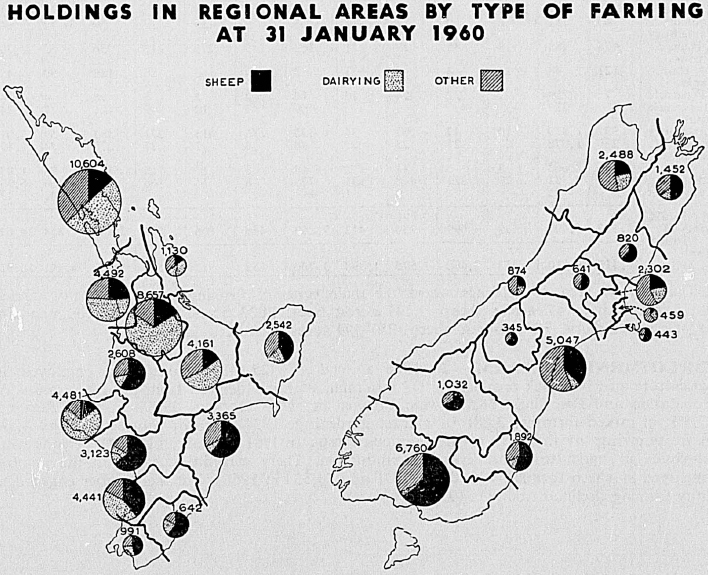
Figures for 1959-60 as to the number of holdings of various principal types of farming enterprises in the several regional areas (each Island separately) are here presented. (“Principally” means 75 percent or more; “predominant” means 50-74 percent; “mixed” means approximately equal; “general mixed” covers three or more types with none predominant.)
| Regional Area | Principally Dairy Farming | Principally Sheep Farming | Principally Beef Farming | Dairy and Sheep with Dairy Predominant | Sheep and Dairy with Sheep Predominant | Mixed Dairy and Sheep | Sheep and Cropping with Sheep Predominant | Cropping and Sheep with Cropping Predominant | Mixed Sheep and Cropping | General Mixed Farming | Other (including Horticulture, Timber, etc.) | Idle and Unused | Total |
|---|---|---|---|---|---|---|---|---|---|---|---|---|---|
| Northland | 5,397 | 1,371 | 492 | 382 | 91 | 165 | 8 | 1 | 1 | 158 | 981 | 1,557 | 10,604 |
| South | |||||||||||||
| Auckland | 2,357 | 1,081 | 127 | 167 | 60 | 49 | 12 | 14 | 3 | 64 | 317 | 241 | 4,492 |
| Waikato and Hauraki Low lands | 5,962 | 1,382 | 128 | 374 | 107 | 117 | 5 | 3 | 1 | 74 | 232 | 272 | 8,657 |
| Cape Colville | 589 | 157 | 27 | 69 | 20 | 25 | - | - | - | 21 | 54 | 168 | 1,130 |
| Central Plateau | 2,126 | 668 | 54 | 228 | 62 | 103 | 14 | 2 | 2 | 46 | 380 | 476 | 4,161 |
| Western Uplands | 342 | 1,556 | 28 | 130 | 86 | 82 | 15 | 4 | 2 | 40 | 101 | 222 | 2,608 |
| Taranaki | 3,209 | 666 | 22 | 166 | 60 | 98 | 6 | - | 3 | 45 | 104 | 102 | 4,481 |
| East Cape | 539 | 1,068 | 56 | 84 | 26 | 46 | 66 | 58 | 36 | 92 | 201 | 270 | 2,542 |
| Hawke's Bay | 257 | 2,045 | 47 | 46 | 52 | 55 | 119 | 85 | 37 | 59 | 358 | 205 | 3,365 |
| Rangitikei | 554 | 2,017 | 39 | 91 | 98 | 79 | 99 | 1 | 7 | 39 | 46 | 53 | 3,123 |
| Manawatu | 1,920 | 1,733 | 62 | 137 | 117 | 121 | 70 | 13 | 8 | 35 | 150 | 75 | 4,441 |
| Wairarapa | 361 | 1,010 | 3 | 74 | 39 | 34 | 49 | 3 | 5 | 10 | 40 | 14 | 1,642 |
| Featherston | 275 | 454 | 8 | 33 | 23 | 12 | 28 | - | 1 | 6 | 73 | 78 | 991 |
| Totals, North Island | 23,888 | 15,208 | 1,093 | 1,981 | 841 | 986 | 491 | 184 | 106 | 689 | 3,037 | 3,733 | 52,237 |
| Marlborough | 202 | 724 | 10 | 47 | 18 | 14 | 170 | 21 | 62 | 39 | 89 | 56 | 1,452 |
| Nelson | 625 | 548 | 64 | 129 | 59 | 70 | 87 | 50 | 34 | 148 | 507 | 167 | 2,488 |
| Westland | 214 | 227 | 137 | 65 | 9 | 16 | - | - | I | 9 | 80 | 116 | 874 |
| North Canterbury | 15 | 507 | 4 | 2 | 9 | 8 | 188 | 13 | 29 | 23 | 19 | 3 | 820 |
| Foothills | 45 | 331 | 6 | 9 | 16 | 11 | 103 | 9 | 20 | 19 | 60 | 12 | 641 |
| Canterbury Plains | 478 | 453 | 18 | 35 | 39 | 21 | 362 | 145 | 196 | 217 | 256 | 52 | 2,302 |
| Christchurch | 121 | 48 | 14 | 4 | 2 | 3 | 8 | 9 | 6 | 26 | 188 | 30 | 459 |
| Banks Peninsula | 75 | 259 | 7 | 22 | 24 | 16 | 10 | 2 | 2 | 6 | 16 | 4 | 443 |
| Mackenzie | - | 225 | - | - | 1 | - | 69 | 3 | 10 | 9 | 21 | 7 | 345 |
| South Canterbury | 332 | 1,873 | 19 | 47 | 102 | 36 | 1,335 | 175 | 415 | 271 | 383 | 59 | 5,047 |
| Otago | 230 | 1,078 | 23 | 21 | 25 | 23 | 98 | 8 | 7 | 27 | 278 | 74 | 1,892 |
| Central Otago | 16 | 663 | 8 | 5 | 11 | 2 | 62 | 5 | 10 | 15 | 162 | 73 | 1,032 |
| Southern | 174 | 4,351 | 29 | 311 | 418 | 191 | 777 | 8 | 14 | 66 | 257 | 164 | 6,760 |
| Remainder | - | 85 | - | 2 | 1 | 1 | - | - | - | - | 6 | 41 | 136 |
| Totals, South Is. | 2,527 | 11,402 | 339 | 699 | 734 | 412 | 3,269 | 448 | 806 | 875 | 2,322 | 858 | 24,691 |
| Totals, New Zealand 26,415 | 26.610 | 1,432 | 2,680 | 1.575 | 1.398 | 3,760 | 632 | 912 | 1,564 | 5,359 | 4.591 | 76.928 |
The average area of holdings where the main types of farming were principally carried out were: dairy, 147 acres; sheep, 1,141 acres; beef, 1,033 acres. The most common size groups were: dairy, 75-99 acres; sheep, 250-399 acres; beef, 250-399 acres.
EMPLOYMENT ON FARMS—In 1966 a total of 125,148 persons were employed in agriculture and livestock production. Of this total, which is derived from the 1966 Census of Population and Dwellings, 38,533 were engaged in sheep farming, 39,474 in dairy farming, 17,657 in mixed farming, 3,881 in market gardening, 3,934 in farm contracting, and 4,593 in fruitgrowing. At the time of the previous census in 1961 a total of 121,641 persons were employed in agriculture and livestock production. There was little change in the number employed in sheep farming (39101 in 1961 and 38,533 in 1966), but the number engaged in dairy farming declined from 41,749 to 39,474.
Of the 38,533 persons engaged in 1966 in sheep farming 10,638 were employers, and 9,028 were farming on their own account. Comparable figures in 1961 were 10,396 employers and 9,324 farming on own account. In dairy farming the number of employers increased from 9,126 in 1961 to 10,687 in 1966, while the number farming on their own account increased from 13,749 to 15,178.
Wage and salary earners in the sheep farming industry numbered 19,000 in 1961 and 18,630 in 1966. In the dairy farming industry they numbered 18,209 in 1961 and 13,304 in 1966.
The following table is based on occupations recorded at the 1966 Census. The number of persons engaged in farming occupations does not coincide exactly with the number employed in the farming industry. A number of persons engaged in farming occupations would be employed in other industries, and on the other hand, a number of persons in non-farming occupations would be employed in the farming industry. For example, gardeners are included under farm occupations, but a number are employed in gardens attached to factories, and so will be included in the labour force of manufacturing industries. Examples of people in non-farming occupations who may be employed in the farming industry are accountants, cooks, and pilots of topdressing planes. However, with these minor qualifications, the table does give a broad picture of the occupations of those engaged in the farming industry at the Census of Population and Dwellings 1966.
| Major Groups and Selected Occupations | Males | Females | Total |
|---|---|---|---|
| n.o.d. — not otherwise defined. | |||
| Farmers and farm managers— | |||
| Dairy farmer | 22,081 | 2,083 | 24,164 |
| Sheep farmer, station owner, run holder | 19,471 | 845 | 20,316 |
| Farmer in mixed farming | 10,790 | 521 | 11,311 |
| Farmer or settler, n.o.d. | 2,794 | 137 | 2,931 |
| Farm manager, foreman, or overseer | 4,607 | 41 | 4,648 |
| Market gardener | 1,812 | 277 | 2,089 |
| Orchardist, fruitgrower | 1,400 | 115 | 1,515 |
| Poultry farmer | 985 | 312 | 1,297 |
| Nurseryman | 820 | 157 | 977 |
| Cattle farmer, grazier | 432 | 30 | 462 |
| Sharemilker | 3,704 | 515 | 4,219 |
| Wheat or other grain grower, agricultural farmer | 392 | 5 | 397 |
| Other | 1,694 | 157 | 1,851 |
| Totals | 70,982 | 5,195 | 76,177 |
| Other farm occupations— | |||
| Farm labourer, n.o.d. | 12,009 | 498 | 12,507 |
| Landgirl | - | 1,230 | 1,230 |
| Relative assisting on farm | 143 | 71 | 214 |
| Orchard hand, n.o.d. | 806 | 274 | 1,080 |
| Shepherd, musterer | 4,183 | 48 | 4,231 |
| Shearer | 3,052 | 25 | 3,077 |
| Milker | 351 | 1,918 | 2,269 |
| Fencer | 1,528 | 1 | 1,529 |
| Tractor driver | 1,170 | 2 | 1,172 |
| Farm contractor, n.o.d. | 935 | 2 | 937 |
| Gardener, jobbing or n.o.d. | 2,078 | 81 | 2,159 |
| Poultry farm worker | 351 | 190 | 541 |
| Market garden hand | 1,039 | 772 | 1,811 |
| Other | 13,852 | 3,382 | 17,234 |
| Totals | 41,497 | 8,494 | 49,991 |
| Totals, all farm occupations | 112,479 | 13,689 | 126,168 |
CAPITAL EXPENDITURE ON FARMS—An annual survey of capital formation in the farming industry is made by the Department of Statistics. It covers all productive farm holdings of 10 acres and over outside boroughs. The collection does not include holdings given over wholly to plantations of timber trees or where farming is secondary to another industry. Owing principally to the number of occupancy transfers which took place immediately prior to or during the 1968-69 collection, information could not be collected from all farm holdings; the following tables include data from about 95 percent of all farm holdings qualifying for inclusion.
Statistics obtained from these returns have been linked up with those given by the 1968-69 annual farm collection to relate capital expenditure and farm types. Capital expenditure on farms during the year ended 31 March 1969, according to farm types, and also by statistical areas, is set out in the following table.
| Farm Type and Statistical area | Number of Holdings | Capital Expenditure | ||||
|---|---|---|---|---|---|---|
| Building Construction | Motor Vehicles and Trailers | Tractors and Farm Machinery | Improvements and Development | Total Expenditure | ||
*Dairy predominant. †Sheep predominant. ‡Beef predominant. | ||||||
| $(000) | ||||||
| Principally dairy farming | 20,520 | 13,207 | 2,778 | 4,795 | 7,018 | 27,797 |
| Principally sheep farming | 14,959 | 5,494 | 2,428 | 3,883 | 13,378 | 25,183 |
| Principally beef farming | 2,128 | 837 | 225 | 289 | 683 | 2,034 |
| Dairy and sheep(*) | 1,299 | 732 | 255 | 374 | 617 | 1,978 |
| Dairy and beef(*) | 713 | 440 | 114 | 186 | 382 | 1,122 |
| Sheep and dairy(†) | 572 | 335 | 98 | 138 | 490 | 1,061 |
| Sheep and beef(†) | 8,932 | 4,613 | 1,853 | 2,472 | 10,141 | 19,079 |
| Beef and dairy ‡ | 229 | 53 | 38 | 46 | 98 | 235 |
| Beef and sheep ‡ | 994 | 349 | 178 | 231 | 814 | 1,571 |
| Mixed livestock | 1,578 | 667 | 262 | 363 | 924 | 2,216 |
| Sheep and cropping | 3,622 | 1,325 | 794 | 2,302 | 2,023 | 6,444 |
| Principally cropping | 1,627 | 814 | 228 | 1,143 | 503 | 2,688 |
| General mixed farming | 2,215 | 1,014 | 549 | 1,409 | 1,290 | 4,262 |
| Market farms and gardens | 709 | 432 | 194 | 378 | 173 | 1,177 |
| Others | 2,725 | 1,553 | 256 | 644 | 639 | 3,092 |
| Totals, 1968-69 | 62,822 | 31,865 | 10,249 | 18,653 | 39,172 | 99,890 |
| $(000) | ||||||
| Northland | 5,185 | 2,514 | 780 | 1,095 | 3,597 | 7,986 |
| Central Auckland | 4,647 | 2,578 | 741 | 1,075 | 1,894 | 6,288 |
| South Auckland— | ||||||
| Bay of Plenty | 14,547 | 9,943 | 2,118 | 3,206 | 7,946 | 23,213 |
| East Coast | 1,393 | 699 | 207 | 379 | 1,204 | 2,489 |
| Hawke's Bay | 3,965 | 2,031 | 722 | 1,206 | 2,632 | 6,591 |
| Taranaki | 4,643 | 2,378 | 641 | 1,016 | 2,691 | 6,725 |
| Wellington | 7,483 | 3,277 | 1,186 | 1,798 | 4,079 | 10,340 |
| Totals, North Island | 41,863 | 23,420 | 6,395 | 9,775 | 24,044 | 63,634 |
| Marlborough | 1,185 | 482 | 151 | 377 | 660 | 1,670 |
| Nelson | 1,942 | 736 | 205 | 518 | 893 | 2,352 |
| Westland | 595 | 326 | 69 | 193 | 287 | 874 |
| Canterbury | 7,890 | 3,391 | 1,640 | 4,599 | 5,397 | 15,027 |
| Otago | 4,516 | 1,700 | 860 | 1,536 | 3,629 | 7,724 |
| Southland | 4,831 | 1,809 | 929 | 1,607 | 4,262 | 8,607 |
| Totals, South Island | 20,959 | 8,444 | 3,854 | 8,830 | 15,128 | 36,256 |
| Totals, New Zealand | 62,822 | 31,865 | 10,249 | 18,605 | 39,172 | 99,890 |
GROSS FARMING INCOME—Gross farming income is the value of the output of the fanning sector. A description of this statistical series was given in the 1966 and earlier issues of the Yearbook.
The following table shows the value of gross farming income for the past 16 production years as well as for the pre-war year 1938-39. The second part of this table gives the percentage contributions of each group to total farm production. In compiling farm income, allowance is made for changes in the numbers of livestock from year to year.
| Year | Group | Total | ||||||
|---|---|---|---|---|---|---|---|---|
| Grain and Field Crops | Horticulture, Poultry, and Bees | Wool | Mutton and Lamb | Beef | Dairying | Pigs | (Gross Farming Income) | |
*Provisional †Figures revised slightly. | ||||||||
| $(million) | ||||||||
| 1938-39 | 9.4† | 12.6 | 18.5 | 24.4† | 13.1 | 56.7 | 4.8 | 139.5 |
| 1954-55 | 31.9 | 41.4 | 151.7 | 112.1 | 44.7 | 169.1 | 11.2 | 562.1 |
| 1955-56 | 32.2 | 41.6 | 143.0 | 111.5 | 36.8 | 176.9 | 12.4 | 554.4 |
| 1956-57 | 29.7 | 45.0 | 183.0 | 124.1 | 41.7 | 179.2 | 11.3 | 614.0 |
| 1957-58 | 29.7 | 45.2 | 137.8 | 117.8 | 63.0 | 187.5 | 11.7 | 592.7 |
| 1958-59 | 31.8 | 43.6 | 130.4 | 106.0 | 67.4 | 172.9 | 12.1 | 564.2 |
| 1959-60 | 39.2 | 47.0 | 169.5 | 99.3 | 67.9 | 187.4 | 13.2 | 623.5 |
| 1960-61 | 42.3 | 50.4 | 158.3 | 109.1 | 55.0 | 184.5 | 14.3 | 613.9 |
| 1961-62 | 42.2 | 55.8 | 153.9 | 92.6 | 59.7 | 175.9 | 14.9 | 595.0 |
| 1962-63 | 43.3 | 57.1 | 180.5 | 107.8 | 68.8 | 180.5 | 16.0 | 654.0 |
| 1963-64 | 50.0 | 62.4 | 230.1 | 131.3 | 74.4 | 198.3 | 17.1 | 763.6 |
| 1964-65 | 48.7 | 69.6 | 172.9 | 166.9 | 87.1 | 229.4 | 17.5 | 792.1 |
| 1965-66 | 51.1 | 76.0 | 193.6 | 166.9 | 95.7 | 251.8 | 17.4 | 852.5 |
| 1966-67 | 58.6 | 79.9 | 162.7 | 140.4 | 103.9 | 261.4 | 17.3 | 824.2 |
| 1967-68 | 66.9 | 79.9 | 131.6 | 155.8 | 121.6 | 242.5 | 19.6 | 817.9 |
| 1968-69 | 74. 1x | 86.5x | 155.8 | 168.5x | 141.8x | 237.5x | 21.4x | 885.6x |
| 1969-70* | 60.3 | 86.1 | 139.4 | 197.4 | 199.0 | 216.2 | 26.1 | 924.5 |
| Percentages of Total Gross Farming Income | ||||||||
| 1938-39 | 6.7 | 9.0 | 13.3 | 17.5 | 9.4 | 40.6 | 3.5 | 100.0 |
| 1954-55 | 5.7 | 7.4 | 27.0 | 19.9 | 8.0 | 30.0 | 2.0 | 100.0 |
| 1955-56 | 5.8 | 7.5 | 25.8 | 20.1 | 6.7 | 31.9 | 2.2 | 100.0 |
| 1956-57 | 4.8 | 7.3 | 29.8 | 20.2 | 6.8 | 29.1 | 1.8 | 100.0 |
| 1957-58 | 5.0 | 7.6 | 23.3 | 19.9 | 10.6 | 31.6 | 2.0 | 100.0 |
| 1958-59 | 5.6 | 7.7 | 23.1 | 18.8 | 12.0 | 30.7 | 2.1 | 100.0 |
| 1959-60 | 6.3 | 7.5 | 27.2 | 15.9 | 10.9 | 30.1 | 2.1 | 100.0 |
| 1960-61 | 6.9 | 8.2 | 25.8 | 17.8 | 8.9 | 30.1 | 2.3 | 100.0 |
| 1961-62 | 7.1 | 9.4 | 25.9 | 15.6 | 10.0 | 29.5 | 2.5 | 100.0 |
| 1962-63 | 6.6 | 8.7 | 27.6 | 16.5 | 10.5 | 27.6 | 2.5 | 100.0 |
| 1963-64 | 6.6 | 8.2 | 30.1 | 17.2 | 9.7 | 26.0 | 2.2 | 100.0 |
| 1964-65 | 6.1 | 8.8 | 21.8 | 21.1 | 11.0 | 29.0 | 2.2 | 100.0 |
| 1965-66 | 6.0 | 8.9 | 22.7 | 19.6 | 11.2 | 29.6 | 2.0 | 100.0 |
| 1966-67 | 7.1 | 9.7 | 19.8 | 17.0 | 12.6 | 31.7 | 2.1 | 100.0 |
| 1967-68 | 8.1 | 9.8 | 16.1 | 19.0 | 14.9 | 29.7 | 2.4 | 100.0 |
| 1968-69 | 8.4 | 9.8 | 17.6 | 19.0 | 16.0 | 26.8 | 2.4 | 100.0 |
| 1969-70* | 6.5 | 9.3 | 15.1 | 21.4 | 21.5 | 23.4 | 2.8 | 100.0 |
The following diagram shows gross farming income for the farming groups.
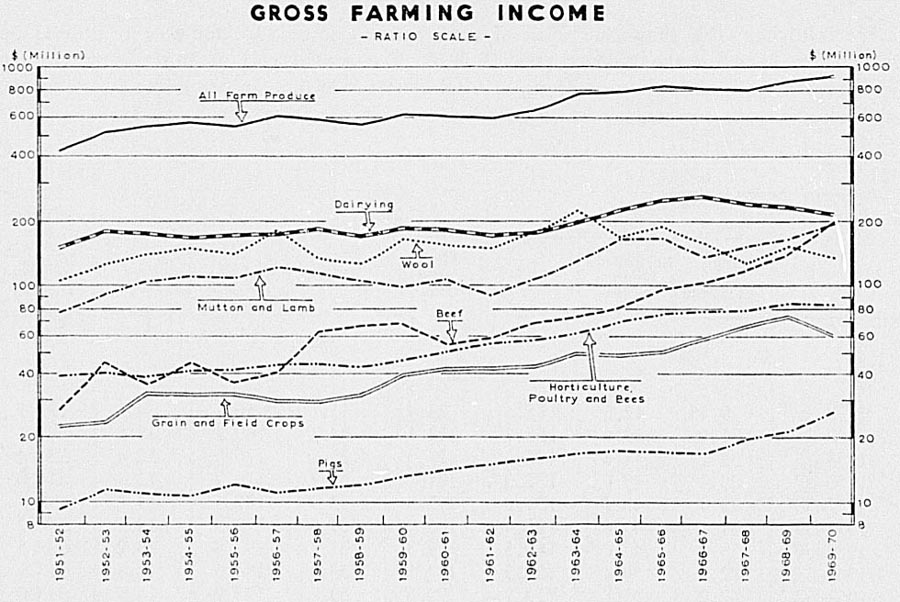
Index numbers have been prepared showing the movements in volume of farm production in total and for the component groups. Computations have been made for each year showing what the aggregate annual values would have been had the 1938-39 prices been constant throughout the period. From the resultant aggregates, index numbers have been compiled which measure the movements in the volume of production; for, since prices were assumed to be constant, volume is the only variable factor in the aggregates.
In the following tables index numbers of value and volume on the base: 1938-39 (= 100) are given, and these give a clearer idea of the extent of year-to-year change.
| Year | Grain and Field Crops | Horticulture, Poultry, and Bees | Wool | Mutton and Lamb | Beef | Dairying | Pigs | All Farm Produce |
|---|---|---|---|---|---|---|---|---|
| *Provisional. | ||||||||
| INDEX NUMBERS OF VALUE | ||||||||
| 1938-39 | 100 | 100 | 100 | 100 | 100 | 100 | 100 | 100 |
| 1954-55 | 338 | 329 | 815 | 459 | 339 | 299 | 233 | 402 |
| 1955-56 | 343 | 330 | 769 | 457 | 279 | 313 | 258 | 397 |
| 1956-57 | 315 | 357 | 984 | 508 | 317 | 317 | 238 | 440 |
| 1957-58 | 315 | 359 | 741 | 483 | 477 | 331 | 246 | 425 |
| 1958-59 | 338 | 346 | 701 | 434 | 511 | 305 | 254 | 404 |
| 1959-60 | 417 | 373 | 911 | 407 | 515 | 331 | 275 | 447 |
| 1960-61 | 449 | 400 | 851 | 448 | 417 | 326 | 296 | 440 |
| 1961-62 | 449 | 443 | 827 | 380 | 452 | 311 | 313 | 426 |
| 1962-63 | 462 | 452 | 970 | 442 | 521 | 319 | 333 | 468 |
| 1963-64 | 532 | 495 | 1,238 | 538 | 564 | 350 | 354 | 547 |
| 1964-65 | 517 | 552 | 929 | 684 | 661 | 405 | 365 | 567 |
| 1965-66 | 544 | 603 | 1,046 | 684 | 731 | 444 | 363 | 611 |
| 1966-67 | 623 | 634 | 879 | 575 | 793 | 461 | 360 | 591 |
| 1967-68 | 718 | 633 | 709 | 637 | 926 | 428 | 405 | 586 |
| 1968-69 | 795 | 686x | 839x | 689x | 1,080x | 419x | 443x | 634 |
| 1969-70* | 647 | 682 | 750 | 807 | 1,515 | 382 | 540 | 662 |
| INDEX NUMBERS OF VOLUME | ||||||||
| 1938-39 | 100 | 100 | 100 | 100 | 100 | 100 | 100 | 100 |
| 1954-55 | 121 | 160 | 140 | 145 | 155 | 127 | 90 | 136 |
| 1955-56 | 108 | 169 | 143 | 152 | 150 | 131 | 87 | 139 |
| 1956-57 | 135 | 168 | 154 | 150 | 151 | 131 | 78 | 141 |
| 1957-58 | 130 | 166 | 156 | 169 | 176 | 141 | 86 | 151 |
| 1958-59 | 134 | 169 | 169 | 186 | 176 | 140 | 105 | 157 |
| 1959-60 | 163 | 172 | 176 | 189 | 181 | 137 | 92 | 159 |
| 1960-61 | 179 | 176 | 183 | 199 | 172 | 143 | 92 | 166 |
| 1961-62 | 163 | 200 | 184 | 209 | 196 | 140 | 96 | 169 |
| 1962-63 | 195 | 225 | 197 | 211 | 208 | 144 | 110 | 178 |
| 1963-64 | 215 | 249 | 194 | 219 | 195 | 149 | 111 | 184 |
| 1964-65 | 202 | 260 | 196 | 221 | 206 | 158 | 101 | 189 |
| 1965-66 | 219 | 279 | 222 | 228 | 209 | 167 | 91 | 200 |
| 1966-67 | 231 | 288 | 222 | 246 | 235 | 167 | 80 | 207 |
| 1967-68 | 279 | 291 | 225 | 256 | 250 | 165 | 90 | 213 |
| 1968-69 | 315x | 294x | 227 | 256x | 272x | 168x | 80x | 218 |
| 1969-70* | 258 | 299 | 224 | 271 | 309 | 153 | 92 | 214 |
From 1952-53 through to 1956-57 the value series showed a much faster growth rate than the volume series, a result of a general upward movement in prices.
From 1956-57 to 1962-63 prices were more stable and in some cases showed a decline and, in consequence, the index of total value of farm produce remained relatively stable, even though the volume index showed a consistent upward movement.
From 1963-64 to 1965-66 the value and volume series increased steadily but in 1966-67 wool, mutton, and lamb prices fell, so that while the volume series continued to increase the value of all farm products fell by 3.3 percent.
In the year 1967-68 the value of all farm products fell by 0.8 percent. Beef and lamb returns were higher than for the previous year but the gain in these products was more than offset by a further fall in the returns from wool and dairying. The volume index increased by 2.9 percent.
The rise of 8 percent in the year 1968-69 was due, substantially, to increased slaughterings, continuing rises in prices paid for meat, and to a recovery in wool prices. The volume index recorded an increase of 2.3 percent.
The total value of all farm products increased in 1969-70 by 4 percent, mainly as a result of higher returns from the three meat groups. Beef production continued to increase at a greater rate than in 1968-69 but the volume index for all farm produce fell by 1.8 percent. The greater part of the decline was in the dairying and grain and field crops groups, largely as a result of drought conditions.
The table clearly shows the effects of fluctuations in the price of wool from year to year.
Over the 31-year period, the average annual compound rate of increase in the volume series has been 2.5 percent. For the latest five years the average annual compound rate of increase has been 1.4 percent, this slower rate being attributed largely to the fall in production in 1969-70.
The following table shows, in quinquennial periods (except for the three-year period in the last column), the proportions of gross farming income derived from exports of farm produce and from local consumption. A description of the methods of estimation was given in the 1967 and earlier issues of the Yearbook.
| Gross Farming Income | 1941-42 to 1945-46 | 1946-47 to 1950-51 | 1951-52 to 1955-56 | 1956-57 to 1960-61 | 1961-62 to 1965-66 | 1966-67 to 1968-69 |
|---|---|---|---|---|---|---|
| Derived— | percent | |||||
| (a) From exports | 67 | 71 | 70 | 68 | 65 | 63 |
| (b) From New Zealand consumption | 33 | 29 | 30 | 32 | 35 | 37 |
| Totals | 100 | 100 | 100 | 100 | 100 | 100 |
DAIRY PRODUCTION—The next table shows the estimated production and utilisation of butterfat during each of the last five seasons. (Source: New Zealand Dairy Board.)
| Utilisation | 1965-66 | 1966-67 | 1967-68 | 1968-69 | 1969-70 |
|---|---|---|---|---|---|
*Includes small quantities of creamery fat used in whey buttermaking. †Including residual fat in skim milk from home separation. | |||||
| million lb | |||||
| Creamery buttermaking* | 463.2 | 465.2 | 450.0 | 485.5x | 428.1 |
| Cheesemaking | 93.8 | 97.5 | 97.6 | 84.0 | 87.7 |
| Whole-milk products | 16.4 | 17.3 | 17.3 | 18.7 | 21.2 |
| Totals | 573.4 | 580.0 | 564.9 | 588.3 | 537.0 |
| Residual fat in skim-milk products | 4.7 | 5.2 | 5.7 | 6.7x | 6.1 |
| Total processed by dairy factories | 578.1 | 585.2 | 570.6 | 594.9x | 543.1 |
| Consumed as milk, cream, or ice cream | 46.4x | 46.5x | 45.6x | 46.0x | 47.0 |
| Fed to stock† | 14.3x | 14.4x | 15.3x | 15.6x | 15.6 |
| Wastage | 6.4 | 6.4 | 6.3 | 6.6 | 6.0 |
| Total production “at pail” | 645.2x | 652.5x | 637.9x | 663.1x | 611.7 |
Production by dairy factories during the last five seasons is set out in the following table.
| Product | 1965-66 | 1966-67 | 1967-68 | 1968-69 | 1969-70 |
|---|---|---|---|---|---|
| tons (000) | |||||
| Creamery butter | 241.3x | 251.6 | 243.0 | 264.1 | 233.1 |
| Whey butter | 3.1 | 3.1 | 3.4 | 2.9 | 3.0 |
| Cheese | 105.6 | 108.1 | 109.1 | 96.1 | 98.3 |
| Condensed and powdered whole milk | 15.4 | 15.5 | 14.4 | 17.0 | 23.0 |
| Skim-milk powder | 85.9 | 137.5 | 144.9 | 133.4 | 110.5 |
| Buttermilk powder | 24.6 | 23.2 | 23.8 | 23.8 | 20.5 |
| Casein | 53.0 | 46.8 | 46.4 | 67.7 | 62.0 |
The following table gives estimates of the average milkfat production per cow “at the pail”, which are derived by the New Zealand Dairy Board.
| Year | Total Butterfat | Dairy Cows in Milk | Average Production per Cow |
|---|---|---|---|
| *Provisional. | |||
| million lb | (000) | lb | |
| 1960-61 | 549x | 1,929 | 283x |
| 1961-62 | 547x | 1,968 | 276x |
| 1962-63 | 559x | 1,997 | 279x |
| 1963-64 | 586x | 2,011 | 290x |
| 1964-65 | 622x | 2,032 | 305 |
| 1965-66 | 645x | 2,088 | 308 |
| 1966-67 | 653x | 2,131 | 305x |
| 1967-68 | 638x | 2,232 | 285 |
| 1968-69 | 663x | 2,304 | 287 |
| 1969-70* | 612 | 2,363 | 258 |
The following diagram shows the progress of the dairy industry over a long period of years.
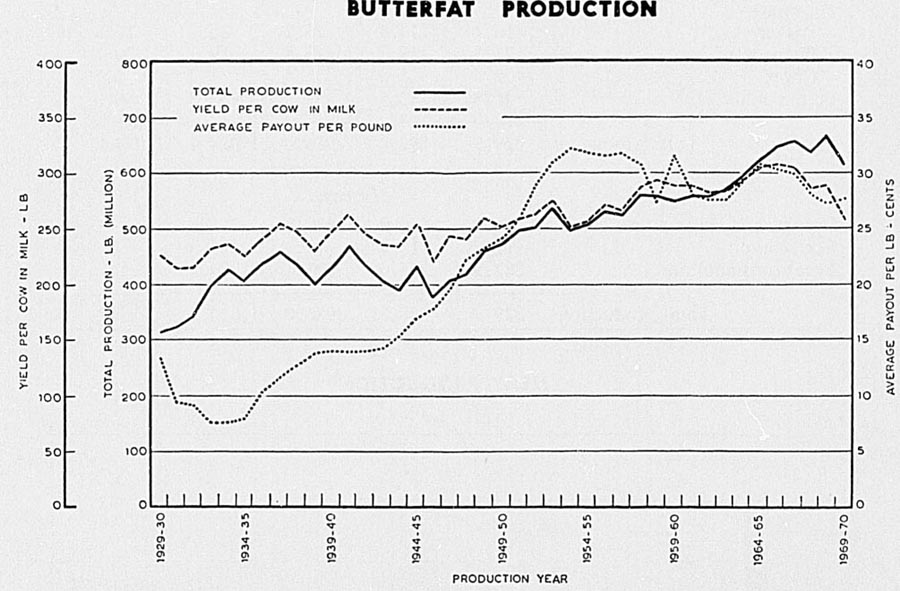
The Dairy Board has its functions defined in the Dairy Board Act 1961. Finance is provided by a levy on dairy produce. It is the Board's concern to promote the orderly development of the dairy, bobby calf, and pig industries with a view to improving the quality of the stock and expanding production. Quality improvement involves testing stock for production, the development of artificial breeding, and research and experimental work. (About half the dairy herd is now bred by artificial insemination from selected sires, and produce about 35 lb of milkfat more each year than cows bred naturally.)
The Board shares with the Government the management and finance of the Dairy Research Institute; and, with the Government, the Meat Producers Board, and the Wool Board, the control of the Veterinary Services Council.
The Board is also represented on the Dairy Products Prices Authority, the Dairy Industry Loans Council, the Meat Producers Board, the Pig Producers Council, the Bobby Calf Pools Central Executive, the Dairy Factory Managers Registration Board, and on a committee which examines improvements in manufacture.
The Dairy Industry Act 1952 regulates the production, collection, treatment, preparation, and manufacture, under proper sanitary conditions, of dairy produce—i.e., milk, cream, butter, cheese, and any other product of milk or cream—intended for sale for human consumption within New Zealand or for export.
Dairy produce intended for export must be sound and wholesome in all respects, and must comply with the requirements of the Act as to inspection, grading, and marking.
Co-operative dairy companies are a feature of the organisation of the dairy industry.
MEAT PRODUCTION AND DISPOSAL—The following table shows in summary form production and disposal of meat. Figures are shown at bone-in weights.
| Product and Use | 1965-66 | 1966-67 | 1967-68 | 1968-69 | 1969-70 |
|---|---|---|---|---|---|
| tons (thousand) | |||||
| Production | |||||
| Beef | 265.3 | 271.4 | 314.5 | 344.2 | 360.9 |
| Veal | 22.0 | 25.6 | 24.9 | 26.3 | 25.6 |
| Mutton | 149.9 | 185.5 | 212.7 | 196.7 | 196.8 |
| Lamb | 312.0 | 326.9 | 344.7 | 357.1 | 356.9 |
| Pig meat— | |||||
| Porker | 16.1 | 14.8 | 16.2 | 15.3 | 16.8 |
| Baconer | 21.3 | 19.2 | 18.8 | 19.3 | 20.1 |
| Chopper | 2.4 | 2.0 | 2.4 | 1.7 | 1.7 |
| Edible offal | 40.8 | 45.5 | 51.8 | 53.3 | 56.0 |
| Total production | 829.9 | 890.8 | 986.0 | 1,014.1 | 1,034.8 |
| Disposal | |||||
| Exports and ships' stores | 536.2 | 590.9 | 680.8 | 715.3 | |
| For canning | 11.7 | 13.9 | 12.1 | 11.3 | |
| Local consumption | 281.9 | 286.0 | 293.1 | 287.4 | |
| Total production | 829.9 | 890.8 | 986.0 | 1,014.1 | |
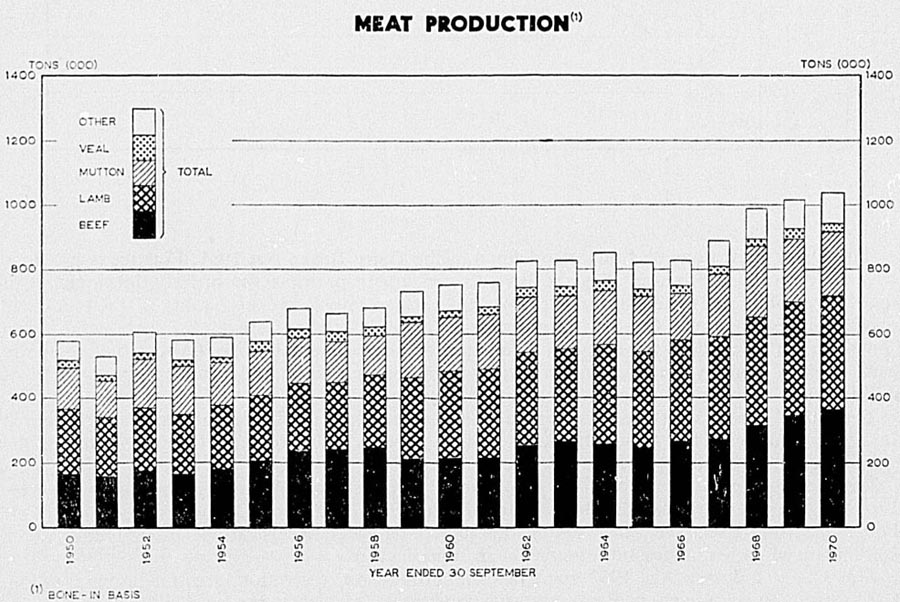
Meat consumed in New Zealand represents approximately one-third of total production. The figures in the next table give actual consumption during the years ended 30 September, by classes of meat (bone-in weights).
| Product | Local Consumption | Consumption per Head of Mean Population | ||||
|---|---|---|---|---|---|---|
| 1967-68 | 1968-69 | 1969-70 | 1967-68 | 1968-69 | 1969-70 | |
| tons (000) | lb | |||||
| Beef | 121.2 | 122.9 | 120.9 | 98.7 | 99.2 | 96.3 |
| Veal | 10.4 | 9.5 | 9.1 | 8.4 | 7.7 | 7.3 |
| Mutton | 81.1 | 83.9 | 85.5 | 66.1 | 67.7 | 68.1 |
| Lamb | 26.4 | 25.2 | 26.3 | 21.5 | 20.3 | 21.0 |
| Pig meat— | ||||||
| Porker | 15.4 | 15.3 | 16.4 | 12.5 | 12.4 | 13.0 |
| Baconer | 19.8 | 19.0 | 19.6 | 16.1 | 15.4 | 15.6 |
| Chopper | 2.2 | 2.3 | 1.9 | 1.8 | 1.9 | 1.5 |
| Edible offal | 12.3 | 13.3 | 14.4 | 10.0 | 10.7 | 11.4 |
| Totals | 288.8 | 291.6 | 294.2 | 235.2 | 235.3 | 234.2 |
Details of sources of supply for local consumption in 1968-69 are given in the following table. Figures for meat export works include those for a few bacon works. In the case of registered abattoirs and rural slaughterhouses, edible offal has been estimated at 3 percent of total carcass weight excluding pig meats.
| Product | Registered Abattoirs | Meat Export Works | Rural Slaughter-houses | Farms | Total |
|---|---|---|---|---|---|
| tons (000) (bone-in weights) | |||||
| Beef | 84.6 | 34.6 | 2.3 | 1.4 | 122.9 |
| Veal | 5.1 | 4.2 | - | 0.2 | 9.5 |
| Mutton | 41.7 | 25.7 | 1.2 | 15.3 | 83.9 |
| Lamb | 8.1 | 15.6 | 0.1 | 1.4 | 25.2 |
| Pig meat— | |||||
| Porker | 11.3 | 3.3 | 0.2 | 0.6 | 15.4 |
| Baconer | 4.0 | 15.0 | - | - | 19.0 |
| Chopper | 0.5 | 1.8 | - | - | 2.3 |
| Edible offal | 4.2 | 9.0 | 0.1 | - | 13.3 |
| Totals | 159.5 | 109.2 | 3.9 | 18.9 | 291.6 |
The following table shows the numbers of the different classes of livestock slaughtered for food during each of the last 11 September years. The figures are for total killings—i.e., they include export works, abattoirs, rural slaughterhouses, and an allowance for killings on farms.
| LIVESTOCK SLAUGHTERINGS | |||||
|---|---|---|---|---|---|
| Year Ended 30 September | Sheep | Lambs | Cattle | Calves | Pigs |
| Carcasses (000) | |||||
| 1,960 | 7,356 | 19,283 | 956 | 1,234 | 863 |
| 1,961 | 7,289 | 19,846 | 995 | 1,299 | 839 |
| 1,962 | 8,002 | 21,518 | 1,224 | 1,413 | 850 |
| 1,963 | 7,220 | 21,308 | 1,282 | 1,412 | 921 |
| 1,964 | 7,901 | 22,157 | 1,286 | 1,392 | 1,002 |
| 1,965 | 7,552 | 21,924 | 1,138 | 1,231 | 951 |
| 1,966 | 6,711 | 22,326 | 1,172 | 1,102 | 874 |
| 1,967 | 8,474 | 24,158 | 1,212 | 1,217 | 790 |
| 1,968 | 10,159 | 26,424 | 1,495 | 1,235 | 821 |
| 1,969 | 9,602 | 26,857 | 1,694 | 1,357 | 790 |
| 1,970 | 9,846 | 27,537 | 1,848 | 1,310 | 828 |
Meat intended for export from New Zealand is slaughtered at meat export slaughterhouses, of which 37 are at present operating. They are licensed annually under the provisions of the Meat Act 1964 and regulations thereunder, which also authorise officers of the Department of Agriculture to inspect all meat whether for export or for local consumption.
The supervision of grading of meat for export is one of the responsibilities of the Meat Producers Board. Grading at each freezing works is carried out, after slaughtering and dressing, by graders employed by the concern operating the freezing works. Supervising graders of the Meat Producers Board are allotted to each group of works to ensure uniformity of grading.
To supply meat for the larger urban centres there are at present 39 abattoirs operating, the larger ones being organised on the same lines as meat export works, and the supply is augmented by meat drawn from export works. At rural slaughterhouses meat is killed for consumption in small country towns and rural districts. Many farmers, particularly on sheep farms, kill their own meat.
To regulate and control the marketing of bobby calves, Bobby Calf Committees were established in 1938 and are now governed by the Bobby Calf Marketing Regulations 1955 Under the control of the Dairy Board.
WOOL PRODUCTION—New Zealand holds third place in the world as a producer of wool, and second place as an exporter.
New Zealand specialises in the production and export of crossbred wool. There is, at present, only a small annual consumption by local mills. The quantity, on a greasy basis, used by local manufacturers in the post-war period until 1958-59 ranged between 10.9 million lb and 14.5 million lb. Figures for local consumption in recent years are as follows.
| Year Ended 30 June | Quantity Used (Greasy Basis) | Year Ended 30 June | Quantity Used (Greasy Basis) |
|---|---|---|---|
| million lb | million lb | ||
| 1,961 | 17.1 | 1,966 | 23.3 |
| 1,962 | 20.4 | 1,967 | 22.5 |
| 1,963 | 18.2 | 1,968 | 24.8 |
| 1,964 | 20.3 | 1,969 | 32.2 |
| 1,965 | 22.3 | 1,970 | 38.4 |
The following table shows for the last 11 seasons the total wool production (greasy basis), the movement in the average price per pound of wool (greasy basis), and the estimated total value of wool production (obtained by valuing the production estimate at the overall price per lb of greasy wool sold at auction).
| Season Ended 30 June | Total Wool Production (Greasy Basis) | Average Price Per pound (Greasy Basis) | Estimated Value of Total Wool Production |
|---|---|---|---|
| lb (m) | c. | $(m) | |
| 1,960 | 577 | 37.21 | 214.6 |
| 1,961 | 588 | 33.62 | 197.6 |
| 1,962 | 587 | 32.65 | 191.6 |
| 1,963 | 620 | 35.70 | 221.4 |
| 1,964 | 616x | 45.89 | 283.0 |
| 1,965 | 623 | 35.11x | 218.8 |
| 1,966 | 695 | 34.68x | 241.0 |
| 1,967 | 709 | 29.38x | 208.4x |
| 1,968 | 728 | 22.87 | 166.5 |
| 1,969 | 732 | 28.06 | 205.4 |
| 1,970 | 723 | 25.62 | 185.2 |
On account of lack of information on changes in stocks of wool on farms, the above figures of production should not be taken as precise measures of actual production in each season.
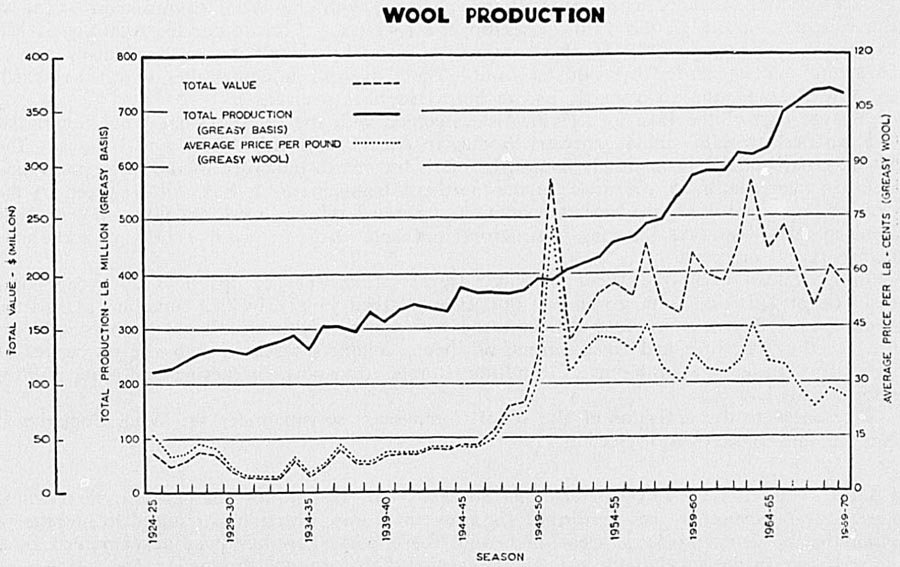
An analysis of greasy wool sold at New Zealand auctions, according to quality groups, is given in the following table. (Source: Wool Commission.)
| Quality Group | 1965-66 | 1966-67 | 1967-68 | 1968-69 | 1969-70 | |||||
|---|---|---|---|---|---|---|---|---|---|---|
| Bales (000) | Percentage of Total Sales | Bales (000) | Percentage of Total Sales | Bales (000) | Percentage of Total Sales | Bales (000) | Percentage of Total Sales | Bales (000) | Percentage of Total Sales | |
| 60-64's and up | 14.4 | 1.0 | 13.8 | 0.9 | 11.9 | 0.8 | 11.6 | 0.8 | 12.3 | 0.9 |
| 60's | 8.2 | 0.5 | 8.0 | 0.5 | 8.5 | 0.5 | 8.1 | 0.5 | 7.3 | 0.5 |
| 58-60's, 58's, and 56-58's | 82.9 | 5.6 | 72.2 | 4.6 | 63.2 | 4.0 | 60.2 | 4.0 | 58.9 | 4.1 |
| 50-56's and 56's | 137.6 | 9.3 | 120.1 | 7.7 | 109.0 | 6.9 | 105.2 | 7.0 | 92.5 | 6.4 |
| 52's | 50.6 | 3.4 | 47.3 | 3.0 | 40.8 | 2.6 | 57.2 | 3.7 | 49.1 | 3.4 |
| 50's | 133.2 | 9.0 | 121.0 | 7.7 | 114.2 | 7.3 | 111.9 | 7.5 | 87.1 | 6.1 |
| 48-50's | 152.7 | 10.3 | 133.9 | 8.6 | 146.9 | 9.4 | 155.1 | 10.3 | 145.0 | 10.1 |
| 46-50's and 48's | 438.9 | 29.5 | 341.7 | 21.9 | 323.4 | 20.6 | 354.1 | 23.5 | 306.3 | 21.3 |
| 46-48's | 310.5 | 21.0 | 445.9 | 28.6 | 475.3 | 30.2 | 391.7 | 26.0 | 388.0 | 27.0 |
| 46's and lower | 154.7 | 10.4 | 257.1 | 16.5 | 278.7 | 17.7 | 255.0 | 16.7 | 290.2 | 20.2 |
| Totals | 1,483.7 | 100.0 | 1,560.9 | 100.0 | 1,571.9 | 100.0 | 1,510.2 | 100.0 | 1,436.6 | 100.0 |
The New Zealand Wool Board was set up under the Wool Industry Act 1944. There are eight members: six elected representatives of sheepfarmers and two representatives of the Government. The Director-General of Agriculture is an associate member. The Board's functions are wide: to promote the use of New Zealand wool, to promote scientific research into all aspects of the industry, and to exercise certain functions in relation to the production, handling, pooling, appraising, storage, distribution, marketing and disposal of wool. Income is derived from a levy on all wool, either exported or processed in New Zealand. The wool brokers deduct the levy from their clients' cheques, with the Wool Commission acting as the collection agent. In the 1970-71 season, the levy was 0.7 cents per lb. Although it had to suspend payment in 1967-68, the Commission normally contributes to the Board's income from the interest earned by industry funds. The Government contributes to wool research in New Zealand and to research and technical services overseas.
A large part of the Board's activities is concerned with the International Wool Secretariat —a partnership with similar growers' bodies in Australia, South Africa and Uruguay. The Board contributes approximately four-fifths of its income to the work of the IWS, promoting wool in more than 25 countries in the northern hemisphere. It has staff engaged in the promotion of wool on the domestic market, technical officers working with mills in New Zealand and overseas, shearing instructors and specialists in wool handling, packaging, transport and marketing.
In December 1960, the Wool Research Organisation was set up. It is an independent research organisation with an annual budget subscribed jointly by the Government and the Wool Board. It works in close collaboration with the agricultural colleges in their work on the breeding, feeding and management of sheep, conducts research into the properties of wool, and studies the problems of handling, storage, transport, marketing and other matters affecting wool.
References to the activities of the Wool Commission set up under the Wool Commission Act 1951 are to be found in Section 21.
FARM PRODUCTIVITY—Based on sophisticated techniques of grassland farming, agricultural production has continued to grow in a way which has resulted in increasing quantities of dairy products, meat, and wool for export. This has been accompanied by a marked rise in the productivity of labour employed in farming. Production has steadily increased without an increase in the farm labour force. A general improvement in management practices and a heavy rate of investment in land improvement have been the principal factors responsible for the expansion of output. A study by Professor B. P. Philpott attributes two-thirds of the 2.6 percent average annual increase in output between 1920-60 to capital investment and one-third to improved efficiency in the use of resources. The pattern is one of more intensive farming, for the area used for farming has not expanded since early in the present century. This has meant more intensive use of public and social capital. Since, with more intensive farming, there is a greater demand for any given operation in a defined area, recent decades have witnessed a very substantial growth of contract services for farmers in harvesting and in farm maintenance and improvement. The trend towards this division of function in farming activities was, of course, largely influenced by the production and availability of highly specialised new farm machinery which it would have been uneconomic for individual farmers to own. There is evidence to suggest that over recent years capital invested in farming has been employed more productively than during the 1950s.
AGRICULTURAL DEVELOPMENT CONFERENCE—An Agricultural Development Conference was held in 1963 and 1964. It was called as a result of the feeling in both producer and official circles that agricultural expansion should proceed at a more rapid rate and that a thorough examination should be made of the economic factors impeding such expansions. The Targets Committee's report in 1964 stated that by 1972-73 livestock numbers would have to rise to 111 million ewe equivalents compared with 80 million in 1962-63. This would require an increase in stock numbers of 3.5 percent a year, an increase in pastoral production of 3.8 percent a year, and an increase in pastoral exports of 4.1 percent a year. At 31 January 1970 livestock in terms of ewe equivalents had reached just under 100 million.
The targets were endorsed by the conference, which also made a number of recommendations to the Government based on the conclusions of the eight working parties.
NATIONAL DEVELOPMENT CONFERENCE—At the National Development Conference in 1969 the targets established by the Agricultural Development Conference were reviewed after working parties had examined commodity developments, capital requirements, and manpower requirements of primary industry. Further projections were made to 1972-73 and to 1978-79. In addition to pastoral production, agriculture was extended to include grains and seeds and horticulture. For the period ending 1978-79, the total agricultural contribution to national earnings was projected to increase by 5.1 percent annually. This would require an increase in livestock numbers at a rate of 2.6 percent a year, reaching 111 million ewe equivalents in 1972-73, and 130 million ewe equivalents in 1978-79.
AGRICULTURAL PRODUCTION COUNCIL—This Council was set up following a recommendation of the Agricultural Development Conference in 1964. It comprises the Minister of Agriculture (Chairman), the Director-General of Agriculture (Deputy-Chairman), the Dominion President, Federated Farmers of New Zealand (Inc.), the Chairman of the three producer boards (Dairy, Meat, and Wool), the Secretary to the Treasury, and the Secretary of Industries and Commerce.
The main functions of the Council are to keep under review the projections revised by the National Development Conference, to propose measures that will facilitate the attainment of these projections, and to consider any matters that may be referred to it by the Minister of Agriculture.
In 1968, the Agricultural Production Council accepted the role of Agricultural Sector Committee for the purposes of the National Development Conference, and, following the establishment of the National Development Council after this Conference, the Agricultural Production Council became the Sector Council for Agriculture under the new organisation for national planning, preserving at the same time its original functions.
The Council has several standing committees—Executive, Finance, Manpower, Meat, Horticulture, Farm Costs, Taxation, and Grains and Seeds—and working parties on specific projects.
The Council has also established 23 District Agricultural Advisory Committees which bring together at local level all the organisations which service agriculture in that region. These committees review the progress of agriculture in their district; identify factors limiting production and propose remedial measures; ensure that farmers and their advisers are fully aware of development incentives and concessions and the availability and terms of finance; and keep the Council advised of local problems and circumstances.
DEPARTMENT OF AGRICULTURE—The Department of Agriculture has existed as a separate Department since 1892 and has been instrumental in building up farm production. The principal functions of the Department, as set out in the Department of Agriculture Act 1953, are (a) to promote and encourage the development of all phases of the agricultural, pastoral, and horticultural industries in New Zealand, including the stock, poultry, fruit, vegetable, flax (Phormium tenax), tobacco, hops, and honey production industries, with a view to maintaining and improving the quality of the products derived, from those industries and increasing the production of those products; (b) to promote and control and encourage the marketing and sale of those products.
Under the control of the Minister of Agriculture, the Department of Agriculture provides-a service of which the main object is the advancement of the interests of primary production. Under a Director-General of Agriculture there are Divisional Directors of Animal Health, Meat, Dairy, Farm Advisory, Research, Horticulture, Economics and Administration. Though the service is primarily advisory, the Department administers a number of Acts and regulations.
Animal Health—The Animal Health Division is responsible for the control of infectious diseases of livestock, including poultry diseases, and vaccination and testing are carried out to prevent and eradicate certain serious stock diseases. Special attention is given to herds supplying milk for human consumption. Livestock husbandry forms an essential part of the extension service provided by this Division. All stock exported and imported is examined by the Division's veterinarians, the Division controls the importation of all animal products into New Zealand and operates quarantine stations for imported livestock. The Division is-concerned with the control of noxious weeds through the agency of county councils, and, with the Pest Destruction Council through district pest destruction boards, in the destruction: of rabbits, hares, opossums, and wallabies.
Meat—The Meat Division is responsible for the ante-mortem and post-mortem inspection of all stock and meat produced in abattoirs and meat export works—and for the standard of hygiene in these establishments as well as in all meat export and domestic meat packing plants. It supervises the standard of hygiene in game packing houses and gives veterinary certificates covering the export of game and fish.
Dairy produce—Instruction in the manufacture of all dairy products is given by the Dairy Division. Dairy produce is inspected and graded before shipment and on arrival in United-Kingdom. The Division is responsible also for the registration of town supply farm dairies and provides technical advice on market milk treatment. Laboratories at Auckland, New Plymouth, Mount Maunganui, Wellington and Wallaceville provide comprehensive examination of dairy products as a background to quality control. All dairy farms are visited regularly by Farm Dairy Instructors. Dairy advisory officers give specialist advice at farms and dairy factories. The Division licenses and registers dairy factories and approves their design, general suitability and economic justification.
Farm Advisory Service—The Farm Advisory Division's object is to assist farmers to obtain the highest continuing net income from their enterprises by the provision of a sound technical and farm management advisory service. The advisory service is carried out by field officers, backed by specialists in the fields of agricultural engineering, animal husbandry, farm economics, and home management. As an extension service, the Division passes on scientific findings to the farmer.
Extension work is done through individual farm visits, meetings of groups of farmers, and the mass media. To assist in this work the Division has four demonstration farms at Kaikohe, Wairoa, Hindon, and Te Anau, and several co-operative demonstrations on individual farmer's properties.
Outside its extension work, the Division is responsible for seed certification, the Seed Testing Station at Palmerston North, Flock House Farm of Instruction at Bulls, and the flax estates at Foxton.
Poultry farmers receive advice from a specialist poultry section.
Research—All research stations of the Department are under the control of the Director of Agricultural Research, with headquarters at Ruakura. Directors of Animal Research, Soil Research, and Field Research are all stationed at Ruakura. Irrigation research is done at Winchmore, and other research establishments are at Whatawhata (near Hamilton), which specialises in hill-country research, and at Invermay. Research work on animal diseases is centred largely at Wallaceville under a Director. Horticultural research is centred at Levin and viticultural research at Te Kauwhata. Research activities are more full discussed in Section 7b, Science and Scientific Services.
Horticulture—The Horticulture Division provides an advisory service for commercial producers of pip, stone, citrus, and subtropical fruits, vegetables, berry fruits, cut flowers, nursery stock, grapes and wine, bees and honey and, to limited extent, hops and tobacco. This advisory service covers all aspects of production—soil management, disease and pest control, and crop production and handling. Advisory officers of the Division also demonstrate and adapt research results in districts for all horticultural crops and beekeeping. Experimental and demonstration areas are sited at Kerikeri and Manutuke (citrus). Advisory officers of the division are now giving more emphasis to commercial horticultural units, as business units, to assist producers to improve the profitability of their holdings.
Horticultural inspectors inspect commercial plant nurseries, market gardens, and orchards for plant pests and diseases to restrict the spread of diseases and pests. They assist in marketing by providing crop forecasts of fruit crops and advising producers on dates for picking, and by instruction in grading and packing fruit for export and local market. They also inspect fruit, vegetables, and plant material for export from New Zealand. All pip fruit delivered to the New Zealand Apple and Pear Marketing Board for local and export markets is inspected by horticultural inspectors.
The Division's inspectors provide an orange-quality testing service for the Citrus Marketing Authority. The Division also supplies essential information for marketing organisations in the form of seasonal forecasts of production, compiles annual statistics of production, and does periodic surveys of the various horticultural industries.
Economics—The Economics Division deals with international trade and trade negotiations in relation to agriculture, international quality standards, the analysis of production and marketing policies and the general economic position of farmers. Other functions include the economic appraisal of projects associated with agricultural development and resource use.
Port Agriculture Service—The Port Agriculture Service, established in 1960, is a uniformed branch of the Department under the control of a Superintendent directly responsible to the Director-General. Its chief responsibility is to prevent the introduction into New Zealand of serious animal and plant diseases and pests. Officers of this service are located at ports and international airports, and deal with all items of concern to agriculture arriving from overseas.
PASTURE GRASSES—Researches and experiments in regard to pasture grasses are regular features of the activities of both the Department of Agriculture and the Department of Scientific and Industrial Research. These experiments, which extend right on to individual farms throughout New Zealand, and are conducted in co-operation with the farmers themselves, are wide in their application, and cover all the major phases of pasture management, dealing in particular with such items as pasture mixtures, suitability as to soil types, methods of establishment and management, the efficient use of fertilisers, etc. The results are made available per medium of the Journal of Agriculture and such allied publications, as well as by special pamphlets which are distributed without charge. The farmer can thus avail himself of, and profit by, highly specialised knowledge and experience. In addition, a constant endeavour is being made not only to improve existing strains by such measures as seed certification and the provision of pedigree seed, but also to evolve new strains.
The following table shows the areas under artificially sown grasses, and includes areas of tussock and other naturally established native grasses which have been permanently improved by oversowing with grasses and clovers.
| Year | Artificially Sown Pasture Grasses and Lucerne | |
|---|---|---|
| Cut for Seed, Hay or Silage | Not Cut for Seed, Hay, or Silage | |
| *Includes 183,873 acres also sown with crops in 1963-64, 173,898 acres in 1964-65, 183,247 acres in 1965-66, 152,439 acres in 1966-67, 156,749 acres in 1967-68, and 158,491 acres in 1968-69. | ||
| acres | ||
| 1961-62 | 1,160,010 | 18,087,564 |
| 1962-63 | 1,387,299 | 18,129,203 |
| 1963-64 | 1,335,768 | 18,431,705* |
| 1964-65 | 1,337,501 | 18,095,856* |
| 1965-66 | 1,480,485 | 18,321,728* |
| 1966-67 | 1,475,330 | 18,804,018* |
| 1967-68 | 1,495,028 | 18,690,625* |
| 1968-69 | 1,642,641 | 18,872,566* |
| 1969-70 | 1,535,724 | 18,873,318 |
TOPDRESSING—Topdressing with artificial fertilisers has been an important factor in the intensification of grassland farming. Most New Zealand soils need fertilisers, especially phosphates. Superphosphate has been produced in New Zealand in increasing quantities since the 1880s, using rock phosphates from Nauru and Ocean Islands; Christmas Island is now an increasingly important source of supply. Over the years there has been a marked changeover from straight superphosphate as the principal fertiliser for grassland and crops. Usual variants are serpentine superphosphate or aerial superphosphate, or a mixture of superphosphate with potash, additional sulphur or a trace element. Production of chemical fertilisers in 1967-68 totalled 1,561,000 tons, the superphosphate content of this output being 1,318,000 tons. Approximately half of the sown grassland receives fertiliser annually, with about half the fertilised area covered by aerial distribution; about one-third of the quantity is distributed by aeroplanes from 8,000 airstrips. Total expenditure on topdressing of farm land comes to about $50 million annually, including fertiliser transport and application costs. New Zealand's population is 0.1 percent of that of the world, yet this country uses 2 percent of the world's fertiliser production.
Achievement of the increased rate of development recommended by the Agricultural Development Conference is estimated to require an annual increase of fertiliser usage of about 7 percent. The greater input will be needed because, as production develops, fertilisers will be used on more difficult country and on land on which production has already been intensified.
The use of lime to correct soil acidity and increase the availability of trace elements grew steadily from 1890 to a peak of 1,500,000 tons in 1945. Since then usage has dropped to less than 1,000,000 tons annually; there is now a more judicious application of lime and a greater use of trace elements such as molybdenum according to proved soil needs.
The following table gives particulars of areas of grassland topdressed during the latest six years.
| Year | Grassland Area Topdressed | |||
|---|---|---|---|---|
| With Artificial Fertiliser Only | With Lime Only | With Both Artificial Fertiliser and Lime | Total Grassland Topdressed | |
| acres | ||||
| 1964-65 | 10,846,274 | 392,946 | 1,606,679 | 12,845,899 |
| 1965-66 | 11,295,363 | 365,668 | 1,439,014 | 13,100,045 |
| 1966-67 | 11,863,091 | 347,594 | 1,405,189 | 13,615,874 |
| 1967-68 | 10,736,917 | 325,354 | 1,167,291 | 12,229,562 |
| 1968-69 | 11,139,391 | 339,809 | 1,179,507 | 12,658,707 |
| 1969-70 | 11,994,072 | 408,680 | 1,563,909 | 13,966,661 |
Though topdressing in the past was practically confined to sown grasses on the flat and gently undulating country, the application of fertilisers to the surface-sown hill-country pastures in increasing quantities from aircraft has followed from the development of commercial aerial topdressing operations since 1949. Further information in this connection is contained in Section 11d.
SUBSIDIES, GRANTS, ETC.—For many years a number of grants and subsidies have been paid to the farming industry and allied organisations from public funds. In addition, agricultural and pastoral education is assisted financially by grants to the agricultural colleges.
The following table shows the major payments during the latest five years.
| Subsidy, Grant, etc. | 1964-65 | 1965-66 | 1966-67 | 1967-68 | 1968-69 | 1969-70 | 1970-71 (voted) |
|---|---|---|---|---|---|---|---|
| $(000) | |||||||
| Carriage of lime | 111 | 94 | 102 | 87 | 90 | 88 | 90 |
| Fertiliser transport subsidy | - | 1,420 | 2,529 | 2,280 | 3,075 | 5,579 | 6,500 |
| Flood and drought relief | 331 | 190 | 67 | 216 | 316 | 477 | 3,800 |
| Weedicide and pesticide subsidy | - | - | - | - | - | 3,259 | 3,500 |
| Eradication of bovine tuberculosis— | |||||||
| Compensation for condemned animals, loss of production payments, hardship payments, and incidental costs | 1,581 | 1,481 | 1,289 | 1,028 | 1,063 | 1,272 | 1,470 |
| Subsidies to pest destruction boards | 1,728 | 1,401 | 1,481 | 1,628 | 1,518 | 1,899 | 2,000 |
| Grants to pest destruction boards | 390 | 4,433 | 483 | 348 | 337 | ||
| Subsidies to nassella tussock boards | 145 | 158 | 157 | 176 | 174 | 172 | 209 |
| Subsidies to county councils under the Noxious Weeds Act | 97 | 104 | 130 | 125 | 153 | 204 | 221 |
| Agricultural Engineering Institute | 30 | 73 | 70 | 83 | 98 | 125 | 142 |
| Herd Improvement Council | 59 | 67 | 73 | 79 | 79 | 97 | 97 |
| National Hydatids Council | 70 | 70 | 70 | 70 | 70 | 105 | 106 |
| Veterinary Services Council | 65 | 61 | 63 | 40 | 40 | 42 | 48 |
| Fertiliser price subsidy | - | - | - | - | - | - | 7,000 |
| Special Assistance Fund | - | - | - | - | - | - | 10,000 |
| Dairy diversion scheme (beef) | - | - | - | - | - | - | 1,500 |
Lime Subsidy—Since 30 November 1959 a subsidy on lime transport has been paid to farmers applying lime to newly developed land which is lime responsive, has not previously been limed, and which is cultivated and sown for the first time; or, if it cannot be cultivated, which receives its first dressing of lime. Farmers meet full transport costs and are entitled to claim a refund from the Department of Agriculture. A lime transport subsidy of 6c a ton-mile was introduced in June 1971.
Fertiliser Price Subsidy—A uniform subsidy of $5 per ton ex-works on all fertiliser was introduced on 6 July 1970. It was increased to $7.50 per ton in June 1971.
Fertiliser Transport Subsidy—As from 1 August 1965 a subsidy on the transport of fertiliser (excluding lime) was introduced following a recommendation of the Agricultural Development Conference.
As from 1 August 1969 fertiliser transport has been subsidised for the distance of a farm from the nearest fertiliser works at the rate of: 9c a ton per mile for the first 20 miles, 5c a ton per mile for the next 40 miles, and 2c a ton per mile for mileage over 60. In June 1971 this subsidy was increased to 7c a ton-mile between 20 and 100 miles, and 4c a ton-mile over 100 miles.
Aerial Topdressing Subsidy—In June 1971 a subsidy of $1 a ton was introduced.
Weedicide and Pesticide Subsidy—Introduced in 1969, this subsidy is designed to assist farmers to meet the cost of the more expensive materials they are required to use in the face of restrictions on the use of substances such as DDT.
Pest Destruction Boards—In the post-war years a determined effort has been made to rid the country of rabbits which were lowering the carrying capacity of farmland and causing a loss of production running into many million dollars in value annually. Rabbit-infested areas were brought under rabbit board control, and effective steps were made towards their elimination. From 1 April 1968 rabbit boards have been reconstituted as pest destruction boards. Rates are subsidised by the Government, which also makes grants to pest destruction boards, which may also undertake opossum and wallaby control.
Other Items—Most of the remaining items represent attempts to deal with specific problems, such as the eradication of bovine tuberculosis, which are of importance to the whole community but the handling of which would impose a serious burden on individuals or small groups, and the cost of the Government contribution towards running particular organisations, such as the Agricultural Engineering Institute.
FARM MACHINERY—The following table gives details of farm machinery for those items where a comparison is available. The figures for 1960 onwards relate to holdings of 10 acres and over.
| Type of Machine | 1960 | 1965 | 1967 | 1968 | 1969 |
|---|---|---|---|---|---|
| Agricultural tractors | 78,415 | 89,431 | 91,669 | 93,688 | 95,421 |
| Milking machines | 36,721 | 32,887 | 29,615 | 29,364 | 29,108 |
| Shearing stands | 61,637 | 65,918 | 69,947 | 71,080 | 71,271 |
| Pick-up balers | 7,932 | 10,247 | 11,250 | 11,799 | 12,380 |
| Side delivery rakes | 21,953 | 24,178 | 24,525 | 24,973 | 25,439 |
| Harvesters— | |||||
| Forage | 1,200 | 4,280 | 4,896 | 5,123 | 5,370 |
| Header | 4,746 | 5,829 | 5,538 | 5,847 | 5,692 |
| Electric fence units | 54,707 | 63,970 | 62,422 | 66,353 | 69,387 |
| Field mowers | .. | .. | .. | 50,095 | 52,175 |
| Ploughs | .. | .. | .. | 41,743 | 42,951 |
| Disc harrows | .. | .. | .. | 33,096 | 33,762 |
The figures show a continuation of the trend towards more intensive mechanisation of farm work that has been in evidence over a considerable period.
Milking Machines—Information concerning milking machines on farms was first collected in 1919, in which year there were 7,577 plants recorded. Since that year the use of milking machines has expanded rapidly. Of the 1,905,534 cows in milk on 31 January 1952, 1,799,375, or 94 percent, were milked by machine. At the end of January 1969 there were 29,108 milking machine plants in use, with a total of 188,501 sets of cups, compared with 29,364 machines and 200,482 sets of cups at 31 January 1968.
Agricultural Tractors—The numbers of agricultural tractors employed on farms has risen to 95,421. These figures do not include rotary hoes or garden tractors.
The classes of tractors on farm holdings of 10 acres and over outside borough boundaries at 31 January 1969 are given in the following table.
| Type | Number | Percentage of Total |
|---|---|---|
| Diesel oil— | ||
| Crawler | 7,601 | 8.0 |
| Wheel | 41,091 | 43.0 |
| Total | 48,692 | 51.0 |
| Petrol or kerosene— | ||
| Crawler | 5,779 | 6.1 |
| Wheel | 40,950 | 42.9 |
| Total | 46,729 | 49.0 |
GENERAL—Crops grown in New Zealand are in general sufficient to meet domestic needs for agricultural products, apart from tropical and subtropical products such as tea, sugar, cotton, etc.
Local requirements of all the important fruits and berries grown in temperate zones are met by New Zealand orchard production. Citrus fruits are grown in the subtropical northern portion of the North Island, and grapes are also cultivated in certain localities. There is a substantial export trade in apples and pears.
Potato and onion production is normally adequate.
Animals can be grazed in open pasture for the full 12 months of the year, but the winter growth of grass, except in certain favoured localities, requires to be supplemented in order to keep stock in good condition during the colder months, and in some districts supplementary fodders are necessary in the drier summer months. Hay and silage crops are grown almost exclusively on the farms where they are consumed, though some districts specialise in the growing of certain other supplementary fodder crops. The bulk of the supplementary fodders other than grass and clover hay, and silage, is grown in the South Island, since the colder climate necessitates more extensive supplementary feeding than in the North Island.
The renewal and extension of pastures require the annual supply of very considerable quantities of grass seed, which are now grown almost entirely in New Zealand. There is an appreciable export trade in some species of grass seeds.
GEOGRAPHIC DISTRIBUTION—Grain growing is localised to a considerable extent, the Canterbury statistical area, with its fertile plains, supplying more than half of New Zealand's wheat yield, about half of the oats threshed, and over half of the barley yield. In recent years, however, the North Island has grown higher proportions of wheat and barley crops.
Maize growing is largely confined to certain portions of the East Coast (notably Cook County) and South Auckland - Bay of Plenty areas. The growing of peas for threshing is carried out extensively in Canterbury, and to a lesser extent in Marlborough and Wellington, Canterbury alone producing nearly three-quarters of the total yield. About two-thirds of the area closed off for production of grass seed is in the Canterbury district.
The Canterbury statistical area also produces a large proportion of the commercial potato crop, followed by Wellington statistical area, while the growing of potatoes for the early market is of importance in a few relatively frost-free areas, particularly Pukekohe, near Auckland. The Pukekohe district also provides the Auckland area with a considerable portion of its vegetable requirements as well as being the main onion-growing area of the Island. Wellington city draws most of its vegetable supplies from the Otaki and Levin districts, while Ohakune, in the centre of the North Island, with climate and soils suitable for the production of cabbages and broccoli, supplies both Auckland and Wellington with these vegetables. Hastings has become a centre for the canning and processing of many vegetables.
In the South Island market gardening is carried on near the cities, and on the rich soils near Christchurch over 1,000 acres are devoted to this purpose; also to the immediate south of Oamaru and on the Taieri Plains just south of Dunedin there are other areas aggregating more than 1,000 acres. Nelson also produces considerable quantities of fresh and processed vegetables, most of which are marketed in Wellington.
Commercial orchards in New Zealand are largely confined to certain areas suited by climatic and soil conditions. The Nelson and Hawke's Bay districts are notable for their apple and pear orchards, a high percentage of the crops from these districts normally being exported. Central Otago is well suited to the growing of stone fruits, notably apricots. Hawke's Bay and Nelson are also noted for their peach production. In certain particularly warm areas of the North Island with suitable soils citrus fruits are grown, the principal areas being Kerikeri, in Northland; Tauranga, in the Bay of Plenty; and Gisborne.
Grape growing is of importance near Auckland and in Hawke's Bay, and to a lesser extent in South Auckland. Tobacco growing is confined to the Nelson district, hop growing also being concentrated in this area.
The area devoted to each of the principal crops in the 1968-1969 season and the percentage distributions for each crop by statistical areas and North and South Island are given in the following table.
| Crop | Total Area | Northland | Central Auckland | South Auckland Bay of Plenty | East Coast | Hawke's Bay | Taranaki | Wellington | North Island | |
|---|---|---|---|---|---|---|---|---|---|---|
| acres | Percentage of crop area | |||||||||
| For threshing— | ||||||||||
| Wheat | 322,804 | –– | - | –– | 0.1 | 3.1 | 0.2 | 4.9 | 8.3 | |
| Oats | 40,053 | - | 0.2 | 0.4 | 0.1 | 0.4 | 0.1 | 3.3 | 4.5 | |
| Barley | 156,164 | 0.8 | 0.4 | 3.7 | 0.8 | 6.4 | 0.7 | 14.6 | 27.4 | |
| Maize | 18,683 | 1.4 | 2.0 | 18.6 | 57.2 | 16.4 | 0.1 | 2.8 | 98.5 | |
| Peas (not canning) | 50,139 | –– | –– | –– | 0.3 | 3.3 | - | 8.3 | 11.9 | |
| Oats— | ||||||||||
| For chaff, hay, or silage | 24,954 | 0.7 | 0.3 | 2.4 | 0.1 | 1.3 | 0.6 | 4.1 | 9.5 | |
| Fed off, cut green, abandoned, etc. | 23,304 | –– | 0.3 | 0.6 | 0.3 | 2.4 | 0.1 | 4.0 | 7.7 | |
| Root Crops— | ||||||||||
| Potatoes | 25,036 | 0.6 | 14.5 | 4.0 | 0.6 | 6.5 | 1.2 | 23.6 | 51.0 | |
| Swedes | 185,760 | 0.2 | 0.1 | 12.2 | 0.6 | 1.0 | 1.0 | 5.0 | 20.1 | |
| Turnips | 200,353 | 0.3 | 0.4 | 4.2 | 0.5 | 2.7 | 0.5 | 3.6 | 12.2 | |
| Turnips and rape mixed | 26,359 | –– | 0.2 | 1.8 | 0.3 | 2.1 | –– | 4.1 | 8.5 | |
| Vegetable crops for processing | 22,222 | 0.1 | 0.7 | 0.2 | 12.6 | 51.1 | - | 0.1 | 64.8 | |
| Vegetable crops for market | 18,898 | 7.2 | 29.8 | 5.9 | 3.9 | 11.3 | 0.8 | 18.1 | 77.0 | |
| Green Fodder— | ||||||||||
| Rape | 74,134 | 0.1 | 0.2 | 0.6 | 0.1 | 4.3 | –– | 1.7 | 7.0 | |
| Chou moellier, kale | 110,735 | 0.4 | 0.3 | 6.5 | 0.3 | 13.2 | 1.8 | 22.6 | 45.1 | |
| Grasses, clover and lucerne for seed | 156,886 | 0.3 | 0.1 | 0.7 | 0.3 | 3.5 | 0.2 | 4.0 | 9.1 | |
| Grasses and clovers for hay and silage | 1,294,564 | 6.2 | 6.8 | 37.5 | 0.5 | 4.3 | 10.2 | 10.0 | 75.5 | |
| Lucerne for hay or silage | 191,191 | 0.1 | 0.1 | 9.6 | 0.4 | 3.2 | 0.7 | 2.6 | 16.7 | |
| Commercial orchards | 20,914 | 4.2 | 13.1 | 8.6 | 3.8 | 23.5 | 0.1 | 1.0 | 54.3 | |
| Market gardens | 19,265 | 4.0 | 36.2 | 7.2 | 3.7 | 15.8 | 0.6 | 15.0 | 82.5 | |
| Crop | Total Area | Marlborough | Nelson | Westland | Canterbury | Otago | Southland | South Island |
|---|---|---|---|---|---|---|---|---|
| acres | Percentage of crop area | |||||||
| For threshing— | ||||||||
| Wheat | 322,804 | 1.3 | 0.1 | - | 58.7 | 16.4 | 15.2 | 91.7 |
| Oats | 40,053 | 1.1 | 0.4 | - | 49.9 | 20.1 | 24.0 | 95.5 |
| Barley | 156,164 | 4.1 | 1.9 | –– | 59.1 | 5.8 | 1.7 | 72.6 |
| Maize | 18,653 | 1.0 | - | - | 0.4 | 0.1 | - | 1.5 |
| Peas (not canning) | 50,139 | 7.4 | 0.1 | - | 76.4 | 3.4 | 0.8 | 88.1 |
| Oats— | ||||||||
| For chaff, hay, or silage | 24,954 | 1.7 | 0.6 | 0.1 | 32.8 | 26.6 | 28.7 | 90.5 |
| Fed off, cut green, abandoned, etc. | 23,304 | 8.1 | 2.8 | 0.3 | 53.7 | 20.5 | 6.9 | 92.3 |
| Root crops— | ||||||||
| Potatoes | 25,036 | 1.3 | 1.7 | –– | 35.0 | 6.4 | 4.6 | 49.0 |
| Swedes | 185,760 | 0.4 | 1.1 | 0.7 | 15.6 | 22.1 | 40.0 | 79.9 |
| Turnips | 200,353 | 2.1 | 1.4 | 0.6 | 53.4 | 20.6 | 9.7 | 87.8 |
| Turnips and rape mixed | 26,359 | 1.4 | 0.6 | 0.3 | 46.0 | 20.8 | 22.4 | 91.5 |
| Vegetable crops for processing | 22,222 | 6.0 | 6.0 | - | 22.9 | 0.3 | - | 35.2 |
| Vegetable crops for market | 18,898 | 1.4 | 2.8 | - | 10.2 | 8.4 | 0.2 | 23.0 |
| Green fodder— | ||||||||
| Rape | 74,134 | 3.1 | 0.5 | –– | 58.2 | 23.9 | 7.3 | 93.0 |
| Chou moellier, kale | 110,735 | 0.7 | 0.7 | 0.1 | 13.9 | 14.3 | 25.2 | 54.9 |
| Grasses, clover and lucerne for seed | 156,886 | 6.9 | 0.9 | - | 63.8 | 9.9 | 9.4 | 90.9 |
| Grasses and clovers for hay and silage | 1,294,564 | 1.0 | 1.8 | 0.7 | 6.9 | 5.4 | 8.7 | 24.5 |
| Lucerne for hay or silage | 191,191 | 7.2 | 1.0 | 0.1 | 47.7 | 23.9 | 3.4 | 83.3 |
| Commercial orchards | 20,914 | 2.5 | 22.4 | - | 4.6 | 16.2 | - | 45.7 |
| Market gardens | 19,265 | 0.8 | 5.7 | - | 5.8 | 5.1 | 0.1 | 17.5 |
STATISTICS—Detailed statistics of crops are contained in the annual statistical report on Farm Production issued annually by the Department of Statistics. Unless otherwise stated, the statistics quoted in this subsection relate to holdings of 10 acres and over situated outside borough boundaries or in rural areas of municipalities.
BUSHEL WEIGHTS—For statistical and other purposes it is at times necessary to convert bushel units to a weight basis. For New Zealand produce and fruit, conversion is effected by using the following weights per bushel for the commodities mentioned.
| Produce | Weight of Bushel |
|---|---|
| lb | |
| Wheat | 60 |
| Oats | 40 |
| Barley | 50 |
| Maize | 56 |
| Peas | 60 |
| Ryecorn | 56 |
| Beans | 65 |
| Grass seed | 20 |
| Apples | 40 |
| Pears | 38 |
| Quinces | 40 |
| Peaches | 42 |
| Nectarines | 42 |
| Apricots | 42 |
| Plums | 42 |
| Cherries | 42 |
| Oranges | 42-43 |
| Lemons (uncured) | 42 |
AREA UNDER CULTIVATION—A general summary of the areas under cultivation is given in the following table. The statistics quoted in this and other tables in this subsection relate to holdings of 10 acres and upwards outside borough boundaries or in rural areas of municipalities.
| Year | Pasture Land* | Field Crops | Plantations | Orchards, Market Gardens, and Nurseries† | Lying Fallow | Total Cultivated Land‡ |
|---|---|---|---|---|---|---|
*Excluding areas of grasses and clovers cut for seed, hay, or silage, and crops sown together with grasses, which have been included in field crops. † Excludes domestic orchards. ‡Areas in residences, private grounds, gardens and domestic orchards are excluded. § Includes land prepared for grassland but not sown at 31 January. | ||||||
| acres (000) | ||||||
| 1962-63 | 17,951 | 2,594 | 1,024 | 32 | 123 | 21,725 |
| 1963-64 | 18,248 | 2,561 | 1,041 | 32 | 112 | 21,994 |
| 1964-65 | 17,922 | 2,591 | 1,035 | 33 | 126 | 21,707 |
| 1965-66 | 18,385§ | 2,692 | 1,056 | 33 | 72 | 22,238 |
| 1966-67 | 18,940§ | 2,659 | 1,062 | 36 | 63 | 22,759 |
| 1967-68 | 18,791 | 2,798 | 1,102 | 39 | 57 | 22,787 |
| 1968-69 | 18,942 | 3,002 | 1,149 | 43 | 42 | 23,177 |
In the following pages statistics of the principal crops are quoted with explanatory comment. In addition to summary tables, covering in each instance a range of related items, important individual crops are discussed under separate headings.
PRINCIPAL FIELD CROPS—The following table shows the areas under each of the principal field crops for the years stated.
| Crop | 1964-65 | 1965-66 | 1966-67 | 1967-68 | 1968-69 |
|---|---|---|---|---|---|
*Including turnips and rape mixed. †Rape, kale, and chou moellier only. ‡Includes linseed, mangolds, and tobacco. §Includes crops sown together with grasses, 158,491 acres and areas. ||Included in other crops. | |||||
| acres | |||||
| Wheat | 194,430 | 206,146 | 236,388 | 319,103 | 326,480 |
| Oats | 97,025 | 85,720 | 66,411 | 84,873 | 88,380 |
| Barley | 102,397 | 98,043 | 104,773 | 169,678 | 169,274 |
| Maize | 16,158 | 13,920 | 12,605 | 19,684 | 23,944 |
| Peas for threshing | 27,240 | 28,786 | 27,322 | 34,665 | 50,139 |
| Linen flax | 283 | 446 | 562 | 450 | || |
| Potatoes | 25,969 | 24,434 | 19,818 | 23,518 | 25,036 |
| Turnips and swedes* | 483,896 | 473,448 | 450,625 | 439,766 | 412,472 |
| Onions | 1,861 | 1,750 | 1,952 | 1,947 | 2,520 |
| Vegetable crops for processing | 15,407 | 18,287 | 16,052 | 19,646 | 22,222 |
| Green fodder† | 250,963 | 229,126 | 203,104 | 181,830 | 190,481 |
| Grasses, clovers, and lucerne for seed | 136,501 | 200,824 | 179,255 | 151,209 | 156,886 |
| Grasses and clovers for hay or silage | 1,049,218 | 1,097,416 | 1,117,031 | 1,110,820 | 1,294,564 |
| Lucerne for hay or silage | 151,782 | 182,245 | 179,044 | 196,999 | 191,191 |
| Other crops‡ | 46,429 | 40,550 | 43,572 | 43,944 | 48,602 |
| Totals | 2,599,559 | 2,701,141 | 2,658,514 | 2,798,132 | 3,002,191§ |
The figures quoted in the foregoing table in respect of wheat, oats, barley, maize, and peas relate to the total areas under these crops for grain or fodder. A considerable portion of the area under cereal crops, particularly oats, is cut for chaff, hay, or silage, or is fed off. In regard to peas it should be noted that additional areas of this crop for domestic consumption in the form of green peas are included under market gardens and crops for processing.
GRAIN AND SEED CROPS—Details of areas for threshing, total yields, and yields per acre of the principal grain and seed crops during recent years are set out in the following table.
| Year | Wheat | Oats | Barley | Maize | Peas |
|---|---|---|---|---|---|
| Areas for Threshing (Acres) | |||||
| 1963-64 | 203,960 | 26,573 | 93,980 | 9,649 | 29,971 |
| 1964-65 | 183,996 | 38,772 | 87,035 | 9,685 | 27,240 |
| 1965-66 | 199,525 | 38,704 | 83,983 | 8,069 | 28,786 |
| 1966-67 | 230,562 | 23,007 | 91,974 | 7,565 | 27,322 |
| 1967-68 | 312,960 | 34,483 | 155,124 | 14,512 | 34,665 |
| 1968-69 | 321,176 | 39,305 | 157,003 | 17,638 | 59,125 |
| 1969-70 | 267,846 | 51,911 | 138,577 | 19,989 | 60,542 |
| 1970-71* | 238,000 | 43,000 | 170,000 | 23,200 | .. |
| Year | Wheat | Oats | Barley | Maize | Peas |
|---|---|---|---|---|---|
| *Estimated. | |||||
| Total Yields (Bushels (000)) | |||||
| 1962-63 | 9,156 | 1,028 | 4,202 | 609 | 1,001 |
| 1963-64 | 10,068 | 1,548 | 5,776 | 744 | 1,100 |
| 1964-65 | 9,198 | 2,494 | 4,670 | 927 | 878 |
| 1965-66 | 10,721 | 2,399 | 5,030 | 762 | 1,058 |
| 1966-67 | 12,778 | 1,553 | 5,909 | 728 | 1,183 |
| 1967-68 | 16,253 | 2,467 | 9,674 | 1,413 | 1,334 |
| 1968-69 | 16,779 | 2,874 | 10,254 | 2,014 | 2,080 |
| 1969-70 | 10,553 | 3,181 | 7,692 | 2,308 | 1,822 |
| 1970-71* | 11,900 | 2,700 | 10,000 | .. | .. |
| Yields per Acre (Bushels) | |||||
| 1962-63 | 40.56 | 49.25 | 48.05 | 77.10 | 33.55 |
| 1963-64 | 49.36 | 58.24 | 61.46 | 77.12 | 36.70 |
| 1964-65 | 49.99 | 64.32 | 53.65 | 95.67 | 32.22 |
| 1965-66 | 53.73 | 61.97 | 59.89 | 94.40 | 36.76 |
| 1966-67 | 55.42 | 67.51 | 64.25 | 96.22 | 43.28 |
| 1967-68 | 51.93 | 71.53 | 62.36 | 97.34 | 38.48 |
| 1968-69 | 52.24 | 73.12 | 65.33 | 114.14 | 41.50 |
| 1969-70 | 39.40 | 61.27 | 55.50 | 115.46 | 30.10 |
| 1970-71* | 50.00 | 62.00 | 59.00 | .. | .. |
WHEAT—As a result of the equitable price of wheat combined with sowing of increased acreages of higher yielding varieties, and also to other economic factors, by 1968-69 the total yield had moved up to record levels of twice those of 8 years earlier, but production was seriously affected by drought conditions in 1969-70 and near-drought conditions in 1970-71.
The following diagram shows the fluctuations that have occurred in the area sown in wheat, together with the total yield and the average yield per acre.
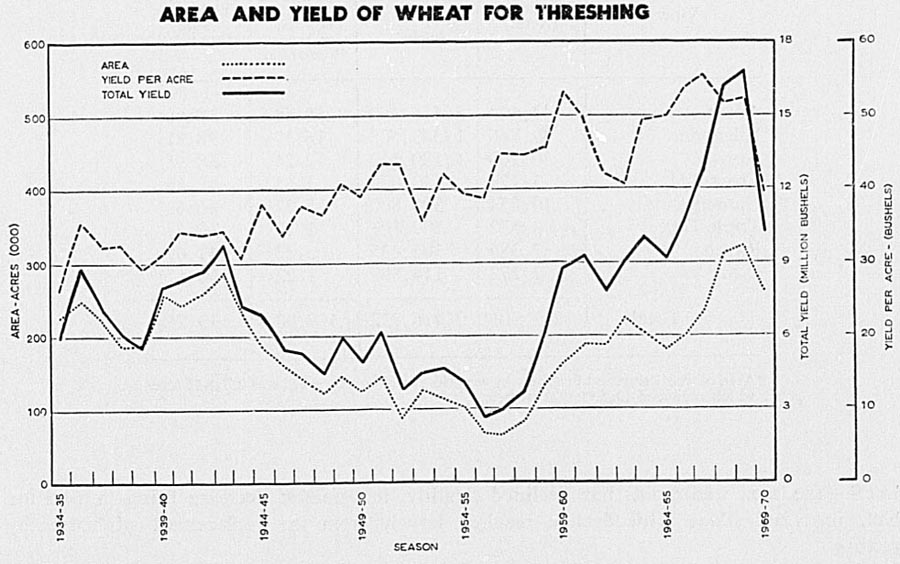
Wheat Board—Control of the importation of wheat and flour and of the distribution of both imported and locally produced wheat rests with the Wheat Board. The operations of this Board, which consists of representatives of flourmillers, wheat growers, and bakers, with the Minister of Industries and Commerce as Chairman, and his nominee from the Department of Industries and Commerce as Deputy Chairman, are governed by the Wheat Board Act 1965.
All New Zealand milling wheat is purchased from farmers by the Wheat Board through the agency of the grain merchants acting as brokers for the Board. The Board is responsible for the distribution of imported poultry wheat in the North Island; in the South Island poultry wheat is not controlled. Its functions also include arrangements for the processing of wheat and the sale of flour to merchants, bakers, pastrycooks, grocers, and others.
The annual consumption of wheat in New Zealand approximates 15 million bushels—some 11 million bushels being required for flour and cereal foods, and the balance for poultry food and seed. In the 1968-69 season New Zealand's production of milling wheat was nearly self-sufficient, requiring only a small quantity to be imported; some surplus non-milling wheat was exported.
Varieties of Wheat—The choice of wheat varieties for sowing is influenced by their suitability to local conditions of climate, soil type, etc. Wheat growers receive valuable guidance regarding suitable varieties as the result of research work and field trials undertaken by the Crop Research Division, Department of Scientific and Industrial Research, the Wheat Research Institute, and the Department of Agriculture. The survey of varieties of wheat grown for threshing is now carried out each year. The 1970 survey which related to wheat sown in 1969 and harvested in 1970 showed the following results.
| Variety | Area (Acres) | Yield | Average Yield per Acre (Bushels) | |
|---|---|---|---|---|
| Bushels | Percentage of Total Production | |||
| *Area of wheat threshed in survey by varieties; total area threshed was 267,846 acres which produced 10,553,000 bushels. | ||||
| Aotea | 142,629 | 5,516,350 | 58.58 | 38.68 |
| Hilgendorf 61 | 39,766 | 1,543,508 | 16,39 | 38.81 |
| Arawa | 30,300 | 1,180,512 | 12.54 | 38.96 |
| Cross 7-61 | 3,123 | 143,025 | 1.52 | 45.80 |
| Gamenya | 10,854 | 505,800 | 5.37 | 46.60 |
| Triple Dirk | 3,572 | 109,193 | 1.16 | 30.57 |
| Raven | 7,385 | 303,435 | 3.22 | 41.09 |
| Other | 2,272 | 114,899 | 1.22 | 50.57 |
| Totals | 239,901* | 9,416,722 | 100.00 | 39.25 |
OATS—The area under oats has declined steadily, the greatest decrease being in oats for chaff, hay, and silage. This decline resulted largely from the replacement of horses by tractors.
Varieties of Oats Threshed—A survey covering the 1969-70 season gave the following results:
| Variety | Area (Acres) | Yield | Average Yield per Acre (Bushels) | |
|---|---|---|---|---|
| Bushels | Percentage of Total Production | |||
| *Area of oats threshed in survey by varieties; total area threshed was 51,911 acres which produced 3,181,000 bushels. | ||||
| Onward | 12,052 | 763,363 | 27.15 | 63.34 |
| Mapua | 24,144 | 1,594,843 | 56.72 | 66.06 |
| Black Supreme | 4,623 | 243,514 | 8.66 | 52.67 |
| Grey Winter | 943 | 32,964 | 1.17 | 34.96 |
| Other White | 2,976 | 127,284 | 4.53 | 42.77 |
| Other Black | 1,102 | 49,914 | 1.77 | 45.29 |
| Totals | 45,840* | 2,811,882 | 100.00 | 61.34 |
More than half a million bushels of oats are milled each year to produce some 3,000 short tons of rolled oats, and 2,300 short tons of oatmeal and proprietary oaten foods.
BARLEY—In the five seasons 1965-66 to 1969-70 the average area of barley sown was 140,000 acres of which 125,000 were harvested for grain most of the remainder being used for green feed. In the 1969-70 season there were 7,692,000 bushels of barley threshed from 138,577 acres compared with 10,254,358 bushels from 157,003 acres in the 1968-69 season. About half the crop is used for malting and half for manufactured stock food.
Varieties of barley grown in the 1969-70 season were as set out below.
| Variety | Area (Acres) | Yield | Average Yield per Acre (Bushels) | |
|---|---|---|---|---|
| Bushels | Percentage of Total Production | |||
| *Area of barley threshed in survey by varieties; total area threshed was 156,963 acres. | ||||
| Carlsberg | 45,578 | 2,470,661 | 36.41 | 54.21 |
| Kenia | 15,209 | 748,612 | 11.03 | 49.22 |
| Research | 14,921 | 762,925 | 11.24 | 51.13 |
| Zephyr | 45,246 | 2,735,992 | 40.32 | 60.47 |
| Other varieties | 1,383 | 67,410 | 1.00 | 48.74 |
| Totals | 122,337* | 6,785,600 | 100.00 | 55.47 |
PEAS—The area of peas for threshing has increased rapidly over the last three years moving from 27,322 acres in 1966-67 to 60,542 acres in 1969-70. There have been fluctuations in the export figures for this commodity. In 1949 nearly 850,000 bushels were exported, whereas by 1953 the amount had fallen to approximately 370,000 bushels, but increased to 1,044,038 bushels in 1968-69.
Varieties of peas grown in the 1969-70 season were as under.
| Variety | Area (Acres) | Yield | Average Yield per Acre (Bushels) | |
|---|---|---|---|---|
| Bushels | Percentage of Total Production | |||
| *Area of peas threshed in survey by varieties; total area threshed was 60,542 acres which produced 1,822,000 bushels. | ||||
| Garden varieties | 18,658 | 581,402 | 37.29 | 31.16 |
| Field varieties— | ||||
| Blue Boiling | 7,411 | 217,234 | 13.93 | 29.31 |
| Maple | 21,268 | 614,645 | 39.42 | 28.90 |
| White | 5,053 | 145,867 | 9.36 | 28.87 |
| Totals | 52,390* | 1,559,148 | 100.00 | 29.76 |
The foregoing figures exclude green peas grown for market or processing (e.g., canning and quick freezing). There has been an increasing use of quick-frozen peas.
POTATOES—The production of potatoes is usually adequate to meet the home market.
Under the Potato Growing Industry Act 1950 a Potato Board was established consisting of seven members, three of whom are representative of the growers on an elective basis, three nominated by the New Zealand Grain, Seed, and Produce Merchants' Federation (Incorporated), and one an officer of the Public Service acting in an advisory capacity.
The principal functions of the Board are to ensure that adequate supplies of main-crop potatoes are available for consumption in New Zealand, and for that purpose to enter into contracts with growers for the growing of main-crop potatoes. The Act provides that the Board may impose a levy not exceeding $3 per ton on main-crop potatoes sold by growers, the proceeds of which are to be applied by the Board in payment of charges, etc., for which it may become liable in the exercise of its functions.
The Board undertakes to compensate contract growers for any declared unsold number one grade contract produce held by growers at the end of the season. For the 1970-71 season the rate involved varied according to varieties from $15 to $20 per 2,000 lb in the South Island and $19 to $24 per 2,000 lb unit in the North Island.
Potato yields have risen to such an extent that a population of 2 3/4 million is now supplied from the same acreages as were 1 3/4 million people 20 years earlier. Most of this increased production has been achieved through new varieties and better farming practice based on research results.
Figures for area and yield of potatoes for the latest five years are as follows.
| Year | Area | Total Yield | Yield per Acre |
|---|---|---|---|
| acres | tons | tons | |
| 1965-66 | 24,434 | 230,858 | 9.45 |
| 1966-67 | 19,818 | 184,398 | 9.30 |
| 1967-68 | 23,518 | 232,110 | 9.87 |
| 1968-69 | 25,036 | 252,301 | 10.08 |
| 1969-70 | 24,532 | 249,204 | 10.16 |
The estimated area for 1970-71 was 19,000 acres.
ONIONS—Areas in, and yields of, onions for the latest five years are as follows.
| Year | Area | Total Yield | Yield per Acre |
|---|---|---|---|
| acres | tons | tons | |
| 1965-66 | 1,750 | 21,208 | 12.12 |
| 1966-67 | 1,952 | 23,916 | 12.25 |
| 1967-68 | 1,947 | 23,766 | 12.21 |
| 1968-69 | 2,522 | 30,409 | 12.06 |
| 1969-70 | 2,171 | 25,548 | 11.77 |
LINSEED—The area under this crop has fluctuated considerably over a long period. The highest level of 24,437 acres was reached in 1951-52. In the processing of linseed, the linseed oil is extracted while the residue provides a valuable concentrate for stock food. A small quantity of unprocessed linseed is also used for this purpose.
SUPPLEMENTARY FODDER CROPS—The following table gives the areas of the supplementary fodder crops.
| Year | Grasses and Clovers, Including Lucerne for Hay or Silage | Cereal Crops | Rape, Kale, and Chou Moellier | Swedes, Turnips, Turnips and Rape | Total Area of Fodder Crops* |
|---|---|---|---|---|---|
| *Excludes small areas of other minor fodder crops. | |||||
| acres | |||||
| 1963-64 | 1,148,156 | 68,443 | 246,315 | 459,620 | 1,922,534 |
| 1964-65 | 1,201,000 | 90,522 | 250,963 | 483,896 | 2,026,381 |
| 1965-66 | 1,279,661 | 71,321 | 229,126 | 473,448 | 2,053,556 |
| 1966-67 | 1,296,075 | 67,069 | 203,104 | 450,625 | 2,016,873 |
| 1967-68 | 1,307,819 | 76,259 | 181,830 | 439,766 | 2,005,674 |
| 1968-69 | 1,485,755 | 72,992 | 190,481 | 412,472 | 2,161,700 |
In 1968-69 grasses and clovers cut for hay or silage totalled 1,294,564 acres and lucerne 191,191 acres. Oats was the only cereal crop utilised in any quantity for this purpose. Oats also was the principal cereal crop fed off to stock. The area of oats cut for chaff, hay, or silage or fed off amounted to 49,075 acres. The principal green-fodder crops apart from oats are rape (74,134 acres) and chou moellier, including kale (116,347 acres). Swedes and turnips are the principal root crops grown in New Zealand, the total area sown in these crops in 1968-69 being 412,472 acres (including 26,359 acres of turnips and rape mixed).
SEED CERTIFICATION—The Department of Agriculture operates a seed certification scheme covering the more important herbage species, cereals, brassicas and potatoes. Bred varieties of these species are produced by the Grasslands and the Crop Research Division of the DSIR. These are then reproduced under the control of the Department of Agriculture which releases them as Breeders' seed which in turn produces Basic seed. The final stages in the multiplication of certified seed are known as 1st and 2nd Generation seeds. Basic and Certified seed, 1st and 2nd Generation, are sold through the usual commercial channels.
GRASS SEED—Of the total area of grasses, clovers, and lucerne cut for seed during 1968-69, 91 percent was in the South Island.
The areas of grass, clover, and lucerne crops harvested for seed, distinguishing the principal varieties, are given in the following table.
| Crop | 1964-65 | 1965-66 | 1966-67 | 1967-68 | 1968-69 |
|---|---|---|---|---|---|
*Includes Ariki ryegrass. † Ariki from 1968-69. | |||||
| Ryegrass— | acres | ||||
| Perennial | 42,344 | 62,977 | 55,431 | 50,193* | 44,858 |
| Italian | 8,801 | 11,197 | 7,456 | 4,803 | 7,088† |
| Short rotation (H1) | 11,689 | 16,892 | 18,293 | 16,943 | 13,548 |
| Cocksfoot | 8,174 | 8,731 | 9,349 | 9,607 | 9,872 |
| Chewings fescue | 1,127 | 1,507 | 1,006 | 2,954 | 1,395 |
| Crested dogstail | 4,656 | 4,866 | 3,799 | 7,936 | 9,394 |
| Red clover (including Cowgrass) | 14,249 | 19,943 | 15,450 | 11,888 | 14,299 |
| White clover | 31,903 | 55,541 | 46,554 | 26,012 | 32,326 |
| Lucerne | 4,219 | 10,966 | 13,867 | 11,616 | 11,879 |
| Other grasses and clovers | 9,339 | 8,204 | 8,050 | 9,257 | 12,227 |
| Totals | 136,501 | 200,824 | 179,255 | 151,209 | 156,886 |
Quantities (in dressed weights) of grass and clover seeds treated by machine dressing plants for the latest three years are given below.
| Type of Seed | Unit | 1967 | 1968 | 1969 |
|---|---|---|---|---|
| Ryegrass— | ||||
| Perennial | bush | 1,025,303 | 917,325 | 1,031,414 |
| Italian (including W, Wolths) | bush | 202,775 | 120,805 | 169,473 |
| Short rotation (H1) | bush | 753,486 | 445,479 | 368,154 |
| Ariki | bush | 446,049 | 204,732 | 181,091 |
| Cocksfoot | lb | 1,909,932 | 1,754,292 | 2,549,976 |
| Chewings fescue | lb | 215,261 | 458,185 | 378,522 |
| Crested dogstail | lb | 878,617 | 1,771,103 | 2,780,647 |
| Browntop | lb | 204,128 | 207,661 | 209,085 |
| Timothy | lb | 892,554 | 977,402 | 1,045,957 |
| White clover | lb | 6,922,109 | 4,568,046 | 5,631,627 |
| Suckling clover | lb | 90,999 | 148,492 | 109,476 |
| Suckling white mixture | lb | 355,449 | 326,852 | 320,232 |
| Broad red clover (including cowgrass) | lb | 1,640,551 | 1,107,245 | 1,370,940 |
| Montgomery red clover | lb | 1,159,520 | 990,163 | 1,319,426 |
| Lucerne | lb | 1,165,068 | 1,109,521 | 889,502 |
| Other grasses and clovers | lb | 249,313 | 159,275 | 153,304 |
Large quantities of grass and clover seed have been exported during recent years, especially to the United Kingdom, Australia, and the United States of America. Details of the volume and value of exports during recent years will be found in Section 22b of this issue.
MARKET GARDENS AND PLANTATIONS—The following table sets out the acreages for market gardens, plantations, etc. Forest Service plantations are included in these figures. The statistics relate only to holdings of 10 acres and over outside boroughs. In 1956-57 the area of market gardens in the 1-9 acre group represented 19 percent of the total acreage; in the case of nurseries the percentage was 21 percent and for private gardens 5 percent. Plantations were scarcely affected, being well under 1 percent. Figures include berry-fruit gardens.
| Year | Market Gardens* | Nurseries | Private Gardens, etc. | Plantations | |
|---|---|---|---|---|---|
| *Excluding crops for processing. | |||||
| acres | |||||
| 1963-64 | 12,991 | 1,758 | .. | 1,041,476 | |
| 1964-65 | 14,579 | 1,763 | 102,446 | 1,034,926 | |
| 1965-66 | 12,936 | 1,848 | 122,656 | 1,056,274 | |
| 1966-67 | 14,998 | 2,151 | 116,672 | 1,061,606 | |
| 1967-68 | 16,507 | 2,194 | 114,388 | 1,102,142 | |
| 1968-69 | 19,265 | 2,324 | 115,261 | 1,148,615 | |
Commercial Gardens—The Department of Agriculture estimates that approximately 2,700 vegetable growers were cultivating a total area of approximately 45,000 acres in 1964. Included in this figure are approximately 19,000 acres used exclusively for growing crops for processing.
Commercial berry-fruit gardens are surveyed every five years. The Department of Agriculture's last survey was in 1969 when 1,407 acres farmed by 571 growers were recorded. In 1969 the areas then being grown were: raspberries 570 acres; strawberries 514 acres; black currants 110 acres; gooseberries 59 acres; boysenberries 155 acres; loganberries 21 acres. The production of berryfruits in the 1968-69 season was estimated as follows: raspberries, 1,226 tons; strawberries, 4,034 tons; black currants, 223 tons; gooseberries, 91 tons; boysenberries, 328 tons; and loganberries 63 tons. The greatest concentration of gardens is in Canterbury near Christchurch and Waimate with the combined total of 389 acres. Raspberries account for 210 of the 295 acres of berryfruit grown in the Nelson province. The 130 acres in the Wairarapa are mainly of mixed berryfruit holdings. In the vicinity of Auckland 150 acres of strawberries are grown. Other major centres of berryfruit growing are Central Otago, 62 acres; Manawatu, 108 acres; and Hawke's Bay 125 acres. Gooseberries are not grown commercially to any extent outside the Wairarapa (33 acres). These estimates cover all gardens of over half an acre and smaller gardens with more than a quarter of an acre of strawberries, including those in boroughs. The only berryfruit for which there is an organised marketing scheme is the raspberry, for which local marketing committees have been established in Nelson (since 1940) and in Canterbury and Otago (since 1959), while a Central Council of Raspberry Growers was created by the Raspberry Marketing Regulations 1950 to co-ordinate marketing by the three district committees.
Nurseries—The number of nurseries registered at 31 December 1969 totalled 665 and these covered 2,717 acres.
Home Garden Production—Home garden production, on which a question was asked for the first time at the 1956 Census, is dealt with in the next table. This question was not asked again in the censuses of 1961 and 1966.
| Proportion of Requirements | Potatoes Grown | Other Vegetables Grown | ||
|---|---|---|---|---|
| Number of Households | Percent of Total Specified | Number of Households | Percent of Total Specified | |
| All | 48,084 | 8.73 | 45,498 | 8.27 |
| Three-quarter | 24,293 | 4.41 | 54,395 | 9.88 |
| One-half | 46,251 | 8.40 | 69,901 | 12.70 |
| One-quarter | 56,866 | 10.33 | 56,604 | 10.29 |
| Under one-quarter | 101,288 | 18.40 | 107,329 | 19.50 |
| Nil | 273,811 | 49.73 | 216,630 | 39.36 |
| Not specified | 12,459 | - | 12,695 | - |
| Totals | 563,052 | 100.00 | 563,052 | 100.00 |
Of the total households where a return was made 62 percent kept a garden and 38 percent had no garden. Where only 37 percent of dwellings with one occupant returned “yes”, this rose sharply to 59 percent of households with two occupants. The proportions answering “yes” to this question increased continuously from two to six occupants, and declined from seven occupants onwards.
ORCHARDS AND THE FRUIT INDUSTRY—Apples and pears are the main fruits, the principal growing areas being Nelson and Hawke's Bay. Peach and plum orchards are distributed over Nelson, Hawke's Bay, Central Otago, and near Auckland. Central Otago, with its hot summers and severe winters, produces the greater part of the English plums, apricots, and cherries. The coastal strip from North Auckland, through the Bay of Plenty, to Gisborne is sufficiently mild for the production of citrus and other subtropical fruits such as passionfruit, tamarilloes, and Chinese gooseberries.
The area in commercial holdings of 10 acres and over outside borough boundaries returned as under fruit trees was given as 20,914 acres at 31 January 1969.
During 1968 the Department of Agriculture made the fourth comprehensive field survey of fruit trees in commercial orchards. This survey covered all orchards with 100 or more deciduous fruit trees, over 50 citrus trees, subtropical fruits, and mixed orchards of half an acre and over. The Horticulture Division of the Department of Agriculture has supplied the following numbers of fruit trees of principal kinds in commercial orchards based on 1968 survey figures: apple, 1,465,359; pear, 192,946; quince, 1,777; peach, 407,862; nectarine, 41,173; apricot, 159,081; plum 113,206; cherry, 23,407; lemon, 36,372; orange, 142,491; grapefruit, 45,087; mandarin, 68,656; tangelo, 47,468.
The 1968 survey showed that the total number of fruit trees had increased since the third survey of 1963. There were 252,000 more apple trees and 18,600 more pear trees. A total of 338,074 citrus trees occupying 1,781 acres of commercial orchard area was recorded in the 1968 survey. This amounts to a 100 percent increase in the total number of citrus trees over the five years since the 1963 survey.
A survey by the Department of Agriculture in 1965 of all vineyards containing at least half an acre of vines covered 180 vineyards. The total area in grapes was estimated at 1,253 acres, yielding a crop of 6,010 tons. 94.5 percent was used for wine production, 4.1 percent was sold as table grapes and 1.4 percent was used for making grape-juice beverage. Vineyards were mainly in Auckland (583 acres), Hawke's Bay (489 acres), Waikato (82 acres), Gisborne (67 acres), Northland (23 acres), and South Island (6 acres). In 1969 there were 162 licensed winemakers who produced 3,035,000 gallons of grape wine, 35,000 gallons of grape-juice beverage, 98,000 gallons of fruit wine, and cider. The estimated area in glasshouse vineries in 1969 was 422,000 square feet. The main centres of indoor grape growing were: Auckland, 247,000 square feet; Canterbury, 50,000 square feet; Manawatu, 43,000 square feet; and Oamaru, 33,000 square feet. Approximately 193,000 square feet of glasshouse vineries have been adapted for early market and 22,900 square feet for late market. There were 141 tons of glasshouse grapes marketed for dessert purposes.
Apples and Pears—A summary of the activities of the New Zealand Apple and Pear Marketing Board appears in Section 21. Over 700 orchardists consistently sell apples and pears to the Board. Over 75 percent of the total crop received comes from Nelson and Hawke's Bay.
Quantities of apples and pears marketed in New Zealand by the Board in the last five seasons are given below. These figures exclude direct sales from fruitgrowers to factories and the public; these sales have been estimated to comprise approximately 20 percent of the annual apple and pear crop.
| Season | Apples | Pears | Total |
|---|---|---|---|
| bushel cases | |||
| 1,964 | 1,822,189 | 429,631 | 2,251,820 |
| 1,965 | 1,893,861 | 448,807 | 2,342,668 |
| 1,966 | 1,951,100 | 413,300 | 2,370,400 |
| 1,967 | 2,179,500 | 468,710 | 2,648,210 |
| 1,968 | 2,027,000 | 421,100 | 2,448,100 |
A quantity of fruit later exported as processed goods is included in the above figures; in 1968-69 it involved 326,724 cases.
The following table shows the quantities of the main varieties of apples and pears marketed in New Zealand by the Apple and Pear Marketing Board and exported to the United Kingdom and elsewhere during the 1968-69 season, together with the total estimated production of each crop. Factories are given authority to purchase fruit for processing direct from the growers.
| Variety | Marketed by the Apple and Pear Marketing Board | Estimated Total Production* | ||
|---|---|---|---|---|
| In New Zealand | For Export | |||
| To United Kingdom | To Other Countries | |||
| *Estimated by Horticulture Division, Department of Agriculture. | ||||
| Apples— | bushel cases | |||
| Sturmer Pippin | 304,049 | 543,750 | 93,942 | .. |
| Delicious | 284,452 | 99,186 | 183,662 | .. |
| Jonathan | 284,465 | 196,838 | 60,165 | .. |
| Granny Smith | 350,429 | 221,486 | 440,309 | .. |
| Cox's Orange Pippin | 156,068 | 163,350 | 611 | .. |
| Ballarat Seedling | 20,785 | 17,457 | 11,710 | .. |
| Golden Delicious | 151,194 | 157,486 | 141,729 | .. |
| Gravenstein | 101,351 | - | 223 | .. |
| Dougherty | 112,410 | 6,446 | 37,006 | .. |
| Others | 261,851 | 109,084 | 123,069 | .. |
| Totals, apples | 2,027,054 | 1,515,083 | 1,092,426 | 5,895,500 |
| Pears— | ||||
| William's Bon Chretien | 112,634 | - | - | .. |
| Winter Cole | 133,904 | 20,991 | 30,248 | .. |
| Winter Nelis | 87,620 | 646 | 12,827 | .. |
| Others | 86,986 | 26,537 | 37,904 | .. |
| Totals, pears | 421,144 | 48,174 | 80,979 | 913,700 |
Stone Fruits—The 1968 survey by the Department of Agriculture revealed that nearly half of the total of 407,900 peach trees were in Hawke's Bay, and that, of the balance, some 74,000 peach trees were in the Auckland district.
Production and disposal of stone fruits for the year ended 30 June 1969 were estimated as follows.
| Fruit | Disposal | Total Production | |
|---|---|---|---|
| Market | Processing | ||
| (000 bushels) | (bushels) | (000 bushels) | |
| Peaches | 728 | 551,150 | 1,280 |
| Nectarines | 55 | 250 | 56 |
| Apricots | 177 | 63,100 | 241 |
| Plums— | |||
| European | 15 | 2,850 | 18 |
| Japanese | 159 | 11,900 | 171 |
| Cherries | 21 | 1,750 | 23 |
Citrus and Subtropical Fruits—Estimated quantities of citrus fruits marketed in New Zealand by the Citrus Marketing Authority, together with direct sales to the public by citrus growers, are given in the following table.
| Year | Grapefruit | Lemons* | Sweet Oranges | Mandarins and Other Citrus Fruits |
|---|---|---|---|---|
| *Figures for lemons relate to packed bushel cases. | ||||
| bushels | ||||
| 1,963 | 178,750 | 117,000 | 25,750 | 10,500 |
| 1,964 | 185,050 | 121,625 | 33,650 | 14,100 |
| 1,965 | 184,200 | 133,660 | 31,050 | 15,800 |
| 1,966 | 158,500 | 112,400 | 36,600 | 22,000 |
| 1,967 | 154,000 | 121,000 | 37,000 | 25,000 |
| 1,968 | 184,500 | 171,500 | 58,600 | 43,100 |
| 1,969 | 147,400 | 119,600 | 62,000 | 44,800 |
Reference to the Citrus Marketing Authority is to be found in Section 21.
Estimated production figures for other subtropical fruits for 1969 are: tamarilloes, 1,570 tons; passion fruit, 221 tons; Chinese gooseberries, 1,593 tons.
HOPS—Practically the whole of the hop gardens are located in Waimea county. Production per acre usually ranges between 1,200 and 1,500 lb. In the 1968 season 3,414 bales were packed, which was 631 bales more than the previous season. The total crop produced in the 1969 season was 844,316 lb, as against 807,339 lb in 1968. About 95 percent of the crop is now picked by machines.
A Hop Marketing Committee of six members (one Government and five producer) was established by the Hop Marketing Regulations 1939 to regulate and control the marketing either locally or overseas of all hops produced in New Zealand and to assist the industry generally.
TOBACCO—Tobacco is grown mainly in the Motueka district. Most of the tobacco produced is flue-cured, producing a yellow-leaf tobacco which is largely used for the manufacture of cigarettes, the balance, air-cured, being used mainly in the manufacture of smoking mixtures and pipe tobacco. Some 7,545,512 lb of raw tobacco leaf was imported for the year ended 31 December 1968 with a value of $5,919,815.
With the following particulars relating to tobacco production, it should be noted that the figures relate to the total commercial tobacco production and not merely to holdings of 10 acres or over situated outside borough boundaries. (Source: New Zealand Tobacco Board.)
| Season | Number of Growers | Area Planted | Production* | Estimated Value of Crop* |
|---|---|---|---|---|
| *Includes research and experimental crops. | ||||
| acres | lb (000) | $(000) | ||
| 1964-65 | 728 | 5,840 | 9.881 | 4.554 |
| 1965-66 | 585 | 5.088 | 6.823 | 3.268 |
| 1966-67 | 529 | 4.882 | 5.516 | 2.984 |
| 1967-68 | 526 | 5.101 | 6.154 | 3.562 |
| 1968-69 | 523 | 5.095 | 7.604 | 4.917 |
The production figures represent the weight of the leaf purchased from growers before redrying. Flue-cured leaf accounted for 96.3 percent and air-dried leaf for 3.7 percent of the 1968-69 crop.
PHORMIUM TENAX—Certain areas in various parts of New Zealand are covered by natural stands of Phormium tenax (New Zealand flax), once used by the Maoris for many purposes and one of the earliest of this country's exports. Only a small proportion of the natural area is millable but this, together with an estimated planted area of about 3,000 acres, produces some 5,000 tons of fibre and tow. The industry provides at least one-third of the local requirements of woolpacks.
LINEN FLAX—There is a strong demand for all linen fibre produced in New Zealand from a local manufacturer of twine who uses this kind of fibre in the making of twine for closing bags and bales and for rolling meat, and for other purposes which require a twine made from a strong durable fibre.
Areas for the last five seasons are: 1963-64, 501 acres; 1964-65, 283 acres; 1965-66, 446 acres; 1966-67, 562 acres; and 1967-68, 450 acres.
Production from the single factory still operated by the Linen Flax Corporation at Geraldine has been as follows:
| Product | 1964 | 1965 | 1966 | 1967 | 1968 |
|---|---|---|---|---|---|
| tons | |||||
| Straw processed | 1,449 | 1,369 | 873 | 1,313 | 1,401 |
| Scrutched fibre | 150 | 167 | 101 | 152 | 152 |
| Seed | 142 | 160 | 82 | 142 | 145 |
| Tow | 40 | 38 | 27 | 46 | 46 |
| Linmeal | 102 | 103 | 58 | 88 | 95 |
GENERAL—New Zealand has more than 25 times as many animals as people: this ratio is probably not exceeded in any country in the world. Grasslands have been developed to the extent that the best dairy farms can carry one cow to the acre, and the best sheep farms can support up to 10 sheep to the acre throughout the year.
The first sheep stations in the 1840s were stocked with Merinos from Australia. During the 1850s and 1860s several English breeds of sheep were imported, notably Southdowns, Leicesters, Lincolns, and Romneys. In 1855 there were 761,700 sheep in the country; by 1870 there were 9,700,000. Until 1882, the year of the successful introduction of cargo refrigeration when mutton and lamb exports were sent to London, the Merino and its crosses were predominant, because the only sheep products of any importance for export were wool and a little tallow, obtained by boiling down carcasses. Then the Merino was superseded in the North Island by breeds more suited to the climate and conditions. Today the flock sheep of the North Island are nearly all predominantly of Romney blood. In the South Island, Merino blood in varying degree continued to play an important part in the flock structure. Merinos have become restricted to the foothills of the Southern Alps, while Corriedales are more profitable in the better hill country and crossbreds and long-woolled British breeds at lower levels. There were nearly 10 million breeding ewes in 1901.
In 1861 there were 193,000 cattle in New Zealand and by 1897 the number had reached 1,138,000. Cattle raising and fattening are usually associated with hill-country sheep farming and fat-lamb farming respectively, and beef stock are grazed chiefly in the North Island. The most popular breed of beef cattle is now the Aberdeen Angus, which has gradually gained ground over the last 30 years, with Herefords and Shorthorns next in number.
The growth of dairy herds was related to the availability of refrigeration for the export of butter from 1882, and the development of butter and cheese factories. There were 300,000 dairy cows by 1897, 185,000 of them in the North Island and 115,000 in the South Island. Now the North Island has more than twelve times as many dairy cows as the South Island. At first the Shorthorn was the popular breed, but since 1920 the Jersey has emerged as the predominant breed of dairy cattle.
In the following table, dairy cows in milk, total cattle, sows, and total pigs are as at 31 January; sheep shorn, lambs shorn, and lambs tailed are for the season ending in the year stated; breeding ewes and total sheep are as at 30 June, while the coverage is of holdings of 10 acres and over situated outside borough boundaries.
| Livestock | 1966 | 1967 | 1968 | 1969 | 1970 |
|---|---|---|---|---|---|
| *Includes those in boroughs and on holdings under 1 acre. | |||||
| Cattle (including dairy cows) | 7,217,720 | 7,746,866 | 8,247,163 | 8,604,874 | 8,777,332 |
| Dairy cows in milk | 2,007,869 | 2,131,359 | 2,232,482 | 2,304,252 | 2,320,636 |
| Total dairy cattle | 3,361,621 | 3,505,714 | 3,698,020 | 3,793,083 | 3,729,284 |
| Beef cattle | 3,856,099 | 4,241,152 | 4,549,143 | 4,811,791 | 5,048,048 |
| Sheep (including lambs)* | 57,343,257 | 60,029,977 | 60,473,597 | 59,937,000 | 60,276,000 |
| Breeding ewes* | 39,667,734 | 41,407,708 | 42,650,916 | 43,384,698 | 42,912,000 |
| Lambs tailed during season | 36,990,224 | 39,361,933 | 40,920,825 | 40,415,684 | 42,077,998 |
| Lambs shorn during season | 17,707,176 | 16,021,578 | 15,913,932 | 16,119,424 | 18,618,700 |
| Sheep shorn during season | 49,624,239 | 54,563,347 | 56,451,591 | 55,761,540 | 56,416,878 |
| Pigs (total) | 666,905 | 602,695 | 614,177 | 553,388 | 577,925 |
| Breeding sows | 81,678 | 75,910 | 77,412 | 69,223 | 73,204 |
The 1964 Agricultural Development Conference set a target of an increase in livestock numbers of 3.5 percent a year and the National Development Conference in 1969 revised the rate to 2.6 percent a year. In the latest three years dairy cattle have increased by 4.3 percent. 5.5 percent, and 2.6 percent, and beef cattle by 10 percent, 7.3 percent, and 5.8 percent. Sheep numbers increased by 4.7 percent in 1966-67, and by 0.7 percent in 1967-68, but decreased by 0.9 percent in 1968-69. In ewe equivalents, the increases were 6.6 percent in the year to 31 January 1967, followed by increases of 5.3 percent 1967-68 and 2.4 percent for 1968-69.
The dairying and beef-production industries are both largely concentrated in the North Island, which has 87 percent of the total cattle and 93 percent of the dairy stock. Localising the dairying industry still further, it is found that 66 percent of the milking cows of New Zealand are in the northern half of the North Island. Taranaki and Wellington districts between them account for one-quarter of the total dairy cows in milk.
Beef cattle are fairly evenly spread over the North Island, except Taranaki and areas close to Auckland.
Taking the number of beef breeding cows two years old and over as a guide to beef production, South Auckland-Bay of Plenty and Wellington statistical areas easily lead with two-fifths of the New Zealand total between them. Hawke's Bay is next, followed by East Coast and Northland in that order. These five districts together depasture 76 percent of breeding cows.
Northland, Central Auckland, and South Auckland - Bay of Plenty statistical areas account for 44 percent of the pig population and Wellington and Taranaki for 25 percent. The number of pigs kept in the Nelson and Canterbury areas has increased considerably in recent years and 18 percent of the pig population is now in these areas. Tanker collection of whole milk from dairy farms has reduced the rearing of pigs as a sideline; major developments have taken place in the rearing of grain-fed pigs in large units.
Sheep farming is more evenly distributed between the North and South Islands. The statistical areas of major importance are Canterbury, Wellington, South Auckland-Bay of Plenty, Southland, Otago, and Hawke's Bay, in that order, these six districts accounting for 84 percent of the total sheep population in 1969.
The following table shows the distribution of livestock at 31 January 1969.
| Statistical Area | Dairy Cows, and Heifers Two Years Old and Over (In Milk) | Beef Breeding Cows, Two Years Old and Over | Total Cattle | Breeding Sows | Total Pigs | Sheep Shorn* | Lambs Shorn* | Lambs Tailed* |
|---|---|---|---|---|---|---|---|---|
| *Sheep shorn, lambs shorn, and lambs tailed during 1968-69, remaining particulars for stock at 31 January 1969. | ||||||||
| Northland (000) | 284 | 139 | 923 | 7 | 51 | 1,856 | 843 | 1,172 |
| Percent | 12.2 | 9.4 | 10.7 | 9.5 | 9.2 | 3.3 | 5.2 | 2.9 |
| Central Auckland (000) | 200 | 44 | 510 | 7 | 60 | 1,207 | 475 | 816 |
| Percent | 8.7 | 3.0 | 5.9 | 10.3 | 10.8 | 2.2 | 2.9 | 2.0 |
| South Auckland - (000) | 1,032 | 328 | 2,813 | 17 | 133 | 8,434 | 3,752 | 5,668 |
| Bay of Plenty Percent | 44.8 | 22.0 | 32.7 | 24.6 | 24.0 | 15.1 | 23.3 | 14.0 |
| East Coast (000) | 9 | 161 | 452 | 1 | 7 | 2,325 | 1,010 | 1,340 |
| Percent | 0.4 | 10.8 | 5.3 | 1.4 | 1.3 | 4.2 | 6.3 | 3.3 |
| Hawke's Bay (000) | 45 | 217 | 747 | 2 | 15 | 6,287 | 2,402 | 4,382 |
| Percent | 2.0 | 14.6 | 8.7 | 3.0 | 2.7 | 11.3 | 14.9 | 10.9 |
| Taranaki (000) | 360 | 40 | 752 | 8 | 72 | 1,624 | 559 | 1,090 |
| Percent | 15.6 | 2.7 | 8.7 | 11.7 | 13.1 | 2.9 | 4.1 | 2.7 |
| Wellington (000) | 209 | 259 | 1,223 | 9 | 69 | 8,817 | 3,655 | 5,860 |
| Percent | 9.1 | 17.4 | 14.2 | 13.5 | 12.1 | 15.8 | 22.7 | 14.5 |
| North Island (000) | 2.140 | 1,188 | 7,418 | 51 | 405 | 30,549 | 12,797 | 20,327 |
| Percent | 92.8 | 79.9 | 86.2 | 74.0 | 73.2 | 54.8 | 79.4 | 50.3 |
| Marlborough (000) | 14 | 27 | 102 | 2 | 17 | 1,328 | 204 | 804 |
| Percent | 0.6 | 1.8 | 1.2 | 3.0 | 3.1 | 2.4 | 1.3 | 2.0 |
| Nelson (000) | 38 | 21 | 128 | 3 | 29 | 682 | 155 | 435 |
| Percent | 1.6 | 1.4 | 1.5 | 3.9 | 5.2 | 1.2 | 1.0 | 1.1 |
| Westland (000) | 18 | 16 | 81 | –– | 5 | 196 | 37 | 134 |
| Percent | 0.8 | 1.1 | 1.0 | 0.6 | 0.9 | 0.4 | 0.2 | 0.3 |
| Canterbury (000) | 50 | 95 | 382 | 9 | 70 | 9.438 | 1,151 | 7,581 |
| Percent | 2.2 | 6.4 | 4.4 | 13.5 | 12.6 | 16.9 | 7.1 | 18.8 |
| Otago (000) | 21 | 80 | 262 | 2 | 14 | 6,536 | 586 | 4,900 |
| Percent | 0.9 | 5.4 | 3.0 | 2.6 | 2.6 | 11.7 | 3.6 | 12.1 |
| Southland (000) | 24 | 59 | 233 | 2 | 13 | 7,033 | 1,190 | 6,234 |
| Percent | 1.1 | 4.0 | 2.7 | 2.4 | 2.4 | 12.6 | 7.4 | 15.4 |
| South Island (000) | 165 | 299 | 1.187 | 18 | 149 | 25,213 | 3,323 | 20,088 |
| Percent | 7.2 | 20.1 | 13.8 | 26.0 | 26.8 | 45.2 | 20.6 | 49.7 |
Detailed statistics of livestock are contained in the annual report Statistics of Farm Production. This publication also contains the summary tables from parliamentary paper H. 23, which is a statistical analysis of the annual sheep returns.
SHEEP—The following table analyses categories of sheep and gives a broad classification of stud and other groups.
| At 30 June | Rams | Wethers | Breeding Ewes | Dry Ewes | Hoggets | Total | ||
|---|---|---|---|---|---|---|---|---|
| Ram | Wether | Ewe | ||||||
| Thousands | ||||||||
| Totals | ||||||||
| 1,964 | 907 | 2,352 | 35,702 | 468 | 268 | 2,663 | 8,932 | 51,292 |
| 1,965 | 931 | 2,553 | 37,178 | 478 | 269 | 2,982 | 9,355 | 53,748 |
| 1,966 | 956 | 2,601 | 39,668 | 336 | 291 | 3,139 | 10,353 | 57,343 |
| 1,967 | 980 | 2,703 | 41,408 | 379 | 319 | 2,820 | 11,421 | 60,030 |
| 1,968 | 1,004 | 2,401 | 42,651 | 488 | 331 | 2,499 | 11,100 | 60,474 |
| 1,969 | 1,008 | 2,038 | 43,385 | 383 | 312 | 1,971 | 10,840 | 59,937 |
| Stud Sheep (Entered in Flack Book) | ||||||||
| 1,957 | 17 | - | 441 | 6 | 153 | - | 168 | 784 |
| 1,962 | 25 | - | 508 | 7 | 183 | - | 195 | 918 |
| 1,967 | 19 | - | 529 | 6 | 215 | - | 215 | 985 |
| Sheep of a Distinctive Breed but Not Entered in Flock Book | ||||||||
| 1,957 | 720 | 1,970 | 24,699 | 352 | 72 | 2,336 | 6,096 | 36,245 |
| 1,962 | 834 | 2,012 | 29,035 | 450 | 75 | 2,289 | 7,280 | 41,975 |
| 1,967 | 919 | 2,479 | 37,184 | 337 | 92 | 2,533 | 10,254 | 53,798 |
| Crossbred Sheep | ||||||||
| 1,957 | 33 | 292 | 3,760 | 73 | 9 | 450 | 736 | 5,353 |
| 1,962 | 41 | 269 | 4,402 | 93 | 9 | 436 | 846 | 6,096 |
| 1,967 | 42 | 225 | 3,695 | 36 | 11 | 287 | 952 | 5,248 |
The 1967 classification of breeds shows that of the 60,029,977 sheep in New Zealand 45,814,676 (76.32 percent) were Romneys and 5,247,589 (8.74 percent) were crossbreds. The remainder were composed principally of Corriedale 3,420,696, half-bred 2,366,617, Southdown 997,784, and Merino 946,990.
There has been a steady increase in the average flock size over the last five years. A classification by size of flock for the last five years is now given.
| Size of Flocks | 1965 | 1966 | 1967 | 1968 | 1969 |
|---|---|---|---|---|---|
| 1- 99 | 5,299 | 4,914 | 4,955 | 5,310 | 5,201 |
| 100- 199 | 2,646 | 2,544 | 2,405 | 2,421 | 2,240 |
| 200- 499 | 5,728 | 5,316 | 4,995 | 4,741 | 4,567 |
| 500- 999 | 7,395 | 6,958 | 6,460 | 6,233 | 5,781 |
| 1,000- 1,499 | 7,493 | 7,140 | 6,668 | 6,339 | 6,131 |
| 1,500- 1,999 | 5,444 | 5,754 | 5,802 | 5,714 | 5,567 |
| 2,000- 2,499 | 2,885 | 3,281 | 3,551 | 3,550 | 3,586 |
| 2,500- 4,999 | 3,908 | 4,476 | 4,949 | 5,120 | 5,118 |
| 5,000- 7,499 | 611 | 699 | 811 | 825 | 872 |
| 7,500- 9,999 | 183 | 205 | 252 | 262 | 261 |
| 10,000-19,999 | 148 | 164 | 188 | 218 | 224 |
| 20,000 and over | 24 | 30 | 37 | 37 | 38 |
| Total flocks | 41,764 | 41,481 | 41,073 | 40,770 | 39,586 |
| Average flock size | 1,287 | 1,382 | 1,462 | 1,472 | 1,514 |
CATTLE—Numbers of cattle by categories are now given.
| Category | At 31 January | |||
|---|---|---|---|---|
| 1967 | 1968 | 1969 | 1970 | |
| Dairy stock— | ||||
| Cows and heifers, two years old and over— | ||||
| Cows in milk during season | 2,131,359 | 2,232,482 | 2,304,252 | 2,320,636 |
| Heifers not yet in milk | 76,441 | 85,067 | 85,319 | 95,685 |
| Cows not in milk during season, but intended to be used again for dairying | 29,215 | 27,078 | 25,839 | 30,065 |
| Heifers— | ||||
| One and under two years old | 557,998 | 604,647 | 627,338 | 604,730 |
| Under one year old | 617,667 | 653,507 | 646,070 | 582,770 |
| Bulls and bull calves intended for dairy breeding | 93,034 | 95,239 | 104,265 | 95,398 |
| Totals, dairy stock | 3,505,714 | 3,698,020 | 3,793,083 | 3,729,284 |
| Beef stock— | ||||
| Breeding cows and heifers, two years old and over | 1,535,806 | 1,647,628 | 1,705,871 | 1,755,306 |
| Cows, two years old and over, not used for breeding | 68,592 | 64,695 | 76,307 | 110,703 |
| Heifers— | ||||
| One and under two years old | 433,328 | 478,480 | 518,833 | 532,244 |
| Under one year old | 539,475 | 573,921 | 598,538 | 634,657 |
| Steers and bulls of all ages | 1,663,951 | 1,784,419 | 1,912,242 | 1,950,821 |
| Totals, beef stock | 4,241,152 | 4,549,143 | 4,811,791 | 5,048,048 |
| Totals, cattle | 7,746,866 | 8,247,163 | 8,604,874 | 8,777,332 |
The following table shows the number of holdings with dairy cows in milk, grouped according to size of herd in milk, for the four last intervals for which such information is available. The general trend is towards fewer holdings and larger herds.
| As at 31 Jan. | Holdings | Total Holdings With 10 or more Cows in Milk | |||||||||
|---|---|---|---|---|---|---|---|---|---|---|---|
| With 10-19 Cows | With 20-29 Cows | With 30-39 Cows | With 40-49 Cows | With 50-59 Cows | With 60-69 Cows | With 70-79 Cows | With 80-89 Cows | With 90-99 Cows | With 100 and over | ||
| 1,952 | 4,368 | 4,536 | 5,527 | 5,245 | 4,438 | 3,665 | 2,512 | 1,726 | 1,105 | 2,532 | 35,654 |
| 1,957 | 3,477 | 3,563 | 4,549 | 4,835 | 4,589 | 4,305 | 3,071 | 2,023 | 1,351 | 3,094 | 34,857 |
| 1,960 | 2,579 | 2,802 | 3,665 | 4,215 | 4,199 | 3,986 | 2,915 | 2,148 | 1,289 | 3,353 | 31,151 |
| 1,968 | 881 | 951 | 1,203 | 1,508 | 1,890 | 2,449 | 2,641 | 2,679 | 2,127 | 8,488 | 24,817 |
| 1,969 | 830 | 817 | 1,132 | 1,365 | 1,682 | 2,283 | 2,415 | 2,585 | 2,251 | 9,253 | 24,613 |
For dairy stock the Jersey breed, with 78.6 percent of all dairy stock in 1962, is predominant, while the main beef stock breeds are Aberdeen Angus (74.5 percent), Hereford (16.3 percent), and Shorthorn (5.4 percent).
PIGS—The rearing of pigs has dropped away with the trend of farmers to supply whole milk to dairy factories instead of separating off the skim milk.
| At 31 January | Breeding Sows One Year Old and Over | Other Pigs of All Ages (Including Boars) | Total Pigs |
|---|---|---|---|
| 1,965 | 90,048 | 625,960 | 716,008 |
| 1,966 | 81,678 | 585,227 | 666,905 |
| 1,967 | 75,910 | 526,785 | 602,695 |
| 1,968 | 77,412 | 536,765 | 614,177 |
| 1,969 | 69,223 | 484,165 | 553,388 |
| 1,970 | 73,204 | 504,721 | 577,925 |
Particulars as to pig breeds collected in 1950 showed that the principal distinctive breeds were Berkshire (6.6 percent) and Tamworth (5.5 percent), but over 80 percent of the pigs in New Zealand were classified as crossbreds.
HORSES—Farm horses have been almost completely replaced by tractors. By 1965 the number of heavy- and medium-type horses had fallen to 6,844, hacks and light working horses having decreased to a much lesser extent.
DOGS—The count of dogs registered during the year ended 31 March 1969 showed that there were 224,168 dogs registered in counties, 65,393 in boroughs, 621 in town districts, and 216 in road districts. Unregistered dogs and those up to six months old are not included in these figures.
POULTRY—The following table shows poultry recorded at censuses.
| Census | Number of Units Keeping Poultry | Fowls | Ducks | Geese | Turkeys | Total Poultry |
|---|---|---|---|---|---|---|
| *Excluding flocks owned by Maoris. | ||||||
| April 1921* | 145,993 | 3,491,567 | 379,988 | 46,234 | 73,220 | 3,991,009 |
| April 1926* | 158,856 | 3,308,384 | 352,030 | 43,879 | 76,852 | 3,781,145 |
| March 1936 | 166,354 | 3,488,516 | 377,791 | 66,667 | 86,102 | 4,019,076 |
| September 1945 | 159,333 | 4,070,683 | 319,918 | 41,903 | 37,862 | 4,470,366 |
| April 1951 | 180,723 | 3,829,481 | 260,659 | 58,474 | 50,976 | 4,199,590 |
| April 1956 | 192,736 | 4,160,424 | 210,718 | 60,938 | 53,491 | 4,485,571 |
| April 1961 | 163,476 | 4,183,563 | 202,245 | 73,457 | 66,132 | 4,525,397 |
| March 1966 | 122,844 | 4,946,838 | 184,540 | 82,050 | 83,064 | 5,296,492 |
The figures from 1951 onwards include only birds aged four months or over, while the 1945 figures cover birds of all ages. At earlier censuses the question was for the number of birds—no reference being made to age. The census of 1945 was taken in the spring, whereas the other censuses were taken in the autumn.
In 1967-68 there were 3,952 registered poultry runs forming the basic commercial units of the industry. Of these, 2,348 flocks had fewer than 201 fowls, 396 ranged from 201 to 500 fowls, 322 from 501 to 1,000 fowls, 754 from 1,001 to 5,000 fowls and 132 flocks exceeded 5,000 fowls. There were 3,578,095 birds in these flocks.
The commercial groups sell their eggs through licensed egg floors and are therefore mainly responsible for supplying eggs to retail shops in the cities and larger towns. Egg production has been steadily increasing and sales through licensed distributors have been 30,484,133 dozen in 1964-65, 33,449,158 dozen in 1965-66, 35,474,000 dozen in 1966-67 and 35,441,000 dozen in 1967-68. It is estimated that approximately 40 to 45 percent of the total egg production passes through these channels.
Poultry farming is confined largely to egg production, but units are now established for the production of table poultry, and attention paid to the production of “broilers” or 3 to 31/2 lb live weight chicken. At the Census of 1966 there were 1,167,000 broiler chickens.
Commercial poultry farms are distributed over both Islands, but there are concentrations around Auckland, Christchurch, and Oamaru. Duck-egg farming is carried on only to a limited extent and is centred mainly around Auckland. The poultry industry does not cater for overseas markets, though limited quantities of frozen egg pulp, surplus to local requirements, are exported.
Until about 1950, White Leghorns were almost the only breed used for commercial egg production but crossbred birds are now by far the most popular birds for egg production. The pure breeds mated to produce these crossbreds are White Leghorns, Australorps, and Rhode Island Reds.
Khaki Campbell and Runner ducks are mainly used for egg production, while Khaki Campbell, Muscovy, and some Pekin ducks are marketed as table birds. There is some organised turkey production.
Reference to the field covered by the Egg Marketing Authority is given in Section 21 of this Yearbook.
BEES—The rich pasture lands of New Zealand and some bush areas are favourable for apiculture and the production of high-grade honey, although more intensive farming methods and land development have eliminated many sources of nectar for the bees.
Production for the year ended 31 May 1968 was estimated at 3,400 tons of honey and 119,200 lb of commercial beeswax, considerably below the average for the past six seasons. Most of the honey is consumed in New Zealand, which has one of the highest rates of consumption a head in the world.
Registrations under the Apiaries Act show that at 31 May 1967 there were 3,508 beekeepers with a total of 12,770 apiaries and 194,213 hives. There are only some 300 full-time bee-keepers completely dependent on honey production. Following is a summary of these registrations showing beekeepers in groups according to the number of hives kept.
| Group | 1-5 Hives | 6-29 Hives | 30-250 Hives | 251 Hives and Over | Total |
|---|---|---|---|---|---|
| Beekeepers | 2,229 | 721 | 312 | 246 | 3,508 |
| Apiaries | 2,334 | 1,090 | 1,723 | 7,623 | 12,770 |
| Hives established | 5,233 | 9,146 | 25,551 | 154,283 | 194,213 |
GENERAL—Trees are among New Zealand's valuable assets, with growth favoured by temperate climate and generally adequate rainfall and soil conditions. Until the early nineteenth century extensive evergreen forests covered some two-thirds of the land area of New Zealand, the remaining third being the low-rainfall zones in the east of the South Island (carrying only tussock grasses) and the rocky mountain tops above 3,500-4,500 ft. Because of the abundance, use of timber during the early days of European settlement was wasteful, and in clearing land for farms large areas of native forest were felled and burnt in the interests of land development. There was little regard for conservation, and clearing of the forests extended well beyond the limits now considered desirable. The kauri forests of the far north were almost destroyed by logging and subsequent burning, and the areas of rimu forest in both islands were heavily depleted. It was nov until towards the end of the nineteenth century that the need to conserve forests of the high mountain watersheds was recognised, and by the early 1900s national parks and scenic and climatic reserves amounting to about 2 million acres had been set aside as permanent forest; the area has since grown to over 5 million acres (see section 13).
Today, apart from the national parks; nearly 10 million acres of land, valuable either for timber production or for forest growth that is vital to soil and water conservation, has been constituted state forest. The country's timber resources have been built up by afforestation with introduced species, mainly conifers, which produce usable wood in about 30 years, a much shorter time than the slow-growing indigenous species. State plantations now have an area of about 699,000 acres, and planting by private interests has contributed an almost equal area. The output of timber from the exotic forests now greatly surpasses that from the indigenous forests, in which cutting is restricted. The exotic species are also the basis of a flourishing pulp and paper industry and an export trade in logs.
The following table shows the present area of forested land in relation to other categories of land.
| Type of Land | Area, in Million Acres | Percentage of Total Area |
|---|---|---|
| Total forested land | 15.4 | 23.2 |
| Pasture and arable land | 33.7 | 50.0 |
| Other non-forested land | 16.4 | 25.5 |
| Minor islands | 0.2 | 0.3 |
| Lakes, rivers, etc. | 0.7 | 1.0 |
| Total area | 66.4 | 100.0 |
THE FORESTS TODAY—More than three-quarters of the forest area is classed as unmerchantable. This is mainly Crown-owned indigenous forest which, because it covers much of the remote and mountainous high-rainfall country, has as its primary function soil protection and water regulation. The limited production possibilities it offers must be subordinated to its protective role.
Of the 14.1 million acres of indigenous forests that remain, only some 1.3 million acres are merchantable by today's standards for sawmilling. It is estimated that the amount of timber they contain is about 2,000 million cubic feet, representing 13,000 million board feet of sawn timber. Despite the greatly increased use of exotic timber the indigenous forests are being depleted at the rate of 25,000 acres a year, primarily for sawn timber.
Merchantable forests also include almost all the planted (exotic) forests, nearly half of which were established and are owned privately or by local authorities. There are 1.3 million acres of productive exotic forest, over half of which is in the Bay of Plenty - Taupo region, where very large plantings were made from 1923 to 1936. The distribution of the planted forests was influenced mainly by availability of cheap undeveloped land at that time. Because they can be re-established with no great difficulty after harvesting, it can be expected that the exotic forests will be extended and developed to provide for increasing domestic and export demand.
The distribution by area of the two classes of forest land is shown in the table below.
| Class of Forested Land | Indigenous Forests | Exotic Forests | All Forests |
|---|---|---|---|
| * Merchantable indigenous forests include some reserves, previously logged areas, and areas of such low stocking that commercial exploitation is at present uneconomic. Commercially exploitable forest in the 2,600,000 acres detailed above is estimated to be 1,200,000 acres. | |||
| Merchantable forests— | acres (thousand) | ||
| State forest | 1,520 | 670 | 2,190 |
| Other crown land | 170 | - | 170 |
| Freehold and leasehold land | 420 | 630 | 1,050 |
| Maori land | 250 | - | 250 |
| Reserve | 200 | - | 200 |
| Totals (say) | 2,600* | 1,300 | 3,900 |
| Unmerchantable forests— | |||
| State forest | 5,300 | - | 5,300 |
| Other crown land | 1,400 | - | 1,400 |
| Freehold and leasehold land | 1,600 | 100 | 1,700 |
| Maori land | 800 | - | 800 |
| Reserve | 2,400 | - | 2,400 |
| Totals | 11,500 | 100 | 11,600 |
| Totals, all forested land | 14,100 | 1,400 | 15,500 |
BOTANICAL COMPOSITION OF FORESTS: Indigenous Forests—These can be broadly grouped into podocarp-broadleaved forest (which includes kauri forest) and beech forest, but there are also many sub-groups and transition zones.
Podocarp-broadleaved forests are found at all latitudes in the three main islands, although they are in general those of the north and of the warm wet lowlands and lower mountain slopes, and there is a general increase in luxuriance and in numbers of species from south to north. This type of forest has suffered severely by destruction in land clearing or from heavy logging. There are still some large areas on steep country, such as the Urewera, but these are essentially protection forests. Fairly extensive areas in the centre of the North Island and on the West Coast of the South Island contain most of the remaining indigenous softwood supplies. Otherwise, the remaining forest of this type consists of pockets that will be worked out in a few decades.
The principal podocarp is rimu (Dacrydium cupressinum) and important secondary ones are totara (Podocarpus totara), matai (P. spicatus), and miro (P. ferrugineus). Important species at higher elevations are Hall's totara (P. hallii) and kaikawaka (Libocedrus bidwillii). Kahikatea (Podocarpus dacrydioides), once common on low-lying swampy river silts now cleared for farming, is becoming scarce. The smaller podocarps of the silver-pine group (Dacrydium biforme, D. colensoi, and D. intermedium) are dominant in bog forests occupying limited areas in the central North Island and West Coast of the South Island and largely cut over for posts and sleepers.
The main broadleaved species associated with the podocarps are kamahi (Weinmannia racemosa), rata (Metrosideros umbellata and M. robusta), and, except in Westland, tawa (Beilschmiedia tawa).
Kauri forests are found in Northland. In them, kauri (Agathis australis) either occurs frequently or is locally dominant—otherwise they are akin to the podocarp-broadleaved forest, though with many additional hardwoods. They have been almost destroyed by logging and fire and only limited reservations and a few small pockets remain.
Beech forests, in which one or more of the southern-beech (Nothofagus) species are dominant, are the forests of the south, of the mountains, and of the dry lowlands; but the species are absent from many localities where their presence might be expected, e.g. Mt. Egmont, the region 100 miles south of the Taramakau River in Westland, and Stewart Island. In the main, these forests are protection forests, but there are large areas in accessible regions that have been cut over and are re-generating and others that have not yet been logged and will be reserved for sustained-yield management or replaced by fast-growing exotics.
Scrub and second-growth broad-leaved species occupy much of the land now classified as forest. There were, before European settlement, limited transition areas carrying manuka (Leptospermum scoparium and L. ericoides), between tussock grassland and forest proper. With deliberate destruction by fire of much tussock and forest these manuka belts have extended, and manuka even occupies extensive areas of destroyed forest remote from its own original stands. In this respect it is important, for it is often a stage in succession back to forest proper.
Exotic Forests—Introduced species of pines form the bulk of the large and valuable exotic-forest estate, and among these radiata pine (Pinus radiata) is the supreme all-purpose tree. Radiata pine grows rapidly in New Zealand (reaching sawlog size in 25-40 years), produces a large volume of usable wood, and is remarkably adapted to a variety of sites. Other major species are Douglas fir (Pseudotsuga menziesii), Corsican pine (Pinus nigra (laricio)), and ponderosa pine (P. ponderosa). Of recent years the southern pines—loblolly (P. taeda), slash (P. elliottii), and longleaf (P. palustris) pines—have found a place in more northerly forests. Species planted on a restricted scale are lodge-pole (P. contorta), strobus (P. strobus), and patula (P. patula) pines, larch (Larix decidua and L. leptolepis), Japanese cedar (Cryptomeria japonica), Lawson cypress (Chamaecyparis lawsoniana), Monterey cypress (Cupressus macrocarpa), and western red cedar (Thuja plicata). The limited amount of introduced broadleaved species used in plantations is, for the most part, various species of eucalypt.
The largest exotic forests are in the centre of the North Island; medium and small plantations are distributed throughout most of the country. Radiata pine constitutes about half the area of State plantations and about 90 percent of private plantations. Douglas fir will be more widely used in future plantings because a good market for the timber has developed.
FOREST TREES AND TIMBERS—Detailed information on forest trees and timbers is contained in publications of the New Zealand Forest Service, including Forest Trees and Timbers of New Zealand (Entrican, Hinds, and Reid); Exotic Forest Trees in New Zealand (Weston); The National Forest Survey of New Zealand, 1955, Vol. I: The Indigenous Forest Resources of New Zealand (Masters, Holloway, and McKelvey); The Physical and Mechanical Properties of the Principal Indigenous Woods of New Zealand (Entrican, Ward, and Reid); New Zealand Building Timbers (Reid); and the annual reports of the Forest Service and Forest Research Institute.
FOREST POLICY—By the Forests Act 1949, the Forest Service has, under the direction of the Minister of Forests, complete responsibility in carrying out all matters of forest policy affecting state forest land and has exclusive control and management of:
All state forest land, whether for the production of timber or other forest produce, or for the protection of the land with a view to water conservation or soil stabilisation, or for ensuring the balanced use of the land, or for scientific purposes, or for recreational or amenity purposes not prejudicial to forestry;
The establishment, culture, and maintenance of forests on state forest land, and the harvesting, utilisation, transport, sale, or other disposal of forest produce from state forest land;
The granting of licences, leases, permits, and other rights and authorities under the Act;
The enforcement of the conditions of licences, leases, permits, and other rights and authorities granted under the Act or any enactment repealed;
The collection and recovery of all purchase moneys, rents, fees, royalties, charges, and revenues of the Service; and
Generally the exercise of all powers, authorities, and duties conferred or imposed on the Minister or the Forest Service by the Act.
Regulations—The Forests Act 1949 authorises the appointment by regulation of committees to advise the Minister of Forests on specified matters. Regulations issued under this authority are the Timber Production Advisory Committee Regulations 1949, the Sirex Advisory Committee Regulations 1950, the Forest and Fire Publicity Committee Regulations 1952, the Waipoua Forest Sanctuary Advisory Committee Regulations 1952, the Indigenous Forest Timber Committee Regulations 1966, and the Timber Industry Training Centre Advisory Committee Regulations 1966.
Other regulations in force are the Sawmill Registration Regulations 1952, the Timber Regulations 1948, the Forest Service Fees and Charges Regulations 1953, the Forest Produce Import and Export Regulations 1966, the Forest Disease Control Regulations 1967, the State Forest Park Regulations 1969, and the Forestry Encouragement Grants Regulations 1970.
MANAGEMENT OF STATE FORESTS—The management activities of the Forest Service are directed towards:
Protecting, conserving, and, if possible, perpetuating the remaining indigenous forests of the country.
Creating an exotic forest estate large enough and sufficiently diverse to supply the future needs of New Zealand in timber and other forest produce and to provide for large exports.
Indigenous Production Forests—Conservation measures in indigenous production forests involve restriction of the annual cut, rigid insistence on full utilisation, and block sales of carefully measured standing timber. The Forest Service prepares working plans for all major state forests and through them regulates the amount of timber that may be cut annually.
Parallel to the policy of rationing the cut is that of making long-term log and timber sales. This has the effect of giving stability to sawmilling industries and to the communities dependent on them. Further stability is being sought by the practice of replanting logged areas with exotic species, combined where possible with the planting of adjacent areas of open country. By this means a sustained yield, part exotic and part indigenous, can be achieved, and the sawmilling industries and communities can look forward to a life in perpetuity.
The possibility of regenerating some podocarp forests and maintaining production from them is being explored. The ecology of the natural forest associations and the silvi-cultural characteristics of the individual species are being studied. Past work has shown the importance of preserving a forest climate, which means that clear felling, or any condition that allows exposure and desiccation, must be avoided.
The Kauri forests, now only remnants, are owned principally by the State. They show promise of being amenable to sound forestry management. Bleeding for gum, which damaged many trees in the past, is forbidden. The annual cut is strictly rationed. Wherever kauri is felled a portion of the growing stock in young vigorous trees is left as a reserve. Young pole stands are silviculturally treated to free them from competition and improve growth. Natural regeneration is assisted and encouraged. A small but regular cut of this valuable species is assured.
The prospects of improving and perpetuating the beech forests on a sustained yield basis are good. Both the major species, red and silver beech, when given the right conditions, will regenerate freely; both grow sufficiently rapidly to produce sawlogs in 100-130 years; and both show their best development on sites that are unsuitable for agriculture. Many large areas of beech forests are still intact, and, in the case of red beech, there are extensive stands of pole forest which have originated after fire, wind throw, or mining activities. Against these favourable circumstances must be set the presence in many localities of red deer, whose browsing may check or even prevent effective regeneration.
A survey is under way into the extent and distribution of beech forests in Nelson, northern Westland, and western Southland that may be suitable for production of pulpwood. Care will be given to the consideration of areas that must be reserved for soil and water conservation or for scenery and recreation, and any forests utilised will be managed on a sustained-yield basis or replaced in part by fast-growing exotics.
Exotic Forests—State exotic forests date from 1896, when an Afforestation Branch of the Lands Department was formed and forest-tree nurseries were established at Tapanui and Eweburn in the South Island and at Rotorua in the North Island. Planting began in 1898 and proceeded slowly until 1922, by which time 47,000 acres had been established. From 1923 to 1936 there was a boom in afforestation, with no less than 376,000 acres planted by the State and 297,000 acres by commercial companies. After the boom period planting continued on a more modest scale, but in 1961 state planting was increased and the Government provided for financial inducements to encourage planting by private landholders and local authorities—with the aim of doubling the exotic-forest estate by the end of the century. The annual rate of state planting has more than trebled since then (10,000 acres in 1961, 37,000 acres in 1969).
In the early years exotic forestry was necessarily experimental and, as could be expected, was not equally successful with all species and in all sites tried. Location and distribution of the plantations were largely decided by the availability of land rather than by suitability for tree growing or proximity to existing or future markets.
Now that the stage of large-scale utilisation has been reached, there are opportunities to increase productivity by correcting the deficiencies in the distribution of age classes, replacing unthrifty plantations, and improving the quality of the trees, and, at the same time, meeting the demand for forest products and ensuring continuity of supplies. The diversity of products now marketable permits utilisation of trees of a wide range of sizes and aids the operations needed in management practice. There is wide use of working plans to prescribe and co-ordinate forest operations.
Present policy is to concentrate new exotic forests in areas where there is scope for building up integrated wood-based industries to supply New Zealand markets and material for export. The planted forests (both state and private) already supply over 80 percent of the total wood production and in the future will supply much more.
Stabilisation of Sand Dunes—This aspect of the Forest Service's work has a twofold objective: the stabilisation of dunes for the protection of agricultural and pastoral land, and the establishment of production forests. The Forest Service plants marram grass, sows lupin, and later establishes trees on certain protective zones. Six schemes are in operation—at Aupouri, Mangawhai, Woodhill, Waiuku, Waitarere, and Santoft—embracing a total area of approximately 110,000 acres. About 28,000 acres of trees have been planted.
Protection Forests—The vegetation of the mountainous areas—forest, scrub, and subalpine grassland—is of the highest importance to the welfare of New Zealand, for many of the rivers that bring water to low-lying farmlands or provide the domestic water supply of cities and towns have their headwaters in the mountainous back country. The mountains receive frequent heavy falls of rain and are mostly formed of rocks that erode easily when exposed to heavy rain and other climatic effects. The blanket of montane vegetation absorbs much of the rainfall and, by protecting the soil and stabilising unconsolidated rocky slopes, prevents soil and rock from reaching streams and altering their flow characteristics. Settled flood plains can be protected by a combination of river training works and maintenance of a good cover of vegetation on catchments to ensure the most stable stream flow possible.
The Forest Service controls over 5 million acres of protection-forest land, and its main function here is to maintain the protective vegetation in good condition. The greatest threat is from the large numbers of browsing animals that were introduced many years ago, which in the absence of natural enemies and limiting climate have multiplied excessively. Consequently the first step in the effective management of these areas is control of these animals. Protection-forestry rangers are trained in field biology, in field geology, and in watershed and range management. They make careful observations of the effects of browsing animals on the vegetation to gauge if control operations have been intensive enough to allow adequate vegetation response.
The Protection Forestry section of the Forest Service works in close association with the Forest Research Institute's Protection Forestry Branch and its associated Forest and Range Experiment Stations, which investigate such features as the condition and trends of vegetation, alpine climate, rates of erosion, the possibility of introducing new forest and scrub species into badly depleted areas, and changes in animal populations and methods of control.
Recreation in State Forests—About 2 million acres of state forest are being developed as forest parks, which although primarily protection forests, will also provide recreation facilities. (Recreation in state forests is also discussed in section 13, Land Use and Resources Development).
Safeguarding Forests and Timber:Fire Prevention—Fire is the greatest single menace to forests; within a few hours it can destroy a valuable timber crop or undo the work of decades in building up a soil and vegetation balance. Indigenous forests are fairly fire-resistant but can become flammable in drought conditions; and severely burnt indigenous forest usually means a destroyed forest because many of the species are difficult to regenerate. Without doubt, however, the major risk occurs in the plantations of exotic conifers.
The fire-protection organisation of the Forest Service operates over the entire country, covering state forests, forests on other Crown lands, scenic reserves, and national parks. A fire-fighting service is maintained wherever the department has fire-fighting responsibilities, and well equipped fire-fighting crews can be brought into action at short notice and controlled through a radio network. Aerial fire-detection patrols operate when and where required.
Although the generally adequate and well distributed rainfall reduces the risk of fire, high winds and strong sunshine can quickly dry out vegetation on exposed situations. The provision of a fire-hazard prediction and warning service is an essential function of the Forest Service. There is a nation-wide network of “fire weather” and radio stations, and the fire-hazard in any part of the country is known at the head office in Wellington each day during the fire season (October to April) within an hour of weather observations being taken at the stations. This enables appropriate action to be taken, such as advice to fire authorities and broadcasting of warnings.
Legislative provisions for fire protection are the Forest and Rural Fires Act 1955 and the Fire Services Act 1949. The Forest Service is responsible for administering the former Act.
Noxious Animal Control—Under the Noxious Animals Act 1956 the Forest Service is responsible for the control of deer, goats, chamois, pigs, and other introduced wild animals on all lands where the damage they cause is detrimental to the welfare of the country. On state forest and unoccupied Crown land the Forest Service also deals with opossum and wallaby control; but on pastoral land control of these two animals comes under the Agricultural Pests Destruction Council.
The widespread populations of many of these animals have a serious effect on the regeneration of forest trees and ground-cover vegetation, in production as well as in protection forests. The natural forest floor of ferns, mosses, and shrubs has been extensively damaged by such ground-browsing animals as deer and goats, while simultaneously the upper storey is being adversely affected by the canopy-feeding opossum.
Damage by deer and opossums in commercial exotic forests has made it necessary to extend control measures into these forests.
Over 200,000 animals are killed each year by Forest Service and private hunters. Even with modern facilities, including air transport of supplies and use of helicopters for hunting, control of noxious animals is difficult and overall progress is slow. In some rugged country where hunting has proved impracticable, such as in parts of Westland, poisoning has been used successfully.
Control of Insects and Fungi—Sound silvicultural practices are the first line of defence, rendering trees less vulnerable to attack.
Biological control over insect pests is exerted by their natural enemies, insect or fungal parasites. Introduced species frequently come into the country without their natural enemies, and part of the work of the biologist is to breed and liberate the latter.
Chemical control is an emergency measure to deal with outbreaks. It includes spraying of affected forests from aeroplanes, chemical treatment of nursery soils, and the dipping of timber to prevent attack by bark beetles and fungi.
Pathologists and entomologists of the Forest Research Institute make a continuous study of diseases and insects harmful to forests and timber. Observers of the Institute's Forest Biology Survey maintain a constant watch on the forests and woodlots and shelter belts to detect incipient epidemics in time for effective control measures to be taken; and much information is accumulated which helps to elucidate the relationships between the organisms and the forests.
Timber Inspection and Quarantine—Forest Service timber inspection and quarantine cover all sawn, hewn, and natural round timber, wooden packing, and ship's dunnage entering or leaving the country. In 1966, to reduce the risk of introducing insects in packing timbers a prohibition was placed on importation of any sawn timber with bark attached. Overseas exporters must now certify that any wooden packing they use is free of bark and insect attack when shipped. Since introduction of this requirement there has been a noticeable drop in the number of infested crates reaching the country. New Zealand exporters are required to give the same care, and timber must be completely free of attack before export is permitted. Control over dunnage was extended in 1966 to include all material within New Zealand territorial waters.
FINANCE OF STATE ACTIVITIES—At present more money is being spent on the establishment and tending of forests than is obtained in revenue. Expenditure by way of general administration of forestry has been met in full from taxation, as distinct from the development of state forests, which is financed from national development loans.
Sources of finance are shown in the following table.
| Source | 1965-66 | 1966-67 | 1967-68 | 1968-69 | 1969-70 |
|---|---|---|---|---|---|
| $(000) | |||||
| Consolidated Revenue Account expenditure | 5.621 | 6.276 | 6.719 | 7.253 | 8.155 |
| Less receipts | 95 | 89 | 111 | 137 | 168 |
| Required from Consolidated Revenue Account | 5.526 | 6.187 | 6.608 | 7.116 | 7.987 |
| Works and Trading Account expenditure | 12.918 | 13.561 | 15.094 | 19.720 | 23.748 |
| Less receipts | 10.498 | 11.195 | 12.053 | 17.127 | 21.397 |
| Loan moneys required | 2.420 | 2.366 | 3.041 | 2.593 | 2.351 |
| Net finance required from Government funds | 7.946 | 8.553 | 9.649 | 9.709 | 10.338 |
PRIVATE FORESTRY:Private Forest Estate—The National Exotic Forest Survey found that, in 1962, forest holdings other than state forests (New Zealand Forest Service) and those on other Crown lands amounted to 528,000 acres. Since then about 100,000 acres have been added, mainly by afforestation companies, and the estimated areas in the various ownerships at 31 March 1970 were: local authorities, 50,000 acres; companies, 360,000 acres; and private persons (mainly farmers), 220,000 acres.
Extension Services—An increasing awareness among landowners of the value of forestry as a profitable form of land use, stimulated by the various direct and indirect incentives given by Government, and the activities of farm forestry associations established throughout the country, have resulted in a marked increase in extension forestry work.
Forest Taxation—The value of standing trees does not increase any assessment for land tax and local body rates and, since 1949, concessions have been made in connection with income tax. Expenditure incurred in planting, protecting, and maintaining shelter belts and some categories of woodlots has since that year been allowed to be charged against income for tax purposes. At the same time income from the intermittent sale of farm trees could, on application to the Commissioner of Inland Revenue, be spread over five years to mitigate the effects of the higher graduation tax. In 1960 the timber value of trees growing on a deceased's estate was exempted from death duties. This exemption removes the fear of a crippling burden on the estate and the possibility of the forced sale of a perhaps immature plantation.
Forestry Encouragement Finance—Under the Forestry Encouragement Act 1962 the Government may grant loans to local authorities towards the cost of establishing and tending new plantations and the tending of those already in existence. For farms there has since 13 April 1970 been a scheme in the form of a grant equal to 50 percent of the cost of establishing and developing new approved forests; such grants are to be an alternative to the tax concession already available to income-earning forest companies and to be limited to individuals or companies whose total annual qualifying expenditure does not exceed $200,000 a year.
FOREST UTILISATION: Removals of Roundwood—By the 1930s the easy abundance of indigenous timber had gone, whereas some of the exotic forests had reached the stage where harvesting could begin. By 1939, of the 60 million cubic feet per annum of roundwood for industrial use, some 10 million cubic feet came from the exotic forests. By 1948 the total removals of roundwood had gone up to 81 million cubic feet with 29 million cubic feet from the exotic forests. The exotic forests are now by far the most important source of wood and in 1970 they supplied 240 million cubic feet, or 87 percent of the total supply from exotic and indigenous forests.
The table below shows the quantities of timber produced by the forests of New Zealand to supply the forest industries, which comprise 507 sawmills, nine plywood and veneer plants, two particle board mills, five pulp and paper mills, and a pulp and fibreboard mill.
| ROUNDWOOD
PRODUCTION* (Volume in Million Cubic Feet) | |||
|---|---|---|---|
| Year Ended 31 March | Indigenous Wood | Exotic Wood | Total |
| *Excludes firewood. | |||
| 1951 | 58,8 | 41,0 | 99,8 |
| 1956 | 55,7 | 68,0 | 123,7 |
| 1961 | 55,0 | 113,5 | 168,5 |
| 1964 | 47,0 | 135,2 | 182,2 |
| 1965 | 46,0 | 155,2 | 201,2 |
| 1966 | 43,6 | 163,4 | 207,0 |
| 1967 | 43,2 | 169,4 | 212,6 |
| 1968 | 37,4 | 184,7 | 222,1 |
| 1969 | 36,1 | 207,2 | 243,3 |
| 1970 | 36,5 | 239,5 | 276,0 |
Sawn-timber Production—Radiata pine accounts for about 90 percent of the total cut of exotics; Douglas fir provides most of the remainder. Less than a third of the country's timber requirements comes from the indigenous forests, and this proportion must inevitably fall as cutting is gradually reduced to the point where a small sustained yield of indigenous timber can be maintained.
The table below gives the production of rough-sawn timber for selected years.
| Year Ended 31 March | Softwoods | Hardwoods | Grand Total | ||||
|---|---|---|---|---|---|---|---|
| Indigenous | Exotic | Total | Indigenous | Exotic | Total | ||
| NOTE—In some instances rounding off results in a total disagreeing slightly with the total individual items shown in the table. | |||||||
| board feet (million) | |||||||
| 1921 | 290 | 10 | 300 | 7 | 1 | 8 | 308 |
| 1926 | 335 | 7 | 342 | 10 | 1 | 11 | 353 |
| 1931 | 208 | 13 | 221 | 9 | - | 9 | 230 |
| 1936 | 249 | 34 | 283 | 10 | - | 10 | 293 |
| 1941 | 277 | 54 | 331 | 11 | - | 12 | 343 |
| 1946 | 226 | 97 | 323 | 19 | 3 | 22 | 345 |
| 1951 | 301 | 190 | 492 | 32 | 4 | 36 | 528 |
| 1956 | 275 | 305 | 580 | 43 | 3 | 46 | 626 |
| 1961 | 287 | 392 | 678 | 32 | 4 | 36 | 714 |
| 1964 | 244 | 393 | 637 | 26 | 3 | 29 | 666 |
| 1965 | 236 | 470 | 706 | 27 | 3 | 30 | 736 |
| 1966 | 219 | 505 | 724 | 30 | 3 | 33 | 757 |
| 1967 | 215 | 498 | 713 | 33 | 2 | 35 | 748 |
| 1968 | 196 | 456 | 652 | 21 | 2 | 23 | 675 |
| 1969 | 176 | 532 | 708 | 23 | 2 | 25 | 733 |
| 1970 | 175 | 566 | 741 | 22 | 2 | 24 | 765 |
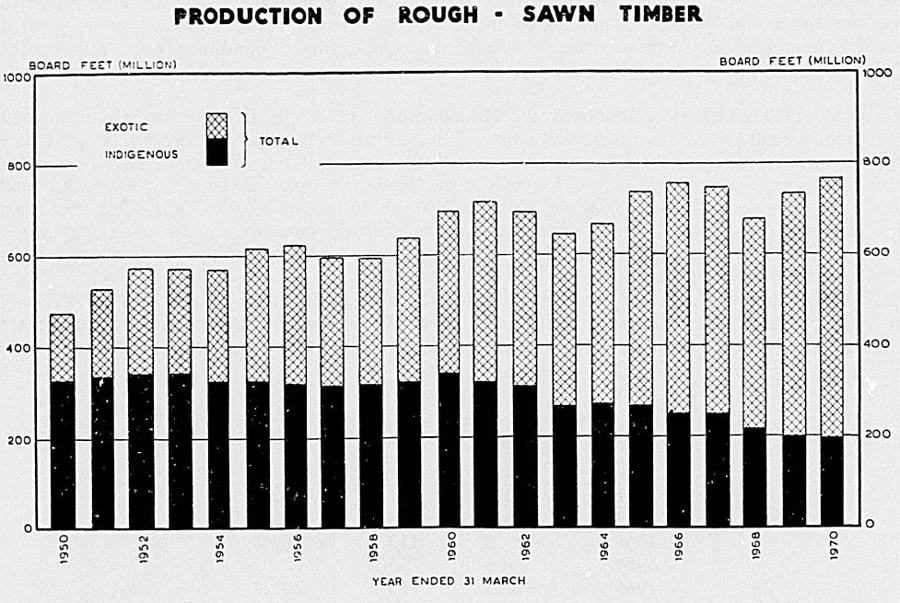
The following table gives details of timber production by species for the past 5 years.
| Species | Year Ended 31 March | |||||||||
|---|---|---|---|---|---|---|---|---|---|---|
| 1966 | 1967 | 1968 | 1969 | 1970 | ||||||
| NOTE—Owing to rounding, details may not add to totals. | ||||||||||
| board feet (million) | ||||||||||
| Rimu and miro | 167 | 166 | 154 | 136 | 138 | |||||
| Matai | 24 | 22 | 17 | 15 | 15 | |||||
| Totara | 9 | 9 | 6 | 7 | 6 | |||||
| Kahikatea | 17 | 17 | 18 | 17 | 15 | |||||
| Tawa | 16 | 17 | 9 | 11 | 10 | |||||
| Beech | 12 | 13 | 10 | 11 | 11 | |||||
| Other indigenous | 4 | 4 | 2 | 2 | 2 | |||||
| Totals, indigenous | 249 | 248 | 217 | 199 | 197 | |||||
| Exotic pines | 473 | 465 | 421 | 476 | 504 | |||||
| Douglas fir | 27 | 27 | 29 | 51 | 55 | |||||
| Eucalypts | 2 | 2 | 2 | 1 | 2 | |||||
| Other exotic | 6 | 6 | 6 | 6 | 7 | |||||
| Totals, exotic | 508 | 500 | 458 | 534 | 568 | |||||
| Totals (all species) | 757 | 748 | 675 | 733 | 765 | |||||
Wood-chip Industry—In 1969 a wood-chip mill in Nelson started production. It produces wood chips solely for Japan and at current production levels will earn $1.5 million annually in foreign exchange for at least 7 years. Its role is to utilise standing trees unsuitable for sawn-timber production in order to allow replanting with more productive species and to provide a market for forest and sawmill residues.
The Pulp and Paper Industry—The total value of output of the pulp and paper industry reached $69 million in 1967-68. Over the last decade total production of pulp (the basic commodity) has risen at an average annual rate of over 8 percent. Production rose from 235,000 tons in 1958-59 to 553,000 tons in 1969-70. During the same period total wood consumption in the pulp and paper industry (which includes sawmills of integrated plants) increased from 39 million cubic feet to 77 million cubic feet. The industry is mainly concentrated near the big exotic forests on the volcanic plateau of the North Island. There are five pulp and paper plants in New Zealand, four of which are in the North Island. Of these four, three are integrated with sawmills to utilise fully the total input of wood. The five companies are:
Tasman Pulp and Paper Co.—This company was formed in 1952 to utilise timber from Kaingaroa State Forest. Practical assistance and financial backing were given by the Government, which is represented on the board of directors. The company's plant is at Kawerau, Bay of Plenty. The pulp and paper mill began operation late in 1955 and the sawmill early in 1956. The annual rated capacity of the sawmill is 37 million board feet of sawn timber on the basis of one shift a day, while the capacity of the pulp and paper plant is 200,000 tons of newsprint, 105,000 tons of chemical pulp, and 160,000 tons of mechanical pulp. In 1959 the Bowater Group obtained an interest in the company and took over the management and development of the mill and world sales of all its products.
New Zealand Forest Products Ltd.—This public company is already utilising over 32,000,000 cubic feet of timber a year from its own pine forests. Plant capacity is 170,000 tons of kraft, printing, and writing paper, 204,000 tons of kraft pulp, 43,000 tons of defibrated pulp for fibreboard production, and 50,000,000 board feet of sawn timber a year—on a one-shift basis. The company is equipped to convert 10,000,000 board feet of timber into wooden cases and to produce 53,000,000 square feet of veneer, 120,000,000 square feet of fibreboard, and 38,000,000 multi-wall paper bags annually. The integrated pulp mill, paper mill, and sawmill is located at Kinleith near Tokoroa; the fibreboard, multi-wall paper bag and wooden case mills and plants are in Auckland. The company is also a joint owner with Australian Paper Mills Ltd. of Australia in Fibre Products N.Z. Ltd., a firm which makes over 13 million moulded fruit trays a year.
Whakatane Board Mills Ltd., a subsidiary of New Zealand Forest Products, operates two paperboard machines with an annual production capacity of 61,000 tons. The company manufactures its own mechanical and semi-chemical pulp, and is self-sufficient for more than 90 percent of its raw materials; it also uses considerable quantities of waste paper. The company owns its own radiata-pine forest at Matahina and hauls the logs 26 miles to the mill by road. An associated company, Whakatane Timber Mills Ltd., has its modern sawmill located near the board mill to take the larger logs from the forest.
Caxton Paper Mills Ltd. makes tissue and various lightweight papers adjacent to the Tasman Pulp and Paper Co.'s plant at Kawerau. The mill has a capacity of 30 thousand tons annually. It draws water and steam supplies from the Tasman company and produces its own requirements of refined ground-wood pulp.
New Zealand Paper Mills Ltd., at Mataura, has been in operation for more than 80 years. Its three machines produce a wide range of papers from fine tissues to heavy krafts, as well as paper felt, pressings, and manilas for special trade requirements. The mills are being modernised to enable production to be diversified and substantially increased. The company produces a small amount of mechanical pulp, which supplements purchased supplies of New Zealand made sulphate pulp, imported sulphite pulp, and waste paper. Annual production capacity is 15,000 tons of kraft and other papers.
The two major pulp and paper companies have announced expansion plans which will become operational over the next 3 years: N.Z. Forest Products Ltd. plan to increase chemical-pulp production by 200,000 tons a year and to instal an additional paper machine for the production of 100,000 tons of industrial papers; Tasman Pulp and Paper Co. Ltd. have announced that their expansion will increase the company's annual chemical-pulp sales by 105,000 tons.
In 1969 the Government invited tenders for the processing of 320 million cubic feet of wood from Kaingaroa State Forest. After examining the proposals received, the Government awarded the sale of roughly two-thirds of the volume to Carter Consolidated Ltd., who plan to build an integrated sawmill and refiner ground-wood mill in the Napier district. This project, which is geared to the Japanese market, will further increase production and exports of wood pulp.
The basic products of the pulp and paper industry are mechanical and chemical pulp, which are converted into such products as newsprint, kraft and other paper, paperboard, and fibreboard.
The following table gives the production of pulp in New Zealand.
| Year Ended 31 March | Wood Pulp | |
|---|---|---|
| Chemical* | Mechanical† | |
*Chemical pulp includes semi-chemical pulp. † Mechanical pulp includes ground-wood pulp and defibrated pulp. | ||
| tons | ||
| 1940 | - | 217 |
| 1945 | - | 15,434 |
| 1950 | - | 21,438 |
| 1955 | 43,204 | 29,568 |
| 1960 | 140,057 | 102,715 |
| 1965 | 193,029 | 203,372 |
| 1966 | 193,181 | 217,743 |
| 1967 | 223,860 | 205,345 |
| 1968 | 252,442 | 221,159 |
| 1969 | 255,000 | 230,975 |
| 1970 | 311,882 | 241,110 |
Almost all mechanical pulp is used in the manufacture of paper, paperboard, and fibreboard, but there is a deliberate surplus of chemical pulp for export. (See table on Trade in Pulp and Paper.)
Production figures for paper in New Zealand are as follows.
| Year Ended 31 March | Newsprint | Other Printing and Writing Paper | Other Paper and Paperboard | Total Paper and Paperboard |
|---|---|---|---|---|
| tons | ||||
| 1940 | - | .. | 12,873 | 12,873 |
| 1945 | - | .. | 20,619 | 20,619 |
| 1950 | - | .. | 21,787 | 21,787 |
| 1955 | - | .. | 40,273 | 40,273 |
| 1960 | 76,100 | .. | 85,585 | 161,685 |
| 1964 | 168,005 | 4,000 | 124,018 | 296,023 |
| 1965 | 184,317 | 11,869 | 114,940 | 311,126 |
| 1966 | 195,606 | 16,258 | 137,290 | 349,154 |
| 1967 | 183,886 | 19,664 | 150,771 | 354,321 |
| 1968 | 195,546 | 21,359 | 154,572 | 371,477 |
| 1969 | 199,530 | 21,140 | 168,854 | 389,524 |
| 1970 | 204,137 | 20,691 | 214,125 | 438,953 |
The rise of production of pulp and pulp products is clearly shown in the following graphs.
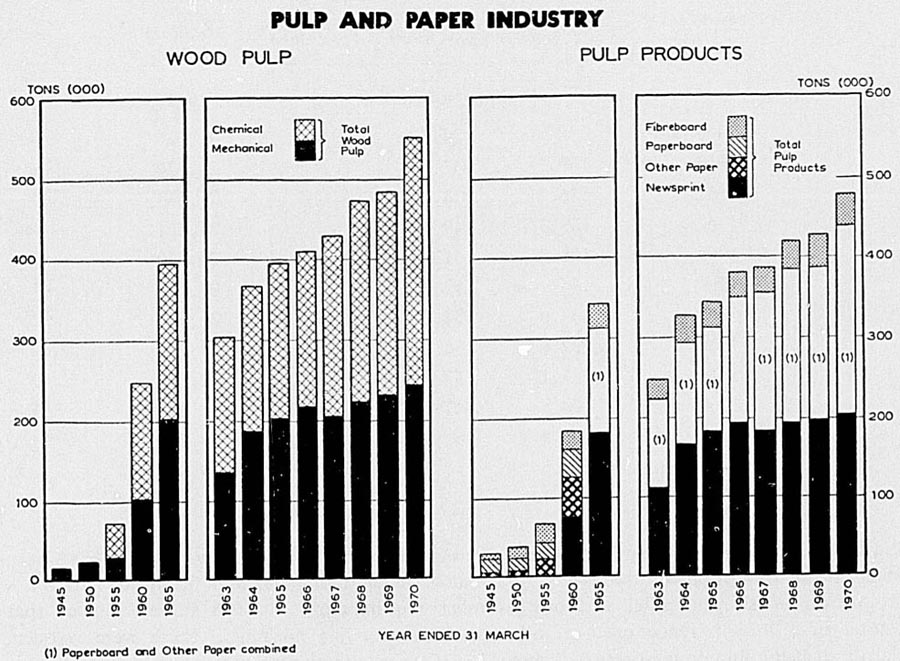
The Wood-based Panel Products Industries:Plywood—Nine factories manufacture plywood, and the total output for the year ended 31 March 1970, when reduced to a uniform basis of 3/16 in. thickness, was 54.7 million square feet. Total production of veneer in the industry in 1968-69 was 225 million square feet (1/16 in. basis).
Radiata pine has become increasingly important as a species for peeler log supply and now constitutes over 50 percent of total peeler log production. Now that the indigenous forests have become depleted, the production of peeler logs for veneer and plywood manufacture is regarded by the Forest Service as having a first claim on the state forests; hence, in its own logging activities the Forest Service aims at producing the maximum amount of peeler logs, and has recently also adopted a policy of requiring sawmillers logging state indigenous forests to reserve logs suitable for peeling and divert them to the veneer factories.
Production of plywood and veneer is given in the table below.
Fibreboard—Although fibreboard is manufactured from wood pulp, it is by end use a panel product. Production started in 1943 and has increased steadily since. Production figures are given in the table below.
Particle Board—Particle board is manufactured from roundwood and sawmill residues. There is a rapidly expanding domestic market for this product for interior panelling and flooring.
Production of plywood, veneer, fibreboard, and particle board is shown in the following table.
| Year Ended 31 March | Veneer (1/16 in. basis) | Plywood (3/16 in. basis) | Particle Board (3/4 in. basis) | Fibreboard |
|---|---|---|---|---|
| million square feet | tons | |||
| 1950 | - | 24.6 | - | 13.526 |
| 1960 | 169.2 | 43.1 | 0.8 | 24,830 |
| 1961 | 176.2 | 48.0 | 1.1 | 25,533 |
| 1962 | 189.3 | 49.3 | 1.1 | 31,561 |
| 1963 | 188.8 | 51.4 | 2.0 | 27,250 |
| 1964 | 185.9 | 52.9 | 2.5 | 29,229 |
| 1965 | 183.0 | 54.2 | 4.2 | 31,736 |
| 1966 | 222.6 | 56.6 | 5.1 | 33,771 |
| 1967 | 221.1 | 57.6 | 8.2 | 32,878 |
| 1968 | 170.5 | 43.4 | 8.5 | 33,075 |
| 1969 | 208.8 | 50.5 | 13.6 | 38,228 |
| 1970 | 224.8 | 54.7 | 21.5 | 39,553 |
Production of Round and Split Produce—Considerable quantities of native timbers have been used in the past to meet the needs for mining, fencing timbers, and firewood, and for a proportion of sleeper, pole, and bridge-timber requirements. A 1968 survey showed that a total of 7 million fence posts of all types was used: 41/2 million of these were wooden, almost all being thinnings or small-diameter logs from exotic plantations.
Wood Preservation—In the year ended 31 March 1969, 38 percent of all sawn timber produced was preservative treated; by world standards the proportion treated is very high, partly because of the relative ease with which otherwise non-durable exotic softwoods such as radiata pine may be treated.
Features of the preservation industry are: the very wide use in house building of timber treated by diffusion or vacuum-pressure methods with water-borne preservative at low retentions to prevent insect borer attack; the wide dispersal of small treating plants specialising in such treatment; and the quality-control function exercised by the Timber Preservation Authority (set up by the Government in 1955). Plant inspection and sampling associated with quality control are done on behalf of the Authority by Forest Service staff.
Timber Preservation Authority specifications prescribe the preservative treatments for different service conditions. For treatment of exterior timbers against decay multi-salt preservatives (essentially solutions of copper, chromium, and arsenic compounds) at high loadings are widely used, but oil-type preservatives (eg. creosote) are also acceptable. The usual method of application of multi-salt preservatives is by vacuum pressure, but such variations as the oscillating-pressure method (OPM) and the Lowry process have been introduced. OPM is expected to facilitate treatment of large-diameter round produce and large sawn sections of radiata pine and similar timbers, because it avoids the long seasoning period before treatment. Oil-based preservatives are applied by pressure, hot and cold bath, and cold soak and are used for poles, posts, and sleepers. For timber out of contact with the ground and protected from the weather lighter treatment with water-soluble preservatives is acceptable.
Collection of statistics on wood preservation was introduced in 1955 and the following table shows the quantities of sawn timber treated in the country.
| Year | Open Tank | Diffusion Impregnation* | Pressure Impregnation | Total |
|---|---|---|---|---|
| * Mainly boron. | ||||
| board feet (thousand) | ||||
| 1954-55 | 53 | 6,984 | 61,484 | 68,520 |
| 1958-59 | - | 47,187 | 96,584 | 143,770 |
| 1959-60 | 30 | 70,889 | 105,837 | 176,756 |
| 1962-63 | 3 | 91,242 | 120,333 | 211,579 |
| 1963-64 | 16 | 102,974 | 125,873 | 228,863 |
| 1964-65 | 140 | 132,991 | 142,373 | 275,504 |
| 1965-66 | 4 | 149,621 | 153,878 | 303,503 |
| 1966-67 | 9 | 148,505 | 154,542 | 303,056 |
| 1967-68 | 12 | 108,063 | 156,755 | 264,830 |
| 1968-69 | 26 | 125,825 | 152,550 | 278,401 |
In addition, 9,562,000 cubic feet of other timber, such as sleepers, poles and fence posts, was treated by one of the preservation methods in 1968-69.
OVERSEAS TRADE—Forests products are growing in importance as earners of overseas funds and their more diversified development in New Zealand is also contributing to reduction of imports. For the year ended June 1970 exports of forest products were valued at $66.3 million; Australia was the largest customer, taking 45 percent, mainly in the form of pulp and paper, and Japan was the next largest, taking 40 percent, mainly logs. For the same period, imports of forest products into New Zealand were valued at $20.3 million.
Timber exports—There is now an established market in Australia for radiata pine and Douglas fir sawn timber. At present Japan is taking our timber mainly in log form, but the market there for our sawn radiata pine is rapidly expanding. Exports of sawn timber to the Pacific Islands are increasing. Only special categories of indigenous timbers are permitted for export, and these are strictly regulated.
Timber imports—Durable Australian hardwoods are still imported for use as railway sleepers, large poles, cross-arms, wharf, bridge, and constructional timbers, etc., but greater use is being made of preservative-treated New Zealand-grown softwood timber for these and other uses subject to severe service conditions. The demand for Douglas fir, redwood, and western red cedar from North America for structural uses, exterior joinery, and weatherboards continues. Other imports are nor limited to tropical hardwoods and sapele for the furniture trade and specialty purposes.
Pulp and Paper exports—A steadily increasing export market for both pulp and paper is developing, mainly to Australia. Chemical sulphate pulp is the only type exported in quantity. Newsprint comprises nearly 80 percent of all paper exports.
Pulp and paper imports—Short-fibred pulp and special papers still need to be imported. These two items constitute about two-thirds the value of our total forest products imports.
| VALUE OF EXTERNAL TRADE IN FOREST PRODUCTS | ||||
|---|---|---|---|---|
| Year Ended 30 June | Wood Products | Pulp | Paper and Paper Products | All Forest Products |
| Imports ($000. c.d.v.) | ||||
| 1964 | 4,737 | 1,730 | 10,443 | 16,910 |
| 1965 | 6,096 | 1,609 | 9,188 | 16,893 |
| 1966 | 6,662 | 1,960 | 9,250 | 17,872 |
| 1967 | 6,210 | 1,919 | 7,015 | 15,144 |
| 1968 | 4,219 | 1,341 | 7,591 | 13,151 |
| 1969 | 5,006 | 1,178 | 9,851 | 16,035 |
| 1970 | 7,294 | 1,610 | 11,346 | 20,250 |
| Exports ($000. f.o.b.) | ||||
| 1964 | 5,054 | 5,525 | 11,868 | 22,447 |
| 1965 | 6,497 | 4,775 | 12,390 | 23,662 |
| 1966 | 6,615 | 6,003 | 12,599 | 25,217 |
| 1967 | 7,412 | 5,928 | 11,047 | 24,387 |
| 1968 | 16,895 | 6,195 | 18,201 | 41,291 |
| 1969 | 29,145 | 7,484 | 20,771 | 57,400 |
| 1970 | 36,834 | 7,286 | 22,214 | 66,334 |
The following tables give New Zealand's imports and exports of timber for the last 6 years.
| TIMBER IMPORTS BY CATEGORIES | |||||||
|---|---|---|---|---|---|---|---|
| Year Ended 30 June | Sawn Timber | Sleepers | Logs and Poles | ||||
| Australian Hardwoods | North American Softwoods* | Oak | Other | Total | |||
*Douglas fir, redwood, and cedar. NOTE—Figures have been adjusted to include items not given in board feet in published statistics. | |||||||
| board feet (million) | cu ft (million) | ||||||
| 1965 | 6,4 | 22,7 | 0,1 | 6,9 | 36,1 | 2,7 | 0,5 |
| 1966 | 7,2 | 22,4 | 0,2 | 8,7 | 38,5 | 2,2 | 0,8 |
| 1967 | 7,1 | 19,9 | - | 7,1 | 34,1 | 2,1 | 0,7 |
| 1968 | 4,8 | 8,4 | 0,1 | 5,1 | 18,4 | 0,1 | 0,4 |
| 1969 | 4,4 | 8,0 | - | 4,6 | 17,0 | - | 0,3 |
| 1970 | 4,3 | 13,2 | 0,1 | 4,9 | 22,5 | - | 0,4 |
| TIMBER EXPORTS BY CATEGORIES | ||||||||
|---|---|---|---|---|---|---|---|---|
| Year Ended 30 June | Indigenous Timber | Radiata Pine | Douglas Fir | Other Exotics | Total Exotics | Total, All Sawn Timber | Logs and Poles | |
| Sawn | Cases | |||||||
| NOTE—Small quantities of roundwood are included in the exports. | ||||||||
| board feet (million) | cu ft (million) | |||||||
| 1965 | 0,3 | 33,2 | 3,9 | 4,5 | 0,1 | 41,7 | 42,0 | 14,5 |
| 1966 | 0,1 | 26,9 | 2,3 | 3,5 | - | 32,7 | 32,8 | 17,1 |
| 1967 | 0,1 | 25,9 | 1,1 | 3,0 | 0,3 | 30,3 | 30,4 | 19,9 |
| 1968 | 2,4 | 49,2 | 2,7 | 10,4 | 0,2 | 62,5 | 64,9 | 43,2 |
| 1969 | 4,7 | 70,1 | 3,2 | 24,3 | 0,4 | 98,0 | 102,7 | 53,5 |
| 1970 | 3,8 | 78,6 | 2,3 | 26,4 | 0,7 | 108,0 | 111,8 | 63,6 |
The following table gives New Zealand's external trade in pulp and paper for the last six years.
| EXTERNAL TRADE IN PULP AND PAPER | |||||
|---|---|---|---|---|---|
| Year ended June | Wood Pulp | Fibreboard | Paper and Paperboard | ||
| Newsprint | Other Paper and Paperboard† | Total | |||
*In 1,000 square feet. †Excludes manufactures of paper and paperboard; values include minor items for which no quantities are given, Basis for valuation: Exports—free on board at port of shipment; Imports—c.d.v. in country of origin. | |||||
| Imports tons | |||||
| 1965 | 17,557 | 349* | 4,536 | 31,370 | 35,906 |
| 1966 | 21,673 | 193* | 3,004 | 26,595 | 29,599 |
| 1967 | 21,697 | 117* | 1,731 | 22,088 | 23,819 |
| 1968 | 14,816 | 33* | 393 | 22,297 | 22,690 |
| 1969 | 11,212 | 164* | 976 | 21,232 | 22,199 |
| 1970 | 13,132 | 32* | 551 | 23,627 | 24,178 |
| Exports tons | |||||
| 1965 | 55,850 | 2,841* | 110,940 | 743 | 111,683 |
| 1966 | 70,332 | 3,291* | 117,060 | 1,674 | 118,734 |
| 1967 | 72,326 | 3,444* | 94,506 | 2,552 | 97,057 |
| 1968 | 74,342 | 6,223* | 125,189 | 11,548 | 136,737 |
| 1969 | 87,730 | 21,127* | 21,349 | 18,163 | 139,512 |
| 1970 | 80,821 | 15,323* | 119,606 | 30,808 | 150,414 |
RESEARCH—Since 1947 all forestry and forest-products research administered by the Forest Service has been undertaken or co-ordinated by its Forest Research Institute, Rotorua. In addition, the Department of Scientific and Industrial Research, the universities, and private industrial organisations undertake research into certain aspects.
The Forest Research Institute programme has a wide range and includes studies of the fundamental physiological process of tree growth; the ecology of indigenous and exotic forests; silvicultural practices for all stages of exotic forestry; growth rates, productivity, and grades of timber under various silvicultural treatments and their effect on the economics of the operations; forest soils, particularly deficiencies and remedies for them; selection, breeding, and introduction of improved strains of trees; the impact of fungus diseases and insect pests and factors affecting the health of trees. The Institute has made country-wide inventories of indigenous and exotic forest resources. The Forestry Protection Branch of the Institute (the Forest and Range Experimental Station), which is based at Rangiora and has a substation at Napier, surveys the condition of protection forests and associated mountain scrub and grassland. It carries out research on climatology, hydrology, soils, the revegetation of eroded areas, and the effects of wild animals and their control.
Linked with the research into wood formation are studies of the products of forests. The physical and mechanical properties of timbers are investigated generally and with special reference to the effects of tree selection based on visual qualities and of silvicultural treatment. The suitability of species for production of wood pulp and the characteristics of the pulp from species not yet used are also studied. Research is also carried out in timber engineering, timber seasoning, and preservative treatment of timbers; in all these fields the Institute works closely with the timber industry.
TRAINING IN FORESTRY—The Forest Service recruits school leavers up to the age of 20 years for training as forest rangers and foresters. Ranger trainees work for one year in the forests and then attend Rotorua Ranger School for one year where they study the subjects basic to forestry. Another two years are then spent on forests to consolidate knowledge and to learn supervision and gain experience in planning, control, and leadership. Those selected as forester trainees attend university on a full-time study bursary to complete a four-year degree course in forestry. A limited number of full-time study bursaries are also awarded to enable trainees to complete degree courses in science and engineering. The Forest Research Institute recruits young people of both sexes for training as research technicians.
To build up a permanent and efficient skilled-labour force, the Forest Service now recruits each year about 100 youths 16 to 18 years of age. These junior woodsmen receive a two-year course of basic training in the practical skills of forestry at one of the woodsman schools at Kaingaroa, Golden Downs, or Dusky, followed by a third year of advanced training given in small groups in selected forests.
Through the Forestry Training Centre at Rotorua courses are regularly offered in timber grading, timber inspection, seasoning and treatment of timber and other forestry operations. A continuous series of courses is also provided for Forest Service staff in all phases of Forest Service activity. The Timber Industry Training Centre at Rotorua provides courses for the industry in saw doctoring, sawmilling, and timber machining. Short grading courses for local industry representatives are also held in other centres.
After a lapse of some 35 years, professional education for forestry in New Zealand recommenced at the University of Canterbury in 1970. The basic course leading to the degree B. For. Sc.—with or without honours extends over 4 years, comprising two intermediate years of pure science followed by 2 years of professional classes. Post-graduate studies will begin in 1972, with programmes leading to masters and doctoral degrees.
ECONOMIC SIGNIFICANCE OF FORESTRY—A measure of the economic significance of an industry is its contribution to the gross national product; in 1966 the forestry sector's share was estimated to be 3.7 percent. The manufacturing industries within it (i.e., wood processing but not forestry or logging) contributed in that year 12.2 percent of the country's net industrial output.
Employment—In 1970 the total number of persons employed in the forestry sector comprised 4.1 percent of the total labour force, and the forest industries employed 10 percent of the industrial labour force. Because the major manufacturing units are logically located near their raw material supplies, there is a concentration of employment near the largest forest areas. This is seen in the central North Island where over half the country's exotic forests are located and where one-quarter of the labour force is engaged in forest industries. In fact the forest industries have had a very marked effect on regional development. The current prosperity and the fast growth of population in the Rotorua - Bay of Plenty area is due in no small measure to the expansion of the forest industries. Apart from the expansion of the established towns such as Rotorua, the industrial development of New Zealand Forest Products Ltd., Tasman Pulp and Paper Co. Ltd., and Caxton Paper Mills Ltd., has led to the establishment of a completely new town—Kawerau—and the rapid growth of another—Tokoroa. The development of these industrial complexes has also stimulated other industries, especially transport, vehicle repair, and building and construction. Similarly the expansion of exports of forest products was partly responsible for the increased tonnages that have passed through the ports of Tauranga and Napier over the last decade.
The following table shows the number of employees and working proprietors in the forest industries at 15 April in the years stated. (Source: Labour and Employment Gazette, Department of Labour.)
| At 15 April | Forestry | Logging | Sawmilling | Pulp and Paper Industry | Other | Total |
|---|---|---|---|---|---|---|
*Included in Other. NOTES: 1. “Forestry” includes silviculture, nurseries, etc. 2 “Logging” includes felling, cutting, and haulage. 3 “Pulp and Paper Industry” includes manufacture of pulp and conversion of pulp into paper, paperboard, fibreboard and paper products (excluding stationery). 4. “Other” includes plywood and veneer manufacture, timber merchanting, and other wood-using industries. | ||||||
| 1950 | 2,192 | 2,188 | * | 2,087 | 17,687 | 24,154 |
| 1955 | 2,287 | 2,638 | 5,969 | 2,980 | 13,651 | 27,525 |
| 1960 | 2,714 | 2,666 | 6,293 | 4,938 | 9,920 | 26,531 |
| 1965 | 3,573 | 2,690 | 6,388 | 6,827 | 11,357 | 30,835 |
| 1967 | 3,716 | 2,719 | 6,442 | 7,696 | 11,566 | 32,139 |
| 1968 | 4,118 | 2,773 | 5,829 | 7,576 | 11,145 | 31,441 |
| 1969 | 4,508 | 2,844 | 5,684 | 7,970 | 11,389 | 32,395 |
| 1970 | 4,709 | 3,037 | 6,468 | 8,499 | 11,782 | 34,495 |
THE OUTLOOK—The State owns 80 percent of the remaining indigenous timber and about half of the 1.3 million acres of exotic forest. It makes sales, usually of standing timber but in some cases of logs, from both types of forest to the timber industry. Owing to the poor prospects of sustained yield from most of the indigenous forests, the policy is to ration the cut to spread the resources over as long a period as practicable. Their contribution to timber supply will inevitably diminish but it is hoped that it will remain a source of special purpose timbers for several decades. The exotic forests are renewable and are managed for sustained yield. Their full possibilities have not yet been reached but owing to the irregularity of past planting programmes their composition is far from ideal and there are problems over maintaining a steady rate of expansion of output.
The large area of exotic forest in private ownership has arisen for the most part from speculative planting in the 1920s and 1930s. Most of the forests then established have since come under the control of industrial companies, which are utilising them and managing them, in several cases, to ensure regular and permanent supplies for their major wood-using factories. The privately owned indigenous forests are subject to uncontrolled exploitation and are expected to be exhausted at no distant date.
There are several reasons for believing that New Zealand's forest industries are entering a period of expansion and greater prosperity. They are favourably placed in regard to the basic requirement for expansion—wood supplies, which will increase over the next 30 years. Efficient processing is well established, providing a good basis for further expansion; projections indicate that demand for forest products will grow both at home and abroad, particularly for paper. In many countries wood supplies are inadequate for their needs, hence they must import.
New Zealand is in a position to take advantage of these circumstances, but to do so as effectively as possible, planning is necessary. Expansion should be a regular process, using the raw material efficiently, developing manufacturing capacity systematically, and producing what the markets require. This means that planning must encompass management and utilisation of the forests and any necessary extension of them; requirements in manpower with the necessary skills; requirements in finance; analyses of market development; and requirements in research to develop new products and more efficient techniques.
The Forestry Development Council set up in 1969 is working towards co-operation in national planning to rationalise the forestry sector's future development; its membership includes representatives from Government and industry.
Short-term Prospects—The following table sets out the production targets presented in the Forestry Development Council Report to the National Development Council 1970. It will be noted that rapid development is forecast for the short time involved. The Forestry Development Council considers, however, that the targets are realistic and capable of attainment Expansion of plant necessary for increased production is in some instances already in progress.
| Commodity | Production Targets for Years Ended 31 March | |||
|---|---|---|---|---|
| 1969* | 1970* | 1973 | 1979 | |
| *Actual | ||||
| Paper (thousand tons) | 390 | 439 | 478 | 865 |
| Sawn timber (million bd ft) | 733 | 765 | 881 | 990 |
| Panel products (million sq ft) | 165 | 182 | 266 | 360 |
| Export logs (million cu ft) | 51 | 65 | 35 | 15 |
| Export wood chips (thousand bone dry units) | - | 28 | 110 | 188 |
| Export pulp (thousand tons) | 90 | 81 | 173 | 220 |
Much of the higher production is intended for export. The following table, taken from the same report, gives the export targets of the forestry sector.
| Commodity | Volume (in Million Cubic Feet Roundwood Equivalent) | Values (in $ Million f.o.b. at Expected Ruling Prices) | ||||
|---|---|---|---|---|---|---|
| 1970* | 1973 | 1979 | 1970* | 1973 | 1979 | |
*Actual. NOTE—These figures do not include provision for the increased output that will result from recent decision on the sale of 320 million cubic feet of standing timber from Kaingaroa State Forest. The effect will probably be small for 1972-73 but should be substantial by 1978. | ||||||
| Logs, sawn timber, and wood chips | 89 | 78 | 76 | 34.9 | 32.8 | 38.6 |
| Pulp and paper | 32 | 48 | 91 | 27.1 | 43.5 | 103.2 |
| Other forest products | 1 | 2 | 4 | 1.4 | 2.8 | 6.4 |
| Totals | 122 | 128 | 171 | 63.4 | 79.1 | 148.2 |
The Council considers these targets likewise realistic, limitation of exports being more likely to be imposed by availability of wood supplies and industrial capacity than by market outlets.
Long-term Development—Long-term industrial expansion is naturally more difficult to assess. However, the main factors determining the growth will be the size of markets and the availability of raw materials. A national forestry planning model which took into account these two factors was prepared for the Forestry Development Conference held in 1969, and this broadly indicates the possible direction of future growth. Because forests take many years to grow, wood supply and future afforestation plans were given careful thought. Demand projections forecast that by the year 2000 consumption of paper and panel products in New Zealand will be more than four times the 1968 level, and that consumption of sawn timber will go up 50 percent. On top of this, exports of processed forest products will grow probably to as much as three times present quantities. It is estimated that, in the year 2000, exports of processed products will be 170 million cu ft roundwood equivalent, compared with 121 million cu ft in 1970. It is hoped that 65 million cu ft now exported annually as logs will gradually be replaced over the next 30 years by processed products.
This long-term industrial expansion will require continuing increase in the area of the nation's exotic forests (the Forestry Development Conference recommended a minimum annual planting programme of 52,000 acres for the next 20 years, which would give the country a total exotic forest area of nearly 2.5 million acres, compared with the present 1.3 million acres). Increased production up to the end of the century would be based for the most part on existing forest resources and would be sustained thereafter by the additional planting proposed.
The location of the additional forests is important. Because of the economies obtainable in pulp and paper manufacture from large-scale enterprises, this industry must be based on large forests. The policy of concentrating planting was endorsed by the conference. In the regional priorities it was recommended that first preference be given to the Rotorua - Bay of Plenty area to ensure resources for further development of existing plants, with Nelson in next place for starting of a new industry in the near future. Hawke's Bay and Southland were selected as suitable locations for the 1990s.
GENERAL—The fishing industry in New Zealand is based mainly on the bottom-dwelling or demersal species of fish caught by trawling, Danish seining, lines, and nets, and on rock lobsters (crayfish) taken in pots. For “wetfish”, trawling is by far the most important method, producing approximately 76 percent of the total catch, followed by lining 9 percent, Danish seining 6 percent, and netting and other methods 9 percent in 1968. The motor trawler ranging in size between 50 ft and 60 ft with a crew of two or three men has come to be the type of vessel mainly used by the industry. In recent years there has been a trend to larger stern-ramp trawlers with improved gear and equipment. The Marine Department has two stern-ramp trawlers for technological and research work associated with fishing.
In New Zealand the fishing industry is widely dispersed around a number of smaller ports as well as the main ports. The industry is built around the handling and selling of fresh fish in the main, as opposed to processing fish. With the exception of rock lobsters, exports are relatively limited.
The abolition of the licensing system in 1964 and the consequent liberalisation of the industry has led to increases in landings of fish. The potentialities of the fishing industry are examined in the Fisheries Committee Report to the National Development Conference 1969. The Territorial Sea and Fishing Zone Act 1965 redefined the three-mile territorial seas and introduced a nine-mile fishing zone beyond the territorial limit.
The governing legislation for the fishing industry is the Fisheries Act 1908, which is administered by the Marine Department.
The principal regulations dealing with fisheries are the Fisheries (General) Regulations 1950, the Freshwater Fisheries Regulations 1951, and the Commercial Fishing Regulations 1963. Under the Freshwater Fisheries Regulations are issued a number of modification notices which deal with particular aspects—e.g., permissible length of different classes of fish to be taken—while the various acclimatisation societies' rules are issued under the authority of these regulations. The Oyster Fishing Regulations 1946 and the Whitebait Fishing Regulations 1964 are directly relevant to the fishing industry. Other regulations include the Seal Fisheries Regulations 1946, Rock Oyster Farming Regulations 1966, the Quinnat Salmon Regulations 1964. the Fish-pass Regulations 1947, and the Toheroa Regulations 1955. Amendments to all regulations are made from time to time.
Fishing Industry Board—In 1963 there was passed a Fishing Industry Board Act, providing for the establishment of a seven-member board with the principal function of promoting the expansion and development of the fishing industry, marketing and standards of hygiene and packaging, continuity of supply, co-ordination within the industry, and promoting means of financing development. Members were appointed and met for the first time in April 1964.
The Government made a grant of $100,000 towards the cost of establishing the Board. A levy of approximately 1 percent of the landed value of fish came into force on 1 January 1965, and provides finance for the Board's activities. The Board through its committees investigates local supply and marketing, export development, technical education, tuna development, and fishing demonstrations.
Objectives of the Board include the provision of adequate supplies of high-quality fish for the local market at reasonable prices, and an increase in overseas earnings from selling more fish overseas. It is recognised that fishermen must be encouraged to modernise their trawling fleet and that shore establishments of the industry must be improved to fulfil these objectives. In 1965 the Government arranged to guarantee mortgages and make loans through the State Advances Corporation to purchase new, fully-equipped fishing vessels. Guarantees are given or loans made on the recommendation of a Fishing Industry Loans Committee. Up to 31 March 1970, 38 loans totalling $975,760 had been made on fishing vessels. In October 1970 loans and guarantees became available for development of rock oyster farms, and also loans for cool stores for fish.
SPECIES OF FISH—Of the many kinds of excellent edible fishes the most important are the snapper (Chrysophrys auratus), which is the principal species in the catch (mainly by trawl) in the north-western part of the South Island, the west coast of the North Island, and the east coast of the North Island to just south of East Cape; next in importance is tarakihi (Cheilodactylus macropterus), which is taken mainly by trawlers working off the east coast of the North Island and in smaller quantities off the coasts of the South Island. The groper or hapuku (Polyprion oxygencios) is caught on lines in the deeper water from North Cape to Stewart Island, but principally in Cook Strait and on the rocky parts of the east coast of the South Island, while the blue cod (Parapercis colias) is the staple line-caught product of the southern line fisheries, particularly about Foveaux Strait, Stewart Island, and at Chatham Islands. The flounder and sole (Pleuronectidae) occur in the more shallow and sheltered waters. Rock lobster (crayfish) are fished mainly at the Chatham Islands and around the south-west of the South Island.
The most productive grounds are in relatively shallow waters, and, most of the fishing is carried on at depths of less than 80 fathoms. Depths of over 100 fathoms occur at a comparatively short distance from the coast. The principal methods of fishing are long-lining for groper (hapuku), ling, kingfish, and snapper; hand-lining for blue cod; trawling and Danish seining, by which flounders, snapper, tarakihi, gurnard, John Dory, and a variety of other fish are taken. In bays and estuaries set-nets and dragnets are used for flounders, snapper, and mullet.
Various species of pelagic, or surface-dwelling fish occur in quantity in waters adjacent to New Zealand. At present, landings of pelagic fish in New Zealand account for about 4 percent of the total catch and can be expected to expand. Catching techniques for the smaller species (e.g., pilchards), the medium-sized species (e.g., kahawai) and the larger species (e.g., tuna) are all different. The catching and processing of pelagic fish must be undertaken on a large scale if it is to be profitable.
FISHERY STATISTICS—As at 31 December 1969 there were 2,716 registered fishing boats, compared with 2,443 a year earlier. Values of catches by these boats for the year ended 31 December 1969 were as follows: Over $2,000, 1,141; $1,000-$2,000, 195; under $1,000, 1,380. (The boats were manned by 4,653 persons.)
The growth in value of fisheries products is shown in the following diagram.
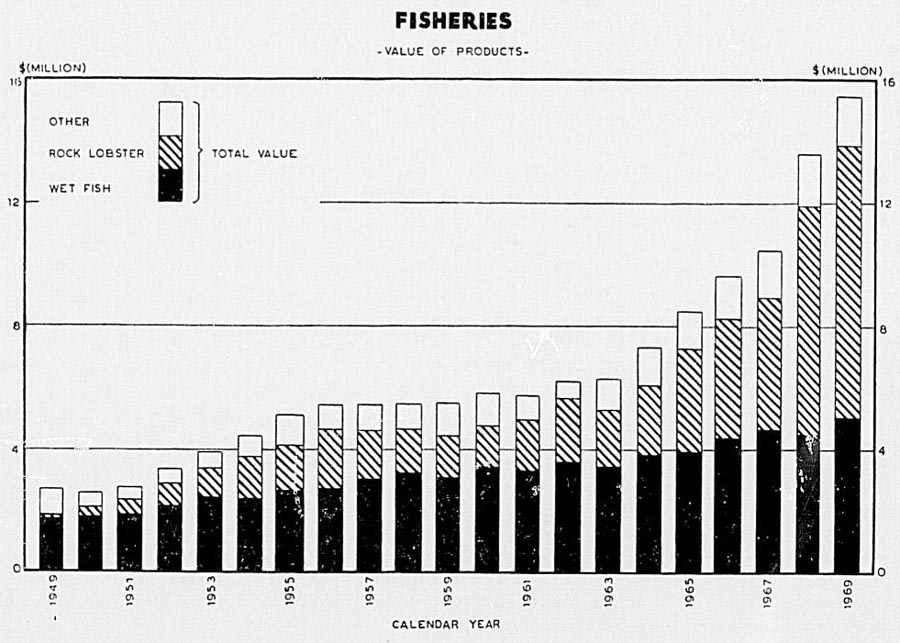
The estimated total quantity and value of the principal classes of fishery products marketed were as follows in the two latest years.
| Product | Unit | Quantity | Value | ||
|---|---|---|---|---|---|
| 1968 | 1969 | 1968 | 1969 | ||
| $(000) | $(000) | ||||
| Wet fish | cwt | 671,870 | 645,012 | 4,489 | 5,018 |
| Whitebait (West Coast South Island only) | cwt | 3,022 | 2,852 | 423 | 383 |
| Oysters (dredged) | sacks | 148,581 | 66,753 | 1,041 | 735 |
| Oysters (rock) | sacks | 3,291 | 5,099 | 75 | 160 |
| Mussels | sacks | 30,682 | 19,933 | 72 | 71 |
| Rock lobster (crayfish) | cwt | 214,752 | 175,109 | 7,433 | 8,861 |
| Other shellfish, etc | cwt | 7,097 | 23,676 | 55 | 217 |
| Total value | ... | ... | ... | 13,588 | 15,445 |
Annual quantities and values of “wet fish,” caught are shown in the following table.
| Year | Total Quantity | Total Value |
|---|---|---|
| cwt | $(000) | |
| 1959 | 517,917 | 3,086 |
| 1960 | 542,506 | 3,351 |
| 1961 | 528,632 | 3,254 |
| 1962 | 554,654 | 3,545 |
| 1963 | 550,966 | 3,376 |
| 1964 | 589,384 | 3,780 |
| 1965 | 604,582 | 3,949 |
| 1966 | 666,274 | 4,388 |
| 1967 | 713,527 | 4,626 |
| 1968 | 671,870 | 4,489 |
| 1969 | 645,012 | 5,018 |
Kind or Class of “Wet Fish” Caught—The following table shows the quantity and value of the principal “wet fish” caught during the latest two years.
| Kind or Class of Fish | Quantity | Value | ||||||
|---|---|---|---|---|---|---|---|---|
| 1968 | 1969 | 1968 | 1969 | 1968 | 1969 | 1968 | 1969 | |
| cwt | percent | $(000) | percent | |||||
| Snapper | 209,418 | 224,525 | 31.17 | 34.81 | 1.276 | 1.495 | 28.44 | 29.79 |
| Tarakihi | 110,312 | 71,007 | 16.42 | 11.00 | 699 | 508 | 15.57 | 10.13 |
| Trevally | 68,416 | 64,583 | 10.18 | 10.01 | 184 | 184 | 4.09 | 3.67 |
| Gurnard | 52,655 | 55,594 | 7.84 | 8.62 | 220 | 255 | 4.91 | 5.08 |
| Sole | 19,942 | 19,170 | 2.97 | 2.97 | 278 | 330 | 6.19 | 6.58 |
| Hapuku | 21,122 | 22,092 | 3.14 | 3.43 | 320 | 380 | 7.14 | 7.56 |
| Flounder | 18,344 | 21,408 | 2.73 | 3.32 | 316 | 447 | 7.04 | 8.91 |
| Blue cod | 19,372 | 14,941 | 2.88 | 2.32 | 187 | 196 | 4.17 | 3.90 |
| Elephant fish | 17,003 | 18,382 | 2.53 | 2.85 | 279 | 331 | 6.22 | 6.60 |
| Red cod | 16,909 | 11,355 | 2.52 | 1.76 | 101 | 83 | 2.26 | 1.65 |
| Moki | 14,360 | 13,546 | 2.14 | 2.10 | 65 | 73 | 1.45 | 1.46 |
| Pioke | 13,317 | 13,578 | 1.98 | 2.10 | 131 | 175 | 2.92 | 3.48 |
| Other | 90,700 | 94,831 | 13.50 | 14.71 | 433 | 561 | 9.60 | 10.55 |
| Totals | 671,870 | 645,012 | 100.00 | 100.00 | 4.489 | 5.018 | 100.00 | 100.00 |
Methods of Capture—The total quantity of “wet fish” caught by each of the common methods of fishing is shown below for the latest two years.
| Method of Fishing | Quantity | Value | ||
|---|---|---|---|---|
| 1968 | 1969 | 1968 | 1969 | |
| cwt | $(000) | |||
| Trawl | 513,812 | 458,982 | 3,166 | 3,285 |
| Danish seine | 39,292 | 71,031 | 209 | 440 |
| Set and drag nets | 45,230 | 51,118 | 418 | 546 |
| Long and hand lines | 63,601 | 57,390 | 658 | 720 |
| Other methods | 9,935 | 6,491 | 38 | 27 |
| Totals | 671,870 | 645,012 | 4,489 | 5,018 |
Landings at the Ports—Ports where the total landed catch of “wet fish” was in excess of 10,000 cwt are listed in the following table.
| Port | Quantity | Value | ||
|---|---|---|---|---|
| 1968 | 1969 | 1968 | 1969 | |
| cwt | $(000) | |||
| Auckland | 149,766 | 163,182 | 829 | 1,002 |
| Manukau | 51,720 | 58,610 | 229 | 274 |
| Thames | 15,319 | 15,379 | 121 | 152 |
| Tauranga | 34,319 | 46,974 | 184 | 275 |
| Gisborne | 67,500 | 64,877 | 306 | 336 |
| Napier | 39,126 | 55,510 | 237 | 410 |
| Wellington | 29,579 | 25,717 | 232 | 276 |
| Nelson | 98,715 | 31,303 | 510 | 181 |
| Lyttelton | 15,136 | 11,428 | 191 | 179 |
| Timaru | 39,803 | 34,355 | 428 | 448 |
| Port Chalmers | 13,846 | 16,196 | 146 | 207 |
| Bluff and Stewart Is | 11,300 | 9,912 | 129 | 125 |
The total quantity of fish landed at these ports in 1969 was 533,443 cwt, which was 82.7 percent of the total catch.
EXPORTS—A table showing quantities and values of the principal classes of fishery products exported during each of the latest three years is set out below. Rock lobsters, or crayfish, are exported mainly to the United States; for other fish the main market is Australia.
| Commodity | Quantity | Value (f.o.b.) | ||||
|---|---|---|---|---|---|---|
| 1967 | 1968 | 1969 | 1967 | 1968 | 1969 | |
| cwt | $(000) | |||||
| Rock lobster (crayfish) and tails | 48,298 | 62,759 | 58,131 | 6,262 | 12,729 | 14,235 |
| Fish, fresh or frozen | 64,804 | 77,225 | 74,034 | 1,262 | 1,689 | 1,899 |
| Fish meal | 1,633 | 4,740 | 48 | 11 | 30 | - - |
| Other, including smoked and canned | 5,642 | 9,880 | 6,769 | 224 | 215 | 216 |
| Totals | 120,377 | 154,604 | 138,982 | 7,759 | 14,663 | 16,351 |
OYSTER BEDS—The principal oyster beds around the coast of New Zealand are those situated in Foveaux Strait, between South and Stewart Islands, and the rock-oyster beds on the east and west coasts of the Auckland peninsula.
In South Island waters a closed season is observed from 1 October to 14 February in each year, but may be opened later and closed earlier depending on the stocks available. The taking of oysters is governed by the Oyster-fishing Regulations 1946, and vessels operating commercially are subject to the Commercial Fishing Regulations 1963. During the 1969 season 66,284 sacks of oysters were dredged from Foveaux Strait, compared with 147,193 sacks in 1968.
The rock-oyster beds of Auckland were worked for many years under a variety of systems, but from 1908 the picking and wholesale marketing of rock oysters from the North Island beds was undertaken by the State, private picking being prohibited. In 1958 a change was made in the marketing procedure, and sales to the public through the oyster depot were discontinued. Emphasis is now placed on the export potential of rock oysters and attractive prices have been obtained on overseas markets. Departmental oysters for the local market are sold by competitive tender.
Oyster cultivation is being carried out on an experimental basis by the Marine Department in the Hauraki Gulf, in the Bay of Islands, and in the Kaipara Harbour. In 1964 an Act. was passed to provide for the setting up of oyster farms by private persons as a first step towards establishing a rock-oyster industry and in 1966 an experienced rock oyster farmer was recruited from Australia to set up experimental and demonstration farms.
Rock oysters picked in 1969 totalled 9,412 sacks, compared with 6,239 sacks in 1968, and included 3,275 sacks of mature oysters from private farms.
ROCK LOBSTERS—Rock lobster, or marine crayfish, occur off many parts of the New Zealand coast. Part of the catch of rock lobster is sold in local markets for domestic consumption, part is exported as frozen rock lobster tails and whole crays, while a small quantity is canned.
With the development of the export of frozen rock lobster tails to the United States of America and the productive fishing in the Chatham Islands, the catch of rock lobster increased until 1968. The boom period, however, appears to have passed and the aim of all concerned is now to ensure that this valuable fishery stabilises to provide regular supplies for overseas and local markets. The catch and exports of rock lobster over the latest six years are as follows.__
| Year | Production (Whole) | Exports | ||
|---|---|---|---|---|
| Quantity | Value | Quantity | Value | |
| cwt | $(000) | cwt | $(000) | |
| 1964 | 90,307 | 2,315 | 28,605 | 3,038 |
| 1965 | 97,933 | 3,270 | 28,488 | 3,947 |
| 1966 | 128,981 | 3,844 | 35,408 | 4,619 |
| 1967 | 159,012 | 4,320 | 49,142 | 6,363 |
| 1968 | 214,752 | 7,433 | 62,759 | 12,729 |
| 1969 | 175,109 | 8,861 | 58,131 | 14,235 |
WHALING—In 1963 the International Whaling Commission introduced a complete ban on the killing of humpback whales and the sole remaining New Zealand whaling station, situated in the Cook Strait area, was forced to convert to hunting sperm whales. The company sought sperm whales with some initial success but a substantial drop in the world price for sperm-whale oil led to the cessation of shore-based whaling, which began in New Zealand about 1829.
SEALS—The taking of seals in New Zealand waters has been on a restricted scale during the last 70 years, these animals being placed on the protected list in 1894. No sealing was then allowed until 1913, when there was an open season, but with certain restrictions. From 1916 a close season was observed until 1922, when the taking of seals was again permitted, but only till 1924, since when a close season has been observed, except for a short restricted open season during 1946.
BIG-GAME FISHING—Swordfish (striped and black marlin, and occasionally broadbill), mako shark, and other big-game fish occur principally off the east coast of the Auckland Provincial District, and attract both New Zealand and visiting big-game fishermen. The principal centres for this sport are Whangaroa, Russell (Bay of Islands), Whitianga (Mercury Bay), and Tauranga, where specially designed and equipped launches in charge of experienced men may be hired. The season lasts from December to May, the best months usually being February and March. The record black marlin swordfish (976 lb) was caught off the Bay of Islands.
To preserve this very important fishery the Fisheries (General) Regulations 1950 prohibit the taking of swordfish by other than rod and line, and stipulate that the line be not heavier than No. 39 linen thread line. In addition, a limit bag of not more than four fish per boat per day has been imposed.
In the 1967 season (from November 1966 to June 1967), big-game fish caught included 14 black marlin, 161 striped marlin, 8 blue marlin, 422 mako shark, and 962 other species. Figures for the 1968 season recorded 13 black marlin, 163 striped marlin, 9 blue marlin, 422 mako shark, and 1,083 fish of other species.
WHITEBAIT—This fishing is based on Galaxias species which, so far as is known, is not taken on a commercial scale in the other countries where it occurs. Whitebait fishery is carried on in the tidal reaches of many rivers, from August to November in the North Island and from September to November in the South Island. The most productive fishing grounds are near the mouths of the rivers of the West Coast of the South Island and in the lower reaches of the Waikato River. Normally the whitebait fishery gives employment to over 300 regular fishermen, and a greater number of part-time fishers, and has, over a period of years, produced an average of approximately 3,000 cwt of whitebait. With improved transport from the more remote rivers, in which aeroplanes have played an important part, a substantial whitebait industry has been developed, particularly on the West Coast of the South Island. The 1969 season for the West Coast of the South Island showed a total of 2,852 cwt. compared with 3,022 cwt in 1968.
FRESHWATER FISHERIES: Acclimatised Species—These include quinnat salmon, brown and rainbow trout, and perch. The local administration and management of these species is delegated to acclimatisation societies and to the Department of Internal Affairs of the Rotorua and Taupo Fishing Districts and for the Southern Lakes Acclimatisation District, where it acts as an acclimatisation society. The Marine Department assists with management investigations, and provides technical advice. It also conducts research, on behalf of acclimatisation societies.
A fishing licence is required for the taking of acclimatised fish.
The estimated revenue from angling licences in a season is $300,000.
Indigenous Species—The taking of eels, principally for export, continues to increase. Eels are the only species of which a significant commercial harvest is taken from New Zealand's freshwaters.
MINERAL PRODUCTION—In New Zealand non-metallic minerals such as coal, clay, limestone, and dolomite are both economically and industrially as important as metallic ores. Over 90 percent of the value of the present mineral production is represented by coal and limestone, together with sand, rock, and gravel for roads, ballast, building, and construction.
The increasing complexity of modern industry creates a demand for a wider range of primary and ancillary raw materials. New industries such as aluminium smelting, iron and steel, and glass manufacture create additional demands for clays, dolomite, and magnesite for refractories, limestone for fluxes and so on.
Mineral requirements and values have changed and in 1964 the Government launched a three-stage five-year programme for mineral research. The first stage involved expansion of projects in progress in regard to oil prospecting, surveying of dolomite deposits, and coal utilisation. The second stage involved national surveys for important minerals, including limestone (for agriculture, and for the cement, steel, carbide, and other industries), aggregate and sand (for roads, glass, steel, and other industries), and bentonite for foundry and steel industries, cosmetics and pharmaceutical preparations. The third part of the programme consisted of long-term projects such as ground water supplies and requirements of electrochemical industries. A review of the five-year programme is given in an appendix to the 1969 annual report of the Department of Scientific and Industrial Research, parliamentary paper H.34.
Recent activities have improved greatly the chances of successful development of a number of important minerals. These include halloysite, ilmenite sands, titanomagnetite ironsands, and sulphur. There is a probability that potential annual export values could grow to S32 million while import savings of $6 million annually could also be involved, apart from developments as regards offshore oil and natural gas.
A Mineral Resources Council has been established as the sector council on minerals for the National Development Council. It plans to continue to keep under review all aspects of mineral development.
The following table shows the production of metals and minerals during 1968 and 1969 from mines and quarries. The values are assessed at pit mouth or quarry.
| Mineral | 1968 | 1969 | ||
|---|---|---|---|---|
| Quantity | Value | Quantity | Value | |
| *Stockpile value. | ||||
| Fuels | $ (0OO) | $(000) | ||
| Coal | 2,224,568 | 13,060 | 2,326,607 tons | 13,673 |
| Petroleum (crude) | 78,800 gal | 7 | 105,570 gals | 9 |
| Natural gas | 2,775,900 cu. ft. | 2 | 2,336,100 cu ft | 1 |
| Metals | ||||
| Gold | 8,626 oz | 309 | 10,400 oz | 407 |
| Silver | 3,854 oz | 7 | 682.744 oz | .. |
| Copper ore | 50 tons | 6 | 70 tons | .. |
| Iron ore | 3,286 tons | 15 | 1,167 tons | 5 |
| Tungsten ore | 19 tons | 46 | 8 tons | 33 |
| Zinc concentrate | .. | .. | 2,884 tons | 176 |
| Lead, copper concentrate | .. | .. | 1,880 tons | 184 |
| Non-metallics | tons | .. | tons | .. |
| Bentonite | 3,113 | 79 | 5,630 | 72 |
| Clay for bricks, tiles, etc. | 254,672 | 316 | 256,263 | 341 |
| Clay for pottery, fillers, etc. | 4,654 | 49 | 9,889 | 263 |
| Diatomite | 2,033 | 73 | 2,129 | 75 |
| Dolomite | 25,051 | 134 | 22,099 | 98 |
| Dimension stone | 8,116 | 117 | 9,917 | 157 |
| Greenstone | 4 | 8 | 6 | 14 |
| Limestone for agriculture | 873,596 | 1,721 | 1,010,194 | 2,092 |
| Limestone for industry | 90,618 | 211 | 112,136 | 256 |
| Limestone and marl, for cement | 1,402,437 | 756 | 1,470,342 | 877 |
| Talc-magnesite | 792 | 13 | - | - |
| Perlite (processed value) | 1,840 | 16 | - | - |
| Pumice | 16,315 | 30 | 19,001 | 28 |
| Rock for harbour work | 824,687 | 598 | 2,756,386 | 945 |
| Salt | 55,000 | 1,155 | 48,518 | 464* |
| Sand, rock, gravel, etc., for building aggregate | 5,108,973 | 8,008 | 5,440,883 | 8,501 |
| Sand, rock, gravel, etc., for roads and ballast | 20,130,769 | 17,029 | 19,473,903 | 18,468 |
| Sand for industry | 162,430 | 194 | 96,230 | 109 |
| Serpentine | 87,040 | 217 | 76,991 | 192 |
| Silica sand | 82,681 | 230 | 105,787 | 245 |
| Totals | .. | 44,403 | .. | 47,684 |
LEGISLATION—Legislative control of mineral production is contained in the Atomic Energy Act 1945, the Coal Mines Act 1925, the Iron and Steel Industry Act 1959, the Mining Act 1926, the Quarries Act 1944, the Petroleum Act 1937, and the Continental Shelf Act 1964. The administrative agency is the Mines Department.
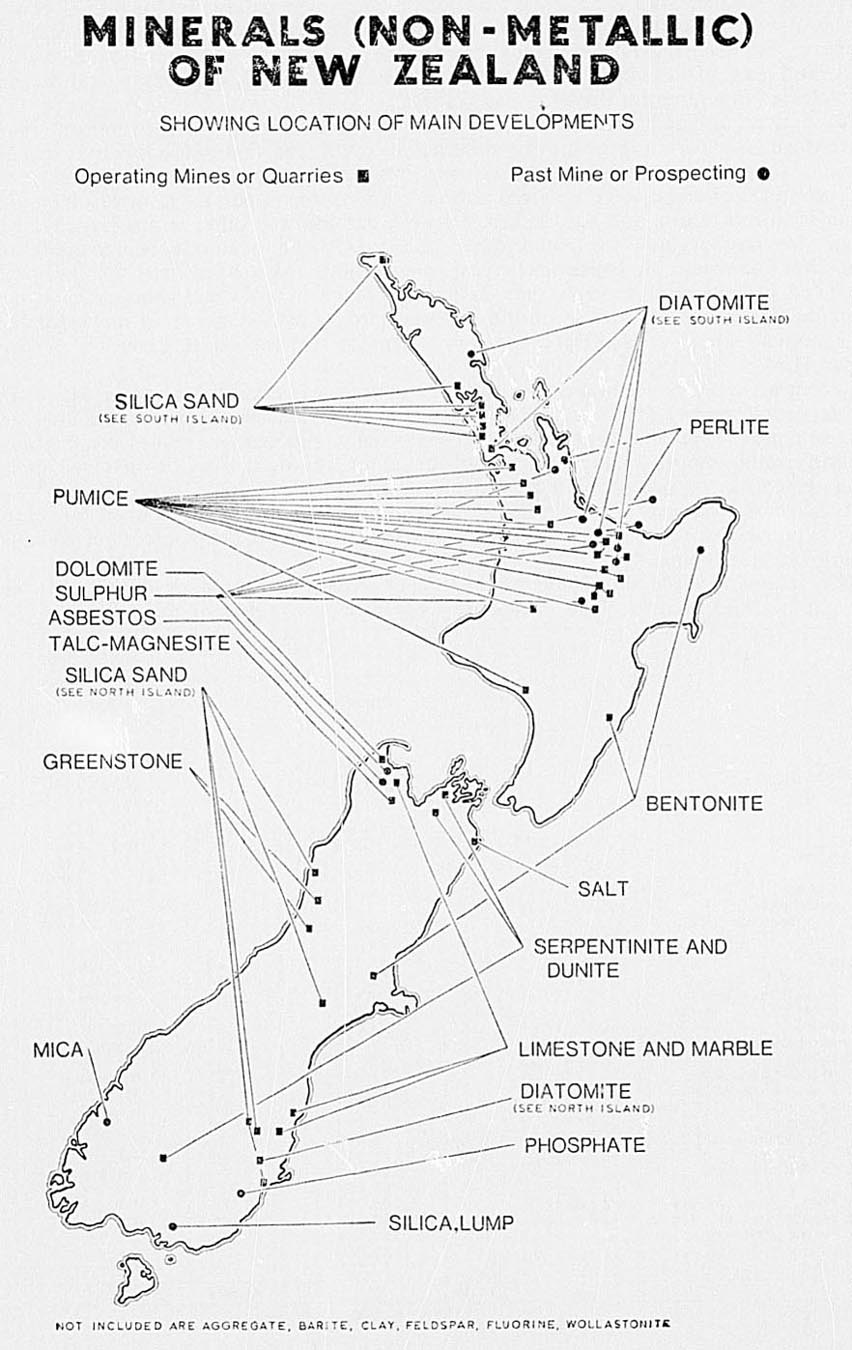
COAL—Coal in New Zealand has for many years been mined in certain well defined areas, outside which no coal is known to exist in any significant quantities. The major coalfields, with the class of coal found in each, are—
Bituminous Coal (Coking): Greymouth, Westport (Buller Coalfields), Reefton (Garvey Creek).
Sub-bituminous Coal (Non-coking): Waikato (including North Taranaki), Otago (Kaitangata), Southland (Ohai), Reefton.
Lignite (Non-coking Low Grade): Southland (Mataura).
Minor coalfields from which coal is being mined, but which cannot be expected to provide an important contribution to coal resources, are—
Sub-bituminous Coal: Nelson (Puponga, Westhaven), Murchison.
Lignite: Canterbury (numerous small deposits), Otago, Charleston (Westport).
Coal Utilisation and Research—Coal utilisation and research is being fostered by the New Zealand Coal Research Association Inc. Finance for the Association's activities is raised by a levy of 5 cents a ton made by coal merchants, and this is subsidised by the Government on a $1 for $1 basis in much the same way as for other industrial research associations. Engineers have been appointed and in a laboratory at Lower Hutt they investigate such matters as coal handling, coal storage and appliance development. The basic object is to bring the convenience and cleanliness of coal firing up to the level obtained with other forms of firing. The Executive of the Coal Research Association includes representatives of mine-owners, mineworkers, coal merchants, the Mines Department, the Department of Scientific and Industrial Research, the University of Canterbury and the New Zealand Institute of Coal Mining.
Fuel Technology Service—The Mines Department has established a fuel technology service :in Auckland and Christchurch to advise industrial and domestic consumers in the efficient use of coal.
Survey of Coal Resources—Investigation of coal resources is now being carried on in three phases: (i) mainly geological and chemical activities; (ii) detailed topographical surveys and shallow prospecting by means of cuts, pits, and hand drilling; (iii) investigations by deep-core drilling. For detailed information concerning geology, coal type, rank, and extent of the coalfields, those interested are referred to Geological Survey Bulletins Nos. 17, 45, 51, 56, and 59, and for an overall picture to Economic Geology of New Zealand, Volume 4, Eighth Commonwealth Mining and Metallurgical Congress, procurable from the Government Printer, Wellington.
A fresh estimate of the coal resources of New Zealand was prepared in 1969 based on information obtained by the Mines Department and the Geological Survey. The classification accepted—“measured”, “indicated”, and “inferred”—is that used by the United States Bureau of Mines and also accepted in the Commonwealth Mineral Resources Survey issued by the British Commonwealth of Nations Scientific Liaison Offices, London. These terms are simply defined as follows.
“Measured coal” is coal for which tonnage is computed from dimensions revealed in outcrops, trenches, workings, and drill holes and for which the grade is computed from the results of detailed sampling. The sites for inspection, sampling, and measurements are so closely spaced and the geologic character is defined so well that the size, shape, and content are well established.
“Indicated coal” is coal for which tonnage and grade are computed partly from specific measurements, samples, or production data and partly from projection for a reasonable distance on geologic evidence. The sites available for inspection, measurement, and sampling are too widely or otherwise inappropriately spaced to outline the coal completely or to establish its grade throughout.
“Inferred coal” is coal for which quantitative estimates are based largely on broad knowledge of the geological character of the deposit and for which there are few, if any, samples of measurements. The estimates are based on an assumed continuity or repetition for which there is geologic evidence; this evidence may include comparison with deposits of similar type. Bodies that are completely concealed may be included if there is specific geologic evidence of their presence.
The categories of coal resources refer only to the probability of their existence and may be applied either to coal in the ground or to recoverable coal.
The following table sets out the estimated recoverable reserves, which total 1.073 million tons.
| Locality | Measured Recoverable | Indicated Recoverable | Inferred Recoverable |
|---|---|---|---|
| Tons (000) | |||
| Bituminous | |||
| Buller | 31,895 | 5,129 | 10,400 |
| Murchison | 16 | 650 | 1,380 |
| Reefton | 951 | 3,114 | 8,130 |
| Garvey Creek | 132 | 2,630 | 5,000 |
| Greymouth | 2,571 | 10,433 | 32,940 |
| Pike River | - | - | 15,000 |
| Shag Point | - | 10 | 50 |
| 35,565 | 21,966 | 72,900 | |
| Sub-bituminous | |||
| Northland | 75 | 500 | 3,000 |
| Maramarua | 15,672 | 36,400 | 24,000 |
| Huntly | 94,325 | 46,250 | 75,000 |
| Rotowaro | 13,272 | 1,300 | 1,820 |
| Glen Massey | 143 | 45 | 4,000 |
| Whatawhata | 59 | 100 | 200 |
| Kawhia | 39 | 450 | 5,750 |
| Mangapehi | - | 3,000 | - |
| Tatu-Ohura | 3,096 | 1,100 | 12,000 |
| Waitewhena | 400 | 900 | 11,000 |
| Mokau | - | 60,000 | |
| Collingwood | 58 | 130 | 1,000 |
| Heaphy River | - | 1,000 | |
| Charleston | 1,755 | 3,361 | 5,088 |
| Inangahua | 20 | 100 | 8,000 |
| Fletcher Creek | 60 | - | 2,930 |
| Punakaiki | - | - | 2,000 |
| Kaitangata | 1,672 | 500 | 500 |
| Ohai | 5,961 | 8,460 | 89,940 |
| Orepuki | - | - | 1,000 |
| 136,607 | 102,596 | 308,228 | |
| Lignite | |||
| Canterbury | 142 | - | 2,000 |
| North Otago | 240 | - | 2,000 |
| Central Otago | 244 | 15,000 | |
| Green Island | 211 | 3,000 | |
| Kaitangata | 11,000 | 19,000 | 41,908 |
| Pomahaka | - | - | 60,000 |
| Mataura Valley | 5,033 | 20,650 | 215,550 |
| 16,870 | 39,650 | 339,458 | |
| Totals | 189,042 | 164,212 | 720,586 |
Coal Consumption—The approximate distribution of coal consumption during each of the latest six years is shown in the following table. The total quantity is based on actual production in each year plus imports and minus exports.
| User | 1963 | 1964 | 1965 | 1966 | 1967 | 1968 |
|---|---|---|---|---|---|---|
| * Sales by private mines to domestic consumers included in ‘other consumers’. | ||||||
| tons (000) | ||||||
| Railways | 183 | 166 | 141 | 120 | 99 | 49 |
| Gasworks | 268 | 258 | 260 | 241 | 248 | 227 |
| Electricity generation | 597 | 586 | 433 | 491 | 228 | 253 |
| Households | 517 | 476 | 482 | 344* | 301* | 291* |
| Factory industries— | ||||||
| Meatworks | 120 | 114 | 113 | 121 | 128 | 123 |
| Dairy factories | 306 | 328 | 324 | 299 | 287 | 313 |
| Pulp and paper mills | 156 | 142 | 132 | 125 | 111 | 99 |
| Cement works | 210 | 213 | 217 | 233 | 190 | 197 |
| Other factories | 210 | 196 | 185 | 174 | 154 | 152 |
| Other consumers | 196 | 298 | 335 | 455 | 488 | 405 |
| Total consumption | 2,763 | 2,777 | 2,622 | 2,603 | 2,234 | 2,109 |
Summary of Operations—The following table summarises coal-mining operations
| Year | Output (tons 000) | Persons Ordinarily Employed | Lives Lost by Accidents in or about Mines | ||||
|---|---|---|---|---|---|---|---|
| Surface | Underground | Totals | Per Million Tons Produced | Per Thousand Persons Employed | Lives Lost | ||
| Prior to 1965 | 160,618 | ... | ... | ... | ... | ... | 641 |
| 1965 | 2,659 | 1,236 | 2,2ll | 3,447 | - | - | - |
| 1966 | 2,595 | 1,214 | 2,145 | 3,359 | 3.08 | 2.38 | 8 |
| 1967 | 2,370 | 1,206 | 2,073 | 3,279 | 9.00 | 6.40 | 21 |
| 1968 | 2,224 | 1,101 | 1,944 | 3,045 | 0.45 | 0.33 | 1 |
| 1969 | 2,326 | 1,002 | 1,594 | 2,596 | 0.46 | 0.51 | 5 |
| Totals | 172,792 | ... | ... | ... | ... | ... | 676 |
Underground Mines—The following table gives particulars of the operations of underground mining during the latest five years.
| Calendar Year | Output (tons 000) | Men Employed Underground | Tons per Man Underground | Men Employed on Surface | Tons per Man on Pay Roll |
|---|---|---|---|---|---|
| 1965 | 1,609 | 2,211 | 728 | 831 | 529 |
| 1966 | 1,502 | 2,145 | 701 | 818 | 507 |
| 1967 | 1,371 | 2,073 | 661 | 795 | 478 |
| 1968 | 1,347 | 1,944 | 693 | 735 | 503 |
| 1969 | 1,235 | 1,594 | 775 | 671 | 545 |
There were 73 underground mines in operation in 1969 and, of these, 18 operated by the State produced 899,068 tons of coal. Production from individual State mines is set out in the Mines Statement, parliamentary paper C. 2. On 30 September 1968, Dobson State Mine shut down, the Millerton State Mine closed on 16 September 1969, and the Lockington State Mine closed on 30 September 1970.
Opencast Mines—The proportion of the total production of coal obtained from opencast mines amounted to 47 percent in 1969, compared with 39.5 in 1968.
There were 42 opencast mines in operation in 1969 and of these, 12 operated by the State produced 467,076 tons. Details of production from all opencast mines for the last five years are given in the following table.
| Year | Output (tons 000) | Men Employed | Tons per Man Employed |
|---|---|---|---|
| 1965 | 1,049 | 405 | 2,591 |
| 1966 | 1,091 | 396 | 2,756 |
| 1967 | 998 | 411 | 2,429 |
| 1968 | 878 | 366 | 2,398 |
| 1969 | 1,091 | 331 | 3,296 |
Derived Products—Low-temperature carbonisation works, using the Lurgi process, established at Rotowaro, 70 miles south of Auckland, in 1931, produced during 1969, 20,316 tons of carbonettes, 416,149 gallons of tar and oil, and 886 tons of char from 36,197 tons of slack coal, which was part of the output of a group of local state mines.
The Sockburn plant, near Christchurch, produced 36,440 gallons of tar and 4,872 tons of coke during 1969.
Mercer Power Station—This station, of 180,000 kW capacity, if working at full capacity, can burn up to 700,000 tons of coal a year. Two-thirds of the coal is provided from the Kopuku opencast coalfield about 7 miles distant from the station, and the remainder from the Huntly coalfield.
State Coal Mines—The State purchase of coal mines, which began in 1940, has left only two large private mines in production. During 1969 there were 28 State coal mines in operation.
In 1969 the State coal mines lost $1,540,607 before charging interest. Interest on loan capital amounting to $1,278,289 was remitted under section 15 of the New Zealand Loans Act 1953, otherwise the total loss for 1968 would have been $2,818,896.
Coal Mining Districts' Welfare and Research Fund—This fund, into which is paid a levy at the rate of 7 1/2 c per ton on coal other than lignite and 6c per ton on lignite, is used for coal-miners' relief, provision of amenities, payment of retiring allowances, establishment and maintenance of rescue stations, research, promotion of coal usage, and generally for the benefit of the industry.
Information concerning monetary benefits for miners incapacitated by miner's phthisis or any other occupational disease or heart disease contracted while working as a miner in New Zealand appears in Section 6A—Social Security.
PETROLEUM AND NATURAL GAS—Prospecting and mining for petroleum in New Zealand is governed by the Petroleum Act 1937, the Petroleum Regulations 1939, and the Continental Shelf Act 1964. These give the Minister of Mines the jurisdiction to grant petroleum prospecting and mining licences on (a) land and in marine areas including territorial waters, and (b) the continental shelf; for the former there are 291 current prospecting licences covering 50,486 square miles and for the latter 25 licences covering 128,502 square miles.
Activity in the search for petroleum is being maintained. Geological and geophysical work (including seismic surveys) is being conducted by several licence holders in various areas throughout New Zealand. Since the current search commenced a few years ago a number of deep wells have been drilled and the following are capable of commercial production.
| Name of Well and Locality | Depth in Feet | Date Completed | Result |
|---|---|---|---|
| Kapuni No. 1 (Taranaki) | 13,040 | October 1959 | Gas/condensate |
| Kapuni No. 2 (Taranaki) | 13,762 | January 1962 | Gas/condensate |
| Kapuni No. 3 (Taranaki) | 12,457 | June 1962 | Gas/condensate |
| Kapuni No. 4 (Taranaki) | 12,800 | October 1962 | Gas/condensate |
Gas from the Kapuni field is treated for the removal of carbon dioxide and piped between Auckland and Wellington. It is used mainly as a premium household fuel although some will be used for the generation of electricity and for industry. Gas reserves are estimated to be sufficient for 25 years. Condensate from Kapuni provides some of the feedstock for the Whangarei refinery.
The Natural Gas Corporation Act 1967 established a Corporation to purchase, transport, and market natural gas. Construction of the 377 miles of 8 5/8 in. trunk pipeline has been completed and natural gas came into use in 1970 in nine North Island centres—Auckland, Hamilton, New Plymouth, Hawera, Wanganui, Palmerston North, Levin, Hutt Valley, and Wellington. (See section 20B).
For many years small quantities of petroleum have been produced at New Plymouth. During 1969 the company operating at New Plymouth produced from four wells 72,350 gallons of crude oil and supplied 2,336,100 cubic feet of natural gas to the New Plymouth gas works. The total production of crude oil to 31 December 1969 is approximately 7,406,550 gallons.
Oil and gas were discovered off the Taranaki coast in 1969. Four wells were drilled, as shown below:
| Name of well | Depth in feet | Date completed | Result |
|---|---|---|---|
| Maui 1 | 11,515 | 23 June 1969 | Gas/condensate/oil |
| Maui 2 | 11,700 | 23 Dec. 1969 | Gas/condensate/oil |
| Maui 3 | 11,159 | 23 Feb. 1970 | Gas/condensate/oil |
| Maui 4 | 12,858 | 17 Jul 1970 | Oil |
The commercial significance of hydrocarbons discovered in these wells varies. Discussions are taking place on the economics of potential development.
IRON RESOURCES—New Zealand's largest resources of potential iron ore are contained in the black sands of the western beaches—from Westport southwards in the South Island and from Wanganui to Muriwai in the North Island. Titanomagnetite sands make up most of the black sands in the North Island, but from Waikato Heads northwards the beach deposits also contain ilmenite in varying proportions. In the South Island beach sands, ilmenite is the chief iron-bearing material. These beach sands have been estimated to contain some 800 million tons of titanomagnetite, with a further 8.6 million tons of ilmenite in the North Island and 43 million tons in the South Island.
A process has been developed whereby the titanomagnetite sands can be smelted on a large scale economically to produce a good grade of steel. A steelworks has been constructed at Glenbrook, 36 miles south of Auckland, by New Zealand Steel Limited, and the plant began production late in 1969 using ironsands deposits from the North Head of the Waikato River, 12 miles away. It is expected that production initially will be about 130,000 tons of steel a year (see section 18).
There has been a small annual production of iron ore from the Onekaka deposits and certain small deposits in the North Auckland district, for use in gas purification, the preparation of stock licks, and in the brickmaking industry.
Near Waverley, 20 miles north of Wanganui, development work is proceeding with a project to mine ironsands and produce titanomagnetite concentrates for export to Japan from 1971 onwards. N.Z. Steel Ltd. is planning a similar undertaking at Taharoa, near Kawhia.
URANIUM—In 1955 uranium-bearing minerals were discovered in the Buller Gorge. These deposits occur in steep, broken country which is heavily covered with bush, the area is subject to heavy rainfall and access is difficult. Prospecting work, however, has been disappointing and, so far, ore has not been found rich and extensive enough to be worked economically at present price levels. Prospecting work in the Buller area of the West Coast is continuing.
The Atomic Energy Amendment Act 1957 amended the Atomic Energy Act 1945 by adding several new provisions designed to encourage the search for and production of uranium or other substances which may be used for the production of atomic energy.
GOLD—The gold-mining industry, which in its early stages contributed greatly to the progress and settlement of New Zealand, declined in importance with the exhaustion of the more accessible alluvial-gold deposits and of ore from the zones of enrichment. Annual production is now almost confined to one dredge at Taramakau on the west coast of the South Island.
SILVER—Formerly most of the locally produced silver exported from New Zealand was obtained from the refinement of bullion from the quartz mines of the Hauraki goldfields, where gold and silver were found alloyed. Recent production in the area is contained in the lead sulphite concentrates exported to Japan. A small quantity of silver is won by the West Coast gold dredges.
TUNGSTEN—The principal ore of tungsten in New Zealand is scheelite, though a little wolfram is found in Otago and Stewart Island, but not in economic quantities.
The scheelite-bearing quartz-veins are generally small and broken, while the scheelite is most erratically distributed in the veins, with the greatest concentration of scheelite situated close to the surface or at shallow depth. Access and transport present difficulties, and production costs are relatively high. Although the price of tungsten ores has improved scheelite mining is on a small scale. Mining is confined to the Glenorchy and Macrae's Flats fields in Otago. There has been renewed interest in prospecting both these fields and a complete re-assessment of their potential is being made.
COPPER—A deposit of copper ore near Parakao contains azurite and malachite, forms of carbonates of copper, as well as tentorite, an oxide of copper. It has been used as an additive to fertilisers. Another deposit of copper ore was worked at Pupuke. It is estimated that the total production of copper ore over the years to the end of 1969 amounted to 8,022 tons, valued at $319,244.
Prospecting has been carried out for copper ore at Moke Creek near Queenstown, and Coppermine Island near Whangarei, as well as a number of other localities, by mining companies currently engaged in the renewed study of the country's mineral resources without uncovering significant deposits.
MANGANESE—Manganese ores are found in many localities, chiefly in the older sedimentary rocks. Of recent years there has been some production from deposits at Bombay, Moumoukai, and Otau, all in the Auckland district. Deposits are, however, generally small and shallow and capable of producing only limited tonnages of ore. There has been no production of manganese since 1960.
MERCURY—Cinnabar, the principal ore of mercury, is widely distributed in New Zealand, but only in a few localities is it found in quantities of economic importance. The most promising deposits of mercury ore in New Zealand are those of the Puhipuhi district and further investigation work has been carried out in this area.
LEAD AND ZINC—An ore-bearing reef of lead and zinc is being mined near Te Aroha, producing lead-copper sulphide and zinc sulphide concentrates for export to Japan.
TIN—Cassiterite in the form of “stream tin” occurs in small deposits near Port Pegasus, Stewart Island, and these have been worked to some extent.
PLATINUM—Platinum occurs in several places, associated generally with gold in gravel, but quantities produced have been insignificant.
SILICA—At Parengarenga, in northern Northland there are large deposits of pure quartz (silica) sand. Over 70,000 tons from here and 10,000 tons from Mt. Somers in Canterbury, are used each year, mainly for glass manufacture.
There are lump silica deposits in Southland of a high quality suitable for the production of ferro-silicon and probably silicon metal.
DIATOMITE—Diatomite is a light powdery material used as a source of silica and as a filtering agent. It is worked in the Rotorua-Taupo volcanic zone and at Middlemarch, Otago.
BENTONITE—Deposits of bentonite occur at Porangahau in the Hawke's Bay District, and at Mangatu, near Gisborne. There are deposits of non-swelling bentonite at Coalgate in Canterbury which can, however, be modified to produce swelling bentonite suitable for pelletising ironsands, and use in drilling and as a filler.
HALLOYSITE—Halloysite is a clay used in ceramics, and as a filler in the paper industry. It has been mined in Northland since the Second World War and used in the expanding china-ware industry of Auckland and investigations into an expanding use of this clay as a high-grade filler are proceeding.
SULPHUR—Prospecting proved a 6-million ton deposit of sulphur at Rotorua in the Taupo area in 1968, but exploitation has still to be established as feasible.
PERLITE—Perlite is a volcanic glass expanded by heating; it is used as an insulator and in lightweight concrete. There are deposits in the Rotorua-Taupo area.
ASBESTOS—Chrysotile asbestos occurs at several points in the massive serpentines of Nelson and Otago but the only deposits of importance so far located are those of Upper Takaka in the Nelson district. In 1955 production of asbestos was resumed after a temporary cessation but was discontinued in 1963. Current work is aimed at finding a market for the high proportion of very short fibre found in the ore.
PHOSPHATE—The occurrence of phosphate has been reported from many localities in New Zealand, but so far the deposits of Clarendon and Milburn have proved to be the only ones of economic importance and the more favourable sections of the deposits have been exhausted.
SERPENTINE—Serpentine is a magnesium-rich rock used as a fertiliser additive. Deposits are being mined at Piopio, near Te Kuiti, and North Cape, in the North Island, and Lee Valley, Collins Valley and Mossburn, in the South Island. To the end of 1969, 2,475,428 tons of serpentine had been mined.
GREENSTONE—The mineral nephrite, the “pounamu” of the Maori, a deep-green semi-transparent mineral with dark opaque patches, more popularly known as one of the varieties of “greenstone”, occurs as rounded segregations in the talc or talc-serpentine rocks of the Griffin Range of north Westland. The principal supply was obtained from the gravels of the Arahura and Taramakau Rivers, and from gold-sluicing claims of the Kumara district. At the present time the main source of supply is from a deposit of greenstone boulders in Olderog Creek, a tributary of the Arahura River. The boulders are reduced in size by a portable diamond trepan saw and airlifted by helicopter. Some of this has been cut and polished in New Zealand for personal and other small ornaments; the remainder has been exported. With the decline in sluicing operations this mineral has been in short supply.
KAURI GUM—Production of kauri gum has been at a comparatively low level in recent years. The quantity exported annually is now less than 100 tons.
SALT—At Lake Grassmere, in Marlborough, salt is being produced by the solar evaporation of sea water. The low rainfall, long hours of sunlight, and the wind conditions make this locality the most suitable one in New Zealand for this purpose. Salt was first harvested in 1952. Production of salt in the latest six years is shown in the following table.
| Year | Salt Produced | Value |
|---|---|---|
| *Stockpile value. | ||
| tons | $(000) | |
| 1964 | 21,332 | 674 |
| 1965 | 34,170 | 1,080 |
| 1966 | 35,450 | 1,000 |
| 1967 | 55,200 | 1,214 |
| 1968 | 55,000 | 1,155 |
| 1969 | 48,518 | 464* |
BUILDING AND ORNAMENTAL STONES—New Zealand possesses a great variety of handsome and durable building stones scattered throughout both Islands. Their distribution is described in the 1958 and earlier issues of the Yearbook.
STATE AID TO MINING—State aid to mining in New Zealand is given in several forms—viz. (a) geological survey and bulletins; (b) detailed investigation of the occurrence and development of economic minerals; (c) schools of mines; (d) financial aid to prospecting and for access roads to mining fields; (e) research by Chemistry Division of the Department of Scientific and Industrial Research.
Geological Survey—Imperative to long-term assessment of New Zealand's mineral resources is an understanding of the country's geology. In New Zealand almost all Government geological work is carried out by the New Zealand Geological Survey, a scientific institution founded in 1865, which since 1926 has been a branch of the Department of Scientific and Industrial Research Mines, Works, and other Government Departments consult the Geological Survey on geological problems, and do not themselves maintain a geological staff.
The Survey's principal work is to prepare geological maps of New Zealand and to determine the country's geological structure and geological history. Along with this, the Survey studies and helps to assess the country's mineral deposits, geothermal steam, and underground water resources, and gives advice on geological problems encountered in State and private civil engineering projects such as the construction of hydro-electric dams, bridges, tunnels, roads, and building foundations.
The Geological Survey has in the past done most of its regional geological mapping on a scale of one mile to the inch, about one-third of the country so far being covered by maps on this scale. Most of these maps have been issued in groups with a bulletin text describing the geology and mineral resources of the regions concerned. Paleontological bulletins are also issued. To speed the geological mapping of the country, the Survey in 1956 embarked on a programme to map the whole country on a less detailed scale. These new maps (scale of 1:250,000) are known informally as the “Four Mile” series. They each carry about 3,000 words of descriptive text in their margins; there are 28 of them altogether and all 28 sheets are now printed. One-mile maps and bulletins will continue to be issued at intervals for areas of special economic or scientific importance. The first five sheets of a new industrial series of maps, at 1:25,000 scale, has been issued, covering Hamilton City, Henderson, Devonport, Mangere and Eden in the Auckland city area. Geological mapping has also been carried out in New Zealand's island territories and in the Ross Dependency.
Mineral Resources Surveys Generally—A strong Economic Section of the Geological Survey is responsible for the investigation of potentially valuable deposits, coupled with closer study of the changing overseas economic emphasis. The work is largely concerned with the implementation of the Mineral Resources Council's recommended programme. A new inventory of New Zealand's minerals has been prepared, and a publication Industrial Minerals and Rocks, containing articles of interest to engineers, mining companies, and local bodies, is produced annually. Field studies are made by the geologists, and laboratory examination of ores by the petrology specialists. Chemical analysis is usually done by the Chemistry Division, Department of Scientific and Industrial Research. The Petrology Sections makes free identification of rocks and minerals forwarded by Mines Department, prospectors, and others.
Metallic Minerals—In earlier years when gold was of major importance the Survey reported on all major goldfields. Deposits of ores of iron, copper, tungsten, manganese, chrome, uranium, aluminium, and other metals have also been investigated over the years, and the Survey took complete responsibility for the raw material geological investigations for the new steel industry. Recently the Survey has, in collaboration with the Chemistry Division, been developing the techniques of geochemical prospecting with significant results in difficult terrain; chief ores being traced are copper, zinc, and manganese in Northland, West Otago, and Southland. It has recently completed detailed surveys of the ilmenite-zircon-gold sand deposits near Westport, of the important mineralisation areas in North-West Nelson, of a disseminated low-grade copper deposit at Coppermine Island off Whangarei, and of scheelite lodes at Glenorchy in Otago.
Coal—Coal is still New Zealand's most important mineral, apart from constructional materials, and mapping the coalfields in detail has been one of the Survey's major undertakings in economic geology. Work has proceeded in co-operation with Mines Department and with the Coal Research Association. Detailed maps and bulletins on Greymouth, Reefton, Kaitangata, and Ohai coalfields have been published, while those for the Waikato field will be the next to be issued. Although the mapping of the coalfields is largely complete, Survey geologists continue to help with the large number of day-to-day problems in the coalfields and undertake constant revision.
Oil—The Government does not undertake oil exploration. Oil companies however draw on Survey maps and bulletins for basic information about the country's stratigraphy and geological structure which enables them to narrow down areas deserving more detailed examination. Close and mutually beneficial co-operation has usually developed between Survey geologists and paleontologists and those of oil companies. Copies of oil company reports and maps continue to be deposited with the Government in terms of the Petroleum Act 1937. The Geological Survey is the national repository of collections of rocks, fossils, and drill cores collected by the oil companies, and has appointed a petroleum geologist to the staff who advises company geologists on all oil regions.
Paleontological and stratigraphic information by the Survey helped the search for oil in Taranaki, which was rewarded by the discovery and development of large reservoirs of natural gas at Kapuni and more recently off-shore in the Maui field. The collections of fossils and drill cores held from earlier Taranaki oil-exploration bores greatly helped prediction of the type, age and thickness of strata the drills would penetrate. Geological Survey micro-paleontologists are assisting oil companies in interpreting the stratigraphic progress of off-shore oil wells and provided a complete service for Maui 1 and Haku 1.
Constructional Materials and Other Non-metallic Minerals—As far as is possible with the staff available, the Survey advises Ministry of Works and local authority engineers, contractors, and other users on where rock materials for road metal, aggregate, building stone, sand, etc., can be obtained. A major aggregate survey has-been launched in co-operation with Ministry of Works. Marl, limestone, and pozzolana for cement manufacture, perlite, bentonite, clays, talc, mica, and magnesite are other non-metallic minerals in whose utilisation the Survey has played a part. Current aid to industry given by the Survey includes detailed projects on North-west Nelson deposits of wollastonite, asbestos, dolomite, and talc magnesite; the limestone resources of Auckland and Otago have been assessed recently; North Auckland sands and halloysite clays are also under investigation.
CENSUS OF MINING AND QUARRYING—A census of mining and quarrying was taken for the production year 1968-69. Statistics for that year are shown in the following table.
| Item | Type of Mining or Quarrying | Total, incl. Part-Time | |||
|---|---|---|---|---|---|
| Sand, Gravel. Rock, etc. | Limestone | Coal | Other, Including Clay | ||
| *One owner may operate several mines, e.g., the Government operates many coal mines. | |||||
| Type of organisation*— | |||||
| Registered company | 197 | 59 | 26 | 32 | 392 |
| Individual or partnership or co-operative | 58 | 16 | 34 | 12 | 168 |
| Government or local authority | 101 | 1 | 2 | 2 | 140 |
| Totals | 356 | 76 | 62 | 46 | 700 |
| Nature of business— | |||||
| Underground mines operated | - | - | 64 | 11 | 76 |
| Surface mines or quarries operated | 917 | 87 | 37 | 64 | 1,332 |
| Productive bores | - | - | - | 3 | 3 |
| Totals | 917 | 87 | 101 | 78 | 1,411 |
| Employment— | |||||
| Average number of persons engaged (excludes working proprietors) | 1,864 | 276 | 2,742 | 239 | 5,283 |
| Salaries and wages paid (includes bonuses, overtime, etc.) persons engaged $(000) | 4,923 | 669 | 7,635 | 696 | 14,011 |
| Overtime hours worked hr(000) | 489 | 34 | 35 | 53 | 615 |
| Number of working proprietors | 69 | 15 | 96 | 15 | 244 |
| Production (values as at quarry floor or mine head)— | |||||
| Sand, gravel, rock, clay, etc. $(000) | 19,958 | 58 | - | 65 | 20,373 |
| Limestone $(000) | 28 | 2,428 | - | 15 | 2,527 |
| Coal $(000) | 64 | - | 12,874 | - | 12,943 |
| Other $(000) | 1 | 54 | 8 | 3,074 | 3,245 |
| Totals, values $(000) | 20,052 | 2,540 | 12,882 | 3,154 | 39,086 |
| Production volumes | |||||
| Sand, gravel, rock, clay, etc. cu yd (000) | 18,412 | 49 | - | 50 | 19,088 |
| Limestone tons(000) | 20 | 1,560 | - | 8 | 1,643 |
| Coal tons(000) | 24 | - | 2,287 | - | 2,312 |
HISTORICAL DEVELOPMENT—The function of the early manufacturing industries in New Zealand was to supply locally the immediate needs of the small scattered communities for food, clothing, building materials, and home furnishings and to provide shipping with ropes, spars, and repairs. These handicraft activities grew into factories as the settlements expanded and as there developed more opportunities for the organisation and specialisation of labour, and for the more complex processing of domestic or imported raw materials. Flour mills, flax mills, ropewalks, and sawmills appeared in the early eighteen forties followed by breweries, brick kilns, cooperages in the mid forties and, later in that decade, lime kilns, ship and boat yards, soap and candle works, and tanneries.
By 1867, the first year in which statistics of factory production were collected in conjunction with the population census, manufacturing establishments included grain mills, breweries, biscuit factories, a bone-manure works, brick and tile yards and potteries, candle and soap works, coachbuilding workshops, fellmongeries, tanneries, wool-scouring works, flax works, aerated water and cordial factories, iron and brass foundries, lime kilns, malt kilns, engineering workshops, a patent slip, a petroleum works, rope and cordage works, sawmills, sash and door factories, ship and boat yards, and a woollen mill. The factories of this period were still primarily concerned with the satisfaction of the needs of the limited local markets.
The development boom of the eighteen seventies, the rapid rise in population, and the better communications between internal markets encouraged further factory expansion. There was to some extent a natural protection from overseas competition in the high freight rates on imports. Other factors which assisted in this expansion were the admission of certain raw materials free of duty, the imposition of a tariff on some finished goods, and the granting of bounties for new factories by central and provincial governments. These were followed by protection by way of tariff in 1888 when the home market was shrinking and capital and labour were beginning to leave the colony. Footwear and clothing factories, machinery and metal industries were protected by this tariff. A wider protective Customs tariff was imposed in 1895. During the depressed years of the eighteen eighties low wage costs enabled some New Zealand manufacturers to export their products, but this was partly attributable also to the special suitability of some New Zealand products, such as farm implements, to the needs of other developing communities overseas.
The first shipment of refrigerated meat in 1882 opened the way for the establishment and growth of the meat-freezing and butter and cheese industries. Ten years after this first shipment, 21 meat-freezing works and 104 butter and cheese factories had been established.
The recovery from the long depression, the resumption of large-scale immigration at the beginning of the present century, the spectacular development of meat-freezing and dairy factories, and the breaking in of new land, especially in the North Island, all contributed to the revival of a strong internal demand which stimulated manufacturing growth.
Auckland early established itself as the predominant manufacturing province in New Zealand, but in the general prosperity following the gold boom of the sixties there was a spectacular increase in manufacturing activity in Otago, which led Auckland until the nineties. Canterbury was the next most important manufacturing province. Today, however, Auckland has clearly re-established its predominance and is followed by Wellington and Canterbury.
With the rising population and increased export income during the first decade of this century, manufacturing continued to expand at a steady rate. The growth continued to be concentrated on industries processing farm products for export and those supplying the more simple goods, housing materials and equipment, repairs and supplies for farmers. In this period the electrical, wire-work, sheet-metal, and motor-vehicle industries had their beginnings.
Developments in the nineteen twenties included the expansion of the vehicle industry (particularly motor and cycle assembly), sawmilling, and the metal-working, furnishings, and apparel industries. These developments carried forward the tendency for industries processing farm products to be less dominating in value of production and employment compared with other types of industry.
During the depression of the nineteen thirties the total volume of factory output declined with the contraction of New Zealand's export income and the drop in internal demand. While prices fell the output of factories processing farm products rose, but not sufficiently to offset the loss in volume from other manufacturing industries. The rapid fall in purchasing power caused the farmer to produce more, but the impact of the depression on the factories processing “non-farm” materials meant a heavy reduction in the output of consumer goods, building materials, and agricultural and dairy machinery and implements. By 1934-35, however, the volume of factory production had been restored to the 1929-30 level.
Apart from the metal-working and vehicle factories, which had improved their position significantly, industry emerged from the depression in much the same pattern as before.
The recovery of manufacturing after the depression was primarily the result of better export prices, more public development, and an expansionist monetary policy, all of which resulted in the re-engagement of most of the unemployed.
There had been little time for any protective effect of exchange control and import selection to stimulate industrial expansion between the date these measures were introduced (December 1938) and the outbreak of war in September 1939. It was the war and its shortages which changed the manufacturing pattern and gave great encouragement to industrial development. The engineering and apparel industries, which contributed so much to war needs, made the greatest progress.
Production expanded in response to the need to replace imports that the United Kingdom and other countries could no longer supply and to provide uniforms, weapons, equipment, and provisions for New Zealand and allied armed forces.
One protective effect of the war and post-war periods and their restricted supply of imports was that domestic industry was often enabled to attain its optimum (New Zealand) output quickly without a difficult competitive struggle with imports.
Post-war Development—The pattern of New Zealand industry changed again from 1949-50 with the exemption from import control of many items. Factory expansion was sustained by a high level of internal demand, by a widening of the range of products, and to some extent by the restriction of imports for a short period of exchange control. In this period the volume of production in the food, footwear, other wearing apparel and made up textile goods groups increased slowly in response to population growth, while leather industry production fell as a result of competition from imports and synthetics. Spectacular increases in production came from new developments in the pulp and paper and the rubber industries. However, as in past years it was the engineering factories that contributed most to the growth of manufacturing after 1949-50. The expansion in this field was stimulated especially by increasing mechanisation on farms, the high level of investment in New Zealand, the rising demand for consumer durables, and the increased imports of motor vehicle components.
The growth in production has been assisted by increases in manpower engaged and capital investment in new buildings and machinery. A measure of the increase in capital employed is that the value of land and buildings, plant, and machinery at the end of the production year for each person engaged was $870 in 1945-46, $1,266 in 1950-51, rising to $2,148 in 1955-56, $2,750 in 1960-61, $3,541 in 1964-65, $3,830 in 1965-66, $4,136 in 1966-67, S4,384 in 1967-68, and $4,582 in 1968-69.
The greater use of machinery for manufacturing during the last 20 years is illustrated also by the continuing rise in the average horsepower for each person engaged in manufacturing. In 1935-36 the average was 2.86; in 1945-46, 2.97; in 1955-56, 4.42; in 1965-66, 5.59; and in 1968-69, 6 26. This expansion has been facilitated by developments in electric power generation and industrial techniques. In 1968-69, the use of electric motors in factories accounted for 96.7 percent of the total rated horsepower for all types of engines employed in factories. The number and horsepower of steam, petrol, oil, and other nonelectrical engines has declined absolutely as well as relatively.
Industrial progress has. been rapid, but manufacturing in New Zealand is still organised on a relatively small scale. In 1968-69, 62 percent of the factories employed 10 persons or less, a reflection of the fact that, partly as a result of geographical configuration, many factories still supply small local markets. Although these small factories are numerous, they accounted for only 10 percent of the total value of factory production. There were only 154 factories (1.47 percent of the total) in 1968-69 where the number of persons engaged exceeded 200, but these factories accounted for 35 percent of total value of production. Some were engaged in processing goods for export—for example, 37 were meat-freezing works.
Manufacturing plays a vital part in employment. In April 1970 some 31 percent of the total labour force was employed in manufacturing industries. Of the total female labour force 26 percent was engaged in manufacturing.
Successive annual increases in the volume of production took place in the following years: 1959-60, 3.5 percent; 1960-61, 9.8 percent; 1961-62, 5.1 percent; 1962-63, 4.5 percent; 1963-64, 10.4 percent; 1964-65, 13.0 percent; 1965-66, 6.8 percent; 1966-67, 5.9 percent. However in 1967-68 there was a decrease of 1.2 percent. In 1968-69 there was an increase of 3.2 percent, and for 1969-70 a provisional increase of 7.2 percent.
Export Earnings—Goods manufactured in New Zealand are finding increasingly larger outlets in overseas markets. In 1947 manufactures to the value of $4 million were exported, but by 1965 the value of exported manufactured goods rose to $29.7 million and in 1969 a figure of $122 8 million was achieved. Newsprint, wood pulp, petroleum products, metal products, machinery (including agricultural, woodworking, and electrical machinery), preserved fruit and vegetables, and textiles accounted for about 64 percent of these earnings. However, exports of a wide range of other products, such as chemical elements and compounds, prepared foodstuffs and leather manufactures, are increasing in value.
Although the development of other Commonwealth and Asian markets is continuing, Australia remains the major export market for New Zealand manufactured goods. The limited free trade area agreement with Australia, which came into operation on 1 January 1966, has given additional impetus to the expansion of mutually beneficial trade between the two countries. (Further details of trading agreements with Australia are to be found under Section 22A External Trade.)
Import Replacement—In the latter part of 1957 and in early 1958 the terms of trade changed substantially to New Zealand's disadvantage and a serious depletion of overseas reserves resulted from the effects of heavy importing in 1957 and the fall in price of our main export commodities. To reduce overseas expenditure and arrest this drain on the reserves New Zealand reintroduced comprehensive import controls, which became effective on 1 January 1958. An improvement in the terms of trade in 1959 and 1960 allowed some relaxation in import restrictions, but a further fall in export prices and a higher volume of imports forced the Government to revert in 1961 to stricter import control. In mid-1962 the first of the measures to make the import licensing schedule more flexible in meeting manufacturers' and importers' needs was introduced.
Because of the importance of manufacturing industries in the employment of a rapidly increasing labour force and in conserving overseas funds, import licensing policy catered for plant and materials for industry. Manufacturing output has expanded in depth as well as in breadth. This has involved manufacturing in a number of industries being taken back to more basic stages rather than, for example, the mere assembly of imported components; making greater use of New Zealand's already available raw materials, such as wool and timber; and utilising raw materials hitherto unexploited, such as ironsands.
The development of manufacturing industries in New Zealand has been substantial in recent years. In addition to increases in the volume, range, and depth of manufacture of existing industries, new large industrial enterprises have been established and are now in full production. These include a steel merchant bar mill; wire drawing and galvanising; wire rope production; the manufacture of wood screws; an aluminium mill producing sheet, foil, and extrusions; television tube production; telephone and underground power cable plants; an oil refinery; gin and whisky distilleries; a sheet glass works; and nylon and polyester fibre and yarn spinning mills.
Other new products of New Zealand industry during recent years include highspeed twist drills, aluminium tube and cable, press brakes, pneumatic and steel tyred road rollers, bicycles, electric motor starters, water heater and room thermostats, copper oxide, formaldehyde, urea formaldehyde syrup adhesives, concrete additives, liquid and powdered synthetic detergents, acrylic emulsions of paints, p.v.c. compounds, p.v.c. flooring, roofing and rainwater goods, woven plastic materials, textured synthetic yarns, foam backed fabrics, moulded pulp products, wallpaper, rindless cheese wrapping, and soluble coffee. Experimental production of brandy has been carried out.
More recently the variety of manufactures has been further increased with the production of, among other things, a polarised ion source (for use with nuclear particle accelerators); bentonite for use in pelletising iron ore; fractional horse-power electrical motors; 11KV switch gear; electronically controlled counting machines for packing pharmaceutical tablets; self-propelled hydraulically-operated trench diggers; oil-fired kilns; piston-type positive oscillating water meters; porcelain-on-steel pressed baths; golf balls; electric hoists; post-hole diggers; disc-brake pads; warp-knitted fabric; and certain hydraulic equipment and attachments; turbo-prop topdressing aircraft; utility farm vehicles.
Aids to Development—Among the various bodies providing assistance to manufacturing industries are the Development Finance Corporation of New Zealand, the New Zealand Industrial Design Council, and the New Zealand Inventions Development Authority, and the Industrial Research and Development Grants Scheme.
Development Finance Corporation—Established as an independent body in 1964, the Corporation provides a source of financial assistance for new or expanding industries. Borrowers would normally be engaged in the production and related fields, such as manufacturing or serving of basic industry. Extractive industries, such as fishing, forestry, and mining, are also eligible for assistance. The functions and powers of the Corporation were extended in 1970 so that it is no longer a lender of last resort. It may assist in the setting up or expansion of projects overseas of benefit to New Zealand, and also participate in the reorganisation of industry to increase efficiency and productivity.
Industrial Design Council—Established in 1964 under the Industrial Design Act with the object of improving the quality, efficiency and appearance of New Zealand made goods, the Council's function is to aid industry by promoting the appreciation, development and use of industrial design.
Inventions Development Authority—The general functions of the Authority are to promote the development, manufacture or exploitation of inventions with the object of improving the quality, efficiency or range of goods available for use in New Zealand or for export.
Industrial Research and Development Grants Scheme—This was established in 1969 with the aim of increasing company expenditure on research and development by providing grants based on the increase, during a grant year, of a company's industrial research and development expenditure over its similar expenditure during the base year 1967-68.
There are also several bodies providing technical and advisory services for industry. Further details of these organisations are to be found under Section 7 Education and Science.
RECENT MAJOR DEVELOPMENTS—The following are some of the recent major developments.
Pulp and Paper—New Zealand Forest Products Ltd has commenced a $55,000,000 pulp and paper extension programme which will include the installation of a sixth paper-making machine and extensions to the pulp mill. Tasman Pulp and Paper Company Ltd has also announced plans for expansion to include a third newsprint machine.
Steel—At the end of 1964 specific plans were completed to establish in New Zealand an iron and steel industry based on domestic resources of ironsand. New Zealand Steel Limited was registered in July 1965 and a site of about 1,000 acres was purchased at Glenbrook, some 36 miles south of Auckland.
New Zealand Steel Limited commenced the production of a range of galvanised coil and sheet from imported black coil towards the end of November 1968. The first steel to be produced by the company from scrap iron smelted in one of the twin 40-ton electric arc furnaces took place in September 1969. At the same time the continuous casting machine to make steel billets was tested. The first steel billet from New Zealand ironsands was produced in November 1969.
The output of billets, which is building up to 130,000 tons a year, is in the main being supplied to Pacific Steel Limited for the production of steel rod for the domestic wire drawing industry and for increasing the range and output of merchant bar products.
Pacific Steel Limited, in which New Zealand Steel Limited has a 40 percent shareholding has completed an S8 million expansion programme. This expansion programme includes the installation of a modern rod-rolling mill and associated equipment to process the steel billet from New Zealand Steel Limited.
New Zealand Steel Limited has made a public issue of $4 million in unsecured bonds. These are guaranteed as to the repayment of principal and payment of interest by the Minister of Finance. This issue was made to provide the necessary finance required for the establishment of a pipe mill at the Glenbrook steel works and for the completion of Stage I installations and services. The pipe mill is expected to go into production about mid-1971.
Aluminium—Construction of a major aluminium smelter at Bluff is well advanced. The building of the smelter follows the signing on 5 September 1969 of an agreement between the New Zealand Government, Comalco Industries Pty Ltd. of Australia, Showa Denko KK and Sumitomo Chemical Co. Ltd. of Japan. Initial capacity of the smelter will be 73.000 tons a year. In direct earnings of overseas funds, New Zealand expects to make an annual net gain of more than S10 million when production at the Comalco aluminium smelter at Bluff reaches 110,000 tons a year.
Total investment in the smelter is about $90 million and the first aluminium was produced in mid-1971. Factories are being built to process the aluminium.
The smelter draws its large power requirements from the Manapouri-Te Anau hydro-electric complex.
The revised taxation provisions for approved development projects should provide the incentive for these companies to rapidly expand annual productive capacity to 210,000 tons. At this level, which is twice that originally envisaged when the smelter was first contemplated in 1960, net overseas earnings on present costs and prices could be of the order of $25 million a year.
SCOPE OF STATISTICS—The statistics of factory production collected annually by the Department of Statistics cover registered factories employing at least two persons (including the working proprietor) engaged in the manufacture, assembly, repair, or treatment of articles.
Bread bakeries and ready-mixed concrete establishments were surveyed as separate industries for the first time for 1962-63, but they have been excluded from group and national totals to maintain comparability with previous years.
Industrial activities not covered by the survey of the Department of Statistics set out in this section are: cake and pastry kitchens; boot repairers; bespoke tailors; dressmakers; milliners; abattoirs; railway workshops; naval dockyard; all one-man factories.
The exclusion of these activities from the scope of the statistical inquiry, and also of all persons engaged in factories in a purely distributive capacity, reduces the total manufacturing labour force from that quoted by the Department of Labour (275,400) to the figure recorded in these statistics for 1968—69 of 229,074. Although the annual census of factory production covers only 83 percent of the labour force classified by the Department of Labour as “manufacturing” the percentage of the total production covered would be larger, as all but the very smallest establishments are included.
The year covered by these statistics is generally the year ending 31 March, but factories are permitted to furnish returns covering their financial year most closely corresponding to this period. In the case of the important semi-primary industries—butter, cheese, and other milk products, and meat freezing and preserving—the years correspond with the production seasons ending in May and September respectively.
GENERAL SUMMARY—The factory production table in the Statistical Summary section of this volume gives a long time series of leading statistics.
Following a decrease of 1.2 percent in the volume of production in 1967-68 there was an increase of 3.2 percent in 1968-69 to give a record volume of production in manufacturing. The total value of production was $2,790 million in 1968-69 or 10.1 percent more than the 1967-68 total of $2,538 million. Net output increased by 7.7 percent from $756.7 million in 1967-68 to $814.3 million in the latest year and manufacturers' surplus increased by 9.8 percent (from 5241.7 million to $265.4 million). The number of persons engaged, including working proprietors, was 229,074, an increase of 3,336 or 1.5 percent on the total of 225,738 in 1967-68. Total salaries and wages paid (including drawings of working proprietors) during 1968-69 amounted to $527.8 million compared with $495.9 million in the previous year. This was an increase of 6.4 percent.
Factory statistics by local authority administrative areas showing the number of establishments and accompanying main statistics are published in the Report on Industrial Production.
The following table gives the main statistics by statistical areas for the year 1968-69.
| Statistical Area | Number of Establishments | Persons Engaged | Salaries and Wages Paid | Cost of Materials | Value of Production | Net Output (Net Value Added) |
|---|---|---|---|---|---|---|
| $(000) | ||||||
| Northland | 317 | 4,154 | 10,315 | 94,302 | 127,059 | 21,028 |
| Central Auckland | 2,879 | 75,767 | 172,423 | 461,895 | 823,361 | 266,314 |
| South Auckland - Bay of Plenty | 1,383 | 23,323 | 56,905 | 219,216 | 366,743 | 94,230 |
| East Coast | 124 | 2,306 | 5,166 | 15,615 | 26,492 | 8,053 |
| Hawke's Bay | 434 | 9,158 | 21,791 | 91,295 | 138,721 | 35,667 |
| Taranaki | 356 | 6,281 | 14,542 | 77,752 | 109,033 | 21,673 |
| Wellington | 2,018 | 44,388 | 103,008 | 322,144 | 534,555 | 155,609 |
| Marlborough | 113 | 1,510 | 3,236 | 7,780 | 13,651 | 4,343 |
| Nelson | 256 | 3,704 | 7,864 | 24,052 | 44,347 | 13,910 |
| Westland | 99 | 1,247 | 2,593 | 5,964 | 11,085 | 3,412 |
| Canterbury | 1,508 | 35,938 | 80,508 | 200,805 | 356,907 | 118,823 |
| Otago | 603 | 14,340 | 30,806 | 76,373 | 135,210 | 42,391 |
| Southland | 411 | 6,958 | 18,653 | 65,132 | 103,283 | 28,810 |
| Totals | 10,501 | 229,074 | 527,809 | 1,662,326 | 2,790,448 | 814,263 |
Further analyses by industrial groups of the figures shown in this table will be found in the appropriate contexts in the following pages.
In the next table the statistics for the year 1968-69 are reclassified by employment districts.
| Employment District | Number of Factories | Persons Engaged | Salaries and Wages Paid | Cost of Materials | Value of Production | Net Output Total | Net Output Percent | ||
|---|---|---|---|---|---|---|---|---|---|
| Males | Females | Males | Females | ||||||
| $(000) | $(000) | $(000) | $(000) | $(000) | Percent | ||||
| Whangarei | 317 | 3,832 | 322 | 9,803 | 513 | 94,302 | 127,059 | 21,028 | 2.6 |
| Auckland | 2,879 | 51,912 | 23,855 | 140,605 | 31,817 | 461,895 | 823,361 | 266,314 | 32.7 |
| Hamilton | 848 | 10,369 | 1,838 | 24,775 | 2,292 | 133,691 | 193,257 | 41,062 | 5.0 |
| Tauranga | 198 | 1,980 | 454 | 4,584 | 496 | 26,535 | 37,610 | 7,716 | 1.0 |
| Rotorua | 339 | 7,771 | 918 | 23,638 | 1,142 | 59,082 | 136,012 | 45,489 | 5.6 |
| Gisborne | 123 | 1,767 | 536 | 4,389 | 771 | 15,611 | 26,480 | 8,050 | 1.0 |
| Napier | 175 | 2,487 | 754 | 6,450 | 975 | 32,319 | 49,447 | 12,585 | 1.5 |
| Hastings | 205 | 4,518 | 976 | 12,278 | 1,335 | 54,995 | 83,928 | 22,152 | 2.7 |
| New Plymouth | 349 | 5,252 | 982 | 13,219 | 1,223 | 77,347 | 108,470 | 21,545 | 2.6 |
| Wanganui | 272 | 3,282 | 965 | 8,283 | 1,097 | 34,067 | 52,248 | 13,672 | 1.7 |
| Palmerston North | 512 | 6,832 | 2,528 | 16,849 | 2,951 | 77,402 | 118,193 | 29,709 | 3.7 |
| Masterton | 166 | 2,285 | 632 | 5,798 | 758 | 22,305 | 34,100 | 8,331 | 1.0 |
| Lower Hutt | 444 | 11,329 | 3,834 | 31,820 | 5,687 | 137,917 | 221,124 | 59,735 | 7.3 |
| Wellington | 684 | 8,853 | 4,314 | 24,581 | 6,020 | 54,752 | 114,676 | 45,186 | 5.6 |
| Totals, North Island | 7,511 | 122,469 | 42,908 | 327,072 | 57,077 | 1,282,219 | 2,125,964 | 602,574 | 74.0 |
| Blenheim | 113 | 1,207 | 303 | 2,841 | 395 | 7,780 | 13,651 | 4,343 | 0.5 |
| Nelson | 215 | 2,659 | 621 | 6,182 | 728 | 22,161 | 39,252 | 11,860 | 1.5 |
| Greymouth | 140 | 1,431 | 240 | 3,253 | 294 | 7,856 | 16,180 | 5,462 | 0.7 |
| Christchurch | 1,224 | 22,427 | 8,350 | 58,198 | 10,774 | 159,534 | 292,491 | 101,503 | 12.5 |
| Ashburton | 82 | 1,333 | 350 | 3,045 | 456 | 10,699 | 17,853 | 5,536 | 0.7 |
| Timaru | 202 | 2,937 | 541 | 7,361 | 673 | 30,572 | 46,564 | 11,784 | 1.4 |
| Oamaru | 63 | 1,351 | 294 | 2,911 | 361 | 10,759 | 16,055 | 3,838 | 0.5 |
| Dunedin | 540 | 9,231 | 3,464 | 23,108 | 4,426 | 65,614 | 119,155 | 38,553 | 4.7 |
| Invercargill | 411 | 6,427 | 531 | 18,016 | 638 | 65,132 | 103,283 | 28,810 | 3.5 |
| Totals, South Island | 2,990 | 49,003 | 14,694 | 124,915 | 18,745 | 380,107 | 664,484 | 211,689 | 26.0 |
| Totals, New Zealand | 10,501 | 171,472 | 57,602 | 451,986 | 75,822 | 1,662,326 | 2,790,448 | 814,263 | 100.0 |
A further summary of the operations of factories is given below for the three latest years.
| Item | 1966-67 | 1967-68 | 1968-69 |
|---|---|---|---|
| Number of establishments | 10,394 | 10,397 | 10,501 |
| Persons engaged | 229,302 | 225,738 | 229,074 |
| Production costs— | |||
| Salaries, wages $(000) | 492,730 | 495,878 | 527,809 |
| Materials $(000) | 1,466,347 | 1,492,863 | 1,662,326 |
| Other expenses $(000) | 292,557 | 307,898 | 334,870 |
| Totals $(000) | 2,251,635 | 2,296,638 | 2,525,004 |
| Value of production $(000) | 2,483,742 | 2,538,349 | 2,790,448 |
| Manufacturers' surplus $(000) | 232,108 | 241,711 | 265,444 |
| Net output (net value added) $(000) | 741,407 | 756,657 | 814,263 |
| Overtime worked by wage earners h(000) | 37,827 | 31,738 | 33,084 |
| Volume index for industry: Base 1956-57 (=1000) | 1,991 | 1,968 | 2,030, |
| Premises and plant— | |||
| Value at end of year— | |||
| Land and buildings $(000) | 613,800 | 646,147 | 691,011 |
| Plant, machinery, and equipment $(000) | 334,592 | 343,411 | 358,538 |
| Transport equipment $(000) | 30,474 | 31,350 | 32,032 |
| Capital expenditure during year— | |||
| Land and buildings $(000) | 51,185 | 32,363 | 42,309 |
| Plant, machinery, and equipment $(000) | 81,034 | 67,500 | 79,384 |
| Transport equipment $(000) | 13,683 | 13,047 | 12,232 |
| Coal consumption as fuel tons(000) | 952 | 870 | 884 |
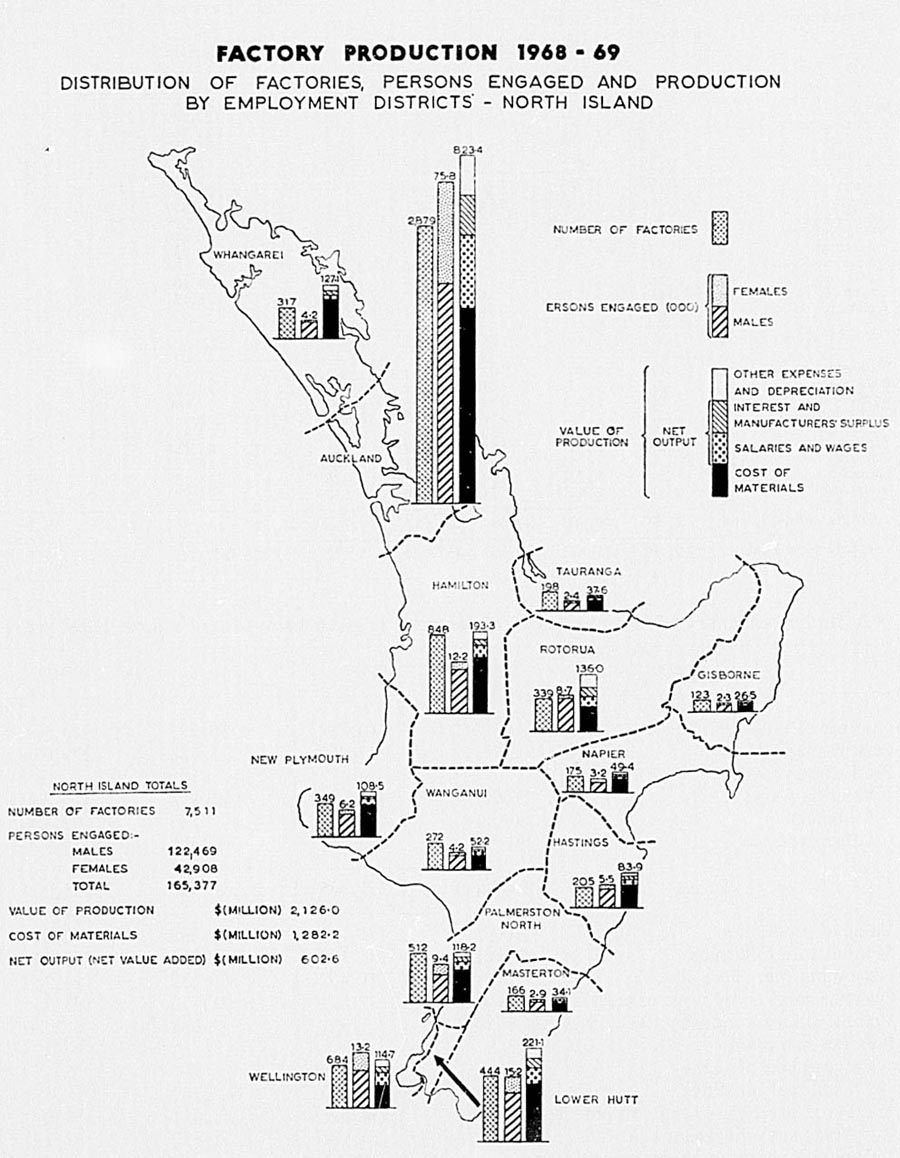
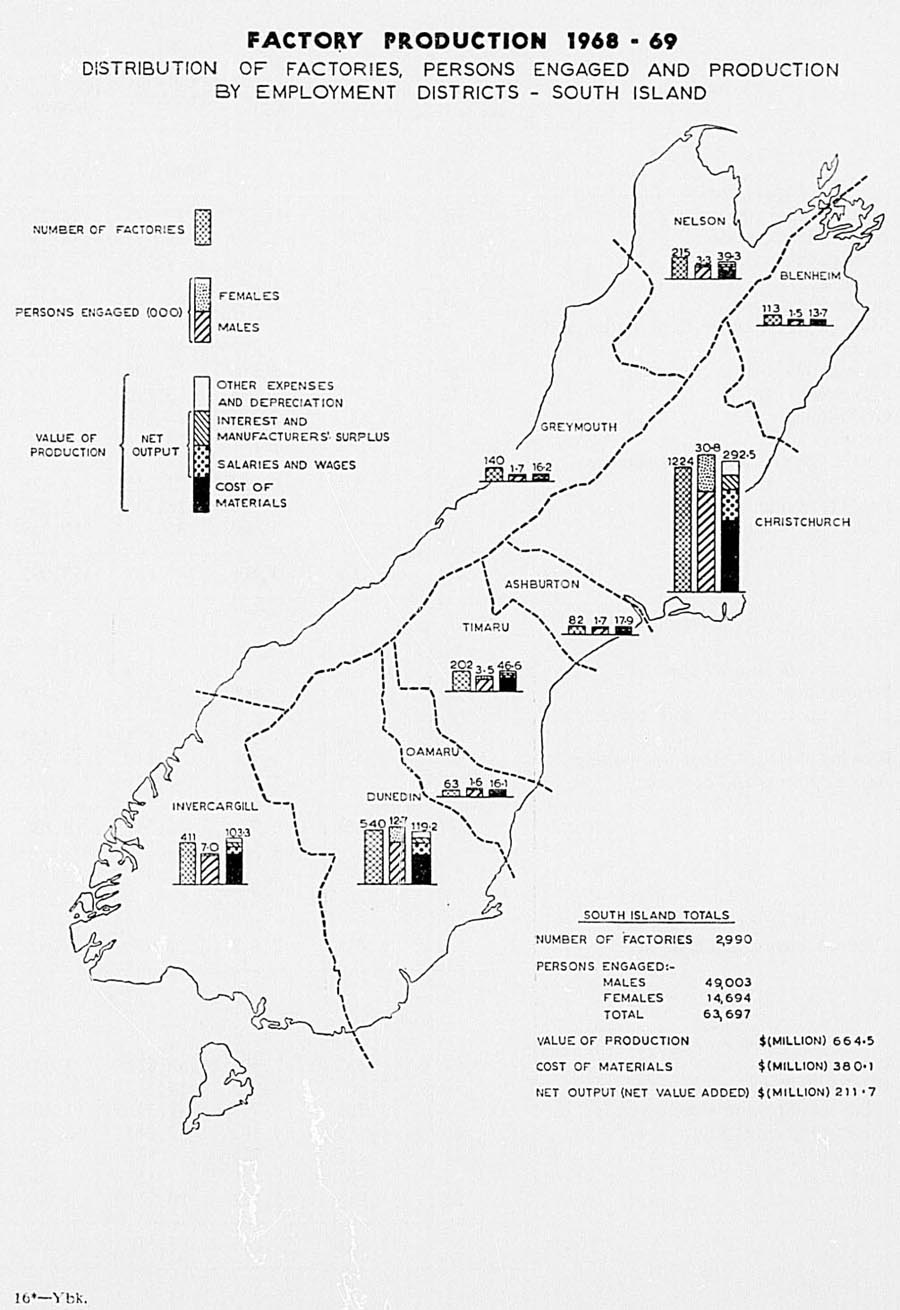
The following table gives a summary of some of the principal production statistics for the year 1968-69 classified by individual industries. Totals for the industrial groups to which these industries belong are also shown.
| Industry | Number of Establishments | Number of Persons Engaged | Salaries and Wages Paid | Value of Production | Net Output (Net Value Added) | |
|---|---|---|---|---|---|---|
| $(000) | ||||||
| Food Manufacturing Industries | ||||||
| Meat freezing and preserving | 45 | 23.630 | 69,725 | 457,319 | 97,278 | |
| Ham and bacon curing | 36 | 1,269 | 2,859 | 22,398 | 4,564 | |
| Sausage casings | 9 | 234 | 569 | 2,194 | 842 | |
| Ice cream | 16 | 561 | 1,249 | 8,698 | 2,392 | |
| Butter and cheese | 158 | 2,583 | 6,455 | 183,415 | 7,249 | |
| Milk products other than butter and cheese | 68 | 1,947 | 5,027 | 59,725 | 7,105 | |
| Fruit and vegetable preserving | 28 | 2,643 | 5,566 | 32,904 | 9,946 | |
| Fish preserving | 13 | 207 | 476 | 3,496 | 696 | |
| Grain milling | 39 | 1,000 | 2,127 | 28,401 | 4,170 | |
| Biscuits | 8 | 1,234 | 2,229 | 13,319 | 4,582 | |
| Cocoa, chocolate, and sugar confectionery | 43 | 2,376 | 4,232 | 21,242 | 7,428 | |
| Feeds for animals and fowls | 41 | 489 | 1,230 | 18,540 | 3,334 | |
| Food preparations, n.e.i. | 56 | 1,745 | 3,864 | 35,971 | 10,308 | |
| Totals | 560 | 39,918 | 105,608 | 887,623 | 159,895 | |
| Beverage Industries | ||||||
| Winemaking | 56 | 364 | 806 | 5,825 | 2,067 | |
| Distilling, rectifying, and blending of spirits | 4 | 122 | 304 | 1,673 | 430 | |
| Brewing of ale and stout and malting | 17 | 1,425 | 4,106 | 31,884 | 13,386 | |
| Aerated waters and cordials | 53 | 747 | 1,518 | 7,205 | 2,950 | |
| Totals | 130 | 2,658 | 6,734 | 46,588 | 18,834 | |
| Tobacco Manufactures | ||||||
| Tobacco, cigars, and cigarettes | 3 | 1,018 | 2,088 | 20,979 | 5,069 | |
| Manufacture of Textiles | ||||||
| Woolscouring | 24 | 833 | 2,594 | 56,828 | 3,942 | |
| Woollen milling | 20 | 3,908 | 7,929 | 24,731 | 9,033 | |
| Other spinning and weaving mills | 25 | 2,793 | 6,739 | 31,702 | 11,302 | |
| Hosiery and other knitting mills | 80 | 4,976 | 9,107 | 37,240 | 13,617 | |
| Phormium flax | 11 | 115 | 220 | 698 | 269 | |
| Linen flax | 1 | 31 | 61 | 126 | 62 | |
| Textiles, n.e.i. | 28 | 1,215 | 2,882 | 16,227 | 3,742 | |
| Totals | 189 | 13,871 | 29,533 | 167,551 | 41,967 | |
| Industry | Number of Establishments | Number of Persons Engaged | Salaries and Wages Paid | Value of Production | Net Output (Net Value Added) |
|---|---|---|---|---|---|
| $(000) | |||||
| Manufacture of Footwear, Other Wearing Apparel, and Made-up Textiles | |||||
| Leather gloves and apparel | 7 | 115 | 194 | 590 | 212 |
| Men's and boys' outerwear | 108 | 3.601 | 5,316 | 16,629 | 6,642 |
| Women's and girls' outerwear | 249 | 5,198 | 7,431 | 23,782 | 9,847 |
| Underclothing | 47 | 1,592 | 2,192 | 8,019 | 2,674 |
| Hats, caps, and millinery | 51 | 711 | 1,078 | 2,926 | 1,367 |
| Corsetry | 26 | 1,499 | 2,049 | 6,571 | 3,083 |
| Neckties | 5 | 175 | 297 | 1,070 | 427 |
| Shirts and pyjamas | 45 | 1,910 | 2,546 | 8,045 | 3,121 |
| Wearing apparel, n.e.i. | 119 | 4,559 | 6,574 | 23,783 | 7,829 |
| Fur coats and necklets | 27 | 179 | 311 | 818 | 376 |
| Footwear (other than rubber) | 109 | 5,165 | 9,385 | 27,154 | 11,049 |
| Canvas goods | 46 | 591 | 946 | 3,563 | 1,291 |
| Made-up textiles (other than wearing apparel) | 74 | 1,008 | 1,486 | 6,120 | 2,115 |
| Totals | 913 | 26,303 | 39,806 | 129,070 | 50,033 |
| Manufactures of Wood and Cork (Except Manufacture of Furniture) | |||||
| Sawmills | 366 | 5,791 | 14,269 | 57,646 | 20,932 |
| Planing mills and timber preservation | 178 | 2,317 | 5,011 | 35,001 | 9,536 |
| Joinery | 418 | 4,222 | 9,680 | 37,529 | 13,776 |
| Wooden containers | 36 | 432 | 1,034 | 4,558 | 1,187 |
| Plywood and veneer | 12 | 932 | 2,387 | 10,100 | 4,247 |
| Wood products, n.e.i. | 81 | 695 | 1,503 | 5,203 | 2,258 |
| Totals | 1,091 | 14,389 | 33,884 | 150,037 | 51,937 |
| Manufacture of Furniture and Fixtures | |||||
| Furniture | 403 | 4,714 | 10,384 | 33,062 | 13,074 |
| Mattress manufacture | 21 | 464 | 948 | 4,662 | 1,556 |
| Venetian blinds | 17 | 165 | 357 | 2,005 | 700 |
| Totals | 441 | 5,343 | 11,689 | 39,729 | 15,331 |
| Manufacture of Paper and Paper Products | |||||
| Pulp, paper, and paperboard | 6 | 3,421 | 12,034 | 75,829 | 27,256 |
| Cardboard boxes, cartons, and containers | 41 | 2,123 | 4,949 | 28,923 | 8,276 |
| Paper bags and paper sacks | 16 | 822 | 1,922 | 15,105 | 4,277 |
| Paper products, n.e.i. | 50 | 1,942 | 3,996 | 26,434 | 8,244 |
| Totals | 113 | 8,308 | 22,901 | 146,291 | 48,054 |
| Printing, Publishing, and Allied Industries | |||||
| Printing and publishing | 83 | 7,253 | 18,161 | 50,788 | 27,458 |
| Job and general printing | 370 | 6,756 | 15,251 | 44,637 | 20,348 |
| Service industries for printing trade | 56 | 779 | 2,030 | 4,332 | 2,673 |
| Totals | 509 | 14,788 | 35,442 | 99,757 | 50,479 |
| Industry | Number of Establishments | Number of Persons Engaged | Salaries and Wages Paid | Value of Production | Net Output (Net Value Added) |
|---|---|---|---|---|---|
| Manufacture of Leather and Leather Products (Except Footwear) | $(000) | ||||
| Tanning | 13 | 811 | 1,960 | 9,071 | 3,094 |
| Fellmongery | 7 | 133 | 313 | 3,732 | 510 |
| Leather goods | 83 | 1,257 | 2,002 | 6,598 | 2,786 |
| Totals | 103 | 2,201 | 4,275 | 19,401 | 6,390 |
| Manufacture of Rubber Products | |||||
| Motor vehicle tyres and tubes | 3 | 1,063 | 3,673 | 16,229 | 6,571 |
| Rubber goods (other than motor vehicle tyres and tubes) | 33 | 1,990 | 4,794 | 16,566 | 6,676 |
| Vulcanising and tyre retreading | 85 | 787 | 1,825 | 9,340 | 4,248 |
| Totals | 121 | 3,840 | 10,291 | 42,135 | 17,495 |
| Manufacture of Chemicals and Chemical Products | |||||
| Chemical fertilisers | 15 | 1,152 | 3,406 | 48,054 | 7,687 |
| Vegetable and animal oils and fats | 30 | 410 | 1,092 | 7,586 | 2,030 |
| Ink | 10 | 293 | 675 | 2,948 | 1,312 |
| Soap | 17 | 518 | 1,247 | 8,627 | 3,067 |
| Paint and varnish | 34 | 883 | 2,274 | 18,656 | 5,462 |
| Pharmaceuticals, toilet goods, and cosmetics | 40 | 1,379 | 2,419 | 22,740 | 7,156 |
| Chemical products, n.e.i. | 83 | 1,976 | 3,652 | 32,647 | 9,869 |
| Totals | 229 | 6,611 | 15,765 | 141,258 | 36,582 |
| Manufacture of Products of Petroleum and Coal | |||||
| Petroleum and coal products | 18 | 395 | 1,315 | 71,152 | 9,550 |
| Bituminous paving and roofing materials | 34 | 263 | 702 | 6,744 | 1,689 |
| Totals | 52 | 658 | 2,017 | 77,895 | 11,239 |
| Manufacture of Non-metallic Mineral Products (Except Products of Petroleum and Coal) | |||||
| Structural clay products | 38 | 1,034 | 2,525 | 6,600 | 3,253 |
| Pottery, china, and earthenware | 11 | 858 | 1,807 | 4,018 | 2,407 |
| Cement | 5 | 766 | 2,216 | 14,891 | 5,853 |
| Glass and glass products | 47 | 1,890 | 4,732 | 15,837 | 7,452 |
| Concrete products | 245 | 2,266 | 5,287 | 20,356 | 8,713 |
| Lime | 89 | 308 | 710 | 3,187 | 1,211 |
| Fibrous plaster | 68 | 353 | 812 | 2,204 | 968 |
| Non-metallic mineral products, n.e.i. | 22 | 768 | 2,180 | 11,660 | 3,288 |
| Totals | 525 | 8,243 | 20,269 | 78,754 | 33,144 |
| Industry | Number of Establishments | Number of Persons Engaged | Salaries and Wages Paid | Value of Production | Net Output (Net Value Added) |
|---|---|---|---|---|---|
| Basic Metal Industries | $(000) | ||||
| Basic metal industries | 90 | 2,142 | 6,300 | 36,114 | 8,932 |
| Manufacture of Metal Products (Except Machinery and Transport Equipment) | |||||
| Sheet-metal working | 211 | 6,019 | 14,746 | 61,410 | 23,207 |
| Wire working | 57 | 857 | 2,065 | 10,065 | 3,111 |
| Nail making | 6 | 158 | 318 | 2,627 | 422 |
| Electroplating and metal polishing | 78 | 867 | 2,060 | 5,093 | 2,751 |
| Metal products, n.e.i. | 353 | 6,487 | 16,252 | 57,661 | 22,968 |
| Totals | 705 | 14,388 | 35,441 | 136,856 | 52,459 |
| Manufacture, Assembly, and Repair of Machinery (Except Electrical Machinery) | |||||
| Agricultural and pastoral machinery | 114 | 1,184 | 2,686 | 16,058 | 3,525 |
| Machinery, n.e.i. | 786 | 14,781 | 37,060 | 121,891 | 52,388 |
| Totals | 900 | 15,965 | 39,746 | 137,948 | 55,913 |
| Manufacture of Electrical Machinery, Apparatus, Appliances, and Supplies | |||||
| Range making | 6 | 987 | 2,115 | 7,037 | 2,340 |
| Radio and television assembly and manufacture | 27 | 1,879 | 3,745 | 14,788 | 4,561 |
| Electrical machinery, appliances, n.e.i. | 305 | 5,838 | 12,860 | 58,738 | 18,927 |
| Totals | 338 | 8,704 | 18,720 | 80,564 | 25,829 |
| Manufacture of Transport Equipment | |||||
| Boat building and ship repairing | 80 | 1,335 | 3,500 | 8,498 | 4,423 |
| Motor-vehicle assembly | 18 | 3,480 | 8,341 | 86,389 | 15,249 |
| Motor-body building | 81 | 1,620 | 3,606 | 12,595 | 5,026 |
| Repairs to motor vehicles | 2,834 | 21,371 | 44,350 | 144,670 | 57,128 |
| Aircraft manufacture, maintenance and repair | 37 | 2,397 | 6,581 | 14,025 | 7,584 |
| Perambulators | 6 | 163 | 296 | 643 | 325 |
| Transport equipment, n.e.i. | 38 | 1,399 | 3,266 | 11,761 | 4,429 |
| Totals | 3,094 | 31,765 | 69,939 | 278,581 | 94,164 |
| Miscellaneous Manufacturing Industries | |||||
| Optical, surgical, and dental, etc., equipment | 31 | 285 | 621 | 1,763 | 833 |
| Jewellery | 96 | 912 | 1,770 | 5,585 | 2,387 |
| Brushes and brooms | 12 | 451 | 857 | 3,744 | 1,436 |
| Toys and sports goods | 40 | 902 | 1,594 | 5,633 | 2,469 |
| Plastics | 134 | 4,239 | 10,168 | 45,441 | 18,590 |
| Manufacturing Industries, n.e.i. | 82 | 1,172 | 2,349 | 11,151 | 4,804 |
| Totals | 395 | 7,961 | 17,360 | 73,317 | 30,158 |
| Grand totals | 10,501 | 229,074 | 527,809 | 2,790,448 | 814,263 |
ESTABLISHMENTS AND EMPLOYEES—In recent years the shortage of labour in the principal centres has resulted in branch factories and workrooms being opened in secondary towns to tap the labour resources in those areas. The 1968-69 survey covered 10,501 factories, the largest number included in any year and a 23 percent increase on the 8,565 establishments in 1958-59.
The following table shows the number of factories in each statistical area.
| Statistical Area | Number of Factories | ||||
|---|---|---|---|---|---|
| 1964-65 | 1965-66 | 1966-67 | 1967-68 | 1968-69 | |
| Northland | 277 | 281 | 299 | 296 | 317 |
| Central Auckland | 2,644 | 2,694 | 2,810 | 2,854 | 2,879 |
| South Auckland - Bay of Plenty | 1,207 | 1,233 | 1,342 | 1,346 | 1,383 |
| East Coast | 120 | 122 | 124 | 119 | 124 |
| Hawke's Bay | 411 | 412 | 435 | 426 | 434 |
| Taranaki | 379 | 366 | 367 | 366 | 356 |
| Wellington | 1,898 | 1,946 | 2,033 | 2,011 | 2,018 |
| Marlborough | 118 | 107 | 110 | 111 | 113 |
| Nelson | 238 | 246 | 262 | 257 | 256 |
| Westland | 108 | 114 | 107 | 96 | 99 |
| Canterbury | 1,412 | 1,461 | 1,499 | 1,514 | 1,508 |
| Otago | 560 | 565 | 596 | 593 | 603 |
| Southland | 381 | 398 | 410 | 410 | 411 |
| Totals | 9,753 | 9,945 | 10,394 | 10,397 | 10,501 |
An analysis of the 1968-69 totals by industrial groups in the various statistical areas is given in the next table.
| Industry Group | Northland | Central Auckland | South Auckland - Bay of Plenty | East Coast | Hawke's Bay | Taranaki | Wellington | |||
|---|---|---|---|---|---|---|---|---|---|---|
| Number of Factories 1968-69 | ||||||||||
| Food | 19 | 104 | 86 | 8 | 20 | 53 | 85 | |||
| Beverages | 4 | 51 | 13 | 2 | 14 | 6 | 13 | |||
| Tobacco manufactures | - | 1 | - | - | 1 | - | 1 | |||
| Textiles | 1 | 69 | 5 | 2 | 8 | 2 | 49 | |||
| Footwear, other wearing apparel, and made-up textile goods | 5 | 424 | 41 | 5 | 19 | 16 | 211 | |||
| Wood and cork products (except furniture) | 46 | 167 | 223 | 16 | 50 | 48 | 161 | |||
| Furniture and fixtures | 4 | 161 | 41 | 1 | 20 | 11 | 85 | |||
| Paper and paper products | - | 42 | 6 | 3 | 2 | 1 | 32 | |||
| Printing, publishing, etc. | 8 | 153 | 44 | 4 | 17 | 8 | 149 | |||
| Leather and leather products (except footwear and apparel) | - | 49 | 3 | 1 | 4 | 2 | 14 | |||
| Rubber products | 3 | 28 | 18 | 3 | 4 | 8 | 24 | |||
| Chemicals and chemical products | 2 | 90 | 15 | 1 | 7 | 7 | 57 | |||
| Petroleum and coal products | 2 | 10 | 4 | - | 1 | 3 | 18 | |||
| Non-metallic mineral products, n.e.i. | 40 | 89 | 67 | 7 | 31 | 18 | 78 | |||
| Basic metal manufactures | 1 | 37 | 3 | - | 2 | 2 | 19 | |||
| Metal products (except machinery and transport equipment) | 9 | 311 | 50 | 5 | 22 | 10 | 130 | |||
| Machinery (except electrical) | 25 | 219 | 136 | 12 | 30 | 34 | 173 | |||
| Electrical machinery and appliances | 4 | 105 | 46 | 3 | 17 | 7 | 77 | |||
| Transport equipment | 143 | 576 | 566 | 50 | 160 | 115 | 550 | |||
| Miscellaneous products | 1 | 193 | 16 | 1 | 5 | 5 | 92 | |||
| Totals | 317 | 2,879 | 1,383 | 124 | 434 | 356 | 2,018 | |||
| Food | 12 | 20 | 5 | 83 | 38 | 27 | 560 | |||
| Beverages | 1 | 7 | 2 | 9 | 6 | 2 | 130 | |||
| Tobacco manufactures | - | - | - | - | - | - | 3 | |||
| Textiles | - | 3 | - | 30 | 13 | 7 | 189 | |||
| Footwear, other wearing apparel, and made-up textile goods | 4 | 5 | 2 | 135 | 39 | 7 | 913 | |||
| Wood and cork products (except furniture) | 20 | 63 | 41 | 151 | 58 | 47 | 1,091 | |||
| Furniture and fixtures | 3 | 7 | - | 77 | 22 | 9 | 441 | |||
| Paper and paper products | - | 1 | - | 16 | 6 | 4 | 113 | |||
| Printing, publishing, etc. | 3 | 8 | 4 | 68 | 31 | 12 | 509 | |||
| Leather and leather products (except footwear and apparel) | 1 | - | - | 20 | 5 | 4 | 103 | |||
| Rubber products | 1 | 1 | 1 | 21 | 5 | 4 | 121 | |||
| Chemicals and chemical products | 1 | 6 | - | 27 | 13 | 3 | 229 | |||
| Petroleum and coal products | - | - | - | 10 | 4 | - | 52 | |||
| Non-metallic mineral products, n.e.i. | 6 | 23 | 4 | 84 | 35 | 43 | 525 | |||
| Basic metal manufactures | - | - | - | 20 | 3 | 3 | 90 | |||
| Metal products (except machinery and transport equipment) | 1 | 11 | 2 | 105 | 32 | 17 | 705 | |||
| Machinery (except electrical) | 11 | 17 | 4 | 137 | 56 | 46 | 900 | |||
| Electrical machinery and appliances | - | 4 | - | 48 | 19 | 8 | 338 | |||
| Transport equipment | 48 | 79 | 32 | 409 | 201 | 165 | 3,094 | |||
| Miscellaneous products | 1 | 1 | 2 | 58 | 17 | 3 | 395 | |||
| Totals | 113 | 256 | 99 | 1,508 | 603 | 411 | 10,501 | |||
The number of factories and persons engaged are shown together in the following table, classified by industrial groups. Persons engaged include proprietors actively participating in their own businesses but exclude all persons engaged in selling and distribution. Figures for persons engaged refer to the average number over the whole year.
| Industry Group | Number of Factories | Number of Persons Engaged | ||||
|---|---|---|---|---|---|---|
| 1966-67 | 1967-68 | 1968-69 | 1966-67 | 1967-68 | 1968-69 | |
| Food | 602 | 586 | 560 | 37,078 | 38,732 | 39,918 |
| Beverages | 128 | 128 | 130 | 2,554 | 2,630 | 2,658 |
| Tobacco manufactures | 3 | 3 | 3 | 1,129 | 1,154 | 1,018 |
| Textiles | 189 | 187 | 189 | 13,760 | 13,185 | 13,871 |
| Footwear, other wearing apparel, and made-up textile goods | 989 | 948 | 913 | 28,236 | 27,012 | 26,303 |
| Wood and cork products (except furniture) | 1,136 | 1,110 | 1,091 | 14,855 | 14,019 | 14,389 |
| Furniture and fixtures | 489 | 483 | 441 | 5,844 | 5,427 | 5,343 |
| Paper and paper products | 108 | 110 | 113 | 7,974 | 8,060 | 8,308 |
| Printing, publishing, etc. | 510 | 508 | 509 | 14,511 | 14,758 | 14,788 |
| Leather and leather products (except footwear and apparel) | 103 | 100 | 103 | 2,067 | 2,102 | 2,201 |
| Rubber products | 120 | 126 | 121 | 3,699 | 3,743 | 3,840 |
| Chemicals and chemical products | 222 | 222 | 229 | 6,621 | 6,439 | 6,611 |
| Petroleum and coal products | 49 | 53 | 52 | 743 | 695 | 658 |
| Non-metallic mineral products, n.e.i. | 590 | 556 | 525 | 8,863 | 8,348 | 8,243 |
| Basic metal manufactures | 87 | 88 | 90 | 1,460 | 1,934 | 2,142 |
| Metal products (except machinery and transport equipment) | 695 | 709 | 705 | 14,699 | 14,149 | 14,388 |
| Machinery (except electrical) | 859 | 876 | 900 | 16,170 | 15,353 | 15,965 |
| Electrical machinery and appliances | 306 | 323 | 338 | 9,515 | 8,708 | 8,704 |
| Transport equipment | 2,830 | 2,885 | 3,094 | 32,219 | 31,740 | 31,765 |
| Miscellaneous products | 379 | 396 | 395 | 7,305 | 7,550 | 7,961 |
| Totals | 10,394 | 10,397 | 10,501 | 229,302 | 225,738 | 229,074 |
Persons engaged are shown in the table below for the year 1968-69 classified into working proprietors, managerial and clerical, professional, and technical staff; and wage earners.
| Industry Group | Working Proprietors, Managers, Clerical, Professional, Technical | Wage-earning Employees | All Persons Engaged | ||||
|---|---|---|---|---|---|---|---|
| Males | Females | Males | Females | Males | Females | Total | |
| Food | 3,989 | 1,303 | 29,783 | 4,843 | 33,772 | 6,146 | 39,918 |
| Beverages | 484 | 212 | 1,687 | 275 | 2,171 | 487 | 2,658 |
| Tobacco manufactures | 74 | 67 | 367 | 510 | 441 | 577 | 1,018 |
| Textiles | 1,030 | 576 | 6,517 | 5,748 | 7,547 | 6,324 | 13,871 |
| Footwear, other wearing apparel, and made-up textile goods | 1,524 | 1,196 | 4,077 | 19,506 | 5,601 | 20,702 | 26,303 |
| Wood and cork products (except furniture) | 2,016 | 382 | 11,779 | 212 | 13,795 | 594 | 14,389 |
| Furniture and fixtures | 724 | 235 | 3,784 | 600 | 4,508 | 835 | 5,343 |
| Paper and paper products | 1,034 | 421 | 5,196 | 1,657 | 6,230 | 2,078 | 8,308 |
| Printing, publishing, etc. | 1,971 | 1,334 | 9,024 | 2,459 | 10,995 | 3,793 | 14,788 |
| Leather and leather products (except footwear and apparel) | 232 | 91 | 1,003 | 875 | 1,235 | 966 | 2,201 |
| Rubber products | 593 | 193 | 2,520 | 534 | 3,113 | 727 | 3,840 |
| Chemicals and chemical products | 1,331 | 593 | 3,268 | 1,419 | 4,599 | 2,012 | 6,611 |
| Petroleum and coal products | 177 | 33 | 414 | 34 | 591 | 67 | 658 |
| Non-metallic mineral products, n.e.i. | 1,366 | 348 | 6,003 | 526 | 7,369 | 874 | 8,243 |
| Basic metal manufactures | 402 | 96 | 1,599 | 45 | 2,001 | 141 | 2,142 |
| Metal products (except machinery and transport equipment) | 2,202 | 683 | 10,168 | 1,335 | 12,370 | 2,018 | 14,388 |
| Machinery (except electrical) | 2,654 | 779 | 12,094 | 438 | 14,748 | 1,217 | 15,965 |
| Electrical machinery and appliances | 1,330 | 559 | 4,772 | 2,043 | 6,102 | 2,602 | 8,704 |
| Transport equipment | 5,421 | 1,845 | 23,796 | 703 | 29,217 | 2,548 | 31,765 |
| Miscellaneous products | 1,112 | 511 | 3,955 | 2,383 | 5,067 | 2,894 | 7,961 |
| Totals | 29,666 | 11,457 | 141,806 | 46,145 | 171,472 | 57,602 | 229,074 |
Further information is given in the following table on persons engaged in 1968-69. Totals in each industrial group are shown by statistical areas.
| Industry Group | Northland | Central Auckland | South Auckland - Bay of Plenty | East Coast | Hawke's Bay | Taranaki | Wellington |
|---|---|---|---|---|---|---|---|
| Food | 1,256 | 8,456 | 3,449 | 1,096 | 3,535 | 1,955 | 6,077 |
| Beverages | 26 | 1,038 | 249 | 32 | 238 | 72 | 369 |
| Tobacco manufactures | - | 46 | - | - | 502 | - | 470 |
| Textiles | 12 | 4,465 | 81 | 160 | 477 | 40 | 2,903 |
| Footwear, other wearing apparel, and made-up textile goods | 64 | 11,829 | 1,528 | 79 | 430 | 636 | 5,329 |
| Wood and cork products (except furniture) | 387 | 2,386 | 4,995 | 85 | 369 | 433 | 1,483 |
| Furniture and fixtures | 18 | 2,721 | 243 | 4 | 264 | 58 | 713 |
| Paper and paper products | - | 2,893 | 2,879 | 26 | 73 | 4 | 1,384 |
| Printing, publishing, etc, | 189 | 5,025 | 882 | 153 | 568 | 332 | 4,150 |
| Leather and leather products (except footwear and apparel) | - | 991 | 19 | 8 | 24 | 40 | 349 |
| Rubber products | 18 | 947 | 151 | 16 | 37 | 33 | 835 |
| Chemicals and chemical products | 90 | 2,427 | 334 | 8 | 205 | 225 | 1,958 |
| Petroleum and coal products | 186 | 141 | 62 | - | 4 | 8 | 187 |
| Non-metallic mineral products, n.e.i. | 725 | 3,045 | 643 | 42 | 193 | 91 | 866 |
| Basic metal manufactures | 2 | 1,204 | 31 | - | 12 | 288 | 233 |
| Metal products (except machinery and transport equipment) | 63 | 7,578 | 595 | 24 | 315 | 164 | 2,856 |
| Machinery (except electrical) | 212 | 5,760 | 2,020 | 106 | 436 | 695 | 2,800 |
| Electrical machinery and appliances | 14 | 3,097 | 607 | 24 | 260 | 255 | 1,948 |
| Transport equipment | 870 | 7,257 | 4,077 | 440 | 1,154 | 920 | 7,750 |
| Miscellaneous products | 22 | 4,461 | 478 | 3 | 62 | 32 | 1,728 |
| Totals | 4,154 | 75,767 | 23,323 | 2,306 | 9,158 | 6,281 | 44,388 |
| Industry Group | Marlborough | Nelson | Westland | Canterbury | Otago | Southland | Total, N.Z. |
|---|---|---|---|---|---|---|---|
| Food | 429 | 974 | 46 | 5,793 | 3,659 | 3,193 | 39,918 |
| Beverages | 13 | 67 | 42 | 293 | 176 | 43 | 2,658 |
| Tobacco manufactures | - | - | - | - | - | - | 1,018 |
| Textiles | - | 38 | - | 3,591 | 1,968 | 136 | 13,871 |
| Footwear, other wearing apparel, and made-up textile goods | 195 | 61 | 138 | 4,835 | 1,102 | 77 | 26,303 |
| Wood and cork products (except furniture) | 102 | 560 | 602 | 1,805 | 580 | 602 | 14,389 |
| Furniture and fixtures | 13 | 56 | - | 946 | 247 | 60 | 5,343 |
| Paper and paper products | - | 14 | - | 495 | 210 | 330 | 8,308 |
| Printing, publishing, etc. | 89 | 184 | 53 | 1,915 | 992 | 256 | 14,788 |
| Leather and leather products (except footwear and apparel) | 3 | - | - | 493 | 232 | 42 | 2,201 |
| Rubber products | 4 | 4 | 5 | 1,743 | 26 | 21 | 3,840 |
| Chemicals and chemical products | 14 | 83 | - | 719 | 433 | 115 | 6,611 |
| Petroleum and coal products | - | - | - | 52 | 18 | - | 658 |
| Non-metallic mineral products, n.e.i. | 57 | 403 | 28 | 1,439 | 484 | 227 | 8,243 |
| Basic metal manufactures | - | - | - | 298 | 60 | 14 | 2,142 |
| Metal products (except machinery and transport equipment) | 8 | 142 | 8 | 1,732 | 758 | 145 | 14,388 |
| Machinery (except electrical) | 143 | 96 | 64 | 2,345 | 854 | 434 | 15,965 |
| Electrical machinery and appliances | - | 16 | - | 1,796 | 642 | 45 | 8,704 |
| Transport equipment | 386 | 1,003 | 241 | 4,715 | 1,746 | 1,206 | 31,765 |
| Miscellaneous products | 54 | 3 | 20 | 933 | 153 | 12 | 7,961 |
| Totals | 1,510 | 3,704 | 1,247 | 35,938 | 14,340 | 6,958 | 229,074 |
The sex distribution among the persons engaged shows a considerable preponderance of males—in 1968-69 for every female engaged, there were three males. In the smaller districts there are few industries employing female labour to any great extent. The male preponderance is considerably smaller in the four main districts, where female labour is in great demand mainly on account of the importance of the clothing and textile industries. In two industrial groups the number of females exceeded the number of males—viz., the tobacco group where there were 131 females to every 100 males, and the footwear, other wearing apparel and made-up textiles group where there were 370 females per 100 males. Individual industries in the other groups with more females than males were—biscuits; cocoa, chocolate, and sugar confectionery; hosiery and other knitting mills; leather goods; pharmaceuticals, toilet goods, and cosmetics; and manufacturing industries, n.e.i. The upper table on the previous page shows the average number of males and females engaged according to industry groups for the year 1968-69.
Further information is available in the table below on the extent to which females were engaged in factories in New Zealand for 1968-69. This table gives by statistical areas the number of males per 100 females engaged, and the total persons engaged per 1,000 of population.
| Statistical Area | Males | Females | Total | Number of Males per 100 Females | Total Population at 1 April 1969 | Total Persons Engaged per 1,000 of Population |
|---|---|---|---|---|---|---|
| Northland | 3,832 | 322 | 4,154 | 1,190 | 94,900 | 44 |
| Central Auckland | 51,912 | 23,855 | 75,767 | 218 | 656,198 | 115 |
| South Auckland - Bay of Plenty | 20,113 | 3,210 | 23,323 | 627 | 408,800 | 57 |
| East Coast | 1,769 | 537 | 2,306 | 329 | 47,100 | 49 |
| Hawke's Bay | 7,319 | 1,839 | 9,158 | 398 | 129,600 | 71 |
| Taranaki | 5,284 | 997 | 6,281 | 580 | 101,500 | 62 |
| Wellington | 32,240 | 12,148 | 44,388 | 265 | 542,000 | 82 |
| Marlborough | 1,207 | 303 | 1,510 | 398 | 30,400 | 50 |
| Nelson | 3,032 | 672 | 3,704 | 451 | 68,400 | 54 |
| Westland | 1,058 | 189 | 1,247 | 560 | 23,900 | 52 |
| Canterbury | 26,697 | 9,241 | 35,938 | 289 | 388,141 | 93 |
| Otago | 10,582 | 3,758 | 14,340 | 282 | 182,300 | 79 |
| Southland | 6,427 | 531 | 6,958 | 1,210 | 107,600 | 65 |
| All areas | 171,472 | 57,602 | 229,074 | 298 | 2,780,839 | 82 |
A classification of the establishments, according to the number of persons engaged, is now given. Since 1951-52 the series excludes certain sectors of production previously included—principal omissions being the logging activities of sawmills and the generation and supply of gas and electricity.
| Year | Factories With Persons Engaged Numbering— | Total | ||||
|---|---|---|---|---|---|---|
| 10 or Under | 11-20 | 21-50 | 51-100 | Over 100 | ||
| Number of Factories | ||||||
| 1934-35 | 3,725 | 764 | 496 | 143 | 142 | 5,270 |
| 1939-40 | 4,218 | 957 | 772 | 212 | 183 | 6,342 |
| 1944-45 | 4,139 | 1,046 | 833 | 270 | 197 | 6,485 |
| 1949-50 | 4,993 | 1,409 | 1,106 | 312 | 207 | 8,027 |
| 1954-55 | 5,350 | 1,473 | 1,020 | 310 | 213 | 8,366 |
| 1959-60 | 5,242 | 1,621 | 1,108 | 312 | 267 | 8,550 |
| 1964-65 | 5,893 | 1,828 | 1,294 | 409 | 329 | 9,753 |
| 1968-69 | 6,517 | 1,811 | 1,350 | 467 | 356 | 10,501 |
| Number of Persons Engaged | ||||||
| 1934-35 | 14,901 | 11,321 | 15,309 | 9,716 | 28,111 | 79,358 |
| 1939-40 | 17,212 | 14,048 | 23,316 | 14,737 | 39,409 | 108,722 |
| 1944-45 | 18,382 | 15,547 | 25,787 | 18,809 | 43,889 | 122,414 |
| 1949-50 | 24,481 | 20,608 | 34,386 | 21,304 | 43,530 | 144,309 |
| 1954-55 | 27,206 | 21,432 | 31,650 | 21,808 | 51,479 | 153,575 |
| 1959-60 | 26,926 | 23,755 | 34,105 | 21,666 | 65,521 | 171,973 |
| 1964-65 | 29,624 | 26,504 | 40,399 | 28,091 | 86,432 | 211,050 |
| 1968-69 | 32,230 | 26,401 | 42,195 | 32,557 | 95,691 | 229,074 |
The classification according to the number of persons engaged shows clearly that, judged by the standards of highly industrialised communities, the average size of the industrial unit in New Zealand is small. Factories employing 10 persons or under accounted for 62 percent of the total number of factories in 1968-69.
SALARIES AND WAGES—The figures relating to the amounts paid as salaries and wages include amounts paid as bonuses and for overtime, also amounts drawn in lieu of salary by working proprietors. The amounts received by male and female employees (inclusive of all groups—executive, clerical, professional and technical, and wage earning), and the average amount received per employee of each sex, are set out below.
| Year | Males | Females | Both Sexes | |||
|---|---|---|---|---|---|---|
| Total | Average | Total | Average | Total | Average | |
| $(000) | $ | $(000) | $ | $(000) | $ | |
| 1961-62 | 274,948 | 1,958 | 48,118 | 1,020 | 323,064 | 1,722 |
| 1962-63 | 290,592 | 2,020 | 49,262 | 1,034 | 339,854 | 1,774 |
| 1963-64 | 313,546 | 2,104 | 55,038 | 1,094 | 368,584 | 1,850 |
| 1964-65 | 350,722 | 2,224 | 61,270 | 1,148 | 411,992 | 1,952 |
| 1965-66 | 387,046 | 2,342 | 67,984 | 1,181 | 455,030 | 2,042 |
| 1966-67 | 419,670 | 2,468 | 73,060 | 1,233 | 492,730 | 2,149 |
| 1967-68 | 422,876 | 2,510 | 73,002 | 1,275 | 495,878 | 2,197 |
| 1968-69 | 451,986 | 2,636 | 75,822 | 1,316 | 527,809 | 2,304 |
The averages shown relate to all persons engaged, irrespective of age, industry, status, and personal occupation, and year-to-year comparisons may also be affected by changes in any of these factors. The figures do, however, give an indication of the increased earnings of factory workers in recent years.
The amount of salaries and wages paid in each industrial group and in all industries during the latest three years is given hereunder.
| Industry Group | Salaries and Wages Paid | ||
|---|---|---|---|
| 1966-67 | 1967-68 | 1968-69 | |
| $(000) | |||
| Food | 88,672 | 95,954 | 105,608 |
| Beverages | 6,083 | 6,458 | 6,734 |
| Tobacco manufactures | 2,166 | 2,220 | 2,088 |
| Textiles | 26,151 | 26,066 | 29,533 |
| Footwear, other wearing apparel, and made-up textile goods | 40,031 | 39,801 | 39,806 |
| Wood and cork products (except furniture) | 33,279 | 31,652 | 33,884 |
| Furniture and fixtures | 12,579 | 11,286 | 11,689 |
| Paper and paper products | 20,475 | 21,026 | 22,901 |
| Printing, publishing, etc. | 32,900 | 34,490 | 35,442 |
| Leather and leather products (except footwear and apparel) | 3,896 | 3,977 | 4,275 |
| Rubber products | 9,048 | 9,408 | 10,291 |
| Chemicals and chemical products | 14,673 | 14,757 | 15,765 |
| Petroleum and coal products | 2,064 | 1,943 | 2,017 |
| Non-metallic mineral products, n.e.i. | 20,874 | 19,696 | 20,269 |
| Basic metal manufactures | 3,586 | 5,353 | 6,300 |
| Metal products (except machinery and transport equipment) | 35,175 | 33,653 | 35,441 |
| Machinery (except electrical) | 38,879 | 37,034 | 39,746 |
| Electrical machinery and appliances | 19,333 | 17,962 | 18,720 |
| Transport equipment | 67,680 | 67,165 | 69,939 |
| Miscellaneous products | 15,188 | 15,976 | 17,360 |
| Totals | 492,730 | 495,878 | 527,809 |
In the following table an analysis is made of the 1968-69 totals according to statistical areas in which the industries were carried on.
| Industry Group | Northland | Central Auckland | South Auckland - Bay of Plenty | East Coast | Hawke's Bay | Taranaki | Wellington |
|---|---|---|---|---|---|---|---|
*To avoid disclosure of details of individual establishments, figures have been included in those for Miscellaneous products. †Net total without figures from other groups to avoid disclosure of details. | |||||||
| Salaries and Wages Paid 1968-69 | |||||||
| $(000) | |||||||
| Food | 3,464 | 22,008 | 8,544 | 2,748 | 9,631 | 5,593 | 17,013 |
| Beverages | 45 | 2,804 | 609 | * | 582 | 168 | 941 |
| Tobacco manufactures | - | * | - | - | * | - | * |
| Textiles | * | 9,508 | 196 | * | 1,223 | * | 5,965 |
| Footwear, other wearing apparel, and made-up textile goods | 173 | 18,427 | 2,019 | 101 | 556 | 795 | 8,068 |
| Wood and cork products (except furniture) | 787 | 5,749 | 12,496 | 179 | 804 | 912 | 3,428 |
| Furniture and fixtures | 32 | 6,395 | 469 | * | 503 | 108 | 1,523 |
| Paper and paper products | - | 6,735 | 10,368 | 45 | * | * | 3,274 |
| Printing, publishing, etc. | 443 | 12,197 | 1,923 | 358 | 1,288 | 807 | 10,228 |
| Leather and leather products (except footwear and apparel) | - | 1,916 | 31 | * | 54 | * | 607 |
| Rubber products | 46 | 2,628 | 331 | 32 | 83 | 83 | 2,544 |
| Chemicals and chemical products | * | 5,525 | 891 | * | 644 | 567 | 4,680 |
| Petroleum and coal products | * | 368 | 165 | - | * | 18 | 497 |
| Non-metallic mineral products, n.e.i. | 1,872 | 7,378 | 1,482 | 88 | 481 | 214 | 2,279 |
| Basic metal manufactures | * | 3,792 | 77 | - | * | * | 612 |
| Metal products (except machinery and transport equipment) | 168 | 18,603 | 1,483 | 54 | 708 | 367 | 7,089 |
| Machinery (except electrical) | 461 | 15,073 | 4,955 | 199 | 964 | 1,557 | 7,121 |
| Electrical machinery and appliances | 27 | 6,354 | 1,181 | 43 | 550 | 588 | 4,461 |
| Transport equipment | 1,700 | 17,065 | 8,768 | 879 | 2,278 | 1,760 | 17,813 |
| Miscellaneous products | 1,097 | 9,896 | 916 | 439 | 1,443 | 1,005 | 4,864 |
| Totals | 10,315 | 172,423 | 56,905 | 5,166 | 21,791 | 14,542 | 103,008 |
| Industry Group | Marlborough | Nelson | Westland | Canterbury | Otago | Southland | Total, N.Z. |
|---|---|---|---|---|---|---|---|
| Salaries and Wages Paid 1968-69 | |||||||
| $(000) | |||||||
| Food | 1,068 | 1,780 | 121 | 15,575 | 8,047 | 10,014 | 105,608 |
| Beverages | * | 156 | * | 743 | 424 | * | 6,734 |
| Tobacco manufactures | - | - | - | - | - | - | 2,088 |
| Textiles | - | 62 | - | 7,810 | 4,033 | 298 | 29,533 |
| Footwear, other wearing apparel, and made-up textile goods | 262 | 83 | * | 7,498 | 1,552 | 90 | 39,806 |
| Wood and cork products (except furniture) | 203 | 1,158 | 1,375 | 4,197 | 1,228 | 1,369 | 33,884 |
| Furniture and fixtures | 21 | 112 | - | 1,929 | 480 | 109 | 11,689 |
| Paper and paper products | - | * | - | 969 | 385 | 906 | 22,901 |
| Printing, publishing, etc, | 205 | 436 | 131 | 4,417 | 2,355 | 654 | 35,442 |
| Leather and leather products (except footwear and apparel) | * | - | - | 977 | 514 | 95 | 4,275 |
| Rubber products | * | * | * | 4,407 | 58 | 50 | 10,291 |
| Chemicals and chemical products | * | 190 | - | 1,625 | 987 | 354 | 15,765 |
| Petroleum and coal products | - | - | - | 127 | 48 | - | 2,017 |
| Non-metallic mineral products, n.e.i. | 115 | 1,142 | 60 | 3,386 | 1,199 | 573 | 20,269 |
| Basic metal manufactures | - | - | - | 792 | 170 | 34 | 6,300 |
| Metal products (except machinery and transport equipment) | * | 321 | * | 4,354 | 1,877 | 387 | 35,441 |
| Machinery (except electrical) | 306 | 229 | 137 | 5,763 | 1,920 | 1,063 | 39,746 |
| Electrical machinery and appliances | - | 34 | - | 3,901 | 1,469 | 110 | 18,720 |
| Transport equipment | 851 | 2,117 | 430 | 10,096 | 3,738 | 2,445 | 69,939 |
| Miscellaneous products | 205 | 45 | 339 | 1,942 | 321 | 101 | 17,360† |
| Totals | 3,236 | 7,864 | 2,593 | 80,508 | 30,806 | 18,653 | 527,809 |
A further analysis of salaries and wages paid is given in the table below for 1968-69, and shows the amounts paid to working proprietors, managers, clerical, professional and technical staff, and those paid to other employees, i.e., wage earners. As mentioned earlier, drawings in lieu of salaries are included for proprietors actively engaged in the business. Males and females are distinguished throughout.
| Industry Group | Working Proprietors, Managers, Clerical, Professional, Technical | Wage-earning Employees | All Persons Engaged | ||||
|---|---|---|---|---|---|---|---|
| Males | Females | Males | Females | Males | Females | Total | |
| Salaries and Wages Paid 1968-69 | |||||||
| $(000) | |||||||
| Food | 13,430 | 2,087 | 83,865 | 6,226 | 97,295 | 8,313 | 105,608 |
| Beverages | 1,716 | 313 | 4,343 | 362 | 6,059 | 675 | 6,734 |
| Tobacco manufactures | 285 | 98 | 1,005 | 699 | 1,290 | 797 | 2,088 |
| Textiles | 3,863 | 900 | 17,046 | 7,724 | 20,909 | 8,624 | 29,533 |
| Footwear, other wearing apparel, and made-up textile goods | 5,305 | 2,091 | 9,063 | 23,347 | 14,368 | 25,438 | 39,806 |
| Wood and cork products (except furniture) | 6,335 | 532 | 26,738 | 279 | 33,073 | 811 | 33,884 |
| Furniture and fixtures | 2,395 | 325 | 8,240 | 729 | 10,635 | 1,054 | 11,689 |
| Paper and paper products | 4,432 | 697 | 15,652 | 2,120 | 20,084 | 2,817 | 22,901 |
| Printing, publishing, etc. | 6,797 | 2,004 | 23,222 | 3,419 | 30,019 | 5,423 | 35,442 |
| Leather and leather products (except footwear and apparel) | 847 | 142 | 2,251 | 1,035 | 3,098 | 1,177 | 4,275 |
| Rubber products | 2,000 | 312 | 7,260 | 719 | 9,260 | 1,031 | 10,291 |
| Chemicals and chemical products | 4,675 | 1,042 | 8,370 | 1,678 | 13,045 | 2,720 | 15,765 |
| Petroleum and coal products | 791 | 67 | 1,107 | 52 | 1,898 | 119 | 2,017 |
| Non-metallic mineral products, n.e.i. | 4,379 | 516 | 14,643 | 731 | 19,022 | 1,247 | 20,269 |
| Basic metal manufactures | 1,476 | 148 | 4,607 | 69 | 6,083 | 217 | 6,300 |
| Metal products (except machinery and transport equipment) | 7,858 | 1,056 | 24,726 | 1,801 | 32,584 | 2,857 | 35,441 |
| Machinery (except electrical) | 9,167 | 1,141 | 28,782 | 657 | 37,949 | 1,798 | 39,746 |
| Electrical machinery and appliances | 4,532 | 833 | 10,656 | 2,699 | 15,188 | 3,532 | 18,720 |
| Transport equipment | 16,277 | 2,343 | 50,200 | 1,120 | 66,477 | 3,463 | 69,939 |
| Miscellaneous products | 4,028 | 828 | 9,622 | 2,882 | 13,650 | 3,710 | 17,360 |
| Totals | 100,588 | 17,473 | 351,398 | 58,350 | 451,986 | 75,822 | 527,809 |
The following statement shows the average earnings of males and females for the past 11 years.
| Year | Proprietors Actively Engaged | Managers, Overseers | Accountants, Clerks | Professional, Technical | Wage-earning Employees | Totals | ||||||
|---|---|---|---|---|---|---|---|---|---|---|---|---|
| Males | Females | Males | Females | Males | Females | Males | Females | Males | Females | Males | Females | |
| Average Salary or Wage | ||||||||||||
| $ | $ | $ | $ | $ | $ | $ | $ | $ | $ | $ | $ | |
| 1958-59 | 1,910 | 1,338 | 2,596 | 1,504 | 1,760 | 982 | .. | .. | 1,642 | 882 | 1,732 | 904 |
| 1959-60 | 2,004 | 1,304 | 2,718 | 1,586 | 1,854 | 1,028 | .. | .. | 1,706 | 900 | 1,804 | 928 |
| 1960-61 | 2,090 | 1,378 | 2,848 | 1,734 | 1,942 | 1,074 | .. | .. | 1,786 | 950 | 1,890 | 980 |
| 1961-62 | 2,132 | 1,388 | 2,954 | 1,770 | 2,012 | 1,114 | .. | .. | 1,852 | 992 | 1,958 | 1,020 |
| 1962-63 | 2,260 | 1,368 | 3,036 | 1,750 | 2,074 | 1,148 | 2,484 | 1,390 | 1,904 | 1,000 | 2,020 | 1,034 |
| 1963-64 | 2,312 | 1,462 | 3,168 | 1,836 | 2,166 | 1,196 | 2,566 | 1,382 | 1,980 | 1,062 | 2,104 | 1,094 |
| 1964-65 | 2,450 | 1,482 | 3,358 | 1,906 | 2,280 | 1,252 | 2,696 | 1,436 | 2,092 | 1,114 | 2,224 | 1,148 |
| 1965-66 | 2,664 | 1,657 | 3,529 | 2,021 | 2,376 | 1,304 | 2,791 | 1,515 | 2,205 | 1,142 | 2,342 | 1,181 |
| 1966-67 | 2,691 | 1,597 | 3,714 | 2,061 | 2,523 | 1,364 | 2,957 | 1,551 | 2,322 | 1,193 | 2,468 | 1,233 |
| 1967-68 | 2,534 | 1,559 | 3,719 | 2,057 | 2,606 | 1,402 | 3,017 | 1,621 | 2,361 | 1,232 | 2,510 | 1,275 |
| 1968-69 | 2,760 | 1,669 | 3,894 | 2,013 | 2,707 | 1,475 | 3,239 | 1,743 | 2,478 | 1,264 | 2,636 | 1,316 |
MOTIVE POWER—A supply of cheap motive power is a material element in industrial development. New Zealand industries were formerly handicapped in this respect, long railway hauls and, in some instances, sea carriage being involved in the transport of coal from the mines to the factories. The development of the country's electric power resources (as described in Section 20A) has been a major factor in industrial growth, especially as the rates compare very favourably with those in more highly industrialised countries.
The following table shows the number and aggregate horsepower of each class of engine used in factories.
| Class of Engine | 1964-65 | 1965-66 | 1966-67 | 1967-68 | 1968-69 |
|---|---|---|---|---|---|
| Electric No. | 222,924 | 234,965 | 246,623 | 254,894 | 262,837 |
| hp | 1,117,879 | 1,193,883 | 1,262,328 | 1,298,600 | 1,386,712 |
| Steam No. | 273 | 241 | 224 | 210 | 200 |
| hp | 15,950 | 14,766 | 12,907 | 12,627 | 12,521 |
| Petrol and light oil No. | 931 | 901 | 998 | 941 | 913 |
| hp | 20,898 | 18,128 | 20,139 | 18,847 | 19,510 |
| Heavy oil No. | 214 | 219 | 211 | 206 | 169 |
| hp | 14,186 | 15,705 | 15,462 | 15,218 | 12,940 |
| Other No. | 48 | 55 | 57 | 52 | 62 |
| hp | 2,075 | 2,379 | 2,134 | 2,041 | 2,444 |
| Totals No. | 224,390 | 236,381 | 248,113 | 256,303 | 264,181 |
| hp | 1,170,988 | 1,244,861 | 1,312,970 | 1,347,333 | 1,434,127 |
The figures relating to horsepower represent the rated horsepower of engines ordinarily in use for driving factory plant. Steam boilers and engines for generating electric power in own works are excluded.
The following table shows the types and rated horsepower of engines ordinarily in use in the various industries during 1968-69.
| Industry Group | Rated Horsepower of Engines in Use | |||||
|---|---|---|---|---|---|---|
| Electric | Steam | Petrol and Light Oil | Heavy Oil | Other | Total | |
| Food | 296,384 | 2,905 | 1,399 | 1,805 | 495 | 302,988 |
| Beverages | 19,162 | 274 | 96 | 50 | - | 19,582 |
| Tobacco manufactures | 2,669 | - | - | - | - | 2,669 |
| Textiles | 49,715 | 186 | 15 | - | - | 49,916 |
| Footwear, other wearing apparel, and made-up textile goods | 19,457 | 67 | 1 | 12 | - | 19,537 |
| Wood and cork products (except furniture) | 170,815 | 1,959 | 5,570 | 6,522 | 520 | 185,386 |
| Furniture and fixtures | 18,053 | 4 | 6 | 211 | - | 18,274 |
| Paper and paper products | 261,852 | 450 | 139 | 160 | - | 262,601 |
| Printing, publishing, etc. | 29,582 | - | 219 | 901 | 209 | 30,911 |
| Leather and leather products (except footwear and apparel) | 9,343 | - | 2 | - | 28 | 9,373 |
| Rubber products | 32,549 | - | 13 | - | 5 | 32,567 |
| Chemicals and chemical products | 72,901 | 209 | 122 | 125 | 334 | 73,691 |
| Petroleum and coal products | 20,641 | 5,954 | 991 | - | 120 | 27,706 |
| Non-metallic mineral products, n.e.i. | 104,844 | 275 | 2,319 | 2,305 | 476 | 110,219 |
| Basic metal manufactures | 56,446 | - | 777 | - | - | 57,223 |
| Metal products (except machinery and transport equipment) | 61,173 | 124 | 1,342 | 268 | 175 | 63,082 |
| Machinery (except electrical) | 57,576 | 43 | 3,285 | 524 | 11 | 61,439 |
| Electrical machinery and appliances | 22,007 | - | 31 | 27 | - | 22,065 |
| Transport equipment | 48,968 | 59 | 3,140 | 30 | 71 | 52,268 |
| Miscellaneous products | 32,575 | 12 | 43 | - | - | 32,630 |
| Totals | 1,386,712 | 12,521 | 19,510 | 12,940 | 2,444 | 1,434,127 |
CONSUMPTION OF COAL—During the year 1968-69, 923,000 tons of New Zealand coal were used in industries covered by the statistics of factory production. Comparable figures for the two previous years were: 1967-68, 913,000 tons, and 1966-67, 994,000 tons. It is important to note that the factory production statistics exclude the activities of the gas-making industry and electrical generation and supply stations. These two industries used 227,000 and 263,000 tons of coal respectively in 1968-69.
The following table shows for the year 1968-69 the consumption of coal by industrial groups.
| Industry Group | Tons of Coal Used |
|---|---|
| Food | 463,311 |
| Beverages | 9,204 |
| Tobacco manufactures | - |
| Textiles | 33,118 |
| Footwear, other wearing apparel, and made-up textile goods | 1,192 |
| Wood and cork products (except furniture) | 484 |
| Furniture and fixtures | 90 |
| Paper and paper products | 98,967 |
| Printing, publishing, etc. | 127 |
| Leather and leather products (except footwear and apparel) | 4,243 |
| Rubber products | 17,324 |
| Chemicals and chemical products | 15,755 |
| Petroleum and coal products | 38,890 |
| Non-metallic mineral products, n.e.i. | 236,412 |
| Basic metal manufactures | 125 |
| Metal products (except machinery and transport equipment) | 1,766 |
| Machinery (except electrical) | 414 |
| Electrical machinery and appliances | 1 |
| Transport equipment | 212 |
| Miscellaneous products | 1,655 |
| Total | 923,290 |
Approximately 87 percent of the amount of coal used is accounted for in three groups: food, paper and paper products, and non-metallic mineral products, n.e.i. Individual industries using more than 10,000 tons of coal in 1968-69 were as follows:
| Industry | Tons |
|---|---|
| Milk products | 313,000 |
| Cement | 197,000 |
| Meat freezing and preserving | 123,000 |
| Pulp, paper, and paperboard | 99,000 |
| Petroleum and coal products | 39,000 |
| Structural clay products | 28,000 |
| Food preparations, n.e.i. | 16,000 |
| Woollen milling | 16,000 |
MATERIALS—The value of materials used does not afford a very satisfactory basis of comparison as between one industry or industrial group and another, for the reason that the changes wrought during the process of manufacture vary considerably in degree. An example of the wide differences which may occur in the ratio of cost of materials to value of goods produced will be seen in the food group and the wood and cork products (except furniture) group. The values shown for materials used include the cost of containers and packing but exclude fuel costs.
Totals for the latest year show that the cost of materials used in food manufacture was $660 million, and the goods produced were valued at $888 million, while the materials used in the manufacture of wood and cork products cost $78 million and finished goods produced were valued at $150 million.
The cost of materials used in each industrial group and in all industries for each of the latest three years was as follows.
| Industry Group | Cost of Materials Used | ||
|---|---|---|---|
| 1966-67 | 1967-68 | 1968-69 | |
| $(000) | |||
| Food | 548.732 | 597.428 | 660.149 |
| Beverages | 19.340 | 19.950 | 20.811 |
| Tobacco manufactures | 14.186 | 13.968 | 14.420 |
| Textiles | 88.187 | 80.572 | 108.786 |
| Footwear, other wearing apparel, and made-up textile goods | 68.170 | 65.269 | 67.489 |
| Wood and cork products (except furniture) | 75.199 | 69.893 | 78.298 |
| Furniture and fixtures | 21.379 | 19.751 | 20.464 |
| Paper and paper products | 57.238 | 59.669 | 67.534 |
| Printing, publishing, etc. | 31.543 | 31.786 | 31.755 |
| Leather and leather products (except footwear and apparel) | 9.990 | 9.017 | 11.375 |
| Rubber products | 15.491 | 15.288 | 17.606 |
| Chemicals and chemical products | 71.418 | 75.518 | 88.250 |
| Petroleum and coal products | 42.851 | 53.785 | 62.521 |
| Non-metallic mineral products, n.e.i. | 25.696 | 22.728 | 24.431 |
| Basic metal manufactures | 10.848 | 16.845 | 22.429 |
| Metal products (except machinery and transport equipment) | 68.213 | 60.670 | 66.665 |
| Machinery (except electrical) | 63.895 | 59.122 | 65.610 |
| Electrical machinery and appliances | 48.207 | 43.624 | 45.056 |
| Transport equipment | 160.565 | 150.130 | 156.296 |
| Miscellaneous products | 25.201 | 27.850 | 32.379 |
| Totals | 1.466.347 | 1.492.863 | 1.662.326 |
An analysis by statistical areas of the cost of materials used for the year 1968-69 is given below.
| Industry Group | Northland | Central Auckland | South Auckland - Bay of Plenty | East Coast | Hawke's Bay | Taranaki | Wellington |
|---|---|---|---|---|---|---|---|
| Cost of Materials Used 1968-69 | |||||||
| $(000) | |||||||
| Food | 33,878 | 138,186 | 115,731 | 11,697 | 47,251 | 53,425 | 97,475 |
| Beverages | 112 | 10,542 | 1,394 | * | 1,964 | 239 | 1,767 |
| Tobacco manufactures | - | * | - | - | * | - | * |
| Textiles | * | 30,717 | 3,106 | * | 10,077 | * | 26,034 |
| Footwear, other wearing apparel, and made-up textile goods | 277 | 31,378 | 3,197 | 135 | 1,002 | 1,246 | 12,867 |
| Wood and cork products (except furniture) | 1,866 | 15,930 | 29,595 | 486 | 2,723 | 1,797 | 7,964 |
| Furniture and fixtures | 41 | 11,334 | 760 | * | 764 | 128 | 2,526 |
| Paper and paper products | - | 22,300 | 24,628 | 76 | * | * | 10,733 |
| Printing, publishing, etc. | 206 | 12,862 | 1,241 | 127 | 988 | 330 | 8,891 |
| Leather and leather products (except footwear and apparel) | - | 5,540 | 27 | * | 224 | * | 1,079 |
| Rubber products | 87 | 4,123 | 551 | 70 | 205 | 152 | 4,216 |
| Chemicals and chemical products | * | 25,524 | 7,796 | * | 4,718 | 7,245 | 25,323 |
| Petroleum and coal products | * | 3,200 | 483 | - | * | 99 | 7,936 |
| Non-metallic mineral products, n.e.i. | 1,682 | 9,100 | 2,262 | 120 | 649 | 302 | 3,374 |
| Basic metal manufactures | * | 15,821 | 63 | - | * | * | 1,438 |
| Metal products (except machinery and transport equipment) | 256 | 35,370 | 3,276 | 54 | 3,116 | 649 | 12,279 |
| Machinery (except electrical) | 495 | 24,352 | 6,094 | 258 | 2,130 | 2,411 | 13,029 |
| Electrical machinery and appliances | 39 | 16,430 | 1,440 | 32 | 962 | 1,986 | 9,147 |
| Transport equipment | 3,092 | 30,194 | 16,099 | 1,397 | 3,466 | 2,701 | 64,273 |
| Miscellaneous products | 52,270 | 18,994 | 1,471 | 1,164 | 11,056 | 5,041 | 11,793 |
| Totals | 94,302 | 461,895 | 219,216 | 15,615 | 91,295 | 77,752 | 322,144 |
| Industry Group | Marlborough | Nelson | Westland | Canterbury | Otago | Southland | Total, N.Z. |
|---|---|---|---|---|---|---|---|
*To avoid disclosure of details of individual establishments, figures have been included in those for Miscellaneous products. †Net total without figures from other groups to avoid disclosure of details. | |||||||
| Cost of Materials Used 1968-69 | |||||||
| $(000) | |||||||
| Food | 4,427 | 8,693 | 1,367 | 69,498 | 35,317 | 43,204 | 660,149 |
| Beverages | * | 300 | * | 3,122 | 971 | * | 20,811 |
| Tobacco manufactures | - | - | - | - | - | - | 14,420 |
| Textiles | - | 84 | - | 23,682 | 7,897 | 5,440 | 108,786 |
| Footwear, other wearing apparel, and made-up textile goods | 580 | 163 | * | 13,660 | 2,393 | 159 | 67,489 |
| Wood and cork products (except furniture) | 374 | 2,920 | 3,038 | 7,010 | 2,683 | 1,911 | 78,298 |
| Furniture and fixtures | 28 | 152 | - | 3,593 | 945 | 185 | 20,464 |
| Paper and paper products | - | * | - | 4,687 | 991 | 2,428 | 67,534 |
| Printing, publishing, etc. | 89 | 268 | 51 | 3,906 | 2,408 | 389 | 31,755 |
| Leather and leather products (except footwear and apparel) | * | - | - | 2,518 | 1,381 | 406 | 11,375 |
| Rubber products | * | * | * | 7,954 | 95 | 81 | 17,606 |
| Chemicals and chemical products | * | 689 | - | 6,813 | 4,323 | 3,250 | 88,250 |
| Petroleum and coal products | - | - | - | 684 | 249 | - | 62,521 |
| Non-metallic mineral products, n.e.i. | 202 | 1,268 | 59 | 3,202 | 1,452 | 760 | 24,431 |
| Basic metal manufactures | - | - | - | 1,020 | 43 | 18 | 22,429 |
| Metal products (except machinery and transport equipment) | * | 373 | * | 7,277 | 3,161 | 804 | 66,665 |
| Machinery (except electrical) | 430 | 399 | 86 | 11,084 | 3,291 | 1,552 | 65,610 |
| Electrical machinery and appliances | - | 46 | - | 12,514 | 2,355 | 104 | 45,056 |
| Transport equipment | 1,321 | 8,260 | 724 | 14,526 | 5,878 | 4,367 | 156,296 |
| Miscellaneous products | 329 | 437 | 640 | 4,055 | 540 | 75 | 32,379† |
| Totals | 7,780 | 24,052 | 5,964 | 200,805 | 76,373 | 65,132 | 1,662,326 |
A large proportion of the total cost of materials is accounted for by the food group, which includes the primary produce processing industries dealing with meat freezing and preserving and the manufacture of butter, cheese, and other milk products. In the latest year, for example, the cost of materials used by this group, $660 million, represented 40 percent of the total cost of materials used by all industries, $1,662 million. For this reason, variations in the prices received for primary produce have a very marked effect on this total.
PRODUCTS—The value of products is based upon the valuation of goods at the factory door. It is the selling value at the factory to customers of all goods made or processed during the year after deducting all costs of selling and distribution.
In making use of the gross value of products it must be borne in mind that the figures include the value of raw materials operated upon, which value in recent years constitutes approximately three-fifths of the value of products. Where the products of one industry—for example, sawmilling—are treated again in other industries, such as furniture making, joinery, etc., part of the value of the timber shown as products of the former industry appears again as the materials of the latter industry and enters into the value of furniture and joinery made. Duplication of this kind is found in many industries.
The following table shows the gross value of production for each industrial group and for all industries.
| Industrial Group | Value of Production | ||
|---|---|---|---|
| 1966-67 | 1967-68 | 1968-69 | |
| $(000) | |||
| Food | 723,789 | 803,869 | 887,623 |
| Beverages | 43,221 | 46,074 | 46,588 |
| Tobacco manufactures | 21,591 | 20,050 | 20,979 |
| Textiles | 137,531 | 132,825 | 167,551 |
| Footwear, other wearing apparel, and made-up textile goods | 129,937 | 125,991 | 129,070 |
| Wood and cork products (except furniture) | 141,579 | 135,163 | 150,037 |
| Furniture and fixtures | 42,311 | 38,315 | 39,729 |
| Paper and paper products | 125,254 | 131,427 | 146,291 |
| Printing, publishing, etc. | 94,266 | 96,373 | 99,757 |
| Leather and leather products (except footwear and apparel) | 16,733 | 15,996 | 19,401 |
| Rubber products | 36,626 | 36,518 | 42,135 |
| Chemicals and chemical products | 117,815 | 122,517 | 141,258 |
| Petroleum and coal products | 59,536 | 68,703 | 77,895 |
| Non-metallic mineral products, n.e.i. | 79,711 | 74,858 | 78,754 |
| Basic metal manufactures | 18,614 | 29,669 | 36,114 |
| Metal products (except machinery and transport equipment) | 138,175 | 127,076 | 136,856 |
| Machinery (except electrical) | 132,968 | 124,608 | 137,948 |
| Electrical machinery and appliances | 86,248 | 78,350 | 80,564 |
| Transport equipment | 277,745 | 264,894 | 278,581 |
| Miscellaneous products | 60,093 | 65,076 | 73,317 |
| Totals | 2,483,742 | 2,538,349 | 2,790,448 |
A similar analysis by statistical areas, but limited to the year 1968-69, is now given.
| Industry Group | Northland | Central Auckland | South Auckland Bay of Plenty | East Coast | Hawke's Bay | Taranaki | Wellington |
|---|---|---|---|---|---|---|---|
| Value of Production 1968-69 | |||||||
| $(000) | |||||||
| Food | 40,705 | 187,874 | 137,745 | 17,668 | 68,045 | 65,263 | 131,315 |
| Beverages | 234 | 20,963 | 3,385 | * | 3,387 | 641 | 5,712 |
| Tobacco manufactures | - | * | - | - | * | - | * |
| Textiles | * | 51,861 | 3,520 | * | 12,383 | * | 39,618 |
| Footwear, other wearing apparel, and made up textile goods | 535 | 60,864 | 6,301 | 267 | 1,860 | 2,583 | 25,047 |
| Wood and cork products (except furniture) | 3,723 | 28,468 | 57,738 | 885 | 4,499 | 3,499 | 14,344 |
| Furniture and fixtures | 95 | 22,121 | 1,664 | * | 1,516 | 265 | 4,794 |
| Paper and paper products | - | 40,186 | 70,548 | 188 | * | * | 19,296 |
| Printing, publishing, etc. | 965 | 37,560 | 5,232 | 710 | 3,358 | 1,623 | 27,357 |
| Leather and leather products (except footwear and apparel) | - | 9,191 | 71 | * | 316 | * | 2,263 |
| Rubber products | 327 | 9,231 | 1,780 | 172 | 461 | 352 | 9,985 |
| Chemicals and chemical products | * | 43,998 | 11,593 | * | 6,527 | 10,315 | 41,245 |
| Petroleum and coal products | * | 5,108 | 775 | - | * | 153 | 10,592 |
| Non-metallic mineral products, n.e.i. | 9,345 | 26,065 | 6,617 | 314 | 1,650 | 708 | 8,299 |
| Basic metal manufactures | * | 24,019 | 213 | - | * | * | 2,567 |
| Metal products (except machinery and transport equipment) | 588 | 72,632 | 6,075 | 165 | 4,962 | 1,598 | 26,033 |
| Machinery (except electrical) | 1,205 | 53,150 | 14,587 | 563 | 4,480 | 5,132 | 25,632 |
| Electrical machinery and appliances | 89 | 28,361 | 3,551 | 103 | 1,819 | 3,261 | 17,529 |
| Transport equipment | 6,013 | 58,584 | 31,658 | 2,831 | 7,259 | 5,767 | 99,788 |
| Miscellaneous products | 63,234 | 43,123 | 3,688 | 2,625 | 16,200 | 7,873 | 23,139 |
| Totals | 127,059 | 823,361 | 366,743 | 26,492 | 138,721 | 109,033 | 534,555 |
| Industry Group | Marlborough | Nelson | Westland | Canterbury | Otago | Southland | Total |
|---|---|---|---|---|---|---|---|
*To avoid disclosure of details of individual establishments, figures have been included in those for Miscellaneous products. †Net total without figures from other groups to avoid disclosure of details. | |||||||
| Value of Production 1968-69 | |||||||
| $(000) | |||||||
| Food | 6,777 | 13,358 | 1,690 | 101,672 | 51,461 | 64,049 | 887,623 |
| Beverages | * | 759 | * | 7,424 | 2,999 | * | 46,588 |
| Tobacco manufactures | - | - | - | - | - | - | 20,979 |
| Textiles | - | 170 | - | 35,976 | 14,671 | 6,222 | 167,551 |
| Footwear, other wearing apparel, and made-up textile goods | 982 | 271 | * | 24,799 | 4,569 | 344 | 129,070 |
| Wood and cork products (except furniture) | 739 | 5,360 | 5,943 | 15,227 | 5,142 | 4,469 | 150,037 |
| Furniture and fixtures | 56 | 324 | - | 6,782 | 1,767 | 328 | 39,729 |
| Paper and paper products | - | * | - | 7,278 | 1,731 | 4,540 | 146,291 |
| Printing, publishing, etc. | 448 | 1,053 | 277 | 12,283 | 7,145 | 1,746 | 99,757 |
| Leather and leather products (except footwear and apparel) | * | - | - | 4,387 | 2,230 | 591 | 19,401 |
| Rubber products | * | * | * | 19,066 | 351 | 237 | 42,135 |
| Chemicals and chemical products | * | 1,135 | - | 11,407 | 6,602 | 4,676 | 141,258 |
| Petroleum and coal products | - | - | - | 1,138 | 406 | - | 77,895 |
| Non-metallic mineral products, n.e.i. | 398 | 7,293 | 171 | 10,923 | 4,750 | 2,220 | 78,754 |
| Basic metal manufactures | - | - | - | 2,367 | 420 | 66 | 36,114 |
| Metal products (except machinery and transport equipment) | * | 979 | * | 15,608 | 6,530 | 1,576 | 136,856 |
| Machinery (except electrical) | 968 | 797 | 314 | 21,253 | 6,454 | 3,413 | 137,948 |
| Electrical machinery and appliances | - | 115 | - | 20,637 | 4,827 | 272 | 80,564 |
| Transport equipment | 2,602 | 12,105 | 1,391 | 30,279 | 12,002 | 8,302 | 278,581 |
| Miscellaneous products | 681 | 628 | 1,297 | 8,400 | 1,155 | 232 | 73,317† |
| Totals | 13,651 | 44,347 | 11,085 | 356,907 | 135,210 | 103,283 | 2,790,448 |
NET OUTPUT (NET VALUE ADDED)—This consists of the rewards to the factors of production, i.e., salaries and wages, interest on borrowed capital, and manufacturers' surplus. These three items are the components of national income or its companion aggregates net national and net domestic output. Net output (net value added) replaces the former added value which consisted of the difference between the value of production and the cost of materials.
The following table covering the manufacturing industry demonstrates how each concept is arrived at.
| Components | 1963-64 | 1964-65 | 1965-66 | 1966-67 | 1967-68 | 1968-69 |
|---|---|---|---|---|---|---|
| $(million) | ||||||
| Value of production | 1,924 | 2,185 | 2,374 | 2,484 | 2,538 | 2,790 |
| Less Costs of materials | 1,161 | 1,344 | 1,416 | 1,466 | 1,493 | 1,662 |
| Added value | 763 | 841 | 958 | 1,017 | 1,045 | 1,128 |
| Less Other expenses | 148 | 166 | 185 | 206 | 217 | 238 |
| Depreciation charges | 47 | 54 | 64 | 70 | 72 | 76 |
| Net output (Net value added) | 568 | 622 | 709 | 741 | 757 | 814 |
| Percent | ||||||
| Contribution of manufacturing industry to net domestic output (income) | 20.4 | 20.3 | 21.4x | 21.7x | 21.6 | 21.6 |
The analysis of net output (net value added) for 1968-69 by statistical areas now follows.
| Industry Group | Northland | Central Auckland | South Auckland - Bay of Plenty | East Coast | Hawke's Bay | Taranaki | Wellington |
|---|---|---|---|---|---|---|---|
*To avoid disclosure of details of individual establishments, figures have been included in Miscellaneous products. †Net total without figures from other groups to avoid disclosure of details. | |||||||
| Net Output 1968-69 | |||||||
| $(000) | |||||||
| Food | 4,009 | 35,770 | 11,339 | 4,188 | 16,126 | 7,048 | 23,761 |
| Beverages | 62 | 7,715 | 1,500 | * | 901 | 330 | 2,811 |
| Tobacco manufactures | - | * | - | - | * | - | * |
| Textiles | * | 15,250 | 265 | * | 1,513 | * | 9,194 |
| Footwear, other wearing apparel, and made-up textile goods | 207 | 23,962 | 2,450 | 113 | 727 | 1,106 | 9,631 |
| Wood and cork products (except furniture) | 1,485 | 9,384 | 19,272 | 317 | 1,360 | 1,302 | 4,938 |
| Furniture and fixtures | 46 | 8,721 | 739 | * | 618 | 104 | 1,529 |
| Paper and paper products | - | 12,088 | 24,901 | 88 | * | * | 6,560 |
| Printing, publishing, etc. | 551 | 17,878 | 3,033 | 475 | 1,810 | 976 | 14,234 |
| Leather and leather products (except footwear and apparel) | - | 2,844 | 33 | * | 70 | * | 958 |
| Rubber products | 174 | 3,606 | 834 | 54 | 163 | 132 | 3,977 |
| Chemicals and chemical products | * | 13,431 | 2,518 | * | 1,162 | 2,131 | 11,237 |
| Petroleum and coal products | * | 1,335 | 151 | - | * | 33 | 2,154 |
| Non-metallic mineral products, n.e.i. | 3,486 | 10,749 | 2,892 | 149 | 728 | 309 | 3,479 |
| Basic metal manufactures | * | 4,856 | 112 | - | * | * | 792 |
| Metal products (except machinery and transport equipment) | 257 | 27,745 | 2,265 | 83 | 1,267 | 718 | 9,882 |
| Machinery (except electrical) | 541 | 22,422 | 6,548 | 242 | 1,909 | 2,208 | 9,477 |
| Electrical machinery and appliances | 34 | 9,114 | 1,589 | 43 | 663 | 861 | 5,652 |
| Transport equipment | 2,323 | 21,576 | 12,121 | 1,110 | 2,996 | 2,295 | 26,703 |
| Miscellaneous products | 7,851 | 17,867 | 1,669 | 1,192 | 3,654 | 2,119 | 8,641 |
| Totals | 21,028 | 266,314 | 94,230 | 8,053 | 35,667 | 21,673 | 155,609 |
| Industry Group | Marlborough | Nelson | Westland | Canterbury | Otago | Southland | Total |
|---|---|---|---|---|---|---|---|
| Net Output 1968-69 | |||||||
| $(000) | |||||||
| Food | 1,627 | 3,342 | 169 | 24,001 | 12,112 | 16,402 | 159,895 |
| Beverages | * | 375 | * | 3,255 | 1,397 | * | 18,834 |
| Tobacco manufactures | - | - | - | - | - | - | 5,069 |
| Textiles | - | 66 | - | 9,145 | 4,866 | 581 | 41,967 |
| Footwear, other wearing apparel, and made-up textile goods | 344 | 92 | * | 9,236 | 1,818 | 162 | 50,033 |
| Wood and cork products (except furniture) | 244 | 1,770 | 1,801 | 6,362 | 1,847 | 1,856 | 51,937 |
| Furniture and fixtures | 22 | 146 | - | 2,620 | 669 | 110 | 15,331 |
| Paper and paper products | - | * | - | 2,073 | 548 | 1,318 | 48,054 |
| Printing, publishing, etc. | 244 | 576 | 196 | 6,319 | 3,201 | 986 | 50,479 |
| Leather and leather products (except foot-wear and apparel) | * | - | - | 1,578 | 639 | 155 | 6,390 |
| Rubber products | * | * | * | 8,197 | 173 | 115 | 17,495 |
| Chemicals and chemical products | * | 265 | - | 2,924 | 1,256 | 938 | 36,582 |
| Petroleum and coal products | - | - | - | 304 | 84 | - | 11,239 |
| Non-metallic mineral products, n.e.i. | 128 | 3,290 | 64 | 5,264 | 1,791 | 816 | 33,144 |
| Basic metal manufactures | - | - | - | 1,034 | 240 | 35 | 8,932 |
| Metal products (except machinery and transport equipment) | * | 496 | * | 6,488 | 2,650 | 558 | 52,459 |
| Machinery (except electrical) | 403 | 318 | 181 | 7,945 | 2,275 | 1,444 | 55,913 |
| Electrical machinery and appliances | - | 42 | - | 6,084 | 1,614 | 132 | 25,829 |
| Transport equipment | 1,055 | 2,985 | 495 | 12,701 | 4,720 | 3,083 | 94,164 |
| Miscellaneous products | 275 | 147 | 507 | 3,292 | 491 | 117 | 30,518† |
| Totals | 4,343 | 13,910 | 3,412 | 118,823 | 42,391 | 28,810 | 814,263 |
A final table on net output for 1968-69 classifies factories into several net output groupings, giving a general picture of size distribution.
| Group | Establishments | Persons Engaged | Salaries and Wages Paid | Cost of Materials Used | Value of Production | Net Output | Total Per Person (Engaged |
|---|---|---|---|---|---|---|---|
| Net Output $ | $(000) | $(000) | $(000) | $(000) | $ | ||
| Under 5,000 | 827 | 2,241 | 3,735 | 7,132 | 11,981 | 2,706 | 1,207 |
| 5,000-9,999 | 1,814 | 6,546 | 12,602 | 22,915 | 42,357 | 13,373 | 2,043 |
| 10,000- 19,999 | 2,486 | 14,473 | 29,203 | 56,625 | 105,199 | 35,786 | 2,473 |
| 20,000- 29,999 | 1,328 | 12,369 | 25,098 | 58,651 | 102,666 | 32,534 | 2,630 |
| 30,000- 39,999 | 861 | 10,997 | 23,016 | 50,105 | 89,833 | 29,755 | 2,706 |
| 40,000- 99,999 | 1,842 | 38,541 | 80,690 | 290,728 | 447,169 | 113,919 | 2,956 |
| 100,000- 199,999 | 668 | 29,199 | 62,472 | 185,961 | 314,264 | 93,410 | 3,199 |
| 200,000- 499,999 | 428 | 36,419 | 81,444 | 225,675 | 405,285 | 132,423 | 3,636 |
| 500,000- 999,999 | 130 | 21,434 | 51,256 | 172,516 | 295,066 | 87,912 | 4,102 |
| 1,000,000-1,999,999 | 65 | 21,017 | 53,969 | 146,130 | 272,629 | 88,848 | 4,227 |
| 2,000,000-4,999,999 | 45 | 28,466 | 79,809 | 304,650 | 482,766 | 130,562 | 4,587 |
| 5,000,000 and over | 7 | 7,372 | 24,514 | 141,237 | 221,232 | 53,034 | 7,194 |
| Totals | 10,501 | 229,074 | 527,809 | 1,662,326 | 2,790,448 | 814,263 | 3,555 |
The development of factory production in New Zealand is clearly portrayed in the following diagram, which also shows the relationship between cost of materials, net output, and value of production.
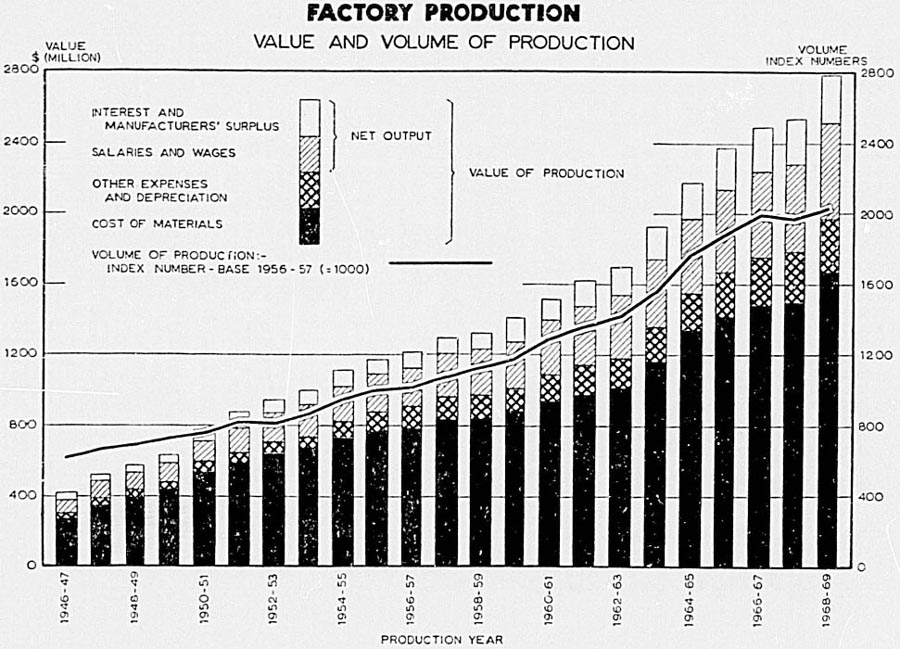
EXPENSES OF OPERATION—Total operating costs of factories for the year 1968-69 amounted to $2,525 million, of which salaries and wages accounted for $528 million, cost of materials for $1,662 million, and other expenses for $335 million, while value of production totalled $2,790 million.
The table below shows the principal items comprised in the figure for expenses of operation, other than salaries and wages and costs of materials, by industry groups for the year 1968-69.
| Industry Group | Coal | Electricity | Coke, Gas, Oils, etc. | Insurance | Interest on Loans, etc. | Depreciation | Rent | Repairs and Maintenance | Other | Total |
|---|---|---|---|---|---|---|---|---|---|---|
| $(000) | ||||||||||
| Food | 4,297 | 6,431 | 3,858 | 3,059 | 3,956 | 17,002 | 1,868 | 13,593 | 17,472 | 71,535 |
| Beverages | 93 | 409 | 344 | 347 | 648 | 1,911 | 177 | 1,066 | 2,594 | 7,590 |
| Tobacco manufactures | - | 72 | 29 | 96 | 160 | 605 | 13 | 223 | 450 | 1,649 |
| Textiles | 363 | 1,462 | 631 | 764 | 1,406 | 4,489 | 956 | 2,954 | 5,180 | 18,205 |
| Footwear, other wearing apparel, and made-up textile goods | 16 | 748 | 100 | 557 | 742 | 1,954 | 2,399 | 1,170 | 4,605 | 12,290 |
| Wood and cork products (except furniture) | 5 | 1,762 | 350 | 1,575 | 1,490 | 4,016 | 801 | 4,253 | 7,041 | 21,292 |
| Furniture and fixtures | 1 | 287 | 34 | 343 | 357 | 645 | 723 | 405 | 1,497 | 4,291 |
| Paper and paper products | 1,333 | 4,362 | 2,099 | 1,395 | 2,058 | 8,273 | 848 | 4,111 | 8,282 | 32,760 |
| Printing, publishing, etc. | 2 | 750 | 150 | 656 | 679 | 4,182 | 1,121 | 1,638 | 9,023 | 18,202 |
| Leather and leather products (except footwear and apparel) | 34 | 145 | 88 | 115 | 91 | 316 | 155 | 277 | 506 | 1,727 |
| Rubber products | 162 | 648 | 281 | 314 | 179 | 1,847 | 342 | 891 | 2,547 | 7,213 |
| Chemicals and chemical products | 170 | 975 | 413 | 786 | 1,264 | 5,172 | 476 | 2,518 | 5,917 | 17,691 |
| Petroleum and coal products | - | 404 | 153 | 174 | 60 | 1,513 | 72 | 742 | 1,077 | 4,195 |
| Non-metallic mineral products, n.e.i. | 2,749 | 1,867 | 1,690 | 744 | 825 | 5,487 | 399 | 4,213 | 4,028 | 22,003 |
| Basic metal manufactures | 1 | 811 | 374 | 291 | 1,638 | 1,066 | 117 | 651 | 1,442 | 6,392 |
| Metal products (except machinery and transport equipment) | 14 | 1,298 | 530 | 1,033 | 1,093 | 4,086 | 1,794 | 2,098 | 6,879 | 18,825 |
| Machinery (except electrical) | 7 | 1,025 | 362 | 1,254 | 1,425 | 3,445 | 1,503 | 1,764 | 7,065 | 17,850 |
| Electrical machinery and appliances | - | 817 | 205 | 482 | 772 | 2,096 | 768 | 983 | 4,329 | 10,451 |
| Transport equipment | 3 | 1,683 | 472 | 1,739 | 1,655 | 5,181 | 3,611 | 2,775 | 12,657 | 29,776 |
| Miscellaneous products | 15 | 894 | 228 | 505 | 511 | 2,343 | 1,135 | 1,548 | 3,753 | 10,932 |
| Totals | 9,265 | 26,849 | 12,392 | 16,231 | 21,011 | 75,627 | 19,278 | 47,873 | 106,343 | 334,870 |
CAPITAL ASSETS—Fixed capital employed in manufacturing industry is obtained from figures of manufacturers' fixed assets. In those cases where the factory premises, or, in some cases, even the plant, is not owned by the manufacturer, but is rented, an estimate of the value of the rented asset has been obtained by capitalising the annual rental shown. Approximations in the figures for fixed assets are also made where one building houses two or more factories carrying on different industries, necessitating an apportionment as between the industries. In most instances, too, fixed assets are stated at their book value, and this may be an overstatement due to insufficient allowance having been made for depreciation, obsolescence, etc., or an understatement owing to appreciated site value, excessive allowance for depreciation, or currency depreciation resulting in the assets being understated in terms of their present earning capacity or replacement cost. It is necessary to bear in mind these limitations to the accuracy of the figures of fixed assets appearing in the following table, which shows the values of these assets for each of the last three years together with an analysis by principal industries for 1968-69. For the year 1968-69 information is also shown by industry groups of the amounts expended during the year by way of capital additions and alterations, together with totals for all industries for the two previous years. These latter amounts cannot be taken as the total capital expended by New Zealand manufacturers during the year, as they do not include capital expenditure of firms not yet in production.
| Industry Group | Capital Additions and Alterations During the Year | Value at End of Year (Including Estimated Value of Rented Assets) | ||||||||||
|---|---|---|---|---|---|---|---|---|---|---|---|---|
| Land and Buildings | Plant, Machinery and Equipment | Total | Land and Buildings | Plant, Machinery and Equipment | Total | |||||||
| Totals— | $(000) | |||||||||||
| 1966-67 | 51,185 | 81,034 | 132,219 | 613,800 | 334,592 | 948,392 | ||||||
| 1967-68 | 32,363 | 67,500 | 99,863 | 646,147 | 343,411 | 989,558 | ||||||
| 1968-69— | ||||||||||||
| Food | 17,776 | 23,710 | 41,486 | 142,427 | 83,435 | 225,862 | ||||||
| Beverages | 977 | 1,547 | 2,524 | 18,327 | 9,313 | 27,640 | ||||||
| Tobacco manufactures | 207 | 503 | 710 | 2,312 | 2,834 | 5,146 | ||||||
| Textiles | 2,141 | 4,955 | 7,096 | 31,600 | 21,176 | 52,776 | ||||||
| Footwear, other wearing apparel, and made-up textile goods | 800 | 1,446 | 2,246 | 37,191 | 11,310 | 48,501 | ||||||
| Wood and cork products (except furniture | 1,892 | 2,821 | 4,713 | 33,017 | 18,692 | 51,709 | ||||||
| Furniture and fixtures | 230 | 416 | 646 | 15,460 | 2,697 | 18,157 | ||||||
| Paper and paper products | 1,576 | 8,396 | 9,972 | 42,112 | 44,945 | 87,057 | ||||||
| Printing, publishing, etc. | 1,288 | 3,572 | 4,860 | 37,622 | 22,545 | 60,167 | ||||||
| Leather and leather products (except footwear and apparel) | 140 | 296 | 436 | 4,070 | 1,159 | 5,229 | ||||||
| Rubber products | 426 | 1,079 | 1,505 | 10,667 | 6,090 | 16,757 | ||||||
| Chemicals and chemical products | 2,395 | 2,804 | 5,199 | 36,142 | 19,833 | 55,975 | ||||||
| Petroleum and coal products | 138 | 603 | 741 | 5,395 | 8,223 | 13,618 | ||||||
| Non-metallic mineral products, n.e.i. | 1,682 | 3,581 | 5,263 | 26,910 | 21,703 | 48,613 | ||||||
| Basic metal manufactures | 3,437 | 8,873 | 12,310 | 10,817 | 13,011 | 23,828 | ||||||
| Metal products (except machinery and transport equipment) | 965 | 3,746 | 4,711 | 45,888 | 18,986 | 64,874 | ||||||
| Machinery (except electrical) | 1,385 | 2,921 | 4,306 | 40,741 | 14,073 | 54,814 | ||||||
| Electrical machinery and appliances | 613 | 2,417 | 3,030 | 22,968 | 9,096 | 32,064 | ||||||
| Transport equipment | 3,366 | 2,677 | 6,043 | 103,450 | 18,130 | 121,580 | ||||||
| Miscellaneous products | 876 | 3,020 | 3,896 | 23,895 | 11,286 | 35,181 | ||||||
| Totals, 1968-69 | 42,309 | 79,384 | 121,693 | 691,011 | 358,538 | 1,049,548 | ||||||
MANUFACTURERS' STOCKS—A quarterly survey of manufacturers' stocks is conducted by the Department of Statistics. The survey is based on a sample of 1,200 factories selected from the 1964-65 Census of Manufacturing and allowance is made in the sampling procedures for the opening of new factories and the closing of established factories since the 1964-65 census. The combined stocks of manufacturers in the sample represent over 75 percent of the total manufacturers' stocks at the 1964-65 census, and appropriate estimation methods are used to derive statistics for all factories.
The following table compares in summary form the results of the quarterly surveys. In presenting the results, the chief seasonal industries—meat processing and dairy products manufacture—have been segregated to assist in the interpretation of movements in stock holdings. The heading “Materials” includes work in progress, fuel, and miscellaneous supplies.
| As at— | Total Stocks | Movement in Stocks at Annual Intervals | Percentage Movement in Stocks at Annual Intervals | Stocks Seasonally Corrected | |||||||
|---|---|---|---|---|---|---|---|---|---|---|---|
| Materials | Finished Goods | Total | Materials | Finished Goods | Total | Materials | Finished Goods | Total | Materials | Finished Goods | |
| Including Primary Produce Processing Industries | |||||||||||
| $(m) | $(m) | $(m) | $(m) | $(m) | $(m) | Percent | Percent | Percent | $(m) | $(m) | |
| 1963—31 Mar | 198.3 | 116.5 | 314.8 | + 5.3 | + 1.2 | + 6.5 | + 2.7 | + 1.0 | + 2.1 | ... | ... |
| 1964—31 Mar | 218.1 | 134.5 | 352.6 | + 19.8 | + 18.0 | + 37.8 | + 10.0 | + 15.5 | + 12.0 | ... | ... |
| 1966—31 Mar | 262.0 | 174.7 | 436.7 | + 34.8 | + 26.2 | + 61.0 | + 15.3 | + 17.6 | + 16.2 | ... | ... |
| 1967—31 Mar | 284.5 | 196.9 | 481.4 | + 22.6 | + 22.2 | + 44.7 | + 8.6 | + 12.7 | + 10.2 | ... | ... |
| 1968—31 Mar | 283.3 | 243.8 | 527.1 | - 1.2 | + 47.0 | +45.8 | - 0.4 | + 23.9 | + 9.5 | ... | ... |
| 1969—31 Mar | 314.2 | 252.7 | 566.9 | + 30.9 | + 8.9 | + 39.8 | + 10.9 | + 3.6 | + 7.5 | ... | ... |
| 30 Sep | 340.6 | 225.8 | 566.4 | + 49.8 | + 10.1 | + 59.9 | + 17.1 | + 4.7 | + 11.8 | ... | ... |
| 31 Dec | 333.3 | 249.6 | 582.9 | + 41.8 | + 14.1 | + 55.9 | + 14.3 | + 6.0 | + 10.6 | ... | ... |
| 1970—31 Mar | 347.7 | 274.9 | 622.6 | + 33.5 | + 22.2 | + 55.7 | + 10.7 | + 8.8 | + 9.8 | ... | ... |
| 30 Jun | 368.3 | 288.2 | 656.4 | +43.0 | + 28.8 | + 71.8 | + 13.2 | + 11.1 | + 12.3 | ... | ... |
| 30 Sep | 379.7 | 256.0 | 635.7 | + 39.1 | + 30.2 | + 69.3 | + 11.5 | + 13.4 | + 12.2 | ... | ... |
| Excluding Primary Produce Processing Industries | |||||||||||
| 1963—31 Mar | 187.5 | 71.0 | 258.5 | + 5.5 | + 6.2 | + 11.6 | + 3.0 | + 9.6 | + 4.7 | 186.2 | 72.3 |
| 1964—31 Mar | 207.2 | 79.7 | 286.9 | + 19.7 | + 8.7 | + 28.4 | + 10.5 | + 12.3 | + 11.0 | 205.8 | 81.2 |
| 1966—31 Mar | 251.6 | 97.5 | 349.1 | + 35.2 | + 8.1 | + 43.3 | + 16.3 | + 9.1 | + 14.2 | 249.9 | 99.3 |
| 1967—31 Mar | 273.3 | 112.9 | 386.2 | + 21.7 | + 15.4 | + 37.1 | + 8.6 | + 15.8 | + 10.6 | 271.4 | 115.0 |
| 1968—31 Mar | 272.4 | 134.3 | 406.7 | - 0.8 | +21.4 | +20.6 | - 0.3 | + 19.0 | + 5.3 | 270.5 | 136.8 |
| 1969—31 Mar | 302.5 | 145.0 | 447.5 | + 30.1 | + 10.7 | + 40.8 | + 11.0 | + 8.0 | + 10.0 | 300.4 | 147.8 |
| 30 Sep | 326.9 | 157.6 | 484.5 | + 48.5 | + 10.8 | + 59.3 | + 17.4 | + 7.4 | + 13.9 | 324.8 | 149.9 |
| 31 Dec | 318.8 | 156.4 | 475.2 | + 40.8 | + 14.8 | + 55.6 | + 14.7 | + 10.5 | + 13.3 | 325.0 | 160.4 |
| 1970—31 Mar | 334.6 | 166.2 | 500.8 | + 32.0 | + 21.2 | + 53.2 | + 10.6 | + 14.6 | + 11.9 | 330.6 | 170.3 |
| 30 Jun | 355.8 | 165.8 | 521.6 | +42.4 | + 16.4 | + 58.8 | + 13.5 | + 11.0 | + 12.7 | 354.1 | 166.9 |
| 30 Sep | 364.8 | 179.5 | 544.3 | + 37.9 | + 21.9 | + 59.8 | + 11.6 | + 13.9 | + 12.3 | 359.4 | 172.4 |
More detailed information on stocks is given in the next table showing by industry groups comparative stock figures at the end of September.
| Industry Group | Stocks at 30 September | Increase or Decrease in Stocks September 1969 to September 1970 | |||||||
|---|---|---|---|---|---|---|---|---|---|
| 1969 | 1970 | ||||||||
| Materials | Finished Goods | Total | Materials | Finished Goods | Total | Materials | Finished Goods | Total | |
| $(million) | |||||||||
| Primary Produce Processing Industries | |||||||||
| Meat freezing, ham, bacon, and casings | 9.66 | 50.68 | 60.34 | 10.82 | 55.18 | 66.00 | + 1.16 | + 4.50 | + 5.66 |
| Dairy | 4.08 | 17.47 | 21.54 | 4.14 | 21.27 | 25.42 | + 0.06 | + 3.80 | + 3.88 |
| Totals | 13.74 | 68.15 | 81.89 | 14.97 | 76.45 | 91.42 | + 1.23 | + 8.30 | + 9.53 |
| Other food | 27.85 | 26.08 | 53.93 | 27.62 | 28.94 | 56.56 | - 0.23 | + 2.86 | + 2.63 |
| Beverages | 5.93 | 6.62 | 12.54 | 6.23 | 6.83 | 13.06 | + 0.30 | + 0.21 | + 0.52 |
| Tobacco manufactures | 16.91 | - | 16.91 | 18.85 | - | 18.85 | + 1.94 | - | + 1.94 |
| Textiles | 27.12 | 7.88 | 35.01 | 30.04 | 8.84 | 38.89 | + 2.92 | + 0.96 | + 3.88 |
| Clothing | 19.49 | 9.16 | 28.65 | 19.41 | 9.90 | 29.31 | - 0.08 | + 0.74 | + 0.66 |
| Footwear | 4.54 | 1.37 | 5.91 | 5.76 | 1.80 | 7.56 | + 1.22 | + 0.43 | + 1.65 |
| Wood manufactures | 12.27 | 13.64 | 25.91 | 13.48 | 14.74 | 28.23 | + 1.21 | + 1.10 | + 2.32 |
| Furniture and fixtures | 7.44 | 1.07 | 8.51 | 7.25 | 1.38 | 8.64 | - 0.19 | + 0.31 | + 0.13 |
| Paper and products | 20.43 | 10.47 | 30.90 | 24.05 | 12.23 | 36.28 | + 3.62 | + 1.76 | + 5.38 |
| Printing, publishing | 13.83 | 1.57 | 15.40 | 14.67 | 1.95 | 16.62 | + 0.84 | + 0.38 | + 1.22 |
| Leather and products | 3.88 | 0.70 | 4.58 | 3.61 | 1.35 | 4.96 | - 0.27 | + 0.65 | + 0.38 |
| Rubber products | 6.80 | 5.20 | 12.00 | 6.76 | 6.46 | 13.22 | - 0.04 | + 1.26 | + 1.22 |
| Chemicals and products | 21.74 | 22.18 | 43.92 | 24.04 | 24.02 | 48.06 | + 2.30 | + 1.84 | + 4.14 |
| Petroleum, coal products | 2.22 | 1.29 | 3.51 | 2.14 | 1.63 | 3.77 | - 0.08 | + 0.34 | + 0.26 |
| Non-metallic mineral products | 8.71 | 10.94 | 19.65 | 9.13 | 13.26 | 22.39 | + 0.42 | + 2.32 | + 2.74 |
| Basic metal products | 5.39 | 1.16 | 6.55 | 10.92 | 1.90 | 12.82 | + 5.53 | + 0.74 | + 6.27 |
| Metal products | 24.36 | 10.49 | 34.85 | 26.23 | 11.13 | 37.36 | + 1.87 | + 0.64 | + 2.51 |
| Machinery | 28.93 | 7.95 | 36.88 | 34.30 | 8.34 | 42.64 | + 5.37 | + 0.39 | + 5.76 |
| Electrical products | 25.70 | 7.15 | 32.85 | 28.53 | 11.52 | 40.05 | + 2.83 | + 4.37 | + 7.20 |
| Transport equipment | 32.59 | 3.74 | 36.33 | 40.28 | 4.44 | 44.71 | + 7.69 | + 0.70 | + 8.38 |
| Miscellaneous | 10.75 | 8.95 | 19.70 | 11.43 | 8.84 | 20.26 | + 0.68 | - 0.11 | + 0.56 |
| Totals | 326.88 | 157.62 | 484.50 | 364.75 | 179.50 | 544.25 | + 37.87 | +21.88 | + 59.75 |
| Grand totals, all manufacturing industries | 340.61 | 225.77 | 566.38 | 379.72 | 255.95 | 635.67 | +39.11 | +30.18 | + 69.29 |
ORGANISATION OF INDUSTRY—New Zealand's industrial progress has been fairly rapid, but industry is as yet organised on a relatively small scale.
The law in New Zealand restricts the membership of a partnership to not more than 25 persons, a private company to not fewer than two or more than 25 persons, and a public company to not fewer than seven persons. Co-operation is characteristic of certain industries engaged in the processing of primary products, mainly butter and cheese manufacturing.
Information as to the character of organisation of the establishments engaged in factory production during 1968-69 is given in the following table.
| Character of Organisation | Number of Establishments | Number of Persons Engaged | Salaries and Wages Paid | Cost of Materials Used or Operated Upon | Value of Manufactures or Products | Net Output | |
|---|---|---|---|---|---|---|---|
| Total | Per Establishment | ||||||
| $(m) | $(m) | $(m) | $(m) | $ | |||
| Private registered company | 7,745 | 147,529 | 329 | 877 | 1,553 | 503 | 64,955 |
| Public registered company | 953 | 62,368 | 154 | 481 | 848 | 255 | 267,853 |
| Individual | 1,002 | 4,156 | 8 | 11 | 23 | 10 | 9,843 |
| Partnership | 428 | 2,436 | 5 | 8 | 17 | 7 | 15,409 |
| Co-operative association | 265 | 8,826 | 23 | 276 | 328 | 29 | 109,581 |
| Local authority and State | 108 | 3,759 | 9 | 8 | 21 | 10 | 96,528 |
| Totals | 10,501 | 229,074 | 528 | 1,662 | 2,790 | 814 | 77,541 |
As would be expected, the average size of establishments operated by public registered companies is larger than in any other type of industrial organisation, the net output per unit being much greater than that for private registered companies. Private companies, however, occupy a very high place, both numerically and in the share they contribute to net output (62 percent in 1968-69, as compared with 31 percent in the case of public companies).
VALUE AND VOLUME INDICES OF MANUFACTURING INDUSTRIES—Below is a table giving index numbers of net output, value of production, and volume of production based on the year 1938-39. This table commences with the year 1928-29 and runs through to 1950-51, at which stage a new series was commenced.
| Production Year | Net Output (Net Value Added) | Value of Production | Volume of Production |
|---|---|---|---|
| Base: 1938-39 (= 100) | |||
| 1928-29 | .. | 79 | 71 |
| 1929-30 | .. | 79 | 74 |
| 1930-31 | 69 | 68 | 69 |
| 1931-32 | 55 | 58 | 60 |
| 1932-33 | 53 | 58 | 63 |
| 1933-34 | 57 | 63 | 65 |
| 1934-35 | 63 | 69 | 74 |
| 1935-36 | 70 | 79 | 81 |
| 1936-37 | 85 | 93 | 92 |
| 1937-38 | 95 | 99 | 97 |
| 1938-39 | 100 | 100 | 100 |
| 1939-40 | 114 | 113 | 110 |
| 1940-41 | 127 | 129 | 114 |
| 1941-42 | 141 | 136 | 116 |
| 1942-43 | 157 | 145 | 120 |
| 1943-44 | 168 | 154 | 125 |
| 1944-45 | 181 | 166 | 129 |
| 1945-46 | 194 | 171 | 131 |
| 1946-47 | 217 | 191 | 140 |
| 1947-48 | 244 | 238 | 151 |
| 1948-49 | 264 | 263 | 155 |
| 1949-50 | 297 | 290 | 164 |
| 1950-51 | 321 | 345 | 172 |
With the reclassification in 1951-52 a new series of index numbers was commenced and these are shown below. It should be realised in comparing the two series of index numbers that the latter excludes the activities of three important industries. These are the logging operations of sawmillers, previously included in the sawmilling industry, and the generation and supply of gas and electricity. However, the effect of the exclusion of these industries entirely from the newer series is not great, as the two series in the overlapping period recorded very similar movements.
| Production Year | Net Output (Net Value Added) | Value of Production | Volume of Production |
|---|---|---|---|
| Base: 1956-57 (= 1000) | |||
| 1951-52 | 731 | 716 | 806 |
| 1952-53 | 742 | 771 | 800 |
| 1953-54 | 825 | 823 | 848 |
| 1954-55 | 927 | 915 | 941 |
| 1955-56 | 980 | 973 | 994 |
| 1956-57 | 1,000 | 1,000 | 1,000 |
| 1957-58 | 1,093 | 1,071 | 1,070 |
| 1958-59 | 1,158 | 1,095 | 1,130 |
| 1959-60 | 1,312 | 1,172 | 1,169 |
| 1960-61 | 1,409 | 1,257 | 1,283 |
| 1961-62 | 1,568 | 1,340 | 1,349 |
| 1962-63 | 1,651 | 1,396 | 1,410 |
| 1963-64 | 1,892 | 1,598 | 1,557 |
| 1964-65 | 2,070, | 1,815 | 1,759 |
| 1965-66 | 2,361, | 1,972 | 1,879 |
| 1966-67 | 2,468, | 2,063, | 1,991 |
| 1967-68 | 2,519, | 2,108, | 1,968 |
| 1968-69 | 2,716, | 2,318, | 2,030, |
The table which follows sets out, by industry groups, index numbers of value of production, net output, and volume of production. It is not possible to arrive at volume of production index numbers for all the groups, for technical reasons, and consequently some have been omitted, but the total index number for the year is calculated in such a way as to include the groups which cannot be assessed separately.
| INDEX NUMBERS OF VALUE OF FACTORY PRODUCTION, NET OUTPUT AND VOLUME OF PRODUCTION, BASE 1956-57 (= 1000) | ||||||
|---|---|---|---|---|---|---|
| Industry Group | Value of Production | Net Output | Volume of Production | |||
| 1967-68 | 1968-69 | 1967-68 | 1968-69 | 1967-68 | 1968-69 | |
| (1)Indices not available for the groups, but allowed for in compiling total index. | ||||||
| Food | 1,702 | 1,880 | 2,454, | 2,683, | 1,633 | 1,695 |
| Beverages | 2,222, | 2,247, | 2,939, | 2,859, | 1,577 | 1,564 |
| Tobacco manufactures | 1,651 | 1,727 | 1,877 | 2,028, | 1,773 | 1,764 |
| Textiles | 2,196, | 2,770, | 3,052, | 3,413, | 2,886, | 3,180, |
| Footwear, other wearing apparel, and made-up textile goods | 1,596 | 1,635 | 1,723 | 1,737 | 1,402 | 1,345 |
| Wood and cork products (except furniture) | 1,852 | 2,055, | 1,910 | 2,117, | 1,269 | 1,385 |
| Furniture and fixtures | 1,847 | 1,915 | 1,759 | 1,820 | (1) | (1) |
| Paper and paper products | 2,944, | 3,277, | 4,086, | 4,425, | 2,854, | 3,071, |
| Printing, publishing, etc. | 2,309, | 2,390, | 2,349, | 2,472, | 2,038, | 1,950 |
| Leather and leather products (except footwear and apparel) | 1,956 | 2,372, | 2,301, | 2,678, | 1,604 | 1,818 |
| Rubber products | 1,728 | 1,994 | 2,014, | 2,449, | 2,016, | 2,170, |
| Chemicals and chemical products | 2,267, | 2,613, | 2,394, | 2,728, | 1,881 | 2,071, |
| Petroleum and coal products | 14,236 | 16,141 | 9,679, | 11,217 | (1) | (1) |
| Non-metallic mineral products, n.e.i. | 2,020, | 2,125, | 2,176, | 2,283, | 1,731 | 1,790 |
| Basic metal manufactures | 4,389, | 5,342, | 4,610, | 4,431, | (1) | (1) |
| Metal products (except machinery and transport equipment) | 3,042, | 3,276, | 3,089, | 3,247, | (1) | (1) |
| Machinery (except electrical) | 2,387, | 2,642, | 2,834, | 3,135, | (1) | (1) |
| Electrical machinery and appliances | 3,664, | 3,767, | 3,624, | 3,711, | 3,253, | 3,352, |
| Transport equipment | 2,204, | 2,318, | 2,210, | 2,331, | (1) | (1) |
| Miscellaneous products | 5,491, | 6,186, | 6,078, | 6,704, | (1) | (1) |
| All Groups | 2,108, | 2,318, | 2,519, | 2,716, | 1,968 | 2,030, |
OVERTIME—Details of overtime worked in factories by wage-earning employees are summarised in the tables given, which show, by industry groups, the hours worked during the latest three years. The averages given are calculated on the basis of the total number of wage earners engaged irrespective of the number who actually worked overtime.
| Industry Group | Total Overtime Hours Worked by Wage Earners (Both Male and Female) | |||||
|---|---|---|---|---|---|---|
| 1966-67 | 1967-68 | 1968-69 | ||||
| (000) | ||||||
| Food | 9,809 | 9,914 | 10,358 | |||
| Beverages | 660 | 664 | 582 | |||
| Tobacco manufactures | 279 | 206 | 189 | |||
| Textiles | 1,974 | 1,777 | 2,183 | |||
| Footwear, other wearing apparel, and made-up textile goods | 1,050 | 811 | 776 | |||
| Wood and cork products (except furniture) | 2,345 | 1,719 | 1,953 | |||
| Furniture and fixtures | 805 | 525 | 608 | |||
| Paper and paper products | 2,099 | 1,743 | 1,694 | |||
| Printing, publishing, etc. | 1,568 | 1,310 | 1,325 | |||
| Leather and leather products (except footwear and apparel) | 213 | 170 | 218 | |||
| Rubber products | 623 | 553 | 539 | |||
| Chemicals and chemical products | 1,164 | 859 | 855 | |||
| Petroleum and coal products | 113 | 113 | 95 | |||
| Non-metallic mineral products, n.e.i. | 2,156 | 1,549 | 1,655 | |||
| Basic metal manufactures | 313 | 461 | 516 | |||
| Metal products (except machinery and transport equipment) | 3,152 | 2,293 | 2,508 | |||
| Machinery (except electrical) | 2,956 | 2,348 | 2,413 | |||
| Electrical machinery and appliances | 1,255 | 880 | 839 | |||
| Transport equipment | 4,026 | 2,885 | 2,551 | |||
| Miscellaneous products | 1,267 | 957 | 1,229 | |||
| Totals | 37,827 | 31,738 | 33,084 | |||
The next table shows, by industry groups, the hours of overtime worked during 1968-69 by males and females separately.
| Industry Group | Total Overtime Hours Worked by Wage Earners | Average Overtime Hours Worked by All Wage Earners | ||
|---|---|---|---|---|
| Males | Females | Males | Females | |
| (000) | (000) | |||
| Food | 9,705 | 653 | 326 | 135 |
| Beverages | 566 | 15 | 336 | 55 |
| Tobacco manufactures | 123 | 66 | 336 | 129 |
| Textiles | 1,757 | 426 | 270 | 74 |
| Footwear, other wearing apparel, and made-up textile goods | 379 | 397 | 93 | 20 |
| Wood and cork products (except furniture) | 1,935 | 19 | 164 | 87 |
| Furniture and fixtures | 589 | 20 | 156 | 33 |
| Paper and paper products | 1,541 | 153 | 296 | 92 |
| Printing, publishing, etc. | 1,166 | 159 | 129 | 65 |
| Leather and leather products (except footwear and apparel) | 174 | 44 | 174 | 50 |
| Rubber products | 527 | 11 | 209 | 21 |
| Chemicals and chemical products | 814 | 41 | 249 | 29 |
| Petroleum and coal products | 92 | 3 | 222 | 87 |
| Non-metallic mineral products, n.e.i. | 1,610 | 45 | 268 | 85 |
| Basic metal manufactures | 508 | 8 | 318 | 169 |
| Metal products (except machinery and transport equipment) | 2,356 | 151 | 232 | 113 |
| Machinery (except electrical) | 2,371 | 42 | 196 | 96 |
| Electrical machinery and appliances | 727 | 113 | 152 | 55 |
| Transport equipment | 2,482 | 69 | 104 | 98 |
| Miscellaneous products | 966 | 263 | 244 | 110 |
| All groups | 30,383 | 2,696 | 214 | 58 |
SUMMARY OF OPERATIONS—The following table, by assembling data from previous pages, affords an analysis of production costs in 1968-69, together with the value of production for each industry group and for all industries. In addition, by virtue of the complete details collected annually of the cost structure of goods produced in manufacturing industries, it is possible to give information on the surplus available to manufacturers prior to payment of dividends, taxation, and other appropriations. The only exception occurs in the case of co-operative dairy companies, which do not purchase milk and cream in the way that other manufacturers purchase raw materials. They collect the milk and cream from their shareholders, process it, and pay out to these shareholders the whole of the profits of the sales of the products, less amounts paid to reserves. Manufacturing surplus shown by these companies is therefore confined to the amount of these transfers to reserves and any undistributed profits.
In quite a number of cases, articles produced are transferred at cost to separate selling departments and warehouses, or to retail stores run by the same company or establishment. Where this is apparent, the company concerned is asked to substitute a commercial value for its production. The same procedure holds where a company controls more than one factory, and transfers the products of one to the other for further processing. It must be recognised that estimated values have to be accepted in many transactions of this type.
| Industry Group | Production Costs | Value of Production | Manufacturing Surplus | |||
|---|---|---|---|---|---|---|
| Salaries and Wages | Cost of All Materials Used | Other Expenses of Operation | Total | |||
| $(000) | ||||||
| Food | 105,608 | 660,149 | 71,535 | 837,291 | 887,623 | 50,332 |
| Beverages | 6,734 | 20,811 | 7,590 | 35,135 | 46,588 | 11,452 |
| Tobacco manufactures | 2,088 | 14,420 | 1,649 | 18,157 | 20,979 | 2,821 |
| Textiles | 29,533 | 108,786 | 18,205 | 156,523 | 167,551 | 11,028 |
| Footwear, other wearing apparel, and made-up textile goods | 39,806 | 67,489 | 12,290 | 119,585 | 129,070 | 9,485 |
| Wood and cork products (except furniture) | 33,884 | 78,298 | 21,292 | 133,474 | 150,037 | 16,563 |
| Furniture and fixtures | 11,689 | 20,464 | 4,291 | 36,445 | 39,729 | 3,285 |
| Paper and paper products | 22,901 | 67,534 | 32,760 | 123,196 | 146,291 | 23,095 |
| Printing, publishing, etc. | 35,442 | 31,755 | 18,202 | 85,399 | 99,757 | 14,357 |
| Leather and leather products (except footwear and apparel) | 4,275 | 11,375 | 1,727 | 17,376 | 19,401 | 2,025 |
| Rubber products | 10,291 | 17,606 | 7,213 | 35,111 | 42,135 | 7,024 |
| Chemicals and chemical products | 15,765 | 88,250 | 17,691 | 121,706 | 141,258 | 19,553 |
| Petroleum and coal products | 2,017 | 62,521 | 4,195 | 68,733 | 77,895 | 9,162 |
| Non-metallic mineral products, n.e.i. | 20,269 | 24,431 | 22,003 | 66,704 | 78,754 | 12,050 |
| Basic metal manufactures | 6,300 | 22,429 | 6,392 | 35,121 | 36,114 | 993 |
| Metal products (except machinery and transport equipment) | 35,441 | 66,665 | 18,825 | 120,931 | 136,856 | 15,925 |
| Machinery (except electrical) | 39,746 | 65,610 | 17,850 | 123,207 | 137,948 | 14,741 |
| Electrical machinery and appliances | 18,720 | 45,056 | 10,451 | 74,227 | 80,564 | 6,337 |
| Transport equipment | 69,939 | 156,296 | 29,776 | 256,012 | 278,581 | 22,569 |
| Miscellaneous products | 17,360 | 32,379 | 10,932 | 60,671 | 73,317 | 12,646 |
| Totals | 527,809 | 1,662,326 | 334,870 | 2,525,004 | 2,790,448 | 265,444 |
LIST OF CERTAIN COMMODITIES PRODUCED IN RECENT YEARS—The following is a list of certain commodities produced in New Zealand during the latest four years available.
| Commodity | 1965-66 | 1966-67 | 1967-68 | 1968-69 |
|---|---|---|---|---|
| Toasters No. | 67,173 | 63,862 | 74,997 | 74,101 |
| Irons No. | 67,147 | 62,725 | 66,562 | 73,205 |
| Radiators, electric No. | 221,626 | 213,253 | 219,876 | 171,863 |
| Vacuum cleaners No. | 57,271 | 82,008 | 55,616 | 53,217 |
| Washing machines (clothes) No. | 47,290 | 51,333 | 43,764 | 44,049 |
| Refrigerators (home and commercial and freezers) No. | 61,311 | 72,730 | 73,011 | 104,960 |
| Electric ranges No. | 49,875 | 52,432 | 47,413 | 51,489 |
| Electric rangettes No. | 6,434 | 7,072 | 3,983 | 3,473 |
| Radios, including radiograms, etc. No. | 102,041 | 81,536 | 74,924 | 76,128 |
| Television sets No. | 126,354 | 96,678 | 46,369 | 45,162 |
| Blankets, Woollen Pairs | 257,596 | 241,214 | 285,000 | 228,000 |
| Floor coverings (textile top coverings) sq yd (000) | 5,070 | 5,484 | 5,302 | 7,175 |
| Mattresses— | ||||
| Innerspring— | ||||
| Single No. | 101,532 | 98,850 | 93,023 | 87,237 |
| Double No. | 30,319 | 29,213 | 28,976 | 36,538 |
| Soft filled— | ||||
| Single No. | 56,250 | 49,178 | 38,487 | 38,256 |
| Double No. | 11,843 | 11,473 | 11,094 | 11,152 |
| Infants No. | 11,109 | 9,360 | 8,346 | 10,441 |
| Venetian blinds No. | 114,852 | 97,165 | 75,134 | 65,918 |
| Roller (Holland) blinds No. | 209,766 | 199,602 | 157,251 | 171,337 |
| Newspapers produced— | ||||
| Dailies thousand | 334,140 | 327,328 | 333,096 | 335,982 |
| Other than dailies thousand | 53,961 | 56,294 | 63,002 | 57,191 |
| Hot-water bottles No. | 427,715 | 464,753 | 282,000 | 244,000 |
| Soap— | ||||
| Toilet ton | 3,817 | 4,530 | 4,185 | 4,393 |
| Bar ton | 4,355 | 4,200 | 3,835 | 4,222 |
| Powder and flake ton | 15,668 | 13,485 | 14,329 | 12,927 |
| Household and industrial cleaners— | ||||
| Synthetic detergents— | ||||
| Powders and pastes cwt | 43,495 | 73,026 | 70,500 | 93,948 |
| Liquid gal(000) | 1,567 | 1,952 | 1,983 | 2,927 |
| Other cleaners, etc.— | ||||
| Powders and pastes cwt | 19,350 | 21,536 | 22,217 | 29,686 |
| Liquid gal(000) | 249 | 441 | 462 | 603 |
| Paints and enamels gal(000) | 3,617 | 3,643 | 3,635 | 3,731 |
| Lacquers gal(000) | 345 | 365 | 320 | 366 |
| Toothpaste cwt | 16,310 | 17,626 | 18,620 | 18,489 |
| Furniture and floor polish cwt | 34,045 | 19,380 | 26,438 | 24,551 |
| Shoe polishes and cleaners cwt | 6,149 | 4,622 | 4,427 | 4,937 |
| Water heaters— | ||||
| Under 10 gallons No. | 12,625 | 10,416 | 8,857 | 14,057 |
| 10 gallons and over No. | 45,330 | 42,152 | 46,524 | 37,792 |
| Sinks: stainless steel No. | 63,093 | 55,728 | 56,815 | 30,884 |
| Sink tops: stainless steel No. | 32,034 | 26,408 | 24,736 | 19,700 |
| Wheelbarrows No. | 25,419 | 21,950 | 24,525 | 28,005 |
| Lawnmowers (hand and power) No. | 79,542 | 84,186 | 63,335 | 58,863 |
| Prams, pushchairs, strollers— | ||||
| Cane (inc. dolls) No. | 3,547 | 4,452 | 3,629 | 1,130 |
| Other than cane (inc. dolls) No. | 29,788 | 29,767 | 26,135 | 25,667 |
| Toothbrushes No.(000) | 2,858 | 2,757 | 3,220 | 3,885 |
DETAILS OF CERTAIN PRINCIPAL INDUSTRIES—The principal statistics regarding leading factory industries for the last three years available are set out in the following pages. Fuller details are given in the annual Report on Statistics of Industrial Production.
| Item | 1966-67 | 1967-68 | 1968-69 |
|---|---|---|---|
*In addition 1,063,000 bundles were produced in the sausage casings industry in 1966-67, 1,266,000 bundles in 1967-68, and 1,473,000 bundles in 1968-69. †Includes products of establishments classified in other industries. *Decreases mainly because of changed system of valuation in two establishments. †Includes products of establishments classified in other industries. *Includes chocolate sold for further manufacturing purposes. †Includes products of establishments classified in other industries. *Includes production by establishments classified in other industries. *In addition in 1966-67, 169,000 gallons; in 1967-68, 147,000 gallons; and in 1968-69 131,000 gallons were recorded by establishments classified in other industries. *Includes production by establishments classified in other industries. *Includes production by establishments classified in other industries. *Other principal products withheld to avoid disclosure of figures for individual establishments. *Principal products shown for this industry include the production of establishments classified in other industries. *Includes production of establishments classified in other industries. †Effective running footage, *Includes production of establishments in other industries. *Principal products shown for these industries include the production of establishments classified in other industries. * Includes assembled vehicles from the motor-body building industry. *Includes production of establishments classified in other industries. | |||
| Meat Freezing and Preserving | |||
| Number of establishments | 44 | 44 | 45 |
| Persons engaged No. | 20,856 | 22,186 | 23,630 |
| Production costs— | |||
| Salaries, wages $(000) | 55,233 | 60,788 | 69,725 |
| Materials $(000) | 227,411 | 286,677 | 329,565 |
| Other expenses $(000) | 24,557 | 28,083 | 31,870 |
| Totals $(000) | 307,201 | 375,547 | 431,159 |
| Value of production $(000) | 311,760 | 396,146 | 457,319 |
| Net output (net value added) $(000) | 61,140 | 82,933 | 97,278 |
| Overtime worked by wage earners h(000) | 5,952 | 5,963 | 6,530 |
| Volume index. Base: 1956-57 (= 1000) | 1,431 | 1,582 | 1,629 |
| Principal products— | |||
| Meat— | |||
| Lamb carcasses No.(000) | 22,578 | 24,532 | 25,004 |
| cwt(000) | 6,084 | 6,328 | 6,574 |
| Mutton carcasses No.(000) | 5,522 | 6,699 | 6,288 |
| cwt(000) | 2,410 | 2,768 | 2,439 |
| Boned mutton cwt(000) | 115 | 183 | 183 |
| Mutton and lamb pieces cwt(000) | 179 | 271 | 347 |
| Beef quarters, bone in cwt(000) | 893 | 828 | 803 |
| Beef cuts cwt(000) | 671 | 877 | 1,313 |
| Boneless beef cwt(000) | 1,206 | 1,495 | 1,411 |
| Bobby veal cwt(000) | 163 | 166 | 177 |
| Other veal cwt(000) | 88 | 70 | 73 |
| Pork cwt(000) | 380 | 349 | 273 |
| Edible offals cwt(000) | 909 | 1,083 | 1,054 |
| By-products— | |||
| Runners (not processed) No.(000) | 5,750 | 6,323 | 4,893 |
| Casings* bundles(000) | 5,193 | 6,718 | 6,619 |
| Woolly sheepskins No.(000) | 161 | 174 | 192 |
| Pelts No.(000) | 28,489 | 33,372 | 34,013 |
| Cow hides No.(000) | 519 | 666 | 795 |
| Ox and bull hides No.(000) | 384 | 482 | 542 |
| Bobby calf hides No.(000) | 1,095 | 1,143 | 1,244 |
| Other calf hides No.(000) | 66 | 49 | 58 |
| Wool lb(000) | 74,113 | 84,176 | 84,083 |
| Boiling-down products— | |||
| Tallow cwt(000) | 1,378 | 1,536 | 1,598 |
| Neatsfoot oil† gal(000) | 240 | 236 | 245 |
| Organic fertilisers and stock foods†— | |||
| Meatmeal cwt(000) | 457 | 548 | 463 |
| Meat and bone meal cwt(000) | 513 | 750 | 958 |
| Livermeal cwt(000) | 7 | 8 | 6 |
| Bonedust cwt(000) | 67 | 85 | 93 |
| Blood manure cwt(000) | 95 | 128 | 107 |
| Blood and bone cwt(000) | 442 | 474 | 461 |
| Manure mixture cwt(000) | 4 | 18 | 12 |
| Other manures and meals cwt(000) | 81 | 24 | 14 |
| Canned and other preserved meats, pastes, extracts, and miscellaneous cannings cwt(000) | 128 | 130 | 138 |
| Ham and Bacon Curing | |||
| Number of establishments | 47 | 39 | 36 |
| Persons engaged No. | 1,384 | 1,229 | 1,269 |
| Production costs— | |||
| Salaries, wages $(000) | 3,034 | 2,655 | 2,859 |
| Materials $(000) | 15,330 | 14,872 | 16,126 |
| Other expenses $(000) | 1,647 | 1,788 | 1,759 |
| Totals $(000) | 20,011 | 19,315 | 20,745 |
| Value of production $(000) | 21,869 | 20,906 | 22,398 |
| Net output (net value added) $(000) | 4,951 | 4,322 | 4,564 |
| Overtime worked by wage earners h(000) | 157 | 256 | 357 |
| Volume index. Base: 1956-57 (= 1000) | 994 | 959 | 993 |
| Pigs dealt with— | |||
| Carcasses No.(000) | 398 | 349 | 315 |
| Cost $(000) | 10,933 | 9,738 | 10,145 |
| Principal products— | |||
| Ham and bacon cwt | 289,348 | 278,158 | 260,492 |
| Frozen pork cwt | 29,057 | 22,125 | 9,856 |
| Smallgoods cwt | 257,865 | 252,784 | 297,679 |
| Lard (edible) cwt | 9,486 | 9,146 | 5,196 |
| Butter, Cheese, and Other Milk Products | |||
| Number of establishments— | |||
| Butter and cheese | 171 | 165 | 158 |
| Other milk products | 70 | 66 | 68 |
| Persons engaged No. | 4,664 | 4,712 | 4,530 |
| Production costs— | |||
| Salaries, wages $(000) | 11,170 | 11,394 | 11,482 |
| Materials $(000) | 226,084 | 206,385 | 210,731 |
| Other expenses $(000) | 15,317 | 17,331 | 18,801 |
| Totals $(000) | 252,571 | 235,110 | 241,015 |
| Value of production $(000) | 257,272 | 237,839 | 243,141 |
| Net output (net value added) $(000) | 16,261 | 14,679 | 14,354 |
| Overtime worked by wage earners h(000) | 1,535 | 1,544 | 1,440 |
| Volume index. Base: 1956-57 (= 1000) | 1,378 | 1,366 | 1,441 |
| Butterfat used— | |||
| For creamery butter lb(000) | 464,850 | 450,852 | 485,002 |
| For cheesemaking lb(000) | 98,383 | 98,605 | 84,953 |
| For whey butter making— | |||
| Recoveries from own whey lb(000) | 2,678 | 3,318 | 1,231 |
| Whey fat purchased lb(000) | 3,659 | 4,134 | 3,468 |
| Second grade creamery butterfat lb(000) | 89 | 87 | 2 |
| Total for whey butter lb(000) | 6,426 | 7,539 | 4,701 |
| Principal products— | |||
| Creamery butter ton | 252,328 | 244,435 | 263,985 |
| Whey butter ton | 3,095 | 3,149 | 2,850 |
| Cheese ton | 109,594 | 110,034 | 94,161 |
| Condensed and evaporated milk, and whole and blended milk powder ton | 17,345 | 19,923 | 22,353 |
| Skim-milk powder ton | 137,535 | 146,345 | 135,508 |
| Buttermilk powder ton | 25,262 | 22,670 | 23,618 |
| Casein ton | 45,725 | 43,737 | 64,602 |
| Ice Cream | |||
| Number of establishments | 18 | 19 | 16 |
| Persons engaged No. | 470 | 538 | 561 |
| Production costs— | |||
| Salaries, wages $(000) | 843 | 1,012 | 1,249 |
| Materials $(000) | 4,032 | 4,900 | 4,799 |
| Other expenses $(000) | 1,195 | 1,367 | 1,673 |
| Totals $(000) | 6,070 | 7,279 | 7,722 |
| Value of production $(000) | 8,693 | 10,119 | 8,698* |
| Net output (net value added) $(000) | 3,516 | 3,893 | 2,392* |
| Overtime worked by wage earners h(000) | 65 | 72 | 100 |
| Volume index. Base: 1956-57 (= 1000) | 1,803 | 2,021, | 2,180, |
| Main materials used— | |||
| Milk gal(000) | 1,267 | 1,478 | 862 |
| Cream gal(000) | 210 | 258 | 303 |
| Ice-cream mixture cwt | 5,350 | 7,474 | 19,162 |
| Butter cwt | 27,751 | 31,261 | 30,616 |
| Skim-milk powder cwt | 28,855 | 35,426 | 27,609 |
| Sugar cwt | 74,605 | 84,305 | 87,940 |
| Principal products— | |||
| Bulk ice-cream gal(000) | 2,809 | 3,079 | 3,011 |
| Ice cream, cartoned, wrapped, chocolate-coated, etc. gal(000) | 4,406 | 5,198 | 5,550 |
| Frozen confections, ice lollies, etc. $(000) | 949 | 824 | 1,257 |
| Grain Milling | |||
| Number of establishments | 37 | 38 | 39 |
| Persons engaged No. | 998 | 1,020 | 1,000 |
| Production costs— | |||
| Salaries, wages $(000) | 1,970 | 2,127 | 2,127 |
| Materials $(000) | 11,081 | 12,566 | 22,323 |
| Other expenses $(000) | 1,685 | 1,894 | 2,108 |
| Totals $(000) | 14,736 | 16,587 | 26,557 |
| Value of production $(000) | 16,326 | 18,550 | 28,401 |
| Net output (net value added) $(000) | 3,695 | 4,275 | 4,170 |
| Overtime worked by wage earners h(000) | 132 | 132 | 93 |
| Volume index. Base: 1956-57 (= 1000) | 1,478 | 1,527 | 1,484 |
| Main materials used— | |||
| Wheat bushel(000) | 10,978 | 10,215 | 10,463 |
| Oats bushel(000) | 528 | 567 | 513 |
| Principal products— | |||
| Flour short ton | 232,106 | 224,833 | 227,716 |
| Wholemeal, wheatmeal† short ton | 9,342 | 8,074 | 6,992 |
| Bran and pollard short ton | 66,004 | 62,257 | 63,855 |
| Breakfast cereals— | |||
| Oatmeal, rolled oats short ton | 5,482 | 5,873 | 5,567 |
| Other (including cereals in biscuit, flake and puff form)† short ton | 12,933 | 13,019 | 11,203 |
| Biscuits | |||
| Number of establishments | 10 | 8 | 8 |
| Persons engaged No. | 1,289 | 1,198 | 1,234 |
| Production costs— | |||
| Salaries, wages $(000) | 2,239 | 2,136 | 2,229 |
| Materials $(000) | 5,494 | 5,996 | 7,133 |
| Other expenses $(000) | 1,455 | 1,582 | 1,714 |
| Totals $(000) | 9,188 | 9,715 | 11,076 |
| Value of production $(000) | 10,981 | 11,214 | 13,319 |
| Net output (net value added) $(000) | 4,101 | 3,724 | 4,582 |
| Overtime worked by wage earners h(000) | 329 | 258 | 238 |
| Volume index. Base: 1956-57 (= 1000) | 1,330 | 1,272 | 1,394 |
| Main materials used— | |||
| Flour short ton | 13,496 | 12,751 | 13,798 |
| Sugar ton | 4,243 | 4,129 | 4,538 |
| Chocolate cwt | 25,754 | 26,100 | 32,554 |
| Margarine, lard, confectionery fat cwt | 63,227 | 61,144 | 64,763 |
| Biscuits manufactured ton | 20,743 | 20,176 | 21,826 |
| Cocoa, Chocolate, and Sugar Confectionery | |||
| Number of establishments | 50 | 48 | 43 |
| Persons engaged No. | 2,325 | 2,327 | 2,376 |
| Production costs— | |||
| Salaries, wages $(000) | 3,896 | 4,060 | 4,232 |
| Materials $(000) | 9,415 | 9,938 | 11,607 |
| Other expenses $(000) | 2,014 | 2,152 | 2,268 |
| Totals $(000) | 15,325 | 16,149 | 18,107 |
| Value of production $(000) | 18,536 | 19,740 | 21,242 |
| Net output (net value added) $(000) | 7,191 | 7,738 | 7,428 |
| Overtime worked by wage earners h(000) | 378 | 331 | 372 |
| Volume index. Base: 1956-57 (= 1000) | 1,625 | 1,671 | 1,798 |
| Main materials used— | |||
| Sugar ton | 13,045 | 14,371 | 13,497 |
| Cocoa beans cwt | 72,589 | 69,621 | 72,558 |
| Cocoa butter cwt | 15,826 | 18,983 | 17,411 |
| Glucose cwt | 87,689 | 80,720 | 79,036 |
| Nuts cwt | 28,629 | 27,009 | 34,975 |
| Confectionery manufactured— | |||
| Chocolate and chocolate-coated* ton | 12,254 | 12,977 | 12,698 |
| Sugar ton | 10,923 | 10,897 | 10,852 |
| Potato crisps and sticks† cwt | 24,788 | 25,887 | 29,761 |
| Fruit and Vegetable Preserving | |||
| Number of establishments | 31 | 33 | 28 |
| Persons engaged No. | 2,410 | 2,730 | 2,643 |
| Production costs— | |||
| Salaries, wages $(000) | 4,663 | 5,588 | 5,566 |
| Materials $(000) | 15,480 | 17,304 | 18,008 |
| Other expenses $(000) | 4,390 | 4,624 | 5,876 |
| Totals $(000) | 24,533 | 27,516 | 29,449 |
| Value of production $(000) | 26,586 | 31,263 | 32,904 |
| Net output (net value added) $(000) | 7,362 | 10,102 | 9,946 |
| Overtime worked by wage earners h(000) | 874 | 1,006 | 870 |
| Volume index. Base: 1956-57 (= 1000) | 2,596, | 2,676, | 2,932, |
| Main materials used— | |||
| Fruit (fresh) ton | 29,566 | 33,282 | 36,736 |
| Vegetables and tomatoes (fresh) ton | 60,014 | 76,206 | 79,012 |
| Sugar ton | 6,723 | 7,493 | 6,333 |
| Principal products— | |||
| Canned fruit cwt | 379,242 | 429,159 | 464,810 |
| Canned beans in sauce cwt | 87,127 | 88,945 | 75,400 |
| Canned peas cwt | 87,881 | 92,447 | 58,834 |
| Canned green beans cwt | 40,352 | 28,382 | 22,521 |
| Other canned vegetables (not tomatoes) cwt | 138,929 | 137,804 | 127,580 |
| Tomato soup gal | 540,359 | 612,287 | 439,067 |
| Pickles and sauces* gal | 960,155 | 1,297,046 | 987,384 |
| Jams, jellies, and conserves cwt | 95,731 | 80,280 | 82,117 |
| Canned spaghetti in sauce cwt | 110,913 | 112,582 | 105,922 |
| Canned tomatoes (whole and halves) cwt | 11,478 | 25,560 | 30,578 |
| Quick-frozen vegetables— | |||
| #x00A0;#x00A0; ; Peas cwt | 219,776 | 284,349 | 306,325 |
| Beans cwt | 61,714 | 52,351 | 58,503 |
| Other cwt | 64,544 | 55,432 | 122,613 |
| Brewing of Ale and Stout, and Malting | |||
| Number of establishments | 18 | 17 | 17 |
| Persons engaged No. | 1,428 | 1,478 | 1,425 |
| Production costs— | |||
| Salaries, wages $(000) | 3,859 | 4,062 | 4,106 |
| Materials $(000) | 12,935 | 13,419 | 13,745 |
| Other expenses $(000) | 4,607 | 5,039 | 5,119 |
| Totals $(000) | 21,401 | 22,519 | 22,971 |
| Value of production $(000) | 30,026 | 32,110 | 31,884 |
| Net output (net value added) $(000) | 12,815 | 13,993 | 13,386 |
| Overtime worked by wage earners h(000) | 594 | 567 | 469 |
| Volume index. Base: 1956-57 (= 1000) | 1,343 | 1,393 | 1,378 |
| Main materials used— | |||
| Malt bushel(000) | 1,673 | 1,716 | 1,661 |
| Hops cwt | 6,489 | 6,793 | 6,740 |
| Sugar cwt | 152,982 | 164,605 | 169,437 |
| Beer produced for sale gal(000) | 65,196 | 67,982 | 67,152 |
| Stout produced for sale gal(000) | 434 | 421 | 436 |
| Aerated Waters and Cordials | |||
| Number of establishments | 56 | 51 | 53 |
| Persons engaged No. | 732 | 702 | 747 |
| Production costs— | |||
| Salaries, wages $(000) | 1,369 | 1,406 | 1,518 |
| Materials $(000) | 2,992 | 2,933 | 3,054 |
| Other expenses $(000) | 1,171 | 1,301 | 1,350 |
| Totals $(000) | 5,532 | 5,640 | 5,923 |
| Value of production $(000) | 6,781 | 6,870 | 7,205 |
| Net output (net value added) $(000) | 2,751 | 2,782 | 2,950 |
| Overtime worked by wage earners h(000) | 38 | 63 | 41 |
| Volume index. Base: 1956-57 (= 1000) | 1,702 | 1,692 | 1,677 |
| Main materials used— | |||
| Sugar ton | 8,118 | 8,115 | 7,848 |
| Fruit extracts and juices gal(000) | 102 | 89 | 102 |
| Aerated waters made gal(000) | 12,143 | 12,289 | 11,954 |
| Cordials made* gal(000) | 511 | 406 | 461 |
| Tobacco, Cigars, and Cigarettes | |||
| Number of establishments | 3 | 3 | 3 |
| Persons engaged No. | 1,129 | 1,154 | 1,018 |
| Production costs— | |||
| Salaries, wages $(000) | 2,166 | 2,220 | 2,088 |
| Materials $(000) | 14,186 | 13,968 | 14,420 |
| Other expenses $(000) | 1,508 | 1,460 | 1,649 |
| Totals $(000) | 17,860 | 17,648 | 18,157 |
| Value of production $(000) | 21,591 | 20,050 | 20,979 |
| Net output (net value added) $(000) | 5,951 | 4,693 | 5,069 |
| Overtime worked by wage earners h(000) | 279 | 206 | 189 |
| Volume index. Base: 1956-57 (= 1000) | 1,887 | 1,773 | 1,764 |
| Tobacco leaf used in manufacture lb(000) | 14,824 | 13,717 | 13,165 |
| Cigarettes made million | 4,883 | 4,651 | 4,675 |
| Tobacco made lb(000) | 3,464 | 3,162 | 2,843 |
| Woollen Milling | |||
| Number of establishments | 23 | 21 | 20 |
| Persons engaged No. | 4,294 | 3,906 | 3,908 |
| Production costs— | |||
| Salaries, wages $(000) | 7,685 | 7,267 | 7,929 |
| Materials $(000) | 12,359 | 10,923 | 11,918 |
| Other expenses $(000) | 3,772 | 3,953 | 4,348 |
| Totals $(000) | 23,816 | 22,143 | 24,195 |
| Value of production $(000) | 25,473 | 23,445 | 24,731 |
| Net output (net value added) $(000) | 9,796 | 9,091 | 9,033 |
| Overtime worked by wage earners h(000) | 610 | 759 | 728 |
| Volume index. Base: 1956-57 (= 1000) | 2,489, | 2,384, | 2,402, |
| Main materials used— | |||
| Wool fibres— | |||
| Greasy and slipe wool lb(000) | 12,173 | 12,759 | 15,513 |
| Scoured wool lb(000) | 1,313 | 1,095 | 1,610 |
| Tops, noils lb(000) | 2,506 | 1,598 | 1,421 |
| Woollen and worsted yarn lb(000) | 680 | 814 | 648 |
| Non-wool fibres— | |||
| Artificial and synthetic lb(000) | 1,477 | 1,451 | 1,691 |
| Other lb(000) | 28 | 49 | 96 |
| Principal products— | |||
| Woollen cloth yd(54 in. 000) | 1,475 | 1,243 | 1,391 |
| Worsted cloth yd(54 in. 000) | 1,583 | 1,346 | 1,068 |
| Flannel yd(54 in. 000) | 174 | 189 | 122 |
| Blankets pairs(000) | 241 | 285 | 228 |
| Rugs No.(000) | 93 | 96 | 73 |
| Yarn produced for sale or transfer— | |||
| Fingering lb(000) | 2,624 | 2,150 | 2,192 |
| Machine knitting lb(000) | 3,032 | 2,801 | 2,317 |
| Hosiery and Other Knitting Mills | |||
| Number of establishments | 79 | 81 | 80 |
| Persons engaged No. | 4,994 | 4,950 | 4,976 |
| Production costs— | |||
| Salaries, wages $(000) | 8,269 | 8,713 | 9,107 |
| Materials $(000) | 17,718 | 17,664 | 19,184 |
| Other expenses $(000) | 4,200 | 4,385 | 4,851 |
| Totals $(000) | 30,187 | 30,762 | 33,142 |
| Value of production $(000) | 33,331 | 34,295 | 37,240 |
| Net output (net value added) $(000) | 11,758 | 12,652 | 13,617 |
| Overtime worked by wage earners h(000) | 432 | 343 | 407 |
| Volume index. Base: 1956-57 (= 1000) | 2,667, | 2,767, | 2,991, |
| Clothing | |||
| Number of establishments | 709 | 675 | 650 |
| Persons engaged No. | 20,978 | 20,004 | 19,245 |
| Production costs— | |||
| Salaries, wages $(000) | 27,839 | 27,759 | 27,484 |
| Materials $(000) | 48,677 | 46,902 | 48,505 |
| Other expenses $(000) | 7,385 | 7,474 | 7,828 |
| Totals $(000) | 83,900 | 82,134 | 83,816 |
| Value of production $(000) | 90,608 | 89,088 | 90,826 |
| Net output (net value added) $(000) | 34,981 | 35,166 | 34,989 |
| Overtime worked by wage earners h(000) | 568 | 433 | 355 |
| Volume index. Base: 1956-57 (= 1000) | 1,315 | 1,341 | 1,268 |
| Footwear | |||
| Number of establishments | 123 | 115 | 109 |
| Persons engaged No. | 5,363 | 5,149 | 5,165 |
| Production costs— | |||
| Salaries, wages $(000) | 9,339 | 9,292 | 9,385 |
| Materials $(000) | 12,986 | 12,454 | 12,835 |
| Other expenses $(000) | 3,318 | 3,374 | 3,427 |
| Totals $(000) | 25,643 | 25,119 | 25,647 |
| Value of production $(000) | 27,748 | 26,438 | 27,154 |
| Net output (net value added) $(000) | 11,603 | 10,791 | 11,049 |
| Overtime worked by wage earners h(000) | 416 | 316 | 361 |
| Volume index. Base: 1956-57 (= 1000) | 1,670 | 1,593 | 1,553 |
| Main materials used— | |||
| Upper leather sq. ft.(000) | 9,843 | 9,558 | 9,019 |
| Sole leather lb(000) | 1,812 | 1,661 | 1,572 |
| Synthetic soling material lb(000) | 1,902 | 2,023 | 1,865 |
| Ready-made soles—leather, rubber, and other pair (000) | 3,052 | 2,987 | 2,960 |
| Ready-made heels—leather, rubber, wood, and other pair(000) | 2,925 | 2,590 | 2,416 |
| Felt sq. yd.(000) | 133 | 115 | 79 |
| Crepe rubber lb(000) | 375 | 410 | 410 |
| Sawmills | |||
| Number of establishments | 397 | 383 | 366 |
| Persons engaged No. | 5,968 | 5,585 | 5,791 |
| Production costs— | |||
| Salaries, wages $(000) | 13,827 | 13,082 | 14,269 |
| Materials $(000) | 24,996 | 22,879 | 25,868 |
| Other expenses $(000) | 10,463 | 10,756 | 11,527 |
| Totals $(000) | 49,286 | 46,718 | 51,664 |
| Value of production $(000) | 54,194 | 51,806 | 57,646 |
| Net output (net value added) $(000) | 19,344 | 18,844 | 20,932 |
| Overtime worked by wage earners h(000) | 903 | 659 | 787 |
| Volume index. Base: 1956-57 (= 1000) | 1,204 | 1,124 | 1,219 |
| Rough-sawn timber produced thousand ft b.m. | 704,080 | 657,488 | 712,836 |
| Planing Mills and Timber Preservation | |||
| Number of establishments | 180 | 181 | 178 |
| Persons engaged No. | 2,286 | 2,242 | 2,317 |
| Production costs— | |||
| Salaries, wages $(000) | 4,980 | 4,834 | 5,011 |
| Materials $(000) | 22,807 | 21,719 | 22,438 |
| Other expenses $(000) | 2,777 | 2,878 | 3,303 |
| Totals $(000) | 30,564 | 29,431 | 30,751 |
| Value of production $(000) | 34,092 | 32,996 | 35,001 |
| Net output (net value added) $(000) | 8,690 | 8,602 | 9,536 |
| Overtime worked by wage earners h(000) | 304 | 230 | 215 |
| Rough-sawn timber used in manufacture thousand ft b.m. | 190,465 | 178,234 | 164,385 |
| Dressed timber produced— | |||
| Floorboards thousand ft b.m. | 37,483 | 32,519 | 31,406 |
| Weatherboards thousand ft b.m. | 22,112 | 23,960 | 19,446 |
| Other thousand ft b.m. | 92,265 | 87,651 | 92,696 |
| Joinery work done $(000) | 2,923 | 2,532 | 2,796 |
| Joinery | |||
| Number of establishments | 428 | 421 | 418 |
| Persons engaged No. | 4,418 | 4,262 | 4,222 |
| Production costs— | |||
| Salaries, wages $(000) | 9,686 | 9,471 | 9,680 |
| Materials $(000) | 19,084 | 17,630 | 20,461 |
| Other expenses $(000) | 3,479 | 3,415 | 3,650 |
| Totals $(000) | 32,249 | 30,516 | 33,790 |
| Value of production $(000) | 35,362 | 33,891 | 37,529 |
| Net output (net value added) $(000) | 13,119 | 13,210 | 13,776 |
| Overtime worked by wage earners h(000) | 764 | 575 | 619 |
| Timber used in manufacture thousand ft b.m. | 106,401 | 96,365 | 110,292 |
| Dressed timber produced— | |||
| Floorboards thousand ft b.m. | 9,565 | 8,749 | 9,742 |
| Weatherboards thousand ft b.m. | 2,919 | 2,406 | 3,662 |
| Other thousand ft b.m. | 9,512 | 8,641 | 14,897 |
| Flush panel doors* No. | 390,549 | 380,962 | 408,986 |
| Joinery and other woodwork $(000) | 28,730 | 27,777 | 28,934 |
| Furniture | |||
| Number of establishments | 445 | 439 | 403 |
| Persons engaged No. | 5,056 | 4,698 | 4,714 |
| Production costs— | |||
| Salaries, wages $(000) | 11,078 | 9,905 | 10,384 |
| Materials $(000) | 16,956 | 15,531 | 16,615 |
| Other expenses $(000) | 3,491 | 3,394 | 3,661 |
| Totals $(000) | 31,525 | 28,830 | 30,661 |
| Value of production $(000) | 34,964 | 31,333 | 33,062 |
| Net output (net value added) $(000) | 14,767 | 12,691 | 13,074 |
| Overtime worked by wage earners h(000) | 673 | 448 | 517 |
| Pulp, Paper, and Paperboard | |||
| Number of establishments | 7 | 7 | 6 |
| Persons engaged No. | 3,309 | 3,386 | 3,421 |
| Production costs— | |||
| Salaries, wages $(000) | 10,839 | 11,382 | 12,034 |
| Materials $(000) | 21,385 | 22,088 | 25,015 |
| Other expenses $(000) | 21,522 | 23,380 | 24,762 |
| Totals $(000) | 53,746 | 56,850 | 61,811 |
| Value of production $(000) | 65,998 | 69,413 | 75,829 |
| Net output (net value added) $(000) | 24,418 | 25,525 | 27,256 |
| Overtime worked by wage earners h(000) | 1,174 | 933 | 901 |
| Volume index. Base: 1956-57 (= 1000) | 2,676, | 2,786, | 2,937, |
| Principal products— | |||
| Newsprint ton | 182,861 | 195,546 | 199,599 |
| Other paper ton | 120,811 | 119,392 | 134,991 |
| Paperboard ton | 54,662 | 56,013 | 61,956 |
| Fibreboard sq. yd.(000) | 10,257 | 10,106 | 11,576 |
| Wood pulp for sale ton | 94,602 | 105,441 | 96,419 |
| Cardboard Boxes, Cartons, and Paper Bags | |||
| Number of establishments | 55 | 56 | 57 |
| Persons engaged No. | 2,848 | 2,815 | 2,945 |
| Production costs— | |||
| Salaries, wages $(000) | 6,120 | 5,969 | 6,870 |
| Materials $(000) | 22,843 | 23,789 | 27,120 |
| Other expenses $(000) | 3,731 | 3,887 | 5,032 |
| Totals $(000) | 32,694 | 33,644 | 39,023 |
| Value of production $(000) | 36,432 | 38,117 | 44,027 |
| Net output (net value added) $(000) | 10,192 | 10,961 | 12,553 |
| Overtime worked by wage earners h(000) | 692 | 584 | 569 |
| Paper used in manufacture ton | 52,979 | 54,541 | 58,754 |
| Cardboard ton | 20,030 | 20,921 | 23,946 |
| Corrugated and laminated paperboard ton | 18,978 | 19,264 | 17,610 |
| Cardboard boxes, cartons, made* $(000) | 27,604 | 28,887 | 30,912 |
| Paper bags and paper sacks, made* $(000) | 5,909 | 7,156 | 7,479 |
| Printing and Publishing | |||
| Number of establishments | 87 | 87 | 83 |
| Persons engaged No. | 7,002 | 7,121 | 7,253 |
| Production costs— | |||
| Salaries, wages $(000) | 16,978 | 17,343 | 18,161 |
| Materials $(000) | 13,120 | 12,661 | 12,675 |
| Other expenses $(000) | 10,063 | 10,179 | 10,914 |
| Totals $(000) | 40,162 | 40,183 | 41,750 |
| Value of production $(000) | 48,018 | 47,126 | 50,788 |
| Net output (net value added) $(000) | 25,023 | 24,497 | 27,458 |
| Overtime worked by wage earners h(000) | 613 | 535 | 554 |
| Volume index. Base: 1956-57 (= 1000) | 1,651 | 1,653 | 1,560 |
| Newsprint used ton | 74,773 | 67,511 | 70,534 |
| Other paper used ton | 5,897 | 5,677 | 4,673 |
| Job and General Printing | |||
| Number of establishments | 367 | 365 | 370 |
| Persons engaged No. | 6,759 | 6,885 | 6,756 |
| Production costs— | |||
| Salaries, wages $(000) | 14,098 | 15,212 | 15,251 |
| Materials $(000) | 17,689 | 18,367 | 18,255 |
| Other expenses $(000) | 5,786 | 6,309 | 6,431 |
| Totals $(000) | 37,573 | 39,888 | 39,937 |
| Value of production $(000) | 42,424 | 45,243 | 44,637 |
| Net output (net value added) $(000) | 19,278 | 20,927 | 20,348 |
| Overtime worked by wage earners h(000) | 881 | 706 | 699 |
| Volume index. Base: 1956-57 (= 1000) | 2,560, | 2,551, | 2,471, |
| Newsprint used ton | 4,179 | 5,320 | 5,733 |
| Other paper used ton | 25,554 | 23,829 | 24,921 |
| Cardboard used ton | 6,214 | 6,751 | 5,956 |
| Corrugated and laminated paperboard used ton | 732 | 614 | 868 |
| Cellulose film used ton | 748 | 615 | 122 |
| Tanning | |||
| Number of establishments | 11 | 11 | 13 |
| Persons engaged No. | 747 | 758 | 811 |
| Production costs— | |||
| Salaries, wages $(000) | 1,679 | 1,692 | 1,960 |
| Materials $(000) | 4,846 | 3,682 | 5,141 |
| Other expenses $(000) | 738 | 753 | 880 |
| Totals $(000) | 7,263 | 6,128 | 7,980 |
| Value of production $(000) | 7,791 | 6,806 | 9,071 |
| Net output (net value added) $(000) | 2,246 | 2,408 | 3,094 |
| Overtime worked by wage earners h(000) | 127 | 99 | 137 |
| Volume index. Base: 1956-57 (= 1000) | 1,187 | 1,087 | 1,392 |
| Principal products*— | |||
| Leather— | |||
| Hide— | |||
| Bends lb(000) | 1,589 | 1,415 | 1,407 |
| Shoulders lb(000) | 542 | 480 | 454 |
| Bellies lb(000) | 560 | 525 | 472 |
| Chrome and other sides sq. ft.(000) | 7,255 | 6,482 | 7,389 |
| Rubberware | |||
| Number of establishments | 37 | 39 | 36 |
| Persons engaged No. | 3,048 | 3,012 | 3,053 |
| Production costs— | |||
| Salaries, wages $(000) | 7,654 | 7,908 | 8,466 |
| Materials $(000) | 12,547 | 12,241 | 14,375 |
| Other expenses $(000) | 4,435 | 5,123 | 5,255 |
| Totals $(000) | 24,636 | 25,272 | 28,096 |
| Value of production $(000) | 29,651 | 28,792 | 32,795 |
| Net output (net value added) $(000) | 12,726 | 11,498 | 13,247 |
| Overtime worked by wage earners h(000) | 504 | 447 | 411 |
| Volume index. Base: 1956-57 (= 1000) | 1,859 | 1,916 | 2,020, |
| Main materials used— | |||
| Natural rubber lb(000) | 12,901 | 11,913 | 12,667 |
| Synthetic rubber lb(000) | 16,363 | 19,017 | 19,553 |
| Latex $(000) | 638 | 488 | 693 |
| Principal products— | |||
| Motor-vehicle tyres No.(000) | 1,013 | 1,129 | 1,213 |
| Motor-vehicle tubes No.(000) | 678 | 861 | 800 |
| Camelback lb(000) | 6,927 | 6,646 | 6,928 |
| Milking rubberware | 3,599 | 3,451 | 3,676 |
| Bicycle tyres and tubes $(000) | |||
| Battery containers | |||
| Rubber and canvas footwear | |||
| Chemical Fertilisers | |||
| Number of establishments | 16 | 16 | 15 |
| Persons engaged No. | 1,274 | 1,166 | 1,152 |
| Production costs— | |||
| Salaries, wages $(000) | 3,659 | 3,261 | 3,406 |
| Materials $(000) | 28,543 | 29,828 | 35,234 |
| Other expenses $(000) | 5,680 | 5,672 | 5,632 |
| Totals $(000) | 37,881 | 38,761 | 44,273 |
| Value of production $(000) | 40,934 | 41,859 | 48,054 |
| Net output (net value added) $(000) | 7,131 | 6,804 | 7,687 |
| Overtime worked by wage earners h(000) | 551 | 328 | 351 |
| Volume index. Base: 1956-57 (= 1000) | 1,731 | 1,672 | 1,806 |
| Main materials used— | |||
| Rock phosphate ton | 909,638 | 858,518 | 963,245 |
| Serpentine rock ton | 122,558 | 90,157 | 69,728 |
| Sulphur ton | 182,141 | 173,896 | 196,514 |
| Carbonate of lime ton | 40,027 | 46,667 | 64,648 |
| Nitrate of soda ton | 3,676 | 1,219 | 1,607 |
| Potash ton | 117,580 | 108,945 | 131,807 |
| Principal products— | |||
| Serpentine superphosphate and mixtures ton | 263,392 | 218,145 | 187,340 |
| Basic and reverted superphosphate and mixtures ton | 39,333 | 38,442 | 36,129 |
| Straight superphosphate and mixtures ton | 1,012,712 | 1,090,265 | 1,484,595 |
| Aerial superphosphate and mixtures ton | 437,892 | 273,933 | 86,820 |
| Other (including ground rock) ton | 6,851 | 13,256 | 21,099 |
| Superphosphate content of above ton | 1,477,253 | 1,377,124 | 1,574,235 |
| Soap Manufacture | |||
| Number of establishments | 13 | 14 | 17 |
| Persons engaged No. | 493 | 496 | 518 |
| Production costs— | |||
| Salaries, wages $(000) | 1,067 | 1,186 | 1,247 |
| Materials $(000) | 4,118 | 4,027 | 4,366 |
| Other expenses $(000) | 1,260 | 1,325 | 1,499 |
| Totals $(000) | 6,445 | 6,538 | 7,112 |
| Value of production $(000) | 7,866 | 8,377 | 8,627 |
| Net output (net value added) $(000) | 2,683 | 3,289 | 3,067 |
| Overtime worked by wage earners h(000) | 85 | 82 | 62 |
| Volume index. Base: 1956-57 (= 1000) | 1,426 | 1,469 | 1,486 |
| Main materials used— | |||
| Tallow ton | 12,185 | 12,407 | 12,227 |
| Other oils and fats ton | 1,218 | 1,295 | 1,232 |
| Caustic soda ton | 2,242 | 2,238 | 2,413 |
| Soda ash ton | 2,559 | 2,770 | 2,631 |
| Perfumes $(000) | 285 | 294 | 334 |
| Principal products— | |||
| Soap— | |||
| Toilet ton | 4,530 | 4,185 | 4,393 |
| Bar ton | 4,200 | 3,835 | 4,222 |
| Powder and flake ton | 13,485 | 14,329 | 12,927 |
| Candles ton | 151 | 157 | 180 |
| Sandsoap ton | 146 | 142 | 159 |
| Paint and Varnish | |||
| Number of establishments | 31 | 32 | 34 |
| Persons engaged No. | 912 | 891 | 883 |
| Production costs— | |||
| Salaries, wages $(000) | 2,101 | 2,203 | 2,274 |
| Materials $(000) | 10,379 | 10,401 | 11,508 |
| Other expenses $(000) | 1,581 | 1,657 | 1,742 |
| Totals $(000) | 14,062 | 14,262 | 15,524 |
| Value of production $(000) | 16,602 | 16,620 | 18,656 |
| Net output (net value added) $(000) | 4,713 | 4,625 | 5,462 |
| Overtime worked by wage earners h(000) | 93 | 70 | 65 |
| Volume index. Base: 1956-57 (= 1000) | 1,444 | 1,448 | 1,463 |
| Main materials used— | |||
| White lead cwt | 5,273 | 4,729 | 9,295 |
| Titanium dioxide (in terms of 100% TiO,) cwt | 81,273 | 79,972 | 82,973 |
| Other pigments and extenders cwt | 130,300 | 125,713 | 133,640 |
| Linseed oil gal(000) | 319 | 318 | 322 |
| Solvents gal(000) | 2,133 | 2,061 | 2,051 |
| Resins cwt | 116,608 | 128,533 | 135,970 |
| Principal products— | |||
| Paints and enamels gal(000) | 3,643 | 3,635 | 3,588 |
| Lacquers gal(000) | 365 | 320 | 366 |
| Varnishes gal(000) | 166 | 192 | 236 |
| Pharmaceuticals, Toilet Goods, and Cosmetics* | |||
| Number of establishments | 39 | 39 | 40 |
| Persons engaged No. | 1,376 | 1,328 | 1,379 |
| Production costs— | |||
| Salaries, wages $(000) | 2,266 | 2,270 | 2,419 |
| Materials $(000) | 9,780 | 10,338 | 13,431 |
| Other expenses $(000) | 1,550 | 1,758 | 2,243 |
| Totals $(000) | 13,596 | 14,365 | 18,094 |
| Value of production $(000) | 17,668 | 18,513 | 22,740 |
| Net output (net value added) $(000) | 6,411 | 6,489 | 7,156 |
| Overtime worked by wage earners h(000) | 45 | 41 | 46 |
| Principal products— | |||
| Pharmaceutical products $(000) | 5,923 | 6,878 | 7,926 |
| Toilet preparations and cosmetics— | |||
| Dentifrices $(000) | 1,421 | 1,394 | 1,560 |
| Cosmetic creams and lotions $(000) | 909 | 1,080 | 1,241 |
| Hair dressing $(000) | 2,413 | 2,409 | 3,065 |
| Powder, face and talcum $(000) | 749 | 699 | 756 |
| Lipstick $(000) | 378 | 349 | 344 |
| Structural Clay Products | |||
| Number of establishments | 39 | 37 | 38 |
| Persons engaged No. | 1,211 | 1,099 | 1,034 |
| Production costs— | |||
| Salaries, wages $(000) | 2,982 | 2,730 | 2,525 |
| Materials $(000) | 880 | 786 | 965 |
| Other expenses $(000) | 2,770 | 2,688 | 2,508 |
| Totals $(000) | 6,631 | 6,204 | 5,998 |
| Value of production $(000) | 7,753 | 6,842 | 6,600 |
| Net output (net value added) $(000) | 4,191 | 3,477 | 3,253 |
| Overtime worked by wage earners h(000) | 353 | 289 | 273 |
| Volume index. Base: 1956-57 (= 1000) | 1,339 | 1,211 | 1,272 |
| Clay used— | |||
| Purchased ton | 41,649 | 54,411 | 42,545 |
| From own quarry ton | 371,691 | 214,574 | 231,296 |
| Principal products— | |||
| Firebricks* No.(000) | 3,069 | 2,679 | 2,703 |
| Building bricks including hollow blocks No.(000) | 52,298 | 43,694 | 41,408 |
| Glazed pipes and fittings— | |||
| 4 in, and below ft†(000) | 6,864 | 6,281 | 5,860 |
| Over 4 in. but not exceeding 6 in, ft†(000) | 462 | 650 | 998 |
| Above 6 in, ft†(000) | 34 | 48 | 69 |
| Field tiles and fittings— | |||
| 4 in, and below ft†(000) | 11,701 | 8,689 | 6,502 |
| Over 4 in. but not exceeding 6 in, ft†(000) | 1,527 | 1,647 | 1,647 |
| Above 6 in. ft†(000) | 157 | 302 | 96 |
| Pottery, China, and Earthenware | |||
| Number of establishments | 10 | 10 | 11 |
| Persons engaged No. | 741 | 830 | 858 |
| Production costs— | |||
| Salaries, wages $(000) | 1,613 | 1,714 | 1,807 |
| Materials $(000) | 477 | 501 | 710 |
| Other expenses $(000) | 710 | 783 | 1,048 |
| Totals $(000) | 2,800 | 2,999 | 3,565 |
| Value of production $(000) | 3,199 | 3,289 | 4,018 |
| Net output (net value added) $(000) | 2,058 | 2,108 | 2,407 |
| Overtime worked by wage earners h(000) | 172 | 124 | 133 |
| Principal products— | |||
| Insulators and refractory insulator elements $(000) | 860 | 680 | 664 |
| Crockery, artware and novelties, stoneware $(000) | 1,487 | 1,724 | 2,208 |
| Other earthenware including sanitaryware $(000) | 800 | 823 | 1,013 |
| Cement | |||
| Number of establishments | 6 | 6 | 5 |
| Persons engaged No. | 936 | 862 | 766 |
| Production costs— | |||
| Salaries, wages $(000) | 2,409 | 2,188 | 2,216 |
| Materials $(000) | 2,502 | 2,116 | 2,232 |
| Other expenses $(000) | 8,175 | 7,028 | 6,939 |
| Totals $(000) | 13,086 | 11,332 | 11,387 |
| Value of production $(000) | 15,433 | 14,413 | 14,891 |
| Net output (net value added) $(000) | 4,845 | 5,373 | 5,853 |
| Overtime worked by wage earners h(000) | 306 | 233 | 240 |
| Volume index. Base: 1956-57 (= 1000) | 1,827 | 1,636 | 1,662 |
| Principal materials— | |||
| Limestone ton(000) | 751 | 656 | 680 |
| Clay, marl, cement rock ton(000) | 952 | 777 | 759 |
| Gypsum ton(000) | 35 | 29 | 32 |
| Cement made ton(000) | 859 | 773 | 774 |
| Concrete Products | |||
| Number of establishments | 297 | 272 | 245 |
| Persons engaged No. | 2,530 | 2,286 | 2,266 |
| Production costs— | |||
| Salaries, wages $(000) | 5,909 | 5,179 | 5,287 |
| Materials $(000) | 9,183 | 7,991 | 8,374 |
| Other expenses $(000) | 3,581 | 3,512 | 3,506 |
| Totals $(000) | 18,672 | 16,682 | 17,168 |
| Value of production $(000) | 21,363 | 19,705 | 20,356 |
| Net output (net value added) $(000) | 8,816 | 8,445 | 8,713 |
| Overtime worked by wage earners h(000) | 576 | 330 | 408 |
| Volume index. Base: 1956-57 (= 1000) | 1,648 | 1,497 | 1,523 |
| Materials used— | |||
| Portland cement ton | 143,625 | 124,874 | 127,308 |
| Sand, shingle yd | 742,461 | 727,440 | 727,684 |
| Reinforcing ton | 13,816 | 11,728 | 12,805 |
| Marble chips ton | 14,307 | 10,926 | 13,528 |
| Pumice yd | 26,853 | 38,079 | 22,358 |
| Principal products— | |||
| Roofing tiles and ridges No.(000) | 5,228 | 4,844 | 7,082 |
| Fencing posts No.(000) | 2,064 | 1,518 | 1,302 |
| Telegraph and power poles No.(000) | 27 | 34 | 28 |
| Housing bricks and blocks No.(000) | 24,717 | 23,617 | 22,341 |
| Pipes ton | 137,560 | 119,592 | 134,584 |
| Prestressed concrete beams No. | 2,461 | 3,621 | 4,079 |
| Plywood and Veneer | |||
| Number of establishments | 12 | 12 | 12 |
| Persons engaged No. | 973 | 825 | 932 |
| Production costs— | |||
| Salaries, wages $(000) | 2,255 | 1,896 | 2,387 |
| Materials $(000) | 3,616 | 3,151 | 4,329 |
| Other expenses $(000) | 1,853 | 1,787 | 1,604 |
| Totals $(000) | 7,723 | 6,834 | 8,320 |
| Value of production $(000) | 8,242 | 7,637 | 10,100 |
| Net output (net value added) $(000) | 2,829 | 2,926 | 4,247 |
| Overtime worked by wage earners h(000) | 213 | 134 | 186 |
| Volume index. Base: 1956-57 (= 1000) | 1,876 | 1,510 | 2,070, |
| Species of logs used— | |||
| Rimu ft(000) (H, Dahl) | 8,907 | 6,677 | 7,918 |
| Kahikatea ft(000) (H, Dahl) | 1,432 | 795 | 1,378 |
| Radiata pine ft(000) (H, Dahl) | 12,293 | 12,119 | 13,664 |
| Other ft(000) (H, Dahl) | 3,138 | 1,906 | 2,007 |
| Veneer produced (1/16in, basis) sq. ft.(000) | 220,254 | 167,196 | 199,244 |
| Plywood made (3/16in, basis) sq. ft.(000) | 57,082 | 40,509 | 51,324 |
| Particle board sq. ft.(000) | 7,448 | 8,833 | 13,927 |
| Range Making* | |||
| Number of establishments | 6 | 6 | 6 |
| Persons engaged No. | 1,093 | 1,031 | 987 |
| Production costs— | |||
| Salaries, wages $(000) | 2,258 | 2,148 | 2,115 |
| Materials $(000) | 4,112 | 3,932 | 3,588 |
| Other expenses $(000) | 945 | 1,019 | 1,147 |
| Totals $(000) | 7,315 | 7,099 | 6,850 |
| Value of production $(000) | 7,788 | 7,444 | 7,037 |
| Net output (net value added) $(000) | 2,747 | 2,525 | 2,340 |
| Overtime worked by wage earners h(000) | 129 | 96 | 88 |
| Volume index. Base: 1956-57 (= 1000) | 1,794 | 1,631 | 1,590 |
| Principal products— | |||
| Domestic electric ranges No. | 52,432 | 47,413 | 51,489 |
| Domestic electric rangettes No. | 7,072 | 3,983 | 3,473 |
| Radio and Television Assembly and Manufacture* | |||
| Number of establishments | 32 | 29 | 27 |
| Persons engaged No. | 2,538 | 1,884 | 1,879 |
| Production costs— | |||
| Salaries, wages $(000) | 4,670 | 3,610 | 3,745 |
| Materials $(000) | 13,682 | 8,908 | 8,819 |
| Other expenses $(000) | 2,264 | 1,606 | 1,582 |
| Totals $(000) | 20,616 | 14,125 | 14,146 |
| Value of production $(000) | 22,375 | 14,328 | 14,788 |
| Net output (net value added) $(000) | 6,634 | 4,019 | 4,561 |
| Overtime worked by wage earners h(000) | 182 | 99 | 97 |
| Volume index. Base: 1956-57 (= 1000) | 4,465, | 3,102, | 3,117, |
| Principal products— | |||
| Radios— | |||
| Car and portable No. | 56,940 | 52,149 | 56,759 |
| Table No. | 3,720 | 8,343 | 4,742 |
| Radiograms No. | 20,876 | 14,432 | 14,627 |
| Television sets No. | 96,678 | 46,369 | 45,162 |
| Motor-vehicle Assembly | |||
| Number of establishments | 18 | 18 | 18 |
| Persons engaged No. | 4,112 | 3,666 | 3,480 |
| Production costs— | |||
| Salaries, wages $(000) | 10,570 | 9,159 | 8,341 |
| Materials $(000) | 77,215 | 66,480 | 65,963 |
| Other expenses $(000) | 4,382 | 4,517 | 5,233 |
| Totals $(000) | 92,167 | 80,157 | 79,538 |
| Value of production $(000) | 102,304 | 86,872 | 86,389 |
| Net output (net value added) $(000) | 20,769 | 15,987 | 15,249 |
| Overtime worked by wage earners h(000) | 1,288 | 726 | 362 |
| Volume index. Base: 1956-57 (= 1000) | 1,543 | 1,310 | 1,224 |
| Vehicles assembled— | |||
| Cars* No. | 53,353 | 48,872 | 44,624 |
| Vans No. | 5,180 | 3,282 | 2,958 |
| Trucks No. | 5,683 | 3,363 | 2,997 |
| Motor-body Building | |||
| Number of establishments | 88 | 86 | 81 |
| Persons engaged No. | 1,733 | 1,623 | 1,620 |
| Production costs— | |||
| Salaries, wages $(000) | 3,721 | 3,573 | 3,606 |
| Materials $(000) | 7,126 | 6,057 | 6,479 |
| Other expenses $(000) | 1,295 | 1,217 | 1,274 |
| Totals $(000) | 12,141 | 10,847 | 11,359 |
| Value of production $(000) | 13,484 | 11,622 | 12,595 |
| Net output (net value added) $(000) | 5,165 | 4,513 | 5,026 |
| Overtime worked by wage earners h(000) | 283 | 174 | 167 |
| Main materials— | |||
| Timber ft b, m (000) | 1,602 | 1,541 | 1,276 |
| Plywood sq. ft.(000) | 1,239 | 1,099 | 1,069 |
| Paints and oils gal(000) | 41 | 39 | 40 |
| Iron and steel ton | 4,054 | 4,836 | 4,776 |
| Trimmings $(000) | 389 | 425 | 390 |
| Hardware $(000) | 776 | 811 | 967 |
| Glassware $(000) | 145 | 163 | 148 |
| Motor bodies built— | |||
| Buses No. | 206 | 219 | 203 |
| Vans No. | 449 | 360 | 372 |
| Trucks— | |||
| Cabs No. | 79 | 53 | 66 |
| Trays No. | 914 | 669 | 566 |
| Caravans No. | 2,413 | 2,508 | 2,852 |
| Repairs to Motor Vehicles | |||
| Number of establishments | 2,556 | 2,609 | 2,834 |
| Persons engaged No. | 21,303 | 21,228 | 21,371 |
| Production costs— | |||
| Salaries, wages $(000) | 40,997 | 41,703 | 44,350 |
| Materials $(000) | 64,040 | 65,809 | 71,325 |
| Other expenses $(000) | 15,382 | 16,172 | 17,419 |
| Totals $(000) | 120,420 | 123,684 | 133,095 |
| Value of production $(000) | 128,813 | 133,446 | 144,670 |
| Net output (net value added) $(000) | 50,429 | 52,612 | 57,128 |
| Overtime worked by wage earners h(000) | 1,415 | 1,236 | 1,269 |
| Sheet-metal Working | |||
| Number of establishments | 201 | 200 | 211 |
| Persons engaged No. | 5,799 | 5,889 | 6,019 |
| Production costs— | |||
| Salaries wages $(000) | 13,551 | 13,455 | 14,746 |
| Materials $(000) | 26,385 | 26,504 | 30,796 |
| Other expenses $(000) | 7,208 | 7,151 | 7,846 |
| Totals $(000) | 47,144 | 47,110 | 53,387 |
| Value of production $(000) | 53,187 | 54,039 | 61,410 |
| Net output (net value added) $(000) | 20,001 | 20,824 | 23,207 |
| Overtime worked by wage earners h(000) | 1,174 | 953 | 1,252 |
| Volume index. Base: 1956-57 (= 1000) | 2,824, | 3,006, | 2,935, |
| Metal Products n.e.i. | |||
| Number of establishments | 352 | 362 | 353 |
| Persons engaged No. | 6,993 | 6,414 | 6,487 |
| Production costs— | |||
| Salaries and wages $(000) | 17,275 | 15,892 | 16,252 |
| Materials $(000) | 33,158 | 26,069 | 26,817 |
| Other expenses $(000) | 9,268 | 8,065 | 8,369 |
| Totals $(000) | 59,702 | 50,025 | 51,437 |
| Value of production $(000) | 67,593 | 56,088 | 57,661 |
| Net output (net value added) $(000) | 25,874 | 22,477 | 22,968 |
| Overtime worked by wage earners h(000) | 1,636 | 1,053 | 945 |
| Agricultural and Pastoral Machinery | |||
| Number of establishments | 110 | 118 | 114 |
| Persons engaged No. | 1,217 | 1,186 | 1,184 |
| Production costs— | |||
| Salaries, wages $(000) | 2,642 | 2,510 | 2,686 |
| Materials $(000) | 11,334 | 9,326 | 11,343 |
| Other expenses $(000) | 1,309 | 1,249 | 1,305 |
| Totals $(000) | 15,285 | 13,085 | 15,333 |
| Value of production $(000) | 16,959 | 13,771 | 16,058 |
| Net output (net value added) $(000) | 4,455 | 3,314 | 3,525 |
| Overtime worked by wage earners h(000) | 146 | 80 | 99 |
| Machinery n.e.i. | |||
| Number of establishments | 749 | 758 | 786 |
| Persons engaged No. | 14,953 | 14,167 | 14,781 |
| Production costs— | |||
| Salaries, wages $(000) | 36,238 | 34,524 | 37,060 |
| Materials $(000) | 52,560 | 49,795 | 54,267 |
| Other expenses $(000) | 14,482 | 15,039 | 16,546 |
| Totals $(000) | 103,280 | 99,359 | 107,873 |
| Value of production $(000) | 116,009 | 110,836 | 121,891 |
| Net output (net value added) $(000) | 50,038 | 47,237 | 52,388 |
| Overtime worked by wage earners h(000) | 2,810 | 2,268 | 2,314 |
| Principal products*— | |||
| Washing machines No. | 51,333 | 43,764 | 44,049 |
| Refrigerators (home, commercial and freezers) No. | 72,730 | 73,011 | 104,960 |
| Industrial machinery— | |||
| Mining, quarrying $(000) | 1,903 | 1,647 | 1,092 |
| Road construction $(000) | 2,868 | 2,517 | 1,681 |
| Logging, sawmilling, woodworking $(000) | 2,316 | 2,748 | 3,272 |
| Refrigeration $(000) | 3,291 | 3,883 | 3,838 |
| Heating, air-conditioning $(000) | 3,732 | 4,326 | 4,475 |
| Dairy factory $(000) | 3,145 | 3,078 | 2,753 |
| Pumping $(000) | 2,079 | 2,284 | 1,578 |
| Other $(000) | 21,677 | 22,226 | 15,459 |
| Lawn mowers—hand and power No. | 84,186 | 63,335 | 58,863 |
| Repairs to machinery $(000) | 19,298 | 17,945 | 17,543 |
NOTE—More detailed information on individual industries is given in the annual Report on Statistics of Industrial Production obtainable from Government bookshops, or alternatively available for reference at major public libraries.
Details of some of the more important individual industries for the year later than in the preceding tables are given in the notes of the month in the Monthly Abstract of Statistics. Also in the same publication up-to-date monthly or quarterly production totals are given in the tables.
Table of Contents
GENERAL—For many years there has been a fairly steady long-term increase in the building of houses and flats to meet the housing needs of a growing population, while the expansion of industry, trade, and commerce has led to extensive construction of factories, shops, warehouses and offices. The erection of more multi-storey buildings, including blocks of flats, in the inner city areas has been a feature of building construction in recent years.
In the post-war years there has been phenomenal growth in the value of buildings erected. The value of building permits issued in 1945-46 was $41.4 million, in 1950-51 $92.5 million, in 1955-56 $180.4 million, in 1960-61 $269.4 million, in 1965-66 $381.7 million, in 1968-69 $395.4 million, and in 1969-70 $448.0 million. The permit values for new houses and flats in corresponding years were as follows: 1945-46 $27.8 million, 1950-51 $65.6 million, 1955-56 $103.0 million, 1960-61 $145.0 million, 1965-66 $176.4 million, 1968-69 $174.9 million, and 1969-70 $192.6 million.
Approximately 90 percent of the dwellings completed annually are built for private home ownership, with most of the balance being erected by Government agencies for rental purposes.
Since 1937 the State, using the services of private contractors, has been building rental dwellings. At 31 March 1970, 72,498 of these houses and flats had been built and, since 1950, 23,036 of them had been sold to the occupiers. About 1,500 of these dwellings are now built each year and let to applicants in difficult housing circumstances with an income of not more than $2,600 a year plus a discretion operated in certain circumstances. Some 487 houses were also built by the State in 1969-70 for the accommodation of Government employees.
Under the Urban Renewal and Housing Improvement Act 1945 local authorities can take action to rebuild decadent central city areas. Urban renewal schemes are in progress at Auckland, Wellington, and Christchurch, assisted with Government finance.
ECONOMIC IMPORTANCE OF BUILDING AND CONSTRUCTION INDUSTRY—The industry makes a fairly large contribution to total national output. It supplies between 62 and 67 percent of all fixed capital formation. About two-thirds of this (i.e. from 40 to 42 percent of total fixed capital formation) is in buildings, and a percentage analysis by sectors of ownership and types of building is as follows for 1968-69.
| Type of Building | Central Government | Local Government | Private Sector | Total |
|---|---|---|---|---|
| Houses and flats | 4.3 | 0.7 | 47.0 | 52.0 |
| Hotels and motels | 0.5 | 0.2 | 2.3 | 3.0 |
| Hospitals | 0.5 | 3.0 | 0.5 | 4.0 |
| Factories | 0.1 | 0.2 | 9.2 | 9.5 |
| Commercial buildings | 3.5 | 0.8 | 13.2 | 17.5 |
| Education buildings | 5.4 | - | 0.6 | 6.0 |
| Miscellaneous (churches, etc.) | 1.5 | 1.8 | 4.7 | 8.0 |
| Total | 15.8 | 6.7 | 77.5 | 100.0 |
While the overall investment pattern emphasises the key part played by residential buildings (houses and flats) in annual building programmes, and the level of this investment has increased steadily in line with increasing population, the proportion of total capital investment in residential building has declined steadily for 10 to 15 years. Throughout this time there has been a higher rate of increase in investment in other types of buildings. Whereas residential building accounted for 63 percent of building investment in 1955-56, by 1968-69 the proportion had become 52 percent and in 1969-70 it was under 50 percent.Although residential building is likely to remain a dominant building group, the trends reflect the development of a more complex and sophisticated economy. This is emphasised by the growth in factories, commercial buildings, office blocks, motels, schools, universities, etc.
Within the residential field a trend has developed away from houses to flats. Whereas new flat units comprised 5.5 percent of all residential units built in 1960-61, the percentage rose to 26.4 by 1968-69. The greatest demand for flats has been in the main urban centres. Auckland and Wellington, and in these areas the trend has been towards multi-unit buildings. This is having important effects on specialist groups within the industry. The industry employs 8 to 9 percent of the total labour force on “on-site” works, and its position as a large market for goods from other sectors also strongly influences employment in these sectors. For example, the concrete and other non-metallic mineral products industry in the manufacturing sector employs up to 6,000 workers and the metal products industry approximately 39,000 workers. In the forestry sector, builders' woodwork has over 5,000 workers, and sawmilling and plywood 12,000. In varying degrees these industries and others rely on the building and construction industry to absorb their output.
In June 1966 the Government introduced a building programme under the Economic Stabilisation Act in terms of which the issue of building permits for works of an estimated value of more than $60,000 could be deferred for periods of up to three years. These building controls were removed on 8 March 1968. Regulations came into force on 7 October 1968 requiring construction work costing more than $20,000 to be registered with the Building Projects Registration Authority at the working drawing stage.
Building programming was re-introduced on 27 April 1970 and intensified in October 1970 as one of several measures to deal with growing pressure on the economy. It operates as an extension of the registration scheme by preventing local authorities from issuing permits for buildings costing more than $100,000 without the consent of the Minister of Works.
BUILDING INDUSTRY ADVISORY COUNCIL—Evolving from a committee formed in 1965, there is a Building Industry Advisory Council which is a full sector committee of the National Development Council. Its functions have become: (a) to advise government through the Minister of Works on matters affecting the building and construction industry; (b) to advise the National Development Council on planning aspects of the building and construction sector; (c) to maintain an overall and continuing review of the industry and advise the industry on the likely effects of building trends.
The membership of the council consists of six representatives from sectors of the industry, namely contractors, architects, professional engineers, workers, and suppliers; plus one representative each from Treasury and Ministry of Works. Members have been appointed by the Minister of Works on the recommendation of organisations within the building industry.
A Commission of Inquiry into Housing met in 1970 to reappraise and establish future long-term requirements of housing. It reported in May 1971.
TRENDS IN AVERAGE COSTS—The following table illustrates trends in the cost of building activity over a period. In 1970 there was a substantial rise over the level for 1969.
| Type of Building | Cost at End of Year | ||||||
|---|---|---|---|---|---|---|---|
| 1939 | 1950 | 1955 | 1960 | 1965 | 1969 | 1970 | |
| $ | $ | $ | $ | $ | $ | $ | |
| State rental house (976 sq ft) | 2,122 | 4,344 | 5,164 | 5,528 | 6,164 | 6,600 | 7,450 |
| Buildings (reinforced concrete) | |||||||
| For similar size and type | 20,000 | 50,200 | 57,600 | 64,200 | 73,400 | 80,000 | 96,000 |
CENSUS OF BUILDING AND CONSTRUCTION—The latest census of the activities of the building and construction industry shows that the total value of work done in the production year 1968-69 was $814 million compared with $704 million five years earlier. If sub-contracts and other identifiable intra-industry transactions are deducted, the value of work done became $697 million for 1968-69 and $612 million for 1963-64. The recession in the building and construction industry and the economy generally during 1968 was reflected in the census results for 1968-69.
The reduced activity in the industry in 1968-69 was also reflected in the capital expenditure of the industry. In 1963-64 expenditure by the industry on capital goods for its own use such as plant and machinery, motor vehicles, and land and buildings was $40 million, in 1968-69, despite higher prices, it was only $36 million.
Of the total production for 1968-69 of $814 million, $537 million or 66 percent was represented by work on buildings (involving construction, alteration, repair, maintenance or demolition); $138 million was for work on roads, railways, bridges, tunnels, dams, drains, wharves and jetties; $27 million was land drainage, sewerage, river protection, irrigation works, water supply and well drilling; $24 million was for earthmoving, reclamation, site development, aerodromes and airstrips; $2 million was for the removal of overburden from mines and quarries; and of the remaining $86 million the most important components were power development, and work on transmission and telecommunication lines.
One of the main purposes of this five-yearly Census of Building and Construction was to examine the structure of the industry. Of the total gross
output of $814 million in 1968-69, private firms were responsible for output to the value of $637 million both as main and sub-contractors, government departments used their own staff for a value output of $101 million, while local authorities did work to the value of $61 million on their own behalf. Private owner-builders not normally engaged in building and construction undertook $15 million of their own building work.
Of the total output of private firms, $192 million in 1968-69 was done on behalf of the government and local authorities compared with $141 million in 1963-64.
PRIVATE CONTRACTORS—The business of private contractors in building and construction in 1968-69 is summarised in the following table. Further information is given in Building and Construction 1968-69, a report of the Department of Statistics (available at Government bookshops).
| Nature of Business | Units | Persons Engaged | Salaries and Wages | Working Proprietors | Materials | Value of Work Done | ||
|---|---|---|---|---|---|---|---|---|
| As Main Contractor | As Sub contractor | Total | ||||||
| No. | No. | $(m) | No. | $(m) | $(m) | $(m) | $(m) | |
| Building contractor | 4,579 | 23,987 | 59.3 | 3,452 | 133.2 | 338.0 | 15.5 | 353.5 |
| Civil engineering contractor | 398 | 7,890 | 27.2 | 118 | 30.7 | 92.9 | 9.7 | 102.6 |
| Shop and office filter | 30 | 148 | 0.4 | 11 | 1.2 | 1.4 | 0.9 | 2.3 |
| Electrical contractor | 876 | 3,571 | 8.7 | 395 | 17.5 | 16.9 | 16.7 | 33.6 |
| Plumber and Drainlayer | 1,255 | 3,929 | 9.4 | 833 | 24.1 | 22.3 | 21.9 | 44.1 |
| Painter | 1,171 | 3,055 | 7.3 | 1,074 | 5.5 | 11.6 | 8.1 | 19.7 |
| Plasterer | 299 | 1,105 | 2.8 | 239 | 2.2 | 2.0 | 5.3 | 7.4 |
| Roofing contractor | 64 | 620 | 1.5 | 18 | 5.6 | 1.1 | 7.7 | 8.8 |
| Bricklayer | 333 | 950 | 2.4 | 279 | 4.1 | 2.2 | 6.7 | 8.9 |
| Glazier | 92 | 688 | 1.6 | 16 | 4.5 | 2.7 | 4.9 | 7.7 |
| Flooring contractor | 112 | 369 | 0.9 | 56 | 2.5 | 1.9 | 2.8 | 4.7 |
| Earth mover | 211 | 1,061 | 2.9 | 112 | 1.0 | 9.7 | 1.8 | 11.5 |
| Road sealer | 35 | 407 | 1.1 | 9 | 2.3 | 4.4 | 1.0 | 5.4 |
| Other | 291 | 2,621 | 7.2 | 110 | 10.3 | 14.6 | 12.1 | 26.7 |
| Totals | 9,746 | 50,401 | 132.8 | 6,722 | 244.5 | 521.8 | 115.2 | 637.0 |
GOVERNMENT CAPITAL ASSISTANCE ON NEW HOUSING—The following table gives the Government's total capital assistance on new housing in the latest three years and includes both direct expenditure by Government Departments and money advanced by way of mortgages and loans by the State Advances Corporation and the Department of Maori and Island Affairs and amounts advanced in capitalisation of family benefits payable under social security. Expenditure on new housing by hospital boards, education boards, etc., is not included.
| 1967-68 | 1968-69 | 1969-70 | |
|---|---|---|---|
| $(000) | |||
| Land purchase and development, State house construction, etc. | 15,680 | 15,121 | 15,710 |
| Expenditure by Housing Division for other Departments | 3,334 | 1,807 | 3,592 |
| Department of Maori and Island Affairs | 5,738 | 5,072 | 5,224 |
| Department of Lands and Survey | 549 | 617 | 490 |
| State Advances and rehabilitation loans paid out for new urban houses | 40,295 | 47,131 | 47,175 |
| State Advances and rehabilitation loans paid out for new rural houses | 2,152 | 1,429 | 1,605 |
| State Advances loans paid to local authorities for rural housing, pensioners' housing, etc. | 5,282 | 4,998 | 3,808 |
| Department of Health subsidies paid to local authorities for pensioners' flats | 1,010 | 1,008 | 786 |
| Advances under capitalisation of family benefits | 5,383 | 6,352 | 8,309 |
| Totals | 79,423 | 83,535 | 86,669 |
HOUSES AND FLATS COMPLETED—Statistics of completed houses and flats include any new flats which are created by the conversion of existing buildings. All houses and flats completed by the Government are included.
Statistics of completions are given in the following table.
| Year Ended 31 March | Houses and Flats Completed |
|---|---|
| 1950 | 15,800 |
| 1951 | 16,400 |
| 1952 | 16,300 |
| 1953 | 16,100 |
| 1954 | 16,600 |
| 1955 | 18,500 |
| 1956 | 19,200 |
| 1957 | 19,200 |
| 1958 | 18,600 |
| 1959 | 19,600 |
| 1960 | 21,600 |
| 1961 | 23,500 |
| 1962 | 24,300 |
| 1963 | 22,100 |
| 1964 | 21,100 |
| 1965 | 23,500 |
| 1966 | 26,038 |
| 1967 | 24,704 |
| 1968 | 23,256 |
| 1969 | 21,764 |
| 1970 | 22,280 |
PROJECTIONS OF PERMANENT PRIVATE DWELLINGS—Projections of permanent private dwellings for each year up to 1980 were published by the Department of Statistics as a supplement to the October 1969 Monthly Abstract of Statistics.
A projection is an objective calculation of the effects of the continuance of certain carefully-defined trends. It is not a forecast or a target, but provides background information for anyone who wishes to make forecasts or set targets.
| PROJECTIONS OF PERMANENT PRIVATE DWELLINGS, 1969-1980 | ||||
|---|---|---|---|---|
| Assuming 31 December 1968 head-of-household rates increase by 0.837 percent* a year from 1968 onwards. | ||||
| Year Ended 31 March | Projected | |||
| Permanent Private Dwellings at End of Year | Increase During Year | Losses Through Demolitions, Conversions, Fires, etc. | Total New Dwellings Needed | |
*This was the average annual increase in occupancy rates for all head-of-household categories combined between the 1961 Census and 31 December 1968. Another available projection (not given here) assumes that 31 December 1968 head-of-household rates continue unchanged and gives a lower annual pattern of increase. A lower population increase than projected and a lesser variation in occupancy rates have had a combined effect of reducing the projected number of dwellings required by 4,500 in 1971, 5,200 in 1974 and 6,000 in 1979. | ||||
| (000) | (000) | (000) | (000) | |
| 1969 (base) | 841.9 | .. | .. | .. |
| Assuming Net Immigration of Zero Each Year | ||||
| 1970 | 861.8 | 19.9 | 5.4 | 25.3 |
| 1971 | 882.5 | 20.7 | 5.5 | 26.2 |
| 1972 | 903.9 | 21.4 | 5.7 | 27.1 |
| 1973 | 926.1 | 22.2 | 5.8 | 28.0 |
| 1974 | 949.0 | 22.9 | 6.0 | 28.9 |
| 1975 | 972.8 | 23.8 | 6.1 | 29.9 |
| 1976 | 997.4 | 24.6 | 6.3 | 30.9 |
| 1977 | 1,022.9 | 25.5 | 6.4 | 31.9 |
| 1978 | 1,049.2 | 26.3 | 6.6 | 32.9 |
| 1979 | 1,076.5 | 27.3 | 6.7 | 34.0 |
| 1980 | 1,104.6 | 28.1 | 6.9 | 35.0 |
| Assuming Net Immigration of 5,000 Each Year | ||||
| 1970 | 864.1 | 22.2 | 5.4 | 27.6 |
| 1971 | 886.9 | 22.8 | 5.6 | 28.4 |
| 1972 | 910.4 | 23.5 | 5.7 | 29.2 |
| 1973 | 934.7 | 24.3 | 5.9 | 30.2 |
| 1974 | 959.8 | 25.1 | 6.0 | 31.1 |
| 1975 | 985.7 | 25.9 | 6.2 | 32.1 |
| 1976 | 1,012.5 | 26.8 | 6.3 | 33.1 |
| 1977 | 1,040.2 | 27.7 | 6.5 | 34.2 |
| 1978 | 1,068.8 | 28.6 | 6.7 | 35.3 |
| 1979 | 1,098.4 | 29.6 | 6.9 | 36.5 |
| 1980 | 1,128.9 | 30.5 | 7.1 | 37.6 |
BUILDING PERMITS—The prime source of these statistics is building permits issued by local authorities. To enable a complete picture of building activity to be shown, construction commenced by Government Departments, hospitals and education boards is included, even though permits are not actually taken out.
The value shown represents in the majority of instances the total contract price or estimated cost of the building. A permit for a large building may involve work spread over several years whereas in the permit statistics the value is shown entirely for the year or month in which the permit is issued. This qualification applies more particularly to large buildings.
The value placed on a building for the purposes of the permit is usually less than the actual cost. This applies particularly to large new buildings which take a considerable time to complete. In these cases the final cost, owing to wage increases, rising costs of materials, etc., may be greater than originally estimated. These rises are not apparent in building permit figures.
The values of building permits for the latest five years are analysed by types of building in the following table. Permits cover alterations and additions as well as new buildings.
| Type of Building | Year Ended 31 March | ||||
|---|---|---|---|---|---|
| 1966 | 1967 | 1968 | 1969 | 1970 | |
| *Includes ancillary buildings. | |||||
| $(000) | |||||
| Houses and flats (new) | 176,406 | 176,170 | 161,579 | 174,859 | 192,590 |
| Houses and flats (alteration and additions) | 25,232 | 26,670 | 25,696 | 27,147 | 28,622 |
| Hotels and boarding houses | 17,084 | 12,064 | 9,527 | 17,289 | 22,917 |
| Hospitals* | 11,012 | 20,490 | 7,338 | 13,163 | 11,676 |
| Factories | 41,440 | 39,566 | 28,174 | 30,214 | 41,455 |
| Commercial buildings | 57,758 | 59,906 | 48,200 | 56,223 | 61,950 |
| Schools* | 19,690 | 24,690 | 16,693 | 36,569 | 32,714 |
| Miscellaneous (including churches, sports, and entertainment buildings) | 33,084 | 31,920 | 33,110 | 39,948 | 56,061 |
| Totals | 381,706 | 391,476 | 330,317 | 395,411 | 447,985 |
In the following table the numbers of permits for new houses and flats over a period of 11 years are shown, along with permit values.
| Year Ended 31 March | Permits for New Houses and Flats | Value of New Houses and Flats | Value of Other New Buildings* | Total Value All Buildings (Including Alterations and Additions) | ||
|---|---|---|---|---|---|---|
| Private | Government | Total | ||||
| *Permits issued for new buildings erected on sites on which there were already one or more existing buildings were previously classified as “alterations and additions”; now they are included in the classification of new buildings. | ||||||
| $(000) | $(000) | $(000) | ||||
| 1960 | 20,527 | 3,051 | 23,578 | 132,678 | .. | 228,026 |
| 1961 | 21,648 | 2,749 | 24,397 | 144,952 | .. | 269,424 |
| 1962 | 20,325 | 2,069 | 22,394 | 138,627 | .. | 259,154 |
| 1963 | 18,448 | 2,188 | 20,636 | 129,239 | .. | 274,232 |
| 1964 | 19,822 | 1,941 | 21,763 | 139,796 | .. | 294,554 |
| 1965 | 23,361 | 1,996 | 25,357 | 165,306 | .. | 357,704 |
| 1966 | 23,625 | 2,307 | 25,932 | 176,406 | 124,944 | 381,706 |
| 1967 | 21,893 | 2,153 | 24,046 | 176,170 | 138,211 | 391,478 |
| 1968 | 19,451 | 1,914 | 21,365 | 161,579 | 103,494 | 330,317 |
| 1969 | 20,640 | 1,677 | 22,317 | 174,859 | 149,228 | 395,411 |
| 1970 | 20,923 | 2,161 | 23,084 | 192,590 | 181,966 | 447,985 |
The average permit value for houses and flats in 1969-70 was $8,343, compared with $7,835 in 1968-69 and $7,563 in 1967-68.
During the year ended 31 March 1970 there were permits issued for 2,051 blocks of flats, totalling 6,094 individual units. The preceding table includes flats on an individual basis.
The following diagram illustrates building-permit figures for new houses and flats.
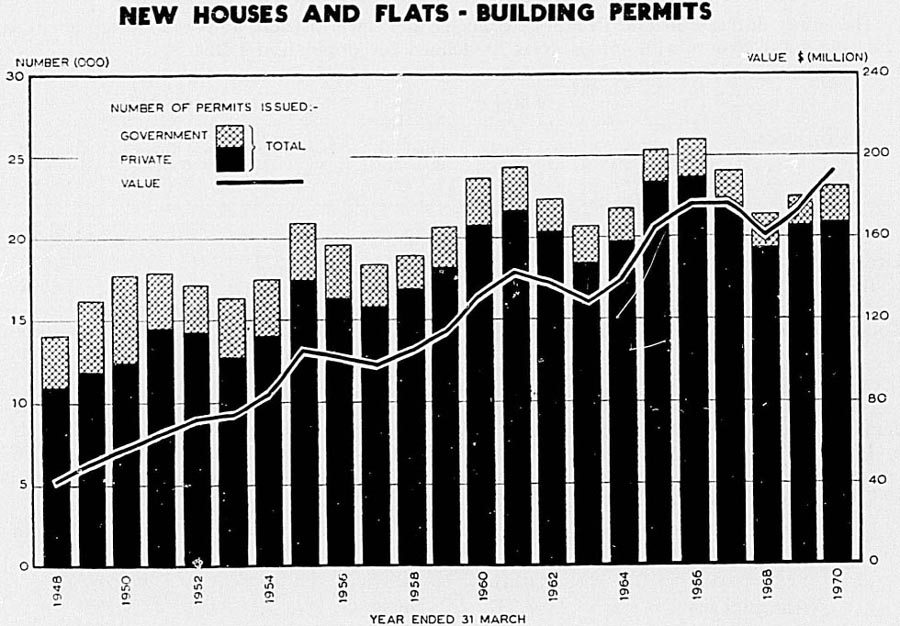
The following table shows details, for the latest 11 years, of blocks of flats and flats created by conversions. These figures do not include motels or holiday flats as these are included in commercial buildings with hotels, etc.
| Year Ended 31 March | Blocks of Flats | Number of Flats in Blocks | Flats Created by Conversions | Total Flats |
|---|---|---|---|---|
| 1960 | 390 | 1,440 | 899 | 2,339 |
| 1961 | 367 | 1,347 | 860 | 2,207 |
| 1962 | 420 | 1,577 | 470 | 2,047 |
| 1963 | 545 | 2,012 | 404 | 2,416 |
| 1964 | 1,013 | 3,375 | 752 | 4,127 |
| 1965 | 1,589 | 5,462 | 1,059 | 6,521 |
| 1966 | 1,568 | 5,675 | 1,248 | 6,923 |
| 1967 | 1,480 | 5,269 | 1,100 | 6,369 |
| 1968 | 1,349 | 4,586 | 950 | 5,536 |
| 1969 | 1,605 | 4,896 | 915 | 5,811 |
| 1970 | 2,051 | 6,094 | 763 | 6,857 |
Since the year 1961-62 additional information makes it reasonably certain that the figures for flats created by conversion refer to complete units. In earlier years the figures are known to include some apartments not completely self-contained.
The following table gives a summary of building permits (including State building operations) for the latest two years by number and value for urban and rural districts.
The urban districts include all cities, boroughs, and town districts, and seven urban counties; they do not conform with urban areas as defined for population statistics.
| Districts | 1968-69 | 1969-70 | ||||
|---|---|---|---|---|---|---|
| New Houses and Flats: Number | New Houses and Flats: Value | Total, All Buildings: Value | New Houses and Flats: Number | New Houses and Flats: Value | Total, All Buildings: Value | |
| $(000) | $(000) | $(000) | $(000) | |||
| Urban districts | 19,091 | 149,481 | 336,656 | 19,573 | 162,324 | 372,323 |
| Rural districts | 3,226 | 25,538 | 58,755 | 3,511 | 30,266 | 75,662 |
| Totals, New Zealand | 22,317 | 175,019 | 395,411 | 23,084 | 192,590 | 447,985 |
There were 2,157 Government houses and flats (1,851 in urban and 306 in rural districts) commenced in 1969-70 compared with 1,657 (1,455 in urban and 202 in rural districts) in 1968-69. The value of Government houses and flats commenced in 1969-70 was $16,695,863 as against $12,930,970 in 1968-69. The average value for Government houses and flats was $7,740 in 1969-70 as against $7,804 in 1968-69.
The following table arranges in geographical order the urban local authorities with building values of over $1,000,000 in 1969-70.
| $(000) | |||
|---|---|---|---|
| Whangarei city | 4,231 | ||
| Waitemata county | 17,694 | ||
| East Coast Bays | 3,075 | ||
| Takapuna city | 5,478 | ||
| Northcote | 1,080 | ||
| Birkenhead | 3,398 | ||
| Henderson | 1,145 | ||
| New Lynn | 1,598 | ||
| Auckland city | 30,783 | ||
| Manukau city | 21,480 | ||
| Mt. Eden | 1,690 | ||
| Mt. Albert | 4,103 | ||
| Mt. Roskill | 3,458 | ||
| Onehunga | 2,246 | ||
| One Tree Hill | 5,874 | ||
| Ellerslie | 1,830 | ||
| Mt. Wellington | 4,583 | ||
| Otahuhu | 1,680 | ||
| Papatoetoe city | 2,147 | ||
| Howick | 2,494 | ||
| Papakura | 3,576 | ||
| Pukekohe | 1,535 | ||
| Morrinsville | 1,198 | ||
| Hamilton city | 14,064 | ||
| Rotorua city | 5,923 | ||
| Taupo | 3,170 | ||
| Tauranga city | 5,863 | ||
| Mt. Maunganui | 2,787 | ||
| Whakatane | 1,159 | ||
| Gisborne city | 4,969 | ||
| Napier city | 5,885 | ||
| Hastings city | 4,509 | ||
| Havelock North | 1,099 | ||
| New Plymouth city | 6,924 | ||
| Wanganui city | 2,942 | ||
| Feilding | 1,202 | ||
| Palmerston North city | 8,840 | ||
| Levin | 2,675 | ||
| Masterton | 2,048 | ||
| Hutt county | 9,160 | ||
| Upper Hutt city | 7,471 | ||
| Lower Hutt city | 9,231 | ||
| Petone | 1,529 | ||
| Porirua city | 7,097 | ||
| Tawa | 2,045 | ||
| Wellington city | 34,856 | ||
| Nelson city | 3,805 | ||
| Blenheim | 1,766 | ||
| Christchurch city | 15,986 | ||
| Waimairi county | 13,115 | ||
| Paparua county | 7,304 | ||
| Heathcote county | 1,559 | ||
| Ashburton | 2,860 | ||
| Timaru city | 3,403 | ||
| Oamaru | 1,238 | ||
| Dunedin city | 9,809 | ||
| Gore | 1,075 | ||
| Invercargill city | 8,094 |
Building Permits in Rural Districts—The Counties of Waitemata, Hutt, Waimairi, Heathcote, Paparua, and Taieri are largely urban in character and their permits are included under the urban districts. The tabulation for rural districts is therefore confined to the remaining counties and Waiheke Island.
Government building in rural districts has been included.
The following table arranges rural local authorities with building values of over $1,000,000 in 1969-70 in descending order.
| County | $(000) |
|---|---|
| Southland | 11,577 |
| Matamata | 3,678 |
| Hawke's Bay | 3,330 |
| Wallace | 2,493 |
| Franklin | 2,471 |
| Rotorua | 2,470 |
| Tauranga | 2,387 |
| Bay of Islands | 2,287 |
| Horowhenua | 1,989 |
| Whangarei | 1,777 |
| Waipa | 1,753 |
| Taupo | 1,478 |
| Waimea | 1,454 |
| Ellesmere | 1,420 |
| Marlborough | 1,343 |
| Levels | 1,206 |
| Cook | 1,193 |
| Ashburton | 1,137 |
| Waikato | 1,120 |
Sector of Ownership—An analysis is given of the sector of ownership for permit values.
| Sector of Ownership | Commercial Buildings | Houses and Flats | Schools and Hospitals | |||
|---|---|---|---|---|---|---|
| 1968-69 | 1969-70 | 1968-69 | 1969-70 | 1968-69 | 1969-70 | |
| *Including non-profit organisations. | ||||||
| $(million) | ||||||
| Private enterprise | 32.7 | 48.7 | 22.5 | 24.5 | –– | 1.0 |
| Households* | 1.6 | 0.3 | 163.9 | 177.1 | 2.0 | 2.3 |
| Central government | 12.3 | 10.9 | 13.2 | 16.9 | 36.4 | 34.3 |
| Public corporations | 6.0 | 0.5 | –– | 0.1 | - | - |
| Local government | 3.6 | 1.5 | 2.5 | 2.6 | 11.0 | 7.8 |
| Sector of Ownership | Factories | Miscellaneous | All Buildings | |||
|---|---|---|---|---|---|---|
| 1968-69 | 1969-70 | 1968-69 | 1969-70 | 1968-69 | 1969-70 | |
| $(million) | ||||||
| Private enterprise | 29.8 | 40.5 | 23.4 | 46.1 | 108.8 | 160.8 |
| Households* | - | - | 9.7 | 9.5 | 177.2 | 189.2 |
| Central government | –– | –– | 10.6 | 10.1 | 72.4 | 71.5 |
| Public corporations | - | - | 0.1 | 2.8 | 6.8 | 3.4 |
| Local government | –– | 0.1 | 12.9 | 10.6 | 30.3 | 23.2 |
WORK PUT IN PLACE—The Department of Statistics makes a survey of building work put in place. In contrast to the statistics based on building permits, these figures show the gross value of actual work done. It should be noted that there are varying time lags between the issue of the building permit and the commencement of building. The actual work for which a permit is issued can be extended over a number of time periods. Also, the total value of this work may differ considerably from the value estimated on the building permit.
| Year Ended 31 March | Dwellings | ||||
|---|---|---|---|---|---|
| New Houses and Flats | Alterations and Additions | Total | |||
| Government | Other | Total | |||
| Value of Work Put in Place $(million) | |||||
| 1966 | 16.0 | 167.9 | 183.8 | 26.8 | 210.6 |
| 1967 | 17.1 | 160.2 | 177.3 | 28.0 | 205.4 |
| 1968 | 14.6 | 449.2 | 163.7 | 26.7 | 190.4 |
| 1969 | 12.4 | 155.3 | 167.7 | 28.2 | 195.8 |
| 1970 | 14.9 | 174.9 | 189.8 | 30.4 | 220.2 |
| Year Ended 31 March | Other Buildings* | Grand Total | ||||||
|---|---|---|---|---|---|---|---|---|
| Hotels, Boarding Houses† | Hospitals† | Factories | Commercial Buildings | Schools† | Miscellaneous‡ | Total | ||
*Includes alterations and additions. †And ancillary buildings. ‡Includes churches, sports, and entertainment buildings. §Value of work actually put in place. | ||||||||
| Value of Work Put in Place § $(million) | ||||||||
| 1966 | 11.1 | 7.6 | 47.5 | 62.9 | 18.6 | 27.8 | 175.4 | 386.1 |
| 1967 | 13.9 | 10.4 | 39.5 | 60.5 | 20.7 | 32.7 | 177.6 | 382.9 |
| 1968 | 14.8 | 13.4 | 37.0 | 54.0 | 19.9 | 32.8 | 171.7 | 362.1 |
| 1969 | 13.5 | 15.0 | 32.5 | 47.8 | 21.1 | 34.3 | 164.2 | 360.1 |
| 1970 | 19.7 | 12.3 | 34.4 | 59.3 | 25.3 | 49.5 | 200.5 | 420.7 |
EMPLOYMENT—The level of employment in the building and construction industrial group as shown in the Department of Labour's half-yearly survey has varied considerably during the last ten years. The number employed in the group was fairly constant (approximately 56,000) during 1961 to 1963 but rose sharply during the next three years reaching 64,600 in 1966. There was a sharp decline in 1968 when the number of full-time employees fell to approximately 59,300, but a rise was experienced in 1969 and 1970. The number of employees in the building and construction industrial group engaged in the building of houses and flats has fallen steadily in the last ten years; from approximately 15,600 in 1961 to approximately 13,100 in 1970, or as a percentage of all employees in the building and construction industrial group, from 27.8 percent in 1961 to 21.3 percent in 1970. Presumably this fall is due, in part, to increased productivity in the sector as a result of new or improved methods of construction and better materials and equipment.
BUILDING MATERIALS—Most materials with the exception of some steel and galvanised iron are produced in New Zealand and current production is meeting demand. Although supplies of imported materials are restricted under the system of import licensing, building operations have not been seriously hampered by lack of supplies. Expansion still continues in the quantity and range of materials and fittings manufactured in New Zealand.
Production of Principal Building Materials—The following table shows the production of principal building materials for the latest eleven years.
| PRODUCTION OF PRINCIPAL BUILDING MATERIALS | ||||||||
|---|---|---|---|---|---|---|---|---|
| Production Year | Roughsawn Timber* | Dressed Timber (from Rough-sawn) | Building Sheet† | Plywood | Wall-board‡ | Paints, etc. | ||
| Paints and Enamels | Varnishes | Lacquers | ||||||
*Source: New Zealand Forest Service, for years ended 31 March. †Asbestos cement and cement sheet. ‡Includes fibrous plasterboard. | ||||||||
| ft b.m. (million) | sq ft (million) | gal (thousand) | ||||||
| 1958-59 | 636.8 | 119.3 | 28.7 | 40.0 | 141.2 | 2,892 | 128 | 217 |
| 1959-60 | 693.8 | 128.4 | 31.6 | 43.1 | 153.1 | 3,033 | 118 | 256 |
| 1960-61 | 714.1 | 144.4 | 33.8 | 48.0 | 170.8 | 3,134 | 115 | 264 |
| 1961-62 | 692.6 | 157.0 | 31.3 | 49.3 | 188.4 | 3,016 | 130 | 270 |
| 1962-63 | 643.4 | 160.2 | 28.3 | 51.4 | 170.3 | 3,096 | 126 | 294 |
| 1963-64 | 666.0 | 154.0 | 30.1 | 52.9 | 168.7 | 3,321 | 136 | 346 |
| 1964-65 | 736.2 | 176.8 | 31.2 | 54.2 | 192.9 | 3,636 | 138 | 370 |
| 1965-66 | 756.9 | 185.0 | 34.6 | 56.6 | 197.5 | 3,617 | 157 | 345 |
| 1966-67 | 747.6 | 176.0 | 33.6 | 57.1 | 181.0 | 3,643 | 166 | 365 |
| 1967-68 | 674.9 | 165.7 | 32.6 | 40.5 | 190.5 | 3,635 | 192 | 320 |
| 1968-69 | 732.6 | 172.5 | 35.1 | 51.3 | 202.0 | 3,731 | 236 | 366 |
| PRODUCTION OF PRINCIPAL BUILDING MATERIALS | ||||||
|---|---|---|---|---|---|---|
| Production Year | Concrete Roofing Tiles | Bricks and Blocks | Drainpipes, Salt Glazed, 6 in. and Below | Cement | ||
| Building Bricks, Clay | Concrete | |||||
| Bricks | Blocks | |||||
| *In millions of effective running feet. | ||||||
| No. (million) | tons(000) | |||||
| 1958-59 | 9.4 | 52.2 | 0.6 | 8.2 | 2.28 | 542.1 |
| 1959-60 | 11.4 | 50.9 | 0.5 | 10.1 | 2.76 | 575.4 |
| 1960-61 | 11.0 | 56.4 | 0.6 | 12.5 | 2.88 | 619.6 |
| 1961-62 | 11.2 | 60.5 | 0.5 | 12.4 | 3.09 | 647.9 |
| 1962-63 | 9.4 | 46.8 | 1.4 | 12.2 | 3.06 | 653.2 |
| 1963-64 | 9.8 | 50.2 | 0.8 | 16.0 | 5.82* | 754.1 |
| 1964-65 | 8.8 | 51.7 | 0.8 | 19.5 | 6.95* | 786.5 |
| 1965-66 | 5.9 | 52.4 | 0.4 | 25.5 | 6.89* | 841.1 |
| 1966-67 | 5.2 | 50.8 | 0.6 | 24.2 | 7.33* | 859.0 |
| 1967-68 | 4.8 | 42.5 | 0.1 | 23.5 | 6.93* | 772.5 |
| 1968-69 | 7.1 | 40.3 | 0.1 | 22.2 | 6.86* | 774.3 |
HOUSING FINANCE—The chief agency providing finance for housing in New Zealand is the State Advances Corporation, a wholly Government owned institution described in detail in Section 30B. For the year ended 31 March 1970 the State Advances Corporation authorised loans valued at $47.6 million for new urban dwellings, of which $12.7 million was initially at the 3 percent rate. Loans of $18.4 million were authorised for the purchase of existing houses, of which $2.4 million was initially at 3 percent.
The Family Benefits (Home Ownership) Act 1964 provides for payment in a lump sum of the social security family benefit, the capitalised benefit to be applied towards the provision of a family home or for essential alterations or for repayment of encumbrances on a family home. The scheme became operative on 1 April 1959. Benefits in respect of any number of children may be capitalised provided the aggregate advance does not exceed $2,000. Family benefit capitalisation advances totalling $96.6 million were authorised in the first eleven years of the scheme by the State Advances Corporation to applicants holding eligibility certificates issued by the Social Security Commission.
Under the Mortgage Guarantee Scheme introduced in 1961, the State Advances Corporation assists building societies, insurance companies, and other approved lending institutions to grant loans for the purchase of existing houses by guaranteeing the difference between the usual limit of 66 2/3 percent of value and 85 percent of the valuation. Guarantees are also available in respect of new houses up to a limit of 90 percent of valuation.
In July 1957 the Government announced the commencement of a home lay-by scheme in the Post Office Savings Bank and this has been extended to trustee and private savings banks. A subsidy, known as a suspensory free deposit, of $10 per $200 up to a limit of $200 is credited to each home lay-by account when the money is used to acquire a new home to be occupied by the depositor. There is no limit to the amount which can be deposited but the maximum amount in any one year on which the subsidy can be credited is $1,000. The effect of the scheme is that a person who deposits $1,000 each year in a home lay-by account for four years will qualify for the maximum subsidy of $200, in addition to the normal savings bank interest. Deposits of $400 a year for 10 years can also earn the maximum subsidy.
Further information on housing finance is contained in Section 30B—State Advances Corporation.
ROLE OF LOCAL AUTHORITIES—The housing policy of the Government includes the provision of loans to local authorities through the State Advances Corporation for pensioner, rural, and community accommodation.
Pensioner Housing: For some years Government has encouraged local authorities to meet the housing needs of pensioners rather than provide such accommodation itself. To this end a scheme of subsidies was introduced, the balance of the cost being found by way of a loan to the local body with interest at 3 1/2 percent and a term up to 40 years on a table basis. The combination of subsidy and low interest rate is directed at keeping rents within reasonable levels—the current maxima are $3.50 and $4.50 for single and double units respectively.
The policy is administered by the Health Department, which establishes the need for pensioner accommodation in a particular locality and administers the subsidy. The State Advances Corporation provides technical services and administers the loan. The subsidy offered is up to 50 percent of the cost of erection—with a maximum of $3,000 per unit. A subsidy of up to $1,000 a flat is available for the cost and development of land. It is required that the accommodation provided be let only to elderly persons with a housing need.
At 31 March 1970 Government subsidies of $9,934,000 had been granted to local authorities and also loans of $12,089,000 to provide 5,856 flats. (These subsidies are separate from those granted to religious and welfare organisations—see section 5A).
Rural Housing: The Rural Housing Act 1939 has as its object the provision of more houses on farm properties. Loans are made to county councils (and other local bodies within whose boundaries farmlands are situated) for readvancing to farmers for the erection of, or additions or alterations to, dwellings. The State Advances Corporation is responsible for the supervision and general administration of the Act. Interest to local bodies is currently at 4 3/4 percent; the rate charged to the farmer is 5 1/4 percent; the maximum advance in respect of any one house is $7,000. Persons receiving loans are principally owners of economic farms.
Government policy has for many years been directed at ensuring housing of good standard in rural areas and active encouragement has been given to county councils to increase participation in the scheme. During the year ended 31 March 1970, 52 county councils uplifted loans of $1,501,541 in respect of 275 houses. A total of $20,782,842 has been authorised since the scheme was introduced.
Community Housing: The State Advances Corporation has authority to grant loans for general housing purposes, i.e., for the benefit of the community in general. The interest rate is 5 percent; loan terms are for up to 40 years on a table basis. Proposals must involve a definite scheme for the erection of not less than three houses. The substantial proportion of assistance provided has been in the metropolitan areas, e.g., in Wellington the city council's building programme has been largely financed from this source. The emphasis is on moderate cost accommodation.
Urban renewal is also financed under the community housing scheme—but at 3 1/2 percent. The area concerned must first be declared a reclamation area; any loss on land purchase and demolition is eligible for a Government subsidy (administered by the Ministry of Works). The Freeman's Bay scheme in Auckland and the Nairn Street project in Wellington are examples.
Since 1960 over $11.0 million has been authorised for community housing schemes.
Borough councils are authorised under the Municipal Corporations Act to provide loans for housing purposes, to subdivide for such purposes any land vested in a council and not held by it in trust for any particular purpose other than housing; and to sell or lease allotments for housing purposes. Local authorities may also apply to the Local Authorities Loans Board for blanket authorities for the purchase of land for subdivision for housing purpose. Local authorities are encouraged to play a prominent part in the housing of their citizens.
MAORI HOUSINGS—In addition to the facilities of the State Advances Corporation, financial assistance towards the building of houses, including the purchase of building sites, additions, repairs to existing dwellings, and for the purchase of houses, is available to Maoris and other Polynesians under the Maori Housing Act 1935, the lending authority being the Board of Maori Affairs.
The Maori and Island Affairs Department also arranges for the construction of the houses in many cases and provides a free plan service. Finance through the Department up to set loan limits, rebated interest rate, and capitalisation of family benefits, is similar to loans granted by the State Advances Corporation. Where the applicant does not qualify for the special interest concession the finance is made available at an interest rate of 5 5/8 percent.
All applications for State tenancies are dealt with by the State Advances Corporation, although assistance with applications is often given by the Department's staff.
From the inception of the scheme to 31 March 1970, the Department has provided finance to enable 14,829 families to build new houses, 548 to purchase existing houses, and 5,616 to make additions to or repair their houses. A further 7,282 Maori families have obtained houses or rental flats from the State Advances Corporation and the Maori Trustee. A Maori household averages 5.5 persons so that the combined figure, including additions or repairs, of 22,679 houses, means a total of some 125,890 Maori people have been provided with better housing in a space of 31 years.
The Government has also provided accommodation for single young Maori people in urban areas. It has built rental flats for girls in Auckland, Wellington, Christchurch, and Whangarei. It has provided hostels for boys at Auckland and Christchurch and by the provision of subsidy has encouraged church organisations to establish hostels in a number of cities. Through the agency of the Maori Trustee, hostel and flat accommodation for both boys and girls has been provided in many of the main centres. In these ways the accommodation needs of over 1,000 young Maori people are now being met, many of whom are enrolled on the Department's vocational training courses operated in conjunction with the technical institutes.
Accommodation for Maori pensioners has been provided in Kaikohe, Paihia, and Te Kao.
STATE HOUSE CONSTRUCTION—A programme of building State rental houses and flats was commenced in March 1937. These are allocated to tenants on the basis of income and need. Since 1950 there has been an income limit on applicants for tenancies for these dwellings.
The Housing Division of the Ministry of Works acquires and develops land to provide sites for houses and flats and arranges contracts for their construction. These activities are covered by the Housing Act 1955.
The totals of State rental units completed and handed over for occupation in the latest 11 years are shown in the following table. Up to 31 March 1970 there were 72,498 units completed.
| Year | Number of Units |
|---|---|
| 1958-59 | 1,647 |
| 1959-60 | 2,128 |
| 1960-61 | 2,148 |
| 1961-62 | 1,972 |
| 1962-63 | 1,948 |
| 1963-64 | 1,562 |
| 1964-65 | 1,646 |
| 1965-66 | 1,334 |
| 1966-67 | 1,469 |
| 1967-68 | 1,489 |
| 1968-69 | 1,534 |
| 1969-70 | 1,241 |
Planning of New Urban Areas—Such has been the demand for State development in Auckland and Wellington that it has been necessary to acquire large areas of land in these metropolitan areas, which, when developed over a number of years, has resulted in the creation of new towns. These have been comprehensively planned and developed sites have been made available for central commercial, industrial, and administrative areas as well as civic and neighbourhood amenities. At present the three existing instances of development at this scale are Porirua city, near Wellington, and Otara and Mangere townships within Manukau city, south of Auckland.
In accordance with continuing government policy, the planning of these towns and State development generally has recognised the need to conserve land and gain as much return from the installation of municipal services as possible. For these reasons, particular attention has been paid to subdivisional pattern and, where appropriate, medium-density housing to an acceptable level has been introduced. In addition, a measure of building of medium-and high-density residential accommodation has been undertaken in inner city areas in Auckland and Wellington.
Recognising the need for some degree of social diversification in State developed areas, it has been the policy for a number of years to make available for sale to the public for private housing some sections surplus to the need of the rental housing programme.
State Services Housing—State services houses are houses for Government Departments and the armed forces. The total number of such houses erected by the Division to 31 March 1970 was 12,538. This includes houses built at the sites of major construction jobs such as electric power schemes.
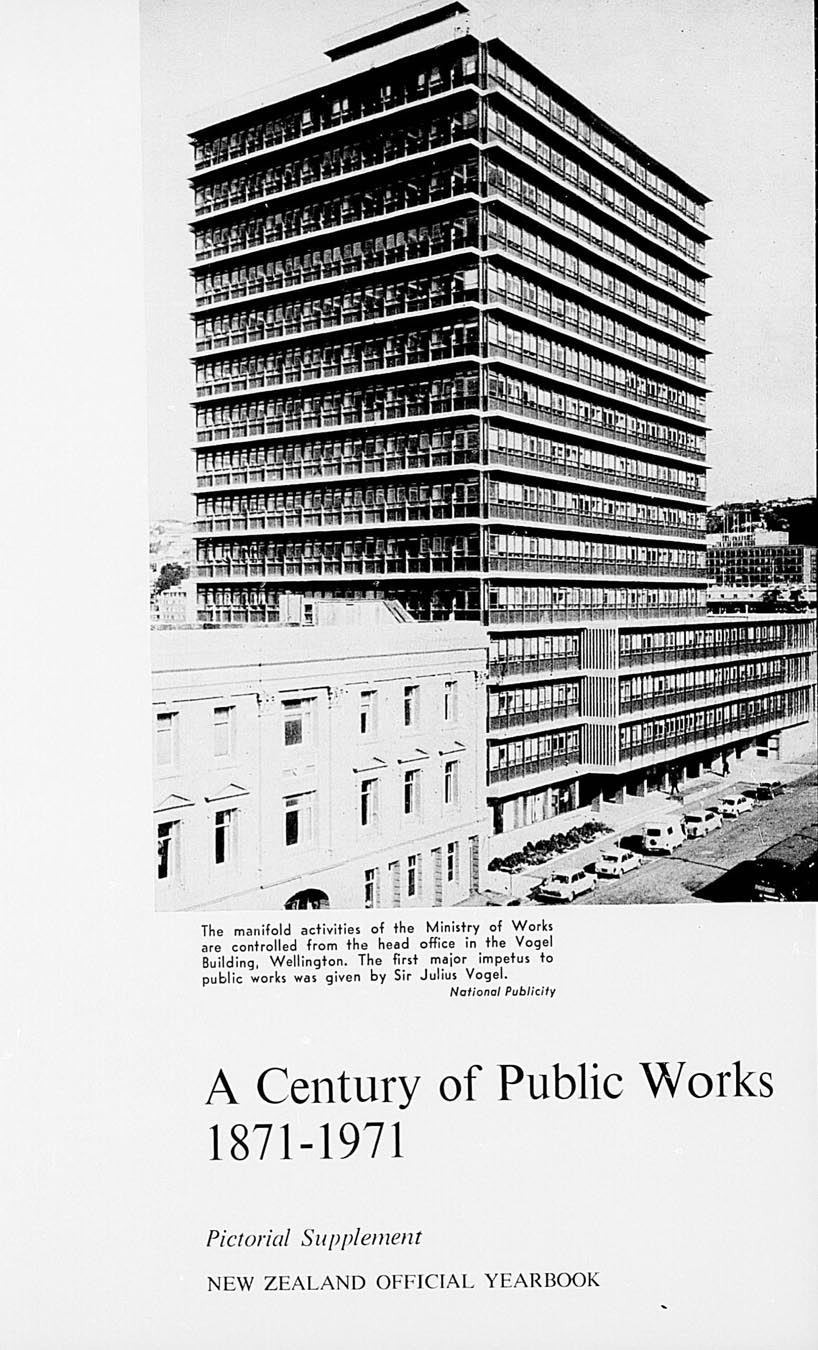
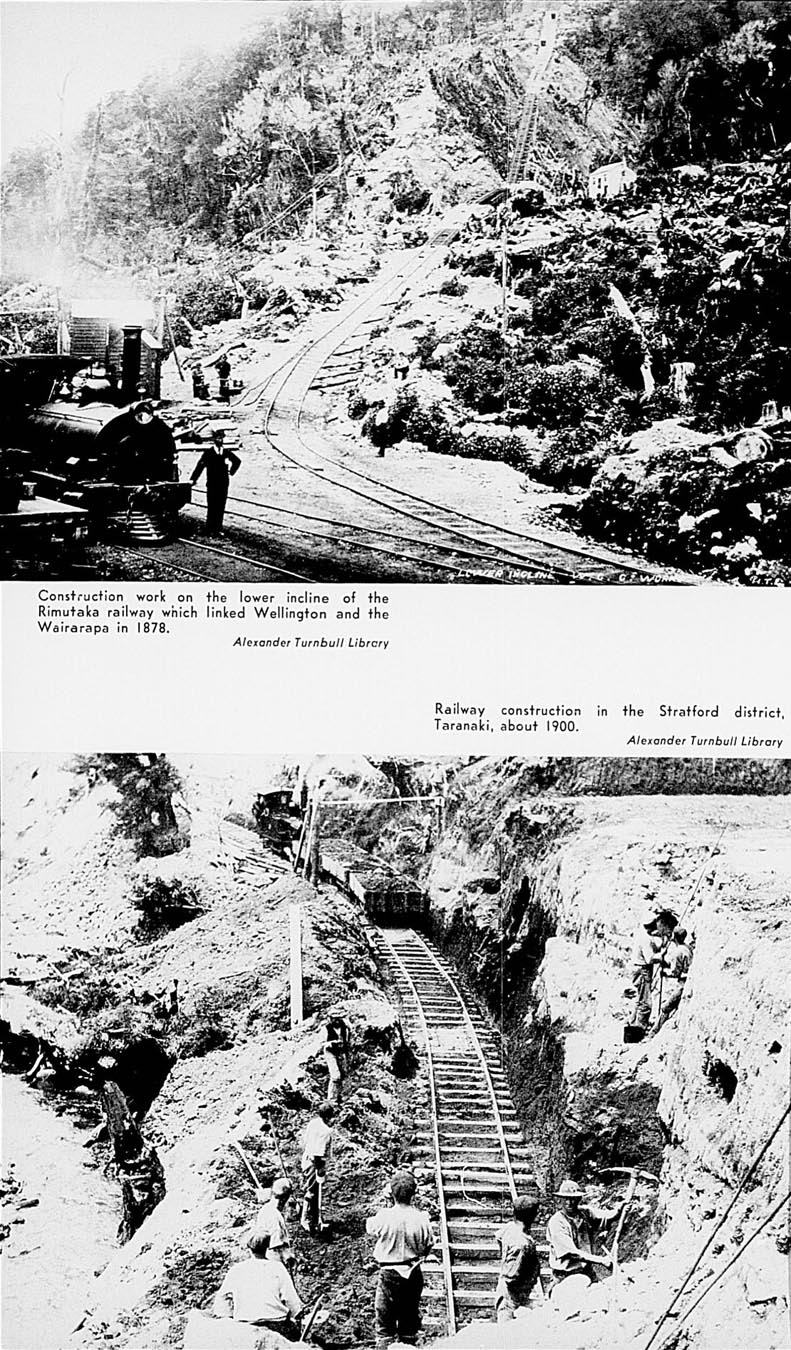
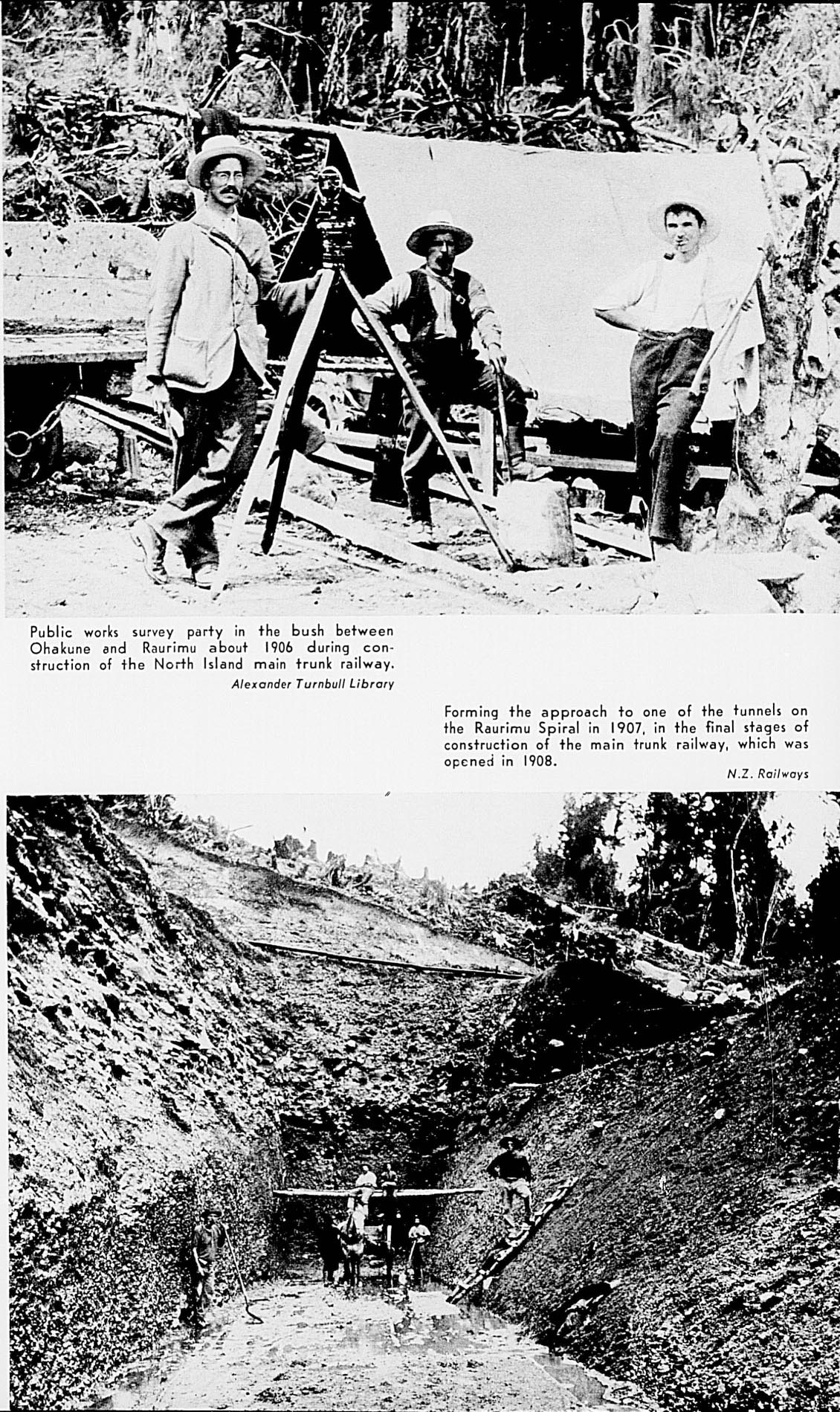
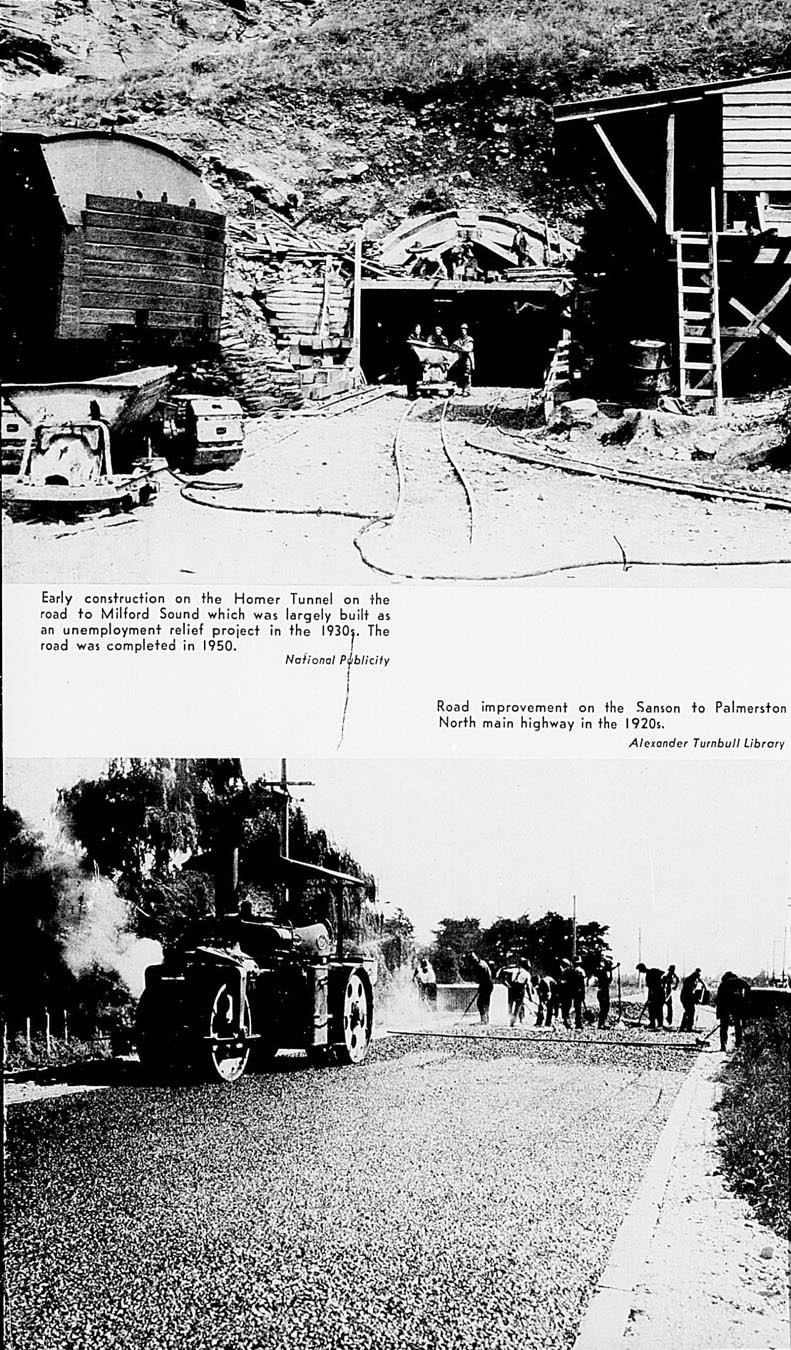
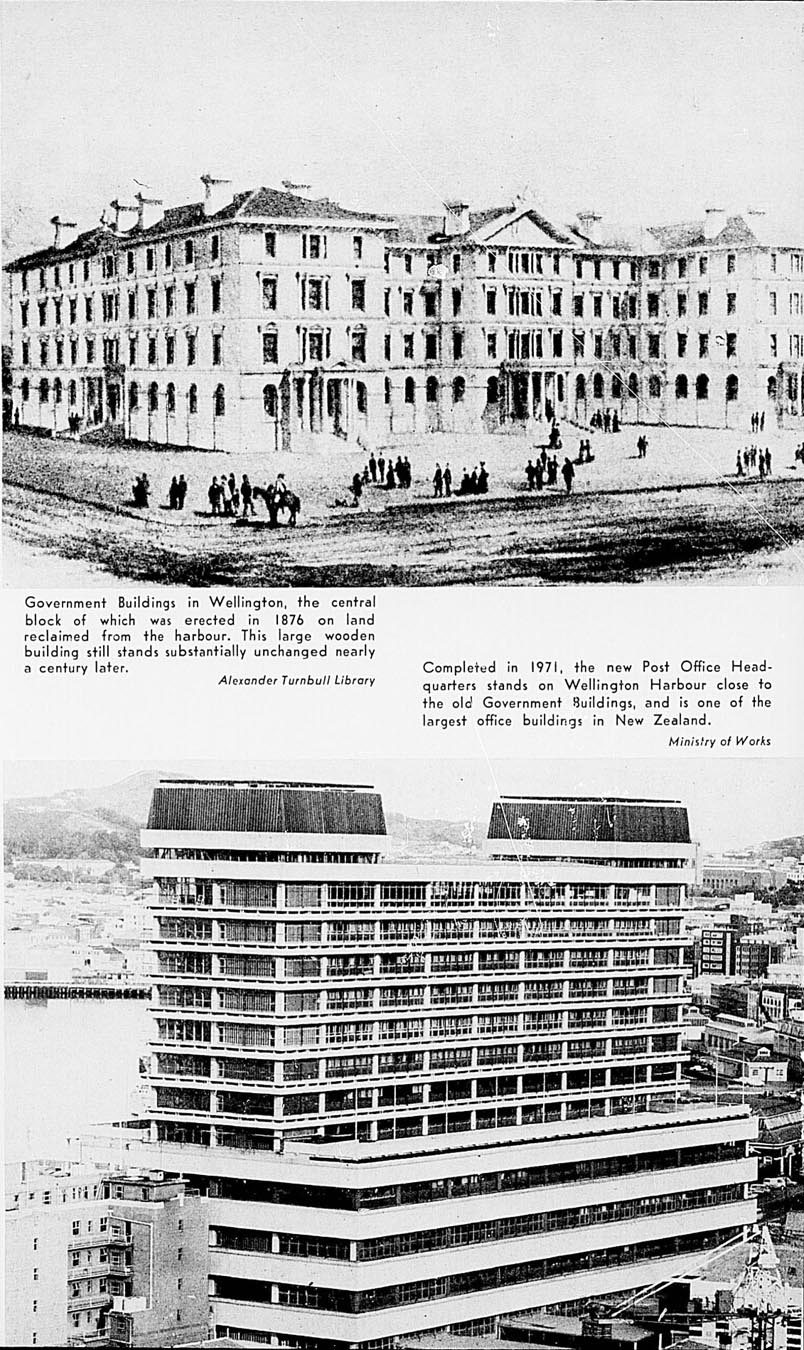
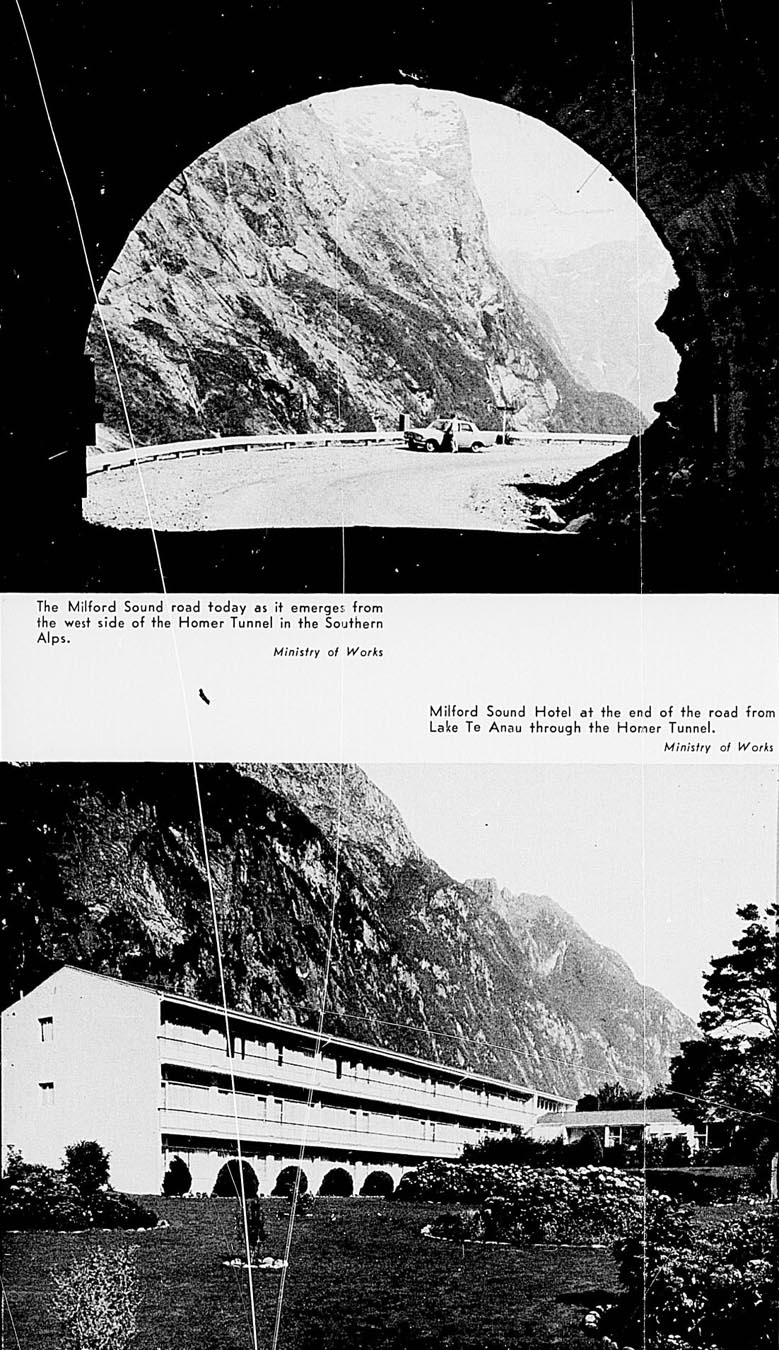
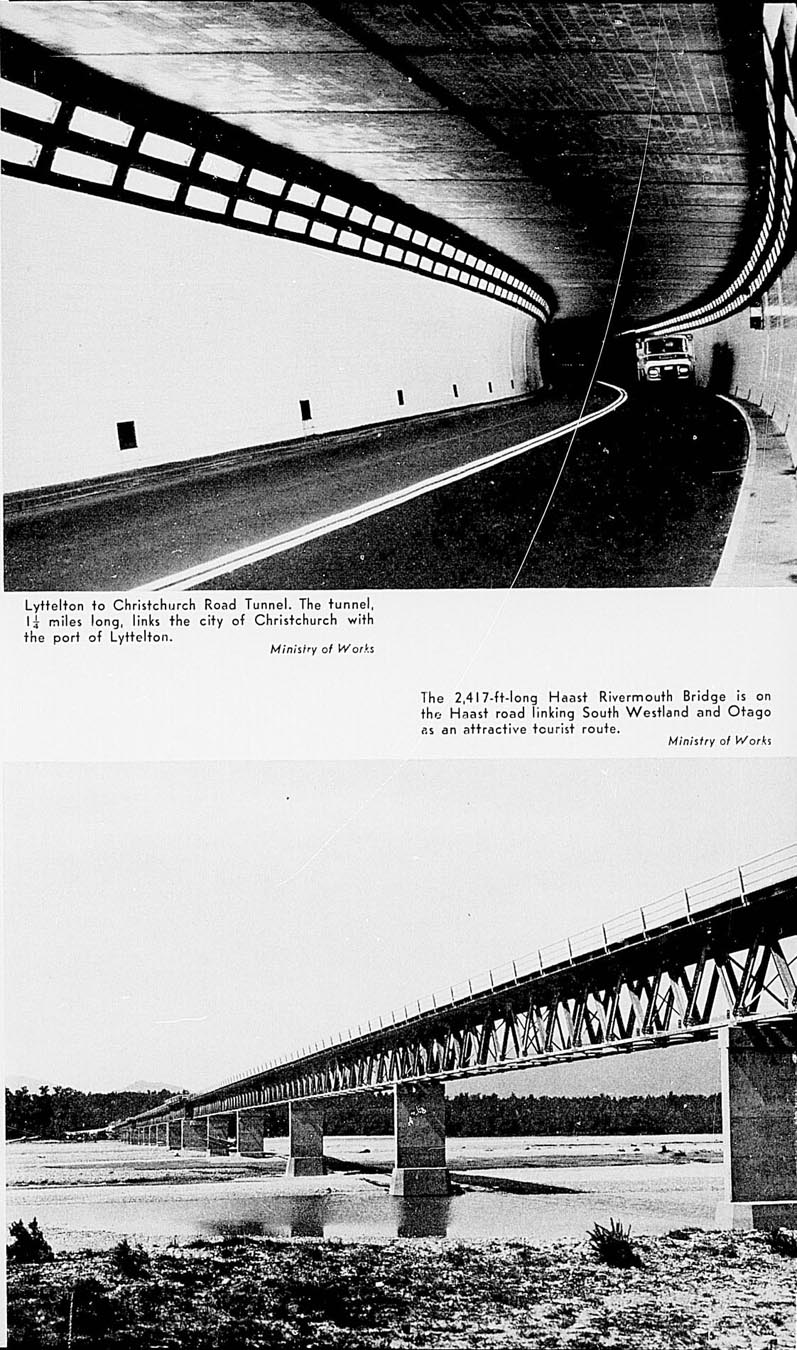
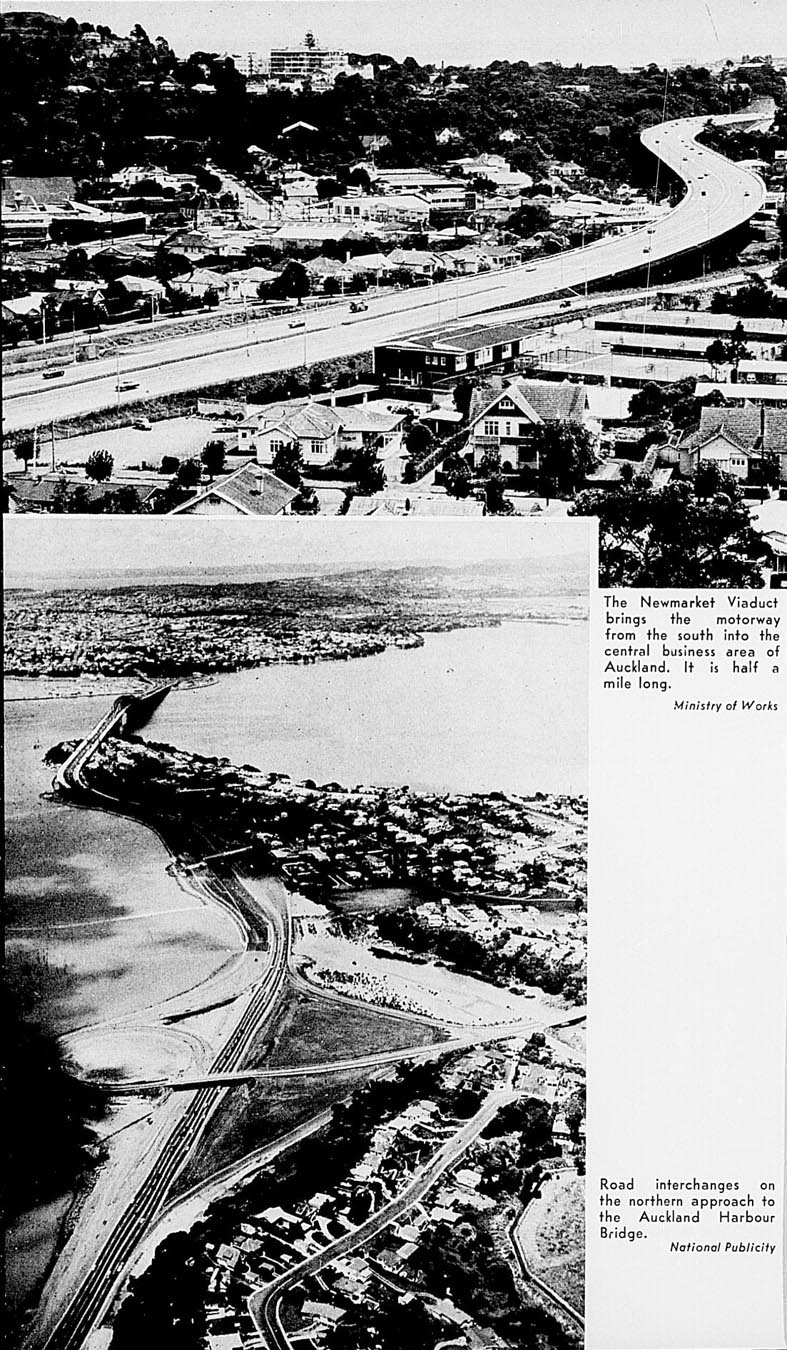
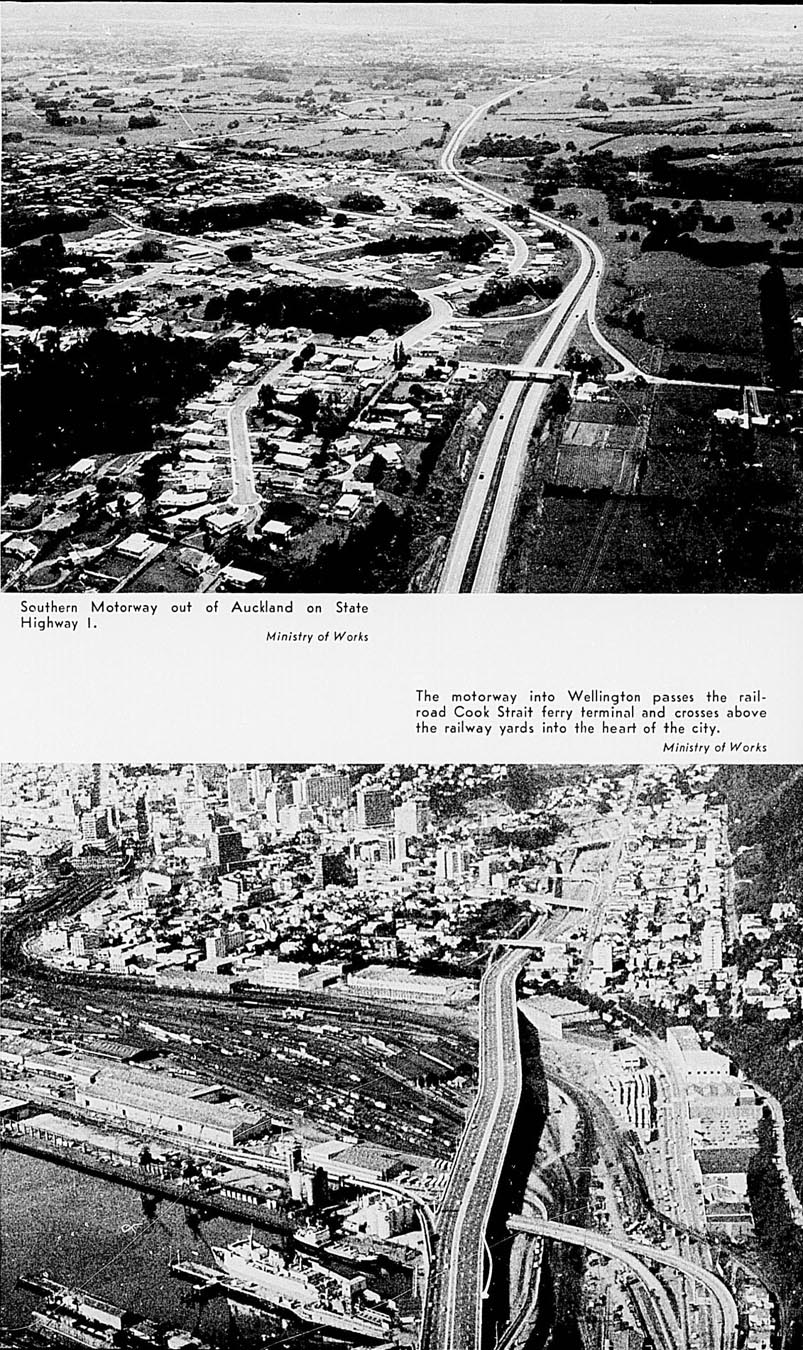
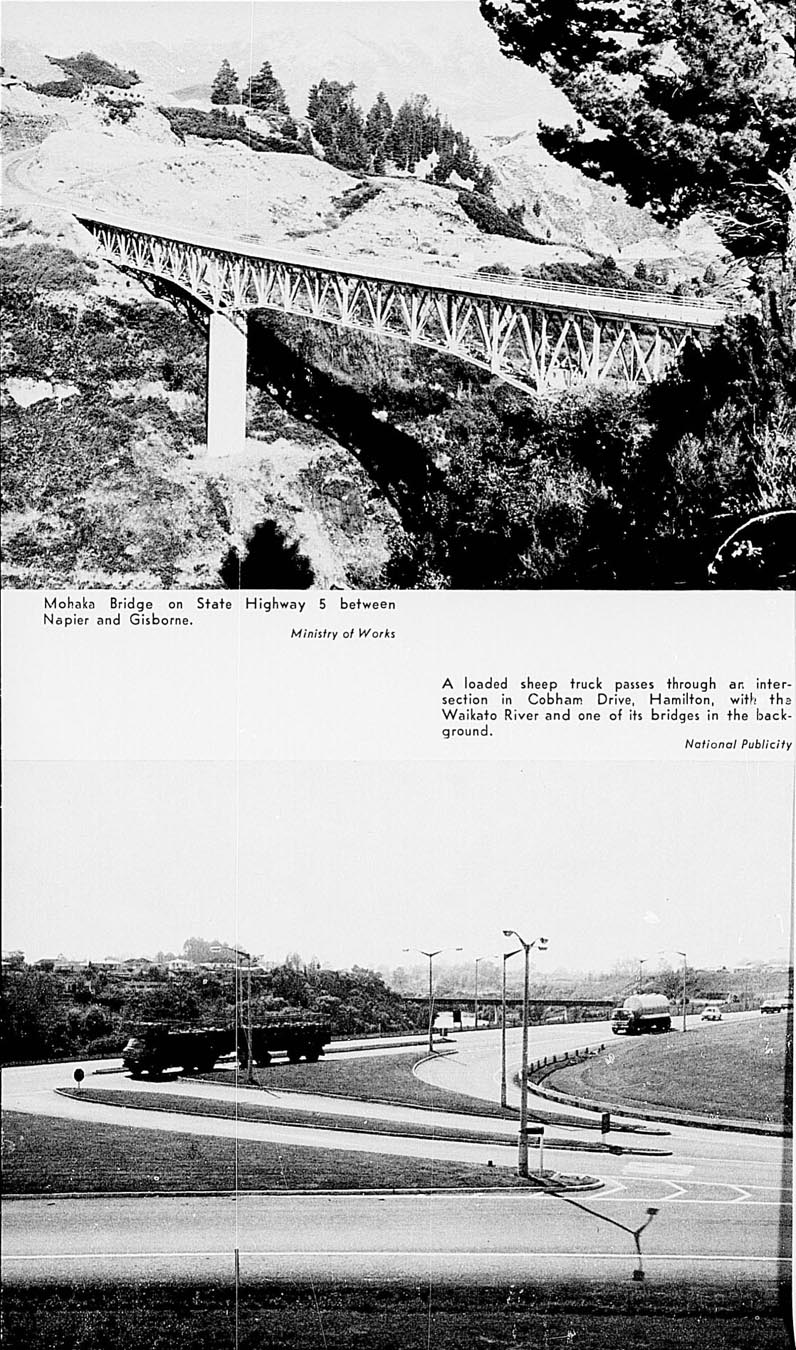
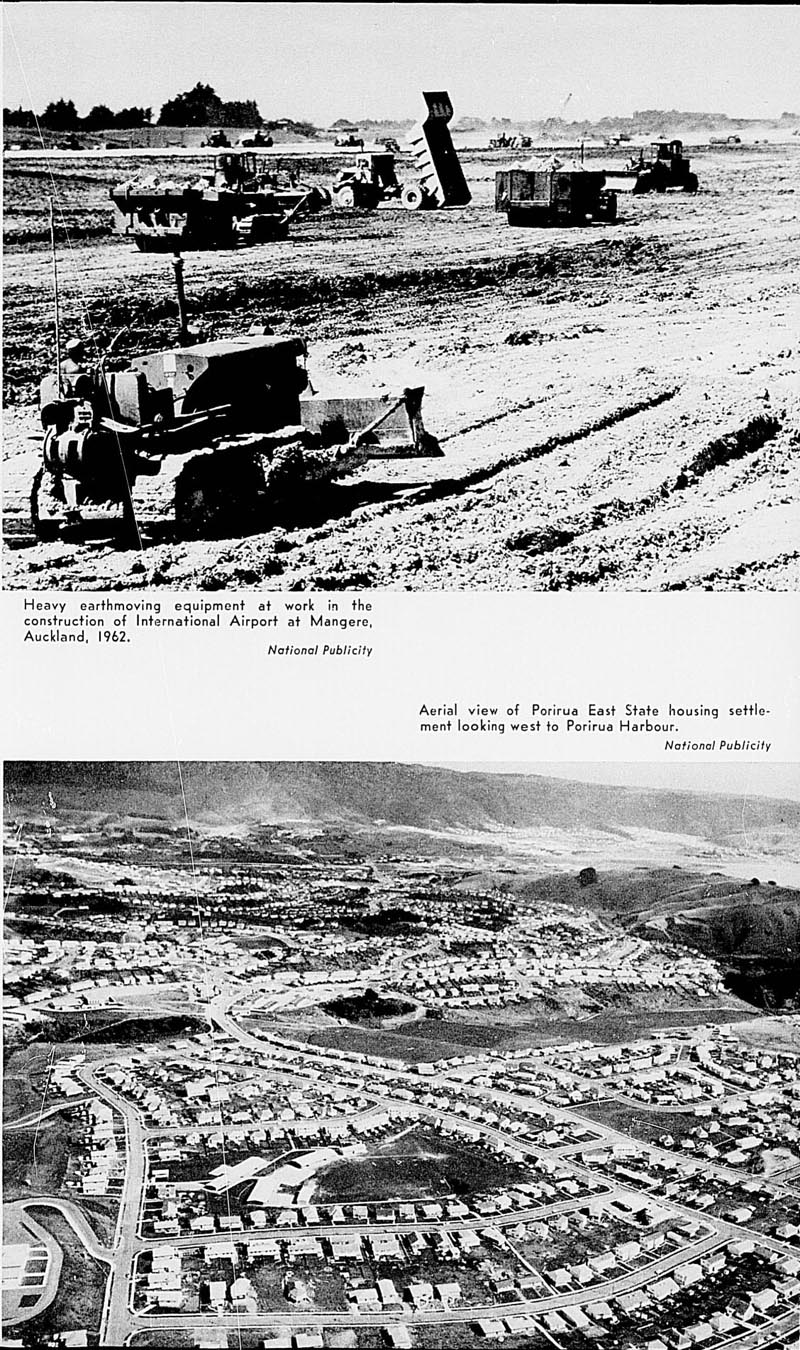
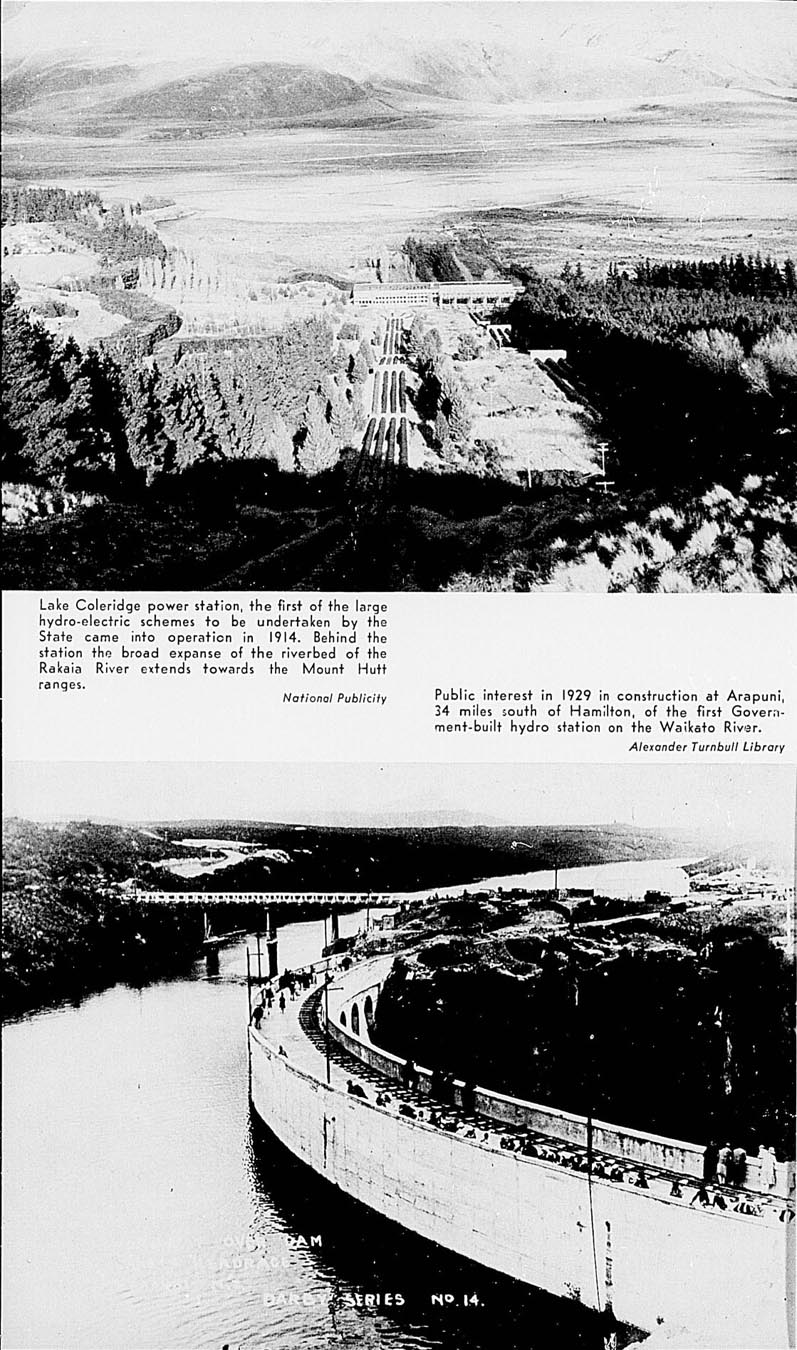
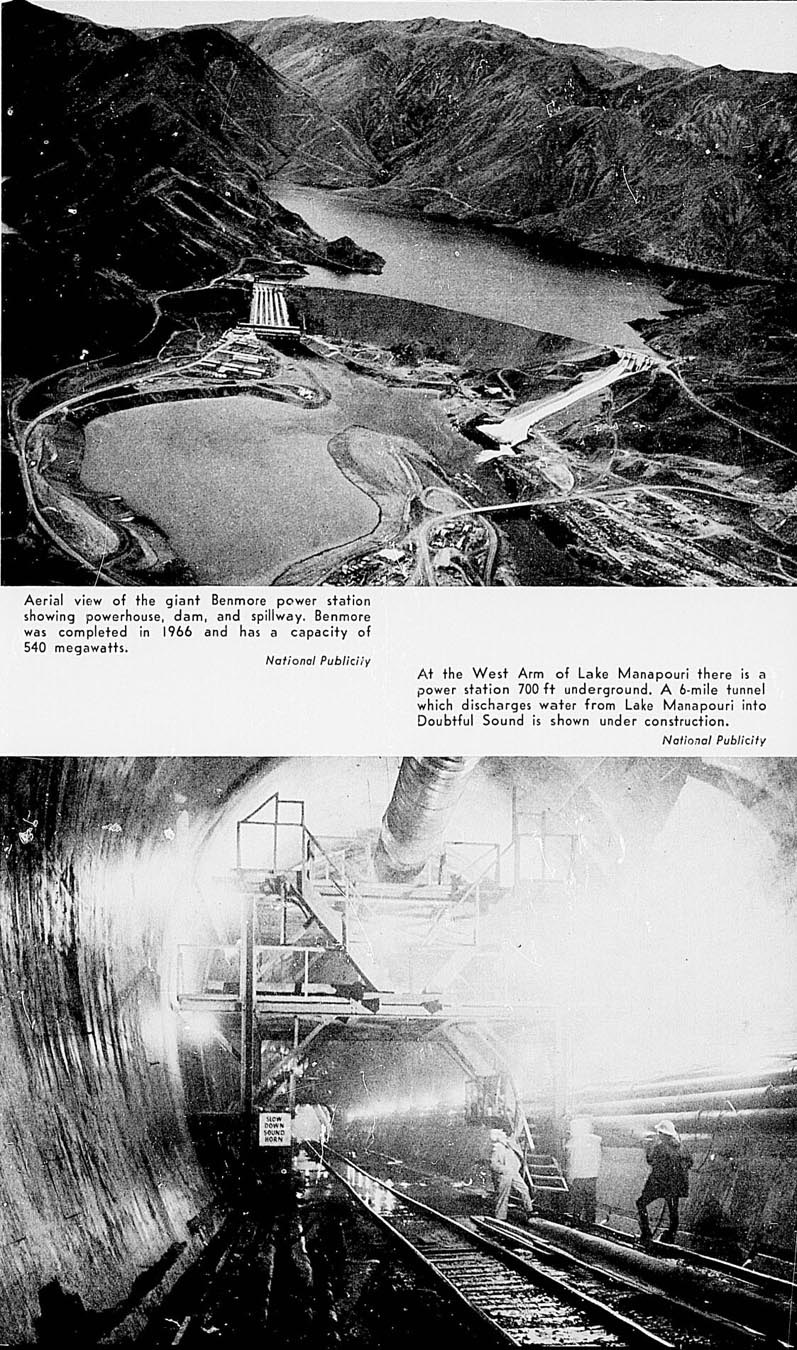
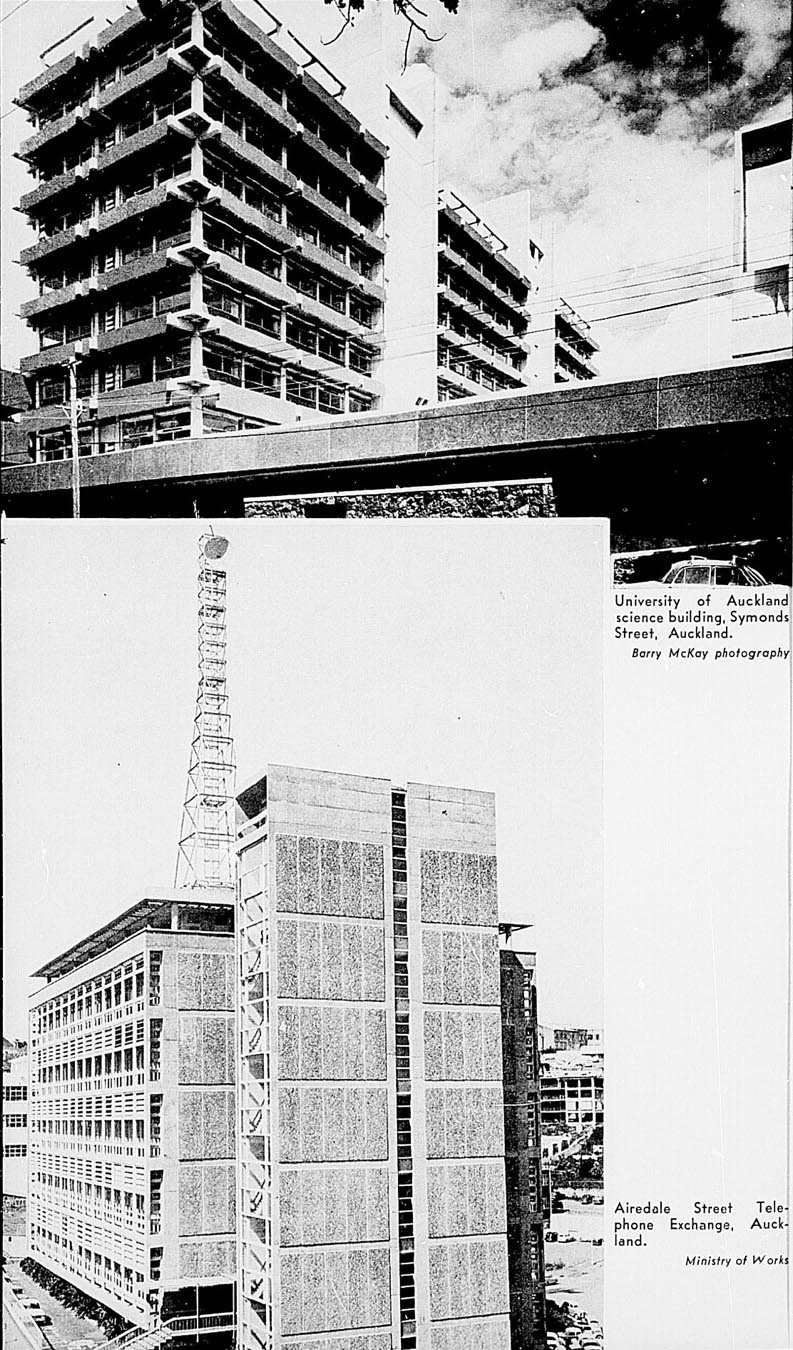
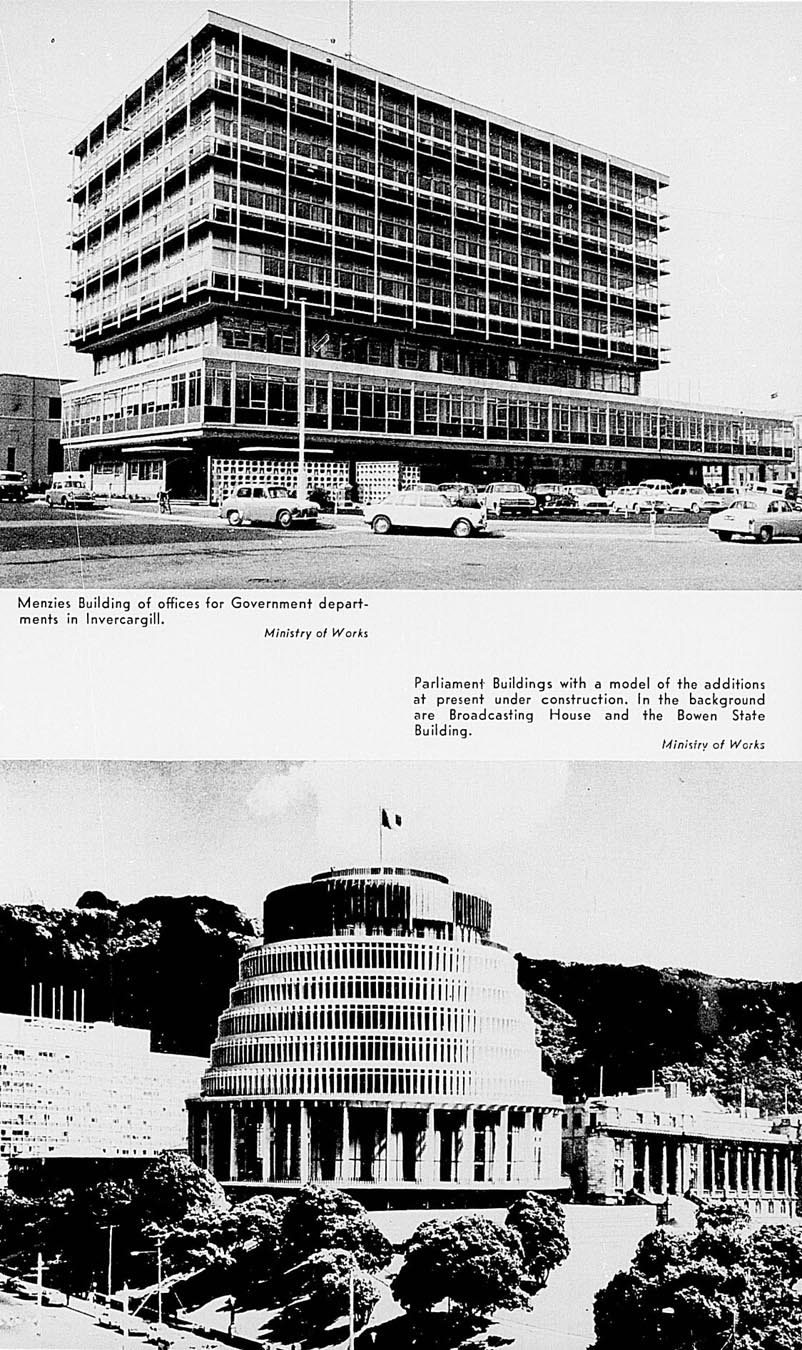
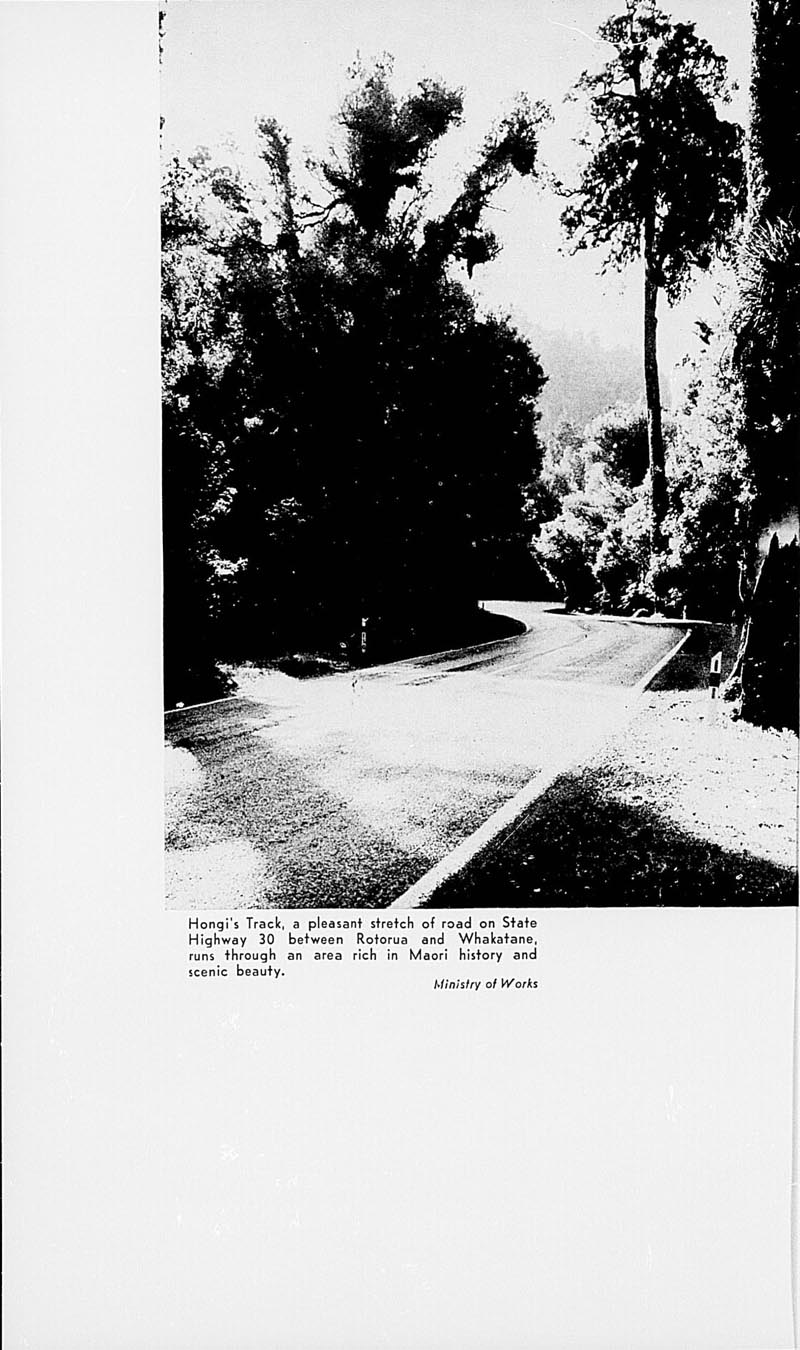
Finance—The cost of the State housing programme, including the acquisition and development of land, is financed from the Housing Construction vote in the Works and Trading Account, i.e., out of national development loan moneys.
The following table shows the annual expenditure from the Housing Construction vote.
| Year Ended 31 March | State Housing | State Services | Land Purchase and Development | Administration and General | Total |
|---|---|---|---|---|---|
| *Additional expenditure charged directly to the departments concerned is shown in the succeeding table. | |||||
| $(thousand) | |||||
| 1,960 | 14,372 | 60 | 6,402 | 1,196 | 22,032 |
| 1,961 | 12,430 | 92 | 6,416 | 1,290 | 20,228 |
| 1,962 | 11,638 | 68* | 5,326 | 1,354 | 18,386 |
| 1,963 | 10,354 | 64* | 4,094 | 2,140 | 16,652 |
| 1,964 | 10,764 | 72* | 3,960 | 1,840 | 16,636 |
| 1,965 | 10,102 | 122* | 3,352 | 1,886 | 15,462 |
| 1,966 | 9,394 | 136* | 3,292 | 1,864 | 14,686 |
| 1,967 | 11,234 | 124* | 2,784 | 1,898 | 16,040 |
| 1,968 | 10,865 | 123 | 2,769 | 1,922 | 15,680 |
| 1,969 | 9,849 | 89 | 3,292 | 1,890 | 15,120 |
| 1,970 | 10,276 | 134 | 3,264 | 2,036 | 15,710 |
The next table shows the annual total expenditure by the Housing Division in the latest six years.
| Year | Vote, “Housing Construction” | On Behalf of Other Departments (Charged Direct) | Total | |||||||||
|---|---|---|---|---|---|---|---|---|---|---|---|---|
| Construction Land Purchase and Development, Administration | Land Development, Murupara | On Behalf of Other Departments* | Total | |||||||||
| *Expenditure on behalf of other Departments charged meantime to vote, “Housing Construction”. | ||||||||||||
| $(thousand) | ||||||||||||
| 1964-65 | 15,332 | 8 | 122 | 15,462 | 2,272 | 17,734 | ||||||
| 1965-66 | 14,536 | 14 | 136 | 14,686 | 5,666 | 20,352 | ||||||
| 1966-67 | 15,792 | 1 | 124 | 15,917 | 4,662 | 20,579 | ||||||
| 1967-68 | 15,557 | - | 123 | 15,680 | 3,333 | 19,013 | ||||||
| 1968-69 | 15,031 | - | 89 | 15,120 | 1,807 | 16,928 | ||||||
| 1969-70 | 15,576 | - | 134 | 15,710 | 3,592 | 19,302 | ||||||
Room Content of Units (State Houses and State Services Housing)—The types of units according to the number of bedrooms in units built during the two latest years, also the totals from 1937 to date, are shown in the following table.
| Number of Bedrooms | 1968-69 | 1969-70 | Totals to Date | |||
|---|---|---|---|---|---|---|
| Number of Units | Percentage of Total | Number of Units | Percentage of Total | Number of Units | Percentage of Total | |
| One bedroom or bed-sitting room | 39 | 2.2 | 36 | 2.3 | 4,811 | 5.6 |
| Two bedrooms | 321 | 18.0 | 145 | 9.2 | 25,229 | 29.7 |
| Three bedrooms | 1,217 | 68.2 | 1,187 | 75.5 | 48,315 | 56.8 |
| Four or more bedrooms | 210 | 11.2 | 205 | 13.0 | 6,681 | 7.9 |
| Totals | 1,787 | 100.0 | 1,573 | 100.0 | 85,036 | 100.0 |
Sheathing Materials Used (State Houses and State Services Housing)—The sheathing materials used in the units built during the two latest years, also the totals from 1937 to date, are shown in the following table.
| Materials | Units Built | ||
|---|---|---|---|
| 1968-69 | 1969-70 | Totals to Date | |
| Weatherboard | 561 | 649 | 48,446 |
| Brick | 298 | 293 | 14,560 |
| Concrete | 310 | 230 | 5,774 |
| Other sheathing | 618 | 401 | 16,256 |
| Totals | 1,787 | 1,573 | 85,036 |
Land Acquisition—During 1969-70 a total of 44 developed unit sites was purchased as a charge against the Housing Construction vote, also 174 acres of undeveloped land estimated ultimately to yield 745 unit sites. Approximately one-half of these sections are intended for State rental house building, the balance being for private home building.
State Rental Housing Tender Prices—The following table shows typical tender prices being accepted in the four main centres at the end of the last 11 financial years for similar types of three-bedroom State rental houses of equivalent floor space. In each case the house is a typical single unit on a flat section, built in weatherboards with a tiled roof. The price includes drainage, fencing, paths, toolshed, revolving clothes line, and letterbox. The cost of the section is not included. The figures in parentheses represent the cost per square foot.
| Year | Auckland | Wellington | Christchurch | Dunedin |
|---|---|---|---|---|
| $ $ | $ $ | $ $ | $ $ | |
| 1959-60 | 6,218 (5.92) | 6,068 (5.78) | 5,362 (5.11) | 6,134 (5.84) |
| 1960-61 | 6,338 (6.04) | 6,134 (5.84) | 5,500 (5.24) | 6,218 (5.92) |
| 1961-62 | 6,334 (6.03) | 6,278 (5.98) | 5,472 (5.21) | 6,172 (5.88) |
| 1962-63 | 6,298 (6.00) | 6,316 (6.02) | 5,452 (5.20) | 6,182 (5.88) |
| 1963-64 | 6,306 (6.01) | 6,330 (6.03) | 5,686 (5.42) | 6,234 (5.94) |
| 1964-65 | 6,726 (6.41) | 6,888 (6.56) | 6,104 (5.81) | 6,632 (6.32) |
| 1965-66 | 6,942 (6.61) | 7,178 (6.83) | 6,434 (6.12) | 6,758 (6.42) |
| 1966-67 | 6,894 (6.58) | 7,372 (7.03) | 6,488 (6.19) | 6,990 (6.67) |
| 1967-68 | 6,366 (6.06) | 6,830 (6.50) | 6,273 (5.97) | 6,586 (6.27) |
| 1968-69 | 6,753 (6.43) | 7,264 (6.92) | 6,669 (6.38) | 7,124 (6.78) |
| 1969-70 | 7,184 (6.84) | 7,675 (7.30) | 6,759 (6.43) | 7,661 (7.29) |
JOINT FAMILY HOMES—The Joint Family Homes Act 1964 makes provision for a form of ownership by which a family home will belong not to the husband and wife separately but to both of them jointly so that it may pass to the survivor on the death of one of them. The predominant purpose behind the legislation is the preservation of a family home outside the business or personal speculations of either spouse. A husband and wife, or either of them, being solvent and owning land whether freehold or leasehold on which a residence is erected or on which a residence will be erected within six months, may settle the land as a joint family home provided the residence is used exclusively or principally as a home for themselves and the members of their household. The 1964 Act makes it possible to settle flats as family homes. The settlement is cancelled when the land is sold or when both husband and wife have died or have ceased permanently to reside and have their home on the land. There are substantial benefits resulting from settlement under the Act. The husband and wife have equal rights in connection with ownership and possession while they are both living but cannot deal separately with their interest. On the death of either of them the joint family home becomes the property of the survivor. In the event of claims by creditors or an assignee in bankruptcy, the property is protected up to a sum of $8,000. Further, on the death of one of the spouses there is an exemption of $8,000 from estate duty. Settlements under the Act are exempt from gift and stamp duty.
The Joint Family Homes Amendment Act 1965 introduced new provisions to cover the system now growing up in connection with granting long-term leases to the owner-occupier of flats and vesting the fee simple in them in undivided shares. Under the Joint Family Homes Act 1964 the owner-occupier could settle his leasehold interest in the flat, but the new legislation enables him to settle also his undivided share in the fee simple.
Joint family homes under the Joint Family Homes Act registered for the last 11 years are shown in the following table.
| Year Ended 31 March | Homes Settled |
|---|---|
| 1,959 | 7.052 |
| 1,960 | 11.195 |
| 1,961 | 16.368 |
| 1,962 | 16.012 |
| 1,963 | 14.683 |
| 1,964 | 13.056 |
| 1,965 | 13.224 |
| 1,966 | 14.149 |
| 1,967 | 12.738 |
| 1,968 | 13.278 |
| 1,969 | 14.040 |
| 1,970 | 14.545 |
The Family Benefits (Home Ownership) Act caused a very substantial increase from 1959 onwards, mainly owing to the condition attaching to capitalisation of the benefits that the home, if not in the sole name of the wife, be settled as a joint family home.
CENSUS INFORMATION: Nature of Dwelling—The following table shows the nature of dwellings at the censuses at 1961 and 1966.
| Nature of Dwelling | Numbers | Percentage of Total Inhabited Dwellings | ||
|---|---|---|---|---|
| 1961 | 1966 | 1961 | 1966 | |
| A. Inhabited dwellings— | ||||
| Permanent private dwellings— | ||||
| Private house | 564,196 | 626,580 | 87.7 | 86.5 |
| Private house, partly sublet | 797 | 1,162 | 0.1 | 0.2 |
| Flat | 52,936 | 74,999 | 8.2 | 10.4 |
| Dwellings combined with shop, rooms attached to offices, etc. | 6,830 | 5,820 | 1.1 | 0.8 |
| Bach | 8,905 | 7,484 | 1.4 | 1.0 |
| Other | 43 | 59 | - - | - - |
| Totals | 633,707 | 716,104 | 98.5 | 98.9 |
| Mobile and temporary dwellings— | ||||
| Mobile residence (including caravans) | 1,248 | 1,035 | 0.2 | 0.1 |
| Other (including tents) | 248 | 134 | - - | - - |
| Totals | 1.496 | 1.169 | 0.2 | 0.1 |
| Non-private dwellings— | ||||
| Hotel, boardinghouse, apartment house, hostel | 6,082 | 5,317 | 0.9 | 0.7 |
| Public or private hospital | 534 | 533 | 0.1 | 0.1 |
| Camp | 380 | 525 | 0.1 | 0.1 |
| Other | 1,211 | 796 | 0.2 | 0.1 |
| Totals | 8,207 | 7,171 | 1.3 | 1.0 |
| Grand totals, inhabited dwellings | 643,410 | 724,444 | 100.0 | 100.0 |
| B. Uninhabited dwellings— | ||||
| Occupants temporarily away | 12,840 | 14,979 | ... | ... |
| Untenanted dwelling | 19,870 | 26,272 | ... | ... |
| Bach (weekend or summer dwelling) | 26,997 | 29,534 | ... | ... |
| Totals | 59,707 | 70,785 | ... | ... |
| C. Building— | ||||
| Dwellings in course of erection | 11,383 | 10,667 | ... | ... |
In 1966 the average number of occupants per permanent private dwelling was 3.52 compared with 3.56 five years earlier.
Unoccupied dwellings are restricted to buildings intended for human habitation, e.g., houses, flats, cottages, etc., and the category omits unoccupied caravans, tents, etc.; it also excludes unoccupied dwellings which are both deserted and dilapidated.
Rents—In the following table the average weekly rent for unfurnished five-roomed dwellings is given for selected cities with the largest numbers of rental dwellings in 1966. State rental houses are included in the figures and would have a moderating effect on the rents. The average weekly rent for the 47,362 unfurnished five-roomed dwellings in New Zealand was $6.29, while it was $7.08 for the 33,378 such dwellings in centres of over 2,000 population.
| City | Number of Five-roomed Dwellings Let | Average Weekly Rent |
|---|---|---|
| $ | ||
| Auckland | 2,443 | 8.16 |
| Manukau | 995 | 7.10 |
| Lower Hutt | 1,641 | 7.11 |
| Porirua | 1,276 | 6.72 |
| Wellington | 1,484 | 9.72 |
| Christchurch | 2,236 | 7.48 |
| Dunedin | 1,304 | 6.45 |
| Hamilton | 1,256 | 7.10 |
| Palmerston North | 1,002 | 6.95 |
| Gisborne | 544 | 6.40 |
| Napier | 652 | 6.45 |
| Hastings | 567 | 6.69 |
| New Plymouth | 657 | 6.73 |
| Wanganui | 731 | 6.36 |
| Timaru | 494 | 6.61 |
| Invercargill | 631 | 7.19 |
The numbers and average weekly rents according to the number of rooms in all rented dwellings and also in flats separately are shown in the following table: (These are also from the 1966 census.)
| Nature of Dwelling | Number of Rooms | Total, Including Other | |||||
|---|---|---|---|---|---|---|---|
| 1 | 2 | 3 | 4 | 5 | 6 | ||
| All Dwellings (including flats) | Number | ||||||
| Furnished | 1,051 | 4,330 | 6,368 | 5,881 | 4,425 | 1,619 | 24,476 |
| Unfurnished | 2,461 | 10,099 | 22,502 | 38,755 | 47,362 | 12,071 | 137,271 |
| Partly furnished | 636 | 2,700 | 3,934 | 3,763 | 2,918 | 1,178 | 15,682 |
| All rented dwellings | 4,148 | 17,129 | 32,804 | 48,399 | 54,705 | 14,868 | 177,429 |
| Weekly Rent | |||||||
| $ | $ | $ | $ | $ | $ | $ | |
| Furnished | 7.33 | 10.12 | 11.67 | 11.90 | 11.73 | 13.90 | 11.58 |
| Unfurnished | 4.13 | 6.48 | 8.12 | 7.06 | 6.29 | 6.88 | 6.88 |
| Partly furnished | 6.00 | 9.13 | 10.31 | 10.72 | 10.70 | 11.54 | 10.28 |
| All rented dwellings | 5.24 | 7.84 | 9.08 | 7.95 | 6.97 | 8.04 | 7.84 |
| Flats | Number | ||||||
| Furnished | 769 | 3,737 | 4,847 | 2,837 | 1,023 | 339 | 13,772 |
| Unfurnished | 2,032 | 7,606 | 13,484 | 10,613 | 3,489 | 529 | 38,054 |
| Partly furnished | 435 | 2,222 | 2,991 | 1,790 | 529 | 148 | 8,199 |
| All rented flats | 3,236 | 13,565 | 21,322 | 15,240 | 5,041 | 1,016 | 60,025 |
| Weekly Rent | |||||||
| $ | $ | $ | $ | $ | $ | $ | |
| Furnished | 8.09 | 10.58 | 12.63 | 14.58 | 16.39 | 18.40 | 12.73 |
| Unfurnished | 4.28 | 6.96 | 9.58 | 9.75 | 8.34 | 10.16 | 8.71 |
| Partly furnished | 7.02 | 9.66 | 10.99 | 12.04 | 13.01 | 14.44 | 10.88 |
| All rented flats | 5.56 | 8.41 | 10.48 | 10.92 | 10.47 | 13.55 | 9.94 |
Tenure of Dwelling—The following table classifies the inhabited permanent private dwellings according to tenure.
| Tenure | 1961 | 1966 | ||
|---|---|---|---|---|
| Number of Dwellings | Percent of Total Specified | Number of Dwellings | Percent of Total Specified | |
| Renting or leasing | 153,728 | 24.3 | 177,429 | 24.9 |
| Free dwelling provided with job | 34,087 | 5.4 | 35,387 | 5.0 |
| Loaned without payment | 8,586 | 1.4 | 7,919 | 1.1 |
| Buying with table mortgage | 166,636 | 26.3 | 213,807 | 30.0 |
| With flat mortgage | 86,359 | 13.7 | 80,885 | 11.3 |
| Unspecified mortgage | 433 | 0.1 | 226 | - - |
| Owned without mortgage | 181,793 | 28.8 | 197,085 | 27.7 |
| Not specified | 2,085 | 3,366 | ||
| Totals | 633,707 | 100.0 | 716,104 | 100.0 |
In the following table the tenure of inhabited permanent private dwellings in 1966 is related to the occupational status of the head of the household.
| Occupational Status of Head of Household | Tenure | Total Dwellings† | |||
|---|---|---|---|---|---|
| Renting or Leasing | Rent Free* | Owned | |||
| With Mortgage | Without Mortgage | ||||
*Includes free dwelling with job, and dwellings loaned without payment. † Includes dwellings where tenure unspecified. | |||||
| Employer | 5,510 | 3,329 | 33,944 | 18,721 | 61,948 |
| Worker on own account | 6,336 | 4,133 | 29,056 | 16,114 | 56,019 |
| Wage or salary earner | 134,049 | 29,434 | 204,341 | 67,333 | 436,542 |
| Unemployed | 903 | 101 | 657 | 580 | 2,261 |
| Assisting relative | 4 | 7 | 15 | 20 | 46 |
| Not specified | 158 | 32 | 133 | 191 | 537 |
| Totals, actively engaged | 146,960 | 37,036 | 268,146 | 102,959 | 557,353 |
| Retired or independent means | 9,184 | 2,702 | 10,721 | 52,237 | 75,877 |
| Dependent on public or private support | 20,655 | 3,568 | 16,051 | 41,889 | 82,874 |
| Totals, not actively engaged | 30,469 | 6,270 | 26,772 | 94,126 | 158,751 |
| Total heads | 177,429 | 43,306 | 294,918 | 197,085 | 716,104 |
In the following table the tenure of the preceding dwellings in 1966 is related to the income level of the head of the household.
| Income Group of Head of Household | Total Households | Tenure | |||
|---|---|---|---|---|---|
| Renting or Leasing | Rent Free* | Owned | |||
| With Mortgage | Without Mortgage | ||||
*Includes free dwelling with job, and dwellings loaned without payment. †Includes cases where income of head of household was not specified. | |||||
| Percentage of Households | |||||
| $ Under 600 | 124.155 | 23.3 | 4.4 | 18.3 | 54.0 |
| 600 - 1,399 | 50,890 | 27.7 | 7.5 | 21.8 | 43.0 |
| 1,400 - 2,199 | 192,226 | 31.8 | 8.5 | 37.9 | 21.8 |
| 2,200 - 2,999 | 196,434 | 26.5 | 4.9 | 52.9 | 15.7 |
| 3,000 - 3,999 | 73,447 | 18.8 | 5.3 | 57.7 | 18.2 |
| 4,000 - 7,999 | 60,276 | 9.8 | 5.9 | 57.0 | 27.3 |
| 8,000 and over | 14.985 | 5.8 | 3.6 | 51.7 | 38.9 |
| Totals† | 716.104 | 24.9 | 6.1 | 41.4 | 27.6 |
Amenities of Dwellings—The next two tables present the various amenities in permanent private dwellings and show whether they were used solely by the occupants of a dwelling or shared by occupants of other dwellings.
| Amenity | Not Shared | Shared | Nil | Not Specified | ||||
|---|---|---|---|---|---|---|---|---|
| 1961 | 1966 | 1961 | 1966 | 1961 | 1966 | 1961 | 1966 | |
| Number of Dwellings | ||||||||
| Hot water service | 588,447 | 697,400 | 6,419 | 7,268 | 37,545 | 7,946 | 1,296 | 3,490 |
| Bath or shower | 607,385 | 697,061 | 7,849 | 5,650 | 17,908 | 9,690 | 565 | 3,703 |
| Flush toilet | 552,512 | 667,578 | 7,825 | 5,684 | 72,886 | 40,754 | 484 | 2,088 |
| Refrigerator | 509,461 | 651,760 | 1,923 | 1,999 | 121,176 | 58,877 | 1,147 | 3,468 |
| Telephone | .. | 584,735 | .. | 3,395 | .. | 123,215 | .. | 4,759 |
| Washing machine | 488,253 | 620,187 | 5,800 | 9,486 | 137,607 | 81,212 | 2,047 | 5,219 |
| Television set | .. | 452,033 | .. | 1,132 | .. | 252,939 | .. | 10,000 |
| Radio | .. | 667,340 | .. | 979 | .. | 44,220 | .. | 3,565 |
| Vacuum cleaner | .. | 636,217 | .. | 3,592 | .. | 72,287 | .. | 4,008 |
| Percentage of Dwellings | ||||||||
| Hot water service | 93.1 | 97.9 | 1.0 | 1.0 | 5.9 | 1.1 | .. | .. |
| Bath or shower | 96.0 | 97.8 | 1.2 | 0.8 | 2.8 | 1.4 | .. | .. |
| Flush toilet | 87.3 | 93.5 | 1.2 | 0.8 | 11.5 | 5.7 | .. | .. |
| Refrigerator | 80.5 | 91.4 | 0.3 | 0.3 | 19.2 | 8.3 | .. | .. |
| Telephone | .. | 82.2 | .. | 0.5 | .. | 17.3 | .. | .. |
| Washing machine | 77.3 | 87.3 | 1.0 | 1.3 | 21.7 | 11.4 | .. | .. |
| Television set | .. | 64.0 | .. | 0.2 | .. | 35.8 | .. | .. |
| Radio | .. | 93.7 | .. | 0.1 | .. | 6.2 | .. | .. |
| Vacuum cleaner | .. | 89.3 | .. | 0.5 | .. | 10.2 | .. | .. |
| Means of Cooking—1966 | Number of Dwellings | Percentage of Total Specified |
|---|---|---|
| Electric range, stove | 560.234 | 78.4 |
| Electric cooker, stovette | 1.652 | 0.2 |
| Electric range and coal, wood, coke, range | 20.888 | 2.9 |
| Electric range and gas range | 3.400 | 0.5 |
| Gas range | 72.988 | 10.2 |
| Gas cooker, stovette | 159 | 0.0 |
| Gas range and coal, wood, coke, range | 2.769 | 0.4 |
| Coal, wood, coke, range | 51.559 | 7.2 |
| Oil range or stove | 326 | 0.0 |
| Oil, other | 103 | - - |
| Other | 429 | 0.1 |
| Not specified | 1.087 | ... |
| No means | 510 | 0.1 |
| Totals | 716.104 | 100.0 |
At the 1966 census 44.5 percent of dwellings were heated mainly by open fireplaces, 38.6 percent by electric fires or radiators, 5.6 percent by space heaters, and 2.6 percent by kerosene heaters or radiators.
In 1966, 90.4 percent of all inhabited permanent private dwellings had piped water, while 9.5 percent depended on rainwater tanks, and only 0.1 percent had no water laid on.
In the following table the possession of selected household amenities is related to the income of the head of the household.
| Income of Head of Household | Total Households | Amenities* | |||
|---|---|---|---|---|---|
| Refrigerator | Washing Machine | Telephone | Television | ||
*Including a very small percentage of households sharing facilities. †Including cases where income of the head of the household was not specified. | |||||
| $ | Percentages | ||||
| Under 600 | 124,155 | 82.3 | 70.9 | 72.5 | 47.6 |
| 600 - 1,399 | 50,890 | 86.0 | 78.7 | 78.0 | 49.9 |
| 1,400 - 2,199 | 192,226 | 89.6 | 87.9 | 76.5 | 59.9 |
| 2,200 - 2,999 | 196,434 | 95.0 | 94.5 | 84.8 | 70.4 |
| 3,000 - 3,999 | 73,447 | 97.6 | 96.5 | 93.1 | 74.4 |
| 4,000 - 7,999 | 60,276 | 98.6 | 97.2 | 97.9 | 76.9 |
| 8,000 and over | 14,985 | 99.0 | 97.8 | 99.0 | 80.4 |
| Totals† | 716,104 | 91.3 | 87.9 | 82.1 | 63.3 |
Materials of Outer Walls—The following table gives an analysis showing the materials of which the outer walls of inhabited permanent private dwellings were constructed. Flats are included individually and not as blocks. Therefore part of the increase, for instance, in brick and concrete construction, is accounted for by a lesser number of buildings than indicated by the increase in number of dwelling units.
| Material of Outer Walls | Number of Dwellings | ||
|---|---|---|---|
| 1956 | 1961 | 1966 | |
| Wood | 411,370 | 431,318 | 455,213 |
| Stone | 1,121 | 2,456 | 8,910 |
| Concrete, including concrete blocks | 17,869 | 22,510 | 28,347 |
| Concrete and wood | 1,087 | 2,039 | 3,093 |
| Brick, including hollow brick | 47,420 | 65,171 | 94,100 |
| Brick and wood | 3,332 | 6,157 | 8,818 |
| Brick and other material | 3,401 | 7,035 | 6,263 |
| Wood and iron | 3,721 | 3,314 | 2,507 |
| Wood and proprietary wallboard | 2,369 | 7,335 | 1,593 |
| Iron | 3,862 | 3,083 | 2,554 |
| Asbestos | 2,011 | 2,176 | 2,684 |
| Proprietary wallboards of asbestos type | 26,250 | 47,963 | 46,954 |
| Rougheast | 27,944 | 25,555 | 37,045 |
| Other materials | 3,922 | 6,817 | 16,238 |
| Not specified | 7,373 | 778 | 1,785 |
| Totals | 563,052 | 633,707 | 716,104 |
Although the number of houses and flats with outer walls of wood increased by slightly fewer than 24,000 between the 1961 and 1966 censuses, as a percentage of all inhabited permanent private dwellings they decreased from 68.1 to 63.6.
Houses and flats with outer walls constructed of concrete, brick, and roughcast increased both in number and as a percentage of the total between 1961 and 1966, thus continuing the post-war trend.
Materials for Roofs—Most dwellings (69.5 percent) in 1966 were roofed with sheet or corrugated iron with tiles the next popular choice (22.6 percent).
Numbers of Rooms and Occupants—The following table classifies inhabited permanent private dwellings in 1966 according to the number of rooms and the number of occupants.
| Number of Rooms | Number of Occupants | |||||||||
|---|---|---|---|---|---|---|---|---|---|---|
| 1 | 2 | 3 | 4 | 5 | 6 | 7 | 8 and Over | Total Dwellings | Average Per Dwelling | |
| 1 | 4,741 | 713 | 220 | 104 | 51 | 27 | 13 | 21 | 5,890 | 1.3 |
| 2 | 11,257 | 8,451 | 2,258 | 1,040 | 422 | 216 | 109 | 130 | 23,883 | 1.9 |
| 3 | 14,828 | 21,405 | 9,578 | 6,107 | 3,089 | 1,653 | 894 | 1,098 | 58,652 | 2.6 |
| 4 | 24,996 | 50,413 | 28,040 | 22,389 | 11,439 | 5,710 | 2,682 | 2,990 | 148,659 | 2.9 |
| 5 | 21,399 | 61,132 | 50,006 | 62,220 | 47,449 | 25,066 | 10,597 | 8,444 | 286,313 | 3.8 |
| 6 | 8,325 | 24,521 | 20,709 | 24,666 | 20,527 | 13,623 | 7,133 | 7,534 | 127,038 | 4.1 |
| 7 | 2,294 | 6,777 | 6,518 | 7,966 | 7,139 | 4,974 | 2,692 | 2,507 | 40,867 | 4.3 |
| 8 | 746 | 2,262 | 2,223 | 2,605 | 2,490 | 1,834 | 980 | 1,011 | 14,151 | 4.4 |
| 9 | 223 | 709 | 742 | 880 | 833 | 610 | 368 | 343 | 4,708 | 4.4 |
| 10 | 106 | 323 | 317 | 383 | 332 | 292 | 167 | 164 | 2,084 | 4.5 |
| 11 and over | 68 | 313 | 278 | 268 | 283 | 237 | 116 | 144 | 1,707 | 4.5 |
| Not specified | 401 | 511 | 337 | 331 | 233 | 147 | 75 | 117 | 2,152 | 3.5 |
| Totals | 89,384 | 177,530 | 121,226 | 128,959 | 94,237 | 54,389 | 25,826 | 24,503 | 716,104 | 3.5 |
Of the total number of dwellings (where number of rooms was specified) 562,010, or 78.7 percent, had either four, five, or six rooms and of these 344,096 were occupied by either two, three, or four persons.
The number of dwellings with only one occupant increased from 72,004 in 1961 to 89,384 in 1966, a rise of 24.1 percent, with those living alone in dwellings of three rooms rising from 11,157 to 14,828, those in four rooms from 19,897 to 24,996 and those in five rooms from 17,003 to 21,399. A large proportion of these persons living alone are widows.
TENANCY—The Tenancy Act 1955 administered by the Department of Labour governs rents and conditions of possession of certain private tenancies in existence before 18 November 1961. All private tenancies entered into since that date and all business premises without exception are no longer governed by the Act. Where the Act applies, a landlord or tenant may apply to a rents officer or the Magistrate's Court to fix a fair rent, effect certain repairs, prevent oppressive conduct, or have the tenancy freed from controls under the Act.
Table of Contents
GENERAL—Of all New Zealand's natural resources which can be developed for electricity generation, by far the most important are its lakes and fast-flowing rivers which are ideal for hydro-electric development, providing a very cheap source of energy which is continually replenished by nature. Natural lakes have been supplemented by man-made lakes formed by the building of dams on some rivers.
At Wairakei, in New Zealand's thermal region, natural steam is being used to drive the turbines. Coal is being used at Meremere steam station south of Auckland. A large station is being built at New Plymouth to use as fuel either natural gas or oil.
An oil-fired steam station has operated since 1967 at Marsden, near Whangarei, and gas turbines have been generating at Otahuhu since mid-1968. Except for additional gas turbines, future stations will be steam stations using natural gas, oil, nuclear fuel, and possibly coal and geothermal energy.
An important factor governing future plans for electric power development is that the remaining hydro potential is mainly in the lower half of the South Island and the preponderance of population in the North Island. In 1965 the inter-Island transmission link began transmitting electricity from Benmore to Haywards, but this link is limited in capacity and in any case by the end of the century the South Island consumers are likely to require all the output from hydro generation in the South Island. For the North Island thermal generation is being developed to meet the increasing demand.
HISTORICAL DEVELOPMENT—Electricity supply in New Zealand was pioneered by local bodies and private enterprise. Reefton had hydro-electric supply as early as 1888, and Wellington in the following year opened a water powered plant, using water from the city mains, but later switched to steam generation. Auckland and Christchurch, using steam generating stations, and Dunedin, using hydro plant, all had supplies extensively developed before the advent of Government supply. Many smaller communities also had local supply, mostly produced from local steam stations, although in some cases hydro plant was installed to take advantage of local water resources.
The first Government station was opened at Lake Coleridge in 1914, and its capacity was increased in four stages up to 1930. In the North Island the Government purchased the Waihi Goldmining Company's station at Horahora on the Waikato River. This station was enlarged and by 1927 was supplying power as far north as Henderson and Takapuna. Mangahao station near Shannon was completed in 1925; one of the Waikaremoana stations (Tuai) and Arapuni both began operating in 1927. Between 1920 and 1930 the capacity of the state generating system grew by 135,590 kW and the number of consumers in New Zealand increased from 58,449 to 284,235. In the early 1920s steam stations were still producing up to 60 percent of the total electricity but by the 1930s they produced as little as 1 percent in some years, as they were gradually relegated to standby stations.
In the 1930s the Waitaki hydro station was commissioned and the Government acquired two small hydro stations—Arnold from the Grey Electric Power Board and Monowai from the Southland Power Board. With the latter the Government also took over the responsibility for distribution in Southland.
In spite of the difficulties, capacity was increased during the war years. Some existing stations were extended, and new ones opened at Piripaua (the second Waikaremoana station), at Cobb in north-west Nelson and, towards the end of the war, at Highbank in Canterbury. Gates were built in 1941 to control the outflow from Lake Taupo.
After the war plans were pushed ahead for the development of the potential of the principal power source in the North Island, the Waikato River. Work had proceeded on Karapiro, the second Waikato station, during the war and its first power was produced in 1947 (the old Horahora station was submerged in the lake formed behind the dam). In 1952, Maraetai the largest station on the Waikato, began producing electricity, and in 1956 Whakamaru was completed, followed by Atiamuri in 1958. Both Ohakuri and Waipapa stations began operating in 1961 and Aratiatia station in 1964.
Development in other areas included the commissioning of Kaitawa, the third Waikaremoana station, in 1948, and the installation of further machines at Waitaki. Control works were built at Lakes Pukaki and Tekapo to ensure an adequate water supply to the Waitaki station in the winter. Incorporated in the control works at Lake Tekapo is a single machine power station which was commissioned in 1951. The largest station built up to that time in New Zealand began operating at Roxburgh on the Clutha River in 1956. Meanwhile work proceeded on the Benmore station which was completed in 1966. Another station on the Waitaki, at Aviemore, located between the Waitaki and Benmore stations began operating in July 1968. Manapouri produced its first electricity in 1969, and will be fully commissioned by the end of 1971; the proposed raising of Lake Manapouri as part of the scheme's ultimate development has been the subject of public controversy, and investigations of alternative proposals have been carried out.
Matahina on the Rangitaiki River in the Bay of Plenty produced its first electricity in January 1967.
Thermal Generation—The first thermal station built by the New Zealand Electricity Department came into operation in 1958 at Meremere beside the Waikato river, 40 miles south of Auckland. This station burns coal which is transported from the Maramarua opencast mines by aerial cableway, and from the Huntly mines by road and rail.
At Wairakei, a few miles north of Taupo, geothermal steam has been harnessed for the generation of electricity. The first machine began producing electricity in 1958 and the last machine (the thirteenth) was installed in 1963. Bores which are 4, 6, and 8 in. in diameter have been drilled to depths varying between 570 ft and 4,000 ft.
Marsden power station was commissioned in 1967 using oil from the nearby refinery.
CONSTRUCTION PROJECTS:Hydro—In February 1963 the Government announced it would take over the development of the Manapouri scheme, which includes an underground powerhouse using the waters of the connected lakes Te Anau and Manapouri as they are discharged through a 61/4 mile tunnel to Doubtful Sound. Ultimately the station will have a capacity of 700 MW and the power not required for the Bluff aluminium industry will be fed into the national grid. The first four machines began operating in 1969 and the station should be fully commissioned by the end of 1971. The purpose, planning, and development of the Manapouri power project are fully described in parliamentary paper D. 7, 1967. A controlled lake level is provided for in the Manapouri - Te Anau Development Act 1963. The average natural level of Lake Manapouri is 583 ft above sea level, and planning has proceeded on a basis of a controlled level of 610 ft.
A catchment area of more than 1,000 square miles in the central volcanic uplands of the North Island is being tapped for hydro electric power development. Known as the Tongariro scheme, this complex development involves drawing upon the headwaters of certain rivers and tributaries, and diverting part of their flow from one watershed to another. In February 1971, southerly flowing waters of the Wanganui catchment were diverted to flow north to feed into Lake Taupo. When the whole project is completed about 1974 it will increase the capacity of the eight existing power stations on the Waikato river by about 18 percent. Also included in the scheme is a 200 MW power station being built at Tokaanu. The total output from the development will be equivalent to one-third of the present output from the Waikato stations.
The installed capacity of Maraetai power station on the Waikato river has been doubled by the building of a second powerhouse in which five additional machines have been installed. The yearly output from Maraetai has not been increased although useful peak-time capacity has been added.
In July 1968 Government approved in principle the total development of the Upper Waitaki Valley for hydro-electric use. The scheme involves controlling the outflows of Lakes Tekapo and Pukaki and to a limited extent Lake Ohau, and directing the stored waters through canals to four power stations named Tekapo B, Ohau A, Ohau B, and Ohau C; the diverted waters will eventually reach the Waitaki River at Lake Benmore. The total capacity of the new stations will be about 850 megawatts; also the extra storage provided by the scheme will allow the output from existing Waitaki stations to be increased. Work has begun with the construction of a township at Twizel, and on the Tekapo B project.
Thermal—A 600 MW thermal station is being built at New Plymouth and is scheduled to produce its first electricity in early 1973. Fuel will be natural gas or oil, depending on negotiations. Future plans include one natural-gas-fired power station in the Auckland area, assuming a successful agreement as to the price of natural gas. Beyond the first natural-gas-fired station, there could be a second larger one south of Auckland. A nuclear programme will be embarked upon earlier if natural gas is not used, otherwise it is expected that nuclear fuel would not be used until the mid-1980s.
INTER-ISLAND TRANSMISSION—In 1965, at the same time as Benmore power station was commissioned, the transmission systems of the North and South Islands were linked by a high-voltage direct-current transmission line and undersea cables. It was considered more economical to transmit electricity from the lower half of the South Island which has abundant hydro resources, rather than develop less attractive North Island schemes or build extra thermal stations.
This scheme not only involved the laying of submarine cables for 25 miles in Cook Strait, but also the construction of a 354 mile, 500 kV direct-current transmission line from Benmore to Fighting Bay on the southern side of Cook Strait and from Oteranga Bay on the northern side to Haywards substation. Also complex converting equipment had to be installed at each end of the system. Considerable world-wide interest has been shown in this scheme, which is the largest of its type outside the U.S.S.R. The World Bank made a loan of $23.2 million to meet the overseas costs of this project.
PLANNING FOR ELECTRIC POWER—Forward planning is continually under review to ensure that future demands are met. The use of committees has become an important feature of planning and for some years the following procedure has taken place. The Power and Finance Utilisation committee of the Electrical Supply Authorities Association, on which the New Zealand Electricity Department is represented, collates detailed estimates of unit consumption and peak demand in each area for a period of five years in advance. These estimates, which are revised and extended each year, show when and where power will be required in all parts of New Zealand. The Committee to Review Power Requirements then considers the estimates. This committee has as chairman the General Manager of the New Zealand Electricity Department, and the assistant General Manager, a representative of the supply authorities, a representative of the Treasury, and the Government Statistician as members. Its function is to combine and project the supply authority estimates for a further five years for the North and South Island requirements and for New Zealand as a whole, also comparing them with the New Zealand requirements as arrived at by statistical methods. A Planning Committee on Electrical Power Development in New Zealand, which consists of members of the New Zealand Electricity Department, Ministry of Works, Treasury, and supply authority representatives, with the General Manager of the New Zealand Electricity Department as chairman, considers the findings of the Review Committee.
The Planning Committee recommends what projects it considers should be proceeded with, and when, in order to meet the estimated needs. The review and planning reports are submitted to the Minister of Electricity who tables them in the House of Representatives.
Estimates made in 1970 by the Power Planning Committee of progressive generation were as follows (in million kWh): 1970-71, 14,031; 1971-72, 15,765; 1972-73, 17,761; 1973-74, 19,118; 1974-75, 20,699; 1975-76, 22,296; 1976-77, 23,594; 1977-78, 25,700; 1978-79, 27,880; 1979-80, 29,381.
There has been a great upsurge in the consumption of electric power. Power generated to meet the demand increased by 103.2 percent between 1960 and 1970 to reach 12,926 million kowatt hours a year. In the same period generating capacity of power plants has nearly doubled to reach over 3.68 million kilowatts. Projected power requirements are expected to more than double again by 1980 to reach 29,381 million kilowatt hours. To meet the estimated power needs the generating capacity must be increased to 6.4 million kilowatts by 1980.
FINANCE FOR ELECTRICITY—Up to 1960 some $557 million had been expended in generation, transmission, and distribution, of which the Government share was $399 million. By 1970 the capital invested by the Government had risen to $959 million, and with the further expenditure by the electrical supply authorities on distribution, the total capital outlay had increased to $1,287 million. By 1980 the provision of barely sufficient generating capacity to meet the expected power needs could call for a further expenditure by Government of some $900 million. To this must be added the capital needs of the electrical supply authorities who must also increase the capacity of their distribution systems in step with the increasing power demand. In all probability the capital investment in 1980 in all branches of the electrical supply system will be over $2,000 million. Since 1961 a direct contribution has been made from revenue towards capital requirements.
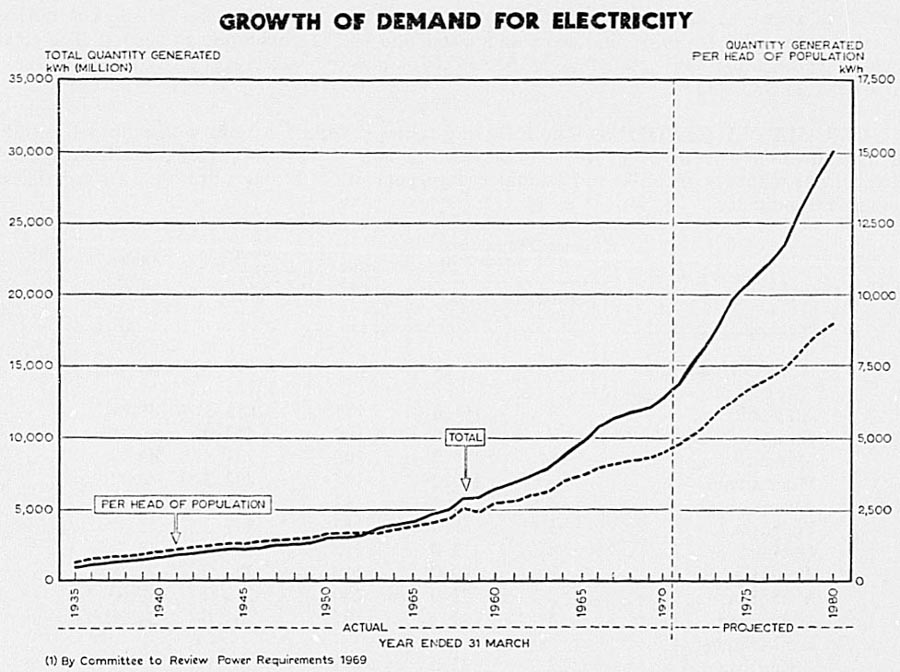
LEGISLATION—Under the Electricity Act 1968 the New Zealand Electricity Department is responsible for preparing plans to meet the expected demand for electric power and for controlling the State generating and transmission systems. In general, hydraulic investigation and civil engineering are carried out by the Ministry of Works to the requirements of the New Zealand Electricity Department. The New Zealand Electricity Department is responsible for the overall functional design of each station, detailed design and installation of all turbines, generators, and associated electrical and mechanical equipment, for the design and installation of equipment at substations, for the survey, design, and construction of transmission lines, and for the operation and maintenance of the networks which supply electricity in bulk to the distributing authorities.
ELECTRIC POWER BOARDS AND SUPPLY AUTHORITIES—Various local authority Acts from the eighteen eighties onwards made provision for counties and municipalities to supply electricity in addition to their other functions, but in 1918 legislation was passed enabling local authorities to be set up with the sole function of supplying electricity. The legislation, amended and consolidated under the Electric Power Boards Act 1925, provided for the constitution of electric power districts controlled by boards.
Of the 41 electric power boards actively functioning at 31 March 1970, 14 had generating stations of a total rated generation capacity of 36,344 kW. There were also 29 municipal electric supply authorities, 9 of them having generating stations of a total rated generating capacity of 77,815 kW. Two Government Departments, New Zealand Electricity and Tourist and Publicity, act as distributing authorities for Southland and Rotorua respectively. The licensed areas under the control of the boards and other authorities cover almost all the inhabited parts of the country. More than 99 percent of New Zealand's population enjoy the benefits of electricity in the home; only a few thousand isolated people in more isolated and less accessible parts of the country lack this amenity.
The supply of electricity to remote areas presents difficulties because of the high cost of reticulation in relation to the revenue from power sold. A Rural Reticulation Council can make a levy of up to 1/2 percent of the gross revenue of all supply authorities and Government-owned electrical undertakings to subsidise the annual cost of supply in remote areas. The Rural Reticulation Council was set up under the Electricity Act 1945, and up to 31 March 1970 had approved subsidies on 9,352 route-miles of line to supply some 14,836 consumers. At this date 8,907 miles of line were completed and 14,172 consumers connected. The total capital expenditure was estimated at $15,185,075 and the subsidy approved for the year amounted to $352,894.
PUBLIC SUPPLY STATIONS—The following tables cover all stations whose output is fully or partially available to the public supply system as at 31 March 1970, their installed capacity, static head where applicable, and annual energy generation. Stations are State owned unless otherwise indicated.
| Name of Station | Installed capacity at 31 March 1970 | Static Head | Annual Energy Generation Year Ended 31 March 1970 | Annual Load Factor | |
|---|---|---|---|---|---|
| Number of Units | MW | ||||
*Owned by Dunedin City Council. **One unit commissioned 1968, three in 1969. †Owned by other supply authorities and industries. ††Four units commissioned 1969. ‡Two units commissioned 1969, one in 1970, also test running. §Excludes capacity of generating plant owned and operated by industries. | |||||
| Hydro | ft | million kWh. | percent | ||
| Arapuni | 8 | 157.8 | 175 | 653.3 | 45.06 |
| Karapiro | 3 | 90.0 | 100 | 437.0 | 46.19 |
| Maraetai | 5 | 180.0 | 200 | 703.8 | 42.74 |
| Whakamaru | 4 | 100.0 | 124 | 402.2 | 44.11 |
| Atiamuri | 4 | 84.0 | 81 | 222.3 | 32.45 |
| Waipapa | 3 | 51.0 | 53 | 208.3 | 41.64 |
| Ohakuri | 4 | 112.0 | 115 | 301.4 | 30.34 |
| Aratiatia | 3 | 90.0 | 110 | 224.5 | 28.99 |
| Matahina | 2 | 72.0 | 200 | 246.2 | 37.93 |
| Mangahao | 5 | 19.2 | 896 | 61.6 | 34.80 |
| Waikaremoana— | |||||
| Kaitawa | 2 | 32.0 | 443 | 107.0 | 40.26 |
| Tuai | 3 | 52.0 | 676 | 219.2 | |
| Piripaua | 2 | 40.0 | 370 | 137.9 | |
| Cobb | 6 | 32.0 | 1,950 | 153.4 | 51.12 |
| Arnold | 2 | 3.1 | 42 | 25.2 | 87.01 |
| Coleridge | 9 | 34.5 | 490 | 112.8 | 30.38 |
| Highbank | 1 | 25.2 | 330 | 80.8 | 35.08 |
| Waitaki | 7 | 105.0 | 70 | 444.6 | 45.85 |
| Aviemore** | 4 | 220.0 | 122 | 848.4 | 52.80 |
| Benmore | 6 | 540.0 | 302 | 2,185.8 | 46.99 |
| Manapouri†† | 4 | 400.0 | 580.0 | 422.3 | - |
| Tekapo | 1 | 25.2 | 100 | 134.0 | 58.84 |
| Roxburgh | 8 | 320.0 | 150 | 1,527.3 | 53.58 |
| Monowai | 3 | 6.0 | 154 | 29.4 | 53.18 |
| Waipori* | 11 | 65.2 | - | 114.8 | - |
| Auxiliary† | 18 | 38.2 | - | 186.2 | - |
| Sub-totals | 2,894.4 | 10,189.7 | ... | ||
| Thermal | |||||
| Meremere | 7 | 210.0 | ... | 963.8 | 59.06 |
| Wairakei | 13 | 192.6 | ... | 1,243.1 | 88.80 |
| Marsden | 2 | 240.0 | ... | 481.1 | 23.39 |
| Otahuhu‡ | 3 | 135.0 | ... | 26.4 | 3.43 |
| Auxiliary†§ | 11 | 10.7 | ... | 21.4 | - |
| Sub-totals | 788.3 | 2,735.9 | ... | ||
| Totals | 3,682.7 | 12,925.6 | ... | ||
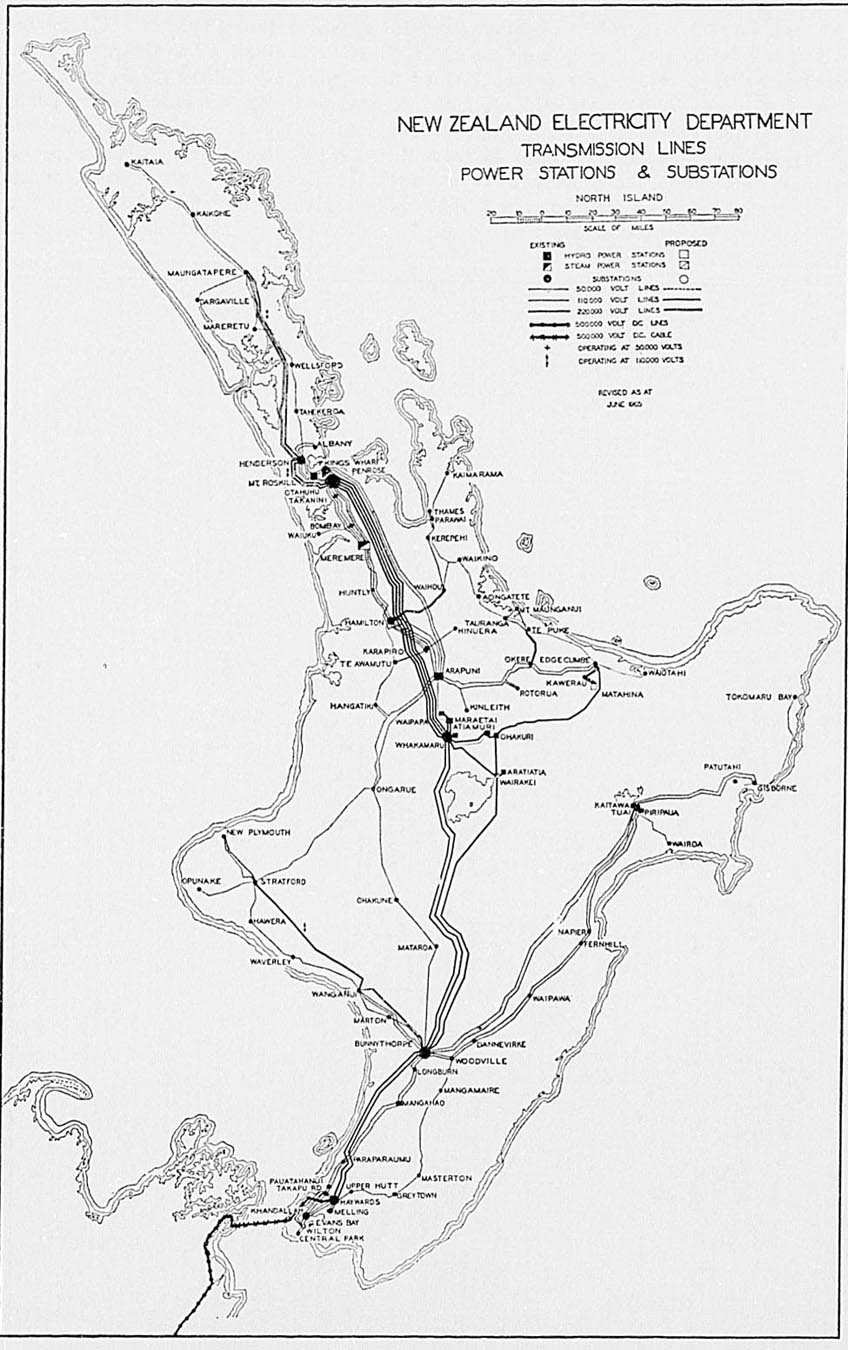
ANNUAL GENERATION—During the year ended 31 March 1970 a total of 12,926 million kWh was generated by public utilities, of which 10,190 million kWh (79 percent) was generated by water power, 2,688 million kWh by steam plant, 27 million kWh by gas turbine plant, and 118,466 kWh by oil plant. A further 21.1 million kWh was purchased by public authorities from generating stations operated by industrial establishments and fed into the supply system, making a total of 12,926 million kWh available for distribution. By far the major portion of the generation is undertaken by Government-owned plants, which, in the period under review, generated 9,889 million kWh by the use of water power, 2,688 million kWh by use of steam power, and 26 million kWh by use of gas turbine power.
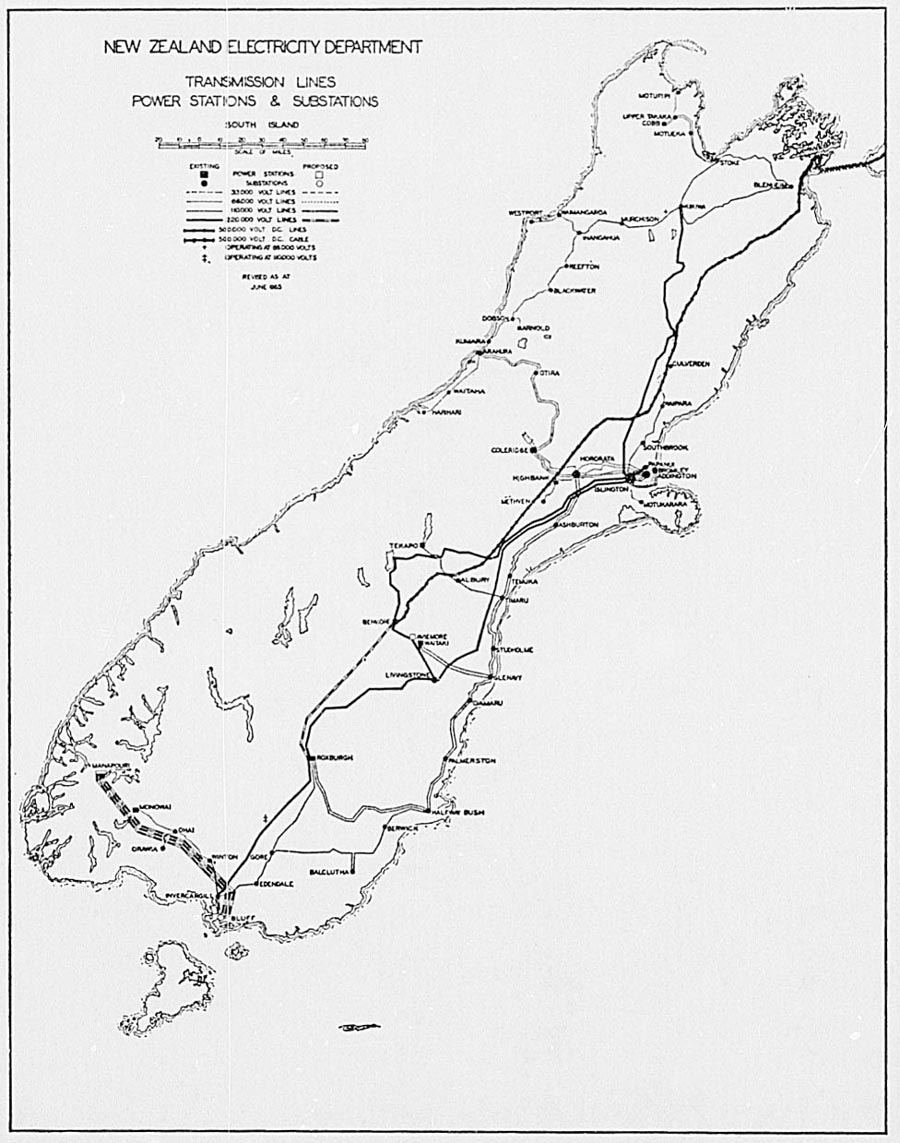
REVIEW OF OPERATIONS—The following table gives information concerning generation and distribution by Government establishments, local authorities, and electric power boards for the year ended 31 March 1970.
| Item | Government Establishments | Electric Power Boards | All Establishments* |
|---|---|---|---|
*Includes 12 city councils, 14 borough councils and three county councils. †Excluding stocks and materials. | |||
| Establishments No. | 27 | 41 | 97 |
| Persons engaged No. | 4,730 | 5,475 | 12,307 |
| Salaries and wages paid $(000) | 14,608 | 16,084 | 36,537 |
| Consumers No. | 42,664 | 755,666 | 1,086,703 |
| Prime movers— | |||
| Hydro bhp(000) | 3,957 | 40 | 4,107 |
| Thermal bhp(000) | 929 | 11 | 943 |
| Totals bhp(000) | 4,885 | 51 | 5,050 |
| Generators (capacity)— | |||
| A.C. kW(000) | 3,741 | 36 | 3,683 |
| Revenue— | |||
| Sales of power- | |||
| Retail $(000) | 7,971 | 95,790 | 143,254 |
| Bulk and interchange $(000) | 83,747 | 4,688 | 88,438 |
| Other (including rates) $(000) | 547 | 1,861 | 3,038 |
| Total revenue $(000) | 92,266 | 102,339 | 234,730 |
| Expenditure— | |||
| Power purchased (including interchange) $(000) | 1,216 | 63,478 | 88,586 |
| Generating costs $(000) | 11,533 | 214 | 12,138 |
| Transmission and distribution costs $(000) | 4,742 | 9,983 | 18,358 |
| Management and general $(000) | 5,889 | 7,229 | 15,949 |
| Capital charges $(000) | 56,606 | 15,273 | 77,236 |
| Total expenditure $(000) | 79,986 | 96,177 | 212,267 |
| Capital expenditure†- | |||
| Total expenditure to date $(000) | 950,087 | 224,236 | 1,258,283 |
| Expenditure during year $(000) | 61,285 | 15,839 | 82,860 |
| Generation— | |||
| Hydro Million kWh | 9,889 | 133 | 10,190 |
| Steam Million kWh | 2,688 | - | 2,709 |
| Oil/gas Million kWh | 26 | - | 27 |
| Totals Million kWh | 12,603 | 134 | 12,926 |
| Retail sales Million kWh | 809 | 7,365 | 11,069 |
Generation per head of mean population was 4,628 kWh for the year ended 31 March 1970.
Employment—Details concerning the number of employees and the salaries and wages paid to them are given in the following table for the year ended 31 March 1970.
| Category of Staff | Persons Engaged | Salaries and Wages Paid | ||||
|---|---|---|---|---|---|---|
| Males | Females | Total | Charged to Operation and Management | Charged to Capital | Total | |
| No. | No. | No. | $(000) | $(000) | $(000) | |
| Managerial and clerical | 2,758 | 941 | 3,699 | 10,874 | 537 | 11,411 |
| Wage earners | 8,430 | 178 | 8,608 | 18,634 | 6,492 | 25,126 |
| Totals | 11,188 | 1,119 | 12,307 | 29,508 | 7,028 | 36,537 |
Capital Expenditure—The following table gives capital expenditure during 1969-70 and total outlay to 31 March 1970.
| Item | Expenditure During Year* | Total Capital Outlay to 31 March 1970* |
|---|---|---|
| *Accumulated adjustments due to audit during year. | ||
| $(000) | $(000) | |
| Generating system— | ||
| Head works, pipelines, etc. | -20,128 | 441,001 |
| Powerhouse buildings, cottages, etc. | 51,664 | 134,000 |
| Generating plant and machinery, etc. | 13,850 | 149,260 |
| Transmission and distribution lines, substations, land and houses | 29,947 | 445,612 |
| Public lighting | 446 | 6,427 |
| Office and store buildings, workshops, garages, houses, service | 29,950 | |
| buildings | 2,144 | |
| Loose tools, meters, instruments, furniture, trucks, motorcars, equipment | 2,481 | 34,346 |
| Miscellaneous (cost of raising loans, loan conversion premiums, surveys, preliminary expenses, interest during construction) | 1,888 | 16,040 |
| Stock and materials (including trading department stocks) | 566 | 28,975 |
| Other items not capable of inclusion above | 569 | 1,647 |
| Total capital outlay | 83,426 | 1,287,258 |
Additions to the capital value of all electrical systems during 1969-70 totalled $129,277,000 while deductions, i.e., sales and amounts written off, amounted to $45,851,000. The previous table shows for each item the net expenditure only during the year.
General Balance Sheet as at 31 March 1970—The next table summarises the balance sheet at 31 March 1970 for all establishments.
| Liabilities | |
|---|---|
| $(000) | $(000) |
| Capital raised— | |
| Original amount of current loans 954,612 | |
| Less amounts repaid 150,967 | |
| Balance owing on 31 March 1970 | 803,645 |
| Temporary loans | 755 |
| Sundry creditors— | |
| Bank overdraft | 840 |
| Other | 27,836 |
| Reserves— | |
| Loan repayment reserve | 107,557 |
| Capital expenditure out of revenue | 93,317 |
| Sinking fund reserve | 8,375 |
| Depreciation reserve | 151,600 |
| Renewal fund reserve | 5,477 |
| General and other reserves | 154,054 |
| Surplus in Appropriation Account | 17,025 |
| Total | 1,370,481 |
| Assets | |
| $(000) | |
| Total capital expenditure | 1,258,283 |
| Stocks and materials | 28,975 |
| Sundry debtors | 36,822 |
| Cash in hand and bank balances— | |
| Loan accounts | 3,695 |
| Other | 8,161 |
| Investments— | |
| Loan accounts | 3,551 |
| Other | 30,971 |
| Deficit in Appropriation Account | 22 |
| Total | 1,370,481 |
Power—The following table sets out the number of units generated and their disposal The excess generation of certain local factories, which is bought in for public supply, is given in the column “Other Sources”.
| Year Ended 31 March | Generated for Public Supply | Sold Retail | Nonproductive | |||
|---|---|---|---|---|---|---|
| N.Z. Electricity Department | Supply Authorities | Other Sources | Total | |||
| million kWh | ||||||
| 1,966 | 10,243 | 322 | 13 | 10,578 | 9,004 | 1,573 |
| 1,967 | 10,979 | 323 | 14 | 11,316 | 9,602 | 1,714 |
| 1,968 | 11,265 | 319 | 21 | 11,605 | 9,893 | 1,712 |
| 1,969 | 11,831 | 329 | 25 | 12,185 | 10,454 | 1,732 |
| 1,970 | 12,603 | 301 | 21 | 12,926 | 11,069 | 185,6 |
Analysis of Units Retailed—The following table gives a classification of power retailed according to the various purposes for which it was sold. In this table “Domestic” includes domestic water-heating units, and “Commercial” both commercial and dairy water-heating units.
| Year Ended 31 March | Domestic | Commercial and Industrial | Street Lighting | Tramways and Trolley Buses | Electric Railways | Other Purposes | Total |
|---|---|---|---|---|---|---|---|
| million kWh | |||||||
| 1,966 | 5,192 | 3,686 | 81 | 21 | 23 | 2 | 9,004 |
| 1,967 | 5,560 | 3,908 | 87 | 21 | 23 | 3 | 9,602 |
| 1,968 | 5,697 | 4,065 | 89 | 21 | 20 | 1 | 9,893 |
| 1,969 | 5,992 | 4,312 | 93 | 18 | 30 | 8 | 10,454 |
| 1,970 | 6,187 | 4,740 | 97 | 17 | 28 | - | 11,069 |
The following diagram portrays the growth in the use of electric power, and shows also the principal purposes for which the power was employed.
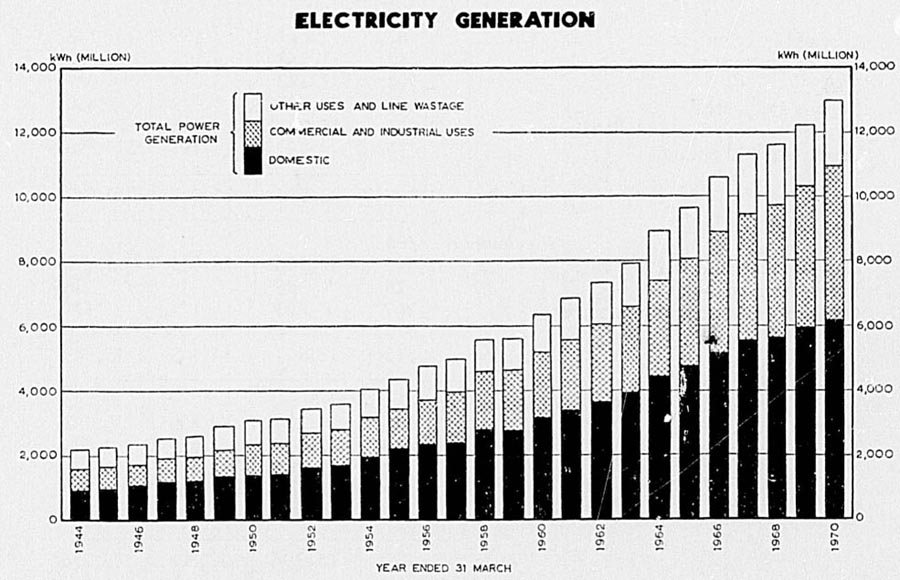
Revenue—Revenue is derived chiefly from the sale of power, and in 1969-70 this source was 97.9 percent of the total. The following table sets out the revenue from all sources (excluding bulk sales) for the latest five years
| Year Ended 31 March | Sale of Power (Retail) | Profits from Trading | Miscellaneous | Total* |
|---|---|---|---|---|
| *Excluding revenue from interchange of power | ||||
| $(000) | $(000) | $(000) | $(000) | |
| 1,966 | 98,660 | 332 | 1,808 | 100,800 |
| 1,967 | 107,141 | 359 | 1,925 | 109,425 |
| 1,968 | 120,240 | 336 | 2,091 | 122,667 |
| 1,969 | 136,147 | 350 | 2,334 | 138,832 |
| 1,970 | 143,254 | 419 | 2,619 | 146,292 |
Expenditure—Of the total expenditure of $123,829,250 (excluding cost of interchange of power in bulk) recorded in the year ended 31 March 1970, 75.2 percent represented overhead costs (comprising management expenses and capital charges), while operating expenses of prime costs stood at 24.8 percent.
Power may be sold more than once in bulk before reaching the retailing authority, and in these tables the revenue from such interchange of power between authorities is set off against the cost, the net figure for cost of power purchased representing the cost to the industry of purchases from outside sources. In this connection mention may be made of certain contracts existing between the Government and some local authorities, whereby the latter are required to maintain their plants and to operate them, whenever called upon, to supplement the State electricity supply. The units so generated, often by fuel plants, are purchased by the Government and resold, in most cases to the generating authority, for distribution.
The table following gives an analysis of expenditure, excluding the cost of bulk interchanges.
| Item | Year Ended 31 March | |||
|---|---|---|---|---|
| 1967 | 1968 | 1969 | 1970 | |
| *Does not include the interchange of power between supply authorities. | ||||
| $(000) | $(000) | $(000) | $(000) | |
| Operating Expenditure | ||||
| Cost of power purchased* | 67 | 111 | 166 | 148 |
| Cost of generation | 3,680 | 3,913 | 3,145 | 3,661 |
| Fuel | 2,794 | 2,222 | 3,058 | 6,027 |
| Repairs and stores | 971 | 1,001 | 1,995 | 2,450 |
| Cost of transmission and distribution | 13,837 | 15,077 | 16,532 | 17,887 |
| Public (street) lighting | 339 | 362 | 450 | 470 |
| Totals | 21,688 | 22,686 | 25,347 | 30,643 |
| Miscellaneous Expenditure | ||||
| Cost of management | 11,242 | 12,606 | 13,943 | 15,736 |
| Losses from trading | 26 | 48 | 31 | 36 |
| Other expenditure and insurance | 247 | 223 | 174 | 177 |
| Totals | 11,515 | 12,877 | 14,148 | 15,949 |
| Capital Charges (Including Taxation) | ||||
| Interest | 27,978 | 34,217 | 37,800 | 39,292 |
| Sinking Fund | 1,430 | 2,056 | 1,339 | 2,747 |
| Renewals | 2,222 | 2,799 | 2,706 | 3,136 |
| Depreciation | 12,832 | 14,172 | 15,898 | 18,139 |
| Loan repayment | 10,615 | 12,152 | 14,564 | 13,922 |
| Totals | 55,077 | 65,396 | 72,308 | 77,236 |
| Grand totals | 88,280 | 100,959 | 111,803 | 123,829 |
The distribution of the expenditure per unit sold retail is given hereunder.
| Expenditure | Year Ended 31 March | |||
|---|---|---|---|---|
| 1967 | 1968 | 1969 | 1970 | |
| cents | cents | cents | cents | |
| Operating expenses | 0.226 | 0.229 | 0.242 | 0.277 |
| Miscellaneous expenses | 0.120 | 0.130 | 0.135 | 0.144 |
| Capital charges | 0.573 | 0.661 | 0.692 | 0.698 |
| Totals | 0.919 | 1.020 | 1.070 | 1.119 |
HISTORY—Gas was produced from coal as an early source of light and heating in New Zealand. The first gasworks was erected in Auckland in 1862 and at that time Auckland had a European population of about 25,000. By 1916 there were 56 establishments engaged in the marketing of gas to the public. Since that date the numbers of gas undertakings has steadily declined because of the difficulties associated with coal carbonisation. The number of consumers has been steadily decreasing over the years and there has been an approximate reduction of 28 percent in the last 10 years. Over the years the average price of gas has fallen from $1.35 in 1958 to $1.27 in 1966. In this period total gas sales have risen by 45 percent. The increased volume of sales came from the industrial sector. The loss of consumers from the gas industry was viewed with concern both by the Government and those authorities who have to satisfy electric power demand because such demand is so capital intensive in regard to financial resources.
A Gas Council was established in 1958. The main function of the Gas Council is to preserve and expand the gas industry, which it can do by way of subsidies and arranging finance to assist the Industry. The Gas Council has pursued its basic policy of promoting efficiency and confidence in the industry, and much new plant has been installed.
The oil consortium, Shell B.P. and Todd Oil Services Ltd., discovered natural gas at Kapuni in 1959 and the development of this find has taken place by way of the formation of the Natural Gas Corporation of New Zealand. This Corporation was set up by the Government in 1967 and is operating the gas purification equipment and the pipeline to supply and sell gas along the pipeline routes to undertakings previously producing coal gas, namely, Auckland, Hamilton, New Plymouth, Hawera, Wanganui, Palmerston North, Levin, Hutt Valley, and Wellington. With the new feedstock, the gas industry is now expected to compete more successfully with the electrical and oil industries, and the drift by domestic consumers away from the gas industry has already been contained. A further increase in industrial gas usage can now be expected. Those gas undertakings which will not be receiving a piped supply of natural gas are anticipated to move away from uneconomic methods of production and will continue to receive the financial incentives which are provided by the Gas Council to help them to convert to more efficient, acceptable techniques of gas manufacture and consumer service. The benefit of the natural gas developments will also be seen through the availability of an improved range of appliances available to consumers.
GAS SUBSIDY—Gasworks receive a gas sales subsidy from the Government at the rate of 25c per 1,000 cu ft of gas sold up to 150 million cu ft and thereafter at 162/3c per 1,000 cu ft for gas produced from coal: the same rate applies to oil-reformed gas but is limited to 30 percent of total annual sales. There are also subsidies on coal used by gasworks.
Annual average prices of gas in the four main centres are shown in the following table. The average price per 1,000 cubic feet for all consumers in 1969-70 was $1.40 compared with $1.37 in 1968-69.
| AVERAGE PRICE OF GAS TO CONSUMER PER 1,000 CUBIC FEET | ||||
|---|---|---|---|---|
| Year | Auckland | Wellington | Christchurch | Dunedin |
| $ | $ | $ | $ | |
| 1929-30 | 0.70 | 0.69 | 0.70 | 0.63 |
| 1939-40 | 0.72 | 0.61 | 0.64 | 0.59 |
| 1949-50 | 0.88 | 0.68 | 0.68 | 0.62 |
| 1959-60 | 1.34 | 1.05 | 0.88 | 0.74 |
| 1966-67 | 1.52 | 1.27 | 0.96 | 0.90 |
| 1967-68 | 1.51 | 1.35 | 1.03 | 1.08 |
| 1968-69 | 1.49 | 1.43 | 1.09 | 1.07 |
| 1969-70 | 1.52 | 1.51 | 1.12 | 1.13 |
GAS PRODUCTION—There follows an analysis of the 1969-70 statistics. It will be seen that 67 percent of the total quantity of gas available for distribution was in the North Island and 33 percent was in the South Island.
| Item | North Island | South Island | New Zealand |
|---|---|---|---|
| Works No. | 13 | 11 | 24 |
| Value of land and buildings $(000) | 2,430 | 994 | 3,424 |
| Value of machinery, plant, and equipment $(000) | 12,033 | 5,986 | 18,019 |
| Value of transport equipment $(000) | 229 | 95 | 324 |
| Capital additions during year— | |||
| Land and buildings $(000) | 43 | 12 | 55 |
| Machinery, plant, and equipment $(000) | 4,627 | 101 | 4,728 |
| Transport equipment $(000) | 84 | 19 | 103 |
| Persons engaged— | |||
| Males No, | 701 | 359 | 1,060 |
| Females No, | 89 | 31 | 120 |
| Totals No, | 790 | 390 | 1,180 |
| Salaries and wages paid— | |||
| To males $(000) | 2,088 | 987 | 3,075 |
| To females $(000) | 100 | 52 | 152 |
| Totals $(000) | 2,188 | 1,039 | 3,227 |
| Motive power— | |||
| Engines in use No. | 287 | 293 | 580 |
| Total horsepower h.p. | 3,062 | 2,432 | 5,494 |
| Materials used— | |||
| Coal tons(000) | 73 | 96 | 169 |
| $(000) | 1,103 | 1,118 | 2,221 |
| Oil gal(000) | 10,991 | 887 | 11,878 |
| $(000) | 1,138 | 142 | 1,280 |
| Products— | |||
| Gas available for distribution cu. ft.(m) | 4,318 | 2,165 | 6,483 |
| Gas sold retail cu. ft.(m) | 3,075 | 1,834 | 4,909 |
| Value (including subsidies) $(000) | 5,220 | 2,737 | 7,957 |
| Coke tons(000) | 12 | 36 | 48 |
| $(000) | 232 | 489 | 721 |
| Tar gal(000) | 791 | 1,015 | 1,806 |
| $(000) | 173 | 169 | 342 |
| Other residuals $(000) | 61 | 47 | 108 |
| Total expenditure $(000) | 6,142 | 3,382 | 9,524 |
| Total revenue $(000) | 5,932 | 3,397 | 9,329 |
| Consumers No. | 78,010 | 39,127 | 117,137 |
Table of Contents
Table of Contents
DEPENDENCE ON AGRICULTURAL AND PASTORAL EXPORTS—Products of animal origin average annually over 80 percent of the total value of New Zealand exports, and agricultural exports of grass seed and fruit can be added to raise even higher the value of exports of farm produce. New Zealand is the largest exporter in the world of better and (in some years) of meat, and is also one of the leading exporters of wool and cheese. Exports of milk powder and casein have grown rapidly since 1947 and approach in value traditional exports such as tallow and hides and skins. The maintenance and expansion of overseas markets for pastoral products must remain a fundamental objective, for if the moderate rate of expansion set as a goal by the National Development Conference is to be achieved, export receipts must rise by between 5 and 71/2 percent a year, and over half of the increase must come from the pastoral sector.
The following table of exports by value indicates the relative importance of farm products.
| Year Ended 30 June | Dairy Produce | Meat | Wool | Hides, Pelts, and Skins | Total Exports* | ||||
|---|---|---|---|---|---|---|---|---|---|
| Butter | Cheese | Milk Powder, etc. | Casein | Total (incl. other) | |||||
*Of New Zealand produce. † Provisional. | |||||||||
| $ (million) | |||||||||
| 1,964 | 109.6 | 35.1 | 11.0 | 11.3 | 168.4 | 183.2 | 271.4 | 30.4 | 728.4 |
| 1,965 | 119.6 | 40.7 | 18.9 | 16.8 | 197.7 | 212.5 | 208.6 | 31.7 | 733.7 |
| 1,966 | 109.6 | 41.7 | 22.0 | 20.0 | 195.4 | 196.7 | 231.9 | 40.0 | 756.8 |
| 1,967 | 109.4 | 45.1 | 29.8 | 18.6 | 205.3 | 205.0 | 174.1 | 33.6 | 717.6 |
| 1,968 | 112.2 | 47.4 | 30.3 | 18.1 | 210.3 | 260.7 | 158.2 | 39.1 | 804.6 |
| 1,969 | 114.8 | 42.6 | 23.1 | 21.7 | 204.7 | 309.4 | 212.4 | 55.4 | 968.9 |
| 1970† | 109.7 | 44.3 | 31.4 | 25.8 | 214.1 | 369.3 | 204.5 | 48.8 | 1,064.8 |
The countries of destination for some of the main exports for 1969-70 are shown in the following table in a percentage basis.
| Country of Destination | Butter | Cheese | Lamb | Beef and Veal | Mutton | Wool |
|---|---|---|---|---|---|---|
| United Kingdom | 89.9 | 74.4 | 86.1 | 6.6 | 16.4 | 19.9 |
| United States | 0.4 | 11.1 | 4.4 | 55.6 | –– | 11.2 |
| Japan | –– | 6.8 | 1.8 | 1.6 | 68.2 | 11.9 |
| Canada | –– | –– | 0.6 | 22.9 | 1.0 | 1.0 |
| France | - | - | 0.1 | –– | 0.2 | 8.9 |
| Belgium | - | 0.2 | 0.2 | –– | 0.2 | 8.4 |
| West Germany | 0.2 | 0.6 | 0.6 | –– | 0.4 | 7.5 |
| Italy | –– | –– | 0.3 | –– | –– | 6.4 |
| Other | 9.5 | 6.8 | 6.0 | 13.1 | 13.6 | 24.8 |
| Totals | 100.0 | 100. | 100.0 | 100.0 | 100.0 | 100.0 |
GENERAL MARKETING SITUATION: Meat—Most meat produced in the world is supplied to domestic markets, and only about 5 percent of world output enters into international trade. Among the few countries with large exportable surpluses are Australia, New Zealand, Argentina, Uruguay, the Netherlands, Denmark, and the Irish Republic. The chief flows of trade are to Western Europe, in particular the United Kingdom, which accounts for over one-third of world trade, and, more recently the United States and Japan. The United Kingdom continues to be by far the largest market for lamb; New Zealand's lamb exports are heavily dependent on this market. Although the Common Market countries are substantial importers of beef and veal, the pattern of trade has been greatly affected by the beef and veal regulations of the common agricultural policy; intra-community trade has increased whereas entries from third countries have been severely reduced.
For some years New Zealand has made a drive for supplementary markets for its increased production and now lists about 70 countries as buyers of its meat. Of these three may be regarded as major markets. They are the United Kingdom which is currently taking about 85 percent of New Zealand's lamb; Japan, which is taking about 73 percent of New Zealand's export mutton production; North America (United States and Canada) which is taking about 75 percent of the beef and veal exports. In the late 1950's a strong demand developed in the United States for manufacturing grades of beef. This was a result of changes in the composition of the American beef herd which in the main is grain-fed and carries more fat than the consumer requires. The trimmings need to be supplemented with the lean-type beef that New Zealand (and Australia among others) can provide. But since 1968 the New Zealand producer has had to contend with what is termed a “voluntary agreement quota”. Under this system New Zealand, along with other major suppliers, has had to restrict the tonnage shipped for arrival in the United States during the calendar year to a pre-set quota figure. This applies to all meats except lamb. Under the terms of the agreement New Zealand is able to send 104.500 tons of beef, veal and mutton to the United States in 1971. New Zealand has had no difficulty in meeting the level agreed under the voluntary quota system. In fact, because this is New Zealand's highest-priced beef market, a procedure for equitably restricting the level of shipments by exporters within the industry was implemented by the Meat Board. This was necessary to honour New Zealand's voluntary agreement. A trigger point would be reached if any other country put in sufficient quota meat to force the United States Administration to introduce a global quota.
Imports into the United States of some classes of fresh, chilled, or frozen meat are shown in the following table. (Source: Commonwealth Secretariat.)
| Country of Export | Beef and Veal | Mutton and Lamb | ||||
|---|---|---|---|---|---|---|
| 1967 | 1968 | 1969 | 1967 | 1968 | 1969 | |
| tons (thousand) | ||||||
| New Zealand | 76 | 91 | 98 | 4 | 6 | 10 |
| Australia | 189 | 198 | 218 | 25 | 32 | 33 |
| Canada | 11 | 20 | 19 | –– | –– | –– |
| Republic of Ireland | 36 | 25 | 26 | - | - | - |
| Mexico | 21 | 29 | 30 | - | - | - |
| Other countries | 41 | 56 | 68 | –– | –– | –– |
| Total imports | 375 | 419 | 459 | 30 | 38 | 43 |
| United States production | 9,365 | 9,633 | 9,837 | 288 | 263 | 241 |
Canada now ranks as New Zealand's second biggest customer for beef and veal. There has been an upsurge in demand from Canada for New Zealand beef, which can be related to a decline in domestic production. Shipments in the year ended September 1970 totaled 38,779 tons compared with 24,800 tons in the preceding year.
In Japan there is a continuing strong demand for mutton which is used mainly for processing into sausage-type foods. Shipments in the year ended September 1970 totalled 64,700 tons compared with 96,900 tons in the preceding year. Japan is generally regarded as one of the top future prospects for New Zealand lamb as well as mutton. The Meat Board's participation in Expo 70, Osaka, where it ran two restaurants in the New Zealand pavilion, reflects its view of the importance of this market.
A strong emphasis in market diversification has been placed on lamb, spurred by the possibility of Britain joining the European Economic Community, whose member countries have traditionally protected their agriculture by tariff.
A major step in the lamb diversification programme was taken in 1960 with the establishment of the Meat Export Development Company, an organisation charged with the responsibility of the orderly development of New Zealand lamb marketing in the United States and Canada. All New Zealand lamb sales to these countries are controlled by this company whose directorate is composed of nominees of the New Zealand Meat Producers Board and representatives of the freezing companies. The head office of the company (known as Devco or Medco) is in Wellington while the North American operations are controlled from Chicago.
Since 1966 a lamb diversification scheme has been in operation with the further intention of lessening dependence on the United Kingdom. The scheme was implemented by the Market Development Committee which consists of representatives of the Meat Board and the meat export trade. Each year the committee sets a percentage of lamb exports to be sold in markets other than the United Kingdom and it levies exporters 2.5 cents per lb on the shortfall below the target figure. The diversion target was set at 10 percent in the first season of the scheme, 12 percent the second season, 131/2 percent in 1968-69, 15 percent for the 1969-70 season, and 151/4 percent for the 1970-71 season.
Several promising markets are developing for lamb, despite tariff and other restrictions in many countries. Sales to Europe in 1969-70 included 8,870 tons to Greece, 1,800 tons to West Germany, 1,600 tons to the Netherlands and 1,200 tons to Italy. A Meat Board promotional campaign in Japan in recent years has seen sales increase to 5,800 tons in the year ended September 1970.
Wool—New Zealand is one of the largest exporters of wool in the world. Most of the wool is auctioned in New Zealand and buyers come from all the main importing countries to make their purchases of wool. A small percentage of wool produced is shipped to England for sale on the London market. Prices fluctuate according to the demand for wool. The threat of competition from synthetic materials is such that the International Wool Secretariat is actively promoting advertising, merchandising, and research. World wool production and wool utilisation were approximately in balance until 1966 when consumption fell behind production.
World wool production has been increasing steadily, particularly in Australia, New Zealand and the Soviet Union; this growth reflects improvements both in carrying capacity per acre (number of sheep), and in wool production per sheep. Of the increase, probably over two-thirds stemmed from the upward trend in sheep population, the remainder from improved output per head of sheep. Since the war there has been no significant change in the broad geographical distribution of production, which remains heavily concentrated in Australia, New Zealand. Argentina. South Africa and Uruguay—all of which export on a large scale—and in the United States and the Soviet Union, neither of whose clips enters the international market to any significant extent. These countries account for 76 percent of world production; of the world total, Australia alone produces 30 percent and with New Zealand, Argentina, and South Africa some 55 percent.
The distribution of wool production does not, of course, coincide exactly with the distribution of the sheep population since the production of wool, or yield per sheep varies considerably. While there is undoubtedly scope for improvement in a number of the lower yielding countries, the yields, which are averages over the sheep populations as a whole, are determined by the type of pasture, breed of sheep, average age of flock, and age of the sheep at slaughter. Variations in yield between countries, therefore, do not necessarily reflect variations in efficiency, but rather differences in pastoral conditions and objectives in farming.
Sheep numbers and wool production for selected countries are shown in the following table. (Source: Commonwealth Secretariat.)
| Country | Sheep Numbers | Wool Production | ||||
|---|---|---|---|---|---|---|
| 1967 | 1968 | 1969* | 1967 | 1968 | 1969-70* | |
| *Provisional. | ||||||
| million | million lb (greasy) | |||||
| Australia | 164.2 | 166.9 | 174.6 | 1,774 | 1,952 | 2,023 |
| New Zealand | 60.0 | 60.5 | 59.9 | 728 | 732 | 740 |
| Argentina | 47.5 | 44.0 | 45.0 | 428 | 397 | 405 |
| South Africa | 36.8 | 37.0 | 38.6 | 307 | 317 | 331 |
| Uruguay | 21.8 | 22.7 | 22.7 | 186 | 181 | 176 |
| United States | 23.9 | 22.1 | 21.2 | 227 | 214 | 200 |
| United Kingdom | 28.9 | 28.0 | 26.8 | 128 | 119 | 114 |
| U.S.S.R. | 135.1 | 138.5 | 140.6 | 871 | 915 | 860 |
| Whole world | 942.0 | 946.0 | 958.0 | 5,935 | 6,113 | 6,136 |
Dairy Produce—For the sale of dairy products New Zealand is very largely dependent on the United Kingdom market. In 1968 the total production of butter by 25 of the main producing countries of the world amounted to 4.8 million tons. In the same year world exports by 17 of the leading exporters amounted to about 604,000 tons, that is, only about 13 percent of world production entered into international trade. Of this quantity, 440,000 tons (73 percent) came on to the United Kingdom market. Of the exports of 644,000 tons of cheese from 18 countries in 1968 there were 177,000 tons sent to the United Kingdom. These figures show that relatively small changes in demand-supply relationships in individual countries can have a most disturbing effect on the United Kingdom market.
Some countries have adopted agricultural income and price support policies to maintain and stabilise farming incomes. Only industrialised countries with a relatively low proportion of their national income derived from agriculture can continue support measures on a large scale. International trade is adversely affected in several ways. To maintain prices at support levels many countries have restricted imports of agricultural products, so that entry into markets, in which New Zealand's exports could effectively compete, has often been denied. High support prices and consequent high domestic prices discourage consumption and often lead to the accumulation of supplies which are surplus to domestic requirements. Surpluses generated in this manner are frequently disposed of in other markets at prices well below the cost of production.
Since 1958 price reductions in some European countries have to some extent stimulated consumption in them, but not a great deal of progress has been made in the reduction of subsidised dairy production that leads to dumping. It is essential for New Zealand to maintain strong and consistent pressure in international councils so that these measures are furthered. A renewed attempt was made by New Zealand in November 1967 to achieve a meaningful negotiation for liberalisation of trade in dairy products. Preliminary negotiations were begun in the Committee of GATT in December 1968; objectives are: (a) the establishment of minimum prices for butter and anhydrous milk fat, and for skim-milk powder; (b) permanent arrangements for consultations in trade for dairy products; (c) co-operation in the development of the use of milk products as food aid. In December 1969 an agreement was reached on the establishment of a minimum international selling price for skim-milk powders of $180 a ton.
Butter—Britain has restricted imports of butter from 1 April 1962. This involved a waiver by New Zealand of the agreement for unrestricted entry to the United Kingdom market on the understanding that New Zealand would be granted a fair share of imports. When the New Zealand Government agreed in May 1963 to the request of the British Government (in connection with EFTA discussions involving Denmark) that the tariff of $1.50 a hundredweight on non-Commonwealth butter be suspended for the duration of the present system of quota restrictions, Britain agreed that New Zealand was be entitled to two-fifths of total permitted imports. The United Kingdom consults New Zealand before the opening of each quota year about the supply of butter to the United Kingdom market. Under the 1966 Trade Agreement the minimum quantity of butter that will be imported from New Zealand was set at 170,000 tons a year with the provision that New Zealand would share in any expansion of the level of total imports.
Recent annual allocations for butter are set out in the following table.
| March Year | Total Allocation | New Zealand Share |
|---|---|---|
| tons (000) | ||
| 1967-68 | 470 | 184 |
| 1968-69 | 462 | 176 |
| 1969-70 | 397 | 170 |
| 1970-71 | 425 | 176 |
| 1971-72 | 420 | 173 |
Cheese—In 1968 there was serious oversupply of the cheese market in the United Kingdom and cheese suppliers were asked in August 1968 to limit their shipments to the British market. Out of a “quota” of total imports of 135,750 tons for the year ending 31 March 1972. New Zealand was allocated 75,000 tons.
Milk Powder—The world production of milk powder has been expanded in recent years. With skim-milk powder (the main form) the output of 11 West European countries, and Australia, New Zealand, Canada, and the United States, rose from 2.1 million tons in 1966 to 2.7 million tons in 1968, but eased to 2.6 million tons in 1969. World trade in skim-milk powder increased in 1967 and world prices dropped sharply in 1968 to about half of those ruling in early 1967. These low prices resulted in particular from heavy subsidisation of exports by the EEC countries; the system extended under the common dairy policy whereby with milk production stimulated, and consumption of products hindered by high prices, returns to producers are maintained by support purchases of butter and its by-product, skim-milk powder, means that manufacture is likely to be concentrated in these products while others are produced only as consumer demand dictates.
Since 1968 world skim-milk powder prices have moved upward, due partly to action taken in December 1969 with the General Agreement on Tariffs and Trade which established a minimum export price of $180 a ton for powder intended for human consumption.
One of New Zealand's main markets for milk powder has been the United Kingdom where in the face of growing stocks and cheap imports the price of skim-milk powder dropped from $230 to $130 a ton in 1968 but recovered to $150-$180 a ton in 1969 and reached $280 a ton in March 1971; a minimum import price of $335 a ton was set on 1 July 1971. Other important markets have been developed in Japan, Malaysia, the Philippines, and Peru.
The chief countries exporting and importing milk powder are shown in the following table. (Source: Commonwealth Secretariat.)
| Country of Export | 1967 | 1968 | 1969 |
|---|---|---|---|
| *About two-thirds are private donations by voluntary relief organisations. | |||
| tons (000) | |||
| United States* | 188.3 | 185.4 | 294.5 |
| France | 179.6 | 274.4 | 154.0 |
| New Zealand | 150.5 | 134.5 | 150.3 |
| West Germany | 135.7 | 142.8 | 109.5 |
| Netherlands | 69.3 | 94.8 | 102.3 |
| Belgium | 69.5 | 94.1 | 92.5 |
| Canada | 46.9 | 58.6 | 89.1 |
| Japan | 111.7 | 80.8 | 197.4 |
| Netherlands | 96.2 | 130.4 | 192.0 |
| Italy | 95.9 | 165.5 | 73.5 |
| United Kingdom | 69.7 | 61.2 | 50.1 |
| Spain | 23.8 | 43.0 | 46.9 |
| India | 39.2 | 37.2 | 40.1 |
Casein—Lactic casein, which is produced from the residual skim milk in butter manufacture, is being put to an increasing range of uses. It is used as high grade protein in sausage and other food fillings, as the bulk material for various types of pharmaceutical drugs, and in the manufacture of high-quality paper.
The chief countries exporting and importing casein are shown in the following table. (Source: Commonwealth Secretariat.)
| Country of Export | 1967 | 1968 | 1969 |
|---|---|---|---|
| *Years ended 30 June of following year. | |||
| tons (000) | |||
| New Zealand* | 40.5 | 49.9 | 61.3 |
| Australia* | 16.5 | 26.0 | 29.8 |
| France | 18.4 | 21.3 | 16.0 |
| Argentina | 18.5 | 18.9 | 11.9 |
| Poland | 11.9 | 10.7 | 8.2 |
| United States | 43.1 | 50.2 | 49.1 |
| Japan | 25.1 | 25.4 | 24.0 |
| West Germany | 11.8 | 14.8 | 18.4 |
| United Kingdom | 7.9 | 9.4 | 8.9 |
| Italy | 10.2 | 7.6 | 10.5 |
New Zealand is moving towards the development of more supplementary markets for dairy produce, although quantities of the butterfat products that can thus be disposed of are relatively small compared with exports to the United Kingdom, New Zealand's long-standing market.
TRADE AGREEMENTS WITH THE UNITED KINGDOM—The United Kingdom has always been New Zealand's main export market for primary produce. New Zealand's trading relations with the United Kingdom are governed by a number of formal commitments. Under the Ottawa Agreement of 1932 New Zealand undertook to maintain a preferential tariff on imports from the United Kingdom, while the United Kingdom for its part was obliged to grant duty-free entry for practically all New Zealand products and maintain specified duties on some foreign products of interest to New Zealand. The United Kingdom also undertook to place quota restrictions on foreign meats.
On butter the foreign tariff rate, and therefore the margin of preference fixed in 1932 was $1.50 a hundredweight (this has since been suspended). On cheese the tariff preference was 15 percent; there was no preference set for mutton and lamb but a negligible tariff preference for beef, coupled with a foreign quota on meat which was designed to ensure an expanding share of the United Kingdom market was arranged. There never has been any preference on wool.
In 1958 the provisions of the Ottawa Agreement were reviewed. The new agreement which came into force on 25 November 1958, gave new flexibility to New Zealand's international trading and negotiating position. It was agreed that the levels of preferences in favour of the United Kingdom set by the 1932 Agreement could be modified but the basic principle was retained to ensure that the close and mutually beneficial economic partnership between the United Kingdom and New Zealand would continue. All the existing rights and preferences for New Zealand goods entering the United Kingdom were preserved. These included the 1957 supplementary agreement providing for annual consultation on the agricultural production and marketing policies of the two countries as well as the 10-year right of entry to the United Kingdom market, without restriction as to quantity, of butter, cheese, skim and buttermilk powders, casein, and chilled and frozen pork. Access for these products was guaranteed until 31 May 1967. The 15-year right of entry for New Zealand meat, agreed to in 1952 outside the 1932 pact, remained in force.
In 1966 further negotiations were carried out for the revision and extension of our trade arrangements with Britain. The final text of the new agreement was signed in New Zealand on 24 November 1966. Britain agreed to admit until 30 September 1972 without restriction of quantity, imports of New Zealand beef, veal, lamb, mutton, cheese, skim and buttermilk powders, casein, and chilled and frozen pork. In 1961 New Zealand had voluntarily waived a similar right of unrestricted access for butter in favour of a quota system designed to protect the price of New Zealand butter against dumped and subsidised supplies. In 1971 the United Kingdom imposed a duty of £28 a ton on all imported mutton and lamb; for beef and veal there is a variable levy scheme related to home prices from week to week. For New Zealand lamb and mutton the duty is being applied in three stages, namely, £9.33 a ton from 1 July 1971, £18.67 a ton from 1 January 1972 and £28 a ton from 1 July 1972.
In the 1966 Agreement the United Kingdom Government reaffirmed its intention not to remove quota restrictions on butter so long as the circumstances for which they were imposed remained, that is, the protection of New Zealand against dumping. The Agreement also provided that New Zealand would share in any growth of total imports.
In return for concessions New Zealand guaranteed duty-free entry for certain British goods with margins of preference for some other goods. It has been estimated that, in 1968-69, 84 percent of Britain's exports to New Zealand ($204 million out of $243 million) enjoyed a preference. The average margin of preference was 17 percent and the value of preferences was $41 million.
These are the formal arrangements. In practice they are of considerable importance because of New Zealand's dependence on the United Kingdom market. For many years over 80 percent of butter, cheese, and lamb exports have been sent to the United Kingdom.
Restricted Alternative Outlets—Deriving from history and continuing British demand for New Zealand's food products, the link between New Zealand and Britain is a major element in New Zealand's trade pattern. At the same time New Zealand's efforts to reduce its economic vulnerability and dependence on Britain by diversifying markets for existing export products and developing new markets for new exports have met with some success.
However, formidable barriers restrict the further expansion of New Zealand's exports, the greatest being the agricultural protectionist policies in force in many of the countries which are consumers or potential consumers of the food products (particularly dairy products) New Zealand exports. In many cases these policies are backed up with measures—tariff and non-tariff—which either limit access for efficient producers and exporters or deny access altogether. Not only do these policies make it difficult for New Zealand to export but they also frequently result in dumping of surpluses by other countries on relatively free markets.
New Zealand has fought these restrictive policies for many years through bilateral means and in the forum provided by the General Agreement on Tariffs and Trade (GATT). It has been New Zealand's hope throughout the post-war period that a wider acceptance of the whole philosophy of the GATT—universal, multilateral, and non-discriminatory trade—would form a basis for the policies and actions of all trading nations.
Other factors too, make it difficult for New Zealand to expand its export markets. Developing countries often cannot afford to import freely dairy produce and meat, which to them are luxuries. Moreover, consumer preference for local foodstuffs, the lack of cold storage facilities, and the existence of religious and social barriers against meat consumption are all significant barriers to trade with these areas. Difficulties such as these make New Zealand more conscious of the restrictions on imports in the countries of Europe and North America which could be expected to be “natural” markets for its products.
EUROPEAN ECONOMIC COMMUNITY—The Rome Treaty establishing the European Economic Community (EEC) came into force on 1 January 1958. The member countries are Belgium, France, West Germany, Luxembourg, Italy, and the Netherlands. These countries entered into negotiations which resulted in the abolition of Customs duties within the Common Market on 1 July 1968. On the same date the separate customs tariff of the six countries gave way to a single tariff, the external customs tariff of the Community. By that date also much of the common agricultural policy was in operation, although some final negotiations had still to take place.
In 1961-63 Britain attempted to negotiate entry to the EEC. However, the negotiations ended in failure in January 1963 with France's insistence on strict application of the Rome Treaty to Britain without special dispensations, particularly for agricultural products.
On 3 May 1967 the Prime Minister of Britain announced that a decision had been reached to re-open negotiations for membership of the European Economic Community. In his statement the Prime Minister said “There are highly important Commonwealth interests, mainly in the field of agriculture, for which it is our duty to seek safeguards in the negotiations. These include in particular the special problem of New Zealand . . .” In October 1967 France stated that Britain could not start negotiating for membership of the European Economic Community until the pound had ceased to be an international reserve currency and until the British balance of payments was in equilibrium.
The prospect of Britain negotiating entry to the EEC is a vital issue for New Zealand, and the success of any such negotiations could have the most far-reaching consequences. The basis of the EEC's agricultural policy is that all internal output should be disposed of profitably before imports are permitted from non-member countries. This policy has led to expanding agricultural production in the Community at the expense of potential exporters to the members of the Six. The Community's common price system involves levies on imports of cheaper agricultural commodities from non-member countries to raise prices to the EEC level. If Britain joined the EEC New Zealand would face a most serious problem for dairy products, especially butter, under the import system that would apply (as well as difficult problems for meat). Unless there were adequate agreed safeguards, New Zealand would have to find alternative markets or cut back production. This would be disastrous for the New Zealand dairy industry since our exports of butter to Britain constitute some 90 percent of total butter exports and 11.9 percent of all exports of New Zealand goods.
The entry of Britain into the European Economic Community upon the basis of the. Common Agricultural Policy would be disastrous for New Zealand's butter trade. Instead of being an import to the United Kingdom market protected by a quota system, New Zealand butter would lose the protection and in addition could be called upon to face a price levy greater than the usual London prices. The market for butter would tend to move further into over-supply as higher retail prices for butter would result in a switch to margarine by some British consumers. There are similar implications for cheese.
However, New Zealand made its case widely known overseas. The Prime Minister and Deputy Prime Minister discussed the problem with heads of government in the countries concerned. In May 1970, the British Government stated four major issues for negotiation to be the inequitable burden of the agricultural policy, the need for a transitional period, provision for developing countries and the special problem of New Zealand's dairy products.
The New Zealand Monetary and Economic Council's report number 19 of June 1970 on New Zealand and an enlarged EEC amplified the vital importance to New Zealand of continuing access to the British market for butter, cheese and lamb.
In June 1971, in the concluding stages of the negotiation of terms for Britain's entry into the European Economic Community, Britain reached agreement with the EEC over a special case for New Zealand's butter and cheese. New Zealand is guaranteed access until 1977 of 71 percent of its 1971 levels of butter and cheese to the United Kingdom five years after British entry to the Common Market. If Britain formally decides to enter the Community New Zealand's guaranteed access for butter will be reduced by 1977 to 80 percent of the existing level of 170,000 tons in five equal annual stages; access for cheese will be run down slowly at first but more quickly in the later years to 20 percent of the present level of 75,000 tons by 1977. The price level guaranteed will be the average of prices obtaining from 1969 to 1972. From 1978 there will be no quantitative guarantee for cheese, but for butter the supply and demand position will be reviewed in 1975 to determine a suitable continuation of the special arrangement from 1978 onwards.
EUROPEAN FREE TRADE ASSOCIATION (EFTA)—On 27 May 1959 Sweden invited Austria, Denmark, Norway, Portugal, Switzerland, and the United Kingdom (“The Seven”) to join with her in exploring the possibility of forming a free trade area. Discussions began in Stockholm in June 1959, and a Convention for a European Free Trade Association, agreed by Ministers of the Seven on 20 November 1959, became effective on 3 May 1960. Finland was included as an associate member.
The Convention defines the objects of the Association as (1) to promote economic expansion in the area of the Association and in each member state; (2) to ensure that trade between member states takes place in conditions of fair competition; (3) to prevent significant disparity between member states in the conditions of supply of raw materials produced within the area; and (4) to contribute to the harmonious development and expansion of world trade and to the progressive removal of barriers to it.
Members agreed to abolish their tariffs on industrial goods originating in the area within 10 years and reached this position in 1966. There is no common external tariff for the Association, each member country being free to fix the level of its tariffs against the countries outside the area. Various rules govern trading within the area of goods manufactured wholly or in part from materials originating outside the area and fair conditions of competition—such matters as government subsidies, restrictive practices, dumping, etc. Special arrangements are in force in relation to agricultural produce and fish.
Norway and Denmark, along with the United Kingdom and the Republic of Ireland, have applied to join the EEC. Austria, Sweden and Switzerland are seeking an arrangement with the EEC which will give them full participation in the economic life of an enlarged community without full acceptance of the Rome Treaty.
UNITED KINGDOM MARKET: Dairy Produce—New Zealand's important position in the supply of butter, cheese, and milk powder to the United Kingdom market is illustrated in the following table, showing imports into the United Kingdom, by country of export. Domestic production of butter in the United Kingdom is relatively small in comparison with total supplies. Domestic cheese supplies, on the other hand, are comparatively large, as is also the domestic output of milk powder. (Source: Commonwealth Secretariat.)
| Country of Export | Butter | Cheese | Milk Powder | |||||||||||
|---|---|---|---|---|---|---|---|---|---|---|---|---|---|---|
| 1938 | 1968 | 1969 | 1970 | 1938 | 1968 | 1969 | 1970 | 1968 | 1969 | 1970 | ||||
| tons (thousand) | ||||||||||||||
| New Zealand | 130 | 176 | 190 | 156 | 82 | 74 | 69 | 65 | 26 | 22 | 20 | |||
| Australia | 90 | 54 | 59 | 65 | 12 | 15 | 12 | 11 | 4 | 2 | 3 | |||
| Denmark | 118 | 102 | 93 | 83 | 1 | 11 | 9 | 9 | –– | –– | –– | |||
| Netherlands | 36 | 18 | 12 | 13 | 10 | 19 | 14 | 14 | 2 | 2 | 1 | |||
| Other countries | 102 | 90 | 56 | 71 | 41 | 59 | 50 | 55 | 29 | 24 | 30 | |||
| Total imports | 476 | 440 | 410 | 388 | 146 | 178 | 154 | 154 | 61 | 50 | 54 | |||
| United Kingdom production | 20 | 51 | 56 | 62 | 43 | 119 | 119 | 128 | 131 | 126 | 125 | |||
On average, over 86 percent of New Zealand's total exports of butter and almost 78 percent of the total exports of cheese go to the United Kingdom.
The following table shows the comparative figures for consumption of butter and margarine in the United Kingdom. (Source: Commonwealth Secretariat.)
| Product | 1938 | 1964 | 1965 | 1966 | 1967 | 1968 | 1969 | 1970 |
|---|---|---|---|---|---|---|---|---|
| lb per head | ||||||||
| Butter | 24.1 | 19.7 | 19.4 | 20.0 | 20.5 | 19.3 | 19.2 | 18.7 |
| Margarine | 10.0 | 13.3 | 12.0 | 12.0 | 11.7 | 11.3 | 11.8 | 11.8 |
Meat—The following table shows the imports of meat into the United Kingdom from the principal countries, by country of export. (Source: Commonwealth Secretariat.)
| Country (of Export) | Mutton and Lamb | Beef and Veal | All Meats* | ||||||||
|---|---|---|---|---|---|---|---|---|---|---|---|
| 1938 | 1968 | 1969 | 1970 | 1938 | 1968 | 1969 | 1970 | 1968 | 1969 | 1970 | |
| *Including pig-meat, offal, bacon and ham. | |||||||||||
| tons (thousand) | |||||||||||
| New Zealand | 184 | 317 | 327 | 291 | 52 | 9 | 15 | 15 | 353 | 369 | 333 |
| Australia | 95 | 16 | 24 | 32 | 115 | 25 | 19 | 31 | 58 | 60 | 84 |
| Argentina | 45 | –– | - | - | 354 | 34 | 123 | 58 | 40 | 131 | 59 |
| Denmark | - | - | 1 | - | - | –– | 2 | 1 | 318 | 315 | 284 |
| Ireland, Republic | 6 | 4 | 2 | .. | 89 | 85 | 101 | 139 | 133 | 146 | |
| Other countries | 22 | 8 | 6 | 1 | 68 | 100 | 95 | 55 | 227 | 206 | 165 |
| Totals | 346 | 347 | 362 | 326 | 589 | 257 | 339 | 1,261 | 1,135 | 1,214 | 1,071 |
| United Kingdom production | 211 | 241 | 202 | 223 | 604 | 889 | 857 | 933 | 2,069 | 2,029 | 2,156 |
THE ORGANISATION OF MARKETING—In a country such as New Zealand which is very dependent upon overseas trade, the efficient organisation of marketing of primary produce takes on a special importance.
Marketing Authorities—Since about 1950 the principle has been accepted that producers should be predominantly responsible for the marketing of their products. The major statutes under which specific marketing authorities operate are the Dairy Board Act 1961, the Meat Export Control Act 1921-22 and the Amendment Act 1956 (for the Meat Producers Board), and the Meat Export Prices Act 1955, the Wool Commission Act 1951, the Milk Act 1967, the Apple and Pear Marketing Act 1948, and the Primary Products Marketing Act 1953 (as regards citrus fruit, honey, and eggs).
Dairy Produce—The New Zealand Dairy Board acquires and markets all New Zealand butter, cheese, milk powder and casein intended for export, and regulates the marketing of butter and cheese in New Zealand. The New Zealand Dairy Board is a statutory authority operating under the Dairy Board Act 1961 and acts as the administrative body for the industry and as its export marketing agency. Of the Board's members, eleven are elected by the co-operative companies and two are appointed by the Government. The Board acquires all export dairy products from the manufacturing companies, sells the goods overseas, and returns the proceeds, less marketing costs, to the companies.
The Board sells its products throughout the world, and is currently exporting to over 90 countries. Sales are made in the United Kingdom through the Board's own sales organisation. In other markets, the Board sells through local agents, or in the case of some large buyers, it sells direct, on a contract basis. The Board carries out extensive advertising and publicity of New Zealand produce in the United Kingdom and other markets. Authority for the Board to issue bonds, stocks, and securities to the general public, subject to the prior consent of the Minister of Finance was provided for in the Dairy Board Amendment Act 1967. This measure was designed to extend the Board's powers to assist capital development programmes of dairy companies.
Meat—The New Zealand Meat Producers Board was constituted in 1922 under the provisions of the Meat Export Control Act 1921-22 to protect the national and producers' interests. The Board obtains funds by the imposition of a levy on all meat exported (except canned meats and offals) the levy being at present 0.075c per pound. The Board main functions are:
To ensure that all export meat is graded to a standard;
To negotiate shipping freight rates, organise shipping, and allocate space;
To organise advertising and allied promotional work.
The Board has engaged in most activities in the export trade in the interests of the producer. It is the mechanism through which policy in the interests of the trade is formulated.
Until the inception of Devco, the Board had refrained from exercising its right to participate directly in the sale of New Zealand meat products but has always been the chief architect of marketing policy through regulating the level of shipment, control over quality and the development of markets through promotion in which it is investing about $3 million a year.
In its market support activities the Board is the only organisation in the world promoting the sale of meat on a genuinely international scale. To this end it has established in its major markets a network of market consultants assisting the Board through its overseas offices which are in London, New York, and Tokyo.
While the trade has retained the role of direct marketing, the administrative and promotional work of the Board has served to ensure that the long-term interests of the industry are not ignored. This function, broadly, embraces all activities in moving meat and by-products from producer to consumer in the quickest and most efficient manner with due regard to the stability of prices and markets.
Wool—By the Wool Commission Act 1951 there was established a Wool Commission with the principal function of assuring minimum prices for greasy, scoured, and growers' slipe wool in accordance with the table of minimum prices (effective only after agreement with the Minister), for New Zealand wool sold in New Zealand or the United Kingdom at auction sales approved by the Commission. The Commission is also the statutory collecting agent for the Wool Board's levy on growers, which has since 1964 been at the rate of 0.7 cents a pound.
From the operations of the Joint Organisation set up to clear stocks of wool accumulated during the Second World War, the Wool Commission received an initial capital fund of $53 million consisting of profits from the Joint Organisation of about $40 million and also the balance of $13 million remaining from contributory charges paid by woolgrowers. The initial capital of the Commission was augmented by interest earnings on investments, and by profits on the resale of wool bought in at the floor prices. It accumulated fairly steadily until the 1966-67 season when it was heavily drawn upon. At 30 June 1966 the Commission's capital funds amounted to $73.7 million, most of which was invested in Government Stock; at 30 June 1967 the capital was $70.7 million, most of which was invested in wool stocks; by 30 June 1969 the capital had been reduced to $55.8 million, over four-fifths of which was represented by wool stocks; and by 30 June 1970 wool stocks represented three-fifths of the capital of $52.2 million.
A substantial fall in demand for crossbred wools began towards the end of 1966 primarily as a result of economic restraints in several European countries and a marked reduction in speculative demand for wool in face of increased volume and sharply reduced prices of man-made fibres; lesser factors tending to reduced demand for wool were change of fashion, the effect of continually extending central heating facilities, and changes in quality of wool offered. To maintain stability in the market, the Wool Commission was forced to buy 39 percent of the wool offered at auction in the 1966-67 season. This amounted to 645,786 bales and cost $62.8 million. (The Wool Commission announced that it proposed to hold these stocks until they could be disposed of in an orderly fashion at satisfactory prices.)
After buying a further 60,000 bales in the early part of the 1967-68 season, the funds of the Wool Commission were exhausted by mid-November 1967 and arrangements were made with the Government to borrow from the Reserve Bank against wool held in stock the amount required to make supplementary payments to growers to meet the reduced minimum price of 25 cents a pound for the 1967-68 season and to purchase wool that did not realise the new buying-in price of 16.25 cents a pound. In 1968-69 the minimum floor price to growers was reduced to 22.25 cents a pound and remained at that level until 1970-71 when it was reduced further to 21 cents. The 16.25 cents a pound buying-in price was retained until September 1969, when a flexible buying-in level was introduced whereby the Commission may purchase wools at prices up to but not exceeding the floor price. Since the reduction of the buying-in price in 1967-68 the Commission has bought little wool.
The Commission began its programme of stock disposal in 1967-68, when 16,800 bales of wool bought earlier that season were sold at auction. At 1 July 1969 the stock had been reduced to 480,000 bales and at 1 July 1970 to 350,759 bales. Up to 31 October 1970 the Wool Commission had sold 395,900 bales of stock wool for a total return of $37.0 million; the original cost of the wool sold was $38.4 million and the cost of storage and insurance amounted to $2.0 million. All disposals have taken place publicly through the auction system, and prices realised for stock wool have generally been equivalent to those for new clip wool.
Apples and Pears—Apples and pears are purchased from growers by the New Zealand Apple and Pear Marketing Board. This Board was set up in 1948, in terms of the Apple and Pear Marketing Act 1948, to acquire and market the apple and pear crop. Under the Apple and Pear Marketing Amendment Act 1967 there has been set up an Apple and Pear Prices Authority whose function it now is to determine each season the average price to be paid for apples and pears. This price is a New Zealand average, and within it prices to growers vary for the different varieties, grades, and sizes. Most apples and pears of standard grade are purchased by the Board with private sales by growers limited by regulations. Growers may sell direct to consumers in lots of not more than two cases, or with permission of the Board, to retailers in specified localities. Manufacturers may be licensed by the Board to purchase their requirements direct from growers (although in some cases the Board itself purchases fruit and resells it to the factory). Growers may also be permitted by the Board to sell at municipal markets established under the Municipal Corporations Act 1954.
The Board decides what proportion of the fruit is to remain in New Zealand and what proportion is to be exported, and arranges for the storage and release of varieties according to their condition and keeping capacity, in order to make fruit available for as long a period as possible during the year. The Board determines the wholesale prices at which fruit is sold in New Zealand by authorised wholesalers to retailers. If in any season the total receipts from sales of fruit by the Board exceed the amount which the Board is required to pay to growers in accordance with the declared average price, the surplus, after deduction of costs and expenses incurred by the Board, is apportioned between a reserve fund and the growers. The Board may distribute up to 50 percent of the surplus among growers, or such greater proportions as the Minister approves. The balance is added to the reserve fund. If sales in any season realise less than the amount the Board is required to pay, the deficiency is met from the reserve fund. The reserve fund, which has been built up from profits derived almost solely from exports, has been invested in a chain of modern cool stores and mechanical equipment designed for the improved handling of fruit.
Financial results for recent seasons are shown in the following table.
| Season | Profit or Loss | Board's Share | Growers' Share | Reserve Fund at End of Season |
|---|---|---|---|---|
*It was agreed that the growers' share be invested in a processing factory. †Retained by Board to offset previous seasons' losses. | ||||
| $(000) | $(000) | $(000) | $(000) | |
| 1959-60 | 609 | 609* | - | 2,875 |
| 1960-61 | - 270 | - 270 | - | 2,605 |
| 1961-62 | 47 | 23 | 23 | 2,628 |
| 1962-63 | - 139 | - 139 | - | 2,489 |
| 1963-64 | -1,248 | -1,248 | - | 1,241 |
| 1964-65 | 439 | 439† | - | 1,680 |
| 1965-66 | -1,823 | -1,823 | - | -143 |
| 1966-67 | 1,365 | 1,365 | - | 1,222 |
| 1967-68 | 501 | 394 | 107 | 1,616 |
| 1968-69 | 961 | 753 | 208 | 2,369 |
| 1969-70 | -1,410 | -1,410 | - | 959 |
A Committee of Inquiry into the sale of apples and pears on the local market reported to Parliament on 4 October 1961—see parliamentary paper H. 29a. The Committee supported continuance of the existing form of marketing with minor variations.
Potatoes—The Potato Board, with equal representation of growers and merchants and an officer of the Public Service as an advisory member, was established by the Potato Growing Industry Act 1950. Its principal function is to ensure that an adequate supply of main-crop potatoes shall be available for consumption. Its powers include the making of contracts between growers and the Board for main-crop potatoes, and the appointment of wholesalers authorised to purchase from growers and to sell potatoes in respect of which contracts have been made with the Board. In June 1956 the Government announced that it would guarantee the overdraft of the Potato Board to enable the Board to guarantee a certain schedule of minimum prices to contract growers for any potatoes unsold at the end of the season. The purpose is to encourage the growing of an adequate supply of potatoes.
Milk—The New Zealand Milk Board was set up in 1953. It operates the National Milk Scheme and engages in other activities for the purpose of ensuring an adequate supply and efficient distribution of milk. The legislation is contained in the Milk Act 1967.
The Board may make a levy on milk to finance its operations but while a subsidy on milk is payable from the Consolidated Revenue Account the rate of levy requires the approval of the Minister of Agriculture.
Retail prices are fixed by Order in Council. The price for the milk to the producer is fixed by the Minister of Agriculture after consultation with the Milk Board. Intermediate margins, such as those for pasteurising and bottling milk and to vendors for its delivery, are fixed by the Milk Prices Authority. The total cost at the present time exceeds the amount paid by the consumers, the balance being met by subsidy. It is the function of the Milk Board to administer the whole town milk scheme on behalf of the Government which, however, retains a direct interest by virtue of the substantial sum paid in subsidy.
Eggs—The Egg Marketing Authority, which was established in 1953, consists of eight members—five producer members of the New Zealand Poultry Board and three Government representatives. The principal function of the Authority is to regulate and control the marketing and distribution of eggs and egg pulp in New Zealand and elsewhere in accordance with the regulations, to ensure as far as possible sufficient supplies of eggs and their equitable distribution in the general interests of producers and consumers.
The New Zealand Egg Marketing Authority operates principally through licensed distributors in the various districts who, on commission, receive and resell eggs, or, as directed by the Authority, manufacture egg pulp for the use of bakers and pastrycooks. Eggs are subject to price control. A subsidy, at present at the rate of 3.33c per dozen, is paid by the Government in respect of eggs received at authorised egg floors (as the licensed distributors are known). This is to offset floor charges and distribution costs which would otherwise be passed on to the consumers.
Imported Citrus Fruits and Bananas—Since 1951 the importation and marketing of imported citrus fruits, bananas, and pineapples have been the responsibility of a registered company, Fruit Distributors Ltd., representing trade interests. The operations of the company are defined and restricted by an agreement between it and the Government. There are two Government members on the company's board of directors.
New Zealand Lemons and Oranges—The Citrus Marketing Authority was established in 1953 to market fresh lemons, either directly or through agents, throughout New Zealand and to process unmarketable but otherwise sound fruit into by-products, such as fruit juice and lemon peel. The Authority has a membership of six, five of whom are nominees of the New Zealand Citrus Council and represent the producers, and one appointed by the Minister of Agriculture as the Government member who also protects the interests of consumers.
The Citrus Marketing Authority controls the assembly and distribution of New Zealand lemons, and also New Zealand grown sweet oranges. The entire output of fruit, which comes under the jurisdiction of the Authority, is sold at agreed prices to Fruit Distributors Ltd. The Authority operates processing and packing facilities at Kerikeri, and Tauranga.
Honey—The Honey Marketing Authority, set up in 1953, undertakes the task of packing and marketing honey within New Zealand and for export, and operates the blending plant in Auckland. A levy is made at the rate of 0.833c per pound on all honey sold locally and the funds paid into the Honey Industry Account, which is administered by the Authority for the benefit of the industry in general.
The Authority comprises four members elected by beekeepers, and one member appointed as Government representative. One of the functions of the Government representative is to watch the interests of the consumer.
TRANSPORT AND OVERSEAS MARKETS—Primary produce forms the bulk of New Zealand's exports and it comes to hand for shipment in seasonal cycles. These are most pronounced for lamb, and apples and pears, but apply also to a marked extent to mutton, beef, wool, and related produce. Butter, cheese, and other dairy produce become available throughout the year but production is considerably higher in the six months October to March than in the remainder of the year. The peak season for all the animal products is much the same, being roughly November to May, while there is a shorter concentrated season for fruit in March and April.
This seasonality presents shipping problems in the marketing process. In addition, the bulk of the commodities are perishable and require continuous refrigeration throughout the period of at least two to three months between production and consumption. The demand for shipping space lags a little behind the season, generally building up in January and declining in June. A realisation of the demands that increased production was making on transport, storage, handling, and shipping services led in 1964 to the setting up of an Export and Shipping Council, an independent body whose main purpose is to improve the efficiency and economy of New Zealand's export trade particularly as it relates to transport services. Shipping has received special attention as shipping costs absorb a substantial portion of market realisation.
The Council is representative of producer boards, freezing companies, transport interests, harbour boards, the Associated Chambers of Commerce, the Federation of Labour, and the Manufacturers' Federation. It has been successful in bringing into effect many of the recommendations of the streamlining report on ports, shipping, transport and other services, produced as a result of consultations between the producer boards and the main shipping lines. The Council works through committees concerned with the following subjects: shipping allotment procedure; peak shipping requirements; packages and cargo handling; cartoned meat; port facilities and transport; marking, stowage, and sorting; development markets; import licensing year.
PRICES OF PRIMARY PRODUCTS: Wool—Statistics of greasy wool sold at auction in New Zealand (compiled from information supplied by the New Zealand Wool Commission) are shown in the following tables. The first table gives total quantities and values as recorded at sales, no attempt being made to allow for variations in quality or in the relative quantities of the various types of wool sold from season to season. Besides price movements, therefore, the average value per pound of wool sold shown in this table includes variations on account of these additional factors. Under the Wool Commission Act 1951 the Wool Commission prepares a table of minimum prices for various classes of wool, which becomes effective by agreement with the Minister of Agriculture. Where wool does not realise the minimum price, the Commission may supplement the sale price so as to increase it to the minimum price, or, alternatively, may buy such wool at a price not greater than the minimum price. After the start of the 1967-68 season the Commission decided not to purchase unless auction prices were below 16.25 cents a pound, but also decided to make supplementary payments to enable growers to receive the average minimum price of 25 cents a pound. Supplements were paid on half the offering of an average of 3.1 cents a pound; the total cost was $8.5 million. The buying-in price was retained at 16.25 cents a pound for the 1968-69 season, but the average minimum price to growers was set at 22.25 cents. For 1969-70 the average minimum price remained at 22.25 cents, but there was no fixed buying-in price; the Commission announced that it would operate on levels that might vary up to, but not exceeding, the grower level of 22.25 cents. For the 1970-71 season the minimum price was reduced to 21 cents a pound and the flexible buying-in policy continued.
| WEIGHT, SALE VALUE, AND AVERAGE VALUE PER POUND OF GREASY WOOL SOLD AT AUCTION | ||||
|---|---|---|---|---|
| Season | Weight of Greasy Wool Sold | Sale Value | Value per Pound | Average Minimum Price per Pound of Greasy Wool |
| *See Latest Statistical Information. | ||||
| lb (m) | $(m) | c | c | |
| 1955-56 | 341.6 | 131.5 | 38.49 | 25.00 |
| 1956-57 | 356.2 | 162.6 | 45.63 | 25.00 |
| 1957-58 | 370.4 | 127.0 | 34.30 | 27.50 |
| 1958-59 | 406.3 | 122.1 | 30.06 | 27.50 |
| 1959-60 | 409.2 | 132.2 | 37.21 | 27.50 |
| 1960-61 | 420.9 | 141.6 | 33.51 | 27.50 |
| 1961-62 | 423.4 | 138.2 | 32.65 | 27.50 |
| 1962-63 | 444.1 | 158.5 | 35.70 | 27.50 |
| 1963-64 | 433.9 | 199.1 | 45.89 | 27.50 |
| 1964-65 | 443.2 | 155.6 | 35.12 | 29.17 |
| 1965-66 | 509.2 | 176.6 | 34.69 | 29.17 |
| 1966-67 | 533.8 | 156.9 | 29.39 | 30.00 |
| 1967-68 | 539.8 | 123.4 | 22.87 | 25.00 |
| 1968-69 | 516.5 | 144.9 | 28.06 | 22.25 |
| 1969-70 | 494.1 | 126.6 | 25.62 | 22.25 |
| 1970-71 | * | * | * | 21.00 |
In the next table details of a wool price index on base: average over all sales 1963-64 season (= 1000) are given. This index has been compiled in an attempt to eliminate all but the price factor in movements of average wool values. A description of the make-up of this index is given in a supplement to the December 1964 issue of the Monthly Abstract of Statistics.
| Season | Index Numbers* Base: 1963-64 (= 1000) |
|---|---|
| *Based on price on floor, clean. | |
| 1947-48 | 466 |
| 1948-49 | 473 |
| 1949-50 | 689 |
| 1950-51 | 1,584 |
| 1951-52 | 749 |
| 1952-53 | 840 |
| 1953-54 | 903 |
| 1954-55 | 886 |
| 1955-56 | 832 |
| 1956-57 | 985 |
| 1957-58 | 750 |
| 1958-59 | 663 |
| 1959-60 | 812 |
| 1960-61 | 745 |
| 1961-62 | 731 |
| 1962-63 | 788 |
| 1963-64 | 1,000 |
| 1964-65 | 780 |
| 1965-66 | 775 |
| 1966-67 | 683 |
| 1967-68 | 533 |
| 1968-69 | 650 |
| 1969-70 | 603 |
Dairy Produce—The following table shows the London wholesale prices in decimal currency (which applied from 15 February 1971) for butter and cheese at the end of March for the last 11 years.
| End of Last Week in March | Butter Finest | Cheese | ||
|---|---|---|---|---|
| Crated (White Waxed) Finest | Cartoned (Rindless-White) Finest | |||
| 40 lb | 60 lb | |||
| *On 21 November 1967 with devaluation Stg. £1 became equal to NZ$2.1429. | ||||
| New £ per cwt | ||||
| 1,961 | 12.50 | 11.55 | 12.05 | 11.93 |
| 1,962 | 14.25 | 11.55 | 12.30 | 12.18 |
| 1,963 | 15.75 | 11.55 | 12.30 | 12.18 |
| 1,964 | 16.75 | 12.05 | 12.55 | 12.50 |
| 1,965 | 17.50 | 13.05 | 13.55 | 13.50 |
| 1,966 | 15.00 | 12.80 | 13.55 | 13.40 |
| 1,967 | 15.00 | 12.80 | 13.55 | 13.40 |
| 1968* | 15.00 | 12.80 | 13.55 | 13.40 |
| 1969* | 15.00 | 12.80 | 12.05 | 11.90 |
| 1970* | 15.00 | 11.30 | 12.05 | 11.90 |
| 1971* | 16.50 | 14.05 | 14.80 | 14.65 |
In 1969 the price of skim-milk powder was about $180 a ton and the price of casein about NZ$460 a ton. Rises in 1970 resulted in prices of $220 and $500 a ton respectively.
Basic Prices for Dairy Produce—Basic prices (then known as guaranteed prices) for butter and cheese were introduced by the Government on 1 August 1936 to give stability to the dairy industry, and the Primary Products Marketing Act 1936 set out the principles which underlay the fixing of the price. (See the 1961 and earlier issues of the Yearbook.)
Under the Dairy Board Act 1961 prices for butter are fixed by the Dairy Products Prices Authority after taking into account the following matters:
The necessity in the public interest of maintaining the stability and efficiency of the dairy industry.
The amount which butter and cheese acquired by the Board is realising and the market prospects for the coming year.
The state of the Dairy Industry Account, the Dairy Industry Reserve Account, and the Dairy Industry Capital Account.
Any submissions made by the Dairy Board.
Any other matters deemed relevant.
The price fixed for butter in any season must not vary by more than 5 percent from the maximum price fixed for the previous season.
The Authority must consult with the Minister before it fixes any prices. The members of the Authority are appointed by the Governor-General on the recommendation of the Minister of Agriculture, and comprise three representatives of the Government, three members nominated by the Dairy Board, and a Chairman approved by the Board before appointment.
The price of cheese is fixed by the Dairy Board in relation to the price fixed by the Prices Authority for butter, together with an allowance related to the returns from milk powder and casein. The objective is to ensure that suppliers of whole milk for manufacture into cheese will, on average receive a return equivalent to the average return they would have received had the milk been manufactured into butter plus milk powder and butter plus casein.
The Dairy Board may authorise the distribution to dairy companies of up to 50 percent of any surplus achieved in a trading year; part or all of the balance may also be distributed at the discretion of the Minister of Agriculture.
The basic prices in cents per pound of butter and cheese for export paid to dairy factories are now given.
| Season Ended 31 May | Creamery Butter (Finest Grade 93-93 1/2 pt) | Whey Butter (First Grade) | Cheese (First Grade 92-92 1/2 pt) |
|---|---|---|---|
*These additional amounts are surplus payments expressed on a product basis. †Advance price | |||
| cents per lb (gross weight) | |||
| 1961-62 | 24.749 | 23.083 | 15.377 |
| 1962-63 | 24.719 | 23.053 | 14.953 |
| 1963-64 | 24.678 | 23.012 | 15.070 |
| 1.029* | - | 0.502 | |
| 1964-65 | 25.898 | 24.232 | 16.328 |
| 0.686* | - | 0.335* | |
| 1965-66 | 25.902 | 24.235 | 17.820 |
| 1966-67 | 25.884 | 24.217 | 17.860 |
| 1967-68 | 24.590 | 22.940 | 17.040 |
| 1968-69 | 24.670 | 23.020 | 16.820 |
| 1969-70 | 24.810 | 23.160 | 17.530 |
| 1970-71 | 26.050 | 24.400 | 20.320 |
| 1971-72 | 27.350 | 25.700 | 20.370* |
Produce of other grades incurs differential premiums or penalties according to grading points. Differentials used since the introduction of basic purchase prices are as follows.
| CREAMERY BUTTER | ||||
|---|---|---|---|---|
| Grade | 1936-37 to 1957-58 | 1958-59 and 1959-60 | 1960-61 to 1966-67 | 1967-68 to 1970-71 |
| cents per lb | ||||
| Finest 94 points and over | +0.104 | +0.156 | +0.167 | +0.15 |
| Finest 93-93 1/2 points (basic) | - | - | - | - |
| First 92-92 1/2 points | -0.052 | -0.156 | -0.167 | -0.15 |
| First 90-91 1/2 points | -0.208 | -0.469 | -0.625 | -0.65 |
| Second grade | -0.625 | -1.667 | -1.667 | -1.65 |
| Third grade (from 1955-56) | -5.0 | -5.0 | -5.0 | -5.0 |
| CHEESE | ||||||
|---|---|---|---|---|---|---|
| Grade | 1955-56 to 1959-60 | 1960-61 to 1966-67 | 1967-68 to 1970-71 | |||
| cents per lb | ||||||
| Finest 94 points and over | +0.260 | +1.042 | +1.05 | |||
| Finest 93-93 1/2 points | +0.179 | +0.833 | +0.85 | |||
| First 92-92 1/2 (basic) | - | - | - | |||
| First 91-91 1/2 points | -0.052 | -0.208 | -0.20 | |||
| Second 88-90 1/2 points | -0.896 | -1.042 | -1.05 | |||
| Second 87 and under | -3.125 | -3.125 | -3.10 | |||
The prices quoted in the preceding table were designed to enable average dairy companies to pay to suppliers the following amounts in cents per pound of butterfat used for butter or cheese manufacture. Also given is the actual average net revenue per pound of butterfat supplied.
| Season | Price per Pound of Butterfat Used for— | |||
|---|---|---|---|---|
| Butter-making (Basic Price) | Cheese-making (Final Price) | Butter-making (Average Net Revenue) | Cheese-making (Average Net Revenue) | |
*Plus 1.25c surplus payment at end of season. †Plus .833c surplus payment at end of season. ‡Advance price. | ||||
| cents per lb | ||||
| 1960-61 | 26.667 | 31.667 | 26.965 | 32.128 |
| 1961-62 | 26.667 | 31.667 | 26.924 | 31.740 |
| 1962-63 | 26.667 | 30.833 | 26.989 | 31.219 |
| 1963-64 | 26.667* | 30.833* | 27.113 | 31.853 |
| 1964-65 | 28.250† | 34.083† | 28.684 | 35.348 |
| 1965-66 | 28.250 | 37.592 | 28.672 | 38.217 |
| 1966-67 | 28.250 | 37.625 | 28.537 | 38.148 |
| 1967-68 | 26.590 | 35.050 | 26.777 | 35.242 |
| 1968-69 | 26.590 | 32.620 | 26.942 | 33.615 |
| 1969-70 | 26.590 | 33.610 | 26.853 | 34.072 |
| 1970-71 | 27.850 | 37.940 | ||
| 1971-72 | 29.170 | 38.260‡ | ||
Where a factory receives whole milk and makes butter, the residual skim milk can be manufactured into any of several products, the main ones being skim-milk powder and casein. Production of milk powder and casein has been growing rapidly to meet the needs of growing markets. The increasing value of these “by-products” is reflected in the greater return per pound of butterfat (about 8c per lb) paid to wholemilk suppliers, compared with suppliers who separate off the cream on the farm. The supply of whole milk, which is collected in stainless steel tankers, has become increasingly popular with farmers. Four-fifths of all butterfat processed is now collected as whole milk. Production of dairy factories is shown in Section 14a, Farming.
Meat—The Imported Meat Trade Association in the United Kingdom compiles weekly London wholesale meat prices, the basis of quotation being “ex-hooks to retailers at Smithfield market”. The next table gives prices for New Zealand meat at the end of the last week in the month. One half of the value of all New Zealand exports of frozen and chilled meat are generally accounted for by lamb, and the two first-quality weight grades quoted in the table usually account for approximately 20 percent and 35 to 40 percent respectively of all lamb carcasses exported. Beef accounts for one quarter of the total exports of frozen and chilled meat (by value), but mutton comprises only about 5 percent of the total value of frozen-meat exports.
| End of Last Week in March | Lamb | Mutton | Beef | |||||
|---|---|---|---|---|---|---|---|---|
| First Quality | Second Quality | Ewe | Boneless Cartoned Ox G.A.Q. | |||||
| 28 lb and Under | 29 to 36 lb | 37 to 42 lb | 28 lb and Under | 29 to 36 lb | 57 to 64 lb | Rumps | Silverside | |
*Prior to 1968 10 cents equalled 12 pence; from 1968 10.7 cents equalled 12 pence following devaluation, or 5 new pence from February 1971 when the United Kingdom changed to decimal currency. †No quotation, no significant sales. | ||||||||
| cents per lb equivalent | ||||||||
| 1,961 | 18.7-19.2 | 17.9-18.3 | 16.2-16.7 | 19.2 | 18.3-18.7 | 9.2-9.6 | .. | .. |
| 1,962 | 17.5 | 17.1-17.5 | 17.1 | 16.2 | 17.1 | 9.2 | .. | .. |
| 1,963 | 16.7-17.5 | 16.2-17.1 | 16.7 | 16.7-17.5 | 16.7 | 8.7 | .. | .. |
| 1,964 | 21.2-21.7 | 20.4 | 19.2-19.6 | 21.7-22.1 | 20.4-20.8 | .. | .. | .. |
| 1,965 | 22.1 | 21.2-21.7 | 21.2-21.7 | 21.7-22.5 | 21.7-22.1 | 12.9 | .. | .. |
| 1,966 | 22.9-23.3 | 20.8-21.2 | 19.2 | 23.3-23.7 | 21.7 | .. | 41.7-42.5 | 37.5 |
| 1,967 | 20.8-21.7 | 20.4-20.8 | 20.0 | 20.8-21.2 | 20.4-20.8 | .. | 38.3-39.2 | 38.3-39.2 |
| 1968* | 24.0-24.5 | 24.0-24.5 | 24.0 | 23.6-24.0 | 23.6-24.0 | 15.6 | 53.4-55.2 | 45.4-46.3 |
| 1,969 | 24.9-25.8 | 24.5-25.4 | 24.0 | 24.5-24.9 | 24.5-24.9 | 12.5 | 45.4-46.3 | 42.7-43.6 |
| 1,970 | 26.7-27.6 | 26.7-27.6 | 25.4 | 26.7-27.1 | 26.7-27.1 | 16.9 | 60.5-62.3 | 43.6-44.5 |
| 1,971 | 32.0 | 30.0 | 26.3 | 29.1 | 26.5 | 13.5 | 63.9 | † |
Schedule Prices—A schedule of buying prices is issued each week by the meat operators in New Zealand. The Meat Producers Board keeps a close watch on the prices being received for the meat and all by-products and on processing costs to ensure that the schedule prices give a just and equitable return to the producers. The producers have a choice on how to sell their export meat. They can sell on schedule, on owner's account, on a pool account system, on the basis of prices received from a nominated ship, or they can sell to a producer co-operative.
The opening schedules for the last four seasons are given below. The prices quoted are for dressed weights “on the hooks” at freezing works. The prices for lambs, wethers, and ewes are for bare meat only with an additional payment being made for both wool and pelt.
| Class of Meat | 1967-68 | 1968-69 | 1969-70 | 1970-71 |
|---|---|---|---|---|
*Includes special 4.5 cents premium. †Under 500 lb. | ||||
| cents per pound | ||||
| Lambs— | ||||
| N.I. Prime (29/36 lb) | 11.7 | 14.7 | 21.8* | 20.9 |
| S.I. Prime (29/36 lb) | 11.7 | 14.7 | 21.8 | 20.9 |
| Wethers—Prime (49/56 lb) | 5.7 | 4.7 | 8.25 | 8.6 |
| Ewes—Prime (49/56 lb) | 4.7 | 3.25 | 6.0 | 5.0 |
| Dollars per 100 lb of beef (N.I.) | ||||
| Beef— | ||||
| Ox G.A.Q. (680 lb and under) | 14.00 | 18.00 | 21.50 | 22.50 |
| Heifer G.A.Q. (560 lb and under) | 13.00 | 17.00 | 20.50† | 21.50† |
| Cow G.A.Q. (550lb and under) | 12.50 | 15.50 | 19.50 | 20.50 |
| Boner cow, ox and heifer (281lb and over) | 12.50 | 17.00 | 18.50 | 20.00 |
| Boner bull (551 lb and over) | 17.25 | 22.00 | 24.00 | 24.00 |
Minimum Prices for Export Meat—The institution of a system of minimum prices for meat exported from New Zealand was provided for by the Meat Export Prices Act 1955. A Meat Export Prices Committee was established, and consists of two members of the Meat Board, the Secretary to the Treasury, the Director-General of Agriculture, and a Chairman nominated by agreement between the Government and the producers. A schedule of minimum prices is fixed at the beginning of the season. Regard must be paid by the Committee to the average of the prices received for each class of meat during the preceding three seasons, the ruling level of minimum prices, and the Committee may have regard to the market trend and future prospects for the sale of meat, prices ruling for other farm products, and the general level of costs, prices, and wages in New Zealand.
The following table gives the minimum prices which apply for the year ending 30 September 1971 for the North Island.
| Class of Meat | Grade of Meat | Minimum Price per Pound f.o.b. |
|---|---|---|
| c | ||
| Lamb | Prime 29-36 lb | 14.0 |
| Wether mutton | Prime 49-56 lb | 7.5 |
| Ewe mutton | Prime 49-56 lb | 5.5 |
| Chilled beef | Ox 680 lb and under | 16.0 |
| Ox and heifer quarter beef | G.A.Q.: 680 lb and under | 16.0 |
| Quarter cow beef | G.A.Q.: 600 lb and under | 13.0 |
| Boner cow, ox, and heifer | All weights, boned-out value | 19.0 |
| Boner bull | ||
| Veal (sides or quarters) | Under 280 lb | 13.0 |
| Porkers | Prime 60-100 lb | 16.0 |
| Baconers | Prime 111-140 lb | 16.0 |
Deficiency Payments—Payments are made from the Meat Industry Reserve Account when the f.o.b. equivalents of the prices paid to farmers fall below the minimum price determined for any class of meat in the week to which the schedule relates.
Deficiency payments each season have been as follows: 1955-56, $734,338; 1956-57, $223,950; 1957-58, nil; 1958-59, $158,000; 1959-60, $1,860,000; 1960-61, nil; 1961-62, $,825,000. No deficiency payments have been required in later seasons.
FARM INDUSTRY RESERVES—Although the details of wartime bulk-purchase agreements are now of historical interest only, it was during the period of bulk purchase that the present farm industry reserves were built up. Following the introduction of the Government stabilisation scheme in December 1942, agreement was reached between the Government and farmers' organisations in May 1943 regarding the stabilisation of meat and dairy prices. It was agreed that other than those increases necessary to meet higher costs of production, all increases in overseas realisations would be paid into a special fund which would be used in subsequent years for the benefit of the industry concerned. A meat pool account was already in existence, having been created to assist those producers who were affected by restrictions imposed on the export of particular classes of meat as a result of the shipping shortage. Subsidies designed to keep down farm production costs were also paid out of these funds. The wool reserve account was created in a somewhat different fashion, arising in the main from the profits derived from the sale of wartime surplus stocks, and in part from a levy on all wool sold at auctions.
The following table shows the balances in the various farm industry reserve accounts at given dates.
| Year | Dairy Produce Account at 31 May* | Meat Industry Reserve Account at 30 Sept | Wool Commission Account at 30 June |
|---|---|---|---|
*At 31 July up to 1961. †Most of this was invested in wool stocks. ‡About three-fifths was represented by wool stocks. | |||
| $ (thousand) | |||
| 1,960 | 3,872 | 86,888 | 65,014 |
| 1,961 | -10,338 | 89,626 | 66,636 |
| 1,962 | -13,380 | 86,336 | 68,470 |
| 1,963 | -8,428 | 88,088 | 70,312 |
| 1,964 | -7,130 | 89,482 | 71,897 |
| 1,965 | 373 | 90,940 | 72,800 |
| 1,966 | -578 | 93,497 | 73,709 |
| 1,967 | -11,191 | 95,296 | 70,700† |
| 1,968 | -12,844 | 97,337 | 59,630† |
| 1,969 | -16,001 | 98,192 | 55,835† |
| 1,970 | -20,123 | 100,786 | 52,200‡ |
GENERAL—Surveys of domestic trade are a comparatively recent development in international statistics. They have been advocated by United Nations and are made by most economically advanced countries. In New Zealand the Department of Statistics has conducted a Census of Distribution in 1953, 1958, 1963, and 1968. These censuses have covered retail trade, wholesale trade, and some service establishments. Quarterly and monthly sample surveys of retail and wholesale trade have been based on the Census of Distribution; these provide valuable economic indicators on the value of sales by the various types of stores and the value of stocks held.
The Census of Distribution for 1967-68 revealed retail trade sales of $2,100 million or an average turnover of $71,587 for each of the 29,331 stores. At 31 March 1968 there was one retail shop for every 94 persons, nearly one-half of them selling food and drink. A large proportion of the goods sold had earlier passed through wholesale stores, there being 3,778 such stores covered in the census with a total turnover of $1,591 million. The 3,653 service establishments covered in a limited survey at the Census had total receipts of $83 million at an average of $22,661 per establishment. Notable exclusions from the Census were petrol and oil sales, newspaper sales other than in shops, and sales by bread bakers and milk vendors. A full report of the census is given in the publication Census of Distribution 1968.
In the following table the main results of the Censuses of 1963 and 1968 for retail trade are set out.
| Item | 1963 | 1968 | Percentage Increase |
|---|---|---|---|
| Number of stores | 27,688 | 29,331 | 5.9 |
| $(000) | $(000) | ||
| Sales | 1,515,890 | 2,099,707 | 38.5 |
| Purchases | 1,160,676 | 1,609,202 | 38.6 |
| Opening stocks | 233,178 | 329,720 | 41.4 |
| Closing stocks | 235,972 | 340,211 | 44.2 |
Some other features of retail trade shown by the 1968 Census together with comparative figures for 1963 are shown in the following table.
| Store-type Group | Average Turnover per Store | Average Labour Force per Store | Turnover per Unit of Labour Force | Turnover per Head of Population | Average Population per Store |
|---|---|---|---|---|---|
| $ | $ | $ | |||
| Food and drink 1968 | 49,855 | 3.8 | 13,136 | 253.2 | 197 |
| 1963 | 36,828 | 3.6 | 10,242 | 195.4 | 188 |
| Apparel 1968 | 40,810 | 3.4 | 11,843 | 61.0 | 669 |
| 1963 | 38,218 | 3.8 | 10,012 | 60.4 | 633 |
| Furniture 1968 | 74,777 | 4.8 | 15,429 | 42.8 | 1,746 |
| 1963 | 67,256 | 5.1 | 13,294 | 38.6 | 1,742 |
| Automotive 1968 | 217,475 | 5.6 | 38,530 | 106.1 | 2,050 |
| 1963 | 173,494 | 4.7 | 36,730 | 79.4 | 2,184 |
| Hardware 1968 | 118,445 | 6.5 | 18,178 | 43.3 | 2,733 |
| 1963 | 85,050 | 5.4 | 15,612 | 28.8 | 2,956 |
| Chemicals 1968 | 50,101 | 3.9 | 12,811 | 21.2 | 2,361 |
| 1963 | 37,908 | 3.8 | 10,010 | 15.8 | 2,409 |
| Miscellaneous— | |||||
| General, department, and variety 1968 | 283,857 | 22.5 | 12,637 | 85.7 | 3,311 |
| 1963 | 221,366 | 21.9 | 10,102 | 67.0 | 3,308 |
| Other 1968 | 77,438 | 4.7 | 16,455 | 148.7 | 521 |
| 1963 | 57,792 | 4.3 | 13,430 | 114.6 | 504 |
| All retail stores 1968 | 71,587 | 4.7 | 15,298 | 762.1 | 94 |
| 1963 | 54,748 | 4.5 | 12,304 | 599.8 | 91 |
CENSUS OF DISTRIBUTION 1968: Retail Establishments—Of the 29,331 retail stores covered by the census, 20,624, or 70.3 percent, were situated in the North Island, and 8,707 or 29.7 percent, in the South Island.
The following table shows details by statistical areas. The figures quoted in parentheses are in each case the percentage of total.
| Statistical Areas | Population at 31 March 1968 | Number of Stores | Purchases During 1967-68 | Sales or Turnover During 1967-68 | Stocks at Close of Year (March 1968) |
|---|---|---|---|---|---|
| (000) | $(000) | $(000) | $(000) | ||
| Northland | 94.7 | 1,062 | 58,005 | 74,032 | 11,225 |
| (3.4) | (3.6) | (3.6) | (3.5) | (3.3) | |
| Central Auckland | 644.1 | 6,771 | 361,525 | 476,494 | 73,894 |
| (23.4) | (23.1) | (22.5) | (22.7) | (21.7) | |
| South Auckland - Bay of Plenty | 403.9 | 4,326 | 239,282 | 309,177 | 49,885 |
| (14.7) | (14.8) | (14.9) | (14.7) | (14.7) | |
| East Coast | 47.1 | 421 | 24,904 | 31,875 | 5,534 |
| (1.7) | (1.4) | (1.6) | (1.5) | (1.6) | |
| Hawke's Bay | 128.3 | 1,366 | 67,056 | 88,076 | 15,508 |
| (4.6) | (4.7) | (4.2) | (4.2) | (4.6) | |
| Taranaki | 101.2 | 1,093 | 57,462 | 73,662 | 11,791 |
| (3.7) | (3.7) | (3.6) | (3.5) | (3.5) | |
| Wellington | 537.1 | 5,585 | 326,850 | 431,660 | 69,632 |
| (19.5) | (19.0) | (20.3) | (20.6) | (20.5) | |
| Marlborough | 30.2 | 342 | 18,130 | 22,705 | 3,883 |
| (1.1) | (1.2) | (1.1) | (1.1) | (1.1) | |
| Nelson | 68.3 | 793 | 31,073 | 41,097 | 7,496 |
| (2.5) | (2.7) | (1.9) | (2.0) | (2.2) | |
| Westland | 24.1 | 330 | 10,322 | 13,599 | 2,157 |
| (0.9) | (1.1) | (0.6) | (0.6) | (0.6) | |
| Canterbury | 386.0 | 4,015 | 238,173 | 307,830 | 49,517 |
| (14.0) | (13.7) | (14.8) | (14.7) | (14.6) | |
| Otago | 183.2 | 2,065 | 100,302 | 131,351 | 22,529 |
| (6.6) | (7.0) | (6.2) | (6.2) | (6.6) | |
| Southland | 106.9 | 1,162 | 76,117 | 98,150 | 17,161 |
| (3.9) | (4.0) | (4.7) | (4.7) | (5.0) | |
| Totals | 2,755.1 | 29,331 | 1,609,202 | 2,099,707 | 340,211 |
| (100.0) | (100.0) | (100.0) | (100.0) | (100.0) |
In 1968 the principal centres of population (urban areas) included 63.2 percent of New Zealand's people, but contained 65.8 percent of all retail stores, with 71.1 percent of total sales or turnover.
The following table shows details by urban and rural areas. The figures in parentheses are in each case the percentage of total.
| Location Group | Population at 31 March 1968 | Number of Stores | Sales or Turnover During 1967-68 | Stocks at Close of Year (March 1968) |
|---|---|---|---|---|
*Auckland, Wellington, Christchurch, Dunedin. †Whangarei, Hamilton, Tauranga, Rotorua, Gisborne, Napier, Hastings, New Plymouth, Wanganui, Palmerston North, Nelson, Timaru, Invercargill. ‡Boroughs outside urban areas with population over 4,000. | ||||
| (000) | $(000) | $(000) | ||
| Main urban areas* (including Hutt Urban Area) | 1,235.0 | 13,068 | 987,735 | 158,014 |
| (44.8) | (44.5) | (47.1) | (46.5) | |
| Secondary urban areas† (excluding Hutt Urban Area) | 505.8 | 6,240 | 503,967 | 85,448 |
| (18.4) | (21.3) | (24.0) | (25.1) | |
| Smaller centres‡ | 244.2 | 3,876 | 292,628 | 48,926 |
| (8.9) | (13.2) | (13.9) | (14.4) | |
| Other urban | 141.3 | 2,891 | 167,599 | 27,665 |
| (5.1) | (9.9) | (8.0) | (8.1) | |
| Rural | 628.8 | 3,256 | 147,778 | 20,158 |
| (22.8) | (11.1) | (7.0) | (5.9) | |
| Totals | 2,755.1 | 29,331 | 2,099,707 | 340,211 |
| (100.0) | (100.0) | (100.0) | (100.0) | |
Leading results of the Census relating to principal urban areas are shown in the following table.
| Urban Area | Population March 1968 | Percentage of N.Z. Total Population | Number of Stores | Percentage of N.Z. Total Stores | Sales or Turnover During Year | Percentage of N.Z. Total Sales | Stocks at Close of Year | Percentage of N.Z. Total Stocks |
|---|---|---|---|---|---|---|---|---|
| $(000) | $(000) | |||||||
| Auckland | 577,300 | 21.0 | 6,184 | 21.1 | 439,140 | 20.9 | 68,970 | 20.3 |
| Wellington | 173,200 | 6.3 | 1,866 | 6.4 | 173,777 | 8.3 | 27,724 | 8.1 |
| Hutt | 118,400 | 4.3 | 1,053 | 3.6 | 77,158 | 3.7 | 11,975 | 3.5 |
| Christchurch | 256,300 | 9.3 | 2,736 | 9.3 | 213,190 | 10.2 | 34,787 | 10.2 |
| Dunedin | 109,800 | 4.0 | 1,229 | 4.2 | 84,470 | 4.0 | 14,559 | 4.3 |
| Whangarei | 31,600 | 1.1 | 413 | 1.4 | 36,955 | 1.8 | 5,479 | 1.6 |
| Hamilton | 68,000 | 2.5 | 808 | 2.8 | 82,101 | 3.9 | 13,172 | 3.9 |
| Tauranga | 33,500 | 1.2 | 516 | 1.8 | 29,011 | 1.4 | 4,950 | 1.5 |
| Rotorua | 35,300 | 1.3 | 418 | 1.4 | 36,832 | 1.8 | 5,746 | 1.7 |
| Gisborne | 28,500 | 1.0 | 317 | 1.1 | 27,192 | 1.3 | 4,752 | 1.4 |
| Napier | 39,900 | 1.4 | 451 | 1.5 | 26,618 | 1.3 | 4,748 | 1.4 |
| Hastings | 39,200 | 1.4 | 449 | 1.5 | 33,171 | 1.6 | 5,863 | 1.7 |
| New Plymouth | 35,800 | 1.3 | 454 | 1.5 | 33,188 | 1.6 | 5,736 | 1.7 |
| Wanganui | 38,500 | 1.4 | 494 | 1.7 | 33,359 | 1.6 | 5,678 | 1.7 |
| Palmerston North | 50,900 | 1.8 | 622 | 2.1 | 53,022 | 2.5 | 9,013 | 2.6 |
| Nelson | 28,400 | 1.0 | 357 | 1.2 | 21,906 | 1.0 | 4,158 | 1.2 |
| Timaru | 28,400 | 1.0 | 332 | 1.1 | 31,024 | 1.5 | 5,326 | 1.6 |
| Invercargill | 47,800 | 1.7 | 609 | 2.1 | 59,588 | 2.8 | 10,828 | 3.2 |
The next table gives the number of stores and value of sales or turnover for boroughs with over 1,000 population not included in the 18 main urban areas of the preceding table.
| Borough | Number of Stores | Sales or Turnover During 1967-68 |
|---|---|---|
| $(000) | ||
| Kaitaia | 85 | 6,343 |
| Kaikohe | 70 | 5,294 |
| Dargaville | 95 | 8,106 |
| Helensville | 30 | 1,848 |
| Pukekohe | 129 | 13,069 |
| Waiuku | 49 | 2,961 |
| Tuakau | 32 | 2,196 |
| Thames | 123 | 6,582 |
| Paeroa | 74 | 3,589 |
| Waihi | 64 | 2,764 |
| Te Aroha | 87 | 5,935 |
| Huntly | 81 | 4,735 |
| Morrinsville | 110 | 6,901 |
| Ngaruawahia | 43 | 1,760 |
| Te Puke | 80 | 6,578 |
| Matamata | 105 | 6,325 |
| Cambridge | 104 | 8,071 |
| Whakatane | 150 | 10,945 |
| Opotiki | 64 | 3,878 |
| Te Awamutu | 155 | 11,913 |
| Putaruru | 89 | 6,905 |
| Kawerau | 51 | 3,638 |
| Murupara | 19 | 1,346 |
| Otorohanga | 63 | 4,359 |
| Te Kuiti | 91 | 6,085 |
| Taupo | 131 | 7,572 |
| Taumarunui | 113 | 10,178 |
| Wairoa | 100 | 7,993 |
| Waipawa | 40 | 2,075 |
| Waipukurau | 68 | 6,222 |
| Dannevirke | 111 | 6,919 |
| Woodville | 33 | 1,105 |
| Waitara | 66 | 3,834 |
| Inglewood | 45 | 3,010 |
| Stratford | 104 | 7,906 |
| Eltham | 43 | 2,186 |
| Hawera | 149 | 12,047 |
| Patea | 36 | 1,532 |
| Ohakune | 25 | 1,259 |
| Raetihi | 32 | 1,769 |
| Taihape | 59 | 4,155 |
| Marton | 80 | 5,400 |
| Feilding | 140 | 12,051 |
| Pahiatua | 67 | 3,810 |
| Foxton | 49 | 2,048 |
| Levin | 179 | 11,263 |
| Otaki | 69 | 3,009 |
| Masterton | 243 | 20,072 |
| Carterton | 62 | 3,540 |
| Greytown | 23 | 1,241 |
| Featherston | 37 | 1,923 |
| Martinborough | 26 | 1,569 |
| Picton | 45 | 1,360 |
| Blenheim | 208 | 17,657 |
| Motueka | 74 | 4,144 |
| Richmond | 63 | 3,573 |
| Westport | 90 | 4,280 |
| Rangiora | 78 | 6,342 |
| Kaiapoi | 64 | 2,941 |
| Runanga | 14 | 503 |
| Greymouth | 155 | 7,460 |
| Hokitika | 66 | 2,972 |
| Ashburton | 186 | 18,911 |
| Geraldine | 35 | 3,736 |
| Temuka | 60 | 2,867 |
| Waimate | 72 | 4,629 |
| Cromwell | 30 | 1,172 |
| Queenstown | 48 | 1,902 |
| Oamaru | 177 | 13,376 |
| Alexandra | 55 | 4,463 |
| Milton | 43 | 2,013 |
| Balclutha | 70 | 7,033 |
| Kaitangata | 9 | 377 |
| Gore | 151 | 17,238 |
| Winton | 47 | 2,920 |
| Mataura | 27 | 1,248 |
| Riverton | 28 | 1,173 |
| Bluff | 42 | 1,820 |
Just under half the total number of retail stores were in the food and drink group—grocers, butchers, dairies, etc. This group accounted for only 33 percent of the turnover however, the average turnover per store being $49,855. As against this, the automotive group, which accounts for only 4.6 percent of all retail stores, handled 14 percent of the turnover, with an average turnover of $217,475 per store.
The following table shows details by store-type groups.
| Store-type Group | Number of Stores | Number of Paid Employees on 9 April 1968 | Total Labour Force on 9 April 1968 | Average Labour Force per Store | Salaries and Wages Paid During 1967-68 | Sales or Turnover During 1967-68 | Average Sales or Turnover per Unit of Labour Force | Stocks at Close of Year (March 1968) | ||
|---|---|---|---|---|---|---|---|---|---|---|
| Males | Females | Total | ||||||||
| $(000) | $(000) | $ | $(000) | |||||||
| Food and drink | 13,992 | 17,671 | 15,790 | 33,461 | 53,102 | 3.8 | 53,942 | 697,584 | 13,136 | 39,869 |
| Apparel | 4,119 | 2,867 | 7,372 | 10,239 | 14,194 | 3.4 | 16,068 | 168,095 | 11,843 | 55,499 |
| Furniture | 1,578 | 4,462 | 1,865 | 6,327 | 7,648 | 4.8 | 13,026 | 117,998 | 15,429 | 27,613 |
| Automotive | 1,344 | 5,354 | 1,030 | 6,384 | 7,586 | 5.6 | 13,731 | 292,287 | 38,530 | 42,261 |
| Hardware | 1,008 | 4,297 | 1,367 | 5,664 | 6,568 | 6.5 | 11,659 | 119,393 | 18,178 | 28,945 |
| Chemicals (chemist, etc.) | 1,167 | 1,182 | 2,353 | 3,535 | 4,564 | 3.9 | 6,388 | 58,468 | 12,811 | 10,401 |
| Department, variety, and general stores | 832 | 6,160 | 11,806 | 17,966 | 18,689 | 22.5 | 28,481 | 236,169 | 12,637 | 46,362 |
| Miscellaneous | 5,291 | 12,776 | 6,902 | 19,678 | 24,900 | 4.7 | 37,845 | 409,723 | 16,455 | 89,262 |
| Totals, all retail stores | 29,331 | 54,769 | 48,485 | 103,254 | 137,251 | 4.7 | 181,140 | 2,099,707 | 15,298 | 340,211 |
The following table shows details by turnover size groups.
| Amount of Total Turnover | Number of Stores | Number of Paid Employees on 9 April 1968 | Total Labour Force on 9 April 1968 | Salaries and Wages Paid During 1967-68 | Sales or Turnover During 1967-68 | Stocks at Close of Year (March 1968) | ||
|---|---|---|---|---|---|---|---|---|
| Males | Females | Total | ||||||
| $ $ | $(000) | $(000) | $(000) | |||||
| Under 10,000 | 3,043 | 436 | 1,100 | 1,536 | 5,301 | 1,620 | 18,937 | 4,145 |
| 10,000- 19,999 | 5,196 | 1,549 | 3,506 | 5,055 | 11,661 | 6,375 | 77,610 | 13,894 |
| 20,000- 29,999 | 4,801 | 2,362 | 4,370 | 6,732 | 12,754 | 9,469 | 118,723 | 20,120 |
| 30,000- 99,999 | 12,564 | 15,674 | 17,097 | 32,771 | 48,059 | 54,509 | 658,679 | 97,329 |
| 100,000- 199,999 | 1,962 | 8,754 | 5,095 | 13,849 | 15,386 | 26,189 | 267,384 | 43,492 |
| 200,000- 499,999 | 1,214 | 11,620 | 6,396 | 18,016 | 18,642 | 34,576 | 368,970 | 61,372 |
| 500,000-1,999,999 | 506 | 11,010 | 6,667 | 17,677 | 17,824 | 34,077 | 443,228 | 75,306 |
| 2,000,000- and over | 45 | 3,364 | 4,254 | 7,618 | 7,624 | 14,323 | 146,176 | 24,553 |
| Totals, all retail stores | 29,331 | 54,769 | 48,485 | 103,254 | 137,251 | 181,140 | 2,099,707 | 340,211 |
Of the 29,331 retail stores, 14,496 (49 percent) were operated by private registered companies, 8,234 (28 percent) were under individual ownership, 4,331 (15 percent) were run by partnerships, and 1,562 (5 percent) were run by public registered companies.
The following table shows details by type of organisation. The figures quoted in parentheses are in each case the percentage of total.
| Type of Organisation | Number of Stores | Turnover During 1967-68 | Stocks at Close of Year (March 1968) |
|---|---|---|---|
| $(000) | $(000) | ||
| Private registered companies | 14,496 | 1,166,588 | 197,380 |
| (49.4) | (55.6) | (58.0) | |
| Public registered companies | 1,562 | 497,861 | 92,641 |
| (5.3) | (23.7) | (27.2) | |
| Individual ownership | 8,234 | 200,694 | 23,167 |
| (28.1) | (9.6) | (6.8) | |
| Partnership | 4,331 | 148,137 | 14,741 |
| (14.8) | (7.0) | (4.4) | |
| Other | 708 | 86,428 | 12,281 |
| (2.4) | (4.1) | (3.6) | |
| Totals | 29,331 | 2,099,707 | 340,211 |
| (100.0) | (100.0) | (100.0) |
The number of multiple stores engaged in retail trade represented only 13 percent of the total stores, but accounted for 37 percent of the total turnover. A multiple store is defined as one of a group of four or more under common ownership.
| Store-type Group | Number of Stores | Sales or Turnover During 1967-68 | Stocks at | |
|---|---|---|---|---|
| Start of Year (April 1967) | Close of Year (March 1968) | |||
| Multiple Stores | ||||
| $(000) | $(000) | $(000) | ||
| Food and drink | 1,190 | 136,275 | 6,563 | 7,344 |
| Apparel | 612 | 39,897 | 11,918 | 12,884 |
| Furniture | 320 | 36,157 | 8,177 | 7,892 |
| Automotive | 140 | 91,564 | 15,644 | 14,482 |
| Hardware | 202 | 64,646 | 15,066 | 14,860 |
| Chemicals (chemist, etc.) | 28 | 2,835 | 356 | 347 |
| Miscellaneous | 1,268 | 402,035 | 82,353 | 83,958 |
| Totals | 3,760 | 773,409 | 140,078 | 141,767 |
| Other Stores | ||||
| Food and drink | 12,802 | 561,299 | 30,633 | 32,525 |
| Apparel | 3,507 | 128,198 | 40,433 | 42,615 |
| Furniture | 1,258 | 81,842 | 19,796 | 19,721 |
| Automotive | 1,204 | 200,723 | 27,019 | 27,779 |
| Hardware | 806 | 54,747 | 13,595 | 14,085 |
| Chemicals (chemist, etc.) | 1,139 | 55,632 | 9,514 | 10,054 |
| Miscellaneous | 4,855 | 243,857 | 48,651 | 51,666 |
| Totals | 25,571 | 1,326,298 | 189,642 | 198,445 |
The following table shows the disposition of the different methods of selling by store-type group and by location group. The figures quoted in parentheses are in each case the percentage of total.
| Group | Turnover (1967-68) in the Form of— | Total Sales or Turnover (1967-68) | ||||||
|---|---|---|---|---|---|---|---|---|
| Cash | Charge Account | Hire Purchase Not Assigned to Finance Companies | Hire Purchase Assigned to Finance Companies | Instalment and Layby | Budget Store Credit, etc. | Other | ||
| Store-type Groups $ (000) | ||||||||
| Food and drink | 617,930 | 78,790 | 72 | 144 | 5 | 606 | 26 | 697,574 |
| (48.8) | (11.6) | (0.1) | (0.2) | (- -) | (6.0) | (0.7) | (33.2) | |
| Apparel | 138,276 | 21,297 | 271 | 234 | 4,819 | 2,974 | 223 | 168,095 |
| (10.9) | (3.2) | (0.4) | (0.4) | (44.7) | (29.6) | (5.8) | (8.0) | |
| Furniture | 33,116 | 55,116 | 19,047 | 7,991 | 853 | 510 | 1,365 | 117,998 |
| (2.6) | (8.2) | (28.4) | (12.4) | (7.9) | (5.1) | (35.7) | (5.6) | |
| Automotive | 143,179 | 84,168 | 19,570 | 44,936 | 72 | 6 | 356 | 292,287 |
| (11.3) | (12.4) | (29.1) | (69.9) | (0.7) | (0.1) | (9.3) | (13.9) | |
| Hardware | 25,824 | 91,424 | 511 | 1,430 | 126 | 25 | 53 | 119,393 |
| (2.1) | (13.5) | (0.8) | (2.2) | (1.2) | (0.2) | (1.4) | (5.7) | |
| Chemicals (chemist, etc.) | 53,446 | 4,962 | - | - | 4 | 48 | 9 | 58,468 |
| (4.2) | (0.7) | (-) | (-) | (- -) | (0.5) | (0.2) | (2.8) | |
| Department, variety, and general stores | 136,320 | 76,790 | 14,912 | 248 | 3,779 | 3,736 | 384 | 236,169 |
| (10.8) | (11.3) | (22.2) | (0.4) | (35.1) | (37.1) | (10.1) | (11.3) | |
| Miscellaneous | 118,369 | 264,566 | 12,801 | 9,300 | 1,125 | 2,153 | 1,408 | 409,723 |
| (9.3) | (39.1) | (19.0) | (14.5) | (10.4) | (21.4) | (36.8) | (19.5) | |
| Totals, all retail stores | 1,266,460 | 677,113 | 67,185 | 64,283 | 10,784 | 10,059 | 3,823 | 2,099,707 |
| (100.0) | (100.0) | (100.0) | (100.0) | (100.0) | (100.0) | (100.0) | (100.0) | |
| Location Groups $(000) | ||||||||
| Main urban areas (including Hutt Urban Area) | 659,229 | 244,877 | 38,798 | 29,446 | 8,060 | 4,734 | 2,590 | 987,735 |
| (52.0) | (36.2) | (57.7) | (45.8) | (74.8) | (47.1) | (67.7) | (47.1) | |
| Secondary urban areas (excluding Hutt Urban Area) | 285,265 | 177,598 | 16,453 | 19,221 | 1,844 | 2,765 | 821 | 503,967 |
| (22.5) | (26.2) | (24.5) | (29.9) | (17.1) | (27.5) | (21.5) | (24.0) | |
| Smaller centres | 153,353 | 118,513 | 7,743 | 10,287 | 585 | 1,896 | 251 | 292,628 |
| (12.1) | (17.5) | (11.5) | (16.0) | (5.4) | (18.8) | (6.6) | (13.9) | |
| Other urban | 86,882 | 73,111 | 2,945 | 4,007 | 227 | 308 | 119 | 167,599 |
| (6.9) | (10.8) | (4.4) | (6.2) | (2.1) | (3.1) | (3.1) | (8.0) | |
| Rural | 81,731 | 63,013 | 1,246 | 1,323 | 67 | 356 | 42 | 147,778 |
| (6.5) | (9.3) | (1.9) | (2.1) | (0.6) | (3.5) | (1.1) | (7.0) | |
| Totals, all retail stores | 1,266,460 | 677,113 | 67,185 | 64,283 | 10,784 | 10,059 | 3,823 | 2,099,707 |
| (100.0) | (100.0) | (100.0) | (100.0) | (100.0) | (100.0) | (100.0) | (100.0) | |
The following table shows, by the store-type group, average turnover and average labour force per establishment, turnover per unit of labour force and per head of population, and the approximate number of times stock was turned over each year.
| Store-type Group | Average Sales or Turnover per Establishment | Average Labour Force per Establishment | Sales or Turnover per Unit of Labour Force | Sales or Turnover per Head of Population | Number of Times Stock Turned Over per Annum |
|---|---|---|---|---|---|
| $ | $ | $ | |||
| Food and drink | 49,855 | 3.8 | 13,136 | 253.19 | 18.8 |
| Apparel | 40,810 | 3.4 | 11,843 | 61.01 | 3.2 |
| Furniture | 74,777 | 4.8 | 15,429 | 42.83 | 4.2 |
| Automotive | 217,475 | 5.6 | 38,530 | 106.09 | 6.9 |
| Hardware | 118,445 | 6.5 | 18,178 | 43.34 | 4.2 |
| Chemicals | 50,101 | 3.9 | 12,811 | 21.22 | 5.9 |
| Miscellaneous | 105,486 | 7.1 | 14,818 | 234,44 | 4.9 |
| All retail stores | 71,587 | 4.7 | 15,298 | 762.12 | 6.4 |
Self-service Grocery Stores—As might be expected, self-service stores are most common among the larger establishments. A total of 88 percent of grocery stores with turnovers of $100,000 or more have self-service units, and 64 percent of those in the $60,000-$99,999 group. The percentages decline steadily with size of turnover to 15 percent of stores in the $10,000-$19,999 group and only 11 percent of those in the under $10,000 group.
| Turnover Size | With Self-service Units | Without Self-service Units | Percentage of Self-service Units to Total Stores | ||||||
|---|---|---|---|---|---|---|---|---|---|
| Number of Stores | Sales or Turnover During 1967-68 | Value of Stocks | Number of Stores | Sales or Turnover During 1967-68 | Value of Stocks | ||||
| Start of Year | Close of Year | Start of Year | Close of Year | ||||||
| $ $ | $(000) | $(000) | $(000) | $(000) | $(000) | $(000) | |||
| Under 10,000 | 14 | 100 | 16 | 23 | 114 | 731 | 106 | 123 | 10.9 |
| 10,000-19,999 | 47 | 789 | 91 | 101 | 261 | 4,039 | 449 | 470 | 15.3 |
| 20,000-39,999 | 413 | 13,132 | 1,180 | 1,262 | 933 | 28,221 | 2,567 | 2,686 | 30.7 |
| 40,000-59,999 | 561 | 27,831 | 2,326 | 2,433 | 679 | 33,011 | 2,552 | 2,671 | 45.2 |
| 60,000-99,999 | 657 | 50,057 | 4,039 | 4,130 | 375 | 27,023 | 2,037 | 2,171 | 63.7 |
| 100,000-199,999 | 282 | 37,074 | 2,577 | 2,951 | 53 | 6,215 | 478 | 514 | 84.2 |
| 200,000 and over | 155 | 59,806 | 3,484 | 3,709 | 4 | 5,090 | 225 | 190 | 97.5 |
| Totals | 2,129 | 188,789 | 13,714 | 14,610 | 2,419 | 104,331 | 8,414 | 8,825 | 46.8 |
Wholesale Establishments—The total of 3,778 wholesale stores included in the tables accounted for a turnover of $1,590,608,000, or an average turnover of $421,019 per store.
The principal centres of population (urban areas) contained 89.3 percent of wholesale stores with 95.0 percent of total turnover. Auckland and Wellington (including Hutt) urban areas together accounted for 47.3 percent of stores and 57.1 percent of turnover.
The following table shows the distribution of wholesale trade by statistical areas and by main location groups. The figures in parentheses are in each case the percentage of total.
| Area | Population at 31 March 1968 | Number of Stores | Purchases During 1967-68 | Sales or Turnover During 1967-68 | Stocks at Close of Year (March 1968) |
|---|---|---|---|---|---|
| (000) | $(000) | $(000) | $(000) | ||
| Statistical Areas | |||||
| Northland | 94.7 | 68 | 16,676 | 20,048 | 2,111 |
| (3.4) | (1.8) | (1.4) | (1.3) | (0.9) | |
| Central Auckland | 644.1 | 1,079 | 401,086 | 517,612 | 80,716 |
| (23.4) | (28.6) | (32.9) | (32.6) | (33.7) | |
| South Auckland - Bay of Plenty | 403.9 | 296 | 77,531 | 102,263 | 12,010 |
| (14.7) | (7.8) | (6.3) | (6.4) | (5.0) | |
| East Coast | 47.1 | 46 | 8,441 | 10,706 | 1,194 |
| (1.7) | (1.2) | (0.7) | (0.7) | (0.5) | |
| Hawke's Bay | 128.3 | 143 | 28,202 | 35,618 | 4,676 |
| (4.6) | (3.8) | (2.3) | (2.2) | (1.9) | |
| Taranaki | 101.2 | 90 | 21,854 | 27,700 | 3,938 |
| (3.7) | (2.4) | (1.8) | (1.7) | (1.6) | |
| Wellington | 537.1 | 999 | 365,111 | 487,961 | 74,611 |
| (19.5) | (26.4) | (29.9) | (30.7) | (31.1) | |
| Marlborough | 30.2 | 34 | 4,719 | 6,579 | 946 |
| (1.1) | (0.9) | (0.4) | (0.4) | (0.4) | |
| Nelson | 68.3 | 67 | 14,156 | 17,524 | 2,344 |
| (2.5) | (1.8) | (1.2) | (1.1) | (1.0) | |
| Westland | 24.1 | 19 | 4,484 | 5,675 | 640 |
| (0.9) | (0.5) | (0.4) | (0.4) | (0.3) | |
| Canterbury | 386.0 | 573 | 180,553 | 235,396 | 36,849 |
| (14.0) | (15.2) | (14.8) | (14.8) | (15.4) | |
| Otago | 183.2 | 256 | 68,925 | 88,359 | 15,122 |
| (6.6) | (6.8) | (5.6) | (5.5) | (6.3) | |
| Southland | 106.9 | 108 | 27,704 | 35,168 | 4,556 |
| (3.9) | (2.8) | (2.3) | (2.2) | (1.9) | |
| Totals, all wholesale stores | 2,755.1 | 3,778 | 1,219,441 | 1,590,608 | 239,713 |
| (100.0) | (100.0) | (100.0) | (100.0) | (100.0) | |
| Location Groups | |||||
| Main urban areas (including Hutt Urban Area) | 1,235.0 | 2,494 | 914,812 | 1,201,317 | 190,544 |
| (44.8) | (66.0) | (75.0) | (75.5) | (79.5) | |
| Secondary urban areas (excluding Hutt Urban Area) | 505.8 | 880 | 244,396 | 310,740 | 40,676 |
| (18.4) | (23.3) | (20.1) | (19.5) | (17.0) | |
| Smaller centres, other urban and rural | 1,014.3 | 404 | 60,234 | 78,550 | 8,493 |
| (36.8) | (10.7) | (4.9) | (5.0) | (3.5) | |
| Totals, all wholesale stores | 2,755.1 | 3,778 | 1,219,441 | 1,590,608 | 239,713 |
| (100.0) | (100.0) | (100.0) | (100.0) | (100.0) | |
The following tables show details of wholesale establishments by store-type groups.
| Store-type Group | Number of Stores | Number of Paid Employees on 9 April 1968 | Total Labour Force on 9 April 1968 | ||
|---|---|---|---|---|---|
| Males | Females | Total | |||
| Food and drink | 867 | 7,774 | 2,599 | 10,373 | 10,894 |
| Apparel | 369 | 1,564 | 930 | 2,494 | 2,759 |
| Furniture | 271 | 1,331 | 504 | 1,835 | 2,004 |
| Automotive | 358 | 3,527 | 922 | 4,449 | 4,543 |
| Hardware | 481 | 4,540 | 967 | 5,507 | 5,713 |
| Chemicals | 161 | 1,714 | 668 | 2,382 | 2,412 |
| Miscellaneous | 1,271 | 10,243 | 3,437 | 13,680 | 14,355 |
| Totals, all wholesale stores | 3,778 | 30,693 | 10,027 | 40,720 | 42,680 |
| Store-type Group | Average Labour Force per Store | Salaries and Wages Paid During 1967-68 | Sales or Turnover During 1967-68 | Average Sales or Turnover per Unit of Labour Force | Stocks at Close of Year (March 1968) |
|---|---|---|---|---|---|
| $(000) | $(000) | $ | $(000) | ||
| Food and drink | 12.6 | 22,266 | 462,937 | 42,495 | 36,168 |
| Apparel | 7.5 | 5,858 | 106,258 | 38,513 | 19,813 |
| Furniture | 7.3 | 4,255 | 81,758 | 40,797 | 13,762 |
| Automotive | 12.7 | 9,743 | 207,097 | 45,586 | 33,389 |
| Hardware | 11.8 | 12,585 | 171,404 | 30,002 | 34,496 |
| Chemicals | 15.0 | 5,560 | 93,611 | 38,118 | 16,535 |
| Miscellaneous | 11.3 | 30,881 | 467,544 | 32,570 | 85,550 |
| Totals, all wholesale stores | 11.3 | 91,147 | 1,590,608 | 37,268 | 239,713 |
A classification by size of turnover shows that stores with under $40,000 turnover numbered 704 (18.6 percent), but accounted for only $13,980,000, or 0.9 percent of turnover. At the other end of the scale a total turnover of $882,865,000 (55.5 percent) as accounted for by only 376 stores (10.0 percent), which had a turnover of $1,000,000 or more.
| Amount of Total Turnover | Number of Stores | Number of Paid Employees on 9 April 1968 | Total Labour Force on 9 April 1968 | Salaries and Wages Paid During 1967-68 | Sales or Turnover During 1967-68 | Stocks at Close of Year (March 1968) | ||
|---|---|---|---|---|---|---|---|---|
| Males | Females | Total | ||||||
| $ $ | $(000) | $(000) | $(000) | |||||
| Under 10,000 | 149 | 64 | 52 | 116 | 309 | 156 | 838 | 218 |
| 10,000- 19,999 | 201 | 188 | 182 | 370 | 598 | 578 | 2,896 | 471 |
| 20,000- 39,999 | 354 | 596 | 335 | 931 | 1,265 | 1,708 | 10,246 | 1,911 |
| 40,000- 99,999 | 763 | 2,398 | 889 | 3,287 | 3,773 | 6,754 | 51,660 | 9,666 |
| 100,000-199,999 | 627 | 2,881 | 968 | 3,849 | 4,134 | 8,327 | 89,109 | 17,254 |
| 200,000-499,999 | 890 | 7,199 | 2,089 | 9,288 | 9,577 | 21,669 | 269,909 | 49,441 |
| 500,000-599,999 | 122 | 1,401 | 378 | 1,779 | 1,809 | 4,117 | 63,772 | 11,365 |
| 600,000-799,999 | 183 | 2,544 | 820 | 3,364 | 3,401 | 7,818 | 122,793 | 21,901 |
| 800,000-999,999 | 113 | 1,778 | 427 | 2,205 | 2,225 | 5,161 | 96,521 | 13,824 |
| 1,000,000 and over | 376 | 11,644 | 3,887 | 15,531 | 15,589 | 34,859 | 882,865 | 113,664 |
| Totals, all wholesale stores | 3,778 | 30,693 | 10,027 | 40,720 | 42,680 | 91,147 | 1,590,608 | 239,713 |
Service Establishments—Only a selected group of services was included in the Census of Distribution 1968. These were grouped in three broad divisions, personal, business and community, and other services.
Of the total number of service establishments, 81 percent provided services only, and in the remainder some secondary form of trading was also carried on.
Services covered by the census totalled 3,653 establishments of which 2,629 or 72 percent, were in the North Island and 1,024, or 28 percent, in the South Island.
The principal centres of population (urban areas) contained 74 percent of service establishments with 88 percent of the total turnover of such establishments.
The following table gives details of numbers and location of those services covered by the census.
| Item | Personal Services | Business and Community Services | Other Services | Total |
|---|---|---|---|---|
| Number of establishments No. | 2,696 | 264 | 693 | 3,653 |
| Sales or turnover during 1967-68 $(000) | 44,265 | 27,046 | 11,471 | 82,782 |
| Location of establishments | ||||
| Main urban areas (including Hutt Urban Area) No. | 1,230 | 179 | 325 | 1,734 |
| Secondary urban areas (excluding Hutt Urban Area) No. | 723 | 50 | 179 | 952 |
| Smaller centres No. | 358 | 23 | 87 | 468 |
| Other urban No. | 284 | 7 | 56 | 347 |
| Rural No. | 101 | 5 | 46 | 152 |
| Paid employees on 9 April 1968— | ||||
| Males No. | 4,343 | 851 | 879 | 6,073 |
| Females No. | 9,816 | 440 | 178 | 10,434 |
| Totals No. | 14,159 | 1,291 | 1,057 | 16,507 |
| Total labour force on 9 April 1968 No. | 17,046 | 1,560 | 1,823 | 20,429 |
| Salaries and wages paid during 1967-68 $(000) | 16,545 | 3,506 | 2,077 | 22,128 |
Service establishments are further analysed in the following table.
| Amount of Total Turnover | Number of Establishments | Number of Paid Employees on 9 April 1968 | Total Labour Force 9 April 1968 | Salaries and Wages During 1967-68 | Sales or Turnover During 1967-68 | ||
|---|---|---|---|---|---|---|---|
| Males | Females | Total | |||||
| $ $ | $(000) | $(000) | |||||
| Under 2,000 | 267 | 3 | 41 | 44 | 324 | 29 | 350 |
| 2,000- 3,999 | 652 | 45 | 326 | 371 | 1,046 | 331 | 1,943 |
| 4,000- 5,999 | 649 | 61 | 625 | 686 | 1,359 | 636 | 3,216 |
| 6,000- 9,999 | 744 | 210 | 969 | 1,179 | 2,015 | 1,223 | 5,702 |
| 10,000- 19,999 | 666 | 748 | 1,218 | 1,966 | 2,736 | 2,434 | 9,189 |
| 20,000- 39,999 | 359 | 1,091 | 1,187 | 2,278 | 2,698 | 3,036 | 10,021 |
| 40,000- 99,999 | 199 | 1,260 | 1,506 | 2,766 | 2,951 | 4,068 | 12,017 |
| 100,000-199,999 | 54 | 786 | 1,391 | 2,177 | 2,218 | 2,737 | 7,481 |
| 200,000 and over | 63 | 1,869 | 3,171 | 5,040 | 5,082 | 7,633 | 32,863 |
| Totals | 3,653 | 6,073 | 10,434 | 16,507 | 20,429 | 22,128 | 82,782 |
Special Analyses—Special analyses were taken out to show total retail trade by retail and service establishments and, at the same time, details were also obtained of total services provided.
The following table shows details of retail trade as above by commodity groups.
| Commodity Group | Sales or Turnover During 1967-68 | |
|---|---|---|
| Amount | Percent of Total | |
| $(000) | ||
| Groceries and small goods (including butter, bacon, etc.) | 275,379 | 13.2 |
| Meat (uncooked) | 104,532 | 5.0 |
| Fish (uncooked) | 7,709 | 0.4 |
| Fruit and vegetables | 53,918 | 2.6 |
| Other foods (baked and cooked foods, meals, etc.) | 65,732 | 3.2 |
| Milk, ice cream, confectionery, soft drinks, etc. | 63,276 | 3.0 |
| Beer, wine, and spirits | 139,190 | 6.7 |
| Tobacco, cigarettes, and tobacconists' sundries | 57,811 | 2.8 |
| Medical and pharmaceutical goods (including dispensing) | 37,672 | 1.8 |
| Toiletries and cosmetics | 24,706 | 1.2 |
| Men's and boys' wear | 68,029 | 3.3 |
| Women's, girls', and infants' wear | 97,675 | 4.7 |
| Drapery, dress-piece goods, millinery, haberdashery, etc. | 53,179 | 2.6 |
| Footwear | 39,992 | 1.9 |
| Furniture | 37,293 | 1.8 |
| Floor coverings | 29,211 | 1.4 |
| Soft furnishings, bedding and household textiles | 24,591 | 1.2 |
| Television sets and parts (excluding TV rental) | 15,218 | 0.7 |
| Radios, radiograms, record players, and tape recorders | 11,317 | 0.5 |
| Musical instruments (including records) | 7,527 | 0.4 |
| Other household appliances and electrical goods | 50,408 | 2.4 |
| Domestic hardware, cutlery, china, and glassware | 36,770 | 1.8 |
| Builders' hardware and materials (excluding timber, bricks and roofing tiles) | 63,907 | 3.1 |
| Books, stationery, and newspapers, etc. | 48,700 | 2.3 |
| Motor vehicles | 240,837 | 11.5 |
| Motor-vehicles parts and accessories (excluding petrol and oil) | 57,028 | 2.7 |
| Jewellery (including watches, clocks, and precious stones) | 14,065 | 0.7 |
| Coal, coke, and firewood | 5,562 | 0.3 |
| Bicycles, parts and accessories | 3,297 | 0.2 |
| Sports goods (including toys and games) | 19,728 | 0.9 |
| Fertilisers and manures | 42,690 | 2.0 |
| Grain, bulk seed, and fodder | 46,391 | 2.2 |
| Seeds, plants, and garden supplies | 10,163 | 0.5 |
| Florists' goods | 3,953 | 0.2 |
| Industrial machinery (heavy and electrical) | 16,333 | 0.8 |
| Agricultural machinery | 27,895 | 1.3 |
| Office machinery and equipment | 27,491 | 1.3 |
| Sewing machines and accessories | 2,886 | 0.1 |
| Other machinery, machine tools, hand tools | 23,784 | 1.1 |
| Souvenirs and novelties | 5,175 | 0.2 |
| Leather, luggage and harness | 4,383 | 0.2 |
| Paint, glass and wallpaper | 26,868 | 1.3 |
| Photographic supplies and equipment | 5,186 | 0.2 |
| Plumbing equipment and piping | 8,566 | 0.4 |
| Professional and scientific equipment | 1,899 | 0.1 |
| Rubber goods (excluding tyres and tubes) | 1,339 | 0.1 |
| Other goods | 76,913 | 3.7 |
| Totals, retail commodities | 2,086,175 | 100.0 |
The following table shows details of total services provided by retail and service establishments.
| Type of Service | Number of Establishments Handling Service Specified | Sales or Turnover During 1967-68 |
|---|---|---|
| Personal service provided by establishments classified as— | $(000) | |
| Service establishments | 2,696 | 43,237 |
| Retail stores | 716 | 3,160 |
| Totals, personal services | 3,412 | 46,398 |
| Community and business services provided by establishments classified as— | ||
| Service establishments | 264 | 27,004 |
| Retail stores | 88 | 272 |
| Totals, community and business services | 352 | 27,276 |
| Other services provided by establishments classified as— | ||
| Service establishments | 693 | 9,533 |
| Retail stores | 1,892 | 13,107 |
| Totals, other services | 2,585 | 22,640 |
| Grand totals, all services | 6,349 | 96,314 |
The following table shows a commodity analysis of wholesale trade.
| Commodity Group | Sales or Turnover During 1967-68 | |
|---|---|---|
| Amount | Percent of Total | |
| $(000) | ||
| Groceries and small goods (including butter, bacon, etc.) | 206,377 | 13.0 |
| Meat (uncooked) | 37,583 | 2.4 |
| Fish (uncooked) | 9,935 | 0.6 |
| Fruit and vegetables | 57,326 | 3.6 |
| Other foods (bread, cakes, pastry, etc.) | 40,380 | 2.5 |
| Milk, ice cream, confectionery, soft drinks, etc. | 46,870 | 2.9 |
| Beer, wine, and spirits | 65,971 | 4.1 |
| Tobacco, cigarettes, and tobacconists' sundries | 63,304 | 4.0 |
| Medical and pharmaceutical goods | 45,609 | 2.9 |
| Toiletries and cosmetics | 17,634 | 1.1 |
| Men's and boys' wear | 30,154 | 1.9 |
| Women's, girls', and infants wear | 39,914 | 2.5 |
| Drapery, dress-piece goods, millinery, haberdashery, etc. | 43,561 | 2.7 |
| Footwear | 18,653 | 1.2 |
| Furniture, beddings, soft furnishings, and household textiles | 29,645 | 1.9 |
| Floor coverings | 28,323 | 1.8 |
| Television sets and parts | 7,681 | 0.5 |
| Radios, radiograms, record players, and tape recorders | 4,433 | 0.3 |
| Musical instruments (including records) | 1,994 | 0.1 |
| Other household appliances and electrical goods | 40,595 | 2.5 |
| Domestic hardware, cutlery, china, glassware | 31,226 | 2.0 |
| Builders' hardware and materials (excluding timber, bricks, and roofing tiles) | 63,740 | 4.0 |
| Books, stationery, newspaper, etc. | 27,191 | 1.7 |
| Motor vehicles | 118,911 | 7.5 |
| Motor vehicles parts and accessories (excluding petrol and oil) | 89,352 | 5.6 |
| Jewellery (including watches, clocks, and precious stones) | 9,601 | 0.6 |
| Coal, coke, and firewood | 16,320 | 1.0 |
| Sports goods (including toys and games) | 13,827 | 0.9 |
| Fertilisers and manures | 23,335 | 1.5 |
| Grain, bulk seed, and fodder | 29,059 | 1.8 |
| Florists goods, seeds, plants, and garden supplies | 5,836 | 0.4 |
| Industrial machinery (heavy and electrical) | 54,551 | 3.4 |
| Agricultural machinery | 15,630 | 1.0 |
| Office machinery and equipment | 4,285 | 0.3 |
| Other machinery, machine tools, hand tools, etc. | 43,088 | 2.7 |
| Leather, luggage and harness | 9,139 | 0.6 |
| Paint, glass, and wallpaper | 29,163 | 1.8 |
| Photographic supplies and equipment | 7,173 | 0.4 |
| Plumbing equipment and piping | 33,482 | 2.1 |
| Printers' supplies, paper and inks | 11,000 | 0.7 |
| Rubber goods (excluding tyres and tubes) | 10,618 | 0.7 |
| Professional and scientific equipment | 7,213 | 0.5 |
| Other | 100,923 | 6.3 |
| Totals, wholesale commodities | 1,590,608 | 100.0 |
Statistics of capital assets (both new and secondhand) acquired or sold in 1967-68 are shown in the following table.
| Store-type Group | New Assets Acquired | Secondhand Assets Acquired | Assets Sold | ||||||||||
|---|---|---|---|---|---|---|---|---|---|---|---|---|---|
| Plant Machinery and equipment | Fittings and Furniture | Motor Vehicles | Plant Machinery and equipment | Motor Vehicles | Plant Machinery and equipment | Motor Vehicles | |||||||
| $(thousand) | |||||||||||||
| Retail Stores | |||||||||||||
| Food and drink | 6,126 | 3,149 | 2,094 | 1,943 | 1,742 | 872 | 1,325 | ||||||
| Apparel | 276 | 838 | 603 | 50 | 242 | 76 | 396 | ||||||
| Furniture | 218 | 296 | 735 | 45 | 286 | 83 | 500 | ||||||
| Automotive | 598 | 371 | 1,645 | 96 | 1,219 | 109 | 2,498 | ||||||
| Hardware | 447 | 277 | 607 | 43 | 113 | 124 | 535 | ||||||
| Chemicals | 215 | 351 | 381 | 17 | 119 | 27 | 187 | ||||||
| Miscellaneous | 3,502 | 2,670 | 3,047 | 272 | 751 | 656 | 1,907 | ||||||
| Totals | 11,383 | 7,953 | 9,111 | 2,466 | 4,472 | 1,947 | 7,347 | ||||||
| Wholesale Stores | |||||||||||||
| Food and drink | 2,624 | 523 | 2,458 | 90 | 301 | 542 | 1,027 | ||||||
| Apparel | 190 | 173 | 630 | 23 | 91 | 30 | 347 | ||||||
| Furniture | 668 | 175 | 443 | 13 | 75 | 122 | 283 | ||||||
| Automotive | 344 | 205 | 723 | 32 | 104 | 121 | 397 | ||||||
| Hardware | 614 | 248 | 1,032 | 12 | 146 | 82 | 484 | ||||||
| Chemicals | 942 | 291 | 659 | 1 | 53 | 98 | 336 | ||||||
| Miscellaneous | 1,596 | 644 | 2,617 | 36 | 364 | 181 | 1,498 | ||||||
| Totals | 6,978 | 2,258 | 8,562 | 206 | 1,135 | 1,177 | 4,372 | ||||||
| Services | |||||||||||||
| Personal | 1,009 | 236 | 525 | 307 | 345 | 115 | 329 | ||||||
| Community and business | 63 | 79 | 110 | 3 | 61 | 7 | 86 | ||||||
| Other | 58 | 23 | 112 | 24 | 103 | 8 | 95 | ||||||
| Totals | 1,130 | 338 | 747 | 334 | 509 | 130 | 511 | ||||||
| Grand totals | 19,491 | 10,550 | 18,420 | 3,006 | 6,116 | 3,253 | 12,230 | ||||||
Interest paid and depreciation charged during 1967-68 are shown in the next table.
| Store-type Group | Interest Paid on Bank Overdraft and Other Business Borrowings* | Business Depreciation Charges in Respect of— | |||
|---|---|---|---|---|---|
| Buildings | Plant, Equipment, Furniture, and Fittings | Motor Vehicles | Total | ||
| * Including interest on deposits and debentures capital. | |||||
| $(thousand) | |||||
| Retail Stores | |||||
| Food and drink | 3,618 | 1,793 | 6,414 | 1,919 | 10,126 |
| Apparel | 901 | 123 | 855 | 416 | 1,394 |
| Furniture | 946 | 141 | 429 | 627 | 1,197 |
| Automotive | 1,691 | 393 | 726 | 516 | 1,634 |
| Hardware | 1,094 | 201 | 515 | 524 | 1,240 |
| Chemicals | 182 | 54 | 376 | 191 | 621 |
| Miscellaneous | 5,912 | 1,001 | 4,304 | 2,040 | 7,344 |
| Totals | 14,345 | 3,706 | 13,618 | 6,232 | 23,557 |
| Wholesale Stores | |||||
| Food and drink | 2,229 | 596 | 1,856 | 1,729 | 4,181 |
| Apparel | 553 | 59 | 433 | 356 | 848 |
| Furniture | 364 | 65 | 400 | 276 | 740 |
| Automotive | 904 | 193 | 779 | 424 | 1,397 |
| Hardware | 1,129 | 180 | 609 | 612 | 1,400 |
| Chemicals | 425 | 227 | 719 | 326 | 1,273 |
| Miscellaneous | 2,930 | 499 | 1,957 | 1,562 | 4,019 |
| Totals | 8,533 | 1,819 | 6,753 | 5,285 | 13,858 |
| Services | |||||
| Personal | 319 | 86 | 977 | 454 | 1,517 |
| Community and business | 28 | 17 | 105 | 70 | 191 |
| Other | 65 | 23 | 88 | 126 | 237 |
| Totals | 412 | 126 | 1,169 | 649 | 1,945 |
| Grand totals | 23,291 | 5,652 | 21,541 | 12,167 | 39,360 |
QUARTERLY SURVEY OF RETAIL TRADE—A quarterly sample survey of retail trade was made by the Department of Statistics until the December quarter 1969 but was replaced by a monthly sample survey in January 1969 and the results of this sample are aggregated to obtain quarterly figures.
The present sample survey excludes certain types of retail stores which were included in the Census of Distribution 1968; these store types are hotels, chartered clubs, wine and spirit merchants, and the complete automotive group. Besides the above exclusions, for purposes of the sample survey some changes in the grouping of store types apply.
Retail Sales or Turnover—The following table gives quarterly sales.
| QUARTERLY SALES OR TURNOVER—STORE-TYPE GROUPS | ||||||||||||
|---|---|---|---|---|---|---|---|---|---|---|---|---|
| Quarter Ended | Turnover for Store-type Group | |||||||||||
| Butcher, poulterer, etc. | Grocer | Other Food and Drink | Footwear | Other Apparel | Furniture and Soft Furnishings | Households Appliances, Electrical Goods, Radios, etc. | Hardware, Builders' Hardware, Paints, etc. | Chemist | General, Department, and Variety | Other | All Groups | |
| 1961— | $(million) | |||||||||||
| Mar | 17.4 | 42.0 | 31.7 | 5.8 | 27.6 | 11.6 | 10.9 | 17.6 | 7.8 | 37.3 | 66.9 | 276.7 |
| Jun | 17.9 | 42.7 | 30.3 | 7.1 | 33.7 | 12.7 | 11.7 | 17.7 | 8.2 | 41.5 | 64.8 | 288.3 |
| Sep | 19.1 | 44.2 | 31.7 | 5.8 | 28.7 | 12.2 | 13.3 | 18.1 | 8.6 | 37.6 | 65.1 | 284.4 |
| Dec | 19.3 | 48.2 | 35.4 | 7.4 | 35.4 | 13.8 | 15.2 | 20.2 | 10.0 | 49.2 | 73.4 | 327.3 |
| 1962— | ||||||||||||
| Mar | 17.8 | 44.3 | 33.0 | 5.8 | 28.1 | 10.8 | 11.7 | 17.5 | 8.6 | 37.1 | 65.5 | 280.3 |
| Jun | 18.5 | 45.2 | 31.4 | 7.0 | 33.1 | 12.0 | 13.4 | 17.8 | 8.7 | 41.1 | 61.9 | 290.2 |
| Sep | 18.9 | 46.8 | 32.4 | 5.9 | 29.0 | 12.3 | 14.1 | 17.4 | 9.0 | 39.1 | 66.3 | 291.0 |
| Dec | 19.1 | 50.5 | 36.6 | 7.4 | 35.4 | 14.2 | 17.2 | 19.6 | 10.6 | 50.9 | 76.5 | 337.9 |
| 1,963 | ||||||||||||
| Mar | 18.4 | 46.2 | 34.1 | 6.0 | 28.7 | 11.7 | 14.7 | 19.0 | 9.2 | 38.1 | 73.2 | 299.3 |
| Jun | 19.4 | 47.8 | 33.0 | 7.3 | 34.7 | 13.5 | 17.1 | 18.5 | 9.1 | 45.2 | 67.1 | 312.7 |
| Sep | 20.3 | 49.6 | 34.5 | 6.1 | 30.7 | 14.3 | 18.3 | 19.2 | 9.2 | 43.4 | 66.4 | 312.0 |
| Dec | 20.9 | 53.8 | 38.4 | 7.8 | 36.8 | 15.9 | 19.8 | 22.9 | 11.1 | 57.6 | 78.5 | 363.5 |
| 1964— | ||||||||||||
| Mar | 19.3 | 49.5 | 35.8 | 6.1 | 29.8 | 13.0 | 17.2 | 21.0 | 9.4 | 43.6 | 72.1 | 316.8 |
| Jun | 20.8 | 51.2 | 34.3 | 7.8 | 35.8 | 15.2 | 18.3 | 22.1 | 9.6 | 50.5 | 69.4 | 335.0 |
| Sep | 21.5 | 53.8 | 36.1 | 6.6 | 31.8 | 15.8 | 18.8 | 22.5 | 10.1 | 48.2 | 70.8 | 335.9 |
| Dec | 22.8 | 62.1 | 41.4 | 8.4 | 39.3 | 18.5 | 21.6 | 26.6 | 12.4 | 61.3 | 86.4 | 400.6 |
| 1965— | ||||||||||||
| Mar | 20.7 | 56.1 | 39.2 | 6.4 | 31.9 | 14.6 | 16.8 | 24.4 | 9.9 | 45.1 | 84.4 | 349.5 |
| Jun | 22.2 | 59.1 | 38.1 | 8.2 | 39.0 | 17.1 | 18.7 | 25.8 | 10.2 | 52.0 | 76.8 | 367.3 |
| Sep | 23.0 | 62.3 | 39.9 | 6.9 | 34.4 | 17.6 | 18.2 | 26.7 | 10.7 | 50.7 | 77.1 | 367.5 |
| Dec | 24.6 | 68.9 | 45.1 | 9.0 | 41.6 | 20.1 | 20.9 | 31.3 | 12.8 | 68.7 | 94.0 | 436.9 |
| 1966— | ||||||||||||
| Mar | 22.7 | 62.1 | 42.2 | 6.8 | 32.4 | 15.8 | 17.6 | 27.5 | 10.4 | 49.8 | 90.9 | 378.2 |
| Jun | 24.4 | 65.0 | 41.2 | 9.3 | 41.7 | 18.4 | 19.6 | 27.5 | 10.8 | 59.8 | 82.7 | 400.3 |
| Sep | 24.9 | 68.7 | 43.7 | 7.9 | 37.6 | 19.0 | 19.5 | 27.4 | 11.6 | 55.6 | 82.9 | 398.8 |
| Dec | 25.8 | 73.7 | 48.6 | 9.9 | 43.8 | 21.0 | 20.4 | 32.1 | 13.6 | 68.9 | 96.7 | 454.3 |
| 1967— | ||||||||||||
| Mar | 23.7 | 69.3 | 46.2 | 7.4 | 33.9 | 15.4 | 17.0 | 27.7 | 11.4 | 51.5 | 89.0 | 392.4 |
| Jun | 24.7 | 71.7 | 45.7 | 9.3 | 40.8 | 17.5 | 17.5 | 28.7 | 11.2 | 58.7 | 81.6 | 407.5 |
| Sep | 24.2 | 75.7 | 47.8 | 7.4 | 34.3 | 16.3 | 16.2 | 27.5 | 11.4 | 53.1 | 80.6 | 394.6 |
| Dec | 24.9 | 83.0 | 52.7 | 9.7 | 41.4 | 18.5 | 19.5 | 32.6 | 13.7 | 68.4 | 91.3 | 455.7 |
| 1968— | ||||||||||||
| Mar | 23.2 | 77.2 | 51.0 | 7.0 | 32.7 | 15.1 | 16.8 | 29.6 | 11.8 | 52.1 | 89.4 | 405.9 |
| Jun | 24.8 | 80.2 | 49.4 | 9.2 | 40.4 | 17.0 | 16.3 | 28.9 | 11.6 | 59.1 | 83.0 | 420.0 |
| Sep | 24.9 | 83.0 | 51.2 | 7.0 | 35.4 | 17.8 | 16.0 | 29.6 | 12.1 | 55.8 | 82.1 | 414.9 |
| Dec | 26.2 | 90.5 | 57.1 | 9.8 | 43.7 | 21.8 | 18.6 | 33.5 | 15.0 | 74.6 | 102.8 | 493.5 |
| 1969— | ||||||||||||
| Mar | 24.3 | 84.5 | 54.1 | 7.2 | 34.5 | 16.8 | 16.5 | 30.4 | 12.6 | 54.4 | 93.7 | 428.8 |
| Jun | 25.9 | 86.8 | 51.7 | 9.8 | 42.8 | 19.0 | 17.2 | 29.5 | 12.7 | 66.1 | 93.3 | 454.8 |
| Sep | 26.9 | 88.5 | 54.0 | 7.8 | 39.3 | 20.6 | 17.8 | 30.9 | 13.8 | 61.5 | 93.6 | 454.8 |
| Dec | 28.7 | 98.5 | 59.1 | 10.0 | 48.1 | 23.9 | 21.2 | 35.5 | 16.9 | 80.7 | 113.8 | 536.3 |
| 1970— | ||||||||||||
| Mar | 27.0 | 91.5 | 56.1 | 7.6 | 37.7 | 19.0 | 18.5 | 31.4 | 14.3 | 55.7 | 108.9 | 467.6 |
| Jun | 29.8 | 94.5 | 55.5 | 10.4 | 49.0 | 24.4 | 22.3 | 34.2 | 15.0 | 68.8 | 111.9 | 515.9 |
| Sep | 29.8 | 98.6 | 56.1 | 8.7 | 44.0 | 23.5 | 21.8 | 35.3 | 17.1 | 63.8 | 113.4 | 512.1 |
| Dec | 31.0 | 111.9 | 64.1 | 12.0 | 55.6 | 27.8 | 24.4 | 41.6 | 20.9 | 88.3 | 127.8 | 605.3 |
Retail Stocks—The following table shows quarterly stock values.
| QUARTERLY STOCK VALUES—STORE-TYPE GROUPS | ||||||||||||
|---|---|---|---|---|---|---|---|---|---|---|---|---|
| Quarter Ended | Stocks for Store-type Groups | |||||||||||
| Butcher, Poulterer, etc. | Grocer | Other Food and Drink | Footwear | Other Apparel | Furniture and Soft Furnishings | Household Appliances, Electrical Goods, Radios, etc. | Hardware, Builders' Hardware, Paints, etc. | Chemist | General, Department and Variety | Other | All Groups | |
| $(million) | ||||||||||||
| 1964—Mar | 1.0 | 18.0 | 4.9 | 9.9 | 41.5 | 14.5 | 13.6 | 18.2 | 7.5 | 40.2 | 56.7 | 225.8 |
| Jun | 1.0 | 18.8 | 4.9 | 10.0 | 43.6 | 15.2 | 14.0 | 19.4 | 7.6 | 41.6 | 57.4 | 233.4 |
| Sep | 1.0 | 19.3 | 4.9 | 10.9 | 45.7 | 15.4 | 15.1 | 19.8 | 7.7 | 44.8 | 61.8 | 246.2 |
| Dec | 0.8 | 19.3 | 4.8 | 10.6 | 43.7 | 15.0 | 15.4 | 20.7 | 7.7 | 39.5 | 58.9 | 236.5 |
| 1965—Mar | 1.1 | 19.3 | 4.9 | 11.3 | 47.1 | 15.6 | 16.0 | 21.1 | 8.1 | 42.3 | 61.3 | 248.1 |
| Jun | 1.1 | 19.8 | 4.8 | 11.5 | 46.9 | 15.7 | 16.5 | 20.7 | 8.4 | 41.5 | 66.4 | 253.2 |
| Sep | 1.1 | 19.9 | 5.0 | 12.6 | 49.1 | 15.8 | 17.1 | 22.2 | 8.2 | 46.0 | 72.6 | 270.0 |
| Dec | 1.0 | 20.5 | 5.2 | 11.6 | 47.1 | 15.7 | 17.4 | 23.7 | 8.3 | 43.5 | 71.0 | 264.7 |
| 1966—Mar | 1.2 | 21.4 | 5.2 | 12.1 | 50.5 | 15.6 | 17.9 | 24.3 | 8.6 | 45.1 | 71.5 | 273.4 |
| Jun | 1.3 | 21.1 | 5.2 | 12.4 | 48.8 | 16.4 | 17.8 | 23.8 | 8.8 | 43.3 | 75.6 | 274.4 |
| Sep | 1.2 | 21.8 | 5.3 | 13.5 | 51.7 | 16.9 | 19.1 | 24.9 | 9.2 | 46.1 | 79.8 | 289.5 |
| Dec | 1.2 | 21.8 | 5.6 | 13.1 | 50.3 | 16.5 | 18.4 | 24.7 | 9.4 | 42.4 | 79.3 | 282.8 |
| 1967—Mar | 1.2 | 22.8 | 5.5 | 13.8 | 53.4 | 16.0 | 18.2 | 25.4 | 9.6 | 45.1 | 80.1 | 291.0 |
| Jun | 1.2 | 22.7 | 5.5 | 13.7 | 52.5 | 16.7 | 18.3 | 25.0 | 9.6 | 44.7 | 80.8 | 290.6 |
| Sep | 1.3 | 23.0 | 5.6 | 14.0 | 55.6 | 16.1 | 18.2 | 25.6 | 9.7 | 48.1 | 82.4 | 299.6 |
| Dec | 1.2 | 23.3 | 5.7 | 13.4 | 51.8 | 15.6 | 17.7 | 25.8 | 9.9 | 42.8 | 78.1 | 285.3 |
| 1968—Mar | 1.2 | 24.2 | 5.7 | 13.3 | 54.4 | 15.7 | 17.7 | 27.1 | 9.9 | 45.9 | 81.9 | 296.9 |
| Jun | 1.2 | 24.6 | 5.6 | 12.6 | 52.8 | 15.7 | 38.0 | 27.2 | 10.3 | 42.1 | 82.5 | 292.5 |
| Sep | 1.3 | 24.7 | 5.9 | 13.0 | 52.8 | 16.0 | 18.0 | 27.6 | 10.5 | 45.9 | 88.9 | 305.1 |
| Dec | 1.1 | 24.8 | 6.1 | 12.7 | 50.6 | 16.4 | 20.1 | 27.8 | 10.3 | 43.8 | 87.1 | 300.6 |
| 1969—Mar | 1.3 | 25.8 | 6.0 | 13.3 | 52.9 | 16.2 | 19.1 | 29.0 | 10.6 | 46.1 | 85.6 | 305.9 |
| Jun | 1.4 | 26.0 | 6.0 | 13.2 | 51.9 | 17.3 | 19.5 | 29.9 | 10.9 | 46.2 | 91.8 | 314.1 |
| Sep | 1.5 | 26.9 | 6.2 | 14.3 | 55.4 | 17.8 | 19.2 | 29.8 | 11.1 | 51.7 | 91.8 | 325.8 |
| Dec | 1.3 | 26.6 | 6.2 | 13.7 | 52.7 | 17.7 | 19.0 | 28.4 | 11.4 | 50.6 | 90.3 | 317.9 |
| 1970—Mar | 1.4 | 28.7 | 6.4 | 14.5 | 57.7 | 18.2 | 19.2 | 30.5 | 12.0 | 55.6 | 92.8 | 337.1 |
| Jun | 1.4 | 28.2 | 6.4 | 14.0 | 55.4 | 18.9 | 17.9 | 30.3 | 12.3 | 54.2 | 95.1 | 334.1 |
| Sep | 1.3 | 28.4 | 6.3 | 14.8 | 57.7 | 19.7 | 17.6 | 30.9 | 12.4 | 61.1 | .98.4 | 348.4 |
| Dec | 1.2 | 29.4 | 7.0 | 14.9 | 57.9 | 21.0 | 17.2 | 31.4 | 12.5 | 58.2 | 93.7 | 344.2 |
Retail Trade Statistics Corrected for Seasonal Fluctuations and for Price and Population Changes—To facilitate direct comparisons between quarterly figures, seasonally corrected values of retail trade turnover have been prepared. To do this, seasonal correction factors were calculated representing, for each quarter, an average over several years of the ratio of sales in this quarter to the trend value for the quarter (the trend values being calculated as appropriately centred moving averages).
A special price index has been prepared for the purpose of deflating the retail sales figures to give a series in dollars of constant purchasing power—i.e., the adjusted series shows the changes in the real volume of retail sales. The principal source of the prices used for this index are the commodity prices used in the Consumers' Price Index. The prices have been appropriately weighted and the whole index expressed on the base: year ended 31 March 1958 (= 1000), so that application of the index to the original figures, both before and after seasonal correction, gives series in constant 1957-58 dollars.
Finally, a further adjustment has been made to express the series in terms of turnover per head of population.
The results of these calculations and adjustments are shown in the following tables.
| QUARTERLY SALES OR TURNOVER—ALL STORE TYPES | ||||||
|---|---|---|---|---|---|---|
| Quarter Ended | Total Sales or Turnover | |||||
| In Current | In Constant 1957-58 | |||||
| As Recorded | Seasonally Corrected | Before Seasonally Corrected | Seasonally Corrected | |||
| Value | Index Number** | Value | Index Number** | |||
*Base: Average quarterly values during the year ended March 1958 = 1000. *Base: Average quarterly values during the year ended March 1958 (= 1000). Per head figures for all quarters June 1961 to December 1965 have been adjusted in line with 1966 census results. | ||||||
| $(m) | $(m) | $(m) | $(m) | |||
| 1961—March | 276.7 | 295.6 | 1,208 | 260.8 | 278.6 | 1,139 |
| June | 288.3 | 291.2 | 1,190 | 271.4 | 274.2 | 1,121 |
| September | 284.4 | 293.6 | 1,200 | 265.4 | 273.8 | 1,119 |
| December | 327.3 | 294.0 | 1,202 | 304.2 | 273.2 | 1,117 |
| 1962—March | 280.3 | 299.4 | 1,224 | 260.6 | 278.2 | 1,138 |
| June | 290.2 | 293.0 | 1,198 | 269.8 | 272.4 | 1,113 |
| September | 291.0 | 300.4 | 1,228 | 269.0 | 277.6 | 1,135 |
| December | 337.9 | 306.8 | 1,254 | 311.4 | 282.8 | 1,156 |
| 1963—March | 299.3 | 317.2 | 1,297 | 275.8 | 292.4 | 1,195 |
| June | 312.7 | 319.1 | 1,305 | 287.6 | 293.5 | 1,200 |
| September | 312.0 | 324.0 | 1,325 | 285.7 | 296.7 | 1,213 |
| December | 363.5 | 328.4 | 1,343 | 329.7 | 297.8 | 1,217 |
| 1964—March | 316.8 | 333.4 | 1,363 | 286.0 | 301.1 | 1,231 |
| June | 335.0 | 341.6 | 1,397 | 299.1 | 304.9 | 1,247 |
| September | 335.9 | 349.2 | 1,428 | 296.6 | 308.3 | 1,260 |
| December | 400.6 | 361.8 | 1,479 | 348.5 | 314.8 | 1,287 |
| 1965—March | 349.5 | 367.9 | 1,504 | 304.4 | 320.4 | 1,310 |
| June | 367.3 | 374.1 | 1,529 | 318.8 | 324.6 | 1,327 |
| September | 367.5 | 382.4 | 1,563 | 317.5 | 330.4 | 1,351 |
| December | 436.9 | 394.7 | 1,614 | 374.9 | 338.6 | 1,384 |
| 1966—March | 378.2 | 398.2 | 1,628 | 323.4 | 340.4 | 1,392 |
| June | 400.3 | 407.2 | 1,665 | 341.1 | 347.0 | 1,419 |
| September | 398.8 | 415.5 | 1,699 | 337.4 | 351.5 | 1,437 |
| December | 454.3 | 410.5 | 1,678 | 382.1 | 345.2 | 1,411 |
| 1967—March | 392.4 | 413.1 | 1,689 | 322.6 | 339.6 | 1,388 |
| June | 407.5 | 414.1 | 1,693 | 327.6 | 332.9 | 1,361 |
| September | 394.6 | 411.4 | 1,682 | 314.9 | 328.4 | 1,343 |
| December | 455.7 | 412.0 | 1,684 | 365.0 | 330.0 | 1,349 |
| 1968—March | 405.9 | 426.9 | 1,745 | 321.1 | 337.6 | 1,380 |
| June | 420.0 | 426.5 | 1,744 | 327.2 | 332.1 | 1,358 |
| September | 414.9 | 432.8 | 1,769 | 319.1 | 332.7 | 1,360 |
| December | 493.5 | 446.6 | 1,826 | 374.6 | 339.0 | 1,386 |
| 1969—March | 428.8 | 450.7 | 1,843 | 321.2 | 337.7 | 1,381 |
| June | 454.8 | 461.7 | 1,888 | 336.7 | 341.8 | 1,397 |
| September | 454.8 | 474.5 | 1,940 | 332.0 | 346.5 | 1,417 |
| December | 536.3 | 485.4 | 1,984 | 390.5 | 353.4 | 1,445 |
| 1970—March | 467.6 | 491.2 | 2,008, | 334.4 | 351.2 | 1,436 |
| June | 515.9 | 523.8 | 2,141, | 363.2 | 368.7 | 1,507 |
| September | 512.1 | 534.3 | 2,184, | 352.4 | 367.6 | 1,503 |
| December | 605.3 | 545.2 | 2,228, | 401.7 | 361.8 | 1,479 |
| 1961—March | 114.8 | 122.8 | 1,127 | 108.2 | 115.6 | 1,062 |
| June | 119.3 | 120.4 | 1,106 | 112.4 | 113.4 | 1,042 |
| September | 117.0 | 120.8 | 1,109 | 109.2 | 112.7 | 1,035 |
| December | 133.6 | 120.0 | 1,102 | 124.1 | 111.5 | 1,023 |
| 1962—March | 113.6 | 121.3 | 1,114 | 105.5 | 112.7 | 1,035 |
| June | 117.1 | 118.2 | 1,086 | 108.8 | 109.8 | 1,009 |
| September | 117.0 | 120.7 | 1,109 | 108.1 | 111.5 | 1,024 |
| December | 134.9 | 122.5 | 1,124 | 124.4 | 112.9 | 1,037 |
| 1963—March | 118.7 | 125.8 | 1,155 | 109.4 | 115.9 | 1,065 |
| June | 123.6 | 126.1 | 1,158 | 113.7 | 116.0 | 1,065 |
| September | 122.9 | 127.6 | 1,172 | 112.5 | 116.9 | 1,073 |
| December | 142.2 | 128.4 | 1,179 | 128.9 | 116.5 | 1,070 |
| 1964—March | 123.0 | 129.5 | 1,189 | 111.1 | 116.9 | 1,073 |
| June | 129.6 | 132.2 | 1,214 | 115.8 | 118.0 | 1,084 |
| September | 129.6 | 134.8 | 1,238 | 114.5 | 119.0 | 1,093 |
| December | 153.7 | 138.8 | 1,275 | 133.7 | 120.8 | 1,109 |
| 1965—March | 133.2 | 140.3 | 1,288 | 116.1 | 122.2 | 1,122 |
| June | 139.7 | 142.3 | 1,307 | 121.3 | 123.5 | 1,134 |
| September | 139.4 | 145.1 | 1,332 | 120.4 | 125.3 | 1,151 |
| December | 164.6 | 148.7 | 1,365 | 141.3 | 127.6 | 1,172 |
| 1966—March | 141.6 | 149.1 | 1,369 | 121.1 | 127.5 | 1,171 |
| June | 149.6 | 152.1 | 1,397 | 127.4 | 129.6 | 1,190 |
| September | 148.6 | 154.8 | 1,421 | 125.7 | 131.0 | 1,203 |
| December | 168.2 | 152.0 | 1,396 | 141.4 | 127.8 | 1,174 |
| 1967—March | 144.3 | 151.9 | 1,395 | 118.6 | 124.9 | 1,147 |
| June | 149.4 | 151.9 | 1,395 | 120.2 | 122.1 | 1,121 |
| September | 144.5 | 150.7 | 1,384 | 115.3 | 120.3 | 1,105 |
| December | 166.3 | 150.3 | 1,380 | 133.2 | 120.4 | 1,106 |
| 1968—March | 147.5 | 155.2 | 1,425 | 116.7 | 122.7 | 1,127 |
| June | 152.6 | 154.9 | 1,422 | 118.8 | 120.6 | 1,107 |
| September | 150.7 | 157.1 | 1,443 | 115.9 | 120.8 | 1,109 |
| December | 178.4 | 161.4 | 1,482 | 135.4 | 122.5 | 1,125 |
| 1969—March | 154.3 | 162.2 | 1,489 | 115.6 | 121.5 | 1,116 |
| June | 163.7 | 166.1 | 1,525 | 121.2 | 123.0 | 1,129 |
| September | 163.5 | 170.6 | 1,567 | 119.4 | 124.6 | 1,144 |
| December | 191.7 | 173.5 | 1,593 | 139.6 | 126.3 | 1,160 |
| 1970—March | 166.1 | 174.5 | 1,692 | 118.8 | 124.8 | 1,146 |
| June | 183.0 | 185.9 | 1,707 | 128.9 | 130.8 | 1,201 |
| September | 181.5 | 189.4 | 1,738 | 124.9 | 130.3 | 1,196 |
| December | 212.1 | 191.1 | 1,760 | 140.8 | 126.8 | 1,168 |
The information in the two preceding tables is presented graphically in the following diagrams.
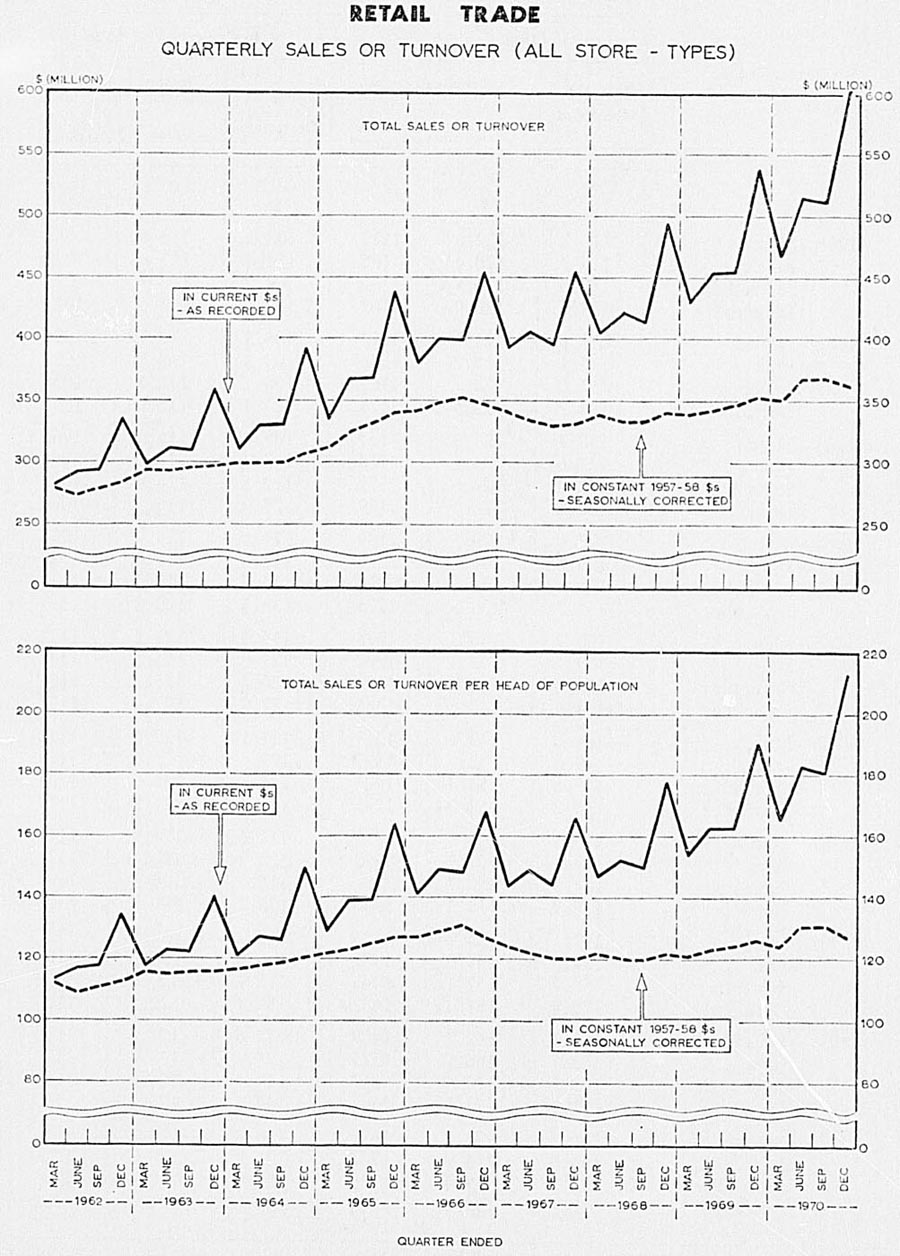
QUARTERLY SURVEY OF WHOLESALE TRADE—The quarterly survey of wholesale trade which commenced in September 1960 was revised in 1966 and again in 1970. The revisions were made to cover some new business and changes in method of selling from mostly retail to mostly wholesale disclosed by the 1963 and 1968 Censuses of Distribution, together with additional businesses commencing operations in later quarterly periods.
In this survey stores have been classified by store-type group according to the predominant type of commodity sold. The store-type figures therefore do not cover only sales of goods normally associated with the type of store listed, as there are many wholesale stores which handle a wide variety of commodities.
It should be noted that this survey has. altered coverage of wholesale store types as compared with the coverage of the Censuses of Distribution. For this reason, and because of the lack of uniformity in the trading year for which firms supplied census returns, care should be exercised when comparing the survey statistics with the censuses.
The survey covers businesses which are dominantly wholesale. Certain store types, which by nature of their business have a low ratio of stock to total turnover, have been omitted to facilitate collection and compilation of data. For the firms which have been excluded the value of closing stocks recorded in the Census of Distribution 1968 was $14,313,000 (comprising food and drink store-type group $11,370,000, apparel $1,131,000 and miscellaneous $1,812,000), representing only 6 percent of the total value of all stocks recorded by wholesale businesses in the census.
The following table shows, by store-type group, values of stocks held by wholesalers at quarterly intervals. This is a revised series.
| QUARTERLY STOCK VALUES—STORE-TYPE GROUPS | ||||||||
|---|---|---|---|---|---|---|---|---|
| End of Quarter | Food and Drink | Apparel | Furniture | Automotive | Hardware | Chemicals | General Merchants | Machinery (Agricultural, Heavy Electrical and Industrial) |
| $(million) | ||||||||
| 1969—Mar | 44.8 | 28.9 | 15.8 | 39.1 | 50.3 | 23.6 | 14.6 | 35.1 |
| Jun | 47.7 | 28.5 | 16.8 | 41.9 | 50.2 | 21.5 | 14.7 | 35.8 |
| Sep | 49.5 | 30.6 | 19.0 | 43.4 | 48.7 | 27.2 | 15.3 | 32.1 |
| Dec | 46.7 | 33.5 | 17.4 | 45.8 | 47.8 | 25.5 | 15.0 | 36.2 |
| 1970—Mar | 50.1 | 34.1 | 19.6 | 52.1 | 50.1 | 26.4 | 15.5 | 35.3 |
| Jun | 53.4 | 33.5 | 19.9 | 56.6 | 51.0 | 25.2 | 17.5 | 39.8 |
| Sep | 54.3 | 35.1 | 22.5 | 58.7 | 50.9 | 27.7 | 19.6 | 43.4 |
| Dec | 51.4 | 35.9 | 21.2 | 64.2 | 56.5 | 28.2 | 20.2 | 43.7 |
| End of Quarter | Electrical Supplies | Paper and Stationery | Grain and Seeds | Rubber, Leather and Canvas Goods | Office, Printers' and Photographic Supplies | Other | All Groups |
|---|---|---|---|---|---|---|---|
| $(million) | |||||||
| 1969—Mar | 13.1 | 7.8 | 3.6 | 4.3 | 8.6 | 19.5 | 308.9 |
| Jun | 13.9 | 8.6 | 4.2 | 4.5 | 8.5 | 20.4 | 317.3 |
| Sep | 15.0 | 8.7 | 4.2 | 4.9 | 9.2 | 21.7 | 329.3 |
| Dec | 14.8 | 9.2 | 4.1 | 5.1 | 8.8 | 21.2 | 331.1 |
| 1970—Mar | 15.1 | 8.9 | 4.6 | 5.7 | 9.3 | 20.8 | 347.5 |
| Jun | 14.9 | 10.2 | 4.9 | 5.7 | 9.6 | 21.6 | 363.6 |
| Sep | 15.8 | 11.3 | 4.5 | 5.4 | 10.5 | 23.9 | 383.7 |
| Dec | 18.7 | 12.5 | 4.3 | 5.4 | 11.4 | 24.6 | 398.2 |
The following table shows, by store-type group, for stores covered by the survey, values of sales or turnover by wholesalers for quarterly periods. This is a revised series.
For firms excluded from the continuing survey, the value of sales recorded in the Census of Distribution 1968 was $218.6 million, or 13.7 percent of total wholesale turnover.
| QUARTERLY SALES OR TURNOVER—STORE-TYPE GROUPS | ||||||||
|---|---|---|---|---|---|---|---|---|
| Quarter Ended | Food and Drink | Apparel | Furniture | Automotive | Hardware | Chemicals | General Merchants | Machinery (Agricultural, Heavy Electrical and Industrial) |
| $(million) | ||||||||
| 1969—Mar | 112.0 | 32.8 | 22.2 | 70.1 | 57.0 | 30.9 | 23.5 | 29.1 |
| Jun | 107.3 | 39.7 | 24.3 | 79.5 | 61.1 | 32.9 | 26.6 | 29.5 |
| Sep | 113.1 | 43.0 | 28.5 | 89.3 | 63.7 | 32.8 | 27.3 | 35.7 |
| Dec | 130.2 | 44.6 | 27.0 | 92.3 | 61.7 | 36.9 | 31.1 | 37.6 |
| 1970—Mar | 120.0 | 41.0 | 24.4 | 89.6 | 60.5 | 34.5 | 25.5 | 35.4 |
| Jun | 118.9 | 46.3 | 30.5 | 111.3 | 67.9 | 35.6 | 28.4 | 39.2 |
| Sep | 127.4 | 47.1 | 35.0 | 111.2 | 70.6 | 36.1 | 34.2 | 42.6 |
| Dec | 149.4 | 51.1 | 36.4 | 104.3 | 72.1 | 40.8 | 37.6 | 40.8 |
| Quarter Ended | Electrical Supplies | Paper and Stationery | Grain and Seeds | Rubber, Leather and Canvas Goods | Office, Printers' and Photographic Supplies | Other | All Groups |
|---|---|---|---|---|---|---|---|
| $(million) | |||||||
| 1969—Mar | 12.6 | 15.4 | 7.4 | 5.8 | 6.6 | 31.0 | 456.3 |
| Jun | 15.1 | 15.3 | 7.8 | 6.4 | 6.1 | 33.3 | 484.8 |
| Sep | 16.3 | 17.4 | 8.6 | 6.9 | 7.1 | 35.7 | 525.4 |
| Dec | 15.3 | 16.8 | 7.7 | 7.1 | 8.9 | 42.8 | 560.1 |
| 1970—Mar | 15.0 | 17.6 | 7.7 | 6.2 | 7.2 | 34.3 | 518.9 |
| Jun | 17.6 | 17.7 | 8.4 | 7.6 | 7.5 | 36.0 | 572.8 |
| Sep | 18.0 | 18.7 | 9.4 | 7.9 | 8.3 | 37.5 | 604.0 |
| Dec | 20.4 | 19.4 | 7.9 | 8.0 | 11.1 | 44.6 | 643.8 |
INSTALMENT CREDIT TRADING—Instalment credit trading in New Zealand has been growing steadily in recent years in common with other developed countries. This growth generally is explained by common causes, including an increasing social acceptance and the development of borrowing facilities. There is an increasing tendency for consumer durables to be purchased on credit. Instalment credit allows high-priced goods to be acquired as opportunity or desire dictates, with less reference to the immediate cash position. Some people welcome the discipline of monthly credit repayments as a means of saving. Consumer credit is provided either by retailers or finance companies. A major activity of the finance companies is the financing of motor vehicles on hire purchase; the Reserve Bank collects statistics in this field. A report by the Tariff and Development Board on Instalment Credit Trading published as parliamentary paper H. 49, 1968, is a useful reference.
Though international comparative statistics are usually open to qualification in this field the following figures indicate the general position New Zealand has come to occupy in relation to some other countries using instalment credit on a widespread basis. (The term instalment credit covers hire purchase agreements, credit sales agreements, and budget accounts.) Source—parliamentary paper H. 49, 1968.
| Country | Instalment Credit Outstanding Per Head at 31 Dec. 1965 |
|---|---|
| NZ$ | |
| United States | 250 |
| Canada | 206 |
| Australia | 102 |
| United Kingdom | 50 |
| New Zealand | 40 |
| Germany, West | 26 |
| France | 22 |
Regulations to curb hire-purchase trade have existed since 22 July 1955. Restrictions in recent years are now set out.
| Commodity | Date Effective | Minimum Deposit Percent | Maximum Repayment Period Months |
|---|---|---|---|
| *Reduced by 3 months from 6 December 1968, except television sets. | |||
| New motorcars and light trucks | 17 Apr. 1961 | 66 2/3 | 12 |
| Secondhand cars and light trucks | 17 Apr. 1961 | 50 | 18 |
| 1 Sep. 1965 | 50 | 12 | |
| 11 Feb. 1967 | 66 2/3 | 12 | |
| 17 May 1968 | 50 | 18* | |
| Motor cycles | 11 Feb. 1967 | 50 | 12 |
| 17 May 1968 | 33 1/3 | 18* | |
| Furniture and furnishings | 3 May 1962 | 5 | 24 |
| 11 Feb. 1967 | 15 | 18 | |
| 22 Mar. 1968 | 10 | 24* | |
| 19 Sep. 1969 | 10 | 24 | |
| Other consumer goods | 3 May 1962 | 5 | 24 |
| 24 Apr. 1964 | 24 | 10 | |
| 11 Feb. 1967 | 15 | 18* | |
| 19 Sep. 1969 | 10 | 24 | |
| 28 Oct. 1970 | 15 | 24 | |
A limited quarterly survey is made by the Department of Statistics of hire-purchase trade. It includes selected merchandising firms and finance corporations and for the 1967-68 March year surveyed business was estimated at 72 percent of hire purchase sales recorded in the 1968 Census of Distribution. The following table shows the value of goods sold on hire-purchase as recorded by the businesses in the survey and the percentage deposit to total value of goods so sold.
| Period | Value of Goods Sold on Hire Purchase | Details of Purchase | Percentage in Cash to total Value of Goods Sold on Hire Purchase | |
|---|---|---|---|---|
| Cash Payments | Amount Financed Under Hire-purchase Agreements | |||
| $(000) | $(000) | $(000) | percent | |
| Quarter ended— | Motor Vehicles | |||
| 1968—31 March | 12,008 | 6,876 | 5,132 | 57.3 |
| 30 June | 14,333 | 7,709 | 6,624 | 53.8 |
| 30 September | 17,380 | 9,275 | 8,105 | 53.4 |
| 31 December | 18,213 | 9,437 | 8,776 | 51.8 |
| 1969—31 March | 17,133 | 8,641 | 8,492 | 50.4 |
| 30 June | 18,246 | 9,163 | 9,083 | 50.2 |
| 30 September | 22,803 | 11,411 | 11,392 | 50.0 |
| 31 December | 26,389 | 13,194 | 13,195 | 50.0 |
| 1970—31 March | 22,081 | 11,042 | 11,040 | 50.0 |
| 30 June | 25,119 | 12,919 | 12,200 | 51.4 |
| 30 September | 29,607 | 14,977 | 14,630 | 50.6 |
| 31 December | 37,425 | 18,856 | 18,569 | 50.4 |
| Plant and Machinery | ||||
| 1968—31 March | 4,161 | 1,969 | 2,192 | 47.3 |
| 30 June | 3,734 | 1,543 | 2,191 | 41.3 |
| 30 September | 4,252 | 1,881 | 2,371 | 44.2 |
| 31 December | 3,862 | 1,585 | 2,277 | 41.0 |
| 1969—31 March | 3,861 | 1,397 | 2,464 | 36.2 |
| 30 June | 2,402 | 461 | 1,941 | 19.2 |
| 30 September | 3,361 | 679 | 2,681 | 20.2 |
| 31 December | 4,115 | 811 | 3,304 | 19.7 |
| 1970—31 March | 3,576 | 914 | 2,662 | 25.6 |
| 30 June | 3,032 | 711 | 2,321 | 23.4 |
| 30 September | 4,430 | 1,246 | 3,183 | 28.1 |
| 31 December | 6,020 | 1,736 | 4,285 | 28.8 |
| Period | Value of Goods Sold on Hire Purchase | Details of Purchase | Percentage in Cash to Total Value of Goods Sold on Hire Purchase | |
|---|---|---|---|---|
| Cash Payments | Amount Financed Under Hire-purchase Agreements | |||
| $(000) | $(000) | $(000) | percent | |
| Quarter ended— | Television Sets | |||
| 1968—31 March | 362 | 16 | 286 | 21.0 |
| 30 June | 533 | 89 | 444 | 16.7 |
| 30 September | 472 | 102 | 370 | 21.6 |
| 31 December | 350 | 71 | 279 | 20.3 |
| 1969—31 March | 354 | 76 | 279 | 21.5 |
| 30 June | 466 | 93 | 373 | 20.0 |
| 30 September | 450 | 99 | 351 | 22.0 |
| 31 December | 474 | 94 | 380 | 19.8 |
| 1970—31 March | 459 | 62 | 397 | 13.5 |
| 30 June | 572 | 78 | 494 | 13.7 |
| 30 September | 579 | 113 | 467 | 19.5 |
| 31 December | 488 | 80 | 408 | 16.4 |
| Other Household and Personal Goods | ||||
| 1968—31 March | 5,299 | 1,236 | 4,063 | 23.3 |
| 30 June | 6,308 | 1,173 | 5,135 | 18.6 |
| 30 September | 6,381 | 1,247 | 5,134 | 19.5 |
| 31 December | 7,928 | 1,773 | 6,155 | 22.4 |
| 1969—31 March | 6,576 | 1,232 | 5,344 | 18.7 |
| 30 June | 8,236 | 1,514 | 6,722 | 18.4 |
| 30 September | 8,833 | 1,720 | 7,113 | 19.5 |
| 31 December | 11,419 | 2,063 | 9,356 | 18.1 |
| 1970—31 March | 7,412 | 1,051 | 6,361 | 14.2 |
| 30 June | 9,882 | 1,348 | 8,534 | 13.6 |
| 30 September | 10,275 | 2,113 | 8,161 | 20.6 |
| 31 December | 12,317 | 1,977 | 10,341 | 16.1 |
| Total | ||||
| 1968—31 March | 21,830 | 10,157 | 11,673 | 46.5 |
| 30 June | 24,908 | 10,514 | 14,394 | 42.2 |
| 30 September | 28,485 | 12,505 | 15,980 | 43.9 |
| 31 December | 30,353 | 12,866 | 17,487 | 42.4 |
| 1969—31 March | 27,924 | 11,345 | 16,579 | 40.6 |
| 30 June | 29,349 | 11,231 | 18,118 | 38.3 |
| 30 September | 35,447 | 13,909 | 21,537 | 39.2 |
| 31 December | 42,397 | 16,162 | 26,235 | 38.1 |
| 1970—31 March | 33,529 | 13,070 | 20,459 | 39.0 |
| 30 June | 38,605 | 15,056 | 23,549 | 39.0 |
| 30 September | 44,891 | 18,450 | 26,441 | 41.1 |
| 31 December | 56,251 | 22,649 | 33,602 | 40.2 |
The following table shows the amount owing under hire-purchase agreements and the percentage of payments overdue at the end of each quarterly period. As stated previously the statistics are estimated to cover about 72 percent of total hire-purchase business.
| As at— | Amount Owing Under Hire-purchase Agreements | Percentage of Payments Overdue |
|---|---|---|
| $(000) | ||
| 1967—31 March | 62,408 | 4.0 |
| 30 June | 62,356 | 4.5 |
| 30 September | 58,052 | 5.2 |
| 31 December | 58,956 | 5.1 |
| 1968—31 March | 57,144 | 5.3 |
| 30 June | 56,745 | 5.3 |
| 30 September | 58,367 | 5.0 |
| 31 December | 61,171 | 4.6 |
| 1969—31 March | 66,742 | 4.6 |
| 30 June | 74,567 | 4.4 |
| 30 September | 73,664 | 4.3 |
| 31 December | 84,864 | 4.0 |
| 1970—31 March | 88,411 | 4.0 |
| 30 June | 94,619 | 3.8 |
| 30 September | 97,254 | 3.5 |
| 31 December | 108,467 | 3.6 |
The following table shows the average amount covered by hire-purchase agreements in each of the four categories of sales for each quarterly period.
| Period | Motor Vehicles | Machinery | Household and Personal Goods | |
|---|---|---|---|---|
| Television Sets | Other Household Se s and Personal Goods | |||
| Quarter ended— | $ | $ | $ | $ |
| 1967—31 March | 760 | 3,186 | 204 | 58 |
| 30 June | 732 | 4,296 | 202 | 52 |
| 30 September | 704 | 3,171 | 199 | 48 |
| 31 December | 732 | 2,417 | 180 | 52 |
| 1968—31 March | 695 | 2,999 | 179 | 48 |
| 30 June | 744 | 3,473 | 196 | 53 |
| 30 September | 718 | 3,774 | 188 | 66 |
| 31 December | 787 | 2,930 | 178 | 51 |
| 1969—31 March | 856 | 2,819 | 174 | 61 |
| 30 June | 862 | 3,986 | 183 | 51 |
| 30 September | 881 | 3,428 | 170 | 68 |
| 31 December | 851 | 3,308 | 180 | 56 |
| 1970-31 March | 831 | 4,009 | 215 | 65 |
| 30 June | 759 | 3,799 | 214 | 59 |
| 30 September | 808 | 4,177 | 225 | 62 |
| 31 December | 991 | 5,277 | 218 | 62 |
Table of Contents
GENERAL—New Zealand has always been heavily dependent on overseas trade for its development and progress. In the early days of colonisation the infant New Zealand farming industry found a ready market for basic foodstuffs, such a> potatoes, grain, butler, and cheese, in Australia. Timber and gold temporarily constituted a sizeable proportion of exports, but the most consistent export was wool. Wool made up 22 percent of the value of exports in 1853, when trade statistics were first compiled; in the 1870s it accounted for over half the value; from 1880 to 1898 its share was from 40 percent to 50 percent; and from 1899 to 1964 wool consistently earned one-third of New Zealand's export receipts.
Real and lasting diversification of the exports of farm products was made possible by the introduction of refrigerated ships in 1882. This accentuated the development of New Zealand's economy as a complement to the United Kingdom economy, to the benefit of both. At first, exports of frozen meat increased more rapidly than those of butter and cheese; the early emphasis was on frozen mutton and lamb, with beef and veal becoming more significant later. The great expansion of exports of dairy produce also came later, notably after 1900, and was encouraged by the centralised factory production of butter. From 1913 onwards, pastoral farming accounted for over 80 percent of total exports. In 1870 only 52 percent of the exports went to the United Kingdom; by 1880 the proportion had increased to 75 percent. Australia, which had been New Zealand's main trading partner in the early years, was receiving only 21 percent of the exports by 1880 and 15 percent by 1890.
The United Kingdom has remained New Zealand's predominant market for exports and the biggest supplier of imported goods, although in recent years the United Kingdom's share of New Zealand's export trade has gradually been declining. In 1950 the United Kingdom took 66 percent of New Zealand's exports but by the year ended June 1970 its share had fallen to 36 percent. However, the United Kingdom remains New Zealand's best export market by far, taking almost all New Zealand's lamb, cheese, and butter, and about one fifth of the wool. The marketing of primary products is discussed in Section 21A.
New Zealand has traditionally enjoyed unrestricted access to the United Kingdom market although increased competition was met from United Kingdom producers and countries exporting primary products. Because the market become oversupplied during the European summer of 1961, the United Kingdom placed quotas on countries supplying butter. These quotas were placed on a formal basis in April 1962, and have since been maintained. A similar situation developed in early 1968 when serious oversupply threatened the stability of the United Kingdom cheese market. As there appeared to be little chance of a return to a situation of orderly marketing in June 1969 the British introduced, with the agreement of all suppliers, a voluntary restraint arrangement on the export of cheese to Britain.
New Zealand has found it necessary in recent years to develop supplementary markets. There has been a marked expansion of New Zealand's overseas markets, notably in the United States, and countries bordering on the Pacific. For example, exports made to Japan have shown a marked increase from $6.2 million in 1953 to $106 million in the June year 1970.
About 70 percent of the exports to Japan in the year ended June 1970 were meat (mainly mutton), timber, and wool; other principal commodities were dairy products, and casein.
The value of New Zealand's overseas trade in relation to national income and on a per-head basis is among the highest in a ranking of countries of the world.
Except for the growth of trade in pulp and paper products, the composition of New Zealand's exports today does not vary greatly from that of pre-war years. Of recent years from 75 to 80 percent of the total value of exports is still derived from wool, meat, and dairy produce. Exports of manufactured goods (including those based on agriculture, forestry, and fishing) have risen sharply in recent years; but the steady growth of trade in meat, dairy produce, and wool has meant that the proportion as compared with total New Zealand exports today does not vary greatly from that of pre-war years.
The following table shows the changing pattern of external trade by countries of destination and origin. The percentages are based on value data only, exports f.o.b. and imports c.d.v.
| Year | United Kingdom | Australia | United States‡ | Other Countries |
|---|---|---|---|---|
*Gold is included in figures up to 1950. † Provisional. ‡ Alaska and Hawaii included since 1965. | ||||
| Percent | ||||
| Exports* | ||||
| 1,860 | 70 | 27 | - | 3 |
| 1,870 | 52 | 46 | - | 2 |
| 1,880 | 75 | 21 | 2 | 2 |
| 1,890 | 75 | 15 | 6 | 4 |
| 1,900 | 77 | 14 | 6 | 3 |
| 1,910 | 84 | 9 | 3 | 4 |
| 1,920 | 74 | 5 | 16 | 5 |
| 1,930 | 80 | 3 | 5 | 12 |
| 1,940 | 88 | 3 | 4 | 5 |
| 1,950 | 66 | 3 | 10 | 21 |
| 1,960 | 53 | 4 | 13 | 30 |
| Imports* | ||||
| 1,860 | 56 | 42 | 1 | 1 |
| 1,870 | 58 | 36 | 1 | 5 |
| 1,880 | 56 | 31 | 4 | 9 |
| 1,890 | 67 | 17 | 6 | 10 |
| 1,900 | 61 | 17 | 10 | 12 |
| 1,910 | 62 | 14 | 8 | 16 |
| 1,920 | 48 | 17 | 18 | 17 |
| 1,930 | 47 | 8 | 18 | 27 |
| 1,940 | 47 | 16 | 12 | 25 |
| 1,950 | 60 | 12 | 7 | 21 |
| 1,960 | 43 | 18 | 10 | 29 |
| June Year | ||||
| 1,963 | 47 | 4 | 17 | 32 |
| 1,964 | 47 | 5 | 15 | 33 |
| 1,965 | 51 | 5 | 13 | 31 |
| 1,966 | 45 | 5 | 14 | 36 |
| 1,967 | 44 | 5 | 16 | 35 |
| 1,968 | 43 | 7 | 17 | 33 |
| 1,969 | 39 | 8 | 17 | 36 |
| 1970† | 36 | 7 | 15 | 42 |
| 1,963 | 42 | 19 | 9 | 30 |
| 1,954 | 39 | 21 | 9 | 31 |
| 1,965 | 37 | 19 | 11 | 33 |
| 1,966 | 38 | 19 | 11 | 32 |
| 1,967 | 37 | 19 | 13 | 31 |
| 1,968 | 30 | 21 | 11 | 38 |
| 1,969 | 31 | 20 | 12 | 37 |
| 1970† | 29 | 20 | 13 | 38 |
The New Zealand - Australia Free Trade Agreement signed on 31 August 1965 completed its fifth year of operation on 1 January 1971. The Agreement provides for the phasing out of duties over a period of up to 8 years on the range of products which it covers. A system of annual reviews of the Agreement provides for an increase in the range of goods subject to the phasing out of duties. Products have been added on 1 January 1968, 1 January 1969, 1 July 1969, 1 January 1970, 1 July 1970, 1 January 1971 and 1 July 1971.
Apart from annual additions to the list of goods subject to the free trade provisions' of the Agreement, the second step is the phasing out of duties. The gradual phasing out of duties in both Australia and New Zealand on products covered by the Agreement's free trade provisions, together with the opportunities which exist for special trading arrangements under Article 3, paragraph 7 of the Agreement is making possible an expansion in mutual trade between the two countries. (Details of the Agreement are provided in parliamentary paper A. 17 1965.)
The growing importance of the trade in forest products between Australia and New Zealand resulted in the establishment in 1967 of the Joint Consultative Council on Forest Industries provided for in the Agreement. The Council, which had its inaugural meeting in June 1968, is an advisory body comprising senior officials from Government departments in both countries, having as its aim the achievement of a harmonious and mutually beneficial expansion of trade between the two countries and the promotion of the most efficient use of combined forest resources. The Council issued in May 1970 its first report on forest resources of the two countries. Two working parties have been established by the Council—one to study the area requirements for Douglas fir, and the other to investigate markets for forest products in third countries.
The Agreement has various safeguard provisions but one of the main ways of dealing with problems has been through consultation procedures. Regular meetings of Ministers and officials of both countries are held at which both negotiation and consultation are carried out.
The distribution of New Zealand's overseas trade by broad grouping during the latest 11 years is given in the following table (excluding gold and current coin).
| Year | Sterling Area | Dollar Area | European Economic Community | European Free Trade Association (Excluding United Kingdom) | Other Countries | Sterling Area | Dollar Area | European Economic Community | European Free Trade Association (Excluding United Kingdom) | Other Countries |
|---|---|---|---|---|---|---|---|---|---|---|
| *Provisional. | ||||||||||
| Percentage of Total Export Trade (f.o.b.) | Percentage of Import Trade (c.d.v.) | |||||||||
| 1,960 | 60.85 | 14.95 | 16.69 | 0.66 | 6.85 | 69.82 | 14.40 | 6.95 | 2.38 | 6.45 |
| 1,961 | 58.46 | 16.88 | 15.75 | 0.76 | 8.15 | 68.59 | 14.19 | 8.03 | 2.46 | 6.72 |
| Jan-June 1962 | 55.86 | 16.28 | 20.64 | 1.04 | 6.18 | 71.59 | 12.81 | 7.07 | 2.02 | 6.51 |
| June 1963 | 55.99 | 19.32 | 17.57 | 0.70 | 6.43 | 68.86 | 13.52 | 6.60 | 2.34 | 8.68 |
| 1,964 | 55.63 | 16.88 | 18.60 | 1.11 | 7.77 | 67.86 | 13.94 | 6.56 | 3.53 | 8.11 |
| 1,965 | 60.30 | 14.94 | 16.19 | 1.17 | 7.40 | 65.03 | 15.80 | 6.39 | 3.14 | 9.64 |
| 1,966 | 54.93 | 16.29 | 15.74 | 1.07 | 11.98 | 65.64 | 15.87 | 6.61 | 2.51 | 9.37 |
| 1,967 | 54.15 | 18.47 | 11.65 | 1.04 | 14.69 | 64.04 | 17.28 | 7.38 | 2.70 | 8.60 |
| 1,968 | 55.89 | 19.56 | 10.53 | 0.91 | 13.12 | 61.95 | 16.20 | 7.08 | 2.99 | 11.79 |
| 1,969 | 52.29 | 20.40 | 12.28 | 0.86 | 14.18 | 60.89 | 16.44 | 8.03 | 2.95 | 11.69 |
| 1970* | 50.18 | 21.13 | 11.11 | 1.02 | 16.56 | 60.45 | 17.63 | 7.47 | 2.39 | 12.06 |
The direction of external trade is shown graphically in the following diagram.
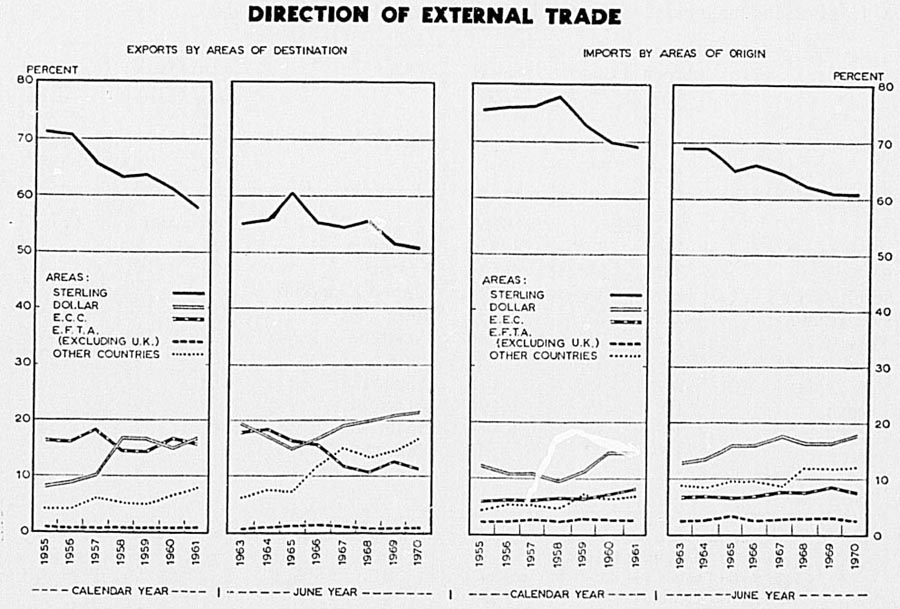
TRADE PER HEAD—The next table shows the value of exports (including re-exports), imports, and total trade per head of mean population. Values are expressed in terms of New Zealand currency. In this table the valuation used for imports is current domestic value in the country of origin.
| Year | Total Exports | Imports | Total Trade |
|---|---|---|---|
| *Provisional | |||
| $ | $ | $ | |
| 1,949 | 156.72 | 116.59 | 273.32 |
| 1,950 | 191.12 | 150.41 | 341.53 |
| 1,951 | 253.95 | 192.80 | 446.75 |
| 1,952 | 240.22 | 229.88 | 470.10 |
| 1,953 | 229.74 | 159.70 | 389.44 |
| 1,954 | 232.92 | 203.48 | 436.41 |
| 1,955 | 242.20 | 234.37 | 476.57 |
| 1,956 | 254.02 | 215.51 | 469.52 |
| 1,957 | 247.48 | 234.42 | 481.90 |
| 1,958 | 218.68 | 221.14 | 439.82 |
| 1,959 | 251.26 | 175.64 | 426.90 |
| 1,960 | 254.35 | 212.94 | 467.29 |
| $ | $ | $ | |
| 1,961 | 233.76 | 237.48 | 471.23 |
| Jan - June 1962 | 134.32 | 95.88 | 230.21 |
| June Year 1963 | 249.42 | 208.16 | 457.58 |
| 1,964 | 286.72 | 247.88 | 534.60 |
| 1,965 | 282.95 | 252.64 | 535.59 |
| 1,966 | 288.54 | 274.31 | 562.85 |
| 1,967 | 268.57 | 278.16 | 546.73 |
| 1,968 | 299.04 | 227.03 | 526.08 |
| 1969x | 357.13 | 288.57 | 645.70 |
| 1970* | 387.82 | 336.20 | 724.01 |
INTERNATIONAL COMPARISON OF RELATIVE VALUE OF TRADE—For New Zealand exports of goods are of greater importance to the national economy than is the case for most other countries. (Many other countries have a greater proportional income from the exports of services such as travel, investment, insurance, and shipping activities.)
In the following table the values of the exports of goods (excluding services) for some of the main trading countries are given as a percentage of the gross national product, and also the value of total external trade in goods in 1968 per head of population, using c.i.f. valuations for imports. (Source: United Nations Statistical Office.)
| Country | Export of Goods as Percentage of Gross National Product | Value of External Trade per Head | |
|---|---|---|---|
| 1966 | 1967 | 1968 | |
*Exports include a large volume of goods originating in inland Europe passing through ports. † Fiscal year beginning 1 April. ‡ Exports of goods and non-factor services. § Fiscal year beginning 1 July. | |||
| Percent | (NZ)$ | ||
| Netherlands | 34* | 32* | 1,236 |
| Belgium | 29* | 36* | 1,531 |
| South Africa | 23 | 15 | 221 |
| Switzerland | 22 | 22 | 1,233 |
| Norway | 21 | 21 | 1,086 |
| Israel | 20 | 13 | 541 |
| New Zealand | 20† | 18† | 618 |
| Sweden | 19 | 19 | 1,136 |
| Canada | 18 | 18 | 1,031 |
| Austria | 17 | 17 | 545 |
| West Germany | 17 | 18 | 668 |
| Philippines | 15 | 9 | 55 |
| France | 15‡ | 10‡ | 476 |
| United Kingdom | 14 | 13 | 537 |
| Italy | 13 | 13 | 346 |
| Australia | 13§ | 13§ | 539 |
| Japan | 10 | 9 | 229 |
| Mexico | 10† | 5† | 61 |
| Argentina | 8 | 10 | 96 |
| Spain | 6 | 5 | 140 |
| Pakistan | 5 | 5 | 13 |
| United States | 4 | 4 | 299 |
VISIBLE BALANCE OF TRADE—In the following table the c.i.f. valuation of imports has been used to establish the visible balance of trade. Gold and specie totals are excluded.
| June Year | Visible Excess of Exports |
|---|---|
| *Provisional. | |
| $(000) | |
| 1963-64 | 43,234 |
| 1964-65 | 17,711 |
| 1965-66 | -25,489 |
| 1966-67 | -85,984 |
| 1967-68 | 145,782 |
| 1968-69x | 136,210 |
| 1969-70* | 81,003 |
Visible trade is not the only factor to be taken into account in considering the balance of payments between countries (see Section 25B). A statement of New Zealand's overseas exchange transactions is given in Section 29, Banking and Currency.
TRADE STATISTICS—As from 1 July 1962 the processing of external trade statistics was transferred from the Customs Department to the Department of Statistics.
Provisional trade data are published in a supplement to the Monthly Abstract of Statistics within a month of the period to which they relate. A publication entitled External Trade of New Zealand (Country Analyses) is published quarterly.
Annual volumes are also published by the Department of Statistics, the latest available issues being Exports 1968-69, Imports 1968-69, Part A Commodity by Country, and Part B Country by Commodity.
New Zealand adopted the Standard International Trade Classification as from 1 January 1955, for classifying external trade for statistical purposes; from the same date this classification was put into effect for recording the external trade of the Cook Islands and Niue. This classification remained in use until 30 June 1962 when it was replaced by the Standard International Trade Classification (Revised); the S.I.T.C. order was also adopted on 1 July 1962 as the Customs Tariff classification, but a move to the Brussels Tariff Nomenclature was made on 1 July 1967.
Provisional values of imports and exports are set out in the following table.
| Period | 1968-69 | 1969-70 | 1970-71 | ||||||
|---|---|---|---|---|---|---|---|---|---|
| Exports (including Re-exports) f.o.b. Value | Imports | Exports (including, Re-exports) f.o.b. Value | Imports | Exports (including Re-exports) f.o.b. Value | Imports | ||||
| c.d. Value | c.i.f. Value | c.d. Value | c.i.f. Value | c.d. Value | c.i.f. Value | ||||
| $(million) | |||||||||
| Month of July | 59.8 | 74.3 | 77.8 | 86.7 | 85.4 | 90.7 | 91.0 | 93.5 | 98.9 |
| 2 months ended August | 139.1 | 137.6 | 146.0 | 164.4 | 155.2 | 165.1 | 176.4 | 182.7 | 195.1 |
| 3 months ended September | 192.1 | 207.1 | 219.7 | 249.5 | 242.5 | 257.6 | 248.7 | 274.2 | 294.1 |
| 4 months ended October | 263.6 | 281.7 | 299.1 | 324.6 | 522.1 | 341.9 | 325.7 | 368.3 | 394.8 |
| 5 months ended November | 333.6 | 348.3 | 371.7 | 418.0 | 385.8 | 410.7 | 401.2 | 464.3 | 497.5 |
| 6 months ended December | 415.8 | 413.0 | 440.7 | 509.2 | 456.8 | 486.7 | 515.9 | 552.8 | 592.4 |
| 7 months ended January | 507.0 | 487.8 | 519.8 | 597.9 | 530.1 | 564.6 | 590.8 | 629.4 | 676.6 |
| 8 months ended February | 620.9 | 545.5 | 380.0 | 703.2 | 591.6 | 629.4 | 722.8 | 711.9 | 765.3 |
| 9 months ended March | 711.9 | 602.4 | 642.3 | 817.2 | 668.0 | 710.1 | 807.2 | 811.8 | 873.5 |
| 10 months ended April | 815.4 | 659.0 | 703.2 | 897.0 | 759.5 | 810.4 | 927.3 | 901.0 | 968.1 |
| 11 months ended May | 898.3 | 731.4 | 780.5 | 982.0 | 853.6 | 909.6 | 1,038.4 | 986.0 | 1,059.3 |
| 12 months ended June | 989.1 | 799.2 | 852.9 | 1,087.0 | 942.3 | 1,006.0 | 1,131.1 | 1,075.1 | 1,157.1 |
Valuation of Exports—It has always been the practice to record exports at free-on-board (f.o.b.) values, except during the Second World War when wool exports were valued at appraisal prices. Most meat and dairy produce exports are consigned for sale on overseas markets, and necessarily valued, on export, at the f.o.b. equivalent of the prices ruling at that time in the markets to which they are consigned. Price changes may occur in these markets before the actual sale of the produce.
The exports recorded relate to goods on vessels which have cleared their final port of call in New Zealand during the period.
Valuation of Imports—From 1 January 1952 imports have been recorded at current domestic value, which is generally equivalent to but not identical with the f.o.b. cost. From July 1962, with the introduction of the Standard International Trade Classification, Revised, statistics on the c.i.f. basis (cost including freight and insurance) are available at item level.
The proportional difference between the two figures of valuation now made available—viz, c.d.v. and c.i.f.—will vary from period to period depending on (1) the make-up of imports in the different periods, (2) differential changes in import prices and in freight rates, (3) differences between domestic and export prices in the exporting countries, and (4) price fluctuations between dates of purchases and of shipping. In all the tables imports are now shown at c.d.v., unless otherwise specified in respect of particular tables.
The trade figures for imports are compiled from the imports entries passed by the Customs Department. Generally the imports entries are not passed until the goods are available for discharge from the wharf.
Annual Statistics—Trade statistics were compiled on a calendar year basis to 1961 but a June year has been adopted since 1 July 1962 and this accords fairly well with the farm production year.
The statistics of external trade given in this section (comprising the three subsections) do not include the trade of the Cook Islands, Niue, and the Tokelau Islands; statistics for these territories are given in Section 38 of this Yearbook.
The following table gives the values of the export and import trade for years ended December, March, and June. The movement of specie is not included in these figures and gold is excluded from 1963 onwards.
| Year | Exports (including Re-exports) f.o.b. | Imports | |
|---|---|---|---|
| c.d.v. | c.i.f. | ||
| *Provisional | |||
| $(million) | |||
| Year ended December | |||
| 1,955 | 518.6 | 501.3 | 574.3 |
| 1,956 | 555.0 | 469.6 | 536.8 |
| 1,957 | 553.1 | 523.5 | 594.2 |
| 1,958 | 500.3 | 505.6 | 570.2 |
| 1,959 | 587.3 | 410.2 | 462.8 |
| 1,960 | 605.2 | 506.3 | 564.7 |
| 1,961 | 568.0 | 576.6 | 649.8 |
| 1,962 | 575.6 | 491.6 | 544.0 |
| 1,963 | 664.3 | 595.7 | 650.7 |
| 1,964 | 773.7 | 644.0 | 701.7 |
| 1,965 | 729.2 | 703.8 | 766.7 |
| 1,966 | 780.0 | 722.4 | 787.0 |
| 1,967 | 727.1 | 672.4 | 725.6 |
| 1,968 | 920.9 | 749.0 | 805.3 |
| 1969x | 1,082.5 | 843.0 | 898.9 |
| 1970* | 1,093.7 | 1,038.3 | 1,111.8 |
| Year ended March | |||
| 1,955 | 470.0 | 453.5 | 519.5 |
| 1,956 | 557.6 | 491.4 | 562.9 |
| 1,957 | 551.3 | 473.8 | 540.7 |
| 1,958 | 550.9 | 534.1 | 606.9 |
| 1,959 | 500.4 | 466.9 | 526.2 |
| 1,960 | 627.5 | 433.6 | 487.8 |
| 1,961 | 560.3 | 541.3 | 602.7 |
| 1,962 | 580.6 | 536.5 | 606.1 |
| 1,963 | 577.0 | 513.9 | 571.1 |
| 1,964 | 720.7 | 618.2 | 672.4 |
| 1,965 | 759.6 | 642.9 | 700.2 |
| 1,966 | 747.2 | 729.3 | 794.4 |
| 1,967 | 766.9 | 722.4 | 786.9 |
| 1,968 | 747.7 | 664.1 | 714.6 |
| 1,969 | 979.2 | 769.3 | 823.6 |
| 1970* | 1,094.4 | 864.8 | 920.8 |
| Year ended June | |||
| 1,955 | 479.5 | 483.3 | 554.4 |
| 1,956 | 541.3 | 483.6 | 553.7 |
| 1,957 | 555.2 | 486.4 | 553.4 |
| 1,958 | 544.0 | 536.6 | 610.4 |
| 1,959 | 521.5 | 434.5 | 489.3 |
| 1,960 | 629.5 | 454.4 | 509.2 |
| 1,961 | 561.4 | 582.7 | 649.6 |
| 1,962 | 582.9 | 507.8 | 572.3 |
| 1,963 | 627.5 | 523.7 | 576.6 |
| 1,964 | 737.3 | 637.4 | 694.0 |
| 1,965 | 742.2 | 662.7 | 724.5 |
| 1,966 | 767.3 | 729.4 | 792.8 |
| 1,967 | 727.2 | 752.2 | 813.2 |
| 1,968 | 820.5 | 622.9 | 674.7 |
| 1969x | 989.1 | 799.2 | 852.9 |
| 1970* | 1,087.0 | 942.3 | 1,006.0 |
The following table shows for the June year 1969 the values of merchandise exports to, and imports from, each of the countries trading with New Zealand.
| TRADE BY COUNTRIES, YEAR ENDED JUNE 1969 | ||||
|---|---|---|---|---|
| Country | Exports f.o.b. | Imports c.d.v. | ||
| New Zealand Produce | Total | By Country of Origin | By Country of Purchase | |
| Sterling Area Countries— | $(000) | |||
| Associated States in Eastern Caribbean | 406 | 437 | 9 | 9 |
| Australia | 69,892 | 75,282 | 158,329 | 172,166 |
| Bahamas | 268 | 268 | 3 | - |
| Bahrain | 8 | 8 | 1,659 | 411 |
| Barbados | 1,428 | 1,428 | 11 | 6 |
| Bermuda | 884 | 884 | 1 | 106 |
| British Honduras | 1 | 1 | - | - |
| British Solomon Islands | 156 | 158 | 15 | 15 |
| British Virgin Islands | 3 | 3 | - | - |
| Brunei | 4 | 4 | 418 | - |
| Ceylon | 1,239 | 1,242 | 4,937 | 4,871 |
| Cyprus | 1,272 | 1,272 | 87 | 84 |
| Falkland Islands | 1 | 1 | - | - |
| Fiji | 6,069 | 7,638 | 2,496 | 2,979 |
| Gambia | 1 | 1 | - | - |
| Ghana | 118 | 118 | 1,069 | 905 |
| Gibraltar | 4 | 4 | - | - |
| Gilbert and Ellice Islands | 192 | 197 | 1,804 | 1,905 |
| Guyana | 56 | 56 | 62 | 41 |
| Hong Kong | 3,580 | 3,673 | 13,722 | 15,149 |
| Iceland | 1 | 1 | –– | –– |
| India | 1,869 | 1,962 | 8,882 | 8,022 |
| Ireland, Republic of | 1,957 | 1,957 | 325 | 489 |
| Jamaica | 3,881 | 3,883 | 299 | 248 |
| Jordan | 12 | 12 | - | - |
| Kenya | 404 | 405 | 558 | 793 |
| Kuwait | 65 | 65 | 16,459 | 6,888 |
| Malawi | 40 | 40 | 116 | 91 |
| Malaysia | 6,271 | 6,317 | 6,621 | 5,244 |
| Malta, including Gozo | 37 | 37 | 45 | 38 |
| Mauritius and Dependencies | 332 | 332 | 39 | 39 |
| Montserrat | 23 | 23 | –– | –– |
| Nauru | 353 | 369 | 6,136 | 5,949 |
| New Hebrides Cond. | 211 | 226 | –– | 1 |
| New Zealand Re-Imports | - | - | 959 | 157 |
| Nigeria | 53 | 54 | 95 | 86 |
| Norfolk Island | 252 | 259 | –– | 22 |
| Pakistan | 217 | 218 | 3,425 | 3,187 |
| Papua and New Guinea | 683 | 744 | 420 | 238 |
| Pitcairn Island | 10 | 14 | –– | –– |
| Qatar and Trucial Sheikdoms | 15 | 15 | –– | –– |
| Seychelles | 4 | 4 | –– | 1 |
| Sierra Leone | 13 | 13 | 10 | 4 |
| Singapore | 8,226 | 8,424 | 3,038 | 3,175 |
| South Africa | 2,369 | 2,472 | 3,941 | 3,239 |
| South West Africa | –– | –– | 8 | 1 |
| South Yemen | 5 | 5 | 3,288 | 489 |
| Swaziland | 4 | 4 | - | - |
| Tanzania (incl. Zanzibar and Pemba) | 212 | 212 | 1,092 | 584 |
| Tonga | 1,415 | 1,516 | 559 | 569 |
| Trinidad and Tobago | 3,859 | 3,859 | 61 | 57 |
| Uganda | 39 | 39 | 907 | 730 |
| United Kingdom | 380,970 | 382,749 | 243,483 | 267,447 |
| Western Samoa | 1,739 | 1,946 | 1,257 | 1,308 |
| Zambia | 235 | 248 | –– | –– |
| Totals, Sterling Area | 501,358 | 511,099 | 486,646 | 507,741 |
| E.F.T.A. Countries (Excluding United Kingdom | ||||
| Austria | 174 | 179 | 877 | 790 |
| Denmark | 1,815 | 1,825 | 1,862 | 1,749 |
| Norway | 818 | 1,326 | 1,518 | 1,455 |
| Portugal | 1,499 | 1,499 | 651 | 624 |
| Sweden | 2,480 | 2,493 | 9,390 | 9,298 |
| Switzerland and Liechtenstein | 1,001 | 1,035 | 9,281 | 6,652 |
| Totals, E.F.T.A. | 7,787 | 8,358 | 23,580 | 20,568 |
| E.E.C. Countries— | ||||
| Belgium and Luxembourg | 19,288 | 19,304 | 4,183 | 4,089 |
| France and Monaco | 36,756 | 36,781 | 6,670 | 5,793 |
| Germany, Federal Republic | 28,499 | 28,734 | 33,807 | 32,293 |
| Italy and San Marino | 21,550 | 21,591 | 11,145 | 10,517 |
| Netherlands | 13,059 | 13,611 | 8,372 | 8,524 |
| Totals, E.E.C. | 119,152 | 120,021 | 64,178 | 61,216 |
| Dollar Area— | ||||
| American Samoa | 1,535 | 1,615 | 60 | |
| Antarctic Territory (U.S.) | - | 1 | - | - |
| Bolivia | - | - | 15 | - |
| Canada | 16,206 | 16,383 | 30,448 | 28,971 |
| Colombia | 148 | 148 | 42 | 25 |
| Costa Rica | - | 1 | 132 | 131 |
| Dominican Republic | - | - | 3 | 3 |
| Ecuador | –– | –– | 427 | 426 |
| Guam | 1,090 | 1,090 | - | - |
| Guatemala | –– | –– | 9 | 8 |
| Haiti | –– | –– | –– | - |
| Honduras | - | - | 7 | 7 |
| Liberia | 13 | 13 | - | - |
| Mexico | 719 | 722 | 366 | 355 |
| Panama Canal Zone | 103 | 103 | - | - |
| Panama Republic | 694 | 694 | - | 136 |
| Philippines | 6,822 | 7,031 | 268 | 272 |
| Puerto Rico | 578 | 578 | 20 | 20 |
| Ryukyu Islands | 791 | 791 | - | - |
| U.S. Trust Terrs. in Pacific | 76 | 76 | - | - |
| United States of America | 168,187 | 169,802 | 99,655 | 102,156 |
| Venezuela | 295 | 295 | 2 | 5 |
| Totals, Dollar Area | 197,258 | 199,346 | 131,395 | 132,575 |
| Other Countries— | $(000) | |||
| Afghanistan 1 | 4 | 4 | –– | - |
| Algeria | 2 | 2 | –– | - |
| Angola incl. Cabinda | - | - | 16 | 16 |
| Argentina | 11 | 11 | 51 | 47 |
| Brazil | 3 | 3 | 519 | 169 |
| Bulgaria | 50 | 50 | 2 | –– |
| Burma | 415 | 415 | 2 | 1 |
| Cambodia | 1 | 1 | 18 | 18 |
| Canary Islands | - | - | 1 | –– |
| Chile | 251 | 251 | 39 | 4 |
| China (Mainland) | 3,683 | 3,683 | 4,984 | 4,501 |
| China, Republic of (Taiwan) | 2,430 | 2,444 | 230 | 218 |
| Congo (Brazzaville) | - | - | 26 | - |
| Congo (Leopoldville) | - | - | 28 | 26 |
| Czechoslovakia | 1,012 | 1,014 | 1,483 | 1,376 |
| Ethiopia and Eritrea | 2 | 2 | 2 | 1 |
| Finland | 783 | 784 | 903 | 887 |
| French Guiana | 85 | 85 | - | - |
| French Polynesia | 3,509 | 3,543 | 17 | 20 |
| French Somaliland | 2 | 2 | - | - |
| French West Indies | 72 | 72 | 1 | 1 |
| Gabon | - | - | 3 | 3 |
| Germany, Democratic Republic | 1,092 | 1,093 | 334 | 299 |
| Greece | 6,191 | 6,191 | 15 | 12 |
| Hungary | 194 | 194 | 49 | 38 |
| Indonesia | 69 | 75 | 1,058 | 255 |
| Iran | 311 | 311 | 10,152 | 3,696 |
| Iraq | 8 | 9 | 331 | 30 |
| Israel | 79 | 91 | 281 | 277 |
| Ivory Coast | 1 | 1 | 40 | 27 |
| Japan | 87,815 | 88,001 | 64,594 | 62,966 |
| Korea, Republic of | 1,446 | 1,446 | 462 | 40 |
| Laos | 1 | 71 | - | 1 |
| Lebanon | 49 | 49 | 4 | 7 |
| Macao | 1 | 1 | 6 | 2 |
| Malagasy | 4 | 4 | 6 | 1 |
| Mongolian People's Republic | - | - | 8 | - |
| Morocco | 55 | 55 | 17 | 7 |
| Mozambique | 602 | 602 | 59 | 51 |
| Muscat and Oman | 14 | 14 | - | - |
| Nepal | 8 | 8 | - | - |
| Netherlands Antilles | 562 | 562 | 99 | 3 |
| New Caledonia | 1,758 | 1,986 | –– | –– |
| Paraguay | 1 | 1 | –– | - |
| Peru | 2,310 | 2,310 | 26 | 25 |
| Poland | 2,103 | 2,103 | 308 | 282 |
| Portuguese Guinea | 4 | 4 | 6 | 6 |
| Rhodesia | 16 | 16 | –– | –– |
| Romania | –– | –– | 10 | 3 |
| Rwanda | –– | –– | 2 | 2 |
| Saudi Arabia | 70 | 70 | 4,973 | 193 |
| Senegal | 1 | 1 | - | - |
| Somalia | 1 | 1 | - | _- |
| South Vietnam | 95 | 97 | - | –– |
| Spain | 4,538 | 4,538 | 682 | 519 |
| Sudan | 10 | 10 | 74 | 45 |
| Surinam | 3 | 3 | - | - |
| Syria | 260 | 260 | 17 | 11 |
| Thailand | 2,525 | 2,545 | 301 | 273 |
| Turkey | 25 | 25 | 159 | 48 |
| U.S.S.R. | 11,669 | 11,669 | 728 | 668 |
| United Arab Republic | 90 | 90 | 1 | - |
| Uruguay | 44 | 44 | –– | 9 |
| Yemen | 3 | 3 | 252 | - |
| Yugoslavia | 1,679 | 1,679 | 20 | 13 |
| Totals, Other Countries | 138,022 | 138,600 | 93,399 | 77,097 |
| Totals, All Countries | 963,578 | 977,423 | 799,197 | 799,197 |
| Passengers' purchases at duty-free stores | 105 | 2,888 | - | - |
| Ships' stores | 5,195 | 8,785 | - | - |
| Grand Totals | 968,878 | 989,097 | 799,197 | 799,197 |
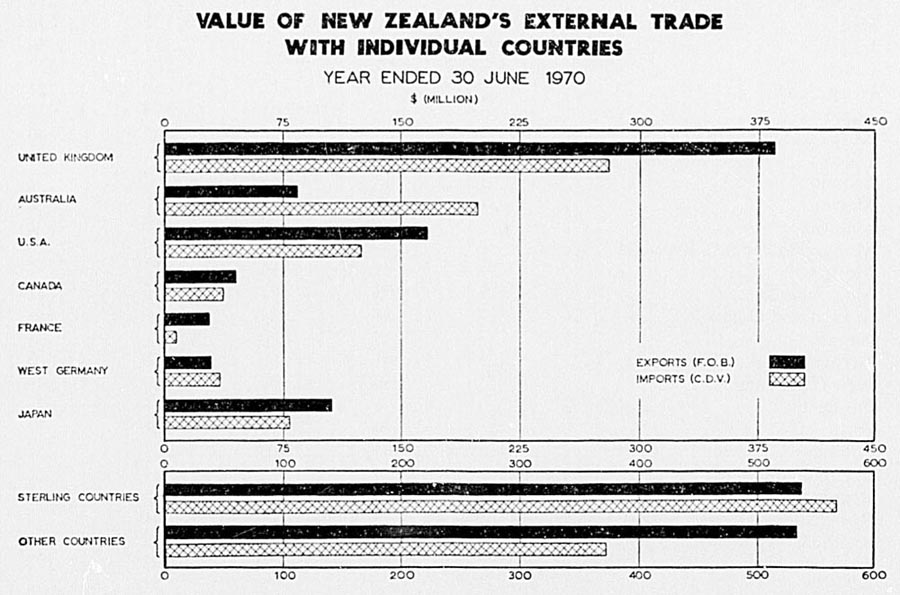
The next table shows the values of New Zealand's trade with several groupings of countries since 1960.
| Year | Exports (including Re-exports) f.o.b. (Excluding Ships' Stores) | Imports c.d.v. | Exports (including Re-exports) f.o.b. (Excluding Ships' Stores) | Imports c.d.v. | ||
|---|---|---|---|---|---|---|
| According to Country of Origin | According to Country of Purchase | According to Country of Origin | According to Country of Purchase | |||
*Provisional. † Belgium, Luxembourg, France, West Germany, Italy, and Netherlands. ‡ Austria, Denmark, Norway, Portugal, Sweden, and Switzerland. | ||||||
| $(million) | ||||||
| Sterling Area | Dollar Area | |||||
| 1,960 | 367.2 | 353.4 | 359.5 | 90.4 | 72.9 | 71.6 |
| 1,961 | 329.7 | 395.4 | 400.7 | 95.2 | 81.8 | 80.4 |
| Jan - June 1962 | 184.9 | 169.9 | 172.9 | 53.9 | 30.4 | 29.9 |
| June Year— 1963 | 349.9 | 360.7 | 371.0 | 120.7 | 70.8 | 68.8 |
| 1,964 | 408.4 | 432.5 | 442.5 | 123.9 | 88.9 | 85.9 |
| 1,965 | 444.8 | 430.9 | 443.8 | 110.2 | 104.7 | 106.6 |
| 1,966 | 418.3 | 478.8 | 495.5 | 124.0 | 115.7 | 104.9 |
| 1,967 | 390.0 | 482.3 | 495.0 | 133.0 | 130.2 | 132.8 |
| 1,968 | 454.2 | 385.9 | 399.8 | 158.9 | 100.9 | 106.3 |
| 1969x | 511.1 | 486.6 | 507.7 | 199.3 | 131.4 | 132.6 |
| 1970* | 539.5 | 569.6 | 227.1 | 166.1 | ||
| EEC Countries† | EFTA Countries‡ | |||||
| 1,960 | 100.7 | 35.2 | 34.1 | 4.0 | 12.0 | 11.5 |
| 1,961 | 88.8 | 46.3 | 44.8 | 4.3 | 14.2 | 13.6 |
| Jan - June 1962 | 68.3 | 16.8 | 16.0 | 3.4 | 4.8 | 4.6 |
| June Year— 1963 | 109.8 | 34.6 | 32.8 | 4.4 | 12.3 | 11.9 |
| 1,964 | 136.5 | 41.8 | 40.0 | 8.2 | 22.5 | 21.9 |
| 1,965 | 119.4 | 42.3 | 39.7 | 8.6 | 20.8 | 19.9 |
| 1,966 | 119.8 | 48.2 | 45.4 | 8.1 | 18.3 | 16.1 |
| 1,967 | 83.9 | 55.6 | 52.6 | 7.5 | 19.3 | 17.7 |
| 1,968 | 85.6 | 44.1 | 41.6 | 7.4 | 18.6 | 16.1 |
| 1969x | 120.0 | 64.2 | 61.2 | 8.4 | 23.6 | 20.6 |
| 1970* | 119.5 | 70.4 | 11.0 | 22.6 | ||
INDEX NUMBERS OF VOLUME OF EXTERNAL TRADE—The series for exports of New Zealand produce are linked chain-series. The exports of each year are revalued at the unit values of the immediately preceding year and the aggregate so obtained is compared with the recorded value in that (preceding) year to give a Laspeyre type index on base previous year. Aggregates are also calculated for immediately preceding years at the unit values of the latest year, which, compared with the recorded value in the latest year, gives a Paasche type index. The final index for the year is then obtained as the geometric mean of these two—i.e., a Fisher “Ideal” index—and in the table the successive annual movements are linked.
The series for total exports includes an allowance for re-exports of imported goods. Since these are normally approximately 1 percent of total exports the approximate volume movements are obtained by “deflating” the recorded values by the import price index as the best indicator available of price movements for these commodities. The two indices, exports of New Zealand produce and re-exports, are then combined by weighting by their relative values in 1960, which is the base period for the current series.
For the import volume index, from 1950 on, a Fisher “Ideal” index has been obtained as the geometric mean of both anterior year and current year weighted indices. Currently, the items for which quantities are recorded (and consequently unit values obtained) represent approximately two-thirds of the total value of imports. Price movements are imputed to the remaining third on the basis of the price movements of items in the same statistical groupings.
The total exports and imports series are combined into the total trade series by weighting by their relative values in 1960, being the base period for the current combined series. Index numbers of volume of external trade for the latest 11 years are given below on the base: calendar year 1960 (= 1000). The Monthly Abstracts of Statistics and the annual Analysis of External Trade Statistics give series for calendar and March years as well as quarterly figures.
| VOLUME INDEX NUMBERS OF EXTERNAL TRADE | |||||||
|---|---|---|---|---|---|---|---|
| Base: calendar year 1960 (= 1000) | |||||||
| June Year | Exports | Imports | Total Trade | ||||
| New Zealand Produce | Total Exports | ||||||
| Dairy Produce | Meat | Wool | Total | ||||
| *Provisional. | |||||||
| 1,959 | 1,057 | 917 | 985 | 976 | 975 | 874 | 926 |
| 1,960 | 1,124 | 957 | 1,009 | 1,019 | 1,019 | 914 | 967 |
| 1,961 | 975 | 1,017 | 984 | 988 | 988 | 1,151 | 1,066 |
| 1,962 | 1,122 | 1,004 | 1,110 | 1,072 | 1,076 | 1,008 | 1,043 |
| 1,963 | 1,070 | 1,130 | 1,107 | 1,111 | 1,114 | 1,053 | 1,084 |
| 1,964 | 1,161 | 1,136 | 1,087 | 1,149 | 1,153 | 1,250 | 1,200 |
| 1,965 | 1,241 | 1,104 | 1,021 | 1,143 | 1,147 | 1,299 | 1,220 |
| 1,966 | 1,262 | 1,042 | 1,179 | 1,186 | 1,193 | 1,413 | 1,299 |
| 1,967 | 1,364 | 1,092 | 975 | 1,179 | 1,184 | 1,448 | 1,312 |
| 1,968 | 1346x | 1,255 | 1,152 | 1,341 | 1,353 | 1,088 | 1,225 |
| 1969x | 1,334 | 1,354 | 1,333 | 1,475 | 1,489 | 1,236 | 1,367 |
| 1970* | 1,402 | 1,456 | 1,321 | 1,562 | 1,577 | 1,418 | 1,500 |
IMPORT AND EXPORT CONTROL AND EXCHANGE ALLOCATION—To ensure that overseas debt services would be met and sufficient funds be available for essential imports, there have been import control and export licences regulations since December 1938.
The Import Control Regulations 1938 prohibited the import of goods except under a licence or an exemption. The Export Licences Regulations 1938 provided (with minor exceptions) that an export licence must be obtained before goods could be exported. In addition, the requirement of an export permit was introduced by the Export Prohibition Emergency Regulations 1939, which have since been replaced by the Export Prohibition Regulations 1953. The Import Licensing Control Regulations 1964 require that, except for exempted goods (which comprise over two-thirds of imports), a written licence, or a written permit granted by the Minister of Customs is necessary for all imports.
Export Control—Three classes of export licences are provided for, viz, particular, general, and purchaser's. The particular licence applies to an occasional shipment, the general licence is issued to exporters who make regular or frequent shipments, while the purchaser's licence applies to those cases where goods have been purchased in New Zealand for export and credits have been established from overseas funds (e.g., wool purchases). A condition of the issue of any export licence is that the overseas exchange earned must be sold to a New Zealand bank for New Zealand currency.
Whereas the purpose of the Export Licences Regulations is to ensure that all foreign exchange earned is sold to the New Zealand banking system, the Export Prohibition Regulations 1953 control the export of essential goods in short supply, of goods on which subsidies have been granted, and of goods shipped to strategic destinations.
Import Selection—-The Import Control Regulations are administered through Import Licensing Schedules. The first four Schedules were for six-monthly periods and the first three were confidential to Government Departments. From 1941 to 1961 the Schedules were issued for calendar years, with occasional extensions into the following year. From 1 July 1962 the Schedules have been for years ending 30 June. Summaries of changes in the schedules up to 1962-63 have been given in the 1970 and earlier issues of the Yearbook.
Import licences are issued by the Customs Department which is advised by the Department of Industries and Commerce on the import of materials and machinery for existing or planned New Zealand manufacturing industries and on the import of goods of a kind made in New Zealand.
Innovations of major importance introduced in 1962 were the Free Funds and the Export Incentive schemes.
The Free Funds Scheme extended the no-remittance policy to commercial imports. It permitted the use of privately held funds of the following kinds: (a) Legitimately acquired overseas earnings held by the applicant on or before 28 February 1962. These funds comprised mainly royalties and commissions; (b) Sterling area currencies or securities, including shares, purchased legitimately from other New Zealand residents on or before 31 December 1958.
To offset inequities between those importers who had repatriated or never held “approved” funds and those who had retained such funds it was decided that for every $10 of approved funds $2 must be repatriated to New Zealand through normal banking channels, only the balance of $8 being available for imports. Where goods were purchased for resale, licences would be granted only to those with a history of importing goods of a similar class.
The Export Incentive Scheme was made available to all manufacturers who manufacture for export or who undertake to do so, whether or not they have an entitlement to import licences for raw materials or components. Licences issued under the scheme are either replacement, assistance, or bonus licences. A manufacturer already holding a licence or entitlement to a licence for raw materials or components may obtain a replacement licence to the value of the imported content of the goods exported, produced for export, or in the course of manufacture against confirmed overseas orders. Assistance licences will be granted either in the case of confirmed overseas orders where production has not been commenced, or when a manufacturer not holding overseas orders makes a declaration of intention to export and shows that active steps to open up an export market have been taken. Bonus licences are available to manufacturers who have actually exported; they may obtain licences for raw materials or components either of the same kind and value as those used in the manufacture of the exported goods, or of a different kind provided that the latter have a basic allocation and that the grant is not likely to affect adversely the efficient operation of an existing New Zealand industry. Bonus licences are in addition to licences issued as replacement or assistance licences. Once a bonus licence has been granted the materials or components may be used to manufacture goods for sale either overseas or in New Zealand as the manufacturer decides.
Two general schemes were introduced for the 1963-64 year to assist manufacturers holding licences for raw materials for use in their own plant: (a) General “A” licences—Manufacturers entitled to “A” licences in more than one item were permitted to amalgamate these into one general licence which might be used at the licence holder's discretion to import goods up to the full monetary limit of the combined licences. This gave greater freedom of choice and enabled changes in demand to be met more readily; (b) General entitlement licences—A similar arrangement was introduced to provide for amalgamation of licences covering over 100 items relating to raw materials or components for use in manufacture.
A major innovation in 1964-65 was the introduction of a new procedure under which importers were relieved of the need to make application for basic licences under a wide range of items. For the great bulk of basic items, licences were issued automatically with considerable saving in time and paper work.
In the 1965-66 Import Licensing Schedule 90 items representing imports then valued at $90 million were exempted from licensing as from 1 July 1965. With this increase, about $200 million, or 33 1/3 percent, of New Zealand's import trade was free of licensing. The items exempted were: (a) raw materials—coffee beans, cocoa beans, unground spices, sausage casings, artificial and jute fibres, asbestos, shellac, kapoc, certain base metals, and a wide range of textile piece goods; (b) consumer goods—iodised salt, certain drugs, razor blades, keys and key blanks, x-ray film, pipe cleaners, and sewing threads; (c) various agricultural equipment, e.g. tractors, combine harvesters, corn pickers, pick-up hay balers, cream separators, and parts for the repair of many classes of agricultural equipment; (d) heavy-duty trucks.
The principle of licence aggregation was extended in 1965-66. Importers automatically received in aggregate form basic licences for which they qualified under certain item codes and industry groups. In addition, consideration was given on application to aggregation of or transfers from licences held under other item codes.
The 1965-66 Schedule also continued arrangements for industry and interchangeability groups, token licences, the export incentive scheme, and the automatic issue of basic licence against the bulk of the basic items appearing in the Schedule.
The 1966-67 Import Licensing Schedule reflected the need for some restraint on the level of importing in view of the balance of payments position. It provided for general reductions in the allocations for licensed imports including a reduction of 15 percent of the value of 1965-66 licences for most raw materials and components used for manufacturing. Other reductions were for consumer goods, a reduction of 20 percent for motor vehicles, a more restricted level of imports of industrial plant and machinery, and an initial allocation of 66 2/3 percent of the value of 1965-66 licences for woollen piece goods. As a result of a public inquiry into woollen and synthetic fibres, yarns and fabrics by the Tariff and Development Board, lightweight woollen piece goods were removed from import licensing for the 1966-67 licensing period and the import allocation for heavier weight woollen piece goods weighing more than 5 1/2 ounces was increased to 90 percent of imports of the same goods under 1965-66 licences.
Under the New Zealand - Australia Free Trade Agreement (NAFTA) some goods of Australian origin were exempted from import licensing. Classes of goods covered under the agreement include strawberries; peas; beans; lentils; dried, dehydrated, or evaporated vegetables; dressed and undressed timber; veneer plywood; and flooring of laminated wood.
On 10 February 1967 the Government announced its intention to phase out the no-remittance import licensing schemes. At that date, a repatriation requirement of 15 percent of licence value was introduced as a condition of no-remittance imports by private individuals, to be effective also throughout the following licensing period.
The provisions of the Export Incentive Scheme were extended as from 1 July 1967 to allow manufacturers who supply components to another manufacturer for incorporation in goods for export to qualify for Assistance and Replacement licences, and to allow Bonus licences to be used for the importation of approved plant and machinery.
The Government continued firm in its intention of gradually freeing goods from import licensing as conditions permit. Measures taken to restrain internal demand and the decision to devalue the New Zealand dollar in November 1967 enabled further goods to be exempted from import licensing as from December 1967. The items exempted covered a variety of goods including raw materials for industry, chemicals, and foodstuffs. Care was taken to select goods which were not expected to show a marked increase in import spending.
The 1968-69 Schedule extended the relaxation from import control to the extent that just on half of private imports were freed; for most of the items still under licensing provision was made for a value of 115 percent of the 1967-68 level (this contained a factor in compensation for the devaluation of the currency in November 1967).
In the context of its policy progressively to release items from import control, and to enable industry to have access to the necessary plant and machinery for it to maintain maximum efficiency with a view to competing with imported products and in export markets, the Government in August 1968 exempted a list of plant and machinery from import licensing and announced the adoption of a more liberal attitude in dealing with applications for licences where plant and machinery remained subject to licensing.
The 1969-70 Import Licensing Schedule provided for an increase of 5 percent in the value of licences for nearly all commodities.
In continuation of Government policy gradually to move away from import control, the 1969-70 Import Licensing Schedule gave notice of a proposal to exempt a further range of goods valued at more than $10 million in terms of past annual imports. Any New Zealand manufacturers of similar goods who considered that they might be affected by the exemptions were given three months in which to make submissions for reference to the Emergency Protection Authority. Included in the list of goods in respect of which no objections were received were raw materials and components for industry, foodstuffs, chemicals, consumer goods, articles and materials designed for religious purposes, certain types of commercial transport vehicles, and various parts of motor vehicles. These goods became exempt on 1 July 1969. Where objections were received they were referred to the Emergency Protection Authority for recommendation. Import licensing was retained on the goods affected until Government considered the Authority's recommendation and made its decision as to their exemption.
The 1970-71 Import Licensing Schedule provided in general for an increase of 5 percent in the value of licences. Objectives of Government policy were to take advantage of the improved balance of payments position to promote a rate of growth consistent with the targets set by the National Development Conference. In view of the need for greater productivity, manufacturers were being encouraged to modernise plant and to procure more efficient and labour-saving equipment.
A new importers policy was introduced. Limited funds were provided to assist manufacturers and other intending importers actively engaged in the handling, selling and distribution of goods who would normally be interested in importing in their own name. Applicants also had to show that they have a direct interest in the goods concerned either because they have purchased them from existing licence holders or because they made imports in related lines.
Substantial increases were also provided in the level of licences for vehicles in an endeavour to more closely equate supply with demand.
The token licence scheme was continued, and licences issued on a value basis were increased by 25 percent.
The Export Incentive Scheme has been continued. In the 1969-70 licensing period the scheme provided, among other things, that no deductions would be made from entitlements or from licences already issued for materials which may subsequently have become exempt from licensing, provided exports incorporating these materials were made prior to the date of exemption.
The 1971-72 Import Licensing Schedule in general provides for an increase of 7 1/2 percent in licence values. Licences under the token licence scheme were increased to 175 percent of the 1970 level for those on a value basis and to 125 percent for those on a quantity basis. Limited provision was also made for new importers to obtain licences in certain existing token licence item codes. From 1 July 1971 additional items to a value in excess of $20 million in terms of past annual imports have been exempted.
Over two-thirds by value of goods imported into New Zealand are exempted from import licensing.
From the commencement of the 1968-69 licensing period the repatriation requirement for private and commercial no-remittance imports was increased to 30 percent. This amount was increased to 50 percent then 60 percent from 1 July 1969 and 1 July 1970 respectively. The repatriation requirement of 60 percent was waived on 26 February 1970 for one year in respect of built-up vehicles in line with other steps taken by Government to meet the shortage of new cars. This waiver, for built-up vehicles only, was subsequently extended up to and including 25 February 1972. For other private and commercial no-remittance imports this repatriation requirement was increased from 26 February 1971 to 100 percent.
TARIFF AND DEVELOPMENT BOARD—The Tariff and Development Board was established under the Tariff and Development Board Act 1961. The Board was constituted on 1 June 1962 and since then has comprised between four and seven members. The Board has the functions, when so requested by the Minister of Customs or the Minister of Industries and Commerce or the Minister of Overseas Trade, to inquire into and report on any of the following matters, with such recommendations as it thinks fit:
The desirability of new, increased, or reduced Customs duties, or of exemption from such duties;
The general effect of the operation of the Tariff on the trade and commerce, and the farming, manufacturing, and distributing industries of New Zealand and also on the interests of consumers;
The desirability of providing or continuing to provide assistance, whether by means of subsidies, grants, bounties, Tariff concessions or preferences, or otherwise, for the protection and encouragement of any New Zealand industry or for the development of New Zealand's overseas trade;
The relationship between the rates of Customs duties on raw materials and those on finished or partly finished products;
Any matter relating to the licensing of imports, including any appeal against a decision to decline, in whole or in part, any application for an import licence;
Any matter relating to the application of Customs duty under any item of the Tariff, or to the granting of concessions as provided for in the Tariff or in the Customs Acts;
Any other matter affecting the protection or development of industry or the development of overseas trade, whether by means of the Tariff or otherwise.
The Board may also from time to time, of its own motion, inquire into and make recommendations to any of the said Ministers on any matter of policy.
Two of the first questions which the Board had referred to it for inquiry and report were “the need for criteria in the light of which industrial growth and development should proceed” and “the need for additional medium and long-term establishment and developmental finance”. Reports have been furnished on these subjects, and published as parliamentary papers, H. 48 and H. 49, 1963. The Board has held a number of public inquiries into other subjects, including the commercial, economic, and social implications of hire purchase and credit transactions and practices in New Zealand. It has also inquired into the rates of import duty which should be imposed on various classes of goods.
In 1970 the Board conducted inquiries to consider the rates of duty and import licensing provisions which should apply to imports of the following goods: floor coverings; photocopying apparatus; woven textile fabrics; insulated wire and cable; salt packed for retail sale; bonded fibre fabrics; prepared culture media; measuring and recording instruments; cutlery; modellers' enamels; excavators; moulds, dies, and cutting tools.
At the request of the Minister of Overseas Trade, the Board in 1970 inquired into and reported on the question of whether certain goods should be added to Schedule A of the New Zealand-Australia Free Trade Agreement. The goods on which public inquiries were held were: casein discs or shapes for button manufacture, spectacles, ground ginger and high carbon steel wires. The Board also considered the question of eliminating the margins between the British preferential duty rates and Australian agreement rates for a number of items; this involved public inquiries on wooden clothes pegs, air-conditioning machines and wines and certain spirits.
Emergency Protection Authorities—The Tariff and Development Amendment Act 1967 made provision for the appointment of Emergency Protection Authorities. The Minister of Customs or the Minister of Industries and Commerce or the Minister of Overseas Trade may, where it appears to the Minister that urgent action may be necessary to protect a New Zealand industry in relation to imports of goods, request an Authority to undertake an inquiry in relation to the importation of such goods and to report to the Minister on the following matters:
Whether urgent action is necessary to protect that industry in relation to the importation of such goods; and
If such action is considered necessary, the nature of the protection that is considered by the Authority to be appropriate in all circumstances, and the extent and duration of such protection.
An Authority which undertakes an inquiry is required to report back to the appropriate Minister not later than 30 days after the date on which he received the request for the inquiry. If the Authority considers that urgent action should be taken to protect the industry, it may recommend to the Minister that protection be effected by either or both of the following measures:
The imposition of a temporary Customs duty.
The temporary restriction of the importation of such goods.
When the Authority so recommends, action may be taken within the terms of the Customs Act 1966, to impose a temporary protective Customs duty or restriction on importation. However the matter must have first been referred to the Tariff and Development Board for its consideration before any temporary protection is imposed. There are limits placed on the duration of temporary protection which is regarded as “holding action” pending the completion of the Tariff and Development Board's inquiries.
The Emergency Protection Authority was established in 1968 and by 30 September 1970 had undertaken 110 inquiries. Most of these inquiries arose following the receipt of objections to proposals to exempt goods from import licensing. After considering the Authority's reports the Government imposed temporary duties in 18 cases, and retained import licensing in a further 21 cases. In nine other cases temporary protection was reimposed and six cases were awaiting decision. Temporary protection was not granted in the 56 remaining instances.
TRADE COMMISSIONER SERVICE—Facilities for the promotion of overseas trade are provided by the Department of Industries and Commerce through the service of 25 Trade Commissioner posts—Athens, Bangkok, Bonn, Brisbane, Brussels, Canberra, Fiji (for Pacific), Hong Kong, Kuala Lumpur, London, Los Angeles, Melbourne, Montreal, New Delhi, New York, Paris, Perth, Rome, San Francisco, Singapore, Suva, Sydney, Tokyo, Trinidad, Vancouver, and Washington. While this representation is modest in comparison with other countries, it reflects the country's growing interest in the desirability of diversifying export markets. In addition, agreement was reached with Air New Zealand in 1961 that some of its overseas managers should act as trade correspondents of the Department of Industries and Commerce. At present there are Air New Zealand correspondents in New Caledonia, Tahiti, American Samoa, and Honolulu. Most Trade Commissioners have appropriate diplomatic or consular status in the countries to which they are accredited.
While the selling of goods in overseas markets is basically the responsibility of New Zealand exporters, the Trade Commissioner can be of considerable help in conducting market surveys and supplying information on import and exchange restrictions, Customs duty, sales tax, normal sources of supply (local production and imported), marketing methods, freight rates, statutory or customary requirements for packing, labelling, etc., and reliable importers in his territory. He may also assist New Zealand importers to locate new sources of supply of essential commodities. New Zealand businessmen travelling overseas may be saved much time and trouble by enlisting the services of the Trade Commissioner, whose knowledge of local conditions and whose connections with businessmen and Government officials in his territory enable him 10 give valuable advice. His task is made easier if he is given adequate notice of the visit.
The Trade Commissioner keeps a careful watch on the pattern of New Zealand trade with his territory and reports on significant changes. Where imports from New Zealand are affected, for example, by a new interpretation of an agricultural inspection regulation, or by the imposition of import restrictions, the Trade Commissioner is often called upon to make representations at the official level.
Trade Commissioners are also engaged in numerous other activities, some of which are: representing New Zealand at international conferences, reporting on economic and industrial developments in their territories, acting on behalf of Government Departments in the procurement of stores, payment of accounts, etc., and maintaining liaison where they are stationed with business and Government circles.
Businessmen may write for information direct to the New Zealand Trade Commissioner in the country concerned but, where convenient, it is preferred that requests be made through the Department of Industries and Commerce in New Zealand, which is often able to give preliminary advice and assistance.
The addresses of overseas representatives are listed in Section 41, Official.
TRADE PROMOTION—A Trade Promotion Council was set up in March 1962 as a coordinating and advisory agency in a concerted continuous New Zealand trade drive. The Council advises in the exploration of new or potential markets including trade surveys and missions; the co-ordination of promotional schemes, trade fairs, and publicity; and the improvement of facilities, both within New Zealand and overseas, which may assist exporters. An Export Development Conference called by the Government, was held in June 1963 to examine the problems to be met in a programme of expanded exports. The need to diversify markets and products was underlined when Britain applied in 1961 to join the European Economic Community. A trade drive was recognised as essential to earn more overseas exchange to continue to improve the standard of living for a steadily increasing population and to expand economic and national development. A scheme of export aids was developed by the Government following the conference, among them an export guarantee scheme to provide guarantees to exporters against losses which might result from circumstances not insurable with commercial insurers. The National Development Conference in 1968 and 1969 studied the export capacity of production sectors and set 5-year and 10-year export targets. To promote the export of manufactured goods, exhibits have been arranged at trade fairs and trade missions conducted in selected areas overseas.
Export Seminars have been held in major cities. The first series—on Australia—was held in 1966; the second—on Asia—in 1967; the third—on techniques of exporting—in 1969, and the fourth—on export marketing—in 1970. Contacts with exporters and prospective exporters have been widened by the work of export liaison officers, who travel widely in New Zealand, explaining the facilities and taxation and import licensing incentives that are available to exporters.
GENERAL—The growth and diversification of the New Zealand economy are heavily dependent on increasing exports to pay for rising imports of goods needed by industry and a growing population, as well as to provide for large payments for “invisibles” in the form of services. Overseas trade is the lifeblood of the economy. (See Section 25e National Development Council for projections of exports to meet growth requirements). In New Zealand copies of export entries are forwarded to the Department of Statistics for processing and analysis and the regular publication of exports statistics.
Exports are valued in New Zealand currency “free on board at the port of shipment”, except re-exports ex bonded warehouse or under drawback of duty, which are recorded at the original import values. Where goods are not sold till arrival at their destination, values are assessed at current prices at time of shipment. Meat and dairy-produce exports are valued like other commodities, on the basis of overseas realisation, not on the basis of the prices payable to producers under the internal purchasing procedures.
The ultimate destination of the goods is distinguished as far as practicable, but it is impossible to discover what proportion of the exports is intended for home consumption in the country of destination. A distinction is made between exports of New Zealand produce and re-exports of imported goods.
Since 1 July 1962, the Standard International Trade Classification (Revised) has been used in classifying export trade.
CLASSIFICATION OF EXPORTS—The following table gives total exports (excluding gold and current coin) for the latest 10 years and the main commodity groups.
| Year Ended June | New Zealand Produce | ||||||
|---|---|---|---|---|---|---|---|
| Meat and Meat Preparations | Dairy Products | Fruit and Vegetables | Hides, Skins and Pelts | Wool | |||
| Butter | Cheese | Total | |||||
| f.o.b. value $(million) | |||||||
| 1,961 | 157.5 | 80.2 | 32.0 | 121.5 | 6.7 | 23.7 | 188.8 |
| 1,962 | 139.9 | 84.4 | 43.0 | 136.6 | 9.9 | 26.7 | 207.4 |
| 1,963 | 173.0 | 90.9 | 37.0 | 138.0 | 7.5 | 25.4 | 214.4 |
| 1,964 | 183.2 | 109.6 | 35.1 | 157.1 | 9.6 | 30.4 | 271.4 |
| 1,965 | 212.5 | 119.6 | 40.7 | 180.9 | 10.7 | 31.7 | 208.6 |
| 1,966 | 196.7 | 109.6 | 41.7 | 175.4 | 12.3 | 40.0 | 231.9 |
| 1,967 | 205.0 | 109.4 | 45.1 | 186.8 | 10.7 | 33.6 | 174.1 |
| 1,968 | 260.7 | 112.2 | 47.4 | 192.2 | 13.8 | 39.8 | 158.2 |
| 1969x | 309.4 | 114.8 | 42.6 | 183.0 | 16.6 | 55.4 | 212.4 |
| 1970† | 369.3 | 109.7 | 44.3 | 188.3 | 21.4 | 48.8 | 204.5 |
| Year Ended June | New Zealand Produce—continued | ||||||
|---|---|---|---|---|---|---|---|
| Sausage Casings | Tallow | Casein | Pulp, Paper, and Paper Board | Total* | Re-exports | Total Exports | |
* Including commodities not listed. † Provisional. | |||||||
| f.o.b. value $(million) | |||||||
| 1,961 | 7.3 | 6.2 | 7.5 | 11.7 | 555.9 | 5.5 | 561.4 |
| 1,962 | 8.9 | 6.3 | 9.8 | 10.9 | 575.1 | 7.8 | 582.9 |
| 1,963 | 10.5 | 4.8 | 8.4 | 13.8 | 620.0 | 7.6 | 627.5 |
| 1,964 | 12.0 | 7.1 | 11.3 | 17.3 | 728.4 | 8.8 | 737.3 |
| 1,965 | 11.1 | 7.0 | 16.8 | 17.0 | 733.7 | 8.5 | 742.2 |
| 1,966 | 10.9 | 6.5 | 20.0 | 18.3 | 756.8 | 10.5 | 767.3 |
| 1,967 | 12.0 | 6.8 | 18.6 | 16.6 | 717.6 | 9.6 | 727.2 |
| 1,968 | 9.9 | 6.9 | 18.1 | 23.9 | 804.6 | 15.8 | 820.5 |
| 1969x | 10.9 | 6.5 | 217 | 27.0 | 968.9 | 20.2 | 989.1 |
| 1970† | 13.5 | 9.0 | 25.8 | 28.3 | 1,064.8 | 22.3 | 1,087.0 |
The commodity groups shown above normally account for more than 90 percent of the total value of merchandise exports.
The relative importance of dairy produce, meat, and wool as the main individual constituents of New Zealand's export trade has varied considerably, as is seen from the figures in the preceding table. In the preceding subsection is set out a table of volume index numbers for these commodities. A table showing the export price index numbers and terms of trade is given in Section 23, Prices.
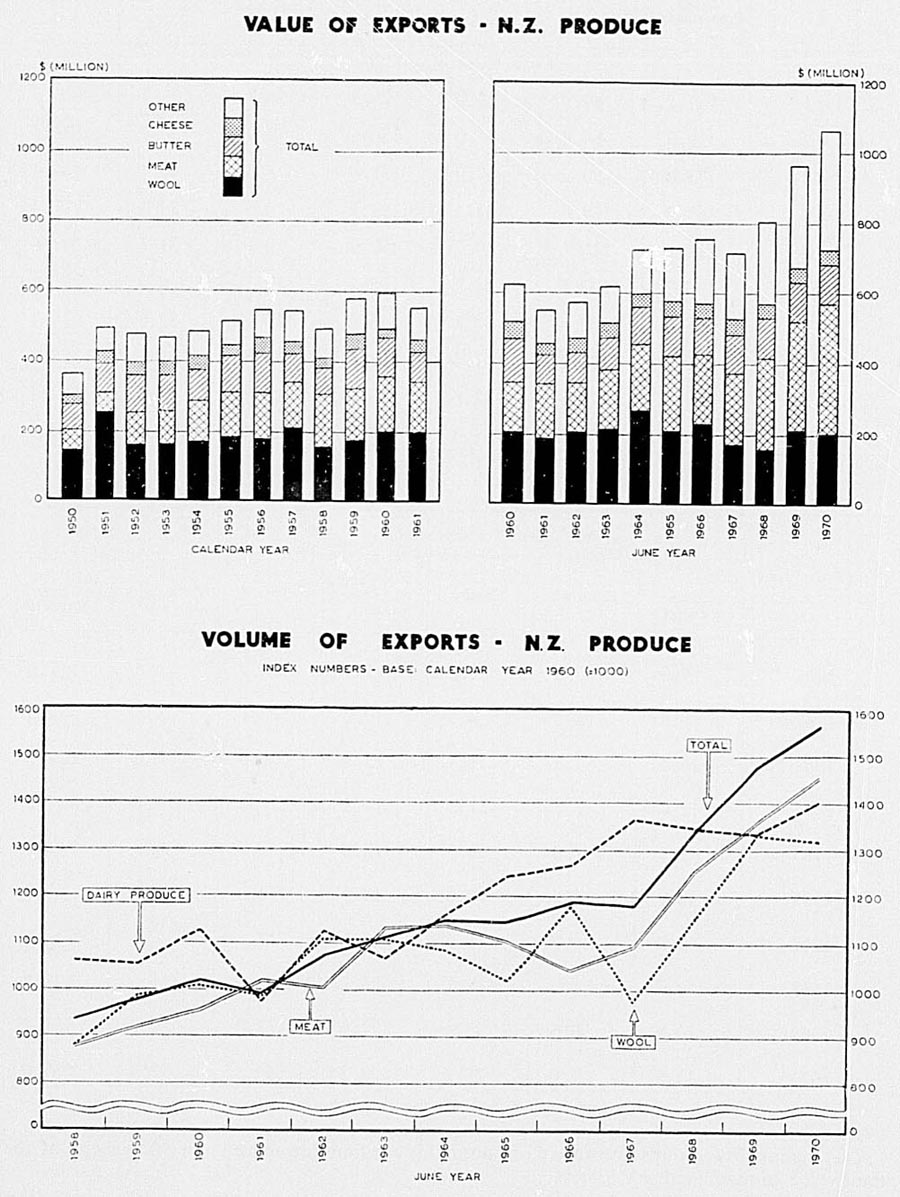
New Zealand's reliance upon grassland farming for her exports is illustrated by the figures in the next table showing total exports of pastoral products and the percentage which they represent of the total exports of New Zealand produce.
| EXPORTS OF PASTORAL PRODUCTS | ||
|---|---|---|
| Year | Value | Percentage of Total Exports of N.Z. Produce |
| * Provisional. | ||
| S(000) | ||
| 1,941 | 124,475 | 95.6 |
| 1,946 | 179,164 | 90.4 |
| 1,951 | 478,273 | 97.4 |
| 1,956 | 519,334 | 94.5 |
| 1,961 | 526,665 | 94.0 |
| June year | ||
| 1,966 | 688,504 | 91.0 |
| 1,967 | 645,581 | 90.0 |
| 1,968 | 698,268 | 86.8 |
| 1969x | 814,172 | 84.0 |
| 1970* | 873,717 | 82.1 |
Of exports other than pastoral the principal ones of economic significance in the June year 1970 were: logs of radiata pine ($23.5 m.), fish and fish products ($15.1 m.), newsprint ($15.8 m.), sawn timber ($9.7 m.), wood pulp ($7.2 m.), apples ($8.7 m.), grass and clover seeds ($3.6 m.).
Quantity figures of exports of the principal items of New Zealand produce of primary source are next given for the three latest years, while the Statistical Summary, towards the end of the book, shows the figures for some of the more important commodities for the last 50 years. For some purposes, especially for comparisons between recent and more remote years, quantities are preferable to values, since the latter are affected by price variations.
| Commodity (New Zealand Produce) | June Year 1968 | June Year 1969x | June Year 1970* |
|---|---|---|---|
| * Provisional. | |||
| Mining products— | |||
| Pumice (cwt) | 12,768 | 12,028 | 16,817 |
| Cement (cwt) | 18,711 | 31,608 | 16,201 |
| Fishery products— | |||
| Fish, fresh and frozen (cwt) | 71,218 | 78,536 | 99,731 |
| Crayfish (cwt) | 55,514 | 64,880 | 49,406 |
| Fish oils and fish-liver oils (gal) | 3,124 | 3,518 | 6,394 |
| Forest products— | |||
| Kauri gum (ton) | 22 | 29 | 21 |
| Timber— | |||
| Logs, radiata pine (cu. ft.) | 42,510,836 | 52,786,240 | 62,084,849 |
| Sawn (sup. ft.) | 62,300,481 | 99,801,917 | 109,514,004 |
| For cases in shooks (sup. ft.) | 2,726,851 | 3,224,829 | 2,312,353 |
| Wood pulp (ton) | 74,342 | 87,741 | 80,821 |
| Newsprint (cwt) | 2,503,794 | 2,426,971 | 2,392,111 |
| Building board (sq. ft.) | 6,533,099 | 21,085,304 | 15,323,619 |
| Plywood (sq. ft.) | 365,064 | 1,677,547 | 4,933,804 |
| Pastoral products— | |||
| Butter (cwt) | 4,024,734 | 4,062,362 | 3,895,725 |
| Casein (cwt) | 805,537 | 984,716 | 1,220,207 |
| Cheese (cwt) | 1,973,941 | 1,725,521 | 1,783,117 |
| Milk, dried and condensed (cwt) | 2,764,622 | 2,652,100 | 3,628,393 |
| Sugar of milk (cwt) | 128,860 | 135,497 | 157,134 |
| Eggs— | |||
| In shell (doz) | 25,901 | 38,935 | 69,613 |
| Not in shell (lb) | 1,814,123 | 709,411 | 931,079 |
| Honey (lb) | 530,584 | 656,379 | 1,460,228 |
| Meat, frozen and chilled (cwt) | 11,445,948 | 12,709,687 | 12,976,948 |
| Meat, canned (cwt) | 80,348 | 73,745 | 67,748 |
| Meat extract (lb) | 425,950 | 415,228 | 209,396 |
| Other preserved meat (cwt) | 37,030 | 29,140 | 36,780 |
| Sausage casings (hanks) | 7,172,715 | 7,472,031 | 7,648,742 |
| Liver meal (cwt) | 18,129 | 11,678 | 11,078 |
| Cattle hides (number) | 1,202,743 | 1,386,889 | 1,479,349 |
| Horse hides (number) | 2,738 | 1,971 | 3,036 |
| Calf skins (number) | 1,178,248 | 1,045,320 | 1,169,061 |
| Deer skins (number) | 102,723 | 57,543 | 81,540 |
| Opossum skins (number) | 757,872 | 1,292,475 | 1,604,896 |
| Sheep skins and pelts (number) | 37,289,943 | 37,222,349 | 34,395,230 |
| Horse hair and other coarse animal hair (lb) | 35,228 | 60,243 | 60,453 |
| Wool (lb) | 591,774,747 | 678,828,937 | 668,730,884 |
| Lard (cwt) | 161 | 119 | 114 |
| Edible tallow (ton) | 6,037 | 5,446 | 4,059 |
| Edible stearine (ton) | 772 | 706 | 615 |
| Inedible tallow (ton) | 66,381 | 64,241 | 67,243 |
| Neatsfoot oil (ton) | 422 | 715 | 671 |
| Live cattle (number) | 3,892 | 2,263 | 1,842 |
| Live sheep (number) | 15,299 | 4,292 | 111 |
| Live horses (number) | 885 | 1,093 | 1,139 |
| Agricultural products— | |||
| Barley (cental) | 66,594 | 37,061 | 6 |
| Apples (lb) | 91,301,043 | 92,465,683 | 118,176,507 |
| Pears (lb) | 6,900,285 | 5,383,905 | 6,931,718 |
| Hops (lb) | 408,449 | 221,408 | 60,989 |
| Potatoes (ton) | 5,079 | 6,568 | 9,794 |
| Onions (ton) | 9,848 | 4,230 | 9,615 |
| Canned vegetables (lb) | 3,485,757 | 4,549,016 | 7,773,172 |
| Frozen vegetables (cwt) | 106,362 | 151,996 | 215,656 |
| Peas, food (cental) | 267,171 | 370,101 | 360,195 |
| Peas, seed (cental) | 206,098 | 269,893 | 257,913 |
| Seeds, grass and clover (cwt) | 234,607 | 180,317 | 175,031 |
| Seeds, other (cwt) | 20,045 | 11,762 | 10,801 |
| Miscellaneous— | |||
| Biscuits (cwt) | 21,796 | 41,852 | 46,716 |
| Ale, beer stout (gal) | 376,801 | 560,809 | 550,608 |
| Sugar (cwt) | 7,095 | 6,282 | 3,960 |
| Drinking chocolate Ob) | 9,877 | 311,165 | 13,305,542 |
| Cigarettes (lb) | 81,295 | 121,429 | 143,705 |
| Cut tobacco (lb) | 145,700 | 141,698 | 124,584 |
| Textile waste (lb) | 1,972,057 | 2,088,552 | 2,318,921 |
| Soaps (lb) | 1,889,801 | 4,383,780 | 2,649,126 |
| Chamois leather (sq. ft.) | 445,336 | 698,015 | 470,609 |
The values of the principal exports are given in the following table.
| Commodity (New Zealand Produce) | June Year 1968 | June Year 1969x | June Year 1970* |
|---|---|---|---|
| * Provisional. | |||
| $(000) | $(000) | $(000) | |
| Mining products— | |||
| Pumice | 17 | 17 | 34 |
| Cement | 19 | 40 | 21 |
| Other | 66 | 154 | 104 |
| Totals | 103 | 211 | 159 |
| Fishery products— | |||
| Fish, fresh and frozen | 1,471 | 1,832 | 2,856 |
| Fish, other | 265 | 463 | 917 |
| Crayfish | 9,307 | 15,370 | 11,336 |
| Fish oils and fish-liver oils | 33 | 34 | 34 |
| Totals | 11,077 | 17,700 | 15,143 |
| Forest products— | |||
| Kauri gum | 11 | 18 | 15 |
| Timber— | |||
| Logs, radiata pine | 11,467 | 19,787 | 23,459 |
| Sawn | 4,474 | 8,023 | 9,714 |
| For cases in shooks | 288 | 377 | 280 |
| Wood pulp | 6,151 | 7,448 | 7,229 |
| Newsprint | 15,784 | 16,149 | 15,846 |
| Other paper and paper board | 1,625 | 2,593 | 4,535 |
| Building board | 250 | 727 | 587 |
| Plywood | 40 | 139 | 416 |
| Other | - | 298 | 615 |
| Totals | 40,089 | 55,559 | 62,696 |
| (Pastoral products— | |||
| Butter | 112,169 | 114,760 | 109,695 |
| Casein | 18,149 | 21,708 | 25,753 |
| Cheese | 47,362 | 42,603 | 44,343 |
| Milk, dried and condensed | 30,255 | 23,129 | 31,357 |
| Sugar of milk | 1,548 | 1,844 | 2,144 |
| Other dairy produce | 2,450 | 2,488 | 832 |
| Eggs— | |||
| In shell | 10 | 16 | 30 |
| Not in shell | 227 | 90 | 140 |
| Honey | 114 | 148 | 262 |
| Meat, frozen and chilled | 256,272 | 304,631 | 364,774 |
| Meat, canned | 3,584 | 3,626 | 3,224 |
| Meat extract | 182 | 445 | 280 |
| Other preserved meat | 665 | 740 | 990 |
| Sausage casings | 9,862 | 10,929 | 13,495 |
| Liver meal | 112 | 80 | 102 |
| Cattle hides | 6,033 | 8,187 | 10,326 |
| Horse hides | 9 | 9 | 19 |
| Calf skins | 2,041 | 3,175 | 2,891 |
| Deer skins | 188 | 149 | 202 |
| Opossum skins | 592 | 1,863 | 2,052 |
| Sheep skins and pelts | 30,752 | 41,832 | 33,018 |
| Horse hair and other coarse animal hair | 16 | 26 | 30 |
| Wool | 158,216 | 212,381 | 204,465 |
| Inedible offals (including dried blood) | 3,882 | 4,773 | 6,665 |
| Lard | 3 | 3 | 3 |
| Edible tallow | 729 | 642 | 630 |
| Edible stearine | 84 | 76 | 82 |
| Inedible tallow | 6,133 | 5,859 | 8,382 |
| Neatsfoot oil | 82 | 214 | 133 |
| Live cattle | 484 | 401 | 752 |
| Live sheep | 408 | 167 | 30 |
| Live horses | 2,578 | 3,096 | 3,820 |
| Other | 3,077 | 4,173 | 2,796 |
| Totals | 698,268 | 814,172 | 873,717 |
| Agricultural products— | |||
| Barley | 165 | 82 | –– |
| Apples | 5,919 | 5,796 | 8,724 |
| Pears | 432 | 338 | 509 |
| Hops | 189 | 112 | 32 |
| Potatoes | 334 | 404 | 493 |
| Onions | 991 | 324 | 819 |
| Canned vegetables | 482 | 629 | 1,090 |
| Frozen vegetables | 1,339 | 2,091 | 2,895 |
| Peas, food | 1,447 | 2,035 | 1,714 |
| Peas, seed | 1,126 | 1,484 | 1,470 |
| Seeds, grass and clover | 3,683 | 3,453 | 3,576 |
| Other seeds | 343 | 298 | 474 |
| Other | 1,911 | 4,596 | 5,597 |
| Totals | 18,362 | 21,643 | 27,393 |
| Miscellaneous— | |||
| Biscuits | 666 | 1,517 | 1,627 |
| Ale, beer, stout | 304 | 476 | 449 |
| Sugar | 34 | 35 | 24 |
| Soups | 36 | 87 | 152 |
| Drinking chocolate | 10 | 34 | 2,175 |
| Infant and invalid food (cereal) | 41 | 55 | 74 |
| Cigarettes | 183 | 268 | 305 |
| Cut tobacco | 160 | 213 | 190 |
| Textile waste | 225 | 222 | 257 |
| Soaps | 139 | 366 | 312 |
| Scrap metal | 1,134 | 1,264 | 1,911 |
| Dairy machinery | 480 | 748 | 1,209 |
| Chamois leather | 141 | 206 | 175 |
| Vitamins and concentrates | 1 | 3 | 16 |
| Other | 33,181 | 54,099 | 76,792 |
| Totals | 36,738 | 59,593 | 85,667 |
| Totals, New Zealand produce (excluding gold) | 804,637 | 968,878 | 1,064,774 |
| Gold (excluded from above) | 88 | 27 | 29 |
In the following table exports (excluding re-exports) for the years ended June 1969 and 1970 are summarised according to the Sections and Divisions of the Standard International Trade Classification (Revised).
| Exports, New Zealand Produce—Section and Division | Year Ended June | |
|---|---|---|
| 1969x | 1970* | |
| * Provisional. | ||
| Section 0. Food and Live Animals | $(000) | |
| Div. 00 Live animals | 3,709 | 4,651 |
| Div. 01 Meat and meat preparations | 309,443 | 369,268 |
| Div. 02 Dairy products and eggs | 183,085 | 188,436 |
| Div. 03 Fish and fish preparations | 17,576 | 14,797 |
| Div. 04 Cereals and cereal preparations | 2,755 | 3,970 |
| Div. 05 Fruit and vegetables | 16,626 | 21,404 |
| Div. 06 Sugar and sugar preparations | 2,237 | 2,649 |
| Div. 07 Coffee, tea, cocoa, spices, and manufactures thereof | 384 | 3,282 |
| Div. 08 Feeding stuff for animals (not including unmilled cereals) | 4,276 | 4,131 |
| Div. 09 Miscellaneous food preparations | 819 | 3,098 |
| Totals, Section 0 | 540,910 | 615,687 |
| Section 1. Beverages and Tobacco | ||
| Div. 11 Beverages | 549 | 540 |
| Div. 12 Tobacco and tobacco manufactures | 495 | 537 |
| Totals, Section 1 | 1,044 | 1,077 |
| Section 2. Crude Materials, Inedible, Except Fuels | ||
| Div. 21 Hides, skins, and fur skins, undressed | 55,374 | 48,779 |
| Div. 22 Oil seeds, oil nuts, and kernels | 27 | 68 |
| Div. 23 Crude rubber, including synthetic and reclaimed | 1 | - |
| Div. 24 Wood and cork | 28,109 | 33,789 |
| Div. 25 Pulp and waste paper | 7,484 | 7,286 |
| Div. 26 Textile fibres (not manufactured into yarn, thread, or fabrics) and waste | 213,172 | 205,231 |
| Div. 27 Crude fertilisers and crude minerals, excluding coal, petroleum, and precious stones | 206 | 162 |
| Div. 28 Metalliferous ores and metal scrap | 1,713 | 2,506 |
| Div. 29 Animal and vegetable crude materials, n.e.s. | 21,023 | 25,919 |
| Totals, Section 2 | 327,109 | 323,741 |
| Section 3. Mineral Fuels, Lubricants and Related Materials | ||
| Div. 32 Coal, coke, and briquettes | 12 | 88 |
| Div. 33 Petroleum and petroleum products | 6,357 | 5,362 |
| Div. 34 Gas | 1 | 3 |
| Totals, Section 3 | 6,371 | 5,454 |
| Section 4. Animal and Vegetable Oils and Fats | ||
| Div. 41 Animal oils and fats | 6,897 | 9,600 |
| Div. 42 Vegetable oils and fats, unprocessed | 1 | 4 |
| Div. 43 Animal and vegetable oils and fats processed | 377 | 416 |
| Totals, Section 4 | 7,276 | 10,020 |
| Section 5. Chemicals | $(000) | |
| Div. 51 Chemical elements and compounds | 1,246 | 1,896 |
| Div. 52 Mineral tar and crude chemicals from coal, petroleum, and natural gas | 3 | 1 |
| Div. 53 Dyeing, tanning, and colouring materials | 181 | 276 |
| Div. 54 Medicinal and pharmaceutical products | 990 | 1,258 |
| Div. 55 Essential oils and perfume materials, toilet, polishing, and cleansing preparations | 1,008 | 987 |
| Div. 56 Fertilisers, manufactured | 26 | 147 |
| Div. 57 Explosives and pyrotechnic products | 80 | 107 |
| Div. 58 Plastic materials, regenerated cellulose, artificial resins | 294 | 488 |
| Div. 59 Miscellaneous chemical materials and products | 23,528 | 28,362 |
| Totals, Section 5 | 27,356 | 33,520 |
| Section 6. Manufactured Goods Classified Chiefly by Material | ||
| Div. 61 Leather, leather manufactures n.e.i., and dressed furs | 897 | 998 |
| Div. 62 Rubber manufactures, n.e.s. | 1,126 | 1,050 |
| Div. 63 Wood and cork manufactures (excluding furniture) | 1,187 | 3,045 |
| Div. 64 Paper, paperboard, and manufactures thereof | 20,491 | 22,214 |
| Div. 65 Textile yam, fabrics, made-up articles, and related products | 8,269 | 10,665 |
| Div. 66 Non-metallic mineral manufactures n.e.s. | 1,924 | 2,384 |
| Div. 67 Iron and steel | 451 | 1,151 |
| Div. 68 Non-ferrous metals | 3,672 | 4,308 |
| Div. 69 Manufactures of metal | 2,187 | 4,239 |
| Totals, Section 6 | 40,202 | 50,054 |
| Section 7. Machinery and Transport Equipment | ||
| Div. 71 Machinery other than electric | 4,841 | 7,063 |
| Div. 72 Electric machinery, apparatus, and appliances | 4,849 | 6,795 |
| Div. 73 Transport equipment | 1,400 | 1,884 |
| Totals, Section 7 | 11,089 | 15,741 |
| Section 8. Miscellaneous Manufactured Articles | ||
| Div. 81 Sanitary, plumbing, heating and lighting fixtures, and fittings | 293 | 472 |
| Div. 82 Furniture and fixtures | 625 | 774 |
| Div. 83 Travel goods, handbags, and similar articles | 375 | 419 |
| Div. 84 Clothing | 1,106 | 1,940 |
| Div. 85 Footwear | 252 | 253 |
| Div. 86 Professional, scientific and controlling instruments; photographic and optical goods, watches, and clocks | 322 | 677 |
| Div. 89 Miscellaneous manufactured articles n.e.s. | 4,061 | 4,602 |
| Totals, Section 8 | 7,035 | 9,138 |
| Section 9. Commodities and Transactions not Classified According to Kind | ||
| Goods under $20 in value | 39 | 38 |
| Other | 448 | 303 |
| Totals Section 9 | 487 | 341 |
| Total New Zealand produce exports | 968,878 | 1,064,774 |
| Re-exports | 20,219 | 22,251 |
| Grand total, merchandise exports | 989,097 | 1,087,026 |
| Exports of gold (excluded from above) | 27 | 29 |
DESTINATION OF NEW ZEALAND EXPORTS—The United Kingdom has been New Zealand's principal trading partner for over 100 years. The proportion of our exports (including re-exports) going to the United Kingdom market in the years prior to the Second World War was between 70 and 80 percent of the total value of all exports. With the growing diversification of our markets in recent years the proportion of New Zealand's exports going to this market has fallen and by 1970 (June year) represented only 36 percent of the total value of exports to all countries.
Trade with the Commonwealth countries has always greatly exceeded that with foreign countries. During recent years, however, there has been a decline in the proportion of the export trade going to Commonwealth countries, occasioned mainly by the export of wool to European countries and meat to the United States of America. In 1948 Commonwealth countries took 80 percent of the total exports. By 1970 (June year) this proportion had fallen to 54 percent. (These percentages exclude passengers' purchases and ships' stores.)
In recent years trade has been recorded with over 100 countries each year.
TOTAL EXPORTS TO INDIVIDUAL COUNTRIES—The following table gives exports (including re-exports but excluding gold, current coin, passengers' purchases, and ships' stores) to each country for the four latest June years.
| EXPORTS TO INDIVIDUAL COUNTRIES | ||||
|---|---|---|---|---|
| Country | June Year 1967 | June Year 1968 | June Year 1969x | June Year 1970* |
* Provisional. † Burma, included in Sterling Area up to 1967. ‡ Rhodesia included in Sterling Area in 1967 and in Other Countries from 1968 onwards. || Iceland included in EFTA from 1970. § Associated States in Eastern Caribbean, British Virgin Islands and Montserrat included in Leeward and Windward Islands until 1969. | ||||
| Sterling Area | $(000) | $(000) | $(000) | $(000) |
| Antarctic Stations (British) | - | 1 | –– | - |
| Associated States in Eastern Caribbean | § | § | 437 | 563 |
| Australia | 35,215 | 57,765 | 75,282 | 86,997 |
| Bahamas | 314 | 253 | 268 | 367 |
| Bahrein | 8 | 29 | ||
| Barbados | 1,219 | 1,300 | 1,428 | 1,750 |
| Bermuda | 1,031 | 1,271 | 884 | 1,412 |
| Botswana | - | 1 | - | |
| British Honduras | 2 | 1 | 1 | 2 |
| British Solomon Islands | 9 | 15 | 158 | 312 |
| British Virgin Islands | § | § | 3 | - |
| Brunei | –– | –– | 4 | 10 |
| Burma | 441 | † | † | † |
| Ceylon | 589 | 765 | 1,242 | 2,049 |
| Cyprus | 1,180 | 932 | 1,272 | 1,007 |
| Falkland Islands | –– | 2 | 1 | 1 |
| Fiji | 3,779 | 5,753 | 7,638 | 8,822 |
| Gambia | - | –– | 1 | 3 |
| Ghana | 135 | 125 | 118 | 140 |
| Gibraltar | - | - | 4 | –– |
| Gilbert and Ellice Islands | 228 | 219 | 197 | 243 |
| Guyana | 73 | 34 | 56 | 56 |
| Hong Kong | 2,098 | 2,557 | 3,673 | 4,581 |
| Iceland | –– | - | 1 | || |
| India | 1,332 | 1,015 | 1,962 | 1,357 |
| Ireland | 433 | 1,044 | 1,957 | 1,983 |
| Jamaica | 3,516 | 5,161 | 3,883 | 4,436 |
| Jordan | 16 | 10 | 12 | 10 |
| Kenya | 139 | 400 | 405 | 1,226 |
| Kuwait | 124 | 113 | 65 | 213 |
| Leeward and Windward Islands | 251 | 313 | § | § |
| Libya | 1 | 1 | - | 2 |
| Malawi | 28 | 46 | 40 | 63 |
| Malaysia | 5,541 | 6,763 | 6,317 | 7,264 |
| Malta | 28 | 45 | 37 | 42 |
| Mauritius and Dependencies | 90 | 185 | 332 | 549 |
| Montserrat | § | § | 23 | 30 |
| Nauru | 320 | 368 | 369 | 359 |
| New Hebrides | 128 | 85 | 226 | 475 |
| Nigeria | 168 | 117 | 54 | 39 |
| Norfolk Island | 292 | 284 | 259 | 467 |
| Pakistan | 583 | 382 | 218 | 1,830 |
| Papua, etc. | 186 | 36 | 744 | 2,792 |
| Pitcairn Island | 10 | 23 | 14 | 16 |
| Qatar and Trucial Sheikdoms | 1 | 2 | 15 | 76 |
| Rhodesia | 2 | ‡ | ‡ | ‡ |
| Seychelles | 1 | 2 | 4 | 2 |
| Sierra Leone | –– | 17 | 13 | 21 |
| Singapore | 3,951 | 5,974 | 8,424 | 8,731 |
| South Africa and S.W. Africa | 5,781 | 1,989 | 2,472 | 3,183 |
| South Yemen (Aden) | 121 | 6 | 5 | 2 |
| Swaziland | - | - | 4 | - |
| Tanzania | 88 | 95 | 212 | 487 |
| Tonga | 866 | 1,299 | 1,516 | 1,579 |
| Trinidad and Tobago | 3,150 | 3,562 | 3,859 | 4,436 |
| Uganda | 5 | 11 | 39 | 64 |
| United Kingdom | 314,754 | 352,039 | 382,749 | 385,718 |
| Western Samoa | 1,641 | 1,528 | 1,946 | 3,399 |
| Zambia | 162 | 336 | 248 | 291 |
| Totals, sterling countries | 390,025 | 454,247 | 511,099 | 539,488 |
| E.F.T.A. (Excluding U.K.) | ||||
| Austria | 39 | 38 | 179 | 779 |
| Denmark | 2,442 | 1,684 | 1,825 | 2,456 |
| Norway | 840 | 812 | 1,326 | 1,197 |
| Portugal | 1,461 | 1,898 | 1,499 | 1,804 |
| Sweden | 1,880 | 1,953 | 2,493 | 2,590 |
| Switzerland and Liechtenstein | 847 | 1,025 | 1,035 | 2,162 |
| Iceland | –– | - | --|| | - |
| Totals, E.F.T.A. countries | 7,510 | 7,410 | 8,358 | 10,987 |
| E.E.C. | ||||
| Belgium and Luxembourg | 11,636 | 11,462 | 19,304 | 21,307 |
| France and Monaco | 24,825 | 26,510 | 36,781 | 28,732 |
| Germany, Federal Republic | 20,517 | 21,033 | 28,734 | 29,564 |
| Italy and San Marino | 15,008 | 15,548 | 21,591 | 23,720 |
| Netherlands | 11,953 | 11,006 | 13,611 | 16,128 |
| Totals, E.E.C. countries | 83,940 | 85,558 | 120,021 | 119,451 |
| Dollar Area | ||||
| American Samoa | 764 | 1,317 | 1,615 | 2,326 |
| Antarctic Territories (U.S.) | - | –– | 1 | 4 |
| Bolivia | - | - | - | 3 |
| Canada | 10,609 | 10,528 | 16,383 | 45,225 |
| Colombia | 3 | 185 | 148 | 46 |
| Costa Rica | 12 | –– | 1 | 153 |
| Ecuador | 3 | - | –– | 5 |
| El Salvador | 1 | - | 1 | 299 |
| Guam | 932 | 791 | 1,090 | 1,305 |
| Guatemala | - | - | –– | 18 |
| Haiti | 24 | - | –– | - |
| Liberia | 2 | 2 | 13 | 14 |
| Mexico | 304 | 272 | 722 | 1,255 |
| Panama Canal Zone | 300 | 229 | 103 | 206 |
| Panama Republic | 325 | 523 | 694 | 720 |
| Philippines | 5,134 | 5,979 | 7,031 | 6,479 |
| Puerto Rico, etc. | 9 | 134 | 578 | 1,036 |
| Ryukyu Islands, etc. | 134 | 590 | 791 | 973 |
| U.S. Trust Territories in Pacific | 99 | 53 | 76 | 573 |
| United States | 114,223 | 138,240 | 169,802 | 166,066 |
| Venezuela | 167 | 101 | 295 | 430 |
| Totals, dollar area | 133,046 | 158,945 | 199,346 | 227,136 |
| Other Countries | ||||
| Afghanistan | - | - | 4 | 2 |
| Algeria | 5 | 2 | 2 | 1 |
| Angola | - | - | - | 3 |
| Argentina | 90 | 11 | 11 | 46 |
| Brazil | 1 | 13 | 3 | 337 |
| Bulgaria | 638 | 596 | 50 | 264 |
| Burundi | 1 | - | - | - |
| Burma | † | 461 | 415 | 49 |
| Cambodia | –– | –– | 1 | 4 |
| Cameroon | - | - | –– | 1 |
| Canary Islands | 1 | 5 | - | –– |
| Chile | 148 | 286 | 251 | 390 |
| China, Mainland | 8,217 | 5,717 | 3,683 | 4,086 |
| China, Republic of (Taiwan) | 616 | 1,061 | 2,444 | 3,069 |
| Congo (Leopoldville) | - | - | - | 2 |
| Czechoslovakia | 1,331 | 946 | 1,014 | 2,776 |
| Ethiopia and Eritrea | 9 | 3 | 2 | 11 |
| Finland | 648 | 772 | 784 | 1,010 |
| French Guiana | 80 | 85 | 85 | 105 |
| French Polynesia | 1,746 | 2,904 | 3,543 | 3,871 |
| French Somaliland | - | - | 2 | - |
| French West Indies | 190 | 160 | 72 | 109 |
| Germany, Democratic Republic | 1,632 | 1,035 | 1,093 | 670 |
| Greece | 3,268 | 3,916 | 6,191 | 8,468 |
| Hungary | 359 | 261 | 194 | 859 |
| Indonesia | 21 | 24 | 75 | 780 |
| Iran | 260 | 224 | 311 | 1,318 |
| Iraq | 35 | 1 | 9 | 29 |
| Israel | 870 | 38 | 91 | 44 |
| Ivory Coast | - | - | 1 | 1 |
| Japan | 63,772 | 68,186 | 88,001 | 106,870 |
| Korea, Republic of | 500 | 1,008 | 1,446 | 1,610 |
| Laos | –– | 21 | 71 | 74 |
| Lebanon | 20 | 65 | 49 | 189 |
| Macao | 1 | 1 | 1 | - |
| Malagasy | 1 | - | 4 | 3 |
| Mauritania | 1 | - | –– | |
| Morocco | 85 | 31 | 55 | 184 |
| Mozambique | 364 | 448 | 602 | 610 |
| Muscat and Oman | - | 1 | 14 | 34 |
| Nepal | 15 | 4 | 8 | 19 |
| Netherlands Antilles | 782 | 593 | 562 | 538 |
| New Caledonia | 390 | 777 | 1,986 | 3,170 |
| Paraguay | –– | - | 1 | - |
| Peru | 4,802 | 3,987 | 2,310 | 4,127 |
| Poland | 1,646 | 1,346 | 2,103 | 3,129 |
| Portuguese Guinea | - | - | 4 | - |
| Rhodesia, Southern | 16 | † | 16 | –– |
| Romania | –– | –– | 3 | |
| Rwanda | 1 | - | –– | |
| Saudi Arabia | 5 | 49 | 70 | 107 |
| Senegal | 1 | 3 | 1 | 1 |
| Somalia | - | 1 | 1 | 9 |
| South Vietnam | 14 | 50 | 97 | 131 |
| Spain | 1,529 | 2,543 | 4,538 | 4,466 |
| St. Pierre and Miquelon | - | - | 7 | |
| Sudan | - | 4 | 10 | 112 |
| Surinam | 6 | 1 | 3 | 6 |
| Syria | 9 | 30 | 260 | 187 |
| Thailand | 1,082 | 1,759 | 2,545 | 3,165 |
| Tunisia | 1 | - | 125 | |
| Turkey | 20 | 34 | 25 | 53 |
| United Arab Republic | 155 | 144 | 90 | 53 |
| U.S.S.R. | 9,184 | 5,839 | 11,669 | 16,934 |
| Uruguay | 39 | 110 | 44 | 9 |
| Wallis and Futuna Islands | - | - | - | 138 |
| Yemen | - | 1 | 3 | 2 |
| Yugoslavia | 1,190 | 1,047 | 1,679 | 3,724 |
| Totals, other countries | 105,778 | 106,620 | 138,600 | 178,094 |
| Totals, all countries | 720,298 | 812,780 | 977,423 | 1,075,158 |
| Ships' stores | 4,933 | 5,469 | 8,785 | 8,460 |
| Passengers | 1,993 | 2,226 | 2,888 | 2,699 |
| Destination optional | - | - | - | 709 |
| Grand totals | 727,224 | 820,475 | 989,097 | 1,087,026 |
The table which follows shows for each of the last 8 years the percentage of total exports (excluding gold, current coin, passengers' purchases, and ships' stores) taken by each of the principal countries trading with New Zealand.
| Country | June Year 1963 | June Year 1964 | June Year 1965 | June Year 1966 | June Year 1967 | June Year 1968 | June Year 1969x | June Year 1970* |
|---|---|---|---|---|---|---|---|---|
* Provisional. † Included with U.S.A. | ||||||||
| percent | ||||||||
| STERLING AREA | ||||||||
| Australia | 4.40 | 4.64 | 4.69 | 4.78 | 4.89 | 7.11 | 7.70 | 8.09 |
| Fiji | 0.34 | 0.38 | 0.49 | 0.51 | 0.52 | 0.71 | 0.78 | 0.82 |
| Hong Kong | 0.19 | 0.21 | 0.20 | 0.21 | 0.29 | 0.31 | 0.38 | 0.43 |
| Jamaica | 0.57 | 0.34 | 0.47 | 0.49 | 0.49 | 0.64 | 0.40 | 0.41 |
| Malaysia | 0.28 | 0.59 | 0.84 | 0.61 | 0.77 | 0.83 | 0.65 | 0.68 |
| Singapore | 0.26 | –– | - | 0.43 | 0.55 | 0.73 | 0.86 | 0.81 |
| Trinidad and Tobago | 0.51 | 0.34 | 0.50 | 0.48 | 0.44 | 0.44 | 0.39 | 0.41 |
| United Kingdom | 47.44 | 47.38 | 50.81 | 44.51 | 43.70 | 43.31 | 39.16 | 35.88 |
| Other | 2.00 | 1.76 | 2.30 | 2.90 | 2.50 | 1.81 | 1.97 | 2.65 |
| Totals, Sterling countries | 55.99 | 55.63 | 60.30 | 54.93 | 54.15 | 55.89 | 52.29 | 50.18 |
| E.F.T.A. (excluding U.K.) | ||||||||
| Austria | –– | –– | 0.01 | –– | 0.01 | –– | 0.02 | 0.07 |
| Denmark | 0.16 | 0.23 | 0.24 | 0.25 | 0.34 | 0.21 | 0.19 | 0.20 |
| Norway | 0.08 | 0.13 | 0.13 | 0.07 | 0.12 | 0.10 | 0.14 | 0.11 |
| Portugal | 0.19 | 0.37 | 0.35 | 0.25 | 0.20 | 0.23 | 0.15 | 0.17 |
| Sweden | 0.24 | 0.35 | 0.42 | 0.42 | 0.26 | 0.24 | 0.26 | 0.24 |
| Switzerland | 0.03 | 0.02 | 0.02 | 0.07 | 0.12 | 0.13 | 0.11 | 0.20 |
| Totals, E.F.T.A. countries | 0.70 | 1.11 | 1.17 | 10.7 | 1.04 | 0.91 | 0.86 | 1.02 |
| E.E.C. | ||||||||
| Belgium and Luxembourg | 2.68 | 3.12 | 3.27 | 2.94 | 1.62 | 1.41 | 1.97 | 1.98 |
| France | 6.57 | 6.39 | 4.60 | 5.30 | 3.45 | 3.26 | 3.76 | 2.67 |
| Germany, Federal Republic | 6.57 | 6.39 | 4.60 | 5.30 | 3.45 | 3.26 | 2.94 | 2.75 |
| Italy | 3.08 | 3.43 | 2.45 | 2.63 | 2.08 | 1.91 | 2.21 | 2.21 |
| Netherlands | 1.66 | 1.81 | 1.83 | 1.42 | 1.66 | 1.35 | 1.39 | 1.50 |
| Totals, E.E.C. countries | 17.57 | 18.60 | 16.19 | 14.74 | 11.65 | 10.53 | 12.28 | 11.11 |
| DOLLAR AREA | ||||||||
| Canada | 1.45 | 1.20 | 1.43 | 1.26 | 1.47 | 1.30 | 1.68 | 4.21 |
| Hawaii | 0.42 | 0.36 | 0.39 | † | † | † | † | † |
| Philippines | 0.21 | 0.27 | 0.50 | 0.55 | 0.71 | 0.74 | 0.72 | 0.60 |
| U.S.A. | 16.78 | 14.70 | 12.27 | 14.12 | 15.86 | 17.01 | 17.37 | 15.45 |
| Other | 0.46 | 0.35 | 0.35 | 0.36 | 0.43 | 0.51 | 0.63 | 0.87 |
| Totals, dollar countries | 19.32 | 16.88 | 14.94 | 16.29 | 18.47 | 19.56 | 20.40 | 21.13 |
| OTHER | ||||||||
| China (mainland) | 0.49 | 0.76 | 0.43 | 0.82 | 1.14 | 0.70 | 0.38 | 0.38 |
| Greece | 0.16 | 0.47 | 0.37 | 0.48 | 0.45 | 0.48 | 0.63 | 0.79 |
| Japan | 4.09 | 4.40 | 4.34 | 7.47 | 8.85 | 8.39 | 9.00 | 9.94 |
| Peru | 0.30 | 0.07 | 0.29 | 0.24 | 0.67 | 0.49 | 0.24 | 0.38 |
| Spain | 0.36 | 0.38 | 0.24 | 0.45 | 0.21 | 0.31 | 0.46 | 0.42 |
| U.S.S.R. | 0.03 | 0.29 | 0.40 | 0.77 | 1.28 | 0.72 | 1.19 | 1.58 |
| Others | 1.01 | 1.40 | 1.33 | 1.74 | 2.08 | 2.02 | 2.27 | 3.08 |
| Totals, other countries | 6.43 | 7.77 | 7.40 | 11.98 | 14.69 | 13.12 | 14.18 | 16.56 |
| Totals, all countries | 100.00 | 100.00 | 100.00 | 100.00 | 100.00 | 100.00 | 100.00 | 100.00 |
The principal destinations of New Zealand's exports of merchandise (including re-exports) during the last 21 years are given in the table below. The nomenclature used in this and subsequent tables in regard to the countries of destination refers generally to status and territories in the years indicated and not necessarily to the present position.
| Year | United Kingdom | Canada | Australia | France | West Germany | United States of America‡ | Other Countries* | Total Merchandise Exports | ||||||||
|---|---|---|---|---|---|---|---|---|---|---|---|---|---|---|---|---|
* Including ships' stores and passengers' duty free stores. † Provisional. ‡ Including Alaska and Hawaii from 1959 onwards. | ||||||||||||||||
| $(thousand) | ||||||||||||||||
| 1,950 | 243,362 | 7,114 | 6,946 | 16,154 | 11,878 | 36,774 | 42,656 | 364,882 | ||||||||
| 1,951 | 284,722 | 17,130 | 8,540 | 35,708 | 17,672 | 57,718 | 73,078 | 494,566 | ||||||||
| 1,952 | 312,892 | 10,424 | 6,548 | 20,912 | 10,454 | 54,534 | 63,760 | 479,524 | ||||||||
| 1,953 | 315,836 | 5,916 | 8,722 | 31,190 | 12,168 | 36.758 | 60,106 | 470,694 | ||||||||
| 1,954 | 326,386 | 5,994 | 12,130 | 29,350 | 20,982 | 27,792 | 65,326 | 487,958 | ||||||||
| 1,955 | 339,286 | 8,460 | 12,890 | 30,574 | 25,376 | 30,200 | 71,270 | 518,056 | ||||||||
| 1,956 | 357,510 | 8,052 | 16,376 | 33,522 | 20,806 | 39,016 | 79,196 | 554,478 | ||||||||
| 1,957 | 324,262 | 8,870 | 19,604 | 43,394 | 24,520 | 43,460 | 88,408 | 552,516 | ||||||||
| 1,958 | 278,210 | 8,132 | 20,068 | 29,360 | 14,056 | 72,898 | 77,158 | 499,880 | ||||||||
| June Year | ||||||||||||||||
1959 | 286,602 | 6,728 | 19,766 | 28,626 | 15,988 | 90,918 | 72,840 | 521,468 | ||||||||
| 1,960 | 343,056 | 7,252 | 24,818 | 42,350 | 23,032 | 79,096 | 109,931 | 629,535 | ||||||||
| 1,961 | 295,948 | 7,370 | 25,614 | 34,684 | 15,444 | 80,632 | 101,712 | 561,404 | ||||||||
| 1,962 | 286,488 | 7,522 | 21,516 | 36,782 | 19,750 | 86,154 | 124,662 | 582,874 | ||||||||
| 1,963 | 296,450 | 9,030 | 27,476 | 41,052 | 22,398 | 107,764 | 123,380 | 627,550 | ||||||||
| 1,964 | 347,812 | 8,796 | 34,048 | 46,926 | 28,266 | 110,705 | 160,699 | 737,252 | ||||||||
| 1,965 | 374,802 | 10,558 | 34,568 | 33,942 | 29,791 | 93,359 | 165,152 | 742,172 | ||||||||
| 1,966 | 338,983 | 9,575 | 36,378 | 40,398 | 26,206 | 107,545 | 208,197 | 767,281 | ||||||||
| 1,967 | 314,754 | 10,609 | 35,215 | 24,825 | 20,517 | 114,223 | 207,081 | 727,224 | ||||||||
| 1,968 | 352,039 | 10,528 | 57,765 | 26,510 | 21,033 | 138,240 | 214,359 | 820,475 | ||||||||
| 1969x | 382,749 | 16,383 | 75,282 | 36,781 | 28,734 | 169,802 | 279,365 | 989,097 | ||||||||
| 1970† | 385,718 | 45,225 | 86,997 | 28,732 | 29,564 | 166,066 | 344,723 | 1,087,026 | ||||||||
The statistics quoted in the foregoing table indicate the destination of New Zealand exports as recorded on the Customs documents. In some instances the ultimate destination of exports is not known at the time of export, such goods being entered as exported to the country to which they are being shipped. This applies more particularly to wool, considerable quantities of which are shipped to the United Kingdom, and, in normal times subsequently re-exported to the Continent. It should be observed, however, that in all instances where the final destination is known at the time of export, the exports are credited to that destination in the New Zealand trade statistics. It is possible of course that the destination of goods may be changed while in transit; and this, in fact, happens occasionally. In such cases the actual destination will be different from that to which the goods have been credited in the statistics; however, it is quite impossible to keep a record of all movements of this nature.
A further point of some importance is the fact that an appreciable quantity of wool is exported on an “optional” basis—United Kingdom, option Continent. In these cases, however, subsequent information is received as to the actual destination of the goods, and the entries are amended.
It will be realised, therefore, that the actual final destinations of New Zealand exports may vary appreciably from the classification shown in the table. For these reasons it is probable that exports to Continental countries are normally somewhat higher than the figures indicate; conversely, exports to the United Kingdom for retention in that country are lower than the totals quoted in the table.
In the following table figures are given for the value of New Zealand's export trade to European countries. This table shows the importance of wool as the chief commodity in New Zealand's trade with Europe.
| Country | June Year | |||||
|---|---|---|---|---|---|---|
| 1965 | 1966 | 1967 | 1968 | 1969x | 1970* | |
| * Provisional. | ||||||
| $(000) | ||||||
| Austria | 102 | 11 | 39 | 38 | 179 | 779 |
| Belgium | 24,086 | 22,402 | 11,636 | 11,462 | 19,304 | 21,307 |
| Bulgaria | - | 677 | 638 | 596 | 50 | 264 |
| Czechoslovakia | 691 | 997 | 1,331 | 946 | 1,014 | 2,776 |
| Denmark | 1,761 | 1,936 | 2,442 | 1,684 | 1,825 | 2,456 |
| Finland | 363 | 389 | 648 | 772 | 784 | 1,010 |
| France | 33,942 | 40,398 | 24,825 | 26,510 | 36,781 | 28,732 |
| Germany, Federal Republic | 29,791 | 26,206 | 20,517 | 21,033 | 28,734 | 29,564 |
| Germany, Democratic Republic | 690 | 895 | 1,632 | 1,035 | 1,093 | 670 |
| Greece | 2,753 | 3,686 | 3,268 | 3,916 | 6,191 | 8,468 |
| Hungary | 164 | 172 | 359 | 261 | 194 | 859 |
| Italy | 18,083 | 20,022 | 15,008 | 15,548 | 21,591 | 23,720 |
| Netherlands | 13,490 | 10,809 | 11,953 | 11,006 | 13,611 | 16,128 |
| Norway | 962 | 570 | 840 | 812 | 1,326 | 1,197 |
| Poland | 2,413 | 1,483 | 1,646 | 1,346 | 2,103 | 3,129 |
| Portugal | 2,574 | 1,885 | 1,461 | 1,898 | 1,499 | 1,804 |
| Spain | 1,802 | 3,456 | 1,529 | 2,543 | 4,538 | 4,466 |
| Sweden | 3,062 | 3,188 | 1,880 | 1,953 | 2,493 | 2,590 |
| Switzerland | 176 | 530 | 847 | 1,025 | 1,035 | 2,162 |
| Turkey | - | 17 | 20 | 34 | 25 | 53 |
| U.S.S.R | 2,929 | 5,895 | 9,184 | 5,839 | 11,669 | 16,934 |
| Yugoslavia | 1,099 | 808 | 1,190 | 1,047 | 1,679 | 3,724 |
| Totals | 140,933 | 146,431 | 112,895 | 111,303 | 157,717 | 172,791 |
| Percent | ||||||
| Percentage of total New Zealand exports taken by European countries | 18.99 | 19.08 | 15.52 | 13.66 | 16.14 | 16.07 |
| Value $(000) | ||||||
| Value of wool exported to European countries | 102,841 | 104,271 | 76,430 | 75,847 | 106,928 | 102,102 |
| Percent | ||||||
| Percentage of wool exports to total exports to European countries (value basis) | 72.97 | 71.21 | 67.70 | 68.29 | 67.80 | 59.09 |
| Percentage of total New Zealand wool exports taken by European countries (value basis) | 49.29 | 44.96 | 43.90 | 47.94 | 50.35 | 49.94 |
DESTINATION OF MAIN EXPORTS—The table which follows shows quantities and values of the principal exports of New Zealand produce sent to various destinations during the latest June years.
| Country to Which Exported | June Year 1967 | June Year 1968 | June Year 1969 | |||
|---|---|---|---|---|---|---|
| Quantity | Value | Quantity | Value | Quantity | Value | |
| Wool (Creasy, Slipe, and Scoured) | ||||||
| lb(000) | $(000) | lb(000) | $(OOO) | lb(000) | $(000) | |
| Australia | 4,887 | 1,751 | 5,566 | 1,814 | 9,346 | 3,270 |
| Bulgaria | 1,776 | 638 | 2,290 | 560 | - | - |
| Belgium | 23,645 | 7,337 | 34,036 | 7,846 | 53,308 | 14,050 |
| Canada | 6,631 | 2,478 | 7,220 | 2,250 | 5,625 | 1,965 |
| China, Mainland | 19,391 | 7,333 | 15,674 | 4,190 | 6,242 | 2,378 |
| Czechoslovakia | 4,534 | 1,271 | 4,087 | 921 | 3,674 | 1,001 |
| Denmark | 3,421 | 1,462 | 3,072 | 1,089 | 3,014 | 1,127 |
| Finland | 628 | 281 | 1,179 | 433 | 758 | 296 |
| France | 63,948 | 20,879 | 88,338 | 21,187 | 100,677 | 29,016 |
| Germany, Democratic Republic | 4,192 | 1,624 | 3,710 | 1,030 | 3,776 | 1,092 |
| Germany, Federal Republic | 29,494 | 10,869 | 38,264 | 11,539 | 50,637 | 17,326 |
| Greece | 3,883 | 1,779 | 5,718 | 2,172 | 7,403 | 2,932 |
| Ireland, Republic of | 224 | 68 | 2,439 | 626 | 4,301 | 1,296 |
| Italy | 24,337 | 8,499 | 37,601 | 10,299 | 42,398 | 13,900 |
| Japan | 54,314 | 21,465 | 36,875 | 11,890 | 62,618 | 22,620 |
| Mexico | 739 | 199 | 1,097 | 257 | 1,443 | 368 |
| Netherlands | 20,558 | 6,177 | 26,931 | 5,843 | 21,173 | 5,793 |
| Norway | 1,090 | 504 | 1,485 | 609 | 1,373 | 552 |
| Poland | 2,774 | 1,001 | 3,186 | 1,000 | 5,635 | 1,858 |
| Portugal | 4,533 | 1,445 | 7,213 | 1,831 | 4,984 | 1,397 |
| South Africa | 1,549 | 671 | 1,362 | 489 | 1,974 | 777 |
| Spain | 2,198 | 742 | 4,626 | 1,203 | 6,694 | 2,018 |
| Sweden | 2,906 | 1,262 | 3,369 | 1,176 | 3,259 | 1,277 |
| U.S.S.R | 23,841 | 9,183 | 22,819 | 5,838 | 32,355 | 11,668 |
| United Kingdom | 111,781 | 37,445 | 135,388 | 36,070 | 151,246 | 45,817 |
| United States of America | 76,750 | 25,413 | 91,277 | 23,888 | 86,683 | 25,341 |
| Yugoslavia | 3,465 | 1,173 | 2,921 | 998 | 3,282 | 1,440 |
| Other Countries | 3,291 | 1,156 | 4,032 | 1,167 | 4,951 | 1,805 |
| Totals | 500,778 | 174,105 | 591,775 | 158,216 | 678,829 | 212,381 |
| Frozen and Chilled Beef and Veal | ||||||
| tons | $(000) | tons | $(000) | tons | $(000) | |
| American Samoa | 180 | 118 | 218 | 149 | 156 | 143 |
| Bahamas | 65 | 38 | 35 | 24 | 27 | 20 |
| Barbados | 1,035 | 480 | 1,246 | 663 | 1,156 | 719 |
| Belgium | 246 | 107 | 84 | 45 | 41 | 24 |
| Bermuda | 737 | 594 | 848 | 799 | 511 | 585 |
| Canada | 1,996 | 1,464 | 2,522 | 1,962 | 7,299 | 5,651 |
| Cyprus | 1,063 | 638 | 711 | 403 | 772 | 554 |
| Fiji | 23 | 28 | 34 | 54 | 29 | 54 |
| France | 37 | 26 | 68 | 40 | 46 | 31 |
| French Polynesia | 847 | 809 | 1,514 | 1,622 | 1,380 | 1,600 |
| Germany, Federal Republic | 243 | 100 | 184 | 82 | 45 | 26 |
| Greece | 319 | 184 | 181 | 118 | 38 | 37 |
| Guam | 1,186 | 828 | 894 | 719 | 974 | 924 |
| tons | $(000) | tons | $(000) | tons | $(000) | |
| Hong Kong | 531 | 558 | 540 | 555 | 613 | 688 |
| Israel | 695 | 282 | - | - | - | - |
| Italy | 41 | 21 | 129 | 57 | 21 | 12 |
| Jamaica | 1,025 | 538 | 1,297 | 752 | 1,222 | 846 |
| Japan | 2,795 | 1,202 | 3,360 | 1,972 | 1,907 | 1,312 |
| Korea | - | - | 255 | 195 | ||
| Malaysia | 183 | 122 | 164 | 131 | 181 | 179 |
| Netherlands | 154 | 68 | 1,065 | 702 | 646 | 492 |
| Netherlands Antilles | 755 | 462 | 516 | 338 | 433 | 353 |
| New Caledonia | 1 | –– | 175 | 98 | 403 | 286 |
| Philippines | 292 | 220 | 389 | 356 | 648 | 585 |
| Puerto Rico | 3 | 2 | 154 | 107 | 562 | 528 |
| Ryukyu Islands | 104 | 84 | 174 | 198 | 302 | 420 |
| Singapore | 1,676 | 1,075 | 2,249 | 1,741 | 1,914 | 1,748 |
| Sweden | 14 | 26 | 69 | 80 | 130 | 204 |
| Switzerland | –– | –– | 720 | 557 | 648 | 587 |
| Tonga | 23 | 14 | 32 | 19 | 36 | 22 |
| Trinidad and Tobago | 1,309 | 796 | 1,520 | 1,029 | 1,581 | 1,222 |
| United Kingdom | 16,216 | 9,253 | 10,530 | 7,139 | 10,599 | 7,995 |
| United States of America | 70,175 | 43,360 | 95,085 | 66,297 | 95,794 | 80,296 |
| Other countries | 605 | 406 | 586 | 494 | 752 | 785 |
| Totals | 104,573 | 63,905 | 127,293 | 89,289 | 131,121 | 109,121 |
| Frozen Lamb | ||||||
| tons | $(000) | tons | $(000) | tons | $(000) | |
| Australia | 13 | 10 | 639 | 240 | 530 | 196 |
| Barbados | 183 | 65 | 200 | 77 | 320 | 123 |
| Belgium and Luxembourg | 46 | 24 | 84 | 34 | 449 | 175 |
| Bermuda | 271 | 159 | 312 | 190 | 197 | 134 |
| Canada | 5,561 | 1,839 | 6,288 | 2,237 | 8,200 | 3,174 |
| Cyprus | 958 | 324 | 956 | 319 | 1,257 | 431 |
| Fiji | 625 | 197 | 722 | 207 | 1,037 | 301 |
| France and Monaco | 116 | 45 | 102 | 34 | 183 | 104 |
| French Polynesia | 136 | 79 | 205 | 128 | 238 | 151 |
| Germany, Federal Republic | 544 | 199 | 1,370 | 546 | 687 | 263 |
| Greece | 2,474 | 807 | 4,126 | 1,346 | 7,057 | 2,436 |
| Hong Kong | 286 | 109 | 509 | 174 | 383 | 153 |
| Italy | 250 | 94 | 527 | 197 | 1,635 | 812 |
| Jamaica | 131 | 62 | 185 | 97 | 186 | 116 |
| Japan | 880 | 412 | 1,954 | 735 | 3,522 | 1,473 |
| Malaysia | 138 | 47 | 150 | 50 | 393 | 142 |
| Netherlands | 1,196 | 423 | 822 | 288 | 1,345 | 500 |
| Singapore | 957 | 358 | 1,166 | 454 | 1,054 | 434 |
| Switzerland | 1,873 | 667 | 692 | 279 | 526 | 228 |
| Tonga | 311 | 71 | 598 | 110 | 641 | 112 |
| Trinidad and Tobago | 293 | 120 | 295 | 121 | 295 | 145 |
| United Kingdom | 269,065 | 96,632 | 272,827 | 113,262 | 291,865 | 132,594 |
| tons | $(000) | tons | $(000) | tons | $(000) | |
| United States | 3,240 | 1,569 | 6,211 | 3,033 | 8,424 | 4,760 |
| Western Samoa | 381 | 64 | 591 | 102 | 717 | 125 |
| Zambia | 133 | 43 | 614 | 223 | 422 | 147 |
| Other Countries | 1,625 | 632 | 1,782 | 675 | 2,039 | 871 |
| Totals | 291,682 | 105,051 | 303,928 | 125,158 | 333,604 | 150,106 |
| Frozen Mutton | ||||||
| tons | $(000) | tons | $(000) | tons | $(000) | |
| Australia | - | - | 4 | 2 | 86 | 13 |
| Barbados | 26 | 5 | 48 | 11 | 89 | 20 |
| Belgium and Luxembourg | 104 | 22 | 121 | 30 | 183 | 44 |
| Canada | 39 | 8 | 46 | 10 | 1,028 | 418 |
| Cyprus | 82 | 23 | 132 | 40 | 299 | 106 |
| Fiji | 455 | 114 | 525 | 124 | 447 | 97 |
| France and Monaco | 87 | 20 | 130 | 28 | 140 | 32 |
| French Polynesia | 70 | 31 | 69 | 37 | 56 | 31 |
| Germany, Federal Republic | 931 | 206 | 863 | 184 | 1,205 | 224 |
| Greece | 1,535 | 266 | 521 | 75 | 2,472 | 451 |
| Jamaica | 525 | 125 | 813 | 195 | 1,049 | 193 |
| Japan | 46,499 | 9,746 | 71,978 | 15,581 | 90,484 | 18,090 |
| Netherlands | 89 | 19 | 122 | 25 | 217 | 45 |
| Papua/New Guinea | 12 | 3 | - | - | 238 | 50 |
| Peru | - | - | - | - | 857 | 160 |
| Singapore | 141 | 33 | 95 | 24 | 143 | 32 |
| Tonga | 277 | 53 | 145 | 28 | 145 | 23 |
| Trinidad and Tobago | 213 | 51 | 162 | 44 | 196 | 48 |
| United Kingdom | 18,205 | 3,452 | 25,420 | 5,124 | 31,865 | 5,005 |
| United States | 51 | 20 | 75 | 29 | 320 | 144 |
| Western Samoa | 141 | 35 | 101 | 22 | 79 | 12 |
| Other Countries | 868 | 183 | 1,402 | 231 | 597 | 127 |
| Totals | 70,351 | 14,418 | 102,773 | 21,841 | 132,207 | 25,375 |
| Frozen Pork | ||||||
| tons | $(000) | tons | $(000) | tons | $(000) | |
| Belgium | 24 | 13 | 88 | 54 | 19 | 17 |
| Fiji | 46 | 31 | 49 | 38 | 44 | 31 |
| France | 277 | 298 | 165 | 200 | 135 | 130 |
| French Polynesia | 94 | 68 | 78 | 70 | 73 | 59 |
| Germany, Federal Republic | 61 | 45 | 126 | 72 | 262 | 148 |
| Guam | 59 | 37 | 35 | 22 | 37 | 21 |
| Japan | 3 | 2 | –– | –– | 217 | 125 |
| Nauru | –– | –– | –– | –– | 28 | 16 |
| Netherlands | 11 | 8 | 54 | 27 | 19 | 12 |
| New Caledonia | 79 | 54 | 134 | 86 | 110 | 64 |
| Singapore | 9 | 4 | 106 | 69 | 137 | 75 |
| United Kingdom | 47 | 28 | 339 | 202 | 31 | 13 |
| Other countries | 397 | 236 | 142 | 30 | 71 | 42 |
| Totals | 1,107 | 824 | 1,317 | 937 | 1,182 | 752 |
| Other Frozen Meat | ||||||
| tons | $(000) | tons | $(000) | tons | $(000) | |
| Australia | 419 | 43 | 84 | 16 | 233 | 46 |
| Canada | 109 | 62 | 122 | 98 | 277 | 216 |
| Cyprus | 142 | 68 | 94 | 44 | 118 | 56 |
| France | 1,835 | 965 | 2,463 | 1,060 | 2,691 | 1,322 |
| French Polynesia | 198 | 119 | 251 | 148 | 229 | 141 |
| Germany, Federal Republic | 1,843 | 1,440 | 2,224 | 1,753 | 2,132 | 1,949 |
| Greece | 125 | 26 | 182 | 45 | 391 | 102 |
| Hong Kong | 36 | 15 | 67 | 28 | 139 | 41 |
| Italy | 140 | 81 | 426 | 163 | 242 | 80 |
| Jamaica | 704 | 269 | 996 | 335 | 1,028 | 365 |
| Japan | 183 | 80 | 193 | 71 | 350 | 150 |
| Netherlands | 591 | 411 | 838 | 617 | 392 | 335 |
| Netherlands Antilles | 226 | 96 | 180 | 70 | 223 | 93 |
| Philippines | 92 | 26 | 229 | 52 | 386 | 75 |
| Singapore | 256 | 166 | 304 | 131 | 251 | 106 |
| Sweden | 78 | 65 | 245 | 211 | 330 | 296 |
| Trinidad and Tobago | 198 | 76 | 215 | 74 | 294 | 111 |
| United Kingdom | 21,493 | 11,949 | 26,397 | 13,264 | 26,124 | 12,731 |
| United States of America | 482 | 388 | 536 | 427 | 526 | 529 |
| Other countries | 578 | 279 | 710 | 320 | 782 | 392 |
| Totals | 29,729 | 16,573 | 36,758 | 18,928 | 37,135 | 19,136 |
| Canned and Other Preserved Meats | ||||||
| tons | $(000) | tons | $(000) | tons | $(000) | |
| American Samoa | 341 | 286 | 586 | 495 | 366 | 326 |
| Fiji | 270 | 201 | 243 | 213 | 259 | 246 |
| French Polynesia | 48 | 50 | 107 | 119 | 188 | 230 |
| Gilbert and Ellice Islands | 146 | 131 | 136 | 131 | 95 | 105 |
| Italy | 232 | 40 | 335 | 46 | 217 | 36 |
| Jamaica | 151 | 86 | 188 | 111 | 250 | 171 |
| Japan | 6 | 3 | 89 | 22 | 136 | 42 |
| Nauru | 183 | 168 | 152 | 156 | 95 | 107 |
| Papua and New Guinea | 91 | 62 | 5 | 4 | 136 | 115 |
| Philippines | 26 | 5 | 79 | 11 | 121 | 21 |
| Tonga | 177 | 128 | 210 | 185 | 193 | 171 |
| United Kingdom | 1,981 | 1,492 | 2,204 | 1,980 | 1,923 | 1,975 |
| Other countries | 1,359 | 512 | 943 | 306 | 517 | 317 |
| Totals | 5,011 | 3,162 | 5,276 | 3,779 | 4,497 | 3,861 |
| Butter | ||||||
| tons | $(000) | tons | $(000) | tons | $(000) | |
| American Samoa | 67 | 41 | 74 | 51 | 81 | 54 |
| Bahamas | 359 | 202 | 275 | 159 | 281 | 165 |
| Barbados | 319 | 209 | 230 | 139 | 231 | 134 |
| Bermuda | 288 | 172 | 297 | 176 | 183 | 82 |
| Canada | 1,009 | 562 | 5 | 3 | 1,200 | 613 |
| Ceylon | 6 | 4 | 327 | 212 | 737 | 379 |
| Cyprus | 119 | 70 | 93 | 56 | 113 | 66 |
| Fiji | 319 | 249 | 329 | 254 | 633 | 362 |
| French Polynesia | 113 | 74 | 242 | 168 | 236 | 159 |
| Germany, Federal Republic | 428 | 253 | 538 | 303 | 355 | 210 |
| Ghana | 27 | 16 | 24 | 15 | 20 | 12 |
| Guyana | 78 | 49 | 21 | 13 | 20 | 9 |
| Hong Kong | 328 | 212 | 319 | 205 | 319 | 183 |
| India | 23 | 15 | 13 | 10 | 186 | 124 |
| Jamaica | 1,754 | 1,142 | 3,206 | 1,978 | 2,112 | 1,233 |
| Japan | 7,361 | 4,088 | 3,255 | 1,803 | 193 | 95 |
| Malaysia | 1,824 | 1,247 | 1,242 | 722 | 1,432 | 702 |
| Mexico | - | - | - | - | 745 | 311 |
| Netherlands Antilles | 230 | 148 | 182 | 116 | 117 | 75 |
| Nigeria | 140 | 83 | 57 | 33 | 1 | –– |
| Panama Canal Zone | 452 | 298 | 274 | 211 | 120 | 98 |
| Panama Republic | 478 | 311 | 671 | 485 | 784 | 639 |
| Peru | 4,039 | 2,887 | 3,303 | 2,015 | 2,289 | 1,087 |
| Philippines | 1,024 | 721 | 1,025 | 658 | 1,439 | 752 |
| Singapore | 566 | 368 | 689 | 431 | 1,165 | 666 |
| South Africa | 5,244 | 3,061 | - | - | - | - |
| Thailand | 589 | 421 | 683 | 400 | 1,107 | 567 |
| Tonga | 79 | 50 | 106 | 73 | 121 | 79 |
| Trinidad and Tobago | 812 | 499 | 1,094 | 657 | 1,234 | 719 |
| United Kingdom | 171,198 | 91,408 | 181,848 | 100,169 | 183,973 | 104,333 |
| United States of America | 330 | 274 | 524 | 465 | 1,263 | 594 |
| Western Samoa | 105 | 64 | 122 | 81 | 134 | 88 |
| Other countries | 246 | 157 | 169 | 112 | 296 | 170 |
| Totals | 199,954 | 109,357 | 201,237 | 112,169 | 203,118 | 114,760 |
| Cheese | ||||||
| tons | $(000) | tons | $(000) | tons | $(000) | |
| Ass. States in Eastern Caribbean | † | † | † | † | 141 | 87 |
| Australia | 389 | 247 | 376 | 270 | 898 | 631 |
| Barbados | 422 | 188 | 488 | 209 | 504 | 221 |
| Belgium | 87 | 38 | 293 | 142 | 253 | 124 |
| Bermuda | 87 | 43 | 85 | 42 | 62 | 26 |
| Cyprus | 55 | 24 | 75 | 36 | 67 | 32 |
| Fiji | 44 | 22 | 55 | 28 | 64 | 30 |
| French Polynesia | 115 | 69 | 122 | 80 | 91 | 66 |
| Germany, Federal Republic | 5,263 | 2,242 | 1,084 | 506 | 648 | 317 |
| Guyana | 20 | 8 | 13 | 8 | 4 | 2 |
| Hong Kong | 68 | 31 | 82 | 38 | 63 | 32 |
| Italy | 1,024 | 434 | 168 | 77 | –– | –– |
| Jamaica | 1,424 | 789 | 1,974 | 945 | 1,526 | 571 |
| Japan | 4,446 | 1,866 | 3,539 | 1,513 | 4,954 | 2,139 |
| Leeward and Windward Islands | 116 | 69 | 143 | 85 | † | † |
| Malaysia | 30 | 13 | 20 | 10 | 47 | 22 |
| Netherlands | 144 | 62 | - | - | 36 | 15 |
| Philippines | 19 | 15 | 110 | 57 | 294 | 132 |
| Singapore | 396 | 173 | 314 | 146 | 267 | 122 |
| South Africa | 1,444 | 618 | –– | –– | 9 | 5 |
| Trinidad and Tobago | 1,023 | 442 | 1,048 | 453 | 1,434 | 517 |
| United Kingdom | 70,473 | 30,426 | 85,664 | 40,981 | 69,173 | 33,649 |
| United States | 15,439 | 7,222 | 2,867 | 1,629 | 5,569 | 3,758 |
| Other countries | 183 | 95 | 177 | 104 | 173 | 106 |
| Totals | 102,711 | 45,136 | 98,697 | 47,362 | 86,276 | 42,603 |
| Milk (Dried, Condensed, etc.) | ||||||
| tons | $(000) | tons | $(000) | tons | $(000) | |
| Barbados | 660 | 147 | 441 | 98 | 264 | 42 |
| Canada | 1,138 | 229 | 2,550 | 516 | 954 | 230 |
| Ceylon | 706 | 352 | 1,558 | 479 | 2,675 | 705 |
| China, Republic of (Taiwan) | 741 | 260 | 569 | 173 | 3,139 | 503 |
| Denmark | 965 | 165 | 100 | 15 | 175 | 22 |
| Fiji | 711 | 196 | 707 | 203 | 757 | 225 |
| French Polynesia | 294 | 78 | 307 | 88 | 300 | 85 |
| Hong Kong | 434 | 107 | 348 | 76 | 260 | 44 |
| India | 1,374 | 346 | 2,410 | 458 | 7,554 | 1,106 |
| Indonesia | 8 | 2 | 51 | 14 | 151 | 39 |
| Israel | 2,554 | 536 | - | - | 492 | 63 |
| Italy | 970 | 187 | 103 | 18 | 50 | 7 |
| Jamaica | 1,545 | 326 | 2,051 | 416 | 1,707 | 257 |
| Japan | 42,708 | 8,897 | 39,431 | 8,439 | 30,722 | 4,173 |
| Kuwait | 273 | 63 | 167 | 34 | 340 | 58 |
| Malaysia | 12,182 | 2,972 | 20,717 | 4,670 | 18,976 | 3,504 |
| Mauritius | 210 | 49 | 203 | 61 | 662 | 165 |
| Mozambique | 162 | 36 | 505 | 110 | 737 | 128 |
| Pakistan | 2,281 | 531 | 1,667 | 352 | 1,014 | 166 |
| Peru | 8,072 | 1,834 | 8,986 | 1,893 | 6,489 | 1,030 |
| Philippines | 13,063 | 2,838 | 14,192 | 3,018 | 17,541 | 2,731 |
| Rynkyu Islands | 100 | 20 | 179 | 34 | 1,129 | 129 |
| Singapore | 2,008 | 449 | 3,290 | 691 | 5,978 | 1,022 |
| South Africa | 589 | 130 | 269 | 59 | - | - |
| South Vietnam | - | - | 13 | 4 | 213 | 38 |
| Thailand | 1,987 | 467 | 4,042 | 897 | 6,747 | 1,142 |
| Trinidad and Tobago | 1,897 | 796 | 2,311 | 919 | 1,924 | 908 |
| United Kingdom | 30,274 | 6,722 | 29,149 | 6,044 | 19,620 | 4,130 |
| Western Samoa | 186 | 56 | 213 | 69 | 232 | 72 |
| Venezuela | - | - | - | 784 | 125 | |
| Other countries | 5,007 | 1,026 | 1,702 | 409 | 1,021 | 277 |
| Totals | 133,099 | 29,818 | 138,231 | 30,255 | 132,605 | 23,129 |
| Casein | ||||||
| tons | $(000) | tons | $(000) | tons | $(000) | |
| Canada | 40 | 15 | 31 | 14 | 80 | 32 |
| France | 1,476 | 624 | 753 | 360 | 1,639 | 743 |
| Germany, Federal Republic | 4,633 | 2,101 | 6,464 | 2,963 | 8,077 | 3,697 |
| India | 173 | 76 | 26 | 12 | 15 | 7 |
| Italy | 2,346 | 967 | 862 | 402 | 1,187 | 544 |
| Japan | 13,017 | 5,598 | 12,494 | 5,472 | 14,002 | 5,901 |
| Netherlands | 1,178 | 537 | 1,133 | 483 | 1,099 | 502 |
| Spain | 134 | 60 | 383 | 173 | 285 | 128 |
| Sweden | 193 | 85 | 184 | 74 | 880 | 368 |
| United Kingdom | 4,094 | 1,767 | 4,787 | 2,032 | 5,140 | 2,248 |
| United States | 14,751 | 6,553 | 12,658 | 5,925 | 16,404 | 7,345 |
| Other countries | 547 | 249 | 503 | 241 | 427 | 194 |
| Totals | 42,582 | 18,632 | 40,277 | 18,149 | 49,236 | 21,708 |
| Edible Tallow | ||||||
| tons | $(000) | tons | $(000) | tons | $(000) | |
| Australia | 50 | 6 | - | - | 150 | 18 |
| Burma | - | - | 100 | 10 | 300 | 35 |
| China, Mainland | 665 | 77 | 432 | 50 | 30 | 3 |
| Fiji | 126 | 19 | 231 | 32 | 115 | 15 |
| Hong Kong | 100 | 15 | 141 | 18 | 126 | 16 |
| India | 1,170 | 185 | 985 | 119 | 547 | 64 |
| Japan | 569 | 74 | 1,186 | 142 | 889 | 90 |
| Malaysia | 676 | 90 | 671 | 82 | 807 | 99 |
| Singapore | 455 | 62 | 943 | 114 | 877 | 109 |
| Tanzania | 130 | 17 | 276 | 34 | 715 | 82 |
| United Kingdom | 1,948 | 250 | 873 | 98 | 603 | 73 |
| Other countries | 358 | 57 | 199 | 30 | 287 | 39 |
| Totals | 6,247 | 852 | 6,037 | 729 | 5,446 | 642 |
| Inedible Tallow | ||||||
| tons | $(000) | tons | $(000) | tons | $(000) | |
| Australia | 1,307 | 173 | 2,036 | 282 | 912 | 110 |
| Burma | 3,654 | 422 | 4,099 | 442 | 2,942 | 329 |
| Ceylon | 356 | 48 | 458 | 47 | 1,847 | 132 |
| China, Mainland | 4,685 | 494 | 9,709 | 913 | 5,151 | 469 |
| Fiji | 600 | 71 | 859 | 98 | 776 | 83 |
| France | - | - | - | - | 1,824 | 173 |
| Germany, Federal Republic | - | - | - | - | 822 | 73 |
| India | 1,208 | 156 | 1,352 | 145 | 681 | 76 |
| Japan | 7,343 | 735 | 9,153 | 886 | 9,827 | 987 |
| Kenya | 580 | 71 | 3,016 | 316 | 1,320 | 132 |
| Malaysia | 4,374 | 457 | 3,968 | 348 | 3,042 | 305 |
| Mauritius | 397 | 37 | 1,488 | 116 | 1,699 | 133 |
| Mozambique | 2,734 | 279 | 2,675 | 257 | 3,689 | 294 |
| Netherlands | 2,156 | 190 | 3,466 | 252 | 8,797 | 713 |
| Philippines | 2,314 | 257 | 1,427 | 133 | 2,563 | 224 |
| Singapore | 1,901 | 206 | 2,825 | 275 | 999 | 103 |
| South Africa | 9,269 | 934 | 6,719 | 549 | 4,737 | 396 |
| Trinidad and Tobago | 1,240 | 128 | 1,612 | 169 | 1,469 | 131 |
| United Kingdom | 9,090 | 912 | 7,465 | 613 | 7,829 | 680 |
| Other countries | 3,366 | 369 | 4,054 | 294 | 3,315 | 317 |
| Totals | 56,574 | 5,940 | 66,381 | 6,133 | 64,241 | 5,859 |
| Cattle and Horse Hides | ||||||
| lb(000) | $(000) | lb(000) | $(000) | lb(000) | $(000) | |
| Australia | 775 | 107 | 2,319 | 280 | 1,705 | 234 |
| China, Mainland | 1,609 | 218 | 3,372 | 420 | 535 | 73 |
| Denmark | 1,173 | 168 | 751 | 91 | 1,821 | 253 |
| Germany, Federal Republic | 4,848 | 654 | 4,586 | 474 | 4,844 | 620 |
| Greece | 1,082 | 161 | 849 | 107 | 1,212 | 188 |
| Italy | 13,380 | 2,188 | 19,292 | 2,277 | 26,098 | 3,758 |
| Japan | 5,339 | 711 | 7,892 | 953 | 6,872 | 1,019 |
| Netherlands | 1,207 | 190 | 1,297 | 152 | 4,817 | 699 |
| Norway | 1,250 | 166 | 584 | 62 | 812 | 112 |
| Poland | 3,380 | 643 | 2,535 | 333 | 1,493 | 242 |
| Spain | 1,185 | 157 | 1,650 | 189 | 1,717 | 244 |
| United Kingdom | 2,905 | 398 | 4,651 | 485 | 2,472 | 323 |
| Yugoslavia | - | - | - | - | 1,010 | 127 |
| Other countries | 1,794 | 264 | 1,878 | 250 | 2,069 | 305 |
| Totals | 39,928 | 6,025 | 51,656 | 6,074 | 57,476 | 8,197 |
| Calf and Kip Skins | ||||||
| lb(000) | $(000) | lb(000) | $(000) | lb(000) | $(000) | |
| Australia | 347 | 80 | 326 | 61 | 402 | 111 |
| France | 169 | 72 | 524 | 185 | 205 | 113 |
| Germany, Federal Republic | 432 | 196 | 784 | 181 | 322 | 181 |
| Italy | 2,191 | 943 | 2,654 | 871 | 1,018 | 572 |
| Japan | 358 | 89 | 1,028 | 231 | 1,516 | 566 |
| Netherlands | 270 | 122 | 155 | 39 | 436 | 244 |
| Spain | 397 | 179 | 555 | 165 | 853 | 372 |
| United Kingdom | 556 | 258 | 636 | 215 | 1,273 | 749 |
| United States of America | 47 | 17 | 78 | 26 | 434 | 236 |
| Other countries | 157 | 58 | 296 | 66 | 115 | 31 |
| Totals | 4,924 | 2,014 | 7,035 | 2,041 | 6,574 | 3,175 |
| Sheep Skins (with Wool) | ||||||
| lb(000) | $(000) | lb(000) | $(000) | lb(000) | $(000) | |
| France | 2,923 | 574 | 3,960 | 541 | 3,665 | 635 |
| Italy | 1,148 | 262 | 656 | 122 | 540 | 113 |
| Netherlands | 37 | 7 | - | - | 10 | 2 |
| Portugal | - | - | - | 14 | 3 | |
| Spain | 850 | 167 | 1,587 | 252 | 2,406 | 441 |
| United Kingdom | 159 | 45 | 1,260 | 195 | 338 | 74 |
| Other countries | 63 | 14 | 89 | 16 | 40 | 11 |
| Totals | 5,180 | 1,069 | 7,552 | 1,126 | 7,014 | 1,279 |
| Sheep Skins (Without Wool) | ||||||
| doz(000) | $(000) | doz(000) | $(000) | doz(000) | $(000) | |
| Australia | 4 | 57 | 10 | 109 | 28 | 364 |
| Belgium | 193 | 2,626 | 195 | 2,058 | 257 | 3,944 |
| Canada | 10 | 73 | 14 | 122 | 14 | 158 |
| Finland | 31 | 204 | 16 | 83 | 25 | 209 |
| France | 115 | 694 | 312 | 1,843 | 258 | 3,121 |
| Germany, Federal Republic | 21 | 151 | 27 | 198 | 37 | 347 |
| Italy | 96 | 775 | 85 | 619 | 80 | 1,346 |
| Netherlands | 160 | 2,272 | 168 | 1,874 | 177 | 2,804 |
| Spain | 21 | 145 | 83 | 443 | 104 | 1,189 |
| United Kingdom | 372 | 3,829 | 478 | 5,328 | 615 | 8,707 |
| United States | 1,244 | 12,390 | 1,576 | 16,709 | 1,406 | 18,272 |
| Other countries | 43 | 293 | 43 | 241 | 8 | 91 |
| Totals | 2,310 | 23,509 | 3,006 | 29,626 | 3,009 | 40,552 |
| Sausage Casing | ||||||
| hanks | hanks | hanks | ||||
| (000) | $(000) | (000) | $(000) | (000) | $(000) | |
| Australia | 44 | 29 | 148 | 123 | 55 | 96 |
| Canada | 1,765 | 3,377 | 1,868 | 2,645 | 1,843 | 2,556 |
| Germany, Federal Republic | 160 | 261 | 346 | 563 | 485 | 909 |
| Japan | 1 | 1 | 25 | 34 | 124 | 190 |
| United Kingdom | 3,729 | 6,499 | 3,706 | 4,625 | 3,681 | 5,027 |
| United States | 804 | 1,703 | 1,013 | 1,773 | 1,144 | 1,939 |
| Yugoslavia | 8 | 17 | 32 | 46 | 68 | 107 |
| Other countries | 42 | 124 | 34 | 52 | 72 | 106 |
| Totals | 6,553 | 12,011 | 7,173 | 9,862 | 7,472 | 10,929 |
| Apples (Fresh) Whole Fruit | ||||||
| lb(000) | $(000) | lb(000) | $(000) | lb(000) | $(000) | |
| Belgium | 10,204 | 638 | 9,576 | 598 | 7,790 | 484 |
| Canada | 2,497 | 156 | 2,244 | 140 | 4,999 | 312 |
| Fiji | 436 | 27 | 524 | 33 | 574 | 36 |
| Finland | 988 | 62 | 2,110 | 132 | 2,468 | 154 |
| French Polynesia | 99 | 6 | 170 | 13 | 578 | 37 |
| Germany, Federal Republic | 8,639 | 540 | 7,745 | 486 | 7,658 | 480 |
| Hong Kong | 881 | 55 | 929 | 58 | 2,576 | 161 |
| Ireland, Republic of | 820 | 51 | 2,092 | 131 | 2,487 | 155 |
| New Caledonia | 359 | 22 | 35 | 2 | 686 | 43 |
| Norway | 2,111 | 132 | 1,608 | 101 | 1,343 | 84 |
| Philippines | 180 | 12 | 508 | 35 | 1,468 | 91 |
| Singapore | 672 | 42 | 930 | 58 | 1,295 | 81 |
| Sweden | - | - | 2,762 | 173 | 2,380 | 149 |
| United Kingdom | 48,681 | 3,022 | 48,689 | 3,043 | 48,987 | 3,064 |
| United States | 1,431 | 89 | 2,162 | 135 | 3,140 | 196 |
| Venezuela | 2,154 | 135 | 1,022 | 64 | 2,398 | 150 |
| Other countries | 2,541 | 162 | 1,581 | 102 | 958 | 64 |
| Totals | 82,696 | 5,152 | 84,686 | 5,303 | 91,786 | 5,74 |
| Seeds (Grass and Clover) | ||||||
| cental | $(000) | cental | $(000) | cental | $(000) | |
| Australia | 52,132 | 673 | 19,062 | 443 | 52,506 | 844 |
| Chile | 8,312 | 142 | 2,661 | 67 | 14,442 | 245 |
| France | 30,090 | 388 | 13,711 | 295 | 24,723 | 475 |
| Germany, Federal Republic | 2,038 | 40 | 1,051 | 12 | 1,968 | 67 |
| Ireland, Republic of | 15,723 | 190 | 1,492 | 36 | 11,545 | 181 |
| Italy | 2,036 | 18 | - | - | 1,141 | 18 |
| Japan | 785 | 16 | 2,122 | 52 | 2,939 | 82 |
| Netherlands | 1,513 | 27 | 317 | 4 | 1,289 | 42 |
| South Africa | 1,660 | 21 | 272 | 7 | 4,344 | 53 |
| United Kingdom | 124,010 | 1,511 | 23,143 | 583 | 59,926 | 1,295 |
| United States | 547 | 9 | 474 | 11 | 1,564 | 49 |
| Uruguay | 1,120 | 34 | 1,232 | 27 | 1,476 | 41 |
| Other countries | 9,979 | 100 | 1,219 | 33 | 2,454 | 63 |
| Totals | 249,944 | 3,169 | 66,755 | 1,570 | 180,317 | 3,453 |
| Peas (Food) Including Frozen | ||||||
| lb(000) | $(000) | lb(000) | $(000) | lb(000) | $(000) | |
| Australia | 3,395 | 324 | 11,366 | 1,004 | 9,300 | 1,417 |
| Belgium and Luxembourg | 2,514 | 70 | 1,127 | 36 | 2,252 | 77 |
| Fiji | 552 | 29 | 1,463 | 96 | 1,083 | 64 |
| Hong Kong | 144 | 14 | 149 | 13 | 465 | 43 |
| Japan | 1,437 | 47 | 2,135 | 75 | 7,972 | 258 |
| Netherlands | 809 | 24 | 381 | 15 | 1,306 | 46 |
| Singapore | 455 | 42 | 425 | 39 | 806 | 69 |
| South Africa | 1,291 | 37 | 2,805 | 94 | 824 | 30 |
| United Kingdom | 14,259 | 602 | 14,393 | 873 | 23,509 | 1,344 |
| United States | 859 | 27 | 506 | 19 | 583 | 21 |
| Other countries | 2,881 | 180 | 317 | 26 | 1,308 | 87 |
| Totals | 28,596 | 1,396 | 35,067 | 2,290 | 49,409 | 3,458 |
| Peas(Seed) | ||||||
| cental | $(000) | cental | $(000) | cental | $(000) | |
| Australia | 114,109 | 551 | 105,429 | 574 | 122,826 | 679 |
| France | 1,912 | 9 | 8,277 | 49 | 6,133 | 34 |
| Germany, Federal Republic | - | - | 9,090 | 45 | 24,728 | 145 |
| Japan | 562 | 2 | 3,450 | 14 | 6,330 | 30 |
| Netherlands | 1,400 | 8 | 1,815 | 11 | 6,472 | 39 |
| South Africa | 9,851 | 41 | 3,552 | 18 | 3,670 | 21 |
| United Kingdom | 67,273 | 335 | 65,317 | 357 | 90,535 | 491 |
| Other countries | 5,297 | 25 | 9,168 | 58 | 9,199 | 45 |
| Totals | 200,404 | 970 | 206,098 | 1,126 | 269,893 | 1,484 |
| Wood Pulp and Waste Paper | ||||||
| tons | $(000) | tons | $(000) | tons | $(000) | |
| Australia | 62,586 | 5,115 | 59,503 | 5,000 | 64,717 | 5,594 |
| Japan | 6,668 | 522 | 9,487 | 703 | 7,089 | 561 |
| Philippines | 2,774 | 239 | 2,862 | 220 | 8,629 | 676 |
| Other countries | 1,203 | 52 | 4,074 | 272 | 8,347 | 652 |
| Totals | 73,231 | 5,928 | 75,926 | 6,195 | 88,782 | 7,484 |
| Timber (Sawn Conifer) | ||||||
| Sup ft | Sup ft | Sup ft | ||||
| (000) | $(000) | (000) | $(000) | (000) | $(000) | |
| Australia | 27,569 | 1,710 | 36,065 | 2,824 | 53,661 | 4,752 |
| Japan | 10 | 1 | 22,531 | 1,274 | 37,769 | 2,238 |
| New Caledonia | 94 | 5 | 727 | 53 | 1,770 | 183 |
| Tonga | 703 | 51 | 529 | 54 | 972 | 127 |
| United Kingdom | - | - | - | - | 697 | 52 |
| Western Samoa | 297 | 25 | 676 | 75 | 925 | 110 |
| Other countries | 593 | 76 | 1,225 | 131 | 2,199 | 261 |
| Totals | 29,266 | 1,868 | 61,752 | 4,410 | 97,993 | 7,724 |
| Saw logs and veneer (Logs, Conifer) | ||||||
| Cu ft | Cu ft | Cu ft | ||||
| (000) | $(000) | (000) | $(000) | (000) | $(000) | |
| Australia | 77 | 23 | 37 | 10 | 302 | 118 |
| Japan | 18,264 | 4,856 | 40,061 | 10,834 | 49,836 | 18,698 |
| Korea, Republic of | 1,605 | 430 | 3,083 | 848 | 2,916 | 1,104 |
| Other countries | 1 | –– | –– | 1 | 8 | 7 |
| Totals | 19,947 | 5,309 | 43,187 | 11,692 | 53,063 | 19,927 |
| Fish (Other than Canned) | ||||||
| cwt | $(000) | cwt | $(000) | cwt | $(000) | |
| Australia | 46,873 | 1,111 | 53,011 | 1,264 | 58,278 | 1,945 |
| France | 832 | 79 | 2,137 | 253 | 3,217 | 628 |
| Japan | 1,249 | 17 | 3,981 | 64 | 3,659 | 59 |
| Netherlands | 891 | 24 | 1,631 | 41 | 4,302 | 121 |
| United States of America | 39,477 | 4,751 | 53,285 | 8,913 | 59,213 | 14,156 |
| Western Samoa | 1,869 | 14 | 2,673 | 21 | 3,010 | 27 |
| Other countries | 8,690 | 264 | 11,357 | 259 | 13,005 | 312 |
| Totals | 99,881 | 6,259 | 128,075 | 10,817 | 144,684 | 17,248 |
| Newsprint | ||||||
| cwt | cwt | cwt | ||||
| (000) | $(000) | (000) | $(000) | (000) | $(000) | |
| Australia | 1,858 | 10,002 | 2,441 | 15,558 | 2,344 | 15,836 |
| Philippines | 22 | 59 | 39 | 132 | 36 | 125 |
| Singapore | 1 | 5 | 7 | 26 | 14 | 50 |
| Thailand | 6 | 17 | 14 | 48 | 18 | 61 |
| Other countries | 4 | 23 | 3 | 20 | 16 | 76 |
| Totals | 1,890 | 10,106 | 2,504 | 15,784 | 2,427 | 16,149 |
EXPORTS BY PORTS—The following table shows for the latest June years the value of total exports, including re-exports, according to the ports at which goods were loaded for export.
| Port | Year Ended June | |||||
|---|---|---|---|---|---|---|
| 1964 | 1965 | 1966 | 1967 | 1968 | 1969 | |
| $m | $m | $m | $m | $m | $m | |
| Whangarei | 6.9 | 8.0 | 21.6 | 22.5 | 32.3 | 34.8 |
| Auckland | 220.8 | 246.3 | 235.3 | 233.2 | 249.2 | 277.8 |
| Hamilton | –– | –– | –– | –– | –– | –– |
| Tauranga | 23.5 | 24.7 | 26.9 | 29.7 | 46.9 | 72.1 |
| Gisborne | 8.1 | 7.5 | 7.5 | 7.1 | 7.1 | 9.4 |
| Napier | 77.7 | 70.2 | 78.6 | 72.1 | 83.2 | 105.6 |
| Taranaki | 57.8 | 64.3 | 64.6 | 67.5 | 73.7 | 79.8 |
| Wanganui | 0.2 | 0.3 | 0.5 | –– | –– | 0.1 |
| Palmerston North | –– | –– | –– | –– | –– | 0.1 |
| Wellington | 105.0 | 91.4 | 96.3 | 85.9 | 99.9 | 115.5 |
| Picton | 3.4 | 3.7 | 3.1 | 2.5 | 3.8 | 4.3 |
| Nelson | 5.1 | 6.8 | 6.6 | 5.8 | 8.3 | 12.9 |
| Greymouth | - | –– | –– | –– | –– | 0.1 |
| Lyttelton | 62.0 | 61.5 | 67.0 | 60.6 | 64.1 | 80.2 |
| Timaru | 42.8 | 36.3 | 40.0 | 34.7 | 47.7 | 61.5 |
| Oamaru | –– | –– | –– | - | - | - |
| Otago | 47.0 | 44.6 | 44.8 | 40.0 | 29.4 | 38.1 |
| Bluff | 76.8 | 76.6 | 74.5 | 65.5 | 74.6 | 96.8 |
| Totals | 737.3 | 742.2 | 767.3 | 727.2 | 820.5 | 989.1 |
Auckland occupies a commanding position in the export trade of New Zealand, usually about one-third of all exports being dispatched from that port. Wellington occupies second place, with approximately one-eighth of the trade. As will be seen from the above table the order of the other ports varies from year to year. The general rise in the value of exports through Tauranga is attributed to the pulp, paper, and timber industries of the district.
RE-EXPORTS—Until recent years the forwarding trade of New Zealand has never been of great significance. In latest years, passengers duty-free purchases, ships' and international aircraft stores, make up between one-fifth and one-third of the total re-exports. The balance is made up principally of miscellaneous stores sent to the Pacific Islands and goods returned or re-sold to the United Kingdom and Australia.
Particulars of re-exports are contained in the next table. Specie is not included in the figures.
| $(000) | |
|---|---|
| * Provisional. | |
| 1,955 | 4,278 |
| 1,956 | 4,767 |
| 1,957 | 4,528 |
| 1,958 | 4,377- |
| 1,959 | 5,321 |
| 1,960 | 5,400 |
| 1,961 | 7,183 |
| Jan-June | |
1962 | 3,335 |
| June Year | |
1963 | 7,563 |
| 1,964 | 8,844 |
| 1,965 | 8,512 |
| 1,966 | 10,454 |
| 1,967 | 9,601 |
| 1,968 | 15,838 |
| 1,969 | 20,219x |
| 1,970 | 22,251* |
The destination of this re-export trade for the latest June years are shown in the following table.
| Country | June Year | |||
|---|---|---|---|---|
| 1967 | 1968 | 1969x | 1970* | |
| * Provisional. | ||||
| $(000) | $(000) | $(000) | $(000) | |
| Australia | 2,678 | 5,229 | 5,390 | 6,482 |
| Fiji | 592 | 966 | 1,569 | 1,172 |
| Hong Kong | 34 | 334 | 93 | 79 |
| Malaysia | 26 | 83 | 46 | 30 |
| Papua/New Guinea | 9 | 61 | 143 | |
| Singapore | - | 339 | 198 | 173 |
| South Africa | 26 | 12 | 104 | 71 |
| Tonga | 84 | 100 | 101 | 98 |
| United Kingdom | 1,138 | 1,651 | 1,779 | 2,612 |
| Western Samoa | 170 | 138 | 207 | 696 |
| Germany, Federal Republic | 246 | 150 | 235 | 293 |
| Netherlands | 106 | 81 | 551 | 124 |
| Canada | 118 | 124 | 177 | 112 |
| Philippines | 232 | 210 | 432 | |
| United States | 672 | 2,637 | 1,615 | 1,743 |
| Brazil | - | 7 | - | 186 |
| Indonesia | - | –– | 6 | 294 |
| Japan | 166 | 267 | 187 | 777 |
| Other countries | 733 | 481 | 1,316 | 890 |
| Ships' stores | 904 | 875 | 3,591 | 3,277 |
| Passengers | 1,908 | 2,122 | 2,783 | 2,567 |
| Totals (excluding gold and current coin) | 9,601 | 15,838 | 20,219 | 22,251 |
GOODS SHIPPED TO COOK, NIUE, AND TOKELAU ISLANDS—Trade with the Cook, Niue, and Tokelau Islands is not regarded as external to New Zealand, but merely as interchange between different parts of the country, and it is therefore not included in the account of the external trade. The trade of these islands with other countries is also omitted from New Zealand trade statistics. Separate returns are made of the transactions between New Zealand and these islands and the values of goods shipped to the islands are summarised below.
| Year | Exports |
|---|---|
| * Provisional. | |
| $(000) | |
| 1,956 | 1,132 |
| 1,957 | 1,313 |
| 1,958 | 1,501 |
| 1,959 | 1,298 |
| 1,960 | 1,490 |
| 1,961 | 2,081 |
| 1,962 | 1,888 |
| 1,963 | 2,001 |
| June Year | $(000) |
| 1,964 | 2,397 |
| 1,965 | 3,020 |
| 1,966 | 2,846 |
| 1,967 | 2,796 |
| 1,968 | 3,461 |
| 1969x | 3,590 |
| 1970* | 4,977 |
Further particulars regarding the trade of the islands will be found in Section 38.
GENERAL—Statistics of imports are compiled from entries passed to the Customs and are usually quoted on the valuation basis c.d.v. (current domestic value in the country of export at the time of shipment). However, in certain tables the value c.i.f. (cost including insurance and freight) is also given. Import values are expressed in terms of New Zealand currency, and import totals do not include gold and current coin, except where expressly stated.
Reference should made to Section 22A for details of the systems of valuation of imports as now used in these tables. Section 22A also gives a summary of import totals for recent years and index numbers of the volume of import trade.
IMPORT CONTROL—Reference to import control is made in section 22A.
CLASSIFICATION OF IMPORTS—The following table classifies imports by Sections of the Standard International Trade Classification (Revised). It illustrates the great variety of imports which New Zealand receives in exchange for its relatively limited range of exports.
| Year Ended June | Imports (c.d.v.) | |||||
|---|---|---|---|---|---|---|
| Food and Live Animals | Beverages and Tobacco | Crude Materials, Inedible, Except Fuels | Mineral Fuels, Lubricants, and Related Materials | Animal and Vegetable Oils and Fats | Chemicals | |
| $(thousand) | ||||||
| 1,960 | 34,148 | 7,175 | 20,112 | 39,610 | 1,085 | 37,077 |
| 1,961 | 34,955 | 9,399 | 25,353 | 41,045 | 1,078 | 46,052 |
| 1,962 | 30,832 | 5,625 | 23,467 | 45,933 | 44,741 | |
| 1,963 | 35,253 | 7,519 | 22,606 | 44,335 | 950 | 47,707 |
| 1,964 | 48,627 | 7,003 | 27,530 | 47,819 | 1,105 | 55,450 |
| 1,965 | 35,469 | 7,745 | 31,028 | 51,691 | 1,088 | 65.379 |
| 1,966 | 37,117 | 8,146 | 34,954 | 39,945 | 1,273 | 80,238 |
| 1,967 | 31,384 | 8,407 | 36,680 | 44,863 | 1,143 | 77,674 |
| 1,968 | 31,961 | 8,649 | 31,811 | 48,042 | 1,351 | 76,766 |
| 1969x | 34,317 | 10,554 | 43,689 | 56,248 | 1,415 | 102,861 |
| 1970* | 44,273 | 8,749 | 51,420 | 59,083 | 1,710 | 116,204 |
| Year Ended June | Imports (c.d.v.) | ||||
|---|---|---|---|---|---|
| Manufactured Goods Classified Chiefly by Material | Machinery and Transport Equipment | Miscellaneous Manufactured Articles | Commodities and Transactions not Classified According to Kind | Total Merchandise Imports | |
| * Provisional. | |||||
| $(thousand) | |||||
| 1,960 | 154,190 | 128,053 | 29,889 | 3,072 | 454,411 |
| 1,961 | 204,430 | 175,409 | 40,570 | 4,360 | 582,651 |
| 1,962 | 162,334 | 156,179 | 33,207 | 4,617 | 507,828 |
| 1,963 | 167,333 | 159,454 | 35,446 | 3,137 | 523,741 |
| 1,964 | 187,870 | 217,960 | 41,481 | 2,523 | 637,368 |
| 1,965 | 195,223 | 230,983 | 42,226 | 1,833 | 662,667 |
| 1,966 | 216,289 | 263,403 | 46,825 | 1,236 | 729,426 |
| 1,967 | 210,863 | 290,908 | 46,357 | 3,926 | 752,206 |
| 1,968 | 182,032 | 196,382 | 43,633 | 2,280 | 622,908 |
| 1969x | 233,280 | 254,905 | 59,557 | 2,371 | 799,197 |
| 1970* | 271,703 | 318,594 | 66,575 | 4,028 | 942,338 |
The next table gives fuller details of imports according to sections and divisions for the two latest June years.
| Section and Division, S.I.T.C., Revised | June Year 1969x | June Year 1970* | ||
|---|---|---|---|---|
| c.d.v. | c.i.f. | c.d.v. | c.i.f. | |
| * Provisional. | ||||
| Section 0. Food and Live Animals— | $(thousand) | |||
| Div. 00 Live animals | 756 | 822 | 2,635 | 2,850 |
| Div. 01 Meat and meat preparations | 413 | 484 | 347 | 399 |
| Div. 02 Dairy products and eggs | 128 | 138 | 142 | 153 |
| Div. 03 Fish and fish preparations | 1,653 | 1,765 | 2,014 | 2,152 |
| Div. 04 Cereals and cereal preparations | 1,086 | 1,194 | 2,292 | 2,735 |
| Div. 05 Fruits and vegetables | 11,147 | 14,320 | 12,766 | 15,977 |
| Div. 06 Sugar and sugar preparations | 8,490 | 9,888 | 10,029 | 11,900 |
| Div. 07 Coffee, tea, cocoa, spices, and manufactures thereof | 10,052 | 12,245 | 13,270 | 17,752 |
| Div. 08 Feeding stuff for animals (not including unmilled cereals) | 175 | 183 | 232 | 262 |
| Div. 09 Miscellaneous food preparations | 417 | 434 | 545 | 569 |
| Totals, Section 0 | 34,317 | 41,474 | 44,273 | 54,749 |
| Section 1. Beverages and Tobacco— | ||||
| Div. 11 Beverages | 5,359 | 6,228 | 4,427 | 4,921 |
| Div. 12 Tobacco and tobacco manufactures | 5,194 | 5,596 | 4,322 | 4,631 |
| Totals, Section 1 | 10,554 | 11,824 | 8,749 | 9,552 |
| Section 2. Crude Materials, Inedible, Except Fuels— | ||||
| Div. 21 Hides, skins, and fur skins, undressed | 309 | 324 | 575 | 600 |
| Div. 22 Oil seeds, oil nuts, and oil kernels | 2,106 | 2,391 | 1,775 | 2,005 |
| Div. 23 Crude rubber, including synthetic and reclaimed | 6,403 | 7,006 | 7,513 | 8,207 |
| Div. 24 Wood and cork | 3,069 | 4,531 | 4,866 | 6,766 |
| Div. 25 Pulp and waste paper | 1,178 | 1,517 | 1,611 | 2,164 |
| Div. 26 Textile fibres (not manufactured into yarn, thread, or fabrics) and waste | 7,294 | 7,890 | 7,517 | 8,351 |
| Div. 27 Crude fertilisers and crude minerals, excluding coal, petroleum, and precious stones | 19,681 | 28,852 | 22,913 | 34,387 |
| Div. 28 Metalliferous ores and metal scrap | 143 | 163 | 211 | 227 |
| Div. 29 Animal and vegetable crude materials, n.e.i. | 3,506 | 3,702 | 4,441 | 4,658 |
| Totals, Section 2 | 43,689 | 56,376 | 51,420 | 67,365 |
| Section 3. Mineral Fuels, Lubricants, and Related Materials— | ||||
| Div. 32 Coal, coke, and briquettes | 8 | 11 | 3 | 6 |
| Div. 33 Petroleum and petroleum products | 56,144 | 72,907 | 58,952 | 75,244 |
| Div. 34 Gas | 96 | 123 | 128 | 150 |
| Totals, Section 3 | 56,248 | 73,042 | 59,083 | 75,399 |
| Section 4. Animal and Vegetable Oils and Fats— | ||||
| Div. 41 Animal oils and fats | 53 | 65 | 56 | 68 |
| Div. 42 Vegetable oils and fats, unprocessed | 1,209 | 1,441 | 1,453 | 1,671 |
| Div. 43 Animal and vegetable oils and fats, processed, and waxes of animal or vegetable origin | 154 | 174 | 200 | 228 |
| Totals, Section 4 | 1,415 | 1,680 | 1,710 | 1,967 |
| Section 5. Chemicals— | ||||
| Div. 51 Chemical elements and compounds | 30,048 | 32,001 | 31,484 | 33,373 |
| Div. 52 Mineral tar and crude chemicals from coal, petroleum, and natural gas | 361 | 502 | 396 | 521 |
| Div. 53 Dyeing, tanning and colouring materials | 6,903 | 6,865 | 7,701 | 7,564 |
| Div. 54 Medicinal and pharmaceutical products | 20,450 | 18,524 | 23,127 | 20,767 |
| Div. 55 Essential oils and perfume materials; toilet, polishing, and cleansing preparations | 3,552 | 3,623 | 3,698 | 3,758 |
| Div. 56 Fertilisers, manufactured | 5,495 | 7,327 | 5,921 | 7,487 |
| Div. 57 Explosives | 1,465 | 1,465 | 1,760 | 1,792 |
| Div. 58 Plastic materials, regenerated cellulose, artificial resins | 22,296 | 20,855 | 26,309 | 25,606 |
| Div. 59 Miscellaneous chemical materials and products | 12,292 | 13,225 | 15,806 | 17,276 |
| Totals, Section 5 | 102,861 | 104,388 | 116,204 | 118,143 |
| Section 6. Manufactured Goods Classified Chiefly by Material— | ||||
| Div. 61 Leather, leather manufactures, n.e.i., and dressed furs | 1,255 | 1,302 | 1,558 | 1,616 |
| Div. 62 Rubber manufactures, n.e.i. | 5,950 | 5,845 | 7,501 | 7,268 |
| Div. 63 Wood and cork manufactures (excluding furniture) | 1,938 | 2,319 | 2,428 | 2,910 |
| Div. 64 Paper, paperboard, and manufactures thereof | 9,696 | 10,510 | 10,928 | 11,997 |
| Div. 65 Textile yarn, fabrics, made-up articles, and related products | 77,967 | 83,009 | 88,097 | 93,232 |
| Div. 66 Non-metallic mineral manufacturers, n.e.i. | 12,100 | 13,046 | 12,473 | 13,611 |
| Div. 67 Iron and steel | 66,119 | 67,981 | 74,921 | 79,762 |
| Div. 68 Non-ferrous metals | 30,729 | 30,389 | 42,442 | 41,898 |
| Div. 69 Manufactures of metals | 27,526 | 28,350 | 31,354 | 31,929 |
| Totals, Section 6 | 233,280 | 242,750 | 271,703 | 284,221 |
| Section 7. Machinery and Transport Equipment— | ||||
| Div. 71 Machinery other than electric | 106,640 | 107,283 | 129,286 | 131,384 |
| Div. 72 Electric machinery, apparatus, and appliances | 51,820 | 51,908 | 55,298 | 55,628 |
| Div. 73 Transport equipment | 96,445 | 99,499 | 134,010 | 135,957 |
| Totals, Section 7 | 254,905 | 258,690 | 318,594 | 322,969 |
| Section 8. Miscellaneous Manufactured Articles— | ||||
| Div. 81 Sanitary, plumbing, heating, lighting fittings, and fixtures | 704 | 790 | 874 | 978 |
| Div. 82 Furniture and fixtures | 333 | 351 | 254 | 279 |
| Div. 83 Travel goods, handbags, and similar articles | 125 | 137 | 126 | 137 |
| Div. 84 Clothing | 2,661 | 2,821 | 3,049 | 3,210 |
| Div. 85 Footwear | 1,376 | 1,468 | 1,467 | 1,575 |
| Div. 86 Professional, scientific and controlling instruments: photographic and optical goods, watches, and clocks | 24,532 | 23,422 | 27,073 | 25,842 |
| Div. 89 Miscellaneous manufactured articles, n.e.i. | 29,828 | 31,168 | 33,733 | 35,426 |
| Totals, Section 8 | 59,557 | 60,157 | 66,575 | 67,448 |
| Section 9. Commodities and Transactions Not Classified According to Kind | 2,371 | 2,506 | 4,028 | 4,210 |
| Grand totals, merchandise imports | 799,197 | 852,887 | 942,338 | 1,006,022 |
DIRECTION OF IMPORT TRADE—The United Kingdom has been the chief supplier of New Zealand imports since the eighties of last century. Prior to that the main supply was from Australia. In the years following the Second World War, the proportion of the import trade received from the United Kingdom rose from 47.8 percent in 1946 to a maximum of 60.1 percent in 1950. Since 1950 there has been an overall decline, and for the June year 1970 only 29.6 percent of imports came from that source. The trade with Australia from 1950 to 1956 was between 10 and 15 percent of the total. In 1957 and 1958, however, it rose to 17 percent, and in 1959 and 1960 to 18 percent. In the year ended June 1970, 20.9 percent of imports came from Australia. Japan is becoming an important trading partner; in the latest year 8.3 percent of imports came from that source.
The principal changes in the direction of the import trade are illustrated in the table in Section 22A giving the percentages received from the various currency areas.
The table which follows shows imports (valuation c.d.v.) during the latest 11 years from the United Kingdom, Australia, and the United States of America.
| Year | Country Where Purchased | Country of Origin | Total Merchandise Imports | ||||
|---|---|---|---|---|---|---|---|
| United Kingdom | Australia | U.S.A. | United Kingdom | Australia | U.S.A. | ||
| * Provisional. | |||||||
| Calendar Year— | $(million) | ||||||
| 1,960 | 222 | 93 | 53 | 220 | 91 | 53 | 506 |
| 1,961 | 260 | 97 | 53 | 258 | 94 | 54 | 576 |
| 1,962 | .. | .. | .. | 206 | 99 | 44 | 491 |
| June Year— | |||||||
| 1,963 | 229 | 97 | 46 | 219 | 97 | 48 | 524 |
| 1,964 | 259 | 132 | 57 | 247 | 133 | 59 | 637 |
| 1,965 | 262 | 132 | 78 | 242 | 128 | 75 | 663 |
| 1,966 | 289 | 143 | 75 | 278 | 135 | 84 | 729 |
| 1,967 | 291 | 150 | 101 | 275 | 143 | 97 | 752 |
| 1,968 | 208 | 141 | 75 | 188 | 133 | 68 | 623 |
| 1969x | 267 | 172 | 102 | 243 | 158 | 100 | 799 |
| 1970* | 279 | 197 | 123 | 942 | |||
The next table gives imports on a c.d.v. basis by countries of origin for June years 1969 and 1970.
| Country | June Year 1969x | June Year 1970* |
|---|---|---|
| † Iceland member of EFTA from 1 March 1970 | ||
| Sterling Area | $(000) | $(000) |
| Associated States in Eastern Caribbean | 9 | 5 |
| Australia | 158,329 | 197,144 |
| Bahamas | 3 | 17 |
| Bahrain | 1,659 | 3,672 |
| Barbados | 11 | 7 |
| Bermuda | 1 | –– |
| British Solomon Islands | 15 | 17 |
| Brunei | 418 | 2,590 |
| Ceylon | 4,937 | 4,401 |
| Cyprus | 87 | 9 |
| Fiji | 2,496 | 959 |
| Ghana | 1,069 | 2,702 |
| Gilbert and Ellice Islands | 1,804 | 1,803 |
| Guyana | 62 | 82 |
| Hong Kong | 13,722 | 17,872 |
| Iceland | –– | † |
| India | 8,882 | 8,509 |
| Ireland | 325 | 340 |
| Jamaica | 299 | 342 |
| Kenya | 558 | 423 |
| Kuwait | 16,459 | 16,238 |
| Malawi | 116 | 100 |
| Malaysia | 6,621 | 6,434 |
| Malta, including Gozo | 45 | 52 |
| Mauritius and Dependencies | 39 | 50 |
| Nauru | 6,136 | 6,317 |
| New Hebrides Cond. | –– | 29 |
| New Zealand Re-Imports | 959 | 1,777 |
| Nigeria | 95 | 448 |
| Norfolk Island | –– | 2 |
| Pakistan | 3,425 | 3,449 |
| Papua and New Guinea | 420 | 492 |
| Pitcairn Island | –– | - |
| Qatar and Trucial Sheikdoms | –– | –– |
| Seychelles | –– | –– |
| Sierra Leone | 10 | 4 |
| Singapore | 3,038 | 3,060 |
| South Africa | 3,941 | 3,941 |
| South West Africa | 8 | 1 |
| South Yemen | 3,288 | 2,843 |
| Tanzania (incl. Zanzibar and Pemba) | 1,092 | 1,750 |
| Tonga | 559 | 485 |
| Trinidad and Tobago | 61 | 45 |
| Uganda | 907 | 1,183 |
| United Kingdom | 243,483 | 278,610 |
| Western Samoa | 1,257 | 1,441 |
| Zambia | –– | - |
| Totals | 486,646 | 569,644 |
| E.F.T.A. (Excluding U.K.)— | ||
| Austria | 1,396 | 877 |
| Denmark | 1,862 | 2,434 |
| Iceland | † | –– |
| Norway | 1,518 | 1,367 |
| Portugal | 651 | 684 |
| Sweden | 9,390 | 7,299 |
| Switzerland and Liechtenstein | 9,281 | 9,382 |
| Totals | 23,580 | 22,561 |
| E.E.C.— | ||
| Belgium and Luxembourg | 4,442 | 4,183 |
| France and Monaco | 6,670 | 7,534 |
| Germany, Federal Republic | 33,807 | 36,822 |
| Italy and San Marino | 11,145 | 11,914 |
| Netherlands | 8,372 | 9,670 |
| Totals | 64,178 | 70,382 |
| Dollar Area— | ||
| American Samoa | - | 9 |
| Bolivia | 15 | - |
| Canada | 30,448 | 37,492 |
| Colombia | 42 | 2,030 |
| Costa Rica | 132 | 75 |
| Dominican Republic | 3 | 2,034 |
| Ecuador | 427 | 828 |
| El Salvador | –– | –– |
| Guatemala | 9 | –– |
| Haiti | –– | –– |
| Honduras | 7 | 2 |
| Mexico | 366 | 209 |
| Philippines | 268 | 242 |
| Puerto Rico | 20 | 17 |
| Ryukyu Islands | - | 22 |
| United States | 99,655 | 123,166 |
| Venezuela | 2 | –– |
| Totals | 131,395 | 166,127 |
| Other Countries— | ||
| Afghanistan | –– | –– |
| Algeria | –– | 1 |
| Angola incl. Cabinda | 16 | - |
| Argentina | 51 | 34 |
| Bhutan | –– | - |
| Brazil | 519 | 1,254 |
| Bulgaria | 2 | 19 |
| Burma | 2 | 3 |
| Cambodia | 18 | 3 |
| Canary Islands | 1 | 3 |
| Chile | 39 | 79 |
| China, (Mainland) | 4,984 | 4,366 |
| Comoro Islands | - | –– |
| Congo (Brazzaville) | 26 | 13 |
| Congo (Leopoldville) | 28 | 78 |
| Cuba | –– | - |
| Czechoslovakia | 1,483 | 1,800 |
| Ethiopia and Eritrea | 2 | - |
| Finland | 903 | 844 |
| China, Republic of (Taiwan) | 230 | 658 |
| French Polynesia | 17 | 33 |
| French West Indies | 1 | - |
| Gabon | 3 | 1 |
| Germany, Democratic Republic | 368 | 334 |
| Greece | 15 | 29 |
| Greenland | - | –– |
| Hungary | 49 | 170 |
| Indonesia | 1,058 | 1,596 |
| Iran | 10,152 | 11,390 |
| Iraq | 331 | 90 |
| Israel | 281 | 174 |
| Ivory Coast | 40 | 109 |
| Japan | 64,594 | 78,115 |
| Korea, Republic of | 462 | 494 |
| Lebanon | 4 | 2 |
| Macao | 6 | 2 |
| Malagasy | 6 | 3 |
| Mongolia | 8 | 7 |
| Morocco | 17 | 19 |
| Mozambique | 59 | 54 |
| Netherlands Antilles | 99 | 2 |
| New Caledonia | –– | –– |
| North Vietnam | - | –– |
| Paraguay | –– | –– |
| Peru | 26 | 40 |
| Poland | 308 | 430 |
| Portuguese Guinea | 6 | - |
| Reunion | –– | - |
| Rhodesia | - | - |
| Romania | 10 | 34 |
| Rwanda | 2 | - |
| Saudi Arabia | 4,973 | 5,041 |
| Spain | 682 | 813 |
| Sudan | 74 | 55 |
| Syria | 17 | 30 |
| Thailand | 301 | 455 |
| Tunisia | - | –– |
| Turkey | 159 | 210 |
| U.S.S.R. | 728 | 646 |
| United Arab Republic (Egypt) | 1 | 1 |
| Uruguay | –– | - |
| Yemen | 252 | 438 |
| Yugoslavia | 20 | 3,614 |
| Totals | 93,399 | 113,625 |
| Grand Totals | 799,197 | 942,338 |
On a country of origin basis the following table shows for the latest 8 years the percentage of the value (c.d.v) of total New Zealand imports.
| June Year 1963 | June Year 1964 | June Year 1965 | June Year 1966 | June Year 1967 | June Year 1968 | June Year 1969x | June Year 1970† | |
|---|---|---|---|---|---|---|---|---|
* Federation of Malaya, North Borneo, Sarawak, and Singapore together formed Malaysia on 16 September 1963. Singapore independent from August 1965. † Provisional. ‡ Alaska and Hawaii included from 1966. | ||||||||
| Sterling Area— | percent | |||||||
| Australia | 18.55 | 20.82 | 19.31 | 18.52 | 19.00 | 21.33 | 19.81 | 20.92 |
| Bahrain | 0.77 | 0.23 | 0.13 | 0.03 | 0.12 | 0.06 | 0.21 | 0.39 |
| Ceylon | 0.92 | 0.76 | 0.67 | 0.65 | 0.59 | 0.71 | 0.62 | 0.47 |
| Fiji | 0.52 | 0.84 | 0.12 | 0.17 | 0.16 | 0.11 | 0.31 | 0.10 |
| Ghana | 0.25 | 0.18 | 0.15 | 0.27 | 0.16 | 0.33 | 0.13 | 0.29 |
| Hong Kong | 1.12 | 1.19 | 1.30 | 1.28 | 1.26 | 2.09 | 1.72 | 1.90 |
| India | 1.81 | 1.70 | 1.31 | 1.50 | 0.94 | 0.94 | 1.11 | 0.90 |
| Malaysia and Singapore* | 1.04 | 1.38 | 1.48 | 1.01 | 1.18 | 1.04 | 1.21 | 1.00 |
| Nauru | 0.30 | 0.36 | 0.38 | 0.40 | 0.52 | 0.66 | 0.77 | 0.67 |
| South Africa | 0.43 | 0.31 | 0.28 | 0.34 | 0.32 | 0.38 | 0.49 | 0.42 |
| United Kingdom | 41.88 | 38.68 | 36.50 | 38.13 | 36.59 | 30.16 | 30.47 | 29.57 |
| Western Samoa | 0.18 | 0.17 | 0.17 | 0.14 | 0.11 | 0.22 | 0.16 | 0.15 |
| Other | 1.09 | 1.24 | 3.23 | 3.22 | 3.17 | 3.92 | 3.89 | 3.67 |
| Totals | 68.86 | 67.86 | 65.03 | 65.64 | 64.12 | 61.95 | 60.89 | 60.45 |
| E.F.T.A. (excluding U.K.)— | ||||||||
| Austria | 0.18 | 0.15 | 0.14 | 0.13 | 0.11 | 0.12 | 0.11 | 0.15 |
| Denmark | 0.17 | 0.16 | 0.24 | 0.25 | 0.25 | 0.30 | 0.23 | 0.26 |
| Norway | 0.25 | 0.20 | 0.17 | 0.16 | 0.29 | 0.17 | 0.19 | 0.15 |
| Portugal | 0.13 | 0.08 | 0.08 | 0.06 | 0.06 | 0.08 | 0.08 | 0.07 |
| Sweden | 0.74 | 2.05 | 1.57 | 0.92 | 0.97 | 1.30 | 1.17 | 0.77 |
| Switzerland | 0.88 | 0.89 | 0.94 | 0.99 | 0.89 | 1.02 | 1.16 | 1.00 |
| Totals | 2.34 | 3.53 | 3.14 | 2.51 | 2.57 | 2.99 | 2.95 | 2.39 |
| E.E.C.— | ||||||||
| Belgium | 0.66 | 0.79 | 0.56 | 0.46 | 0.47 | 0.44 | 0.52 | 0.47 |
| France | 0.89 | 0.92 | 0.69 | 0.72 | 0.80 | 0.83 | 0.83 | 0.80 |
| Germany, Fed. Rep. | 2.96 | 2.75 | 2.83 | 3.06 | 3.57 | 3.38 | 4.23 | 3.91 |
| Italy | 0.97 | 0.88 | 0.92 | 1.05 | 1.41 | 1.34 | 1.39 | 1.26 |
| Netherlands | 1.12 | 1.21 | 1.39 | 1.32 | 1.15 | 1.07 | 1.05 | 1.03 |
| Totals | 6.60 | 6.56 | 6.39 | 6.61 | 7.39 | 7.08 | 8.03 | 7.47 |
| Dollar Area— | ||||||||
| Canada | 3.41 | 3.41 | 3.87 | 4.06 | 3.92 | 4.74 | 3.81 | 3.98 |
| U.S.A.‡ | 9.16 | 9.27 | 11.33 | 11.49 | 12.83 | 10.97 | 12.47 | 13.07 |
| Other | 0.95 | 1.26 | 0.60 | 0.32 | 0.55 | 0.49 | 0.16 | 0.58 |
| Totals | 13.52 | 13.94 | 15.80 | 15.87 | 17.30 | 16.20 | 16.44 | 17.63 |
| Other Countries— | ||||||||
| China, Mainland | 0.20 | 0.23 | 0.30 | 0.38 | 0.41 | 0.46 | 0.62 | 0.46 |
| Czechoslovakia | 0.16 | 0.17 | 0.17 | 0.16 | 0.21 | 0.21 | 0.19 | 0.19 |
| Indonesia | 0.80 | 0.87 | 0.10 | 0.29 | 0.24 | 0.11 | 0.13 | 0.17 |
| Iran | 0.83 | 0.37 | 1.84 | 0.91 | 0.76 | 1.57 | 1.27 | 1.21 |
| Japan | 4.62 | 4.81 | 5.54 | 6.16 | 5.84 | 8.25 | 8.08 | 8.29 |
| Netherlands Antilles | 0.59 | 0.36 | 0.23 | 0.02 | 0.02 | 0.01 | ||
| Saudi Arabia | 0.20 | 0.15 | 0.30 | 0.36 | 0.51 | 0.58 | 0.62 | 0.53 |
| Other | 1.27 | 1.16 | 1.16 | 1.11 | 0.62 | 0.59 | 0.76 | 1.20 |
| Totals | 8.68 | 8.11 | 9.64 | 9.37 | 8.61 | 11.79 | 11.69 | 12.06 |
| Grand totals | 100.00 | 100.00 | 100.00 | 100.00 | 100.00 | 100.00 | 100.00 | 100.00 |
ORIGIN OF PRINCIPAL IMPORTS—The table which follows shows details of principal commodity imports by country of origin for years ended June 1968 and 1969. C.d.v. basis of valuation is used.
| Commodity and Countries of Origin | Value of Imports | |
|---|---|---|
| 1967-68 | 1968-69 | |
| $(000) | ||
| Oranges— | ||
| Australia | 1,212 | 1,246 |
| All countries | 1,443 | 1,968 |
| Sugar (not refined)— | $(000) | |
| Australia | 5,557 | 5,466 |
| Fiji | 347 | 2,140 |
| All countries | 5,912 | 7,613 |
| Bananas— | $(000) | |
| Costa Rica | - | 126 |
| Ecuador | 247 | 421 |
| Tonga | 456 | 276 |
| Western Samoa | 85 | 74 |
| All countries | 849 | 952 |
| Dried Fruits— | ||
| Australia | 3,015 | 3,263 |
| U.S.A | 752 | 925 |
| All countries | 4,126 | 4,582 |
| Whisky— | ||
| United Kingdom | 1,993 | 2,534 |
| All countries | 2,088 | 2,703 |
| Tobacco (Unmanufactured)— | ||
| South Africa | 655 | 976 |
| U.S.A. | 3,531 | 3,422 |
| All countries | 4,610 | 4,886 |
| Rubber (Crude and Synthetic)— | ||
| Canada | 385 | 600 |
| France | 275 | 727 |
| Malaysia | 1,769 | 3,019 |
| United Kingdom | 272 | 427 |
| U.S.A. | 663 | 907 |
| All countries | 3,808 | 6,403 |
| Wood (Shaped or Simply Worked) | ||
| Australia | 667 | 737 |
| Canada | 286 | 502 |
| Ghana | 282 | 286 |
| U.S.A | 821 | 827 |
| All countries | 2,326 | 2,703 |
| Pulp and Waste Paper— | ||
| Canada | 46 | 298 |
| Finland | 837 | 692 |
| Germany, Fed. Rep. | 1 | 104 |
| Sweden | 410 | 8 |
| All countries | 1,341 | 1,178 |
| Wool and Other Animal Hair— | ||
| Australia | 1,349 | 2,298 |
| United Kingdom | 303 | 969 |
| All countries | 1,663 | 3,273 |
| Natural Phosphates— | $(000) | |
| Australia | 869 | 1,283 |
| Gilbert and Ellice Islands | 806 | 1,804 |
| Nauru | 4,097 | 6,136 |
| U.S.A | 1,129 | 554 |
| All countries | 7,045 | 10,359 |
| Raw Coffee— | ||
| Brazil | 309 | 297 |
| Papua/New Guinea | 223 | 348 |
| Tanzania | 298 | 348 |
| Uganda | 780 | 896 |
| All countries | 2,250 | 2,202 |
| Cocoa— | ||
| Ghana | 1,743 | 780 |
| Netherlands | 911 | 1,310 |
| All countries | 3,082 | 2,163 |
| Tea— | ||
| Ceylon | 4,161 | 4,640 |
| India | 307 | 330 |
| All countries | 4,737 | 5,344 |
| Petroleum Spirit— | ||
| Australia | 5,096 | 1,942 |
| Iran | 1,610 | 1,488 |
| Malaysia | 353 | 690 |
| Singapore | 206 | 183 |
| South Yemen | - | 2,172 |
| Venezuela | 466 | - |
| All countries | 7,852 | 7,678 |
| Kerosene— | ||
| Australia | 2,280 | 2,988 |
| Iran | 716 | 1,001 |
| Singapore | 461 | 106 |
| South Yemen | - | 898 |
| All countries | 4,096 | 5,705 |
| Lubricating Oils and Greases— | ||
| Australia | 1,608 | 1,864 |
| United Kingdom | 659 | 872 |
| U.S.A. | 1,020 | 1,111 |
| All countries | 3,498 | 3,905 |
| Organic Chemicals— | ||
| Australia | 3,061 | 4,139 |
| Germany, Fed. Rep. | 786 | 1,515 |
| Japan | 1,179 | 2,025 |
| United Kingdom | 2,334 | 4,446 |
| U.S.A. | 3,428 | 5,691 |
| All countries | 12,213 | 20,223 |
| Inorganic Chemicals— | $(000) | |
| Australia | 1,720 | 2,312 |
| Germany, Fed. Rep. | 617 | 898 |
| Japan | 628 | 771 |
| United Kingdom | 1,765 | 2,501 |
| U.S.A. | 1,032 | 1,681 |
| All countries | 7,052 | 9,685 |
| Medicinal and Pharmaceutical Products— | ||
| Australia | 4,409 | 5,127 |
| Germany, Fed. Rep. | 1,435 | 1,766 |
| Switzerland | 1,604 | 2,322 |
| United Kingdom | 7,482 | 8,452 |
| U.S.A. | 826 | 1,653 |
| All countries | 16,783 | 20,450 |
| Sulphur (Other Than Sublimed, etc.)— | ||
| Canada | 2,570 | 3,872 |
| Mexico | 1,629 | - |
| U.S.A. | 1,268 | 2,147 |
| All countries | 5,494 | 6,071 |
| Plastic Materials, Regenerated Cellulose, and Artificial Resins— | ||
| Australia | 3,281 | 4,751 |
| Germany, Fed. Rep. | 1,280 | 1,640 |
| Japan | 1,754 | 2,373 |
| United Kingdom | 5,721 | 7,566 |
| U.S.A. | 2,581 | 3,800 |
| All countries | 16,229 | 22,296 |
| Rubber Tyres and Tubes— | ||
| United Kingdom | 599 | 667 |
| U.S.A. | 301 | 532 |
| All countries | 1,334 | 1,852 |
| Paper and Paperboard— | ||
| Australia | 1,091 | 1,314 |
| Japan | 804 | 1,201 |
| United Kingdom | 2,611 | 3,258 |
| U.S.A. | 662 | 974 |
| All countries | 6,189 | 8,328 |
| Textile Yarn and Thread— | ||
| Australia | 1,369 | 1,948 |
| Hong Kong | 1,561 | 1,759 |
| Japan | 936 | 1,158 |
| United Kingdom | 3,391 | 3,400 |
| All countries | 8,810 | 10,489 |
| Cotton Fabrics Suitable for Manufacture of Apparel | $(000)— | |
| Australia | 353 | 919 |
| China, Mainland | 696 | 1,377 |
| Hong Kong | 2,529 | 3,661 |
| Japan | 3,212 | 3,731 |
| United Kingdom | 761 | 870 |
| U.S.A | 363 | 391 |
| All countries | 9,031 | 12,291 |
| Cotton Furnishing and Household Fabrics— | ||
| Hong Kong | 1,661 | 2,021 |
| India | 608 | 619 |
| United Kingdom | 916 | 1,164 |
| All countries | 4,549 | 5,478 |
| Manufactured Fertilisers— | ||
| Canada | 1,649 | 2,222 |
| Germany, Fed. Rep | 645 | 1,051 |
| U.S.A | 1,952 | 978 |
| All countries | 4,860 | 5,495 |
| Woven Fabrics of Synthetic Fibres— | ||
| Australia | 668 | 989 |
| Japan | 4,353 | 6,374 |
| United Kingdom | 588 | 930 |
| U.S.A | 592 | 650 |
| All countries | 7,136 | 10,503 |
| Woven Fabrics of Regenerated Artificial Fibres— | ||
| Japan | 2,090 | 2,240 |
| United Kingdom | 1,618 | 1,944 |
| U.S.A | 900 | 668 |
| All countries | 6,760 | 7,497 |
| Knitted or Crocheted Fabrics— | ||
| Australia | 376 | 475 |
| Hong Kong | 1,825 | 2,214 |
| United Kingdom | 686 | 1,139 |
| U.S.A | 321 | 281 |
| All countries | 3,567 | 4,651 |
| Household Linens— | ||
| China, Mainland | 172 | 209 |
| Hong Kong | 277 | 371 |
| India | 194 | 103 |
| Japan | 268 | 408 |
| United Kingdom | 338 | 389 |
| U.S.A. | 219 | 157 |
| All countries | 1,756 | 1,920 |
| Glass— | $(000) | |
| Netherlands | 210 | 114 |
| United Kingdom | 1,761 | 1,911 |
| U.S.A. | 302 | 278 |
| All countries | 2,733 | 2,890 |
| Bars and Rods of Iron or Steel— | ||
| Australia | 2,012 | 2,664 |
| Canada | 329 | 304 |
| United Kingdom | 657 | 934 |
| All countries | 3,309 | 4,266 |
| Woven Woollen Fabrics— | ||
| Australia | 495 | 505 |
| United Kingdom | 2,017 | 2,677 |
| All countries | 2,957 | 3,514 |
| Woven Jute Fabrics— | ||
| India | 1,133 | 2.297 |
| United Kingdom | 163 | 89 |
| All countries | 1,358 | 2,459 |
| Universals, Plates, and Sheets of Iron or Steel— | ||
| Australia | 12,305 | 11,566 |
| Japan | 5,736 | 11,591 |
| United Kingdom | 5,205 | 8.728 |
| All countries | 24,632 | 33,239 |
| Hoop and Strip of Iron or Steel— | ||
| Australia | 848 | 736 |
| Japan | 307 | 577 |
| United Kingdom | 722 | 1,085 |
| All countries | 2,070 | 2,646 |
| Iron and Steel Wire— | ||
| Australia | 1,408 | 1,419 |
| United Kingdom | 1,327 | 1,728 |
| All countries | 3,149 | 3,656 |
| Tubes, Pipes, and Fittings of Iron or Steel— | ||
| Australia | 2,497 | 3,496 |
| United Kingdom | 3,537 | 4,508 |
| All countries | 7,861 | 10,063 |
| Copper and Copper Alloys— | ||
| Australia | 6,289 | 9,903 |
| Canada | 2,236 | 1,818 |
| United Kingdom | 3,454 | 2,721 |
| All countries | 12,164 | 14,609 |
| Aluminium and Aluminium Alloys— | $(000) | |
| Australia | 824 | 1,638 |
| Canada | 3,674 | 5,539 |
| United Kingdom | 412 | 625 |
| U.S.A. | 708 | 706 |
| All countries | 5,973 | 9,423 |
| Nails, Screws, Nuts, Bolts, etc., of Iron, Steel, Copper— | ||
| Australia | 444 | 333 |
| United Kingdom | 918 | 1,057 |
| All countries | 2,025 | 2,085 |
| Angles, Shapes and Sections of Iron or Steel— | ||
| Australia | 2,242 | 3,433 |
| Japan | 298 | 230 |
| United Kingdom | 1.627 | 1,348 |
| All countries | 4,240 | 5,099 |
| Aircraft Engines— | ||
| United Kingdom | 914 | 707 |
| U.S.A. | 788 | 2,568 |
| All countries | 1,714 | 3,326 |
| Internal Combustion Engines, Not Aircraft— | ||
| Australia | 623 | 699 |
| Canada | 593 | 747 |
| United Kingdom | 2,027 | 2,851 |
| U.S.A. | 1,699 | 2,322 |
| All countries | 5,312 | 7,081 |
| Agricultural Machinery And Appliances— | ||
| Germany, Fed. Rep. | 614 | 792 |
| United Kingdom | 482 | 1,148 |
| U.S.A. | 1,039 | 1,187 |
| All countries | 2,866 | 4,321 |
| Tractors— | ||
| Italy | 275 | 591 |
| Japan | 439 | 325 |
| United Kingdom | 3,698 | 7,215 |
| U.S.A. | 1,506 | 2,196 |
| All countries | 6,332 | 11,061 |
| Office Machines— | ||
| Germany, Fed. Rep. | 1,294 | 1,516 |
| Japan | 1,246 | 2,960 |
| United Kingdom | 1,962 | 2,376 |
| U.S.A. | 1,728 | 2,220 |
| All countries | 7,935 | 11,095 |
| Metal-Working Machinery— | $(000) | |
| Australia | 232 | 397 |
| Germany, Fed. Rep. | 225 | 1,938 |
| Japan | 1,321 | 247 |
| United Kingdom | 1,317 | 2,275 |
| U.S.A. | 261 | 274 |
| All countries | 3,919 | 5,974 |
| Textile Machinery— | ||
| Germany, Fed. Rep. | 390 | 1,368 |
| United Kingdom | 939 | 1,855 |
| U.S.A. | 291 | 428 |
| All countries | 2,132 | 4,807 |
| Cutlery— | ||
| Australia | 449 | 638 |
| Japan | 300 | 307 |
| United Kingdom | 604 | 755 |
| All Countries | 1,729 | 2,192 |
| Excavating, Levelling, Boring, etc., Machinery— | ||
| United Kingdom | 671 | 1,274 |
| U.S.A. | 983 | 985 |
| All countries | 2,052 | 3,506 |
| Pumps and Centrifuges— | ||
| Australia | 1,219 | 1,705 |
| United Kingdom | 2,354 | 4,032 |
| U.S.A. | 1,012 | 1,195 |
| All countries | 6,091 | 10,001 |
| Mechanical Handling Equipment— | ||
| United Kingdom | 2,040 | 2,192 |
| U.S.A. | 898 | 861 |
| All countries | 3,856 | 3,982 |
| Ball, Roller, and Needle Roller Bearings— | ||
| Sweden | 184 | 337 |
| United Kingdom | 952 | 1,298 |
| U.S.A. | 321 | 431 |
| All countries | 2,018 | 2,822 |
| Taps, Cocks, Valves— | ||
| Australia | 475 | 580 |
| United Kingdom | 1,433 | 1,824 |
| U.S.A. | 367 | 620 |
| All countries | 2,756 | 3,617 |
| Transmission Shafts and Cranks— | $(000) | |
| Australia | 630 | 671 |
| United Kingdom | 1,589 | 1,880 |
| U.S.A. | 724 | 802 |
| All countries | 3,487 | 3,891 |
| Electrical Power Machinery and Switchgear— | ||
| Australia | 1,751 | 2,198 |
| Germany, Fed. Rep. | 760 | 1,272 |
| Italy | 1,693 | 1,207 |
| Japan | 444 | 715 |
| Sweden | 734 | 533 |
| Switzerland | 707 | 658 |
| United Kingdom | 7,692 | 9,571 |
| U.S.A. | 848 | 917 |
| All countries | 15,541 | 18,359 |
| Printing and Bookbinding Machinery— | ||
| Germany, Fed. Rep. | 541 | 863 |
| United Kingdom | 1,811 | 1,088 |
| U.S.A. | 548 | 848 |
| All countries | 3,402 | 3,320 |
| Electrical Measuring and Controlling Apparatus— | ||
| United Kingdom | 1,435 | 1,957 |
| U.S.A | 683 | 1,293 |
| All countries | 2,824 | 4,179 |
| Telecommunications Equipment— | ||
| United Kingdom | 7,506 | 6,228 |
| U.S.A. | 551 | 2,614 |
| All countries | 8,600 | 9,721 |
| Railway Vehicles— | ||
| Australia | 105 | 232 |
| Canada | 4,553 | 1 |
| Japan | 4,627 | 4,572 |
| United Kingdom | 338 | 214 |
| All countries | 9,779 | 5,339 |
| Motorcars— | ||
| Australia | 13,729 | 15,377 |
| France | 712 | 747 |
| Germany, Fed. Rep. | 329 | 1,464 |
| Italy | 487 | 1,662 |
| Japan | 1,186 | 1,624 |
| United Kingdom | 18,045 | 26,715 |
| All countries | 35,552 | 47,840 |
| Lorries, Trucks, and Vans— | $(000) | |
| Australia | 446 | 780 |
| United Kingdom | 4,690 | 7,747 |
| All countries | 5,879 | 10,174 |
| Aircraft— | ||
| United Kingdom | 691 | 1,704 |
| U.S.A. | 1,638 | 15,515 |
| All countries | 2,659 | 17,635 |
| Ships and Boats | ||
| Hong Kong | 2,724 | - |
| United Kingdom | 59 | 510 |
| All countries | 3,152 | 723 |
| Equipment for Distributing Electricity— | ||
| Australia | 685 | 605 |
| United Kingdom | 3,786 | 2,538 |
| All countries | 5,282 | 3,874 |
| Watches and Clocks— | ||
| Germany, Fed. Rep. | 295 | 871 |
| Switzerland | 654 | 1.585 |
| United Kingdom | 331 | 763 |
| All countries | 1,782 | 4,612 |
| Photographic Films, Plates, and Paper, (Not Developed Cinematographic Film)— | $(000) | |
| Australia | 2,428 | 2,363 |
| United Kingdom | 1,052 | 1,202 |
| All countries | 4,752 | 5,333 |
| Clothing— | ||
| Australia | 268 | 254 |
| Hong Kong | 283 | 337 |
| United Kingdom | 1,139 | 1,381 |
| All countries | 2,355 | 2,646 |
| Printed Books and Pamphlets— | ||
| Australia | 1,199 | 1,405 |
| United Kingdom | 5,611 | 6,514 |
| U.S.A. | 2,642 | 2,254 |
| All countries | 10,615 | 11,492 |
| Newspapers and Periodicals— | ||
| Australia | 1,518 | 1,627 |
| United Kingdom | 1,194 | 1,579 |
| U.S.A. | 641 | 775 |
| All countries | 3,398 | 4,040 |
QUANTITIES OF PRINCIPAL ITEMS IMPORTED—The following table shows the quantity imported during June years 1967 to 1970 of a large number of the principal items.
| Item | Unit of Quantity | Year Ended 30 June | |||
|---|---|---|---|---|---|
| 1967 | 1968x | 1969x | 1970* | ||
* Provisional. † (000). ‡ gals.(000) | |||||
| Fish, canned, and fish preparations | lb(000) | 4,653 | 3,693 | 3,878 | 4,633 |
| Wheat, unmilled | bushels(000) | 3,677 | 1,754 | 385 | 553 |
| Rice | cwt(000) | 72 | 93 | 61 | 82 |
| Oranges | lb(000) | 34,811 | 28,700 | 36,925 | 30,368 |
| Bananas | lb(000) | 66,980 | 62,868 | 50,250 | 53,354 |
| Fruit— | |||||
| Dried | lb(000) | 23,714 | 21,349 | 20,908 | 23,504 |
| Canned | lb(000) | 8,379 | 7,551 | 8,480 | 10,427 |
| Desiccated coconut | lb(000) | 3,042 | 3,258 | 3,092 | 2,636 |
| Edible nuts | lb(000) | 1,791 | 1,747 | 2,916 | 2,530 |
| Sugar | cwt(000) | 2,768 | 3,063 | 3,243 | 2,965 |
| Coffee, raw | lb(000) | 9,101 | 8,757 | 8,039 | 13,500 |
| Tea | lb(000) | 17,692 | 15,827 | 18,426 | 16,835 |
| Cocoa | lb(000) | 8,040 | 15,266 | 4,932 | 16,507 |
| Wine | gal(000) | 206 | 291 | 333 | 346 |
| Whisky | proof gal(000) | 525 | 453 | 563 | 357 |
| Tobacco, unmanufactured | lb(000) | 6,776 | 7,215 | 7,522 | 4,845 |
| Synthetic and artificial fibres | lb(000) | 6,527 | 4,855 | 6,234 | 5,947 |
| Woven fabrics— | |||||
| Synthetic fibres | sq. yd(000) | 14,882 | 16,080 | 20,951 | 25,289 |
| Artificial fibres | sq. yd(000) | 21,546 | 16,547 | 16,517 | 14,087 |
| Yarn and thread of silk, rayon, and synthetic fibres | lb(000) | 3,518 | 3,054 | 4,469 | 4,990 |
| Yarn of wool and animal hair | lb(000) | 358 | 188 | 173 | 240 |
| Meat wraps, cotton | lb(000) | 3,461 | 4,244 | 4,711 | 4,223 |
| Textile fabrics coated with plastic | sq. yd(000) | 1,225 | 867 | 985 | 1,004 |
| Bags, sacks, wool packs | doz(000) | 875 | 831 | 812 | 784 |
| Cotton yarn and thread | lb(000) | 6,816 | 6,112 | 6,065 | 7,292 |
| Cotton fabrics, woven, unbleached | sq. yd(000) | 10,866 | 7,446 | 8,803 | 9,020 |
| Cotton canvas and duck | sq. yd(000) | 1,862 | 1,022 | 1,072 | 1,379 |
| Cotton fabrics suitable for the manufacture of apparel— | |||||
| Flannelette, winceyette, diaper cloth | sq. yd(000) | 9,265 | 8,764 | 10,175 | 10,187 |
| Other kinds | sq. yd(000) | 31,077 | 23,785 | 28,400 | 26,699 |
| Cotton furnishing and household fabrics | sq. yd(000) | 18,801 | 18,556 | 18,466 | 20,564 |
| Woven silk fabrics | sq. yd(000) | 309 | 190 | 199 | 193 |
| Woven woollen fabrics | sq. yd(000) | 3,601 | 2,441 | 2,395 | 3,322 |
| Woven linen, ramie, and hemp fabrics | sq. yd(000) | 1,851 | 1,133 | 1,139 | 1,656 |
| Woven jute fabrics | sq. yd(000) | 18,805 | 16,767 | 23,365 | 23,337 |
| Rubber | cwt(000) | 303 | 242 | 383 | 393 |
| Timber, sawn | sup. ft(000) | 34,063 | 18,453 | 17,137 | 22,698 |
| Wood and paper pulp | tons | 21,697 | 14,816 | 11,212 | 13,132 |
| Nitrate of soda | tons | 2,600 | 735 | 1,058 | 450 |
| Fertilisers, phosphatic | tons (000) | 1,075 | 894 | 1,030 | 1,070 |
| Gypsum, crude | cwt(000) | 2,193 | 1,731 | 1,883 | 2,034 |
| Sulphur | tons | 187,626 | 166,425 | 157,741 | 242,997 |
| Salt | cwt(000) | 857 | 889 | 691 | 710 |
| Asbestos | cwt(000) | 159 | 117 | 115 | 170 |
| Petroleum, crude | tons(000) | 1,528 | 1,520 | 1,658 | 1,682 |
| Petroleum, partly refined | tons(000) | 338$ | 930 | 1,045 | 1,029 |
| Motor spirit | gal.(000) | 73,812 | 71,206 | 64,870 | 86,150 |
| Distillate fuels | gal.(000) | 42,258 | 31,586 | 42,972 | 62,611 |
| Kerosene and white spirit | gal.(000) | 49,490 | 41,835 | 53,776 | 59,256 |
| Lubricating oils and preparations | gal.(000) | 12,397 | 11,692 | 12,198 | 11,146 |
| Cream of tartar and substitutes | cwt(000) | 42.6 | 45.2 | 70.4 | 95.5 |
| Acids | cwt(000) | 28.4 | 31.1 | 40.8 | 31.2 |
| Caustic soda | cwt(000) | 116.3 | 141.8 | 139.9 | 143.9 |
| Carbonate of soda | cwt(000) | 408.4 | 434.4 | 532.8 | 425.4 |
| Calcium carbide | cwt(000) | 73.5 | 63.3 | 56.9 | 70.8 |
| Sulphate of ammonia | tons | 12,834 | 10,487 | 18,763 | 24,027 |
| Potash | tons | 155,969 | 118,584 | 131,458 | 162,024 |
| Pig iron and ingots | cwt(000) | 176.9 | 143.1 | 199.7 | 231.8 |
| Bars and rods of iron or steel | cwt(000) | 2,040.0 | 1,359.1 | 1,585.5 | 1,815.8 |
| Angles, etc., shapes and sections of iron or steel | cwt(000) | 1,465.9 | 918.6 | 1,004.4 | 1,147.5 |
| Universals, plates and sheets of iron or steel | cwt(000) | 3,999.6 | 3,177.6 | 4,477.1 | 4,864.1 |
| Hoop and strip of iron or steel | cwt(000) | 258.6 | 204.1 | 253.5 | 266.2 |
| Rails of iron or steel—fish plates etc. | cwt(000) | 285.2 | 259.2 | 203.2 | 178.4 |
| Iron and steel wire | cwt(000) | 436.4 | 336.5 | 343.2 | 411.7 |
| Tubes, pipes, and fittings of iron or steel | cwt(000) | 934.7 | 849.7 | 1,044.1 | 1,028.5 |
| Silver and platinum not fully worked | oz(000) | 1,631.3 | 1,237.2 | 1,886.6 | 1,267.3 |
| Copper and copper alloys | cwt(000) | 259.9 | 212.6 | 221.5 | 233.0 |
| Aluminium and aluminium alloys | cwt(000) | 310.6 | 223.3 | 309.3 | 400.9 |
| Lead and lead alloys | cwt(000) | 112.8 | 88.2 | 88.5 | 117.1 |
| Finished structural parts and constructions | cwt(000) | 241.9 | 395.6 | 262.7 | 138.1 |
| Wire products | cwt(000) | 141.2 | 77.3 | 100.0 | 123.4 |
| Nails, screws, nuts, bolts, etc. | cwt(000) | 84.8 | 50.4 | 30.8 | 41.7 |
| Hand tools | doz(000) | 480.4 | 302.9 | 500.3 | 484.4 |
| Knives, kitchen and table | doz(000) | 94.2 | 90.8 | 104.9 | 85.6 |
| Spoons and forks | doz(000) | 212.2 | 186.7 | 123.5 | 136.1 |
| Internal combustion engines (not aircraft) | number | 94,247 | 61,420 | 79,415 | 102,652 |
| Agricultural mowers—crops, lawn, weed, scrub cutting | number | 2,550 | 1,805 | 1,558 | 1,762 |
| Agricultural harvesters and threshers—forage, tobacco | number | 314 | 250 | 337 | 216 |
| Earthmoving machines | number | 201 | 62 | 225 | 255 |
| Typewriting, calculating, and accounting machines | number | 51,477 | 21,293 | 37,858 | 34,977 |
| Domestic sewing machines | number | 26,310 | 22,219 | 16,684 | 23,828 |
| Electric motors— | |||||
| Under 1 b.h.p. | number | 483,788 | 343,393 | 333.965 | 428,901 |
| 1 b.h.p. and over | number | 28,960 | 17,248 | 14,475 | 18,869 |
| Sparking plugs | (000) | 841 | 554 | 580 | 637 |
| Tractors | number | 7,698 | 2,897 | 4,781 | 6,371 |
| Motor cars— | |||||
| Unassembled | number | 50,366 | 39,272 | 50,024 | 55,178 |
| Assembled | number | 7,165 | 4,339 | 3,752 | 7,104 |
| Lorries, trucks, buses, vans, etc.— | |||||
| Unassembled | number | 10,503 | 4,833 | 7,058 | 18,191 |
| Assembled | number | 419 | 156 | 154 | 278 |
| Motor cycles | number | 4,657 | 3,557 | 3,418 | 4,274 |
| Bicycles | number | 7,930 | 6,225 | 5,667 | 6,457 |
| Rubber tyres and tubes (excl. bicycle) | lb(000) | 1,311 | 1,941 | 2,397 | 3,278 |
| Plywood | sq. ft. (000) | 2,726 | 1,366 | 1,494 | 1,178 |
| Newsprint paper | cwt(000) | 34.6 | 6.0 | 20.1 | 10.8 |
| Printing and writing paper— | |||||
| Machine made, not processed | cwt(000) | 105.4 | 96.4 | 93.5 | 99.8 |
| Impregnated, coated, or printed | cwt(000) | 121.4 | 100.2 | 129.0 | 143.7 |
| Machine made paper and paperboard n.e.s. | cwt(000) | 54.7 | 42.6 | 52.3 | 61.4 |
| Grease proof paper, etc. | cwt(000) | 46.4 | 2.1 | 40.8 | 38.1 |
| Wallpaper | rolls (000) | 390.4 | 14.1 | 1.2 | 64.6 |
| Linoleum and similar floor coverings | sq. yd. (000) | 1,876.7 | 1,288.0 | 1,010.2 | 1,353.7 |
| Carpets and carpeting of or with wool | sq. yd. (000) | 47.6 | 12.2 | 21.2 | 24.2 |
| Glass plate and sheet | sq. ft. (000) | 8,517 | 7,072 | 7,216 | 8,217 |
| Table ware and toilet pottery | lb (000) | 2,643.2 | 2,093.7 | 2,371.5 | 2,480.5 |
| Footwear | doz. pr. (000) | 100.8 | 73.5 | 82.8 | 91.5 |
| Cameras photographic | (000) | 70.4 | 89.3 | 146.0 | 54.4 |
| Watches | (000) | 159.2 | 140.8 | 335.9 | 202.1 |
| Clocks, other than electric | (000) | 255.2 | 179.0 | 468.5 | 200.3 |
| Electric clocks | (000) | 37.2 | 24.9 | 84.2 | 34.9 |
| Electrical capacitators | (000) | 18,113 | 6,439 | 14,770 | 16,274 |
| Insulated wires and cables | cwt (000) | 193.1 | 108.5 | 58.5 | 57.9 |
| Telephone handsets | (000) | 119.6 | 65.1 | 84.3 | 92.6 |
| Electric accumulators | (000) | 47.8 | 17.6 | 20.4 | 39.9 |
| Electric lamp bulbs and tubes | (000) | 6,527.5 | 4,743.5 | 9,689.7 | 5,659.6 |
| Thermionic, etc., valves and tubes | (000) | 2,370 | 1,253 | 2,150 | 1,879.7 |
| Crystal valves | (000) | 2,902 | 1,712 | 2,754 | 4,713.5 |
CLASSIFICATION OF IMPORTS BY END-USE—In the following table imports are classified by end-use in the form of economic categories. The classification involves some arbitrary decisions but it is adapted to practical purposes and the comparability of the time series has useful economic applications.
| Class of Goods Imported † | Total Value (c.i.f.) | ||||
|---|---|---|---|---|---|
| Year Ended June | |||||
| 1965 | 1966 | 1967 | 1968 | 1969* | |
| $(million) | |||||
| Finished Capital Goods | 92.8 | 121.4 | 115.9 | 93.7 | 122.0 |
| Agricultural machinery and plant | 13.4 | 27.7 | 21.8 | 10.2 | 16.9 |
| Industrial machinery and plant | 34.2 | 38.0 | 34.2 | 31.7 | 38.2 |
| Construction machinery and plant | 3.0 | 4.0 | 2.7 | 0.7 | 2.7 |
| Transport and communications items | 12.0 | 14.6 | 12.4 | 15.2 | 24.0 |
| Other complete items | 30.2 | 37.1 | 44.8 | 35.9 | 40.1 |
| Components and Materials for Capital Goods | 84.8 | 104.7 | 109.4 | 75.3 | 88.7 |
| For agricultural machinery and plant | 6.0 | 6.9 | 6.1 | 4.3 | 5.7 |
| For industrial machinery and plant | 7.4 | 11.2 | 12.6 | 10.0 | 10.6 |
| For construction machinery and plant | 1.0 | 1.1 | 1.0 | 0.5 | 0.6 |
| For transport and communications items | 23.2 | 32.2 | 29.3 | 20.9 | 24.6 |
| For building, construction, roads | 5.6 | 6.1 | 6.0 | 9.3 | 6.0 |
| For other capital items | 41.8 | 47.2 | 54.4 | 33.3 | 41.2 |
| Finished Goods and Components | |||||
| (Classed as consumption or capital according to type of buyer) | 98.0 | 104.7 | 102.7 | 79.4 | 103.9 |
| Complete transport items | 12.8 | 16.7 | 18.7 | 10.4 | 9.1 |
| Parts for transport items | 55.4 | 58.1 | 54.4 | 43.4 | 58.6 |
| Other complete items | 12.8 | 13.4 | 12.8 | 8.7 | 15.0 |
| Parts for other items | 17.2 | 16.4 | 16.8 | 16.9 | 21.3 |
| Consumer Goods | 183.4 | 199.5 | 191.7 | 175.8 | 212.7 |
| Finished consumer goods | 86.6 | 94.6 | 93.2 | 85.3 | 105.6 |
| Components for consumer goods | 97.0 | 104.9 | 98.5 | 90.4 | 105.1 |
| Materials Used in the Production Process and Items Unable to be Separately Classified Elsewhere | 250.6 | 261.2 | 264.8 | 245.4 | 315.2 |
| Stores Used Only for Defence | 6.2 | 1.2 | 28.7 | 2.1 | 7.1 |
| Totals | 716.0 | 792.8 | 813.2 | 674.7 | 849.6 |
| Class of Goods Imported† | Total Value (c.i.f.) | ||||
|---|---|---|---|---|---|
| Year ended June | |||||
| 1965 | 1966 | 1967 | 1968 | 1969* | |
* Provisional. † For more detailed list of items included under each heading see relevant table in Monthly Abstract of Statistics. | |||||
| Percent | |||||
| Finished Capital Goods | 13.0 | 15.3 | 14.3 | 13.9 | 14.4 |
| Agricultural machinery and plant | 1.9 | 3.5 | 2.7 | 1.5 | 2.0 |
| Industrial machinery and plant | 4.8 | 4.8 | 4.2 | 4.7 | 4.5 |
| Construction machinery and plant | 0.4 | 0.5 | 0.3 | 0.1 | 0.3 |
| Transport and communications items | 1.7 | 1.8 | 1.5 | 2.3 | 2.8 |
| Other complete items | 4.2 | 4.7 | 5.5 | 5.3 | 4.7 |
| Components and Materials for Capital Goods | 11.8 | 13.2 | 13.5 | 11.6 | 10.4 |
| For agricultural machinery and plant | 0.8 | 0.9 | 0.8 | 0.6 | 0.7 |
| For industrial machinery and plant | 1.0 | 1.4 | 1.5 | 1.5 | 1.2 |
| For construction machinery and plant | 0.1 | 0.1 | 0.1 | 0.1 | 0.1 |
| For transport and communications items | 3.2 | 4.1 | 3.6 | 3.1 | 2.9 |
| For building, construction, roads | 0.8 | 0.8 | 0.7 | 1.4 | 0.7 |
| For other capital items | 5.8 | 6.0 | 6.7 | 4.9 | 4.8 |
| Finished Goods and Components | |||||
| (Classed as consumption or capital according to type of buyer) | 13.7 | 13.2 | 12.6 | 11.8 | 12.2 |
| Complete transport items | 1.8 | 2.1 | 2.3 | 1.5 | 1.1 |
| Parts for transport items | 7.7 | 7.3 | 6.7 | 6.4 | 6.9 |
| Other complete items | 1.8 | 1.7 | 1.6 | 1.3 | 1.8 |
| Parts for other items | 2.4 | 2.1 | 2.1 | 2.5 | 2.5 |
| Consumer Goods | 25.6 | 25.2 | 23.6 | 26.1 | 25.0 |
| Finished consumer goods | 12.1 | 11.9 | 11.5 | 12.6 | 12.4 |
| Components for consumer goods | 13.5 | 13.2 | 12.1 | 13.4 | 12.6 |
| Materials Used in the Production Process and Items Unable to be Separately Classified Elsewhere | 35.0 | 33.0 | 32.6 | 36.4 | 37.1 |
| Stores Used Only for Defence | 0.9 | 0.2 | 3.5 | 0.3 | 0.8 |
| Totals | 100.0 | 100.0 | 100.0 | 100.0 | 100.0 |
IMPORTS BY PORTS—In 1970 New Zealand had 17 ports of entry for Customs purposes-ten in the North Island and seven in the South Island. The following table gives the total value of imports of merchandise for the several ports of entry. The value of overseas cargo landed at other ports is included with the appropriate port of entry. Basis of valuation is c.d.v.
| Port | June Year 1965 | June Year 1966 | June Year 1967 | June Year 1968 | June Year 1969x | June Year 1970* |
|---|---|---|---|---|---|---|
| * Provisional. | ||||||
| $(thousand) | ||||||
| Whangarei | 30,179 | 32,231 | 38,631 | 33,491 | 37,315 | 36,973 |
| Auckland | 267,345 | 291,103 | 301,230 | 269,058 | 345,966 | 417,569 |
| Hamilton | 1,598 | 2,535 | 2,737 | 2,166 | 2,752 | 3,873 |
| Tauranga | 7,736 | 9,208 | 20,490 | 9,109 | 7,641 | 8,048 |
| Gisborne | 844 | 830 | 817 | 644 | 829 | 818 |
| Napier | 11,288 | 14,188 | 15,708 | 14,841 | 17,169 | 18,641 |
| Taranaki | 9,716 | 8,865 | 9,636 | 10,024 | 15,478 | 16,327 |
| Wanganui | 952 | 980 | 999 | 990 | 1,130 | 1,210 |
| Palmerston North | 2,175 | 2,666 | 2,709 | 2,318 | 2,901 | 4,320 |
| Wellington | 206,747 | 227,113 | 219,144 | 169,549 | 222,266 | 269,871 |
| Picton | 301 | 425 | 395 | 530 | 238 | 254 |
| Nelson | 1,969 | 4,900 | 6,629 | 4,374 | 5,500 | 6,208 |
| Greymouth | 543 | 531 | 418 | 475 | 405 | 404 |
| Lyttelton | 79,721 | 91,635 | 88,549 | 71,341 | 102,163 | 114,703 |
| Timaru | 6,402 | 3,381 | 4,708 | 3,426 | 3,297 | 3,586 |
| Oamaru | 780 | 487 | - | - | - | - |
| Otago | 25,788 | 27,894 | 27,925 | 20,462 | 24,927 | 28,927 |
| Bluff | 8,582 | 10,453 | 11,482 | 10,110 | 9,220 | 10,606 |
| Totals | 662,667 | 729,426 | 752,206 | 622,908 | 799,197 | 942,338 |
Almost three-quarters of the total imports usually come in by way of Auckland or Wellington. Lyttelton occupies third place and with the advent of the oil refinery plant at Whangarei this port has now reached fourth place in importance. Following these, with the exception of Otago, the relative importance of the ports varies from year to year.
It should be mentioned that imports by air have been credited to the port in whose district the overseas airport is located. Thus goods which came in through Whenuapai (Mangere since November 1965) were included in the Auckland figures, imports through Wellington Airport and Ohakea in the Wellington figures, and through Harewood in the Lyttelton figures.
GOODS SHIPPED FROM COOK, NIUE, AND TOKELAU ISLANDS—Trade with the Cook and associated islands is not included in the export and import totals for New Zealand, but is shown separately in official publications. The following table shows the movement of goods from these islands to the main islands of New Zealand. Particulars of the trade of the islands with other countries will be found in the section dealing with New Zealand territory overseas.
| Year | Value of Goods from Cook, Niue and Tokelau Islands |
|---|---|
| * Provisional. | |
| $ | |
| 1,959 | 686,014 |
| 1,960 | 656,990 |
| 1,961 | 942,872 |
| Jan-June | |
| 1,962 | 451,758 |
| 1,963 | 1,186,938 |
| June Year | $ |
| 1,964 | 1,561,986 |
| 1,965 | 1,866,990 |
| 1,966 | 1,582,264 |
| 1,967 | 1,563,834 |
| 1,968 | 1,656,183 |
| 1969x | 1,852,395 |
| 1970* | 2,659,061 |
The value of principal goods brought to New Zealand from the Cook, Niue and Tokelau islands during the last two years is as follows:
| Commodities | Year Ended June 1969x c.d.v. | Year Ended June 1970* c.d.v. |
|---|---|---|
| * Provisional. | ||
| $ | $ | |
| Oranges, whole fruit | 9,214 | 102,067 |
| Tangarines and mandarines, whole fruit | 18,246 | 40,151 |
| Lemons, grapefruit, etc., whole fruit | 6,951 | 27,860 |
| Bananas | 11,204 | 46,254 |
| Coconuts | 249 | 466 |
| Honey | 11,244 | 9,138 |
| Pineapples, whole fruit | 4,776 | - |
| Citrus fruit juices | 481,023 | 927,695 |
| Pineapple juice | 190,691 | 150,444 |
| Other fruit juices | - | 2,804 |
| Preserved fruit | 198,296 | 254,261 |
| Fresh tomatoes | 70,480 | 26,131 |
| Arrowroot, etc. | 25,283 | 19,548 |
| Copra | 292,600 | 188,892 |
| Coral and shells, etc., unworked or simply prepared | 115 | 33,093 |
| Wood manufactures (not furniture) | 31,191 | 26,392 |
| Textile clothing (not knitted, etc.)— | ||
| Men's and boys' outer garments | 421,761 | 524,092 |
| Women's and girls' outer garments | 6,785 | 19,847 |
| Men's and boys' undergarments | 12,069 | 115,684 |
| Women's, girls' and infants' undergarments | - | 6,528 |
| Basketwork, wickerwork. etc. | 2,153 | 3,788 |
| Empty returns | 751 | 102 |
| Compressed gas cylinders, etc. | 5,186 | 6,520 |
| Other miscellaneous items | 52,127 | 127,304 |
| Totals | 1,852,395 | 2,659,061 |
THE TARIFF—Briefly the Customs tariff, apart from the obtaining of revenue, has for its objects the following:
The development of New Zealand industries.
The maintenance and extension of markets for New Zealand produce.
The implementation of New Zealand's tariff commitments in bilateral and multilateral trade agreements.
When New Zealand's first Customs Ordinance was proclaimed in 1841 the intention was to raise revenue and to some extent to give preference to goods of British origin. The tariff changes of 1851 and 1864 widened the scope of the tariff but retained its revenue aspects, though at this time the duties were mainly specific rather than ad valorem. In 1888 ad valorem rates became more general and the rate of duty was raised to 20 percent, which was double the amount charged in earlier years.
The prevailing economic philosophy was, of course, that of free trade, and in New Zealand's case it was underlined by the fact that Parliament predominantly represented the farming community. Even so, the depression of the eighties had so affected some of New Zealand's manufacturing industries that protection by tariffs became practical politics in 1888. The tariff revision of 1895 was aimed at protecting a small range of industries, and at the same time it eliminated the duties on many items which entered into the cost of living of those residing in urban areas. These tendencies were continued in 1900, 1907, and 1921, with British preferences becoming more evident.
In 1921 provision was made for an extra rate of duty on goods from countries with a depreciated rate of exchange. This was the first occasion when the legislature tried to cope with twentieth century economic conditions which threatened to cut across tariffs designed to give protection to industries which were supposed to develop in a manner normal to the nineteenth century. In 1921 provision was made for anti-dumping duties, another attempt to meet so-called abnormal practices. The depreciated currency duties ranged from 2 1/2 to 20 percent; the dumping duty was not to exceed the difference between the sale price and the current domestic value.
The 1927 tariff revision extended further British preferences and increased the number of duties imposed for protection purposes. Further important items, if of British origin, were also placed on the free list. In 1930 surtaxes on dutiable goods were imposed for revenue purposes and the general tariff rate was increased by about 5 percent. In 1931 a primage of 3 percent was charged on imports (except in specified cases) which were otherwise free of duty.
In the meantime there had been a change in trade policy, which had tended to become one of protection rather than one of free trade.
As a result of the changing conditions the Ottawa Conference was called. The outcome of this conference was the Ottawa Agreement of 1932, the effect of which was to give further preference to British goods and to inhibit the use of the tariff by New Zealand for purely protective purposes. (The United Kingdom, for its part, granted duty-free entry for practically all New Zealand products and applied tariff rates on butter and cheese from foreign countries and undertook to place quota restrictions on meats from foreign countries. See Section 21A—Marketing of Primary Produce.)
In 1934 a Tariff Commission submitted a report which in the main adhered to the already established principle of British preference, and actually reduced the protection for New Zealand industries in more cases than it provided protection. The adoption of this report by the Customs Acts Amendment Act 1934 resulted in a wide range of items being made dutiable for revenue purposes, while a small group of items with a low to moderate duty gave limited protection against goods of British origin. Thus New Zealand's tariff remained an expression of the fact that New Zealand placed its economic emphasis on primary production, the market for which was mainly in the United Kingdom.
This tariff remained practically unchanged until 1960, although extended in its scope by subsequent trade agreements. In 1960 some amendments were made.
An agreement signed in Wellington in August 1959 between New Zealand and the United Kingdom made provision for the minimum margin of preference of 20 percent accorded to British goods under the Ottawa Agreement to be reduced.
The Board of Trade, in November 1957, completed a comprehensive review of the whole structure and incidence of the tariff and reported to Government.
The Customs Acts Amendment Act 1961 introduced, with effect from 1 July 1962, a revised Tariff which took its structure from the Standard International Trade Classification (Revised), a document of the United Nations Economic and Social Council, designed to list in a systematic manner the goods of world commerce according to their economic significance. It was keyed to the Brussels Tariff Nomenclature (B.T.N.), an internationally agreed nomenclature which has carefully drafted rules of definition and in which articles are grouped in logical sequence often according to the nature of the material of which they are made. A new tariff based on the Brussels Tariff Nomenclature was introduced on 1 July 1967. The duty rates remain unchanged and the statistical details conform to the requirements of the S.I.T.C. (Revised).
The rates of Customs and excise duty in force in New Zealand are set out in the publication entitled The Customs Tariff of New Zealand. This publication is available from the Government Printer, Wellington.
CUSTOMS DUTIES—As the rates of duty on goods vary according to their country of origin as well as their classification, the tariff is printed in “multi-column” form listing rates of duty under (a) the British preferential tariff, special rates under Australian and Canadian agreements being shown against the items concerned; (b) the most-favoured-nation tariff (under which goods from countries adhering to the General Agreement on Tariffs and Trade and goods from certain countries with which New Zealand has separate trade agreements are admitted); and (c) the general tariff.
Duty is generally calculated according to ad valorem rates; where, in certain cases specific rates are prescribed, they are of a simple nature.
IMPORT CONTROL—Import licensing applies to approximately one-third of private imports and is explained in Section 22A.
EXCISE DUTIES—Excise duty is a tax on certain commodities manufactured in New Zealand. Duties on major commodities are as follows.
Beer—As from 22 August 1947 the excise duty on beer became 30c per gallon where the specific gravity of the worts used did not exceed 1,036, increased by .84c for every unit of specific gravity above 1,036. From 27 June 1958 the excise duty on beer was increased to 60c a gallon where the specific gravity does not exceed 1,036, advancing by 1.67c for every unit of specific gravity above 1,036. The specific gravity of distilled water at 60†F is taken as 1,000, and the specific gravity of the worts is determined in relation thereto.
Tobacco—The following table sets out the rates of excise duty on tobacco.
| Description | Rates at Dates Shown | |||
|---|---|---|---|---|
| 27 June 1958 | 22 July 1960 | 4 May 1967 | 27 Oct. 1970 | |
| Cigarettes— | $ | $ | $ | $ |
| Exceeding in weight 2 1/2 lb per 1,000 per lb. | 2.80 | 2.56 | 3.56 | 4.76 |
| Not exceeding in weight 2 1/2 lb per 1,000 per 1,000 | 7.00 | 6.40 | 8.90 | 11.90 |
| Cigars and snuff per lb | 1.20 | 1.20 | 2.38 | 2.98 |
| Other manufactured tobacco per lb | 2.27 | 2.02 | 2.82 | 3.54 |
Sugar—There is an excise duty of $18.66 per ton on sugar manufactured in New Zealand.
Alcohol—Excise duties were formerly levied direct on certain manufactures the preparation of which involved the use of a considerable proportion of spirits. In lieu of excise duty on the finished manufactured article, however, a special schedule of duties has been provided since 1921 on alcohol used in manufacturing these articles in licensed warehouses. The present rates are: on alcohol used in the manufacture of: perfumed spirits, $3.60 per proof gallon; toilet preparations, $3.40; culinary and flavouring essences, $2.00; medical preparations containing more than 50 percent of proof spirit, 45c per proof gallon. In similar medicinal preparations containing not more than 50 percent, the alcohol used is duty free.
Distilleries—Excise duty on gin, geneva, schnapps, vodka, and other basically derived white spirit liquors approved by the Minister of Customs, which are produced by three rectifying and compounding distilleries, is at the rate of $13.50 per proof gallon.
CUSTOMS REVENUE—Revenue from Customs and excise duties is shown in the following table.
| Year Ended 31 March | Excise Duties | Other Excise and Customs Duties | Total Excise and Customs Duties | |||
|---|---|---|---|---|---|---|
| Beer | Spirits | Tobacco | Sugar | |||
| * Includes gross motor spirits duty credited to Consolidated Revenue Account. | ||||||
| $(000) | ||||||
| 1,964 | 31,260 | 3,269 | 31,772 | 2,140 | 48,561 | 117,002 |
| 1,965 | 31,088 | 3,700 | 32,520 | 2,045 | 45,137 | 114,490 |
| 1,966 | 32,828 | 4,100 | 33,358 | 2,231 | 49,185 | 121,702 |
| 1,967 | 34,735 | 5,711 | 36,604 | 2,387 | 47,310 | 126,747 |
| 1,968 | 35,591 | 5,828 | 45,000 | 2,487 | 53,266* | 142,172* |
| 1,969 | 35,826 | 6,660 | 48,570 | 2,410 | 61,733* | 155,199* |
| 1,970 | 37,282 | 7,180 | 50,173 | 2,470 | 59,695* | 156,800* |
Motor spirits tax paid into the National Roads Fund has been excluded from Customs duties, but motor spirits duty paid into the Consolidated Revenue Account is included in “Other Excise and Customs Duties”.
Customs revenue as a proportion of taxation is discussed in the section on Central Government Finance.
PREFERENCE AND RECIPROCITY—The following are the classes of goods which are deemed to be the produce or manufacture of countries which are entitled to be entered for duty at British preferential rates:
Goods wholly the produce of such countries.
Goods wholly manufactured in such countries from unmanufactured raw materials and/or from one or more of the imported partly manufactured materials which are enumerated in the regulations.
Goods partly manufactured in such countries, provided that the final process of manufacture has been performed in such countries, and also that the expenditure in material produced in such countries and/or in other items of factory or works cost incurred in such countries in respect of each article is not less than half of the factory or works cost of the article in its finished state.
The conditions applying to British Commonwealth countries, the products of which are admissible under the British preferential tariff pursuant to agreements made by New Zealand with such countries, may be varied to suit the provisions of such agreements.
Under the reciprocal trade agreements with Australia and Canada discussed hereunder, the duties on certain items are sometimes higher than the corresponding duties under the British preferential tariff and in a few cases lower.
Reciprocity With United Kingdom—Under the Ottawa Agreement New Zealand undertook to preserve the existing margins of preference on United Kingdom goods where the margin of preference did not exceed 20 percent, and where the margin exceeded that figure not to reduce it below 20 percent without the consent of the Government of the United Kingdom.
In 1958 New Zealand sought new arrangements with the United Kingdom and on 25 November 1958 the two Governments signed Heads of Agreement. This provided the basis for a new agreement to give New Zealand the right to reduce the margins of preference applied to United Kingdom goods entering New Zealand to 5 percent on certain imports essential for industry, to 7 1/2 percent on an extensive list of welfare and producer goods, and to 10 percent on all other goods. The formal text of the New Zealand - United Kingdom Trade Agreement was signed in Wellington on 12 August 1959.
On 28 June 1966 a “Record of Understanding” was agreed between New Zealand and the United Kingdom and this formed the basis for the New Zealand - United Kingdom Trade Agreement signed on 24 November 1966. New Zealand undertook to maintain duty-free entry for a short list of items and minimum margins of preference from 10 percent to 20 percent on another list of items. Otherwise the margins of preference in the 1959 Agreement are continued. On its part the United Kingdom has undertaken that, until 30 September 1972, it will admit without restriction of quantity, imports of the following New Zealand goods:
Beef, veal, lamb, mutton, and the edible offals thereof, and chilled and frozen pork; and
Butter, cheese, skim and butter milk powders and casein.
In respect of butter, however, the two Governments agreed to annual consultations in connection with the United Kingdom quota scheme under which allocations are provided for the importation of butter from all countries, including New Zealand.
In June 1969 the New Zealand Government agreed, along with all other Governments concerned, to a system of voluntary restraint on the export of Cheddar cheese and Cheddar type cheese to the British market.
Reciprocity With Australia—(a) An agreement, completed in April 1933 and confirmed by the Trade Agreement (New Zealand and Australia) Ratification Act of that year, came into operation on 1 December 1933, and remains in force until terminated by either party.
Under the agreement each country grants to the goods of the other the benefits of its British preferential tariff, except with regard to certain classes of goods, enumerated in the Schedules to the agreement, on which special rates are fixed.
The agreement provided for lower duties than those prescribed under Australia's British preferential tariff on many classes of New Zealand products entering Australia, including fresh and frozen fish and fish pastes; dried peas; fresh, smoked, and preserved meats; onions; lucerne seed; wine; furs; hats; caps; floor rugs; various agricultural and dairying implements; whale oil; casein; sugar of milk; and timber.
Minor modifications have been made to the Schedules of the agreement, from time to time, but they remain substantially the same as originally negotiated.
The agreement must be read subject to the 1965 Free Trade Agreement with Australia.
The setting up of an Australian - New Zealand Consultative Committee on Trade was agreed on by the Australian and New Zealand Governments in August 1960.
(b) The New Zealand - Australia Free Trade Agreement which came into force on 1 January 1966 provides for periodic reduction and ultimate elimination of duties on the goods listed in a schedule to the agreement when such goods qualify for admission into either country as the produce or manufacture of the other country. This agreement modifies or supersedes some of the provisions of the 1933 agreement, and, in particular, 1933 agreement rates which are higher than the equivalent British Preferential rates; are to be reduced to the British Preferential level not later than 1 January 1974. Some of these rates have been so reduced, and the Tariff and Development Board is reviewing the rates on other items.
The goods listed in Schedule A to the agreement cover 60 percent of the imports from Australia and include forest products (timber, pulp, packaging, materials, plywood and veneers), petroleum products, meat, fish, cheese, lead, zinc and other metals, copper rods and bars, wool, and some machinery and chemicals. The first review of the NAFTA resulted in the addition of further items to Schedule A, the duty reductions on which entered into force on 1 January 1968 at the same time as the second stage reductions on the original Schedule A items. As a result of subsequent reviews further items have been added to Schedule A on 1 January 1969, 1 July 1969, and 1 July 1970.
The agreement provides for reviews of trade between the two countries with a view to progressive inclusion of additional items within the agreement. The agreement is to remain in force for 10 years and thereafter shall remain in force unless terminated 180 days after appropriate notice is given by one country and the prescribed consultations between the two countries have been held.
Reciprocity with Canada—Reciprocal trade arrangements between Canada and New Zealand are governed by an agreement negotiated in 1932, and this agreement remains in force until terminated by either party.
Under the terms of the agreement sausage casings, hides and skins, wool, apples, seeds, kauri gum, and phormium fibre are amongst the New Zealand products admitted free of duty. Certain other items such as butter, cheese, mutton, and lamb are admitted at rates of duty lower than the British preferential tariff.
Reciprocity With Malaysia—A trade agreement between Malaysia and New Zealand was signed in February 1961 by which each country accords preferential rates of duty to the other. Both countries agreed to guarantee minimum margins of tariff preference which apply to certain important items in each other's trade. The agreement remains in force until six months from the date on which notice of termination is given by either Government.
Other Trade Arrangements—New Zealand is also a party to certain commercial treaties, conventions, or arrangements with countries outside the Commonwealth. In some earlier cases New Zealand automatically became a party to arrangements concluded by the United Kingdom; in others she became a party by signifying her willingness to adhere to such arrangements. Other arrangements again resulted from direct negotiations between New Zealand and the countries concerned. In practice many of these arrangements (which generally provided for reciprocal most-favoured-nation tariff treatment) are superseded by New Zealand's accession to the General Agreement on Tariffs and Trade. However, some remain separately in force, and, in addition to those countries which are contracting parties to the General Agreement, New Zealand grants most-favoured-nation tariff treatment to Bulgaria, China (Mainland), Liberia, Philippines, Republic of China (Taiwan), Socialist Republic of Romania. Somalia, Tunisia, United Arab Republic, and U.S.S.R.
The trade arrangements between Switzerland and New Zealand dating from 1938, under which New Zealand receives a guaranteed import quota for apples and pears, continues in force but the portion of the arrangement relating to most-favoured-nation treatment for imports has been superseded since Switzerland became a contracting party to GATT on 1 August 1966. Since 1957 the arrangement has been extended also to Liechtenstein.
The Federal Republic of Germany and New Zealand concluded a trade agreement in April 1959. The agreement is designed to facilitate as far as possible the exchange of goods and services between the two countries. New Zealand is granted quotas on certain primary products while for some others New Zealand will be considered as a source of supply for imports into Germany under the import programme. The agreement was concluded following international discussions under the General Agreement on Tariffs and Trade on problems arising out of the Federal Republic's import restrictions. The circumstances under which the negotiations with the Federal Republic were initiated were thus somewhat different from the usual, and because of this New Zealand is not required under the agreement to make any special arrangements regarding German exports. As contracting parties to the General Agreement the two countries already granted each other most-favoured-nation tariff treatment.
A trade agreement with the Union of Soviet Socialist Republics entered into force on 1 August 1963, and is subject to three months' notice of termination on either side.
The trade agreement provides for the mutual grant of most-favoured-nation treatment in matters concerning trade and shipping between New Zealand and the Soviet Union. In particular each country has agreed to grant to the other, most-favoured-nation treatment with respect to Customs duties and charges of any kind imposed on the importation or exportation of products from the other country. Similarly most-favoured-nation treatment will apply in relation to prohibitions or restrictions whether in the form of quotas, import or export licences, or other controls.
A trade agreement with the Polish People's Republic entered into force on 7 July 1965 and will remain in force for a period of five years and thereafter continue in force until the expiration of six months' notice of termination from either country. This agreement provides for mutual grant of most-favoured-nation treatment in matters relating to import and export duties and charges, and also in regard to prohibitions or restrictions whether by way of quotas, import or export licences, foreign-exchange controls, regulations, directions, or other control measures.
The Republic of Korea and New Zealand entered into a trade agreement on 31 January 1967 providing for mutual most-favoured-nation treatment in all matters of trade between New Zealand and South Korea, including non-discrimination in the treatment of foreign exchange for trade purposes. Similar agreements were made with the People's Republic of Bulgaria on 7 March 1968, and with the Socialist Republic of Romania on 13 October 1969.
A trade agreement with the Republic of the Philippines entered into force on 19 July 1968. The agreement provides most-favoured-nation treatment being extended to the trade between the two countries, including the allocation of foreign exchange. Initially the agreement runs for one year, thereafter it may be terminated by either country on six months' notice.
GENERAL AGREEMENT ON TARIFFS AND TRADE (GATT)—Tariff negotiations took place in Geneva in 1947, and the concessions given by each participating country were embodied in schedules to a General Agreement on Tariffs and Trade. The tariff negotiations themselves were bilateral but all the concessions were applied multilaterally, so that New Zealand receives the benefit of reductions made by all participants, and, conversely, New Zealand's concessions apply to all the other countries which took part. Concessions are of two kinds—actual reductions of duties and bindings of duties against increase. The Agreement, which provides for concessions under both the British preferential and most-favoured-nation tariffs, was applied provisionally by New Zealand on 26 July 1948.
The foreign countries to whose products the concessionary rates (i.e., the most-favoured-nation rates) of duty apply by virtue of their membership in GATT or some special arrangement in GATT are: Argentina, Austria, Belgium, Brazil, Burma, Burundi, Cameroon, Central African Republic, Chad, Chile, Congo (Brazzaville), Cuba, Czechoslovakia, Dahomey, Denmark, Dominican Republic, Finland, France (including overseas territories), Gabon, Federal Republic of Germany, Greece, Haiti, Hungary, Iceland. Indonesia, Israel, Italy, Ivory Coast, Japan, Kuwait, Liechtenstein, Luxembourg, Malagasy, Mauritania, Netherlands (including overseas territories), Nicaragua, Niger, Norway, Peru, Poland, Portugal, Rwanda, Senegal, South Africa, South Korea, Spain, Sweden, Switzerland, Togo, Turkey, United Arab Republic, United States of America, Upper Volta, Uruguay, Yugoslavia. Eire is also a member of GATT but receives the concessionary rates of the British preference tariff.
The following Commonwealth countries are members of GATT: Australia, Canada, Ceylon, Cyprus, Gambia, Ghana, Guyana, India, Jamaica, Kenya, Malawi, Malaysia, Malta, Mauritius, Nigeria, Pakistan, Sierra Leone, Tanzania, Trinidad and Tobago, Uganda, United Kingdom and Northern Ireland (and dependent territories), Barbados.
Some other countries, as newly independent states, apply the GATT on a de facto basis: Algeria, Botswana, Cambodia, Congo (Democratic Republic), Equatorial Guinea, Lesotho, Maldive Islands, Mali, Singapore, Southern Yemen, Swaziland, and Zambia. Tunisia has acceded provisionally to the GATT.
While the reduction of tariffs and other barriers to trade has been the principal aim of the General Agreement it has also provided an internationally accepted code of rules in world trade, and its regular sessions have been useful as a forum for the discussion and settlement of international trade problems and disputes.
Developments have tended to whittle away most of the trading advantages which countries relying heavily on agricultural exports reasonably expected to get from GATT membership. There has been a growing disparity between the benefits accruing under GATT to the industrialised countries and the far less tangible advantages it provides for primary producing countries like New Zealand. This has been due primarily to the growing use of quantitative restrictions on agricultural products by most of the large industrialised countries as an aspect of their policies of agricultural protectionism.
The results of the Kennedy Round which was concluded in June 1967 have not corrected this imbalance, although New Zealand did obtain improved access and some tariff concessions on a limited range of agricultural products exported to some GATT countries. As compensation New Zealand has undertaken to reduce most-favoured-nation rates of duty by up to 50 percent of existing rates on a number of items. The first of the five equal annual reductions, which will implement this commitment, was made on 1 January 1968.
SUGAR AGREEMENTS—New Zealand's annual requirements of raw sugar now stand at about 150,000 tons. This quantity is purchased in accordance with two arrangements; the Commonwealth Sugar Agreement and the International Sugar Agreement.
Though not a member of the Commonwealth Sugar Agreement, New Zealand is associated with it by a Memorandum of Understanding which came into effect on 1 January 1957. The Memorandum provides that New Zealand will buy and the exporting members will provide 75,000 tons annually. The price paid by New Zealand under the Memorandum is the London Daily Price plus a Commonwealth Premium of £Stg3.75 per ton less the cost of freight from source to London, plus the cost of freight from source to Auckland. The usual sources of supply under the Memorandum of Understanding are Fiji and Queensland.
Prior to the 1957 Memorandum, New Zealand's purchases of raw sugar under the Commonwealth Sugar Agreement were governed by the 1951 Exchange of Letters between the New Zealand and British governments. Under this Exchange which was to operate from 1953 to 1958 inclusive the Ministry of Food agreed to supply 75,000 tons annually to New Zealand at a price negotiated by Britain and Commonwealth exporting countries. This arrangement proved unsatisfactory from New Zealand's point of view because in many years the Commonwealth negotiated price was higher than the world price. The arrangements under the Exchange were terminated prematurely and replaced by the Memorandum in 1957.
Under the current Memorandum the prices paid by New Zealand for raw sugar are roughly equal to the world price.
The balance of New Zealand's requirements for raw sugar, that is over and above the 75,000 tons supplied by Commonwealth exporters, is purchased at the world price which is regulated by the International Sugar Agreement of 1968, to which New Zealand is a party.
This Agreement has the same basic objectives as the 1958 Agreement which it replaced; that is, to assure supplies to importing countries and markets for exporting countries at equitable and stable prices. Exporters undertake to regulate their sales on the “free” market according to agreed quotas while importers agree to restrict their purchases from non-members while sugar prices remain within the range specified in the agreement.
In 1961 the members failed to reach agreement on the quotas for 1962 and 1963 and as a result the provisions for limitation of exports, regulation of imports and stabilisation of prices broke down. The Agreement expired on 31 December 1963, but even though those articles relating to quotas and prices remained ineffective, it was extended annually by a series of protocols pending the negotiation of a new agreement.
The 1968 Agreement safeguards against the failure of the 1958 Agreement by setting a series of price levels which trigger automatic changes in export quotas and thus regulate the flow of supplies on the market.
INTERNATIONAL COFFEE AGREEMENT—New Zealand is a party to the International Coffee Agreement 1968 which entered into force on 1 October 1968 and is due to expire or 30 September 1973. This Agreement replaces an earlier one, concluded in 1962, to which New Zealand was also a party.
The objects of the Agreement are to ensure continuity and adequacy of supplies of coffee and to maintain stable and equitable prices for both consumers and producers.
Remunerative prices are of particular importance to coffee producing countries which are mainly developing countries of South America, Africa and South-East Asia. Their economies are in many cases heavily dependent upon coffee export earnings.
The 1968 Agreement has similar provisions to the 1962 Agreement incorporating a few changes in regard to the composition of the Executive Board and to the basic annual export quotas and their revision and adjustment. Importing members are required to purchase all but a minor portion of imports of coffee from exporting member countries, while exports from member countries are strictly controlled by means of annual quotas and certification requirements. The Agreement also contains special consultation and arbitration provisions to deal with any disputes that may arise concerning processed soluable coffee (instant coffee). These provisions were inserted to resolve differences between Brazil and the United States which delayed the renegotiation of the Agreement.
New Zealand signed the Agreement in London on 27 March 1968 and upon Ratification by the New Zealand Government on 7 August 1968, the Agreement was extended to cover the Cook Islands, Niue Island and the Tokelau Islands.
The Customs Import Prohibition Order (Coffee) promulgated on 1 April 1967 restricts New Zealand's imports of coffee by requiring compliance with obligations under the Agreement. Coffee imports under this Order are prohibited save with the consent of the Minister of Customs. The Minister has given general consent to imports of coffee from member countries provided they are accompanied by the required documents of origin as specified in the Agreement. Imports of coffee from non-member countries can only be made with the special permission of the Minister, and total imports of non-member coffee must not exceed the small annual quota of 361 bags (of 60 kilogrammes) allocated to New Zealand by the Council.
PRICE CONTROL—Since 1948 successive Governments have followed a continuing policy of decontrolling goods and services in those fields where competition has been considered sufficient to regulate prices effectively. This has meant that progressively less stress has been placed on direct price control, which now applies to only a relatively narrow range of items; but much greater importance has been placed on price surveillance over a wide range of goods and services having a significant bearing on the cost of living.
Price surveillance takes the form of both the investigation of complaints made by members of the public about unreasonable prices, and the carrying out by the Department of Industries and Commerce of market surveys of key decontrolled commodities at regular intervals.
If, as a result of an investigation made by the Department, it appears that a trader has charged an unreasonable price calculated to yield more than a fair and reasonable rate of commercial profit for any goods or services, action may be taken against him in the Court for profiteering. This is regarded as a serious offence, and the relevant section of the Control of Prices Act 1947 may be invoked with regard to sales of any goods or services, whether they are subject to direct price control or not.
Following a price freeze for two months instituted by the Government from 17 November 1970 because of the abnormal change in the environment of wage bargaining, a price justification scheme was applied from 15 February until 30 June 1972. An extensive list of an additional 70 items were brought into the scheme: with over 100 broad items of goods and services under price control for this period, over 40 percent by value of the Consumers' Price Index was covered. Manufacturers had to obtain approval for price increases and the distributive margins of importers, wholesalers, and retailers were frozen.
A schedule of goods and services still subject to price control from 15 February 1971 is set out in the Control of Prices (Positive List) 1971. Apart from items in the Price Justification Scheme, this comprises about 40 items as well as all drugs coming within the scope of the social security scheme. Control continues to be exercised in this latter field because of the importance of the cost of drugs in the annual expenditure on pharmaceutical benefits under the scheme.
Other items still subject to price control fall into the following two broad categories.
Certain essential food items which, in the main, were until February 1967 subject to the payment of subsidies for the purpose of keeping prices down to the consumer (e.g., bread, butter, flour);
Items where retention of price control is considered necessary because conditions of monopoly or quasi-monopoly apply at the level of manufacture or distribution, or other factors exist which impede the operation of competition as an effective regulator of prices.
Important items coming within this group are sugar, yeast, bananas and imported oranges, tobacco and cigarettes, wool packs, sacks, bottles and jars, electric light bulbs, inorganic fertilisers, motor vehicles, motor tyres, diesel, and fuel oil. Price control is also exercised over storage batteries, ferrous and non-ferrous metals, basins, sanitary earthenware and pipes.
It should be observed that certain prices controlled under other legislation do not come within the scope of the Control of Prices Act 1947. For example, the maximum price of motor spirits is fixed by Order in Council (on the recommendation of the Minister of Industries and Commerce) under the Motor Spirits (Regulation of Prices) Act 1933. Milk and cream prices are set by Order in Council on the recommendation of the New Zealand Milk Board under the Milk Act 1944.
Price Tribunal—The Control of Prices Act 1947 sets out the general duties and functions of the Price Tribunal as:
The fixing of prices for goods and services;
The investigation of complaints with respect to all prices; and
The maintenance of a survey of the prices of goods and services and the institution of legal proceedings for offences in relation to prices and the taking of such other steps as in its opinion may be necessary to prevent profiteering or the exploitation of the public.
The Price Tribunal has delegated the power to perform these functions to the Secretary of Industries and Commerce, who has in turn subdelegated that power to senior officers of the Trade Practices and Prices Division of the Department. As a result, the Tribunal now exercises original pricing jurisdiction over only a small selection of reserved items for which prices are normally approved on a New Zealand-wide basis. In all other instances the Tribunal acts as an appellate authority for the purpose of considering appeals against pricing decisions made by departmental officers acting under their delegated powers.
The Price Tribunal (or officers of the Department of Industries and Commerce operating under delegated powers) with respect to items subject to direct price control may:
Make price orders fixing, in such manner as is thought fit, the actual or the maximum or the minimum price for any goods (or services) sold in a specified market and under specified conditions. Price orders are published in the New Zealand Gazette, and must generally be displayed in any shop where the goods to which they relate are sold;
Approve selling prices by special authorisations made in terms of section 16 of the Act. In this case approved prices are promulgated by letters of authorisation addressed specifically to the traders directly affected—or to any representative trade group acting on their behalf.
TRADE PRACTICES—Under the Trade Practices Act 1958, a Trade Practices and Prices Commission was established and an Examiner of Trade Practices and Prices appointed. The functions of the Commission are (a) to inquire into trade practices reported to it by the Examiner for the purpose of ascertaining whether they are contrary to the public interest, and (b) to make orders requiring the amendment or discontinuance, or prohibiting the repetition of any such practices found to be contrary to the public interest. A trade practice may be judged contrary to the public interest only if it has the effect of increasing unreasonably, costs, prices, or profits; unreasonably reducing or limiting, or preventing competition; or limiting or preventing the supply of goods to consumers.
There is also a Trade Practices Appeal Authority to hear appeals against decisions of the Commission.
The Examiner is obliged to investigate any trade practice, either on complaint or on his own motion, which appears to be contrary to the public interest. On receipt of a report, and recommendation from the Examiner about a trade practice, the Commission is obliged to hold an inquiry unless it is satisfied that all parties likely to be affected are in agreement with the Order which the Examiner recommends should be made. In these circumstances the Commission is empowered to waive an inquiry and make an Order by consent. Inquiries by the Trade Practices and Prices Commission are generally held in public and the parties, including the Examiner, are usually represented by Counsel.
As well as his more formal functions in terms of the Trade Practices Act, the Examiner considers a number of cases where it is possible, by negotiation with the parties to secure, on a more informal, voluntary basis, some satisfactory amendment to the restrictive trade practices concerned.
The Consumer Information Act 1969 aims to encourage informative labelling and marking of goods and the prevention of deception.
CONSUMER COUNCIL—A Consumer Council, whose functions are to protect and promote the interests of consumers of goods and services was established in 1959. Since 1 April 1967 it has operated with a new constitution under the Consumer Council Act 1966. The Council consists of 12 members appointed solely on the basis of personal qualifications by a representative Appointments Committee, and additional members are the Secretary of Industries and Commerce, the Director-General of the Department of Scientific and Industrial Research, and the Director-General of Health. District consumer committees are appointed by the Consumer Council.
Citizens may become subscribing members of the Consumers' Institute on payment of a fee of $3 a year, which entitles them to receive copies of a monthly magazine (excluding January), information broadsheets, newsletters, and other assistance from the organisation. By October 1969, 63,400 persons had joined the Consumers' Institute.
The Consumer Council lays down the policies to be followed by the executive staff of the Consumers' Institute, who conduct comparative tests and surveys on consumer goods and services, publishing the results in Consumer, the monthly magazine supplied to members.
MONETARY AND ECONOMIC COUNCIL—A Monetary and Economic Council was established under the Monetary and Economic Council Act 1961 to report on the extent to which stability in prices and other economic objectives are being achieved. In its first reports the Council dealt with the economic situation and the longer-term problems of slow growth and instability, and subsequent reports have dealt largely with the current economic situation and outlook.
PRICE STATISTICS—Actual prices of many goods and services at various levels are collected periodically by the Department of Statistics. The fields covered are retail prices, wholesale prices, export prices, import prices, share prices, and wool prices. In the case of retail and wholesale prices, direct inquiry is made; export and import prices (or strictly, unit values) are mainly derived from trade statistics, share prices from records of the stock exchanges, and wool prices from the New Zealand Wool Commission. In addition, average prices of many materials and products of manufacture are available from the statistics of industrial production. Some retail prices are given in the following table, and a wider coverage is published in the annual Report on Prices, Wages, and Labour Statistics: The chief use made of the prices collected, is in the compilation of price index numbers. These are, fundamentally, weighted averages of price ratios, the weighting being so arranged that the index numbers give a general indication of price movements in the field covered. The usual technique employs fixed weights with, however, provision for revision of the weighting pattern at suitable intervals.
Retail Prices—New Zealand retail prices (weighted average prices over 25 centres) at 15 November 1970 of a number of the commodities which enter into the Consumers' Price Index are shown hereunder.
| Item | Unit | Price |
|---|---|---|
| Cents | ||
| Potatoes | lb | 7.55 |
| Apples | lb | 15.94 |
| Cabbage | lb | 9.73 |
| Carrots | lb | 12.92 |
| Onions | lb | 15.89 |
| Oranges | lb | 18.98 |
| Peaches, canned | 29 oz tin | 41.39 |
| Peas, frozen | 30 oz packet | 38.95 |
| Beef— | ||
| Sirloin | lb | 60.33 |
| Prime rib | lb | 55.34 |
| Rump steak | lb | 74.43 |
| Blade steak | lb | 59.31 |
| Mince | lb | 44.51 |
| Corned silverside | lb | 59.09 |
| Sausages, beef | lb | 26.33 |
| Hogget— | ||
| Cut leg, knuckle end | lb | 44.04 |
| Forequarter | lb | 25.60 |
| Chops, middle loin | lb | 43.43 |
| Pork— | ||
| Leg, whole | lb | 57.84 |
| Chops, middle loin | lb | 59.29 |
| Tripe | lb | 18.02 |
| Sheep's liver | lb | 38.41 |
| Sheep's tongue | each | 6.12 |
| Ham, cooked, sliced | lb | 128.32 |
| Bacon, side | lb | 82.65 |
| Tarakihi fillets | lb | 53.35 |
| Groper (hapuku) pieces | lb | 52.71 |
| Sole or flounder, gutted | lb | 44.25 |
| Smoked fish | lb | 51.08 |
| Salmon, fancy pink | 7 3/4 oz tin | 53.55 |
| Milk, fresh, delivered | pint | 4.01 |
| Butter | lb | 29.94 |
| Cheese, tasty, rindless | lb | 44.42 |
| Milk powder, full cream | 2 1/2 lb tin | 103.18 |
| Bread | 28 oz loaf | 13.01 |
| Block cake, madeira | lb | 43.02 |
| Flour | 25 lb | 146.68 |
| Oatmeal, pre-cooked | 3 lb packet | 42.68 |
| Prepared breakfast food, wheaten | 24 oz packet | 33.69 |
| Biscuits, chocolate wheaten | 7 1/2 oz packet | 26.99 |
| Rice | lb | 15.53 |
| Sugar | 6 lb | 52.53 |
| Honey | 1 lb carton | 32.39 |
| Jam, apricot | 14 oz tin | 27.38 |
| Tea | 1/2 lb | 35.19 |
| Cocoa | 1/2 lb packet | 32.37 |
| Coffee, pure, ground loose | lb | 98.25 |
| Coffee, instant | 4 oz jar | 76.70 |
| Salt, polythene wrapped | 5 lb bag | 25.72 |
| Baked beans | 16 oz tin | 23.08 |
| Tomato sauce | 10 oz bottle | 27.12 |
| Tomato soup | 11 oz tin | 17.44 |
| Aerated water | 10 oz bttle | 8.80 |
| Ice cream, vanilla | pint block | 25.18 |
| Chocolate, block | per 6 oz | 32.73 |
| Meal, restaurant, three course | each | 120.39 |
| Eggs, 22 oz (in carton) | dozen | 51.09 |
| $ | ||
| Weekly dwelling rent, unfurnished | each dwelling | 8.59 |
| Concrete blocks | per 100 | 25.91 |
| Wallpaper | roll | 1.69 |
| Paint | gallon tin | 9.32 |
| Weekly costs of owner-occupancy of dwellings— | ||
| rates | each dwelling | 1.59 |
| Coal, domestic | 1/2 ton | 5.81 |
| Coke | cwt | 1.57 |
| Electric current (excluding water heating) | 150 kWh per month | 2.16 |
| Electric current (including water heating) | 510 kWh per month | 5.44 |
| Gas, domestic | 1,600 cu ft per month | 2.81 |
| Kerosene, domestic use | gallon | 0.32 |
| Fuel oil, domestic heating, delivered | gallon | 0.22 |
| Refrigerator 9.25 cu ft dual | each | 215.00 |
| Washing machine, semi-automatic, spin dry | each | 242.17 |
| Vacuum cleaner | each | 64.50 |
| Radio transistor, portable | each | 56.07 |
| Television set, 23 in., consolette | each | 318.13 |
| Television hire | 2 years | 224.29 |
| Electric radiator | each | 39.90 |
| Electric frying pan | each | 31.08 |
| Electric jug | each | 15.44 |
| Electric toaster | each | 9.43 |
| Electric iron, dry | each | 12.26 |
| Electric blanket | each | 30.12 |
| Electric hand drill | each | 25.54 |
| Lawnmower, hand type | each | 35.86 |
| Lawnmower, rotary type | each | 194.59 |
| Piano, upright | each | 522.17 |
| Perambulator | each | 64.56 |
| Dining room suite | each | 94.84 |
| Cocktail cabinet | each | 130.70 |
| Tallboy | each | 33.03 |
| Child's cot | each | 27.95 |
| Lounge suite | each | 263.82 |
| Bedstead | each | 26.54 |
| Mattress, kapok, 3 ft | each | 20.15 |
| Mattress, innerspring 4 ft 6 in. with base | each | 82.67 |
| Mattress, foam rubber 4 ft 6 in. | each | 60.79 |
| Venetian blinds, 72 inch wide, 54 inches drop | each | 28.22 |
| Alarm clock | each | 9.20 |
| Linoleum 72 in. wide | yard | 5.39 |
| Floor tiles, vinyl, 9 in. by 9 in. (veneer) | each | 0.14 |
| Doormat, coir | each | 2.13 |
| Drapery— | ||
| Blankets, single, all wool | pair | 18.21 |
| Sheets, single | pair | 6.11 |
| Pillow, kapok | each | 2.06 |
| Towel, Turkish, 24 by 48 | each | 1.99 |
| Tea towel, linen | each | 0.77 |
| Plate 10 in., replacement type | each | 0.59 |
| Knives, table, stainless | 1/2 doz | 6.60 |
| Forks, table, E.P.N.S. | 1/2 doz | 6.02 |
| Preserving jars, glass, quart 8 in | doz | 2.19 |
| Casserole dish, 3 pint | each | 3.15 |
| Mixing bowl, stainless steel, 8 in. | each | 2.70 |
| Saucepan, aluminium 8 in. each | each | 6.99 |
| Broom | each | 3.45 |
| Scrubbing brush | each | 0.77 |
| Bucket, plastic, 2 gallon each | each | 1.20 |
| Hammer, carpenters, shaft | each | 4.48 |
| Plane | each | 6.71 |
| Garden spade | each | 6.30 |
| Soap powder | 42 oz packet | 0.48 |
| Detergents, plastic container | 19 1/2 oz | 0.46 |
| Household cleaning paste | standard tin | 0.32 |
| Disinfectant | 4 oz bottle | 0.35 |
| Fly spray | 12 oz can | 0.99 |
| Boot polish | 2 3/4 oz tin | 0.17 |
| Floor polish | 8 oz tin | 0.55 |
| Electric light bulb, 100 watt | each | 0.22 |
| Torch battery, dry cell | each | 0.14 |
| Telephone rental, private (main exchange) | 1 year | 44.00 |
| Telegram, 15 words | each | 0.31 |
| Postage, letter | each | 0.03 |
| Dry cleaning, men's two-piece suit | per suit | 1.46 |
| Laundering sheets | 6 single | 0.96 |
| Men's— | ||
| Raincoat, woollen gaberdine | each | 35.91 |
| Parka, unlined | each | 11.34 |
| Raincoat, nylon | each | 6.76 |
| Hat, felt | each | 8.03 |
| Suits, worsted, ready-made two-piece | each | 58.25 |
| Sports-coat, ready-made | each | 35.38 |
| Trousers, sports | pair | 16.11 |
| Trousers, jeans | pair | 4.07 |
| Shirts, cotton, white | each | 5.75 |
| Shirt, brushed cotton | each | 2.36 |
| Cardigan, all wool | each | 14.39 |
| Bathing trunks, bri-nylon | each | 3.87 |
| Pyjamas, flannelette | pair | 4.24 |
| Singlet, athletic | each | 0.97 |
| Socks | pair | 1.41 |
| Handkerchief | each | 0.26 |
| Women's— | ||
| Suit, coat, and skirt, ready-made | each | 46.33 |
| Coat, woollen, winter | each | 45.03 |
| Raincoat, lightweight | each | 22.13 |
| Frock, summer, house | each | 9.11 |
| Skirt, winter weight | each | 14.92 |
| Slacks, tailored, ready-made | pair | 10.07 |
| Cardigan, all wool | each | 11.05 |
| Swimsuit, bri-nylon | each | 13.71 |
| Nightdress, nylon | each | 5.77 |
| Nightdress, winceyette | each | 3.39 |
| Underslip, nylon | each | 4.97 |
| Vest, silk and wool | each | 2.07 |
| Panties, interlock | pair | 1.05 |
| Brassiere, cotton | each | 3.28 |
| Corset, lycra | each | 12.45 |
| Nylons, panty-hose | pair | 1.54 |
| Umbrella | each | 6.03 |
| Boys— | ||
| Raincoat, cotton | each | 10.92 |
| Blazer | each | 16.04 |
| Trousers, shorts, worsted | pair | 5.34 |
| Shirt, cotton, college style | each | 3.47 |
| Shirt, T-shirt, cotton | each | 1.35 |
| Pullover, woollen | each | 6.27 |
| Socks | pair | 1.46 |
| Girls'— | ||
| Beret | each | 1.11 |
| Gymfrock | each | 12.73 |
| Frock, summer uniform | each | 8.53 |
| Blouse, college, cotton. | each | 3.07 |
| Pyjamas, winceyette Bloomers, interlock | pair | 2.51 |
| Bloomers, interlock | pair | 0.78 |
| Sockette`s | pair | 0.74 |
| Infants'— | ||
| Nursery squares | doz | 5.20 |
| Baby's vest | each | 0.57 |
| Baby wool | 1 oz | 0.37 |
| Piece goods— | ||
| Tweed, velour coating | yard | 4.19 |
| Viyella | yard | 2.43 |
| Sail cloth | yard | 0.83 |
| Dress pattern | each | 0.77 |
| Wool, hand knitting | 1 oz | 0.34 |
| Men's— | ||
| Boots, heavy | pair | 15.14 |
| Shoes, light | pair | 14.91 |
| Sand shoes | pair | 2.30 |
| Jandals (thongs) | pair | 1.50 |
| Slippers, leather | pair | 6.93 |
| Shoe repairs, half-soled and heeled | pair | 3.00 |
| Women's— | ||
| Shoes, heavy | pair | 10.74 |
| Shoes, light | pair | 11.67 |
| Slippers, felt | pair | 2.99 |
| Shoe repairs, cemented leather sole, heel tip and toe plates | pair | 2.07 |
| Boys'— | ||
| Football boots | pair | 6.89 |
| Shoes, heavy | pair | 7.22 |
| Gumboots | pair | 4.90 |
| Shoe repairs | pair | 2.16 |
| Girls'— | ||
| Shoes, school | pair | 6.34 |
| Shoes, light | pair | 6.00 |
| Shoe repairs | pair | 1.65 |
| Infant's shoes, plastic sole | pair | 1.64 |
| Petrol, 83 octane | gallon | 0.38 |
| Bicycle, men's sports roadster | each | 62.00 |
| Bicycle tyre | each | 2.50 |
| Bicycle tube | each | 1.25 |
| Cigarettes | packet of 20 | 0.40 |
| Tobacco, cigarette | 2 oz packet | 0.69 |
| Aspirin, packet of 25 | per packet | 0.20 |
| Toothbrush | each | 0.25 |
| Tooth paste, large tube | per tube | 0.34 |
| Toilet soap, bath size tablet | each | 0.15 |
| Toilet paper | per 3 rolls | 0.34 |
| Face powder, block type | each | 0.67 |
| Hair rinse | each | 0.73 |
| Razor blades, stainless steel | packet | 0.55 |
| Electric razor | each | 21.03 |
| Baby talcum powder | small tin | 0.32 |
| Attache case, fibre | each | 3.83 |
| Leather briefcase | each | 20.16 |
| Suitcase, large | each | 11.92 |
| Men's watch, wristlet | each | 41.22 |
| Newspaper, daily | each | 0.05 |
| Library subscription | per book | 0.11 |
| Popular book, paper back | each | 0.75 |
| Writing pad | each | 0.20 |
| Envelopes 3 3/4 in. by 4 3/4 in. | packet of 16 | 0.11 |
| Developing and printing black and white film | per film | 0.76 |
| Camera film, colour | each | 3.85 |
| Tricycle, child's | each | 28.07 |
| Teddybear | each | 7.36 |
| Junior engineering construction set | each | 4.50 |
| Tennis racquet | each | 8.69 |
| Tennis balls | pair | 0.79 |
| Bowls, outdoor | set of 4 | 34.59 |
| Rifle | each | 37.26 |
| Ammunition, 303 | box of 20 | 3.66 |
| Optician fees, full examination and spectacles with case | each | 18.98 |
| Dental extraction | each | 2.84 |
| Dental fillings | each | 2.39 |
| Dentures | set | 74.12 |
| Medical expenses (excess over Social Security) private general hospital | per day | 5.62 |
| Cinema admission | seat | 0.63 |
| Football admission | each | 0.27 |
| Football club subscription | each | 3.22 |
| Tennis club subscription | each | 10.20 |
| Radio and television licence | 1 year | 16.00 |
| Haircut, men | each | 0.60 |
| Haircut, women | each | 0.67 |
| Hairset | each | 1.41 |
| Permanent wave | each | 5.88 |
| Union dues (annual subscription) | per member | 6.85 |
| Funeral, burial | each | 211.96 |
| Funeral, cremation | each | 184.13 |
International Comparisons—The two tables following provide comparisons of retail and wholesale prices respectively between New Zealand and certain other countries. All the prices have been converted into New Zealand currency and the Imperial liquid and dry measures have been adopted as the basis for common units of quantity. In the first table prices shown for the United States of America do not include sales tax. Currency conversion basis: Australia, A$1=NZ$1; Canada, Can$1=NZ$0.8798; Great Britain, £1=NZ$2.1429; South Africa 1 Rand=NZ$1.25; United States, US$1=NZ$0.89286.
| INTERNATIONAL COMPARISON OF RETAIL PRICES OF BASIC
FOODSTUFFS (At December 1970 in New Zealand Currency) | |||||||
|---|---|---|---|---|---|---|---|
| Item | Unit | New Zealand (Average 25 Centres) | Australia (Sydney) | Canada (Dominion Average) | Great Britain* (London) | South Africa (Cape Town) | United States of America (Average 56 Cities) |
* November 1970. † 1 3/4 lb. ‡ At price for 3 lb lots. § Loose. || December quarter, 1970. ¶ Sirloin. ** Cooking quality only available. g Hogget. p 29 oz. Sources: Australia: Commonwealth Statistician. Canada: Dominion Bureau of Statistics. Great Britain: New Zealand High Commissioner. South Africa: Bureau of Census and Statistics. U.S.A.: Bureau of Labor. | |||||||
| cents | cents | cents | cents | cents | cents | ||
| Bread | 2 lb | 13.0† | 21.0 | 31.3 | 18.3† | 11.9 | 43.9 |
| Flour | 25 lb | 146.7 | 238.8 | 242.0 | 148.8‡ | 127.6 | 264.7 |
| Tea | lb | 70.4 | 56.8 | 73.2 | 91.5 | ||
| Coffee | lb | 98.5§ | 86.0 | 110.7 | 95.9 | 85.3 | |
| Sugar | lb | 8.8 | 11.0 | 9.6 | 8.5 | 10.0 | 12.0 |
| Milk (fresh) | pint | 4.0 | 12.5 | 14.5 | 11.2 | 9.0 | 15.0 |
| Butter | lb | 29.8 | 54.3 | 62.3 | 38.4 | 51.6 | 78.3 |
| Cheese | lb | 44.4 | 46.4 | 79.3 | 38.4 | 47.3 | 92.1 |
| Bacon | lb | 82.2 | 93.2 | 69.4 | 65.5 | 68.3 | 74.3 |
| Prunes | lb | 41.1 | .. | .. | 31.3 | 45.5 | |
| Canned peaches | 30 oz tin | 40.9p | 32.4p | 54.4 | 29.5 | 30.3 | |
| Beef, rib roast | lb | 54.6 | 57.7|| | 94.7 | 69.6 | 48.6¶ | 99.6 |
| Mutton, leg | lb | 43.8g | 32.5|| | 70.3 | .. | 50.6 | |
| Pork— | |||||||
| Leg | lb | 57.8 | 66.6|| | .. | 57.1 | 49.0 | |
| Chops | lb | 59.2 | 64.5|| | 96.1 | 96.4 | 51.5 | 92.0 |
| Margarine | lb | ** | 41.6 | 30.3 | 25.0 | 28.3 | 28.2 |
| COMPARISON OF WHOLESALE PRICES OF CERTAIN
COMMODITIES (At November 1970 in New Zealand Currency) | |||||
|---|---|---|---|---|---|
| Item | Unit | New Zealand* | Canada | Great Britain | United States of America |
* Priced once each quarter. † Price excluding tax. Sources: Canada: Prices and Price Indexes - Dominion Bureau of Statistics. Great Britain: Wheat and Oats - Ministry of Agriculture, Fisheries, and Food: butter and cheese-New Zealand Dairy Board: motor spirits - Ministry of Technology. U.S.A.: Survey of Current Business. | |||||
| $ | $ | $ | $ | ||
| Wheat | bushel | 1.390 | 1.564 | 1.669 | 1.714 |
| Oats | bushel | 0.800 | 0.910 | 1.094 | 0.938 |
| Flour | short ton | 103.850 | 153.941 | .. | 113.627 |
| Sugar | cwt | 8.528 | 9.004 | .. | 11.400 |
| Butter | lb | 0.288 | 0.589 | 0.316 | 0.640 |
| Cheese | lb | 0.268 | .. | 0.250 | 0.594 |
| Motor spirits | gallon | 0.342 | .. | 0.696 | 0.139† |
CONSUMERS' PRICE INDEX—An historical survey of retail prices in New Zealand was given in the report Consumers' Price Index, 1955 Revision. Extracts from that publication were also reprinted as an appendix to the 1957 Yearbook (pages 1214-37).
The Consumers' Price Index was revised in 1965. Complete details of the revised index are contained in the Consumers' Price Index Revision 1965 report. A brief summary of the salient features of the latest index is as follows:
The basic formula used is that of Laspeyres in its aggregative form.
The index relates primarily to urban and country town dwellers living as families.
About 90 percent of personal expenditure is covered.
The number of items regularly priced is 535.
The base is: 1962-63 consumption costed at 1965 prices.
The sources of group and commodity weights were (1) Census of Distribution 1962-63; (2) Industrial or factory statistics; (3) Import and export data; (4) extension of regularly compiled statistics of consumable goods. Where considered desirable the base weight assigned to selected items was broadened to allow for expenditure on kindred items not selected for pricing.
Prices are collected by field officers in 25 centres, including two combined areas.
A scientific sample of rented houses and flats was selected.
Special techniques are employed for costs of owner-occupiers, for prices of seasonal fruits, vegetables and eggs, and for transport charges.
Index numbers are compiled for all food and its subgroups at monthly intervals, and for all other groups and subgroups at quarterly intervals.
Index numbers are published for the four chief centres and ten larger centres individually. Combined index numbers are published for these two groupings and also for six smaller North Island centres and five smaller South Island centres. Each centre and grouping of centres is shown on its own base and on a common, all-centres, base.
To provide a continuous series the pre-revision all-groups index has been converted to a 1965 base.
Costs of the following items are, for various reasons, outside the scope of the index: hotel accommodation, licensed and private; air transport; legal fees, commissions on sales, other than those incurred in the erection of house properties; gambling; church and charitable donations; private and boarding school fees; instalment credit interest and similar financial charges; personal accident insurance; photographers' charges; wages of domestic servants, jobbing gardeners, etc.; fees to chiropractors, herbalists, chiropodists, etc.; sundry licences (marriage, dog, etc.); direct taxation; savings, including amortisations of capital debts, investments, and life insurance; spirits and wine; jewellery and florists' goods; durable goods other than replacements; private holiday transport.
In general the index assumes a constant pattern of expenditure for all centres, whether large cities or provincial centres, whether with warm or cool climates, etc. In transportation, however, the index compromises by setting up a constant base expenditure on transport for all centres, but allowing a varying dissection between the various modes of transport from centre to centre, according to local circumstances. Consequently there are no true “each on all” indices for transportation, but “each on each” indices can be used to produce “all on all” indices. (”Each on all” means an index for an individual centre which uses as base the average for all centres, etc.)
A Consumers' Price Index Revision Committee was set up in June 1971 under the chairmanship of the Government Statistician to investigate changes that should be made to the index.
Long-term Linked Series—The table immediately following provides a long-term linked series of retail price (all groups) index numbers combining the present Consumers' Price Index with its predecessors back to 1907, the whole being placed on a uniform base, i.e., the calendar year 1965.
| CONSUMERS' PRICE INDEX (ALL GROUPS) LONG-TERM LINKED SERIES | |
|---|---|
| Base: Calendar year 1965 (= 1000) | |
| Year | Index Number |
| 1907 | 234 |
| 1908 | 235 |
| 1909 | 232 |
| 1910 | 234 |
| 1911 | 233 |
| 1912 | 240 |
| 1913 | 245 |
| 1914 | 252 |
| 1915 | 271 |
| 1916 | 291 |
| 1917 | 315 |
| 1918 | 341 |
| 1919 | 366 |
| 1920 | 409 |
| 1921 | 415 |
| 1922 | 382 |
| 1923 | 385 |
| 1924 | 395 |
| 1925 | 403 |
| 1926 | 405 |
| 1927 | 402 |
| 1928 | 404 |
| 1929 | 403 |
| 1930 | 394 |
| 1931 | 364 |
| 1932 | 336 |
| 1933 | 319 |
| 1934 | 324 |
| 1935 | 336 |
| 1936 | 347 |
| 1937 | 370 |
| 1938 | 382 |
| 1939 | 397 |
| 1940 | 415 |
| 1941 | 431 |
| 1942 | 445 |
| 1943 | 455 |
| 1944 | 464 |
| 1945 | 470 |
| 1946 | 474 |
| 1947 | 488 |
| 1948 | 527 |
| 1949 | 536 |
| 1950 | 566 |
| 1951 | 629 |
| 1952 | 678 |
| 1953 | 709 |
| 1954 | 741 |
| 1955 | 760 |
| 1956 | 786 |
| 1957 | 803 |
| 1958 | 839 |
| 1959 | 871 |
| 1960 | 877 |
| 1961 | 893 |
| 1962 | 916 |
| 1963 | 935 |
| 1964 | 967 |
| 1965 | 1,000 |
| 1966 | 1,028 |
| 1967 | 1,090 |
| 1968 | 1,137 |
| 1969 | 1,193 |
| 1970 | 1,271 |
The following diagram shows the movement in consumers' price index numbers, the data being drawn from the figures given in the preceding table (long-term linked series) and the quarterly table following.
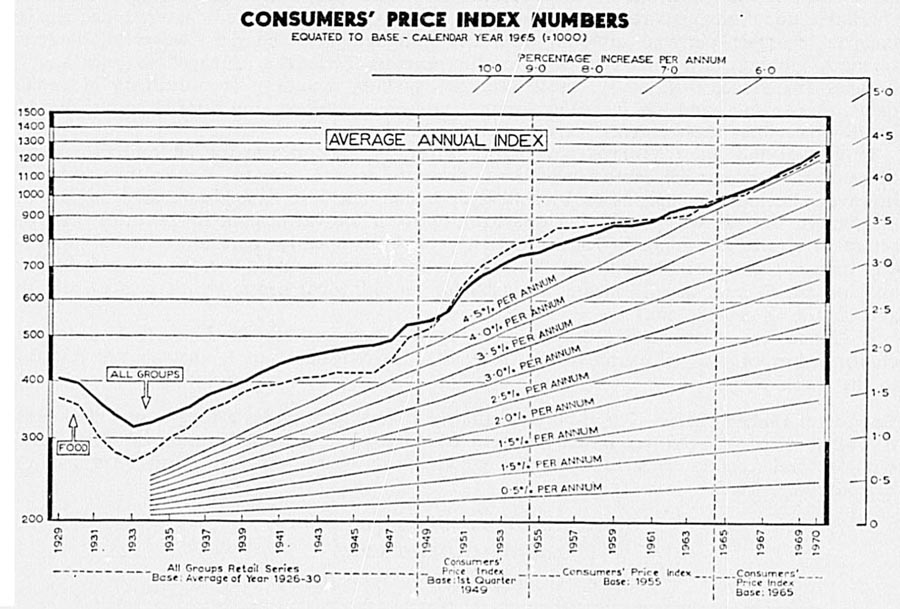
Current Consumers' Price Index—The tables which now follow relate to the current Consumers' Price Index only.
The first table supplies all-groups index numbers and index numbers of individual groups and subgroups for 25 centres combined. The group and subgroup weights are also shown as percentages of the base expenditure.
| CONSUMERS'
PRICE INDEX—QUARTERLY INDEX NUMBERS (ALL GROUPS) TWENTY-FIVE
CENTRES COMBINED Base: Weighted average twenty-five centres, 1965 (= 1000) | |||||||
|---|---|---|---|---|---|---|---|
| Food | Housing | Household Operation | Apparel | Transportation | Miscellaneous | All Groups | |
| Groups— | |||||||
| Percentages of base expenditure | 30.09 | 17.99 | 11.21 | 13.12 | 9.44 | 18.15 | 100.00 |
| Calendar year— | |||||||
| 1965 | 1,000 | 1,000 | 1,000 | 1,000 | 1,000 | 1,000 | 1,000 |
| 1966 | 1,018 | 1,053 | 1,010 | 1,016 | 1,037 | 1,034 | 1,028 |
| 1967 | 1,092 | 1,117 | 1,063 | 1,044 | 1,102 | 1,105 | 1,090 |
| 1968 | 1,126 | 1,177 | 1,105 | 1,071 | 1,170 | 1,167 | 1,137 |
| 1969 | 1,180 | 1,245 | 1,140 | 1,119 | 1,218 | 1,235 | 1,193 |
| 1970 | 1,258 | 1,327 | 1,186 | 1,199 | 1,280 | 1,336 | 1,271 |
| Quarter ended— | |||||||
| 1969-31 March | 1,168 | 1,217 | 1,129 | 1,104 | 1,200 | 1,217 | 1,176 |
| 30 June | 1,179 | 1,234 | 1,136 | 1,115 | 1,220 | 1,229 | 1,189 |
| 30 September | 1,190 | 1,252 | 1,144 | 1,123 | 1,223 | 1,246 | 1,201 |
| 31 December | 1,185 | 1,276 | 1,150 | 1,133 | 1,128 | 1,250 | 1,206 |
| 1970-31 March | 1,216 | 1,294 | 1,155 | 1,151 | 1,249 | 1,292 | 1,232 |
| 30 June | 1,249 | 1,317 | 1,169 | 1,165 | 1,248 | 1,305 | 1,251 |
| 30 September | 1,259 | 1,334 | 1,191 | 1,214 | 1,286 | 1,328 | 1,274 |
| 31 December | 1,307 | 1,364 | 1,228 | 1,266 | 1,337 | 1,417 | 1,326 |
| Food | Housing | Household Operation | ||||||
|---|---|---|---|---|---|---|---|---|
| Fruits and Vegetables | Meat, Fish and poultry | Other Foods and Eggs | Rent | Home Ownership | Fuel and Light | Home Furnishings | Domestic Supplies and Services | |
| Subgroups— | ||||||||
| Percentages of base expenditure | 5.89 | 9.22 | 14.98 | 5.50 | 12.49 | 2.82 | 5.59 | 2.80 |
| Calendar year— | ||||||||
| 1965 | 1,000 | 1,000 | 1,000 | 1,000 | 1,000 | 1,000 | 1,000 | 1,000 |
| 1966 | 1,030 | 1,040 | 1,000 | 1,048 | 1,056 | 1,020 | 1,003 | 1,014 |
| 1967 | 1,105 | 1,073 | 1,099 | 1,112 | 1,120 | 1,083 | 1,023 | 1,122 |
| 1968 | 1,138 | 1,101 | 1,136 | 1,166 | 1,182 | 1,160 | 1,060 | 1,140 |
| 1969 | 1,103 | 1,222 | 1,185 | 1,224 | 1,254 | 1,173 | 1,119 | 1,148 |
| 1970 | 1,180 | 1,348 | 1,233 | 1,285 | 1,346 | 1,179 | 1,184 | 1,197 |
| Quarter ended— | ||||||||
| 1969— | ||||||||
| 31 March | 1,171 | 1,167 | 1,168 | 1,200 | 1,225 | 1,172 | 1,103 | 1,138 |
| 30 June | 1,137 | 1,198 | 1,183 | 1,208 | 1,246 | 1,174 | 1,113 | 1,143 |
| 30 September | 1,085 | 1,245 | 1,198 | 1,231 | 1,261 | 1,175 | 1,124 | 1,153 |
| 31 December | 1,020 | 1,278 | 1,192 | 1,255 | 1,285 | 1,173 | 1,134 | 1,157 |
| 1970— | ||||||||
| 31 March | 1,177 | 1,283 | 1,190 | 1,265 | 1,306 | 1,175 | 1,140 | 1,166 |
| 30 June | 1,206 | 1,332 | 1,214 | 1,276 | 1,335 | 1,177 | 1,157 | 1,186 |
| 30 September | 1,120 | 1,377 | 1,242 | 1,290 | 1,354 | 1,180 | 1,192 | 1,201 |
| 31 December | 1,217 | 1,399 | 1,287 | 1,309 | 1,388 | 1,183 | 1,246 | 1,236 |
| Apparel | Transportation | Miscellaneous | All Groups | |||||
|---|---|---|---|---|---|---|---|---|
| Clothing | Footwear | Public Transport | Private Transport | Tobacco and Alcohol | Other Supplies | Other Services | ||
| Subgroups— | ||||||||
| Percentages of base expenditure | 10.91 | 2.21 | 2.38 | 7.06 | 7.64 | 5.66 | 4.85 | 100.00 |
| Calendar year— | ||||||||
| 1965 | 1,000 | 1,000 | 1,000 | 1,000 | 1,000 | 1,000 | 1,000 | 1,000 |
| 1966 | 1,013 | 1,030 | 1,021 | 1,043 | 1,023 | 1,037 | 1,047 | 1,028 |
| 1967 | 1,039 | 1,069 | 1,082 | 1,108 | 1,098 | 1,096 | 1,125 | 1,090 |
| 1968 | 1,067 | 1,090 | 1,104 | 1,193 | 1,159 | 1,154 | 1,193 | 1,137 |
| 1969 | 1,113 | 1,144 | 1,140 | 1,244 | 1,213 | 1,224 | 1,284 | 1,193 |
| 1970 | 1,192 | 1,234 | 1,189 | 1,311 | 1,328 | 1,330 | 1,354 | 1,271 |
| Quarter ended— | ||||||||
| 1969— | ||||||||
| 31 March | 1,102 | 1,112 | 1,129 | 1,224 | 1,205 | 1,204 | 1,250 | 1,176 |
| 30 June | 1,111 | 1,131 | 1,141 | 1,247 | 1,207 | 1,210 | 1,285 | 1,189 |
| 30 September | 1,115 | 1,162 | 1,145 | 1,249 | 1,219 | 1,229 | 1,310 | 1,201 |
| 31 December | 1,125 | 1,171 | 1,146 | 1,256 | 1,220 | 1,255 | 1,290 | 1,206 |
| 1970— | ||||||||
| 31 March | 1,143 | 1,192 | 1,162 | 1,278 | 1,289 | 1,286 | 1,305 | 1,232 |
| 30 June | 1,157 | 1,206 | 1,166 | 1,275 | 1,289 | 1,315 | 1,320 | 1,251 |
| 30 September | 1,209 | 1,238 | 1,178 | 1,323 | 1,290 | 1,334 | 1,380 | 1,274 |
| 31 December | 1,260 | 1,297 | 1,250 | 1,367 | 1,445 | 1,384 | 1,413 | 1,326 |
The average level of consumer prices rose by 6.5 percent in 1970 compared with a rise of 4.9 percent the year before. Although price increases were recorded in all main groups of the index, the major contributions to the overall result came from the meat and fish, tobacco and alcohol, and miscellaneous supplies subgroups.
In the table which follows monthly figures for the food group are shown for all index centres combined.
| CONSUMERS'
PRICE INDEX—MONTHLY INDEX NUMBERS (FOOD), TWENTY-FIVE CENTRES
COMBINED Base: Weighted average twenty-five centres, 1965 (= 1000) | ||||
|---|---|---|---|---|
| Period | Fruits and Vegetables | Meat and Fish | Other Foods | All Food |
| Calendar year— | ||||
| 1965 | 1,000 | 1,000 | 1,000 | 1,000 |
| 1966 | 1,030 | 1,040 | 1,000 | 1,018 |
| 1967 | 1,105 | 1,073 | 1,099 | 1,092 |
| 1968 | 1,138 | 1,101 | 1,136 | 1,126 |
| 1969 | 1,103 | 1,222 | 1,185 | 1,180 |
| 1970 | 1,180 | 1,348 | 1,233 | 1,258 |
| Month— | ||||
| 1969—January | 1,158 | 1,154 | 1,165 | 1,160 |
| February | 1,196 | 1,164 | 1,169 | 1,173 |
| March | 1,159 | 1,182 | 1,170 | 1,171 |
| April | 1,129 | 1,196 | 1,180 | 1,175 |
| May | 1,126 | 1,198 | 1,183 | 1,177 |
| June | 1,154 | 1,201 | 1,186 | 1,184 |
| July | 1,124 | 1,225 | 1,191 | 1,188 |
| August | 1,090 | 1,243 | 1,199 | 1,191 |
| September | 1,041 | 1,266 | 1,203 | 1,191 |
| October | 1,056 | 1,277 | 1,192 | 1,192 |
| November | 999 | 1,279 | 1,193 | 1,182 |
| December | 1,005 | 1,276 | 1,191 | 1,181 |
| 1970—January | 1,101 | 1,274 | 1,188 | 1,197 |
| February | 1,205 | 1,279 | 1,188 | 1,219 |
| March | 1,229 | 1,296 | 1,193 | 1,232 |
| April | 1,250 | 1,311 | 1,202 | 1,245 |
| May | 1,191 | 1,329 | 1,215 | 1,245 |
| June | 1,174 | 1,357 | 1,224 | 1,255 |
| July | 1,136 | 1,360 | 1,225 | 1,249 |
| August | 1,120 | 1,380 | 1,236 | 1,257 |
| September | 1,103 | 1,391 | 1,263 | 1,271 |
| October | 1,209 | 1,399 | 1,286 | 1,305 |
| November | 1,206 | 1,402 | 1,288 | 1,307 |
| December | 1,237 | 1,396 | 1,286 | 1,310 |
The following tables distinguish individual centres and groupings of centres, but the subgroup indices are omitted. Attention is called, however, to the two-fold method of presentation: in the first place current prices in each centre are compared with prices in the same centre during the base period; in the second, current prices in each centre are compared with average prices over all the 25 centres in the base period.
Where the base is the individual centre, the index numbers are specially designed to show price movements in each centre. Vertical comparisons can also be made but they will show the relative amount of price movements in respective centres, not relative current price levels. In the second method, where the base is average prices over the 25 centres, horizontal or vertical comparisons may be made to compare relative price levels. However, these index numbers do not indicate how much dearer or cheaper it is to live in one centre or another, but only how much higher or lower retail price levels are in one centre than another. The construction of the index assumes the same consumption habits in all centres, regardless of size, climate, etc.
| CONSUMERS' PRICE INDEX—GROUP
INDEX NUMBERS FOR INDIVIDUAL CENTRES AND GROUPINGS OF
CENTRES Base: Weighted average each centre, and grouping, separately, 1965 (= 1000) | ||||||||||||
|---|---|---|---|---|---|---|---|---|---|---|---|---|
| Centre | Food | Housing | Household Operation | Apparel | ||||||||
| Annual 1965 | Annual 1969 | Annual 1970 | Annual 1965 | Annual 1969 | Annual 1970 | Annual 1965 | Annual 1969 | Annual 1970 | Annual 1965 | Annual 1969 | Annual 1970 | |
| Auckland | 1,000 | 1,196 | 1,271 | 1,000 | 1,263 | 1,346 | 1,000 | 1,160 | 1,217 | 1,000 | 1,136 | 1,224 |
| Wellington-Hutt | 1,000 | 1,173 | 1,256 | 1,000 | 1,233 | 1,326 | 1,000 | 1,145 | 1,177 | 1,000 | 1,119 | 1,217 |
| Christchurch | 1,000 | 1,179 | 1,248 | 1,000 | 1,241 | 1,322 | 1,000 | 1,132 | 1,175 | 1,000 | 1,128 | 1,207 |
| Dunedin | 1,000 | 1,167 | 1,232 | 1,000 | 1,273 | 1,352 | 1,000 | 1,124 | 1,172 | 1,000 | 1,121 | 1,197 |
| Four chief centres | 1,000 | 1,184 | 1,258 | 1,000 | 1,253 | 1,337 | 1,000 | 1,146 | 1,193 | 1,000 | 1,129 | 1,215 |
| Hamilton | 1,000 | 1,188 | 1,262 | 1,000 | 1,192 | 1,261 | 1,000 | 1,123 | 1,165 | 1,000 | 1,088 | 1,157 |
| Tauranga | 1,000 | 1,161 | 1,227 | 1,100 | 1,249 | 1,334 | 1,000 | 1,158 | 1,199 | 1,000 | 1,092 | 1,158 |
| Rotorua | 1,000 | 1,157 | 1,231 | 1,000 | 1,319 | 1,385 | 1,000 | 1,121 | 1,169 | 1,000 | 1,122 | 1,194 |
| Napier-Hastings | 1,000 | 1,174 | 1,255 | 1,000 | 1,269 | 1,363 | 1,000 | 1,135 | 1,177 | 1,000 | 1,111 | 1,182 |
| New Plymouth | 1,000 | 1,189 | 1,277 | 1,000 | 1,239 | 1,326 | 1,000 | 1,135 | 1,177 | 1,000 | 1,108 | 1,180 |
| Wanganui | 1,000 | 1,187 | 1,275 | 1,000 | 1,225 | 1,293 | 1,000 | 1,145 | 1,175 | 1,000 | 1,123 | 1,205 |
| Palmerston North | 1,000 | 1,174 | 1,265 | 1,000 | 1,261 | 1,367 | 1,000 | 1,134 | 1,187 | 1,000 | 1,102 | 1,182 |
| Nelson | 1,000 | 1,178 | 1,282 | 1,000 | 1,227 | 1,300 | 1,000 | 1,157 | 1,214 | 1,000 | 1,095 | 1,183 |
| Timaru | 1,000 | 1,193 | 1,266 | 1,000 | 1,188 | 1,251 | 1,000 | 1,115 | 1,155 | 1,000 | 1,096 | 1,163 |
| Invercargill | 1,000 | 1,159 | 1,234 | 1,000 | 1,234 | 1,311 | 1,000 | 1,113 | 1,153 | 1,000 | 1,120 | 1,206 |
| Ten larger centres | 1,000 | 1,177 | 1,258 | 1,000 | 1,235 | 1,315 | 1,000 | 1,131 | 1,175 | 1,000 | 1,103 | 1,178 |
| Six smaller North Island centres | 1,000 | 1,176 | 1,255 | 1,000 | 1,248 | 1,332 | 1,000 | 1,140 | 1,188 | 1,000 | 1,117 | 1,188 |
| Five smaller South Island centres | 1,000 | 1,173 | 1,258 | 1,000 | 1,219 | 1,282 | 1,000 | 1,135 | 1,180 | 1,000 | 1,123 | 1,201 |
| Twenty-five centres combined | 1,000 | 1,180 | 1,258 | 1,000 | 1,245 | 1,327 | 1,000 | 1,140 | 1,186 | 1,000 | 1,119 | 1,199 |
| Centre | Transportation | Miscellaneous | All Groups | ||||||
|---|---|---|---|---|---|---|---|---|---|
| Annual 1965 | Annual 1969 | Annual 1970 | Annual 1965 | Annual 1969 | Annual 1970 | Annual 1965 | Annual 1969 | Annual 1970 | |
| Auckland | 1,000 | 1,214 | 1,286 | 1,000 | 1,244 | 1,345 | 1,000 | 1,208 | 1,288 |
| Wellington-Hutt | 1,000 | 1,215 | 1,258 | 1,000 | 1,238 | 1,332 | 1,000 | 1,191 | 1,271 |
| Christchurch | 1,000 | 1,220 | 1,285 | 1,000 | 1,243 | 1,343 | 1,000 | 1,193 | 1,268 |
| Dunedin | 1,000 | 1,212 | 1,258 | 1,000 | 1,239 | 1,340 | 1,000 | 1,191 | 1,262 |
| Four chief centres | 1,000 | 1,215 | 1,276 | 1,000 | 1,242 | 1,341 | 1,000 | 1,199 | 1,277 |
| Hamilton | 1,000 | 1,212 | 1,275 | 1,000 | 1,220 | 1,333 | 1,000 | 1,177 | 1,252 |
| Tauranga | 1,000 | 1,229 | 1,286 | 1,000 | 1,230 | 1,332 | 1,000 | 1,187 | 1,260 |
| Rotorua | 1,000 | 1,213 | 1,273 | 1,000 | 1,219 | 1,319 | 1,000 | 1,194 | 1,267 |
| Napier-Hastings | 1,000 | 1,221 | 1,289 | 1,000 | 1,236 | 1,332 | 1,000 | 1,193 | 1,272 |
| New Plymouth | 1,000 | 1,240 | 1,305 | 1,000 | 1,227 | 1,325 | 1,000 | 1,193 | 1,273 |
| Wanganui | 1,000 | 1,229 | 1,294 | 1,000 | 1,214 | 1,319 | 1,000 | 1,188 | 1,267 |
| Palmerston North | 1,000 | 1,223 | 1,284 | 1,000 | 1,234 | 1,333 | 1,000 | 1,190 | 1,277 |
| Nelson | 1,000 | 1,218 | 1,291 | 1,000 | 1,219 | 1,325 | 1,000 | 1,184 | 1,273 |
| Timaru | 1,000 | 1,222 | 1,281 | 1,000 | 1,237 | 1,333 | 1,000 | 1,181 | 1,251 |
| Invercargill | 1,000 | 1,228 | 1,293 | 1,000 | 1,245 | 1,338 | 1,000 | 1,183 | 1,258 |
| Ten larger centres | 1,000 | 1,221 | 1,285 | 1,000 | 1,228 | 1,331 | 1,000 | 1,186 | 1,264 |
| Six smaller North Island centres | 1,000 | 1,219 | 1,282 | 1,000 | 1,229 | 1,328 | 1,000 | 1,190 | 1,267 |
| Five smaller South Island centres | 1,000 | 1,214 | 1,278 | 1,000 | 1,229 | 1,334 | 1,000 | 1,184 | 1,261 |
| Twenty-five centres combined | 1,000 | 1,218 | 1,280 | 1,000 | 1,235 | 1,336 | 1,000 | 1,193 | 1,271 |
| CONSUMERS' PRICE INDEX—GROUP
INDEX NUMBERS FOR INDIVIDUAL CENTRES AND GROUPINGS OF
CENTRES Base: Weighted average each centre, and grouping, separately, 1965 (= 1000) | ||||||||||||
|---|---|---|---|---|---|---|---|---|---|---|---|---|
| Centre | Food | Housing | Household Operation | Apparel | ||||||||
| Annual 1965 | Annual 1969 | Annual 1970 | Annual 1965 | Annual 1969 | Annual 1970 | Annual 1965 | Annual 1969 | Annual 1970 | Annual 1965 | Annual 1969 | Annual 1970 | |
| Auckland | 1,014 | 1,213 | 1,289 | 1,114 | 1,407 | 1,500 | 995 | 1,155 | 1,211 | 1,013 | 1,151 | 1,239 |
| Wellington-Hutt | 1,012 | 1,187 | 1,271 | 1,182 | 1,458 | 1,567 | 979 | 1,120 | 1,152 | 999 | 1,118 | 1,215 |
| Christchurch | 1,002 | 1,182 | 1,251 | 926 | 1,148 | 1,224 | 1,001 | 1,134 | 1,176 | 990 | 1,116 | 1,195 |
| Dunedin | 1,012 | 1,181 | 1,246 | 895 | 1,140 | 1,211 | 1,023 | 1,150 | 1,199 | 1,010 | 1,132 | 1,209 |
| Four chief centres | 1,011 | 1,197 | 1,272 | 1,061 | 1,330 | 1,419 | 996 | 1,142 | 1,189 | 1,004 | 1,134 | 1,221 |
| Hamilton | 985 | 1,170 | 1,243 | 967 | 1,153 | 1,219 | 964 | 1,083 | 1,124 | 985 | 1,071 | 1,140 |
| Tauranga | 1,021 | 1,185 | 1,253 | 1,104 | 1,378 | 1,472 | 972 | 1,126 | 1,166 | 1,004 | 1,096 | 1,163 |
| Rotorua | 1,002 | 1,159 | 1,233 | 1,011 | 1,333 | 1,399 | 1,004 | 1,126 | 1,174 | 993 | 1,115 | 1,186 |
| Napier-Hastings | 962 | 1,130 | 1,208 | 912 | 1,157 | 1,243 | 1,036 | 1,176 | 1,220 | 1,006 | 1,118 | 1,190 |
| New Plymouth | 979 | 1,164 | 1,250 | 926 | 1,148 | 1,228 | 984 | 1,117 | 1,158 | 995 | 1,102 | 1,174 |
| Wanganui | 973 | 1,155 | 1,241 | 813 | 996 | 1,051 | 981 | 1,123 | 1,153 | 994 | 1,117 | 1,198 |
| Palmerston North | 979 | 1,149 | 1,238 | 918 | 1,158 | 1,255 | 980 | 1,111 | 1,164 | 1,019 | 1,123 | 1,204 |
| Nelson | 955 | 1,125 | 1,224 | 931 | 1,142 | 1,210 | 971 | 1,123 | 1,180 | 1,005 | 1,100 | 1,188 |
| Timaru | 993 | 1,185 | 1,257 | 1,017 | 1,208 | 1,272 | 1,022 | 1,139 | 1,180 | 1,005 | 1,101 | 1,169 |
| Invercargill | 1,024 | 1,187 | 1,264 | 953 | 1,176 | 1,249 | 1,042 | 1,160 | 1,202 | 1,008 | 1,130 | 1,216 |
| Ten larger centres | 985 | 1,160 | 1,240 | 951 | 1,174 | 1,250 | 993 | 1,122 | 1,166 | 1,000 | 1,104 | 1,178 |
| Six smaller North Island centres | 1,002 | 1,179 | 1,257 | 915 | 1,142 | 1,219 | 1,030 | 1,174 | 1,224 | 981 | 1,096 | 1,165 |
| Five smaller South Island centres | 986 | 1,157 | 1,241 | 897 | 1,094 | 1,151 | 1,022 | 1,160 | 1,206 | 994 | 1,116 | 1,194 |
| Twenty-five centres combined | 1,000 | 1,180 | 1,258 | 1,000 | 1,245 | 1,327 | 1,000 | 1,140 | 1,186 | 1,000 | 1,119 | 1,199 |
| Centre | Transportation | Miscellaneous | All Groups | ||||||
|---|---|---|---|---|---|---|---|---|---|
| Annual 1965 | Annual 1969 | Annual 1970 | Annual 1965 | Annual 1969 | Annual 1970 | Annual 1965 | Annual 1969 | Annual 1970 | |
| Auckland | 1,000 | 1,214 | 1,286 | 999 | 1,243 | 1,343 | 1,026 | 1,239 | 1,321 |
| Wellington-Hutt | 1,000 | 1,215 | 1,258 | 1,019 | 1,261 | 1,357 | 1,037 | 1,235 | 1,318 |
| Christchurch | 1,000 | 1,220 | 1,285 | 998 | 1,340 | 1,340 | 986 | 1,176 | 1,250 |
| Dunedin | 1,000 | 1,212 | 1,258 | 983 | 1,218 | 1,318 | 986 | 1,174 | 1,244 |
| Four chief centres | 1,000 | 1,215 | 1,276 | 1,001 | 1,243 | 1,342 | 1,015 | 1,216 | 1,296 |
| Hamilton | 1,000 | 1,212 | 1,275 | 993 | 1,212 | 1,324 | 982 | 1,156 | 1,230 |
| Tauranga | 1,000 | 1,229 | 1,286 | 999 | 1,229 | 1,331 | 1,022 | 1,214 | 1,288 |
| Rotorua | 1,000 | 1,213 | 1,273 | 1,016 | 1,238 | 1,340 | 1,005 | 1,200 | 1,273 |
| Napier-Hastings | 1,000 | 1,221 | 1,289 | 994 | 1,228 | 1,324 | 977 | 1,165 | 1,242 |
| New Plymouth | 1,000 | 1,240 | 1,305 | 996 | 1,222 | 1,320 | 977 | 1,166 | 1,244 |
| Wanganui | 1,000 | 1,229 | 1,294 | 997 | 1,211 | 1,316 | 955 | 1,135 | 1,210 |
| Palmerston North | 1,000 | 1,223 | 1,284 | 993 | 1,226 | 1,324 | 978 | 1,164 | 1,248 |
| Nelson | 1,000 | 1,218 | 1,291 | 988 | 1,206 | 1,310 | 969 | 1,148 | 1,234 |
| Timaru | 1,000 | 1,222 | 1,281 | 1,010 | 1,250 | 1,347 | 1,006 | 1,188 | 1,258 |
| Invercargill | 1,000 | 1,228 | 1,293 | 991 | 1,233 | 1,326 | 1,003 | 1,187 | 1,262 |
| Ten larger centres | 1,000 | 1,221 | 1,285 | 996 | 1,224 | 1,325 | 985 | 1,168 | 1,245 |
| Six smaller North Island centres | 1,000 | 1,219 | 1,282 | 1,009 | 1,240 | 1,341 | 988 | 1,176 | 1,252 |
| Five smaller South Island centres | 1,000 | 1,214 | 1,278 | 995 | 1,223 | 1,327 | 978 | 1,158 | 1,234 |
| Twenty-five centres combined | 1,000 | 1,218 | 1,280 | 1,000 | 1,235 | 1,336 | 1,000 | 1,193 | 1,271 |
WHOLESALE PRICES INDEX—The latest Wholesale Prices Index is described in the special supplement to the October 1959 issue of the Monthly Abstract of Statistics under the title Index Numbers of Wholesale Prices. A brief summary of the salient features of this revision appeared in the 1960 Yearbook (pages 992-994).
The index is not a single wholesale prices index, but a series of price index numbers related to broad groupings of the inter-industry transactions distinguished in the Department's input-output tables for the New Zealand economy. Thus each of the index numbers relates to a group of commodity transactions occurring at certain price-levels between defined sectors in the economy. Capital goods as well as goods for current consumption or usage are represented in the various commodity flows.
Wholesale Prices Index Numbers—The table which follows is divided into two parts; the first covers “input” prices and the second “output” prices. Within the first part of the table there is a break-up into goods for industrial use (analysed by sector destinations), for consumption, and for export. In each flow imported goods are distinguished from locally produced goods. In this part of the table all prices are inclusive of sales tax and excise duties and net of subsidies; the prices for exports marketed overseas are the prices in these markets brought to an f.o.b. basis, i.e., their “input” prices to other countries.
In the second part of the table the broad producing sectors are distinguished. Here the prices of their outputs are used. They are taken before the addition of sales tax and excise duties or the deduction of subsidies. The prices for export meat and dairy products are those payable to producers under the different stabilisation and minimum export-meat-prices schemes.
The primary produce processing industries group comprises the two major industries, meat export works and dairy factories, processing farm products mainly for export.
The expression base for the index is the calendar year 1958.
| WHOLESALE PRICES
INDEX Base: 1958 (= 1000) | |||||||||||||
|---|---|---|---|---|---|---|---|---|---|---|---|---|---|
| Index Numbers of Commodity Prices by Sectors of Destination* | |||||||||||||
| Calendar Year | Prices Paid for Commodities Used by— | All Commodities | |||||||||||
| Domestic Industry | Consumers | Domestic Industry and Consumers | Other Countries (Exported) | ||||||||||
| Imported | Home Produced | Total | Imported | Home Produced | Total | Imported | Home Produced | Total | Imported | Home Produced | Total | ||
| * Provisional. | |||||||||||||
| 1958 | 1,000 | 1,000 | 1,000 | 1,000 | 1,000 | 1,000 | 1,000 | 1,000 | 1,000 | 1,000 | 1,000 | 1,000 | 1,000 |
| 1959 | 1,015 | 998 | 1,004 | 1,055 | 1,034 | 1,039 | 1,025 | 1,011 | 1,015 | 1,141 | 1,025 | 1,039 | 1,035 |
| 1960 | 1,008 | 1,018 | 1,015 | 1,019 | 1,028 | 1,026 | 1,010 | 1,022 | 1,018 | 1,139 | 1,010 | 1,047 | 1,038 |
| 1961 | 1,012 | 1,005 | 1,008 | 1,025 | 1,034 | 1,032 | 1,015 | 1,015 | 1,015 | 1,023 | 1,015 | 1,017 | 1,016 |
| 1962 | 1,011 | 992 | 998 | 1,033 | 1,035 | 1,035 | 1,016 | 1,007 | 1,009 | 1,049 | 1,016 | 1,016 | 1,016 |
| 1963 | 1,034 | 1,013 | 1,020 | 1,040 | 1,050 | 1,047 | 1,035 | 1,025 | 1,028 | 1,160 | 1,035 | 1,054 | 1,050 |
| 1964 | 1,039 | 1,071 | 1,060 | 1,037 | 1,088 | 1,076 | 1,038 | 1,077 | 1,065 | 1,259 | 1,038 | 1,116 | 1,097 |
| 1965 | 1,058 | 1,111 | 1,093 | 1,054 | 1,111 | 1,097 | 1,057 | 1,111 | 1,094 | 1,184 | 1,057 | 1,126 | 1,109 |
| 1966 | 1,075 | 1,131 | 1,113 | 1,076 | 1,124 | 1,113 | 1,075 | 1,129 | 1,113 | 1,159 | 1,075 | 1,135 | 1,120 |
| 1967 | 1,104 | 1,123 | 1,117 | 1,143 | 1,198 | 1,185 | 1,114 | 1,148 | 1,138 | 1,042 | 1,114 | 1,125 | 1,122 |
| 1968 | 1,238 | 1,174 | 1,195 | 1,287 | 1,263 | 1,269 | 1,250 | 1,204 | 1,218 | 1,144 | 1,250 | 1,191 | 1,206 |
| 1969 | 1,299 | 1,245 | 1,263 | 1,322 | 1,317 | 1,318 | 1,305 | 1,269 | 1,280 | 1,224 | 1,305 | 1,259 | 1,271 |
| 1970|| | 1,392 | 1,306 | 1,334 | 1,375 | 1,408 | 1,400 | 1,388 | 1,340 | 1,355 | 1,236 | 1,271 | ||
| Calendar Year | Prices Paid for Commodities Used by Domestic Industry | |||||||||||||
|---|---|---|---|---|---|---|---|---|---|---|---|---|---|---|
| Primary Industries | Primary Produce Processing Industries | All other Industries† | Manufacturing‡ Industries | |||||||||||
| Imported | Home Produced | Total | Imported | Home Produced | Total | Imported | Home Produced | Total | Imported | Home Produced | Total | |||
| Farming | All Other Industries | Other Manufacturing Industries | All Other Industries | |||||||||||
| 1958 | 1,000 | 1,000 | 1,000 | 1,000 | 1,000 | 1,000 | 1,000 | 1,000 | 1,000 | 1,000 | 1,000 | 1,000 | 1,000 | 1,000 |
| 1961 | 1,012 | 948 | 1,016 | 986 | 1,045 | 940 | 943 | 1,011 | 1,048 | 1,031 | 1,006 | 1,026 | 1,069 | 1,026 |
| 1962 | 1,003 | 839 | 1,023 | 940 | 990 | 919 | 921 | 1,012 | 1,052 | 1,034 | 1,006 | 1,034 | 1,038 | 1,021 |
| 1963 | 989 | 848 | 1,026 | 943 | 964 | 952 | 953 | 1,039 | 1,071 | 1,056 | 1,048 | 1,039 | 1,113 | 1,061 |
| 1964 | 999 | 967 | 1,030 | 997 | 995 | 1,049 | 1,047 | 1,043 | 1,107 | 1,078 | 1,043 | 1,080 | 1,181 | 1,085 |
| 1965 | 1,028 | 1,149 | 1,056 | 1,091 | 1,059 | 1,091 | 1,090 | 1,061 | 1,122 | 1,094 | 1,044 | 1,084 | 1,172 | 1,084 |
| 1966 | 1,046 | 1,261 | 1,106 | 1,162 | 1,088 | 1,075 | 1,075 | 1,077 | 1,141 | 1,113 | 1,063 | 1,092 | 1,209 | 1,105 |
| 1967 | 1,068 | 1,162 | 1,147 | 1,139 | 1,133 | 1,003 | 1,007 | 1,107 | 1,175 | 1,144 | 1,091 | 1,163 | 1,154 | 1,125 |
| 1968 | 1,154 | 1,058 | 1,210 | 1,134 | 1,256 | 1,084 | 1,089 | 1,245 | 1,236 | 1,240 | 1,250 | 1,231 | 1,224 | 1,239 |
| 1969 | 1,213 | 1,120 | 1,243 | 1,184 | 1,258 | 1,196 | 1,198 | 1,308 | 1,292 | 1,299 | 1,322 | 1,298 | 1,301 | 1,311 |
| 1970 | 1,309 | 1,210 | 1,287 | 1,257 | 1,249 | 1219|| | 1220|| | 1,402 | 1,371 | 1,385 | 1,407 | 1,376 | 1,331 | 1,381 |
| Calendar year | Prices Paid for Commodities Used by Domestic Industry | ||||||||
|---|---|---|---|---|---|---|---|---|---|
| Building and Construction | Transport and Communication | Other Industries§ | |||||||
| Imported | Home Produced | Total | Imported | Home Produced | Total | Imported | Home Produced | Total | |
* The prices used in this table are those payable by the using or consuming sectors, i.e., including indirect taxation and net after subsidies; the export prices are N.Z.$ f.o.b. equivalents of overseas market prices. † This consists of manufacturing industries (excluding primary produce processing industries) building and construction, transport and communication, wholesale and retail trade, banking and finance, public utilities and services. ‡ Other than Primary Produce Processing Industries. § Includes wholesale and retail trade, banking and finance, public utilities and services. || Provisional. | |||||||||
| 1958 | 1,000 | 1,000 | 1,000 | 1,000 | 1,000 | 1,000 | 1,000 | 1,000 | 1,000 |
| 1961 | 1,052 | 1,056 | 1,054 | 980 | 1,051 | 999 | 1,009 | 1,042 | 1,033 |
| 1962 | 1,046 | 1,072 | 1,063 | 992 | 1,072 | 1,014 | 1,016 | 1,060 | 1,048 |
| 1963 | 1,042 | 1,072 | 1,061 | 1,009 | 1,066 | 1,025 | 1,021 | 1,063 | 1,051 |
| 1964 | 1,070 | 1,095 | 1,086 | 1,017 | 1,054 | 1,027 | 1,034 | 1,086 | 1,071 |
| 1965 | 1,096 | 1,141 | 1,124 | 1,072 | 1,072 | 1,072 | 1,083 | 1,103 | 1,097 |
| 1966 | 1,110 | 1,171 | 1,149 | 1,073 | 1,082 | 1,076 | 1,108 | 1,106 | 1,107 |
| 1967 | 1,149 | 1,203 | 1,183 | 1,096 | 1,111 | 1,100 | 1,137 | 1,187 | 1,173 |
| 1968 | 1,284 | 1,254 | 1,265 | 1,189 | 1,148 | 1,178 | 1,213 | 1,246 | 1,237 |
| 1969 | 1,349 | 1,298 | 1,316 | 1,227 | 1,186 | 1,216 | 1,252 | 1,288 | 1,278 |
| 1970 | 1,508 | 1,420 | 1,452 | 1,307 | 1,254 | 1,292 | 1,309 | 1,370 | 1,353 |
| Index Numbers of Commodity Prices by Sector of Origin* | ||||||||
|---|---|---|---|---|---|---|---|---|
| Calendar Year | Prices Received for Commodities Produced in New Zealand | |||||||
| Output of | Used by | |||||||
| Farming | Other Primary Industries | Primary Produce Processing Industries | Other Manufacturing Industries | Public Utilities | All Domestic Industry† | Industry and Consumers | Other Countries (Exported) | |
* The prices used in this part of the table are those receivable by producers, i.e., before addition of indirect taxation or deduction of consumer or user subsidies; prices for dairy produce and meat are those payable to producers under the schemes to stabilise returns from year to year. † Comprises the outputs of the five sectors mentioned in this part of the table. ‡ Provisional. | ||||||||
| 1958 | 1,000 | 1,000 | 1,000 | 1,000 | 1,000 | 1,000 | 1,000 | 1,000 |
| 1961 | 997 | 1,113 | 941 | 1,038 | 1,044 | 1,009 | 1,014 | 992 |
| 1962 | 957 | 1,146 | 954 | 1,041 | 1,066 | 1,003 | 1,005 | 995 |
| 1963 | 1,020 | 1,156 | 979 | 1,062 | 1,076 | 1,037 | 1,024 | 1,079 |
| 1964 | 1,111 | 1,186 | 1,071 | 1,096 | 1,094 | 1,099 | 1,078 | 1,166 |
| 1965 | 1,113 | 1,231 | 1,095 | 1,109 | 1,106 | 1,112 | 1,114 | 1,106 |
| 1966 | 1,118 | 1,286 | 1,117 | 1,126 | 1,116 | 1,126 | 1,133 | 1,105 |
| 1967 | 1,027 | 1,327 | 1,046 | 1,158 | 1,178 | 1,102 | 1,134 | 994 |
| 1968 | 1,053 | 1,431 | 1,143 | 1,230 | 1,292 | 1,167 | 1,191 | 1,086 |
| 1969 | 1,119 | 1,486 | 1,236 | 1,296 | 1,298 | 1,235 | 1,258 | 1,161 |
| 1970‡ | 1,144 | 1,531 | 1,264 | 1,384 | 1,308 | 1,288 | 1,328 | 1,156 |
Long-term Linked Series—Since the index incorporates a major change in construction method, linking to obtain a long-term series is not very satisfactory. Nevertheless, some such link will be required occasionally in making longer-term surveys of price movements. Accordingly, in the table which follows, the previous index, converted to base 1958 (= 1000), has been linked to the component “Commodities used by Domestic Industry and Consumers”. The subdivisions “Imported” and “Home Produced” commodities have similarly been linked. When using these linked series it should be borne in mind that the price sources and weighting pattern of the current index are quite different from its predecessors.
| WHOLESALE PRICES
INDEX NUMBERS—LONG-TERM LINKED SERIES Base: Calendar year 1958 (= 1000) | |||
|---|---|---|---|
| Year | Imported | Home Produced | Total |
| 1913 | 268 | 254 | 263 |
| 1914 | 270 | 274 | 271 |
| 1915 | 274 | 319 | 292 |
| 1916 | 312 | 331 | 320 |
| 1917 | 379 | 360 | 372 |
| 1918 | 481 | 389 | 444 |
| 1919 | 504 | 407 | 465 |
| 1920 | 626 | 455 | 557 |
| 1921 | 555 | 463 | 518 |
| 1922 | 461 | 392 | 433 |
| 1923 | 412 | 393 | 405 |
| 1924 | 406 | 407 | 406 |
| 1925 | 400 | 410 | 404 |
| 1926 | 375 | 393 | 382 |
| 1927 | 352 | 380 | 363 |
| 1928 | 344 | 385 | 361 |
| 1929 | 341 | 385 | 358 |
| 1930 | 335 | 370 | 349 |
| 1931 | 328 | 326 | 327 |
| 1932 | 326 | 307 | 319 |
| 1933 | 345 | 301 | 327 |
| 1934 | 341 | 310 | 329 |
| 1935 | 342 | 335 | 340 |
| 1936 | 342 | 344 | 343 |
| 1937 | 371 | 370 | 371 |
| 1938 | 375 | 378 | 376 |
| 1939 | 379 | 403 | 389 |
| 1940 | 448 | 412 | 434 |
| 1941 | 503 | 436 | 476 |
| 1942 | 552 | 456 | 514 |
| 1943 | 609 | 461 | 549 |
| 1944 | 629 | 472 | 565 |
| 1945 | 638 | 481 | 575 |
| 1946 | 636 | 489 | 577 |
| 1947 | 650 | 523 | 598 |
| 1948 | 730 | 574 | 667 |
| 1949 | 714 | 586 | 662 |
| 1950 | 758 | 667 | 721 |
| 1951 | 883 | 777 | 840 |
| 1952 | 996 | 842 | 933 |
| 1953 | 947 | 891 | 924 |
| 1954 | 904 | 932 | 915 |
| 1955 | 920 | 935 | 926 |
| 1956 | 944 | 985 | 960 |
| 1957 | 968 | 977 | 972 |
| 1958 | 1,000 | 1,000 | 1,000 |
| 1959 | 1,025 | 1,011 | 1,015 |
| 1960 | 1,010 | 1,022 | 1,018 |
| 1961 | 1,015 | 1,015 | 1,015 |
| 1962 | 1,016 | 1,007 | 1,009 |
| 1963 | 1,035 | 1,025 | 1,028 |
| 1964 | 1,038 | 1,077 | 1,065 |
| 1965 | 1,057 | 1,111 | 1,094 |
| 1966 | 1,075 | 1,129 | 1,113 |
| 1967 | 1,114 | 1,148 | 1,138 |
| 1968 | 1,250 | 1,204 | 1,218 |
| 1969 | 1,305 | 1,269 | 1,280 |
| 1970 | 1,388 | 1,340 | 1,355 |
EXPORT PRICES—The Export Prices Index has a weighting base of 1959 quantities at 1960 prices. The wool prices used are derived from the clean, on-floor prices used in the Wool Price Index brought to an f.o.b. basis. The prices for lamb and mutton realised on the Smithfield, London, market, converted to an f.o.b. New Zealand equivalent are used for exports of whole-carcass meat shipped on consignment to Great Britain. Unit values from export statistics are used for other commodities. The prices for those goods which are consigned for sale in overseas markets therefore represent generally the ruling prices in those markets at time of export rather than the realised prices on sale.
Owing to fluctuations in the proportions of the different exports consigned to the United Kingdom and to other countries it was considered desirable, during 1963, to alter the published group and all-groups index numbers to an “all-exports” basis, that is, a single all-destinations unit-value (or price) with a single weight was substituted for the separate unit-values and weights for the two destinations used previously. The differentiated destination weights and unit-values for each commodity are, of course, still used in the separate indexes for the two destinations.
A description of earlier indices may be found in the 1960 and earlier issues of the Yearbook.
In the following table are given export price index numbers for calendar years and for years ended 30 June.
| EXPORT PRICES
INDEX Base: Export prices during 1960 (= 1000) | |||||||
|---|---|---|---|---|---|---|---|
| Period | Butter | Cheese | All Dairy Produce | Meat | Wool | Meat, Wool, and Byproducts | All Pastoral and Dairy Produce |
| * Provisional. | |||||||
| Calendar year— | |||||||
| 1958 | 821 | 847 | 843 | 1,046 | 857 | 929 | 901 |
| 1959 | 1,212 | 1,215 | 1,201 | 970 | 922 | 952 | 1,033 |
| 1960 | 1,000 | 1,000 | 1,000 | 1,000 | 1,000 | 1,000 | 1,000 |
| 1961 | 890 | 990 | 920 | 949 | 950 | 951 | 942 |
| 1962 | 1,047 | 998 | 1,022 | 955 | 929 | 936 | 961 |
| 1963 | 1,145 | 973 | 1,077 | 1,012 | 1,116 | 1,055 | 1,061 |
| 1964 | 1,206 | 990 | 1,139 | 1,112 | 1,223 | 1,168 | 1,160 |
| 1965 | 1,185 | 1,050 | 1,178 | 1,226 | 956 | 1,091 | 1,116 |
| 1966 | 1,068 | 1,028 | 1,111 | 1,215 | 945 | 1,105 | 1,107 |
| 1967 | 1,051 | 1,072 | 1,103 | 1,187 | 770 | 962 | 1,003 |
| 1968 | 1,099 | 1,171 | 1,156 | 1,377 | 730 | 1,040 | 1,074 |
| 1969 | 1,097 | 1,156 | 1,130 | 1,518 | 789 | 1,147 | 1,142 |
| 1970 | 1,111 | 1,176 | 1,148 | 1,627 | 734 | 1,142 | 1,144 |
| Year ended 30 June— | |||||||
| 1958 | 798 | 650 | 770 | 1,059 | 953 | 990 | 918 |
| 1959 | 971 | 1,161 | 1,029 | 1,030 | 843 | 921 | 956 |
| 1960 | 1,196 | 1,102 | 1,159 | 953 | 1,031 | 1,008 | 1,059 |
| 1961 | 896 | 991 | 927 | 992 | 948 | 966 | 955 |
| 1962 | 968 | 995 | 972 | 905 | 930 | 921 | 936 |
| 1963 | 1,095 | 986 | 1,048 | 1,003 | 1,003 | 993 | 1,009 |
| 1964 | 1,181 | 962 | 1,101 | 1,066 | 1,270 | 1,167 | 1,148 |
| 1965 | 1,226 | 1,038 | 1,185 | 1,226 | 987 | 1,101 | 1,125 |
| 1966 | 1,105 | 1,034 | 1,136 | 1,198 | 979 | 1,113 | 1,119 |
| 1967 | 1,049 | 1,036 | 1,095 | 1,199 | 873 | 1,037 | 1,054 |
| 1968 | 1,077 | 1,146 | 1,140 | 1,308 | 677 | 969 | 1,019 |
| 1969 | 1,096 | 1,160 | 1,138 | 1,424 | 825 | 1,120 | 1,125 |
| 1970* | 1,097 | 1,158 | 1,130 | 1,583 | 767 | 1,148 | 1,143 |
| Period | All Foods | All Non-foods | All Exports | All Groups | |
|---|---|---|---|---|---|
| To United Kingdom | To Other Countries | ||||
| * Provisional. | |||||
| Calendar year | |||||
| 1958 | 936 | 854 | 902 | 922 | 858 |
| 1959 | 1,099 | 937 | 1,030 | 1,068 | 951 |
| 1960 | 1,000 | 1000' | 1,000 | 1,000 | 1,000 |
| 1961 | 937 | 954 | 945 | 933 | 954 |
| 1962 | 992 | 930 | 964 | 982 | 931 |
| 1963 | 1,049 | 1,067 | 1,056 | 1,069 | 1,036 |
| 1964 | 1,131 | 1,174 | 1,150 | 1,167 | 1,128 |
| 1965 | 1,201 | 1,002 | 1,111 | 1,170 | 1,034 |
| 1966 | 1,152 | 1,037 | 1,100 | 1,100 | 1,090 |
| 1967 | 1,137 | 840 | 1,003 | 1,035 | 941 |
| 1968 | 1,260 | 859 | 1,080 | 1,117 | 1,031 |
| 1969 | 1,324 | 931 | 1,146 | 1,181 | 1,105 |
| 1970 | 1,392 | 861 | 1,152 | 1,194 | 1,089 |
| Year ended 30 June | |||||
| 1958 | 901 | 938 | 917 | 910 | 934 |
| 1959 | 1,031 | 853 | 955 | 999 | 864 |
| 1960 | 1,067 | 1,036 | 1,054 | 1,064 | 1,034 |
| 1961 | 960 | 953 | 957 | 954 | 961 |
| 1962 | 942 | 934 | 938 | 938 | 933 |
| 1963 | 1,029 | 982 | 1,008 | 1,034 | 974 |
| 1964 | 1,089 | 1,199 | 1,139 | 1,141 | 1,134 |
| 1965 | 1,210 | 1,009 | 1,119 | 1,185 | 1,034 |
| 1966 | 1,158 | 1,058 | 1,113 | 1,122 | 1,093 |
| 1967 | 1,138 | 947 | 1,052 | 1,068 | 1,026 |
| 1968 | 1,217 | 783 | 1,022 | 1,083 | 941 |
| 1969 | 1,278 | 948 | 1,130 | 1,150 | 1,103 |
| 1970* | 1,360 | 893 | 1,149 | 1,197 | 1,093 |
The fact that the calendar year does not coincide with the farm production year is especially significant in New Zealand, since the great bulk of export goods is farm produce. For a number of purposes the portion of the foregoing tables relative to years ended 30 June is the more important, in that the figures relate more closely to the farming year.
The next table shows export prices index numbers for all pastoral and dairy produce groups and for all groups combined.
| Base: Export prices during 1960 (= 1000) | ||
|---|---|---|
| Year | Index Numbers | |
| All Pastoral and Dairy Produce | All Exports | |
* Upward trend in 1949 masked by appreciation in August 1948 of New Zealand pound to parity with sterling. † Downward trend in 1968 would have been greater but for devaluation of New Zealand currency in November 1967. ‡ Provisional. | ||
| 1914 | 283 | 283 |
| 1915 | 323 | 321 |
| 1916 | 384 | 380 |
| 1917 | 431 | 430 |
| 1918 | 438 | 438 |
| 1919 | 466 | 463 |
| 1920 | 475 | 472 |
| 1921 | 451 | 449 |
| 1922 | 349 | 353 |
| 1923 | 417 | 416 |
| 1924 | 466 | 462 |
| 1925 | 491 | 486 |
| 1926 | 396 | 396 |
| 1927 | 394 | 393 |
| 1928 | 439 | 435 |
| 1929 | 421 | 419 |
| 1930 | 327 | 329 |
| 1931 | 247 | 253 |
| 1932 | 224 | 230 |
| 1933 | 222 | 230 |
| 1934 | 277 | 283 |
| 1935 | 268 | 276 |
| 1936 | 310 | 315 |
| 1937 | 366 | 369 |
| 1938 | 336 | 342 |
| 1939 | 328 | 335 |
| 1940 | 381 | 386 |
| 1941 | 389 | 396 |
| 1942 | 401 | 406 |
| 1943 | 418 | 423 |
| 1944 | 440 | 446 |
| 1945 | 476 | 481 |
| 1946 | 521 | 526 |
| 1947 | 659 | 661 |
| 1948 | 733 | 734 |
| 1949 | 711 | 710* |
| 1950 | 1,010 | 1,003 |
| 1951 | 1,186 | 1,177 |
| 1952 | 947 | 947 |
| 1953 | 1,057 | 1,053 |
| 1954 | 1,075 | 1,073 |
| 1955 | 1,103 | 1,102 |
| 1956 | 1,077 | 1,075 |
| 1957 | 1,064 | 1,059 |
| 1958 | 901 | 902 |
| 1959 | 1,033 | 1,030 |
| 1960 | 1,000 | 1,000 |
| 1961 | 942 | 945 |
| 1962 | 961 | 964 |
| June year | ||
| 1963 | 1,009 | 1,008 |
| 1964 | 1,148 | 1,139 |
| 1965 | 1,125 | 1,119 |
| 1966 | 1,119 | 1,113 |
| 1967 | 1,054 | 1,052 |
| 1968† | 1,019 | 1,022 |
| 1969 | 1,125 | 1,130 |
| 1970‡ | 1,143 | 1,149 |
The brisk demand for New Zealand wool displayed after the resumption of auction sales in September 1946, and greatly heightened during 1950 and the early part of 1951, resulted in the peak index numbers reached in 1951. After that wool prices fell away, and this, combined with low prices for dairy produce resulted in troughs in the index in 1958 and 1961. Wool prices had a like effect in 1967 and 1968. Recovery in 1969 was due, almost entirely, to improved meat prices.
IMPORT PRICES—Since 1949 the Import Prices Index has been derived from chained Fisher “Ideal” indexes. In this method two price indexes are calculated for each year on base previous year, one using the quantitative weighting pattern of the previous year and the other the quantitative weighting pattern of the latest year. The geometric mean of these two becomes the definitive index for the year, on base previous year, and is linked on to the index for that year on some earlier expression base. Since the trade statistics are now prepared for years ended June, the definitive import and export price indexes, and consequently terms of trade, are calculated accordingly. As from 1959 the price index is designed to reflect changes in the true c.i.f. cost of imports. Previously the calculations were based solely on the current domestic values of imports in the countries of origin as verified by the Customs Department. Over a half of the total tonnage of imports is made up of fertilisers and mineral oils and fuels, with a low value per unit of weight, for which freights constitute a substantial proportion of the total c.i.f. cost. In a further range of items from salt, wheat, sugar, fresh fruits, and timber to iron and steel, pulp and paper, freights make up a significant proportion of the total c.i.f. cost. Consequently differential changes in prices and freight rates can result in current domestic valuation changes being only a poor indication of c.i.f. cost movements. By measuring current domestic valuation price changes at the item level, and adjusting for changes in c.d.v. and c.i.f. valuation ratios at the divisional level, the index now shows more accurately than in the past, changes in the true cost of imports to the New Zealand economy.
The year 1959 has now been adopted as the standard expression base. The following table includes the series for past years converted to this base.
| IMPORT PRICES
INDEX Base: 1959 (= 1000) | |
|---|---|
| Year | Index Number |
| * Provisional. | |
| 1926 | 435 |
| 1927 | 416 |
| 1928 | 393 |
| 1929 | 386 |
| 1930 | 382 |
| 1931 | 356 |
| 1932 | 337 |
| 1933 | 346 |
| 1934 | 341 |
| 1935 | 336 |
| 1936 | 335 |
| 1937 | 355 |
| 1938 | 356 |
| 1939 | 357 |
| 1940 | 411 |
| 1941 | 457 |
| 1942 | 501 |
| 1943 | 555 |
| 1944 | 581 |
| 1945 | 592 |
| 1946 | 661 |
| 1947 | 787 |
| 1948 | 803 |
| 1949 | 731 |
| 1950 | 801 |
| 1951 | 938 |
| 1952 | 1,024 |
| 1953 | r>65 |
| 1954 | 952 |
| 1955 | 972 |
| 1956 | 997 |
| 1957 | 1,030 |
| 1958 | 1,025 |
| 1959 | 1,000 |
| 1960 | 1,015 |
| 1961 | 1,020 |
| 1962 | 1,001 |
| June year | |
| 1963 | 993 |
| 1964 | 1,005 |
| 1965 | 1,009 |
| 1966 | 1,015 |
| 1967 | 1,014 |
| 1968 | 1,117 |
| 1969 | 1,243 |
| 1970* | 1,296 |
TERMS OF TRADE—The terms of trade is the expression of the ratio of export prices to import prices, i.e., an index of the purchasing power (in units of imports) of a fixed quantity of exports. In the table that follows terms of trade are expressed on base 1957 (= 100). However, an index above or below 100 means only that terms of trade are more or less favourable than in 1957. The choice of base year was arbitrarily made and is not intended to indicate than 1957 was a normal or standard year. For the purposes of this table both import prices and export prices indexes have necessarily been converted to a 1957 base.
The table below shows index numbers of import prices and of export prices and terms of trade for major commodity groups and total exports.
| INDEX NUMBERS OF
IMPORT AND EXPORT PRICES AND TERMS OF TRADE All Countries—Base: 1957 (= 100) | |||||||||||
|---|---|---|---|---|---|---|---|---|---|---|---|
| Year | Import Prices | Butter | Cheese | Meat | Wool | All Exports | |||||
| Export Price | Terms of Trade | Export Price | Terms of Trade | Export Price | Terms of Trade | Export Price | Terms of Trade | Export Price | Terms of Trade | ||
| * Provisional. | |||||||||||
| 1957 | 100 | 100 | 100 | 100 | 100 | 100 | 100 | 100 | 100 | 100 | 100 |
| 1958 | 100 | 86 | 86 | 120 | 121 | 95 | 96 | 71 | 71 | 85 | 86 |
| 1959 | 97 | 127 | 131 | 173 | 178 | 88 | 91 | 76 | 78 | 97 | 100 |
| 1960 | 99 | 105 | 106 | 142 | 144 | 91 | 93 | 82 | 84 | 94 | 96 |
| 1961 | 99 | 93 | 94 | 141 | 142 | 87 | 87 | 78 | 79 | 89 | 90 |
| 1962 | 97 | 110 | 113 | 142 | 146 | 87 | 90 | 77 | 79 | 91 | 94 |
| Year ended 30 June— | |||||||||||
| 1963 | 96 | 115 | 119 | 140 | 146 | 91 | 95 | 83 | 86 | 95 | 99 |
| 1964 | 98 | 124 | 127 | 137 | 140 | 97 | 100 | 105 | 107 | 108 | 110 |
| 1965 | 98 | 128 | 131 | 148 | 151 | 112 | 114 | 81 | 83 | 106 | 108 |
| 1966 | 99 | 116 | 117 | 147 | 149 | 109 | 111 | 81 | 82 | 105 | 107 |
| 1967 | 98 | 110 | 112 | 147 | 150 | 109 | 111 | 72 | 73 | 99 | 101 |
| 1968 | 108 | 113 | 104 | 163 | 150 | 119 | 110 | 56 | 51 | 97 | 89 |
| 1969 | 121 | 115 | 95 | 165 | 137 | 130 | 108 | 68 | 56 | 107 | 88 |
| 1970* | 126 | 115 | 91 | 165 | 131 | 144 | 115 | 63 | 50 | 109 | 86 |
SHARE PRICES INDEX—The Share Prices Index is described in the special supplement to the March 1961 issue of the Monthly Abstract of Statistics under the title of Share Prices Index—1960 Revision. The index is designed to reflect changes in the aggregate value of holdings of parcels of ordinary shares in representative selections of companies listed on the New Zealand Stock Exchanges and trading in New Zealand. In selecting the companies the frequency with which shares are traded was used as a criterion as well as the value of the New Zealand shareholding. Within the subgroups the weights of the different companies are determined by the New Zealand shareholding, and appropriate methods take account of capital changes in the companies concerned.
The weights used to combine the subgroup indexes to obtain the group and all-groups indexes are fixed and are based on the aggregate value in 1960 of the total New Zealand shareholdings in all the exchange-listed companies which qualified for representation in the index.
Share Price and Dividend Yield Index Numbers—The following table shows the averages for the last eleven calendar years.
| SHARE PRICES AND
DIVIDEND YIELDS—GROUP INDEX NUMBERS Base: 1960 (= 1000) | ||||
|---|---|---|---|---|
| Calendar Year | Industrial | Distribution | Finance | All Groups |
| Prices | ||||
| 1960 | 1,000 | 1,000 | 1,000 | 1,000 |
| 1961 | 990 | 930 | 944 | 968 |
| 1962 | 958 | 864 | 1,026 | 963 |
| 1963 | 1,094 | 974 | 1,142 | 1,089 |
| 1964 | 1,330 | 1,143 | 1,153 | 1,252 |
| 1965 | 1,369 | 1,119 | 1,058 | 1,245 |
| 1966 | 1,279 | 902 | 1,042 | 1,153 |
| 1967 | 1,125 | 738 | 1,028 | 1,031 |
| 1968 | 1,334 | 753 | 1,348 | 1,232 |
| 1969 | 1,686 | 881 | 1,688 | 1,541 |
| 1970 | 1,741 | 895 | 1,705 | 1,581 |
| Dividend Yields | ||||
| 1960 | 1,000 | 1,000 | 1,000 | 1,000 |
| 1961 | 1,151 | 1,125 | 1,135 | 1,143 |
| 1962 | 1,257 | 1,261 | 1,159 | 1,228 |
| 1963 | 1,159 | 1,176 | 1,130 | 1,153 |
| 1964 | 1,037 | 1,070 | 1,133 | 1,067 |
| 1965 | 1,054 | 1,138 | 1,282 | 1,120 |
| 1966 | 1,166 | 1,432 | 1,368 | 1,250 |
| 1967 | 1,369 | 1,718 | 1,426 | 1,433 |
| 1968 | 1,196 | 1,597 | 1,170 | 1,238 |
| 1969 | 1,019 | 1,384 | 1,046 | 1,068 |
| 1970 | 1,083 | 1,485 | 1,107 | 1,135 |
SUMMARY OF PRICE MOVEMENTS—A comparative table of index numbers of various related prices series from the year 1926 onward is as follows. All index numbers are quoted on a New Zealand currency basis; index numbers of terms of trade on base 1965 = 100, all others on base 1965 = 1000.
| Year | Import Prices | Export Prices | Terms of Trade | Wholesale Prices* | Consumers' Prices | Share Prices (All Groups) | ||||
|---|---|---|---|---|---|---|---|---|---|---|
| Pastoral and Dairy Produce | All Exports | Imported | Home Produced | Total | Food | All Groups | ||||
* The three series have been individually linked. † Provisional. | ||||||||||
| 1926 | 430 | 355 | 356 | 83 | 354 | 354 | 349 | 370 | 405 | 320 |
| 1927 | 411 | 353 | 354 | 86 | 333 | 342 | 332 | 355 | 402 | 310 |
| 1928 | 389 | 393 | 392 | 101 | 326 | 347 | 330 | 362 | 404 | 321 |
| 1929 | 382 | 377 | 377 | 99 | 322 | 346 | 328 | 365 | 403 | 336 |
| 1930 | 378 | 293 | 296 | 78 | 317 | 333 | 319 | 351 | 394 | 391 |
| 1931 | 352 | 221 | 228 | 65 | 310 | 293 | 299 | 305 | 364 | 234 |
| 1932 | 333 | 201 | 207 | 62 | 308 | 276 | 291 | 280 | 336 | 222 |
| 1933 | 342 | 199 | 207 | 61 | 326 | 271 | 291 | 264 | 319 | 259 |
| 1934 | 337 | 248 | 255 | 76 | 323 | 279 | 301 | 279 | 324 | 303 |
| 1935 | 332 | 240 | 248 | 75 | 324 | 302 | 310 | 301 | 336 | 321 |
| 1936 | 331 | 278 | 284 | 86 | 324 | 310 | 313 | 314 | 347 | 305 |
| 1937 | 351 | 328 | 332 | 95 | 351 | 333 | 339 | 345 | 370 | 309 |
| 1938 | 352 | 301 | 308 | 88 | 354 | 340 | 344 | 357 | 382 | 289 |
| 1939 | 353 | 294 | 302 | 86 | 358 | 363 | 355 | 379 | 397 | 275 |
| 1940 | 407 | 341 | 347 | 85 | 423 | 371 | 396 | 388 | 415 | 288 |
| 1941 | 452 | 349 | 356 | 79 | 476 | 392 | 435 | 398 | 431 | 289 |
| 1942 | 496 | 359 | 365 | 74 | 523 | 411 | 470 | 407 | 445 | 292 |
| 1943 | 549 | 375 | 381 | 69 | 576 | 415 | 502 | 409 | 455 | 339 |
| 1944 | 575 | 394 | 401 | 70 | 595 | 425 | 517 | 416 | 464 | 369 |
| 1945 | 586 | 427 | 433 | 74 | 604 | 433 | 525 | 415 | 470 | 389 |
| 1946 | 654 | 467 | 473 | 72 | 602 | 440 | 527 | 416 | 474 | 429 |
| 1947 | 778 | 592 | 595 | 76 | 615 | 417 | 547 | 442 | 488 | 543 |
| 1948 | 794 | 657 | 661 | 83 | 691 | 517 | 609 | 499 | 527 | 439 |
| 1949 | 723 | 633 | 639 | 88 | 676 | 528 | 605 | 513 | 536 | 424 |
| 1950 | 792 | 905 | 903 | 114 | 717 | 601 | 649 | 563 | 566 | 476 |
| 1951 | 928 | 1,063 | 1,059 | 114 | 836 | 699 | 768 | 647 | 629 | 519 |
| 1952 | 1,013 | 849 | 852 | 84 | 942 | 758 | 853 | 713 | 678 | 429 |
| 1953 | 955 | 947 | 948 | 99 | 895 | 802 | 844 | 756 | 709 | 428 |
| 1954 | 942 | 963 | 966 | 103 | 855 | 839 | 857 | 795 | 741 | 492 |
| 1955 | 961 | 988 | 992 | 103 | 870 | 841 | 846 | 814 | 760 | 522 |
| 1956 | 986 | 965 | 968 | 98 | 893 | 887 | 878 | 860 | 786 | 538 |
| 1957 | 1,019 | 953 | 953 | 94 | 916 | 880 | 889 | 858 | 803 | 587 |
| 1958 | 1,014 | 807 | 812 | 80 | 946 | 900 | 914 | 871 | 839 | 555 |
| 1959 | 989 | 926 | 927 | 94 | 970 | 910 | 928 | 876 | 871 | 629 |
| 1960 | 1,004 | 896 | 900 | 90 | 956 | 920 | 931 | 889 | 877 | 803 |
| 1961 | 1,009 | 844 | 851 | 84 | 960 | 914 | 928 | 897 | 893 | 778 |
| 1962 | 986 | 861 | 868 | 88 | 961 | 906 | 922 | 902 | 916 | 773 |
| 1963 | 985 | 951 | 950 | 96 | 979 | 923 | 940 | 919 | 935 | 875 |
| 1964 | 1,001 | 1,039 | 1,035 | 103 | 982 | 969 | 973 | 972 | 967 | 1,006 |
| 1965 | 1,000 | 1,000 | 1,000 | 100 | 1,000 | 1,000 | 1,000 | 1,000 | 1,000 | 1,000 |
| 1966 | 1,003 | 992 | 990 | 99 | 1,017 | 1,016 | 1,017 | 1,018 | 1,028 | 926 |
| 1967 | 1,019 | 899 | 903 | 89 | 1,054 | 1,034 | 1,040 | 1,092 | 1,090 | 828 |
| 1968 | 1201* | 962 | 972 | 81 | 1,183 | 1,084 | 1,113 | 1,126 | 1,137 | 990 |
| 1969 | 1249† | 1,023 | 1,032 | 83 | 1,235 | 1,342 | 1,170 | 1,180 | 1,193 | 1,238 |
| 1970 | 1345† | 1,025 | 1,037 | 77 | 1,313 | 1206† | 1239† | 1,258 | 1,271 | 1,270 |
Various price index numbers for March and June years are given in the following table.
| year | Base: Calendar Year 1965 (= 1000) | |||||||
|---|---|---|---|---|---|---|---|---|
| Import Prices (All Groups) | Export Prices (All Groups) | Wholesale Prices* | Consumers' Prices | Share Prices (All Groups) | ||||
| Imported | Home Produced | Total | Food | All Groups | ||||
* The two component series have been individually linked. † Provisional. | ||||||||
| Year ended 31 March | ||||||||
| 1940 | .. | .. | 368 | 367 | 362 | 384 | 401 | 280 |
| 1945 | .. | .. | 597 | 425 | 518 | 415 | 465 | 371 |
| 1946 | .. | .. | 607 | 432 | 527 | 416 | 471 | 400 |
| 1947 | .. | .. | 596 | 447 | 527 | 417 | 474 | 437 |
| 1948 | .. | .. | 637 | 484 | 565 | 460 | 500 | 452 |
| 1949 | .. | .. | 690 | 521 | 611 | 502 | 530 | 434 |
| 1950 | 740 | .. | 679 | 534 | 610 | 517 | 539 | 432 |
| 1951 | 809 | 1,087 | 738 | 634 | 685 | 584 | 580 | 493 |
| 1952 | 969 | 879 | 875 | 720 | 799 | 669 | 647 | 498 |
| 1953 | 1,000 | 863 | 937 | 764 | 853 | 723 | 685 | 419 |
| 1954 | 954 | 964 | 881 | 814 | 842 | 768 | 718 | 442 |
| 1955 | 944 | 975 | 855 | 846 | 840 | 801 | 747 | 504 |
| 1956 | 965 | 1,001 | 876 | 840 | 849 | 819 | 764 | 527 |
| 1957 | 996 | 962 | 900 | 885 | 882 | 862 | 792 | 543 |
| 1958 | 1,020 | 915 | 917 | 889 | 893 | 865 | 809 | 596 |
| 1959 | 1,011 | 822 | 959 | 909 | 924 | 875 | 853 | 549 |
| 1960 | 991 | 948 | 966 | 913 | 929 | 876 | 872 | 675 |
| 1961 | 1,004 | 881 | 956 | 919 | 931 | 894 | 881 | 823 |
| 1962 | 1,005 | 842 | 961 | 913 | 927 | 899 | 900 | 758 |
| 1963 | 979 | 888 | 964 | 906 | 924 | 902 | 921 | 791 |
| 1964 | 989 | 990 | 984 | 932 | 948 | 929 | 941 | 913 |
| 1965 | 1,003 | 1,023 | 983 | 980 | 982 | 985 | 978 | 1,026 |
| 1966 | 1,002 | 994 | 1,006 | 1,005 | 1,006 | 1,006 | 1,007 | 974 |
| 1967 | 1,004 | 971 | 1,024 | 1,019 | 1,021 | 1,031 | 1,039 | 900 |
| 1968 | 1,061 | 903 | 1,082 | 1,043 | 1,056 | 1,100 | 1,103 | 829 |
| 1969 | 1199† | 992 | 1,201 | 1,097 | 1,128 | 1,142 | 1,152 | 1,076 |
| 1970 | 1241† | 1030† | 1,247 | 1,153 | 1,181 | 1,192 | 1,207 | 1,271 |
| Year ended 30 June | ||||||||
| 1940 | .. | 341 | 383 | 371 | 373 | 387 | 405 | 284 |
| 1945 | .. | 426 | 599 | 426 | 520 | 416 | 467 | 374 |
| 1946 | .. | 445 | 609 | 435 | 529 | 416 | 472 | 411 |
| 1947 | .. | 548 | 594 | 452 | 527 | 419 | 475 | 446 |
| 1948 | .. | 660 | 660 | 500 | 585 | 479 | 513 | 447 |
| 1949 | .. | 634 | 687 | 523 | 609 | 504 | 532 | 428 |
| 1950 | 757 | 732 | 687 | 549 | 621 | 528 | 545 | 443 |
| 1951 | 837 | 1,134 | 767 | 657 | 711 | 605 | 596 | 508 |
| 1952 | 998 | 857 | 903 | 734 | 822 | 687 | 560 | 474 |
| 1953 | 978 | 917 | 926 | 775 | 851 | 732 | 692 | 415 |
| 1954 | 949 | 970 | 870 | 827 | 840 | 783 | 728 | 459 |
| 1955 | 947 | 964 | 860 | 846 | 842 | 806 | 751 | 512 |
| 1956 | 977 | 984 | 880 | 849 | 855 | 827 | 769 | 533 |
| 1957 | 1,005 | 986 | 908 | 888 | 887 | 865 | 797 | 555 |
| 1958 | 1,016 | 825 | 919 | 889 | 894 | 867 | 813 | 587 |
| 1959 | 1,003 | 860 | 972 | 912 | 930 | 875 | 864 | 557 |
| 1960 | 1,001 | 949 | 962 | 918 | 931 | 876 | 873 | 726 |
| 1961 | 1,001 | 861 | 957 | 917 | 930 | 897 | 884 | 827 |
| 1962 | 1,002 | 844 | 962 | 910 | 925 | 902 | 907 | 755 |
| 1963 | 982 | 907 | 971 | 908 | 927 | 906 | 926 | 808 |
| 1964 | 994 | 1,024 | 982 | 945 | 956 | 941 | 948 | 945 |
| 1965 | 998 | 1,007 | 990 | 988 | 989 | 993 | 986 | 1,034 |
| 1966 | 1,004 | 1,002 | 1,007 | 1,011 | 1,010 | 1,014 | 1,015 | 957 |
| 1967 | 1,003 | 947 | 1,036 | 1,025 | 1,029 | 1,051 | 1,055 | 877 |
| 1968 | 1,105 | 920 | 1,113 | 1,051 | 1,070 | 1,106 | 1,113 | 855 |
| 1969 | 1,211 | 1017x | 1,214 | 1,112 | 1,143 | 1,156 | 1,167 | 1,144 |
| 1970 | 1264† | 1034† | 1,263 | 1,170 | 1,198 | 1,210 | 1,222 | 1,286 |
CONSUMPTION IN NEW ZEALAND—The estimates of consumption per head of population in New Zealand, in the tables which follow, have been compiled by deducting net exports from the sum of production and imports, and allowing for recorded and estimated movements in stocks of commodities.
While the estimates may be generally accepted as being reasonably accurate there are some deficiencies to which attention needs to be directed. These relate principally to the quantities of fruit, vegetables, poultry, eggs and milk which enter into consumption. Little information is available on the quantities of these foodstuffs produced by householders for their own requirements, or on the extent of wastage which occurs in the marketing of these and other foodstuffs. In all these cases careful estimates have been compiled from the best available data and the quantities shown under consumption have been adjusted to allow for these circumstances.
The absence of particulars of stocks of certain commodities will result in some variation in imputed consumption from year to year but generally the figures do indicate a fairly accurate trend in consumption patterns. Consumption of food is measured in general at producer level. As a result no allowance is made for wastage before the foodstuffs are consumed (either at retailer or consumer level) but this wastage is probably diminishing to negligible proportions with more efficient distribution and storage facilities.
Dairy Products—New Zealanders are the world's largest consumers of butter per head, but are fairly moderate consumers of cheese. Consumption patterns of milk, cream, butter, fats and eggs have shown little change over the latest four years, but there is a steadily rising consumption of cheese and ice cream and a gradual fall in the consumption of processed milk (dried milk, condensed milk, etc.), probably due to increasing coverage of town milk distribution.
Estimated figures of annual consumption per head of mean population for the main items of dairy and similar produce are given below.
| Product | Unit | 1938 | 1966 | 1967 | 1968 | 1969 |
|---|---|---|---|---|---|---|
| * Includes condensed milk, evaporated milk and cream, milk powders and sugar of milk. | ||||||
| Fresh milk | pint | 220 | 247 | 246 | 246 | 248 |
| Cream | pint | 7 | 5 | 5 | 5 | 5 |
| Processed milk* | lb | 5 | 19 | 18 | 17 | 14 |
| Cheese | lb | 5 | 7 | 7 | 8 | 9 |
| Ice cream | pint | 3 | 21 | 21 | 24 | 27 |
| Butter | lb | 41 | 41 | 40 | 39 | 39 |
| Lard, tallow, animal fats | lb | 7 | 7 | 7 | 6 | |
| Vegetable oils and other fats | lb | 3 | 3 | 3 | 3 | |
| Eggs | dozen | 20 | 27 | 26 | 27 | 25 |
Meat, Poultry and Fish—There are gradual changes taking place in consumption patterns in meats, poultry and fish, with a gradual decline in the consumption of beef, ham and bacon and fresh fish, and a steady increase in the consumption of mutton, lamb, and poultry with little change in the consumption of veal, pork or shellfish.
In estimated average annual consumption of meats an allowance has been made for killings on farms. The weights shown are in each case on a bone-in dressed carcass basis.
Estimates have been made of non-commercial catches of fish, and home production of poultry in the figures shown below.
| Product | Unit | 1938 | 1966 | 1967 | 1968 | 1969 |
|---|---|---|---|---|---|---|
| Beef | lb | 114 | 101 | 102 | 99 | 99 |
| Veal | lb | 8 | 7 | 8 | 8 | 8 |
| Mutton | lb | 69 | 64 | 64 | 66 | 68 |
| Lamb | lb | 18 | 22 | 22 | 20 | |
| Pork | lb | 9 | 14 | 14 | 14 | 14 |
| Ham and bacon | lb | 17 | 17 | 15 | 16 | 15 |
| Edible offal | lb | 9 | 10 | 10 | 10 | 11 |
| Poultry | lb | 4 | 9 | 9 | 9 | 11 |
| Fish— | ||||||
| Fresh, frozen | lb | 11 | 12 | 12 | 10 | 11 |
| Shellfish | lb | 1 | 2 | 2 | 2 | 3 |
| Canned | lb | 3 | 2 | 1 | 1 | 1 |
Vegetables and Fruits—Domestic garden production is taken into account for fruit and vegetables, although it is difficult to calculate consumption quantities from this source. The estimates include, at fresh weights, the fruits and vegetables grown in New Zealand and either quick-frozen or canned.
There are for many of the commodities considerable variations from year to year and these are often a reflection of either a poor growing season or consumer resistance to higher prices or a change in consumption pattern.
There would appear to be a trend towards a larger consumption of kumeras, potatoes, cabbage and frozen vegetables, and a smaller consumption of bananas and the lesser fruits (such as nectarines, plums, passionfruit, etc.), dried fruit and canned fruit.
Annual consumption per head of mean population for individual items is estimated as follows.
| Product | Unit | 1938 | 1966 | 1967 | 1968 | 1969 |
|---|---|---|---|---|---|---|
* Includes asparagus, beans, brusselsprouts, cucumber, leeks, parsnip, spinach, swedes, sweetcorn, etc. † Includes grapefruit, lemons, mandarins, tangelos, etc. ‡ Includes apricots, nectarines, plums, grapes, pineapples, tamarillos kiwifruit, passionfruit, etc. | ||||||
| Fresh vegetables | ||||||
| Potatoes | lb | 119 | 143 | 122 | 153 | 160 |
| Kumaras | lb | 8 | 3 | 5 | 5 | 6 |
| Sago and tapioca | lb | 2 | 1 | 1 | 1 | 1 |
| Cabbage | lb | 30 | .. | 25 | 24 | 33 |
| Carrots | lb | 12 | 23 | 23 | 23 | 29 |
| Cauliflower | lb | .. | 27 | 27 | 27 | 27 |
| Lettuce | lb | .. | 14 | 15 | 14 | 16 |
| Onions | lb | .. | 15 | 15 | 15 | 21 |
| Pumpkin | lb | .. | 15 | 15 | 15 | 14 |
| Tomatoes | lb | 20 | 20 | 20 | 22 | 21 |
| Other vegetables* | lb | .. | 23 | 22 | 23 | 27 |
| Canned vegetables | lb | 2 | 18 | 22 | 16 | 19 |
| Quick frozen vegetables | lb | .. | 14 | 16 | 14 | 17 |
| Fresh fruit | ||||||
| Oranges | lb | 16 | 12 | 14 | 14 | 13 |
| Other citrus fruit† | lb | 6 | 5 | 5 | 6 | 5 |
| Bananas | lb | 20 | 20 | 23 | 19 | 15 |
| Apples | lb | 45 | 42 | 44 | 49 | 43 |
| Pears and quinces | lb | 6 | 10 | 10 | 11 | 10 |
| Berry fruits | lb | .. | 4 | 4 | 4 | 4 |
| Peaches | lb | .. | 16 | 16 | 18 | 17 |
| Other fruits‡ | lb | .. | 13 | 13 | 12 | 12 |
| Dried fruit | lb | .. | 9 | 8 | 8 | 8 |
| Canned fruit | lb | 18 | 17 | 18 | 17 | 12 |
Other Foodstuffs, Beverages, etc.—The most significant change in consumption of foodstuffs is the fall in wheat products (flour, bread, etc.).
There have been gradual changes in the preferences for beverages with a gradual rise in the consumption of beer, a much faster increase in wines, and a gradual decline in the use of spirits. Coffee and tea have varied little in proportions. Tobacco consumption has remained at a fairly constant level.
| Product | Unit | 1938 | 1966 | 1967 | 1968 | 1969 |
|---|---|---|---|---|---|---|
* Includes treacle and golden syrup. † Includes dried peas and beans. ‡ Includes barley and maize. | ||||||
| Foodstuffs | ||||||
| Refined sugar | lb | 97 | 95 | 83 | 94 | 91 |
| Syrups etc.* | lb | 10 | 8 | 7 | 10 | |
| Honey | lb | 5 | 5 | 5 | 4 | |
| Pulses† | lb | 2 | 3 | 3 | 3 | 3 |
| Nuts | lb | 4 | 4 | 6 | 6 | |
| Cocoa | lb | 2 | 3 | 3 | 3 | 3 |
| Cereals— | ||||||
| Wheat | lb | 178 | 180 | 169 | 165 | 164 |
| Oats | lb | 9 | 4 | 4 | 4 | 4 |
| Rice | lb | 5 | 3 | 3 | 3 | 3 |
| Other‡ | lb | 2 | 2 | 2 | 3 | |
| Beverages | ||||||
| Beer | gal | 11.1 | 23.6 | 24.2 | 24.3 | 24.5 |
| Grape wine | gal | 0.2 | 0.7 | 0.8 | 0.9 | 1.0 |
| Spirits | gal | 0.3 | 0.5 | 0.4 | 0.4 | 0.4 |
| Tea | lb | 6.6 | 6.1 | 6.2 | 6.6 | 5.8 |
| Coffee | lb | 0.3 | 3.3 | 2.8 | 2.9 | 2.8 |
| Tobacco | lb | 3.8 | 5.3 | 5.3 | 5.1 | 5.2 |
PROPORTION OF FOODSTUFFS EXPORTED—A considerable proportion of the foodstuffs produced in New Zealand are not consumed in New Zealand and the following table indicates the percentage exported of the main commodities.
| Product | 1966 | 1967 | 1968 | 1969 |
|---|---|---|---|---|
| Dairy products | ||||
| Processed milk | 75.6 | 75.4 | 73.0 | 87.1 |
| Cheese | 93.6 | 98.1 | 83.9 | 94.3 |
| Butter | 73.2 | 82.4 | 80.1 | 78.5 |
| Tallow and animal fats | 71.5 | 73.3 | 77.2 | 75.7 |
| Meat, poultry, fish | ||||
| Beef | 53.3 | 55.1 | 60.5 | 61.7 |
| Veal | 56.5 | 59.8 | 58.0 | 58.0 |
| Pork | 3.3 | 1.7 | 2.9 | 1.3 |
| Mutton | 49.3 | 57.0 | 60.9 | 73.4 |
| Lamb | 92.9 | 91.7 | 92.3 | 91.6 |
| Offal | 71.2 | 74.2 | 75.9 | 77.1 |
| Other meat | 18.9 | 22.9 | 22.8 | 18.3 |
| Fresh fish | 18.0 | 19.3 | 25.4 | 25.9 |
| Shellfish | 39.5 | 45.8 | 52.3 | 69.7 |
| Fruit and vegetables | ||||
| Apples | 48.2 | 40.4 | 40.7 | 44.2 |
| Pears | 21.5 | 15.5 | 17.3 | 14.1 |
| Berryfruits | 1.0 | 4.9 | 5.5 | 8.9 |
| Potatoes | 2.9 | 1.8 | 2.4 | 2.2 |
| Onions | 17.0 | 22.7 | 34.5 | 14.0 |
| Canned vegetables | 7.8 | 6.0 | 9.4 | 8.5 |
| Quick frozen vegetables | 16.5 | 14.5 | 29.6 | 26.3 |
| Product | 1966 | 1967 | 1968 | 1969 |
|---|---|---|---|---|
| Other foodstuffs | ||||
| Barley | - | - | 2.1 | 0.8 |
| Sugar | 1.0 | 1.3 | 2.0 | 1.9 |
| Honey | 5.9 | 5.8 | 3.5 | 5.3 |
| Pulses | 67.0 | 62.4 | 54.9 | 48.9 |
| Eggs | 0.9 | 1.3 | 1.9 | 3.0 |
CONSUMPTION OF DAIRY PRODUCTS IN SELECTED COUNTRIES—The following table shows consumption of dairy produce and similar products in various countries. New Zealanders are amongst the heaviest consumers of milk and eggs, as well as being the heaviest consumers of butter per head. However, the high consumption of the latter commodity is offset by a very low consumption of margarine.
| Country | Year | Fresh Milk | Cheese | Butter | Margarine | Eggs |
|---|---|---|---|---|---|---|
| Source: Commonwealth Secretariat | ||||||
| Pints | lbs | lbs | lbs | dozen | ||
| Australia | 1,967 | 226 | 7.8 | 21.6 | 10.6 | 17 |
| Canada | 1,967 | 208 | 9.0 | 16.4 | 9.4 | 21 |
| Denmark | 1,967 | 230 | 20.6 | 20.9 | 39.7 | 17 |
| New Zealand | 1,969 | 248 | 9.5 | 38.8 | 8.3 | 25 |
| Sweden | 1,967 | 268 | 18.3 | 16.3 | 36.3 | 17 |
| United Kingdom | 1,968 | 250 | 11.1 | 19.2 | 11.4 | 21 |
| United States | 1,967 | 199 | 10.6 | 5.6 | 10.8 | 24 |
COMPARISON WITH OTHER COUNTRIES—The table which follows presents statistics for selected countries of their food consumption. This is extracted from the Food and Agricultural Organisation's Production Yearbook and the United Nations' Statistical Yearbook. Total consumption in calories per person per day is shown, and includes foodstuffs not specifically mentioned in the table (i.e. pulses and nuts, eggs, fish, fats and oils all of which are consumed in considerably smaller quantities than the foodstuffs shown in the table).
| Country | Year | Grams per Day per Person | Calories per Day | ||||||
|---|---|---|---|---|---|---|---|---|---|
| Cereals | Potatoes Starches | Sugars Syrups | Vegetables | Fruits | Meat | Milk Products | |||
| Europe | |||||||||
| United Kingdom | 1,968 | 200 | 283 | 135 | 173 | 139 | 204 | 600 | 3,150 |
| Italy | 1,967 | 360 | 120 | 72 | 430 | 321 | 106 | 418 | 2,860 |
| Yugoslavia | 1,966 | 523 | 177 | 6> | 155 | 181 | 78 | 296 | 3,190 |
| Israel | 1,967 | 286 | 98 | 111 | 316 | 431 | 144 | 374 | 2,920 |
| Africa | |||||||||
| South Africa | 1,961 | 456 | 39 | 112 | 99 | 108 | 122 | 226 | 2,820 |
| Ghana | 1,963 | 158 | 1,147 | 23 | 84 | 26 | 26 | 8 | 2,160 |
| United Arab Republic | 1,966 | 551 | 38 | 49 | 292 | 230 | 36 | 122 | 2,810 |
| Asia | |||||||||
| India | 1,966 | 346 | 39 | 50 | 44 | 4 | 110 | 1,810 | |
| Japan | 1,967 | 380 | 188 | 57 | 362 | 121 | 37 | 118 | 2,460 |
| North America | |||||||||
| Canada | 1,967 | 186 | 210 | 134 | 228 | 227 | 250 | 638 | 3,180 |
| U.S.A. | 1,967 | 177 | 133 | 133 | 269 | 239 | 295 | 665 | 3,200 |
| Mexico | 1,966 | 356 | 24 | 109 | 25 | 187 | 53 | 156 | 2,550 |
| South America | |||||||||
| Brazil | 1,966 | 269 | 453 | 100 | 52 | 242 | 74 | 145 | 2,690 |
| Chile | 1,966 | 433 | 167 | 90 | 212 | 120 | 93 | 274 | 2,830 |
| Oceania | |||||||||
| Australia | 1,967 | 219 | 139 | 144 | 196 | 231 | 283 | 618 | 3,120 |
| New Zealand | 1,967 | 221 | 158 | 116 | 247 | 173 | 302 | 563 | 3,292 |
| New Zealand | 1,968 | 216 | 196 | 131 | 238 | 174 | 303 | 537 | 3,358 |
| New Zealand | 1,969 | 215 | 207 | 129 | 278 | 157 | 305 | 547 | 3,324 |
SUBSIDIES—Government subsidies, mainly on food items were introduced in 1942 as part of the economic stabilisation policy during the war. The subsidies on butter, bread and flour were removed as from 11 February 1967.
The amount of subsidy being paid on the main remaining food items has been as follows.
| Product | Unit | 1966 | 1967 | 1968 | 1969 | 1970 |
|---|---|---|---|---|---|---|
* As at 31 March. † Average subsidy for year ended 31 August. | ||||||
| cents | ||||||
| Egg* | dozen | 3.33 | 3.33 | 3.33 | 3.33 | 3.33 |
| Milk† | gallon | 19.2 | 19.93 | 18.22 | 16.75 | 19.68 |
The following table shows the total cost of subsidies paid under the stabilisation vote. Other subsidies, involving relatively small amounts, are included in other government expenditure. The total amount of all subsidies will be found in the section on National Income and Expenditure.
| Subsidy Items | Year Ended 31 March | ||||
|---|---|---|---|---|---|
| 1966 | 1967 | 1968 | 1969 | 1970 | |
| $(thousand) | |||||
| Butter | 10,270 | 8,991 | - | - | - |
| Milk | 12,397 | 14,187 | 14,676 | 13,313 | 14,026 |
| Eggs | 1,060 | 1,254 | 1,249 | 1,272 | 1,355 |
| Bread and flour | 11,680 | 9,730 | - | - | - |
| Gas | 1,152 | 1,229 | 1,358 | 1,349 | 1,318 |
| Industrial coal (rail transport) | 607 | 420 | 550 | 489 | 481 |
| Totals | 37,166 | 35,811 | 17,834 | 16,423 | 17,180 |
Table of Contents
Table of Contents
GENERAL—The national accounts record the value of goods and services produced by a community in a particular period and the way in which these are used. Within the account the flow of production and disposal of goods and incomes are analysed in various ways to provide information on the inter-relationship between industrial and institutional sectors of an economy and between an economy and the rest of the world. The accounts are used as the statistical framework within which economic policy and planning is formulated and applied whilst the values of the various items in the accounts provide a quantitative measure of the country's economic performance and a benchmark against which to compare other measures of economic and social well-being.
The principal aggregate is that of “National Income”, which, in general terms, measures the total value of all incomes (before deduction of taxation) earned by the residents of New Zealand in producing the current output of goods and services.
Income can be earned in a variety of ways, and accrues to individuals according to the manner in which they participate in current production. Salary and wage payments represent the return to labour for services rendered, and include in this concept supplementary income in kind such as board and keep provided by the employer.
Rental value of owner-occupied houses is a non-monetary item representing the imputed net rent (before payment of rates, but after deductions for depreciation, mortgage interest, insurance, and repairs and maintenance) of all owner-occupied houses (except farm houses).
Other personal income (excluding company dividends) represents the aggregate income of professional men, farmers, and individual traders, as v/ell as income other than salary and wages received by salary and wage earners—e.g., rent and interest. Included under this heading as current income is the surplus of primary-produce stabilisation accounts, and moneys retained under authority of the Wool Proceeds Retention Act 1950.
Company income represents the total income (distributed and undistributed) of companies. This means that dividends distributed to individuals are included under this heading, and not as personal income.
Apart from these incomes, which result from current productive activities on the part of individuals receiving them, there are other incomes of a “non-productive” nature in the form of social security benefits, pensions, and interest on public debt. These transfer incomes, as they are called, do not arise from the current production of goods and services and must therefore be excluded from the national income. They do, however, form part of the intermediate concept of private income, which represents the aggregate of earned incomes and unearned transfer incomes received by or accruing to persons. The deduction of direct taxation gives the concept of private disposable income. Capital receipts—e.g., from deceased persons' estates, repayment of debt, etc.—are, however, excluded both from private income and national income.
In general, only incomes arising from the production of goods and services destined for the market form part of the national income; it follows, therefore, that the services of housewives, or the produce of home gardens are excluded. On the other hand, farm produce consumed on farms is part of the national income.
The addition to private income of Government and local authority trading profits and the deduction of transfer incomes, as already detailed, gives the concept of net national income at factor cost or, more briefly, national income. This may be defined as the income (before tax) earned by or accruing to the factors of production, in or only temporarily absent from New Zealand, in producing the current output of goods and services of all kinds. The further addition of indirect taxes (net of subsidies) is necessary to bring the national income to market price valuation.
Gross national product is obtained by adding depreciation allowances to national income at market prices, and represents the value of output before deduction of allowances for depreciation and obsolescence attributable to the factors of production supplied by New Zealand residents during the year.
The first following table on income shows the major aggregates making up national income and the adjustments required to arrive at a value of gross national product. The second following table gives a similar analysis of the national expenditure showing the major components of expenditure by New Zealand residents (gross domestic expenditure) and the transactions with the rest of the world which have to be taken into account in order to reconcile gross domestic expenditure with the value of gross national product.
Gross Domestic Expenditure can, after being adjusted for changes in stock, be analysed into expenditure on goods and services for immediate consumption and expenditure for capital purposes, and into expenditure made by Government (including local authorities) and that made by individuals. The first four columns of the expenditure table make these distinctions.
Personal Expenditure on Consumer Goods and Services shows the value of the purchases of households and non-profit-making organisations. Besides the day-to-day expenditure on food, clothing, rent, travel and other services, etc., it includes expenditure on such items as motorcars for private use and household durables. The notable exception is expenditure on the purchase of houses; this is recorded under private capital formation.
Public Authority Current Expenditure on Goods and Services shows the current expenditure of the non-trading organs of the Central Government and local authorities. It does not include payment of pensions, monetary social security benefits or subsidies which are transfers and do not, in themselves, represent an expenditure on production. A more detailed analysis of public authority current expenditure is shown in the table on page 714.
Gross Capital Formation represents the expenditure in New Zealand on real reproducible assets such as buildings, roads and other construction, plant, machinery and motor vehicles for business use. It does not include the value of land purchased during the year which is a transfer of an asset. Nor does it include expenditure on financial assets such as company shares; such transactions do not result in direct expenditure but transfer claims from one person or organisation to another.
By adding the value of exported goods and services to gross domestic expenditure and deducting the value of imports an estimate of the expenditure on gross national product is arrived at. This represents the value of goods and services produced in New Zealand during the year. As the table shows the deduction of payments for the use of overseas-owned factors (capital and labour) completes the reconciliation of expenditure with the value of gross national product.
The following tables show the principal of the above aggregates and the manner in which they are derived one from the other.
| GROSS NATIONAL PRODUCT AND EXPENDITURE | |||||||||||||
|---|---|---|---|---|---|---|---|---|---|---|---|---|---|
| March Year | Salary and Wage Payments | Pay and Allowances of Armed Forces | Rental Value, Owner-occupied Houses | Other Personal Income | Company Income | Public Authority Trading Income | Less Public Debt Interest Paid in New Zealand | National Income at Factor Cost | Plus Indirect Taxation | Less Subsidies | National Income at Market Prices | Plus Depreciation Allowances | Gross National Product |
| * Provisional. | |||||||||||||
| PRODUCT $(million) | |||||||||||||
| 1938-39 | 223 | 2 | 13 | 109 | 39 | 18 | - 14 | 390 | 41 | - 1 | 430 | 34 | 464 |
| 1948-49 | 454 | 9 | 23 | 268 | 97 | 26 | - 31 | 845 | 92 | -23 | 914 | 64 | 978 |
| 1949-50 | 500 | 9 | 25 | 314 | 116 | 29 | - 32 | 961 | 100 | -29 | 1,031 | 70 | 1,101 |
| 1950-51 | 557 | 12 | 27 | 487 | 142 | 34 | - 34 | 1,225 | 111 | -19 | 1,318 | 78 | 1,396 |
| 1951-52 | 656 | 17 | 30 | 383 | 160 | 40 | - 35 | 1,250 | 142 | -32 | 1,360 | 86 | 1,446 |
| 1952-53 | 696 | 21 | 33 | 408 | 155 | 39 | - 34 | 1,317 | 134 | -30 | 1,421 | 96 | 1,517 |
| 1953-54 | 769 | 24 | 37 | 448 | 181 | 50 | - 37 | 1,471 | 135 | -31 | 1,575 | 106 | 1,681 |
| 1954-55 | 862 | 24 | 40 | 463 | 195 | 60 | - 41 | 1,603 | 161 | -27 | 1,738 | 122 | 1,860 |
| 1955-56 | 937 | 24 | 43 | 473 | 188 | 64 | - 42 | 1,688 | 171 | -25 | 1,833 | 132 | 1,965 |
| 1956-57 | 990 | 24 | 46 | 502 | 197 | 61 | - 47 | 1,773 | 168 | -27 | 1,915 | 146 | 2,061 |
| 1957-58 | 1,068 | 26 | 48 | 504 | 211 | 65 | - 53 | 1,870 | 182 | -27 | 2,026 | 158 | 2,184 |
| 1958-59 | 1,116 | 25 | 50 | 497 | 219 | 74 | - 57 | 1,923 | 208 | -27 | 2,104 | 166 | 2,270 |
| 1959-60 | 1,181 | 26 | 51 | 553 | 242 | 82 | - 59 | 2,075 | 217 | -26 | 2,266 | 168 | 2,434 |
| 1960-61 | 1,277 | 27 | 51 | 569 | 291 | 91 | - 65 | 2,242 | 226 | -31 | 2,437 | 185 | 2,622 |
| 1961-62 | 1,365 | 27 | 60 | 545 | 288 | 100 | - 70 | 2,315 | 231 | -28 | 2,518 | 204 | 2,722 |
| 1962-63 | 1,445 | 29 | 81 | 598 | 323 | 105 | - 77 | 2,504 | 228 | -29 | 2,703 | 219 | 2,921 |
| 1963-64 | 1,554 | 30 | 86 | 666 | 370 | 123 | - 89 | 2,742 | 254 | -30 | 2,966 | 232 | 3,197 |
| 1964-65 | 1,723 | 32 | 96 | 692 | 418 | 136 | - 95 | 3,002 | 276 | -35 | 3,242 | 249 | 3,491 |
| 1965-66 | 1,890 | 35 | 109 | 710 | 475 | 147 | -104 | 3,261 | 289 | -39 | 3,511 | 273 | 3,784 |
| 1966-67 | 2,041 | 39 | 119 | 663 | 464 | 147 | -116 | 3,356 | 301 | -39 | 3,618 | 301 | 3,919 |
| 1967-68 | 2,128 | 42 | 129 | 658 | 456 | 168 | -124 | 3,457 | 316 | -21 | 3,753 | 321 | 4,074 |
| 1968-69 | 2,246 | 43 | 136 | 695 | 511 | 188 | -136 | 3,683 | 343 | -19 | 4,008 | 346 | 4,354 |
| 1969-70* | 2,490 | 45 | 150 | 715 | 577 | 207 | -148 | 4,034 | 376 | -24 | 4,387 | 371 | 4,757 |
| EXPENDITURE | |||||||||||
|---|---|---|---|---|---|---|---|---|---|---|---|
| March Year | Personal Expenditure on Consumer Goods and services | Public Authority Current Expenditure on Goods and Services | Gross Capital Formation in New Zealand | Changes in Stocks | Gross Domestic Expenditure | Exports of Goods and Services | Imports of Goods and Services | Expenditure on Goods and Services | Net Factor Payments to Rest of World | Expenditure on Gross National Product | |
| Private | Public Authority | ||||||||||
| * Provisional. | |||||||||||
| EXPENDITURE $(million) | |||||||||||
| 1938-39 | 322 | 63 | 35 | 44 | 10 | 474 | 6 | 480 | -16 | 464 | |
| 1948-49 | 697 | 126 | 101 | 1 78 | - 38 | 964 | 26 | 990 | -12 | 978 | |
| 1949-50 | 709 | 140 | 116 | 94 | 28 | 1,087 | 20 | 1,107 | - 6 | 1,101 | |
| 1950-51 | 830 | 153 | 152 | 100 | 98 | 1,333 | 429 | -354 | 1,408 | -12 | 1,396 |
| 1951-52 | 956 | 186 | 186 | 106 | 74 | 1,508 | 526 | -575 | 1.459 | -13 | 1,446 |
| 1952-53 | 938 | 212 | 202 | 147 | 26 | 1,525 | 516 | -513 | 1,528 | -11 | 1,517 |
| 1953-54 | 1,049 | 226 | 215 | 158 | - 42 | 1,606 | 525 | -441 | 1,690 | -9 | 1,681 |
| 1954-55 | 1.201 | 227 | 277 | 164 | 58 | 1,927 | 507 | -557 | 1,877 | -17 | 1,860 |
| 1955-56 | 1,275 | 249 | 266 | 187 | 38 | 2,015 | 565 | -601 | 1.979 | -14 | 1,965 |
| 1956-57 | 1.326 | 274 | 256 | 203 | 20 | 2,079 | 595 | -596 | 2,078 | -17 | 2,061 |
| 1957-58 | 1,445 | 287 | 287 | 214 | 32 | 2,265 | 593 | -657 | 2.201 | -17 | 2,184 |
| 1958-59 | 1,459 | 302 | 290 | 214 | 31 | 2,296 | 576 | -578 | 2,294 | -24 | 2,270 |
| 1959-60 | 1,465 | 324 | 297 | 226 | 26 | 2,338 | 671 | -555 | 2,454 | -19 | 2,434 |
| 1960-61 | 1,723 | 346 | 366 | 233 | 44 | 2,712 | 630 | -683 | 2,659 | -37 | 2,622 |
| 1961-62 | 1,793 | 363 | 393 | 241 | 24 | 2,814 | 634 | -695 | 2,753 | -31 | 2,722 |
| 1962-63 | 1,878 | 394 | 387 | 255 | 35 | 2,949 | 671 | -654 | 2,966 | -46 | 2,921 |
| 1963-64 | 1,993 | 417 | 423 | 286 | 92 | 3,211 | 788 | -759 | 3,240 | -42 | 3,197 |
| 1964-65 | 2,134 | 460 | 500 | 312 | 100 | 3,506 | 837 | -793 | 3,550 | -59 | 3,491 |
| 1965-66 | 2,368 | 516 | 566 | 342 | 147 | 3,939 | 831 | -933 | 3,837 | -54 | 3,784 |
| 1966-67 | 2,394 | 565 | 584 | 371 | 144 | 4,058 | 881 | -955 | 3,984 | -66 | 3,919 |
| 1967-68 | 2,541 | 598 | 494 | 376 | 132 | 4,141 | 854 | -866 | 4,129 | -55 | 4,074 |
| 1968-69 | 2,667 | 649 | 546 | 373 | 64 | 4,299 | 1,121 | -986 | 4,434 | -81 | 4,354 |
| 1969-70* | 2,871 | 722 | 617 | 388 | 120 | 4,718 | 1,273 | -1,135 | 4,856 | -100 | 4,757 |
Estimates of gross national product from 1932-33 to 1937-38 are as follows:
| 1932-33 | 1933-34 | 1934-35 | 1935-36 | 1936-37 | 1937-38 | |
|---|---|---|---|---|---|---|
| Gross national product—$(million) | 227.4 | 254.0 | 271.2 | 310.8 | 384.6 | 423.8 |
These estimates are based upon former computations of aggregate private income, with suitable adjustments to bring them into line with present-day concepts.
The various aggregates are conventionally measured in New Zealand over periods of one year, ending 31 March. Monetary values in all cases are given in New Zealand currency without adjustment for price changes between individual years. Full details of the methods used and a description of the items in the tables are given in National Income and Expenditure 1969-70, obtainable from the Government Printer, Auckland, Wellington, Hamilton, Christchurch, and Dunedin.
It is recognised that in this form the accounts do not completely fulfil the present needs of Government or those of the National Development Council. Work on a more sophisticated system of national accounts is in the early stage of development but it will take some time to complete the collection of the basic statistics necessary to give reliability to the figures in this system. Meantime it is intended to continue the present series.
NATIONAL INCOME AND EXPENDITURE—It is necessary to point out that the estimates of national expenditure should be used with some caution, owing to the fact that not all of the items of expenditure can be estimated directly. On the other hand it is well to realise that, whatever inherent error there may exist in the absolute values of individual expenditure items, year-to-year changes are likely to be much more accurate, simply because the method of estimation remains the same.
The method adopted by necessity does not permit a check to be made on the present national income aggregates, in which no allowances have been made for any possible understatement of incomes shown in the taxation returns on which the estimates are based. Nor do these aggregates take into account “negative” incomes or losses of previous years allowed as a set-off against current profits for taxation purposes. Any understatement of the gross product total arising from these omissions will therefore be reflected in a similar understatement of personal consumption which is shown as a residual item in the break up of national expenditure (refer table on page 708). Direct estimates are made of public authority current expenditure on goods and services, gross capital formation in New Zealand by private and public authority sectors, and the balance of overseas payments on current account (sometimes termed net overseas investment or net lending abroad).
After ascertaining personal consumption in the manner outlined above, it becomes possible to make an estimate of private savings. By deducting personal expenditure and direct taxation from aggregate private income, another residual is obtained—viz, private savings (refer table on page 713). Being a residual item it will, of course, contain certain minor errors of estimation inherent in the aggregates from which it is derived. It will be free, however, from the major apparent error which is caused by the understatement of incomes through tax evasion; this is due to the fact that the underestimate is cancelled out by being included both in the minuend and subtrahend, and the residual is consequently not affected.
In 1970 a more detailed statistical analysis was made of taxation records on which the major income aggregates are based. As a result the estimates of company income and depreciation have been revised back to 1960-61, with consequent changes to other items.
The following table shows the relationship of some of the more important aggregates.
| PRINCIPAL AGGREGATES OF INCOME AND EXPENDITURE | ||||||||
|---|---|---|---|---|---|---|---|---|
| Item | 1938-39 | 1963-64 | 1964-65 | 1965-66 | 1966-67 | 1967-68 | 1968-69 | 1969-70* |
| * Provisional. | ||||||||
| National income $m | 390 | 2,742 | 3,002 | 3,261 | 3,356 | 3,457 | 3,683 | 4,034 |
| Gross national product $m | 464 | 3,197 | 3,491 | 3,784 | 3,919 | 4,074 | 4,354 | 4,757 |
| Personal expenditure on consumer goods and services $m | 322 | 1,993 | 2,134 | 2,368 | 2,394 | 2,541 | 2,667 | 2,871 |
| As percentage of gross national product | 69 | 62 | 61 | 62 | 61 | 62 | 61 | 60 |
| Gross capital formation in New Zealand $m | 79 | 709 | 812 | 908 | 955 | 870 | 919 | 1,005 |
| As percentage of gross national product | 17 | 22 | 23 | 24 | 24 | 21 | 21 | 21 |
| Public authority current expenditure on goods and services $m | 63 | 417 | 460 | 516 | 565 | 598 | 649 | 722 |
| As percentage of gross national product | 15 | 14 | 13 | 13 | 14 | 14 | 15 | 15 |
| Private income $m | 400 | 2,937 | 3,194 | 3,460 | 3,577 | 3,683 | 3,909 | 4,274 |
| Private savings $m | 28 | 395 | 421 | 384 | 411 | 362 | 443 | 504 |
| As percentage of private income | 7 | 13 | 13 | 11 | 11 | 10 | 11 | 12 |
In the year ended 31 March 1970 the gross national product was valued at $4,757 million, an increase of 9.3 percent on the 1968-69 figure of $4,354 million. Preceding annual increases were 6.9 percent in 1968-69, 4.0 percent in 1967-68 and 3.6 percent in 1966-67. Gross national product at constant prices rose by 5.2 percent, compared with a rise of 1.1 percent in 1968-69 and a fall of 0.4 percent in 1967-68.
The recovery in economic activity which occurred in 1968-69 continued in 1969-70. Of the major aggregates contributing to national income only the total income of farmers failed to increase in 1969-70. Salary and wage payments in current values were $2,490 million compared with $2,246 million in 1968-69, a rise of 10.9 percent. Company income before distribution rose from $511 million to $577 million, an increase of 12.9 percent. “Other personal income”, excluding farm income, is estimated to have risen from $395 million to $423 million, a 7.1 percent increase. The level of farm income in 1969-70 showed a fall of 27 percent compared with that for 1968-69.
In 1969-70 New Zealand had a surplus of $21 million on current account with the rest of the world; this can be compared with a surplus of $41 million in 1968-69 and a deficit of $87 million in 1967-68. Exports of goods at $1,112 million and imports of goods at $825 million gave a balance of commodity trade of $287 million in 1969-70 compared with $255million in 1968-69. The higher income accruing to overseas investors has contributed to the deficit of net factor payments to the rest of the world growing from $81 million in 1968-69 to $100 million in 1969-70.
Total savings showed an 11.9 percent increase in 1969-70, this being the same rate of growth as in the previous year. As a proportion of gross national product, total savings (at 24.1 percent) increased slightly over previous years with private savings showing a slower rate of growth than savings of public authorities.
Gross domestic expenditure, at $4,718 million, was 9.7 percent greater in 1969-70 than in 1968-69, compared with a 9.3 percent rise in gross national product. The percentage increases in the components of gross domestic expenditure in 1969-70 over the preceding year were as follows: personal consumption increased by 7.6 percent to $2,871 million; government and local authority current expenditure on goods and services by 11.2 percent to $722 million; government and local authority capital expenditure by 4.0 percent to $388 million. Private capital expenditure, including that of public corporations, rose by 13.0 percent to $617 million. Private capital expenditure has fluctuated considerably in the past four years with a fall of 15.4 percent in 1967-68 and subsequent annual increases of 10.5 and 13.0 percent. Over the four years to 1969-70 there was an average annual increase of 2.7 percent in private capital formation whilst public capital formation had an annual average growth of 1.5 percent.
Gross National Product and Expenditure—The tables give the composition of the national income by factor shares plus net indirect taxation and depreciation allowances entering into the market prices of all goods and services the production of which can be attributed to New Zealand residents (gross national product); the other side of the product account is a description of final expenditure on gross national product by type of expenditure. As mentioned previously, personal expenditure on consumer goods and services is obtained as a residual item in this table, all other aggregates being obtained by direct estimates.
The graph which follows demonstrates the use to which resources available in New Zealand were put during selected years. The numerical values for this graph are derived from the expenditure part of the preceding account, and total resources available in New Zealand are equivalent to gross national product plus deficit or minus surplus on current balance of payments accounts.
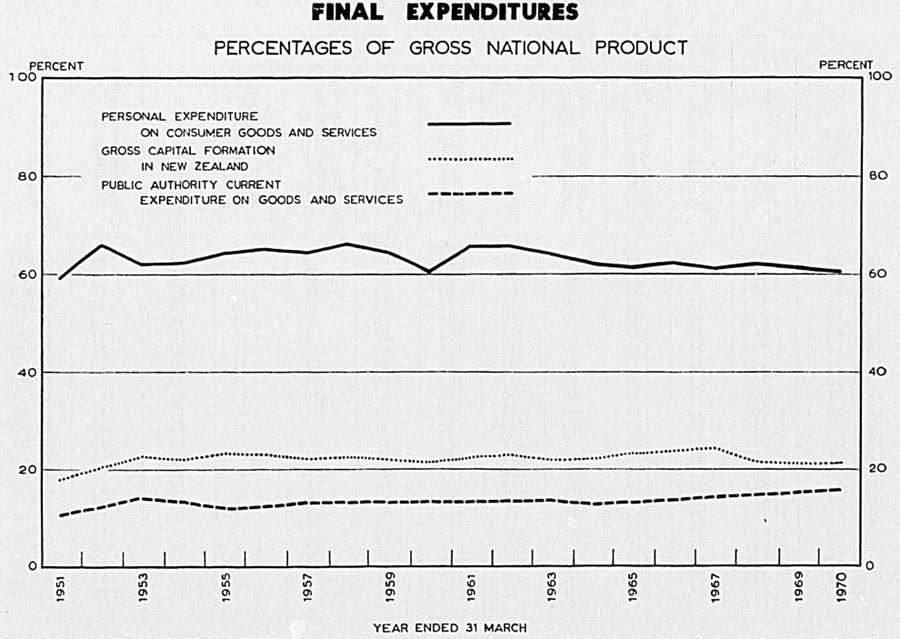
The first four of the following tables provide some more detailed analysis of particular aspects of the national accounts.
Private Income and Outlay—This table gives in detail the break-up of private income and, on the expenditure side, the manner in which these incomes are spent on personal expenditure on consumer goods and services, paid in direct taxation, or saved. An analysis of other personal income is given for each of the years.
The total of personal consumption derived from the preceding table is carried forward to this table and this time private savings is obtained as a residual item. The limitations of these two residual items have already been mentioned.
Revenue Account of Public Authorities—The Government sector is discussed in more detail later in this section, but this table gives a consolidated statement of Central Government and local authority revenue and expenditure, showing as a balance that portion of the revenue which was available for capital formation and other capital transactions.
Combined Capital Account—This account indicates the manner in which resources for capital formation have been made available (a) from private savings, (b) from revenue surpluses of public authorities, and (c) from amounts set aside as depreciation. Gross capital formation represents the construction in New Zealand or purchase from overseas of durable capital assets by the private, Central Government, and the local authority sectors, plus the net change in stocks of trading concerns.
Rest of World Account—An account of external economic transactions between New Zealand and other countries; it is, in essence, a balance of payments on current account for the period, presented here in abridged form.
These four tables, then, give a comprehensive picture in broad terms of the changing pattern of New Zealand's economy over a period of 30 years which has included the dislocating effects of a major war. One important point to consider when examining the tables, however, is that all the figures are at prices current during the period and consequently are inflated to a greater or less extent by price movements over the period.
| PRIVATE INCOME AND OUTLAY | ||||||||||||
|---|---|---|---|---|---|---|---|---|---|---|---|---|
| March Year | Salary and Wage Payments | Pay and Allowances of Armed Forces | Social Security Benefits and Pensions | Rental Value of Owner-occupied Houses | Other Personal Income | Company Income Before Distribution | Private Income (Before Tax) | |||||
| Farming | Manufacturing and Commerce | Professional and Other Services | Surplus of Primary Produce Stabilisation Accounts | Wool Retention Moneys and Supplementary Payments | Interest, Rent, etc. | |||||||
| * Provisional. | ||||||||||||
| INCOME $(million) | ||||||||||||
| 1938-39 | 223 | 2 | 15 | 13 | 51 | 22 | 10 | - 3 | –– | 29 | 39 | 400 |
| 1948-49 | 454 | 9 | 78 | 23 | 128 | 62 | 24 | 22 | –– | 32 | 97 | 928 |
| 1949-50 | 500 | 9 | 84 | 25 | 168 | 68 | 28 | 18 | –– | 32 | 116 | 1,048 |
| 1950-51 | 557 | 12 | 94 | 27 | 236 | 82 | 32 | 35 | 66 | 36 | 142 | 1,319 |
| 1951-52 | 656 | 17 | 105 | 30 | 209 | 96 | 36 | 11 | - 5 | 36 | 160 | 1,350 |
| 1952-53 | 696 | 21 | 107 | 33 | 232 | 104 | 38 | 8 | -12 | 38 | 155 | 1,420 |
| 1953-54 | 769 | 24 | 115 | 37 | 259 | 115 | 42 | 3 | -11 | 40 | 181 | 1,572 |
| 1954-55 | 862 | 24 | 122 | 40 | 263 | 126 | 44 | 1 | -11 | 40 | 195 | 1,706 |
| 1955-56 | 937 | 24 | 128 | 43 | 257 | 132 | 46 | 11 | -13 | 40 | 188 | 1,794 |
| 1956-57 | 990 | 24 | 132 | 46 | 290 | 142 | 50 | -10 | -12 | 42 | 197 | 1,891 |
| 1957-58 | 1,068 | 26 | 139 | 48 | 287 | 156 | 58 | -39 | –– | 42 | 211 | 1,997 |
| 1958-59 | 1,116 | 25 | 160 | 50 | 249 | 145 | 58 | 1 | –– | 44 | 219 | 2,065 |
| 1959-60 | 1,181 | 26 | 198 | 51 | 279 | 151 | 58 | 20 | –– | 46 | 242 | 2,251 |
| 1960-61 | 1,277 | 27 | 213 | 51 | 289 | 177 | 66 | -11 | –– | 48 | 291 | 2,429 |
| 1961-62 | 1,365 | 27 | 218 | 60 | 251 | 186 | 68 | -10 | –– | 50 | 288 | 2,503 |
| 1962-63 | 1,445 | 29 | 219 | 81 | 272 | 194 | 74 | 6 | –– | 52 | 323 | 2,694 |
| 1963-64 | 1,554 | 30 | 229 | 86 | 315 | 204 | 76 | 9 | 8 | 54 | 370 | 2,937 |
| 1964-65 | 1,723 | 32 | 234 | 96 | 321 | 216 | 84 | 11 | 2 | 58 | 418 | 3,194 |
| 1965-66 | 1,890 | 35 | 242 | 109 | 332 | 229 | 88 | 2 | - 5 | 64 | 475 | 3,460 |
| 1966-67 | 2,041 | 39 | 252 | 119 | 298 | 213 | 97 | -15 | - 4 | 74 | 464 | 3,577 |
| 1967-68 | 2,128 | 42 | 270 | 129 | 289 | 207 | 101 | -13 | - 2 | 76 | 456 | 3,683 |
| 1968-69 | 2,246 | 43 | 278 | 136 | 300 | 214 | 109 | - 8 | - | 80 | 511 | 3,909 |
| 1969-70* | 2,490 | 45 | 299 | 150 | 292 | 227 | 118 | - 8 | 3 | 83 | 577 | 4,274 |
| March Year | Personal Expenditure on Consumer Goods and Services | Net Transfers to Rest of World | Direct Taxation | Private Savings | Private Outlay | |
|---|---|---|---|---|---|---|
| Undistributed Profits of Companies | Savings Other Private Savings | |||||
| * Provisional. | ||||||
| OUTLAY $(million) | ||||||
| 1938-39 | 322 | 2 | 48 | 28 | 400 | |
| 1948-49 | 697 | 2 | 188 | 17 | 24 | 928 |
| 1949-50 | 709 | 4 | 192 | 36 | 107 | 1,048 |
| 1950-51 | 830 | 4 | 226 | 57 | 202 | 1,319 |
| 1951-52 | 956 | - 4 | 284 | 49 | 65 | 1,350 |
| 1952-53 | 938 | - 3 | 292 | 39 | 154 | 1,420 |
| 1953-54 | 1,049 | 1 | 308 | 58 | 156 | 1,572 |
| 1954-55 | 1,201 | 2 | 336 | 57 | 110 | 1,706 |
| 1955-56 | 1,275 | –– | 348 | 42 | 129 | 1,794 |
| 1956-57 | 1,326 | –– | 370 | 46 | 149 | 1,891 |
| 1957-58 | 1,445 | - 1 | 345 | 45 | 163 | 1,997 |
| 1958-59 | 1,459 | 3 | 442 | 64 | 97 | 2,065 |
| 1959-60 | 1,465 | 6 | 420 | 77 | 283 | 2,251 |
| 1960-61 | 1,723 | 8 | 493 | 83 | 122 | 2,429 |
| 1961-62 | 1,793 | 8 | 531 | 61 | 110 | 2,503 |
| 1962-63 | 1,878 | 9 | 505 | 87 | 215 | 2,694 |
| 1963-64 | 1,993 | 7 | 542 | 108 | 287 | 2,937 |
| 1964-65 | 2,134 | 10 | 629 | 101 | 320 | 3,194 |
| 1965-66 | 2,368 | 17 | 691 | 154 | 230 | 3,460 |
| 1966-67 | 2,394 | 17 | 755 | 144 | 267 | 3,577 |
| 1967-68 | 2,541 | 13 | 767 | 141 | 221 | 3,683 |
| 1968-69 | 2,667 | 8 | 791 | 190 | 253 | 3,909 |
| 1969-70* | 2,871 | 10 | 889 | 216 | 288 | 4,274 |
The following diagram presents the distribution of private outlay (shown in the second part of the preceding table) in graphical form.
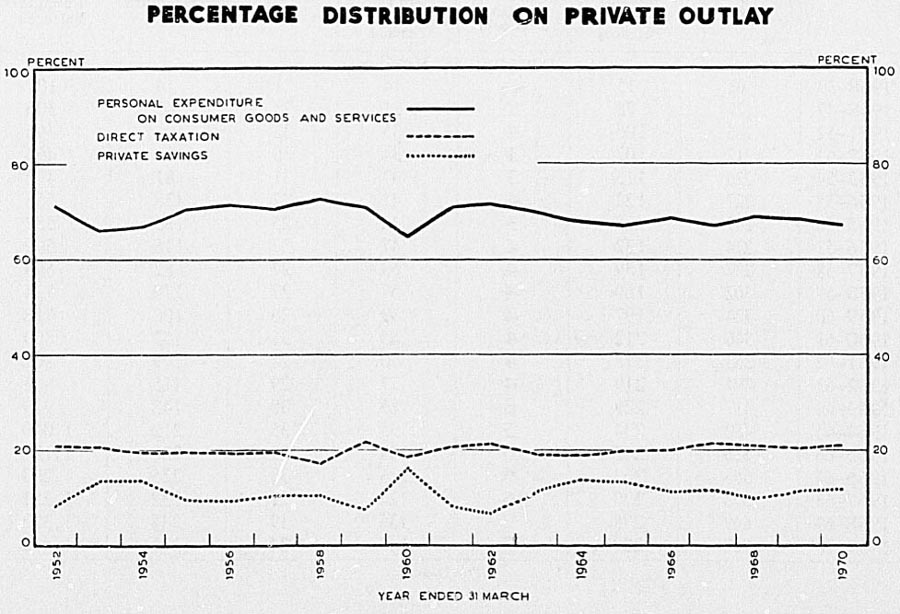
| REVENUE ACCOUNT OF PUBLIC AUTHORITIES (CENTRAL GOVERNMENT AND LOCAL AUTHORITIES) | |||||
|---|---|---|---|---|---|
| March Year | Taxation | Trading Income | Less Direct Taxes Paid by Public Authority Trading Undertakings | Total Revenue | |
| Direct | Indirect | ||||
| * Provisional. | |||||
| REVENUE $(million) | |||||
| 1938-39 | 48 | 41 | 18 | –– | 107 |
| 1948-49 | 190 | 92 | 26 | - 3 | 305 |
| 1951-52 | 288 | 142 | 40 | - 4 | 466 |
| 1952-53 | 296 | 134 | 39 | - 5 | 464 |
| 1953-54 | 311 | 135 | 50 | - 4 | 492 |
| 1954-55 | 342 | 161 | 60 | - 5 | 558 |
| 1955-56 | 354 | 171 | 64 | - 6 | 582 |
| 1956-57 | 376 | 168 | 61 | - 6 | 599 |
| 1957-58 | 350 | 182 | 65 | - 4 | 593 |
| 1958-59 | 447 | 208 | 74 | - 5 | 724 |
| 1959-60 | 425 | 217 | 82 | - 6 | 718 |
| 1960-61 | 499 | 226 | 91 | - 7 | 809 |
| 1961-62 | 538 | 231 | 100 | - 7 | 862 |
| 1962-63 | 512 | 228 | 105 | - 8 | 838 |
| 1963-64 | 551 | 254 | 123 | - 9 | 919 |
| 1964-65 | 640 | 276 | 136 | -11 | 1,040 |
| 1965-66 | 702 | 289 | 147 | -11 | 1,127 |
| 1966-67 | 767 | 301 | 147 | -12 | 1,203 |
| 1967-68 | 780 | 316 | 168 | -13 | 1,251 |
| 1968-69 | 806 | 343 | 188 | -15 | 1,323 |
| 1969-70* | 905 | 376 | 207 | -17 | 1,472 |
| March Year | Current Expenditure on Goods and Services | Transfer Income | Subsidies | Balance of Revenue Over Expenditure | Total Expenditure Plus or Minus Revenue Balances | ||
|---|---|---|---|---|---|---|---|
| Social Security Benefits and Pensions | Net Transfers to Rest of World | Interest on Public Debt Paid in New Zealand | |||||
| *Provisional. | |||||||
| EXPENDITURE $(million) | |||||||
| 1938-39 | 63 | 15 | –– | 14 | 1 | 14 | 107 |
| 1948-49 | 127 | 78 | 2 | 31 | 23 | 45 | 305 |
| 1951-52 | 186 | 105 | 4 | 35 | 32 | 104 | 466 |
| 1952-53 | 212 | 107 | 3 | 34 | 30 | 78 | 464 |
| 1953-54 | 226 | 115 | 3 | 37 | 31 | 81 | 492 |
| 1954-55 | 227 | 122 | 4 | 41 | 27 | 138 | 558 |
| 1955-56 | 249 | 128 | 3 | 42 | 25 | 135 | 582 |
| 1956-57 | 274 | 132 | 4 | 47 | 27 | 116 | 599 |
| 1957-58 | 287 | 139 | 4 | 53 | 27 | 82 | 593 |
| 1958-59 | 302 | 160 | 4 | 57 | 27 | 174 | 724 |
| 1959-60 | 324 | 197 | 4 | 59 | 26 | 108 | 718 |
| 1960-61 | 346 | 212 | 4 | 65 | 31 | 152 | 809 |
| 1961-62 | 363 | 218 | 4 | 70 | 28 | 179 | 862 |
| 1962-63 | 394 | 219 | 4 | 77 | 29 | 115 | 838 |
| 1963-64 | 417 | 229 | 6 | 89 | 30 | 148 | 919 |
| 1964-65 | 460 | 234 | 5 | 95 | 35 | 212 | 1,040 |
| 1965-66 | 516 | 242 | 6 | 104 | 39 | 220 | 1,127 |
| 1966-67 | 565 | 252 | 6 | 116 | 39 | 225 | 1,203 |
| 1967-68 | 598 | 270 | 6 | 124 | 21 | 232 | 1,251 |
| 1968-69 | 649 | 278 | 7 | 136 | 19 | 234 | 1,323 |
| 1969-70* | 722 | 299 | 7 | 148 | 24 | 271 | 1,472 |
| COMBINED CAPITAL ACCOUNT | ||||||||||||
|---|---|---|---|---|---|---|---|---|---|---|---|---|
| March Year | Private Savings | Revenue Balances of Public Authorities | Depreciation Allowances | Total Savings | Gross Capital Formation in New Zealand | Changes in Stocks | Net Investment Overseas | Total Investments | ||||
| Private | Central Government Trading Undertakings | Local Authorities Trading Undertakings | ||||||||||
| * Provisional. | ||||||||||||
| 1938-39 | 28 | 14 | 34 | 77 | 35 | 32 | 12 | 10 | - 12 | 77 | ||
| 1948-49 | 41 | 45 | 64 | 151 | 101 | 62 | 16 | - 38 | 10 | 151 | ||
| 1949-50 | 143 | 33 | 70 | 246 | 116 | 76 | 18 | 28 | 8 | 246 | ||
| 1950-51 | 259 | 70 | 78 | 406 | 152 | 80 | 20 | 98 | 56 | 406 | ||
| 1951-52 | 114 | 104 | 86 | 304 | 186 | 81 | 25 | 74 | - 62 | 304 | ||
| 1952-53 | 193 | 78 | 96 | 366 | 202 | 109 | 38 | 26 | - 9 | 366 | ||
| 1953-54 | 214 | 80 | 92 | 11 | 3 | 402 | 215 | 114 | 44 | -42 | 71 | 402 |
| 1954-55 | 167 | 138 | 106 | 14 | 3 | 427 | 277 | 115 | 49 | 58 | - 72 | 427 |
| 1955-56 | 171 | 135 | 114 | 15 | 3 | 437 | 266 | 129 | 58 | 38 | - 54 | 437 |
| 1956-57 | 195 | 116 | 127 | 16 | 4 | 457 | 256 | 138 | 65 | 20 | - 22 | 457 |
| 1957-58 | 208 | 82 | 135 | 18 | 4 | 448 | 287 | 140 | 74 | 32 | - 85 | 448 |
| 1958-59 | 161 | 174 | 141 | 20 | 5 | 502 | 290 | 137 | 77 | 31 | - 33 | 502 |
| 1959-60 | 360 | 108 | 141 | 22 | 5 | 636 | 297 | 142 | 84 | 26 | 87 | 636 |
| 1960-61 | 205 | 152 | 155 | 24 | 6 | 542 | 366 | 149 | 84 | 44 | - 101 | 542 |
| 1961-62 | 171 | 179 | 173 | 24 | 6 | 553 | 393 | 147 | 94 | 24 | - 105 | 553 |
| 1962-63 | 302 | 115 | 185 | 26 | 7 | 635 | 387 | 153 | 102 | 35 | - 42 | 635 |
| 1963-64 | 395 | 148 | 197 | 27 | 7 | 774 | 423 | 180 | 106 | 92 | - 27 | 774 |
| 1964-65 | 421 | 212 | 213 | 27 | 9 | 882 | 500 | 196 | 116 | 100 | - 30 | 882 |
| 1965-66 | 384 | 220 | 235 | 28 | 10 | 877 | 566 | 218 | 125 | 147 | - 178 | 877 |
| 1966-67 | 411 | 225 | 257 | 33 | 10 | 936 | 584 | 242 | 129 | 144 | - 163 | 936 |
| 1967-68 | 362 | 232 | 274 | 35 | 12 | 915 | 494 | 244 | 132 | 132 | - 87 | 915 |
| 1968-69 | 443 | 234 | 294 | 39 | 14 | 1,024 | 546 | 237 | 136 | 64 | 41 | 1,024 |
| 1969-70* | 504 | 271 | 313 | 43 | 15 | 1,146 | 617 | 235 | 154 | 120 | 21 | 1,146 |
| REST OF WORLD ACCOUNT | ||||||||
|---|---|---|---|---|---|---|---|---|
| March Year | Exports of | Imports of | Net Factor Payments | Net Transfers | Surplus on Current Account | |||
| Goods | Services | Goods | Services | Private | Public Authorities | |||
| * Provisional. | ||||||||
| $(million) | ||||||||
| 1938-39 | 6 | -16 | - 2 | –– | - 12 | |||
| 1948-49 | 26 | -12 | - 2 | -2 | 10 | |||
| 1950-51 | 429 | -354 | -12 | - 4 | -2 | 56 | ||
| 1951-52 | 501 | 25 | -474 | -101 | -13 | 4 | -3 | - 62 |
| 1952-53 | 476 | 40 | -415 | - 98 | -11 | 3 | -3 | - 9 |
| 1953-54 | 491 | 34 | -362 | - 79 | - 9 | - 1 | -3 | 71 |
| 1954-55 | 471 | 36 | -459 | - 98 | -17 | - 2 | -4 | - 72 |
| 1955-56 | 524 | 41 | -498 | -103 | -14 | –– | -3 | - 54 |
| 1956-57 | 548 | 47 | -488 | -108 | -17 | -4 | - 22 | |
| 1957-58 | 540 | 53 | -545 | -112 | -17 | 1 | -4 | - 85 |
| 1958-59 | 528 | 48 | -468 | -110 | -24 | - 3 | -4 | - 33 |
| 1959-60 | 622 | 49 | -442 | -113 | -19 | - 6 | -4 | 87 |
| 1960-61 | 574 | 56 | -546 | -137 | -37 | - 8 | -4 | -101 |
| 1961-62 | 581 | 53 | -550 | -145 | -31 | - 8 | -4 | -105 |
| 1962-63 | 607 | 63 | -509 | -145 | -46 | - 9 | -4 | - 42 |
| 1963-64 | 720 | 67 | -601 | -158 | -42 | - 7 | -6 | - 27 |
| 1964-65 | 767 | 70 | -616 | -177 | -59 | - 10 | -5 | - 29 |
| 1965-66 | 749 | 82 | -722 | -211 | -54 | - 17 | -6 | -177 |
| 1966-67 | 787 | 95 | -723 | -232 | -66 | -17 | -6 | -161 |
| 1967-68 | 750 | 103 | -636 | -229 | -55 | - 13 | -6 | - 87 |
| 1968-69 | 975 | 147 | -720 | -266 | -81 | - 8 | -7 | 41 |
| 1969-70* | 1,112 | 161 | -825 | -309 | -100 | - 10 | -7 | 21 |
CONSTANT PRICE ESTIMATES OF THE MAIN AGGREGATES—National accounting aggregates are, by their nature, summations of the values of all goods and services produced or consumed in a particular year. If the values of goods and services are expressed in current prices (i.e. the market prices prevailing in each particular year) then any comparison between two or more years is affected not only by changes in the volume of production between those years but in annual price movements as well. The effect of annual price movements is eliminated if all annual values are expressed in the average prices of a base period; the base here used is the year 1954-55. By expressing the aggregates in constant prices, and not in current values as in the preceding tables, their real value in terms of goods and services, either produced or available for use can be better appreciated.
Three of the principal national accounts aggregates, gross national product, gross domestic product, and gross domestic expenditure, are expressed in current as well as 1954-55 prices in the following table:
| Year | At Current Prices | At Constant 1954-55 Prices | ||||
|---|---|---|---|---|---|---|
| Gross National Product | Gross Domestic Product | Gross Domestic Expenditure | Gross National Product | Gross Domestic Product | Gross Domestic Expenditure | |
| * Provisional. | ||||||
| $(million) | ||||||
| 1954-55 | 1,860 | 1,877 | 1,927 | 1,860 | 1,877 | 1,927 |
| 1955-56 | 1,965 | 1,979 | 2,015 | 1,932 | 1,946 | 1,961 |
| 1956-57 | 2,061 | 2,078 | 2,079 | 1,968 | 1,984 | 1,955 |
| 1957-58 | 2,184 | 2,201 | 2,265 | 2,071 | 2,087 | 2,102 |
| 1958-59 | 2,270 | 2,294 | 2,296 | 2,123 | 2,145 | 2,031 |
| 1959-60 | 2,434 | 2,454 | 2,338 | 2,212 | 2,230 | 2,086 |
| 1960-61 | 2,623 | 2,659 | 2,712 | 2,334 | 2,367 | 2,359 |
| 1961-62 | 2,723 | 2,753 | 2,814 | 2,418 | 2,446 | 2,394 |
| 1962-63 | 2,921 | 2,966 | 2,949 | 2,483 | 2,521 | 2,418 |
| 1963-64 | 3,197 | 3,240 | 3,211 | 2,639 | 2,675 | 2,633 |
| 1964-65 | 3,491 | 3,550 | 3,506 | 2,791 | 2,838 | 2,842 |
| 1965-66 | 3,784 | 3,837 | 3,939 | 2,969 | 3,011 | 3,105 |
| 1966-67 | 3,919 | 3,984 | 4,058 | 3,084 | 3,135 | 3,229 |
| 1967-68 | 4,074 | 4,129 | 4,141 | 3,071 | 3,112 | 3,021 |
| 1968-69 | 4,354 | 4,434 | 4,299 | 3,104 | 3,161 | 2,921 |
| 1969-70* | 4,757 | 4,856 | 4,718 | 3,266 | 3,334 | 3,102 |
THE DISTRIBUTION OF PRIVATE INCOME—The following table gives an analysis of private income, direct taxes paid on that income, and private disposable income over the years. In the two following tables the items of private income and private disposable income are shown as percentages of the whole.
| PRIVATE INCOME AND INCIDENCE OF DIRECT TAXATION | |||||||
|---|---|---|---|---|---|---|---|
| March Year | Salary and Wage Payments | Pay and Allowances of Armed Forces | Social Security Benefits and Pensions | Rental Value, Owner-occupied Houses | Other Personal Income† (Excluding Company Dividends) | Company Income (Before Distribution) | Private Income |
* Provisional. † Includes changes in primary-produce reserve accounts. | |||||||
| PRIVATE INCOME $(million) | |||||||
| 1938-39 | 222 | 2 | 15 | 13 | 109 | 39 | 400 |
| 1939-40 | 222 | 6 | 22 | 13 | 119 | 50 | 431 |
| 1940-41 | 236 | 31 | 24 | 15 | 116 | 47 | 470 |
| 1941-42 | 242 | 51 | 25 | 15 | 124 | 55 | 513 |
| 1942-43 | 254 | 92 | 28 | 16 | 134 | 66 | 589 |
| 1943-44 | 281 | 117 | 31 | 17 | 144 | 73 | 663 |
| 1944-45 | 294 | 97 | 34 | 18 | 159 | 76 | 678 |
| 1945-46 | 324 | 79 | 41 | 19 | 175 | 83 | 720 |
| 1946-47 | 373 | 16 | 69 | 20 | 221 | 96 | 795 |
| 1947-48 | 420 | 13 | 74 | 22 | 260 | 106 | 894 |
| 1948-49 | 454 | 9 | 78 | 23 | 268 | 97 | 928 |
| 1949-50 | 500 | 9 | 84 | 25 | 314 | 116 | 1,048 |
| 1950-51 | 557 | 12 | 94 | 27 | 487 | 142 | 1,319 |
| 1951-52 | 656 | 17 | 105 | 30 | 382 | 160 | 1,350 |
| 1952-53 | 696 | 21 | 107 | 33 | 408 | 155 | 1,420 |
| 1953-54 | 769 | 24 | 115 | 37 | 448 | 181 | 1,572 |
| 1954-55 | 862 | 24 | 122 | 40 | 463 | 195 | 1,706 |
| 1955-56 | 937 | 24 | 128 | 43 | 473 | 188 | 1,794 |
| 1956-57 | 990 | 24 | 132 | 46 | 502 | 197 | 1,891 |
| 1957-58 | 1,068 | 26 | 139 | 48 | 504 | 211 | 1,997 |
| 1958-59 | 1,116 | 24 | 160 | 50 | 496 | 219 | 2,065 |
| 1959-60 | 1,181 | 26 | 198 | 51 | 553 | 242 | 2,251 |
| 1960-61 | 1,277 | 27 | 213 | 51 | 569 | 291 | 2,429 |
| 1961-62 | 1,365 | 27 | 218 | 60 | 545 | 288 | 2,503 |
| 1962-63 | 1,445 | 29 | 219 | 81 | 598 | 323 | 2,694 |
| 1963-64 | 1,554 | 30 | 229 | 86 | 666 | 370 | 2,937 |
| 1964-65 | 1,723 | 32 | 234 | 96 | 692 | 418 | 3,194 |
| 1965-66 | 1,890 | 35 | 242 | 109 | 710 | 475 | 3,460 |
| 1966-67 | 2,041 | 39 | 252 | 119 | 663 | 464 | 3,577 |
| 1967-68 | 2,128 | 42 | 270 | 129 | 658 | 456 | 3,683 |
| 1968-69 | 2,246 | 43 | 278 | 136 | 695 | 511 | 3,909 |
| 1969-70* | 2,490 | 45 | 299 | 150 | 715 | 577 | 4,274 |
| March Year | Salary and Wage Payments | Pay and Allowances of Armed Forces | Social Security Benefits and Pensions | Other Personal Income (Including Rental Value of Owner-occupied Houses) | Company Income (Before Distribution) | Total |
|---|---|---|---|---|---|---|
* Provisional. † Excludes direct taxes on Government trading profits. | ||||||
| DIRECT TAXES† $(million) | ||||||
| 1938-39 | 10 | –– | 24 | 14 | 48 | |
| 1939-40 | 16 | –– | 27 | 18 | 61 | |
| 1940-41 | 25 | 2 | 38 | 27 | 91 | |
| 1941-42 | 31 | 2 | 41 | 28 | 103 | |
| 1942-43 | 39 | 6 | 48 | 39 | 133 | |
| 1943-44 | 47 | 7 | 52 | 46 | 151 | |
| 1944-45 | 49 | 8 | 53 | 53 | 162 | |
| 1945-46 | 53 | 7 | 59 | 51 | 170 | |
| 1946-47 | 48 | 2 | 58 | 48 | 156 | |
| 1947-48 | 47 | 1 | 62 | 45 | 155 | |
| 1948-49 | 49 | 1 | 76 | 61 | 187 | |
| 1949-50 | 53 | 1 | 79 | 58 | 191 | |
| 1950-51 | 65 | 1 | 96 | 64 | 226 | |
| 1951-52 | 72 | 1 | 132 | 79 | 284 | |
| 1952-53 | 88 | 2 | 120 | 82 | 291 | |
| 1953-54 | 93 | 2 | 131 | 82 | 307 | |
| 1954-55 | 100 | 2 | 143 | 92 | 337 | |
| 1955-56 | 104 | 2 | 142 | 100 | 348 | |
| 1956-57 | 123 | 2 | 144 | 101 | 370 | |
| 1957-58 | 93 | 2 | 147 | 102 | 345 | |
| 1958-59 | 134 | 3 | 200 | 106 | 442 | |
| 1959-60 | 146 | 3 | 162 | 109 | 420 | |
| 1960-61 | 148 | 3 | 216 | 126 | 493 | |
| 1961-62 | 168 | 3 | 211 | 150 | 531 | |
| 1962-63 | 173 | 3 | 184 | 144 | 505 | |
| 1963-64 | 177 | 3 | 199 | 164 | 542 | |
| 1964-65 | 206 | 4 | 223 | 196 | 629 | |
| 1965-66 | 236 | 4 | 239 | 212 | 691 | |
| 1966-67 | 269 | 5 | 250 | 231 | 755 | |
| 1967-68 | 283 | 5 | 244 | 234 | 767 | |
| 1968-69 | 308 | 6 | 258 | 220 | 791 | |
| 1969-70* | 350 | 7 | 289 | 243 | 887 | |
| March Year | Salary and Wage Payments | Pay and Allowances of Armed Forces | Social Security Benefits and Pensions | Other Personal Income (Including Rental Value of Owner-occupied Houses) | Company Income (Before Distribution) | Total |
|---|---|---|---|---|---|---|
| * Provisional. | ||||||
| DISPOSABLE INCOME $(million) | ||||||
| 1938-39 | 213 | 2 | 113 | 25 | 352 | |
| 1939-40 | 206 | 6 | 128 | 31 | 370 | |
| 1940-41 | 211 | 30 | 118 | 20 | 378 | |
| 1941-42 | 210 | 49 | 124 | 27 | 410 | |
| 1942-43 | 215 | 86 | 130 | 26 | 456 | |
| 1943^14 | 234 | 110 | 141 | 27 | 512 | |
| 1944-45 | 246 | 89 | 159 | 22 | 516 | |
| 1945-46 | 271 | 72 | 175 | 33 | 551 | |
| 1946-47 | 326 | 14 | 251 | 48 | 639 | |
| 1947-48 | 373 | 12 | 294 | 60 | 739 | |
| 1948-49 | 405 | 8 | 293 | 36 | 741 | |
| 1949-50 | 447 | 8 | 344 | 53 | 857 | |
| 1950-51 | 492 | 11 | 512 | 78 | 1,092 | |
| 1951-52 | 584 | 16 | 386 | 81 | 1,066 | |
| 1952-53 | 608 | 20 | 427 | 74 | 1,129 | |
| 1953-54 | 676 | 22 | 468 | 99 | 1,265 | |
| 1954-55 | 762 | 22 | 482 | 103 | 1,369 | |
| 1955-56 | 832 | 22 | 503 | 89 | 1,446 | |
| 1956-57 | 867 | 22 | 536 | 96 | 1,522 | |
| 1957-58 | 975 | 24 | 544 | 109 | 1,652 | |
| 1958-59 | 982 | 22 | 506 | 113 | 1,623 | |
| 1959-60 | 1,035 | 23 | 640 | 133 | 1,831 | |
| 1960-61 | 1,130 | 24 | 618 | 165 | 1,936 | |
| 1961-62 | 1,197 | 24 | 612 | 138 | 1,972 | |
| 1962-63 | 1,272 | 26 | 713 | 179 | 2,190 | |
| 1963-64 | 1,378 | 27 | 783 | 207 | 2,395 | |
| 1964-65 | 1,517 | 29 | 799 | 221 | 2,566 | |
| 1965-66 | 1,654 | 30 | 822 | 262 | 2,769 | |
| 1966-67 | 1,772 | 34 | 782 | 233 | 2,822 | |
| 1967-68 | 1,844 | 36 | 814 | 222 | 2,916 | |
| 1968-69 | 1,938 | 37 | 852 | 291 | 3,118 | |
| 1969-70* | 2,140 | 38 | 875 | 333 | 3,386 | |
| PRIVATE INCOME | |||||||
|---|---|---|---|---|---|---|---|
| March Year | Salary and Wage Payments | Pay and Allowances of Armed Forces | Social Security Benefits and Pensions | Rental Value, Owner-occupied Houses | Other Personal Income† (Excluding Company Dividends) | Company Income (Before Distribution) | Private Income |
* Provisional. † Includes changes in primary produce stabilization accounts and wool retention moneys and supplementary payments. | |||||||
| AS PERCENTAGE OF PRIVATE INCOME | |||||||
| 1938-39 | 55.6 | 0.5 | 3.7 | 3.2 | 27.2 | 9.8 | 100.0 |
| 1939-40 | 51.4 | 1.3 | 5.2 | 3.1 | 27.5 | 11.5 | 100.0 |
| 1940-41 | 50.2 | 6.6 | 5.2 | 3.2 | 24.8 | 10.0 | 100.0 |
| 1941-42 | 47.1 | 9.9 | 4.9 | 3.0 | 24.3 | 10.8 | 100.0 |
| 1942-43 | 43.1 | 15.6 | 4.7 | 2.8 | 22.7 | 11.1 | 100.0 |
| 1943-44 | 42.4 | 17.6 | 4.7 | 2.6 | 21.7 | 11.0 | 100.0 |
| 1944-45 | 43.4 | 14.3 | 5.0 | 2.6 | 23.5 | 11.2 | 100.0 |
| 1945-46 | 45.0 | 10.9 | 5.7 | 2.6 | 24.2 | 11.6 | 100.0 |
| 1946-47 | 46.9 | 2.1 | 8.6 | 2.5 | 27.8 | 12.1 | 100.0 |
| 1947-48 | 47.0 | 1.4 | 8.3 | 2.4 | 29.1 | 11.8 | 100.0 |
| 1948-49 | 48.9 | 1.0 | 8.4 | 2.5 | 28.8 | 10.4 | 100.0 |
| 1949-50 | 47.7 | 0.9 | 8.0 | 2.4 | 30.0 | 11.0 | 100.0 |
| 1950-51 | 42.2 | 0.9 | 7.1 | 2.1 | 36.9 | 10.8 | 100.0 |
| 1951-52 | 48.6 | 1.2 | 7.8 | 2.2 | 28.3 | 11.9 | 100.0 |
| 1952-53 | 49.0 | 1.5 | 7.5 | 2.3 | 28.8 | 10.9 | 100.0 |
| 1953-54 | 48.9 | 1.5 | 7.3 | 2.3 | 28.5 | 11.5 | 100.0 |
| 1954-55 | 50.6 | 1.4 | 7.2 | 2.3 | 27.1 | 11.4 | 100.0 |
| 1955-56 | 52.2 | 1.3 | 7.2 | 2.4 | 26.4 | 10.5 | 100.0 |
| 1956-57 | 52.3 | 1.3 | 7.0 | 2.5 | 26.5 | 10.4 | 100.0 |
| 1957-58 | 53.5 | 1.3 | 7.0 | 2.4 | 25.2 | 10.6 | 100.0 |
| 1958-59 | 54.0 | 1.2 | 7.7 | 2.5 | 24.0 | 10.6 | 100.0 |
| 1959-60 | 52.4 | 1.2 | 8.8 | 2.3 | 24.6 | 10.7 | 100.0 |
| 1960-61 | 52.6 | 1.1 | 8.8 | 2.1 | 23.4 | 12.0 | 100.0 |
| 1961-62 | 54.5 | 1.1 | 8.7 | 2.4 | 21.8 | 11.5 | 100.0 |
| 1962-63 | 53.6 | 1.1 | 8.1 | 3.0 | 22.2 | 12.0 | 100.0 |
| 1963-64 | 53.0 | 1.0 | 7.8 | 2.9 | 22.7 | 12.6 | 100.0 |
| 1964-65 | 54.0 | 1.0 | 7.3 | 3.0 | 21.7 | 13.0 | 100.0 |
| 1965-66 | 54.6 | 1.0 | 7.0 | 3.2 | 20.5 | 13.7 | 100.0 |
| 1966-67 | 57.0 | 1.1 | 7.0 | 3.3 | 18.5 | 13.0 | 100.0 |
| 1967-68 | 57.8 | 1.1 | 7.3 | 3.5 | 17.9 | 12.4 | 100.0 |
| 1968-69 | 57.4 | 1.1 | 7.1 | 3.5 | 17.8 | 13.1 | 100.0 |
| 1969-70* | 58.2 | 1.0 | 7.0 | 3.5 | 16.7 | 13.5 | 100.0 |
THE PUBLIC AUTHORITY SECTOR—The Revenue account of public authorities shown on page 714 is a consolidation and simplification of a separate and more detailed Central Government Revenue Account on pages 722 and 723 and the local authorities Revenue Account on page 723. The Consolidated account eliminates all transfers between the two levels of Government and aggregates the respective totals of economically significant flows.
The publication The Accounts of the Government Sector 1963-64 to 1966-67 contains an integrated Government account which will ultimately replace the account presented herein. There are certain differences between the two which are due to differences in coverage, concepts employed in analysis, and improved methods. This new account is a preferable description of Government transactions, being more complete and exact. In the meantime, it cannot be used here for several important reasons. The new account is available for a limited number of years and as yet it has not been possible to revise earlier years. Furthermore, the national accounting concepts employed in the new Government account have not been extended to the rest of the national accounts and its introduction into the present system would cause incompatibilities in the various flows between the Government and private sector.
It is for these reasons that the existing presentation has been retained for the time being. Although the account on pages 722-723 is incomplete, its present advantage is that it can be speedily compiled.
(a) Central Government—The Revenue Account of the Central Government has been obtained by an analysis of the various accounts within the Public Account. In the case of trading Department operations, which are treated separately, profits only are brought into the main account as a revenue item. Expenditure has been taken “net” in all cases, sundry departmental receipts being set off against departmental expenditure. The account covers only current revenue items and therefore excludes capital receipts and payments of all kinds, thus accounting in part for the differences between the details given here and those given in the published statement of the Public Accounts in parliamentary paper B. 1 [Pt. I].
Current expenditure on goods and services by Government (shown as item 6 on page 722), rose from $484.4 million in 1968-69 to $539.9 million in 1969-70. A better measure of the relativity of Government expenditure is given by comparing it with gross national product. In 1969-70 Central Government expenditure amounted to 11.3 percent of gross national product compared with 11.1 percent in 1968-69.
Although all Government transfer expenditure—social security cash benefits and pensions, interest on public debt, and subsidies—is also paid from the Government's taxation revenue and trading profits, it is not part of Government final consumption. It only becomes final consumption in the hands of recipients, or, in the case of subsidies, can be looked upon as an offset to indirect taxation which reduces prices to consumers. For this reason the best measure of transfers is the national income itself on which they are a charge and which they redistribute.
Social security benefits and pensions, the most important item of the transfer group (Item 7a and 7b on page 722), were $299.1 million in 1969-70 or 7.5 percent higher than in 1968-69; expressed as a percentage of national income, they were 7.4 percent in 1969-70, whereas the average in the latest five years was 7.5 percent.
With the removal of subsidies from some basic foodstuffs in recent years their importance has declined. The average subsidy bill for the three years to 1969-70 as a proportion of national income was 0.6 percent compared with an average of 1.2 percent for the previous three years.
Interest on Government debt paid in New Zealand was 2.8 percent of national income in both 1968-69 and 1969-70. Interest on Government debt paid overseas, $30.8 million in 1969-70, is treated as a factor payment to non-residents and is included in current expenditure totals; it is shown as item 6b in the table on page 722.
Transfers to local authorities is a flow which can be most usefully measured against current Government revenue from taxation as it represents a shift from local to national taxation. The proportion of total Central Government revenue transferred to local authorities has fluctuated between 11.7 and 12.2 percent over the past five years, being 11.7 percent in 1969-70.
Transfers to local authorities is a flow which can be most usefully measured against current Government revenue from taxation as it represents a shift from local to national taxation. The proportion of total Central Government revenue transferred to local authorities has fluctuated between 11.7 and 12.2 percent over the past five years, being 11.7 percent in 1969-70.
The balance of revenue over expenditure is the Government's surplus on current transactions and is, together with the depreciation provisions of Government trading undertakings, available for capital formation, lending, and debt repayment. Its magnitude changes appreciably from year to year both absolutely and in relation to total current revenue and is the result of short-term changes in fiscal and economic policies pursued by the administration. Year to year changes in the Government's surplus are, however, complementary to changes (in the opposite direction) in private savings. This is of course, merely a reflection of the fact that changes in taxation policies are a major cause of the redistribution of total savings as between the private and Government sector. From a long-term point of view, however, it is important to observe the changes in Government fiscal policy from pre-war to present days: in 1938-39, 4.8 percent of the Government's revenue was saved. In 1969-70 the proportion was 14.1 percent.
| CENTRAL GOVERNMENT—REVENUE ACCOUNT | |||||||
|---|---|---|---|---|---|---|---|
| Item | 1938-39 | 1964-65† | 1965-66 | 1966-67 | 1967-68 | 1968-69 | 1969-70* |
*Provisional. †In 1964-65 the Government stopped paying hospital benefits and made direct grants to hospital boards instead. Items 6 (e) and 9 (a) are affected in this and the following years. | |||||||
| 1. TAXATION— | |||||||
| (a) Direct: | REVENUE $(million) | ||||||
| Income tax | 18.6 | 362.3 | 401.2 | 443.4 | 440.3 | 456.7} | 779.2 |
| Social security taxation | 11.0 | 185.4 | 204.7 | 221.0 | 232.5 | 234.8 | |
| Land tax | 2.2 | 2.6 | 3.2 | 3.5 | 4.4 | 2.7 | 2.9 |
| Death duties | 3.6 | 20.5 | 22.3 | 22.5 | 21.4 | 23.6 | 26.1 |
| Other | 0.2 | - | - | - | - | ||
| Totals | 35.6 | 570.8 | 631.4 | 690.4 | 698.6 | 717.9 | 808.1 |
| (b) Indirect: | |||||||
| Sales tax | 7.2 | 77.0 | 76.6 | 78.9 | 75.4 | 82.8 | 97.6 |
| Customs and excise duties | 23.4 | 114.5 | 121.7 | 126.8 | 131.1 | 142.2 | 152.8 |
| Motor vehicles taxation | 6.2 | 61.0 | 65.8 | 70.1 | 87.0 | 94.2 | 98.4 |
| Other | 3.4 | 20.7 | 21.9 | 22.2 | 20.2 | 21.0 | 24.1 |
| Totals | 40.0 | 273.2 | 286.0 | 298.0 | 313.7 | 340.3 | 372.9 |
| 2. Totals, all taxation | 75.6 | 844.1 | 917.5 | 988.3 | 1,012.3 | 1,058.2 | 1,181.0 |
| 3. TRADING INCOME | 11.6 | 108.2 | 117.8 | 112.0 | 128.7 | 145.9 | 161.2 |
| 4. Less, direct taxation paid by trading departments | -0.4 | -11.0 | -11.1 | -11.7 | -13.1 | -15.1 | -16.9 |
| Totals | 11.2 | 97.2 | 106.7 | 100.3 | 115.6 | 130.8 | 144.3 |
| 5. TOTAL REVENUE | 86.8 | 941.3 | 1,024.2 | 1,088.6 | 1,127.9 | 1,189.0 | 1,325.3 |
| 6. CURRENT EXPENDITURE ON GOODS GOODS AND SERVICES— | EXPENDITURE $(million) | ||||||
| (a) General administration | 4.4 | 45.0 | 52.0 | 53.5 | 53.0 | 54.9 | 61.4 |
| (b) Interest | 13.6 | 15.2 | 15.2 | 17.2 | 21.6 | 28.8 | 30.8 |
| (c) Law and order | 1.6 | 10.4 | 10.6 | 12.8 | 13.4 | 13.0 | 16.4 |
| (d) Development of primary and secondary industries | 1.4 | 32.2 | 35.4 | 38.4 | 40.0 | 42.3 | 52.6 |
| (e) Health | 1.6 | 58.8 | 64.2 | 69.2 | 73.3 | 77.7 | 86.8 |
| (f) Education | 8.4 | 99.0 | 110.4 | 124.4 | 136.8 | 145.6 | 168.4 |
| (g) Other social services | 6.6 | 5.2 | 4.6 | 3.4 | 5.2 | 7.0 | 4.9 |
| (h) Defence | 4.2 | 72.2 | 79.4 | 86.2 | 83.7 | 95.8 | 101.4 |
| (i) Rehabilitation | .. | 1.4 | 1.4 | 1.3 | 1.2 | 1.1 | 1.1 |
| (j) Maintenance of public works and services | 4.6 | 7.4 | 7.8 | 12.0 | 14.2 | 18.2 | 16.1 |
| Totals | 46.4 | 346.8 | 381.0 | 418.4 | 442.4 | 484.4 | 539.9 |
| 7. TRANSFER INCOME— | |||||||
| (a) Monetary social security benefits and pensions | 14.8 | 225.6 | 234.8 | 245.4 | 263.6 | 271.6 | 293.1 |
| (b) Family benefit advances | - | 8.0 | 7.4 | 6.2 | 6.1 | 6.6 | 6.0 |
| (c) Net transfers to rest of world | 0.2 | 4.7 | 5.9 | 6.3 | 6.4 | 6.6 | 7.3 |
| 8. Interest on central Government debt paid in New Zealand | 9.4 | 72.0 | 79.2 | 88.7 | 94.2 | 103.6 | 113.4 |
| Totals | 24.4 | 310.3 | 327.3 | 346.6 | 370.3 | 388.4 | 419.8 |
| Item | 1938-39 | 1964-65† | 1965-66 | 1966-67 | 1967-68 | 1968-69 | 1969-70* |
|---|---|---|---|---|---|---|---|
*Provisional. †See note on previous page. | |||||||
| 9. TRANSFERS TO LOCAL AUTHORITIES— | EXPENDITURE $(million) | ||||||
| (a) Hospital Boards | 1.8 | 73.2 | 83.8 | 92.5 | 94.9 | 101.1 | 113.3 |
| (b) Other | 8.8 | 36.4 | 40.8 | 38.9 | 38.5 | 42.3 | 41.9 |
| Totals | 10.6 | 109.6 | 124.6 | 131.4 | 133.4 | 143.4 | 155.2 |
| 10. SUBSIDIES | 1.2 | 35.3 | 39.2 | 39.2 | 21.0 | 18.9 | 23.6 |
| 11. TOTAL EXPENDITURE | 82.6 | 802.0 | 872.1 | 935.6 | 967.1 | 1,035.1 | 1,138.5 |
| 12. Balance of revenue over expenditure | 4.2 | 139.3 | 152.1 | 153.0 | 160.8 | 153.9 | 186.8 |
| 13. TOTAL EXPENDITURE PLUS REVENUE BALANCES | 86.8 | 941.3 | 1,024.2 | 1,088.6 | 1,127.9 | 1,189.0 | 1,325.3 |
(b) Local Authorities—The revenue account of local authorities is in all respects similar to that of the Central Government and has been obtained by an analysis of the accounts of all local authorities including hospital boards. In 1969-70 the Central Government contributed 51.5 percent of the revenue of local authorities through transfers. Trading profits contributed a further 15.2 percent, and rates and licence fees at 33.3 percent continued the pattern of recent years.
Current expenditure on goods and services by local authorities in 1969-70, at $182.3 million was 10.8 percent higher than in the previous year, whereas the increase in Central Government current expenditure on goods and services was 11.5 percent. The limitations in the scope of local government activities as compared with those of the Central Government do not call for a detailed analysis of expenditure items and therefore current expenditure on the provision of goods and services by local authorities is shown as a single total.
| LOCAL AUTHORITIES—REVENUE ACCOUNT | |||||||
|---|---|---|---|---|---|---|---|
| Item | 1938-39 | 1964-65 | 1965-66 | 1966-67 | 1967-68 | 1968-69* | 1969-70* |
| *Provisional. | |||||||
| 14. TAXATION— | REVENUE $(million) | ||||||
| (a) Direct: Rates | 12.4 | 68.8 | 70.3 | 76.3 | 81.2 | 88.6 | 97.1 |
| (b) Indirect: Licence fees | 1.2 | 2.8 | 2.9 | 2.9 | 2.8 | 3.0 | 3.2 |
| Totals | 13.6 | 71.6 | 73.2 | 79.2 | 84.0 | 91.5 | 100.3 |
| 15. Trading income | 6.8 | 27.5 | 29.2 | 34.9 | 39.5 | 42.4 | 45.8 |
| 16. Transfers from central Government | 10.6 | 109.7 | 124.6 | 131.4 | 133.4 | 143.4 | 155.2 |
| 17. TOTAL REVENUE | 31.0 | 208.8 | 227.0 | 245.5 | 256.9 | 277.3 | 301.4 |
| EXPENDITURE $(million) | |||||||
| 18. Current expenditure on goods and services | 17.0 | 112.9 | 135.0 | 146.9 | 155.3 | 164.6 | 182.3 |
| 19. Interest on local authority debt paid in New Zealand | 4.6 | 22.9 | 24.6 | 27.0 | 30.1 | 32.3 | 34.6 |
| 20. TOTAL EXPENDITURE | 21.6 | 135.8 | 159.6 | 174.0 | 185.4 | 196.8 | 216.9 |
| 21. Balance of revenue over expenditure | 9.4 | 73.0 | 67.4 | 71.6 | 71.5 | 80.5 | 84.5 |
| 22. TOTAL EXPENDITURE PLUS REVENUE BALANCES | 31.0 | 208.8 | 227.0 | 245.5 | 256.9 | 277.3 | 301.4 |
THE ACCOUNTS OF THE GOVERNMENT SECTOR—The accounts of the Government sector as set out in the preceding pages are complemented by the publication The Accounts of the Government Sector 1963-64 to 1966-67 available from the Government Printer.
The accounts of the Government sector present a comprehensive and consistently classified statement of all central Government transactions. In preparing these accounts coverage has been extended to all Government accounting units, and all transactions have been classified according to a consistent economic analysis of receipts and payments. As it stands, the new system of accounts is a valuable addition to the material on Government finance available to the public and to the policy maker. The bulk of Government accounting material hitherto available has been of a detailed nature designed to permit parliamentary and audit control of various departmental expenditures. Although this detailed presentation is essential for these purposes, it has had the undesirable effect of obscuring the broad pattern of Government operations.
The assumption by Governments of overall responsibility for the health of the national economy has created a need for a presentation of Government accounts in a form which reveals the broad types of financial flows through which the Government can influence the growth and stability of the economy. Although most of the main items included in such flows as direct taxation, subsidies, and Government transfer payments are easily obtainable by any person familiar with the public accounts, it has not been possible to obtain total figures for any of these flows. The accounts of the Government sector enable such a view to be obtained.
In addition to providing improved measures of the current account transactions as recorded in the central Government Revenue Account, the new accounts include a full analysis of the Government's capital transactions. Details of Government lending and borrowing are classified according to changes in claims on, and in liabilities to, local authorities, the private sector, and the rest of the world.
The new presentation of the accounts eliminates numerous transfers between the many separate Government accounting units. The existence of these interaccount transfers has made it difficult in the past for the public to understand the net effect of Government transactions. For example, public attention is frequently drawn to changes in the public debt, which is usually regarded as measuring changes in Government borrowing from non-Government sources. In fact the Government is one of the main holders of New Zealand Government securities and what appear as changes in the public debt may in fact reflect no more than the transfer of Government money from one Government account to another.
GENERAL—The balance of payments is a system of accounts covering a given period that is intended to record systematically (a) flows of real resources, including the services of the original factors of production, between the domestic economy of a country and the rest of the world, (b) changes in the country's foreign assets and liabilities that arise from economic transactions, and (c) transfer payments, which are the counterpart of real resources or financial claims provided to, or received from, the rest of the world without any quid pro quo. The balance of payments is part of the national accounting system and describes the economic link between the domestic economy and the rest of the world. The present series of New Zealand balance of payments estimates is largely based on the principles set out in the Balance of Payments Manual published by the International Monetary Fund and is in conformity with the methods used in other countries. For a more detailed description of statistical concepts and methods used in preparing balance of payments estimates, refer to the Report on the Balance of Payments for the year 1969-70, obtainable from the Government Printer.
The statement is divided into a current and capital account. The balances on both accounts are, by definition, the same; the capital account shows how the surplus or deficit on current account was financed.
Current Account—The current account records all transactions between New Zealand and the rest of the world other than changes in overseas assets and liabilities. As far as possible transactions are recorded on a gross credit-debit basis rather than on the basis of net settlements. The current account includes credits and debits for goods, services (invisibles), and transfers (donations). The difference between current credits and current debits is the balance of payments surplus (deficit) on current account. This is the measure of the extent to which a country does or does not live within its current income and it is the most significant datum emerging from a balance of payments compilation.
Capital Account—The capital account records changes in claims on, or liabilities to, the rest of the world. These may consist of changes in overseas private investments in New Zealand and New Zealand private investments overseas; borrowing or repayments overseas by the Government and official institutions and changes in Government overseas cash balances, net overseas assets, monetary gold, multilateral transfers, and other capital movements. Of the items comprising the capital account, the category of net overseas assets (the overseas exchange holdings of New Zealand's banking system) is most widely known and appreciated. Its importance lies in the fact that it records changes in overseas liquid resources which by their nature can be made immediately for purposes of imports, public debt repayments, capital investments, etc. But within the confines of the balance of payments capital account the movement in net overseas assets is only one of several other capital movements with which it forms an integral part; it is the combination of all these capital changes which must be studied in order to understand the financing of the current surplus or deficit.
MERCHANDISE TRANSACTIONS: Exports—The source of export figures is Customs export entries (exclusive of ships' stores) at f.o.b. valuation; exports from New Zealand to its island territories have been excluded, but exports from island territories to other countries have been added to New Zealand totals. The remaining adjustments are for items which are included in export and import entries (relief supplies, and some ships and aircraft), items where the valuation requires correction, e.g., parcel post, or items which are accounted for elsewhere in the balance of payments (export of gold).
Imports—The basic import figures originate from import entries. Some aircraft and ships not included in imports by Customs Department are added. New Zealand imports from its island territories have been excluded, but imports into island territories from other countries have been included.
It is necessary to comment here on the valuation method adopted for imports. Balance of payments accounts treat freight and marine insurance payments on imports (as far as they are made to non-residents) as invisible payments. As a result, merchandise transactions are shown on a f.o.b. valuation basis for imports and exports alike. This method of treatment has many advantages, and international comparability of merchandise movements is one of them.
There is, however, no provision in New Zealand statistics for an f.o.b. valuation of imports; imports are valued either on the basis of “current domestic value” or c.i.f. A special estimate is therefore made of imports f.o.b. for balance of payments purposes.
BALANCE OF PAYMENTS AND EXCHANGE RECORD—There are several very important differences between a balance of payments statement and the statistics of overseas receipts and payments which are included in an exchange record, such as is given in Section 29, Banking and Currency. The main differences are:
The balance of payments attempts to show all economic transactions between residents of one country and residents of other countries, whereas the exchange record shows only transactions involving remittances.
The import and export figures in the balance of payments are based on trade statistics, which enable goods to be valued at a definite and uniform valuation boundary—viz, f.o.b. country of export; the exchange record, on the other hand, records remittances for imports and exports whenever these are made and without adhering to any valuation boundary (f.o.b. or c.i.f.). The result is a difference both in timing and valuation between the two statements.
(iii) Whereas exchange statistics record net settlements resulting from a number of possible contra-entries or off-sets, the balance of payments shows these transactions as far as possible on a gross basis.
Other differences arise from the fact that the balance of payments is constructed on a basis of country of purchase for imports and country of destination for exports, country of residence of remittor or remittee, and nationality in the case of shipping companies, whereas the record of exchange transactions is based on the country of monetary settlement.
In essence, the exchange record is a statement of cash flows, or using the terminology of commercial accounting it is the “cash book” of the nation's transactions with other countries; the balance of payments statement on the other hand is based on the accrual principle and approaches an “income and expenditure” account.
GEOGRAPHICAL DIVISION—The regional break-up of the balance of payments is on a geographical (as distinct from a currency) basis. This means that it is not the currency in which any economic transaction is settled but the residence of New Zealand's immediate partner in the transaction which determines in which regional column the transaction is recorded. Any exception to this rule is due to statistical necessity—insufficiency of basic data, etc., rather than choice.
The New Zealand figures include transactions of New Zealand's dependent island territories. In this respect they differ from the rest of the world account included in the national income and expenditure estimates, where the rest of the world account refers to New Zealand only, and does not cover the island territories. However, this difference in coverage only slightly affects the gross figures, and the final outcome of the balance of payments current account differs very little from that of the rest of the world account.
The regional areas and countries comprising them have been defined as follows:
Other Sterling Countries—Commonwealth countries (excluding the United Kingdom and Canada) and their trustee and dependent territories, the colonies, protectorates, and trustee territories, etc., of the United Kingdom, the Republic of Ireland, Iceland, and South Africa.
EEC Countries—The six members of the European Economic Community which formed a common market in 1958; Belgium, the Netherlands, Luxembourg, France, Italy, and West Germany, together with their associated and dependent overseas territories.
Other Countries—All countries not included in any other group.
International Organisations—Transactions with the United Nations and its agencies, the International Monetary Fund, the International Bank for Reconstruction and Development, the Asian Development Bank, the International Finance Corporation, and the South Pacific Air Transport Council and other international organisations are included.
ACCOUNTING PERIOD—All estimates are for financial years ended 31 March.
RESIDENTS AND NON-RESIDENTS—The balance of payments is a record of economic transactions between residents and non-residents.
Residents are all people living permanently in New Zealand (and who have their “centre of interest” in New Zealand), subsidiaries and branches of overseas companies being treated as residents, while subsidiaries and branches of New Zealand companies operating overseas are regarded as residents of the country in which they operate.
In order to simplify the rather complex operations of overseas shipping companies, the shipping transactions of their branches in New Zealand (such as their receipt of freights, port disbursements, administrative expenses in New Zealand etc.) are regarded as transactions of non-residents, by way of exception to the general rule stated above; on the other hand, their investment activity is included in the data on New Zealand branches of overseas companies and conforms to the general rule.
BALANCE OF PAYMENTS 1969-70: CURRENT ACCOUNT—The main feature of the balance of payments for the year ended 31 March 1970 was the surplus on current account with the rest of the world of $19.3 million, compared with a surplus of $39.1 million in 1968-69 and a deficit of $87.9 million in 1967-68.
1969-70 was the second complete financial year since New Zealand devalued its currency on 21 November 1967. Devaluation was expected to improve New Zealand's trading position with the rest of the world. The expectations were realised with the first surpluses on current account since 1959-60.
(a) Merchandise transactions—It was the continued improvement in the balance of merchandise transactions which permitted a surplus to be achieved in the current account for 1969-70. Exports were valued in current dollars at $1,111.6 million, 14.1 percent above the next highest amount achieved in 1968-69 and 48.2 percent above the 1967-68 total.
Imports at $826.3 million, were also valued above the 1968-69 figure by some $105.6 million or 14.7 percent.
The result of these movements was the highest favourable balance of merchandise transactions yet recorded. The balance of $285.3 million was $31.9 million higher than the $253.4 million achieved for 1968-69.
The United Kingdom's application to join the European Economic Community has focused attention on New Zealand's dependence on its trade with the United Kingdom. Some attempt has been made to reduce this dependence. In a subsequent table under the heading of Direction of Trade it will be seen that in 1952-53 68.4 percent of New Zealand's exports were sold in the United Kingdom. By 1960-61 this proportion had been reduced to 52.9 percent by finding other markets for the expanding volume of exports. In the last three years the percentage dropped first to 42.5 percent for 1967-68 then to 38.6 percent for 1968-69, and then to 38.1 percent for 1969-70.
| TRADE BY AREAS | ||||||
|---|---|---|---|---|---|---|
| Year ended 31 March | United Kingdom | Other Sterling Countries | U.S.A., and Canada | EEC Countries | Other Countries* | Total, All Countries |
| *Includes international organisations. | ||||||
| Exports (f.o.b. N.Z.)— | NZ$(million) | |||||
| 1966-67 | 345.0 | 74.3 | 137.0 | 105.0 | 125.1 | 786.5 |
| 1967-68 | 318.9 | 96.4 | 150.5 | 69.5 | 114.7 | 750.0 |
| 1968-69 | 376.3 | 133.6 | 193.8 | 119.7 | 150.7 | 974.1 |
| 1969-70 | 423.9 | 151.8 | 221.4 | 142.0 | 172.5 | 1,111.6 |
| Annual Change— | ||||||
| 1967-68 | -26.1 | +22.1 | +13.4 | -35.5 | -10.4 | -36.4 |
| 1968-69 | +57.4 | +37.2 | +43.3 | +50.2 | +36.0 | +224.1 |
| 1969-70 | +47.6 | +18.2 | +27.6 | +22.3 | +21.8 | +137.5 |
| Imports (f.o.b. overseas)— | ||||||
| 1966-67 | 283.8 | 195.0 | 131.4 | 46.1 | 67.2 | 723.4 |
| 1967-68 | 227.9 | 182.1 | 109.3 | 43.9 | 74.1 | 637.4 |
| 1968-69 | 241.7 | 222.8 | 119.4 | 51.8 | 85.1 | 720.7 |
| 1969-70 | 277.7 | 257.0 | 128.1 | 60.1 | 103.4 | 826.3 |
| Annual Change— | ||||||
| 1967-68 | -55.9 | -12.9 | -22.1 | -2.2 | +6.9 | -86.0 |
| 1968-69 | +13.8 | +40.7 | +10.1 | +7.9 | +11.0 | +83.3 |
| 1969-70 | +36.0 | +34.2 | +8.8 | +8.3 | +18.3 | +105.6 |
| Balance of Trade—(Exports less imports) | ||||||
| 1966-67 | 61.2 | -120.7 | 5.6 | 58.9 | 58.0 | 63.0 |
| 1967-68 | 91.0 | -85.7 | 41.2 | 25.6 | 40.6 | 112.7 |
| 1968-69 | 134.6 | -89.2 | 74.3 | 67.9 | 65.7 | 253.4 |
| 1969-70 | 146.2 | -105.2 | 93.3 | 81.9 | 69.1 | 285.3 |
| Annual Change— | ||||||
| 1967-68 | +29.8 | +35.0 | +35.6 | -33.3 | -17.3 | +49.6 |
| 1968-69 | +43.6 | -3.5 | +33.2 | +42.3 | +25.0 | +140.8 |
| 1969-70 | +11.6 | -16.0 | +18.9 | +14.0 | +3.5 | +31.9 |
(b) Invisibles—Except for the occasional temporary reduction the deficit on invisibles has been steadily increasing over the years. The last reduction occurred in 1967-68 following devaluation. There was a deficit of $248.4 million for 1969-70.
Two items showed marked increases in 1969-70, namely, transportation and investment income, where deficits grew by $13.9 million and $19.5 million respectively.
Gross receipts on transportation account rose from $81.8 million in 1968-69 to $88.0 million in 1969-70 while gross payments rose from $136.2 million to $156.3 million. This resulted in the deficit of $54.4 million for 1968-69 increasing to $68.4 million for 1969-70. Transportation includes such items as freight on imports, passenger fares to non-resident shipping lines and air carriers, earnings and disbursements overseas by New Zealand carriers and disbursements in New Zealand by non-resident carriers (such as port disbursements, ships' stores, and bunkers).
Investment income includes on the credit side income from New Zealand direct investment overseas, other private investment income and interest on investments of government and official institutions. On the debit side it comprises income derived from overseas direct investment in New Zealand, other private investment income, and interest on Government and local authority debt. On a percentage basis the income from New Zealand direct investment overseas increased by 38.6 percent in 1969-70 while the income from overseas direct investment in New Zealand increased by 25.3 percent. However, because the basic figure of the income from overseas direct investment in New Zealand was so much higher, the value of its increase was much greater at $18.4 million as compared with $3.2 million for the reverse flow. The next most important item in investment income was interest on government debt which increased from $31.2 million in 1968-69 to $35.3 million in 1969-70. The principal reason for the increase was the higher rate of interest applicable overseas.
The following table gives details of invisible transactions by areas:
| NET DEFICIT ON INVISIBLES ACCOUNT BY AREAS | ||||||
|---|---|---|---|---|---|---|
| Year | United Kingdom | Other Sterling Countries | U.S.A. and Canada | EEC Countries | Other Countries | Total, All Countries |
| NZ$(million) | ||||||
| 1967-68 | 87.8 | 36.9 | 13.7 | 16.3 | 26.1 | 180.8 |
| 1968-69 | 95.3 | 33.5 | 31.4 | 13.7 | 26.2 | 200.1 |
| 1969-70 | 117.0 | 33.5 | 50.4 | 19.2 | 28.3 | 248.4 |
In 1969-70 transactions with the United Kingdom amounted to 47.1 percent of the invisibles deficit, the other sterling countries accounted for 13.5 percent, the United States and Canada for 20.3 percent, the European Economic Community Countries for 7.7 percent and other countries for 11.4 percent.
(c) Transfers—Transfers in the form of legacies, personal remittances, migrant funds, Government contributions to international agencies, gifts and donations in cash or kind, differ from other current account items in that there is no quid pro quo. Transfer receipts have more than doubled in the last eight years from $17.7 million in 1962-63 to $37.9 million in 1969-70. Transfer payments also increased steadily over the years. In 1962-63 they were $30.6 million and for 1969-70 $55.4 million.
Capital Account—The capital account of the balance of payments represents changes in claims on and liabilities to other countries; such changes have direct reference to current transactions and the net difference between acquisition of new claims and the increase in liabilities explains how the current account was funded.
A concise picture of the provisional 1969-70 capital account is set out below.
| Nature of Capital | Net Outflows of Capital (Increase in Claims) | Net Inflows of Capital (Increase in Liabilities) |
|---|---|---|
| NZ$ (million) | ||
| Long-term private | - | 69.6 |
| Long-term government | 30.7 | - |
| Monetary institutions | 67.6 | - |
| Short-term government | - | 18.3 |
| Other (including errors and omissions) | 9.0 | - |
| Excess of capital inflows over outflows (equals balance on current account) | - | 19.3 |
| Totals | 107.2 | 107.2 |
The table serves the purpose of placing the changes in net overseas assets (i.e., liquid exchange reserves of the banking system) in proper context. There is no necessarily close connection between the balance of payments statement (surplus or deficit as the case may be) and movement in exchange reserves. The latter constitute only one of the items in the capital account and they may be directly affected by other capital transactions (e.g., long-term Government borrowing) rather than by current account transactions.
The most important category of private capital movements is that of direct investment by overseas firms. In 1969-70 the amount invested was $77.7 million compared with $38.9 million in 1968-69 and $62.8 million, the previous highest figure, achieved in 1965-66.
Also long-term Government overseas investment increased by $26.1 million. This, however, should be read in conjunction with short-term Government overseas investment which decreased by $18.3 million. The net increase is $7.8 million and indicates a move towards longer-term investment.
A reconciliation of the movements in the external public debt with actual amounts raised is given in the following statement.
| $NZ (million) | |
|---|---|
| Public loans raised in the United Kingdom | 3.7 |
| Public loans raised in the United States | 13.5 |
| International Bank for Reconstruction and Development loans | 5.7 |
| Total loans raised | 22.9 |
| Debt repayment in the United Kingdom | 1.5 |
| Debt repayment in the United States | 12.9 |
| International Bank for Reconstruction and Development loan repayment | 2.1 |
| Transfer of securities from United Kingdom to New Zealand register | 3.5 |
| Total repayments, etc. | 20.0 |
| Net addition to external public debt | 2.9 |
NOTE: There were some revaluation adjustments to the external public debt but as they do not affect the financing of the current account they are not included.
In 1969-70 the Reserve Bank repaid $46.3 million of its borrowing of which $18.4 million was to the International Monetary Fund. Net overseas assets of the banking system rose by $21.7 million during the year.
During the year ended 31 March 1970 the International Monetary Fund made its first allocation of special drawing rights (SDRs). The function of the SDRs is to expand international liquidity. They were allocated among Fund members in proportion to their quotas which in turn are related to member's importance in world trade and payments. New Zealand's allocation of special drawing rights was $23.6 million. The allocation although it increases a country's official reserves is neither related in any way to the outcome of the year's current transactions nor does it create a liability to be repaid at some future date.
In order to maintain the formal balance identity as between the current and capital account a separate contra entry has been made in the capital account but the qualification that this does not entail a repayable liability should be borne in mind.
SUMMARY TABLES, CURRENT AND CAPITAL ACCOUNTS—The following table summarises current transactions with all countries.
| CURRENT ACCOUNT | |||||
|---|---|---|---|---|---|
| Current Account | 1965-66 | 1966-67 | 1967-68 | 1968-69 | 1969-70* |
| *Provisional. | |||||
| NZS
(million) Credits | |||||
| Exports f.o.b. | 746.3 | 786.5 | 750.0 | 974.1 | 1,111.6 |
| Non-monetary gold | –– | –– | –– | –– | –– |
| Transportation | 45.1 | 51.7 | 54.8 | 81.8 | 88.0 |
| Travel | 13.5 | 14.5 | 17.4 | 20.1 | 26.0 |
| Insurance | 1.4 | 1.6 | 1.5 | 7.3 | 3.0 |
| International investment income— | 25.0 | 22.4 | 23.5 | 31.8 | 34.2 |
| Income from direct investment | 5.5 | 5.8 | 5.9 | 8.3 | 11.5 |
| Other private investment income | 10.9 | 9.7 | 9.9 | 16.5 | 13.7 |
| Government and official institutions | 8.6 | 6.9 | 7.7 | 6.9 | 8.9 |
| Government transactions— | 5.5 | 6.4 | 8.6 | 11.1 | 13.3 |
| Foreign Government expenditure | 3.8 | 4.0 | 4.6 | 6.8 | 9.0 |
| New Zealand Government receipts | 1.7 | 2.4 | 4.0 | 4.3 | 4.3 |
| Miscellaneous receipts | 17.0 | 20.4 | 20.9 | 26.3 | 30.8 |
| Transfers— | 23.2 | 27.3 | 31.6 | 37.1 | 37.9 |
| Government transfers | - | - | - | - | - |
| Personal remittances and other donations | 14.7 | 16.4 | 19.7 | 25.8 | 28.3 |
| Migrants' funds | 5.9 | 8.4 | 8.7 | 7.0 | 5.9 |
| Legacies | 2.6 | 2.5 | 3.3 | 4.4 | 3.8 |
| Total credits | 877.0 | 930.7 | 908.4 | 1,189.8 | 1,344.9 |
| Debits | |||||
| Imports f.o.b. | 721.1 | 723.4 | 637.4 | 720.7 | 826.3 |
| Non-monetary gold | –– | –– | –– | –– | –– |
| Transportation | 103.8 | 105.4 | 118.0 | 136.2 | 156.3 |
| Travel | 41.0 | 44.9 | 40.4 | 42.2 | 50.1 |
| Insurance | 2.7 | 2.9 | 3.9 | 2.5 | 1.4 |
| International investment income— | 78.7 | 88.9 | 78.2 | 112.5 | 134.4 |
| Income from direct investment | 55.0 | 61.9 | 39.4 | 72.6 | 91.0 |
| Other private investment income | 8.3 | 8.7 | 12.3 | 8.5 | 7.7 |
| Government and official institutions | 15.4 | 18.3 | 26.5 | 31.2 | 35.3 |
| Local authority interest | - | - | - | 0.2 | 0.4 |
| Government transactions— | 23.3 | 30.6 | 22.6 | 25.0 | 27.7 |
| New Zealand Government expenditure | 23.3 | 30.6 | 22.6 | 25.0 | 27.7 |
| Miscellaneous payments | 40.3 | 48.1 | 44.4 | 60.1 | 73.8 |
| Transfers— | 45.8 | 50.6 | 51.4 | 51.5 | 55.4 |
| Government transfers and contribution to Colombo Plan | 5.9 | 6.3 | 6.4 | 6.6 | 7.3 |
| Personal remittances and other donations and transfers | 15.1 | 15.7 | 15.6 | 17.6 | 18.0 |
| Migrants' funds | 19.1 | 22.4 | 25.0 | 22.6 | 23.2 |
| Legacies | 5.7 | 6.2 | 4.4 | 4.6 | 7.0 |
| Total debits | 1,056.9 | 1,094.8 | 996.3 | 1,150.7 | 1,325.5 |
| Balance on current account | -179.9 | -164.1 | -87.9 | 39.1 | 19.3 |
The consolidated capital account shown below summarises capital transactions with all countries; some of the items are presented in simplified form (by adding or offsetting capital movements where these have occurred in respect of equally defined items).
| CAPITAL ACCOUNT | ||||||||||
|---|---|---|---|---|---|---|---|---|---|---|
| Capital Account | 1965-66 | 1966-67 | 1967-68 | 1968-69 | 1969-70* | |||||
| Increase in | Increase in | Increase in | Increase in | Increase in | ||||||
| Assets | Liabilities | Assets | Liabilities | Assets | Liabilities | Assets | Liabilities | Assets | Liabilities | |
Minus (-) sign denotes decrease. *Provisional. †Allocation of special drawing rights is not an increase in liabilities but is entered here as a contra entry to their addition to Official Reserves to maintain the correct balance of the capital amount. | ||||||||||
| Long-term capital (private)— | NZ$ (million) | |||||||||
| Overseas direct investment in New Zealand | ... | 62.8 | ... | 28.9 | ... | 28.1 | ... | 38.9 | ... | 77.7 |
| New Zealand direct investment overseas | 2.6 | ... | 2.3 | ... | -1.3 | ... | 6.3 | ... | 9.4 | ... |
| Other long-term capital movements | - | 14.0 | - | 14.8 | - | 32.1 | - | 6.7 | - | 1.3 |
| Long-term capital (Government)— | ||||||||||
| Government investments | -11.4 | ... | -0.3 | ... | 15.1 | ... | -7.7 | ... | 26.1 | ... |
| Public debt | ... | 2.4 | ... | 58.5 | ... | 60.4 | ... | 15.4 | ... | 2.9 |
| Local authority debt | ... | - | ... | - | ... | - | ... | -2.0 | ... | -1.3 |
| Asian Development Bank— | ||||||||||
| Holdings of New Zealand securities | ... | - | ... | 0.8 | ... | 0.8 | ... | 1.0 | ... | 1.0 |
| New Zealand subscription | - | ... | 1.6 | ... | 1.6 | ... | 2.0 | ... | 2.0 | ... |
| Other | ... | 16.0 | 1.7 | ... | ... | 20.6 | –– | 4.6 | ... | -5.2 |
| Monetary institutions— | ||||||||||
| Reserve Bank of New Zealand— | ||||||||||
| International Monetary Fund— | ||||||||||
| Drawings and repurchases | ... | 67.6 | ... | - | ... | 35.5 | ... | -57.4 | ... | -18.4 |
| New Zealand subscription | 23.0 | ... | - | ... | - | ... | - | ... | - | ... |
| Allocation of special drawing rights | ... | - | ... | - | ... | - | ... | - | ... | 23.6† |
| Other borrowing and lending | ... | - | ... | 45.6 | ... | -12.4 | ... | -9.4 | ... | -27.9 |
| Monetary gold | - 0.2 | ... | 0.1 | ... | -0.1 | ... | 1.0 | ... | -0.4 | ... |
| Reserve Bank of New Zealand and other banks— | ||||||||||
| Assets of New Zealand banking system | 43.0 | ... | 0.1 | ... | 69.9 | ... | -17.2 | ... | 21.7 | ... |
| Special drawing rights of International Monetary Fund—Addition to official reserves | - | ... | - | ... | ... | ... | - | ... | 23.6 | ... |
| Short-term capital (Government)— | ||||||||||
| Government cash balances | 1.2 | ... | -1.0 | ... | -0.5 | ... | -0.1 | ... | -0.1 | ... |
| Other | 0.4 | - | -4.3 | - | 6.7 | - | 12.3 | - | -18.2 | - |
| Other short-term capital movements including errors and omissions | 10.3 | - | - | 15.7 | - | 14.2 | 40.1 | - | 9.0 | - |
| Balance on capital account | -179.9 | -164.1 | -87.9 | 39.1 | 19.3 | |||||
DIRECTION OF TRADE—The following table shows exports and imports by areas as a percentage of the total and reveals the direction of New Zealand's trade for financial years.
| — | United Kingdom | Other Sterling Countries | U.S.A. and Canada | EEC Countries | Other OEEC Countries | Other Countries | Total, all Countries |
|---|---|---|---|---|---|---|---|
| *Provisional. | |||||||
| Exports (f.o.b.)— | Percent | ||||||
| 1950-51 | 64.2 | 3.6 | 12.6 | 14.2 | 5.4 | 100.0 | |
| 1952-53 | 68.4 | 4.7 | 12.2 | 11.6 | 3.1 | 100.0 | |
| 1955-56 | 64.9 | 5.7 | 8.9 | 16.2 | 4.3 | 100.0 | |
| 1960-61 | 52.9 | 8.1 | 15.3 | 15.9 | 7.8 | 100.0 | |
| 1964-65 | 48.9 | 9.1 | 16.4 | 16.6 | 9.0 | 100.0 | |
| 1965-66 | 45.7 | 12.0 | 14.6 | 16.1 | 11.6 | 100.0 | |
| 1966-67 | 43.9 | 9.4 | 17.4 | 13.4 | 15.9 | 100.0 | |
| 1967-68 | 42.5 | 12.9 | 20.0 | 9.3 | 15.3 | 100.0 | |
| 1968-69 | 38.6 | 13.7 | 19.9 | 12.3 | 15.5 | 100.0 | |
| 1969-70* | 38.1 | 13.7 | 19.9 | 12.8 | 15.5 | 100.0 | |
| Imports (f.o.b.)— | |||||||
| 1950-51 | 60.1 | 20.5 | 9.9 | 4.6 | 4.9 | 100.0 | |
| 1952-53 | 54.1 | 19.6 | 12.9 | 9.0 | 4.4 | 100.0 | |
| 1955-56 | 55.6 | 21.2 | 11.8 | 8.2 | 3.2 | 100.0 | |
| 1960-61 | 46.1 | 25.2 | 13.6 | 7.5 | 7.6 | 100.0 | |
| 1964-65 | 40.7 | 28.5 | 14.8 | 6.2 | 9.8 | 100.0 | |
| 1965-66 | 39.6 | 26.3 | 18.7 | 6.0 | 9.4 | 100.0 | |
| 1966-67 | 39.2 | 26.9 | 18.2 | 6.4 | 9.3 | 100.0 | |
| 1967-68 | 35.8 | 28.6 | 17.1 | 6.9 | 11.6 | 100.0 | |
| 1968-69 | 33.5 | 30.9 | 16.6 | 7.2 | 11.8 | 100.0 | |
| 1969-70* | 33.6 | 31.1 | 15.5 | 7.3 | 12.5 | 100.0 | |
REGIONAL ACCOUNTS—The tables on the following pages give detailed figures relating to the overall current and capital accounts in the balance of payments as well as particulars for each of the main countries and currency regions. The accounts are divided into current credits (gross), current debits (gross), and the capital account.
Current Credits—The item non-monetary gold represents the purchase by the Reserve Bank of gold produced in this country. The regional break-up of travel receipts is subject to revision; at present it is still shown on the basis of currency received rather than residence (nationality) of traveller. The all-countries total is, however, not affected. International investment income consists of net (after overseas taxes) earnings of New Zealand companies operating overseas, irrespective of whether these have been remitted to New Zealand or re-invested overseas.
Current Debits—Travel is exclusive of fares paid in New Zealand, which are included in the transportation account. International investment income is based on total earnings of overseas companies operating in New Zealand, irrespective of whether these are remitted or re-invested in New Zealand. (Refer also to Summary of Overseas Direct Investment in New Zealand.) Transportation on transfers have been explained in detail earlier when commenting on the movements in the current account.
Capital Account—The tables are largely self-explanatory, but one or two points require mention. The item assets of the New Zealand banking system is shown in the column for the United Kingdom, although this is not strictly correct. Gross overseas assets and gross overseas liabilities of the Reserve Bank and trading banks arising out of New Zealand business are to a small extent owned or due in currencies other than sterling. At present it has been found impossible to separate movements in other than net sterling assets, but the resulting error is believed to be not very significant.
Attention is drawn to the items “Other short-term capital movements (including errors and omissions)” and “Multilateral transfers”. At the present stage it is impossible to separate the two items on an area-by-area basis, and they are bracketed together. They are shown in one figure in the regional columns, and are merely the residual between the balance on capital account for each area and the capital items which are estimated and shown separately in the same area column.
In the way in which these are shown in the regional columns, they represent (a) short-term capital movements between each respective area and New Zealand, (b) multilateral transfers, i.e., the differences between current account transactions between New Zealand residents and the residents of the respective areas and the movement of financial assets or liabilities in the same area. To give an example, a difference of this kind would arise in the following instance: New Zealand imports of oil from say, Indonesia may be settled by a remittance to the United Kingdom. While the current account between New Zealand and Indonesia (included in the regional column “Other countries”) would show a debit in that column, the decrease in our overseas assets (from which the payment is made) is shown in the column for the United Kingdom. The purpose of the multilateral transfer entry is to credit the capital account of the United Kingdom, and debit the capital account of the “Other countries” column, in order to compensate the divergent movement in the current and capital accounts.
Because all multilateral transfers, as included in the area column, necessarily cancel each other out, the entry for multilateral transfers in the “Total, All Countries” column is nil; the amount shown in this column represents other short-term capital movements (including errors and omissions) only.
| REGIONAL BALANCE OF PAYMENTS 1969-70* | |||||||
|---|---|---|---|---|---|---|---|
| A. CURRENT ACCOUNT | |||||||
| Item | United Kingdom | Other Sterling Countries | U.S.A. and Canada | EEC Countries | Other Countries | International Organisations | Total, All Countries |
| *Provisional. | |||||||
| NZ$ (million) | |||||||
| Credits | |||||||
| Exports f.o.b. | 423.9 | 151.8 | 221.4 | 142.0 | 172.4 | 0.1 | 1,111.6 |
| Non-monetary gold | ... | ... | ... | ... | ... | ... | ... |
| Transportation | 50.3 | 28.3 | 2.2 | 2.5 | 4.6 | ... | 88.0 |
| Travel | 3.8 | 13.9 | 8.1 | 0.1 | 0.1 | ... | 26.0 |
| Insurance | 1.2 | 1.5 | 0.3 | –– | –– | ... | 3.0 |
| International investment income— | |||||||
| (a) Income from direct investment overseas | 4.6 | 6.5 | –– | 0.2 | 0.1 | ... | 11.5 |
| (b) Other private investment income | 2.3 | 9.1 | 2.0 | –– | 0.3 | ... | 13.7 |
| (c) Interest on investments of Government and official institutions | 8.7 | 0.1 | –– | –– | –– | 0.1 | 8.9 |
| Government transactions— | |||||||
| (a) Expenditure by foreign governments in New Zealand | 1.2 | 2.9 | 3.1 | 0.2 | 1.5 | ... | 9.0 |
| (b) New Zealand Government current receipts from overseas | 3.0 | 0.3 | 1.0 | –– | 0.1 | ... | 4.3 |
| Miscellaneous receipts | 12.3 | 8.2 | 6.5 | 1.8 | 2.0 | ... | 30.8 |
| Transfers— | |||||||
| (a) Government transfers | - | - | - | - | - | ... | - |
| (b) Personal remittances and other donations and transfers | 13.6 | 9.0 | 4.2 | 1.0 | 0.5 | ... | 28.3 |
| (c) Immigrants' funds | 3.8 | 1.3 | 0.6 | 0.2 | - | ... | 5.9 |
| (d) Legacies | 2.1 | 1.2 | 0.4 | 0.1 | - | ... | 3.8 |
| Total credits | 530.9 | 234.1 | 249.9 | 148.2 | 181.6 | 0.1 | 1,344.9 |
| Debits | |||||||
| Imports f.o.b. | 277.7 | 257.0 | 128.1 | 60.1 | 103.4 | ... | 826.3 |
| Transportation | 89.5 | 22.1 | 8.0 | 16.1 | 20.6 | ... | 156.3 |
| Travel | 13.1 | 27.3 | 7.1 | 1.3 | 1.2 | ... | 50.1 |
| Insurance | 1.2 | -0.4 | 0.6 | –– | –– | ... | 1.4 |
| International investment income— | |||||||
| (a) Income from direct investment in New Zealand | 39.0 | 22.6 | 26.3 | 0.5 | 2.6 | ... | 91.0 |
| (b) Other private investment income | 4.7 | 2.4 | 0.9 | 0.1 | -0.4 | ... | 7.7 |
| (c) Interest on Government debt | 18.9 | 1.0 | 8.0 | 1.8 | 5.6 | ... | 35.3 |
| (d) Interest on local authority debt | - | - | - | - | 0.4 | ... | 0.4 |
| Government transactions— | |||||||
| Current Government expenditure | 8.7 | 9.0 | 5.0 | 1.2 | 3.8 | ... | 27.7 |
| Miscellaneous payments | 29.3 | 20.3 | 17.8 | 3.1 | 3.3 | ... | 73.8 |
| Transfers— | |||||||
| (a) Government transfers and contribution to Colombo Plan | 0.2 | 0.4 | - | - | - | 6.6 | 7.3 |
| (b) Personal remittances and other donations and transfers | 4.7 | 8.3 | 1.5 | 1.3 | 2.1 | - | 18.0 |
| (c) Emigrants' funds | 6.0 | 13.1 | 2.5 | 0.9 | 0.7 | ... | 23.2 |
| (d) Legacies | 3.2 | 2.7 | 0.9 | 0.1 | 0.1 | ... | 7.0 |
| Total debit | 496.4 | 385.8 | 206.8 | 86.5 | 143.4 | 6.7 | 1,325.5 |
| Balance on current account (minus sign (-) denotes deficit) | 34.4 | -151.7 | 43.1 | 61.7 | 38.3 | -6.5 | 19.3 |
| REGIONAL BALANCE OF PAYMENTS 1969-70* | ||||||
|---|---|---|---|---|---|---|
| B. CAPITAL ACCOUNT | ||||||
| Item | United Kingdom | Other Sterling Countries | U.S.A. and Canada | |||
| Increase in | Increase in | Increase in | ||||
| Assets | Liabilities | Assets | Liabilities | Assets | Liabilities | |
| Long-term capital (private)— | NZ$ (million) | |||||
| Overseas direct investment in N.Z. | ... | 16.3 | ... | 34.7 | ... | 18.7 |
| N.Z. direct investment overseas | -2.2 | ... | 8.2 | ... | 2.1 | ... |
| Other long term capital | -2.3 | 11.2 | 2.8 | -8.2 | 0.1 | -0.2 |
| Long-term capital (Government)— | ||||||
| Government investments | 13.0 | ... | - | ... | -6.7 | ... |
| Public debt | ... | -1.3 | ... | - | ... | 0.6 |
| Local authority debt | ... | ... | ... | ... | ... | ... |
| Asian Development Bank— | ||||||
| Holdings of N.Z. securities | ... | ... | ... | ... | ... | ... |
| New Zealand subscription | ... | ... | ... | ... | ... | ... |
| Other | ... | -0.2 | -0.6 | –– | ... | -5.5 |
| Monetary institutions— | ||||||
| Reserve Bank of New Zealand— | ||||||
| International Monetary Fund drawings and repurchases | ... | ... | ... | ... | ... | ... |
| Allocation of SDRs | ... | ... | ... | ... | ... | ... |
| Other borrowing or lending | ... | ... | ... | -10.0 | ... | ... |
| Monetary gold | ... | ... | ... | ... | ... | ... |
| Reserve Bank and other banks— | ||||||
| Assets of N.Z. banking system | 21.7 | ... | ... | ... | ... | ... |
| Short-term capital (Government)— | ||||||
| Government cash balances | 0.1 | ... | -0.1 | ... | -0.1 | ... |
| Other | -10.1 | ... | ... | ... | 4.0 | ... |
| Other short-term capital movements | 40.1 | - | - | 145.5 | 57.2 | - |
| Multilateral transfers | ||||||
| Balance on capital account | 34.4 | -151.7 | 43.1 | |||
| Item | EEC Countries | Other Countries | International Organisations | Total, All Countries | ||||
|---|---|---|---|---|---|---|---|---|
| Increase in | Increase in | Increase in | Increase in | |||||
| Assets | Liabilities | Assets | Liabilities | Assets | Liabilities | Assets | Liabilities | |
Minus (-) sign denotes decrease. *Provisional. †Allocation of special drawing rights is not an increase in liabilities but is entered here as a contra entry to the addition to official Reserves to maintain the correct balance of the capital account. ‡Monetary gold in Total, All countries only. | ||||||||
| Long-term capital (private)— | NZ$ (million) | |||||||
| Overseas direct investment in N.Z. | ... | 1.8 | ... | 6.2 | ... | ... | ... | 77.7 |
| New Zealand direct investment overseas | 0.1 | ... | 1.2 | ... | ... | ... | 9.4 | ... |
| Other long-term capital | 1.0 | 0.4 | 0.3 | 0.1 | ... | ... | 2.0 | 3.3 |
| Long-term capital (Government)— | ||||||||
| Government investments | 15.4 | ... | - | ... | 4.4 | ... | 26.1 | ... |
| Public debt | ... | - | ... | - | ... | 3.7 | ... | 2.9 |
| Local authority debt | ... | ... | ... | -1.3 | ... | ... | ... | -1.3 |
| Asian Development Bank— | ||||||||
| Holdings of N.Z. securities | ... | ... | ... | ... | ... | 1.0 | ... | 1.0 |
| N.Z. subscription | ... | ... | ... | ... | 2.0 | ... | 2.0 | ... |
| Other | ... | ... | ... | ... | ... | -0.6 | -5.7 | |
| Monetary institutions— | ||||||||
| Reserve Bank of N.Z.— | ||||||||
| I.M.F. drawings and repurchases | ... | ... | ... | ... | ... | -18.4 | ... | -18.4 |
| Allocation of SDRs | ... | ... | ... | ... | ... | 23.6† | 23.6† | |
| Other borrowing or lending | ... | ... | ... | ... | ... | -17.9 | ... | -27.9 |
| Monetary gold | ... | ... | ... | ... | ... | ... | -0.4‡ | ... |
| Reserve Bank and other banks— | ||||||||
| Assets of N.Z. banking system | ... | ... | ... | ... | ... | ... | 21.7 | ... |
| SDRs of IMF—addition to official reserves | ... | ... | ... | ... | 23.6 | ... | 23.6 | ... |
| Short-term capital (Government)— | ||||||||
| Government cash balances | - | ... | - | ... | ... | ... | -0.1 | ... |
| Other | -14.3 | ... | 2.1 | ... | ... | ... | -18.3 | ... |
| Other short-term capital movements | 61.7 | - | 39.8 | - | - | 44.6 | 9.0 | - |
| Multilateral transfers | ... | ... | ||||||
| Balance on capital account | 61.7 | 38.3 | -6.5 | 19.3 | ||||
The following diagram shows New Zealand's balance of payments by monetary areas for the latest five years.
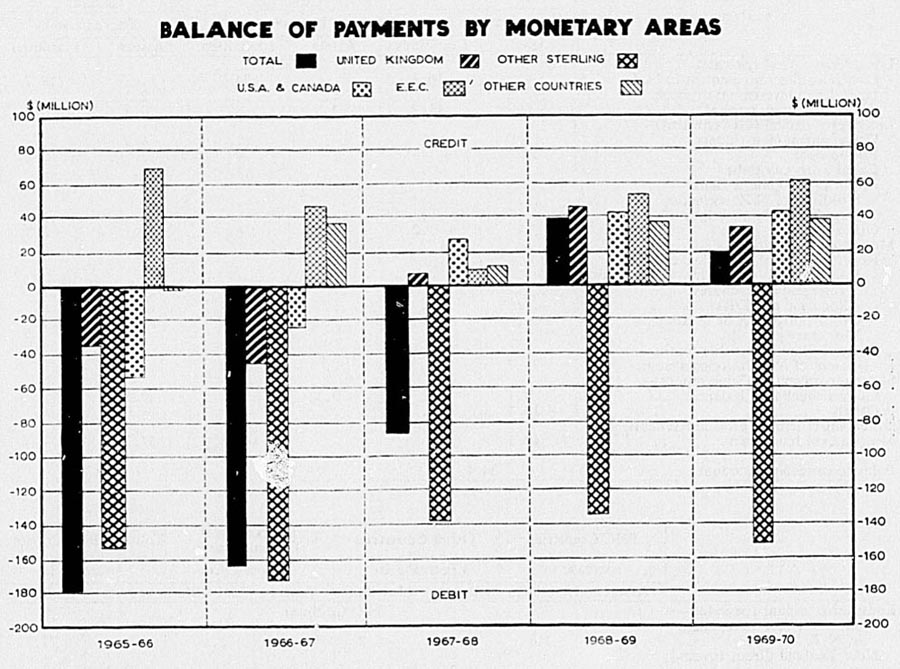
SURVEY OF COMPANIES WITH OVERSEAS AFFILIATIONS—The picture of international capital movements would be incomplete without the consideration of investment flows originating with private commercial firms. While such investment takes place in response to usual economic motivations, its effect on a country's balance of payments differs in no respect from other capital movements, such as Government lending or borrowing abroad, investment or repatriation of assets from abroad by private individuals, etc.
The type of investment referred to here is that defined as direct private investment. Subsidiaries under control of an overseas company, branches of overseas companies, companies where the majority of shareholders reside overseas, or any other companies where overseas shareholders exercise a controlling interest, fall under this category. The question of control is decided in some cases on the strength of the parent company's holdings (a 25 percent holding of the subsidiary's ordinary share capital is deemed as the qualifying minimum), in others on the actual circumstances of the case. The same criteria apply for direct investment by New Zealand companies and residents overseas.
Direct investment flows assume various forms: they may be by remittances of cash, the provision of plant, machinery, or goods without corresponding payments, charging up of services rendered by the parent company, the re-investment in New Zealand of undistributed profits, or the partial remittance only of declared dividends and branch earnings. The inclusion of undistributed profits may require some explanation: the non-remittance abroad of the whole of the current year's earnings, or any portion of them involves, where no statutory constraints exist on remittances of current profits, a decision to invest which is in every respect equal to a decision to bring additional investment capital into the country. By treating, as already mentioned previously, total earnings of subsidiaries and branches of overseas firms in New Zealand as a current account debit or payment to the rest of the world, the unremitted portions of such earnings are treated as an inflow of investment capital which, together with other forms of investment capital (cash, goods, services), make up the total of the private direct investment item in the capital account.
The information tabulated in the following tables is based on an annual survey of companies with overseas affiliations in which the companies report on the distribution of paid-up capital and its changes, dividends and dividend remittances, intercompany accounts with the parent company or affiliated company, and head office accounts in the case of branches.
It should be noted that investment figures given in the following four tables are in terms of annual changes at current prices. The total worth of direct investment assets is extremely difficult to establish in view of the fact that book values may bear little relationship to what such investments would realise on sale; annual changes on the other hand are capable of precise expression, and define exactly their relationship to other capital movements.
Overseas Private Direct Investment in New Zealand—Data on overall private direct investment in New Zealand are shown in the following table. The figures are totals reflecting investment changes in firms resident in New Zealand and controlled from overseas irrespective of their legal organisation. They include therefore subsidiaries incorporated in New Zealand, companies incorporated in New Zealand which have a majority of shareholders resident overseas or are controlled by overseas residents, and New Zealand branches of overseas companies.
The figures shown in the country or regional area columns refer to the country of incorporation of the New Zealand firm's parent company, head office, or other subsidiary of the parent associate company from which the investment flows, or the New Zealand company owes or is owed on outstanding accounts, or the country of residence of individual shareholders who collectively hold a controlling, interest (as defined above) in the New Zealand company.
| Year | United Kingdom | Other Sterling Countries | U.S.A. and Canada | EEC Countries | Other OEEC Countries | Other Countries | Total, All Countries |
|---|---|---|---|---|---|---|---|
*Included are movements in intercompany claims between areas in which affiliated companies operate, the adjustments are offsetting and the movement in the “total, all countries” column is not affected. †Provisional. | |||||||
| NZ$ (million) | |||||||
| 1950-51 | 9.9 | -0.3 | 1.1 | 0.5 | - | 11.2 | |
| 1955-56 | 26.9 | 3.1 | 1.7 | -0.2 | - | 31.5 | |
| 1960-61 | 20.7 | 9.3 | 2.4 | 0.7 | 1.2 | 34.2 | |
| 1964-65 | 20.2 | 9.9 | 8.0 | 2.0 | 3.4 | 43.5 | |
| 1965-66 | 22.8 | 25.8 | 15.1 | 1.4 | -2.4 | 62.8 | |
| 1966-67 | 0.7 | 14.9 | 13.3 | 0.1 | -0.1 | 28.9 | |
| 1967-68 | 16.7 | 16.6 | -8.1 | 2.6 | 0.3 | 28.1 | |
| 1968-69* | 20.8 | -1.4 | 2.8 | 15.2 | 1.5 | 38.9 | |
| 1969-70† | 16.3 | 34.7 | 18.7 | 1.8 | 6.2 | 77.7 | |
The graph now presented shows changes in the overseas direct investment in New Zealand for the last ten years.
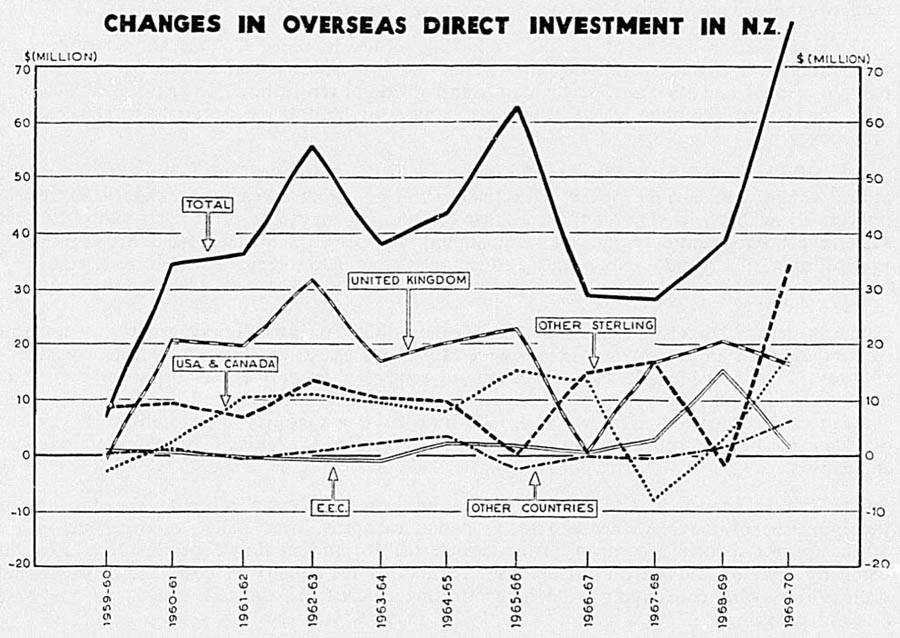
Income from Direct Investment in New Zealand—The following table provides a subdivision of total direct investment income derived by all enterprises controlled from overseas and operating in New Zealand. The investment income is given net (after payment of New Zealand taxation). The regional totals as well as the “All Countries” total correspond to the “Income from Direct Investment” debits shown in the regional current accounts.
| Year | United Kingdom | Other Sterling Countries | U.S.A. and Canada | EEC Countries | Other OEEC Countries | Other Countries | Total, All Countries |
|---|---|---|---|---|---|---|---|
| *Provisional. | |||||||
| NZ$ (million) | |||||||
| A. Dividends | |||||||
| 1950-51 | 1.2 | 0.9 | 1.2 | 0.1 | - | 3.3 | |
| 1955-56 | 1.8 | 1.0 | 3.5 | -- | –– | 6.4 | |
| 1960-61 | 4.7 | 3.1 | 5.4 | –– | 0.2 | 13.4 | |
| 1964-65 | 4.4 | 5.2 | 7.3 | 0.1 | 0.3 | 17.2 | |
| 1965-66 | 5.7 | 4.5 | 6.9 | 0.1 | 1.0 | 18.2 | |
| 1966-67 | 5.7 | 5.7 | 7.4 | 0.1 | 0.3 | 19.2 | |
| 1967-68 | 4.0 | 6.5 | 6.0 | 0.1 | 0.3 | 16.9 | |
| 1968-69 | 5.8 | 6.1 | 5.3 | 0.1 | 0.2 | 17.6 | |
| 1969-70* | 7.6 | 7.4 | 8.6 | 0.1 | 0.5 | 24.1 | |
| B. Undistributed Earnings | |||||||
| 1950-51 | 2.7 | 0.7 | 2.3 | 0.1 | - | 5.7 | |
| 1955-56 | 4.8 | 2.3 | 2.0 | 0.1 | - | 9.2 | |
| 1960-61 | 6.8 | 3.5 | 2.8 | –– | 0.3 | 13.3 | |
| 1964-65 | 12.1 | 7.6 | 6.3 | 1.5 | 0.1 | 27.6 | |
| 1965-66 | 8.0 | 9.9 | 5.2 | 0.4 | 0.3 | 23.8 | |
| 1966-67 | 12.7 | 10.0 | 4.3 | 0.2 | 0.3 | 27.5 | |
| 1967-68 | 10.0 | 8.3 | -7.4 | -0.7 | -0.2 | 10.0 | |
| 1968-69 | 21.5 | 8.2 | 9.2 | -0.4 | 0.3 | 38.8 | |
| 1969-70* | 22.1 | 11.8 | 15.8 | 0.4 | -- | 50.0 | |
| NZ$(million) | |||||||
| C. Net Earnings of Branches | |||||||
| 1950-51 | 3.1 | 2.3 | 0.2 | -- | - | 5.6 | |
| 1955-56 | 5.2 | 1.6 | 0.1 | 0.1 | - | 7.1 | |
| 1960-61 | 8.7 | 3.2 | 0.5 | 0.9 | -- | 13.3 | |
| 1964-65 | 11.4 | 3.7 | 0.8 | - | 0.1 | 15.9 | |
| 1965-66 | 7.6 | 4.4 | 1.1 | - | -- | 13.0 | |
| 1966-67 | 9.3 | 4.8 | 1.0 | - | -- | 15.2 | |
| 1967-68 | 7.2 | 4.0 | 1.3 | –– | -- | 12.5 | |
| 1968-69 | 11.6 | 3.8 | 0.4 | –– | 0.4 | 16.2 | |
| 1969-70* | 9.4 | 3.5 | 2.0 | - | 2.0 | 16.9 | |
| D. Total Income from Direct Investment in New Zealand | |||||||
| 1950-51 | 6.9 | 3.9 | 3.6 | 0.2 | - | 14.7 | |
| 1955-56 | 11.8 | 5.0 | 5.7 | 0.2 | –– | 22.6 | |
| 1960-61 | 20.2 | 9.8 | 8.6 | 0.9 | 0.5 | 40.1 | |
| 1964-65 | 27.9 | 16.5 | 14.3 | 1.6 | 0.5 | 60.7 | |
| 1965-66 | 21.3 | 18.7 | 13.2 | 0.5 | 1.2 | 55.0 | |
| 1966-67 | 27.7 | 20.5 | 12.7 | 0.3 | 0.6 | 61.9 | |
| 1967-68 | 21.2 | 18.8 | -0.1 | -0.6 | 0.1 | 39.4 | |
| 1968-69 | 38.9 | 18.1 | 14.9 | -0.2 | 0.9 | 72.6 | |
| 1969-70* | 39.0 | 22.6 | 26.3 | 0.5 | 2.6 | 91.0 | |
Industrial Classification of Overseas Private Direct Investment and Income from Direct Investment in New Zealand—The following table shows details of overseas direct investment and income from overseas direct investment classified by major industry groupings.
| Industry | 1965-66 | 1966-67 | 1967-68 | 1968-69 | 1969-70* |
|---|---|---|---|---|---|
| *Provisional. | |||||
| NZ$(million) | |||||
| Direct Investment | |||||
| Farming, hunting, fishing | -0.4 | -- | -0.1 | -- | 0.2 |
| Forestry and logging | |||||
| Mining and quarrying | -0.7 | 0.9 | 1.5 | 2.3 | 2.0 |
| Manufacturing— | |||||
| Food, drink, and tobacco | 6.4 | –– | 4.7 | 3.2 | 6.1 |
| Meat and dairy products | 1.8 | -0.4 | -2.1 | 0.6 | 15.6 |
| Textiles, clothing, and footwear | 0.7 | 1.6 | 0.3 | 0.3 | 1.1 |
| Wood, cork, and furniture production | -0.3 | -0.1 | -0.2 | 0.1 | 0.1 |
| Pulp, paper, and printing | 1.4 | 1.8 | 2.5 | 5.2 | -2.5 |
| Leather and rubber products | 1.1 | -0.2 | -0.3 | 1.8 | 2.0 |
| Chemical and mineral products | 3.7 | 4.4 | 2.9 | 5.4 | 1.5 |
| Metalworking | 2.6 | 1.6 | 4.7 | 4.1 | 14.3 |
| Engineering and transport equipment | 10.2 | 2.5 | 0.1 | 3.7 | 7.9 |
| Miscellaneous manufacturing | 2.5 | 0.1 | 0.3 | 1.2 | 7.5 |
| Building and construction | 1.0 | 1.2 | -1.8 | -0.4 | 0.7 |
| Electricity, gas, water | - | - | - | - | - |
| Wholesale and retail trade | 24.3 | 16.7 | 9.3 | 5.0 | 11.0 |
| Banking, insurance, and ownership of property | 6.0 | -2.9 | 6.1 | 6.2 | 4.8 |
| Transport and communications | 2.1 | 1.2 | -0.5 | -0.7 | 4.8 |
| Services | 0.1 | 0.7 | 0.9 | 0.9 | 0.6 |
| Totals | 62.8 | 28.9 | 28.1 | 38.9 | 77.7 |
| Industry | 1965-66 | 1966-67 | 1967-68 | 1968-69 | 1969-70* |
|---|---|---|---|---|---|
| *Provisional. | |||||
| NZ$(million) | |||||
| Income from Direct Investment | |||||
| Farming, hunting, fishing | -- | -- | -- | -- | -- |
| Forestry and logging | |||||
| Mining and quarrying | -0.1 | 0.3 | -0.1 | 0.6 | 0.3 |
| Manufacturing— | |||||
| Food, drink, and tobacco | 4.0 | 5.8 | 5.3 | 4.9 | 5.3 |
| Meat and dairy products | -2.0 | 3.4 | 1.6 | 14.9 | 18.4 |
| Textiles, clothing, and footwear | 2.0 | 2.0 | 0.8 | 0.9* | 1.9 |
| Wood, cork, and furniture production | 0.5 | –– | 0.1 | 0.1 | 0.1 |
| Pulp, paper, and printing | 4.4 | 4.0 | 4.0 | 7.4 | 4.7 |
| Leather and rubber products | 1.2 | 0.8 | 1.1 | 1.7 | 2.3 |
| Chemical and mineral products | 7.1 | 9.7 | 6.8 | 6.5 | 5.7 |
| Metalworking | 2.3 | 2.0 | 1.6 | 2.2 | 2.6 |
| Engineering and transport equipment | 9.7 | 6.6 | 3.6 | 9.1 | 12.8 |
| Miscellaneous manufacturing | 1.5 | 1.5 | 0.9 | 1.1 | 4.1 |
| Building and construction | –– | 0.5 | -0.2 | -0.1 | 1.6 |
| Electricity, gas, water | - | - | - | - | - |
| Wholesale and retail trade | 15.4 | 17.0 | 5.6 | 14.9 | 21.5 |
| Banking, insurance, and ownership of property | 7.6 | 7.5 | 7.1 | 7.0 | 7.4 |
| Transport and communications | 0.3 | 0.3 | 0.2 | 1.0 | 1.7 |
| Services | 1.1 | 0.5 | 1.0 | 0.5 | 0.6 |
| Totals | 55.0 | 61.9 | 39.4 | 72.7 | 91.0 |
Investment by New Zealand Companies Overseas—The following table presents the converse picture of those immediately preceding, viz., direct investment and income for direct investment by New Zealand companies in their overseas subsidiaries and branches.
| Year | United Kingdom | Other Sterling Countries | Other Countries† | Total, All Countries |
|---|---|---|---|---|
*Provisional. †Includes small amounts from companies in the United States and Canada, and E.E.C. Countries. | ||||
| NZ$ (million) | ||||
| Direct Investment | ||||
| 1964-65 | 2.1 | -1.5 | -0.8 | -0.3 |
| 1965-66 | -0.5 | 3.2 | -0.1 | 2.6 |
| 1966-67 | -2.4 | 2.1 | 2.5 | 2.3 |
| 1967-68 | 1.1 | -3.6 | 1.2 | -1.3 |
| 1968-69 | 6.1 | -0.5 | -0.3 | 6.3 |
| 1969-70* | -2.2 | 8.2 | 3.4 | 9.4 |
| Income from Direct Investment | ||||
| 1964-65 | 1.1 | 3.2 | 0.4 | 4.7 |
| 1965-66 | 1.8 | 3.4 | 0.4 | 5.5 |
| 1966-67 | 1.2 | 3.6 | 1.0 | 5.8 |
| 1967-68 | 1.4 | 3.9 | 0.5 | 5.9 |
| 1968-69 | 2.6 | 4.9 | 0.9 | 8.3 |
| 1969-70* | 4.6 | 6.5 | 0.4 | 11.5 |
As a background to economic policy formation, and particularly with regard to planning of industrial development, it is desirable to have an overall view of the pattern and industrial relationships of all parts of the economy. This applies at a national level and also at lower levels of, say, an industry or group of industries, when decisions involving the direction of growth have to be taken.
Such a view can be provided in the first place by input-output tables, resulting from inter-industry studies of the New Zealand economy. These show in matrix form the transactions which took place between industries in the country and what inputs they required in a chosen year to deliver an output of goods and services to final demand users such as households, government, and export. From these tables of commodity transactions, further tables of co-efficients are computed to show not only the degree of dependence of any one industry directly on other industries and on external producers but also the indirect requirements of any industry on all others for each unit of its output. The relationships thus established can be held to be reasonably stable for several years in a developed country and also, for major planning purposes, can be up-dated by mathematical procedures which incorporate more recent data which may become available. In this way the tables can be made to serve until completion of a fresh inter-industry study, an undertaking requiring several years of investigation and processing.
One aim of inter-industry studies is to establish a connection between demand for finished products and its implications for production, employment, capacity utilisation, and raw material requirements of industries which may be significantly, even if remotely, involved in meeting this demand.
The input-output tables of the New Zealand economy compiled from the Department of Statistics' Inter-industry Study of the New Zealand Economy 1959-60 were published in four parts and depict the productive sector as divided into 110 industries. A description of the industrial classifications is contained in the final volume together with an explanation of the input-output system of analysis.
An inter-industry study for the year 1965-66 is currently being worked upon and results are likely to be published during the next year. Previous studies were completed for the years 1952-53 and 1954-55 but the classification of industries was limited to 12 groups only.
The publications are available from the Government Printer.
INDEX OF PRODUCTION—In New Zealand the total output of all goods and services in the economy is measured by the Index of Production. This overall volume of production index was first introduced in 1962 by the Department of Statistics as the basis of a productivity measure to be used by the Court of Arbitration in its wage claim deliberations.
All industries are represented in the Index of Production in proportion to their net outputs, plus depreciation. The weighting of the main industry groups for the base year, that is the twelve months ended 31 March 1955, is as follows:
| Weight percent | |
|---|---|
| Farming | 20.7 |
| Forestry and logging | 0.8 |
| Fisheries, etc. | 0.3 |
| Mining and quarrying | 1.0 |
| Manufacturing | 21.6 |
| Building and construction | 8.2 |
| Power and gas | 1.6 |
| Services | 4.8 |
| 100.0 |
Production Index—The following are the figures for the index equated to Base 1954-55 = 1000.
| Year | Index |
|---|---|
| *Provisional. | |
| 1954-55 | 1,000 |
| 1955-56 | 1,039 |
| 1956-57 | 1,059 |
| 1957-58 | 1,115 |
| 1958-59 | 1,146 |
| 1959-60 | 1,191 |
| 1960-61 | 1,265 |
| 1961-62 | 1,307 |
| 1962-63 | 1,349 |
| 1963-64 | 1,430 |
| 1964-65 | 1,518 |
| 1965-66 | 1,612 |
| 1966-67 | 1,679 |
| 1967-68 | 1,665 |
| 1968-69 | 1692x |
| 1969-70 | 1785* |
The following analysis of the Index of Production breaks it into industry groups for the years 1954-55 to 1968-69 and shows provisional indexes for 1969-70.
The largest increase has been in the Power and Gas group, followed by manufacturing which (except in 1967-68) has maintained a steady growth. Farming, which had shown steady growth up to 1968-69, recorded its first fall in production in 1969-70, due largely to drought conditions in that year.
| VOLUME OF PRODUCTION: MAJOR GROUP INDEXES | ||||||||||||||
|---|---|---|---|---|---|---|---|---|---|---|---|---|---|---|
| Industrial Group | 1954-55 | 1957-58 | 1958-59 | 1959-60 | 1960-61 | 1961-62 | 1962-63 | 1963-64 | 1964-65 | 1965-66 | 1966-67 | 1967-68 | 1968-69 | 1969-70* |
*Provisional. †Decrease. | ||||||||||||||
| Farming | 1,000 | 1,114 | 1,168 | 1,194 | 1,240 | 1,262 | 1,338 | 1,369 | 1,397 | 1,494 | 1,543 | 1,592 | 1,627 | 1,614 |
| Forestry and logging | 1,000 | 1,102 | 1,166 | 1,284 | 1,315 | 1,334 | 1,295 | 1,354 | 1,477 | 1,542 | 1,559 | 1,567 | 1,778 | 1,964 |
| Fisheries, etc. | 1,000 | 1,096 | 1,104 | 1,153 | 1,195 | 1,142 | 1,218 | 1,250 | 1,269 | 1,332 | 1,455 | 1,533 | 1,543 | 1,367 |
| Mining and quarrying | 1,000 | 1,176 | 1,242 | 1,289 | 1,409 | 1,339 | 1,290 | 1,364 | 1,418 | 1,550 | 1,661 | 1,460 | 1,450 | 1,575 |
| Manufacturing | 1,000 | 1,139 | 1,203 | 1,244 | 1,366 | 1,436 | 1,501 | 1,658 | 1,873 | 2,001, | 2,120, | 2,096, | 2,125, | 2,277, |
| Power and gas | 1,000 | 1,290 | 1,281 | 1,435 | 1,525 | 1,654 | 1,832 | 2,016, | 2,204, | 2,427, | 2,581, | 2,660, | 2,781, | 2,907, |
| Building and construction | 1,000 | 1,119 | 1,134 | 1,248 | 1,312 | 1,350 | 1,310 | 1,317 | 1,379 | 1,567 | 1,633 | 1,565 | 1,313 | 1,569 |
| All services | 1,000 | 1,096 | 1,104 | 1,142 | 1,208 | 1,248 | 1,275 | 1,355 | 1,411 | 1,466 | 1,513 | 1,485 | 1,515 | 1,634 |
| Total All Groups | 1,000 | 1,115 | 1,146 | 1,191 | 1,265 | 1,307 | 1,349 | 1,430 | 1,518 | 1,612 | 1,679 | 1,665 | 1692x | 1,785 |
| Annual percentage increase in Production Index | ... | 5.3 | 2.8 | 3.9 | 6.2 | 3.3 | 3.2 | 6.0 | 6.2 | 6.2 | 4.2 | -0.8† | 1.6x | 5.5 |
For the most heavily-weighted group, Services, the increase recorded has been below the All Groups average. Service industries may be said to be of two kinds, those for supplying the needs of final consumers, and those which service industries of all kinds. The volume index for these services industries covers many activities such as wholesale and retail trade, transport, communication, finance, education, and personal services.
INDEX OF PRODUCTIVITY—The main measure of economic growth is the Index of Productivity which is, in effect, the Index of Production corrected for numbers of the actively employed civilian labour force.
The three indexes are set out below for the years 1954-55 to 1969-70 equated to base 1954-55 = 1000.
| Production Year | Index of Production | Index of Employment | Index of Productivity | Annual Percentage Increase in Productivity Index |
|---|---|---|---|---|
*Provisional. †Decrease. | ||||
| 1954-55 | 1,000 | 1,000 | 1,000 | ... |
| 1955-56 | 1,039 | 1,020 | 1,019 | 1.9 |
| 1956-57 | 1,059 | 1,038 | 1,020 | 0.1 |
| 1957-58 | 1,115 | 1,059 | 1,053 | 3.2 |
| 1958-59 | 1,146 | 1,082 | 1,059 | 0.6 |
| 1959-60 | 1,191 | 1,093 | 1,090 | 2.9 |
| 1960-61 | 1,265 | 1,118 | 1,131 | 3.8 |
| 1961-62 | 1,307 | 1,143 | 1,143 | 1.1 |
| 1962-63 | 1,349 | 1,161 | 1,162 | 1.7 |
| 1963-64 | 1,430 | 1,192 | 1,200 | 3.3 |
| 1964-65 | 1,518 | 1,230 | 1,234 | 2.8 |
| 1965-66 | 1,612 | 1,274 | 1,265 | 2.5 |
| 1966-67 | 1,679 | 1,314 | 1,278 | 1.0 |
| 1967-68 | 1,665 | 1,315 | 1,266 | -0.9† |
| 1968-69 | 1692x | 1,319 | 1283x | 1.3x |
| 1969-70 | 1785* | 1,352 | 1320* | 2.9* |
It can be seen that the productivity index is a little more sensitive to changes in economic tempo than is the index of production. Output is influenced by changes in all the inputs to production, including materials, capital, management and skills, as well as labour, but at this stage an index has not been developed to permit an assessment of relative contributions of each input to economic growth.
GROSS DOMESTIC PRODUCT IN CONSTANT PRICES—The fact that the Index of Production is a volume index covering the output of all goods and services means that it can be readily modified into an index of real gross domestic product. In New Zealand the most important change is to include the services of the armed forces. The derived index is compared with the Index of Production in the following table:
| Year | Index of Production | Index of Real Gross Domestic Product |
|---|---|---|
| *Provisional. | ||
| 1954-55 | 1,000 | 1,000 |
| 1955-56 | 1,039 | 1,037 |
| 1956-57 | 1,059 | 1,057 |
| 1957-58 | 1,115 | 1,112 |
| 1958-59 | 1,146 | 1,143 |
| 1959-60 | 1,191 | 1,188 |
| 1960-61 | 1,265 | 1,261 |
| 1961-62 | 1,307 | 1,303 |
| 1962-63 | 1,349 | 1,343 |
| 1963-64 | 1,430 | 1,425 |
| 1964-65 | 1,518 | 1,512 |
| 1965-66 | 1,612 | 1,604 |
| 1966-67 | 1,679 | 1,670 |
| 1967-68 | 1,665 | 1,658 |
| 1968-69 | 1692x | 1684x |
| 1969-70* | 1785* | 1,776 |
Having obtained an index of real gross domestic product it can be used to obtain gross domestic product and gross national product at constant prices from the original estimates expressed in current price terms. In the table below gross domestic product and gross national product are shown, firstly, in current prices as they appear in the annual estimates of national income and expenditure and, secondly, valued in constant 1954-55 prices. In this case the method used to obtain constant prices is to project the value of the gross domestic product for 1954-55 by the derived index.
| Year | Gross Domestic Product in Current Prices | Gross National Product in Current Prices | Gross Domestic Product at 1954-55 Prices | Gross National Product at 1954-55 Prices |
|---|---|---|---|---|
| *Provisional. | ||||
| $(m) | $(m) | $(m) | $(m) | |
| 1954-55 | 1,877 | 1,860 | 1,877 | 1,860 |
| 1955-56 | 1,979 | 1,965 | 1,946 | 1,932 |
| 1956-57 | 2,078 | 2,061 | 1,984 | 1,968 |
| 1957-58 | 2,201 | 2,184 | 2,087 | 2,071 |
| 1958-59 | 2,294 | 2,270 | 2,145 | 2,123 |
| 1959-60 | 2,454 | 2,434 | 2,230 | 2,212 |
| 1960-61 | 2,659 | 2,622 | 2,367 | 2,334 |
| 1961-62 | 2,753 | 2,722 | 2,446 | 2,418 |
| 1962-63 | 2,966 | 2,921 | 2,521 | 2,483 |
| 1963-64 | 3,240 | 3,197 | 2,675 | 2,639 |
| 1964-65 | 3,550 | 3,491x | 2,838 | 2,791 |
| 1965-66 | 3,837x | 3,784x | 3,011 | 2,969 |
| 1966-67 | 3,984x | 3,919x | 3,135 | 3,084x |
| 1967-68 | 4,129x | 4,074x | 3,112 | 3,071 |
| 1968-69* | 4,434x | 4,354x | 3,161x | 3,104x |
| 1969-70* | 4,856 | 4,757 | 3,334 | 3,266 |
When correction is made for price changes in the values of exports and imports of goods and services, gross domestic expenditure may also be expressed in constant prices, as is done in the following table.
| Year | Gross Domestic Product at 1954-55 Prices | Exports of Goods and Services at 1954-55 Prices | Imports of Goods and Services at 1954-55 Prices | Goods and Services Available for Use* at 1954-55 Prices |
|---|---|---|---|---|
* This is also called gross domestic expenditure. † Provisional. | ||||
| $(m) | $(m) | $(m) | $(m) | |
| 1954-55 | 1,877 | 507 | 557 | 1,927 |
| 1955-56 | 1,946 | 568 | 583 | 1,961 |
| 1956-57 | 1,984 | 592 | 563 | 1,955 |
| 1957-58 | 2,087 | 596 | 611 | 2,102 |
| 1958-59 | 2,145 | 663 | 549 | 2,031 |
| 1959-60 | 2,230 | 680 | 536 | 2,086 |
| 1960-61 | 2,367 | 658 | 650 | 2,359 |
| 1961-62 | 2,446 | 707 | 655 | 2,394 |
| 1962-63 | 2,521 | 738 | 635 | 2,418 |
| 1963-64 | 2,675 | 783 | 741 | 2,633 |
| 1964-65 | 2,838 | 769 | 773 | 2,842 |
| 1965-66 | 3,011 | 797 | 891 | 3,105 |
| 1966-67 | 3,135 | 833 | 927 | 3,229 |
| 1967-68 | 3,112 | 867x | 776 | 3,021x |
| 1968-69† | 3,161x | 1,023x | 783x | 2,921x |
| 1969-70† | 3,334 | 1,099 | 867 | 3,102 |
The following table assesses movements caused by changes in the terms of trade, by showing gross domestic product at constant prices corrected for the terms of trade. By making this correction to the gross domestic product at 1954-55 prices, a much better picture can be obtained of the purchasing power, both here and abroad, of the income it represents.
| Year | Gross Domestic Product at 1954-55 Prices | Exports of Goods and Services at 1954-55 Prices | Exports of Goods and Services Corrected for the Terms of Trade | Effective Gross Domestic Product |
|---|---|---|---|---|
| *Provisional. | ||||
| $(m) | ||||
| 1954-55 | 1,877 | 507 | 507 | 1,877 |
| 1955-56 | 1,946 | 568 | 552 | 1,930 |
| 1956-57 | 1,984 | 592 | 563 | 1,955 |
| 1957-58 | 2,087 | 596 | 548 | 2,039 |
| 1958-59 | 2,145 | 663 | 538 | 2,020 |
| 1959-60 | 2,230 | 680 | 639 | 2,189 |
| 1960-61 | 2,367 | 658 | 592 | 2,301 |
| 1961-62 | 2,446 | 707 | 595 | 2,334 |
| 1962-63 | 2,521 | 738 | 646 | 2,429 |
| 1963-64 | 2,675 | 783 | 752 | 2,644 |
| 1964-65 | 2,838 | 769 | 787 | 2,856 |
| 1965-66 | 3,011 | 797 | 784 | 2,998 |
| 1966-67 | 3,135 | 833 | 830 | 3,132 |
| 1967-68 | 3,112 | 867x | 759x | 3,004x |
| 1968-69* | 3,161x | 1,023x | 883x | 3,021x |
| 1969-70* | 3,334 | 1,099 | 968 | 3,203 |
NATIONAL DEVELOPMENT COUNCIL—The National Development Council, which held its first meeting on 9 July 1969, was established to keep under review the targets and objectives set by the National Development Conference 1969 and to keep before the Government and the public the measures necessary for the implementation of the targets set for indicative planning. The objectives of the Council include (a) a faster economic growth rate than would otherwise be possible (b) balanced growth in which the aspirations of all main sectors are taken into account in the national targets and goals (c) the linking of economic and non-material objectives.
The National Development Council is the co-ordinator of a network of sector councils, namely, Agricultural Production Council, Manufacturing Development Council, Forestry Development Council, Fisheries Development Council, Mineral Resources Council, Fuel and Power Council, Tourist Development Council, Trade Promotion Council, Building Industry Advisory Council, Transport Advisory Council, Distribution Council, National Research Advisory Council, Advisory Council on Educational Planning. The Manpower Planning Unit of the Department of Labour is the adviser to the Council on matters concerning manpower planning and forecasting. More recently to ensure adequate coverage of non-economic issues, within the framework of the National Development Council, there has been set up an Environmental Council and a Social Council, while the Queen Elizabeth II Arts Council has become the sector council concerned with cultural matters.
A Technical Committee has reported to the Council its recommendations on statistical developments required to meet the needs of indicative planning. The Council accepted the general thesis of the Technical Committee on Statistics and advised Government accordingly. A comprehensive expansion is in train.
By the end of January 1971 action had been completed on 402 of the 631 National Development Conference recommendations, leaving 229 at varying stages of implementation. Of those on which action was completed, 152 were continuations of existing measures or policies; another 181 involved Government adoption of new measures or policies. The National Development Council is keeping continuing action under review. The National Development Council has also set up a Targets Advisory Group which acts as an economic adviser to the Council, giving special attention to a continuing review of progress towards the targets and periodically to the targets themselves.
On the basis of reports from sector councils, the National Development Council advises Government on action that should be taken to reconcile the competing sector demands for manpower, capital and other resources.
A survey is now given of the National Development Conference which is a background to current activities of the National Development Council.
NATIONAL DEVELOPMENT CONFERENCE—The National Development Conference, held in Wellington on 5-9 May 1969, marked the coming of age of a form of economic planning which has been evolving in New Zealand over the past two decades. During this period there has developed a growing demand for more co-ordinated, longer term thinking about the economy and a growing awareness of the value of setting objectives and targets by a process of co-operation and consultation both within and between sectors. This process, known as “indicative” planning, is as much in contrast with a completely unplanned type of economy as it is with planning of the authoritarian type. Its guide lines and targets are not imposed on the economy; rather they are arrived at by consultation and consensus between Government and the private sector, and so serve as “indications” of what appears to each to be feasible and desirable.
A series of “key sector” conferences* culminating in the Agricultural Development Conference of 1963-64 were features of this process. As a result of these conferences three important concepts (all of which were basic to the work of the National Development Conference) were introduced into economic policy making in this country. They were:
The use of medium- and long-term economic projections as the basis for planning;
The setting of targets for sector production up to a decade ahead; and
The establishment of continuing machinery such as the Agricultural Production Council to review these targets and to advise Government on policies required to achieve them.
Other sectors (particularly forestry, tourism, and manufacturing) were not slow to see the advantages of co-ordinated forward planning, and preparations for the Forestry and Tourist Development Conferences† were under way before the decision to hold a conference covering all aspects of the economy was taken.
Recognition of the National Development Conference as a further major step in the development of indicative planning helps to place the whole conference in perspective. It was not something that had been artificially introduced but followed naturally from past events and should just as naturally lead in the future to more sophisticated techniques of planning.
One of the virtues of extending the scope of indicative planning is that the sector targets are not set in isolation, but within the framework of comprehensive integrated projections. This process of setting targets for the economy as a whole focuses attention on key issues; it identifies obstacles to be overcome; it clarifies possible alternative policies; and the very existence of targets stimulates speculation about what is needed to achieve them, and so sets in motion many of the forces of attainment.
*National Housing Conference 1953.
Industrial Development Conference 1960.
Export Development Conference 1963.
Agricultural Development Conference 1963-64.
†The Forestry and Tourist Development Conferences were held in early 1969 and a Physical Environment Conference was held in May 1970.
Targets—The Conference expressed growth objectives in the form of “targets”, the most important being:
An increase in real gross national product of 4 1/2 percent a year. (After allowing for population growth this means for example that the volume of goods and services available to the average man, woman, and child in 1978-79 would be 27 percent higher than it was in 1967-68.)
An increase in exports of 6.6 percent a year. This means that exports which totalled $838 million in 1967-68 will have to double to $1,690 million by 1978-79. (Of the required increase of $852 million some $80 million was to meet a projected 5 percent fall in terms of trade.)
An increase in the share of our gross national product used for investment, i.e., the creation of capital assets. This means that investment should very nearly double from $1,033 million in 1967-68 to $1,920 million in 1978-79.
The targets for value of exports and earnings from tourism and services adopted by the National Development Conference are set out in the following table.
| Sector | Value of Exports 1967-68 | Export Targets* 1972-73 | Export Targets* 1978-79 | Increase for Full Target Period | Share of Target Increase in Export Receipts |
|---|---|---|---|---|---|
| *In constant 1967-68 prices. | |||||
| $m | $m | $m | $m | Percent | |
| Agriculture— | |||||
| Pastoral | 645 | 889 | 1,075 | 430 | 50.5 |
| Horticultural | 15 | 34 | 56 | 41 | 4.8 |
| Total agriculture | 660 | 923 | 1,131 | 471 | 55.3 |
| Forestry | 35 | 73 | 96 | 61 | 7.2 |
| Minerals | .. | 3 | 10 | 10 | 1.2 |
| Fisheries | 9 | 13 | 25 | 16 | 1.9 |
| Other manufacturing | 26 | 88 | 208 | 182 | 21.3 |
| Travel (tourism) | 17 | 35 | 70 | 53 | 6.2 |
| Other (mainly services) | 91 | 125 | 150 | 59 | 6.9 |
| Total | 838 | 1,260 | 1,690 | 852 | 100.0 |
Agriculture—Livestock numbers over the ten years to 1978-79 should increase by 33 percent to 130 million ewe equivalents to enable export targets to be met.
Forestry—Planting of new forests by Government and private interests should be stepped up to 52,000 acres a year to meet long-range targets.
Tourism—Visits by tourists, apart from through passengers, should increase from 113,000 to 586,000 by 1978-79. This represents a 15 percent compound annual increase and will require major developments in accommodation and facilities.
Minerals—Although one of the most difficult areas to predict, mineral development could possibly yield an increase in export and import savings of some $30 million by 1978-79 which could rise further to $95 million if a commercial oil field should be developed by that time.
Building—Output should increase at about 6 percent a year to 1972-73.
Status of the Targets—The targets adopted represent the best available indication of the probable pattern of future development. But this plan does not necessarily indicate the “optimum” economic development. More research will be required by the permanent planning machinery before anything approaching “optimum” use of resources can be assessed. Views about what is desirable may well change as further research is completed. But indicative planning should help to achieve a sectoral structure which is capable of making a greater volume of goods and services available to New Zealanders without creating balance of payments difficulties.
It is obviously not possible to plan in precise detail each and every development which will occur or should occur in the economy between now and 1978-79. Neither is it feasible to predict, beyond the limited indications given in sector reports, what changes the next decade will bring. It is impossible to be categorical about which industries will enjoy the greatest growth or which may encounter the greatest difficulties.
There are bound to be surprises in the future. Indicative planning can do no more than present a reasoned guide to the progress which the economy can make, based on projections of the existing situation and incorporating foreseeable change and development.
Measures necessary to Achieve the Targets—The conference committees worked on the basic assumption that the community, because it wants improved living standards, will be prepared to accept the measures necessary to step up the rate of economic growth. Purposeful stimulation and a significant acceleration will be essential.
Where practicable, market forces should be allowed to determine the allocation of resources. There was, however, a consensus that in many cases action by Government in some form or another was needed. Examples of proposed action ranged from encouragement of specific forms of research to the development of machinery to encourage the flow of resources into export-orientated industries. The following paragraphs draw attention to some of the changes envisaged.
Exports and Import Savings—The targets cannot be achieved unless there is a major expansion in exports and in the efficient home production of goods at present imported. In spite of the need to increase traditional exports, New Zealand cannot continue to enjoy rising living standards from the sale of pastoral products alone. The change of attitude required to bring about an acceleration in the process of industrialisation should in no way sacrifice the economic development of pastoral or other agricultural commodities. Indeed, continued industrialisation in the form of greater processing of raw agricultural products should contribute to the future prosperity of agriculture. But while the major increase in export income in the next decade, as shown in the targets, is to come from pastoral products, an even faster rate of increase will have to come from non-traditional sources particularly forest products, manufacturing, and tourism.
Marketing—As the expansion of exports depends on our ability to market what we produce, we should give full rein to our ingenuity in finding both new markets and new products, particularly those resulting from a greater depth in processing of raw materials. There is a need for improved marketing techniques, more purposeful market research and analysis, closer attention to quality standards, and adequate transport facilities. To develop the necessary marketing skills, adequate training facilities should be provided.
Industrial Policy and Protection—Industrial policy should be aimed at identifying, creating, and expanding growth industries. More mature and rational criteria must be introduced for industrial development and for protection of local industry. It is widely accepted that, over a period, the import licensing system with its built-in rigidity should be generally replaced by the more flexible instrument of tariff protection.
Land Use—The country's limited productive land resources must be used to best advantage. This entails not only allowing market forces to operate where they serve to maximise the economic yield from land, but also taking steps to preserve an attractive physical environment and a countryside which provides adequately for recreation.
Productivity—More use will have to be made of modern developments in the field of financial management, methods engineering, quality control, accounting services, and the like. In order to make the best use of costly capital facilities, attention should be given to an expansion of the shift system wherever this is appropriate.
Advisory Services—Expansion of advisory and information services, particularly for industries concerned with new export development, are needed to promote the widest possible application of new techniques and processes.
Research—There should be substantial increases in research, concentrated as far as reasonably practicable in fields likely to benefit the economy in the foreseeable future. Early returns from research are more likely to occur where industry is responsible for initiating the research and where it is contributing to the cost.
Education—A substantial increase in the share of the national resources allocated to education is required if the overall targets are to be attained.
Manpower and Training—Skilled labour is one of the scarcest resources. It is already clear that the decade will bring a greatly increased demand for skilled men and women. To meet the demand steps will be taken to:
Provide the means for forecasting skill needs far enough in advance to allow adequate and appropriate training and retraining facilities to be expanded.
Determine the most effective role for the various educational institutions so that they jointly provide for basic education needs as well as for training in the vocational skills required.
Emphasise the part to be played by on-the-job training in upgrading the labour force in line with the increasing sophistication of plant, materials, and processes.
Ensure that margins for various levels of skill and educational qualifications are adequate to provide the incentive for a sufficient number of people to obtain the necessary skills and qualifications.
Promote the movement of labour from areas of localised unemployment to areas where shortages exist, through measures aimed at assisting the relocation and retraining of workers.
Adopt a long-term selective immigrant policy designed to meet foreseeable labour shortages.
Finance—The promotion of an efficient financial system is essential for the mobilisation of resources for growth. Increased production requires a greater willingness to invest in new capital assets. Investment finance must be found and effectively channelled into growth industries.
Taxation—Taxation concessions directed at the attainment of particular objectives as well as grants for special circumstances will continue to play their part amongst the measures needed to attain the objectives. At the same time, many of the proposals for better services to industry will require additional Government expenditure.
Growth Rates—Average growth in real gross national product was estimated at 2.8 percent for the first three years but population growth was lower than originally assumed. Deterioration in the terms of trade had the effect of reducing the return from increased volumes of exports. Because of the slow-down in the rate of growth of the labour force compared with conference projections, higher rates of productivity have become necessary to meet the targets.
Annual Report of the National Development Council—The first annual report of the National Development Council was presented as parliamentary paper B 4, 1971. It points out that the achievement of the Conference targets hinges on adequate GNP growth per unit of the labour force. The original targets called for productivity growth of 2 and 2.1 percent in the planning periods ending in 1972-73 and 1978-79 respectively. The more recent revisions of the targets which embody lower levels of labour force growth require productivity growth of 2.15 percent annually in the period to 1972-73 and 2.35 percent annually in the period 1973-74 to 1978-79 inclusive. Export targets are to be reviewed early in 1972 on the assumption that Britain will join the European Economic Community.
Table of Contents
GENERAL—Central Government is concerned with the future of the nation and therefore with the economic and social development of the people as a whole. In New Zealand the State is fairly broadly concerned in national development and social welfare and therefore Central Government finance is an important sector of the economy. The Central Government raises money by way of taxation and loans. It controls expenditure on capital works such as electricity supply, land settlement, housing, public buildings, forest development, railway, road, and telegraph construction, and on other functions such as social security, other social services, defence, administration, teaching, interest on the public debt and development of industry. The Public Revenues Act 1963 is the governing legislation on the administration of public money.
The extended interpretation of the role of the Central Government in the welfare State has greatly complicated the problem of presenting comprehensive accounts covering all Government activities. In New Zealand the Department of Statistics has published a consolidated review of Government transactions, described in terms of economic flows, in the publication The Accounts of the Government Sector 1959-60 to 1966-67. In this, the Government sector of the economy is divided into two broad sections—the Public Account, including dependent administrative bodies; and Government enterprises and life accounts, outside the Public Account. In turn, each of these sections is divided into three subsections. The Public Account section is subdivided into Public Account non-trading, Public Account enterprises, and dependent administrative bodies. The Government enterprises section is subdivided into life accounts (the Government Superannuation Fund, the National Provident Fund, and the Government Life Insurance Office); financial enterprises; and trading enterprises. Details of these comprehensive accounts are given in the various sections of the Yearbook dealing with the relative activity.
THE PUBLIC ACCOUNT—The present subsection of the Yearbook deals only with those accounts included within the framework of the Public Account as such. This is a single financial account held at the Reserve Bank, but the records of the Public Account in the books of the Treasury consist of a number of ledger accounts for separate funds and accounts within the Public Account. The bank balance is apportioned among these. The following funds and accounts are included in the Public Account: the Consolidated Revenue Account, Works and Trading Account, Trust Account, Loans Redemption Account, National Development Loans Account, Reserve Fund, and National Roads Fund. The Trust Account represents only lodgments or withdrawals of (mainly) non-Government money. The Loans Redemption Account is dealt with in the subsection on indebtedness.
Simplification of the Public Accounts—From 1 April 1964 a number of major changes were made in the presentation of the public accounts. These changes were:
A new account, called the Consolidated Revenue Account, was substituted for the Consolidated Fund, the Social Security Fund, and the Gas Industry Account, which were abolished.
A further new account, called the Works and Trading Account, amalgamated in one account the transactions formerly recorded in the Public Works Account, the Electric Supply Account, the Land Settlement Account, the State Coal Mines Account, and the Working Railways Account.
Further changes were the renaming of the Deposits Account as the Trust Account, and the removal of the Earthquake and War Damage Fund outside the Public Account.
The receipts and payments of the Consolidated Fund over a long period will be found in the Statistical Summary near the end of this volume.
Financial Year—The financial year commences on 1 April and ends on 31 March. The expenditure of public money is authorised by an annual Appropriation Act, which lapses at the end of the financial year. However, the Minister of Finance is authorised to pay money for services for a period of three months from the commencement of the next financial year, pending the granting of supplies by Parliament, which normally meets in June.
SUMMARY OF THE PUBLIC ACCOUNT—The figures shown under the various headings in this subsection are on the basis of receipts and payments. In some sections devoted to the operations of various Departments, the figures are given on an income and expenditure basis, and accordingly differ to some extent from those appearing here.
| Receipts | Years Ended 31 March | |
|---|---|---|
| 1969 | 1970 | |
*Includes defence credits and devaluation entries. † Includes deposits with trading banks. ‡Excludes Treasury Bills encashed $169.9 million. | ||
| $(million) | ||
| Consolidated Revenue Account | ||
| Taxation receipts— | ||
| Income tax and social security income tax | 691.6 | 779.2 |
| Customs duty | 106.4 | 115.5 |
| Beer duty | 35.8 | 37.3 |
| Sales tax | 82.8 | 97.6 |
| Stamp, racing, and estate duties | 44.7 | 49.8 |
| Other taxation | 30.8 | 22.7 |
| Total taxation | 992.1 | 1,102.1 |
| Other receipts— | ||
| Interest | 84.1 | 90.0 |
| Profits from trading undertakings | 5.5 | 9.7 |
| Departmental receipts | 72.9 | 80.7* |
| Total receipts | 1,154.6 | 1,282.5 |
| Expenditure— | ||
| Social services | 644.0 | 707.0 |
| Defence | 85.3 | 89.7 |
| Administration, etc. | 102.5 | 114.1 |
| Stabilisation | 16.4 | 17.2 |
| Maintenance of works, etc. | 39.5 | 42.1 |
| Development of industry | 65.1 | 81.5 |
| Interest and management of public debt | 133.4 | 145.2 |
| 1,086.2 | 1,196.8 | |
| Transfer from Consolidated Revenue Account to— | ||
| Loans Redemption Account | 16.3 | 60.0 |
| National Roads Fund | 3.0 | - |
| Works and Trading Account | 2.4 | 1.2 |
| Special entries | 39.0* | 17.1* |
| Total expenditure | 1,146.9 | 1,275.1 |
| Other Accounts Within the Public Account | ||
| Transfers from Consolidated Revenue Account to— | ||
| Loans Redemption Account | 16.3 | 60.0 |
| National Roads Fund | 3.0 | - |
| Works and Trading Account | 2.4 | 1.2 |
| 21.7 | 61.2 | |
| Miscellaneous receipts— | ||
| Highways revenue | 67.1 | 79.7 |
| Sinking Fund contributions, etc. | 14.2 | 20.7 |
| Miscellaneous capital receipts | 15.6 | 30.4 |
| Excess receipts of trading accounts, etc., within the Public Account | -0.9 | -1.9 |
| 96.0 | 122.7 | |
| Receipts from borrowing— | ||
| In New Zealand— | ||
| Public and departmental | 188.9 | 205.0‡ |
| Post Office Savings Bank | 6.0 | 35.0 |
| Overseas— | ||
| United Kingdom | 38.9 | - |
| IBRD Interisland Transmission Project, Railways, and Marsden Point | 8.8 | 5.7 |
| IBRD Port Development Loan | 0.1 | - |
| Total—Borrowing | 242.7 | 245.7 |
| International Finance Agreements Act 1966— | ||
| Securities issued to Asian Development Bank | 1.0 | 1.0 |
| Allocation of Special Drawing Rights | - | 23.6 |
| Totals | 1,516.0 | 1.736.7 |
| National Roads Fund | 72.8 | 77.6 |
| Transfer from National Development Loans Account for— | ||
| Housing | 13.0 | 11.9 |
| Forest development | 2.5 | 1.5 |
| Public buildings | 10.5 | 10.9 |
| Airport development | 0.4 | 1.0 |
| University and technical institute building | 12.0 | 12.7 |
| Railway construction | 0.6 | 1.5 |
| Electric supply | 50.5 | 37.0 |
| Land settlement | 12.0 | 11.0 |
| State coal mines | 0.6 | 0.2 |
| Railways | 7.3 | 5.4 |
| Post Office | 6.4 | 10.5 |
| State Advances Corporation | 38.0 | 51.0 |
| Other | 16.7 | 14.8 |
| 170.5 | 169.4 | |
| Miscellaneous capital expenditure | 15.6 | 21.2 |
| 186.1 | 190.6 | |
| IBRD Port Development Loan | 0.1 | + |
| International Finance Agreements Amendment Act 1966— | ||
| Holding of Special Drawing Rights transferred to Reserve Bank | - | 23.6 |
| Subscriptions to Asian Development Bank | 1.0 | 1.0 |
| Securities in favour of Asian Development Bank | 1.0 | 1.0 |
| 2.0 | 25.6 | |
| Repayment of loans— | ||
| In New Zealand | 51.9 | 138.8 |
| Overseas | 46.6 | 16.5 |
| 98.5 | 155.3 | |
| Net purchase of miscellaneous investments— | ||
| In New Zealand† | -3.9 | -19.3 |
| Overseas | +3.6 | +7.0 |
| -0.3 | -12.3 | |
| Balancing items— | ||
| Reserve Bank: Purchase (+) or sale (-) of Government securities | - | +12.8 |
| Increase (+) or decrease (-) in cash balances in the Public Account | +9.9 | +12.0 |
| +9.9 | +24.8 | |
| Totals | 1,516.0 | 1,736.7 |
REVENUE AND EXPENDITURE—Tables are now given to show receipts and payments of the Consolidated Revenue Account.
By including the receipts of both the Consolidated Revenue Account and the National Roads Fund the following table shows the total receipts of direct and indirect taxation during the latest five years.
| Item | Year Ended 31 March | ||||
|---|---|---|---|---|---|
| 1966 | 1967 | 1968 | 1969 | 1970 | |
| Direct taxation— | $ (million) | ||||
| Income and social security income tax | 606.0 | 664.4 | 672.8 | 691.5 | 779.2 |
| Estate and gift duty | 23.0 | 23.1 | 21.7 | 24.1 | 26.3 |
| Land tax | 3.2 | 3.5 | 4.4 | 2.7 | 2.9 |
| Total—Direct taxation | 632.2 | 691.0 | 698.9 | 718.3 | 808.4 |
| Indirect taxation— | |||||
| Customs duty | 88.9 | 92.0 | 95.5 | 106.4 | 115.5 |
| Beer duty | 32.8 | 34.7 | 35.6 | 35.8 | 37.3 |
| Sales tax | 76.6 | 78.9 | 75.4 | 82.8 | 97.6 |
| Racing duty | 11.5 | 12.0 | 11.3 | 11.2 | 12.1 |
| Stamp and other duties | 9.8 | 9.6 | 8.4 | 9.4 | 11.5 |
| Motor spirits duty | - | - | 10.4 | 11.9 | 3.5 |
| Highways taxation | 65.8 | 70.9 | 63.0 | 66.3 | 78.8 |
| Other taxation | 0.4 | 0.4 | 13.9 | 16.3 | 16.4 |
| Total—Indirect taxation | 285.9 | 298.6 | 313.5 | 340.1 | 372.6 |
| Total—Taxation receipts | 918.0 | 989.6 | 1,012.4 | 1,058.4 | 1,181.0 |
| Interest— | |||||
| On capital liability— | |||||
| Electric supply | 21.7 | 24.1 | 30.0 | 32.8 | 34.7 |
| Post Office | 9.3 | 10.8 | 11.4 | 11.8 | 12.2 |
| Other | 24.1 | 27.8 | 30.4 | 33.9 | 36.8 |
| On other public moneys | 4.3 | 3.7 | 4.1 | 5.6 | 6.2 |
| Total—Interest | 59.3 | 66.3 | 76.0 | 84.1 | 89.9 |
| Profits from trading undertakings | 11.6 | 12.3 | 11.0 | 5.4 | 9.7 |
| Departmental receipts | 52.0 | 54.7 | 56.2 | 60.1 | 64.4 |
| Special receipts | - | - | 4.8 | 13.7 | 17.1 |
| Transfer from Reserve Fund | - | - | - | - | |
| Total—Other | 123.0 | 133.3 | 147.9 | 163.3 | 181.3 |
| Total—Receipts | 1,041.0 | 1,122.9 | 1,160.3 | 1,221.7 | 1,362.2 |
| Total taxation as percentage of national income | 28.5% | 29.7% | 29.3% | 28.6% | 28.6% |
The following table shows expenditure from the Consolidated Revenue Account.
| Item | Year Ended 31 March | ||||
|---|---|---|---|---|---|
| 1966 | 1967 | 1968 | 1969 | 1970 | |
*Includes amount for transfer to Decimal Currency Account. † Included in Vote: Maori and Island Affairs. | |||||
| Permanent appropriations— | |||||
| Under special Acts of Legislature— | $ (million) | ||||
| Civil List | 0.6 | 0.6 | 0.6 | 0.7 | 0.7 |
| Debt services— | |||||
| Interest | 94.5 | 106.0 | 115.8 | 132.4 | 144.2 |
| Transfer to Loans Redemption Account— | |||||
| New Zealand Loans Act 1953— | |||||
| Section 59 | 24.7 | 26.3 | 28.1 | 15.0 | 32.3 |
| Section 57 (c) | 11.3 | 11.3 | 25.3 | 1.3 | 7.7 |
| Administration and management | 1.0 | 1.0 | 1.1 | 1.1 | 1.0 |
| Total—Debt services | 131.5 | 144.6 | 170.4 | 149.8 | 185.2 |
| Special Acts— | |||||
| Superannuation Act 1956 | 15.1 | 17.2 | 17.5 | 17.7 | 19.5 |
| Miscellaneous | 2.8 | 2.5 | 2.4 | 2.8 | 3.2 |
| Total—Special Acts | 17.9 | 19.7 | 20.0 | 20.5 | 22.6 |
| Total—Total—Permanent appropriations | 150.0 | 164.9 | 191.0 | 171.0 | 208.5 |
| Annual appropriations— | |||||
| Vote— | |||||
| Legislative | 0.8 | 0.8 | 0.9 | 0.9 | 1.0 |
| Prime Minister's Office | –– | 0.1 | 0.1 | 0.1 | 0.1 |
| Foreign Affairs | 9.6 | 9.9 | 9.9 | 11.5 | 14.7 |
| Finance— | |||||
| Audit | 0.6 | 0.7 | 0.7 | 0.7 | 0.8 |
| Customs | 2.1 | 2.3 | 2.5 | 2.5 | 2.7 |
| Inland Revenue | 5.6 | 5.9 | 6.2 | 6.4 | 6.9 |
| Stabilisation | 37.2 | 35.8 | 17.8 | 16.4 | 17.2 |
| Treasury | 4.6* | 3.0* | 2.7* | 2.1 | 2.2 |
| Total—Finance | 50.1 | 47.7 | 29.9 | 28.1 | 29.8 |
| General Administration— | |||||
| Broadcasting | –– | –– | –– | –– | –– |
| Government Printing Office | 5.8 | 6.9 | 6.2 | 6.0 | 7.2 |
| Internal Affairs | 6.0 | 6.5 | 6.3 | 6.6 | 7.3 |
| Island Territories | 3.4 | 3.7 | 3.8 | † | † |
| Labour | 4.7 | 4.9 | 5.8 | 6.6 | 5.0 |
| Maori and Island Affairs | 3.0 | 3.1 | 3.1 | 7.8 | 8.1 |
| Marine | 3.0 | 3.3 | 2.9 | 3.0 | 3.9 |
| State Advances Corporation | –– | –– | –– | –– | –– |
| State Services Commission | 0.6 | 0.7 | 0.7 | 0.7 | 0.8 |
| Statistics | 1.0 | 1.6 | 1.3 | 1.3 | 1.3 |
| Valuation | 1.3 | 1.4 | 1.6 | 1.6 | 1.8 |
| Total—Total—General Administration | 28.8 | 32.2 | 31.8 | 33.6 | 35.5 |
| Law and Order— | |||||
| Total—Crown Law Office | 0.1 | 0.1 | 0.1 | 0.1 | 0.2 |
| Total—Justice | 7.8 | 9.2 | 9.5 | 10.0 | 11.9 |
| Total—Police | 9.7 | 11.1 | 12.2 | 12.9 | 14.9 |
| Total—Total—Law and Order | 17.7 | 20.4 | 21.8 | 23.0 | 27.0 |
| Item | Year Ended 31 March | ||||
|---|---|---|---|---|---|
| 1966 | 1967 | 1968 | 1969 | 1970 | |
*Excludes $13.5 million Export-Import Bank Defence Credit. †Excludes $17.1 million Export-Import Bank and British Credits. Includes $1.2 million loan repayment. ‡Includes transfer to National Roads Fund, $3 million. §Includes transfer to National Roads Fund, $10,000. | |||||
| Defence— | $ (million) | ||||
| Air | 81.2 | 88.6 | 87.1 | 85.3* | 89.7† |
| Army | 81.2 | 88.6 | 87.1 | 85.3* | 89.7† |
| Defence | 81.2 | 88.6 | 87.1 | 85.3* | 89.7† |
| Defence Construction and Maintenance | 81.2 | 88.6 | 87.1 | 85.3* | 89.7† |
| Navy | 81.2 | 88.6 | 87.1 | 85.3* | 89.7† |
| Total—Defence | 81.2 | 88.6 | 87.1 | 85.3 | 89.7 |
| Maintenance— | |||||
| Public Works and Services | 35.7 | 36.8 | 36.3 | 37.8 | 39.8 |
| Roads, etc. | 2.0 | 1.9 | 4.7 | 4.7‡ | 2.2§ |
| Total—Maintenance | 37.7 | 38.7 | 41.0 | 42.5 | 42.1 |
| Development of Primary and Secondary Industries— | |||||
| Agriculture | 17.8 | 20.3 | 19.2 | 20.6 | 28.8 |
| Forest Service | 5.6 | 6.3 | 6.7 | 7.3 | 8.2 |
| Industries and Commerce | 2.3 | 2.6 | 2.6 | 3.5 | 5.0 |
| Lands and Survey | 4.6 | 5.1 | 5.4 | 5.7 | 6.3 |
| Mines | 1.0 | 1.2 | 3.3 | 2.7 | 1.5 |
| Scientific and Industrial Research | 7.1 | 7.5 | 7.9 | 8.7 | 9.7 |
| Tourist and Publicity | 4.3 | 4.7 | 4.9 | 5.3 | 5.9 |
| Transport | 12.2 | 12.4 | 13.1 | 13.7 | 16.0 |
| Total—Development of Primary and Secondary Industries | 54.9 | 60.0 | 63.2 | 67.5 | 81.5 |
| Social services— | |||||
| Social Security Monetary Benefits— | |||||
| Age | 51.5 | 55.1 | 57.5 | 60.8 | 67.0 |
| Invalids | 4.8 | 5.1 | 5.3 | 5.5 | 6.1 |
| Widows | 10.5 | 11.3 | 12.0 | 12.6 | 13.7 |
| Sickness | 4.1 | 4.6 | 5.2 | 5.6 | 6.1 |
| Family | 70.2 | 66.8 | 71.5 | 68.3 | 72.3 |
| Miners | 0.1 | 0.1 | 0.1 | 0.1 | –– |
| Orphans | 0.1 | 0.1 | 0.1 | 0.1 | 0.2 |
| Unemployment | 0.1 | 0.1 | 2.2 | 3.3 | 1.5 |
| Universal superannuation | 62.6 | 70.2 | 76.4 | 80.6 | 88.8 |
| Education | 232.8 | 146.4 | 159.8 | 175.9 | 196.3 |
| Family benefit capitalisation | 8.6 | 7.6 | 7.2 | 7.8 | 7.5 |
| Health | 11.5 | 12.2 | 12.6 | 13.2 | 14.7 |
| Health benefits | 35.4 | 37.5 | 39.3 | 41.9 | 46.9 |
| Hospitals | 103.8 | 115.0 | 119.1 | 126.6 | 141.1 |
| Social security expenses and emergency benefits | 7.6 | 8.5 | 9.6 | 10.8 | 12.2 |
| War and other pensions | 30.5 | 30.9 | 30.7 | 30.8 | 32.4 |
| Total—Social services | 534.1 | 571.5 | 608.5 | 644.0 | 707.0 |
| Total—Annual appropriations | 814.9 | 869.7 | 894.1 | 936.6 | 1,028.2 |
| Item | Year Ended 31 March | ||||
|---|---|---|---|---|---|
| 1966 | 1967 | 1968 | 1969 | 1970 | |
| || Includes $1.28 million grant to International Wool Secretariat. | |||||
| Unauthorised expenditure— | $ (million) | ||||
| Services not provided for | –– | –– | 0.3 | - | 1.3|| |
| Transfer to Loans Redemption Account | 2.0 | 16.0 | - | - | 20.0 |
| Transfer to National Development Loans Account | 4.0 | - | - | - | - |
| Transfer to Reserve Fund | - | - | 10.0 | - | - |
| Special Entries | - | - | - | 39.0 | 17.1 |
| Total expenditure | 970.9 | 1,050.6 | 1,095.3 | 1,146.9 | 1,275.1 |
NATIONAL DEVELOPMENT LOANS ACCOUNT—Particulars of receipts and payments of the National Development Loans Account were as follows.
| Item | 1966-67 | 1967-68 | 1968-69 | 1969-70 |
|---|---|---|---|---|
| *IBRD harbour projects. | ||||
| Receipts | $ (thousand) | |||
| Stock issued | 195,194 | 208,636 | 182,603 | 157,924 |
| Advance subscriptions | - | 2,875 | 2,445 | 2,040 |
| International Monetary Fund— | ||||
| Allocation of Special Drawing Rights | - | - | - | 23,550 |
| Securities issued to Asian Development Bank— | ||||
| Non-negotiable non-interest-bearing notes | 811 | 811 | 1,007 | 1,007 |
| Totals | 196,005 | 212,323 | 186,055 | 184,521 |
| Payments | $ (thousand) | |||
| Charges and expenses on raising and repaying loans | 1,939 | 2,270 | 1,426 | 56 |
| Transfers to Works and Trading Account— | ||||
| Public Works | 42,000 | 44,000 | 39,000 | 39,500 |
| Electric supply | 67,000 | 61,000 | 50,500 | 37,000 |
| Land settlement | 16,000 | 16,500 | 12,000 | 11,000 |
| State Coal Mines | 800 | 1,000 | 600 | 200 |
| Working Railways | 6,381 | 6,815 | 7,328 | 5,441 |
| Advances to— | ||||
| Post Office | 9,800 | 7,500 | 6,400 | 10,500 |
| New Zealand Broadcasting Corporation | - | - | - | - |
| New Zealand National Airways Corporation | - | - | 1,500 | 500 |
| New Zealand Steel Ltd. | 1,213 | 586 | 4,185 | 1,300 |
| State Advances Corporation | 46,800 | 43,000 | 38,000 | 51,000 |
| Tourist Hotel Corporation | 1,142 | 610 | 618 | 865 |
| Christmas Island Phosphate Commission | - | 400 | 1,000 | 500 |
| Natural Gas Corporation | - | 230 | 5,615 | 10,537 |
| Calls on shares in New Zealand Steel Ltd. | 1,487 | 1,487 | 1,487 | 1,039 |
| Acquisition of shares in Air New Zealand Ltd. | 1,200 | 1,200 | 2,200 | - |
| Loans to Harbour Boards*— | - | |||
| Auckland | 301 | 491 | 102 | - |
| Lyttelton | - | 43 | - | - |
| Napier | 78 | 91 | 3 | - |
| Holding of I.M.F. Special Drawing Rights transferred to Reserve Bank | - | - | - | 23,550 |
| Currency subscription to Asian Development Bank | 811 | 811 | 1,007 | 1,007 |
| Security in favour of Asian Development Bank | 811 | 811 | 1,007 | 1,007 |
| Advance subscriptions from previous year allocated | - | - | 2,875 | 2,445 |
| Totals | 197,765 | 188,846 | 176,853 | 197,447 |
| Balances at end of year | 29,357 | 52,834 | 62,036 | 49,110 |
WORKS AND TRADING ACCOUNT—The Works and Trading Account receipts and payments are shown in the following table.
| Item | 1966-67 | 1967-68 | 1968-69 | 1969-70 |
|---|---|---|---|---|
| Receipts | $ (thousand) | |||
| Airport development | 790 | 133 | 167 | 103 |
| Electric supply | 66,799 | 73,340 | 84,730 | 91,359 |
| Forest development | 11,195 | 12,053 | 17,128 | 21,397 |
| Housing construction | 2,160 | 1,382 | 2,026 | 3,808 |
| Land settlement— | ||||
| Crown lands | 19,184 | 17,785 | 21,061 | 26,092 |
| Maori land settlement | 8,517 | 8,438 | 8,998 | 9,953 |
| Public buildings | 1,607 | 2,460 | 2,704 | 3,355 |
| Railway construction | 6 | 5 | 8 | 68 |
| State coal mines | 14,558 | 13,339 | 12,487 | 12,997 |
| University and technical institute buildings | 2 | –– | 4 | 2 |
| Working railways | 90,449 | 88,631 | 91,553 | 101,103 |
| Miscellaneous | 216 | 370 | 323 | 345 |
| Sub-totals | 215,483 | 217,934 | 241,189 | 270,581 |
| Contributions from National Development Loans Account | 132,181 | 129,315 | 109,427 | 93,141 |
| Contributions from Consolidated Revenue Account— | ||||
| From vote “Mines” | 800 | 2,950 | 2,400 | 1,230 |
| Totals | 348,464 | 350,199 | 353,016 | 364,952 |
| Expenditure | $ (thousand) | |||
| Annual Appropriations | ||||
| Vote— | ||||
| Airport development | 1,584 | 612 | 587 | 1,122 |
| Electric supply | 104,684 | 98,638 | 96,358 | 86,487 |
| Forest development | 13,561 | 15,094 | 19,720 | 23,748 |
| Housing construction | 15,918 | 15,680 | 15,121 | 15,710 |
| Land settlement- | ||||
| Crown lands | 21,121 | 21,003 | 21,225 | 22,771 |
| Maori land settlement | 10,975 | 10,816 | 9,671 | 10,080 |
| Public buildings | 13,299 | 14,082 | 13,247 | 14,221 |
| Railway construction | 505 | 503 | 630 | 1,596 |
| State coal mines | 16,187 | 17,244 | 15,445 | 13,620 |
| University and technical institute buildings | 12,078 | 14,788 | 12,036 | 12,732 |
| Working railways | 99,279 | 99,760 | 91,158 | 98,256 |
| Sub-totals | 309,190 | 308,220 | 295,198 | 300,344 |
| Subsidies to Government Superannuation Fund | 1,239 | 1,786 | 1,781 | 2,131 |
| Interest on capital liability paid to Consolidated Revenue Account— | ||||
| Electric supply | 24,057 | 30,019 | 32,752 | 34,705 |
| Land settlement | 9,118 | 9,339 | 10,049 | 10,728 |
| Working Railways (IBRD loan) | 272 | 754 | 1,367 | 1,732 |
| Contributions to Loans Redemption Account | 4,601 | 5,004 | 6,150 | 6,925 |
| Land acquired other than from annual votes | 1,759 | 1,215 | 1,391 | 2,995 |
| Miscellaneous expenditure | 267 | 357 | 324 | 234 |
| Totals | 350,503 | 356,694 | 349,012 | 359,794 |
NATIONAL ROADS FUND—The National Roads Act 1953 established a National Roads Fund within the Public Account, the revenue of the Fund being derived mainly from motor taxation together with an annual contribution from the Consolidated Revenue Account. Expenditure from the Fund is for the purpose of developing State highways to modern standards and of subsidising the roading programmes of local authorities.
Receipts and payments of the National Roads Fund were as follows.
| Item | 1966-67 | 1967-68 | 1968-69 | 1969-70 |
|---|---|---|---|---|
| Receipts | $ (thousand) | |||
| Highways revenue | 70,071 | 62,991 | 66,325 | 78,836 |
| Contribution from Consolidated Revenue Account | 10 | 3,250 | 3,000 | 10 |
| Miscellaneous | 599 | 573 | 761 | 830 |
| Interest | 40 | 48 | 70 | 60 |
| Totals | 70,719 | 66,862 | 70,156 | 79,737 |
| Payments | $ (thousand) | |||
| State Highways maintenance | 9,533 | 10,311 | 12,456 | 12,179 |
| State Highways construction | 26,673 | 22,766 | 25,786 | 28,735 |
| Local authorities' subsidised works | 28,426 | 26,861 | 28,202 | 30,653 |
| Administration and general expenses | 5,922 | 5,775 | 6,310 | 6,067 |
| Unauthorised expenditure | 3 | 6 | 6 | 7 |
| Totals | 70,557 | 65,718 | 72,760 | 77,641 |
| Balance at end of year | 3,026 | 4,170 | 1,567 | 3,663 |
SUMMARY OF BALANCES—A summary of the balances in the Public Accounts is given in the following table.
| Account | Balances at 31 March | |||
|---|---|---|---|---|
| 1967 | 1968 | 1969 | 1970 | |
| *Cash received but not yet allocated. | ||||
| $(000) | ||||
| Consolidated Revenue Account | 21,112 | 22,490 | 30,169 | 37,538 |
| Works and Trading Account | 21,013 | 14,518 | 18,523 | 23,682 |
| Loans Redemption Account | 46,792 | 52,293 | 46,359 | 45,002 |
| National Development Loans Account | 29,357 | 52,834 | 62,036 | 49,110 |
| National Roads Fund | 3,026 | 4,170 | 1,567 | 3,663 |
| Reserve Fund | 29,504 | 42,609 | 44,136 | 44,893 |
| Suspense Account* | 1,135 | 295 | 287 | 254 |
| Trust Account | 20,894 | 25,057 | 22,968 | 24,695 |
| Totals | 172,833 | 214,266 | 226,045 | 228,836 |
The composition of the total balances is shown in the following table.
| Nature | At 31 March | |||
|---|---|---|---|---|
| 1967 | 1968 | 1969 | 1970 | |
| $(000) | ||||
| Cash | 45,808 | 47,609 | 57,485 | 69,503 |
| Imprests | 7,143 | 6,024 | 8,239 | 11,333 |
| Investments in New Zealand | 63,315 | 83,709 | 79,833 | 60,498 |
| Investments overseas | 56,567 | 76,924 | 80,488 | 87,502 |
| Totals | 172,833 | 214,266 | 226,045 | 228,836 |
TOTAL TAXATION—A summary of taxation revenue during the last 11 March years is given in the following table. In addition to total taxation the amounts received from direct taxes on income are also shown.
| Year Ended 31 March | Direct Taxes on Income (i.e., Income Tax and Social Security Taxation on Income) | Total Taxation | |||
|---|---|---|---|---|---|
| Amount | Percentage of Total Taxation (All Sources) | Amount | |||
| Total | Per Head of Mean Population | Total | Per Head of Mean Population | ||
| *Excludes duty on motor spirits refunded under the Transport Act; this comprises refunds to persons entitled to exemption from the additional payment of Customs duty from 27 June 1958. | |||||
| $ (million) | $ | $ (million) | $ | ||
| 1,960 | 351.8 | 150.00 | 59.2 | 594.6* | 253.50 |
| 1,961 | 413.8 | 173.30 | 61.9 | 668.9* | 280.10 |
| 1,962 | 457.0 | 187.20 | 63.8 | 716.4* | 293.40 |
| 1,963 | 432.8 | 173.20 | 63.3 | 684.0* | 273.80 |
| 1,964 | 466.5 | 182.90 | 62.8 | 742.3* | 291.10 |
| 1,965 | 547.7 | 210.55 | 64.8 | 844.5 | 324.65 |
| 1,966 | 606.0 | 228.90 | 66.0 | 918.2 | 346.85 |
| 1,967 | 664.4 | 246.50 | 67.2 | 988.9 | 366.90 |
| 1,968 | 672.8 | 245.80 | 66.4 | 1,012.7 | 370.00 |
| 1,969 | 691.5 | 250.28 | 65.3 | 1,058.6 | 383.14 |
| 1,970 | 779.2 | 278.98 | 66.0 | 1,181.3 | 422.93 |
The following table shows receipts, under the various heads, of taxation during the latest five years.
| Item | Revenue for Year Ended 31 March | ||||
|---|---|---|---|---|---|
| 1966 | 1967 | 1968 | 1969 | 1970 | |
*Excludes 2.3 cents per gallon now paid to National Roads Fund. †Included in National Roads Fund. | |||||
| Consolidated Revenue Account— | $(million) | ||||
| Customs revenue | 88.9 | 92.0 | 95.5 | 106.4 | 115.5 |
| Beer duty | 32.8 | 34.7 | 35.6 | 35.8 | 37.3 |
| Motor spirits duty less refunds | † | † | 10.4 | 11.9 | 3.5* |
| Motor vehicles fees and charges | † | † | 13.2 | 15.3 | 15.7 |
| Sales tax | 76.6 | 78.9 | 75.4 | 82.8 | 97.6 |
| Film hire tax | 0.4 | 0.4 | 0.3 | 0.3 | 0.3 |
| Mileage tax | † | † | 0.4 | 0.7 | 0.4 |
| Estate and gift duties | 23.0 | 23.1 | 21.7 | 24.1 | 26.3 |
| Duty on instruments | 7.1 | 7.0 | 5.8 | 6.8 | 8.8 |
| Racing taxation | 11.5 | 12.0 | 11.3 | 11.1 | 12.1 |
| Other taxation | 2.9 | 2.8 | 2.8 | 2.8 | 2.9 |
| Land tax | 3.2 | 3.5 | 4.4 | 2.7 | 2.9 |
| Income tax | 401.2 | 443.4 | 440.3 | 456.7 | 779.2 |
| Social security income tax | 204.7 | 221.0 | 232.5 | 234.8 | |
| National Roads Fund— | |||||
| Highways revenue (less rebate) | 65.8 | 70.1 | 63.0 | 66.3 | 78.8 |
| Totals | 918.2 | 988.9 | 1,012.7 | 1,058.6 | 1,181.3 |
The sources of revenue are shown in the following diagrams.
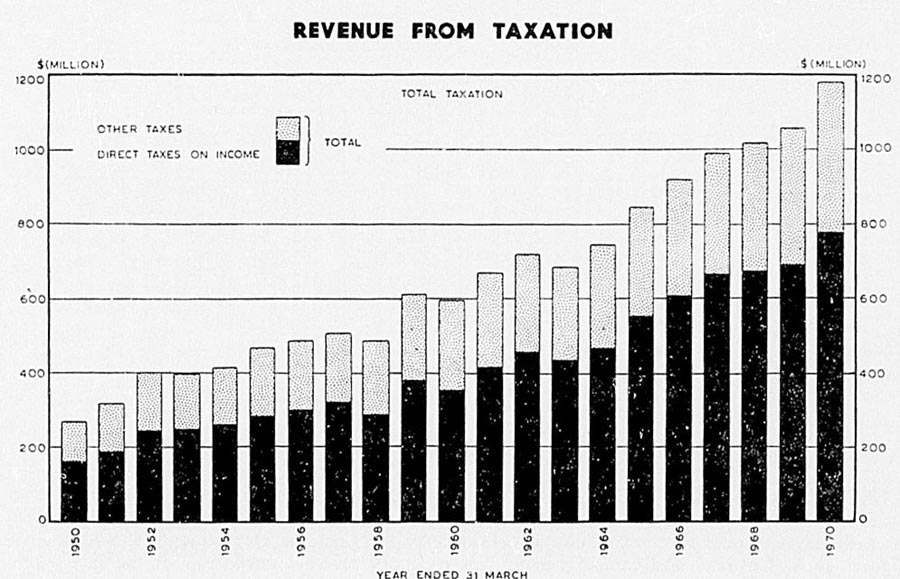
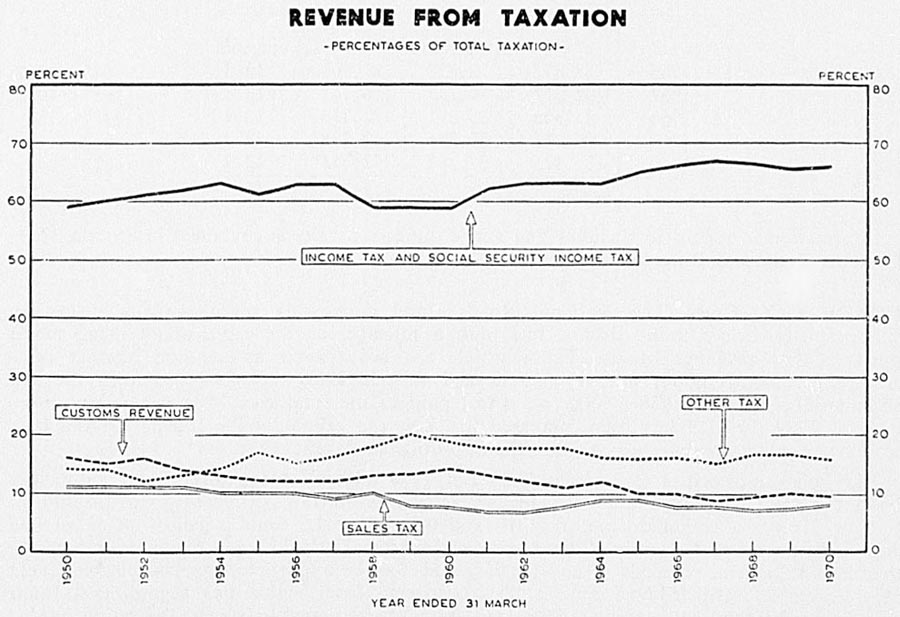
A comparison of taxation revenue and total private income and national income is afforded by the following table, which also shows taxation as a percentage of private income and national income.
| Year | National Income at Factor Cost | Central Government Taxation | |
|---|---|---|---|
| Total Revenue | Percentage of National Income | ||
| *Provisional. | |||
| $(million) | percent | ||
| 1959-60 | 2,075 | 594.6 | 28.7 |
| 1960-61 | 2,242 | 668.9 | 29.8 |
| 1961-62 | 2,315 | 716.4 | 30.9 |
| 1962-63 | 2,504 | 684.0 | 27.3 |
| 1963-64 | 2,742 | 742.3 | 27.1 |
| 1964-65 | 3,002 | 844.5 | 28.1 |
| 1965-66 | 3,261 | 918.2 | 28.2 |
| 1966-67 | 3,356 | 988.9 | 29.5 |
| 1967-68 | 3,457 | 1.012.7 | 29.3 |
| 1968-69 | 3,683 | 1.058.6 | 28.7 |
| 1969-70 | 4,034* | 1.181.3 | 29.3* |
CUSTOMS AND EXCISE TAXATION—Revenue under the heading of Customs does not include receipts from tyre tax and from motor spirits tax. Sales tax receipts are not counted as ordinary Customs revenue, although collected by the Customs Department. The following figures show Customs and excise revenue, for ordinary revenue purposes, for the latest five years.
| Year Ended 31 March | Customs Duties* | Beer Duty | Total Customs and Excise Duties | Proportion of Total Taxation |
|---|---|---|---|---|
| * Including excise duties other than beer duty. | ||||
| $(thousand) | percent | |||
| 1,966 | 88,875 | 32,828 | 121,703 | 13.3 |
| 1,967 | 92,012 | 34,735 | 126,747 | 12.8 |
| 1,968 | 95,545 | 35,591 | 131,136 | 12.9 |
| 1,969 | 106,412 | 35,826 | 142,238 | 13.4 |
| 1,970 | 115,473 | 37,282 | 152,755 | 12.9 |
Information in regard to Customs and excise duties generally is contained in Section 22D— Customs Tariff and Revenue.
ROADS TAXATION—The National Roads Fund derives its revenues from a tax on motor spirits, heavy traffic licence fees, and a mileage tax on vehicles not using motor spirits. Other revenues of the Fund, which are not classed as taxation, consist of a Government contribution, interest earned, and miscellaneous receipts—e.g., from the sale of materials, etc. For 1968-69, tax on petrol paid to the fund was 14.8c per gallon. From 1 April 1969 the rate has been increased to 17.1c per gallon by the transfer to the fund of 2.3c per gallon previously credited to the Consolidated Revenue Account.
The Local Authorities (Petroleum Tax) Act 1970 authorised territorial local authorities in 21 tax areas covering the country to levy a local authorities petroleum tax at the rate of 1, 2 or 3 cents a gallon on motor spirits and 0.5, 1.0 or 1.5 cents a gallon on diesel fuel delivered in a tax area. Nearly all tax areas decided to make the levies at maximum rates from February 1971. The proceeds of any tax imposed may be applied to projects for the benefit of the region or distributed among the constituent local authorities according to their proportions of total rate revenue. This legislation was designed to spread the rating burden of taxpayers.
Taxation receipts for roads purposes have been as follows during the latest five years, excluding rebates and collection expenses.
| Year Ended 31 March | Petrol Tax | Mileage Tax | Fees | Total |
|---|---|---|---|---|
| ($000) | ||||
| 1,966 | 48,652 | 2,606 | 14,548 | 65,806 |
| 1,967 | 50,812 | 2,901 | 16,357 | 70,070 |
| 1,968 | 50,536 | 3,195 | 9,260 | 62,991 |
| 1,969 | 53,601 | 3,604 | 9,120 | 66,325 |
| 1,970 | 64,992 | 3,899 | 9,945 | 78,836 |
On 4 May 1967 the tax on motor spirits was increased by 3.3c a gallon for general revenue purposes, but from 1 April 1969, 2.3 cents a gallon has been credited to the National Roads Fund.
INCOME TAX—Income tax is levied under the Land and Income Tax Act 1954, the Income Tax Assessment Act 1957, and amendments.
Exemptions—Certain specified incomes and types of income are exempt from income tax. The incomes of local and public authorities (except for certain Government trading departments), building societies (with the exception of rental income), co-operative dairy and milk treatment companies, trustees of superannuation funds subject, certain investment requirements), friendly societies, charitable societies, and others of character are exempt from income tax. The general principle is, when a society or association carries on business exclusively for the purpose for which it was established and does not operate for the private pecuniary profit of any individual, the income is exempt from income tax. Monetary benefits from the Consolidated Revenue Account (except the universal superannuation benefit), sick benefits from friendly societies, workers' compensation payments, war pensions, and for individuals the first $100 of income from interest, are exempt from income tax.
Pay as You Earn Income Tax—Payment of income tax is on a “pay as you earn” basis. It applies to all individual taxpayers and to estates. It does not apply to companies, unless incorporated after 25 July 1957, or unless the company voluntarily elects to come within the PAYE provisions.
The main features of the scheme are:
Income tax on salary and wages is deducted by the employer. In the main, taxpayers whose income consists solely of salary and wages are required to furnish a return of income only when their income during the year exceeds $2,600. However, they may furnish a return if they wish to have an adjustment made. In such cases the taxpayer is assessed on the basis of the annual return and receives a refund when tax assessed is less than the tax deducted by the employer.
All other individuals (including self-employed, except for certain classes of farmers), estates, and companies within the scheme, pay provisional tax in two instalments on a provisional declaration of the current year's income. The actual income of the previous year is commonly used as a basis for computing the provisional tax. Farmers in some circumstances may pay in three instalments. There is an adjustment at the end of the year when the return of income is furnished.
Tax Code Declarations—Employees are required to deliver a tax code declaration to the employer each year before 1 April. The tax code declaration specifies whether or not the taxpayer has a dependent wife, and the number of other dependants.
There is no obligation on the employer to check the accuracy of the tax code declaration. Except for cases when the employee ends and commences employment during the week, the employee must not have more than one tax code declaration current during the pay period. However, there is provision for secondary tax code declarations when the employee has two or more employers at the same time.
At the end of the year or on the termination of employment the employer completes the tax code certificate by entering the amount of wages and salary paid and the amount of tax deductions made, hands one copy to the employee, and sends the other copy to the Commissioner.
Alteration of Tax Code Declaration During Year—When the employee changes employment during the year, he must deliver a declaration to the new employer. If the declaration is delivered before the end of the first pay period, it applies from and including the first pay.
Employees who become entitled to claim allowances for new dependants during the year may deliver a new tax code declaration immediately the event occurs (e.g., marriage, or the birth of a child). The new tax code applies to the pay period commencing after the pay period in which the declaration was delivered.
When it becomes apparent that a dependent wife's income will exceed $650 for the year, the employee must deliver a new tax code declaration immediately omitting the wife as a dependant. The new code applies to the pay period following that in which it was delivered.
In other cases when a dependant ceases to be a dependant during the year—i.e., when a dependent wife dies or a child dies or reaches the age of 18 years—the employee is entitled to retain the tax code including them as dependants until the following 31 March. This applies even when the employee delivers a new tax code declaration on a change of employment.
Tax Deduction Tables: Principal Tables—The tax code declaration bears a code (M if the taxpayer is entitled to a wife's exemption; S if not so entitled); and a number which represents the number of other dependants. The tax deduction tables specify for each code and number the amount of tax to be deducted from the salary or wage payment for the period.
The amounts of tax shown in the tables are calculated as follows:
The weekly income has been converted to an annual basis and after deduction of the special exemptions to which the taxpayer is entitled the amount of income tax is computed and is then divided by 52 to arrive at the weekly deduction.
Fortnightly, three-weekly, four-weekly, and monthly tables of deductions are based on multiples of the basic weekly tables.
PAYE Tax Deductions—The tax rates for the purposes of PAYE tax deductions at source are the amounts shown in the tax deduction tables. These deductions are fixed according to the current amount of exemptions and tax rates. Some examples of these tax deductions are given for selected weekly incomes in the table which follows.
| Weekly Earnings | Not Entitled to Wife's Exemption | Entitled to Wife's Exemption | Entitled to Exemption for Wife and for— | ||
|---|---|---|---|---|---|
| One Child | Two Children | Three Children | |||
| Operative from 1 April 1970 | |||||
| $ | $ | $ | $ | $ | $ |
| 10 | 0.36 | - | - | - | - |
| 12 | 0.52 | 0.16 | - | - | - |
| 14 | 0.68 | 0.32 | 0.11 | - | - |
| 16 | 0.84 | 0.47 | 0.27 | 0.07 | - |
| 18 | 1.02 | 0.63 | 0.43 | 0.22 | 0.02 |
| 20 | 1.44 | 0.79 | 0.58 | 0.38 | 0.18 |
| 22 | 1.86 | 0.94 | 0.74 | 0.54 | 0.33 |
| 24 | 2.28 | 1.31 | 0.90 | 0.69 | 0.49 |
| 26 | 2.70 | 1.73 | 1.19 | 0.85 | 0.65 |
| 28 | 3.12 | 2.15 | 1.61 | 1.06 | 0.80 |
| 30 | 3.54 | 2.57 | 2.03 | 1.48 | 0.96 |
| 32 | 3.96 | 2.99 | 2.45 | 1.90 | 1.36 |
| 34 | 4.38 | 3.41 | 2.87 | 2.32 | 1.78 |
| 36 | 4.80 | 3.83 | 3.29 | 2.74 | 2.20 |
| 38 | 5.22 | 4.25 | 3.71 | 3.16 | 2.62 |
| 40 | 5.71 | 4.67 | 4.13 | 3.58 | 3.04 |
| 50 | 8.35 | 7.08 | 6.39 | 5.76 | 5.14 |
| 60 | 11.46 | 9.94 | 9.12 | 8.40 | 7.69 |
| 70 | 14.83 | 13.26 | 12.38 | 11.53 | 10.67 |
| 80 | 18.46 | 16.75 | 15.79 | 14.90 | 14.02 |
| 90 | 22.39 | 20.54 | 19.51 | 18.53 | 17.57 |
| 100 | 26.63 | 24.65 | 23.53 | 22.47 | 21.43 |
For the four months 1 December 1970 to 31 March 1971 the above tax rates were increased by 10 percent to equate to a surcharge of 3 1/3 percent on the rates of income tax for the year ended 31 March 1971.
In considering the incidence of income tax in New Zealand as illustrated by the table it should be noted that under the provisions of the Social Security Act a family benefit of $78 a year is paid, usually to the mother, for every child under 16 years of age irrespective of the income of the parents or the child. The allowance may continue to be paid up to age 18 years if the child is still attending school full time.
Amounts paid by an employee to a superannuation fund are deducted from the gross salary for the period. The amount of the tax deduction is then the table deduction appropriate to the net payment to the employee.
When there is no tax code declaration or special tax code certificate, the tax deduction is at the “no declaration” rate shown in the tables. This deduction is at the flat rate of 27 1/2c. in the dollar (increased by 10 percent for the four months' period from 1 December 1970 to equate to a surcharge of 3 1/3 percent on income tax for the year ended 31 March 1971).
Special Tables—Special tables are provided for shearers and for casual agricultural employees. These are tables of deductions from daily earnings.
There is also a table of deductions at a flat rate of 21 cents in $1 (23 cents in $1 as from 1 December 1970). This applies to payments of extra emoluments and to secondary employment unless a special tax code certificate is issued by the Commissioner. Extra emoluments, e.g., end of year bonuses and retrospective wage increases, are treated as separate payments. Secondary employment exists when the taxpayer has two or more employers at the same time. The secondary employer deducts tax according to the flat rate table, while the principal employer uses the normal table.
Employer's Duties—The employer is required to keep a record for each employee showing the amount of the source deduction payment and the amount of tax deducted. Not later than 20 April each year he must deliver to each employee a signed tax deduction certificate showing the total amounts of payments and tax deductions for the year (or period of employment if less than one year). A similar certificate must be given to the employee within seven days from the cessation of employment.
The aggregate amount of all tax deductions is to be remitted to the Commissioner each month. Not later than 15 May each year the employer must deliver to the Commissioner a reconciliation statement showing the total amount of tax deductions paid to the Commissioner in respect of deductions made during the year, and the total amount of tax deductions shown in the certificates for employees. The reconciliation statement is accompanied by signed copies of all tax deduction certificates.
Withholding Payments—These are payments for services rendered, but in circumstances where there is no real employer-employee relationship. Examples are company director's fees, agricultural contract work, fees for free-lance journalists. Tax is deducted from the gross amounts of such payments at flat rates which vary from 7 1/2c. to 25c. in the dollar (increased by 10 percent as from 1 December 1970) according to the nature of the work.
Provisional Taxpayers—Provisional taxpayers are those who derive any assessable income which is not subject to tax at source. However, the first $100 of interest is exempted from income tax, and is therefore not assessable income. Estates, trusts, companies incorporated after 25 July 1957, are also provisional taxpayers. Companies existing at that date may voluntarily elect to become provisional taxpayers.
Tax on provisional incomes is payable in two instalments during the year, by 7 September and 7 March. Normally the provisional income is an amount equal to the taxpayer's income for the preceding year. When the taxpayer anticipates that the income will be less than that of the preceding year, he may make an estimate of the provisional income and pay provisional tax on the estimated income. The taxpayer may estimate or re-estimate his provisional income at any time before the date for payment of any provisional tax instalment. If he does this and his estimated provisional tax is less than the normal provisional income (actual income of the previous year) and less than 80 percent of his actual income for the year, he may be liable to a penalty of 10 percent on the amount of provisional tax underpaid.
Employees who, in addition to their income from employment, derive interest, dividends, or rents, not exceeding $200 in the aggregate, are not required to pay provisional tax on this income which has not been taxed at source.
Provisional taxpayers are required to furnish returns of income, irrespective of the amount of income. The Commissioner then makes an assessment of terminal tax. Any difference between that assessment and the amounts of tax deducted at source or paid as provisional tax is either payable by the taxpayer or, if an over-payment, refunded to him.
Farmers who satisfy the Commissioner that they regularly derive more than half their income from an agricultural business and that more than half their gross cash income is derived after 7 February, and whose balance date falls between 1 April and 30 September, may pay provisional tax in three instalments.
Statistics relating to the incidence of income tax are given in Section 28 of this Yearbook.
Taxation of Individuals:Rates—The rates of income tax increase in steps ranging from a minimum of 7.85 percent on the first $650 of taxable income to a maximum of 67.5 percent of taxable income in excess of $12 000. The following table shows the rate of income tax for each step of taxable income for the year ended 31 March 1971.
| Step | Taxable Income | Rate |
|---|---|---|
| $ | Percent | |
| 1st | Up to 650 | 7.85 |
| 2nd | 651- 1,700 | 21.00 |
| 3rd | 1,701- 2,000 | 24.50 |
| 4th | 2,001- 2,500 | 27.50 |
| 5th | 2,501- 3,000 | 33.00 |
| 6th | 3,001- 3,500 | 34.00 |
| 7th | 3,501- 4,000 | 37.00 |
| 8th | 4,001- 4,500 | 40.00 |
| 9th | 4,501- 5,000 | 43.00 |
| 10th | 5,001- 5,500 | 45.00 |
| 11th | 5,501- 6,000 | 49.00 |
| 12th | 6,001- 6,500 | 50.00 |
| 13th | 6,501- 7,000 | 54.00 |
| 14th | 7,001- 7,500 | 60.00 |
| 15th | 7,501- 8,000 | 65.00 |
| 16th | 8,001-10,000 | 66.00 |
| 17th | 10,001-12,000 | 67.00 |
| final | Over 12,000 | 67.50 |
For the period 1 December 1970 to 31 March 1971 the above rates were increased by 10 percent to equate to a surcharge of 3 1/3 percent for the year 1970-71.
Dividends—Dividends received by individual shareholders are included as part of their assessable income. After deduction of the exemptions to which he is entitled the taxpayer pays income tax at normal rates on the total taxable income. The maximum rate of income tax on dividends is limited to 42.5 percent, and for determining the rates of income tax on dividends, dividend income is deemed to be the final increment of income. A rebate of 10 percent of taxable dividends is also allowed. When profits from the realisation of capital assets are distributed in cash, the amount of such profits may be exempted.
Special Exemptions from 1 April 1970—In determining the taxable income of individuals certain special exemptions are deductible from the taxpayer's assessable income. These exemptions are as follows:
Personal Exemption—A special exemption of $275 is allowable as a deduction from the assessable income of every taxpayer, except for non-resident taxpayers.
Wife Exemption—A special exemption of $275 is allowable as a deduction from the total assessable income of a married taxpayer. This exemption applies only when the taxpayer supports his wife during the income year. It is reduced $1 for each $1 of the wife's income in excess of $375 so that the taxpayer receives no exemption when the wife's income exceeds $650.
Child Exemption—A special exemption of $135 is allowable in respect of each of the first four dependent children of the taxpayer under the age of 18 years; for each child after the first four the exemption is $140.
Dependent Relative Exemption—A special exemption of the amount contributed towards the support of a dependent relative of the taxpayer or $135, whichever is the less, is also allowable. Where more than one taxpayer contributes towards the support of the same dependent relative, the exemption is apportioned between them. The exemption is also allowable in the case of amounts paid towards the support of a separated or divorced wife.
Housekeeper Exemption—A special exemption equal to the wife exemption or the amount of wages paid, whichever is the less, is allowable in respect of payments made to a woman or a day nursery, playcentre, creche or kindergarten to care for a widowed, divorced, separated, or unmarried taxpayer's child under the age of 18 years, or any child who by reason of mental or physical infirmity is unable to earn a living. The exemption is also allowed to a working wife who pays a woman or a day nursery, playcentre, creche or kindergarten to care for a child while she works, and to a taxpayer employing a housekeeper to look after the taxpayer's home because of the mental or physical infirmity of the taxpayer or his spouse.
Donations and School Fees—A special exemption is allowable for cash donations for religious and charitable purposes and for tuition fees incurred in sending a child of the taxpayer to a registered private school or a special school for handicapped children provided that in each case the school is not run for private pecuniary profit. The maximum exemption under this heading is $100.
Insurance and Superannuation—A special exemption is allowed for premiums paid in respect of policies of life insurance, sickness and accident insurance on the life of the taxpayer and his wife and children and for contributions to an approved superannuation fund. The maximum exemption allowable is $950 but is limited to $700 when the taxpayer is a member of an employer-subsidised superannuation scheme.
Taxable Income—In the case of individuals, income tax is assessed on the taxable income. This comprises total income less expenses less (a) any income exempted from income tax and, (b) the amount of the special exemptions to which the taxpayer is entitled.
A summary of the changes in the principal special exemptions and in the rates of ordinary income tax for the last 6 years is given in the following table.
| Income Year Ended 31 March | Special Exemptions | Ordinary Income Tax | |||||||
|---|---|---|---|---|---|---|---|---|---|
| Personal | Wife | Child | Charitable Donations and School Fees* | Insurance and Superannuation | Basic Rates Introduced | Rebates | |||
| Member of Subsidised Scheme* | Others* | Rate | Maximum | ||||||
*Maximum. †$140 for each child in excess of four. ‡Upon amalgamation of income tax and social security tax. | |||||||||
| $ | $ | $ | $ | $ | $ | $ | $ | ||
| 1,966 | 936 | 312 | 156 | 100 | 500 | 650 | 1,961 | 10% | 200 |
| 1,967 | 936 | 312 | 156 | 100 | 500 | 650 | 1,961 | 10% | 200 |
| 1,968 | 936 | 312 | 156 | 100 | 500 | 650 | 1,961 | 10% | 200 |
| 1,969 | 936 | 312 | 156 | 100 | 500 | 650 | 1,961 | 10% | 200 |
| 1,970 | 275‡ | 240‡ | 135‡† | 100 | 500 | 650 | 1,969 | - | - |
| 1,971 | 275 | 275 | 135† | 100 | 700 | 950 | 1,969 | - | - |
Taxation of Companies:Rates—The rates of income tax for 1971 are as follows:
Resident Companies and Public Authorities—The rate of income tax for every $ of taxable income in the case of companies and public authorities is:
When the taxable income does not exceed $7,200, 20c increased by 1/48,000 of $1 for every $ of taxable income;
When the taxable income exceeds $7,200, tax on the first $7,200 is calculated as given above, and there is a flat rate tax of 50c for every $ of income in excess of $7,200.
Non-Resident Companies—(a) When the taxable income does not exceed $7,200, the rate of income tax for every $ of taxable income is 25c, increased by 1/48,000 of $1 for every $ of taxable income;
(b) When the taxable income exceeds $7,200, tax on the first $7,200 is calculated as in (a) above and tax on the excess is charged at a flat rate of 55c in the $.
Bonus Issue Tax—Bonus share issues made on or after 11 June 1965 are generally subject to a flat rate tax of 17 1/2c in the dollar, which is payable by the company making the bonus share issue. Bonus issues arising from capitalisations of capital profits, share premium reserves, and the writing up of capital assets are exempt.
All companies which are, or are deemed to be, resident in New Zealand are liable for the bonus issue tax on bonus share issues they make. The sole exception is a petroleum mining company.
Excess Retention Tax—Excess retention tax is assessed to “privately controlled investment companies” if the amount of dividends paid is less than 40 percent of the income after taxation. The basic rate of excess retention tax is 35 cents in the $ of the insufficient distribution of income.
Grouping of Companies—Two or more companies which are two-thirds commonly owned in terms of paid up capital, or nominal value of allotted shares, or voting power, or entitlement to profits constitute a “group” of companies. The assessable income of companies included in a group are aggregated for the purpose of determining the rate of income tax. Provision exists for offsetting losses incurred by companies within a group and for the making of subvention payments.
Non-resident Investment Companies—Special provisions exist to limit the income tax payable by a non-resident investment company on income derived from investments or assets which are used wholly or principally in projects which are of importance in the development of New Zealand.
Unit Trusts—Unit trusts are treated as companies, and income and other payments to unit holders are treated as dividends.
Taxation of Trusts—Trusts created after 18 July 1968, with the exception of trusts created by will or intestacy, or other specific cases such as trusts created by Court order and statutory trusts such as the Official Assignee as trustee for creditors, are subject to a minimum rate of income tax of 35 percent on income classified as trustees' income.
The trustee of a trust other than a specified trust is entitled to a special exemption of $100 and is subject to a rate of tax calculated by reference to the trustee's income at the rate for individuals.
Deductions of Expenditure From Total Income—Any expenditure or loss necessarily incurred in carrying on a business for the purpose of gaining or producing assessable income may be deducted.
Deductions are also allowed to salary and wage earners for expenditure or loss which is incurred in producing assessable income. Types of expenditure which qualify are maintenance of tools of trade, instruments and equipment, reference books and technical manuals relating directly to the taxpayer's trade or occupation, subscriptions to trade and professional journals, the maintenance of any licence or certificate essential to the occupation of the taxpayer, and costs of short refresher courses or seminars connected with the taxpayer's trade or profession.
No deduction is allowed for expenditure which is of a capital nature or of a private or domestic nature.
Depreciation Allowances:Ordinary Depreciation—On buildings the allowable ordinary depreciation rates vary from 2 1/2 percent of cost price for wooden-walled and framed buildings to 1 percent of cost price for buildings of reinforced concrete. There are higher rates for certain buildings, such as cool stores, chemical works, glasshouses, etc. Various rates of depreciation have been fixed by the Commissioner of Inland Revenue for different classes of plant, machinery, and equipment. These are normally expressed as percentages of the diminishing value of the asset.
Special Depreciation—Special depreciation allowances are given on the cost of: plant and machinery (excluding motorcars and station wagons); employee accommodation; new farm buildings and extensions (other than residences); private bathrooms, showers and water closets installed in existing hotels; new hotels erected pursuant to an “approved project”; new buildings or extensions erected to provide storage for frozen meat or meat products.
Special depreciation is limited in the aggregate to 20 percent of the cost of the asset and is allowed in addition to ordinary depreciation.
Additional Depreciation—Additional depreciation is allowed on: Plant, machinery and equipment used for scientific research; safety frames on tractors; capital expenditure arising from compulsory surveys of fishing boats; capital expenditure in erecting or extending meat export slaughterhouses and meat packing houses; capital expenditure in erecting or extending buildings used for processing or storing fish or fish products for export.
Supplementary Depreciation—New farm buildings (other than residences) qualify for a supplementary depreciation allowance of up to 6 percent of cost. The overall deduction in conjunction with ordinary depreciation cannot exceed 10 percent of cost in any year. New hotels and motels catering for the travelling public qualify for a supplementary depreciation allowance of 1 percent of cost.
Tax Incentives—A number of taxation incentives designed to encourage investment in productive activities are available to industrial and agricultural enterprises. These incentives include:
Livestock Value—A farmer's livestock is treated as trading stock. Apart from the usual valuation options for trading stock used in a business, farmers are permitted to use a “standard value” for each class of livestock thus reducing in some degree fluctuations in income which might occur if market prices or other valuations were used. The standard value system is universally used except for high-value stud stock. The value adopted for any particular class of animal is usually somewhat below actual cost and also usually below sale value. The disposal of all or a substantial part of a farmer's livestock may result in an unduly high income for the year. The tax law provides special measures to alleviate the tax burden if that happens in the following circumstances (1) Death of the farmer, (2) Retirement from farming, (3) Expiry of a lease or acquisition of the farm land by the Crown, (4) Forced sale of livestock due to an adverse event (e.g., fire, flood, drought, disease among livestock).
The term “adverse event” means any happening which is declared by the Minister of Finance to be an adverse event.
Increased Livestock Incentive—An optional incentive scheme aimed at maintaining and accelerating the growth of livestock numbers is available. It applies to sheep, cattle and pigs in a farming business and provides for the establishment of base livestock numbers. Increases in stock above the base livestock number may, at the taxpayer's option, be brought in at a “nil” value. Because there may be changes in the type of livestock carried from year to year a system of equivalents is provided, namely, one head of cattle equals six sheep, one head of cattle equals four pigs, and three sheep equal two pigs. The equivalents are not based on standard or market values but on food intake.
Sharemilkers—A sharemilker who sells his livestock, or a farmer on leasehold land who quits the land and sells his livestock in order to purchase his own farm, is allowed to spread forward the excess income arising from the sale of the livestock. The excess income is the difference between the amount realised and the standard value adopted for the livestock. The excess is assessed as income in the fifth income year after the year of sale unless the taxpayer elects to have all or part of the amount assessed in any one or more of the intervening four income years.
Farm Income Equalisation—This is a scheme whereby farmers may deposit up to a maximum of 25 percent of their income, with a minimum deposit of $200, in an income equalisation reserve account. Deposits are deductible in the year of deposit and withdrawals constitute assessable income in the year of withdrawal. The maximum period in which deposits may be held in the reserve is five years; thus the scheme offers a means whereby a farmer can reduce fluctuations in his income.
Capital Development Expenditure—Taxpayers engaged in agricultural pursuits and in rock oyster farming or mussel farming may deduct certain capital development expenditure or spread it over a period of 10 years. In the case of lock oyster and mussel farming, development expenditure includes the cost of acquiring and preparing suitable surfaces for collecting spat.
Export Market Development and Tourist Promotion—A 150 percent deduction, subject to an overall limit, is allowable for qualifying expenditure as an incentive to promote the export of New Zealand goods and services; the overseas use of New Zealand trade marks, patents, designs or copyright; and to develop the New Zealand tourist industry.
Increased Exports—This incentive is to encourage exports by manufacturers who produce mainly for the local market. If the value of qualifying goods exported during the year has increased by comparison with the average value of goods exported during a “base period” of three years, 15 percent of the increase can be deducted.
Investment Allowance (West Coast, South Island)—20 percent of the cost of plant and machinery, and of buildings acquired, erected or extended, used for development projects in specified areas of the West Coast, South Island, is deductible, in addition to all depreciation. This allowance is to attract new industry to the area.
Mining—The mining industry has special methods of tax assessment, and investors may make a deduction of one-third of calls paid on shares in mineral or petroleum mining companies.
Post Office Bonus Bonds—Prizes received in respect of Post Office Bonus Bonds are exempt from tax.
Post Office National Development Bonds—An additional tax exemption is available in respect of the accumulated interest on Post Office National Development Bonds. The exemption is available to individuals only, and is subject to a maximum exemption of $500 in any income year. The interest is paid on maturity or surrender and is deemed to be derived in the income year in which the Bond matures or in the year in which it is surrendered.
Scientific Research—Special incentives to encourage scientific research are available. Expenditure on research equipment acquired for scientific purposes directly relating to the business of the taxpayer may be written off over a period of 5 years. Also the cost of research directly relating to the business of the taxpayer may be deducted in the year in which incurred, and gifts of money made by companies to universities and approved institutes for education and research are, subject to certain limitations, deductible.
Stamp Duty Exemption On First Conveyances—To encourage builders to start private housing schemes, when new houses and sections are sold the duty payable on the instrument of conveyance is computed on the unimproved value of the land only.
Visiting Experts—A special rebate is provided for approved visiting experts who provide either as independent consultants or as employees) specialist, technical, or managerial expertise essential to the development in the initial years of an approved new and continuing enterprise in New Zealand; or provide expertise that is not generally available in New Zealand; or who are engaged in approved research work in institutions or universities. The effect of the rebate is to limit the New Zealand tax payable on income from the visiting experts' services to an average rate of 35 percent.
Land Tax—Land tax is levied on the total unimproved value of land held at 31 March by each owner after making by way of special exemption from that value the following deduction: where the value does not exceed $60,000, a deduction of $60,000; where the value exceeds $60,000 a deduction of $60,000 diminished at the rate of $1 for each $1 of that excess, so as to leave no deduction when that value amounts to or exceeds $120,000.
Subject to deductions provided, life tenants are liable for land tax and joint owners are assessed jointly as regards the land held in conjunction, and are liable severally in respect of each owner's interest in such land and other land. This liability for joint assessment also applies to companies owning land if they consist of substantially the same shareholders. Two or more companies are deemed to consist of substantially the same shareholders if they are two-thirds or more commonly owned by the same persons. The ownership may be measured in terms of paid-up capital, or nominal value of allotted shares, or voting power, or entitlement to profits.
In case of default by a taxpayer in respect of land tax the amount of tax may be demanded from his successor in title, from a tenant of the taxpayer or his successor, or from a mortgagee of the estate or interest concerned. Land tax constitutes a charge on the land, and, notwithstanding any disposition of it, such land continues to be liable in the hands of a purchaser or other holder thereof for the payment of the tax so long as the charge remains in force. Registration of the charge is required and no disposition of the land or of any interest in it may be registered while the charge remains in force. Provision is made for relief in cases of hardship.
The rates of land tax on a “step” basis are as follows:
Where unimproved value after allowing the special exemption does not exceed $20,000 the rate is 5/12c for each $; where it exceeds $20,000 but does not exceed $30,000 the rate is 5/6c for each $; where it exceeds $30,000 but does not exceed $40,000 the rate is 1 1/4c for each $; where it exceeds $40,000 the rate is 1 2/3c for each $.
There is a rebate of a sum equal to 50 percent of the tax so assessed.
Legislation in 1970 now exempts land used for farming or agricultural activities from land tax.
Legislation in 1970—Principal amendments to legislation in 1970 included the following:
Dividend Income—From 1 April 1971 the maximum rate of tax on dividends was removed. Dividends are now assessed in the same manner as other income. A rebate of up to 10 percent of the taxable dividends will be allowed when the taxable income including dividends is $4,000 or less.
Export Market Development Expenditure—Two amendments were made to this incentive.
Self-employed professional people can claim the 50 percent allowance in respect of their own time spent on promoting their services for overseas projects. A formula is provided to value the time.
Export agents rewarded by commission may claim the 50 percent allowance for export market development expenditure for which they are not directly reimbursed.
Forestry Encouragement Grants—Under a scheme introduced in 1970 the Government makes grants in respect of the planting, maintenance and development expenditure of companies and individuals who undertake approved forest planting programmes. This grant for expenditure is not assessable income and a deduction is not allowed for the expenditure unless and to the extent that it is more than twice the amount of the grant. Grants are also made for the personal labour of the taxpayer and his family. These grants are assessable income.
Industrial Research and Development Grants—Grants made under the Industrial Research and Development Grants Act 1970 will not represent assessable income to the recipient. When the grant is in respect of deductible expenditure the amount ordinarily allowable is reduced by the amount of the grant. When the grant is for capital expenditure, e.g., plant, the cost of the asset is reduced by the amount of the grant in determining the amount of depreciation to be allowed.
Investment Allowance—An allowance of 10 percent of the cost of qualifying new plant and machinery is to be allowed in addition to other depreciation allowances. This allowance reintroduces the previous allowance which was suspended in 1966.
Payroll Tax—A payroll tax was introduced as from 1 August 1970. The tax is paid by employers at a flat 2 percent on all remuneration which is liable for the tax. Subject to an exemption of $7,800 a year for each employer, the gross amount of all salaries, wages, bonuses, commissions, and benefit allowances which are paid to employees are liable. In addition directors' fees, honoraria and certain other payments are liable for the tax.
Other exemptions are:
Most farmers, agricultural contractors and primary processing industries.
Hospitals, schools, charitable organisations.
The normal administrative functions of the Central Government and local authorities—although their trading activities are liable.
There is provision for rebates against payroll tax for sales of certain export goods. Payroll tax is not deductible for income tax purposes.
Special Exemptions—The exemptions for wife and housekeeper was increased from $240 to $275 as from 1 April 1970.
The exemption for taxpayers who are members of an employer-subsidised superannuation scheme was increased from $500 to $700 and for other taxpayers from $650 to $950 as from 1 April 1970.
Superannuation Funds—Special provisions have been introduced requiring superannuation funds to maintain certain investment ratios before tax exemption will be granted.
Rates of Tax—The following new schedule of rates has applied from 1 April 1971.
| Taxable Income | Tax on Each Dollar |
|---|---|
| $ $ | cents |
| Up to 650 | 7.85 |
| 651-1,700 | 21.00 |
| 1.701-2,000 | 24.50 |
| 2,001-2,500 | 27.50 |
| 2,501-3,000 | 30.50 |
| 3,001-3,500 | 34.00 |
| 3,501-4,000 | 37.00 |
| 4,001-4,500 | 39.00 |
| 4,501- 5,000 | 41.00 |
| 5,001- 5,500 | 43.00 |
| 5,501- 6,000 | 45.00 |
| 6,001- 7,000 | 46.00 |
| 7,001- 8,000 | 47.00 |
| 8,001-10,000 | 48.00 |
| 10,001-12,000 | 49.00 |
| Over 12,000 | 50.00 |
For the period 1 April to 31 July 1971 the above rates were increased by 10 percent to equate to a surcharge of 3 1/3 percent for the year 1971-72.
ESTATE AND GIFT DUTIES—The legislation dealing with estate duty and gift duty is contained in the Estate and Gift Duties Act 1968 and amendments.
When the final balance of the dutiable estate of a deceased person exceeds $12,000, estate duty is levied on the amount thereof. Exemptions are provided for the successions of a wife, husband, or infant child of a deceased person. (For this purpose an infant child is widely defined to mean, a child or stepchild, of a deceased person, under the age of 20 years; and includes any other person, other than the wife of the deceased, who is living and under the age of 20 years, and is in the opinion of the Commissioner, a dependant of the deceased.) These exemptions are subject to the following limitations and operate by way of a deduction from the duty of so much as is attributable to the exempted succession or exempted portion of the succession. In the case of a wife, the exemption applies to the value of her succession or $40,000, whichever is the less; in the case of a husband, to the value of his succession or $40,000, whichever is the less; and in the case of an infant child, to the value of the child's succession or $1,000, whichever is the less.
There are also various exemptions which operate by way of the exclusion of certain property in computing the amount of the final balance of the estate as, for example, for an interest in a home settled under the Joint Family Homes Act 1964 which passes to the surviving spouse; accrued amounts of war pensions and superannuation benefits; certain defined personal chattels to a value not exceeding $2,000; the property in an outright gift made before death to a charity; certain superannuation allowances for widows and infant children; and the wood value of growing trees on any land, a proprietary interest in which forms part of the dutiable estate.
Relief is provided for quick successions where estate duty is payable twice on the same property by reason of the two deaths occurring within a short period. The duty is reduced in the second estate according to the interval between the two deaths as follows: second death within four months, 75 percent reduction; within eight months, 60 percent reduction; within one year, 50 percent reduction; within two years, 40 percent reduction; within three years, 30 percent reduction; within four years, 20 percent reduction; within five years, 10 percent reduction.
Income tax in respect of a deceased person up to the date of death is treated as a debt of the deceased in all cases.
Estate duty is due and payable to the Commissioner of Inland Revenue on the death of the deceased. Interest is charged at the rate of 5 percent on all duty unpaid within six months of date of death. In addition a penalty of 5 percent is payable if duty is not paid within three months after notice of assessment, but is not imposed earlier than six months after death. The time for payment of duty without incurring a penalty may be extended in certain cases.
There is a right of appeal to the Board of Review constituted under the Inland Revenue Department Amendment Act 1960, against decisions of the Commissioner in the exercise of his discretion under certain sections of the Act. There is also a right of appeal on points of law or of fact by way of a case stated to the Supreme Court.
The following table gives the scale of rates of estate duty which applies to estate of deceased persons dying on and after 25 June 1970.
| Final Balance of Estate | Basic Payment | Rate on Excess |
|---|---|---|
| $ $ | $ | Percent |
| Up to 12,000 | - | - |
| 12,001- 14,000 | 140 | 7 |
| 14,001- 16,000 | 140 | 8 |
| 16,001- 18,000 | 300 | 9 |
| 18,001- 20,000 | 480 | 10 |
| 20,001- 22,000 | 680 | 11 |
| 22,001- 24,000 | 900 | 12 |
| 24,001- 26,000 | 1,140 | 13 |
| 26,001- 28,000 | 1,400 | 14 |
| 28,001- 30,000 | 1,680 | 15 |
| 30,001- 32,000 | 1,980 | 16 |
| 32,001- 34,000 | 2,300 | 17 |
| 34,001- 36,000 | 2,640 | 18 |
| 36,001- 38,000 | 3,000 | 19 |
| 38,001- 40,000 | 3,380 | 20 |
| 40,001- 42,000 | 3,780 | 21 |
| 42,001- 44,000 | 4,200 | 22 |
| 44,001- 46,000 | 4,640 | 23 |
| 46,001- 48,000 | 5,100 | 24 |
| 48,001- 50,000 | 5,580 | 25 |
| 50,001- 52,000 | 6,080 | 26 |
| 52,001- 54,000 | 6,600 | 27 |
| 54,001- 56,000 | 7,140 | 28 |
| 56,001- 58,000 | 7,700 | 29 |
| 58,001- 60,000 | 8,280 | 30 |
| 60,001- 70,000 | 8,880 | 31 |
| 70,001- 80,000 | 11,980 | 32 |
| 80,001- 90,000 | 15,180 | 33 |
| 90,001-100,000 | 18,480 | 34 |
| 100,001-110,000 | 21,880 | 35 |
| 110,001-120,000 | 25,380 | 36 |
| 120,001-130,000 | 28,980 | 37 |
| 130,001-140,000 | 32,680 | 38 |
| 140,001-150,000 | 36,480 | 39 |
| Exceeding 150,000 | 40,380 | 40 |
Gift Duty—A gift means any disposition of property situated in New Zealand (or of property outside New Zealand if the donor is domiciled in New Zealand at the time of the gift) which is made otherwise than by will, whether with or without an instrument in writing, without fully adequate consideration in money or its equivalent. There is provision for a deduction from the value of the gift of money payments adequately secured to the donor which were fixed or ascertainable at the date of the gift. No duty is payable on a gift which, together with the value of all other gifts (not exempt from duty by reason of their nature) made at the same time or within 12 months previously or subsequently by the same donor to the same or any other beneficiary does not exceed the value of $4,000. Gifts up to $200 in any year to the same person are not taken into account for gift duty (or estate duty) if made as part of the donor's normal expenditure. Various other exemptions, including gifts to any charitable trust, are contained in the Act.
The amount of the gift duty is payable by either the donor or the beneficiary, but the beneficiary is entitled to be indemnified by the donor unless the terms of the gift provide otherwise. Particulars of any gift made exceeding $2,000 (or the value of which when aggregated with the value of all gifts made by the donor within 12 months previously exceeds $2,000) are required to be furnished for assessment of duty, if any, within three months of the date of the gift, and if the duty is not paid within six months of making the gift a 5 percent penalty is imposed. Interest is also payable at 5 percent on any gift duty not paid within three months of the date of the gift and on any penalty from the date it was incurred.
The following table gives the scale of rates of gift duty made on and after 19 July 1968.
| Value of Gift (Together With Value of All Aggregated Gifts) | Basic Payment | Rate on Excess |
|---|---|---|
| *Of total value of gift. | ||
| $ $ | $ | Percent |
| Up to 4,000 | - | - |
| 4,001- 6,000 | 9 | |
| 6,001- 8,000 | 180 | 11 |
| 8,001-10,000 | 400 | 13 |
| 10,001-12,000 | 660 | 15 |
| 12,001-14,000 | 960 | 17 |
| 14,001-16,000 | 1,300 | 19 |
| 16,001-18,000 | 1,680 | 21 |
| 18,001-20,000 | 2,100 | 23 |
| 20,001-22,000 | 2,560 | 25 |
| 22,001-24,000 | 3,060 | 27 |
| 24,001-28,000 | 3,600 | 23 |
| 28,001-32,000 | 4,520 | 25 |
| 32,001-36,000 | 5,520 | 27 |
| 36,001-40,000 | 6,600 | 29 |
| 40,001-44,000 | 7,760 | 31 |
| 44,001-48,000 | 9,000 | 33 |
| 48,001-52,000 | 10,320 | 35 |
| 52,001-56,000 | 11,720 | 37 |
| 56,001-60,000 | 13,200 | 39 |
| 60,001-64,000 | 14,760 | 31 |
| Over 64,000 | - | 25* |
The net revenue received from estate duty and gift duty during each of the latest six years is given below.
| Year Ended 31 March | Estate Duty | Gift Duty | Total Estate and Gift Duties |
|---|---|---|---|
| $(thousand) | |||
| 1,965 | 18,836 | 2,121 | 20,957 |
| 1,966 | 20,928 | 2,102 | 23,031 |
| 1,967 | 21,158 | 1,906 | 23,064 |
| 1,968 | 20,241 | 1,490 | 21,731 |
| 1,969 | 22,050 | 2,062 | 24,112 |
| 1,970 | 24,669 | 1,633 | 26,303 |
Board of Review—The Inland Revenue Department Act provides for the establishment of one or more Boards of Review. There is at present only one such board. Members of a board are appointed by the Governor-General and consist of a chairman who is a barrister or solicitor of the Supreme Court of not less than seven years' practice, and two other members. The functions of a board are to sit as a judicial authority for hearing and determining such objections to assessments of tax or duty or the decisions or determinations of the Commission as are authorised by the relevant legislation. A determination of a board is final as to any question of fact, but subject to appeal to the Supreme Court on any question of law. However, questions of fact may be referred direct to the Supreme Court if both parties consent or if the Court considers it desirable that the objection be determined by it.
ESTATES PASSED FOR DEATH DUTY—Particulars of deceased persons' estates certified during the year ended 31 March 1970 are given in the tables following. Totals for the previous three years are appended. Estates of Maoris, other than hereditary interests in Maori land, are included.
The following table analyses the estates certified by size of estate value.
| Size of Estate (Net Value) | Number of Estates | Aggregate Net Value of Estates | Estate Duties Assessed | ||
|---|---|---|---|---|---|
| Males | Females | Total | |||
*Fifteen months to 31 March 1969. † Calendar years. | |||||
| $(000) $(000) | $(000) | $(000) | |||
| Under 2 | 556 | 557 | 1,113 | 1,413 | –– |
| 2 and under 4 | 1,036 | 993 | 2,029 | 6,078 | 1 |
| 4 and under 6 | 1,062 | 898 | 1,960 | 9,766 | –– |
| 6 and under 8 | 982 | 801 | 1,783 | 12,406 | - |
| 8 and under 10 | 764 | 543 | 1,307 | 11,709 | 15 |
| 10 and under 12 | 618 | 375 | 993 | 10,842 | 37 |
| 12 and under 14 | 418 | 264 | 682 | 8,848 | 68 |
| 14 and under 16 | 355 | 195 | 550 | 8,233 | 116 |
| 16 and under 18 | 249 | 182 | 431 | 7,318 | 143 |
| 18 and under 20 | 210 | 127 | 337 | 6,398 | 171 |
| 20 and under 22 | 183 | 97 | 280 | 5,871 | 182 |
| 22 and under 24 | 156 | 108 | 264 | 6,071 | 242 |
| 24 and under 30 | 358 | 208 | 566 | 15,100 | 742 |
| 30 and under 40 | 412 | 228 | 640 | 22,073 | 1,505 |
| 40 and under 50 | 290 | 89 | 379 | 16,996 | 1,492 |
| 50 and under 60 | 189 | 70 | 259 | 14,151 | 1,635 |
| 60 and under 70 | 132 | 42 | 174 | 11,274 | 1,518 |
| 70 and under 80 | 97 | 29 | 126 | 9,420 | 1,459 |
| 80 and under 90 | 78 | 30 | 108 | 9,118 | 1,696 |
| 90 and under 100 | 50 | 10 | 60 | 5,672 | 1,166 |
| 100 and under 120 | 83 | 25 | 108 | 11,762 | 2,773 |
| 120 and under 140 | 39 | 15 | 54 | 6,963 | 1,917 |
| 140 and under 160 | 38 | 7 | 45 | 6,721 | 1,947 |
| 160 and under 180 | 18 | 7 | 25 | 4,213 | 1,437 |
| 180 and under 200 | 9 | 3 | 12 | 2,271 | 777 |
| 200 and over | 33 | 23 | 56 | 20,428 | 7,570 |
| Totals, 1969-70 | 8,415 | 5,926 | 14,341 | 251,116 | 28,611 |
| Totals, 1968-69* | 10,261 | 7,021 | 17,282 | 278,945 | 29,069 |
| Totals, 1967 | 7,861 | 5,465 | 13,326 | 205,790 | 21,508 |
| Totals, 1966† | 7,883 | 5,428 | 13,311 | 204,758 | 21,827 |
The average net value per estate certified in 1969-70 was $17,510 (males $19,849; females $14,189) compared with $16,141 (males $18,493; females $12,703) in 1968-69 and $15,443 (males $16,907; females $11,898) in 1967. Duty on estates of males amounted to $18.8 million and on estates of females $9.8 million, the respective figures for 1968-69 being $20.0 million and $9.0 million.
The law relating to death duties is contained in the Estate and Gift Duties Act 1968 which came into force on 1 January 1969. From 26 June 1969 the exemption for both a widow and a widower has been $40,000 and estates up to a value of $12,000 are exempt from duty.
The average amount of duty assessed within each of the various estate groups is now given. The rates of average duty to average estate value are also given.
| Size of Estate (Net Value) | Average Duty Assessed per Estate | Average Duty as Percentage of Average Value of Estate | ||||
|---|---|---|---|---|---|---|
| Males | Females | Total | Males | Females | Total | |
* Fifteen months to 31 March 1969. † Calendar years. | ||||||
| $(000) $(000) | $ | $ | $ | percent | percent | percent |
| Under 10 | 8 | 16 | 11 | 0.1 | 0.2 | 0.1 |
| 10 and under 12 | 24 | 60 | 38 | 0.2 | 0.5 | 0.3 |
| 12 and under 14 | 68 | 149 | 99 | 0.5 | 1.2 | 0.8 |
| 14 and under 16 | 149 | 321 | 210 | 1.0 | 2.1 | 1.4 |
| 16 and under 18 | 221 | 485 | 333 | 1.3 | 2.9 | 2.0 |
| 18 and under 20 | 380 | 719 | 507 | 2.0 | 3.8 | 2.7 |
| 20 and under 22 | 453 | 1,020 | 650 | 2.2 | 4.9 | 3.1 |
| 22 and under 24 | 692 | 1,242 | 917 | 3.0 | 5.4 | 4.0 |
| 24 and under 30 | 933 | 1,962 | 1,311 | 3.5 | 7.3 | 4.9 |
| 30 and under 40 | 1,814 | 3,323 | 2,352 | 5.2 | 9.7 | 6.8 |
| 40 and under 50 | 3,462 | 5,485 | 3,937 | 7.7 | 12.3 | 8.8 |
| 50 and under 60 | 5,569 | 8,320 | 6,313 | 10.2 | 15.3 | 11.6 |
| 60 and under 70 | 7,895 | 11,341 | 8,726 | 12.2 | 17.4 | 13.5 |
| 70 and under 80 | 10,626 | 14,773 | 11,580 | 14.2 | 19.6 | 15.5 |
| 80 and under 90 | 14,830 | 17,970 | 15,702 | 17.5 | 21.4 | 18.6 |
| 90 and under 100 | 18,595 | 23,649 | 19,437 | 19.7 | 25.0 | 20.6 |
| 100 and under 120 | 24,511 | 29,560 | 25,680 | 22.5 | 27.3 | 23.6 |
| 120 and under 140 | 34,848 | 37,193 | 35,499 | 27.0 | 29.0 | 27.5 |
| 140 and under 160 | 42,348 | 48,261 | 43,267 | 28.3 | 32.9 | 29.0 |
| 160 and under 180 | 56,710 | 59,502 | 57,492 | 33.6 | 35.3 | 34.1 |
| 180 and under 200 | 63,665 | 68,071 | 64,766 | 33.3 | 37.1 | 34.2 |
| 200 and over | 134,867 | 135,647 | 135,187 | 36.2 | 38.4 | 37.1 |
| All estates, 1969-70 | 2,231 | 1,660 | 1,995 | 11.2 | 11.7 | 11.4 |
| All estates, 1968-69* | 1,952 | 1,287 | 1,682 | 10.6 | 10.1 | 10.4 |
| All estates, 1967† | 1,970 | 1,101 | 1,614 | 11.0 | 9.3 | 10.5 |
| All estates, 1966† | 1,960 | 1,175 | 1,640 | 11.0 | 10.0 | 10.7 |
A summary showing gross assets, notional estate, and debts and charges, classified in broad groups according to size of estate, is now given. The small difference between the earlier table of aggregate net values of estates and the table showing a break-up of assets is due to rounding off to the nearest thousand in both tables.
| ESTATES PASSED FOR DUTY—YEAR ENDED 31 MARCH 1970 | |||||||||
|---|---|---|---|---|---|---|---|---|---|
| — | Size of Estate (Net Value) | ||||||||
| Under $6,000 | $6,000-$9,999 | $10,000-$19,999 | $20,000-$23,999 | $24,000-$39,999 | $40,000-$99,999 | $100,000-$199,999 | $200,000 and Over | All Estates | |
| Gross Assets— | $(000), except average per estate $ | ||||||||
| Cash | 6,551 | 6,428 | 10,682 | 2,832 | 7,608 | 9,804 | 3,477 | 1,058 | 48,441 |
| Average per estate | 1,284 | 2,080 | 3,569 | 5,206 | 6,309 | 8,864 | 14,251 | 18,896 | 3,378 |
| Furniture, effects, etc. | 1,650 | 1,905 | 2,541 | 572 | 1,411 | 1,643 | 541 | 228 | 10,492 |
| Average per estate | 323 | 617 | 849 | 1,051 | 1,170 | 1,486 | 2,219 | 4,075 | 732 |
| Farm stock, implements, etc. | 51 | 112 | 272 | 114 | 498 | 2,139 | 1,201 | 795 | 5,181 |
| Average per estate | 10 | 36 | 91 | 209 | 413 | 1,934 | 4,921 | 14,205 | 361 |
| Private business interests | 65 | 134 | 463 | 290 | 1,206 | 2,612 | 1,510 | 40 | 6,321 |
| Average per estate | 13 | 43 | 155 | 534 | 1,000 | 2,362 | 6,190 | 708 | 441 |
| Assurance policies | 1,432 | 1,860 | 3,387 | 809 | 2,588 | 3,909 | 1,424 | 341 | 15,749 |
| Average per estate | 281 | 602 | 1,132 | 1,487 | 2,146 | 3,534 | 5,835 | 6,091 | 1,098 |
| Loans | 838 | 1,550 | 3,930 | 1,673 | 6,017 | 12,458 | 4,555 | 1,238 | 32,258 |
| Average per estate | 164 | 502 | 1,313 | 3,075 | 4,989 | 11,264 | 18,670 | 22,104 | 2,249 |
| Shares, stocks, etc. | 879 | 1,349 | 4,222 | 1,781 | 6,527 | 13,741 | 9,328 | 9,591 | 47,419 |
| Average per estate | 172 | 437 | 1,411 | 3,274 | 5,412 | 12,424 | 38,231 | 171,267 | 3,307 |
| Real property | 6,224 | 10,142 | 13,846 | 3,219 | 8,747 | 15,500 | 6,256 | 2,156 | 66,091 |
| Average per estate | 1,220 | 3,282 | 4,626 | 5,917 | 7,253 | 14,014 | 25,640 | 38,505 | 4,609 |
| Other property | 790 | 889 | 1,762 | 462 | 1,757 | 2,709 | 1,055 | 290 | 9,713 |
| Average per estate | 155 | 288 | 589 | 849 | 1,457 | 2,449 | 4,323 | 5,172 | 677 |
| Notional estate | 1,339 | 1,668 | 2,691 | 585 | 2,086 | 3,561 | 1,690 | 1,016 | 14,635 |
| Average per estate | 262 | 540 | 899 | 1,076 | 1,730 | 3,220 | 6,925 | 18,142 | 1,021 |
| Foreign property | 116 | 144 | 513 | 234 | 749 | 2,249 | 2,169 | 4,222 | 10,396 |
| Average per estate | 23 | 46 | 171 | 431 | 621 | 2,033 | 8,890 | 75,389 | 725 |
| Debts— | |||||||||
| Unsecured | 1,329 | 909 | 1,229 | 327 | 987 | 1,853 | 914 | 446 | 7,993 |
| Secured | 1,347 | 1,158 | 1,440 | 302 | 1,034 | 1,840 | 364 | 101 | 7,587 |
| Total | 2,677 | 2,067 | 2,669 | 629 | 2,021 | 3,693 | 1,277 | 547 | 15,580 |
| Average per estate | 525 | 669 | 892 | 1,156 | 1,676 | 3,339 | 5,235 | 9,774 | 1,086 |
Realty comprised 26.3 percent of gross New Zealand assets, while the proportion of cash was 19.3 percent.
The number of estates in each group for 1969-70 are classified below according to net value of estate.
| Age Group of Deceased Person, in Years | Under $2,000 | $2,000-$3,999 | $4,000-$5,999 | $6,000-$7,999 | $8,000-$9,999 | $10,000-$19,999 | $20,000-$23,999 | $24,000-$29,999 | $30,000-$39,999 | $40,000-$59,999 | $60,000-$79,999 | $80,000-$99,999 | $100,000-$199,999 | $200,000 and Over | Total |
|---|---|---|---|---|---|---|---|---|---|---|---|---|---|---|---|
| Under 20 | 6 | 17 | 12 | 10 | 5 | 4 | - | - | - | - | - | - | - | - | 54 |
| 20-24 | 15 | 27 | 26 | 19 | 10 | 18 | 4 | 2 | 4 | 3 | 1 | - | - | - | 129 |
| 25-29 | 6 | 16 | 18 | 5 | 6 | 18 | 6 | 5 | 1 | 3 | - | - | - | - | 84 |
| 30-34 | 7 | 9 | 8 | 10 | 8 | 23 | 2 | 6 | 5 | 4 | 2 | - | 1 | 1 | 86 |
| 35-39 | 12 | 28 | 19 | 5 | 8 | 42 | 1 | 9 | 5 | 3 | 2 | - | 1 | - | 135 |
| 40-44 | 25 | 31 | 22 | 37 | 18 | 65 | 5 | 6 | 12 | 11 | 3 | 1 | 3 | - | 239 |
| 45-49 | 40 | 62 | 55 | 46 | 40 | 91 | 17 | 18 | 18 | 14 | 12 | 6 | 6 | 1 | 426 |
| 50-54 | 57 | 86 | 75 | 66 | 63 | 147 | 26 | 23 | 21 | 26 | 10 | 9 | 9 | 6 | 624 |
| 55-59 | 61 | 129 | 117 | 103 | 84 | 225 | 40 | 51 | 43 | 54 | 26 | 8 | 12 | 1 | 954 |
| 60-64 | 98 | 184 | 168 | 173 | 107 | 274 | 50 | 57 | 66 | 72 | 37 | 25 | 17 | 5 | 1,333 |
| 65-69 | 110 | 248 | 234 | 209 | 150 | 336 | 67 | 62 | 74 | 78 | 37 | 11 | 41 | 5 | 1,662 |
| 70-74 | 152 | 270 | 249 | 242 | 181 | 383 | 81 | 74 | 90 | 87 | 41 | 31 | 38 | 9 | 1,928 |
| 75-79 | 161 | 267 | 308 | 261 | 214 | 443 | 88 | 79 | 91 | 98 | 42 | 18 | 30 | 7 | 2,107 |
| 80-84 | 163 | 296 | 310 | 272 | 202 | 451 | 75 | 95 | 101 | 91 | 38 | 27 | 42 | 7 | 2,171 |
| 85-89 | 110 | 211 | 206 | 196 | 129 | 292 | 58 | 51 | 65 | 46 | 32 | 26 | 26 | 6 | 1,454 |
| 90-94 | 52 | 101 | 91 | 86 | 56 | 133 | 16 | 25 | 31 | 32 | 9 | 3 | 14 | 4 | 653 |
| 95-99 | 15 | 21 | 23 | 17 | 10 | 28 | 5 | 3 | 7 | 8 | 5 | 2 | 2 | 4 | 150 |
| Unspecified | 23 | 26 | 19 | 25 | 16 | 20 | 3 | - | 6 | 8 | 3 | 1 | 2 | - | 152 |
| Totals | 1,113 | 2,029 | 1,960 | 1,783 | 1,307 | 2,993 | 544 | 566 | 640 | 638 | 300 | 168 | 244 | 56 | 14,341 |
| Percent | 7.76 | 14.15 | 13.67 | 12.43 | 9.12 | 20.87 | 3.79 | 3.95 | 4.46 | 4.45 | 2.09 | 1.17 | 1.70 | 0.39 | 100.00 |
In the following table deceased persons' estates for 1969-70 are analysed by occupations.
| Occupational Group | Under $ 6,000 | $ 6,000 to 9,999 | $ 10,000 to 19,999 | $ 20,000 to 23,999 | $ 24,000 to 39,999 | $ 40,000 to 99,999 | 100,000 and over | Totals |
|---|---|---|---|---|---|---|---|---|
| NOTE—In this table for the separate occupation classes, Estates in any value group which has less than three in it have been included with the number for the value group below; where this was not possible, no net estate distribution has been shown. As the full distribution for each occupation or value group has been given in the totals, this procedure means that in some cases the sum of individual groups will not agree with the totals. | ||||||||
| Males | ||||||||
| Architects, engineers, chemists, etc. | 4 | 13 | 27 | 8 | 24 | 19 | 3 | 98 |
| Doctors, dentists, and medical workers | 17 | 12 | 18 | 6 | 11 | 26 | 4 | 94 |
| Teachers, clergy and jurists | 45 | 38 | 53 | 10 | 25 | 18 | 6 | 195 |
| Artists, draughtsmen, and related workers | 25 | 23 | 48 | 10 | 21 | 18 | 4 | 149 |
| Executive officials, directors, managers | 68 | 87 | 162 | 36 | 105 | 142 | 51 | 651 |
| Bookkeepers, typists, and clerical workers | 230 | 175 | 190 | 27 | 45 | 19 | 2 | 688 |
| Working proprietors, wholesale, and retail trade | 78 | 66 | 96 | 21 | 30 | 35 | 7 | 333 |
| Insurance, real estate, and all salesmen | 97 | 56 | 85 | 21 | 25 | 24 | 3 | 311 |
| Farmers and farm managers | 223 | 206 | 298 | 90 | 316 | 431 | 122 | 1,686 |
| Farm workers | 80 | 30 | 45 | - | 6 | - | - | 161 |
| Hunters, fishermen, and loggers | 28 | 20 | 12 | - | 7 | - | - | 67 |
| Miners, welldrillers, and quarrymen | 30 | 13 | 5 | 4 | - | - | - | 52 |
| Merchant marine officers and ratings | 21 | 13 | 16 | - | 3 | - | - | 53 |
| Aircraft crews | 3 | 3 | 7 | - | - | - | - | 13 |
| Transport and communication workers | 175 | 114 | 98 | 6 | 16 | 7 | - | 416 |
| Spinners, cutters, tailors, etc. | 44 | 30 | 24 | 3 | 4 | 6 | - | 111 |
| Furnacemen and moulders | 25 | 12 | 13 | - | 4 | - | - | 54 |
| Instrument, tool makers, machinists | 170 | 122 | 91 | 14 | 21 | 14 | - | 432 |
| Electricians | 57 | 40 | 43 | 5 | 8 | 6 | - | 159 |
| Carpenters, painters, bricklayers | 217 | 145 | 140 | 20 | 29 | 17 | - | 568 |
| Compositors, bookbinders, etc. | 20 | 18 | 16 | 3 | 3 | 3 | - | 63 |
| Potters and clay workers | 6 | 3 | - | - | - | 3 | - | 12 |
| Millers, bakers, and food workers | 49 | 31 | 27 | 7 | 3 | 5 | - | 122 |
| Chemical and tobacco workers | 7 | - | 4 | - | - | - | - | 11 |
| Production processors, packers, etc. | 15 | 9 | 7 | 4 | - | 3 | - | 38 |
| Lifting equipment and freight handlers | 135 | 95 | 65 | 6 | 7 | 3 | - | 311 |
| Labourers, etc. | 278 | 104 | 47 | 5 | 7 | - | - | 441 |
| Firemen, policemen, guards | 18 | 14 | 15 | - | - | - | - | 47 |
| Housekeepers, cooks, waiters, cleaners | 55 | 14 | 24 | - | 4 | - | - | 97 |
| Hairdressers, launderers, and dry-cleaners | 9 | 7 | 10 | - | 4 | - | - | 30 |
| Athletes, recreation, and service workers | 26 | 11 | 17 | - | 4 | - | - | 58 |
| Occupation not stated or not working | 377 | 205 | 144 | 27 | 37 | 33 | 33 | 833 |
| All uniformed personnel (services) | 23 | 16 | 15 | - | 4 | 3 | - | 61 |
| Totals | 2,654 | 1,746 | 1,850 | 339 | 770 | 836 | 220 | 8,415 |
| Females | ||||||||
| Occupation not stated or not working | 2,323 | 1,294 | 1,100 | 202 | 416 | 213 | 77 | 5,625 |
| Doctors, dentists, and medical workers | 21 | 12 | 8 | - | - | 3 | - | 44 |
| Teachers, clergy, and jurists | 11 | 5 | 9 | - | 10 | - | - | 35 |
| Bookkeepers, typists, and clerical workers | 16 | 12 | 11 | - | 4 | - | - | 43 |
| Housekeepers, cooks, etc. | 3 | 3 | 3 | - | - | - | - | 9 |
| Spinners, cutters, tailors, etc. | 5 | 3 | - | - | - | - | - | 8 |
| Others | 69 | 15 | 17 | - | 6 | 53 | 3 | 162 |
| Totals | 2,448 | 1,344 | 1,143 | 205 | 436 | 270 | 80 | 5,926 |
OTHER DUTIES—These cover a miscellany of items of taxation.
In the next table the receipts for the last five years are shown under the various heads; receipts under agreement on sales of overseas lottery tickets in New Zealand have been added to the revenue items handled by the Duties Division of the Inland Revenue Department.
| Duty | Year Ended 31 March | ||||
|---|---|---|---|---|---|
| 1966 | 1967 | 1968 | 1969 | 1970 | |
| *Abolished as from 14 June 1965. | |||||
| $(thousand) | |||||
| Duty on instruments | 7,073 | 6,975 | 5,807 | 6,839 | 8,808 |
| Duty on cheques | 1,732 | 1,882 | 1,852 | 1,860 | 1,948 |
| Racing taxation | 11,510 | 12,029 | 11,321 | 11,155 | 12,054 |
| Amusement tax | 143* | * | * | * | * |
| Lottery duty | 896 | 719 | 722 | 655 | 719 |
| Overseas lottery duty | 217 | 184 | 219 | 245 | 273 |
| Totals | 21,571 | 21,790 | 19,921 | 20,754 | 23,802 |
Some of the more important items included in the foregoing table are dealt with in more detail under subsequent headings.
RACING TAXATION—The Government taxation on totalisator turnover is, under the Gaming Amendment Act 1968, effective from 1 August 1968, at the rate of 9.32 percent of gross turnover subject to a rebate of 2 1/2 percent on the first $100,000 of gross investments received by a club in any one year. Total deductions from gross investments are as follows: (a) totalisator duty 9.32 percent; (b) club or Totalisator Agency Board's commission 7.5 percent in respect of win and place dividends and 10.18 percent on doubles investments. In the case of special races win and place investment commission of 8 percent is deducted and on special doubles commission of 10.68 percent is deducted, and in these cases the 0.5 percent levy is waived; and (c) 1/2 percent levy as provided by the Gaming Amendment Act 1965. Where the 1/2 percent levy is deducted by a racing or hunt club it is paid to the New Zealand Racing Conference and where it is deducted by a trotting club it is paid to the New Zealand Trotting Conference. Each Conference pays the money received by it into a separate account, which is applied solely for the purpose of assisting clubs to provide, maintain, and replace amenities for the public and course improvements on their racecourses. The proceeds of the levy and the amount paid to clubs are not subject to taxation. The legislation provides that the levy is to cease on 1 November 1972.
The Totalisator Agency Board established by the Gaming Amendment Act 1949 to conduct off-course betting, receives 7 1/2 percent of the turnover made through the totalisator agencies. This is the same percentage as that retained by clubs for on-course turnover.
The Gaming Act 1908 and amendments provide for the Minister of Internal Affairs to grant totalisator licences for not more than 404 days in any racing year. Of these 404 days, 271 are allocated to racing and hunt clubs and 133 to trotting clubs. An amendment to the Act in 1963 enabled clubs to increase the number of races at a meeting from eight to nine.
The following table gives figures of Government taxes, and the amount of turnover retained by clubs or the Totalisator Agency Board.
| Item | Year ended 31 July | ||||
|---|---|---|---|---|---|
| 1966 | 1967 | 1968 | 1969 | 1970 | |
†Retained by clubs and T.A.B. ‡Includes $493,330 “Totalisator duty” from 10 July 1967 following the Stamp Duties Amendment Act 1967 which combines totalisator and dividend duty into one tax known as totalisator duty, equal to 9.32 percent of gross investments. | |||||
| Government taxes— | $(thousand) | ||||
| On totalisator turnover | 5,958 | 6,497‡ | 11,236 | 11,580 | 12,440 |
| On dividends | 5,470 | 5,499 | |||
| Totals | 11,428 | 11,995 | 11,236 | 11,580 | 12,440 |
| Amount of totalisator turnover retained by clubs or T.A.B. | 9,763 | 10,214 | 9,637 | 11,223 | 11,918 |
| Unpaid fractions† | 270 | 279 | 496 | 532 | 603 |
| Levy of 1/2 percent | 629 | 659 | 617 | 635 | 681 |
For the financial year ended 31 March 1970, Consolidated Revenue Account receipts from racing taxation amounted to $12.1 million, as compared with $11.2 million in 1968-69.
The following figures relate to the racing year, which ends on 31 July.
| Item | Galloping | Trotting | ||||
|---|---|---|---|---|---|---|
| 1967-68 | 1968-69 | 1969-70 | 1967-68 | 1968-69 | 1969-70 | |
| Number of racing days | 271 | 271 | 271 | 133 | 133 | 133 |
| Number of races | 2,222 | 2,261 | 2,281 | 1,154 | 1,160 | 1,176 |
| Amount of stakes $(000) | 2,919 | 2,993 | 3,281 | 1,340 | 1,379 | 1,531 |
| Average per race $ | 1,314 | 1,324 | 1,439 | 1,161 | 1,188 | 1,302 |
| Totalisator turnover— | $(million) | |||||
| On course | 33.3 | 35.5 | 38.0 | 15.4 | 15.5 | 16.7 |
| Off course | 55.7 | 57.1 | 60.7 | 19.7 | 19.6 | 21.7 |
| Totals | 89.1 | 92.6 | 98.7 | 35.0 | 35.2 | 38.3 |
| Doubles (included above) | 38.0 | 36.7 | 35.8 | 12.8 | 12.1 | 12.6 |
| Amount paid in dividends | 73.3 | 75.2 | 80.3 | 28.8 | 28.6 | 31.2 |
Racing (galloping) turnover increased by $6.1 million to $98.7 million, while the amount placed on trotting showed an increase of $3.2 million. The total amount placed on doubles declined by $0.5 million from $48.9 million to $48.4 million. Of the doubles total of $48.4 million, $35.8 million was placed at galloping meetings and $12.6 million at trotting meetings.
The $60.7 million placed at galloping meetings with the Totalisator Agency Board in the latest season was $3.6 million more than in the previous year, and the amount placed on trotting meetings increased by $2 million. On-course turnover at both galloping and trotting meetings showed increases of $2.5 million and $1.1 million respectively.
Of the amount placed on the totalisator during the 1969-70 racing season, 81.3 percent was returned to bettors by way of dividends. Government taxes absorbed 9.1 percent and 9.1 percent was retained by clubs or T.A.B. A levy for racecourse improvements amounted to 0.5 percent.
FILM-HIRE TAX—Holders of renters' licences under Part V of the Cinematograph Films Act 1961 pay a film-hire tax.
The film-hire tax payable is assessed on the net quarterly receipts derived by the renter from renting sound-picture films. On British Commonwealth films the tax is 10 percent and on foreign films 25 percent of the net receipts. Films made wholly in New Zealand are exempt from the tax. The film-hire tax yielded a revenue of $374,500 in 1965-66, $378,000 in 1966-67, $302,544 in 1967-68, $270,908 in 1968-69, and $291,077 in 1969-70.
SALES TAX—Sales tax is collected under the authority of the Sales Tax Act 1932-33 and its amendments. Numerous classes of goods were originally exempt from the tax, these being, in the main, commodities of primary production, articles used in the primary industries, machinery for use in manufacture, and the more important foodstuffs for household consumption. Goods exported from New Zealand were exempt, as were also certain commodities (e.g., motor spirits) which were subject to special taxation. In the post-war years a wide range of goods has been exempted from sales tax. The Sales Tax Exemption Order 1967 consolidates in one list all the existing exemptions from sales tax. Beer and manufactured tobacco were exempted from sales tax on 4 November 1959. The rate of tax is normally 20 percent; for motor vehicles it was increased to 40 percent in June 1958, reduced to 33 1/3 percent in July 1960, and increased to 40 percent again in May 1967. The tax is not a turnover tax, being payable only once and, as far as possible, at the point where the goods pass to the retailer. The Sales Tax Act is administered by the Customs Department. The net amount yielded by the sales tax during each of the latest five March years has been: 1965-66, $76,633,000; 1966-67, $78,926,000; 1967-68, $75,389,000; 1968-69, $82,801,000, and 1969-70, $97,615,000.
Monthly figures of sales tax collected by the Customs Department during recent calendar years have been as follows.
| Month | Total Sales Tax Receipts | ||||
|---|---|---|---|---|---|
| 1966 | 1967 | 1968 | 1969 | 1970 | |
| $(thousand) | |||||
| January | 4,134 | 7,066 | 6,462 | 7,239 | 9,756 |
| February | 6,750 | 6,643 | 6,554 | 7,120 | 7,941 |
| March | 10,070 | 10,488 | 7,746 | 11,510 | 12,226 |
| April | 7,378 | 7,138 | 9,922 | 8,991 | 11,404 |
| May | |||||
| June | 6,421 | 6,865 | 5,749 | 6,768 | 10,076 |
| July | 6,461 | 7,201 | 6,722 | 7,815 | 9,954 |
| August | 6,587 | 5,941 | 5,730 | 7,541 | 9,233 |
| September | 6,470 | 6,807 | 7,059 | 8,954 | 10,541 |
| October | 6,843 | 6,880 | 6,735 | 7,902 | 12,024 |
| November | 7,318 | 6,965 | 6,938 | 9,215 | 10,859 |
| December | 7,250 | 6,830 | 8,079 | 10,506 | 12,142 |
The collections during a month relate in general to sales during the preceding month. Sales tax for any one month must be paid by the twenty-eighth of the following month to secure the discount. When the twenty-eighth falls on a Friday in a thirty-day month last-minute payments posted on the Friday are actually received in the succeeding month, e.g., sales tax on January sales posted on 28 February (when this is the last day of the month) is credited in March receipts.
The following table of receipts from the sales tax gives some indication of comparative trading operations in the principal centres.
| Year Ended 31 March | Auckland | Wellington | Rest of North Island | Christchurch | Dunedin | Rest of South Island | Total |
|---|---|---|---|---|---|---|---|
| $(thousand) | |||||||
| 1,966 | 19,706 | 43,823 | 2,808 | 6,788 | 2,437 | 1,070 | 76,633 |
| 1,967 | 20,951 | 43,478 | 3,198 | 7,700 | 2,453 | 1,146 | 78,926 |
| 1,968 | 21,009 | 40,299 | 3,561 | 6,982 | 2,407 | 1,131 | 75,389 |
| 1,969 | 21,841 | 46,994 | 3,325 | 6,987 | 2,416 | 1,241 | 82,804 |
| 1,970 | 27,095 | 53,507 | 4,223 | 8,856 | 2,559 | 1,375 | 97,615 |
LOCAL TAXATION—Local governing authorities have power under various Acts of the Legislature to impose taxes for general or special purposes, as set out in Section 27 of this Yearbook. The amount of revenue collected by local authorities during the latest five March years was as follows.
| Year Ended 31 March | General Rates | Other Rates | Licences and Inspection Charges | Per Head of Mean Population |
|---|---|---|---|---|
| $(thousand) | $ | |||
| 1,966 | 55,778 | 24,678 | 2,888 | 31.40 |
| 1,967 | 58,432 | 27,461 | 2,889 | 32.94 |
| 1,968 | 62,446 | 29,980 | 2,764 | 34.79 |
| 1,969 | 65,724 | 34,153 | 2,951 | 37.21 |
| 1,970 | 71,233 | 36,852 | 4,002 | 40.13 |
The figures are exclusive of wharfage dues, tolls, etc., received by harbour boards, such receipts being regarded as charges for services.
GENERAL—The principal legislative measure which is concerned with public indebtedness is the New Zealand Loans Act 1953.
The money composing the public debt has been borrowed on the security of the public revenues of New Zealand. No portion of the public estate is pledged for payment of either principal or interest.
Whereas in 1934, 56 percent of the public debt was owing to overseas investors, the percentage has now dropped to 16 percent. Almost 50 percent of the public debt is held by Government-owned institutions, and by reserve accounts set up for the benefit of the primary industries.
Most of the present public debt was borrowed for national development. There was established within the Public Account, as from 1 April 1942, a National Development Loans Account into which all moneys from loans for national development are paid. The amounts raised by loans since the inception of this account to 31 March 1970 totalled $2,566,368,711, of which $157,973,970 was raised in 1969-70. Moneys are transferred from this account as required, the amounts transferred during the last three years being given in Section 26A.
GROSS INDEBTEDNESS—The gross indebtedness of the Central Government and the amount of indebtedness per head of population are given in the following table. Figures for previous years are shown in a table in the Statistical Summary.
| At 31 March | Amount | Per Head of Population |
|---|---|---|
| $(000) | $ | |
| 1,951 | 1,334,466 | 688.60 |
| 1,952 | 1,307,324 | 658.70 |
| 1,953 | 1,335,376 | 655.40 |
| 1,954 | 1,408,742 | 674.80 |
| 1,955 | 1,457,186 | 683.80 |
| 1,956 | 1,470,402 | 675.90 |
| 1,957 | 1,514,240 | 681.70 |
| 1,958 | 1,564,222 | 687.40 |
| 1,959 | 1,633,104 | 702.20 |
| 1,960 | 1,689,032 | 712.60 |
| 1,961 | 1,736,346 | 718.99 |
| 1,962 | 1,807,688 | 730.50 |
| 1,963 | 1,934,286 | 765.18 |
| 1,964 | 2,021,744 | 782.89 |
| 1,965 | 2,139,584 | 813.87 |
| 1,966 | 2,255,966 | 842.78 |
| 1,967 | 2,411,954 | 884.42 |
| 1,968 | 2,616,569 | 949.72 |
| 1,969 | 2,776,480 | 998.40 |
| 1,970 | 2,877,113 | 1,019.96 |
CONTINGENT LIABILITIES—The table following shows contingent liabilities outstanding on 31 March 1970. In addition, the Government guarantees by statute the obligations of the Government Life Insurance Office and the State Insurance Office to their respective policy holders; the Reserve Bank is guaranteed against losses arising from variations in the rate of exchange of the $(N.Z.) against other currencies; and there are also certain contingent State liabilities in connection with the Government Superannuation Fund.
As a member of the International Bank for Reconstruction and Development, the International Monetary Fund and the Asian Development Bank, New Zealand has issued non-interest bearing, non-negotiable demand notes to these international organisations. At 31 March 1970 notes subscribed totalled $121,276,000 made up of $13,262,000 to the IBRD, $103,985,000 to the IMF, and $4,029,000 to the ADB.
| CONTINGENT LIABILITIES ON 31 MARCH 1970 | |||
|---|---|---|---|
| $(000) | $(000) | $(000) | |
| State Advances Corporation— | |||
| Stock held by Government Agencies | 340,108 | ||
| Stock held by banks, etc. | 6,888 | ||
| 346,996 | |||
| Loans for industry and other purposes | 19,828 | ||
| 366,823 | |||
| Hospital boards: Stock and debentures | 108,850 | ||
| Other local authorities— | |||
| Stock, debentures, and extended credits | 29,085 | ||
| Overdrafts | 48 | ||
| 29,134 | |||
| Licensed trade— | |||
| Licensing trusts: Debentures and overdrafts | 229 | ||
| Other overdrafts | 710 | ||
| Other loans | 7,773 | ||
| 8,712 | |||
| Marketing Authorities— | |||
| Overdrafts | 48,960 | ||
| Loans | 4,592 | ||
| 53,552 | |||
| Primary production: Overdrafts | 99 | ||
| Secondary production— | |||
| Timber and paper industry— | |||
| Overdrafts | 200 | ||
| Steel industry— | |||
| Loans, extended credits, and overdrafts— | |||
| New Zealand Steel Limited | 27,687 | ||
| Gas industry— | |||
| Debentures | 978 | ||
| Extended credits— | |||
| Natural Gas Corporation | 984 | ||
| Miscellaneous— | |||
| Loans— | |||
| Development Finance Corporation | 2,290 | ||
| Aviation— | 32,139 | ||
| Loans— | |||
| National Airways Corporation | 10,145 | ||
| Loans and extended credits— | |||
| Air New Zealand Ltd. | 18,415 | ||
| 28,561 | |||
| Western Samoan Government loan | 2,000 | ||
| International Finance Organisations— | |||
| Notes portion of subscriptions | 121,276 | ||
CLASSIFICATION OF PUBLIC DEBT—A broad classification of the public debt according to nature or purpose is contained in the following table, the distinction being made on the basis of whether raised for ordinary purposes, war purposes, or housing.
| Class | Gross Debt at 31 March | |||||
|---|---|---|---|---|---|---|
| 1950 | 1960 | 1967 | 1968 | 1969 | 1970 | |
| $(thousand) | ||||||
| Ordinary | 716,534 | 1,170,828 | 2,089,998 | 2,304,496 | 2,456,711 | 2,552,216 |
| Housing | 114,662 | 239,658 | 299,930 | 312,073 | 319,769 | 324,897 |
| War loans (1914-18) | 53,514 | - | - | - | - | - |
| War loans (1939-45) | 403,052 | 278,546 | 22,026 | - | - | - |
| Totals | 1,287,762 | 1,689,032 | 2,411,954 | 2,616,569 | 2,776,480 | 2,877,113 |
A more detailed allocation of the public debts as at 31 March 1970 is now given.
| Allocation of Debt | Loan Capital | Interest on Loan Capital | Equity Capital* | Total Allocation |
|---|---|---|---|---|
*The following dividends have been received during 1969-70: (a) Air New Zealand Ltd. $504,000. (b) Tasman Pulp and Paper Co. Ltd. $722,000. (c) Bank of New Zealand $1,773,438. †Interest capitalised and payment deferred until such time as the industry has recovered its initial deficit and is operating profitably. ‡Interest on loan capital remitted each year. §Wairakei Park golf course loan. ||Includes $5 million being excess development costs not represented by sale value and not bearing interest. ¶Interest during construction to be capitalised. | ||||
| (a) Loans and investments in trading undertakings— | $(000) | Percent | $(000) | $(000) |
| Air New Zealand Ltd. | 12,600 | 12,600 | ||
| Tasman Pulp and Paper Co. Ltd. | 6,600 | 6 1/4 | 4,000 | |
| Tasman Pulp and Paper Co. Ltd. | 1,423 | 4 1/4 | 2,000 | 14,023 |
| New Zealand Steel Ltd. | 6,000† | 5 1/2 | 4,158 | |
| New Zealand Steel Ltd. | 2,750 | 6 1/2 | 12,908 | |
| New Zealand National Airways Corporation | 7,000 | 7,000 | ||
| Bank of New Zealand shares | 12,656 | 12,656 | ||
| Railways | 179,265 | 179,265 | ||
| Railways (IBRD Railway project) | 33,644 | 6 1/4 | 33,644 | |
| State Advances Corporation | 461,523 | 4 1/2 | 461,523 | |
| Tourist Hotel Corporation‡ | 9,564 | |||
| Tourist Hotel Corporation§ | 43 | 4 1/2 | 9,607 | |
| State coal mines‡ | 28,607 | 28,607 | ||
| Electric power | 672,102 | 5 | ||
| Electric power (IBRD Inter-island transmission project) | 25,205 | 5 1/2 | ||
| Electric power (IBRD Marsden Point power project) | 12,424 | 6 1/4 | 709,731 | |
| Post Office | 256,469 | 5 | 256,469 | |
| Housing under construction and land development|| | 25,757 | 4 1/2 | 25,757 | |
| Land settlement | 207,309 | 4 1/2 | 207,309 | |
| IBRD Harbour projects | 5,498 | 5 1/2 | 5,498 | |
| Natural Gas Corporation of New Zealand¶ | 16,382 | 6 | 16,382 | |
| Earning interest but not at full rate— | ||||
| Housing Account (S.A.C.) | 299,140 | 3 | 299,140 | |
| Sub-total | 2,292,119 | |||
| (b) Not earning interest though represented by permanent assets or development works— | ||||
| Airport development | 8,861 | |||
| Education buildings | 96,497 | |||
| Forests (State) | 46,824 | |||
| Highways | 10,134 | |||
| General public works | 88,948 | |||
| International finance organisations— | ||||
| Cash portion of subscriptions | 9,411 | |||
| Sub-total | 260,675 | |||
| (c) Non-productive debt— | ||||
| Consolidated Revenue Account | 31,022 | |||
| Deutschemark revaluation adjustment account | 6,648 | |||
| Devaluation exchange adjustment account | 39,081 | |||
| Railway capital written off | 140,000 | |||
| Reserve Bank exchange adjustment | 40,000 | |||
| New loan moneys on hand— | ||||
| National Development Loans Account | 44,970 | |||
| Loans Redemption Account | 22,598 | |||
| Sub-total | 324,319 | |||
| Total | 2,877,113 | |||
MOVEMENT IN PUBLIC DEBT—Movement of the public debt can be gauged from the following table.
| Type of Debt | Amount Outstanding at 31 March | |||
|---|---|---|---|---|
| 1967 | 1968 | 1969 | 1970 | |
| $ (thousand) | ||||
| External debt: London and Europe | 283,356 | 329,377 | 336,229 | 341,556 |
| United States of America | 62,392 | 105,604 | 106,920 | 107,477 |
| IBRD | 44,871 | 65,102 | 72,299 | 76,772 |
| Internal debt— | ||||
| Long-term debt | 2,007,135 | 2,102,286 | 2,246,832 | 2,349,234 |
| Floating debt | 14,200 | 14,200 | 14,200 | 2,075 |
| Totals | 2,411,954 | 2,616,569 | 2,776,480 | 2,877,113 |
A more detailed statement which shows also the main purposes for which loan moneys were raised during the year 1969-70 is now given.
| $(000) | $(000) | $(000) | |
| External debt— | |||
| London and Europe— | |||
| Increases— | |||
| Revaluation adjustment | 6,648 | ||
| New issues— | |||
| Consolidated Revenue Account | 3,681 | ||
| Decreases— | 10,329 | ||
| Repayments from Loans Redemption Account— | |||
| From revenue | 1,495 | ||
| Transfers to New Zealand Register | 3,507 | ||
| 5,002 | |||
| Increase in London and Europe debt | 5,327 | ||
| IBRD— | |||
| Increases— | |||
| Revaluation adjustment | 804 | ||
| New issues— | |||
| National Development Loans Account | 5,725 | ||
| Decreases— | 6,529 | ||
| Repayments from Loans Redemption Account— | |||
| From revenue | 2,056 | ||
| Increase in IBRD debt | 4,473 | ||
| 9,800 | |||
| United States of America— | |||
| Increases— | |||
| New issues— | |||
| Consolidated Revenue Account | 13,454 | ||
| Decreases— | |||
| Repayments from Loans Redemption Account— | |||
| From revenue | 2,842 | ||
| From loan moneys | 10,055 | ||
| 12,897 | |||
| Increase in U.S.A. debt | 557 | ||
| Increase in external debt | 10,356 | ||
| Internal debt— | |||
| Increases— | |||
| New issues— | |||
| National Development Loans Account | 152,199 | ||
| Loans Redemption Account | 558,923 | ||
| Transfers from London Register | 3,273 | ||
| 714,395 | |||
| Decreases— | $(000) | $(000) | $(000) |
| Repayments from Loans Redemption Account— | |||
| From revenue | 58,157 | ||
| From loan moneys | 263,406 | ||
| New issues in New Zealand | 302,555 | ||
| 624,119 | |||
| Increase in internal debt | 90,277 | ||
| Total increase in public debt | $100,633 |
PUBLIC DEBT CONVERSION SCHEMES AND NEW LOANS—Details of conversions and loans for preceding periods are given in earlier issues of the Yearbook.
Conversion Loans—A conversion loan offering 4.65 percent 13 November 1972, 5.15 percent 15 November 1975, and 5.50 percent 15 November 1987 stock was opened in October 1969. Approximately $17.23 million was converted.
The first conversion loan in 1970 opened in January and offered 4.65 percent 15 February 1973, 5.15 percent 15 October 1976, and 5.50 percent 15 October 1988 stocks. An amount of $5.043 million was converted.
A second conversion loan was opened in May 1970 offering 4.65 percent 15 July 1973, 5.15 percent 15 July 1976, and 5.50 percent 15 July 1988 stocks. An amount of $2,881 million was converted.
In June 1970 a conversion loan offering the same terms as the May conversion loan was opened. An amount of $12.798 million was converted.
A further conversion loan was opened in August 1970 and offered 4.65 percent 15 October 1973, 5.15 percent 15 October 1976, and 5.50 percent 15 October 1988 stocks. An amount of $5.659 million was converted.
A conversion loan offer in October 1970 resulted in $2.888 million being converted.
Federal Republic of Germany Loans—In 1968 a loan of 80.0 million deutschemark was raised with D.M. Bearer Bonds at 7 percent maturing 1978.
A further loan of 100.0 million deutschemark was raised in 1969 with 6 3/4 percent D.M. Bearer Bonds maturing on 1 February 1984.
London Loans—A loan of £20 million was raised in London in April 1958. It consisted of New Zealand Government 6 percent stock issued at £99 percent and maturing in 1976-80. In May 1961 a further loan of £20 million of New Zealand Government 6 percent stock issued at £98 1/2 percent and maturing 15 November 1972 was raised in London.
A loan of £10 million was raised in London in August 1962, with 6 percent stock issued at £97 percent maturing 15 March 1975-76.
In January 1964 a loan of £15 million was floated on the London market with 5 1/2 percent stock issued at £96 1/2 percent maturing 28 February 1974.
In August 1965 a loan of £10 million was raised in London, with 6 3/4 percent stock issued at £98 1/2 percent maturing 6 December 1971.
In October 1966 a loan of £(stg.) 12 million was raised in London with 7 1/2 percent stock issued at £98 percent maturing 15 June 1983-86.
A £7.2 million sterling deutsche-mark loan was raised in London in March 1967, with 6 3/4 percent bonds issued at £97.70 percent maturing 14 March 1982.
A further sterling/deutsche-mark loan of £6 million was raised in London in January 1968, with 7 1/2 percent bonds issued at £98 1/2 percent maturing 5 February 1978.
In October 1967 a loan of £(stg.) 15 million was raised in London with 7 1/4 percent stock issued at £98 percent maturing 1 January 1988 to 1 July 1992.
United States Loans—New Zealand raised a public loan in the United States of America in December 1958. An amount of U.S.$10 million bearing interest at 5 1/2 percent and maturing in 1970 was raised in New York.
In 1961 a loan of U.S.$20 million was raised in New York, with 5 3/4 percent bonds maturing 15 October 1971-76. In May 1962 a further loan of U.S.$25 million of 5 1/4 percent bonds maturing 1 May 1972-77 was raised.
In 1963 a loan of U.S.$7.1 million bearing interest at 5 1/2 percent, and maturing on 15 February 1989 was authorised by the International Bank for Reconstruction and Development for port development; a loan of U.S.$32.5 million bearing interest at 5 1/2 percent and maturing on 15 March 1984 for the inter-Island power transmission project was authorised in 1964; and at the end of 1965 a loan of N.Z.$44.6 million bearing interest at 61/4 percent for 15 years was granted, two-thirds being for railways modernisation and one-third for power development.
In 1965 a loan of U.S.$20 million was raised in New York, with 53/4 percent bonds maturing 1 July 1985.
In March 1966 a loan of U.S.$15 million was raised in New York with 61/2 percent bonds maturing 15 March 1986. In September 1966 a further loan of U.S.$10 million of 7 percent bonds maturing 15 September 1976 was raised.
A loan of U.S. $20 million was raised in New York in July 1967, with 63/4 percent bonds maturing 15 July 1917-79.
Cash Loans—A second 1969 National Development loan opened in October 1969: terms were 4.65 percent for three-year stock at par, 5.15 percent for six-year stock at par, and 5.5 percent for 18-year stock at par. An amount of $60.9 million was subscribed. The loan offer was extended and a further $13.8 million was subscribed.
In July 1970 a cash loan was opened and the following stocks were offered at par: 4.65 percent 15 July 1973, 5.15 percent 15 July 1976, 5.50 percent 15 July 1988. Approximately $48.6 million was subscribed.
The second 1970 cash loan was opened on 2 November 1970. The following stocks were offered at par: 4.9 percent 15 December 1973; 5.2 percent 15 December 1976; and 5.5 percent 15 December 1988. The amount subscribed was approximately $23.4 million.
External Loans—In July 1970 the Government entered into a revolving multi-currency credit agreement with a consortium of international banks led by the Bankers Trust Company, London, for a loan of the equivalent of US$40 million. The loan was raised in two tranches, each of the equivalent of US$20 million (NZ$17.8 million). At six-monthly intervals the Government has the option of renewing the two tranches of the loan at current interest rates in any one of three euro-currencies or repaying them.
At the end of November 1970 the New Zealand Government floated its first-ever bond issue on the Swiss capital market. This issue, which was fully subscribed, was for a term of 15 years and raised 50 million Swiss francs, equivalent to about NZ$10.37 million. The coupon was 63/4 percent, with an issue price of 98.
DOMICILE OF DEBT—The table following shows, for each of the latest 11 years ended 31 March, the amount of New Zealand's public debt domiciled in London and Europe, United States of America, and New Zealand. All amounts shown are exclusive of the contingent liability due to the United Kingdom Government to which reference has been made elsewhere in this subsection.
| At 31 March | Amount | Percentage of Total on New Zealand Currency Basis | ||||||
|---|---|---|---|---|---|---|---|---|
| London and Europe | United States of America | IBRD | New Zealand | London and Europe | United States of America | IBRD | New Zealand | |
| NZ$ (thousand) | Percent | |||||||
| 1,960 | 235,528 | 37,930 | - | 1,415,574 | 13.94 | 2.25 | - | 83.81 |
| 1,961 | 216,326 | 36,996 | - | 1,483,022 | 12.46 | 2.13 | - | 85.41 |
| 1,962 | 254,026 | 25,084 | - | 1,528,578 | 14.05 | 1.39 | - | 84.56 |
| 1,963 | 272,478 | 41,450 | - | 1,620,358 | 14.09 | 2.14 | - | 83.77 |
| 1,964 | 279,906 | 39,952 | 1,868 | 1,700,018 | 13.84 | 1.98 | 0.09 | 84.09 |
| 1,965 | 276,466 | 36,882 | 17,450 | 1,808,786 | 12.91 | 1.72 | 0.84 | 84.53 |
| 1,966 | 244,838 | 58,402 | 29,946 | 1,922,780 | 10.85 | 2.59 | 1.33 | 85.23 |
| 1,967 | 283,356 | 62,392 | 48,871 | 2,023,335 | 11.75 | 2.59 | 1.86 | 83.80 |
| 1,968 | 329,377 | 105,604 | 65,102 | 2,116,486 | 12.59 | 4.04 | 2.48 | 80.89 |
| 1,969 | 336,229 | 106,920 | 72,299 | 2,261,032 | 12.11 | 3.85 | 2.60 | 81.44 |
| 1,970 | 341,556 | 107,477 | 76,772 | 2,351,309 | 11.87 | 3.74 | 2.67 | 81.72 |
MATURITY YEARS OF DEBT—The maturity years of the debt outstanding at 31 March 1970 are shown in the following statement, which distinguishes between the various countries of domicile. All amounts shown may be regarded as being either in New Zealand dollars or in nominal amounts.
| Loans Maturing in Financial Year Ending 31 March* | Due in | Total Debt (Nominal Amount) | |||
|---|---|---|---|---|---|
| U.S.A. (in New Zealand Currency) | London and Europe (in New Zealand Currency) | New Zealand | |||
| Public | Departmental and Other | ||||
| *In respect of many of the loans, the Government has the option to redeem the securities at an earlier date. | |||||
| $ (thousand) | |||||
| 1,971 | 11,316 | - | 83,884 | 34,973 | 130,173 |
| 1,972 | 7,846 | 31,674 | 97,488 | 5,819 | 142,827 |
| 1,973 | 6,955 | 41,580 | 133,991 | 49,729 | 232,255 |
| 1,974 | 6,955 | 48,661 | 92,002 | 140,699 | 288,317 |
| 1,975 | 6,955 | - | 31,177 | 88,842 | 126,974 |
| 1,976 | 6,955 | 15,058 | 109,812 | 123,122 | 254,947 |
| 1,977 | 9,143 | - | 28,716 | 99,092 | 136,951 |
| 1,978 | 34,029 | 24,370 | 21,119 | 59,340 | 138,858 |
| 1,979 | 3,339 | 37,876 | 26,151 | 68,622 | 135,988 |
| 1,980 | 3,518 | 25,873 | 41,345 | 59,708 | 130,444 |
| 1,981 | 47,801 | - | - | 70,000 | 117,801 |
| 1,982 | 1,732 | 18,021 | 42,491 | 46,048 | 108,292 |
| 1,983 | 1,732 | 6,448 | 72,049 | 59,468 | 139,697 |
| 1,984 | 26,938 | 24,395 | 93,770 | 79,569 | 224,672 |
| 1,985 | 1,732 | 11,433 | 108,920 | 47,670 | 169,755 |
| 1,986 | 1,804 | - | 72,765 | 60,100 | 134,669 |
| 1,987 | - | 25,269 | 38,899 | 24,704 | 88,872 |
| 1,988 | - | - | 57,095 | 78,213 | 135,308 |
| 1,989 | 5,498 | - | - | - | 5,498 |
| 1,993 | - | 30,898 | 1,116 | - | 32,014 |
| Special development bonds | - | - | 726 | - | 726 |
| Registered Treasury bills | - | - | 2,075 | - | 2,075 |
| Totals | 184,248 | 341,556 | 1,155,591 | 1,195,718 | 2,877,113 |
OWNERSHIP OF PUBLIC DEBT—As shown in the preceding table, $1,195,718 of the public debt outstanding at 31 March 1970 was held by various Government Departments and quasi-Government organisations. A summary of these investments for the latest two years is as follows.
| — | At 31 March | |
|---|---|---|
| 1969 | 1970 | |
| $(thousand) | ||
| Investments held by accounts within the Public Account | 44,786 | 30,408 |
| Earthquake and War Damage Commission | 92,754 | 103,154 |
| Government Life Insurance | 42,894 | 46,694 |
| Government Superannuation Board | 133,787 | 146,287 |
| Maori Trustee | 6,165 | 6,466 |
| National Provident Fund | 84,776 | 84,776 |
| Post Office | 464,590 | 499,590 |
| Post Office: National Savings | 78,338 | 78,338 |
| Public Trustee | 5,789 | 4,789 |
| Reserve Bank | 57,102 | 52,894 |
| State Advances Corporation | 33,112 | 37,612 |
| State Insurance Office | 8,941 | 8,421 |
| Meat Industry Account | 84,402 | 82,359 |
| Wool Commission Account | 821 | 13,930 |
| Totals | 1,138,257 | 1,195,718 |
Other holders of Government stock at 31 March 1970 included trustee savings banks ($270.8 million), private savings banks ($277.0 million), life insurance companies ($218.1 million), and trading banks ($59.7 million).
PRICES OF NEW ZEALAND STOCKS—The following table gives the quotations in London for the principal new stocks (excluding accrued interest).
| Date | 41/4 Percent, 1970-73 | 5 Percent, 1956-71 | 6 Percent, 1976-80 | 6 Percent, 1972 | 6 Percent, 1975-76 | 51/4 Percent, 1974 |
|---|---|---|---|---|---|---|
| $ | $ | $ | $ | $ | $ | |
| 1961-1 December | 81.59 | 89.97 | 93.97 | 95.25 | ... | ... |
| 1962-7 December | 89.29 | 96.63 | 101.03 | 101.13 | 100.97 | ... |
| 1963-6 December | 91.50 | 97.28 | 100.09 | 100.15 | 108.40 | ... |
| 1964-4 December | 86.63 | 92.65 | 97.75 | 98.37 | 98.00 | 94.28 |
| 1965-2 December | 85.37 | 90.94 | 96.31 | 96.34 | 95.63 | 92.65 |
| 1966-1 December | 81.03 | 89.19 | 88.94 | 92.50 | 90.08 | 88.81 |
| 1967-7 December | 86.28 | 90.50 | 86.34 | 92.37 | 89.13 | 88.72 |
| 1968-5 December | 83.81 | 91.03 | 82.37 | 91.65 | 86.83 | 86.87 |
| 1969-4 December | 81.81 | 91.13 | 73.00 | 89.06 | 79.56 | 83.28 |
| 1970-6 March | 85.65 | 93.56 | 78.90 | 92.19 | 84.40 | 87.31 |
| -5 June | 86.31 | 94.78 | 76.15 | 92.75 | 88.40 | 87.31 |
| -4 September | 88.31 | 95.72 | 78.65 | 94.00 | 86.69 | 88.90 |
| -4 December | 88.84 | 96.81 | 76.93 | 94.96 | 85.31 | 80.28 |
INTEREST—The amount of interest on the public debt domiciled in the respective markets during the three latest years ended 31 March is given in the following table:
| Domicile of Debt | Amount of Interest—Year Ended 31 March | ||
|---|---|---|---|
| 1968 | 1969 | 1970 | |
| $(000) | |||
| Overseas | 21,593 | 28,767 | 30,840 |
| New Zealand | 94,213 | 103,592 | 113,355 |
| All debt | 115,806 | 132,359 | 144,195 |
The total amount of interest credited to the Consolidated Revenue Account during 1969-70 on account of capital liability of various enterprises was $83,711,000. The contributing accounts were Electric Supply, $34,705,000; Housing, $8,294,000; Housing Construction, $951,000; Land Settlement, $8,928,000; Land Settlement under Land Act, $1,800,000; Post Office, $12,231,000; State Advances Corporation, $15,069,000; Working Railways, $1,732,000.
Interest is also received from the investment of other public moneys, the total under this heading being $6,235,000—$3,700,000 from Public Account Cash Balance Investment Account investments, $267,000 from the British Phosphate and Christmas Island Phosphate Commissions, $303,000 from Trust Account investments, $456,000 from Loans Redemption Account investments, $163,000 on advances to New Zealand Steel Ltd., $478,000 on advances to Tasman Pulp and Paper Company Ltd., $308,000 on the IBRD loans to local authorities, $526,000 on other loans and advances to hospitals, local authorities, etc., and $35,000 on miscellaneous investments. The total interest receipts of the Consolidated Revenue Account were thus $89,946,000, leaving net interest charges for the year of $54,249,000.
The following table shows the gross payments of interest together with the net interest charges for the last eleven financial years.
| Year Ended 31 March | Gross Payments | Receipts | Gross Payments Less Receipts | Net Interest as Percentage of Total Taxation (including Highways Tax) |
|---|---|---|---|---|
| NZ $(thousand) | ||||
| 1,960 | 57,518 | 29,954 | 27,564 | 4.6 |
| 1,961 | 60,170 | 32,606 | 27,564 | 4.1 |
| 1,962 | 63,356 | 40,388 | 22,968 | 3.2 |
| 1,963 | 71,154 | 47,096 | 24,058 | 3.5 |
| 1,964 | 81,818 | 51,242 | 30,576 | 4.1 |
| 1,965 | 87,136 | 54,042 | 33,094 | 3.9 |
| 1,966 | 94,506 | 59,342 | 35,164 | 3.8 |
| 1,967 | 105,958 | 66,320 | 39,638 | 4.0 |
| 1,968 | 115,806 | 75,991 | 39,815 | 3.9 |
| 1,969 | 132,359 | 84,128 | 48,231 | 4.6 |
| 1,970 | 144,195 | 89,946 | 54,249 | 4.6 |
Administration and management charges in respect of debt services amounted to $1,001,360 in 1969-70.
The following table shows the movement in external debt and annual interest charges on external debt expressed as percentages of export earnings.
| Year Ended 31 March | External Debt | Interest Charges | ||
|---|---|---|---|---|
| Amount | Percentage of Total Public Debt | Amount | Percentage of Export Receipts | |
| $(m) | $(m) | |||
| 1,931 | 264.4 | 52.9 | 11.0 | 15.9 |
| 1,936 | 268.2 | 52.3 | 11.6 | 14.5 |
| 1,941 | 266.0 | 42.5 | 13.4 | 11.8 |
| 1,946 | 189.0 | 16.6 | 4.2 | 7.9 |
| 1,951 | 155.6 | 11.7 | 5.2 | 1.3 |
| 1,956 | 191.6 | 13.0 | 6.8 | 1.3 |
| 1,961 | 253.4 | 14.6 | 10.4 | 1.8 |
| 1,965 | 330.8 | 15.5 | 15.2 | 2.0 |
| 1,966 | 333.2 | 14.8 | 15.3 | 2.0 |
| 1,967 | 390.6 | 16.2 | 17.2 | 2.2 |
| 1,968 | 500.1 | 19.1 | 21.6 | 2.7 |
| 1,969 | 515.4 | 18.6 | 28.8 | 3.0 |
| 1,970 | 525.8 | 18.3 | 30.8 | 2.7 |
AMORTISATION OF DEBT: Public Debt Repayment—With certain exceptions, the repayment of the public debt is now subject to the provisions of the New Zealand Loans Act 1953. In 1925 provision was made to repay the public debt within 60 years from 1925 or from the date of raising subsequent loans.
An appropriate annual contribution is made to the Loans Redemption Account and is utilised to redeem such securities as the Public Debt Commission determines, which are a charge upon the public revenues of New Zealand. All other moneys raised or available for the purpose of repayment of any loan forming a charge on public revenues are similarly paid into the Loans Redemption Account and utilised for the redemption of such securities charged upon the public revenues as the Minister of Finance from time to time determines.
The repayment scheme provided for under the New Zealand Loans Act 1953 does not apply to the whole of the public debt, moneys borrowed on the security of Treasury bills issued under section 41 of the Public Revenues Act 1953 being excluded. The funded debt and a contingent liability linked with it are not part of the debt nor are they covered by the repayment provisions.
Amounts devoted to the repayment or redemption of the public debt during each of the last six years are set out below, together with a brief statement of the class of debt affected by redemption operations.
| Year Ended 31 March | Repayments Section 58 (a) of 1953 Act | Amounts Utilised for Redemption | Class of Debt Affected by Redemption | |||
|---|---|---|---|---|---|---|
| Section 58 (b) of 1953 Act | Section 58 (c) of 1953 Act | Total Amount Utilised | Item | Amount | ||
| $(thousand) | ||||||
| 1965 | 190,688 | 18,280 | 13,218 | 31,498 | War loans | 18,554 |
| Other debt | 12,944 | |||||
| 1966 | 190,292 | 16,928 | 20,952 | 37,880 | War loans | 26,418 |
| Other debt | 11,462 | |||||
| 1967 | 270,715 | 30,332 | 30,153 | 60,485 | War loans | 50,220 |
| Other debt | 10,265 | |||||
| 1968 | 284,760 | 35,925 | 26,017 | 61,942 | War loans | 11,013 |
| Other debt | 50,929 | |||||
| 1,969 | 231,138 | 11,852 | 38,928 | 50,780 | Other debt | 50,780 |
| 1,970 | 576,016 | 36,542 | 28,008 | 64,550 | Other debt | 64,550 |
The following table shows the amounts available for redemption for each of the last six years under the repayment scheme provided for by the New Zealand Loans Act 1953, the amounts utilised, and the nominal value of securities redeemed and cancelled to date.
| Year Ended 31 March | Balance of Amortisation Contributions Unspent at Beginning of Year | Transfers from Consolidated Revenue Account | Utilised to Redeem and Cancel Securities | Nominal Value of Securities Redeemed and Cancelled from 1 April 1925 to Date | ||
|---|---|---|---|---|---|---|
| 1/2 Percent of Public Debt Outstanding at Beginning of Year | 4 Percent of Total Amount of Public Debt Redeemed or Repaid to Beginning of Year | Total | ||||
| $(thousand) | ||||||
| 1,965 | 1,738 | 10,698 | 13,998 | 24,696 | 18,280 | 328,966 |
| 1,966 | 6,638 | 11,280 | 14,986 | 26,266 | 16,928 | 345,894 |
| 1,967 | 14,408 | 12,060 | 16,037 | 28,097 | 30,332 | 376,226 |
| 1,968 | 10,342 | 13,083 | 17,161 | 30,244 | 35,925 | 412,151 |
| 1,969 | 2,514 | 13,882 | 18,371 | 32,253 | 11,852 | 424,003 |
| 1,970 | 5,662 | 14,386 | 19,661 | 34,047 | 36,542 | 460,545 |
GOVERNMENT INVESTMENTS—In the course of the year's financial transactions securities are bought and sold by Treasury accounts, and the investments held as at 31 March in each year, while forming part of the debt, do not represent amounts due directly or indirectly to the public. New Zealand Government investments held by Treasury accounts as at 31 March of the last five years have been: 1966, $42,618,000; 1967, $63,315,000; 1968, $83,709,000; 1969, $79,833,000; 1970, $60,498,000.
In addition to the above, Government investments in corporations, etc., held at 31 March 1970 (shown in the return required by the Public Revenues Act 1953 and published in parliamentary paper B. 1 [Pt. I]) are given in the following table.
| Investment | Amount at 31 March | ||
|---|---|---|---|
| 1968 | 1969 | 1970 | |
| $ (thousand) | |||
| Owned by New Zealand Government— | |||
| Air New Zealand Ltd, | 10,400 | 12,600 | 12,600 |
| Bank of New Zealand | 24,036 | 24,037 | 24,037 |
| Linen Flax Corporation | 360 | 360 | 360 |
| Natural Gas Corporation of New Zealand | 230 | 5,845 | 16,382 |
| New Zealand National Airways Corporation | 5,000 | 6,500 | 7,000 |
| New Zealand Steel Ltd | 500 | - | - |
| Reserve Bank of New Zealand | 3,000 | 3,000 | 3,000 |
| Tourist Hotel Corporation of New Zealand | 10,893 | 11,511 | 12,376 |
| Waikato Carbonisation Ltd. | - | 104 | 104 |
| Owned jointly with other Government— | |||
| British Phosphate Commission | 900 | 865 | 166 |
| Christmas Island Phosphate Commission | 4,481 | 4,526 | 4,499 |
| Shareholdings in limited companies— | |||
| Bay of Plenty Co-operative Fertiliser Co. Ltd. | 523 | 540 | 540 |
| Dominion Salt Ltd. | 300 | 300 | 300 |
| East Coast Farmers' Fertiliser Co. Ltd. | 158 | 166 | 184 |
| Maramarua Coalfields Ltd. | 188 | 188 | 188 |
| New Zealand Steel Ltd. | 2.975 | 3,344 | 4,158 |
| New Zealand Woolpack and Textiles Ltd. | 400 | 400 | 400 |
| Southland Co-op. Phosphate Co. Ltd. | 144 | 177 | 219 |
| Tasman Pulp and Paper Co. Ltd. | 6,400 | 6,400 | 6,400 |
| Miscellaneous | 84 | 27 | 15 |
| International finance organisations— | |||
| Cash portion of subscriptions | 40,654 | 41,661 | 42,668 |
| Totals | 111,626 | 122,551 | 135,595 |
CENTRAL AND LOCAL GOVERNMENT DEBT—The statistics given throughout this subsection refer to the indebtedness of the Central Government only, and do not include the debt of local authorities, which is dealt with in the Section of this volume relating to local government finance.
Local authorities had at 31 March 1970 gross indebtedness equivalent to $706 million and if this amount be added to the gross debt of the Central Government at 31 March 1970 ($2,877 million) the aggregate becomes $3,583 million.
The figures relating to local authorities' indebtedness in the foregoing paragraph are inclusive of hospital boards, and to this extent differ from those generally given in the Section on local government finance. Hospital board gross indebtedness at 31 March 1970 totalled $108.9 million.
GENERAL—The constitution and franchise of local authorities are described in Section 2, History, Constitution, and Government.
Local government is concerned with the provision of facilities for the population of a limited area, with finances levied from that area. The major authorities are city, borough, and county councils. These authorities raise money mainly by rates on property and by loans. They expend it on the provision of roads, water supply, sewerage, transport, recreational, and other services. Electric power boards and harbour boards, among the larger of the other local authorities, collect revenue from consumers or users in payment for the facilities or services provided.
Detailed statistics relating to each local authority, other than hospital boards, are contained in the Report on the Local Authority Statistics, an annual publication of the Department of Statistics. Hospital boards, which supply their returns to the Department of Health, are omitted from most of the statistics contained in this section. A special note is made where they are included, while summarised data relating to hospital boards will be found in Section 5B.
In general, the local authority year ends on 31 March. Exceptions are harbour boards (other than Greymouth) where the year ends on the preceding 30 September, the Hutt Valley Drainage Board where the year ends on the last day of February, and Chatham Islands County, where the financial year now ends on 31 December.
RATING—Local authorities are largely dependent on revenue from rates to carry out their activities, and even loans raised for special purposes are, except where the assets purchased provide revenue to meet the loan charges, ultimately liquidated by rate revenues—known then as special rates. The law relating to the making and levying of rates is contained in the Rating Act 1967. Three broad classes of rates are distinguished:
General, for general purposes;
Special rates imposed to secure the repayment of loan money, being sufficient to produce interest and sinking fund, or interest and instalment of principal, as the case may be; and
Separate rates levied for the construction of public works, for the acquisition of land and buildings, or for the benefit of the whole or part of a local district.
There are three main systems of rating: (a) by capital (land and improvements) value; (b) by annual value; and (c) by unimproved value.
For rating on either the capital value or the unimproved value, the rating roll is based on the district valuation roll prepared by the Valuation Department. Where the rating is on the annual value, the local authority generally prepares its valuation roll on the basis of the valuations made by its own valuers. Separate rates require to be struck on the annual value, and when the annual value has not been entered in the valuation roll, the annual value is required to be taken as 6 percent of the capital value. Provision is made for the Valuer-General to act as a local authority valuer where an annual roll is to be prepared.
For Chatham Islands county, import and export dues are charged in lieu of rates on land. In the case of pest destruction boards the system normally used is by rating on an acreage basis, though occasionally some boards rate according to the number of sheep and/or cattle carried.
The system of rating normally attributed to a local authority is that applicable to the general rate, but it is stressed that, in many instances, subsidiary rates of the local authority are levied in accordance with other systems.
The Local Authorities (Petroleum Tax) Act 1970 authorised territorial local authorities in 21 tax areas covering the country to levy a local authorities petroleum tax at the rate of 1, 2 or 3 cents a gallon on motor spirits and 0.5, 1.0 or 1.5 cents a gallon on diesel fuel delivered in a tax area. Most tax areas voted to levy the tax at the maximum rate from 1 February 1971. The proceeds of any tax imposed may be applied to projects for the benefit of the region or distributed among the constituent local authorities according to their proportions of total rate revenue. This legislation was designed to spread the rating burden of ratepayers.
With harbour boards, two types of rates are applicable, namely: (a) harbour improvement rates, based on so much per ton of cargo by weight or measurement; and (b) harbour rates on rateable property, which are levied according to the system of rating in force by each of the local authorities within the harbour boards rating areas. However, the Rating Act 1967 gives to harbour boards the power to have a system of rating different from that in force in all or some of its constituent local authority districts.
TERRITORIAL LOCAL AUTHORITIES—The following table shows the amounts levied under the various systems of rating and by annual fees or charges by the territorial local authorities for the year ended 31 March 1969. Amounts levied on behalf of other authorities are included.
| System of Rating | Counties | Cities and Boroughs | Town Districts | Road District | Total |
|---|---|---|---|---|---|
| $ (thousand) | |||||
| Unimproved value | 18,392 | 47,492 | 161 | 91 | 66,137 |
| Capital value | 7,230 | 2,714 | 37 | - | 9,981 |
| Flat rate | 1,023 | 4,987 | 29 | - | 6,039 |
| Annual value | 1 | 12,972 | 6 | - | 12,978 |
| Uniform fees and charges | 296 | 1,260 | 31 | - | 1,587 |
| Totals | 26,941 | 69,425 | 264 | 91 | 96,722 |
The total of all rates collected by counties was equal to $6,58 per $1,000 of rateable capital value at the beginning of the year. The corresponding figure for cities and boroughs was $11.23; for independent town districts, $12.82; for dependent town districts, $6.56 (excluding rates levied by county councils).
Receipts and payments for counties, cities and boroughs, town districts, and road district for the latest three years are shown in the following table.
| Receipts | Year Ended 31 March | Payments | Year Ended 31 March | ||||
|---|---|---|---|---|---|---|---|
| 1968 | 1969 | 1970* | 1968 | 1969 | 1970* | ||
| *Provisional. | |||||||
| $(000) | $(000) | ||||||
| Rates and levies | 82,579 | 89,481 | 96,527 | Construction and maintenance | 181,873 | 193,802 | 213,349 |
| Public utilities, licences, rents, and interest | 84,117 | 94,528 | 102,186 | Administration | 14,799 | 15,857 | 17,008 |
| Interest on loans | 12,763 | 13,735 | 14,698 | ||||
| Government grants and subsidies | 33,310 | 35,968 | 39,109 | Loans repaid | 16,030 | 20,163 | 20,868 |
| Other payments | 15,201 | 16,443 | 17,551 | ||||
| Loan money | 34,003 | 36,523 | 34,725 | ||||
| Other receipts | 12,910 | 14,501 | 13,710 | ||||
| Total receipts | 246,920 | 271,000 | 286,258 | Total payments | 240,666 | 260,001 | 283,473 |
RECEIPTS—The sources of revenue of all local authorities are shown by broad classes in the following table.
| Year Ended 31 March | Rates and Levies | Inspection Charges and Licence Fees | Receipts from Public Utilities, Rents, and Interest | Government Grants and Subsidies | Other Receipts (Including Loan Money) | Total Receipts |
|---|---|---|---|---|---|---|
| $(thousand) | ||||||
| 1959 | 48,784 | 1,462 | 96,344 | 24,554 | 45,066 | 216,210 |
| 1960 | 51,488 | 1,870 | 99,846 | 25,428 | 58,132 | 236,764 |
| 1961 | 54,948 | 2,046 | 106,712 | 28,236 | 59,898 | 251,840 |
| 1962 | 57,914 | 1,914 | 116,970 | 30,488 | 48,288 | 255,574 |
| 1963 | 62,444 | 1,900 | 123,590 | 33,368 | 62,828 | 284,130 |
| 1964 | 68,342 | 2,284 | 150,908 | 34,400 | 85,596 | 341,530 |
| 1965 | 77,172 | 2,828 | 161,122 | 36,954 | 85,718 | 363,794 |
| 1966 | 80,456 | 2,888 | 173,486 | 40,076 | 78,916 | 375,822 |
| 1967 | 85,894 | 2,889 | 188,343 | 41,771 | 77,632 | 396,529 |
| 1968 | 92,447 | 2,764 | 197,458 | 42,316 | 95,031 | 430,016 |
| 1969 | 99,877 | 2,951 | 220,719 | 44,896 | 104,206 | 472,649 |
During the financial year 1968-69 local authorities received by way of rates, inspection charges, and licence fees a total amount of $102,828,208, which is equivalent to $37.21 per head of mean population.
Of the total receipts for 1968-69, rates yielded 21.1 percent; licences, etc., 0.6 percent; public utilities, rents, and interest, 46.7 percent; Government 9.5 percent; and other receipts, 22.1 percent.
A fairly large proportion of the receipts of urban local authorities result from the sales of commodities or services, for instance, sales of electric light, power and gas, and fares collected for public transport. Government grants and subsidies to county councils are normally less than the amounts collected in rates.
The next table shows the receipts for 1968-69 (classified as in the preceding table) for each type of local authority. From 1 September 1968 the New Zealand Milk Board assumed control of all milk districts and the 15 independent milk boards were abolished.
| Local Authority | Rates | Inspection Charges and Licence Fees | Receipts from Public Utilities, Rents, and Interest | Government Grants and Subsidies | Other Receipts (Including Loan Money) | Total Receipts |
|---|---|---|---|---|---|---|
*Fees received from classified licences issued amounted to $822,773, the difference of $104,100 representing other inspection charges, including income from fines and pounds, hydatids control fees, and fees for service rendered, e.g., testing fees. †Harbour improvement rate of $2,397,002, and rates on land in harbour rating areas, $826,308. ‡Of this total $3,656,546 represented transport receipts, $40,036,478 sales of electric light and power, and $2,629,788 sales of gas. §Includes $4,001,522 levy on constituent local bodies and $2,299,824 for bulk water sales. | ||||||
| $(thousand) | ||||||
| Catchment boards | 1,857 | - | 186 | 4,293 | 2,209 | 8,545 |
| City and borough councils | 64,276 | 2,011 | 76,245‡ | 12,741 | 39,822 | 195,095 |
| County councils | 24,855 | 927* | 15,194 | 23,111 | 11,099 | 75,186 |
| Electric power boards | - | - | 96,934 | - | 9,838 | 106,772 |
| Fire boards | - | - | 3,572 | 374 | 674 | 4,619 |
| Gas boards | - | - | 278 | 11 | 100 | 388 |
| Harbour boards | 3,223† | - | 22,468 | 99 | 14,797 | 40,587 |
| Harbour bridge authority | - | - | 1,988 | 1,000 | 1,837 | 4,825 |
| Land drainage boards | 324 | - | 8 | 151 | 82 | 565 |
| Local railway board | - | - | 57 | - | 23 | 80 |
| Museum authority | - | - | 68 | - | 139 | 207 |
| Nassella tussock boards | - | - | 92 | 172 | 31 | 295 |
| Pest destruction boards | 1,444 | - | 152 | 1,832 | 157 | 3,585 |
| Pest destruction boards (county) | 22 | - | 2 | 62 | 62 | 148 |
| Plantation board | - | - | 105 | - | 5 | 109 |
| Regional authority | - | - | 1,114 | 323 | 16,898§ | 18,335 |
| River boards | 156 | - | 13 | 273 | 121 | 562 |
| Road board | 92 | 2 | 56 | 53 | 44 | 247 |
| Road tunnel authority | - | - | 416 | 200 | 1 | 617 |
| Town boards— | ||||||
| Dependent | 50 | 2 | 18 | 11 | 4 | 85 |
| Independent | 207 | 9 | 64 | 52 | 54 | 387 |
| Underground water authorities | - | - | - | 1 | 69 | 70 |
| Urban drainage boards | 2,999 | - | 213 | 7 | 5,873 | 9,092 |
| Urban transport board | 351 | - | 1,474 | - | 155 | 1,980 |
| Valley authority | - | - | - | 133 | 114 | 247 |
| Water supply board | 21 | - | - | - | - | 21 |
| Totals | 99,877 | 2,951 | 220,719 | 44,899 | 104,206 | 472,649 |
Of the total rates of $99,877,349 collected during 1968-69, general rates levied brought in $65,724,297 and other rates (including penalty on overdue rates) $34,153,052. Of the latter, $27,825,982 was received by cities and boroughs, and $3,961,016 by counties. The whole of the rates collected by harbour boards, $3,223,310 were classed as general rates.
Receipts from Central Government—In earlier issues of the Yearbook a detailed statement of revenue receipts by local authorities from the Central Government was given. This detailed breakdown is no longer available, the last analysis appearing on page 844 of the 1961 issue of the Yearbook.
EXPENDITURE—The expenditure of all local authorities during each of the latest 11 years has been as follows.
| Year Ended 31 March | Maintenance and Construction | Administration | Interest on Loans | Other | Total Expenditure |
|---|---|---|---|---|---|
| $(thousand) | |||||
| 1959 | 171,738 | 12,382 | 10,266 | 18,814 | 213,198 |
| 1960 | 180,184 | 12,464 | 11,452 | 27,092 | 231,192 |
| 1961 | 190,450 | 13,248 | 13,150 | 28,162 | 245,010 |
| 1962 | 207,860 | 14,324 | 14,514 | 30,846 | 267,544 |
| 1963 | 222,840 | 15,420 | 15,816 | 32,400 | 286,476 |
| 1964 | 241,516 | 18,116 | 17,520 | 52,470 | 329,624 |
| 1965 | 262,838 | 19,974 | 19,178 | 59,116 | 361,106 |
| 1966 | 288,668 | 22,866 | 20,616 | 55,392 | 387,544 |
| 1967 | 302,976 | 24,543 | 22,931 | 51,108 | 401,558 |
| 1968 | 311,367 | 27,152 | 25,747 | 56,482 | 420,748 |
| 1969 | 334,730 | 29,127 | 27,341 | 65,420 | 456,618 |
Included in the total of other payments for 1968-69 is an amount of $41,584,080 in respect of loans repaid, which compares with the figure of $35,248,814 in 1967-68.
The main items of expenditure of the various classes of local authorities during 1968-69 are shown below.
| Local Authority | Maintenance and Construction | Administration | Interest on Loans | Loans Repaid | Other Payments | Total Expenditure |
|---|---|---|---|---|---|---|
| $(thousand) | ||||||
| Catchment boards | 6,032 | 1,276 | 205 | 220 | 566 | 8,298 |
| City and borough councils | 133,840 | 10,585 | 11,715 | 17,487 | 11,505 | 185,132 |
| County councils | 59,425 | 5,192 | 1,975 | 2,639 | 4,912 | 74,142 |
| Electric power boards | 81,759 | 6,556 | 3,426 | 6,293 | 4,976 | 103,010 |
| Fire boards | 3,919 | 214 | 188 | 208 | 26 | 4,554 |
| Gas boards | 353 | 35 | 2 | 22 | 12 | 423 |
| Harbour boards | 25,459 | 2,548 | 4,652 | 6,520 | 691 | 39,870 |
| Harbour bridge authority | 4,655 | 128 | 619 | 942 | 272 | 6,617 |
| Land drainage boards | 424 | 62 | 11 | 15 | 32 | 544 |
| Local railway board | 37 | 12 | - | - | - | 50 |
| Museum authority | 88 | 110 | - | - | 14 | 211 |
| Nassella tussock boards | 262 | 19 | - | - | 8 | 289 |
| Pest destruction boards | 3,203 | 383 | 13 | 20 | 44 | 3,663 |
| Pest destruction boards (county) | 114 | 25 | - | 3 | 3 | 145 |
| Plantation board | 39 | 15 | - | - | 7 | 61 |
| Regional authority | 9,143 | 1,137 | 2,686 | 4,577 | 181 | 17,725 |
| River boards | 433 | 37 | 17 | 15 | 19 | 520 |
| Road board | 164 | 30 | 7 | 4 | 6 | 210 |
| Road tunnel authority | 50 | 36 | 305 | 34 | 132 | 558 |
| Town boards— | ||||||
| Dependent | 61 | 14 | 2 | 4 | 2 | 82 |
| Independent | 313 | 37 | 36 | 30 | 18 | 435 |
| Underground water authorities | 58 | 4 | - | - | 3 | 64 |
| Urban drainage boards | 3,195 | 396 | 1,435 | 2,269 | 393 | 7,689 |
| Urban transport board | 1,528 | 196 | 44 | 282 | - | 2,051 |
| Valley authority | 160 | 77 | 3 | 1 | 14 | 255 |
| Water supply board | 14 | 2 | - | - | - | 17 |
| Totals | 334,730 | 29,127 | 27,341 | 41,584 | 23,836 | 456,615 |
The next table shows the main items as percentages of total expenditure for some of the more important classes of local authorities for 1968-69.
| Local Authority | Maintenance and Construction | Administration | Interest on Loans | Loans Repaid | Other Payments | Total Expenditure |
|---|---|---|---|---|---|---|
| *Includes authorities not listed. | ||||||
| percent | ||||||
| Catchment boards | 72.7 | 15.4 | 2.5 | 2.6 | 6.8 | 100.0 |
| City and borough councils | 72.3 | 5.7 | 6.3 | 9.5 | 6.2 | 100.0 |
| County councils | 80.1 | 7.0 | 2.7 | 3.6 | 6.6 | 100.0 |
| Electric power boards | 79.4 | 6.4 | 3.3 | 6.1 | 4.8 | 100.0 |
| Fire boards | 86.0 | 4.7 | 4.1 | 4.6 | 0.6 | 100.0 |
| Harbour boards | 63.9 | 6.4 | 11.7 | 16.3 | 1.7 | 100.0 |
| Pest destruction boards | 87.1 | 10.7 | 0.4 | 0.6 | 1.2 | 100.0 |
| Town boards | 72.3 | 9.9 | 7.3 | 6.6 | 3.9 | 100.0 |
| Urban drainage boards | 41.6 | 5.1 | 18.7 | 29.5 | 5.1 | 100.0 |
| All authorities* | 73.3 | 6.4 | 6.0 | 9.1 | 5.2 | 100.0 |
The table following gives, in respect of cities and boroughs only, the expenditure on new works out of loan money during the latest 11 years, classified under various headings.
| Year Ended 31 March | Roads, Streets, and Bridges | Drainage and Sewerage | Reserves, Domains, Halls, Community Centres, Libraries, Baths, and Recreational Facilities | Gasworks and Electrical Works | Water Supply | Other Public Works (Including Housing) | Total |
|---|---|---|---|---|---|---|---|
| *Includes $289.071 for aerodromes; $3,419,025 for housing construction; $714,822 for parking meters, buildings, and areas; and $515,368 for abattoirs and slaughterhouses. | |||||||
| $(thousand) | |||||||
| 1959 | 3,606 | 1,972 | 1,410 | 1,456 | 3,046 | 4,270 | 15,760 |
| 1960 | 4,158 | 2,680 | 1,212 | 1,460 | 2,746 | 3,804 | 16,060 |
| 1961 | 3,672 | 2,440 | 526 | 1,518 | 2,550 | 2,718 | 13,424 |
| 1962 | 3,436 | 2,984 | 496 | 2,334 | 3,370 | 4,128 | 16,748 |
| 1963 | 2,608 | 3,354 | 1,230 | 1,368 | 4,032 | 4,566 | 17,158 |
| 1964 | 2,888 | 4,120 | 1,406 | 1,546 | 3,812 | 6,220 | 19,992 |
| 1965 | 3,246 | 5,140 | 1,900 | 1,122 | 4,122 | 9,418 | 24,948 |
| 1966 | 3,939 | 4,841 | 1,297 | 1,827 | 3,455 | 10,773 | 26,132 |
| 1967 | 2,970 | 5,442 | 894 | 2,272 | 2,549 | 9,623 | 23,750 |
| 1968 | 2,556 | 4,152 | 1,534 | 2,280 | 2,148 | 9,002 | 21,672 |
| 1969 | 2,209 | 3,751 | 1,457 | 1,505 | 2,045 | 7,980* | 18,948 |
ASSETS AND LIABILITIES—The assets and liabilities of local authorities at the end of the financial year 1968-69 were as shown in the table following.
| Local Authority | Assets | Liabilities | |||
|---|---|---|---|---|---|
| Cash and Investments, | Other (as Estimated by Authority) | Net Debt (Gross Public Debt, Less Sinking Funds Held) | Other | Total Net Liabilities | |
| *Includes works in progress. | |||||
| $(thousand) | |||||
| Catchment boards | 2,192 | 20,475 | 4,243 | 494 | 4,737 |
| City and borough councils | 76,700 | 470,554 | 221,836 | 21,160 | 242,996 |
| County councils | 15,805 | 90,903 | 40,999 | 5,132 | 46,131 |
| Electric power boards | 24,068 | 232,938 | 62,471 | 16,224 | 78,695 |
| Fire boards | 1,212 | 11,254 | 3,591 | 225 | 3,816 |
| Gas boards | 64 | 906 | 206 | 109 | 315 |
| Harbour boards | 27,121 | 156,536 | 90,735 | 5,487 | 96,222 |
| Harbour bridge authority | 1,614 | 23,634 | 16,079 | 277 | 16,356 |
| Land drainage boards | 342 | 424 | 254 | 53 | 308 |
| Local railway board | 18 | 352 | - | 3 | 3 |
| Museum authority | 396 | 2,111 | - | 13 | 13 |
| Nassella tussock boards | 13 | 132 | - | 2 | 2 |
| Pest destruction boards | 1,021 | 3,897 | 243 | 141 | 384 |
| Pest destruction boards (county) | 27 | 62 | 7 | 8 | 15 |
| Plantation board | 100 | 315 | - | 2 | 2 |
| Regional authority | 7,525 | 90,705 | 53,441 | 1,945 | 55,385 |
| River boards | 274 | 729 | 362 | 20 | 382 |
| Road board | 115 | 264 | 135 | 7 | 142 |
| Road tunnel authority | 365 | 6,058 | 6,050 | 23 | 6,073 |
| Town boards— | |||||
| Dependent | 105 | 485 | 45 | 4 | 49 |
| Independent | 71 | 1,792 | 693 | 18 | 711 |
| Underground water authorities | 29 | 27 | - | 2 | 2 |
| Urban drainage boards | 5,714 | 38,726 | 25,707 | 236 | 25,943 |
| Urban transport board | 963 | 3,817 | 770 | 92 | 862 |
| Valley authority | 46 | 151 | 56 | 67 | 123 |
| Water supply boards | 12 | 10 | - | 1 | 1 |
| Totals | 165,912 | 1,157,257* | 527,923 | 51,745 | 579,667 |
The assets and liabilities of the milk authorities which operated until 31 August 1968 were apportioned amongst those territorial local authorities situated within, or partly within, each milk district.
The figures shown in the column “Other Assets” are taken from the annual statistical returns submitted by the authorities to the Department of Statistics, but are far from complete, inasmuch as no estimates are made for certain items. This applies particularly to roads which, although representing considerable wealth to the community, are not valued at all in the assets. The greater part of the expenditure of counties and the road district is made in this direction. For cities and boroughs, although the proportion is very much less, 16.44 percent of the loan-money expenditure during the last 11 years (as given in the lower table on the preceding page) was on roads, streets, and bridges. Assets of local authorities (excluding hospital boards) are summarised in the following table.
| As at 31 March | Cash Assets | Other Assets Estimated) |
|---|---|---|
| $(000) | ||
| 1959 | 80,502 | 470,498 |
| 1960 | 77,910 | 551,834 |
| 1961 | 90,518 | 596,770 |
| 1962 | 90,014 | 653,820 |
| 1963 | 99,278 | 712,362 |
| 1964 | 132,564 | 768,420 |
| 1965 | 133,974 | 845,950 |
| 1966 | 129,045 | 895,500 |
| 1967 | 130,580 | 974,916 |
| 1968 | 148,496 | 1,083,971x |
| 1969 | 165,916 | 1,157,257 |
Cash assets are made up chiefly of loan balances, reserve investments, and cash in hand. Sinking funds, which amounted to $36,373,075 at 31 March 1969 do not appear in the foregoing table, but are shown as a deduction from the gross loan indebtedness of local authorities. Other assets are composed mainly of fixed assets and of stocks of stores and materials.
Cities and boroughs are responsible for 41.4 percent of the total assets, electric power districts for 19.4 percent and harbour boards for 13.9 percent. Counties show the comparatively low percentage of 8.1 but this is due to the fact that practically the whole of county expenditure is made on roads, bridges, etc., for which assets no estimates are available.
REGISTERED STOCK—The Local Authorities Loans Act 1956 permits local authorities to issue registered stock with the Reserve Bank as Registrar. The following table indicates the growth in this form of security. (Source: Reserve Bank of New Zealand.)
| Date | Amount | Total Gross Debt of Local Authorities at 31 March* | Registered Stock as a Percentage of Gross Debt |
|---|---|---|---|
*Includes hospital boards. † Estimated. | |||
| $(000) | percent | ||
| March 1960 | 109,852 | 337,218 | 32.58 |
| March 1961 | 149,834 | 373,598 | 40.11 |
| March 1962 | 170,838 | 395,338 | 43.21 |
| March 1963 | 208,878 | 433,994 | 48.13 |
| March 1964 | 259,858 | 474,263 | 54.79 |
| March 1965 | 302,484 | 511,324 | 59.16 |
| March 1966 | 336,520 | 538,488 | 62.49 |
| March 1967 | 359,160 | 563,676 | 63.19 |
| March 1968 | 393,863 | 618,170 | 63.71 |
| March 1969 | 425,882 | 663,981 | 64.10 |
| March 1970 | 466,367 | 712,700† | 65.40 |
BORROWING—Under the Local Authorities Loans Act 1956 all loan proposals of local authorities, except in regard to money borrowed in anticipation of revenue, require the sanction of the Local Authorities Loans Board.
As a general rule local authorities may raise a loan by special order and without a poll of ratepayers, but, in the case of a local authority that is a rating body, a poll of ratepayers is to be taken if—
The Local Authorities Loans Board requires a poll to be taken; or
Before the date fixed for the meeting of the local authority to confirm the resolution to raise the loan not less than 5 percent of the ratepayers demand a poll; or
The local authority itself decides to take a poll.
A poll cannot be required in cases such as renewal loans, loans raised for emergency expenditure by reason of flood, storm, earthquake, etc., or loans for work of national and local importance and carried out by an agreement between the Government and a local authority.
Where a poll is required it shall be deemed to be carried if a bare majority of the valid votes recorded is in favour of the proposal. The properties and revenue of the local authority may be pledged as security for the repayment of any principal sum or interest thereon, or a special rate may be levied for the same purpose.
The borrowing activities of certain types of local authority are subject to special provisions. Under the Hospitals Act 1957 a hospital board must first obtain the approval of the Minister of Health before exercising its power to borrow; under the Fire Services Act 1949 the boards of urban fire authorities must obtain the prior consent of the Fire Service Council, while the Fire Services Amendment Act 1963 brought the procedure for borrowing by fire authorities into line with the procedures of the Local Authorities Loans Act 1956. Harbour boards derive their authority to borrow for harbour works from special empowering legislation and similar authority is given for the capital works of certain other local authorities.
INDEBTEDNESS—The gross public debt of local authorities (excluding hospital boards) at 31 March 1969 amounted to NZ$564,295,611 and net indebtedness (i.e. after deducting accumulated sinking funds from debentures and other securities) to NZ$527,922,536. The gross public debt at 31 March 1969 comprised NZ$563,831,611 domiciled in New Zealand and A$464,000 domiciled in Australia. When hospital boards are included, the gross public debt of local authorities at 31 March 1969 was NZ$633,980,666. Where overseas debt is involved, this debt has been converted to New Zealand values in the tables in this section on Indebtedness. Hospital board loans are shown in Section 5B. Since 1 April 1958 the Government has assumed complete financial responsibility for public hospital finance, apart from the raising by hospital boards of loans for major capital construction, and these must be approved by the Minister of Health.
Included in the gross public debt figure in the previous paragraph are amounts owing by local authorities to Government Departments, and the amounts of the securities held at 31 March for the last five years are shown in the following table. The percentages to the total gross public debt are given at the foot of the table.
| Department | As at 31 March | ||||
|---|---|---|---|---|---|
| 1966 | 1967 | 1968 | 1969 | 1970 | |
* Including hospital boards. †Provisional. | |||||
| NZ$(thousand) | |||||
| Government Life Insurance Office | 22,444 | 22,062 | 22,343 | 23,427 | 24,486 |
| National Provident Fund Board | 88,008 | 101,465 | 118,555 | 131,124 | 145,284 |
| Public Trustee | 9,726 | 10,139 | 10,491 | 11,308 | 11,468 |
| State Advances Corporation— | |||||
| Trading | 15,104 | 14,364 | 13,659 | 12,905 | 12,205 |
| Housing Account | 8,342 | 12,013 | 14,486 | 16,926 | 19,368 |
| Rural Housing Act 1939 | 5,776 | 7,778 | 9,829 | 11,073 | 11,855 |
| Other | 13,714 | 16,077 | 17,757 | 20,041 | 21,735 |
| Totals | 163,114 | 183,898 | 207,120 | 226,804 | 246,401 |
| percent | percent | percent | percent | percent | |
| Percentage of total gross public debt* | 30.3 | 32.6 | 33.6 | 34.2x | 34.6† |
The outstanding loans of local authorities (other than hospital boards) at the end of each of the latest 11 years are shown in the following table.
| At 31 March | Gross Public Debt | Net Debt (i.e., Less Accumulated Sinking Funds) |
|---|---|---|
| NZ$ (thousand) | ||
| 1959 | 255,831 | 240,879 |
| 1960 | 287,012 | 272,907 |
| 1961 | 318,727 | 303,672 |
| 1962 | 337,456 | 320,660 |
| 1963 | 370,090 | 349,975 |
| 1964 | 401,701 | 381,368 |
| 1965 | 436,101 | 413,635 |
| 1966 | 461,293 | 435,515 |
| 1967 | 484,944 | 455,644 |
| 1968 | 533,450 | 500,020 |
| 1969 | 564,296 | 527,923 |
Of the net indebtedness of $527,922,536 at 31 March 1969, cities and boroughs were responsible for $221,836,470, which represents 3.6 percent of their rateable capital value at that date. For counties, which have a much lower expenditure per head on works, etc., the aggregate net indebtedness was $40,999,205, and the percentage of rateable capital value at 31 March 1969 was only 1.0.
The following table shows, per head of the population, the gross public debt of local authorities and the annual charge thereon for the latest 11 years.
| At 31 March | Population | Gross Public Debt | Annual Loan Charge | ||
|---|---|---|---|---|---|
| Amount | Rate Per Head | Amount | Rate Per Head | ||
| NZ$(000) | NZ$ | NZ$(000) | NZ$ | ||
| 1959 | 2.326.129 | 255,831 | 109.98 | 24,095 | 10.36 |
| 1960 | 2.370.166 | 287,012 | 121.09 | 26,608 | 11.23 |
| 1961 | 2.414.984 | 318,727 | 131.98 | 30,305 | 12.55 |
| 1962 | 2.474.588 | 337,456 | 136.37 | 32,400 | 13.09 |
| 1963 | 2.527.868 | 370,090 | 146.40 | 35,919 | 14.21 |
| 1964 | 2.582.407 | 401,701 | 155.55 | 46,327 | 17.94 |
| 1965 | 2.628.900 | 436,101 | 165.89 | 52,339 | 19.91 |
| 1966 | 2.676.919 | 461,293 | 172.32 | 52,049 | 19.44 |
| 1967 | 2.727.148 | 484,944 | 177.86 | 56,810 | 20.83 |
| 1968 | 2.755.092 | 533,450 | 193.62 | 56,095 | 20.36 |
| 1969 | 2.780.839 | 564,296 | 202.92 | 57,263 | 20.59 |
It should be noted that the debt of electric power districts shown in the following table does not represent the complete local authority debt on account of electric power activities, since a considerable portion of the city and borough debt, and a small part of the county and town district debt also, was incurred for that purpose.
| At 31 March | Cities, Boroughs and Town Districts | Counties and Road District | Electric Power Districts | Harbour Districts | Urban Drainage Districts | Urban Transport Districts | Other Districts | Total |
|---|---|---|---|---|---|---|---|---|
| NZ$(thousand) | ||||||||
| 1959 | 111,812 | 14,848 | 45,861 | 35,124 | 24,161 | 7,817 | 16,208 | 255,831 |
| 1960 | 124,424 | 17,468 | 47,768 | 40,067 | 32,091 | 7,607 | 17,587 | 287,012 |
| 1961 | 132,918 | 19,808 | 49,290 | 45,956 | 40,052 | 7,145 | 23,558 | 318,727 |
| 1962 | 141,926 | 22,326 | 51,363 | 48,019 | 43,362 | 6,622 | 23,838 | 337,456 |
| 1963 | 157,137 | 23,979 | 54,101 | 56,074 | 47,569 | 6,346 | 24,882 | 370,090 |
| 1964 | 173,031 | 28,401 | 53,716 | 65,409 | 49,312 | 5,862 | 25,971 | 401,701 |
| 1965 | 187,927 | 31,845 | 58,142 | 72,070 | 50,910 | 5,284 | 29,923 | 436,101 |
| 1966 | 203,133 | 31,547 | 59,985 | 79,805 | 23,218 | 987 | 62,619 | 461,293 |
| 1967 | 215,088 | 35,519 | 62,001 | 82,806 | 24,250 | 868 | 64,413 | 484,944 |
| 1968 | 228,468 | 40,266 | 64,469 | 88,047 | 26,414 | 987 | 84,799 | 533,450 |
| 1969 | 241,928 | 43,082 | 66,499 | 95,212 | 28,601 | 860 | 88,114 | 564,296 |
The road district debt at 31 March 1969, which is included with that of counties, was $138,544; the town district debt at the same date was $740,986. The debt of “Other Districts” at 31 March 1969 was mainly that of river districts ($367,362), catchment districts ($4,354,838), land-drainage districts ($255,221), gas districts ($205,855), fire districts ($3,780,220), pest destruction districts, excluding county districts ($242,940), a harbour bridge authority ($16,078,814), a road tunnel authority ($6,049,860) and Auckland Regional Authority ($56,716,750).
The total debt for the Drainage Division and for the Transport Division of the Auckland Regional Authority are now included in the Auckland Regional Authority figure.
Domicile of Debt—A five-year summary of the domicile of loans outstanding is given hereunder.
| At 31 March | Amount | Percentage of Total | |||||
|---|---|---|---|---|---|---|---|
| New Zealand | United Kingdom | Australia | New Zealand | United Kingdom | Australia | ||
| $(000) | percent | ||||||
| 1965 | 435,637 | - | 464 | 99.89 | - | 0.11 | |
| 1966 | 460,829 | - | 464 | 99.90 | - | 0.10 | |
| 1967 | 484,480 | - | 464 | 99.90 | - | 0.10 | |
| 1968 | 532,986 | - | 464 | 99.91 | - | 0.09 | |
| 1969 | 563,832 | - | 464 | 99.92 | - | 0.08 | |
Debt Charges—Particulars of the annual loan charge of local authorities during each of the latest 11 years are as follows.
| At 31 March | On Debentures and Other Securities | On Inscribed Debt | Total |
|---|---|---|---|
| $(000) | |||
| 1959 | 24,095 | - | 24,095 |
| 1960 | 26,608 | - | 26,608 |
| 1961 | 30,305 | - | 30,305 |
| 1962 | 32,400 | - | 32,400 |
| 1963 | 35,919 | - | 35,919 |
| 1964 | 46,327 | - | 46,327 |
| 1965 | 52,339 | - | 52,339 |
| 1966 | 52,049 | - | 52,049 |
| 1967 | 56,810 | - | 56,810 |
| 1968 | 56,095 | - | 56,095 |
| 1969 | 57,263 | - | 57,263 |
Loan repayment charges are included in the above, the anticipated payments during 1969-70 on debt at 31 March 1969 being $31,521,942. Anticipated interest charges payable during 1969-70 on the debt outstanding at 31 March 1969 aggregated $25,741,138, excluding annual loan charges for electric power boards.
As the information is no longer available, it is not possible to classify loans outstanding according to country of domicile, by rates of interest, and maturity dates. The last analyses of these series appeared on page 852 of the 1961 issue of the Yearbook.
Loans Sanctioned, Authorised, Raised, and Uplifted—The following summary of the operations of the Local Authorities Loans Board during the last 11 years shows concisely the trend of local authority borrowing during that period. Hospital boards are included in this instance.
| Year | Total Applications | Sanctioned | |
|---|---|---|---|
| New Works | Redemption Loans | ||
| $(thousand) | |||
| 1959-60 | 65,696 | 57,946 | 474 |
| 1960-61 | 75,372 | 69,298 | 950 |
| 1961-62 | 60,682 | 48,086 | 3,602 |
| 1962-63 | 62,718 | 51,506 | 7,158 |
| 1963-64 | 88,980 | 62,474 | 24,364 |
| 1964-65 | 90,360 | 59,042 | 20,316 |
| 1965-66 | 111,130 | 80,006 | 15,216 |
| 1966-67 | 93,834 | 64,154 | 13,390 |
| 1967-68 | 115,741 | 71,692 | 13,729 |
| 1968-69 | 109,903 | 86,782 | 18,805 |
| 1969-70 | 115,673 | 91,296 | 16,050 |
From statistics of borrowing, which local authorities are required to furnish quarterly, it is possible to ascertain the amount of loan authorisations granted and exercised. The next two tables show summaries of borrowing at 31 March by each class of local authority.
| LOANS AUTHORISED DURING YEAR ENDED MARCH 1969—WITH AMOUNTS RAISED AND UPLIFTED TO 31 MARCH 1970 ON THESE AUTHORISATIONS. | ||||||
|---|---|---|---|---|---|---|
| Local Authority | Amounts Authorised Year Ended 31 March 1968* | Amounts Raised | Balance Not Raised at 31 March 1969 | Amounts Uplifted | ||
| To 31 March 1969 | To 31 March 1970 | To 31 March 1969 | To 31 March 1970 | |||
* Adjusted for amounts revoked or lapsed. † Original amount was $107.848.473. | ||||||
| $(thousand) | ||||||
| Catchment boards | 491 | 154 | 454 | 38 | 154 | 454 |
| City and borough councils | 29,896 | 12,755 | 22,505 | 7,391 | 12,441 | 22,450 |
| County councils | 7,565 | 2,869 | 5,323 | 2,242 | 2,431 | 5,182 |
| Electric power and gas boards | 9,659 | 3,055 | 9,000 | 658 | 3,055 | 9,000 |
| Fire boards | 1,038 | 177 | 576 | 462 | 146 | 478 |
| Harbour boards | 17,894 | 6,256 | 13,675 | 4,219 | 6,256 | 13,675 |
| Harbour bridge authority | 862 | 528 | 862 | - | 528 | 862 |
| Hospital boards | 27,155 | 12,165 | 22,999 | 4,156 | 12,145 | 22,999 |
| Pest destruction boards | 9 | 9 | 9 | - | 9 | 9 |
| Pest destruction boards (county) | 8 | 8 | 8 | - | 8 | 8 |
| Regional authority | 8,311 | 1,979 | 3,529 | 4,782 | 1,979 | 3,529 |
| Town boards | 7 | 7 | 7 | - | 7 | 7 |
| Urban drainage boards | 3,033 | 1,967 | 2,525 | 508 | 1,967 | 2,525 |
| Urban transport boards | 1,500 | - | - | 1,500 | - | - |
| Valley authority | 30 | 9 | 20 | 10 | 9 | 20 |
| Totals | 107,456† | 41,937 | 81,491 | 25,964 | 41,134 | 81,198 |
| LOANS AUTHORISED DURING YEAR ENDED MARCH 1970—WITH AMOUNTS RAISED AND UPLIFTED TO 31 MARCH 1970 ON THESE AUTHORISATIONS. | ||||
|---|---|---|---|---|
| Local Authority | Amounts Authorised Year Ended 31 March 1970* | Amounts Raised to 31 March 1970 | Balance Not Raised at 31 March 1970 | Amounts Uplifted to 31 March 1970 |
*Adjusted for amounts revoked or lapsed. † Original amount was $96.073.853. | ||||
| $(thousand) | ||||
| Catchment boards | 453 | 189 | 264 | 169 |
| City and borough councils | 25,947 | 10,145 | 15,801 | 9,852 |
| County councils | 6,413 | 2,772 | 3,641 | 2,129 |
| Electric power and gas boards | 13,462 | 2,902 | 10,560 | 2,902 |
| Fire boards | 635 | 397 | 237 | 383 |
| Harbour boards | 18,850 | 4,239 | 14,611 | 4,239 |
| Harbour bridge authority | 250 | 250 | - | 116 |
| Hospital boards | 21,495 | 5,115 | 16,380 | 5,087 |
| Pest destruction boards | 8 | 8 | - | 8 |
| Pest destruction boards (county) | 5 | 5 | - | 5 |
| Regional authority | 2,803 | 2,079 | 724 | 2,079 |
| River boards | 20 | - | 20 | - |
| Town boards | 162 | 75 | 87 | 35 |
| Urban drainage boards | 5,514 | 2,113 | 3,401 | 2,113 |
| Totals | 96,015† | 30,289 | 65,726 | 29,117 |
The following table shows comparative debt figures.
| Year Ended 31 March | Amounts Sanctioned by Loans Board | Amounts Authorised by Orders in Council | Gross Indebtedness at Beginning of Year | Amount Uplifted | Principal Repaid | Gross Indebtedness at End of Year |
|---|---|---|---|---|---|---|
*Estimated. †As returned by local authorities. | ||||||
| $(thousand) | ||||||
| 1960 | 58,420 | 50,070 | 294,408 | 59,896 | 17,096 | 337,208 |
| 1961 | 70,246 | 58,134 | 337,218 | 53,799 | 17,420 | 373,598 |
| 1962 | 51,688 | 60,726 | 373,598 | 42,128 | 20,392 | 395,338 |
| 1963 | 58,664 | 68,828 | 395,338 | 59,268 | 20,612 | 433,994 |
| 1964 | 86,840 | 91,818 | 433,994 | 82,919 | 42,652 | 474,263 |
| 1965 | 79,358 | 89,126 | 474,263 | 82,559 | 45,498 | 511,324 |
| 1966 | 95,222 | 104,394 | 511,324 | 71,554 | 44,389 | 538,488 |
| 1967 | 77,544 | 78,852 | 538,488 | 64,950 | 39,855 | 563,584 |
| 1968 | 85,421 | 77,969 | 563,676 | 78,657 | 24,163 | 618,170 |
| 1969 | 105,587 | 107,848 | 618,170 | 97,562 | 51,752 | 663,981 |
| 1970 | 107,346 | 96,074 | 663,981† | 87,361* | 38,642* | 712,700 |
Interest Rates—The Local Authorities Loans Act 1956 places the determination of rates of interest in the hands of the Local Authorities Loans Board, subject to the approval of the Minister of Finance of the maximum rate. The following maximum rates have been approved.
| Percent | |
|---|---|
| October 1955 | 41/4 |
| March 1956 | 43/4 |
| June 1956 | 47/8 |
| July 1957 | 5 |
| July 1960 | 47/8 |
| July 1961 | 51/8 |
| February 1962 | 53/8 |
| September 1963 | 51/4 |
| May 1966 | 51/2 |
| April 1967 | 53/4 |
| June 1970 | 6 |
The current local authorities rates, for the different terms are: 1-2 years, 5.20 percent; 3 years 5.30 percent; 4-5 years, 5.5 percent; 6-9 years, 5.75 percent; 10 years and over, 6.0 percent.
EMPLOYMENT BY LOCAL AUTHORITIES—Employees of local authorities are principally engaged in the construction and maintenance of roads and streets, the operation and maintenance of public-utility industries (gas, electric and water supply, and transport), and community services.
In the following table particulars are given of the number of all direct wage-earning employees who were actually in the employ of the various classes of local authorities (hospital boards excluded) at 31 March of each of the five years 1965 to 1969 inclusive. Besides permanent staff, including administrative and professional employees, the statistics include part-time, casual, and temporary employees, and subsidised workers, but exclude those employed by contractors.
| Local Authority | Number of Employees at 31 March | ||||
|---|---|---|---|---|---|
| 1965 | 1966 | 1967 | 1968 | 1969 | |
* As at 30 September. † County pest destruction districts included. ‡ Milk boards abolished as at 1 September 1968. | |||||
| Catchment boards | 716 | 724 | 731 | 739 | 753 |
| City and borough councils | 15,257 | 15,788 | 15,842 | 16,156 | 16,363 |
| County councils | 5,956 | 5,943 | 5,942 | 5,926 | 5,969 |
| Electric power boards | 4,658 | 4,844 | 5,104 | 5,209 | 5,272 |
| Fire boards | 893 | 938 | 967 | 1,008 | 1,046 |
| Gas boards | 29 | 33 | 29 | 31 | 37 |
| Harbour boards* | 4,021 | 4,088 | 3,739 | 3,818 | 3,746 |
| Harbour bridge authority | 150 | 149 | 150 | 174 | 139 |
| Land drainage boards | 93 | 84 | 94 | 100 | 87 |
| Local railway board | 15 | 15 | 15 | 15 | 15 |
| Milk boards | 36 | 37 | 35 | 36 | ‡ |
| Museum authority | 36 | 41 | 55 | 55 | 110 |
| Nassella tussock boards | 143 | 136 | 134 | 78 | 48 |
| Plantation board | 12 | 11 | 8 | 9 | 9 |
| Pest destruction boards | 1,203 | 1,304 | 1,400† | 1,313† | 1,267† |
| Regional authority | 12 | 1,262 | 1,278 | 1,579 | 1,536 |
| River boards | 38 | 36 | 37 | 37 | 37 |
| Road board | 27 | 24 | 27 | 27 | 26 |
| Road tunnel authority | 39 | 39 | 41 | 41 | 42 |
| Town boards— | |||||
| Dependent | 37 | 30 | 33 | 27 | 27 |
| Independent | 81 | 63 | 60 | 54 | 52 |
| Underground water authorities | 4 | 5 | 7 | 6 | 6 |
| Urban drainage boards | 643 | 384 | 393 | 417 | 428 |
| Urban transport boards | 1,393 | 422 | 422 | 430 | 410 |
| Valley authority | 18 | 21 | 21 | 24 | 24 |
| Water supply boards | 5 | 5 | 5 | 5 | 5 |
| Totals | 35,515 | 36,426 | 36,569 | 37,314 | 37,454 |
GENERAL—Comparisons between money incomes in different years should be subject to qualifications. With the changing value of money, comparisons should be made in terms of effective or real income, i.e. money in relation to the costs of goods and services. However, it is not easy to measure these changes as there is no one index that adequately gives a measure of the changing purchasing power in all circumstances. This is because the purchasing power of money is conditional to a large extent on the patterns of expenditure out of income, and these may and do differ substantially from person to person. While not an ideal measure of the changes in purchasing power, in all these circumstances the Consumers' Price Index, which measures prices changes in a wide range of goods and services purchased, may be used as the best available indicator insofar as income, if expended, would be spent on these kinds of goods and services.
Statistics of incomes and income tax are compiled annually by the Department of Statistics. Complete details and methods of compilations are given in the annual statistical report on Incomes and Income Tax.
TREND OF INCOMES: Individuals—The data required for statistical compilation of incomes do not become available for a lengthy period after the end of the income year. This, coupled with the necessary time taken by the statistical processing, means an unduly long time lag before results of the compilation are available. To meet this situation provisional estimates are made on the basis of a restricted sample.
Past experience has shown that provisional estimates similar to those given in the following tables have normally been sufficiently accurate for most practical uses. However, it is emphasised that the data in the provisional estimates are definitely provisional and are liable to be revised substantially at a later date.
The next table gives data for the principal sources of incomes of individuals.
| Source of Total Income | Income Years | |||||
|---|---|---|---|---|---|---|
| 1967-68* | 1968-69* | 1969-70 | ||||
| Number of Returns | Total Income | Number of Returns | Total Income | Number of Returns | Total Income | |
| *Revised. | ||||||
| Self-employment— | $(m) | $(m) | $(m) | |||
| Agriculture and livestock production— | ||||||
| Sheep farming | 25,000 | 82.5 | 25,000 | 91.5 | 25,000 | 88.8 |
| Dairy farming | 27,500 | 81.7 | 27,500 | 78.4 | 27,000 | 71.3 |
| Other farming | 25,000 | 68.6 | 25,000 | 72.0 | 25,000 | 75.0 |
| Totals: farming | 77,500 | 232.8 | 77,500 | 241.9 | 77,000 | 235.1 |
| Manufacturing | 7,700 | 21,2 | 7,700 | 21.8 | 7,750 | 23.5 |
| Construction | 14,900 | 45,1 | 14,850 | 44.5 | 15,000 | 48.7 |
| Commerce, wholesale and retail | 16,300 | 43.4 | 16,700 | 45.9 | 17,000 | 48.3 |
| Transport | 5,000 | 15.3 | 5,000 | 15.5 | 5,000 | 16.6 |
| Services— | ||||||
| Professional | 9,110 | 66.3 | 9,290 | 72.0 | 9,450 | 77.5 |
| Other | 11,200 | 26,9 | 11.250 | 28.8 | 11,300 | 31.6 |
| Miscellaneous— | ||||||
| Forestry, mining, etc, | 6,000 | 14.7 | 6,150 | 14.6 | 6,200 | 15.0 |
| Totals: self-employment | 147,710 | 465.7 | 148,440 | 485.0 | 148,700 | 496.3 |
| Salary and wages | 1,090,000 | 2.239.9 | 1,120,000 | 2,373.6 | 1,144,000 | 2.628.0 |
| Investment incomes | 88,550 | 154.7 | 89,800 | 161.6 | 90,000 | 168.9 |
| Grand totals | 1,326,260 | 2,860.3 | 1,358,240 | 3,020.2 | 1,382,700 | 3,293.2 |
Farmers constitute more than one-half of the numbers of all self-employed persons and are decidedly the most variable section as far as income levels are concerned. Because of this, the fluctuations in the total income of self-employed persons largely follow the fortunes of the farming section, but this was not the case in 1969-70. In 1967-68 dairy farmers' incomes fell by an estimated $8 million, while sheep farmers' incomes fell by $0.1 million and other farmers' incomes increased by $0.6 million. Despite a further estimated decrease of $3.3 million in the incomes of dairy farmers in 1968-69, the estimated increases of $9 million and $3.4 million respectively in the incomes of sheep farmers and other farmers resulted in an increase of $9.1 million in farming income as a whole. The estimates for 1969-70 revealed a further drop of $7.1 million in the incomes of dairy farmers accompanied by a decrease of $2.7 million and an increase of $3 million in the incomes of sheep farmers and other farmers respectively.
The estimate of the incomes of the non-farming section of self-employed individuals showed a decrease of $1 million in 1967-68 followed by increases of $10.2 million and $18.1 million in 1968-69 and 1969-70 respectively. The increase in 1969-70 more than offset the decrease in farming income.
The following table shows an analysis by the amount of total income for the three major sources (self-employment, salary and wages, and investment incomes) combined.
| ALL SOURCES | ||||||
|---|---|---|---|---|---|---|
| Amount of Total Income | Income Years | |||||
| 1967-68 | 1968-69 | 1969-70 | ||||
| Number of Returns | Total Income | Number of Returns | Total Income | Number of Returns | Total Income | |
| *An “unknown” group has been included to cover cases still under investigation mainly because of problems in matching tax deduction certificates for broken periods of work; this applies to salary and wage earners with incomes of less than $2,600 (previously $2,080) who are not required to furnish a return of income, This group has been provisionally estimated at a fixed value of $46 million for the years 1967-68 to 1969-70 inclusive on the basis of past experience. | ||||||
| $ $ | $(m) | $(m) | $(m) | |||
| Under 0 (losses) | 5,440 | - | 4,050 | - | 3,700 | - |
| 1- 199 | 72,950 | 7.3 | 70,720 | 7,1 | 60,650 | 5.5 |
| 200- 399 | 67,280 | 20.1 | 63,620 | 19.0 | 52,820 | 15.8 |
| 400- 599 | 57,860 | 28.9 | 58,380 | 29.2 | 45,050 | 22.6 |
| 600- 799 | 55,000 | 38.4 | 53,160 | 37.2 | 50,750 | 35.6 |
| 800- 999 | 67,810 | 61.0 | 66,780 | 60.1 | 63,700 | 57.3 |
| 1,000-1,199 | 78,020 | 85.7 | 79,570 | 87.5 | 77,550 | 85.3 |
| 1,200-1,399 | 75,390 | 98.0 | 76,930 | 99.9 | 76,840 | 99.9 |
| 1,400-1,599 | 66,300 | 99.4 | 66,110 | 99.2 | 67,400 | 101.1 |
| 1,600-1,799 | 66,480 | 112.9 | 63,710 | 108.2 | 64,970 | 110.4 |
| 1,800-1,999 | 70,720 | 134.3 | 65,820 | 125.0 | 65,870 | 125.1 |
| 2,000-2,399 | 154,870 | 340.5 | 157,630 | 346.7 | 162,260 | 356.9 |
| 2,400-2,799 | 151,030 | 392.6 | 161,320 | 419.4 | 173,800 | 451.8 |
| 2,800-3,199 | 120,440 | 361.3 | 134,450 | 403.3 | 144,900 | 434.6 |
| 3,200-3,599 | 70,210 | 238.7 | 73,390 | 266.6 | 94,550 | 321.4 |
| 3,600-3,999 | 43,240 | 164.3 | 48,100 | 182.8 | 61,050 | 232.0 |
| 4,000-5,999 | 71,950 | 355.1 | 75,340 | 375.9 | 88,750 | 442.9 |
| 6,000-7,999 | 18,780 | 29.4 | 20,750 | 144.9 | 23,050 | 161.0 |
| 8,000-9,999 | 5,940 | 52 4 | 6,510 | 58.4 | 7,580 | 68.1 |
| 10,000 and over | 6,550 | 94.0 | 6,900 | 103.8 | 7,660 | 119.9 |
| Unknown* | - | 46,0 | - | 46.0 | - | 46.0 |
| Totals | 1,326,260 | 2,860.3 | 1,358,240 | 3,020.2 | 1,392,900 | 3,293.2 |
The number of persons with incomes of $2,000 and over is increasing steadily. In the period covered by the preceding table such persons represented 48.5 percent of the total numbers in 1967-68, 50.8 percent in 1968-69, and 54.8 percent in 1969-70.
The next table provides an analysis of the incomes of self-employed individuals by the amount of total income.
| SELF-EMPLOYED PERSONS | ||||||
|---|---|---|---|---|---|---|
| Amount of Total Income | Income Years | |||||
| 1967-68 | 1968-69 | 1969-70 | ||||
| Number of Returns | Total Income | Number of Returns | Total Income | Number of Returns | Total Income | |
| $ | $(m) | $(m) | $(m) | |||
| Under 0 (losses) | 3.740 | - | 2.900 | - | 2.550 | - |
| 1- 199 | 4.100 | 0.4 | 4.020 | 0.4 | 3,350 | 0.3 |
| 200- 399 | 3,280 | 1.0 | 3,470 | 1.0 | 2,820 | 0.8 |
| 400- 599 | 3,560 | 1.8 | 3,180 | 1.6 | 2,900 | 1.5 |
| 600- 799 | 3,800 | 2.6 | 3,660 | 2.6 | 3,400 | 2.4 |
| 800- 999 | 4,110 | 3.7 | 3,930 | 3.5 | 3,950 | 3.5 |
| 1,000-1,199 | 4,870 | 5.3 | 4,870 | 5.4 | 5,350 | 5.9 |
| 1,200-1,399 | 5,790 | 7.5 | 5,730 | 7.4 | 5,740 | 7.5 |
| 1,400-1,599 | 5,850 | 8.8 | 5,710 | 8.6 | 6,050 | 9.1 |
| 1,600-1,799 | 6,080 | 10.3 | 6,260 | 10.6 | 6,470 | 11.0 |
| 1,800-1,999 | 6,770 | 12.8 | 6,820 | 12.9 | 6,720 | 12.7 |
| 2,000-2,399 | 14,470 | 31.8 | 14,130 | 31.1 | 14,260 | 31.3 |
| 2,400-2,799 | 12,130 | 31.5 | 12,270 | 31.9 | 12,600 | 32.7 |
| 2,800-3,199 | 11,440 | 34.3 | 11,350 | 34.0 | 11,700 | 35.0 |
| 3,200-3,599 | 9,910 | 33.7 | 9,990 | 34.0 | 10,050 | 34.1 |
| 3,600-3,999 | 8,440 | 32.1 | 9,200 | 35.0 | 9,100 | 34.6 |
| 4,000-5,999 | 25,000 | 123.0 | 25,240 | 126.2 | 24,550 | 122.7 |
| 6,000-7,999 | 8,280 | 56.7 | 9.400 | 65,8 | 10,350 | 72.4 |
| 8,000-9,999 | 3,040 | 26.8 | 3.110 | 27,9 | 3,430 | 30.8 |
| 10,000 and over | 3.050 | 41.6 | 3,200 | 45.1 | 3,360 | 48.0 |
| Totals | 147,710 | 465.7 | 148,440 | 485.0 | 148,700 | 496.3 |
These estimates provide very small increases in numbers; the principal reasons are that in recent years the numbers of companies have risen substantially, with corresponding deductions from the numbers of individuals operating as sole traders or as partnerships, and the substantial decreases in farming incomes which have resulted in many farmers appearing in the investment income group since their incomes from investment are greater than those derived from farming.
The practice of changing to company ownership has reached dimensions which are large enough to have some effect on the income trends disclosed in these statistics of individuals. There is a greater tendency for the higher income units to adopt company ownership.
The incomes of salary and wage earners are given in the following table.
| SALARY AND WAGE EARNERS | ||||||
|---|---|---|---|---|---|---|
| Amount of Total Income | Income Years | |||||
| 1967-68 | 1968-69 | 1969-70 | ||||
| Number of Returns | Total Income | Number of Returns | Total Income | Number of Returns | Total Income | |
| *An “unknown” group has been included to cover cases still under investigation mainly because of problems in matching tax deduction certificates for broken periods of work; this applies to salary and wage earners with incomes of less than $2,600 (previously $2,080) who are not required to furnish a return of income. This group has been provisionally estimated at a fixed value of $46.0 million for the years 1967-68 to 1969-70 inclusive on the basis of past experience. | ||||||
| $ | $(m) | $(m) | $(m) | |||
| Under 0 (losses) | 600 | - | 400 | - | 500 | - |
| 1- 199 | 65,000 | 6.5 | 63,000 | 6.3 | 54,000 | 4.9 |
| 200- 399 | 57,000 | 17.1 | 53,000 | 15.9 | 43,000 | 12.9 |
| 400- 599 | 48,000 | 24.0 | 49,000 | 24.5 | 36,000 | 18.0 |
| 600- 799 | 44,000 | 30.8 | 42,000 | 29.4 | 40,000 | 28.0 |
| 800- 999 | 54,000 | 48.6 | 53,000 | 47.7 | 50,000 | 45.0 |
| 1,000-1,199 | 64,000 | 70.4 | 65,500 | 72.1 | 63,000 | 69.3 |
| 1,200-1,399 | 62,500 | 81.3 | 64,000 | 83.2 | 64,000 | 83.2 |
| 1,400-1,599 | 55,000 | 82.5 | 55,000 | 82.5 | 56,000 | 84.0 |
| 1,600-1,799 | 56,000 | 95.2 | 53,000 | 90.1 | 54,000 | 91.8 |
| 1,800-1,999 | 60,000 | 114.0 | 55,000 | 104.5 | 55,000 | 104.5 |
| 2,000-2,399 | 135,000 | 297.0 | 138,000 | 303.6 | 142,000 | 312.4 |
| 2,400-2,799 | 135,000 | 351.0 | 145,000 | 377.0 | 157,000 | 408.2 |
| 2,800-3,199 | 106,000 | 318.0 | 120,000 | 360.0 | 130,000 | 390.0 |
| 3,200-3,599 | 58,000 | 197.2 | 66,000 | 224.4 | 82,000 | 278.8 |
| 3,600-3,999 | 33,000 | 125.4 | 37,000 | 140.6 | 50,000 | 190.0 |
| 4,000-5,999 | 43,000 | 213.1 | 46,000 | 230.0 | 60,000 | 300.0 |
| 6,000-7,999 | 8,800 | 61.2 | 9,500 | 66.5 | 10,700 | 74.9 |
| 8,000-9,999 | 2,400 | 21.2 | 2,800 | 25.2 | 3,500 | 31.5 |
| 10,000 and over | 2.700 | 39.4 | 2,800 | 44.1 | 3,300 | 54.6 |
| Unknown* | - | 46.0 | - | 46.0 | - | 46.0 |
| Totals | 1,090,000 | 2,239,9 | 1.120.000 | 2.373.6 | 1.154,000 | 2.628.0 |
The next table gives corresponding data for individuals whose incomes were principally derived from interest, rents and royalties, “estate” income, and also company dividends if there was no other major source of income.
| INVESTMENT INCOMES | ||||||
|---|---|---|---|---|---|---|
| Total Amount of Income | Income Years | |||||
| 1967-68 | 1968-69 | 1969-70 | ||||
| Number of Returns | Total Income | Number of Returns | Total Income | Number of Returns | Total Income | |
| $ | $(m) | $(m) | $(m) | |||
| Under 0 (losses) | 1,100 | - | 750 | - | 650 | - |
| 1- 199 | 3,850 | 0.4 | 3,700 | 0.4 | 3,300 | 0.3 |
| 200- 399 | 7,000 | 2.0 | 7,150 | 2.1 | 7,000 | 2.1 |
| 400- 599 | 6,300 | 3.1 | 6,200 | 3.1 | 6,150 | 3.1 |
| 600- 799 | 7,200 | 5.0 | 7,500 | 5.2 | 7,350 | 5.2 |
| 800- 999 | 9,700 | 8.7 | 9,850 | 8.9 | 9,750 | 8.8 |
| 1,000-1,199 | 9,150 | 10.0 | 9,200 | 10.0 | 9,200 | 10.1 |
| 1,200-1,399 | 7,100 | 9.2 | 7,200 | 9.3 | 7,100 | 9.2 |
| 1,400-1,599 | 5,450 | 8.1 | 5,400 | 8.1 | 5,350 | 8.0 |
| 1,600-1,799 | 4,400 | 7.4 | 4,450 | 7.5 | 4,500 | 7.6 |
| 1,800-1,999 | 3,950 | 7.5 | 4,000 | 7.6 | 4,150 | 7.9 |
| 2,000-2,399 | 5,400 | 11.7 | 5,500 | 12.0 | 6,000 | 13.2 |
| 2,400-2,799 | 3,900 | 10.1 | 4,050 | 10.5 | 4,200 | 10.9 |
| 2,800-3,199 | 3,000 | 9.0 | 3,100 | 9.3 | 3,200 | 9.6 |
| 3,200-3,599 | 2,300 | 7.8 | 2,400 | 8.2 | 2,500 | 8.5 |
| 3,600-3,999 | 1,800 | 6.8 | 1,900 | 7.2 | 1,950 | 7.4 |
| 4,000-5,999 | 3,950 | 19.0 | 4,100 | 19.7 | 4,200 | 20.2 |
| 6,000-7,999 | 1,700 | 11.5 | 1,850 | 12.6 | 2,000 | 13.7 |
| 8,000-9,999 | 500 | 4.4 | 600 | 5.3 | 650 | 5.8 |
| 10,000 and over | 800 | 13.0 | 900 | 14.6 | 1,000 | 17.3 |
| Totals | 88,550 | 154.7 | 89,800 | 161.6 | 90,200 | 168.9 |
As there was a special exemption of $208 of income from social security income tax, incomes of under this amount did not have to be reported unless the individual normally received income from self-employment or sought a refund of tax deducted at sources. Numbers of purely investment incomes of under $208 are not available.
Average and median incomes have been estimated from a restricted sample on a provisional basis. The averages are based on total income derived from all sources and not on income from self-employment alone or salary and wages income alone. Incomes of self-employed persons include an element of interest return on capital investment as well as a reward for the person's own efforts. The following table gives estimates of incomes of self-employed persons.
| Type of Self-employment | Income Year | Income Year | ||||||
|---|---|---|---|---|---|---|---|---|
| 1966-67* | 1967-68* | 1968-69 | 1969-70 | 1966-67* | 1967-68* | 1968-69* | 1969-70 | |
*Revised. †Arithmetic Mean. | ||||||||
| Averages† | Medians | |||||||
| Agriculture and livestock production— | $ | $ | $ | $ | $ | $ | $ | $ |
| Sheep farming | 3,261 | 3,300 | 3,660 | 3,550 | 2,750 | 2,850 | 3,100 | 3,050 |
| Dairy farming | 3,255 | 2,970 | 2,850 | 2,640 | 2,940 | 2,700 | 2,450 | 2,400 |
| Other farming | 2,718 | 2,740 | 2,880 | 3,000 | 2,340 | 2,350 | 2,400 | 2,380 |
| Manufacturing | 2,778 | 2,750 | 2,830 | 3,030 | 2,480 | 2,450 | 2,500 | 2,690 |
| Construction— | ||||||||
| Builders | 3,190 | 3,000 | 2,990 | 3,200 | 2,810 | 2,850 | 2,900 | 3,140 |
| Building, ancillary trades | 3,077 | 2,980 | 3,050 | 3,250 | 2,830 | 2,750 | 2,800 | 3,050 |
| Commerce, wholesale, and retail | 2,788 | 2,660 | 2,750 | 2,840 | 2,360 | 2,250 | 2,280 | 2,330 |
| Transport— | ||||||||
| Road passenger | 2,494 | 2,400 | 2,500 | 2,750 | 2,510 | 2,400 | 2,450 | 2,730 |
| Road freight | 3,625 | 3,700 | 3,900 | 4,070 | 3,580 | 3,650 | 3,800 | 4,000 |
| Services, professional— | ||||||||
| Medical practitioners (includes surgeons, specialists, and physicians) | 8,612 | 8,800 | 9,000 | 9,600 | 7,950 | 8,200 | 8,450 | 9,300 |
| Dental practitioners | 7,638 | 7,700 | 8,070 | 8,150 | 7,250 | 7,350 | 7,650 | 7,800 |
| Legal practitioners | 8,260 | 8,550 | 8,900 | 9,450 | 7,530 | 7,800 | 8,300 | 8,800 |
| Public accountants | 6,347 | 6,650 | 7,000 | 7,531 | 5,890 | 6,180 | 6,700 | 7,180 |
| Services, other | 2,440 | 2,400 | 2,560 | 2,800 | 1,900 | 1,900 | 2,000 | 2,150 |
The following table covers particulars for salary and wage earners by broad occupational groups. All persons engaged in the activities of any one occupational group have been included therein. Thus junior and part-time workers, as well as full-time adult workers, both male and female, are included. This means these averages are not purported to be those of an adult male or female worker, as the inclusion of junior and part-time workers has a depressing effect on the averages. This depression is particularly noticeable in the clerical and sales workers groups. The only group unaffected by the presence of junior and part-time workers is the company directors and managers group.
| Class of Salary and Wage Earner | Income Year | Income Year | ||||||
|---|---|---|---|---|---|---|---|---|
| 1966-67* | 1967-68* | 1968-69* | 1969-70 | 1966-67* | 1967-68* | 1968-69 | 1969-70 | |
* Revised. †Arithmetic Mean. | ||||||||
| Averages† | Medians | |||||||
| Professional, technical, and related | $ | $ | $ | $ | $ | $ | $ | $ |
| workers | 2,280 | 2,350 | 2,450 | 2,640 | 2,150 | 2,200 | 2,270 | 2,450 |
| Company directors and managers (excluding directors or managers of farming companies) | 4,670 | 4,850 | 5,250 | 5,650 | 4,040 | 4,100 | 4,400 | 4,980 |
| Clerical and related workers | 1,730 | 1,800 | 1,910 | 2,060 | 1,600 | 1,720 | 1,800 | 1,940 |
| Sales workers of all types | 1,610 | 1,650 | 1,740 | 1,840 | 1,420 | 1,480 | 1,520 | 1,700 |
| Workers in transport and communications occupations | 2,190 | 2,250 | 2,380 | 2,570 | 2,290 | 2,340 | 2,440 | 2,630 |
| Craftsmen, production process workers and labourers | 2,070 | 2,140 | 2,280 | 2,460 | 2,150 | 2,200 | 2,330 | 2,510 |
In the two tables shown above the averages for the 1966-67 year are based on the normal statistical collection while those for the later years are based on the smaller sample used for provisional estimates.
Companies—The provisional estimates of assessable income for companies are given in the next table. They are calculations based on the income trends revealed by a small sample of returns. The sample is confined to those income returns which are available at an early date. Companies with balance dates later than 30 June would be almost completely unrepresented in the sample.
The estimates are given with the warning that the figures are subject to a possible considerable margin of error and should therefore be used with caution. Actual figures for 1967-68 have been shown for purposes of comparison.
| Industry Group | 1967-68 | 1968-69* | 1969-70 | |||
|---|---|---|---|---|---|---|
| Number of Returns | Assessable Income | Number of Returns | Assessable Income | Number of Returns | Assessable Income | |
| *Revised | ||||||
| Agriculture and livestock | $(m) | $(m) | $(m) | |||
| production | 4,610 | 9.5 | 4,750 | 9.9 | 5,000 | 10.7 |
| Manufacturing | 8,869 | 183.5 | 9,100 | 222.1 | 9,350 | 242.6 |
| Construction | 4,538 | 17.4 | 4,750 | 15.8 | 4,950 | 17.3 |
| Commerce— | ||||||
| Wholesale and retail trade | 16,547 | 141.9 | 17,050 | 150.2 | 17,700 | 171.3 |
| Other | 14,641 | 97.4 | 15,000 | 102.9 | 15,350 | 115.9 |
| Transport, storage, and communication | 2,239 | 10.1 | 2,400 | 11.1 | 2,500 | 12.0 |
| Services, community | 4,545 | 16.1 | 4,900 | 17.7 | 5,150 | 19.3 |
| Miscellaneous | 612 | 3.1 | 650 | 2.9 | 700 | 3.1 |
| Totals | 56,601 | 479.0 | 58,600 | 532.6 | 60,700 | 592.2 |
Assessable income decreased by $6 million in 1967-68. It is estimated that company assessable incomes for 1968-69 will show an increase of $53.6 million, followed by a further increase of $59.6 million in 1969-70.
BASIS OF STATISTICS—In the case of individuals, the statistics are in normal years substantially based on a 10 percent sample for all incomes of less than $8,000; there is a complete enumeration of all incomes of $8,000 and over.
In 1957-58, the statistics included incomes of $750 and upwards in the case of salary and wage earners and all incomes, irrespective of amount, from other sources. There was an exception in connection with incomes derived from interest. The first $24 of such incomes was exempt from income taxation, and there was no available data for interest incomes of less than this amount.
For the 1958-59 income year the statistical coverage was extended to include, all salary and wage incomes, while remaining the same as in 1957-58 in respect of incomes from other sources. The first $208 of income was exempted from social security income tax from 1959-60. This exemption did not affect the statistical coverage of incomes of salary and wage earners or those of self-employed persons, but purely investment incomes (interest, rents, dividends, etc.) of under $208 no longer had to be reported. Consequently the 1959-60 income year statistics show a major fall in the numbers of investment incomes; the new level has been maintained in subsequent years.
The broad principle adopted in calculating the assessable income is that any expenditure or loss exclusively incurred in the production of assessable income for any year may be deducted from the total income from any assessable source for that year. Depreciation is allowed, varying rates for different classes of assets being fixed. The assessable income is approximately equivalent to the net profit as determined by the normal commercial accounting systems. It is, on the whole, rather higher than the commercial net profit, since certain types of expenditure which are regarded as a revenue charge in commercial accounts are not permissible deductions for income tax purposes.
Where the operations of a source of income which would normally produce assessable income have resulted in a loss for the year, the loss may be set off against assessable profits from other sources (if any) or, in default thereof, may be set off against assessable profits in subsequent years.
Capital profits are not assessable and capital losses are not deductible.
In these statistics the incomes given for individuals are the net incomes after deducting losses from the same source which have been carried forward from previous years. Losses for the current year which have been set off against income from some other source are recorded in the tables in this volume as the difference between the total of the component income items and the given total income.
For companies, incomes before deduction of losses carried forward from previous years are shown in a separate column and the assessable and returnable incomes given are those after the deduction of such losses. Losses during the current year from any source are deducted from the income from any other source.
CLASSES OF TAXPAYERS—“Individuals” comprise all assessments for individual persons. Partnership returns are ignored in the compilation, as the individual shares of partnership income are included in the individual tax assessments. The incomes of deceased persons' estates are not included, as the greater part of these are transferred to assessments of the beneficiaries.
The term “companies” not only covers companies incorporated under the Companies Act and other Acts relating to the formulation of companies, but also includes local and public authorities, associations (incorporated or unincorporated), and aggregations of individuals (other than partnerships) which form separate and distinct entities for income tax purposes. Government Departments which are liable to pay income tax are included, but local and public authorities are generally not taxable even in respect of their trading operations, and consequently are not included in these statistics.
Apart from the next two tables, statistics of the incomes of individuals and of companies are presented as two distinct parts of this section. The latest statistics are generally for the income year 1966-67 for individuals, and for 1967-68 in the case of companies.
SUMMARY OF INCOMES, EXEMPTIONS, AND TAX—The following tables briefly summarise the main items of information for income years. Individuals and companies are given in separate tables.
| INDIVIDUALS | |||||||
|---|---|---|---|---|---|---|---|
| Year | Number of Returns | Number of Taxpayers | Assessable Income | Total Income | Exemptions† | Taxable Income† | Ordinary Income Tax Assessed* |
*Includes social security income tax. †There is no annual equivalent for exemptions and taxable income available where incomes and tax data have been derived from tax deduction certificates. ‡Returns neither processed nor published. | |||||||
| $(000) | $(000) | $(000) | $(000) | $(000) | |||
| 1960-61 | 1,085,320 | 1,028,160 | 1,839,980 | 1,849,260 | 833,610 | 580,990 | 271,800 |
| 1961-62‡ | .. | .. | .. | .. | .. | .. | .. |
| 1962-63 | 1,156,830 | 1,115,210 | 2,048,300 | 2,057,680 | 1,141,930 | 731,750 | 285,630 |
| 1963-64 | 1,189,530 | 1,111,740 | 2,215,420 | 2,219,520 | 1,149,270 | 826,830 | 317,550 |
| 1964-65 | 1,227,810 | 1,137,630 | 2,410,240 | 2,430,810 | 1,148,550 | 911,720 | 353,810 |
| 1965-66 | 1,273,730 | 1,203,050 | 2,611,230 | 2,611,300 | 1,197,570 | 1,030,480 | 393,190 |
| 1966-67 | 1,308,910 | 1,239,700 | 2,772,130 | 2,772,130 | 1,265,430 | 1,125,700 | 421,550 |
| COMPANIES | |||||||
|---|---|---|---|---|---|---|---|
| Year | Number of Returns | Number of Taxpayers | Assessable Income* | Returnable Income | Taxable Income* | Income Tax Assessed | |
| Ordinary | Social Security | ||||||
| *Assessable income and taxable income are identical, as “exemptions” are normally nil. In ascertaining assessable income any expenditure exclusively incurred in the production of the income for the year may be deducted. | |||||||
| $(000) | $(000) | $(000) | $(000) | $(000) | |||
| 1961-62 | 39,785 | 30,230 | 323,460 | 344,946 | 323,460 | 118,176 | 23,130 |
| 1962-63 | 42,011 | 30,453 | 361,781 | 389,770 | 361,781 | 134,092 | 25,810 |
| 1963-64 | 44,732 | 33,492 | 411,700 | 450,534 | 411,700 | 154,868 | 29,458 |
| 1964-65 | 47,878 | 35,754 | 458,278 | 501,698 | 458,278 | 172,828 | 32,814 |
| 1965-66 | 51,698 | 39,436 | 484,880 | 522,401 | 484,880 | 181,376 | 34,427 |
| 1966-67 | 54,958 | 41,531 | 485,058 | 527,690 | 485,058 | 182,387 | 34,284 |
| 1967-68 | 56,601 | 41,552 | 479,040 | 520,517 | 479,040 | 178,585 | 33,512 |
A strict comparison of the figures for one year with those of another is not possible, as changes in compilation practice and numerous amendments in income tax law have affected the comparability of the figures.
INCOMES OF INDIVIDUALS—The numbers of returns and the amounts of total income are shown in the following table.
Total income is used in the sense that it is the total of the various component items of income. It does not include income which is exempt from taxation, such as social security benefits (other than universal superannuation), the first $60 of income from interest, war pensions, workers compensation payments, and certain other types of income.
| Amount of Total Income | Number of Returns | Total Income | ||||
|---|---|---|---|---|---|---|
| 1964-65 | 1965-66 | 1966-67 | 1964-65 | 1965-66 | 1966-67 | |
| $ | $(000) | $(000) | $(000) | |||
| Losses | 4,260 | 4,070 | 4,740 | - | - | - |
| 1- 199 | 86,230 | 83,550 | 73,670 | 7,790 | 8,470 | 7,590 |
| 200- 399 | 67,000 | 69,930 | 74,240 | 19,650 | 20,550 | 21,650 |
| 400- 599 | 51,260 | 50,970 | 54,980 | 25,630 | 25,290 | 27,340 |
| 600- 799 | 62,830 | 59,050 | 57,210 | 44,130 | 41,390 | 40,020 |
| 800- 999 | 72,860 | 70,580 | 69,480 | 65,690 | 63,580 | 62,600 |
| 1,000- 1,199 | 79,140 | 75,930 | 77,080 | 86,970 | 83,230 | 84,600 |
| 1,200- 1,399 | 68,450 | 71,960 | 73,300 | 88,810 | 93,360 | 95,030 |
| 1,400- 1,599 | 64,760 | 65,260 | 65,530 | 97,340 | 97,820 | 98,130 |
| 1,600- 1,799 | 71,490 | 69,430 | 67,940 | 121,510 | 117,990 | 115,470 |
| 1,800- 1,999 | 77,750 | 74,380 | 72,920 | 147,680 | 141,290 | 138,470 |
| 2,000- 2,399 | 165,330 | 160,770 | 156,470 | 363,520 | 353,430 | 344,050 |
| 2,400- 2,799 | 126,260 | 139,680 | 143,770 | 327,680 | 361,710 | 372,430 |
| 2,800- 3,199 | 80,500 | 96,990 | 108,750 | 241,070 | 289,450 | 324,790 |
| 3,200- 3,599 | 44,330 | 57,570 | 67,890 | 150,580 | 194,560 | 229,680 |
| 3,600- 3,999 | 25,230 | 33,820 | 41,280 | 95,660 | 127,700 | 156,060 |
| 4,000- 5,999 | 52,010 | 59,940 | 69,220 | 249,630 | 285,170 | 327,920 |
| 6,000- 7,999 | 17,100 | 18,370 | 18,250 | 116,790 | 125,140 | 124,260 |
| 8,000- 9,999 | 4,705 | 5,232 | 5,646 | 41,835 | 46,581 | 50,234 |
| 10,000-11,999 | 2,548 | 2,645 | 2,860 | 27,747 | 28,760 | 31,103 |
| 12,000-13,999 | 1,304 | 1,439 | 1,420 | 16,811 | 18,562 | 18,277 |
| 14,000-15,999 | 704 | 770 | 812 | 10,507 | 11,450 | 12,115 |
| 16,000-17,999 | 436 | 445 | 453 | 7,398 | 7,518 | 7,661 |
| 18,000-19,999 | 304 | 262 | 273 | 5,766 | 4,958 | 5,164 |
| 20,000-39,999 | 826 | 596 | 634 | 21,731 | 15,272 | 16,072 |
| 40,000-59,999 | 118 | 71 | 59 | 5,643 | 3,389 | 2,777 |
| 60,000 and over | 66 | 29 | 33 | 6,047 | 2,703 | 2,933 |
| Unknown | - | - | - | 37,190 | 41,980 | 55,700 |
| Totals | 1,227,810 | 1,273,730 | 1,308,910 | 2,430,810 | 2,611,300 | 2,772,130 |
There is an explanation on an earlier page concerning the methods adopted to estimate the figures given in the table. Data relating to “investment” incomes of less than $208 were not generally available from 1959-60 onwards on account of the introduction of a special exemption of $208 of income from social security income tax.
Where salary and wage income returns were not available (and there was between 1958-59 and 1963-64 no obligation to furnish returns if the income was from salary and wages only was less than $2,080, raised to $2,600 in 1964-65), the statistical information was derived from the tax deduction certificates.
There were 852,660 males and 456,250 females included in the 1966-67 income year statistics. The respective numbers of these for each total income group appear in the next table, which also gives comparisons with data for 1964-65 and 1965-66.
| Amount of Total Income | 1964-65 | 1965-66 | 1966-67 | |||
|---|---|---|---|---|---|---|
| Males | Females | Males | Females | Males | Females | |
| $ | ||||||
| Losses | 2,800 | 1,460 | 2,650 | 1,430 | 3,210 | 1,530 |
| 1- 199 | 40,530 | 45,700 | 36,040 | 47,510 | 30,540 | 43,130 |
| 200- 399 | 20,840 | 46,160 | 22,600 | 47,330 | 21,950 | 52,290 |
| 400- 599 | 15,660 | 35,600 | 16,000 | 34,970 | 16,900 | 38,080 |
| 600- 799 | 20,590 | 42,220 | 19,340 | 39,700 | 17,780 | 39,430 |
| 800- 999 | 25,510 | 47,350 | 24,050 | 46,530 | 22,420 | 47,060 |
| 1,000- 1,199 | 29,340 | 49,810 | 27,660 | 48,270 | 26,960 | 50,110 |
| 1,200- 1,399 | 31,060 | 37,380 | 30,210 | 41,750 | 28,780 | 44,520 |
| 1,400- 1,599 | 38,350 | 26,420 | 33,400 | 31,850 | 31,450 | 34,080 |
| 1,600- 1,799 | 53,280 | 18,210 | 45,550 | 23,870 | 39,240 | 28,710 |
| 1,800- 1,999 | 64,270 | 13,480 | 57,480 | 16,900 | 53,130 | 19,800 |
| 2,000- 2,399 | 147,960 | 17,380 | 139,760 | 21,010 | 131,270 | 25,200 |
| 2,400- 2,799 | 117,560 | 8,690 | 129,090 | 10,590 | 131,120 | 12,650 |
| 2,800- 3,199 | 76,020 | 4,480 | 91,050 | 5,940 | 101,600 | 7,150 |
| 3,200- 3,599 | 41,510 | 2,820 | 54,490 | 3,090 | 63,860 | 4,030 |
| 3,600- 3,999 | 23,510 | 1,720 | 31,570 | 2,250 | 38,920 | 2,360 |
| 4,000- 5,999 | 48,310 | 3,700 | 55,840 | 4,100 | 64,950 | 4,270 |
| 6,000- 7,999 | 16,050 | 1,060 | 17,460 | 910 | 17,140 | 1,110 |
| 8,000- 9,999 | 4,452 | 253 | 4,979 | 253 | 5,358 | 288 |
| 10,000-11,999 | 2,381 | 167 | 2,481 | 164 | 2,698 | 162 |
| 12,000-13,999 | 1,202 | 102 | 1,325 | 114 | 1,315 | 105 |
| 14,000-15,999 | 656 | 48 | 711 | 59 | 756 | 56 |
| 16,000-17,999 | 392 | 44 | 412 | 33 | 422 | 31 |
| 18,000-19,999 | 282 | 22 | 242 | 20 | 252 | 21 |
| 20,000-39,999 | 724 | 102 | 530 | 66 | 572 | 62 |
| 40,000 and over | 160 | 24 | 84 | 16 | 76 | 16 |
| Totals | 823,400 | 404,410 | 845,000 | 428,730 | 852,660 | 456,250 |
The preponderance of females in the lower income groups is very evident. In 1966-67 males exceeded females from the income group $1,600-$1,799 upwards. For males, the modal $400 range income group was $2,000-$2,399 for all 3 years shown, but over the 3 years shown, the numbers of males in the $2,000-$2,399 income group have been decreasing while the numbers in the $2,400-$2,799 and $2,800-$3,199 have been increasing.
Broad trends in total income movements over the three latest available income years appear in the percentages which are given in the following table.
| Amount of Total Income | Number of Returns | Total Income | ||||
|---|---|---|---|---|---|---|
| 1964-65 | 1965-66 | 1966-67 | 1964-65 | 1965-66 | 1966-67 | |
| $ | Percent | |||||
| 1-1,199 | 34.27 | 32.29 | 31.18 | 10.44 | 9.44 | 8.98 |
| 1,200-1,999 | 23.08 | 22.14 | 21.45 | 19.02 | 17.53 | 16.46 |
| 2,000-3,999 | 36.10 | 38.50 | 39.73 | 49.23 | 51.64 | 52.53 |
| 4,000-9,999 | 6.03 | 6.58 | 7.14 | 17.06 | 17.78 | 18.49 |
| 10,000 and over | 0.52 | 0.49 | 0.50 | 4.25 | 3.61 | 3.54 |
| Totals | 100.00 | 100.00 | 100.00 | 100.00 | 100.00 | 100.00 |
Incomes of $2,000 upwards have been expanding rapidly in recent years.
The main subdivision into incomes derived principally from self-employment, from investments, and from salary and wages by amount of total income forms the subject of the next table, which relates to the income year 1966-67.
| Amount of Total Income | Number of Returns | Total Income | ||||
|---|---|---|---|---|---|---|
| Self-employed | Investments | Salary and Wage Earners | Self-employed | Investments | Salary and Wage Earners | |
| $ | Percent | |||||
| 1-1,199 | 15.99 | 49.95 | 31.72 | 3.11 | 19.06 | 9.58 |
| 1,200-1,999 | 16.67 | 23.45 | 21.93 | 8.21 | 20.65 | 18.02 |
| 2,000-3,999 | 39.41 | 18.82 | 41.45 | 34.82 | 29.67 | 58.20 |
| 4,000-9,999 | 25.69 | 6.90 | 4.66 | 44.29 | 22.25 | 12.38 |
| 10,000 and over | 2.24 | 0.88 | 0.24 | 9.57 | 8.37 | 1.82 |
| Totals | 100.00 | 100.00 | 100.00 | 100.00 | 100.00 | 100.00 |
Only 4.9 percent of salary and wage earners received $4,000 or over, compared with 27.9 percent of self-employed individuals and 7.8 percent for those with incomes principally derived from investments. The percentages in the above table relate to individuals who were so classified because they obtained the largest part of their income from that source. They do not refer to amounts of income actually derived from those sources.
The 1966-67 data relating to the major sources of income are given in the next table.
| Source of Income | Number of Returns | Income | |||||
|---|---|---|---|---|---|---|---|
| Taxed at Source (Salary and Wages) | Not Taxed at Source | Assessable Dividends | Losses | Total | |||
| Income from Self-employment | Other Income* | ||||||
| *Includes investment income other than dividends, universal superannuation, estate income, and shareholder employee emoluments not taxed at source under P.A.Y.E. | |||||||
| $(000) | $(000) | $(000) | $(000) | $(000) | $(000) | ||
| Self-employment | 147,650 | 13,060 | 438,710 | 16,720 | 5,830 | 160 | 474,160 |
| Investments | 86,850 | 10,090 | 4,470 | 100,390 | 37,250 | 1,280 | 150,910 |
| Salary and wages | 1,074,410 | 2,004,810 | 11,380 | 100,080 | 34,840 | 4,040 | 2,147,060 |
| Totals | 1,308,910 | 2,027,960 | 454,550 | 217,180 | 77,910 | 5,480 | 2,772,130 |
As the terms used in this table were adopted as a consequence of the introduction of PAYE taxation, the meanings attached to them are:
Income Taxed at Source—This is essentially salary and wages, including bonuses, taxable allowances, and the like. Also included are withholding payments, which are substantially salary and wage payments made in circumstances where no true employer-employee relationship exists (e.g., company directors' fees, fees for contributions to newspapers, jurors' fees) and some “estate” income.
Income Not Taxed at Source—The principal component is income derived from self-employment, which is given separately in the table. Subdivisions of “other” such income for which statistics are available were income from estates $20,090,000 and from social security universal superannuation $36,170,000. The balance is mainly income from interest and rents, but it includes salaries of shareholder-employees of companies. In certain circumstances, such salaries are not subject to tax deduction at source.
As has been previously mentioned, in the preceding table, as in the other statistical tables relating to individuals, the aggregate of the component income items may differ from the given totals because of rounding off.
These same 1966-67 data about sources of income are in the following table analysed by amount of total income.
| Amount of Total Income | Number of Returns | Taxed at Source (Salary and Wages) | Not Taxed at Source | Assessable Dividends | Losses | Total | Income Tax Assessed | |
|---|---|---|---|---|---|---|---|---|
| Income from Self-employment | Other Income | |||||||
| *See note to second table in this section. | ||||||||
| $ | $(000) | $(000) | $(000) | $(000) | $(000) | $(000) | $(000) | |
| Losses | 4,740 | 500 | 10 | 400 | 60 | 960 | - | - |
| 1- 199 | 73,670 | 7,020 | 240 | 440 | 50 | 160 | 7,590 | 220 |
| 200- 399 | 74,240 | 18,280 | 890 | 2,450 | 270 | 230 | 21,650 | 750 |
| 400- 599 | 54,980 | 22,380 | 1,690 | 3,070 | 480 | 290 | 27,340 | 1,400 |
| 600- 799 | 57,210 | 32,120 | 2,550 | 4,850 | 650 | 150 | 40,020 | 2,230 |
| 800- 999 | 69,480 | 49,710 | 3,760 | 8,400 | 910 | 190 | 62,600 | 3,750 |
| 1,000- 1,199 | 77,080 | 68,840 | 5,330 | 9,480 | 1,250 | 310 | 84,600 | 6,450 |
| 1,200- 1,399 | 73,300 | 77,120 | 7,010 | 9,380 | 1,740 | 210 | 95,030 | 8,790 |
| 1,400- 1,599 | 65,530 | 80,040 | 8,110 | 8,770 | 1,310 | 110 | 98,130 | 10,300 |
| 1,600- 1,799 | 67,940 | 95,290 | 10,060 | 8,890 | 1,420 | 200 | 115,470 | 13,040 |
| 1,800- 1,999 | 72,920 | 115,730 | 12,220 | 9,110 | 1,730 | 320 | 138,470 | 16,240 |
| 2,000- 2,399 | 156,470 | 292,480 | 31,440 | 17,470 | 3,200 | 530 | 344,050 | 42,660 |
| 2,400- 2,799 | 143,770 | 321,660 | 31,840 | 15,910 | 3,420 | 400 | 372,430 | 49,470 |
| 2,800- 3,199 | 108,750 | 272,510 | 33,170 | 15,530 | 3,790 | 220 | 324,790 | 46,400 |
| 3,200- 3,599 | 67,890 | 180,010 | 33,730 | 12,390 | 3,740 | 190 | 229,680 | 35,460 |
| 3,600- 3,999 | 41,280 | 109,750 | 31,640 | 11,240 | 3,490 | 60 | 156,060 | 26,170 |
| 4,000- 5,999 | 69,220 | 160,860 | 116,470 | 36,690 | 14,370 | 470 | 327,920 | 65,750 |
| 6,000- 7,999 | 18,250 | 39,130 | 56,380 | 18,960 | 9,930 | 140 | 124,260 | 32,250 |
| 8,000- 9,999 | 5,646 | 10,242 | 26,526 | 8,464 | 5,088 | 86 | 50,234 | 15,785 |
| 10,000-11,999 | 2,860 | 6,430 | 14,996 | 5,160 | 4,577 | 59 | 31,103 | 11,092 |
| 12,000-13,999 | 1,420 | 3,528 | 8,531 | 3,097 | 3,157 | 36 | 18,277 | 7,136 |
| 14,000-15,999 | 812 | 2,383 | 5,621 | 1,736 | 2,416 | 41 | 12,115 | 5,001 |
| 16,000-17,999 | 453 | 1,736 | 3,042 | 1,169 | 1,724 | 10 | 7,661 | 3,274 |
| 18,000-19,999 | 273 | 981 | 2,066 | 831 | 1,298 | 13 | 5,164 | 2,269 |
| 20,000-39,999 | 634 | 2,834 | 5,711 | 2,335 | 5,233 | 40 | 16,072 | 7,275 |
| 40,000-59,999 | 59 | 496 | 730 | 482 | 1,086 | 18 | 2,777 | 1,351 |
| 60,000 and over | 33 | 190 | 781 | 479 | 1,522 | 40 | 2,933 | 1,388 |
| Unknown* | - | 55,700 | - | - | - | - | 55,700 | 5,650 |
| Totals | 1,308,910 | 2,027,960 | 454,550 | 217,180 | 77,910 | 5,480 | 2,772,130 | 421,550 |
An interesting feature is that assessable dividends are heavily concentrated in the hands of individuals who have incomes of $4,000 or more. They received 64.7 percent of the total of this class of income.
Industrial Classification of Incomes—Incomes of individuals who were classified as mainly deriving income from self-employment in 1966-67 are in the next table analysed by industrial affiliation. For the sake of completeness, the table also includes the totals for salary and wage earners and for individuals deriving income from investments, but there is no information available concerning the industrial classification of these two classes of individuals.
| Industry | Number of Returns | Income | Income Tax Assessed | |||||
|---|---|---|---|---|---|---|---|---|
| Taxed at Source (Salary and Wages) | Not Taxed at Source | Assessable Dividends | Losses | Total* | ||||
| Income from Self-employment | Other Income | |||||||
| *There are differences between the totals of component items and the given cross totals as “rounding off” accounts for plus or minus$10,000. | ||||||||
| Self-employed— | $(000) | $(000) | $(000) | $(000) | $(000) | $(000) | ||
| Agriculture and livestock production— | ||||||||
| Sheep farming | 25,320 | 1,500 | 74,600 | 4,790 | 1,680 | 20 | 82,560 | 17,420 |
| Dairy farming | 27,560 | 1,770 | 84,780 | 2,780 | 380 | –– | 89,720 | 17,170 |
| Other farming | 25,020 | 2,530 | 62,850 | 2,140 | 500 | 10 | 68,000 | 12,040 |
| Total farming | 77,900 | 5,800 | 222,230 | 9,710 | 2,570 | 30 | 240,280 | 46,630 |
| Forestry, hunting, and fishing | 3,170 | 470 | 4,580 | 70 | 30 | 10 | 5,150 | 860 |
| Mining and quarrying | 190 | 10 | 800 | 20 | 10 | –– | 840 | 190 |
| Manufacturing— | ||||||||
| Food, drink, and tobacco | 760 | 70 | 1,890 | 120 | 30 | –– | 2,100 | 390 |
| Apparel, textiles, and footwear | 1,390 | 90 | 2,340 | 130 | 20 | –– | 2,580 | 420 |
| Metals and metal products | 3,180 | 320 | 9,530 | 320 | 40 | –– | 10,210 | 1,870 |
| Other | 2,350 | 90 | 6,080 | 230 | 60 | –– | 6,450 | 1,210 |
| Construction | 15,080 | 1,120 | 45,220 | 920 | 190 | 20 | 47,430 | 8,010 |
| Electricity, gas, water and sanitary services | 40 | –– | 170 | 20 | –– | - | 190 | 40 |
| Commerce— | ||||||||
| Wholesale and retail trade | 16,160 | 1,360 | 41,650 | 1,640 | 430 | 20 | 45,060 | 8,280 |
| Other | 2,240 | 790 | 7,020 | 480 | 290 | 10 | 8,580 | 1,900 |
| Transport, storage, and communication | 5,130 | 460 | 14,770 | 420 | 60 | 10 | 15,700 | 2,640 |
| Services, community— | ||||||||
| Professional | 8,890 | 1,670 | 57,270 | 1,680 | 1,830 | 40 | 62,410 | 20,130 |
| Other | 11,130 | 810 | 25,140 | 970 | 260 | 10 | 27,160 | 5,050 |
| Unknown | 30 | –– | 10 | –– | –– | –– | 20 | –– |
| Totals: Self-employed | 147,650 | 13,060 | 438,710 | 16,720 | 5,830 | 160 | 474,160 | 97,620 |
| Salary and wages | 1,074,410 | 2,004,810 | 11,380 | 100,080 | 34,840 | 4,040 | 2,147,060 | 301,270 |
| Investment income | 86,850 | 10,090 | 4,470 | 100,390 | 37,250 | 1,280 | 150,910 | 22,650 |
| Grand totals | 1,308,910 | 2,027,960 | 454,550 | 217,180 | 77,910 | 5,480 | 2,772,130 | 421,550 |
As the table gives the amounts received from each major source of income, it will be appreciated that the classification is based on the source of the largest component item of total income. The United Nations' “enterprise” concept has been adopted for classification purposes. Under this concept, if an individual receives income from two or more of the separately classifiable industries, the whole of the income is classed as if derived from the industry which provided the largest amount of income, and no attempt is made to allocate the component portions of the income to the different industries from which derived. These statistics are therefore not exactly comparable with most other types of statistics where the “establishment” concept is generally used. This provides for the sub-division of the “enterprise” where more than one separately classifiable industry is carried on and each subdivision is then appropriately classified.
Exemptions—In the case of individuals certain statutory deductions are made from the assessable income, and income tax is paid on the balance. Absentees are not usually entitled to the benefit of exemptions. These exemptions in 1966-67 were:
A personal exemption of $936.
An exemption of $312 in respect of a dependent wife (or husband), diminished by $1 for every $1 on the wife's income in excess of $312.
An exemption not exceeding $312 in respect of a housekeeper employed by a widow, widower, or divorced person to have the care and control of any child or children of the taxpayer. This is included with the wife's exemption in the statistics.
An exemption for contributions not exceeding $156 towards the support of a relative by blood, marriage, or adoption, who was dependent on the taxpayer. Children of the taxpayer were included in this definition, the exemption normally continuing until the child reaches the age of 18 years.
Life assurance premiums, National Provident Fund, superannuation, and similar contributions. An exemption up to a maximum of $500, was allowed for life insurance premiums, National Provident Fund, superannuation and similar contributions, in the case of a contributor to the Government Superannuation Fund or a contributor to a subsidised staff superannuation scheme. In the case of other taxpayers, the maximum exemption allowed was $650.
Donations and school fees. Exemptions for donations to charities (maximum $50), gifts of money and/or school fees to private schools (maximum $100) were allowed. Where exemptions were available under more than one of these headings the total maximum allowed was $100.
The scope of some of the above exemptions has been extended in later income years. Details of the later exemptions are given in Section 26B.
The next table shows the amounts of the insurance, gifts and school fees, total and excess exemption for the income year 1966-67, classified by size of total income. Potential exemptions have been recorded and the “excess” column gives the amounts by which the exemptions exceed the assessable income. The amounts of taxable income are also given in the table.
| Amount of Total Income | Exemptions | Taxable Income | |||
|---|---|---|---|---|---|
| Insurance | Gifts and School Fees | Total | Excess | ||
| $ | $(000) | $(000) | $(000) | $(000) | $(000) |
| Losses | 430 | 10 | 6,160 | 6,160 | - |
| 1- 199 | 220 | –– | 34,930 | 30,820 | 80 |
| 200- 399 | 230 | 30 | 42,520 | 29,380 | 220 |
| 400- 599 | 360 | 20 | 35,230 | 17,220 | 430 |
| 600- 799 | 470 | 50 | 34,030 | 10,010 | 400 |
| 800- 999 | 770 | 100 | 43,540 | 4,490 | 630 |
| 1,000-1,199 | 1,220 | 150 | 46,690 | 1,960 | 5,690 |
| 1,200-1,399 | 1,500 | 180 | 44,220 | 1,260 | 11,880 |
| 1,400-1,590 | 1,840 | 190 | 41,750 | 860 | 16,390 |
| 1,600-1,799 | 2,420 | 220 | 45,110 | 720 | 22,470 |
| 1,800-1,999 | 3,030 | 260 | 54,060 | 410 | 30,790 |
| 2,000-2,399 | 9,150 | 680 | 141,320 | 510 | 94,280 |
| 2,400-2,799 | 12,960 | 850 | 181,590 | 120 | 147,660 |
| 2,800-3,199 | 14,400 | 870 | 165,940 | 10 | 158,860 |
| 3,200-3,599 | 11,200 | 760 | 108,610 | - | 121,070 |
| 3,600-3,999 | 8,240 | 530 | 67,630 | - | 88,430 |
| 4,000-5,999 | 18,420 | 1,330 | 117,550 | - | 210,370 |
| 6,000-7,999 | 6,640 | 500 | 32,320 | - | 91,940 |
| 8,000-9,999 | 2,375 | 195 | 10,362 | - | 39,871 |
| 10,000 and over | 2,901 | 272 | 11,863 | - | 84,237 |
| Totals | 98,770 | 7,190 | 1,265,430 | 103,920 | 1,125,700 |
The preceding figures include only the exemptions and taxable incomes for the 963,980 assessments of income which have been incorporated in these statistics. Where income and tax data were derived from tax deduction certificates, there is no information available concerning the amounts of exemptions or taxable income.
COMPANY INCOMES—It is perhaps desirable to draw attention to the fact that the term “companies” as it is used in connection with these statistics has been given a wider meaning than that which is commonly assigned to it. A definition of the term will be found on page 812
The various statutory exemptions which are granted to individuals do not apply in the case of companies. The amounts of assessable income and taxable income are identical in the case of companies.
These statistics for companies have been compiled from returns for all companies, and are not estimates based on a sample survey.
The following table gives particulars of the number of companies and their aggregate assessable income for 1967-68 and the two preceding years.
| Amount of Assessable Income | Number of Returns | Assessable Income | ||||
|---|---|---|---|---|---|---|
| 1965-66 | 1966-67 | 1967-68 | 1965-66 | 1966-67 | 1967-68 | |
| *Assessable income before deduction of losses brought forward from previous years. | ||||||
| $ | $(000) | $(000) | $(000) | |||
| 1- 199 | 6,358 | 7,637 | 8,238 | 336 | 362 | 386 |
| 200- 399 | 2,759 | 2,813 | 2,726 | 770 | 822 | 797 |
| 400- 599 | 2,207 | 2,337 | 2,337 | 1,070 | 1,157 | 1,160 |
| 600- 799 | 1,891 | 1,902 | 2,042 | 1,309 | 1,330 | 1,425 |
| 800- 999 | 1,618 | 1,768 | 1,842 | 1,450 | 1,586 | 1,650 |
| 1,000- 1,199 | 1,573 | 1,579 | 1,589 | 1,718 | 1,724 | 1,745 |
| 1,200- 1,399 | 1,362 | 1,392 | 1,470 | 1,762 | 1,804 | 1,907 |
| 1,400- 1,599 | 1,228 | 1,287 | 1,329 | 1,837 | 1,925 | 1,992 |
| 1,600- 1,799 | 1,043 | 1,106 | 1,110 | 1,767 | 1,876 | 1,885 |
| 1,800- 1,999 | 970 | 1,097 | 1,065 | 1,842 | 2,083 | 2,024 |
| 2,000- 3,999 | 6,776 | 7,000 | 6,828 | 19,378 | 19,952 | 19,406 |
| 4,000- 5,999 | 3,365 | 3,401 | 3,226 | 16,444 | 16,673 | 15,761 |
| 6,000- 7,999 | 1,896 | 1,950 | 1,797 | 13,088 | 13,445 | 12,375 |
| 8,000- 9,999 | 1,069 | 1,116 | 1,078 | 9,532 | 9,961 | 9,594 |
| 10,000- 11,999 | 793 | 709 | 687 | 8,661 | 7,754 | 7,509 |
| 12,000- 13,999 | 582 | 544 | 531 | 7,524 | 7,039 | 6,881 |
| 14,000- 15,999 | 420 | 402 | 413 | 6,252 | 6,018 | 6,185 |
| 16,000- 17,999 | 340 | 324 | 307 | 5,786 | 5,495 | 5,219 |
| 18,000- 19,999 | 280 | 284 | 251 | 5,309 | 5,396 | 4,756 |
| 20,000- 39,999 | 1,319 | 1,301 | 1,154 | 37,278 | 36,282 | 32,152 |
| 40,000- 59,999 | 494 | 459 | 459 | 24,041 | 22,424 | 22,130 |
| 60,000- 79,999 | 252 | 294 | 242 | 17,345 | 20,011 | 16,648 |
| 80,000- 99,999 | 149 | 149 | 161 | 13,310 | 13,242 | 14,412 |
| 100,000- 199,999 | 340 | 340 | 324 | 47,462 | 47,596 | 45,149 |
| 200,000- 399,999 | 193 | 177 | 161 | 52,646 | 47,771 | 44,128 |
| 400,000- 599,999 | 64 | 61 | 49 | 30,382 | 29,719 | 23,629 |
| 600,000- 799,999 | 24 | 33 | 22 | 16,420 | 22,298 | 15,038 |
| 800,000- 999,999 | 15 | 11 | 18 | 13,578 | 9,996 | 15,655 |
| 1,000,000-1,999,999 | 33 | 37 | 42 | 45,805 | 52,599 | 60,248 |
| 2,000,000-3,999,999 | 16 | 15 | 16 | 42,191 | 41,153 | 41,787 |
| 4,000,000 and over | 7 | 6 | 8 | 38,585 | 35,565 | 45,407 |
| Current net loss | 8,630 | 9,646 | 11,115 | - | - | - |
| Assessable income before losses* | 3,632 | 3,781 | 3,964 | - | - | - |
| Totals | 51,698 | 54,958 | 56,601 | 484,880 | 485,058 | 479,040 |
The item “assessable income before losses”, which appears in the preceding table and also in subsequent tables, requires a little further explanation. Companies, and also individuals, are permitted to offset losses for one particular source of assessable income against the profits from any other source of assessable income during the same income year. The remainder of the loss, if any, can be carried forward and offset against the assessable profits of the subsequent years. This item represents the number of companies whose assessable incomes for the current year have been reduced to “nil” by the offsetting of losses incurred in previous income years.
In 1967-68, including those with “current net loss” and “assessable income before losses” about 68.6 percent of all companies had assessable incomes of under $2,000. Most of these companies are virtually owned and controlled by one person or are the equivalent of a small partnership. In such cases the managerial salaries paid to the proprietors are an important element in the total income drawn from the company by the proprietors.
After an increase of $178,000 in assessable income in 1966-67 the 1967-68 income decreased by $6,018,000.
In the following table the amount of assessable income of companies is classified for the 1967-68 income year.
| Amount of Assessable Income | Number of Returns | Assessable Income Before Losses* | Assessable Income | Returnable Income | Current Net Loss | Income Tax Assessed | |
|---|---|---|---|---|---|---|---|
| Ordinary | Social Security | ||||||
| *Assessable income before deduction of losses brought forward from previous years. | |||||||
| $ $ | $ (thousand) | ||||||
| 1- 199 | 8,238 | 793 | 386 | 11,873 | 92 | 321 | 27 |
| 200- 399 | 2,726 | 996 | 797 | 1,157 | - | 108 | 58 |
| 400- 599 | 2,337 | 1,323 | 1,160 | 1,810 | - | 166 | 83 |
| 600- 799 | 2,042 | 1,562 | 1,425 | 1,573 | - | 196 | 103 |
| 800- 999 | 1,842 | 1,764 | 1,650 | 2,046 | - | 232 | 120 |
| 1,000- 1,199 | 1,589 | 1,827 | 1,745 | 1,898 | - | 257 | 128 |
| 1,200- 1,399 | 1,470 | 2,043 | 1,907 | 2,107 | - | 291 | 140 |
| 1,400- 1,599 | 1,329 | 2,109 | 1,992 | 2,070 | - | 308 | 147 |
| 1,600- 1,799 | 1,110 | 1,955 | 1,885 | 1,977 | - | 316 | 138 |
| 1,800- 1,999 | 1,065 | 2,060 | 2,024 | 2,241 | - | 332 | 150 |
| 2,000- 3,999 | 6,828 | 19,960 | 19,406 | 20,610 | - | 3,624 | 1,433 |
| 4,000- 5,999 | 3,226 | 16,017 | 15,761 | 16,601 | - | 3,618 | 1,171 |
| 6,000- 7,999 | 1,797 | 12,558 | 12,375 | 12,751 | - | 3,312 | 914 |
| 8,000- 9,999 | 1,078 | 9,708 | 9,594 | 9,833 | - | 2,903 | 711 |
| 10,000- 11,999 | 687 | 7,564 | 7,509 | 8,454 | - | 2,458 | 554 |
| 12,000- 13,999 | 531 | 6,907 | 6,881 | 7,315 | - | 2,330 | 507 |
| 14,000- 15,999 | 413 | 6,188 | 6,185 | 6,707 | - | 2,180 | 453 |
| 16,000- 17,999 | 307 | 5,230 | 9,219 | 5,376 | - | 1,885 | 388 |
| 18,000- 19,999 | 251 | 4,772 | 4,756 | 4,907 | - | 1,742 | 349 |
| 20,000- 39,999 | 1,154 | 32,276 | 32,152 | 35,732 | - | 12,312 | 2,357 |
| 40,000- 59,999 | 459 | 22,802 | 22,130 | 23,433 | - | 8,804 | 1,612 |
| 60,000- 79,999 | 242 | 16,742 | 16,648 | 17,691 | - | 6,759 | 1,207 |
| 80,000- 99,999 | 161 | 14,530 | 14,412 | 14,723 | - | 5,980 | 1,056 |
| 100,000- 199,999 | 324 | 45,318 | 45,149 | 47,064 | - | 18,651 | 3,292 |
| 200,000- 399,999 | 161 | 44,184 | 44,128 | 48,104 | - | 18,345 | 3,205 |
| 400,000- 599,999 | 49 | 23,629 | 23,629 | 24,928 | - | 9,910 | 1,731 |
| 600,000- 799,999 | 22 | 15,038 | 15,038 | 15,670 | - | 6,366 | 984 |
| 800,000- 999,999 | 18 | 15,655 | 15,655 | 16,111 | - | 6,673 | 1,162 |
| 1,000,000-1,999,999 | 42 | 60,911 | 60,248 | 63,766 | - | 25,122 | 4,113 |
| 2,000,000-3,999,999 | 16 | 41,787 | 41,787 | 43,492 | - | 15,625 | 2,403 |
| 4,000,000 and over | 8 | 45,407 | 45,407 | 46,819 | - | 17,456 | 2,816 |
| Net loss | 11,115 | - | - | 1,586 | 39,392 | - | - |
| Assessable income before losses | 3,964 | 7,864 | - | 90 | - | - | - |
| Totals— 1967-68 | 56,601 | 491,479 | 479,040 | 520,517 | 39,485 | 178,585 | 33,512 |
| 1966-67 | 54,958 | 496,705 | 485,058 | 527,690 | 30,509 | 182,387 | 34,284 |
| 1965-66 | 51,698 | 499,772 | 484,880 | 522,401 | 26,665 | 181,376 | 34,427 |
Companies are classified by industry, the classification being identical with that used for individuals, with the minor exception that community services—professional—do not form a separate group. Attention is drawn to the remarks on page 817 regarding the difference between the enterprise and the establishment concepts. The statistics are based on the enterprise concept, i.e., the whole of the company's activities are classified according to the predominant activity. The figures in the next table give the results of this classification for the income years 1967-68.
| Industry Group | Number of Returns | Assessable Income Before Losses* | Assessable Income | Returnable Income | Current Net Loss | Income Tax Assessed | |
|---|---|---|---|---|---|---|---|
| Ordinary | Social Security | ||||||
| *Assessable income before deduction of losses brought forward from previous years. | |||||||
| $(thousand) | |||||||
| Agriculture and livestock production | 4.609 | 10.536 | 9.463 | 9.538 | 3.651 | 2.525 | 709 |
| Forestry, hunting, and fishing | 269 | 894 | 787 | 802 | 362 | 253 | 59 |
| Mining and quarrying | 303 | 1.980 | 1.890 | 2.090 | 2.811 | 701 | 142 |
| Manufacturing— | |||||||
| Food, beverages, and tobacco | 879 | 49.066 | 47.477 | 48.861 | 1.247 | 20.040 | 3.560 |
| Textiles, wearing apparel, made-up textiles, and footwear | 965 | 18.918 | 17.974 | 18.235 | 1.200 | 7.235 | 1.341 |
| Metals and metal products | 3.787 | 38.051 | 37.162 | 38.536 | 3.528 | 14.158 | 2.787 |
| Wood, paper, and chemical products (including miscellaneous) | 3.241 | 82.124 | 80.896 | 84.634 | 3.040 | 33.183 | 6.065 |
| Construction | 4.538 | 18.395 | 17.453 | 17.611 | 4.408 | 5.746 | 1.308 |
| Electricity, gas, water, and sanitary services | 40 | 397 | 393 | 393 | 39 | 152 | 29 |
| Commerce— | |||||||
| Wholesale and retail | 16.566 | 144.343 | 141.905 | 149.104 | 9.403 | 55.392 | 10.632 |
| Other | 14.621 | 98.845 | 97.377 | 123.540 | 3.369 | 29.998 | 4.927 |
| Transport, storage, and communication | 2.239 | 11.229 | 10.107 | 10.432 | 3.225 | 3.562 | 754 |
| Services, community and business, and recreation | 4.544 | 16.701 | 16.156 | 16.742 | 3.201 | 5.639 | 1.198 |
| Unknown or not stated | - | - | - | - | - | - | - |
| Totals—1967-68 | 56.601 | 491.479 | 479.040 | 520.517 | 39.485 | 178.585 | 33.512 |
| 1966-67 | 54.958 | 496.705 | 485.058 | 527.690 | 30.509 | 182.387 | 34.284 |
| 1965-66 | 51.698 | 499.772 | 484.880 | 522.401 | 26.665 | 181.376 | 34.427 |
The principal sharers of the additions to the numbers of companies in 1967-68 were “commerce—other” (768) and “agriculture and livestock production” (260).
A large proportion of the companies in the “commerce—other” group were at one time actively engaged in some type of business operations but on the death or retirement of the principal shareholders the companies have become property holders receiving income from interest or rents. The farming community has also contributed a share of the increase in “commerce—other”. Many companies have been formed for the purpose of owning farming land and buildings, with the farmers owning and controlling the farming operations either as individuals or partnerships. An additional factor contributing to the increase in the numbers of companies in the “commerce—other” group is the formation of “own your own flat” companies.
Rates of Tax: Companies—For incomes received during the income year 1967-68 the rate of ordinary income tax payable by a company was 25c, increased by 1/120c for every $2 of taxable income up to $7,200. Above $7,200 the rate was 85c in every $2. Social security income tax was levied at the rate of 1c in every 131/3c of income and excess retention tax was levied at a flat rate of 70c in every $2 but not all companies were liable to pay these taxes. More information about taxation rates will be found in the section on taxation.
The next table shows some additional data concerning companies which relate to the income year 1967-68.
| Industry Group | Stocks at end of Period | Income | Expenditure | Gross Profit | |||||
|---|---|---|---|---|---|---|---|---|---|
| Sales and Services | Interest and Gross Rents | Purchases | Salaries and Wages | Interest | Rent | Depreciation | |||
| *Gross profit not normally available. | |||||||||
| $(thousand) | |||||||||
| Agriculture and livestock production | 45,941 | 126,625 | 1,400 | 29,817 | 32,432 | 6,442 | 3,381 | 8,211 | 68,498 |
| Forestry, hunting, and fishing | 828 | 17,177 | 323 | ... | 4,487 | 382 | 920 | 1,482 | 5,868 |
| Mining and quarrying | 2,299 | 31,710 | 219 | ... | 11,565 | 375 | 750 | 4,057 | * |
| Manufacturing— | |||||||||
| Food, beverages, and tobacco | 136,267 | 1,224,968 | 3,956 | 837,533 | 131,661 | 7,577 | 4,175 | 23,832 | 205,090 |
| Textiles, wearing apparel, made-up textiles, and footwear | 60,639 | 281,029 | 1,002 | 134,808 | 70,351 | 2,784 | 4,588 | 6,738 | 65,140 |
| Metals and metal products | 117,895 | 598,800 | 2,776 | 336,312 | 125,161 | 5,028 | 7,400 | 13,192 | 135,745 |
| Wood, paper, and chemical products (including miscellaneous) | 173,386 | 920,968 | 6,591 | 427,090 | 190,081 | 11,814 | 11,489 | 40,517 | 257,733 |
| Construction | 72,349 | 470,215 | 1,923 | 240,774 | 112,959 | 3,090 | 2,858 | 11,124 | 86,009 |
| Electricity, gas, water, and sanitary services | 1,618 | 7,477 | 93 | 2,873 | 1,964 | 259 | 46 | 563 | 2,938 |
| Commerce— | |||||||||
| Wholesale and retail | 579,914 | 3,813,509 | 20,849 | 2,914,908 | 329,005 | 24,281 | 34,810 | 40,570 | 629,779 |
| Other | 13,814 | 279,638 | 247,441 | 15,072 | 77,384 | 77,478 | 6,866 | 13,838 | * |
| Transport, storage, and communication | 2,825 | 235,133 | 1,820 | 15,222 | 69,592 | 3,469 | 3,035 | 20,436 | * |
| Services, community and business, and recreation | 12,573 | 258,677 | 3,667 | 98,238 | 70,286 | 3,447 | 7,131 | 10,001 | 55,777 |
| Unknown or not stated | - | - | - | - | - | - | - | - | |
| Totals—1967-68 | 1,220,348 | 8,265,925 | 292,058 | 5,052,647 | 1,226,899 | 146,425 | 87,448 | 194,561 | 1,512,576 |
| 1966-67 | 1,187,585 | 8,099,728 | 266,961 | 5,034,323 | 1,201,411 | 130,930 | 78,236 | 185,515 | 1,471,039 |
| 1965-66 | 1,091,840 | 7,665,777 | 233,645 | 4,871,436 | 1,099,335 | 111,138 | 69,155 | 165,664 | 1,390,317 |
One point which should be noted is that the purchases figures have not been given for the forestry and mining industry groups. It was found that there was a considerable lack of uniformity in such data for these two groups, which was probably connected with differing treatments of royalty and equivalent payments.
The amount of gross profit shown in the accounts is used in these statistics, despite the wide variations in the conceptions of gross profit. No attempt has been made to secure uniformity of calculation for individual companies, but of course the total gross profit for each industry should correspond with that industry's average conception of gross profit. In some industries, such as the transport industry, it is not normal practice to calculate gross profit, and in some cases the gross profit is recorded in these statistics as nil. Estimates of the amount of gross profit were, however, made when any company did not calculate the gross profit, and it was the custom of the industry concerned to show this figure.
The abridged version of the full industry classification for which data are given in this publication does not reveal the individual industries where the gross profit is not generally calculated. Apart from “Mining and Quarrying”, “Commerce, other” and “Transport, etc.”, there are a number of industries included in “Services, community” which do not show gross profit.
The assessable income, dividends, paid-up capital, and shareholders' funds for 1967-68 are given in the two following tables.
| Industry Group | Number of Returns | Assessable Income | Dividends Paid | Shareholders' Funds | |
|---|---|---|---|---|---|
| Total | Paid-up Capital | ||||
| $(000) | |||||
| Agriculture and livestock production | 4,609 | 9,463 | 3,360 | 155,149 | 69,798 |
| Forestry, hunting, and fishing | 269 | 787 | 271 | 10,888 | 6,008 |
| Mining and quarrying | 303 | 1,890 | 700 | 51,536 | 9,036 |
| Manufacturing— | |||||
| Food, beverages, and tobacco | 879 | 47,477 | 11,599 | 323,185 | 150,606 |
| Textiles, wearing apparel, made-up textiles and footwear | 965 | 17,974 | 5,925 | 113,343 | 51,635 |
| Metals and metal products | 3,787 | 37,162 | 12,157 | 217,399 | 99,003 |
| Wood, paper, and chemical products (including miscellaneous) | 3,241 | 80,896 | 28,373 | 503,107 | 259,516 |
| Construction | 4,538 | 17,453 | 5,765 | 102,178 | 40,306 |
| Electricity, gas, water, and sanitary services | 40 | 393 | 181 | 6,184 | 3,145 |
| Commerce— | |||||
| Wholesale and retail | 16,566 | 141,905 | 46,150 | 973,108 | 439,515 |
| Other | 14,621 | 97,377 | 30,781 | 895,886 | 456,932 |
| Transport, storage, and communication | 2,239 | 10,107 | 3,771 | 117,552 | 63,667 |
| Services, community and business, and recreation | 4,544 | 16,156 | 4,026 | 125,758 | 40,827 |
| Unknown or not stated | - | - | - | - | - |
| Totals—1967-68 | 56,601 | 479,040 | 153,057 | 3,595,275 | 1,689,997 |
| 1966-67 | 54,958 | 485,058 | 156,254 | 3,435,735x | 1,649,384x |
| 1965-66 | 51,698 | 484,880 | 151,378 | 3,202,061 | 1,569,121 |
In 1967-68 dividends paid were equal to 32 percent of the assessable income compared with 32.2 percent in 1966-67 and 31.2 percent in 1965-66.
Prior to 31 March 1965, a 1960 amendment to the Land and Income Tax Act, enabled a company to capitalise profits accumulated up to 31 March 1957 (or equivalent balance date) without incurring its shareholders, or the shareholders of a parent company, in a liability to dividend tax, the amount so capitalised as a bonus share issue, being treated as nonassessable income in the hands of the shareholders for rate purposes only. The fact that this concession was lost after 31 March 1965 had a substantial influence on the number of such issues made in the 1964—65 income year. This is reflected in the large increase in the amount of dividends paid and in the increase in paid-up capital in that year.
For the purposes of these statistics, the shareholders' funds of a company are defined, briefly, as the amount which would be available to shareholders if the assets were realised and the liabilities discharged at the net values shown in the balance sheet. In the case of New Zealand branches of overseas companies, either the paid-up capital and the shareholders' funds are apportioned on some equitable basis, or the balance of the branch's head office account is taken. The capital loan liabilities of those Government Departments which are included in these statistics have been omitted from both paid-up capital and shareholders' funds. Advances from shareholders have been added to shareholders' funds and advances to shareholders deducted.
An analysis of companies by amount of paid-up capital for 1967-68 discloses the position shown in the next table. Those with no paid-up capital are mostly industrial and provident societies, clubs, associations, and similar incorporated bodies.
| Amount of Paid-up Capital | Number of Returns | Paid-up Capital | Shareholders' Funds | Dividends Paid |
|---|---|---|---|---|
| $ $ | $(000) | |||
| Nil | 4,183 | - | 133,538 | 904 |
| 1- 999 | 3,860 | 1,343 | 42,237 | 1,936 |
| 1,000- 1,999 | 4,635 | 5,399 | 40,608 | 2,120 |
| 2,000- 3,999 | 10,806 | 25,513 | 135,142 | 6,026 |
| 4,000- 5,999 | 7,727 | 33,650 | 106,594 | 5,324 |
| 6,000- 7,999 | 4,576 | 28,890 | 76,201 | 3,681 |
| 8,000- 9,999 | 2,985 | 24,910 | 58,066 | 2,624 |
| 10,000- 11,999 | 3,354 | 34,126 | 91,556 | 4,029 |
| 12,000- 13,999 | 1,790 | 22,033 | 49,947 | 2,293 |
| 14,000- 15,999 | 1,192 | 17,340 | 37,017 | 1,621 |
| 16,000- 17,999 | 1,015 | 16,550 | 37,411 | 1,440 |
| 18,000- 19,999 | 702 | 12,969 | 25,335 | 1,036 |
| 20,000- 39,999 | 5,092 | 127,774 | 282,687 | 11,857 |
| 40,000- 59,999 | 1,660 | 76,042 | 151,518 | 5,923 |
| 60,000- 79,999 | 777 | 51,066 | 102,431 | 5,033 |
| 80,000- 99,999 | 400 | 34,508 | 62,517 | 2,937 |
| 100,000- 119,999 | 321 | 33,417 | 71,485 | 3,747 |
| 120,000- 139,999 | 166 | 20,561 | 41,873 | 1,803 |
| 140,000- 159,999 | 131 | 19,292 | 35,492 | 1,556 |
| 160,000- 179,999 | 105 | 17,467 | 39,466 | 1,359 |
| 180,000- 199,999 | 52 | 9,880 | 18,280 | 672 |
| 200,000- 399,999 | 521 | 135,427 | 276,378 | 14,147 |
| 400,000- 599,999 | 158 | 74,243 | 158,344 | 7,091 |
| 600,000- 799,999 | 88 | 57,788 | 93,471 | 5,399 |
| 800,000- 999,999 | 44 | 38,590 | 66,002 | 2,986 |
| 1,000,000-1,199,999 | 47 | 49,749 | 84,129 | 4,500 |
| 1,200,000-1,399,999 | 29 | 37,908 | 69,643 | 2,523 |
| 1,400,000-1,599,999 | 24 | 35,866 | 59,086 | 2,730 |
| 1,600,000-1,799,999 | 25 | 41,106 | 78,917 | 2,268 |
| 1,800,000-1,999,999 | 12 | 22,406 | 49,472 | 1,788 |
| 2,000,000-3,999,999 | 75 | 193,745 | 375,429 | 13,009 |
| 4,000,000 and over | 49 | 390,442 | 645,005 | 28,695 |
| Totals—1967-68 | 56,601 | 1,689,997 | 3,595,275 | 153,057 |
| 1966-67 | 54,958 | 1,649,384 | 3,435,735 | 156,254 |
| 1965-66 | 51,698 | 1,569,121 | 3,202,061 | 151,378 |
In 1967-68 there were 1,072 companies with paid-up capital of $200,000 and over. Corresponding figures for 1966-67 and 1965-66 were respectively 1,056 and 995. These companies had 63.7 percent of the total paid-up capital and 54.4 percent of the total shareholders' funds.
The number of companies increased by 3 percent in 1967-68 and paid-up capital rose by 2.5 percent. The same percentages for 1966-67 were respectively 6.3 percent and 5.2 percent.
An analysis by the type of company—i.e., private, public, overseas, etc.—is given in the three following tables, which present some of the principal data for the year 1967-68.
| Industry Group | Number of Returns | Assessable Income | Ordinary and Social Security Income Tax | Net Business Loss | Shareholders' Funds | Dividends Paid | |
|---|---|---|---|---|---|---|---|
| Paid-up Capital | Total | ||||||
| New Zealand Private Companies | |||||||
| Agriculture and livestock production | 4,591 | $(000) 9,355 | $(000) 3,186 | $(000) 3,496 | $(000) 67,355 | $(000) 152,119 | $(000) 3,341 |
| Forestry, hunting, and fishing | 260 | 723 | 284 | 359 | 5,028 | 9,211 | 220 |
| Mining and quarrying | 282 | 1,361 | 585 | 359 | 4,972 | 44,933 | 463 |
| Manufacturing— | |||||||
| Food, beverages, and tobacco | 685 | 16,655 | 7,990 | 936 | 44,863 | 90,521 | 3,623 |
| Textiles, wearing apparel, made-up textiles, and footwear | 913 | 10,905 | 5,073 | 1,092 | 23,628 | 53,420 | 3,625 |
| Metals and metal products | 3,704 | 28,924 | 12,853 | 3,435 | 70,141 | 163,771 | 9,045 |
| Wood, paper, and chemical products (including miscellaneous) | 3,008 | 38,462 | 17,807 | 2,285 | 76,294 | 193,447 | 12,540 |
| Construction | 4,515 | 16,330 | 6,500 | 3,344 | 36,278 | 94,617 | 5,444 |
| Electricity, gas, water, and sanitary services | 32 | 56 | 17 | - | 90 | 270 | 17 |
| Commerce— | |||||||
| Wholesale and retail | 16,095 | 91,725 | 40,561 | 7,697 | 251,259 | 563,604 | 27,969 |
| Other | 13,064 | 25,392 | 9,034 | 2,288 | 240,654 | 456,616 | 17,518 |
| Transport, storage, and communication | 2,114 | 7,629 | 3,094 | 3,073 | 38,371 | 71,798 | 2,876 |
| Services (community, business, and recreation) | 3,541 | 10,972 | 4,513 | 1,382 | 32,484 | 69,975 | 3,618 |
| Unknown or not stated | - | - | - | - | - | - | - |
| Totals—1967-68 | 52,804 | 258,489 | 111,496 | 29,747 | 891,414 | 1,964,305 | 90,300 |
| 1966-67 | 51,123 | 271,657 | 117,863 | 23,558 | 866,535 | 1,865,558 | 88,916 |
| 1965-66 | 47,965 | 273,750 | 118,653 | 19,439 | 819,557 | 1,731,832 | 88,066 |
| New Zealand Public Companies | |||||||
| Agriculture and livestock production | 13 | 50 | 20 | 156 | 1,123 | 1,456 | 17 |
| Forestry, hunting, and fishing | 26 | 593 | 286 | 2,398 | 3,884 | 7,388 | 288 |
| Mining and quarrying | |||||||
| Manufacturing— | |||||||
| Food, beverages, and tobacco | 230 | 33,733 | 16,780 | 335 | 125,077 | 274,408 | 10,116 |
| Textiles, wearing apparel, made-up textiles, and footwear | |||||||
| Metals and metal products | 63 | 6,579 | 3,247 | 50 | 25,518 | 47,827 | 2,926 |
| Wood, paper, and chemical products (including miscellaneous) | 184 | 34,259 | 17,216 | 721 | 175,572 | 283,889 | 15,733 |
| Construction | 14 | 1,014 | 496 | 4 | 4,029 | 7,525 | 317 |
| Electricity, gas, water, and sanitary services | 8 | 337 | 165 | 38 | 3,055 | 5,914 | 164 |
| Commerce— | |||||||
| Wholesale and retail | 291 | 34,333 | 17,312 | 1,247 | 167,996 | 325,226 | 13,671 |
| Other | 353 | 32,243 | 14,491 | 215 | 181,678 | 355,267 | 11,717 |
| Transport, storage, and communication | 111 | 1,835 | 890 | 152 | 24,628 | 44,600 | 842 |
| Services (community, business, and recreation) | 46 | 3,374 | 1,671 | 1,156 | 8,195 | 27,257 | 384 |
| Unknown or not stated | - | - | - | - | - | - | - |
| Totals—1967-68 | 1,339 | 148,349 | 72,574 | 6,471 | 720,756 | 1,380,757 | 56,175 |
| 1966-67 | 1,376 | 152,197 | 75,632 | 4,664 | 706,995 | 1,321,069 | 58,194 |
| 1965-66 | 1,395 | 150,627 | 73,697 | 5,337 | 675,059 | 1,230,009 | 56,839 |
| Industry Group | Number of Returns | Assessable Income | Ordinary and Social Security Income Tax | Net Business Loss | Shareholders' Funds | Dividends Paid | |
|---|---|---|---|---|---|---|---|
| Paid-up Capital | Total | ||||||
| Remainder of Companies (Overseas, Industrial, and Provident Societies, etc.) | |||||||
| $(000) | $(000) | $(000) | $(000) | $(000) | $(000) | ||
| Agriculture and livestock production | 9 | 59 | 28 | 57 | 2,479 | 2,468 | 1 |
| Forestry, hunting, and fishing | |||||||
| Mining and quarrying | |||||||
| Manufacturing— | |||||||
| Food, beverages, and tobacco | 16 | 4,158 | 2,334 | 84 | 8,672 | 18,181 | 158 |
| Textiles, wearing apparel, and made-up textiles | |||||||
| Metals and metal products | 20 | 1,659 | 845 | 43 | 3,344 | 5,805 | 186 |
| Wood, paper, and chemical products (including miscellaneous | 49 | 8,176 | 4,225 | 33 | 7,645 | 25,771 | 100 |
| Construction | 9 | 109 | 58 | 1,060 | 1 | 32 | 4 |
| Electricity, gas, water, and sanitary services | - | - | - | - | - | - | - |
| Commerce— | |||||||
| Wholesale and retail | 161 | 15,847 | 8,151 | 459 | 20,260 | 84,278 | 4,510 |
| Other | 1,223 | 39,742 | 11,400 | 867 | 34,609 | 84,004 | 1,518 |
| Transport, storage, and communication | 15 | 643 | 332 | - | 669 | 1,154 | 80 |
| Services (community, business, and recreation) | 956 | 1,810 | 653 | 663 | 150 | 28,520 | 24 |
| Unknown or not stated | - | - | - | - | - | - | - |
| Totals—1967-68 | 2,458 | 72,202 | 28,026 | 3,267 | 77,828 | 250,213 | 6,582 |
| 1966-67 | 2,459 | 61,204 | 23,175 | 2,287 | 75,854 | 249,108 | 9,142 |
| 1965-66 | 2,338 | 60,503 | 23,453 | 1,889 | 74,505 | 240,223 | 6,473 |
Government Departments which are liable for income tax have been classified as New Zealand public companies. In a percentage of cases, precise information concerning the type of company was not available and there consequently may be some instances of incorrect classifications.
The numbers of public companies have shown little change in recent years. The most noticeable change is a drop in the numbers of companies in the food, beverages and tobacco group, which is due to the merging of co-operative dairy companies to form larger companies. The increase in the numbers in the table dealing with the remainder of companies is mainly due to those companies now assessable for non-resident withholding tax. The greatest part of the large annual increase in the number of companies is concentrated in the New Zealand private companies. This does not mean that overseas companies are no longer venturing into the New Zealand field. Most of the overseas companies now doing this are establishing a subsidiary company, usually registered as a New Zealand private company, instead of setting up a New Zealand branch of the overseas company. On average, private companies are much smaller than are public companies, but in the aggregate they employ a larger amount of paid-up capital. Their shareholders' funds are also a rather higher percentage of the paid-up capital (220.4 percent against 191.6 percent for public companies). However, as shareholders' funds include advances from shareholders ($380,466,000), the bulk of which relate to private companies, it is evident that the relation of retained income to paid-up capital is nearly identical for both types of companies. The earning power per unit of shareholders' funds employed is considerably higher in the case of private companies, since their assessable incomes are 13.2 percent of shareholders' funds against the 10.7 percent for public companies.
While on the subject of dividends paid, it should be pointed out that the disposable profits of the New Zealand branches of overseas companies are remitted to their overseas head offices and that these disposable profits are not included as dividends paid in New Zealand. Where the overseas company operates through a New Zealand subsidiary company, the New Zealand company is classified as either public or private and any dividends paid will be included in the statistics.
BALANCE DATE OF COMPANIES—A classification of companies by the month in which the balance date fell was made for the income year 1967-68. As the results could be of some general interest, the table below shows for each industry group the number of companies by month of balance date. More complete descriptions of the industry groups will be found in earlier tables.
| Industry Group | January | February | March | April | May | June | July | August | September | October | November | December |
|---|---|---|---|---|---|---|---|---|---|---|---|---|
| Agriculture | 23 | 15 | 2,295 | 42 | 314 | 1,618 | 78 | 35 | 24 | 113 | 20 | 33 |
| Forestry | 5 | 4 | 217 | 4 | 7 | 8 | - | 5 | 3 | 6 | 4 | 6 |
| Mining | 2 | 5 | 234 | 2 | 2 | 19 | 6 | 3 | 5 | 10 | 1 | 14 |
| Manufacturing— | ||||||||||||
| Food | 23 | 13 | 479 | 12 | 79 | 94 | 25 | 22 | 27 | 50 | 12 | 43 |
| Textiles | 33 | 28 | 644 | 15 | 20 | 65 | 29 | 10 | 13 | 37 | 18 | 54 |
| Wood | 58 | 54 | 2,444 | 38 | 46 | 176 | 40 | 36 | 60 | 102 | 27 | 159 |
| Metals | 54 | 64 | 3,128 | 34 | 46 | 120 | 37 | 19 | 36 | 105 | 39 | 102 |
| Construction | 52 | 45 | 4,072 | 9 | 22 | 59 | 21 | 15 | 24 | 97 | 37 | 85 |
| Electricity | 1 | - | 29 | 1 | - | 2 | 1 | - | 3 | - | - | 4 |
| Commerce— | ||||||||||||
| Wholesale and retail | 476 | 710 | 12,337 | 176 | 288 | 797 | 393 | 240 | 212 | 421 | 170 | 326 |
| Other | 189 | 223 | 11,437 | 120 | 205 | 1,047 | 202 | 135 | 203 | 357 | 134 | 389 |
| Transport | 32 | 26 | 1,703 | 18 | 30 | 162 | 35 | 33 | 42 | 63 | 34 | 61 |
| Services | 74 | 88 | 3,381 | 58 | 74 | 245 | 102 | 80 | 92 | 122 | 54 | 175 |
| Unknown | - | - | - | - | - | - | - | - | - | - | - | - |
| Totals | 1,022 | 1,275 | 42,400 | 529 | 1,133 | 4,412 | 969 | 633 | 744 | 1,483 | 550 | 1,451 |
CENSUS 1966: INCOMES OF INDIVIDUALS—The following statistics on incomes were compiled from the population census taken on 22 March 1966.
The table divides into income groups the persons actively engaged, and also the total population, including those not actively engaged in employment.
The questionnaire on the schedule asked for income for the year ended 31 March 1966 from all sources without deduction of taxes, superannuation, life insurance, rates, etc. Social security benefits (age, family, etc.) and war pensions were not included.
| Income Group | Persons Actively Engaged | Total Population | ||||
|---|---|---|---|---|---|---|
| Males | Females | Total | Males | Females | Total | |
| Nil | ||||||
| $ $ | 4,854 | 4,424 | 9,278 | 532,777 | 913,110 | 1,445,887 |
| 1- 199 | 6,506 | 10,182 | 16,688 | 24,555 | 54,970 | 79,525 |
| 200- 599 | 14,158 | 29,591 | 43,749 | 30,195 | 78,628 | 108,823 |
| 600- 999 | 34,079 | 65,613 | 99,692 | 44,309 | 86,134 | 130,443 |
| 1,000-1,399 | 46,147 | 77,015 | 123,162 | 52,837 | 87,542 | 140,379 |
| 1,400-1,799 | 98,255 | 47,985 | 146,240 | 103,590 | 54,152 | 157,742 |
| 1,800-2,199 | 154,568 | 22,880 | 177,448 | 158,757 | 26,978 | 185,735 |
| 2,200-2,599 | 141,238 | 9,351 | 150,589 | 143,924 | 11,788 | 155,712 |
| 2,600-2,999 | 82,050 | 4,175 | 86,225 | 83,667 | 5,424 | 89,091 |
| 3,000-3,999 | 78,076 | 3,146 | 81,222 | 80,136 | 4,671 | 84,807 |
| 4,000-4,999 | 31,661 | 1,079 | 32,740 | 32,735 | 1,916 | 34,651 |
| 5,000-5,999 | 14,601 | 442 | 15,043 | 15,083 | 826 | 15,909 |
| 6,000-6,999 | 10,620 | 279 | 10,899 | 10,965 | 568 | 11,533 |
| 7,000-7,999 | 5,535 | 120 | 5,655 | 5,723 | 255 | 5,978 |
| 8,000 and over | 15,534 | 299 | 15,833 | 16,025 | 682 | 16,707 |
| Not specified | 7,713 | 3,863 | 11,576 | 8,465 | 5,532 | 13,997 |
| Totals | 745,595 | 280,444 | 1,026,039 | 1,343,743 | 1,333,176 | 2,676,919 |
There would also be, in the smaller income group, considerable numbers of people who began work towards the end of the year 1965-66.
The largest income group for males actively engaged was the $1,800 to $2.199 group, with 154,568, or 20.9 percent of those males actively engaged. This was followed closely by the $2,200 to $2,599 group with 141,238, or 19.1 percent. The actively engaged males with incomes of $8,000 and over numbered 15,534, or 2.1 percent.
The largest income group for actively engaged females was the $1,000 to $1,399 group with 77,015 persons constituting 27.8 percent of all actively engaged females. There were only 299, or 0.1 percent, of actively engaged females with incomes of $8,000 and over.
In the following table incomes of actively engaged persons from the population census on 22 March 1966 are related to highest levels of educational attainment or attendance.
| Highest Educational Attainment or Attendance | Income Groups | Total | |||||
|---|---|---|---|---|---|---|---|
| Under $1,000 | $1,000-$2,999 | $3,000-$5,999 | $6,000-and Over | Not Specified | |||
| *Includes those with University Intermediate passes, some with University Entrance, etc. | |||||||
| University degree or diploma | M | 725 | 6,334 | 11,071 | 4,955 | 90 | 23,175 |
| F | 635 | 2,585 | 955 | 64 | 13 | 4,252 | |
| University attendance with no degree or diploma* | M | 1,817 | 14,988 | 9,511 | 2,251 | 91 | 28,658 |
| F | 1,692 | 4,770 | 362 | 29 | 37 | 6,890 | |
| School Certificate or higher secondary school qualification | M | 6,688 | 37,991 | 11,337 | 1,806 | 147 | 57,969 |
| F | 12,280 | 26,668 | 516 | 33 | 258 | 39,755 | |
| Secondary school attendance without qualification | M | 38,489 | 293,188 | 66,888 | 14,945 | 4,764 | 418,274 |
| F | 69,278 | 97,282 | 2,078 | 365 | 2,568 | 171,571 | |
| Primary school attendance, nil, and not specified | M | 11,878 | 169,757 | 25,531 | 7,732 | 2,621 | 217,519 |
| F | 25,925 | 30,101 | 756 | 207 | 987 | 57,976 | |
| Totals, actively engaged | M | 59,597 | 522,258 | 124,338 | 31,689 | 7,713 | 745,595 |
| F | 109,810 | 161,406 | 4,667 | 698 | 3,863 | 280,444 | |
Income Earners in Each Household—An analysis of income earners in each household was made for the second time from the information collected at the census of population in 1966. For this analysis an income earner was defined as one who received $200 or more a year, excluding social security benefits, universal superannuation, and war pensions. A summary of the analysis is given in the following table.
| Number of Occupants | Number of Households with— | Total Households | ||||||
|---|---|---|---|---|---|---|---|---|
| No Income Earners | 1 Income Earner | 2 Income Earners | 3 Income Earners | 4 Income Earners | 5 or more Income Earners | |||
| 1 | 32,610 | 56,774 | - | - | - | - | 89,384 | |
| 2 | 26,224 | 79,037 | 72,269 | - | - | - | 177,530 | |
| 3 | 5,240 | 53,273 | 42,640 | 20,073 | - | - | 121,226 | |
| 4 | 3,039 | 66,253 | 34,569 | 17,521 | 7,577 | - | 128,959 | |
| 5 | 1,907 | 50,045 | 24,122 | 11,222 | 5,210 | 1,781 | 94,287 | |
| 6 | 965 | 28,474 | 13,693 | 6,568 | 3,125 | 1,564 | 54,389 | |
| 7 | 562 | 12,616 | 6,488 | 3,493 | 1,736 | 931 | 25,826 | |
| 8 | 315 | 5,637 | 2,931 | 1,768 | 940 | 589 | 12,180 | |
| 9 | 173 | 2,707 | 1,484 | 901 | 509 | 336 | 6,110 | |
| 10 | 98 | 1,271 | 724 | 441 | 271 | 273 | 3,078 | |
| 11 | 63 | 581 | 361 | 257 | 147 | 135 | 1,544 | |
| 12 | 34 | 252 | 202 | 122 | 93 | 102 | 805 | |
| 13 | 11 | 109 | 92 | 71 | 46 | 50 | 379 | |
| 14 | 7 | 47 | 53 | 39 | 27 | 37 | 210 | |
| 15 and over | 4 | 26 | 47 | 29 | 30 | 61 | 197 | |
| Totals | 71,252 | 357,102 | 199,675 | 62,505 | 19,711 | 5,859 | 716,104 | |
Of the 716,104 households at the 1966 Census of Population and Dwellings, there were 432,338 complete one-family-only households, that is a husband and a wife with or without unmarried children of any age. These were analysed by the incomes of the head of the household and the wife (or spouse) and the results are given in the following table to indicate where the income of the wife (or spouse) exceeded $600 a year.
| Income Group | Heads of Households in Income Group | Wives (or spouses) with Incomes over $600 | Households with Unmarried Children of any Age | |
|---|---|---|---|---|
| No. | Percentage of Households | |||
| $ | Percent | |||
| Under 600 | 33,300 | 1,876 | 5.6 | 22.8 |
| 600-1,399 | 16,562 | 3,765 | 22.7 | 40.1 |
| 1,400-1,799 | 39,382 | 9,529 | 24.2 | 62.3 |
| 1,800-2,199 | 84,488 | 19,679 | 23.3 | 72.5 |
| 2,200-2,599 | 90,386 | 19,436 | 21.5 | 78.4 |
| 2,600-2,999 | 56,894 | 11,379 | 20.0 | 81.0 |
| 3,000-3,999 | 55,985 | 10,543 | 18.8 | 81.1 |
| 4,000-4,999 | 22,486 | 4,037 | 18.0 | 80.5 |
| 5,000-5,999 | 10,179 | 1,918 | 18.8 | 80.6 |
| 6,000-6,999 | 7,168 | 1,341 | 18.7 | 81.0 |
| 7,000-7,999 | 3,755 | 743 | 19.8 | 80.6 |
| 8,000 and over | 9,823 | 2,127 | 21.7 | 81.7 |
| Not specified | 1,930 | 422 | 21.9 | 71.6 |
| Totals | 432,338 | 86,795 | 20.1 | 71.0 |
Households in which the highest percentages of wives had incomes above $600 (many of these would be in the labour force) were those in which the head's income was from $600 to $2,199. Households with heads in this income range also had the lowest percentage of children (except for the low-income groups of mainly retired persons). The relatively moderate incomes and relatively high percentages of households without children suggest that a substantial proportion of these households consisted of young married couples who had not yet started families, so that wives were able to remain in employment. As the income of the head rose, so also rose the percentage of wives with no incomes or very low incomes, and the percentage of households with children. An exception was the highest income group. In this, despite a continued rise in the percentage of households with children, the percentage of wives with incomes of $600 or more also rose; income includes investment income as well as wages or salary.
GENERAL—The core of the New Zealand banking system comprises a central bank (the Reserve Bank of New Zealand) and five commercial or trading banks. There are also 13 trustee savings banks and the Post Office Savings Bank, while each trading bank has had a private savings bank since 1 October 1964. In addition, a number of trading companies, investment societies, etc., perform quasi-banking functions, accepting deposits and granting credits (short-term and long-term) to clients. In some instances deposits are repayable to the client's order at call—virtually a system of cheque issuing. An expansion in the size and scope of near-banks (or non-banking financial institutions) has been a feature in recent years in New Zealand as in many other countries. This is discussed in detail in an article on Banks and Near-Banks in the September 1965 issue of the Reserve Bank of New Zealand Bulletin and articles in issues of the Bulletin give the results of statistical surveys of finance companies carried out by the Reserve Bank in recent years. Report No. 10 of the Monetary and Economic Council, The New Zealand Financial System, published in March 1966, presents a comprehensive description of the financial and credit system; it covers mainly the period 1955 to 1966.
RESERVE BANK—The Reserve Bank of New Zealand Act 1964 provides the Reserve Bank with powers in line with modern central banking practice and monetary policy. It provides the Government and the Reserve Bank with flexible authority to take such monetary action within, and to some extent outside, the conventional banking system as may be appropriate to the times.
Section 8 is the most important section in the Act. It restates the primary functions of the Bank, its basic relationships with Parliament, the Government, and the Minister of Finance, and lays down the criteria for Government monetary policy. The section reads:
“(1) The primary functions of the Bank shall be—
To act as the central bank for New Zealand; and
To advise the Government on matters relating to monetary policy, banking, and overseas exchange; and
Within the limits of its powers, to give effect to the monetary policy of the Government as communicated in writing to the Bank under subsection (2) of this section, and to any resolution of Parliament in relation to that monetary policy.
“(2) For the purposes of this Act, the Minister may from time to time communicate to the Bank the monetary policy of the Government, which shall be directed to the maintenance and promotion of economic and social welfare in New Zealand having regard to the desirability of promoting the highest degree of production, trade, and employment and of maintaining a stable internal price level.
“(3) The Bank may, on behalf of the Government, regulate and control—
Money, banking, banking transactions, credit, and currency;
Rates of interest in respect of such classes of transactions as may from time to time be prescribed;
Overseas exchange and overseas exchange transactions.”
Whilst the Bank must give effect to Government monetary policy or to resolutions of Parliament related thereto, the directors are given a fair degree of independence and responsibility in the carrying out of the policy laid down, and in the management of the Bank and the conduct of its business.
The exercise of the Reserve Bank's powers is at the discretion of the directors, but the consent of the Minister of Finance is required in certain special cases. The consent of the Governor-General in Council is required before the Bank can engage in trade or have a direct interest in any commercial, industrial, or financial institution, or purchase, or lend against, the shares of a trading bank or financial institution. The Government is required to entrust to the Bank, and the Bank to undertake, free of charge to the Government, all Government banking transactions.
The Reserve Bank has 10 directors, comprising the Governor, the Deputy Governor, the Secretary to the Treasury, and seven other directors appointed by the Governor-General in Council.
Bank Notes—The Bank retains the sole right of issue, and has authority for the calling in, with the consent of the Minister, of any note or series of notes issued by the Bank. Notes called in cease to be legal tender, but remain a liability of the Bank. Provisions covering the defacing of bank notes and their reproduction or imitation without the prior consent of the Bank are in the Reserve Bank Act.
Overseas Exchange—Part IV of the Reserve Bank Act 1964 deals with overseas exchange and other transactions affecting the overseas resources of New Zealand. The Bank has the authority to fix the actual exchange rates used in its operations, and may also prescribe or approve rates of exchange to be used by other persons in foreign exchange transactions. In December 1968 an amendment to the Act gave the Minister of Finance the rights after consultation with the Governor, to determine the par value of the New Zealand dollar in terms of the Articles of Agreement of the International Monetary Fund.
In recognition of the fact that the holding of external reserves is dependent on aspects of economic policy and conditions beyond the control of the Reserve Bank, the description of its duty “to endeavour, within the limits of its powers, to maintain, in addition to any holdings of gold, an adequate level of overseas reserves”. The Bank keeps the Minister of Finance informed of the overseas exchange position and prospects, and of the level of overseas exchange reserves it regards as adequate. To assist it in carrying out this duty to hold reserves, particularly in the event of the eventual abolition of exchange control, the Bank has a statutory power to require trading banks to sell to it their foreign exchange holdings in excess of maximum amounts prescribed by the Reserve Bank.
Comprehensive permissive provisions for exchange control regulations are set out in this Part. There are adequate powers for control of takeovers in New Zealand by overseas interests, and for control over overseas companies commencing business in New Zealand and control of capital issues.
Since the passing of the 1964 Act, regulations have been promulgated for the control of (a) overseas remuneration received by New Zealand residents for services rendered to nonresidents (subsequently included in the Exchange Control Regulation 1965); (b) company takeovers by overseas residents; (c) capital issues by overseas companies in New Zealand or issues overseas by New Zealand companies; (d) finance companies by giving power to the Reserve Bank to require them to hold a percentage of their holdings in Government stock.
Regulation of Banking and Credit—In Part V of the 1964 Act, trading banks are required to make monthly returns to the Reserve Bank detailing their principal liabilities and assets, separating demand and time deposits by customers from other demand and time liabilities. Statutory authority has been provided for obtaining of such subsidiary returns and other information from trading banks as the Reserve Bank may require.
There is complete flexibility, subject to the approval of the Minister, in the application of reserve ratios or assets ratios. The trading banks may be required to hold balances at the Reserve Bank or to hold assets of a specified kind including balances at the Reserve Bank. The minimum requirements may be laid down as a percentage of deposit liabilities or of assets, as a percentage of parts of such deposit liabilities or assets or as percentages of both, or in any other manner. Different percentages may be laid down for different classes of deposit liabilities or assets. Under earlier legislation, the minimum requirements could not be reduced below 7 percent of demand plus 3 percent of time liabilities; there is now no minimum.
The Reserve Bank is authorised to give directions to trading banks as to the policy to be followed in relation to advances, discounts, and investments and in relation to rates of interest or discount.
To enable the Reserve Bank to obtain information on the activities of the “fringe-banking” institutions and exercise some degree of control over their activities, the Bank is authorised to request any person or class of persons who, as a substantial part of their New Zealand business, accept deposits or carry on any banking business, or grant credit or make loans for the financing of industry, trade, or commerce, to supply information concerning such business. With the prior authority of the Minister of Finance, the Bank may, by notice in the Gazette, require such information to be supplied. The Bank may also make recommendations to them in respect of the policy to be followed in respect of such business. Statistics collected were presented in an article in the June 1966 issue of the Bank's Bulletin, and now appear regularly in the Bulletin.
The net profits of the Bank are normally paid to the Consolidated Revenue Account, after certain provisions have been met. However, as a result of the November 1967 devaluation of the New Zealand dollar no profits were paid to the Consolidated Revenue Account of the financial year ended 31 March 1968. The net profit for the year ended 31 March 1970 was $9,675,192 which was paid to the Consolidated Revenue Account.
Prior to the Reserve Bank Amendment 1968, the Government indemnified the bank only in respect of changes in the basic exchange rate for sterling and, because in November 1967 the Bank's non-sterling liabilities exceeded its non-sterling assets, the increase in the New Zealand currency value of the net non-sterling liabilities due to the sterling devaluation against these other currencies had to be met by the Bank. In the 1968 Amendment to the Act the Government indemnified the Bank against changes in the exchange rates for the currencies of all members of the International Monetary Fund and of certain other non-member countries specified by the Minister of Finance.
HISTORICAL DEVELOPMENT—Initially the Reserve Bank, as established by the Reserve Bank of New Zealand Act 1933, was a privately owned institution with a share capital widely held throughout New Zealand. Of the seven full directors other than the Governor and Deputy Governor, three only were appointed by the Governor-General. The Secretary to the Treasury, although a member of the Board, did not have the right to vote. The Bank was therefore to a large extent independent of the Government, but the original Act required it, as its primary duty, to exercise control over monetary circulation and credit to the end that the economic welfare of the Dominion might be promoted and maintained.
Considerable care was taken to see that the Bank was free from political interference. The first Governor of the Bank made it clear, however, that the Board of the Bank accepted the view that the ultimate responsibility for the monetary policy of New Zealand must rest with the Government of the day. The Board, nevertheless, held it was the duty of the Bank to tender to the Government impartial advice on monetary and financial matters, and to exercise its own judgment in carrying out those functions entrusted to it.
The business of the Bank was strictly defined, however, and the 1933 Act laid down limitations designed to ensure that the Bank did not become an easy source of credit for the community, or a source of inflationary finance for the Government. The Bank was given power to determine the exchange rates at which it bought and sold sterling, was required to be prepared at all times to sell sterling at the rates so fixed, and was also required to hold overseas exchange reserves equivalent to at least 25 percent of its notes and other demand liabilities. In addition, the trading banks were deprived of the right to issue notes and were required to hold minimum balances with the Reserve Bank.
Through this 1933 legislation, Parliament substantially increased its control over the monetary affairs of the country, and set up a national institution, with the sole right of note issue, to manage the currency. The legislation was the culmination of proposals, ranging back to 1886 that a central bank, or a State trading bank, should be set up in New Zealand.
In 1936 the Bank became a State-owned institution, the whole of the Board being appointed by the Government, and the Secretary to the Treasury was given the right to vote at Board meetings. Its general function was changed to that of giving effect to the monetary policy of the Government, as communicated to it by the Minister of Finance. For this purpose, and the promotion of economic and social welfare, the Bank was still required to regulate and control currency and credit, but was also empowered to control the transfer of money to and from New Zealand, and the disposal of export proceeds. Power was taken to suspend the Bank's duty to sell sterling on demand.
In 1936 also, some of the restraints on Reserve Bank lending were relaxed, but the ability of the Reserve Bank to influence monetary conditions was greatly enhanced by empowering the Governor of the Bank, with the authority of the Minister of Finance, to vary the minimum balances that the trading banks were required to hold at the Reserve Bank. In the same year, the Reserve Bank became Registrar of Government Stock.
In 1939 the Government's authority was reinforced by adding a requirement for the Bank to have regard to any representations made by the Minister in respect of any functions or business of the Bank, and to give effect to any decision of the Government in relation thereto conveyed to the Governor in writing. The Minister of Finance was given power to suspend indefinitely the duty of the Bank to hold overseas reserves equal to not less than 25 percent of its demand liabilities, which could previously be suspended for short periods only.
In 1950 the 1939 amendment relating to representations by the Minister and decisions of the Government in respect of the functions and business of the Bank was repealed. A new requirement—to give effect to any resolution of Parliament in respect of the Bank's functions or business—was substituted, this change being designed to restore to the Bank a degree of independence, while still requiring it ultimately to carry out Government policy. The duty of the Bank to hold overseas reserves was changed to a duty to hold reserves which the Board considered would provide a reasonable margin for contingencies. A further change in 1950 was to add to the criteria for monetary action the safeguarding of a stable internal price level and the promotion of the highest degree of production, trade, and employment that could be achieved by monetary action.
Towards the end of 1960, an amending Act removed the reference to a resolution of Parliament, reinserted the 1939 requirement regarding representations by the Minister and decisions of the Government, and recast, without significant change, the criteria for monetary policy. It declared the sovereign right of the Crown to control currency and credit, and introduced wide general powers for the Bank, on behalf of the Government, to regulate and control “money, banking, credit, and currency” and interest rates, together with specific power to give directions to the trading banks. The existing right of the Bank to determine overseas exchange rates was made subject to a prior right for the Minister of Finance, after consultation with the Governor, to determine the basic rate of exchange with sterling.
Discount Rate and Reserve Ratios—In effect, the Reserve Bank's discount rate is the minimum rate at which trading banks may borrow from the Bank if they need to do so in order to maintain the statutory minimum balances which they are required to deposit with the Bank and the rate at which the Bank lends to short-term money market dealers.
So far the Reserve Bank's discount rate has applied mainly to transactions with trading banks and the short-term money market dealers. When a trading bank is short of cash—that is, when its balance at the Reserve Bank is approaching or below statutory minimum—it may borrow from another bank either in New Zealand or London, or in some cases, it may sell sterling to the Reserve Bank. The most likely and normal procedure, however, is to borrow from the Reserve Bank. If the trading banks have a safe margin of free cash there would be no need for them to borrow from the Reserve Bank and the discount rate would then be a formality (though it has some psychological impact); but when this margin is small the discount rate acquires a much greater significance.
Following the announcement in the 1969 Budget that the banks were to be permitted to invest freely in Government securities, a major change in Reserve Bank credit control took place in October 1969 to coincide with the introduction of the public issue of Treasury bills. The previous practice of raising or lowering the reserve ratios to impose a desired level of penal borrowing on the banks whenever bottom-tier advances exceeded the official ceilings, or to vary the banks' free cash, was no longer compatible with a policy of full investment and was therefore discontinued. The reserve ratios were lowered to 8 percent of demand deposits and 3 percent of time deposits (at which level they will normally remain) and a new arrangement was entered into with the banks whereby penal borrowing is apportioned amongst the banks according to the actual level of their bottom-tier advances compared with the official ceilings for these advances. The banks are now expected to exercise greater responsibility for managing their own liquidity positions throughout the year and it is eventually proposed to withdraw the Reserve Bank advance facility (except in unusual circumstances). Banks would then be expected to sell Government securities to the Reserve Bank where their cash balances fall short of reserve ratio requirements.
The discount rate does not apply to advances to the State and to marketing organisations. Advances to the State may be in the form of Treasury bills, overdrafts, or 1 percent Government stock.
Liabilities and Assets—Details of the liabilities and assets of the Reserve Bank at the end of June for the latest five years, and weekly averages for calendar years are shown in the following tables.
| LIABILITIES OF RESERVE BANK | |||||||
|---|---|---|---|---|---|---|---|
| Year | Bank Notes | Demand Deposits | Other Liabilities* | Total Liabilities | |||
| State | Marketing | Banks | Other | ||||
| $(million) | |||||||
| Weekly Average for Calendar Year | |||||||
| 1960 | 163.0 | 22.2 | 1.6 | 175.9 | 2.6 | 21.4 | 386.7 |
| 1961 | 168.9 | 30.4 | 4.1 | 132.5 | 3.4 | 20.9 | 360.2 |
| 1962 | 167.8 | 33.2 | 5.2 | 148.6 | 4.0 | 20.6 | 380.0 |
| 1963 | 169.6 | 36.2 | 3.0 | 141.8 | 4.4 | 19.9 | 374.9 |
| 1964 | 166.6 | 36.8 | 2.6 | 138.8 | 4.6 | 20.6 | 370.0 |
| 1965 | 166.0 | 35.6 | 2.6 | 98.2 | 12.2 | 21.6 | 336.2 |
| 1966 | 164.3 | 34.0 | 3.8 | 66.5 | 56.4 | 30.1 | 355.1 |
| 1967 | 163.8 | 34.7 | 3.0 | 39.1 | 106.7 | 46.2 | 393.5 |
| 1968 | 162.1 | 51.1 | 5.0 | 35.4 | 102.6 | 48.3 | 404.5 |
| 1969 | 173.9 | 74.2 | 4.5 | 36.3 | 60.2 | 40.8 | 389.9 |
| 1970 | 182.9 | 74.1 | 4.1 | 44.7 | 36.9 | 59.9 | 402.6 |
| At End of June | |||||||
| 1965 | 160.1 | 38.3 | 1.5 | 109.8 | 5.5 | 18.0 | 333.1 |
| 1966 | 158.4 | 37.9 | 3.0 | 60.0 | 58.5 | 17.8 | 335.6 |
| 1967 | 147.2 | 39.1 | 3.2 | 28.8 | 117.6 | 48.6 | 384.5 |
| 1968 | 155.2 | 70.6 | 4.7 | 15.6 | 83.7 | 50.4 | 380.2 |
| 1969 | 167.8 | 100.5 | 4.3 | 20.1 | 82.2 | 41.8 | 416.7 |
| 1970 | 176.1 | 77.1 | 3.5 | 48.4 | 48.2 | 65.7 | 419.1 |
| ASSETS OF THE RESERVE BANK | |||||||||
|---|---|---|---|---|---|---|---|---|---|
| Year | Overseas Assets | Investments in New Zealand | Advances in New Zealand | All Other Assets in New Zealand | |||||
| Gold | Short-term | Investments | Special Drawing Rights | State | Marketing Organisations | Other Advances and Discounts | |||
| *Includes General Reserve Fund of $3,000,000 throughout the period. | |||||||||
| $ (million) | |||||||||
| Weekly Average for Calendar Year | |||||||||
| 1965 | 0.4 | 57.6 | 47.6 | - | 79.2 | 54.0 | 78.4 | 13.2 | 5.2 |
| 1966 | 0.2 | 52.6 | 31.2 | - | 71.6 | 76.3 | 103.0 | 14.4 | 6.0 |
| 1967 | 0.4 | 71.1 | 16.1 | - | 70.7 | 84.0 | 113.8 | 25.9 | 11.5 |
| 1968 | 0.7 | 108.6 | 24.2 | - | 61.5 | 45.4 | 139.1 | 7.6 | 17.5 |
| 1969 | 1.0 | 72.0 | 44.9 | - | 69.2 | 13.2 | 150.8 | 24.0 | 14.8 |
| 1970 | 0.8 | 57.5 | 51.4 | 16.5 | 74.7 | 7.4 | 148.3 | 29.7 | 16.3 |
| At End of June | |||||||||
| 1965 | 0.5 | 80.5 | 49.1 | - | 67.2 | 20.0 | 91.9 | 14.4 | 9.5 |
| 1966 | 0.1 | 54.5 | 26.4 | - | 76.5 | 41.1 | 114.6 | 13.9 | 8.5 |
| 1967 | 0.6 | 83.5 | 4.0 | - | 78.3 | 70.3 | 123.8 | 12.2 | 11.8 |
| 1968 | 1.2 | 121.6 | 28.0 | - | 57.2 | 0.2 | 148.9 | 6.7 | 16.5 |
| 1969 | 1.0 | 103.1 | 42.9 | - | 55.7 | 0.4 | 169.1 | 29.4 | 15.2 |
| 1970 | 0.8 | 69.9 | 58.1 | 23.5 | 65.9 | 0.4 | 163.1 | 22.8 | 14.6 |
TRADING BANKS—There have been trading banks in New Zealand since the early days of settlement and they have conducted their business according to the general principles which have long been traditional in British banking institutions. With the exception of the Bank of New Zealand, which became a fully State-owned bank with the passing of the Bank of New Zealand Act 1945, the banks are owned by private shareholders and their shares are traded on the stock exchanges. New Zealand has a branch banking system with more than 1,000 branches and agencies in New Zealand and a world-wide network of agents and correspondents. The general business of banking is governed by the Banking Act 1908. Part II of the Bills of Exchange Act 1908 and the Cheques Act 1960 are the law relating to cheques on a bank.
Banks accept deposits from the public for either a fixed term or on a “on demand” basis. Fixed term or time deposits bear interest, but unlike demand deposits cannot be operated on by cheque and for this reason are not included in statistics of money supply. Cheques drawn on current accounts are efficient instruments for the settlement of commercial and private debts. The number of current accounts (creditor and debtor) on the banks' books is approximately 700,000. The fundamental principle of bank lending is to confine advances as far as possible to financing customers' current trade or seasonal requirements, and to avoid tying up available resources in fixed or long-term finance. The major form of bank lending to customers is by way of overdraft.
With the enactment of the Private Savings Banks Act 1964 the trading banks established savings banks from 1 October 1964 on a similar basis to that of the Post Office Savings Bank, including ordinary accounts, investment, thrift club, home lay-by, and special purpose accounts.
There are five trading banks in New Zealand, two of these institutions—the Bank of New Zealand and the National Bank of New Zealand—being incorporated by special Acts of the General Assembly of New Zealand, although the National Bank is domiciled in the United Kingdom. The other three banks—the Australia and New Zealand Bank, the Bank of New South Wales, and the Commercial Bank of Australia—which are predominantly Australian institutions, have in the aggregate much greater capital resources, etc., than the two New Zealand banks, but the New Zealand banks' advances are about 55 percent of total advances. The close Australian affiliations of the Australian banks operating in New Zealand resulted in the past in an interlocking between the Australian and New Zealand financial structures, the separation of New Zealand business being one of the major motives leading up to the founding of the Reserve Bank.
Bank of New Zealand—The Bank of New Zealand became a wholly State-owned trading bank on the passing of the Bank of New Zealand Act in 1945. At 31 March 1970 it had 192 branches and 231 agencies in New Zealand, and overseas branches in London, Australia, and Fiji. In addition, in common with other trading banks, it operates a savings bank. A finance company promoted by the bank commenced operations on 1 April 1966.
Gross profits of the Bank of New Zealand during the year ended 31 March 1970 totalled $23.6 million giving a net profit of $2.43 million. Comparable figures for the previous year were $21.0 million and $2.03 million. The total assets amounted to $511.2 million. Among the main items were loans and advances to customers ($278 3 million); securities of, or guaranteed by, the New Zealand Government ($63.1 million); remittances in transit between branches ($46.8 million); and cash in hand and deposits with bankers, $28.1 million. Bank properties and equipment were valued at $16.8 million. The principal item of liabilities was deposits, at $421.4 million. The paid-up capital remained unaltered at $12.7 million.
Liabilities and Assets of Trading Banks—Since the Reserve Bank commenced operations the trading banks have been required to submit at monthly intervals a return of certain liabilities and assets in respect of New Zealand business. Monthly averages for the latest five calendar years and figures as at the last Wednesday in June are given in the next table.
| SELECTED LIABILITIES OF TRADING BANKS* | ||||||
|---|---|---|---|---|---|---|
| Year | Liabilities in New Zealand | Liabilities Outside New Zealand | Total Liabilities | |||
| Deposits | Other Liabilities | |||||
| Demand | Time | |||||
| Wool Retention | Other | |||||
| *Trading bank business only, excludes liabilities of savings bank subsidiaries, shareholders' funds, capital liabilities to overseas head offices, contingencies, interbank accounts, and transit items within New Zealand. | ||||||
| $(million) | ||||||
| Monthly Average for Calendar Year | ||||||
| 1965 | 623.4 | 8.3 | 105.6 | 28.2 | 12.3 | 777.8 |
| 1966 | 615.3 | 3.9 | 121.3 | 31.8 | 8.2 | 780.5 |
| 1967 | 599.6 | 0.7 | 132.3 | 39.1 | 10.3 | 782.0 |
| 1968 | 593.9 | - | 151.7 | 27.4 | 11.6 | 784.6 |
| 1969 | 613.7 | - | 198.2 | 44.4 | 6.9 | 863.2 |
| 1970 | 640.5 | - | 270.0 | 43.0 | 6.3 | 959.8 |
| At end of June | ||||||
| 1965 | 644.7 | 8.4 | 95.8 | 23.3 | 12.8 | 785.2 |
| 1966 | 618.9 | 4.3 | 116.5 | 21.5 | 8.2 | 769.4 |
| 1967 | 591.2 | 0.7 | 127.7 | 20.6 | 13.5 | 753.7 |
| 1968 | 590.9 | - | 144.8 | 25.9 | 16.3 | 777.9 |
| 1969 | 613.7 | - | 198.2 | 44.4 | 6.9 | 863.2 |
| 1970 | 653.7 | - | 253.3 | 32.0 | 8.2 | 947.2 |
| SELECTED ASSETS OF TRADING BANKS | ||||||||
|---|---|---|---|---|---|---|---|---|
| Year | Coin | Reserve Bank Notes | Balances Held in Reserve Bank | Overseas Assets | Securities Held | Advances and Discounts* | Other Assets† | Total Selected Assets |
*Excludes inter-bank borrowing, but includes term loans and export finance. †Includes inter-bank borrowing, land and buildings. | ||||||||
| $(million) | ||||||||
| Monthly Average for Calendar Year | ||||||||
| 1960 | 2.9 | 31.6 | 178.0 | 53.9 | 46.8 | 352.0 | 44.6 | 709.8 |
| 1961 | 3.0 | 33.1 | 134.4 | 47.1 | 46.6 | 428.5 | 46.5 | 739.2 |
| 1962 | 3.2 | 34.6 | 154.7 | 44.9 | 46.4 | 393.5 | 47.0 | 724.3 |
| 1963 | 3.2 | 36.4 | 147.4 | 53.9 | 46.2 | 396.2 | 52.5 | 735.8 |
| 1964 | 3.4 | 36.6 | 148.1 | 62.9 | 46.2 | 430.9 | 60.3 | 788.4 |
| 1965 | 3.4 | 38.0 | 103.7 | 47.6 | 53.3 | 484.0 | 68.6 | 798.6 |
| 1966 | 3.2 | 39.4 | 72.0 | 41.8 | 64.7 | 503.0 | 73.7 | 797.8 |
| 1967 | 4.8 | 45.3 | 46.5 | 39.7 | 72.3 | 513.5 | 85.7 | 807.8 |
| 1968 | 4.1 | 40.0 | 35.8 | 62.1 | 84.2 | 515.4 | 80.6 | 822.2 |
| 1969 | 4.1 | 42.7 | 38.2 | 78.1 | 117.9 | 572.4 | 66.1 | 919.5 |
| 1970 | 4.1 | 39.5 | 45.5 | 83.6 | 127.9 | 665.4 | 50.9 | 1,016.9 |
| At End of June | ||||||||
| 1965 | 3.3 | 36.4 | 109.8 | 44.2 | 47.0 | 493.6 | 71.1 | 805.4 |
| 1966 | 3.0 | 37.9 | 60.0 | 50.9 | 62.3 | 512.7 | 64.9 | 791.7 |
| 1967 | 2.8 | 36.7 | 28.8 | 37.9 | 72.5 | 526.6 | 72.4 | 777.7 |
| 1968 | 3.8 | 39.1 | 15.6 | 76.3 | 84.7 | 521.1 | 79.2 | 819.8 |
| 1969 | 3.7 | 41.7 | 20.1 | 86.9 | 89.6 | 589.1 | 59.5 | 890.6 |
| 1970 | 3.8 | 40.2 | 48.4 | 97.4 | 97.6 | 673.3 | 48.5 | 1,009.2 |
Deposits and Advances—The weekly averages of total deposits (together with the amount per head of mean population), and of total advances, and the ratio of advances to deposits for each of the last 11 calendar years, are given in the following table.
| Year | Deposits | Advances† | ||||
|---|---|---|---|---|---|---|
| Not Bearing Interest | Bearing Interest | Total* | Per Head of Mean Population | Total Amount | Ratio to Deposits | |
*Including Government deposits. †Exclusive of transfers by the Bank of New Zealand to its Long-term Mortgage Department. | ||||||
| $(m) | $ | $(m) | percent | |||
| 1960 | 505.9 | 129.8 | 647.8 | 272.50 | 355.5 | 54.9 |
| 1961 | 501.2 | 138.8 | 652.0 | 268.60 | 434.9 | 66.7 |
| 1962 | 493.1 | 143.1 | 646.7 | 260.00 | 400.9 | 60.3 |
| 1963 | 518.3 | 147.6 | 676.5 | 266.00 | 403.8 | 59.7 |
| 1964 | 567.3 | 146.8 | 724.8 | 279.00 | 439.9 | 60.7 |
| 1965 | 565.3 | 152.6 | 729.9 | 276.00 | 493.3 | 67.6 |
| 1966 | 549.1 | 170.4 | 731.8 | 272.30 | 513.4 | 70.2 |
| 1967 | 539.6 | 181.9 | 721.5 | 264.30 | 527.5 | 73.1 |
| 1968 | 536.6 | 203.3 | 739.9 | 268.40 | 522.0 | 70.6 |
| 1969 | 560.3 | 249.0 | 809.3 | 290.70 | 580.8 | 71.8 |
| 1970 | 581.1 | 325.9 | 907.0 | 321.10 | 669.1 | 73.8 |
Since 1955 credit restraint policies have tended to limit advances, although in 1958 lower export prices, an increased level of stocks (through higher imports), and an increased use of credit in New Zealand to finance meat exports combined to expand average advances. In 1959 the demand for advances fell as a result of slack economic conditions and this, in conjunction with higher farm incomes and the reversal of the above-mentioned trend in meat export financing, caused the average of advances to fall. In 1960 advances rose again, the main factor being inflationary economic conditions with a general expansion of expenditures, coupled with a high rate of importing and some increase in meat export finance. During 1961 efforts were made to check the sudden rise in bank advances, without however forcing the liquidation of stocks. The reserve ratios were adjusted, forcing the banks to borrow from the Reserve Bank continuously. The tighter credit policy was continued during 1962 and 1963. In March 1964 there was a marked upsurge in bank advances associated with a higher than usual tax flow and higher seasonal demands by export industries. The increase in activity was financed from more intensive use of the community's liquid resources. A moderated higher level continued during 1964. In March 1965 advances again rose markedly for the same reasons as in 1964 and thereafter they fell only very slowly. The reserve ratios were raised to force the banks to borrow heavily from the Reserve Bank for the rest of the year until advances moved down towards the targets established. In 1966 the increase in advances was associated mainly with farm development and financing exports. This increase in advances continued in the first half of 1967, but the adoption of tighter credit and fiscal policies in February and May 1967 led to a decline in advances which became particularly noticeable towards the end of the year when trading bank lending actually fell to levels below those of 1966.The low level of advances continued to June 1968 when, following the upturn in the economy, advances overtook 1966 and later 1967 levels. In October 1968, following further increases, the reserve ratios were raised thus forcing the banks to borrow from the Reserve Bank. This policy was still operating at the end of 1969, although in October the mechanism of varying the reserve ratios to impose a desired level of penal borrowing, was replaced by a system whereby each bank was penalised according to the level of its non-priority sector advances in relation to the official ceilings for those advances. During 1970 advances grew by more than $100 million, mainly due to increased lending to the export sector. Non-priority sector advances continued to exceed their official ceilings and the banks were penalised continuously throughout the year.
Interest rates on trading banks advances are given in the following table—
| Rate Charged | Percentage of Total Advances at Each Rate | ||
|---|---|---|---|
| At 31 March 1968 | At 31 March 1969 | At 31 March 1970 | |
| Less than 51/2 percent | 4.6 | 4.3 | 4.1 |
| 51/2 percent and less than 6 percent | 40.3 | 39.7 | 40.1 |
| 6 percent and less than 61/2 percent | 16.0 | 12.2 | 11.4 |
| 61/2 percent and less than 7 percent | 21.4 | 20.8 | 19.5 |
| 7 percent and over | 17.7 | 23.0 | 25.0 |
The weighted average rate of interest for the six months ended 31 March rose from 6.09 percent in 1969 to 6.14 percent in 1970.
The following diagram illustrates the movements that have occurred in deposits and advances, the figures used, as in the foregoing table, being the weekly averages for calendar years.
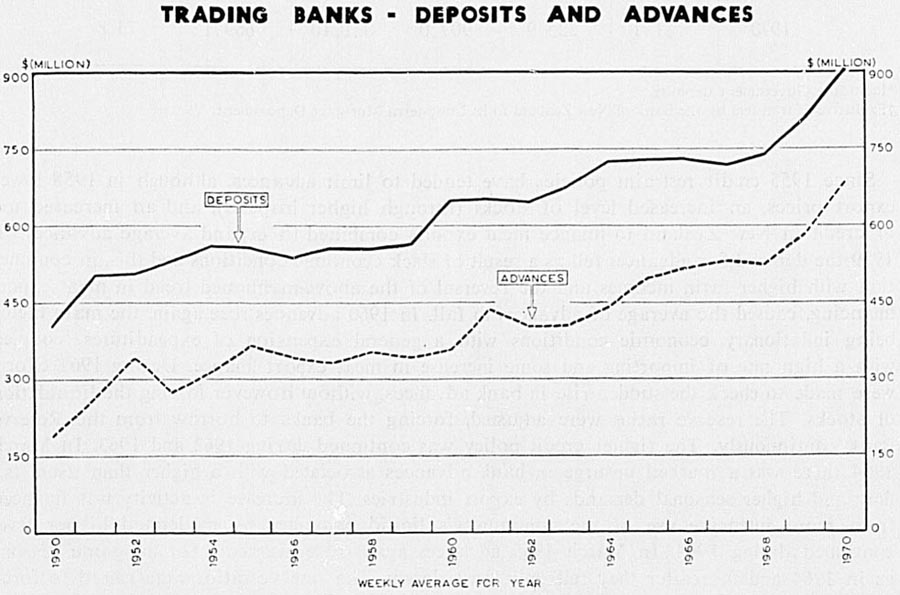
An analysis of demand deposits in New Zealand trading banks as at 13 May 1970 gave the following percentages, for the different sectors: farming, forestry, hunting and fishing, 15.1 percent; manufacturing, 6.6 percent; construction, 4.0 percent; electricity, transport, local authorities, etc., 3.7 percent; commerce, trade finance 14.0 percent; services, 27.4 percent; personal 29.3 percent.
An analysis of advances of the New Zealand trading banks is given in the following table.
| Group Receiving Advances | 8 March 1967 | 13 March 1968 | 12 March 1969 | 11 March 1970 | 10 March 1971 |
|---|---|---|---|---|---|
| BUSINESS AND FARMING ADVANCES | $(million) | ||||
| 1. Farming, forestry, hunting, and fishing— | |||||
| (a) Mainly dairy farming | 23.1 | 23.4 | 26.2 | 23.0 | 23.1 |
| (b) Mainly sheep farming | 35.6 | 33.9 | 33.3 | 32.3 | 36.2 |
| (c) Other farming | 10.2 | 12.6 | 15.3 | 19.6 | 25.1 |
| (d) Farm services | 2.2 | 2.4 | 2.4 | 3.5 | 4.7 |
| (e) Forestry, hunting, and fishing | 1.8 | 2.6 | 2.3 | 4.2 | 5.5 |
| Subtotals | 72.9 | 74.9 | 79.4 | 82.5 | 94.6 |
| 2. Mining and quarrying | 1.0 | 1.2 | 0.9 | 1.2 | 1.1 |
| 3. Manufacturing— | |||||
| (a) Dairy companies, factories, etc. | 7.9 | 8.3 | 10.2 | 8.3 | 10.0 |
| (b) Freezing works, meat companies, etc. | 65.9 | 87.2 | 88.5 | 89.4 | 127.1 |
| (c) Other food, beverages, and tobacco | 11.2 | 11.9 | 13.3 | 11.3 | 12.5 |
| (d) Textiles, footwear, and clothing | 20.0 | 16.7 | 18.1 | 23.2 | 23.6 |
| (e) Pulp and paper and paper products | 2.6 | 4.1 | 5.1 | 2.5 | 4.4 |
| (f) Metal products, machinery and engineering | 19.4 | 21.0 | 27.9 | 29.7 | 37.2 |
| (g) Transport equipment | 11.2 | 9.5 | 8.0 | 6.4 | 5.2 |
| (h) Other manufacturing | 29.0 | 29.9 | 35.3 | 38.6 | 42.2 |
| Subtotals | 167.3 | 188.5 | 206.3 | 209.4 | 262.2 |
| 4. Construction | 21.4 | 19.2 | 23.3 | 25.3 | 26.8 |
| 5. Electricity, gas, water, and sanitary services | 2.7 | 1.1 | 1.3 | 1.2 | 1.9 |
| 6. Transport, storage and communication | 10.7 | 9.6 | 11.7 | 10.0 | 11.1 |
| 7. Commerce, trade, and finance— | |||||
| (a) Wholesalers, mainly importers | 25.5 | 26.2 | 28.7 | 29.4 | 26.5 |
| (b) Wholesalers, other | 13.8 | 12.5 | 14.1 | 16.4 | 15.7 |
| (c) Retailers | 37.6 | 35.1 | 38.8 | 40.6 | 38.9 |
| (d) Woolbuyers | 20.6 | 23.8 | 36.1 | 36.2 | 36.9 |
| (e) Stock and station agents | 24.7 | 12.8 | 14.2 | 25.5 | 33.7 |
| (f) Finance companies (mainly hire purchase) | 3.2 | 2.6 | 2.8 | 2.0 | 3.2 |
| (g) Other financial institutions | 10.5 | 13.5 | 9.8 | 12.8 | 15.4 |
| Subtotals | 135.8 | 126.4 | 144.4 | 162.9 | 170.3 |
| 8. Local authorities n.e.i. | 2.2 | 1.6 | 2.3 | 1.3 | 1.3 |
| 9. Services | 22.0 | 22.3 | 26.8 | 30.7 | 31.5 |
| PERSONAL ADVANCES | |||||
| 10. (a) For housing purposes | 21.1 | 19.1 | 19.4 | 18.2 | 18.9 |
| (b) Other personal advances | 31.3 | 29.3 | 36.3 | 45.3 | 39.2 |
| Subtotals | 52.3 | 48.4 | 55.8 | 63.6 | 58.0 |
| Total advances | 488.5 | 493.2 | 552.2 | 587.9 | 658.7 |
The following diagram illustrates the level of trading bank advances in March of the last three years.
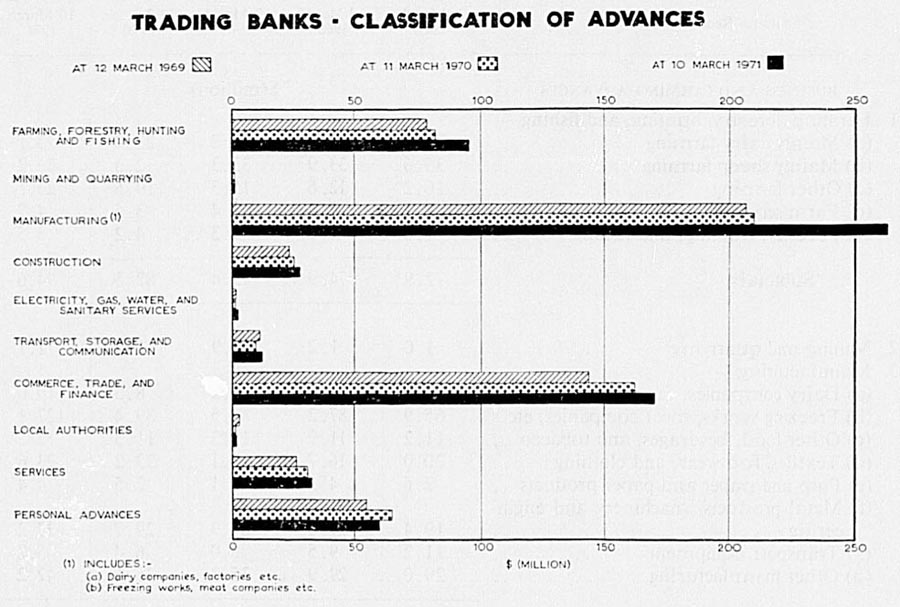
Advance Control Policy—Qualitative—An instrument of credit control used by the Reserve Bank since 1942 was a selective control of bank advances which sought to restrict the availability of credit to certain kinds of borrowers for certain purposes. On the whole the application of the rules prescribed by the Reserve Bank was left to the trading banks themselves, with only marginal cases referred to the Reserve Bank for decision. The main emphasis throughout was on avoidance of the use of bank credit for long-term capital purposes, hire-purchase finance, speculation, and the financing of excessive imports. As from 1 January 1963, the operation and administration of qualitative control was handed back to the trading banks without, however, any relaxation.
Quantitative—The advance control policy outlined above was supplemented in 1952 by the quantitative control of advances and reliance was placed mainly on the quantitative method of control through the reserve ratio procedure and discount rate policy. The minimum balances the trading banks were required to maintain at the Reserve Bank were adjusted from time to time through the reserve ratio procedure and the discount rate so as to reduce the margin of free cash (balances in excess of the minimum required) held by the trading banks from time to time through the reserve ratio procedure and the discount rate. Since 1957 a flexible policy of control has been followed. The aim generally has been to allow for a small growth in advances. Quarterly targets for bank advances were used generally from 1962 on, but from 1966 targets were established on a two-monthly basis. Generally, some small growth has been permitted in the targets for advances, particularly in the export field. Targets are now set for farming and export advances and for “other advances” on a differential basis. If these targets are met, banks are allowed small margins of free cash, the reserve ratios being changed as often as necessary to achieve this. If the targets are exceeded the ratios are raised sufficiently to ensure that the banks are required to borrow from the Reserve Bank. As mentioned earlier, this method of penalising the banks was replaced in October 1969 by another whereby each bank was penalised according to the level of its non-priority sector advances in relation to the official ceilings for those advances. From 1966 targets were also set for total credit limits and, on 4 May 1967, the Minister of Finance announced that total credit limits were to be cut by 10 percent by July 1967, although some flexibility would be permitted to ensure that farming and other essential industries continued to receive adequate finance, especially for exports.
Cheque Transactions—In the financial year 1969-70, the number of transactions debited to trading banks customers' accounts totalled 126 million, compared with 118 million in 1968-69, and 118 million in 1967-68. There are now over 836,000 cheque accounts in trading banks.
Unexercised Overdraft Authorities—The following are the averages for calendar years and the amounts at the end of June of aggregate unexercised overdraft authorities of the trading banks.
| Year | Average for Calendar Year | At End of June |
|---|---|---|
| $(million) | ||
| 1960 | 262.6 | 262.0 |
| 1961 | 246.6 | 248.6 |
| 1962 | 263.8 | 263.0 |
| 1963 | 295.8 | 281.6 |
| 1964 | 338.6 | 315.8 |
| 1965 | 339.8 | 325.6 |
| $(million) | ||
| 1966 | 326.7 | 317.4 |
| 1967 | 305.9 | 272.3 |
| 1968 | 293.3 | 284.3 |
| 1969 | 281.0 | 261.9 |
| 1970 | 292.5 | 286.1 |
MONETARY POLICY—Up to 1962 the financial system functioned under the restraint of a capital issues control, an interest on deposits order, and tax laws unfavourable to the raising of capital by convertible note issues. Capital issues control curbed the supply and the issue price of financial assets available to the community, while the interest on deposits orders prescribed maximum rates of interest that might be paid on various types of deposits. Thus, over the years prior to 1962 the community's preferences for financial assets could be expressed only in a tightly controlled market and these preferences were distorted. The removal in 1962 of the capital issues control and the interest on deposits order, and a change in the tax laws affecting issues of convertible notes were quickly followed by an expansion in the supply of liquid assets and the demand for them. Interest rates on deposits outside the remaining controlled area rose sharply and keen competition developed among the various financial institutions. Finance companies, which were particularly affected by the operation of capital issues control, offered deposit facilities at attractive rates of interest and with limited transferable rights attached to them. Trading companies developed forms of market instruments relatively new to New Zealand, such as short-dated debenture and mortgage stocks. In 1964 these expanding market influences were greatly strengthened by the commencement of the private savings banks and the extension of the trustee savings banks to the whole of New Zealand. This was a new powerful factor in the monetary scene. The supply of liquid assets again rose sharply. No doubt much of this movement after 1962 was the expression of the public's preferences which had been artificially curbed for many years, in association with the growth of new institutions and financial practices.
The main emphasis on credit restraint is directed to the limitation of bank credit but in August 1965 the Minister of Finance announced special measures to curb the level of spending in the community by further reducing the flow of credit to the private sector. Agreement was reached with the larger trustee savings banks, the private savings banks and insurance companies, that they would increase the ratio of their purchases of Government securities to those of other assets. (In addition, certain groups of financial institutions which engage in financing hire purchase transactions or make credit available for extended periods, agreed to take up, in quarterly instalments, Government securities equivalent to 7 1/2 percent of their new lending.)
In September 1966 finance companies agreed to take up additional amounts of Government securities. At the same time the credit restraint was extended to include most credit financing except normal retail store monthly accounts. The insurance companies agreed to take up additional amounts of Government securities and to increase their rate of lending to the farming sector.
On 11 February 1967 the voluntary credit restraints applicable to finance companies were superseded by regulations controlling the capital issues of finance companies. In October 1968 the Government reduced the percentage of deposits which the savings banks were required to invest in Government securities, with the object of assisting the building industry. For the trustee savings banks, of new investable funds in ordinary deposit accounts, 50 percent was to be invested in Government securities and 20 percent in new local authority securities or housing mortgages. For the private savings banks the percentages were 70 and 10 respectively. At the same time the insurance companies agreed to lend greater proportions of their new investable funds to local authorities, the export sector, and housing, while still investing certain minimum proportions in Government securities.
In June 1969 capital issues control on finance companies was abolished and replaced by a Government stock ratio requirement under which finance companies have to hold a percentage of their borrowings in the form of Government securities. The ratio was set at 10 percent initially but will be varied if necessary from time to time. Companies with outstanding borrowings of less than $50,000 are exempted.
The interest rate ceiling of 4 1/4 percent that trading banks were permitted to pay on deposits was removed in June 1969 except for deposits of $25,000 or less. Treasury bills were introduced in October 1969 and the trading banks were permitted to invest freely in Treasury bills and Government stock, subject to their maintaining statutory minimum cash balances at the Reserve Bank. During 1969 the proportion of investible funds which the Trustee Savings Banks were required to invest in Government securities was changed from 50 percent of ordinary accounts and 100 percent of investment accounts, to 60 percent for both types of deposit.
In June 1970 Government security ratios were extended to Building Societies (12 1/2 percent of the deposit liabilities), and Private Superannuation Funds (30 percent of total assets). A five year transitional period was allowed. The ratio for Finance Companies was increased from 10 percent to 12 1/2 percent, while Life Insurance Companies agreed to invest a further 5 percent of new investible funds in Government securities. In October the maximum interest rate of 4 1/2 percent payable on trading bank fixed deposits of $25,000 and under was increased to 4.8 percent for two year deposits, with 4 1/4 percent applying at twelve months. Fixed deposits of any amount for periods in excess of two years were not subject to control.
SMALL SAVINGS—While the main repositories for small savings in this country are the Post Office Savings Bank, the trustee savings banks, and the savings banks operated by the trading banks, there are a number of other financial institutions such as building and investment societies, stock and station agents, and finance companies, competing with them for deposits. In recent years there have been major changes in savings bank operations. Following an amendment to the Trustee Savings Bank Act passed in 1957, the five savings banks that had survived from the middle of the last century were joined by eight new trustee savings banks between 1959 and 1964. Another major change was the formation of private savings banks by the five trading banks, following the passing of the Private Savings Bank Act in 1964.
The following table shows the total amounts of transactions in small savings accounts, including accounts in the Post Office Savings Bank and trustee savings banks, National Savings accounts, and from 1 April 1964 School Savings Bank Accounts, but excluding National Savings bonds. From 1965 private savings banks are included.
| Year Ended 31 March | Total Amount of Deposits | Interest | Amount of Withdrawals* | Excess of Deposits Plus Interest Over Withdrawals | Total Amount to Credit of Depositors at End of March |
|---|---|---|---|---|---|
*From January 1958 includes interest paid out on Investment accounts. †Excludes $612,000 transferred to Western Samoa. ‡Excludes $918,000 Cook Islands Savings Bank balances from 1 April 1967. | |||||
| $(million) | |||||
| 1961 | 487.8 | 24.4 | 450.2 | 62.0 | 875.4 |
| 1962 | 508.0 | 25.7 | 500.5 | 33.3 | 908.1† |
| 1963 | 559.9 | 27.2 | 530.6 | 56.5 | 964.6 |
| 1964 | 672.4 | 29.6 | 616.2 | 85.8 | 1,050.4 |
| 1965 | 838.1 | 32.2 | 745.9 | 124.4 | 1,177.7 |
| 1966 | 994.7 | 35.8 | 906.9 | 123.6 | 1,301.3 |
| 1967 | 1,103.4 | 39.4 | 1,045.7 | 97.2 | 1,398.5 |
| 1968 | 1,138.1 | 43.7 | 1,096.5 | 85.4 | 1,483.0‡ |
| 1969 | 1,245.5 | 48.2 | 1,203.0 | 90.7 | 1,573.7 |
| 1970 | 1,468.4 | 50.9 | 1,408.6 | 110.8 | 1,684.5 |
| 1971 | 1,739.1 | 55.7 | 1,708.5 | 86.3 | 1,770.8 |
In the following table the accounts in the three types of savings banks are classified by amount groups. It will be noted that over two-thirds of the accounts have balances of less than $200.
Balances in the Post Office Savings Bank and the trustee savings banks are as at 31 March 1969. In the private savings banks, balance dates range between 31 March and 31 October. National Savings and school savings accounts are included.
| SAVING BANK ACCOUNTS BY AMOUNT GROUPS | ||||||
|---|---|---|---|---|---|---|
| Balance | Post Office Savings Bank | Trustee Savings Banks | Private Savings Banks | |||
| Number of Accounts | Percentage of total | Number of Accounts | Percentage of total | Number of Accounts | Percentage of total | |
| No. | No. | No. | ||||
| Under $2 | 371,828 | 13.9 | 195,419 | 17.5 | 108,988 | 18.0 |
| $2-$199 | 1,709,168 | 63.8 | 574,457 | 51.4 | 276,629 | 45.7 |
| $200-$999 | 362,242 | 13.5 | 216,198 | 19.4 | 123,205 | 20.3 |
| $1,000-$1,999 | 121,899 | 4.6 | 70,923 | 6.3 | 46,341 | 7.6 |
| $2,000-$3,999 | 72,154 | 2.7 | 49,963 | 4.5 | 44,923 | 7.4 |
| $4,000 and over | 40,340 | 1.5 | 9,623 | 0.9 | 5,848 | 1.0 |
| All accounts | 2,677,631 | 100.0 | 1,116,583 | 100.0 | 605,934 | 100.0 |
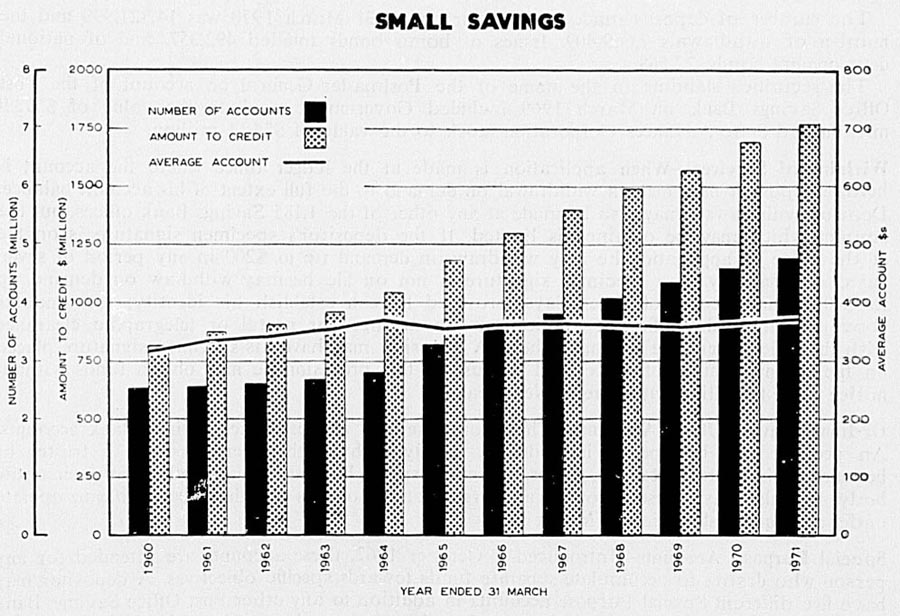
POST OFFICE SAVINGS BANK: Operation—The business of the Post Office Savings Bank started on 3 February 1867, when branches were established at Auckland, Wellington, Christchurch. Dunedin, and Hokitika. There are now 1,211 branches of the bank throughout New Zealand. Deposits may be made at any of these branches. A full demand withdrawal service is provided at 179 branches which have ledgers, and a limited service is provided at the remaining non-ledger offices.
The following table covering the activities of the Post Office Savings Bank includes ordinary Savings Bank, Special Purpose, Thrift Club, Home Lay-by, Investment accounts, National Savings Investment accounts, School Savings Bank accounts from 1 April 1964, and National Development Bonds and Bonus Bonds from 6 October 1969 and 5 March 1970 respectively.
| Year Ended 31 March | Number of Accounts at End of March | Total Amount of Deposits | Interest | Total Amount of Withdrawals* | Excess of Deposits, Plus Interest, Over Withdrawals | Total Amount to Credit of Depositors at End of March |
|---|---|---|---|---|---|---|
*From January 1958 includes interest paid out on investment accounts. †$612,306 and 15,459 accounts transferred to the Western Samoa Administration. ‡Excludes Cook Islands balances of $918,232 omitted from ordinary accounts from 1 April 1967. | ||||||
| (000) | $(thousand) | |||||
| 1961 | 2,117 | 374,601 | 20,075 | 350,082 | 44,594 | 716,571 |
| 1962 | 2,144 | 383,358 | 21,013 | 383,678 | 20,693 | 736,651† |
| 1963 | 2,191 | 409,123 | 21,997 | 397,185 | 33,935 | 770,586 |
| 1964 | 2,245 | 471,590 | 23,633 | 442,952 | 52,272 | 822,858 |
| 1965 | 2,563 | 506,665 | 25,056 | 501,717 | 30,004 | 855,838 |
| 1966 | 2,604 | 507,793 | 25,844 | 521,850 | 11,787 | 867,625 |
| 1967 | 2,640 | 525,634 | 26,025 | 542,009 | 9,650 | 877,275 |
| 1968 | 2,646 | 488,121 | 27,224 | 512,415 | 2,930 | 879,287‡ |
| 1969 | 2,682 | 487,663 | 27,980 | 507,852 | 7,791 | 887,078 |
| 1970 | 2,701 | 568,547 | 28,211 | 561,816 | 34,942 | 922,020 |
| 1971 | 2,735 | 620,875 | 29,590 | 626,411 | 24,054 | 946,074 |
The number of deposits made in the year ended 31 March 1970 was 14,821,999 and the number of withdrawals 7,669,409. Issues of bonus bonds totalled 492,357, and of national development bonds, 22,868.
The securities standing in the name of the Postmaster-General on account of the Post Office Savings Bank on March 1969 included Government stock to the value of $573.9 million and State Advances Corporation stock to the value of $340.1 million.
Withdrawal Services—When application is made at the ledger office where the account is held, a depositor may make a withdrawal on demand to the full extent of his account balance. Demand withdrawals may also be made at any other of the 1,185 Savings Bank offices, but the amount which may be obtained is limited. If the depositor's specimen signature is on file at the office of application he may withdraw on demand up to $200 in any period of seven days. Alternatively, if a specimen signature is not on file he may withdraw on demand up to $40 in any period of seven days, provided he can establish his identity; for amounts above the limit the office of application can arrange for postal or telegraphic clearance with the office where the account is held. A depositor may have his specimen signature placed on file at any number of offices and because of this provision he may obtain funds without notice while travelling anywhere in New Zealand.
Ordinary Savings Bank Accounts—These form the bulk of Post Office Savings Bank accounts An account may be opened individually, jointly with another person, or as a trustee or beneficiary in a trust account. Clubs, societies, sports bodies, and any other non-mercantile body may also have these accounts, and organisations of this type have been able to operate under a cheque system since 1 March 1959.
Special Purpose Accounts—Introduced 1 October 1962, these accounts are intended for any person who desires to accumulate separate funds towards specific objectives. A depositor may have five different Special Purpose accounts in addition to any other Post Office Savings Bank accounts. Each Special Purpose account is subject to an interest-bearing limit of $1,000. The rate of interest is 3 percent per year.
Thrift Club Accounts—These accounts are designed to meet the needs of salary and wage earners who wish to save something each pay day to provide for annual recurring charges. Thrift Club accounts may be opened by any group of persons. In most cases, employees have a nominated amount deducted from their salary or wages each pay day for crediting to a Thrift Club account in their own name. Where this system does not operate the persons may themselves appoint an agent to collect from members and make deposits. A passbook is issued to each depositor who may operate on the account in the same way as an ordinary account.
At 31 March 1970 there were 206,957 accounts open, the amount at credit being $24,740,799.
Home Lay-by Accounts—These accounts were introduced on 1 July 1957. Their main feature is a suspensory free deposit of $10 for every $200 saved with a maximum of $200. These accounts may be operated on in the same way as ordinary accounts and they earn the same rates of interest, in addition to the suspensory free deposit. The free deposit does not become payable until evidence is furnished that the funds are being used for the purchase or building of a home for the depositor's own occupancy. The first free deposits under this system became payable on 1 July 1959.
At 31 March 1970 there were 1,544 accounts open, the amount at credit being $1,020,313.
School Savings Bank—The School Savings Bank scheme was introduced in 1934 with the object of encouraging thrift amongst young people. The lodgment of deposits is made to teachers at the school, the cash and deposits slips being handed in later at the Post Office.
On 31 December 1970 there were 2,354 schools operating accounts and the total amount at credit in savings accounts was $4,623,927.
Investment Accounts—One-year accounts were introduced on 1 October 1957. They are a type of fixed deposit and accounts may be opened by any person or any organisation, including business concerns. The minimum deposit is $200 and deposits above $200 must be in multiples of $20. Any number of deposits may be made, but they must not exceed $20,000 in the aggregate in any year commencing on 1 October. The minimum term of investment is one year and deposits not withdrawn are automatically reinvested.
Interest runs from the date of deposit at 4 1/2 percent a year on amounts that remain on deposit for the first and each subsequent 12-monthly period. If the deposit or any portion of it is withdrawn before the expiration of the first year or any subsequent 12-monthly period, special rates apply in respect of the amount withdrawn.
On 31 March 1970, 80,553 Investment accounts were open with a total credit balance of $213,274,800.
Two-year Investment Accounts—Introduced on 1 September 1970, 2-year investment accounts may be opened by any person, club, society, institution or business.
Interest is payable at the rate of 5 percent a year on amounts invested for a term of two years. Interest is not paid on deposits in excess of $6,000. Interest earned on amounts invested for a complete year is added to and becomes part of the principal for the purpose of calculating interest in respect of the second year of the term of investment.
National Savings Accounts—Deposits up to a maximum of $20,000 may be deposited during any investment year commencing 1 July and ending 30 June. Persons, businesses and all classes of institutions and organisations may open National Savings accounts at the Post Office Savings Bank. Deposits made in any investment year mature on 30 June two years later. Interest is at the rate of 3 1/2 percent a year. If desired interest may be withdrawn annually between 30 June and 31 December. If not withdrawn it is added to the capital sum. Interest at 3 percent a year is payable on deposits withdrawn before the date of maturity.
At 31 March 1970 there were 111,526 accounts open, the amount at credit being $43,105,568.
National Development Bonds—Introduced on 6 October 1969 these bonds may be purchased for a minimum of $10 or for higher amounts in multiples of $10. There is no maximum limit to the amount that may be purchased. Bonds mature in eight years but may be surrendered at any time after the expiration of three months from the date of purchase.
Interest is not payable until redemption of the bond at maturity or its earlier surrender. The rate of interest is 2 1/2 percent a year in the first year rising by 1 percent a year to reach 9 1/2 percent a year in the eighth year. A taxation exemption of up to $500 in the income year the bond matures or is surrendered is allowed on the interest earned. The bonds may be purchased by individual persons only. They are not available to any company or body of persons whether incorporated or unincorporated or jointly in the names of two or more persons.
As at 31 March 1970 bondholders' funds totalled $6,937,920 and the number of bondholders was 22,685.
Bonus Bonds—Since March 1970 bonus bonds have been on sale as an incentive savings scheme under section 129a of the Post Office Act 1959. Bonds are issued in units of $1. There is no limit on the number or total value of bonds held by any person.
Persons may purchase bonds in their own names only. A child under 7 years of age cannot buy bonds but any person having the custody and control of the child may purchase bonds in the child's name. Bondholders' funds are invested in Government securities and the equivalent of 4 percent interest on the bonds is paid into a prize pool for distribution by ballot of cash prizes.
At 31 March 1970 bondholders' funds amounted to $10,915,540. The number of bonds held was 492,341.
Travellers' Cheques in Overseas Currency—As an extension of the overseas remittance services operated by the Post Office Savings Bank, the sale of travellers cheques in overseas currency was introduced on 2 February 1970. The travellers cheques are available in: sterling, Australian dollars and United States dollars.
Estates—The Postmaster-General may pay deposits to a maximum of $1,000 from any type of account to the legal representative of a deceased depositor without requiring him to take out letters of administration or to prove the will. Where there is more than one type of account the aggregate balances must not exceed $1,000, except in the case of a National Savings account, for which a separate maximum of $1,000 is permitted. This provision, together with another whereby a depositor may nominate one or more persons to receive part or all of the amount at credit of an ordinary Savings Bank, Special Purpose, Thrift Club, or a Home Lay-by account after the depositor's death, enables the next-of-kin to obtain possession of perhaps much-needed funds without delay or cost.
PRIVATE SAVINGS BANKS—The Private Savings Bank Act 1964 came into force on 1 October 1964. Under this Act the five trading banks all formed private savings banks. These savings banks may transact business only in premises ordinarily occupied and used by the parent bank. In addition to ordinary deposits, these banks may accept investments similar to the trustee savings banks, by way of deposits in Home Lay-by, Investment accounts, Thrift Club, and Special Purpose accounts.
| Year Ended 31 March | Number of Accounts at End of Year | Total Amount of Deposits During Year | Total Amount of Withdrawals During Year | Excess of Deposits Over Withdrawals | Interest Credited | Total Amount to Credit of Depositors at End of Year |
|---|---|---|---|---|---|---|
| $(thousand) | ||||||
| 1966 | 192,177 | 161,537 | 90,336 | 71,200 | 1,570 | 126,226 |
| 1967 | 313,927 | 205,502 | 152,384 | 53,118 | 3,968 | 183,312 |
| 1968 | 460,366 | 244,919 | 196,827 | 48,092 | 5,818 | 237,222 |
| 1969 | 577,956 | 268,349 | 228,501 | 39,848 | 8,351 | 285,420 |
| 1970 | 662,706 | 307,782 | 276,335 | 31,447x | 9,932 | 326,800 |
| 1971 | 738,247 | 391,333 | 377,754 | 13,579 | 12,088 | 352,467 |
Private savings banks assets at 31 March 1970 included $42.1 million invested in mortgages and other loans, $275.4 million in New Zealand Government securities, out of the total assets figure of $339.0 million.
TRUSTEE SAVINGS BANKS—The trustee savings bank movement is generally regarded as having originated in Scotland in 1810. The movement spread quickly, and the first such New Zealand bank was established in Wellington in 1846, 20 years before the New Zealand Post Office Savings Bank commenced business. By 1870 nine trustee banks were in existence, but four, namely Lyttelton, Wellington, Napier, and Nelson did not survive the turn of the century. The five remaining banks—Auckland (1847), New Plymouth (1850), Dunedin (1864), Southland (1864), and Hokitika (1866)—grew in strength and their activities became an important factor in New Zealand's economic structure. Since 1957 a number of new trustee savings banks have been established, and the total is now 13.
The legislation dealing with trustee savings banks is contained chiefly in the Trustee Savings Banks Act 1948. Not less than 50 percent of investments must be held in the form of Government stock, and a proportion of depositors' balances must be kept as cash in hand or on current account, namely 5 percent up to $20 million, and 2 1/2 percent of the amount in excess of $20 million. Repayment of deposits is guaranteed by the State.
In addition to ordinary deposits, trustee savings banks may accept investments similarly to the Post Office Savings Bank, by way of deposits in Home Lay-by or Investment accounts. The maximum rates of interest payable on deposits are fixed by Order in Council. Maximum rates payable on these and other deposits are given later in this Section.
The following tables relate only to trustee savings banks.
| Year Ended 31 March | Number of Accounts at End of Year | Total Amount of Deposits During Year | Total Amount of Withdrawals During Year | Excess of Deposits Over Withdrawals | Interest Credited | Total Amount to Credit of Depositors at End of Year | |
|---|---|---|---|---|---|---|---|
| NOTE—This statement includes national savings accounts. | |||||||
| No. | $(thousand) | ||||||
| 1961 | 477,647 | 113,231 | 100,141 | 13,090 | 4,276 | 158,791 | |
| 1962 | 501,747 | 124,715 | 116,831 | 7,884 | 4,732 | 171,407 | |
| 1963 | 536,981 | 150,827 | 133,383 | 17,444 | 5,159 | 194,010 | |
| 1964 | 588,124 | 200,769 | 173,244 | 27,524 | 5,966 | 227,500 | |
| 1965 | 665,835 | 262,133 | 228,203 | 33,930 | 7,003 | 268,433 | |
| 1966 | 775,339 | 325,352 | 294,697 | 30,655 | 8,386 | 307,475 | |
| 1967 | 884,223 | 372,297 | 351,272 | 21,025 | 9,447 | 337,947 | |
| 1968 | 996,271 | 405,109 | 387,226 | 17,883 | 10,690 | 366,520 | |
| 1969 | 1,116,583 | 489,515 | 466,657 | 12,858 | 11,863 | 401,242 | |
| 1970 | 1,238,042 | 592,099 | 570,450 | 21,649 | 12,794 | 435,685 | |
| 1971 | 1,302,818 | 726,930 | 704,381 | 22,549 | 13,996 | 472,230 | |
The following table shows the results of the transactions inclusive of National Savings accounts, of each of the trustee savings banks during 12 months ended 31 March 1970.
| Bank | Number of Accounts at End of Year | Total Amount of Deposits During Year | Total Amount of Withdrawals During Year | Excess of Deposits Over Withdrawals | Interest Credited | Total Amount to Credit of Depositors at End of Year |
|---|---|---|---|---|---|---|
| No. | $(thousand) | |||||
| Auckland | 559,643 | 218,530 | 213,052 | 5,478 | 5,647 | 192,577 |
| Waikato | 100,436 | 45,229 | 43,386 | 1,843 | 979 | 31,617 |
| Bay of Plenty | 47,014 | 32,358 | 30,214 | 2,145 | 485 | 16,771 |
| Taranaki | 60,076 | 23,897 | 22,974 | 923 | 820 | 26,296 |
| Hawke's Bay & Gisborne | 44,255 | 25,541 | 24,264 | 1,277 | 435 | 14,308 |
| Wanganui | 27,655 | 15,572 | 14,771 | 801 | 259 | 8,631 |
| Manawatu-Wairarapa | 30,027 | 14,529 | 13,666 | 863 | 169 | 10,399 |
| Wellington District | 39,473 | 23,242 | 21,955 | 1,286 | 318 | 11,404 |
| Westland | 9,845 | 4,034 | 3,492 | 542 | 145 | 4,823 |
| Canterbury | 132,825 | 84,561 | 79,866 | 4,695 | 1,240 | 41,273 |
| South | ||||||
| Canterbury | 14,685 | 8,048 | 7,619 | 429 | 203 | 6,466 |
| Otago | 105,240 | 34,286 | 33,495 | 790 | 1,098 | 35,918 |
| Southland | 66,868 | 62,272 | 61,697 | 575 | 996 | 35,202 |
| Totals | 1,238,042 | 592,099 | 570,450 | 21,648 | 12,794 | 435,685 |
Following is a summary of trustee savings banks' assets at 31 March 1970. The total assets include an amount of $2,637,000 securing National Savings deposits all of which is invested in New Zealand Government securities. Under the Trustee Savings Banks Act, however, National Savings deposits are not regarded as assets of the Trustee Savings Banks, and for this reason are shown separately.
| Bank | Mortgages | New Zealand Government Securities | Local Authority Debentures | Cash in Hand and on Call at Bank | Total Assets* (Includes Other Assets but not National Savings Deposits) | National Savings Deposits | Total Held Including National Savings Deposits |
|---|---|---|---|---|---|---|---|
| *Total assets includes $15.6 million fixed deposits and money at call. | |||||||
| $(thousand) | |||||||
| Auckland | 49,147 | 117,170 | 20,701 | 2,785 | 206,372 | 1,528 | 207,900 |
| Waikato | 8,283 | 19,698 | 2,708 | - | 32,522 | - | 32,522 |
| Bay of Plenty | 4,491 | 9,840 | 1,107 | 990 | 17,114 | - | 17,114 |
| Taranaki | 9,005 | 16,099 | 127 | 667 | 27,934 | 286 | 28,220 |
| Hawke's Bay and Gisborne | 3,663 | 9,173 | 583 | 403 | 14,884 | - | 14,884 |
| Wanganui | 1,811 | 5,935 | 365 | 237 | 8,867 | - | 8,867 |
| Manawatu-Wairarapa | 2,080 | 7,091 | 505 | 221 | 10,609 | - | 10,609 |
| Wellington District | 3,619 | 7,363 | 414 | 494 | 12,484 | - | 12,484 |
| Westland | 1,609 | 2,837 | 111 | 176 | 5,173 | - | 5,173 |
| Canterbury | 10,807 | 25,932 | 2,077 | 1,321 | 42,802 | - | 42,802 |
| South Canterbury | 582 | 5,000 | 405 | 292 | 6,661 | - | 6,661 |
| Otago | 11,177 | 21,278 | 1,729 | 1,116 | 37,900 | 734 | 38,634 |
| Southland | 6,704 | 19,380 | 6,480 | 2,167 | 37,729 | 89 | 37,818 |
| Totals | 112,979 | 266,797 | 37,311 | 10,870 | 461,052 | 2,637 | 463,689 |
STOCK AND STATION AGENTS—Many of the existing stock and station agents first commenced business as general merchants or retailers in the early days of the country's settlement. However, during the greater part of their history, the main financial operations have been in the supply of merchandise, machinery and implements, and the provision of finance to the farming community. The companies have developed a specialised banking business involving the maintenance of current accounts for farmers, the acceptance of time deposits and the granting of secured and unsecured advances. It is a widespread practice for farmers to have current accounts with their stock and station agents to which the proceeds of the sale of livestock and produce are placed and farm and personal expenses charged. Any surplus may be left on current account or placed with the agents on fixed deposit.
Financial data as at 30 June are given of deposits, advances, etc., for the stock and station agents operating in New Zealand. The statistics refer to the whole of the companies' trading operations including, in some cases, activities additional to normal stock and station transactions, such as retail trading in consumer goods.
The deposit figures include only moneys received for an agreed term and rate of interest and exclude amounts secured by mortgage or debenture, and amounts in credit on current account. Secured advances to customers include those made on mortgage or chattel security. The figure for merchandise and commodity stocks includes all types of trading stock which are regarded as current assets, but excludes livestock, goods held on consignment, or motor vehicles used by the company.
The following table summarises the financial statements of stock and station agents. Quarterly information, including details of interest rates is published in the Monthly Abstract of Statistics.
| Item | At 30 June | ||||
|---|---|---|---|---|---|
| 1966 | 1967 | 1968 | 1969 | 1970 | |
| $(thousand) | |||||
| Deposits held | 22,557 | 24,170 | 26,226 | 31,204 | 35,514 |
| Customers'credit balances on current account Advances to customers— | 36,602 | 30,051 | 32,157 | 37,363 | 39,970 |
| (a) On current account (unsecured) | 63,576 | 61,515 | 56,586 | 60,146 | 66,976 |
| (b) Other advances (secured) | 43,588 | 45,693 | 47,152 | 48,249 | 45,521 |
| Investments— | |||||
| (a) Government securities | 4,932 | 5,518 | 5,173 | 5,307 | 5,552 |
| (b) Fixed deposits | 105 | 187 | 359 | 1,099 | 1,093 |
| (c) Other investments | 9,673 | 10,280 | 11,328 | 11,951 | 17,617 |
| Cash balances (in hand and at bank) | 4,057 | 1,823 | 4,090 | 7,162 | 4,863 |
| Bank overdrafts outstanding | 11,684 | 17,780 | 11,590 | 11,229 | 18,692 |
| Merchandise and commodity stocks | 35,146 | 34,978 | 34,288 | 36,577 | 39,036 |
| Interest rates paid on deposit— | Percentage of Deposits | ||||
| (Under 3 percent | 4.5 | 3.2 | 1.9 | 1.7 | 1.4 |
| (3 percent and under 5 percent | 47.4 | 39.4 | 29.4 | 28.2 | 25.2 |
| (5 percent and over | 48.1 | 57.4 | 68.7 | 70.1 | 73.4 |
The total of unsecured advances by agents of $67.0 million at 30 June 1970 was $16.6 million below that of trading bank advances to farmers of $83.6 million at 8 July 1970.
OVERDRAFT RATES—The maximum permitted average interest rate on bank overdrafts, which had been 5.84 percent since June 1962, was raised to 6.0 percent on 31 August 1965.
DEPOSIT AND INTEREST RATES: Trading Banks—The following rates have been paid since 21 June 1966 by the associated banks on amounts lodged on fixed deposit: 30-180 days, 3 percent; six months and under 12 months, 3 1/2 percent; 12 months and under 24 months, 4 percent; 24 months and over, 4 1/4 percent. As previously, variations in these rates and terms may be negotiated on deposits in excess of $20,000.
Post Office Savings Bank—The Post Office Savings Bank pays interest on all deposits. The present rates on ordinary, Thrift Club, Home Lay-by, and School Savings Bank deposits are 3 percent per year on deposits of up to $20,000. For Special Purpose accounts the rate is 3 percent per year on balances up to $1,000 in each of the five accounts permitted.
The rates of interest on Investment accounts that remain intact for the term of investment are: 1-Year Investment accounts 4 1/2 percent a year; 2-Year Investment accounts 5 percent a year, but if withdrawals are made before maturity, the interest rate is adjusted for the broken period in respect of the amount withdrawn.
The rate of interest on National Savings accounts is 3 1/2 percent per year but if withdrawals are made before maturity date of the deposits, interest on the amount withdrawn is credited at Savings Bank rates.
Trustee Savings Banks—From 1 May 1956 the allowable maximum rate on all deposits was increased to 3 percent on amounts up to $1.500, this limit being raised to $2,000 from 26 October 1956. A rate of 2 1/2 percent was payable between $2,002 and $4,000 but this was raised to 3 percent as from 1 August 1962 on any amount from $1 to $4,000. On deposits in investment accounts the rate is 2 1/2 percent for periods less than 12 months, 4 1/2 percent for each complete period of 12 months with 3 percent payable on deposits withdrawn during the year after the first year.
Private Savings Banks—The rate of interest payable on deposits in private savings banks is 3 percent a year up to $4,000. This applies to the savings banks operated by trading banks from 1 October 1964. On deposits in investment accounts the rate is 2 1/2 percent for periods less than 12 months, 4 1/2 percent for each complete period of 12 months with 3 percent payable on deposits withdrawn during the year after the first year.
Company, etc., Deposits—Since 5 July 1962 there has been no control on interest rates payable on deposits held by stock and station agents, trading companies, and building and investment societies.
Other Deposits and Interest Rates—References to rates of interest on mortgages will be found in Section 30a (Mortgages), while interest on Government debt is referred to in Section 26c (State Indebtedness), interest on local authority debt in Section 27 (Local Government Finance), and interest on the Common Fund of the Public Trust Office in Section 40.
COINAGE AND CURRENCY—Decimal Currency—Under the Decimal Currency Act 1964 a system of decimal currency was introduced in New Zealand on 10 July 1967 with the dollar as the monetary unit. The dollar is equivalent to the previous 10s. The equivalent in decimal currency of the shilling is 10 cents. There are coins for 50 cents, 20 cents, 10 cents, 5 cents, 2 cents, and 1 cent, and Reserve Bank notes for 1, 2, 5, 10, 20, and 100 dollars. The coins are cupro nickel, except for the one and two cent pieces which are bronze. Notes and coins have distinctive New Zealand designs. The coins were depicted on pages 1126-1127 of the 1967 issue of the Yearbook.
Restrictions on Export of Currency—Under the Exchange Control Regulations 1965 the taking or sending of money from New Zealand is forbidden except with the consent of the Reserve Bank. The Exchange Control Exemption Notice 1965, Amendment No. 8, restricts the amount of New Zealand money taken out by travellers to $50 (which may be in notes of $5 or $2 or $1 or in coin up to $4). The export of any other notes or coin of any country requires specific consent. (See also Exchange Control, paragraph (b), Export and Import of New Zealand notes.)
Legal Tender—Under the Decimal Currency Act 1964, dollar coins are legal tender for any amount, coins of 5, 10, and 50 cents for an amount up to 5 dollars, and coins of 1 and 2 cents for an amount up to 20 cents.
Issue of Notes—Since 1 August 1934 the Reserve Bank has had the sole right to issue bank notes in New Zealand: Reserve Bank notes are constituted legal tender up to any amount. The rate of exchange for overseas transactions is fixed by the Bank, subject to a right of the Minister of Finance, after consultations with the Governor, to determine the par value of the New Zealand dollar in terms of the articles of agreement of the International Monetary Fund.
The issue of decimal currency notes consists of the following denominations: $1, $2, $5, $10, $20, and $100. Notes are issued solely in response to the demands of the public. In assessing likely requirements there are seasonal factors to be considered, as well as basic economic conditions, such as national income, the levels of salaries and wages, changes in price levels generally, and in the total volume of money. In addition, methods and frequency of payments affect the amount to be issued.
Government postal notes (issued in 39 denominations of from 10c to $4) sometimes enjoy a certain length of life in the form of currency.
EXCHANGE RATES—The significance of the exchange rate in the case of New Zealand depends chiefly upon the country's position in regard to overseas trade and to overseas borrowings. The course of development of New Zealand has not reached a stage where the country is fully self-contained, and the external trade per head is greater than that of most countries of the world. Much of this external trade is with the United Kingdom, while the function of London as an international clearing house is also of importance in this connection. New Zealand's borrowings from the London financial market as noted elsewhere (see State Indebtedness) require considerable annual payments in London. New Zealand is a member of the International Monetary Fund, and as such is required to maintain telegraphic transfer buying and selling rates for exchange transactions in its currency within two percent of either side of its established par value. The par value may be changed, i.e., the exchange rate altered, with the approval of the International Monetary Fund; this must be given if the proposed change does not exceed 10 percent, or if a “fundamental disequilibrium” exists in the country's balance of payments.
New Zealand and Sterling Exchange—The relationship of New Zealand currency to sterling gained added significance from December 1929. Prior to that date the New Zealand currency was at virtual parity with British currency, only slight deviations occurring from time to time, but then commenced to depreciate gradually, reaching, in January of 1931 a level of approximately £110 New Zealand = £100 London for telegraphic transfers. At that level it remained fairly stationary until January 1933, when as a result of Government intervention it was abruptly depreciated to a further degree. The relationship existing from 20 January 1933 until the establishment of the Reserve Bank of New Zealand on 1 August 1934, was £125 (selling) and £124 10s. (buying) New Zealand = £100 London for telegraphic transfers.
From 1 August 1934 Reserve Bank quotations for £100 sterling for immediate delivery in London were, buying rate, £124, selling rate, £125. It was intimated that the policy of the Bank would aim at retaining these rates unchanged for a long period unless there occurred marked changes in existing conditions. While prepared to fulfil its statutory obligations, the Reserve Bank did not desire to compete for exchange business, provided adequate facilities were available elsewhere.
Following the statement of the Reserve Bank's policy, the trading banks adopted as from 1 August 1934 a scale of rates representing a reduction of 10s. per £100 on the rates ruling from 20 January 1933 to 31 July 1934. The rates were slightly changed on 21 October 1938, and further changes were made in the selling rates as from 1 December 1943 and in the buying rate as from 6 November 1940. During the year 1945-46 the Reserve Bank agreed to certain alterations in the trading banks' on-demand and usance rates.
The position was materially altered as from 20 August 1948, following the announcement by the Government on the previous night of the appreciation of New Zealand currency to parity with sterling. The Reserve Bank quotations from 20 August 1948 for £100 sterling for immediate delivery in London were: buying rate, £100; selling rate, £101. Consequential adjustments to the scale of rates of trading banks in New Zealand were also made.
On 21 November 1967 the New Zealand dollar was devalued by 19.45 percent in terms of the United States dollar following the United Kingdom devaluation of sterling by 14.3 percent on 18 November 1967. The New Zealand dollar became equivalent to the Australian dollar and NZ$100 equivalent to £46.67 sterling. In terms of the United States dollar NZ$1.00 = US$1.12.
The quotations current for New Zealand on London at the end of December 1970 are given in the following table. On-demand and usance buying rates change with changes in the Bank of England discount rate.
| Category | Buying (Basis £Stg. 1) | Selling (Basis £Stg. 1) | |
|---|---|---|---|
| Telegraphic transfers (cable) | NZ$2.1367 | NZ$2. 1492 | |
| Sterling notes | NZ$2.0731 | NZ$2.1492 | |
| Air Mail | Sea Mail | Air and Sea Mail | |
| Bills, cheques, and drafts payable on demand | NZ$2.1256 | NZ$2.1100 | NZ$2.1492 |
| Bills or drafts 3 days sight | 2.1231 | 2.1075 | No quotation |
| Bills or drafts 30 days sight | 2.1120 | 2.0965 | 2.1484 |
| Bills or drafts 60 days sight | 2.0998 | 2.0842 | 2.1476 |
| Bills or drafts 90 days sight | 2.0875 | 2.0719 | 2.1468 |
| Bills or drafts 120 days sight | 2.0752 | 2.0596 | No quotation |
The following table shows exchange rates for telegraphic transfers quoted by the New Zealand trading banks for various currencies as at 31 December 1970.
| New Zealand on | At 31 December 1970 | |
|---|---|---|
| Buying | Selling | |
| United States (dollars) | 1.1222 | 1.1100 |
| Canada (dollars) | 1.1352 | 1.1226 |
| France (francs) | 6.23 | 6.096 |
| Belgium (francs) | 56.1 | 54.88 |
| Switzerland (francs) | 4.875 | 4.765 |
| Pakistan (rupees) | 5.4 | 5.265 |
The rates applicable for telegraphic transfer to Australia from 21 November 1967 are A$1.0020 buying and A$0.9980 selling per NZ$1.
OVERSEAS RESERVES—The trading banks are required to supply returns to the Reserve Bank at monthly intervals, showing among other things overseas assets held and liabilities incurred on account of New Zealand business.
Statistics of New Zealand's official overseas reserves are shown in the following table. The figures for assets of the banking system and gold are as at the last Wednesday of the month; other figures are as at the end of the month. (Source: Reserve Bank of New Zealand.)
| As at | Assets of N.Z. Banking System* | Treasury-held Overseas Securities | Other Government-held Overseas Securities | Gold† | Reserve Position at I.M.F.‡ | Special Drawing Rights** | Total |
|---|---|---|---|---|---|---|---|
*Comprises foreign exchange and overseas investments of the Reserve Bank and the trading banks in respect of New Zealand business. A small item “Liabilities in Other Currencies” has been deducted from the Reserve Bank's overseas assets while gross foreign liabilities on account of New Zealand business have been deducted from the trading banks' overseas foreign assets. †Gold holdings of the Reserve Bank valued at US$35 a fine ounce and converted to New Zealand currency at the par value established with the International Monetary Fund. ‡Equal to the gold subscription less any drawings of the gold tranche. §The New Zealand dollar was devalued by 19.45 percent on 21 November 1967. After that date all reserves have been converted at the new par value. **New Zealand's initial allocation made on 1 January 1970. | |||||||
| NZ$ (million) | |||||||
| End of June | |||||||
| 1960 | 237.5 | 80.2 | 16.5 | 0.6 | - | - | 334.8 |
| 1961 | 124.1 | 69.3 | 16.8 | 0.6 | - | - | 210.7 |
| 1962 | 146.7 | 56.0 | 17.2 | 0.5 | 22.5 | - | 242.8 |
| 1963 | 191.4 | 48.9 | 17.5 | 0.5 | 22.5 | - | 280.8 |
| 1964 | 202.3 | 65.0 | 17.7 | 0.5 | 22.5 | - | 307.9 |
| 1965 | 160.8 | 67.9 | 18.1 | 0.5 | 22.5 | - | 269.8 |
| 1966 | 123.5 | 61.7 | 12.7 | 0.1 | - | - | 198.1 |
| 1967 | 111.7 | 57.1 | 13.1 | 0.6 | - | - | 182.4 |
| 1968§ | 209.3 | 76.8 | 14.5 | 1.2 | - | - | 301.9 |
| 1969 | 229.4 | 78.9 | 15.3 | 1.0 | - | - | 324.6 |
| 1970 | 216.8 | 87.9 | 16.1 | 0.8 | - | 23.5 | 345.0 |
| End of December | |||||||
| 1960 | 131.9 | 70.5 | 16.7 | 0.6 | - | - | 219.7 |
| 1961 | 98.2 | 32.0 | 17.0 | 0.5 | 22.5 | - | 170.1 |
| 1962 | 123.2 | 57.0 | 17.3 | 0.5 | 22.5 | - | 220.5 |
| 1963 | 120.8 | 50.1 | 17.7 | 0.5 | 22.5 | - | 211.5 |
| 1964 | 127.8 | 66.5 | 17.7 | 0.5 | 22.5 | - | 235.0 |
| 1965 | 102.6 | 54.8 | 12.3 | 0.3 | - | - | 170.0 |
| 1966 | 90.6 | 60.5 | 12.7 | 0.2 | - | - | 163.9 |
| 1967§ | 145.1 | 75.0 | 13.9 | 0.5 | - | - | 234.5 |
| 1968 | 112.0 | 77.0 | 14.5 | 0.5 | - | - | 204.0 |
| 1969 | 155.1 | 86.4 | 15.3 | 0.8 | - | - | 257.6 |
| 1970 | 128.6 | 117.5 | 16.1 | 0.7 | 45.1 | 0.3 | 308.3 |
In 1967 (which included just over one month at post devaluation rates) export receipts fell by $90.5 million and import payments by $81.4 million while the deficit on invisible transactions increased by $11.6 million to give a current account deficit of $107.2 million. Capital transactions resulted in a surplus of $147.6 million and the net overseas assets rose by $54.5 million (including an adjustment due to devaluation). Capital receipts included London loans of $25.8 million, loans from the Bank for International Settlements of $36.0 million and International Monetary Fund drawings of $66.8 million ($21.0 million compensatory finance and $45.8 million under a stand-by arrangement).
In 1968 export receipts rose by $216 million and more than offset a rise in imports of $52.8 million. The increased trade surplus together with a smaller deficit on invisible items gave a current account surplus of $72.9 million. This surplus and a reduction in the net overseas assets financed a net capital outflow of $100.8 million which was mainly the result of increased official debt repayment and lower official borrowing. Official debt repaid during the year included a United Kingdom loan ($32.1 million), a loan from the Bank for International Settlements ($26.8 million) and International Monetary Fund borrowing totalling $88.6 million.
During the year ended December 1969 both export receipts and import payments were at record levels. The very favourable trade balance that resulted more than offset an increased deficit on invisible items to give a current account surplus of $96.3 million. The repayment of a substantial portion of official overseas debt was the main factor in a net capital outflow of $35.3 million. Debt repaid included International Monetary Fund borrowing ($18.4 million), the final Bank for International Settlements loan ($17.9 million), United States and World Bank loans ($17.5 million), and further instalments of the Reserve Bank of Australia loans ($10.0 million). The most significant capital receipt was a Deutschemark loan of $21.2 million. As a result, of the year's transactions there was an overall surplus of $61.0 million which financed an increase in reserves.
From early in 1970, however, there was a fairly marked deterioration in the current account position which was brought about mainly by a continuing high level of import payments and a much lower rate of growth in export receipts than was the case in 1969. The rise in the deficit on invisible transactions was smaller than that for 1969 largely because of a slower rate of growth in private invisible payments. For 1970 there was a deficit of $25.8 million on current account compared with a surplus of $96.3 million in 1969. Government borrowing of $50.6 million during 1970 included $35.6 million drawn against a revolving multi-currency facility made available by a syndicate of major international banks. Official debt repaid included United States and World Bank (I.B.R.D.) loans ($14.9 million), Reserve Bank of Australia ($5.1 million) and the International Monetary Fund ($11.9 million). In the case of the latter organisation the total repurchased was $35.1 million, the balance of $23.2 million being made from Special Drawing Rights (SDRs) which are not included in the overseas exchange transactions. This year gold valued at $10.0 million was purchased and transferred to the International Monetary Fund to cover the additional gold subscription required in connection with New Zealand's quota increase of $40.2 million.
With the repurchase on 16 September 1970 of the remaining International Monetary Fund obligation of $35 million, and the payment of the additional gold subscription, New Zealand once again has a “reserve position” at the Fund. Of the initial SDR allocation totalling $23.6 million made to New Zealand by the International Monetary Fund on 1 January 1970, a small holding of $0.3 million remained at the end of December 1970. SDRs like the reserve position at the Fund are included in New Zealand's official overseas reserves.
The following diagram shows the overseas reserves, the first portion showing the figures as at the end of December and the second portion those as at the end of June in each year quoted.
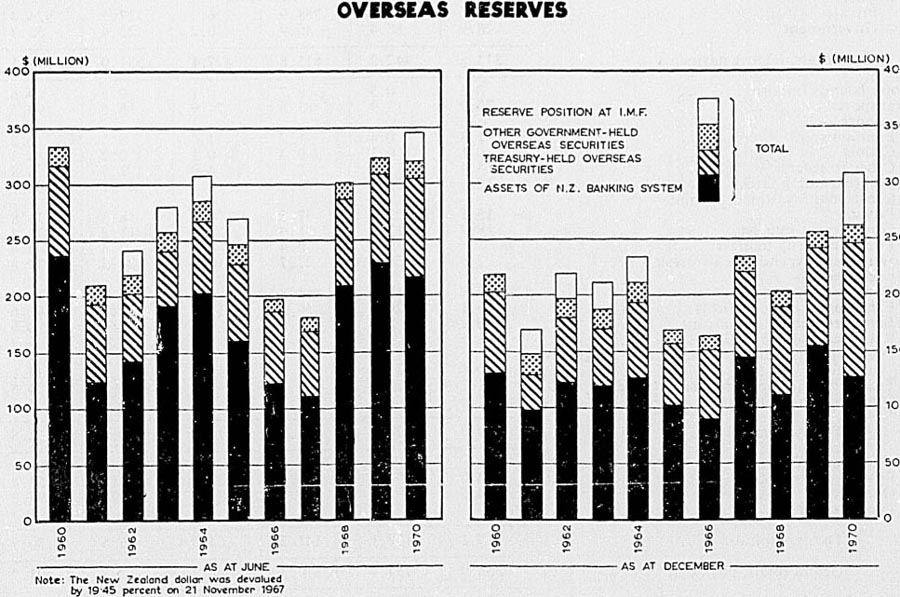
OVERSEAS EXCHANGE TRANSACTIONS—Statistics of overseas exchange transactions include transactions both through the banking system and through the Government's overseas accounts. A full classification of overseas exchange transactions for the two latest calendar years is now given.
| OVERSEAS EXCHANGE TRANSACTIONS | ||||||
|---|---|---|---|---|---|---|
| Item | 1969 | 1970 | ||||
| U.K. | Other Countries | Total | U.K. | Other Countries | Total | |
| Note—Minus sign (—) denotes a deficit. | ||||||
| NZS
(million) Receipts | ||||||
| Exports— | ||||||
| Butter | 115.8 | 5.3 | 121.1 | 104.0 | 9.2 | 113.2 |
| Cheese | 34.2 | 10.9 | 45.1 | 35.7 | 12.2 | 47.9 |
| Meat | 176.7 | 192.7 | 369.3 | 178.2 | 229.8 | 408.0 |
| Wool | 52.2 | 188.7 | 240.9 | 46.5 | 162.9 | 209.3 |
| Other | 52.4 | 279.4 | 331.7 | 58.0 | 318.8 | 376.8 |
| Totals, export receipts | 431.2 | 677.0 | 1,108.1 | 422.4 | 732.9 | 1,155.3 |
| Cook Island exports | - | 0.1 | 0.1 | - | 0.1 | 0.1 |
| Transport | 23.0 | 11.5 | 34.5 | 33.0 | 7.9 | 40.9 |
| Insurance | 3.0 | 3.6 | 6.6 | 2.8 | 2.7 | 5.5 |
| Travel (excluding fares) | 3.5 | 20.3 | 23.8 | 4.5 | 25.5 | 30.0 |
| International investment income— | ||||||
| Interest and dividends | 11.1 | 2.4 | 13.6 | 13.0 | 3.1 | 16.1 |
| Other investment income | 0.7 | 2.6 | 3.2 | 0.7 | 4.6 | 5.3 |
| New Zealand Government receipts and expenditure by other Governments in New Zealand | 5.7 | 7.1 | 12.8 | 1.6 | 7.2 | 8.8 |
| Miscellaneous— | ||||||
| Commissions, royalties | 3.2 | 4.5 | 7.7 | 3.3 | 4.9 | 8.3 |
| Expenses of business firms | 1.4 | 5.2 | 6.6 | 1.5 | 5.5 | 7.0 |
| Personal receipts, legacies and immigrants' transfers | 19.3 | 17.9 | 37.2 | 21.0 | 23.3 | 44.4 |
| Other current transactions | 1.7 | 3.6 | 5.3 | 1.6 | 3.8 | 5.4 |
| Totals, current | 503.7 | 755.7 | 1,259.5 | 505.5 | 821.6 | 1,327.1 |
| Capital transfers— | ||||||
| Private | 23.9 | 30.6 | 54.5 | 32.2 | 49.5 | 81.7 |
| Government | 21.2 | 36.4 | 57.6 | 42.2 | 30.3 | 72.6 |
| I.M.F. transactions | - | - | - | - | - | |
| Other official borrowing | - | - | - | - | - | - |
| Total, capital | 45.1 | 66.9 | 112.1 | 74.4 | 79.8 | 154.2 |
| Grand totals, receipts | 548.8 | 822.7 | 1,371.5 | 579.9 | 901.3 | 1,481.3 |
| Current items— | ||||||
| Imports— | Payments | |||||
| Private | 345.1 | 423.8 | 768.9 | 396.9 | 527.5 | 924.4 |
| Government | 28.5 | 18.4 | 46.9 | 30.2 | 23.4 | 53.7 |
| Totals, import payments | 373.6 | 442.2 | 815.8 | 427.1 | 551.0 | 978.1 |
| Cook Islands imports | 0.2 | 0.5 | 0.7 | 0.1 | 0.5 | 0.6 |
| Transport | 70.9 | 12.9 | 83.8 | 74.9 | 15.6 | 90.5 |
| Insurance— | ||||||
| Premiums | 1.3 | 0.4 | 1.7 | 1.6 | 0.5 | 2.2 |
| Claims | 0.1 | 0.3 | 0.4 | 0.1 | 0.2 | 0.3 |
| Other transfers | 4.4 | 1.4 | 5.9 | 4.0 | 2.8 | 6.8 |
| Travel (excluding fares) | 12.9 | 35.9 | 48.8 | 16.7 | 44.1 | 60.7 |
| International investment income— | ||||||
| Private | 15.1 | 22.4 | 37.5 | 16.5 | 18.3 | 34.8 |
| Government interest | 18.2 | 17.3 | 35.6 | 20.2 | 11.2 | 31.4 |
| Local authority interest | - | 0.4 | 0.4 | - | 0.4 | 0.4 |
| Government expenditure overseas | 7.8 | 20.0 | 27.7 | 10.5 | 24.3 | 34.8 |
| Miscellaneous— | ||||||
| Commissions, royalties, and rebates | 4.2 | 10.6 | 14.8 | 3.9 | 10.7 | 14.6 |
| Expenses of business firms | 16.1 | 20.4 | 36.5 | 19.9 | 21.7 | 41.6 |
| Film hire and entertainment | 0.1 | 2.2 | 2.3 | 0.2 | 2.4 | 2.6 |
| Religious and charitable | 1.5 | 3.9 | 5.3 | 1.7 | 4.0 | 5.7 |
| Personal remittances, legacies, and emigrants' transfers | 10.8 | 23.4 | 34.2 | 11.6 | 23.5 | 35.1 |
| Transfers by temporary residents | 1.1 | 3.1 | 4.2 | 1.2 | 3.3 | 4.5 |
| Other current transactions | 1.4 | 6.8 | 8.2 | 1.8 | 6.3 | 8.1 |
| Totals, current | 539.8 | 624.1 | 1,163.1 | 612.0 | 740.8 | 1,352.8 |
| Capital transfers— | ||||||
| Private | 14.6 | 30.8 | 45.4 | 22.1 | 31.7 | 53.8 |
| Official | 4.5 | 95.9 | 100.5 | 32.2 | 63.6 | 95.8 |
| Local authority | - | 1.3 | 1.3 | - | 1.3 | 1.3 |
| Totals, capital | 19.1 | 128.1 | 147.2 | 54.3 | 96.6 | 150.9 |
| Grand totals, payments | 558.9 | 751.4 | 1,310.3 | 666.3 | 837.3 | 1,503.7 |
| Surplus of receipts over payments | -10.1 | +71.3 | +61.2 | -86.4 | +64.0 | -22.4 |
The next table gives overseas exchange transactions in summary form for a number of June years, which fit more closely to the farm-production export season than do calendar years. Information for calendar years over a similar period is in the Monthly Abstract of Statistics.
| Item | Year Ended 30 June | |||||
|---|---|---|---|---|---|---|
| 1965 | 1966 | 1967 | 1968 | 1969 | 1970 | |
*Includes local authority debt repayment. †Includes revaluation of official overseas reserves following devaluation of the New Zealand dollar in November 1967. ‡Includes $23.6 million Special Drawing Rights from 1 January 1970. | ||||||
| NZ$ (million) | ||||||
| Receipts | ||||||
| Exports— | ||||||
| Butter | 111.0 | 106.9 | 118.7 | 106.5 | 109.4 | 118.5 |
| Cheese | 44.2 | 48.5 | 54.2 | 45.8 | 41.3 | 50.9 |
| Meat | 213.0 | 217.4 | 208.0 | 261.1 | 315.8 | 413.9 |
| Wool | 217.3 | 245.6 | 182.5 | 168.2 | 226.1 | 228.5 |
| Other | 158.8 | 184.6 | 195.8 | 251.7 | 308.1 | 352.6 |
| Total exports | 744.2 | 803.1 | 759.2 | 833.3 | 1,000.8 | 1,164.5 |
| Other current receipts | 79.8 | 85.2 | 92.8 | 119.1 | 144.2 | 155.8 |
| Total current receipts | 824.0 | 888.3 | 851.9 | 952.4 | 1,145.0 | 1,320.3 |
| Capital receipts— | ||||||
| Official | ||||||
| Reducing assets (Govt) | 3.1 | 50.9 | 57.6 | 55.3 | 49.4 | 6.8 |
| Increasing liabilities (Govt) | 16.0 | 57.1 | 79.2 | 81.0 | 48.8 | 6.2 |
| I.M.F. drawings | - | 50.3 | 21.0 | 45.8 | - | - |
| Other official | - | - | 60.0 | - | - | - |
| Private | 28.5 | 21.5 | 28.4 | 54.6 | 46.3 | 63.0 |
| Total capital receipts | 47.6 | 179.8 | 246.3 | 236.7 | 144.5 | 75.9 |
| Total receipts | 871.6 | 1,068.1 | 1,098.2 | 1,189.0 | 1,289.5 | 1,396.2 |
| Imports— | Payments | |||||
| Government | 65.6 | 74.6 | 72.2 | 56.5 | 48.4 | 45.2 |
| Private | 595.8 | 679.3 | 637.7 | 577.8 | 723.1 | 843.3 |
| Total imports | 661.5 | 753.9 | 709.9 | 634.3 | 771.6 | 888.5 |
| Other current payments— | ||||||
| Government | 40.1 | 47.4 | 53.9 | 61.5 | 64.3 | 70.9 |
| Private | 176.7 | 195.4 | 220.3 | 219.2 | 259.1 | 299.3 |
| Total current payments | 878.2 | 996.7 | 984.1 | 915.0 | 1,095.0 | 1,258.8 |
| Capital payments— | ||||||
| Official | ||||||
| Increasing assets (Govt) | 7.3 | 46.4 | 52.0 | 72.3 | 52.3 | 12.4 |
| Reduced liabilities (Govt) | 3.7 | 37.4 | 37.6 | 7.4 | 46.2 | 18.7 |
| I.M.F. Repurchases | - | - | - | 62.5 | 26.1 | 18.4 |
| Other Official Repayments | - | - | - | 26.8 | 32.2 | 7.6 |
| Private* | 26.7 | 25.5 | 29.5 | 28.2 | 40.4 | 55.9 |
| Total capital payments | 37.7 | 109.3 | 119.1 | 197.1 | 197.2 | 113.0 |
| Total payments | 916.0 | 1,106.0 | 1,103.2 | 1,112.1 | 1,292.3 | 1,371.8 |
| Balance on trade transactions | + 82.8 | + 49.2 | + 49.2 | + 199.0 | +229.2 | +276.0 |
| Balance on current account invisible transactions | -137.0 | -157.5 | -181.4 | -161.7 | -179.3 | -214.4 |
| Balance on current account | - 54.3 | -108.4 | -132.2 | + 37.3 | +49.9 | + 61.5 |
| Balance on capital account | + 9.9 | + 70.5 | + 127.2 | +39.6 | -52.7 | - 37.1 |
| Overall balance | - 44.4 | - 37.9 | - 4.9 | +76.9 | -2.8 | + 24.4 |
| Exchange valuation differences, timing differences and omissions, etc. | + 6.3 | - 33.8 | - 10.7 | +42.5† | +25.5 | - 4.0‡ |
| Change in official overseas Reserves | - 38.1 | - 71.7 | - 15.6 | + 119.4 | + 22.7 | + 20.4 |
Overseas Travel Allowances—Since 1938, there have been restrictions on the amount of overseas travel funds made available for non-business purposes. From June 1971 trading banks have been able to sell overseas exchange to travellers up to $600 a month with a maximum of $1,800 a year. Requests for higher amounts need to be referred to the Reserve Bank, which is prepared to approve all reasonable requests.
Exchange Control—Transactions affecting overseas exchange are governed by the Exchange Control Regulations 1965, made under the Reserve Bank of New Zealand Act 1964. The exemption in respect of dealings in sterling area currencies and securities in the hands of New Zealand residents was continued by the Exchange Control Exemption Notice 1965.
Certain new measures in exchange control and related fields were introduced by the Minister of Finance in the Budget of 16 June 1966, and are set out in paragraphs (a) to (d).
(a) Sterling Area Securities and Currencies: The facility previously available to New Zealand residents to sell overseas sterling area securities or currencies for New Zealand currency or other assets in New Zealand was withdrawn. These securities could then be sold only for other sterling area securities or for sterling area currencies. Therefore, if a New Zealand resident sought cash in New Zealand for his sterling area securities the only avenue available at law was to sell overseas and transfer the proceeds to New Zealand through the banking system.
This measure, in effect, closed the market in sterling area securities in exchange for New Zealand currency. A limited market has since been re-opened (see (f) below).
The position regarding non-sterling securities and currencies remains unchanged—they may not be dealt with in any way without the consent of the Reserve Bank, except for the transfer of currency to New Zealand through the banking system.
(b) Export and Import of New Zealand Notes: A limit was set in June 1966 on the export of notes at $10 for all travellers, regardless of destination.
The importation of New Zealand money (including postal notes, money orders, cheques, and notes, but excluding travellers' cheques) was also prohibited, except that travellers to New Zealand could bring in with them up to $10 in New Zealand notes.
From June 1971 travellers from New Zealand have been able to take out up to $50 (of which not more than $4 may be in coin and the denominations of the notes may not exceed $5). For travellers to New Zealand there is now no restriction on bringing in notes of $1 or $2 or $5 or coin of any denomination.
(c) Supervision of Non-Residents' Accounts in New Zealand: The Reserve Bank was given power to exercise supervision over specific accounts in New Zealand of non-residents, with banks or elsewhere. The following accounts were initially declared to be controlled accounts:
(a) those of non-resident banks;
(b) those of non-resident travel agents.
(c) a group of seven individual accounts connected with international currency dealers.
A subsequent notice to banks had the effect of bringing under control any accounts for the credit to which New Zealand money was received from overseas without the consent of the Reserve Bank. No change of policy was involved, this being a technical measure to ensure that transfers of funds outside the banking system were not facilitated by the operation of New Zealand accounts.
(d) London-domiciled New Zealand Government Stock: In 1920 provision was made for New Zealand residents to transfer holdings of London-domiciled New Zealand stock to the New Zealand register, a facility which provided a means of transferring funds to New Zealand outside the banking system. The volume of such transactions in recent years became excessive, and the following conditions were therefore applied to transfers to the New Zealand register on 16 June 1966.
(a) stock must have been registered in the applicant's name for at least six months;
(b) after stock has been transferred to the New Zealand register it may not be sold for six months.
Since 5 September 1969 the transfer to the New Zealand register has been limited to stock held on or prior to that date. Stock purchased subsequently may not be transferred to the New Zealand register.
(e) Capital Issues Control: Since 26 January 1968 all borrowing in New Zealand by subsidiaries and branches of overseas companies has required the consent of the Minister of Finance. The regulations exempt bank advances from control in order to allow the day-to-day financial needs of the companies to be met without formality. However, requests for higher overdraft limits or term loans by these companies (other than limits for seasonal or short-term purposes) are subject to Reserve Bank approval.
(f) Limited Market in Overseas Sterling Area Securities: In September 1966 the Minister of Finance announced a scheme to re-open a limited market in overseas sterling area securities in exchange for New Zealand currency. Trading was confined to New Zealand residents, and to securities which were registered in the names of New Zealand residents on 16 June 1966. All dealings must be effected through a member of a New Zealand stock exchange, and both seller and purchaser must supply details of the transaction to an Approved Depository, with whom the scrip must be lodged. Securities so purchased may be sold for New Zealand currency under the same conditions, or sold for overseas currency through a member of a New Zealand stock exchange, provided the proceeds are either remitted to New Zealand or re-invested in similar securities within three months. The new scrip must also be lodged with an approved depository. The approved depositories are the Reserve Bank in Wellington and its branches in Auckland and Christchurch and the Bank of New South Wales (in respect of its own shares only). Up to 31 October 1970 some 69,066 transactions involving nearly 23,000,000 shares had taken place under these arrangements.
Administrative details on import and export control and exchange allocation are set out in Section 22a.
ROYAL COMMISSION ON MONETARY, BANKING, AND CREDIT SYSTEMS—The report of the Royal Commission, which was released in April 1956 (as parliamentary paper B.3, 1956) gives a general background on the monetary, banking, and credit systems of New Zealand. The Royal Commission examined and reported on these systems and made recommendations within its order of reference which had the stated objectives of fostering a greater degree of stability in prices, maintaining full employment, ensuring the healthy development of natural resources, and promoting generally the economic, financial and social welfare of the people.
Section 4 of the report outlines the history of monetary, banking, and credit systems from 1934 to 1955. As recommended by the Royal Commission, New Zealand has joined the International Monetary Fund, a Monetary and Economic Council has been established, and the Reserve Bank of New Zealand Act has been amended to give the Government full and final responsibility for decisions on monetary policy. (A summary of the report was given as Appendix (d) of the 1956 issue of the Yearbook.)
INTERNATIONAL MONETARY FUND, INTERNATIONAL BANK FOR RECONSTRUCTION AND DEVELOPMENT, AND INTERNATIONAL FINANCE CORPORATION—New Zealand became a member of these three organisations on 31 August 1961 under the International Finance Agreements Act 1961. The organisations are specialised agencies of the United Nations, and their objectives and the implications of New Zealand membership are set out in parliamentary paper A.12, 1961. One of the purposes of the International Monetary Fund is to give confidence to members by making the Fund's resources available to them under adequate safeguards, thus providing them with opportunity to correct maladjustments in their balance of payments without resorting to measures destructive of national or international prosperity. By paying in some gold and the balance of its fund quota in its own currency a member is able to draw against its gold for a nominal cost. New Zealand's fund quota was increased in March 1966 and again in December 1970 with the result that drawing rights have risen to a maximum of $225.5 million. In addition, drawings may be made under the fund's compensatory finance arrangements.
The International Bank for Reconstruction and Development (World Bank) is designed to promote the international flow of capital for productive purposes and to assist in financing the development of the resources of its member countries.
New Zealand paid $24.4 million in gold and $1.0 million in New Zealand currency to join the three agencies, and in addition $77.2 million of non-negotiable non-interest bearing bonds were lodged with the Reserve Bank of New Zealand.
The World Bank made a loan of $5.6 million to New Zealand in November 1963. The loan is for a term of 25 years and bears interest at 5 1/2 percent, including the 1 percent commission which is allocated to the Bank's special reserve. It has assisted in financing improvements at the ports of Auckland, Lyttelton, Napier, Timaru, and Whangarei, and applied to the overseas-currency content of capital works. A loan of $23.4 million was received for the Cook Strait electricity cable project. These loan agreements are set out in parliamentary papers A. 21 and A. 23, 1964.
In December 1965 the World Bank agreed to lend $30.2 million for railways modernisation and $14.7 million for power development. The railways loan is being used to buy additional diesel locomotives and rolling stock, while part was used to pay for the second rail-road ferry Aranui. The electricity development loan was used to meet the overseas costs in the building of the thermal power station at Marsden Point, Whangarei. The term of the loans is 15 years with interest at 6 1/4 percent.
New Zealand's transactions with the International Monetary Fund are shown in the attached table. Special drawing rights are intended to supplement existing reserve assets and facilitate the expansion of world trade.
| Date | Drawings | Repurchases | Drawings Outstanding | Special Drawing Rights | |
|---|---|---|---|---|---|
| Allocation | Utilisation | ||||
| NZ $(million) | |||||
| 1965—Nov 10 | 55.4 | - | 55.4 | ... | ... |
| 1966—Mar 23 | 7.1 | - | 62.5 | ... | ... |
| 1967—May 10 | 26.1 | - | 88.6 | ... | ... |
| Oct 31 | 40.2 | - | 128.8 | ... | ... |
| Dec 5 | 13.4 | - | 142.1 | ... | ... |
| 1968—Mar 26 | - | 31.3 | 110.9 | ... | ... |
| May 8 | - | 31.3 | 79.6 | ... | ... |
| Nov 12 | - | 0.1 | 79.6 | ... | ... |
| Dec 13 | - | 26.1 | 53.5 | ... | ... |
| 1969—Aug 20 | - | 18.4 | 35.0 | ... | ... |
| 1970—Jan 1 | - | - | - | 23.6 | - |
| Sep 16 | - | 35.0 | - | - | 23.2 |
| 1971—Jan 1 | - | - | - | 19.3 | - |
ASIAN DEVELOPMENT BANK—New Zealand is participating in the Asian Development Bank, whose main objective is to accelerate the economic development of the ECAFE region. New Zealand's contribution to the capital stock of the Bank is US$22.56 million, half of which is payable in convertible currency and half in New Zealand currency. The local currency portion is restricted to payments for goods and services produced in New Zealand. At the present time only half of the capital stock of the Bank is being paid up so the cost to New Zealand's overseas reserves has been just over $5 million since contributions begun in 1966.
MONETARY AND ECONOMIC COUNCIL—In 1961, in line with a recommendation of the Royal Commission on Monetary, Banking, and Credit Systems, there was established a Monetary and Economic Council whose principal functions are to report from time to time on the extent to which stability in the prices of goods and services, economic growth, full employment, and higher standards of living are being achieved, and to make recommendations as to measures that should be taken to promote such developments. Among other matters, the Council is required to consider the provision of finance for the expansion of primary and secondary industries and of services, and the ensuring of a balanced relationship between the creation and issue of money and the production and provision of goods and services. A series of reports have been made to the Government and have been published.
DEVELOPMENT FINANCE CORPORATION—This Corporation was established under the Development Finance Corporation Act 1964, and under the Development Finance Corporation Amendment Act 1970 the scope of activity was broadened, particularly in that the previous provision limiting the Corporation to be a lender of last resort was removed. Its general function is to provide finance for the establishment of new industries or for the development or extension of existing industries and to encourage and promote investment in the industrial development of New Zealand by providing technical assistance and advice.
The Corporation will consider providing finance for projects of all sizes and to large, medium or small businesses. However, because there are generally adequate facilities for short-term finance, its lending is mainly for medium to long-term. Lending criteria include the value of the industry to the economy generally—e.g., increased productivity, use of indigenous raw materials, export potential or the saving of imports. Encouragement is also given to the establishment or expansion of industry in regions requiring development.
Loans are made available to borrowers engaged in production or related fields, including manufacturing, processing, assembly, construction, transport, and the servicing of basic industry. Also eligible are the extractive industries, such as fishing, forestry and mining. Because there are other wide facilities for farm finance, loans in this field are restricted to related servicing and processing, and specialised forms of cropping.
The Act provides for a share capital of $4 million for the Corporation. Of the $2 million issued, 30 percent has been taken up by the Reserve Bank and the remainder by the trading banks and insurance offices. Up to 30 June 1970 loans to industry totalling $8,687,000 had been approved.
MORTGAGE LAW—The borrowing of money on mortgage is a principal means of financing the erection or purchase of houses and commercial buildings, and the purchase of farms. Under the Land Transfer Act 1952 “mortgage” means and includes any charge on land created under the provisions of that Act for securing
The repayment of a loan or satisfaction of an existing debt.
The repayment of future advances, or payment or satisfaction of any future or unascertained debt or liability, contingent or otherwise.
The payment to the holders for the time being of any bonds, debentures, promissory notes, or other securities, negotiable or otherwise, made or issued by the mortgagor before or after the creation of such charge.
The payment to any person or persons by yearly or periodical payments or otherwise of an annuity, rent charge, or sum of money other than a debt.
Where the ownership of land is registered under the Land Transfer Act (as, see Section 10a, the great majority of land titles now are) mortgages on that land are granted by virtue of the provisions of that Act; they take effect as securities and do not operate as transfers of the estate or interest charged. In the case of other land or property a mortgage is granted under what is known as the deeds or deeds-registration system; the mortgage in this instance operating as a conveyance or assignment of the land or property mortgaged, for the mortgagee becomes the registered proprietor of the land, subject to the right of the mortgagor to have the property reregistered in his name on the discharge of his obligations under the mortgage. Although in form mortgage under the deeds system is a conveyance, in equity it is treated as merely a charge on the land.
SUMMARY OF MORTGAGES REGISTERED AND DISCHARGED—A table is given showing the net numbers and amounts represented by mortgages registered and discharged during each of the last 21 years. The average rate of interest on new mortgages is also given.
| Year Ended 31 March | Mortgages Registered | Average Rate of Interest on New Mortgages Registered | Mortgages Discharged | ||
|---|---|---|---|---|---|
| Number | Amount | Number | Amount | ||
| *Includes a small number of duplicate registrations. | |||||
| $(m) | Percent | $ (m) | |||
| 1,950 | 30,352 | 72.0 | 3.99 | 26,093 | 46.2 |
| 1,951 | 43,875 | 91.6 | 4.09 | 35,503 | 64.5 |
| 1,952 | 49,840 | 135.9 | 4.15 | 37,926 | 74.5 |
| 1,953 | 50,633 | 147.4 | 4.29 | 34,160 | 62.8 |
| 1,954 | 52,807 | 140.8 | 4.49 | 36,728 | 72.0 |
| 1,955 | 57,992 | 169.2 | 4.69 | 37,931 | 82.3 |
| 1,956 | 55,544 | 192.5 | 4.76 | 34,078 | 70.7 |
| 1,957 | 51,230 | 182.4 | 5.09 | 32,663 | 75.4 |
| 1,958 | 55,437 | 199.1 | 5.24 | 37,441 | 92.2 |
| 1,959 | 56,195 | 217.1 | 5.15 | 36,920 | 88.8 |
| 1,960 | 57,834 | 239.0 | 5.01 | 39,931 | 102.3 |
| 1,961 | 64,605 | 300.8 | 5.01 | 46,469 | 136.6 |
| 1,962 | 62,501 | 331.5 | 5.27 | 44,494 | 133.8 |
| 1,963 | 59,263 | 295.1 | 5.51 | 43,979 | 135.6 |
| 1,964 | 63,992 | 339.8 | 5.70 | 49,661 | 168.8 |
| 1965* | 71,531 | 420.0 | 5.78 | 56,262 | 206.8 |
| 1,966 | 76,960 | 487.7 | 6.07 | 59,473 | 230.0 |
| 1,967 | 75,303 | 493.4 | 6.31 | 55,958 | 239.3 |
| 1,968 | 73,335 | 467.8 | 6.64 | 53,200 | 236.1 |
| 1,969 | 75,543 | 482.3 | 6.74 | 58,429 | 260.9 |
| 1,970 | 83,478 | 573.9 | 6.77 | 65,713 | 328.1 |
The figures given in the preceding table have been adjusted to exclude duplicate registrations, i.e., cases in which a mortgage has been registered in more than one district. It should also be noted that the figures include collateral and guarantee mortgages not representing money indebtedness. On the other hand, no amount is shown as secured in a proportion of cases where a mortgage is given in anticipation of advances, etc. In addition there are numbers of privately arranged advances which are not registered, and stock and crop liens, bills of sale, and instruments under the Chattels Transfer Act are not included in the statistics.
Many discharges are not registered, particularly in the case of leaseholds and also of second or other further mortgages when the power of sale has been exercised by the first mortgagee. The figures for discharges are further affected by the high proportion of table mortgages. This is particularly so in cases where the mortgage is approaching maturity, since the whole amount remains on the register until finally discharged, despite the fact that the original amount of indebtedness has been considerably reduced.
MORTGAGES REGISTERED: Value by Districts—The total amount for which mortgages were registered, under the Land Transfer Act, in each registration district is given in the next table.
| District | 1965-66 | 1966-67 | 1967-68 | 1968-69 | 1969-70 |
|---|---|---|---|---|---|
| $ (million) | |||||
| North Auckland | 143.1 | 140.9 | 139.1 | 152.5 | 175.5 |
| South Auckland | 71.2 | 73.1 | 78.9 | 70.6 | 82.6 |
| Gisborne | 5.6 | 7.1 | 5.9 | 5.9 | 7.0 |
| Hawke's Bay | 21.9 | 22.8 | 18.5 | 21.3 | 26.8 |
| Taranaki | 16.4 | 22.4 | 16.4 | 14.3 | 17.3 |
| Wellington | 96.7 | 92.8 | 93.5 | 95.0 | 108.3 |
| Marlborough | 4.8 | 5.6 | 4.8 | 5.9 | 6.2 |
| Nelson | 8.6 | 9.3 | 8.8 | 9.2 | 11.1 |
| Westland | 1.5 | 1.5 | 1.4 | 1.7 | 2.1 |
| Canterbury | 62.6 | 62.3 | 54.3 | 58.9 | 78.1 |
| Otago | 27.9 | 31.5 | 28.1 | 28.3 | 31.9 |
| Southland | 27.7 | 24.2 | 18.1 | 18.7 | 27.1 |
| Totals | 488.0 | 493.4 | 467.8 | 482.3 | 573.9 |
Classification by Amount—The following table shows urban and rural mortgages by amount groups for 1969-70. The different distribution patterns for urban and rural mortgages are due to the different types of property on which the bulk of urban and rural mortgages are raised. Among urban mortgages, $192 million out of the aggregate total of $388 million was made up of mortgages from $2,000 to $7,999 with $105 million (27 percent of the urban total) representing mortgages of $6,000 to $7,999. The bulk of urban mortgages are relatively low advances on house property. Among rural mortgages, on the other hand, $137 million or 74 percent of the aggregate total of $186 million represented mortgages of $15,000 and above.
| Amount Group | Urban | Rural | All Properties | ||||
|---|---|---|---|---|---|---|---|
| Number | Amount | Number | Amount | Number | Amount | Percentage of Amount | |
| $ | $(m) | $(m) | $(m) | ||||
| Under 1,000 | 5,385 | 3.1 | 301 | 0.2 | 5,686 | 3.3 | 0.58 |
| 1,000- 1,999 | 8,180 | 10.8 | 593 | 0.8 | 8,773 | 11.6 | 2.02 |
| 2,000- 3,999 | 12,218 | 32.9 | 1,489 | 4.1 | 13,707 | 36.9 | 6.43 |
| 4,000- 5,999 | 11,498 | 54.6 | 1,377 | 6.4 | 12,875 | 61.0 | 10.64 |
| 6,000- 7,999 | 15,735 | 104.9 | 1,265 | 8.4 | 17,000 | 113.3 | 19.74 |
| 8,000- 9,999 | 4,977 | 42.4 | 993 | 8.5 | 5,970 | 50.9 | 8.84 |
| 10,000-14,999 | 4,395 | 50.0 | 1,743 | 20.4 | 6,138 | 70.4 | 12.27 |
| 15,000 and over | 2,600 | 89.5 | 4,428 | 136.9 | 7,028 | 226.4 | 39.45 |
| Unspecified | 4,507 | ... | 1,794 | ... | 6,301 | ... | ... |
| Totals | 69,495 | 388.3 | 13,983 | 185.6 | 83,478 | 573.9 | 100.00 |
Excluding mortgages for which no amounts were shown, the average amount for each mortgage registered in 1969-70 was $7,436 as compared with $6,907 in 1968-69.
Mortgages on Urban and Rural Securities—Mortgages are regarded as urban if secured on properties situated within cities or boroughs or on small holdings in the nature of building allotments which are not definitely distinguishable as country properties. New mortgages classed as urban in 1969-70 were secured on areas averaging just under a quarter of an acre in extent, as compared with an average of some 319 acres in the case of rural securities. Urban securities accounted for 83 percent of the number and 68 percent of the aggregate value of new mortgages in 1969-70 as compared with 17 percent and 32 percent respectively in the case of rural properties.
The following table shows urban and rural mortgages by land registration district. Auckland urban area, the largest centre of population in New Zealand, is in the North Auckland district.
| Land Registration District | Urban | Rural | ||||
|---|---|---|---|---|---|---|
| Number | Area | Amount | Number | Area | Amount | |
| acres | $(m) | acres(000) | $(m) | |||
| North Auckland | 24,034 | 6,213 | 145.6 | 2,733 | 413 | 30.0 |
| South Auckland | 7,597 | 2,096 | 43.1 | 3,054 | 727 | 39.4 |
| Gisborne | 625 | 193 | 3.7 | 290 | 211 | 3.3 |
| Hawke's Bay | 2,813 | 877 | 14.1 | 727 | 297 | 12.7 |
| Taranaki | 1,325 | 336 | 6.7 | 825 | 245 | 10.6 |
| Wellington | 14,676 | 3,189 | 83.8 | 1,642 | 592 | 24.5 |
| Marlborough | 641 | 215 | 3.0 | 376 | 197 | 3.2 |
| Nelson | 1,518 | 383 | 7.3 | 401 | 109 | 3.8 |
| Westland | 282 | 76 | 0.9 | 121 | 39 | 1.1 |
| Canterbury | 9,256 | 2,224 | 48.2 | 1,956 | 760 | 29.9 |
| Otago | 4,460 | 986 | 19.3 | 917 | 532 | 12.7 |
| Southland | 2,268 | 569 | 12.8 | 941 | 337 | 14.3 |
| Totals | 69,495 | 17,356 | 388.3 | 13,983 | 1,461 | 185.6 |
Restrictions were removed from the sale of all lands other than farmlands in February 1950, and farmlands were released in November 1950. Following these changes there was a marked increase in activity during the next two years, and since 1953-54 the level of mortgage business has remained high.
| Year Ended 31 March | Registrations | Area | Amount Secured | ||||||
|---|---|---|---|---|---|---|---|---|---|
| Urban | Rural | Total | Urban | Rural | Total | Urban | Rural | Total | |
| acres | acres (000) | acres (000) | $(m) | $(m) | $(m) | ||||
| 1,960 | 47,242 | 10,625 | 57,867 | 11,526 | 2,976 | 2,987 | 158.9 | 83.2 | 242.0 |
| 1,961 | 52,549 | 12,088 | 64,637 | 12,894 | 3,685 | 3,698 | 198.2 | 110.0 | 308.1 |
| 1,962 | 51,109 | 11,442 | 62,551 | 12,454 | 3,321 | 3,334 | 211.6 | 125.3 | 337.0 |
| 1,963 | 48,784 | 10,528 | 59,312 | 12,607 | 3,213 | 3,226 | 205.1 | 103.9 | 309.0 |
| 1,964 | 52,613 | 11,408 | 64,021 | 27,706 | 3,683 | 3,711 | 222.9 | 117.4 | 340.3 |
| 1,965 | 58,232 | 13,299 | 71,531 | 46,517 | 4,296 | 4,343 | 257.2 | 162.8 | 420.0 |
| 1,966 | 62,809 | 14,169 | 76,978 | 26,278 | 4,519 | 4,545 | 308.0 | 180.0 | 488.0 |
| 1,967 | 61,017 | 14,286 | 75,303 | 28,142 | 5,426 | 5,454 | 307.8 | 185.6 | 493.4 |
| 1,968 | 60,155 | 13,180 | 73,335 | 17,016 | 4,698 | 4,715 | 315.3 | 152.4 | 467.8 |
| 1,969 | 63,169 | 12,374 | 75,543 | 16,129 | 4,056 | 4,072 | 334.3 | 148.1 | 482.3 |
| 1,970 | 69,495 | 13,983 | 83,478 | 17,356 | 4,461 | 4,479 | 388.3 | 185.6 | 573.9 |
NOTE—These figures exclude certain miscellaneous registrations, but have not been adjusted to exclude duplications.
The annual movement in numbers and values of new urban and rural mortgages in recent years is shown on a percentage basis in the following table.
| Year Ended 31 March | Movement in Urban Mortgages | Movement in Rural Mortgages | ||
|---|---|---|---|---|
| Registrations | Amount Secured | Registrations | Amount Secured | |
| Percent | ||||
| 1,965 | +10.7 | +15.4 | + 16.6 | + 38.7 |
| 1,966 | + 7.9 | + 19.8 | + 6.5 | + 10.6 |
| 1,967 | - 2.9 | .. | + 0.7 | + 3.1 |
| 1,968 | - 1.4 | + 2.4 | - 7.7 | -17.9 |
| 1,969 | + 5.0 | + 6.0 | - 6.1 | - 2.8 |
| 1,970 | + 10.0 | + 16.2 | + 13.0 | +25.3 |
Rates of Interest—The average rate of interest on new mortgages over the last 50 years is given in a table in the Statistical Summary at the end of this Yearbook.
The average rate of interest for urban properties for 1969-70 was 6.87 percent, as compared with 6.55 percent for rural properties. The comparable rates for 1968-69 were 6.84 and 6.50 percent respectively.
In 1969-70 the number of 3 percent mortgages increased slightly from 1,258 to 1,301 and the amount advanced increased from $8.8 million to $10 million. The larger numbers of mortgages were at the following rates of interest: at 5 1/2 percent, 8,885; 6 1/2 percent, 9,443; 7 percent, 14,784; and 8 percent 10,004. In 1969-70 the largest number of mortgages (14,784)involved interest at the 7 percent level, and the aggregate amount involved was $121.4 million. The largest number of mortgages in 1968-69 was also at this rate of interest, being 12,010 with an aggregate value of $88.9 million.
An analysis showing amounts classified by interest rate groups is given below. It should be noted that some mortgages, notably those of trading banks, do not specify the rate of interest.
| Year Ended 31 March | Not Exceeding 3 Percent | Over 3 Percent to 4 Percent | Over 4 Percent to 4 1/2 Percent | Over 4 1/2 Percent to 4 3/4 Percent | Over 4 3/4 Percent to 5 Percent | Over 5 Percent to 5 1/2 Percent | Over 5 1/2 Percent to 6 Percent | Exceeding 6 Percent |
|---|---|---|---|---|---|---|---|---|
| Amount $ (million) | ||||||||
| 1,960 | 42.3 | 4.7 | 3.8 | 12.8 | 28.7 | 77.2 | 27.8 | 14.5 |
| 1,961 | 57.1 | 4.6 | 3.1 | 14.0 | 36.0 | 91.9 | 42.5 | 18.5 |
| 1,962 | 51.0 | 4.8 | 2.9 | 14.0 | 42.3 | 64.2 | 78.1 | 40.0 |
| 1,963 | 39.4 | 2.8 | 2.2 | 1.2 | 54.5 | 31.9 | 72.5 | 64.4 |
| 1,964 | 34.2 | 2.9 | 2.1 | 0.4 | 57.5 | 26.5 | 71.8 | 95.9 |
| 1,965 | 33.1 | 3.4 | 1.9 | 0.3 | 81.1 | 27.3 | 92.4 | 121.3 |
| 1,966 | 27.3 | 4.6 | 2.3 | 0.1 | 84.6 | 28.3 | 81.7 | 203.2 |
| 1,967 | 13.9 | 3.9 | 1.8 | 0.3 | 97.0 | 26.2 | 46.1 | 239.2 |
| 1,968 | 9.2 | 3.4 | 1.0 | 0.1 | 40.3 | 57.0 | 31.1 | 264.9 |
| 1,969 | 9.8 | 3.7 | 1.5 | 0.2 | 22.7 | 65.3 | 30.9 | 289.0 |
| 1,970 | 11.1 | 3.6 | 1.2 | 0.4 | 21.4 | 76.8 | 39.2 | 361.6 |
| Percentage of Total | ||||||||
| 1,960 | 20.0 | 2.2 | 1.8 | 6.0 | 13.6 | 36.5 | 13.1 | 6.8 |
| 1,961 | 21.3 | 1.7 | 1.2 | 5.2 | 13.5 | 34.3 | 15.9 | 6.9 |
| 1,962 | 17.2 | 1.6 | 1.0 | 4.7 | 14.2 | 21.6 | 26.3 | 13.4 |
| 1,963 | 14.7 | 1.0 | 0.8 | 0.4 | 20.3 | 11.8 | 27.0 | 24.0 |
| 1,964 | 11.7 | 1.0 | 0.7 | 0.2 | 19.7 | 9.1 | 24.7 | 32.9 |
| 1,965 | 9.2 | 0.9 | 0.5 | 0.1 | 22.5 | 7.6 | 25.6 | 33.6 |
| 1,966 | 6.3 | 1.1 | 0.5 | –– | 19.6 | 6.6 | 18.9 | 47.0 |
| 1,967 | 3.2 | 0.9 | 0.2 | 0.1 | 22.7 | 6.1 | 10.8 | 56.0 |
| 1,968 | 2.3 | 0.8 | 0.3 | –– | 9.9 | 14.0 | 7.6 | 65.1 |
| 1,969 | 2.3 | 0.9 | 0.4 | –– | 5.4 | 15.4 | 7.3 | 68.3 |
| 1,970 | 2.2 | 0.7 | 0.2 | 0.1 | 4.1 | 14.9 | 7.6 | 70.2 |
A similar analysis by interest rate groups is shown (together with the annual average interest rate) in the following diagram.
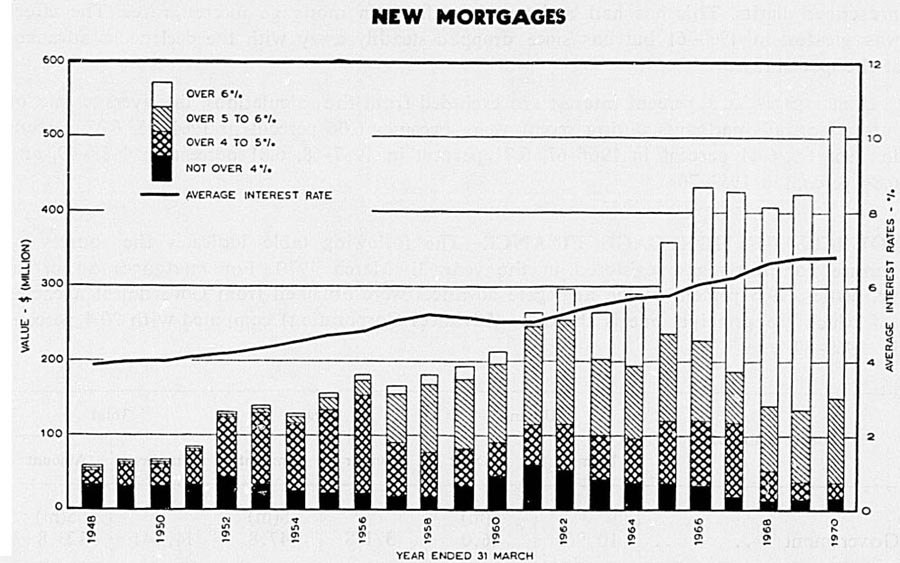
Mortgages by Class—In this section, mortgages are tabulated by class, i.e., as first flat, subsequent flat, first table, subsequent table, and as increases on existing mortgages. The majority of housing mortgages, especially those from Government agencies, are table (or instalment) mortgages. At the 1966 Census, out of a total of 716,104 inhabited permanent private dwellings, 213,807 were owned with table mortgage compared with 80,885 owned with flat mortgage (197,085 dwellings were owned without mortgage, 177,429 were rented or leased, and the balance of the dwellings were free with job, loaned without payment, or the tenure was unspecified).
The following table shows the amounts advanced and average interest rates of mortgages on urban and rural property by class. Mortgages for which the interest rates are not specified are excluded from the calculations of average rates.
| Year Ended 31 March | Class of Mortgage | Total, Urban and Rural | |||||
|---|---|---|---|---|---|---|---|
| Urban | Rural | ||||||
| First Flat | First Table | Total (Including Other) | First Flat | First Table | Total (Including Other) | ||
| Amount advanced $(m) | |||||||
| 1,965 | 78.8 | 153.5 | 257.2 | 49.9 | 82.8 | 162.8 | 420.0 |
| 1,966 | 88.7 | 184.0 | 308.0 | 61.4 | 80.7 | 180.0 | 488.0 |
| 1,967 | 93.9 | 174.3 | 307.8 | 61.4 | 75.9 | 185.6 | 493.4 |
| 1,968 | 98.1 | 172.5 | 315.3 | 51.8 | 55.7 | 152.4 | 467.8 |
| 1,969 | 88.5 | 202.9 | 334.3 | 44.9 | 61.1 | 148.1 | 482.3 |
| 1,970 | 74.4 | 258.6 | 388.3 | 46.7 | 81.1 | 185.6 | 573.9 |
| Average interest rate (percent) | |||||||
| 1,965 | 6.58 | 5.22 | 5.82 | 6.15 | 5.51 | 5.73 | 5.78 |
| 1,966 | 6.69 | 5.68 | 6.18 | 6.24 | 5.64 | 5.90 | 6.07 |
| 1,967 | 7.06 | 5.88 | 6.47 | 6.46 | 5.78 | 6.06 | 6.31 |
| 1,968 | 7.33 | 6.19 | 6.77 | 6.64 | 6.17 | 6.39 | 6.64 |
| 1,969 | 7.45 | 6.36 | 6.84 | 6.73 | 6.37 | 6.50 | 6.74 |
| 1,970 | 7.36 | 6.54 | 6.87 | 6.86 | 6.44 | 6.55 | 6.77 |
From 12 February 1958 the State Advances Corporation has made housing loans with provision for rebate of interest to 3 percent where the income of applicants does not exceed prescribed limits. This has had a depressing effect on mortgage interest rates. The effect was greatest in 1960-61 but has since dropped steadily away with the decline in advances at the special rate.
If mortgages at 3 percent interest are excluded from the calculations, the average rate of interest on all mortgages during recent years becomes 6.06 percent in 1964-65, 6.27 percent in 1965-66, 6.41 percent in 1966-67, 6.71 percent in 1967-68, 6.81 percent in 1968-69, and 6.84 percent in 1969-70.
SOURCES OF MORTGAGE FINANCE—The following table indicates the sources of finance for mortgages registered in the year 31 March 1970. For mortgages on urban properties, 19.6 percent of the aggregate advances were obtained from Government agencies (of which the principal one is the State Advances Corporation) compared with 20.4 percent in 1968-69.
| Source of Finance | Urban | Rural | Total | |||
|---|---|---|---|---|---|---|
| Number | Amount | Number | Amount | Number | Amount | |
| $(m) | $(m) | $(m) | ||||
| Government | 10,963 | 76.0 | 3,178 | 47.8 | 14,141 | 123.8 |
| Local authorities | 52 | 0.4 | 16 | 0.1 | 68 | 0.5 |
| Trading banks | 4,479 | 4.2 | 1,404 | 2.5 | 5,883 | 6.6 |
| Trustee savings banks | 3,567 | 22.3 | 400 | 4.8 | 3,967 | 27.0 |
| Building societies | 9,325 | 56.6 | 743 | 6.5 | 10,068 | 63.1 |
| Insurance companies | 4,175 | 49.7 | 822 | 22.4 | 4,997 | 72.1 |
| Private individuals | 25,608 | 114.4 | 5,577 | 72.3 | 31,185 | 186.6 |
| All other | 11,326 | 64.9 | 1,843 | 29.2 | 13,169 | 94.1 |
| Totals | 69,495 | 388.3 | 13,983 | 185.6 | 83,478 | 573.9 |
Points to note in considering statistics of mortgages by source of finance are that most trading bank mortgages specify neither interest rates nor the amounts involved; and that the Government Life Insurance Office and the State Insurance Office are included among Government agencies, not with insurance companies.
Supplementary details on sources of mortgage finance with numbers and amounts of mortgages at various rates of interest are given in a supplement to the July 1970 issue of the Monthly Abstract of Statistics.
MORTGAGES DISCHARGED—The value of mortgages registered normally exceeds the value of mortgages released. Registrations exceeded discharges by $254.1 million in 1966-67, by $231.6 million in 1967-68, by $221.4 million in 1968-69, and by $245.8 million in 1969-70.
Details of urban and rural discharges for the latest two years are given in the following table.
| District | 1968-69 | 1969-70 | 1969-70 Total Amount | ||||||
|---|---|---|---|---|---|---|---|---|---|
| Urban | Rural | Urban | Rural | ||||||
| Number | Amount | Number | Amount | Number | Amount | Number | Amount | ||
| $(m) | $(m) | $(m) | $(m) | $(m) | |||||
| North Auckland | 16,326 | 71.0 | 2,088 | 14.7 | 17,528 | 81.0 | 2,325 | 16.3 | 97.2 |
| South Auckland | 4,996 | 19.7 | 1,766 | 15.3 | 5,542 | 24.7 | 2,198 | 20.8 | 45.5 |
| Gisborne | 543 | 1.8 | 207 | 1.3 | 619 | 2.1 | 227 | 1.4 | 3.6 |
| Hawke's Bay | 1,914 | 6.4 | 471 | 4.5 | 2,291 | 8.0 | 570 | 6.4 | 14.3 |
| Taranaki | 1,003 | 3.5 | 568 | 4.4 | 1,144 | 4.2 | 616 | 4.7 | 8.9 |
| Wellington | 10,341 | 41.0 | 1,186 | 10.0 | 11,754 | 54.9 | 1,366 | 11.8 | 66.7 |
| Marlborough | 513 | 1.8 | 195 | 1.4 | 483 | 1.5 | 285 | 1.8 | 3.3 |
| Nelson | 1,150 | 4.0 | 331 | 1.6 | 1,281 | 4.3 | 344 | 1.7 | 6.0 |
| Westland | 325 | 0.6 | 50 | 0.2 | 261 | 0.6 | 98 | 0.5 | 1.1 |
| Canterbury | 6,889 | 23.3 | 1,225 | 10.3 | 7,682 | 28.6 | 1,593 | 15.7 | 44.3 |
| Otago | 3,808 | 10.8 | 509 | 3.6 | 4,088 | 15.2 | 795 | 6.9 | 22.1 |
| Southland | 1,520 | 5.7 | 505 | 4.2 | 1,905 | 8.0 | 718 | 7.0 | 15.0 |
| Totals | 49,328 | 189.5 | 9,101 | 71.5 | 54,578 | 233.1 | 11,135 | 95.0 | 328.1 |
GENERAL—Government first entered the field of mortgage finance in 1894 with the passing of the Government Advances to Settlers Act—the objective being to provide loans at economic interest rates and on stable terms and conditions to farmers for land development purposes. The functions of the office, later known as the State Advances Department, were subsequently enlarged to allow loans to workers for the erection and purchase of houses and to local authorities for the provision of public facilities. A public corporation was established with the passing of the Mortgage Corporation Act 1934-35—the share capital of $2,000,000 being subscribed equally by Government and public. The business of the State Advances Department and certain operations of the Lands and Survey Department and Public Trust Office were absorbed by the new corporation.
In terms of the State Advances Corporation Act 1936, the Government acquired the privately-owned shares of the Mortgage Corporation, extended its functions and changed its name to the State Advances Corporation of New Zealand. The State Advances Corporation Act 1965 transferred the management of the Corporation from a Board of Management to a body corporate consisting of the managing director, deputy managing director (both full-time executive officers), one or more other directors not exceeding four, all appointed by the Governor-General in Council, and an ex-officio director being an officer of Treasury. The body corporate may exercise all the powers and discharge all the functions of the Corporation in accordance with the statutory provisions of the Act. The $2,000,000 capital formerly an appropriation from the Consolidated Fund was redeemed by a loan from the National Development Loans Account. The principal business of the Corporation is the making of loans for approved purposes and it has power to deal in and manage property. In the exercise of its functions and powers the Corporation is required to give effect to the policies of Government as communicated to it by the Minister of Finance.
Since 1937 when Government embarked upon the scheme for the erection of State rental houses, the Corporation has been responsible for the letting and subsequent administration of these properties. The operations of the Corporation can be classified under two main headings, these being, firstly, the lending of money on mortgage (and certain allied functions) in accordance with the State Advances Corporation Act 1965, and, secondly, the letting and administration of State rental houses in terms of the Housing Act 1955.
FARM LOANS—Loan finance is granted by the Corporation for the purchase and/or development of farm properties. Present policy is directed towards stimulating increased production, the strengthening of marginal farms, which is essential in present economic climate, and assisting suitable young farmers and farm workers who can demonstrate a need for finance from the Corporation, and who have not previously owned an economic property. Loans may be granted for the purchase of land and improvements and stock and plant, the erection of necessary buildings, and for essential development work. Loans are generally limited to two-thirds of the Corporation's value of the land and improvements, although loans in excess of this margin may be approved where collateral security over stock and plant is available. It has been found that the aim of assisting suitable applicants to acquire properties with adequate stock and plant can be achieved with loans up to $25,000 in the case of dairy farms, and $40,000 for sheep farms, and these are the maximum loans normally available. However, loans in excess of these amounts will be considered in special circumstances. Repayment is on a table basis over terms of up to 35 years, with interest at 5 1/2 percent per annum; since 1 April 1968 provision has been made for review at five-yearly intervals. Limited loan assistance is available to refinance existing commitments but priority is given to efficient farmers who have substantially increased production and have established a need for rearrangement of their finances. Where a farmer whose property is already mortgaged elsewhere requires finance for development and for increasing production the Corporation is able in appropriate cases to grant loans by way of second (or subsequent) mortgage with interest at 6 percent.
Loans on Stock and Plant—Loans by way of first security over stock and plant only can be granted by the Corporation to farmers, including share milkers and lessees of farms, for the purchase of stock and plant or for other farming purposes. These loans are limited to 60 percent of the value of the stock and plant with a maximum of $8,000 for one man. The loans are repayable over a short term, usually five years with interest at 5 1/2 percent. In the case of young farmers between the ages of 21 and 35 years, loans are available up to 75 percent of the value of stock and plant but when this extended margin applies the maximum loan limit is $5,000 for a one-man herd and $7,000 for a two-man herd.
Co-operative Rural Intermediate Credit Associations—Loans may be granted by the Corporation to co-operative rural intermediate credit associations operating in terms of the Rural Intermediate Credit Act 1927 and amendments. The interest rate charged by the Corporation to the associations is 4 1/2 percent and the associations relend to their members at 5 1/2 percent for the purchase of farm stock and plant or other farming purposes. The loans are secured over the stock and plant and are repayable by the farmer borrowers over a short term, usually five years. At March 31 1969 there were five co-operative rural intermediate credit associations in operation. The loans authorised through this channel during the year 1969-70 amounted to $949,218, and loans current at the end of the year amounted to $1,934,014.
SPECIAL ASSISTANCE TO FARMERS: GUARANTEE SCHEME—During the 1967-68 season it became apparent that some special measures might well be required to safeguard the position of sheep farmers, whether Corporation mortgagors or not, affected by the fall in export prices. The Government decided to institute a guarantee scheme to maintain and, if possible, increase production. Under this scheme the Corporation is prepared to consider guaranteeing any deficiency which may occur in a seasonal financier's account for a farmer providing that expenditure and income lie as far as is reasonably possible within a budget drawn up early in the season. Deeds of guarantee have been completed by most stock firms and banks. The scheme has since been extended to the dairy industry.
HOUSING LOANS—In view of the heavy calls on its funds and the need to overtake the housing shortage, the Corporation was in recent years concentrating its residential lending on the provision of loans for the erection of houses or the acquisition of houses not previously occupied. However, in 1964 the provision of loans to assist home seekers to purchase previously occupied houses was reinstated and has since been operated to the extent of available funds. The loans are made on the security of a first, mortgage of land. Each case is considered on its merits taking into account the financial position of the applicant and the cost of the proposition. Each applicant is expected to make a reasonable contribution himself. Loans for the erection of houses or the purchase of houses which have not previously been occupied are limited to a maximum of $7,000 where the applicant contributes 20 percent of the total cost of land and house from his own resources, and $6,500 in all other cases.
Loans for the purchase of houses which have been previously occupied are in general limited to two-thirds of the assessed value of the property with a maximum of $7,000 (a childless couple must contribute $3,000 from their own resources). An applicant whose income is within the limits outlined below can qualify for a rebate of interest to 3 percent.
In February 1958 a scheme was introduced whereby loans with interest rebated to 3 percent were made available for the erection of houses or the acquisition of houses not previously occupied. In May 1964 the scheme was extended to loans for the purchase of houses previously occupied. To qualify for a rebated interest loan the borrowers must not have owned a property within 5 years prior to the date of the loan application and the breadwinner's income must not have exceeded $2,480 a year increased by $100 for each dependent child. Income for this purpose includes overtime and bonuses but excludes family benefit or war pensions.
Loans now being granted at 3 percent interest provide for a five-yearly review of the interest rate and if the borrower does not qualify on income for rebate to 3 percent at the time of review the interest rate is increased to the normal interest rate for the balance of the term of the loan. The normal interest rate is also subject to a 5-yearly review.
For the year ended 31 March 1970, 2,327 loans involving $15,109,230 were authorised with rebate to 3 percent compared with 2,778 loans for $17,713,580 in 1968-69.
Family Benefit Capitalisation—A further scheme of housing finance administered by the Corporation is that involving capitalisation of family benefits, which came into operation on 1 April 1959, the moneys for which are provided by the Social Security Department and paid out by the Corporation. Applications for advances under the Family Benefit (Home Ownership) Act 1964 are received only from applicants who have already been declared eligible by the Social Security Commission. For the year ended 31 March 1970, 6638 advances totalling $8,053,668 were authorised by the Corporation under this agency, compared with 6,546 advances totalling $7,491,526 in 1968-69.
Mortgage Guarantee Scheme for Housing—The Corporation has statutory authority to guarantee mortgages and operates a scheme whereby an approved lending institution may be guaranteed the repayment of that portion of a housing loan granted by the institution in excess of its normal limits (usually two-thirds of value). The guarantee operates up to 90 percent of value for a total loan not exceeding $13,500 for the erection of a house and up to 85 percent of value for a total loan not exceeding $13,500 for the purchase of an existing house, or for alterations and additions. The borrower is required to pay to the credit of the Corporation's General Reserve Fund an amount equal to 2 percent of the portion of the loan guaranteed. Guarantees since the inception of the scheme total 4,355 involving $20,927,378 advanced by lending institutions, of which $3,166,498 was guaranteed.
REHABILITATION—The Corporation is the principal agent for the Rehabilitation Board regarding loans granted on rehabilitation terms to eligible ex-servicemen for the purchase and improvement of farms and the purchase or erection of dwellings. Loan moneys for these purposes are made available from the Corporation's own funds. The securities taken by the Corporation are similar to mortgages taken for the purpose of securing loans made under the Corporation's ordinary lending activities except that the Reserve Fund contribution on loans within the respective rehabilitation loan limits is paid to the Corporation by the Consolidated Revenue Account which also meets the difference between the Corporation's normal interest rate and the reduced interest rate charged to ex-servicemen. The classes of loans currently granted are set out in Section 6b (War Pensions and Rehabilitation).
LOANS TO INDUSTRY—The Corporation is also authorised to make loans for the development of existing industries or the establishment of new industries where they are in the public interest. Apart from loans, guarantees may also be given to other lenders, in terms of Government schemes designed to promote the provision of tourist accommodation and the development of the fishing industry.
LOAN AUTHORISATIONS—A summary of loans authorised by the Corporation for the latest two financial years ended 31 March is given in the following table.
| Class of Loan | 1968-69 | 1969-70 | ||
|---|---|---|---|---|
| Number | Value | Number | Value | |
| $(000) | $(000) | |||
| Farm loans— | ||||
| Purchase | 287 | 6,058 | 447 | 11,582 |
| Development | 1,873 | 11,307 | 1,440 | 11,899 |
| Refinance | 138 | 919 | 377 | 4,269 |
| Additional land | 425 | 6,148 | 849 | 16,321 |
| Stock loans— | ||||
| Direct | 425 | 2,241 | 422 | 2,369 |
| RIC Associations | 154 | 695 | 183 | 949 |
| Lands department settlements | 35 | 591 | 26 | 530 |
| Totals, rural | 3,337 | 27,959 | 3,744 | 47,919 |
| Housing loans— | ||||
| Erection | 8,285 | 53,628 | 7,126 | 47,646 |
| Purchase | 1,710 | 9,987 | 3,042 | 18,355 |
| Other purposes | 465 | 591 | 478 | 652 |
| Totals, urban | 10,460 | 64,206 | 10,646 | 66,653 |
| Loans to industry | 18 | 1,234 | 37 | 5,735 |
| Grand totals | 13,815 | 93,399 | 14,427 | 120,307 |
The above figures include rehabilitation loans to ex-servicemen in respect of farms and houses.
The aggregate loans approved from its own funds since the Corporation commenced business in 1935 to 31 March 1970 are as follows.
| Type of Loan | Number | Amount |
|---|---|---|
| *Since 1958 the whole of the General Reserve Fund has been invested in Government securities. | ||
| $(million) | ||
| Farm | 52+853 | 496.8 |
| Housing | 250+457 | 1+040.3 |
| Loans to industry | 181 | 40.1 |
| Loans to local authorities (from General Reserve Fund)* | 1+131 | 38.3 |
| Totals | 304+622 | 1+615.5 |
Conditions of Loans—The large majority of the loans granted by the Corporation are secured by table mortgages for terms varying from 10 to 30 years, but the Corporation also has power to make advances on flat mortgage on certain conditions.
When loans are granted in excess of normal lending margins, mortgagors may be required to offer some form of collateral security (e.g., mortgage of life policy).
All mortgagors who receive from the Corporation a loan secured by a mortgage of land are required to pay as a contribution to the Corporation's General Reserve Fund, an amount equal to 2 percent of the amount of the loan and this amount may be borrowed as an addition to the principal sum if so desired. This contribution may be waived, or reduced, in respect of a loan granted within five years of repaying an earlier loan from the Corporation. These amounts, together with the transfer from profits referred to later, form the General Reserve Fund.
Interest Rates—The Corporation is required from time to time to fix the rates of interest to be paid under mortgages to it, so as to make adequate provision to cover the costs of administration and for all other matters incidental to the proper functioning of the Corporation.
The general lending rate of the Corporation was maintained at 4 1/8 percent until the end of 1953. There has been a number of subsequent increases from varying dates for different types of loan. The rates of interest charged are:
| Farm loans— | |
| On first mortgage | 5 1/2 percent |
| On second or subsequent mortgage | 6 percent |
| On stock and plant | 5 1/2 percent |
| Housing loans— | |
| To purchase existing houses | 5 1/2 percent |
| To erect new houses | 5 1/2 percent |
| Loans to industry | 6 percent to 7 percent |
Mortgages granted after 1 April 1968 provide for a review of the rate of interest at five-yearly intervals.
Annual Repayment Costs—The following summary shows the annual cost—i.e., interest and principal payments—per $100 borrowed on table mortgage at 3 percent, 5 percent, 5 1/2 percent, and 6 percent for the various periods.
| Term | Annual Amount Payable Per $100 Borrowed | |||
|---|---|---|---|---|
| 3 Percent | 5 Percent | 5 1/2 Percent | 6 Percent | |
| $ | $ | $ | $ | |
| 10 years | 11.64 | 12.82 | 13.14 | 13.44 |
| 15 years | 8.32 | 9.56 | 9.90 | 10.20 |
| 20 years | 6.68 | 7.96 | 8.30 | 8.66 |
| 25 years | 5.72 | 7.06 | 7.40 | 7.78 |
| 30 years | 5.08 | 6.48 | 6.84 | 7.22 |
FINANCIAL—Balance-sheet figures show that at 31 March 1970 stock and debentures outstanding were $346,995,780. National Development Loans capital was $461,523,230 compared with $410,523,230 at 31 March 1969.
The General Reserve Fund at 31 March 1970 amounted to $42,571,209 and in addition there were specific reserves amounting to $6,670,271, making total reserves of $49,241,480 as compared with $45,946,153 at 31 March 1969.
Funds available to the Corporation from National Development Loans Accounts have been subject to an interest rate of 4 1/2 percent from 1 April 1963, and a total of $51,000,000 was advanced during the year.
As from the same date the Corporation was reimbursed for interest concessions on civilian rebated housing loans (that is, for the difference between its normal lending rate and the rebated rate). This reimbursement is effected by deduction from interest payments due by the Corporation to the Public Account in respect of National Development Loans capital, and the interest concessions so reimbursed amounted to $3,985,580 for the year ended 31 March 1970.
Mortgages and accrued interest at 31 March 1970 totalled $804,021,638, an increase of $44,109,438 over the amount at 31 March 1969, while Government and local authority securities and accrued interest, at $50,443,640, were greater by $3,344,754.
After such provision as the Minister of Finance thinks proper has been made for the depreciation of securities or other assets, and for such other matters as in his opinion are necessary for the efficient conduct of the business of the Corporation, the surplus for each financial year after payment of income tax is to be paid into the Public Account unless the Minister, in his discretion, authorises it to be credited in whole or in part, to the General Reserve Fund of the Corporation.
The details of profits in respect of operations during each of the latest three financial years are given in the following table.
| Disposition and Appropriation of Profits | 1967-68 | 1968-69 | 1969-70 |
|---|---|---|---|
| $(000) | $(000) | $(000) | |
| Gross income | 38,404 | 39,020 | 41,948 |
| Less interest on Reserve Fund investments | 2,038 | 2,176 | 2,420 |
| Less interest on loan capital | 28,360 | 30,026 | 31,876 |
| Gross Profit | 8,006 | 6,818 | 7,652 |
| Less management expenses | 2,254 | 2,265 | 2,537 |
| Net Profit | 5,752 | 4,553 | 5,115 |
| Less reserve for taxes | 2,880 | 2,284 | 2,562 |
| Less transfer to General Reserve | 40 | 40 | 40 |
| Less transfer to Premises Capital Reserve | 800 | 800 | 800 |
| Surplus payable to Public Account | 2,032 | 1,429 | 1,713 |
The gross income of $41,948,736 in 1969-70 included $34,456,670 interest on mortgages and current accounts, $2,440,858 interest on Government and local authority securities, $1,017,369 recovery from the Rehabilitation Division on account of interest concessions to ex-servicemen on rehabilitation advances, and $3,985,580 for interest concessions on civilian rebated advances. Corresponding figures for 1968-69 were $39,020,132, $31,688,956, $2,255,412, and $1,090,714 respectively for the first four items.
HOUSING ACT 1955: In addition to its lending activities the State Advances Corporation has the important function of administering the Housing Act 1955 on behalf of the Crown. The following are the main operations:
Letting and administration of State rental houses and flats.
Sale of State rental houses to tenants desiring to purchase.
Loans to local authorities for the erection of rental accommodation.
State Rental Housing—The number of additional dwelling units taken over by the Corporation during the year ended 31 March 1970 totalled 1,241. State houses under administration on a tenancy basis at 1 April 1969 were 51,125. After adding the new units taken over and allowing for sales and repurchases, there was a net total of 51,798 at 31 March 1970, an increase of 673 over the previous year.
Rental accounts in arrears at 28 February 1970 were 8.42 percent compared with 7.60 percent a year earlier.
Rents received from tenancies amounted to $18,166,945. In addition the sum of $577,235 was recouped by deduction of interest payable on National Development loans capital to offset rental concessions granted to pensioners, etc., thus bringing the total receipts to $18,744,180 compared with $18,170,010 for 1968-69. Apart from interest, the largest single item of expenditure charged against rentals was the provision for maintenance of State houses. For the year ended 31 March 1970 this amounted to $3,486,670 against $3,167,500 for the previous year. Rates payable to local authorities showed an increase for the year ended 31 March 1970 being $3,079,155 compared with the previous year's figure of $2,875,896.
As in the preceding year, the interest rate payable on National Development Loans capital in 1969-70 was 3 percent. The year's revenue transactions in the Housing Account produced a total surplus of $2,873,441 which, together with a surplus of $7,446,105 brought forward from 1968-69, resulted in a revenue surplus of $10,319,546 being carried forward at the close of 1970.
References to State housing construction are contained in Section 19 (Building Construction and Housing).
Sale of State Houses—Should they desire to own their own homes, State house tenants of single units are given the opportunity of buying the houses they occupy.
The current purchase terms available to tenants include:
A minimum deposit usually of 5 percent of the gross purchase price but where, however, the financial position of the purchaser warrants, the Corporation may require a greater deposit.
The balance of the purchase money, together with interest, payable over a period of years on an instalment-table basis.
Interest at 5 1/2 percent reducible to 3 percent while conditions of sale are complied with in the case of purchasers who would qualify for a 3 percent housing loan.
Agreements for sale completed after 1 April 1968 provide for a review of the rate of interest at five-yearly intervals.
From the inception of the sale of State rental houses up to 31 March 1970 the number sold was 23,036 for a total sale price of $122,111,970. Of the houses sold, 1,303 have been repurchased by the Corporation for $6,539,720. The repurchases comprise properties which have been bought back in terms of the sale agreement—generally from purchasers who have transferred to other towns in the course of their employment.
Loans to Local Authorities for Housing—The Corporation has authority to advance moneys received under the Housing Act 1955 to local authorities for housing purposes; loans are made for pensioner and community housing schemes including urban renewal and, in some cases, the development of land for housing. Under the Rural Housing Act 1939 the Corporation has authority also to grant finance to local authorities for farm housing. A summary of loans authorised under these provisions, during the latest two financial years, is given in the following table.
| Type of Loan to Local Authorities | 1968-69 | 1969-70 | ||
|---|---|---|---|---|
| Number | Value | Number | Value | |
| $(000) | $(000) | |||
| Pensioner housing | 52 | 1,568 | 43 | 1,113 |
| Community housing | 680 | 603 | ||
| Rural housing | 31 | 1,550 | 21 | 1,626 |
| Totals | 83 | 3,798 | 64 | 3,342 |
Interest rates on loans granted to local authorities are: pensioner housing and urban renewal schemes, 3 1/2 percent; other community housing 5 percent, and rural housing 4 3/4 percent.
SUMMARY OF ACTIVITIES: Classification of Accounts and Balance Sheet Assets at 31 March 1970. As already indicated, the Corporation, in addition to its normal lending functions, administers a number of other State activities, and a general summary of the business under administration as at 31 March 1970 is as follows.
| Item | Number of Accounts | Amount |
|---|---|---|
| State Advances Corporation— | $(000) | |
| Loans on mortgage— | ||
| Rural | 18,606 | 253,791 |
| Urban | 129,497 | 530,467 |
| Industrial | 76 | 19,763 |
| Totals | 148,179 | 804,021 |
| Advances to rural intermediate credit associations | 12 | 1,934 |
| Advances on current account | 61 | 256 |
| Mortgage securities in course of realisation | 90 | 257 |
| Government and local authority securities | 436 | 50,444 |
| Fixed and current assets | .. | 10,554 |
| Farm guarantees | 23 | 18 |
| Totals | 622 | 63,463 |
| Agencies— | ||
| Advances under Rehabilitation Act 1941— | ||
| Furniture, business, and miscellaneous | 429 | 96 |
| Interest-free supplementary loans | (5,236) | 976 |
| Health Department | 64 | 2,926 |
| Licensing Control Commission | 22 | 583 |
| Gas companies | 14 | 365 |
| Suspensory loans (rural and urban) | 376 | 715 |
| Mines Department suspensory loans | 38 | 40 |
| Miscellaneous rentals, etc. | 747 | - |
| Totals | 1,690 | 5,701 |
| Housing Account— | ||
| Properties sold—amounts owing | 14,024 | 56,972 |
| Loans to local authorities— | ||
| Urban housing | 457 | 18,024 |
| Rural housing | 314 | 11,967 |
| Properties let— | ||
| Dwellings | 51,798 | |
| Shops, halls and communal garages | 174 | 265,197 |
| Current assets | .. | 877 |
| Timber workers rentals | 20 | - |
| Totals | 66,787 | 353,037 |
| Grand totals | 217,278 | 1,226,222 |
Farm loans and residential loans to ex-servicemen under the Rehabilitation Act 1941 are included in the table with mortgage investments. Particulars of all rehabilitation loan authorisations will be found in Section 6b (War Pensions and Rehabilitation).
GENERAL—Building societies are a relatively popular means of saving and investment in New Zealand and have over 400,000 members. There are 66 building societies with total assets of $260.1 million. They provide finance for home ownership to the extent of over $46 million a year. Building societies have assisted the national economy by developing the field of contractual saving. They are encouraged by legislation, as in other countries and are exempt from income tax except for income derived from the letting of property. The relevant legislation is the Building Societies Act 1965, the Building Societies Savings Bank Regulations 1966, and the Building Societies Regulations 1967.
TERMINATING SOCIETIES—Although some of these societies issue preference shares and accept deposits, most of their funds are obtained from periodical subscriptions paid by members on their shares. In general members contract to subscribe for a minimum period of ten years and penalties accrue if subscriptions are not maintained for this period. Likewise, subscriptions cannot be withdrawn within ten years of membership without penalty. Field staffs are employed to recruit by direct canvassing new members who take up subscription shares, each share entitling a member to compete for a loan of $400, with a contractual payment of 10 cents weekly per share. As funds allow, ballots are held for interest-free loans. A member winning an interest-free loan may use it to finance a home, but the popular feature of these societies is that they offer to ballot-winners, as an alternative to an interest-free loan, a tax-free lump sum payment which is accepted by the great majority of ballot-winners in preference to the interest-free loan.
Members may also compete for interest-bearing loans by a process of tendering or by application. Over 90 percent of the loans granted are on an interest-bearing basis and generally if a member receives an interest-bearing loan he is then excluded from ballots. Terminating societies do not pay an annual dividend or interest on subscription shares but shareholders who have not received a loan and withdraw their shares after 10 or more years of membership receive their subscriptions back in full plus such an amount as the directors may determine. Shares are segregated into groups which terminate after some 30 years when those remaining financial members who have not won a ballot nor received an interest-bearing loan receive a share of profits in addition to a return of their subscriptions.
PERMANENT SOCIETIES—Whilst encouraging systematic savings these societies rely more substantially for their funds on single investment deposits and fully paid shares. Some of these societies are authorised to conduct savings banks in a manner substantially similar to the Post Office and other savings banks. A number of permanent societies maintain financial ratios which have enabled them to qualify for designation as societies with which trustees may invest trust funds by way of deposit.
Permanent societies do not conduct ballots but make loans available to members on application. The structures of permanent societies differ, some being purely co-operative, others being partly proprietary and partly co-operative, and others being fully proprietary with all fixed capital somewhat similar to finance companies.
ACTIVITIES OF SOCIETIES—Share capital and membership are shown in the next table for 1969.
| Item | Permanent Societies | Terminating Societies | All Societies |
|---|---|---|---|
| Number of societies | 53 | 13 | 66 |
| Paid-up capital (excluding borrowing shares) $(000) | 39,424 | 152,143 | 191,567 |
| Number of shareholders (excluding borrowing share-holders) | 32,818 | 367,454 | 400,272 |
| Number of borrowers | 19,236 | 53,220 | 72,456 |
| Composition of borrowers— | |||
| On security of mortgage— | |||
| Persons | 18,193 | 35,681 | 53,874 |
| Bodies corporate | 715 | 929 | 1,644 |
| On security of shares | 328 | 16,610 | 16,938 |
An analysis of shares held at the end of the financial year is shown in the following table.
| Type of Share | Permanent Societies | Terminating Societies | ||
|---|---|---|---|---|
| Paid-up Value of Shares on Issue | Number of Shareholders | Paid-up Value of Shares on Issue | Number of Shareholders | |
| *This item comprises mostly shares which are payable in full on application, and which may be withdrawn by members on certain conditions. | ||||
| $(000) | $(000) | |||
| Capital shares | 7,438 | 6,263 | 2 | 14 |
| Terminating group shares | - | - | 151,265 | 366,628 |
| Investing shares | 7,984 | 20,156 | 856 | 790 |
| Other shares* | 24,002 | 8,704 | 20 | 22 |
A summary of receipts and payments is given in the following table for financial years of societies ended during 1969.
| Item | Permanent Societies | Terminating Societies | All Societies |
|---|---|---|---|
| *Ten societies are authorised by the Act to accept deposits on conditions substantially similar to the conditions pertaining to the Post Office, trustee, and private savings banks. | |||
| Receipts | |||
| $(000) | $(000) | $(000) | |
| Share subscriptions (excluding subscriptions on borrowing shares | 10,301 | 27,535 | 37,836 |
| Deposits received— | |||
| Savings bank* | 2,941 | 100 | 3,041 |
| Other | 22,636 | 12,445 | 35,081 |
| Interest and principal repaid— | |||
| Advances on mortgages (including subscriptions on borrowing shares) | 17,364 | 29,740 | 47,104 |
| Advances on shares | 187 | 4,032 | 4,219 |
| Investments realised | 4,274 | 20,164 | 24,438 |
| Payments | |||
| Share moneys withdrawn | 7,029 | 11,517 | 18,546 |
| Deposits and interest withdrawn— | |||
| Savings bank* | 3,047 | 96 | 3,143 |
| Other | 21,280 | 7,832 | 29,112 |
| Advanced on mortgage | 15,883 | 37,175 | 53,058 |
| Advanced on shares | 205 | 4,183 | 4,388 |
| Investments made | 5,271 | 26,725 | 31,996 |
A statement of income and expenditure for financial years ended in 1969 is given in the following table.
| Item | Permanent Societies | Terminating Societies | All Societies |
|---|---|---|---|
| *Mainly agency commissions. | |||
| Income | |||
| Interest earned on— | $(000) | $(000) | $(000) |
| Advances | 4,590 | 8,172 | 12,762 |
| Investments | 280 | 1,136 | 1,416 |
| Fees, commissions, and fines | 58 | 459 | 517 |
| Income from properties | 49 | 429 | 478 |
| Net credit from shares forfeited or withdrawn at a discount | 4 | 891 | 895 |
| Other | 33 | 224 | 257 |
| Total income | 5,014 | 11,311 | 16,325 |
| Expenditure | |||
| $(000) | $(000) | $(000) | |
| Interest incurred on borrowings | 1,786 | 701 | 2,487 |
| Directors' emoluments | 93 | 72 | 165 |
| Auditors' fees | 18 | 41 | 59 |
| Salaries | 299 | 1,197 | 1,496 |
| Other administrative expenses | 164 | 779 | 943 |
| Selling and establishment expenses—written off | 1 | 625 | 626 |
| Payment for ballot loan rights—written off | - | 4,163 | 4,163 |
| Expenses on properties, including depreciation | 39 | 226 | 265 |
| Discount on shares paid in advance—written off | - | 64 | 64 |
| Other | 40 | 541 | 581 |
| Total expenditure | 2,440 | 8,409 | 10,849 |
The purposes of advances on mortgage in the years ended during 1969 are shown in the following table.
| Purpose or Loan | Permanent Societies | Terminating Societies | All Societies |
|---|---|---|---|
| $(000) | $(000) | $(000) | |
| Dwellings— | |||
| Erections | 2,542 | 4,254 | 6,796 |
| Purchases | 9,328 | 17,927 | 27,255 |
| Other purposes | 1,447 | 10,785 | 12,232 |
| Business and other properties | 2,566 | 4,209 | 6,775 |
| Totals | 15,883 | 37,175 | 53,058 |
The following table summarises balance sheets for financial years ended during 1969.
| Item | Permanent Societies | Terminating Societies | All Societies |
|---|---|---|---|
| *Most terminating societies bring the principal outstanding on interest-free loans into their balance sheets at its face value. | |||
| Assets | |||
| $(000) | $(000) | $(000) | |
| Land and buildings | 991 | 6,084 | 7,075 |
| Other fixed assets | 68 | 612 | 680 |
| Advances on security of mortgage (less credits on borrowing shares)* | 75,146 | 138,410 | 213,556 |
| Advances on security of shares | 291 | 5,748 | 6,039 |
| Investments | 6,558 | 24,297 | 30,855 |
| Cash and bank | 385 | 518 | 903 |
| Other | 28 | 1,025 | 1,053 |
| Total assets | 83,467 | 176,694 | 260,161 |
| Liabilities | |||
| Paid-up capital (excluding borrowing shares) | 39,424 | 152,143 | 191,567 |
| Reserves | 4,677 | 6,658 | 11,335 |
| Retained profits | 606 | 15,671 | 16,277 |
| 44,707 | 174,472 | 219,179 | |
| Less fictitious assets | 1 | 15,361 | 15,362 |
| 44,706 | 159,111 | 203,817 | |
| Deposits— | |||
| Savings bank | 2,353 | 106 | 2,459 |
| Other | 34,757 | 14,317 | 49,074 |
| Appropriations in trust | - | 1,852 | 1,852 |
| Provisions | 758 | 402 | 1,160 |
| Bank overdraft | 748 | 577 | 1,325 |
| Other | 145 | 329 | 474 |
| Total liabilities | 83,467 | 176,694 | 260,161 |
The book values of investments at the end of the latest financial year are shown in the next table.
| Item | Permanent Societies | Terminating Societies | All Societies |
|---|---|---|---|
| $(000) | $(000) | $(000) | |
| Government securities | 3,579 | 12,921 | 16,500 |
| Local body securities | 764 | 7,561 | 8,325 |
| Short-term money market | 1,104 | 630 | 1,734 |
| Advances to employees | 68 | 1,624 | 1,692 |
| Deposits with other societies | - | 537 | 537 |
| Deposits with banks | 968 | 401 | 1,369 |
| Other | 10 | 339 | 349 |
| Accrued interest | 65 | 284 | 349 |
| Totals | 6,558 | 24,297 | 30,855 |
GENERAL—The method of carrying on business by companies is now a proved system, a system for the incorporation of persons into a separate entity for trading purposes and providing a convenient method for the investment of capital and for the limitation of liability of the people associated in the company. The incorporation of a company with limited liability provides the framework of commercial and industrial life; private companies have become a usual form of business organisation for the small trader.
LEGISLATION—Comprehensive legislation relating to companies is contained in the Companies Act 1955, which came into force on 1 January 1957. An important principle in the legislation is the protection of shareholders, creditors, and the general public by the requirement that there must be the fullest practicable disclosure of information concerning the activities of companies. The annual financial statements must exhibit a true and complete account of a company's affairs and transactions. A prescribed form of presentation is required, and comparative figures for the previous year must be shown. A prospectus must be deposited with the Registrar of Companies before it is issued.
Any number of persons from two to 25 may form a private company; a public company must have at least seven members. A private company of not less than seven members may, under certain conditions, be reregistered as a public company.
The Companies Amendment Act 1963 restricts company takeovers. The Companies Amendment Act 1966 deals with deposits and debentures, and came into force on 1 January 1967.
NEW COMPANIES REGISTERED—The following table shows for the last 11 years the number and aggregate nominal capital of new private companies registered.
In comparing one year with another it should not be overlooked that reregistrations, on account of reconstruction of companies or for other reasons, are included. Such reregistrations of large companies may have a considerable effect on the year's total, so far as capital is concerned.
The nominal capital shown for overseas companies is the total nominal capital of these companies and, of course, bears no relationship to their capital resources employed in New Zealand. It is shown merely as some indication of the relative size of overseas companies commencing business in this country.
| Year | Private Companies | Public Companies | Overseas Companies | |||
|---|---|---|---|---|---|---|
| Number | Nominal Capital | Number | Nominal Capital | Number | Nominal Capital | |
*Of this number one company was limited (as to capital) by guarantee. †Of this number one company was created under special overseas Government charter and no capital information is available. ‡Of this number two companies were limited (as to capital) by guarantee. | ||||||
| $(000) | $(000) | $(000) | ||||
| 1,959 | 2,685* | 28,009 | 24* | 819 | 28† | 65,380 |
| 1,960 | 3,691 | 29,857 | 46‡ | 19,759 | 30 | 24,376 |
| 1,961 | 3,531 | 30,204 | 25 | 24,166 | 11 | 17,339 |
| 1,962 | 3,301 | 22,920 | 25 | 10,588 | 25* | 11,581 |
| 1,963 | 4,107* | 30,358 | 26‡ | 6,315 | 32‡ | 37,460 |
| 1,964 | 5,009* | 43,832 | 26 | 14,307 | 19 | 31,814 |
| 1,965 | 5,504 | 36,779 | 37 | 25,379 | 22‡ | 23,602 |
| 1,966 | 5,556 | 37,570 | 16* | 6,887 | 37 | 142,882 |
| 1,967 | 4,771 | 32,076 | 27‡ | 13,145 | 31 | 57,497 |
| 1,968 | 4,955 | 30,033 | 20‡ | 6,032 | 35 | 154,036 |
| 1,969 | 6,338 | 60,060 | 30* | 15,004 | 35 | 211,552 |
The following table gives a classification of new companies registered in 1969 according to the amount of nominal capital.
| Amount of Nominal Capital | Private Companies | Public Companies | Overseas Companies | |||
|---|---|---|---|---|---|---|
| Number | Nominal Capital | Number | Nominal Capital | Number | Nominal Capital | |
| $ | $(000) | $(000) | $(000) | |||
| Under 2,000 | 2,330 | 1,516 | 4 | 2 | 2 | 1 |
| 2,000- 3,999 | 1,400 | 3,284 | 1 | 3 | - | - |
| 4,000- 5,999 | 994 | 4,512 | 1 | 5 | - | - |
| 6,000- 7,999 | 394 | 2,512 | 1 | 6 | - | - |
| 8,000- 9,999 | 210 | 1,743 | - | - | - | - |
| 10,000- 11,999 | 406 | 4,085 | 1 | 10 | 5 | 50 |
| 12,000- 13,999 | 103 | 1,262 | - | - | - | - |
| 14,000- 15,999 | 70 | 1,036 | - | - | - | - |
| 16,000- 17,999 | 32 | 522 | 1 | 18 | 1 | 17 |
| 18,000- 19,999 | 10 | 183 | - | - | - | - |
| 20,000- 29,999 | 193 | 4,119 | 1 | 25 | 3 | 65 |
| 30,000- 39,999 | 62 | 1,930 | - | - | - | - |
| 40,000- 99,999 | 84 | 4,344 | 1 | 80 | 5 | 319 |
| 100,000-199,999 | 50 | 3,219 | 5 | 578 | 1 | 100 |
| 200,000 and over | 20 | 25,794 | 12 | 14,278 | 16 | 211,000 |
| Limited by guarantee, etc, | - | - | 2 | - | 2 | - |
| Totals | 6,338 | 60,060 | 30 | 15,004 | 35 | 211,552 |
The number of private company registrations in 1969 was 6,338. This represented an increase of 1,383 (27.9 percent) over the 4,955 registered in 1968. The nominal capital of companies registered showed an increase of $30 million over the previous year, two companies accounted for $18 million of this increase.
The extent of changes in the number and nominal capital of new registrations of private companies between 1959 and 1969, expressed as percentages of the totals is shown in the following table.
| Amount of Nominal Capital | Number | Amount of Capital | ||
|---|---|---|---|---|
| 1959 | 1969 | 1959 | 1969 | |
| $ | percent | |||
| Under 2,000 | 23.5 | 36.8 | 1.5 | 2.5 |
| 2,000- 9,999 | 54.9 | 47.3 | 21.2 | 20.1 |
| 10,000-19,999 | 11.4 | 9.8 | 13.5 | 11.8 |
| 20,000 and over | 10.2 | 6.1 | 63.8 | 65.6 |
| Totals | 100.0 | 100.0 | 100.0 | 100.0 |
Compiled from published sources, the following summary gives the stated objects of all new companies registered during the latest 3 years. Because of possible inaccuracies in the source data, and the difficulty of precise classification by industrial group from the information available, the figures should be regarded as approximate only.
| Industry Group | 1967 | 1968 | 1969 |
|---|---|---|---|
| Agriculture and livestock production | 490 | 502 | 748 |
| Forestry, hunting, and fishing | 45 | 61 | 86 |
| Mining and quarrying | 19 | 33 | 41 |
| Manufacturing— | |||
| Food, beverages, and tobacco | 53 | 49 | 51 |
| Textile, footwear, and apparel | 39 | 33 | 58 |
| Woodwork and furniture | 51 | 61 | 60 |
| Machinery | 96 | 88 | 114 |
| Transport equipment | 188 | 153 | 213 |
| Other | 207 | 178 | 256 |
| Construction | 454 | 417 | 641 |
| Commerce— | |||
| Wholesale and retail | 1,655 | 1,861 | 1,939 |
| Banks and other financial institutions | 183 | 196 | 370 |
| Real estate | 441 | 451 | 599 |
| Other | 11 | 14 | 30 |
| Transport, storage, and communication | 189 | 189 | 228 |
| Services— | |||
| Community and business | 139 | 132 | 206 |
| Personal | 390 | 440 | 553 |
| Other | 42 | 46 | 47 |
| Miscellaneous or not known | 137 | 106 | 163 |
| Totals | 4,829 | 5,010 | 6,403 |
Changes of Nominal Capital by Registered Companies—In the calendar year 1969, 1,103 public and private companies which previously had a total nominal capital of $190.2 million increased their nominal capital by $203.5 million to $393.8 million. There were 34 cases with increases of $1 million or more and these accounted for $158.7 million of the total increase.
Overseas companies registered in New Zealand, but not included in the preceding figures, increased their nominal capital by $62.2 million, from $89.1 million to $151.3 million.
In 33 cases local companies reduced their nominal capital by a total of $5.6 million from $15.5 million to $9.9 million.
Companies on Register—Public companies on the register at 31 December 1969 numbered 1,290 and private companies 72,711, compared with 1,304 public and 67,976 private companies at 31 December 1968. These figures were supplied by the Registrar of Companies.
Companies Gazetted as Deleted From the Company Register—During 1969 there were 1,201 companies deleted from the Company Register, their total nominal capital being $17.0 million. In the previous year 1,097 companies with total capital of $9.2 million were deleted.
ANALYSIS OF PUBLIC COMPANY FINANCIAL STATEMENTS—Since 1953 the Reserve Bank of New Zealand has undertaken an analysis of the annual financial statements of a sample of public companies in New Zealand to obtain information concerning company finance and the capital market. Results of these analyses are published in the Reserve Bank Bulletin.
The basis of coverage includes only companies of New Zealand domicile whose income is wholly or mainly from New Zealand sources. This definition excludes, among others, companies carrying on insurance, some stock and station agents, and shipping companies. The number of companies covered has been: 1966-67, 292; 1967-68, 288; 1968-69, 279; and 1969-70, 260. The surveys cover analysed accounts received during the 12 months ended 30 June.
Changes in sources of funds over the latest four years are shown in the following table:
| Source of Funds | 1966-67 | 1967-68 | 1968-69 | 1969-70 |
|---|---|---|---|---|
| percent | ||||
| Retained profits and depreciation | 48.1 | 57.5 | 58.4 | 44.7 |
| Other long-term sources | 31.9 | 34.1 | 26.5 | 25.3 |
| All long-term sources | 80.0 | 91.6 | 84.9 | 70.0 |
| Short-term sources | 20.0 | 8.4 | 15.1 | 30.0 |
| Totals | 100.0 | 100.0 | 100.0 | 100.0 |
The next table sets out proportionately the use of funds.
| Use of Funds | 1966-67 | 1967-68 | 1968-69 | 1969-70 |
|---|---|---|---|---|
| percent | ||||
| Property and plant | 56.1 | 70.2 | 52.2 | 46.8 |
| Long-term investment | 4.5 | 3.8 | 11.0 | 9.7 |
| 60.6 | 74.0 | 63.2 | 56.5 | |
| Stocks | 18.2 | 17.4 | 11.8 | 18.3 |
| Debtors | 18.9 | 6.4 | 14.0 | 24.2 |
| Other short-term | 2.3 | 2.2 | 11.0 | 1.0 |
| Totals | 100.0 | 100.0 | 100.0 | 100.0 |
Appropriation of income of 260 New Zealand public companies in the latest three years is shown in the following table.
| Item | 1967-68 | 1968-69 | 1969-70 |
|---|---|---|---|
| $(000) | |||
| Income for year— | |||
| Trading | 200,462 | 189,430 | 214,814 |
| Investment income | 5,519 | 5,271 | 6,337 |
| Other non-trading income | 1,265 | 1,498 | 1,774 |
| Total income | 207,246 | 196,199 | 222,925 |
| Deductions— | |||
| Depreciation | 55,583 | 51,357 | 53,738 |
| Interest on fixed liabilities | 15,299 | 15,573 | 17,206 |
| Directors' fees | 1,517 | 1,564 | 1,685 |
| Tax on current year's income | 64,089 | 60,428 | 69,293 |
| Minority interests | 1,179 | 914 | 1,459 |
| Total deductions | 137,667 | 129,836 | 143,381 |
| Net profit after tax | 69,579 | 66,363 | 79,544 |
| Previous year's adjustments— | |||
| Tax | 70 | 342 | 58 |
| Other | 691 | 1,062 | 3,247 |
| Available for appropriation | 70,340 | 67,767 | 82,849 |
| Appropriations— | |||
| Goodwill, etc., written off | 1,680 | 3,754 | 2,971 |
| Ordinary dividends | 37,666 | 36,437 | 41,513 |
| Preference dividends | 2,053 | 1,986 | 1,966 |
| Retained in reserves | 28,941 | 25,590 | 36,399 |
| Total appropriations | 70,340 | 67,767 | 82,849 |
Table of Contents
DEVELOPMENT OF LIFE ASSURANCE—Life assurance has expanded beyond the basic original concept of enabling a breadwinner to secure substantial death cover by means of small periodic payments and so provide resources for his dependants on the occurrence of his death. Whole-life assurance has been widely supplemented by endowment assurance which provides a sum payable at the expiry of a specified period or the death of the life assured if that should occur first. Under this category life insurance companies sell policies with titles such as “family-income”, “education”, “mortgage-protection”, or “retirement”, and persons taking out policies regard them as a means of systematic saving. Government encouragement is given by way of income-tax concessions on premiums paid, this approach being common to the governments of many countries. A specialised form of savings and insurance service given by the life offices which has brown tremendously in recent years is that involving the underwriting of the benefits of private superannuation schemes. The life offices also offer a superannuation scheme, approved for special tax concessions, which is available to any self-employed person and indeed to any person not already a member of an approved scheme.
The steady flow of funds to insurance companies by the payment of premiums are in the form of contractual saving, and the investment of reserve funds has become a major influence on the financial market. Life-assurance companies are leading lenders of long-term funds to the private sector and important investors in Government and local authority securities. Life-assurance and annuity funds in 1969-70 had reached $1,219 million and total assets $1,281 million, of which 38.5 percent was invested in mortgages on property, 20.6 percent in Government securities, and 7.3 percent in local authority securities. Premium income for the year 1969-70 totalled $133.3 million.
In the year 1969-70 there were 179,500 new policies issued for a total sum assured of $929 million, or approximately $331 per head of population. The total number of policies in force at the end of the year was 2,148,678 for a total life assurance of $6,155 million. (These figures exclude annuities.)
INTERNATIONAL COMPARISON—On the basis of the ratio of the value of life insurance in force to the national income, New Zealand is fourth to Canada, the United States, and Sweden, as shown in the following table. This survey covered 43 countries. (Source: Life Insurance Fact Book, 1970.)
| RATIO OF LIFE ASSURANCE IN FORCE TO NATIONAL INCOME | ||
|---|---|---|
| Country | 1963 | 1968 |
| percent | ||
| Canada | 183 | 197 |
| United States | 151 | 164 |
| Sweden | 130 | 154 |
| New Zealand | 117 | 151 |
| Netherlands | 123 | 123 |
| Australia | 82 | 101 |
| United Kingdom | 78 | 104 |
| Japan | 69 | 112 |
In Sweden the introduction in 1963 of a large national group life plan sponsored by the Government but underwritten by private life companies helped to increase the ratio markedly. Term life cover is believed to constitute a higher proportion of the total coverage in Canada and the United States than in New Zealand, where permanent life cover is relatively high. (Purchase of assurance for a set term provides maximum immediate cover at the lowest cost and can be used to cover mortgage repayments on a house; insurance for a short term for travel purposes is also popular in the United States and Canada.)
GENERAL—The statutory provisions affecting life assurance in New Zealand are in the main contained in the Life Insurance Act 1908; the Inalienable Life Annuities Act 1910; and the Government Life Insurance Act 1953.
There are 23 life-assurance offices conducting business in New Zealand at the present time. Of these, four are purely New Zealand institutions—namely, the Government Life Insurance Office, New Zealand Insurance (Life and General) Co. Ltd., Metropolitan Life Assurance Co. of New Zealand Ltd., and the South British Life Assurance Co. Ltd.; whilst three, the Provident Life Assurance Co., Dominion Life Assurance Office of New Zealand Ltd., and the Monarch Life Insurance Co. of New Zealand, are registered in this country. The balance dates of the offices vary between June and May of the following year, the financial year of the majority ending in December. The statistics here given relate exclusively to business transacted in New Zealand. Further information is available in the Report on Insurance Statistics.
LIFE ASSURANCE: Ordinary and Industrial—The progress of life assurance in New Zealand is illustrated by the following diagram, which shows the amount of new business transacted.
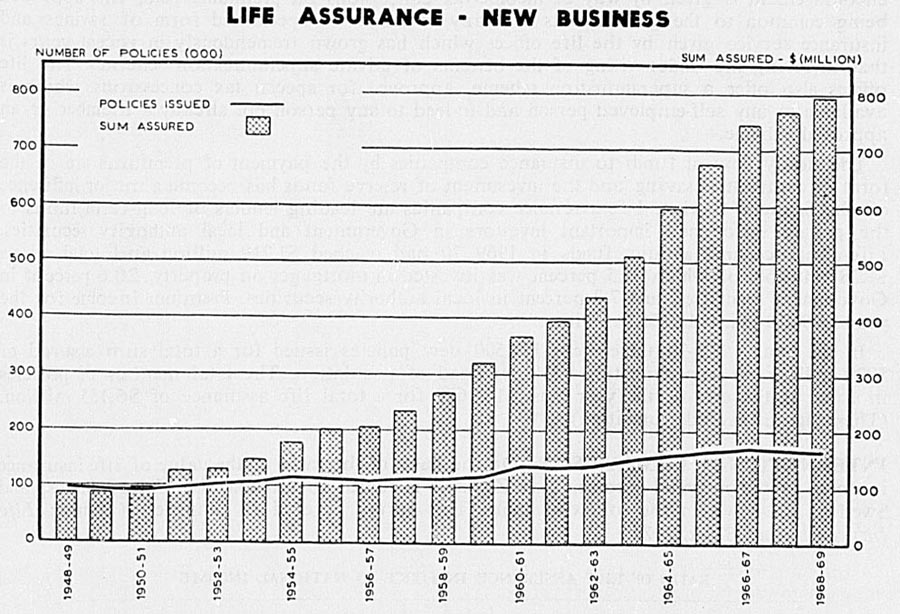
A summary of annual life assurance business is given in the following table.
| Year | Value of Policies Issued | Value of Policies Discontinued | Value of Policies Existing at End of Year | Annual Premiums on Existing Policies | Number of Policies in Force |
|---|---|---|---|---|---|
| $(m) | $(m) | $(m) | $(m) | (000) | |
| 1959-60 | 319.8 | 97.9 | 2,025.7 | 55.4 | 1,598 |
| 1960-61 | 368.0 | 115.2 | 2,278.4 | 59.7 | 1,695 |
| 1961-62 | 396.6 | 127.4 | 2,547.8 | 64.4 | 1,723 |
| 1962-63 | 435.2 | 140.2 | 2,842.8 | 69.4 | 1,751 |
| 1963-64 | 508.6 | 156.0 | 3,195.5 | 75.5 | 1,793 |
| 1964-65 | 595.6 | 183.3 | 3,609.1 | 82.8 | 1,846 |
| 1965-66 | 674.0 | 213.3 | 4,069.8 | 91.1 | 1,911 |
| 1966-67 | 744.0 | 227.0 | 4,586.7 | 100.9 | 1,973 |
| 1967-68 | 768.9 | 260.6 | 5,094.9 | 113.6 | 2,028 |
| 1968-69 | 793.2 | 309.2 | 5,579.0 | 121.4 | 2,087 |
| 1969-70 | 928.8 | 346.1 | 6,155.0 | 131.7 | 2,149 |
While the upward trend shown in the figures has been influenced both by the rate of monetary depreciation and the normal growth of population, the course of life-assurance business, particularly during the past decade, has been one of steady progress. In the last 11 years the face value of new business written annually has been trebled and the amount of cover in force has more than trebled.
Total discontinuances include surrenders and lapses, as well as policies maturing or terminated by death.
ORDINARY LIFE ASSURANCE: Progress of Business—A table showing the progress of business over a period of 11 years is given below. Annuities are excluded from these figures.
| Year | Policies Issued | Policies Discontinued | Policies Existing at End of Year | ||||||
|---|---|---|---|---|---|---|---|---|---|
| Number | Sum Assured | Annual Premiums | Number | Sum Assured | Annual Premiums | Number | Sum Assured | Annual Premiums | |
| *A change by one company in 1960-61 in the method of recording numbers of group and superannuation policies resulted in the numbers of policies issued and discontinued for the year 1960-61 being inflated in comparison with previous years. Policies existing at the end of 1960-61 were similarly increased. The amounts of sum assured and annual premiums were however, not affected. | |||||||||
| $(m) | $(m) | $(m) | $(m) | $(m) | $(m) | ||||
| 1959-60 | 96,582 | 313.1 | 6.2 | 45,821 | 91.2 | 2.8 | 1,123,213 | 1,939.9 | 51.4 |
| 1960-61* | 117,468 | 361.1 | 7.3 | 55,956 | 108.2 | 3.0 | 1,238,797 | 2,192.8 | 55.7 |
| 1961-62 | 114,874 | 387.5 | 7.9 | 65,011 | 119.8 | 3.2 | 1,288,688 | 2,460.7 | 60.4 |
| 1962-63 | 119,238 | 424.5 | 8.4 | 68,757 | 132.0 | 3.3 | 1,339,171 | 2,753.2 | 65.4 |
| 1963-64 | 131,279 | 497.4 | 9.8 | 71,403 | 148.0 | 3.7 | 1,399,047 | 3,102,6 | 71.5 |
| 1964-65 | 140,865 | 583.5 | 11.4 | 72,074 | 175.3 | 4.2 | 1,468,051 | 3,512,1 | 78.7 |
| 1965-66 | 149,768 | 660.9 | 13.1 | 69,720 | 204.6 | 4.8 | 1,548,099 | 3,968.4 | 86.9 |
| 1966-67 | 152,584 | 730.0 | 14.6 | 73,718 | 217.5 | 4.9 | 1,626,965 | 4,480.9 | 96.6 |
| 1967-68 | 151,835 | 754.3 | 15.6 | 89,575 | 251.2 | 2.9 | 1,689,224 | 4,984.0 | 109.3 |
| 1968-69 | 150,856 | 779.4 | 14.7 | 84,635 | 298.9 | 7.0 | 1,755,445 | 5,464.4 | 117.0 |
| 1969-70 | 165,343 | 913.6 | 17.6 | 89,550 | 335.1 | 7.2 | 1,827,528 | 6,036.2 | 127.2 |
In addition to the figure of $17.6 million representing annual premiums payable for policies issued during 1969-70, an amount of $5.1 million was paid during that year in the form of single premiums.
The average annual premiums for each $100 of new business effected during 1969-70 was $1.93, compared with $1.88 in 1968-69. There has been evident for some years past a growing preference for whole-life policies or longer term endowment assurance. Group assurance as a substitute for, or supplementation of, private or national superannuation schemes, has also assumed relative popularity, but owing to lack of data it is unfortunately not possible to give an analysis of policies by types.
Annuity policies issued during 1969-70 (excluding from these tables) numbered 189, as against 195 in 1968-69. The corresponding annual amounts were $3.8 million and $2.2 million. There were 1,887 annuities in force at the end of the year assuring an annual amount of $16.0 million.
A prominent feature of new insurances of recent years has been the increase in the average amount of the sum assured per policy.
| Year | Average Amount | Increase |
|---|---|---|
| *Decrease influenced by change in method of recording by one company. | ||
| $ | $ | |
| 1958-59 | 2,864 | 270 |
| 1959-60 | 3,242 | 378 |
| 1960-61 | 3,074 | -168* |
| 1961-62 | 3,374 | 300 |
| 1962-63 | 3,560 | 186 |
| 1963-64 | 3,788 | 228 |
| 1964-65 | 4,142 | 354 |
| 1965-66 | 4,412 | 270 |
| 1966-67 | 4,784 | 372 |
| 1967-68 | 4,968 | 184 |
| 1968-69 | 5,166 | 198 |
| 1969-70 | 5,525 | 359 |
The growth in the average amount of the sum assured per policy shown in the above table is due to several factors, including the changing types of policies being issued, and the increasing numbers of such policies which have a high cover, for example, cover for staff superannuation purposes by business concerns, temporary insurance with a high death-risk cover, multiple death benefit and family benefit policies having a high initial cover, and “unit” policies whereby a single premium provides a high initial death cover.
The average face value of discontinued policies during 1969-70 was $3,742, while the average face value of policies in force at the end of the year was $3,303.
Particulars of Policies Discontinued—The causes of discontinuances during each of the latest five years are contained in the next table.
| Year | Death | Maturity | Surrender | Lapse | Other Causes | Total |
|---|---|---|---|---|---|---|
| Number of Policies | ||||||
| 1965-66 | 6,978 | 18,143 | 25,370 | 15,046 | 4,183 | 69,720 |
| 1966-67 | 7,530 | 18,747 | 27,005 | 15,356 | 5,080 | 73,718 |
| 1967-68 | 7,177 | 19,651 | 29,469 | 18,207 | 15,071 | 89,575 |
| 1968-69 | 8,059 | 20,052 | 32,319 | 17,937 | 6,268 | 84,635 |
| 1969-70 | 7,885 | 20,090 | 34,803 | 18,226 | 8,546 | 89,550 |
| Sum Assured $(m) | ||||||
| 1965-66 | 12.6 | 12.6 | 84.5 | 51.7 | 43.1 | 204.6 |
| 1966-67 | 13.1 | 13.9 | 92.5 | 57.0 | 41.0 | 217.5 |
| 1967-68 | 13.2 | 15.5 | 100.0 | 72.3 | 50.1 | 251.2 |
| 1968-69 | 16.2 | 17.2 | 122.3 | 77.4 | 65.8 | 298.9 |
| 1969-70 | 15.8 | 17.4 | 147.2 | 84.2 | 70.5 | 335.1 |
Reducing the sums assured in the previous table to a percentage basis, the results are as follows.
| Year | Death | Maturity | Surrender | Lapse | Other Causes | Total |
|---|---|---|---|---|---|---|
| percent | ||||||
| 1965-66 | 6.2 | 6.1 | 41.3 | 25.3 | 21.1 | 100.0 |
| 1966-67 | 6.0 | 6.4 | 42.5 | 26.2 | 18.9 | 100.0 |
| 1967-68 | 5.2 | 6.2 | 39.8 | 28.8 | 20.0 | 100.0 |
| 1968-69 | 5.4 | 5.8 | 40.9 | 25.9 | 22.0 | 100.0 |
| 1969-70 | 4.7 | 5.2 | 43.9 | 25.2 | 21.0 | 100.0 |
Revenue and Expenditure—A statement of revenue and expenditure under the various heads illustrates the course of ordinary life-assurance business in New Zealand during the past five years. Transfers between head offices and branches are included. The ratios of management expenses to premium income and to total revenue are also given.
| Item | 1965-66 | 1966-67 | 1967-68 | 1968-69 | 1969-70 | |||||
|---|---|---|---|---|---|---|---|---|---|---|
| Revenue | $(000) | |||||||||
| New and renewal premiums | 91,739 | 101,023 | 109,909 | 118,999 | 128,938 | |||||
| Consideration for annuities | 1,186 | 1,508 | 1,722 | 1,527 | 1,652 | |||||
| Interest, rents, etc, | 44,138 | 49,224 | 55,001 | 61,604 | 69,011 | |||||
| Transfers | 292 | 1,191 | 584 | 1,550 | 593 | |||||
| Other revenue | 1,170 | 418 | 443 | 872 | 1,068 | |||||
| Totals, revenue | 138,525 | 153,363 | 167,659 | 184,551 | 201,262 | |||||
| Expenditure | ||||||||||
| Claims by death and maturity | 31,185 | 34,436 | 36,202 | 41,449 | 43,175 | |||||
| Annuities | 559 | 591 | 695 | 789 | 958 | |||||
| Surrenders | 11,491 | 11,837 | 12,551 | 15,097 | 17,156 | |||||
| Cash bonuses | 181 | 172 | 230 | 236 | 258 | |||||
| Commissions | 7,738 | 8,609 | 9,000 | 9,355 | 10,599 | |||||
| Other management | 8,715 | 9,739 | 11,696 | 12,503 | 13,636 | |||||
| Rates and taxes | 3,854 | 4,234 | 5,241 | 5,412 | 6,077 | |||||
| Transfers | 2,374 | 607 | 761 | 770 | 1,079 | |||||
| Other expenditure | 498 | 814 | 1,440 | 1,401 | 1,843 | |||||
| Totals, expenditure | 66,595 | 71,038 | 77,817 | 87,012 | 94,781 | |||||
| Ratios | percent | |||||||||
| Management expenses to premium income | 17.9 | 18.2 | 18.8 | 18.4 | 18.8 | |||||
| Management expenses to total revenue | 11.9 | 12.0 | 12.3 | 11.8 | 12.0 | |||||
Of the excess of revenue as shown in the above statements a large proportion is transferred annually to reserves to meet future payments under policies.
INDUSTRIAL LIFE ASSURANCE: Progress of Business—In principle there is no difference between ordinary and industrial assurance. With the latter class of insurance the premiums are payable at shorter intervals than three months and are usually collected personally by agents. Collection of premiums from family homes at four-weekly intervals has led to the informal description of this branch as home service insurance. During the last decade particularly, the promotion of this type of life assurance has declined, the number of policies issued in 1969-70 being only 64.8 percent of the 1959-60 total. Of the 23 life offices, only five engage in industrial business.
A summary of the course of industrial-assurance business is given in the following table.
| Year | Policies Issued | Policies Discontinued | Policies Existing at End of Year | ||||||
|---|---|---|---|---|---|---|---|---|---|
| Number | Sum Assured | Annual Premiums | Number | Sum Assured | Annual Premiums | Number | Sum Assured | Annual Premiums | |
| $(m) | $(000) | $(m) | $(000) | $(m) | $(000) | ||||
| 1959-60 | 21,848 | 6.6 | 315 | 35,312 | 6.8 | 360 | 475,168 | 85.8 | 4,019 |
| 1960-61 | 20,312 | 6.9 | 317 | 38,822 | 7.1 | 370 | 456,658 | 85.7 | 3,966 |
| 1961-62 | 20,577 | 9.1 | 376 | 43,250 | 7.6 | 391 | 433,985 | 87.2 | 3,952 |
| 1962-63 | 19,284 | 10.6 | 415 | 41,026 | 8.2 | 408 | 412,243 | 89.6 | 3,959 |
| 1963-64 | 18,144 | 11.3 | 423 | 36,827 | 8.0 | 380 | 393,560 | 92.9 | 4,001 |
| 1964-65 | 17,242 | 12.1 | 444 | 32,675 | 8.0 | 374 | 378,127 | 97.0 | 4,072 |
| 1965-66 | 16,190 | 13.1 | 463 | 31,774 | 8.7 | 388 | 362,543 | 101.4 | 4,147 |
| 1966-67 | 17,053 | 14.0 | 503 | 33,430 | 9.6 | 420 | 346,166 | 105.8 | 4,230 |
| 1967-68 | 15,933 | 14.5 | 507 | 22,987 | 9.4 | 400 | 339,112 | 111.0 | 4,336 |
| 1968-69 | 13,686 | 13.8 | 479 | 21,223 | 10.2 | 419 | 331,575 | 114.6 | 4,396 |
| 1969-70 | 14,157 | 15.2 | 526 | 24,582 | 11.0 | 442 | 321,150 | 118.8 | 4,481 |
The average sum assured under each policy of new business effected in 1969-70 amounted to $1,072 with an average annual premium of $37. Corresponding averages for 1959-60 were $303 and $14.
Particulars of Policies Discontinued—A summary of the number of industrial policies and the corresponding assurances discontinued according to the several causes is now given in the form of a five-year table.
| Year | Death | Maturity | Surrender | Lapse | Other Causes | Total |
|---|---|---|---|---|---|---|
| Number of Policies | ||||||
| 1965-66 | 1,529 | 18,390 | 5,900 | 5,199 | 756 | 31,774 |
| 1966-67 | 1,625 | 19,761 | 5,980 | 5,121 | 943 | 33,430 |
| 1967-68 | 1,575 | 10,551 | 6,449 | 3,693 | 719 | 22,987 |
| 1968-69 | 1,438 | 5,945 | 6,563 | 5,545 | 1,732 | 21,223 |
| 1969-70 | 1,447 | 11,809 | 6,264 | 4,820 | 242 | 24,582 |
| Sum Assured $(000) | ||||||
| 1965-66 | 255 | 2,405 | 2,001 | 3,898 | 138 | 8,697 |
| 1966-67 | 281 | 2,680 | 2,298 | 4,135 | 166 | 9,560 |
| 1967-68 | 304 | 1,499 | 3,097 | 4,366 | 143 | 9,408 |
| 1968-69 | 279 | 929 | 3,199 | 5,437 | 377 | 10,222 |
| 1969-70 | 281 | 1,932 | 3,353 | 5,294 | 93 | 10,952 |
Of the assurance in force at the end of the previous year, 6.1 percent of the ordinary policies were discontinued in 1969-70, as compared with 9.6 percent of the industrial policies.
In the following table the sums assured for the various classes of discontinuances are expressed as percentages of the total discontinuances.
| Year | Death | Maturity | Surrender | Lapse | Other Causes | Total |
|---|---|---|---|---|---|---|
| percent | ||||||
| 1965-66 | 2.9 | 27.7 | 23.0 | 44.8 | 1.6 | 100.0 |
| 1966-67 | 2.9 | 28.0 | 24.1 | 43.3 | 1.7 | 100.0 |
| 1967-68 | 3.2 | 15.9 | 32.9 | 46.4 | 1.6 | 100.0 |
| 1968-69 | 2.7 | 9.1 | 31.3 | 53.2 | 3.7 | 100.0 |
| 1969-70 | 2.5 | 17.6 | 30.6 | 48.4 | 0.9 | 100.0 |
Industrial policies are often taken out by parents for children shortly after they are born for the policies to mature when the children are approaching 20 years. This partly explains the greater proportion discontinued by maturity compared with ordinary policies.
Revenue and Expenditure—The several items of revenue and expenditure in industrial business are shown in the following five-yearly table, together with the ratios of management expenses to premium income and to total revenue. Transfers between head offices and branches are again included.
| Item | 1965-66 | 1966-67 | 1967-68 | 1968-69 | 1969-70 |
|---|---|---|---|---|---|
| Revenue | $(000) | ||||
| Premiums | 4,053 | 4,134 | 4,239 | 4,298 | 4,383 |
| Interest, rents, etc, | 2,218 | 2,240 | 2,397 | 2,560 | 2,778 |
| Transfers | 41 | - | - | - | - |
| Other revenue | 59 | 29 | 39 | 40 | 65 |
| Totals, revenue | 6,371 | 6,404 | 6,675 | 6,898 | 7,226 |
| Expenditure | |||||
| Claims by death and maturity | 3,365 | 3,771 | 2,197 | 1,647 | 2,602 |
| Surrenders | 523 | 495 | 598 | 648 | 661 |
| Commissions | 527 | 543 | 558 | 530 | 549 |
| Other management | 863 | 870 | 918 | 839 | 891 |
| Rates and taxes | 191 | 188 | 187 | 183 | 222 |
| Transfers | –– | - | - | - | - |
| Other expenditure | 102 | 97 | 90 | 186 | 122 |
| Totals, expenditure | 5,571 | 5,964 | 4,548 | 4,033 | 5,047 |
| Ratio | percent | ||||
| Management expenses to premium income | 33.7 | 34.3 | 34.2 | 34.8 | 32.9 |
| Management expenses to total revenue | 21.8 | 21.8 | 22.1 | 22.1 | 19.9 |
The higher ratio of management expenses to premium income in the industrial branch is largely accounted for by the cost or renewal commissions on collection of premiums and the greater amount of office work involved in relation to the amount assured. In the ordinary branch, commission (new and renewal) in 1969-70 was equivalent to 8.2 percent of the premium income, and in the industrial branch to 12.5 percent. Excluding commission, the ratio of management expenses to premium income was 20.3 percent in the industrial branch, as against 10.6 percent in the ordinary.
LIFE-ASSURANCE DEATH RATES—The following table shows for the period 1959-60 to 1969-70 the death rate per thousand policies exposed to risk in each year. In computing these rates all policies which were in force for any portion of the year have been taken into account. The much lower death rate among policyholders, compared with that for the general population (8.68 at 31 December 1969), points to a lower average in the insured group, a normal consequence of rapid growth in the life-assurance field.
| Year | Death Rate per 1,000 Policies | ||
|---|---|---|---|
| Ordinary Life Assurance | Industrial Life Assurance | Ordinary and Industrial Combined | |
| 1959-60 | 4.36 | 3.60 | 4.13 |
| 1960-61 | 4.40 | 3.26 | 4.08 |
| 1961-62 | 4.36 | 3.55 | 4.15 |
| 1962-63 | 4.43 | 3.53 | 4.21 |
| 1963-64 | 4.44 | 4.05 | 4.35 |
| 1964-65 | 4.25 | 3.93 | 4.18 |
| 1965-66 | 4.31 | 3.88 | 4.23 |
| 1966-67 | 4.43 | 4.28 | 4.40 |
| 1967-68 | 4.03 | 4.35 | 4.09 |
| 1968-69 | 4.38 | 4.08 | 4.33 |
| 1969-70 | 4.11 | 4.19 | 4.12 |
LIABILITES AND ASSETS—The principal items in the balance sheets of life-assurance companies are summarised below for the three latest years. Both classes of assurance are represented in the figures, which, as in the previous tables, relate to New Zealand business only. In the case of some companies other branches of insurance business are included.
Aggregate liabilities are first shown.
| Liabilities | 1967-68 | 1968-69 | 1969-70 |
|---|---|---|---|
| $(000) | |||
| Paid-up share capital | 2,264 | 2,264 | 2,737 |
| Life-assurance and annuity funds | 1,009,919 | 1,110,031 | 1,218,708 |
| Depreciation, reserve, and other special funds | 20,414 | 23,468 | 26,947 |
| Claims admitted but not paid | 6,051 | 7,132 | 7,386 |
| Other liabilities | 25,616 | 30,109 | 25,513 |
| Totals | 1,064,264 | 1,173,004 | 1,281,290 |
The assets of the New Zealand branches at the end of each of the three latest years were as follows.
| Assets | Amount | Percentage of Totals | ||||
|---|---|---|---|---|---|---|
| 1967-68 | 1968-69 | 1969-70 | 1967-68 | 1968-69 | 1969-70 | |
| $(m) | percent | |||||
| Mortgages on property | 430.6 | 463.0 | 493.3 | 40.5 | 39.5 | 38.5 |
| Loans on policies | 40.4 | 47.9 | 55.3 | 3.8 | 4.1 | 4.3 |
| New Zealand Government securities | 219.2 | 244.0 | 264.5 | 20.7 | 20.8 | 20.6 |
| Securities of other Governments | 0.6 | 0.6 | 0.4 | 0.1 | 0.1 | –– |
| Local authority securities | 79.4 | 86.2 | 93.5 | 7.5 | 7.3 | 7.3 |
| Land, buildings and houses | 91.1 | 102.8 | 122.2 | 8.6 | 8.7 | 9.6 |
| Company shares & debentures | 169.0 | 184.3 | 208.1 | 15.9 | 15.7 | 16.2 |
| Outstanding premiums | 12.8 | 12.5 | 13.7 | 1.2 | 1.1 | 1.1 |
| Interest accrued, etc. | 10.5 | 11.4 | 13.0 | 1.0 | 1.0 | 1.0 |
| Cash | 3.7 | 5.2 | 5.8 | 0.3 | 0.4 | 0.5 |
| Other assets | 7.0 | 15.1 | 11.5 | 0.6 | 1.3 | 0.9 |
| Totals | 1,064.3 | 1,173.0 | 1,281.3 | 100.0 | 100.0 | 100.0 |
Investments in mortgages, which rose steadily to 46.9 percent of total assets in 1961-62, have since declined to 38.5 percent in 1969-70, increased investment has been made in land and buildings, and investments in company shares and debentures.
For 1969-70 the average rate of interest earned on the life funds of both departments was $6.47 percent, compared with $6.33 percent during 1968-69. This rate was calculated by taking the arithmetic means of funds at the beginning and end of the year less half the amount of interest, etc., earned.
The following diagram illustrates the expansion that has taken place in recent years in the assets of the New Zealand branches of life-assurance companies. This, of course, is a natural consequence of the huge increase in the amount of business. In composite insurance offices, receipts of life assurance and annuity business must be treated as a separate fund, and the interests of the policyholders are safeguarded by the fact that these funds are available only for liabilities arising from such business.
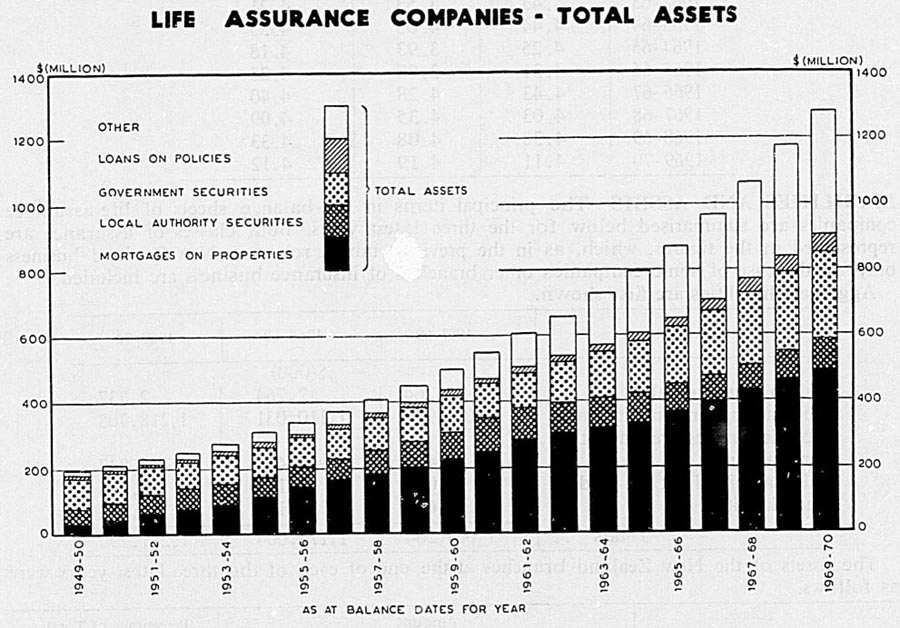
The diagram also shows the trend in the class of security in which the funds have been invested. Over the last 20 years there has been a large expansion in investment on property mortgages, which include loans for home ownership as well as commercial premises, although the percentage of these funds to total assets has declined in recent years.
GENERAL.—There are three principal classes of accident insurance transacted in New Zealand. These are: (a) personal, covering accidents, sickness, etc.; (b) Employers' liability under statutory or common law; and (c) Motor vehicle insurance, providing both comprehensive coverage and compulsory third-party risks cover. Other classes of accident insurance include the insurance of plate glass, television sets, luggage, and livestock.
The number of accident insurance offices represented in the statistics for 1969-70 is 75, the head offices of the companies concerned were in the following countries: Great Britain, 29; Australia, 14; United States of America, 3; Hong Kong, 2; and New Zealand, 27.
REVENUE AND EXPENDITURE—The following table shows the principal items of revenue and expenditure. Premiums and claims are net, i.e., after deductions for acceptances of reinsurance, whether effected locally or overseas, have been taken into account.
| Year | Number of Offices | Revenue | Expenditure | ||||||
|---|---|---|---|---|---|---|---|---|---|
| Premiums | Other Revenue | Total* | Claims | Commission | Salaries | Other Expenses | Total* | ||
| *Excluding reserve provisions. | |||||||||
| $(thousand) | |||||||||
| 1959-60 | 76 | 32,158 | 1,204 | 33,362 | 21,165 | 2,681 | 3,507 | 3,172 | 30,526 |
| 1960-61 | 78 | 36,012 | 1,513 | 37,526 | 22,864 | 2,870 | 3,921 | 3,637 | 33,292 |
| 1961-62 | 79 | 39,112 | 1,797 | 40,909 | 24,525 | 3,095 | 4,374 | 4,154 | 36,148 |
| 1962-63 | 80 | 42,209 | 2,046 | 44,255 | 26,832 | 3,249 | 4,831 | 4,648 | 39,559 |
| 1963-64 | 81 | 46,770 | 2,264 | 49,034 | 30,223 | 3,496 | 5,178 | 4,817 | 43,714 |
| 1964-65 | 80 | 51,478 | 2,720 | 54,198 | 33,870 | 3,891 | 5,583 | 5,311 | 48,656 |
| 1965-66 | 80 | 59,964 | 2,999 | 62,963 | 39,494 | 4,179 | 6,050 | 5,914 | 55,637 |
| 1966-67 | 82 | 66,043 | 3,301 | 69,344 | 43,760 | 4,118 | 6,721 | 7,047 | 61,646 |
| 1967-68 | 77 | 69,192 | 3,807 | 72,999 | 47,716 | 4,305 | 7,392 | 7,831 | 67,244 |
| 1968-69 | 77 | 71,610 | 4,179 | 75,789 | 49,040 | 4,366 | 7,620 | 8,966 | 69,991 |
| 1969-70 | 75 | 76,937 | 4,605 | 81,542 | 54,176 | 4,834 | 8,396 | 9,710 | 77,166 |
Premium receipts in 1969-70 were 7.4 percent above the 1968-69 figure, while claims rose by 10.5 percent.
A review of the expenses incurred in transacting all accident insurance is contained in the table following. The fluctuations over a period of five years are shown in the form of percentages of revenue to expenditure under various heads. The percentages do not take into account reserve provisions.
| Year | Claims to Premiums | Commission to Premiums | Salaries to Premiums | Other Expenses to Premiums | Total Expenses (other than Claims) to Premiums | Total Expenditure to Premiums | Total Expenditure to Total Revenue |
|---|---|---|---|---|---|---|---|
| percent | |||||||
| 1965-66 | 65.9 | 7.0 | 10.1 | 9.9 | 26.9 | 92.8 | 88.4 |
| 1966-67 | 66.3 | 6.2 | 10.2 | 10.7 | 27.1 | 93.3 | 88.9 |
| 1967-68 | 69.0 | 6.2 | 10.7 | 11.3 | 28.2 | 97.2 | 92.1 |
| 1968-69 | 68.5 | 6.1 | 10.6 | 12.5 | 29.3 | 97.7 | 92.3 |
| 1969-70 | 70.4 | 6.3 | 10.9 | 12.6 | 29.8 | 100.2 | 94.6 |
Working expenses (excluding taxation) amounted to $17,076,000 in 1967-68, $17,504,000 in 1968-69, and $19,811,000 in 1969-70. The ratios of working expenses to premium income for each of the three years were respectively 24.7, 24.4, and 25.7 percent.
ANALYSIS OF PREMIUMS AND CLAIMS—In the next table particulars of premiums and claims for the three main classes of accident insurance are given for the last five years. Reinsurances effected outside New Zealand are not taken into account in the figures presented below.
| Year | Employers' Liability | Personal Accident and Sickness | Motor Vehicle Comprehensive | Motor Vehicle Third-party Risks | Other Forms | Total |
|---|---|---|---|---|---|---|
| $(thousand) | ||||||
| Premiums Received | ||||||
| 1965-66 | 13,803 | 5,266 | 26,064 | 8,616 | 8,254 | 62,003 |
| 1966-67 | 14,813 | 5,868 | 28,528 | 9,008 | 9,870 | 68,087 |
| 1967-68 | 15,350 | 6,670 | 29,872 | 8,694 | 9,715 | 70,302 |
| 1968-69 | 15,245 | 7,082 | 31,091 | 8,133 | 11,091 | 72,642 |
| 1969-70 | 16,601 | 7,905 | 33,503 | 8,366 | 12,133 | 78,507 |
| Claims Paid | ||||||
| 1965-66 | 8,855 | 1,995 | 20,285 | 3,594 | 3,467 | 38,196 |
| 1966-67 | 9,448 | 2,267 | 21,896 | 4,314 | 4,481 | 42,406 |
| 1967-68 | 10,464 | 2,545 | 22,605 | 5,823 | 4,682 | 46,119 |
| 1968-69 | 10,908 | 2,976 | 22,379 | 6,961 | 5,261 | 48,486 |
| 1969-70 | 11,752 | 3,327 | 25,865 | 6,946 | 5,728 | 53,619 |
Premiums and claims for motor vehicle third-party risks insurance relate to the years ended 30 June.
Claims under motor-vehicle comprehensive policies rose from 72.0 percent of the premiums in 1968-69 to 77.2 percent in 1969-70, while claims under third party risks policies fell from 85.6 percent in 1968-69 to 83.0 percent of premiums in 1969-70. From 1 July 1965 insurance for motor-vehicle third party risks was extended to cover non-paying passengers and premiums were increased, however, from 1 July 1967 premiums on some classes of vehicles were reduced and these changes are reflected in the fall and rise in the rates of claims to premiums.
Reducing the figures of each class for the years 1967-68 to 1969-70 to a percentage basis, the following results are obtained.
| Class of Insurance | Claims to Premiums | Premiums to Total Premiums | Claims to Total Claims | ||||||
|---|---|---|---|---|---|---|---|---|---|
| 1967-68 | 1968-69 | 1969-70 | 1967-68 | 1968-69 | 1969-70 | 1967-68 | 1968-69 | 1969-70 | |
| percent | |||||||||
| Employers' liability | 68.2 | 71.6 | 70.8 | 21.8 | 21.0 | 21.9 | 22.7 | 22.5 | 21.1 |
| Personal accident and sickness | 38.2 | 42.0 | 42.1 | 9.5 | 9.7 | 6.2 | 5.5 | 6.1 | 10.1 |
| Motor vehicle comprehensive | 75.7 | 72.0 | 77.2 | 42.5 | 42.8 | 48.2 | 49.0 | 46.2 | 42.7 |
| Motor vehicle third-party risks | 67.0 | 85.6 | 83.0 | 12.4 | 11.2 | 13.0 | 12.6 | 14.4 | 10.7 |
| Other | 48.2 | 47.4 | 47.2 | 13.8 | 15.3 | 10.7 | 10.2 | 10.8 | 15.4 |
| All classes | 65.6 | 66.7 | 68.3 | 100.0 | 100.0 | 100.0 | 100.0 | 100.0 | 100.0 |
MOTOR VEHICLES INSURANCE (THIRD-PARTY RISKS)—The Transport Act 1962 requires owners of motor vehicles to insure against their liability, through their negligence, to pay damages on account of the death or of bodily injury to another person. The actual process of insuring the vehicle is an integral part of the annual vehicle licensing transaction. The owner nominates an insurance company on the licence application and, upon payment of the combined licence fee and third-party insurance premium, the contract of insurance automatically takes effect.
Premium receipts and claims actually paid have been shown in the earlier tables, but the claims figures given later also show amounts on account of the estimated liability for claims still outstanding at 30 June 1970 which are necessarily subject to revision.
The following table gives the premium rates for the various classes of motor vehicles over the last four years. The rates for omnibuses, service cars, and contract motor vehicles are subject to increases according to seating capacity.
| Class of Motor Vehicle | 1967-68 | 1968-69 | 1969-70 | 1970-71 |
|---|---|---|---|---|
*Includes motorcars manufactured before 1 January 1919. † Includes private taxicabs. | ||||
| $ | $ | $ | $ | |
| Motor cycles | 6.00* | 5.50* | 5.50* | 5.50* |
| Power cycles | 1.00 | 0.80 | 0.80 | 0.80 |
| E-plate vehicles | 1.10 | 1.10 | 1.10 | 1.10 |
| Private cars and business cars (including station wagons) | 8.65 | 7.90† | 7.90† | 7.90† |
| Trucks and vans | 8.80 | 8.05 | 8.05 | 8.05 |
| Taxis, public | 32.00 | 32.00 | 32.00 | 32.00 |
| Buses, over 30 seats (maximum) | 48.00 | 48.00 | 48.00 | 48.00 |
| Service coaches, over 20 seats (maximum) | 48.00 | 43.00 | 43.00 | 43.00 |
| Contract motor vehicles (maximum) | 9.00 | 8.00 | 8.00 | 8.00 |
| Trailers | 0.40 | 0.40 | 0.40 | 0.40 |
| Rental cars | 40.00 | 35.00 | 35.00 | 35.00 |
| Fire brigade vehicles, ambulances, and miscellaneous | 12.00 | 12.00 | 12.00 | 12.00 |
A sum of 25 cents for every contract of insurance is deducted for administration expenses, and the balance paid to the insurance company concerned.
Two important changes brought about by the Transport Amendment Act 1963 and effective from 1 July 1965 were that third-party risks insurance was extended to cover claims by passengers carried gratuitously in the insured vehicle (previously only fare-paying passengers in vehicles plying for hire were covered), and that the limit of $150,000 for any one accident was removed in respect of all claims by passengers in a vehicle used in the passenger-carrying business, i.e., bus, service coach, taxi.
Claims by passengers are subject to a limit of $15,000 for any one fare-paying passenger in a vehicle plying for hire, and $10,000 for passengers carried gratuitously.
A further change made by the Transport Amendment Act 1963 was the provision to enable claims for personal injury against unidentified or uninsured motorists to be made against a nominal defendant (the General Manager, State Insurance Office); these claims are dealt with on similar lines to insured claims.
Statistics of third-party risks insurance during the latest five years, with a summary covering the latest 10 years, are given in the following table. It should be noted that the liability for outstanding claims is usually over-estimated, and that the total claims for any particular year when finally settled may be expected to be somewhat smaller than the amounts now given.
It follows that the ratios given below are also likely to be reduced in course of time, particularly those for the most recent years.
| Item | Registration Year Ended 30 June | Total for Ten Years to 30 June 1970 | ||||
|---|---|---|---|---|---|---|
| 1966 | 1967 | 1968 | 1969 | 1970 | ||
| $(000) | $(000) | $(000) | $(000) | $(000) | $(000) | |
| Premiums received | 8,616 | 9,008 | 8,694 | 8,133 | 8,365 | 64,333 |
| Claims actually paid to 30 June 1970 | 6,458 | 5,816 | 3,896 | 1,254 | 207 | 37,573 |
| Estimated liability for claims still outstanding at 30 June 1970 | 1,322 | 2,746 | 6,002 | 9,209 | 8,630 | 28,630 |
| Ratio percent of claims paid and outstanding to premiums | 90.3 | 95.0 | 113.9 | 128.6 | 105.6 | 102.9 |
A summary showing the experience over the last three registration years for each of the principal classes of motor vehicle is given in the table following.
| Class of Motor Vehicle | Net Premiums Received | Claims Paid | Estimated Claims Outstanding | ||
|---|---|---|---|---|---|
| Arising during Year | Arising during Previous Years | Arising during Year | Arising during Previous Years | ||
| *Includes Private taxicabs | |||||
| $ | |||||
| 1967-68 | |||||
| Motor cycles | 159,911 | 1,474 | 77,087 | 83,117 | 374,501 |
| Private and business cars* | 6,707,160 | 173,900 | 4,147,025 | 6,013,038 | 10,785,307 |
| Goods-service vehicles | 1,318,542 | 39,543 | 942,819 | 942,064 | 2,597,294 |
| Public taxicabs | 98,236 | 1,231 | 59,689 | 44,281 | 279,720 |
| Public omnibuses | 125,818 | 4,665 | 158,482 | 119,223 | 473,500 |
| Other classes | 284,758 | 3,431 | 213,560 | 144,218 | 426,810 |
| Totals | 8,694,425 | 224,244 | 5,598,662 | 7,345,941 | 14,937,132 |
| 1968-69 | |||||
| Motor cycles | 143,023 | 3,035 | 137,502 | 111,527 | 273,216 |
| Private and business cars* | 6,281,925 | 146,566 | 4,913,612 | 6,055,791 | 12,745,036 |
| Goods-service vehicles | 1,228,079 | 14,852 | 1,269,131 | 870,840 | 2,657,343 |
| Public taxicabs | 97,846 | 1,348 | 97,602 | 95,293 | 156,420 |
| Public omnibuses | 127,658 | 4,266 | 212,957 | 120,176 | 316,285 |
| Other classes | 254,823 | 4,459 | 156,027 | 270,640 | 649,562 |
| Totals | 8,133,354 | 174,526 | 6,786,831 | 7,524,267 | 16,797,862 |
| 1969-70 | |||||
| Motor cycles | 135,705 | 6,531 | 82,664 | 159,586 | 343,218 |
| Private and business cars* | 6,462,266 | 174,099 | 5,291,045 | 6,842,060 | 15,516,058 |
| Goods-service vehicles | 1,265,862 | 14,824 | 994,965 | 1,083,544 | 2,635,391 |
| Public taxicabs | 98,199 | 2,592 | 57,060 | 92,254 | 237,896 |
| Public omnibuses | 127,155 | 4,389 | 97,231 | 131,291 | 382,051 |
| Other classes | 276,439 | 5,031 | 216,061 | 320,787 | 885,447 |
| Totals | 8,365,626 | 207,466 | 6,739,026 | 8,629,522 | 20,000,061 |
GENERAL—Fire is still the main cause of property damage, but today many property owners seek protection not only against fire damage but also against a wide range of other dangers including water, windstorm, explosion, breakages, theft, aircraft, and impact by motor vehicles. Under houseowners' and householders' comprehensive policies, which have largely superseded fire insurance policies for covering dwellings and their contents, many thousands of additional claims are now dealt with each year. Increasing numbers of commercial property owners, too, are extending their fire policies to include damage from other causes.
In 1969 there were 63 fire insurance companies conducting business in New Zealand. Of these, the head offices of 21 were in New Zealand, while 29 were in Great Britain, 9 in Australia, 2 in the United States of America, and 2 in Hong Kong. The statistics in this section relate to the calendar year for about two-thirds of these companies; for the remaining companies the financial year nearest to the calendar year is used.
SUMMARY OF BUSINESS—The increase in extent and value of property over the years is reflected in the statistics of policies issued and business underwritten.
The statistics in the following summary of business relate to the business conducted with the insuring public. Reinsurance transactions are not taken into account.
| Item | 1967-68 | 1968-69 | 1969-70 |
|---|---|---|---|
| Amounts Underwritten | |||
| Gross amount of insurance cover in force in New Zealand on 31 December | $m12,115.2 | $m13,598.1 | $m13,805.1 |
| Number of policies representing the foregoing | 1,853,439 | 1,895,719 | 1,913,299 |
| Gross amount of new and renewal business underwritten during year | $m13,498.8 | $m15,271.4 | $m15,568.4 |
| Number of policies representing the foregoing | 1,991,206 | 2,017,546 | 2,107,996 |
| Premiums | |||
| Total gross premiums charged on business (new and renewal) underwritten during year | $m33.2 | $m35.0 | $m38.8 |
| Average gross premiums per $100 of business underwritten | $0.25 | $0.23 | $0.25 |
| Total premiums (as shown above), less premiums refunded to insured other than to other offices | $m28.4 | $m30.0 | $m32.7 |
| Losses | |||
| Total number of separate fire losses with which offices were concerned | 47,625 | 56,794 | 59,222 |
| Gross losses | $m11.9 | $m13.8 | $m13.0 |
| Percentage of gross loss to amount underwritten (new and renewal) during year (as shown above) | 0.09 | 0.09 | 0.08 |
| Percentage of gross loss to total premiums less refunds to insured (as shown above) | 41.8 | 46.02 | 39.79 |
| Average loss | $249 | $243 | $220 |
The next table shows the position of premium income and claims during the latest 11 years. While the bulk of the claims represent fire losses the figures also include the numerous, frequently minor, claims made under comprehensive policies for damage from other causes. The percentage of claims to premium income decreased to 39.8 percent in 1969-70 as against 46.0 percent in 1968-69.
| Year | Premium Income | Claims | Percentage of Claims to Premium Income |
|---|---|---|---|
| $(000) | $(000) | percent | |
| 1959-60 | 15,314 | 5,353 | 35.0 |
| 1960-61 | 16,171 | 5,317 | 32.9 |
| 1961-62 | 17,526 | 5,790 | 33.0 |
| 1962-63 | 18,995 | 7,531 | 39.6 |
| 1963-64 | 20,269 | 7,010 | 34.6 |
| 1964-65 | 22,574 | 7,305 | 32.4 |
| 1965-66 | 24,033 | 8,387 | 34.9 |
| 1966-67 | 25,995 | 8,466 | 32.6 |
| 1967-68 | 28,387 | 11,877 | 41.8 |
| 1968-69 | 30,016 | 13,814 | 46.0 |
| 1969-70 | 32,695 | 13,010 | 39.8 |
LIABILITIES—The following table shows whole world liabilities of fire insurance offices. The figures refer to all departments of business underwritten. Funds of life departments are added for completeness, but by the Life Insurance Act 1908 (which follows the provisions of the United Kingdom statute on the subject) life funds must be accounted for separately, and form a security for life-policy holders, which is not available for other classes of insurance transacted. Of the 63 fire offices, 17 also engage in life assurance business, but only five of these conduct such business in New Zealand. The amount of funds (other than life) in New Zealand and elsewhere is over $9,509 million.
| Item | 1967-68 (Total) | 1968-69 (Total) | 1969-70 | ||
|---|---|---|---|---|---|
| Overseas Companies | Local Companies | Total | |||
| $(million) | |||||
| Paid-up capital | 500.8 | 531.1 | 474.9 | 34.0 | 508.9 |
| Reserves | 3,872.6 | 4,097.2 | 3,868.0 | 84.4 | 3,952.4 |
| Other liabilities | 4,798.7 | 4,851.0 | 4,925.8 | 122.2 | 5,048.0 |
| Totals | 9,172.1 | 9,479.3 | 9,268.6 | 240.7 | 9,509.3 |
| Life funds | 8,674.7 | 9,694.5 | 10,168.5 | - | 10,168.5 |
| Total liabilities | 17,846.8 | 19,173.8 | 19,437.2 | 240.7 | 19,677.9 |
ASSETS—The following table gives the amount of assets in New Zealand as at the end of each of the last five years classified under various heads. The figures given include all investments in New Zealand securities and do not relate merely to the assets held by the New Zealand branches of the companies concerned. The assets of other departments—accident, life, marine, etc.—are also included.
| Assets in New Zealand | 1965-66 | 1966-67 | 1967-68 | 1968-69 | 1969-70 |
|---|---|---|---|---|---|
| $(million) | |||||
| House and landed property | 17.67 | 19.66 | 21.40 | 21.64 | 24.89 |
| New Zealand Government securities | 34.20 | 34.86 | 32.53 | 34.23 | 32.66 |
| New Zealand local authority securities | 10.84 | 11.95 | 20.62 | 22.76 | 25.12 |
| Company stocks and shares | 24.34 | 27.52 | 35.28 | 32.11 | 41.92 |
| Mortgages, etc. | 21.73 | 24.77 | 28.29 | 31.06 | 31.57 |
| Outstanding premiums | 11.97 | 12.97 | 14.39 | 16.43 | 18.13 |
| Cash and other assets in New Zealand | 27.67 | 33.10 | 33.85 | 37.04 | 34.07 |
| Total New Zealand assets | 148.42 | 164.84 | 186.36 | 195.26 | 208.35 |
REVENUE AND EXPENDITURE—A statement of the total revenue and expenditure, both gross and net, of all offices is now given in respect of New Zealand business. The gross figures include reinsurance business accepted, while the net figures comprise insurances with the public, plus reinsurances accepted, and less amounts reinsured with other offices.
It is insurance practice at the closing date of the accounts of a fire insurance company to transfer to a reserve a proportion of the income received during the year, to allow for policies whose currency extends into the following accounting year. Thus, if the amount transferred to reserve at the end of the current year is greater than that transferred at the end of the previous year, the net effect is equivalent to an increase in this year's expenditure and the difference is therefore shown as expenditure. Similarly, if the amount transferred this year is less than last year, then the difference will be shown as revenue.
The entry of net effect of reserve provision in the gross figures, it should be noted, is calculated on the assumption that it bears the same proportion to gross premium income as does the actual net reserve to the net premium income.
| Item | 1968-69 | 1969-70 | ||
|---|---|---|---|---|
| Gross | Net | Gross | Net | |
| Revenue | $(thousand) | |||
| Net effect of reserve provisions | 75 | 45 | 145 | 92 |
| Amount of fire premiums received during year | 37,211 | 22,820 | 39,108 | 24,818 |
| Interest and dividends on stock, mortgages, etc. | 2,056 | 2,056 | 2,112 | 2,112 |
| Rents | 510 | 510 | 552 | 552 |
| Other revenue | 28 | 28 | 4 | 4 |
| Totals | 39,881 | 25,459 | 41 | 27,578 |
| Expenditure | ||||
| Net effect of reserve provisions | 1,556 | 919 | 1,495 | 948 |
| Amount of fire claims paid during year, including adjustment and other expenses of settlement, but less salvage | 16,720 | 9,888 | 14,790 | 8,715 |
| Fire authority levies | 1,937 | 1,375 | 2,226 | 1,586 |
| New Zealand Government taxes | 2,342 | 1,929 | 3,108 | 3,267 |
| Rents | 448 | 425 | 422 | 424 |
| Depreciation | 250 | 247 | 258 | 259 |
| Allowance and commissions on premiums to agents, subagents, and others | 4,348 | 1,902 | 4,736 | 2,104 |
| Salaries and wages, including commissions, on profits or bonuses | 4,396 | 4,245 | 4,286 | 4,283 |
| Other expenses of management | 2,385 | 2,279 | 2,568 | 2,544 |
| Totals | 34,384 | 23,208 | 33,889 | 24,129 |
The principal items of net revenue and expenditure for 1969-70 of the overseas and local companies operating in New Zealand are contained in the next table.
| Class of Office | Net Revenue | Net Expenditure | |||
|---|---|---|---|---|---|
| Premiums | Total* (including other) | Claims | Salaries and Commissions | Total* (including other) | |
| *Excluding net effect of reserve provisions. | |||||
| $(000) | $(000) | $(000) | $(000) | $(000) | |
| Overseas companies | 11,357 | 12,202 | 4,443 | 2,873 | 11,024 |
| Local companies | 13,461 | 15,285 | 4,272 | 3,514 | 12,157 |
| Totals | 24,818 | 27,486 | 8,715 | 6,387 | 23,181 |
Excluding the net effect of reserve provisions, the excess of net revenue over net expenditure (after tax) for 1969-70 of $4.30 million compares with surpluses of $3.13 million and $3.11 million for 1968-69 and 1967-68 respectively.
The following table shows the percentage ratio of working expenses to premium income for the years 1965-66 to 1969-70. Under the Fire Services Act 1949 fire insurance companies are required to make a return of premium income to the Fire Service Council which makes a levy, normally just under 10 percent of the returnable figure, for the administration of fire services. This levy meets almost half the cost of the services. It is sometimes contended that contributions to the fire-prevention authority are not a working expense, but should be added to the total of fire losses. While this view is not subscribed to in the compilation of the statistics, there is a definite relationship between the items, and this table shows the ratio both inclusive and exclusive of such levies.
| Item | 1965-66 | 1966-67 | 1967-68 | 1968-69 | 1969-70 |
|---|---|---|---|---|---|
| percent | |||||
| Net working expenses (excluding taxes) to net premium income | 43.9 | 44.6 | 46.2 | 45.9 | 45.1 |
| Net working expenses (excluding taxes and fire-service levies) to net premium income | 36.7 | 37.5 | 40.0 | 39.9 | 38.7 |
| Gross working expenses (excluding taxes) to gross premium income (including reinsurances from other offices) | 36.2 | 35.7 | 37.2 | 37.0 | 37.1 |
| Gross working expenses (excluding taxes and fire-service levies) to gross premium income (including reinsurances from other offices) | 30.5 | 30.3 | 32.0 | 31.8 | 31.4 |
FIRES AND LOSSES—Over the 10-year period 1960 to 1969 annual fire losses in New Zealand have been estimated to average over $7.1 million. This is allowing 15 percent above the known figures of insured losses as the estimated cost of fire damage not covered by insurance. The Government, for example, usually bears its own risk.
A summary of fire losses over the latest 11 calendar years follows. The figures are subject to considerable annual fluctuations as a result of the severe losses that can be caused by individual major fires. During 1969 there were 19 payments of $40,000 or more, the aggregate amount of loss being $1.6 million, as compared with 7 payments involving a loss of $0.8 million in 1968.
| Year | Number of Fire-loss Payments | Gross Loss | Average Fire-loss Payments |
|---|---|---|---|
| $(000) | $ | ||
| 1,959 | 28,459 | 5,222 | 184 |
| 1,960 | 29,484 | 4,154 | 140 |
| 1,961 | 32,030 | 4,726 | 148 |
| 1,962 | 32,227 | 5,834 | 182 |
| 1,963 | 36,785 | 5,675 | 154 |
| 1,964 | 37,546 | 6,192 | 164 |
| 1,965 | 38,690 | 5,863 | 152 |
| 1,966 | 40,647 | 6,158 | 151 |
| 1,967 | 42,560 | 8,307 | 195 |
| 1,968 | 43,972 | 7,151 | 163 |
| 1,969 | 50,020 | 7,912 | 158 |
The average insurance claim paid for material fire damage per head of total population was $2.20 in 1965, $2.27 in 1966, $3.02 in 1967, $2.58 in 1968, and $2.82 in 1969.
The classification by fire districts for 1969 which follows is based on the schedules to the Fire Services Act 1949, which set out in full the districts (and their status) originally constituted under the Act. Additions, deletions, and alterations in status are periodically gazetted. The administrative authority appointed by the Act is the Fire Service Council, responsible to the Minister of Internal Affairs.
At 31 December 1969 there were 17 united urban, 108 urban, and 132 secondary urban fire districts constituted.
| Type of Fire District | Number of Fire-loss Payments | Gross Amount of Loss Paid on Risks Affected | Proportion of Loss to Total Loss |
|---|---|---|---|
| 1969 | $(000) | percent | |
| United urban fire districts | 25,496 | 3,676 | 46.5 |
| Urban fire districts | 18,297 | 2,702 | 34.1 |
| Secondary urban fire districts | 2,952 | 757 | 9.6 |
| Remainder of New Zealand (including floating risks) | 3,275 | 777 | 9.8 |
| Totals | 50,020 | 7,912 | 100.0 |
The relationship between the number of payments and loss incurred is fairly closely sustained for the main types of district; 87.6 percent of payments related to fires which occurred in urban (including united urban) fire districts, the loss amounting to 80.6 percent of the total.
Causes of Fires—Particulars regarding causes of fires are contained in the following table. A more detailed table of causes of fires is given in the annual Report on Insurance Statistics.
| Cause of Fire | 1967 | 1968 | 1969 | |||
|---|---|---|---|---|---|---|
| Number of Fire-loss Payments | Amount of Loss | Number of Fire-loss Payments | Amount of Loss | Number of Fire-loss Payments | Amount of Loss | |
| $(000) | $(000) | $(000) | ||||
| Electricity | 13,833 | 1,198 | 14,656 | 1,113 | 17,433 | 1,762 |
| Gas | 429 | 89 | 379 | 89 | 445 | 58 |
| Chimneys and flues | 623 | 81 | 706 | 126 | 704 | 142 |
| Fireplaces and stoves | 10,925 | 679 | 11,526 | 586 | 12,604 | 599 |
| Smoking and matches | 9,510 | 582 | 9,534 | 496 | 11,476 | 545 |
| Inflammable spirits and materials | 812 | 210 | 828 | 354 | 940 | 270 |
| Outside causes | 1,221 | 304 | 1,421 | 337 | 1,549 | 269 |
| Arson and incendiarism | 212 | 460 | 259 | 310 | 245 | 302 |
| Other specified causes | 1,594 | 353 | 1,678 | 337 | 1,720 | 299 |
| Unknown causes | 3,401 | 4,349 | 2,985 | 3,403 | 2,904 | 3,666 |
| Totals | 42,560 | 8,307 | 43,972 | 7,151 | 50,020 | 7,912 |
The actual cause of many fires is not easily ascertainable, especially in cases of total, or near-total loss, where evidence as to origin is obliterated. This accounts for the high proportion of loss due to unknown causes and for the fact that the average loss payment is much greater in these instances. During 1969 the average payment for specified causes was $90, while the average for the unspecified group amounted to $1,262. As most major fires result from unknown causes this accounts for the large difference between the averages.
The Fire Services Amendment Act 1952 provides that the Minister of Internal Affairs may appoint any person to hold an inquiry into any fire and the steps taken to deal with it.
Extent of Loss—The next table gives particulars of fire losses during the latest three years, classified according to the amount of loss. The majority of fires cause only minor damage. During 1969 payments of less than $20 accounted for 59.5 percent of the total number but only 3.5 percent of the total loss sustained. On the other hand, payments of $20,000 or over, numbering only 41, represented 26.9 percent of the insured loss.
| Loss Category | 1967 | 1968 | 1969 | |||
|---|---|---|---|---|---|---|
| Number of Fire-loss Payments | Amount of Loss | Number of Fire-loss Payments | Amount of Loss | Number of Fire-loss Payments | Amount of Loss | |
| $ | $(000) | $(000) | $(000) | |||
| Under 20 | 25,685 | 230 | 26,463 | 239 | 29,785 | 275 |
| 20-49 | 9,103 | 272 | 9,670 | 288 | 11,451 | 344 |
| 50-199 | 4,834 | 438 | 5,036 | 451 | 5,926 | 519 |
| 200-1,999 | 2,164 | 1,333 | 2,042 | 1,286 | 2,117 | 1,318 |
| 2,000-3,999 | 384 | 1,053 | 419 | 1,160 | 384 | 1,068 |
| 4,000-9,999 | 260 | 1,513 | 250 | 1,448 | 262 | 1,537 |
| 10,000-39,999 | 106 | 1,913 | 85 | 1,484 | 76 | 1,263 |
| 40,000 and over | 24 | 1,555 | 7 | 795 | 19 | 1,588 |
| Totals | 42,560 | 8,307 | 43,972 | 7,151 | 50,020 | 7,912 |
Class Groups—Losses classified in broad groups according to the nature of the risk are presented in the next table. Fires in private dwellings accounted for 89.4 percent of the total number of payments during 1969, but the proportion of loss sustained was only 45.4 percent.It should be noted that the “contents”, where insured, are included in the various class groups. Consequently the total for the houses and flats group is swollen by the numerous small claims on account of damage to personal effects, etc., the actual building not being affected by the fire in many instances. The miscellaneous risks group also includes those cases where a fire has affected two or more buildings, which individually are classifiable into more than one of the other groups shown in the table, or, in some instances, single buildings housing occupiers of different groupings.
| Class Group | 1967 | 1968 | 1969 | |||
|---|---|---|---|---|---|---|
| Number of Fire-loss Payments | Amount of Loss | Number of Fire-loss Payments | Amount of Loss | Number of Fire-loss Payments | Amount of Loss | |
| $(000) | $(000) | $(000) | ||||
| Private houses and flats, boarding houses, etc. | 37,352 | 2,651 | 39,156 | 2,841 | 44,717 | 3,589 |
| Hotels and restaurants | 762 | 408 | 782 | 419 | 948 | 395 |
| Offices and public buildings | 531 | 224 | 598 | 317 | 619 | 315 |
| Theatres and entertainment places | 135 | 101 | 145 | 46 | 152 | 27 |
| Bulk stores and warehouses | 245 | 404 | 231 | 540 | 240 | 576 |
| Shops | 800 | 762 | 756 | 605 | 821 | 1,036 |
| Factories and industrial risks | 1,490 | 3,333 | 1,127 | 1,939 | 1,139 | 1,574 |
| Farm risks (other than dwellings) | 497 | 296 | 512 | 287 | 564 | 281 |
| Miscellaneous (including unclassified) | 291 | 74 | 318 | 134 | 419 | 84 |
| Floating and travelling risks | 457 | 53 | 347 | 23 | 401 | 36 |
| Totals | 42,560 | 8,307 | 43,972 | 7,151 | 50,020 | 7,912 |
FIRE BRIGADES—At 31 March 1970 there were 257 fire brigades under the administrative authority of the Fire Service Council.
MUTUAL INSURANCE ASSOCIATIONS—Mutual associations are governed by the Mutual Insurance Act 1955, which allows 200 or more owners or occupiers of isolated or farm properties to subscribe to a declaration, and form themselves into a mutual association to insure against loss to an amount in the aggregate of not less than $400,000. The Act permits these associations to conduct accident business in addition to fire insurance. Such associations effect insurance on the premium note principle, and accept premium notes to be assessed for losses in the proportion of the total amount of such notes. The amount of a member's premium notes limits his liability. Mutual insurance associations carrying on employer's liability insurance business are now required to deposit approved securities to a specified value with the Public Trustee.
The Mutual Insurance Regulations, gazetted in 1956, permit these associations to carry on additional types of insurance (other than life assurance).
Summarised figures for the two associations formed under the Act appear below.
| Year Ended 31 March | Net Premium Income | Total Net Income | Net Claims | Reserves and Funds | Assets* | ||
|---|---|---|---|---|---|---|---|
| Fire | Accident | Fire | Accident | ||||
| *Including premium notes. | |||||||
| $(000) | |||||||
| 1,966 | 234 | 284 | 562 | 59 | 136 | 466 | 1,474 |
| 1,967 | 260 | 317 | 624 | 89 | 141 | 507 | 1,566 |
| 1,968 | 277 | 335 | 656 | 77 | 154 | 545 | 1,626 |
| 1,969 | 284 | 334 | 665 | 80 | 174 | 558 | 1,686 |
| 1,970 | 297 | 365 | 710 | 90 | 168 | 594 | 1,794 |
LIFE ASSURANCE—The New Zealand Government Life Insurance Office was founded in 1869 at a time when New Zealanders had comparatively poor facilities in regard to life assurance. In earlier years there had been numerous disastrous failures of life offices in Great Britain and the United States, and it was, in part, to prevent the possibility of such disasters occurring in New Zealand that a Government Department was established to handle life insurance. The new Department possessed the unique advantage among life insurance institutions of being based on State security. The payment of all policies has always been guaranteed by the Government. The success of the Government Life Insurance Office was immediate and continuing. From a total of 59 policies, assuring a sum of $60,500, issued during 1869-70, its first year of operations, the business of the Office has grown to a stage when, at the end of 1969 policies in force numbered 400,241 and the total sum assured reached $992 million. Among life insurance companies, the Government Life Insurance Office handles the second largest volume of business in New Zealand.
Income and expenditure figures of the Government Life Insurance Office are now given for each of the latest five years.
| Year | Premium Income (Including Purchase of Annuities) | Total Income | Management Expenses | Total Expenditure | Ratio of Expenses to Total Income | Ratio of Management Expenses to Premium Income |
|---|---|---|---|---|---|---|
| $(thousand) | percent | percent | ||||
| 1,965 | 16,603 | 24,758 | 2,239 | 10,876 | 9.04 | 13.48 |
| 1,966 | 17,358 | 26,524 | 2,362 | 11,168 | 8.91 | 13.61 |
| 1,967 | 18,304 | 28,521 | 2,515 | 12,148 | 8.82 | 13.74 |
| 1,968 | 19,519 | 31,000 | 2,560 | 13,589 | 8.26 | 13.11 |
| 1,969 | 20,877 | 33,592 | 2,805 | 14,481 | 8.35 | 13.43 |
During the year 1969 payments were made under the following heads: matured policies (including bonus addition), $4,118,697; claims by death (including bonuses), $2,648,971; annuities, $386,001; surrendered policies and bonuses cashed, $3,418,908; commission, $1,479,273; other management expenses, $1,325,311; taxes, $774,409; and other expenditure, including transfers to reserves, $329,915.
Figures showing the progress of the Office are contained in the next table. Annuities are excluded.
| Year | New Business | Policies Discontinued | Policies in Force at End of Year | ||||||
|---|---|---|---|---|---|---|---|---|---|
| Number of Policies | Sum Assured | Annual* Premiums | Number | Sum Assured | Annual Premiums | Number | Sum Assured | Annual Premiums | |
| *Excludes single premiums. | |||||||||
| $(000) | $(000) | $(000) | $(000) | $(000) | $(000) | ||||
| 1,965 | 27,872 | 96,212 | 1,758 | 14,504 | 32,031 | 787 | 359,332 | 727,600 | 15,059 |
| 1,966 | 27,199 | 100,681 | 1,932 | 14,739 | 34,102 | 846 | 371,792 | 794,179 | 16,237 |
| 1,967 | 26,062 | 101,655 | 2,024 | 15,277 | 36,201 | 833 | 382,577 | 859,633 | 17,354 |
| 1,968 | 25,733 | 104,586 | 1,848 | 16,609 | 41,340 | 927 | 391,701 | 922,879 | 18,275 |
| 1,969 | 26,651 | 119,136 | 2,095 | 18,111 | 49,584 | 1,021 | 400,241 | 992,432 | 19,348 |
The average sum assured per policy was $3,453 in 1965, $3,702 in 1966, $3,900 in 1967, $4,064 in 1968, and $4,470 in 1969. In addition to the total sum assured at the end of the year, accrued reversionary bonuses amounted to $80,815,839. Values of immediate and deferred annuities in force at the end of latest five years were as follows: $7,394,000, $8,257,000, $8,994,000, $9,516,000, and $10,299,000. New business in annuities in 1969 totalled $1,548,000 and discontinuances $765,000.
The Office's total assets at 31 December and their class of investment are shown in the following table.
| Class of Investment | Amount | Percentages | ||||
|---|---|---|---|---|---|---|
| 1967 | 1968 | 1969 | 1967 | 1968 | 1969 | |
| *Mainly premiums and interest due and accrued interest. | ||||||
| $(thousand) | percent | percent | percent | |||
| Mortgages on freehold property | 75,730 | 83,404 | 90,246 | 39.94 | 40.34 | 39.88 |
| Loans on policies | 10,268 | 11,541 | 13,074 | 5.42 | 5.58 | 5.78 |
| Government securities | 38,744 | 42,762 | 46,412 | 20.43 | 20.68 | 20.51 |
| Local authority securities | 22,233 | 23,306 | 24,101 | 11.73 | 11.27 | 10.65 |
| Landed and house property | 10,236 | 11,417 | 14,840 | 5.40 | 5.52 | 6.56 |
| Company stocks, shares and debentures | 26,037 | 28,223 | 30,826 | 13.73 | 13.66 | 13.62 |
| Miscellaneous assets* | 6,353 | 6,106 | 6,794 | 3.35 | 2.95 | 3.00 |
| Totals | 189,601 | 206,759 | 226,292 | 100.00 | 100.00 | 100.00 |
At 31 December 1969 assurances, annuity, and endowment funds, apart from special reserves of $3.7 million, amounted to $218.7 million.
FIRE, ACCIDENT, AND OTHER INSURANCE—In 1901 the Government Life Insurance Office opened an Accident Insurance Branch. This was intended principally to conduct insurance under the Workers' Compensation Act, but general accident business was undertaken and, through the years, became increasingly important.
At the beginning of 1925 accident business was transferred from the Government Life Insurance Office to the State Fire Office, which had commenced business in 1905. Since 1947 the State Fire Office has also undertaken marine insurance.
The State Insurance Act 1963 was, in the main, a rewriting of the legislation relating to State insurance in respect of fire, accident, marine risks, and all other forms of insurance other than life insurance. The functions formerly exercised by the State Fire Office and the Accident Insurance Branch of that Office were combined under the State Insurance Office, which was empowered to carry on any class of insurance business other than life insurance.
The steadily growing income is an indicator of the increasing extent to which the public is using the services now available from the State Insurance Office. The following combined figures at 10-yearly intervals and the latest five years illustrate the growth:
| Year | Net Premiums | Claims | Working Expenses |
|---|---|---|---|
| $(000) | $(000) | $(000) | |
| 1,923 | 357 | 137 | 93 |
| 1,933 | 502 | 195 | 141 |
| 1,943 | 1,123 | 438 | 185 |
| 1,953 | 3,118 | 1,652 | 916 |
| 1,963 | 8,632 | 5,217 | 1,801 |
| 1,965 | 11,308 | 7,320 | 2,176 |
| 1,966 | 13,093 | 8,917 | 2,415 |
| 1,967 | 14,653 | 9,873 | 2,743 |
| 1,968 | 15,378 | 9,975 | 2,713 |
| 1,969 | 16,360 | 11,287 | 2,829 |
The main classes of accident insurance transacted are motor vehicle (comprehensive and third-party risk), employers' liability, personal accident, public risk, and plate glass.
Fire insurance is perhaps more accurately described as property insurance, since the houseowners' and householders' policies which have largely superseded fire insurance policies for covering dwellings and their contents provide coverage not only against fire but also against a wide range of other possible causes of damage. Commercial property owners, too, are increasingly extending their fire policies to cover other dangers.
The total assets of the State Insurance Office at 31 December 1969 amounted to $34.6 million which included $23.5 million in the form of investments ($8.2 million in Government securities, $10.5 million in local body securities), and $5.0 million in fixed assets, mainly land, buildings, and plant. Of the total liabilities, reserves amounted to $17.7 million, unexpired risks to $7.5 million, and unadjusted claims to $4.0 million.
EARTHQUAKE AND WAR DAMAGE INSURANCE—The Earthquake and War Damage Act 1944 is administered by a Commission. All property insured against fire is deemed to be insured to the extent of the indemnity value against earthquake and war damage. Premiums at the rate of 5c for each $100 of insurance cover are collected by the insurance companies and paid into the Earthquake and War Damage Fund (less commission of 2 1/2 percent).
The Act provides for both compulsory and voluntary insurance against earthquake and war damage. Under the compulsory provisions of the original Act all property insured to any amount under any contract of fire insurance with an insurance company is deemed to be insured to the same amount against earthquake damage and war damage. An amending Act passed in 1951, however, provides that where the contract of fire insurance provides for the settlement of the claim upon the basis of the replacement value, the compulsory earthquake and war damage insurance will be for the amount of the indemnity or present value only. If the present value is certified by a registered architect or a registered valuer, the earthquake and war damage premium will be charged on the amount so certified. Under the voluntary provisions of the Act any person having an insurable interest in any property may make application to the Commission for earthquake or war damage insurance, and a contract may be made for the insurance of any property that is not insured under the compulsory section of the Act, or for the insurance to an additional amount of any property that is so insured.
Advances may be made from the Consolidated Revenue Account if at any time the amount in the Earthquake and War Damage Fund is not sufficient to meet the claims thereon.
“Earthquake damage” is defined as damage occurring as the direct result of earthquake or of fire occasioned by or in consequence of earthquake. It also includes damage occurring as the direct result of measures taken under proper authority to avoid the spreading of, or otherwise to mitigate the consequence of, any such damage. In addition to damage occurring as a direct result of action by the enemy, “war damage” included damage occurring as the direct result of measures taken in combating the enemy or precautionary or preparatory measures taken under proper authority with a view to preventing or hindering any enemy or anticipated enemy action. It also includes accidental damage occurring as the direct result of any explosion or fire which involves any explosives or munitions, etc., required for war purposes.
During the financial year 1949-50 an extension of the scheme was instituted to provide some measure of protection to the insured against storm and flood of an abnormal or widespread nature. Finance is provided by crediting 10 percent of the premiums compulsorily collected under the Act to a special Disaster Fund.
On 1 November 1954 the definition of disaster damage was extended to include volcanic eruption, and authority was given to the Commission to accept insurance against landslip. This latter type of cover does not apply automatically.
The amount of the franchise (proportion of loss to be borne by the insured) was fixed for all cases as 1 percent of the loss, but not less than $10 and limited to $100 where the loss exceeds $10,000. The franchise may be fixed at a higher rate where the property is more than normally susceptible to damage.
Since 1 June 1967 the Commission has had power to underwrite the geothermal activity insurance on a voluntary basis. From the same date there was introduced the right of arbitration as to whether or not any disaster was Extraordinary Disaster within the meaning of the Act.
The following is a comparative statement for the last six years of the financial operations under the Earthquake and War Damage Act, together with a statement showing the position from the inception of the Fund to 31 March 1970.
| Item | 1964-65 | 1965-66 | 1966-67 | 1967-68 | 1968-69 | 1969-70 | 19 Dec 1941 to 31 Mar 1970 |
|---|---|---|---|---|---|---|---|
*At end of each period. †From commencement in November 1949. | |||||||
| Income— | $(thousand) | ||||||
| Premiums— | |||||||
| Earthquake and war damage | 4.605 | 4.876 | 5.274 | 5.686 | 6.172 | 6.411 | 83.988 |
| Storm and flood | 509 | 538 | 584 | 629 | 684 | 706 | 7.880 |
| Interest | 2.888 | 3.382 | 3.793 | 4.514 | 5.029 | 5.807 | 43.900 |
| Totals | 8.002 | 8.796 | 9.651 | 10.829 | 11.885 | 12.923 | 135.768 |
| Outgo— | |||||||
| Claims— | |||||||
| Earthquake and war damage | 5 | 243 | 193 | 20 | 2.573 | 120 | 3.717 |
| Storm and flood | 122 | 360 | 358 | 339 | 2.166 | 172 | 6.605 |
| Salaries and expenses of management | 44 | 40 | 45 | 51 | 79 | 59 | 1.299 |
| Discount to insurance offices | 126 | 133 | 144 | 155 | 168 | 174 | 2.073 |
| Totals | 296 | 776 | 740 | 565 | 4.986 | 526 | 13.694 |
| Surplus | 7.706 | 8.020 | 8.911 | 10.264 | 6.899 | 12.395 | 122.074 |
| Earthquake and War Damage Fund* | 73.904 | 81.703 | 90.334 | 101.138 | 109.450 | 121.211 | 121.211 |
| Disaster Fund† | 1.676 | 1.898 | 2.184 | 2.545 | 1.132 | 1.663 | 1.663 |
During the year ended 31 March 1970, 288 earthquake claims were lodged compared with 13,005 for the previous year.
A total of 669 claims under the storm and disaster damage provisions were made during the year ended 31 March 1970 compared with 13,224 in the previous year.
Table of Contents
LABOUR FORCE—The size of the labour force as a percentage of population has been affected by various factors, notably by changes in the birthrate causing variations in the percentage of the population in working-age groups, by changes in the school-leaving age, and by the changing proportion of married women seeking work. In the decade prior to the last few years, the age structure of the population, due to the high birthrate after the war, was reflected in the reduced proportion of those available for work, and the increasing percentage receiving secondary education for longer periods had a similar effect. Thus, in 1936, when fewer young people stayed so long at secondary school or proceeded to a university, 15.2 percent of employed persons were in the 16-20 years age group, but from that year the percentage declined until 1956, when it was 14.0 percent. By 1966 it had risen to 17.3 percent, mainly because the children born immediately after the war were then entering the labour force.
On the other hand, the increasing numbers of married women in the work force helped to offset labour shortages. The percentage of the male population in active employment was 57.0 percent in 1956, 55.3 percent in 1961, and 55.5 percent in 1966. Females actively engaged rose from 18.0 percent in 1956 to 18.7 percent in 1961 and to 21.0 percent in 1966. Married women working rose from 12.9 percent in 1956 to 16.0 percent in 1961, and to 20.0 percent in 1966. Increasing numbers of married women have entered the labour force after their family responsibilities have lightened.
The growth of the labour force is shown in the following table.
| GROWTH OF LABOUR FORCE | |||||||
|---|---|---|---|---|---|---|---|
| As at April | Males | Females | Total | Labour Force as a Percentage of Total Population | |||
| Number | Annual Increase | Number | Annual Increase | Number | Annual Increase | ||
| * Decrease. | |||||||
| (000) | Percent | (000) | Percent | (000) | Percent | Percent | |
| 1960 | 660.6 | 1.4 | 215.0 | 2.1 | 875.6 | 1.6 | 36.9 |
| 1961 | 670.5 | 1.5 | 224.8 | 4.6 | 895.3 | 2.2 | 37.1 |
| 1962 | 680.9 | 1.6 | 230.7 | 2.6 | 911.6 | 1.8 | 36.8 |
| 1963 | 693.7 | 1.9 | 236.2 | 2.4 | 929.9 | 2.0 | 36.8 |
| 1964 | 709.8 | 2.3 | 248.1 | 5.0 | 957.9 | 3.0 | 37.1 |
| 1965 | 728.9 | 2.7 | 262.5 | 5.8 | 991.4 | 3.5 | 37.7 |
| 1966 | 745.6 | 2.3 | 280.4 | 6.8 | 1,026.0 | 3.5 | 38.3 |
| 1967 | 759.4 | 1.9 | 293.1 | 4.5 | 1,052.5 | 2.6 | 38.6 |
| 1968 | 756.2 | -0.4* | 287.2 | -2.0* | 1,043.4 | -0.9* | 37.9 |
| 1969 | 764.7 | 1.1 | 296.5 | 3.2 | 1,061.2 | 1.7 | 38.2 |
| 1970 | 779.2 | 1.9 | 311.5 | 5.1 | 1,090.7 | 2.8 | 38.7 |
The average annual increase percentage for males was 1.7 per cent as compared with 3.8 percent for females and 2.2 percent for the total labour force over those eleven years.
The broad consequence of the distorted age pattern resulting from low birth rates from 1928 to 1935, coupled with a post-war expansion in the economy, was that over a major portion of the post-war period there were not sufficient young people available to meet the demand for labour force recruits. The “baby boom” which followed the Second World War meant, furthermore, a sudden rise in the economically dependent population at the younger ages. As a consequence the relatively depleted labour force had to provide for the needs of a relatively large dependent population in building maternity hospitals, schools, dwellings, providing teaching services, etc. The shortage of numbers in the labour force ages was offset to some extent by large scale immigration, both private and Government assisted. This migration inflow had a significant partial effect in overcoming the distortion in the working-age groups.
Though year-to-year fluctuations were considerable during the 10 years to 1967 the average migration gain to the population was about 10,000 a year, representing approximately one-fifth of the annual increase in the population as a whole. As immigrants as a body have a higher proportion in the working-age group than the normal cross-section of population, a period of high net immigration adds rapidly to the percentage of the population in the labour force and is particularly valuable where vacancies requiring particular skills are filled by migrants. In 1968 and 1969 there was a migration loss with a loss of some workers to Australia and a consequent slowing of the labour force growth.
EMPLOYMENT STRUCTURE—The growth of population has been accompanied by a changing emphasis in employment. In the nineteenth century the major activities of farming, mining, and lumbering gave rise to manufacturing industries and to commercial and professional occupations. In 1881, 11.2 percent of the total population was engaged in agriculture, 13.1 percent in industries, which included mining, and 6.6 percent in commercial and professional occupations. By 1901 the proportion in tertiary activities and farming had increased while that in secondary industries had remained constant, and mining had declined relatively in importance. The proportions were then 14.5 percent in farming, 13.1 percent in industry, and 11.0 percent in services.
The more recent rapid development of larger urban centres has been associated with a trend away from primary into secondary industries, a trend which developed noticeably after the depression of the 1930s and which was given marked impetus by the war. The broad changes in the economy are indicated by the following table. Decreases in the proportions engaged in primary production are typical of advanced economies, although it has to be noted that the farming community makes greater use of the services sector in the development of farm productivity.
| Group | 1936 Census | 1961 Census | 1966 Census | |||
|---|---|---|---|---|---|---|
| Number Employed | Percentage of Labour Force | Number Employed | Percentage of Labour Force | Number Employed | Percentage of Labour Force | |
| Primary production | 175,113 | 27.1 | 136,098 | 15.2 | 140,936 | 13.7 |
| Secondary industry | 156,858 | 24.2 | 321,241 | 35.8 | 381,589 | 37.2 |
| Services | 314,912 | 48.7 | 438,024 | 49.0 | 503,514 | 49.1 |
DISTRIBUTION OF LABOUR FORCE—The table which follows shows the estimated distribution of the labour force by broad industrial groups in April of the latest 11 years. The figures include estimates for industries (e.g., farming) and persons (in “one-man” businesses) not covered by the half-yearly surveys made by the Department of Labour.
| Year | Industry Group | Armed Forces | Unemployed | Totals, Labour Force | ||||||||
|---|---|---|---|---|---|---|---|---|---|---|---|---|
| Primary Industry | Manufacturing Industry | Power, Water, and Sanitary Services | Building and Construction | Transport and Communication | Commerce | Domestic and Personal Services | Administration and Professional | Totals | ||||
| (thousand) | ||||||||||||
| Males | ||||||||||||
| 1960 | 129.3 | 170.5 | 11.8 | 79.5 | 74.8 | 99.0 | 20.1 | 65.1 | 650.1 | 10.0 | 0.5 | 660.6 |
| 1961 | 127.3 | 176.3 | 11.8 | 80.2 | 75.9 | 102.9 | 20.2 | 66.6 | 661.2 | 9.1 | 0.2 | 670.5 |
| 1962 | 127.0 | 181.2 | 12.3 | 79.1 | 77.5 | 104.0 | 20.6 | 68.3 | 670.0 | 10.1 | 0.8 | 680.9 |
| 1963 | 126.8 | 187.2 | 12.8 | 79.5 | 78.9 | 105.9 | 21.2 | 71.1 | 683.4 | 9.6 | 0.7 | 693.7 |
| 1964 | 126.6 | 195.0 | 12.9 | 82.8 | 78.8 | 108.0 | 21.9 | 73.1 | 699.1 | 10.2 | 0.5 | 709.8 |
| 1965 | 126.6 | 202.9 | 13.1 | 85.9 | 80.0 | 111.1 | 22.7 | 75.4 | 717.7 | 10.8 | 0.4 | 728.9 |
| 1966 | 126.4 | 210.9 | 13.2 | 88.9 | 80.7 | 113.6 | 23.5 | 77.3 | 734.5 | 10.8 | 0.3 | 745.6 |
| 1967 | 126.6 | 218.7 | 13.6 | 88.8 | 81.1 | 115.3 | 24.2 | 80.2 | 748.5 | 10.2 | 0.7 | 759.4 |
| 1968 | 126.3 | 212.9 | 14.2 | 82.2 | 80.2 | 115.0 | 25.6 | 81.7 | 738.1 | 11.3 | 6.8 | 756.2 |
| 1969 | 126.7 | 220.0 | 14.2 | 84.0 | 79.9 | 116.8 | 25.8 | 84.0 | 751.4 | 11.3 | 2.0 | 764.7 |
| 1970 | 127.2 | 230.4 | 14.5 | 83.7 | 79.5 | 118.5 | 26.6 | 86.5 | 766.9 | 11.3 | 1.0 | 779.2 |
| Females | ||||||||||||
| 1960 | 10.5 | 52.3 | 0.9 | 1.5 | 10.3 | 50.4 | 24.9 | 63.5 | 214.3 | 0.6 | 0.1 | 215.0 |
| 1961 | 10.3 | 55.7 | 0.9 | 1.6 | 11.0 | 53.9 | 25.4 | 65.4 | 224.2 | 0.5 | 0.1 | 224.8 |
| 1962 | 10.4 | 56.7 | 0.9 | 1.6 | 11.8 | 55.5 | 25.7 | 67.6 | 230.2 | 0.5 | - | 230.7 |
| 1963 | 10.3 | 57.2 | 1.0 | 1.6 | 12.1 | 56.8 | 26.2 | 70.3 | 235.5 | 0.5 | 0.2 | 236.2 |
| 1964 | 11.3 | 61.4 | 1.0 | 1.7 | 12.3 | 59.2 | 26.8 | 73.7 | 247.4 | 0.6 | 0.1 | 248.1 |
| 1965 | 12.5 | 64.1 | 1.0 | 1.9 | 13.6 | 62.9 | 28.3 | 77.4 | 261.7 | 0.6 | 0.2 | 262.5 |
| 1966 | 15.1 | 67.5 | 1.1 | 2.1 | 14.6 | 66.4 | 29.5 | 83.4 | 279.7 | 0.6 | 0.1 | 280.4 |
| 1967 | 16.1 | 69.5 | 1.1 | 2.3 | 16.0 | 69.0 | 29.3 | 88.9 | 292.2 | 0.6 | 0.3 | 293.1 |
| 1968 | 16.4 | 63.0 | 1.1 | 2.2 | 15.3 | 67.2 | 29.1 | 90.5 | 284.8 | 0.7 | 1.7 | 287.2 |
| 1969 | 16.6 | 67.6 | 1.2 | 2.2 | 15.7 | 68.1 | 29.4 | 94.3 | 295.1 | 0.6 | 0.8 | 296.5 |
| 1970 | 16.6 | 73.2 | 1.2 | 2.3 | 16.7 | 71.0 | 30.5 | 99.0 | 310.5 | 0.6 | 0.4 | 311.5 |
| Totals | ||||||||||||
| 1960 | 139.8 | 222.8 | 12.7 | 81.0 | 85.1 | 149.4 | 45.0 | 128.6 | 864.4 | 10.6 | 0.6 | 875.6 |
| 1961 | 137.6 | 232.0 | 12.7 | 81.8 | 86.9 | 156.8 | 45.6 | 132.0 | 885.4 | 9.6 | 0.3 | 895.3 |
| 1962 | 137.4 | 237.9 | 13.2 | 80.7 | 89.3 | 159.5 | 46.3 | 135.9 | 900.2 | 10.6 | 0.8 | 911.6 |
| 1963 | 137.1 | 244.4 | 13.8 | 81.1 | 91.0 | 162.7 | 47.4 | 141.4 | 918.9 | 10.1 | 0.9 | 929.9 |
| 1964 | 137.9 | 256.4 | 13.9 | 84.5 | 91.1 | 167.2 | 48.7 | 146.8 | 946.5 | 10.8 | 0.6 | 957.9 |
| 1965 | 139.1 | 267.0 | 14.1 | 87.8 | 93.6 | 174.0 | 51.0 | 152.8 | 979.4 | 11.4 | 0.6 | 991.4 |
| 1966 | 141.5 | 278.4 | 14.3 | 91.0 | 95.3 | 180.0 | 53.0 | 160.7 | 1,014.2 | 11.4 | 0.4 | 1,026.0 |
| 1967 | 142.7 | 288.2 | 14.7 | 91.1 | 97.1 | 184.3 | 53.5 | 169.1 | 1,040.7 | 10.8 | 1.0 | 1,052.5 |
| 1968 | 142.7 | 275.9 | 15.3 | 84.4 | 95.5 | 182.2 | 54.7 | 172.2 | 1,022.9 | 12.0 | 8.5 | 1,043.4 |
| 1969 | 143.3 | 287.6 | 15.4 | 86.2 | 95.6 | 184.9 | 55.2 | 178.3 | 1,046.5 | 11.9 | 2.8 | 1,061.2 |
| 1970 | 143.8 | 303.6 | 15.7 | 86.0 | 96.2 | 189.5 | 57.1 | 185.5 | 1,077.4 | 11.9 | 1.4 | 1,090.7 |
LABOUR FORCE PROJECTIONS—Labour force projections have been made by the Department of Statistics for the period up to 2000.
In the projection in the following table it is assumed that average 1967 age-of-mother and marital-status specific birth rates, together with the age and marital-status (females only) specific labour-force-participation rates from the 1966 Census of Population adjusted to allow for labour force growth up to 31 December 1970, will continue unchanged over the projection period.
More detailed figures are available in the publication New Zealand Population and Labour Force Projections 1968-2000.
| As at 31 December | Projected Labour Force* Assuming Average 1967 Age-of-Mother and Marital Status Specific Birth-rates Continue, and Net Annual Migration of | |||||
|---|---|---|---|---|---|---|
| 5,000 | 10,000 | |||||
| Males | Females | Total | Males | Females | Total | |
| *The base for this projection is the estimated actual labour force at 31 December 1970 | ||||||
| (000) | ||||||
| 1970 (base) | 787 | 317 | 1.104 | 787 | 317 | 1.104 |
| 1971 | 802 | 323 | 1,125 | 803 | 324 | 1,127 |
| 1972 | 817 | 329 | 1,146 | 821 | 330 | 1,151 |
| 1973 | 833 | 335 | 1,168 | 838 | 336 | 1,174 |
| 1974 | 850 | 341 | 1,191 | 856 | 343 | 1,199 |
| 1975 | 866 | 347 | 1,213 | 875 | 350 | 1,225 |
| 1976 | 884 | 354 | 1,238 | 894 | 358 | 1,252 |
| 1977 | 902 | 361 | 1,263 | 914 | 365 | 1,279 |
| 1978 | 920 | 368 | 1,288 | 933 | 373 | 1,306 |
| 1979 | 937 | 373 | 1,310 | 953 | 379 | 1,332 |
| 1980 | 954 | 377 | 1,331 | 971 | 384 | 1,355 |
| 1981 | 970 | 381 | 1,351 | 990 | 388 | 1,378 |
| 1982 | 986 | 384 | 1,370 | 1,008 | 392 | 1,400 |
| 1983 | 1,003 | 388 | 1,391 | 1,026 | 397 | 1,423 |
| 1984 | 1,019 | 392 | 1,411 | 1,044 | 402 | 1,446 |
| 1985 | 1,036 | 397 | 1,433 | 1,063 | 407 | 1,470 |
| 1986 | 1,053 | 403 | 1,456 | 1,082 | 414 | 1,496 |
| 1987 | 1,071 | 409 | 1,480 | 1,102 | 421 | 1,523 |
| 1988 | 1,090 | 417 | 1,507 | 1,123 | 430 | 1,553 |
| 1989 | 1,109 | 425 | 1,534 | 1,145 | 439 | 1,584 |
| 1990 | 1,129 | 434 | 1,563 | 1,167 | 449 | 1,616 |
| 1991 | 1,150 | 444 | 1,594 | 1,190 | 459 | 1,649 |
| 1992 | 1,172 | 454 | 1,626 | 1,214 | 470 | 1,684 |
| 1993 | 1,195 | 465 | 1,660 | 1,239 | 481 | 1,720 |
| 1994 | 1,219 | 476 | 1,695 | 1,265 | 493 | 1,758 |
| 1995 | 1,244 | 487 | 1,731 | 1,292 | 505 | 1,797 |
| 1996 | 1,269 | 498 | 1,767 | 1,320 | 517 | 1,837 |
| 1997 | 1,296 | 510 | 1,806 | 1,349 | 529 | 1,878 |
| 1998 | 1,323 | 521 | 1,844 | 1,378 | 542 | 1,920 |
| 1999 | 1,351 | 533 | 1,884 | 1,408 | 554 | 1,962 |
| 2,000, | 1,379 | 544 | 1,923 | 1,439 | 566 | 2,005 |
| As at 31 December | Projected Labour Force as Percentage of Projected Population, Assuming 1967 Birth-rates Continue and Net Annual Migration of | |||||
|---|---|---|---|---|---|---|
| 5,000 | 10,000 | |||||
| Males | Females | Total | Males | Females | Total | |
| Percent | ||||||
| 1970 (base) | 55.0 | 22.2 | 38.6 | 55.0 | 22.2 | 38.6 |
| 1971 | 55.2 | 22.2 | 38.7 | 55.2 | 22.2 | 38.7 |
| 1972 | 55.2 | 22.3 | 38.8 | 55.3 | 22.3 | 38.8 |
| 1973 | 55.3 | 22.3 | 38.8 | 55.4 | 22.2 | 38.8 |
| 1974 | 55.4 | 22.3 | 38.9 | 55.5 | 22.3 | 38.9 |
| 1975 | 55.5 | 22.3 | 38.9 | 55.6 | 22.3 | 39.0 |
| 1976 | 55.6 | 22.3 | 39.0 | 55.7 | 22.3 | 39.0 |
| 1977 | 55.7 | 22.3 | 39.0 | 55.8 | 22.4 | 39.1 |
| 1978 | 55.8 | 22.3 | 39.1 | 55.8 | 22.4 | 39.1 |
| 1979 | 55.8 | 22.3 | 39.0 | 55.9 | 22.3 | 39.1 |
| 1980 | 55.7 | 22.1 | 38.9 | 55.8 | 22.1 | 39.0 |
| 1981 | 55.6 | 21.9 | 38.7 | 55.7 | 21.9 | 38.8 |
| 1982 | 55.4 | 21.7 | 38.6 | 55.6 | 21.7 | 38.7 |
| 1983 | 55.3 | 21.5 | 38.4 | 55.4 | 21.6 | 38.5 |
| 1984 | 55.1 | 21.3 | 38.2 | 55.3 | 21.4 | 38.4 |
| 1985 | 55.0 | 21.2 | 38.1 | 55.2 | 21.2 | 38.2 |
| 1986 | 54.9 | 21.1 | 38.0 | 55.1 | 21.2 | 38.2 |
| 1987 | 54.8 | 21.0 | 37.9 | 55.0 | 21.1 | 38.1 |
| 1988 | 54.7 | 21.0 | 37.9 | 54.9 | 21.1 | 38.1 |
| 1989 | 54.7 | 21.1 | 37.9 | 54.9 | 21.2 | 38.1 |
| 1990 | 54.7 | 21.1 | 38.0 | 54.9 | 21.3 | 38.2 |
| 1991 | 54.7 | 21.2 | 38.0 | 55.0 | 21.3 | 38.2 |
| 1992 | 54.8 | 21.3 | 38.1 | 55.1 | 21.5 | 38.3 |
| 1993 | 54.9 | 21.5 | 38.2 | 55.2 | 21.6 | 38.4 |
| 1994 | 55.0 | 21.6 | 38.4 | 55.3 | 21.7 | 38.5 |
| 1995 | 55.2 | 21.7 | 38.5 | 55.4 | 21.8 | 38.7 |
| 1996 | 55.3 | 21.8 | 38.6 | 55.5 | 21.9 | 38.8 |
| 1997 | 55.5 | 22.0 | 38.7 | 55.7 | 22.0 | 38.9 |
| 1998 | 55.6 | 22.0 | 38.9 | 55.8 | 22.1 | 39.0 |
| 1999 | 55.8 | 22.1 | 39.0 | 56.0 | 22.2 | 39.2 |
| 2,000, | 55.9 | 22.2 | 39.1 | 56.1 | 22.3 | 39.3 |
EMPLOYMENT SITUATION—In the post-war years up to 1967 the labour situation was characterised by overfull employment and a high number of vacancies in industry. In 1967, following deflationary measures, there was a sharp rise in the number of unemployed persons. By the middle of the year when seasonal workers found difficulty in obtaining off-season jobs the number of unemployed rose to over 6,000, or about 0.6 percent of the labour force. Unemployment became stabilised at about this level until the autumn of 1968, when it rose further to 8,500 and remained about this figure during the following winter. From a peak of 8,560 in July 1968 the number of unemployed fell steadily to a total of under 2,000 before the end of 1969. During 1970 the total of registered unemployed persons varied between 1,300 and 1,900. Vacancies, which moved from a general level of about 8,000 to a level between 2,000 and 4,000 during 1967 and 1968, increased to approximately 6,000 in late 1969, and averaged 5,245 for 1970.
PROMOTION OF EMPLOYMENT: National Employment Service—As from 1 April 1946 a National Employment Service was established under the Employment Act 1945 with the principal function of promoting and maintaining full employment in New Zealand. In fact, provision for Government Employment Bureaux had been made as early as 1891. From 1930 to 1936, the period of the operations of the Unemployment Board, the bureaux functioned rather as unemployment registration offices than as placement services. In 1936 the activities of the Unemployment Board were transferred to the Employment Division of the Department of Labour and the bureaux replaced by a State Placement Service, which operated a widely used system of local labour exchanges. From 1942 to the end of March 1946 this became merged in the Industrial Manpower Division of the National Service Department, and, with an augmented staff, carried out the wider and more complex functions of manpower direction and control. In this work the Industrial Manpower Division placed a much greater emphasis on the collection and use of employment and other economic data, on the research and planning aspects of employment, and on the co-ordination of industrial activities with manpower resources. The National Employment Service was built upon these foundations. After 12 months' activity as a separate department, the National Employment Service was, however, on 1 April 1947, amalgamated with the Department of Labour.
The functions and duties of the Department are set out in the Labour Department Act 1954. On the employment side the duties include: the provision of a complete employment service for the purposes of placing workers in employment, assisting employers to provide employment, helping persons to find better or more suitable employment, and aiding persons who require occupational readjustment or training; the collection and publication of information relating to employment and unemployment; the making of surveys and forecasts of the classes of employment required or available; the promotion of voluntary placing of suitable persons in such employment; and in general the promotion and maintenance of full employment. In particular the Department may operate hostels for workers, provide a home-aid service, and arrange for the selection, transport, and accommodation of immigrants.
Accordingly the Department seeks to maintain a policy of full employment at the highest productive level, operates 22 district employment offices, provides through a home-aid service domestic help for families in urgent circumstances, and administers employment schemes, subsidised where necessary, for those unfit to compete in the ordinary labour market.
The 11 hostels operated by or for the Department at 31 March 1970—comprising an industrial workers' hostel, immigration hostels, Public Service hostels, miners' hostels, and Maori youth hostels—provided accommodation for 1,372 workers.
MANPOWER PLANNING—It is now accepted that with changes in the structure of industry and in technology occurring so much faster than in the past, it is necessary to attempt to forecast the likely changes in industry sector and in occupational demand and supply in the years ahead and to take measures to equate the two. Such forecasts are not, of course, precise estimates of future needs but rather indicate the possible order of magnitude of such needs in major industrial sectors and occupational groups. They are naturally based on certain assumptions about the future, including, among other things, the growth of population, external migration, labour force participation rates, and productivity. Consequently, the forecasts must be revised reasonably frequently in the light of actual experience and new expectations.
The forecasts are, in themselves, a means to an end, namely, to plan so that labour will be available in the future in the right quantity, with the right skills, in the right places, and at the right time. They are, therefore, important as an aid in planning educational policy, particularly that relating to vocational education: in determining training and retraining programmes; in upgrading levels of skill; and in promoting the geographical and occupational mobility of the work force, and other measures of what has come to be known as active labour market policy.
The Department of Labour began to develop a Manpower Planning Unit in 1967, and this work—still in a somewhat embryo stage—is continuing. The major task which the unit has undertaken was the preparation, in collaboration with industry, of forecasts for the National Development Conference 1969 of manpower requirements by major industrial sectors and by occupational structure. These are set out in the report of the Labour Committee of the National Development Conference. In broad terms, they suggest that from 1968 to 1973 the work force will need to grow by 13 percent, and from 1973 to 1979 by 15.2 percent, making 30.2 percent over the whole period. It was estimated that quantitatively, these targets could be realised, but that some occupational groups (especially technicians, professional workers, and operatives) would need to expand faster than this, while other groups (notably the less skilled and some types of clerical workers) would increase more slowly.
The rate of population growth since experienced, has been below that estimated for the forecasts, due mainly to a net migration outflow, and this has reduced the desirable rate of work force growth to a figure less than that predicted in the report to the National Development Conference. Nevertheless, the broad conclusions about shifts in occupational demands remain valid and are a guide both for Government policy and for action by the private sector in the development of the labour force.
Vocational Training—Most vocational training schemes in existence today have been developed since the Second World War, except apprenticeships which pre-date the industrial revolution. It is view recognised in most countries that vocational training constitutes an integral part of national development and so should be closely integrated with economic and manpower planning.
Following the Report of the Tyndall Commission of Enquiry into Vocational Training (October 1965), the Vocational Training Council Act 1968 was passed “to provide for the establishment of a council to make recommendations and carry out research and other functions in respect of training of persons for vocations”.
The functions of the Council are to make recommendations to the Government, departments of State, authorities in the fields of industry, commerce, agriculture, and social welfare and such other institutions as may be interested in all or any aspects of vocational training. The Act states that the Council may make recommendations on the following particular purposes:
(a) The increase or reduction in the number of trainees in any specified occupation to meet such requirements as may be forecast by the Council; (b) The development in technical institutes and similar institutions of training courses and training programmes; (c) The development in industrial and commercial establishments and in departments of State of training programmes for the employees employed in those establishments; (d) The establishment in particular localities of institutions for vocational education and training; (e) The planning and co-ordination of training schemes to meet future requirements; (f) The co-ordination of training schemes where departments of State on the one hand and authorities or employers engaged in the fields of industry, commerce, agriculture, or social welfare on the other hand train persons for the same occupation; (g) The introduction of training in occupations where the Council finds the requirement for training is insufficiently met or understood; (h) The establishment of training and retraining schemes under appropriate controlling authorities established for the purpose in occupations where the Council finds training or retraining schemes to be necessary and where no such authority exists; (i) The introduction of a system of levies to be paid by employers for the purpose of financing a training scheme or training schemes in respect of any vocation with which those employed are connected; (j) The award of travelling scholarships to enable suitable teachers, practitioners, or trainees who are engaged in any specified occupation to gain experience or further experience in that occupation either in New Zealand or overseas or both; (k) The fostering of research in vocational training generally or in any particular aspect or field of vocational training; (1) The carrying out or promotion by appropriate institutions of research, inquiries, and investigations in any field of vocational training; (m) The development and implementation of techniques relating to occupational identification, description, and classification and to job analysis and specification.
The Council has the following memberships, appointed jointly by the Ministers of Education and Labour: A Chairman; the Director-General of Education; the Secretary of Labour; two members nominated by the N.Z. Employers' Federation; two members nominated by the N.Z. Federation of Labour; one member nominated by the N.Z. Manufacturers' Federation; one member nominated by the Technical Education Association; one member nominated by the Technicians Certification Authority of New Zealand; and not more than five other members—(only one appointment has, so far been made under this provision).
In addition, the Council has three associate (non-voting) members: an appointee of the State Services Co-ordinating Committee; an appointee of the Combined State Services Organisations; and the Chairman of the University Grants Committee.
The first meeting of the Council was held in August 1969 and the Council then set about: (a) Identifying short and long term training needs in the major industries and industry sectors and in other areas such as the social sciences; (b) assessing existing training schemes and promoting the formulation of new or revised schemes where necessary; (c) examining a number of National Development Conference recommendations relating to vocational training and education and (d) undertaking investigations and research relating to: particular industries; regions of the country; and the needs of various occupations and sectors to see where vocational education and training can assist in the solution of their problems.
The Council decided that these objectives could best be achieved by thinking in terms of “industries” in commonly recognised groupings such as building, farm production and processing, or tourism. In general, it rejected the idea of dealing with occupations such as carpentry or individual firms. An advantage of this approach is that most industry groups have national employer and employee groups with whom meaningful discussions can be held.
Each industry is now being encouraged to establish, or has established, a representative training board (employers, employees, educationalists, and other specialists). These boards, among other things, examine existing training and assess the need for revised or new schemes. This involves both the identification of the level of ability of the person required (machine operator, graduate, tradesman, supervisor, etc.) and the numbers required at each level. Training boards or their equivalent have now been established for 25 industries.
The Council is also undertaking examination of the apprenticeship scheme in depth to check the validity of suggested changes and to see how these, if proved necessary, can best be made.
The Council in its activities is working closely with the various social and economic sector organisations and Government Departments, particularly the Departments of Labour and Education.
References—Further background information on vocational training in New Zealand may be found in: Report of Commission of Inquiry into Vocational Training in New Zealand, 1965.
The Development of Technical Institutes in New Zealand. B. C. Lee, New Zealand Journal of Public Administration, Volume 32, No. 2, March 1970.
STATISTICS OF EMPLOYMENT: Half-yearly Surveys—Commencing in 1946 the Department of Labour has carried out at half-yearly intervals a general survey of employment in New Zealand. These surveys are conducted by means of inquiries sent out to employers of labour, the results being published in the Labour and Employment Gazette. Returns are required from all establishments in which at least two persons (including working proprietors) are engaged. Government and local authority employment is included. Each return covers six consecutive months, the initial survey (apart from a pilot survey taken for April 1946) relating to the period May to October 1946. Particulars of working proprietors, number of establishments, reported vacancies, and hours of work and earnings are available at half-yearly intervals only. Employers in farming, hunting, trapping, fishing, waterfront work, seagoing work, private domestic service and armed forces are not required to submit half-yearly returns. The following tables, which are based on these surveys, have been extracted from the Labour and Employment Gazette. Separate tables are given for males and females, except for part-time employees where combined figures only are given. Working proprietors are in general distinguished from employees and the numbers of vacancies reported and of establishments covered are appended. All figures are shown by industrial groups.
A summary of employment is given in the following table.
| Date of Survey | Full-time Employees and Working Proprietors | Part-time Workers | Half-yearly Percentage Rate of Labour Turnover* | |||||
|---|---|---|---|---|---|---|---|---|
| Males | Females | Total | Males | Females | Total | Males | Females | |
| *The relationship between the number of terminations over the previous half-year and the average number of employees during the same period. | ||||||||
| April— | percent | percent | ||||||
| 1960 | 456,816 | 171,605 | 628,421 | 14,139 | 20,290 | 34,429 | 19 | 32 |
| 1961 | 468,113 | 180,181 | 648,294 | 15,884 | 24,946 | 40,830 | 21 | 34 |
| 1962 | 478,036 | 185,630 | 663,666 | 16,443 | 26,193 | 42,636 | 20 | 34 |
| 1963 | 491,568 | 190,830 | 682,398 | 16,908 | 27,906 | 44,814 | 18 | 32 |
| 1964 | 507,174 | 200,596 | 707,770 | 18,481 | 30,800 | 49,281 | 20 | 32 |
| 1965 | 526,455 | 211,599 | 738,054 | 20,386 | 34,669 | 55,055 | 21 | 33 |
| 1966 | 542,943 | 223,955 | 766,898 | 23,813 | 39,814 | 63,627 | 23 | 36 |
| 1967 | 554,644 | 233,899 | 788,543 | 24,372 | 44,453 | 68,825 | 21 | 34 |
| 1968 | 547,000 | 227,045 | 774,045 | 23,449 | 43,512 | 66,961 | 16 | 28 |
| 1969 | 558,695 | 235,077 | 793,772 | 25,074 | 48,221 | 73,295 | 20 | 30 |
| 1970 | 572,052 | 247,353 | 819,405 | 27,643 | 57,455 | 85,098 | 23 | 35 |
| October— | ||||||||
| 1970 | 566,724 | 248,336 | 815,060 | 28,583 | 63,205 | 91,788 | 22 | 33 |
Employment in industry on 15 April of the latest 11 years, and on 15 October 1970, is given in the following table.
| Date of Survey | Primary Industry (Other Than Farming, Fishing, and Hunting) | Manufacturing Industry | Power, Water, and Sanitary Services | Building and Construction | Transport and Communication (Other Than Waterfront Work) | Commerce | Domestic and Personal Services | Administration and Professional | Totals, All Industries Covered |
|---|---|---|---|---|---|---|---|---|---|
| *Not included in any other figures in this table. | |||||||||
| April— | Male Employees, Full Time | ||||||||
| 1960 | 10,637 | 152,939 | 11,784 | 53,743 | 55,188 | 72,543 | 11,726 | 52,216 | 420,776 |
| 1961 | 10,414 | 158,545 | 11,755 | 54,643 | 55,307 | 75,224 | 11,692 | 53,611 | 431,191 |
| 1962 | 10,516 | 163,032 | 12,249 | 54,067 | 56,914 | 76,673 | 12,039 | 55,205 | 440,695 |
| 1963 | 10,458 | 168,873 | 12,764 | 54,466 | 58,356 | 79,130 | 12,369 | 57,724 | 454,140 |
| 1964 | 10,540 | 176,632 | 12,906 | 57,014 | 58,378 | 81,501 | 12,583 | 59,558 | 469,112 |
| 1965 | 10,704 | 183,964 | 13,096 | 60,091 | 59,501 | 84,185 | 12,916 | 61,567 | 486,024 |
| 1966 | 10,834 | 191,464 | 13,183 | 62,679 | 60,163 | 86,483 | 13,233 | 62,863 | 500,902 |
| 1967 | 10,784 | 197,999 | 13,514 | 62,417 | 60,569 | 87,796 | 13,700 | 65,267 | 512,046 |
| 1968 | 10,999 | 192,390 | 14,097 | 57,252 | 60,236 | 88,318 | 14,678 | 66,587 | 504,557 |
| 1969 | 11,015 | 199,363 | 14,161 | 58,765 | 60,276 | 89,247 | 14,689 | 68,396 | 515,912 |
| 1970 | 11,354 | 208,962 | 14,443 | 58,995 | 59,786 | 90,336 | 15,095 | 70,435 | 529,406 |
| October— | |||||||||
| 1970 | 11,210 | 202,684 | 14,673 | 59,113 | 61,136 | 89,803 | 15,173 | 69,746 | 523,538 |
| April— | Male Working Proprietors | ||||||||
| 1960 | 481 | 10,396 | 11 | 7,317 | 2,252 | 11,418 | 3,617 | 548 | 36,040 |
| 1961 | 444 | 10,495 | 6 | 7,294 | 2,314 | 12,043 | 3,704 | 622 | 36,922 |
| 1962 | 450 | 10,427 | 9 | 7,287 | 2,372 | 12,443 | 3,776 | 577 | 37,341 |
| 1963 | 423 | 10,226 | 10 | 7,268 | 2,383 | 12,777 | 3,824 | 517 | 37,428 |
| 1964 | 406 | 10,381 | 17 | 7,326 | 2,365 | 13,009 | 4,054 | 504 | 38,062 |
| 1965 | 488 | 10,646 | 21 | 7,747 | 2,854 | 13,776 | 4,347 | 552 | 40,431 |
| 1966 | 514 | 11,026 | 28 | 8,158 | 2,830 | 14,244 | 4,527 | 714 | 42,041 |
| 1967 | 502 | 11,115 | 32 | 8,356 | 2,692 | 14,412 | 4,642 | 847 | 42,598 |
| 1968 | 528 | 11,047 | 32 | 8,011 | 2,692 | 14,482 | 4,833 | 818 | 42,443 |
| 1969 | 498 | 11,077 | 29 | 7,784 | 2,633 | 15,063 | 4,889 | 810 | 42,783 |
| 1970 | 504 | 11,137 | 34 | 7,400 | 2,606 | 15,047 | 5,050 | 868 | 42,646 |
| October— | |||||||||
| 1970 | 525 | 11,237 | 44 | 7,543 | 2,641 | 15,167 | 5,049 | 980 | 43,186 |
| April— | Female Employees, Full Time | ||||||||
| 1960 | 292 | 47,265 | 839 | 1,283 | 9,332 | 39,850 | 14,296 | 50,195 | 163,352 |
| 1961 | 302 | 50,279 | 842 | 1,356 | 9,874 | 42,571 | 14,735 | 51,448 | 171,407 |
| 1962 | 316 | 51,207 | 863 | 1,414 | 10,623 | 43,670 | 15,072 | 53,361 | 176,526 |
| 1963 | 310 | 51,755 | 877 | 1,444 | 10,860 | 44,640 | 15,499 | 55,913 | 181,298 |
| 1964 | 304 | 55,606 | 884 | 1,536 | 11,025 | 46,377 | 15,911 | 58,680 | 190,323 |
| 1965 | 316 | 58,029 | 930 | 1,773 | 12,030 | 49,029 | 16,852 | 61,455 | 200,414 |
| 1966 | 369 | 61,012 | 991 | 1,936 | 12,852 | 50,964 | 17,474 | 66,339 | 211,937 |
| 1967 | 397 | 62,521 | 1,042 | 2,092 | 13,962 | 52,851 | 17,718 | 70,911 | 221,494 |
| 1968 | 373 | 56,902 | 1,070 | 2,009 | 13,307 | 51,453 | 17,638 | 71,705 | 214,457 |
| 1969 | 434 | 60,820 | 1,111 | 2,020 | 13,691 | 51,876 | 17,763 | 74,240 | 221,955 |
| 1970 | 470 | 65,142 | 1,124 | 2,160 | 14,475 | 53,936 | 18,196 | 78,431 | 233,934 |
| October— | |||||||||
| 1970 | 444 | 66,530 | 1,140 | 2,163 | 14,919 | 53,056 | 18,038 | 78,269 | 234,559 |
| April— | Female Working Proprietors | ||||||||
| 1960 | 8 | 1,378 | - | - | 107 | 4,205 | 2,345 | 210 | 8,253 |
| 1961 | 12 | 1,437 | - | - | 125 | 4,517 | 2,472 | 211 | 8,774 |
| 1962 | 7 | 1,464 | 1 | - | 147 | 4,787 | 2,478 | 220 | 9,104 |
| 1963 | 4 | 1,494 | 1 | 2 | 150 | 5,065 | 2,602 | 214 | 9,532 |
| 1964 | 3 | 1,533 | 1 | - | 144 | 5,527 | 2,839 | 226 | 10,273 |
| 1965 | 9 | 1,574 | 1 | 1 | 246 | 5,949 | 3,181 | 224 | 11,185 |
| 1966 | 9 | 1,667 | 2 | 1 | 261 | 6,339 | 3,484 | 255 | 12,018 |
| 1967 | 15 | 1,721 | 3 | - | 264 | 6,478 | 3,578 | 346 | 12,405 |
| 1968 | 15 | 1,710 | 4 | - | 283 | 6,618 | 3,677 | 281 | 12,588 |
| 1969 | 13 | 1,778 | 4 | 2 | 276 | 6,958 | 3,781 | 310 | 13,122 |
| 1970 | 20 | 1,771 | 7 | 5 | 290 | 7,132 | 3,897 | 297 | 13,419 |
| October— | |||||||||
| 1970 | 17 | 1,847 | 5 | 4 | 286 | 7,324 | 3,981 | 313 | 13,777 |
| April— | Part-time Employees—Males and Females Combined* | ||||||||
| 1960 | 87 | 5,999 | 105 | - | 1,245 | 8,086 | 9,784 | 9,123 | 34,429 |
| 1961 | 54 | 8,136 | 131 | - | 1,543 | 10,091 | 10,891 | 9,984 | 40,830 |
| 1962 | 47 | 7,880 | 154 | - | 1,766 | 10,427 | 11,701 | 10,661 | 42,636 |
| 1963 | 67 | 8,026 | 164 | - | 1,788 | 11,240 | 11,865 | 11,664 | 44,814 |
| 1964 | 65 | 9,130 | 188 | - | 1,901 | 12,316 | 12,732 | 12,919 | 49,251 |
| 1965 | 82 | 9,993 | 186 | - | 2,315 | 13,583 | 14,597 | 14,299 | 55,055 |
| 1966 | 90 | 11,422 | 234 | - | 2,800 | 15,554 | 17,538 | 15,990 | 63,628 |
| 1967 | 102 | 12,375 | 255 | - | 2,978 | 16,919 | 18,596 | 17,600 | 68,825 |
| 1968 | 96 | 10,561 | 246 | 1 | 2,824 | 16,002 | 18,670 | 18,561 | 66,961 |
| 1969 | 124 | 12,084 | 262 | - | 3,149 | 17,170 | 20,272 | 20,234 | 73,295 |
| 1970 | 131 | 15,556 | 271 | - | 3,570 | 20,104 | 23,423 | 22,043 | 85,098 |
| October— | |||||||||
| 1970 | 139 | 17,488 | 298 | - | 3,582 | 22,212 | 24,382 | 23,687 | 91,788 |
A dissection of the manufacturing industry column shown in the preceding table is now given over the same period.
| Date of Survey | Seasonal Manufacturing | Food, Drink, and Tobacco (Other Than Seasonal) | Textiles, Clothing, Leather | Building Materials and Furnishings | Engineering and Metal Working | Miscellaneous Manufacturing | Total Manufacturing Industry |
|---|---|---|---|---|---|---|---|
| *Not included in any other figures in this table. | |||||||
| Male Employees, Full Time | |||||||
| April— | |||||||
| 1960 | 25,801 | 9,265 | 12,739 | 26,305 | 56,313 | 22,516 | 152,939 |
| 1961 | 26,079 | 9,607 | 13,373 | 27,408 | 58,535 | 23,543 | 158,545 |
| 1962 | 26,392 | 9,906 | 13,848 | 27,362 | 61,395 | 24,129 | 163,032 |
| 1963 | 28,152 | 10,084 | 13,558 | 26,731 | 64,637 | 25,711 | 168,873 |
| 1964 | 28,380 | 9,938 | 14,027 | 28,150 | 69,239 | 26,898 | 176,632 |
| 1965 | 27,781 | 10,137 | 14,340 | 29,666 | 73,403 | 28,637 | 183,964 |
| 1966 | 29,130 | 10,489 | 14,450 | 30,409 | 76,943 | 30,043 | 191,464 |
| 1967 | 31,958 | 10,840 | 14,671 | 30,380 | 79,406 | 30,744 | 197,999 |
| 1968 | 33,645 | 10,791 | 14,076 | 28,270 | 75,330 | 30,278 | 192,390 |
| 1969 | 34,061 | 10,826 | 15,019 | 30,145 | 77,882 | 31,430 | 199,363 |
| 1970 | 35,248 | 11,270 | 15,684 | 30,918 | 82,707 | 33,135 | 208,962 |
| October— | |||||||
| 1970 | 25,159 | 11,282 | 15,920 | 31,375 | 85,191 | 33,757 | 202,684 |
| Male Working Proprietors | |||||||
| April— | |||||||
| 1960 | 95 | 1,040 | 1,197 | 2,010 | 4,939 | 1,115 | 10,396 |
| 1961 | 90 | 1,063 | 1,173 | 2,040 | 5,036 | 1,093 | 10,495 |
| 1962 | 94 | 999 | 1,199 | 1,988 | 5,076 | 1,071 | 10,427 |
| 1963 | 102 | 963 | 1,052 | 1,915 | 5,157 | 1,037 | 10,226 |
| 1964 | 113 | 956 | 1,012 | 1,915 | 5,356 | 1,029 | 10,381 |
| 1965 | 116 | 938 | 1,070 | 1,892 | 5,530 | 1,100 | 10,646 |
| 1966 | 116 | 882 | 1,056 | 1,913 | 5,905 | 1,154 | 11,026 |
| 1967 | 117 | 856 | 1,048 | 1,956 | 5,957 | 1,181 | 11,115 |
| 1968 | 127 | 820 | 1,006 | 1,868 | 6,039 | 1,187 | 11,047 |
| 1969 | 132 | 844 | 997 | 1,796 | 6,069 | 1,239 | 11,077 |
| 1970 | 113 | 784 | 1,003 | 1,780 | 6,228 | 1,229 | 11,137 |
| October— | |||||||
| 1970 | 121 | 790 | 1,010 | 1,746 | 6,332 | 1,238 | 11,237 |
| Female Employees, Full Time | |||||||
| April— | |||||||
| 1960 | 2,256 | 5,028 | 24,015 | 1,867 | 5,978 | 8,121 | 47,265 |
| 1961 | 2,231 | 5,229 | 25,547 | 1,927 | 6,821 | 8,524 | 50,279 |
| 1962 | 2,513 | 5,075 | 25,970 | 1,881 | 7,230 | 8,538 | 51,207 |
| 1963 | 2,597 | 5,232 | 25,061 | 1,860 | 7,923 | 9,082 | 51,755 |
| 1964 | 2,802 | 5,251 | 26,772 | 2,012 | 9,162 | 9,607 | 55,606 |
| 1965 | 2,860 | 5,344 | 27,290 | 2,187 | 10,026 | 10,322 | 58,029 |
| 1966 | 3,223 | 5,529 | 28,232 | 2,395 | 10,578 | 11,055 | 61,012 |
| 1967 | 3,423 | 5,657 | 28,368 | 2,374 | 11,070 | 11,629 | 62,521 |
| 1968 | 3,593 | 5,343 | 24,992 | 2,181 | 9,733 | 11,060 | 56,902 |
| 1969 | 3,481 | 5,448 | 26,661 | 2,549 | 10,922 | 11,759 | 60,820 |
| 1970 | 3,481 | 5,594 | 28,762 | 2,705 | 12,215 | 12,385 | 65,142 |
| October— | |||||||
| 1970 | 3,136 | 5,970 | 29,126 | 2,879 | 12,345 | 13,074 | 66,530 |
| Female Working Proprietors | |||||||
| April— | |||||||
| 1960 | 5 | 457 | 531 | 46 | 215 | 124 | 1,378 |
| 1961 | 4 | 471 | 531 | 48 | 252 | 131 | 1,437 |
| 1962 | 8 | 468 | 545 | 49 | 269 | 125 | 1,464 |
| 1963 | 8 | 469 | 509 | 60 | 314 | 134 | 1,494 |
| 1964 | 9 | 485 | 485 | 69 | 338 | 147 | 1,533 |
| 1965 | 9 | 469 | 476 | 80 | 372 | 168 | 1,574 |
| 1966 | 12 | 447 | 466 | 106 | 449 | 187 | 1,667 |
| 1967 | 13 | 422 | 458 | 119 | 495 | 214 | 1,721 |
| 1968 | 15 | 398 | 443 | 130 | 515 | 209 | 1,710 |
| 1969 | 17 | 395 | 462 | 120 | 556 | 228 | 1,778 |
| 1970 | 14 | 367 | 446 | 110 | 604 | 230 | 1,771 |
| October— | |||||||
| 1970 | 21 | 361 | 473 | 118 | 639 | 235 | 1,847 |
| Part-time Employees Males and Females Combined* | |||||||
| April— | |||||||
| 1960 | 152 | 1,026 | 1,555 | 610 | 1,436 | 1,220 | 5,999 |
| 1961 | 203 | 1,602 | 2,205 | 688 | 1,964 | 1,474 | 8,136 |
| 1962 | 246 | 1,346 | 2,255 | 612 | 1,925 | 1,496 | 7,880 |
| 1963 | 165 | 1,476 | 1,955 | 607 | 2,148 | 1,675 | 8,026 |
| 1964 | 213 | 1,616 | 2,355 | 736 | 2,493 | 1,717 | 9,130 |
| 1965 | 276 | 1,823 | 2,316 | 862 | 2,700 | 2,016 | 9,993 |
| 1966 | 296 | 1,991 | 2,521 | 1,023 | 3,434 | 2,157 | 11,422 |
| 1967 | 384 | 1,957 | 2,884 | 987 | 3,734 | 2,429 | 12,375 |
| 1968 | 310 | 1,835 | 2,167 | 791 | 3,261 | 2,197 | 10,561 |
| 1969 | 370 | 1,928 | 2,903 | 955 | 3,612 | 2,316 | 12,084 |
| 1970 | 390 | 2,463 | 4,211 | 102 | 4,559 | 2,831 | 15,556 |
| October— | |||||||
| 1970 | 471 | 2,851 | 4,837 | 1,115 | 4,939 | 3,275 | 17,488 |
The number of establishments covered by the half-yearly surveys is now shown, the second part of the table giving an analysis of the manufacturing industry column contained in the first part.
| Date of Survey | Primary Industry (Other Than Farming, Fishing, and Hunting) | Manufacturing Industry | Power, Water, and Sanitary Services | Building and Construction | Transport and Communication (Other Than Waterfront Work) | Commerce | Domestic and Personal Services | Administration and Professional | Totals, All Industries Covered |
|---|---|---|---|---|---|---|---|---|---|
| April— | |||||||||
| 1960 | 634 | 12,708 | 267 | 6,507 | 2,684 | 16,384 | 4,841 | 4,008 | 48,033 |
| 1961 | 603 | 12,742 | 266 | 6,621 | 2,709 | 17,141 | 4,994 | 4,032 | 49,108 |
| 1962 | 599 | 12,723 | 269 | 6,653 | 2,718 | 17,557 | 5,132 | 4,025 | 49,676 |
| 1963 | 575 | 12,715 | 269 | 6,610 | 2,738 | 18,004 | 5,259 | 4,108 | 50,278 |
| 1964 | 570 | 12,969 | 281 | 6,649 | 2,741 | 18,657 | 5,493 | 4,223 | 51,583 |
| 1965 | 624 | 13,350 | 282 | 7,027 | 3,112 | 19,493 | 5,962 | 4,394 | 54,244 |
| 1966 | 673 | 13,719 | 296 | 7,422 | 3,162 | 20,286 | 6,292 | 4,611 | 56,461 |
| 1967 | 645 | 13,932 | 298 | 7,518 | 3,080 | 20,638 | 6,536 | 4,736 | 57,383 |
| 1968 | 640 | 13,823 | 301 | 7,154 | 3,059 | 20,785 | 6,693 | 4,757 | 57,212 |
| 1969 | 636 | 13,814 | 308 | 7,006 | 3,049 | 21,328 | 6,754 | 4,829 | 57,724 |
| 1970 | 642 | 13,963 | 326 | 6,808 | 3,058 | 21,511 | 6,842 | 4,923 | 58,073 |
| October— | |||||||||
| 1970 | 653 | 14,169 | 335 | 6,823 | 3,094 | 22,078 | 6,978 | 5,097 | 59,227 |
| Date of Survey | Seasonal Manufacturing | Food, Drink, and Tobacco (Other Than Seasonal) | Textiles, Clothing, Leather | Building Materials and Furnishings | Engineering and Metal Working | Miscellaneous Manufacturing | Total Manufacturing Industry |
|---|---|---|---|---|---|---|---|
| April— | |||||||
| 1960 | 495 | 1,222 | 1,832 | 2,528 | 5,176 | 1,455 | 12,708 |
| 1961 | 479 | 1,228 | 1,810 | 2,530 | 5,263 | 1,432 | 12,742 |
| 1962 | 483 | 1,187 | 1,802 | 2,481 | 5,358 | 1,412 | 12,723 |
| 1963 | 481 | 1,169 | 1,674 | 2,436 | 5,518 | 1,437 | 12,715 |
| 1964 | 471 | 1,152 | 1,644 | 2,468 | 5,754 | 1,480 | 12,969 |
| 1965 | 460 | 1,134 | 1,652 | 2,475 | 6,017 | 1,558 | 13,296 |
| 1966 | 450 | 1,095 | 1,667 | 2,506 | 6,385 | 1,616 | 13,719 |
| 1967 | 440 | 1,073 | 1,641 | 2,516 | 6,610 | 1,652 | 13,932 |
| 1968 | 451 | 1,028 | 1,572 | 2,464 | 6,636 | 1,672 | 13,823 |
| 1969 | 436 | 1,016 | 1,551 | 2,399 | 6,720 | 1,692 | 13,814 |
| 1970 | 438 | 979 | 1,559 | 2,346 | 6,917 | 1,724 | 13,963 |
| October— | |||||||
| 1970 | 438 | 973 | 1,597 | 2,337 | 7,058 | 1,766 | 14,169 |
The table now following shows the half-yearly survey totals of full-time employment in industry, under a more detailed industrial classification, as at 15 April 1969 and 1970; employment by Government corporations, by the Central Government, by local authorities, and by private employers being distinguished at the same time in the 1970 figures.
| Industry | Number of Persons* in Industry at 15 April 1969 | Number of Persons* in Industry at 15 April 1970 | ||||||||
|---|---|---|---|---|---|---|---|---|---|---|
| Males | Females | |||||||||
| Males | Females | Government Corporations | Government Departments | Local Authorities | Private* | Government Corporations | Government Departments | Local Authorities | Private* | |
| *These figures are inclusive of working proprietors. | ||||||||||
| Primary industry (other than farming, fishing, or hunting)— | ||||||||||
| Forestry | 4,208 | 300 | - | 3,715 | 7 | 660 | - | 316 | - | 11 |
| Logging | 2,785 | 59 | - | 178 | - | 2,795 | - | 1 | - | 63 |
| Coal mining | 2,739 | 49 | - | 1,884 | - | 524 | - | 33 | - | 10 |
| Other mining | 266 | 17 | - | - | - | 489 | - | - | - | 29 |
| Quarrying, n.e.i. | 1,515 | 22 | - | - | 65 | 1,541 | - | - | 1 | 26 |
| Seasonal manufacturing— | ||||||||||
| Meat processing, etc. | 28,076 | 1,599 | - | - | 352 | 28,985 | - | - | 1 | 1,669 |
| Fruit and vegetable preserving | 1,549 | 1,370 | - | - | - | 1,615 | - | - | - | 1,302 |
| Dairy factories | 4,568 | 529 | - | - | - | 4,409 | - | - | - | 523 |
| Food, drink, and tobacco (other than seasonal)— | ||||||||||
| Grain milling | 778 | 127 | - | - | - | 743 | - | - | - | 114 |
| Bread bakeries | 1,851 | 321 | - | - | - | 1,796 | - | - | - | 300 |
| Biscuit making | 691 | 597 | - | - | - | 708 | - | - | - | 608 |
| Cake and pastry making | 1,568 | 1,418 | - | - | - | 1,542 | - | - | - | 1,428 |
| Sugar and confectionery | 1,202 | 1,147 | - | - | - | 1,174 | - | - | - | 991 |
| Other food | 2,084 | 1,076 | - | - | - | 2,429 | - | - | - | 1,265 |
| Beverages | 3,024 | 586 | - | 14 | - | 3,161 | - | 1 | - | 684 |
| Tobacco manufacture | 472 | 571 | - | - | - | 487 | - | - | - | 570 |
| Textiles, clothing, and leather— | ||||||||||
| Woollen mills | 2,143 | 1,509 | - | - | - | 2,267 | - | - | - | 1,613 |
| Knitted wear and hosiery | 2,238 | 3,914 | - | - | - | 2,273 | - | - | - | 4,165 |
| Flax, rope, and twine | 380 | 70 | 26 | - | - | 355 | 2 | - | - | 71 |
| Other textile production | 2,740 | 1,210 | - | - | - | 2,848 | - | - | - | 1,312 |
| Footwear manufacture | 2,309 | 2,802 | - | - | - | 2,437 | - | - | - | 3,000 |
| Footwear repair | 164 | 34 | - | - | - | 152 | - | - | - | 33 |
| Clothing manufacture | 3,078 | 15,717 | - | - | - | 3,162 | - | - | - | 16,964 |
| Fur dressing and manufacture | 83 | 89 | - | - | - | 79 | - | - | - | 108 |
| Other textile goods | 691 | 940 | - | - | - | 710 | - | - | - | 966 |
| Tanneries | 1,674 | 224 | - | - | - | 1,828 | - | - | - | 293 |
| Leather goods | 516 | 614 | - | - | - | 550 | - | - | - | 681 |
| Building materials and furnishing— | ||||||||||
| Sawmilling, plywoods, etc. | 11,186 | 588 | - | 764 | 2 | 10,581 | - | 31 | - | 569 |
| Builders' woodwork | 4,905 | 187 | - | - | 25 | 4,983 | - | - | - | 210 |
| Furniture cabinets | 4,622 | 645 | - | - | - | 4,622 | - | - | - | 707 |
| Other wood manufacture | 895 | 118 | - | - | - | 939 | - | - | - | 111 |
| Structural clay products | 1,026 | 41 | - | - | - | 1,052 | - | - | - | 48 |
| Pottery and glass | 2,418 | 736 | - | - | - | 2,552 | - | - | - | 776 |
| Lime, cement, etc. | 6,889 | 354 | - | - | 31 | 7,147 | - | - | - | 363 |
| Engineering and metal working— | ||||||||||
| Engineering and machinery | 34,946 | 4,609 | - | - | 1 | 38,112 | - | - | - | 5,152 |
| Electrical manufacture | 6,829 | 2,789 | - | - | - | 7,041 | - | - | - | 2,990 |
| Ships, locomotives, etc. | 6,806 | 100 | - | 4,992 | - | 1,609 | - | 56 | - | 51 |
| Vehicle and cycle manufacture | 4,936 | 720 | - | - | - | 5,584 | - | - | - | 960 |
| Vehicle repair and aircraft | 30,434 | 3,260 | 1,794 | 60 | 986 | 28,756 | 49 | - | 31 | 3,530 |
| Miscellaneous manufacturing— | ||||||||||
| Chemicals and by-products | 5,578 | 2,269 | - | - | 23 | 5,784 | - | - | - | 2,443 |
| Rubber manufacture | 3,623 | 825 | - | - | - | 3,766 | - | - | - | 882 |
| Paper and paper products | 6,247 | 1,723 | - | - | - | 6,767 | - | - | - | 1,732 |
| Printing, publishing, and allied | 11,696 | 4,044 | - | 655 | - | 11,425 | - | 301 | - | 4,045 |
| Instruments, clocks, jewellery | 1,285 | 576 | - | - | - | 1,353 | - | - | - | 597 |
| Other manufacturing n.e.i. | 4,240 | 2,549 | - | - | - | 4,591 | - | - | - | 2,615 |
| Power, water and sanitary services | 14,190 | 1,115 | 34 | 4,146 | 9,380 | 917 | 2 | 243 | 778 | 108 |
| Building and construction | 66,549 | 2,022 | - | 11,376 | 4,811 | 50,208 | - | 676 | 151 | 1,338 |
| Transport and communication— | ||||||||||
| Rail transport | 14,562 | 1,180 | - | 14,033 | 11 | 50 | - | 1,233 | 1 | 5 |
| Road transport | 20,649 | 1,521 | - | 1,372 | 1,729 | 18,262 | - | 74 | 48 | 1,543 |
| Water transport (not waterfront) | 5,120 | 605 | - | 154 | 3,417 | 1,623 | - | 7 | 130 | 506 |
| Air transport | 4,003 | 980 | 2,541 | - | 73 | 296 | 783 | - | 8 | 87 |
| Post Office | 18,575 | 9,681 | - | 18,831 | - | - | - | 10,340 | - | - |
| Commerce— | ||||||||||
| Wholesale and retail trade | 84.262 | 47,388 | - | 30 | 160 | 85,608 | - | 13 | 9 | 49,265 |
| Storage | 288 | 20 | - | - | - | 304 | - | - | - | 21 |
| Finance | 9,815 | 6,892 | 2,223 | 1,149 | - | 6,315 | 1,778 | 826 | - | 4,348 |
| Insurance | 5,814 | 3,899 | - | 798 | - | 4,926 | - | 618 | - | 3,510 |
| Real estate | 1,471 | 520 | - | - | - | 1,564 | - | - | - | 553 |
| Wool and grain stores (seasonal) | 2,660 | 115 | - | - | - | 2,306 | - | - | - | 127 |
| Domestic and personal services— | ||||||||||
| Provision of lodging, food, etc. | 9,820 | 12,331 | 365 | 19 | 1 | 9,629 | 315 | 56 | 56 | 12,180 |
| Portrait and photo studios | 649 | 706 | - | - | - | 750 | - | - | - | 755 |
| Laundries, cleaning, etc. | 2,482 | 3,204 | - | - | - | 2,575 | - | - | - | 3,352 |
| Barbers, beauty shops, etc. | 942 | 3,588 | - | - | - | 950 | - | - | - | 3,640 |
| Recreation, sport, etc. | 5,349 | 1,673 | 2,066 | 109 | 1,264 | 2,072 | 789 | 42 | 68 | 800 |
| Undertaking | 336 | 42 | - | - | 97 | 248 | - | - | - | 40 |
| Administration and professional— | ||||||||||
| Hospitals | 8,636 | 26,294 | - | 2,490 | 6,131 | 218 | - | 2,764 | 22,014 | 2,752 |
| Medical and allied services | 515 | 3,126 | - | 66 | - | 430 | - | 1,785 | - | 1,365 |
| Education and instruction | 22,301 | 25,859 | - | 2,876 | 19,479 | 1,378 | - | 1,979 | 23,786 | 2,367 |
| Arts, sciences, and religion | 2,976 | 1,222 | - | 894 | - | 2,236 | - | 255 | - | 1,019 |
| Government, n.e.i. | 17,322 | 6,895 | - | 18,483 | - | - | - | 7,024 | - | - |
| Local authorities, n.e.i. | 10,703 | 1,668 | - | - | 9,554 | - | - | - | 1,684 | - |
| Miscellaneous services and agencies | 6,753 | 9,486 | - | 264 | - | 6,804 | - | 180 | - | 9,754 |
| Totals | 558,695 | 235,076 | 9,049 | 89,352 | 57,599 | 416,052 | 3,718 | 28,854 | 48,766 | 166,015 |
| 563,003 | 243,635 | |||||||||
NOTE—The preceding table does not include armed forces personnel, numbering 11,900 in April 1969 and 11,900 in April 1970, or persons engaged in farming, fishing, hunting, waterfront work, seagoing work, domestic service in private households, and one-man business units, etc., estimated to total 252,700 in April 1969 and 258,000 in April 1970.
An effective correlation of the figures shown in the preceding tables with those of employment in factories found in Section 18 of this volume is precluded by the differing definitions of “manufacturing industry”; furthermore, the tabulations of half-yearly surveys differ from factory-production statistics in including managers and foremen, clerical workers, and distributing staff attached to manufacturing establishments in one figure with factory operatives.
EMPLOYMENT ON PUBLIC WORKS—The following statistics include not only the number of workers in the direct employ of the Ministry of Works and the New Zealand Electricity Department, but also those employed by contractors for public works and those employed by local authorities on works which are financed wholly or partly by the Ministry of Works, National Roads Board, and Soil Conservation and Rivers Control Council. Departmental and contractors' workmen on Housing Division work are included.
| Average for calendar year— | Electricity Works | Roads | Irrigation | Soil Conservation and Rivers Control | Buildings | Aerodromes | Railways | Other Works | Total | |
|---|---|---|---|---|---|---|---|---|---|---|
| New Zealand Electricity Department | Ministry of Works | |||||||||
| 1960 | 2,909 | 3,124 | 5,417 | 140 | 380 | 4,627 | 95 | 154 | 2,675 | 19,521 |
| 1961 | 2,948 | 3,042 | 5,330 | 128 | 365 | 4,173 | 184 | 110 | 2,549 | 18,829 |
| 1962 | 3,197 | 2,658 | 5,085 | 11 | 388 | 3,581 | 230 | 45 | 2,531 | 17,826 |
| 1963 | 3,416 | 2,867 | 5,466 | 122 | 429 | 3,490 | 264 | 39 | 2,641 | 18,734 |
| 1964 | 3,332 | 3,210 | 5,745 | 126 | 417 | 3,737 | 309 | 39 | 2,637 | 19,552 |
| 1965 | 3,115 | 3,557 | 5,718 | 120 | 387 | 3,605 | 251 | 65 | 2,512 | 19,330 |
| 1966 | 3,071 | 4,711 | 6,228 | 107 | 399 | 2,823 | 148 | 55 | 2,558 | 20,100 |
| 1967 | 3,319 | 4,365 | 5,826 | 83 | 497 | 2,304 | 106 | 42 | 2,842 | 19,384 |
| 1968 | 3,570 | 3,874 | 6,300 | 89 | 514 | 2,079 | 70 | 23 | 2,738 | 19,257 |
| 1969 | 3,556 | 3,396 | 6,961 | 89 | 552 | 2,171 | 61 | 75 | 2,673 | 19,534 |
| 1970 | 3,471 | 3,000 | 7,274 | 107 | 460 | 2,695 | 69 | 161 | 2,213 | 19,399 |
The figures shown in this table are included in the national employment tables already presented.
UNEMPLOYMENT—Except for occasional returns relating to State unemployment relief which were presented to Parliament from time to time, practically no direct statistical evidence as to the extent of unemployment in New Zealand prior to 1892 is available. Such information is, however, available from the census (since 1896) and from the records of the Department of Labour (since 1892). In addition, statistics of unemployment among trade unionists were collected from trade union secretaries by the Department of Statistics from 1925 to 1930. A table showing figures of unemployment from June 1931 to March 1939 will be found on page 854 of the 1940 Yearbook.
Census Data on Unemployment—The great disadvantage of the census inquiry as an indicator of the trend of unemployment is that it provides data at quinquennial intervals only. Unemployment figures from the 1966 census were 5,125 males and 3,982 females.
The following table gives relevant census data on unemployment. Prior to 1951 Maoris were not included.
| Census | Number of Males Unemployed | Proportion per 1,000 Male Wage and Salary Earners |
|---|---|---|
| 12 April 1896 | 14,759 | 100 |
| 31 March 1901 | 8,467 | 48 |
| 12 April 1906 | 8,189 | 39 |
| 2 April 1911 | 7,152 | 30 |
| 15 October 1916 | 5,920 | 26 |
| 17 April 1921 | 11,061 | 39 |
| 20 April 1926 | 10,694 | 34 |
| 24 March 1936 | 35,774 | 96 |
| 25 September 1945 | 5,823 | 16 |
| 17 April 1951 | 7,902 | 18 |
| 17 April 1956 | 5,558 | 12 |
| 18 April 1961 | 4,674 | 9 |
| 22 March 1966 | 5,125 | 8 |
The 1936 figure includes men on rationed relief work, but excludes men (16,222) partly unemployed but not on relief work. The 1945 figure includes ex-servicemen recently returned from overseas who had not then resumed work. At the time of the 1951 census the waterfront strike was in progress and it was estimated that approximately 15,000 workers in that and other industries were on strike. Evidently many of these were not returned as unemployed; it is likely that a number changed to other industries, while some may not have considered themselves to be unemployed.
Unemployment Benefit—Unemployment benefits under the Social Security Act have been payable since 1 April 1939. The number in force at 31 March 1971 was 715.
Subject to the conditions set out in Section 6A, the unemployment benefit may be claimed as of right. Registration at a district office of the Department of Labour is a compulsory prerequisite to eligibility for the benefit. Hence it is considered that the great majority of workers becoming involuntarily unemployed would register for employment in order to validate a claim for the benefit.
Close liaison is maintained between the Social Security Department and the Department of Labour to prevent the payment of benefit where work is available. In addition to the requirement that a benefit applicant must register for work at an employment office, all unemployment beneficiaries must report once weekly at the employment office.
VACANCIES, PLACEMENTS, AND UNEMPLOYED PERSONS—In addition to the half-yearly surveys of the employment position as a whole, the Department of Labour maintains a month-to-month record of vacancies, placements, and registered unemployed persons. The following tables are derived from this record and hence relate only to the Department's operations as a labour exchange.
The following table contains a summary of the numbers of notified vacancies, placements, and registered unemployed persons as recorded by the Department of Labour.
| Date | Notified Vacancies at End of Month | Placements During Month | Registered Unemployed Persons at End of Month | ||||||
|---|---|---|---|---|---|---|---|---|---|
| Males | Females | Total | Males | Females | Total | Males | Females | Total | |
| Monthly Average For Calendar Years | |||||||||
| 1960 | 4,076 | 2,688 | 6,764 | 793 | 329 | 1,122 | 569 | 64 | 633 |
| 1961 | 5,802 | 3,394 | 9,196 | 634 | 297 | 921 | 335 | 41 | 376 |
| 1962 | 4,285 | 2,558 | 6,843 | 860 | 345 | 1,205 | 934 | 106 | 1,040 |
| 1963 | 3,746 | 1,985 | 5,731 | 803 | 370 | 1,173 | 726 | 123 | 849 |
| 1964 | 4,847 | 1,766 | 6,613 | 788 | 392 | 1,180 | 511 | 139 | 650 |
| 1965 | 6,000 | 1,936 | 7,936 | 722 | 379 | 1,101 | 385 | 128 | 513 |
| 1966 | 5,550 | 2,203 | 7,753 | 674 | 337 | 1,011 | 332 | 131 | 463 |
| 1967 | 2,682 | 1,445 | 4,127 | 1,376 | 407 | 1,783 | 3,267 | 585 | 3,852 |
| 1968 | 1,852 | 828 | 2,680 | 1,821 | 542 | 2,363 | 5,272 | 1,609 | 6,881 |
| 1969 | 2,977 | 1,190 | 4,167 | 1,162 | 378 | 1,540 | 2,191 | 735 | 2,926 |
| 1970 | 3,794 | 1,451 | 5,245 | 796 | 290 | 1,086 | 1,225 | 375 | 1,600 |
Since 1 April 1968, registered unemployed, vacancies and placements have been classified by occupation. The following table presents details.
| Occupation Group | Registered Unemployed (Monthly Average) | Vacancies (Monthly Average) | Placements (Monthly Average) | |||
|---|---|---|---|---|---|---|
| 1969 | 1970 | 1969 | 1970 | 1969 | 1970 | |
| Professional, technical and clerical workers | 141 | 81 | 615 | 720 | 57 | 41 |
| Sales workers | 135 | 71 | 146 | 141 | 35 | 25 |
| Farm workers, fishermen, loggers | 231 | 126 | 80 | 69 | 282 | 245 |
| Transport and communication workers | 128 | 54 | 882 | 1,528 | 39 | 23 |
| Craftsmen and process workers | 724 | 418 | 1,839 | 2,135 | 387 | 245 |
| Service workers | 381 | 175 | 150 | 204 | 125 | 88 |
| Labourers | 932 | 555 | 231 | 239 | 565 | 382 |
| All other occupations | 254 | 120 | 224 | 209 | 50 | 37 |
| All occupations | 2,926 | 1,600 | 4,167 | 5,245 | 1,540 | 1,086 |
VOCATIONAL GUIDANCE—Since 1938 vocational guidance of pupils at secondary schools has been undertaken by the Department of Education which has Vocational Guidance Centres in Auckland, Hamilton, Napier, Lower Hutt, Wellington, Christchurch, and Dunedin. Activities are described in Section 7A, Education.
APPRENTICESHIPS—Under the Apprentices Act 1948 orders governing apprenticeships are made by the Court of Arbitration, which consists of a Judge, a workers' member, and an employers' member. Orders are made on the recommendations of New Zealand Apprenticeship Committees, which consist of four representatives of employers, four representatives of workers, a person conversant with technical education, and the Commissioner of Apprenticeship, who is ex officio chairman of each committee. The New Zealand committees are in effect policy making committees. There are 34 committees, which normally meet once or twice a year.
Day-to-day administration of the Apprentices Act and the apprenticeship orders is carried on by local apprenticeship committees, of which there are 234. They consist of three representatives of employers, three representatives of workers, a person conversant with technical education, and the District Commissioner of Apprenticeship, who is ex officio chairman of all committees for the district for which he is appointed. District Commissioners delegate chairmanship to other officers of the Department of Labour when necessary.
The apprentice learns by doing tasks under supervision. Provision is made in a number of apprenticeship orders for a specific list of operations and skills to be taught apprentices by their employers. Both employers and apprentices are thus helped to define the scope of training, and apprenticeship committees, when called on to do so, are enabled to judge whether or not training is adequate.
As no employer may engage an apprentice without the prior consent of the appropriate local committee, the facilities for training are known to the committee in each case. When an employer who has not previously had an apprentice applies for permission to engage one, arrangements may be made for an inspection of his workshop by two members of the local committee. On their report the full committee makes the appropriate decision. Every apprentice has a contract of apprenticeship, which is registered by the District Commissioner.
Local committees deal with complaints from apprentices and employers, with applications to transfer apprentices to other employers, and applications to discharge apprentices for misconduct. Their decisions, which are of a semi-judicial nature, are subject to review by way of appeal to the Court of Arbitration.
In the majority of industries there are provisions in apprenticeship orders for the attendance of apprentices at technical classes, both during working hours and in the evening. In the 40-hour week four hours are spent at day classes, with usually an equivalent amount of time at evening classes. In some industries technical training is concentrated into an annual course of three or four weeks' duration. The classes are operated by technical and other secondary schools.
Although technical schools are semi-autonomous bodies, the general policy regarding apprentice education is determined by the Department of Education in co-operation with New Zealand Apprenticeship Committees. That Department itself operates a Technical Correspondence Institute, which provides courses of instruction for those apprentices who live too far from any school to allow them to attend evening classes.
A statutory body, the New Zealand Trades Certification Board, conducts examinations for apprentices (see Section 7A - Education). The examinations are voluntary and, except in the electrical trade and in plumbing, no examination test is required for the practice of a trade. There is very close liaison between New Zealand Apprenticeship Committees and the Board, the Commissioner of Apprenticeships being a member of the Board.
The numbers of apprenticeship contracts registered during the year, completed during the year, and in force at the end of the year, are indicated in the following table.
| Trade | Apprenticeship Contracts | |||||
|---|---|---|---|---|---|---|
| Registered During Year Ended 31 March | Completed During Year Ended 31 March | In Force at 31 March | ||||
| 1969 | 1970 | 1969 | 1970 | 1969 | 1970 | |
| Aircraft | 65 | 69 | 38 | 54 | 327 | 327 |
| Baking | 84 | 91 | 38 | 38 | 183 | 201 |
| Boilermaking | 65 | 86 | 33 | 35 | 220 | 238 |
| Bricklaying | 74 | 78 | 48 | 45 | 215 | 222 |
| Carpentry | 1,318 | 1,565 | 1,120 | 1,263 | 4,993 | 4,920 |
| Clothing | 78 | 95 | 42 | 45 | 219 | 237 |
| Coachbuilding | 450 | 603 | 279 | 383 | 1,795 | 1,832 |
| Dentistry | 2 | 8 | 2 | 10 | 33 | 29 |
| Electrical | 436 | 537 | 417 | 428 | 1,825 | 1,817 |
| Engineering | 636 | 776 | 448 | 499 | 2,274 | 2,431 |
| Footwear repair and making | 11 | 8 | 12 | 6 | 21 | 17 |
| Footwear manufacturing | 54 | 54 | 25 | 38 | 172 | 160 |
| Furniture | 299 | 286 | 161 | 252 | 876 | 818 |
| Hairdressing | 681 | 681 | 44 | 63 | 857 | 1,228 |
| Heating and ventilation | 22 | 26 | 11 | 11 | 72 | 79 |
| Horticulture | 62 | 52 | 24 | 26 | 181 | 193 |
| Jewellery | 58 | 54 | 24 | 31 | 182 | 181 |
| Masonry | 1 | 1 | 3 | 2 | 6 | 3 |
| Motor trades | 1,278 | 1,669 | 936 | 1,074 | 4,812 | 5,111 |
| Moulding | 18 | 22 | 9 | 8 | 50 | 52 |
| Painting | 301 | 362 | 150 | 174 | 846 | 881 |
| Photo-engraving | 41 | 60 | 33 | 39 | 162 | 168 |
| Piano repairing and tuning | 4 | 8 | 3 | - | 5 | 10 |
| Plastering | 74 | 84 | 51 | 59 | 229 | 214 |
| Plumbing | 295 | 298 | 236 | 167 | 1,026 | 1,044 |
| Printing | 283 | 382 | 205 | 230 | 1,130 | 1,175 |
| Radio | 104 | 103 | 84 | 79 | 359 | 357 |
| Refrigeration engineering | 42 | 53 | 29 | 35 | 141 | 149 |
| Retail meat industry | 311 | 335 | 181 | 220 | 879 | 901 |
| Saddlery, leather and canvas goods | 16 | 26 | 12 | 8 | 49 | 62 |
| Sheet-metal working | 88 | 107 | 37 | 42 | 273 | 312 |
| Shipbuilding | 29 | 37 | 22 | 29 | 127 | 129 |
| Timber industry | 39 | 46 | 20 | 31 | 87 | 88 |
| Others | 59 | 46 | 35 | 24 | 156 | 134 |
| Totals | 7,428 | 8,708 | 4,812 | 5,448 | 24,782 | 25,720 |
TRAINING COURSES FOR MAORIS—Trade training is one approach that is being adopted to broaden employment opportunities for Maori youths.
The trade-training schemes have the approval of the educational and apprenticeship authorities. Time spent on a course is credited towards the normal apprenticeship, which is completed with employers in the usual way. The schemes are run in conjunction with the technical institutes at Auckland, Hamilton, Petone, and Christchurch. Special tuition is also given in other subjects to help the boys adapt themselves to urban living.
Entry into the schemes is generally restricted to boys from country areas where apprenticeships are not normally available. Boys taken into the schemes, and their parents, enter into a training agreement with the Department of Maori and Island Affairs, whereby the boys are required to live at approved hostels, regularly attend evening technical classes, and to sit the appropriate trade examinations. The trainees receive apprentices' normal wages and other allowances in accordance with the appropriate industry apprenticeship orders.
Training is provided in 11 trades—carpentry (all four centres), motor mechanics (Auckland, Hamilton, and Christchurch), plumbing, electrical wiring (Auckland and Hamilton), diesel mechanics and sheetmetal work (Auckland), fitting and turning (Hamilton), plastering (Petone), and painting, panelbeating, and bricklaying (Christchurch), with a total intake of 290 boys each year. The training courses last for one year, except that carpentry is a two-year course and includes one year on practical house building work for the Department. From the time of the pilot scheme in 1959 up to 31 March 1970, 1,546 Maori youths had been taken into the schemes, and 517 of them had completed their apprenticeships with private employers and were qualified tradesmen.
The increase in the number of Maori apprentices in recent years is illustrated by the following table.
| At 31 March | Registered Maori Apprentices | Percentage of Total Registered Apprentices |
|---|---|---|
| 1962 | 566 | 2.8 |
| 1963 | 604 | 2.9 |
| 1964 | 770 | 3.3 |
| 1965 | 852 | 3.6 |
| 1966 | 981 | 3.9 |
| 1967 | 1,072 | 4.2 |
| 1968 | 1,031 | 4.3 |
| 1969 | 1,191 | 4.8 |
| 1970 | 1,302 | 5.1 |
If to the figure of 1,302 Maori apprentices as at 31 March 1970 there is added the figure of 331 trainees in the schemes, the Maori representation is increased from 5.1 percent to 6.3 percent of the total apprentices.
Farm Training—Special arrangements have also been made for Maori boys to take up farm training. In 1970, 26 boys were receiving training with private farmers in the Auckland Youths' Farm Settlement Scheme. This is a six-year course in dairy and mixed farming. The trainees' savings are subsidised by the Government. Arrangements have also been made for 4 Maori boys to enter Telford Farm Training Institute each year. This is a comprehensive one year course covering important theoretical and practical aspects of farming and farm management.
Pre-Nurse Training—In association with the Health Department and the Wellington Polytechnic a sixth-month preliminary nurse training course for 15 boys and girls wishing to take up general nursing was introduced in 1969. The scheme is designed to ease the transition from school pupil to student nurse and strengthen the student's qualifications. An allowance is payable during training.
City Pre-Employment Courses—Special pre-employment courses to help Maori boys and girls from country areas coming to cities for work are conducted early each year by the Department of Maori and Island Affairs in conjunction with the Wellington Polytechnic and the Auckland and Waikato Technical Institutes. The Education, Health, and Police Departments and local civic authorities also co-operate in the schemes. The courses, which last about four weeks, are specially designed to help with initial adjustments to city life and with the selection of suitable employment. At the end of the course the students take up suitable employment in the city. Accommodation is provided at hostels. The present annual intake of students into the course is: Wellington, 60 boys—75 girls; Auckland, 40 boys—20 girls; and Hamilton, 15 girls.
INDUSTRIAL DISTRIBUTION, OCCUPATIONS, AND OCCUPATIONAL STATUS—Statistics on industrial distribution, occupations, and occupational status compiled from the population census taken on 22 March 1966 are given in the following tables. The tables illustrate the extent to which the population directly participated in the economic life of the country, according to industry and occupation, and show the nature of their activities, i.e., employer, wage or salary earner, etc.
Excluded from the tables are members of the Armed Services overseas at census dates, numbering 2,559 in 1961 and 1,936 in 1966.
The next table shows the numbers and percentages actively engaged or otherwise.
| Category | 1961 Census | 1966 Census | ||||
|---|---|---|---|---|---|---|
| Males | Females | Total | Males | Females | Total | |
| Numbers | ||||||
| Actively engaged | 670,506 | 224,857 | 895,363 | 745,595 | 280,444 | 1,026,039 |
| Not actively engaged | 542,870 | 976,751 | 1,519,621 | 598,148 | 1,052,732 | 1,650,880 |
| Totals | 1,213,376 | 1,201,608 | 2,414,984 | 1,343,743 | 1,333,176 | 2,676,919 |
| Percentages | ||||||
| Actively engaged | 55.3 | 18.7 | 37.1 | 55.5 | 21.0 | 38.3 |
| Not actively engaged | 44.7 | 81.3 | 62.9 | 44.5 | 79.0 | 61.7 |
| Totals | 100.0 | 100.0 | 100.0 | 100.0 | 100.0 | 100.0 |
Owing mainly to the substantial increase in numbers of married women working, the percentage for females actively engaged has increased from 18.7 to 21.0.
Occupational Status—The following table shows the distribution of the population according to the character of participation or non-participation in industry.
| Occupational Status | 1961 Census | 1966 Census | ||||
|---|---|---|---|---|---|---|
| Males | Females | Total | Males | Females | Total | |
| Employer | 62,231 | 4,691 | 66,922 | 66,170 | 7,254 | 73,424 |
| Own account | 61,862 | 6,045 | 67,907 | 61,975 | 7,856 | 69,831 |
| Wage or salary earner | 540,316 | 210,566 | 750,882 | 610,732 | 260,081 | 870,813 |
| Unemployed | 4,674 | 2,224 | 6,898 | 5,125 | 3,982 | 9,107 |
| Relative assisting, unpaid | 766 | 1,122 | 1,888 | 312 | 488 | 800 |
| Not specified | 657 | 209 | 866 | 1,281 | 783 | 2,064 |
| Totals, actively engaged | 670,506 | 224,857 | 895,363 | 745,595 | 280,444 | 1,026,039 |
| Not actively engaged | 542,870 | 976,751 | 1,519,621 | 598,148 | 1,052,732 | 1,650,880 |
| Grand totals | 1,213,376 | 1,201,608 | 2,414,984 | 1,343,743 | 1,333,176 | 2,676,919 |
The total number actively engaged increased by 130,676, or 14.6 percent, between 1961 and 1966. In the wage or salary earner group the increase was 119,931 or 16.0 percent.
Female wage or salary earners increased by 49,515 or 23.5 percent; a substantial increase in the number of married females working boosted the increase in this particular group.
The following table classifies households at the 1966 Census according to the occupational status of the head and the number of persons in the household with an income exceeding $200.
| Occupational Status of Head | Households by Number of Persons with Incomes of $200 or more | Total Households | |||||
|---|---|---|---|---|---|---|---|
| 1 Person | 2 Persons | 3 Persons | 4 Persons | 5 or more Persons | Nil | ||
| *Including relative assisting heads and not specified but who are in the labour force. | |||||||
| Actively engaged head— | |||||||
| Employer | 25,957 | 23,006 | 8,809 | 2,783 | 1,019 | 374 | 61,948 |
| Own account | 32,467 | 16,864 | 4,522 | 1,319 | 331 | 516 | 56,019 |
| Wages or salary | 238,378 | 134,392 | 42,664 | 13,914 | 3,987 | 3,207 | 436,542 |
| Unemployed | 996 | 535 | 189 | 49 | 13 | 479 | 2,261 |
| Totals* | 298,025 | 174,890 | 56,217 | 18,070 | 5,352 | 4,799 | 557,353 |
| Not actively engaged head— | |||||||
| Retired | 29,065 | 13,262 | 2,890 | 629 | 163 | 29,868 | 75,877 |
| Dependent on public or private support | 30,012 | 11,523 | 3,398 | 1,012 | 344 | 36,585 | 82,874 |
| Totals | 59,077 | 24,785 | 6,288 | 1,641 | 507 | 66,453 | 158,751 |
| Totals, all heads | 357,102 | 199,675 | 62,505 | 19,711 | 5,859 | 71,252 | 716,104 |
Industrial Distribution 1966: Divisions—The industrial distribution of the population by the principal divisions of industry is now given.
| Industry Division | 1961 | 1966 | Percentages for Totals | |||||
|---|---|---|---|---|---|---|---|---|
| Males | Females | Total | Males | Females | Total | 1961 | 1966 | |
| Agriculture, forestry, hunting, and fishing | 118,952 | 9,982 | 128,934 | 119,712 | 14,868 | 134,580 | 14.4 | 13.1 |
| Mining and quarrying | 7,041 | 123 | 7,164 | 6,250 | 106 | 6,356 | 0.8 | 0.6 |
| Manufacturing | 170,275 | 52,752 | 223,027 | 208,965 | 64,121 | 273,086 | 24.9 | 26.6 |
| Construction | 84,482 | 1,784 | 86,266 | 92,972 | 2,230 | 95,202 | 9.6 | 9.3 |
| Electricity, gas, water, and sanitary services | 11,115 | 833 | 11,948 | 12,356 | 945 | 13,301 | 1.3 | 1.3 |
| Commerce | 107,320 | 55,717 | 163,037 | 114,209 | 66,896 | 181,105 | 18.2 | 17.6 |
| Transport, storage, and communication | 77,834 | 11,442 | 89,276 | 82,629 | 15,581 | 98,210 | 10.0 | 9.6 |
| Services | 90,936 | 91,193 | 182,129 | 104,467 | 112,946 | 217,413 | 20.4 | 21.2 |
| Activities not adequately described | 2,551 | 1,031 | 3,582 | 4,035 | 2,751 | 6,786 | 0.4 | 0.7 |
| Totals, actively engaged | 670,506 | 224,857 | 895,363 | 745,595 | 280,444 | 1,026,039 | 100,0 | 100,0 |
| Not actively engaged | 542,870 | 976,751 | 1,519,621 | 598,148 | 1,052,732 | 1,650,880 | ... | ... |
| Grand totals | 1,213,376 | 1,201,608 | 2,414,984 | 1,343,743 | 1,333,176 | 2,676,919 | ... | ... |
Industrial participation by major industrial groups is now given for the 1966 census.
| Industrial Division and Major Group | Males | Females | Total |
|---|---|---|---|
| Agriculture, forestry, hunting, and fishing— | |||
| Agriculture and livestock production | 110,655 | 14,493 | 125,148 |
| Forestry and logging | 5,845 | 321 | 6,166 |
| Hunting, trapping, and game propagation | 1,326 | 14 | 1,340 |
| Fishing | 1,886 | 40 | 1,926 |
| Mining and quarrying— | |||
| Coal mining | 3,422 | 55 | 3,477 |
| Metal mining | 98 | 3 | 101 |
| Crude petroleum and natural gas | 86 | 5 | 91 |
| Stone quarrying, clay and sand pits | 2,540 | 40 | 2,580 |
| Non-metallic mining and quarrying, n.e.c. | 104 | 3 | 107 |
| Manufacturing— | |||
| Food industries, except beverage industries | 40,151 | 8,047 | 48,198 |
| Beverage industries | 2,900 | 569 | 3,469 |
| Tobacco | 587 | 625 | 1,212 |
| Textiles | 7,523 | 6,552 | 14,075 |
| Footwear, wearing apparel, and made-up textile goods | 8,070 | 22,992 | 31,062 |
| Wood and cork, except furniture | 14,788 | 552 | 15,340 |
| Furniture and fixtures | 5,562 | 826 | 6,388 |
| Paper and paper products | 6,655 | 1,654 | 8,309 |
| Printing, publishing, and allied industries | 12,025 | 4,389 | 16,414 |
| Leather and leather products, except footwear | 1,314 | 771 | 2,085 |
| Rubber products | 3,698 | 849 | 4,547 |
| Chemicals and chemical products | 7,168 | 2,744 | 9,912 |
| Products of petroleum and coal | 859 | 63 | 922 |
| Non-metallic mineral products, except products of petroleum and coal | 10,055 | 1,018 | 11,073 |
| Basic metal industries | 2,697 | 154 | 2,851 |
| Metal products, except machinery and transport equipment | 11,563 | 1,631 | 13,194 |
| Machinery, except electrical machinery | 21,483 | 2,048 | 23,531 |
| Electrical machinery apparatus, appliances, and supplies | 8,976 | 3,308 | 12,284 |
| Transport equipment | 36,750 | 2,250 | 39,000 |
| Miscellaneous products | 6,141 | 3,079 | 9,220 |
| Construction— | |||
| Construction | 92,972 | 2,230 | 95,202 |
| Electricity, gas, water, and sanitary services— | |||
| Electricity, gas, and steam | 10,230 | 915 | 11,145 |
| Water and sanitary services | 2,126 | 30 | 2,156 |
| Commerce— | |||
| Wholesale and retail trade | 95,437 | 55,323 | 150,760 |
| Banks, and other financial institutions | 9,422 | 6,789 | 16,211 |
| Insurance | 6,965 | 3,998 | 10,963 |
| Real estate | 2,385 | 786 | 3,171 |
| Transport, storage, and communication— | |||
| Transport | 64,000 | 5,575 | 69,575 |
| Storage and warehousing | 1,568 | 93 | 1,661 |
| Communication | 17,061 | 9,913 | 26,974 |
| Services— | |||
| Government services | 29,474 | 9,483 | 38,957 |
| Community and business services | 51,215 | 72,838 | 124,053 |
| Recreation services | 6,505 | 2,310 | 8,815 |
| Personal services | 17,273 | 28,315 | 45,588 |
| Activities not adequately described | 4,035 | 2,751 | 6,786 |
| Totals, actively engaged | 745,595 | 280,444 | 1,026,039 |
Occupations—The occupational classification in major groups is given for 1966 in the following table.
| Occupational Division and Major Group | Males | Females | Total |
|---|---|---|---|
| Professional, technical, and related workers— | |||
| Architects, engineers, surveyors | 5,898 | 17 | 5,915 |
| Chemists, physicists, geologists, and other physical scientists | 1,192 | 65 | 1,257 |
| Biologists, veterinarians, agronomists, and related scientists | 1,251 | 156 | 1,407 |
| Physicians, surgeons, dentists | 3,455 | 247 | 3,702 |
| Nurses and midwives | 1,186 | 17,889 | 19,075 |
| Professional medical workers, n.e.c., and medical technicians | 2,773 | 1,724 | 4,497 |
| Teachers | 15,421 | 19,237 | 34,658 |
| Clergy, and related members of religious orders | 3,012 | 824 | 3,836 |
| Jurists | 2,402 | 31 | 2,433 |
| Artists, writers, and related workers | 3,668 | 1,787 | 5,455 |
| Draughtsmen, and science and engineering technicians, n.e.c. | 6,847 | 2,614 | 9,461 |
| Other professional, technical, and related workers | 10,841 | 1,621 | 12,462 |
| Occupational Division and Major Group | Males | Females | Total |
|---|---|---|---|
| Administrative, executive, and managerial workers— | |||
| Administrative and executive official: Government | 1,529 | 30 | 1,559 |
| Directors, managers, and working proprietors (not including proprietors on own account in wholesale and retail trade) | 51,335 | 7,143 | 58,478 |
| Clerical workers— | |||
| Bookkeepers and cashiers | 2,336 | 4,571 | 6,907 |
| Stenographers and typists | 57 | 26,106 | 26,163 |
| Other clerical workers | 57,050 | 50,926 | 107,976 |
| Sales workers— | |||
| Working proprietors, wholesale and retail trade | 4,900 | 2,337 | 7,237 |
| Insurance and real estate salesmen, salesmen of securities and services, and auctioneers | 5,280 | 202 | 5,482 |
| Commercial travellers and manufacturers agents | 14,618 | 734 | 15,352 |
| Salesmen, shop assistants, and related workers | 26,460 | 29,990 | 56,450 |
| Farmers, fishermen, hunters, loggers, and related workers— | |||
| Farmers and farm managers | 70,982 | 5,195 | 76,177 |
| Farm workers, n.e.c. | 41,497 | 8,494 | 49,991 |
| Hunters and related workers | 1,161 | 2 | 1,163 |
| Fishermen and related workers | 1,832 | 18 | 1,850 |
| Loggers, and other forestry workers | 5,213 | 23 | 5,236 |
| Miners, quarrymen, and related workers— | |||
| Miners and quarrymen | 2,922 | 1 | 2,923 |
| Well drillers and related workers | 304 | - | 304 |
| Mineral treaters | 199 | - | 199 |
| Miners, quarrymen, and related workers, n.e.c. | 808 | 1 | 809 |
| Workers in transport and communications occupations— | |||
| Deck officers, engineer officers, and pilots (ship) | 1,701 | - | 1,701 |
| Deck and engineroom ratings, ship and barge crews, and boatmen | 3,146 | 2 | 3,148 |
| Aircraft pilots, navigators, and flight engineers (not Air Force) | 940 | 1 | 941 |
| Drivers and firemen (railway engines) | 2,086 | - | 2,086 |
| Drivers, road transport | 34,374 | 532 | 34,906 |
| Guards and brakemen—railways | 624 | - | 624 |
| Inspectors, supervisors, traffic controllers and dispatchers—transport | 5,136 | 83 | 5,219 |
| Telephone, telegraph, and related communications operators | 2,459 | 5,488 | 7,947 |
| Postmen and messengers | 2,052 | 1,024 | 3,076 |
| Workers in transport and communications occupations, n.e.c. | 1,294 | 12 | 1,306 |
| Craftsmen, production process workers, and labourers, n.e.c.— | |||
| Spinners, weavers, knitters, dyers, and related workers | 5,604 | 5,332 | 10,936 |
| Tailors, cutters, furriers, and related workers | 3,962 | 19,799 | 23,761 |
| Leather cutters, lasters and sewers (except gloves and garments), and related workers | 2,720 | 2,803 | 5,523 |
| Furnacemen, rollers, drawers, moulders, and related metal making and treating workers | 2,988 | 59 | 3,047 |
| Precision-instrument makers, watchmakers, jewellers, and related workers | 1,833 | 268 | 2,101 |
| Toolmakers, machinists, plumbers, welders, platers, and related workers | 70,941 | 1,804 | 72,745 |
| Electricians, and related electrical and electronic workers | 25,626 | 1,944 | 27,570 |
| Carpenters, joiners, cabinetmakers, coopers, and related workers | 47,284 | 291 | 47,575 |
| Painters and paperhangers | 12,238 | 79 | 12,317 |
| Bricklayers, plasterers, and construction workers, n.e.c. | 12,674 | 1 | 12,675 |
| Compositors, pressmen, engravers, bookbinders, and related workers | 7,414 | 1,880 | 9,294 |
| Potters, kilnmen, glass and clay formers, and related workers | 2,149 | 361 | 2,510 |
| Millers, bakers, brewmasters, and other food and beverage workers | 26,735 | 3,666 | 30,401 |
| Chemical and related process workers | 4,730 | 482 | 5,212 |
| Tobacco preparers and tobacco product makers | 211 | 425 | 636 |
| Craftsmen and production process workers, n.e.c. | 10,157 | 3,460 | 13,617 |
| Packers, labellers, and related workers | 1,774 | 4,491 | 6,265 |
| Stationary engine, excavating, and lifting equipment operators, and related workers | 12,395 | 1 | 12,396 |
| Waterside workers and related freight handlers | 28,702 | 489 | 29,191 |
| Labourers, n.e.c. | 26,939 | 802 | 27,741 |
| Service, sport, and recreation workers— | |||
| Fire fighters, policemen, guards, and related workers | 5,380 | 89 | 5,469 |
| Housekeepers, cooks, maids, and related workers | 3,266 | 16,715 | 19,981 |
| Waiters, bartenders, and related workers | 3,988 | 6,796 | 10,784 |
| Building caretakers, cleaners, and related workers | 5,140 | 3,029 | 8,169 |
| Barbers, hairdressers, beauticians, and related workers | 1,589 | 4,481 | 6,070 |
| Launderers, drycleaners, and pressers | 1,116 | 2,703 | 3,819 |
| Athletes, sportsmen, and related workers | 992 | 125 | 1,117 |
| Photographers and related camera operators | 836 | 290 | 1,126 |
| Embalmers and undertakers | 334 | 10 | 344 |
| Service, sport, and recreation workers, n.e.c. | 2,230 | 5,948 | 8,178 |
| Workers not classifiable by occupation— | |||
| Workers reporting occupations unidentifiable or inadequately described | 2,971 | 2,030 | 5,001 |
| Armed forces | 10,436 | 664 | 11,100 |
| Totals, actively engaged | 745,595 | 280,444 | 1,026,039 |
EMPLOYMENT ON FARMS—A table giving statistics for farm workers at the 1966 Census is given in Section 14A of this Yearbook.
OCCUPATIONS OF MARRIED WOMEN—In 1951 the 41,932 married women working constituted 25 percent of the female labour force; in 1956 there were 62,033 married women working and they made up 33 percent of the female labour force; in 1961 the total of married women working had risen to 84,556 and this was 38 percent of the female labour force. In 1966 there were 116,314 married women working and this was 41 percent of the female labour force.
Occupation and age groups of married women working in 1966 are shown in the following table.
| Occupation | Age Group in Years | Total | ||||||
|---|---|---|---|---|---|---|---|---|
| Under 20 | 20-29 | 30-39 | 40-49 | 50-59 | 60-69 | 70 and over | ||
| Teachers, nurses, etc. | 92 | 4,180 | 2,628 | 2,856 | 1,497 | 235 | 12 | 11,500 |
| Directors, managers etc. | 8 | 483 | 1,383 | 2,027 | 1,262 | 254 | 22 | 5,439 |
| Clerks, typists, etc. | 768 | 9,490 | 5,505 | 7,567 | 4,132 | 683 | 32 | 28,177 |
| Shopkeepers and sales-women, etc. | 291 | 2,429 | 3,660 | 6,180 | 4,068 | 596 | 27 | 17,251 |
| Farmers and farm workers | 79 | 1,769 | 2,913 | 2,417 | 1,210 | 274 | 23 | 8,685 |
| Telephone operators, postwomen, drivers, etc. | 75 | 901 | 731 | 617 | 198 | 32 | - | 2,554 |
| Clothing and other production process workers | 579 | 4,085 | 5,906 | 9,092 | 5,667 | 964 | 29 | 26,322 |
| Housekeepers, waitresses, and other service workers | 250 | 2,358 | 3,523 | 5,159 | 4,012 | 774 | 44 | 16,120 |
| Armed forces | 1 | 34 | 12 | 9 | 1 | - | - | 57 |
| Other | 7 | 26 | 55 | 54 | 56 | 10 | 1 | 209 |
| Total | 2,150 | 25,755 | 26,316 | 35,978 | 22,103 | 3,822 | 190 | 116,314 |
EDUCATIONAL QUALIFICATIONS—The census of population and dwellings 1966 included a question on the highest educational qualification obtained. An analysis by occupation divisions of the labour force is given in the following table. Additional information is given in the census reports, Volume 4, Industries and Occupations, and Volume 6, Education and Birthplaces.
| Occupational Division | University | Secondary | Professional and Trade | ||||
|---|---|---|---|---|---|---|---|
| Degrees | Diplomas | Other | School Cert., U.E., H.L.C.* | Other | Teacher's Certificate | Other | |
| *U.E.—University Entrance; H.L.C.—Higher Leaving Certificate. | |||||||
| Professional, technical, and related workers M | 16,001 | 1,217 | 2,100 | 9,422 | 1,356 | 5,944 | 8,921 |
| F | 2,959 | 500 | 55 | 12,883 | 797 | 8,387 | 7,823 |
| Administrative, executive, and managerial workers M | 1,330 | 360 | 530 | 5,731 | 2,241 | 177 | 3,080 |
| F | 38 | 12 | 5 | 365 | 201 | 92 | 231 |
| Clerical workers M | 1,064 | 187 | 569 | 16,579 | 4,085 | 269 | 2,407 |
| F | 415 | 65 | 15 | 15,681 | 4,056 | 579 | 8,257 |
| Sales workers M | 244 | 344 | 88 | 5,440 | 1,960 | 161 | 1,671 |
| F | 27 | 14 | 1 | 1,508 | 909 | 167 | 621 |
| Farmers, fishermen, hunters, loggers, and related workers M | 525 | 989 | 64 | 9,695 | 2,551 | 190 | 1,580 |
| F | 52 | 29 | 1 | 1,006 | 458 | 274 | 389 |
| Miners, quarrymen, and related workers M | 2 | - | 2 | 64 | 43 | - | 47 |
| Transport and communications workers M | 60 | 20 | 10 | 1,987 | 1,256 | 62 | 1,613 |
| F | 10 | 4 | - | 409 | 245 | 49 | 216 |
| Craftsmen, production process workers, and labourers, n.e.c. M | 394 | 233 | 33 | 12,651 | 7,583 | 220 | 13,004 |
| F | 13 | 16 | 1 | 946 | 800 | 125 | 439 |
| Service, sport, and recreation workers M | 42 | 23 | 12 | 1,559 | 762 | 86 | 403 |
| F | 49 | 43 | 2 | 1,550 | 1,019 | 246 | 933 |
| All labour force (incl, armed forces and those not classifiable by occupation) M | 19,787 | 3,388 | 3,419 | 64,676 | 22,343 | 7,164 | 33,321 |
| F | 3,569 | 683 | 81 | 34,534 | 8,532 | 9,925 | 19,016 |
WORKING LIFE EXPECTANCIES—A table of working life displays the manner in which rates of participation in, entry to, and withdrawal from the labour force vary with age for the given population group. Also included are expectancies of future working life and retirement life, assuming that the rates displayed in the table continue unchanged. The main applications of these tables are to economic and social studies relating to large groups of people. Individuals frequently do not conform to group patterns and, therefore, applications of any statistics from the tables must be made with caution. A detailed explanation of the contents of a table of working life and its method of derivation are given in the 1966 Tables of Working Life published as a Supplement to the Monthly Abstract of Statistics.
Abridged tables are now presented of working life for males based on the year 1966 and of working life for females based on the year 1951 (this being the latest table available for females).
| ABRIDGED TABLES OF WORKING LIFE | ||||||
|---|---|---|---|---|---|---|
| Exact Age (Years) | Percentage of Population in Labour Force | Number in Labour Force, per 100,000 Live Births | Changes in the Labour Force in the following 5 Years of Age, per 100,000 Live Births | Expectation of Work Life of Person in Labour Force† (Years) | Expectation of Retirement Life of Person in Labour Force ‡ (Years) | |
| Total Entries* | Total Withdrawals | |||||
*Entries of females into the labour force below the horizontal line are secondary entries by those who withdrew at younger ages for reasons connected with marriage. †The working life expectancies for females allow for the possibility of a second spell of labour force membership after a period of non-membership due to marriage. ‡ Difference between life expectancy and working-life expectancy. §These are withdrawals at all ages 80 and above. | ||||||
| Males 1966 | ||||||
| 15 | 0.0 | 0 | 86,174 | 413 | 47.0 | 8.3 |
| 20 | 89.1 | 85.760 | 7,821 | 722 | 42.3 | 8.3 |
| 25 | 97.2 | 92,860 | 1,515 | 674 | 37.6 | 8.4 |
| 30 | 98.8 | 93,701 | 246 | 817 | 32.8 | 8.5 |
| 35 | 99.1 | 93,131 | 46 | 1,148 | 28.1 | 8.5 |
| 40 | 99.0 | 92,029 | - | 1,988 | 23.4 | 8.6 |
| 45 | 98.5 | 90,043 | - | 3,363 | 18.9 | 8.7 |
| 50 | 97.6 | 86,680 | - | 5,953 | 14.5 | 8.8 |
| 55 | 95.5 | 80,725 | - | 15,305 | 10.4 | 8.9 |
| 60 | 84.0 | 65,420 | - | 26,640 | 7.1 | 8.7 |
| 65 | 56.7 | 38,781 | - | 23,069 | 5.2 | 7.4 |
| 70 | 28.1 | 15,712 | - | 10,296 | 4.4 | 5.4 |
| 75 | 13.3 | 5,417 | - | 3,787 | 3.9 | 3.5 |
| 80 | 6.5 | 1,629 | - | 1,628§ | 3.1 | 2.5 |
| Females 1951 | ||||||
| 15 | - | - | 81,805 | 8,473 | 16.2 | 42.7 |
| 20 | 76.5 | 73,332 | 1,129 | 42,407 | 12.4 | 41.8 |
| 25 | 33.6 | 32,054 | 1,136 | 14,064 | 16.7 | 32.7 |
| 30 | 20.2 | 19,126 | 4,031 | 5,030 | 20.3 | 24.4 |
| 35 | 19.2 | 18,127 | 4,228 | 3,062 | 19.9 | 20.1 |
| 40 | 20.7 | 19,293 | 3,014 | 1,803 | 17.5 | 17.9 |
| 45 | 22.3 | 20,504 | 1,297 | 2,651 | 13.6 | 17.2 |
| 50 | 21.3 | 19,150 | 775 | 4,676 | 9.9 | 16.6 |
| 55 | 17.6 | 15,249 | 351 | 5,449 | 7.2 | 15.2 |
| 60 | 12.3 | 10,151 | - | 6,414 | 4.6 | 13.8 |
| 65 | 4.9 | 3,737 | - | 2,592 | 3.8 | 11.0 |
| 70 | 1.7 | 1,145 | - | 1,014 | 2.5 | 8.9 |
| 75 | 0.2 | 131 | - | 131 | 1.1 | 7.4 |
GENERAL—About half of New Zealand's wage and salary earners are subject to awards and industrial agreements made under the Industrial Conciliation and Arbitration Act 1954 (a re-enactment of a measure which was originally enacted in 1894). The Industrial Conciliation and Arbitration Act enables minimum wage rates to be determined, industry by industry, by agreement between organisations of employers and workers concerned, or, failing such agreement, by awards made by the Court of Arbitration after hearing the parties. In about 90 percent of cases the parties reach full agreement in the conciliation proceedings. For a period in recent years there was an increasing gap between award rates and ruling rates and this resulted in more wage bargaining outside the conciliation and arbitration system than ever before. However, an amendment in October 1970 to the Industrial Conciliation and Arbitration Act 1954 gave the Court of Arbitration temporary power to advance the expiry date of an award. This enabled the parties to re-negotiate and reach agreement on new minimum rates which more closely reflected ruling rates of pay—an arrangement which was taken advantage of extensively and which resulted in very substantial increases in award minimum rates.
GENERAL WAGE ORDERS—In addition to its original jurisdiction, the Court of Arbitration is vested with the power to make general wage orders from time to time which have the effect of simultaneously increasing or reducing the rates of remuneration prescribed in all awards and industrial agreements in operation. The Court also has the power to exclude any class or section of workers from the operation of a general order, and to make such special provision as it considers just and equitable for that class or section.
General orders may be made by the Court of its own initiative or on the application of any industrial union or industrial association of employers or workers.
The authority to make general orders is not derived from the Industrial Conciliation and Arbitration Act, but from the General Wage Orders Act 1969, which replaced, with some amendments, the Economic Stabilisation Regulations 1953. The general purpose of the Act is to provide for the making of a just and equitable review of rates of remuneration in awards and industrial agreements. Every such review must consider whether an adjustment should be made in the rates of remuneration, in order to (a) maintain and promote living standards, so far as it is within the capacity of the economy to sustain such an adjustment; and (b) to promote industrial harmony; and (c) maintain and promote exports by New Zealand industry.
Initially, the general wage order was a mechanism primarily to maintain real wages (i.e., wage purchasing power) in face of rapid changes in retail prices, but the Court possessed and exercised a discretion to modify any increase based on price changes so as to take account of general economic conditions and outlook at the time. The net effect of general wage orders has been to keep the minimum rates of wages specified in awards and industrial agreements roughly in line with changes in consumer prices.
In making a general order the Court is directed to take into account the following matters:
Any rise or fall in retail prices.
The economic conditions affecting finance, trade, and industry.
Any increase or decrease in productivity and in the volume and value of production in all industry.
Relative movements in the incomes of different sections of the community.
Any increase or decrease in minimum rates of remuneration.
Such other matters that the Court considers relevant.
Principal matters taken into account in making general wage orders affecting the whole of New Zealand should not be taken into account in the ordinary award hearings.
In dealing with applications the Court is required to afford such opportunity to be heard as it thinks proper to representatives appointed by the parties bound by awards and industrial agreements or by orders of Tribunals. In practice the major burden of conducting the cases has been accepted by the New Zealand Federation of Labour and the New Zealand Employers' Federation.
All the main aspects of the economy of the country are examined in considerable detail, and expert evidence is usually called in support of the submissions or to assist the Court in its task. For example, such persons as the Governor of the Reserve Bank, the Secretary to the Treasury, and the Government Statistician have frequently given evidence. The Court itself has no research staff. For basic information it relies for the most part on the comprehensive statistics published by the Government Statistician, the reports of the Reserve Bank of New Zealand, official economic and other surveys, and reports of Government departments, such as the Treasury, Department of Labour, Department of Agriculture, and the Department of Industries and Commerce. The advocates for the parties are invariably persons with long experience in the industrial arena. No professional lawyer has been engaged on the hearing of an applicant for a general order. The applications have varied in nature and magnitude from time to time.
The most recent general wage orders are now mentioned. A general order made on 4 July 1962 increased the minimum rates of remuneration determined by awards and industrial agreements (including agreements filed under the Labour Disputes Investigation Act 1913), then in force by 2 1/2 percent. Five awards and four industrial agreements covering dairy and farm workers were excluded from the order. There was no limiting amount to which the order applied. Another general order was made on 19 August 1964, with effect from 10 September 1964; minimum rates of wages in awards and industrial agreements were increased by a further 6 percent without exclusions or limit. A general order was made on 10 November 1966, with effect from 1 December 1966; it increased the minimum rate of wages specified in awards and industrial agreements by 2 1/2 percent. A general order was made on 5 August 1968, with effect from 19 August 1968; it increased the minimum rate of wages by 5 percent with limits of application on weekly remuneration as follows: adult male workers on first $40 a week; adult female workers on first $30 a week; junior workers on first $25 a week. The general order taking effect from 23 November 1970 increased rates of remuneration provided for in awards and industrial agreements by 3 percent, without limit of application. For an account of previous general orders and legislation, see the 1966 and earlier Yearbooks.
STABILISATION OF REMUNERATION ACT—On 25 March 1971 the Stabilisation of Remuneration Act 1971 was passed which, among other things, limited the renegotiation of new agreements affecting remuneration for a minimum period of 12 months (subject to certain exceptions), and generally aimed to restrict the annual increase in such agreements to a maximum of 7 percent. In addition, a Remuneration Authority was established to administer certain arrangements under the Act.
This legislation followed a period of inflation when wages were estimated to have increased an average of 15 percent for the calendar year 1970.
Under the Act the Remuneration Authority is required to make cost of living orders as soon as possible after the Consumers' Price Index has been prepared by the Government Statistician for the quarters ending 30 June 1971 and 31 December 1971. The orders apply to all awards and agreements. The General Wage Orders Act 1969 is suspended while the Stabilisation of Remuneration Act is in force (until 30 June 1972).
MINIMUM WAGE—Enforceable minimum wage rates are determined under various statutes, the most universally applicable being the Minimum Wage Act 1945. This Act provides that workers of the age of 21 years and upwards must receive not less than the rates prescribed under the Act. In the great majority of cases, however, workers are subject to wage orders, awards, or industrial agreements relating to the particular industries in which they are employed and which provide somewhat higher enforceable minimum rates. The minimum wage for males is currently set at a rate which is lower than the standard rate for unskilled labour.
Since April 1971 the minima have been males $5.40 a day, $27.00 a week; females, $3.90 a day, $19.50 a week.
BASIC WAGE—There is now no “basic wage” in New Zealand; nor is there any formula for determining such a wage. In 1936 an amendment of the Industrial Conciliation and Arbitration Act required the Court to determine a basic wage for adult males and for adult females and directed that the basic wage for adult males should be sufficient to maintain a man, his wife, and three children in a fair and reasonable standard of comfort. The basic wage rates so determined by the Court, being below the prevailing minimum adult rates in awards and industrial agreements, were of little practical effect. The relevant provisions were dropped from the Act in 1954.
GROUPS COVERED BY PARTICULAR LEGISLATION—Certain groups of workers have their wages fixed by special authorities. Minimum rates for agricultural workers are prescribed by various orders made under the Agricultural Workers Act 1962. Rates of remuneration for waterside work are fixed by the Waterfront Industry Tribunal, constituted under the Waterfront Industry Act 1953.
The State Services Remuneration and Conditions of Employment Act 1969, which took effect from 22 October 1969, provides for determinations covering salaries and conditions of service for State employees to be made by employing authorities. A State Services Co-ordinating Committee has been established as the principal co-ordinating body for Government and as the main official negotiating body on issues having significant interservice or “across the board” application. Hospital and Education Services Committees have been appointed to conduct negotiations on matters affecting respectively the hospital service alone and the education service (teachers) alone. There is a State Services Tribunal to hear appeals by employee organisations, and also a Government Service Tribunal, a Government Railways Industrial Tribunal, a Post Office Staff Tribunal and a Hospital Service Tribunal, all with a common chairman.
Pay and allowances for the Armed Services are prescribed by the Secretary of Defence in accordance with provisions of the State Services Remuneration and Conditions of Employment Act 1969. A Police Staff Tribunal established under the Police Act 1958 makes orders as to the remuneration and conditions of service of members of the Police.
The State Services Remuneration and Conditions of Employment Act 1969 provides for the wages and salaries of all State servants to be adjusted half-yearly on the basis of an index of general movement from the half-yearly survey of wages and salaries conducted by the Department of Labour.
PROTECTION OF WAGES—Workers' wages are safeguarded by the Wages Protection Act 1964. The entire amount of wages due to a worker must be paid in money unless he consents in writing to the employer making deductions for any lawful purposes or to the employer paying such wages by postal order, money order, cheque, or by lodgment to the worker's bank account.
Wages are further safeguarded by certain sections of the Insolvency Act 1968 which give priority of payments for wages or salaries of workers in preference to certain other debts. Similarly, under the Companies Act 1955 wages are a first claim on the assets of a company being wound up.
Various individual labour laws contain provisions with the special intent of protecting the payment of wages of the workers to whom such legislation applies.
AGRICULTURAL WORKERS ACT—Under the Agricultural Workers Act 1962, Orders in Council may prescribe minimum rates of wages and other conditions of employment for the various categories of agricultural workers covered by the Act, including workers employed on agricultural, pastoral, horticultural, and silvicultural work, flax milling, and also bush workers and sawmill workers. The administration of the Act is carried out by the Department of Labour. Orders made under the Act apply to workers on dairy farms and stations, in orchards, market gardens and in tobacco growing.
Minimum Rates of Pay—The minimum rates prescribed by Orders in Council for specified classes of agricultural workers are as follows.
Dairy Farms—The minimum rate is $20.55 a week, increased by $4.25 a week if the worker is not provided with board and lodging by the employer. The rate is taken to include allowance for work done at weekends and on holidays as part of the normal week's work. The minimum rate for casual workers is 53 cents an hour, with rations. The minimum rates for casual workers have not been amended since 1960 and are now subject to the Minimum Wage Order 1971 which fixed the minimum wage for adult males at $27.00 a week.
Farms and Stations—In the case of workers on farms and stations for whom the hours of work are not definitely laid down, the minimum weekly rate for an adult male worker is $16.82, increased by $4.25 a week if the worker is not provided with board and lodging by the employer, or by $3.25 a week if provided with only lodging or a free house. These rates have not been amended since 1959 and are now subject to the Minimum Wage Order 1971 which fixed the minimum wage for adult males at $27.00 a week.
Orchardists—The minimum rate for permanent adult male workers is $32.03 a week and for permanent adult female workers $23.21 a week. The minimum rates for casual workers are 77.4 cents an hour for adult males and 56.7 cents an hour for adult females. Lesser minimum rates are prescribed for junior permanent and casual workers, according to specific ages. The minimum rate for managers is $37.07.
Market Gardens—The minimum rates for adult males are $36.00 a week and 93 cents an hour, and for adult females $27.00 a week and 67.5 cents an hour. Lesser minimum rates for juniors (male and female) are prescribed. Since 31 August 1968 these rates have been increased by 5 percent on amounts not exceeding $40.00, $30.00 and $25.00 for adult males, adult females and junior workers respectively.
Tobacco Growers—The minimum rate for adult male workers is 92 cents an hour, and for adult female workers 68 cents an hour. Lesser minimum rates are prescribed for junior workers (male and female) according to specified ages.
Tobacco Companies—The minimum rate for permanent male workers is $29.66 and for permanent female workers $22. The minimum hourly rates for casual workers are $0.71 for adult males, $0.52 for adult females and from $0.33 to $0.63 for all workers under 20 years of age.
SHAREMILKING AGREEMENTS ACT—Another important measure dealing with farm workers is the Sharemilking Agreements Act 1937, which defines the respective responsibilities of employers and sharemilkers in farm management and control of stock, and prescribes the minimum percentages of returns to sharemilkers. The Act contains provisions for terms and conditions to be altered by Order in Council, the current order being the Sharemilking Agreements Order 1966.
INDUSTRIAL CLASSIFICATION OF SALARY AND WAGE PAYMENTS—The data in the following table represent the results of an industrial classification of the salary and wage payments to employees during the latest three years ended 31 March. This information is extracted from returns required in connection with the “pay as you earn” income tax legislation. Therefore all employees are covered and the payments are those which are made during a year which is uniform for all employers.
Actual gross payments made during a year are not the exact equivalent of the earnings of the employees during that year. Accrued wages at the beginning of the year are taken into account but those accrued at the end of the year are not. The effect of this is normally insignificant.
The “enterprise” concept has been used in this classification. Under this concept where an individual or a company is concerned in two or more industries for which separate classifications are provided, the whole of the wage payments have been classified according to the predominant activity. In most statistical analyses the enterprise is subdivided into separate units where two or more industries are involved, and each unit is then appropriately classified. A minor exception to the general rule has been made in the case of the road passenger transport and the electricity supply services of local authorities. These activities have been included in the appropriate industries.
| Industry Group | Salary and Wage Payments | ||
|---|---|---|---|
| 1965-66 | 1966-67 | 1967-68 | |
| $(million) | |||
| Agriculture and livestock production | 95.2 | 98.6 | 101.2 |
| Forestry, hunting, and fishing | 6.6 | 7.0 | 7.5 |
| Mining and quarrying | 13.0 | 13.1 | 11.8 |
| Manufacturing, food, beverages, and tobacco | 128.4 | 139.9 | 148.6 |
| Manufacturing, textiles, wearing apparel, and made-up textiles | 73.0 | 74.8 | 72.8 |
| Manufacturing, wood, paper, chemical, etc., products (including miscellaneous manufacturing) | 191.4 | 211.7 | 216.6 |
| Manufacturing, metals and metal products | 132.7 | 144.4 | 143.0 |
| Construction | 177.0 | 183.5 | 184.4 |
| Electricity, gas, water, and sanitary services (not construction) | 28.1 | 30.2 | 33.7 |
| Commerce—wholesale and retail trade | 310.0 | 331.5 | 339.8 |
| Commerce—other | 95.2 | 100.6 | 110.0 |
| Transport, storage, and communication | 227.1 | 246.7 | 256.8 |
| Services, community, business, recreation, and personal | 427.0 | 470.7 | 511.7 |
| Activities not adequately described | 0.9 | 0.9 | 0.4 |
| Totals | 1,905.7 | 2,053.6 | 2,138.3 |
Percentage rates of increase during the last three years were: 1964-65 to 1965-66, 9.8 percent; 1965-66 to 1966-67, 7.8 percent; 1966-67 to 1967-68, 4.1 percent. It should be noted that the labour force has grown over the period
WEEKLY EARNINGS—The Department of Labour carries out surveys at half-yearly intervals; returns are required from all establishments in which at least two persons (including working proprietors) are engaged; Government and local authority employment is included, but not farming, hunting, fishing, waterfront and seagoing work, domestic service in private households and armed forces.
The following table shows the average weekly wage payout per person (covering males and females, adult and juvenile) derived from this survey during the last 11 years. Comparison is made, for those years for which figures are available, with the weighted average nominal wage rate for adult males as used in the wage rates index covering rates prescribed by all determining authorities.
| Date of Survey | Weekly Wage Payout per Person | Nominal Minimum Weekly Wage for Adult Males* as at end of Preceding month | ||
|---|---|---|---|---|
| Aggregate Payout (Including Overtime, Bonus Earnings, etc), for One Week Divided by— | Aggregate Ordinary-time Earnings Divided by Full-time and Half Part-time Employees | |||
| Full-time and Part-time Employees | Full-time and Half Part-time Employees | |||
| *Nominal minimum weekly wage, which relates to adult males only, is the weighted average of the sample rates used in the calculation of the Nominal Weekly Wage Rates Index. | ||||
| $ | $ | $ | $ | |
| 1960—April | 29.734 | 30.586 | 27.700 | .. |
| October | 29.888 | 30.844 | 28.023 | .. |
| 1961—April | 31.101 | 32.121 | 28.711 | .. |
| October | 31.099 | 32.197 | 29.154 | .. |
| 1962—April | 31.819 | 32.881 | 29.854 | .. |
| October | 32.208 | 33.328 | 30.568 | .. |
| 1963—April | 33.068 | 34.195 | 30.994 | .. |
| October | 33.375 | 34.604 | 31.428 | .. |
| 1964—April | 34.085 | 35.312 | 31.720 | .. |
| October | 35.745 | 37.125 | 33.562 | .. |
| 1965—April | 36.881 | 38.301 | 34.381 | .. |
| October | 37.256 | 38.829 | 34.804 | .. |
| 1966—April | 38.052 | 39.676 | 35.346 | 36.369 |
| October | 38.947 | 40.714 | 36.503 | 37.337 |
| 1967—April | 40.200 | 42.001 | 37.551 | 38.435 |
| October | 39.971 | 41.771 | 38.463 | 38.959 |
| 1968—April | 41.418 | 43.260 | 39.508 | 39.232 |
| October | 42.385 | 44.394 | 40.824 | 41.524 |
| 1969—April— | 44.286 | 46.382 | 41.898 | 41.942 |
| October | 45.046 | 47.369 | 42.778 | 42.885 |
| 1970—April | 47.852 | 50.378 | 44.874 | 44.851 |
| October | 51.157 | 54.077 | 48.579 | 49.464 |
HOURLY EARNINGS—In the following table average hourly earnings from the half-yearly surveys are shown; estimated average ordinary time worked by full-time employees has been obtained by dividing aggregate ordinary-time hours worked during one week by the sum of full-time employees plus half of the part-time employees; hence if there are any part-time workers the sum of the average ordinary-time hours and overtime hours will not be equal to the average time worked by full-time and part-time employees as shown in the last column.
| Date | Average Hourly Earnings for All Workers Covered by Half-yearly Survey | Average Weekly Hours Worked by Workers Covered by Half-yearly Survey | ||||
|---|---|---|---|---|---|---|
| Ordinary Time | Overtime | Ordinary Time and Overtime Combined | Ordinary Time (Estimated) Worked by Full-time Employees | Overtime (Estimated) Worked by Full-time Employees | Ordinary Time and Overtime Worked by Full-time and Part-time Employees Combined | |
| $ | $ | $ | hours | hours | hours | |
| 1962—April | 0.790 | 1.177 | 0.814 | 37.8 | 2.7 | 39.1 |
| October | 0.808 | 1.199 | 0.831 | 37.8 | 2.4 | 38.8 |
| 1963—April | 0.818 | 1.242 | 0.845 | 37.9 | 2.7 | 39.1 |
| October | 0.831 | 1.230 | 0.856 | 37.8 | 2.7 | 39.0 |
| 1964—April | 0.839 | 1.252 | 0.868 | 37.7 | 3.0 | 39.2 |
| October | 0.880 | 1.306 | 0.917 | 37.8 | 2.8 | 39.0 |
| 1965—April | 0.908 | 1.337 | 0.939 | 37.6 | 3.1 | 39.0 |
| October | 0.927 | 1.367 | 0.956 | 37.7 | 3.1 | 39.0 |
| 1966—April | 0.939 | 1.418 | 0.975 | 37.7 | 3.2 | 39.0 |
| October | 0.967 | 1.432 | 1.000 | 37.8 | 3.1 | 38.9 |
| 1967—April | 0.996 | 1.518 | 1.033 | 37.7 | 3.1 | 38.9 |
| October | 1.019 | 1.505 | 1.046 | 37.7 | 2.3 | 38.2 |
| 1968—April | 1.045 | 1.543 | 1.076 | 37.8 | 2.5 | 38.5 |
| October | 1.081 | 1.581 | 1.109 | 37.8 | 2.4 | 38.2 |
| 1969—April | 1.108 | 1.634 | 1.144 | 37.8 | 2.9 | 38.7 |
| October | 1.137 | 1.679 | 1.174 | 37.6 | 2.9 | 38.4 |
| 1970—April | 1.193 | 1.791 | 1.238 | 37.6 | 3.2 | 38.6 |
| October | 1.303 | 1.934 | 1.348 | 37.3 | 3.0 | 38.0 |
The preceding table combines all industries. A dissection by industrial groups of the last line of that table—relating to October 1970—is now provided.
| Industrial Group | Average Hourly Earnings for All Workers Covered by Half-yearly Survey | Average Weekly Hours Worked by Workers Covered by Half-yearly Survey | ||||
|---|---|---|---|---|---|---|
| Ordinary Time | Overtime | Ordinary Time and Overtime Combined | Ordinary Time (Estimated) Worked by Full-time Employees | Overtime (Estimated) Worked by Full-time Employees | Ordinary Time and Overtime Worked by Full-time and Part-time Employees Combined | |
| $ | $ | $ | hours | hours | hours | |
| Forestry, logging, mining, and quarrying— | ||||||
| Forestry | 1.330 | 1.999 | 1.347 | 38.2 | 1.0 | 38.9 |
| Logging | 1.487 | 2.046 | 1.548 | 39.3 | 4.8 | 43.9 |
| Coal mining | 1.720 | 2.081 | 1.747 | 32.1 | 2.6 | 34.6 |
| Other mining | 1.930 | 2.032 | 1.949 | 37.1 | 8.7 | 45.3 |
| Quarrying (not lime, cement) | 1.272 | 1.905 | 1.399 | 38.6 | 9.8 | 47.7 |
| Group | 1.446 | 1.994 | 1.493 | 37.3 | 3.5 | 40.6 |
| Seasonal manufacturing— | ||||||
| Meat processing, etc. | 1.446 | 2.089 | 1.526 | 34.3 | 4.9 | 38.9 |
| Fruit and vegetable preserving | 1.119 | 1.670 | 1.171 | 35.4 | 3.7 | 38.3 |
| Dairy factories | 1.224 | 1.951 | 1.368 | 38.9 | 9.7 | 48.2 |
| Group | 1.368 | 2.018 | 1.458 | 35.4 | 5.8 | 40.7 |
| Food, drink, and tobacco (other than seasonal)— | ||||||
| Grain milling | 1.309 | 1.797 | 1.343 | 38.0 | 3.0 | 40.2 |
| Bread bakeries | 1.260 | 2.186 | 1.412 | 37.1 | 8.3 | 39.7 |
| Biscuit making | 1.101 | 1.653 | 1.168 | 34.7 | 5.4 | 35.4 |
| Cake and pastry making | 1.006 | 1.735 | 1.056 | 38.3 | 3.4 | 35.0 |
| Sugar and confectionery | 1.026 | 1.598 | 1.085 | 36.2 | 4.5 | 37.1 |
| Other food | 1.207 | 1.778 | 1.270 | 36.8 | 4.7 | 39.8 |
| Beverages | 1.246 | 2.003 | 1.348 | 38.3 | 6.2 | 43.2 |
| Tobacco manufacture | 1.167 | 1.732 | 1.255 | 34.7 | 6.8 | 39.0 |
| Group | 1.161 | 1.865 | 1.244 | 37.0 | 5.3 | 39.0 |
| Textiles, clothing and leather— | ||||||
| Woollen mills | 1.154 | 1.693 | 1.226 | 35.8 | 5.9 | 38.8 |
| Knitted wear, hosiery | 1.128 | 1.621 | 1.160 | 36.9 | 2.6 | 37.8 |
| Flax, rope, and twine | 1.320 | 1.491 | 1.337 | 36.1 | 4.0 | 39.7 |
| Other textile production | 1.308 | 1.694 | 1.358 | 36.6 | 5.6 | 41.2 |
| Footwear manufacture | 1.140 | 1.661 | 1.171 | 37.0 | 2.4 | 38.2 |
| Footwear repair | 1.043 | 1.849 | 1.065 | 38.0 | 1.2 | 34.8 |
| Clothing manufacture | 0.982 | 1.401 | 0.992 | 36.1 | 1.0 | 34.9 |
| Fur dressing and manufacture | 0.982 | 1.333 | 0.986 | 37.2 | 0.5 | 33.3 |
| Other textile goods | 1.014 | 1.711 | 1.068 | 36.8 | 3.4 | 37.0 |
| Tanneries | 1.320 | 1.838 | 1.378 | 37.7 | 4.9 | 41.5 |
| Leather goods | 1.012 | 1.378 | 1.035 | 36.9 | 2.6 | 36.9 |
| Group | 1.086 | 1.632 | 1.120 | 36.5 | 2.6 | 37.0 |
| Building materials and furnishings— | ||||||
| Sawmilling, plywood, etc. | 1.317 | 1.878 | 1.373 | 37.7 | 4.2 | 41.5 |
| Builders' woodwork | 1.268 | 1.875 | 1.336 | 38.1 | 4.9 | 42.2 |
| Furniture and cabinets | 1.228 | 1.842 | 1.285 | 37.8 | 3.9 | 40.3 |
| Other wood manufacture | 1.184 | 1.884 | 1.239 | 37.6 | 3.3 | 39.6 |
| Structural clay products | 1.337 | 1.639 | 1.382 | 37.3 | 6.7 | 43.1 |
| Pottery and glass | 1.323 | 1.980 | 1.407 | 37.6 | 5.5 | 42.4 |
| Lime, cement, etc. | 1.342 | 1.981 | 1.433 | 38.2 | 6.4 | 43.9 |
| Group | 1.300 | 1.901 | 1.367 | 37.8 | 4.9 | 42.0 |
| Engineering and metalworking— | ||||||
| Engineering and machinery | 1.328 | 1.976 | 1.408 | 37.4 | 5.4 | 41.8 |
| Electrical manufacture | 1.232 | 1.827 | 1.281 | 37.9 | 3.5 | 40.0 |
| Ships, locomotives, etc. | 1.356 | 2.050 | 1.448 | 36.5 | 5.7 | 41.9 |
| Vehicle and cycle manufacture | 1.292 | 2.002 | 1.382 | 37.2 | 5.5 | 42.1 |
| Vehicle repair and aircraft | 1.197 | 1.886 | 1.236 | 38.3 | 2.4 | 39.1 |
| Group | 1.274 | 1.957 | 1.342 | 37.6 | 4.2 | 40.8 |
| Miscellaneous manufacturing— | ||||||
| Chemicals and chemical products | 1.323 | 1.995 | 1.375 | 37.1 | 3.2 | 39.3 |
| Rubber manufacture | 1.464 | 2.313 | 1.535 | 38.4 | 3.6 | 41.5 |
| Paper and paper products | 1.529 | 2.057 | 1.602 | 36.9 | 6.0 | 42.1 |
| Printing, publishing, and allied | 1.304 | 2.078 | 1.357 | 38.1 | 3.0 | 39.0 |
| Instruments, clocks, jewellery | 1.155 | 1.955 | 1.196 | 37.9 | 2.2 | 38.3 |
| Other manufacturing | 1.174 | 1.953 | 1.256 | 37.0 | 4.6 | 39.7 |
| Group | 1.337 | 2.055 | 1.402 | 37.6 | 3.9 | 39.9 |
| All manufacturing industries (including seasonal) | 1.259 | 1.933 | 1.325 | 37.2 | 4.2 | 40.0 |
| Power, water and sanitary services | 1.380 | 2.103 | 1.439 | 38.3 | 3.5 | 41.4 |
| Building and construction | 1.328 | 1.977 | 1.403 | 38.7 | 5.1 | 43.8 |
| Transport and communication— | ||||||
| Rail transport | 1.381 | 2.434 | 1.515 | 36.3 | 5.3 | 41.5 |
| Road transport | 1.259 | 1.949 | 1.357 | 37.9 | 6.5 | 42.5 |
| Water transport (not waterfront work) | 1.530 | 2.433 | 1.649 | 38.7 | 5.9 | 44.2 |
| Air transport | 1.770 | 1.893 | 1.781 | 37.6 | 3.7 | 40.8 |
| Post Office | 1.284 | 2.071 | 1.333 | 38.4 | 2.6 | 39.9 |
| Group | 1.348 | 2.138 | 1.431 | 37.8 | 4.5 | 41.3 |
| Commerce— | ||||||
| Wholesale and retail trade | 1.210 | 1.746 | 1.227 | 37.9 | 1.4 | 36.0 |
| Storage | 1.319 | 2.080 | 1.438 | 38.3 | 7.1 | 44.8 |
| Finance | 1.526 | 1.787 | 1.529 | 36.9 | 0.5 | 36.6 |
| Insurance | 1.447 | 1.875 | 1.452 | 37.3 | 0.5 | 37.1 |
| Real estate | 1.568 | 1.709 | 1.569 | 38.1 | - | 36.6 |
| Group | 1.264 | 1.756 | 1.278 | 37.7 | 1.2 | 36.2 |
| Wool and grain stores (seasonal) | 1.276 | 1.928 | 1.327 | 36.6 | 3.2 | 39.3 |
| Group (including wool and grain stares) | 1.264 | 1.764 | 1.279 | 37.7 | 1.2 | 36.2 |
| Domestic and personal services— | ||||||
| Provision of lodging, food, etc. | 1.130 | 1.784 | 1.163 | 35.4 | 2.5 | 29.6 |
| Portrait and photo studios | 1.125 | 1.449 | 1.134 | 37.9 | 1.1 | 36.4 |
| Laundries, cleaning, etc. | 0.981 | 1.430 | 0.998 | 33.2 | 2.3 | 24.6 |
| Barbers, beauty shops, etc. | 0.662 | 1.119 | 0.667 | 38.4 | 0.4 | 36.6 |
| Recreation, sports, etc. | 1.389 | 2.031 | 1.415 | 32.5 | 1.9 | 26.5 |
| Undertaking, etc. | 1.314 | 1.772 | 1.336 | 38.9 | 2.1 | 38.9 |
| Group | 1.111 | 1.744 | 1.138 | 34.7 | 2.1 | 28.5 |
| Administration and professional— | ||||||
| Hospitals | 1.155 | 1.391 | 1.169 | 38.2 | 2.6 | 36.8 |
| Medical and allied services | 1.203 | 1.908 | 1.206 | 36.8 | 0.2 | 34.3 |
| Education and instruction | 1.575 | 2.224 | 1.576 | 36.3 | 0.1 | 33.6 |
| Arts, science, and religion | 1.455 | 1.706 | 1.460 | 36.9 | 0.9 | 34.9 |
| Government, n.e.i. | 1.627 | 1.898 | 1.633 | 35.6 | 0.8 | 35.2 |
| Local authorities, n.e.i. | 1.431 | 1.933 | 1.459 | 38.6 | 2.3 | 39.7 |
| Miscellaneous services and agencies | 1.275 | 1.836 | 1.282 | 36.6 | 0.5 | 34.7 |
| Group | 1.419 | 1.606 | 1.424 | 36.9 | 1.1 | 35.3 |
| All industries (including seasonal) | 1.303 | 1.934 | 1.348 | 37.3 | 3.0 | 38.0 |
NOMINAL WAGE RATES—The compilation of index numbers of nominal wage rates dates back to 1914. In the main the rates used in the past were taken from agreements and awards under the successive Industrial Conciliation and Arbitration Acts, but in some fields of employment where no awards or agreements under those Acts applied, rates from other sources were used. Since the inception of the index the weights have been revised three times, in 1928, 1936, and 1954. They were brought up to date by reference to union memberships and to employment data from population, industrial production, and distribution censuses; the occupational representations within industrial groups were also revised. Nevertheless, the basic structure of up to 14 industrial groups, each covering mainly manual occupations peculiar to that industry group, was not changed.
This classification structure made it difficult to include in the index the industrially dispersed field of clerical employment which remained unrepresented in the index despite the bringing of many clerical workers under the operation of the Industrial Conciliation and Arbitration Act as a result of union organisation in this field. The distributive trades were also poorly represented. Some groups of workers, such as waterfront workers, who were removed from the effective jurisdiction of the Court of Arbitration, continued to be represented in the index. On the other hand the setting up of special tribunals to determine rates of wages and salaries in various fields, particularly in the fields of Government employment, had not been reflected in any widening of the scope of the index. When work was due to commence in 1966 on a revision of the index it was decided, therefore, that the requirements of the main users of such measures of wage and salary rates could be met only by the setting up of an entirely new index.
The new index is designed to represent the movements in all minimum or mandatory rates of pay fixed by or within the jurisdiction of the Court of Arbitration or any special industrial tribunal, or determined from time to time by some statutory authority. Within this wider index a major sub-index is provided of minimum rates of pay fixed by or within the jurisdiction of the Court of Arbitration. The residue then provides a second major sub-index of mainly mandatory rates fixed within the jurisdiction of other industrial tribunals or determined by some other statutory authority. Within the “All Jurisdiction” index and both the “Court” and “Other Jurisdictions” major sub-indexes, further sub-indexes give analyses firstly by industry groups and secondly by occupation groups.
Complete details of the new revised index are contained in the Report on New Nominal Weekly Wage Rates Index for Adult Males published as a special supplement to the Monthly Abstract of Statistics in August 1968.
Wage rates of Adult Workers—Index numbers of annual averages of nominal weekly wage rates of adult males are given in the following table in a “long-term linked series”.
| NOMINAL WEEKLY WAGE-RATES INDEX NUMBERS (ADULT
MALES), ALL INDUSTRIAL GROUPS Base: 31 December 1965 (= 1000) | |
|---|---|
| Year | Index Number |
| *Provisional. | |
| 1914 | 179 |
| 1915 | 187 |
| 1916 | 194 |
| 1917 | 205 |
| 1918 | 215 |
| 1919 | 233 |
| 1920 | 263 |
| 1921 | 285 |
| 1922 | 276 |
| 1923 | 266 |
| 1924 | 268 |
| 1925 | 274 |
| 1926 | 279 |
| 1927 | 284 |
| 1928 | 293 |
| 1929 | 294 |
| 1930 | 294 |
| 1931 | 272 |
| 1932 | 249 |
| 1933 | 240 |
| 1934 | 242 |
| 1935 | 248 |
| 1936 | 274 |
| 1937 | 299 |
| 1938 | 312 |
| 1939 | 317 |
| 1940 | 326 |
| 1941 | 338 |
| 1942 | 352 |
| 1943 | 364 |
| 1944 | 367 |
| 1945 | 399 |
| 1946 | 413 |
| 1947 | 430 |
| 1948 | 458 |
| 1949 | 484 |
| 1950 | 517 |
| 1951 | 588 |
| 1952 | 618 |
| 1953 | 659 |
| 1954 | 709 |
| 1955 | 734 |
| 1956 | 748 |
| 1957 | 783 |
| 1958 | 791 |
| 1959 | 806 |
| 1960 | 846 |
| 1961 | 860 |
| 1962 | 881 |
| 1963 | 905 |
| 1964 | 933 |
| 1965 | 989 |
| 1966 | 1,017 |
| 1967 | 1,070 |
| 1968 | 1,111 |
| 1969 | 1,176 |
| 1970* | 1,318 |
The next table shows the index numbers of nominal weekly wage rates of adult males for industry and occupation groups.
| INDEX NUMBERS OF
NOMINAL WEEKLY WAGE RATES—ADULT MALE EMPLOYEES Base: For each group the average of rates for that group at 31 December 1965 (= 1000)* | ||||||||
|---|---|---|---|---|---|---|---|---|
| Industry Group | Average for Calendar Year | As at | ||||||
| 1968 | 1969 | 1970 | 31 Dec 1969 | 31 Mar 1970 | 30 Jun 1970 | 30 Sep 1970 | 31 Dec 1970 | |
| Part 1—Rates Within the Jurisdiction of the Court of Arbitration | ||||||||
| Industry Groups | ||||||||
| Primary industries | 1,076 | 1,126 | 1,193 | 1,135 | 1,142 | 1,153 | 1,187 | 1,402 |
| Manufacturing | 1,107 | 1,168 | 1,308 | 1,179 | 1,235 | 1,275 | 1,323 | 1,518 |
| Food, beverages, and tobacco | 1,078 | 1,133 | 1,275 | 1,143 | 1,252 | 1,288 | 1,316 | 1,399 |
| Meat processing and dairy factories | 1,070 | 1,125 | 1,269 | 1,133 | 1,259 | 1,290 | 1,299 | 1,374 |
| Other food, beverages, and tobacco | 1,116 | 1,172 | 1,304 | 1,191 | 1,223 | 1,274 | 1,396 | 1,515 |
| Textiles and apparel | 1,103 | 1,172 | 1,313 | 1,186 | 1,186 | 1,245 | 1,356 | 1,619 |
| Wood, pulp, paper, and their products | 1,115 | 1,180 | 1,340 | 1,192 | 1,219 | 1,261 | 1,344 | 1,578 |
| Printing and allied industries | 1,159 | 1,221 | 1,265 | 1,242 | 1,242 | 1,250 | 1,273 | 1,327 |
| Metals, machinery and transport equipment | 1,118 | 1,180 | 1,329 | 1,186 | 1,238 | 1,269 | 1,305 | 1,625 |
| Other manufacturing | 1,122 | 1,180 | 1,312 | 1,197 | 1,232 | 1,300 | 1,367 | 1,499 |
| Construction | 1,112 | 1,176 | 1,337 | 1,200 | 1,204 | 1,347 | 1,414 | 1,619 |
| Electricity, gas, water, and sanitary services | 1,126 | 1,185 | 1,307 | 1,188 | 1,210 | 1,237 | 1,319 | 1,547 |
| Commerce | 1,122 | 1,183 | 1,278 | 1,206 | 1,212 | 1,243 | 1,333 | 1,421 |
| Wholesale and retail trade | 1,116 | 1,174 | 1,265 | 1,196 | 1,203 | 1,239 | 1,309 | 1,404 |
| Finance, insurance, and real estate | 1,158 | 1,235 | 1,352 | 1,268 | 1,268 | 1,268 | 1,476 | 1,521 |
| Transport, storage, and communication | 1,116 | 1,179 | 1,328 | 1,238 | 1,258 | 1,281 | 1,419 | 1,482 |
| Services industries | 1,103 | 1,161 | 1,287 | 1,180 | 1,204 | 1,242 | 1,385 | 1,453 |
| Occupation Groups | ||||||||
| Professional, technical, managerial | 1,115 | 1,176 | 1,235 | 1,196 | 1,197 | 1,232 | 1,251 | 1,355 |
| Clerical | 1,123 | 1,189 | 1,315 | 1,197 | 1,215 | 1,228 | 1,443 | 1,489 |
| Sales | 1,118 | 1,176 | 1,248 | 1,193 | 1,193 | 1,254 | 1,279 | 1,343 |
| Farm, forestry, fishing, mining | 1,091 | 1,142 | 1,224 | 1,153 | 1,172 | 1,200 | 1,228 | 1,407 |
| Transport | 1,114 | 1,176 | 1,332 | 1,254 | 1,264 | 1,280 | 1,416 | 1,473 |
| Craftsmen, process workers, labourers | 1,109 | 1,170 | 1,313 | 1,184 | 1,226 | 1,291 | 1,338 | 1,545 |
| Service occupations | 1,106 | 1,160 | 1,296 | 1,192 | 1,226 | 1,239 | 1,413 | 1,458 |
| All (industry or occupation) groups combined | 1,111 | 1,172 | 1,304 | 1,192 | 1,223 | 1,274 | 1,348 | 1,504 |
| Industry Group | Average for Calendar Year | As at | ||||||
|---|---|---|---|---|---|---|---|---|
| 1968 | 1969 | 1970 | 31 Dec 69 | 31 Mar 70 | 30 Jun 70 | 30 Sep 70 | 31 Dec 70 | |
| *Comparisons of the index numbers for one grouping of rates with those for other groupings indicate the relative movements in the average rates for the different groupings, not the relative levels of the average rates of wages and salaries in the different groupings. | ||||||||
| Part 2—Rates Prescribed by Wage and Salary Determining Authorities Other Than the Court of Arbitration | ||||||||
| Industry Groups | ||||||||
| Primary industries | 1,060 | 1,113 | 1,221 | 1,160 | 1,169 | 1,227 | 1,267 | 1,278 |
| Agriculture and livestock | 1,036 | 1,083 | 1,156 | 1,140 | 1,142 | 1,143 | 1,170 | 1,174 |
| Other primary | 1,113 | 1,182 | 1,373 | 1,207 | 1,233 | 1,419 | 1,489 | 1,517 |
| Manufacturing | 1,130 | 1,217 | 1,394 | 1,329 | 1,333 | 1,398 | 1,439 | 1,482 |
| Construction | 1,120 | 1,197 | 1,372 | 1,263 | 1,284 | 1,347 | 1,441 | 1,480 |
| Electricity, gas, water, and sanitary services | 1,117 | 1,203 | 1,408 | 1,304 | 1,317 | 1,397 | 1,469 | 1,511 |
| Commerce | 1,106 | 1,180 | 1,374 | 1,212 | 1,270 | 1,322 | 1,466 | 1,506 |
| Transport, storage, and communication | 1,106 | 1,181 | 1,344 | 1,234 | 1,273 | 1,325 | 1,410 | 1,452 |
| Service industries | 1,125 | 1,202 | 1,370 | 1,237 | 1,306 | 1,356 | 1,422 | 1,440 |
| Education and health services | 1,108 | 1,182 | 1,335 | 1,214 | 1,295 | 1,345 | 1,361 | 1,365 |
| Government, community, business, personal, and recreational services | 1,142 | 1,221 | 1,404 | 1,259 | 1,316 | 1,366 | 1,480 | 1,512 |
| Occupation Groups | ||||||||
| Professional, technical, managerial | 1,126 | 1,205 | 1,375 | 1,244 | 1,318 | 1,368 | 1,419 | 1,432 |
| Clerical | 1,103 | 1,175 | 1,362 | 1,205 | 1,260 | 1,313 | 1,450 | 1,492 |
| Farm, forestry, fishing, mining | 1,060 | 1,112 | 1,220 | 1,160 | 1,169 | 1,223 | 1,264 | 1,275 |
| Transport | 1,105 | 1,179 | 1,345 | 1,228 | 1,285 | 1,312 | 1,418 | 1,460 |
| Craftsmen, process workers, labourers | 1,113 | 1,192 | 1,354 | 1,267 | 1,291 | 1,352 | 1,409 | 1,451 |
| Service occupations | 1,178 | 1,251 | 1,398 | 1,283 | 1,336 | 1,379 | 1,449 | 1,466 |
| All (industry or occupation) groups combined | 1,110 | 1,183 | 1,344 | 1,233 | 1,276 | 1,330 | 1,402 | 1,431 |
| Part 3—Rates Within the Jurisdiction of All Determining Authorities | ||||||||
| Industry Groups | ||||||||
| Primary industries | 1,064 | 1,116 | 1,214 | 1,154 | 1,162 | 1,207 | 1,246 | 1,311 |
| Manufacturing | 1,108 | 1,170 | 1,312 | 1,185 | 1,240 | 1,280 | 1,328 | 1,517 |
| Construction | 1,114 | 1,182 | 1,346 | 1,216 | 1,224 | 1,347 | 1,421 | 1,584 |
| Electricity, gas, water, and sanitary services | 1,122 | 1,192 | 1,346 | 1,233 | 1,251 | 1,299 | 1,378 | 1,533 |
| Commerce | 1,121 | 1,183 | 1,282 | 1,206 | 1,214 | 1,246 | 1,339 | 1,424 |
| Transport, storage, and communication | 1,110 | 1,180 | 1,338 | 1,235 | 1,268 | 1,310 | 1,413 | 1,462 |
| Service industries | 1,120 | 1,192 | 1,349 | 1,222 | 1,280 | 1,327 | 1,412 | 1,443 |
| Occupation Groups | ||||||||
| Professional, technical, managerial | 1,123 | 1,198 | 1,343 | 1,233 | 1,290 | 1,337 | 1,381 | 1,414 |
| Clerical | 1,114 | 1,183 | 1,336 | 1,201 | 1,235 | 1,266 | 1,446 | 1,490 |
| Sales | 1,118 | 1,176 | 1,248 | 1,193 | 1,193 | 1,254 | 1,279 | 1,343 |
| Farm, forestry, fishing, mining | 1,070 | 1,122 | 1,221 | 1,157 | 1,170 | 1,216 | 1,252 | 1,319 |
| Transport | 1,111 | 1,177 | 1,336 | 1,245 | 1,262 | 1,291 | 1,416 | 1,469 |
| Craftsmen, process workers, labourers | 1,110 | 1,174 | 1,321 | 1,200 | 1,239 | 1,303 | 1,352 | 1,527 |
| Service occupations | 1,133 | 1,194 | 1,334 | 1,226 | 1,267 | 1,291 | 1,426 | 1,461 |
| All (industry or occupational) groups combined | 1,111 | 1,176 | 1,318 | 1,206 | 1,241 | 1,293 | 1,366 | 1,479 |
Allowances for housing, board and lodging, or rations are included in cases where these are normally provided in addition to the cash pay.
EFFECTIVE WEEKLY WAGE RATES—The index numbers quoted in the foregoing paragraphs relate to nominal weekly wage rates only—that is, they are based on actual or equivalent money rates without any allowance being made for changes during the period under review in the prices of those goods and services which are purchased out of wages earned. It is obvious that this factor is of considerable importance, for a rise in wage rates may be offset by a fall in the purchasing power of the monetary unit, while, on the other hand, a fall in money wages may be offset by a rise in the purchasing power of money. Index numbers of effective (or “real”) wage rates are arrived at by dividing the index numbers of nominal wage rates by the corresponding all-groups index numbers of consumer prices (both series of index numbers having first been set on a common time base) and multiplying the result by the base value of 1000.
The following table accordingly shows a comparison of nominal and effective weekly wage rates of adult male workers. The base of the index numbers is in each case 31 December 1965 (= 1000).
| Year | Consumer Prices (All Groups) | Nominal Weekly Wage Rates Adult Males | Effective Weekly Wage Rates Adult Males |
|---|---|---|---|
| *Provisional. | |||
| 1955 | 751 | 734 | 977 |
| 1956 | 777 | 748 | 963 |
| 1957 | 794 | 783 | 986 |
| 1958 | 829 | 791 | 954 |
| 1959 | 860 | 806 | 937 |
| 1960 | 866 | 846 | 977 |
| 1961 | 882 | 866 | 975 |
| 1962 | 905 | 881 | 973 |
| 1963 | 923 | 905 | 980 |
| 1964 | 956 | 933 | 976 |
| 1965 | 988 | 989 | 1,001 |
| 1966 | 1,016 | 1,017 | 1,001 |
| 1967 | 1,077 | 1,070 | 994 |
| 1968 | 1,124 | 1,111 | 988 |
| 1969 | 1,179 | 1,176 | 995 |
| 1970 | 1,256 | 1318* | 1049* |
The continuous index of consumer prices required for the foregoing table has been obtained by linking together the successive series of the Consumers' Price Index and converting the whole to the base: quarter ended 31 December 1965 (= 1000).
In making use of these results it should not be overlooked that the index numbers of nominal rates apply only to full-time employment at award or mandatory rates of pay. They do not take into account either, on the one hand, above-award rates or overtime earnings, or, on the other short-time deductions. Nor do the consumer prices index numbers take cognisance of all classes of household expenditure; income tax, charitable and other gifts, air and overseas travel, domestic help, etc., are omitted.
AVERAGE MINIMUM WEEKLY WAGES—A table showing minimum wages in various occupations is given in the annual statistical report Prices, Wages and Labour.
GENERAL—A considerable proportion of the persons comprising the labour force of New Zealand have their working conditions determined either directly or indirectly by virtue of the provisions of the Industrial Conciliation and Arbitration Act 1954, the General Wage Orders Act 1969, the Factories Act 1946, the Coal Mines Act, 1925, the Shops and Offices Act 1955, the Shipping and Seamen Act 1952, the Agricultural Workers' Act 1962, the Construction Act 1959, the Machinery Act 1950, the Disabled Persons Employment Act 1960, the Bush Workers Act 1945, the Sharemilking Agreement Act 1937, and the Shearers Act 1962. Legislative authority covering the working conditions of substantially the greater portion of the remaining participants in the labour force is contained in the State Services Act 1962, the State Services Remuneration and Conditions of Employment Act 1969, the Government Railways Act 1964, the Post Office Act 1959, the Police Act 1958, the Education Act 1964, the Hospitals Act 1957 and the Hospital Employment Regulations 1963, and the Waterfront Industry Act 1953.
The Stabilisation of Remuneration Act 1971 was passed as an emergency measure to curb wage increases. The Act is to expire on 30 June 1972, unless repealed earlier by Order in Council.
Notes on Acts which have as their prime purpose the protection of workers from accidents in the course of their employment have been included in Section 37 D—Occupational Safety.
In the following pages a survey is made first of the Court of Arbitration and then of the working and other conditions laid down by legislation.
COURT OF ARBITRATION—The Court of Arbitration, which dates from 1894 and whose jurisdiction is set out in the Industrial Conciliation and Arbitration Act 1954, consists of three members appointed by the Governor-General, one of whom is the Judge of the Court. No one may be appointed as the Judge unless he is a barrister or solicitor of not less than seven years' standing. One of the two other members is appointed on the recommendation of the industrial unions of employers and the other on the recommendation of the industrial unions of workers. Their term of office is three years but they are usually reappointed and serve several successive terms.
The work of the Court may be divided into two sections—the making of laws through the promulgation of awards, apprenticeship orders, etc., and the interpretation and enforcement of industrial laws, including industrial agreements and certain statutes. The second function is similar to the functions of other Courts, but in making industrial law the Court of Arbitration has a unique role. In addition the Court has wide powers and responsibilities associated with the making of general wage orders (see Section 33 of the Yearbook).
Jurisdiction of Court—The following is a general account of the present jurisdiction, powers, and functions of the Court of Arbitration, some of which are legislative in character and others judicial.
Under the Industrial Conciliation and Arbitration Act 1954:
The principal function of the Court is to settle any matters which are outstanding after the representatives of workers' unions and employers or employers' unions in any industry have failed under the procedure laid down in the Industrial Conciliation and Arbitration Act to reach complete agreement in conciliation upon the minimum rates of wages and conditions of work which are to govern employment in the industry for a limited future period. This function of the Court is really legislative in character, for Parliament in effect has delegated authority to the Court to make law in a restricted field but its awards must not be inconsistent with any statute. For a large proportion (approximately one-half) of the labour force their minimum rates of wages and working conditions are determined by the series of awards issued by the Court of Arbitration, and industrial agreements made by representatives of employers and workers. The number of awards and agreements in force is quite large—796 at 31 March 1970—and each is subject to individual negotiation by the unions or associations concerned. The usual term of an award or agreement is about 18 months.
Included in the respective awards and agreements are provisions covering minimum rates of remuneration, the hours of work, overtime, holidays, safety, health, and welfare. Initiated by the Industrial Conciliation and Arbitration Amendment Act 1936 a 40-hour week is now prescribed in almost all awards and industrial agreements.
The Court does not settle strikes or lockouts. If there is a strike or lockout in an industry, access to the Court is not usually available to the parties unless and until work is resumed.
The provisions of awards and industrial agreements are enforced through Magistrates' Courts and the Court of Arbitration. There are limited rights of appeal against the judgments of Magistrates to the Court of Arbitration, the determination of which is final. Inspectors of Awards, who are officers of the Department of Labour, may proceed directly in the Court of Arbitration for the recovery of penalties. In the Magistrate's Court actions for penalties may be brought at the suit of an Inspector of Awards or at the suit of any party to the award or industrial agreement.
The Court has power to impose penalties for a number of offences against special provisions of the Industrial Conciliation and Arbitration Act; for example, being a party to a strike or lockout when bound by an award or industrial agreement, combining to defeat an award, contempt of Court, obstruction of a conciliation council or the Court, failure to comply with a summons to give evidence, victimisation, and so forth.
Actions to recover moneys, including holiday pay, due to workers under awards and industrial agreements may be brought by Inspectors of Awards in the Court of Arbitration or the Magistrates' Court.
The Court of Arbitration upon application of Inspectors of Awards or upon applications of parties, joint or otherwise, may give its opinion upon any question connected with the construction of any award or industrial agreement or upon any particular determination or direction of the Court or upon the construction of any statute relating to matters within the jurisdiction of the Court. This function is frequently availed of and enables many legal disputes to be settled with a minimum of friction and at a minimum cost.
The Court of Arbitration is vested with a jurisdiction to hear appeals from decisions of disputes committees set up to consider differences arising between parties to awards and industrial agreements as to any matter arising out of or connected with an award or agreement but not specifically dealt with therein.
The Court has a special jurisdiction to conduct inquiries into allegations of irregularities in connection with election of the officers of any industrial union and to make and enforce orders relating to such matters.
Under the General Wage Orders Act 1969:
The Court of Arbitration has power to make general orders amending the rates of remuneration in all awards and industrial agreements either of its own motion or on the application of any industrial union or association of workers or employers. For this purpose, the expression “rates of remuneration” has a very wide connotation.
Under the Shops and Offices Act 1955:
The Court has power when making an award in any trade to fix the opening and closing hours of all shops in the particular trade in that locality and also to provide that such shops shall not be open for business on one working day in each week or on any award holiday.
Under the Annual Holidays Act 1944:
The Court has power to impose penalties for offences against the provisions of the Act.
Under the Apprentices Act 1948:
The Court has power to make apprenticeship orders, in respect of any industry or branch thereof to which the Act applies, prescribing the wages, hours, and other conditions of employment to be incorporated in contracts of apprenticeship, the period of apprenticeship in any industry, and the minimum age at which a person may commence to serve as an apprentice in any industry, and the pre-requisite education.
The Court on the application of certain parties may give its opinion upon any question connected with the construction of any apprenticeship order or with any determination or direction of the Court under the Act.
The Court may hear appeals from decisions of apprenticeship committees and district commissioners of apprenticeship, and its decisions are final and conclusive.
The Court has jurisdiction to decide actions in respect of alleged breaches of any contract of apprenticeship order of the Court or requirement of the Apprentices Act.
Under the Technicians' Training Act 1967:
Where, prior to the establishment of a Technician Training Council in any industry, the organisations of employers and workers are unable to agree on the terms of a principal determination fixing the conditions of employment of trainees in that industry, any such organisation may require the Secretary of Labour to refer the matter to the Court for decision, pursuant to the arbitration provisions of the Industrial Conciliation and Arbitration Act.
Where, after the establishment in any industry of a Technician Training Council, such Council cannot agree on the terms of any proposed amendment to a principal determination relating to the conditions of employment of trainees in that industry, the Chairman shall refer the matter in dispute to the Court for settlement.
Where there is objection to the assessment by a Technician Training Council of levies on employers to finance the operation of a training scheme, there is a final appeal to the Court. The Court may then confirm, modify or quash the assessment, or may order an extension of time for payment. Moneys validly assessed may be recovered as a debt in the Magistrate's Court or in the Court of Arbitration.
The Court has jurisdiction to decide actions in respect of alleged breaches of principal determinations made under the Act.
Under the Agricultural Workers Act 1962:
Matters in dispute between certain classes of agricultural workers and their employers may be referred to the Court of Arbitration for the purpose of making a recommendation to the Minister of Labour as to how matters in dispute should be settled.
General—The Court of Arbitration early in its history expanded beyond the limited function originally conceived for it. It has been the major force in the formulation of industrial codes. In its evolution and in its task of establishing uniform wage rates, the Court has risen to a commanding position in the economic life of the country. Apart from occasional legislation to meet special economic conditions, or as in 1936 to introduce the 40-hour week, no attempt has been made by Parliament to express in statute the social and economic policy to be followed by the Court. There is no right of appeal from the decisions of the Court on any matters coming within its exclusive jurisdiction.
HOURS OF WORK—Employees in most occupations have had the benefit of a 40-hour five-day week since 1946, with the first legislation in this regard being enacted in 1936.
HOLIDAYS—The Annual Holidays Act 1944 provides for an annual holiday of two weeks' duration on ordinary pay for all workers who are not otherwise provided for in this respect. Where a worker has been employed for less than one year, on termination of employment he is entitled to payment equal to one twenty-fifth of his ordinary pay for the period of employment. An employer is required to keep a record (holiday book) containing particulars of employment, annual holidays, and amounts paid in respect of each worker in his employment.
The Industrial Conciliation and Arbitration Amendment Act 1965 provides that the Court of Arbitration must make provision in every award for workers to have at least 10 whole holidays on pay, in addition to annual holidays. The holidays so provided include Christmas Day, Boxing Day, New Year's Day, 2 January (or a day in lieu), Good Friday, Easter Monday, Anzac Day, Labour Day, the Sovereign's Birthday, and the provincial anniversary day (or a day in lieu).
The Public Holidays Act 1955 gives rules which are applicable to the provisions of any Act, award, or industrial agreement when Christmas Day and New Year's Day fall on a Friday, Saturday, or Sunday. The effect of the Act is broadly to provide that provisions regarding the granting of a holiday or observance of certain hours of labour or payment of certain specified rates of wages are carried over from Saturday and Sunday to Monday (or Tuesday). In a similar way, where an anniversary day of any province falls on a Friday, Saturday, or Sunday, the provisions governing holiday, pay, etc., on anniversary day apply on the next succeeding Monday; if it falls on a Tuesday, Wednesday, or Thursday, the provisions apply to the immediately preceding Monday as if it were the anniversary day. Labour Day is deemed to be the fourth Monday in October.
Other statutes dealing with holidays are the Anzac Day Act 1966; Sovereign's Birthday Observance Act 1952; and the Waitangi Day Act 1960.
ANZAC DAY ACT—Anzac Day (the 25th day of April) is a day of commemoration, being the anniversary of the first landing of troops on Gallipoli in 1915, and in terms of employment is observed as if it were a holiday.
FACTORIES ACT—The Factories Act 1946 applies to “any building, office, or place in which two or more persons are engaged or in which one or more persons are employed... directly or indirectly, in any handicraft, or in preparing or manufacturing goods for trade or sale...”
Restrictions on Employment—No boy or girl under 15 years of age may be employed in any factory. No boy or girl under 16 years of age may be employed in any factory unless a certificate of fitness is issued by an Inspector of Factories.
Overtime—No boy or girl under 16 years of age is permitted to work overtime. No woman may work more than three hours overtime in one day (excluding time worked before noon on Saturday), or more than nine hours in any week, but there is no restriction on the yearly total overtime hours.
There are special provisions in regard to work for industries where raw materials which, in the opinion of the inspector are subject to rapid deterioration, are processed for sale as foodstuffs or where, in the opinion of the inspector, extended hours are necessary in order to meet a public demand.
Safety, Health, and Welfare—The safety measures have reference to machinery, dangerous liquids, means of access and safety of employment, and means of escape in case of fire. The employer is required to keep a register of all accidents of which he has any knowledge, and first-aid appliances must be provided and maintained. The health and welfare provisions are very extensive and include reference to such matters as air space, cleanliness, ventilation, canteens, the care of employees, amenities, and other things to be supplied by the employer to secure employees' health or welfare.
SHOPS AND OFFICES ACT: Hours of Work—For shop assistants the hour of commencing work for persons under 16 years must not be earlier than 7 a.m., except that newspapers may be delivered from 6 a.m. by persons aged 12 years and under 16, and milk by persons aged 14 years and under 16 from the same hour. Boys under 18 or females may not be employed after 10.30 p.m. The Act provides that female assistants and boys under 18 cannot be employed in restaurants before 5 a.m. or after 10.30 p.m. However, it is not unlawful to employ female assistants over the age of 18 up to 11.30 p.m. or to midnight in connection with social functions (or, if over 21 years, between midnight and 5.30 am), if satisfactory provision for conveying these assistants to their homes be made. There is no limit under the Act to the time at which adult male hotel and restaurant employees may be required to commence or cease work.
Opening and Closing Hours of Shops—The Court of Arbitration has power when making an award in any trade to fix the opening and closing hours on weekdays of any shops substantially (i.e., at least 20 percent of turnover) carrying on the particular trade in that industrial district, and also to provide that such shops shall not be open for business on one working day in each week or on any award holiday.
Sunday Trading—Sunday trading is prohibited except (a) if provision is made in an award, the prior consent of the Minister being required to such inclusion, (b) for sale of exempted goods listed later, (c) if individual shops are granted exemption by the Shops and Offices Exemptions Tribunal or the Minister to permit them to open on Sunday. This is designed to enable shops in motor camps and other holiday resorts to cater for the needs of the travelling public.
Exempted Goods—The term “exempted goods” means (a) tobacco, cigarettes, cigarette papers, cigars, and matches; (b) confectionery and sweetmeats; (c) milk, cream, eggs, butter, and cheese; (d) motor spirits, petrol, and oil; (e) motor accessories urgently and necessarily required for the functioning of a motor vehicle; (f) fruit, vegetables, and flowers, if for sale by the grower on the premises where grown; (g) newspapers; (h) goods of a class exempted from the provisions of the Act relating to the closing of shops by Order in Council. The list of exempted goods is given in the Shops and Offices Exempted Goods Order.
Non-exempted goods must be properly locked away from the view of the public after normal closing hours.
Safety, Health, and Welfare Provisions—The Act also makes provision for the welfare, health, and safety of assistants. Particular matters that are covered relate to dangerous liquids and noxious gases, limitation of loads, safe means of access, construction and maintenance of floors, passages, stairs, fire precautions, lighting, cleanliness, ventilation, drinking water, drainage, washing facilities, clothing, accommodation, seating and first-aid facilities, rest rooms for women, sanitary conveniences, temperature and heating appliances, accommodation for meals, etc.
AGRICULTURAL WORKERS ACT—In the Agricultural Workers Act 1962 there is provision for the making of regulations prescribing minimum standards of accommodation and for Orders in Council prescribing minimum rates of pay.
Restrictions on Employment of Children—Under the Agricultural Workers' Act no child under the age of 15 years may: (a) be employed in any agricultural work during such times as the child is required to attend school under the Education Act; (b) be required to lift any weights, or to perform any task, likely to be injurious to his health; (c) work more than eight hours in any one day.
SHEARERS ACT—Under the Shearers Act 1962 an employer is required to provide amenities for all shearers employed by him, and where five or more shearers are employed and accommodated on the farm then accommodation is also to be provided. Minimum standards of both amenities and accommodation are set out by the Shearers Regulations 1963.
SHIPPING AND SEAMEN LEGISLATION—The general superintendence of matters relating to merchant ships and seamen in New Zealand is with the Marine Department.
Competence, Safety, and Welfare Provisions—The Shipping and Seamen Act 1952 makes provision to ensure competence on the part of controlling officers of ships. Home-trade ships of 90 ft or more register length require two certificated mates unless running under 300 miles between terminal ports when only one mate is required; a ship less than 90 ft register length requires one certificated mate if running over 100 miles between terminal ports. A foreign-going ship is required to carry two certificated mates. Foreign-going certificated mates are entitled to ship as mates in the home-trade. Provision is made for issuing certificates of competency of mates of home-trade ships. Some certificates of masters, mates, and engineers granted in countries of the British Commonwealth are recognised as being valid in New Zealand.
Further sections dealing with the safety of the ship require the adjustment of compasses to be carried out under regulations, while the Minister may define restricted limits for ships. There are regulations as to the loading and stowage of ballast and the loading of grain cargo in bulk. It is an offence to ship wool, flax, tow, or skins in such a condition as to be liable to spontaneous combustion.
MINING LEGISLATION—The present law relating to mining and quarrying is contained for the most part in the Coal Mines Act 1925 and subsequent amendments, the Mining Act 1926 and the amendments, and the Quarries Act 1944 and its amendments. A noteworthy feature of such Acts is the appointment of inspectors with wide powers.
Working Conditions—In the coal-mining industry working conditions are usually determined by direct negotiation between the coal-mine owners and the workers and the workers' organisations.
Since 1948 an underground shift of seven hours has applied in the mining industry in lieu of the former eight-hour limit.
Restriction on Employment—No person under the age of 16 years may be employed underground in any coal mine, or in any alluvial mine, or on or about any dredge; while the minimum age in respect of underground work in a quartz mine is 19 years. No youth may be employed in a mine for more than eight hours per day or 48 hours per week except in cases of emergency.
OCCUPATIONAL SAFETY—Measures for occupational safety, involving the Machinery Act 1950, the Construction Act 1959, and a number of other Acts, are discussed in Section 37D.
WORKING CONDITIONS OF STATE SERVANTS—Apart from remuneration (which is discussed in Section 33, Wages, the working conditions of State servants are controlled by legislation set out in the following paragraphs.
Members of the Public Service are governed by the State Services Act 1962 and the State Services Remuneration and Conditions of Employment Act 1969. Included in the functions of the State Services Commission are the provision of suitable office accommodation, the prescription and supervision of physical working conditions, and also the regulation of a variety of points connected with control—e.g., leave, hours of work.
The Government Railways Act 1949 furnishes the legislative framework for determination of the working conditions of railway employees. There is a Government Railways Industrial Tribunal, the principal functions of which are to prescribe conditions in regard to hours of work, etc.; and terms and conditions in respect of leave of absence, railway concessions, etc.
Working conditions for Post Office employees are determined by the administrative authority, the Postmaster-General, with the Director-General as executive head. Power is vested in the Minister by virtue of the Post Office Act 1959. There is a Post Office Staff Tribunal whose function it is to make recommendations to the Minister on such matters as may be referred to it by the Minister, the Director-General or the New Zealand Post Office Association (Incorporated).
There are other legislative enactments which apply to the relevant sections of general Government employees. Members of the Police are governed by the Police Act 1958 and the Police Regulations 1959, while there is also a Police Staff Tribunal. The three armed services are controlled at present by the Army Act 1950, the Navy Act 1954, and the Royal New Zealand Air Force Act 1950.
The Education Act 1964 and amendments authorise, either by regulation or through the agency of education boards, the determination of the conditions of employment, leave of absence, etc., for the members of the teaching profession.
LEGISLATIVE PROVISION FOR CERTAIN OTHER GROUPS: Hospital Board Employees—The provisions relating to working conditions of hospital board employees, such as nurses, etc., will be found in the Hospitals Act 1957 and the State Services Remuneration and Conditions of Employment Act 1969.
Waterfront Industry—The legislation at present governing waterside work is contained in the Waterfront Industry Act 1953, which defines waterside work as “the loading and unloading of ships, barges, lighters, and other vessels; and, in relation to any port where the harbour board acts as wharfinger, includes the work of receiving and delivering cargo customarily performed by waterside workers at that port”. The functions of government are shared between two types of bodies—one legislative and judicial, the other administrative only.
The legislative and judicial body is the Waterfront Industry Tribunal which consists of a Chairman and two other members appointed by the Governor-General on the recommendation of the Minister of Labour. The Tribunal is appointed for a term of three years and is a Commission of Inquiry under the Commissions of Inquiry Act 1908. The functions of the Tribunal are, firstly, to prescribe the terms and conditions of employment for waterside work, and here the Tribunal's procedure is similar to that followed by the Government Service Tribunal. To assist with this function, the Act also provides for the setting up by the Minister of Labour of a National Conciliation Committee to be appointed for a term not exceeding two years and consisting of eight employer and eight worker representatives, with an independent Chairman, to conduct conciliation proceedings on any application to the Tribunal which concerns two or more ports. Secondly, the Tribunal is required to settle any disputes that arise in relation to waterside work, and for this function has the assistance of Port Conciliation Committees which consist of an equal number of employers' and workers' representatives with an independent Chairman. Thirdly, the Tribunal is a general Appeal Court from decisions of Port Conciliation Committees (with certain limitations), the National Amenities Committee, and orders of the Waterfront Industry Commission imposing levies or charges.
The Waterfront Industry Commission, which is the administrative body, consists of one Commissioner appointed for a term of five years by the Governor-General on the recommendation of the Minister of Labour. The functions of the Commission are, firstly, to carry out all administrative work in connection with the engagement of, and payment of wages to, waterside workers, including administrative work in connection with guaranteed minimum payments, annual and statutory holiday payments, and systems of payment by results for waterside workers. Secondly, the Commission is responsible for the provision of amenities for waterside workers (subject to the direction of the National Amenities Committee) and for the equipping, operation, and management of these amenities which include waiting rooms or assembly halls, restaurants, canteens, and first-aid rooms. The National Amenities Committee, which is associated with the Commission in the function of provision of amenities, consists of six nominated representatives of employers, workers, and harbour boards and the Waterfront Industry Commissioner as Chairman, and is appointed by the Minister of Labour. This committee acts in an advisory capacity to the Commission, authorising amenities costing not more than $10,000 each at any port, and approving schemes for the provision by harbour boards of amenities costing more than $10,000 each at any port.
The organisation of “registered” waterside workers is on the basis of separate port unions with two associations or federations of unions, one of North Island port unions and the Lyttelton port union but excluding the Onehunga port union, and one of the South Island port unions excluding Lyttelton. There is also a joint committee of the executive officers of the two associations. The port unions and the two associations are registered under the Industrial Conciliation and Arbitration Act 1954—that is, through the Registrar of Industrial Unions in the Department of Labour.
GENERAL—The New Zealand system of conciliation and arbitration is based on the voluntary registration of industrial unions and industrial associations under the Industrial Conciliation and Arbitration Act 1954. To be eligible for registration a society of employers must have not less than 3 members and a society of workers either not less than 15 members or not less than 25 percent of the total number of workers engaged in the industry in the area concerned, and with an absolute minimum of 5 members. An incorporated company may register itself as an industrial union. The purpose of an industrial union must be the protecting or furthering of the interest of employers or workers in a particular industry or related industries and may not run wider than the industrial matters to which the Act itself relates.
The very great majority of unions of workers and employers in the private enterprise field are registered under the Industrial Conciliation and Arbitration Act. The Act does not apply to Government employees but wages and other conditions of employment in Government services and on the waterfront are determined under closely parallel systems providing for conciliation proceedings and final determination by an arbitration tribunal. The majority of agricultural workers are outside the scope of the Industrial Conciliation and Arbitration Act and their wages and conditions are determined by wage orders made under the Agricultural Workers Act 1962. The history and development of industrial unions is covered comprehensively in Industrial Conciliation and Arbitration in New Zealand by N. S. Woods.
The rules of industrial unions must make specific provision for certain matters such as the election and removal of officers by secret postal ballot or by some near-equivalent procedure acceptable to the Registrar of Industrial Unions; the powers and duties of the committee and officers; the manner of calling meetings and the powers of meeting; the way in which industrial agreements and other instruments may be made and executed; the maintenance and purging of the roll of members; and the control of property and funds. The Act places some restrictions on subscriptions and levies and imposes various obligations on unions regarding the keeping and auditing of accounts and other matters of management. It gives any 10 members of a union the right to seek an inquiry by the Court of Arbitration into alleged election irregularities but the Registrar of Industrial Unions in the Department of Labour may not grant such an application for an inquiry unless he is satisfied that there is a sufficient case for it.
A union may apply funds to furtherance of political objects if this is decided by a ballot of members.
The Act provides for the making of industrial agreements between industrial unions or industrial associations of workers on the one hand and industrial unions or industrial associations of employers or individual employers on the other hand. An industrial agreement is binding on the parties to the agreement and on every member of any union or association which is a party to it. The parties may reach agreement between themselves without creating a dispute and such an agreement, if filed with the Clerk of Awards within 30 days, is enforceable in the same way as an award of the Court of Arbitration.
If, however, the parties on one side make claims which the parties on the other side do not accept, a dispute is created and the Act requires the dispute to be referred to a Council of Conciliation convened by a Conciliation Commissioner. In the Conciliation Council the two sides are represented by equal numbers of assessors. The Conciliation Commissioner presides over the meeting but exercises no vote and has no power to determine the dispute. The parties must reach agreement between themselves. If they do, they may either file the agreement with the Clerk of Awards as an industrial agreement enforceable on the parties, or transmit it to the Court of Arbitration for issue in the form of an award of the Court. The latter alternative is usually preferred because of the wider coverage of awards.
If the parties fail to reach agreement in the conciliation proceedings the dispute is referred to the Court for arbitration. After hearing the parties the Court makes its award and the award is enforceable on every employer in the industry and area to which it relates, including any employer who subsequently engages in the industry at any time while the award remains in force. Action for breach of an award or industrial agreement may be taken by any of the parties or an Inspector of Awards in a Magistrate's Court, or by an Inspector in the Court of Arbitration.
Awards and industrial agreements may, by agreement of the parties or by wish of the majority of the workers concerned, contain clauses making membership of a union a condition of employment, but not so as to restrict an employer's right to engage a worker who at the time of engagement is not a member of the union. Where no such “unqualified” preference clause is inserted, the award or agreement will contain a “qualified” preference clause requiring the employer to give preference to a unionist over a non-unionist if a union member is ready and willing to be engaged and is equally qualified to do the particular work required.
UNIONS OF WORKERS—In the years subsequent to 1936, when changes in the law enabled national unions of workers to be formed and introduced compulsory membership of unions, two tendencies were visible. The first was the immediate creation of many new small unions, the number of unions jumping from 410 in 1935 to 499 in 1937, as many small groups of workers for the first time became unionised and secured an award. Later, a tendency for small unions to amalgamate into New Zealand unions became evident, so that the total number of unions declined at the same time as the number of large unions increased. By 1942 the result of these changes was to leave the number and membership of the small unions little different from what they were in 1928, but substantially to increase the number of large unions, and very greatly to increase their membership.
Compulsory unionism resulted in a great numerical strengthening of the existing unions with consequential increase in their financial strength, and the legislation enabling national unions to be formed helped to consolidate these gains; at the same time it resulted in the unionisation of many small groups of workers who were previously unorganised. Since 1962 the State has not imposed compulsory union membership, but this condition may be set by a majority of the workers in a union.
The main services which industrial unions are permitted to provide for their members in return for membership fees are negotiations in Conciliation Councils, appearances before the Court of Arbitration, the policing of awards and industrial agreements, and occasional assistance to members in securing redress of grievances.
The Act provides for a worker to seek a certificate of exemption from any union-membership provision on grounds of conscience.
Federation of Labour—The great increases in the membership of the trade unions brought about by compulsory unionism and the formation of national unions were factors facilitating the formation of the Federation of Labour in 1937 as an organisation representative of the trade union movement as a whole on a national basis.
The supreme authority of the Federation of Labour is the annual conference of delegates representing affiliated unions. Between conferences the business of the Federation is carried on by a National Executive Committee and a National Council. The Executive consists of the officers and two members elected directly by the conference. The National Council, which meets about once a quarter, consists of members of the National Executive and one representative of each local trades council, and is the governing body of the Federation between meetings of the conference. The local organs of the Federation are the local trades councils, 19 in number, to which all local unions and branches of unions affiliated to the Federation of Labour are entitled to send representatives. The trades councils meet once a month to carry on the local business of the Federation and they maintain close contact with the National Executive by means of exchange of minutes of meetings. Within each district the trades council has local autonomy, but where any matter affects other districts the National Executive or the National Council usually deals with it.
UNIONS OF EMPLOYERS—By registering, the employers secure all the rights of a union under the Industrial Conciliation and Arbitration Act and can exercise them, with only minor differences, in the same manner as a union of workers.
Compulsory membership of unions does not apply to employers and in many cases their unions are maintained with a nominal membership.
The employers are, however, much more highly organised in respect of negotiations with labour than the figures of membership and the prevalence of local unions of employers might suggest. The New Zealand Employers' Federation, which is of long standing, is the chief co-ordinating authority for all activities of employers in connection with negotiations under the Industrial Conciliation and Arbitration Act. It is composed of 11 district employers' associations together with a number of other affiliated employers' organisations of national scope. Through the New Zealand Employers' Federation there is close integration of the various employer organisations operating under the Industrial Conciliation and Arbitration Act.
STATISTICS: Unions of Employers—The numbers and membership of industrial unions of employers registered under the Industrial Conciliation and Arbitration Act as at the end of each of the latest five years are shown in the following table according to industrial groups. In the few cases where current membership figures are not known the latest known figures are included. Some employers belong to two or more unions.
| Industrial Group | 1965 | 1966 | 1967 | 1968 | 1969 | |||||
|---|---|---|---|---|---|---|---|---|---|---|
| Unions | Members | Unions | Members | Unions | Members | Unions | Members | Unions | Members | |
| Provision of— | ||||||||||
| Food and drink | 62 | 3,782 | 62 | 3,605 | 62 | 3,484 | 61 | 3,309 | 60 | 3,402 |
| Clothing, footwear, and textiles | 8 | 3,370 | 9 | 4,258 | 9 | 2,865 | 9 | 4,302 | 9 | 4,092 |
| Building and construction | 53 | 4,267 | 54 | 4,369 | 55 | 4,265 | 55 | 4,035 | 56 | 4,073 |
| Power, heat, and light | 8 | 949 | 8 | 511 | 8 | 894 | 7 | 921 | 7 | 959 |
| Transport by water and air | 15 | 132 | 16 | 164 | 16 | 160 | 16 | 160 | 16 | 154 |
| Transport by land | 10 | 511 | 10 | 583 | 10 | 569 | 10 | 508 | 10 | 571 |
| Accommodation, meals, and personal service | 31 | 3,164 | 31 | 3,677 | 31 | 3,868 | 31 | 3,838 | 31 | 3,870 |
| Working in or on— | ||||||||||
| Wood, wicker, seagrass, etc. | 9 | 462 | 9 | 319 | 9 | 382 | 9 | 375 | 9 | 374 |
| Metal | 12 | 1,003 | 12 | 1,032 | 12 | 1,004 | 11 | 1,115 | 11 | 1,118 |
| Stone, clay, glass and chemicals | 10 | 808 | 10 | 812 | 10 | 1,359 | 10 | 1,373 | 11 | 1,407 |
| Paper, printing, etc. | 15 | 390 | 16 | 357 | 16 | 421 | 15 | 422 | 15 | 430 |
| Skins, leather, etc. | 5 | 29 | 5 | 29 | 5 | 28 | 5 | 28 | 5 | 28 |
| The land (farming pursuits) | 9 | 2,572 | 9 | 2,683 | 9 | 2,798 | 9 | 2,654 | 9 | 2,729 |
| Miscellaneous | 5 | 443 | 5 | 443 | 5 | 444 | 5 | 297 | 5 | 303 |
| Totals | 252 | 21,882 | 256 | 22,842 | 257 | 22,541 | 253 | 23,337 | 254 | 23,510 |
Unions of Workers—The following table shows membership only of industrial unions of workers as at the end of each year. The outstanding feature is the large increase consequent upon the 1936 amendment to the Industrial Conciliation and Arbitration Act, which made union membership compulsory whenever an award or industrial agreement existed; growth trends were affected by both world wars, the economic depression of the 1930s, and by de-registrations associated with the waterfront strike of 1951.
| Year | Number of Members |
|---|---|
| *1950 figure includes the membership of five subsequently deregistered unions totalling 8,554 members. | |
| 1900 | 17,989 |
| 1901 | 23,768 |
| 1902 | 23,816 |
| 1903 | 27,640 |
| 1904 | 30,271 |
| 1905 | 29,869 |
| 1906 | 34,978 |
| 1907 | 45,614 |
| 1908 | 49,347 |
| 1909 | 54,519 |
| 1910 | 57,091 |
| 1911 | 55,629 |
| 1912 | 60,622 |
| 1913 | 71,544 |
| 1914 | 73,991 |
| 1915 | 67,661 |
| 1916 | 71,587 |
| 1917 | 72,873 |
| 1918 | 71,447 |
| 1919 | 82,553 |
| 1920 | 96,350 |
| 1921 | 97,719 |
| 1922 | 96,838 |
| 1923 | 94,438 |
| 1924 | 96,822 |
| 1925 | 100,540 |
| 1926 | 99,567 |
| 1927 | 101,071 |
| 1928 | 103,980 |
| 1929 | 102,646 |
| 1930 | 101,526 |
| 1931 | 90,526 |
| 1932 | 79,283 |
| 1933 | 71,888 |
| 1934 | 74,391 |
| 1935 | 80,929 |
| 1936 | 185,527 |
| 1937 | 232,986 |
| 1938 | 249,231 |
| 1939 | 254,690 |
| 1940 | 248,081 |
| 1941 | 231,049 |
| 1942 | 218,398 |
| 1943 | 214,628 |
| 1944 | 223,027 |
| 1945 | 229,103 |
| 1946 | 247,498 |
| 1947 | 260,379 |
| 1948 | 271,100 |
| 1949 | 275,977 |
| 1950 | 275,779* |
| 1951 | 272,957 |
| 1952 | 283,496 |
| 1953 | 290,149 |
| 1954 | 299,254 |
| 1955 | 304,520 |
| 1956 | 308,031 |
| 1957 | 317,137 |
| 1958 | 324,438 |
| 1959 | 327,495 |
| 1960 | 332,362 |
| 1961 | 324,747 |
| 1962 | 332,801 |
| 1963 | 334,128 |
| 1964 | 346,857 |
| 1965 | 353,105 |
| 1966 | 362,760 |
| 1967 | 366,884 |
| 1968 | 364,872 |
| 1969 | 336,436 |
In the following table industrial unions of workers are classified according to membership. Unions for which no membership figures were available have been classified according to the latest known figures.
| Year | Under 100 | 100-199 | 200-299 | 300-499 | 500-999 | 1,000-1,999 | 2,000-2,999 | 3,000-4,999 | 5,000-9,999 | 10,000 and Over | Total |
|---|---|---|---|---|---|---|---|---|---|---|---|
| Number of Unions | |||||||||||
| 1901 | 142 | 30 | 19 | 5 | 4 | 1 | 1 | - | - | - | 202 |
| 1911 | 182 | 53 | 26 | 23 | 14 | 8 | - | - | 1 | - | 307 |
| 1921 | 239 | 70 | 36 | 28 | 28 | 11 | 3 | 2 | 1 | - | 418 |
| 1931 | 239 | 58 | 31 | 30 | 29 | 14 | 3 | - | 1 | - | 405 |
| 1941 | 184 | 70 | 38 | 38 | 32 | 27 | 13 | 10 | 5 | 2 | 419 |
| 1951 | 165 | 69 | 44 | 38 | 39 | 28 | 11 | 11 | 7 | 3 | 415 |
| 1961 | 147 | 58 | 39 | 39 | 46 | 25 | 15 | 11 | 11 | 4 | 395 |
| 1966 | 137 | 56 | 20 | 46 | 41 | 29 | 13 | 14 | 12 | 5 | 373 |
| 1967 | 142 | 49 | 31 | 41 | 36 | 30 | 13 | 11 | 14 | 5 | 372 |
| 1968 | 137 | 47 | 27 | 43 | 39 | 29 | 12 | 13 | 14 | 5 | 366 |
| 1969 | 129 | 46 | 31 | 41 | 37 | 31 | 13 | 12 | 14 | 5 | 359 |
| Membership | |||||||||||
| 1901 | 5,777 | 4,032 | 4,815 | 2,073 | 2,520 | 1,651 | 2,900 | - | - | - | 23,768 |
| 1911 | 7,521 | 7,686 | 6,360 | 8,879 | 9,685 | 9,414 | - | - | 6,084 | - | 55,629 |
| 1921 | 11,222 | 9,708 | 9,182 | 11,066 | 18,527 | 14,580 | 7,433 | 6,506 | 9,495 | - | 97,719 |
| 1931 | 9,969 | 7,966 | 7,578 | 11,244 | 20,602 | 18,566 | 6,744 | - | 7,857 | - | 90,526 |
| 1941 | 7,909 | 9,768 | 9,207 | 15,060 | 22,841 | 35,417 | 31,012 | 41,191 | 28,987 | 29,657 | 231,049 |
| 1951 | 7,875 | 10,225 | 10,394 | 14,671 | 27,274 | 39,658 | 27,364 | 43,218 | 40,278 | 52,000 | 272,957 |
| 1961 | 6,374 | 7,922 | 9,374 | 14,643 | 32,619 | 35,300 | 34,720 | 46,061 | 72,393 | 65,341 | 324,747 |
| 1966 | 5,793 | 7,597 | 4,680 | 17,338 | 28,570 | 39,416 | 31,507 | 56,301 | 85,044 | 86,514 | 362,760 |
| 1967 | 5,613 | 6,719 | 7,586 | 16,526 | 25,760 | 42,878 | 32,018 | 44,580 | 95,073 | 90,131 | 366,884 |
| 1968 | 5,806 | 6,518 | 6,443 | 16,794 | 27,219 | 40,049 | 28,494 | 51,698 | 94,858 | 86,993 | 364,872 |
| 1969 | 5,679 | 6,292 | 7,679 | 16,030 | 25,569 | 42,999 | 33,925 | 47,468 | 96,095 | 84,700 | 366,436 |
| Percentage of Total Membership | |||||||||||
| 1901 | 24.3 | 17.0 | 20.3 | 8.7 | 10.6 | 6.9 | 12.2 | - | - | - | 100.0 |
| 1911 | 13.5 | 13.8 | 11.4 | 16.0 | 17.4 | 16.9 | - | - | 11.0 | - | 100.0 |
| 1921 | 11.5 | 9.9 | 9.4 | 11.3 | 19.0 | 14.9 | 7.6 | 6.7 | 9.7 | - | 100.0 |
| 1931 | 11.1 | 8.8 | 8.4 | 12.4 | 22.8 | 20.5 | 7.4 | - | 8.6 | - | 100.0 |
| 1941 | 3.5 | 4.2 | 4.0 | 6.5 | 9.9 | 15.3 | 13.4 | 17.8 | 12.6 | 12.8 | 100.0 |
| 1951 | 2.9 | 3.7 | 3.8 | 5.4 | 10.0 | 14.5 | 10.0 | 15.8 | 14.8 | 19.1 | 100.0 |
| 1961 | 2.0 | 2.4 | 2.9 | 4.5 | 10.0 | 10.9 | 10.7 | 14.2 | 22.3 | 20.1 | 100.0 |
| 1966 | 1.6 | 2.1 | 1.3 | 4.8 | 7.9 | 10.9 | 8.7 | 15.5 | 23.4 | 23.8 | 100.0 |
| 1967 | 1.5 | 1.8 | 2.1 | 4.5 | 7.0 | 11.7 | 8.7 | 12.2 | 25.9 | 24.6 | 100.0 |
| 1968 | 1.6 | 1.8 | 1.7 | 4.6 | 7.5 | 11.0 | 7.8 | 14.2 | 26.0 | 23.8 | 100.0 |
| 1969 | 1.5 | 1.7 | 2.1 | 4.4 | 7.0 | 11.7 | 9.3 | 13.0 | 26.2 | 23.1 | 100.0 |
There has been a steady growth in the average size of workers' unions, the trend being to a certain extent obscured at times by the cancellation of registration of some large unions. An average membership of 118 in 1901 increased in 1921 to 234, in 1941 to 551, and 1961 to 822. The average membership of the 359 workers' unions registered in 1969 was 1,021.
The next table shows both numbers of workers' unions and their membership as at the end of each of the latest five years according to industrial groups. In the few cases where current membership figures are not known, the latest known figures are included.
| Industrial Group | 1965 | 1966 | 1967 | 1968 | 1969 | |||||
|---|---|---|---|---|---|---|---|---|---|---|
| Unions | Members | Unions | Members | Unions | Members | Unions | Members | Unions | Members | |
| Provision of— | ||||||||||
| Food and drink | 63 | 41,205 | 63 | 45,356 | 62 | 47,092 | 60 | 47,175 | 57 | 47,660 |
| Clothing, footwear, and textiles | 17 | 23,996 | 17 | 23,591 | 17 | 23,307 | 16 | 23,816 | 16 | 23,759 |
| Building and construction | 25 | 32,534 | 24 | 34,368 | 23 | 34,676 | 23 | 32,373 | 22 | 32,965 |
| Power, heat, and light | 3 | 576 | 4 | 632 | 4 | 594 | 4 | 547 | 4 | 546 |
| Transport by water and air | 49 | 14,197 | 50 | 15,157 | 49 | 14,740 | 47 | 14,846 | 47 | 14,738 |
| Transport by land | 21 | 36,991 | 21 | 37,098 | 21 | 37,629 | 21 | 37,647 | 21 | 36,170 |
| Accommodation, meals, and personal service | 23 | 29,451 | 24 | 31,169 | 24 | 31,064 | 24 | 30,895 | 24 | 31,389 |
| Working in or on— | ||||||||||
| Wood, wicker, seagrass, etc. | 17 | 15,362 | 17 | 15,393 | 17 | 14,758 | 17 | 14,469 | 17 | 14,926 |
| Metal | 21 | 47,972 | 21 | 48,186 | 22 | 47,710 | 23 | 46,550 | 23 | 47,908 |
| Stone, clay, glass, and chemicals | 19 | 4,384 | 19 | 4,550 | 19 | 4,118 | 19 | 4,377 | 19 | 4,440 |
| Paper, printing, etc. | 3 | 6,899 | 3 | 7,057 | 3 | 7,010 | 3 | 7,012 | 3 | 7,269 |
| Skin, leather, etc. | 7 | 1,429 | 6 | 1,540 | 6 | 1,653 | 5 | 1,594 | 5 | 1,430 |
| Mines and quarries | 12 | 1,143 | 11 | 1,062 | 11 | 1,026 | 11 | 997 | 10 | 821 |
| The land (farming pursuits) | 4 | 13,249 | 4 | 11,673 | 4 | 12,580 | 4 | 11,843 | 4 | 10,431 |
| Miscellaneous | 88 | 83,717 | 89 | 85,928 | 90 | 88,927 | 89 | 90,731 | 87 | 91,984 |
| Totals | 372 | 353,105 | 373 | 362,760 | 372 | 366,884 | 366 | 364,872 | 359 | 366,436 |
An improved classification by occupational groups is given in the annual statistical report Prices, Wages and Labour.
INDUSTRIAL ASSOCIATIONS—Associations of two or more unions in different districts in the same industry can be registered as an industrial association. At 31 December 1969 there were 17 industrial associations of employers and 38 of workers, the former having 139 affiliated unions and the latter 207. The following summary shows the number of industrial associations of employers and workers in each industrial group, with the number of affiliated unions in each case. In most cases the associations cover the entire country.
| Industrial Group | Employers | Workers | ||||||
|---|---|---|---|---|---|---|---|---|
| Associations | Affiliated Unions | Association | Affiliated Unions | |||||
| 1968 | 1969 | 1968 | 1969 | 1968 | 1969 | 1968 | 1969 | |
| Provision of— | ||||||||
| Food, drink, etc. | 5 | 5 | 38 | 38 | 5 | 5 | 22 | 22 |
| Clothing, footwear, and textiles | - | - | - | - | 3 | 3 | 12 | 12 |
| Building and construction | 3 | 3 | 44 | 45 | 2 | 2 | 15 | 15 |
| Power, heat and light | - | - | - | - | 1 | 1 | 2 | 2 |
| Transport by water and air | 1 | 1 | 11 | 11 | 3 | 3 | 32 | 33 |
| Transport by land | 1 | 1 | 4 | 4 | 1 | 1 | 12 | 12 |
| Accommodation, meals, and personal service | 2 | 2 | 20 | 20 | 3 | 3 | 18 | 17 |
| Working in or on— | ||||||||
| Wood, wicker, seagrass, etc. | 1 | 1 | 4 | 4 | 2 | 2 | 7 | 6 |
| Metal | - | - | - | - | 3 | 3 | 9 | 9 |
| Stone, clay, glass, chemicals, etc. | 1 | 1 | 3 | 3 | 4 | 4 | 13 | 13 |
| Paper, printing, etc. | 2 | 2 | 12 | 12 | - | - | - | - |
| Skin, leather, etc. | 1 | 1 | 2 | 2 | 1 | 1 | 2 | 2 |
| Mines and quarries | - | - | - | - | 1 | 1 | 4 | 4 |
| The land (farming pursuits) | - | - | - | - | 1 | 1 | 4 | 4 |
| Miscellaneous | - | - | - | - | 8 | 8 | 55 | 56 |
| Totals | 17 | 17 | 138 | 139 | 38 | 38 | 207 | 207 |
PROPORTION OF UNIONISTS—The following table, showing the proportion of workers belonging to unions registered under the Industrial Conciliation and Arbitration Act to the total number of wage earners in the country, is of interest as manifesting the movement in and the extent of unionism during the period under review. The figures for total wage earners are derived from census enumerations and include professional, business, and other classes in which unionism prior to the passing of the amending Act of 1936 did not exist, and agricultural and pastoral occupations where it was practically non-existent. In addition, females are included in both sets of figures, although the proportion of women unionised prior to 1936 was negligible.
| Census Year | Total Wage Earners | Unemployed† Males | End of Year Nearest to Census Date | Numbers of Workers on Rolls of Registered Unions‡ | Percentage of Wage Earners on Rolls of Registered Unions‡ |
|---|---|---|---|---|---|
* 1950 figure now includes the membership of five subsequently deregistered unions, totalling 8,554 members. †Nearly all of the relatively small numbers of unemployed from 1951 onwards would have been wage earners. ‡There are a number of associations of employees not registered under the Industrial Conciliation and Arbitration Act. These include many State servants and mine workers, chemical fertiliser workers, agricultural workers, etc. | |||||
| 1901 (Mar) | 224,346 | 8,467 | 1,900 | 17,989 | 8 |
| 1906 (Apr) | 269,039 | 8,189 | 1,905 | 29,869 | 11 |
| 1911 (Apr) | 304,272 | 7,152 | 1,910 | 57,091 | 19 |
| 1916 (Oct) | 302,161 | 5,920 | 1,916 | 71,587 | 24 |
| 1921 (Apr) | 370,692 | 11,061 | 1,920 | 96,350 | 26 |
| 1926 (Apr) | 414,673 | 10,694 | 1,925 | 100,540 | 24 |
| 1936 (Mar) | 496,563 | 35,774 | 1,935 | 80,929 | 16 |
| 1945 (Sep) | 473,684 | 5,823 | 1,945 | 229,103 | 48 |
| 1951 (Apr) | 577,694 | 7,902 | 1,950 | 275,779* | 48 |
| 1956 (Apr) | 653,358 | 5,558 | 1,955 | 304,520 | 47 |
| 1961 (Apr) | 750,882 | 4,674 | 1,960 | 332,362 | 44 |
| 1966 (Mar) | 870,813 | 5,125 | 1,965 | 353,093 | 41 |
GENERAL—A system of industrial conciliation and arbitration peculiar to New Zealand has evolved from the first legislation on industrial relations passed in 1894. The system is based on: (a) the voluntary registration of industrial unions and industrial associations; (b) the regulation of conditions of employment by industrial agreements made between industrial unions or industrial associations of workers on the one hand and industrial unions or industrial associations of employers or individual employers on the other hand; (c) the reference of disputes to a Council of Conciliation convened by a Conciliation Commissioner; (d) in the event of failure of the parties to reach agreement in the conciliation proceedings the dispute is referred to the Court of Arbitration and after hearing the parties the Court makes an award. Action for breach of an award or industrial agreement may be taken by any of the parties thereto or an inspector of awards in a Magistrate's Court, or by an inspector in the Court of Arbitration. The system owes much of its strength to the success of Judges of the Court of Arbitration in maintaining the dignity of the office with a minimum of formality and in demonstrating a wide and practical grasp of economic and technical problems and human relationships.
INDUSTRIAL CONCILIATION AND ARBITRATION ACT—The Industrial Conciliation and Arbitration Act 1954 is the statute governing most industrial disputes as most unions of workers and employers in the private enterprise field are registered under that Act. The Registrar of Industrial Unions of the Department of Labour is responsible for registration of industrial unions, recording of rules, and other administrative functions. Inspectors of awards (who are the same persons as inspectors of factories) are charged with the duty of seeing that the provisions of awards and agreements are carried out.
The term “dispute” is used in its widest sense and is intended to refer to the whole field of wage fixation and conditions of employment, as well as to the settlement of strikes and lockouts. New Zealand's approach to this problem is different from that adopted in most other countries in that it has preferred to follow a system of conciliation and compulsory arbitration, rather than to adopt the more normal system of collective bargaining with the unrestricted right to “strike” or “lockout”. It is, however, incorrect to say that unions in New Zealand must submit to compulsory arbitration. It is entirely in their own hands to decide whether they wish to follow that method or to remain outside the scope of the Act, and to settle their disputes by mutual agreement or by collective bargaining under the procedure laid down in the Labour Disputes Investigation Act 1913.
The principle which has been written into the Act is that if unions elect to register under the Act they forfeit the right to strike and elect to have their differences settled by conciliation and arbitration. Most unions have seen fit to register under the Act and thereby have forfeited their right to strike.
Illegal stoppages of work do occur, however, but the punitive provisions of the Act are seldom invoked. The policy has been to deal with stoppages of work by administrative methods rather than by juridical processes. The usual procedure is for some interested party to invoke the good offices of the Department of Labour with a view to securing a resumption of normal work. In a few very intractable cases the Minister of Labour has exercised his powers under the Act by cancelling the registration of the union involved and at the same time cancelling the appropriate award or industrial agreement in so far as it relates to the union.
Mediation Service—The Industrial Conciliation and Arbitration Amendment Act 1970 provides for the establishment of an industrial mediation service which can act quickly in disputes, especially in the cases of dismissals, redundancy, safety and conditions of work; its main purpose is to bring the parties together and to keep communication open. It is intended that mediators will not only deal with the settlement of disputes, but will also play a larger role in seeking to prevent disputes from arising by keeping in constant liaison with the parties. It is proposed to appoint men of known ability and experience in industrial and human affairs, of a character and status that will make them readily acceptable to all parties. The service operates independently of the Department of Labour.
Settlement of Disputes and Personal Grievances—The Industrial Conciliation and Arbitration Amendment Act 1970 introduced new provisions for the settling of industrial disputes and personal grievances. The new disputes procedure is designed to prevent work stoppages during the currency of a dispute and while settlement is pending. A model disputes clause has been inserted in awards and agreements, by which either party to a dispute may refer the dispute to a committee of an equal number of representatives of each party, chaired by a person mutually agreed on, or by a conciliation commissioner; if the members of the committee are equally divided in opinion, the chairman may make a decision or refer the dispute to the Court of Arbitration for settlement; work is required to continue as if no dispute had arisen.
Similarly, personal grievances, which cannot be settled by direct negotiations between the parties, must be referred to arbitration, either by a Tribunal or similar body established under the applicable award, or by an arbitrator mutually agreed upon by the parties or appointed by the Minister of Labour. The Tribunal or arbitrator is empowered to make a binding decision by way of a final settlement which may include the reinstatement, reimbursement or compensation of the aggrieved worker. The object of the personal grievances procedure is again to prevent work stoppages and the Minister of Labour is given power to compel the parties to submit to arbitration while continuing work pending a settlement.
Council of Conciliation—All industrial disputes must be referred to a Council of Conciliation before reference to the Court of Arbitration. The Conciliation Council consists of a conciliation commissioner, who is chairman, and not more than four assessors from each side. In the case of a dispute extending over two or more industrial districts, up to seven assessors from each side may be appointed. The proceedings are quite informal. It is the duty of the council to endeavour to bring about a settlement of the dispute between the parties. (The conciliation commissioner has no vote.)
If a settlement of a dispute is arrived at by the parties in the course of an inquiry before a Council of Conciliation, the terms of the settlement may be set down as an industrial agreement. Every such agreement must be executed by the assessors representing the parties and by the conciliation commissioner, and when so signed it is binding on all the parties to the dispute. Any party to the dispute, however, may apply to the Court of Arbitration for either total or partial exemption within one month after the agreement has been filed with the Court; the Court is empowered to grant such applications wholly, partly or conditionally, or to refuse them. Where the employers who are parties to an agreement employ the majority of workers in the industry to which it relates, the Court on the application of any party may make the agreement binding on all employers in the industry, whether parties or not.
In most instances the parties to a complete settlement in conciliation prefer an award, and in such cases the assessors apply in writing to the Court to have the terms of settlement embodied in an award.
If settlement cannot be arrived at by the Conciliation Council, the dispute is referred to the Court. The Council may at the same time submit a recommendation for the settlement of the dispute, in which case all the parties are notified of the recommendation. If no party disagrees with the recommendation within one month, the recommendation operates as if it were an industrial agreement.
If no settlement is reached by the Conciliation Council and (a) no recommendation for settlement is made, or (b) a recommendation for settlement is made but any party to the dispute signifies his objection to it, then the dispute is referred to the Court for settlement by the making of an award.
A more common form of industrial agreement, however, is one reached by the parties without pursuing the formal Conciliation Council procedures described above. Such an agreement may be filed with the Clerk of Awards and thereupon becomes binding on the parties and every member of any union or association which is a party.
Hospital Board Employees—Where a majority of the workers affected by any industrial dispute under the principal Act are hospital board employees, the Director-General of Health is to be a party to the dispute and is to recommend assessors for the employers in the conciliation proceedings. Other sections provide that an award is not to be made affecting hospital employees covered by regulations unless a majority votes in favour of an award, and for the concurrence of the Minister of Health with industrial agreements in similar circumstances.
Definition of a Strike—A strike means the act of any number of workers who are or have been in the employment of the same or of different employers:
In discontinuing that employment, whether wholly or partially; or
In breaking their contracts of service; or
In refusing or failing after any such discontinuance to resume or return to their employment; or
In refusing or failing to accept engagement for any work in which they are usually employed; or
In reducing their normal output or their normal rate of work—the act being due to any combination, agreement, common understanding, or concerted action, whether expressed or implied, made or entered into by any workers;
With intent to compel or induce any such employer to agree to terms of employment or comply with any demands made by the said or any other workers; or
With intent to cause loss or inconvenience to any such employer in the conduct of his business; or
With intent to incite, aid, abet, instigate, or procure any other strike; or
With intent to assist workers in the employment of any other employer to compel or induce that employer to agree to terms of employment or comply with any demands upon him by any workers.
Definition of a Lockout—A lockout means the act of an employer:
In closing his place of business, or suspending or discontinuing his business in any branch thereof; or
In discontinuing the employment of any workers, whether wholly or partially; or
In breaking his contracts of service; or
In refusing or failing to engage workers for any work for which he usually employs workers—with intent;
To compel or induce any workers to agree to terms of employment or comply with any demands made upon them by the said or any other employer; or
To cause loss or inconvenience to the workers employed by him or to any of them; or
To incite, aid, abet, instigate, or procure any other lockout; or
To assist any other employer to compel or induce any workers to agree to terms of employment or comply with any demands made by him.
Strikes and Lockouts Illegal—A strike is an unlawful act if either:
The union or the workers taking part in it are for the time being bound by an award or industrial agreement under the Industrial Conciliation and Arbitration Act 1954, or by a duly filed agreement under the Labour Disputes Investigation Act 1913, or by any principal order under the Waterfront Industry Act 1953; or
In the case of a dispute relating to conditions of employment between a society of workers to which the Labour Disputes Investigation Act 1913 applies, but who are not bound by any duly filed agreement under the Act, they have failed to give notice of the dispute to the Minister of Labour as required by section 4 of that Act, or if the strike occurs before the expiration of seven days after the publication of the result of a secret ballot of the workers directly concerned, taken in pursuance of the Act.
Further, a strike which would not be unlawful for any of these reasons may be or become unlawful by the operation of regulations to that effect made under the Public Safety Conservation Act 1932, during a state of emergency declared by proclamation of the Governor-General in accordance with the provisions of that Act.
A lockout is an unlawful act:
If the employer or employees party to it are bound for the time being by an award or industrial agreement under the Industrial Conciliation and Arbitration Act 1954, or by a duly filed agreement under the Labour Disputes Investigation Act 1913, or by a principal order under the Waterfront Industry Act 1953; or
In the circumstances set out in sections 13 and 14 of the Labour Disputes Investigation Act 1913.
Under the terms of the Industrial Conciliation and Arbitration Act 1954 (section 191) no strike or lockout may take place until the question has been submitted to a secret ballot of those members of a union (whether a union of workers or employers) who would become parties to the strike or lockout, as the case may be. The secret ballot must be held in the manner laid down by the Act. If a strike or lockout takes place without a secret ballot being held, the Registrar of Industrial Unions may conduct a secret ballot on the question of whether the strike or lockout shall continue. The taking of a secret ballot does not make a strike or lockout lawful, or avoid the penalties imposed in connection with illegal strikes or lockouts.
Penalties—Maximum penalties and fines for being a party to or inciting, instigating, or aiding an unlawful strike or lockout are also provided for—namely, (a) for a worker, $100 or (in the case of certain essential industries), $150; (b) for a union official, $500 or $700; (c) for a union or association or employer, $1,000 or $1,500. The maximum penalty for impeding or interfering with a secret ballot on the question of a strike or lockout is imprisonment for 12 months or a fine of $200, or both.
If any industrial union of workers or employers instigates a strike or lockout without first taking a secret ballot, the penalties are increased. The penalty in such a case is a fine not exceeding $200 for every member of the union taking part in a strike, and for every official of the union a fine of $1,000 unless he proves that he had no means of knowing the imminence of the strike or that he took every step possible to ensure compliance with the provision and to prevent the strike. Corresponding maximum penalties in respect of a lockout are $2,000 for a member of the union and $1,000 for an official.
Section 196 of the Act provides special penalties in certain circumstances for strikes in specified essential industries.
Action to enforce the penalty provisions in relation to strikes and lockouts may be taken by an inspector of awards, or by any industrial association or industrial union which is party to the award or agreement. It may be noted that the penalty provisions of the Act are seldom invoked since it is considered that Court actions of this kind will rarely achieve the desired objectives of the Act in restoring working relationships and promoting industrial harmony.
Under Port Bureau Rules, waterside workers can be placed on penalty (suspension) for unauthorised stoppages of work.
The Minister of Labour is empowered, if he is satisfied that any discontinuance of employment brought about wholly or partly by any industrial union of employers or of workers has caused, or is likely to cause, serious loss or inconvenience, to cancel the registration of the union concerned or to cancel any award or industrial agreement so far as this relates to it, or to cancel the membership of any specified class of members of the union.
LABOUR DISPUTES INVESTIGATION ACT—All workers and societies of workers not bound by an award or industrial agreement under the Industrial Conciliation and Arbitration Act are bound by the Labour Disputes Investigation Act 1913.
Under this Act, if a dispute concerning wages or other conditions of employment arises between a society (or societies) of workers, whether registered or not, that is not bound by any award or industrial agreement and its employers, the society must, before it may strike, give to the Minister of Labour formal notice of the dispute, setting forth the names of the parties to the dispute and the claims made by the society. The Minister then refers the dispute to a conciliation commissioner to call a conference, or to a labour disputes committee for investigation and recommendation. Such a committee consists of from one to three members chosen from each side, with an independent chairman. In the event of no settlement being arrived at, a secret ballot is taken by the Registrar of Industrial Unions among the members of the society as to whether, in the case of no recommendation having been made, a strike should eventuate; or, in the case of a recommendation having been made, as to whether the recommendation should be adopted. Seven days' notice must be given to the employers should a strike be decided upon.
Similar provisions apply with reference to the filing of a dispute and to a lockout by the employers.
In the event of an agreement being arrived at, it may be filed with the Clerk of Awards. It is then enforceable in the same manner as an industrial agreement under the Industrial Conciliation and Arbitration Act.
By this Act the principle of settlement of industrial disputes by conciliation is extended to workers outside the scope of the Court of Arbitration, so that definite restrictions on the right to strike or to lockout exist over the whole field of industry in New Zealand. The powers under this Act, are not, of course, as far reaching as those under the Industrial Conciliation and Arbitration Act, its main object being that workers or employers should take time for consideration of the points at issue and not precipitate themselves into industrial strife.
As most types of employment are covered by awards or industrial agreements under the Industrial Conciliation and Arbitration Act, only a few agreements are filed each year under the Labour Disputes Investigation Act. There were 23 such agreements in force at 31 March 1969.
INDUSTRIAL RELATIONS ACT 1949—This measure contains a section enabling a conciliation commissioner or a person nominated by the Minister to call a compulsory conference of parties or appoint a committee of inquiry where there is reason to believe that a matter not provided for in the award or industrial agreement governing the industry is causing or is likely to cause industrial unrest.
Further, if in any matters causing or likely to cause partial or total stoppage of work the normal means of reaching a settlement of the dispute have failed to do so, the Minister of Labour may either call a compulsory conference of the parties to the dispute in order to endeavour to effect a settlement, or appoint a committee of inquiry into the matters of the dispute or any particular aspect of it.
STATISTICS OF INDUSTRIAL STOPPAGES—In the tables which follow only those disputes are included which resulted in a strike, penalty, or lockout, or where organised “go slow” or other passive-resistance methods were clearly manifested. Many disputes are, of course, settled without recourse to such measures; these are not recorded for statistical purposes. Stoppages in which no demand is made on the employer (or the employees in the case of a lockout) are not included—for example any stoppage which is the result of disagreement by workers with measures taken (or not taken) by Government or other authority, as distinct from employers, is excluded. To avoid confusion with the term “dispute” as used in the Industrial Conciliation and Arbitration Act, these statistics have been called “industrial stoppages”.
The figures for stoppages include details of stopwork meetings unless, as on the waterfront, provision is made for these in the relevant award or agreement. In all cases unauthorised stopwork meetings are included, also unauthorised delays in resuming work after recognised stopwork meetings. A single stoppage may include or may consist of one stopwork meeting or several stopwork meetings; if several such meetings are included, these may be held at different times or at different places, provided all relate to the same issue. This class of stoppage has assumed considerable importance, the number of such cases in the five years 1966-70 being 95 (115 stopwork meetings) involving 36,302 workers, and the loss of 12,410 working days and of $128,375 in wages.
In the table shown later, recording methods of settlement, all such interruptions of labour, including periods of deliberate absence from work by way of protest against an alleged injustice, are classified under the heading “voluntary return to work”. In 1965, these cases comprised 27 out of 105 stoppages; in 1966, 59 out of 145; in 1967, 26 out of 89; in 1968, 26 out of 153; in 1969, 27 out of 169; in 1970, 72 out of 323.
The following table shows figures of incidence rates of stoppages for the last 20 years.
| Year | Number of Wage and Salary Earners* | Workers Involved as Percentage of Wage and Salary Earners | Working Days Lost per 1,000 of Wage and Salary Earners |
|---|---|---|---|
*October estimates. †There was a prolonged waterfront strike lasting from 9 February to 17 July 1951 | |||
| (000) | |||
| 1951 | 583.2 | 6.32 | 1,984.55† |
| 1952 | 592.2 | 2.75 | 47.49 |
| 1953 | 609.4 | 3.64 | 31.66 |
| 1954 | 623.6 | 2.59 | 32.83 |
| 1955 | 639.6 | 3.16 | 81.37 |
| 1956 | 652.9 | 2.08 | 36.56 |
| 1957 | 670.2 | 2.32 | 42.06 |
| 1958 | 693.0 | 1.98 | 27.11 |
| 1959 | 699.4 | 2.68 | 42.39 |
| 1960 | 725.9 | 1.97 | 49.16 |
| 1961 | 752.7 | 2.21 | 50.73 |
| 1962 | 763.9 | 5.23 | 121.95 |
| 1963 | 788.0 | 1.89 | 69.15 |
| 1964 | 814.6 | 4.27 | 82.05 |
| 1965 | 846.7 | 1.80 | 25.76 |
| 1966 | 875.0 | 3.79 | 113.25 |
| 1967 | 871.8 | 3.27 | 160.00 |
| 1968 | 876.0 | 4.28 | 148.71 |
| 1969 | 899.7 | 4.90 | 154.13 |
| 1970 | 928.8 | 11.85 | 298.60 |
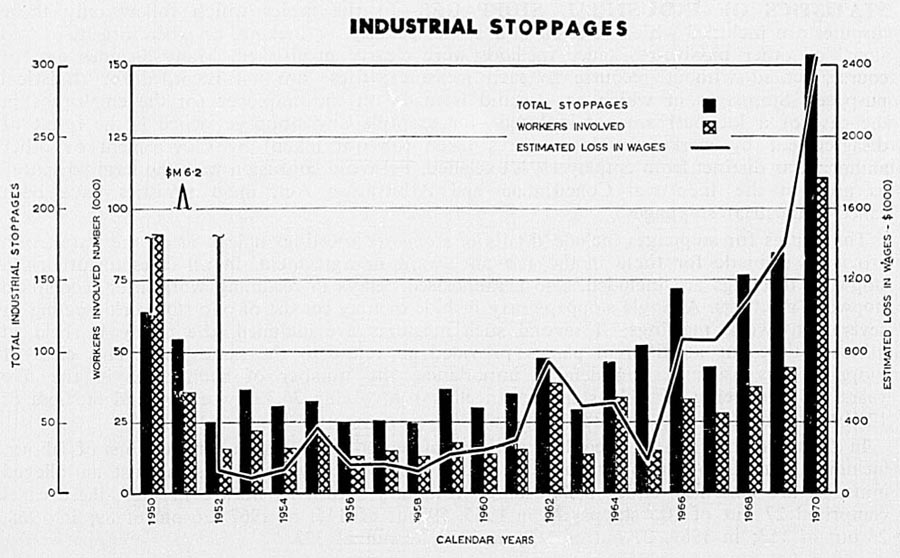
Nature and Duration—The next table shows the nature of the stoppages and the number of workers involved during the last 11 years.
| Year | Nature of Stoppage | Number of Workers Involved | ||||||||
|---|---|---|---|---|---|---|---|---|---|---|
| Direct Strike | Sympathetic Strike | Partial Strike* | Penalty† | Total | Direct Strike | Sympathetic Strike | Partial Strike* | Penalty† | Total | |
*i.e., where no actual cessation of work, but a “go slow” or other policy of protest adopted. †During 1964 four waterfront stoppages resulted in the imposition of four penalties, two of two days, one of three days, and one of five days under Port Bureau Rules and the loss of some 6,520 working days and $67,924 in wages. In 1966 four waterfront stoppages resulted in the imposition of four penalties, one of one day, two of two days, and one of three days under Port Bureau Rules. These resulted in the loss of some 684 working days and $7,330 in wages. These figures are included in the statistics. ‡Two lockouts involving 572 workers are included. §Including 3 lockouts involving 549 workers. | ||||||||||
| 1960 | 56 | 4 | - | - | 60 | 13,923 | 382 | - | - | 14,305 |
| 1961 | 66 | - | 5 | - | 71 | 13,112 | - | 3,514 | - | 16,626 |
| 1962 | 90 | 4 | 2 | - | 96 | 34,248 | 2,606 | 3,067 | - | 39,921 |
| 1963 | 58 | 1 | 1 | - | 60 | 11,827 | 3,050 | 34 | - | 14,911 |
| 1964 | 89 | - | - | 4 | 93 | 30,196 | - | - | 4,583 | 34,779 |
| 1965 | 97 | 2 | 4 | - | 105‡ | 13,312 | 726 | 657 | - | 15,267‡ |
| 1966 | 137 | 3 | 1 | 4 | 145 | 31,906 | 725 | 9 | 492 | 33,132 |
| 1967 | 79 | 7 | 3 | - | 89 | 24,102 | 4,034 | 354 | - | 28,490 |
| 1968 | 148 | 3 | 2 | - | 153 | 36,168 | 831 | 459 | - | 37,458 |
| 1969 | 160 | 1 | 8 | - | 169 | 43,055 | 36 | 950 | - | 44,041 |
| 1970 | 307 | 3 | 10 | - | 323§ | 106,520 | 233 | 2,794 | - | 110,096 |
The table following illustrates the duration of stoppages during 1970.
| Duration | Number of Stoppages | Number of Firms Affected | Number of Workers Involved | Number of Working Days Lost | Estimated Loss in Wages |
|---|---|---|---|---|---|
| $ | |||||
| 1 day and less | 119 | 231 | 52,925 | 31,043 | 314,640 |
| Over 1 day but not over 2 days | 47 | 141 | 11,134 | 19,144 | 190,280 |
| Over 2 days but not over 3 days | 29 | 75 | 7,256 | 18,853 | 166,210 |
| Over 3 days but less than 1 week | 47 | 67 | 12,626 | 25,868 | 256,520 |
| 1 week but less than 2 weeks | 46 | 116 | 11,108 | 62,784 | 639,240 |
| 2 weeks but less than 4 weeks | 20 | 34 | 7,703 | 34,997 | 305,510 |
| 4 weeks but less than 8 weeks | 13 | 27 | 6,685 | 67,359 | 456,440 |
| 8 weeks and over | 2 | 2 | 659 | 17,300 | 96,280 |
| Totals | 323 | 693 | 110,096 | 277,348 | 2,425,120 |
Geographical Distribution—The following table shows the number of stoppages in each industrial district for the years 1966 to 1970 and also the number of workers involved. In 1970 the Northern District had the largest number of stoppages and also the largest number of workers involved, these workers being mainly employed in the meat freezing, building and construction, engineering, and boilermaking and road transport industries.
| Year | Northern | Taranaki | Wellington | Marlborough | Nelson | Westland | Canterbury | Otago and Southland | Total |
|---|---|---|---|---|---|---|---|---|---|
| Number of Stoppages | |||||||||
| 1966 | 59 | 3 | 21 | - | - | 5 | 25 | 32 | 145 |
| 1967 | 52 | 1 | 9 | - | - | 5 | 11 | 11 | 89 |
| 1968 | 104 | 2 | 11 | - | - | 4 | 11 | 21 | 153 |
| 1969 | 95 | 13 | 27 | - | - | - | 16 | 18 | 169 |
| 1970 | 180 | 7 | 64 | 5 | - | - | 38 | 29 | 323 |
| Number of Workers Involved | |||||||||
| 1966 | 14,961 | 657 | 5,687 | - | - | 823 | 5,485 | 5,519 | 33,132 |
| 1967 | 16,141 | 1,034 | 3,075 | - | - | 1,130 | 3,932 | 3,178 | 28,490 |
| 1968 | 21,954 | 310 | 2,840 | - | - | 780 | 3,517 | 8,057 | 37,458 |
| 1969 | 26,800 | 1,497 | 9,091 | - | - | - | 3,331 | 3,322 | 44,041 |
| 1970 | 59,948 | 1,523 | 27,845 | 2,747 | - | - | 8,646 | 9,387 | 110,096 |
A stoppage extending into more than one industrial district is allocated to that district which includes the greatest number of the workers involved. The actual (or occasionally estimated) numbers of workers in the several districts are, however, correctly distributed.
Industrial Distribution—In the following table industrial stoppages are classified according to the industrial groups in which they took place, this grouping being similar to that used in the compilation of industrial-union statistics.
| Industrial Group | 1966 | 1967 | 1968 | 1969 | 1970 | Totals 1966 to 1970 |
|---|---|---|---|---|---|---|
| Number of Stoppages | ||||||
| Provision of— | ||||||
| Food, drink, etc. | 28 | 31 | 49 | 39 | 118 | 265 |
| Clothing, footwear, and textiles | 2 | 1 | - | 6 | 11 | 20 |
| Building and construction | 24 | 10 | 28 | 30 | 32 | 124 |
| Power, heat, and light | 1 | 1 | - | - | 1 | 3 |
| Transport by water and air | 26 | 3 | 2 | 19 | 44 | 94 |
| Transport by land | 34 | 10 | 13 | 16 | 9 | 82 |
| Accommodation, meals, and personal service | 2 | - | - | 2 | 12 | 16 |
| Working in or on— | ||||||
| Wood, etc. | - | 1 | - | 2 | 2 | 5 |
| Metal | 5 | 20 | 41 | 41 | 39 | 146 |
| Stone, clay, glass, chemicals, etc. | 12 | 5 | 11 | 5 | 27 | 60 |
| Paper, printing, etc. | 7 | 1 | 4 | 2 | 12 | 26 |
| Skin, leather, etc. | - | - | - | 1 | 1 | 1 |
| Mines and quarries— | ||||||
| Coal mines | 4 | 5 | 5 | - | 1 | 15 |
| Miscellaneous | - | 1 | - | 6 | 14 | 21 |
| Totals | 145 | 89 | 153 | 169 | 323 | 879 |
| Number of Workers Involved | ||||||
| Provision of— | ||||||
| Food, drink, etc. | 10,475 | 13,556 | 23,493 | 22,106 | 47,398 | 117,028 |
| Clothing, footwear, and textiles | 92 | 24 | - | 421 | 1,443 | 1,980 |
| Building and construction | 3,728 | 1,346 | 4,306 | 3,752 | 2,523 | 15,655 |
| Power, heat, and light | 800 | 60 | - | - | 106 | 966 |
| Transport by water and air | 5,594 | 363 | 30 | 11,095 | 26,405 | 43,487 |
| Transport by land | 7,493 | 7,149 | 1,143 | 605 | 4,201 | 20,591 |
| Accommodation, meals, and personal service | 21 | - | - | 338 | 11,416 | 11,775 |
| Working in or on— | ||||||
| Wood, etc. | - | 180 | - | 656 | 40 | 876 |
| Metal | 356 | 3,990 | 3,467 | 3,345 | 11,456 | 22,614 |
| Stone, clay, glass, chemicals, etc. | 662 | 652 | 1,333 | 577 | 1,857 | 5,081 |
| Paper, printing, etc. | 3,103 | 14 | 2,870 | 872 | 1,142 | 8,001 |
| Skin, leather, etc. | - | - | - | 80 | 126 | 206 |
| Mines and quarries— | ||||||
| Coal mines | 808 | 1,130 | 816 | - | 18 | 2,772 |
| Miscellaneous | - | 26 | - | 194 | 1,965 | 2,185 |
| Totals | 33,132 | 28,490 | 37,458 | 44,041 | 110,096 | 253,217 |
A more detailed analysis of stoppages occurring during 1970 is given below.
| Industrial Group | Number of Stoppages | Number of Firms Affected | Number of Workers Involved | Number of Working Days Lost | Estimated Loss in Wages | ||
|---|---|---|---|---|---|---|---|
| Directly | Indirectly | Total | |||||
| Provision of— | $ | ||||||
| Food, drink, etc. | 118 | 160 | 36,106 | 11,292 | 47,398 | 113,935 | 970,620 |
| Clothing, footwear, and textiles | 11 | 12 | 1,439 | 4 | 1,443 | 4,043 | 19,200 |
| Building and construction | 32 | 40 | 2,520 | 3 | 2,523 | 12,130 | 161,510 |
| Power, heat, and light | 1 | 1 | 106 | - | 106 | 786 | 13,690 |
| Transport by water and air | 44 | 186 | 23,803 | 2,602 | 26,405 | 40,213 | 394,770 |
| Transport by land | 9 | 12 | 4,144 | 57 | 4,201 | 11,286 | 94,190 |
| Accommodation, meals, and personal service | 12 | 10 | 11,394 | 22 | 11,416 | 62,041 | 412,860 |
| Working in or on— | |||||||
| Wood, etc. | 2 | 2 | 40 | - | 40 | 40 | 460 |
| Metal | 39 | 198 | 10,971 | 485 | 11,456 | 20,999 | 231,640 |
| Stone, clay, glass, chemicals, etc. | 27 | 44 | 1,677 | 180 | 1,857 | 6,226 | 62,450 |
| Paper, printing, etc. | 12 | 12 | 1,142 | - | 1,142 | 2,305 | 18,210 |
| Skins, leather, etc. | 1 | 1 | 126 | - | 126 | 276 | 2,500 |
| Mines and quarries— | |||||||
| Coal mines | 1 | 1 | 18 | - | 18 | 50 | 180 |
| Miscellaneous | 14 | 14 | 1,965 | - | 1,965 | 3,018 | 42,840 |
| Totals | 323 | 693 | 95,451 | 14,645 | 110,096 | 277,348 | 2,425,120 |
Causes—In the next table the causes of stoppages are shown. Under the heading “Wages” are included stoppages concerning wages, overtime, or rates for piecework.
Stoppages concerning the employment or dismissal of certain classes of persons are included under the heading “Employment”. Stoppages on the subject of employment usually concern the dismissal of a worker on allegedly insufficient grounds.
“Other working conditions” are of diverse nature, and include such causes as the following: distribution of work in coal mines and on wharves, conveyance to and from work, atmosphere conditions in coal mines, accommodation on ships, numbers of men to be allocated to certain duties, supply of food, and the method of handling cargo.
Under the heading “Sympathy” are included all stoppages caused by workers striking not on account of a grievance arising out of their own wages or conditions, but in sympathy with the demands of other workers.
| Cause | 1966 | 1967 | 1968 | 1969 | 1970 |
|---|---|---|---|---|---|
| Number of Stoppages | |||||
| Wages | 48 | 25 | 60 | 80 | 178 |
| Hours | - | 3 | 4 | 5 | 6 |
| Employment | 29 | 27 | 50 | 37 | 55 |
| Other working conditions | 31 | 16 | 24 | 33 | 56 |
| Sympathy | 7 | 6 | 2 | - | 3 |
| Other causes | 30 | 12 | 13 | 14 | 25 |
| Totals | 145 | 89 | 153 | 169 | 323 |
| Number of Workers Involved | |||||
| Wages | 6,213 | 9,913 | 12,203 | 14,145 | 65,907 |
| Hours | - | 487 | 387 | 968 | 302 |
| Employment | 6,616 | 6,959 | 14,038 | 9,318 | 8,541 |
| Other working conditions | 11,175 | 4,095 | 9,051 | 8,246 | 17,489 |
| Sympathy | 1,092 | 3,911 | 460 | - | 2,128 |
| Other causes | 8,036 | 3,125 | 1,319 | 11,364 | 15,729 |
| Totals | 33,132 | 28,490 | 37,458 | 44,041 | 110,096 |
Methods of Settlement—Following is a table showing the methods of settlement of disputes causing stoppages. Negotiations supposedly under the Industrial Conciliation and Arbitration Act and the Labour Disputes Investigation Act are treated as “Intervention of third party”. “Voluntary return to work” includes such cases as “Protest” absence and stopwork meetings.
| Method of Settlement | 1966 | 1967 | 1968 | 1969 | 1970 |
|---|---|---|---|---|---|
| Number of Stoppages | |||||
| Private negotiations between parties | 52 | 33 | 90 | 93 | 184 |
| Intervention of third party | 32 | 27 | 34 | 49 | 62 |
| Substitution | - | - | 1 | - | 1 |
| Voluntary return to work | 59 | 26 | 26 | 27 | 72 |
| Other | 2 | 3 | 2 | - | 4 |
| Totals | 145 | 89 | 153 | 169 | 323 |
| Number of Workers Involved | |||||
| Private negotiations between parties | 9,022 | 5,040 | 20,494 | 16,916 | 51,422 |
| Intervention of third party | 7,275 | 15,963 | 8,975 | 10,792 | 8,202 |
| Substitution | - | - | 11 | - | 509 |
| Voluntary return to work | 16,518 | 7,183 | 7,746 | 16,333 | 47,784 |
| Other | 317 | 304 | 232 | - | 2,179 |
| Totals | 33,132 | 28,490 | 37,458 | 44,041 | 110,096 |
Further information for the year 1970 is given in the next table.
| Method of Settlement | Number of Stoppages | Number of Firms Affected | Number of Workers Involved | Number of Working Days Lost | Estimated Loss in Wages |
|---|---|---|---|---|---|
| Private negotiations between parties | 186 | 252 | 51,422 | 157,162 | 1,431,955 |
| Intervention of third party | 60 | 127 | 8,202 | 35,381 | 397,965 |
| Substitution | 1 | 1 | 509 | 17,300 | 96,280 |
| Voluntary return to work | 72 | 277 | 47,784 | 62,283 | 456,090 |
| Other | 4 | 36 | 2,179 | 5,222 | 42,830 |
| Totals | 323 | 693 | 110,096 | 277,348 | 2,425,120 |
RESULTS—In compiling the table which follows no stoppage has been included as ending in favour of either employers or workers unless the result has been beyond question. In cases where workers have made more than one demand, succeeding in one or more and failing in one or more, or where they have made one or more demands and in respect of each have been partially successful only, the result has been treated as a compromise. Where strikers have returned to work without any definite decision being arrived at regarding the demands made, or where (as in the case of a sympathetic strike) no definite demand has been made, or where a strike is merely by way of a protest, the result has been recorded as indeterminate.
| Result | 1966 | 1967 | 1968 | 1969 | 1970 |
|---|---|---|---|---|---|
| Number of Stoppages | |||||
| In favour of workers | 19 | 16 | 32 | 55 | 87 |
| In favour of employers | 13 | 14 | 20 | 17 | 25 |
| Compromise | 27 | 11 | 31 | 32 | 91 |
| Indeterminate | 86 | 48 | 70 | 65 | 120 |
| Totals | 145 | 89 | 153 | 169 | 323 |
| Number of Workers Involved | |||||
| In favour of workers | 3,472 | 1,971 | 9,183 | 6,417 | 16,690 |
| In favour of employers | 2,695 | 3,344 | 7,469 | 4,056 | 8,539 |
| Compromise | 7,503 | 627 | 4,633 | 4,973 | 29,135 |
| Indeterminate | 19,462 | 22,548 | 16,173 | 28,595 | 55,732 |
| Totals | 33,132 | 28,490 | 37,458 | 44,041 | 110,096 |
| Number of Working Days Lost | |||||
| In favour of workers | 28,814 | 4,282 | 40,811 | 20,266 | 52,795 |
| In favour of employers | 3,559 | 2,828 | 32,727 | 5,774 | 33,883 |
| Compromise | 39,133 | 983 | 11,378 | 20,821 | 117,896 |
| Indeterminate | 27,589 | 131,397 | 45,351 | 91,814 | 72,774 |
| Totals | 99,095 | 139,490 | 130,267 | 138,675 | 277,348 |
Of stoppages ending definitely in favour of one party or the other during the five years 1966 to 1970 workers succeeded in 209 instances and employers in 89. In the previous five years (1961 to 1965) workers were successful in 73 instances and employers in 49.
CAUSES AND RESULTS—In the following table the causes and results of stoppages occurring during 1970 are shown in conjunction.
| Result | Cause | ||||||
|---|---|---|---|---|---|---|---|
| Wages | Hours | Employment | Other Working Conditions | Sympathy | Other | Total | |
| Number of Stoppages | |||||||
| In favour of workers | 34 | - | 23 | 21 | 1 | 8 | 87 |
| In favour of employers | 11 | 3 | 6 | 3 | - | 2 | 25 |
| Compromise | 64 | 2 | 9 | 11 | - | 5 | 91 |
| Indeterminate | 69 | 1 | 17 | 21 | 2 | 10 | 120 |
| Totals | 178 | 6 | 55 | 56 | 3 | 25 | 323 |
| Number of Firms Affected | |||||||
| In favour of workers | 38 | - | 31 | 26 | 1 | 37 | 133 |
| In favour of employers | 10 | 3 | 6 | 4 | - | 2 | 25 |
| Compromise | 99 | 2 | 10 | 15 | - | 57 | 183 |
| Indeterminate | 238 | 1 | 22 | 34 | 2 | 55 | 352 |
| Totals | 385 | 6 | 69 | 79 | 3 | 151 | 693 |
| Number of Workers Involved | |||||||
| In favour of workers | 7,184 | - | 3,012 | 4,928 | 93 | 1,473 | 16,690 |
| In favour of employers | 4,266 | 297 | 1,037 | 1,515 | - | 1,424 | 8,539 |
| Compromise | 23,677 | 2 | 581 | 3,658 | - | 1,217 | 29,135 |
| Indeterminate | 30,780 | 3 | 3,911 | 7,388 | 2,035 | 11,615 | 55,732 |
| Totals | 65,907 | 302 | 8,541 | 17,489 | 2,128 | 15,729 | 110,096 |
| Number of Days Lost | |||||||
| In favour of workers | 22,482 | - | 23,224 | 4,677 | 409 | 2,003 | 52,795 |
| In favour of employers | 20,907 | 991 | 1,583 | 6,842 | - | 3,560 | 33,883 |
| Compromise | 107,829 | 82 | 2,695 | 3,711 | - | 3,579 | 117,896 |
| Indeterminate | 47,606 | 3 | 8,600 | 9,611 | 1,385 | 5,569 | 72,774 |
| Totals | 198,824 | 1,076 | 36,102 | 24,841 | 1,794 | 14,711 | 277,348 |
| Estimated Loss in Wages | |||||||
| $ | $ | $ | $ | $ | $ | $ | |
| In favour of workers | 179,890 | - | 166,465 | 49,020 | 5,570 | 9,250 | 410,195 |
| In favour of employers | 125,340 | 11,810 | 15,150 | 108,460 | - | 38,840 | 299,600 |
| Compromise | 825,090 | 9,760 | 37,170 | 38,900 | - | 46,370 | 957,290 |
| Indeterminate | 479,705 | 30 | 123,380 | 69,090 | 12,680 | 73,150 | 758,035 |
| Totals | 1,610,025 | 21,600 | 342,165 | 265,470 | 18,250 | 167,610 | 2,425,120 |
Table of Contents
GENERAL—Under the Workers' Compensation Act 1956 all workers are entitled to workers' compensation benefits. Since 1943 it has been compulsory for employers to insure against claims under the Act by their employees. The employer who, through his neglect, is not covered by an insurance company is deemed to be insured by the Workers' Compensation Board. Thus the automatic cover for all workers is secured, but action may be taken against an employer for failing to insure, and the Workers' Compensation Board can recover from the employer all the compensation paid by the Board to injured workers. A worker who is the wife or husband of his or her employer is not a worker for the purposes of the Act, but voluntary insurance cover by employers may bring such a person within the provisions of the Act. (A Royal Commission in a report made in December 1967 recommended a new compensation scheme for personal injury to all members of the work force. A commentary in the report, entitled Personal Injury, was published in 1969 as parliamentary paper H.50.)
The worker is entitled to compensation from his employer where he suffers personal injury by accident arising out of and in the course of the employment, and this is so whether or not the employment is for the purposes of any trade or business carried on by the employer and whether or not the employment is of a casual nature. Even if the worker is working under an illegal contract of service at the time of an accident arising out of and in the course of employment, he is entitled to compensation if the illegality consists in evasion of a statutory minimum age provision, or if the Judge, Magistrate, or other person dealing with the matter decides, having regard to all the circumstances, to treat the contract as valid. No compensation is payable in respect of any accident which is attributable to the serious and wilful misconduct of the worker injured, unless the injury results in death or serious or permanent disablement. No compensation is payable in respect of the death of a worker following on, or incapacity resulting from or aggravated by, unreasonable refusal to submit to medical or surgical treatment. Certain accidents are deemed to arise out of and in the course of employment, provided that in each case the accident is of a type that would entitle the worker to compensation had it happened at his work place, namely:
Accidents to apprentices attending compulsory classes at technical schools.
Accidents to workers acting in breach of any Act, regulations, or orders affecting their employment or acting without instructions from the employer (provided that the worker would have been entitled to compensation had there been no breach of Act, etc.).
Accidents to workers travelling to or from work by transport provided by the employer primarily for conveyance of the workers, authorised by him, or arranged with the workers or their union, the employer meeting the whole or part of the cost.
Accidents to workers during meal or rest times, happening on premises occupied by the employer, on premises to which the workers have by virtue of their employment the right of access, or on premises where the workers are entitled to be by authorisation of the employer.
Accidents to workers travelling between their place of employment and premises to which they have by virtue of their employment the right of access.
Accidents to waterside workers awaiting engagement in accordance with the prescribed conditions of employment.
Diseases are deemed to be personal injuries by accident if they are due to the nature of any employment in which the worker was employed during a prescribed period before the date of commencement of the incapacity. In the case of diseases due to exposure to radioactivity the prescribed period is 20 years, for hydatid disease 10 years, and two years in all other cases. If the worker contracts any disease in respect of which he would be entitled to a miner's benefit under the Social Security Act he is not entitled to receive any compensation under the Workers' Compensation Act while receiving such benefit. Nor can a benefit be paid for any period during which the worker is receiving compensation, and no lump-sum compensation is to be paid for any incapacity caused by such diseases.
In assessing compensation, no account is taken of any money accruing to the claimant under any insurance policy, nor, in the case of a partial dependant of a deceased worker, of any gain to the estate or the dependant, nor of any money payable by or to a friendly society or other organisation.
The Act generally applies only to accidents happening in New Zealand, but also applies to accidents on New Zealand ships and aircraft and to accidents to seamen or airmen employed in New Zealand ships or aircraft.
RATES OF COMPENSATION—All the maximum rates of compensation, whether for weekly payments or the various allowances, such as dependants' allowances and medical expenses, are fixed by Order in Council. The Act also adopts the method of having the various maximum total payments of compensation for death or incapacity expressed in terms of the current maximum weekly payment, so that any variation in the latter automatically varies the maxima for total payments. Compensation rates at present are as follows:
1.In case of death:
Where the worker leaves total dependants, a sum equal to the aggregate of the prescribed maximum weekly payments for 274 weeks ($6,850.00); or
Where the worker leaves partial dependants only, a sum reasonable and proportionate to the injury to these dependants, but not exceeding the sum specified in (a).
Compensation received prior to death by the injured person in respect of the accident which causes his death is deducted from the above amounts, to arrive at the amounts payable to dependants, to the extent that such prior compensation exceeds the aggregate of the prescribed maximum weekly payments for 39 weeks ($975.00).
2. In the case of injury:
During total incapacity, weekly payments equal to 80 percent of the worker's weekly earnings (maximum $32 per week, minimum $5.70).
During partial incapacity, weekly payments equal to 80 percent of the difference between the worker's pre-accident weekly earnings and the weekly amount he is earning or able to earn in suitable employment or business after the accident.
Weekly payments apply during any period of total incapacity, but not for a longer period than six years. The worker's weekly earnings are deemed to be his ordinary weekly earnings (exclusive of overtime) at the time of the accident, increased or reduced during his incapacity according to increases or decreases in ordinary rates of pay, ruling rates of pay, or minimum rates of wages. As an alternative, the worker may elect to have his weekly payments based on his average weekly earnings (inclusive of overtime) over the last 12 months or some shorter period in the employment of the same employer, increased or decreased during incapacity according to increases or decreases in the minimum wage under the Minimum Wage Act 1945. Permanently incapacitated apprentices, trainees, or workers under 21 years of age have their weekly earnings computed on adult or journeymen's rates.
In the case of certain injuries involving permanent disability (e.g., dismemberment or loss of use) compensation is assessed in accordance with a schedule to the Act, representing a percentage (varying according to the nature of the dismemberment) of an amount equal to the aggregate of maximum weekly payments of compensation for six years ($7,800.00). In assessing the compensation payable for such injuries, any compensation received for any period of temporary incapacity is taken into account in a manner laid down in the Act.
In addition to the ordinary compensation, dependants' allowances are payable under the Workers' Compensation Act 1956. Where the death of the worker results from the injury, an allowance of $100 is payable in respect of each total dependant under 16 years of age, and a proportionate amount in respect of each partial dependant under 16. Where the worker's total incapacity results from the injury, an allowance of $3 per week is payable in respect of his wife or dependent woman in a position of parent to children under 16 years of age maintained by the worker or paid housekeeper and $1.50 for each dependant under 16 years, provided that the combined amount of weekly payments and dependants' allowances is not to exceed 90 percent of the worker's weekly earnings. A child over 16 and under 18 years of age is treated as being under 16 if still at school or undergoing training without pay.
Various other allowances and expenses are payable in addition to the ordinary compensation. An injured worker is entitled to an allowance of $4 per week for any period during which he requires constant personal attendance and is not being maintained free of charge in a hospital. In the case of death, reasonable expenses are payable for medical and surgical attendance and up to $150 for the funeral. In case of incapacity, the amount of $3.50 is payable for a first medical or surgical attendance, and $2.30 for all subsequent attendances rising out of the same period of incapacity; but there is no maximum amount prescribed in respect of specialist medical services. Provision is made to meet additional charges for attendances exceeding 30 minutes and for mileage charges, while separate rates apply to specialist services, X-ray diagnostic services, and physiotherapeutic treatment. There is no limit to the amount payable for inpatient treatment and no overall limit is imposed in the payment of medical expenses in the aggregate.
Where as a result of the injury to a worker an artificial limb or aid is necessary, the employer must pay the reasonable cost of the artificial limb or aid, and the reasonable cost of its normal repair or renewal. Where, as a result of accident arising out of and in the course of employment, the worker suffers damage to teeth, an artificial limb or aid, clothing, or spectacles he is wearing the employer must pay for the reasonable cost of repair or replacement, except that in the case of damage to clothing or spectacles no liability arises to an employer unless he has also become liable to pay compensation as a result of the accident. Where the worker needs to be removed to a doctor, hospital or his home after the accident, the employer must pay the costs of removal. Where a worker requires medical treatment in another town or at a place more than 5 miles from his residence, the employer must pay the expenses of transport and meals or lodging up to a maximum of $100.
Weekly payments of compensation may not be discontinued or diminished except in the following cases:
Where the weekly payment is in respect of total incapacity and the worker has actually returned to work.
By formal agreement with the worker.
By leave of the Compensation Court upon payment of a lump sum in lieu of weekly payments.
By leave of the Compensation Court or Magistrate's Court where a doctor certifies that the worker has wholly or partially recovered or that any incapacity is not due in whole or part to the accident. The Court will not grant such leave in the case of partial recovery unless the worker is working in some suitable employment or business, or some suitable employment has been provided by his employer.
By judgment or order of a Court of competent jurisdiction.
After the expiration of the maximum period of six years.
Where the weekly payment is in respect of total incapacity and the worker's doctor has certified he is fit to resume work and the worker has not done so.
If the employer wrongfully terminates or diminishes weekly compensation payments, he is liable to pay double compensation to the worker. The Compensation Court has power to declare, in any case to which case (g) applies, that the worker was not in fact fit to resume work and that the payments therefore were to be continued.
COMPENSATION COURT—Proceedings under the Act are taken in the Compensation Court and in some cases the Magistrate's Court. The Compensation Court consists of a Judge, and there is provision in the Act for the appointment of a Registrar for each industrial district under the Industrial Conciliation and Arbitration Act 1954. Procedure is determined by regulations—the Workers' Compensation Court Rules. No appeal lies to any other Court from any order made by the Compensation Court, nor may any such order be removed into another Court to be quashed or varied, except upon the ground of want or excess of jurisdiction. All proceedings for the recovery of compensation and the determination of any questions under the Act are, with certain exemptions, taken in the Compensation Court and not otherwise. Rights of indemnity conferred by the Act are enforceable in the Supreme Court of competent jurisdiction, and not (except with the consent of the parties) in the Compensation Court. Where the parties agree or the amount claimed does not exceed $100, proceedings for the recovery of compensation in respect of any injury which has not caused the death of a worker may be taken in the Magistrate's Court. Medical, funeral, and surgical expenses and other allowances of a similar nature may be recovered in the Magistrate's Court equally with the Compensation Court.
Proceedings under the Act for the recovery of compensation are not maintainable unless written notice of the accident has been given to the employer as soon as practicable after its happening. Action for recovery must also be commenced within 12 months after the date of the accident or death, or date of the last payment of compensation or signing of admission of liability. The Court has power to excuse failure to give notice or to commence action within the limited time if the employer has not been prejudiced, or the failure was due to mistake of fact or law, absence from New Zealand, or other reasonable cause.
INSURANCE—With certain exceptions it is compulsory for all employers to insure against their liability to pay compensation or damages in respect of injuries to workers. The Secretary of Labour has power to grant exemption where the employer has adequate financial resources, or is a Commonwealth shipping company indemnified by a United Kingdom mutual protecting club or is employing workers domiciled outside New Zealand and adequately protected by compensation rights and insurance enforceable in the country of their domicile or in the country where they were engaged. The National Airways Corporation, the Linen Flax Corporation, and education boards and other school authorities are not required to insure their workers. The Secretary of Labour may grant exemption to the trustees of the General Trust Fund established under the New Zealand Rules of Racing. The insurance provisions of the Act do not apply to the Crown as the employers of any workers or with respect to overseas workers temporarily employed in New Zealand by overseas employers for a period of six months or less.
Contracts are completed by the delivery of wages statements by employers to authorised insurers (insurance companies who have notified the Secretary of Labour that they have made the necessary deposit under the Insurance Companies' Deposits Act 1953). Maximum rates of premiums for the different categories of workers are fixed by the Employers' Liability Insurance Regulations. The employer is required to give prompt notification of details of accidents causing death or personal injury to workers, to his insurer, and to an Inspector of Factories.
WORKERS' COMPENSATION BOARD—The Workers' Compensation Board consists of the General Manager of the State Insurance Office and one other Government representative, two representatives of the Council of Fire and Accident Underwriters' Associations of New Zealand, one employers' representative, and one workers' representative. Its functions include recommending the maximum rates of premiums and rate of commission for insurance agents, administering the Workers' Compensation Account used in carrying out the Board's functions, undertaking and assisting accident prevention, research into causes, incidence, and prevention of accidents, and the care and assistance of injured workers. Penal rates up to 100 percent in excess of the prescribed maximum rates may be imposed by the Board in cases where the risks to workers are unusually great. To finance the activities of the Board, levies are collected from authorised insurers and exempted employers. The Board also acts as the insurer of employers who have neglected to insure their workers with an authorised insurer, so that workers are protected in all cases. The Board may collect from delinquent employers moneys it pays out as insurer.
GENERAL—Statistics of industrial accident have become increasingly important with the widening mechanisation of industry and the growing labour force. They are basic material for programmes of industrial safety. The national bill for compensation payments is in the region of $6 million annually. This is, however, only the direct cost, and the indirect costs probably put the total bill beyond $20 million. Productivity and the standard of living are affected by industrial accidents. Over the latest five years the calendar days lost through industrial accidents were well over 50 times the working days lost through industrial stoppages. Add to this the loss of some 80 lives each year and the permanent disabling of some nine hundred other workers, then the magnitude of the problem of occupational safety can be more clearly realised.
As the statistics are derived from claims made under the Workers' Compensation Act, they exclude accidents to working proprietors and similar persons not insurable under the Act. This limits the scope of the statistics in the farming industry especially. Coverage does, however, extend to organisations exempt from insurance under the Act.
Claims resulting from the more serious accidents are frequently not settled for some considerable time after the occurrence of the accident, and a period is therefore allowed so that the bulk of such claims may be included in the statistics for the year in which the accidents occurred. From 1953 the closing date has been standardised at mid-August of the following year. Even allowing this period of seven and a half months, it is inevitable that any year's statistics will include a small proportion of long-delayed claims from previous years, but these late claims should be compensatory from year to year.
PRINCIPAL STATISTICS—The following table gives a summary of the principal statistics for the latest five years. After 1966 the collection and classification system was revised and later statistics are not yet available. The concepts and calculation of frequency and severity rates and of calendar days lost are explained in a succeeding note, and changes in compensation rates are set out in a subsequent table.
| Item | 1962 | 1963 | 1964 | 1965 | 1966 |
|---|---|---|---|---|---|
| Number of accidents resulting in— | |||||
| Fatality | 83 | 74 | 67 | 90 | 85 |
| Permanent total disability | 3 | 4 | 2 | 9 | 3 |
| Permanent partial disability | 1,004 | 874 | 1,011 | 946 | 930 |
| Temporary disability | 53,275 | 54,380 | 57,918 | 55,373 | 55,480 |
| Totals | 54,365 | 55,332 | 58,998 | 56,418 | 56,498 |
| Compensation paid (incl. damages)— | |||||
| Total $(m) | 6.07 | 6.25 | 6.72 | 6.98 | 7.17 |
| Average per accident $ | 112 | 113 | 114 | 124 | 127 |
| Calendar days lost— | |||||
| Temporary disability only (000) | 900.0 | 898.5 | 939.6 | 878.8 | 862.7 |
| Average days per accident | 17 | 17 | 16 | 16 | 16 |
| Total on constant basis (000) | 3,068.3 | 2,831.1 | 2,981.0 | 3,075.6 | 2,942.9 |
| Average days per accident | 56 | 51 | 51 | 55 | |
| Total on actual basis (000) | 3,082.5 | 2,908.5 | 2,976.7 | 3,167.5 | 3,028.0 |
| Average days per accident | 57 | 53 | 50 | 56 | 54 |
| Frequency and severity rates— | |||||
| Frequency rate | 3.78 | 3.65 | 3.75 | 3.46 | 3.34 |
| Injury severity rate | 1,287 | 1,134 | 1,145 | 1,150 | 1,066 |
| Economic severity rate | 1,299 | 1,172 | 1,147 | 1,197 | 1,108 |
FREQUENCY AND SEVERITY RATES—Frequency rates are calculated according to the formula: Accidents per 100,000 man-hours worked.
For severity rates the formula is: Man-hours lost through accidents per 100,000 man-hours worked. In calculating the injury severity rate in the foregoing table a constant allowance of average working-life expectancy (9,263 calendar days) is made for all fatalities, with a percentage of this for each permanent disability according to the percentage of that disability as set out in the First Schedule to the Workers' Compensation Act 1956. To the calendar days lost through fatal and permanent disabling accidents are added the actual days lost through temporary disabilities, adjusted to allow for the different age distribution of workers suffering this kind of accident. From the total the man-hours lost are calculated.
The economic severity rate is calculated similarly, but takes into account the workers' actual ages. Further details will be found in Statistics of Industrial Injuries 1966, a report of the Department of Statistics.
The average severity of accidents is found by dividing the calendar days lost by the number of accidents. This rate, also called the time charge, is calculated without reference to age.
The numbers of accidents and the injury severity rates (hours lost per 100,000 man-hours worked) for the industrial groups, together with the labour force and frequency rate (accidents per 100,000 man-hours worked) for the groups, are shown in the following diagrams.
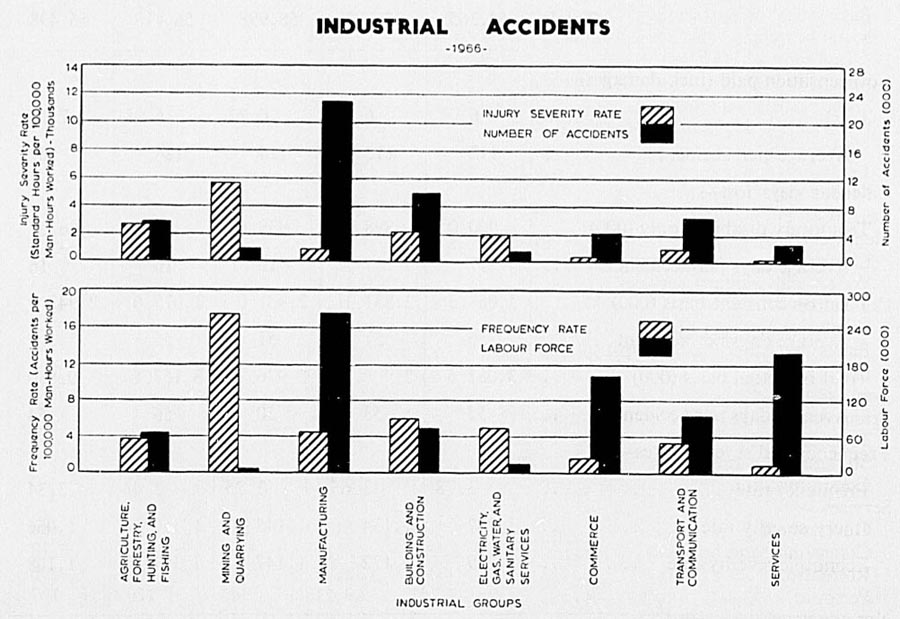
CLASSIFICATION BY INDUSTRY—In the following table industrial accidents during the year 1966 are classified by industrial groups.
| Industrial Group | Total Accidents | Calendar Days Lost | Total Average | Total Compensation (Including Damages) | Total Average |
|---|---|---|---|---|---|
| Agriculture, forestry, hunting, and fishing— | $(000) | $ | |||
| Agriculture and livestock production | 4,437 | 584,556 | 132 | 747 | 168 |
| Forestry and logging | 1,231 | 116,243 | 94 | 147 | 120 |
| Hunting, trapping, and game propagation | 116 | 18,608 | 160 | 18 | 153 |
| Fishing | 131 | 7,278 | 56 | 25 | 189 |
| Mining and quarrying— | |||||
| Coal mining | 1,528 | 48,463 | 32 | 163 | 107 |
| Metal mining | 11 | 72 | 7 | –– | 29 |
| Crude petroleum and natural gas | 9 | 82 | 9 | –– | 387 |
| Stone quarrying, clay and sand pits | 359 | 49,185 | 137 | 106 | 29 |
| Non-metallic mining and quarrying | 7 | 65 | 9 | –– | 34 |
| Manufacturing— | |||||
| Food | 7,172 | 217,781 | 30 | 674 | 94 |
| Beverages | 329 | 7,660 | 23 | 23 | 69 |
| Tobacco | 34 | 510 | 15 | 2 | 55 |
| Textiles | 707 | 37,715 | 53 | 108 | 152 |
| Footwear, other wearing apparel, and made-up textile goods | 558 | 11,775 | 21 | 31 | 55 |
| Wood and cork (excluding furniture) | 2,362 | 147,926 | 63 | 313 | 132 |
| Furniture and fixtures | 398 | 16,875 | 42 | 40 | 101 |
| Paper and paper products | 849 | 27,277 | 32 | 83 | 98 |
| Printing, publishing, and allied industries | 355 | 16,973 | 48 | 48 | 136 |
| Leather and leather products (except footwear) | 130 | 7,257 | 56 | 24 | 185 |
| Rubber products | 308 | 13,553 | 44 | 45 | 146 |
| Chemicals and chemical products | 669 | 19,438 | 29 | 70 | 104 |
| Products of petroleum and coal | 45 | 2,654 | 59 | 8 | 186 |
| Non-metallic mineral products | 1,300 | 82,308 | 63 | 184 | 142 |
| Basic metal industries | 137 | 24,085 | 176 | 54 | 392 |
| Metal products (except machinery and transport equipment) | 1,582 | 60,170 | 38 | 179 | 113 |
| Machinery (except electrical machinery) and general engineering | 2,818 | 88,489 | 31 | 258 | 92 |
| Electrical machinery, apparatus, appliances, and supplies | 588 | 17,397 | 30 | 74 | 126 |
| Transport equipment | 2,323 | 74,505 | 32 | 195 | 84 |
| Miscellaneous industries | 444 | 25,136 | 57 | 56 | 127 |
| Construction | 9,986 | 597,051 | 60 | 1,538 | 154 |
| Electricity, gas, water, and sanitary services— | |||||
| Electricity, gas, and steam | 984 | 63,102 | 64 | 132 | 134 |
| Water and sanitary services | 487 | 21,516 | 44 | 60 | 123 |
| Commerce— | |||||
| Wholesale and retail trade | 4,216 | 186,305 | 44 | 501 | 119 |
| Banks and other financial institutions | 27 | 1,584 | 59 | 4 | 157 |
| Insurance | 9 | 473 | 53 | 2 | 199 |
| Real estate | 7 | 4,227 | 604 | 5 | 774 |
| Transport, storage, and communication— | |||||
| Transport | 5,727 | 272,503 | 48 | 813 | 142 |
| Storage and warehousing | 178 | 4,769 | 27 | 14 | 80 |
| Communication | 942 | 19,022 | 20 | 75 | 80 |
| Services— | |||||
| Government | 364 | 6,161 | 17 | 24 | 66 |
| Community and business | 1,186 | 45,565 | 38 | 140 | 118 |
| Recreation | 342 | 32,382 | 95 | 67 | 196 |
| Personal | 1,101 | 49,218 | 45 | 120 | 109 |
| Not adequately described | 5 | 52 | 10 | –– | 30 |
| Total | 56,498 | 3,027,966 | 54 | 7,173 | 127 |
In the next table the accidents in 1966 are classified by the resulting extent of disability.
| Industrial Group | Number of Accidents Resulting in - | Total Number of Accidents | |||
|---|---|---|---|---|---|
| Fatality | Permanent Total Disability | Permanent Partial Disability | Temporary Disability | ||
| Agriculture, forestry, hunting, and fishing— | |||||
| Agriculture and livestock production | 24 | - | 98 | 4,315 | 4,437 |
| Forestry and logging | 5 | - | 14 | 1,212 | 1,231 |
| Other | 1 | - | 8 | 238 | 247 |
| Mining and quarrying— | |||||
| Coal mining | 2 | - | 7 | 1,519 | 1,528 |
| Stone quarrying, clay and sand pits | 2 | - | 10 | 347 | 359 |
| Other | - | - | - | 27 | 27 |
| Manufacturing— | |||||
| Food | 3 | - | 97 | 7,072 | 7,172 |
| Beverages | - | - | 2 | 327 | 329 |
| Textiles | 1 | - | 18 | 688 | 707 |
| Footwear, other apparel, and made-up textile goods | - | - | 4 | 554 | 558 |
| Wood and cork | 2 | - | 77 | 2,283 | 2,362 |
| Furniture and fixtures | - | - | 12 | 386 | 398 |
| Paper and paper products | - | - | 15 | 834 | 849 |
| Printing, publishing, and allied industries | - | - | 12 | 343 | 355 |
| Rubber products | - | - | 8 | 300 | 308 |
| Chemicals and chemical products | 1 | - | 10 | 658 | 669 |
| Non-metallic mineral products | 2 | - | 28 | 1,270 | 1,300 |
| Metal products | - | - | 32 | 1,550 | 1,582 |
| Machinery, including general engineering | 2 | - | 38 | 2,778 | 2,818 |
| Electrical machinery, apparatus, appliances, and supplies | - | - | 13 | 575 | 588 |
| Transport equipment | 1 | - | 27 | 2,295 | 2,323 |
| Other manufacturing | 1 | - | 24 | 765 | 790 |
| Construction | 16 | 2 | 165 | 9,803 | 9,986 |
| Electricity, gas, water, and sanitary services— | |||||
| Electricity, gas, and steam | 4 | - | 10 | 970 | 984 |
| Water and sanitary services | 1 | - | 5 | 481 | 487 |
| Commerce— | |||||
| Wholesale and retail trade | 3 | - | 62 | 4,151 | 4,216 |
| Other | - | - | 3 | 40 | 43 |
| Transport, storage, and communication— | |||||
| Transport | 12 | 1 | 68 | 5,646 | 5,727 |
| Storage and warehousing | - | - | 5 | 173 | 178 |
| Communication | - | - | 4 | 938 | 942 |
| Services— | |||||
| Government | - | - | 3 | 361 | 364 |
| Community and business | 1 | - | 22 | 1,163 | 1,186 |
| Recreation | - | - | 11 | 331 | 342 |
| Personal | 1 | - | 18 | 1,082 | 1,101 |
| Not adequately described | - | - | - | 5 | 5 |
| Totals | 85 | 3 | 930 | 55,480 | 56,498 |
CAUSE OF ACCIDENT AND RESULTING DISABILITY—The following table relates cause of accident and degree of resulting disability for the year 1966.
| Cause | Fatality | Permanent Disability* | Temporary Disability | Total | Percentage of Total Accidents |
|---|---|---|---|---|---|
| *Including permanent total disability cases. | |||||
| Machinery | 24 | 366 | 7,825 | 8,215 | 14.5 |
| Vehicle | 28 | 47 | 2,168 | 2,243 | 4.0 |
| Electricity, explosion, flames, hot substance | 3 | 21 | 1,701 | 1,725 | 3.1 |
| Poison, corrosive substance | 2 | - | 478 | 480 | 0.8 |
| Fall of person | 8 | 150 | 8,017 | 8,175 | 14.5 |
| Stepping on or striking against fixed or stationary object | - | 11 | 2,503 | 2,514 | 4.4 |
| Moving object (not being handled by person injured) | 9 | 46 | 2,194 | 2,249 | 4.0 |
| Fall of earth | 5 | 3 | 249 | 257 | 0.5 |
| Handling of object | 1 | 173 | 17,473 | 17,647 | 31.2 |
| Hand tools | - | 85 | 8,400 | 8,485 | 15.0 |
| Miscellaneous | 5 | 31 | 4,472 | 4,508 | 8.0 |
| Totals | 85 | 933 | 55,480 | 56,498 | 100.0 |
AGE OF WORKERS—The following table gives numbers and percentages according to age groups of the persons injured.
| Age (Completed Years) | 1962 | 1963 | 1964 | 1965 | 1966 | |||||
|---|---|---|---|---|---|---|---|---|---|---|
| Number of Cases | Percent of Total | Number of Cases | Percent of Total | Number of Cases | Percent of Total | Number of Cases | Percent of Total | Number of Cases | Percent of Total | |
| Under 16 | 534 | 1.0 | 437 | 0.8 | 523 | 0.9 | 466 | 0.8 | 510 | 0.9 |
| 16-20 | 8,417 | 15.5 | 8,573 | 15.5 | 9,674 | 16.4 | 9,846 | 17.5 | 9,946 | 17.6 |
| 21-24 | 6,573 | 12.1 | 6,879 | 12.4 | 7,227 | 12.2 | 6,850 | 12.1 | 6,800 | 12.0 |
| 25-34 | 11,828 | 21.7 | 11,597 | 21.0 | 12,200 | 20.7 | 11,343 | 20.1 | 11,380 | 20.2 |
| 35-44 | 9,716 | 17.9 | 10,136 | 18.3 | 10,423 | 17.7 | 9,838 | 17.4 | 9,614 | 17.0 |
| 45-54 | 7,552 | 13.9 | 7,404 | 13.4 | 7,824 | 13.2 | 7,474 | 13.3 | 7,336 | 13.0 |
| 55-64 | 3,735 | 6.9 | 4,035 | 7.3 | 4,291 | 7.3 | 4,110 | 7.3 | 4,358 | 7.7 |
| 65 and over | 598 | 1.1 | 654 | 1.2 | 644 | 1.1 | 672 | 1.2 | 726 | 1.3 |
| Not stated | 5,412 | 9.9 | 5,617 | 10.1 | 6,192 | 10.5 | 5,819 | 10.3 | 5,828 | 10.3 |
| Totals | 54,365 | 100.0 | 55,332 | 100.0 | 58,998 | 100.0 | 56,418 | 100.0 | 56,498 | 100.0 |
NATURE OF INJURY—A classification of accidents according to injury sustained gives the following results for the latest five years.
| Injury | 1962 | 1963 | 1964 | 1965 | 1966 | Total 1962-66 |
|---|---|---|---|---|---|---|
| Bruises and contusions | 5,833 | 6,143 | 6,499 | 6,293 | 6,262 | 31,030 |
| Burns | 2,356 | 2,337 | 2,561 | 2,516 | 2,518 | 12,288 |
| Concussions | 306 | 257 | 354 | 321 | 349 | 1,587 |
| Lacerations, punctures, and open wounds | 15,666 | 15,975 | 17,385 | 16,822 | 16,416 | 82,264 |
| Ruptures | 437 | 506 | 538 | 515 | 521 | 2,517 |
| Amputations (traumatic) | 123 | 93 | 146 | 123 | 86 | 571 |
| Dislocations | 218 | 228 | 217 | 229 | 230 | 1,122 |
| Fractures | 4,159 | 4,024 | 4,395 | 4,094 | 4,386 | 21,058 |
| Sprains and strains | 16,971 | 17,963 | 19,360 | 18,685 | 18,725 | 91,704 |
| Occupational dermatitis | 616 | 548 | 562 | 519 | 597 | 2,842 |
| Other and ill defined | 7,680 | 7,258 | 6,981 | 6,301 | 6,408 | 34,628 |
| Totals | 54,365 | 55,332 | 58,998 | 56,418 | 56,498 | 281,611 |
| Cases where septic poisoning occurred— | ||||||
| Number | 8,173 | 7,121 | 6,298 | 5,791 | 5,896 | 33,279 |
| Percentage of all accidents | 15.0 | 12.9 | 10.7 | 10.3 | 10.4 | 11.8 |
Of the septic cases shown for 1966 in the preceding table, 33.8 percent occurred in the handling of objects (including pricks and scratches by bones and thorns in slaughtering and packing operations), and 19.8 percent in the use of hand tools.
PART OF BODY INJURED—In the following table industrial accidents are classified according to the different parts of the body injured.
| Part of Body Injured | 1962 | 1963 | 1964 | 1965 | 1966 | Total 1962-66 | |
|---|---|---|---|---|---|---|---|
| Number | Percent | ||||||
| Cranium region | 841 | 788 | 931 | 887 | 954 | 4,401 | 1.6 |
| Eye and orbit | 2,996 | 3,215 | 3,651 | 3,304 | 3,392 | 16,558 | 5.9 |
| Rest of face | 574 | 560 | 550 | 608 | 656 | 2,948 | 1.0 |
| Neck, back, and chest | 9,631 | 9,847 | 10,300 | 10,420 | 10,132 | 50,330 | 17.9 |
| Abdomen and contents | 1,100 | 1,170 | 1,217 | 1,152 | 1,126 | 5,765 | 2.1 |
| Upper limb— | |||||||
| Collarbone and shoulder | 1,423 | 1,431 | 1,636 | 1,549 | 1,548 | 7,587 | 2.7 |
| Arm | 2,295 | 2,182 | 2,546 | 2,463 | 2,387 | 11,873 | 4.2 |
| Hand and wrist | 18,525 | 18,467 | 19,288 | 18,261 | 17,958 | 92,499 | 32.8 |
| Lower limb— | |||||||
| Hip, thigh, and leg | 5,653 | 5,606 | 6,272 | 5,924 | 5,807 | 29,262 | 10.4 |
| Ankle and foot | 7,334 | 7,466 | 7,949 | 7,531 | 7,778 | 38,058 | 13.5 |
| Other, multiple, ill defined, not applicable | 3,993 | 4,600 | 4,658 | 4,319 | 4,760 | 22,330 | 7.9 |
| Total | 54,365 | 55,332 | 58,998 | 56,418 | 56,498 | 281,611 | 100.0 |
DURATION OF INCAPACITY—A summary of the duration of incapacity and the number of cases of fatality, permanent total disability, and permanent partial disability is given below.
| Duration | 1963 | 1964 | 1965 | 1966 | Total 1963-66 | |||||
|---|---|---|---|---|---|---|---|---|---|---|
| Number | Percent | Number | Percent | Number | Percent | Number | Percent | Number | Percent | |
| 1 or 2 days | 4,167 | 7.5 | 4,842 | 8.2 | 4,722 | 8.4 | 4.807 | 8.5 | 18,538 | 8.2 |
| Over 2 days to 1 week | 18,195 | 32.9 | 20,186 | 34.2 | 19,600 | 34.7 | 19,450 | 34.4 | 77,431 | 34.1 |
| Over 1 week to 2 weeks | 15,305 | 27.7 | 15,743 | 26.7 | 15,427 | 27.3 | 15,229 | 27.0 | 61,704 | 27.1 |
| Over 2 weeks to 4 weeks | 9,605 | 17.4 | 9,699 | 16.4 | 8,856 | 15.7 | 9,169 | 16.2 | 37,329 | 16.4 |
| Over 4 weeks to 6 weeks | 3,121 | 5.6 | 3,294 | 5.6 | 3,022 | 5.4 | 3,073 | 5.4 | 12,510 | 5.5 |
| Over 6 weeks to 3 months | 3,058 | 5.5 | 3,186 | 5.4 | 2,814 | 5.0 | 2,918 | 5.2 | 11,976 | 5.3 |
| Over 3 months | 929 | 1.7 | 968 | 1.7 | 932 | 1.6 | 834 | 1.5 | 3,663 | 1.6 |
| Number of accidents resulting in— | ||||||||||
| Temporary disability | 54,380 | 98.3 | 57,918 | 98.2 | 55,373 | 98.1 | 55,480 | 98.2 | 223,151 | 98.2 |
| Fatality | 74 | 0.1 | 67 | 0.1 | 90 | 0.2 | 85 | 0.2 | 316 | 0.1 |
| Permanent total disability | 4 | –– | 2 | –– | 9 | –– | 3 | –– | 18 | –– |
| Permanent partial disability | 874 | 1.6 | 1,011 | 1.7 | 946 | 1.7 | 930 | 1.6 | 3,761 | 1.7 |
| Totals | 55,332 | 100.0 | 58,998 | 100.0 | 56,418 | 100.0 | 56,498 | 100.0 | 227,246 | 100.0 |
ACCIDENTS PRODUCING DELAYED ACTION—As the following table shows, in about one-third of all accidents there is a time lag between the accident and the time the worker ceases work.
| Complications of Injury | Delayed Action | No Delayed Action | Total 1966 | ||
|---|---|---|---|---|---|
| 1 Week or Less | Over 1 Week and up to 2 Weeks | Over 2 Weeks | |||
| Sepsis | 3,353 | 536 | 303 | 1,527 | 5,719 |
| Surgical amputation | - | - | - | 149 | 149 |
| Sepsis and surgical amputation | 1 | - | - | 6 | 7 |
| Loss of function (excluding amputation) | 27 | 5 | 23 | 623 | 678 |
| Sepsis, both organs of a pair | 80 | 14 | 4 | 72 | 170 |
| Loss of function (excluding amputation) both organs of a pair | - | - | - | 5 | 5 |
| No complications, both organs of a pair | 130 | 4 | 5 | 486 | 625 |
| No complications, other | 12,926 | 851 | 1,070 | 34,298 | 49,145 |
| Totals | 16,517 | 1,410 | 1,405 | 37,166 | 56,498 |
TIME OF OCCURRENCE—The following tabulation of industrial accidents makes annual comparison of time of occurrence for the latest five years.
This table indicates that accidents are most numerous during the middle and later part of the morning; there is another peak in mid-afternoon, but this does not reach the same high point.
| Time of Occurrence to Nearest Hour | Year | |||||
|---|---|---|---|---|---|---|
| 1962 | 1963 | 1964 | 1965 | 1966 | Totals 1962-66 | |
| 8 a.m. | 2,432 | 2,478 | 2,588 | 2,575 | 2,538 | 12,611 |
| 9 a.m. | 5,236 | 5,370 | 5,569 | 5,410 | 5,395 | 26,980 |
| 10 a.m. | 6,602 | 6,690 | 6,872 | 6,730 | 6,548 | 33,442 |
| 11 a.m. | 6,926 | 6,986 | 7,466 | 7,123 | 6,974 | 35,475 |
| 12 noon | 3,673 | 3,919 | 4,165 | 4,156 | 4,174 | 20,087 |
| 1 p.m. | 2,363 | 2,338 | 2,539 | 2,497 | 2,498 | 12,235 |
| 2 p.m. | 5,474 | 5,687 | 5,912 | 5,554 | 5,609 | 28,236 |
| 3 p.m. | 5,605 | 5,749 | 6,064 | 5,779 | 5,825 | 29,022 |
| 4 p.m. | 5,031 | 5,250 | 5,554 | 5,288 | 5,270 | 26,393 |
| 5 p.m. | 2,566 | 2,705 | 2,937 | 2,921 | 2,867 | 13,996 |
| Other hours | 4,150 | 4,174 | 4,611 | 4,453 | 4,554 | 21,942 |
| Not stated | 3,305 | 2,988 | 3,642 | 2,843 | 2,984 | 15,762 |
| Not applicable | 1,002 | 998 | 1,079 | 1,089 | 1,262 | 5,430 |
| Totals | 54,365 | 55,332 | 58,998 | 56,418 | 56,498 | 281,611 |
HOURS ON SHIFT—This table relates cause of accident to the number of hours worked on the day when the accident occurred.
| Number of Hours Already Worked | Cause | |||||||||
|---|---|---|---|---|---|---|---|---|---|---|
| Machinery | Vehicles | Electricity, Flames, etc. | Falls of Persons | Stepping on or Striking Against Objects | Moving Objects | Handling Objects | Hand Tools | Other | Total 1965 | |
| Under 1 | 444 | 186 | 78 | 557 | 118 | 117 | 1,046 | 456 | 222 | 3,224 |
| 1 and under 2 | 869 | 282 | 168 | 829 | 240 | 228 | 2,031 | 945 | 391 | 5,983 |
| 2 and under 3 | 833 | 261 | 197 | 864 | 309 | 238 | 2,211 | 1,038 | 447 | 6,398 |
| 3 and under 4 | 1,020 | 257 | 196 | 913 | 311 | 286 | 2,220 | 1,122 | 438 | 6,763 |
| 4 and under 5 | 758 | 199 | 159 | 752 | 225 | 231 | 1,430 | 788 | 305 | 4,847 |
| 5 and under 6 | 744 | 217 | 166 | 641 | 202 | 202 | 1,358 | 817 | 273 | 4,620 |
| 6 and under 7 | 920 | 192 | 199 | 891 | 281 | 254 | 1,857 | 917 | 378 | 5,889 |
| 7 and under 8 | 818 | 150 | 165 | 766 | 244 | 201 | 1,576 | 731 | 307 | 4,958 |
| 8 or over | 740 | 254 | 189 | 877 | 231 | 205 | 1,400 | 615 | 382 | 4,893 |
| Not stated | 1,069 | 245 | 208 | 1,085 | 353 | 287 | 2,375 | 1,056 | 978 | 7,656 |
| Not applicable | - | - | - | - | - | - | 143 | - | 1,124 | 1,267 |
| Totals | 8,215 | 2,243 | 1,725 | 8,175 | 2,514 | 2,249 | 17,647 | 8,485 | 5,245 | 56,498 |
The foregoing table shows that the greatest number of accidents occurred during the third and fourth hours worked in the day. Overtime accidents (eight hours or more already worked) represented 8.7 percent of all accidents in 1966.
DAY OF THE WEEK—The following table correlates for 1966 the causes of accidents with the days of the week on which they occurred. This table indicates a peak for accidents on Mondays, and a gradual decrease over the remainder of the week.
| Cause | Sun | Mon | Tues | Wed | Thur | Fri | Sat | Not Stated | Total |
|---|---|---|---|---|---|---|---|---|---|
| Machinery | 156 | 1,554 | 1,587 | 1,582 | 1,578 | 1,289 | 445 | 24 | 8,215 |
| Vehicle | 60 | 464 | 388 | 428 | 388 | 355 | 155 | 5 | 2,243 |
| Electricity, explosion, flames, hot substance | 71 | 268 | 307 | 302 | 354 | 297 | 118 | 8 | 1,725 |
| Poison, corrosive substance | 8 | 85 | 102 | 83 | 82 | 45 | 32 | 43 | 480 |
| Fall of person | 226 | 1,720 | 1,502 | 1,493 | 1,432 | 1,266 | 507 | 29 | 8,175 |
| Stepping on or striking against fixed or stationary object | 56 | 479 | 468 | 507 | 459 | 374 | 152 | 19 | 2,514 |
| Moving object (not being handled by person injured) | 46 | 421 | 422 | 443 | 443 | 348 | 119 | 7 | 2,249 |
| Fall of earth | 3 | 58 | 50 | 51 | 58 | 34 | 3 | - | 257 |
| Handling of object | 401 | 3,547 | 3,302 | 3,221 | 3,093 | 2,759 | 1,009 | 315 | 17,647 |
| Hand tool | 149 | 1,657 | 1,684 | 1,661 | 1,587 | 1,299 | 397 | 51 | 8,485 |
| Miscellaneous | 144 | 651 | 662 | 585 | 564 | 443 | 303 | 1,156 | 4,508 |
| Totals | 1,320 | 10,904 | 10,474 | 10,356 | 10,038 | 8,509 | 3,240 | 1,657 | 56,498 |
| Percentage of all accidents | 2.3 | 19.3 | 18.6 | 18.3 | 17.8 | 15.1 | 5.7 | 2.9 | 100.0 |
GENERAL—In the preceding section on industrial injuries the statistics include farm employees but not self-employed farmers. At the Census of Population and Dwellings in 1966 there were 76,000 farmers apart from nearly 50,000 general farm workers.
The high degree of mechanisation on the 70,000 farm holdings of 10 acres or more is responsible in large part for the high output per unit of labour engaged in primary production; but it has been responsible too for an increase in the hazards associated with rural work. Nearly 6,000 threshing machines, 19,000 wool presses, 30,000 internal combustion engines, 120,000 electric motors, 95,000 agricultural tractors, 29,000 milking plants, 71,000 shearing stands, as well as farm trucks, cultivating and harvesting implements, and other farm equipment and installations have taken a high annual toll in accidents and deaths, especially in recent years when there has been rapid growth in the use of heavy machinery both for normal farm activities and for bringing new land into production.
The increasing use of chemicals in agriculture for weed control and as pesticides and therapeutants has added to the hazards to which those engaged in the agricultural industry have been subjected. The Department of Agriculture undertakes educational activities to endeavour to reduce the accident rates.
Tables in this section present information compiled by the National Health Statistics Centre of the Department of Health on farm accidents and deaths sustained by farmers and their employees. The statistics relate to actual farm work, that is, they exclude domestic accidents or accidents in farm homes.
Accidents on Farms—The following table shows the number of patients discharged from, or dying in, public hospitals in 1968 after treatment for injuries sustained in farm accidents (excluding motor vehicle accidents).
| Cause of Accidents | Age of Patients (in Years) | Total Patients | ||||
|---|---|---|---|---|---|---|
| 0-14 | 15-24 | 25-44 | 45-64 | 65 and Over | ||
| Farm machinery | 84 | 99 | 105 | 76 | 15 | 379 |
| Falls | 16 | 23 | 38 | 30 | 5 | 112 |
| Animals | 29 | 44 | 64 | 30 | 10 | 177 |
| Accidental poisoning | 8 | 7 | 6 | 2 | - | 23 |
| Firearms | 3 | 9 | 6 | - | - | 18 |
| Fires or explosions | 4 | 7 | 13 | 2 | - | 26 |
| Hot substances, corrosive liquids, or steam | 9 | 8 | 4 | 6 | 1 | 28 |
| Blow from falling or projected objects | 15 | 21 | 35 | 22 | 1 | 94 |
| Cutting or piercing instruments | 12 | 54 | 54 | 21 | 2 | 143 |
| Other and unspecified farm mishaps | 151 | 94 | 89 | 46 | 6 | 386 |
| Totals, 1968 | 331 | 366 | 414 | 235 | 40 | 1,386 |
| Totals, 1967 | 403 | 377 | 357 | 253 | 44 | 1,434 |
Deaths from Accidents on Farms—Causes of deaths from accidents on farms are shown in the following table. Injured persons who died after admission to a public hospital are also included in the preceding table. (Motor vehicle accidents on a farm are included.)
| Cause of Fatal Accident | Age of Deceased (in Years) | Total Deaths | ||||||||||
|---|---|---|---|---|---|---|---|---|---|---|---|---|
| 0-14 | 15-24 | 25-44 | 45-64 | 65 and over | ||||||||
| 1968 | 1969 | 1968 | 1969 | 1968 | 1969 | 1968 | 1969 | 1968 | 1969 | 1968 | 1969 | |
| Tractors | 7 | 5 | 10 | 8 | 2 | 4 | 4 | 8 | 1 | 4 | 24 | 29 |
| Electric current | - | - | 1 | - | - | - | - | - | - | - | 1 | - |
| Falls | - | - | - | - | - | - | - | 1 | - | - | - | 1 |
| Firearms | - | 1 | 1 | 1 | 3 | 1 | 1 | 1 | - | - | 5 | 4 |
| Blow from falling or projected object | 2 | - | 1 | - | - | - | - | - | - | 1 | 3 | 1 |
| Drowning or submersion | 4 | 7 | - | - | - | 1 | - | - | 2 | - | 6 | 8 |
| Other and unspecified | 3 | - | 2 | - | 4 | - | 1 | - | - | - | 10 | - |
| Totals | 16 | 13 | 15 | 9 | 9 | 6 | 6 | 10 | 3 | 5 | 49 | 43 |
The legislation on occupational safety is principally contained in the following statutes (and the regulations made under them):
The Factories Act 1946, sections 41 to 79; the Machinery Act 1950; the Bush Workers Act 1945; the Construction Act 1959; the Shops and Offices Act 1955, First Schedule; the Workers' Compensation Act 1956; the Coal Mines Act 1925; the Mining Act 1926; the Explosives Act 1957; the Dangerous Goods Act 1957; the Boilers, Lifts, and Cranes Act 1950; the Shipping and Seamen Act 1952; the Quarries Act 1944; the Health Act 1956 so far as it relates to occupational health (see Section 5 A).
Government Departments and other organisations concerned with the administration of the Acts, or who have responsibilities for occupational accident prevention, have the scope of their work summarised in the following pages, and legislative requirements are also covered.
Department of Labour—This department has the largest overall responsibility for the prevention of accidents in industry. The principal statutes it administers are the Factories Act 1946, of which a large section is concerned with safety, health, and welfare in factories, the Construction Act 1959, which completely covers safety, health, and welfare of workmen on works of building and engineering construction, and the Machinery Act 1950, which is concerned with the inspection of all machinery (with some exceptions covered by other legislation) in work places and the safety of persons working with such machinery. The Department also administers regulations under these Acts, and other statutes dealing with specific spheres of occupational safety, health, and welfare—the Bush Workers Act 1945 and the Shops and Offices Act 1955. It has also administrative responsibility for the Workers' Compensation Act 1956. In addition, the Department supervises more than 700 awards and industrial agreements, many of which include specific safety, health, and welfare provisions relating to particular occupations and processes.
The administration of this safety legislation is based primarily on regular inspection of work places and requisitioning for improvements, together with investigation of reported breaches of legislation by employers and workers and investigation of a large number of accidents including serious and fatal accidents in industries coming within the scope of the legislation. Special attention is given to dangerous machinery. The Department employs some 130 Inspectors of Factories (including seven who specialise in bush undertakings), together with some 30 Safety Inspectors appointed under the Construction Act 1959, all of whom are qualified by special examination. Their work is substantially preventive.
The Department of Labour also engages in a large amount of occupational safety education. It collaborates with the Department of Education and with teachers training colleges and technical schools in the instruction of technical teachers in occupational safety and in the safety training of apprentices and senior school pupils. Further, every two months it issues occupational safety posters to industry and publishes a range of safety booklets, pamphlets, warning notices, and other printed publicity. Its library of occupational safety films, which is widely used by industry, Government Departments, trade unions, industrial organisations, etc., is believed to be the largest specialised film library of its kind in the world. The Department produces industrial safety displays and exhibits, and has its own specially fitted exhibition van by means of which the displays are taken on tour regularly through selected areas of the country and exhibits used in the education and instruction of apprentices, school children, workers, employers, and the general public. The Department also publishes the Labour and Employment Gazette, a quarterly industrial periodical which includes a substantial amount of material relating to occupational safety.
In Wellington the Department has a Safety Centre consisting of a lecture room and a large display and demonstration area. The centre is used for courses for field staff and departmental officers and is also available to teachers, trade and industry groups, other Government Departments and so on.
The Department co-operates with all other bodies working in this and related fields and seeks specialist advice from time to time from such other Departments as Health, Marine, Forestry, Mines, Railways, Works, Electricity, Agriculture, and Scientific and Industrial Research, and collaborates with them in matters of mutual concern.
A joint Committee on Occupational Health and Safety Education of the Departments of Labour and Health ensures that the educational work of these Departments in this field is co-ordinated and wherever responsibility is shared that it is undertaken jointly. The National Safety Association of New Zealand (Inc.) and the Workers' Compensation Board are also associated with this committee for the purpose of mutual sharing of information.
Machinery Act—The Machinery Act 1950, with certain exceptions, applies to all machinery and places an obligation on the owners of machines to securely fence moving and dangerous parts. The exceptions include ships' machinery, aircraft, boilers, lifts, and cranes. The Act provides for inspection of machinery and the investigation of accidents by Inspectors of Machinery who are officers of the Department of Labour. Penalties are prescribed for failure to comply with the requirements of the Act including failure to use any machine guard that has been provided for securing safety.
The Act has been extended to include amusement devices, which require a certificate from a registered engineer that the device is mechanically and structurally safe for the purpose intended. Another amendment to the Act requires the testing and certification of tractor safety frames used in agricultural pursuits. Regulations which came into force on 1 June 1967 provide that all safety frames which are fitted to tractors after that date shall have been tested and bear a certificate number. Provision was made for the compulsory fitting of safety frames on all new wheeled tractors used for agricultural purposes, sold or let on hire after 1 September 1970. Exemption may be granted where the operation makes it impracticable to fit a frame.
Construction Act—The Construction Act 1959 is an Act to promote the safety and welfare of persons engaged in construction work. Construction work covers a wide variety of work including new construction, maintenance and demolition. Under the Act construction safety may be enforced on, in, or about coal mines, other mines, and petroleum drilling operations; certain works which normally would be under the Quarries Act for safety may be classed as construction works under the Construction Act.
An advisory committee with the chief safety engineer as chairman and comprising representatives of workers and employers from all sectors of the construction industry meets as required to advise on the developments, including the application of new techniques.
The Construction Regulations made under the Act include notifiable work, requirements for health and welfare, general safety standards, scaffolding, excavation, powder-powered tools, safety supervisors, safe blasting, and certificates of competency. Certificates of competency are currently being issued after examination for scaffolders, safety supervisors, and construction blasters. Courses of instruction are also given to safety supervisors and construction blasters. The regulations are amplified by various guides and codes of safe practices.
Bush Workers Act—The Bush Workers Act 1945, as amended by the Bush Workers Amendment Act 1967, makes provision for the safety and protection of workers engaged in any tree felling or logging undertaking, or felling trees for land clearance including persons working on their own account or under a contract of service. It is an offence under the Act to carry out any unsafe work method which is likely to endanger any person working in the bush. Inspectors appointed under the Act have the authority to insist on the wearing of protective equipment such as safety helmets, gloves, goggles, etc. The Act binds the Crown.
Department of Health—This Department has general responsibility under the Health Act 1956 for occupational health as one sphere of public health, and, in addition, the Factories Act 1946 gives to Medical Officers of Health and Inspectors of Health the same powers and responsibilities as Inspectors of Factories with regard to the health and welfare provisions of the Act.
Marine Department—This Department has overall responsibility for the safety of persons working on the waterfront, for physical conditions on ships affecting the safety of ships' crews, and for the Boilers, Lifts, and Cranes Act 1950.
Safety of Ships—A substantial portion of the Shipping and Seamen Act 1952 is concerned with the safety of ships and those who sail in them. This Act contains the necessary authority for implementing the provisions of the International Convention for the Safety of Life at Sea 1960 and the International Load Line Convention 1930, to both of which New Zealand is a signatory. Both conventions deal principally with ships engaged on international voyages, but the Shipping and Seamen Act 1952 also contains provisions concerning the safety of all other ships plying in and about New Zealand coastal waters.
With the exception of certain fishing boats, pleasure yachts not exceeding 50 tons register, missionary ships, and certain small vessels engaged in carrying agricultural or pastoral produce, the hull, machinery, and equipment of every New Zealand ship are required to be surveyed once in every 12 months by a Surveyor of Ships of the Marine Department. A certificate of survey sets out the limits in which the vessel may ply, the number of passengers and/or crew she may carry, and the lifesaving appliances to be carried.
Port Safety—All cargo gear used in working cargo must comply with the requirements of the General Harbour (Safe Working Loads) Regulations. Cargo gear is tested and inspected by officers of the Marine Department before being put into use, and is afterwards inspected annually by officers of the Department.
Boilers, Lifts, and Cranes—The Boilers, Lifts, and Cranes Act 1950 is designed to promote the safety of life and limb in the operation of steam boilers, digesters, other steam-pressure vessels, and air receivers; hydraulic, electric, and other lifts; all types of power-driven cranes.
All boilers and power cranes are inspected and certificated once per year and lifts twice per year. In the calendar year 1969 there 19,189 inspections of boilers, 4,959 inspections of lifts, and 3,166 inspections of cranes.
Mines Department—This Department is responsible for the safety of persons working in mines (both underground and opencast) and in quarries.
The Mining Act 1926 requires that certificates must be held by mine managers of any mine where there are more than 12 men employed above ground, or more than six underground. Provision is made for proper ventilation in mines, the air temperature must not exceed 80° F in any working place, special care is required to be taken in handling explosives, dangerous places must be properly timbered, and special regulations are made as to hauling machinery, etc.
The coal Mines Act 1925 deals with the control of coal dust, the use of safety lamps, first-aid endorsement on certificates of competency, the prohibition of work in places where the presence of gas is suspected, and the inspection of the mine before the commencement of work, etc.
The Quarries Act 1944 contains provisions as to inspectors, and the appointment, qualifications, and duties of quarry managers. Adequate rules are provided for the safety of workers and the prevention of accidents. The definition of a quarry covers the construction of electric power generation works, dams for public water supply, tunnels, and opencast coal quarries.
New Zealand Electricity Department—In addition to its major role of supplying bulk power, the New Zealand Electricity Department, amongst other things, administers the Electricity Act 1945, the Electricity Supply Regulations, the Electrical Wiring Regulations, the Electricians Act 1952, the Electric Linemen Act 1959, and the Gas Industry Act 1958.
The Electrical Wiring Regulations set out minimum requirements for electrical installations, apparatus, and appliances used on consumers' premises. It is the responsibility of Electrical Supply Authorities to inspect such installations to see that they comply with the Wiring Regulations, which are designed to promote safety to life and property. The “Handbook to the Electrical Wiring Regulations 1961” incorporates explanatory notes and diagrams.
Ministry of Transport—The Ministry is responsible for the safety of aircraft and crews engaged in private and commercial carriage of the public and commercial carriage of goods, including agricultural aviation. The Ministry lays down standards of aircraft construction and maintenance by means of Civil Airworthiness Requirements and by regulation controls the standards of crew competence and physical fitness.
Department of Internal Affairs—The Department of Internal Affairs, through its Explosives Branch, administers legislation which has as its purpose the protection of life and property from the hazards associated with the handling, storage, transport, manufacture and use of explosives and dangerous goods.
Explosives—The empowering legislation is the Explosives Act 1957. The regulations in force are the Explosives Regulations 1959, and the Explosives Authorisation Order 1959 lists the explosives which may be imported into or manufactured in New Zealand. The explosives legislation is concerned solely with explosives proper, such as blasting powder, gelignite, and detonators which are used in blasting operations, explosive compositions used in ammunition, or fireworks, and also ammunition and fireworks in their final manufactured form.
Dangerous Goods—The relevant legislation is the Dangerous Goods Act 1957 and the Dangerous Goods Regulations 1958. Substances controlled under the heading of dangerous goods embrace a wide range of inflammable materials, such as petrol, kerosene, fuel oil, calcium carbide, white phosphorus, ammonium nitrate, the chlorates of sodium, potassium, and calcium, compressed gases, and liquefied petroleum gas.
State Services Commission—Progress towards safety at work can come only from deliberate, informed, and organised effort in every work place. It is a recognised fact that most industrial accidents result from unsafe conditions, unsafe human acts, or from a combination of both. Consequently, occupational accidents, with their resultant loss of productive hours, suffering, and incapacity, will be kept to a minimum only if (a) safe working conditions are provided; and (b) safe working methods are adopted.
To this end the State Services Commission has ensured that positive measures are adopted towards the prevention of accidents at work. It realises that safety at work is important to morale and efficiency. It accepts the fact that leadership in the organisation of safety measures must come from top management. It endeavours to have every worker assured that there is a definite policy for safety based on the best available knowledge and methods, and that organisation and resources are in existence to ensure the implementation of that policy.
Safety work must be, and is, in the hands of experienced people. The Commission itself watches statistics and trends and directs special attention to causes and localities with a high incidence of accidents. It encourages Departments to campaign for safety, and offers active assistance where needed. Also, on behalf of its associated Departments, the Commission is a member of the National Safety Association of New Zealand.
Ministry of Works—On each major construction project the Ministry of Works appoints a senior technical officer to act in the capacity of Safety Officer. He is invariably an officer with considerable practical knowledge and experience of departmental construction works. It is his duty to see that every section of the work is safeguarded to the maximum extent.
Safety requirements prescribed in various Goverment Acts and regulations play a major part in safety promotion on construction works. The Safety Officer is required to have a sound working knowledge of these requirements. In addition, he is sent to training courses conducted periodically by the National Safety Association of New Zealand. From this training and with the help of Divisional Technical Staff (Mechanical, Civil Engineering, etc.) to whom he can look for specialised knowledge and assistance, the Safety Officer is well qualified to police the various sections of the works and ensure that the various safety regulations are complied with.
In the main it is the Department's foremen and overseers who can play the most important part in accident prevention on the job. These supervisors are in direct control of the day-to-day work, and by instructing their workers in the use of correct, efficient, and safe working methods, can prevent accidents. It is therefore an important part of the Safety Officer's job to make supervising staff safety conscious. To do this, staff talks on safety are given, circulars, booklets, and extracts from safety regulations are distributed, posters are displayed on the works site, and film showings are made at regular intervals.
Workers' Compensation Board—This Board is a statutory body set up under the provisions of the Workers' Compensation Act. One of its responsibilities is a general requirement to “prevent accidents to workers by such means as the Board thinks fit, and co-operate with any Government Department and other bodies and persons for that purpose”. It is also required to assist in providing facilities for the treatment and rehabilitation of injured persons. It has interpreted these requirements by sponsoring the formation of the National Safety Association of New Zealand (Inc.), and by making grants to the Department of Labour for safety education, the Department of Health for the construction of Industrial Health Centres at New Lynn, Avondale, Penrose and Mt. Wellington (Auckland), at Petone, and at Woolston and Hornby (Christchurch) and the Foreshore Clinic at Dunedin. It has also made a grant to the Auckland Hospital Board towards the cost of a rehabilitation centre for disabled civilians at Otara (Auckland). The Board also sponsors a scheme for first-aid instruction in remote areas by the Order of St. John.
National Safety Association of New Zealand (Inc.)—This organisation was sponsored and is largely financed by the Workers' Compensation Board. It comprises member firms interested in promoting occupational safety, and is controlled by an elected executive functioning through specialist committees, five branch committees, and a small headquarters staff, together with a number of field officers. It seeks to stimulate firms and organisations in taking all possible measures to reduce accidents in their own establishments, and especially in establishing their own internal safety organisations, full-time or part-time safety officers, and where possible joint management-worker safety committees. The Association also issues safety education material, undertakes general safety instruction and supervisor training within firms through its field staff, and organises periodical courses for farm safety officers and industrial safety officers. Its field of interest is substantially limited to occupational safety.
Table of Contents
GENERAL—New Zealand is responsible for Niue, the Tokelau Islands, and the Ross Dependency, also for the defence and international relations of the Cook Islands.
Self-governing Territory—The 15 Cook Islands achieved a status of self-government in free association with New Zealand in 1965. The Cook Islands were proclaimed a British Protectorate in 1888, and in 1901, they were annexed and proclaimed part of New Zealand under the Colonial Boundaries Act 1895. Prior to the advent of self-government, the group had been a non-selfgoverning territory administered under the Cook Islands Act 1915 and the Island Territories Act 1943.
Territory which is Mainly Self-governing—Niue, which was also brought within the boundaries of New Zealand in 1901, is at a stage of limited internal self-government. The Resident Commissioner, however, is still the head of the executive government of Niue. Constitutional changes are being negotiated between the Niue Legislative Assembly and the New Zealand Government.
Non-selfgoverning Territory—The Tokelau Islands became a legal part of New Zealand in 1949. The group had formerly been part of the Gilbert and Ellice Islands Colony, although New Zealand had administered it on behalf of Britain since 1925.
Reports on progress in both Niue and the Tokelau Islands are forwarded annually to the United Nations.
Administered Territory—New Zealand administers the Ross Dependency. The Ross Dependency has been inhabited for some years by parties of persons maintaining the permanent scientific bases.
The heading “New Zealand Overseas Territories and the Cook Islands” does not include Stewart Island or the Chatham Islands, which are within the New Zealand parliamentary and local government systems. The following minor islands, which are referred to on page 1 of this Yearbook are also excluded: Three Kings Islands, Auckland Islands, Campbell Island, Antipodes Islands, Bounty Islands, Snares Islands, and Solander Island. Apart from Campbell Island none of these islands is regularly inhabited, but a scientific staff of 11 men is stationed on Campbell Island maintaining meteorological records, conducting ionospheric research, and manning a radio station. The Kermadec Islands are also excluded for, although they are in the same category as the Cook Islands in that they originally ranked as annexed islands, all New Zealand laws extend to them and there is no separate administration. A meteorological station and an aeradio station have been established on Raoul Island and have an official staff of 10 men. This is the only island of the Kermadec Group that is inhabited.
The Minister of Island Affairs is charged with the administration of Niue and the Tokelau Islands and in terms of the Cook Islands Constitution Act 1964 he has also been designated as the Minister charged with handling Cook Islands affairs in so far as they affect New Zealand. The Maori and Island Affairs Department is the Department of State responsible for the administration of Niue and the Tokelau Islands and is the channel of communication between the New Zealand and Cook Islands Governments. The department controls the operations of the N.Z.G. m.v. Moana Roa and the purchase and shipping of equipment and stores to island administrations. In addition, the Department is responsible for the welfare of islanders in New Zealand, and is associated with the South Pacific Commission and the South Pacific Health Service. The former is an advisory and consultative body comprising the Governments of Britain, Australia, New Zealand, France, the United States, Western Samoa, and Nauru, most of which are responsible for the administration of non-selfgoverning territories in the Pacific. The functions of the Commission are to recommend to the member Governments means for promoting the social, economic, and medical welfare of the peoples in the region, and to this end several programmes are in effect. The South Pacific Health Service advises member Governments on health matters, collects and distributes epidemiological information, assists in the maintenance of professional staffs, and encourages medical research and the training of indigenous people as assistant medical practitioners and nurses.
The Department also administers a training scheme under which selected students and trainees from the Cook, Niue and Tokelau Islands receive education and vocational training in New Zealand, Fiji, Western Samoa and elsewhere. The Department of Education's Officer for Maori and Islands Education advises the Department of educational policy matters, and assists with the appointment of New Zealand teachers on secondment, the publication of school journals and textbooks in the vernacular of the different groups, and the supply of modern teaching equipment.
By arrangement between the Governments of Fiji and New Zealand, young Cook Islanders, Niueans, and Tokelau Islanders receive training at the Fiji School of Medicine and the Central Nursing School in Suva to equip them for duty in their own territories as medical officers, assistant dental officers, pharmacy and laboratory assistants, and assistant health inspectors. Students receive diploma level instruction in tropical agriculture in Western Samoa and Fiji.
COOK ISLANDS: Descriptive—There are 15 islands in the Cook Group, scattered over an area of some 850,000 square miles of ocean, and extending from Penrhyn, situated 9° south of the Equator, to Mangaia, which is just north of the Tropic of Capricorn. The Cook Islands are bounded on the east and west by the 156th and 167th meridians of west longitude respectively, and on the north and south by the 8th and 23rd parallels of south latitude. The total land area of the 15 islands is approximately 93 square miles.
Of the islands of the Southern Group, Rarotonga, Aitutaki, Atiu, Mitiaro, Mauke and Mangaia are elevated and fertile, while Manuae and Takutea and the islands of the Northern Group, comprising Penrhyn, Manihiki, Rakahanga, Pukapuka, Palmerston, Nassau, and Suwarrow, are sea-level coral atolls. As a consequence the southern islands support the greater population. With one exception, Penrhyn, none of the islands possesses a good harbour.
All of the Cook Islands lie within the hurricane zone, and a number of destructive storms have been experienced. The Cook Islands are covered by a meteorological service with headquarters in Fiji, and advance warning of the intensity and path of tropical storms is available and enables precautions to be taken to protect life and property. From December to March the climate is warm and humid, and there is always the possibility of serious storms. In the remaining months of the year the climate of the Southern Group is mild and equable. The mean annual temperature in Rarotonga taken over the last 40 years was 74.5°F, and the average yearly rainfall over the same period was 84 in.
Administration:Executive Government—The Executive Government of the Cook Islands is vested in the Crown in the right of New Zealand. The Cook Islands Constitution Act 1964 provides for the appointment by the Governor-General of a High Commissioner of the Cook Islands as the representative of Her Majesty the Queen in the Cook Islands, and also as the representative of the Government of New Zealand.
Executive Government lies with a Cabinet of Ministers comprising the Premier of the Cook Islands and six other Ministers. The Premier is appointed by the High Commissioner as the member of the Assembly commanding the confidence of the majority of members in the Assembly, and the other Ministers are appointed by the High Commissioner on the advice of the Premier. An Executive Council of the Cook Islands, consisting of the High Commissioner of the Cook Islands and the members of Cabinet, may be summoned by the High Commissioner or the Premier to consider any Cabinet decision, and has power to ask Cabinet to reconsider its decisions. If Cabinet, after reconsideration, reaffirms its original decision, this decision is forthwith put into operation.
The principal administrative officer of the Government of the Cook Islands is the Secretary of the Premier's Department, who is appointed by the High Commissioner acting on the advice of Cabinet. The Cook Islands Public Service is controlled by the Public Service Commission and is organised in the following departments: Agriculture, Co-operation, Education, Health, Internal Affairs, Justice, Police, Premier's, Survey, Treasury, and Works and Communications. In most cases the heads of these departments are expatriate officers but are gradually being replaced by Cook Islanders. In the outer islands, Resident Agents, subject to the control of the Secretary of the Premier's Department, are responsible for all aspects of administration.
The House of Arikis—The House of Arikis of the Cook Islands consists of up to 15 Arikis, representing all islands in the Group, and is required to meet at least once every 12 months. The House considers any matters relative to the welfare of the people of the Cook Islands which may be submitted to it for consideration by the Legislative Assembly and has such other functions as may be prescribed by law.
Island Councils—Island councils exist in each of the main islands of the Cook Islands and have done so for many years. All island councils were reconstituted by the Local Government Act 1966, the major effect of which was to provide that the chairman was to be elected from among the councils' members. Previously the Resident Agent (except on Rarotonga) was Chairman ex officio. The Resident Agents are still members ex officio, but without vote, and their primary function is of adviser.
The councils meet regularly and are empowered to make bylaws for the imposition of tolls, rates, taxes, and other charges (except customs duties); to regulate, control, or prohibit many activities; and to carry out various works and services on each island.
The Local Government Act is administered by the Minister of Internal Affairs.
Legislative Government—The Legislative Assembly of the Cook Islands, as constituted by the Cook Islands Constitution Act 1964 consists of 22 members, all elected by secret ballot under a system of universal suffrage by the electors of the following islands: Three members from Aitutaki and Manuae; two members each from Atiu and Mangaia; one member each from Manihiki, Mauke, Mitiaro, Penrhyn, and Rakahanga; one member from Pukapuka and Nassau; nine members from Rarotonga and Palmerston.
General elections are normally held at four-yearly intervals, the latest being held in April 1968. There is a common roll for both Maoris and non-Maoris. The Speaker of the Legislative Assembly is elected by members from persons within or without the Assembly.
The Legislative Assembly may make Acts for the peace, order, and good government of the Cook Islands. (These powers extend to the making of laws having extraterritorial operation.) The responsibilities of the Crown in right of New Zealand for the external affairs and defence of the Cook Islands are discharged after consultation by the Prime Minister of New Zealand with the Premier of the Cook Islands.
The Constitution of the Cook Islands is the supreme law of the Cook Islands and the Legislative Assembly alone has power to amend or repeal it. Such repeal or amendment, however, can only be made by a two-thirds affirmative vote of the Assembly followed by an interval of not less than 90 days.
By virtue of the British Nationality and New Zealand Citizenship Act 1948, Cook Islanders remain British subjects and New Zealand citizens.
Population and Vital Statistics—The Cook Islands Maori is Polynesian and has a common ethnic origin with the New Zealand Maori. There is a strong resemblance between the two peoples in tradition, language, and custom. Many of the tribes in both places are able to trace their descent back to a common ancestor.
A census of the Cook Islands taken on 1 September 1966 recorded a total population of 19,247, an increase of 869 or 4.73 percent as compared with the Census of 25 September 1961. Details of population of the islands of the group as at 1 September 1966 are set out in the following table.
| Island | Males | Females | Total |
|---|---|---|---|
| Rarotonga | 5,047 | 4,924 | 9,971 |
| Aitutaki | 1,273 | 1,306 | 2,579 |
| Mangaia | 983 | 1,019 | 2,002 |
| Atiu | 700 | 627 | 1,327 |
| Mauke | 333 | 338 | 671 |
| Mitiaro | 144 | 149 | 293 |
| Manuae | 15 | - | 15 |
| Palmerston | 40 | 46 | 86 |
| Pukapuka | 355 | 329 | 684 |
| Nassau | 99 | 68 | 167 |
| Manihiki | 314 | 270 | 584 |
| Rakahanga | 161 | 162 | 323 |
| Penrhyn | 285 | 260 | 545 |
| Suwarrow | - | - | - |
| Totals | 9,749 | 9,498 | 19,247 |
During the year ended 31 December 1969 births numbered 804 and deaths 149. The number of deaths of children under one year of age was 35, which represents a mortality rate of 43.53 per 1,000 live births.
The net migration movement of Cook Islanders to New Zealand was in equilibrium in 1968.
Health—All Cook Islanders receive free medical and surgical treatment. They also receive free dental treatment.
Although lying within the tropics, the Cook Islands are singularly free from the common diseases prevalent in other tropical islands. Malaria is unknown, but filariasis is endemic, and this provides the main health problem of the group. Tuberculosis is now under control. The objective of the health services—to improve the health of the community—is being pursued by a system of village sanitary inspection and group medical examination, combined with modern treatment of disease in dispensary, clinic, and hospital.
A general hospital equipped with dispensary, X-ray, and laboratory facilities, is maintained in Rarotonga. The tuberculosis sanatorium was closed in June 1966 and a new general hospital is being built on this site. In the outer islands dispensaries with accommodation for a few patients are operated by assistant medical practitioners. Cottage hospitals have been built at Aitutaki, Atiu, Mauke, Penrhyn, Manihiki, Pukapuka, and Mangaia.
Education—Primary education in the Cook Islands is provided by the Government, the Roman Catholic Mission, and the Seventh Day Adventist Mission. The Government also provides secondary education.
Education is free, compulsory and secular from the ages of 5 to 14 years. At 31 March 1970 the total number of pupils on the rolls was 6,553, comprising 6,187 pupils at Government schools and 366 at denominational schools. At the same date 87 students and trainees were receiving education or vocational training under the New Zealand Training Scheme.
Labour and Employment—There is a wide variation in types of employment in the different islands. On the atolls in the Northern Group the people subsist largely on coconuts and fish, and apart from making copra, there is little opportunity for them to engage in other economic pursuits which would provide exports and a consequent higher living standard. On the islands of Manihiki and Penrhyn pearl shell diving is carried out under regulations which restrict this employment to Polynesians, and otherwise govern the industry. A strict control of this industry is enforced to ensure that the beds are not depleted. It is in the fertile islands of the Southern Group that most of the population is concentrated, and labour is required for the growing, harvesting, packing, and shipment of fruit. As most of the land in these islands is held by family groups under customary title, many of the people are engaged in work on their own plantations. There is, however, opportunity for wage and salary earners in Government departments, in plantation work, in the handling of fruit for export, and in commerce.
In Rarotonga secondary industries have been established in the form of two clothing factories, a fruit cannery, and factories manufacturing local artifacts. Products from these industries are exported to the New Zealand market. Handicrafts on a domestic basis produce other articles.
A number of Cook Islanders go to New Zealand to seek employment or to learn trades.
Agriculture—The principal export crops of the Cook Islands are citrus fruit, copra, pineapples, and bananas. The following are the estimated areas planted in the principal crops: coconuts, 28,250 acres; citrus fruits, 1,200 acres; taro, 420 acres; bananas, 200 acres; tomatoes, 200 acres; pineapples, 250 acres; maniota, 360 acres; kumera, 215 acres; yams, 10 acres; coffee, 140 acres; pepper, 15 acres.
Transport and Communications—The New Zealand Government vessel, Moana Roa maintains a service between New Zealand and the Cook Islands at approximately monthly intervals visiting Rarotonga, Aitutaki and occasionally Mangaia. The Cook Islands Shipping Company operates a monthly service between the Cook Islands and New Zealand ports and the Holm Shipping Company vessels sometimes call at Rarotonga on their New Zealand-Tahiti service.
Under an agreement signed in February 1969, the New Zealand Government is constructing an international airport at Rarotonga. It is expected the airport will be operational by the end of 1972. In the interim a fortnightly air service operates between Fiji and Rarotonga.
Radio communication has largely removed the former isolation of the islands, there being now no permanently inhabited island without a radio station. The chief station is Rarotonga Radio, which maintains direct communication with the substations and with Wellington, Apia, and Suva. Postal and telegraph services are available in all the islands. There is a telephone service in Rarotonga and smaller services operate on Aitutaki and Mangaia.
Trade—A summary of exports by country of destination and imports by country of origin over a period of five years is contained in the next table.
| Country | 1963 | 1964 | 1965 | 1966 | 1967 | |||||
|---|---|---|---|---|---|---|---|---|---|---|
| Imports $(000) | ||||||||||
| New Zealand | 1,768 | 2,171 | 2,122 | 2,308 | 2,032 | |||||
| Australia | 69 | 84 | 189 | 150 | 191 | |||||
| United Kingdom | 204 | 130 | 133 | 194 | 229 | |||||
| Canada | 45 | 12 | 50 | 20 | 15 | |||||
| United States of America | 95 | 93 | 97 | 62 | 47 | |||||
| Japan and Hong Kong | 203 | 103 | 318 | 306 | 233 | |||||
| Other | 68 | 183 | 158 | 156 | 244 | |||||
| Totals | 2,452 | 2,777 | 3,067 | 3,196 | 2,991 | |||||
| Exports $(000) | ||||||||||
| New Zealand | 1,649 | 1,842 | 1,837 | 1,726 | 1,758 | |||||
| Australia | 3 | 10 | 9 | - | - | |||||
| United States of America | 1 | 2 | 3 | 2 | - | |||||
| United Kingdom | 1 | 1 | - | - | - | |||||
| Other | 15 | 12 | 19 | 12 | 19 | |||||
| Totals | 1,670 | 1,867 | 1,868 | 1,740 | 1,777 | |||||
The value of imports during 1970 was $5,494,567, while the value of exports during the same year was $2,667,722. No figures are available for the years 1968 and 1969.
There is free trade between the Cook Islands and New Zealand. The New Zealand Customs Act 1913 applies in the Cook Islands as modified by the Cook Islands Customs Tariff Amendment Order 1967. The New Zealand Government makes an allocation of overseas exchange annually to the Cook Islands Government and, by agreement, the Cook Islands Government in the use of this exchange follows, where appropriate, the import policies applying in New Zealand. Import licences are required for goods imported from countries other than New Zealand.
Details of the quantities and values of the principal commodities exported are shown below.
| Commodity | 1966 | 1967 | ||
|---|---|---|---|---|
| Quantity | Value | Quantity | Value | |
| cases | $(000) | cases | $(000) | |
| Citrus fruits | 83,594 | 199 | 61,340 | 156 |
| Bananas | 4,511 | 12 | 9,590 | 24 |
| Pineapples | 7,659 | 17 | 3,282 | 7 |
| boxes | boxes | |||
| Tomatoes | 64,677 | 63 | 32,742 | 31 |
| tons | tons | |||
| Copra | 1,053 | 136 | 1,061 | 101 |
| Mother-of-pearl shell | 18 | 14 | 22 | 19 |
| Handicrafts, grassware, etc. | ... | 30 | ... | 36 |
| Manufactured goods | ... | 399 | ... | 395 |
| Jewellery | ... | 140 | - | - |
| gallons | gallons | |||
| Fruit juice | 627,514 | 787 | 731,315 | 906 |
Foodstuffs continue to be the largest class of import; the values of major imports are set out in the following table.
| Commodity | 1965 | 1966 | 1967 |
|---|---|---|---|
| $ | $ | $ | |
| Foodstuffs | 716,518 | 859,758 | 764,310 |
| Drapery and piece goods | 399,802 | 389,420 | 281,523 |
| Oils and petrol, etc. | 92,900 | 116,058 | 136,149 |
| Tobacco and cigarettes | 50,708 | 56,740 | 39,723 |
| Vehicles and parts | 141,034 | 155,872 | 223,690 |
| Timber and cement | 138,434 | 85,994 | 117,878 |
Public Finance—New Zealand currency is in use in the Group. The principal sources of revenue within the Cook Islands in 1968-69 were: Import duties, $306,000; income tax, $163,000; sales tax, $64,000; copra export duty, $14,000.
The New Zealand Government has continued to give financial aid to the Cook Islands Government through grants for social services and ordinary administrative expenditure plus grants and loans for capital works and economic development. The level of aid is reviewed triennially. The amount of aid approved for the triennium 1968-71 was $6,684,000.
A comparative statement of receipts and expenditure is now given.
| Year | Aid from New Zealand | Receipts from Cook Islands | Expenditure |
|---|---|---|---|
| $(000) | $(000) | $(000) | |
| 1964-65 | 1,618 | 1,614 | 3,260 |
| 1965-66 | 1,744 | 1,582 | 3,072 |
| 1966-67 | 1,869 | 1,684 | 3,460 |
| 1967-68 | 1,869 | 1,817 | 3,686 |
| 1968-69 | 2,062 | 1,559 | 3,619 |
The principal items of expenditure are education, health services, and capital works. Aid from New Zealand for the 1969-70 year totalled $2,259,000.
NIUE: Descriptive—Niue Island, discovered by Captain Cook in 1774, became part of New Zealand in 1901, when the boundaries of New Zealand were extended to include the Cook Islands. The island is situated in latitude 19° 02' south and longitude 169° 52' west approximately 300 miles east of Tonga, 350 miles south east of Samoa and 580 miles west of Rarotonga. The island, which has an area of 64,028 acres, is an elevated coral outcrop with a coral reef fringing a precipitous and broken coastline. The central saucer-shaped plateau, rising to a height of 220 ft, is encircled by a narrow terrace about 90 ft above sea level. The soil, though fertile, is not plentiful, and this feature, combined with the rocky and broken nature of the country, makes cultivation difficult. The climate is mild and equable, but the island is in the hurricane belt. The mean annual temperature is 76.4°F, and the average rainfall is 85.7 in.
Administration—The Niue Act 1966 provides for the appointment of a Resident Commissioner charged with the administration of the Executive Government of Niue. Under statutory authority, with the prior approval of the Minister of Island Affairs, the Resident Commissioner may delegate any of his powers to the Executive Committee of the Niue Island Assembly, over which he presides. The Assembly meets regularly and consists of 14 members elected by universal suffrage and representing all villages on the island. The Executive Committee has four members, one of whom acts as Leader of Government Business. The Executive Committee does in fact exercise powers delegated to it by the Resident Commissioner over a very wide range of Government activities.
Laws are made by Act of the New Zealand Parliament, or regulations issued thereunder, or by ordinances passed by the Assembly.
Population and Vital Statistics—Niueans are Polynesians with close ethnic ties with the Tongans and Samoans. The language is a Polynesian dialect peculiar to the island, but closely related to that of Tonga and Samoa, with some elements from eastern Polynesia.
The population census at 28 September 1966 was 5,199 comprising 2,535 males and 2,664 females; at 31 March 1970 it was calculated to be 5,303 (2,648 males and 2,655 females).
The inhabitants are distributed amongst 12 villages, of which Aloft is the largest. Niueans are British subjects and New Zealand citizens. A number of Niueans migrate to New Zealand each year.
For the calendar year 1969, births totalled 208 and deaths 38. There were 7 deaths of children under one year of age, the infant mortality rate per 1,000 live births being 33.65.
Health—Niue, although situated in the tropics, is largely free from diseases prevalent in tropical countries. The Niuean standard of general hygiene is very good by Pacific standards.
All medical and dental treatment, including hospital services, is provided free of charge, the money for this expenditure being provided out of grants from the New Zealand Government. There is a Government hospital. Attached to the hospital is an outpatients department, X-ray unit, laboratory, and dispensary. The staff at April 1969 numbered 52.
The amounts expended on public health during the past five years were as follows.
| Item | 1964-65 | 1965-66 | 1966-67 | 1967-68 | 1968-69 |
|---|---|---|---|---|---|
| Amount expended | $110,848 | $108,688 | $124,318 | $156,062 | $163,215 |
| Population | 5,145 | 5,157 | 5,199 | 5,258 | 5,323 |
| Amount per head of population | $20.6 | $20.2 | $23.91 | $29.68 | $30.67 |
Education—The eight primary schools and the high school are all under the control of the Government.
The total number of children attending school in Niue at December 1969 was 1,600 while students and trainees attending school or receiving training in New Zealand numbered 40. Education is free and compulsory for those aged from six to 14 years, but most children remain at school until they reach 16 years.
Labour and Employment—The only substantial employer of labour is the Government, which employs Niueans in the Education, Police, Public Works, Health, Agriculture, and other Departments, and in the loading or discharge of vessels. A large number of unskilled labourers are employed on public works. There is no unemployment problem as most Niueans work in their family plantations.
Agriculture—The principal agricultural exports are passion fruit, honey, copra, limes, and kumeras. All the copra exported is grown by the Niueans.
The extremely rocky nature of the ground makes all agriculture difficult, as practically the whole of the arable land is confined to small pockets of soil among the coral rocks. Of the total area of some 64,900 acres, approximately 50,900 are more or less continuously cultivated, while some 13,600 acres are in forest. The remaining 400 acres are either in coastal forest and scrub, light forest, or heavy forest. The Agriculture Department has a programme for soil study and plant improvement, rehabilitation of coconut areas and rearing of cattle for local consumption.
As the Niuean depends for his livelihood upon his family lands, alienation is prohibited, so that there are no landowners apart from the Niueans and the Government.
Transport and Communication—Apart from taxis there are no internal transport services. The transport of goods and produce to and from the port of Alofi is carried out by Government and privately-owned motor vehicles. There are some 77 miles of all-weather roads on the island.
At Alofi there is an open roadstead only, and cargo is handled by lighters.
Full postal services are provided at Alofi, where there is a Post Office Savings Bank. A single-line telephone system connects all villages on the island, and a radio station is maintained by the Government for overseas communication.
An airport with a sealed runway of 5,400 ft was completed in October 1970 and is expected to be fully operational for commercial air services in 1971.
Trade—During 1970 total cargo handled was 6,519 tons. As usual the bulk of the trade was with New Zealand.
The values of exports and imports for the latest five years available are given below.
| Year | Exports | Imports | Total Trade |
|---|---|---|---|
| $(000) | $(000) | $(000) | |
| 1966 | 109 | 516 | 625 |
| 1967 | 103 | 598 | 701 |
| 1968 | 56 | 693 | 749 |
| 1969 | 70 | 771 | 841 |
| 1970 | 177 | 748 | 925 |
Exports of principal commodities over the latest five years were as follows.
| Item | 1966 | 1967 | 1968 | 1969 | 1970 | |||||
|---|---|---|---|---|---|---|---|---|---|---|
| Quantity | Value | Quantity | Value | Quantity | Value | Quantity | Value | Quantity | Value | |
| $ | $ | $ | $ | $ | ||||||
| Copra (tons) | 292 | 38,302 | 220 | 22,594 | 45 | 5,135 | 26 | 4,055 | 123 | 9,592 |
| Bananas (cases) | 2,115 | 5,348 | 2,700 | 6,750 | 147 | 362 | 352 | 994 | 130 | 320 |
| Kumeras (bags) | 2,942 | 11,284 | 4,807 | 18,354 | 6,489 | 10,029 | 963 | 4,408 | 908 | 4,240 |
| Plaited ware | 12,892 | 11,562 | 8,360 | 2,604 | 2,261 | |||||
| Honey (lb) | - | - | 32,242 | 3,748 | 99,858 | 8,633 | 59,800 | 6,324 | 163,624 | 16,362 |
| Passion fruit (lb) | - | - | - | - | - | - | 27,228 | 9,003 | 107,408 | 34,601 |
The New Zealand Customs Tariff as modified by the Cook Islands Customs Duty Order 1962 is in force, and there is free trade between the islands and New Zealand.
Public Finance—Revenue on the island is raised principally from import and export duties, the sale of stamps and High Court fines. Local income tax is levied in accordance with the Income Tax Ordinance 1961 and an “aid to revenue” tax of 5c in $1 is imposed on wage earners if their income is not otherwise subject to income tax.
Deficits are met by grants and loans from New Zealand. A comparative statement of receipts and expenditure during the latest five financial years is given in the following table.
| Year | Receipts | Expenditure | Grants and Loans |
|---|---|---|---|
| $(000) | $(000) | $(000) | |
| 1965-66 | 582 | 1,235 | 695 |
| 1966-67 | 577 | 1,387 | 729 |
| 1967-68 | 753 | 1,560 | 751 |
| 1968-69 | 809 | 1,767 | 900 |
| 1969-70 | 835 | 1,877 | 941 |
TOKELAU ISLANDS: Descriptive—Situated some 300 miles to the north of Western Samoa, between 8° and 10° south latitude and between 171° and 173° west longitude, are the three atoll islands of Atafu, Nukunonu, and Fakaofo, of the Tokelau Group. A fourth island, Olosega, belonging to the United States of America and lying 100 miles to the south of Fakaofo, completes the group.
Each atoll is composed of a number of coral islets surrounding a central lagoon. These islets vary in size from 100 yards in length, while none is wider than 400 yards nor, with but few exceptions, higher than 10 ft above sea level. The land area of each atoll is approximately as follows: Fakaofo, 650 acres; Atafu, 500 acres; Nukunonu, 1,350 acres. The atolls do not lie in close proximity, there being 40 miles of open sea between Fakaofo and Nukunonu and 57 miles between Nukunonu and Atafu.
Owing to the absence of humus in the soil, the vegetation is practically restricted to coconut palms, although one islet of each atoll is reserved for growing the tauanave, a short stubby tree, which yields to the Tokelau Islanders their only timber for the construction of canoes and utensils.
Administration—The Tokelau Islands were included under the protection of Great Britain in 1877. In 1916 the islands, at the request of the inhabitants, were formally annexed to Great Britain by an Order in Council, which also extended the boundaries of the Gilbert and Ellice Islands Colony to include the Tokelau Group (then known as the Union Islands) and their dependencies. The group was governed by the High Commissioner for the Western Pacific and administered by the District Officer at Funafuti, in the Ellice Group. In 1925 the New Zealand Government, at the request of the British Government, agreed to administer the islands. By Order in Council the group was separated from the Gilbert and Ellice Islands Colony, and by a further Order in Council in the same year the Governor-General of New Zealand was empowered to make laws for its peace, order, and good government.
By the Tokelau Islands Act 1948 the Tokelau Group was included within the territorial boundaries of New Zealand; legislative powers are now invested in the Governor-General in Council. The inhabitants of the Tokelau Islands are British subjects and New Zealand citizens.
The High Commissioner for New Zealand in Western Samoa is Administrator of the Tokelaus and in this capacity is responsible to the Minister of Island Affairs.
Because of the very restricted economic and social future in the atolls, the islanders agreed to a proposal put to them by the Minister of Island Territories in 1965 that over a period of years most of the population be resettled in New Zealand. To date nearly 356 migrants have entered New Zealand as permanent residents under Government sponsorship. Many others have settled in New Zealand of their own accord.
Village affairs are managed by the Council of Elders, or “fono”, comprising representatives of the families, and this body also exerts influence over the “aumaga” or village labour force. In this way the traditional form of patriarchal authority has been preserved and regulates Tokelau society, performing a service alongside, and also in addition to, the public duties of government which are carried out by local officials such as Faipule and the Pulenu'u.
Population—The people are closely allied to the Samoans.
On 25 September 1970 a census showed a total population of 1,687.
| Island | Males | Females | Total |
|---|---|---|---|
| Atafu | 274 | 326 | 600 |
| Fakaofo | 307 | 372 | 679 |
| Nukunonu | 198 | 210 | 408 |
| Totals | 779 | 908 | 1,687 |
Health—The health authorities in the Tokelau Islands receive advice and guidance from Apia. The incidence of disease in the islands is comparatively slight.
A Fiji-trained Tokelauan medical practitioner is stationed on each atoll. Other medical staff consists of staff nurses, nurses, and dressers, who obtain their training at Apia hospital in Western Samoa. In addition, each atoll has an active women's committee, and to these committees much credit is due for their work in village health and sanitation.
Education—There are now 28 trained Tokelau teachers in the islands. On each island there is an expatriate Education Officer and his wife, all of whom are qualified New Zealand teachers. They are endeavouring to raise educational standards by training Tokelauan teachers in improved teaching techniques and by modernising the curriculum. They also help to prepare intending migrants for life in New Zealand. All necessary school equipment, stationery, and textbooks are supplied by the New Zealand Government; the schools also receive copies of the Samoan Teachers Monthly Guide and of Samoan and New Zealand School Journals. In addition, they are equipped with filmstrip projectors and also with radio sets so that the daily educational broadcasts of the Western Samoan Education Department may be utilised. The Administration has taken over the Nukunonu school formerly run by the Roman Catholic mission.
Tokelau pupils are included in the training scheme for education in New Zealand, and selected students also receive schooling and training in Western Samoa and Fiji.
Communications—Trading voyages between Western Samoa and the Tokelau Islands are made at regular intervals by an Administration chartered vessel.
Radiotelegraph receivers and transmitters are operated on each atoll. In addition, radio receiving sets are installed in all villages and enable the people to listen to broadcasts from the Apia broadcasting station.
Trade and Finance—The quantity of copra shipped for the year ended 31 March 1970 amounted to 157 tons. Apart from copra, the only exports are handicrafts.
Revenue is derived principally from export duty on copra, Customs duty of 121/2 percent ad valorem on all goods entering the islands, trading profits, and the sale of postage stamps. Total revenue for 1969-70 was $31,497. Expenditure for the year 1969-70 was $181,719.
Under the Tokelau Islands Copra Regulations 1952 a Copra Stabilisation Fund was established by a levy on purchases of copra for export, and is used to supplement the prices received by the producers, or by the purchasers on resale after export, as may be necessary from time to time. At 31 March 1970 there was $23,702 in the fund.
ROSS DEPENDENCY: Descriptive—The Ross Dependency comprises the sector of the Antarctic continent between 160° east and 150° west longitude, together with the islands lying between those degrees of longitude and south of latitude 60° south.
Within these boundaries there are an estimated 160,000-175,000 square miles of land and 130,000 square miles of permanent ice shelf. The land is virtually entirely covered by ice, but has bases inhabited by scientific personnel.
Administration—By Order in Council of 30 July 1923 under the British Settlements Act 1887 (Imp.) the territories of the Ross Dependency were brought within the jurisdiction of the New Zealand Government. From time to time laws for the Dependency have been made by regulations promulgated by the Governor-General of New Zealand.
Administrative powers are vested in the Governor-General of New Zealand, and administrative officers (commonly referred to as Administrators) have been appointed from time to time since 1923. Since 1956, the Leader of the New Zealand Expedition at Scott Base has been vested with the powers of Magistrate, Justice of the Peace, and Coroner. The Leader has jurisdiction over all New Zealand nationals in Antarctica and is responsible for the implementation of the Antarctic Research Programme as directed by Antarctic Division DSIR.
The New Zealand Government decided that the New Zealand bases in the Ross Dependency would continue to be operated after the conclusion of the International Geophysical Year. In March 1958 the Government appointed the Ross Dependency Research Committee to co-ordinate and supervise all New Zealand activity in the Ross Dependency, with particular reference to the scientific and technical programme, and to co-operate with other countries operating in Antarctica.
The implementation of the approved programme is the responsibility of the Department of Scientific and Industrial Research, which has an Antarctic Division.
Responsibility for co-ordinating the scientific details of the approved programme, the procurement of scientific equipment and spares, and the working up of scientific data has been delegated as follows: Meteorology, Director, New Zealand Meteorological Service; Survey and Maps, Surveyor-General, Department of Lands and Survey; Geology and Glaciology, Director, Geological Survey; Special Upper Atmosphere Investigations and Aurora, Director, Physics and Engineering Laboratory; Seismology, Geomagnetism, Ionosphere, Director, Geophysics Division; Oceanography, Director, Oceanographic Institute; Biology, Director, Dominion Museum.
New Zealand's international relations on Antarctic affairs are conducted at the political level by the Ministry of Foreign Affairs. Whilst scientific contact with other countries and institutions engaged in Antarctic research is maintained at all levels, the primary channel is the Ross Dependency Research Committee, which is also New Zealand's National Committee on Antarctic Research.
In 1959 New Zealand was one of the 12 nations to sign the Antarctic Treaty which requires that Antarctica be used for peaceful purposes only, promote international co-operation, freedom of scientific investigation and exchange of information, but does not require New Zealand to renounce her territorial claim to the Ross Dependency.
The New Zealand Geographic Board, which is the place-names authority for the Ross Dependency, published in 1958 a provisional Gazetteer of the Ross Dependency. A supplement to the provisional Gazetteer was published in 1960, second and third supplements in 1963, and a fourth in 1965.
Exploration—Various expeditions have operated within the area of the Dependency since the coastline was explored by Sir James Ross in 1841.
In December 1956 a New Zealand expedition under the leadership of Sir Edmund Hillary sailed for McMurdo Sound in HMNZS Endeavour. In January 1957 Scott Base was established near Cape Armitage on Ross Island. The purpose of the expedition was twofold: to take part in the crossing of the continent from the Weddell Sea to Scott Base by the Commonwealth Trans-Antarctic Expedition, and to participate in the Antarctic programme of the International Geophysical Year. During the early months of 1957 the expedition was successful in finding a route and setting up, depots across the Ross Ice Shelf and up the Skelton Glacier to the Polar Plateau.
In the summer of 1957-58 the expedition explored a route farther south and established depots for the use of the crossing party of the Commonwealth Trans-Antarctic Expedition. Sir Edmund Hillary and four other New Zealanders reached the South Pole on 3 January 1958. The crossing of the continent was successfully achieved on 20 March 1958 when Sir Vivian Fuchs' party reached Scott Base. Further reference to the activities was made in Appendix (d) of the 1958 Yearbook.
Field Work—Field parties generally using dog teams and sledges, and more recently mechanical transport have since 1957-58 completed a geological and topographical reconnaissance survey of the whole of the exposed land area in the Dependency. The resulting information, has since 1965, provided the location of areas of interest to geological parties undertaking specialised investigations.
The Lands and Survey Department has issued a series of 42 maps based on survey work carried out by New Zealand field teams in the Antarctic during the past few years. More are in the course of preparation.
Scientific Programme—For the purposes of the International Geophysical Year a joint New Zealand-United States scientific station, known as Hallett Station, was established at Cape Hallett in January 1957. Throughout the International Geophysical Year New Zealand maintained at Scott Base and Hallett Station a scientific programme in close accord with the aims and objects of the IGY. (References to these activities are contained in Appendix (d) of the 1958 Yearbook.)
Since 1957, at Scott Base, regular observations have been undertaken in seismology, geomagnetism, ionosphere, meteorology, aurora, and glaciology.
In 1968 a new scientific station was built near Lake Vanda in the Wright Valley of Victoria Land. Vanda Station is now occupied continuously to facilitate investigations in this ice-free area, and also to undertake meteorological, hydrological, and geophysical studies complementary to those being undertaken at Scott Base.
Biological Programme—Biological studies have been conducted during each summer season at various localities throughout the Dependency. Huts have been erected at Cape Royds and Cape Bird to facilitate this continuing work.
Whaling—Regulations dated 24 October 1929 prohibit whaling in the territorial waters of the Ross Dependency without a licence. New Zealand is a member of the International Whaling Commission, the purpose of which is to enforce conservation of whale stocks.
BOOM IN TRAVEL AND TOURISM—Travel between countries in and around the Pacific has boomed in recent years and international jet air services have made New Zealand fairly easily accessible to international tourists of all countries. The tourist industry is a fast-growing sector in international commerce; in some countries it has become the largest industry. The industry has grown so fast and is having such an impact on the international balance of payments that the economics of tourism are receiving increasing attention. World spending on travel abroad increased almost three times as fast as total national incomes in nine years to 1966, and since that year the annual increases have been 4 percent, 6 percent, and 9 percent.
In New Zealand a healthy domestic tourist industry has led to the growth of all the services necessary for New Zealand's wider participation in world tourism. There has been a considerable surge in building of hotels and motels and the provision of complementary transport and other service facilities. New scenic routes have been developed, notably the Haast Pass road across the Southern Alps, while facilities have been improved and extended in major resort areas. There is a network of convenient air services.
A Tourist Development Conference was held in 1969 and the report of the Tourism Committee to the National Development Conference sets out forward planning for the development of the tourist potential in the next decade. A Tourist Development Council has been appointed to co-operate with the National Development Council and to keep under review the measures and resources necessary to attain the target growth rate of doubling the number of overseas visitors every five years.
Travel Arrivals and New Zealand Residents Departing Temporarily—The travel surge has resulted in a doubling of visitors in the last six years as shown in the following table; a similar scale of increase has applied to New Zealanders going overseas, particularly to Australia and Britain.
| Year Ended 31 March | Visitors | Through Passengers* | Total Travel Arrivals | New Zealand Residents Departing Temporarily | ||||
|---|---|---|---|---|---|---|---|---|
| Tourists | Persons on Business | Persons on Working Holiday and for Education | Others | Total | ||||
| *Tourists on cruise ships and passengers in transit arriving and leaving in the same vessel or aircraft. | ||||||||
| 1960 | 24,794 | 4,241 | 1,678 | 5,844 | 36,557 | 35,637 | 72,194 | 34,667 |
| 1961 | 27,299 | 4,963 | 2,732 | 5,930 | 40,924 | 36,386 | 77,310 | 47,204 |
| 1962 | 35,169 | 5,397 | 4,033 | 7,089 | 51,688 | 38,587 | 90,275 | 47,781 |
| 1963 | 39,499 | 6,270 | 3,856 | 9,260 | 58,885 | 38,732 | 97,617 | 53,625 |
| 1964 | 47,978 | 7,907 | 4,029 | 9,790 | 69,704 | 39,714 | 109,418 | 62,164 |
| 1965 | 57,498 | 8,213 | 6,343 | 9,981 | 82,035 | 40,253 | 122,288 | 74,536 |
| 1966 | 65,039 | 9,969 | 12,734 | 10,274 | 98,016 | 55,265 | 153,281 | 88,145 |
| 1967 | 74,275 | 10,006 | 20,070 | 8,520 | 112,871 | 72,561 | 185,432 | 99,890 |
| 1968 | 89,953 | 12,858 | 9,814 | 10,563 | 123,188 | 84,839 | 208,027 | 104,094 |
| 1969 | 100,341 | 13,736 | 7,526 | 10,299 | 131,902 | 88,783 | 220,685 | 100,819 |
| 1970 | 118,706 | 17,389 | 10,361 | 8,535 | 154,991 | 86,119 | 241,110 | 112,082 |
Some of the permanent movement shown in migration statistics in Section 3 concerns travel. Persons intending to be absent for 12 months or more are shown as permanent departures; when they return to New Zealand after 12 months' absence they are shown as immigrants intending permanent residence. Persons arriving on working holiday or for educational purposes are not normally classified internationally as visitors or tourists.
Travel Receipts—Travel receipts as shown in the balance of payments account have been as follows in recent years: 1965-66, $13.5 million; 1966-67, $14.5 million; 1967-68, $17.4 million; 1968-69, $20.1 million; 1969-70, $26.0 million. The National Development Conference in 1969 adopted a target of $35 million in Reserve Bank travel receipts by 1972-73 and $70 million by 1978-79. Tourist promotion also helps to build up the overseas exchange earnings of Air New Zealand. (Travel debits in recent years have been about double travel credits in the balance of payments account and totalled $50.1 million in 1969-70.)
From a survey commissioned by the Tourist and Publicity Department it was estimated that overseas visitor expenditure in New Zealand in the year ended 31 March 1969 was $26.4 million (including cruise ship passengers $0.8 million). Statistics from the survey are given in the following table.
| Item | Tourists from | Other Visitors | |||
|---|---|---|---|---|---|
| Australia | United States and Canada | United Kingdom and Europe | Other | ||
| Total expenditure ($m) | 14.84 | 7.55 | 2.39 | 1.66 | 4.24 |
| Expenditure per tourist ($) | |||||
| Accommodation and meals | 113 | 131 | 79 | 54 | ... |
| Transport | 49 | 45 | 36 | 24 | ... |
| Excursions and souvenirs | 38 | 33 | 33 | 15 | ... |
| Social, personal, etc. | 35 | 37 | 64 | 35 | ... |
| Total per tourist | 235 | 246 | 212 | 128 | ... |
Countries of Origin—The countries or areas of origin of all visitors other than through passengers to New Zealand during years ended 31 March are given in the following table.
| Country or Area | 1965-66 | 1966-67 | 1967-68 | 1968-69 | 1969-70 |
|---|---|---|---|---|---|
| Australia | 48,352 | 58,096 | 66,045 | 69,882 | 79,626 |
| Canada | 2,819 | 2,973 | 3,298 | 3,984 | 4,963 |
| United States | 17,201 | 16,522 | 22,401 | 24,786 | 30,836 |
| United Kingdom | 9,444 | 10,017 | 10,681 | 11,778 | 12,133 |
| Other countries | 20,200 | 25,263 | 20,763 | 21,472 | 27,433 |
| All countries | 98,016 | 112,871 | 123,188 | 131,902 | 154,991 |
Although Australia remains the source of over 50 percent of New Zealand's tourists, an increasing flow is coming from the North American market. Canadians and persons from the United States made up 25.9 percent of 118,706 tourist arrivals in 1969-70 and increased in the latest year at a faster rate than tourists from any other area (28.4 percent increase for the United States and 27.1 percent for Canada) except for tourists from Japan. This trend will be fostered by the easing of entry formalities for American citizens resident in the United States who, from October 1969, no longer require visas for visits of up to 30 days, providing they have tickets for onward travel, and by the granting of landing rights in New Zealand to American Airlines who, from September 1970, began a weekly service on two new routes from Detroit and New York, thus tapping the tourist market potential from the eastern half of North America.
Tourists from the United Kingdom in 1969-70 showed a small decrease of 78, or 0.9 percent, to 8,226 from 8,304 in the previous year and their proportion of all tourist arrivals also declined from 8.3 percent to 6.9 percent. The 1,168. tourists from Japan, although comprising only 1.0 percent of all tourist arrivals in 1969-70, represented a 32.7 percent increase on the 880 Japanese tourists who visited New Zealand in the previous year.
Points of Arrival in New Zealand—The points of arrival for visitors to New Zealand are given below for years ended 31 March.
| Point of Arrival | Temporary Visitors | Through Passengers | Total | |||
|---|---|---|---|---|---|---|
| 1968-69 | 1969-70 | 1968-69 | 1969-70 | 1968-69 | 1969-70 | |
| Auckland: Air | 76,839 | 95,004 | 14,791 | 11,112 | 91,630 | 106,116 |
| Sea | 7,680 | 5,903 | 55,249 | 56,472 | 62,929 | 62,375 |
| Totals | 84,519 | 100,907 | 70,040 | 67,584 | 154,559 | 168,491 |
| Wellington: Air | 15,727 | 17,703 | - | - | 15,727 | 17,703 |
| Sea | 3,720 | 2,993 | 16,419 | 16,055 | 20,139 | 19,048 |
| Totals | 19,447 | 20,696 | 16,419 | 16,055 | 35,866 | 36,751 |
| Christchurch: Air | 27,613 | 32,815 | 844 | 4 | 28,457 | 32,819 |
| Lyttelton: Sea | 47 | 128 | - | 7 | 47 | 135 |
| Other: Air | 13 | 65 | - | 12 | 13 | 77 |
| Sea | 263 | 380 | 1,480 | 2,457 | 1,743 | 2,837 |
| Grand totals | 131,902 | 154,991 | 88,783 | 86,119 | 220,685 | 241,110 |
Auckland is the main point of arrival and receives 70 percent of all visitors. Most of the visitors arrive by air, while through passengers are mostly passengers on cruise liners.
External Migration Flow—Since 1968 there has been an alteration in the net migration flow. This is illustrated in the following diagram which covers all passenger migration, excluding through passengers and crews.
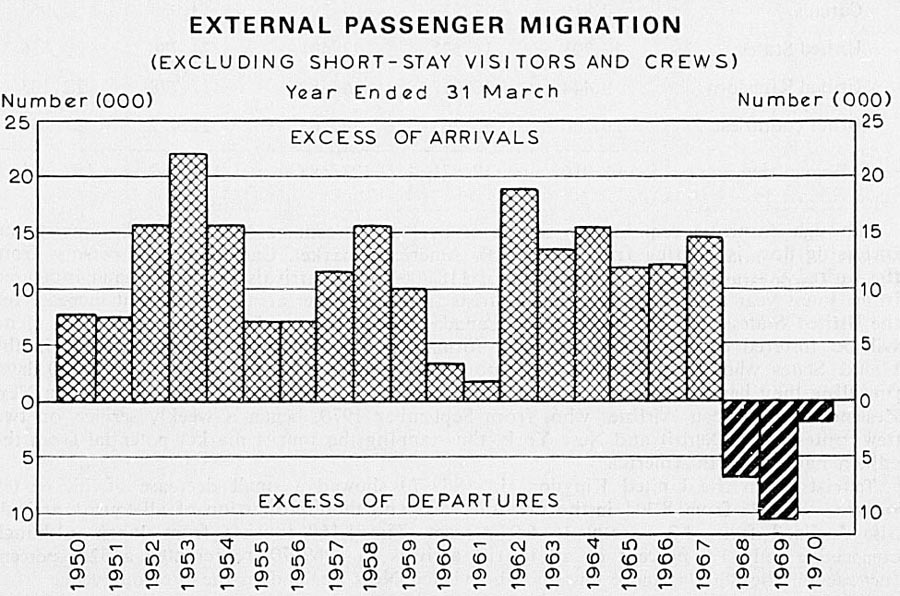
Seasonal Flow of Arrivals—Arrivals are highest in December, January, and February. These arrivals, taken in conjunction with the demand from the New Zealand summer holiday period, impose a strain on available hotel accommodation at the major tourist resorts. The seasonal pattern of arrivals for the year ended 31 March 1970 is given in the following table.
| Month of Arrival | Visitors | Through Passengers | All Arrivals | ||
|---|---|---|---|---|---|
| From Australia | From United States | All Visitors | |||
| Percent | |||||
| April | 6.9 | 4.7 | 6.0 | 5.2 | 5.7 |
| May | 6.1 | 3.9 | 5.6 | 7.6 | 6.3 |
| June | 4.9 | 4.1 | 4.6 | 6.9 | 5.4 |
| July | 5.2 | 6.9 | 5.4 | 5.0 | 5.3 |
| August | 6.9 | 6.0 | 6.6 | 5.8 | 6.2 |
| September | 5.3 | 6.0 | 5.6 | 8.2 | 6.5 |
| October | 6.6 | 8.7 | 7.5 | 9.1 | 8.1 |
| November | 7.9 | 15.6 | 10.3 | 4.6 | 8.3 |
| December | 18.8 | 8.2 | 15.7 | 16.4 | 16.0 |
| January | 11.0 | 8.9 | 10.6 | 9.5 | 10.2 |
| February | 8.6 | 15.3 | 10.9 | 10.8 | 10.9 |
| March | 11.8 | 11.7 | 11.2 | 10.9 | 11.1 |
| Totals | 100.0 | 100.0 | 100.0 | 100.0 | 100.0 |
Accommodation in New Zealand—Leading hotels in the main centres, and Tourist Hotel Corporation hotels and others in the main resort areas, all provide first-class accommodation. Most hotels and motor hotels have a private bathroom or shower and toilet with every bedroom. These establishments usually operate on a room-only basis, with meals an optional extra. Single occupancy room charges range between $8.00 and $12.00 a night; double occupancy, $10.00 to $20.00.
New Zealand has many clean and comfortable medium-price hotels, where not all rooms have private facilities.
As in other parts of the world, reservations—especially at the main scenic areas in the peak season (November to March)—are often difficult to obtain if early application is not made. Therefore, it is advisable to arrange for reservations well ahead of the proposed visit.
There are 12 Tourist Hotel Corporation hotels. Mostly these are built in areas where, for reasons of isolation, private enterprise finds it uneconomical to operate. In many cases, the Tourist Corporation hotel has formed the nucleus on which private enterprise has developed.
Tourist Hotel Corporation hotels are situated at the following places:
| North Island | South Island |
|---|---|
| Waitangi, Bay of Islands | Mount Cook, Southern Alps |
| Waitomo (glow-worm caves), King Country | Lake Wanaka, Southern Lakes |
| Wairakei, near Lake Taupo | Franz Josef Glacier, West Coast |
| Lake Waikaremoana, Urewera | Lake Te Anau, Fiordland |
| Tokaanu, Lake Taupo | Milford Sound, Fiordland |
| Mount Ruapehu, central North Island ski-ing fields |
There are large numbers of good-quality motels throughout New Zealand, and twin-occupancy nightly charges range between $8.00 and $12.00.
Inventory of Accommodation—An inventory of accommodation has been compiled by the Tourist and Publicity Department. It relates only to hotels licensed to supply liquor and to motels. Private hotels and guest-houses (and also holiday flats not catering for overnight travellers) have not been included. Private hotels and guest-houses, however, provide a significant proportion (up to 20 percent) of all available commercial accommodation. In the following table statistics for licensed hotels and motels are set out by regional areas, as at mid-1969.
| Region | Rooms in Licensed Hotels | Units in Motels | ||
|---|---|---|---|---|
| Group 1 | Group 2 | Group 3 | ||
| Northland | 204 | 368 | 356 | 418 |
| Auckland | 973 | 315 | 214 | 649 |
| Western Waikato | 117 | 176 | 189 | 168 |
| Coromandel - Thames | - | 12 | 109 | 168 |
| Coastal Bay of Plenty | 18 | 151 | 156 | 250 |
| Rotorua | 308 | 150 | 69 | 427 |
| Upper Waikato - Inland Bay of Plenty | 42 | 24 | 113 | 67 |
| Taupo | 114 | 99 | 66 | 283 |
| Gisborne - Northern Hawke's Bay | - | 132 | 155 | 137 |
| Central Hawke's Bay | 80 | 65 | 111 | 269 |
| Southern Hawke's Bay - Wairarapa | - | - | 154 | 56 |
| King Country | 174 | 55 | 87 | 66 |
| Taranaki | 40 | 51 | 225 | 121 |
| Wanganui - Manawatu | 85 | 210 | 137 | 152 |
| Foxton - Paremata Coast | - | 29 | 27 | 75 |
| Wellington | 458 | 67 | 224 | 173 |
| Marlborough | 12 | - | 256 | 184 |
| Nelson | - | 72 | 154 | 135 |
| West Coast | 38 | 155 | 231 | 133 |
| North and Mid-Canterbury | - | 97 | 45 | 50 |
| Christchurch | 417 | 39 | 292 | 421 |
| Inland South Canterbury | 128 | - | 104 | 58 |
| Coastal South Canterbury - North Otago | - | 194 | 97 | |
| Central Otago | 75 | 16 | 59 | 126 |
| Dunedin | 148 | 94 | 125 | 134 |
| Southland | 25 | - | 120 | 30 |
| Queenstown | 185 | 19 | 79 | 111 |
| Milford - Te Anau | 117 | - | - | 138 |
| Invercargill - Bluff - Stewart Island | 110 | 133 | 87 | 84 |
| Totals | 3,868 | 2,529 | 4,138 | 5,080 |
NOTE—Licensed hotels are here grouped principally according to availability of rooms with private facilities. Group 1—all or most rooms so equipped, Group 2—sufficient private facilities for general availability, Group 3—a smaller proportion of rooms with private facilities.
Assistance to the Hotel Industry—The New Zealand Government has made available loan and guarantee finance to encourage the building of new hotels and motor hotels and the extension of existing hotels, to provide accommodation of a high standard to meet the demand from overseas tourists on the main tourist routes and at the four main centres of Auckland, Wellington, Christchurch, and Dunedin.
Under this scheme, the Government has made available NZ$17 million for approved accommodation, much of which has already been taken up, resulting in the availability of an additional 2,800 first-class beds.
A similar scheme of financial assistance in respect of tourist facilities other than accommodation was introduced in 1969, to encourage private-enterprise operators to develop recreational and entertainment amenities, where necessary, in focal tourist areas.
There are generous depreciation allowances for taxation purposes which apply to approved visitor accommodation.
WIDE RANGE OF ATTRACTIONS—New Zealand has often been described as “the world's most exciting travel package”. With features such as the amazing thermal areas, magnificent lakes and fiords, glaciers, alpine regions, and unrivalled hunting, fishing, and other sporting opportunities, New Zealand combines in a comparatively small area a host of attractions. In addition to these natural attractions, the dignity and charm of the Maori race offers for study a culture which is unique to New Zealand.
Resort Development—A major development in New Zealand was the opening of the Haast Pass road in November 1965. It links the Southern Lakes region on the eastern side of the Alps with the West Coast and opens up one of the greatest scenic round-trip drives in the world.
In Rotorua a Maori Arts and Crafts Institute was established to preserve and foster traditional Maori culture. The institute has assumed control of the Whakarewarewa Reserve and displays Maori arts and crafts in traditional settings as well as presenting traditional songs and dances. One of the highlights is the Maori Carving School.
At Queenstown the Government and private enterprise have co-operated in the development of winter sports facilities. At Coronet Peak the access road has been improved, a new restaurant completed, and a chairlift has been in operation since 1964.
At Pakatoa Island in the Hauraki Gulf a tourist and holiday resort has been developed. Only 12 minutes from Auckland by amphibian aircraft and 45 minutes by hydrofoil, the island has accommodation in a chalet village.
Weather—New Zealand lies wholly within the South Temperate Zone. The weather is sunny and rather changeable, but is neither excessively hot in summer nor uncomfortably cold in winter. A large portion of the country is favoured with at least 2,000 hours of sunshine a year.
Seasons—The seasons in New Zealand are the opposite of those in the Northern Hemisphere:
Summer: December, January, February
Autumn: March, April, May
Winter: June, July, August
Spring: September, October, November
TRANSPORT—All main cities, towns, and tourist resorts are served by regular road or rail services and there is an extensive network of internal air services. In addition to the inter-Island air services, the North and South Island are also linked by roll-on roll-off steamer services. These steamer services operate between Wellington and Picton and Wellington and Lyttelton.
Several international and national car rental companies, in addition to locally based companies, supply self-drive cars. All main centres also have chauffeur-driven cars available. Coach tours of a high standard and covering a range of prices and periods are operated by a number of companies.
At several locations, but particularly in the alpine and lakes regions of the South Island, set or charter air tours are available.
Travel Services—Fully accredited travel agencies are available throughout New Zealand. Most of the major international agencies are represented or have affiliates in the country and there are the Government Tourist Bureaus which offer a national service for overseas visitors and New Zealand travellers.
SPORTING ATTRACTIONS: Fishing—A wide variety of salt-water fish abound in the coasts, bays, and harbours and in both North and South Islands many streams, rivers, and lakes provide excellent rainbow and brown trout fishing.
Sizes of New Zealand trout vary from district to district depending on environment, climate, food available, and angling pressure. Average trout weights are as follows:
North Island—rainbow 2-21/2 lb and brown 5 lb in the Rotorua lakes, rainbow 41/2 lb and brown 5 lb in Lake Taupo, rainbow and brown 2 lb in river systems; South Island—rainbow and brown 2-3 lb in lake systems, sea-run brown 5 lb in West Coast rivers, sea-run “Quinnat” salmon 12 lb in the east coast rivers, landlocked salmon 2-21/2 lb.
Big-game Fishing—The warm waters off the east coast of the North Island provide some of the best surf, line, and scuba fishing in the world. The main bases for line fishing from charter boats are at Whangaroa, Bay of Islands (Russell, Otehei Bay, and Waitangi), Tutukaka, Mercury Bay (Whitianga), and Tauranga (Mayor Island).
The most prized catches are broadbill, black marlin, striped marlin and blue marlin, while other types of big game fish found in New Zealand waters are mainly tiger shark, hammerhead shark, mako shark, thresher shark, kingfish (yellow tail), and tuna. The best catches are usually made in February but fishing is good from December to April.
Shooting and Hunting—The principal game birds are duck, swan, pheasant, quail, geese, and chukor, but the sport is limited, the main season usually extending for about six weeks from early May.
There are fewer restrictions, however, on stalking—no limit on the number of game animals that can be taken, no licence required, and the season is open all year round. The top trophies are chamois and thar but good hunting also includes red deer, fallow deer, wild pigs, goats, and wallaby, other species present in lesser numbers and somewhat scarce are wapiti (elk), sambur deer, rusa deer, sika deer and whitetail deer. A guide is essential for results.
Ski-ing—The ski-ing in New Zealand extends from mid-July to late October in the North Island and from early July to late September in the South Island. With the operation of ski-planes from the airstrip at Mount Cook very good spring ski-ing is also available for experienced skiers on the South Island glaciers.
In the North Island the main ski-ing centre is Mount Ruapehu in the Tongariro National Park. Equipment and instruction is available for skiers, and facilities include three chairlifts, a T-bar, three Poma lifts, and two rope tows. Mount Egmont is the North Island's other principal ski area, with fields at Dawson Falls, Stratford, and North Egmont.
In the South Island the principal areas are Mount Cook (for ski-touring), Coronet Peak (Queenstown), Lake Ohau, Porter's Pass, and Arthur's Pass. Coronet Peak, 7 miles from Queenstown, has the best powder snow conditions in New Zealand lying on extensive undulating slopes of varying gradients; equipment and professional instruction is available for skiers, and facilities include chairlifts and a series of ski tows.
Mountaineering and Tramping—The proximity of mountain and forest to the main centres of population encourages tramping in New Zealand. Both North and South Islands have appealing tramping routes and parties can set out to enjoy the beauty and challenge of lonely country.
In the Waitakere and Hunua Ranges near Auckland, the central ranges of the North Island, at Mount Egmont, Tongariro National Park, and the Urewera area, and in the South Island's Fiordland, there are numbers of tracks with high mountain traverses and passages through beautiful scenery.
Other Sports—A wide range of other sports is available. Golf courses are to be found in all parts of the country. Horse-racing takes place throughout the year. Rugby football and cricket are widely played during their seasons. There are facilities for bowls, tennis, skating, squash and most other sports in most parts of the country.
Scenery and Recreation—The 1960 and 1962 issues of the Yearbook contained pictorial supplements entitled “Scenic New Zealand” and “New Zealand's National Parks”. In the 1965 issue of the Yearbook the photographs were devoted to the wide opportunities of outdoor recreation, those in the 1967 issue covered “Attractive New Zealand”, those in the 1969 Yearbook were devoted to the forests, and those in the 1970 issue were entitled “Natural New Zealand”. The attractions of the national parks are described in Section 13
Thermal Areas and Spas—New Zealand is distinctive in having a wide range of volcanic phenomena and associated thermal spas. The chief concentration is in the volcanic belt north-east from the three major volcanoes, all usually quiet, in the centre of the North Island. Most notably in the Rotorua locality are a variety of geysers, mud-pools, pools of boiling water, and steam blow-holes
Many mineral springs are reputed to have a beneficial effect and mineral baths are maintained by private interests in many places. The Tourist Department controls baths at Rotorua, Morere, and Te Aroha.
Rotorua, with its great variety and abundance of hot springs, is a well-known New Zealand spa. The Ward Baths, in the Government Gardens, are in the heart of the town and are popular with guests and city residents alike. The Ward Baths consist of the private Rachel Baths of alkaline silicaceous sulphur water and hot swimming pools. All are used for the relief of stiff or aching muscles and joints. The Priest and Radium pools produce a pleasant stimulating effect through the skin. In addition, Aix Treatments are available in a newly-constructed wing of the Ward Baths. The Blue Baths are public baths (also in the Government Gardens) with two swimming pools—one for adults and one for children, and are very popular with the fit and well.
At Taupo, Wairakei, and Matamata hot mineral waters feed into attractive swimming pools.
Shopping and Souvenirs—Many visitors delight in the number and range of small shops. With the accelerated growth of tourism in recent years, there are more shops devoted to souvenirs and goods of special interest. Articles of a particularly New Zealand character include attractive jewellery made from paua shell, greenstone and gem stones, Maori carvings in native timbers, records of Maori singing, excellent woollen goods including lambskin and sheepskin rugs and clothing, and a range of charms, teaspoons, and pottery depicting Maori emblems and natural features.
Tourist and Publicity Department—Under the Tourist and Publicity Act 1963 the principal functions of the Department are to encourage and develop the New Zealand tourist industry and tourist traffic, to, within, and beyond New Zealand; to operate publicity, information, and public relations services; and to maintain a travel service. The Publicity Division among other things, supplies New Zealand publicity material by way of publications, films, photographs, and displays for use within New Zealand and overseas, to create a background knowledge of New Zealand and its people and way of life
The Tourist Division promotes tourism and also operates a comprehensive travel service. Officers of the Department organise travel itineraries for both New Zealand travellers and overseas visitors, reserve their accommodation, and meet overseas vessels and aircraft. Bureaus are now sited in Auckland, Te Aroha, Rotorua, Wellington, Christchurch, Dunedin, and Invercargill, with agencies in other parts of New Zealand. There are overseas offices in Sydney, Melbourne, Brisbane, London, San Francisco, Los Angeles, and New York, and the Department is represented in South Africa.
Other Tourist Organisations—The New Zealand National Travel Association, an organisation representing private travel interests in New Zealand, is also concerned with the development of the tourist industry.
New Zealand is a member of the International Union of Official Travel Organisations, an association whose principal aims are to ease travel difficulties and obstacles and promote travel research, and also is a foundation member of the Pacific Area Travel Association which was formed in 1952 as a tourist promotional body for the Pacific Area. The Pacific Area Travel Association held their 19th Annual Conference in Auckland in April 1970.
METRICATION—New Zealand is to substantially convert to the metric system of weights and measures by the end of 1976. The conversion will apply to imperial units of weight, distance, area, volume, and temperature; other more complex units will take longer than one generation. Unlike the change to decimal currency, the change to metric units cannot be made completely on an “M” day. The change will be progressive and has already commenced.
Generally speaking, the costs of conversion will be met by those incurring these costs, as in the United Kingdom and Australia.
The target date of 1976 for substantial conversion to metrication has been carefully chosen to co-ordinate with conversion in other countries. New Zealand has close ties with the United Kingdom in trade, manufacturing techniques, standardisation, and education. Planning for substantial completion to metrication 1 year after the United Kingdom is realistic and almost unavoidable because of New Zealand's dependence on the United Kingdom for so much of its material, machines, text books, and other items. It is expected also that the change in New Zealand will proceed in step with Australia to the extent that this is possible.
New Zealand's decision to change to the metric system is based almost entirely on the necessity to keep in step with overseas trading partners; and it is for this reason that planning is for metric conversion in New Zealand to be substantially completed by the end of 1976. However, there will be some areas in which the conversion will extend well beyond this date—depending on normal replacement cycles for major items of industrial plant or machinery.
Metric Advisory Board—A Metric Advisory Board has been appointed to oversee metrication in New Zealand. The 16 members of the Board represent manufacturing, farming, construction, education, trade, and government interests. The Board is serviced by the Department of Industries and Commerce.
The Board has established a number of sector committees to plan for the conversion. These sector committees cover all the main groups in the economy, viz, Agriculture, Education, Fuel and Power, Manufacturing and Processing Industries, Engineering and Engineering Servicing Industries, Standardisation, Building and Construction, Transport and Communications, Food and Consumer Goods and Services, Recreation, Health and Sport, Science and Technology, Central and Local Government, and Public Relations.
The role of the Sector Committees is to identify problems, prepare timetables and co-ordinate the metric conversion in their respective sectors of the economy. Whenever possible, Sector Committees will negotiate with national associations or organisations rather than with local interests or individuals.
METRIC SYSTEM—The metric system is not only simpler and more efficient than the imperial system but also has the benefits of internationally agreed definition and standardisation.
Since 1955 there has been a world-wide change to the exclusive use of the metric system and over 126 countries are now classified by the United Nations as ‘metric’. Countries currently in the process of change include the United Kingdom, Australia and South Africa.
The modern version of the metric system known as the “International System” (also called SI—”Systeme International d'Unités”) has been adopted for use in New Zealand. It is also being adopted by all those other countries that have recently changed, or are in the process of changing, to the metric system. The system is explained in the special article in the 1970 Official Yearbook.
The metric system is being used in New Zealand to some extent. The pharmaceutical industry and the hospitals have already changed over and metric measures are already used in some industries and are the principal measures employed in scientific establishments. Metric measures are taught in secondary schools and are used extensively in tertiary education. Many people are already familiar with metric measures, for example, in film, camera, and paper sizes and in sporting events.
A major step in the conversion programme was taken on 1 July 1971 when the units previously used in meteorological reporting of temperature and rainfall, the degree Fahrenheit and the inch, were replaced by the degree Celsius and the millimetre. Also since 1 July 1971 the wool industry has conducted all trading transactions (other than for wool textiles) in metric weights.
| METRIC EQUIVALENTS | |
|---|---|
| 1 yard | = 0.914 metre |
| 1 mile | = 1.609 kilometres |
| 1 inch | = 2.54 centimetres |
| 1 square foot | = 929.03 square centimetres |
| 1 square yard | = 0.836 square metre |
| 1 acre | = 0.405 hectare |
| 1 square mile | = 2 59 square kilometres |
| 1 ounce | = 28.35 grams |
| 1 pound | = 0.454 kilograms |
| 1 hundredweight (cwt) | = 112 lb = 50.8 kilograms |
| 1 cubic foot | = 0.028 cubic metre |
| 1 cubic yard | = 0.765 cubic metre |
| 1 gallon | = 4.546 litres |
| 1 bushel | = 36.37 litres |
| 1 long ton | = 1.016 metric tons |
| 1 short ton | = 0.907 metric ton |
| 1 mile/gal | = 0.354 km/litre |
| 1 cwt/acre | = 125.535 kg/hectare |
| 1 m.p.h. | = 1.609 km/h |
| 1 h.p. | = 0.746 kW |
| 1 kWh | = 3.6 MJ |
Everyday Units—The Metric Advisory Board has recommended the following units for use in New Zealand:
| Category | Unit | Symbol | Relationships |
|---|---|---|---|
| temperature | degree Celsius | °C | |
| length | millimetre | mm | |
| centimetre | cm | 1 cm = 10 mm | |
| metre | m | 1 m = 100 cm | |
| kilometre | km | 1 km = 1000 m | |
| area | square centimetre | cm2 | |
| square metre | m3 | 1 m2 = 10,000 cm2 | |
| decare | daa | 1 daa = 1000 m 2 | |
| hectare | ha | 1 ha = 10 daa | |
| volume | cubic centimetre | cm3 | |
| cubic metre | m3 | 1 m 3 = 1,000,000 cm 3 | |
| capacity | millilitre | ml | |
| litre | 1 | 1 1 = 1000 ml | |
| weight | gram | g | |
| kilogram | kg | 1 kg = 1000g | |
| tonne | t | 1 t = 1000 kg |
In addition to the above 16 units, the decimetre (dm) will be taught to children as a convenient unit of length (1 dm = 10 cm.)
| A. Commonplace Units of Measurement | ||
|---|---|---|
| Item | Metric | Imperial Measure |
| Man's height | 1.72 m (metres) | 5 ft 8 in. |
| Man's weight | 74.8 kg (kilograms) | 11 st 11 lb. |
| Woman's weight | 57.0 kg (kilograms) | 9 st 0 lb. |
| Body temp, (normal) | 37.0°C (degrees centigrade) | 98.4°F. |
| Door height | 2.00 m (metres) | 6 ft 6 in. |
| Car length | 4.70 m (metres) | 15 ft 6 in. |
| Oil drum capacity | 200 1 (litres) | 44 gal. |
| Building section's area | 1,000 m2 (square metres) | 1/4 acre. |
| Dunedin to Christchurch | 370 km (kilometres) | 230 miles |
| Altitude of Mt. Cook | 3,764 m (metres) | 12,349 ft. |
PATENTS, DESIGNS, AND TRADE MARKS—The legislation concerned is the Patents Act 1953, the Trade Marks Act 1953, and the Designs Act 1953. The total number of applications for the grant of letters patent, and for the registration of designs and trade marks during the financial year 1969-70, was 7,322 which was 231 less than the previous year.
The following table shows the number of applications for patents and for the registration of trade marks and designs for March years.
| Year | Patents | Trade Marks | Designs |
|---|---|---|---|
| 1958-59 | 2,356 | 1,896 | 246 |
| 1959-60 | 2,784 | 2,258 | 280 |
| 1960-61 | 2,833 | 2,496 | 343 |
| 1961-62 | 2,848 | 2,229 | 357 |
| 1962-63 | 2,820 | 2,304 | 308 |
| 1963-64 | 3,192 | 2,571 | 366 |
| 1964-65 | 3,447 | 2,690 | 435 |
| 1965-66 | 3,450 | 2,591 | 340 |
| 1966-67 | 3,665 | 2,947 | 361 |
| 1967-68 | 3,698 | 2,901 | 423 |
| 1968-69 | 3,953 | 3,195 | 405 |
| 1969-70 | 3,701 | 3,320 | 301 |
Patents—The applications received during 1969-70 were broadly classified as follows: chemistry, 1,129; mechanical engineering, 902; electrical engineering, 614; building construction, 355; home science and miscellaneous, 493; primary industries, 208.
Applications originating in New Zealand totalled 961, the United States of America 844, Great Britain 701, Germany 288, with the remaining 907 distributed among 24 other countries.
Trade Marks—During the year 1969-70 applications for trade marks covered the whole of the 34 classes prescribed, the most favoured being Class 5: pharmaceutical and sanitary substances, etc., 489; Class 3; soaps, detergents, perfumery, cosmetics, etc., 375; Class 25; clothing, boots, shoes, etc., 258.
The countries from which the applications originated were: New Zealand, 964; United States of America, 834; Great Britain, 510; Australia, 285; with the remaining 727 distributed among 22 other countries.
Renewal of registration of 2,434 trade marks was effected during the year.
Designs—A total of 335 industrial designs was registered during the year 1969-70.
INVENTIONS DEVELOPMENT AUTHORITY—In March 1968 the New Zealand Inventions Development Authority was appointed under the Inventions Development Act 1966. The general functions of the Authority are to promote the development or exploitation of inventions with the object of improving the quality, efficiency, or range of goods or services available for use in New Zealand or for export. The definition of “invention” includes any new or improved process or technique. A main function of the Authority is to secure the development or exploitation of inventions resulting from public research.
COPYRIGHT—Under the Copyright Act 1962, copyright comes into existence automatically upon the completion of any original literary, dramatic, musical, and artistic work (including photographs). No registration is necessary (or even possible), nor is any other formality required for securing copyright protection.
Copyright also subsists in New Zealand in sound recordings, cinematograph films, broadcasts, and published editions (typography) of literary, dramatic, and musical works.
Copyright in literary, dramatic, musical, and artistic works (except photographs) continues until 50 years after the author's death, if the works are published in the author's lifetime, and until 50 years after publication or 75 years after death (whichever is shorter) if they are unpublished at the death of the author. Copyright in photographs, sound recordings, cinematograph films, and broadcasts continues until 50 years after the making, and in editions until 25 years after publication.
Copyright in New Zealand in literary, dramatic, musical, and artistic works and in cinematograph films extends to all countries which are parties to the International Convention for the Protection of Literary and Astic Works (Berne Copyright Union) and to all countries which are parties to the Universal Copyright Convention. In some cases sound recordings, broadcasts, and published editions are also protected overseas. New Zealand is a party to both Conventions. Most of the important countries of the world (except at present Russia and China, but all English-speaking countries) have acceded to the one or the other or to both Conventions.
In New Zealand certain disputes relating to performing rights of copyright works, sound recordings, or films may be determined by the Copyright Tribunal.
INDUSTRIAL DESIGN COUNCIL—This council has been established under the Industrial Design Act 1966 to promote the development of industrial design with the object of improving the quality, efficiency, packaging and appearance of goods produced in New Zealand. It works in closely with the Inventions Development Authority. It has established a design index whereby approved products can qualify to display the Designmark label. A magazine Designscape is published and liaison functions are provided for a designer service.
STANDARDS COUNCIL—By the Standards Act 1965 the Standards Council was established as an independent body of 43 members from 1 April 1966. The functions of the Council are to promote standardisation in industry and commerce and to promulgate standards with the object of improving the quality of goods produced, promoting industrial efficiency and development, and promoting public and industrial welfare, health, and safety. The Council largely continues the functions previously performed under earlier legislation in 1941. It functions through the Standards Association which has taken the place of the former Standards Institute. The Standards Association is paying increasing attention to international standardisation and to consumer goods.
PUBLIC TRUST OFFICE—In the early years of settlement in New Zealand those who wished to make provision for the administration of their estates on their death often experienced difficulty in selecting a suitable person competent and willing to act as trustee. That difficulty was natural in a new country where the colonists were fully occupied with their own affairs, and were unable to give to the property or business of another the close attention that was demanded.
In these circumstances the Public Trust Office was established in 1872 (it is now constituted under the Public Trust Office Act 1957) under the administration of the Public Trustee, a corporation sole with perpetual succession and a seal of office. The main purpose of the original Act was to provide a means of overcoming the difficulties that have been mentioned and to make available to the public a trustworthy administrator of the estates of deceased persons at a reasonable cost, the integrity of the Public Trustee and his officers being guaranteed by the State. That continues to be the chief function of the Office, but since its establishment the range of service has been very considerably extended. The Public Trustee now acts in many capacities, e.g., as administrator in intestate estates; executor and trustee under wills; trustee under marriage and other settlements; trustee of benefit or relief funds; agent or attorney for absentees or persons desiring to be relieved of business worries; sinking fund commissioner for local authorities; administrator of unclaimed lands and property; manager of the estates of protected patients (other than Maoris); manager (when so appointed by the Court) of the estates of aged and infirm persons unable to attend to their own affairs; and trustee of compensation moneys payable in respect of the death of a worker. The wills of persons desiring the Public Trustee to act as their executor and any subsequent will or codicil may be prepared and held in safe custody by him, free of charge. With certain qualifications the Public Trustee may act jointly with another person or persons.
In lieu of obtaining probate or other grant of administration, the Public Trustee may file in an office of the Supreme Court an election by him to administer an estate (testate or intestate) if the gross value of the property in New Zealand is estimated not to exceed $2,000. If after the filing of the election the value of the property is found to exceed $3,000, the Public Trustee must obtain a grant of probate or administration in the ordinary way.
During the year ended 31 March 1970, 4,626 estates and funds valued at $45,136,483 were accepted for administration. The administration of 4,646 estates and funds was completed. Estates and funds under administration at 31 March 1970 numbered 20,128 and were valued at $214,513,528.
Capital moneys becoming available for investment either form part of the Common Fund of the Office or, at the option of the testator or settlor, are invested in such securities as he may specify. Interest is allowed on moneys in the Common Fund at the rate fixed from time to time by the Governor-General in Council and is free of all commission and other charges. Both capital and interest are guaranteed by the State, thus affording the complete security that it is the object of the Office to provide. On the other hand, moneys directed to be invested in specified securities do not carry the State guarantee and, subject to the Public Trustee's ordinary liability as a trustee any loss resulting from their investment falls upon the estate concerned. Commission is charged on the collection of the interest. Recognising that the safety of the moneys is thereby assured, the great majority of testators and settlors desire their funds to be placed in the Common Fund.
Charges and commission rates are contained in the Public Trust Office Regulations 1958.
New investments completed during the year ended 31 March 1970 totalled $10,120,557, the favourable terms offered by the Office again proving popular with borrowers. The investments held by the Office at 31 March 1970 totalled $59,813,462. These figures relate exclusively to Common Fund investments, and do not include other special investments made on behalf of estates or investments which constitute assets of estates when the latter came under the Public Trustee's administration and which are still held as assets of those estates.
During the year ended 31 March 1970, 12,602 wills appointing the Public Trustee executor were deposited with him for safe custody. The total number of such wills held on deposit at 31 March 1970 was 233,944. During the year ended 31 March 1970 effect was given in 9,584 cases to changes desired by testators.
BANKRUPTCY—The law relating to bankruptcy in New Zealand is contained in the main in the Insolvency Act 1967. Jurisdiction in bankruptcy matters is vested in the Supreme Court. The Governor-General, however, may by Proclamation confer similar jurisdiction on a Magistrate's Court in cases where the liabilities do not exceed $600.
All proceedings in bankruptcy are commenced by a petition filed in the Court. A petition may be filed either by the debtor or by a creditor, a fee of $12 being payable. The filing of a debtor's petition is equivalent to an order of the Court adjudging the debtor a bankrupt, no order being required in this case. Not less than $60 in the aggregate must be owing by the debtor to the creditor or creditors filing a petition.
The value of furniture and household effects, including wearing apparel of himself and family, which a bankrupt may select and retain as his own property is $300.
The Official Assignee is empowered to sell the bankrupt's property, to claim debts due to the bankrupt estate, to carry on the business of the bankrupt so far as is necessary or expedient for its beneficial winding up, or to divide the property among the creditors. The bankrupt may be appointed by the Official Assignee to manage his estate or carry on his business on behalf of the creditors.
Creditors may accept a composition in satisfaction of the debts due to them. In such a case, after approval of the Court, a deed of composition is executed and filed, and the bankruptcy annulled.
On application being made by the bankrupt, the Court is empowered to grant him an order of discharge, either absolute, suspended, or conditional. The application may be opposed either by the Official Assignee or by any creditor who has proved his claim. A public examination of the bankrupt may be demanded by the Assignee on a resolution by creditors.
Another form of financial failure is covered by private assignments, of which there were 15 in 1966, 12 in 1967, 10 in 1968, 6 in 1969, and 5 in 1970. Private assignments are not included in official bankruptcy statistics.
Transactions in Bankruptcy—The number of transactions in bankruptcy during the last five years is now given. A long-term record of the more important features will be found in the Statistical Summary given later in this volume.
| Year | Bankruptcies | Orders of Discharge or Annulment Granted | Court Orders for Liquidation of Companies | Total Commercial Failures | |
|---|---|---|---|---|---|
| Petitions by Debtors | Adjudications on Petitions by Creditors | ||||
| 1966 | 415 | 68 | 149 | 24 | 507 |
| 1967 | 533 | 69 | 130 | 50 | 652 |
| 1968 | 693 | 65 | 110 | 62 | 820 |
| 1969 | 523 | 69 | 121 | 67 | 659 |
| 1970 | 469 | 66 | 194 | 61 | 596 |
In the case of a partnership, each partner is counted in the total of transactions and also the partnership. The general bankruptcy statistics do not cover private assignments and compositions, but relate only to cases dealt with by Official Assignees.
In some cases of company liquidations, subsequent court orders are given for the winding up of companies to be transferred to private liquidators. There were 15 such cases in 1968, 9 in 1969, and 7 in 1970; these are not included in the above table and succeeding tables.
The table following shows for each of the last 11 years the average amount of debts proved per estate, and also the proportion of dividends, preferential claims, and secured claims, to debts.
| Year | Average Debts Proved per Estate | Proportion of Dividends, etc., to Debts |
|---|---|---|
| $ | percent | |
| 1960 | 2,702 | 20.9 |
| 1961 | 3,332 | 17.7 |
| 1962 | 3,618 | 15.3 |
| 1963 | 2,934 | 23.1 |
| 1964 | 3,520 | 16.8 |
| 1965 | 4,610 | 13.3 |
| 1966 | 4,010 | 15.1 |
| 1967 | 3,546 | 10.7 |
| 1968 | 4,565 | 6.8 |
| 1969 | 5,680x | 14.8 |
| 1970 | 6,141 | 10.3 |
Apart from dividend, preferential and secured claims, and Government commission, payments made from assets realised include cost of actions, solicitors' fees, and expenses incurred in managing estates for the benefit of creditors.
In the following table bankruptcies are classified according to amount groups of stated liabilities. With all partnerships the liabilities for each partner are included, but not the partnership. Company liquidations are included.
| Liabilities | 1966 | 1967 | 1968 | 1969 | 1970 |
|---|---|---|---|---|---|
| *Excludes partnerships, 1966, 4; 1967. 12; 1968, 12; 1969, 4; and 1970, 4. | |||||
| Under $500 | 87 | 102 | 121 | 79 | 64 |
| $500- $999 | 111 | 117 | 191 | 119 | 115 |
| $1,000-$1,999 | 99 | 147 | 153 | 141 | 137 |
| $2,000-$3,999 | 84 | 112 | 136 | 129 | 94 |
| $4,000-$9,999 | 83 | 102 | 120 | 119 | 104 |
| $10,000 and over | 39 | 60 | 87 | 68x | 78 |
| Totals | 503* | 640* | 808* | 655* | 592x |
Industry Groups of Bankrupts—All persons adjudged bankrupt (whether self-employed, employers of labour, or salary and wage earners) have been classified in the following table according to the industry in which they were last employed.
| Industry Group | 1966 | 1967 | 1968 | 1969 | 1970 |
|---|---|---|---|---|---|
| *Excludes partnerships as follows: 1966, 4; 1967, 12, 1968, 12; 1969, 4; and 1970, 4. | |||||
| Agriculture and livestock production | 42 | 46 | 77 | 66 | 48 |
| Forestry, hunting, and fishing | 8 | 22 | 23 | 25 | 24 |
| Mining and quarrying | 4 | 3 | 5 | 2 | - |
| Manufacturing— | |||||
| Food and beverages | 12 | 10 | 25 | 10 | 15 |
| Footwear and textiles | 9 | 6 | 8 | 7 | 12 |
| Wood, furniture, and fixtures | 10 | 11 | 13 | 6 | 11 |
| Printing and publishing | 2 | 2 | 3 | 2 | - |
| Machinery (not electrical) | 6 | 5 | 5 | 8 | 17 |
| Transport equipment | 13 | 19 | 28 | 28 | 13 |
| Other | 32 | 16 | 23 | 11 | 7 |
| Construction | 56 | 101 | 110 | 106 | 90 |
| Wholesale and retail trade | 74 | 66 | 71 | 91 | 89 |
| Other commerce | 6 | 4 | 6 | 3 | 7 |
| Transport, storage, and communication | 58 | 90 | 113 | 72 | 72 |
| Personal and community services | 69 | 77 | 94 | 68 | 65 |
| Industry not adequately described | 67 | 82 | 100 | 53 | 37 |
| Persons not gainfully employed in any industry | 11 | 30 | 42 | 30 | 24 |
| Totals* | 479 | 590 | 746 | 588 | 531 |
The types of activity in which bankrupts were engaged at the time of failure frequently bear little relationship to the fact of insolvency. Personal extravagance or business incompetence are probably much more important factors in the majority of cases.
The occupational status of individual bankrupts is given in the following table. With all partnerships the occupation of each partner is included, but not the partnership.
| Year | Occupational Status | ||||
|---|---|---|---|---|---|
| Working for Salary or Wages | Employer of Labour | Working on Own Account But Not Employing Labour | Not Gainfully Employed | Total* | |
| *Excludes partnerships as follows: 1960, 1; 1961, 3; 1962, 9; 1963, 2; 1965, 1; 1966, 4; 1967, 12; 1968, 12; 1969, 4; and 1970, 4. | |||||
| 1960 | 232 | 109 | 117 | 14 | 472 |
| 1961 | 178 | 86 | 117 | 16 | 397 |
| 1962 | 235 | 134 | 169 | 12 | 550 |
| 1963 | 269 | 104 | 163 | 10 | 546 |
| 1964 | 262 | 69 | 139 | 13 | 483 |
| 1965 | 251 | 91 | 123 | 17 | 482 |
| 1966 | 262 | 92 | 114 | 11 | 479 |
| 1967 | 301 | 116 | 143 | 30 | 590 |
| 1968 | 392 | 119 | 193 | 42 | 746 |
| 1969 | 263 | 123 | 172 | 30 | 588 |
| 1970 | 243 | 101 | 163 | 24 | 531 |
INTERNATIONAL INDICATORS OF STANDARDS OF LIVING—Measurements of standards or levels of living between countries constitute a complex problem for which there is no completely adequate or satisfactory solution in the way of an index that can be applied internationally. United Nations statistics on estimates of gross national product per head are indicators of relativities in the production of goods and services on a national basis; leading countries include United States, Sweden, Canada, Switzerland, Denmark, France, Australia, Norway, West Germany, Belgium, New Zealand, Netherlands, United Kingdom, and Finland.
Relative standards of living cannot be compared by taking per-head incomes or expenditure alone. In a report in 1954 a committee of experts convened by the Secretary General of United Nations jointly with the International Labour Office and UNESCO concluded that the measurement of differences or changes in the levels of living is a complex problem which has no completely adequate or satisfactory solution. “The level of living is an organic unity embracing both material and non-material aspects of culture”. In seeking to analyse the factors affecting the level of living, the Committee proposed a classification as follows: 1. health, including demographic conditions; 2. food and nutrition; 3. education, including literacy and skills; 4. conditions of work; 5. employment situation; 6. aggregate consumption and savings; 7. transportation; 8. housing, including household facilities; 9. clothing; 10. recreation and entertainment; 11. social security; and 12. human freedoms. In the opinion of the Committee there is no single statistical measure of the level of living as a whole that can be applied internationally. In this connection, the Committee advised against the use of per-head national income as an international index of the level of living. It concluded in fact, for several reasons, including difficulties of determining purchasing power parities and of converting currencies, no type of monetary index as a general international measure of levels of living could be recommended. The Committee agreed, however, that monetary comparisons are not without interest in comparing economic differences between groups of individuals and countries, but calculations must be carefully prepared and properly interpreted.
Some comparative indicators are set out in the following table. In other sections of the Yearbook there are international comparisons on food consumption, life expectancy, infant mortality, and newspaper circulation.
| INTERNATIONAL COMPARISONS RELATED TO STANDARDS OF LIVING | ||||||
|---|---|---|---|---|---|---|
| Item | New Zealand | United States of America | Canada | Australia | United Kingdom | Sweden |
| *England and Wales. †1947 | ||||||
| Number per 1,000 of population— | ||||||
| Passenger cars (1968) | 300 | 416 | 297 | 282 | 200 | 262 |
| Television sets (1967) | 209 | 392 | 284 | 206 | 263 | 288 |
| Telephones (1968) | 406 | 518 | 407 | 271 | 219 | 498 |
| Annual consumption of energy per head, 1967 (In terms of coal, kg) | 2.590 | 9.828 | 8.060 | 4.791 | 5.003 | 4.787 |
| Enrolment in higher education per 100.000 of population (1965) | 1.948 | 2.840 | 1.651 | 1.159 | 480* | 923 |
| Persons per hospital bed (1964) | 90 | 110 | 90 | 80 | 120 | 70 |
| Persons per doctor (1968) | 866 | 700 | 820 | 840 | 870* | 910 |
| Housing—Percentage of dwellings with— | ||||||
| Piped water | 99.9 | 94.0 | 95.2 | 78.8† | 98.7* | 94.3 |
| Baths | 98.1 | 88.1 | 89.8 | 84.0† | 85.1* | 72.9 |
LOTTERIES—Under the Gaming Act 1908 the Police may license raffles where the value of prizes does not exceed in aggregate $50 or the value of any one prize does not exceed $20. The Police may also approve specified organisations conducting raffles, where the aggregate value of prizes in any one raffle does not exceed $10. without the necessity for individual licences. Raffles with prizes exceeding the above maximum values may be licensed by the Minister of Internal Affairs. There were 18.802 licences issued under the Minister's authority during the year ended 31 March 1970 to local, provincial and national organisations. The Gaming Act precludes the issue of licences to conduct raffles for the purpose of private gain. Otherwise the Police and the Minister may issue licences subject to such conditions as they think fit. Under the Stamp Duties Act 1954, a raffle with prizes exceeding $1,500 in value is subject to a lottery duty of 10 percent of the value of tickets sold in the raffle. Information on receipts from this duty may be found in Section 26 B—Taxation.
The Gaming Act also permits sweepstakes and art unions (as defined) under certain conditions.
The Gaming Amendment Act 1962 provides for the Minister of Internal Affairs to promote lotteries. The “Golden Kiwi” and “Mammoth Golden Kiwi” national lotteries have been established. In both cases the number of tickets in a lottery is 250,000. “Golden Kiwi” lottery tickets cost 50 cents each and the prize list totals $66,000. “Mammoth Golden Kiwi” lottery tickets cost $2 each and the prize list totals $270,000. During the year ended 31 March 1970. 47 “Golden Kiwi” and three “Mammoth Golden Kiwi” lotteries were conducted. The aggregate financial results of these national lotteries since their inception are as follows:
| Item | 1962-63 | 1963-64 | 1964-65 | 1965-66 | 1966-67 | 1967-68 | 1968-69 | 1969-70 |
|---|---|---|---|---|---|---|---|---|
| Number of lotteries | 74 | 54 | 55 | 53 | 49 | 45 | 47 | 50 |
| Gross sales $(000) | 9,250 | 6,750 | 8,000 | 8,875 | 8,375 | 7,124 | 6,624 | 7,375 |
| Commission on sales $(000) | 925 | 675 | 744 | 776 | 725 | 655 | 653 | 711 |
| Expenses $(000) | 318 | 238 | 273 | 258 | 245 | 231 | 240 | 231 |
| Prizes $(000) | 4,444 | 3,510 | 4,242 | 4,722 | 4,458 | 3,786 | 3,510 | 3,912 |
| Net proceeds $(000) | 3,563 | 2,327 | 2,741 | 3,119 | 2,947 | 2,452 | 2,221 | 2,521 |
| Lottery duty $(000) | 925 | 675 | 800 | 887 | 837 | 712 | 662 | 737 |
| Net profit $(000) | 2,638 | 1,65 | 1,941 | 2,232 | 2,109 | 1,739 | 1,559 | 1,784 |
The net profits from these lotteries are required by the Gaming Amendment Act to be distributed for charitable, philanthropic or cultural purposes beneficial to the community. A Board of Control has the responsibility of apportioning profits of lotteries to various distributing authorities which consider applications for assistance from lottery profits and make grants. Allocations made by the Board in 1969-70 were as follows: $215,000 for the welfare of aged persons; $310,000 for social welfare including various mayoral and other relief or distress funds; $430,000 for youth organisations, sporting bodies, national water safety, national mountain safety, and to various bodies providing community facilities; $150,000 for medical research; $150,000 for scientific research; $260,000 to the Queen Elizabeth the Second Arts Council; and $70,000 for miscellaneous purposes.
LIQUOR LICENSING—The principal source of the liquor law of New Zealand is the Sale of Liquor Act 1962. The principles on which the liquor law of New Zealand rests are that no liquor may be sold without a licence, that new licences are not to be authorised unless they are shown to be necessary or desirable in the locality, and that there should be close regulation of the conduct of the trade and of the provision and standard of accommodation, amenities, and services.
There is a Licensing Control Commission whose principal functions are to ascertain the requirements of the public as to the provision of accommodation, services, and other facilities on licensed premises; to determine what new hotel, tavern and tourist house premises licences, restaurant licences and wholesale licences are needed and to authorise their issue; to review provisional hotel licences and determine whether the licence to be issued in their place should be a hotel or tavern premises licence; to prescribe and enforce standards of accommodation, amenities, and services; to grant club charters; and to hear appeals from licensing committees. There is a right of appeal to the Commission from every decision of a licensing committee except on a matter of law or character in which case the appeal is to the Supreme Court. Many of the Commission's decisions are themselves subject to appeal to the Supreme Court, and an appeal may be brought in any case on a point of law. Appeals now lie to the Administrative Division of the Supreme Court.
Licences either in force or authorised at 31 March 1970 comprised 929 hotel premises licences, 133 tavern premises licence, 48 tourist-house premises licences, and 170 wholesale licences.
There are 47 permanent club charters and 177 renewable club charters in force. All the permanent charters and some of the renewable charters permit the sale of liquor to members for consumption off as well as on the premises.
A total of 291 wine resellers' licences have been authorised.
New Licences—The Licensing Control Commission decides after a public inquiry whether the issue of a hotel, tourist-house, or tavern premises licence, or a wholesale or wine reseller's licence is desirable in a particular locality. In the case of a hotel, tourist-house, or tavern premises licence the Commission prescribes the minimum standards of accommodation, services, and other facilities that must be provided. It may direct that any bar-room of a hotel or tavern shall contain facilities for sit-down drinking. There is provision for a poll of residents on the question whether a hotel or tavern premises licence is not desired in the locality, and if the majority of votes recorded at the poll is against the licence the Commission may not authorise one unless special circumstances exist.
Subject to the result of any such poll the Commission (or in the case of a wholesale or wine reseller's licence, the Licensing Committee) then calls for applications for the licence. On each application the Commission fixes a fair price which the applicant, if successful, must pay. The decision of the Commission or the committee as to which applicant should receive the licence in effect fixes the exact site of the proposed premises. In the case of a hotel or a tavern any adult residing within a quarter of a mile may object to the Town and Country Planning Appeal Board on the grounds that the site is in the immediate vicinity of a church, school or hospital, or that the objector will be adversely affected by the establishment of a hotel or tavern on the site. In considering an objection on the ground of adverse affection, the Board has regard to the provisions of any district planning scheme (or if there is no such scheme, planning principles), to the distance between the site and the nearest substantial number of houses, to the provision made for off-street parking, and to other relevant circumstances.
Hours of Sale—The Sale of Liquor Act 1962 governs the hours of sale. A special general poll was held on 23 September 1967 concerning the closing hours for the sale of liquor in hotel bar-rooms. The closing hour had been 6 p.m. since 1917. Voting for later closing was 641,105 and for 6 p.m. closing it was 353,662. Under the Sale of Liquor Amendment Act 1967 the usual hours of opening and closing of hotels or taverns were fixed at 11 a.m. and 10 p.m. respectively. Provision was made for the Licensing Committee to vary the hours for particular hotels but no premises are to be open for the sale of liquor to the public for more than eleven hours a day. Sales from licensed premises are prohibited on Sundays, Christmas Day and Good Friday.
Legislation in 1960 authorised hotels to serve liquor to guests and lodgers partaking of a meal for consumption with the meal up to 11.30 p.m. on any day and between 12 noon and 2.30 p.m. on Sunday, Christmas Day, and Good Friday. By the same Act the hours during which licensed restaurants may sell and serve liquor to diners were fixed as 12 noon to 2.30 p.m. and 6 p.m. to 11.30 p.m. on any day. The Sale of Liquor Act 1962 authorises the Commission to grant permits to a hotel for the sale of liquor in a lounge or lounge bar to diners during hours fixed by the Commission, but not later than 11.30 p.m.
Licensing Trusts—The system of trust control in New Zealand is an alternative to the traditional means of controlling the sale of liquor through privately held licences supervised by licensing committees and since 1949 by the Licensing Control Commission. The system of licensing committees and the Licensing Control Commission gives the public an indirect control over the conditions under which liquor is sold. In the case of trusts public control is direct since the whole of the liquor trade in a trust district is conducted by the trust, which is elected by the residents and is responsible to them.
The first licensing trust in New Zealand was set up in 1944 following the carrying of restoration in the former Invercargill no-licence district. There are now eight district trusts—Ashburton, Clutha, Geraldine, Invercargill, Masterton, Mataura, Oamaru, and Porirua. In addition, three local trusts at Hornby and Cheviot in Canterbury and Mt Wellington in the Auckland suburbs are operating hotels.
The only remaining no-licence districts are parts of the Wellington and Auckland Metropolitan areas, namely, Eden, Grey Lynn, Roskill, Wellington East and Wellington West. Because of the circumstances of these areas and their relation to the metropolitan areas as a whole, legislation was enacted in 1963 providing a special procedure if any of them should carry restoration and introducing a new form of trust control known as suburban trusts.
On the carrying of restoration in any remaining no-licence district the Licensing Control Commission will review the area and decide what hotel, tourist-house and tavern premises licences and what wholesale licences are necessary on desirable in the district or any locality or place therein. If the Commission is of the opinion that it should authorise the issue of any licence a further poll is taken on the question whether all licences to be so authorised should be offered to suburban trusts.
Should the trust proposal be carried, any local authority in the district may apply (or if no such application is made within the prescribed time 100 or more residents may apply) for the licence or licences to be issued to a suburban trust and the application must be granted if it conforms to the standards defined by the Commission. A suburban trust would then be established in accordance with the regulations to operate the licence or licences. If the trust proposal were not carried the ordinary procedure under the Sale of Liquor Act would be followed.
GENERAL ELECTION RESULTS—A general election of parliamentary representatives was held on 29 November 1969, voting in New Zealand for both European and Maori electorates taking place on that day.
The strength of the political party representation among members of Parliament after the 1969 election was National 45. Labour 39. The relative strengths after the seven preceding general elections were as follows: November 1949, National 46, Labour 34; September 1951, National 50, Labour 30; November 1954, National 45, Labour 35; November 1957, Labour 41, National 39; November 1960, National 46, Labour 34; November 1963, National 45, Labour 35; November 1966, National 44, Labour 35, Social Credit 1.
The total number of electors on the roll for the election in 1969 was 1,503,952 comprising European, 1,452,328 and Maori 51,624. The number of votes recorded, including informal, was 1,351,813 (European 1,307,090; Maori 44,723).
The following table shows for the last four general elections the number of votes recorded by the main political parties, along with the percentages that the various party votes represent of the total valid votes.
| — | Votes Recorded | Percentage of Total Valid Votes | ||||||
|---|---|---|---|---|---|---|---|---|
| 1960 | 1963 | 1966 | 1969 | 1960 | 1963 | 1966 | 1969 | |
| National | 557,046 | 563,875 | 525,945 | 605,960 | 47,59 | 47.07 | 43.64 | 45.22 |
| Labour | 508,179 | 524,066 | 499,392 | 592,055 | 43,42 | 43.74 | 41.44 | 44.18 |
| Social Credit | 100,905 | 95,176 | 174,515 | 121,576 | 8.62 | 7.94 | 14.48 | 9.07 |
| Liberal | - | 10,339 | 5,243 | 20,577 | - | 0.44 | 0,87 | 1.53 |
| Communist | 2,423 | 3,167 | 0.21 | 0.26 | ||||
| Other | 1,950 | 1,422 | 0,16 | 0,12 | ||||
| Total valid votes | 1,170,503 | 1,198,045 | 1,205,095 | 1,340,168 | 100.00 | 100.00 | 100.00 | 100.00 |
| Informal votes | 6,460 | 7,277 | 7,032 | 11,645 | ... | ... | ... | ... |
| Total votes recorded | 1,176,963 | 1,205,322 | 1,212,127 | 1,351,813 | ... | ... | ... | ... |
Voting figures for individual electorates in 1969 were included in Latest Statistical Information of the 1970 Yearbook.
NATIONAL LICENSING POLL—The licensing poll of 29 November 1969 held in conjunction with the parliamentary elections, was the thirteenth at which the three issues—national continuance, State purchase and control, and national prohibition (without compensation)—were submitted to the electors. Official figures of the 1969 poll, together with those of five preceding polls, were as follows.
| — | 1954 | 1957 | 1960 | 1963 | 1966 | 1969 |
|---|---|---|---|---|---|---|
| For national continuance | 672,754 | 723,059 | 765,952 | 791,767 | 817,760 | 903,962 |
| For State purchase and control | 164,380 | 160,483 | 138,644 | 157,581 | 176,946 | 242,499 |
| For national prohibition | 250,460 | 260,132 | 255,157 | 235,959 | 198,859 | 176,055 |
POLL ON TERM OF PARLIAMENT—On 23 September 1967 a special general poll was held on a proposal that the term of the House of Representatives be changed. Votes for a maximum of three years as at present totalled 678,960; votes for a maximum term of four years totalled 317,973.
TIME-SERVICE ARRANGEMENTS—One uniform time is kept throughout New Zealand. The New Zealand Gazette of 31 October 1868 contained a Government announcement to the effect that the time corresponding to longitude 172° 30' east of Greenwich (exactly 111/2 hours in advance of Greenwich time) was to be adopted as the New Zealand Mean Time throughout the colony.
This New Zealand Mean Time 11 h 30min. in advance of Greenwich Mean Time (G.M.T.), was observed continuously up to 1927, when on 6 November clocks were advanced 1 hour until 4 March 1928. Summer Time, with clocks advanced only 30 minutes (to 12 h ahead of G.M.T.), became standard practice in the summer months under the Summer Time Act 1929.
The Daylight Saving Emergency Regulations of 1941 provided for the continuance of Summer Time throughout that year, and its continued observance during subsequent war years was provided for by regulations made annually.
By the Standard Time Act of 1945 the time of the meridian 180° east of Greenwich (12 h in advance of G.M.T.) was adopted as the Standard Time for New Zealand. Thus, what was formerly known as “Summer Time” became “New Zealand Standard Time” as from 1 January 1946.
The time throughout New Zealand is controlled by the New Zealand Time Service, Department of Scientific and Industrial Research, Wellington. The Observatory signal clock is kept as correct as possible by comparison with radio time signals from observatories in other parts of the world.
The Observatory provides a time service over Station ZLW and stations of the New Zealand Broadcasting Corporation.
BOOK PUBLISHING—The following table classifies the publications for 1969 which have been included by the Alexander Turnbull Library in the New Zealand National Bibliography 1969.
| Subject | Books | Pamphlets | Total |
|---|---|---|---|
| General | 8 | 28 | 36 |
| Religion, theology, philosophy | 16 | 56 | 72 |
| Sociology, statistics | 6 | 21 | 27 |
| Political science | 51 | 84 | 135 |
| Law, public administration, social welfare | 21 | 64 | 85 |
| Education | 38 | 56 | 92 |
| Trade, communications, transport | 13 | 29 | 42 |
| Linguistics, philology | 10 | 6 | 16 |
| Sciences | 59 | 65 | 124 |
| Technology, and trades | 26 | 85 | 111 |
| Agriculture, forestry | 34 | 77 | 111 |
| Domestic science | 9 | 10 | 19 |
| Commercial management | 13 | 20 | 33 |
| Fine arts, etc. | 22 | 56 | 78 |
| Entertainment, sport | 22 | 7 | 29 |
| Literature | 20 | 44 | 64 |
| Geography, travel | 50 | 56 | 106 |
| History, biography | 54 | 39 | 93 |
| Totals | 472 | 802 | 1,274 |
The New Zealand National Bibliography, which commenced publication in 1967, is issued monthly and cumulated annually by the National Library of New Zealand. It lists works published in New Zealand and also works published overseas by authors normally resident in New Zealand and works that deal in whole or part with New Zealand. It includes books, pamphlets, art prints, maps, new periodicals, and periodicals that have ceased publication.
At 31 March 1968 there were 1,409 periodicals (other than parish and school magazines) being received regularly under the provisions of the Copyright Act.
COMPUTERS—Technological change is an influential contributor to economic growth. Outstanding examples are the electric motor and the computer. A useful study “The Role of the Computer in the New Zealand Economy” was published in 1968 by the New Zealand Institute of Economic Research. Basically, computers are logical electronic information handlers whether they are used for accounting, traffic control, scientific calculations, design simulation, or controlling industrial processes. The first computer was imported into New Zealand in 1960 and by 1968 the total had risen to 87. (By 1970 the total exceeded 130.) In actual practice few computers are sold; they are imported by one of the large computer companies on behalf of the user who rents the equipment and pays importation charges of around three-quarters of the first year's rental which for a medium-sized unit may be $50,000.
An international comparison of computer rental expenditure in relation to national income in 1967 was made by the Institute of Economic Research. Equating New Zealand's proportion to a base of 100, the corresponding figure for Australia was 140, and for Denmark 180, Norway 135, and Finland 120. (The latter three countries were selected because they have populations under five million and have important agricultural sectors.) Computer applications in New Zealand are not generally at an advanced stage and few of them are working more than one shift.
The demand for computers has come from Government departments, local authorities, universities, primary producer boards, private firms in industries such as printing, forestry, insurance, oil, food processing, electrical equipment manufacturing, building and construction, clothing, engineering, airways, banking, retailing, motor assembly, paint manufacturing, and stock and station agents. Of the 87 digital computers in 1968, 59 were in the private sector. The Government has established a computer centre in Wellington to serve a number of Government departments, while small private firms use independent bureaus and those run by equipment suppliers.
PUBLIC HOLIDAYS—These are listed below.
| — | 1971 | 1972 | 1973 | 1974 |
|---|---|---|---|---|
| *Date of Queen's Birthday, 21 April 1926. | ||||
| New Year's Day | 1 January | 1 January | 1 January | 1 January |
| Good Friday | 9 April | 31 March | 20 April | 12 April |
| Easter Monday | 12 April | 3 April | 23 April | 15 April |
| Anzac Day | 25 April | 25 April | 25 April | 25 April |
| Queen's Birthday* (observance) | 7 June | 5 June | 4 June | 3 June |
| Labour Day | 25 October | 23 October | 22 October | 28 October |
| Christmas Day | 25 December | 25 December | 25 December | 25 December |
| Boxing Day | 26 December | 26 December | 26 December | 26 December |
In addition to the above, there is in each provincial district a holiday for the provincial anniversary. The actual anniversary days are as follows: Northland, 6 February (Waitangi Day); Auckland, 29 January; Taranaki, 31 March; Hawke's Bay, 1 November; Wellington, 22 January; Marlborough, 1 November; Nelson, 1 February; Canterbury, 16 December; Westland, 1 December; Otago and Southland, 23 March.
When Anniversary Day falls on Friday or later, the holiday is observed on the next Monday; if earlier, it is observed on the preceding Monday. In some cases the holiday is taken on the local show day or some other day; in Taranaki it is the second Monday in March to avoid a clash with Easter observance.
NATIONAL SONG—New Zealand's National Song is God Defend New Zealand, the words being written by Thomas Bracken and the music composed by John J. Woods.
The verses are now given.
God of nations at Thy feet In the bonds of love we meet, Hear our voices, we entreat, God defend our Free Land. Guard Pacific's triple star From the shafts of strife and war, Make her praises heard afar, God defend New Zealand.
Men of ev'ry creed and race Gather here before Thy face, Asking Thee to bless this place, God defend our Free Land. From dissension, envy, hate, And corruption guard our State, Make our country good and great, God defend New Zealand.
Peace, not war, shall be our boast. But, should foes assail our coast, Make us then a mighty host, God defend our Free Land. Lord of battles in Thy might, Put our enemies to flight, Let our cause be just and right, God defend New Zealand.
Let our love for Thee increase, May Thy blessings never cease, Give us plenty, give us peace, God defend our Free Land. From dishonour and from shame Guard our country's spotless name, Crown her with immortal fame, God defend New Zealand.
May our mountains ever be Freedom's ramparts on the sea, Make us faithful unto Thee, God defend our Free Land. Guide her in the nation's van, Preaching love and truth to man, Working out Thy glorious plan, God defend New Zealand.
NEW ZEALAND ENSIGN—The national flag is the New Zealand Ensign described in a Gazette notice of 27 June 1902. Its specifications are given in An Encyclopaedia of New Zealand. The basis is the Union Jack in the upper left quarter and on a blue ground to the right the Southern Cross is represented by four five-pointed red stars with white borders.
NEW ZEALAND COAT OF ARMS—The New Zealand Coat of Arms is pictured and described as a frontispiece in the 1969 and earlier issues of the Official Yearbook.
Table of Contents
His Excellency Sir Arthur Espie Porritt, BART., G.C.M.G., G.C.V.O., C.B.E.
Official Secretary—D.C. Williams, C.V.O.
(His Excellency assumed office on 1 December 1967)
Governor-General designate Sir Denis Blundell (to take office September 1972)
Governors since 1840 and Governors-General since 1917 are listed below.
| Vice-Regal Representative | Assumed Office | Retired |
|---|---|---|
| THE DEPENDENCY PERIOD | ||
| Lieutenant-Governor | ||
| Captain William Hobson, R.N. | 30 Jan 1840 | 3 May 1841 |
| THE CROWN COLONY | ||
| Governor | ||
| Captain William Hobson, R.N. | 3 May 1841 | 10 Sep 1842 |
| Captain Robert FitzRoy, R.N. | 26 Dec 1843 | 17 Nov 1845 |
| Captain George Grey | 18 Nov 1845 | 31 Dec 1847 |
| Governor in Chief | ||
| Sir George Grey, K.C.B. | 1 Jan 1848 | 7 Mar 1853 |
| THE SELF-GOVERNING COLONY | ||
| Governor of New Zealand | ||
| Sir George Grey, K.C.B. | 7 Mar 1853 | 31 Dec 1853 |
| Colonel Thomas Gore Browne, C.B. | 6 Sep 1855 | 2 Oct 1861 |
| Sir George Grey, K.C.B. | 4 Dec 1861 | 5 Feb 1868 |
| Sir George Ferguson Bowen, G.C.M.G. | 5 Feb 1868 | 19 Mar 1873 |
| The Right Hon. Sir James Fergusson, BART., G.C.S.I., K.C.M.G., C.I.E. | 14 Jun 1873 | 3 Dec 1874 |
| The Right Hon. the Marquess of Normanby, G.C.B., G.C.M.G., P.C. | 9 Jan 1875 | 21 Feb 1879 |
| Sir Hercules George Robert Robinson, G.C.M.G. | 17 Apr 1879 | 8 Sep 1880 |
| The Hon. Sir Arthur Hamilton Gordon, G.C M.G. | 29 Nov 1880 | 23 Jun 1882 |
| Lieutenant-General Sir William Francis Drummond Jervois, G.C.M.G., C.B. | 20 Jan 1883 | 22 Mar 1889 |
| Vice-Regal Representative | Assumed Office | Retired |
| The Right Hon. Earl of Onslow, G.C.M.G. | 2 May 1889 | 24 Feb 1892 |
| The Right Hon. Earl of Glasgow, G.C.M.G. | 7 Jun 1892 | 6 Feb 1897 |
| The Right Hon. Earl of Ranfurly, G.C.M.G. | 10 Aug 1897 | 19 Jun 1904 |
| The Right Hon. Baron Plunket, K.C.M.G., K.C.V.O. | 20 Jun 1904 | 8 Jun 1910 |
| The Right Hon. Baron Islington, G.C.M.G., G.B.E., D.S.O. | 22 Jun 1910 | 2 Dec 1912 |
| The Right Hon. the Earl of Liverpool, G.C.B., G.C.M.G., G.B.E., M.V.O., P.C. | 19 Dec 1912 | 27 Jun 1917 |
| Governor-General of New Zealand | ||
| The Right Hon. the Earl of Liverpool, G.C.B., G.C.M.G., G.B.E., M.V.O., P.C. | 28 Jun 1917 | 7 Jul 1920 |
| The Right Hon. Earl Jellicoe, G.C.B., O.M., G.C.V.O. | 27 Sep 1920 | 26 Nov 1924 |
| General Sir Charles Fergusson, BART., G.C.B., G.C.M.G., D.S.O., M.V.O. | 13 Dec 1924 | 8 Feb 1930 |
| The Right Hon. Viscount Bledisloe, G.C.M.G., K.B.E., P.C. | 19 Mar 1930 | 15 Mar 1935 |
| The Right Hon. Viscount Galway, G.C.M.G., D.S.O., O.B.E., P.C. | 12 Apr 1935 | 3 Feb 1941 |
| Marshal of the Royal Air Force the Right Hon. Baron Newall, G.C.B., O.M., G.C.M.G., C.B.E., A.M. | 22 Feb 1941 | 19 Apr 1946 |
| Lieutenant-General the Right Hon. Baron Freyberg, V.C., G.C.M.G., K.C.B., K.B.E., D.S.O. | 17 Jun 1946 | 15 Aug 1952 |
| Lieutenant-General the Right Hon. Baron Norrie, G.C.M.G., G.C.V.O., C.B., D.S.O., M.C. | 2 Dec 1952 | 25 Jul 1957 |
| The Right Hon. Viscount Cobham, G.C.M.G., T.D. | 5 Sep 1957 | 13 Sep 1962 |
| Brigadier Sir Bernard Fergusson, G.C.M.G., G.C.V.O., D.S.O., O.B.E. | 9 Nov 1962 | 20 Oct 1967 |
| Name of Ministry | Name of Prime Minister | Assumed Office | Retired |
|---|---|---|---|
| 1. Bell-Sewell | Henry Sewell | 7 May 1856 | 20 May 1856 |
| 2. Fox | William Fox | 20 May 1856 | 2 Jun 1856 |
| 3. Stafford | Edward William Stafford | 2 Jun 1856 | 12 Jul 1861 |
| 4. Fox | William Fox | 12 Jul 1861 | 6 Aug 1862 |
| 5. Domett | Alfred Domett | 6 Aug 1862 | 30 Oct 1863 |
| 6. Whitaker-Fox | Frederick Whitaker | 30 Oct 1863 | 24 Nov 1864 |
| 7. Weld | Frederick Aloysius Weld | 24 Nov 1864 | 16 Oct 1865 |
| 8. Stafford | Edward William Stafford | 16 Oct 1865 | 28 Jun 1869 |
| 9. Fox | William Fox | 28 Jun 1869 | 10 Sep 1872 |
| 10. Stafford | Edward William Stafford | 10 Sep 1872 | 11 Oct 1872 |
| 11. Waterhouse | George Marsden Waterhouse | 11 Oct 1872 | 3 Mar 1873 |
| 12. Fox | William Fox | 3 Mar 1873 | 8 Apr 1873 |
| 13. Vogel | Julius Vogel, C.M.G. | 8 Apr 1873 | 6 Jul 1875 |
| Name of Ministry | Name of Prime Minister | Assumed Office | Retired |
| 14. Pollen | Daniel Pollen, M.L.C. | 6 Jul 1875 | 15 Feb 1876 |
| 15. Vogel | Sir Julius Vogel, K.C.M.G. | 15 Feb 1876 | 1 Sep 1876 |
| 16. Atkinson | Harry Albert Atkinson | 1 Sep 1876 | 13 Sep 1876 |
| 17. Atkinson (reconstituted) | Harry Albert Atkinson | 13 Sep 1876 | 13 Oct 1877 |
| 18. Grey | Sir George Grey, K.C.B. | 15 Oct 1877 | 8 Oct 1879 |
| 19. Hall | John Hall | 8 Oct 1879 | 21 Apr 1882 |
| 20. Whitaker | Frederick Whitaker, M.L.C. | 21 Apr 1882 | 25 Sep 1883 |
| 21. Atkinson | Harry Albert Atkinson | 25 Sep 1883 | 16 Aug 1884 |
| 22. Stout-Vogel | Robert Stout | 16 Aug 1884 | 28 Aug 1884 |
| 23. Atkinson | Harry Albert Atkinson | 28 Aug 1884 | 3 Sep 1884 |
| 24. Stout-Vogel | Sir Robert Stout, K.C.M.G. | 3 Sep 1884 | 8 Oct 1887 |
| 25. Atkinson | Sir Harry Albert Atkinson, K.C.M.G. | 8 Oct 1887 | 24 Jan 1891 |
| 26. Ballance | John Ballance | 24 Jan 1891 | 1 May 1893 |
| 27. Seddon | Right Hon. Richard John Seddon | 1 May 1893 | 21 Jun 1906 |
| 28. Hall-Jones | William Hall-Jones | 21 Jun 1906 | 6 Aug 1906 |
| 29. Ward | Right Hon. Sir Joseph George Ward, BART., K.C.M.G. | 6 Aug 1906 | 28 Mar 1912 |
| 30. Mackenzie | Thomas Mackenzie | 28 Mar 1912 | 10 Jul 1912 |
| 31. Massey | Right Hon. William Ferguson Massey | 10 Jul 1912 | 12 Aug 1915 |
| 32. National | Right Hon. William Ferguson Massey | 12 Aug 1915 | 25 Aug 1919 |
| 33. Massey | Right Hon. William Ferguson Massey | 25 Aug 1919 | 14 May 1925 |
| 34. Bell | Hon. Sir Francis Henry Dillon Bell, G.C.M.G., K.C. | 14 May 1925 | 30 May 1925 |
| 35. Coates | Right Hon. Joseph Gordon Coates, M.C. | 30 May 1925 | 10 Dec 1928 |
| 36. Ward | Right Hon. Sir Joseph George Ward. BART., G.C.M.G. | 10 Dec 1928 | 28 May 1930 |
| 37. Forbes | Right Hon. George William Forbes | 28 May 1930 | 22 Sep 1931 |
| 38. Coalition | Right Hon. George William Forbes | 22 Sep 1931 | 6 Dec 1935 |
| 39. Savage | Right Hon. Michael Joseph Savage | 6 Dec 1935 | 1 Apr 1940 |
| 40. Fraser | Hon. Peter Fraser | 1 Apr 1940 | 30 Apr 1940 |
| 41. Fraser | Right Hon. Peter Fraser, C.H. | 30 Apr 1940 | 13 Dec 1949 |
| 42. Holland | Right Hon. Sir Sidney George Holland, G.C.B., C.H. | 13 Dec 1949 | 20 Sep 1957 |
| 43. Holyoake | Right Hon. Keith Jacka Holyoake | 20 Sep 1957 | 12 Dec 1957 |
| 44. Nash | Right Hon. Sir Walter Nash, G.C.M.G., C.H. | 12 Dec 1957 | 12 Dec 1960 |
| 45. Holyoake | Right Hon. Sir Keith Jacka Holyoake, G.C.M.G., C.H. | 12 Dec 1960 |
Right Hon. Sir Keith HOLYOAKE, G.C.M.G., C.H., Prime Minister, Minister of Foreign Affairs, Minister of State Services, Minister in Charge of the Legislative Department, Minister in Charge of the Audit Department, Minister in Charge of the New Zealand Security Intelligence Service.
Right Hon. J. R. MARSHALL, Deputy Prime Minister, Minister of Overseas Trade, Minister of Labour, Minister of Immigration.
Hon. N. L. SHELTON, Minister of Industries and Commerce, Minister of Mines.
Hon. B. E. TALBOYS, Minister of Education, Minister of Science.
Hon. R. D. MULDOON, Minister of Finance, Minister in Charge of the Department of Statistics, Minister in Charge of Friendly Societies.
Hon. J. RAE, Minister of Housing, Minister in Charge of the State Advances Corporation, Minister in Charge of the Public Trust Office, Minister in Charge of the Government Life Insurance Office, Minister in Charge of the State Insurance Office, Minister in Charge of the Earthquake and War Damage Commission.
Hon. D. N. McKAY, Minister of Health, Minister of Social Security, Minister in Charge of the Child Welfare Division, Minister for the Welfare of Women and Children.
Hon. D. C. SEATH, Minister of Internal Affairs, Minister for Local Government, Minister of Civil Defence.
Hon. P. B. ALLEN, Minister of Works, Minister of Electricity.
Hon. D. J. CARTER, Minister of Agriculture.
Hon. J. B. GORDON, Minister of Transport, Minister of Railways.
Hon. D. MacINTYRE, D.S.O., O.B.E., E.D., Minister of Lands, Minister of Forests, Minister of Maori Affairs, Minister of Island Affairs, Minister in Charge of the Valuation Department.
Hon. D. S. THOMSON, M.C., E.D., Minister of Defence, Minister of Police, Minister in Charge of War Pensions, Minister in Charge of Rehabilitation, Associate Minister of Labour and Immigration.
Hon. L. R. ADAMS-SCHNEIDER, Minister of Customs, Associate Minister of Industries and Commerce.
Hon. A. McCREADY, Postmaster-General, Minister of Marine and Fisheries, Minister in Charge of the Government Printing Office.
Hon. D. J. RIDDIFORD, M.C., Attorney General, Minister of Justice.
Hon. H. J. WALKER, Minister of Tourism, Minister in Charge of Publicity, Minister of Broadcasting.
Hon. H. E. L. PICKERING, Associate Minister of Finance.
Parliamentary Under-Secretaries
A. D. DICK, Parliamentary Under-Secretary to the Minister of Agriculture.
G. F. GAIR, Parliamentary Under-Secretary to the Minister of Education and Science.
Clerk of the Executive Council, P. J. Brooks, B.A., D.P.A., Admin. Prof.
Prime Minister—Rt. Hon. Sir Keith Holyoake, G.C.M.G., C.H.
Leader of the Opposition—N. E. Kirk.
Speaker—Hon. Sir Roy Jack, K.B., Chairman of Committees—A. E. Allen.
Clerk of the House—E. A. Roussell, LL.B.
| Name | Electoral District |
|---|---|
| *Government Member. | |
| For European Electorates | |
| Adams-Schneider, Hon. L. R.* | Waikato |
| Allen, A. E.* | Franklin |
| Allen, Hon. P. B.* | Bay of Plenty |
| Amos, P. A. | Manurewa |
| Arthur, Sir Basil, Bt. | Timaru |
| Bailey, R. L. | Heretaunga |
| Barclay, B. G. | Christchurch Central |
| Barclay, R. M. | New Plymouth |
| Blanchfield, P. | Westland |
| Brooks, I. J. | Marlborough |
| Carter, D.J.* | Raglan |
| Chewings, J. G.* | Invercargill |
| Christie, G. | Napier |
| Colman, F. MacD. | Petone |
| Connelly, M. A. | Riccarton |
| Dick, A. D.* | Waitaki |
| Douglas, N. V. | Auckland Central |
| Douglas, R. O. | Manukau |
| Drayton, R. P. B. | St. Albans |
| Faulkner, A.J. | Roskill |
| Finlay, Dr A. M. | Henderson |
| Fraser, W. A. | St. Kilda |
| Freer, W. W. | Mount Albert |
| Gair, G. F.* | North Shore |
| Gandar, L. W.* | Manawatu |
| Gill, T. F.* | Waitemata |
| Gordon, Hon. J. B.* | Clutha |
| Harrison, J. R.* | Hawke's Bay |
| Highet, D. A.* | Remuera |
| Holland, E. S. F.* | Riccarton |
| Holyoake, Right Hon. Sir Keith, G.C.M.G., C.H.* | Pahiatua |
| Hunt, J. L. | New Lynn |
| Isbey, E. | Grey Lynn |
| Jack, Hon. Sir Roy, K.B.* | Waimarino |
| King, N. J. | Birkenhead |
| Kirk, N. E. | Sydenham |
| Lapwood, H. R.* | Rotorua |
| Luxton, J. F.* | Piako |
| McCready, Hon. A.* | Otaki |
| MacDonell, B. P. | Dunedin Central |
| McGuigan, T. M. | Lyttelton |
| MacIntyre, Hon. D., D.S.O., O.B.E., E.D.* | Hastings |
| McKay, Hon. D. N.* | Marsden |
| McLachlan, C. C. A.* | Ashburton |
| McMillan, Mrs E. E. | Dunedin North |
| Marshall, Rt. Hon. J. R.* | Karori |
| Mathison, Hon. J. | Avon |
| May, H. L. J. | Western Hutt |
| Moyle, C. J. | Mangere |
| Muldoon, Hon. R. D.* | Tamaki |
| Munro, Sir Leslie, K.C.M.G., K.C.V.O.* | Hamilton West |
| O'Brien, J. G. | Island Bay |
| Pickering, Hon. H. E. L.* | Rangiora |
| Rae, Hon. J.* | Eden |
| Riddiford, Hon. D. J., M.C.* | Wellington Central |
| Rose, J. M.* | Otago Central |
| Rowling, W. E. | Buller |
| Schultz, L. C.* | Hauraki |
| Seath, Hon. D. C.* | Waitomo |
| Shelton, Hon. N. L.* | Rangitikei |
| Sloane, L. F.* | Hobson |
| Stevenson, Mrs R. M.* | Taupo |
| Talbot, R. L. G.* | South Canterbury |
| Talboys, Hon. B. E.* | Wallace |
| Templeton, H. C.* | Awarua |
| Thomson, Hon. D. S., M.C., E.D.* | Stratford |
| Tizard, R. J. | Pakuranga |
| Tolhurst, W. G.* | Wanganui |
| Tombleson, Mrs E. I.* | Gisborne |
| Walding, J. A. | Palmerston North |
| Walker, Hon. H. J.* | Papanui |
| Wall, Dr G. A. | Porirua |
| Walsh, G. A.* | Tauranga |
| Watt, Hon. H. | Onehunga |
| Whitehead, S. A. | Nelson |
| Wilkinson, P. I.* | Rodney |
| Williams, J. H. | Wairarapa |
| Young, T. J. | Hutt |
| Young, V. S.* | Egmont |
| Young, W. L.* | Miramar |
| For Maori Electorates | |
| Rata, M. | Northern Maori |
| Wetere, K. T. | Western Maori |
| Tirikatene-Sullivan, Mrs T. W. M. | Southern Maori |
| Reweti, P. B. | Eastern Maori |
| Parliament | Date of Opening of Session | Date of Ending of Session |
|---|---|---|
| Thirty-second | 21 January 1958 | 31 January 1958 |
| 10 June 1958 | 3 October 1958 | |
| 24 June 1959 | 23 October 1959 | |
| 22 June 1960 | 28 October 1960 | |
| Thirty-third | 20 June 1961 | 1 December 1961 |
| 7 June 1962 | 14 December 1962 | |
| 12 February 1963 | 12 February 1963 | |
| 20 June 1963 | 25 October 1963 | |
| Thirty-fourth | 10 June 1964 | 4 December 1964 |
| 27 May 1965 | 30 October 1965 | |
| 26 May 1966 | 1 November 1965 | |
| Thirty-fifth | 26 April 1967 | 24 November 1967 |
| 26 June 1968 | 19 December 1968 | |
| 15 May 1969 | 24 October 1969 | |
| Thirty-sixth | 12 March 1970 | 13 March 1970 |
| 1 April 1970 | 3 December 1970 | |
| 25 February 1971 | 25 March 1971 | |
| 9 June 1971 |
LIST OF LEGISLATION, 1970—During the parliamentary session of 1970, 153 public Acts, 24 local Acts, and 7 private Acts were passed. The following is a list of public, local, and private Acts passed during the session.
| PUBLIC ACTS |
|---|
| Administration Amendment |
| Age of Majority |
| Agricultural Chemicals Amendment |
| Agriculture (Emergency Regulations Confirmation) |
| Alcoholism and Drug Addiction Amendment |
| Antarctica Amendment |
| Apprentices Amendment |
| Appropriation |
| Appropriation (No. 2) |
| Appropriation (No. 3) |
| Berryfruit Levy Amendment |
| Births and Deaths Registration Amendment |
| Broadcasting Corporation Amendment |
| Building Societies Amendment |
| Chattels Transfer Amendment |
| Chiropractors Amendment |
| Cinematograph Films Amendment |
| Civil Aviation Amendment |
| Civil List Amendment |
| Civil List Amendment (No. 2) |
| Coal Mines Amendment |
| Commissions of Inquiry Amendment |
| Companies Amendment |
| Construction Amendment |
| Control of Prices Amendment |
| Cook Islands Amendment |
| Co-operative Dairy Companies Amendment |
| Coroners Amendment |
| Counties Amendment |
| Criminal Justice Amendment |
| Customs Acts Amendment |
| Customs Amendment |
| Customs Orders Confirmation |
| Development Finance Corporation Amendment |
| Dietitians Amendment |
| Domestic Proceedings Amendment |
| Education Amendment |
| Electric Linemen Amendment |
| Estate and Gift Duties Amendment |
| Fire Services Amendment |
| Fisheries Amendment |
| Forests Amendment |
| Friendly Societies Amendment |
| Gaming Amendment |
| Gas Industry Amendment |
| Gas Supply Amendment |
| Government Life Insurance Amendment |
| Guardianship Amendment |
| Harbours Amendment |
| Health Amendment |
| Historic Places Amendment |
| Hospitals Amendment |
| Illegal Contracts |
| Imprest Supply |
| Imprest Supply (No. 2) |
| Imprest Supply (No. 3) |
| Industrial Conciliation and Arbitration Amendment |
| Industrial Conciliation and Arbitration Amendment (No. 2) |
| Industrial Research and Development Grants |
| Judicature Amendment |
| Kapuni Petroleum |
| Labour Department Amendment |
| Land Amendment |
| Land and Income Tax Amendment |
| Land and Income Tax (Annual) |
| Land Valuation Proceedings Amendment |
| Law Practitioners Amendment |
| Legal Aid Amendment |
| Licensing Trusts Amendment |
| Life Insurance Amendment |
| Limitation Amendment |
| Lincoln College Amendment |
| Litter Amendment |
| Local Authorities (Petroleum Tax) |
| Local Elections and Polls Amendment |
| Local Legislation |
| Machinery Amendment |
| Magistrates' Courts Amendment |
| Maori Education Foundation Amendment |
| Maori Purposes |
| Marginal Lands Amendment |
| Marriage Amendment |
| Massey University Amendment |
| Matrimonial Proceedings Amendment |
| Meat Export Control Amendment |
| Medical Practitioners Amendment |
| Milk Amendment |
| Minors' Contracts Amendment |
| Municipal Corporations Amendment |
| Municipal Insurance Amendment. |
| Narcotics Amendment |
| Nassella Tussock Amendment |
| National Parks Amendment |
| National Roads Amendment |
| New Plymouth High School Amendment |
| New Zealand Constitution Amendment |
| New Zealand Ports Authority Amendment |
| Niue Amendment |
| Parliamentary Commissioner (Ombudsman) Amendment |
| Patriotic and Canteen Funds Amendment |
| Payroll Tax |
| Pharmacy |
| Plants |
| Police Offences Amendment |
| Post Office Amendment |
| Post Office Amendment (No. 2) |
| Potato Growing Industry Amendment |
| Private Savings Banks Amendment |
| Public Revenues Amendment |
| Public Revenues Amendment (No. 2) |
| Public Works Amendment |
| Queen Elizabeth the Second Technicians' Study Award |
| Rating Amendment |
| Regulations Amendment |
| Republic of Guyana |
| Republic of The Gambia |
| Reserve Bank of New Zealand Amendment |
| Reserves and Domains Amendment |
| Reserves and Other Lands Disposal |
| Rural Housing Amendment |
| Sale of Liquor Amendment |
| Shipping and Seamen Amendment |
| Shipping and Seamen Amendment (No. 2) |
| Shops and Offices Amendment |
| Social Security Amendment |
| Social Security Amendment (No. 2) |
| Soil Conservation and Rivers Control Amendment |
| State Advances Corporation Amendment |
| State Services Remuneration and Conditions of Employment Amendment |
| Summary Proceedings Amendment |
| Superannuation Amendment |
| Taranaki Harbours Amendment |
| Tariff and Development Board Amendment |
| Tokelau Islands Amendment |
| Tonga |
| Transport Amendment |
| Trustee Savings Banks Amendment |
| Universities Amendment |
| University of Auckland Amendment |
| University of Canterbury Amendment |
| University of Otago Amendment |
| University of Waikato Amendment |
| Valuation of Land Amendment |
| Valuation of Land Amendment (No. 2) |
| Valuers Amendment |
| Victoria University of Wellington Amendment |
| War Pensions Amendment |
| War Pensions Amendment (No. 2) |
| War Pensions Amendment (No. 3) |
| Waters Pollution Amendment |
| Western Samoa Amendment |
| Wheat Board Amendment |
| Workers' Compensation Amendment |
| LOCAL ACTS |
| Auckland Harbour Board and Devonport Borough Council (Ngataringa Bay) Empowering. |
| Auckland Harbour Board Empowering |
| Auckland Regional Authority Amendment |
| Auckland Regional Authority Amendment (No. 2) |
| Bay of Plenty Harbour Board |
| Bruce County Empowering (Community Centres) |
| Christchurch District Drainage Amendment |
| Christchurch Tramway District Amendment |
| Dunedin City (Forestry) Empowering Amendment |
| Gisborne Harbour Board Empowering |
| Gisborne Harbour Board Loan and Empowering |
| Hutt County Special Rates Amalgamation |
| Lake County Empowering (Community Centres) |
| Marlborough Forestry Corporation |
| Mataura Borough Council Empowering |
| Nelson Harbour Board Empowering |
| Taieri County Empowering (Community Centres) |
| Taupo Borough Empowering (Information Centre) |
| Taupo County Council (Rates Remission and Postponement) Empowering. |
| Tawa Borough (Rates by Instalments) Empowering |
| Te Aroha Borough Endowment Empowering |
| Tokoroa Town Empowering Amendment |
| Vincent County Council Empowering (Community Centres) |
| Waimakariri River Improvement Amendment |
| PRIVATE ACTS |
| Australia and New Zealand Banking Group |
| Baptist Union Incorporation Amendment |
| Eden Park Trust Amendment |
| J. R. McKenzie Trust Amendment |
| National Heart Foundation of New Zealand Empowering |
| Presbyterian Church Property Amendment |
| Roman Catholic Bishops Empowering Amendment |
PUBLIC GENERAL ACTS OF NEW ZEALAND—The following list shows the Departments responsible for the administration of the Public Acts of general application in New Zealand which were in force at January 1971 or which had then been passed to come into force at a later date.
The list does not include references to Acts that are spent or expired or to amending Acts, Appropriation Acts, Finance Acts, or other Acts containing miscellaneous provisions, such as Statutes Amendment Acts, Local Legislation Acts, Reserves and Other Lands Disposal Acts, and Maori Purposes Acts.
| Act | Department |
|---|---|
| Accident Insurance Companies Act 1908 | Treasury |
| Acts Interpretation Act 1924 | Justice |
| Administration Act 1969 | Justice |
| Adoption Act 1955 | Justice |
| Adult Education Act 1963 | Education |
| Age of Majority Act 1970 | Justice |
| Aged and Infirm Persons Protection Act 1912 | Justice |
| Agricultural and Pastoral Societies Act 1908 | Agriculture |
| Agricultural Chemicals Act 1959 | Agriculture |
| Agricultural Pests Destruction Act 1967 | Agriculture |
| Agricultural Workers Act 1962 | Agriculture |
| Agriculture (Emergency Powers) Act 1934 | Agriculture |
| Agriculture (Emergency Regulations Confirmation) Acts | Agriculture |
| Air Services Licensing Act 1951 | Transport |
| Airport Authorities Act 1966 | Transport |
| Alcoholics Act 1966 | Justice |
| Aliens Act 1948 | Justice |
| Animals Act 1967 | Agriculture |
| Animals Protection Act 1960 | Agriculture |
| Animal Remedies Act 1967 | Agriculture |
| Annual Holidays Act 1944 | Labour |
| Antarctica Act 1960 | Foreign Affairs |
| Anzac Day Act 1966 | Internal Affairs |
| Apiaries Act 1969 | Agriculture |
| Apple and Pear Marketing Act 1948 | Agriculture |
| Apprentices Act 1948 | Labour |
| Arbitration Act 1908 | Justice |
| Arbitration Clauses (Protocol) and the Arbitration (Foreign Awards) Act 1933 | Justice |
| Architects Act 1963 | Internal Affairs |
| Archives Act 1957 | Internal Affairs |
| Armed Forces Canteens Act 1948 | Defence |
| Arms Act 1958 | Police |
| Atomic Energy Act 1945 | Mines |
| Auckland Harbour Bridge Act 1950 | Works |
| Auctioneers Act 1928 | Justice |
| Bank of New Zealand Act 1945 | Treasury |
| Banking Act 1908 | Treasury |
| Bauxite Act 1959 | Mines |
| Berryfruit Levy Act 1967 | Agriculture |
| Bills of Exchange Act 1908 | Treasury |
| Births and Deaths Registration Act 1951 | Justice |
| Boilers, Lifts, and Cranes Act 1950 | Marine |
| British Nationality and New Zealand Citizenship Act 1948 | Internal Affairs |
| Broadcasting Authority Act 1968 | Broadcasting |
| Broadcasting Corporation Act 1961 | Broadcasting |
| Building Research Levy Act 1969 | Scientific and Industrial Research |
| Building Societies Act 1965 | Justice |
| Burial and Cremation Act 1964 | Health |
| Bush Workers Act 1945 | Labour |
| Bylaws Act 1910 | Internal Affairs |
| Card Tournaments Regulation Act 1933 | Internal Affairs |
| Carriage by Air Act 1967 | Transport |
| Carriers Act 1948 | Justice |
| Charitable Trusts Act 1957 | Justice |
| Charted Associations (Protection of Names and Uniforms) Act 1930 | Internal Affairs |
| Chatham Islands County Council Empowering Act 1936 | Internal Affairs |
| Chattels Transfer Act 1924 | Justice |
| Cheques Act 1960 | Treasury |
| Child Welfare Act 1925 | Education |
| Chiropractors Act 1960 | Justice |
| Christchurch-Lyttelton Road Tunnel Act 1956 | Works |
| Cinematograph Films Act 1961 | Internal Affairs |
| Civil Aviation Act 1964 | Transport |
| Civil Defence Act 1962 | Internal Affairs |
| Civil List Act 1950 | Prime Minister |
| Clerks of Works Act 1944 | Labour |
| Coal Mines Act 1925 | Mines |
| Commercial Trusts Act 1910 | Justice |
| Commissions of Inquiry Act 1908 | Internal Affairs |
| Commonwealth Fabric Corporation Act 1962 | Treasury |
| Companies Act 1955 | Justice |
| Companies (Bondholders Incorporation) Act 1934-35 | Justice |
| Companies Special Investigations Act 1958 | Justice |
| Construction Act 1959 | Labour |
| Consumer Council Act 1966 | Industries and Commerce |
| Consumer Information Act 1969 | Industries and Commerce |
| Continental Shelf Act 1964 | Marine |
| Contracts Enforcement Act 1956 | Justice |
| Contributory Negligence Act 1947 | Justice |
| Control of Prices Act 1947 | Industries and Commerce |
| Cook Islands Act 1915 | Maori and Island Affairs |
| Cook Islands Constitution Act 1964 | Maori and Island Affairs |
| Co-operative Companies Act 1956 | Justice |
| Co-operative Dairy Companies Act 1949 | Justice |
| Co-operative Freezing Companies Act 1960 | Justice |
| Copyright Act 1962 | Justice |
| Coroners Act 1951 | Justice |
| Costs in Criminal Cases Act 1967 | Justice |
| Counties Act 1956 | Internal Affairs |
| Counties Insurance Empowering Act 1941 | Internal Affairs |
| Courts Martial Appeals Act 1953 | Defence |
| Crimes Act 1961 | Justice |
| Criminal Injuries Compensation Act 1963 | Justice |
| Criminal Justice Act 1954 | Justice |
| Crowns Grants Act 1908 | Lands and Survey |
| Crown Proceedings Act 1950 | Justice |
| Customs Act 1966 | Customs |
| Customs Law Act 1908 | Customs |
| Dairy Industry Act 1952 | Agriculture |
| Dairy Board Act 1961 | Agriculture |
| Dangerous Goods Act 1957 | Internal Affairs |
| Deaths by Accidents Compensation Act 1952 | Justice |
| Decimal Currency Act 1964 | Treasury |
| Declaratory Judgments Act 1908 | Justice |
| Deeds Registration Act 1908 | Justice |
| Defamation Act 1954 | Justice |
| Defence Act 1964 | Defence |
| Demise of the Crown Act 1908 | Internal Affairs |
| Dental Act 1963 | Health |
| Department of Agriculture Act 1953 | Agriculture |
| Deputy Governor's Powers Act 1912 | Internal Affairs |
| Designs Act 1953 | Justice |
| Development Finance Corporation Act 1964 | Treasury |
| Dietitians Act 1950 | Health |
| Diplomatic Privileges and Immunities Act 1968 | Foreign Affairs |
| Disabled Persons Employment Promotion Act 1960 | Labour |
| Disabled Soldiers' Civil Re-establishment Act 1930 | Social Security |
| Distillation Act 1908 | Customs |
| Distress and Replevin Act 1908 | Justice |
| Districts Courts Abolition Act 1925 | Justice |
| District Railways Act 1908 | Works |
| Dogs Registration Act 1955 | Internal Affairs |
| Domestic Proceedings Act 1968 | Justice |
| Door to Door Sales Act 1967 | Industries and Commerce |
| Earthquake and War Damage Act 1944 | State Insurance Office |
| Economic Stabilisation Act 1948 | Industries and Commerce |
| Education Act 1964 | Education |
| Education Lands Act 1949 | Education |
| Electoral Act 1956 | Justice |
| Electric Linemen Act 1959 | Electricity |
| Electric Power Boards Act 1925 | Electricity |
| Electrical Supply Authorities Association Act 1930 | Electricity |
| Electricians Act 1952 | Electricity |
| Electricity Act 1968 | Electricity |
| Electricity Distribution Commission Act 1967 | Electricity |
| Emergency Forces Rehabilitation Act 1953 | Social Security |
| Employment Agents Act 1908 | Labour |
| Enemy Property Act 1951 | Public Trust |
| Engineering Association Act 1961 | Works |
| Engineers Registration Act 1924 | Works |
| English Laws Act 1908 | Justice |
| Estate and Gift Duties Act 1968 | Inland Revenue |
| Evidence Act 1908 | Justice |
| Exhibitions Act 1910 | Industries and Commerce |
| Explosives Act 1957 | Internal Affairs |
| Export Guarantee Act 1964 | Treasury |
| Extradition Act 1965 | Justice |
| Factories Act 1946 | Labour |
| Family Benefits (Home Ownership) Act 1964 | Social Security |
| Family Protection Act 1955 | Justice |
| Fees and Travelling Allowances Act 1951 | Treasury |
| Fencing Act 1908 | Justice |
| Fertilisers Act 1960 | Agriculture |
| Fire Services Act 1949 | Internal Affairs |
| Fishing Industry Board Act 1963 | Marine |
| Fisheries Act 1908 | Marine |
| Fisheries (Agreement with Japan) Act 1967 | Marine |
| Food and Drug Act 1969 | Health |
| Foreign Affairs Act 1943 | Foreign Affairs |
| Forest and Rural Fires Act 1955 | Forest Service |
| Forestry Encouragement Act 1962 | Forest Service |
| Forests Act 1949 | Forest Service |
| Friendly Societies Act 1909 | Treasury |
| Frustrated Contracts Act 1944 | Justice |
| Gaming Act 1908 | Internal Affairs |
| Gas Industry Act 1958 | Electricity |
| Gas Supply Act 1908 | Electricity |
| General Agreement on Tariffs and Trade Act 1948 | Customs |
| General Wage Orders Act 1969 | Labour |
| Geneva Conventions Act 1958 | Foreign Affairs |
| Geothermal Energy Act 1953 | Works |
| Government Life Insurance Act 1953 | Government Life Insurance Office |
| Government Railways Act 1949 | Railways |
| Government Service Equal Pay Act 1960 | State Services Commission |
| Guardianship Act 1968 | Justice |
| Harbours Act 1950 | Marine |
| Hauraki Gulf Maritime Park Act 1967 | Lands |
| Health Act 1956 | Health |
| Hire Purchase Agreements Act 1939 | Justice |
| Historic Articles Act 1962 | Internal Affairs |
| Historic Places Act 1954 | Internal Affairs |
| Hospitals Act 1957 | Health |
| Hotel Association of New Zealand Act 1969 | Justice |
| Human Tissues Act 1964 | Health |
| Hunter Gift for the Settlement of Discharged Soldiers Act 1921 | Lands and Survey |
| Hydatids Act 1968 | Agriculture |
| Illegal Contracts Act 1970 | Justice |
| Immigration Act 1964 | Labour |
| Impounding Act 1955 | Internal Affairs |
| Imprisonment for Debt Limitation Act 1908 | Justice |
| Inalienable Life Annuities Act 1910 | Public Trust |
| Income Tax Assessment Act 1957 | Inland Revenue |
| Incorporated Societies Act 1908 | Justice |
| Indecent Publications Act 1963 | Justice |
| Industrial and Provident Societies Act 1908 | Justice |
| Industrial Conciliation and Arbitration Act 1954 | Labour |
| Industrial Design Act 1966 | Industries and Commerce |
| Industrial Relations Act 1949 | Labour |
| Industrial Research and Development Grants Act 1970 | Industries and Commerce |
| Industrial Societies Act 1908 | Justice |
| Industries and Commerce Act 1956 | Industries and Commerce |
| Infants Act 1908 | Justice |
| Inferior Courts Procedure Act 1909 | Justice |
| Inland Revenue Department Act 1952 | Inland Revenue |
| Innkeepers Act 1962 | Justice |
| Insolvency Act 1967 | Justice |
| Insurance Companies' Deposits Act 1953 | Public Trust |
| International Air Services Licensing Act 1947 | Transport |
| International Finance Agreements Act 1961 | Treasury |
| Inventions Development Act 1966 | Industries and Commerce |
| Invercargill Licensing Trust Act 1950 | Justice |
| Iron and Steel Industry Act 1959 | Mines |
| Joint Family Homes Act 1964 | Justice |
| Judicature Act 1908 | Justice |
| Juries Act 1908 | Justice |
| Kapuni Petroleum Act 1970 | Industries and Commerce |
| Kawerau and Murupara Township Act 1953 | Internal Affairs |
| Kawerau Borough Act 1958 | Internal Affairs |
| Kermadec Islands Act 1887 | Maori and Island Affairs |
| King George the Fifth Memorial Children's Health Camps Act 1953 | Health |
| Kitchener Memorial Scholarship Trust Act 1941 | Education |
| Labour Department Act 1954 | Labour |
| Labour Disputes Investigation Act 1913 | Labour |
| Lake Coleridge Water Power Act 1915 | Works |
| Land Act 1948 | Lands and Survey |
| Land and Income Tax Act 1954 | Inland Revenue |
| Land Drainage Act 1908 | Internal Affairs |
| Land Settlement Promotion and Land Acquisition Act 1952 | Lands and Survey |
| Land Transfer Act 1952 | Justice |
| Land Transfer (Hawke's Bay) Act 1931 | Justice |
| Land Valuation Proceedings Act 1948 | Justice |
| Law Practitioners Act 1955 | Justice |
| Law Reform Act 1936 | Justice |
| Law Reform Act 1944 | Justice |
| Law Reform (Testamentary Promises) Act 1949 | Justice |
| Legal Aid Act 1969 | Justice |
| Legislative Council Abolition Act 1950 | Legislative |
| Legislature Act 1908 | Legislative |
| Lesotho Act 1969 | Foreign Affairs |
| Libraries and Mechanics' Institutes Act 1908 | Internal Affairs |
| Licensing Act 1908 | Justice |
| Licensing Trusts Act 1949 | Justice |
| Life Insurance Act 1908 | Treasury |
| Limitation Act 1950 | Justice |
| Lincoln College Act 1961 | Education |
| Linen Flax Corporation Act 1945 | Industries and Commerce |
| Litter Act 1968 | Internal Affairs |
| Local Authorities (Employment Protection) Act 1963 | Internal Affairs |
| Local Authorities Loans Act 1956 | Treasury |
| Local Authorities (Members' Interests) Act 1968 | Internal Affairs |
| Local Authorities (Petroleum Tax) Act 1970 | Internal Affairs |
| Local Elections and Polls Act 1966 | Internal Affairs |
| Local Government Commission Act 1967 | Internal Affairs |
| Local Railways Acts 1914 | Works |
| Machinery Act 1950 | Labour |
| Magistrates' Courts Act 1947 | Justice |
| Malaysia Act 1963 | Foreign Affairs |
| Manapouri - Te Anau Development Act 1963 | Works |
| Maori Affairs Act 1953 | Maori and Island Affairs |
| Maori and Island Affairs Department Act 1968 | Maori and Island Affairs |
| Maori Education Foundation Act 1961 | Education |
| Maori Housing Act 1935 | Maori and Island Affairs |
| Maori Purposes Funds Act 1934-35 | Maori and Island Affairs |
| Maori Reserved Land Act 1956 | Maori and Island Affairs |
| Maori Soldiers Trust Act 1957 | Maori and Island Affairs |
| Maori Trust Boards Act 1955 | Maori and Island Affairs |
| Maori Trustee Act 1953 | Maori and Island Affairs |
| Maori Vested Lands Administration Act 1954 | Maori and Island Affairs |
| Maori Welfare Act 1962 | Maori and Island Affairs |
| Margarine Act 1908 | Agriculture |
| Marginal Lands Act 1950 | Lands and Survey |
| Marine Farming Act 1968 | Marine |
| Marine Insurance Act 1908 | Justice |
| Marketing Act 1936 | Agriculture |
| Marriage Act 1955 | Justice |
| Married Women's Property Act 1952 | Justice |
| Massey University Act 1963 | Education |
| Master and Apprentice Act 1908 | Labour |
| Masterton Licensing Trust Act 1947 | Justice |
| Maternal Mortality Research Act 1968 | Health |
| Matrimonial Proceedings Act 1963 | Justice |
| Matrimonial Property Act 1963 | Justice |
| Meat Act 1964 | Agriculture |
| Meat Export Control Act 1921-22 | Agriculture |
| Meat Export Prices Act 1955 | Agriculture |
| Medical and Dental Auxiliaries Act 1966 | Health |
| Medical Practitioners Act 1968 | Health |
| Medical Research Council Act 1950 | Health |
| Mental Health Act 1969 | Health |
| Mercantile Law Act 1908 | Justice |
| Merchandise Marks Act 1954 | Industries and Commerce |
| Military Decorations and Distinctive Badges Act 1918 | Defence |
| Military Manoeuvres Act 1915 | Defence |
| Milk Act 1967 | Agriculture |
| Minimum Wages Act 1945 | Labour |
| Mining Act 1926 | Mines |
| Mining Tenures Registration Act 1962 | Justice |
| Ministry of Transport Act 1968 | Transport |
| Ministry of Works Act 1943 | Works |
| Minors' Contracts Act 1969 | Justice |
| Monetary and Economic Council Act 1961 | Treasury |
| Moneylenders Act 1908 | Justice |
| Monopoly Prevention Act 1908 | Industries and Commerce |
| Mortgages and Lessees Rehabilitation Act 1936 | Treasury |
| Motor Spirits Distribution Act 1953 | Industries and Commerce |
| Motor Spirits Duty Act 1961 | Customs |
| Motor Spirits (Regulation of Prices) Act 1933 | Industries and Commerce |
| Motor-Vehicle Dealers Act 1958 | Justice |
| Municipal Association Act 1939 | Internal Affairs |
| Municipal Corporations Act 1954 | Internal Affairs |
| Municipal Insurance Act 1960 | Internal Affairs |
| Music Teachers Registration Act 1928 | Education |
| Mutual Insurance Act 1955 | Public Trust |
| Narcotics Act 1965 | Health |
| Nassella Tussock Act 1946 | Agriculture |
| National Art Gallery and Dominion Museum Act 1930 | Internal Affairs |
| National Expenditure Adjustment Act 1932 | Treasury |
| National Library Act 1965 | Education |
| National Military Service Act 1961 | Defence |
| National Parks Act 1952 | Lands and Survey |
| National Provident Fund Act 1950 | Treasury |
| National Research Advisory Council Act 1963 | State Services Commission |
| National Roads Act 1953 | Works |
| National Savings Act 1940 | Treasury |
| Native Plants Protection Act 1934 | Lands and Survey |
| Natural Gas Corporation Act 1967 | Mines |
| Nature Conservation Council Act 1962 | Lands and Survey |
| Naval and Victualling Stores Act 1908 | Defence |
| Navy Act 1954 | Defence |
| New Zealand Army Act 1950 | Defence |
| New Zealand - Australia Free Trade Agreement Act 1965 | Industries and Commerce |
| New Zealand Bank Act 1861 | Treasury |
| New Zealand Boundaries Act 1863 (U.K.) | Internal Affairs |
| New Zealand Constitution Act 1852 (U.K.) | Internal Affairs |
| New Zealand Constitution (Amendment) Act 1947 (U.K.) | Internal Affairs |
| New Zealand Constitution Amendment (Request and Consent) Act 1947 | Internal Affairs |
| New Zealand Council for Educational Research Act 1945 | Education |
| New Zealand Council of Law Reporting Act 1938 | Justice |
| New Zealand Counties Association Act 1949 | Internal Affairs |
| New Zealand Debt Conversion Act 1932-33 | Treasury |
| New Zealand Foundation for the Blind Act 1963 | Education |
| New Zealand Geographic Board Act 1946 | Lands and Survey |
| New Zealand Government Property Corporation Act 1953 | Treasury |
| New Zealand Library Association Act 1939 | Education |
| New Zealand Loans Act 1953 | Treasury |
| New Zealand Maori Arts and Crafts Institute Act 1963 | Tourist and Publicity |
| New Zealand National Airways Act 1945 | Transport |
| New Zealand Ports Authority Act 1968 | Marine |
| New Zealand Security Intelligence Service Act 1969 | Justice |
| New Zealand Society of Accountants Act 1958 | Treasury |
| News Media Ownership Act 1965 | Justice |
| Newspapers and Printers Act 1955 | Justice |
| Ngarimu V.C. and 28th (Maori) Battalion Memorial Scholarship Fund Act 1945 | Education |
| Niue Act 1966 | Maori and Island Affairs |
| Noxious Animals Act 1956 | Forest Service |
| Noxious Weeds Act 1950 | Agriculture |
| Nurses and Midwives Act 1945 | Health |
| Oaths and Declarations Act 1957 | Justice |
| Occupational Therapy Act 1949 | Health |
| Occupiers Liability Act 1962 | Justice |
| Offenders Legal Aid Act 1954 | Justice |
| Official Appointments and Documents Act 1919 | Internal Affairs |
| Official Secrets Act 1951 | Justice |
| Oil in Navigable Waters Act 1965 | Marine |
| Opticians 1928 | Health |
| Orchard Levy Act 1953 | Agriculture |
| Overseas Representatives Act 1942 | External Affairs |
| Parliamentary Commissioner (Ombudsman) Act 1962 | Legislative |
| Partnership Act 1908 | Justice |
| Passport Act 1946 | Internal Affairs |
| Patents Act 1953 | Justice |
| Patriotic and Canteen Funds Act 1947 | Internal Affairs |
| Pawnbrokers Act 1908 | Justice |
| Payment of Jurors Act 1919 | Justice |
| Payroll Tax Act 1970 | Inland Revenue |
| Penal Institutions Act 1954 | Justice |
| Perpetuities Act 1964 | Justice |
| Petroleum Act 1937 | Mines |
| Pharmacy Act 1970 | Health |
| Phosphorus Matches Act 1910 | Labour |
| Physical Welfare and Recreation Act 1937 | Internal Affairs |
| Physiotherapy Act 1949 | Health |
| Plants Act 1970 | Agriculture |
| Plumbers and Gasfitters Registration Act 1964 | Health |
| Poisons Act 1960 | Health |
| Police Act 1958 | Police |
| Police Offences Act 1927 | Justice |
| Political Disabilities Removal Act 1960 | Labour |
| Post Office Act 1959 | Post Office |
| Potato Growing Industry Act 1950 | Agriculture |
| Poultry Act 1968 | Agriculture |
| Poultry Runs Registration Act 1933 | Agriculture |
| Primary Products Marketing Act 1953 | Agriculture |
| Primary Products Marketing Act: Regulations Confirmations Acts 1957 | Agriculture |
| Private Savings Banks Act 1964 | Treasury |
| Property Law Act 1952 | Justice |
| Protection of British Shipping Act 1936 | Marine |
| Protection of Depositors Act 1968 | Justice |
| Public Authorities (Party Wall) Empowering Act 1919 | Works |
| Public Bodies' Contracts Act 1959 | Internal Affairs |
| Public Bodies' Leases Act 1969 | Internal Affairs |
| Public Bodies' Meetings Act 1961 | Internal Affairs |
| Public Contracts Act 1908 | Labour |
| Public Holidays Act 1955 | Labour |
| Public Revenues Act 1953 | Treasury |
| Public Safety Conservation Act 1932 | Justice |
| Public Trust Office Act 1957 | Public Trust |
| Public Works Act 1928 | Works (Electricity Part XIII) |
| Quantity Surveyors Act 1968 | Works |
| Quarries Act 1944 | Mines |
| Queen Elizabeth The Second Arts Council of New Zealand Act 1963 | Internal Affairs |
| Queen Elizabeth The Second Post-graduate Fellowship of New Zealand Act 1963 | Education |
| Queen Elizabeth the Second Technicians Study Award Act 1970 | Education |
| Race Meetings Act 1909 | Internal Affairs |
| Radiation Protection Act 1965 | Health |
| Rangitaiki Land Drainage Act 1956 | Internal Affairs |
| Rating Act 1967 | Internal Affairs |
| Real Estate Agents Act 1963 | Justice |
| Reciprocal Enforcement of Judgments Act 1934 | Justice |
| Regulations Act 1936 | Justice |
| Rehabilitation Act 1941 | Social Security |
| Republic of Botswana Act 1967 | Foreign Affairs |
| Republic of Cyprus Act 1961 | Foreign Affairs |
| Republic of Gambia Act 1970 | Foreign Affairs |
| Republic of Ghana Act 1960 | Foreign Affairs |
| Republic of Guyana Act 1970 | Foreign Affairs |
| Republic of India Act 1956 | Foreign Affairs |
| Republic of Ireland Act 1950 | Foreign Affairs |
| Republic of Kenya Act 1965 | Foreign Affairs |
| Republic of Malawi Act 1966 | Foreign Affairs |
| Republic of Nauru Act 1969 | Foreign Affairs |
| Republic of Nigeria Act 1963 | Foreign Affairs |
| Republic of Pakistan Act 1956 | Foreign Affairs |
| Republic of Singapore Act 1966 | Foreign Affairs |
| Republic of Tanzania Act 1966 | Foreign Affairs |
| Republic of Zambia Act 1965 | Foreign Affairs |
| Reserve Bank of New Zealand Act 1964 | Treasury |
| Reserves and Domains Act 1953 | Lands and Survey |
| River Boards Act 1908 | Internal Affairs |
| Royal New Zealand Air Force Act 1950 | Defence |
| Royal New Zealand Institute of Horticulture Act 1953 | Agriculture |
| Royal Powers Act 1953 | External Affairs |
| Royal Society of New Zealand Act 1965 | Scientific and Industrial Research |
| Royal Titles Act 1953 | Foreign Affairs |
| Rural Housing Act 1939 | State Advances |
| Rural Intermediate Credit Act 1927 | State Advances |
| Sale of Goods Act 1908 | Justice |
| Sale of Liquor Act 1962 | Justice |
| Sale of Wool Act 1937 | Agriculture |
| Sales Tax Act 1932-33 | Customs |
| Sand Drift Act 1908 | Lands and Survey |
| Scientific and Industrial Research Act 1952 | Scientific and Industrial Research |
| Sea Carriage of Goods Act 1940 | Industries and Commerce |
| Secondhand Dealers Act 1963 | Justice |
| Secret Commissions Act 1910 | Justice |
| Sharebrokers Act 1908 | Justice |
| Sharemilking Agreements Act 1937 | Labour |
| Shearers Act 1962 | Labour |
| Shipping and Seamen Act 1952 | Marine |
| Shops and Offices Act 1955 | Labour |
| Shorthand Reporters Act 1908 | Justice |
| Simultaneous Deaths Act 1958 | Justice |
| Social Security Act 1964 | Social Security |
| Social Security (Reciprocity with Australia) Act 1948 | Social Security |
| Social Security (Reciprocity with the United Kingdom) Act 1969 | Social Security |
| Soil Conservation and Rivers Control Act 1941 | Works |
| Sovereign's Birthday Observance Act 1952 | Internal Affairs |
| Stamp Duties Act 1954 | Inland Revenue |
| Standards Act 1965 | Industries and Commerce |
| Standard Time Act 1945 | Internal Affairs |
| State Advances Corporation Act 1965 | State Advances |
| State Insurance Act 1963 | State Insurance Office |
| State Services Act 1962 | State Services Commission |
| State Services Remuneration and Conditions of Employment Act 1969 | State Services Commission |
| State Supply of Electrical Energy Act 1917 | Electricity |
| Statistics Act 1955 | Statistics |
| Statute of Westminster Adoption Act 1947 | Foreign Affairs |
| Statutes Drafting and Compilation Act 1920 | Law Drafting Office |
| Statutory Land Charges Registration Act 1928 | Justice |
| Status of children Act 1969 | Justice |
| Stock Foods Act 1946 | Agriculture |
| Submarine Cables and Pipelines Protection Act 1966 | Foreign Affairs |
| Summary Proceedings Act 1957 | Justice |
| Superannuation Act 1956 | Treasury |
| Surveyors Act 1966 | Lands and Survey |
| Swamp Drainage Act 1915 | Lands and Survey |
| Swaziland Act 1968 | Foreign Affairs |
| Taranaki Harbours Act 1965 | Marine |
| Taranaki Scholarships Trust Board Act 1957 | Education |
| Tarawera Forest Act 1967 | Maori and Island Affairs |
| Tariff and Development Board Act 1961 | Industries and Commerce |
| Taupo County Act 1962 | Internal Affairs |
| Technicians Certification Act 1958 | Education |
| Technicians Training Act 1967 | Labour |
| Tenancy Act 1955 | Labour |
| Termites Act 1940 | State Advances |
| Territorial Sea and Fishing Zone Act 1965 | Foreign Affairs |
| Timber Floating Act 1954 | Forest Services |
| Tobacco-growing Industry Act 1935 | Industries and Commerce |
| Tokelau Islands Act 1948 | Maori and Island Affairs |
| Tonga Act 1970 | Foreign Affairs |
| Tourist and Publicity Department Act 1963 | Tourist and Publicity |
| Tourist Hotel Corporation Act 1955 | Tourist and Publicity |
| Town and Country Planning Act 1953 | Works |
| Trade Agreement (New Zealand and Australia) Ratification Act 1933 | Customs |
| Trade Agreement (New Zealand and Canada) Ratification Act 1932 | Customs |
| Trademarks Act 1953 | Justice |
| Trade Practices Act 1958 | Industries and Commerce |
| Trade Unions Act 1908 | Treasury |
| Trades Certification Act 1966 | Education |
| Trading Coupons Act 1931 | Industries and Commerce |
| Tramways Act 1908 | Works |
| Transport Act 1962 | Transport |
| Treaties of Peace (Italy, Romania, Bulgaria, Hungary, and Finland) Act 1947 | Foreign Affairs |
| Treaty of Peace (Japan) Act 1951 | Foreign Affairs |
| Trespass Act 1968 | Justice |
| Trustee Act 1956 | Justice |
| Trustee Companies Act 1967 | Justice |
| Trustee Companies Protection Act 1934-35 | Justice |
| Trustee Savings Banks Act 1948 | Treasury |
| Tuberculosis Act 1948 | Health |
| Turangi Township Act 1964 | Works |
| Uganda Act 1964 | Foreign Affairs |
| Unclaimed Moneys Act 1908 | Treasury |
| Underground Water Act 1953 | Works |
| Undesirable Immigrants Exclusion Act 1919 | Labour |
| United Nations Act 1946 | Foreign Affairs |
| United Nations (Police) Act 1964 | Police |
| United Nations Relief and Rehabilitation Administration Act 1944 | Foreign Affairs |
| Unit Trusts Act 1960 | Justice |
| Universities Act 1961 | Education |
| University of Auckland Act 1961 | Education |
| University of Canterbury Act 1961 | Education |
| University of Otago Ordnance 1869 and University of Otago Amendment Act 1961 | Education |
| University of Waikato Act 1963 | Education |
| Urban Farm Land Rating Act 1932 | Internal Affairs |
| Urban Renewal and Housing Improvement Act 1945 | Works |
| Valuation Equalisation Act 1957 | Internal Affairs |
| Valuation of Land Act 1951 | Valuation |
| Valuers Act 1948 | Valuation |
| Vegetables Levy Act 1957 | Agriculture |
| Veterinary Services Act 1946 | Agriculture |
| Veterinary Surgeons Act 1956 | Agriculture |
| Victoria University of Wellington Act 1961 | Education |
| Visiting Forces Act 1939 | Foreign Affairs |
| Vocational Training Council 1968 | Education |
| Wages Protection Act 1964 | Labour |
| Wages Protection and Contractors' Liens Act 1939 | Labour |
| Waihou and Ohinemuri Rivers Improvement Act 1910 | Works |
| Waikato Valley Authority Act 1956 | Works |
| Wairarapa Cadet Training Farm Act 1969 | Agriculture |
| Waitangi Day Act 1960 | Labour |
| Waitangi Endowment Act 1932-33 | Forest Service |
| Waitangi National Trust Board Act 1932 | Lands and Survey |
| War Disabilities Removal Act 1922 | Justice |
| War Expenses Act 1939 | Treasury |
| War Funds Act 1915 | Internal Affairs |
| War Pensions Act 1954 | Social Security |
| Waterfront Industry Act 1953 | Labour |
| Water and Soil Conservation Act 1967 | Works |
| Waters Pollution Act 1953 | Marine |
| Weights and Measures Act 1925 | Labour |
| Western Samoa Act 1961 | Foreign Affairs |
| Westport Harbour Act 1920 | Marine |
| Whaling Industry Act 1935 | Marine |
| Wheat Board Act 1965 | Industries and Commerce |
| Wildlife Act 1953 | Internal Affairs |
| Wills Act 1837 (U.K.) | Justice |
| Winston Churchill Memorial Trust Act 1965 | Internal Affairs |
| Wool Commission Act 1951 | Agriculture |
| Wool Industry Act 1944 | Agriculture |
| Wool Labelling Act 1949 | Industries and Commerce |
| Wool Proceeds Retention Act 1950 | Agriculture |
| Wool Testing Authority Act 1964 | Agriculture |
| Workers' Compensation Act 1956 | Labour |
ADMINISTRATIVE TRIBUNALS—Administrative tribunals have gradually developed over a period of more than 50 years. As a rule they are set up by Act of Parliament or under powers conferred by statute. Their growth is related to the continuing expansion of governmental activity and responsibility for the general well-being of the community. This development is common to many countries. A list of administrative tribunals in New Zealand is now presented. The list does not include tribunals which regulate entry into or expulsion from or regulation within a profession or occupation. (Source; The Citizen and Power: Administrative Tribunals—a survey by the Department of Justice.)
| Name of Tribunal and Act Under Which Set Up | Function of Tribunal |
|---|---|
| Transport— | |
| Air Services Licensing Authority Air Services Licensing Act 1951 (s. 3) | (a) To issue air service licences, to amend and revoke the terms and conditions of such licences and to transfer such licences. |
| (b) To hold public inquiries dealing with general conditions applicable to air service licences. | |
| Air Services Licensing Appeal Authority Air Services Licensing Act 1951 (s. 33) | To determine appeals from decisions of Air Services Licensing Authority. |
| District Transport Licensing Authority Transport Act 1962 (s. 93) | To issue, transfer, amend, suspend, revoke, and renew goods, passenger, taxi, and rental service licences. |
| Harbour Ferry Service Licensing Authority Transport Act 1962 (s. 96) | To issue, transfer, amend, suspend, revoke, and renew harbour ferry service licences. |
| Transport Licensing Appeal Authority Transport Act 1962 (s. 156) | To determine appeals from decisions of a licensing authority. |
| Transport Charges Appeal Authority Transport Act 1962 (s. 157) | To determine appeals from decision of a public body or Commissioner of Transport in relation to transport charges or from decision of Minister of Railways prescribing charges in respect of road passenger service under Part III of Government Railways Act 1949. It may also issue directions to any appropriate body to prescribe or review charges. |
| Businesses or Trades— Cinematography Films Licensing Authority Cinematograph Films Act 1961 (s. 4) | To determine applications for licences to show films and to impose standards for picture theatres. |
| To determine Appeals from decisions of— | |
| (a) The licensing authority. | |
| (b) The Registrar in respect of registration of any film. | |
| (c) The Cinematograph Films Projectionists Licensing Board. | |
| Conscientious Objection Committee Industrial Conciliation and Arbitration Amendment Act 1967 (s. 8) | To determine applications for exemptions from membership of industrial unions of workers on grounds of conscience. |
| Licensing Committees Sale of Liquor Act 1962 (s. 32) | To issue certain licences and permits under the Sale of Liquor Act. The Licensing Control Commission may also delegate certain powers to committees. |
| Licensing Control Commission Sale of Liquor Act 1962 (s. 4) | (a) To authorise the issue of new licences. |
| (b) To determine fair price for new licences and on removal of licences. | |
| (c) To prescribe standards of accommodation and facilities on licensed premises and to conduct inquiries into requirements. | |
| (d) To grant and renew club charters. | |
| (e) To hear appeals from licensing committees. | |
| (f) To control the licensing fund. | |
| (g) To conduct inquiries at the request of the Minister of Justice. | |
| Local Apprenticeship Committees Apprentices Act 1948 (s.7) | To approve entry into apprenticeships and deal generally with conditions of apprentices. |
| Motor Spirits Licensing Authority Motor Spirits Distribution Act 1953 (s. 9) | (a) To determine applications for granting, transfer, revocation, and amendment of licences to sell motor spirits. |
| (b) To hold inquiries as to whether licensee is conforming with terms of licence. | |
| Motor Spirits Licensing Appeal Authority Motor Spirits Distribution Act 1953 (s. 26) | To sit as judicial authority for determination of appeals from decisions of Motor Spirits Licensing Authority. |
| Pharmacy Authority Pharmacy Amendment Act 1954 (s. 6) | To consider applications for opening a pharmacy by certain companies, by non-chemists, and by chemists owning another pharmacy. |
| Shops and Offices Exemptions Tribunal Shops and Offices Amendment Act 1959 (s. 3) | To determine applications for exemption from provisions of Act or award obliging shops to be closed during certain hours. |
| Local — Local Government Commission Local Government Commission Act 1967 (s. 3) | To review the functions and districts of local authorities and to prepare schemes for the re-organisation of their functions and districts. |
| Local Authorities Loans Board Local Authorities Loans Act 1956 (Part I) (s. 4) | To consider applications by local authorities for permission to borrow money. |
| Inquiry Conducted by Audit Officer Electric Power Boards Act 1925 (s. 7) Land Drainage Act 1908 (s. 87) Soil Conservation and Rivers Control Act 1941 (s. 28) And Others | To settle dispute or obtain evidence to assist towards settlement where local authorities fail to agree about financial adjustments on change of boundaries. |
| Land and Property— Copyright Tribunal Copyright Act 1962 (s. 30) | To determine disputes in relation to the performing rights in copyright material. |
| Local Authority or Minister of Agriculture or appointee Noxious Weeds Act 1950 (s. 5) | To determine appeals against notification to clear land given by inspector under s. 5 of Noxious Weeds Act. |
| Town and Country Planning Appeal Board Town and Country Planning Act 1953 (s. 39) | To determine appeals on— |
| (a) Town planning matters under Town and Country Planning Act. | |
| (b) Certain decisions of local authorities under Municipal Corporations Act. | |
| (c) Decisions relating to land subdivision in counties. | |
| Social Security Benefits— | |
| Crimes Compensation Tribunal Criminal Injuries Compensation Act 1963 (s. 4) | To determine applications for compensation by victims of crimes of violence. |
| Invalids Benefit Appeal Board Social Security Act 1964 (s. 45) | To determine appeals from decisions of the Commission where benefit is declined on medical grounds. |
| Miners Benefits Appeal Board Social Security Act 1964 (s. 51) | To determine appeals from decisions of the Commission where benefit is declined on medical grounds. |
| War Pensions Appeal Board War Pensions Act 1954 (s. 8) | To determine appeals from decisions of War Pensions Board. |
| Censorship— | |
| Cinematograph Films Censorship Board of Appeal Cinematograph Films Act 1961 (s. 91) | To determine appeals from decisions of Censor relating to cinematograph films. |
| Indecent Publications Tribunal Indecent Publications Act 1963 (s. 3) | To determine applications on questions relating to the indecency of any book, document or record. |
| Income Tax, Prices, etc.— | |
| Board of Review Inland Revenue Department Amendment Act 1960 (s. 3) | To sit as judicial authority for hearing and determining objections to assessments of tax or duty or decisions or determinations of Commissioner of Inland Revenue. |
| Controller and Auditor-General Public Revenues Act 1953 (s. 26) | To recover loss through default, neglect, etc., of any servant of the Crown or any local authority. |
| Co-operative Dairy Companies Income Tax Appeal Authority Land and Income Tax Act 1954 (s. 146) | To determine appeals from decisions of Commissioner of Inland Revenue on status of company. |
| Co-operative Dairy Companies Tribunal Co-operative Dairy Companies Act 1949 (s. 17) | To determine dispute between the company and shareholders as to fair value of shares surrendered. |
| Earthquake and War Damage Commission Earthquake and War Damage Act 1944 (s.4(1) | To determine applications for compensation for damage of property due to disasters or war. |
| Price Tribunal Control of Prices Act 1947 (s. 3) | (a) To fix prices for goods and services. |
| (b) To investigate complaints relating to prices of goods and services. | |
| (c) To maintain a survey of prices of goods and services and to institute proceedings for offences relating to prices. | |
| Snow Loss Reserve Committee Land and Income Tax Act 1954 (s. 136) | To determine amount of refund of deposit to taxpayer who suffers snow loss. |
| Trade Practices Appeal Authority Trade Practices Act 1958 (s. 24) | To sit as judicial authority for the determination of appeals from orders of the Trade Practices and Prices Commission. |
| Trade Practices and Prices Commission Trade Practices Act 1958 (s. 3) | (a) To enquire into trade practices and make orders directing the discontinuance or modification of any trade practice contrary to the public interest. |
| (b) To recommend to the Minister of Industries and Commerce the imposition of price control in any case. | |
| Salaries and Conditions of Public Servants— | |
| Appeal Board Education (Assessment, Classification, and Appointment) Regulations 1965 (Part VII) Reg. 67 | To determine appeals by teachers against their assessment or classification. |
| Government Railways Appeal Board Government Railways Act 1949 (s. 91) | To determine appeals relating to appointments, grading, dismissals, etc., of railway employees. |
| Government Railways Industrial Tribunal State Services Remuneration and Conditions of Employment Act 1969 (s. 38) | To determine appeals by employee organisations against determinations of railway employing authority. |
| Government Service Tribunal State Services Remuneration and Conditions Employment Act 1969 (s. 37) | To determine appeals by employee organisations against determinations of public service employing authorities. |
| Hospital Service Tribunal State Services Remuneration and Conditions of Employment Act 1969 (s. 39) | To determine appeals by employee organisations against determinations of hospital employing authority. |
| Permanent Head or State Services Commission Acting as Disciplinary Tribunal State Services Act 1962 (ss. 57 and 58) | To hear charges of misconduct against public servants. |
| Police Appeal Board Police Act 1958 (s. 46) | (a) To determine appeals against recommendations of the Police Promotion Board. |
| (b) To determine appeals under s. 34 of the Police Act against a finding that any member of the police has been guilty of misconduct. | |
| (c) To determine appeals under s. 36 against a decision to dismiss any member. | |
| Police Misconduct Tribunals Police Act 1958 (s. 33) | To hear charges of misconduct against members of the police. |
| Post Office Appeal Board Post Office Act 1959 (s. 193) | To hear appeals relating to appointments re-grading, dismissals of Post Office employees. |
| Primary Teachers Appointment Appeal Board Education Act 1964 (s. 144) | To determine appeals by teachers against non-appointment to positions. |
| (a)
Public Service Appeal Board State Services Act 1962 (s. 61) | To hear appeals against Commission's decisions on promotion, regrading, etc. |
| (b) Special Board of Appeal State Services Act 1962 (s. 62) | |
| State Services Tribunal State Services Remuneration and Conditions of Employment Act 1969 (s. 27) | To determine appeals by employee organisations against determinations of State services employing authorities. |
| Teachers Court of Appeal Education Act 1964 (s. 174) | To determine appeals by teachers against their suspension, dismissal, or transfer. |
| Miscellaneous—Waterfront Industry Tribunal Waterfront Industry Act 1953 (s. 4) | (a) To make orders as to pay and conditions of work for waterside workers. (b) To determine appeals from certain decisions of Port Conciliation Committees, the Waterfront Industry Commission and the National Amenities Committee. (c) To control and direct the activities of Port Conciliation Committees. |
| Coal Mines Council Coal Mines Act 1925 (s. 166B) | (a) To settle industrial disputes between owners and workers. (b) To make inquiries and report to Minister of Mines on matters affecting the coal mining industry. |
| Commissioner of Patents Patents Act 1953 (s. 3.) | To determine disputes in relation to the grant of patents, designs or registration of trade marks. |
| Court of Inquiry into Competency to hold Certificate under the Coal Mines Act Coal Mines Act 1925 (s. 57) | To make inquiries into competency to hold any certificate and cancel or suspend such certificates. |
| Inquiries— | |
| Commission of Inquiry Fire Services Act 1949 (s. 82) | To investigate the circumstances of major fires. |
| Committee of Board of Health Hospitals Act 1957 (s. 143) | To hear appeal by licensee or manager of private hospital or any medical practitioner in respect of decisions of Director-General in relation to a private hospital. |
| Committee of Inquiry (Milk Board) Milk Act 1967 (s.57) | To inquire into matters or disputes concerning the town milk industry. |
| Committee of Inquiry (Abattoirs) Meat Act 1964 (s.6A) | To inquire into the economic need for any abattoir when there are proposals to establish or reconstruct that abattoir. |
| Court of Inquiry into Aircraft Accidents Civil Aviation (Investigation of Accidents) Regulations 1953 (Reg. 13) | To conduct a public inquiry for the purpose of establishing the circumstances surrounding an aircraft accident. |
| Court of Investigation Shipping and Seamen Act 1952 (s. 325) | To conduct an investigation into shipping casualties. |
| Minister of Works or his Appointee or Local Authority | To hear objections to the compulsory acquisition of land by
Crown or local authority. Public Works Act 1928 (s.
22) Tariff and Development Board Tariff
and Development Board Act 1961 (s. 3) At the request of certain Ministers to inquire into and make recommendations in respect of rates of duty, import licences, and any other matter relating to the protection and development of industry and overseas trade. |
| Underground Water Commission Underground Water Act 1953 (s. 4) | To inquire into proposals of a local authority to declare an underground water area. |
Appeals from Administrative Tribunals
An Administrative Division of the Supreme Court was established by the Judicature Amendment Act 1968. The Division consists of up to four Judges of the Supreme Court, who are assigned to the Division by the Chief Justice. One of the most important functions of the Division is to determine appeals from such administrative tribunals as are specified by statute. It also hears and determines applications for prerogative writs and other classes of applications and proceedings referred to it by the Chief Justice or specified by statute. Judges who are at present assigned to the Division are the Chief Justice, the Right Hon. Sir Richard Wild K.C.M.G., the Hon A. O. Woodhouse; the Hon. J. N. Wilson; and the Hon. G. D. Speight.
Judges of the Court of Appeal and Supreme Court—
Chief Justice: Right Hon. Sir Richard Wild, K.C.M.G.
Court of Appeal: Right Hon. Sir Richard Wild, K.C.M.G. (ex-officio); Right Hon. Sir Alfred North, President; Right Hon. Sir Alexander Turner; Right Hon. Sir Thaddeus McCarthy.
Supreme Court: Right Hon. Sir Richard Wild, K.C.M.G.; Hon. Sir Trevor Henry; Hon. A. L. Haslam; Hon. I. H. Macarthur; Hon. C. P. Richmond; Hon. A. O. Woodhouse; Hon. A. C. Perry; Hon J. N. Wilson; Hon L. F. Moller; Hon. G. D. Speight; Hon. C. M. Roper; Hon. J. C. White; Hon. D. S. Beattie; Hon. J. P. Quilliam; Hon D. W. McMullin.
Judge of the Court of Arbitration—A. P. Blair.
Judges of Compensation Court—A. P. Blair; J. B. Thomson.
| LIST OF DEPARTMENTS OF THE NEW ZEALAND GOVERNMENT, WITH TITLES AND HOLDERS OF CHIEF ADMINISTRATIVE POSITIONS | ||
|---|---|---|
| Department | Chief Administrative Positions | |
| Title | Name | |
| Agriculture | Director-General | A. T. Johns, PH.D. (CANT.) |
| Audit | Controller and Auditor-General | K. Gillies, B.COM., A.C.A. |
| Crown Law | Solicitor-General | R. C. Savage, LL.B. |
| Customs | Comptroller | J. A. M. Kean, ACCTS. PROF. |
| Defence, Ministry of | Secretary | J. F. Robertson, A.C.A., D.P.A. |
| Chief of Defence Staff | Lieut.-General R. J. H. Webb, C.B.E. | |
| Chief of Air Staff | Air Vice-Marshal W. H. Stratton, C.B., C.B.E., D.F.C. | |
| Chief of General Staff | Major-General L. A. Pearce, O.B.E. | |
| Chief of Naval Staff | Rear-Admiral L. G. Carr, C.B., D.S.C. | |
| Education | Director-General | A. N. V. Dobbs, M. COM., ACCTS. PROF. |
| Foreign Affairs, Ministry of | Secretary | G. R. Laking, C.M.G., LL.B. |
| Government Life Insurance | Commissioner | A. C. Paine, D.L.I. |
| Government Printing Office | Government Printer | A. R. Shearer. |
| Health | Director-General | D. P. Kennedy, M.B., CH.B., D.P.H. |
| Industries and Commerce | Secretary | M. J. Moriarty, A.C.A., D.P.A. |
| Inland Revenue | Commissioner | D. A. Stevens, ACCTS. PROF. |
| Internal Affairs | Secretary and Clerk of Writs | P. J. O'Dea, C.V.O., ACCTS. PROF., D.P.A. |
| Justice | Secretary for Justice | E. A. Missen, M.A. |
| Labour | Secretary of Labour | E. G. Davey, B.COM., A.C.A. |
| Lands and Survey | Director-General | R. J. MacLachlan, B.A., B.COM., DIP.U.V.(AUCK.). |
| Law Drafting | Counsel and Compiler of Statutes | D. A. S. Ward, C.M.G., B.A., LL.B. |
| Legislative | Clerk of House of Representatives | E. A. Roussell, LL.B. |
| Maori and Island Affairs | Secretary, and Maori Trustee | J. M. McEwen, LL.B. |
| Marine | Secretary | R. N. Kerr, M.E.C.A., A.M.I. (MECH.) E. |
| Mines | Under-Secretary | I. D. Dick, M. SC. |
| New Zealand Electricity | General Manager | E. B. MacKenzie, B.E., M.I.E.E., A.M.I.(MECH.)E. |
| New Zealand Forest Service | Director-General | A. P. Thomson, B. FOR. SC. |
| New Zealand Security Intelligence Service | Director of Security | Brigadier H. E. Gilbert, D.S.O., O.B.E. |
| Police | Commissioner | W. H. A. Sharp, Q.P.M. |
| Post Office | Director-General | G. Searle, M.SC., M.I.E.E., M.N.Z.I.E. |
| Prime Minister's | Permanent Head | G. R. Laking, C.M.G., LL.B. |
| Public Trust | Public Trustee | J. M. Fielder, A.C.A. |
| Railways | General Manager | I. Thomas, C.M.G., LL.B., A.M.INST.T. |
| Scientific and Industrial Research | Director-General | E. I. Robertson, O.B.E., PH.D., (LOND.), F.R.S. |
| Social Security | Director, Chairman, Social Security Commission, and Secretary for War Pensions | G. J. Brocklehurst, B.COM., A.C.A. |
| State Advances Corporation of New Zealand | Managing Director | R. G. Millard, LL.B., ACCTS.PROF. |
| General Manager | E. J. Babe, B.COM., A.C.A., D.P.A., DIP. U.V. | |
| State Insurance | General Manager | N. R. Ainsworth, ACCTS.PROF. |
| State Services Commission | Chairman of Commission Members | I. G. Lythgoe, M.COM. T. D. Clifford, ACCTS. PROF. G. S. Orr, B.A., LL.M. I. J. D. Mackay, ACCTS. PROF. |
| Statistics | Government Statistician | J. P. Lewin, M.A., LL.B., DIP. JOUR. |
| Tourist and Publicity | General Manager | J. E. Hartstonge, B.COM., A.C.A. |
| Transport, Ministry of | Secretary | R. J. Polaschek, B.A., M.COM., A.C.A., D.P.A. |
| Treasury | Secretary | H. G. Lang, B.A., B.COM. A.C.A., D.P.A. |
| Valuation | Valuer-General | V. P. McGlone, DIP. V. F.M. |
| Works, Ministry of | Commissioner of Works | J. H. Macky, B.E., R.E. |
The State Services comprise, in the widest sense, all servants of the Crown other than those holding political or judicial office. They include the 36 Departments of the Public Service, and the Post Office, Railways Department, Legislative Department, Law Drafting Office, and other State organisations such as Government Corporations and Agencies, the Police, the armed forces, and the teaching and health services. In the following table the staff numbers of the State Services are set out.
| Organisation | Staff Numbers at 31 March | ||||
|---|---|---|---|---|---|
| 1949 | 1964 | 1968 | 1969 | 1970 | |
| *Formed in 1956. †At 30 September of preceding year. | |||||
| Public Service Departments | 50,290 | 64,330 | 69,623 | 69,039 | 70,630 |
| Railways Department | 26,484 | 24,168 | 22,558 | 21,412 | 20,733 |
| Post Office | 17,690 | 27,765 | 30,016 | 30,671 | 31,773 |
| Education board and teaching staff | 13,321 | 24,699 | 29,513† | 30,770† | 32,010† |
| Hospital board staff | 14,895 | 26,952 | 31,350 | 32,872 | 33,942 |
| Armed forces | 7,902 | 12,950 | 13,237 | 13,163 | 13,287 |
| N.Z. Broadcasting Corporation | 885 | 2,144 | 2,680 | 2,801 | 2,870 |
| Police | 1,541 | 2,611 | 2,847 | 2,950 | 3,119 |
| National Airways Corporation | 1,112 | 2,193 | 2,645 | 2,770 | 2,794 |
| Air New Zealand | 384 | 1,071 | 2,375 | 2,483 | 2,632 |
| Tourist Hotel Corporation* | - | 477 | 740 | 737 | 742 |
| Legislative Department | 150 | 151 | 147 | 149 | 149 |
| Totals | 134,654 | 189,511 | 207,731 | 209,817 | 214,681 |
| Total as percentage of total population | 7.2 | 7.3 | 7.5 | 7.6 | 7.6 |
| Total as percentage of total labour force | 18.8 | 19.8 | 19.9 | 19.8 | 19.7 |
In New Zealand with its long tradition of Government activity in many spheres the work of the State Services covers a broad field and expansion has taken place as successive Governments have responded to social and economic needs and demands of the welfare state.
The relative cost of government has, however, remained remarkably stable over the past 25 years, as a percentage of gross national product, as shown in the following table.
| Year | Government Current Expenditure on Goods and Services* | Gross National Product | Percentage |
|---|---|---|---|
| *This figure is net of departmental receipts. It also excludes the operating expenses of trading Departments, expenditure of a capital nature, and transfer payments to either persons or local authorities such as social security benefits, pensions subsidies, and interest on the public debt paid in New Zealand. | |||
| $(million) | $(million) | ||
| 1938-39 | 46.4 | 464 | 10.0 |
| 1948-49 | 100.0 | 978 | 10.2 |
| 1953-54 | 178.0 | 1,681 | 10.6 |
| 1958-59 | 236.2 | 2,270 | 10.4 |
| 1963-64 | 320.2 | 3,197 | 10.0 |
| 1964-65 | 346.8 | 3,491 | 9.9 |
| 1965-66 | 381.0 | 3,784 | 10.1 |
| 1966-67 | 418.4 | 3,919 | 10.7 |
| 1967-68 | 442.4 | 4,074 | 10.9 |
| 1968-69 | 484.4 | 4,354 | 11.1 |
| 1969-70 | 539.9 | 4,757 | 11.3 |
STATE SERVICES COMMISSION—The State Services Act 1962 provides for a State Services Commission of up to four persons appointed by the Governor-General in Council on the recommendation of the Prime Minister.
In respect of Departments of the Public Service, the Commission is responsible for—
Reviewing the machinery of Government, including the allocation of functions to and between Departments, the desirability of or need for the creation of new Departments and the amalgamation or abolition of existing Departments, the co-ordination of the activities of Departments, and the extent and nature of controls exercised by any one Department over the operations of another Department:
Reviewing the efficiency and economy of each Department:
The provision of suitable office accommodation and the prescription and supervision of physical working conditions of all employees in the Public Service:
Approving and reviewing establishments of staff:
Acting as the central personnel authority for the Public Service:
Prescribing basic training programmes, furnishing advice on and assisting with the training of staff, and making recommendations to the Minister on the facilities necessary for the proper training of staff:
Providing management consultation services, including advice as to efficient work and control methods and techniques, data processing equipment, and problems of organisation.
It has complete independence in dealing with individual employees of the Public Service, but is made responsible to a Minister in all other matters.
When directed by the Minister charged with the administration of the Act, at the request of the Minister responsible for another part of the State Services, e.g., the Post Office or the Railways Department, the Commission must associate itself with the head of that particular part of the service in an investigation of its organisation, methods, or procedures. The Commission must also, when requested by the head of or the Minister in Charge of any part of the State Services, provide management consultation services, including advice as to efficient work and control methods and techniques, data processing equipment and problems of organisation, and also furnish advice on and assist with training of staff.
THE PUBLIC SERVICE: Recruitment—The recruitment of public servants is conducted by the State Services Commission through its district representatives, its own officers, and by Departments in collaboration with the Commission. Details of career openings in the Service are regularly supplied to schools; career leaflets are published by some Departments. In some occupations it is necessary to recruit professional and technical staff from overseas. All recruits are appointed on probation normally for two years.
Promotion—Promotion in the Public Service is based on merit. Although the Service has clearly defined salary scales and avenues of promotion, it also provides quick promotion with special salary increases to officers of outstanding merit. All vacancies above basic level are widely advertised so that all persons in the Service, and sometimes persons outside the Service, may apply for higher positions. Appointments are made on the basis of merit which is determined by comparing applicants on the basis of work experience and competence; personal qualities, characteristics and attributes relevant to the position to be filled; and relevant educational or other qualifications.
Appeals—Public servants have certain rights of appeal to the Public Service Appeal Board concerning (a) promotions approved by the Commission, (b) decisions by the Commission contrary to the recommendations of classification and grading committees, (c) decisions by the Commission concerning disciplinary charges made against officers, and (d) transfer from any place within, to any place outside New Zealand. An officer may also apply to the Chairman of the Appeal Board for leave to appeal against transfer within New Zealand on grounds of extraordinary personal hardship. The Board's decisions are final.
Classification and Grading—Since 1963 the Commission has prescribed occupational classes, according to the nature of the duties required to be performed. Each occupational class is graded according to relative levels of responsibility and skills required.
The Commission is responsible for conducting a continuous review of the classification and grading of the Public Service, but an officer has the right to apply to a classification and grading committee for a review of the grading of his position, if he has not had the grading of any position he has occupied reviewed by a classification and grading committee within the previous five years.
Classification and grading committees, after receiving evidence, make recommendations to the State Services Commission. If the Commission decides contrary to a committee's recommendation the applicant may appeal to the Public Service Appeal Board.
Remuneration—Salary rates are prescribed in accordance with the State Services Remuneration and Conditions of Employment Act 1969 and are related to the levels of remuneration of persons doing comparable work in employment outside the Public Service. Adequate margins are maintained for skill and responsibility.
Efficiency and Economy—Successful administration depends in part on the use of up-to-date management techniques. In fulfilling its responsibility for reviewing efficiency and economy in the Public Service, the Commission, in collaboration with Departments, makes full use of inspection of work and analysis of systems, standards and controls; new training methods and materials; modern technical processes and equipment; clearly defined systems of delegation of authority and of discipline.
Staff Training and Education—A comprehensive Service training and education policy is pursued by the Commission's Staff Training Branch. The Branch organises central courses, instructs departmental training officers in training techniques, publishes training material, assists Departments to develop training to meet specific needs, and acts as a general clearing house for the exchange of information on training methods. It also administers the various bursary schemes operated by the Commission.
Office Accommodation and Physical Working Conditions—The Commission is charged with ensuring that adequate and suitable office accommodation is obtained to meet the requirements of the Public Service, and also sets the standards to be maintained in the physical working conditions of all public servants.
Statistics: Staff—The detailed distribution of staff among Departments in the Public Service is shown in the Commission's annual report to Parliament (Parliamentary paper H. 14). At 31 March 1970 there were 50,189 permanent officers and 2,155 temporary staff (excluding casuals) employed; a year earlier the comparable figures were 49,087 and 2,090 respectively.
Under the Parliamentary Commissioner (Ombudsman) Act 1962 there has been appointed a Commissioner whose principal function is to inquire into complaints from members of the public relating to administrative decisions of Government Departments and related organisations, including hospital and education boards. The Commissioner is appointed by the Governor-General on the recommendation of the House of Representatives. Complaints to the Commissioner must be made in writing and be accompanied by a fee of $2. Investigations are conducted in private, but the Commissioner can decide not to investigate complaints where, for instance, the subject-matter is trivial or the complainant has not a sufficient personal interest in the subject-matter of the complaint.
The Ombudsman is empowered to report his opinion, after such an investigation, to the Department and to the Minister concerned, and if no action is taken he may report to Parliament.
The first Ombudsman was appointed on 1 October 1962, and makes an annual report to Parliament in parliamentary paper A. 6. Nearly all complaints held to be justified are rectified by the Department or organisation concerned. No complaint of actual malpractice has been found justified.
An analysis of the complaints made to the Ombudsman and the resultant action is given in the following table.
| Action on Complaint | 1 Oct 1962-31 Mar 1968 | 1 April 1968-31 Mar 1969 | 1 April 1969-31 Mar 1970 | Total |
|---|---|---|---|---|
| *There were 96 cases still under investigation at 31 March 1970. | ||||
| Outside jurisdiction | 1,360 | 173 | 203 | 1,736 |
| Declined | 62 | 11 | 12 | 85 |
| Discontinued | 290 | 99 | 122 | 511 |
| Withdrawn | 322 | 53 | 44 | 420 |
| Investigated and considered justified | 320 | 66 | 78 | 464 |
| Investigated and considered not justified | 1,439 | 219 | 288 | 1,945 |
| Totals | 3,793 | 621 | 843 | 5,257* |
Since the preceding issue of the Yearbook the following honours have been conferred by Her Majesty the Queen for services rendered in connection with New Zealand:
Knight Commander of the Most Excellent Order of the British Empire (K.B.E.): Mr Brian Gerald Barratt-Boyes, C.B.E.; Mr George Philip Proctor, C.B.E.
Knight Bachelor: Mr Noel Cole
Companion of the Most Distinguished Order of Saint Michael and Saint George (C.M.G.): Mr K. G. Archer; Mr I. Thomas.
Commander of the Most Excellent Order of the British Empire (C.B.E.): Professor I. A. Gordon; Mr J. R. Maddren; Professor J. A. R. Miles; Mr A. L. Poole.
Officer of the Most Excellent Order of the British Empire (O.B.E.): Miss M. F. E. Adams; Right Reverend O. T. Baragwanath, E.D.; Mr R. C. Bradshaw; Reverend H. C. Dixon; Mr J. L. Fenaughty; Mr C. J. Ferrier; Miss M. L. D. Iles, M.B.E.; Dr G. Maclean; Mr R. Matthews; Mr J. A. Moreland; Mrs. I. R. Te H. Ratana; Mrs C. E. Tulloch, M.B.E.; Mr E. W. D. Unwin, M.B.E., E.D.
Companion of the Imperial Service Order (I.S.O.): Mr I. G. Watt.
Member of the Most Excellent Order of the British Empire (M.B.E.): Mr L. J. Appleton; Mr T. F. A. Archer; Mr N. A. Barr; Mr F. H. Bennett; Mr P. M. Brooker; Mr S. C. Childs; Dr M. Christie; Mr W. T. Church; Mr A. H. De Costa; Mr F. McG. Henderson; Mrs L. A. Huggan; Mrs E. M. Kelly; Father T. G. Keyes; Mr H. E. Lawrence; Mr C. F. Le Cren; Mrs J. K. Lees; Mrs C. E. Lepper; Mr L. R. Lewis; Mr G. L. McLatchie; Mr C. E. Meads; Mr W. A. Parker; Mr H. W. B. Poppelwell; Mr G. C. Riddell; Mr B. P. Stevenson.
British Empire Medal (B.E.M.): Mr E. Ashton; Mrs S. Currie; Mrs D. M. Dobell; Mr L. S. Gooch; Mrs Z. E. Harrison; Mr G. C. Hart; Mr J. F. Jobson; Mrs E. E. Lane; Mrs M. I. Pilkington; Miss A. Reid; Constable R. J.Ruane; Mr J. Smith; Mrs W. M. Smith.
Queen's Police Medal, for Distinguished Service (Q.P.M.): Assistant Commissioner G. S. Austing.
Queen's Fire Service Medal, for Distinguished Service (Q.F.S.M.): Chief Fire Officer F. A. Hardy; Fireman P. Habib.
Companion of the Most Honourable Order of the Bath (C.B.): Rear Admiral L. G. Carr, D.S.C.
Commander of the Most Excellent Order of the British Empire (C.B.E.): Brigadier I. T. Galloway, O.B.E., E.D.
Officer of the Most Excellent Order of the British Empire (O.B.E.): Commander R. F. Sanderson, V.R.D.; Lieutenant Colonel A. W. Beasley; Group Captain N. H. Bright.
Member of the Most Excellent Order of the British Empire (M.B.E.): Lieutenant Commander J. J. Maire; Lieutenant Commander (Special) I. G. McLean; Warrant Officer First Class G. H. Newcomb; Warrant Officer First Class R. A. Manning; Warrant Officer Second Class D. E. Dorset; Flight Lieutenant W. G. Carruthers; Warrant Officer W. T. F. Buchanan, M.M.
Air Force Cross (A.F.C.): Lieutenant Commander N. H. Burbury; Squadron Leader D. R. Smith.
British Empire Medal (B.E.M.): Chief Marine Engineering Artificer K. W. Hunt; Petty Officer L. G. Morley; Temporary Sergeant R. A. Nicholson; Staff-sergeant (Temporary Warrant Officer Second Class) D. W. Wilson; Staff-Sergeant W. Richards; Flight Sergeant J. J. Keegan; Flight Sergeant W. F. Cleaver.
Queen's Commendation for Valuable Services in the Air: Flight Lieutenant J. S. Hosie.
Knight Commander of the Most Excellent Order of the British Empire (K.B.E.)—Mr Reginald Harry Smythe.
Knight Bachelor—Mr Walter Neville Norwood.
Companion of the Most Distinguished Order of Saint Michael and Saint George (C.M.G.)—Mr C. Hilgendorf; The Most Reverend Dr N. A. Lesser.
Commander of the Most Excellent Order of the British Empire (C.B.E.)—Reverend P. H. Leonard, M.B.E.; Mr C. W. Mace; Mr V. W. Thomas; Mr R. A. Whyte.
Officer of the Most Excellent Order of the British Empire (O.B.E.)—Mr R. P. Andrews; Mr E. T. Beaven; Mr A. T. Campbell; Mr R. J. Charles; Mr G. N. T. Greenbank; Mr M. G. B. Harvey; Dr G. H. Leslie; Mr T. H. McCombs; Mr D. H. McElrea; Reverend L. A. North; Mr P. J. Scott; Mrs M. A. Tiller; Dr R. B. Watson.
Companion of the Imperial Service Order (I.S.O.)—Mr J. B. Brown.
Member of the Most Excellent Order on the British Empire (M.B.E.)—Mrs E. E. Buckingham; Mr J. W. Byers; Mr R. M. Collis; Mrs D. M. Dennis; Mrs E. E. Fellingham; Mr J. A. N. Halford; Mr J. B. Hamilton; Mr S. P. Harling; Mr A. R. Harris; Mr J. Hobson; Mr G. Laurenson; Dr D. C. Low; Mr A. J. McCallum; Mr R. M. McCulloch; Mr R. M. McDonald; Mr A. L. Sutherland; Mr C. W. Teppett; Sister H. Te T. Wharemaru; Dr E. E. Willoughby.
British Empire Medal (B.E.M.)—Mr A. R. M. Bowie; Mr H. W. Brabant; Mrs J. Brabant; Miss M. C. Burrell; Mr S. K. Christensen; Constable H. W. Hampton; Mr A. C. Loach; Mr H. G. McAllister; Sister G. McNaught; Miss E. Mathison; Mrs A. M. Rothery; Mrs P. H. P. Simcox; Mr G. D. Staveley; Mr A. G. Wood.
Queen's Police Medal, for Distinguished Service (Q.P.M.)—Chief Superintendent R. A. Moore.
Commander of the Most Excellent Order of the British Empire (C.B.E.)—Air Commodore D. F. St. George, D.F.C., A.F.C.
Officer of the Most Excellent Order of the British Empire (O.B.E.)—Captain F. Hardman; Lieutenant-Colonel E. Senior, E.D.; Wing Commander A. G. E. Pugh.
Member of the Most Excellent Order of the British Empire (M.B.E.)—Temporary Lieutenant Commander B. J. Mahoney; Major M. L. Moore; Warrant Officer Second-class J. Gormanly; Warrant Officer Second-class (Temporary Warrant Officer First-class) L. G. Stanton; Squadron Leader J. A. Scrimshaw, A.F.C.
Air Force Cross (A.F.C.)—Squadron Leader G. C. Brown.
Associate of the Royal Red Cross (A.R.R.C.)—Matron M. E. Traill.
British Empire Medal (B.E.M.)—Chief Electrician E. Dawson; Marine Engineering Artificer Third-class G. S. Holmes; Marine Engineering Mechanician First-class S. Howarth; Sergeant (Temporary Staff Sergeant) F. D. Barclay; Flight Sergeant D. H. Karl; Sergeant A. A. McEwan.
Queen's Commendation for Brave Conduct—Engineering Mechanic First-class P. R. R. Ormsby; Leading Engineering Mechanic B. C. Shearsby.
Military Cross (M.C.)—Lieutenant B. E. Hall
Military Medal (M.M.)—Corporal R. J. Horopapera; Private R. W. Day.
Distinguished Conduct Medal (D.C.M.)—Sergeant T. H. Tuhiwai
Mentioned in Despatches (M.I.D.)—Captain W. A. Blair; Lieutenant J. Ballance; Private W. G. Doherty; Squadron Leader J. L. A. Pendreigh; Major E. J. Torrance; Lance Corporal W. C. Teller; Sergeant J. B. Yandall.
Distinguished Flying Cross (D.F.C.)—Captain W. B. Flanagan; Flight Lieutenant D. I. Paterson.
Embassies
Austria—53 Bonn, Bonn-Center HI 902, Bundezkanzlerplatz, West Germany.
Belgium—51 Rue de la Loi, Brussels 4.
European Economic Community—51 Rue de la Loi, Brussels 4.
France—9 Rue Leonard de Vinci, Paris, XVI.
Germany, West—53 Bonn, Bonn-Centre HI 902, Bundeskanzlerplatz.
Indonesia—60 Djalan Prof. Moh. Yamin S.H., Menteng, Djakarta.
Ireland—New Zealand House, Haymarket, London.
Italy—Via Zara 28, Rome, 00198.
Japan—20-40 Kamiyama-Cho, Shibuya-Ku, Tokyo 150.
Korea—20-40 Kamiyama-Cho, Shibuya-Ku Tokyo 150, Japan.
Laos—64 Silom Road, Bangkok, Thailand.
Nepal—39 Golf Links Road, New Delhi 3, India.
Netherlands—53 Anna Paulownastraat, S.2, The Hague.
Thailand—Anglo-Thai Building, 64 Silom Road, Bangkok.
United States—19 Observatory Circle, N.W., Washington, D.C., 20008.
Vietnam—45 Phung Khac Khoan, Saigon.
High Commissions
Australia—M.L.C. Building, London Circuit, Canberra, A.C.T.
Britain—New Zealand House, Haymarket, London, S.W.1.
Canada—Commonwealth Building, 77 Metcalfe Street, Ottawa.
Ceylon—39 Golf Links Road, New Delhi 3, India.
Fiji—Suva.
India—39 Golf Links Road, New Delhi 3.
Malaysia—Police Co-operative Building, Suleiman Road, Kuala Lumpur.
Singapore—13 Nassim Road, Singapore 10.
Tonga—Apia, Western Samoa.
Western Samoa—Apia.
Other Missions
Australia—Consular Office, United Insurance Building, corner George and Hunter Streets, Sydney.
Greece—Consulate-General, Leoforos Vasilissis Sophias 63, Athens 140.
Hong Kong—New Zealand Commission, 1124 Prince's Building, Chater Road.
Philippines—Minister, 1124 Prince's Building, Chater Road, Hong Kong.
South-East Asia Treaty Organisation—Council Representative, 64 Silom Road, Bangkok.
Switzerland—Consulate-General, 58 Rue de Moillebeau, CH/1211, Geneva 19.
United Nations—New Zealand Mission, 733 Third Avenue, New York, N.Y., 10017.
New Zealand Mission, 58 Rue de Moillebeau, CH/1211, Geneva 19.
United States—Consulate-General, 630 Fifth Avenue, New York, N.Y. 10020.
Consulate-General, 153 Kearney Street, San Francisco.
Consulate-General, 510 West Sixth Street, Los Angeles.
Argentina—Consulate of the Argentine Republic, Government Life Insurance Building, Wellington.
Australia—Australian High Commission, I.C.I. House, Molesworth Street, Wellington.
Austria—Hon. Consulate-General, 139 Featherston St., Wellington.
Belgium—Embassy of Belgium, Dominion Farmers Institute, Featherston Street, Wellington. Hon. Consul, Care of Milne and Choyce Ltd., Auckland.
Brazil—Hon Consul, 5 Elliott Street, Auckland.
Britain—British High Commission, Government Life Insurance Building, Wellington. Auckland Office, Norwich Union Building, Auckland 1.
Canada—Canadian High Commission, I.C.I. House, Molesworth Street, Wellington.
Ceylon—Hon. Trade Commissioner, Huddart Parker Building, Wellington.
Chile—Hon Consul, 20 Nolan Road, Auckland 5.
China—Embassy of the Republic of China, 2 Burnell Avenue, Wellington 1.
Czechoslovakia—Legation of Czechoslovakia, 12 Anne Street, Wellington.
Denmark—Royal Danish Embassy, Government Life Insurance Building, Wellington.
Hon. Consul, 43 Woodside Avenue, Northcote, Aukland.
Hon. Consul, Commercial Building, The Square, Palmerston North.
Hon. Consul, 100 Cumnor Terrace, Woolston, Christchurch.
Hon. Vice-Consul, 12-20 St. Andrew Street, Dunedin.
Ecuador—Hon. Consul, General Buildings, Waring Taylor St., Wellington.
Fiji—NZ Agents for Fiji, L. D. Nathan & Co. Ltd., Fort Street, Auckland.
Finland—Hon. Consul, C.P.D. House, 108 The Terrace, Wellington.
France—Embassy of France, Government Life Insurance Building, Wellington.
Germany, West—Embassy of the Federal Republic of Germany, 3 Claremont Grove, Wellington.
Hon. Consul, 260 Queen Street, Auckland 1.
Greece—Hon. Consul-General, 270 Wakefield Street, Wellington. Hon. Consul, Third Floor, Prudential Building, Auckland.
India—High Commission of India, 49 Willis Street, Wellington.
Indonesia—Embassy of the Republic of Indonesia, 11 Fitzherbert Terrace, Wellington, N.1.
Ireland—Hon. Consul-General P.O. Box 946, Wellington.
Italy—Embassy of Italy, 24 Grant Road, Wellington.
Japan—Embassy of Japan, 298 Oriental Parade, Wellington.
Consulate of Japan, Bank of New South Wales Bldng, Queen St., Auckland.
Hon. Consul, J. Pallot and Co. Ltd., Christchurch.
Korea—Hon. Consul, Rainger House, 150 Victoria Street West, Auckland.
Malaysia—High Commission, 200 Oriental Parade, Wellington.
Mexico—Hon. Consul, 154 Queen Street, Auckland 1.
Netherlands—Royal Netherlands Embassy, Shell House, Wellington.
Hon. Consul, 83 Customs Street East, Auckland.
Hon. Consul, 178 Cashel Street, Christchurch.
Hon. Consul, National Mortgage and Agency Co., Dunedin.
Norway—Hon. Consul-General, 12-22 Johnston St., Wellington.
Hon. Consul, 13 Brighton Terrace, Mairangi Bay, Auckland.
Hon. Vice-Consul, Cnr of Colombo and Lichfield Sts, Christchurch.
Hon. Vice-Consul, 365 Princes St., Dunedin.
Panama—Consul-General, 3, Telford Avenue, Auckland 4.
Peru—Hon. Consul, 1 Parliament Street, P.O. Box 2857, Auckland.
Philippines—Hon. Consul, Wilson and Horton Ltd., Auckland.
Poland—Consulate-General of the Polish Peoples' Republic, 1 Heaton Terrace, Wellington.
Portugal—Hon. Consul, L. D. Nathan, P.O. Box 190, Auckland.
Hon. Consul, Challenge House, 105-109 The Terrace, Wellington.
Romania—Consul-General, 100 Evans Bay Road, Wellington.
Singapore—High Commission, Molesworth House, Molesworth St., Wellington.
South Africa—Consul-General, Federation House, 95-99 Molesworth Street, Wellington.
Sweden—Royal Swedish Embassy, 48 The Terrace, Wellington.
Hon. Consul, Church Street, Onehunga, Auckland 6.
Switzerland—Embassy of Switzerland, D.I.C. Building, Lambton Quay, Wellington.
Thailand—Royal Thai Embassy, 9 Fitzherbert Terrace, Wellington.
Tonga—NZ Agents for the Government of Tonga, Beachcroft Avenue, Auckland 6.
Turkey—Hon. Consul-General, 228 Queen Street, Auckland.
U.S.S.R.—Legation of Union of Soviet Socialist Republics, 57 Messines Road, Wellington.
U.S.A.—Embassy, I.B.M. Centre, 151 The Terrace, Wellington 1.
Consul, A.M.P. Building, Queen Street East, Auckland.
Venezuela—Hon. Consul, Brooklyn Flats, Emily Place, Auckland.
Vietnam—Embassy, 40 Panama Street, Wellington.
Western Samoa—Trade and Development Office, 7 Fanshawe Street, Auckland 1.
Yugoslavia—Embassy, 49 Hobson Street, Wellington.
Countries with diplomatic representation in Canberra, Australia, with responsibility for New Zealand are: Argentina, Austria, Brazil, Burma, Ceylon, Finland, Greece, Ireland, Israel, Korea, Laos, Norway, Pakistan, Philippines, Spain, and the United Arab Republic.
There are official trade commissioners at the diplomatic missions in Canberra, Sydney, London, Athens, Hong Kong, Tokyo, Kuala Lumpur, Singapore, New York, San Francisco, Los Angeles, Brussels, Fiji, Paris, Bonn, New Delhi, Rome and Bangkok at the addresses given on a preceding page.
Addresses of additional official trade commissioners and other representatives are as follows:
American Samoa—Trade Correspondent, Air New Zealand, Fagatogo, Pago Pago.
Australia—330 Collins Street, Melbourne.
M.M.I. Building, 344 Queen Street, Brisbane.
16 St. George's Terrace, Perth 6000.
Canada—635 Dorchester Boulevard West, Montreal 101, Quebec.
409 Granville Street, Vancouver 2, B.C.
Djakarta—Resident in Singapore.
Guyana—Resident in Trinidad.
Jamaica—Resident in Trinidad.
Korea—Resident in Tokyo.
New Caledonia—Trade Correspondent, 12 Rue du General, Maugin, Noumea.
Pacific—Resident in Fiji.
Philippines—Resident in Hong Kong.
Tahiti—Trade Correspondent, Air New Zealand Ltd., Rue du General de Gaulle, Papeete.
Trinidad and Tobago—90 Independence Square, Port of Spain.
U.S.A.—Association's Building, 1145 19th Street, N.W., Washington D.C., 20036.
Trade Correspondent, 2270 Kalakaua Avenue, Waikiki, Honolulu, Hawaii.
Fuller information and also details of official overseas trade representation in New Zealand are set out in the booklet Overseas Representatives in New Zealand and New Zealand Representatives Overseas published by the Ministry of Foreign Affairs, Wellington.
Table of Contents
| Year | Population† | Mean Population† | Year Ended 31 March | |||
|---|---|---|---|---|---|---|
| At 31 December | At 31 March | Year Ended 31 December | Year Ended 31 March | Overseas Passenger Arrivals* | Overseas Passenger Departures* | |
*Excluding through passengers and tourists on cruising liners. †Does not include armed forces personnel overseas. ‡Census 23 March 1971. | ||||||
| 1920 | 1,257,611 | 1,236,915 | 1,242,396 | 1,207,660 | 26,900 | 23,990 |
| 1921 | 1,292,892 | 1,267,498 | 1,274,917 | 1,252,206 | 46,090 | 31,908 |
| 1922 | 1,318,884 | 1,301,251 | 1,305,126 | 1,283,546 | 41,128 | 30,396 |
| 1923 | 1,343,021 | 1,325,301 | 1,328,193 | 1,311,382 | 34,108 | 28,581 |
| 1924 | 1,370,403 | 1,347,853 | 1,352,618 | 1,334,029 | 36,254 | 30,487 |
| 1925 | 1,401,230 | 1,379,487 | 1,384,428 | 1,359,995 | 42,211 | 29,913 |
| 1926 | 1,429,669 | 1,409,812 | 1,413,743 | 1,392,073 | 42,449 | 30,714 |
| 1927 | 1,450,356 | 1,438,132 | 1,439,004 | 1,420,838 | 45,682 | 34,018 |
| 1928 | 1,467,370 | 1,453,821 | 1,456,075 | 1,443,551 | 35,837 | 37,072 |
| 1929 | 1,486,134 | 1,471,110 | 1,473,419 | 1,460,363 | 34,799 | 34,088 |
| 1930 | 1,506,809 | 1,489,203 | 1,493,019 | 1,478,027 | 33,839 | 31,454 |
| 1931 | 1,522,762 | 1,511,700 | 1,514,215 | 1,498,416 | 30,741 | 25,632 |
| 1932 | 1,534,739 | 1,525,545 | 1,527,062 | 1,517,940 | 17,891 | 21,063 |
| 1933 | 1,547,124 | 1,538,028 | 1,539,590 | 1,530,119 | 18,713 | 21,308 |
| 1934 | 1,558,373 | 1,550,125 | 1,551,523 | 1,542,651 | 19,687 | 22,022 |
| 1935 | 1,569,689 | 1,560,992 | 1,562,233 | 1,554,297 | 24,901 | 28,051 |
| 1936 | 1,584,617 | 1,573,927 | 1,575,231 | 1,565,263 | 26,936 | 28,050 |
| 1937 | 1,601,758 | 1,587,211 | 1,589,972 | 1,578,757 | 31,670 | 32,023 |
| 1938 | 1,618,313 | 1,604,479 | 1,606,763 | 1,594,275 | 38,738 | 36,352 |
| 1939 | 1,641,639 | 1,624,714 | 1,628,512 | 1,611,362 | 42,648 | 37,685 |
| 1940 | 1,633,645 | 1,640,901 | 1,637,305 | 1,633,447 | 31,432 | 25,404 |
| 1941 | 1,631,276 | 1,636,230 | 1,630,948 | 1,635,715 | 13,814 | 13,100 |
| 1942 | 1,636,403 | 1,634,338 | 1,639,572 | 1,630,419 | 7,102 | 6,893 |
| 1943 | 1,642,041 | 1,634,094 | 1,635,635 | 1,640,191 | 3,133 | 2,592 |
| 1944 | 1,676,286 | 1,643,900 | 1,655,795 | 1,637,570 | 3,747 | 3,640 |
| 1945 | 1,727,817 | 1,679,972 | 1,694,641 | 1,664,585 | 7,207 | 6,189 |
| 1946 | 1,781,214 | 1,756,756 | 1,759,526 | 1,710,680 | 13,309 | 10,966 |
| 1947 | 1,817,453 | 1,789,476 | 1,798,262 | 1,770,291 | 25,358 | 22,320 |
| 1948 | 1,853,806 | 1,828,025 | 1,834,655 | 1,807,611 | 33,144 | 27,388 |
| 1949 | 1,892,042 | 1,864,560 | 1,871,748 | 1,843,767 | 35,946 | 31,765 |
| 1950 | 1,927,629 | 1,902,883 | 1,909,092 | 1,881,317 | 50,880 | 43,000 |
| 1951 | 1,970,522 | 1,938,032 | 1,947,529 | 1,917,934 | 54,644 | 47,122 |
| 1952 | 2,024,556 | 1,984,730 | 1,996,149 | 1,958,729 | 62,498 | 46,834 |
| 1953 | 2,074,781 | 2,037,553 | 2,048,826 | 2,009,506 | 66,240 | 44,208 |
| 1954 | 2,118,434 | 2,087,740 | 2,094,910 | 2,061,376 | 61,845 | 46,404 |
| 1955 | 2,164,734 | 2,130,927 | 2,138,946 | 2,105,767 | 61,610 | 54,580 |
| 1956 | 2,209,132 | 2,175,373 | 2,182,833 | 2,150,290 | 66,472 | 58,380 |
| 1957 | 2,262,814 | 2,221,169 | 2,232,591 | 2,194,108 | 76,005 | 64,563 |
| 1958 | 2,315,900 | 2,275,515 | 2,285,852 | 2,246,093 | 79,666 | 64,258 |
| 1959 | 2,359,746 | 2,326,129 | 2,334,617 | 2,298,814 | 83,648 | 73,656 |
| 1960 | 2,403,567 | 2,370,166 | 2,377,010 | 2,345,602 | 89,377 | 86,164 |
| 1961 | 2,461,243 | 2,414,296 | 2,426,654 | 2,388,004 | 106,238 | 104,618 |
| 1962 | 2,515,835 | 2,474,588 | 2,484,873 | 2,441,400 | 132,656 | 113,824 |
| 1963 | 2,566,915 | 2,527,868 | 2,536,912 | 2,498,357 | 143,872 | 130,233 |
| 1964 | 2,616,970 | 2,582,407 | 2,589,150 | 2,550,114 | 164,646 | 149,162 |
| 1965 | 2,663,843 | 2,628,900 | 2,635,352 | 2,601,219 | 190,291 | 178,300 |
| 1966 | 2,712,250 | 2,676,809 | 2,682,968 | 2,647,199 | 219,939 | 207,918 |
| 1967 | 2,747,093 | 2,727,148 | 2,729,188 | 2,695,310 | 250,406 | 235,971 |
| 1968 | 2,776,266 | 2,755,092 | 2,756,242 | 2,737,036 | 259,381 | 267,471 |
| 1969 | 2,808,590 | 2,780,839 | 2,784,032 | 2,763,107 | 255,736 | 266,584 |
| 1970 | 2,857,862 | 2,820,814 | 2,824,729 | 2,793,069 | 293,406 | 295,465 |
| 1971 | 2,860,475‡ | 352,297 | 344,451 | |||
| VITAL STATISTICS | ||||||||
|---|---|---|---|---|---|---|---|---|
| Year | Numbers | Rates per 1,000 of Mean Population | Deaths Under 1 Year per 1,000 Live Births | Marriages | ||||
| Live Births | Deaths | Deaths Under 1 Year | Live Births | Deaths | Number | Rate per 1,000 of Mean Population | ||
| 1922 | 30,448 | 11,874 | .. | 23.33 | 9.03 | .. | 9,834 | 7.53 |
| 1923 | 29,148 | 12,239 | .. | 21.95 | 9.21 | .. | 10,352 | 7.79 |
| 1924 | 29,260 | 11,540 | .. | 21.63 | 8.53 | .. | 10,502 | 7.76 |
| 1925 | 29,869 | 11,844 | 1,309 | 21.57 | 8.56 | 43.82 | 10,817 | 7.81 |
| 1926 | 30,009 | 12,517 | 1,312 | 21.23 | 8.85 | 43.72 | 10,994 | 7.78 |
| 1927 | 29,376 | 12,600 | 1,316 | 20.41 | 8.76 | 44.80 | 10,796 | 7.50 |
| 1928 | 29,045 | 12,860 | 1,166 | 19.95 | 8.83 | 40.14 | 10,919 | 7.50 |
| 1929 | 28,963 | 13,220 | 1,086 | 19.66 | 8.97 | 37.50 | 11,403 | 7.74 |
| 1930 | 28,923 | 13,145 | 1,112 | 19.37 | 8.80 | 38.45 | 11,494 | 7.70 |
| 1931 | 28,934 | 13,062 | 1,077 | 19.11 | 8.63 | 37.22 | 10,254 | 6.77 |
| 1932 | 27,629 | 12,875 | 1,039 | 18.09 | 8.43 | 37.61 | 10,492 | 6.87 |
| 1933 | 27,282 | 12,862 | 1,043 | 17.72 | 8.35 | 38.23 | 11,067 | 7.19 |
| 1934 | 27,303 | 13,810 | 1,060 | 17.60 | 8.90 | 38.82 | 11,788 | 7.60 |
| 1935 | 27,216 | 13,664 | 1,128 | 17.42 | 8.74 | 41.45 | 12,744 | 8.16 |
| 1936 | 28,467 | 14,658 | 1,168 | 18.07 | 9.31 | 41.03 | 14,448 | 9.17 |
| 1937 | 29,985 | 15,215 | 1,178 | 18.86 | 9.57 | 39.29 | 14,973 | 9.42 |
| 1938 | 30,942 | 16,874 | 1,537 | 19.26 | 10.50 | 49.67 | 15,959 | 9.93 |
| 1939 | 32,949 | 15,933 | 1,371 | 20.23 | 9.78 | 41.61 | 17,791 | 10.92 |
| 1940 | 37,036 | 15,875 | 1,362 | 22.62 | 9.70 | 36.78 | 18,084 | 11.04 |
| 1941 | 39,234 | 17,047 | 1,562 | 24.06 | 10.45 | 39.81 | 13,830 | 8.48 |
| 1942 | 37,904 | 18,117 | 1,388 | 23.12 | 11.05 | 36.62 | 12,775 | 7.79 |
| 1943 | 34,751 | 17,122 | 1,350 | 21.25 | 10.47 | 38.47 | 12,021 | 7.35 |
| 1944 | 38,107 | 17,049 | 1,473 | 23.01 | 10.30 | 38.65 | 13,646 | 8.24 |
| 1945 | 41,651 | 17,686 | 1,449 | 24.58 | 10.44 | 34.77 | 16,693 | 9.85 |
| 1946 | 47,647 | 17,720 | 1,524 | 27.08 | 10.07 | 31.99 | 21,096 | 11.99 |
| 1947 | 49,804 | 17,442 | 1,487 | 27.70 | 9.70 | 29.86 | 19,047 | 10.59 |
| 1948 | 49,149 | 17,285 | 1,350 | 26.79 | 9.42 | 27.47 | 17,750 | 9.67 |
| 1949 | 48,905 | 17,578 | 1,468 | 26.13 | 9.39 | 30.02 | 17,354 | 9.27 |
| 1950 | 49,414 | 18,084 | 1,364 | 25.88 | 9.47 | 27.60 | 17,099 | 8.96 |
| 1951 | 49,889 | 18,836 | 1,374 | 25.62 | 9.67 | 27.54 | 16,915 | 8.69 |
| 1952 | 51,928 | 18,896 | 1,475 | 26.01 | 9.47 | 28.40 | 17,061 | 8.55 |
| 1953 | 51,943 | 18,354 | 1,335 | 25.35 | 8.96 | 25.70 | 17,224 | 8.41 |
| 1954 | 54,131 | 18,876 | 1,302 | 25.84 | 9.01 | 24.05 | 17,557 | 8.38 |
| 1955 | 55,676 | 19,225 | 1,365 | 26.03 | 8.99 | 24.52 | 17,795 | 8.32 |
| 1956 | 56,593 | 19,696 | 1,313 | 25.93 | 9.02 | 23.20 | 17,531 | 8.03 |
| 1957 | 58,484 | 20,862 | 1,420 | 26.20 | 9.34 | 24.28 | 17,614 | 7.89 |
| 1958 | 60,635 | 20,301 | 1,416 | 26.53 | 8.88 | 23.35 | 18,305 | 8.01 |
| 1959 | 61,869 | 21,128 | 1,477 | 26.50 | 9.05 | 23.87 | 18,315 | 7.84 |
| 1960 | 62,850 | 20,892 | 1,420 | 26.44 | 8.79 | 22.59 | 18,909 | 7.96 |
| 1961 | 65,476 | 21,782 | 1,490 | 26.99 | 8.98 | 22.76 | 19,426 | 8.00 |
| 1962 | 65,127 | 22,081 | 1,331 | 26.21 | 8.89 | 20.44 | 19,572 | 7.86 |
| 1963 | 64,675 | 22,416 | 1,269 | 25.49 | 8.84 | 19.62 | 19,856 | 7.81 |
| 1964 | 62,459 | 22,861 | 1,193 | 24.12 | 8.83 | 19.10 | 20,720 | 7.97 |
| 1965 | 60,178 | 22,976 | 1,174 | 22.83 | 8.72 | 19.51 | 21,702 | 8.20 |
| 1966 | 60,188 | 23,778 | 1,064 | 22.43 | 8.86 | 17.68 | 22,949 | 8.55 |
| 1967 | 61,169 | 23,007 | 1,102 | 22.41 | 8.43 | 18.02 | 23,515 | 8.62 |
| 1968 | 62,284 | 24,464 | 1,164 | 22.60 | 8.88 | 18.69 | 24,057 | 8.73 |
| 1969 | 62,564 | 24,161 | 1,057 | 22.47 | 8.68 | 16.89 | 24,971 | 8.97 |
| 1970 | 62,207 | 24,840 | 1,040 | 22.02 | 8.79 | 16.72 | 25,953 | 9.19 |
| EDUCATION Roll Numbers at Educational Institutions | |||||||
|---|---|---|---|---|---|---|---|
| At 1 July* | Primary† | Secondary† | Higher | ||||
| State Schools | Registered Private Schools | State Schools | Registered Private Schools | Technical Institutes (Full-time Students) | Teachers' Colleges | University Institutions (Including Extramural and Part-time Students) | |
*Figures earlier than 1928 are for December. †Excludes Correspondence School pupils. | |||||||
| 1920 | 203,698 | 22,193 | 14,119 | 1,439 | .. | 680 | 3,822 |
| 1921 | 211,777 | 23,924 | 15,555 | 1,634 | .. | 904 | 4,123 |
| 1922 | 217,242 | 24,861 | 17,544 | 1,998 | .. | 1,151 | 3,958 |
| 1923 | 218,646 | 26,010 | 19,491 | 2,134 | .. | 1,202 | 4,202 |
| 1924 | 220,078 | 26,302 | 20,279 | 2,473 | .. | 1,274 | 4,236 |
| 1925 | 221,449 | 25,933 | 20,782 | 2,511 | .. | 1,271 | 4,442 |
| 1926 | 225,608 | 26,778 | 22,650 | 2,794 | .. | 1,198 | 4,653 |
| 1927 | 227,777 | 27,358 | 23,474 | 2,932 | .. | 1,200 | 4,878 |
| 1928 | 221,169 | 26,394 | 27,084 | 3,506 | .. | 1,115 | 4,802 |
| 1929 | 220,347 | 26,556 | 28,513 | 3,877 | .. | 1,188 | 4,623 |
| 1930 | 219,274 | 26,617 | 29,284 | 4,513 | .. | 1,155 | 4,801 |
| 1931 | 220,976 | 26,448 | 31,053 | 4,602 | .. | 1,165 | 5,111 |
| 1932 | 217,236 | 26,390 | 30,944 | 4,512 | .. | 990 | 5,171 |
| 1933 | 203,589 | 26,097 | 30,473 | 4,315 | .. | 443 | 5,085 |
| 1934 | 201,870 | 26,584 | 30,915 | 4,430 | .. | .. | 5,059 |
| 1935 | 200,135 | 26,923 | 31,611 | 4,743 | .. | 429 | 5,101 |
| 1936 | 213,497 | 27,540 | 31,894 | 5,108 | .. | 1,185 | 5,218 |
| 1937 | 212,076 | 27,507 | 32,115 | 5,595 | .. | 1,346 | 5,238 |
| 1938 | 209,961 | 28,271 | 34,345 | 6,059 | .. | 1,522 | 5,707 |
| 1939 | 208,641 | 27,972 | 35,692 | 6,266 | .. | 1,588 | 5,979 |
| 1940 | 208,433 | 27,868 | 35,273 | 6,379 | .. | 1,457 | 5,528 |
| 1941 | 208,595 | 27,836 | 33,253 | 6,451 | .. | 1,503 | 5,065 |
| 1942 | 208,721 | 26,983 | 32,391 | 6,483 | .. | 1,463 | 4,373 |
| 1943 | 206,884 | 28,521 | 34,893 | 7,184 | .. | 1,775 | 5,953 |
| 1944 | 207,292 | 29,223 | 40,723 | 8,121 | .. | 1,678 | 7,267 |
| 1945 | 211,742 | 29,583 | 44,279 | 8,933 | .. | 1,431 | 8,425 |
| 1946 | 218,129 | 30,581 | 44,985 | 9,424 | .. | 1,575 | 11,361 |
| 1947 | 229,804 | 31,929 | 45,249 | 9,968 | .. | 1,634 | 11,874 |
| 1948 | 235,243 | 32,818 | 45,109 | 9,793 | .. | 1,875 | 11,964 |
| 1949 | 244,377 | 33,941 | 46,512 | 10,243 | .. | 2,321 | 11,598 |
| 1950 | 254,664 | 35,775 | 48,232 | 10,511 | .. | 2,684 | 11,515 |
| 1951 | 265,230 | 37,109 | 50,682 | 11,045 | .. | 2,704 | 10,956 |
| 1952 | 282,699 | 39,342 | 54,124 | 11,622 | .. | 2,710 | 10,691 |
| 1953 | 298,481 | 41,277 | 59,558 | 12,476 | .. | 2,769 | 10,831 |
| 1954 | 311,541 | 42,797 | 66,344 | 13,627 | .. | 2,834 | 10,803 |
| 1955 | 320,580 | 44,086 | 72,117 | 14,970 | .. | 2,847 | 10,851 |
| 1956 | 332,049 | 46,261 | 75,354 | 15,832 | .. | 2,963 | 11,077 |
| 1957 | 344,959 | 47,953 | 78,843 | 16,265 | .. | 3,218 | 11,761 |
| 1958 | 356,224 | 48,418 | 82,699 | 16,984 | .. | 3,602 | 12,881 |
| 1959 | 365,761 | 51,549 | 89,508 | 17,663 | .. | 3,753 | 14,388 |
| 1960 | 371,825 | 52,887 | 99,365 | 19,293 | 71 | 3,838 | 15,809 |
| 1961 | 376,475 | 54,079 | 109,632 | 20,752 | 221 | 3,814 | 16,820 |
| 1962 | 384,313 | 55,293 | 118,523 | 22,290 | 441 | 4,223 | 17,214 |
| 1963 | 392,595 | 56,341 | 124,978 | 23,603 | 532 | 4,536 | 18,303 |
| 1964 | 404,257 | 57,154 | 128,709 | 24,439 | 620 | 4,691 | 19,640 |
| 1965 | 415,582 | 57,244 | 132,094 | 25,073 | 857 | 4,790 | 22,145 |
| 1966 | 429,916 | 56,050 | 136,104 | 25,585 | 1,163 | 5,022 | 24,302 |
| 1967 | 445,045 | 54,910 | 141,922 | 26,232 | 1,355 | 5,156 | 26,313 |
| 1968 | 455,119 | 53,782 | 152,422 | 27,020 | 1,485 | 6,096 | 28,821 |
| 1969 | 461,305 | 52,407 | 155,873 | 27,910 | 1,661 | 6,912 | 31,494 |
| 1970 | 465,460 | 50,904 | 157,797 | 28,401 | 1,882 | 7,587 | 34,446 |
NOTE—In addition, in 1970, 103 students attended Massey University, 43 attended Otago University, and 177 attended Lincoln College for courses of less than one year's duration, 101,412 students were enrolled for part-time day and evening classes, including 15,203 with the N.Z. Technical Correspondence Institute; 1,173 pupils received tuition from the Primary Correspondence School and 505 pupils received tuition from the Secondary Correspondence School.
| JUSTICE | ||||||||
|---|---|---|---|---|---|---|---|---|
| Year | Summary Convictions in Magistrates' Courts‡ | Total Convictions or Sentences in Superior Courts | Total Distinct Persons Sentenced in Superior Courts | Prisoners in Gaol at End of Year (Undergoing Sentence) | ||||
| Number | Rate per 1,000 of Mean Population | Number | Rate per 1,000 of Mean Population | Number | Rate per 1,000 of Mean Population | Number | Rate per 1,000 of Population | |
*From 1927 this series has been revised to exclude decisions on applications for prohibition, affiliation, maintenance and separation orders. †Change in legislation has resulted in more cases being dealt with in Magistrates' Courts. ‡Includes minor traffic offences; these numbered 203,003 in 1968. See page 256. | ||||||||
| 1919 | 31,766 | 26.63 | 808 | 0.68 | 461 | 0.39 | 852 | 0.69 |
| 1920 | 34,740 | 27.96 | 1,011 | 0.81 | 459 | 0.37 | 996 | 0.79 |
| 1921 | 36,492 | 28.58 | 1,475 | 1.16 | 616 | 0.48 | 1,044 | 0.81 |
| 1922 | 33,995 | 26.05 | 1,417 | 1.09 | 601 | 0.46 | 1,052 | 0.83 |
| 1923 | 36,701 | 29.14 | 1,663 | 1.25 | 625 | 0.47 | 1,141 | 0.85 |
| 1924 | 38,982 | 28.82 | 1,388 | 1.03 | 555 | 0.41 | 1,197 | 0.87 |
| 1925 | 43,407 | 31.35 | 1,465 | 1.06 | 511 | 0.37 | 1,284 | 0.92 |
| 1926 | 44,887 | 31.75 | 1,562 | 1.10 | 569 | 0.40 | 1,388 | 0.97 |
| 1927* | 41,392 | 28.76 | 1,739 | 1.21 | 569 | 0.40 | 1,483 | 1.02 |
| 1928 | 40,159 | 27.58 | 1,368 | 0.94 | 478 | 0.33 | 1,435 | 0.98 |
| 1929 | 41,207 | 27.97 | 1,345 | 0.91 | 473 | 0.32 | 1,342 | 0.90 |
| 1930 | 42,476 | 28.45 | 1,524 | 1.02 | 538 | 0.36 | 1,523 | 1.01 |
| 1931 | 37,623 | 24.85 | 1,624 | 1.07 | 600 | 0.40 | 1,614 | 1.06 |
| 1932 | 38,123 | 24.96 | 1,710 | 1.12 | 636 | 0.42 | 1,522 | 0.99 |
| 1933 | 33,845 | 21.98 | 1,513 | 0.98 | 531 | 0.34 | 1,410 | 0.91 |
| 1934 | 33,569 | 21.64 | 1,213 | 0.78 | 490 | 0.32 | 1,199 | 0.77 |
| 1935 | 34,162 | 21.87 | 1,148 | 0.73 | 472 | 0.30 | 1,112 | 0.71 |
| 1936 | 36,998 | 23.49 | 1,178 | 0.75 | 462 | 0.29 | 915 | 0.58 |
| 1937 | 40,036 | 25.18 | 1,318 | 0.83 | 507 | 0.32 | 790 | 0.49 |
| 1938 | 46,968 | 29.23 | 1,322 | 0.82 | 488 | 0.30 | 777 | 0.48 |
| 1939 | 49,426 | 30.35 | 1,489 | 0.91 | 571 | 0.35 | 895 | 0.55 |
| 1940 | 44,174 | 28.76 | 1,394 | 0.85 | 547 | 0.33 | 863 | 0.53 |
| 1941 | 37,803 | 23.18 | 1,496 | 0.92 | 542 | 0.33 | 988 | 0.61 |
| 1942 | .. | .. | 1,460 | 0.89 | 457 | 0.28 | 1,304 | 0.63 |
| 1943 | .. | .. | 1,378 | 0.84 | 494 | 0.30 | 1,024 | 0.62 |
| 1944 | .. | .. | 1,441 | 0.87 | 560 | 0.34 | 945 | 0.56 |
| 1945 | .. | .. | 1,885 | 1.11 | 619 | 0.37 | 998 | 0.58 |
| 1946 | .. | .. | 1,713 | 0.97 | 655 | 0.37 | 992 | 0.56 |
| 1947 | 39,309 | 21.86 | 1,948 | 1.08 | 740 | 0.41 | 1,088 | 0.60 |
| 1948 | 42,492 | 23.16 | 2,323 | 1.27 | 717 | 0.39 | 986 | 0.53 |
| 1949 | 48,337 | 25.82 | 1,718 | 0.92 | 676 | 0.36 | 941 | 0.50 |
| 1950 | 50,053 | 26.22 | 1,583 | 0.83 | 642 | 0.34 | 1,043 | 0.54 |
| 1951 | 54,424 | 27.95 | 1,574 | 0.81 | 644 | 0.33 | 1,040 | 0.53 |
| 1952 | 72,211 | 36.18 | 1,706 | 0.85 | 704 | 0.35 | 1,083 | 0.54 |
| 1953 | 80,040 | 39.07 | 361† | 0.18 | 179† | 0.09 | 1,088 | 0.52 |
| 1954 | 77,996 | 37.23 | 326† | 0.16 | 148† | 0.07 | 1,196 | 0.57 |
| 1955 | 75,694 | 35.39 | 377† | 0.18 | 147† | 0.07 | 1,118 | 0.52 |
| 1956 | 85,489 | 39.16 | 601† | 0.28 | 204† | 0.09 | 1,362 | 0.62 |
| 1957 | 96,676 | 43.30 | 567† | 0.25 | 199† | 0.09 | 1,474 | 0.66 |
| 1958 | 106,845 | 46.74 | 558† | 0.24 | 206† | 0.09 | 1,642 | 0.72 |
| 1959 | 99,797 | 42.75 | 595† | 0.25 | 212† | 0.09 | 1,714 | 0.73 |
| 1960 | 111,370 | 46.85 | 749† | 0.32 | 286† | 0.12 | 1,777 | 0.75 |
| 1961 | 121,064 | 49.89 | 532† | 0.22 | 294† | 0.12 | 1,818 | 0.75 |
| 1962 | 135,635 | 54.58 | 667† | 0.29 | 265† | 0.12 | 1,707 | 0.69 |
| 1963 | 141,230 | 55.67 | 775† | 0.30 | 309† | 0.12 | 1,765 | 0.69 |
| 1964 | 164,804 | 63.65 | 669† | 0.26 | 242† | 0.09 | 1,689 | 0.65 |
| 1965 | 182,182 | 69.13 | 854† | 0.32 | 304† | 0.12 | 1,653 | 0.63 |
| 1966 | 202,582 | 75.51 | 867† | 0.32 | 280† | 0.10 | 1,898 | 0.71 |
| 1967 | 235,172 | 86.17 | 1,283† | 0.47 | 318† | 0.12 | 1,983 | 0.73 |
| 1968 | 257,571 | 93.45 | 1,339† | 0.49 | 351† | 0.13 | 2,023 | 0.73 |
| 1969 | 227,756 | 81.81 | 1,078† | 0.39 | 314† | 0.11 | 1,967 | 0.71 |
| POSTAL AND TELECOMMUNICATIONS | |||||||
|---|---|---|---|---|---|---|---|
| Year Ended 31 March | Mail Posted* | Telephones† | Tolls | Telegrams | Money Orders and Postal Notes* | Revenue | Expenditure |
*Calendar year until 1945. †Installed as at 31 March. | |||||||
| million | (000) | million | million | million | $(m) | $(m) | |
| 1921 | 180 | 88.4 | 6.8 | 6.7 | 3.1 | .. | .. |
| 1922 | 178 | 94.7 | 6.8 | 5.6 | 3.1 | .. | .. |
| 1923 | 192 | 107.0 | 7.4 | 5.5 | 3.3 | .. | .. |
| 1924 | 214 | 111.4 | 8.0 | 6.0 | 3.6 | .. | .. |
| 1925 | 236 | 120.1 | 8.6 | 6.3 | 3.8 | .. | .. |
| 1926 | 243 | 130.2 | 9.0 | 6.7 | 4.1 | .. | .. |
| 1927 | 248 | 137.3 | 9.3 | 6.4 | 4.4 | .. | .. |
| 1928 | 259 | 144.6 | 9.7 | 6.2 | 4.4 | .. | .. |
| 1929 | 266 | 152.5 | 10.7 | 6.3 | 4.7 | 6.8 | 6.8 |
| 1930 | 271 | 161.3 | 11.4 | 6.0 | 4.7 | 7.3 | 7.2 |
| 1931 | 233 | 161.7 | 10.7 | 5.5 | 3.6 | 7.4 | 7.4 |
| 1932 | 218 | 160.8 | 9.5 | 3.9 | 3.3 | 7.5 | 6.7 |
| 1933 | 231 | 155.6 | 9.0 | 3.4 | 3.5 | 6.6 | 6.5 |
| 1934 | 243 | 155.1 | 9.1 | 3.5 | 4.0 | 6.4 | 6.4 |
| 1935 | 263 | 159.1 | 9.9 | 3.4 | 4.5 | 6.6 | 6.6 |
| 1936 | 267 | 166.6 | 11.4 | 3.8 | 4.6 | 7.1 | 7.1 |
| 1937 | 274 | 178.6 | 13.1 | 4.3 | 4.5 | 7.8 | 7.7 |
| 1938 | 304 | 192.0 | 14.5 | 4.6 | 4.7 | 8.5 | 8.5 |
| 1939 | 296 | 206.2 | 15.6 | 4.9 | 4.3 | 9.1 | 9.1 |
| 1940 | 266 | 217.9 | 15.7 | 4.5 | 3.4 | 9.7 | 9.2 |
| 1941 | 262 | 228.3 | 16.1 | 4.2 | 3.2 | 10.1 | 9.6 |
| 1942 | .. | 235.4 | 16.9 | 4.5 | 3.1 | 10.5 | 10.0 |
| 1943 | .. | 238.4 | 17.6 | 5.7 | 3.0 | 11.2 | 10.4 |
| 1944 | .. | 244.8 | 18.1 | 6.3 | 3.0 | 11.8 | 10.3 |
| 1945 | 237 | 256.7 | 19.5 | 6.5 | 3.0 | 12.6 | 11.8 |
| 1946 | .. | 265.8 | 21.0 | 7.3 | .. | 13.3 | 12.7 |
| 1947 | 294 | 282.3 | 22.7 | 7.1 | 3.3 | 16.4 | 14.3 |
| 1948 | 301 | 300.6 | 23.9 | 6.7 | 3.4 | 17.1 | 16.4 |
| 1949 | 319 | 322.8 | 25.3 | 6.7 | 3.4 | 18.0 | 18.0 |
| 1950 | 343 | 348.5 | 27.1 | 6.9 | 3.4 | 18.1 | 18.4 |
| 1951 | 358 | 370.0 | 27.2 | 6.9 | 3.3 | 21.8 | 21.2 |
| 1952 | 347 | 394.6 | 28.3 | 7.0 | 3.4 | 24.6 | 24.8 |
| 1953 | 358 | 425.2 | 29.3 | 7.0 | 3.4 | 26.6 | 26.7 |
| 1954 | 359 | 456.3 | 31.1 | 7.0 | 3.4 | 31.7 | 31.0 |
| 1955 | 386 | 496.3 | 34.0 | 7.3 | 3.5 | 34.7 | 34.0 |
| 1956 | 408 | 534.5 | 36.5 | 7.6 | 3.7 | 37.1 | 36.7 |
| 1957 | 412 | 568.3 | 38.8 | 7.5 | 3.6 | 40.0 | 39.9 |
| 1958 | 439 | 605.2 | 41.9 | 7.5 | 3.5 | 44.2 | 44.1 |
| 1959 | 446 | 641.3 | 43.9 | 7.2 | 3.6 | 45.3 | 45.2 |
| 1960 | 464 | 686.0 | 47.5 | 7.3 | 3.8 | 48.5 | 48.4 |
| 1961 | 495 | 744.8 | 51.7 | 7.5 | 4.1 | 53.3 | 53.2 |
| 1962 | 507 | 801.9 | 55.5 | 7.2 | 4.4 | 60.1 | 60.0 |
| 1963 | 526 | 850.6 | 58.2 | 7.1 | 4.2 | 64.9 | 64.8 |
| 1964 | 534 | 902.0 | 61.0 | 7.2 | 4.4 | 70.2 | 70.1 |
| 1965 | 551 | 962.6 | 64.4 | 7.2 | 4.6 | 77.8 | 76.6 |
| 1966 | 573 | 1,025.1 | 67.6 | 7.3 | 4.7 | 87.0 | 84.9 |
| 1967 | 576 | 1,085.1 | 69.1 | 7.2 | 4.9 | 91.5 | 93.6 |
| 1968 | 568 | 1,119.4 | 67.7 | 6.1 | 4.8 | 106.6 | 100.8 |
| 1969 | 575 | 1,155.5 | 68.3 | 5.9 | 4.9 | 112.8 | 106.6 |
| 1970 | 595 | 1,202.6 | 67.0 | 5.7 | 119.5 | 117.1 | |
| 1971 | 642 | 1,262.4 | 67.9 | 5.5 | 129.8 | 143.5 | |
| GOVERNMENT RAILWAYS | ||||||
|---|---|---|---|---|---|---|
| Year Ended 31 March | Miles Open for Traffic | Revenue Train-miles | Rail Passenger Journeys | Goods and Livestock* | Revenue† | Expenditure† |
*Equivalent tonnage of livestock. †From 1925-26 figures relate to railway operation only. | ||||||
| (000) | (000) | tons (000) | $(000) | $(000) | ||
| 1921 | 3,009 | 9,303 | 28,822 | 6,487 | 13,818 | 11,274 |
| 1922 | 3,021 | 8,717 | 28,122 | 6,321 | 13,288 | 12,476 |
| 1923 | 3,028 | 8,347 | 28,221 | 6,619 | 13,456 | 11,004 |
| 1924 | 3,053 | 9,025 | 28,436 | 6,918 | 13,968 | 10,808 |
| 1925 | 3,085 | 9,084 | 26,107 | 7,025 | 14,226 | 11,090 |
| 1926 | 3,138 | 10,319 | 27,653 | 7,247 | 15,178 | 12,330 |
| 1927 | 3,164 | 10,724 | 26,002 | 7,300 | 14,846 | 12,316 |
| 1928 | 3,180 | 10,839 | 25,380 | 7,358 | 14,688 | 12,604 |
| 1929 | 3,287 | 11,113 | 25,575 | 7,613 | 15,050 | 12,750 |
| 1930 | 3,287 | 12,022 | 25,414 | 7,789 | 14,948 | 13,696 |
| 1931 | 3,322 | 11,282 | 22,814 | 6,958 | 13,562 | 12,812 |
| 1932 | 3,315 | 10,169 | 19,151 | 5,825 | 11,578 | 10,604 |
| 1933 | 3,315 | 9,829 | 18,367 | 5,491 | 10,678 | 9,668 |
| 1934 | 3,320 | 10,163 | 19,047 | 5,642 | 11,258 | 9,754 |
| 1935 | 3,320 | 10,626 | 19,654 | 6,024 | 11,816 | 10,278 |
| 1936 | 3,320 | 11,050 | 20,358 | 6,189 | 12,488 | 11,046 |
| 1937 | 3,320 | 11,868 | 21,235 | 6,813 | 13,808 | 12,676 |
| 1938 | 3,323 | 12,778 | 22,441 | 7,516 | 15,184 | 14,584 |
| 1939 | 3,319 | 13,073 | 23,266 | 7,539 | 16,010 | 15,328 |
| 1940 | 3,390 | 13,367 | 24,454 | 7,674 | 17,524 | 15,886 |
| 1941 | 3,390 | 13,560 | 26,277 | 8,426 | 19,388 | 16 |
| 1942 | 3,390 | 13,979 | 28,611 | 8,474 | 20,768 | 17,806 |
| 1943 | 3,460 | 15,140 | 36,133 | 8,887 | 24,830 | 20,040 |
| 1944 | 3,504 | 15,329 | 38,611 | 9,027 | 26,930 | 22,732 |
| 1945 | 3,504 | 12,803 | 32,995 | 8,954 | 24,896 | 23,394 |
| 1946 | 3,528 | 13,455 | 32,418 | 9,210 | 26,210 | 25,100 |
| 1947 | 3,528 | 13,169 | 28,869 | 9,329 | 25,648 | 27,290 |
| 1948 | 3,526 | 13,712 | 25,887 | 9,524 | 27,928 | 30,180 |
| 1949 | 3,526 | 13,895 | 26,168 | 9,666 | 30,678 | 33,576 |
| 1950 | 3,526 | 14,421 | 25,895 | 9,948 | 32,124 | 34,722 |
| 1951 | 3,531 | 14,153 | 24,824 | 9,616 | 37,000 | 37,450 |
| 1952 | 3,539 | 12,371 | 21,292 | 9,829 | 40,194 | 43,030 |
| 1953 | 3,535 | 13,409 | 21,455 | 10,026 | 45,178 | 45,510 |
| 1954 | 3,504 | 13,719 | 23,272 | 9,635 | 47,364 | 47,242 |
| 1955 | 3,489 | 14,420 | 24,735 | 10,336 | 54,018 | 51,084 |
| 1956 | 3,422 | 14,884 | 25,075 | 10,678 | 55,742 | 53,550 |
| 1957 | 3,418 | 15,102 | 25,377 | 10,325 | 57,014 | 57,388 |
| 1958 | 3,466 | 14,825 | 24,817 | 10,332 | 60,020 | 62,128 |
| 1959 | 3,420 | 14,605 | 25,437 | 10,367 | 59,646 | 61,010 |
| 1960 | 3,336 | 14,480 | 26,134 | 10,543 | 60,542 | 61,516 |
| 1961 | 3,333 | 14,773 | 26,233 | 10,830 | 62,858 | 62,978 |
| 1962 | 3,332 | 14,948 | 26,324 | 10,822 | 63,390 | 63,632 |
| 1963 | 3,263 | 14,575 | 25,665 | 10,044 | 62,752 | 66,874 |
| 1964 | 3,265 | 14,918 | 25,734 | 11,090 | 67,648 | 67,946 |
| 1965 | 3,254 | 15,316 | 25,137 | 11,972 | 72,786 | 71,932 |
| 1966 | 3,251 | 15,428 | 23,889 | 11,888 | 74,753 | 73,228 |
| 1967 | 3,212 | 15,359 | 23,723 | 11,534 | 75,028 | 75,151 |
| 1968 | 3,118 | 13,839 | 22,186 | 10,581 | 71,653 | 71,880 |
| 1969 | 3,063 | 13,447 | 22,261 | 10,798 | 74,602 | 72,892 |
| 1970 | 3,063 | 13,295 | 21,031 | 11,593 | 83,194 | 79,836 |
| 1971 | 3,012 | 13,594 | 21,008 | 11,850 | 86,999 | 96,502 |
| AGRICULTURE | |||||||
|---|---|---|---|---|---|---|---|
| Season | Wheat for Threshing | Yield of | |||||
| Area | Yield | Yield per Acre | Oats | Barley | as | Potatoes | |
| *Includes yield of beans. | |||||||
| acres | bushels (000) | bushels | bushels (000) | tens (000) | |||
| 1918-19 | 208,030 | 6,568 | 31.57 | 6,885 | 711 | 506* | 105 |
| 1919-20 | 139,611 | 4,560 | 32.66 | 6,968 | 816 | 369* | 145 |
| 1920-21 | 219,985 | 6,872 | 31.24 | 5,225 | 1,587 | 355* | 127 |
| 1921-22 | 352,918 | 10,565 | 29.94 | 6,753 | 1,151 | 339* | 112 |
| 1922-23 | 275,775 | 8,395 | 30.44 | 5,688 | 598 | 697* | 114 |
| 1923-24 | 173,864 | 4,175 | 24.01 | 1,965 | 597 | 363* | 106 |
| 1924-25 | 166,964 | 5,448 | 32.62 | 5,707 | 798 | 411* | 122 |
| 1925-26 | 151,673 | 4,617 | 30.44 | 4,116 | 947 | 288* | 144 |
| 1926-27 | 220,083 | 7,952 | 36.13 | 4,998 | 1,243 | 455* | 117 |
| 1927-28 | 260,987 | 9,541 | 36.56 | 3,853 | 862 | 802* | 121 |
| 1928-29 | 255,312 | 8,833 | 34.60 | 3,065 | 781 | 528 | 124 |
| 1929-30 | 235,942 | 7,240 | 30.68 | 3,002 | 755 | 294 | 130 |
| 1930-31 | 249,014 | 7,579 | 30.44 | 3,377 | 838 | 241 | 152 |
| 1931-32 | 268,756 | 6,583 | 24.49 | 2,818 | 537 | 309 | 117 |
| 1932-33 | 302,531 | 11,055 | 36.54 | 5,132 | 561 | 585 | 129 |
| 1933-34 | 286,271 | 9,036 | 31.56 | 3,243 | 731 | 698 | 131 |
| 1934-35 | 225,389 | 5,933 | 26.32 | 1,980 | 485 | 437 | 109 |
| 1935-36 | 248,639 | 8,859 | 35.63 | 3,303 | 745 | 563 | 121 |
| 1936-37 | 221,790 | 7,169 | 32.32 | 3,525 | 747 | 481 | 126 |
| 1937-38 | 185,949 | 6,043 | 32.50 | 2,641 | 1,086 | 372 | 147 |
| 1938-39 | 189,281 | 5,564 | 29.40 | 2,605 | 1,077 | 387 | 88 |
| 1939-40 | 257,532 | 8,010 | 31.10 | 2,081 | 916 | 563 | 141 |
| 1940-41 | 243,197 | 8,306 | 34.15 | 3,115 | 1,066 | 742 | 94 |
| 1941-42 | 258,002 | 8,671 | 33.61 | 3,445 | 1,297 | 852 | 90 |
| 1942-43 | 286,998 | 9,819 | 34.21 | 2,809 | 1,058 | 889 | 139 |
| 1943-44 | 233,786 | 7,208 | 30.83 | 1,834 | 833 | 889 | 162 |
| 1944-45 | 183,886 | 6,992 | 38.02 | 4,209 | 1,385 | 1,038 | 126 |
| 1945-46 | 161,049 | 5,439 | 33.77 | 2,797 | 1,872 | 817 | 140 |
| 1946-47 | 141,407 | 5,368 | 37.96 | 2,686 | 2,027 | 1,231 | 116 |
| 1947-48 | 123,751 | 4,539 | 36.68 | 2,854 | 2,088 | 1,129 | 155 |
| 1948-49 | 146,707 | 5,958 | 40.61 | 3,719 | 2,256 | 1,195 | 110 |
| 1949-50 | 125,159 | 4,900 | 39.15 | 2,620 | 2,434 | 1,243 | 135 |
| 1950-51 | 144,763 | 6,272 | 43.33 | 1,828 | 1,902 | 626 | 120 |
| 1951-52 | 89,955 | 3,890 | 43.25 | 2,470 | 2,182 | 730 | 70 |
| 1952-53 | 127,225 | 4,525 | 35.57 | 2,385 | 2,140 | 614 | 95 |
| 1953-54 | 113,813 | 4,783 | 42.03 | 945 | 3,335 | 954 | 156 |
| 1954-55 | 103,989 | 4,113 | 39.56 | 1,602 | 1,992 | 885 | 144 |
| 1955-56 | 68,479 | 2,658 | 38.82 | 1,947 | 2,032 | 635 | 101 |
| 1956-57 | 65,743 | 2,950 | 44.88 | 2,888 | 2,855 | 846 | 145 |
| 1957-58 | 83,936 | 3,727 | 44.40 | 1,460 | 3,552 | 1,047 | 157 |
| 1958-59 | 132,913 | 6,039 | 45.43 | 1,576 | 2,661 | 830 | 150 |
| 1959-60 | 163,158 | 8,700 | 53.32 | 1,825 | 3,137 | 924 | 157 |
| 1960-61 | 186,788 | 9,309 | 49.84 | 2,349 | 3,416 | 931 | 190 |
| 1961-62 | 186,288 | 7,835 | 42.06 | 1,886 | 3,561 | 763 | 191 |
| 1962-63 | 225,748 | 9,156 | 40.56 | 1,029 | 4,202 | 1,001 | 181 |
| 1963-64 | 203,960 | 10,068 | 49.36 | 1,584 | 5,776 | 1,102 | 201 |
| 1964-65 | 183,969 | 9,198 | 49.99 | 2,494 | 4,670 | 78 | 243 |
| 1965-66 | 199,525 | 10,721 | 53.73 | 2,399 | 5,030 | 058 | 231 |
| 1966-67 | 230,562 | 12,778 | 55.42 | 1,553 | 5,909 | 1,183 | 184 |
| 1967-68 | 312,960 | 16,253 | 51.93 | 2,467 | 9,674 | 1,334 | 232 |
| 1968-69 | 321,176 | 16,779 | 52.24 | 2,874 | 10,254 | 2,080 | 252 |
| LIVESTOCK | ||||||
|---|---|---|---|---|---|---|
| Year | Beef Cattle | Dairy Cows in Milk | Total Dairy Cattle | Total Cattle | Sheep | Pigs |
| *Coverage to 1959 relates to holdings of 1 acre and over; thereafter to 10 acres and over. | ||||||
| (000) | (000) | (000) | (000) | (000) | (000) | |
| 1920 | .. | 783 | .. | 3,102 | 23,920 | 267 |
| 1921 | .. | 890 | .. | 3,139 | 23,285 | 350 |
| 1922 | .. | 1,015 | .. | 3,323 | 22,222 | 384 |
| 1923 | .. | 1,125 | .. | 3,481 | 23,081 | 401 |
| 1924 | .. | 1,185 | .. | 3,563 | 23,776 | 407 |
| 1925 | .. | 1,196 | .. | 3,504 | 24,548 | 440 |
| 1926 | .. | 1,181 | .. | 3,452 | 24,905 | 473 |
| 1927 | .. | 1,182 | .. | 3,258 | 25,649 | 520 |
| 1928 | .. | 1,243 | .. | 3,274 | 27,134 | 587 |
| 1929 | .. | 1,291 | .. | 3,446 | 29,051 | 557 |
| 1930 | .. | 1,390 | .. | 3,770 | 30,841 | 488 |
| 1931 | .. | 1,479 | .. | 4,044 | 29,793 | 469 |
| 1932 | .. | 1,562 | .. | 4,072 | 28,692 | 506 |
| 1933 | .. | 1,703 | .. | 4,155 | 27,756 | 584 |
| 1934 | .. | 1,796 | .. | 4,264 | 28,649 | 653 |
| 1935 | .. | 1,807 | .. | 4,257 | 29,077 | 755 |
| 1936 | .. | 1,803 | .. | 4,217 | 30,114 | 801 |
| 1937 | .. | 1,785 | .. | 4,352 | 31,306 | 795 |
| 1938 | .. | 1,743 | .. | 4,469 | 32,379 | 749 |
| 1939 | .. | 1,724 | .. | 4,528 | 31,879 | 676 |
| 1940 | .. | 1,719 | .. | 4,496 | 31,063 | 706 |
| 1941 | .. | 1,759 | .. | 4,539 | 31,752 | 769 |
| 1942 | .. | 1,757 | .. | 4,642 | .. | 689 |
| 1943 | .. | 1,715 | .. | 4,448 | .. | 605 |
| 1944 | .. | 1,648 | .. | 4,439 | 33,200 | 573 |
| 1945 | .. | 1,697 | .. | 4,591 | 33,975 | 594 |
| 1946 | 2,066 | 1,662 | 2,600 | 4,667 | .. | 549 |
| 1947 | 2,048 | 1,658 | 2,586 | 4,634 | 32,682 | 546 |
| 1948 | 2,078 | 1,714 | 2,638 | 4,716 | 32,483 | 548 |
| 1949 | 2,041 | 1,747 | 2,681 | 4,723 | 32,845 | 545 |
| 1950 | 2,088 | 1,850 | 2,867 | 4,955 | 33,857 | 555 |
| 1951 | 2,149 | 1,898 | 2,911 | 5,060 | 34,786 | 564 |
| 1952 | 2,282 | 1,906 | 2,883 | 5,165 | 35,384 | 566 |
| 1953 | 2,478 | 1,962 | 2,968 | 5,446 | 36,193 | 628 |
| 1954 | 2,634 | 1,999 | 3,110 | 5,745 | 38,011 | 649 |
| 1955 | 2,808 | 1,995 | 3,079 | 5,887 | 39,117 | 681 |
| 1956 | .. | .. | .. | .. | 40,255 | .. |
| 1957 | 2,861 | 1,998 | 2,948 | 5,809 | 42,382 | 602 |
| 1958 | 2,915 | 1,967 | 2,970 | 5,886 | 46,026 | 628 |
| 1959 | 2,970 | 1,931 | 3,004 | 5,973 | 46,876 | 692 |
| 1960* | 3,019 | 1,887 | 2,973 | 5,992 | 47,134 | 660 |
| 1961 | 3,334 | 1,929 | 3,111 | 6,446 | 48,462 | 655 |
| 1962 | 3,462 | 1,968 | 3,136 | 6,598 | 48,988 | 686 |
| 1963 | 3,558 | 1,997 | 3,133 | 6,691 | 50,190 | 766 |
| 1964 | 3,568 | 2,011 | 3,128 | 6,696 | 51,292 | 771 |
| 1965 | 3,628 | 2,032 | 3,174 | 6,801 | 53,748 | 716 |
| 1966 | 3,856 | 2,088 | 3,362 | 7,218 | 57,343 | 667 |
| 1967 | 4,241 | 2,131 | 3,506 | 7,747 | 60,030 | 603 |
| 1968 | 4,549 | 2,232 | 3,698 | 8,247 | 60,474 | 614 |
| 1969 | 4,812 | 2,304 | 3,793 | 8,605 | 59,937 | 553 |
| 1970 | 5,048 | 2,321 | 3,729 | 8,777 | 60,276 | 578 |
| TRADE | ||||||
|---|---|---|---|---|---|---|
| Year | Excluding Gold and Specie* | |||||
| Exports | Imports (c.d.v.) | Imports c.d.v. + 10 percent† | ||||
| Total | Per Head of Mean Population | Total | Per Head of Mean Population | Total | Per Head of Mean Population | |
*Figures are in terms of New Zealand currency. †From 1955 c.i.f. value. ‡Provisional. | ||||||
| $(m) | $ | $(m) | $ | $(m) | $ | |
| 1919 | 105.1 | 88.16 | 55.1 | 46.20 | 60.6 | 50.82 |
| 1920 | 91.0 | 73.28 | 111.9 | 90.07 | 123.1 | 99.08 |
| 1921 | 88.4 | 69.37 | 77.7 | 60.96 | 85.5 | 67.05 |
| 1922 | 84.4 | 64.65 | 63.3 | 48.51 | 69.6 | 53.37 |
| 1923 | 90.5 | 68.12 | 78.8 | 59.36 | 86.7 | 65.29 |
| 1924 | 103.9 | 76.82 | 88.2 | 65.22 | 97.1 | 71.75 |
| 1925 | 109.5 | 79.12 | 95.3 | 68.84 | 104.8 | 75.72 |
| 1926 | 89.5 | 63.31 | 90.6 | 64.06 | 99.6 | 70.46 |
| 1927 | 95.9 | 66.66 | 81.4 | 56.58 | 89.6 | 62.23 |
| 1928 | 110.2 | 75.66 | 81.5 | 55.99 | 89.7 | 61.58 |
| 1929 | 108.9 | 73.91 | 88.6 | 60.12 | 97.5 | 66.14 |
| 1930 | 88.8 | 59.47 | 80.6 | 53.99 | 88.7 | 59.39 |
| 1931 | 68.7 | 45.40 | 48.2 | 31.82 | 53.0 | 34.99 |
| 1932 | 68.9 | 45.10 | 44.8 | 29.34 | 49.3 | 32.28 |
| 1933 | 79.3 | 51.52 | 46.5 | 30.21 | 51.2 | 33.22 |
| 1934 | 92.0 | 59.28 | 57.0 | 36.72 | 62.7 | 40.39 |
| 1935 | 90.2 | 57.72 | 66.0 | 42.26 | 72.6 | 46.49 |
| 1936 | 110.7 | 70.28 | 80.5 | 51.08 | 88.5 | 56.18 |
| 1937 | 130.5 | 82.11 | 102.1 | 64.22 | 112.3 | 70.63 |
| 1938 | 114.2 | 71.04 | 100.8 | 62.71 | 110.8 | 68.98 |
| 1939 | 112.8 | 69.29 | 89.8 | 55.12 | 98.7 | 60.63 |
| 1940 | 143.6 | 87.70 | 89.1 | 54.41 | 98.0 | 59.84 |
| 1941 | 131.3 | 80.50 | 89.4 | 54.81 | 98.3 | 60.29 |
| 1942 | 159.1 | 97.05 | 97.9 | 59.72 | 107.7 | 65.69 |
| 1943 | 140.6 | 85.98 | 173.2 | 105.87 | 190.5 | 116.46 |
| 1944 | 152.7 | 92.24 | 157.1 | 94.87 | 172.8 | 104.35 |
| 1945 | 160.7 | 94.85 | 100.1 | 59.09 | 110.2 | 65.00 |
| 1946 | 200.2 | 113.80 | 130.1 | 73.95 | 143.1 | 81.34 |
| 1947 | 256.8 | 142.78 | 233.9 | 130.06 | 257.3 | 143.06 |
| 1948 | 294.4 | 160.48 | 233.7 | 127.37 | 257.0 | 140.11 |
| 1949 | 293.3 | 156.72 | 218.2 | 116.59 | 240.0 | 128.25 |
| 1950 | 364.9 | 191.12 | 287.1 | 150.41 | 315.9 | 165.45 |
| 1951 | 494.6 | 253.95 | 375.5 | 192.80 | 413.0 | 212.08 |
| 1952 | 479.5 | 240.22 | 458.9 | 229.88 | 504.8 | 252.87 |
| 1953 | 470.7 | 229.74 | 327.2 | 159.70 | 359.9 | 175.68 |
| 1954 | 488.0 | 232.92 | 426.3 | 203.48 | 468.9 | 223.83 |
| 1955 | 518.1 | 242.20 | 501.3 | 234.37 | 574.2 | 268.47 |
| 1956 | 554.5 | 254.02 | 469.5 | 215.51 | 536.8 | 245.91 |
| 1957 | 552.5 | 247.48 | 523.4 | 234.42 | 594.1 | 266.09 |
| 1958 | 499.9 | 218.68 | 505.5 | 221.14 | 570.0 | 249.38 |
| 1959 | 586.6 | 251.26 | 410.1 | 175.64 | 462.7 | 198.21 |
| 1960 | 604.6 | 254.35 | 506.2 | 212.94 | 564.5 | 237.48 |
| 1961 | 567.4 | 233.76 | 576.4 | 237.48 | 649.7 | 267.64 |
| Jan-Jun 1962 | 332.6 | 134.32 | 237.4 | 95.88 | 264.3 | 106.74 |
| Year ended June 1963 | 627.5 | 249.42 | 523.7 | 208.16 | 576.6 | 229.18 |
| 1964 | 737.3 | 286.72 | 637.4 | 247.88 | 694.0 | 269.91 |
| 1965 | 742.2 | 282.95 | 662.7 | 252.64 | 724.5 | 276.20 |
| 1966 | 767.3 | 288.54 | 729.4 | 274.31 | 792.8 | 298.13 |
| 1967 | 727.2 | 268.57 | 752.2 | 277.79 | 813.2 | 300.32 |
| 1968 | 820.5 | 299.04 | 622.9 | 227.03 | 674.7 | 245.91 |
| 1969 | 989.1 | 357.13 | 799.2 | 288.56 | 852.9 | 307.95 |
| 1970‡ | 1,087.0 | 387.82 | 942.3 | 336.20 | 1,006.0 | 358.92 |
| Year | Export of New Zealand Produce | |||||
|---|---|---|---|---|---|---|
| Wool | ||||||
| Greasy | Scoured and Washed | Total including Slipe* | ||||
| Quantity | Value | Quantity | Value | Quantity | Value | |
*Including fine animal hair. †Provisional. | ||||||
| lb(m) | $(m) | lb(m) | $(m) | lb(m) | $(m) | |
| 1920 | 106.4 | 14.0 | 30.0 | 5.6 | 162.3 | 23.7 |
| 1921 | 118.2 | 7.1 | 11.9 | 1.3 | 158.7 | 10.4 |
| 1922 | 228.1 | 15.3 | 35.2 | 4.0 | 321.5 | 23.8 |
| 1923 | 165.4 | 15.8 | 24.8 | 3.4 | 217.6 | 21.8 |
| 1924 | 162.0 | 22.7 | 18.2 | 3.7 | 206.2 | 30.5 |
| 1925 | 166.0 | 28.5 | 15.1 | 3.2 | 205.7 | 35.5 |
| 1926 | 166.5 | 17.4 | 17.1 | 2.7 | 213.2 | 23.7 |
| 1927 | 179.2 | 20.3 | 14.3 | 2.4 | 220.5 | 25.9 |
| 1928 | 189.4 | 27.1 | 11.0 | 2.2 | 226.8 | 33.4 |
| 1929 | 198.4 | 25.1 | 12.8 | 2.3 | 235.0 | 30.7 |
| 1930 | 154.2 | 11.2 | 12.7 | 1.5 | 197.2 | 15.3 |
| 1931 | 165.5 | 8.2 | 11.0 | 0.9 | 211.7 | 11.0 |
| 1932 | 186.7 | 8.6 | 14.5 | 1.0 | 238.2 | 11.5 |
| 1933 | 229.6 | 11.3 | 20.2 | 1.5 | 286.3 | 14.8 |
| 1934 | 209.6 | 20.2 | 16.5 | 2.0 | 255.8 | 25.0 |
| 1935 | 173.9 | 10.3 | 15.8 | 1.5 | 222.7 | 14.2 |
| 1936 | 261.7 | 21.1 | 16.9 | 1.9 | 314.4 | 26.6 |
| 1937 | 234.1 | 30.9 | 11.0 | 1.9 | 282.3 | 38.1 |
| 1938 | 224.9 | 19.4 | 12.6 | 1.6 | 271.3 | 24.4 |
| 1939 | 226.5 | 18.4 | 12.9 | 1.5 | 277.4 | 23.3 |
| 1940 | 231.0 | 24.2 | 20.6 | 2.9 | 300.3 | 33.8 |
| 1941 | 161.6 | 17.4 | 24.6 | 3.7 | 215.7 | 25.2 |
| 1942 | 215.6 | 23.3 | 38.4 | 5.8 | 307.5 | 36.7 |
| 1943 | 153.5 | 18.5 | 25.0 | 4.0 | 206.8 | 27.0 |
| 1944 | 129.2 | 15.8 | 29.7 | 4.8 | 188.6 | 25.4 |
| 1945 | 68.3 | 8.4 | 55.5 | 9.5 | 166.3 | 25.4 |
| 1946 | 264.4 | 35.8 | 41.7 | 7.5 | 265.4 | 53.2 |
| 1947 | 257.4 | 40.0 | 50.8 | 11.6 | 375.3 | 63.9 |
| 1948 | 324.6 | 64.8 | 40.2 | 11.8 | 421.0 | 89.0 |
| 1949 | 327.3 | 66.9 | 40.6 | 11.7 | 429.8 | 93.1 |
| 1950 | 302.5 | 110.6 | 33.3 | 16.4 | 394.0 | 149.3 |
| 1951 | 246.5 | 188.5 | 23.8 | 24.5 | 316.9 | 256.4 |
| 1952 | 340.9 | 122.7 | 33.9 | 16.6 | 438.1 | 164.0 |
| 1953 | 304.0 | 124.7 | 32.4 | 18.2 | 391.6 | 169.2 |
| 1954 | 303.6 | 130.8 | 35.6 | 20.4 | 392.9 | 176.9 |
| 1955 | 322.8 | 138.1 | 41.3 | 23.2 | 417.6 | 187.9 |
| 1956 | 333.7 | 136.6 | 40.7 | 22.0 | 428.1 | 183.1 |
| 1957 | 338.4 | 161.2 | 42.8 | 25.3 | 431.8 | 212.1 |
| 1958 | 358.5 | 122.0 | 41.3 | 17.7 | 457.1 | 160.1 |
| 1959 | 414.7 | 137.4 | 46.8 | 19.4 | 529.2 | 179.5 |
| 1960 | 402.4 | 152.9 | 52.0 | 25.3 | 522.4 | 205.0 |
| 1961 | 435.1 | 152.9 | 53.7 | 24.3 | 555.0 | 200.7 |
| Jan-June 1962 | 282.6 | 97.8 | 33.8 | 14.6 | 359.4 | 127.5 |
| Year ended June | ||||||
| 1963 | 450.5 | 163.2 | 65.2 | 28.5 | 577.0 | 214.5 |
| 1964 | 430.2 | 201.8 | 70.6 | 39.7 | 565.6 | 271.6 |
| 1965 | 398.9 | 149.9 | 71.2 | 36.1 | 531.5 | 208.6 |
| 1966 | 467.7 | 170.2 | 81.9 | 37.8 | 613.4 | 231.9 |
| 1967 | 349.4 | 117.7 | 79.5 | 32.9 | 500.8 | 174.1 |
| 1968 | 401.9 | 99.7 | 107.8 | 35.6 | 591.8 | 158.2 |
| 1969 | 452.5 | 131.4 | 145.3 | 55.1 | 678.8 | 212.4 |
| 1970† | 433.4 | 119.5 | 165.0 | 63.4 | 668.7 | 204.5 |
| Year | Export of New Zealand Produce | |||||
|---|---|---|---|---|---|---|
| Frozen and Children Meat | ||||||
| Beef and Veal | Lamb and Mutton | All Meat | ||||
| Quantity | Value | Quantity | Value | Quantity | Value | |
| *Provisional. | ||||||
| 1920 | 84.9 | 3.4 | 428.0 | 19.7 | 581.5 | 23.3 |
| 1921 | 102.7 | 3.6 | 375.9 | 18.5 | 484.1 | 22.3 |
| 1922 | 57.8 | 1.2 | 331.3 | 15.4 | 394.0 | 16.8 |
| 1923 | 83.4 | 1.8 | 250.0 | 15.9 | 340.9 | 18.0 |
| 1924 | 75.7 | 1.7 | 278.4 | 17.0 | 359.9 | 19.0 |
| 1925 | 81.4 | 2.2 | 291.0 | 19.7 | 382.4 | 22.3 |
| 1926 | 49.6 | 1.2 | 279.7 | 15.4 | 339.8 | 17.3 |
| 1927 | 51.2 | 1.3 | 199.1 | 16.1 | 264.9 | 18.2 |
| 1928 | 84.8 | 2.3 | 317.5 | 17.2 | 424.9 | 20.6 |
| 1929 | 43.6 | 1.3 | 306.0 | 17.2 | 373.7 | 19.8 |
| 1930 | 46.9 | 1.5 | 381.9 | 19.2 | 452.1 | 21.9 |
| 1931 | 52.8 | 1.2 | 387.9 | 15.7 | 463.5 | 17.8 |
| 1932 | 59.9 | 0.9 | 431.3 | 15.0 | 520.3 | 16.9 |
| 1933 | 104.0 | 1.9 | 427.5 | 16.0 | 582.7 | 19.7 |
| 1934 | 100.6 | 1.9 | 390.8 | 19.0 | 556.6 | 23.8 |
| 1935 | 103.7 | 2.2 | 406.7 | 20.0 | 583.1 | 25.5 |
| 1936 | 95.3 | 2.3 | 390.6 | 20.2 | 573.4 | 24.5 |
| 1937 | 112.2 | 3.0 | 407.7 | 22.0 | 606.0 | 29.4 |
| 1938 | 115.8 | 3.6 | 407.5 | 22.4 | 601.8 | 30.2 |
| 1939 | 136.9 | 4.5 | 449.5 | 22.2 | 661.5 | 30.8 |
| 1940 | 167.5 | 6.0 | 524.4 | 27.8 | 781.4 | 39.4 |
| 1941 | 88.6 | 3.5 | 423.7 | 24.5 | 591.9 | 33.2 |
| 1942 | 102.8 | 4.5 | 487.2 | 27.6 | 643.0 | 35.6 |
| 1943 | 56.9 | 2.3 | 416.1 | 23.9 | 494.2 | 27.6 |
| 1944 | 15.7 | 0.6 | 427.7 | 23.0 | 465.5 | 25.0 |
| 1945 | 66.0 | 2.9 | 536.0 | 30.3 | 633.2 | 35.2 |
| 1946 | 137.8 | 6.7 | 563.9 | 35.9 | 756.4 | 46.5 |
| 1947 | 150.9 | 8.7 | 572.4 | 45.1 | 779.0 | 58.7 |
| 1948 | 152.1 | 8.1 | 558.7 | 43.8 | 769.4 | 57.2 |
| 1949 | 132.2 | 6.7 | 575.5 | 43.0 | 770.6 | 54.4 |
| 1950 | 132.2 | 7.0 | 568.8 | 45.6 | 757.2 | 57.2 |
| 1951 | 96.0 | 5.8 | 467.5 | 39.6 | 614.9 | 50.7 |
| 1952 | 126.6 | 10.3 | 660.8 | 60.9 | 846.9 | 78.8 |
| 1953 | 99.4 | 9.9 | 564.7 | 60.5 | 725.4 | 78.8 |
| 1954 | 133.4 | 14.7 | 620.5 | 78.0 | 809.6 | 100.5 |
| 1955 | 210.7 | 26.8 | 578.4 | 83.8 | 845.6 | 121.2 |
| 1956 | 263.8 | 29.2 | 604.9 | 87.2 | 927.3 | 127.7 |
| 1957 | 258.8 | 31.3 | 561.4 | 87.0 | 869.8 | 128.1 |
| 1958 | 259.3 | 51.1 | 603.9 | 85.5 | 907.8 | 146.9 |
| 1959 | 199.0 | 44.4 | 720.5 | 87.0 | 973.5 | 142.4 |
| 1960 | 220.4 | 44.4 | 772.6 | 97.2 | 1,045.4 | 152.3 |
| 1961 | 213.9 | 44.4 | 767.8 | 89.9 | 1,031.5 | 144.2 |
| Jan-June | ||||||
| 1962 | 109.3 | 21.6 | 482.4 | 52.5 | 622.3 | 80.6 |
| Year ended June | ||||||
| 1963 | 283.9 | 58.8 | 790.3 | 98.2 | 1,138.4 | 169.5 |
| 1964 | 267.2 | 58.1 | 813.5 | 107.2 | 1,152.5 | 180.0 |
| 1965 | 267.6 | 57.4 | 807.8 | 135.0 | 1,145.8 | 208.5 |
| 1966 | 223.1 | 54.6 | 814.0 | 121.4 | 1,106.7 | 193.1 |
| 1967 | 234.2 | 63.9 | 811.0 | 119.5 | 1,114.3 | 200.8 |
| 1968 | 285.1 | 89.3 | 911.0 | 147.0 | 1,281.4 | 256.2 |
| 1969 | 293.7 | 109.1 | 1,043.4 | 175.5 | 1,423.0 | 304.5 |
| 1970* | 392.0 | 154.3 | 969.4 | 183.2 | 1,452.8 | 364.6 |
| Year | Export of New Zealand Produce | |||||
|---|---|---|---|---|---|---|
| Butter | Cheese | Preserved Milk and Cream | ||||
| Quantity | Value | Quantity | Value | Quantity | Value | |
| *Provisional. | ||||||
| 1920 | 15,600 | 6.0 | 61,103 | 12.3 | 125 | 1.6 |
| 1921 | 44,924 | 22.3 | 68,439 | 16.4 | 166 | 2.2 |
| 1922 | 56,010 | 18.1 | 58,060 | 9.4 | 102 | 1.1 |
| 1923 | 62,507 | 21.4 | 72,073 | 13.7 | 145 | 1.0 |
| 1924 | 63,473 | 23.3 | 79,724 | 14.0 | 120 | 1.0 |
| 1925 | 62,266 | 20.5 | 68,838 | 11.6 | 123 | 0.9 |
| 1926 | 58,402 | 17.4 | 73,077 | 11.9 | 101 | 0.7 |
| 1927 | 72,777 | 21.8 | 74,640 | 11.2 | 111 | 0.7 |
| 1928 | 72,479 | 22.6 | 78,364 | 13.4 | 154 | 0.8 |
| 1929 | 82,690 | 26.5 | 88,955 | 14.0 | 123 | 0.7 |
| 1930 | 94,212 | 23.7 | 90,649 | 12.9 | 136 | 0.7 |
| 1931 | 99,428 | 21.3 | 81,817 | 8.9 | 115 | 0.5 |
| 1932 | 109,277 | 21.3 | 89,522 | 9.9 | 143 | 0.5 |
| 1933 | 131,762 | 23.3 | 99,147 | 9.5 | 158 | 0.6 |
| 1934 | 130,726 | 20.1 | 99,225 | 9.4 | 193 | 0.8 |
| 1935 | 139,465 | 27.2 | 86,378 | 8.8 | 186 | 0.7 |
| 1936 | 139,807 | 30.6 | 82,910 | 10.2 | 212 | 0.8 |
| 1937 | 148,804 | 34.0 | 82,358 | 10.7 | 221 | 0.7 |
| 1938 | 130,727 | 33.0 | 80,526 | 11.9 | 183 | 0.6 |
| 1939 | 122,165 | 32.2 | 83,863 | 11.7 | 219 | 0.8 |
| 1940 | 131,135 | 36.5 | 101,675 | 16.5 | 236 | 0.8 |
| 1941 | 113,190 | 31.6 | 118,312 | 19.7 | 265 | 1.4 |
| 1942 | 119,882 | 33.9 | 134,381 | 23.7 | 246 | 1.4 |
| 1943 | 106,998 | 29.4 | 100,497 | 18.3 | 234 | 1.2 |
| 1944 | 115,379 | 37.1 | 77,703 | 14.9 | 165 | 1.1 |
| 1945 | 103,477 | 38.6 | 87,426 | 19.0 | 302 | 2.0 |
| 1946 | 101,794 | 39.7 | 75,746 | 16.9 | 340 | 2.4 |
| 1947 | 127,708 | 57.7 | 87,044 | 23.2 | 400 | 3.3 |
| 1948 | 135,634 | 67.5 | 75,623 | 22.4 | 531 | 4.4 |
| 1949 | 147,670 | 70.9 | 93,938 | 25.3 | 688 | 5.7 |
| 1950 | 138,267 | 71.7 | 99,890 | 29.1 | 813 | 6.6 |
| 1951 | 147,464 | 83.0 | 106,619 | 33.3 | 934 | 7.9 |
| 1952 | 184,028 | 112.3 | 91,255 | 31.1 | 1,255 | 13.1 |
| 1953 | 159,106 | 102.9 | 101,360 | 36.7 | 1,260 | 12.6 |
| 1954 | 132,481 | 89.6 | 90,396 | 32.8 | 904 | 8.2 |
| 1955 | 150,965 | 102.0 | 85,042 | 27.4 | 1,018 | 7.2 |
| 1956 | 167,449 | 106.3 | 88,877 | 44.5 | 1,042 | 8.8 |
| 1957 | 145,075 | 76.9 | 88,476 | 35.8 | 1,354 | 11.5 |
| 1958 | 175,392 | 77.7 | 89,428 | 24.8 | 1,061 | 7.6 |
| 1959 | 192,978 | 111.6 | 83,452 | 44.2 | 1,408 | 11.5 |
| 1960 | 157,051 | 100.3 | 79,413 | 37.1 | 1,206 | 11.1 |
| 1961 | 165,040 | 78.8 | 87,607 | 39.8 | 1,009 | 8.4 |
| Jan-Jun | ||||||
| 1962 | 84,718 | 41.5 | 52,153 | 21.3 | 605 | 4.4 |
| Year ended | ||||||
| June | ||||||
| 1963 | 164,585 | 90.9 | 92,209 | 37.0 | 1,267 | 9.5 |
| 1964 | 181,955 | 109.6 | 87,594 | 35.1 | 1,452 | 11.0 |
| 1965 | 189,144 | 119.6 | 93,249 | 40.7 | 1,733 | 18.9 |
| 1966 | 190,416 | 109.6 | 96,488 | 41.7 | 1,991 | 22.0 |
| 1967 | 199,954 | 109.4 | 102,711 | 45.1 | 2,662 | 29.8 |
| 1968 | 201,237 | 112.2 | 98,697 | 47.4 | 2,765 | 30.3 |
| 1969 | 203,118 | 114.8 | 86,276 | 42.6 | 2,652 | 23.1 |
| 1970* | 194,786 | 109.7 | 89,156 | 44.3 | 3,628 | 31.4 |
| Year | Export of New Zealand Produce | ||||
|---|---|---|---|---|---|
| Apples and Pears† | Grass and Clover Seeds | Hides and Skins | |||
| Quantity | Value | Quantity | Value | Value | |
*Provisional. †Whole fruit only. | |||||
| lb(000) | $(m) | cwt | $(m) | $(m) | |
| 1920 | 1,405 | –– | 23,821 | 0.3 | 10.1 |
| 1921 | 2,042 | 0.1 | 37,319 | 0.3 | 4.0 |
| 1922 | 4,741 | 0.1 | 70,120 | 0.6 | 4.1 |
| 1923 | 5,954 | 0.1 | 47,031 | 0.4 | 4.8 |
| 1924 | 9,784 | 0.2 | 36,331 | 0.3 | 6.3 |
| 1925 | 8,787 | 0.2 | 45,368 | 0.3 | 7.7 |
| 1926 | 29,350 | 0.7 | 57,726 | 0.4 | 6.4 |
| 1927 | 21,841 | 0.5 | 90,362 | 0.5 | 6.5 |
| 1928 | 40,618 | 1.0 | 50,238 | 0.3 | 7.7 |
| 1929 | 40,343 | 1.2 | 57,859 | 0.4 | 5.9 |
| 1930 | 53,091 | 1.3 | 36,560 | 0.3 | 4.4 |
| 1931 | 53,607 | 1.3 | 40,953 | 0.3 | 2.5 |
| 1932 | 63,222 | 1.6 | 34,337 | 0.2 | 2.1 |
| 1933 | 57,537 | 1.4 | 80,308 | 0.3 | 3.7 |
| 1934 | 62,679 | 1.6 | 48,751 | 0.3 | 4.4 |
| 1935 | 41,578 | 1.0 | 71,649 | 0.4 | 4.8 |
| 1936 | 49,337 | 1.2 | 79,982 | 0.5 | 6.6 |
| 1937 | 37,720 | 0.9 | 58,107 | 0.4 | 4.5 |
| 1938 | 61,847 | 1.5 | 45,484 | 0.5 | 4.8 |
| 1939 | 41,906 | 1.1 | 45,829 | 0.6 | 5.1 |
| 1940 | 23,709 | 0.5 | 45,742 | 0.7 | 6.5 |
| 1941 | 425 | –– | 88,191 | 1.1 | 8.2 |
| 1942 | 327 | –– | 82,499 | 1.2 | 9.5 |
| 1943 | 185 | –– | 90,720 | 1.3 | 8.8 |
| 1944 | 20 | –– | 158,475 | 2.9 | 9.0 |
| 1945 | 159 | –– | 166,553 | 3.6 | 10.0 |
| 1946 | 12,159 | 0.3 | 150,598 | 3.9 | 11.5 |
| 1947 | 239 | –– | 147,011 | 3.3 | 20.8 |
| 1948 | 40,204 | 1.7 | 174,843 | 3.4 | 18.9 |
| 1949 | 21,364 | 0.8 | 161,993 | 3.0 | 13.4 |
| 1950 | 28,603 | 1.4 | 164,114 | 4.2 | 20.0 |
| 1951 | 27,944 | 1.4 | 88,428 | 2.5 | 25.7 |
| 1952 | 55,269 | 4.1 | 163,452 | 4.2 | 19.9 |
| 1953 | 46,122 | 3.4 | 179,267 | 3.7 | 21.4 |
| 1954 | 49,693 | 3.1 | 184,253 | 5.6 | 20.9 |
| 1955 | 41,639 | 2.6 | 79,398 | 2.7 | 18.4 |
| 1956 | 64,486 | 4.1 | 146,403 | 3.2 | 21.2 |
| 1957 | 57,389 | 3.6 | 162,552 | 2.4 | 20.2 |
| 1958 | 73,137 | 4.6 | 148,230 | 3.0 | 16.6 |
| 1959 | 76,754 | 4.8 | 91,221 | 2.0 | 26.5 |
| 1960 | 76,806 | 4.8 | 128,458 | 3.4 | 26.6 |
| 1961 | 81,840 | 4.8 | 131,921 | 2.6 | 24.3 |
| Jan-Jun | |||||
| 1962 | 89,851 | 5.6 | 60,061 | 1.2 | 15.2 |
| Year ended | |||||
| June | |||||
| 1963 | 74,482 | 4.7 | 163,526 | 3.6 | 25.4 |
| 1964 | 84,987 | 5.3 | 182,244 | 3.5 | 30.4 |
| 1965 | 97,149 | 6.1 | 91,216 | 2.0 | 31.7 |
| 1966 | 113,740 | 7.1 | 203,184 | 3.2 | 40.0 |
| 1967 | 88,528 | 5.5 | 223,164 | 3.2 | 33.6 |
| 1968 | 91,586 | 5.7 | 234,607 | 3.7 | 39.8 |
| 1969 | 97,170 | 6.1 | 180,317 | 3.5 | 55.4 |
| 1970* | 125,104 | 9.2 | 156,278 | 3.6 | 48.8 |
| Year | Exports of New Zealand Produce | ||||
|---|---|---|---|---|---|
| Casein | Sausage Casings | Tallow* | |||
*From 1923 to 1948 figures cover only inedible tallow, and unrendered fats of bovine cattle, sheep or goats is included in all figures. †Provisional | |||||
| cwt(000) | $(m) | $(m) | tons(000) | $(m) | |
| 1920 | 27 | 0.2 | 0.9 | 27 | 3.5 |
| 1921 | 33 | 0.2 | 0.9 | 39 | 1.7 |
| 1922 | 29 | 0.2 | 0.9 | 40 | 1.5 |
| 1923 | 50 | 0.4 | 0.8 | 25 | 1.6 |
| 1924 | 46 | 0.3 | 1.1 | 24 | 1.6 |
| 1925 | 44 | 0.2 | 1.4 | 25 | 1.8 |
| 1926 | 36 | 0.2 | 1.6 | 21 | 1.5 |
| 1927 | 47 | 0.3 | 1.5 | 24 | 1.4 |
| 1928 | 42 | 0.3 | 1.6 | 26 | 1.6 |
| 1929 | 57 | 0.3 | 1.3 | 21 | 1.4 |
| 1930 | 57 | 0.3 | 1.6 | 25 | 1.4 |
| 1931 | 53 | 0.2 | 0.8 | 23 | 0.8 |
| 1932 | 43 | 0.1 | 0.5 | 25 | 0.9 |
| 1933 | 49 | 0.2 | 0.8 | 28 | 1.0 |
| 1934 | 58 | 0.3 | 1.3 | 28 | 1.0 |
| 1935 | 65 | 0.3 | 1.6 | 25 | 1.3 |
| 1936 | 81 | 0.4 | 1.3 | 26 | 1.3 |
| 1937 | 78 | 0.5 | 1.5 | 26 | 1.3 |
| 1938 | 41 | 0.2 | 1.5 | 30 | 1.1 |
| 1939 | 39 | 0.1 | 1.4 | 29 | 0.9 |
| 1940 | 24 | 0.1 | 1.8 | 34 | 1.4 |
| 1941 | 12 | 0.1 | 1.6 | 39 | 1.6 |
| 1942 | 5 | –– | 1.8 | 52 | 2.3 |
| 1943 | 15 | 0.1 | 2.2 | 44 | 2.1 |
| 1944 | 6 | –– | 2.1 | 27 | 1.2 |
| 1945 | 16 | 0.1 | 2.2 | 31 | 1.8 |
| 1946 | 15 | 0.1 | 2.8 | 25 | 2.1 |
| 1947 | 52 | 0.7 | 3.1 | 26 | 4.7 |
| 1948 | 82 | 1.2 | 4.5 | 20 | 4.3 |
| 1949 | 109 | 1.2 | 4.1 | 26 | 5.1 |
| 1950 | 111 | 1.3 | 5.3 | 29 | 4.3 |
| 1951 | 118 | 1.9 | 7.8 | 30 | 5.1 |
| 1952 | 167 | 2.6 | 9.8 | 49 | 9.4 |
| 1953 | 172 | 2.5 | 4.9 | 39 | 3.9 |
| 1954 | 163 | 2.5 | 6.4 | 39 | 5.1 |
| 1955 | 246 | 3.7 | 8.1 | 43 | 5.7 |
| 1956 | 268 | 4.2 | 9.8 | 39 | 5.3 |
| 1957 | 283 | 4.5 | 9.3 | 46 | 6.1 |
| 1958 | 401 | 6.2 | 9.0 | 51 | 6.8 |
| 1959 | 584 | 8.8 | 8.3 | 53 | 6.6 |
| 1960 | 564 | 8.4 | 7.0 | 59 | 5.9 |
| 1961 | 581 | 8.8 | 7.3 | 58 | 6.3 |
| Jan-June | |||||
| 1962 | 294 | 4.6 | 6.0 | 36 | 3.1 |
| Year ended June | |||||
| 1963 | 595 | 8.4 | 10.5 | 59 | 4.8 |
| 1964 | 830 | 11.3 | 12.0 | 76 | 7.2 |
| 1965 | 1,035 | 16.8 | 11.1 | 57 | 7.1 |
| 1966 | 846 | 20.0 | 10.9 | 51 | 6.7 |
| 1967 | 852 | 18.6 | 12.0 | 65 | 7.0 |
| 1968 | 806 | 18.1 | 9.9 | 73 | 7.0 |
| 1969 | 985 | 21.7 | 10.9 | 71 | 6.6 |
| 1970† | 1,220 | 25.8 | 13.5 | 72 | 9.2 |
| Year | Exports of New Zealand Produce | ||||
|---|---|---|---|---|---|
| Timber | Wood Pulp | Newsprint | |||
| *Provisional. | |||||
| $(m) | tons(000) | $(m) | cwt(000) | $(m) | |
| 1920 | 1.4 | - | - | - | - |
| 1921 | 1.0 | - | - | - | - |
| 1922 | 1.0 | - | - | - | - |
| 1923 | 0.9 | - | - | - | - |
| 1924 | 0.9 | - | - | - | - |
| 1925 | 1.1 | - | - | - | - |
| 1926 | 1.0 | - | - | - | - |
| 1927 | 0.9 | - | - | - | - |
| 1928 | 0.8 | - | - | - | - |
| 1929 | 0.9 | - | - | - | - |
| 1930 | 0.6 | - | - | - | - |
| 1931 | 0.3 | - | - | - | - |
| 1932 | 0.5 | - | - | - | - |
| 1933 | 0.5 | - | - | - | - |
| 1934 | 0.6 | - | - | - | - |
| 1935 | 0.7 | - | - | - | - |
| 1936 | 0.5 | - | - | - | - |
| 1937 | 0.4 | - | - | - | - |
| 1938 | 0.4 | - | - | - | - |
| 1939 | 0.3 | - | - | - | - |
| 1940 | 0.4 | - | - | - | - |
| 1941 | 0.4 | - | - | - | - |
| 1942 | 0.2 | - | - | - | - |
| 1943 | 0.1 | - | - | - | - |
| 1944 | 0.1 | - | - | - | - |
| 1945 | 0.1 | - | - | - | - |
| 1946 | 0.3 | - | - | - | - |
| 1947 | 0.4 | - | - | - | - |
| 1948 | 1.0 | - | - | - | - |
| 1949 | 1.1 | - | - | - | - |
| 1950 | 0.7 | - | - | - | - |
| 1951 | 1.5 | - | - | - | - |
| 1952 | 1.2 | - | - | - | - |
| 1953 | 1.3 | 4 | 0.4 | - | - |
| 1954 | 1.8 | 20 | 1.6 | - | - |
| 1955 | 2.5 | 27 | 2.3 | 7 | - |
| 1956 | 2.1 | 47 | 4.0 | 515 | 3.1 |
| 1957 | 1.8 | 65 | 5.3 | 718 | 4.3 |
| 1958 | 2.9 | 69 | 5.5 | 835 | 5.3 |
| 1959 | 4.4 | 77 | 5.8 | 873 | 5.4 |
| 1960 | 4.2 | 70 | 5.6 | 988 | 6.2 |
| 1961 | 4.4 | 64 | 5.0 | 924 | 5.4 |
| Jan-June | |||||
| 1962 | 2.6 | 33 | 2.7 | 427 | 2.3 |
| Year ended June | |||||
| 1963 | 4.1 | 69 | 5.5 | 1,441 | 8.0 |
| 1964 | 5.0 | 66 | 5.5 | 2,147 | 11.5 |
| 1965 | 6.5 | 56 | 4.7 | 2,219 | 11.9 |
| 1966 | 6.5 | 70 | 6.0 | 2,341 | 11.9 |
| 1967 | 7.3 | 72 | 5.9 | 1,890 | 10.1 |
| 1968 | 16.5 | 74 | 6.2 | 2,504 | 15.8 |
| 1969 | 28.5 | 88 | 7.4 | 2,427 | 16.1 |
| 1970* | 34.1 | 81 | 7.2 | 2,392 | 15.8 |
| PRODUCTION | ||||||||
|---|---|---|---|---|---|---|---|---|
| Season | Wool Production | Butterfat Production | Timber Production | Meat Production | ||||
| Total Production (Greasy Basis) | Average Price per Pound (Greasy Wool) | Total Value | Total Production | Yield per Cow in Milk | Average Payout per Pound† | |||
*Provisional. †Butterfat for butter and cheese making. Excludes payment for butterfat in milk and cream consumed as such. These figures do not include payments for non-fat solids in the whole milk delivered for butter manufacture; therefore they cannot be used as a measure of total income from milk for manufacture xRevised | ||||||||
| lb(m) | c | $(m) | lb(m) | lb | c | bd ft (m) | ton(000) | |
| 1919-20 | 229 | 12.50 | 28.6 | 136 | 174 | 17.50 | 301 | .. |
| 1920-21 | 217 | 5.83 | 12.7 | 155 | 174 | 23.33 | 308 | .. |
| 1921-22 | 210 | 6.67 | 14.0 | 199 | 196 | 12.08 | 315 | .. |
| 1922-23 | 209 | 9.04 | 18.9 | 226 | 201 | 14.17 | 304 | .. |
| 1923-24 | 216 | 13.15 | 28.4 | 229 | 193 | 12.92 | 317 | .. |
| 1924-25 | 223 | 16.84 | 37.6 | 241 | 202 | 14.17 | 344 | .. |
| 1925-26 | 228 | 9.94 | 22.7 | 234 | 198 | 15.00 | 353 | .. |
| 1926-27 | 241 | 10.58 | 25.5 | 259 | 219 | 12.92 | 306 | .. |
| 1927-28 | 253 | 13.89 | 35.1 | 264 | 213 | 15.00 | 270 | .. |
| 1928-29 | 263 | 12.40 | 32.6 | 289 | 224 | 15.42 | 270 | .. |
| 1929-30 | 262 | 7.13 | 18.7 | 314 | 226 | 13.33 | 282 | .. |
| 1930-31 | 259 | 4.73 | 12.3 | 322 | 215 | 9.58 | 229 | .. |
| 1931-32 | 270 | 4.38 | 11.8 | 340 | 215 | 9.17 | 154 | .. |
| 1932-33 | 277 | 4.29 | 11.9 | 397 | 230 | 7.50 | 166 | .. |
| 1933-34 | 290 | 9.23 | 26.8 | 427 | 235 | 7.50 | 198 | .. |
| 1934-35 | 265 | 5.45 | 14.4 | 410 | 224 | 7.92 | 244 | .. |
| 1935-36 | 304 | 7.61 | 23.1 | 437 | 240 | 10.42 | 293 | .. |
| 1936-37 | 303 | 13.09 | 39.7 | 458 | 254 | 11.42 | 306 | .. |
| 1937-38 | 297 | 8.37 | 24.9 | 435 | 247 | 12.67 | 323 | .. |
| 1938-39 | 328 | 7.64 | 25.1 | 400 | 229 | 13.75 | 317 | .. |
| 1939-40 | 310 | 10.71 | 33.2 | 431 | 247 | 13.92 | 336 | .. |
| 1940-41 | 332 | 10.73 | 35.5 | 466 | 262 | 13.92 | 342 | .. |
| 1941-42 | 345 | 10.73 | 37.0 | 437 | 246 | 14.00 | 324 | .. |
| 1942-43 | 340 | 12.15 | 41.3 | 407 | 234 | 14.25 | 342 | .. |
| 1943-44 | 330 | 12.17 | 40.2 | 387 | 232 | 15.17 | 351 | .. |
| 1944-45 | 372 | 12.18 | 45.3 | 432 | 254 | 16.92 | 340 | .. |
| 1945-46 | 365 | 12.09 | 44.1 | 373 | 221 | 17.67 | 345 | 541 |
| 1946-47 | 367 | 14.86 | 54.5 | 408 | 243 | 19.75 | 354 | 560 |
| 1947-48 | 362 | 20.93 | 75.8 | 418 | 241 | 22.17 | 431 | 549 |
| 1948-49 | 367 | 21.51 | 78.9 | 457 | 259 | 23.17 | 470 | 556 |
| 1949-50 | 390 | 31.65 | 123.4 | 466x | 249x | 24.33 | 478 | 577 |
| 1950-51 | 390 | 73.20 | 285.5 | 490x | 256x | 25.83 | 528 | 530 |
| 1951-52 | 407 | 33.49 | 136.3 | 497x | 259x | 28.83 | 575 | 602 |
| 1952-53 | 418 | 38.49 | 160.9 | 530x | 269x | 31.00 | 575 | 578 |
| 1953-54 | 426 | 41.88 | 178.4 | 492x | 245x | 32.42 | 574 | 589 |
| 1954-55 | 455 | 41.39 | 188.3 | 502x | 250x | 31.83 | 616 | 637 |
| 1955-56 | 462 | 38.49 | 177.8 | 524x | 261x | 31.67 | 626 | 682 |
| 1956-57 | 491 | 45.63 | 224.0 | 519x | 258x | 31.75 | 597 | 670 |
| 1957-58 | 496 | 34.30 | 170.1 | 552x | 279x | 30.75 | 597 | 688 |
| 1958-59 | 540 | 30.06 | 162.3 | 550x | 284x | 27.33 | 637 | 731 |
| 1959-60 | 577 | 37.21 | 214.7 | 539x | 284x | 31.50 | 694 | 773 |
| 1960-61 | 588 | 33.62 | 197.7 | 549x | 283x | 27.92 | 714 | 758 |
| 1961-62 | 587 | 32.65 | 191.7 | 547x | 276x | 27.58 | 693 | 821 |
| 1962-63 | 620 | 35.70 | 221.3 | 559x | 279x | 27.42 | 643 | 828 |
| 1963-64 | 616 | 45.89 | 283.1 | 586x | 290x | 29.16 | 666 | 852 |
| 1964-65 | 623 | 35.12 | 218.8 | 622x | 305x | 30.67 | 736 | 823 |
| 1965-66 | 695 | 34.69 | 241.1 | 645x | 308x | 29.82x | 766 | 830 |
| 1966-67 | 709 | 29.39 | 208.4 | 653x | 305x | 29.87 | 750 | 891 |
| 1967-68 | 728 | 22.87 | 166.5 | 638x | 285x | 28.10 | 687 | 986 |
| 1968-69 | 732 | 28.06 | 205.4 | 663x | 287x | 27.48 | 719 | 1,014 |
| 1969-70 | 723 | 25.62 | 185.3 | 612* | 258* | 27.78* | 765 | 1,035 |
| FACTORY PRODUCTION | ||||||||
|---|---|---|---|---|---|---|---|---|
| Year | Establishments | Persons* Engaged | Salaries* and Wages Paid | Cost of Materials | Other Expenses of Production | Value of Production | Net Out (Net Value Added) | Value of Land and Buildings, Plant and Machinery |
*For the year 1915-16 and earlier years, figures refer to productive employees only. †Estimates based on results of sample survey carried out during that year | ||||||||
| No. | No. | $(million) | ||||||
| 1880-81 | 1,430 | 13,922 | .. | .. | .. | .. | .. | 5.4 |
| 1885-86 | 1,833 | 19,653 | .. | .. | .. | 12.9 | .. | 8.1 |
| 1890-91 | 2,152 | 23,761 | 3.3 | .. | .. | 17.1 | .. | 8.7 |
| 1895-96 | 2,361 | 25,397 | 3.5 | 7.1 | .. | 18.5 | .. | 9.6 |
| 1900-01 | 3,059 | 38,651 | 5.6 | 15.4 | .. | 33.0 | .. | 13.1 |
| 1905-06 | 3,381 | 45,198 | 7.2 | 26.6 | .. | 43.2 | .. | 19.1 |
| 1910-11 | 3,421 | 42,142 | 8.7 | 37.5 | .. | 57.1 | .. | 24.0 |
| 1915-16 | 3,657 | 44,673 | 10.6 | 59.7 | .. | 83.8 | .. | 31.6 |
| 1920-21 | 3,894 | 62,972 | 23.5 | 106.0 | .. | 151.0 | .. | 51.4 |
| 1925-26 | 4,643 | 70,212 | 28.3 | 102.6 | 14.5 | 156.9 | .. | 64.8 |
| 1930-31 | 5,047 | 70,625 | 27.8 | 90.6 | 16.9 | 143.4 | 37.0 | 69.0 |
| 1932-33 | 4,847 | 62,583 | 21.3 | 77.9 | 15.0 | 120.3 | 28.4 | 65.9 |
| 1933-34 | 4,883 | 65,961 | 21.5 | 87.0 | 15.1 | 131.8 | 30.7 | 63.9 |
| 1934-35 | 5,126 | 72,095 | 23.4 | 97.7 | 16.3 | 146.6 | 33.7 | 64.8 |
| 1935-36 | 5,391 | 78,701 | 26.2 | 113.7 | 17.3 | 167.5 | 37.5 | 66.4 |
| 1936-37 | 5,584 | 87,822 | 32.6 | 135.0 | 19.6 | 198.8 | 45.3 | 68.8 |
| 1937-38 | 5,780 | 93,534 | 37.4 | 143.5 | 19.6 | 213.0 | 51.0 | 72.6 |
| 1938-39 | 6,002 | 93,638 | 39.9 | 142.3 | 18.6 | 213.2 | 53.4 | 77.2 |
| 1939-40 | 6,198 | 99,349 | 43.8 | 160.4 | 20.7 | 240.6 | 60.8 | 82.0 |
| 1940-41 | 6,252 | 104,784 | 48.6 | 186.0 | 22.4 | 274.8 | 67.7 | 84.3 |
| 1941-42 | 6,225 | 108,275 | 53.6 | 193.0 | 24.1 | 291.2 | 75.5 | 87.5 |
| 1942-43 | 5,985 | 106,179 | 58.9 | 203.8 | 25.1 | 311.6 | 84.0 | 89.3 |
| 1943-44 | 6,062 | 109,221 | 62.8 | 214.1 | 27.3 | 329.7 | 89.8 | 92.0 |
| 1944-45 | 6,340 | 113,534 | 68.4 | 233.0 | 29.1 | 357.2 | 96.6 | 97.5 |
| 1945-46 | 6,847 | 118,886 | 75.8 | 234.1 | 30.6 | 367.1 | 103.9 | 103.6 |
| 1946-47 | 7,498 | 124,925 | 83.0 | 262.7 | 34.6 | 411.3 | 115.8 | 111.6 |
| 1947-48 | 7,822 | 130,504 | 95.9 | 349.7 | 40.2 | 518.4 | 130.5 | 126.6 |
| 1948-49† | 7,852 | 132,427 | 102.8 | 390.1 | 43.9 | 572.8 | 141.0 | 147.2 |
| 1949-50 | 7,815 | 133,245 | 112.5 | 430.0 | 48.3 | 634.7 | 158.8 | 156.0 |
| 1950-51 | 8,113 | 138,435 | 130.0 | 533.8 | 57.7 | 760.4 | 171.6 | 175.2 |
| 1951-52 | 8,546 | 144,352 | 150.1 | 581.5 | 64.0 | 862.0 | 219.7 | 195.0 |
| 1952-53 | 8,511 | 143,164 | 157.0 | 637.9 | 70.5 | 927.9 | 222.9 | 218.2 |
| 1953-54 | 8,377 | 146,488 | 173.2 | 665.7 | 80.5 | 990.4 | 247.8 | 244.5 |
| 1954-55 | 8,366 | 153,575 | 196.8 | 730.6 | 95.7 | 1,101.2 | 278.6 | 276.5 |
| 1955-56 | 8,515 | 158,238 | 215.9 | 769.6 | 113.1 | 1,171.9 | 294.4 | 337.1 |
| 1956-57 | 8,488 | 156,752 | 221.9 | 790.0 | 119.8 | 1,204.1 | 300.4 | 360.2 |
| 1957-58 | 8,529 | 162,985 | 240.0 | 835.8 | 132.1 | 1,289.9 | 328.3 | 378.6 |
| 1958-59 | 8,565 | 168,742 | 256.6 | 837.3 | 140.6 | 1,318.9 | 347.7 | 411.8 |
| 1959-60 | 8,550 | 171,973 | 272.4 | 878.2 | 145.7 | 1,411.2 | 394.0 | 448.5 |
| 1960-61 | 8,745 | 181,346 | 301.2 | 939.4 | 158.0 | 1,513.6 | 423.4 | 498.6 |
| 1961-62 | 8,981 | 187,579 | 323.1 | 977.0 | 173.6 | 1,613.0 | 471.0 | 561.1 |
| 1962-63 | 9,034 | 191,515 | 339.9 | 1,005.8 | 190.3 | 1,681.2 | 495.9 | 634.7 |
| 1963-64 | 9,365 | 199,266 | 368.6 | 1,160.7 | 206.4 | 1,924.1 | 568.4 | 673.9 |
| 1964-65 | 9,753 | 211,050 | 412.0 | 1,344.0 | 232.0 | 2,185.2 | 621.8 | 747.3 |
| 1965-66 | 9,945 | 222,851 | 455.0 | 1,416.4 | 263.4 | 2,374.4 | 709.2 | 853.5 |
| 1966-67 | 10,394 | 229,302 | 492.7 | 1,466.3 | 292.6 | 2,483.7 | 741.4 | 948.4 |
| 1967-68 | 10,397 | 225,738 | 495.9 | 1,492.9 | 307.9 | 2,538.3 | 756.7 | 989.6 |
| 1968-69 | 10,501 | 229,074 | 527.8 | 1,662.3 | 334.9 | 2,791.0 | 814.8 | 1,049.5 |
| REVENUE AND EXPENDITURE OF CENTRAL GOVERNMENT | ||||||
|---|---|---|---|---|---|---|
| Year Ended 31 March | Receipts | Payments | Deficit | Surplus | ||
| From Taxation | From Other Sources | Total | ||||
| *Excludes duty on motor spirits refunded under the Transport Amendment Act $1.9 million in 1958-59, $4.7 million in 1959-60, $2.0 million in 1960-61, $0.8 million in 1961-62, $0.8 million in 1962-63, $0.8 million in 1963-64. | ||||||
| $(million) | ||||||
| CONSOLIDATED FUND | ||||||
| 1921 | 44.4 | 24.2 | 68.5 | 56.3 | ... | 12.3 |
| 1922 | 32.7 | 23.5 | 56.3 | 56.9 | 0.7 | ... |
| 1923 | 31.2 | 24.0 | 55.2 | 52.5 | ... | 2.6 |
| 1924 | 32.8 | 23.1 | 59.9 | 52.3 | ... | 3.6 |
| 1925 | 33.1 | 24.2 | 57.3 | 54.8 | ... | 2.5 |
| 1926 | 34.0 | 15.5 | 49.5 | 47.1 | ... | 2.3 |
| 1927 | 33.8 | 16.1 | 49.9 | 48.7 | ... | 1.2 |
| 1928 | 33.7 | 16.6 | 50.2 | 49.9 | ... | 0.4 |
| 1929 | 35.7 | 11.5 | 47.2 | 48.4 | 1.2 | ... |
| 1930 | 39.0 | 11.7 | 50.7 | 50.4 | ... | 0.3 |
| 1931 | 37.2 | 8.9 | 46.1 | 49.4 | 3.3 | ... |
| 1932 | 32.4 | 13.1 | 45.4 | 49.7 | 4.3 | ... |
| 1933 | 31.2 | 13.9 | 45.1 | 45.1 | ... | –– |
| 1934 | 34.1 | 12.9 | 47.0 | 48.4 | 1.4 | ... |
| 1935 | 40.4 | 11.9 | 52.3 | 49.0 | ... | 3.3 |
| 1936 | 43.1 | 9.2 | 52.3 | 51.8 | ... | 0.6 |
| 1937 | 53.9 | 8.4 | 62.3 | 61.4 | ... | 0.9 |
| 1938 | 63.3 | 26.3 | 89.6 | 88.0 | ... | 1.6 |
| 1939 | 64.6 | 22.8 | 87.4 | 85.8 | ... | 1.6 |
| 1940 | 65.6 | 28.2 | 93.8 | 93.2 | ... | 0.6 |
| 1941 | 68.7 | 32.2 | 102.9 | 98.5 | ... | 3.5 |
| 1942 | 70.3 | 38.7 | 109.1 | 105.8 | ... | 3.3 |
| 1943 | 72.4 | 37.8 | 110.2 | 101.8 | ... | 8.3 |
| 1944 | 84.0 | 31.1 | 115.1 | 110.7 | ... | 4.5 |
| 1945 | 91.4 | 28.5 | 119.9 | 117.4 | ... | 2.4 |
| 1946 | 96.7 | 31.1 | 127.8 | 125.3 | ... | 2.5 |
| 1947 | 181.4 | 35.2 | 216.6 | 207.4 | ... | 9.2 |
| 1948 | 192.2 | 42.0 | 234.2 | 230.7 | ... | 3.6 |
| 1949 | 202.1 | 41.0 | 243.0 | 237.8 | ... | 5.3 |
| 1950 | 207.7 | 42.3 | 250.0 | 241.4 | ... | 8.6 |
| 1951 | 244.4 | 43.2 | 287.5 | 271.0 | ... | 16.5 |
| 1952 | 313.9 | 47.7 | 361.6 | 336.3 | ... | 25.3 |
| 1953 | 308.5 | 47.1 | 355.6 | 349.0 | ... | 6.6 |
| 1954 | 312.4 | 52.2 | 364.6 | 361.0 | ... | 3.6 |
| 1955 | 325.0 | 57.4 | 382.4 | 368.8 | ... | 13.7 |
| 1956 | 334.9 | 60.0 | 394.9 | 386.6 | ... | 8.3 |
| 1957 | 345.6 | 67.0 | 412.6 | 405.9 | ... | 6.7 |
| 1958 | 317.9 | 69.3 | 387.2 | 387.5 | 0.3 | ... |
| 1959 | 409.7 | 71.1 | 480.8* | 480.0* | ... | 0.8 |
| 1960 | 552.9 | 76.8 | 629.7* | 628.4* | ... | 1.3 |
| 1961 | 474.8 | 94.0 | 568.7* | 567.9* | ... | 0.8 |
| 1962 | 508.3 | 93.0 | 601.3* | 600.6* | ... | 0.6 |
| 1963 | 471.5 | 101.8 | 573.3* | 581.2* | 7.9 | ... |
| 1964 | 512.6 | 120.6 | 633.2* | 635.9* | 2.7 | ... |
| CONSOLIDATED REVENUE ACCOUNT | ||||||
| 1965 | 783.2 | 120.5 | 903.7 | 894.5 | ... | 9.2 |
| 1966 | 852.2 | 122.2 | 974.5 | 970.9 | ... | 3.5 |
| 1967 | 918.8 | 132.5 | 1,051.3 | 1,050.6 | ... | 0.7 |
| 1968 | 949.4 | 147.3 | 1,096.7 | 1,095.3 | ... | 1.4 |
| 1969 | 992.1 | 162.5 | 1,154.6 | 1,146.9 | ... | 7.7 |
| 1970 | 1,102.0 | 170.5 | 1,282.5 | 1,275.1 | ... | 7.4 |
| 1971 | 1,363.0 | 203.2 | 1,566.2 | 1,560.9 | ... | 5.3 |
NOTE—The figures shown in the above table are not on a comparable basis over the whole period.
| INDEBTEDNESS OF CENTRAL
GOVERNMENT—AMOUNT OF DEBENTURES AND STOCK IN
CIRCULATION (Nominal Amounts) | ||||||
|---|---|---|---|---|---|---|
| As at 31 March | Domiciled in | Total | Per Head of Population | |||
| United States and World Bank | London and Europe | Australia | New Zealand | |||
*Includes $1.9 million in 1964, $17.5 million in 1965, $29.9 million in 1966, $44.9 million in 1967, $65.1 million in 1968, $72.3 million in 1969, $76.8 million in 1970 and $74.5 million held by International Bank for Reconstruction and Development. †Comparability affected by devaluation on 22 November 1967. Devaluation adjustments added $21.5 million to the debt in London and $29.0 million to the debt in United States. | ||||||
| NZ$(million) | $ | |||||
| 1921 | - | 199.4 | 3.3 | 210.0 | 412.6 | 325.60 |
| 1922 | - | 211.8 | 4.6 | 221.7 | 438.1 | 336.70 |
| 1923 | - | 221.3 | 4.3 | 212.3 | 437.9 | 330.40 |
| 1924 | - | 229.7 | 4.2 | 209.3 | 443.2 | 328.80 |
| 1925 | - | 241.6 | 5.9 | 208.1 | 455.6 | 330.30 |
| 1926 | - | 256.1 | 7.3 | 214.3 | 477.7 | 338.80 |
| 1927 | - | 265.0 | 8.1 | 218.6 | 491.7 | 841.90 |
| 1928 | - | 279.5 | 8.3 | 214.9 | 502.8 | 343.80 |
| 1929 | - | 298.7 | 8.3 | 221.4 | 528.4 | 359.20 |
| 1930 | - | 293.2 | 8.6 | 233.1 | 534.8 | 359.10 |
| 1931 | - | 309.1 | 8.4 | 234.7 | 552.1 | 365.20 |
| 1932 | - | 268.9 | 7.8 | 236.8 | 511.5 | 335.30 |
| 1933 | - | 270.4 | 5.7 | 236.7 | 512.9 | 333.50 |
| 1934 | - | 269.4 | 5.8 | 278.0 | 553.2 | 356.90 |
| 1935 | - | 269.6 | 4.4 | 234.9 | 508.8 | 325.90 |
| 1936 | - | 265.0 | 3.2 | 244.5 | 512.7 | 325.80 |
| 1937 | - | 261.1 | 1.8 | 260.1 | 523.0 | 329.30 |
| 1938 | - | 261.5 | 1.8 | 264.9 | 528.0 | 329.10 |
| 1939 | - | 261.3 | 1.8 | 292.5 | 555.6 | 341.90 |
| 1940 | - | 263.3 | 1.8 | 328.3 | 593.4 | 361.70 |
| 1941 | - | 264.4 | 1.8 | 380.4 | 646.5 | 395.10 |
| 1942 | - | 255.1 | 1.7 | 461.6 | 718.4 | 439.60 |
| 1943 | - | 264.2 | 1.7 | 609.4 | 875.3 | 535.60 |
| 1944 | - | 265.9 | 1.7 | 733.5 | 1,001.1 | 608.90 |
| 1945 | - | 266.2 | 1.7 | 806.5 | 1,074.5 | 639.60 |
| 1946 | - | 189.1 | 1.7 | 945.5 | 1,136.3 | 646.80 |
| 1947 | - | 189.1 | 1.7 | 966.0 | 1,156.8 | 646.40 |
| 1948 | - | 166.4 | 1.6 | 988.2 | 1,156.2 | 632.50 |
| 1949 | - | 159.9 | 1.3 | 1,068.8 | 1,230.0 | 659.70 |
| 1950 | - | 156.3 | 1.3 | 1,130.2 | 1,287.8 | 676.70 |
| 1951 | - | 155.6 | - | 1,178.8 | 1,334.5 | 688.60 |
| 1952 | - | 155.6 | - | 1,151.8 | 1,307.3 | 658.70 |
| 1953 | - | 155.6 | - | 1,179.8 | 1,335.4 | 655.40 |
| 1954 | - | 175.6 | - | 1,233.2 | 1,408.7 | 674.80 |
| 1955 | - | 195.6 | - | 1,261.6 | 1,457.2 | 683.80 |
| 1956 | - | 191.6 | - | 1,278.8 | 1,470.4 | 675.90 |
| 1957 | 8.9 | 200.9 | - | 1,304.5 | 1,514.2 | 681.70 |
| 1958 | 7.9 | 199.2 | - | 1,357.1 | 1,564.2 | 687.40 |
| 1959 | 47.1 | 236.6 | - | 1,349.0 | 1,633.1 | 702.10 |
| 1960 | 37.9 | 235.5 | - | 1,415.6 | 1,689.0 | 712.60 |
| 1961 | 37.0 | 216.3 | - | 1,483.0 | 1,736.3 | 719.20 |
| 1962 | 25.1 | 254.0 | - | 1,528.6 | 1,807.7 | 730.50 |
| 1963 | 41.5 | 272.5 | - | 1,620.4 | 1,934.3 | 765.20 |
| 1964 | 41.8 | 279.9 | - | 1,700.0 | 2,021.7 | 782.90 |
| 1965 | 54.3* | 276.5 | - | 1,908.8 | 2,139.6 | 813.90 |
| 1966 | 88.3* | 244.8 | - | 1,922.8 | 2,256.0 | 842.80 |
| 1967 | 107.3* | 283.4 | - | 2,021.3 | 2,412.0 | 884.40 |
| 1968† | 170.7* | 329.4 | - | 2,116.5 | 2,616.6 | 949.70 |
| 1969 | 179.2* | 336.2 | - | 2,261.0 | 2,776.5 | 998.40 |
| 1970 | 184.2* | 341.6 | - | 2,351.3 | 2,887.1 | 1,023.50 |
| 1971 | 178.6 | 397.8 | - | 2,430.5 | 3,007.0 | 1,051.80 |
| LOCAL AUTHORITIES* | ||||||
|---|---|---|---|---|---|---|
| Year Ended 31 March | Receipts | Payments | Total Gross Indebtedness† | |||
| Revenue | Other Receipts | Total | ||||
| From Rates | From Other Sources | |||||
*Exclusive of hospital boards. †Debt up to 1967 shown at its nominal amount, that portion domiciled overseas not being converted to its New Zealand currency equivalent. As from 1968 the gross public debt is shown in New Zealand currency only, including overseas debt. | ||||||
| $(million) | ||||||
| 1920 | 6.3 | 9.0 | 6.7 | 21.9 | 21.8 | 60.4 |
| 1921 | 7.1 | 10.7 | 6.9 | 24.6 | 25.5 | 64.2 |
| 1922 | 7.6 | 12.2 | 11.0 | 30.7 | 30.2 | 73.5 |
| 1923 | 8.6 | 12.5 | 14.8 | 35.8 | 31.4 | 86.4 |
| 1924 | 8.9 | 13.4 | 11.4 | 33.7 | 33.0 | 93.1 |
| 1925 | 9.3 | 14.4 | 15.9 | 39.6 | 38.8 | 106.7 |
| 1926 | 10.1 | 16.0 | 15.7 | 41.8 | 41.8 | 118.8 |
| 1927 | 10.6 | 17.2 | 14.0 | 41.9 | 43.5 | 128.0 |
| 1928 | 11.2 | 19.0 | 12.0 | 42.1 | 44.9 | 132.8 |
| 1929 | 11.7 | 18.4 | 12.9 | 42.9 | 42.6 | 138.6 |
| 1930 | 12.0 | 20.7 | 11.9 | 44.5 | 44.1 | 142.4 |
| 1931 | 11.3 | 20.4 | 9.7 | 41.4 | 44.4 | 145.4 |
| 1932 | 11.0 | 18.1 | 10.0 | 39.1 | 40.2 | 144.8 |
| 1933 | 10.5 | 17.0 | 9.8 | 37.2 | 37.8 | 145.0 |
| 1934 | 11.0 | 16.5 | 8.5 | 36.1 | 35.5 | 124.0 |
| 1935 | 11.0 | 17.2 | 9.0 | 37.2 | 37.4 | 142.5 |
| 1936 | 11.2 | 18.0 | 9.9 | 39.0 | 38.7 | 140.8 |
| 1937 | 12.0 | 19.1 | 9.4 | 40.5 | 40.4 | 137.1 |
| 1938 | 13.1 | 21.1 | 9.7 | 43.9 | 44.1 | 136.1 |
| 1939 | 14.0 | 22.6 | 13.5 | 50.0 | 50.2 | 136.4 |
| 1940 | 14.6 | 24.4 | 14.5 | 53.5 | 51.4 | 139.0 |
| 1941 | 14.7 | 25.4 | 10.2 | 50.3 | 49.5 | 136.0 |
| 1942 | 14.9 | 26.0 | 7.2 | 48.0 | 48.1 | 153.2 |
| 1943 | 15.5 | 27.4 | 6.1 | 49.0 | 46.5 | 130.3 |
| 1944 | 15.6 | 29.6 | 4.9 | 50.0 | 47.6 | 126.5 |
| 1945 | 15.8 | 30.1 | 5.0 | 50.9 | 50.4 | 122.5 |
| 1946 | 17.3 | 30.8 | 6.4 | 54.4 | 54.7 | 120.0 |
| 1947 | 19.1 | 33.0 | 8.5 | 60.6 | 61.0 | 115.6 |
| 1948 | 19.6 | 34.4 | 10.0 | 64.0 | 64.9 | 114.2 |
| 1949 | 21.6 | 38.2 | 12.3 | 72.0 | 71.6 | 113.2 |
| 1950 | 23.3 | 40.7 | 16.2 | 80.2 | 79.3 | 112.6 |
| 1951 | 25.2 | 43.4 | 16.7 | 85.3 | 86.5 | 112.2 |
| 1952 | 29.0 | 49.1 | 21.3 | 98.4 | 97.7 | 115.7 |
| 1953 | 30.8 | 55.2 | 31.5 | 117.4 | 116.7 | 128.9 |
| 1954 | 32.8 | 64.6 | 41.0 | 138.5 | 136.4 | 146.9 |
| 1955 | 36.5 | 70.6 | 42.1 | 149.2 | 148.0 | 158.6 |
| 1956 | 37.8 | 76.8 | 50.9 | 165.4 | 167.1 | 176.0 |
| 1957 | 41.3 | 79.1 | 60.7 | 181.2 | 181.5 | 198.2 |
| 1958 | 45.4 | 84.7 | 71.1 | 201.2 | 196.6 | 229.4 |
| 1959 | 48.8 | 97.8 | 69.6 | 216.2 | 213.2 | 255.9 |
| 1960 | 51.5 | 101.7 | 83.6 | 231.8 | 231.2 | 287.1 |
| 1961 | 55.0 | 108.7 | 88.1 | 251.8 | 245.0 | 318.8 |
| 1962 | 58.0 | 118.9 | 78.7 | 255.6 | 267.5 | 337.6 |
| 1963 | 62.4 | 125.5 | 96.2 | 284.1 | 286.5 | 370.2 |
| 1964 | 68.3 | 153.2 | 120.0 | 351.5 | 329.6 | 401.8 |
| 1965 | 77.2 | 164.0 | 122.7 | 363.8 | 361.1 | 436.2 |
| 1966 | 80.5 | 176.4 | 119.0 | 375.8 | 387.5 | 461.4 |
| 1967 | 85.9 | 191.2 | 119.4 | 396.5 | 401.6 | 485.0 |
| 1968 | 92.4 | 200.2 | 137.3 | 430.0 | 420.7 | 533.5 |
| 1969 | 99.9 | 223.7 | 149.1 | 472.6 | 456.6 | 564.3 |
| 1970 | 108.1 | 240.2 | 155.1 | 503.3 | 492.1 | 597.2 |
| LOCAL
AUTHORITIES*—LOAN
INDEBTEDNESS† (Exclusive of Inscribed Debt) | ||||||
|---|---|---|---|---|---|---|
| As at 31 March | Counties | Cities and Boroughs | Harbour Boards | Electric Power Districts | Other | Total |
*Exclusive of hospital boards. †Debt up to 1967 shown at its nominal amount, that portion domiciled overseas not being converted to its New Zealand currency equivalent. As from 1968 the gross public debt is shown in New Zealand currency only, including overseas debt. | ||||||
| $(million) | ||||||
| 1920 | 4.1 | 30.6 | 15.0 | ... | 5.8 | 55.4 |
| 1921 | 5.1 | 32.1 | 15.3 | 0.3 | 6.6 | 59.4 |
| 1922 | 6.0 | 36.1 | 16.5 | 3.0 | 7.1 | 68.7 |
| 1923 | 7.6 | 43.2 | 17.2 | 6.1 | 7.6 | 81.7 |
| 1924 | 8.0 | 44.2 | 18.3 | 9.5 | 8.5 | 88.4 |
| 1925 | 9.2 | 51.8 | 19.5 | 13.0 | 8.6 | 102.2 |
| 1926 | 10.8 | 56.1 | 20.0 | 17.5 | 10.1 | 114.4 |
| 1927 | 12.0 | 60.1 | 20.5 | 20.2 | 10.8 | 123.6 |
| 1928 | 12.4 | 63.2 | 21.0 | 20.4 | 11.6 | 128.5 |
| 1929 | 12.7 | 64.5 | 21.5 | 24.0 | 11.7 | 134.4 |
| 1930 | 13.1 | 63.0 | 20.9 | 25.3 | 16.1 | 138.4 |
| 1931 | 13.3 | 64.3 | 21.0 | 26.0 | 16.9 | 141.4 |
| 1932 | 13.4 | 63.4 | 21.1 | 26.2 | 16.9 | 141.0 |
| 1933 | 13.2 | 63.6 | 21.2 | 26.1 | 17.1 | 141.2 |
| 1934 | 13.1 | 62.7 | 21.0 | 26.4 | 17.0 | 140.3 |
| 1935 | 12.8 | 62.0 | 21.1 | 26.8 | 16.4 | 139.0 |
| 1936 | 12.5 | 61.5 | 20.4 | 27.0 | 16.1 | 137.5 |
| 1937 | 12.3 | 61.0 | 20.3 | 24.1 | 16.3 | 134.0 |
| 1938 | 12.2 | 61.1 | 19.7 | 23.8 | 16.2 | 133.0 |
| 1939 | 12.2 | 61.2 | 19.5 | 24.9 | 15.5 | 133.4 |
| 1940 | 12.4 | 61.5 | 19.9 | 26.2 | 16.0 | 136.0 |
| 1941 | 12.3 | 60.0 | 19.9 | 26.2 | 14.7 | 133.1 |
| 1942 | 12.2 | 59.3 | 19.6 | 25.0 | 14.6 | 130.7 |
| 1943 | 11.7 | 57.7 | 19.6 | 24.7 | 14.2 | 128.0 |
| 1944 | 11.3 | 56.4 | 19.4 | 23.6 | 13.9 | 124.6 |
| 1945 | 10.8 | 55.1 | 19.0 | 23.1 | 12.9 | 120.8 |
| 1946 | 10.4 | 54.5 | 18.7 | 22.4 | 12.7 | 118.7 |
| 1947 | 9.9 | 53.4 | 16.8 | 21.7 | 12.5 | 114.3 |
| 1948 | 9.5 | 53.0 | 16.5 | 22.2 | 12.1 | 113.2 |
| 1949 | 9.3 | 51.9 | 16.1 | 23.2 | 12.0 | 112.4 |
| 1950 | 8.9 | 52.2 | 15.6 | 24.0 | 11.4 | 112.1 |
| 1951 | 8.6 | 52.5 | 14.8 | 24.9 | 11.2 | 112.0 |
| 1952 | 8.6 | 54.3 | 15.0 | 26.0 | 11.8 | 115.7 |
| 1953 | 8.6 | 59.5 | 17.8 | 28.8 | 14.1 | 128.8 |
| 1954 | 8.6 | 68.0 | 20.7 | 31.9 | 17.6 | 146.9 |
| 1955 | 9.2 | 73.4 | 21.6 | 34.4 | 20.0 | 158.6 |
| 1956 | 10.2 | 80.2 | 23.2 | 37.7 | 24.6 | 176.0 |
| 1957 | 11.9 | 89.4 | 26.1 | 39.6 | 31.3 | 198.2 |
| 1958 | 13.5 | 102.8 | 31.4 | 42.6 | 39.0 | 229.4 |
| 1959 | 14.8 | 111.5 | 35.1 | 45.9 | 48.6 | 256.0 |
| 1960 | 17.4 | 124.1 | 40.1 | 47.8 | 57.7 | 287.1 |
| 1961 | 19.8 | 132.6 | 46.0 | 49.3 | 71.2 | 318.8 |
| 1962 | 22.3 | 141.4 | 48.0 | 51.4 | 74.4 | 337.6 |
| 1963 | 24.0 | 156.6 | 56.1 | 54.1 | 79.5 | 370.2 |
| 1964 | 28.4 | 172.4 | 65.4 | 53.7 | 81.8 | 401.8 |
| 1965 | 31.8 | 187.2 | 72.1 | 58.1 | 87.0 | 436.2 |
| 1966 | 31.5 | 202.5 | 79.8 | 60.0 | 87.6 | 461.4 |
| 1967 | 35.5 | 214.4 | 82.8 | 62.0 | 90.3 | 485.0 |
| 1968 | 40.2 | 227.7 | 88.0 | 64.5 | 113.0 | 533.5 |
| 1969 | 42.9 | 241.2 | 95.2 | 66.5 | 118.5 | 564.3 |
| 1970 | 46.1 | 251.8 | 103.3 | 70.6 | 125.4 | 597.2 |
| BANKING AND CURRENCY | ||||||||
|---|---|---|---|---|---|---|---|---|
| Year | Assets of Trading Banks | Liabilities ot Trading Banks | Notes in Hands of Public† | Net Overseas Assets of Banking System†|| | ||||
| Advances and Discounts*† | Notes and Coin and Balances at Reserve Bank‡ | Securities‡ | Total Selected Assets§ | Deposits† | Total Selected Liabilities† | |||
*Includes term loans and export finance from 1964 on. †Average of weekly figures. ‡Average of monthly figures. §As at last balance day in December, assets exclude shareholders' funds, while both assets and liabilities exclude inter-branch accounts within New Zealand, contingencies, and certain transit items. ||Includes holdings of Reserve Bank. **Devaluation adjustment November 1967. | ||||||||
| $(million) | ||||||||
| 1935 | 89.4 | 19.4 | 10.2 | 166.0 | 123.0 | 132.0 | 12.8 | 84.0 |
| 1936 | 91.8 | 25.0 | 11.0 | 167.8 | 130.4 | 131.8 | 15.0 | 78.2 |
| 1937 | 98.4 | 28.2 | 15.8 | 171.6 | 133.6 | 135.6 | 17.8 | 63.4 |
| 1938 | 111.4 | 23.0 | 15.8 | 170.2 | 130.0 | 133.6 | 20.0 | 42.0 |
| 1939 | 109.4 | 31.6 | 23.0 | 192.2 | 134.6 | 152.0 | 24.0 | 20.6 |
| 1940 | 96.0 | 40.4 | 33.6 | 203.0 | 154.8 | 164.0 | 29.6 | 47.2 |
| 1941 | 99.4 | 35.4 | 42.0 | 210.6 | 161.4 | 168.2 | 34.8 | 60.2 |
| 1942 | 90.8 | 47.6 | 56.2 | 237.8 | 181.8 | 201.6 | 43.0 | 77.0 |
| 1943 | 86.6 | 65.8 | 75.4 | 265.4 | 212.6 | 229.2 | 55.2 | 84.4 |
| 1944 | 93.6 | 78.8 | 77.2 | 281.8 | 235.2 | 244.4 | 64.2 | 99.6 |
| 1945 | 103.6 | 104.8 | 63.6 | 329.0 | 260.2 | 285.2 | 70.0 | 160.8 |
| 1946 | 116.6 | 135.6 | 57.0 | 358.0 | 299.6 | 321.0 | 76.4 | 201.4 |
| 1947 | 153.0 | 132.0 | 46.0 | 384.0 | 328.4 | 355.2 | 80.2 | 205.2 |
| 1948 | 196.4 | 137.6 | 37.8 | 387.0 | 351.0 | 381.6 | 81.6 | 168.2 |
| 1949 | 166.8 | 172.2 | 29.4 | 416.6 | 372.2 | 417.8 | 85.0 | 141.2 |
| 1950 | 189.4 | 173.4 | 26.8 | 450.6 | 404.4 | 468.0 | 90.4 | 150.2 |
| 1951 | 265.8 | 166.6 | 26.4 | 540.6 | 501.4 | 550.6 | 98.0 | 208.0 |
| 1952 | 339.6 | 127.4 | 26.0 | 536.4 | 506.0 | 510.2 | 102.0 | 145.2 |
| 1953 | 273.6 | 210.6 | 28.0 | 582.6 | 530.6 | 563.2 | 106.8 | 207.2 |
| 1954 | 314.0 | 183.8 | 50.4 | 603.2 | 563.6 | 611.6 | 115.4 | 236.0 |
| 1955 | 365.8 | 137.0 | 50.4 | 600.6 | 559.8 | 599.0 | 119.0 | 176.6 |
| 1956 | 341.2 | 144.8 | 57.6 | 575.4 | 537.4 | 568.8 | 120.0 | 171.8 |
| 1957 | 329.8 | 155.8 | 57.4 | 599.2 | 557.8 | 592.2 | 122.4 | 173.0 |
| 1958 | 350.8 | 152.0 | 57.0 | 577.0 | 558.0 | 60.2 | 124.2 | 104.2 |
| 1959 | 340.2 | 161.0 | 57.0 | 632.6 | 566.8 | 629.8 | 125.4 | 179.8 |
| 1960 | 355.4 | 212.6 | 46.8 | 700.6 | 647.8 | 720.6 | 131.2 | 195.0 |
| 1961 | 435.0 | 170.6 | 46.6 | 648.2 | 652.0 | 705.4 | 135.0 | 107.4 |
| 1962 | 401.0 | 192.4 | 46.4 | 687.2 | 646.6 | 701.2 | 133.2 | 128.4 |
| 1963 | 403.8 | 187.0 | 46.2 | 722.6 | 676.5 | 723.8 | 133.0 | 159.2 |
| 1964 | 439.9 | 188.0 | 46.2 | 804.8 | 724.8 | 782.2 | 129.6 | 167.4 |
| 1965 | 493.2 | 145.2 | 53.4 | 812.0 | 729.9 | 796.0 | 128.0 | 139.5 |
| 1966 | 513.4 | 114.6 | 64.7 | 826.6 | 731.7 | 817.9 | 125.3 | 114.8 |
| 1967 | 527.5 | 96.6 | 72.3 | 826.2 | 721.5 | 800.8 | 117.8 | 116.0** |
| 1968 | 522.4 | 79.9 | 84.1 | 879.6 | 739.9 | 851.3 | 121.4 | 181.2 |
| 1969 | 580.8 | 85.0 | 103.7 | 1,022.4 | 809.1 | 953.1 | 130.4 | 188.5‡ |
| 1970 | 669.1 | 89.1 | 88.9 | 1,080.8 | 907.0 | 1,026.8 | 142.4 | 184.2‡ |
| POST OFFICE SAVINGS BANK | |||||||
|---|---|---|---|---|---|---|---|
| Year | Number of Accounts at End of Year | Total Amount of Deposits During Year | Interest Credited to Depositors | Total Amount of Withdrawals During Year* | Excess of Deposits plus Interest over Withdrawals | Total Amount to Credit of Depositors at End of Year | |
*From January 1958 includes interest paid out on investment accounts. †Fifteen months, 1 January 1920 to 31 March 1921. ‡Excess of withdrawals over deposits. §From 1940-41 the year of opening includes national saving accounts. ||Does not include $22.9 million from war gratuity accounts shown in italics in next line. ¶Excludes 15,439 amounts credited with $0.6 million transferred to Apia, Western Samoa. **Includes School Savings Accounts from 1 April 1964. From 1 October 1969 includes National Development Bonds, and from 1 March 1970 Post Office Bonus Bonds. | |||||||
| Number | $(million) | ||||||
| 1919 | 630,783 | 59.5 | 2.4 | 51.9 | 9.9 | 76.8 | |
| 1920-21† | 664,819 | 88.6 | 3.6 | 82.3 | 9.8 | 86.7 | |
| 1921-22 | 678,930 | 58.3 | 3.2 | 60.5 | 1.0 | 87.7 | |
| 1922-23 | 690,790 | 53.4 | 3.2 | 55.5 | 1.0 | 88.7 | |
| 1923-24 | 710,157 | 59.2 | 3.3 | 59.0 | 3.5 | 92.2 | |
| 1924-25 | 735,148 | 59.2 | 3.4 | 60.8 | 1.7 | 93.9 | |
| 1925-26 | 758,155 | 63.7 | 3.5 | 65.2 | 1.9 | 95.8 | |
| 1926-27 | 783,827 | 58.9 | 3.5 | 60.3 | 2.1 | 98.0 | |
| 1927-28 | 804,725 | 55.2 | 3.5 | 61.2 | -2.4‡ | 95.5 | |
| 1928-29 | 828,296 | 54.5 | 3.5 | 56.2 | 1.8 | 97.3 | |
| 1929-30 | 852,757 | 57.1 | 3.6 | 59.2 | 1.6 | 98.9 | |
| 1930-31 | 878,043 | 49.1 | 3.5 | 56.1 | -3.5‡ | 95.3 | |
| 1931-32 | 877,090 | 38.9 | 3.2 | 50.9 | -8.8‡ | 86.5 | |
| 1932-33 | 797,097 | 33.9 | 2.9 | 39.3 | -2.4‡ | 84.1 | |
| 1933-34 | 798,262 | 38.9 | 2.5 | 35.6 | 5.7 | 89.7 | |
| 1934-35 | 817,617 | 48.4 | 2.6 | 41.9 | 9.1 | 98.8 | |
| 1935-36 | 840,671 | 51.2 | 2.8 | 47.1 | 7.0 | 105.8 | |
| 1936-37 | 880,857 | 61.3 | 3.0 | 54.1 | 10.3 | 116.1 | |
| 1937-38 | 920,805 | 66.1 | 3.3 | 59.3 | 10.2 | 126.3 | |
| 1938-39 | 946,822 | 60.9 | 3.5 | 69.2 | -4.9‡ | 121.4 | |
| 1939-40 | 960,565 | 50.3 | 3.2 | 58.9 | -5.4‡ | 116.0 | |
| 1940-41 | 1,142,792 | 58.5 | 3.3 | 50.6 | 11.2 | 127.2§ | |
| 1941-42 | 1,298,483 | 68.4 | 3.7 | 50.8 | 21.3 | 148.5 | |
| 1942-43 | 1,399,896 | 80.3 | 3.8 | 53.8 | 30.3 | 178.8 | |
| 1943-44 | 1,494,136 | 107.9 | 4.4 | 71.2 | 41.0 | 219.8 | |
| 1944-45 | 1,570,586 | 121.3 | 5.5 | 84.6 | 42.2 | 262.1 | |
| 1945-46 | 1,605,981 | 148.6 | 6.5 | 114.0 | 41.0 | 303.1 | |
| 1946-47 | 1,634,548 | 155.1 | 7.5 | 129.3 | 33.3 | 336.4 | |
| 1947-48 | 1,652,765 | 157.7 | 8.2 | 143.5 | 22.4 | 358.8 | |
| 1948-49 | 1,679,692 | 153.6 | 8.7 | 142.0 | 20.3 | 379.1|| | |
| 1949-50 | ... | 22.9 | - | 7.6 | 15.3 | 425.1 | |
| 1,730,072 | 175.0 | 9.7 | 154.0 | 30.7 | |||
| 1950-51 | 1,760,541 | 189.3 | 10.2 | 179.6 | 19.9 | 445.0 | |
| 1951-52 | 1,800,709 | 215.6 | 10.8 | 198.9 | 27.5 | 472.5 | |
| 1952-53 | 1,835,552 | 216.9 | 11.4 | 207.6 | 20.7 | 493.3 | |
| 1953-54 | 1,868,788 | 237.2 | 12.1 | 214.9 | 34.4 | 527.7 | |
| 1954-55 | 1,900,649 | 255.7 | 12.8 | 243.6 | 24.9 | 552.6 | |
| 1955-56 | 1,927,422 | 255.2 | 13.3 | 256.4 | 12.1 | 564.7 | |
| 1956-57 | 1,971,731 | 279.1 | 16.3 | 265.8 | 29.4 | 594.1 | |
| 1957-58 | 2,013,664 | 311.7 | 17.9 | 291.2 | 38.5 | 632.6 | |
| 1958-59 | 2,052,626 | 294.2 | 18.5 | 307.4 | 5.3 | 637.9 | |
| 1959-60 | 2,084,837 | 326.3 | 18.9 | 311.0 | 34.1 | 672.0 | |
| 1960-61 | 2,116,675 | 374.6 | 20.1 | 350.1 | 44.6 | 716.6 | |
| 1961-62 | 2,143,586 | 383.4 | 21.0 | 383.7 | 20.7 | 736.7¶ | |
| 1962-63 | 2,190,757 | 409.1 | 22.0 | 397.2 | 33.9 | 770.6 | |
| 1963-64 | 2,245,339 | 471.6 | 23.6 | 442.9 | 52.3 | 822.8 | |
| 1964-65 | 2,563,154 | 506.7 | 25.1 | 501.7 | 30.0 | 855.8** | |
| 1965-66 | 2,604,058 | 507.8 | 25.8 | 521.9 | 11.8 | 867.6 | |
| 1966-67 | 2,639,890 | 525.6 | 26.0 | 542.0 | 9.6 | 877.3 | |
| 1967-68 | 2,646,284 | 488.1 | 27.2 | 512.4 | 2.9 | 879.3 | |
| 1968-69 | 2,681,654 | 487.7 | 28.0 | 507.9 | 7.8 | 887.1 | |
| 1969-70 | 2,700,874 | 568.5 | 28.2 | 561.8 | 34.9 | 922.0 | |
| 1970-71 | 2,745,267 | 620.9 | 29.6 | 626.4 | 24.1 | 946.1 | |
| MORTGAGES AND LAND TRANSFERS | |||||
|---|---|---|---|---|---|
| Year Ended 31 March | Mortgages | Average Rate of Interest On New Mortgages | Land Transfers | ||
| Registered | Discharged | Number | Consideration | ||
| *Land sales restrictions removed in 1950. | |||||
| $(m) | $(m) | Percent | $(m) | ||
| 1921 | 133.9 | 58.9 | 5.89 | 55,746 | 163.6 |
| 1922 | 69.5 | 26.5 | 6.42 | 33,784 | 70.9 |
| 1923 | 52.1 | 29.2 | 6.57 | 31,021 | 60.0 |
| 1924 | 75.7 | 44.5 | 6.38 | 33,293 | 67.7 |
| 1925 | 82.2 | 59.5 | 6.30 | 34,289 | 67.3 |
| 1926 | 94.2 | 67.9 | 6.22 | 36,038 | 70.4 |
| 1927 | 80.0 | 58.5 | 6.47 | 34,106 | 64.7 |
| 1928 | 66.4 | 48.0 | 6.46 | 31,141 | 60.3 |
| 1929 | 67.1 | 50.5 | 6.46 | 30,760 | 62.3 |
| 1930 | 77.7 | 56.7 | 6.35 | 32,112 | 61.7 |
| 1931 | 60.4 | 40.1 | 6.25 | 25,626 | 44.1 |
| 1932 | 26.8 | 20.1 | 6.28 | 16,943 | 26.4 |
| 1933 | 18.3 | 16.3 | 5.88 | 15,381 | 22.0 |
| 1934 | 15.6 | 18.2 | 5.56 | 15,760 | 19.1 |
| 1935 | 23.7 | 27.5 | 5.06 | 18,628 | 24.4 |
| 1936 | 32.5 | 35.1 | 4.73 | 23,044 | 31.2 |
| 1937 | 39.4 | 39.6 | 4.60 | 25,178 | 37.7 |
| 1938 | 38.0 | 38.7 | 4.65 | 26,269 | 46.7 |
| 1939 | 40.1 | 33.2 | 4.58 | 28,965 | 47.3 |
| 1940 | 35.2 | 28.2 | 4.69 | 28,057 | 44.2 |
| 1941 | 32.5 | 31.9 | 4.69 | 28,828 | 51.5 |
| 1942 | 29.1 | 30.2 | 4.73 | 28,207 | 46.5 |
| 1943 | 24.3 | 33.4 | 4.72 | 27,657 | 48.3 |
| 1944 | 31.2 | 40.1 | 4.63 | 33,701 | 76.3 |
| 1945 | 36.2 | 42.0 | 4.51 | 33,284 | 64.9 |
| 1946 | 45.0 | 46.6 | 4.10 | 38,060 | 76.7 |
| 1947 | 62.2 | 51.9 | 3.85 | 42,994 | 89.9 |
| 1948 | 64.1 | 50.8 | 3.90 | 48,801 | 80.9 |
| 1949 | 70.6 | 46.8 | 3.98 | 36,564 | 76.8 |
| 1950 | 72.0 | 46.2 | 3.99 | 39,058 | 81.3 |
| 1951* | 91.6 | 64.5 | 4.09 | 57,938 | 158.7 |
| 1952 | 135.9 | 74.5 | 4.15 | 56,609 | 218.3 |
| 1953 | 147.4 | 62.8 | 4.29 | 48,378 | 201.4 |
| 1954 | 140.8 | 72.0 | 4.49 | 52,615 | 228.8 |
| 1955 | 169.2 | 82.3 | 4.69 | 56,571 | 273.4 |
| 1956 | 192.5 | 70.7 | 4.76 | 49,100 | 241.9 |
| 1957 | 182.4 | 75.4 | 5.09 | 45,334 | 229.4 |
| 1958 | 199.1 | 92.2 | 5.24 | 50,573 | 279.4 |
| 1959 | 217.1 | 88.8 | 5.15 | 49,153 | 255.2 |
| 1960 | 239.0 | 102.3 | 5.01 | 52,855 | 285.4 |
| 1961 | 300.8 | 136.6 | 5.01 | 61,412 | 375.6 |
| 1962 | 331.5 | 133.8 | 5.27 | 57,813 | 360.1 |
| 1963 | 295.1 | 135.6 | 5.51 | 53,566 | 336.3 |
| 1964 | 339.8 | 168.8 | 5.70 | 59,836 | 419.9 |
| 1965 | 420.0 | 206.8 | 5.78 | 69,548 | 536.2 |
| 1966 | 487.7 | 230.0 | 6.07 | 71,508 | 592.6 |
| 1967 | 493.4 | 293.3 | 6.31 | 68,639 | 589.2 |
| 1968 | 467.8 | 236.1 | 6.64 | 63,925 | 541.8 |
| 1969 | 482.3 | 260.9 | 6.74 | 65,655 | 576.5 |
| 1970 | 573.9 | 328.1 | 6.77 | 72,624 | 724.4 |
| 1971 | 703.0 | 376.5 | 6.88 | 83,610 | 918.9 |
| BANKRUPTCIES AND NEW COMPANY REGISTRATIONS | |||||
|---|---|---|---|---|---|
| Year | Bankruptcies | New Company Registrations* | |||
| Number of Bankruptcies | Amount Realised by Official Assignee | Amount of Debts Proved | Number of New Registrations | Amount of Nominal Capital | |
*Public, private, and overseas. †The extraordinarily high figure for 1934 is due to the inclusion of all overseas companies (numbering 187 with an aggregate nominal capital of $386.0 million) which had previous to 1934 established places of business in New Zealand and which were reregistered in 1934 under Part XII of the Companies Act 1933. ‡Since 1954 company liquidations are included in the total. | |||||
| $(000) | $(000) | $(m) | |||
| 1920 | 145 | 95.8 | 155.5 | 501 | 19.1 |
| 1921 | 336 | 156.5 | 1,117.0 | 337 | 7.0 |
| 1922 | 690 | 252.3 | 1,668.7 | 417 | 26.3 |
| 1923 | 674 | 249.3 | 1,337.8 | 502 | 26.0 |
| 1924 | 670 | 237.3 | 1,408.0 | 565 | 42.7 |
| 1925 | 653 | 197.3 | 942.1 | 621 | 29.5 |
| 1926 | 752 | 205.8 | 1,171.4 | 655 | 21.5 |
| 1927 | 867 | 217.7 | 1,359.0 | 698 | 17.4 |
| 1928 | 806 | 233.2 | 1,534.6 | 736 | 22.0 |
| 1929 | 687 | 182.4 | 1,004.2 | 903 | 24.9 |
| 1930 | 780 | 166.6 | 1,654.7 | 893 | 13.4 |
| 1931 | 848 | 217.6 | 2,084.4 | 795 | 16.6 |
| 1932 | 661 | 151.3 | 1,249.8 | 812 | 13.7 |
| 1933 | 450 | 123.4 | 979.8 | 830 | 14.6 |
| 1934 | 326 | 89.1 | 517.8 | 933 | 401.5† |
| 1935 | 257 | 82.1 | 451.0 | 810 | 48.5 |
| 1936 | 260 | 66.0 | 339.7 | 942 | 19.9 |
| 1937 | 222 | 111.9 | 343.4 | 888 | 12.2 |
| 1938 | 267 | 129.0 | 460.9 | 824 | 13.2 |
| 1939 | 267 | 88.3 | 451.0 | 681 | 17.8 |
| 1940 | 213 | 84.8 | 250.6 | 391 | 7.6 |
| 1941 | 165 | 70.9 | 142.0 | 288 | 22.5 |
| 1942 | 82 | 59.5 | 64.5 | 198 | 1.9 |
| 1943 | 45 | 37.8 | 40.1 | 270 | 3.1 |
| 1944 | 51 | 26.9 | 102.1 | 464 | 3.0 |
| 1945 | 45 | 37.1 | 236.4 | 741 | 6.8 |
| 1946 | 52 | 41.9 | 97.0 | 1,435 | 22.1 |
| 1947 | 74 | 31.1 | 89.5 | 1,813 | 19.2 |
| 1948 | 148 | 100.6 | 286.6 | 1,751 | 17.4 |
| 1949 | 179 | 76.8 | 406.3 | 2,157 | 16.0 |
| 1950 | 142 | 98.5 | 251.8 | 2,074 | 20.4 |
| 1951 | 145 | 96.5 | 273.6 | 2,020 | 25.6 |
| 1952 | 168 | 112.5 | 502.3 | 1,744 | 66.8 |
| 1953 | 215 | 144.3 | 762.0 | 2,041 | 86.1 |
| 1954‡ | 277 | 165.1 | 826.9 | 2,685 | 55.5 |
| 1955 | 304 | 224.8 | 764.6 | 2,695 | 36.7 |
| 1956 | 390 | 261.1 | 1,095.5 | 3,255 | 41.2 |
| 1957 | 437 | 360.7 | 1,564.5 | 3,502 | 161.1 |
| 1958 | 495 | 369.6 | 1,638.3 | 3,034 | 61.5 |
| 1959 | 618 | 389.8 | 1,510.4 | 2,737 | 94.2 |
| 1960 | 495 | 331.2 | 1,337.8 | 3,767 | 74.0 |
| 1961 | 425 | 303.6 | 1,415.8 | 3,567 | 71.7 |
| 1962 | 591 | 446.1 | 2,138.4 | 3,351 | 45.1 |
| 1963 | 566 | 441.1 | 1,660.3 | 4,165 | 74.1 |
| 1964 | 507 | 325.5 | 1,784.9 | 5,054 | 90.0 |
| 1965 | 507 | 335.6 | 2,337.5 | 5,563 | 85.8 |
| 1966 | 507 | 378.5 | 2,033.5 | 5,609 | 187.3 |
| 1967 | 652 | 373.9 | 2,312.2 | 4,829 | 102.7 |
| 1968 | 820 | 487.2 | 3,743.5 | 5,010 | 190.1 |
| 1969 | 659 | 746.5 | 3,743.5 | 6,403 | 286.6 |
| 1970 | 596 | 466.5 | 3,660.1 | 6,431 | 282.9 |
| INSURANCE | ||||||||
|---|---|---|---|---|---|---|---|---|
| Year | Life (Ordinary and Industrial) | Accident | Fire | |||||
| Policies in Force† | Sum Assured† | Net Revenue* | Net Expenditure* | Net Revenue* | Net Expenditure* | |||
*Excluding unexpired risks reserves. †Excludes annuities. | ||||||||
| (000) | $(million) | $(thousand) | ||||||
| 1919-20 | 318 | 108 | 912 | 798 | 2,202 | 1,540 | ||
| 1920-21 | 339 | 118 | 1,082 | 910 | 2,564 | 1,772 | ||
| 1921-22 | 357 | 126 | 1,430 | 1,238 | 2,808 | 2,318 | ||
| 1922-23 | 370 | 131 | 1,436 | 1,304 | 2,858 | 2,338 | ||
| 1923-24 | 389 | 141 | 1,534 | 1,415 | 2,870 | 2,414 | ||
| 1924-25 | 412 | 152 | 1,738 | 1,583 | 2,892 | 2,558 | ||
| 1925-26 | 433 | 163 | 2,316 | 1,960 | 3,034 | 2,447 | ||
| 1926-27 | 455 | 174 | 2,661 | 2,290 | 2,981 | 2,705 | ||
| 1927-28 | 480 | 184 | 2,682 | 2,447 | 2,994 | 2,891 | ||
| 1928-29 | 503 | 196 | 2,846 | 2,598 | 3,002 | 3,067 | ||
| 1929-30 | 532 | 211 | 3,325 | 2,898 | 3,033 | 2,665 | ||
| 1930-31 | 553 | 224 | 3,491 | 3,098 | 3,106 | 2,613 | ||
| 1931-32 | 546 | 225 | 3,053 | 2,913 | 3,107 | 2,903 | ||
| 1932-33 | 543 | 224 | 2,638 | 2,363 | 2,986 | 2,332 | ||
| 1933-34 | 558 | 226 | 2,532 | 2,225 | 2,857 | 2,158 | ||
| 1934-35 | 589 | 233 | 2,785 | 2,402 | 2,745 | 2,099 | ||
| 1935-36 | 628 | 248 | 3,026 | 2,808 | 2,751 | 2,038 | ||
| 1936-37 | 686 | 272 | 3,528 | 3,401 | 2,710 | 1,975 | ||
| 1937-38 | 751 | 302 | 4,447 | 4,270 | 2,590 | 1,867 | ||
| 1938-39 | 801 | 322 | 5,212 | 4,673 | 2,660 | 2,021 | ||
| 1939-40 | 836 | 341 | 5,639 | 4,785 | 2,785 | 2,117 | ||
| 1940-41 | 865 | 355 | 5,282 | 4,610 | 2,884 | 2,245 | ||
| 1941-42 | 900 | 374 | 5,210 | 4,456 | 3,014 | 2,334 | ||
| 1942-43 | 922 | 388 | 4,782 | 4,130 | 3,124 | 2,674 | ||
| 1943-44 | 954 | 408 | 5,360 | 4,584 | 3,358 | 2,648 | ||
| 1944-45 | 992 | 438 | 5,436 | 4,864 | 3,142 | 2,572 | ||
| 1945-46 | 1,036 | 477 | 5,922 | 5,304 | 3,280 | 2,706 | ||
| 1946-47 | 1,096 | 532 | 6,758 | 5,684 | 3,656 | 3,088 | ||
| 1947-48 | 1,151 | 593 | 8,074 | 6,922 | 4,086 | 3,348 | ||
| 1948-49 | 1,192 | 650 | 8,942 | 7,970 | 4,644 | 3,424 | ||
| 1949-50 | 1,226 | 707 | 10,110 | 8,990 | 5,108 | 3,844 | ||
| 1950-51 | 1,263 | 774 | 11,974 | 10,422 | 5,498 | 4,476 | ||
| 1951-52 | 1,304 | 866 | 13,661 | 12,121 | 6,106 | 4,857 | ||
| 1952-53 | 1,345 | 958 | 16,373 | 14,405 | 6,818 | 5,585 | ||
| 1953-54 | 1,381 | 1,058 | 18,367 | 16,063 | 7,510 | 6,168 | ||
| 1954-55 | 1,427 | 1,184 | 20,444 | 18,113 | 8,252 | 6,495 | ||
| 1955-56 | 1,463 | 1,324 | 22,755 | 20,774 | 8,449 | 7,110 | ||
| 1956-57 | 1,494 | 1,464 | 25,631 | 23,692 | 8,793 | 7,307 | ||
| 1957-58 | 1,528 | 1,623 | 28,337 | 26,449 | 9,296 | 8,057 | ||
| 1958-59 | 1,561 | 1,804 | 30,741 | 28,694 | 10,024 | 8,414 | ||
| 1959-60 | 1,598 | 2,026 | 33,362 | 30,526 | 11,148 | 8,849 | ||
| 1960-61 | 1,695 | 2,278 | 37,526 | 33,292 | 12,062 | 9,738 | ||
| 1961-62 | 1,723 | 2,548 | 40,909 | 36,148 | 13,366 | 10,690 | ||
| 1962-63 | 1,751 | 2,843 | 44,255 | 39,559 | 14,783 | 12,026 | ||
| 1963-64 | 1,793 | 3,195 | 49,034 | 43,714 | 16,385 | 13,643 | ||
| 1964-65 | 1,846 | 3,609 | 54,198 | 48,656 | 17,608 | 14,624 | ||
| 1965-66 | 1,911 | 4,070 | 62,963 | 55,638 | 19,645 | 15,729 | ||
| 1966-67 | 1,973 | 4,587 | 69,344 | 61,646 | 21,564 | 17,383 | ||
| 1967-68 | 2,028 | 5,095 | 72,999 | 67,244 | 23,003 | 19,890 | ||
| 1968-69 | 2,087 | 5,579 | 75,789 | 69,991 | 25,414 | 22,289 | ||
| 1969-70 | 2,149 | 6,155 | 81,542 | 77,116 | 27,486 | 23,181 | ||
| INDUSTRIAL STOPPAGES | ||||||||
|---|---|---|---|---|---|---|---|---|
| Year | Total Industrial Stoppages* | Firms Affected | Total Duration (Days) | Average Duration (Days) | Workers Involved† | Working Days Lost† | Average Days Lost per Worker Involved† | Estimated Loss in Wages† |
*The number of lockouts included in total industrial stoppages were: 1925, 2; 1928, 2; 1929, 1; 1931, 1; 1940, 1; 1944, 1; 1965, 2; and 1970, 3. †Includes workers indirectly involved. ‡In each of the years 1964 and 1966 4 stoppages resulted in an additional 4 penalty (suspension) stoppages provided for under Port Bureau Rules. §A limited number of stoppages affected a large number of firms the totals of which are not available and hence excluded. | ||||||||
| 1921 | 77 | 112 | 769 | 9.99 | 10,433 | 119,208 | 11.43 | 180,954 |
| 1922 | 58 | 67 | 851 | 14.68 | 6.414 | 93,456 | 14.57 | 121,564 |
| 1923 | 49 | 79 | 603 | 12.31 | 7,162 | 201,812 | 28.18 | 228,148 |
| 1924 | 34 | 58 | 134 | 3.94 | 14,815 | 89,105 | 6.01 | 125,464 |
| 1925 | 83 | 93 | 598 | 7.20 | 9,905 | 74,552 | 7.53 | 98,298 |
| 1926 | 59 | 67 | 314 | 5.32 | 6,264 | 47,811 | 7.63 | 64,710 |
| 1927 | 38 | 40 | 83 | 2.18 | 4,476 | 12,485 | 2.79 | 23,638 |
| 1928 | 39 | 56 | 253 | 6.49 | 9,258 | 21,997 | 2.38 | 44,608 |
| 1929 | 47 | 60 | 342 | 7.28 | 7,151 | 25,889 | 3.62 | 53,880 |
| 1930 | 38 | 44 | 392 | 10.32 | 5,467 | 31,669 | 5.79 | 74,598 |
| 1931 | 24 | 37 | 262 | 10.92 | 6,356 | 48,486 | 7.63 | 89,088 |
| 1932 | 23 | 67 | 313 | 13.61 | 9,355 | 108,605 | 11.61 | 211,430 |
| 1933 | 15 | 43 | 205 | 13.67 | 3,558 | 65,099 | 18.30 | 118,668 |
| 1934 | 24 | 37 | 120 | 5.00 | 3,773 | 10,393 | 2.75 | 14,242 |
| 1935 | 12 | 65 | 88 | 7.33 | 2,323 | 18,563 | 7.99 | 30,532 |
| 1936 | 43 | 128 | 221 | 5.14 | 7,354 | 16,980 | 2.31 | 25,772 |
| 1937 | 52 | 72 | 320 | 6.15 | 11,411 | 29,916 | 2.62 | 64,258 |
| 1938 | 72 | 103 | 287 | 3.99 | 11,388 | 35,456 | 3.11 | 84,208 |
| 1939 | 66 | 636 | 416 | 6.30 | 15,682 | 53,801 | 3.43 | 120,788 |
| 1940 | 57 | 99 | 435 | 7.63 | 10,475 | 28,097 | 2.68 | 56,124 |
| 1941 | 89 | 97 | 233 | 2.62 | 15,261 | 26,237 | 1.72 | 69,104 |
| 1942 | 65 | 78 | 143 | 2.20 | 14,345 | 51,189 | 3.57 | 126,358 |
| 1943 | 69 | 114 | 122 | 1.77 | 10,915 | 14,687 | 1.35 | 40,358 |
| 1944 | 149 | 269 | 281 | 1.89 | 29,766 | 52,602 | 1.77 | 148,024 |
| 1945 | 154 | 1,255 | 379 | 2.46 | 39,418 | 66,629 | 1.69 | 185,092 |
| 1946 | 96 | 122 | 259 | 2.70 | 15,696 | 30,393 | 1.94 | 80,224 |
| 1947 | 134 | 234 | 834 | 6.22 | 26,970 | 102,725 | 3.81 | 375,338 |
| 1948 | 101 | 885 | 608 | 6.02 | 28,494 | 93,464 | 3.28 | 391,970 |
| 1949 | 123 | 1,315 | 672 | 5.46 | 61,536 | 218,172 | 3.55 | 781,546 |
| 1950 | 129 | 1,189 | 567 | 4.40 | 91,492 | 271,475 | 2.97 | 1,028,472 |
| 1951 | 109 | 354 | 3,464 | 31.78 | 36,878 | 1,157,390 | 31.38 | 6,222,614 |
| 1952 | 50 | 177 | 108 | 2.16 | 16,297 | 28,123 | 1.73 | 138,742 |
| 1953 | 73 | 880 | 145 | 1.99 | 22,175 | 19,291 | 0.87 | 96,866 |
| 1954 | 61 | 447 | 136 | 2.23 | 16,153 | 20,474 | 1.27 | 132,732 |
| 1955 | 65 | 114 | 211 | 3.25 | 20,224 | 52,043 | 2.57 | 370,574 |
| 1956 | 50 | 426 | 390 | 7.80 | 13,579 | 23,870 | 1.76 | 168,412 |
| 1957 | 51 | 88 | 165 | 3.24 | 15,545 | 28,186 | 1.81 | 166,046 |
| 1958 | 49 | 83 | 152 | 3.10 | 13,709 | 18,788 | 1.37 | 128,464 |
| 1959 | 73 | 119 | 229 | 3.14 | 18,762 | 29,651 | 1.58 | 214,922 |
| 1960 | 60 | 80 | 344 | 5.73 | 14,305 | 35,683 | 2.49 | 232,824 |
| 1961 | 71 | 89 | 353 | 4.96 | 16,626 | 38,185 | 2.30 | 298,670 |
| 1962 | 96 | 129 | 498 | 5.18 | 39,921 | 93,157 | 2.33 | 749,484 |
| 1963 | 60 | 91 | 366 | 6.09 | 14,911 | 54,490 | 3.65 | 496,226 |
| 1964‡ | 93 | 230 | 333 | 3.58 | 34,779 | 66,834 | 1.92 | 513,072 |
| 1965 | 105 | 218 | 287 | 2.73 | 15,267 | 21,814 | 1.43 | 184,040 |
| 1966‡ | 145 | 151§ | 462 | 3.18 | 33,132 | 99,095 | 2.99 | 878,192 |
| 1967 | 89 | 107 | 571 | 6.42 | 28,490 | 139,490 | 4.90 | 869,120 |
| 1968 | 153 | 209 | 858 | 5.61 | 37,458 | 130,267 | 3.48 | 1,096,790 |
| 1969 | 169 | 325 | 1,138 | 6.74 | 44,041 | 138,675 | 3.15 | 1,384,350 |
| 1970 | 323 | 693§ | 1,968 | 6.09 | 110,096 | 277,348 | 2.52 | 2,425,120 |
Table of Contents
1642 European discovery of New Zealand by Tasman.
1769 Captain Cook's first visit to New Zealand.
1791 Discovery of Snares and Chatham Islands.
1792 First sealing gang left on New Zealand coast.
1814 Arrival of Rev. Samuel Marsden, and introduction of Christianity. Horses, cattle, sheep, and poultry first brought to New Zealand.
1820 Hongi's visit to England. First vessel entered Auckland Harbour.
1823-28 Jurisdiction of Courts of Justice in New South Wales extended to British subjects in New Zealand.
1825 First attempt at colonisation, by an expedition under Captain Herd.
1827 Hongi's forces destroyed mission station at Whangaroa.
1831 Tory Channel whaling station established. Application of 13 chiefs for the protection of King William IV.
1833 Mr James Busby appointed British Resident at Bay of Islands.
1834 Waimate Pa, near Opunake, shelled and captured by British - first occasion on which HM troops employed in New Zealand.
1835 Declaration of independence of the whole of New Zealand as one nation, with title of “United Tribes of New Zealand”. Ngati-Awa tribes migrated to and conquered Chatham Islands.
1838 Pelorus Sound discovered.
1839 Governor of New South Wales authorised to include within the limits of that colony any territory that might be acquired in sovereignty by Her Majesty in New Zealand. Preliminary expedition of New Zealand Company under Colonel Wakefield arrived at Port Nicholson.
1840 Arrival of New Zealand Company's settlers at Port Nicholson. Treaty of Waitangi signed. British sovereignty proclaimed. Captain Hobson appointed Lieutenant-Governor, with residence at Auckland. Settlements formed at Petre (Wanganui) and Akaroa.
1841 Issue of charter of incorporation of New Zealand Company. New Zealand proclaimed independent of New South Wales. Arrival of New Plymouth settlers.
1842 Settlement founded at Nelson.
1843 Affray with Maoris at the Wairau.
1844 Royal flagstaff at Kororareka cut down by Heke.
1845 Destruction of Kororareka by Heke.
1846 Arrival of first steam vessel (HMS Driver) in New Zealand waters. Capture of pa at Ruapekapeka and termination of Heke's war. Maori hostilities near Wellington. Te Rauparaha captured and detained as a prisoner. New Zealand divided into two provinces, New Munster and New Ulster, and representative institutions conferred.
1847 Attack by Maoris on Wanganui.
1848 Suspension of that part of New Zealand Government Act which had conferred representative institutions. Otago founded.
1850 Surrender of New Zealand Company's charter, all its interests reverting to the Imperial Government. Canterbury founded.
1852 Discovery of gold at Coromandel. Constitution Act passed, granting representative institutions to New Zealand, and dividing country into six provinces.
1854 Opening at Auckland of first session of the General Assembly.
1855 First members elected to the House of Representatives under system of responsible Government. Very severe earthquake on both sides of Cook Strait.
1856 Appointment of first Ministry under system of responsible Government.
1857 Goldfield opened at Collingwood.
1858 New Provinces Act passed. Hawke's Bay Province constituted.
1859 Establishment of Marlborough Province.
1860 Hostilities in Waitara district.
1861 Truce arranged with Waitara Maoris. Bank of New Zealand incorporated. Southland Province established. Gold discovered at Gabriel's Gully, Otago.
1862 Coromandel proclaimed a goldfield. Wreck of s.s. White Swan, with loss of many public records. First electric-telegraph line opened - Christchurch to Lyttelton.
1863 Wreck of HMS Orpheus on Manukau bar, with loss of 181 lives. Control of Maori affairs transferred to Colonial Government. Commencement of Waikato War. Defeat of Maoris at Rangiriri, and occupation of Ngaruawahia. First railway in New Zealand, portion of Christchurch-Lyttelton line, opened.
1864 Severe fighting in Waikato and elsewhere, including battles of Rangiaowhia, Orakau, Gate Pa, and Te Ranga. First major discovery of gold on West Coast of South Island.
1865 Seat of Government transferred to Wellington. Further fighting, followed by proclamation of peace. Activities of Hauhau fanatics, including murders of Europeans. Rebel Maoris defeated at Wairoa.
1866 Cook Strait submarine telegraph cable laid.
1867 Opening of Thames Goldfield. Lyttelton Tunnel completed. Admission of four Maori members to House of Representatives as direct representatives of Maori people.
1868 Maori prisoners, under leadership of Te Kooti, seized schooner Rifleman and escaped from Chatham Islands to mainland where they massacred Europeans. Considerable fighting with these and other rebel Maoris.
1869 Continuation of fighting with rebels and of pursuit of Te Kooti. Visit of H.R.H. the Duke of Edinburgh. Government Life Insurance Office established.
1870 Further fighting with Te Kooti. Last of Imperial troops left New Zealand. Commencement of San Francisco mail service. Possession taken of Bounty Island. Inauguration of Vogel public works policy. Act passed to establish the New Zealand University. Southland Province reunited with Otago.
1871 Commencement of railway construction under public works policy.
1872 Resumption of friendly relations with Waitara Maoris. Appointment of Maori chiefs (two) to Legislative Council. Public Trust Office created.
1873 Establishment of New Zealand Shipping Co.
1874 In pursuance of immigration and public works policy 31,774 assisted immigrants arrived. Westland Province established.
1875 Resumption of amicable relations with Maori King. Establishment of Union Steam Ship Company. Abolition of Provinces Act passed.
1876 New Zealand connected by cable with Australia. Abolition of Provinces Act came into operation, provincial institutions being abolished and the country divided into counties and boroughs.
1877 Education Act passed, providing for free compulsory education.
1878 Completion of the Christchurch-Invercargill railway.
1879 Triennial Parliaments Act passed. Adult male suffrage introduced. Kaitangata coal mine explosion, whereby 34 lives lost.
1881 Wreck of s.s. Tararua, with loss of 130 lives.
1882 First shipment of frozen meat from New Zealand.
1883 Direct steamer communication inaugurated between New Zealand and England.
1885 New Zealand Industrial Exhibition at Wellington.
1886 Tarawera eruption, involving loss of 101 lives and destruction of Pink and White Terraces.
1887 Annexation of Kermadec Islands. Members of House of Representatives reduced to 74, including four Maoris.
1888 British protectorate over Cook Islands proclaimed.
1889 South Seas Exhibition at Dunedin.
1890 Great maritime strike. First election of House of Representatives under one-man-one-vote principle.
1891 Inauguration of Liberal régime under Hon. John Ballance, succeeded on his death in 1893 by Mr Seddon. This and following years marked by passage of industrial and social legislation.
1892 Introduction of lease-in-perpetuity system of land tenure.
1893 Franchise extended to women. Special licensing poll introduced.
1894 Industrial Conciliation and Arbitration Act passed. Government Advances to Settlers Act passed. Wreck of s.s. Wairarapa with lost of 135 lives.
1896 Brunner Mine explosion, causing 67 deaths. Abolition of non-residential or property qualification to vote. Government Valuation of Land Act passed.
1898 Old-age Pensions Act passed.
1899 Labour Day instituted. New Zealand contingent (the first of 10) sent to South Africa.
1900 Number of European representatives in Lower House increased to 76.
1901 T.R.H. the Duke and Duchess of York visited New Zealand. Penny postage adopted by New Zealand. Cook and other Pacific islands annexed.
1902 Pacific cable opened. Wreck of s.s. Elingamite, with loss of 43 lives. Conference of colonial Premiers in London.
1903 Empire Day proclaimed. State Fire Insurance Act passed.
1905 Workers' Dwellings Act passed. Title of New Zealand's representative in London altered to “High Commissioner”.
1906 Death of Right Hon. R. J. Seddon, Premier since 1893. Advances to Workers Act passed. New Zealand International Exhibition at Christchurch.
1907 New Zealand constituted a Dominion. Lease-in-perpetuity system of land tenure abolished. Parliament Buildings destroyed by fire.
1908 Through railway communication established between Wellington and Auckland. Wellington-Manawatu railway purchased by Government. Second Ballot Act passed.
1909 S.s. Penguin wrecked in Cook Strait, with loss of 75 lives. Battle cruiser presented by New Zealand to Imperial Government. System of compulsory military training introduced.
1910 Field-Marshal Lord Kitchener reported and advised on New Zealand defences. Public Debt Extinction Act and National Provident Fund Act passed.
1911 Wireless telegraphy installed in New Zealand. Widows' Pensions Act passed. First poll on national prohibition taken.
1912 Foundation stone of new Parliament Buildings laid. Public Service placed under Commissioner control.
1913 Extensive strikes. Second Ballot Act repealed.
1914 Western Samoa occupied by New Zealand Advance Expeditionary Force. Main Expeditionary Force left for Egypt. Huntly coal mine disaster, with loss of 43 lives.
1915 New Zealand Expeditionary Force engaged in operations on Gallipoli Peninsula. National Cabinet formed. National register of men compiled. Pensions for miners introduced.
1916 New Zealand Division transferred to Western Front, Mounted Brigade being retained in Egypt. Compulsory enrolment of men for war service introduced. Lake Coleridge electric-supply scheme opened.
1918 S.s. Wimmera sunk by enemy mine off New Zealand coast, with loss of 26 lives. Otira Tunnel pierced. End of First World War. Great influenza epidemic, causing nearly 7,000 deaths.
1919 Women made eligible for seats in Parliament. New Zealand represented at Peace Conference by Right Hon. W. F. Massey, Prime Minister.
1920 Visit of H.R.H. the Prince of Wales. Railway strike. First aeroplane flight over Cook Strait. League of Nations gave New Zealand mandate to administer Western Samoa. Anzac Day constituted.
1921 Samoa Act passed, making provision for government in terms of mandate. New Zealand represented at Disarmament Conference, Washington.
1922 Meat-export trade placed under control of a board.
1923 Opening of Otira Tunnel. Ross Dependency proclaimed, and placed under jurisdiction of Governor-General. Dairy Produce Export Control Act passed.
1924 Railway strike. Direct two-way radio communication effected with England. Motor Vehicles Act provided for registration and annual licensing of motor vehicles. Land Transfer (Compulsory Registration of Titles) Act passed. Pensions for blind persons introduced. S.s. Ripple foundered off Cape Palliser with loss of 16 lives.
1925 New Zealand and South Seas International Exhibition at Dunedin. Administration of Tokelau (Union) Islands transferred to New Zealand.
1926 Family Allowances Act passed.
1927 Visit of T.R.H. the Duke and Duchess of York. Summer Time Act passed.
1928 Kingsford Smith and party made first successful flight across Tasman Sea.
1929 Severe earthquake in Murchison-Karamea district caused 17 deaths. Daylight saving (half hour) permanently adopted for summer months.
1930 Legislation providing for relief of unemployment first passed.
1931 Worst earthquake in history of New Zealand occurred in Hawke's Bay, resulting in the loss of 255 lives. General reduction of 10 percent in wages and salaries. Parliament approved draft Statute of Westminster. Mortgagors' relief legislation passed.
1932 Industrial Conciliation and Arbitration Amendment Act made important changes in industrial legislation. National Expenditure Adjustment Act made reductions in old-age and other pensions, in salaries of State employees, and in rentals, interest rates, and other fixed charges. The historic Waitangi Estate presented to the nation by Their Excellencies Lord and Lady Bledisloe. New Zealand represented at Ottawa Conference.
1933 Exchange raised at instance of Government to £125 N.Z. for £100 London (telegraphic transfers). Sales tax instituted. Conversion of internal public debt with reduction in interest rates, and provision made for local authorities interest reduction and loans conversion. Successful experimental shipments of chilled beef to England. Issue of New Zealand silver coinage.
1934 First official trans-Tasman air mail. Reserve Bank incorporated and commenced business. H.R.H. the Duke of Gloucester arrived on an official visit. First licensed air transport service commenced operations.
1935 Bank notes of trading banks ceased to be legal tender. Rural Mortgagors Final Adjustment Act passed, and Court of Review established. National Government defeated at general election, and Labour Government assumed office for first of four successive terms.
1936 Inauguration of inter-Island trunk air services. Reserve Bank nationalised. System of guaranteed prices for butter and cheese introduced. Forty-hour week became operative. Powers of Court of Arbitration restored. Railcar services inaugurated. New Zealand elected to seat on League of Nations Council.
1937 New Zealand represented at Imperial Conference by Right Hon. M. J. Savage, Hon. W. Nash, and Mr W. J. Jordan. Death of Lord Rutherford of Nelson.
1938 Mr W. J. Jordan, New Zealand's representative on League of Nations, elected President of the League Assembly. Social Security Act passed. Introduction of import selection and control.
1939 Declaration of war with Germany. Recruitment for 2nd New Zealand Expeditionary Force. Arrangements for purchase of primary products by Imperial Government. New Zealand Centennial Exhibition opened at Wellington. Naval engagement off River Plate in which HMS Achilles, largely manned by New Zealand ratings, took part.
1940 Centennial celebrations. Departure of First Echelon of 2nd New Zealand Expeditionary Force. Death of the Prime Minister, the Right Hon. M. J. Savage; succeeded in office by Hon. P. Fraser. Declaration of war with Italy. RMS Niagara sunk off New Zealand coast by enemy mine. Ballots for military service. National savings scheme inaugurated.
1941 Daylight saving period extended to cover whole year. First enrolment of married men for military service. Declaration of war with Japan. Territorial Forces mobilised.
1942 Complete mobilisation of Military Forces ordered. Introduction of control of industrial manpower. Compulsory enrolment of all male British subjects between ages of 18 and 65 inclusive, in Emergency Reserve Corps. Lend-lease reciprocal aid extended to include Australia and New Zealand. Gold to value of $4.8 million salvaged from RMS Niagara. Rationing introduced. Mobilisation of women for essential work.
1943 Death of Right Hon. J. G. Coates, M.C., member of War Cabinet and former Prime Minister. North African campaign brought to a successful conclusion. Railway accident near Hyde-21 persons killed. 2nd NZEF (3rd Division) took part in action against Japanese in the Pacific Area.
1944 Australia - New Zealand Agreement 1944, providing for collaboration on matters of mutual interest. Mutual-aid Agreement between Canadian and New Zealand Governments signed.
1945 War in Europe ended (8 May). Manpower controls in regard to women and young persons relaxed. Wartime press censorship abolished. War Cabinet dissolved. War in Pacific ended. Japan formally surrenders (15 August). Electoral Amendment Act providing for abolition of the “country quota” passed. South Island Main Trunk Railway opened, through rail connection from Picton to Bluff established.
1946 First women members of Legislative Council (two) appointed. Restrictions on consumption of electric power imposed in North Island. Remaining manpower controls lifted in June. Family benefit of $1 per week made universal as from 1 April. Lieutenant-General Sir Bernard Freyberg, v.c., assumed office as Governor-General (17 June). Railways Department inaugurated inter-island air freight service.
1947 $25 million presented to United Kingdom Government by New Zealand. Local Government Commission appointed. First woman Cabinet Minister in New Zealand appointed. Marketing of dairy produce and fixation of basic price taken over by Dairy Commission. Statute of Westminster adopted by New Zealand Parliament.
1948 Licensing Control Commission appointed. Mt. Ngauruhoe erupts after 22 years' quiescence. Adjustment of exchange rate to parity with sterling as from 20 August.
1949 Polls on the establishment of off-course betting and on an alteration in hotel hours held in March. Referendum on question of compulsory military training answered in the affirmative. Labour Government defeated and National Government assumed office on 13 December for first of three successive terms.
1950 British Empire Games held at Auckland. Control of land sales, except of farm land, lifted. Control of sterling funds and securities relaxed. Abolition of petrol and butter rationing. Two New Zealand frigates departed for Korean waters. Legislative Council Abolition Act passed. Kayforce sailed from Wellington for Korea on 10 December. Death of Right Hon. Peter Fraser, Prime Minister, 1940-49.
1951 Prolonged waterfront strike resulted in Proclamation of State of Emergency, and issue of regulations under the Public Safety Conservation Act. Servicemen kept essential cargoes moving. Waterfront unions deregistered, followed by deregistration of certain other unions - e.g., freezing workers - seamen and miners also involved. Establishment of Civil Emergency Reserve. Off-course betting operations commenced by Totalisator Agency Board. United States of America, Australia, and New Zealand signed Pacific Security Treaty.
1952 Royal Commission on Railways. Proclamation of the accession of Queen Elizabeth II read by the Governor-General at Parliament Buildings on 11 February. New Zealand team at Olympic Games at Helsinki gained one gold and two bronze medals. Report of Royal Commission on the Waterfront Industry released.
1953 Power restrictions suspended in North Island, first time for 12 years. Coronation Day for Her Majesty Queen Elizabeth the Second marked in New Zealand by nationwide civic programmes. Mt. Everest conquered on 29 May by British expedition, the summit being reached by the New Zealander Edmund Hillary and the Sherpa Tensing. Armistice agreement signed in Korea. The London-Christchurch air race won by RAF Canberra No. 3 in record time of 23 hours 51 minutes. New Zealand's worst railway disaster occurred at Tangiwai on Christmas Eve, with a death roll of 154 persons. Arrival of Her Majesty Queen Elizabeth the Second and His Royal Highness the Duke of Edinburgh, on 23 December, the first occasion on which a reigning monarch had visited these shores. Her Majesty broadcast to the Commonwealth and Empire from Auckland on 25 December. The first Proclamation issued by a reigning Sovereign in New Zealand summoned Parliament for its opening by the Queen on 12 January 1954.
1954 Continuation of Royal Tour, including meetings of the Privy Council and Executive Council and opening of a special session of Parliament. New Zealand took seat on United Nations Security Council. New Zealand won seven gold, seven silver, and five bronze medals at Empire Games in Vancouver. The Executive Council and Cabinet held meetings at Auckland on 25 May to mark the centenary of parliamentary government in New Zealand. New Zealand signed the South-East Asia Treaty at Manila.
1955 New Zealand made contribution to defence of South-East Asia by sending squadron of fighter bombers and part transport squadron to Malaya and, later in the year, an Army Special Air Service Squadron. Pulp and paper mill at Kawerau begins operation. Rimutaka tunnel opened for traffic in November.
1956 Report of Royal Commission on Monetary, Banking, and Credit Systems released. Roxburgh and Whakamaru power stations in operation. Guaranteed price scheme for potatoes announced. Petition for increased State aid to private schools rejected. Building controls abolished. Team sent to Olympic Games at Melbourne wins two gold medals. Colombo Plan Conference held in Wellington. Duke of Edinburgh visited New Zealand.
1957 New Zealand Antarctic Expedition established Scott Base at Pram Point, McMurdo Sound. New Zealand shared fully in programme for International Geophysical Year, including Antarctic section. Dairy produce given unrestricted, duty-free right of entry to Britain till 1967. Plan announced to almost double generating capacity of New Zealand's power systems by 1970 at cost of $470 million, including the laying of a cable across Cook Strait. Restraints on credit continued. Lord Cobham succeeded Lord Norrie as Governor-General on 5 September. Separate Court of Appeal constituted. Sir Leslie Munro elected President of United Nations General Assembly. National Government defeated and Labour Government assumed office on 12 December. Battalion sailed for service in Malaya.
1958 Import selection and exchange allocation brought into force to conserve overseas exchange. Sir Edmund Hillary and companions reached South Pole overland from Scott Base. Royal Tour of Her Majesty the Queen Mother. PAYE taxation on incomes introduced. Electric power restrictions in North Island. Increase in family and age benefits. Army reorganised as an operational regular brigade group. New Zealand won four gold, six silver, and nine bronze medals at Empire Games in Cardiff. Power generated from geothermal steam at Wairakei and from coal station at Mercer. Report made by Royal Commission on Local Authority Finance. Revised trade pact provided for variation of margins of preference on United Kingdom imports.
1959 Mr C. M. Bennett, a distinguished Maori, appointed High Commissioner in Malaya. National Consumer Council appointed and four regional consumer committees established. Institute of Nuclear Sciences established. Commission of inquiry into meat industry. Scheme provided for capitalisation of family benefit for housing purposes. Auckland Harbour Bridge opened (May). Reconstructed Wellington Airport opened for traffic (July). S.s. Holmglen foundered off Timaru with loss of 15 lives. Twelve nations, including New Zealand, signed treaty to preserve Antarctica for peaceful scientific research for all time.
1960 Government signed agreement for company to use power from Te Anau - Manapouri Lakes system for large aluminium smelting industry. Report issued by Committee on New Zealand Universities chaired by Sir David Hughes Parry. Regular television programmes began in Auckland. Commission on Education appointed with Sir George Currie as chairman. Institute of Economic Research established. Meat export development company formed. Industrial Development Conference held in Wellington. New Zealand athletes won two gold medals in one day at Olympic Games in Rome, also one bronze medal. Government Service Equal Pay Act passed. Conference of British Commonwealth Statisticians held in Wellington. Labour Government defeated and National Government assumed office on 13 December.
1961 Review of Maori Affairs (Hunn Report) published. Trade agreement with Malaya signed. United Nations seminar on Human Rights held in Wellington. Right of unrestricted and duty free access to United Kingdom market for meat and dairy produce emphasised in discussions on possible entry of United Kingdom into European Economic Community; assurance given that special arrangement will be sought to protect vital interests of New Zealand. Minister to European Economic Community appointed. Expansion of overseas trade posts and wide extension of market surveys. Tasman Empire Airways became wholly owned by New Zealand (later renamed Air New Zealand). Monetary and Economic Council appointed. New Zealand joined International Monetary Fund, International Bank for Reconstruction and Development, and International Finance Corporation. New Customs tariff introduced. Tenders accepted for Cook Strait electric power cable. Death of Right Hon. Sir Sidney Holland, Prime Minister, 1949-57. Television broadcasts extended to Wellington and Christchurch.
1962 Western Samoa became first independent Polynesian State. Trade promotion council established to advise Government on all matters affecting overseas trade. Television extended to Dunedin. New Zealand Broadcasting Service became a corporation. Cook Strait rail-ferry service commenced with Aramoana. Visit of King Bhumibol and Queen Sirikit of Thailand. Protracted discussions, including Commonwealth Prime Ministers' Conference, on possible trade repercussions of Britain's proposal to join European Economic Community. Report presented by Royal Commission on State Services chaired by Mr Justice McCarthy. Building programme for universities 1963-68 at cost of $52 million approved in principle. United Nations and ECAFE seminar on basic statistics for economic and social development held in Wellington. Brigadier Sir Bernard Fergusson succeeded Lord Cobham as Governor-General. New Zealand won 10 gold, 12 silver, and 10 bronze medals at Commonwealth Games at Perth and was third most successful country behind Australia and England. New Tasman cable link completed as part of Commonwealth Pacific cable.
1963 Breakdown of Britain's bid to enter European Economic Community; New Zealand held an Export Development Conference in Wellington and sent trade missions to several countries, including Australia, the United States of America, Canada, Japan, Korea, Hong Kong. Visit of Her Majesty Queen Elizabeth II and His Royal Highness the Duke of Edinburgh. The Queen opened New Zealand House in London. Approval was given by Government for expenditure of £22 million on defence re-equipment, for a seven-year $15 million radio and TV expansion programme, for development of a $28 million New Zealand iron and steel industry. The World Bank loaned $5.6 million for port development. A ten-shilling unit was decided upon for the introduction of decimal coinage in July 1967. Work was begun on the $18.8 million Manapouri tail-race tunnel as part of an electric-power project. Death of Lord Freyberg, New Zealand wartime leader and former Governor-General. Crash of a National Airways Corporation DC3 aircraft in the Kaimai Ranges killed 23 persons, and 15 lives lost in accident to a bus returning from Waitangi Royal celebrations. Controversy over proposed French nuclear tests in Pacific.
1964 Access road tunnel of six miles commenced for underground powerhouse at Lake Manapouri. Loan of $23.2 million negotiated with World Bank to meet overseas costs of inter-island power transmission. Three Cook Strait cables, each of 25 miles, laid as part of inter-island transmission project. Start made on Tongariro hydroelectric power scheme at estimated cost of $140 million. Use of natural gas at Kapuni investigated. Oil refinery opened at Whangarei. Report of port streamlining committee to speed up turn round of ships; Exports and Shipping Council established. New agreement on beef exports to United States. Agricultural Development Conference held. First school of veterinary science opened at Massey University, Grants of $64.6 million to universities approved for five years from 1965. Big increase in tourist receipts to $18.0 million for year. New Zealand team won three gold and two bronze medals at Olympic Games in Tokyo. Reports made by overseas consultants on steps to meet traffic problems of central areas of main cities. Private savings banks opened by trading banks.
1965 United Nations Economic Commission for Asia and the Far East held its 21st session in Wellington attended by some 300 delegates and observers from 37 countries. Centenary of parliamentary government in New Zealand. Eleventh Conference of Commonwealth Parliamentary Association held in Wellington. Visit to New Zealand by Archbishop of Canterbury. Inter-island electric power transmission project completed. Increased expenditure planned for higher education, technical institutes, and teachers' colleges. First tender let for construction work on New Zealand's longest traffic tunnel (5 m. 43 ch.) for Kaimai railway deviation. Contract let for oil-fired thermal power station at Marsden Point, Whangarei. Artillery unit committed to combat service in Vietnam. Limited free trade agreement negotiated with Australia. Cook Islands became self-governing. Auckland International Airport came into use. Jet airliners (three DC8's) obtained by Air New Zealand. Haast Pass highway opened to link South Westland and Otago. Millionth telephone installed $44.6 million drawn from International Monetary Fund. New Zealand elected to United Nations Security Council.
1966 Labour force reached 1,000,000. Licensed television sets reach 500,000 with 60 percent of houses equipped. Value of goods produced in New Zealand factories exceeds $2 thousand million. Tender for $12 million let for widening Auckland Harbour Bridge. Further port modernisation plans announced by harbour boards. Collier Kaitawa sank off Cape Reinga with loss of 29 lives. Embassies established in Rome and Bonn. Royal Tour by Her Majesty the Queen Mother. Visit by the President of the United States, Mr Lyndon B. Johnson. Vogel Building of 17 storeys completed and occupied by Ministry of Works in Wellington. An Encyclopaedia of New Zealand published. New Zealand won eight gold, five silver, and 13 bronze medals at Commonwealth Games in Jamaica. Social Credit party gains first seat in Parliament. Contract let for main steel mill building at Glenbrook, South Auckland. Revival of United Kingdom interest in joining European Economic Community.
1967 Matahina electric power station brought into operation. Explosion at Strongman mine caused 19 deaths. Low wool prices led to extensive purchases by Wool Commission for remainder of season. Subsidies on butter and flour abolished. Assisted migration scheme curtailed. Sharp rise in persons unemployed. Decimal currency introduced on 10 July ($2 equal to former unit of £1). Savings banks deposits in trading banks exceed $200 million. Contributions by public to Freedom from Hunger Campaign since 1962 reached $3.5 million. Flight to Antarctic by RNZAF Hercules plane. Infantry battalion moved to Vietnam. Extension from 6p.m. to 10p.m. of hotel hours for sale of liquor. Taxation Review Committee Report completed. Roll-on roll-off vessels on Wellington-Lyttelton run and Auckland-Lyttelton-Dunedin run. New Zealand put case to G.A.T.T. session for improved trade arrangements for primary products. Devaluation of the New Zealand dollar by 19.45 percent following United Kingdom devaluation by 14.3 percent of pound sterling. Sir Arthur Porritt succeeded Brigadier Sir Bernard Fergusson as Governor-General.
1968 SEATO Conference held in Wellington. Prime Minister attended five-power defence conference held at Kuala Lumpur to discuss problems raised by projected withdrawal of British forces from South-east Asia in 1971. Death of Right Hon. Sir Walter Nash, Prime Minister, 1957-60. T.e.v. Wahine foundered in Wellington Harbour in severe storm with loss of 51 lives. Strong earthquake in Inangahua area resulted in three deaths. Coaster Maranui sank in gale off Coromandel Peninsula with loss of nine lives. Order of $24 million placed for combat aircraft for RNZAF for delivery in 1970 and of $21 million for new frigate. Manapouri tunnel pierced. Construction commenced of natural gas pipe line from Kapuni to Auckland and Wellington. Jet planes introduced in internal air services. Report of World Bank published on medium-term economic policy for New Zealand. Guidelines for economic growth in next decade contained in report of Targets Committee of National Development Conference. New Zealand team won one gold and two bronze medals at Olympic Games in Mexico City. Human Rights Year specially observed.
1969 National Development Conference held; 632 recommendations approved to assist in attainment of growth targets in indicative planning for ten years ahead. National Development Council and advisory councils set up. Vocational Training Council appointed. Technical Committee on Statistics made a special report to the National Development Council. Ministry of Transport formed. Transport Advisory Council and Ports Authority appointed. Royal Commission on Social Security commenced hearings. Substantial increase in manufactured exports. Electric power generated from giant Manapouri project. Construction of aluminium smelter at Invercargill commenced. First output from steel mill at Glenbrook. Construction of thermal power station at New Plymouth commenced. Oil strike offshore at Taranaki. Widening of Auckland Harbour Bridge completed. Motorways extended into Auckland and Wellington. Selection of Auckland and Wellington as major container ports. Prime Minister and Deputy Prime Minister press in EEC capitals New Zealand's special case in regard to butter and lamb exports to the United Kingdom. Special celebrations for bi-centenary of Captain James Cook's discovery of New Zealand. Voting rights extended to 20 year-old persons.
1970 Council for Asian and Pacific Co-operation (ASPAC) met in Wellington. Queen Elizabeth the Second, the Duke of Edinburgh, Prince Charles, and Princess Anne made a Royal Tour in connection with Cook Bi-centenary celebrations. New Zealand represented at Pacific Basin Economic Co-operation Council in Japan. New Zealand participated in Expo 70, Trade Fair at Osaka, Japan. New Zealand granted associate status in Organisation for Economic Co-operation and Development. Physical Environment Conference held. Report made by Commission on proposal to raise level of Lake Manapouri to provide additional electric power. Natural gas from Kapuni supplied to Auckland. Tender accepted for international airport at Rarotonga, Cook Islands. New Zealand team won two gold, six silver, and six bronze medals at Commonwealth Games in Edinburgh. Monetary and Economic Council report published on New Zealand and an enlarged European Economic Community. Visit of Mr G. Rippon, Britain's representative in EEC negotiations. In Europe Deputy Prime Minister further presented New Zealand's claim for special consideration in the marketing of butter, cheese and lamb in an enlarged EEC.
| Subject | Year | Page |
|---|---|---|
| Building stones | 1,892 | 194 |
| Varieties of soil | 1,892 | 193 |
| Patents, designs, and trade marks | 1,893 | 350 |
| Acclimatisation | 1,894 | 430 |
| Co-operative system of constructing public works | 1,894 | 234 |
| Frozen meat trade, the | 1,894 | 311 |
| Labour in New Zealand | 1,894 | 362 |
| Railways in New Zealand: Their history and progress | 1,894 | 377 |
| Sheep farming | 1,894 | 302 |
| Southern Alps, the | 1,894 | 474 |
| State farms | 1,894 | 243 |
| West Coast Sounds, the | 1,894 | 482 |
| Cheviot Estate, the | 1,895 | 264 |
| Shipping companies | 1,895 | 389 |
| Wellington-Manawatu railway, the | 1,895 | 381 |
| Laws of England and New Zealand, difference between | 1,896 | 281 |
| Waihi Gold Mining Co. | 1,897 | 432 |
| Mount Cook: Its glaciers, and the Hermitage | 1,898 | 552 |
| Scenic wonderland, a | 1,898 | 565 |
| Christchurch to West Coast, journey from | 1,899 | 548 |
| Forest trees and the timber industry | 1,899 | 470 |
| Gold dredging industry, the | 1,899 | 509 |
| Moa, heir of the | 1,899 | 517 |
| Mount Cook district, the | 1,899 | 554 |
| Journeys in Central North Island | 1,899 | 520 |
| Tuhoeland | 1,899 | 546 |
| Chatham Islands, the | 1,900 | 531 |
| Coal deposits of New Zealand, the | 1,900 | 479 |
| Hemp industry, the | 1,900 | 477 |
| Kauri gum | 1,900 | 489 |
| Maori mythology | 1,900 | 519 |
| Mount Sefton, ascent of and a night on Mount Cook | 1,900 | 536 |
| New Zealand contingents for South Africa | 1,900 | 449 |
| Pumice-stone deposits of New Zealand | 1,900 | 486 |
| Wanganui River, up the, to Tokaanu | 1,900 | 509 |
| Maori religion | 1,901 | 530 |
| Marlborough Sounds, and Otago lakes, the | 1,901 | 517 |
| Sydney pageant, the | 1,901 | 527 |
| Cook Islands, the laws of | 1,902 | 573 |
| Maori, neolithic, the | 1,902 | 578 |
| Maori sociology | 1,903 | 641 |
| Timber trees of the world | 1,903 | 605 |
| Exotic trees in Canterbury | 1,904 | 569 |
| Hanmer thermal springs | 1,905 | 631 |
| Maori, colour sense of the | 1,905 | 637 |
| Thermal springs district | 1,905 | 614 |
| Maori marriage customs | 1,906 | 638 |
| Tree planting | 1,906 | 611 |
| White Island, a day on | 1,906 | 637 |
| Maori, ancient: His amusements, games, etc. | 1,907 | 707 |
| New Zealand international exhibition | 1,907 | 701 |
| Maori, ancient: His clothing, etc. | 1,908 | 734 |
| Agriculture in New Zealand | 1,912 | 809 |
| HMS New Zealand and Government training ship Amokura | 1,913 | 932 |
| Mineral waters of New Zealand | 1,913 | 896 |
| External trade of New Zealand, the | 1,915 | 858 |
| Maori, topographical nomenclature of the | 1,919 | 936 |
| Wages and working hours in New Zealand | 1,919 | 860 |
| Education system of New Zealand, the | 1,925 | 816 |
| Effect of nativity order on infant mortality | 1,925 | 835 |
| Local government in New Zealand | 1,925 | 845 |
| Terman intelligence tests in New Zealand schools | 1,925 | 823 |
| Wellington municipal milk supply | 1,925 | 777 |
| Cancer in New Zealand: A statistical study | 1,926 | 889 |
| Totalisator, the | 1,926 | 838 |
| Britomart, mission of, at Akaroa, in August 1840 | 1,927 | 1,012 |
| Mortality rates, New Zealand | 1,927 | 995 |
| Livestock production: A review based on standard values and units | 1,929 | 990 |
| Dairy farm survey | 1,938 | 429 |
| Ross Dependency | 1,938 | 900 |
| Plants and fauna | 1,940 | 28 |
| Libraries | 1,940 | 928 |
| Tourist attractions: mineral waters and spas | 1,940 | 932 |
| Alexander Turnbull Library | 1,946 | 914 |
| National Film Unit | 1,946 | 724 |
| Retail prices in New Zealand, with reference to the Consumers' Price Index | 1947-49 | 998 |
| Economic policy and national income | 1,950 | 1,033 |
| Department of Scientific and Industrial Research | 1951-52 | 1,066 |
| Standardisation | 1951-52 | 1,076 |
| Sources of statistical information | 1,953 | 1,016 |
| Royal Tour of New Zealand, 23 December 1953 to 31 January 1954 | 1,954 | 1,121 |
| New Zealand: Its tourist industry, tourist and sporting attractions | 1,955 | 1,143 |
| Royal Commission on Monetary, Banking, and Credit Systems: Summary of report | 1,956 | 1,201 |
| Consumers'Price Index—1955 Revision | 1,957 | 1,214 |
| New Zealand Activities in the Antarctic | 1,958 | 1,247 |
| New Zealand's International Activities | 1,959 | 1,221 |
| Grassland Research in New Zealand | 1,960 | 1,243 |
| University Education for Science and Technology | 1,961 | 1,186 |
| New Zealand and the European Economic Community | 1,962 | 1,150 |
| Visit of Her Majesty Queen Elizabeth II and His Royal Highness the Duke of Edinburgh, 6 to 18 February 1963 | 1,963 | 1,167 |
| The Development of New Zealand's Railway System 1863-1963 | 1,963 | 1,175 |
| The Arts in New Zealand, including the visual arts, literature, music and opera, and drama and ballet | 1,964 | 1,145 |
| The Maori People as shown by the Population Census 1961 | 1,965 | 1,160 |
| Industrial Relations—The next Ten Years and Beyond | 1,966 | 1,131 |
| Population Growth and Economic Development in New Zealand | 1,966 | 1,136 |
| Scientific Research in New Zealand | 1,967 | 1,118 |
| Recent Constitutional Changes in the South-west Pacific | 1,968 | 1,104 |
| National Development Conference 1969 | 1,969 | 1,103 |
| Development of Forestry and Forest Industries | 1,969 | 1,107 |
| Captain James Cook and his three Voyages of Discovery in the Pacific 1768-79 | 1,969 | 1,116 |
| Metrication | 1,970 | 1,110 |
| Human Pressures on the Natural Environment | 1,970 | 1,115 |
Table of Contents
PATRONAGE has always been part of the history of the arts. If the arts are to flourish in the face of strong competition from mass media entertainment there must be both private patronage and assistance from the State and from other sources of public funds. In New Zealand private patronage has become an important source of finance and encouragement for the arts, and the State and public bodies are playing an important part by providing direct financial help as well as other forms of assistance. The Departments of Internal Affairs and Education, the Council of Adult Education and the New Zealand Broadcasting Corporation have for many years given valuable assistance to the arts in the course of their everyday functions, and many local and statutory bodies make worthwhile donations of finance and facilities.
The Government displayed a notable interest in historical literature at the time of the centennial celebrations in 1940. A series of centennial surveys, covering various aspects of the country's history, and other works, such as the Dictionary of New Zealand Biography and Making New Zealand, were commissioned and published by the Department of Internal Affairs, making a landmark in New Zealand historical publishing.
In 1946 State aid for literature was put on a permanent basis by the establishment of the New Zealand Literary Fund, financed from the vote of the Department of Internal Affairs.
Assistance to the arts other than literature began in 1947 when a Cultural Fund administered by the Department of Internal Affairs was instituted. This was funded partly from art union profits, and assistance from it was given with the approval of the Minister of Internal Affairs and the Prime Minister. The Fund was used mainly to help talented young people to further their studies abroad by awarding bursaries to them to pay for travel and study. In addition to this a few small grants were made to national organisations engaged in cultural activities.
As this scheme of assistance developed bursars were selected on the recommendations of committees of people with professional qualifications in the arts. Grants to national administrative organisations, e.g., the New Zealand Brass Bands' Association, were also continued and others were made to emerging groups showing promise of becoming professional companies, viz., the New Zealand Opera Company, the New Zealand Ballet Company, and the New Zealand Players' Company. In the visual arts grants were made to meet the transport costs throughout New Zealand of exhibitions from overseas, while exhibitions of New Zealand art were sent abroad. Exhibitions of New Zealand books both in New Zealand and abroad were supported, and the publishing of a few books outside the scope of the New Zealand Literary Fund was financed.
Queen Elizabeth the Second Arts Council—To commemorate the visit of Her Majesty the Queen to New Zealand in 1963, the Queen Elizabeth the Second Arts Council was formed in 1964. The Arts Council was charged to encourage, foster, and promote the practice and appreciation of the arts in New Zealand, to make accessible to the public of New Zealand all forms of artistic and cultural work, to improve the standard of execution of the arts, and to foster and maintain public interest in the arts and culture of New Zealand.
The Council's first policy was formulated in 1964 and revised and brought up to date in 1969. In pursuit of its principal objective of raising the standard of both the practice and appreciation of the arts in New Zealand, the Council assists individuals working in the arts, and incorporated and non-profit making organisations which have the capacity, to work at a consistent level of artistic achievement so as to maintain sound standards of management and promotion, which can offer career opportunities to trained and gifted people. Activities which are professional in character and standard thus receive priority of consideration for financial support.
The Council recognises that a strong amateur movement represents the foundation on which professional activity is built. Through national bodies representing amateur theatre, operatic and musical comedy societies, and art societies the Council channels funds to assist a variety of projects undertaken either by the national body itself or by the affiliated groups.
The Council has three advisory panels which deal with the main branches of the arts— music (including ballet), drama, and the visual arts. Two or three Council members sit on each panel, with the rest of the membership composed largely of professional people in the arts.
The Council receives its finance from the Government and the Lottery Profits Board of Control. The present Government grant is $180,000 a year on a three-yearly basis, with, in addition, a $30,000 a year maximum subsidy scheme. The Lottery Profits Board of Control grant was $260,000 for the year ended 31 March 1971.
National Development Conference—The Social and Cultural Committee of the National Development Conference was set up in 1968 to consider submissions concerning the concept of “quality of life” and the elements which, in total, are conducive to the attainment of a fuller social and cultural environment complementary to the material and economic targets; to identify the problems associated with the attainment of a desirable social and cultural environment, taking into account the limitations imposed by cost and the availability of resources, and to examine the measures, organisations, machinery, and policies for dealing with such problems. The Committee made a number of recommendations which were accepted by the National Development Conference 1969.
Before any permanent art galleries were established in New Zealand, groups of interested people in a number of centres formed themselves into the first art societies. The history of the art societies and art galleries is closely linked, and in a number of cases, particularly in the smaller centres, facilities and services are still shared. Generally, however, the institutions have developed their separate functions and they occupy separate premises. The Association of New Zealand Art Societies was founded in 1930 to help the societies to co-ordinate their activities and to co-operate on matters of common interest. There are now 38 member institutions, and the association is thus the most representative in this country in matters generally pertaining to the amateur visual arts. Art gallery interests are fostered by the Art Galleries and Museums Association of New Zealand, all the main galleries being members.
Auckland City Art Gallery—Opened in 1888, the Auckland City Art Gallery was the first in New Zealand. At that time the collection was formed of the old master paintings and other works given by Sir George Grey, a former Governor of New Zealand, a few works by local artists, together with gifts from J. McCosh Clark, Albin Martin, the Auckland Society of Arts, and others. Among the many gifts of pictures and money by citizens, mention must be made of the J. T. Mackelvie bequest of a large collection of pictures and objets d'art with an endowment of $44,000 for its development. The Gallery's collection includes European old master paintings, drawings, and prints; a small Gothic Collection; nineteenth and twentieth century European paintings, prints, and sculpture twentieth century British drawings; and drawings by Thomas Rowlandson and Henri Faseli. The New Zealand section contains paintings, drawings, prints, and sculpture from the late eighteenth century up to the present day, including the Frances Hodgkins. collection. The gallery is financed by the City Council. By means of the P. A. Edmiston bequest the Gallery was reconstructed between 1968 and 1970 and the Edmiston Wing opened in 1970 includes four air-conditioned galleries and other art facilities.
National Art Gallery—Officially opened in 1936, the National Art Gallery occupies the first floor of the National Art Gallery and Dominion Museum, the ground floor housing the museum collections. The two institutions are administered by a board of trustees with separate management committees for the gallery and museum, these having been constituted under the National Art Gallery and Dominion Museum Act 1930. The New Zealand Academy of Fine Arts is accommodated in perpetuity within the gallery, but it remains a distinct and separate body.
Finance for the National Art Gallery is provided by annual grants from the Government, the Wellington City Council, the Wellington Harbour Board, the Lower Hutt City Council, and from other adjacent local bodies. Works of art are purchased by the Sir Harold Beauchamp, T. Lindsay Buick, and Ellen Eames bequests, through grants from the Government and Wellington City Council, and from time to time, from the T. G. McCarthy Trust.
The main collection is composed of contemporary paintings, drawings, and sculpture by British, foreign, New Zealand, and Australian artists. Some early gift collections are the Archdeacon Smythe Collection (eighteenth and nineteenth century British watercolours and drawings); the Beauchamp Collection (early English watercolours—one of the most important collections outside of England); and the Nicholas Chevalier, William Swainson, and J. C. Richmond collections (early New Zealand). The Wright Collection comprises drawings, watercolours, and prints. The gallery is particularly rich in graphic art, thanks to the gift collections from Bishop Monrad (mainly early Dutch and Flemish), Sir John Ilott (etchings and engravings by old and modern masters), and Rex Nan Kivell (contemporary British). Other schools of note represented in the gallery are modern British, Euston Road, the Camden Town groups, and a few others.
Robert McDougall Art Gallery—The Robert McDougall Art Gallery, Christchurch, was named after the donor and was opened in 1932. It is administered and wholly financed by the Christchurch City Council, who appoint the Art Gallery Committee.
The main collections include European art of the late nineteenth and twentieth centuries, New Zealand oil paintings, watercolours, and graphic art (early and contemporary), and a special Canterbury section. There is also a collection of miniatures. The Canterbury Art Society presented its collection of 118 paintings and other works of art to the McDougall Gallery when it was officially opened.
Dunedin Public Art Gallery—The permanent collection of the Dunedin Public Art Gallery originated in purchases from the New Zealand and South Seas Exhibition 1889. Two sections of the exhibition building were purchased by the Art Gallery Society to house these works. These erections of corrugated iron and timber served till 1905 when Lady McLean instigated the building of a permanent gallery which has now become the Early Settlers' Museum. A second New Zealand and South Seas Exhibition, 1925-26, featured an important overseas art exhibition for which an attractive and well-designed gallery was built in Logan Park. This building was purchased by Sir Percy and Lady Sargood and presented to the city as a memorial to their son, killed in the First World War. This is the present Dunedin Public Art Gallery.
The overseas collection includes a fine Romney and other notable works from the eighteenth century to the present day. Archdeacon Smythe's main gift of eighteenth- and nineteenth-century British watercolours and drawings went to the Dunedin Gallery. Van der Velden's Otira Gorge is particularly notable in the New Zealand section which comprises about one-third of the whole collection.
A board of trustees administers the gallery for the city and income derives from city council grants, membership subscriptions, gifts, bequests, and interest on investments.
Govett-Brewster Art Gallery—The Govett-Brewster Art Gallery, New Plymouth was founded by a gift from Mrs M. R. Brewster. Its policy is to collect contemporary works of art from New Zealand, Australia, Japan, United States, Mexico and other countries in and around the ‘Pacific’.
Other Art Galleries—The collections in the following municipal galleries are generally a combination of European and New Zealand paintings, sculpture, and graphic art of the nineteenth and twentieth centuries.
The Sarjeant Art Gallery, Wanganui, beautifully sited in Queen's Park and opened in 1919, is named for the donor, Henry Sarjeant. It is maintained by the Wanganui City Council and administered by a subcommittee of the council.
The Hawke's Bay Art Gallery and Museum, Napier, owes its being to the initiative of the local art society. The art gallery was opened in 1936, the centre block added in 1938, the museum wing with the Children's Museum in 1954, and the Holt Gallery in 1959.
The Gisborne Art Society, originally a branch of the Hawke's Bay and East Coast Society became independent in 1953, and acquired a spacious old homestead, Kelvin Rise, for use as an art gallery and museum.
The Hamilton Art Gallery building was presented in 1941 by Mrs Allen Bell and opened as a public art gallery in 1947.
The Art Gallery, Palmerston North, is owned and maintained by the city council but is administered by the Manawatu Society of Arts. It was erected in 1959 with public subscriptions, contributions from the art society, and a subsidy from the city council.
The Bishop Suter Art Gallery, Nelson, was founded in 1898 as a memorial to Andrew Burn Suter, Bishop of Nelson. It is administered by a self-perpetuating trust board.
The Southland Centennial Museum provides a small art gallery in Invercargill, controlled by the Museum Trust Board, comprising representatives of contributing local authorities and other interested bodies.
The Invercargill Public Art Gallery, opened in 1951, is situated in a fine house given to the city by the late Sir Robert and Lady Anderson. The gallery is financed by annual grants from the Invercargill City Council, Southland Savings Bank, and subscriptions and donations, and is administered for the city council by the local art society.
In 1956, J. W. Grant gave to the citizens of Timaru the property in Wai-iti Road which is now known as the Aigantighe Art Gallery.
The Waihi Arts Centre and Museum represents an enterprising venture in establishing a gallery that will be sufficiently lively to attract visitors from other larger centres.
Important collections of early New Zealand paintings are held by the Alexander Turnbull Library, Wellington; the Hocken Library, Dunedin; the Auckland City Public Library; and the Canterbury Public Library, Christchurch.
Exhibitions—Most art galleries owe their inception to the initiative of groups of citizens, very often the local art society; their premises to private benefactors; and their maintenance and running costs to the Government (in the case of the National Gallery), to local authorities, and, to a lesser extent, to members' subscriptions. Staffing generally is meagre, and the combined purchasing resources of all the galleries scarcely reaches five figures.
To compensate for this inadequacy, temporary loan exhibitions from overseas have always been an important feature of art gallery activities. In the early part of the century these were provided by the Baillie and Murray Fuller exhibitions, and collections brought out in connection with industrial exhibitions organised from time to time in the main centres. In 1932 the Empire Art Loan Exhibitions Society was founded in London by Sir Percy Sargood “to arrange from public or private sources, exhibitions of representative works of fine art and craft work for loan to galleries and art societies within the British Commonwealth of Nations, the Colonies and Dependencies of Great Britain”. Under this scheme many important exhibitions have been brought to New Zealand and Australia, the two countries acting as a separate zone for reasons of economy. Grants from the Department of Internal Affairs defrayed transport costs within New Zealand.
In 1939 the National Gallery was entrusted with the task of assembling the Centennial Exhibition of International and New Zealand Art. The international section included sculpture by Henry Moore, Eric Gill, Charles Wheeler, paintings by Marquet, Vlaminck, Utrillo, Dufy, John, Peploe, Paul and John Nash, Frances Hodgkins, and Stanley Spencer among the total of 562 items. After the Second World War, the British Council provided numerous important exhibitions and others were secured through the good offices of diplomatic representatives in Wellington. Since 1956 Eric Westbrook and Peter Tomory, both with previous exhibition experience with the Arts Council of Great Britain, and Gilbert Docking, formerly Director of the Newcastle Art Gallery, New South Wales, have ensured an abundant programme through the Auckland Gallery. From 1960 to 1964 grants from the Department of Internal Affairs, on the recommendation of the Arts Advisory Council, eased the financial strain, particularly in the case of the smaller participating galleries, and since 1 April 1964 the Queen Elizabeth the Second Arts Council of New Zealand has continued these grants, initiated further travelling exhibitions, commissioned works of art, and subsidised the purchase of items for gallery collections.
Auckland War Memorial Museum—After the First World War, Auckland citizens subscribed over $400,000 to erect a War Memorial Museum on Observatory Hill in the Auckland Domain. Twenty-four local authorities in the Auckland metropolitan area agreed to support the museum by annual contributions, and the council of the institute was widened to include representatives of the local authorities. In 1960 an extension to the museum, costing $900,000, was opened as a Second World War Memorial. Citizens of the Auckland provincial district subscribed over half this sum and the balance was met with a Government subsidy.
Dominion Museum—The Dominion Museum was founded by the Government in 1865, as the Colonial Museum, in a building built for the purpose in Museum Street, Wellington. The first curator was Dr (afterwards Sir) James Hector, Director of the Geological Survey. In 1907, on the colony being declared a Dominion, the Colonial Museum became the Dominion Museum. In 1936, the Museum moved to its present site in Buckle Street, Wellington.
This Museum's functions fall into three major categories: the formation and care of collections; research carried out on these collections; and presentation to the public of scientific and cultural material, mostly through museum displays. Collections are primarily concerned with New Zealand, the Antarctic, and the adjacent Pacific. The professional staff of 12 are responsible for collections and research, particularly on Maori, Polynesian, and Melanesian ethnology, on flowering plants, and on whales, birds, fishes, shells, echinoderms, crabs, shrimps, and insects. A section on colonial history was added in 1968. Scientific research is published in Museum Records and Bulletins, and more popular material in occasional handbooks.
Finance for the Dominion Museum is provided by annual grants from the Government, the Wellington City Council, the Wellington Harbour Board, the Lower Hutt City Council, and from other adjacent local bodies.
Canterbury Museum—The Canterbury Museum was opened to the public in 1866, when the Provincial Geologist, Julius von Haast, arranged his collections in the Provincial Council Building. Haast was familiar with the cultural movements that had already stirred European countries to action and, with the support of a small band of pioneer citizens, he worked to found a permanent museum. A building was finally erected on the present site and opened in 1870. Additions were made in 1872, 1876, 1882, and 1958, the last being a Centennial Memorial Wing costing $300,000, which almost doubled the exhibition floor space and included a lecture theatre seating 250. With the end of provincial government, in 1876, the control of the museum passed to the University of Canterbury, with a substantial endowment of high-country land. The income from this source declined, and from 1947 the administration and maintenance of the museum has been undertaken by a trust board supported by the local authorities of Canterbury.
Otago Museum—The founding of the Otago Museum followed the successful New Zealand Exhibition, held in Dunedin in 1865. Dr (later Sir James) Hector's collections of geological and other specimens were held to be of such permanent value and interest that in 1868 the Hector collection was opened to the public as the Otago Museum in a gallery of the new post office. In 1874 the Provincial Government decided that the museum should be housed in a permanent building and voted $25,000 for the first portion of the present structure. Following the abolition of provincial government, control of the museum was transferred to the Otago University in 1877, with pastoral lands to provide an income. This amounted to about $1,540 annually and soon proved inadequate. Additions to the buildings were made in 1890 (the annexe), 1910 (the Hocken Wing), 1929 (the Willi Fels Wing), and 1963 (the Centennial Memorial Wing). This latest addition, costing $350,000, added 30,000 sq. ft to the display halls, storerooms, and staff quarters, including two auditoria seating 400 and 150 respectively. The Otago University could not provide increased funds for the growth of the museum, and in 1955 control was transferred to a trust board representing the contributing local authorities of Otago.
Wanganui Museum—The Wanganui Public Museum had its origin in the private collection of Mr S. H. Drew. A wooden building opened in 1895 was replaced in 1928 as a result of a bequest from Miss Elizabeth Alexander and an extension in 1968 has brought the display space up to 11,000 sq. ft and provided a lecture hall seating 215. This museum is now the fifth largest in New Zealand and has notable collections of Maori artifacts, paintings, and birds.
Other Museums—Natural history and ethnological collections of national value are maintained at the four metropolitan museums, together with reference libraries. At Auckland a Museum of Transport and Technology was formed in 1964 on a site at Western Springs, and it is attracting the support of industry and specialist societies. At Christchurch a similar Museum of Science and Industry opened in 1965 on a site at Hornby. Historical material of local interest has been collected and displayed at the Waitangi Treaty House; Pompallier House; the Russell Museum; the Waimate North Mission House; the Far North Regional Museum, Kaitaia; the Waipu Pioneers' Memorial Museum; the Dargaville and Whangarei Museums; the Matakohe and Port Albert Museums; Albertland Museum, Wellsford; the Melanesian Mission Museum at Auckland; “Journey's End” Cottage, Onehunga; the Fencible Cottage, Howick; the Waiuku Museum; the Pioneer Cottage, Pukekohe; the Waikato Museum, Hamilton; the Coromandel, Thames, and Waihi Mining Museum; the Gavin Gifford Memorial Museum, Te Awamutu; the Elms Mission House, Tauranga; Te Amorangi Museum, Rotorua; the Hawke's Bay Art Gallery and Museum; Army Museum, Waiouru; the Norsewood Pioneer Museum; Taranaki Museum; Richmond Cottage, New Plymouth; the Alexander Museum, Wanganui; the Smith Memorial Museum, Picton; the Riverslands Cob Cottage; Nelson Museum; the Langlois-Eteveneaux House, Akaroa; Canterbury Museum; Arthur's Pass National Park Museum; the South Canterbury Memorial Museum, Timaru; the Waimate Historical Museum; the Black's Point Museum, Reefton; the West Coast Historical Museum, Hokitika; the North Otago Pioneer Gallery, Oamaru; the Theomin Gallery (Olveston), Dunedin; the Otago Early Settlers' Association, Dunedin; the Alexandra Historical Museum; the Lakes District Centennial Museum, Arrowtown; the Vincent County and Dunstan Goldfields Museum, Clyde; the Maniototo Early Settlers' Museum, Naseby; Southland Museum, Invercargill; and the Stewart Island Museum (whaling).
Educational activities at the four metropolitan museums were stimulated by the generous gift of $20,000 from the Carnegie Corporation, and in 1938 education officers were appointed to each museum—half their salary being paid from the grant and half by the Department of Education. From 1941 the museum education service was accepted as part of the education system of New Zealand.
In 1947 the Art Galleries and Museums Association of New Zealand (Inc.) was formed to raise the standard of service, exchange information, and improve the qualifications of staff. Sixty-two art galleries and museums, and 104 members of trust boards and staffs belong to the association, which has instituted a system of fellowships and travel and training grants, and holds meetings and issues newsletters to further its objects.
The following awards are available:
New Zealand Literary Fund—This fund is financed by a yearly appropriation on the vote of the Department of Internal Affairs. Assistance from the fund is granted by the Minister of Internal Affairs, who is advised by the Literary Fund Advisory Committee. The approved categories of assistance are: (1) Grants towards the publishing costs (or by other appropriate means) to enable the publication of writing of literary merit in such fields as contemporary creative literature, historical writing, reprints of New Zealand classics, and Maori literature; (2) Grants to New Zealand authors undertaking creative work on approved projects; (3) Grants towards the cost of publication (or other appropriate means) of critical books and studies, to encourage the reading and study of New Zealand literature; (4) Such other assistance as the committee, with better knowledge gained by its experience, may deem desirable.
Scholarship in Letters—The scholarship is awarded annually to a New Zealand writer by the Minister of Internal Affairs, on the recommendation of the Literary Fund Advisory Committee, from funds available from lottery profits under Section 22 of the Gaming Amendment Act 1962. It is of the value of $3,000. The scholarship is intended to enable the recipient to give all or most of his time to the project or projects nominated by him, either in New Zealand or abroad, during the year of tenure. Applications for tenure during the following calendar year are made by 30 September to the Secretary, New Zealand Literary Fund Advisory Committee, Department of Internal Affairs, Private Bag, Wellington.
Robert Burns Fellowship in Literature—This fellowship in literature is tenable for one year, with provision for extension, at the University of Otago, a condition being that the fellow shall be resident for the academic year. The fellowship is open to New Zealand writers, preferably under 40 years. The fellow receives the equivalent of a lecturer's salary. Applications are made to the Registrar, University of Otago, Dunedin.
Award for Achievement—The Award for Achievement, of $200, is awarded annually to a New Zealand writer by the Minister of Internal Affairs, on the recommendation of the Literary Fund Advisory Committee, from funds available from lottery profits under Section 22 of the Gaming Amendment Act 1962. (Applications are not called for.)
Esther Glen Award—This award of the New Zealand Library Association is available annually for award to the author of the most distinguished children's book written by a New Zealander and published during the year. The award consists of a medal. (Applications are not called for.)
Hubert Church Prose Award—This award of PEN (New Zealand Centre) is available annually for the best prose writing by a New Zealand author during the year in question. The amount is $200. (Applications are not called for.)
Jessie Mackay Poetry Award—This award of PEN (New Zealand Centre) is available annually for the best poetry written by a New Zealand author during the year in question. The amount is $100. (Applications are not called for.)
Katherine Mansfield Memorial Awards—The Bank of New Zealand, in association with the New Zealand Women Writers' Society (Inc.), sponsors biennially three awards for unpublished short stories. They are open to New Zealand citizens (men and women), or persons who have been resident in New Zealand for the last five years. In 1969 the awards were valued at $200, $100, and $50.
Frances Hodgkins Fellowship—The fellowship is open to New Zealand painters and sculptors, preferably under 40 years. It is tenable for one year, with provision for extension, at the University of Otago. The fellow receives the equivalent of a lecturer's salary. Applications are made to the Registrar, University of Otago, Dunedin.
Mozart Fellowship—The fellowship is open to New Zealand musicians who are serious composers. It is tenable for one year, with provision for extension, at the University of Otago. Applicants should be at least 27 years old. The fellow receives the equivalent of a lecturer's salary. Applications are made to the Registrar, University of Otago, Dunedin.
This Act, which came into force on 1 April 1963, has for its main purpose the control of the export from New Zealand of Maori artifacts of early type, important books and papers more than 90 years old of which there is no copy in the main types of library, and biological, botanical, and mineralogical type specimens. Permission of the Minister of Internal Affairs for the export of historic articles must be secured, and the Minister may withhold permission if he is satisfied that removal would be detrimental to historical or scientific study or research in New Zealand, or contrary to the public interest.
Though a Controller of Dominion Archives was appointed in 1926, in the person of the Librarian of the General Assembly Library, it was not until the Archives Act 1957 was passed that the protection of New Zealand's public records was put on a firm statutory basis.
The Archives Act established a National Archives to provide for the custody and preservation of the public archives of New Zealand. The Chief Archivist, appointed under the Act, has certain statutory powers. No archives, as defined in the Act, can be destroyed without his approval and he has powers of inspection and direction in respect of the keeping of public records. Government records of permanent value are deposited with National Archives, and considerable original research is done in the National Archives by scholars, students, officials, and the public.
National Archives has a records centre in Lower Hutt and one in Auckland. These provide storage for semi-current government records as well as public archives. The total staff, including that of records centres, is 15. An officer of the National Archives collaborates with departmental records officers and occasionally with the State Services Commission on assignments on the management of current records. Some public archives of regional interest are deposited with certain non-government repositories approved by the Minister of Internal Affairs, such as the Hocken Library in Dunedin, the Canterbury Museum in Christchurch, the Hawke's Bay and East Coast Art Society Gallery and Museum in Napier, the Auckland Institute and Museum, the New Plymouth Public Library, and the Marlborough Historical Society Museum in Blenheim.
National Archives publishes an annual Summary of Work, including a list of new accessions to its holdings.
Under the Historic Places Act 1954, a New Zealand Historic Places Trust was created for the purpose of preserving and marking historic places and objects, together with those of archaeological, scientific, educational, architectural, literary, or any other special interest. The Trust is currently composed of 14 members, 10 of whom are either ex officio or appointed on the nomination of some outside agency, three of whom are elected by associate or public members, and one who is co-opted for special knowledge. A branch organisation operates through either regional or district committees, of which there are 15, or representatives, of whom there are four. This multiplicity of obligations, measured against its means makes some sort of selection advisable, and much of the early emphasis of Trust work was concerned with the erection of bronze plaques and notice boards to commemorate significant sites or buildings. Inscriptions had to be painstakingly studied and carefully prepared. But the Trust is slowly giving more attention to preservation which, in the case of buildings, often means first-aid repairs and, less frequently, restoration. Repairs are usually financed through a grant-in-aid to the owner or occupant. The title to the property is not affected because the Trust considers that continued use is essential for preservation. In fact the Trust has taken title to only three properties, namely, the Waimate North Mission House; “Hurworth” (formerly the homestead of Sir Harry Atkinson), near New Plymouth; and an armed constabulary and militia redoubt site at Pirongia. Historic sites are sometimes (but not yet on a scale to satisfy the Trust) protected by some form of reservation. The Trust is also aware of the accelerated loss of our prehistoric heritage. Roading, hydro-electric development, closer settlement, and other undertakings all, on an increasing scale, have meant the loss or destruction of many of our archaeological remains. The Trust has assisted those groups or institutions anxious about the need for some sort of salvage archaeology. But this need has now reached such a scale that a more systematic and continuing answer is required. The Trust has therefore collaborated with the Ministry of Works to provide two archaeologists to survey the areas affected by the Tongariro power development scheme and the Kapuni gas pipeline, and to rescue, wherever possible, the field monuments threatened by those two projects. The Trust also publishes booklets and leaflets, usually about buildings and sites in which it has been actively interested. It also has a growing photographic collection and, through its regional committees, has begun to record the historic and architecturally significant buildings and the more important sites throughout the country. But the results of this recording have been disappointing and the Trust is now examining possible ways in which it can not only record but also evaluate the significance of these buildings.
Table of Contents
Compiled in the Alexander Turnbull Library, National Library, Wellington
THE following list of books and serials has been compiled to give New Zealand and overseas readers a selective approach to the country's literature and sources of information. Entries are arranged alphabetically under appropriate subject headings which are in approximate order of the Dewey Classification. Emphasis has been placed on works which are known to be in print, but some standard works which are out of print have been included. Selection has covered books published in New Zealand as well as books published overseas about New Zealand or written by resident New Zealanders. Works which are clearly university or school texts have been omitted unless they represent the most concise and authoritative treatment of a subject. Works of less than 75 pages have been indicated by an asterisk.
The standard current bibliography of New Zealand books and pamphlets as from 1967 is the New Zealand National Bibliography issued by the Alexander Turnbull Library for the National Library of New Zealand. This replaces Copyright Publications formerly issued by the General Assembly Library and the Current National Bibliography formerly issued by the National Library Centre Prices of New Zealand imprints are as shown in the Associated Booksellers New Zealand books in print, in publishers' catalogues and from other sources, but prices of overseas publications are given at the overseas rate.
Having regard to the importance of serial publications as records of current research, opinion, and original work, a number of journals, annuals, and bulletins have been cited where appropriate. In sections where they occur the serials follow the monographs in a separate sequence, and, where not otherwise noted, prices are fox a year's subscription.
Copyright Periodicals currently received—The 1967 issue, issued by the General Assembly Library, is the standard approach to the full range of published material in this field.
| PAGE | |
|---|---|
| Agriculture | 1,100 |
| Antarctica | 1,109 |
| Architecture | 1,102 |
| Arts, general | 1,102 |
| Banking | 1,094 |
| Bibliography, general | 1,092 |
| Biography | 1,108 |
| Biology, general | 1,099 |
| Business management | 1,101 |
| Defence | 1,097 |
| Dentistry | 1,100 |
| Descriptive works | 1,106 |
| Directories | 1,093 |
| Drama | 1,105 |
| Economics | 1,094 |
| Education | 1,096 |
| Encyclopaedias | 1,093 |
| Essays | 1,105 |
| Fauna | 1,099 |
| Fiction | 1,104 |
| Flora | 1,099 |
| Forestry | 1,100 |
| Gazetteers | 1,105 |
| Geography (descriptive works) | 1,107 |
| Geology | 1,098 |
| Government | 1,096 |
| Historical works | 1,107 |
| Home economics | 1,101 |
| Humour | 1,105 |
| Industry | 1,100 |
| Landscape | 1,102 |
| Language | 1,102 |
| Law | 1,094 |
| Libraries | 1,092 |
| Literature, general | 1,103 |
| Maori language | 1,102 |
| Maori people, past and present | 1,097 |
| Medicine | 1,100 |
| Mental health | 1,093 |
| Music | 1,102 |
| Painting | 1,102 |
| Pacific islands | 1,109 |
| Plays | 1,105 |
| Poetry | 1,103 |
| Power | 1,100 |
| Psychology | 1,093 |
| Public administration | 1,096 |
| Religion | 1,093 |
| Science, general | 1,098 |
| Social science | 1,093 |
| Sport | 1,102 |
| Statistics | 1,093 |
| Technology | 1,100 |
| Transport and communications | 1,097 |
| World wars | 1,108 |
| ABBREVIATIONS | |
|---|---|
| a. | Annually |
| Ak. | Auckland |
| Assn | Association |
| Ch | Christchurch |
| Dept. | Department |
| D.S.I.R. | Department of Scientific and Industrial Research |
| Dn | Dunedin |
| Ed. | Edition; Editor |
| Govt. Print. | Government Printer |
| irr. | Irregular |
| Lond. | London |
| m. | Monthly |
| Mime. | Mimeographed |
| n.p. | No price |
| N.Y. | New York |
| o.p. | Out of print |
| O.U.P. | Oxford University Press |
| Pr | Press |
| q. | Quarterly |
| vol. | Volume |
| Wn | Wellington |
ALEXANDER TURN BULL LIBRARY. English Printed Books to 1700 in the Alexander Turnbull Library. Wn, Alexander Turnbull Library, 1963. 50c.
ALEXANDER TURN BULL LIBRARY. Union Catalogue of New Zealand and Pacific Manuscripts in New Zealand Libraries, Wn, Alexander Turnbull Library, 1968-1969. 2 vol.
COLLIE, BARBARA. New Zealand books in print 1970. Wn, New Zealand Book Publishers Assn, 1970. $5.00.
FAIR, A. P. R. Guide to Book Values, New Zealand - Australia - Pacific - Antarctic. Book Auction Records, 1962-1967. Wn, the Author, 1961. $3.00.
UNION CATALOGUE OF NEW ZEALAND NEWSPAPERS PRESERVED IN PUBLIC LIBRARIES, NEWSPAPER OFFICES, AND LOCAL AUTHORITY OFFICES. 2d Ed. Wn, General Assembly Library, 1961. J. S. Gully, comp. $1.30.
UNION LIST OF SERIALS IN NEW ZEALAND LIBRARIES. 3d Ed. Wn, National Library Service, 1969-70. $25.00.
UNION LIST OF THESES OF THE UNIVERSITY OF NEW ZEALAND, 1910-54. D. L. Jenkins, comp. Wn, New Zealand Library Assn, 1956. Mimeo. $1.00. o.p.
UNION LIST OF THESES OF THE UNIVERSITY OF NEW ZEALAND, Supplement 1955-1962, with some additions and corrections . . . Wn, New Zealand Library Association, 1963. $1.25.
UNION LIST OF THESES OF THE UNIVERSITY OF NEW ZEALAND, Supplement 1963-67. Wn. New Zealand Library Association, 1970. $4.00.
*WILSON, J. O. A Finding List of British Parliamentary Papers Relating to New Zealand, 1817-1900. Wn, General Assembly Library, 1960. $1.00.
INDEX TO NEW ZEALAND PERIODICALS. Wn, National Library, 1969. $25.00.
N.Z. GENERAL ASSEMBLY LIBRARY. Copyright Newspapers Currently Received. Biennial. 50c.
N.Z. GENERAL ASSEMBLY LIBRARY. Copyright Periodicals Currently Received. Biennial. 50c.
N.Z. NATIONAL ARCHIVES. National Archives of New Zealand; a review and a summary of work. Wn, 1966. gratis.
NEW ZEALAND NATIONAL BIBLIOGRAPHY—Wn, National Library of New Zealand. Monthly. $5.00.
MC ELDOWNEY, W. J. The New Zealand Library Association 1910-60 and its Part in New Zealand Library Development. Wn, N.Z. Library Assn, 1962. $1.80.
NATIONAL LIBRARY SERVICE. School Library Service. Planning the School Library. New Ed. Wn, 1965. gratis.
OSBORN, A. D. New Zealand Library Resources: Report of a Survey . . . Wn, N.Z. Library Assn, 1969. 75c.
TAYLOR, C. R. H. A Pacific Bibliography. 2d Ed. Oxford, Clarendon Press, 1965. £8.
WHO'S WHO IN NEW ZEALAND LIBRARIES, 1967. A. L. Olsson, Ed. Wn, N.Z. Library Assn, 1968. 90c.
NEW ZEALAND LIBRARIES. N.Z. Library Association, 10 Park St., Wellington. 6 p.a. $2.40 to non-members.
AN ENCYCLOPAEDIA OF NEW ZEALAND. Edited by A. H. McLintock. Wn, Govt. Print., 1966. $15.00.
THE NEW ZEALAND BUSINESS WHO'S WHO. Wn, L. T. Watkins. biennial. $16.00.
NEW ZEALAND MANUFACTURERS' DIRECTORY, Official Directory of Members. Ak, Breckell & Nicholls. a.
OXFORD NEW ZEALAND ENCYCLOPAEDIA. Lond., O.U.P., 1965. $6.65.
UNIVERSAL BUSINESS DIRECTORIES LTD. Universal Business Directories Ak. 7 vol. annual.
WISE'S NEW ZEALAND POST OFFICE DIRECTORY. 4 vols. a.
ROGERS, C. A. Measuring Intelligence in New Zealand. Ak, Auckland University, 1956. $1.75.
STALL WORTHY, K. R. The Facts of Mental Health and Illness. 3d Ed. Ch, N. M. Peryer, 1961. o.p.
BLAIKLOCK, E. M. Layman's Answer; an examination of the New Zealand theology. London, Hodder and Stoughton, 1968.
ELDER, J. R. History of the Presbyterian Church of New Zealand, 1840-1940. Ch, Presbyterian Bookroom, 1940. $2.20.
GEERING, L. G. God in the New World. London, Hodder and Stoughton, 1968.
MORAN, P. F. History of the Catholic Church in Australasia. Sydney, F. Coffee, 1895. 2 vol. o.p.
MORLEY, W. The History of Methodism in New Zealand. Wn, McKee, 1900. o.p.
PURCHAS, H. T. A History of the English Church in New Zealand. Ch, Simpson & Williams. 1914. o.p.
See also MAORI PEOPLE, PAST AND PRESENT.
BEGG, N. C. The New Zealand Child and His Family. Ch, Whitcombe and Tombs, 1970. $2.50.
BROWN, B. M. The Rise of New Zealand Labour; a History of the New Zealand Labour Party from 1916 to 1940. Wn, Price Milburn, 1962. $3.50.
LOCHORE, R. A. From Europe to New Zealand: An Account of Our Continental European Settlers. Wn, Reed, 1951. $1.05.
NEALE. E. P. Guide to New Zealand Official Statistics. 3d Ed. Ch, Whitcombe & Tombs, 1955. $1.60.
N.Z. DEPT. OF JUSTICE. Crime and the Community: A Survey of Penal Policy in New Zealand. Wn, Govt. Print., 1964. $2.00.
N.Z. DEPT. OF JUSTICE. Crime in New Zealand. A survey. Wn, Govt. Print., 1968. $4.50.
N.Z. DEPT. OF STATISTICS. Catalogue of New Zealand Statistics. Wn, Govt. Print., 1966. $1.00.
*N.Z. DEPT. OF STATISTICS. Statistical Publications, 1840-1960. Wn, Govt. Print., 1961. 95c.
ORAM, C. A. Social Policy and Administration in New Zealand. Wn, N.Z. University Press, 1969. $5.00.
ORR, ELIZABETH W. Women at Work; a guide to employment and training opportunities for women returning to work. Wn, Hicks Smith, 1968. o.p.
PERRY, C. S. The Indecent Publications Tribunal: a social experiment. Ch, Whitcombe & Tombs, 1965. $2.75.
SHARPE, D. R. Youth Leadership and the Growth of Personality. Wn, Reed, 1966. 85c. o.p.
SOCIAL PROCESS IN NEW ZEALAND; Readings in Sociology, Edited by John Forster. Ak. Longman Paul, 1969. $7.50.
SUMNER, E. F. W. Superannuation Explained. Wn. Sweet & Maxwell (N.Z.), 1965. $4.50.
*THOMPSON, R. H. T. Race and Sport. Lond., O.U.P., 1964. $1.05.
*THOMPSON, R. H. T. Race Relations in New Zealand: A Review of the Literature. Ch, National Council of Churches, 1964. 75c.
FOREIGN AFFAIRS REVIEW. Wn, Dept. of Foreign Affairs, m.
N.Z. DEPARTMENT OF STATISTICS. Farm Production. Wn, Govt. Print, a. 95c.
N.Z. DEPARTMENT OF STATISTICS. Prices, Wages, and Labour. Wn, Govt. Print, a. 95c.
N.Z. DEPARTMENT OF STATISTICS. Industrial Production. Wn, Govt. Print. a. $3.00.
N.Z. DEPARTMENT OF STATISTICS. Population, Migration and Building, Wn, Govt. Print. 75c.
N.Z. DEPARTMENT OF STATISTICS. Vital Statistics. Wn, Govt. Print, a. 65c.
NEW ZEALAND JOURNAL OF PUBLIC ADMINISTRATION,. Wn, N.Z. Institute of Public Administration Semi-a. $2.00.
POLITICAL SCIENCE. Wn, Victoria University of Wellington. Semi-a. $4.00 for 5 issues.
BLYTH, C. A. ed. The Future of Manufacturing in New Zealand. Wn, N.Z. Institute of Public Administration; London, O.U.P., 1964. $2.50.
BRIGHT, T. N. Banking Law and Practice in New Zealand. 2d Ed. Wn, Sweet and Maxwell, 1969. $12.00.
CATT, A. J. L. Investment Decision Making in New Zealand. Wn, N.Z. Institute of Economic Research, 1964. 50c.
CONDLIFFE, J. B. The Economic Outlook for New Zealand. Wn, Whitcombe & Tombs for the N.Z. Institute of Economic Research, 1969. $3.00.
CORNWALL, J. P. M. ed. Planning and Forecasting in New Zealand. Wn, N.Z. Institute of Public Administration; London, O.U.P., 1965. $2.00.
LLOYD, P. J. The Economic Development of the Tourist Industry in New Zealand. Wn, N.Z. Institute of Economic Research, 1964. 50c.
LLOYD PRICHARD, M. F. An Economic History of New Zealand to 1939. Ak, Collins, 1970. $8.00.
LLOYD PRICHARD, M. F. Economic Practice in New Zealand 1954-55 to 1967-68. Ak, Collins, 1970. $5.60.
MARRIS, E. C. New Zealand Investment Guide. Rev. Ed. Wn, N.Z. Financial Times, 1964. $2.50.
MORIARTY, M. J., ed. New Zealand Farm Production and Marketing. Wn, New Zealand Institute of Public Administration; Lond., O.U.P., 1963. $1.80.
MULDOON, R. D. Economic Planning for New Zealand's Future. Pn, Manawatu Branch, Geographical Society, 1969. 65c.
*N.Z. MONETARY AND ECONOMIC COUNCIL. The New Zealand Financial System. Wn, Govt. Print., 1966. $1.50.
RESERVE BANK OF NEW ZEALAND. Money and Banking in New Zealand. Wn, 1963. 75c.
RESERVE BANK OF NEW ZEALAND. Overseas Trade and Finance, with Particular Reference to New Zealand. 2d Ed. Wn, 1966. $1.00.
CANTERBURY CHAMBER OF COMMERCE. Economic Bulletin. Ch, The Chamber, m. $1.50.
MONTHLY ABSTRACT OF STATISTICS. Wn, Govt. Print. m. 50c. Annual Subscription. $5.00.
NEW ZEALAND ECONOMIC PAPERS. Wn, N.Z. Association of Economists, 2 issues per year. $2.40 p.a.
RESERVE BANK OF NEW ZEALAND. Bulletin. Wn, The Bank. m. gratis.
ADAMS, E. C. Adams and Richardson's Law of Estate and Gift Duties. 4th Ed. by I. L. M. Richardson. Wn, Butterworth, 1970. $12.00
ADAMS, E. C. The Law of Stamp Duties in New Zealand. 3d Ed. Wn, Butterworth, 1966. $7.75.
ADAMS, Sir F, B., ed. Criminal Law and Practice in New Zealand. Wn, Sweet & Maxwell (N.Z.), 1964. $14.70.
BARTON, G. P. ed. Judicature Act, including Code of Civil Procedure and Court of Appeal rules. Wn, Sweet & Maxwell (N.Z.), 1965. $5.00.
BARTON, J. S. The New Zealand Company Secretary. 8th Ed. by W. G. Rodger. Wn, Butterworth, 1960. $5.75.
BIRKS, W. R. The Legal Relationship of Parent and Child. Wn, Legal Publications, 1952. $6.00.
BURNS, P. T. and O'KEEFE, J. A. B. Functions and Powers of Justices of the Peace and Coroners. Wn, Sweet and Maxwell, 1968. $6.00.
BUTTERWORTH'S CASES ANNOTATIONS OF THE NEW ZEALAND STATUTES REPRINT, 1908-57, by H. J. Wily. Wn, Butterworth, 1958-1965. 3 vol. $40.00.
CAMPBELL, I. B., and NEAZOR, D. P. Workers' Compensation Law in New Zealand. 2d Ed. Wn, Sweet & Maxwell (N.Z.), 1964. $8.50.
CAMPBELL, I. D. The Law of Adoption in New Zealand. 2d Ed. Wn. Butterworth, 1957. $7.00.
CASEY, M. E. Hire Purchase Law in New Zealand. Wn, Sweet & Maxwell, 1960. $2.50.
CUNNINGHAM, H. A. Taxation Laws of New Zealand. 6th Ed. Wn, Butterworth, 1967. $20.50.
DOBBIE, A. E. Probate and Administration Practice in New Zealand. 2d Ed. by G. J. Grace. Wn, Butterworth, 1966. $11.00.
DUGDALE, D. F. New Zealand Hire Purchase Law. 2d Ed. Wn, Butterworth, 1965. $4.00.
GARROW, J. M. E. Garrow and Willis's Criminal Law. 5th Ed. Wn, Butterworth, 1968. $14.00.
GARROW, J. M. E. Garrow's Law of Real Property. 5th Ed. Wn, Butterworth, 1961. $12.75.
GARROW, J. M. E. Garrow and Gray's Law of Personal Property in New Zealand. 5th Ed. Wn, Butterworth, 1968. $9.50.
GARROW, J. M. E., and HENDERSON, E. W. Garrow and Henderson's Law of Trusts and Trustees . . . 3rd Ed. Wn. Butterworth, 1966. $11.50.
GARROW, J. M. E., and WILLIS, J. D. Garrow and Willis's Law of Wills and Administration and Succession on Intestacy. 3rd Ed. Wn, Butterworth, 1960. With supp. 1965. $15.00.
GARROW, J. M. E., and WILLIS, J. D. Garrow and Willis's Principles of the Law of Evidence in New Zealand. 5th Ed. Wn, Butterworth, 1966. $6.25.
INGLIS, B. D. Family Law, 2d Ed. Wn, Sweet & Maxwell, 1968-70. 2 vol. $12.00 each.
A LEGAL BIBLIOGRAPHY OF THE BRITISH COMMONWEALTH OF NATIONS. Lond., Sweet & Maxwell, 1955- (Vol. 6, Australia, New Zealand, and their Dependencies ...) 2d Ed., 1958. $2.50.
LUXFORD, J. H. Commercial Law of New Zealand. 2d Ed. Wn, Butterworth, 1961-62. 4 vol. $40.00.
LUXFORD, J. H. Liquor Laws of New Zealand. 3d Ed. Wn, Butterworth, 1964. $13.50.
LUXFORD, J. H. Police Law in New Zealand. 3d Ed. Wn, Butterworth, 1967. $21.00.
LUXFORD, J. H. Real Estate Agency in New Zealand. 4th Ed. Wn, Butterworth, 1964. $7.00.
MACDONALD, J. W. Macdonald's Law Relating to Workers' Compensation in New Zealand. 4th Ed. Wn, Butterworth. 1968. $17.00.
MC VEAGH, J. P. Land Valuation Law. 4th Ed. Wn, Butterworth 1967. $7.00.
MATHIESON, D. L. Industrial Law in New Zealand. Wn, Sweet and Maxwell 1970- Vol. 1 1970. $13.00.
MAZENGARB, A. J. Mazengarb's Industrial Laws of New Zealand. 3d Ed. Wn, Butterworth, 1956. $11.50.
MAZENGARB, O. C. The Law and Practice Relating to Actions for Negligence on the Highway. 4th Ed. Sydney, Butterworth, 1962. o.p.
MORISON, C. B. Morison's Company Law in New Zealand. 3d Ed. by F. C. Spratt ...Wn, Butterworth 1958. 2 vol. with supp. No. 2 1964. $25.00.
N.Z. LAWS, STATUTES, etc. Reprint of the Statutes of New Zealand, 1908-57. Wn, Govt. Print., 1958-61. 16 vol. $7.50 each.
THE NEW ZEALAND ENCYCLOPAEDIA OF FORMS AND PRECEDENTS OTHER THAN COURT FORMS. Editor. E. C. Adams. Wn, Butterworth, 1963-$11.75 ea. (Vol. 14 1968).
NORTHEY, J. F. Commercial Law in New Zealand. 4th Ed. Wn, Butterworth, 1969. $9.00.
NORTHEY, J. F. Introduction to Company Law in New Zealand. 6th Ed. Wn, Butterworth, 1968. $6.00.
PATERSON, D. E., An Introduction to Administrative Law in New Zealand. Wn, Sweet & Maxwell, 1967. $8.00.
ROBINSON, K. The Law of Town and Country Planning. Wn, Butterworth, 1966. $6.00.
ROBSON, J. L. ed. New Zealand. The Development of its Laws and Constitution. 2d Ed. Lond., Stevens and Sons, 1967. $10.50.
SIM, Sir W. J. The Practice of the Supreme Court and Court of Appeal of New Zealand. 10th Ed. by Sir R. Stout and Sir W. A. Sim. Wn, Butterworth, 1966. $17.50.
SIM, Sir W. J. Sim's Divorce Law and Practice in New Zealand. 7th Ed. Wn, Butterworth, 1965. $8.50.
SMITH, N. W. Maori Land Corporations. Wn, Reed, 1962. $1.05.
SMITH, N. W. Maori Land Law. Wn, Reed, 1960. $4.20.
STEPHENS, M. O. Traffic and Transport Law in New Zealand. Wn, Sweet & Maxwell (N.Z.), 1964. $8.50.
WARD, D. A. S., and WILD, H. R. C. Mercantile Law in New Zealand. 5th Ed. (rev.) Ch, Whitcombe & Tombs, 1968. $4.50.
WEBB, P. R. H. Source Book of Family Law, being a New Zealand edition of Webb and Bevan. Wn, Butterworth, 1967. $13.50.
WILY, H. J. Wily's Magistrates' Courts Practice 6th Ed. Wn, Butterworth, 1968. $15.00.
WILY, H. J. Wily's Tenancy Legislation. 5th Ed. Wn, Butterworth, 1962. $4.50.
WILY, H. J. ed. The Abridgement of New Zealand Case Law. Wn, Butterworth, 1963-. 17 vol. $13.00 each.
WILY, H. J. and Stallworthy, K. R. Mental Abnormality and the Law. Ch, N. M. Peryer, 1962. $6.30 ea.
WOODS, N. S. Industrial Conciliation and Arbitration in New Zealand. Wn, Govt. Print., 1963. $2.10.
NEW ZEALAND LAW JOURNAL. Butterworth. Wn. Fortnightly. $10.50.
NEW ZEALAND LAW REGISTER. Wn, N. Z. Publishing Co., 1950- a. 1968. $4.00.
NEW ZEALAND LAW REPORTS. Wn, Butterworth, m. $20.00.
BETTS, G. M. Betts on Wellington; a City and its Politics. Wn, Reed, 1970. $6.95.
BISHOP, C. L. Local Authority Finance, Accounts and Administration. 2d Ed. Wn, Butterworth, 1959. $12.50. Supplement 1966. $4.00.
BROWN, J. B. Rural Land Administration in New Zealand. Wn, N.Z. Institute of Public Administration. Lond., O.U.P., 1966. $2.00.
BUSH, G. W. C. Decently and in Order; the Government of the City of Auckland, 1840-1971. Ak, Collins, 1971. $5.00.
CARMAN, A. H. The Birth of a City. Wn, the author, 1970. $4.00.
Chapman, R. M., JACKSON, W. K. and MITCHELL, A. V. New Zealand Politics in Action; the 1960 General Election. London, O.U.P., 1962. $3.50.
*DOLLIMORE, H. N. The Parliament of New Zealand and Parliament House. 2d Ed. Wn, Govt. Print., 1964. 20c.
GLUE, W. A. History of the Government Printing Office. Wn, Govt. Print., 1966. $2.00.
JOLLIFFE, W. Jolliffe's Local Government in Boroughs and Counties. 8th Ed., Ed. by J. P. McVeagh. Wn, Ferguson and Osborn, 1964-. 2 vol. Vol. 1. $16.00.
LAMB, R. C. Early Christchurch; The Beginnings of Municipal Government 1862-1868. Ch, Canterbury Public Library, 1963. $1.25.
MC DONALD, K.C. City of Dunedin; a Century of Civic Enterprise. Dn, Dunedin City Corporation, 1965.
MILNE, R. S. Political Parties in New Zealand. Oxford, Clarendon Press, 1966. $6.90.
MITCHELL, A. V. Waitaki Votes; a Study of a New Zealand By-election, 1962. Dn, University of Otago Press, 1962. $1.00.
POLITICS AND PEOPLE IN NEW ZEALAND; Studies. Ch, Whitcombe & Tombs, 1969. $4.75.
NEW ZEALAND PARLIAMENTARY RECORD, 1840-1949, ed. by G. H. Scholefield. Wn, Govt. Print., 1950. $3.50.
ORR, G. S. Report on Administrative Justice in New Zealand. Wn, Govt. Print., 1964. $2.00.
SCOTT, K. J. The New Zealand Constitution. Oxford, Clarendon Press, 1962. $3.65.
TEMPLETON, I. C. and EUNSON, K. Election 1969. Wn, Reed, 1969. $2.25.
NEW ZEALAND JOURNAL OF PUBLIC ADMINISTRATION. Wn, N. Z. Institute of Public Administration, Semi-a. $2.00.
BATES, R. J., ed. Prospects in New Zealand Education. Ak, Hodder and Stoughton, 1970. $2.40.
EWING, J. L. Origins of the New Zealand Primary School Curriculum, 1840-1878. Wn, N.Z. Council for Educational Research, 1960. $2.75.
EWING, J. L. and Shallcrass, J., eds. An Introduction to Maori Education; Selected Readings. Wn, Price Milburn, 1970
HALL, D. O. W. New Zealand Adult Education. London, Joseph, 1970. $2.50.
MORRELL, W P. The University of Otago; a Centennial History. Dn, University of Otago Press, 1969.
N.Z. COMMISSION ON EDUCATION IN NEW ZEALAND. Report of the Commission on Education in New Zealand. Wn, Govt. Print., 1962. $2.75.
PARKYN, G. W., Success and Failure at the University. Wn, N.Z. Council for Educational Research, 1959. 2 vol. Vol. 1. $4.20. Vol. 2,1967. $3.60.
RICHARDSON, E. S. In this Early World. Wn, N.Z. Council for Educational Research, 1964. $3.50.
ROTH, H. O. A Bibliography of New Zealand Education. Wn, N.Z. Council for Educational Research, 1964. $2.25.
SHALLCRASS, J. J. Educating New Zealanders; essays in education. Wn, Reed. $1.50.
WATSON, J. E. Intermediate Schooling in New Zealand. Wn, N.Z. Council for Educational Research, 1964. $3.75.
EDUCATION. Wn, School Publications Branch, Dept. of Education, P.O. Box 2836. 10 p. a. $1.00.
COLLINS, R. J. G. and FATHERS, H. T. M., Ed. The Postage Stamps of New Zealand. Wn, Royal Philatelic Society of N.Z., 1938-64. 4 vol. Vols 1-3 o.p. Vol. 4. $12.60. Vol. 5, 1967. $16.80.
CONTAINER AND CARGO HANDLING COMMITTEE. Report. London, New Zealand Tonnage Committee, 1967. W. Molyneux, Chairman. $1.50.
HARVIE, E. F. Venture the Far Horizon. The Pioneer Long-distance Flights in New Zealand. Ch, Whitcombe & Tombs, 1966. $2.50.
PALMER, A. N., and STEWART, W. W. Cavalcade of New Zealand Locomotives. Rev. and enl. ed. Wn, Reed, 1965. $3.85.
ROBINSON, H. A History of the Post Office in New Zealand. Wn, Govt. Print., 1964. $3.50.
BENTLEY, G. RNZAF; a Short History. Wn, Reed, 1969. $5.50.
DORNBUSCH, C. E., comp. The New Zealand Army; a Bibliography. Cornwallville, N.Y., Hope pb. US$4.00. Farm Press, 1961.
See also World War.
ALPERS, A. F. G. Maori Myths and Tribal Legends. London, J. Murray; Hamilton, Paul, 1964. $3.00.
ARMSTRONG, A. G., and NGATA, R. Maori Action Songs. Wn, Reed, 1960. o.p.
ARMSTRONG, A. G. Maori Games and Hakas. Wn, Reed, 1964. $1.95.
BEST, E. The Maori As He Was. Wn, Govt. Print., 1952. $2.00.
BIGGS, B. G. Maori Marriage; an Essay in Reconstruction. Wn, Polynesian Society, 1960. $2.10.
BUCK, Sir P. The Coming of the Maori. 2d Ed. Wn, Whitcombe & Tombs, 1950. $3.75.
BUCK, Sir P. Vikings of the Sunrise. Ch, Whitcombe & Tombs, 1954. $3.85.
FIRTH, R. W. Economics of the New Zealand Maori. 2d Ed. Wn, Govt. Print., 1959. $5.00.
GOLSON, J., ed. Polynesian Navigation; a Symposium on Andrew Sharp's Theory of Accidental Voyages. Rev. ed. Wn, Polynesian Society, 1963. $1.50.
GREY, Sir G. Polynesian Mythology and Ancient Traditional History of the Maori. Ch, Whitcombe & Tombs, 1956. $1.75.
HARRé, J. N. Maori and Pakeha; a Study of Mixed Marriages in New Zealand. Wn, Reed, 1966. $3.00.
MEAD, S. M. The Art of Maori Carving. Wn, Reed, 1961. $1.75.
MEAD, S. M. Traditional Maori Clothing; a study of Technological and Functional Change. Wn, Reed, 1969. $6.95.
METGE, JOAN. The Maoris of New Zealand. London, Routledge, 1967. £1.50
METGE, JOAN. A New Maori Migration: Rural and Urban Relations in Northern New Zealand. London, Athlone Press, o.p.; Melbourne, University of Melbourne Press, 1964. $3.75.
*N.Z. DEPT. OF MAORI AND ISLAND AFFAIRS. Integration of Maori and Pakeha. Wn, Govt. Print., 1962. 20c.
ORBELL, MARGARET R. Maori Folktales in Maori and English. Ak, B. and J. Paul, 1968. $2.50.
PHILLIPPS, W. J. Maori Houses and Food Stores. Wn, Dominion Museum, 1952. $1.80.
PHILLIPPS, W. J. Carved Maori Houses of Western and Northern Areas of New Zealand. Wn, Govt. Print., 1955. $5.00.
PHILLIPPS, W. J. Maori Life and Custom. Wn, Reed, 1966. $3.75.
POCOCK, J. G. A. ed. The Maori and New Zealand Politics; talks from a N.Z.B.C. series with additional essays. Hamilton, Blackwood & Janet Paul, 1965. $1.80.
REED, A. W. Myths and Legends of Maoriland. 7th Ed. Wn, Reed, 1961. $3.00.
REED, A. W. Treasury of Maori Folklore. Wn, Reed, 1963. $4.50.
RITCHIE, J. E. The Making of a Maori; a Case Study of a Changing Community. Wn, Reed, 1963. $2.15.
ROBLEY, H. G. Moko, or Maori Tattooing. London, Chapman and Hall, 1896; Wn, Reed, 1969. $15.00.
SCHWIMMER, E. G., Ed. The Maori People in the Nineteen-sixties; a Symposium. Ak. B. & J. Paul, 1968. $7.00.
SCHWIMMER, E. G., Ed. The World of the Maori. Wn, Reed. 1966. $2.10.
SHARP, C. A. Ancient Voyagers in Polynesia. Hamilton, Paul's Book Arcade, 1963. $2.10.
WESTRA, Ans. Maori. Photographs Ans Westra. Text James Ritchie. Wn, Reed, 1967. $6.30.
WILLIAMS, J. A. Politics of the New Zealand Maori; Protest and Co-operation, 1891-1909. Ak, Oxford U.P. for the University of Auckland, 1969. $7.75.
(See also Historical Works, Maori Tribal, and Language, Maori and English.)
TE AO HOU. Wn, Department of Maori and Island Affairs, q. 75c.
NEW ZEALAND JOURNAL OF SCIENCE. Wn, D.S.I.R. q. $6.00.
CALLAGHAN, F. R., ed. Science in New Zealand. Wn, Reed, 1957. o.p.
MC BRIDE, C. P. Scientific Research in New Zealand: Expenditure and Manpower 1926-1966. Wn, Dept. of Scientific and Industrial Research, 1966. 50c.
DIRECTORY OF NEW ZEALAND SCIENCE, 4th Ed., 1962. H. Jansen, ed. Wn, N.Z. Association of Scientists, 1962. $4.50.
AUCKLAND INSTITUTE AND MUSEUM. Records. Ak, The Museum irr. Price varies.
CANTERBURY MUSEUM, CHRISTCHURCH. Records. Ch, irr. Price varies.
CANTERBURY MUSEUM, CHRISTCHURCH. Records. The Museum, Ch. irr. Price varies.
N.Z. DEPARTMENT OF SCIENTIFIC AND INDUSTRIAL RESEARCH. Bulletins. D.S.I.R., Wn. irr. Price varies.
N.Z. DEPARTMENT OF SCIENTIFIC AND INDUSTRIAL RESEARCH. Information Series. Wn, D.S.I.R. irr. Price varies.
N.Z. DOMINION MUSEUM, WELLINGTON. Dominion Museum Records. Wn, The Museum, irr. Price varies.
NEW ZEALAND JOURNAL OF SCIENCE. Wn, D.S.I.R. $6.00.
ADKIN, G. L. and Collins, B.W., A Bibliography of New Zealand Geology to 1950. Wn, D.S.I.R., 1967. $4.50.
BANWELL, C. J., and others. Physics of the New Zealand Thermal Area. Wn, D.S.I.R., 1957. $1.50.
BECK, R. J. New Zealand Jade; The Story of Greenstone. Wn, Reed, 1970. $2.95.
COTTON, Sir C. A. Geomorphology. 7th rev. Ed. Ch, Whitcombe & Tombs, 1958. $3.25.
EIBY, G. A. Earthquakes. 2d Rev. Ed. Lond., Muller, 1967. (U.S. Ed., About Earthquakes. N.Y., Harper, 1957.) £1.50.
GARNER, D. M. Hydrology of New Zealand Coastal Waters, 1955. Wn, D.S.I.R., 1961. $1.25.
*GARNER, D. M. and RIDGWAY, N. M. Hydrology of New Zealand Offshore Waters. Wn, Govt. Print., 1965. $1.50.
GARNIER, B. J. The Climate of New Zealand. Lond., E. Arnold, 1958. £3.50.
GRINDLEY, G. W., HARRINGTON, H. J. and WOOD, B. L. The Geological Map of New Zealand, 1:2,000,000. Wn, D.S.I.R., 1959. $3.25.
SALMON, J. H. M. A History of Goldmining in New Zealand. Wn, Govt. Print., 1963. $3.75.
THOMPSON, B. N. ed. New Zealand Volcanology: Central Volcanic Region. Wn, D.S.I.R., 1965. $2.00.
THOMPSON, B. N. ed. New Zealand Volcanology: Northland, Coromandel, Auckland. Wn, D.S.I.R., 1965. 51.00.
THOMPSON, B. N. ed. New Zealand Volcanology: South Island. Wn, D.S.I.R., 1965. $1.00.
TOEBES, C. Applied Hydrology. Wn, Technical Correspondence School, 1963.
WELLMAN, H. W. Structural Outline of New Zealand. Wn, D.S.I.R., 1956. 65c.
WILLIAMS, G. J. Economic Geology of New Zealand. Melbourne, Australian Institute of Mining and Metallurgy, 1965. o.p.
N.Z. GEOLOGICAL SURVEY. Geological Bulletins. Lower Hutt, The Survey, irr. Price varies.
N.Z. GEOLOGICAL SURVEY. Geological Memoirs. Lower Hutt, The Survey, irr. Price varies.
N.Z. GEOLOGICAL SURVEY. Palaeontological Bulletins. Lower Hutt, The Survey, irr. Price varies.
HYDROLOGY ANNUAL. Soil Conservation and Rivers Control Council. $2.50.
JOURNAL OF HYDROLOGY. Wn. semi-a. $1.00 per copy.
NEW ZEALAND JOURNAL OF GEOLOGY AND GEOPHYSICS. Wn, D.S.I.R. q. $6.00.
ROYAL SOCIETY OF NEW ZEALAND. Transactions: Geology. Wn, The Society, irr. $2.00 per vol
MORTON. J. E. and MILLER, M. New Zealand Sea Shore. Ak, Collins. $9.60.
NEW ZEALAND ECOLOGICAL SOCIETY. Proceedings. Wn, The Society a. $1.25.
TUATARA. Journal of the Biological Society, Victoria University of Wellington Wn, irr. $1.00 p.a.
BULLER, Sir W. L. Birds of New Zealand; new edition by E. G. Turbott. Ch, Whitcombe & Tombs, 1967. $16.50.
FALLA, R. A., and others. A Field Guide to the Birds of New Zealand and Outlying Islands. Lond; Ak, Collins, 1966. $4.50.
FORSTER, R. R. Spiders of New Zealand. Dn. Otago Museum Trust Board. 1967-70, 3 vol. $13.50.
FORSTER, R. R. Small Land Animals of New Zealand, Dn, McIndoe, 1970. $5.85.
FREED, D. W. Bibliography of New Zealand Marine Zoology, 1769-1899. Wn, D.S.I.R., 1963. $1.25.
HOWARD, W. E. Control of Introduced Mammals in New Zealand. Wn, D.S.I.R., 1965. $1.25
LAIDLAW, W. B. R. Butterflies of New Zealand. Ak, Collins, 1970. $2.70.
LESLIE, M. A. Animals of the Rocky Shore of New Zealand. Wn, Reed, 1968. $2.50.
MARPLES, B. J. An Introduction to Freshwater Life in New Zealand. Ch, Whitcombe & Tombs, 1962. $2.00.
MOON, G. J. H. Refocus on New Zealand Birds. 3d Rev. Ed. Wn, Reed, 1967. $6.00.
NATUSCH, S. Animals of New Zealand. Ch, Whitcombe and Tombs, 1967. $4.95.
PARROT, A. W. Sea Fishes of New Zealand. Lond., Hodder., 1966.
PENDERGRAST, J. G. and COWLEY, D R. An Introduction to New Zealand Freshwater Insects. Ak; London, Collins, 1966. $1.50.
POOLE, A. L., ed. Wild Animals in New Zealand. Wn, Reed, 1970. $4.50.
POWELL, A. W. B. Native Animals of New Zealand. Ak, Auckland Institute & Museum, 1951. 75c.
POWELL, A. W. B. Shells of New Zealand, an Illustrated Handbook. 4th Ed. Ch, Whitcombe & Tombs, 1964. $2.25.
ROYAL FOREST AND BIRD PROTECTION SOCIETY OF NEW ZEALAND. New Zealand Sea and Shore Birds: 24 col. illus. with Descriptive Letterpress. 2d Ed. Wn, The Society, 1953. $1.75.
SOCIETY OF NEW ZEALAND. New Zealand Birds: 24 col. illus. of Forest-inhabitating Birds with Descriptive Letterpress. 3d Ed. Wn, The Society, 1959. $2.10.
SHARELL, R. The Tuatara, Lizards, and Frogs of New Zealand. London, Collins, 1966. $3.50.
STONEHOUSE, B. Birds of the New Zealand Shore. Wn, Reed, 1968.
NEW ZEALAND JOURNAL OF MARINE AND FRESHWATER RESEARCH. Wn, D.S.I.R. q. $6.00 p.a.
NOTORNIS. Ak, New Zealand Ornithological Society, q. $2.00.
ROYAL SOCIETY OF NEW ZEALAND. Transactions: Zoology. Wn, The Society, irr.
ALLAN, H. H. Flora of New Zealand. Wn, Govt. Print., 1961. 3 vols. Vol. 1. 1961. $10.50.
ALLAN, H. H. A Handbook of the Naturalised Flora of New Zealand. Wn, Govt. Print., 1940. o.p.
*BROOKER, S. G. and COOPER, R. C. New Zealand Medicinal Plants. Ak, Auckland Museum. 1961. $1.00.
COCKAYNE. L., and Turner, E. P. The Trees of New Zealand. 6th Ed. Wn, Govt. Print., 1967. $2.50.
COCKAYNE, L., New Zealand Plants and their Story. 4th Ed., by E. J Godley. Wn, Govt. Print., 1967. $3.00.
CONNOR, H. E. The Poisonous Plants in New Zealand. Wn, Dept. of Agriculture, 1960. 20c.
HARVEY, N. B. New Zealand Botanical Paintings, with Text by E. J. Godley. Ch, Whitcombe & Tombs, 1969. $14.00.
LAING, R. M., and BLACKWELL, E. W. Plants of New Zealand. 7th Ed. Ch, Whitcombe & Tombs, 1964. $3.85.
MOORE, L. B. and ADAMS, N. M. Plants of the New Zealand Coast. Ak, Longman Paul, 1969. $1.80.
PHILIPSON, W. R., and HEARN, D. Rock Garden Plants of the Southern Alps. Ch, Caxton Press, 1962. $4.75.
POOLE, A. L., and ADAMS, N. M. Trees and Shrubs of New Zealand. Wn, Govt. Print., 1963. $2.50.
SAINSBURY, G. O. K. Handbook of New Zealand Mosses. Wn, Royal Society of New Zealand, 1955. $2.55.
SALMON, J. T. Field Guide to the Alpine Plants of New Zealand. Wn, Reed, 1968. $5.60.
SALMON, J. T. New Zealand Plants and Flowers in Colour. Wn, Reed, 1963. $8.50.
ROYAL SOCIETY OF NEW ZEALAND. Transactions. Botany. Wn, The Society, irr.
NEW ZEALAND JOURNAL OF BOTANY. Wn, D.S.I.R. q. $6.00.
HEALTH ADMINISTRATION IN NEW ZEALAND, Edited by R. J. Latimer. Wn, New Zealand Institute of Public Administration, 1969. $2.00.
HERCUS, Sir C. E. and BELL, Sir G. The Otago Medical School Under the First Three Deans. Edinburgh, Livingstone, 1964. £2.15.
MACLEAN, F. S. Challenge for Health: A History of Public Health in New Zealand. Wn, Govt. Print., 1964. $3.50.
ROBB, Sir G. D. Medical Odyssey. Ak, Collins, 1967. $2.50.
SAUNDERS, J. L. The New Zealand School Dental Service. Wn, Govt. Print., 1964.
NEW ZEALAND DENTAL JOURNAL. Ak, N.Z. Dental Association. $5.00.
NEW ZEALAND MEDICAL JOURNAL. British Medical Association, Wn, m. $12.60.
BLYTH, C. A. The future of manufacturing in New Zealand. Wn, N.Z. Institute of Public Administration; Lond., O.U.P., 1964. $2.50.
FARRELL, B. H. Power in New Zealand; a Geography of Energy Resources. Wn, Reed, 1962. $4.25.
HEINZ, W. F. Prospecting for Gold. 2d Rev. Ed. Ch, Pegasus Press, 1964. 75c.
SPEER, N. M. The Electrical Supply Industry in New Zealand, its Progress and Achievement. Wn, Electrical Supply Authorities Association of New Zealand, 1962. $3.00.
THOMSON, HELEN M. S. Fibres and Fabrics of Today. Ch, Whitcombe and Tombs, 1966. $1.60.
ELECTRIC SUPPLY AUTHORITIES' ENGINEERS' INSTITUTE OF NEW ZEALAND. Transactions . . . Annual Conference. Wn, The Institute, a. $4.20.
NEW ZEALAND ELECTRICAL JOURNAL. Wn, Technical Publications Ltd. m. $2.00; $2.50 overseas.
NEW ZEALAND ENGINEERING. Wn, Technical Publications Ltd. m. $5.00; $6.00 overseas.
NEW ZEALAND PATENT OFFICE JOURNAL. Wn, Patent Office, m. $14.00.
BOWEN, W. G. Wool Away: The Art and Technique of Shearing. 3rd Ed. Ch, Whitcombe & Tombs, 1963. $1.75.
CONNELL, R. P., and HADFIELD, J. W. Agriculture. 7th Ed. Ch, Whitcombe & Tombs, 1961. $2.10.
COOP, I. E. The Principles and Practice of Animal Nutrition. 2d Rev. Ed. Wn, Govt. Print., 1961. $1.75.
DU FAUR, R. T. Sheep Farming for Profit. Wn, Reed, 1967. $4.00.
DURING, C. Fertilisers and Soils in New Zealand Farming. Wn, Govt. Print., 1967. $3.50.
EVANS, B. L. A History of Agricultural Production and Marketing in New Zealand. Palmerston North, Keeling & Mundy, 1969. $3.20.
HARRISON, R. E. Handbook of Bulbs and Perennials for the Southern Hemisphere. 2d Ed. rev. Palmerston North, R. E. Harrison & Co., 1963. $4.25.
HARRISON, R. E. Handbook of Trees and Shrubs for the Southern Hemisphere. 4th Ed. rev. Wn, Reed, 1967. $4.75.
HILGENDORF, Weeds of New Zealand and How to Eradicate Them. 7th Ed. by J. W. Calder. Ch, Whitcombe & Tombs, 1967. $2.25.
MC MEEKAN, C. P. Grass to Milk. 3d Ed. Wn, N.Z. Dairy Exporter, 1964. $3.00.
MC MEEKAN, C. P. Principles of Animal Production. 3d Ed. Ch, Whitcombe & Tombs, 1959. $2.75.
PLANT PROTECTION IN NEW ZEALAND, by J. D. Atkinson and Others. Wn, Govt. Print., 1956. $5.60.
POOLE, A. L. Forestry in New Zealand; the Shaping of Policy. Ak, Hodder & Stoughton in Association with the English University Press, London, 1969. Reed, A. H. and Others. The Story of the Kauri. 3d Ed. Wn, Reed, 1964. $6.30.
REES, S. W. Pig Farming for Profit. Wn, Reed, 1967. $4.00.
*REID, J. S. New Zealand Building Timbers (how, where and when to use them). 3d Ed. Wn, Govt. Print., 1961. 50c.
SMALLFIELD, P. W. The Grasslands Revolution in New Zealand. Ak, Hodder and Stoughton, London, 1970. $3.60.
WATSON, R. N. New Zealand Farm Accounting. Wn, Butterworth, 1968. $7.75.
WHITTLESTONE, W. G. The Principles of Mechanical Milking. Ak, B. and J. Paul, 1968. $3.00
WILD, L. J. Soils and Manures in New Zealand. 6th Ed. Ch, Whitcombe & Tombs, 1960. $1.05.
CANTERBURY CHAMBER OF COMMERCE. AGRICULTURAL BULLETIN. Ch, The Chamber, m. $1.00.
DAIRYFARMING ANNUAL. Massey University, P.B. Palmerston North, a. $1.50.
NEW ZEALAND GRASSLAND ASSOCIATION. Conference Proceedings. The Association, Wn. a. $1.50.
NEW ZEALAND JOURNAL OF AGRICULTURE. Wilson and Horton. m. $2.00.
NEW ZEALAND JOURNAL OF FORESTRY. Rotorua, N.Z. Institute of Foresters, semi-a. $2.00.
NEW ZEALAND PLANTS AND GARDENS. Wellington, Royal N.Z. Institute of Horticulture, q. 25c per copy.
NEW ZEALAND SOCIETY OF ANIMAL PRODUCTION. Proceedings. Hamilton, The Society, a. $1.50.
NEW ZEALAND VETERINARY JOURNAL. Editorial Services Ltd., P.O. Box 2721, Wn. m. $6.00.
NEW ZEALAND WEED CONTROL CONFERENCE. Proceedings. Wn, The Conference, a. $1.50.
SHEEP FARMING ANNUAL. Massey University, Palmerston North, a. $1.25.
CARPENTER, Emily E. Home Management and House Care. Ch, Whitcombe & Tombs, 1968. $2.25.
*SIRSKI, JOANNA. Freezing. Dn, Dept. of University Extension, University of Otago, 1967. 45c.
BARTON, J. S. The New Zealand Company Secretary. 8th Ed., by W. G. Rodger. Wn, Butterworth, 1960. $6.00.
COWAN, T. K. Financial Accounting in New Zealand. 2d Ed. Wn, Sweet & Maxwell, 1966. $8.00.
HANLEY, GARRY, ed. Personnel Management in New Zealand. 3d Rev. Enl. Ed. Wn, Sweet and Maxwell, 1967. $5.00.
JOHNSTON, T. R. The Law and Practice of Company Accounting in New Zealand. 3d rev. ed. Wn, Butterworth, 1968. $12.00.
RODGER, W. G. and GILKISON, W. S. Auditing; the Principles and Practices of Auditing under New Zealand Conditions. 3d Ed. Wn, Sweet & Maxwell. 1962. $8.40. o.p.
BIGGS, B. G. English - Maori Finder List. Ak, The Author, 1961. 75c.
BIGGS, B. G., and others, ed. Selected Readings in Maori. Rev. Ed. Wn, Reed, 1967. $1.50.
WILLIAMS, W. L. First Lessons in Maori. 13th Ed. Wn, Whitcombe & Tombs 1966. $1.35.
TE REO. Linguistic Society of New Zealand. Ak, c/o Dept. of Romance Languages, University of Auckland, a. $1.00.
*AUCKLAND ART GALLERY. P. van der Velden, Paintings, 1870-1912. Ak, 1959. o.p. and Similar Catalogues on Other N.Z. Artists.
BAILEY, Rona and Roth, H.O. Shanties by the Way; a selection of New Zealand popular songs and ballads. Ch, Whitcombe & Tombs, 1967. $3.85.
*BRASCH, C. O. Present Company; Reflections on the Arts. Ak, Blackwood & Janet Paul, 1966. 75c.
BROWN, G. H. and KEITH, H. H. An Introduction to New Zealand Painting, 1839-1967. Ak, Collins, 1969. $7.50.
JENSEN, O. The N.Z.B.C. Symphony Orchestra. Wn, Reed, 1966. $4.00.
SIMPSON, E. C. A Survey of the Arts in New Zealand. Wn, Reed, 1961. $1.50. o.p.
*TAYLOR, E. M. Engravings on Wood. Wn, Mermaid Press, 1957. $4.20.
*WOOLLASTON, M. T. The Far-away Hills; a Meditation on the New Zealand Landscape ... Ak. Auckland Gallery Associates, 1962. 50c.
*WOOLLASTON, M. T. Erua. Ak, Blackwood & Janet Paul, 1966. $3.30.
ASCENT. A journal of the arts in New Zealand. Ch, Caxton Press, semi-a. $3.00.
PASCOE, J. D. ed. National Parks of New Zealand. Wn, Govt. Print., 1965. $3.50.
SALMON, J. T. Heritage Destroyed; the Crisis in Scenery Preservation in New Zealand. Wn, Reed, 1960. 85c. o.p.
ALINGTON, M. H. Frederick Thatcher and St Paul's; an Ecclesiological Study. Wn, Govt. Print., 1965. 45c.
FEARNLEY, C. J. Vintage Wellington; photographs of the earlier buildings of Wellington. Dn, McIndoe, 1970.
MC COY, E. J. and BLACKMAN, J. G. Victorian City of New Zealand, photographs of the earlier buildings of Dunedin. Dn, McIndoe, 1968. $3.60.
BRIDGE, L. D. Mountain Search and Rescue in New Zealand. 2d Ed. Wn, Federated Mountain Clubs of N.Z., 1961. $1.00.
BURRELL, R. W. ed. Bushcraft Manual. Wn, National Mountain Safety Council, 1968. 40c.
CARMAN, A. H. Ranfurly Shield Rugby; the complete book of match reports. 2d rev. Ed. Wn, Reed, 1967. $2.50.
DOOGUE, R. B., and MORELAND, J. M. New Zealand Sea Anglers' Guide. Wn, Reed. 4th Ed. 1966. $2.75.
HARRIS, N. H. Lap of Honour; the Great Moments of New Zealand Athletics. Wn, Reed. 1963. $1.85.
LYDIARD, A. L., and GILMOUR, G. Run to the Top. 2nd Ed. Ak, Minerva, 1967. $3.50.
*MIERS, K. H. Shooters' Guide to New Zealand Waterbirds. Wn, Dept. of Internal Affairs, 1960. 15c.
N.Z. DEPT. OF EDUCATION. Physical Education Branch. (Sports Series) 1954- (Guide Books for Teachers and Coaches on Various Sports, e.g., rugby football, athletics, hockey) 25c ea.
NOLAN, M. A. Bush Lore. Ch, Whitcombe & Tombs, 1961. $1.35.
O'SHAUGHNESSY, G. M., ed. New Zealand Golf Guide. Nelson, Nelson Printers, 1968.
PASCOE, J. D. Land Uplifted High. 2d Ed. Ch, Whitcombe and Tombs, 1961. $1.85.
PAUL G. R. Cruising in New Zealand Waters, Rev. Ed. Ch, Pegasus Press, 1963. 95c.
SMITH, M. W. Game as You Like (Biographies of Sportsmen) Ch, Whitcombe & Tombs, 1966. $1.05.
CRICKET ALMANAC OF NEW ZEALAND. Wn, A. H. Carman, a. $1.25.
RUGBY ALMANAC OF NEW ZEALAND. Wn, A. H. Carman, a. $1.00.
JOHNSON, O. A. A. R. D. Fairburn, 1904-57; a Bibliography of his Published Work. Ak, University of Auckland, 1958. 50c.
LANDFALL. Landfall Country, Work from Landfall, 1947-61, Chosen by Charles Brasch. Ch, Caxton Press, 1962. $4.50.
MC CORMICK, E. H. New Zealand Literature; a Survey. Lond., O.U.P., 1959. $2.25.
ORBELL, M. R. ed. Contemporary Maori Writing. Wn, Reed. 1970. $2.95.
REID, J. C., ed. A Book of New Zealand. Ak, Collins, 1964. $1.60.
STEVENS, J. The New Zealand Novel, 1860-1965. 2d Ed. Wn, Reed, 1966, $1.50.
TURNER, G. W. The English Language in Australia and New Zealand. London, Longmans, 1966. $2.75.
LANDFALL. Ch, Caxton Press, q. $3.00 p.a.
ADCOCK, K. F. Tigers. London, O.U.P., 1967. $2.
BAXTER, J. K. Aspects of Poetry in New Zealand. Ch, Caxton Press, 1967. 50c.
BAXTER, J. K. The Man on the Horse. Dn, University of Otago Press, 1967. $1.80.
BAXTER, J. K. Pig Island Letters. Lond., Oxford University Press, 1966. $2.64.
BAXTER, J. K. The Rock Woman; Selected Poems. London Oxford University Press, 1969. $1.75.
*BLAND, P. G. My Side of the Story; Poems 1960-1964. Ak, Mate Books, 1964. $1.50.
*BRASCH, C. O. Ambulando; Poems. Ch, Caxton Press, 1964. $1.50.
*BRASCH, C. O. Not Far Off; Poems. Ch, Caxton Press, 1969. $1.60.
CAMPBELL, A. Blue Rain. Wn, Wai-te-ata Press, 1967. 50c.
*CAMPBELL, A. Sanctuary of Spirits; Poems. Wn, Wai-te-ata Press, 1963. 40c.
*CHALLIS. C. G. Building; Poems. Ch, Caxton Press, 1963. $1.50.
CHAPMAN, R. MCD., and BENNETT, J., comps. Anthology of New Zealand Verse. Lond., O.U.P., 1956. $2.10.
CURNOW, T. A. M. The Penguin Book of New Zealand Verse. Harmondsworth, Eng., Penguin Books, 1966. $1.25.
CURNOW, T. A. M. Whim Wham Land, by Whim Wham. Ak, Blackwood and Janet Paul, 1967. $2.50.
*DALLAS, R. Daybook; Poems of a Year. Ch, Caxton Press, 1967, $1.50.
*DALLAS, R. Shadow Show. Poems. Ch, Caxton Press, 1968. $1.50.
*DOYLE, C. D. Messages for Herod. Ak, Collins, 1965. $1.25.
*DOYLE, C. D. ed. Recent Poetry in New Zealand. Ak, Collins, 1965. $1.80.
DUNSTAN, Peggy. Patterns on Glass; selected poems. Ch, Pegasus, 1968, $1.75.
FAIRBURN, A. R. D. Collected Poems. Ch, Pegasus Press, 1966. $2.50; paper $1.50.
FRAME, J. The Pocket Mirror. Ch, Pegasus Press, 1968. $2.50.
GILBERT, Ruth. The Luthier. Poems. Wn, Reed, 1966. $1.25.
GLOVER, D. J. M. Enter Without Knocking. Ch, Pegasus Press. 1964. $1.75.
GLOVER, D. J. M. Sharp edge up. Verses and Satires. Ak, B. and J. Paul, 1968. $1.95.
GLOVER, D. J. M. Since Then. Wn, Mermaid Press, 1957. $1.05.
HART-SMITH, W. The Talking Clothes, poems. Sydney, Angus and Robertson, 1966. $A1.95.
*HENDERSON, P., pseud. The Halting Place. Ch, Caxton Press, 1963. $1.50.
*HENDERSON, P., Unwilling Pilgrim; Poems. Ch, Caxton Press, 1955. $1.25.
*HERVEY, J. R. She was My Spring. Ch, Caxton Press, 1954. $1.50.
*HOOFER, P. A Map of Morning and Other Poems. Ch, Pegasus, 1964. $1.25.
IRELAND, KEVIN. Educating the Body; Poems. Ch, Caxton Press, 1967. $1.50.
JOHNSON, L. A. Bread and a Pension; Selected Poems. Ch, Pegasus Press, 1964. $1.50.
MASON, R. A. K. Collected Poems; with an Introduction by Allen Curnow. Ch, Pegasus Press, 1962. $1.75.
*MULGAN, A. E. Golden Wedding and Other Poems. Ch, Caxton Press, 1964. $1.25.
NGATA, Sir A. T., ed. (Nga Moteatea) The Songs. Wn, Polynesian Society, 1959-. (Part 1, $3.25; Part 2, $4.25).
*OLIVER, W. H. Fire Without Phoenix; Poems 1946-54. Ch, Caxton Press, 1957. $1.25.
O'SULLIVAN, V., ed. An Anthology of Twentieth-century New Zealand Poetry. London, O.U.P., 1970. $6.99.
RODDICK, A. M. The Eye Corrects; poems 1955-1965. Ak, B. and J. Paul, 1967. $1.25.
*SCHRODER, J. H. E. The Street and Other Verses. Ch, Pegasus Press, 1962. $1.25.
SMITHYMAN, W. K. Flying to Palmerston; poems. Ak, O.U.P. for the University of Auckland, 1968.
*STEAD, C. K. Whether the Will is Free; Poems 1954-62. Hamilton, Paul's Book Arcade, 1964. $1.25.
*TUWHARE, H. No Ordinary Sun; Poems. Hamilton, Blackwood and Janet Paul, 1969. $2.50.
WILKINSON, I. G. Houses by the Sea and the Later Poems of Robin Hyde (pseud.), Ch, Caxton Press, 1952. o.p.
*WILSON, P. S. Staying at Ballisodare. Lond., Scorpion Press, 1960. 85c.
WOODHOUSE, A. R., comp. New Zealand Farm and Station Verse 1850-1950. Ch, Whitcombe & Tombs, 1950. Reprinted 1967. $2.50.
HOLCROFT, M. H. Islands of Innocence; The Childhood Theme in New Zealand Fiction. Wn, Reed, 1964. 55c.
N.Z. SCHOOL LIBRARY SERVICE. Fiction for Post-primary Schools; an Annotated List. 2d Ed. Rev. and Enl. Wn, 1960. Photoprinted.
RHODES, H. W. New Zealand Fiction since 1945. Dn, J. McIndoe, 1968. $1.20.
ADSETT, D. R. A Magpie Sings. Wn, Price Milburn, 1963. $1.60.
AMATO, R. The Full Circle of the Travelling Cuckoo. With the memoir of author by M. Shadbolt. Ch, Whitcombe & Tombs, 1967. $1.95.
ASHTON-WARNER, S. Bell Call. New York, Simon and Schuster, 1964. US$5.00.
ASHTON-WARNER, S. Greenstone. Ch, Whitcombe and Tombs. 1967. $2.60.
ASHTON-WARNER, S. Spinster. Lond., Seeker & Warburg, 1958. 25s.
BGALLANTLY, D. The Cunninghams. Lond., Robert Hale; Ch, Whitcombe & Tombs, 1963. $1.60.
BALLANTYNE, D. A Friend of the Family. Ch, Whitcombe and Tombs, 1966. $1.90.
BALLANTYNE, D. The Last Pioneer. Lond., Robert Hale; Ch, Whitcombe & Tombs, 1963. $1.35.
BILLING, G. J. Forbush and the Penguins. Wn, Reed, 1965. $1.60.
BILLING, G. J. The Alpha Trip. Ch. Whitcombe & Tombs, 1969. $3.60.
BRATHWAITE, E. The Evil Day. Lond., Collins, 1967. $2.40.
BRATHWAITE, E. The Flying Fish. Lond. Ak, Collins, 1964. $1.90.
COWLEY, C. J. Nest is a Falling Tree. Lond., Secker and Warburg, 1967. 30s.
DAVIN, D. M. New Zealand Short Stories. Lond., O.U.P., 1953. 85c.
DAVIN, D. M. Not Here, Not Now. Ch. Whitcombe & Tombs. 1970. $3.60.
DUCKWORTH, M. R. A Barbarous Tongue. Lond., Hutchinson, 1963. 90c.
DUGGAN, M. N. Summer in the Gravel Pit; Stories. Hamilton, Blackwood & Janet Paul; Lond., Gollancz, 1965. $2.10.
FRAME, J. The Adaptable Man. Ch, Pegasus Press, 1965. $2.10.
FRAME, J. Intensive Care; a novel. New York. Braziller. 1970. $6.95.
FRAME, J. The Rainbirds. Ch, Pegasus Press, 1969. $2.75.
FRAME, J. A State of Siege. Ch, Pegasus Press, 1967. $2.25.
FRAME, J. Scented Gardens for the Blind. Ch, Pegasus Press, 1963. $1.75.
FRAME, J. Snowman, Snowman; Fables and Fantasies. New York, G. Braziller, 1963. US$7.00.
GILBERT, G. R. Love in a Lighthouse. Ch., Pegasus Press, 1956. 75c.
GROVER, R. F. Another Man's Role. Ak, B. and J. Paul, 1967. $2.10.
HILLIARD, N. H. Maori Girl. Lond., Heinemann, 1960. $1.60.
HILLIARD, N. H. A Night at Green River. London, Hale; Ch, Whitcombe & Tombs, 1969. $2.00.
JOSEPH, M. K. The Hole in the Zero. Ak, B. and J. Paul, 1967. $2.25.
LEE, J. A. Children of the Poor. London, Mayfair Books. 50c. (paper)
LEE, J. A. Shining With the Shiner. Lond., Mayfair Books, 1963. 55c.
MC NEISH, J. H. P. Mackenzie, a novel. Ak, Hodder & Stoughton, 1970. $5.50.
MANDER, J. Allen Adair. Wn, O.U.P., 1971. $3.70.
MANSFIELD, K. Selected Stories, Chosen and Introduced by D. M. Davin. Lond., O.U.P., 1969. $1.40.
MUIR, Word for Word. Ch, Pegasus Press, 1960. $1.25.
MULGAN, J. A. E. Man Alone. 2d Ed. Hamilton, Paul's Book Arcade, 1960. $1.80.
SARGESON, F. Collected Stories. Hamilton, Blackwood & Janet Paul, 1964. $1.60.
SARGESON, F. The Hangover. Lond., MacGibbon and Kee, 1967. £1.25.
SARGESON, F. Joy of the Worm. London, MacGibbon & Kee, 1969. $3.90.
SARGESON, F. Memoirs of a Peon. Lond. MacGibbon & Kee, 1965 £1.50.
SATCHELL, W. The Land of the Lost. Wn, O.U.P., 1971. $4.20.
SHADBOLT, M. F. R. The Presence of Music; three novellas. Lond., Cassell, 1967. $2.80.
SHADBOLT, M. F. R. This Summer's Dolphin. London, Cassell, 1969. £1.10.
STEAD, C. K. New Zealand Short Stories, 2d series. London. O.U.P., ..1966. $1.55.
TAYLOR, W. Episode. Ch, Whitcombe & Tombs, 1970. $3.05.
WILKINSON, I. G. Check to your King ... by Robin Hyde (pseud.) Wn, Reed, 1960. $1.50.
ATKINSON, Mollie M. Richard Bird in the Bush. 3d Ed. Wn, Reed 1968. $1.35.
DALLAS, R. The Children of the Bush. London, Methuen, 1969.
ELLIN, E. M. The Children of Clearwater Bay. Ak, Minerva, 1969. $2.50.
FINLAYSON, R. D. The Springing Fern. Ch, Whitcombe & Tombs, 1965. $1.75.
LOCKE, E. V. The End of the Harbour; a Historical Novel for Children. London, Cape; Ak; B. & J. Paul, 1968.
LOCKE, E. V. The Runaway Settlers. Lond., Cape; Hamilton, Blackwood & Janet Paul, 1965. $1.60.
MITCALFE, B. The Long Holiday. Ch, Whitcombe & Tombs, 1964. $1.20.
FAIRBURN, A. R. D. The Woman Problem and other prose. Ak, B. and J. Paul, 1967. $2.50.
HOLCROFT, M. H. The Eye of the Lizard; a Selection of Editorials from the New Zealand Listener, 1949-59. Wn, Reed, 1960. $1.55.
HOLCROFT, M. H. Graceless Islanders. Ch, Caxton Press, 1970. $3.80.
JONES, S. The Tree. Ch, Whitcombe & Tombs, 1960. 25c.
MASON, B. E. G. The Pohutukawa Tree; a Play in Three Acts. 4th Ed. Wn, Price Milburn, 1967. $1.50.
MASON, B. E. G. Awatea; a play in three acts. Wn, Price Milburn, 1969.
SARGESON, F. Wrestling with an Angel; two plays: A Time for Sowing, and the Cradle and the Egg. Ch, Caxton Press, 1964. $1.75.
REED, A. W. A Dictionary of Maori Place Names. Wn, Reed, 1961. $1.50.
WISE'S NEW ZEALAND GUIDE; a Gazetteer of New Zealand. 4th Ed. Dn, H. Wise, 1969. $6.00.
BIGWOOD, K. V. New Zealand in Colour. Wn, Reed, 1961-62. 2 vol. $6.
BRAKE, B. New Zealand; Gift of the Sea. Ch, Whitcombe & Tombs, 1963. $3.50.
BRATHWAITE, E. F. The Companion Guide to the North Island of New Zealand. Ak, Collins, 1970. $5.50.
CUMBERLAND, K. B. This is New Zealand; a Pictorial Description. 5th Ed. Ch, Whitcombe & Tombs, 1960. 82c.
CUMBERLAND, K. B. and Fox, J. W. New Zealand; a Regional Geography. 2d Ed. Ch, Whitcombe & Tombs, 1964. $1.85.
GRIFFITH, R. J. New Zealand from the Air in Colour. Text John Pascoe. Wn, Reed, 1968. $3.00.
HALL, D. O. W. Portrait of New Zealand. 4th Ed. Wn, Reed, 1966 $3.25.
HOLCROFT, M. H. New Zealand. Wn, Reed, 1963. o.p. Popular Ed. 1968. $1.85.
MC INTYRE, P. Peter McIntyre's New Zealand. Wn. Reed, 1964. $15.75.
THE PATTERN OF NEW ZEALAND CULTURE, Edited by A. L. McLeod. Melbourne, O.U.P.; Ithaca, New York, Cornell University Press, 1968.
SHADBOLT, M. F. R. The Shell Guide to New Zealand. Ch, Whitcombe & Tombs, 1968. $3.50.
WHITE, L. L. White's Pictorial Reference of New Zealand. 2d Ed. Ak, White's Aviation, 1960. $14.70.
NEW ZEALAND GEOGRAPHER. Ch, New Zealand Geographical Society, University of Canterbury, semi-a. $3.00.
BEGG, A. C. and BEGG, N. C. James Cook and New Zealand. Wn, Govt. Print., 1969. $4.50.
BEST, A. D. W. The Journal of Ensign Best, 1837-1843. Ed. by Nancy M. Taylor. Wn, Govt. Print., 1966. $3.50.
BREES, S. C. Pictorial Illustrations of New Zealand. Facsimile Ed. Avon Fine Prints, 1968. $60.00.
BUTLER, S. A First Year in Canterbury Settlement. Edited by A. C. Brassington and P. B. Maling. Hamilton, Blackwood & Janet Paul, 1964. $1.85.
COOK, J. The Journals of Captain James Cook on his Voyages of Discovery. Edited ... by J. C. Beaglehole ... Cambridge, Hakluyt Society, 1955-.
DRUMMOND, Mrs A. E. H. Married and Gone to New Zealand; Being Extracts from the Writings of Women Pioneers. Lond., O.U.P.; Hamilton, Paul's Book Arcade, 1960. $1.85.
- At Home in New Zealand; an illustrated history of everyday things before 1865. Ak. Blackwood and Janet Paul, 1967. $2.80.
EARLE, A Narrative of a Residence in New Zealand. Ed. by E. H. McCormick. Oxford, Clarendon Press, 1966. $7.30.
HEAPHY, C. Narrative of a Residence in Various Parts of New Zealand. Facsimile Ed. Dn, Hocken Library, 1968. $4.25.
MALING, P. B. Early Charts of New Zealand, 1542-1851. Wn, Reed, 1969. $110.00.
MANING, F. E. Old New Zealand; a Tale of the Good Old Times. Ch, Whitcombe & Tombs, 1952. $1.25. Ak, Wilson and Horton, 1970. 80c.
MARKHAM, E. New Zealand or Recollections of It. Edited with an introduction by E. H. McCormick. Wn, Govt. Print., 1963. $3.00.
MURRAY-OLIVER, A. A. St. C. M. Augustus Earle in New Zealand. Ch, Whitcombe & Tombs, 1968. $15.00.
MURRAY-OLIVER, A. A. St. C. M. Captain Cook's Artists in the Pacific 1769-1779. Ch, Avon Fine Prints, 1969. $150.00.
ROSS, J. O'C. This Stern Coast; the Story of the Charting of the New Zealand Coast. Wn Reed, 1969. $4.50.
SHARP, C. A. The Voyages of Abel Janszoon Tasman. O.U.P., 1968. 80c.
TAYLOR, Mrs N. M. Early Travellers in New Zealand. Oxford, Clarendon Press, 1959. $9.60.
TROLLOPE, A. With Anthony Trollope in New Zealand. Edited by A. H. Reed. Wn, Reed for Dunedin Public Library, 1969. $2.50.
WAKEFIELD, E. J. Adventure in New Zealand. An Abridgement. Ch, Whitcombe & Tombs 1955. $1.75.
The following are representative of the many titles in this category:
BROWNE, V. C. The Coast. Ch, Whitcombe & Tombs, 1962 (i.e. 1963). 75c.
CONNOR, H. E. Mount Cook National Park Handbook. 4th Ed. Ch, Mount Cook National Park Board, 1966. 75c.
LISTER, R. G. ed. Central Otago. Dn, New Zealand Geographical Society, 1965. $3.50.
N.Z. TOWN AND COUNTRY PLANNING BRANCH. National Resources Survey. Part II, Bay of Plenty Region. Wn, Govt. Print., 1962. $6.50.
N.Z. TOWN AND COUNTRY PLANNING BRANCH. National Resources Survey. Part III. Northland Region. Wn, Govt. Print., 1964. $4.50.
REED, A. H. The Four Corners of New Zealand. Wn, Reed, 1954. $2.50.
SAUNDERS, B. G. R. ed. Introducing the Manawatu. 2d Ed. Palmerston North, Department of Geography, Massey University, 1964. $2.00.
BEAGLEHOLE, J. C. The Discovery of New Zealand. 2d Ed. Lond., O.U.P., 1961. $2.35.
BURDON, R. M. The New Dominion; a Social and Political History of New Zealand 1918-39. Wn, Reed; Lond., Allen & Unwin, 1965. $5.00.
CHAPMAN, R. M., and SINCLAIR, K., ed. Studies of a Small Democracy; Essays in Honour of Willis Airey. Hamilton, Paul's Book Arcade for the University of Auckland, 1963. $2.50.
CONDLIFFE, J. B. New Zealand in the Making. 2d Ed. Lond., Allen & Unwin, 1959. $4.30.
CONDLIFFE, J. B. The Welfare State in New Zealand. Lond., Allen & Unwin, 1959. $4.70.
COWAN, J. The New Zealand Wars. Wn, Govt. Print., 1955-56. $9.00.
DALTON, B. J. War and Politics in New Zealand. Sydney, S.U.P., 1968. $3.75.
MC CORMICK, E. H. Tasman and New Zealand; a bibliographical study. Wn, Govt. Print., 1959. 70c.
MC LINTOCK, A. H. Crown Colony Government in New Zealand. Wn, Govt. Print., 1958. $3.50.
MILLER, J. O. Early Victorian New Zealand ... 1839-52. Lond., O.U.P., 1958. $3.10.
N.Z. NATIONAL HISTORIC PLACES TRUST. (Leaflets on various historic sites, gratis.) (Booklets. See under Individual Authors, e.g., Standish, M. W., Wilson, G. H. O.).
OLIVER, W. H. The Story of New Zealand. 2d Ed., Lond., Faber, 1963. 25s. (paper 12s 6d).
ROSS, A. New Zealand Aspirations in the Pacific in the Nineteenth Century. Oxford, Clarendon Press, 1964. $6.45.
Scholefield, G. H., ed. The Richmond-Atkinson Papers. Wn, Govt. Print., 1960. $21.00.
SINCLAIR, K. A. History of New Zealand. Rev. ed. Harmondsworth, Penguin Books, 1969. $1.35.
SINCLAIR, K. A. The Origins of the Maori Wars. 2d Ed. Wn, New Zealand University Press, 1961. $3.00.
SUTCH, W. B. Poverty and Progress in New Zealand; a Reassessment. 2d Rev. Ed. Wn, Reed, 1969. $4.95.
SUTCH, W. B. The Quest for Security in New Zealand, 1840 to 1966. Wn. O.U.P., U.P., 1966. $2.75.
*WILSON, G. H. O. War in the Tussock; Te Kooti and the Battle at Te Porere. Wn, Govt. Print., 1961. 50c.
WAKEFIELD, E. G. The Collected Works of Edward Gibbon Wakefield. M. F. Lloyd Prichard, ed. Ak, Collins, 1969. $13.95.
Wards, I. M. The Shadow of the Land; a study of British policy and racial conflict ... 1832-1852. Wn, Historical Publications Branch, 1968. $6.00.
WRIGHT, H. M. New Zealand, 1769-1840; Early Years of Western Contact, Cambridge, Mass., Harvard University Press, 1959. US$5.00.
HISTORICAL NEWS. Whitcombe and Tombs in Association with the History Dept., Canterbury University, Christchurch. 2 p.a. 25c.
POLITICAL SCIENCE. See full entry under Political Science. Includes Historical Articles.
NEW ZEALAND JOURNAL OF HISTORY. Ak, Dept. of History, University of Auckland. semi-a. $3.00.
The following are representative of the many titles in this category:
ADKIN, G. L. The Great Harbour of Tara; Traditional Maori Place-names and Sites of Wellington Harbour and Environs. Ch, Whitcombe & Tombs, 1959. 75c.
ALLAN, R. M. Nelson; a History of Early Settlement. Wn, Reed, 1965. $4.50.
*BURNETT, R. I. M. The Paremata Barracks. Wn, Govt. Print., 1963. 35c.
HALL-JONES, J. Early Fiordland. Wn, Reed, 1968. $3.95.
MAY, P. R. The West Coast Gold Rushes. 2d. Rev. Ed. Ch, Pegasus Press, 1967. $5.00.
MILLER, F. W. G. Golden Days of Lake Country. 4th Ed. Ch, Whitcombe & Tombs, 1966. $3.50.
NEWPORT, J. N. W. Footprints; the Story of the Settlement and Development of Nelson Back Country Districts. Ch, Whitcombe & Tombs, 1962. $1.25.
NORRIS, H. C. M. Settlers in Depression; a History of Hamilton, New Zealand, 1875-1894. Hamilton, Paul's Book Arcade, 1964. $2.50.
SCOTTER, W. H. A History of Canterbury, Vol. III: 1876-1950. Ch, Canterbury Centennial Historical and Literary Committee, 1965. $4.20.
*STANDISH, M W. The Waimate Mission Station. Wn, Govt. Print., 1962. 50c.
AITKEN, A. C. Gallipoli to the Somme; Recollections of a New Zealand Infantryman. Lond., O.U.P. 1963. $3.30.
ELLIS, R. F. By Wires to Victory. Ak, 1st N.Z.E.F. Divisional Signal Company War History Committee, 1968.
The following represents a selection of general volumes of the New Zealand Official History. Unit Histories have been listed in earlier volumes of the Yearbook.
BAKER, J. V. T. The New Zealand People at War; War Economy. Wn, War History Branch, 1965. $2.50.
KAY, R. L. comp. Chronology; New Zealand in the War, 1939-1946. Wn, Historical Publications Branch, Dept. of Internal Affairs, 1968.
KAY, R. L. Italy Vol. II: From Cassino to Trieste. Wn, Historical Publications Branch, 1968. $2.50.
MULGAN, J. A. E. Report on Experience. 2d ed. Ak, Blackwood and Janet Paul, 1967. $1.80.
N.Z. WAR HISTORY BRANCH. Documents Relating to New Zealand's Participation in the Second World War, 1939-45. 3 vols. Wn. 1949-63, vol. 1 o.p.; vol. 2 $1.25; vol. 3 $2.50.
PHILLIPS, N. C. Italy. Wn, War History Branch, 1957- Vol. 1 Sangro to Cassino, 1957. $2.50.
WOOD, F. L. W. The New Zealand People at War: Political and External Affairs. Wn, War History Branch, 1971.
AIREY, W. T. G. A Learner in China; Life of Rewi Alley. Ch, Caxton Press and the Monthly Review Society, 1970. $4.50.
ANDERSON, A. M. A River Rules My Life. Wn, Reed, 1963. Reprint 1966. $2.50.
ARNOLD, T. New Zealand Letters of Thomas Arnold the Younger. Ed. by James Bertram. Ak, University of Auckland, 1966. $7.80.
ASHTON-WARNER, Sylvia. Myself. N.Y., Simon and Schuster, 1967. US$4.95.
HENDERSON, J. M. Ratana; the Origins and the Story of the Movement. Wn, Polynesian Society, 1963. $2.25.
HOLCROFT, M. H. Reluctant Editor; the Listener years, 1949-67. Wn, Reed, 1969. $3.50.
Jones, J. J. The Cradle of Erewhon; Samuel Butler in New Zealand ... Austin, University of Texas Press, 1959. US$4.00.
LENNARD, C. G. Sir William Martin; the Life of the First Chief Justice of New Zealand. Ch, Whitcombe & Tombs, 1961. 50c.
*MC CORMICK, E. H. The Fascinating Folly; Dr Hocken and his Fellow Collectors. Dn, University of Otago Press, 1961. 65c.
MC INTYRE, P. The Painted Years. Wn, Reed, 1962. $4.20.
N.Z. DEPT. OF INTERNAL AFFAIRS. The New Zealand Honours List. 7th Ed. Wn, Govt. Print., $1.50.
O'FARRELL, P. J. Harry Holland, Militant Socialist. Canberra, Australian National University, 1964. A$4.95.
PARHAM, W. T. Von Tempsky—Adventurer; a Biography of Major Gustavus Ferdinand von Tempsky, 1828-68. Lond.; Ak, Hodder and Stoughton, 1969. $5.95.
PEARSON. W. H. Henry Lawson among Maoris. Wn, Reed, 1968. $4.95.
SEDDON, T. E. Y. The Seddons; an Autobiography. Ak, Collins, 1968. $3.40.
SINCLAIR, K. William Pember Reeves; New Zealand Fabian. Oxford, Clarendon Press, 1965 $6.05.
STEVENS, W. G. Freyberg, V.C., The Man, 1939-1945. Wn, Reed, 1965. $1.85.
WAKEFIELD, E. G. The Collected Works of Edward Gibbon Wakefield, Edited with an Introduction by M. F. Lloyd Prichard. Ak, Collins, 1969. $13.95.
WHO'S WHO IN NEW ZEALAND. 9th Ed. Edited by G. C. Peterson. Wn, Reed, 1968. $6.00.
CUMBERLAND, K. B. South-west Pacific. A Geography. 4th Ed. Ch, Whitcombe & Tombs, 1968.
DAVIDSON, J. W. Samoa mo Samoa; the Emergence of the Independent State of Western Samoa. O.U.P. 1967. $11.70.
NEW ZEALAND'S RECORD IN THE PACIFIC ISLANDS in the Twentieth Century, Edited by Angus Ross. Ak, Longman Paul for the New Zealand Institute of International Affairs, 1969. $6.00
BILLING G. J. South, Man and Nature in Antarctica; a New Zealand View. Rev. ed. Wn, Reed, 1969. $4.95.
HATHERTON, T. ed. Antarctica. Wn, Reed. 1965. $10.50.
HELM, A. S., and MILLER, J. H. Antarctica; the Story of the New Zealand Party of the Trans-Antarctic Expedition. Wn, Govt. Print., 1964. $3.75.
HILLARY, Sir E. P. No Latitude for Error. Lond., Hodder, 1961. $2.80.
QUARTERMAIN, L. B. South to the Pole; the Early History of the Ross Sea Sector, Antarctica. London, O.U.P., 1967. $7.95
ANTARCTIC. N.Z. Wn, Antarctic Society. q. $2.50.
Table of Contents
(Prepared from material supplied by Ministry of Works)
It was in 1870 that the Government passed the Immigration and Public Works Act which authorised the establishment of a new department to centralise control of public works. Up to that time such works had been the responsibility of provincial councils.
The first Under-Secretary, John Knowles, was appointed in April 1871, just 100 years ago. The first Engineer-in-Chief, John Carruthers, was appointed two months later. The Colonial Secretary (the Hon. W. Gisborne) acted as the Minister of Public Works until the Hon. J. D. Ormond assumed the portfolio on 6 December 1871.
From these small beginnings arose the large department known today as Ministry of Works.
An early historian wrote, “The newly-born department quickly developed a lusty manhood as the expenditure, which only amounted to £100,523 during the year ended 30 June 1871, rose to £624,817 the following year, and to £3,483,089 during the year ended 30 June 1875.”
Today the department spends (in current prices) more than $1,000,000 each working day.
No organisation has done more to develop and adapt the physical aspects of the country to meet the needs of all New Zealanders than the Ministry of Works. The imprints of its engineers and architects can be seen throughout the country.
During the 100-year history of the Ministry of Works, New Zealand has changed from a sparsely populated, largely bush-clad land to a thriving community with developed farmlands, expanding industries, and growing towns and cities.
As the main construction agency of the Government, the ministry has contributed significantly to the country's physical progress—and it will continue to do so.
In the early settlement days the main activities were directed towards establishing communications—first through the railways; then, as the motor vehicle emerged, with more emphasis on roads and highways; then followed the provision of airfields to meet the rapid development of air travel.
In the field of earthmoving, technical development moved from pick and shovel and wheelbarrows to bullock teams and horse scoops, to steam shovels, and then progressively to the large and efficient diesel machines working today.
To provide for the needs of the community, amenities were designed and built in the shape of public buildings, post offices, schools, and universities.
The development of electric power by means of hydro, geothermal, and thermal stations has in itself been a major undertaking.
In recent years increasing interest has been taken in the preservation of our natural resources, such as water and soil, and in the control of pollution.
The ministry is a large and diverse organisation containing within its ranks a greater variety of skills than any other in the country. Success in its operations depends on the co-operation of every member of the staff, not only with other staff members but with members of local authorities, other Government departments, the contracting industry, and the general public.
The form of the ministry's activities has changed over the years to meet changing circumstances. Originally most of the work was carried out by directly employed labour, as was appropriate to a newly settled country, whereas now the contracting industry carries out a large part of the construction activities and is in fact a substantial partner of the ministry in its work.
The history of the Ministry of Works is, to a large extent, the story of the evolvement of physical development of New Zealand on a national scale.
When the Ministry of Works, the major construction agency of the Government, was formed 100 years ago as the Public Works Department, New Zealand was still very much a pioneer country. Initially, settlements had developed near main ports and communication between these settlements was mainly by coastal vessels. Overland communication, where it existed, was slow and hazardous. This comparative isolation, led to the provincial form of government, the provinces being responsible for land settlement, surveys, immigration, public works and harbours, roads, education, police, and hospitals. By 1870 Canterbury had built the Lyttelton tunnel and was operating nearly 29 miles of railway, while Southland operated the 17-mile section from Bluff to Invercargill. No trains were running in the North Island.
Julius Vogel was appointed Colonial Treasurer in June 1896 at the age of 34 years. He realised that development would continue to be slow unless immigration and public works were tackled on a national basis. In his budget speech delivered on 28 June 1870 he put forward proposals to effect this change and to finance works by borrowing over a period of years. Legislation soon followed and by mid-September the Immigration and Public Works Act became law. By early October the first officers of the new department authorised by the Act had taken up duty.
Under the Act the department became responsible for promoting immigration and the construction of railways, roads, and water races. Referring to inter-settlement communication, Vogel had said “One island was tolerably well provided with ordinary roads, but was deficient in railways. The other was deficient in both railways and roads”. The department set about supplying these deficiencies, particularly as they applied to main routes.
The organisation which developed comprised engineering and administrative staffs under an engineer-in-chief and an under-secretary with supporting professional, technical and clerical officers in head office in Wellington, and district engineers in the provincial areas. Under them were resident engineers in charge of specific works. This basic organisation, although modified from time to time and with different titles, remains to this day. Staff in July 1871 numbered about 20. (Today there is a staff of 6,500.)
In 1872 immigration activities were passed over to the Crown Lands Department, but in the following year the Public Works Department acquired responsibility for public buildings when the Colonial Architect and his staff were transferred from the Colonial Secretary's Department. The department had become responsible for the construction of lighthouses, and in 1874 the administration of the Inspection of Machinery Act became part of its activities. Provinces which had already built railways continued to operate them, but elsewhere as sections were completed the department found itself landed with the job of running the trains. With the abolition of the provinces in 1876 the operation of all State railways was entrusted to the department.
In early 1878 the Hon. James Macandrew, Minister for Public Works, decided that “it is physically impossible for one man to exercise any very minute personal control over the public works in both islands”. He therefore dispensed with the services of the Engineer-in-chief and his superintending engineers and appointed commissioners to operate the railways in each island, and engineers-in-charge of the construction works in each of the North and South Islands. Fortunately this arrangement was short lived. In 1880 the working railways were placed under one general manager who was still responsible to the Minister of Public Works. In early 1884 the previous assistant engineer-in-chief, who had been in charge of North Island, became engineer-in-chief, and his South Island counterpart became the new assistant engineer-in-chief.
By the end of 1880, 1,267 miles of railway were open for traffic, 877 miles of which were in the South Island. (Another 28 years were to elapse before this mileage was doubled, and by then the South Island still had over 60 percent of the total mileage.) In the north the line was nearly complete from Helensville to Te Awamutu. Further south Waitara—New Plymouth were joined to Ngaere, Waitotara to Foxton, Napier to Makotuku, and Wellington to Masterton. In the South Island isolated sections (Port Nelson to Foxhill, Picton to Blenheim, Westport to Ngakawau, and Greymouth to Brunner) were in use and the line was continuous from Waipara to Bluff and Kingston with numerous branch lines.
The road from Napier to Tauranga via Taupo and the road through the Manawatu Gorge were completed in 1874. Much work was done on arterial roads and by 1876 coach services were in operation between Wellington and New Plymouth and Wellington and Napier.
One hundred years ago the export of gold and wool provided the main sources of overseas funds. In 1871 in value gold accounted for more than half the exports. Thus it is not surprising that the Immigration and Public Works Act provided for capital works to assist the gold mining industry. For gold winning a plentiful supply of water is essential and during the 1870s and 1880s the department constructed many water races on the Thames, West Coast, and Otago goldfields. Several were major works. For example, the Nelson Creek race on the West Coast was 18 miles long and included 61/2 miles of tunnelling and 11/2 miles of fluming. The latter included five bridges varying in span from 100 to 150 ft, and standing from 70 to 170 ft above the creeks they crossed.
Up to the end of 1888 over $1,000,000 was spent on the building of water races.
Up to the end of 1880 the department had completed lighthouses at Manukau Heads, Cape Foulwind, the Brothers, Portland Island, Moeraki, Centre Island, Cape Maria van Diemen, Puysegur Point, Akaroa Head, and Cape Saunders.
In the late seventies signs of depression had been evident but it was in the eighties that the full effect was felt. Salaries were cut and staff reduced. A railways commission, appointed in February 1880 recommended that several lines already commenced, including that from Wellington to Foxton, should not proceed.
Perhaps the most far-reaching work initiated in this decade was the North Island Main Trunk Railway to link Auckland and Wellington. It was included with proposals put forward in the Public Works Statement on 11 July 1882. As with so many large undertakings, once the work was authorised there was a rush to start construction. There were three basic alternatives; the western route from Taranaki, the central route from Marton and the eastern route from Hawke's Bay, all converging on Te Awamutu, then the terminus of the railway from Auckland. Survey parties formed to investigate each route encountered considerable opposition from the Maoris. Their main reports had been submitted by the end of May 1884 and in October a parliamentary select committee of South Island members recommended the central route as the best. Contracts were let for construction work at each end and by the middle of 1889 341/2 miles at the north end and 183/4 miles at the south end had been opened for traffic. Apart from work on surveys and access roads and a tunnel contract, work was then shut down.
By the end of 1890 the department had completed a further 220 miles of railway in the North Island and 2061/2 miles in the South. Major road works completed included Auckland to the far north, Blenheim to Nelson and Nelson to the West Coast. Lighthouses had been erected at Cape Egmont, Moko Hinau, Kaipara, Waipapa Point, French Pass, and Cuvier Island. Harbour works had increased and a new type of construction entrusted to the department was the erection of defence works at major ports. A newspaper article about a mythical invasion led to the realisation that our ports were quite defenceless.
In 1888 the department faced the greatest crisis in its existence. In his Financial Statement presented on 29 May the Colonial Treasurer, Sir Harry Atkinson, announced that the Government proposed “before the end of the year, to abolish the Public Works Department”. Such railway construction as proceeded was to be under the staff of the Constructed Railways Department; road works to be handed over to the Survey Department and buildings to a Public Buildings Department set up as a branch of the Defence Department. Many officers received notice that their services would terminate at 31 December; others were transferred to other departments. Road works and public buildings were actually handed over as from 1 January 1889, but evidently someone decided that the Public Works Department should continue to build railways. Public buildings were returned to the fold 18 months later but it was 20 years before road works again became a responsibility of the Public Works Department.
The nineties were a period of slow recovery; no further overseas borrowing was authorised in the 8 years from 1888 to 1896 and the volume of work was much reduced. From 1870 to 1888 $54 million had been borrowed for public works. For the next 8 years finance was from unexpended loan authorisations or taxation.
Work on the North Island Main Trunk railway was resumed in 1891 and, within the limitations of available finance, continued steadily at both ends throughout the decade. Although the decision to adopt the central route had been made in 1884 there were still pressures, particularly from Taranaki interests, in favour of the western route. Surveys of variations of the western route were made and reports submitted. In addition there was a serious location problem on the central route, where the country on the northern side of the Waimarino plateau drops steeply for 500 ft to the head of the Piopiotea valley. A brilliant piece of planning led to the construction of the Raurimu Spiral.
By the end of 1900 the department had completed a further 147 miles of railway in the North Island and 1601/2 miles in the South. This included Eketahuna to Palmerston North via the Manawatu Gorge, the connections to Thames and to Rotorua, Greymouth to Hokitika, and the Otago Central as far as Wedderburn.
The major features of the decade 1901-10 were the completion of the North Island Main Trunk Railway giving through connection between the systems based on Auckland and Wellington and the letting of a contract for the Otira Tunnel. At the beginning of the decade effective railheads of the line operated by the Railways Department were at Poro-o-tarao and Mangaonoho, that is, since 1885, 69 miles had been opened and 142 miles remained to be completed. This latter portion included most of the major viaducts, a number of tunnels, and several sections involving heavy earthworks, including the Raurimu Spiral. Less than one-third of the work had been done by 1901 and expenditure was at the rate of about $92,000 a year. Up to early 1905 expenditure averaged a little under $320,000 a year. Then it was decided that efforts should be made to bring the work to a speedy conclusion. The number of men employed was doubled and a central section was opened up, with headquarters at Ohakune. This was in line with early plans, as in 1885, with a view to providing access for the construction of the railway, work had been done to improve navigation on the Wanganui River, and first a bridle track and, about 1892, a road had been formed from Pipiriki on the river to Ohakune. By 1906 600 men were working on the central section. Expenditure in the financial year 1906-07 was $833,744. In August 1908 an American fleet was due to visit Auckland and arrangements were made for a train to take members of Parliament and other notables by rail. Thus at 10 p.m. on 7 August the first train left Wellington for Auckland. It arrived at 6.30 p.m. next day, and the members duly welcomed the fleet the following morning. The line was officially opened on 6 November 1908, when the last spike was driven by the then Prime Minister, Sir Joseph Ward. Regular express trains began running on 15 February 1909.
During the decade 1900-10 construction was started on railways linking Gisborne to Motu, Stratford to Ongarue and Tauranga to Paengaroa. There was completed a further 2051/2 miles in the North Island and 1631/2 miles in the South. This included the completion of the Otago Central line to Clyde and the lines Hokitika to Ross and Orepuki to Tuatapere.
Railways completed in the decade 1910-20 in the North Island totalled 1283/4 miles, including the completion of the through connection Opua to Onerahi. Other lines finished included the sections Kawakawa to Kaikohe, Gisborne to Motuhora, and the Raetihi branch. The North Auckland Main Trunk was extended to Huarau and the Stratford - Okahukura line to Kohuratahi. In the South Island, lines completed totalled 1251/2 miles, including the completion of the Catlins branch to Tahokopa and the extension from Culverden to Waiau. The South Island Main Trunk at the north end was extended to Wharanui and at the south end to Parnassus. The midland line at the Nelson end was extended to Glenhope, from Cronadun to Inangahua, and at the south end from Cass to Arthur's Pass. The Canterbury - West Coast link was completed by the opening of the Otira Tunnel section in September 1924.
In the decade 1920-30 in the North Island 242 miles of single line and 113/4 miles of double track were completed, the latter being the Auckland to Westfield (via Tamaki) deviation and the suburban line to Waterloo in the Hutt Valley. The single line included the through connection to Whangarei and the extension to Okaihau and a line from Waihi to Tauranga and on to Taneatua. The Napier - Gisborne line (which had been commenced in 1912) was completed to Putorino and the route to be followed to Gisborne was finalised. The Opunake branch was opened and the Stratford line continued to Tahora. In the South Island lines completed between 1920 and 1930 totalled 591/4 miles.
The opening in December 1945 of the last section of the South Island Main Trunk Railway, between Hundalee and Kaikoura, marked the end of an era. It completed a connection conceived in the 1880s and forged the last link in the line from Bluff to Picton. Along with the opening in 1943 of the Napier-Gisborne and Westport-Inangahua lines it saw the completion of a system of railways connecting the main centres of population. One of the tasks for which the department was established had thus been carried as far as it is likely to go. Desirable links are still missing but difficult terrain and availability of mechanical road transport render their construction unlikely. Railway work undertaken since has been either the construction of lines for a specific purpose, such as that to Murupara (for forest development) or improvements to existing railways, such as the Turakina-Okoia deviation, the Rimutaka deviation, involving a 5-mile tunnel, and work on the Kaimai tunnel of 51/2 miles between Waharoa and Tauranga.
In 1870, although railways had the limelight, the building of roads had first priority. They could be constructed more quickly and in any case road access was essential for the building of a railway.
At that time in the South Island due to the opening up of goldfields, road access was already available to a reasonable extent. In the North Island, due to the Maori wars, progress had been slower, although several important military roads had been built for the movement of troops. These included Wellington to Paekakariki, whence the coaches drove north along the beach to Foxton and beyond. Napier - Taupo - Tauranga was another military route, the improvement of which from bridle track to dray road was completed in 1874. Coaches had started to run from Auckland to Hamilton in 1867.
In November 1870 John Blackett, who was the first assistant engineer-in-chief, reported on overland access from the port at Foxton to Palmerston North and on the proposed coach road from Wanganui to New Plymouth. In 1874 the road through the Manawatu Gorge was completed, allowing coach services Napier - Foxton - Wellington. By the end of 1888 other roads completed were Bay of Islands to Hokianga Harbour via Kaikohe, Kaikohe to Northern Wairoa River, Cambridge to Rotorua, Cambridge to Atiamuri, Woodville to Masterton to Wellington, Nelson to Inangahua, Picton to Christchurch, Blenheim to Nelson, and the road and track through South Westland and over the Haast Pass.
Apart from the period 1889 to 1909 (when most road construction was handled by the Survey Department and the Road Department) the Public Works Department had wide responsibilities for road work. As well as the arterial routes, roads to open up lands for settlement, mining, or other activities were built. Where roads served established communities they were normally handed over to the local authority for maintenance. In some cases such as South Westland - Haast Pass, where they traversed sparsely populated districts, the department continued to administer and maintain them.
By 1910 motor vehicles were appearing on New Zealand roads and from being a novelty at first, by 1920 they were quite common. The roads had been designed for horse-drawn traffic and the newcomers, including motor trucks with solid rubber tyres, soon made their presence felt, affecting the road surfaces and the finances to maintain them. Local authorities were finding their rating revenue inadequate to meet the resulting increased commitments and the Main Highways Act 1922 was designed to meet the position.
This Act provided for the establishment in 1924 of a Main Highways Board as a corporate body, consisting of six members, three from the Public Works Department, two from the Counties Association and one representing owners of motor vehicles. The Governor-General was empowered to declare any public highway to be a main highway. The board was to receive revenue by grants from the Consolidated Fund, from tyre duties and from vehicle licensing fees.
Strictly speaking, neither the board, nor its successor, the National Roads Board, formed part of the Public Works Department or the Ministry of Works. In practice, the Main Highways Board determined policy and allocated finance, and employed the department as its engineering consultant and construction agency. (Its staff were seconded, but always remained officers of the department.) These arrangements were quite logical, as the department already had a dominion-wide organisation capable of handling the work, and it was already in close touch with local authorities. Over the years this partnership has worked well and it has been continued by the National Roads Board.
On 9 June 1924 the principal schedule of main highways was declared, covering some 6,000 miles. The country was divided into 18 highway districts, for each of which a district council was constituted.
As one of its first tasks, the board laid down standards for three classes of roads under the headings: widths, curvature, grades, depths of metal, types of surfacing, widths and types of bridges, and types of culverts. It also issued skeleton specifications for various classes of work.
The board's policy from its inception was to eliminate unmetalled links on important routes. To the motorist today it seems almost unbelievable that in 1924 there was no metalled road between Auckland and Wellington. It was regarded as a notable achievement that in May 1925 the last link on the main highway via Taranaki was metalled, thus completing an all-the-year-round route between the two chief centres of population of the North Island.The contrast between horse-drawn vehicles and motor vehicles as regards travelling time and costs is shown in a table from an early annual report of the Main Highways Board.
| Route | 1925 Horse-drawn Vehicle | 1926 Motor Vehicle | ||
|---|---|---|---|---|
| Fare | Time taken | Fare | Time taken | |
| $ | $ | |||
| Gisborne - Tolaga Bay | 4 | 10-14 hours | 0.75/& 1 | 2 hours |
| Gisborne - Tokomaru Bay | 6 | 111/2-151/2 hours | 2 | 31/2 hours |
| Gisborne - Ruatoria | 9 | 2 days | 3 | 7 hours |
| Gisborne - Te Araroa | 12 | 2 days | 7 | 1 day |
During the decade to 1930 completion of metalling giving all weather access between the following areas was completed: Bay of Plenty to Waikato via Kaimai Hill, Tauranga to Waihi, Rotorua to Waikato via Mamaku, Raetihi to Wanganui, Ohakune to Wellington via Taihape, Kawhia to Otorohanga, Gisborne to Opotiki via Motu.
Paving of sections of highways carrying heavy traffic was another important activity. By the end of March 1931 880 miles had been paved. Work was primarily on main routes, but it was by no means confined to the vicinity of the four main centres.
The 1930s saw the rise of several contractors in the field of major construction and engineering who successfully undertook important projects for the Public Works Department and in later years other major firms shared in this work. Leading New Zealand contractors have sometimes worked jointly with overseas contractors in executing works of considerable magnitude. A dramatic change was brought about by the introduction of modern earthmoving equipment on a big scale in the late 1930s; this was the end of the wheelbarrow era.
Pictures in early reports establish that the department was using steam shovels before 1910. Even earlier, traction engines had driven stone crushers. Running on rails the early mechanical shovels lacked mobility but in the 1930s the development of the diesel-driven tractor provided a power unit which could change direction quickly and negotiate any grade a horse could climb. Forerunner of the carry-all scraper, the horse-drawn scoop was versatile, but its capacity was limited by the strength of its driver to tip the load. The new power unit provided the engineer with a range of tools which led to greatly increased efficiency. With the easing of the depression the department was able to accelerate the policy of mechanisation. Its engineers designed some plant items such as road graders to suit local conditions which New Zealand engineering contractors built at prices strongly competitive with imported equipment. By 1950 the department had some 9,800 items of mechanical equipment in use.
One of the most important developments of the 1930s was the establishment of a system of state highways covering the arterial roads of the Dominion. With the main highways as originally declared, there was an attitude that “all roads are equal”. By 1936, with the great increase in long distance road transport, it was obvious that this was not so, and that the routes connecting the main centres of population could no longer be regarded as primarily a county responsibility. The routes denoted state highways were accepted as having Dominion-wide significance and the Main Highways Board accepted full financial responsibility for them.
Major routes and works either constructed or brought up to an acceptable standard during the 1930s included Gisborne to Opotiki via Waioeka Gorge, New Plymouth to Taumarunui via Ahititi, Manawatu Gorge Bridge, Whirikino deviation near Foxton, Plimmerton to Paekakariki eliminating Paekakariki Hill; Ngauranga Gorge, Hutt Valley to Pauatahanui via Haywards, Western Hutt Road, Blenheim to Hope Junction via Tophouse, Canterbury to West Coast via Lewis Pass, Westport to Greymouth Coast Road, Rakaia River Bridge at Rakaia (the longest bridge in New Zealand), Hinds - Winchester Deviation (including Rangitata River Bridges), Kingston to Queenstown Main Highway, Clutha River Bridge at Balclutha.
Works well advanced included: Gisborne to Opotiki via the Coast, Rotorua to Waikaremoana, Wanganui to Raetihi, Waiouru to Tokaanu, Stratford to Taumarunui, Taumarunui to Tokaanu, Woodville to Ashhurst (alternative to Manawatu Gorge).
During the 1930s a further 2,350 miles of highway were paved; by the beginning of 1941 some 28 percent of all main highways had dustless surfaces.
Although during the war petrol rationing greatly reduced motorcar traffic, there was more heavy truck traffic. With reduced finance and manpower the standard of maintenance tended to fall and it was several years after the war ended before satisfactory conditions were restored. The programmes of bridge replacements also fell further into arrears during the war.
At 31 March 1961 the length of main highways maintained or subsidised by the board was 12,743 miles, of which, 5,224 had been classified as state highways. Some 4,700 miles, or 37 percent of the highways system had dustless surfacing, 1,055 miles having been treated during the previous decade. In the same period bridging built totalled 28,495 lineal feet.
A major change in administration, control, and financing took place with the passing of the National Roads Act 1953, which came into force on 1 April 1954. The Act set up a National Roads Board to replace the Main Highways Board which had operated since 1923. The National Roads Board's functions were to administer the National Roads Fund, to advise Government on all matters concerning roading, and to assist and advise the various roading authorities in establishing a satisfactory overall roading system. It had a wider representation than the Main Highways Board, wider responsibilities in the whole field of roading (including borough streets and county roads) and, most important, an increased, independent and assured source of income.
The Act set up a separate National Roads Fund, financed from motor vehicle registration and licence fees, heavy traffic licences, petrol and mileage tax, customs duty on imported tyres, and an annual contribution from the Consolidated Fund.
The board based its policy on the following principles: (1) top priority to maintenance; (2) the maximum effort towards the extension of sealing; (3) a need to strengthen road crusts; (4) a vigorous attack on the bridging problem; (5) the expeditious completion of worth-while sections of motorway; (6) reconstruction of substandard lengths of the highway system; (7) special attention to road safety and the elimination of “black spots”; (8) expansion of the Ministry of Works laboratory and technical intelligence; (9) special roading grants to local authorities with inadequate finance available for their roading needs.
The board gave particular attention to bridging and to the traffic problems about and within the larger urban areas, greatly expanding the construction of motorways with which the Main Highways Board had made a substantial start. It also under its discretionary powers made substantial contributions to a number of projects, including the Paringa - Haast-Haast Pass scenic route, Auckland Harbour Bridge, Christchurch - Lyttelton Road Tunnel and access road, West Taupo Road, Tongariro hydro access roads. (Most of these projects were completed in the period 1961-70.)
Two officers of the Ministry of Works are members of the National Roads Board and the district roads councils are chaired by the district commissioner of works for the particular area. The board delegates to the Ministry of Works the great bulk of the overall research, design, planning, investigation, administration, and maintenance and construction work on State highways and, in particular, motorways and reimburses it for its services by annual payment calculated at 5 percent of the gross expenditure on roading. The workload so engendered became so great that in 1959 a separate roading division was established within the structure of the Ministry of Works.
Since 1960 there have been some changes in the board's source of revenue and in the method of subsidising local authorities. Greater emphasis has been placed on access in the vicinity of and within the larger urban areas and the construction of motorways has become an increasing preoccupation of the board and has absorbed an increasing proportion of its income. Very good progress has been made with the extension of sealing and the replacement of bridges, and highway classifications have been upgraded progressively.
During the last 10 years, the National Roads Board has approved a number of special assistance programmes designed to assist counties with limited resources. These were problem areas which apparently had little future, where roads were substandard, and pastures were reverting to bush and scrub. As a result of these special assistance programmes, roads were improved and sealed and, to quote one of our county engineers, “a certain indefinable spirit of progress and endeavour has been engendered throughout the county”. In such cases it has been common to find production from the land doubled within 10 years. Valuations and rate yield have also doubled, and have in fact increased to the extent that special assistance was no longer necessary. These changes would not have been possible without the initial investment in roading.
Although lightly trafficked roads can usually be maintained more cheaply in gravel there is no doubt that a sealed road means a great deal to those who live in the country and earn their living from the land. A scaled road has a social value and a wider economic value which cannot be ignored. Nearly 90 percent or 6,349 miles of the roads in the state highway system are now sealed and also some 30 percent of the 45,305 miles of county roads; the sealed mileage of county roads has nearly doubled in the last 10 years.
Building of major new bridges, mostly over rivers, have eliminated serious bottlenecks in the transportation system, and extensive work carried out on major deviations have bypassed tortuous sections of highway. Since 1956 the following rivers have been bridged one or more times: Otaki, Waikato, Waitaki, Clutha, Wairau, Wanganui, Mohaka, Haast Mouth, Waimakariri, Tutaekuri, Wairoa, and Manawatu.
In carrying out the board's policies the Ministry of Works has materially assisted local authorities with their roading problems through technical assistance and advice and, more recently, in the field of transportation planning.
In his 1946 parliamentary paper the Minister of Works referred to the necessity for consideration being given to the segregation of motor vehicles from other forms of traffic in the vicinity of urban areas where serious congestion was arising. Surveys for some motorways were put in hand. The Public Works Amendment Act 1947 made provision for the declaration as a motorway of any public highway. At that time work was already in progress on the Johnsonville - Tawa Flat four-lane motorway on the route from Wellington to Levin, and by 1950 a start had been made on the motorway which was to run south from Auckland. In addition to providing the most efficient and economic transport service, the main distinguishing characteristics of a motorway are the control of access and the total elimination of ribbon development. In many respects a motorway resembles a railway, which provides no property frontage and has access limited to stations. As with railways, gradients and curvatures are kept to the highest practical standards.
The normal motorway in New Zealand is a four-lane route with a wide grassed or shrub-planted median strip separating the two carriageways. Where the terrain suits, the carriageway may be at different levels.
Motorways are expensive to construct and are justified only in areas of high traffic density. They require strong foundations and thick surfacings to stand up to the heavy, fast and continuous traffic. They confer two great benefits—greatly increased traffic capacity and greater safety. Having two lanes in each direction makes passing much safer and avoids the congestion caused by slow-moving vehicles holding up the column of traffic. The limited number of access points, designed to permit smooth and safe entrance and exit, and the complete absence of ordinary intersections, contribute substantially to safety and the uninterrupted, fast flow of traffic, which also reduces transport costs. In 1947, it was estimated that a motorway for 30 miles out of Auckland to the South would effect a saving in motor-vehicle operating costs of $1,000,000 a year.
In the early stages, the chief activity in regard to motorways was the carrying out of surveys and the purchase of land, but the Main Highways Board made a good start with construction of the Auckland - Kumeu, Auckland - Hamilton, Wellington - Foxton, and Dunedin - Waitaki motorways and on the new northern outlet from Christchurch. The progress made enabled the National Roads Board in its first year of operation to open for traffic the Takapu Road - Porirua section of the motorway outlet north from Wellington; and in its second year to open both the Auckland - Hamilton motorway extension of 6 miles to Redoubt Road, bypassing Otahuhu and Papatoetoe, and the first 5 miles of the Auckland - Kumeu motorway (2 lanes only).
There is a general awareness of the magnitude of the works involved in extending motorways into the heart of large urban areas. Particular mention can be made of the viaduct carrying traffic over Newmarket and the complex and costly work still proceeding to connect this motorway through to Auckland harbour bridge; and of the recently-completed Thorndon overbridge spanning city streets as well as the railway marshalling yards and the main lines leading out of Wellington.
The Auckland motorway system is one of the largest engineering undertakings ever attempted in New Zealand and one which is changing the face of metropolitan Auckland. An indication of the size and complexity of motorway design is gained from the statement that the cost of the large dual interchange for the Auckland inner city part of the motorway system will be of the order of $20 million, including land purchase. The 4,600 ft Thorndon overbridge on the Wellington Motorway is the largest bridge contract in the history of the Ministry of Works.
The overall expenditure on public works in the 1920s was some three times that of the previous decade; expenditure on railway construction continued much as before, while the outlay on hydro-electric development and highways was additional.
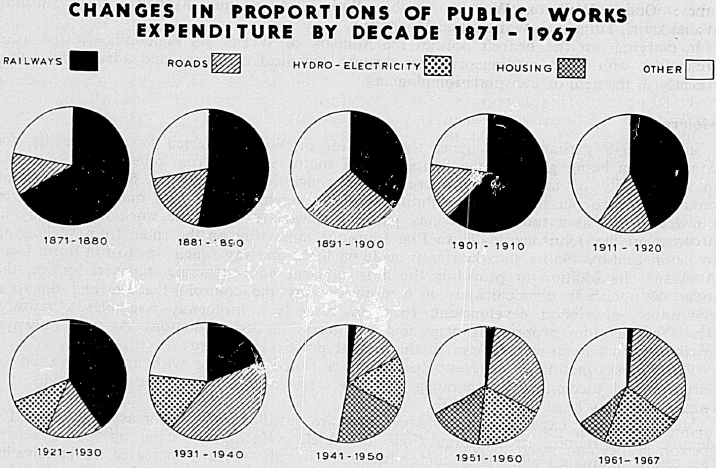
In 1903 the Government engaged Mr L. M. Hancock, an engineer from San Francisco, to report on hydro-electric generation. Accompanied by the superintending engineer of the Public Works Department, he inspected prospective schemes from Whangarei to the Bluff, travelling by train, steamer, coach, and on horseback. At the end of his preliminary report, Mr Hancock said, “In closing, I would say that I have seldom seen so promising a country, and I am sure that you will find that, next to your railroads, the utilisation of your waterpower by means of electric transmission of energy will do more to advance your material interests than any other agency you can employ”.
The department carried out much investigation work and in September 1904 Mr P. S. Hay, Superintending Engineer, submitted a very comprehensive report embodying all the information collected to date regarding the water power available in the country. The various schemes investigated were discussed in detail, and in a summary of brake horsepower available it was estimated that in the North Island 500,000 and in the South Island 3,200,000 could be developed. Even the complex Tongariro scheme was discussed, including a proposal to divert additional water into Lake Rotoaira. It examined many other aspects of hydro-electric development and this far-seeing report is a monument to the New Zealand engineers who prepared it.
Surveys for the Lake Coleridge scheme were finished in July 1906. In November 1907, the Minister announced in the Public Works statement that works for the development of water power would have to await the completion of the North Island Main Trunk Railway.
In 1910 preliminary work was started and the next year contracts were let for various portions of a scheme to develop 10,000 hp at Lake Coleridge with completion dates between October 1912 and August 1913. In March 1915, continuous service started with three generating units of a total of 6,000 hp installed and another on order. In his annual report dated 5 July, some 4 months later, the chief electrical engineer stated: “I am now in a position to state that the Lake Coleridge development is already an assured success from a financial point of view. I may confess that I had some misgivings when I first faced the problem, because of the comparative sparseness of the population to be served. As a general rule, water power has to be developed on a large scale in order to be a financial success. The usual order at the present day is over 100,000 hp, compared with our 12.000 hp at Lake Coleridge. As regards development of industries, there are definite indications of new activities in the direction of electro-chemical industries in the neighbourhood of Christchurch.” Reporting a year later he remarked: “Within the City of Christchurch the immediate effect of the introduction of hydro-electric power has been to reduce the retail price for domestic lighting from 6d. to an average of 3d. per unit, the retail price for power from 3d. to 11/2d., and the price for power in bulk from 21/4d. to 1/2d. These reductions resulted in popularising the supply to such an extent that the number of consumers increased from 1,623 at the beginning of the year to 2,860 at the end—an increase of over 80 percent. This increase is being maintained at the rate of 125 consumers per month, in spite of the shortage of men and materials caused by the war.” Reporting in April 1918. he said: “The plant at the power station consists of four units, aggregating 6,000 kilowatts, and all four units are run daily without any spare. The demand for more power is so insistent that the delivery of the fifth generator and the necessary pipeline is a matter of urgent necessity”
By 1920 the generators at Lake Coleridge were overloaded, partly because of wartime delay in delivery of the plant and material ordered in 1916. Hancock had recommended an initial installation at Lake Coleridge of 10,000 hp, but actually only 6,000 hp was installed. (By 1927 capacity had been increased to 36,000 hp.) Compared with this hesitant approach in 1910, by 1920 hydro-electric systems had proved their worth and a spirit of optimism prevailed. The Government had purchased the Horahora station of 8,400 hp from the Waihi Gold Mining Co., investigations for the Arapuni development on the Waikato River were in hand, and work on the Mangahao scheme near Shannon had been started, with this station commencing supply in December 1924.
In concluding his 1925 parliamentary statement the Hon. J.G. Coates, Minister of Public Works, said: “My policy is well known. It is to make such arrangements as will result in an adequate supply of reasonably priced electricity being available for every person in the Dominion to whom it can be provided with an expectation of a satisfactory financial return.” In the decade up to 1930 hydro-electric power moved from a tentative start retarded by the war to a position where the general availability of electricity was becoming part of the New Zealand way of life. It had gone from one small Government station in the South Island to four additional stations operating in the North Island. In addition work was in hand on the construction of a second major station for the South Island. Situated on the Waitaki River, it was designed to have an ultimate capacity 17 times that of the initial installation at Lake Coleridge. (It came into operation on 1 January 1935.
To meet the growing requirements of the northern portion of the North Island the Arapuni development on the Waikato River was planned. In July 1924 a contract for its construction was signed with an English firm. Initial experience with this project was unhappy. The dam was completed by the end of November 1927, but there was no powerhouse. The contractors had met difficulties in dewatering the foundations and in spite of pressure from the department they had done little to overcome the problem. As a result the department took over this portion of the contract in January 1928 and completed it. The first generator delivered power on 3 June 1929. The station ran for 12 months, but early on 7 June 1930 an unexpected flow of water was detected and the station had to be closed down. It was found that movement had occurred in the block of country between an ancient river bed of the Waikato River, which now formed the headrace, and the modern gorge in the bottom of which the powerhouse was situated. Extensive remedial measures were necessary and it was May 1932 before Arapuni was again in service.
Lake Waikaremoana, with its surface 2,015 ft above sea level, lies behind one of nature's dams, the valley of the ancient Waikare - Taheke River having been blocked by a huge landslide several thousand years ago. This was the scene presented to the power engineer, with a head of 1,115 ft available in a distance of 11/2 miles. The only snag was that the dam was somewhat leaky, the normal outflow from the lake being through underground channels. The first major development, which utilised 680 ft of head, used water diverted from the river whose source was the outflow from a number of these channels.
The power station at Tuai went into service at the end of January 1929.
In view of later developments it is of interest that in November 1925, the department put surveys in hand to obtain comprehensive data concerning the power possibilities in the country between Lakes Te Anau and Manapouri and the western Sounds.
So far the story has covered the main generating stations, but the water to drive the turbines to rotate the generators is still useless unless the power can be transmitted to the factories, farms, and dwellings where it is required. When the department commenced operation of its first station in 1915 several city councils and other local authorities were already generating and selling electricity. Its aim was to supply power in bulk as a wholesaler and leave the details of local distribution and sale to other parties. It was quite prepared to enter into contracts with local authorities who already had a sales organisation or with other bulk users. For the rest of the country legislation was promoted providing for the setting up of power boards to undertake these functions. For the department the task remained of getting the power from the generators to its customers. Electricity is generated at moderate voltages, but for transmission over long distances, to avoid heavy losses it must be transformed or stepped up to high voltage. In addition, just as the consumer has his domestic switches to control the flow of current, so the bulk authority must have its switchgear to control its electricity. Thus in its role as bulk supplier the department at the power stations had to provide switchgear, transformers and lightning protection, then over miles of sometimes rough country transmission towers or poles and multiple conductors to carry the current. At junctions of lines, points of supply, and terminal points substations were required, again with equipment for switching and transforming the current. That this facet is not negligible is shown by figures published in 1931 for the combined Mangahao-Waikaremoana schemes. These showed that the cost of the transmission side amounted to 40 percent of the total cost of the works.
Actually the department had two particular functions in respect to electric supply. In the first place it had to supply bulk power; in the second place, as the general authority controlling electric supply, it had also to exercise a general supervision and control over all supply authorities, whether purchasing power from the department in bulk or not. (In more recent years the design of power stations and equipment, the construction of transmission lines and maintenance of the electricity network have been responsibilities of the New Zealand Electricity Department but hydraulic investigation and civil engineering are still carried out by the Ministry of Works.)
Planning and construction of power projects was necessary to keep ahead of the increasing load on the system. While the depression slowed the rate of increase, by 1937 it had reverted to 10 percent a year. By 1940 work was in hand on the extension, investigation or construction of some 10 developments.
At Waikaremoana construction for the lower development at Piripaua, which included a 16 ft diameter pressure tunnel 7,639 ft long, was commenced in May 1938. The first machine went into operation on 1 March 1943 and the station was substantially complete by April 1944.
Started in 1939 Karapiro had a troubled story. It called for a dam to give a 100ft head, and was to have three generating units to develop 90,000 kW. After the diversional tunnel was completed work was suspended in early 1942. The river was diverted in September 1943, and at the beginning of April 1947 the lake was filled and No. 1 unit commenced generating. By May 1948 the station was in full operation.
To conserve flood waters during the winter the construction of control gates near the outlet of Lake Taupo was started in 1939 and finished by 1942.
The Cobb River scheme, which was being developed by a private company to supply the Nelson and Golden Bay areas, was taken over by the Government who continued construction. The Government also took over the Arnold River scheme on the West Coast from the Grey Power Board. The Cobb scheme, generating 9,000 kW, went into operation at the end of June 1944. The permanent dam was completed in 1957, enabling further generating plant to be installed.
As part of the ultimate development of the potential of the Waitaki River, works to control the outflow of the major lakes in the upper portion of the valley were proposed. Work on a power development near the outlet of Lake Tekapo started in 1939. After being closed down on account of the war work was resumed, the power station finally coming into operation in 1951. Control works at this lake to store the high inflows of spring and summer were completed in December 1953.
A major irrigation scheme in Canterbury called for the construction of a large race to supply water from the Rangitata River. As during winter this water was not required for irrigation, to use it the construction of a power station at Highbank on the Rakaia River was put in hand about 1939. With a head of 330 ft a single power unit was to supply 25,200 kW. This was another war casualty. The generator and other equipment was lost at sea in 1940. Replacements did not arrive until late in 1944, and the station commenced operation on 8 June 1945.
Construction work for the upper Waikaremoana scheme, which was to include extensive work for the control of underground outlets from the lake, commenced in 1943 and the first generator was operating in April 1948.
In 1944 Cabinet approved an immediate commencement on the construction of the next major scheme on the Waikato River—Maraetai (180,000 kW). Preliminary work required the construction of a 16-mile access road from Tokoroa to the dam site and the construction of a complete small town at Mangakino. This town was also to serve as headquarters for other adjacent power schemes. The river diversion tunnel was completed by 1949 and by 1950 the lower portion of the dam and powerhouse were completed. The station commenced to supply power on 31 October 1952.
At Whakamaru, the next station upstream from Maraetai, construction had commenced by 1950 and two machines went into operation in May 1956.
Control works at Lake Pukaki, started in 1946, were complete by the end of 1951.
The effect of the Second World War was to slow down, and for a time even to arrest, work on the construction of new developments. The disruption of the construction programme led to demand exceeding generating capacity, necessitating rationing of electric power. The Government, through the Ministry of Works, applied itself vigorously to meeting this demand, to the extent that the 20 years 1951-1970 can well be called the great hydroelectric year.
Additions to the generating capacity enabled restrictions on the use of electricity in the North Island to be lifted early in 1953, but when hydrological conditions were unfavourable they had to be reapplied from time to time. They were finally lifted in 1959. In the South Island they were lifted in 1956 when power became available from Roxburgh Hydro.
In the North Island, priority was given to the completion of the harnessing of the potential of the Waikato River from Cambridge up to Lake Taupo. Atiamuri, the next station upstream from Whakamaru, commenced operation in 1958. Waipapa, between Arapuni and Maraetai, and Ohakuri, next above Atiamuri, both delivered power in 1961. Aratiatia, the last in the chain of eight stations below Lake Taupo, became operational in 1964. Maraetai II, designed as a peak load station, was started in 1959, but with the decision to install the Cook Strait power cable, work was suspended in 1961. Recommenced in 1966 it is now (1971) approaching completion.
The remaining hydro station in the North Island is at Matahina on the Rangitaiki River in the Bay of Plenty, the first of its two units coming into service at the end of 1966.
Whereas in the North Island development has been concentrated in the Waikato watershed, in the South Island three major river systems, Waitaki, Clutha, and Waiau are involved. The large station on the Clutha River at Roxburgh commenced to supply power in 1956, and control works at Lake Hawea to store water for this station were completed in 1960. Construction of the even larger station on the Waitaki River at Benmore was started in 1959. For the construction of this major undertaking, and a smaller one downstream at Aviemore, the township of Otematata, complete with the normal amenities of a small town, was constructed, as Mangakino had been on the Waikato River in the late 1940s. Half of the output of the Benmore station became available for commercial load on 1 April 1965 and the smaller station at Aviemore, between Waitaki Hydro and Benmore, was completed in 1969. A large part of the output of Benmore is transmitted to the North Island via the Cook Strait cable.
This spectacular project (Benmore) became a tourist attraction during its construction, being included in most South Island scenic tours; and now that it is completed is still an attraction, by virtue of the very large lake which it impounds and the sheer immensity of the installation.
The next scheme in the South was Manapouri - Te Anau, which was also of great general interest, but less accessible than Benmore. This, New Zealand's largest hydro station, with an installed capacity of 700,000 kilowatts, has just been completed (February 1971). Power is being fed into the national grid at present, but the scheme was built primarily to supply power to Comalco's aluminium smelter at Bluff, now nearing completion. This project was built by contract, with a firm of overseas consultants responsible to the Ministry of Works for design and supervision of construction work.
The original design involves raising the levels of both lakes and the proposal to raise the levels of Lake Manapouri in particular was bitterly opposed by conservationists and was the subject of the largest petition ever presented to Parliament. A Commission of Inquiry was appointed to report on the proposal and following receipt of the Commission's findings the whole matter is now receiving further consideration.
Two major developments are in hand, the Tongariro in the North and the Upper Waitaki in the South Island. The former will utilise much of the water draining from the Ruapehu, Ngauruhoe, and Tongariro mountains and also from the central part of the Kaimanawa range. Some of this will be diverted from the watersheds of neighbouring rivers and will thus add to the production of existing stations on the Waikato River. The latter aims at developing much of the remaining potential of the Waitaki catchment above Lake Benmore. To serve as administrative and accommodation centres for such major projects, small townships with all the normal amenities are established. For Tongariro, headquarters is at Turangi near the southern shores of Lake Taupo. It has been planned on the expectation that a large part of this new township will remain as a permanent servicing centre for the area, based as it is on farming, forestry, and holiday activities. For the Waitaki scheme a similar town is being built at Twizel, between Lakes Pukaki and Ohau. For this many buildings are being shifted from Otematata, 36 miles away.
For many years there was interest in the possibility of harnessing the power potential of New Zealand's thermal regions. Similar potential had been developed at Lardarello in Italy. In early 1950 a full investigation was put in hand at Wairakei, just north of Lake Taupo. Results justified a start in 1956 with the construction of stage I and power was first supplied in 1958. In 1964 full production from stage II brought the output of power from this source to the present level of 192,400 kW.
Hydro power depends on rainfall and when conditions of low river flow occur difficulties arise. While electricity generated by steam costs more per unit, thermal stations can have a place in the overall operation of a system. This was the basis on which in 1956 the construction of a major coal-fired steam station at Meremere, near Mercer, was authorised. It commenced operation in 1958 and was fully commissioned in 1960.
In 1967 an oil-fired steam plant near the oil refinery at Marsden Point came into operation and a gas or oil turbine plant at Otara near Otahuhu first produced power in 1968. A large oil or gas burning steam station at New Plymouth is at present under construction.
The discovery of substantial reserves of natural gas at Kapuni and the decision to use the gas as a premium fuel and to reticulate it to Auckland and Wellington and a number of the larger cities and towns en route involved the department in a completely new field of operations.
It was necessary to construct a gas treatment plant at Kapuni and to construct and lay approximately 400 miles of high-pressure gas pipeline from the wellhead at Kapuni north to Auckland and south to Wellington, with laterals serving other centres along the route. Two firms of overseas consultants were engaged to advise and assist on the design of the gas treatment plant and the planning and construction of the pipeline. However, the overall responsibility lay with the Ministry of Works, inducing the extensive negotiations with landowners through whose properties the pipeline passed.
The project was handed over to the Natural Gas Corporation on 6 March 1970, although some work still remained to be done at that date.
Races, some quite large, were constructed early in its history by the department for bringing water from rivers to positions above gold-bearing areas to be used for sluicing in the process of gold extraction. As gold petered out, the water available from some of the races was used for irrigation. The first proposal for establishing works specifically for irrigation was made in the Public Works Statement 1906. Later extensive in estigations and surveys were carried out in Central Otago.
The first scheme, the irrigation of the Steward Settlement, near Oamaru, was completed in 1911. The Manorburn dam, part of the Ida Valley scheme, commanding 31,600 acres, was completed in 1915 and a limited amount of water for irrigation was supplied to the settlers during the summer. Other major schemes completed in the 1920s, all in Central Otago, were Galloway, Hawkdun, Last Chance, Manuherikia, Tarras. and Teviot. By March 1930 expenditure on irrigation works had totalled some £913,000 ($1,826,000) and at the end of the 1929-30 season 41,900 acres were under irrigation for 396 irrigators. This area had increased from 3,200 acres in 1920.
Unlike some other utilities, the department retained control of the irrigation schemes and continued to service and maintain the works.
As showing the benefits of irrigation, it is recorded that before irrigation one man on a little over 300 acres was grazing 100 sheep and fattening 80. With irrigation, he grazed 600 and fattened 400. He estimated that his land had increased in value fivefold.
The 1930s saw the emphasis on irrigation shift from the valleys of Central Otago to the plains of South Canterbury.
By far the largest irrigation project in New Zealand, the Rangitata diversion canal is capable of supplying water to nearly a quarter of a million acres of the land between the Rakaia and Rangitata Rivers. This 42-mile canal, with a capacity of 1,000 cubic feet per second, is capable of diverting almost the entire winter flow of the Rangitata River. Its construction involved the excavation of nearly 41/4 million cubic yards and the erection of numerous reinforced concrete structures. One difficult section of country required a conduit constructed of reinforced concrete precast pipes of 12 ft internal diameter and extending for nearly 13/4 miles. At the intake structure concrete caissons, each weighing some 700 tons, had to be floated out into the Rangitata River.
At present this canal supplies the Ashburton-Lyndhurst scheme which saw initial operation in 1945 and the Mayfield-Hinds scheme completed in 1962. The gross area within these scheme is 149,000 acres.
In 1930 the Government approved a scheme for the establishment of a chain of landing grounds and the department was requested to undertake the planning and the carrying out of the necessary construction work. Unemployed labour was to be used to the greatest possible extent.
In his 1935 statement the Minister of Public Works pointed out that developments in aeroplane design and improvements in the mechanical technique of instrument flying put air transport in a position where it could no longer be ignored if this Dominion was to remain progressive.
By 1935, the development of aerodrome construction work had been very considerably extended. In addition to the RNZAF base at Hobsonville and the training school at Wigram, investigations had been carried out on 112 grounds in both islands, 43 had been surveyed and construction actually undertaken on 30. Thus by this time construction work on the basic chain of airports, emergency landing fields, and air force stations to meet the civil and military air requirements of the country was well in hand.
By mid 1936 the Aerodromes Branch had been established as a special section of the department to co-ordinate these activities and work in conjunction with the Civil Aviation and Air Services Branch of the Defence Department. By 1940 the main air routes operating over 2,015 miles were well established and serviced. Some 83 aerodromes and landing grounds were available for use, as well as terminal facilities for overseas flying boats at Auckland. RNZAF stations on a permanent basis had been established at Hobsonville, Ohakea, and Wigram, and work was in hand on stations at Whenuapai, New Plymouth, Woodbourne, and Taieri.
During the war the work of construction assumed mammoth proportions.
In the latter part of the 1940s planning for major airports at Auckland and Wellington was undertaken, together with planning and construction of a new airport for Christchurch. Extensive reconstruction of the runways at Nandi and other work in Fiji were put in hand.
With the great increase in air traffic the construction of modern airports at the main centres became essential. The department handled the bulk of the design and construction work associated with these projects, the completion dates being: Christchurch airport at Harewood, April 1955; Wellington airport at Rongotai, October 1959; Dunedin airport at Momona, March 1962; Auckland airport at Mangere, November 1965.
At numerous smaller aerodromes works were carried out, including new airports, at Tauranga, New Plymouth, and Rotorua and improvements at Whangarei, Gisborne, Napier, and Queenstown.
The department was deeply committed to work directly connected with the prosecution of the war effort. It was estimated that from one-third to one-half of its resources were involved in this direction. Large numbers of its officers and workmen joined the forces and went overseas. Some of the specialist engineer units were extensively recruited from members of its staff.
Between 1939 and 1945 the Department carried out a defence construction programme involving an expenditure of over $94,000,000. Every conceivable kind of project was undertaken from large camps, barracks, forts, aerodromes, and naval bases, to an almost unbelievable variety of miscellaneous works and services for our own Forces, our American allies, and the defence of the Dominion generally. The difficulties encountered in accomplishing such a huge programme would have been formidable enough under normal peace-time conditions. Under the stress and strain of war, with all its attendant shortages of staff, manpower, and materials, these were at times almost insuperable. Yet. somehow, every demand made on the Department by those charged with the defence of the country was met speedily and efficiently, and the Heads of the Services have had nothing but the highest praise for the manner in which their requirements were fulfilled. (Preface to Official War History of Public Works Department.)
Part of the aftermath of the war was a tremendous pressure for the execution of deferred works. This applied particularly to power generation and housing. An infant industry for utilising the maturing exotic forests planted in the late twenties was also making demands. There were difficulties in meeting these pressures through shortages of key materials, delayed or non-delivery of imports, and the general disruption brought about by changing from a war to a peace footing.
Closely in touch with the Public Works Department but initially not a part of it, the Commissioner of Defence Construction, Mr James Fletcher, was appointed in March 1942 by the Prime Minister. Responsible directly to the Prime Minister, his duties were to co-ordinate the whole resources of the building and construction industries and to direct them with absolute priority into defence work. He also had to adjudicate on the rival claims of the various services and determine priorities.
The Ministry of Works Act 1943 widened the field and placed the office of Commissioner of Works as it now became, on a permanent basis, the Commissioner being responsible to the Minister of Works.
Discussions on the form a reorganisation of the Public Works Department should take went on for some months and in the latter part of 1944 the Commissioner of Works and the Public Service Commissioner presented a joint report.
The Ministry of Works and the Public Works Department worked closely together and from April 1946, the Commissioner of Works exercised administrative control and a year later had been designated Permanent Head of the Public Works Department. Under the one head the two bodies had functioned as separate organisations. This arrangement was not unique and there were prior instances of the same type of arrangement successfully operating in New Zealand.
At the end of April 1947 the Commissioner of Works transmitted a Cabinet decision that, as from the beginning of that month, he was to “control the operations of the four Divisions of the Public Works Department, viz., Engineering, Housing, Architectural, and Administration, and in that respect shall be regarded as the Permanent Head of the Public Works Department”. He expressed the opinion that the effect of the decisions taken would probably mean that the Public Works Department and the Ministry of Works would ultimately merge. On 26 May 1948 Cabinet approved of the Public Works Department being merged in the Ministry of Works for all administrative purposes under the Commissioner of Works as Permanent Head.
The activities of the early Public Works Department had expanded from being a purely construction agency to one intimately concerned with the whole construction field, Government, local body, and private, in a planning as well as an operational capacity. It can be said that the dropping of the word “Public” from its name epitomised the wide field it now embraced.
Public buildings became the responsibility of the department in October 1873, when the Colonial Architect and his staff were transferred from the Colonial Secretary's Department. Much of the work involved the erection of post and telegraph offices, courthouses, and, after the abolition of the provinces in 1876, police stations at many of the towns throughout the country.
With the transfer of the capital from Auckland to Wellington the need arose for office accommodation. Temporary arrangements were made and the Colonial Architect was instructed to prepare plans for a building to house the offices of the Central Government. The building was of such a size that no suitable site was readily available. So a piece of land was made—by reclamation along the waterfront of Lambton Quay. Alternative tenders were invited in November 1873 for the erection of the block in concrete or timber. Offers for a concrete building were considered too high and the time of construction too long, so construction in timber was authorised. The central block was completed in 1877 and wings were added in 1897 and 1907 for the Government Building to assume its present shape.
The design for the present Parliament Building was the subject of a competition. In the judgment of an eminent panel of assessors one submitted by John Campbell, the Government Architect in association with Claude Paton. one of his staff, was deemed to be the most suitable. The foundation stone was laid on 23 March 1912.
Work on the foundations was done by day labour under the supervision of the department. By the end of 1913 this work, together with the remodelling of the grounds, had been completed. On 12 December 1913, a tender submitted by Hansford, Mills and Hardie for $303,278 was accepted for the erection of the central portion and the north wing. The contract time was 2 years. Progress was delayed by wartime conditions and difficulty in obtaining suitable marble for the exterior facing of the walls and also certain steel sections from Great Britain. Part of the building was occupied for the second session in 1918, but it was early 1923 before the contract was completed. The tower and the south wing in the original design were never built. Demands for public buildings have multiplied and the Government Architect now handles a building programme to the value of $30 million annually. Jobs valued at $145 million are currently under way either in the planning or construction stages. Among the more exciting projects are structures within the Government centre, notably the “Beehive” at the south end of Parliament Building, and the earth satellite station at Warkworth.
A Housing Construction Department was set up in 1936 to promote a State rental housing programme; the immediate direct control rested with the Parliamentary Under-Secretary to the Minister of Finance, but the department was administered at first as part of the State Advances Corporation. In 1943 it became a division of the Ministry of Works.
With the increased urbanisation of the New Zealand population, particularly since the 1939-45 war, there has been a tendency towards concentration of State housing operations in the larger towns and cities. This has resulted in the need to acquire large areas of undeveloped land and to undertake comprehensive planning and development. Thus new urban entities have grown or substantial suburban extensions added to existing municipalities. Examples of these occur at Otara and Mangere and at Lower Hutt and Porirua. Lesser but still considerable contributions have been made by State development within the pattern of normal urban growth at Hamilton, Napier. Palmerston North. Christchurch, Dunedin, and Invercargill.
Early State housing subdivisions represented a departure from the gridiron pattern which had up till then been the prevalent form of subdivisional design. Housing Division has since maintained a policy of continual improvement in urban land subdivisional practice. This has had as its objective the attainment of as high a degree of comprehensive development as possible, providing for a full range of compatible land uses and amenities.
Among the more significant special projects undertaken have been the construction of the new towns of Kawerau and Murupara for the establishment of the State-initiated Tasman pulp and paper project. Villages for operating staff have been constructed at hydro-electric stations on the Waikato and Waitaki Rivers and at the geothermal power development site at Wairakei. The town of Turangi was built for the construction stage of the Tongariro power development project but with a designed residual function as a subregional centre.
As at 31 March 1971 the number of rental units built by the State housing agency was 73,692 and those built for State departments numbered 12.925, making a total of 86,617. These houses and flats have been built throughout the country, in cities, boroughs, and small towns and also in association with rural activities and State projects. In addition, 27.700 housing sections have been made available.
The Soil Conservation and Rivers Control Act, passed in 1941, was considered to be one of the most advanced Acts of the type anywhere in the world, bringing together soil conservation, river control, and drainage problems under unified control both at national and district level. The Act provided for the establishment of the Soil Conservation and Rivers Control Council as the central authority responsible to the Minister of Works, and the establishment of catchment boards as the district executive authorities to plan and carry out works under the council's general supervision and direction. The council acted as the central research, controlling and directing organisation. The boards had rating powers and also received subsidies from Government. A portion of the work was also done directly by the Ministry of Works.
To assist the Council in carrying out its functions a headquarters staff was set up comprising largely specialist officers seconded from the department. As well as dealing with general matters, this staff organised the issue of publications and other publicity, and also the collection of hydrological data.
At its inception the council faced the problems of exhausted soils on hill country, deteriorating pastures, widespread soil erosion, and increasing run-off, as well as mounting damage to the lowlands by flooding and river erosion. These problems were gaining momentum under the prevailing methods of farming, and practical soil conservation methods had to be evolved which would be sufficiently acceptable to people farming the land to encourage them to promote soil conservation of their own volition.
A development that was largely initiated by the council and the department was the aerial topdressing of hill country pastures. Maintenance of adequate cover on the steep hillsides was essential but topdressing by hand was laborious and costly. In 1947 the council undertook to shoulder the responsibility for organising and financing the trials necessary to develop an idea and bring it to the stage of practical and economic operation. With the assistance of the RNZAF and many others aerial topdressing was brought to the stage of being a commercial proposition which was to be fundamental in advancing the country's economy. The techniques developed have been extensively copied overseas.
Offshoots from aerial topdressing were aerial seeding, spraying, spreading of poisons, distribution of fencing materials, etc. Other techniques and methods developed included conservation farming, conservation grazing, contouring, use of trees, control of fire and pests, gully control, and investigations into management, pasture strains, erosion, infiltration, and runoff.
Demonstration farms and experimental areas were set up in various localities throughout the country for the development and demonstration of special conservation farming practices.
Under encouragement and subsidy from the council, soil conservation work gained momentum. By 1966, 715 conservation farm schemes had been completed and a further 282 were awaiting action; but the magnitude of the task was indicated by the estimate, made in 1966, that 10,000 conservation farm plans were needed. However, the very evident benefits seen from completed farm plans and from the various experimental and demonstration areas gave impetus to this work. The council also fostered a changeover on the part of catchment boards from individual soil erosion and flood control schemes to combined control schemes embracing entire catchments and integrating soil conservation measures with flood control works.
The Ministry of Works has built up a wide background of experience in dealing with almost every kind of ordinary natural emergency and is organised to do so on a day-to-day basis. Based in 7 district offices, 27 resident offices, 10 area offices, and 80 depots are extensive resources, professional skills, stores, manpower, plant, and equipment. The department has also a long history of working in effective association with local authorities, other departments including the police services, and the contracting industry.
Its civil defence role is bound up with these resources. Important priorities are: to restore essential Government services: to assist local authorities if requested by them to do so; to take the initiative in conjunction with the Police and other departments where there is no organised civil defence; and to follow up with assistance in co-ordinating rehabilitation of damaged areas.
Direct responsibilities of the Ministry of Works include clearing and reopening State highways and inspection and repair of Government buildings and such structures as dams and bridges. Action is automatic, beginning immediately on the occurrence of any emergency. Minor cases are dealt with in the course of normal daily activity but in the event of a declared emergency the full strength of the Ministry of Works is available on call to Civil Defence.
The head office of the department is in direct contact with national Civil Defence operational headquarters and the whole of their own organisation. A modern radio communications system links the head office with the 40 base stations in Ministry of Works districts, residencies, and projects and, through them, with the department's 560 mobile receiving and transmitting sets.
The Ministry of Works teleprinter, telephone, and radio network covers virtually the whole of New Zealand, providing instant communication with any district under most conditions.
It is always difficult to foresee the particular problems a declared emergency or disaster might bring, but the Ministry of Works, with its long and varied experience in dealing with many minor emergencies, is organised and equipped for quick action in a major emergency. Its size, versatility, and the scope of its operations place it in a strategic position to help materially.
The Town Planning Act was passed in 1926. Initially it was administered by the Department of Internal Affairs, but following the dissolution of the Organisation for National Development in 1946 its administration was transferred to the Commissioner of Works. The original Act was later replaced by the Town and Country Planning Act 1953. Its objective is to promote the health, safety, convenience, and economic welfare of the people, encourage the wise use of resources, and co-ordinate public services and improvements. The legislation vests the responsibility for town and country planning in the local authorities, which are required to prepare planning schemes for their district and many combine to prepare regional planning schemes for their joint districts.
The Minister of Works is charged with the administration of the Act which also vests him with particular responsibilities as a guardian of the public interest and the agent of the Crown through whom office planning for public works is co-ordinated. These wide responsibilities led to the setting up of the Town and Country Planning Division.
As a contribution and an encouragement to more effective regional planning, a National Resources Survey has been pushed ahead. Seven volumes (West Coast, Bay of Plenty, Northland, Nelson, Otago, Hawke's Bay, and Wanganui) have been produced, and the eighth (Waikato) is well advanced.
In 1947 there was instituted a works programme of State and State-subsidised works on realistic lines related to available finance, manpower, and materials, to ensure orderly progress of approved developmental works.
This marked the beginning of long-term works programming, which has assumed increasing importance year by year and is now prepared each year on a 5-yearly forward basis, with forward projections for even further ahead.
The works programme of State and State-subsidised works is prepared by the Ministry of Works, in consultation with Treasury (and with other Government departments where necessary), and examined in the first instance by the Cabinet Works Committee. Finally, vote appropriations are approved by Government.
The demand for public capital investment within New Zealand, in the form of improved roading and communication works, soil conservation and rivers control, irrigation, building, and similar works has represented a large and growing proportion of the overall demand for capital investment generally. This overall demand has, in fact, been growing at a rate which could only be satisfied with considerable strain upon our resources.
If the private sector of the economy is to achieve the increases in production which the Government's economic policy has been designed to promote, it is essential that a full contribution be made by the Government in the public sector. The record shows that the Government has played its part. Recent notable works completed have been the Benmore and Manapouri, power stations, the Auckland International Airport, and the Haast Road.
Furthermore, the Auckland motorway system has been advanced to the point where it can be more fully appreciated as one of the largest engineering undertakings ever attempted in New Zealand. An impressive feature of this work is the architectural treatment. This has added to the overall impression of Auckland as a modern and thriving city. The scale of State highways construction and improvement is vast.
Almost all the items on the works programme result from an urgent and pressing need. Approximately 30 percent of the programme, for example, is devoted to improving electric-power supply, and attempts to reduce expenditure in this area can only result in ultimate increased costs and the possibility of failure to meet the growing demand for more power. Similarly, a further 30 percent of the programme is devoted to roading, for which a well-established demand exists, as is also the case in the field of buildings for educational, health, and other vital purposes.
The contribution of all these projects to the rising prosperity of New Zealand needs no elaboration.
The achievements of the Ministry of Works over 100 years of tremendous development in New Zealand are epitomised in the words of the present Commissioner of Works at the opening of one of the centenary displays.
Those of us who have had long service in the department feel a pride in its achievements and a loyalty to the old firm. There is an esprit de corps in Works which probably does not exist to the same extent in any other department. Possibly this is because of the nature of our work, and the sense of doing a job worthwhile in the development of our country. We have tangible evidence of this wherever we go, but most of all. I think it is because of the people at all levels who have made the department what it is and have set us an example to follow. We have always had professional men of the highest calibre who have been in controlling positions, but they have always been the first to recognise their dependence on others. It is the team work and team spirit by many thousands of dedicated people, both staff and workmen, who have made the department what it is.
The early days of the department saw some amazing jobs done in what were then remote areas under primitive conditions. These works bred a tough race of people who worked hard and played hard, and took a pride in their work.
There are many stories of great personalities at all levels, who have all helped to build up a tradition and a feeling of belonging, as one belongs in a family.
Our asset is our people, and we go forward into our second century, confident that we have the people for the work that lies ahead.
Table of Contents
Later statistical information has become available during the course of printing the Yearbook. Some of these statistics are entered in the Statistical Summary (pages 1036 to 1062). Other information is given in the following pages with references to appropriate sections of the Yearbook. Readers are referred to the Monthly Abstract of Statistics for the most recent information on many statistical series.
Population (p. 60)—Recent figures are given in the following table for the total population.
| Date | Males | Females | Total | Mean Population for Year |
|---|---|---|---|---|
| *Provisional. | ||||
| 31 December 1970 | 1,429,597 | 1,428,265 | 2,857,862 | 2,824,729 |
| 23 March 1971 (Census)* | 1,429,895 | 1,430,580 | 2,860,475 | ... |
The above figures do not include the population of the Cook Islands, 21,260 (at 31 December 1969); Niue Island, 5,184 (at 31 December 1970); and Tokelau Islands, 1,687 (at 25 September 1970).
Migration (p. 76)—Total arrivals and departures are classified in the following table.
| Category | Year Ended 31 March | ||
|---|---|---|---|
| 1969 | 1970 | 1971 | |
| * Mainly on cruise ships. | |||
| Arrivals | |||
| Immigrants intending permanent residence | 23,225 | 26,825 | 39,380 |
| New Zealand residents returning | 100,609 | 111,589 | 122,051 |
| Temporary visitors | 131,902 | 154,991 | 190,866 |
| Totals | 255,736 | 293,405 | 352,297 |
| Crews | 140,884 | 133,559 | 142,727 |
| Through passengers* | 88,783 | 86,119 | 80,546 |
| Grand totals, all arrivals | 485,403 | 513,083 | 575,570 |
| Departures | |||
| New Zealand residents departing— | |||
| Permanently | 29,803 | 29,822 | 38,165 |
| Temporarily | 100,818 | 112,082 | 117,760 |
| Temporary visitors departing | 135,963 | 153,561 | 188,526 |
| Totals | 266,584 | 295,465 | 344,451 |
| Crews | 141,217 | 130,699 | 142,092 |
| Through passengers* | 88,783 | 86,119 | 80,546 |
| Grand totals all departures | 496,584 | 512,283 | 567,089 |
There were 539 assisted immigrants included in the 39,380 arrivals in 1970-71; the total for 1968-69 was 490 and for 1969-70 it was 382.
Railway Transport (pp 309-316)—Summarised statistics of railway transport for the year ended 31 March 1971 are compared with previous years.
| Item | Unit | Year Ended 31 March | ||
|---|---|---|---|---|
| 1969 | 1970 | 1971 | ||
| *Including road motor, rail-road ferry, and other subsidiary services. | ||||
| Passenger journeys— | ||||
| Railways | (000) | 22,261 | 21,031 | 21,008 |
| Railway road motor services | (000) | 22,609 | 22,175 | 22,599 |
| Livestock tonnage | tons (000) | 250* | 215 | 198 |
| Goods tonnage | tons (000) | 10,548 | 11,378 | 11,651 |
| Revenue— | ||||
| Railway operation | $(000) | 74,601 | 83,194 | 86,999 |
| Total* | $(000) | 90,015 | 99,729 | 105,242 |
| Expenditure— | ||||
| Railway operation | $(000) | 72,892 | 79,836 | 96,502 |
| Total* | $(000) | 86,495 | 94,121 | 112,827 |
Road Transport (p. 324)—Statistics of motor vehicles licensed at 31 March 1971 are compared with those for 31 March 1970.
| Class | As at 31 March | |
|---|---|---|
| 1970 | 1971 | |
| *Mostly farm tractors, etc. | ||
| Cars | 871,864 | 918,700 |
| Trucks | 171,477 | 181,762 |
| Contract vehicles | 1,594 | 1,182 |
| Omnibuses and service cars | 3,143 | 3,113 |
| Motor cycles | 29,285 | 32,232 |
| Power cycles | 18,826 | 20,974 |
| Totals | 1,096,189 | 1,157,963 |
| Vehicles exempted from payment of licence fees* | 77,889 | 81,707 |
| Trailers | 211,539 | 224,667 |
| Grand totals | 1,385,617 | 1,464,337 |
Registrations of new vehicles and those vehicles previously registered only in another country during the year ended 31 March 1971. Cars 72,506; motor cycles (including power cycles), 10,792; commercial vehicles, 22,172; trailers, 18,484; total, 123,954.
Building Permits—The following table presents the latest statistics on building permits issued (including Government buildings).
| Type of Building Permit | Year Ended 31 March | |||
|---|---|---|---|---|
| 1970 | 1971 | |||
| Number | Value | Number | Value | |
| $(m) | $(m) | |||
| New houses and flats | 23,084 | 192.6 | 23,679 | 216.0 |
| Alterations and additions to houses and flats | 34,770 | 28.6 | 37,831 | 35.3 |
| Other buildings (including alterations) | 15,999 | 226.8 | 15,364 | 263.4 |
| Totals, all buildings | 73,853 | 448.0 | 76,874 | 514.7 |
Houses and Flats Completed—There were 22,840 houses and flats completed in the year ended 31 March 1971 compared with 22,280 in the preceding year.
Wool (p. 580)—Weight, sale value, and average value per pound of greasy wool sold at auction in New Zealand in the last three seasons are shown below.
| Season | Weight of Greasy Wool Sold | Sale Value | Value per Pound | Average Minimum Floor Price per Pound of Greasy Wool | Index Numbers* Base: 1963-64 (=1000) |
|---|---|---|---|---|---|
| *Based on price on floor, clean. | |||||
| lb (000) | $(m) | c | c | ||
| 1968-69 | 516,528 | 144.9 | 28.06 | 22.25 | 650 |
| 1969-70 | 494,117 | 126.6 | 25.62 | 22.25 | 603 |
| 1970-71 | 481,085 | 116.6 | 24.23 | 21.00 | 560 |
Retail Trade—Values of quarterly sales or turnover for all retail stores, corrected for seasonal fluctuations and for price and population changes, are shown in the following table for the latest quarters.
| QUARTERLY SALES OR TURNOVER—ALL STORE TYPES | ||||||||
|---|---|---|---|---|---|---|---|---|
| Quarter Ended | Total Sales | Turnover per Head of Population | ||||||
| In Current $s | In Constant 1957-58 $s | In Current $s | In Constant 1957-58 $s | |||||
| As Recorded | Seasonally Corrected | Before Seasonal Correction | Seasonally Corrected | As Recorded | Seasonally Corrected | Before Seasonal Correction | Seasonally Corrected | |
| total turnover $(m) | total turnover $(m) | turnover per head of population $ | turnover per head of population $ | |||||
| *Provisional | ||||||||
| 1970 Dec | 605.3 | 545.2 | 401.7 | 361.8 | 212.1 | 191.1 | 140.8 | 126.8 |
| 1971 Mar | 510.3 | 541.2 | 334.2 | 354.4 | 178.2 | 189.0 | 116.7 | 123.7 |
| June* | 553.0 | 559.2 | 350.5 | 354.0 | 193.7 | 195.9 | 122.8 | 124.0 |
Hire Purchase Trade—The following statistics show trade for the latest quarter (compared with previous quarters) by surveyed businesses covering about 72 percent of total hire purchase business.
| GOODS SOLD ON HIRE PURCHASE | ||||||
|---|---|---|---|---|---|---|
| Quarter Ended | Value of Goods Sold on Hire Purchase | Total Amount Owing Under H.P. Agreements* | ||||
| Motor Vehicles | Plant and Machinery | Television Sets | Other Household and Personal Goods | Total | ||
| *As at end of quarter. | ||||||
| 1970— | $(000) | $(m) | ||||
| December | 37,425 | 6,020 | 488 | 12,317 | 56,251 | 108,5 |
| 1971— | ||||||
| March | 32,217 | 5,751 | 390 | 8,361 | 46,718 | 112,8 |
Summary of Stocks—The following table gives a summary of stocks held by manufacturers, wholesale traders, and retail traders.
| Stocks | As at 31 March | |||
|---|---|---|---|---|
| 1968 | 1969 | 1970 | 1971 | |
| Manufacturers— | $(million) | |||
| Materials | 272.4 | 302.5 | 334.6 | 394.4 |
| Finished goods | 134.3 | 145.0 | 166.2 | 180.5 |
| Wholesale | 242.5 | 265.2 | 347.5x | 416.2 |
| Retail | 273.7 | 280.9 | 337.1 | 363.0 |
| Totals | 922.9 | 993.6 | 1.185.4 | 1.354.1 |
Statistics of external trade in the June year 1971 are given below.
Total Commodity Trade—Following are statistics of exports and imports.
| Year Ended June | Exports | Imports (c.d.v.)* | Excess of Exports Over Imports | |
|---|---|---|---|---|
| New Zealand Produce | Total Exports | |||
*The corresponding c.i.f. values were $674.7 million in 1967-68, $849.6 million in 1968-69, $1,006.0 million in 1969-70 and $1,157.1 million in 1970-71. †Provisional. | ||||
| $(million) | ||||
| 1968 | 804.6 | 820.5 | 622.9 | 197.6 |
| 1969 | 968.9 | 989.1 | 796.8 | 192.3 |
| 1970 | 1,064.8 | 1,087.0 | 942.3 | 144.7 |
| 1971† | 1,107.1 | 1,131.1 | 1,075.1† | 56.0† |
Exports—An indication of the movement in the value of exports in the main groups of commodities is afforded by the following table.
| VALUE OF EXPORTS | |||||
|---|---|---|---|---|---|
| Year ended June | Dairy Products (incl. Casein) | Meat and Meat Preparations | Wool | Hides, Skins, and Pelts | Pulp, paper and Paper-board |
| *Provisional | |||||
| $(million) | |||||
| 1968 | 210.4 | 260.7 | 158.2 | 39.8 | 23.9 |
| 1969 | 204.7 | 309.4 | 212.4 | 55.4 | 27.0 |
| 1970 | 214.0 | 369.3 | 204.5 | 48.8 | 28.3 |
| 1971* | 226.9 | 391.2 | 188.6 | 50.6 | 28.2 |
Imports—The table following classifies imports by broad divisions.
| IMPORTS VALUED AT CURRENT DOMESTIC VALUE IN COUNTRY OF EXPORT | ||||||||
|---|---|---|---|---|---|---|---|---|
| Year Ended June | Food and Live Animals | Crude Materials, Inedible, Except Fuels | Mineral Fuels, Lubricants, etc. | Chemicals | Manufactured Goods | Machinery and Transport Equipment | Miscellaneous Manufactured Articles | Total* |
*Including sections not listed. †Provisional. | ||||||||
| $(million) | ||||||||
| 1968 | 32.0 | 31.8 | 48.0 | 76.8 | 182.0 | 196.4 | 43.6 | 622.9 |
| 1969 | 33.9 | 43.9 | 56.4 | 102.4 | 233.1 | 253.2 | 59.6 | 796.8 |
| 1970 | 44.3 | 51.4 | 59.1 | 116.2 | 271.7 | 318.6 | 66.6 | 942.3 |
| 1971† | 58.0 | 47.3 | 61.2 | 134.8 | 296.3 | 372.6 | 77.2 | 1,075.1 |
Retail Prices (pp. 681-701)—Details of the consumers' price index for later quarters are set out in the following table.
| CONSUMERS' PRICE INDEX | |||
|---|---|---|---|
| Base: Weighted average 25 centres, 1965 (=1000) | |||
| Group or Subgroup | Calendar Year 1965 | Quarter Ended 31 March 1971 | Quarter Ended 30 June 1971 |
| Food— | |||
| Fruits and vegetables | 1,000 | 1,399 | 1,380 |
| Meat and fish | 1,000 | 1,400 | 1,415 |
| Other foods | 1,000 | 1,296 | 1,313 |
| Food | 1,000 | 1,348 | 1,357 |
| Housing— | |||
| Rent | 1,000 | 1,326 | 1,338 |
| Home ownership | 1,000 | 1,415 | 1,448 |
| Housing | 1,000 | 1,388 | 1,415 |
| Household operation— | |||
| Fuel and light | 1,000 | 1,190 | 1,210 |
| Home furnishing | 1,000 | 1,266 | 1,295 |
| Domestic supplies and services | 1,000 | 1,279 | 1,374 |
| Household operation | 1,000 | 1,250 | 1,294 |
| Apparel— | |||
| Clothing | 1,000 | 1,302 | 1,345 |
| Footwear | 1,000 | 1,314 | 1,351 |
| Apparel | 1,000 | 1,304 | 1,346 |
| Transportation— | |||
| Public transport | 1,000 | 1,348 | 1,384 |
| Private transport | 1,000 | 1,404 | 1,467 |
| Transportation | 1,000 | 1,390 | 1,446 |
| Miscellaneous— | |||
| Tobacco and alcohol | 1,000 | 1,470 | 1,470 |
| Other supplies | 1,000 | 1,387 | 1,440 |
| Other services | 1,000 | 1,460 | 1,528 |
| Miscellaneous | 1,000 | 1,442 | 1,476 |
| All groups | 1,000 | 1,359 | 1,389 |
Receipts of Consolidated Revenue Account and National Roads Fund—This table shows direct and indirect taxation.
| (Source: Receipts and Payments of the Public Account) | |||
|---|---|---|---|
| Item | Years Ended 31 March | ||
| 1969 | 1970 | 1971 | |
*Special receipts in addition were: Adjustment of value of investments held overseas consequent on devaluation of currency, $2,482,000; interim payment by Reserve Bank for net gain due to devaluation, $408,000; U.S. military sales arrangement credit, $1,518,000. †Military sales credit. | |||
| Direct taxation— | $(thousand) | ||
| Income and social security taxes | 691,548 | 779,198 | 957,253 |
| Estate and gift duty | 24,113 | 26,303 | 29,338 |
| Land tax | 2,681 | 2,854 | 3,051 |
| Total—Direct taxation | 718,341 | 808,355 | 989,642 |
| Indirect taxation— | |||
| Customs duty | 106,412 | 115,473 | 138,876 |
| Beer duty | 35,826 | 37,282 | 39,652 |
| Sales tax | 82,801 | 97,615 | 125,343 |
| Payroll tax | - | - | 20,457 |
| Racing duty | 11,154 | 12,054 | 13,157 |
| Stamp duties | 9,355 | 11,475 | 13,464 |
| Motor spirits duty | 11,884 | 3,453 | 3,918 |
| Highways taxation | 66,325 | 78,836 | 81,957 |
| Other taxation | 16,306 | 16,435 | 18,527 |
| Total—Indirect taxation | 340,063 | 372,623 | 455,351 |
| Total—Taxation receipts | 1,058,404 | 1,180,978 | 1,444,993 |
| Interest— | |||
| On capital liability— | |||
| Electric supply | 32,752 | 34,705 | 36,283 |
| Post Office | 11,837 | 12,231 | 12,920 |
| Other | 33,941 | 36,775 | 40,961 |
| On other public moneys | 5,598 | 6,235 | 7,548 |
| Total—Interest | 84,128 | 89,946 | 97,712 |
| Profits from trading undertakings | 5,437 | 9,744 | 16,133 |
| Departmental receipts | 60,056 | 64,431 | 71,151 |
| Special receipts† | 13,714 | 17,134 | 19,039 |
| Total—Other | 163,335 | 181,255 | 204,035 |
| Total—Receipts | 1,221,739 | 1,362,233 | 1,649,028 |
Consolidated Revenue Account Expenditure—The following table shows expenditure from the Consolidated Revenue Account.
| Item | Years Ended 31 March | ||
|---|---|---|---|
| 1969 | 1970 | 1971 | |
*Previously included in Vote: Justice. † Excludes salaries previously appropriated. | |||
| Permanent appropriations— | $(thousand) | ||
| Under special Acts of Legislature— | |||
| Civil List | 678 | 671 | 906 |
| Debt services— | |||
| Interest | 132,359 | 144,195 | 153,019 |
| Transfer to Loans Redemption Account | 16,340 | 40,000 | 50,000 |
| Administration and management | 1,080 | 1,001 | 1,114 |
| Total—Debt services | 149,778 | 185,197 | 204,133 |
| Special Acts— | |||
| Government Superannuation Fund | 17,572 | 19,366 | 22,925 |
| Miscellaneous | 2,937 | 3,241 | 3,250 |
| Total—Special Acts | 20,509 | 22,607 | 26,175 |
| Total—Permanent appropriations | 170,965 | 208,475 | 231,214 |
| Annual appropriations— | |||
| Vote— | |||
| Legislative | 890 | 969 | 1,208 |
| Prime Minister's Department | 53 | 58 | 66 |
| Security Intelligence Service | * | * | 374 |
| Foreign Affairs | 11,526 | 14,695 | 15,181 |
| Finance— | |||
| Audit | 738 | 823 | 943 |
| Customs | 2,522 | 2,745 | 3,546 |
| Inland Revenue | 6,409 | 6,858 | 8,306 |
| Stabilisation | 16,423 | 17,180 | 21,308 |
| Treasury | 2,055 | 2,222 | 2,587 |
| Total—Finance | 28,146 | 29,829 | 36,789 |
| General Administration— | |||
| Broadcasting | 29 | 33 | 22 |
| Government Printing Office | 6,011 | 7,218 | 9,109 |
| Internal Affairs | 6,564 | 7,334 | 9,817 |
| Labour | 6,640 | 5,016 | 6,342 |
| Maori and Island Affairs | 7,762 | 8,071 | 9,234 |
| Marine | 2,976 | 3,873 | 4,108 |
| State Advances Corporation | 38 | 27 | 6† |
| State Services Commission | 701 | 764 | 931 |
| Statistics | 1,267 | 1,348 | 1,799 |
| Valuation | 1,627 | 1,773 | 2,157 |
| Total—General Administration | 33,618 | 35,455 | 43,525 |
| Item | Years Ended 31 March | ||
|---|---|---|---|
| 1969 | 1970 | 1971 | |
| *Includes refund of $408,000 received from Reserve Bank in 1967-68. | |||
| Law and Order— | |||
| Crown Law | 159 | 184 | 225 |
| Justice | 9,998 | 11,910 | 13,307 |
| Police | 12,885 | 14,860 | 18,811 |
| Total—Law and Order | 23,043 | 26,953 | 32,343 |
| Defence | 85,336 | 89,721 | 109,075 |
| Maintenance— | |||
| Public Works and Services | 37,809 | 39,844 | 46,754 |
| Roads, etc, | 4,712 | 2,241 | 2,066 |
| Total—Maintenance | 42,521 | 42,085 | 48,820 |
| Development of Primary and Secondary Industries— | |||
| Agriculture | 20,577 | 28,839 | 54,479 |
| Forest Service | 7,253 | 8,155 | 9,772 |
| Industries and Commerce | 3,485 | 4,994 | 5,352 |
| Lands and Survey | 5,748 | 6,284 | 7,638 |
| Mines | 2,687 | 1,528 | 1,210 |
| Scientific and Industrial Research | 8,664 | 9,738 | 13,204 |
| Tourist and Publicity | 5,312 | 5,923 | 6,815 |
| Transport | 13,729 | 16,035 | 20,159 |
| Total—Development of Primary and Secondary Industries | 67,456 | 81,496 | 118,631 |
| Social Services— | |||
| Social Security Monetary Benefits— | |||
| Age | 60,833 | 67,003 | 76,173 |
| Invalids | 5,514 | 6,093 | 6,985 |
| Widows | 12,623 | 13,742 | 15,936 |
| Sickness | 5,589 | 6,073 | 7,136 |
| Family | 68,266 | 72,318 | 70,402 |
| Miners | 106 | 99 | 95 |
| Orphans | 137 | 150 | 179 |
| Unemployment | 3,302 | 1,465 | 1,004 |
| Universal superannuation | 80,605 | 88,819 | 101,009 |
| Expenses and emergency benefits | 10,820 | 12,244 | 16,270 |
| Family benefit capitalisation | 7,790 | 7,486 | 10,649 |
| Education | 175,919 | 196,333 | 251,917 |
| Health | 13,197 | 14,671 | 241,951 |
| Health benefits | 41,937 | 46,914 | |
| Hospitals | 126,546 | 141,105 | |
| War and other pensions | 30,794 | 32,442 | 33,577 |
| Total—Social Services | 643,977 | 706,958 | 833,283 |
| Total Annual Appropriations | 936,566 | 1,028,219 | 1,239,296 |
| Unauthorised expenditure— | |||
| Services not provided for | 5 | 1,309 | 303 |
| Transfer to Loans Redemption Account | - | 20,000 | 45,000 |
| Transfer to National Development Loans Account | - | - | 15,000 |
| Transfer to Reserve Fund | - | - | 11,000 |
| Final settlement with Reserve Bank: net loss due to devaluation | 465* | - | - |
| Special payment to Reserve Bank: effect of devaluation on repurchase of IMF drawings | 25,467 | - | - |
| Armed services equipment purchased under credit arrangements | 13,462 | 17,134 | 19,039 |
| Total expenditure | 1,146,930 | 1,275,137 | 1,560,852 |
National Roads Fund Expenditure—
| Item | Years Ended 31 March | ||
|---|---|---|---|
| 1969 | 1970 | 1971 | |
| $(thousand) | |||
| Highways maintenance | 12,456 | 12,179 | 14,057 |
| Highways construction | 25,786 | 28,735 | 31,219 |
| Subsidies to local authorities | 28,202 | 30,653 | 33,211 |
| Administration and general | 6,310 | 6,067 | 7,240 |
| Unauthorised | 6 | 7 | 6 |
| Total expenditure | 72,760 | 77,641 | 85,733 |
Summary of Budget Proposals—The Financial Statement was presented on 10 June 1971. Principal changes from the existing situation are as follows.
External assistance is to be granted to farmers including an increase in the fertiliser subsidy to $7.50 per ton, a higher fertiliser transport subsidy, the introduction of subsidies on aerial topdressing, the transport of lime, and animal drenches; there is also to be increased farm lending by the State Advances Corporation. Higher education expenditure provides, among other things, for increased university bursaries and secondary school boarding bursaries. Social security benefits and war pensions were increased. Limits of loans by the State Advances Corporation on new houses were increased; the income qualification for family benefit capitalisation was liberalised.
Overseas Exchange Transactions (p. 854)—The following statement gives statistics of overseas exchange transactions for the latest four March years on a revised layout.
| (Source: Reserve Bank) | ||||
|---|---|---|---|---|
| Item | Years ended March | |||
| 1968 | 1969 | 1970 | 1971 | |
| RECEIPTS— | $(million) | |||
| 1. Exports— | ||||
| (a) Butter | 109.6 | 107.8 | 121.0 | 115.4 |
| (b) Cheese | 49.4 | 42.1 | 47.3 | 50.2 |
| (c) Other dairy products | 64.6 | 57.9 | 69.5 | 82.7 |
| (d) Meat | 247.0 | 298.0 | 390.4 | 405.2 |
| (e) Wool | 151.1 | 213.4 | 233.4 | 206.3 |
| (f) Other animal products | 63.2 | 77.5 | 91.4 | 92.5 |
| (g) Forest products | 38.7 | 58.8 | 63.9 | 76.1 |
| (h) Other primary products | 28.9 | 41.8 | 41.7 | 48.3 |
| (i) Manufactured exports | 27.4 | 47.8 | 62.3 | 82.0 |
| (j) Miscellaneous | 7.8 | 8.8 | 8.4 | 6.5 |
| Total exports | 787.8 | 953.8 | 1,129.4 | 1,165.1 |
| 2. Other current receipts | 102.8 | 142.0 | 156.3 | 194.4 |
| Total current receipts | 890.6 | 1,095.8 | 1,285.7 | 1,359.6 |
| 3. Capital receipts— | ||||
| (a) Government borrowing | 79.4 | 50.2 | 6.4 | 47.5 |
| (b) Other official borrowing | 14.4 | - | - | - |
| (c) Private | 53.1 | 43.0 | 57.3 | 101.4 |
| Total capital receipts | 146.9 | 93.2 | 63.6 | 149.0 |
| 4. I.M.F.— | ||||
| (a) Drawings | 66.8 | - | - | - |
| (b) Allocations of SDRs | - | - | 23.6 | 19.6 |
| Total Receipts | 1,104.3 | 1,189.0 | 1,372.9 | 1,528.2 |
| PAYMENTS— | ||||
| 1. Imports— | ||||
| (a) Government | 60.7 | 51.0 | 47.2 | 58.2 |
| (b) Private | 571.1 | 693.7 | 800.5 | 951.3 |
| Total imports | 631.8 | 744.7 | 847.7 | 1,009.6 |
| 2. Other Current Payments— | ||||
| (a) Government | 57.2 | 62.7 | 69.5 | 68.7 |
| (b) Private | 219.0 | 243.5 | 290.0 | 320.2 |
| Total other current payments | 276.2 | 306.2 | 359.5 | 388.9 |
| Total current payments | 908.0 | 1,050.9 | 1,207.2 | 1,398.5 |
| 3. Capital Payments— | ||||
| (a) Government debt repayments | 24.5 | 45.5 | 18.9 | 21.1 |
| (b) Other official repayments | 26.8 | 9.4 | 27.8 | 5.1 |
| (c) Private | 29.7 | 39.1 | 50.4 | 53.3 |
| Total capital payments | 81.0 | 94.0 | 97.1 | 79.5 |
| 4. I.M.F. Repurchases | 31.3 | 57.4 | 18.4 | - |
| TOTAL PAYMENTS | 1,020.3 | 1,202.3 | 1,322.7 | 1,478.0 |
| Balance on trade transactions | + 156.0 | + 209.1 | + 281.7 | + 155.6 |
| Balance on invisible transactions | -173.4 | -164.2 | -203.1 | -194.5 |
| Current account balance | - 17.4 | + 44.9 | + 78.5 | - 38.9 |
| Capital account balance | + 65.9 | - 0.8 | - 33.5 | + 69.5 |
| I.M.F. transactions (incl. SDRs) | + 35.5 | - 57.4 | + 5.1 | + 19.6 |
| Errors and omissions, exchange valuation and timing differences | + 21.5 | + 1.6 | + 2.5 | - 10.3 |
| Change in official overseas reserves | + 105.5 | - 11.7 | + 52.6 | + 39.9 |
| Official overseas reserves at end of period | 291.8 | 280.1 | 332.7 | 372.5 |
Estimated Distribution of the Labour Force (p. 925)—The following table supplies an estimated distribution of the total labour force at 15 April 1971. A change has been made to the International Standard Classification and group totals are not comparable with previous estimates.
| Industrial Group | Males | Females | Total |
|---|---|---|---|
| thousand | |||
| Primary | 125.1 | 16.5 | 141.6 |
| Agriculture and hunting | 111.2 | 16.1 | 127.3 |
| Forestry and logging | 5.9 | 0.2 | 6.1 |
| Fishing | 3.4 | 0.1 | 3.5 |
| Mining and quarrying | 4.6 | 0.1 | 4.7 |
| Manufacturing | 203.7 | 71.5 | 275.2 |
| Food, beverages, and tobacco, including seasonal | 55.1 | 11.4 | 66.5 |
| Textiles, clothing and leather | 17.8 | 32.1 | 49.9 |
| Wood and wood products | 20.2 | 1.8 | 22.0 |
| Paper and paper products, printing and publishing | 20.2 | 7.1 | 27.3 |
| Chemicals, petroleum, rubber and plastics | 14.4 | 5.8 | 20.2 |
| Non-metallic mineral products | 10.3 | 1.2 | 11.5 |
| Metal products and engineering | 22.6 | 3.2 | 25.8 |
| Machinery | 15.3 | 1.8 | 17.1 |
| Electrical equipment | 7.3 | 3.6 | 10.9 |
| Transport equipment | 17.9 | 1.8 | 19.7 |
| Other manufacturing | 2.6 | 1.7 | 4.3 |
| Electricity, Gas and Water | 12.7 | 1.2 | 13.9 |
| Construction | 84.6 | 2.5 | 87.1 |
| Servicing, Industries | 352.2 | 229.5 | 581.7 |
| Wholesale, Retail, etc. | 111.4 | 76.3 | 187.7 |
| Wholesale trade | 48.6 | 16.5 | 65.1 |
| Retail trade | 50.0 | 43.5 | 93.5 |
| Restaurant, hotels, etc. | 12.8 | 16.3 | 29.1 |
| Transport and Communication | 85.3 | 17.8 | 103.1 |
| Transport and storage | 66.2 | 6.6 | 72.8 |
| Communication | 19.1 | 11.2 | 30.3 |
| Finance, Insurance, etc. | 38.2 | 28.3 | 66.5 |
| Finance | 9.6 | 7.4 | 17.0 |
| Insurance | 7.9 | 4.7 | 12.6 |
| Real estate and business services | 20.7 | 16.2 | 36.9 |
| Community and Personal Services | 117.3 | 107.1 | 224.4 |
| Government services n.e.c. | 19.3 | 9.1 | 28.4 |
| Local authorities n.e.c. | 11.6 | 2.3 | 13.9 |
| Sanitary services, etc. | 5.2 | 1.9 | 7.1 |
| Education services | 23.4 | 32.8 | 56.2 |
| Research and scientific institutes | 2.3 | 0.6 | 2.9 |
| Health services | 13. | 39.9 | 53.2 |
| Other community services | 3.5 | 4.4 | 7.9 |
| Recreational services | 6.2 | 3.5 | 9.7 |
| Personal and household services | 32.5 | 12.6 | 45.1 |
| Total in Industry | 778.3 | 321.2 | 1,099.5 |
| Armed Forces in New Zealand | 10.5 | 0.6 | 11.1 |
| Registered Unemployed | 1.0 | 0.4 | 1.4 |
| Estimated Total Labour Force | 789.8 | 322.2 | 1,112.0 |
Radio Licences (p. 360)—The number of radio licences in force on 31 March 1971 was 696,734 compared with 677,739 at 31 March 1970.
Television Licences (p. 361)—At 31 May 1971 there were 675,413 television receiving licences in force, compared with 631,222 at 31 May 1970.
Horse Racing (pp. 777-778—The number of racing days in the season 1970-71 was 404. Totalisator turnover totalled $154.9 million in 1970-71 ($137.1 million in 1969-70) while Government taxation totalled $14.1 million in 1970-71 ($12.4 million in 1969-70).
Land Transfers (pp. 288-291)—The average amount per transaction (urban properties) in 1970-71 was $9,479 as compared with $7,370 in 1968-69 and $8,484 in 1969-70.
| Item | Years Ended 31 March | |||
|---|---|---|---|---|
| 1968 | 1969 | 1970 | 1971 | |
| Urban properties— | ||||
| Number | 55,820 | 57,854 | 63,728 | 74,020 |
| Consideration $(m) | 390.5 | 426.4 | 530.7 | 701.7 |
| Rural properties— | ||||
| Freehold— | ||||
| Number | 7,566 | 7,329 | 8,480 | 9,080 |
| Area acres (000) | 1,115 | 1,247 | 1,419 | 1,553 |
| Consideration $(m) | 141.2 | 141.2 | 184.1 | 205.0 |
| Total freehold and leasehold— | ||||
| Number | 8,105 | 7,801 | 8,896 | 9,590 |
| Consideration $(m) | 151.4 | 150.1 | 193.7 | 217.3 |
| All properties: Total consideration $(m) | 541.8 | 576.5 | 724.4 | 918.9 |
Mortgages (pp 860-867)—Particulars of gross totals of mortgages registered and discharged during the last four financial years are shown below.
| Year Ended 31 March | Registered* | Discharged* | ||
|---|---|---|---|---|
| Number | Amount | Number | Amount | |
| *Inclusive of duplicate registrations and discharges. | ||||
| $(000) | $(000) | |||
| 1968 | 73,335 | 467,773 | 53,200 | 236,132 |
| 1969 | 75,543 | 482,307 | 58,429 | 260,944 |
| 1970 | 83,478 | 573,925 | 65,713 | 328,103 |
| 1971 | 97,942 | 702,966 | 74,562 | 376,484 |
A population census was taken on the night of Tuesday, 23 March 1971. Provisional population figures are given in the following table, with 1966 census totals shown for the purpose of comparison.
| POPULATION IN STATISTICAL DIVISIONS AND URBAN AREAS | |||
|---|---|---|---|
| Statistical Division (S. Div.) and Urban Area (U.A.) | Census | ||
| 1961* | 1966* | 1971† | |
*Where necessary, figures for preceding censuses have been revised to apply to boundaries as at 23 March 1971. †Provisional. | |||
| Northern Auckland U.A. | 64,322 | 86,297 | 107,807 |
| Western Auckland U.A. | 55,217 | 75,792 | 89,910 |
| Central Auckland U.A. | 269,315 | 281,192 | 286,636 |
| Southern Auckland U.A. | 80,726 | 124,886 | 165,104 |
| Remainder S. Div. | 44,927 | 45,504 | 48,691 |
| Auckland S. Div. | 514,507 | 613,671 | 698,145 |
| Hamilton U.A. | 54,674 | 68,485 | 80,780 |
| Remainder S. Div. | 55,281 | 55,786 | 55,196 |
| Hamilton S. Div. | 109,955 | 124,271 | 135,976 |
| Napier U.A. | 32,758 | 38,382 | 43,582 |
| Hastings U.A. | 35,622 | 40,655 | 45,487 |
| Napier - Hastings S. Div. | 75,989 | 86,911 | 96,897 |
| Palmerston North U.A. | 46,004 | 52,393 | 57,037 |
| Remainder S. Div. | 22,715 | 23,551 | 23,656 |
| Palmerston North S. Div. | 68,719 | 75,944 | 80,693 |
| Upper Hutt Valley U.A. | 22,666 | 27,398 | 30,959 |
| Lower Hutt Valley U.A. | 77,168 | 88,337 | 91,961 |
| Porirua Basin U.A. | 27,720 | 37,624 | 47,849 |
| Wellington U.A. | 124,398 | 132,005 | 136,652 |
| Remainder S. Div. | 11,488 | 13,561 | 16,388 |
| Wellington S. Div. | 263,440 | 298,925 | 323,809 |
| Christchurch U.A. | 229,671 | 257,505 | 275,401 |
| Remainder S. Div. | 23,346 | 24,954 | 26,613 |
| Christchurch S. Div. | 253,017 | 282,459 | 302,014 |
| Dunedin U.A. | 105,085 | 108,779 | 111,119 |
| Remainder S. Div. | 7,253 | 7,086 | 6,674 |
| Dunedin S. Div. | 112,338 | 115,865 | 117,793 |
| Whangarei U.A. | 23,325 | 31,001 | 34,040 |
| Tauranga U.A. | 26,587 | 33,822 | 40,288 |
| Rotorua U.A. | 25,564 | 33,613 | 39,658 |
| Gisborne, U.A. | 25,282 | 28,116 | 30,392 |
| New Plymouth U.A. | 32,835 | 35,680 | 38,626 |
| Wanganui U.A. | 35,694 | 38,174 | 37,994 |
| Masterton U.A. | 16,944 | 19,116 | 20,167 |
| Nelson U.A. | 30,692 | 34,459 | 37,985 |
| Timaru U.A. | 26,424 | 27,946 | 28,962 |
| Invercargill U.A. | 41,900 | 46,939 | 50,670 |
| Totals, 24 Urban Areas | 1,510,593 | 1,748,596 | 1,929,066 |
| Totals, 7 Statistical Divisions | 1,397,965 | 1,598,046 | 1,755,327 |
| STATISTICAL AREAS | |||
| Northland | 86,391 | 93,514 | 96,171 |
| Central Auckland | 514,507 | 613,671 | 698,145 |
| South Auckland— | |||
| Bay of Plenty | 349,624 | 389,334 | 422,038 |
| East Coast | 46,478 | 46,988 | 46,732 |
| Hawke's Bay | 114,470 | 124,960 | 133,814 |
| Taranaki | 99,774 | 101,104 | 100,668 |
| Wellington | 473,541 | 523,755 | 552,640 |
| Totals, North Island | 1,684,785 | 1,893,326 | 2,050,208 |
| Marlborough | 27,748 | 29,428 | 31,533 |
| Nelson | 62,967 | 67,208 | 68,834 |
| Westland | 24,841 | 24,353 | 22,673 |
| Canterbury | 344,597 | 376,441 | 398,318 |
| Otago | 176,325 | 183,477 | 182,825 |
| Southland | 93,721 | 102,686 | 106,084 |
| Totals, South Island | 730,199 | 783,593 | 810,267 |
| Totals, New Zealand | 2,414,948 | 2,676,919 | 2,860,475 |
| POPULATION IN CITIES AND BOROUGHS | ||
|---|---|---|
| City or Borough | 1966 Census | 1971 Census (Provisional) |
| North Island | ||
| Kaitaia | 3,056 | 3,508 |
| Kaikohe | 3,134 | 3,336 |
| Whangarei C. | 27,573 | 30,749 |
| Dargaville | 3,902 | 4,104 |
| Helensville | 1,305 | 1,292 |
| East Coast Bays | 12,357 | 15,932 |
| Takapuna C. | 23,098 | 24,031 |
| Devonport | 11,092 | 10,925 |
| Northcote | 8,235 | 9,581 |
| Birkenhead | 11,535 | 15,825 |
| Henderson | 5,604 | 5,885 |
| Glen Eden | 6,045 | 6,745 |
| New Lynn | 9,957 | 10,017 |
| Auckland C. | 149,989 | 151,567 |
| Newmarket | 1,334 | 1,218 |
| Mount Albert | 25,721 | 26,150 |
| Mount Eden | 18,392 | 20,061 |
| Mount Roskill | 33,472 | 33,842 |
| Onehunga | 16,238 | 15,597 |
| One Tree Hill | 12,905 | 12,963 |
| Ellerslie | 4,284 | 5,060 |
| Mount Wellington | 18,857 | 20,178 |
| Howick | 9,189 | 12,000 |
| Otahuhu | 9,821 | 9,721 |
| Papatoetoe C. | 20,576 | 21,804 |
| Manukau C. | 73,218 | 104,096 |
| Papakura | 11,786 | 17,208 |
| Pukekohe | 6,547 | 7,588 |
| Waiuku | 1,759 | 2,878 |
| Tuakau | 1,677 | 1,814 |
| Huntly | 5,401 | 5,311 |
| Cambridge | 5,962 | 6,436 |
| Ngaruawahia | 3,769 | 3,994 |
| Hamilton C. | 63,000 | 74,762 |
| Te Awamutu | 6,719 | 6,925 |
| Otorohanga | 1,951 | 1,961 |
| Te Kuiti | 4,825 | 4,852 |
| Taumarunui | 5,864 | 5,853 |
| Thames | 5,599 | 5,776 |
| Paeroa | 3,129 | 3,423 |
| Waihi | 3,169 | 3,072 |
| Te Aroha | 3,212 | 3,199 |
| Morrinsville | 4,497 | 4,463 |
| Matamata | 3,810 | 4,059 |
| Putaruru | 4,435 | 4,604 |
| Mount Maunganui | 6,815 | 8,772 |
| Tauranga C. | 24,010 | 28,126 |
| Te Puke | 3,024 | 3,403 |
| Rotorua C. | 25,991 | 31,230 |
| Taupo | 7,989 | 10,540 |
| Whakatane | 8,683 | 9,652 |
| Kawerau | 5,845 | 6,685 |
| Murupara | 2,670 | 2,766 |
| Opotiki | 2,588 | 2,618 |
| Gisborne C. | 24,939 | 25,709 |
| Wairoa | 5,100 | 5,421 |
| Napier C. | 35,072 | 40,181 |
| Hastings C. | 26,867 | 29,736 |
| Havelock North | 5,590 | 7,279 |
| Waipawa | 1,848 | 1,724 |
| Waipukurau | 3,599 | 3,600 |
| Dannevirke | 5,728 | 5,619 |
| Woodville | 1,529 | 1,483 |
| Waitara | 4,819 | 5,134 |
| New Plymouth C. | 31,843 | 34,165 |
| Inglewood | 2,003 | 2,085 |
| Stratford | 5,441 | 5,398 |
| Eltham | 2,319 | 2,324 |
| Hawera | 8,142 | 8,135 |
| Patea | 2,013 | 1,949 |
| Ohakune | 1,458 | 1,421 |
| Raetihi | 1,376 | 1,361 |
| Wanganui C. | 36,045 | 35,794 |
| Taihape | 2,861 | 2,792 |
| Marton | 4,731 | 4,703 |
| Feilding | 9,224 | 9,767 |
| Foxton | 2,819 | 2,801 |
| Palmerston North C. | 47,667 | 51,859 |
| Levin | 11,402 | 12,964 |
| Otaki | 3,573 | 3,698 |
| Upper Hutt C. | 19,084 | 20,003 |
| Lower Hutt C. | 57,524 | 58,549 |
| Petone | 10,143 | 9,457 |
| Eastbourne | 4,545 | 4,738 |
| Porirua C. | 22,190 | 30,345 |
| Tawa | 9,852 | 11,266 |
| Wellington C. | 131,655 | 135,515 |
| Pahiatua | 2,597 | 2,618 |
| Eketahuna | 755 | 722 |
| Masterton | 17,596 | 18,556 |
| Carterton | 3,536 | 3,727 |
| Greytown | 1,715 | 1,723 |
| Featherston | 1,857 | 2,095 |
| Martinborough | 1,462 | 1,382 |
| Totals, North Island | 1,328,134 | 1,456,955 |
| South Island | ||
| Picton | 2,560 | 2,825 |
| Blenheim | 13,242 | 14,760 |
| Nelson C. | 27,092 | 29,270 |
| Richmond | 4,574 | 5,712 |
| Motueka | 3,748 | 3,859 |
| Westport | 5,271 | 5,008 |
| Runanga | 1,683 | 1,448 |
| Greymouth | 8,654 | 7,739 |
| Hokitika | 3,258 | 3,329 |
| Ross | 436 | 429 |
| Rangiora | 4,223 | 4,851 |
| Kaiapoi | 3,528 | 3,953 |
| Riccarton | 7,253 | 7,085 |
| Christchurch C. | 161,566 | 165,198 |
| Lyttelton | 3,493 | 3,277 |
| Ashburton | 12,672 | 13,299 |
| Geraldine | 1,876 | 1,936 |
| Temuka | 3,147 | 3,315 |
| Timaru C. | 27,322 | 28,327 |
| Waimate | 3,300 | 3,216 |
| Oamaru | 13,186 | 13,090 |
| Port Chalmers | 3,071 | 3,010 |
| Dunedin C. | 80,648 | 82,289 |
| St. Kilda | 6,726 | 6,444 |
| Green Island | 5,849 | 6,160 |
| Mosgiel | 8,023 | 8,381 |
| Milton | 2,146 | 2,162 |
| Kaitangata | 1,208 | 1,098 |
| Balclutha | 4,419 | 4,601 |
| Tapanui | 844 | 854 |
| Lawrence | 520 | 604 |
| Roxburgh | 754 | 748 |
| Naseby | 120 | 109 |
| Alexandra | 2,979 | 3,552 |
| Cromwell | 1,062 | 988 |
| Arrowtown | 215 | 262 |
| Queenstown | 1,724 | 2,159 |
| Gore | 8,104 | 8,551 |
| Mataura | 2,629 | 2,529 |
| Winton | 1,740 | 2,055 |
| Invercargill C. | 43,662 | 47,092 |
| Bluff | 3,279 | 3,246 |
| Riverton | 1,258 | 1,312 |
| Totals, South Island | 493,064 | 510,132 |
| Totals, New Zealand Cities and Boroughs | 1,821,198 | 1,967,087 |
| POPULATION IN COUNTRIES | ||
|---|---|---|
| Country | 1966 Census | 1971 Census (Provisional) |
| North Island | ||
| Mangonui | 7,058 | 7,137 |
| Whangaroa | 2,076 | 1,947 |
| Hokianga | 4,826 | 4,338 |
| Bay of Islands | 12,785 | 13,262 |
| Whangarei | 14,179 | 13,407 |
| Hobson | 5,794 | 5,396 |
| Otamatea | 6,507 | 6,200 |
| Rodney | 7,216 | 7,401 |
| Waitemata | 78,977 | 103,708 |
| Waiheke | 2,259 | 2,346 |
| Great Barrier Island | 272 | 267 |
| Franklin | 17,808 | 17,044 |
| Raglan | 10,226 | 9,356 |
| Waikato | 15,488 | 15,579 |
| Waipa | 15,368 | 15,062 |
| Otorohanga | 8,098 | 8,017 |
| Waitomo | 7,839 | 6,415 |
| Taumarunui | 7,473 | 6,260 |
| Coromandel | 3,004 | 3,375 |
| Thames | 3,579 | 3,850 |
| Hauraki Plains | 5,676 | 5,311 |
| Ohinemuri | 4,141 | 4,059 |
| Piako | 12,092 | 11,517 |
| Matamata | 26,411 | 29,766 |
| Tauranga | 14,584 | 15,643 |
| Rotorua | 16,244 | 17,218 |
| Taupo | 10,584 | 14,047 |
| Whakatane | 16,660 | 14,698 |
| Opotiki | 4,562 | 3,940 |
| Waiapu | 5,861 | 4,978 |
| Waikohu | 3,302 | 3,261 |
| Cook | 10,076 | 9,941 |
| Wairoa | 6,613 | 5,878 |
| Hawke's Bay | 20,617 | 21,045 |
| Waipawa | 3,787 | 3,586 |
| Patangata | 3,343 | 3,017 |
| Waipukurau | 1,315 | 1,200 |
| Dannevirke | 4,317 | 3,884 |
| Woodville | 1,652 | 1,498 |
| Clifton | 2,306 | 2,078 |
| Taranaki | 8,080 | 8,587 |
| Inglewood | 3,160 | 2,959 |
| Stratford | 5,655 | 5,300 |
| Egmont | 6,167 | 5,749 |
| Eltham | 3,357 | 3,065 |
| Waimate West | 2,675 | 2,457 |
| Hawera | 4,937 | 4,525 |
| Patea | 3,298 | 2,955 |
| Waimarino | 1,888 | 1,580 |
| Waitotara | 2,939 | 2,824 |
| Wanganui | 3,168 | 2,925 |
| Rangitikei | 15,132 | 14,486 |
| Kiwitea | 2,215 | 1,871 |
| Pohangina | 1,082 | 924 |
| Oroua | 4,599 | 4,764 |
| Manawatu | 6,661 | 6,472 |
| Kairanga | 5,611 | 5,751 |
| Horowhenua | 11,687 | 12,219 |
| Hutt | 41,163 | 50,834 |
| Pahiatua | 2,550 | 2,239 |
| Akitio | 1,034 | 940 |
| Eketahuna | 1,671 | 1,434 |
| Masterton | 4,236 | 4,052 |
| Wairarapa South | 2,729 | 2,473 |
| Featherston | 3,453 | 3,029 |
| Totals, North Island | 554,122 | 581,446 |
| South Island | ||
| Marlborough | 8,949 | 9,314 |
| Awatere | 1,805 | 1,671 |
| Kaikoura | 3,086 | 3,065 |
| Golden Bay | 3,585 | 3,375 |
| Waimea | 16,014 | 15,826 |
| Buller | 3,676 | 3,250 |
| Inangahua | 2,859 | 2,214 |
| Grey | 5,210 | 4,430 |
| Westland | 5,112 | 5,265 |
| Amuri | 2,932 | 2,703 |
| Cheviot | 1,526 | 1,522 |
| Waipara | 2,962 | 2,715 |
| Ashley | 2,844 | 2,914 |
| Rangiora | 3,902 | 4,022 |
| Eyre | 2,240 | 2,521 |
| Oxford | 1,521 | 1,562 |
| Malvern | 6,377 | 6,398 |
| Paparua | 22,676 | 27,119 |
| Waimairi | 52,164 | 61,455 |
| Heathcote | 7,119 | 7,577 |
| Mount Herbert | 600 | 684 |
| Akaroa | 1,620 | 1,548 |
| Chatham Islands | 520 | 735 |
| Wairewa | 756 | 687 |
| Ellesmere | 7,151 | 7,506 |
| Ashburton | 11,617 | 11,205 |
| Geraldine | 4,613 | 4,476 |
| Levels | 4,789 | 4,806 |
| Mackenzie | 3,293 | 5,162 |
| Waimate | 5,926 | 5,337 |
| Waitaki | 12,287 | 9,420 |
| Waihemo | 1,868 | 1,714 |
| Waikouaiti | 4,312 | 4,021 |
| Taieri | 7,736 | 8,136 |
| Bruce | 3,716 | 3,571 |
| Clutha | 6,060 | 5,706 |
| Tuapeka | 4,445 | 4,125 |
| Maniototo | 2,775 | 2,628 |
| Vincent | 4,240 | 3,980 |
| Lake | 2,339 | 2,978 |
| Southland | 27,306 | 26,760 |
| Wallace | 11,780 | 11,979 |
| Fiord | 697 | 135 |
| Stewart Island | 332 | 422 |
| Totals, South Island | 287,337 | 296,639 |
| Totals, New Zealand Counties | 841,459 | 878,085 |
| POPULATION IN TOWN DISTRICTS | ||
|---|---|---|
| Town District | 1966 Census | 1971 Census (Provisional) |
| Independent North Island | ||
| Kawakawa | 1,218 | 1,441 |
| Hikurangi | 1,091 | 1,032 |
| Warkworth | 1,200 | 1,391 |
| Ohura | 648 | 558 |
| Manunui | 959 | 849 |
| Manaia | 907 | 920 |
| Waverley | 1,062 | 1,086 |
| Hunterville | 597 | 606 |
| Totals, North Island | 7,682 | 7,883 |
| Independent South Island | ||
| Wyndham | 780 | 735 |
| Otautau | 823 | 934 |
| Totals, South Island | 1,603 | 1,669 |
| Totals, New Zealand Independent Town Districts | 9,285 | 9,552 |
| Town District | 1966 Census | 1971 Census (Provisional) |
|---|---|---|
| *Included in population for parent county shown in parentheses. | ||
| Dependent North Island* | ||
| Russell (Bay of Islands) | 618 | 649 |
| Ohaupo (Waipa) | 363 | 338 |
| Kihikihi (Waipa) | 1,237 | 1,216 |
| Patutahi (Cook) | 298 | 330 |
| Kaponga (Eltham) | 500 | 496 |
| Totals, North Island | 3,016 | 3,029 |
| Dependent South Island* | ||
| Edendale (Southland) | 596 | 609 |
| Totals, South Island- | 596 | 609 |
| Totals, New Zealand | ||
| Dependent Town | ||
| Districts | 3,612 | 3,638 |
| POPULATION IN COUNTY
TOWNS (Included in population for parent county shown in parentheses.) | ||
|---|---|---|
| County Town | 1966 Census | 1971 Census (Provisional) |
| *Officially a County Borough. | ||
| North Island | ||
| Awanui (Mangonui) | 226 | 232 |
| Rawene (Hokianga) | 371 | 344 |
| Kohukohu (Hokianga) | 148 | 116 |
| Kerikeri (Bay of Islands) | 431 | 776 |
| Moerewa (Bay of Islands) | 1,090 | 1,290 |
| Paihia (Bay of Islands) | 723 | 998 |
| Opua (Bay of Islands) | 151 | |
| Te Kopuru (Hobson) | 568 | 543 |
| Kaiwaka (Otamatea) | 248 | 358 |
| Maungaturoto (Otamatea) | 668 | 734 |
| Ruawai (Otamatea) | 535 | 501 |
| Leigh (Rodney) | 173 | 169 |
| Wellsford (Rodney) | 1,431 | 1,571 |
| Green Bay (Waitemata) | 2,022 | 2,941 |
| Kelston West (Waitemata) | 6,507 | 9,093 |
| Titirangi (Waitemata) | 5,568 | 7,174 |
| Glenfield (Waitemata) | 13,097 | 22,098 |
| Orewa (Waitemata) | 1,563 | 2,189 |
| Raglan (Raglan) | 1,019 | 1,054 |
| Rotowaro (Raglan) | 485 | 481 |
| Te Kauwhata (Waikato) | 738 | 692 |
| Kawhia (Otorohanga) | 256 | 259 |
| Piopio (Waitomo) | 575 | 585 |
| Omori-Kuratau (Taumarunui) | 59 | 45 |
| Whitianga (Coromandel) | 792 | 945 |
| Coromandel (Coromandel) | 670 | 742 |
| Whangamata (Thames) | 434 | 533 |
| Waihi Beach (Ohinemuri) | 676 | 850 |
| Tokoroa (Matamata) | 11,229 | 15,174 |
| Tirau (Matamata) | 660 | 694 |
| Waharoa (Matamata) | 481 | 523 |
| Katikati (Tauranga) | 1,124 | 1,225 |
| Maketu (Tauranga) | 413 | 455 |
| Athenree (Tauranga) | 102 | 81 |
| Omokoroa Beach (Tauranga) | 231 | 398 |
| Ngongotaha (Rotorua) | 2,006 | 2,021 |
| Mangakino (Taupo) | 1,466 | 1,753 |
| Edgecumbe (Whakatane) | 1,302 | 1,206 |
| Ohope (Whakatane) | 618 | 771 |
| Matata (Whakatane) | 571 | 456 |
| Taneatua (Whakatane) | 760 | 813 |
| Takapau (Waipawa) | 488 | 511 |
| Otane (Patangata) | 387 | 342 |
| Porangahau (Patangata) | 213 | 193 |
| Urenui (Clifton) | 252 | 270 |
| Oakura (Taranaki) | 387 | 510 |
| Okato (Taranaki) | 406 | 456 |
| Midhirst (Stratford) | 377 | 322 |
| Normanby (Hawera) | 576 | 553 |
| Waitotara (Patea) | 168 | 158 |
| Otamatea (Waitotara) | 477 | 537 |
| Putiki (Wanganui) | 318 | 287 |
| Bulls (Rangitikei) | 1,803 | 1,937 |
| Ratana (Rangitikei) | 430 | 435 |
| Mangaweka (Rangitikei) | 280 | 249 |
| Ashhurst (Oroua) | 956 | 1,227 |
| Foxton Beach (Manawatu) | 695 | 768 |
| Himatangi Beach (Manawatu) | 92 | 136 |
| Sanson (Manawatu) | 356 | 345 |
| Tangimoana Beach (Manawatu) | 176 | 163 |
| Rongotea (Manawatu) | 360 | 357 |
| Waikanae (Horowhenua) | 1,570 | 2,249 |
| Waitarere (Horowhenua) | 266 | 243 |
| Shannon* (Horowhenua) | 1,544 | 1,640 |
| Plimmerton-Paremata (Hutt) | 3,774 | 4,333 |
| Paraparaumu (Hutt) | 7,562 | 9,368 |
| Wainuiomata (Hutt) | 13,827 | 16,670 |
| Paekakariki (Hutt) | 1,934 | 2,014 |
| Pukerua Bay (Hutt) | 1,220 | 1,335 |
| Heretaunga-Pinehaven (Hutt) | 4,539 | 5,236 |
| Totals, North Island | 107,620 | 135,918 |
| South Island | ||
| Havelock (Marlborough) | 283 | 289 |
| Renwick (Marlborough) | 474 | 665 |
| Kaikoura (Kaikoura) | 1,571 | 1,607 |
| Waimangaroa (Buller) | 355 | 260 |
| Karoro (Grey) | 568 | 569 |
| Darfield (Malvern) | 686 | 829 |
| Hornby (Paparua) | 6,484 | 8,097 |
| Sockburn (Paparua) | 5,529 | 5,971 |
| Halswell (Paparua) | 2,331 | 3,569 |
| Akaroa (Akaroa) | 573 | 638 |
| Southbridge (Ellesmere) | 478 | 487 |
| Leeston (Ellesmere) | 804 | 783 |
| Winchester (Geraldine) | 270 | 250 |
| Fairlie (Mackenzie) | 834 | 866 |
| Palmerston (Waihemo) | 826 | 834 |
| Waikouaiti (Waikouaiti) | 761 | 750 |
| Brighton (Taieri) | 967 | 977 |
| Fairfield (Taieri) | 1,106 | 1,265 |
| Middlemarch (Taieri) | 242 | 209 |
| Waldronville (Taieri) | 546 | 593 |
| Abbotsford (Taieri) | 148 | 195 |
| Benhar (Bruce) | 194 | 223 |
| Stirling (Bruce) | 354 | 326 |
| Clinton (Clutha) | 492 | 436 |
| Kaka Point (Clutha) | 76 | 97 |
| Owaka (Clutha) | 407 | 407 |
| Ranfurly (Maniototo) | 946 | 991 |
| Wanaka (Lake) | 721 | 890 |
| Frankton (Lake) | 172 | 444 |
| Balfour (Southland) | 250 | 189 |
| Lumsden (Southland) | 641 | 627 |
| Nightcaps (Wallace) | 604 | 530 |
| Tuatapere (Wallace) | 954 | 920 |
| Ohai (Wallace) | 939 | 752 |
| Te Anau (Wallace) | 961 | 1,612 |
| Totals, South Island | 33,547 | 38,147 |
| Totals, New Zealand County Towns | 141,167 | 174,065 |
Between the censuses of 1966 and 1971 the total number of dwellings occupied on the night of the census increased from 724.444 to 810,517, a rise of 86,073 or 11.9 percent. In addition dwellings not occupied increased from 70,785 to 74,923.
Details are as follows with comparative figures from the 1966 Census also shown:
| 1966 Census | 1971 Census Provisional | |
|---|---|---|
| Total of all occupied dwellings | 724,444 | 810,517 |
| Average No. of occupants per occupied dwelling | 3.70 | 3.53 |
| Uninhabited dwellings— | ||
| Occupants temporarily away | 14,979 | 17,862 |
| Untenanted dwellings | 26,272 | 25,116 |
| Baches (week-end or summer dwellings) | 29,534 | 31,945 |
| Total, uninhabited dwellings | 70,785 | 74,923 |
The figures relate to buildings, etc., whether permanent or temporary, which are wholly or partly used for the purpose of human habitation and include houses, flats, hotels, institutions, shelters, tents, and caravans.
The average number of occupants per dwelling relates to all occupied dwellings as an analysis of the 1971 figures has not yet been made to show how many of the occupied dwellings are in the category of “permanent private dwellings (including flats)” and how many are in the category of “temporary and non-private dwellings”. The inclusion of hotels, camps, hospitals, and the like tends to inflate the average number of occupants per dwelling. It will take some time to complete the more detailed analysis which will exclude these and show separately the number of inhabited permanent private dwellings. Meantime this figure has been provisionally assessed at 800,500, compared with 716,104 at the 1966 census.
| [Obtainable from the Government Bookshop, Mulgrave Street (Private Bag), Wellington; Display Centre, Cuba Street, Wellington; State Advances Building, Rutland Street (P.O. Box 5344) Auckland; 130 Oxford Terrace (P.O. Box 1721), Christchurch; T. and G. Building (P.O. Box 1104), Dunedin; and Alma Street (P.O. Box 857), Hamilton.] | |||
|---|---|---|---|
| Title | Latest No. | Date of Issue | Price per Copy (Post Free) |
| *$6.00 a year post free. | |||
| $ | |||
| Annual Report of the Government Statistician (H. 39) | 1,971 | August 1971 | 0.15 |
| New Zealand Official Yearbook | 1,971 | November 1971 | 2.50 |
| Pocket Digest of New Zealand Statistics | 1,970 | June 1971 | 0.60 |
| Catalogue of New Zealand Statistics | .. | August 1966 | 1.00 |
| Annual Statistical Reports: | |||
| Balance of Payments | 1969-70 | June 1971 | 0.60 |
| Farm Production | 1968-69 | September 1971 | 1.35 |
| Incomes and Income Tax to 1968-69 | .. | April 1971 | 1.35 |
| Industrial Injuries | 1,966 | September 1968 | 0.65 |
| Industrial Production | 1968-69 | July 1971 | 3.00 |
| Insurance | 1969-70 | July 1971 | 0.60 |
| Justice | 1,968 | March 1970 | 1.35 |
| Local Authority Statistics | 1969-70 | September 1971 | 1.85 |
| National Income and Expenditure | 1969-70 | March 1971 | 0.60 |
| Special Supplement: The Accounts of the Government Sector | 1966-67 | April 1968 | 0.45 |
| Population, Migration, and Building | 1969-70 | April 1971 | 1.35 |
| Prices, Wages and Labour | 1,969 | July 1971 | 1.35 |
| Transport | 1,969 | November 1970 | 1.10 |
| Vital Statistics | 1,969 | March 1971 | 1.10 |
| Trade Publications: | |||
| Exports | 1968-69 | December 1970 | 3.00 |
| External Trade, Monthly | Jul 70-Jun 71 | July 1971 | 0.10 |
| External Trade, Country Analyses | Jul 70-Dec 70 | July 1971 | 0.50 |
| External Trade, Report and Analysis of | 1968-69 | April 1971 | 1.35 |
| Imports (pt. A) Commodity by Country | 1968-69 | February 1971 | 4.00 |
| Imports (pt. B) Country by Commodity | 1968-69 | March 1971 | 4.00 |
| Inter-Industry Study of the New Zealand Economy: | |||
| Part 1. Transactions between 110 Productive Industries at Producers' Prices | 1959-60 | September 1966 | 0.45 |
| Part 2. Derived Tables from Transactions of 110 Industries | 1959-60 | December 1966 | 0.45 |
| Part 3. Transactions Between 44 Productive Industries and Derived Tables | 1959-60 | March 1967 | 0.45 |
| Part 4. Description of the Input-Output Tables and System | 1959-60 | December 1967 | 0.85 |
| Agricultural and Pastoral Statistics of New Zealand, 1861-1954 | .. | July 1956 | 0.20 |
| Census of Building and Construction | 1968-69 | July 1971 | 0.85 |
| Census of Distribution | 1,968 | July 1970 | 1.35 |
| Census of Libraries | 1,969 | September 1971 | 0.85 |
| Census of Agriculture | 1959-60 | February 1964 | 0.65 |
| Census of Population and Dwellings: | $ | ||
| Vol. 1. Increase and Location of Population | 1,966 | October 1967 | 1.15 |
| Vol. 2. Ages and Marital Status | 1,966 | August 1968 | 1.25 |
| Vol. 3. Religious Professions | 1,966 | September 1968 | 0.45 |
| Vol. 4. Industries and Occupations | 1,966 | August 1969 | 1.55 |
| Vol. 5. Incomes | 1,966 | May 1969 | 0.75 |
| Vol. 6. Education and Birthplaces | 1,966 | October 1969 | 0.45 |
| Vol. 7. Race | 1,966 | June 1969 | 0.55 |
| Vol. 8. Maori Population and Dwellings | 1,966 | March 1970 | 2.35 |
| Vol. 9.A Dwellings | 1,966 | April 1970 | 1.35 |
| Vol. 9.B Households | 1,966 | February 1971 | 2.10 |
| Vol. 10. General Report | 1,966 | April 1971 | 2.35 |
| Appendix A. Census of Poultry | 1,966 | November 1968 | 0.45 |
| Appendix B. Life Tables and Life Annuity Tables | 1965-67 | April 1970 | 0.60 |
| Provisional Results on Population and Dwellings | 1,971 | September 1971 | 0.60 |
| Monthly Abstract of Statistics | .. | .. | 0.60(*) |
| Special Supplements: | Cents | ||
| Compound Interest, Annuity-certain and Life Annuity Tables | .. | August 1963 | 75 |
| Consumers' Price Index, 1965 Revision | .. | September 1966 | 55 |
| New Nominal Wage Rates Index | .. | October 1968 | 45 |
| Population and Labour Force Projections | 1967-2000 | March 1969 | 55 |
| Remarriage and Length of Widowhood | 1965-67 | February 1971 | 60 |
| Maori Population and Labour Force Projections | 1970-90 | February 1971 | 60 |
| Supplements: | |||
| Accounts of the Government Sector | 1966-67 | January 1968 | 5 |
| Balance of Payments | 1969-70 | December 1970 | 5 |
| Census of Mining and Quarrying | 1968-69 | January 1971 | 5 |
| External Trade | Jul 70-Jun 71 | July 1971 | 10 |
| Export Prices and Terms of Trade | .. | July 1961 | 5 |
| Exports and Imports Transported by Air | Jul-Dec 70 | March 1971 | 5 |
| Ex-Nuptial Births | .. | January 1967 | 5 |
| Factory Production, General Summary | 1968-69 | Oct-Nov 1970 | 5 |
| Gross Domestic Product in Constant Prices | 1969-70 | Oct-Nov 1970 | 5 |
| Income Trends | 1969-70 | Oct-Nov 1970 | 5 |
| Industrial Classification of Salary and Wage Payments | 1966-67 | August 1969 | 5 |
| Inter-Industry Study - Gross Capital Formation | 1959-60 | May 1966 | 5 |
| Inter-Industry - Net Domestic Output | 1959-60 | April 1966 | 5 |
| Land Transfers | 1970-71 | May 1971 | 5 |
| Livestock Estimates | 1,970 | July 1970 | 5 |
| Livestock Numbers and Other Farm Statistics | 1,970 | July 1971 | 5 |
| Manufacturers' Stocks | Mar Quarter | August 1971 | 5 |
| Mortgages | 1970-71 | June 1971 | 5 |
| Moving-Annual Index of Production to June 1966 | .. | Oct-Nov 1966 | 5 |
| National Income and Expenditure | 1969-70 | Oct-Nov 1970 | 5 |
| Population at 1 April 1970 | .. | July 1970 | 5 |
| Private Superannuation Funds | 1967-68 | August 1969 | 5 |
| Productivity and Volume of Production Indexes | 1969-70 | Oct-Nov 1970 | 5 |
| Projection of Net Family Formation | .. | September 1965 | 5 |
| Projections of Permanent Private Dwellings to 1980 | .. | October 1969 | 5 |
| Projections of the Industrial Distribution of the Labour Force, 1962-72 | .. | March 1963 | 5 |
| Retail Trade | Dec Quarter | March 1971 | 5 |
| Seasonal Correction of Statistics | .. | May 1968 | 5 |
| Study of Population Age Structures | .. | January 1964 | 5 |
| Survey of Commercial Gardeners' Incomes | 1968-69 | September 1970 | 5 |
| Survey of Dairy Farmers' Incomes | 1968-69 | April 1971 | 5 |
| Survey of Orchardists' Incomes | 1968-69 | January 1971 | 5 |
| Survey of Sheep Farmers' Incomes | 1968-69 | May 1971 | 5 |
| Survey of Tobacco Growers' Incomes | 1968-69 | February 1971 | 5 |
| Survey of Town Milk Producers' Incomes | 1968-69 | June 1971 | 5 |
| Wholesale Prices Index | .. | October 1959 | 5 |
| Wool Price Index Revision | .. | December 1964 | 5 |
NOTE—Where more than one reference to a subject is given, the chief reference, wherever it has been possible to determine it, is indicated by bold type. Two or more references to a subject so indicated signify major, and approximately equal, importance.
A
- Abattoirs, registered, 407, 412
- Abortion, 120, 158, 159
- Accident insurance, 890-894, 903, 904, 1070
- Accidents—
- aircraft, 122, 160, 982
- cases treated in hospitals, 160, 161
- causes of, 329, 975, 978, 979
- deaths from, 107, 108, 121-123, 328-329, 467, 971, 974-975, 979
- drowning, 121, 123, 160
- farming, 122-123, 978-979
- frequency and severity rates, 971-972
- industrial, 121-122, 967-978
- in home, 122-123, 160, 161
- mining, 122, 467, 973, 974
- motor-vehicle, 107, 108, 121-122, 160, 329
- poisoning, 160, 161
- railway, 122, 160, 316, 329, 1075, 1076
- time lost through, 971-973
- transport, 107, 108, 121-122, 160, 315, 329
- Acclimatisation of fish, 5, 462
- Accommodation licences, 1012-1013
- Accounts—
- Government sector, 724
- inter-industry study, 741
- public, 750-758
- Acts (see Legislation)
- Administrative tribunals, 1030-1035
- Adolescent dental service, 140
- Adoptions, 98, 180, 199
- Adult education, 242-243
- National Council of, 242
- Adultery, 130
- Adults, heights and weights of, 170-172
- Advances—
- bank, 834, 836-840, 1066
- bank, control policy, 840
- bank, reserve ratio, 840
- building societies, 874-878
- rural, 386, 389, 868-874
- Advertisements, medical, 136
- Advertising, radio, television, and press, 356, 358, 359, 360, 362
- Aerated water and cordial industry, 484, 517
- Aerial—
- land survey, 389
- work operations, 341
- Aero clubs, 336, 344
- Aerodromes, 338, 345
- Afforestation, 438-445, 456
- Age benefits, 28, 174, 176, 177, 178-179, 1141
- Age distribution of population, 82, 88, 1134
- Agricultural (see also Farms, Farming, Crops, etc.)—
- aviation, 336, 341
- clubs, 224
- colleges, 225, 233, 234
- Development Conference, 411, 414, 415, 433, 746, 1078
- machinery, 487, 529
- imports of, 665-666, 669
- production, 402-411, 417-425, 880, 1051
- Production Council, 411, 745, 746
- research, 244-245, 247, 413
- Workers Act, 946
- Agriculture, 244-245, 246-247, 391-437, 747, 1052, 1141
- Department of, 247, 412-413, 754
- occupational safety, 978-981
- publications on, 413-434, 1100-1101
- Aid-
- commonwealth schemes, 41-43
- distribution of New Zealand, 38, 40-43
- legal, 254
- nature of, 41-43
- Air—
- accidents, 122, 160
- Force, Royal New Zealand, 277-278, 279, 282
- licensing and control, 336, 339, 345
- mails, 339, 340, 341, 343, 348
- navigation services, 338
- pollution, 135
- Aircraft—
- safety of, 982
- types on domestic services, 339
- types on international services, 336-337
- Air New Zealand, 336, 337, 342, 627, 755, 782, 790, 1037, 1078
- Airport statistics, 344
- Alcoholic liquors—
- consumption of, 704
- duty on, 675, 751, 758, 760
- exports of, 632, 634
- imports of, 658, 663, 667, 668
- sale of, 1012-1014
- Alexander Turnbull Library, 362, 363, 1086
- Aliens, 80-81
- Aluminium, 463, 477, 479
- Amortisation of public debt, 753, 755-757, 788-789, 799-800
- Amputees, 195
- Amusement tax, 367
- Angling, 462, 1001-1002
- Animal life, publications on, 1099
- Animals, noxious, 443
- Anniversary Days, 1016-1017
- Annual Holidays Act, 944
- Annual value system of rating, 791-792
- Annuities, 203-207
- Antarctic, N Z. activities in the, 994-995, 1077
- Antarctica, publications on, 995, 1109
- Ante-natal services, 152
- Anzac Day Act, 945
- ANZAM, 40
- ANZUS Treaty, 31, 39
- Apiaries and apiculture, 437
- Apples, 417, 419, 428, 429-430, 683
- consumption of, 429-430, 708
- exported, 430, 631, 632, 634, 652, 704, 1057
- marketing of, 429-430, 577-578
- Apprentices, 920-922, 943, 967
- Arable farming, 391-393, 395-398, 401-403, 417-426, 1051
- Aramoana, G.M.V., 310, 341, 1078
- Aranui, G. M. V., 310, 341
- Arbitration Court, 27, 51, 253, 741, 931, 932, 942-944, 949, 950, 955, 956, 959, 1035, 1075
- Architecture, publications on, 1102
- Armed Forces—
- deaths while overseas, 100
- honours and awards conferred, 1041, 1042
- in war, 281-283, 1074-1076
- pay and allowances, 708, 712, 717-720
- serving overseas, 279-281
- at census dates, 61
- strengths of, 274, 275-278, 1037
- in war, 281-282
- superannuation, 202-204
- Army, 273, 276-277
- Arrivals (see Migration)
- Arson and incendiarism, 900
- Art galleries, 1084-1086
- Articles on special subjects in previous issues, 1081-1082
- Artificial aids, (under Social Security), 175, 188-189
- Arts—
- in New Zealand, 1083-1089
- publications on the, 1102
- Asbestos, 471, 473
- Asian Development Bank, 41, 726, 731, 735, 751, 755, 858
- Assessable income, 812-826
- Assessment of—
- income tax, 761-770, 812-826
- land tax, 768-769
- Assurance, life, 883-890, 902, 1070
- Auckland Harbour Bridge (see also Harbour Bridge Authority), 317, 318
- Audio-visual teaching aids, 232
- Australia—
- trade with, 642, 644-654, 660-667
- Free Trade Agreement with, 611-612, 624, 626, 676-677
- New Zealand representation in, 1042, 1043
- reciprocal trade with, 612-613, 626, 676-677
- representation in New Zealand, 1043
- shipping to and from, 302
- visitors and migrants from, 77,89, 997
- Aviation, 336-345
- agricultural, 336, 341
- Awards, cultural, 1083-1084, 1088-1089
- Award to armed forces personnel, 1041, 1042
B
- Bacon and ham—
- consumption of, 703
- curing, 484, 513
- Balance of payments, 724-740, 1143
- capital account, 728-729, 731, 733, 735
- current account, 726-728, 730, 733, 734
- insurance, 730, 734
- regional accounts, 732-736
- survey of companies with overseas affiliations, 736-740
- Balance of trade, 615
- Bananas—
- consumption of, 703
- imports of, 579, 663, 667
- Bank notes, 831, 832, 850
- denominations of, 850
- in circulation, 850, 1066
- Bank of New Zealand, 782, 790, 835, 1073
- Bankruptcy, 1008-1010, 1069
- industry groups of bankrupts, 1010
- Banks and banking, 739, 740, 830-859, 1066-1067
- assets and liabilities, 834-836, 852-854
- economics, publications of, 830, 832, 1094
- overseas assets of, 834-836, 852-853, 1066
- savings, 842-849, 1067
- trading, 835-846, 849
- Barley, 417-421, 423, 632, 634, 705, 1051
- Beds, hospital, 150-151
- Beef—
- cattle, 401, 432-434, 435-436, 1052
- chilled, 583, 644-645
- consumption of, 407, 703
- exports of, 567-569, 572-576, 583-586, 644-645, 704, 1055
- production of, 406-408, 512
- retail prices of, 683, 685
- slaughterings for, 408
- Beer—
- consumption of, 704
- duty on, 675, 751, 752, 758, 760
- export of, 632
- production of, 516
- Bees, 437
- Benefits, social security, 152, 173-191, 707, 712, 714, 717-720, 721, 722, 754, 919, 1141
- Bentonite, 463, 471, 473, 478
- Beverage industries, 484, 488-510, 516-517, 658, 739, 740, 821-823, 825-827, 839, 880, 916
- Bibliography. New Zealand publications. 1015-1016. 1091-1109
- Bills of exchange. 851
- Bills. Treasury. 786
- Biographies and autobiographies. 1109
- Biology publications. 1099
- Birth-rate 91-93
- Birthplace of population. 89
- Births. 91. 92. 93-99. 1046
- ex-nuptial. 97-98
- first. 96-97
- multiple. 94-95
- of Maoris. 93
- registration of. 93
- still. 94-95. 99. 119-120
- Biscuit industry. 484. 515
- Blind. benefits for and education of. 181. 182. 215. 225. 228
- Board of Health. 133
- Board of Trade. 674
- Boarding of school children. 221. 222. 223
- Boards. Producer (see New Zealand Wool. Meat. etc.)
- Boatbuilding and ship repairing. 487
- Boilers. inspection of. 981. 982
- Bonds. National Savings. 842
- Bonus Bonds. 846
- Bonus issue tax. 766
- Books—
- imports of. 667
- library. 362-366
- New Zealand. 1016. 1091-1109
- Boroughs. 54. 56. 66-68. 792-804
- area of. 66-68
- capital and unimproved values. 295-296. 792
- councils. 55
- debt. 797. 800. 802. 1065
- employees of. 804
- franchise. 57
- number of. 55
- population. 66-68
- stores in. 590
- Borstal institutions and training. 265. 267. 269
- Bread subsidy. 706
- Breeding ewes. 432-434
- Breweries. 484. 515
- Brick production. 525. 541
- Brides and grooms. 125-127
- Bridges and bridging. 310. 317. 318. 321. 322
- Brigades. fire. 901
- Britain—
- New Zealand representation in. 1042
- Representation in New Zealand. 1043
- British—
- Overseas Airways Corporation. 337. 342
- postal orders. 349
- sovereignty. 29
- trade preference. 676
- Broadcasting. radio and television. 354-361
- for schools. 232
- stations. 355-358
- Building (see also Housing). 531-533. 747. 868-874. 1136
- board. exports. 631. 633
- business of private contractors. 533
- costs. 531. 546
- index of production. 742
- Industry Advisory Council. 532. 745
- materials. 524-527. 533. 540-541. 546. 552-553
- imports of. 668. 670
- permits 535-539. 1136
- persons engaged in. 533. 540. 907. 913. 915. 918. 921. 925. 926. 928
- programming. 532
- wages and working hours of employees. 533. 936-937
- work put in place. 538
- Building societies. 874-878
- assets and liabilities of. 878
- Bullion production. 463. 470
- Burials. 99. 133
- Bursaries—
- academic. 221
- dental. 141. 236
- Department of Health. 134. 141. 236
- ex-servicemen's children. 194
- medical. 236
- secondary schools. 221
- secondary teachers'. 230
- technical. 221
- university 215. 235-236
- war. 194
- Buses. 316. 324. 326. 327. 332-335. 893. 894
- Bush. 395. 34-446
- Bushel units. weights of. 419
- Business—
- and management publications. 884. 900. 1101
- census of. 586-599
- failures. 1009-1010. 1069
- loans. 870. 871. 874
- Butter (see Dairy produce)
- Butterfat production. 404-405. 1060
C
- Cabinet. 49-50
- Cable tramway. 332. 335
- Cables. overseas. 351
- Cadet Corps. 278-279
- Cadets—
- navy. 275
- Calves. slaughter and marketing of. 408
- Campbell Island. 1. 60. 985
- Camps. health. 138. 147
- Canada—
- exchange rate with. 851
- migrants from. 77
- New Zealand representation. 1042
- reciprocal trade with. 618. 638. 641. 642. 644. 645. 646. 647. 649. 652. 656. 661. 662. 663. 664. 665. 666. 677. 728. 732. 736-739
- representation in New Zealand. 1043
- Canberra Pact. 31
- Cancer—
- ages of decedents. 111
- deaths from 107. 108. 110-113. 115. 159
- site of disease. 112-113
- Canned and preserved meats. etc.
- exported. 632. 633. 647
- production of. 512
- Canned fruits—
- consumption of. 703
- production of. 484. 516
- Canned vegetables—
- consumption of. 703
- exports of 632. 634. 704
- production of. 484. 516
- Capital—
- expenditure of Government. 753-755
- expenditure on farms. 400
- formation. 708-711. 715
- invested in electric-power undertakings. 561-563
- invested in manufacturing industries. 476. 505
- of companies. 879-881. 1069
- transfers. 854-855
- value of land. 293-296. 791-792
- Capital punishment. 260
- Capitalisation of family benefit. 174. 180-181. 534. 542. 754. 869
- Carbonettes. 468
- Cargo carried by air transport. 337. 339. 341. 343
- Cargo handled at ports. 302-306
- Carnegie Corporation. 241
- Casein exported. 629. 632. 633. 649. 1058
- Casein produced. 404
- Casualties in war. 282
- Catchment boards. 375. 378. 794-797. 802
- number of. 55. 375
- Catchment commissions. 55.375
- Cattle. 392. 393. 398-408. 432-434. 435-436. 1052. 1072
- hides exported (see Hides. skins. and pelts)
- slaughtered. 408
- Cement—
- exports of. 631. 633
- industry. 486. 526
- production of. 473. 541
- Cemeteries. 135
- Census. 60
- age distribution of population. 82. 88
- country of birth. 89
- dependent children. 83
- employment statistics. 918. 923-929
- ethnic groups. 88
- income earners in each household. 828
- incomes of individuals. 827-828
- major industrial groups. 925-926
- marital status. 82-83
- occupations of married women. 928-929
- occupations of population. 926-929
- of agriculture. 396
- of building and construction. 533
- of distribution. 586-599. 686
- of dwellings. 547-553. 829
- of libraries. 364-365
- of mining and quarrying. 474
- of poultry. 436-437
- of religious professions. 87
- publications. 1121-1122
- Central Government finance. 750-790. 1062-1063. 1139-1143
- Cereals. 417-423. 425. 1051
- consumption of. 704. 705
- Cerebral palsy. 142
- Certificates of title. 286
- Chatham Islands—
- schools. 217. 218. 225. 232
- Cheese (see Dairy produce)
- Chemicals and chemical products industry. 486. 488-510. 739. 740. 821-823. 825-827
- Chemists. 146. 175
- Child health and welfare. 138-139. 198-202. 228. 261-263
- Childbirth accidents. etc. 107. 108. 115-121. 158
- Children—
- accidents affecting. 123
- adopted. 98. 180
- affected by divorce proceedings. 129-130
- allowances. 174. 176. 177. 178. 179. 180-182
- born. number and sexes. 94. 1046
- deaths of (see Infant mortality)
- dental treatment of. 140-141
- dependent. 83-84. 198-202
- delinquent. 261-263
- handicapped. 138. 147. 199. 215
- health of. 137-138
- heights and weights of. 167-169
- legitimated. 98
- of deceased or incapacitated ex-servicemen. 194
- offences by. 200. 261-263
- restrictions on employment of. 945-946
- school. 213-223
- Children's courts. 200-201. 261-263
- Children's homes. 147. 199. 201-202
- Christchurch-Lyttelton Road Tunnel. 318. 794
- Chronology of principal events. 1072-1080
- Churches. 87
- marriages in. 128
- Cigarettes and tobacco—
- duty on. 675
- imports of. 658. 663. 668
- production of. 484. 517
- Cinemas. 366-370. 758. 778
- Cities. area and population of. 66-68
- Citizenship. 79-80. 987. 991. 995
- Citrus fruits. 417. 429. 989
- imports of. 579. 662. 667
- consumption of. 703
- Civil—
- aviation. 336-345
- defence. 283-284
- jurisdiction. 254-255
- List. 49. 753
- Civilian Rehabilitation Centre. 142
- Claims, insurance—
- accident, 891-894, 903-905
- fire, 896-901, 903
- motor vehicle (third party), 893-894, 904
- Clays, 463, 525
- Clergy of each church, and marriages by, 128
- Climate, 15-24
- observations for year, 23-24
- Clinics—
- ante-natal, 152
- child health, 139
- dental, 140
- Clothing and footwear, retail prices of, 684, 688-689, 691-692
- Clothing, imports of, 660, 667
- Clothing industry, 485, 488-510, 518, 739, 740, 821-823, 825-837, 839, 880
- Clover, 417-420, 426
- seed (see Grass and clover seed)
- Club charters, 1013
- Coal—
- and petroleum products industry 486, 488-510
- consumption of, 467, 497-498
- deposits, 8, 465-466
- exports of, 635
- mining, 463-468, 473, 474, 973, 974
- wages and hours worked, 936
- production of, 463, 467-468, 474
- research, 465, 473
- resources, 465-466, 473
- State mines, 468, 756, 782
- used in gas industry, 565-566
- Coastal shipping, 297, 302-303, 308
- Co-education, 215
- Cocoa imported, 663, 667
- Coffee imported, 663, 667, 680
- Coin and coinage, 850
- held by banks, 836
- Colleges—
- agricultural, 225, 233, 234
- teachers', 222, 229-230
- Colombo Plan, 41, 42, 730, 734, 1077
- Commercial failures, 1009-1010, 1069
- Commercial radio and television, 355-358, 359-360
- Commodity sales—
- retail, 587, 591-593, 597, 600
- wholesale, 595, 597, 606
- Common Market (see European Economic Community)
- Commonwealth, 33-34, 637
- aid schemes, 41-43
- defence, 40, 279-280, 281
- Commonwealth Strategic Reserve, 279-280
- Communications, 346-370, 839, 1097
- Communications, radio, 351-352
- satellite, 351
- Community centres, 243
- Community nurses, 145
- Companies, 879-882
- balance dates of, 827
- bank advances to, 839
- deposits with, 850
- financial statements, analysis of, 881-882
- income of, 707, 708, 710, 712, 717-720, 811, 813, 819-827
- joint stock, 591, 825-826, 879-882
- in manufacturing industries, 507
- overseas, 879-881
- paid-up capital, 824-826
- private, 591, 825-826, 879-881
- in manufacturing industries, 507
- public, 591, 825-826, 879-882
- registered, 879-881, 1069
- share prices indices, 699-701
- taxation of, 766, 811, 813, 820-826
- with overseas affiliations, 736-740
- Comparisons with other countries (see International comparisons)
- Compensation—
- Court, 51, 253, 969-970, 1035
- criminal injuries, 267-268
- workers, 967-970
- Compulsory—
- arbitration, 955
- unionism, 950—951
- Computers, 1016
- Conciliation Council, 949, 956
- Concrete products industry, 486, 526, 541
- Condensate, natural gas, 469
- Confectionery industry, 484, 515
- Confinement, deaths in, 107, 108, 120, 158
- Confinements, 94, 151
- Conjugal status of persons marrying, 125, 127
- Conservation—
- land, 372-376, 382
- soil, 374-378
- water, 374-376, 578
- Consolidated Revenue Account, 174, 320, 323, 750, 752-755, 757, 1062, 1140-1142
- Constitution of New Zealand, 44-45
- Construction Act, 980, 981
- Construction, building, and housing, 531-553, 868-874
- wages and hours worked of employees, 937, 939, 940
- Consumer Council, 682
- Consumer prices, 683-685
- index, 686-692, 700-701, 1138
- Contagious diseases (see Diseases)
- Contingent liabilities, State, 780-781
- Convictions, 255-263, 1048
- for traffic offences, 256, 258, 331-332
- of juveniles, 261-263
- of women, 261
- Convictions in Magistrates' Courts, 255-259, 1048
- Convictions in Supreme Court, 259-260, 1048
- Cook Islands, 2, 14, 29, 32, 34, 60, 77, 79, 89, 656-657, 985-990, 1073, 1079
- constitutional changes, 32, 35
- history, 29, 32, 35
- immigrants from, 77, 88, 89
- population, 60, 987-988
- public finance, 990
- trade, 656, 672-673, 680, 854, 989-900
- Cook Strait, 5
- air freight service, 310, 340-341
- submarine power cable, 556
- vehicular ferry service, 310, 312, 314-315
- Co-operative credit associations, 868, 874
- Co-operative dairy companies, 406
- Copper ore, 463, 470, 473
- Copra, 989, 992
- Copyright, 1006-1007, 1016, 1091
- Cordial and aerated-water industry, 484, 517
- Correspondence schools and classes, 213, 216, 220, 221, 225, 1047
- Cosmetics, manufacture of, 486, 524
- Cost of living, 681-692, 700-701
- Cotton piece-goods, imports of, 664, 668
- Council for—
- Adult Education, 242-243
- Educational Research, 241-242, 248
- Counties, 54, 55, 69-70, 207, 791-804
- area, of, 69-70
- debt, 797, 802, 1065
- employees of, 804
- franchise, 55
- population, 69-70
- roads and roading, 317, 322, 323
- bridges in, 318
- debt, 797, 802, 1065
- employees of, 804
- franchise, 55
- population, 69-70
- roads and roading, 317, 322, 323
- building values, 539
- debt, 797, 802, 1065
- employees of, 804
- franchise, 55
- population, 69-70
- roads and roading, 317, 322, 323
- capital and unimproved values, 295-296, 792
- debt, 797, 802, 1065
- employees of, 804
- franchise, 55
- population, 69-70
- roads and roading, 317, 322, 323
- population of, 69-70
- debt, 797, 802, 1065
- employees of, 804
- franchise, 55
- population, 69-70
- roads and roading, 317, 322, 323
- councils, 55
- debt, 797, 802, 1065
- employees of, 804
- franchise, 55
- population, 69-70
- roads and roading, 317, 322, 323
- Country Library Service, 363
- County towns, area and population, 69
- Court of Appeal, 51, 252-253, 255, 260, 1035
- Court of Arbitration, 51, 253, 741, 920, 931, 932, 942-944, 949, 950, 955, 956, 959, 1035, 1075
- Courts (see also Supreme, Magistrates, etc.), 51, 252-265
- Judges of, 252-253, 1036
- structure and types of, 51, 252-253
- Cranes, inspection of, 981, 982
- Crayfish, 458, 459, 460, 461
- exports of, 460, 461, 631, 633
- Cream, consumption of, 702
- Credit, rural intermediate, 868, 871, 874
- Creditors' petitions, 1009
- Cremation, 133, 136
- Crews of overseas vessels, 76
- Crime, law and, 252-271, 1048
- Criminal—
- appeals, 260-261
- habitual, 269
- injuries compensation, 267-268
- jurisdiction, 255-261
- reformation and punishment of, 263-267
- Crippled children (see also Handicapped children), 147
- Crops, 39, 392, 393, 398, 400-402 417-432, 1051
- Crown land, 285, 286, 379-386, 394, 395
- Cultivation, area in, 395, 418-420
- Cultural awards, 1083-1084, 1088-1089
- Currency and banking (see also Exchange), 830-859, 1066-1067, 1075, 1079
- Customs tariff and revenue, 673-680, 722, 751, 752, 758-760, 781-782, 1139
D
- Dairy—
- Board, 405, 576, 581
- account, 586
- consumption of, 702-705
- export of, 305, 567, 570-573, 575, 576, 581-583, 611, 629, 632, 633, 635, 647-649, 704, 854, 855, 1056
- export price index, 696, 699, 700-701
- marketing of, 567, 570-576, 581-583, 585-586
- prices for, 581-583, 1060
- subsidies on, 706
- cows, 405, 432-434, 435-436, 1052
- account, 586
- consumption of, 702-705
- export of, 305, 567, 570-573, 575, 576, 581-583, 611, 629, 632, 633, 635, 647-649, 704, 854, 855, 1056
- export price index, 696, 699, 700-701
- marketing of, 567, 570-576, 581-583, 585-586
- prices for, 581-583, 1060
- subsidies on, 706
- factories, 404, 405, 484, 513, 839, 915
- account, 586
- consumption of, 702-705
- export of, 305, 567, 570-573, 575, 576, 581-583, 611, 629, 632, 633, 635, 647-649, 704, 854, 855, 1056
- export price index, 696, 699, 700-701
- marketing of, 567, 570-576, 581-583, 585-586
- prices for, 581-583, 1060
- subsidies on, 706
- farming, 392, 393, 396, 401, 404-406, 412, 805, 810, 817, 839, 933
- account, 586
- consumption of, 702-705
- export of, 305, 567, 570-573, 575, 576, 581-583, 611, 629, 632, 633, 635, 647-649, 704, 854, 855, 1056
- export price index, 696, 699, 700-701
- marketing of, 567, 570-576, 581-583, 585-586
- prices for, 581-583, 1060
- subsidies on, 706
- machinery, 416, 634
- account, 586
- consumption of, 702-705
- export of, 305, 567, 570-573, 575, 576, 581-583, 611, 629, 632, 633, 635, 647-649, 704, 854, 855, 1056
- export price index, 696, 699, 700-701
- marketing of, 567, 570-576, 581-583, 585-586
- prices for, 581-583, 1060
- subsidies on, 706
- produce, 404-406, 412, 513-514
- account, 586
- consumption of, 702-705
- export of, 305, 567, 570-573, 575, 576, 581-583, 611, 629, 632, 633, 635, 647-649, 704, 854, 855, 1056
- export price index, 696, 699, 700-701
- marketing of, 567, 570-576, 581-583, 585-586
- prices for, 581-583, 1060
- subsidies on, 706
- Deaf, education of, 215-216
- Death duty, 722, 751, 758, 770-772
- estates passed for, 773-776
- Death rates, 100-101, 103, 107-123
- international comparisons, 115
- Maori non-Maori comparisons, 100-104, 106-123
- Deaths, 91, 99-123, 157-158, 161, 1046
- accidental (see Accidents)
- by ages, 101-104
- by causes, 106-115, 119-121, 123, 974, 975, 979
- distribution over year, 102
- due to earthquakes, 14
- foetal, 99, 119
- from accidents on farms, 979
- from external causes, 107, 108, 121-123
- from puerperal causes, 107, 108, 120-121, 158
- in confinement, 107, 108, 120, 158
- in hospitals, 157-158, 161
- in mental hospitals, 166
- neo-natal and perinatal, 107, 108, 120
- of friendly society members, 211
- of infants, 102, 103, 107, 108, 115-119, 1046
- of insured persons, 886-889
- of Maoris, 99-104, 106-123
- of servicemen overseas, 100, 282
- registration of, 99-100, 103
- Debentures, 801, 848, 1063
- Debt—
- conversion of, 784-785
- hospital boards, 153, 781
- local government, 735, 790, 793, 795-803, 1064-1065
- public, 731, 781-790, 795-803, 1063
- Debtors' petitions, 1009
- Decimal currency, 850
- Defence, 272-284
- Civil, 283-284
- expenditure on, 273-274, 722, 751, 754, 1141
- publications on, 1097
- science, 273
- Degrees, university, 233-234, 237-239
- Delinquency, juvenile, 198-202, 261-263
- Demography, 59-90, 92, 1045-1046, 1146
- Denominational schools, 213, 215, 216
- Dental—
- benefits (social security), 140, 175, 188
- bursaries, 141
- Council, 145
- health, 140-141
- nurses, 140, 188
- research, 141
- Dentistry publications, 1100
- Department of—
- Agriculture, 247, 412-413, 422, 425, 754
- Health, 133-143, 236, 534, 542, 980, 981
- Internal Affairs, 982-983, 1140
- Labour, 78-79, 137, 745, 753, 910, 918-920, 934, 955, 980-981, 983, 1140
- Maori and Island Affairs, 191, 243, 323, 388, 534, 543, 753, 923, 980-981, 1140
- Marine, 297, 307, 308, 457, 753, 946, 981-982
- Mines, 464, 754, 982, 1141
- Scientific and Industrial Research, 244-247. 422, 994, 1141
- Departments, Government (see also under individual Departments), 50-51, 1021, 1026-1030, 1035-1036
- Departures (see Migration)
- Dependants of servicemen, pensions for, 192-198
- Dependent children, 83-84
- Deposits—
- interest rates on, 842, 844, 845, 849-850
- time, 836, 837, 839, 849, 850
- with building societies, 878
- with Reserve Bank, 834
- with savings banks, 842, 844, 846, 847, 1067
- with stock and station agencies, 849
- with trading banks, 835-838
- Depreciation allowances, 707, 708, 711, 715, 767
- Desertion in marriage, 129-130, 179-180
- Designs, registration of, 1006
- Detention centre, 265, 269
- Development Finance Corporation, 378, 859
- Diagnostic laboratory services, 175, 188
- Diagrams and graphs (see Contents, vii)
- Diatomite, 463, 464, 471
- Diesel and diesel-electric rail transport, 310-311
- Dietitians, 145
- Diphtheria, whooping cough, and tetanus immunisation, 138
- Diplomas 227, 228, 233
- Diplomatic representation, 1042-1044
- Directories and encyclopaedias, 1093,
- Disabled Re-establishment League, 143
- Disabilities from industrial accidents, 970-975
- Disability war pension, 194-196, 198
- Disabled civilians, rehabilitation of, 142-143
- Disabled servicemen, 192-198
- Discount rates, 833
- deaths from 107-115, 119-121, 157-158
- mental, 164, 165, 166
- notification of, by type, 135, 154-155
- occupational, 137
- prevention of, 138
- treated in hospitals, 157-159
- Displaced persons, 78
- Disputes, industrial, 955-966, 1071, 1076
- Dissolution of marriage, 129-131
- Distribution—
- census of, 586-599, 686
- by ages, 88
- by industries, 925-926
- of labour force, 907, 913-917, 923-929, 1144
- by ages, 88
- by industries, 925-926
- of population, 65-74
- by ages, 88
- by industries, 925-926
- District high schools, 220, 221, 222, 225, 231
- Dividends—
- assessable, 815, 816, 817, 823, 824
- taxation on, 764
- totalisator, 778
- Divorce, 125, 127, 129-131
- Divorced persons remarrying, 125, 127
- Doctors, (see Medical practitioners)
- Dogs, 436
- Dolomite, 463, 464, 473
- Domains, public, 382
- Domestic assistance, 175, 188
- Domestic trade, 586-610, 1136-1137
- Dominion Museum, 1084, 1087
- Drainage boards, 375, 794, 795, 796, 797, 902, 804
- number of, 55
- Drama in New Zealand, publications on the, 1105
- Drivers' licences, 324, 330
- Drowning accidents, 121, 123
- Drugs, 136, 186
- dangerous, 36, 256
- therapeutic, 136
- Drunkenness, 130, 256, 259, 331
- Ducks, 436-437
- Duties, 760-780
- customs and excise, 673-680, 722, 751
- estate and gift, 722, 751, 758, 770-772
- Dwellings (see also Houses and flats), 531-553, 868-874
- amenities of, 551-552
- census of, 547-553
- materials used, 546, 552-553
- number of rooms and occupants, 553
- projections of, 553
- tenure of, 550, 553
E
- Earthquake and war damage insurance, 904-905
- Earthquakes, 13-15, 1072, 1075, 1079
- Earths, soil types, 391-393
- Economic—
- aggregates, 709-749
- pensions, 193
- planning, 745-749
- research, 248
- stabilisation, 753
- Economic and banking publications, 830, 832, 881, 1094
- Economic Commission for Asia and the Far East (ECAFE), 82, 87
- Education (see also School), 213-243, 1047
- Act, 27, 213, 214, 218, 220, 947, 1073
- adult, 242-243
- annual appropriations, 754
- boards, 213, 214, 947
- buildings, 224
- Commonwealth scheme, 41
- Department of, 213-232, 248, 912, 920, 986
- dental health, 140
- districts, 214, 217, 218, 231
- expenditure on, 223, 228, 722, 754, 756, 1,141
- handicapped children, 215, 216, 218
- health, 138, 139-140
- higher, 213, 222, 225, 233-240, 1,047
- of ex-servicemen, 197
- Pacific Islands, 243, 986, 988, 991, 993
- pre-school, 216, 225
- primary, 213, 214, 216-218, 223, 224, 225, 226, 1047
- psychological service, 216
- publications, 227, 232, 237, 1096-1097
- rural, 222-224
- secondary, 213, 219-222, 225, 226, 228, 1047
- system, 213-216
- technical, 213, 221, 225, 239-241, 911-912, 920-923, 1048
- training of teachers, 222, 227, 229-230
- Educational—
- qualifications of labour force, 241, 828, 929
- Educational, Scientific, and Cultural Organisation (UNESCO), 38
- Eels, 462
- Effective weekly wage-rates, 940-941
- Eggs—
- consumption of, 702
- export of, 632, 633, 705
- marketing of, 437, 578-579
- production, 437, 578-579
- retail price of, 683
- subsidy on, 579, 706
- Elections, general, 47-48, 51-53, 1014, 1147-1149
- Electoral, 47, 51-53, 1014-1015
- Act 1956, 45, 51-52
- Representation Commission, 45, 51
- roll, 53, 1015
- Electorates, 1022
- Electric—
- appliances in homes, 551-552
- boards, 55, 207, 557-558, 794-797, 802, 804, 1065
- estimates, 556
- finance of, 556, 561-562, 563-564
- in manufacturing industries, 496-497
- publications on, 1100
- power, 554-564, 683, 1077-1080
- boards, 55, 207, 557-558, 794-797, 802, 804, 1065
- estimates, 556
- finance of, 556, 561-562, 563-564
- in manufacturing industries, 496-497
- publications on, 1100
- railways, 309-310, 311, 313
- steam stations, 468, 554-556, 558-560
- supply account, 756
- Electrical machinery and appliances imported, 666-667, 670
- Electrical machinery and appliances industry, 487-510
- Embassies, 1042-1044
- Emergency benefits, 174, 176, 178, 184
- Emigration, 74-77
- Employers—
- liability insurance, 890, 894, 904, 970
- unions, 951, 954
- Employment, 906-930
- districts, production in, 481-483
- index of, 743
- of children, restrictions on, 945, 946
- on farms, 398-399
- placement service, 919
- promotion, 909-910, 922-923
- regulations affecting, 942-948
- restrictions on age, 945
- survey of, 912-919
- vacancies, 919
- Encyclopaedias and directories, 1093
- Endowment land, 383, 384
- Engineering industries, 487-510, 528-530, 739, 740, 916
- Engines—
- employed in manufacturing industries, 496-497
- railways, 311
- English and Maori language publications, 1102
- Ensilage (see Silage)
- Epilepsy, 147
- Erosion, 7-13, 373-376, 377-378
- protection, forest, 442-443
- Estate duty, 751, 752, 758, 770-772, 1139
- Estates—
- administered by Public Trust Office, 1007-1008
- assigned, 1009-1010
- passed for death duty, 773-776
- Ethnic groups, 88
- European Economic Community (EEC), 571, 573-574, 575, 1078, 1079, 1080
- trade with, 613, 618, 621, 638, 641, 661, 662, 727, 728, 732, 734, 735, 736
- European Free Trade Association (EFTA), 570, 574-575
- trade with, 613, 618, 621, 638, 641, 661, 662
- Events, historical, 1072-1080
- Ewes, breeding, 432-434
- Examinations, 214-216, 227, 241, 920
- Excess retention tax, 766
- Exchange allocation, 856-857
- Exchange (currency)—
- bills of, 851
- control of, 831-832, 850-851, 856
- New Zealand—London, 850-851
- rates of, 831, 850-851
- Exchange transactions, overseas, 854-857, 1143
- Exchanges, telephone, 349-359
- Excise duties, 675, 722, 751, 758, 760
- Executive council, 45, 49, 1021
- Ex-nuptial infants—
- ages of mothers, 98
- births of, 97-98
- legitimation of, 98
- protection of, 199
- Exotic forest, 438-446, 452, 453, 454, 456
- Expectation of life, 104-106, 930
- Expeditionary forces, 281-282, 1074, 1075
- Expenditure—
- broadcasting and television, 359
- cinemas, 367
- civil aviation, 338
- defence, 273-274, 722, 751, 754, 1141
- education, 223, 228, 229, 242, 722, 754, 1141
- electric power, 561, 562, 564
- farms, 400
- Forest Service, 444, 1141
- government (see Government Finance)
- health, 134, 722, 754, 1141
- hospital boards, 152-153
- insurance companies, 886, 888, 891, 894-904, 1070
- local government, 322-323, 723, 795-796
- mental hospitals, 166
- national, 709-724
- National Roads Fund, 321, 322, 323, 757, 758, 1142
- Post Office, 352
- Railways, 311-315, 756, 1050, 1141
- rehabilitation, 197, 722
- research, 249-251
- roads, 319-323, 757, 782
- social security, 176, 1141
- social services, 754, 1141
- urban transport, 332-333
- war pensions, 195
- Explosives, 983
- Export and Shipping Council, 579
- Exports (see also under individual products) 611-624, 628-656, 704-705, 747, 1053-1059, 1137, 1143
- by ports, 304-305, 655
- value, 629-630, 633-636, 644-654,
- volume, 630-632, 644-654
- dairy produce, 576
- meat, 576
- index numbers, 695-699, 700-701
- index numbers, 621-622
- classification of, 635-636
- value, 629-630, 633-636, 644-654,
- volume, 630-632, 644-654
- dairy produce, 576
- meat, 576
- index numbers, 695-699, 700-701
- index numbers, 621-622
- commodities exported—
- value, 629-630, 633-636, 644-654,
- volume, 630-632, 644-654
- dairy produce, 576
- meat, 576
- index numbers, 695-699, 700-701
- index numbers, 621-622
- control of, 622-623
- dairy produce, 576
- meat, 576
- index numbers, 695-699, 700-701
- index numbers, 621-622
- destination of, 611-612, 617-620, 637-654, 732
- index numbers, 695-699, 700-701
- index numbers, 621-622
- incentive scheme, 623-625
- index numbers, 695-699, 700-701
- index numbers, 621-622
- licences, 622-623
- index numbers, 695-699, 700-701
- index numbers, 621-622
- prices, 580-585
- index numbers, 695-699, 700-701
- index numbers, 621-622
- re-exports, 655-656
- index numbers, 621-622
- value of, 615-621, 629-630, 633-636, 637-656, 854, 855, 1137
- index numbers, 621-622
- volume, 621-622, 630-632, 644-654, 1053-1059
- index numbers, 621-622
- Ex-servicemen—
- acquisition of land by, 384-385
- dependents of, 192-194
- disabled, 192-198
- pension for, 192-198
- rehabilitation, 197, 384-385, 869, 874
- External—
- migration (see also emigration, immigration 60, 74-79, 1045, 1133
- trade, 611-673, 1053-1059, 1137-1138
F
- Factories, 475-530, 531, 540,
- accidents in, 970-978
- Act, 945
- classification of, 480-530
- classified by size, 492-493
- coal consumed in, 497-498
- dairy, 404, 405
- employees, 480-493, 512-529, 907, 913-917, 924-928, 1061
- expenses of operation, 504
- fire losses, 901
- summary of operations, 510
- Factory production, 475-530, 1061
- Fallow land, 395, 419
- Family benefits, 174, 176, 177, 178, 180-181, 722, 1141
- capitalisation of, 175, 181, 534, 542, 754, 869
- Farm—
- accidents, 122-123, 978-979
- classification by types, 396-398
- imports of, 665-666, 667
- production of, 529
- consumption of, 404-411, 702-705
- export of, 305, 611, 629-636, 644-655, 704, 1054-1058
- marketing of, 567-586, 1136
- index of, 402, 741-742
- advisory service, 412
- classification by types, 396-398
- imports of, 665-666, 667
- production of, 529
- consumption of, 404-411, 702-705
- export of, 305, 611, 629-636, 644-655, 704, 1054-1058
- marketing of, 567-586, 1136
- index of, 402, 741-742
- area in cultivation, 395, 418-419
- classification by types, 396-398
- imports of, 665-666, 667
- production of, 529
- consumption of, 404-411, 702-705
- export of, 305, 611, 629-636, 644-655, 704, 1054-1058
- marketing of, 567-586, 1136
- index of, 402, 741-742
- capital expenditure on, 400
- classification by types, 396-398
- imports of, 665-666, 667
- production of, 529
- consumption of, 404-411, 702-705
- export of, 305, 611, 629-636, 644-655, 704, 1054-1058
- marketing of, 567-586, 1136
- index of, 402, 741-742
- employees, 398-399, 933-934
- classification by types, 396-398
- imports of, 665-666, 667
- production of, 529
- consumption of, 404-411, 702-705
- export of, 305, 611, 629-636, 644-655, 704, 1054-1058
- marketing of, 567-586, 1136
- index of, 402, 741-742
- rates of pay, 933
- classification by types, 396-398
- imports of, 665-666, 667
- production of, 529
- consumption of, 404-411, 702-705
- export of, 305, 611, 629-636, 644-655, 704, 1054-1058
- marketing of, 567-586, 1136
- index of, 402, 741-742
- superannuation, 206
- classification by types, 396-398
- imports of, 665-666, 667
- production of, 529
- consumption of, 404-411, 702-705
- export of, 305, 611, 629-636, 644-655, 704, 1054-1058
- marketing of, 567-586, 1136
- index of, 402, 741-742
- finance, 386, 839, 868-874
- classification by types, 396-398
- imports of, 665-666, 667
- production of, 529
- consumption of, 404-411, 702-705
- export of, 305, 611, 629-636, 644-655, 704, 1054-1058
- marketing of, 567-586, 1136
- index of, 402, 741-742
- gross farming income, 401-404
- classification by types, 396-398
- imports of, 665-666, 667
- production of, 529
- consumption of, 404-411, 702-705
- export of, 305, 611, 629-636, 644-655, 704, 1054-1058
- marketing of, 567-586, 1136
- index of, 402, 741-742
- holdings, 394
- classification by types, 396-398
- imports of, 665-666, 667
- production of, 529
- consumption of, 404-411, 702-705
- export of, 305, 611, 629-636, 644-655, 704, 1054-1058
- marketing of, 567-586, 1136
- index of, 402, 741-742
- incomes, 401, 404, 805, 810, 815, 821
- imports of, 665-666, 667
- production of, 529
- consumption of, 404-411, 702-705
- export of, 305, 611, 629-636, 644-655, 704, 1054-1058
- marketing of, 567-586, 1136
- index of, 402, 741-742
- industry reserves, 585-586
- imports of, 665-666, 667
- production of, 529
- consumption of, 404-411, 702-705
- export of, 305, 611, 629-636, 644-655, 704, 1054-1058
- marketing of, 567-586, 1136
- index of, 402, 741-742
- machinery, 416, 487, 529
- imports of, 665-666, 667
- production of, 529
- consumption of, 404-411, 702-705
- export of, 305, 611, 629-636, 644-655, 704, 1054-1058
- marketing of, 567-586, 1136
- index of, 402, 741-742
- produce—
- consumption of, 404-411, 702-705
- export of, 305, 611, 629-636, 644-655, 704, 1054-1058
- marketing of, 567-586, 1136
- index of, 402, 741-742
- production, 404-411, 417-425, 1051, 1060
- index of, 402, 741-742
- settlement and assistance, 386
- subsidies, 415
- tractors, 416
- training, 923
- Federation of Labour, 579, 911, 931, 950
- Farmers' mutual insurance association, 901
- Farming, 391-437, 739-742, 821-823, 825-827, 839, 840
- arable, 391-393, 396, 400
- cattle, 398, 432-434, 435-436
- dairy, 392, 393, 396, 398, 400, 432-434, 435-436, 805, 817, 839, 933-934
- occupations, 390
- sheep, 391-393, 396, 398, 400, 432-434, 434-435, 805, 817, 839
- Fathers, ages of, 95
- Faulting, 8, 13
- Fauna, publications on New Zealand, 1099
- Female suffrage, 52
- Female wage rates, 493, 495-496
- Ferry services, 310, 312, 314-315
- Fertiliser—
- imports of, 304, 658, 659, 663, 668
- industry, 486, 512, 523
- land top-dressed with, 414-415
- subsidy on transport of, 415
- Fibreboard, 440-450, 520
- Fiction, selected New Zealand, 1104-1106
- Film-hire tax, 758, 778
- Finance—
- and investment, 860-881
- farm, 386, 839, 868-874
- Government, 707-711, 714-715, 720-724, 750-790, 1062-1063, 1139-1143
- hospital board, 152-153
- housing, 542
- local government, 723, 791-803, 1064-1065
- Fire—
- boards, 55, 207, 794-797, 802, 804
- brigades, 901
- districts, 899
- insurance, 895-901, 903-904, 1070
- losses, 895, 900-901
- prevention in forests, 443
- Services Council, 898, 899
- Fires—
- causes of, 900
- on vessels, 308
- First births, 96-97
- Fish—
- acclimatisation of, 5, 462
- and fisheries, 457-462
- consumption of, 703
- exported, 460-461, 631, 633, 635, 654, 704
- imported, 658, 667
- value of production, 458-461
- Fishing, 457-462 739-742, 747, 821-823, 825-827, 839, 840, 880, 1001-1002
- big-game, 462, 1002
- industry, index of production, 742
- Industry Board, 457
- Fixed deposits, 836, 837, 849, 850
- Flats (see Houses and flats)
- pensioners', 134, 189-190
- Flax, linen 420, 432
- Flax, phormium (see Phormium)
- Flora, publications on New Zealand, 1099-1101
- Flour—
- production of, 514
- subsidy, 706
- Fluoridation, 141
- Fodder crops, 417-421, 425
- Foetal deaths, 99, 119
- Fog signals, 308
- Food—
- And Agriculture Organisation (F.A.O.), 38
- and Drug Act, 136
- consumption, 702-705
- imports of, 657, 658, 659, 662, 663, 667
- inspection and sale of, 136
- poisoning, 136,154
- production, 484, 488-510
- retail prices of, 683, 685, 688-689, 691-692
- subsidies, 706
- Footwear and clothing, retail prices of, 684, 688-689, 691-692
- Footwear industry, 485, 488-510, 519, 739, 740, 821-823, 825-827, 839, 880
- imports of, 660, 669
- Foreign Affairs, Ministry of, 33, 1044
- annual appropriations, 755, 1140
- Foreigners, naturalisation of, 79-80
- Foreign policy, 30-36, 39-41, 44
- Forest—
- conservation, 441-444
- exotic, 438-446, 452, 453, 454, 456
- fire prevention, 443
- indigenous, 438-446, 449, 455
- private, 444, 447
- produce exported, 451, 612-613, 631, 633, 635, 654
- resources, 439-440
- service, 374, 440-444, 754, 1141
- State, 438-439, 440-444
- utilisation, 445-450
- Forestry, 438-456, 739-742, 821-823, 825-827, 839, 840, 880
- development and future prospects of, 438-445, 455-456, 747, 756
- Development Conference, 456, 746
- Development Council, 456, 745
- persons engaged in, 454, 915
- publications, 440, 1100-1101
- regulations, 441
- research, 443, 444, 453
- training, 453-454
- Forty-hour week, 943, 944
- Fowls, 436-437
- Franchise, central government, 52-53, 1074, 1080
- Franchise, local government, 55-56
- Freehold land, 288-291, 383, 384, 394
- Freight—
- carried by air transport, 310, 339-341, 343
- carried by shipping, 297-306
- carried by trains, 314, 1050
- Freshwater fisheries, 457, 467
- Friendly societies, 211-212
- Frost, 20, 22, 24
- Frozen foods, 515-516, 632, 636, 704
- consumption of, 703
- Fruit—
- berry, 427, 703
- citrus, 417, 429, 431
- consumption of, 703
- export of, 305, 629, 632, 634, 635, 652, 1057
- imports of, 304, 658, 662, 667, 673
- industry, 395, 417-419, 427-431
- marketing of, 557-558, 579
- stone, 430
- sub-tropical, 431
- Fruit and vegetable preserving industry, 484, 515, 915
- Fuels and lubricants, imports of, 657-658, 663, 668
- Furniture and fixtures industry, 485, 488, 510, 520, 739, 740, 880
G
- Gardens, market, and nurseries, 395, 413, 417, 418, 427
- Gardens, production in home, 428
- Gas—
- appliances in homes, 551
- boards, 794, 795, 797, 802, 804
- Council, 565
- generation and supply. 565-566
- price. 565. 683
- subsidy, 565, 706
- Gazetteers, 1106
- Geese, 436
- General—
- Agreement on Tariffs and Trade (GATT), 39, 570, 571, 573, 678-679
- Assembly (see Parliament)
- Assembly Library, 362-363
- Elections, 47-48, 51-53, 1014, 1147-1149 wage orders, 931-934
- Geographic Board, 390
- Geographical features, 2-6
- Geology, 7-13, 472-473 maps, 10-11, 472-473 publications, 13, 1098-1099
- Geothermal steam, electric power stations, 554, 555, 558, 559, 1077
- Geysers (see Thermal activity)
- Gift duty, 752, 758, 771-772
- Glaciers, 3, 9
- Glass and glass products industry, 471, 486
- Gold—
- discovery of, 527, 1072, 1073 exported, 634, 636 mining and production, 463, 470, 473 reserve, 834
- Goods—
- carried on railways, 314, 1050 dangerous, 983
- Government—
- and public administration publications, 1096
- Departments (see also under individual names), 50-51, 1021, 1026-1030, 1035-1036 employees, 914-917, 1037 finance, 707-711, 714-715, 720-724, 750-790, 1062-1063, 1139-1143 houses, sale of, 872, 873 housing, 531-532, 534, 538, 542-543, 544-546, 756 insurance, 902-905 Railways (see Railways) Act 947 Industrial Tribunal, 933, 947, 1033 sector, accounts of, 742 superannuation fund, 202-204, 756, 818 system of, 44-54
- Governor-General, 1018-1019 powers, duties, etc., 44-46, 49, 253
- Graduates, university, 232, 233, 237-238
- Grain—
- crops, 417-423, 1051 milling, 484, 514, 936
- Grapes and vineyards, 417, 429
- Grass and clover seed, 417-420, 426 exports of, 631, 632, 634, 653, 1057
- Grasses, 417-420, 426
- Grassland and grasses research, 244, 413, 432
- Grasslands, 395, 396, 413, 426
- Greenstone, 463, 471
- Groceries, retail prices of, 683, 685
- Gross—
- capital formation, 708-711, 715 domestic product, 743-745 farming income, 401-404
- of central Government, 780-790, 1063
- of local government, 793, 799-803, 1064 national product, 707-711, 716, 744, 747
- indebtedness—
- of central Government, 780-790, 1063
- of local government, 793, 799-803, 1064 national product, 707-711, 716, 744, 747
H
- Hail, 20
- Halloysite, 471, 473
- Ham (see Bacon and ham)
- Handicapped children, 138, 147, 199, 215-216, 218
- Harbours, 2
- Harbour boards, 55, 207, 794-797, 802, 804, 1065
- Harbour Bridge Authority, 55, 317, 318, 794, 795, 797, 802, 804
- Harvests, 417-432, 1051
- Hay, 417-420, 425
- Health—
- Act 1956, and others, 132, 133 annual appropriations, 754 benefits, 134, 173-175, 177, 178, 182-183, 186-189, 754
- Board of, 133 camps, 138, 147 centres, industrial, 983-984 child, 137-138 dental, 140-141
- Department of, 133-143, 534, 542, 980-981, 983 education, 138, 139-140 expenditure, 134, 722, 754, 1141 hazards, 137 insurance, 211-212 mental, 162-166 occupational, 136-137, 945, 946 public, 132-148 publications on, 108, 132, 140, 141, 143, 155, 156, 162, 169, 172
- Heart disease, 114-115, 157, 159 deaths from, 107, 108, 114-115, 157
- Heavy traffic fees, 320
- Hepatitis, 154
- Herd testing, 412
- Hides, skins, and pelts exported, 305, 629, 632, 633, 635, 651-652, 1057
- High commissions, 1044
- Higher education (see Education)
- Higher School Certificate, 215
- Highways, 317, 319-323, 757 taxation, 320, 752, 758, 760-761
- Hire purchase trade, 592, 606-610, 1137
- Historic Articles Act, 1089
- Historic Places Trust, 381, 1090
- History of New Zealand, 25-29, 1072-1082 publications on, 29, 1106-1108
- Holdings (see Land holdings)
- Holidays, 944, 1016-1017
- Home—
- economics publications, 1101
- garden vegetable production, 428
- lay-by accounts, Post Office Savings Bank, 845
- Home service (in war), 283
- Homes—
- accidents in, 122-123, 160, 161
- children's 201, 202
- joint family, 546-547
- old people's, 134, 150, 189-190
- Homicide, 121, 160, 260
- Honey, 437, 683
- consumption of, 704
- exported, 632, 633, 705
- marketing, of 579
- Honours conferred, 1040-1042
- Hops, 417, 431, 516
- export of, 632, 634
- Horse-racing, 776-778, 1145
- Horses, 436
- Horticulture, 398, 413, 427-428, 747
- Hosiery and other knitting mills, 484, 518
- Hospital—
- benefits, 153, 175, 176, 186-187, 722
- employees, 957, 1037
- finances of, 152-153, 722, 723, 1141
- indebtedness of, 153, 781
- number of, 55
- districts, 56, 149
- Queen Elizabeth, 142, 187
- Boards, 55, 207, 149-153, 802
- employees, 957, 1037
- finances of, 152-153, 722, 723, 1141
- indebtedness of, 153, 781
- number of, 55
- districts, 56, 149
- Queen Elizabeth, 142, 187
- Hospitals (see also Patients), 148-161, 531, 540
- beds in, 150-151
- deaths in, 157-158, 161
- Karitane, 147
- maternity, 151-152
- mental, 134, 162-166, 187, 201
- private, 134, 150-151
- psychiatric units, 162, 163, 164
- public, 134, 150-151, 156-161, 163-164
- St Helens, 152 staff of, 151, 917, 1037
- Hostels, 148, 190, 543, 910
- Hot springs, 13, 1002-1003
- Hotels, licensed, 1012-1013
- Hours of work, 509, 512-530, 935-938, 942-948
- Households, 84-86 incomes of, 85-86, 828 size of, 84, 553
- House of Representatives, 29, 45-49, 1015, 1022, 1023, 1072-1080 broadcasting of proceedings of, 357 members of, 47-49, 1022, 1147-1150
- Houses and flats (see also dwellings), 531-553, 868-874, 1136 census enumerations, 547-553 completed, 534 conversion to flats, 537 finance of, 542 fire losses on, 901 for the elderly, 189-190, 534, 542, 873
- Maori, 543 rental value of owner-occupier, 707, 708, 712, 717-720 rents, 548-549, 683, 689
- Houses and flats—
- sale of State, 872-873
- State, 531-532, 534, 538, 542-543, 544-546, 756
- Housing, 531-535, 688-689, 691-692, 756, 868-874, 1136
- debt, 781, 782
- Division, Ministry of Works, 544-546
- industry, wages and hours worked, 936, 937, 939, 940
- rural, 543
- Humidity, 20-21
- Hunting, 1002
- Hydatids, 135, 154
- Hydro-electric power, 554-555, 558-561
- water sources, 4-5
- Hydrology, 376
- Hygiene—
- industrial, 135, 137
- social, 135, 136-137
I
- Ice-cream—
- consumption of, 702
- industry, 484, 514
- Illegitimacy (see Ex-nuptial)
- Immigration, 76-79, 1045
- ages of migrants, 76
- assisted, 77-78, 1125
- hostels, 910
- original, 26
- policy, 77-78
- Immunisation, 138, 154-155
- Import price indexes, 698-699, 700-701
- Importers, bank advances to, 839
- Imports, 611-628, 657-673, 1053, 1138
- by ports, 304 671-672
- classification of, 657-660, 670
- licensing and control of, 622-626
- origin of, 613, 617-620, 660-667, 732
- payments on account of, 854, 855
- value of, 616-621, 659-667, 670-671
- volume of, 667-671
- volume index numbers, 621-622,
- Income—
- company, 707, 708, 710, 712, 717-720, 811, 813, 819-827
- earners in each household, 828
- gross farming, 401-404
- industrial classification of, 817, 821-823, 825-827
- investment, 805, 806, 809, 815, 817, 854, 882
- national, 709-724
- of individuals, 805-810, 812, 813-819, 827-829
- of insurance companies, 886-891, 892, 894, 897-898, 901-904
- of salary and wage earners, 805, 806, 808, 810, 815-817
- of self employed, 806, 807, 810, 815-817
- of women, 814, 827-828
- private, 707, 708, 710, 712-713, 716-720
- returnable, 812-826
- sources of, 805-811, 815-817
- Income tax, 722, 751, 752, 758, 761-770, 805-829, 1139
- Indebtedness (see debt)
- Independent Schools, Government assistance to, 229
- Index numbers—
- building and construction, 742
- consumers' price, 686-692, 700-701, 1138
- employment, 743
- export prices, 696-697, 700-701
- by commodity groups, 696
- external trade, volume of, 621-622
- factory production, value and, volume 507-508
- farm production, value and volume, 402-403, 742
- gross domestic product, 743-745
- gross farming income, 401-404
- import prices, 698-699, 700-701
- manufacturing industries production, value and volume, 507-508
- production, 741-743
- productivity, 742-743
- reproduction, 94
- retail prices, 686-692, 700-701
- retail turnover, 602-603
- share prices, 699-701
- volume of production, 507-508, 742
- wage rates, 938-941
- wholesale prices, 693-695, 700-701
- wool prices, 580, 696, 699
- Indigenous forest, 395, 438-446, 449, 455.
- Industrial—associations, 953-954
- classification of salary and wage payments, 934
- conciliation and arbitration, 931, 932, 942-948, 949-951, 955-958, 964-966, 1074
- Design Council, 478, 1007
- disputes, 955-966, 1071, 1076
- distribution of population, 925-926
- Health Centres, 983-984
- hygiene, 135, 137
- injuries, 970-978
- life assurance. 887-888
- mediation, 955-956
- production, 475-530
- Relations Act, 959
- research, 245-246
- stoppages, 959-966, 1071, 1076
- unions, 949-954, 955, 956
- Industrial accidents, 121-122, 967-978
- compensation paid, 971, 973
- deaths from, 121-122, 971, 972, 974-975, 977
- frequency and severity rates, 971, 972
- time and cause of, 975, 977, 978
- Industries—
- bank advances to, 839
- classification of, 480-530
- manufacturing, 475-530, 1061
- aids to development, 478
- export earnings, 477
- Industry—
- groups of bankrupts, 1010
- organisation of, 507
- persons engaged in, 907, 913-916, 921, 925-928, 1061
- Industry—continued
- power and technology publications, 1100
- State aid to, 870, 871, 874
- wages and overtime, 479-487, 493-496, 503-504, 507, 510, 512-529, 934, 936-940
- Infancy, diseases of, 119-121
- Infant mortality, 102, 115-119, 1046
- Injuries, industrial, 970-978
- Insanity, 162-166
- Insecticide, aerial spraying of, 341
- Insects and fungi, control in forests, 443
- Insolvency, 1008-1010, 1069
- Institute of Nuclear Sciences, 246
- Instruments, duty on, 758
- Insurance, 739, 740, 883-905, 917, 1070
- accident, 890-894, 903-904, 1070
- balance of payments, 730, 734
- earthquake, and war damage, 904-905
- employers' liability, 890, 894, 904, 970
- fire, 895-901, 903-904, 1070
- life, 883-896, 902, 1070
- motor-vehicles, third party risks, 330, 892-894, 904
- policies, 883-890, 895, 902, 903, 1070
- sickness, 211-212, 890, 892
- State, 902-904
- tax exemptions, 765
- Intellectually handicapped children, 138, 190
- Intelligence service, 284
- Intercensal records, 62
- Inter-industry studies and sector accounts, 741
- Interest—
- credit by savings banks, 842, 844, 846, 847, 1067
- on hospital board debt, 153
- on local government debt, 793, 795-796, 803
- on Post Office capital liability, 752, 1139
- on public debt, 708, 714, 721, 722, 751, 753, 787-789
- payments to consolidated revenue account, 756, 1139
- rates on—
- company deposits, 850
- fixed deposits, 849-850
- local government debt, 803
- mortgages, 860, 868, 869, 871, 872, 1068
- public debt, 787-788, 871
- small savings, 842-847, 849
- stock and station deposits, 849
- International—
- activities, New Zealand's, 28, 30-44
- air services, 336-337, 342-343
- Bank for Reconstruction and Development, 297, 309, 726, 729, 751, 755, 756, 782, 783, 785, 853, 857-858, 1068, 1078, 1079
- Coffee Agreement, 680
- Finance Corporation, 38, 726, 857-858, 1078
- Geophysical Year, 995, 1077
- investment income, 854
- Monetary Fund, 38, 724, 726, 731, 755, 852-855, 857-858, 1078, 1079
- Refugee Organisation, 78
- Sugar Agreement, 679-680
- Wool Secretariat, 410, 569
- International comparisons—
- birth and natural increase rates, 75, 91
- annual average increase, 61
- heights and weights, 169, 172
- cinema attendance, 370
- annual average increase, 61
- heights and weights, 169, 172
- consumption of foodstuffs, 705
- annual average increase, 61
- heights and weights, 169, 172
- dairy produce consumption, 705
- annual average increase, 61
- heights and weights, 169, 172
- death rates from stated causes, 115
- annual average increase, 61
- heights and weights, 169, 172
- expectation of life, 105
- annual average increase, 61
- heights and weights, 169, 172
- external trade per head, 614
- annual average increase, 61
- heights and weights, 169, 172
- hire purchase trade, 607
- annual average increase, 61
- heights and weights, 169, 172
- infant mortality rates, 116
- annual average increase, 61
- heights and weights, 169, 172
- libraries, 365-366
- annual average increase, 61
- heights and weights, 169, 172
- life assurance, 883
- annual average increase, 61
- heights and weights, 169, 172
- marriage rates, 124
- annual average increase, 61
- heights and weights, 169, 172
- motor accident, death and injury rates, 329
- annual average increase, 61
- heights and weights, 169, 172
- newspapers, 361
- annual average increase, 61
- heights and weights, 169, 172
- population, 80,90
- annual average increase, 61
- heights and weights, 169, 172
- prices, 685-686
- public expenditure on education, 299
- standards of living, 1011
- suicide rates, 123
- telephones, 349
- television, 357
- Invalids' benefits, 174, 176, 177, 181-182, 1141
- Inventions Development Authority, 478, 1000
- Investment—
- accounts, 845
- and finance, 860-882
- incomes, 804, 809, 815, 854, 882
- in New Zealand and overseas, 136-140
- pool—National Provident Fund, 207-208
- Reserve Bank, 834
- societies, 874-878
- State, 782, 786, 789-790
- Invisible imports and exports, 854, 855
- Iron and steel—
- imports of, 304, 659, 665, 668
- industry, 469, 478-479
- Iron ores and ironsands, 463, 469, 473
- Irrigation, 376-377, 1123
- Island territories, 1-2, 32, 60, 243, 753, 985-986, 990-994
- constitutional changes, 32, 34-35
- Islands, 1
- annexed, 34
J
- Jails, prisoners in, 268-270, 1048
- Japan, trade with, 451, 479, 567, 568, 571, 611, 619, 627, 639, 641, 644-654, 660-667
- Joinery industry, 485, 520
- Joint family homes, 546-547, 770
- Judiciary, 51, 252,-253
- members of, 1035
- superannuation of, 202-204
- Juries, 253-254
- Justice, 252-271, 1048
- Justices of the Peace, 253, 255
- Juvenile—
- offenders, 261-263
- wage-rates, 932
- working conditions, 945-947
K
- Karitane hospitals, 147
- Kauri gum, 471, 631, 633
- Kermadec Islands, 1, 60, 985, 1073
- Kindergarten-schools, 216, 225
- Knitting mills and hosiery industry, 484, 518
L
- Laboratory diagnostic services, 175, 188
- Labour—
- Department of, 77-78, 137, 745, 753, 910, 912, 918-920, 934, 980-981, 1140
- distribution of, 907, 913-917, 923-929, 1144
- educational qualifications of, 241
- projections, 908-909
- Disputes Investigation Act, 958-959
- distribution of, 907, 913-917, 923-929, 1144
- educational qualifications of, 241
- projections, 908-909
- force, 477, 480
- distribution of, 907, 913-917, 923-929, 1144
- educational qualifications of, 241
- projections, 908-909
- hours, 509, 512-529, 935-938, 942-948
- laws and working conditions, 942-948
- Lakes, 5-6
- artificial, 5-6, 554, 555
- Lamb—
- consumption, 407, 703
- exported, 567-569, 572-576, 583-586, 645-646, 704, 1055
- produced, 406-408, 512
- Lambs, 432-434, 434-435
- slaughtered, 408, 512
- Land, 285-296, 371-388
- classification for soil conservation, 378
- conservation, 372-376, 382
- Crown, 285, 286, 379-386
- development, 287, 383-387
- drainage boards, 55, 794, 795, 796, 797, 802 804
- empowerment to purchase (see Public Works Act), 58
- holdings, 394
- classification by farm types, 396-398
- mortgages on, 860-867, 868, 874, 889
- Maori, 286-287, 387-388, 394
- registration, 285-286
- settlement promotion, 287, 383, 386, 756
- surveys, 388-389
- tax, 722, 752, 758, 768-769
- tenure, 394, 1074
- transfers, 288-291, 1068, 1074, 1145
- use, 395
- Valuation Court (see Supreme Court, Administrative Division)
- valuation of, 293-296, 791-793
- Language, Maori and English publications, 1102
- Latest statistical information, 1133-1152
- Law (see Legislation)
- affecting labour, 931-934, 942-948
- and crime, 252-271, 1048
- publications, 1094-1096
- revision of, 252
- suits, 254
- Leasehold landholdings, 288-289, 291, 383, 384, 387, 394
- Leather and leather products, 486, 488-510, 522, 739, 740
- Legal aid, 254
- Legal profession, 254
- Legislation—
- in force in January 1971, 1026-1030
- influences on, in New Zealand, 28
- labour and allied, 931-934, 942-948
- passed in 1970, 1023-1024
- Legislative authority, 45-49
- Legislative Council, 29, 45
- Legitimation Act, 98
- Letters, etc., posted, 347-348, 1049
- Libraries, census of, 364-366
- Libraries, publications on, 364, 1092
- Library school, 364
- Library services, 228, 362-366
- Licences—
- aerodrome, 345
- by local authorities, 793-794
- drivers', 324, 330
- export, 622-623
- fishing, 462
- flight crew, etc., 345
- import, 622-627
- motor-vehicle, 324-326, 1135
- petroleum prospecting, 468
- publicans', 1012-1013
- radio and television, 352, 354, 360-361, 1145
- restaurant, 1012-1013
- transport, 326-327
- Licensing—
- authorities (road services), 326-327
- Control Commission (liquor) 1012-1013, 1031, 1076
- poll, 1014
- trusts, 1013
- Licensing of—
- commercial air services, 339, 345
- goods and passenger services, 327-328
- lotteries and raffles, 1012
- motor vehicles, 324-327
- private hospitals, 151
- sale of alcoholic liquor, 1012
- Life assurance, 883-890, 902, 1070
- international comparison, 883
- Life, expectation of, 104-106, 930
- Lifts, inspection of, 981, 982
- Lighthouses, 308
- Lime—
- for agriculture, 414-415
- industry, 486
- Limestone, 463, 473, 474
- Linen flax, 420, 432, 484
- Linseed, 425
- Liquor licensing, 1012
- Literary awards, 1088-1089
- Literature, New Zealand, 1091-1109
- Livestock, 432-437, 632, 634, 635, 747, 1052
- slaughtering, 408
- Loans—
- allocation of, 781, 786, 789-790
- by building societies, 874-878
- conversion of, 784
- dates of maturity, 786-789
- domicile of, 785, 1063
- Loans—continued
- forestry, 444
- harbour boards, 755
- hospital board, 153
- housing, 533-534, 542-543
- land development, 386
- national development, 751, 755-757, 780, 782, 783, 784, 785, 867
- of local government, 323, 793, 794-803, 1064-1065
- on assurance policies, 889-890, 903
- overseas, 783-786
- redemption of, 753, 755, 757, 789, 795, 796, 801, 803
- rehabilitation, 197, 869, 874
- State Advances, 534, 542-543, 868-874
- supplementary, 874
- suspensory, 874
- war, 781
- Local Authorities (see under Local Government and individual names, e.g., Hospital Boards, Counties, etc.)
- Local Government, 54-57, 791-803
- advances to, 322-323, 542, 870, 872-874
- assets and liabilities of, 797-798
- Commission, 56, 1032
- debt of, 750, 790, 793, 795, 803, 1064-1065
- districts, 54
- employees of, 803-804, 914-917
- expenditure of, 322-323, 723, 795-796
- finance of, 723, 792-804, 1064-1065
- franchise, 55-56
- health and welfare responsibilities of, 133-136, 534, 542-543, 873
- history of, 54-56
- housing by, 531, 539
- investment pool, 204-208
- number of local authorities, 55
- rates, 728, 779, 792-794
- revenue of, 320, 322, 723, 779, 793-794
- roading, 322-323, 415
- stock, 798
- subsidies and grants to, 322-323, 415, 534, 757, 793-794
- superannuation, 206-207
- taxation 723, 779, 792-794
- urban transport operated by, 332-335
- Local railway board, 794, 795, 797, 804
- Lockouts, 957-958
- Locomotives, 311, 313
- Lodges, friendly societies, 211-212
- Logging, 445-449, 452, 454, 455-456, 739-742
- London prices for dairy produce, 581
- London prices for meat, 584-585
- Losses from fire, 895, 899-901
- Lotteries, 1012
- duty on, 777, 1012
- grants, 148, 189
- Lubricants and fuels, imports of, 658, 663, 668
- Lucerne, 418, 420, 426
M
- Machinery—
- accidents, 975, 980, 981
- exports, 636
- Machinery—continued
- farm, 416, 487, 529
- imports of, 304, 659, 665-666, 669, 670
- industry, 487-510, 529-530, 839, 880
- safety of, 980-982
- used in manufacturing industries, 476, 496-497
- Magistrates' Courts, 51, 252, 253-259, 1048
- Magistrates, Stipendiary, 201, 202, 253, 255
- Mails, 347-348, 352, 1049
- air, 339, 340, 343, 347
- Maize, 417-421
- Malaysia, reciprocal trade with, 677
- Malting barley, 423
- Management and business publications, 884, 900, 1101
- Manganese ore, 470
- Manpower Planning Unit, 745, 911
- Manufacturing industries, 475-530, 739-742, 747, 821-823, 825-827, 839, 880, 1061
- assets of, 505
- by employment districts, 481-483
- classification of, 480-530
- coal consumed in, 497-498
- development, 476-479
- expenses of operation, 504
- export earnings, 477
- motive power, 496-497
- net output (net value added) in, 480-488, 504-504, 507-508, 512-529, 1061
- persons engaged in, 480-493, 503, 507, 512-529, 907, 913-916, 921, 925-928, 1061
- stocks, 505-506
- summary of operations, 510
- value of production, 480-487, 500-501,503-504, 507-508, 510-529
- volume of production, 477-480, 504, 507-508, 510-529
- wages in, 480-487, 493-496, 503-504, 507, 509, 510-529, 934, 936-940, 1061
- Manures (see Fertilisers)
- Maori—
- Affairs, Board of, 387
- and English language publications, 1102
- Appellate Court, 253, 286
- apprentices registered, 921-922
- birth rate, 91, 93
- children, heights and weights of, 169, 171
- council, 191
- death rate, 100-104, 107, 108
- Education Foundation, 242
- electorates, 51, 53, 1014
- housing, 543
- Land Court, 253, 286, 387
- lands, 286-287, 387-388, 394, 439
- Members of Parliament, 47-49, 1022, 1073
- trustee, 388, 543, 786
- Women's Welfare League, 191
- youths, trade training for, 921-923
- Maoris—
- births of, 91
- children attending schools, 218, 221
- census of 73-74
- deaths of 91, 99-104, 106-121, 123
- expectation of life, 106
- franchise, 52-53
- history of, 25-27, 29
- Maoris—continued
- infant mortality of, 116-119
- intended occupations of, 222
- natural increase of, 91
- population, 60, 62, 71, 73-74
- pre-employment courses, 923
- publications and articles on, 1081-1082, 1096, 1097-1099, 1102, 1104, 1107-1108
- scholarships for, 212, 221
- schools for, 216, 218, 221, 225, 228
- settled on farms, 387, 394
- Maps—
- factory production, 482-483
- geological, 10-11
- holdings by type of farming, 397
- mineral resources, 464
- New Zealand (end of volume)
- power stations, sub-stations, 559-560
- rainfall, 19
- topographical, 388-389
- Marginal land, 386
- Marine Department, 297, 307, 308, 457, 753, 946
- occupational safety, 981-982
- Marine officers' certificates, 307, 946
- Marital status, 82-83, 124
- Market gardens, 395, 418, 427, 933
- Marketing of primary produce, 567-586, 1136
- Marriage guidance, 131
- Marriages, 124-131, 1046
- dissolution and nullity, 125, 129-131
- rates, 124
- Masseurs (see Physiotherapists)
- Materials used in manufacturing industries, 480-483, 498-500, 502-504, 506, 507, 510- 529, 1061
- Maternal welfare, 138, 151-152
- Maternity—
- benefits, 151, 174, 175, 187
- hospitals, 151-152
- nurses, 145, 152, 187
- Meat—
- consumption of, 406-408, 703
- wages and hours worked, 936
- export of, 305, 406-408, 567-569, 572-576, 583-586, 611-612, 629, 630, 632, 633, 635, 644-647, 704, 854, 855, 1055, 1073
- wages and hours worked, 936
- export price index, 696, 699
- wages and hours worked, 936
- freezing and preserving industry, 484, 512, 839
- wages and hours worked, 936
- industry reserve account, 586
- inspection of, 412
- levy on, 576
- marketing of, 567-569, 572-576, 583-586
- prices for, 583-585
- production, 406-408, 1060
- retail prices, 683, 685
- Meat Producers Board, 408, 576, 584
- Mediation, industrial, 955-956
- Medical—
- advertisements, 136
- benefits, 173, 174, 175, 186-189
- bursaries, 236
- Council, 144
- practitioners, 144, 175, 188, 810
- publications, 1100
- Research Council, 132-134, 143-144, 248
- Research Endowment Fund, 144
- research foundations, 144
- services, 132-166, 185-190
- statistics, 143
- Medicine, physical, 142
- Members of Executive Council, 1021
- Members of Parliament, 47-49, 1022, 1147-1149
- salaries of, 48, 1150
- superannuation of, 48-49, 203, 204
- Mental—
- diseases, 164-166, 187
- health and psychology publications, 162, 1093
- hospitals, 134, 162-166, 187, 201
- Mercantile marine, 282, 297-307
- pensions, 194
- Mercury, 470
- Metal products industry 487-510 529, 739, 740, 821, 823, 825-826, 839
- Meteorological—
- observations for year, 24
- publications, 15
- Service, 337, 338
- Meteorology (see also Climate), 15-24
- Metric equivalents, 1005
- Metrication, 1004-1005
- Metric Advisory Board, 1004
- Midwives, 139, 145, 152, 187
- Migration, external, 60, 74-79, 1045, 1133
- Mileage of—
- bus, etc., routes, 333-335
- commercial air services, 340-341
- railways, 308-309, 1050
- roads, 317, 319, 321, 322
- State highways, 317, 319, 321, 322
- Mileage tax, 320, 758, 760, 761
- Military—
- colleges, 277
- forces, 276-277, 280-282
- Milk—
- boards, 578, 681, 804
- consumption, 702, 705
- dried and condensed, exports of, 632, 633, 649, 1056
- dried and condensed, production of, 404
- levy on, 575
- marketing of, 578
- subsidy, 578, 706
- Milk products (see Dairy produce)
- Milking machines, 416
- Minerals and mineral production, 463-474, 486, 488-510, 523, 525, 526, 739, 740, 747
- publications, 465, 473
- Miners' benefits, 174, 176, 178, 182, 1141
- Mines Department, 464, 754, 982, 1141
- Mining and quarrying, census of, 474
- Mining, 463-474, 739-742, 821-823, 825-827, 839, 840, 880
- accidents, 122, 467, 973, 974
- legislation, 464
- persons engaged in, 467-468, 474, 915, 925, 927
- Mining—continued
- State aid to, 472
- value of production, 463, 472, 474
- Ministers of each Church and marriages by, 128
- Ministers of the Crown, 1021
- Ministries, successive, 1019-1020
- Ministry of Foreign Affairs, 32, 1044
- annual appropriations, 753, 1140
- Ministry of Works, 309, 317, 318, 322, 374, 544-546, 918, 983
- 1871-1971 (special article), 1110-1128
- Ministry of Transport, 297, 338, 982
- Minors, marriages of, 127
- Monarch, the, 44
- Monetary and Economic Council, 683, 858, 1078
- Monetary, Banking, and Credit Systems, Royal Commission on, 857
- Monetary policy, 841-842
- Money orders, 348, 1049
- Morbidity, 154-161
- Mortality (see Deaths)
- Mortgage guarantee scheme, 869
- Mortgages, 848, 860-872, 875, 876, 889, 890, 897, 1068, 1145
- discharged, 860-861, 866-867
- rates of interest on, 860, 863-866, 869, 871, 1068
- registered, 860-866, 867
- sources of finance, 866, 867-869
- State Advances, 869-874
- Mothers—
- ages of, 96-98
- in ex-nuptial cases, 98
- issue of, 96
- Motor body building industry, 487, 528
- Motor cycles, 324
- Motor spirits—
- consumption of, 324
- imports of, 304, 663, 668
- retail price of, 681, 684
- taxation on, 320, 752, 758, 760, 761
- Motor vehicles—
- accidents, 107, 108, 121-122, 160, 328-329
- assembly of, 487, 528
- drivers' licences, 324
- imports of, 304, 666-667
- inspection of, 330
- insurance, 330, 892-894
- no-remittance imports, 626
- Post Office, 354
- registration and licensing of, 324-326, 1135
- repairs industry 487, 528, 916
- taxation, 320, 722, 758, 761
- value of hire purchase sales, 608, 610
- Motor-engineering industry, 487, 528
- Motorways, 317, 322, 1117
- Mountaineering, 1002
- Mountains, 2-3, 7-13
- Multiple births, 94-95
- Murder, 121, 160, 260
- Museums, 232, 804, 1086-1088
- Music in New Zealand, publications on, 1102
- Mussels, 459
- Mutton—
- consumption of, 406-408, 703
- exported, 567-569, 572-576, 583-586, 646, 704, 1055
- produced, 406-408, 512
- retail prices of, 683, 685
- Mutual insurance associations, 901
N
- Narcotics, 136
- Nassella tussock boards, 55, 415, 794, 795, 797, 804
- National—
- accounts, 707-740, 750-758
- Airways Corporation, 337, 339, 755, 782, 790, 1037
- Archives, 1089
- Art Gallery, 1084-1085, 1086
- Development bonds, 768, 845
- Development Conference, 241, 251, 321, 371, 411, 433, 457, 567, 625, 628, 746-749, 910-912, 996, 997, 1080, 1084
- Development Council, 455, 463, 532, 709, 745-746, 1080
- development loans, 751, 755-757, 780, 782, 783, 784, 785, 867
- employment services, 909
- Film Library, 232
- flag, 1017
- Health Institute, 132, 143, 248
- Income and expenditure, 709-724, 760
- Library of New Zealand, 228, 231, 362-364, 1016
- licensing poll, 1014
- Marriage Guidance Council, 131
- Military Service Act, 273
- Parks, 379-381, 438
- Provident Fund, 205-208, 818
- Radiation Laboratory, 132, 137, 141
- Research Advisory Council, 244, 245, 745
- Roads Board, 55, 317, 319, 321-323, 1116-1117
- Roads Fund, 319-323, 751, 756-757, 758, 759, 760-761, 1139, 1142
- Safety Association, 984
- song, 1017
- Water and Soil Conservation Authority, 373
- Nationality and naturalisation, 79-80
- Native animals, birds, and fish, publications on, 1099-1100
- Native bush, 395, 438-446
- Natural gas, 463, 468-469, 473, 565, 755, 782, 790, 1078, 1079, 1080
- Natural increase of population, 59, 75, 91
- Natural resources, 372-378, 438440
- Naturalisation, 79-80
- Nature Conservation Council, 382
- Naval (see also Royal New Zealand Navy) bases, 275
- defence, 274-275, 279, 281, 282
- vessels, 274
- Navigational aids, air, 338
- Netherlands, immigration from, 77, 78, 80, 81, 89
- Net value added in manufacturing, 480-487, 502-504, 507-508, 512-519, 1061
- New Zealand—
- Apple and Pear Marketing Board, 429, 577-578
- area of, 1, 73, 371
- Ballet Company, 1083
- books, 1091-1109
- boundaries of, 1
- Broadcasting Corporation, 354-361, 755, 1037
- Broadcasting Authority, 354
- constitution, 44-45
- Dairy Board, 405, 576, 581
- Egg Marketing Authority, 578-579
- Electricity Department, 554-564, 918, 982
- Forest Products Ltd., 447, 454
- life and scenery, publications, 1106-1108
- Literary Fund, 1083, 1088
- mean time, 1015
- Meat Producers Board, 408, 576, 581
- Milk Board, 578, 681
- Opera Company, 1083
- Players Company, 1083
- Ports Authority, 297
- representation overseas, 1042-1043, 1044
- Road Safety Council, 331
- Steel Ltd., 469, 478-479, 755, 782, 790
- Wheat Board, 422
- Wool Board, 410, 576
- Wool Commission, 410, 576
- Newspapers, 361-362, 667
- produced, 510
- Newsprint—
- exports of, 305, 453, 631, 633, 636, 654, 1059
- imports of, 453, 669
- production, 447-449, 520-521
- Niue Island, 1, 25, 26, 27, 35, 66, 77, 89, 656-657, 672-673, 680, 985, 990-992
- immigrants from, 77, 88
- Note issue, 831, 834, 850
- Notes in circulation, 852, 1066
- Notifiable diseases, 135, 154
- Noxious animals, 443
- Nullity of marriage, 129-131
- Nurseries, plant, 395, 427
- Nurses—
- community, 145
- dental, 140-141, 188
- district, 152
- in public hospitals, 151
- industrial, 137
- male, 145
- maternity, 145, 152, 187
- Plunket, 138, 147
- psychiatric, 145
- psychopaedic, 145
- public health, 137, 152
- registration of, 145
- training of, 143
- war casualties, 282
- Nursing, 143, 188
- Nutrition, 137
O
- Oatmeal, etc., 514
- Oats, 417-421, 422-423, 1051
- Occupational—
- classification of
- married women, 928
- population, 926-929
- school-leavers, 222
- health, 137-138, 945, 946
- safety, 945-947, 980-984
- status, 924
- of bankrupts, 1010
- therapy, 142, 145
- Oceanographic Institute, 247
- Office machines, imports of, 665, 699
- Officers' Certificates (Marine), 307, 946
- Offices Act, Shops and, 943, 945-946
- Oil drilling and prospecting, 12, 468-469, 473, 747
- Oil, imports of, 304
- Oil refinery, 303, 469, 1078
- Old people's homes, 134, 189-190
- Ombudsman (Parliamentary Commissioner), 49, 1039-1040
- Onions, 417, 420, 425, 683, 703
- exports of, 632, 634
- Opossum skins exported (see Hides)
- Opticians, registration of, 146
- Oranges, imports of, 662, 667
- Orchards, 395, 417-418, 428-431, 933
- Orchestras, N.Z.B.C., National Youth, 358
- Orphans benefits, 174, 176, 177, 180, 1141
- Ottawa Agreement, 572, 674, 676
- Outpatients, 151
- Output of manufacturing (net), 480-483, 502-504, 507-508, 512-529, 1061
- Outward Bound School, 148
- Overdraft authorities, unexercised, 841
- Overdraft rates, 849
- Overseas—
- exchange transactions, 854-857, 1143
- representatives in New Zealand and New Zealand representatives overseas, 627-628, 1042-1044
- reserves (banks), 834, 836, 852-853, 1066-1069
- territories (see Island Territories)
- travel allowances, 856
- vessels, crews of, 76
- war service, persons with, 283
- Overtime, 509, 512-529, 935-938, 945
- Oysters, 457, 459, 461
P
- Pacific Islands (see Island Territories, or individual islands)
- constitutional changes, 34-35
- publications dealing with, 1109
- Paint and varnish industry, 486, 511, 524, 541
- Painting in New Zealand, publications on, 1102
- Paper and paper products industry, 447-449 451-456, 485, 488-510, 520-521, 739, 740, 821-823, 825-827, 839, 916
- Paper and pulp, external trade in, 305, 451-453, 611, 629, 631, 633, 635, 636, 658, 659, 663, 664, 668, 669, 1059
- Parcel post, 348
- Parents—
- ages of, 95, 97, 98
- births by duration of marriage, 97
- previous issue of, 96
- Parks, National, 379-381, 438
- Parliament, 29, 45-50, 252, 1022-1023, 1072-1080
- Members of, 47-49, 1022, 1147-1149
- term of, 1015
- Parliamentary—
- Commissioner (Ombudsman), 49, 1039-1040
- elections, 47-48, 1014, 1147-1149
- functions and control, 46-47
- procedure, 46
- salaries, 48, 1150
- Parole boards, 265, 266-267
- Particle board, 449-450
- Passenger services—
- railway, 313-314
- road, 327-328
- Passengers—
- buses, etc., 316, 327-328, 332-335
- commercial aircraft, 339-341, 342
- overseas, 75-76, 1045
- railway, 313, 314, 315, 1050
- shipping, 300
- Passports, 79
- Pasture grasses, 395, 413-414
- Patents, designs, trade marks, 1006
- Patients in hospitals, 150-151, 155-161
- Patients in mental hospitals, 162-166
- PAYE taxation, 761-764, 1077
- Payments, balance of (see Balance of payments)
- Pears, 417, 419, 429-430, 703
- export of, 430, 632, 634, 704, 1056
- marketing of, 429-430, 577-578
- Peas, 418, 420, 423-424, 1051
- export of, 423, 632, 634, 653
- Pelts (see Hides, pelts, and skins)
- Penal system, 263-267
- Pensioner housing, 134, 189-190, 534, 542, 543, 873
- Pensions—
- social security, 174-187
- war, 192-196, 754
- Perinatal mortality and prematurity, 107, 108 120
- Periodic detention, 263, 264
- Perlite, 463, 471, 473
- Permanent heads of Government Departments, 1035-1036
- Permits, building. 535-539, 1136
- Pest destruction boards, 55, 412, 416, 794, 795, 797, 802, 804
- Petitions—
- bankruptcy, 1009
- divorce, 129-131
- Petrol (see Motor spirits)
- Petroleum, 304, 463, 468-469, 473, 635
- imports of, 658, 663, 668
- industry, 486, 488-510
- Pharmaceutical benefits, 175, 186
- Pharmaceutical chemists, 146, 175
- Pharmaceutical Society, Council of, 146
- Pharmaceutical manufacture of, 486, 524
- Phormium, 395, 432
- industry, 484
- Phosphate rock, 471, 523
- imports of, 663
- Photography, aerial, 389
- Physical welfare and recreation, 147-148
- Physiography, 1-24
- Physiotherapists, 142, 145
- Physiotherapy benefits, 175, 188
- Pig-meats—
- consumption of, 407, 703
- exports of, 646, 704
- prices for, 585
- production of, 406-408, 512
- Pigs, 401-403, 433, 434, 436, 1052
- slaughtered, 408
- Pilots, air, 344, 345
- Placement service, 919
- Planing mills, 485, 519
- Planning, town and country, 57-58, 1013
- Plantations, 395, 419, 427, 438-445
- Plantation board, 794, 795, 797, 804
- Plastics, industry, 487
- Platinum, 471
- Play centres, 216
- Plumbers, registration of, 146
- Plunket Society, 134, 138, 146
- Plywood and veneer, 449-450, 485, 526-527, 528, 541, 631, 633, 669
- Poems, publications of, 1103-1104
- Poisoning, 121, 136, 154, 160, 161, 183, 975, 978, 979
- Poisons, 136, 137
- Police, 201, 270-271, 753, 947, 1033, 1037, 1141
- superannuation, 202-204
- Policies, insurance, 883-890, 895, 902, 903, 1070
- Poliomyelitis, 138, 154
- Political parties, 46, 1014, 1147-1149
- Polling at—
- general elections, 1014, 1147-1149
- licensing poll, 1014
- Pollution—
- air, 135
- water, 374-375
- Population (see also Census), 59-90, 1045, 1133, 1146
- age distribution, 88, 1134
- density of, 72-73
- distribution of, 64-73
- ethnic groups, 88
- heights and weights, 167-172
- increases, 59-62, 75, 91-92
- industrial distribution of, 925-926
- international comparisons, 61, 90
- Maori, 60, 62, 71, 73-74
- projections, 63-64, 1115
- sex proportions of, 71
- urbanisation of, 71-72
- vital statistics, 91-131
- world, 90
- Pork (see Pig-meats)
- Portfolios of Ministers, 1021
- Ports—
- Authority, 297
- fishing, 460
- imports by, 304, 671-672
- of arrival and departure, 300
- safety of, 981, 982
- shipping and trade of, 297-306, 655, 672
- Postal notes, 348, 1049
- Post Office, 347-354, 755, 1049
- bonus bonds, 768, 786, 846
- superannuation of, 202-204
- wages and hours worked of, 937
- debt, 782
- superannuation of, 202-204
- wages and hours worked of, 937
- employees, 353, 916, 1037
- superannuation of, 202-204
- wages and hours worked of, 937
- interest on capital liability, 752
- National Development Bonds, 768
- Savings Bank, 542, 751, 843-846, 849, 1067
- Staff Tribunal, 933, 947
- Potato Board, 424, 578
- Potatoes, 417-420, 424, 425, 428, 578, 683, 1051
- consumption of, 703, 705
- export of, 632, 634, 704
- Pottery, china, and earthenware industry, 486, 525
- Poultry, 436-437, 1072
- consumption of, 703
- Power (see electric power)
- Preferential tariff, 673-680
- Pregnancy, diseases, etc., of, 119-121, 159, 183
- deaths from, 107, 108, 119, 158
- Premiums, insurance—
- accidents, 891-894, 903
- fire, 895-898, 903
- life, 884-888, 902
- motor vehicle (third party), 892-894, 903
- Pre-school education, 216, 225
- Preserved meats, etc., production of, 512
- Preventive detention, 265, 267, 269
- Price Tribunal, 681-682, 1033
- Prices, 681-701, 1138
- basic, for dairy produce, 581-583
- comparisons with other countries, 685-686
- export, 580-585
- export, indices of, 695-699, 700-701
- import, indices of, 695-699, 700-701
- of New Zealand stocks, 787
- retail, 683-685
- index numbers, 686-692, 700-701
- stabilisation of, 681-683
- Trade Practices Act, 682
- wholesale, 686
- index numbers, 693-695, 700-701
- Prices and Trade Practices Commission, 682
- Primary products—
- consumption of, 404, 407, 702-705
- export of, 305, 611, 622, 629-635, 644-655, 704, 1054-1059
- by ports, 305
- marketing of, 567-586, 1136
- Primary schools, 213, 214, 216-218, 223, 224, 225, 226, 1048
- Prime Ministers, successive, 1019-1020
- Principal events, 1072-1080
- Printing and publishing industry, 485, 488- 510, 521, 739, 740
- Prisoners of war, 282
- Prisons and prisoners, 263-267, 268-270, 1048
- Private—
- assignments, 1008
- income, 707, 708, 710, 712-713, 716-720
- savings banks, 846, 849, 1078
- schools, 213, 215, 220, 221, 223, 225, 229, 1047
- superannuation funds, 209-210
- Privy council, 253
- Probation of offenders, 200, 256, 257, 260, 263-264
- Production, 741-745
- building materials, 524-527
- clothing, 485, 488-510, 518, 1060
- dairy, 404-406, 411
- farm, 404-411, 417-426, 1051, 1060
- fisheries, 458-462
- index numbers of, 741-743
- manufacturing industries, 475-530, 1061
- meat, 406-408, 512, 523, 525, 526, 1060
- mineral, 463-474, 486, 488-510
- pulp and paper, etc., 447-449, 451-453, 478, 585, 520, 1059
- timber, 445-450, 519, 1060
- value of (see gross domestic product)
- wheat, 421-422
- wool, 396, 401-403, 408-410, 484, 1060
- Productivity index, 741-742
- Projections—
- labour force, 908-909
- permanent private dwellings, 534-535
- population, 63-64
- school population, 227
- Proprietors, working, 913, 914, 927
- Protection of wages, 933
- Psychiatric units of public hospitals, 162
- Psychology and mental health publications, 1093
- Public—
- accounts, 750-758
- interest on, 708, 714, 721, 722, 751, 753, 784-785, 787, 788
- repayment of, 788-789
- administration and Government, publications on, 1096
- interest on, 708, 714, 721, 722, 751, 753, 784-785, 787, 788
- repayment of, 788-789
- authority sector of national income and expenditure, 707-711, 714-715, 720-724
- interest on, 708, 714, 721, 722, 751, 753, 784-785, 787, 788
- repayment of, 788-789
- debt, 731, 780-790, 793, 795-803, 1063
- interest on, 708, 714, 721, 722, 751, 753, 784-785, 787, 788
- repayment of, 788-789
- finance, 750-790, 1062-1063
- health, 132-148
- holidays, 944, 1016-1017
- Public Service, 947, 1038-1039
- employees, 1037
- superannuation, 202-204
- Public Trust Office, 1007
- Public Works—
- Act (see Land), 58
- employees, 917
- maintenance appropriations, 754
- occupational safety, 983
- railway construction, 309-310, 1110-1113
- Public Works—continued
- road construction, 318-323, 1114-1117
- services, maintenance of, 722, 1141
- Publicans' licences, 1013
- Publications (see also by subject), 1091
- Education, 232
- Education Gazette, 232
- New Zealand Gazette, 49, 53, 379, 682, 832, 1015, 1017
- New Zealand Listener, 358, 359
- School Journal, 232
- Publishing and printing industry, 485, 488-510, 521, 739, 740, 1015
- Puerperal infections and causes of death, 107, 108, 120-121, 154, 156, 158.
- Pulp and paper industry, 447-449, 451-453 478, 485, 520, 739, 740, 821-823, 825-827, 839
- export of, 305, 451-453, 611, 629, 631, 633, 654, 1059
- import of, 451-453, 658, 663, 668, 669
- Pumice, 463, 464, 631, 633
Q
- Qantas Empire Airways, 337, 342
- Quadruplets born, 95-96
- Quarries, 464, 474
- accidents at, 973, 974
- persons engaged in, 474, 915, 925
- safety in, 946, 982
- Quarrying and mining, census of, 474
- Queen Elizabeth II Arts Council, 1012, 1083- 1084
- Quintuplets born, 95-96
R
- Rabbit boards (see Pest destruction boards)
- Rabbits, destruction of, 341
- Racial origins of population, 88-89
- Racing taxation, 751, 752, 758, 777-778
- Radiation protection, 137, 141
- Radio and television, 354-361
- advertising, 355, 356, 358, 359, 360
- assembly and manufacture of sets, 487, 511, 527
- licences, 352, 353, 360-361, 1145
- Radio—
- beacons, 308
- communications, 351-352
- New Zealand, 356-357
- stations, 355-357
- private commercial, 354, 360
- time signals, 357, 1015
- Radioactivity, protection against, 137, 141
- Radiology, 141
- Radiotelephone services, 351
- Raffles, 1012
- Railcars, 310, 1075
- Rail traffic—
- goods, 313-314, 1050
- passengers, 313-314, 316, 1050
- Railway equipment, imports of, 666
- Railways, 308-316, 1050, 1073-1079, 1110-1113, 1135
- accidents, 121, 122, 160, 316, 329, 1075, 1076
- air freight service, 310, 340-341, 1076
- debt, 782
- employees, 315, 1037
- licensing protection, 326-327
- notional, 309
- private, 316
- revenue and expenditure, 311-315, 755, 756, 1050
- road-rail ferry service, 310, 311, 314-315, 1078
- road services, 312, 316
- superannuation, 202-204
- Tribunal, 933, 947, 1033
- wages and hours of employees, 937
- Rainfall, 17-19, 24, 375, 376
- Rangemaking industry, 487, 527
- Raoul Island, 1, 14, 985
- Rarotonga Island (see also Cook Islands), 986-990
- Rates, local government, 723, 779, 791-793
- valuation for, 293, 294
- Rates of exchange, 831, 850-851
- Reciprocal tariff and trade, 676-680
- Recreation, 147-148, 374, 443, 1001-1003
- Redemption of loans, 753, 755, 757, 789, 795, 796, 801, 803
- Re-exports, 655-656
- Refrigerators, 511
- Refugees, 78
- Regional Authority, 55, 802, 804
- Regional planning, 57
- Regional water boards, 375, 378
- Registrars, marriages before, 124, 128
- Registration of—
- adopted children, 98
- aircraft, 345
- aliens, 80-81
- apiaries, 437
- apprentices, 920-922
- births, 73
- building societies, 875
- chemists, 146
- community nurses, 145
- companies, 879-881, 1069
- deaths, 99-100
- deeds, 860
- dental technicians, 145
- dentists, 145
- designs, 1006
- dietitians, 145
- electors, 53, 1014
- employers' unions, 951, 953, 954
- ex-nuptial births, 97
- friendly societies, 211
- land titles, 285-286
- land values, 296
- male nurses, 145
- Maori deaths, 99
- Maori electors, 53
- marriages, 124-128
- maternity nurses, 145
- medical practitioners, 144
- midwives, 145
- mortgages, 860-867, 1068
- motor vehicles, 324-326, 1135
- nurseries, 427
- nurses, 145
- occupational therapists, 145
- opticians, 145
- patents, 1106
- pharmaceutical chemists, 146
- physiotherapists, 145
- plumbers, 146
- private schools, 213
- psychiatric nurses, 145
- psychopaedic nurses, 145
- still-births, 99
- trade marks, 1006
- trade unions, 949-954
- unemployed, 918-919
- vessels, 307
- Rehabilitation, 197, 722, 869, 874
- disabled civilians, 142-143
- land settlement, 384-385
- Religious professions, 87
- marriages by ministers of, 124, 128
- publications on, 1093
- Renewable leases, 383, 384
- Rental cars, 324, 328, 893
- Rental value, owner-occupier houses, 707, 708, 712, 717-720
- Rents, 548-549, 683, 689
- stabilisation of, 553
- Representation in New Zealand, 1043-1044
- Representation overseas, 1042-1044
- Representatives, House of, 29, 45-49, 357, 1014, 1022, 1023, 1072-1080
- Reproduction index, 94
- Research, 244-251
- agricultural, 244-245, 247, 249-250, 413
- animal, 247
- Antarctic, 246, 994-995, 1077
- coal, 465, 468, 473
- crop, 245
- dental, 141
- economic, 248
- educational, 241-242, 248
- expenditure, 249-251
- forestry, 443-444
- fruit, 245
- grassland and grasses, 246-247
- medical, 143-144, 248, 249
- mining, 465-468
- oil, 468-469, 473
- plant, 244, 247
- scientific and industrial, 244-251
- social sciences, 248
- soil, 244, 246, 247
- wheat, 245, 422
- wool, 410
- Research associations in industry, 245-246
- Reserve Bank, 28, 51, 731, 733, 735, 751, 780, 786, 790, 830-834, 850-853, 856-859, 1075
- assets and liabilities, 834
- Reserve ratio bank advances, 840
- Reserves—
- air force, 278
- farm industry, 585-586
- military, 277
- naval, 275
- overseas (banks), 834, 836, 852-853
- public or scenic, 381
- Resources, natural, 372-379, 438-440
- Restaurant licences, 1012-1013
- Retail prices, 683-685
- index numbers, 686-692, 700-701
- Retail trade, 586-592, 597-604, 739, 740, 1136, 1142
- Retailers, bank advances to, 839
- Revenue—
- broadcasting and television, 359-360
- cinemas, 367
- customs, 675, 722, 751, 758-760
- electric power, 561, 563
- forest service, 444
- Government (see Government finance)
- insurance companies, 886-891, 892, 894, 895-898, 901-904, 1070
- local government, 320, 324, 723, 778, 793-794
- National Roads Fund, 320, 323, 324, 757, 758, 760-761
- Post Office, 350, 351, 352
- railway, 311-315, 756, 1050, 1135
- urban transport, 332-333
- Rheumatism, 142
- Rice, 667, 683
- River boards, 55, 794, 795, 797, 804
- Rivers, 4-5
- control of, 374-376
- hydro-electric development on, 554-555
- Road—
- accidents, 107, 108, 121-122
- boards, 55, 794, 795, 797, 802, 804
- districts, 319, 792, 793
- bridges in, 318
- mileage of roads, 317
- safety, 330-332
- services, 312, 313, 316, 326-328, 332-335
- transport, 318-335, 1135
- Tunnel Authority, 55, 317, 318, 794, 795, 797, 804
- Roads, 317-335, 1114-1117
- expenditure on, 319-323, 757, 782
- taxation, 758, 760-761
- Rock lobsters (see crayfish)
- Rolling stock, railway, 310, 313
- Roman Catholic schools, 219
- Ross Dependency, 1, 60, 246, 390, 985, 994-995, 1074
- Royal New Zealand Air Force, 277-278, 279, 280, 282
- Royal New Zealand Naval Volunteer Reserve, 275
- Royal New Zealand Navy, 274-275, 279, 281, 282
- Ruakura Agricultural Research Centre, 247
- Rubber products, 486, 488-510, 522, 739, 740
- Rural—
- education, 222-223
- housing, 543
- intermediate credit associations, 868, 871, 874
- mail deliveries, 347
- mortgages, 862-867, 868
- population, 71-72
- Reticulation Council, 557-558
- Ryegrass, 426
S
- St. Helens Hospitals, 152
- St. John Ambulance, 147
- Safe Air Limited, 337, 340, 341
- Safety of machinery, 981-983
- Safety of workers, 945-947, 980-984
- Salaries and wages, 708-710, 712, 717-720, 808, 817, 822, 931-941, 1061
- by industry groups, 934, 936-940
- average, 935-938
- effective, 940-941
- minimum, 932, 933, 942
- nominal, 938-940, 941
- weekly, 934-935, 936-941
- by occupations, 817, 822, 939, 940
- average, 935-938
- effective, 940-941
- minimum, 932, 933, 942
- nominal, 938-940, 941
- weekly, 934-935, 936-941
- hourly average, 935-938
- average, 935-938
- effective, 940-941
- minimum, 932, 933, 942
- nominal, 938-940, 941
- weekly, 934-935, 936-941
- industrial classification of, 934
- average, 935-938
- effective, 940-941
- minimum, 932, 933, 942
- nominal, 938-940, 941
- weekly, 934-935, 936-941
- in manufacturing industries, 480-487, 493-496, 503-504, 507, 509, 510, 512-529
- average, 935-938
- effective, 940-941
- minimum, 932, 933, 942
- nominal, 938-940, 941
- weekly, 934-935, 936-941
- legislation, 931-941, 942-947
- average, 935-938
- effective, 940-941
- minimum, 932, 933, 942
- nominal, 938-940, 941
- weekly, 934-935, 936-941
- lost through industrial stoppages, 942-944, 959-961, 963, 965, 966, 1071
- average, 935-938
- effective, 940-941
- minimum, 932, 933, 942
- nominal, 938-940, 941
- weekly, 934-935, 936-941
- protection of, 933
- average, 935-938
- effective, 940-941
- minimum, 932, 933, 942
- nominal, 938-940, 941
- weekly, 934-935, 936-941
- rates, 931-941
- average, 935-938
- effective, 940-941
- minimum, 932, 933, 942
- nominal, 938-940, 941
- weekly, 934-935, 936-941
- Salaries of members of—
- Executive Council, 48-49
- House of Representatives, 48-49, 1150
- Sales tax, 722, 751, 752, 758, 759, 778-779
- Salt 463, 464, 472
- Samoa (see Western Samoa)
- Sanctuaries, bird and other wildlife, 381-382
- Sand and gravel, 463, 473, 474
- Sand dunes, stabilisation of, 442
- Sanitation, 133, 134
- Sausage casings, export of, 629, 632, 633, 652, 1058
- Savings—
- accounts and bonds (National), 845
- banks, 842-848, 849, 1067
- private, 710-713, 715
- small, 842-848, 849
- Sawmills, etc., 445-446, 447, 448, 449-450, 452, 485, 519
- wages and hours of employees, 936
- Scholarships—
- for Maoris, 212, 221
- for Pacific Islanders, 243
- university, 234-235
- School—
- Certificate, 214, 219, 227, 828
- children, 213-223, 1047
- ages of, 217, 219
- boarding allowances, 222-223
- duration of attendance, 221
- intended occupations of, 221-220
- medical examinations of, 138
- roll numbers of, 217, 218, 219, 220, 225-227
- transport, 222-223
- committees, 214
- dental service, 132, 140-141
- inspectors, 217, 220
- Journal, 232
- Library Service, 231, 363-364
- of Home Science, 145
- Savings Bank, 845
- teachers (see teachers)
- Schools—
- area, 222
- broadcasts to, 232
- consolidation of, 222
- correspondence, 220-221, 223-224, 225, 1047
- curricula, 213, 216, 219
- denominational, 213, 215, 216
- Form I-VII, 216
- free textbooks for, 216, 231
- intermediate, 219, 225
- Maori, 216, 218, 221, 223, 225, 228
- military, 277
- primary, 213, 214, 215, 216-218, 225, 226, 1047
- private, 213, 215, 216, 219, 220, 221, 223, 225, 227, 229, 1047
- secondary, 213, 214, 215, 219-222, 225, 226, 228, 1047
- special, 215, 228
- State, 213-224, 1047
- technical, 213, 225, 239-240, 1047
- Science in New Zealand, 244-251
- budget, 249
- publications, 251, 1098-1101
- Scientific and Industrial Research, Department of, 244-247, 373, 754, 1141
- Sea fisheries, 457-462
- Seals, 457, 461
- Seamen Act, Shipping and, 946
- Secondary education (see also Schools, education), 213, 214, 215, 219-222, 225, 226, 228, 1047
- Secondary school boards, 213
- Securities, Government, 836, 837, 848, 849, 852, 856-857, 872, 889, 890, 897, 903, 904
- Security Service, 284
- Seed certification, 425
- Seed sowing, aerial, 341
- Seeds, grass and clover, 241
- exported, 632, 634, 653, 1057
- Seismology, 13-15
- Self employed, incomes of, 805-807, 810, 815-817
- Sentences by courts, 257-260, 263, 1048
- Separation, marital, 129-130
- Serpentine, 463, 464, 471, 523
- Service establishments (trade), 596-598
- Service-coach licences, 324
- Servicemen (see also Ex-servicemen)—
- casualties on active service, 282
- dependants of, 192-194
- registration of deaths of, 100
- Services sector of economy, 741-742
- Settlement of land, 287, 383-385
- Settlement, ex-servicemen's, 197, 384-385
- Sex proportions of population, 72
- Sexes of—
- children born, 94
- factory employees, 477, 481, 490-493, 495-496, 509
- patients in mental hospitals, 163
- patients in public hospitals, 156
- prisoners, 268
- Sexual offences, 256, 260, 262
- Share prices, index numbers, 699-701
- Shares in building societies, 874-878
- Shearers' wage rates and amenities, 946
- Sheep, 432-435, 1052, 1072
- and lambs slaughtered, 408, 512
- farming, 391-393, 396, 408-411, 432-435, 805, 810, 817, 839
- skins and pelts exported (see Hides)
- Sheetmetal working industry, 529
- Shipping, 297-308, 946
- on inland waters, 306
- Shipping and Seamen Act, 946
- Ships (see Vessels)
- Shops, 586-593, 596-598
- and Offices Act, 943, 945-946
- fire losses on, 901
- Short-wave radio broadcasting, 356-357
- Sick funds, 212
- Sickness, 154-166
- benefits, 174, 176, 178, 182-183
- insurance, 211-212, 890, 892
- Silage, 417-420, 425
- Silica, 463, 471
- Silver, 463, 470
- Silviculture, 439-444
- Sixth Form Certificate, 220, 229
- Ski-ing, 1002
- Skins (see Hides, pelts, and skins)
- Slaughter of animals for food, 408
- Snow, 20
- Soap industry, 486, 511, 523
- Soaps, export of, 632, 634
- Social science and welfare publications, 1093-1094
- Social Security, 173-191
- Act, 28, 173, 1075
- annual appropriations, 752, 754
- benefits, 173-191, 707, 712, 714, 717-720, 721, 722, 754, 919, 1141
- fund, 750
- reciprocity with other countries, 173, 184-185
- supplementary assistance, 176, 178, 184
- taxation, 174, 722, 751, 752, 758, 759, 820-821
- Social services, expenditure on, 754, 1141
- Social welfare, 173-212
- Soil conservation, 373, 374-376, 377-378, 1126
- Soils, 391-393
- Soldiers, 276-278, 279-283
- South-East Asia Treaty Organisation (SEATO), 31, 39-40, 273, 1076, 1079
- Southern Alps, 2, 8, 9, 20, 21
- South Pacific Commission, 34, 985
- Sovereignty, 29
- Specialist services (neuro-surgery), 175
- Speed limit, 330
- Spirits—
- consumption of, 704
- duty on, 675
- imports of, 663, 668
- Sports, 147-148
- publications on, 1102-1103
- Stabilisation of Remuneration Act, 932, 942
- Stamp duties, 751, 752, 1012
- Standard time, 1015
- Standards Council, 1007
- Standards of living, international indicators of, 1011
- State—
- Advances Corporation, 534, 542-543, 753, 755, 781, 786, 867-874, 1140
- aid to private schools, 229
- coal mines, 468, 755, 756, 782
- departments, 50-51, 1021, 1035-1036
- finance, 707-711, 714-715, 720-724, 750-790, 1062-1063
- forests, 374, 438-439, 440-444, 782
- highways, 317, 321, 323
- housing, 531-532, 534, 538, 542-543, 544-546, 756, 872-873
- indebtedness, 735, 780-790, 1063
- insurance—
- accident and fire, 903-904
- earthquake and war damage, 904-905
- life, 902-903
- placement services, 919
- schools, 213-224, 1047
- Services, 947, 983, 1036-1039
- Commission, 753, 947, 983, 1037-1039, 1140
- wards, 201-202
- Statistical areas, 65
- area and population of, 65
- cinemas in, 368
- crops grown in, 418
- density of population in, 73
- industrial production by, 480, 488-492, 494, 499, 501-503
- livestock in, 434
- retail trade in, 588
- wholesale trade in, 594
- Statistical—
- information, latest, 1133-1151
- publications, 615, 1093-1094, 1121-1123
- summary, 1045-1071
- Statute of Westminster, 29, 33, 45, 252, 1076
- Statutes (see legislation)
- Steam electric power stations, 468, 554, 555, 558, 561
- Steel and iron, imports of, 665, 668-669
- Steel industry, 469, 473, 478-479, 487, 529
- Sterling exchange rates, 851
- Stewart Island, 1, 29, 70
- Still-births, 94-95, 99, 119-120
- Stock and station agents
- advances to, 839
- deposits, etc., with, 848
- Stock, quotations for, 787
- Stock, registered, local government, 798
- Stocks—
- manufacturers', 505-506, 1137
- retail, 588-589, 591-593, 601
- wholesale, 594, 605, 1137
- Stone, building and ornamental, 472
- Stoppages, industrial, 959-966, 1071
- Straits Air Freight Express (see Safe Air Limited)
- Stranding of vessels, 308
- Strikes, 957-958, 1071, 1076
- Students, teachers' college, 229-230, 1047
- Students, university, 224-227, 236-237, 1047
- Studentships, secondary teacher, 229, 230
- Submarine power cable, Cook Strait, 556
- Subscribers, telephone, 348
- Subsidies, 706, 714, 723
- agricultural, 415
- highways, 320, 322-323
- on butter, 706
- on food, 578-579, 706
- soil conservation and rivers control, 375, 376
- superannuation fund, 756
- to gasworks, 565, 706
- to local government, 320, 322-323, 413, 534, 722, 793-794
- to mining, 472
- Suffrage, 47, 52
- Sugar—
- consumption of, 704, 705
- duty on, 675
- imports of, 304, 658, 662, 667
- international agreement, 679-680
- used by factories, 514-517
- Suicides, 107, 108, 123, 160
- ages of, 123
- Sulphur, 471
- imports of, 664, 668
- used in fertiliser industry, 523
- Summary convictions, 255-259, 1048
- Sunshine, 21-23
- Superannuation—
- government, 202-205, 756, 818
- of Members of Parliament, 48-49, 203-204
- private funds, 209-210
- social security, 174, 176, 177, 178
- Superphosphate and fertiliser industry, 486, 523
- Supreme Court, 51, 252-255, 258, 259-260, 1012, 1035, 1048
- Administrative Division, 253, 293, 1012, 1035
- Surveys—
- aerial land, 388-389
- employment, 912-917
- geological, 472-473
- land, 388-389
- of ships, 308
- Sweepstakes, 1012
- Swimming accidents, 121
T
- Tallow exported, 305, 632, 634, 650, 1058
- Tallow produced, 512
- Tanning industry, 486, 522
- Tariff and Development Board, 624, 626-627, 1034
- Tariff, Customs, 673-680
- Tariffs and Trade Agreement (GATT), 570, 571, 573, 677, 678-679
- Tasman Pulp and Paper Co., 447, 448, 454, 782, 790
- Taxation (see also individual taxes), 707-724, 751, 752, 760-780, 805-829, 1139
- amendments to legislation, 769-770
- direct, 708, 714, 722, 723, 751-752, 758-759, 761-770, 805-829, 1139
- exemptions from, 761, 764-765, 768-769, 817-819
- incentives, 767-768
- indirect, 708, 714, 722, 723, 751, 752, 758-761, 1139
- rates of, 761-776, 822
- Taxis, 324, 328, 893, 894
- Taxpayers, incomes of, 812-826
- Tea-consumption of, 704
- imports of, 663, 667
- Teacher studentships, 229-230
- Teachers, 230-231
- primary school, 230-231
- secondary school, 231
- superannuation, 202-204
- training of, 222, 224, 229-230
- Teaching aids, 232
- Technical Correspondence Institute, 213, 225, 239, 240, 920, 1047
- Technical education (see also Education, Schools), 225, 227, 228, 239-241, 911-912, 920-922, 1047
- Technology—
- Central Institute of, 146, 239
- publications on, 1100
- Telecommunications, 351, 353, 1049
- Telegraph services, 349-354
- Telephone services, 349-354
- Television, 354, 357-358, 360, 361
- stations, 358
- value of sets sold on hire purchase, 609, 610
- Television and radio assembly and manufacture, 487, 511, 527
- Telex (teleprinter) services, 350-351
- Temperature, 20, 22, 24
- Tenancy Act, 553
- Tenure—
- of Crown lands, 383, 384, 394
- of dwellings, 549-550
- of occupied land, 285-291, 383, 384, 394
- Term of parliament, poll on, 1015
- Terms of trade, 698-699
- Territorial Air Force, 278
- Territorial Forces (Army), 276-277
- Tetanus immunisation, 138
- Textbooks in schools, free, 216, 231
- Textiles, production of, 484, 488-510, 517-518, 916
- Theatres, etc., fire losses on, 901
- Theft, 256, 260, 261, 262
- Therapists, occupational, 142, 145
- Thermal activity, 2, 13, 1002-1003
- Third-party risks insurance, 330, 892-894, 904
- Thrift club accounts, Post Office Savings Banks, 844
- Thunderstorms, 20
- Timber, 438-456, 519-520, 526-527, 541
- exports of, 305, 451-452, 612, 631, 633, 654, 1059
- imports of, 451-452, 612, 668
- inspection of, 444
- output, 445-453, 519-520, 1060
- plantations, 427, 438-445
- preservation of, 450-451, 485, 519
- resources, 439-440
- Timber Preservation Authority, 450
- Time service (radio), 359, 1015
- Tin, 470
- Tobacco—
- consumption of, 704
- duty on, 675
- growers, 933
- imports of, 658, 663, 668
- industry, 431, 484, 488-510, 517, 739, 740, 821-823, 825-827, 839, 880, 916
- Tokelau (Union) Islands, 1, 25, 26, 27, 35, 60, 79, 656-657, 672-673, 680, 985, 992-994 1075
- history, 25-26, 79
- Toll service, 349
- Tonnage of registered vessels, 307
- Tonnage of shipping and cargo, 279-307
- Topdressing, 337, 341, 414-415
- Topographical mapping, 389
- Totalisator—
- Agency Board, 777
- taxation, 777-778
- turnover on, 777-778
- Tourist—
- accommodation, 1000-1001
- and Publicity Department, 557, 1000, 1003, 1141
- attractions, 996, 1001-1003
- Hotel Corporation, 755, 782, 790, 999, 1037
- industry, 747, 996-1003
- Tourists, 76, 996-999
- Town and country planning, 57-58, 1013, 1127
- Town districts, 54, 55, 56, 68, 792-804
- area of, 68
- bridges in, 318
- capital and unimproved values, 295-296, 792
- councils of, 55
- debt, 797, 800
- mileage of streets, 318
- population, 68
- Tractors, imports of, 665, 669
- Tractors on farms, 723; 416, 979
- Trade—
- marks, 1006
- practices, 682
- retail, 586-592, 597-604, 739, 740, 1136, 1142
- training of Maori youths, 921-923
- unions, 949-954, 955, 956, 957, 958
- wholesale, 586, 593-595, 598-599, 605-606, 739, 740
- Trade external, 611-656, 657-673, 1053-1059, 1137-1138
- agreements, 568-573, 676-680
- balance of, 615
- Board of, 674
- commissioner service, 627-628
- direction of exports, 613, 617-621, 637-654, 732
- origin of imports, 613, 617-621, 660-667, 732
- per head value of 614
- Promotion Council, 628, 745
- representation overseas, 1044
- statistics, compilation of, 615-616, 621-622, 725-726
- terms of, 698-699
- volume of, 621-622, 630-632, 644-654, 667-670
- Trade Certification Board, 227, 239, 240, 920
- Trades examinations, 227, 239, 240, 920
- Trading and works account, State, 750-751, 756-757
- Trading banks, 835-842, 849, 1065
- advances, classification, 839-840, 1066
- Traffic—
- accidents, 160, 328-329
- deaths from, 107, 108, 121-122 328-329
- air, 336-345
- motor, 325-326
- offences, 255, 256, 257-258, 330-332
- railways, 313-315, 1050
- Tramways, 332
- deaths due to accidents, 122
- Transhipment of cargo, 302, 304
- Transport, 297-345, 1001, 1135, 1141
- accidents (see traffic accidents)
- boards, 55
- equipment, imports of, 659, 666, 671
- equipment industry, 487-510, 528, 739, 740, 839, 880
- licensing, 326-327
- of school children, 223
- research, 328
- urban, 332-335
- Transport and communications, publications on, 1097
- Travel and tourism, 996-1003
- allowance overseas, 856
- Trawling, 457-458, 460
- Treasury bills, 786
- Treaty of Waitangi, 29, 286, 1072
- Trees, forest, 438-440
- Tribunals, administrative, 1030-1035
- Triplets born, 94-95
- Trolley-buses, 333-335
- Trout, 5, 462, 1001-1002
- Trust (liquor) control, 1013-1014
- Trustee, Public, 1007-1008
- Trustee savings banks, 846-848, 849
- Tuberculosis, 135, 154, 155, 159, 178
- deaths from, 107, 108, 109-110, 157
- Tungsten ore, 463, 470, 473
- Tunnels, road and railway, 309, 310, 317, 318
- Turkeys, 436-437
- Tussock boards, 55, 415
- Twins born, 94-95, 98
U
- Undergraduates, 237
- Underground water authorities, 55
- Unemployment, 918-919, 1144
- benefits, 174, 176, 178, 182, 919, 1141
- Unexercised overdraft authorities, 841
- Unimproved occupied land, 395
- Unimproved value of land, 293-296, 768-769
- rating on, 791-792
- Unions, trade, 949-954, 955, 956, 958, 959
- United Kingdom—
- communications with, 346, 348, 351
- dairy produce and meat imported into, 567-568, 570-573, 575, 581-585, 611, 644-650
- debt domiciled in, 785, 786, 1063
- exchange rate with, 851
- New Zealand representation in, 1043, 1044
- relations with, 29-33
- representation in New Zealand, 1043
- shipping to and from, 302, 306
- social security reciprocity, 173, 185
- trade agreements with, 572-573, 676
- trade with, 567-573, 581-585, 611-614, 618, 627, 638, 641, 642, 660-667, 727-729, 732-740
- visitors and migrants from, 77, 78, 89, 997
- United Nations, 35-39, 280, 1077, 1078
- United States of America—
- debt domiciled in, 785, 1063
- exchange rate with, 851
- New Zealand representation in, 1042, 1043
- representation in New Zealand, 1044
- shipping to and from, 302
- trade with, 567, 568, 569, 576, 618, 639, 641, 642, 660-667, 727, 728, 732-739
- visitors and migrants from, 77, 997
- Universities, 215, 233-238, 756
- bursaries, 215, 235-236
- colleges of agriculture, 233, 234, 236, 237, 238
- education, 214-215, 222, 227, 228, 233-238, 1047
- entrance examination, 214, 227, 233
- graduates, 237-238, 828
- Grants Committee, 214, 233
- scholarships, 234-235
- staff, 237
- students, 222, 225, 236-237, 1047
- Uranium, 470
- Urban—
- areas, 65-66
- cinemas in, 368-369
- population, 65-66, 71, 1146
- stores in, 589
- drainage boards, 55, 794-797, 802, 804
- mortgages, 862-863, 865-867, 870
- population, growth of, 71-72
- renewal, 543
- transport, 332-335
- transport boards, 55, 794-797, 802, 804
- Urbanisation of population, 71-72
V
- Vacancies, employment, 919, 1144
- Valley authority, 55, 375, 795, 797, 802, 804
- Valuation—
- of land, 293-296, 791-792
- roll, 293-791
- Value added in manufacturing (net), 480-487, 502-504, 507-508, 512-529, 1061
- Valuers' Registration Board, 296
- Veal—
- consumption of, 406-407, 703
- export of, 644-645, 704, 1055
- production of, 406-407, 512
- Vegetable growing, commercial, 417-418, 420, 427
- Vegetables—
- consumption of, 703, 705
- exported, canned and frozen, 632, 634, 635, 704
- grown in home gardens, 428
- retail prices of, 683, 685
- Vehicles—
- motor (see Motor vehicles)
- Veneer and plywood, 445, 449-450, 485, 526-527, 541, 631, 633, 636, 669
- Venereal disease, 107, 108, 135, 157
- Vessels—
- crews of, 76
- entered and cleared, 297-301
- fishing, 457, 458
- nationality of, 306
- radio communication with, 351
- safety of, 946, 981-982
- wrecked, 308
- Veterans' allowances, 192-196
- Veterinarians, training of, 234
- Veterinary services, 412, 415
- Vineyard and grapes, 417, 429
- Visitors, to New Zealand, 77, 996-999
- points of arrival of, 998
- Visual aids, in teaching, 232
- Vital statistics, 91-130, 1046
- Vocational guidance, 233, 911, 912, 920
- Vocational Training Council, 240-241, 911-912, 1080
- Volcanism, 9
- Volcanoes, 2-3, 9, 13, 1002, 1073, 1076
- Volunteer Service Abroad (V.S.A.), 42, 178
- Voluntary welfare organisations, 146
- Voting—
- at general elections, 53, 1014
- at licensing polls, 1014
- Maoris, 53
- qualifications, 52, 55
W
- Wages (see Salaries and wages)
- Waikato Valley Authority, 375
- Waitangi, Treaty of, 29, 286, 1072
- War—
- bursaries for ex-servicemen's children, 194
- casualties, 282
- damage and earthquake insurance, 904-905
- loans, 781
- pensions, 192-198, 754
- pensions, supplementary assistance, 193-194
- publications, 1108
- veterans' allowances, 192-196
- Warships, 275
- Washing machines, 511
- Water—
- Allocation Council, 374, 375, 378
- boards, regional, 375
- conservation, 372, 374-379
- pollution, 372, 375
- Pollution Control Council, 374, 375
- power, development of, 554-555
- safety campaign, 148
- supply boards, 55, 794-797, 804
- Waterfront control, 947-948, 1076
- Weather, 15, 1001
- forecasting, 15
- Weedkiller, aerial spraying of, 341
- Welfare—
- Maori, 191
- maternal, 138
- of workers, 945-947
- organisations, 146, 189
- publications, 1093-1094
- Western Samoa, 14, 32, 34, 35, 36, 77, 89, 618, 638, 661, 781, 985, 1074, 1078
- Westminster, Statute of, 29, 33, 45,
- Whales and whaling, 461, 995, 1073
- Wheat, 417-411, 421-422, 1050
- Board, 422
- imports of, 422, 667
- milled, 514
- research, 245, 422
- Whey butter (see Dairy products)
- Whisky, imports of, 663, 668
- Whitebait, 459, 462
- Wholesale—
- liquor licences, 1012-1013
- prices, 693-695, 700-701
- trade, 586, 593-595, 598, 599, 605-606, 739, 740
- Widowers, remarriages of, 125, 127
- Widows—
- benefits, 174, 176, 177, 179-180, 1141
- number of, 82,
- remarriages of, 125, 129
- war pensions, 192-194, 196, 198
- Wildlife sanctuaries, 381-382
- Wills administered by Public Trust Office, 1007-1008
- Winds, 16-17
- Wine, consumption of, 704
- Wine licences, 1012-1013
- Wine-making industry, 429, 484
- Withdrawals from savings bank, 842, 844, 846, 847, 1067
- Women—
- Air Force, Royal New Zealand, 278
- child bearing ages of, 93, 94
- criminal charges and convictions against, 261
- deaths of, in childbirth, 107, 108, 120, 158
- employed in industry, 477, 481, 490-493, 495-496, 509, 906-909, 912-917, 923-929
- incomes of, 814, 827-829
- married, occupations of, 928-929
- nationality laws, re, 81
- Naval Service, Royal New Zealand, 275
- offences by, 261
- on juries, 253
- police, 271
- wage rates of, 493, 495-496
- working conditions of, 946
- working hours of, 509, 945
- Wood preservation, 450-451, 485, 519
- Wood and cork products industry, 485, 488-510, 636, 739, 740
- Wood pulp—
- exports of, 305, 452-453, 629, 631, 633, 635, 654, 1059
- imports of, 452-453, 658, 663, 668
- production of, 447-449, 451-453, 478, 520
- Wool—
- Board, 410, 576
- Commission, 410, 576-577, 580
- Commission Account, 586
- export of, 305, 611, 629, 632, 634, 643, 644, 854, 855, 1054
- export price index, 696, 699
- farm income, 40,
- levy, 410, 576
- marketing of, 567, 569-570, 576-577, 580, 585-586, 1136
- prices for, 409, 580
- production, 396, 401-403, 408-411, 484, 512, 1060
- research, 410
- scouring, 484
- used at local mills, 518
- Woollen mills, 484, 517-518, 936
- Woollen piece-goods, imports of, 665, 668
- Workers' compensation, 967-970, 971, 973
- Board, 967, 970, 981, 983-984
- Workers—
- ages of injured, 975, 979
- Educational Association, 243
- safety and welfare, 945-947, 980-984
- unions of, 949-954
- Working—
- conditions, 942-948
- days lost through industrial stoppages, 959-961, 963, 965, 966, 1071
- hours, 509, 512-529, 935-938, 942-948
- life expectancies, 930
- proprietors, 912, 913, 914, 924
- Works and trading account state, 750, 751, 756-757
- Works, Ministry of, 317, 318, 322, 374, 544-546, 918, 1110-1128
- World Bank (see International Bank for Reconstruction and Development)
- World population statistics, 90
- Wrecks, 308
X
- X-ray services, 135, 141-142, 155, 175, 187
Y
- Youth hostels, 134, 148
- Youths—
- wage rates of, 932
- working conditions of, 945-947
Z
- Zinc, 463, 470, 473