
Table of Contents
The 1929 issue of the “New Zealand Official Year-book” represents the thirty-seventh number of the volume, and the eighth of the present royal-octavo series, the introduction of which in 1921 synchronized with a definite forward policy in the activities of the Census and Statistics Office and in the presentation of its publications.
The present number is on the same lines as its immediate predecessors. No new sections have been added on this occasion, but considerable additions have been made to existing sections, and a special article has been included. The latter, by Messrs. E. J. Fawcett, M.A., and W. N. Paton, of the Department of Agriculture, contains informative results of a statistical investigation by a special method into the question of live-stock production, and is well illustrated by diagrams.
Among new matter added to existing sections, reference may be made to the results of a collection of statistics of motor-transport, which are given in Section XV—Roads and Road Transport; to the articles included in Section XXII—Factory Production, wherein industries are dissected according to their organization and nature, and the salient features compared; to the summarized figures of accounts relating to land-settlement and trading undertakings, which help to round off Subsection A of Section XXIV—Public Finance; to the piece on main-highways taxation given in Subsection B of the same section; and to the article on the monthly course of employment which appears in Section XL—Employment and Unemployment.
The article on Climate in Section I has been entirely rewritten by Dr. E. Kidson, M.A., D.Sc, Director of Meteorological Services, and the subsection devoted to Agricultural Production has also been rewritten. An appendix contains some of the results of the Population Census of 1926.
Attention is drawn to Section XLVI, containing a statistical summary covering the last fifty years. The presence of this summary is apparently overlooked by many users of the Year-book.
The list of successful candidates at the recent general election is given on page 936. Members of the new Ministry, with their portfolios, are shown overleaf.
MALCOLM
FRASER,
Government
Statistician.
Census and Statistics Office,
Wellington,
15th December, 1928.
Right Hon. Sir J. G. Ward, Bart., P.O., K.C.M.G., Prime Minister, Minister of Finance, Minister of Stamp Duties, Minister of External Affairs, Minister in Charge of Public Trust, Legislative, State Advances, Land and Income Tax, and High Commissioner's Departments.
Hon. G. W. FORBES, Minister of Lands, Minister of Agriculture, Minister in Charge of Land for Settlements, Scenery Preservation, Discharged Soldiers Settlement, and Valuation Departments.
Hon. T. M. Wilford, Minister of Justice, Minister of Defence, Minister in Charge of Police, Prisons, and War Pensions Departments.
Hon. Sir A. T. NGATA, Kt., Minister of Native Affairs, Minister of Cook Islands, Minister in Charge of Native Trust, Government Life Insurance, and State Fire and Accident Insurance Departments.
Hon. H. ATMORE, Minister of Education, Minister in Charge of Scientific and Industrial Research Department.
Hon. W. A. VEITCH, Minister of Labour, Minister of Mines, Minister in Charge of Pensions and Electoral Departments.
Hon. E. A. RANSOM, Minister of Public Works, Minister in Charge of Roads and Public Buildings.
Hon. W. B. TAVERNER, Minister of Railways, Minister of Customs, Commissioner of State Forests, Minister in Charge of Publicity and Advertising Departments.
Hon. J. B. DONALD, Postmaster-General, Minister of Telegraphs, Minister in Charge of Public Service Superannuation, Friendly Societies, and National Provident Fund Departments.
Hon. P. A. DE LA PERRELLE, Minister of Internal Affairs, Minister in Charge of Registrar-General's, Census and Statistics, Laboratory, Printing and Stationery, Audit, and Museum Departments.
Hon. J. G. COBBE, Minister of Marine, Minister of Industries and Commerce, Minister of Immigration, Minister in Charge of Inspection of Machinery Department.
Hon. A. J. STALLWORTHY, Minister of Health, Minister in Charge of Mental Hospitals Department.
Hon. T. K. SIDEY, Attorney-General, Leader of the Legislative Council.
Table of Contents
THE Dominion of New Zealand consists of two large and several small islands in the South Pacific. These may be classified as follows:—
Islands forming the Dominion proper, for statistical and general practical purposes:—
North Island and adjacent islets. South Island and adjacent islets. Stewart Island and adjacent islets. Chatham Islands. Outlying islands included within the geographical boundaries of New Zealand as proclaimed in 1847:—
Three Kings Islands. Antipodes Islands. Auckland Islands. Bounty Islands. Campbell Island. Snares Islands. Islands annexed to New Zealand:—
Kormadec Islands. Manahiki Island. Cook Islands. Rakaanga Island. Niue (or Savage) Island. Pukapuka (or Danger) Island. Palmerston Island. Nassau Island. Penrhyn (or Tongareva) Island. Suwarrow Island.
The Proclamation of British sovereignty over New Zealand, dated the 30th January, 1840, gave as the boundaries of what was then the colony the following degrees of latitude and longitude: On the north, 34° 30' S. lat.; on the south, 47° 10' S. lat.; on the east, 179° 0' E. long.; on the west, 166° 5' E. long. These limits excluded small portions of the extreme north of the North Island and of the extreme south of Stewart Island.
In April, 1842, by Royal Letters Patent, and again by the Imperial Act 26 and 27 Vict., c. 23 (1863), the boundaries were altered so as to extend from 33° to 53° of south latitude and from 162° of cast longitude to 173° of west longitude. By Proclamation bearing date the 21st July, 1887, the Kermadec Islands, lying between the 29th and 32nd degrees of south latitude and the 177th and 180th degrees of west longitude, were declared to be annexed to and to become part of the then Colony of New Zealand.
By Proclamation of the 10th June, 1901, the Cook Group of islands, and all the other islands and territories situate within the boundary-lines mentioned in the following schedule, were included as from the 11th June, 1901:—
A line commencing at a point at the intersection of the 23rd degree of south latitude and the 156th degree of longitude west of Greenwich, and proceeding due north to the point of intersection of the 8th degree of south latitude and the 156th degree of longitude west of Greenwich; thence due west to the point of intersection of the 8th degree of south latitude and the 167th degree of longitude west of Greenwich; thence due south to the point of intersection of the 17th degree of south latitude and the 167th degree of longitude west of Greenwich; thence due west to the point of intersection of the 17th degree of south latitude and the 170th degree of longitude west of Greenwich; thence due south to the point of intersection of the 23rd degree of south latitude and the 170th degree of longitude west of Greenwich; and thence due east to the point of intersection of the 23rd degree of south latitude and the 156th degree of longitude west of Greenwich.
By mandate of the League of Nations the New Zealand Government also now administers the former German possession of Western Samoa; and, jointly with the Imperial Government and the Government of Australia, holds the League's mandate over the Island of Nauru.
By Imperial Order in Council of the 30th July, 1923, the coasts of the Ross Sea, with the adjacent islands and territories, were declared a British settlement within the meaning of the British Settlements Act, 1887, and named the Ross Dependency. The Governor-General of New Zealand is Governor of the Ross Dependency, and is vested with the administration of the dependency.
By Imperial Orders in Council of the 4th November, 1925, the Union or Tokelau Islands (consisting of the islands of Fakaofu, Nukunono, and Atafu, and the small islands, islets, rocks, and reefs depending on them) were excluded from the Gilbert and Ellice Islands Colony, and placed under the administration of the Governor-General of New Zealand. In accordance with a provision of the second of these Orders in Council, the Governor-General's authority and powers in connection with the administration of the islands were, by New Zealand Order in Council of the 8th March, 1926, delegated to the Administrator of Western Samoa.
The total area of the Dominion of New Zealand, which does not include the territories administered under mandate, the Ross Dependency, and the Tokelau Islands, is 103,862 square miles. The areas of the principal islands are as follows:—
| Square Miles. | |
| North Island and adjacent islets | 44,131 |
| South Island and adjacent islets | 58,120 |
| Stewart Island and adjacent islets | 662 |
| Chatham Islands | 372 |
| Total Dominion proper | 103,285 |
| “Outlying” islands | 284 |
| “Annexed” islands | 293 |
| Grand total | 103,862 |
The mountainous character of New Zealand is one of its most striking physical characteristics. In the North Island mountains occupy approximately one-tenth of the surface; but, with the exception of the four volcanic peaks of Egmont (8,260 ft.), Ruapehu (9,175 ft.), Ngauruhoe (7,515 ft.), and Tongariro (6,458 ft.), they do not exceed an altitude of 6,000 ft. Of these four volcanoes only the first-named can be classed as extinct. Other dormant volcanoes include Mount Tarawera and White Island, both of which have, in recent years, erupted with disastrous consequences. Closely connected with the volcanic system are the multitudinous hot springs and geysers.
The South Island contains much more mountainous country than is to be found in the North. Along almost its entire length runs the mighty chain known as the Southern Alps, rising to its culmination in Mount Cook (12,349 ft.). No fewer than sixteen peaks of the Southern Alps attain a height of over 10,000 ft. Owing to the snow-line being low in New Zealand, many large and beautiful glaciers exist. The Tasman Glacier (Southern Alps), which has a total length of over eighteen miles and an average width of one mile and a quarter, is the largest. On the west coast the terminal face of the Franz Josef Glacier is but a few hundred feet above sea level.
The following list of named peaks over 7,000 ft. in height has been compiled from various sources. It does not purport to cover all such peaks, nor is exactitude claimed in respect of the elevations shown, many of which are known to be only approximate.
| Mountain or Peak. | Height (Feet). |
|---|---|
| *Not available. | |
| North Island— | |
| Ruapehu | 9,175 |
| Egmont | 8,260 |
| Ngauruhoe | 7,515 |
| Kaikoura Ranges— | |
| Tapuaenuku | 9,460 |
| Kaitarau | 8,700 |
| Mitre Peak | 8,532 |
| Whakari | 8,500 |
| St. Bernard | 7,416 |
| Dillon | 7,132 |
| St. Arnaud Range— | |
| Travers | 7,666 |
| Spenser Range— | |
| Franklyn | 7,671 |
| Una | 7,540 |
| Ella | 7,438 |
| Faerie Queen | 7,332 |
| Paske | 7,260 |
| Humboldt | 7,240 |
| Dora | 7,100 |
| Southern Alps— | |
| Cook | 12,349 |
| Tasman | 11,475 |
| Dampier | 11,287 |
| Silberhorn | 10,757 |
| Lendenfeldt | 10,450 |
| David's Dome | 10,443 |
| Malte Brun | 10,421 |
| Teichelmann | 10,370 |
| Sefton | 10,354 |
| Haast | 10,294 |
| Elie de Beaumont | 10,200 |
| Douglas Peak | 10,107 |
| La Perouse | 10,101 |
| Haidinger | 10,059 |
| De la Beche | 10,058 |
| The Minarets | 10,058 |
| Aspiring | 9,975 |
| Hamilton | 9,915 |
| Glacier Peak | 9,865 |
| Grey Peak | 9,800 |
| Aiguilles Rouges | 9,731 |
| Nazomi | 9,716 |
| Darwin | 9,715 |
| Chudleigh | 9,686 |
| Annan | 9,667 |
| Low | 9,653 |
| Haeckel | 9,649 |
| Goldsmith | 9,532 |
| Conway Peak | 9,519 |
| Walter | 9,507 |
| Green | 9,305 |
| D'Archiac | 9,279 |
| Hochstetter Dome | 9,258 |
| Earnslaw | 9,250 |
| Hutton | 9,200 |
| Nathan | 9,200 |
| Sibbald | 9,180 |
| Arrowsmith | 9,171 |
| Bristol Top | 9,167 |
| Spencer | 9,167 |
| The Footstool | 9,073 |
| Rudolf | 9,039 |
| The Dwarf | 9,025 |
| Burns | 8,984 |
| Nun's Veil | 8,975 |
| Bell Peak | 8,950 |
| Johnson | 8,858 |
| Aylmer | 8,819 |
| Hopkins | 8,790 |
| Brodrick | 8,777 |
| Priest's Cap | 8,761 |
| Halcombe | 8,743 |
| Aurora Peak | 8,733 |
| Meeson | 8,704 |
| Meteor Peak | 8,701 |
| Mannering | 8,700 |
| Ward | 8,681 |
| Brunner | 8,678 |
| Jervois | 8,675 |
| Couloir Peak | 8,675 |
| Whitcombe | 8,656 |
| Sealy | 8,651 |
| Moffatt | 8,647 |
| Thomson | 8,646 |
| Hooker | 8,644 |
| Vampire Peak | 8,600 |
| Aigrette Peak | 8,594 |
| Dilemma Peak | 8,592 |
| Evans | 8,580 |
| Bismarck | 8,575 |
| Glenmary | 8,524 |
| Isabel | 8,518 |
| Dechen | 8,500 |
| Loughnan | 8,495 |
| Pibrae | 8,472 |
| Wolseley | 8,438 |
| Unicorn Peak | 8,394 |
| Forbes | 8,385 |
| Anderegg | 8,360 |
| Strachan | 8,359 |
| Beatrice | 8,350 |
| Jackson | 8,349 |
| Maunga Ma | 8,335 |
| Livingstone | 8,334 |
| Baker Peak | 8,330 |
| Bannie | 8,300 |
| Eagle Peak | 8,300 |
| Conrad | 8,300 |
| Richmond | 8,300 |
| Acland | 8,294 |
| Jukes | 8,289 |
| Darby | 8,287 |
| Centaur | 8,284 |
| Tyndall | 8,282 |
| Macfarlane | 8,278 |
| Victoire | 8,269 |
| Alba | 8,268 |
| Coronet Peak | 8,265 |
| Percy Smith | 8,254 |
| Williams | 8,249 |
| Roberts | 8,239 |
| Malcolm Peak | 8,236 |
| Cumine | 8,223 |
| Huxley | 8,201 |
| Kim | 8,200 |
| Spence | 8,200 |
| Eric | 8,200 |
| Drummond | 8,197 |
| McClure | 8,192 |
| Blair Peak | 8,185 |
| Huss | 8,165 |
| Louper Peak | 8,165 |
| The Anthill | 8,160 |
| Ansted | 8,17 |
| Dennistoun | 8,150 |
| Dun Fiunary | 8,147 |
| Tyndall | 8,116 |
| Fettes | 8,092 |
| Trent | 8,076 |
| King | 8,064 |
| Glacier Dome | 8,047 |
| McKerrow | 8,047 |
| Humphries | 8,028 |
| Lucia | 8,015 |
| Graceful Peak | 8,000 |
| Lean Peak | 8,000 |
| Raureka Peak | 8,000 |
| Fletcher | 7,995 |
| Farrar | 7,982 |
| Radove | 7,914 |
| Cooper | 7,897 |
| Ramsay | 7,880 |
| Frances | 7,876 |
| Cloudy Peak | 7,870 |
| Observation Peak | 7,862 |
| Cadogan Peak | 7,850 |
| Blackburn | 7,835 |
| Strauchon | 7,815 |
| Du Faur Peak | 7,800 |
| Turret Peak | 7,800 |
| Dobson | 7,799 |
| Westland | 7,762 |
| Dark | 7,753 |
| Hulka | 7,721 |
| Copland | 7,695 |
| Park Dome | 7,688 |
| Turner's Peak | 7,679 |
| Edison | 7,669 |
| Petermann | 7,664 |
| Montgomery | 7,661 |
| St. Mary | 7,656 |
| Fraser | 7,654 |
| Taylor | 7,641 |
| Sibyl Peak | 7,625 |
| Edith Peak | 7,600 |
| Madonna Peak | 7,600 |
| McKenzie | 7,563 |
| Onslow | 7,561 |
| Novara Peak | 7,542 |
| Proud Peak | 7,540 |
| Nicholson | 7,500 |
| Pyramus | 7,500 |
| Howitt | 7,490 |
| Erebus | 7,488 |
| Eros | 7,452 |
| Rolleston | 7,447 |
| Turnbull | 7,400 |
| Annette | 7,351 |
| Neave | 7,350 |
| Roon | 7,344 |
| Maitland | 7,291 |
| Adams | 7,247 |
| Jollie | 7,232 |
| Enys | 7,202 |
| Potts | 7,197 |
| German | 7,184 |
| Hutt | 7,180 |
| Kinkel | 7,121 |
| Marshimn | 7,116 |
| Murray | 7,065 |
| Artist Dome | 7,061 |
| Melettrict Peak | 7,061 |
| Beaumont | 7,035 |
| Ballance | 08 |
| Burnett | 7,003 |
| Two Thumbs Rage— | |
| Thumbs | 8,338 |
| Alma | 8,204 |
| Fox | 7,604 |
| Musgrave | 7,379 |
| Chevalier | 7,339 |
| Sinclair | 7,022 |
| Darran Range— | |
| Tutoko | 9,691 |
| Madeline | 9,042 |
| Christina | 8,675 |
| Milne | 8,000 |
| Barrier Range— | |
| Edward | 8,459 |
| Pollux | 8,341 |
| Brewster | 8,264 |
| Castor | 8,256 |
| Liverpool | 8,040 |
| Islington | 7,700 |
| Goethe | 7,680 |
| Cosmos | 7,640 |
| Oblong Peak | 7,600 |
| Somnus | 7,599 |
| Joffre | 7,500 |
| French | 7,400 |
| Head | 7,400 |
| Moira | 7,300 |
| Clarke | 7,300 |
| Plunket | 7,220 |
| Ark | 7,190 |
| Balloon | * |
| The Remarkables— | |
| Double Cone | 7,688 |
| Ben Nevis | 7,650 |
The hot springs of the North Island form one of the most remarkable features of New Zealand. They are found over a large area, extending from Tongariro, south of Lake Taupo, to Ohaeawai, in the extreme north—a distance of some three hundred miles; but the principal seat of hydrothermal action appears to be in the neighbourhood of Lake Rotorua, about forty miles north-north-east from Lake Taupo. By the destruction of the famed Pink and White Terraces at Lake Rotomahana during the eruption of Mount Tarawera on the 10th June, 1886, the neighbourhood was deprived of attractions unique in character and of unrivalled beauty; but the natural features of the country—the numerous lakes, geysers, and hot springs, some of which possess remarkable curative properties in certain complaints—are still very attractive to tourists and invalids. The importance of conserving this region as a sanatorium for all time has been recognized by the Government, and it is dedicated by Act of Parliament to that purpose.
There are also several small hot springs in the South Island, the best-known being those at Hanmer.
The following article on the mineral waters and spas of New Zealand is by the Government Balneologist, Dr. J. D. C. Duncan, M.B., Ch.B. (Edin.), Member of the International Society of Medical Hydrology, Fellow of the Royal Society of Medicine, and Fellow of the Royal Geographical Society:-
It has been acknowledged by the leading hydrologists in Europe that New Zealand possesses the most valuable mineral waters in existence. Not only are these mineral waters interesting from a tourist's point of view, but they are, because of their medicinal value, of great therapeutic importance, and, as a Dominion asset, worthy of the deepest scientific consideration.
From the spectacular aspect only a brief mention need be made in this article, as a full description of springs, geysers, and mud-pools has been given in Dr. Herbert's book, “The Hot Springs of New Zealand”—a book that presents a comprehensive and vivid picture of the main manifestations of thermal activity in New Zealand.
Dealing with the medical-scientific aspect of the mineral waters, the space of this article will permit only the shortest account of the treatments; and, as the Rotorua Spa is of premier importance, the article will be confined almost entirely to its operations.
Since and as the result of experience gained during the war the subject of hydrotherapy has been recreated on modern scientific lines, and the actions of thermal mineral waters have been investigated, both chemically and physiologically, in determining their therapeutic value in the treatment of disease.
The mineral waters which have been harnessed for therapeutic use at the Rotorua Spa are of two main varieties—viz., the “Rachel,” which is an alkaline, sulphuretted water, emollient to the skin, and sedative in reaction; and the “Priest,” or free-acid water, which, due to the presence of free sulphuric acid, is mainly stimulating and tonic in reaction. There is, in addition to the foregoing, a valuable silicious mud similar to that found in Pistany, in Czecho-Slovakia, which, in its own sphere in hydrotherapy, exerts its influence as a curative agent.
However, it is in the “Priest” waters that one finds one's most valuable ally in the treatment of arthritis, fibrositis (the so-called rheumatic affections), and cases of nervous debility. The “Rachel” and mud baths are used mostly in those cases of fibrositis where the condition requires a softening effect; and in the types where pain is a manifest symptom these baths are invaluable as soothing and sedative agents.
In these natural acid baths the reactions are mainly stimulating, with increased hyperæmia in the parts submerged, and marked lessening of pain and swelling in the affected joints and tissues. Those waters containing free carbonic-acid gas are used for the cases of fibrositis in which the circulation requires the stimulating action of gaseous baths.
The “New Priest” waters, containing approximately 16-80 grains per gallon of free sulphuric acid, are utilized in the form of open pools, deep step-down baths, and slipper baths. They are prescribed at a suitable temperature for the individual case.
The “Old Priest” waters, containing a much lower degree of free acid (3-77 grains to the gallon), and of varying temperatures (from 84° F. to 102° F.), are used for treatment at their source. The waters, percolating through their pumice - bed, are confined in pools, and contain free carbonic-acid gas bubbling through the water.
The very strong “Postmaster” waters are also confined within pools on the natural pumice - bed, and, by a primitive arrangement of wooden sluice-valves, maintained at three ranges of temperature—viz., 104°, 106°, and 108° F. They contain 22-29 grains of free sulphuric acid to the gallon, and are strongly counter-irritant in their reactions.
In such a brief account as this one can only deal in generalizations, and the forms of treatment mentioned must necessarily be subject to wide variations. In any form of hydro-therapeutic treatment the regime must be adapted to the individual manifestations of the disease, and no routine rules or regulations can be laid down in spa operations.
The “New Priest” waters are, for the most part, prescribed for patients suffering from subacute or chronic fibrositis, subacute or chronic gout, and the various forms of arthritis. Except in cases of marked debility, those patients are given graduated baths, at temperatures ranging from 102° to 104° F., from ten to fifteen minutes daily. Most of the baths are fitted with a subaqueous douche having a pressure of 25 lb., which is directed under water on the affected tissues. The bath is usually followed by a light or hot pack, according to the needs of the case.
The subthermal “Old Priest” waters (temperature 84° F.), containing a high degree of free carbonic-acid gas, are particularly valuable in the treatment of functional nervous disease, and the methods of administration are similar to those obtaining at Nauheim. The reactions are markedly stimulating through the sympathetic nervous system, and bring about, by reflex action, a tonic effect on the heart.
The “Postmaster” baths are used in the treatment of the more chronic forms of fibrositis, arthritis deformans, and gout, requiring a more or less heroic type of procedure. They are usually prescribed in combination—i.e., a certain time in each pool, commencing with the lowest temperature. The hyperæmic reaction is most marked, and in many of the cases where pain is a predominant symptom there is a temporary paralysis of the surface nerves, as well as a strong reflex excitation of the heart. For this reason these baths are not given to patients suffering from cardiac weakness.
The mud baths being highly impregnated with silica, which has a bland, sedative effect on the tissues, are particularly indicated in cases of acute or sub-acute neuritis, gout, and certain skin conditions. The action of these baths is to induce an active hyperæmia in the patient with an actual absorption of free sulphur, which is present in considerable quantity. Also, the radio-activity of this medium (0.185 per c.c.) is possibly an active factor in the therapeutic action of these baths. In some of the cases undergoing mud-bath treatment the effect has been almost miraculous—instant relief from pain; reduction of swelling caused by inflammatory exudates—and such patients have been able to discard crutches or other adventitious aids and walk with more or less normal comfort.
Perhaps, of more recent date, the most efficacious effects of mud treatments have been manifested in cases of skin conditions—notably psoriasis: cases which have resisted all forms of drug treatment have cleared up in an almost magical manner; and so frequently have such cures been effected that one believes that the silicious mud of Rotorua has some markedly specific action as a therapeutic agent.
The treatment of gout depends entirely on the individual manifestations. In certain subacute and chronic types fairly high temperatures (104° to 106° F., with hot packs) of “Priest” water are employed, in order to hasten the absorption of exudates and the elimination of uric acid. In acute cases of acute gout more sedative measures are pursued, such as “Rachel” baths at neutral temperatures, local mud packs, and rest. As soon as the conditions permit, these patients are changed over to acid water baths. Cases of chronic gout exhibiting metabolic stagnation sometimes receive considerable benefit from the counter-irritant effects of the strongly acid “Postmaster” waters.
Separate establishments, containing the most modern apparatus of sprays, douches, hot steam, &c., are available for wet massage and treatments of the Aix-Vichy type.
The massage-rooms are fitted with the latest installations of electrical equipment—Bristowe tables, diathermy, high frequency, Bergonie chair, X-ray, Schnée baths, Greville hot air, and other apparatus for carrying out the most up-to-date methods of electrical-therapeutic treatments.
The baths are administered by a trained staff of attendants, and the massage, electrical-therapy, and douches carried out by a qualified staff of operators.
In every respect the hydrotherapy treatments aim at a restoration of function, and the measures employed are, for the most part, re-educative.
In connection with the Rotorua Spa is a sanatorium of seventy beds, where patients whose finances are restricted can receive treatment at an exceedingly moderate cost. The institution consists of cubicles and open wards. Thermal baths and massage-rooms in the building provide for the more helpless type of invalid.
From Sixty thousand to eighty thousand baths are given annually, and about thirty thousand special treatments—massage, electrical therapy, &c.—are administered each year at the Rotorua Spa.
The usual course of treatment lasts from four to six weeks, and the high percentage of cures and improvements testifies to the value of the thermal mineral waters and the hydro-therapeutic treatments obtaining in this Dominion.
The following account of the rivers of New Zealand has been written by Professor R. Speight, M.Sc., F.G.S., Curator of the Canterbury Museum:—
In a country like New Zealand, with marked variations in topographic relief and with a plentiful and well-distributed rainfall, the rivers must necessarily form characteristic features of the landscape. Mountains, however, exert an important influence on their adaptability to the necessities of commerce, reducing their value on the one hand while increasing it on the other. Owing to the steep grades of their channels few of the rivers are fitted for navigation except near their months, but to compensate for this disability they furnish in many places ideal sites for power plants, which will in all probability be so utilized in the near future that New Zealand may become the manufacturing centre of the Southern Hemisphere. No country south of the Equator, except Chile and Patagonia, possesses such stores of energy conveniently placed, which cannot become exhausted until the sun fails to raise vapour from the neighbouring seas—a contingency to be realized only when life on the earth is becoming extinct.
The only part of the country which possesses rivers capable of being used for navigation is the North Island. The relief is not so marked as in the South, and many streams flow in deep beds, with somewhat sluggish current. There are flowing into the Tasman Sea rivers like the Waikato, Wairoa, Mokau, and Wanganui, which served the Maoris as important means of communication, and which are decidedly useful for the purposes of modern transport. The first-mentioned of these is by far the most important. Rising in the snows of Ruapehu, and receiving numerous affluents from the western slopes of the Kaimanawa Range, it pursues a northerly course for twenty miles with all the features of a mountain torrent till it enters Lake Taupo. Almost immediately on leaving this it plunges over the Huka Falls, formed by a hard ledge of volcanic rock, and then runs first north-east and then north-west till it reaches the sea, the amount of water discharged exceeding 800,000 cubic feet per minute. In certain parts of its course the valley is gorge-like in character and picturesque rapids obstruct its navigation, but in its lower reaches it widens out and flows for long distances through marshes and shallow lakes, and empties into the sea by a wide estuary, which is unfortunately blocked by a bad bar. It receives on the west a large tributary, the Waipa—itself also navigable for small steamers, and a river which may ultimately play no small part in the development of the south-western portion of the Auckland Province.
The Northern Wairoa shows features which resemble those of the Waikato. It rises in the hilly land of the North Auckland Peninsula, and flows south as a noble stream till it enters Kaipara Harbour, a magnificent sheet of water with many winding and far-reaching arms, but with its utility greatly discounted by the presence of a bar which, though with sufficient depth of water for vessels of moderate size, is frequently impracticable. The total estimated discharge from the streams running into the Kaipara Harbour is about 500,000 cubic feet per minute, of which the Wairoa certainly contributes one-half.
The Mokau River, which enters the sea about sixty miles north-east of New Plymouth, is navigable for a considerable distance in its lower reaches. Here it is flanked by limestone bluffs, clad with a wealth of ferns and other native vegetation, forming one of the most picturesque rivers of the county. Higher up, as in the Waikato, there are fine falls, which may ultimately be used for power purposes owing to their proximity to one of the important agricultural districts of the North Island.
The last of the four principal navigable rivers on the west coast is the Wanganui. This river gathers its initial supplies from the western flanks of the volcanic ridge of the centre of the Island, from which numerous streams run west over the Waimarino Plain in somewhat open channels till they coalesce and form the main river. Other tributaries, such as the Tangarakau and the Maunganui-te-ao, subsequently add their quota, and the river then flows in a southerly direction in loops and windings depressed far below the level of the coastal plain, between high papa bluffs clad with rich vegetation, till it reaches the sea as a deep tidal stream, the amount of its discharge being estimated at over 500,000 cubic feet per minute. Through the greater part of its course it has a characteristic trench-like channel, with a fairly even gradient, and with only slight interruptions from rapids. At low water these are most troublesome, but at times of high river-level they are passed without serious difficulty. This fine stream affords communication into a country difficult of access by road or railway, and it may be taken as typical of other smaller streams to the west, such as the Waitotara, the Patea, and the Waitara, which are navigable to a less extent, principally owing to the obstructions of timber in their channels; while the rivers lying more to the east and with courses parallel to the Wanganui—e.g., the Rangitikei and the Wangaehu—are more rapid and have little adaptability to the needs of transport. Further east still, in the neighbourhood of the Ruahine Mountains, the rivers become true mountain torrents, with steep grades and rapid currents.
On the other coast of the North Island the only streams capable of being used for navigation except just at their mouths are those running into the Firth of Thames—the Piako and the Waihou. But no account of our navigable rivers would be complete without a reference to the “drowned rivers” which characterize the northern parts of the Island. The Kaipara may be taken as a typical case of such, for the harbour merely represents the depressed and sunken lower reaches of the Wairoa and other streams. A further notable case is the Hokianga River, which runs for twenty miles between wooded hills and receives numerous tributaries from them, tidal for a considerable part of their courses, and allowing water communication to be used for at least fifteen miles from the point where actual discharge into the open sea takes place.
The remaining rivers of the North Island of any importance rise in the mountain axis that stretches from near Wellington towards the eastern margin of the Bay of Plenty. Towards the southern end, where it lies close to the shore of Cook Strait, the rivers from it are short and swift, the only exception being the Manawatu, which has cut a deep gorge in the mountain barrier and drains an extensive basin lying on the eastern flanks of the Ruahine Range to the north, and of the Tararua Range to the south, as well as a considerable area of country on the slopes of the Puketoi Range, its headwaters in this direction reaching nearly to the east coast of the Island. The Manawatu has an estimated discharge of over 600,000 cubic feet per minute, and judging by this it must be considered the second-largest river in the North Island. Although the Manawatu is the only stream which has succeeded up to the present in cutting through the range at its head, several of the rivers flowing west have eaten their way far back, and in future ages will no doubt struggle with the Manawatu for the supremacy of that tract of land lying to the cast of the range. Remarkable changes are likely to occur in the direction of drainage, especially if the earth-movements now in progress in the neighbourhood of Cook Strait continue for any lengthy period.
The central and southern parts of the Tararua and Rimutaka Ranges are drained by the Ohau, Otaki, Waikanae, and other streams flowing into Cook Strait; by the Hutt River, which flows into Wellington Harbour; and by the Ruamahanga and its tributaries, flowing through the Wairarapa Plain. These last include within their basins some amount of papa-country as well as steep mountain-slopes. While in the former they run in deep narrow channels, but when free from it they spread at times over wide shingly beds in a manner more characteristic of the streams of the South Island.
Several large rivers rise in the Ruahine Mountains and their northerly extensions. The chief of these flowing into Hawke Bay are the Ngaururoro, Tukituki, Mohaka, and Wairoa, the first being noteworthy for the enormous amount of shingle it has brought down; while farther north the Waipaoa runs into Poverty Bay and the Waiapu into the open sea, both draining an extensive area of rich papa land. From the north-western side of the range the Whakatane and the Rangitaiki, two considerable streams, flow into the Bay of Plenty.
The chief factor which determines the characters of the rivers of the South Island is the great mountain mass of the Southern Alps, with its extensions and semi-detached fragments. Its general direction is parallel to the west coast of the Island, and nearer to this coast than to the eastern one; it also lies right athwart the path of the wet westerly winds which prevail in these latitudes. The moisture collected during their passage across the Tasman Sea is precipitated in the form of rain on the coastal plain and the hills behind it, while the mountain-tops intercept it chiefly in the form of snow, the amount of annual rainfall varying from about 100 in. at sea-level up to over 200 in. near the main divide. The eastern slopes of the range receive less rain, and are increasingly drier as the coast is approached, but there the amount is slightly augmented by moist winds coming from the open ocean to the east. In the higher mountain valleys on both sides of the range lie numerous glaciers, either of the small cliff type or large ones of the first order, the most notable being the Tasman, Hooker, Mueller, Godley, Rangitata, Lyell, and Ramsay on the east, and the Franz Josef and Fox on the west. The chief large rivers of the central district of the Island rise from the terminals of the glaciers and issue from the ice as streams of considerable volume. They reach their highest level in spring and summer, for not only does the heavier rainfall of that time of the year serve to swell them inordinately, but the snow and ice are melted under the combined influence of the rain itself and of the strong sun-heat. Although they are almost always more or less turbulent and dangerous to the traveller who attempts to ford them—in the warm months of the year they are liable to sudden and serious floods, and formerly they frequently blocked communication for weeks at a stretch—now, however, many of the worst streams have been bridged, and communication is thus easier and less precarious.
The general form of these valleys is of a fairly uniform type. Their heads are usually amphitheatre-like in shape, and for some distance they are occasionally covered by old moraines, and the course of the stream is impeded by huge angular blocks washed out of these or shed from the steep slopes; at times, too, the rivers flow through deep and somewhat narrow gorges. Lower down the valleys open out, with even steep sides, nearly perpendicular at times, and with flat floors covered by a waste of shingle, over which the rivers wander in braided streams. The sides are clad with dense bush for a height of approximately 2,500 ft., that merges into a tangle of subalpine scrub, to be succeeded after another 1.000 ft. by open alpine meadow, gradually passing upward into bare rock and perpetual snow.
After leaving the mountains the streams flowing to the West Coast cross the narrow fringe of aggraded coastal plain, and cut down their channels through old glacial drifts which furnished in former times rich leads of alluvial gold. The mouths of these rivers are usually blocked by shallow bars, but after heavy floods a channel may be scoured out, only to be closed, when the river falls, by the vast quantities of drift material moved along the beach by the heavy seas and the strong shore currents which sweep the open coast. It is only where it is possible to confine the river-mouths and direct their scour that open channels can be permanently maintained, and even these entrances are at times extremely dangerous to shipping.
The chief rivers which flow from the central portion of the Southern Alps to the Tasman Sea are the Taramakau, Hokitika, Wanganui, Wataroa, Waihao, Karangarua, Haast, and Arawata. All rise in glaciers, and their valleys are remarkable for their magnificently diversified bush and mountain scenery. Occasionally lakes, ponded back behind old moraines or lying in rock-bound basins and fringed with primeval forest, lend charm to the landscape, and make a journey along the Westland Plain one of the most delightful in New Zealand from the scenic point of view.
Farther north glaciers are absent, but the heavy rain feeds numerous large streams and rivers, the most notable being the Grey and the Buller, the latter being in all probability the largest on the west coast, the amount of its discharge being estimated at nearly 1,000,000 cubic feet per minute.
The general features of the rivers which flow into the West Coast Sounds are somewhat similar, except that few rise in glaciers, and there is no fringe of plain to the mountains. The valleys have steeper sides, waterfalls and lakes are more common, and are ideally situated for power installations. One of the large rivers of this area is the Hollyford, which flows into Martin's Bay; but the largest of all is the Waiau, which drains the eastern side of the Sounds region, receives the waters of Lakes Te Anau, Manapouri, and Monowai, and enters the sea on the south coast of the Island.
The rivers on the eastern slope of the Alps present features similar to those of the west coast in their upper courses, but the valleys are broader and flatter, floored from wall to wall with shingle and frequently containing large lakes of glacial origin. In those cases where lakes do not now exist there are undoubted signs that they occurred formerly, having been emptied by the erosion of the rock-bars across their lower extremities and filled at the same time by detrital matter poured in at their heads.
The largest of all these rivers is the Clutha; in fact, it discharges the greatest volume of water of any river in New Zealand, the amount being estimated at over 2,000,000 cubic feet per minute. The main streams which give rise to this river flow into Lakes Wanaka and Hawea, and have their sources in the main divide to the north of the ice-clad peak of Mount Aspiring and in the neighbourhood of the Haast Pass. After flowing as a united stream for nearly thirty miles it receives from the west a tributary nearly as large as itself called the Kawarau, whose discharge has been accurately gauged by Professor Park at 800,000 cubic feet per minute. This great volume of water is due to the fact that the Kawarau drains Lake Wakatipu, which serves as a vast reservoir for the drainage of a considerable area of mountain country, including snow-clad peaks at the head of the lake. The united streams continue in a south-easterly direction, and their volume is substantially increased by the Manuherikia on the east bank as well as by the Pomahaka on the west. The course of the Clutha lies through the somewhat arid schist region of Central Otago, gorge alternating with open valley and river-flats; but some ten miles or so before it reaches the sea it divides, only to reunite lower down and thus include the island known as Inch-Clutha. It almost immediately afterwards enters the sea, but its outlet is of little use as a harbour owing to a shifting and dangerous bar. Portions of its course are navigable to a very limited extent, but it is more important commercially, since it has yielded by means of dredging operations great quantities of gold; in fact, it may be regarded as a huge natural sluice-box, in which the gold disseminated through the schists of Central Otago has been concentrated through geological ages into highly payable alluvial leads.
The following large rivers belong to the Southland and Otago District, but do not reach back to the main divide—the Jacobs, Oreti, Mataura, and Taieri; and forming the northern boundary of the Otago Provincial District is the Waitaki, which drains a great area of alpine country, and includes in its basin Lakes Tekapo, Pukaki, and Ohau. Its main affluents are the Tasman and the Godley, rising in glaciers of the same names near the axis of the range where it is at its highest. As the river approaches the sea it crosses shingle-plains, through which it has cut a deep channel flanked by terraces, which rise bench-like for some hundreds of feet above the present level of the river. Its general features are similar to those of the rivers of Canterbury farther north, except that a larger proportion of the course of the latter lies across the plains and uninterfered with in any way by the underlying harder and more consolidated rocks. The four principal rivers which rise in glaciers are the Rangitata, Ashburton, Rakaia, and Waimakariri; while farther north are the Hurunui and Waiau, snow- and rain-fed rivers rising in the main range beyond the northerly limit of glaciers; and there are other streams—such as the Waihao, Pareora, Opihi, Selwyn, Ashley, and Waipara—which do not reach beyond the outer flanking ranges, and are almost entirely rain-supplied.
According to recent investigations the low-water discharge of the Waimakariri is approximately 80,000 cubic feet per minute, but it frequently rises in normal flood to 500,000 cubic feet per minute.
The rivers flowing to the East all carry down enormous quantities of shingle, but in former times they carried down even more, and built up the wide expanse of the Canterbury Plains by the coalescing and overlapping of their fans of detritus, the depth of shingle certainly exceeding 1,000 ft. Subsequently, when conditions, climatic or otherwise, slightly altered, they cut down deep through this incoherent mass of material, forming high and continuous terraces. Nowhere is the terrace system more completely developed than at the point where the rivers enter on the plains, for there the solid rock that underlies the gravels is exposed, and by the protection that it affords to the bases of old river flood-plains or former terraces it contributes materially to their preservation in a comparatively uninjured condition. The valleys of all these rivers are now almost treeless except in their higher parts, but there the mixed bush of Westland is replaced by the sombre beech forest; it is only in exceptional cases that the totara, which forms an important element of the bush on the hills to the west, crosses the range and covers portions of the sides of the valleys on the east.
Both the Hurunui and the Waiau have cut down gorges through semidetached mountain masses of older Mesozoic rock, a result probably accelerated by the movements of the earth's crust; and farther north, in Marlborough, the Clarence, Awatere, and Wairau have their directions almost entirely determined by a system of huge parallel earth-fractures, running north-east and south-west, and the rivers are walled in on either side by steep mountains for the greater part of their length. The Clarence Valley is the most gorge-like, since it lies between the great ridges known as the Seaward and Inland Kaikouras, which reach a height of about 9,000 ft. The last river of the three, the Wairau, flows for a considerable distance through a rich alluvial plain, and enters Cloudy Bay by an estuary which is practicable for small steamers as far as the Town of Blenheim. The most important of the streams on the southern shores of Cook Strait are the Pelorus, Motueka, Takaka, and Aorere, great structural faults being chiefly responsible for the position and characteristic features of the valleys of the last two.
An important commercial aspect of our rivers is their use not only as drainage channels, but as a source of water for pastoral purposes. Hardly any area is without water for stock or with a subsoil wanting in moisture necessary for successful cultivation. Only in Central Otago and on the Canterbury Plains were there formerly wide stretches of arid country, but the deficiency in the water-supply has been remedied by well-engineered systems of races, tapping unfailing streams at higher levels, and distributing a portion of their contents far and wide, so that the districts mentioned are rendered highly productive and absolutely protected from the serious effects of drought. It is, however, the rich alluvial flats and well-drained terrace lands bordering on the rivers that contribute specially to the high average yield per acre year after year for which this country has such a world-wide reputation.
From the brief summary given above it will be evident also that in her rivers the country possesses enormous stores of energy awaiting exploitation. A beginning has been made in some places, such as at Waipori in Otago, at Lake Coleridge in Canterbury, at the Horohoro Falls and at Arapuni on the Waikato River in Auckland, at Mangahae in Wellington, and at a few other places where there are minor installations. These owe their development to their comparative nearness to centres of industry; but they represent an infinitesimal portion of the energy available, and the value of our vast store will be more truly appreciated when our somewhat limited reserves of coal show signs of failure or become difficult to work—unless, indeed, some new form of power is disclosed by the researches of science in the near future.
A list of the more important rivers of New Zealand is given, with their approximate lengths, the latter being supplied by the Department of Lands and Survey.
| Flowing into the Pacific Ocean— | Miles. |
| Piako | 60 |
| Waihou (or Thames) | 90 |
| Rangitaiki | 95 |
| Whakatane | 60 |
| Waiapu | 55 |
| Waipaoa | 50 |
| Wairoa | 50 |
| Mohaka | 80 |
| Ngaururoro | 85 |
| Tukituki | 65 |
| Flowing into Cook Strait— | |
| Ruamahanga | 70 |
| Hutt | 35 |
| Otaki | 30 |
| Manawatu (tributaries: Tiraumea and Pohangina) | 100 |
| Rangitikei | 115 |
| Turakina | 65 |
| Wangaehu | 85 |
| Wanganui (tributaries: Ohura, Tangarakau, and Maunganuite-ao) | 140 |
| Waitotara | 50 |
| Patea | 65 |
| Flowing into the Tasman Sea— | |
| Waitara (tributary: Maunganui) | 65 |
| Mokau | 75 |
| Waikato (tributary: Waipa) | 220 |
| Wairoa | 95 |
| Hokianga | 40 |
| Flowing into Cook Strait— | Miles. |
| Aorere | 45 |
| Takaka | 45 |
| Motueka | 75 |
| Wai-iti | 30 |
| Pelorus | 40 |
| Wairau (tributary: Waihopai) | 105 |
| Awatere | 70 |
| Flowing into the Pacific Ocean— | |
| Clarence (tributary: Acheron) | 125 |
| Conway | 30 |
| Waiau (tributary: Hope) | 110 |
| Hurunui | 90 |
| Waipara | 40 |
| Ashley | 55 |
| Waimakariri (tributaries: Bealey, Poulter, Esk, and Broken River) | 93 |
| Selwyn | 55 |
| Rakaia (tributaries: Mathias, Wilberforce, Acheron, and Cameron) | 95 |
| Ashburton | 67 |
| Rangitata | 75 |
| Opihi | 50 |
| Pareora | 35 |
| Waihao | 45 |
| Waitaki (tributaries: Tasman, Tekapo, Ohau, Ahuriri, and Hakataramea) | 135 |
| Kakanui | 40 |
| Shag | 45 |
| Taieri | 125 |
| Clutha (tributaries: Kawarau, Makarora, Hunter, Manuherikia, and Pomahaka) | 210 |
| Flowing into Foveaux Strait— | |
| Mataura | 120 |
| Oreti | 105 |
| Aparima | 65 |
| Waiau (tributaries: Mararoa, Clinton, and Monowai) | 115 |
| Flowing into the Tasman Sea— | |
| Cleddau and Arthur | 20 |
| Hollyford | 50 |
| Cascade | 40 |
| Arawata | 45 |
| Haast (tributary: Landsborough) | 60 |
| Karangarua | 30 |
| Fox | 25 |
| Waiho | 20 |
| Wataroa | 35 |
| Wanganui | 35 |
| Waitaha | 25 |
| Hokitika (tributary: Kokatahi) | 40 |
| Arahura | 35 |
| Taramakau (tributaries: Otira and Taipo) | 45 |
| Grey (tributaries: Ahaura, Arnold, and Mawhera-iti) | 75 |
| Buller (tributaries: Matakitaki, Maruia, and Inangahua) | 105 |
| Mokihinui | 30 |
| Karaniea | 45 |
| Heaphy | 25 |
The following article on the lakes of New Zealand is also by Professor R. Speight:—
Lakes are features of the landscape which are usually attributable to the filling-up of hollows formed by faulting or warping, or by volcanic explosions, or by the irregular accumulation of material round volcanic vents, or to the interference with river-valleys by glaciers. Seeing that all these agencies have operated on an extensive scale in New Zealand in comparatively recent geological times, it is not surprising that its lake systems are well developed. The remarkable group of lakes lying in the middle of the North Island, as well as isolated enclosed sheets of water in other parts of the Auckland Provincial District, are due to volcanic action in its various forms, while those in the South Island are to be credited to the operations of glaciers. We have therefore two distinct types of lake scenery, one for each Island. The relief of the land near the volcanic lakes is not by any means marked, and they therefore rarely have bold and precipitous shores, and their scenic interest depends partly on the patches of subtropical bush which grows luxuriantly in places on the weathered igneous material, and partly on their desolate and forbidding surroundings, everywhere reminiscent of volcanic action, where the softening hand of time has not reduced the outpourings of the eruptive centres to a condition favourable for the establishment of vegetation. The thermal activity which is manifested in numerous places on their shores adds to their interest. In the South Island the lakes lie in the midst of splendid mountain scenery, with amphitheatres of noble peaks at their heads, crowned with perpetual snow, and clad at lower levels with dark primeval beech forest, which affords an appropriate setting for the waters at their base, rendered milky-white at times with the finest of sediment worn from solid rocks by powerful glaciers, and swept down to the quiet waters of the lake by turbulent glacial torrents.
The largest sheet of fresh water in New Zealand is Lake Taupo, which is situated in the very heart of the North Island, at an elevation of 1,211 ft. above the sea. Its greatest length in a S.W.-N.E. direction is twenty-five miles, and its greatest breadth is about seventeen miles, but its shape is somewhat irregular owing to a large indentation on its western side. Its area is 238 square miles, its greatest depth is 534 ft., and it has a catchment area of about 1,250 square miles. About 60 per cent, of its water-supply comes from the Upper Waikato River, which drains the northern and eastern flanks of the central volcanoes as well as the western slopes of the Kaimanawa Range and its northern extensions. The lake discharges at its northeastern corner and forms the main Waikato River, which falls within a short distance over the Huka Falls, where the volume of water which passes over is estimated to reach an average of 5,000 cubic feet per second. The surroundings of the lake are picturesque, on the western side especially. Here it is bounded by cliffs of volcanic rock, generally between 100 ft. and 800 ft. in height, but at the Karangahape Bluffs they rise to over 1,000 ft. sheer. The northern shore is bold with promontories terminated with bluffs and intervening bays with gentler slope. The south side is generally fringed with alluvial flats, while the cast is bordered in places with pumice cliffs, and is somewhat uninteresting, but relieved from absolute monotony by the graceful extinct cone of Tauhara. About twenty miles to the south rise the great volcanic peaks of Tongariro, Ngauruhoe, and Ruapehu, with their bush-clad foothills, forming a splendid panorama when seen from the northern shore of the lake.
To the south-east of the middle of the lake lies the Island of Motutaiko, in all probability the summit of a volcanic cone on the line of igneous activity which stretches north-east from the central volcanoes towards Tarawera, White Island, Tonga, and Samoa. The formation of the lake itself is attributable either to a great subsidence after volcanic activity waned, or to a great explosion which tore a vast cavity in the earth's crust and scattered the fragments far and wide over the middle of the Island; and evidence of declining igneous action is furnished by hot springs in the lake itself and near its shore, especially at the north-east corner near Wairakei and on the southern shore near Tokaanu. Earth-movements have in all probability continued down to recent times, for an old shore platform or wave-cut terrace surrounds the lake, indicating that its waters were formerly at a higher level, and changes in level of the ground on the northern shore of the lake, attended by local earthquakes, occurred during the year 1922.
The lake forms an enormous reservoir of power conveniently placed for exploitation; it is estimated that the Huka Falls would develop up to 38,000 horse-power, and its central position renders it peculiarly suitable for supplying a wide district. Although the immediate vicinity does not hold out much hope for its utilization, the rich agricultural districts which lie at some distance will no doubt rely on it in the near future as a convenient source of mechanical energy.
To the south of Taupo, nestling in the hills between the great lake and the northern slopes of Tongariro, lies Roto-Aira, a beautiful sheet of water, three miles in length and with an area of five square miles. It discharges by the Poutu River into the Upper Waikato. The other lakes of this region are small in size and usually occupy small explosion craters on the line of igneous activity mentioned above.
A most interesting group of lakes lies in the midst of the thermal region to the north-east of Taupo. These comprise the following: Rotorua, Roto-iti, Roto-ehu, and Rotoma, which belong to a system lying to the north-west of the area, and Tarawera, Rotokakahi, Tikitapu, Okareka, Rotomahana, Okataina, Rotomakariri, and Herewhakaitu, which lie to the south-cast. The former group is connected either directly or indirectly with the Kaituna River basin, and the latter with the Tarawera River basin, both of which discharge their waters into the Bay of Plenty. All these lakes occupy either explosion craters or depressions due to subsidences of the crust or hollows formed by irregular volcanic accumulations. They lie at an elevation of about 1,000 ft. above the sea. The largest is Rotorua, which is nearly circular in shape, except for a marked indentation on the southern shore. It is 32 square miles in area, and 84 ft. deep, with flat shores; but in the middle, rather towards the eastern side, the picturesque and historical Island of Mokoia rises to a height of 400 ft. The lake discharges at its north-eastern corner by the Ohau Creek into Lake Roto-iti, a shallow and irregular depression, which runs in turn into the Okere River. To the north-east lies the small lake of Roto-ehu, separated from it by low ground, and farther on lies the picturesque Rotoma, of still smaller size.
The largest lake of the south-eastern group is Tarawera, lying to the north and west of the mountain of the same name; discharging directly into it are Rotokakahi, Okareka, and Okataina, the last two by subterranean channels, while Tikitapu and Rotomahana are separated from it by comparatively narrow ridges.
All these lakes owe their interest to the thermal manifestations which occur in their vicinity, and to the remnants of beautiful bush which have survived the eruption of Tarawera in 1886. They are also noted for their fishing, being well stocked with trout. Their water is available for power purposes to a limited extent, and a small installation is placed near the low fall where the Okere River discharges from Lake Roto-iti.
Two small lakes of volcanic origin are situated on the peninsula north of Auckland: these are Takapuna and Omapere. The former lies close to the City of Auckland, and occupies a small explosion crater near the sea; while Omapere is between the Bay of Islands and Hokianga, in a shallow depression, which owes its origin to the obstruction of the Waitangi River by a lava-flow. It is three miles long by two wide, and is placed at a height of 790 ft. above the sea.
About forty miles from the east coast, in the Hawke's Bay District, lies the most important lake of Waikaremoana, twelve miles in length by about six miles and a quarter in breadth at its widest part, but with an extremely irregular outline; it has an area of twenty-one square miles. Its surface is 2,015 ft. above the sea, and it has a maximum depth of 846 ft. It discharges by the Wairoa River to the northern shore of Hawke Bay. This lake is most favourably situated for the development of water-power, and it is estimated that it would generate, owing to its admirable position, as much as 136,000 horse-power. A few miles to the northeast lies the small lake called Waikare-iti, which discharges into the large lake.
The only other inland lakes of any importance in this Island are those situated in the lower course of the Waikato River, the most noteworthy being Waikare and Whangape. The former has an area of nearly eleven square miles and has a depth of 12 ft.; the latter is smaller, with an area of only four square miles and a depth of 9 ft. These owe their origin to flooding of low-lying land alongside the river—in all probability attributable to a slight lowering of the land in this part of the country, with the consequent inability of the river to discharge its surplus water without a proper channel being maintained.
Along the coast-line, especially behind the fringe of dunes, numerous small lakes are found, such as Rotokawa, near Kaipara, and Horowhenua, near Levin; and a large sheet of water occurs near the mouth of the Wairarapa Valley, called Lake Wairarapa. The lake is very shallow, and is liable to remarkable variations in size owing to heavy floods from the neighbouring ranges. Between it and the sea is a considerable area of swampy ground in which are several small lakes, the largest of which, Lake Onoke, is separated from Palliser Bay by a narrow shingle-spit.
By far the great majority of the lakes of the South Island are dependent for their formation either directly or indirectly on the action of glaciers. They may be small tarns high on the mountains, large lakes occupying considerable lengths of old stream-valleys which have been overdeepened by the excavating power of ice during the Pleistocene glaciation, or lakes formed by the filling of hollows in the irregular heaps of debris laid down on a plain at the base of the mountains or in a wide open valley. Accumulations of debris may also assist the first two causes in the formation of lakes, and some may owe the initial formation of their basins to tectonic causes, but these have been modified profoundly by other influences.
Included in the first class are numerous sheets of water from the size of small ponds upwards, found in all parts of the mountain region, but especially in the high plateau regions of western Otago, and to a limited extent in north-west Nelson. To the second group belong the large lakes of the eastern watershed of the Alps and a small number which drain west, such as Rotoroa and Rotoiti in the Buller Basin, while to the last must be assigned the majority of the lakes of Westland; but Brunner and Kanieri should perhaps be assigned to the second class.
Seeing that glaciation was not so intense in the northern portion of the Island, it is not surprising that the lakes of that region are small and few in number. Attention has, however, been drawn to Boulder Lake, in the valley of the Aorere River, since it might be used for power purposes in connection with the great deposit of iron-ore at Parapara. It is only 151 acres in extent, but it lies at an elevation of 3,224 ft., and is conveniently placed for the establishment of an electric-power plant. Farther south, near the head of the Buller, are two larger lakes— Rotoroa and Rotoiti—occupying ice-eroded valleys dammed at their lower ends by moraine. The former has an area of eight square miles, and the latter two and three-quarter square miles; their heights above the sea being respectively 1,470 ft. and 1,997 ft., and Rotoiti being 228 ft. deep.
In the valley of the Grey River are two lakes of considerable size—viz., Brunner and Poerua. These are shrunken and separated parts of a former extensive sheet of water which was ponded back behind a great glacier moraine. Lake Brunner is five miles long by four broad, has an area of 15.9 square miles, is 280 ft. above sea-level, and 357 ft. deep. It is surrounded on two sides by high wooded granite peaks, and on the other two by low ground. It discharges by the Arnold River to the Grey, but a very slight change of level would turn it into the Taramakau.
Lake Kanieri, which lies in the basin of the Hokitika River at the base of Mount Tuhua, is a beautiful sheet of water. It is five miles long by one and three-quarters wide, has an area of eight square miles, is 422 ft. above sea-level, and 646 ft. deep. It owes its origin partly to the hollow formed behind an immense morainic dam, and partly to the erosive action of the valley glacier. Farther south on the coastal plain of Westland are numerous small and picturesque lakes, wooded to the water's edge, lying behind heaps of glacial debris or in ice-eroded basins. The most notable of these are Ianthe and Mapourika, both of small size, the former with an area of only two square miles, at a height of 80 ft. above sea-level, and with a depth of 105 ft., and the latter remarkable for the fine panorama of mountain scenery, with Mount Cook in the background, which can be obtained from the shore of the lake. Along this strip of coast-line there are numerous lagoon-like expanses of water, cut off from the sea by areas of dune or of moraine, the chief of which is Mahinapua, which lies close to the Town of Hokitika. This is but 6 ft. above tide water, and has an area of one and a half square miles. The creek discharging from it is noted for the perfect reflections to be seen in the dark, peat-stained water.
On the eastern side of the main divide lie the great valley lakes which belong to the following river-basins: Hurunui—Lake Sumner; Rakaia—Lakes Coleridge and Heron; Waitaki—Lakes Tekapo, Pukaki, and Ohau; Clutha—Lakes Wanaka, Hawea, and Wakatipu; Waiau—Lakes Te Anau, Manapouri, and Monowai; Wairaurahiri—Lake Hauroko; Waitutu-Lake Poteriteri. These are all formed on the same plan; great glaciers have excavated the floor of a river-valley and have piled the debris across its lower portion, leaving a great hollow which was filled with water when the ice retreated. Even in those river-basins where no lakes now exist the traces of their former presence are evident; especially is this the case with the Waimakariri, Rakaia, and Rangitata Valleys. Besides these large lakes each valley has its quota of small ones, usually hidden away among the piles of moraine or ponded back behind shingle-fans. Among these small lakes should be noted the following: Tennyson, in the valley of the Clarence; Taylor, Sheppard, Katrine, and Mason, in the Hurunui; Pearson, Grassmere, and Letitia, in the valley of the Waimakariri; Evelyn, Selfe, Catherine, Ida, and Lyndon, in that of the Rakaia; Clearwater (or Tripp), Howard, and Acland, in the Ashburton; Alexandrina, in the Waitaki; Lochnagar, Hayes, and Moke, in the Clutha. In the valley of the Waiau there are numerous lakes of small size hidden away in bush-clad valleys, the chief of which is Mayora, which discharges into the main Waiau by way of its large tributary, the Mararoa. On the west coast of this region are also many insignificant lakes as far as size is concerned, such as Lake Ada, a well-known beauty-spot on the Milford Sound track, while farther north McKerrow, a lake of larger size, discharges into Martin's Bay.
The only other lakes in this Island that are worthy of mention are Waihola, Forsyth, and Ellesmere. The first mentioned occupies the lower portion of the Taieri Plain, and drains to the sea by a deep winding gorge cut through a ridge of rock-covered hills, the gorge being tidal for the greater part of its length. Lakes Forsyth and Ellesmere lie on the coast immediately south of Banks Peninsula, both ponded back behind a great shingle-spit formed by the drift of material brought down by the rivers and carried north under the influence of a strong shore current. Both are very shallow and liable at times to be invaded by the sea. Ellesmere is sixteen miles long by about ten broad, and Forsyth is about six miles long by one in breadth.
Among all these lakes three stand pre-eminent for their scenic interest—Wakatipu, Te Anau, and Manapouri. The first-named is walled in on both sides by steep mountains which rise at the head of the lake to over 8,000 ft. in the Humboldt Range, and to over 9,000 ft. in Mount Earnslaw. Te Anau has an uninteresting eastern shore, but its western shore is broken into three great arms, whose impressive scenery is strongly reminiscent of that of Milford Sound and George Sound; while Manapouri, with its many bush-clad islets and its indented shore-line with innumerable sheltered coves and pebbly beaches, belongs to the same type as Dusky Sound, the most beautiful of all in the fiord region.
The lakes of Canterbury lie in a treeless area and owe their scenic interest principally to the background of snowy peaks, while Wanaka and Hawea are intermediate in character between them and the more southern lakes of Otago.
The following is a summary of the statistics of the chief lakes of New Zealand:—
| Lake. | Length, in Miles. | Greatest Breadth, in Miles. | Area, in Square Miles. | Drainage Area, in Square Miles. | Approximate Volume of Discharge, in Cubic Feet per Second. | Height above Sea-level, in Feet. | Greatest Depth, in Feet. |
|---|---|---|---|---|---|---|---|
| North Island. | |||||||
| Taupo | 25 | 17 | 238 | 1,250 | 5,000 | 1,211 | 534 |
| Rotorua | 7 1/2 | 6 | 32 | 158 | 420 | 915 | 84 |
| Rotoiti | 10 3/4 | 2 1/4 | 14 | 26 | 500 | 913 | 230 |
| Tarawera | 6 1/2 | 6 1/2 | 15 | 75 | 1,032 | 285 | |
| Waikaremoana | 12 | 6 1/4 | 21 | 128 | 772 | 2,015 | 846 |
| Waikarapa | 10 | 4 | 27 | 1,250 | 64 | ||
| South Island. | |||||||
| Rotoiti | 5 | 2 | 2 3/4 | 86 | 1,997 | 228 | |
| Rotoroa | 7 | 2 1/2 | 8 | 146 | 1,470 | ||
| Brunner | 5 | 4 | 16 | 145 | 280 | 357 | |
| Kanieri | 5 | 1 3/4 | 8 | 11 | 422 | 646 | |
| Coleridge | 11 | 3 | 18 | 70 | 1,667 | 680 | |
| Tekapo | 12 | 4 | 32 | 580 | 5,000 | 2,323 | 620 |
| Pukaki | 10 | 5 | 31 | 515 | 6,000 | 1,588 | |
| Ohau | 10 | 3 | 23 | 424 | 5,000 | 1,720 | |
| Hawea | 20 | 5 | 48 | 518 | 5,700 | 1,062 | |
| Wanaka | 30 | 4 | 75 | 960 | 922 | ||
| Wakatipu | 52 | 3 | 112 | 1,162 | 13,000 | 1,016 | 1,242 |
| Te Anau | 33 | 6 | 132 | 1,320 | 12,660 | 694 | 906 |
| Manapouri | 12 | 6 | 56 | 416 | 596 | 1,458 | |
| Monowai | 12 | 1 | 12 | 51 | 700 | 600 | |
| Hauroko | 20 | 3 | 25 | 195 | 1,800 | 611 | |
| Poteriteri | 17 | 2 | 17 | 162 | 96 | ||
| Waihola | 4 1/2 | 1 1/8 | 3 1/3 | 2,200 | (Tidal) | 52 | |
| Ellesmere | 16 | 10 | 107 1/2 | 745 | (Tidal) | 45 |
A reference to the section of this book dealing with water-power will give an idea of the enormous amount of energy awaiting development in the lakes of the South Island. The only one yet utilized to any great extent for hydro-electric purposes is Coleridge, in Canterbury. Some use is also being made of Monowai, in Southland, and Waikaremoana, in the North Island. The latter will be developed to a much greater extent in the near future, and will form one of three great schemes for supplying the hydro-electric requirements of the whole of the North Island.
The following article on the geology of New Zealand was prepared by the late Mr. P. G. Morgan, M.A., F.G.S. (Director), and other members of the Geological Survey:—
The geological history of New Zealand is long and complicated, and is as yet by no means clearly deciphered. Since the beginning of the Palæozoic era that portion of the earth's crust where New Zealand is shown on the map has many times been elevated and depressed. Sometimes the land and the neighbouring ocean-floor as a whole have risen or fallen; at other times movement has been more or less local. Thus from age to age the land has greatly varied in outline, and whilst in one period it becomes a continent, in another it nearly or quite disappears beneath the ocean. The actual surface has been almost equally variable, for the mountain-chains of early periods have been planed down by denudation, and new mountains have risen to take their places. In short, the story of the land has been one of incessant, though as a rule slow-moving, change, and if the student would rightly interpret that story he must ever bear in mind that New Zealand in the past has never been quite or even nearly the same as we see it now. With the scanty materials at hand he must endeavour to reconstruct the land as it existed during past ages. A rich field for original research is open to the New Zealand geologist. Little has yet been accomplished in comparison with what remains to be done. There are many absorbing problems—some of great economic importance, some of world-wide interest—awaiting solution by the patient scientific worker.
Professor James Park writes: “Though so isolated, New Zealand contains within its narrow borders representatives of most of the Palæozoic, Mesozoic, and Cainozoic formations. Moreover, its structure is that usually associated with areas of continental dimensions; and for that reason it is often spoken of as an island of the continental type. It is a miniature continent; and the occurrence in its framework of thinogenic [shore or shallow-water] rocks, ranging from the earliest geological epochs to the present day, is undeniable evidence that it stands on a subcrustal foundation of great stability.” (N.Z. Geological Survey Bulletin No. 23, p. 24, 1921.)
The oldest rocks in New Zealand appear to be those of western Otago, where over a large area is exposed a complex of gneisses and schists, intruded by granite and other igneous rocks. The gneisses in the main are altered granites and diorites, but some of the schists, at any rate, are of sedimentary origin. A pre-Cambrian age was assigned to these rocks by Professor F. W. Hutton, but Professor James Park considers them to be probably of Cambrian age, and includes them in his Dusky Sound Series, the lower part of the Manapouri System.
Perhaps next in age to the western Otago gneisses and schists are the mica, chlorite, and quartz schists of Central Otago. In the absence of fossils, however, the age of these rocks is uncertain. Professor Hutton regarded them as pre-Cambrian, Professor Park assigns a Cambrian age, whilst Dr. P. Marshall considers them to be little, if at all, older than the Triassic. Recent field-work by the Geological Survey, however, strongly suggests that an unconformity separates the Triassic rocks of the Nugget Point district from the greywackes of the Balclutha district, which overlie the Otago schists. In December, 1924, fossils of Permian (if not older) age were discovered near Clinton in greywacke and associated rocks. The horizon of these fossils is far above the schists, and therefore a pre-Permian age for the schists is undeniable. Some schistose rocks in north, central, and western Nelson may be as old as, or even older than, the Otago mica-schists The gneisses and schists on the western side of the Southern Alps may for the present be classed with the Nelson schists.
The oldest known fossiliferous rocks in New Zealand are the Ordovician argillites (“slates”), greywackes, and quartzites occurring near Collingwood (Nelson), in the Mount Arthur district, and near Preservation Inlet in south-west Otago. Ordovician rocks probably have a considerable development in other parts of Nelson and in Westland, but no recognizable fossils have been found in those areas.
Rocks containing Silurian fossils occur in the Mount Arthur, Baton River, and Reefton districts, Nelson. They are principally altered limestone, calcareous shale or argillite, sandstone, and quartzite.
Considerable areas have been assigned to the Devonian period by Mr. Alexander McKay, but owing to the non-discovery of recognizable fossils definite proof of age is wanting. For a similar reason the age of most of the rocks placed in the Carboniferous period (“Maitai Series”) by McKay is uncertain. At Reefton the supposed Carboniferous rocks, which here contain many auriferous quartz-veins, are almost certainly of Ordovician age. In the typical locality near Nelson the fossils found in the Maitai rocks, according to Dr. C. T. Trechmann, indicate a Permo-Carboniferous age.
So far Permian rocks have not been satisfactorily identified in New Zealand, but, as previously stated, fossiliferous strata of this age, or slightly older, have been found near Clinton, Otago. The Maitai rocks near Nelson ought probably to be classified as Permian rather than as Permo-Carboniferous. Park considers his Aorangi Series to be of Permian age.
During some of the Palæozoic periods it is conjectured that New Zealand formed part of or was the foreland of a large land-mass that extended far to the west. This land-mass possibly persisted to late Palæozoic times, and may have been the now dismembered and all-but-lost continent known to geologists as Gondwanaland.
Since Hochstetter's visit (1859), Triassic and Jurassic rocks have been known to exist in New Zealand but the fossils were not extensively and accurately identified until the last decade, when Newell Arber and Trechmann published their valuable papers.
Newell Arber (1917) described an Upper Triassic flora from Mount Potts and Clent Hills (North Canterbury), and Hokonui Hills (Southland); Jurassic floras from North Canterbury and Southland; and a Lower Cretaceous flora from the neighbourhood of Oruarangi Point, south of Waikato South Head. Trechmann (1918 and 1923) examining marine molluses and brachiopods from several localities, found that they ranged in age from Upper Triassic to Upper Jurassic, and correlated the different beds with European stages. The most fossiliferous localities are Hokonui Hills (Southland), near Nugget Point (Otago), Wairoa Valley (Nelson), Mokau watershed, Kawhia Harbour, and Waikato South Head, the three last-mentioned on or near the west coast of Auckland.
A broad belt of largely unfossiliferous but probable Trias-Jura rocks extends through western Canterbury and Marlborough, and is continued as a somewhat narrower belt on the north side of Cook Strait from Wellington to northern Hawke's Bay. Rocks of much the same appearance occur in the Lower Waikato Valley, in the Coromandel Peninsula, and in North Auckland. Some of these rocks may be of pre-Mesozoic age, but fossils to settle the point have not yet been found.
No angular unconformity has been found between the Triassic and Jurassic, and the rocks have marked lithological similarity. Consequently the mapping of the boundary between these two systems is difficult, and, with our present knowledge, its extension into the great areas of unfossiliferous greywackes is impossible.
Cretaceous rocks occur at several points on the east coast of Otago and in central Canterbury. They extend in a not-quite-continuous belt from Cape Campbell in Marlborough to the neighbourhood of Waipara in North Canterbury. At Amuri Bluff they are richly fossiliferous. To the Cretaceous belongs a somewhat extensive belt of rocks near the east coast of Wellington and southern Hawke's Bay. A continuation of this belt extends from a point north-west of Gisborne to the East Cape district. In North Auckland Cretaceous rocks cover considerable areas.
The oldest known workable coal-seams in New Zealand occur in Cretaceous rocks. Much controversy, however, concerning the age of our coalfields has arisen. The late Sir James Hector, and with him Mr. Alexander McKay, considered that the coal-measures belonged to a Cretaceo-Tertiary system that extended from the Upper Cretaceous to the Middle Tertiary. For many years Mr. McKay was practically the sole exponent of this theory, but since 1911 Dr. Marshall has advocated a very similar view. The truth, however, seems to be that the coal-measures concerning which there is a dispute are of two different ages. The Kaitangata, Green Island, Shag Point, Malvern Hills, and Broken River (Canterbury) coalfields are probably of Upper Cretaceous age. The other coalfields, as mentioned below, are Tertiary.
To the Eocene may be assigned the coal-measures of the Taratu-Milton, Grey, Buller, and Collingwood districts, and some of the coal-bearing patches of central Nelson. In various other localities possible Eocene coal-measures occur. The Wangaloa beds, near Kaitangata, contain an Early Eocene fauna, which has also been identified at Boulder Hill, North Taieri, near Dunedin, and are underlain by the Taratu-Milton coal-measures.
During the Early Eocene, as some geologists and biologists believe, New Zealand was again part of a continental area that extended far to the north, and was joined, or all but joined, to New Guinea and northern Australia. This continent may have included much of the area in the Pacific now studded with coral islands. Its former existence is inferred mainly from various features in our plant and animal life. According to the late Mr. T. F. Cheeseman, no fewer than 366 New Zealand plants are found also in Australia, but recent botanical work tends to reduce the number. More significant, perhaps, is the occurrence of many closely related species and genera in the two regions, for comparatively few of the 366 species are likely to have persisted since the Eocene. Many of our birds show marked affinities to Australian and Malayan species. In this connection an interesting line of support for a Tertiary extension of New Zealand to the north is afforded by the annual migrations of the New Zealand cuckoos and of the godwit.
During the Oligocene and Miocene periods New Zealand subsided until little of the present land-surface was above water. Consequently, notwithstanding extensive denudation in later periods, Middle-Tertiary strata are well represented in almost all parts of the country. They are typically developed in the Oamaru district (north-east Otago), and hence Hutton's name of “Oamaru Series” is generally applied to the Oligocene-Miocene strata of New Zealand. There is reason to think, however, that the lowest part of the Oamaru Series is of pre-Oligocene age, but until palæontological work now in progress is completed a definite opinion cannot be expressed. Oamaru rocks are well represented in South Canterbury, in North Westland, in North Auckland, and in many other localities. Brown coal usually occurs at the base of the Oamaru Series, and about its middle a fairly thick fossiliferous limestone is usually developed. This marks the time when the Middle Tertiary sea was deepest. Some of the finest agricultural districts in New Zealand are in areas where Middle-Tertiary rocks predominate.
The present tendency of the Geological Survey is to separate, under various local names, the uppermost Miocene strata from the Oamaru Series, even though this be held to include the Awamoa or Pareora beds. Strata high in the Miocene cover large areas in the North Taranaki, upper Wanganui, and Gisborne-East Cape districts, and are found also in Marlborough, North Canterbury, &c. In North Taranaki they contain valuable scams of brown coal.
In many localities the Miocene rocks pass without detectable angular unconformity into strata considered to be of Pliocene age. In the Hawke's Bay and Wanganui districts these are marine and highly fossiliferous. They give rise to much good agricultural and more especially pastoral land adapted to sheep-farming or dairying. In Nelson and north Westland the Pliocene strata are largely composed of river-transported material, and are known as the Moutere Gravels. These in places are poorly auriferous. In Nelson they form a poor pastoral soil, but one well adapted for apple-culture.
Towards the close of the Miocene and during the Pliocene period many parts of New Zealand, more particularly in the South Island, underwent elevation. As a result the North and South Islands (then quite different in outline from their present configuration), together with most of the outlying islands now in existence, such as the Chathams, Auckland Islands, &c., probably formed one large land-mass, which was united to, or almost reached, an Antarctic continent. Since many New Zealand plants* are identical with, or closely allied to, South American forms, and there are also some striking resemblances in bird and other forms of animal life, some geologists and biologists believe that this Antarctic continent formed a bridge, though probably at no time quite complete, between New Zealand and South America. At the time of this continental extension the Southern Alps rose far above their present heights, and were covered with one vast snowfield that fed immense glaciers spreading far and wide over the lowlands to the east and the west. According to Park, during the Pleistocene a great sheet of ice spread over the whole of the present South Island and over part of the North Island. Moreover, this ice-sheet was joined to the Antarctic ice. The extreme views of Professor Park are not shared by other New Zealand geologists, who, however, unanimously agree that a large area in the South Island was glaciated. The great ice-streams of Pleistocene times gave rise to rivers that carried enormous quantities of gravel and finer material derived from the mountains beyond the ice-front, and in great measure built up the lowlands of Canterbury and Westland. In the latter district the gravels sorted by these streams are in many places richly auriforous, but a greater and more permanent source of wealth is furnished by the fertile soil of the Canterbury Plains.
In many parts of Otago, Canterbury, Westland, and Nelson evidences of past glacial action are afforded by huge moraines, perched blocks, ice-worn surfaces (roches moutonnees), rock-benches, rock-basins, and other tokens of glaciation. To ice-action we owe some of the most magnificent features of the western Otago sounds. Some evidence of interglacial periods has been found, and doubtless more will be obtained by future investigations.
At or before the end of the Pleistocene period the mountains lessened in height, through both denudation and a well-marked subsidence of the land. The climate grew milder, and the lowland ice melted away. The mighty glaciers rapidly retreated, geologically speaking, and are to-day represented only by the comparatively modest valley and mountain glaciers of north-west Otago, Canterbury, and Westland, with which may be included the small but permanent snowfield and glacier on Mount Ruapehu. While the glaciers were retreating, the rivers of Canterbury and Westland, swollen by the melting ice, were unusually active in transporting debris to the lowlands and the sea-coast. At this time, too, as well as at somewhat earlier periods, the volcanoes of the North Island furnished an abundant supply of fragmentary material, much of which was transported by the streams and used in building plains and river-flats. Many of these are fertile, but in those districts where pumice abounded a poor soil, difficult of utilization, has resulted. Thus the land gradually became much as we see it now. In recent times geological changes, such as the lowering of heights by denudation, the filling of lakes by sediment, the outward growth of coastal plains in some places, and the wearing-away of the shores in other places, have slowly proceeded, and are to-day, of course, still going on. Slow movements of the land are probably in progress, but these have not been certainly detected. In 1855, however, as the result of a violent earthquake, the northern shore of Cook Strait, near Wellington Harbour, was raised on the average at least 5 ft., whilst the southern shore near Tory Channel and towards the mouth of the Wairau River was almost correspondingly depressed. The Taupo earthquakes of 1922 also caused a measurable movement of the land surface near Taupo.
In the preceding paragraphs little notice has been given to igneous rocks or to volcanic action. The oldest igneous rocks of New Zealand are probably represented by the gneisses of western Otago, which, as previously stated, are mainly metamorphosed granites and diorites. Plutonic rocks intrude many of the Palæozoic and Mesozoic strata, and some of the formations also show evidence of contemporaneous volcanic action. Of the more ancient plutonic rocks granite is the most prominent. It occurs in many localities in Stewart Island, western Otago, Westland, and Nelson. It has, however, not been found in situ in the North Island, though in many localities boulders of granite and allied rocks, probably derived in all cases from ancient conglomerates, have been discovered. Ultra-basic igneous rocks, now largely altered to serpentine, occur in north-west Otago, Westland, Nelson, and to a minor extent in North Auckland.
* According to T. F. Cheeseman's “Manual of the New Zealand Flora” (Preface, page xiv), 112 New Zealand plants extend to South America.
Throughout the greater part of the Tertiary periods volcanic action in New Zealand was probably more intense than in any former age. During the Late Eocene or Early Miocene period eruptions, at first principally of andesitic rocks and later of rhyolite, began in the Coromandel Peninsula, and with brief intermissions continued throughout Miocene and Pliocene times. These volcanic rocks contain the gold-silver veins which have been extensively worked at Coromandel, Thames, Waitekauri, Karangahake, and Waihi.
There are many areas of Miocene and later volcanic rocks in North Auckland, and near the City of Auckland numerous small volcanoes were in action during the Pleistocene, or even later. Some of these—for example, Mount Rangitoto—have possibly been active within the last few thousand years. In Taranaki the beautiful cone of Mount Egmont was built up during Pliocene and Pleistocene times. It is in the central part of the North Island, however, that the most intense volcanic activity has been displayed. Volcanic rocks, more especially the rhyolitic pumice ejected during the Pliocene and Pleistocene, cover large areas. Vulcanism has not yet ceased, for minor eruptions of fragmentary material still take place from Ngauruhoe, a typical volcanic cone near Mount Ruapehu. The most striking evidence of volcanic action, however, is afforded by the numerous steam-vents, hot springs, and geysers found in a belt extending from Ruapehu to White Island (in the Bay of Plenty), itself a volcano in the solfataric stage. It is more than a coincidence that this belt is in line with the Southern Alps. Solfataric action is generally regarded as a sign of dying vulcanism, but that the subterranean forces are still capable of mischief was shown by the eruption of Tarawera, an apparently extinct volcano, on the 10th June, 1886. On that occasion over a hundred lives were lost.
In the South Island vulcanism is apparently quite dead, for the hot springs of Hanmer Plains and the western side of the Alps are due to other causes. During the Miocene, however, volcanic outbursts took place in many localities, in some on a grand scale. Banks Peninsula is formed mainly of basaltic and andesitic rocks. Lyttelton and Akaroa Harbours are believed to represent ancient craters or centres of eruption. In the neighbourhood of Dunedin occurs a very interesting series of alkaline volcanic rocks. These were first described by the late Professor G. H. F. Ulrich, and in later years Dr. Marshall, Professor Benson, and others have given them much study. Recently alkaline volcanic rocks have been discovered in the outlying Chatham Islands.
In the course of a short article it is impossible to give any adequate idea of what has been accomplished by geological workers in New Zealand, or what remains yet to be done before even the foundation for future work shall be securely laid. The important applications of geology to agriculture and mining have hardly been mentioned, but elsewhere in this volume will be found descriptions of the agricultural and mineral resources of the Dominion. For detailed information the reader is referred to the bulletins of the New Zealand Geological Survey; to Professor Park's “The Geology of New Zealand,” which contains an excellent bibliography; and to the treatises on “Geology of New Zealand,” by Dr. P. Marshall, as well as to many other publications too numerous to be here named. Yet the “Transactions of the New Zealand Institute,” of which fifty-eight volumes have been issued, must be mentioned, more especially since they contain many articles dealing with the palæontology and geology of New Zealand, as well as numerous papers on other branches of natural science. Finally it may be stated that in each of the University Colleges at Auckland, Wellington, Christchurch, and Dunedin excellent instruction in geology is being given by capable and enthusiastic teachers, so that progress in solving the many knotty problems of New Zealand geology is now being made, and may be expected to continue.
The following article on earthquakes in New Zealand has been prepared by Dr. C. E. Adams, D.Sc., F.R.A.S., Government Astronomer and Seismologist, with the assistance of Dr. J. Henderson, D.Sc., Director of the Geological Survey:—
The Wellington earthquake of 23rd January, 1855, received a full notice in Sir Charles Lyell's classic work “The Principles of Geology,”* and probably largely on that account the attention of the scientific world was attracted to this feature of the natural phenomena of New Zealand. But since that earthquake, during which the level of the land in the neighbourhood of Wellington Harbour was raised about 5 ft., there has been no shock in the New Zealand region proper which has at all approached the destructive phase. Indeed, of about 2,370 earthquakes recorded as having origins in or near New Zealand, that of 1848° is the only other earthquake comparable in intensity to that of 1855; and the average intensity of all the earthquakes thus recorded is between III and IV on the Rossi-Forel scale—or, in other words, just sufficient to make pictures hung on walls move a little, and to cause doors and windows to creak or rattle slightly. In about twenty instances the force has been sufficient near the origin to overturn some chimneys (for the most part badly constructed ones), and in a very few buildings to crack walls or ceilings of faulty design. In about fifty other earthquakes such phenomena have been noted as the stopping of clocks, without any damage. The great majority of shocks have passed unperceived by the ordinary observer, and have been recorded only by means of instruments.
Earthquakes are usually divided into the two classes of volcanic and tectonic earthquakes. The former are those that precede, accompany, or follow a volcanic eruption, whereas tectonic earthquakes are caused by deformation of the earth's crust. The latter are of far greater general importance than those due to volcanic action, which may, indeed, be considered an effect of the same stresses that produce tectonic earthquakes.
A volcanic eruption is in almost all cases preceded by earthquakes, which, although they may be extremely violent, are characterized by the sharpness and brevity of the shock and by the smallness of the disturbed area. The after-shocks of a severe earthquake of the so-called volcanic type continue for a relatively short period. Successive earthquakes of a series have nearly the same place of origin.
Volcanic earthquakes in the past were usually considered to be due to explosions within the mass of the mountain. This hypothesis has been discarded, or at least much modified, by most modern authorities. They are considered rather to arise from the formation of new fractures, from the reopening or extension of old fractures, from the sudden injection of lava into cavities or fissures, and from the displacement of rock-masses adjoining a fracture. Thus they are essentially of the same nature as “tectonic” earthquakes.
Tectonic earthquakes are caused by the deformations of the earth's crust, to which surface features are ultimately due. These deformations arise from the gradual shrinking of the central core or from changes in the load on the crust through denudation and sedimentation. Stresses accumulate in the solid rock until relieved by the formation of fissures, along which movements of adjacent earth-blocks take place. These earth-blocks may be of vast size, and fractures or faults separating them are rarely single planes of rupture, but consist of numerous subparallel breaks extending more or less continuously along elongated belts. Such fault-zones may be hundreds of miles long and many miles wide.
The connection between earthquakes and the formation, extension, or growth of faults is evident in the somewhat rare cases in which the displacement reaches the surface. It is also indicated by the elongated form of the area over which the shock is equally felt, and by the association of these areas with faults traceable on the surface by geological and topographical data. When movement occurs considerable areas of the fracture-plane must be affected, and, since shocks may originate from any part of this area, the seismic focus may be of large size. Again, the foci of successive shocks of a series may migrate to and fro along the fracture or shift to adjacent fractures. Similarly, earthquake series may migrate along a fault-zone.
* Tenth edition, 1868, vol. 2, p. 82. London: John Murray; New Zealand Government Gazette, Wellington, vol. 2, No. 14, 17th October, 1855, p. 116.
°Westminster Review, vol. 51, 1849; Mr. Justice H. S. Chapman, “Earthquakes in New Zealand,” Trans. Aus'. Assoc. Adv. Science, vol. 3, 1891; G. Hogben, “The Earthquakes of New Zealand” p. 37; “Report of Seismological Committee,” p. 505; New Zealand Government Gazette, Auckland, vol. 1, No. 27, 13th November, 1848, and vol. 1, No. 29, 20th November, 1848.
In New Zealand many great faults and fault-zones have been traced for long distances on geological and topographical evidence, but of these a few only have been active since European occupation. A notable zone extends north-east through the centre of the North Island from Mount Ruapehu to White Island. South of Ruapehu it has not been definitely traced on the surface, although from the positions of the foci of the groups of earthquakes it probably extends past Wanganui, across Cook Strait, and along the south-east shore of Tasman Bay to the South Island. The volcanic phenomena of the Rotorua-Taupo region, together with the recent remarkable earthquakes at Taupo, indicate that earth-stresses are still accumulating along this great fracture-zone.
Another important fault-system extends through North Canterbury, Marlborough, East Wellington, and Hawke's Bay. Its general course is north-east, parallel with the Taupo belt and the principal mountain-ranges of New Zealand. The Marlborough valleys, as well as the lowlands of the Hutt and Wairarapa districts, are directly controlled by fractures of this great system. In addition to many less severe shocks, the Wellington earthquake of 1855 was due to displacement along one of the major fissures. The southern end of the known active portion of the great fracture-belt is crossed by several important east-and-west faults; and the Hanmer earthquake of 1888 was due to the reopening of a fault extending in this direction along the upper valley of the Waiau-ua River.
The edge of the submarine plateau of which New Zealand is the most elevated portion lies about two hundred miles east of the North Island. Thence it extends north-eastward for hundreds of miles in a nearly straight line. The sea-floor to the east is several thousand feet lower, and the precipitous edge of the plateau probably is the scarp of a great fracture-belt. The most active seismic region of New Zealand is at or near the southern end of this submarine scarp, and here have originated several severe earthquakes.
Another submarine earthquake-zone, presumably also a fracture-zone, extends parallel with and some fifty miles from the east coast of the South Island, from opposite Christchurch to south-east of Dunedin. Numerous unimportant earthquakes have originated from this zone.
Another group of earthquake-foci occurs off the west coast of the North Island, opposite Raglan and Kawhia. This, like the other seismic zones, extends in a north-easterly direction parallel with the main mountain-axis of the Dominion. Few earthquakes have been recorded from this locality, the principal being in 1882 and 1891.
The origins of the New Zealand seismic region will be seen to arrange themselves in groups as follows:—
Group I.—Earthquakes felt most strongly on south-east coast of North Island; the origins form a strip 180 miles from the coast, parallel to the axis of New Zealand, and to axis of folding of older rocks in Hawke's Bay. Chief shocks: 17th August, 1868; 7th March, 1890; 23rd and 29th July, 1904; 9th August, 1904 (intensity IX on R.-E. scale); 8th September, 1904; prob. 23rd February, 1863 (IX, R.-F.); &c.
According to the late Captain F. W. Hutton, F.R.S., the geological evidence shows that New Zealand rose considerably in the older Pliocene period, and was then probably joined to the Chatham Islands. At a later period subsidence occurred, followed again by elevation in the Pleistocene period, with oscillations of level since. The seismic origins of this group are at the foot of a sloping submarine plateau, about two hundred miles wide, which culminates to the east-south-east in the Chatham Islands. This elevation is separated from the New Zealand coast by a trough from 1,000 to 2,000 fathoms in depth, which is widest and deepest between these origins and the mainland.
Group II.—
South-east of Otago Peninsula, Shocks: 20th November, 1872, &c.,
A strip south-east of Oamaru. Shocks: February, 1876; April, 1876; &c.
Many short and jerky, but generally harmless, quakes felt in Christchurch, Banks Peninsula, and mid-Canterbury. Chief shocks: 31st August, 1870; 27th December, 1888 (VII, R.-F.); &c. Focus of 1888 shock, sixteen miles long, from west-south-west to east-north-east, twenty-four to twenty-five miles below surface, being the deepest ascertained origin in the New Zealand region.
These origins form a line parallel to the general axis of the land. It is possible that the loading of the sea-floor by the detritus brought down by the rivers of Canterbury and Otago is a contributing cause of the earthquakes of this group.
Group III.—Wellington earthquakes of January, 1855, and Cheviot earthquakes of 16th November, 1901, and of 25th December, 1922 (VIII, R.-F.).
The origin of the earthquake of 1855 was probably the fault that forms the eastern boundary of the Rimutaka Range and the western boundary of the Wairarapa Valley.
The origin of the Cheviot earthquake of 1901 was probably in or near the southern continuation of this fault.
The great earthquakes of October, 1848, probably came from the same region as those of January, 1855. The chief shocks of both series did extensive damage to property, and caused the formation of large rifts in the earth's surface; they are the only seismic disturbances since the settlement of the Dominion that can be assigned to degree X on the Rossi-Forel scale.
Group IV.—
Region about twenty-five to thirty miles in length, and ten miles or less in width, running nearly north-north-east from middle of Lake Sumner, about twenty miles below the surface, whence proceed most of the severer shocks felt from Christchurch to the Amuri, and a large number of minor shocks. Chief earthquakes; 1st February, 1868; 27th August to 1st September, 1871; 14th September and 21st October, 1878; 11th April, 1884; 5th December, 1881 (VIII, R.-F.), when Christchurch Cathedral spire was slightly injured; 1st September, 1888 (IX, R.-F.), when upper part of same spire fell, and still more severe damage was done in the Amuri district.
A small shallow origin not more than five to ten miles below the surface, a few miles south of Nelson. Earthquake: 12th February, 1893 (VIII to IX, R.-F.); chimneys thrown down and buildings injured.
Origin in Cook Strait, north-north-east of Stephen Island, about ten miles wide, and apparently traceable with few interruptions nearly to mouth of Wanganui River; depth, fifteen miles or more. More than half the earthquakes recorded in New Zealand belong to this region; earthquake of 8th December, 1897 (VIII to IX, R.-F.), and other severer ones came from south-south-west end. Probably the first recorded New Zealand earthquake, felt by Captain Furneaux on the 11th May, 1773, belonged to this region.
Taupo Earthquakes.—During June and July, 1922, earthquakes were almost continuous in the Taupo district. The shocks reached intensity VIII on the Rossi-Forel scale, and then gradually subsided. Conditions were practically normal by the end of the year. The shocks were restricted to a small area of country, and were felt most strongly at Taupo, Wairakei, and Oruanui. The disturbances were accompanied by loud rumblings. No effect appear's to have been produced on the thermal activities of the region. Considerable subsidence was reported along the north side of Lake Taupo in a general north-easterly direction.*
Former smart shocks in this region were reported in September-October, 1897.
Morrinsville Earthquakes.—During November and December, 1926, earthquakes similar to the Taupo ones of 1922 were felt in and around Morrinsville. The earthquakes were apparently of shallow origin, and were probably caused by a movement along a fault trending west-north-west on the eastern side of the Pakaroa Range. The average intensity of the shocks was about IV, although one shock reached VIII on the Rossi-Forel scale. As in the case of the Taupo earthquakes there was no evidence of any variation in the thermal activities of the district.
An origin near Mount Tarawera, with a large number of moderate or slight shocks, most, but not all, volcanic and local in character—e.g., those of September, 1866, and those of June, 1886, which accompanied and followed the well-known eruption of Mount Tarawera.
* P. G. Morgan: N.Z. Geological Survey Annual Report for the year 1923, p. 10.
These origins of Group IV are nearly in a straight line on the map; on or near the same line are the origins of earthquakes felt in the Southern Lake District (15th December, 1883, &c.), the volcanoes Ruapehu, Ngauruhoe, Tongariro, Tarawera, and White Island. It is evident that this line, which, like the rest, is parallel or nearly so to the general axis, is a line of weakness or of unstable equilibrium. Hence the adjusting movements that have caused earthquakes may have from time to time relieved the pressure of the rocks that restrained overheated steam and other volcanic agents from bursting out, and so may have led to volcanic eruptions; just as the series of earthquakes in Guatemala and in the Caribbean Sea in April and May, 1902, were the signs of movements in the great folds of that part of the earth's crust, in the course of which, the pressure in the Antillean Ridge being relieved, the volcanic forces below Mount Pelée in Martinique, and Mount Souffrière in St. Vincent, caused the disastrous eruptions of that year.
Group V.—Off the west coast of the North Island near Raglan and Kawhia. Chief shock: 24th June, 1891 (VII to VIII, R.-F.). The line joining this origin to that of the earthquake of 1st February, 1882, is parallel to the other lines of origins (Groups I to IV); but we have no data to establish any connection between them.
Since 1888 there has been established in New Zealand a system of observing local earthquakes at selected telegraph-stations—about eighty in number—distributed throughout the extent of the Dominion.
Whenever a shock occurs and is felt by an officer in charge of one of these stations he fills up a form giving the New Zealand mean time of the beginning of the shock, its apparent duration and direction, and the principal effects observed by him. Some of the officers exhibit considerable care and skill in making up these returns, and the data have been used to determine principal origins of earthquakes within the New Zealand region.
All observers of earthquakes are cordially invited to forward their reports to the Government Seismologist, Dominion Observatory, Wellington, giving all or any of the following particulars:—
Time of beginning of shock (if possible, New Zealand time to nearest quarter-minute).
Whether clock was verified by New Zealand time.*
Apparent direction—e.g., S.E. to N.W., then N.E. to S.W.
Apparent duration of shock.
Effects in terms of the Rossi-Forel scale as under.
Remarks: e.g., previous or subsequent tremors; spilling of liquids, with direction of overflow; rumbling before, during, or after shock.
The Rossi-Forel scale of earthquake intensities is as follows:—
The shock felt by an experienced observer.
Extremely feeble shock: Felt by a small number of persons at rest.
Very feeble shock: Felt by several persons at rest; strong enough for the direction or duration to be appreciable.
Feeble shock: Felt by several persons in motion; disturbances of movable objects, doors, windows; creaking of floors.
Shock of moderate intensity: Felt generally by every one; disturbance of furniture, beds, &c.; ringing of some bells.
Fairly strong shock: General awakening of those asleep; general ringing of bells; oscillation of chandeliers; stopping of clocks; visible disturbance of trees and shrubs; some startled persons leave their dwellings.
Strong shock: Overthrow of movable objects; fall of plaster; ringing of church bells; general panic, without damage to buildings.
Very strong shock: Fall of chimneys; cracks in walls of buildings.
Extremely strong shock: Partial or total destruction of some buildings.
Shock of extreme intensity: Great disaster; buildings ruined; disturbance of strata; fissures in the ground; rock-falls from mountains.
* A convenient means of verifying the time is provided by the wireless time-signals sent out every day, at 10.30 a.m. N.Z. time, by the Dominion Observatory on a wave-length of 600 metres.
Four seismographs, all with photographic registration, are installed in New Zealand: two are Milne horizontal pendulums, and two the new Milne-Shaw horizontal pendulums. One Milne and two Milne-Shaw seismographs are installed at the Dominion Observatory, Wellington, with their booms placed at right angles; and the other Milne seismograph is installed at the Magnetic Observatory, Christchurch.
A set of Wiechert seismographs with mechanical registration is installed at the Observatory at Apia, Samoa. By the courtesy of the Administrator copies of the records are forwarded to the Dominion Observatory.
One twin-boom Milne seismograph is installed at Suva, Fiji, and by the courtesy of the Government of Fiji the seismograms are forwarded to the Dominion Observatory. The Fiji records are useful in supplementing those of New Zealand.
The records of the New Zealand stations are sent to the General Secretary of the Seismological Committee of the British Association, to the Station Centrale Sismologique, Strasbourg, France, and to the principal observatories of the world, and thus form part of the general system of earthquake-observation being conducted throughout the world since 1890.
The accompanying diagram illustrates graphically the number and intensities of the earthquakes reported to the Seismologist in the years 1922 to 1927. These reports were supplied by officers of the Post and Telegraph Department, by private observers, and by the newspapers. Each vertical line represents the maximum effect of an earthquake, with the intensities according to the Rossi-Forel scale shown at the sides of the figure. It will be seen that three earthquakes in 1922, one in 1925, one in 1926, and one in 1927, reached intensity VIII.
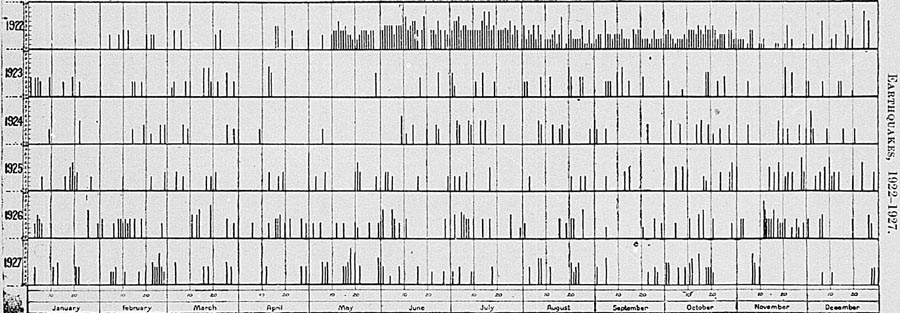
The following table gives particulars of the earthquakes felt in New Zealand in 1927:—
| — | Jan. | Feb. | Mar. | April. | May. | June. | July. | Aug. | Sept. | Oct. | Nov. | Doc. | Total. |
|---|---|---|---|---|---|---|---|---|---|---|---|---|---|
| Felt in North Island only | 4 | 21 | 2 | 4 | 17 | 6 | 2 | 4 | 6 | 9 | 6 | 3 | 84 |
| Felt in South Island only | 2 | 1 | 1 | 1 | 1 | 4 | 2 | 2 | 2 | 16 | |||
| Felt in both Islands | 1 | 2 | 1 | 3 | 3 | 10 | |||||||
| Totals | 7 | 22 | 5 | 4 | 19 | 7 | 6 | 9 | 6 | 14 | 6 | 5 | 110 |
The following are the more severe earthquakes felt in 1927:—
On 26th February, 1927, R.-F. VI, at Opotiki. This was felt from Hick's Bay to Napier, but most strongly north of Gisborne.
An earthquake at Bainham, Nelson, on 18th May, 1927, is reported to have thrown down logs and rocks from the mountain, and was classed as R.-F. VIII.
At Hick's Bay on 20th May, 1927, there was a local shock of intensity VII.
On 30th May, 1927, an earthquake, felt in the Hauraki Plains from Auckland to Raurimu, reached intensity VI at Cambridge.
An earthquake on 7th August, 1927, at Dannevirke, was of intensity VI.
On 8th August, 1927, an earthquake widely felt in Wellington, Taranaki, and Hawke's Bay, reached intensity VI at Castlepoint and Waipawa.
At Morrinsville on 5th September, 1927, R.-F. VI.
At Hick's Bay on 12th October, 1927, R.-F. VI.
At New Plymouth on 15th October, 1927, R.-F. VII.
At Morrinsville on 7th November, 1927, R.-F. VII. This was R.-F. VI at Hamilton and Cambridge, and was felt all over the Hauraki Plains.
Deaths due to earthquakes in New Zealand are fortunately very few. In the last eighty years seven have been recorded. The shock of October, 1848, threw down a wall in Wellington, and three people were killed. On the 24th January, 1855, a death occurred at Wellington recorded as “accidental death from the falling of a chimney.” The large earthquake took place during the night of the 23rd January, 1855. On the 16th November, 1901, a child was killed by the Cheviot earthquake. On the 12th April, 1913, a Maori was killed at Masterton by material falling from the post-office, due to an earthquake. On the 7th October, 1914, a shepherd was killed by the Gisborne earthquake.
The following article on the climate of New Zealand has been prepared by Dr. E. Kidson, M.A., D.Sc., Director of Meteorological Services:—
The problem of the classification of the climate of a country may be regarded from various aspects. First of all, there is its solar climate, which depends on the amount of heat it receives from the sun and the variations of this amount with the seasons, and which is determined solely by the latitude of the country. New Zealand lies wholly within the Temperate Zone, and on the equatorial, or warmer, side of it. The amount of heat received from the sun is therefore never excessive even in the far north, while even in the middle of winter and in the southernmost portions, on the other hand, the sun rises high enough to give considerable warmth during the day. The difference in length between the longest and the shortest days in the year is about four and two-thirds hours in the northernmost and seven and one-third hours in the southernmost extremity of the Dominion. The day has never so short a length as eight hours.
If the surface of the globe were homogeneous—if, for instance, it were all ocean—all places on the same parallel would have the same climate, and there would be no need for any other classification than according to solar climate. Instead of this, however, we have a varying surface, some of it being land and some water, while the land surface varies in nature and in elevation. Solar radiation has very varying effects on these different types of surface, and these in turn react in different ways on the atmosphere. Based on these physical conditions, then, we have two main types of climate—viz., continental and marine. A marine climate is controlled to a large extent by the waters of the surrounding ocean areas, and, since New Zealand nowhere has any great breadth, its climate is of the marine type. The distinctive feature of such a climate is its sluggishness as regards temperature changes when compared with a continental one. When sunshine falls on a land surface most of it is absorbed in a very shallow layer and converted into heat. The surface, therefore, tends to become very hot. Water, on the other hand, reflects a large portion of the sun's heat back through the atmosphere, whence it is lost. Such radiation as is absorbed penetrates to a considerable depth, so that the rise of temperature at the surface is slight. Even then a good deal of the heat thus accumulated is expended in evaporating water. Over the ocean, therefore, there is very little difference in temperature between the coldest part of the day, just before sunrise, and the hottest, in the early afternoon. Over the land the difference is considerable, and increases, generally speaking, with the distance from the shore. Similarly, in a marine climate the difference between summer and winter is relatively small. Another effect of the sluggishness in temperature changes is that the seasons lag behind the movement of the sun. The spring is cold, although the days are getting longer and the sun higher and stronger. It is common knowledge in New Zealand that we are liable to cold snaps practically up to Christmas. Frosts damaging to vegetation are not rare in November, and snow storms occasionally affect comparatively low-lying country even later in the year. On the other hand, the autumn is warm. In New Zealand mild temperatures may be experienced well into April. A marine climate is generally characterized by high average rainfall, its atmosphere being abundantly charged with moisture evaporated from the sea.
Generally speaking, then, the climate of New Zealand is equable, with an abundant precipitation, which is spread fairly uniformly over the different months. Not only is this so, but the difference in climate between the northern and southern extremities is comparatively slight in view of the fact that the Dominion covers a range of nearly 13 degrees, or about 900 miles, in latitude. The mean temperature at sea-level falls from about 62° F. in the far north to about 50° F. in the far south.
Another aspect from which there is an increasing tendency for geographers and meteorologists to classify climates is that of the vegetation produced by the soil. There are many plants which are able to live only within certain definite climatic limits, and others require certain restricted conditions to produce satisfactory growth. Since man depends so much for his livelihood on the products of the soil, the classification of climates on this basis is a logical and very useful one. From this point of view New Zealand has a warm-temperate and humid climate. The rainfall is almost everywhere sufficient for plant requirements all the year round. The temperature of 50° F. is an important one from the biological point of view, since many plants of the temperate region do not grow well unless the air rises above this temperature for considerable periods. Nowhere in New Zealand are there more than five months with a temperature lower than 50° F. In the Auckland Peninsula and coastal places a little farther south, mean temperatures do not fall below 50° F. in any month. As regards the settled portions of the Dominion, it is only in the elevated regions of Otago and Southland that the mean temperature falls slightly below 40° F. in some of the coldest months, or that the mean minimum for any month falls below freezing-point; consequently the ground is nowhere continuously frozen for long periods. Owing to these mild temperatures, there is some growth of herbage practically the whole year round. Vegetation has no long period of rest, and deciduous trees are practically unknown.
Since temperatures are everywhere warm enough to promote growth and nowhere excessively hot (the mean maximum for any month probably nowhere reaches as high as 80° F. or the mean temperature as high as 70° F.), there is comparatively little difference between the North and South as regards the nature of the things grown. Grapes, for instance, can be grown successfully out-of-doors in parts of all provinces of the Dominion. Certainly, in the North such semitropical products as citrus fruits can be grown successfully, whereas in the South this is not possible.
As regards human occupation, New Zealand lies in the zone of the Southern Hemisphere which is subject at all times of year to frequent moving barometric depressions, with all their accompanying weather-changes. Some experts consider this an important condition for the development of civilization in its highest form. Cloudiness is nowhere excessive, so that there is plenty of sunshine, and a considerable range between day and night temperatures, which again tends to produce bracing conditions. Indeed, there can be few countries so admirably adapted for the production of a high yield from the soil and the maintenance of a high standard of comfort and civilization as New Zealand.
The Dominion is in the region of prevailing westerly winds. North of about New Plymouth and Napier these westerlies are not, in the main, strong, and, in fact, in summer there is a prevalence of south-easterlies. Though these can scarcely be classed as trade-winds, even in the far north, they are to a large extent part of the same system. South from the 39th parallel of latitude the westerlies prevail, and although, in the free air at least, their mean strength increases the farther south we go, they are of considerable average force even in Taranaki and Hawke's Bay.
We next have to consider the feature that exercises the most potent influence in modifying climate in New Zealand—that is, its mountain-ranges. Such variations of climate as are encountered in the different parts of the Dominion are produced mainly by these ranges. Their effect is closely associated with the prevalence of westerly winds. A range of mountains presents an obstacle to a wind which meets it. To force the air up and over it requires a great deal of energy. Wherever possible the wind will flow round rather than over. The most notable instances of this effect in New Zealand are found in the Cook and Foveaux Straits regions. Air in a westerly wind is forced round and over the lower portions of the northern part of the South Island into Cook Strait. Some of the air thus entering the strait possibly comes from as far south as Westport when the general wind is from due west. At the same time, the ranges in the North Island deflect into a southerly direction all winds which strike south of Cape Egmont. Some of the air is forced through the comparatively low gap in the neighbourhood of the Manawatu Gorge, while the greater part goes on down to Cook Strait. Similarly, in the south-west corner of the Dominion, a westerly wind is deflected into a north-westerly and flows round Puysegur Point into Foveaux Strait. A south-westerly wind is deflected into a westerly through the strait. The two regions mentioned are ones through which winds from a considerable area are forced to converge, and the consequence is that they are subject to an unusual proportion of strong winds. Through such channels it is practically only possible for winds to have one or two directions—i.e., they must blow through the straits from one direction or the other. Owing to the great preponderance of winds from a westerly quarter, the prevailing direction in Cook Strait is from the north-west. This wind may correspond with any direction between north-west and south-west in the open ocean waters where winds are unimpeded. More rarely there are strong winds from an easterly direction, which produce south-easterlies in the strait. These may correspond with any wind between north-east and south over the open waters to the east. In the South the predominance of westerlies is greater than at Wellington, but there are at times strong easterlies through Foveaux Strait. Though not on the same scale, effects of a similar kind are noticeable in other parts. Round East Cape, for instance, there is a tendency for winds to be deflected along the coast-line, and easterly winds are likely to be specially strong there. At Nelson there is a different effect, and westerly winds tend to be deflected down Tasman Bay as south-westerlies, but at the head of the bay meet the winds which have come round Cape Farewell and are checked. If the general wind, therefore, is between north-west and west-south-west about, the winds are usually light at Nelson.
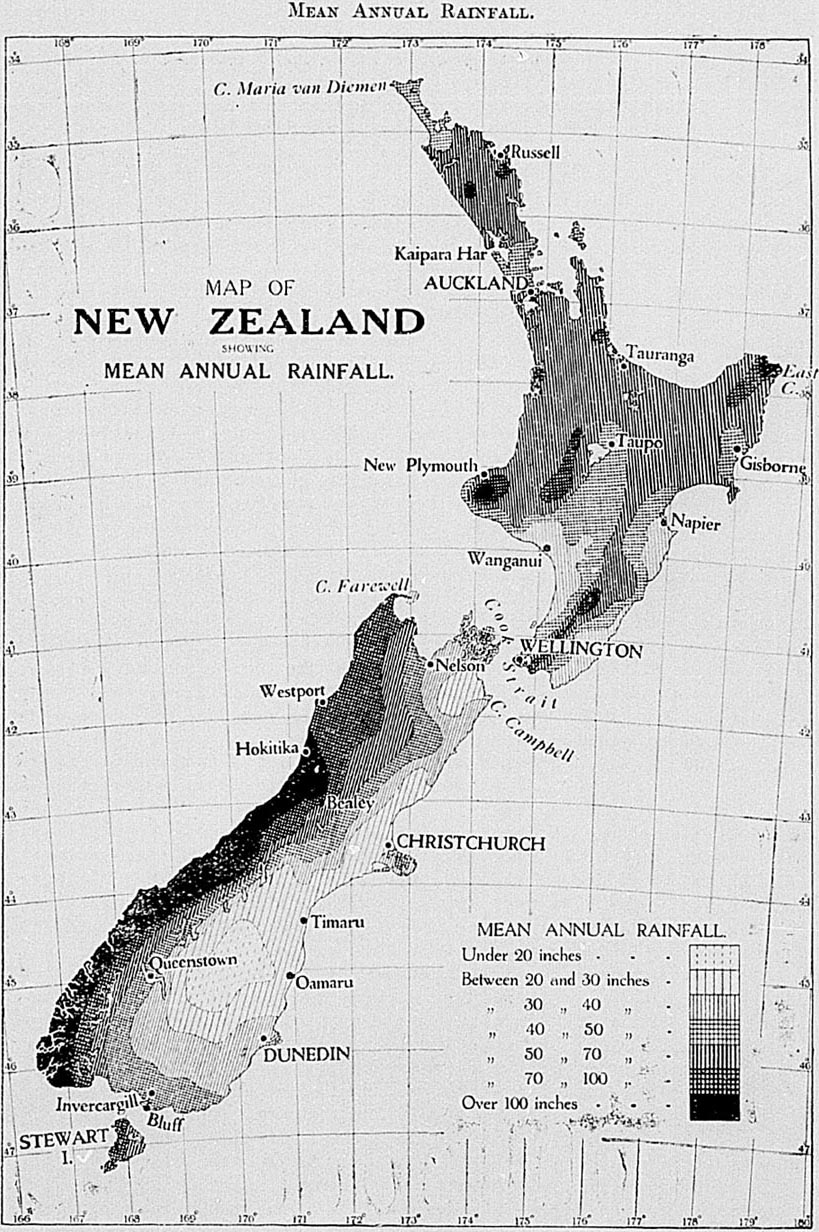
When the general wind is almost due south-west, or practically parallel to the main range in both Islands, many parts of the Dominion are protected. Strong south-westerly winds may be blowing and wet weather prevail in the southern parts of Otago and Southland, and also in Taranaki and the northern parts of the Auckland Provincial District, while much of the rest of the country, including the inland portions of Otago, Canterbury, and Marlborough, the east coast of the North Island, and especially Cook Strait, experience unusually fine yet bracing weather and comparatively little wind. A slight deviation of this wind to one side or the other means bringing unsettled weather to the west coast of the South Island or to the eastern districts from East Cape southwards.
The checking of the westerly winds by the Southern Alps results in a large proportion of variable winds on the west coast of the South Island.
Although it is true that wind will flow round an obstacle in preference to climbing over it, yet when a broad belt of winds meets a mountain barrier lying across its path much of the air must be forced over the range. This happens when the prevailing winds, which are from between north-west and west, strike the Southern Alps, and, to a less extent, the ranges of the North Island. The distribution of rainfall over New Zealand is greatly influenced by this fact, as can be seen from the accompanying rainfall map. Most of our rain is produced from moisture carried from warmer latitudes by north-westerly winds. The rain falls either in the north-westerlies or when the latter are forced up by colder south-westerly winds. When the westerly or north-westerly winds are driven over the mountain-ranges they rise into regions in which the air-pressure is much reduced. They are, in consequence, cooled. The colder the air is, the less uncondensed water-vapour can it contain. Moisture is therefore condensed, and falls as rain on the mountain-tops and their western slopes. Generally speaking, therefore, districts with a westerly aspect have the heaviest rainfall. This is especially noticeable in the South Island, where the west coast opposite the Southern Alps has an excessive rainfall, while in their lee we have the driest areas in New Zealand, that in Central Otago being the most notable. Round Mount Egmont is another area of heavy precipitation. The East Cape district has a high rainfall because it gets a good deal of the northwesterly rain, and is also subject to very heavy falls in easterly winds which occur in connection with cyclones in the neighbourhood of the North Island.
When the westerly winds blow over the mountains they sometimes shoot down them again on the opposite side. Falling into levels where the pressure is higher, they are heated, just as the air compressed in a bicycle-pump is heated and warms the pump. Having lost a good deal of their moisture, they are very dry, and the energy gained by falling down the mountain-slopes adds to their speed. We therefore have the gusty, hot, dry wind which is characteristic of mountain regions and is called the “Föhn” wind. The Canterbury Plains, especially the portions near the foothills of the Alps, are one of the regions of the world where the Föhn effect is most notably developed. The characteristics of the north-west wind are well known to the dwellers in those parts. During the Föhn wind a band of clear sky is produced on the leeward side of the mountains, while farther away cloud often forms again at a considerable height. This gives the characteristic appearance of the “Föhn arch.” Though most strongly developed in Canterbury, Föhn winds are experienced also in Otago, parts of Marlborough, and from the Wairarapa to Hawke's Bay.
Föhn winds, owing to their high temperature and to the fact that relatively high pressure tends to be produced in them on the west side of the ranges and relatively low on the east side, are often underrun by east or north-east, winds on the east coast. These are especially prevalent in Canterbury, and the north-easter is a persistent and humid wind of an unpleasant type.
The shelter given from the ocean-winds, and the clear dry atmosphere produced by the mountains, causes a nearer approach to continental conditions in their lee than in other parts of the country. The greatest extremes of temperatures are found in these regions.
In addition to the climatic effects above described, there are others produced by mountains and due directly to the elevation. Other things being equal, the amount of precipitation increases with elevation, until about 5,000 ft. or 6,000 ft. is reached. Higher than that, it falls off again owing to the fact that the cold air above those levels is able to hold little moisture. Again, the greater the height above mean sea-level, the lower the mean temperature, the difference being about 3.5° F. per 1,000 ft. There are no closely settled areas in New Zealand sufficiently high for the elevation to produce any very marked influence on the climate. The effect is to some extent counterbalanced, too, in most places by the facts (1) that the sloping ground prevents the accumulation of cold air on the surface, so that night temperatures are less extreme than they might otherwise have been, and (2) that the atmosphere is more transparent, owing to the reduced amount of vapour it contains and the absence of dust, so that the sun seems to give more heat.
Above about 5,000 ft. snow frequently lies for long periods and the climate is severe. Forest-trees become more and more stunted as this height is approached, and finally are unable to survive. Beyond it we have a mountain climate and characteristically alpine flora. The latter is adapted for resistance to drought, although actually the rainfall is usually heavy. The adaptation is necessary because of the rapid drainage, the intense heat produced on still clear days by the sun's rays, and the cutting-off of water-supplies from the roots for long periods owing to the freezing of the ground. Even in these high regions, however, conditions are not extreme. It is probably very rarely indeed that the temperature falls as low as 0° F., except perhaps for short intervals and in sheltered basins. The mountain region of the Southern Alps is, nevertheless, of great interest on account of its large and characteristic glaciers. The Franz Josef Glacier is especially famous, owing to the fact that it descends almost to sea-level, although the latitude is comparatively low. No doubt the very heavy rainfall on the mountains in this district and the rapid fall to sea-level are chiefly responsible for this effect.
The tables which follow, giving average values of various meteorological quantities for a number of typical stations, will serve to indicate the variation of climate in the different parts of New Zealand.
For comparisons with New Zealand conditions, data are given for Kew Observatory, near London, and for Aberdeen. It will be seen that even at Kew the mean temperature is lower than at Queenstown or Invercargill, while at Aberdeen the mean maximum is less than 2° F. higher than the mean temperature at these stations. Again, the number of days with rain is much higher at the British stations than in New Zealand for rainfall totals of corresponding amount. The Dominion also has a much larger average amount of bright sunshine. These advantages of increased warmth and sunshine, combined with an abundant supply of water, account for the wonderful fertility of our soil.
| Auckland. | ||||||
|---|---|---|---|---|---|---|
| Month. | Mean Temperatures. | Mean Rainfall for 74 Years. | Bright Sunshine. | |||
| Maximum. | Minimum. | Mean. | ||||
| °F. | °F. | °F. | Inches. | Days. | Hours. | |
| January | 73.6 | 59.0 | 66.5 | 2.67 | 10.4 | 220 |
| February | 74.1 | 62.6 | 67.0 | 3.05 | 9.7 | 187 |
| March | 71.9 | 57.7 | 64.9 | 3.02 | 11.2 | 173 |
| April | 67.7 | 54.6 | 61.2 | 3.43 | 13.9 | 142 |
| May | 62.6 | 50.7 | 56.8 | 4.63 | 18.5 | 128 |
| June | 59.1 | 47.8 | 53.5 | 4.92 | 19.4 | 114 |
| July | 57.5 | 46.0 | 51.7 | 4.95 | 20.8 | 121 |
| August | 58.1 | 46,1 | 52.2 | 4.22 | 19.4 | 150 |
| September | 60.7 | 48.5 | 54.6 | 3.64 | 17.5 | 149 |
| October | 63.5 | 50.9 | 57.2 | 3.69 | 16.5 | 169 |
| November | 66.9 | 53.5 | 60.3 | 3.32 | 15.9 | 192 |
| December | 70.8 | 56.9 | 63.9 | 2.90 | 11.6 | 209 |
| Year | 65.5 | 52.9 | 59.1 | 44.44 | 184.8 | 1,954 |
| Tauranga. | |||||
|---|---|---|---|---|---|
| Month. | Mean Temperatures. | Mean Rainfall for 24 Years. | |||
| Maximum. | Minimum. | Mean. | |||
| °F. | °F. | °F. | Inches. | Days. | |
| January | 73.8 | 54.9 | 54.3 | 4.34 | 10.4 |
| February | 74.4 | 54.9 | 64.6 | 3.58 | 9.0 |
| March | 72.3 | 52.2 | 62.2 | 4.16 | 11.0 |
| April | 67.8 | 48.1 | 57.9 | 5.08 | 11.1 |
| May | 62.8 | 44.6 | 53.7 | 5.16 | 13.2 |
| June | 59.1 | 41.1 | 50.1 | 5.42 | 13.2 |
| July | 58.0 | 40.1 | 49.0 | 4.86 | 14.8 |
| August | 58.9 | 40.3 | 49.6 | 4.08 | 13.7 |
| September | 62.3 | 43.4 | 52.8 | 4.41 | 13.4 |
| October | 65.4 | 47.3 | 56.3 | 5.25 | 14.3 |
| November | 68.1 | 49.1 | 58.6 | 3.29 | 11.7 |
| December | 71.7 | 51.4 | 61.5 | 3.47 | 11.1 |
| Year | 66.2 | 47.3 | 56.7 | 53.10 | 146.9 |
| Rotorua. | ||||||
|---|---|---|---|---|---|---|
| Month | Mean Temperatures. | Mean Rainfall for 40 Years. | Bright Sunshine. | |||
| Maximum. | Minimum. | Mean. | ||||
| °F. | °F. | °F. | Inches. | Days. | Hours. | |
| January | 75.1 | 52.4 | 63.7 | 4.36 | 10.0 | 232 |
| February | 74.9 | 52.6 | 63.6 | 3.76 | 8.7 | 192 |
| March | 71.7 | 49.6 | 60.6 | 3.51 | 9.7 | 184 |
| April | 66.1 | 45.4 | 55.7 | 4.35 | 10.8 | 153 |
| May | 60.4 | 40.9 | 50.6 | 5.72 | 12.7 | 135 |
| June | 55.9 | 38.5 | 47.1 | 5.24 | 13.2 | 116 |
| July | 54.5 | 37.0 | 45.6 | 1.88 | 13.5 | 127 |
| August | 56.3 | 37.6 | 46.9 | 4.95 | 13.4 | 141 |
| September | 60.0 | 40.9 | 50.4 | 5.16 | 14.4 | 151 |
| October | 64.0 | 44.3 | 54.2 | 5.25 | 14.3 | 175 |
| November | 68.4 | 46.9 | 57.7 | 4.10 | 12.6 | 216 |
| December | 72.8 | 49.9 | 61.2 | 3.83 | 10.0 | 222 |
| Year | 65.0 | 44.7 | 54.8 | 55.11 | 143.3 | 2,044 |
| Napier. | ||||||
|---|---|---|---|---|---|---|
| Month. | Mean Temperatures. | Mean Rainfall for 48 Years. | Bright Sunshine. | |||
| Maximum. | Minimum. | Mean. | ||||
| °F. | °F. | °F. | Inches. | Days. | Hours. | |
| January | 75.5 | 56.8 | 66.1 | 3.14 | 7.8 | 259 |
| February | 74.3 | 56.7 | 65.5 | 2.89 | 7.3 | 211 |
| March | 71.3 | 54.7 | 63.0 | 3.26 | 7.4 | 216 |
| April | 67.2 | 50.2 | 58.7 | 2.87 | 7.5 | 195 |
| May | 61.5 | 46.1 | 53.8 | 3.73 | 9.9 | 154 |
| June | 57.9 | 42.3 | 50.1 | 3.54 | 10.8 | 150 |
| July | 56.4 | 41.5 | 48.9 | 3.87 | 11.5 | 147 |
| August | 57.8 | 42.0 | 49.9 | 3.56 | 11.7 | 183 |
| September | 62.2 | 45.1 | 53.6 | 2.16 | 9.4 | 216 |
| October | 66.3 | 45.7 | 57.5 | 2.29 | 8.6 | 229 |
| November | 69.7 | 51.8 | 60.7 | 2.48 | 8.3 | 245 |
| December | 73.1 | 55.3 | 64.1 | 2.32 | 7.3 | 267 |
| Year | 66.1 | 49.0 | 57.7 | 36.11 | 107.5 | 2,472 |
| New Plymouth. | ||||||
|---|---|---|---|---|---|---|
| Month. | Mean Temperatures. | Mean Rainfall for 50 Years. | Bright Sunshine. | |||
| Maximum. | Minimum. | Mean. | ||||
| °F. | °F. | °F. | Inches. | Days. | Hours. | |
| January | 73.1 | 55.2 | 61.6 | 4.42 | 12.8 | 260 |
| February | 73.8 | 55.5 | 64.6 | 4.00 | 10.5 | 224 |
| March | 71.9 | 54.0 | 62.9 | 3.62 | 12.1 | 219 |
| April | 67.9 | 50.7 | 59.3 | 4.51 | 14.2 | 170 |
| May | 63.1 | 47.6 | 55.3 | 6.23 | 18.1 | 153 |
| June | 59.4 | 44.7 | 52.0 | 6.14 | 17.5 | 134 |
| July | 57.8 | 43.2 | 50.5 | 6.29 | 18.7 | 147 |
| August | 58.8 | 42.8 | 50.8 | 5.33 | 18.5 | 172 |
| September | 61.3 | 45.6 | 53.4 | 5.22 | 17.5 | 161 |
| October | 63.4 | 48.1 | 55.7 | 5.61 | 18.7 | 168 |
| November | 66.3 | 50.3 | 58.3 | 4.65 | 16.2 | 209 |
| December | 70.1 | 53.4 | 51.7 | 4.33 | 14.5 | 243 |
| Year | 65.6 | 49.3 | 57.2 | 60.35 | 189.3 | 2,260 |
| Wellington. | ||||||
|---|---|---|---|---|---|---|
| Month. | Mean Temperatures. | Mean Rainfall for 60 Years. | Bright Sunshine. | |||
| Maximum. | Minimum. | Mean. | ||||
| °F. | °F. | °F. | Inches. | Days. | Hours. | |
| January | 69.4 | 55.7 | 62.5 | 3.30 | 10.5 | 224 |
| February | 69.3 | 55.8 | 62.5 | 3.19 | 9.6 | 209 |
| March | 66.9 | 54.2 | 60.5 | 3.29 | 11.2 | 185 |
| April | 62.8 | 51.2 | 57.0 | 3.80 | 12.9 | 156 |
| May | 58.3 | 47.2 | 52.7 | 4.76 | 16.6 | 126 |
| June | 54.7 | 44.2 | 49.4 | 4.87 | 17.3 | 106 |
| July | 53.1 | 42.3 | 47.7 | 5.55 | 18.1 | 107 |
| August | 54.4 | 42.8 | 48.6 | 4.43 | 17.0 | 142 |
| September | 57.5 | 45.7 | 51.6 | 3.99 | 14.9 | 164 |
| October | 60.4 | 48.4 | 54.4 | 4.19 | 14.2 | 174 |
| November | 63.4 | 50.5 | 56.9 | 3.44 | 12.9 | 201 |
| December | 66.9 | 53.9 | 60.4 | 3.30 | 12.1 | 228 |
| Year | 61.4 | 49.3 | 55.4 | 48.11 | 166.7 | 2,022 |
| Nelson. | ||||||
|---|---|---|---|---|---|---|
| Month. | Mean Temperatures. | Mean Rainfall for 44 Years. | Bright Sunshine. | |||
| Maximum. | Minimum. | Mean. | ||||
| °F. | °F. | °F. | Inches. | Days. | Hours. | |
| January | 74.9 | 53.9 | 64.3 | 2.85 | 8.4 | 267 |
| February | 74.2 | 54.0 | 64.0 | 2.73 | 9.4 | 235 |
| March | 71.0 | 51.4 | 61.1 | 3.09 | 9.0 | 204 |
| April | 66.2 | 47.5 | 56.9 | 2.90 | 9.5 | 194 |
| May | 60.0 | 42.5 | 51.2 | 3.13 | 10.5 | 165 |
| June | 56.1 | 38.8 | 47.4 | 3.64 | 10.1 | 151 |
| July | 54.6 | 37.6 | 46.1 | 3.41 | 11.0 | 153 |
| August | 56.5 | 38.5 | 47.5 | 3.02 | 10.6 | 195 |
| September | 60.6 | 42.3 | 51.4 | 3.72 | 12.2 | 200 |
| October | 64.7 | 45.4 | 55.0 | 3.61 | 12.1 | 212 |
| November | 68.6 | 48.4 | 58.5 | 2.95 | 11.3 | 246 |
| December | 71.9 | 51.6 | 61.7 | 2.72 | 8.8 | 260 |
| Year | 64.9 | 46.0 | 55.4 | 37.77 | 122.9 | 2,482 |
| Hokitika. | ||||||
|---|---|---|---|---|---|---|
| Month. | Mean Temperatures. | Mean Rainfall for 48 Years. | Bright Sunshine. | |||
| Maximum. | Minimum. | Mean. | ||||
| °F. | °F. | °F. | Inches. | Days. | Hours. | |
| January | 67.4 | 53.2 | 60.3 | 9.92 | 12.8 | 215 |
| February | 68.0 | 53.1 | 60.6 | 7.37 | 11.3 | 191 |
| March | 66.0 | 51.1 | 58.5 | 9.75 | 14.4 | 178 |
| April | 62.4 | 47.2 | 54.7 | 9.39 | 15.1 | 139 |
| May | 57.9 | 42.1 | 49.9 | 9.82 | 15.6 | 136 |
| June | 54.4 | 38.7 | 46.4 | 9.55 | 15.3 | 114 |
| July | 53.0 | 36.7 | 44.8 | 8.99 | 16.1 | 128 |
| August | 54.5 | 38.0 | 46.3 | 9.28 | 16.0 | 158 |
| September | 57.6 | 42.5 | 50.0 | 9.32 | 16.8 | 144 |
| October | 59.6 | 45.7 | 52.7 | 11.81 | 19.0 | 160 |
| November | 61.7 | 48.1 | 54.9 | 10.78 | 17.6 | 173 |
| December | 65.3 | 51.4 | 58.4 | 10.62 | 16.4 | 208 |
| Year | 60.7 | 45.7 | 53.1 | 116.60 | 186.4 | 1,944 |
| Hanmer. | ||||||
|---|---|---|---|---|---|---|
| Month. | Mean Temperatures. | Mean Rainfall for 21 Years. | Bright Sunshine. | |||
| Maximum. | Minimum. | Mean. | ||||
| °F. | °F. | °F. | Inches. | Days. | Hours. | |
| January | 71.9 | 49.5 | 60.7 | 3.74 | 11.0 | 207 |
| February | 71.2 | 48.9 | 59.9 | 3.04 | 8.5 | 191 |
| March | 67.7 | 46.8 | 57.2 | 2.89 | 9.7 | 191 |
| April | 62.9 | 41.7 | 52.3 | 2.99 | 10.4 | 159 |
| May | 55.4 | 36.2 | 45.7 | 4.51 | 11.6 | 125 |
| June | 50.7 | 32.0 | 41.4 | 3.11 | 11.5 | 109 |
| July | 49.1 | 32.0 | 40.2 | 4.59 | 11.7 | 110 |
| August | 51.7 | 32.6 | 42.2 | 2.52 | 10.2 | 146 |
| September | 57.7 | 37.7 | 47.7 | 4.10 | 10.6 | 172 |
| October | 62.1 | 41.9 | 52.0 | 3.31 | 12.0 | 179 |
| November | 64.9 | 43.8 | 54.3 | 2.93 | 10.5 | 199 |
| December | 69.1 | 47.0 | 58.2 | 3.28 | 9.3 | 216 |
| Year | 61.2 | 40.8 | 51.0 | 41.01 | 127.0 | 2,004 |
| Lincoln. | ||||||
|---|---|---|---|---|---|---|
| Month. | Mean Temperatures. | Mean Rainfall for 46 Years. | Bright Sunshine. | |||
| Maximum. | Minimum. | Mean. | ||||
| °F. | °F. | °F. | Inches. | Days. | Hours. | |
| January | 71.9 | 51.3 | 61.6 | 2.23 | 9.4 | 212 |
| February | 71.3 | 51.7 | 61.5 | 1.66 | 7.7 | 201 |
| March | 68.4 | 49.0 | 58.7 | 2.27 | 10.0 | 182 |
| April | 63.6 | 44.3 | 54.0 | 1.98 | 9.4 | 159 |
| May | 57.4 | 39.8 | 48.5 | 2.31 | 11.2 | 136 |
| June | 52.9 | 36.3 | 44.6 | 2.43 | 11.7 | 118 |
| July | 51.1 | 35.2 | 43.1 | 2.71 | 13.0 | 117 |
| August | 53.5 | 36.5 | 45.0 | 2.03 | 11.2 | 153 |
| September | 58.4 | 40.3 | 49.4 | 1.91 | 9.7 | 178 |
| October | 63.2 | 43.9 | 53.6 | 1.72 | 9.3 | 204 |
| November | 66.2 | 46.2 | 56.2 | 1.97 | 10.4 | 218 |
| December | 70.1 | 49.3 | 59.7 | 2.12 | 10.0 | 209 |
| Year | 62.3 | 43.7 | 53.0 | 25.34 | 123.0 | 2,087 |
| Dunedin. | ||||||
|---|---|---|---|---|---|---|
| Month. | Mean Temperatures for 59 Years. | Mean Rainfall for 70 Years. | Bright Sunshine. | |||
| Maximum. | Minimum. | Mean. | ||||
| °F. | °F. | °F. | Inches. | Days. | Hours. | |
| January | 66.3 | 49.6 | 58.0 | 3.34 | 14.2 | 184 |
| February | 65.8 | 49.5 | 57.7 | 2.75 | 11.2 | 156 |
| March | 63.0 | 47.9 | 55.4 | 2.96 | 13.0 | 144 |
| April | 58.7 | 44.8 | 51.7 | 2.78 | 12.8 | 120 |
| May | 53.2 | 41.1 | 47.1 | 3.26 | 13.6 | 99 |
| June | 49.4 | 38.4 | 43.8 | 3.15 | 12.8 | 93 |
| July | 47.7 | 37.1 | 42.4 | 2.99 | 12.9 | 97 |
| August | 50.2 | 37.9 | 44.0 | 3.14 | 12.8 | 110 |
| September | 55.0 | 40.9 | 47.9 | 2.75 | 12.8 | 142 |
| October | 59.2 | 42.9 | 51.0 | 3.13 | 14.3 | 157 |
| November | 61.6 | 45.0 | 53.3 | 3.28 | 14.2 | 164 |
| December | 64.6 | 48.0 | 56.3 | 3.53 | 14.5 | 175 |
| Year | 57.9 | 43.6 | 50.7 | 37.06 | 159.1 | 1,641 |
| Queenstown. | |||||
|---|---|---|---|---|---|
| Month. | Mean Temperatures. | Mean Rainfall for 36 Years. | |||
| Maximum. | Minimum. | Mean. | |||
| °F. | °F. | °F. | Inches. | Days. | |
| January | 70.4 | 49.9 | 60.1 | 2.72 | 8.8 |
| February | 70.2 | 49.6 | 59.9 | 1.98 | 5.9 |
| March | 66.4 | 47.9 | 57.1 | 2.60 | 7.6 |
| April | 59.1 | 43.8 | 51.5 | 3.00 | 8.0 |
| May | 51.8 | 38.6 | 45.2 | 2.63 | 7.6 |
| June | 45.9 | 33.7 | 39.7 | 2.46 | 6.8 |
| July | 43.3 | 31.8 | 37.5 | 2.04 | 6.1 |
| August | 47.3 | 33.8 | 40.6 | 1.93 | 6.5 |
| September | 54.3 | 38.7 | 46.5 | 2.47 | 7.7 |
| October | 59.8 | 42.1 | 50.9 | 3.48 | 9.3 |
| November | 63.2 | 44.5 | 53.8 | 2.74 | 8.7 |
| December | 68.0 | 49.2 | 58.6 | 2.59 | 8.2 |
| Year | 58.3 | 42.0 | 50.1 | 30.64 | 91.2 |
| Gore. | ||||||
|---|---|---|---|---|---|---|
| Month. | Mean Temperatures. | Mean Rainfall for 20 Years. | Bright Sunshine. | |||
| Maximum. | Minimum. | Mean. | ||||
| °F. | °F. | °F. | Inches. | Days. | Hours. | |
| January | 69.3 | 46.7 | 58.0 | 3.09 | 15.7 | 226 |
| February | 68.6 | 46.0 | 57.3 | 2.65 | 11.6 | 182 |
| March | 65.9 | 43.8 | 54.9 | 3.27 | 13.0 | 168 |
| April | 59.9 | 40.3 | 50.2 | 3.15 | 15.0 | 127 |
| May | 53.7 | 35.6 | 45.1 | 2.71 | 15.7 | 116 |
| June | 47.7 | 32.5 | 40.1 | 2.82 | 15.6 | 103 |
| July | 47.2 | 31.6 | 39.3 | 1.94 | 14.0 | 116 |
| August | 51.4 | 33.4 | 42.5 | 2.31 | 14.3 | 141 |
| September | 57.2 | 37.5 | 47.3 | 2.65 | 14.8 | 159 |
| October | 60.9 | 40.8 | 50.6 | 3.26 | 15.7 | 179 |
| November | 62.9 | 42.2 | 52.5 | 3.23 | 16.5 | 203 |
| December | 66.2 | 44.8 | 55.5 | 3.33 | 14.8 | 210 |
| Year | 59.2 | 39.6 | 49.4 | 34.41 | 176.7 | 1,930 |
| Invercargill. | ||||||
|---|---|---|---|---|---|---|
| Month. | Mean Temperatures. | Mean Rainfall for 33 Years. | Bright Sunshine. | |||
| Maximum. | Minimum. | Mean. | ||||
| °F. | °F. | °F. | Inches. | Days. | Hours. | |
| January | 66.5 | 48.0 | 57.2 | 3.97 | 15.4 | 199 |
| February | 66.1 | 47.4 | 56.8 | 2.97 | 12.3 | 151 |
| March | 63.8 | 45.7 | 54.7 | 3.85 | 14.9 | 116 |
| April | 59.2 | 42.4 | 50.8 | 4.34 | 16.9 | 111 |
| May | 53.7 | 37.7 | 45.8 | 4.49 | 17.7 | 89 |
| June | 49.8 | 35.4 | 42.7 | 3.59 | 16.2 | 89 |
| July | 48.8 | 33.9 | 41.4 | 3.24 | 15.8 | 89 |
| August | 52.0 | 35.5 | 43.8 | 3.38 | 15.2 | 121 |
| September | 57.0 | 39.0 | 48.1 | 3.18 | 14.2 | 129 |
| October | 60.0 | 42.5 | 51.3 | 4.44 | 17.2 | 145 |
| November | 61.6 | 43.9 | 52.8 | 4.39 | 18.0 | 165 |
| December | 64.1 | 46.1 | 55.2 | 4.20 | 16.3 | 164 |
| Year | 58.6 | 41.5 | 50.0 | 46.04 | 190.1 | 1,568 |
| Kew Observatory. (Richmond, Surrey, England.) | ||||||
|---|---|---|---|---|---|---|
| Month. | Mean Temperatures. | Mean Rainfall. | Bright Sunshine. | |||
| Maximum. | Minimum. | Mean. | ||||
| °F. | °F. | °F. | Inches. | Days. | Hours. | |
| January | 43.1 | 34.6 | 38.9 | 1.76 | 16 | 43 |
| February | 45.0 | 35.1 | 40.1 | 1.54 | 13 | 60 |
| March | 48.7 | 36.0 | 42.4 | 1.69 | 14 | 105 |
| April | 55.0 | 39.5 | 47.3 | 1.45 | 13 | 157 |
| May | 61.7 | 45.0 | 53.4 | 1.72 | 12 | 201 |
| June | 67.6 | 50.8 | 59.2 | 2.15 | 12 | 197 |
| July | 71.0 | 54.3 | 62.7 | 2.17 | 12 | 201 |
| August | 69.7 | 53.5 | 61.6 | 2.24 | 13 | 187 |
| September | 64.9 | 49.3 | 57.1 | 1.87 | 12 | 145 |
| October | 56.2 | 43.5 | 49.9 | 2.70 | 17 | 92 |
| November | 49.1 | 38.8 | 44.0 | 2.22 | 16 | 52 |
| December | 44.7 | 35.9 | 40.3 | 2.29 | 17 | 37 |
| Year | 56.4 | 43.0 | 49.7 | 23.80 | 167 | 1,477 |
| Aberdeen.(Scotland.) | ||||||
|---|---|---|---|---|---|---|
| Month. | Mean Temperatures. | Mean Rainfall. | Bright Sunshine. | |||
| Maximum. | Minimum. | Mean. | ||||
| °F. | °F. | °F. | Inches. | Days. | Hours. | |
| January | 42.3 | 33.4 | 37.9 | 2.18 | 18 | 48 |
| February | 43.2 | 33.4 | 38.3 | 2.05 | 17 | 73 |
| March | 45.7 | 34.4 | 40.1 | 2.41 | 20 | 117 |
| April | 49.8 | 37.6 | 43.7 | 1.87 | 17 | 158 |
| May | 54.5 | 41.8 | 48.2 | 2.33 | 17 | 187 |
| June | 59.9 | 47.0 | 53.5 | 1.71 | 15 | 184 |
| July | 62.8 | 50.3 | 56.6 | 2.81 | 17 | 159 |
| August | 62.4 | 49.9 | 56.2 | 2.74 | 18 | 150 |
| September | 59.2 | 46.7 | 53.0 | 2.22 | 17 | 124 |
| October | 52.8 | 41.7 | 47.3 | 3.00 | 20 | 95 |
| November | 46.8 | 37.4 | 42.1 | 2.95 | 19 | 55 |
| December | 42.9 | 34.2 | 38.6 | 3.22 | 19 | 36 |
| Year | 51.9 | 40.7 | 46.3 | 29.49 | 214 | 1,386 |
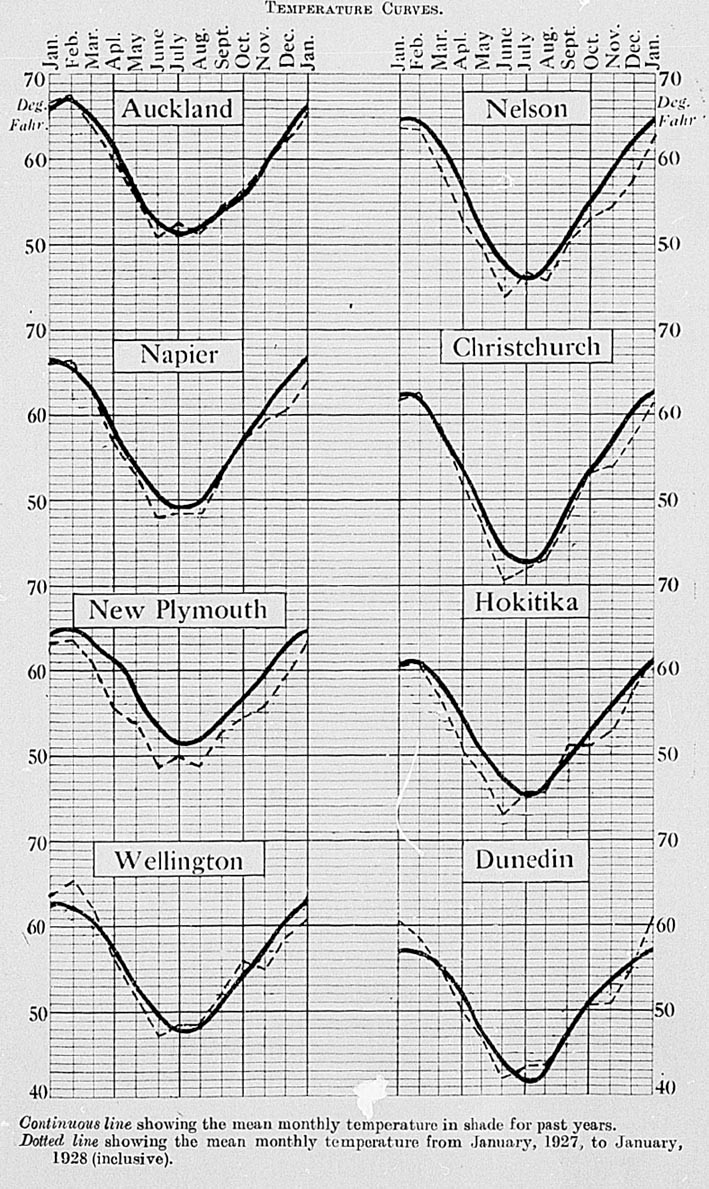
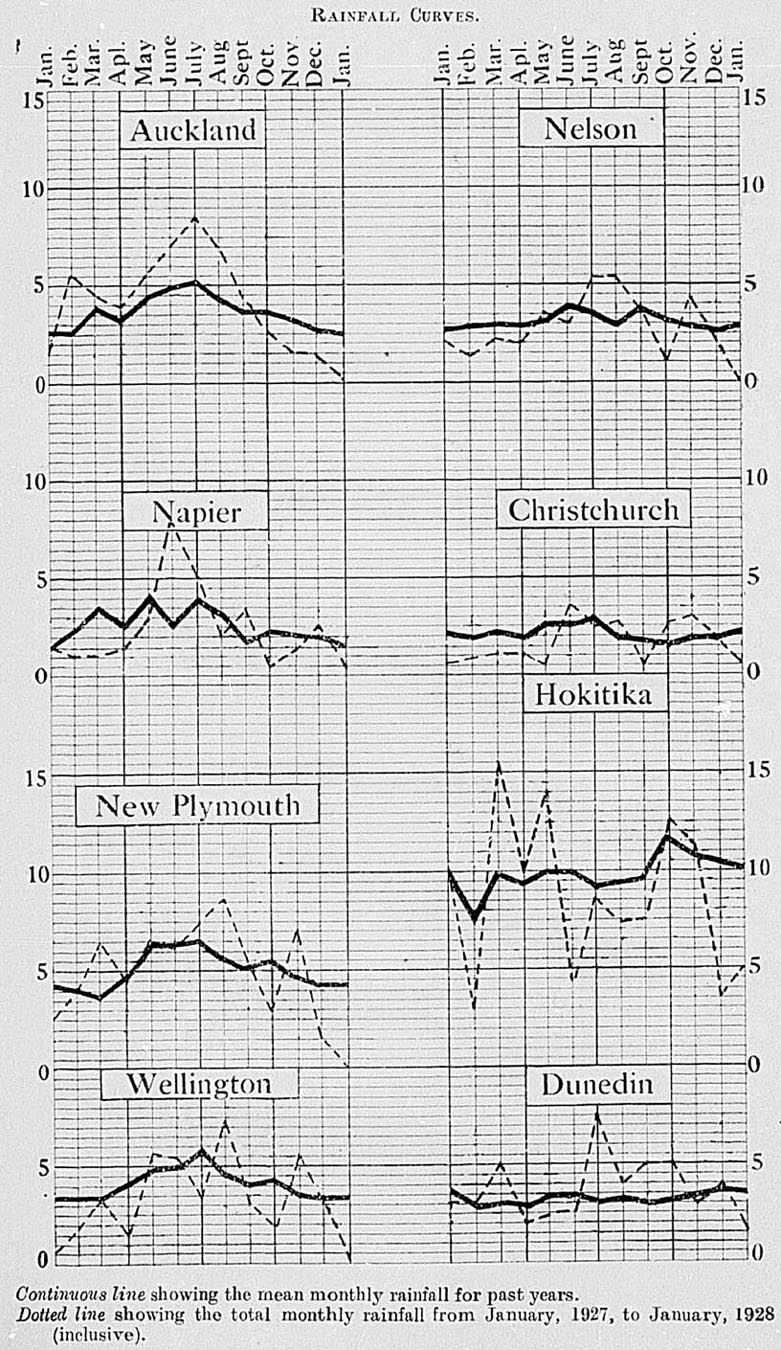
January.—The latter half of the month was hot and dry. Rainfall was below normal over most of the Dominion.
February.—The heat-wave of the latter half of January continued until the third week of this month. Some very high temperatures were recorded. A cold snap was experienced on the 22nd. Rainfall was above the average in most of Otago and the northern parts of the North Island, but below it elsewhere.
March.—The first half was mild and summery, but by contrast the second was cold, boisterous, and unsettled. A deep depression of the westerly type passed south of the Dominion on the 20th, and was followed by an intense cyclonic disturbance. The barometer fell to 28.65 in, at Christchurch at 7 p.m. on the 23rd. Another westerly depression passed on the 28th, and was followed by a cold snap. Some frosts were recorded, and snow lay heavily on the southern mountains at the close of the month. There was an excess of rainfall, except in parts of the eastern districts of both Islands. Some very heavy falls were recorded in the high country of the South Island, 10.35 in, falling at Arthur's Pass on the 23rd. Floods occurred in the Waimakariri and in some of the Marlborough rivers.
April.—The month was cool and with precipitation below normal in most parts. High westerly winds prevailed on a number of days over the South Island.
May.—A cool and changeable month. Some severe frosts were recorded. Rainfall was below the normal in Otago, South Canterbury, and the Hawke's Bay region, but in excess of it in most other districts. The heaviest rain fell in connection with a westerly disturbance between the 26th and 28th.
June.—Precipitation was in excess of the average in the northern and east coast districts of both Islands, but below it in other parts. Falls were especially heavy in the Poverty and Hawke's Bay districts and North Canterbury, and were highly beneficial to the agricultural community. Snow fell at many places between the 11th and 13th. Many frosts were recorded, all parts suffering to some extent. Between the 19th and 21st exceptionally heavy frosts, said to be the severest for over forty years, were experienced in Otago. The effects of these frosts were remarkable. Eucalypts of considerable age and great height were killed in large numbers, and many other trees, including fruit-trees, suffered severely.
July.—The duration of sunshine was below the average, but temperatures about normal. Rainfall was above the average in most places, but below it on the west coast of the South Island and in parts of the Cook Strait region. There were three outstanding disturbances during the month, two being cyclonic and one of the westerly type. These storms were responsible for serious floods in many parts of the North Island. Much snow fell on the high country on the 13th.
August.—The month was remarkable for the number of cyclonic disturbances which crossed the New Zealand area. The weather was, in consequence, very dull and moist. An excess of rainfall was recorded over most of the North Island, but over the South conditions were more varied.
September.—Dull and moist weather again predominated. Rainfall was below normal in the Wellington district and thence southward through Canterbury; elsewhere there was an excess. Some flooding was experienced in Otago. Snow fell in some low-lying parts of the South Island on the 25th.
October.—Very mild and pleasant weather ruled during the first half of the month. A severe cold spell, associated with strong southerly winds and light falls of snow, occurred, however, between the 23rd and 25th. A cyclone which became deep when to the eastward of New Zealand was the cause. Except in scattered parts of the South Island, rainfall was below normal.
November.—Pressure systems moved rapidly during the month, and the weather was very changeable. Several of the storm systems were of the cyclonic type. Southerly gales were recorded on the 28th and 29th between East Cape and Lyttelton and in the central provinces, accompanied by low temperatures and some snowfall. In places it was the severest southerly experienced for many years, and cold and wind combined to cause considerable damage. Rainfall was below normal in the northern portions of the North Island, but elsewhere mainly above it.
December.—Another changeable month, with low temperatures during the first two-thirds. Cyclonic storms were again of frequent occurrence. From the 12th to the 19th pressure was continuously low to the eastward of the Dominion, and cold, strong southerly winds and wet weather were the rule. Some snow fell on the elevated portions of the North Island. Subsequently there commenced a spell of fine and dry weather, which was to continue far into the new year. Except in eastern districts, mainly in the North Island, rainfall was below normal.
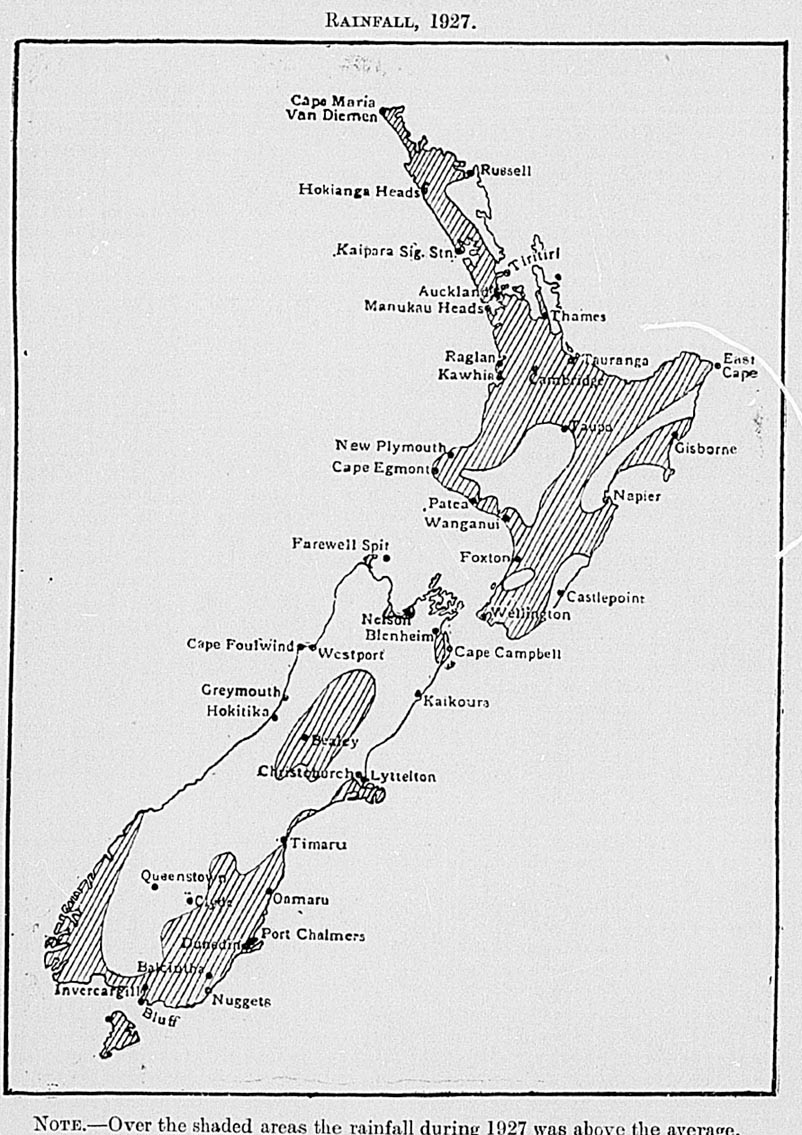
NOTE.—Over the shaded areas the rainfall during 1927 was above the average.
Year.—The year was remarkable for the rapid movement of pressure systems and for the large number of cyclones which appeared on our weather charts. The prevailing westerly winds were very much below average strength, a feature most probably associated with the approach of a maximum of solar activity. The absence of westerly wind affected the climate in many ways, some of which might easily be unsuspected.
Rainfall was above normal over most of the North Island, and, although there was a deficit in the South Island, this was offset by the absence of drying winds. There was, consequently, a good growth of grass and herbage, and conditions were generally favourable for agricultural pursuits.
The year was, on the whole, a cold one, temperatures being, on the average, about a degree below normal. Sunshine, also, was less than the average in most parts, but above it in Taranaki and the western portions of the South Island. In the winter and spring months the mountains were covered to unusually low altitudes with a heavy mantle of snow.
| The observations were taken at 9 a.m. | |||||||||
|---|---|---|---|---|---|---|---|---|---|
| Station. | Mean Pressure in Inches reduced to Sea-level and Standard Gravity. | Temperature in Shade. | Hours of Sunshine. | Rainfall. | |||||
| Mean Maximum. | Mean Minimum. | Approx. Mean Temperature. | Extremes. | Total Fall. | Number of Days. | ||||
| Maximum and Date. | Minimum and Date. | ||||||||
| Inches. | °Fahr. | °Fahr. | °Fahr. | °Fahr. | °Fahr. | Inches. | |||
| Auckland | 29.963 | 64.1 | 52.9 | 58.5 | 80.0 | 37.0 | 1,928.5 | 53.56 | 201 |
| Jan. 24 | June 16 | ||||||||
| Matamata | 65.5 | 44.9 | 55.1 | 85.2 | 22.4 | 50.56 | 157 | ||
| Feb. 6 | July 15 | ||||||||
| Ruakura, Hamilton East | 67.8 | 44.9 | 56.3 | 88.4 | 23.6 | 49.92 | 174 | ||
| Jan. 27 | July 15 | ||||||||
| Te Aroha | 67.9 | 48.5 | 58.2 | 88.0 | 24.0 | 52.63 | 157 | ||
| Jan. 19; Feb. 6 | June 15; July 15 | ||||||||
| Waihi | 65.8 | 47.6 | 56.7 | 87.3 | 26.5 | 1,995.4 | 82.17 | 190 | |
| Jan. 26 | June 15 | ||||||||
| Tauranga | 66.3 | 47.6 | 56.9 | 84.0 | 30.0 | 60.51 | 165 | ||
| Jan. 17; Feb. 4, 5 | July 15 | ||||||||
| Rotorua | 63.8 | 45.5 | 54.6 | 87.0 | 27.0 | 1,997.5 | 58.05 | 149 | |
| Jan. 28 | July 16, 18 | ||||||||
| New Plymouth | 62.2 | 48.9 | 55.5 | 80.0 | 29.4 | 2,071.7 | 63.93 | 194 | |
| Feb. 13 | July 15 | ||||||||
| Taihape | 57.1 | 43.1 | 50.1 | 80.0 | 27.7 | 41.15 | 184 | ||
| Feb. 14 | July 14 | ||||||||
| Palmerston N. | 61.9 | 89.0 | 38.37 | 173 | |||||
| Dec. 26 | |||||||||
| Tangimoana | 63.3 | 46.9 | 55.1 | 85.0 | 29.0 | 34.01 | 142 | ||
| Jan. 30 | June 14 | ||||||||
| Weraroa, Levin | 62.2 | 47.2 | 54.7 | 87.0 | 29.0 | 1,992.7 | 41.86 | 166 | |
| Feb. 1 | July 24 | ||||||||
| Napier | 64.4 | 49.1 | 56.7 | 85.5 | 28.5 | 2,298.0 | 31.18 | 133 | |
| Jan. 24 | July 16 | ||||||||
| Masterton | 64.0 | 44.2 | 54.1 | 93.0 | 26.8 | 2,080.4 | 43.78 | 162 | |
| Feb. 14 | July 16 | ||||||||
| Wellington | 29.930 | 61.7 | 49.1 | 55.4 | 84.0 | 31.2 | 2,055.1 | 43.35 | 167 |
| Feb. 1 | Aug. 29 | ||||||||
| Nelson | 29.899 | 61.8 | 44.8 | 53.3 | 81.1 | 27.9 | 2,560.4 | 36.43 | 113 |
| Feb. 6 | July 15 | ||||||||
| Hokitika | 30.014 | 59.7 | 44.0 | 51.8 | 75.0 | 26.5 | 2,143.1 | 107.96 | 138 |
| Jan. 31 | June 20 | ||||||||
| Hanmer Springs | 60.2 | 39.2 | 49.7 | 95.0 | 19.0 | 2,135.2 | 45.45 | 134 | |
| Feb. 14 | May 12 | ||||||||
| Christchurch | 29.886 | 60.2 | 43.0 | 51.6 | 89.2 | 25.8 | 21.36 | 135 | |
| Feb. 7 | June 2, 5 | ||||||||
| Ashburton | 60.2 | 40.7 | 50.4 | 94.0 | 23.0 | 26.43 | 139 | ||
| Feb. 14 | May 12, 13; June 5 | ||||||||
| Lake Tekapo | 56.3 | 33.6 | 44.9 | 86.0 | 4.0 | 2,742.8 | 19.24 | 58 | |
| Feb. 13 | June 20 | ||||||||
| Timaru | 59.9 | 41.6 | 50.7 | 90.4 | 24.0 | 2,030.0 | 20.53 | 139 | |
| Jan. 20 | July 1 | ||||||||
| Waimate | 59.2 | 40.8 | 50.0 | 87.0 | 23.0 | 2,169.6 | 26.80 | 131 | |
| Jan. 17 | July 2 | ||||||||
| Waipiata | 57.3 | 37.3 | 47.3 | 84.8 | 12.0 | 2,275.6 | 17.80 | 133 | |
| Feb. 14 | June 19 | ||||||||
| Ophir | 58.8 | 36.7 | 47.7 | 87.9 | 8.7 | 15.00 | 82 | ||
| Feb. 13 | July 2 | ||||||||
| Dunedin | 29.887 | 58.2 | 42.6 | 50.4 | 85.0 | 29.0 | 1,630.6 | 46.63 | 169 |
| Jan. 18 | June 17 | ||||||||
| Gore | 58.8 | 39.2 | 49.0 | 87.0 | 18.0 | 2,021.0 | 34.70 | 186 | |
| Feb. 13, 14 | June 21 | ||||||||
| Invercargill | 57.0 | 41.2 | 49.1 | 85.0 | 24.0 | 1,444.2 | 43.72 | 226 | |
| Feb. 14 | June 19; July 1 | ||||||||
The following article on the flora and vegetation of New Zealand is by Dr. L. Cockayne, F.R.S.:—
Owing to its long isolation and diverse elements (Malayan, Australian, Subantaretic, and endemic), the flora of New Zealand is of special interest. Ferns, fern-alhes, and seed-plants number, so far as is at present known, about 1,800 species, of which more than three-fourths are endemic. Many hundreds of algæ, fungi, mosses, and liverworts have been described, but these certainly do not represent the total number of such. With regard to the seed-plants, one family (the daisy) contains more than 250 species, three (sedge, figwort, and grass) each more than a hundred, and nine (carrot, orchid, buttercup, madder, epacrid, willowherb, pea, rush, and forget-me-not) between thirty and seventy. The ferns and fern-allies, though not of the overwhelming importance in the flora that many think, still number 162 species. The genera Veronica (Hebe), Carex, Celmisia, Coprosma, Ranunculus, Olearia, Senecio, Epilobium, Myosotis, Poa, Dracophyllum, and Aciphylla contain many species, no few of which are difficult to exactly define. This is especially the case with Veronica, which embraces more than a hundred species. Such uncertainty in their delimiting lies in what is usually called their “variability,” which is due partly to more than one distinct true-breeding entity being joined together as one species, partly to the frequent occurrence of hybrids, and to some extent to differences in appearance and form caused by different environments.
Variability is not concerned merely with adult plants, but often there are species with juvenile forms quite distinct from the adults which may persist for many years. This strange procedure is seen, more or less, in a hundred species. Familiar examples amongst trees are the lacebark, lowland-ribbonwood, lancewood, kowhai, pokaka, and kaikomako.
Many of the growth-forms of New Zealand plants are characteristic of the life-conditions. These are, for example — climbing-plants with long, woody, ropelike stems; shrubs with stiff, wiry, interlaced branches forming close masses; cushion-plants sometimes of immense proportions, as in the vegetable sheep (species of Haastia and Raoulia); leafless shrubs with round or flattened stems (species of Carmichaelia and Notospartium); species of Veronica looking exactly like cypresses; trees with leaves bunched on long tranks; grasses and sedges forming tussocks. The ligneous plants are almost all evergreen, only some twenty being deciduous or semi-deciduous. Herbs that die to the ground in winter and bulbous plants are rare.
The plant associations are of quite as great interest as the species; indeed, to find an equal variety a continent extending to the tropics would have to be visited. The northern rivers and estuaries contain a true mangrove association, an unexpected occurrence outside the tropics. Lowland and montane forests are generally of the subtropical rain-forest type. They are distinguished by their wealth of tree-ferns, filmy ferns, woody climbing-plants, massive perching-plants, deep carpets of mosses and liverworts, and trees provided at times with plank-like buttresses. The kauri forest in the North, the dicotylous broad-leaved forests, and the assemblages of taxads (rimu, miro, totara, and matai) are different rain-forest associations. Another forest is that where species of the southern-beech (Nothofagus), incorrectly termed “birch,” are dominant. Such are subantarctic rain-forests, and constitute the greater part of the high-mountain forests, though in Wellington, Marlborough, and Nelson they are common in the lowlands. Shrubland in which the manuka is dominant is common in the North, South, and Stewart Islands, but is specially abundant on the Auckland gumfields, where it is an obstacle to agriculture. Fern heath of tall bracken is also widespread. Swamp characterized by Phormium, raupo, toetoe, and niggerhead was once common, but draining has greatly reduced its area, though where the association is not burned or the ground ploughed Phormium has greatly increased. Bogs and moorland support a peculiar vegetation. Here hummocks of bog-moss are abundant, and a small wiry umbrella-fern may cover wide areas. Grassland with brownish-leaved tussock-grasses is a great feature of parts of the volcanic plateau of the North Island, and especially of the east of the South Island. Species of Poa and Festuca form the principal tussocks of the lowlands and lower hills, but at higher altitudes and in Southland at low levels tall species of Danthoniadominate. This name is not to be confused with the turf-making species (D. pilosa) of the same genus used in artificial pastures.
The alpine vegetation is of great scientific importance. It contains, exclusive of lowland plants which ascend to the mountains, about 500 species, most of which never descend below 1,500 ft. altitude, while some are confined altogether to the highest elevations. The most beautiful of the New Zealand flowers, with but few exceptions, belong to this mountain-flora. Here are the great buttercups, white and yellow; the charming ourisias; the marguerite-flowered celmisias; the dainty eyebrights; forget-me nots, yellow, bronze, and white; and many other delightful plants. The growth-forms, too, are often striking or quaint. Cushion-plants, rosette-plants, stiff-branched shrubs, and mat-forming plants are much in evidence. Haiirness, leathery texture, and great rigidity, perhaps accompanied by needle-like points, as in the spaniard (Aciphylla Colensoi), are common characters of leaves.
The floras of the following groups of islands, far distant from the mainland, are distinctly part of that of New Zealand. The Kermadecs contain 115 species of ferns, fern-allies, and seed-plants, only twelve of which are endemic, while eighty-nine belong also to New Zealand proper. The largest island (Sunday Island) is covered with forest in which Metrosideros villosa, a near relation of the pohutukawa, is the principal tree. The Chatham Islands possess 240 species, thirty-two of which are endemic, though several of the latter are trivial varieties merely, while the remainder of the flora is, with one exception, found on the mainland. Forest, moor, and heath are the principal plant associations. The leading tree is the karaka, but by the Moriori called kopi. On the moors are great thickets of a lovely purple-flowered shrub, Olearia semidentata. There are two remarkable endemic genera. Coxella and Myosotidium, the former belonging to the carrot family, and the latter a huge forget-me not, now nearly extinct. The subantarctic islands (Snares, Auckland, Campbell, Antipodes, Macquarie) have a dense vegetation made up of 189 species, no fewer than fifty-six of which are endemic, the remainder being found in New Zealand, but chiefly in the mountains. Forest is found only on the Suares and the Auckland, with a species of Olearia and the southern-rata as the dominant trees respectively. Extremely dense scrubs occur on the Auckland and Campbell Islands, and moor, sometimes with huge tussocks, are a characteristic feature of all the islands thanks to the enormous peat-deposits and the frequent rain. Several herbaceous plants of stately form (species of Pleurophyllum, Anisotome, and Stilbocarpa) and with beautiful flowers occur in great profusion.
The Cook Islands, though a part of the Dominion, possess a Polynesian flora quite distinct from that of New Zealand, and are excluded from this notice, while, on the contrary, the flora of the Macquarie Islands (belonging to Tasmania) is a portion of that of New Zealand.
Besides the indigenous, an important introduced element, consisting of about 560 species, mostly European, has followed in the wake of settlement. These aliens are in active competition with the true natives. There is a widespread but quite erroneous opinion that the latter are being eradicated in the struggle. This is not the case. Where the vegetation has never been disturbed by man there are no foreign plants; but where man, with his farming operations, stock, and burning, has brought about European conditions, then certainly the indigenous plants have frequently given way before artificial meadows, with their economic plants and accompanying weeds. But in many places associations not present in primitive New Zealand have appeared, owing to man's influence, composed principally, or altogether, of indigenous species. On the tussock-grassland invader and aboriginal have met, and though the original vegetation is changed there is no reason to consider the one class or the other as the conqueror. Finally, in course of time, a state of stability will be reached, and a new flora, composed partly of introduced plants and partly of those indigenous to the soil, will occupy the land, and, save in the national parks and scenic reserves, if these are kept strictly in their natural condition, this new flora will build up a vegetation different from that of primeval New Zealand.
The above brief sketch of the flora and vegetation is obviously most incomplete. Those wishing to dive deeper into the fascinating matter can consult the following works: “The Manual of the New Zealand Flora,” by T. F. Cheeseman; “Plants of New Zealand,” by R. M. Laing and E. W. Blackwell; “The Vegetation of New Zealand,” “New Zealand Plants and Their Story,” and “The Cultivation of New Zealand Plants”—the last three by L. Cockayne.
The fauna of New Zealand is briefly described in the following article by Mr. James Drummond, F.L.S., F.Z.S.:—
New Zealand's native fauna has attracted the attention of investigators in nearly all parts of the world. Its special interest lies in its manifold peculiarities, in the incongruous characters possessed by some of its members, and in the ancient types found in different classes of its animals.
Beginning with the mammalia, the Dominion is surprisingly inadequately represented. Its only land-mammals, except seals, are two bats. One of these, the long-tailed bat, belongs to a genus (Chalinolobus) which is found in the Australian and Ethiopian zoological regions, and to a species (morio) found in the south-east of Australia as well as in New Zealand; but the other, the short-tailed bat (Mystacops tuberculatus), belongs to a genus peculiar to this Dominion. At one time it was believed that the Maori dog (Canis familiaris, variety maorium, the “kuri” of the Maoris) and the Maori rat (Mus exulans, the Maoris' “kiore”) wore indigenous to New Zealand, but it is now generally believed that these two animals were introduced by the Maoris when they made their notable migrations from their legendary Hawaiki (probably Tahiti, in the Society Group). The dog was highly prized as a domestic pet, and the rat as an article of diet. Both could easily be taken across the sea in the large canoes used in those days. The dog, without doubt, is extinct. Statements by Captain Cook, J. R. and G. Forster, Sydney Parkinson (the artist), the Rev. W. Colenso, and early visitors to New Zealand show that the Maori dog was a very ordinary animal. It was small, with a pointed nose, pricked ears, and very small eyes. In colour it was white, black, brown, or particoloured, and it had long hair, short legs, a short bushy tail, and no loud bark, but only a whine. The Maoris lavished upon it an abundance of affection. When dead its flesh was used for food, its skin for clothing, and its hair for ornaments. Opinions differ in regard to the approximate date of its extinction, and investigations in this respect are made somewhat difficult by the fact that for some years “wild dogs,” as they were called—probably a cross between the Maori dog and dogs brought by Europeans—infested several districts in both the North Island and the South Island, and were confused with the Maori dog. It is probable that the pure Maori dog became extinct about 1885. The Maori rat, a forest-dweller, is not as plentiful as it was when Europeans first came to New Zealand, but it still lives in the forests.
The long-tailed species of bat was once fairly plentiful, especially in the forests, where it makes its home in hollow trees. Large numbers also at one time were found under old bridges across streams, notably at the River Avon, in Christchurch. It is not very rare now, and specimens sometimes are found in the forests and in caves. The short-tailed species is not extinct, but rare. Most bats are exceptionally well adapted for life in the air, feeding on flying insects, and even drinking on the wing. But the short-tailed species of New Zealand possesses peculiarities of structure which enable it to creep and crawl with ease on the branches and leaves of trees, and probably it seeks its food there as well as in the air. Few naturalists, however, have had opportunities to observe it, and little is known of its habits.
The sea-lion, the sea-elephant, the sea-leopard, and the fur-seal are found on islands in the Dominion's boundaries. In the early days of colonization sealing was a great industry, and yielded large profits to some of the adventurous men who took part in it.
Amongst the sea-mammals whales are the most important. For some years New Zealand held the record for the largest known mammal in the world, living or extinct. This was the Okarito whale, whose skeleton is in Canterbury Museum. It was found dead on the sea-beach near Okarito, a small village in South Westland, in February, 1908. A very careful and conscientious measurement showed that its length, in the flesh, was 87 ft., or 99 ft. measured over the curves of its back. It held the record until September, 1918, when a whale was found stranded at Corvisart Bay, near Streaky Bay, at the eastern extremity of the Australian Bight, South Australia, which measured in a straight line 87 ft. 4 in. Both competitors for the record were females, and both were blue whales, which usually are known as Balaenoptera sibbaldi, but which now bear the name Balaenoptera musculus.*
At one time extensive whaling was carried on in New Zealand waters, three hundred vessels, chiefly from America, sometimes visiting the country in one year. The industry began about 1795, reached the height of its prosperity between 1830 and 1840, and then began to dwindle. In recent years there has been an effort to revive the industry, but it will never attain the position it held in former years. Porpoises are plentiful, and the dolphin (Delphinus delphis) also is found in these waters. Mention should be made here of “Pelorus Jack,” a solitary whale which for some years met vessels near Pelorus Sound, and which was protected by an Order in Council under the name of Risso's dolphin (Grampus griseus). He was the only member of the species reported from New Zealand waters.
In contrast with the species of land-mammals, the members of the next class, Aves, were remarkably plentiful when settlement began. Bush and grass fires, cats, stoats, and weasels, and the ruthless use of the gun have reduced their numbers, but they still stand as probably the most interesting avifauna in the world. They include a comparatively large number of absolutely flightless birds. No living birds in New Zealand are wingless, but the kiwi (Apteryx), the weka (Gallirallus), the kakapo parrot (Strigops), and the takahe (Notornis hochstetteri)† cannot use their wings for flight, while a duck belonging to the Auckland Islands (Nesonetta) is practically in the same plight. There are also several species of birds whose wings are so weak that they can make only short flights. Other notable birds are the kea (Nestor notabilis), which is accused of killing sheep on stations in the South Island; the tui (Prosthemadera novae-zealandiae), which affords one of the most beautiful sights in the New Zealand forests, and charms visitors with its silvery notes; the huia (Heteralocha acutirostris), the only species known in which there is a wide divergence in the shape of the bills in the two sexes, the male's being short and straight, while the female's is curved, pliant, and long; and the wry-billed plover (Anarhynchus frontalis), the only bird known to possess a bill turned to one side. Cormorants or shags (Phalacrocorax) and penguins (Impennes) are exceptionally well represented in the avifauna. New Zealand, indeed, may be regarded as the headquarters of the penguins, as all the genera except one are found within the boundaries of this Dominion. The oldest fossil penguin known is from the Eocene and Oligocene rocks of New Zealand. New Zealand probably was the centre from which penguins were dispersed to other countries.
Several species of birds make notable migrations to New Zealand. The godwit (Vetola lapponica baueri) breeds in the tundras of Eastern Siberia and in Kamchatka and Western Alaska, and spends the summer months in New Zealand, arriving about October, and leaving in March or April. The knot (Canutus canutus) breeds in circumpolar regions and migrates to New Zealand; and two cuckoos—the shining cuckoo (Lamprococcyx lucidus) and the long-tailed cuckoo (Urodynamis taitensis)—come from Pacific islands in the spring, and leave for their northern homes about April. Both, like most members of the Cuculidæ family, are parasitical, and impose upon small native birds the duty of hatching and rearing young cuckoos. The kiwi, already mentioned, belongs to the same subclass as the ostrich, the emu, and the cassowary, all struthious birds, and has several peculiarities besides its flightlessness. One of these is the position of its nostrils at the tip of its bill, instead of at the base as in all other birds. Its plumage is peculiarly hair-like in appearance. It possesses a very generalized structure; as Sir Richard Owen once suggested, it seems to have borrowed its head from one group of birds, its legs from another, and its wings from a third. It was once believed to be almost extinct, but in recent years has been shown to be fairly plentiful in some districts where there is little settlement.
* A blue whale (90 ft, in length) larger than either of these was stranded at Orewa, near Auckland, in September, 1925; but all records were bro en when a blue whale (110 ft. in length and weighing 115 tons) was caught by the “N.T. Nelsen-Alonzo” in the Antarctic early in 1927.
† This bird is better known as Notorms mantelli. That name was first given by Sir Richard Owen to an extinct bird, represented by a fossil found at Waingongoro, in the North Island, by Mr. W. Mantell in 1847. When the first living specimen of the Notornis was found in 1849 scientists concluded that it was identical with the fossil, and it bore the same name: but when Dr. Meyer, of Dresden, examined the skeleton of the third specimen he found that it was different from the fossil, and he changed the specific name from Mantelli to Hochstetteri, thus honouring Dr. Hochstetter, a naturalist who visited New Zealand in the early days. Me srs. G. M. Mathews and T. Iredale, in their “Reference List” of 1913, give Mantellornis hochstetteri as the name of this interesting rail.
The takahe (Notornis) is one of the world's very rare birds. Only four specimens have been found. Two of the skins are in the British Museum, one is in the Dresden Museum, and one in the Otago Museum, in Dunedin. The fourth specimen was caught by two guides (Messrs. D. and J. Ross) at Notornis Bay, Lake Te Anau, in 1898. Although at the present time (1924) it is twenty-six years since the Notornis was last seen, there is reason to believe that individuals still exist in the wild districts of the southern sounds.
The interest of the living avifauna is surpassed by the interest of the extinct birds. These include the great flightless moa (Dinornis), a goose (Cnemiornis minor), a gigantic rail (Aptornis otidiformis), and an eagle (Harpagornis moorei).
Reptilian life is restricted to about fifteen species of lizards, and to the tuatara (Sphenodon punctatus). This is a lizard-like creature, the only surviving representative of the order Rhynchocephalia, otherwise extinct. The tuatara is found in no other country. Its nearest ally is Homœosaurus, whose remains have been found in Jurassic rocks in Germany. It has been destroyed to a large extent by wild pigs, cats, and dogs, and is now seldom found except on a few islands off the coast of the mainland.
The amphibians are represented by two species of frogs. One, Liopelma hochstetteri, has been recorded from only a few districts in the Auckland Province. The other, Liopelma hamiltoni, has been recorded from only Stephen Island, a small island in Cook Strait, notable as one of the refuges of the tuatara.
About 250 species of fish have been found in New Zealand waters. Many of these are used for food. Several species, notably the mudfish (Neochanna apoda), which is sometimes discovered buried 4 ft. deep in clay in places where rivers have overflowed in flood, and in swampy places, are interesting. Some of the genera are peculiar to New Zealand, but some also occur in Australian and South American waters.
Amongst the invertebrates one of the peculiarities is the fact that the Dominion has few butterflies, although it is well supplied with moths. It has a red admiral butterfly (Vanessa), named after the European species, which it resembles, and a copper butterfly (Chrysophanus), which is very plentiful. In the forests there is that strange growth the “vegetable caterpillar.” The Dominion has native bees and ants, dragon-flies, sober-coloured beetles, and representatives of other orders of insects. The katipo spider (Latrodecles katipo), which lives mostly on or near the sea-beach, is well known locally. Amongst the mollusca there is a large and handsome land-snail (Paryphanta), and Amphibola, an air-breathing snail, peculiar to the Dominion, which lives in brackish water, mainly in estuaries. There are about twenty species of univalves and twelve of bivalves in the fresh-water shells, and about four hundred species in the marine shells, including the paper nautilus (Argonauta). Perhaps the most interesting of all the invertebrates is the Peripatus, an ancient type of creature which survives in New Zealand and in parts of Australia, Africa, South America, the West Indies, New Britain, the Malay Peninsula, and Sumatra. Zoologically, it belongs to the air-breathing division of the phylum Arthropoda, and has been placed in a special class, Prototracheata or Onychophora. It is about 3 in. long, has many feet, loves moisture, shuns light, and moves slowly. Two genera have been found in New Zealand. One genus, Peripatoides, contains two species, novae-zealandiae and suteri, and the other, Oöperipalus, contains only one species, viridimaculatus. The Peripatus is viviparous. It is claimed that one New Zealand genus, Oöperipatus, is oviparous, but that has not been fully proved.* Professor A. Dendy, F.R.S., has made special investigations in regard to the New Zealand species.
With the arrival of Europeans the whole face of the fauna was changed. The first European animal introduced was the pig, liberated by Captain Cook in Queen Charlotte Sound in 1773. With settlement, sheep, cattle, horses, and other domestic animals were brought, some for utility, some for pleasure, such as song-birds, and some for sport, such as deer, trout, pheasants, and quail. In the work of acclimatization several great and irretrievable blunders were mode. The worst of these was the introduction of rabbits, stoats, and weasels.
* Professor Adam Sedgwick, F.R.S., late Professor of Zoology at the Imperial College of Science and Technology, London, in the new Encyclopaedia Britannica.
Table of Contents
THE history of New Zealand prior to the seventeenth century is shrouded in mythology and tradition. When the country was discovered by Europeans in 1642 it was found to be inhabited by a race of Polynesians called Maoris, who had discovered these islands many centuries previously. At what time the discovery of New Zealand was made by the Maoris, and from what place they came, are matters of tradition only, much having been lost in the obscurity enveloping the history of a people without letters. Nor is there anything on record respecting the origin of the Maori people themselves, beyond the general tradition of the Polynesian race, which seems to show a series of successive migrations from west to east, probably by way of Malaysia to the Pacific. Little more can now be gathered from their traditions than that they were immigrants, and that they found inhabitants on the east coast of the North Island belonging to the same race as themselves—the descendants of a prior migration whose history is lost. The tradition runs that, generations ago, the Maoris dwelt in a country named Hawaiki, and that one of their chiefs, after a long voyage, reached the northern island of New Zealand. Returning to his home with a flattering description of the country he had discovered, this chief, it is said, persuaded a number of his kinsfolk and friends to set out with a fleet of double canoes for the new land. The names of most of the canoes are still remembered, and each tribe agrees in its account of the doings of the people of the principal canoes after their arrival in New Zealand; and from these traditional accounts the descent of the numerous tribes has been traced. The position of the legendary Hawaiki is unknown, but many places in the South Seas have been thus named in memory of the motherland. The Maoris speak a very pure dialect of the Polynesian language, the common tongue, with more or less variation, in all the eastern Pacific islands.
It was on the 13th December, 1642, that Abel Jansen Tasman, a Dutch navigator, discovered New Zealand. Tasman left Batavia on the 14th August, 1642, in the yacht “Heemskereq,” accompanied by the “Zeehaen” (or “Sea-hen”) fly-boat. After having visited Mauritius and discovered Tasmania, named by him “Van Diemon's Land,” in honour of Anthony van Diemen, Governor of the Dutch possessions in the East Indies, he steered eastward and sighted the west coast of the South Island of New Zealand, described by him as “a high mountainous country.”
Tasman, under the belief that the land he saw belonged to a great polar continent, and was part of the country discovered some years before by Schouten and Le Maire, to which the name “Staten Land” had been given, gave the same name, “Staten Land,” to New Zealand: but within about three months afterwards Schouten's “Staten Land” was found to be merely an inconsiderable island. Upon this discovery being announced, the country that Tasman had called “Staten Land” received the name of “New Zealand,” by which it has ever since been known. Tasman sailed along the coast and anchored in Golden Bay, called by him “Murderers' Bay” on account of an unprovoked attack on a boat's crew by the Natives and the massacre of four white men. Thence he steered along the west coast of the North Island, and gave the name “Cape Maria van Diemen” to the north-western extremity thereof. After sighting the islands of the Three Kings he finally departed without having set foot in the country.
There is no record of any visit to New Zealand after Tasman's departure until the time of Captain Cook, who, after leaving the Society Islands, sailed in search of a southern continent then believed to exist. He sighted land on the 6th October, 1769, at Young Nick's Head, and on the 8th of that month cast anchor in Poverty Bay. After having coasted round the North Island and the South and Stewart Islands—which last he mistook for part of the South Island—he took his departure from Cape Farewell on the 31st March, 1770, for Australia. He visited New Zealand again in 1773, in 1774, and in 1777.
Several other explorers also visited New Zealand during the latter portion of the eighteenth century, amongst whom may be mentioned—
M. de Surville, in command of the “Saint Jean Baptiste,” who sighted the north-cast coast on the 12th December, 1769, only two months after Cook's arrival at Poverty Bay.
M. Marion du Fresne—1772.
Captains Vancouver and Broughton—1791.
Captain Raven—1792 and 1793.
Alejandro Malaspina and José de Bustamente y Guerra—1793.
Lieutenant Hanson—1793.
So far as is known, the first instance of Europeans being left in New Zealand to their own resources occurred in 1792, when Captain Raven, of the “Britannia,” landed a scaling-party at Facile Harbour, on the west coast of the South Island, where they remained a little over twelve months before being called for.
The next few years saw the establishment of whaling-stations at several points on the coast, and in 1814 the first missionaries—Messrs. Hall and Kendall—arrived in New Zealand. After a short stay they returned to New South Wales, and on the 19th November of that year again embarked in company with Mr. Samuel Marsden, chaplain to the New South Wales Government, who preached his first sermon in New Zealand on Christmas Day, 1814. He returned to Sydney on the 23rd March, 1815, leaving Messrs. Hall, Kendall, and ...ng, who formed the first mission station at Rangihoua, Bay of Islands.
In 1825 three separate attempts were made to found colonies in various parts of New Zealand, but none of these was successful, and for some years the only settlements were those round the principal whaling-stations. A number of Europeans gradually settled in different parts of the country, and married Native women.
The first body of immigrants under a definite scheme of colonization arrived in Port Nicholson on the 22nd January, 1840, and founded the town of Wellington. During the few succeeding years the settlements of Nelson, Taranaki, Otago, and Canterbury were formed by immigrants sent out by associations in the United Kingdom.
As early as 1833 a British Resident (Mr. Busby) was appointed, with headquarters at Kororareka (now called Russell), on the Bay of Islands. Seven years later—namely, on the 29th January, 1840—Captain William Hobson, R.N., arrived at the Bay of Islands, empowered, with the consent of the Natives, to proclaim the sovereignty of Queen Victoria over the Islands of New Zealand, and to assume the government thereof. A compact called the Treaty of Waitangi, to which in loss than six months 512 names were affixed, was entered into, whereby all rights and powers of sovereignty were ceded to the Queen, all territorial rights being secured to the chiefs and their tribes. The seat of Government was established at Waite-mata (Auckland), and a settlement formed there.
British sovereignty over the South Island was formally proclaimed at Cloudy Bay on the 17th June, 1840, by Major Bunbury, H.M. 80th Regiment, and Captain Nias, R.N.
Until the 3rd May, 1841, New Zealand remained a dependency of New South Wales, and on the latter date it was created a separate colony by Royal Charter dated the 16th November, 1840.
The Government of the colony was first vested in a Governor, who was responsible only to the Crown; there was an Executive Council, with advisory powers only, as well as a Legislative Council.
On the 30th June, 1852, an Act granting representative institutions was passed by the Imperial Parliament, and published in New Zealand by Proclamation on the 17th January, 1853. Under it the constitution of a General Assembly was provided for, to consist of a Legislative Council and a House of Representatives.
The first session of the General Assembly was opened on the 27th May, 1854, but the members of the Executive were not responsible to Parliament. During the session of that year there were associated with the permanent members of the Executive Council certain members of the House of Representatives, who, however, held no portfolios. The first Ministers under a system of responsible government were appointed in the year 1856.
By Order in Council dated 9th September, 1907, and by Proclamation issued 10th September, 1907, the style and designation of the Colony of New Zealand was altered to “The Dominion of New Zealand,” the change taking effect from Thursday, the 26th September, 1907.
By Letters Patent dated 11th May, 1917, the designation of Governor and Commander-in-Chief which had hitherto been held by the Royal representative in New Zealand was altered to “Governor-General and Commander-in-Chief.”
Prior to the establishment of responsible government the Executive Council for New Zealand consisted, in addition to the Governor, of the Colonial Secretary, the Attorney-General, and the Colonial Treasurer, seniority being in the order named. The Governor, or in his absence the senior member present, was to preside, and two members exclusive of the Governor or member presiding were to form a quorum. The Governor was commanded in all things to consult and advise with the Executive Council, and not to exercise tho powers and authorities vested in him except by and with the concurrence and advice of the Executive Council, unless in cases of an urgent and pressing nature which would not admit of delay. In such cases he was, with all convenient speed, to bring the measures so adopted by him before the Executive Council, for its revision and sanction. Nothing in these instructions, however, was to prevent the Governor exercising any or all of the powers and authorities vested in him, without the advice and concurrence of the Executive Council, in cases not considered of sufficient importance to require their assistance or advice, or in oases which were of such a nature that in his judgment material prejudice might be sustained by consulting the Executive Council thereupon. No questions were to be brought before the Council except those proposed by the Governor, who in any case in which he saw sufficient cause to dissent from the opinion of the major part or the whole of the Council was further empowered to exercise the powers vested in him in opposition to such opinion.
The powers, duties, and responsibilities of the Governor - General and the Executive Council under the present system of responsible government are set out in Royal Letters Patent and Instructions thereunder of the 11th May, 1917, published in the New Zealand Gazette of the 24th April, 1919 (p. 1213). In the execution of the powers and authorities vested in him the Governor-General must be guided by the advice of the Executive Council, but, if in any case he sees sufficient cause to dissent from the opinion of the Council, he may act in the exercise of his powers and authorities in opposition to the opinion of the Council, reporting the matter to His Majesty without delay, with the reasons for his so acting.
In any such case it is competent to any member of the Executive Council to require that there be recorded upon the minutes of the Council the grounds of any advice or opinion that he may give upon the question.
The Governor-General may not pardon or reprieve any offender without first receiving in capital cases the advice of the Executive Council, and in other cases the advice of one at least of his Ministers; and in any case in which such pardon or reprieve might directly affect the interests of the British Empire, or of any country or place beyond the jurisdiction of the Government of the Dominion, the Governor-General must, before deciding as to either pardon or reprieve, take those interests specially, into his own personal consideration.
The present Executive Council consists of thirteen members in addition to the Governor - General. Two members, exclusive of His Excellency or the presiding member, constitute a quorum.
Prior to the establishment of responsible government the Legislative Council of New Zealand consisted of the Colonial Secretary, the Attorney-General, the Colonial Treasurer, and the three senior Justices of the Peace. The Governor, or in his absence the senior member present, was to preside at all meetings of the Council; four members in addition to the Governor or the member presiding to form a quorum. No law or Ordinance was to be enacted by the Legislative Council which was not first proposed by the Governor, and no question was to be debated unless submitted by him for that purpose. The laws and Ordinances of the Council were to be designated “Ordinances enacted by the Governor of New Zealand with the advice and consent of the Legislative Council thereof.” No laws were to be made to continue for less than two years except only in cases of unforeseen emergency requiring provision for temporary service, and the Governor was specially enjoined not to propose or assent to Ordinances or laws dealing with certain specified matters.
The Imperial Act under which the earliest appointments were made to the Legislative Council under a system of responsible government provided that the first appointees should be not less than ten in number. The number actually summoned for the first session (held at Auckland from 24th May, 1854), was sixteen, of whom only fourteen attended. The number increased irregularly for thirty years. In 1885 and 1886 it stood at fifty-three, but has not since reached that limit. The number on the roll at present is forty.
Until 1868 the rule was that the appointment of members should be made by an instrument under the Royal Sign-manual, but the rule was not strictly observed after 1861. An Act of the Imperial Parliament in 1868 validated any appointments of Councillors that might have been made irregularly in the past, and provided that future appointments should be made by the Governor (not by the Sovereign).
Until 1891 members were appointed for life, but since that year appointments have been made for seven years only, members, however, being eligible for reappointment. Prior to 1891 the Speaker was appointed by the Governor, but the Council now elects its own Speaker, who holds office for five years. A Chairman of Committees was formerly elected every session, but in 1928 the standing orders were amended to provide for a three-years' term of office. Speaker and Chairman are both eligible for re-election.
Provision for an elective Legislative Council is contained in the Legislative Council Act, 1914, which is to be brought into operation at a date to be specified by Proclamation. Under the system outlined in the Act the Dominion is to be divided into four electoral divisions, two in the North Island and two in the South, and the number of members is to be forty, divided between the two Islands, on a population basis. In addition, the Governor-General is empowered to appoint not more than three Maori members to the Council.
The qualifications for membership of the Legislative Council are the same as for the House of Representatives, referred to below, with the proviso that a person may not at the same time be a member of both Houses.
Before the year 1892 the honorarium of Councillors was understood to be for the session, not for the year, and formed the subject of a special vote every session, the amount varying in different sessions. By the Payment of Members Act. 1892, the honorarium was made annual, not sessional, and was fixed at £150 a year. The amount was raised in 1904 to £200, and in 1920 to £350, but was reduced in 1922 to £315. Besides the honorarium, members are allowed travelling-expenses actually incurred in going to and from Parliament.
Subject to certain exemptions, members not attending the Council are liable to be fined.
The number of members constituting the House of Representatives is eighty—seventy-six Europeans and four Maoris. They are now designated “Members of Parliament.” The number was originally fixed by the Constitution Act as not more than forty-two and not less than twenty-four, and the first Parliament called together in 1854 consisted of forty members. Legislation passed in 1858 fixed the number of European members at forty-one; in 1860, at fifty-three; in 1862, at fifty-seven; in 1865, at seventy; in 1867, at seventy-two; an 1870, at seventy-four; in 1875, at eighty-four; in 1881, at ninety-one; in 1887, at seventy; and in 1900, at seventy-six; By the Maori Representation Act, 1867, which is still in force, as embodied in the Legislature Act, 1908, four Maori members were added, three for the North Island and one for the South.
After each population Census the Dominion is divided anew into seventy-six European electorates, according to population distribution, with an allowance for rural population. The effect of this in recent years has been to increase the number of North Island electorates and to reduce the number in the South Island, the former numbering forty-seven and the latter twenty-nine as a result of the redistribution following the 1926 Census.
Quinquennial Parliaments, instituted under the Constitution Act, were abolished by the Triennial Parliaments Act, 1879, which fixed the term at three years. General elections have been held at three-yearly intervals since 1881, with the exception that the term of the nineteenth Parliament was during the Great War extended to five years by special legislation.
Every registered elector of either sex who is free from the disqualifications mentioned in the Legislature Act, 1908, is eligible for membership. All contractors to the public service of New Zealand to whom any public money above the sum of £50 is payable, directly or indirectly, in any one financial year, as well as the public servants of the Dominion, are incapable of being elected as, or of sitting or voting as, members.
The payment made to members of the House of Representatives is £450 per annum, subject to certain deductions for absence not due to sickness or other unavoidable cause. Travelling-expenses to and from Wellington are also allowed. The rate of payment for several years prior to 1920 was £300 per annum, but was increased in that year to £500, a 10-per-cent reduction, however, being made in 1922 by the Public Expenditure Adjustment Act, 1921-22.
The election of a Speaker is the first business of a new House after the members have been sworn. A Chairman of Committees is elected as soon after as is convenient. Both Speaker and Chairman of Committees hold office until a dissolution, and receive payment until the first meeting of a new Parliament.
Twenty members, inclusive of the Speaker, constitute a quorum.
The three cardinal principles of the franchise in New Zealand are (1) one man one vote, (2) female suffrage, and (3) adult suffrage.
There are, of course, slight exceptions to the last - mentioned, the following classes of persons not being entitled to register as electors or to vote:—
An alien:
A person of unsound mind:
A person convicted of an offence punishable by death or by imprisonment for one year or upwards within any part of His Majesty's dominions, or convicted in New Zealand as a public defaulter, or under the Police Offences Act, 1908, as an idle and disorderly person or as a rogue and vagabond, unless such offender has received a free pardon, or has undergone the sentence or punishment to which he was adjudged for such offence.
To be registered as an elector a person must have resided for one year in the Dominion, and for three months in the electoral district for which he claims to vote. A system of compulsory registration of electors was introduced at the end of 1924.
The system of “one man one vote” has been in operation since 1889, and women's suffrage since 1893. The qualifications for registration are the same for both sexes.
Side by side with the general government of the country, but subordinate to it, there has existed a system of local government since the early years of New Zealand's annexation as a British colony. The history of local government divides naturally into two periods representing two distinct systems—viz., the provincial, which was in operation up to 1876, and the county, which superseded the provincial in that year.
On the 23rd December, 1847, a Charter was signed dividing the colony into two provinces—New Ulster and New Munster—and this was proclaimed in New Zealand on the 10th March, 1848. The Province of New Ulster consisted of the whole of the North Island with the exception of that portion adjacent to Cook Strait and lying to the south of a line commencing at the centre of the mouth of the Patea River and running thence due east to the east coast. The Province of New Munster consisted of the South and Stewart Islands and the portion of the North Island excluded from New Ulster. Each province had a Lieutenant - Governor, an Executive Council, and a Legislative Council, while the Governor-in-Chief for the whole colony was also Governor of each province. Provision had also been made for a House of Representatives in each province, but this portion of the Charter was suspended for five years, and before it came into operation a new constitution was obtained.
Under the new constitution the Provinces of New Ulster and New Munster were abolished and the colony was divided into six provinces—Auckland, New Plymouth (later altered to Taranaki), Wellington, Nelson, Canterbury, and Otago. Each province was to be presided over by an elective Superintendent, and to have an elective Provincial Council empowered to legislate, except on certain specified subjects. The franchise amounted practically to household suffrage. In each case the election was for four years, but a dissolution of the Provincial Council by the Governor could take place at any time, necessitating a fresh election both of the Council and of the Superintendent. The Superintendent was chosen by the whole body of the electors of the province, and each member of the Provincial Council by the electors of a district. The boundaries of the new provinces were gazetted on the 2nd April, 1853, and the boundaries of the electoral districts on the 14th May following, the first general elections for the House of Representatives and the Provincial Councils being held during 1853 and the beginning of 1854. The Provincial Governments, afterwards increased to nine by the formation of Hawke's Bay, Marlborough, and Southland, later reduced to eight by the merging of Southland with Otago, and again increased to nine by the formation of Westland, remained as integral parts of the constitution of the colony until the 1st November, 1876, when they were abolished by an Act of the General Assembly.
Even before the division of New Zealand into the two provinces of New Ulster and New Munster, local government had its inception, Wellington having been created a borough in 1842 under the authority of the Municipal Corporations Ordinance of that year. The Ordinance was disallowed by the Home Government, but was re-enacted, with necessary alterations, in 1844. Wellington, which lost its status on the original Ordinance being disallowed, did not become a borough again until 1870, Auckland (constituted in 1851) remaining the only borough in New Zealand for several years.
Wellington, which had been the first borough in the country, also became the first town district, with a form of government not differing greatly from that of a municipality. Gradually the more important towns adopted the status of boroughs, while the less important remained town districts. In Otago, however, between 1865 and 1875, several small towns were created boroughs under the authority of an Ordinance of the Otago Provincial Council, nineteen of the thirty-six boroughs in existence at the date of the abolition of the provinces being in Otago, all formed under the provisions of the Ordinance referred to.
Another form of local government which came into existence in the provincial days was that of the road districts, or, as they were called in certain parts of the country, highway districts. As the names imply, the road and highway districts were formed for the purpose of extending and maintaining roads. Each district was controlled by an elected Board, which had power to levy rates. The first Road Boards were formed in 1863, and by 1875 their number had risen to 314.
Among the instructions given Captain Hobson on his appointment as the first Governor of New Zealand was one directing that the colony was to be divided into counties, hundreds, and parishes. In accordance with this instruction, the boundaries of the County of Eden, in which Auckland—then the capital—is situated, were proclaimed in 1842, and some years later the county was divided into hundreds. Very little further was done towards giving effect to the instructions, and the first administrative county was Westland, separated from Canterbury Province in 1867, and granted a system of local government in the following year.
It was not until the abolition of the provinces in 1876 that a scheme of division of the whole country into counties was introduced. The Counties Act, 1876, which, in conjunction with the Municipal Corporations Act of the same year, provided a comprehensive scheme of local government in lieu of the provincial governments, divided New Zealand into sixty-three counties. With the exception of six, which were exempted from the operations of the Act, each county was placed under the control of an elected Chairman and Council, possessed of fairly full powers of local government—considerably less, however, than those formerly enjoyed by the Provincial Councils. The Counties Act specially excluded boroughs from the counties within which they geographically lie, and a similar provision has since been made in the case of town districts having a population of over 500.
Since the abolition of the provinces and the passing of the Counties and Municipal Corporations Acts of 1876 there has been considerable extension of local government. Many of the road districts have merged with the counties within which they lie, while others have become boroughs or town districts. On the other hand, counties, boroughs, and town districts have increased in numbers, while several entirely new classes of local districts, formed for definite purposes—as, for instance, land drainage or electric-power supply—have come into existence. In most cases the Boards of these districts have borrowing and rating powers.
The numbers of local districts of each class in the Dominion at present are as follows:—
| Counties | 129 |
| Boroughs | 119 |
| Town districts— | |
| Not forming parts of counties | 42 |
| Forming parts of counties | 26 |
| Road districts | 20 |
| River districts | 48 |
| Land drainage districts | 69 |
| Harbour districts | 42 |
| Hospital districts | 47 |
| Electric-power districts | 43 |
| City and suburban drainage districts | 3 |
| Tramway district | 1 |
| Local railway district | 1 |
| Water-supply districts | 6 |
| Main-highway districts | 18 |
| Fire districts | 49 |
| Rabbit districts | 50 |
| Gas-lighting districts | 1 |
Much fuller information concerning the origin, development, constitution, functions, &c., of local governing bodies than can be given here will be found in the Local Authorities Handbook of New Zealand. The reader is also referred to the section of this book dealing with Local Government.
Table of Contents
Captain William Hobson, R.N., Lieutenant-Governor of New Zealand under Sir George Gipps, Governor of New South Wales, from January, 1840, to 3rd May, 1841, and Governor of New Zealand from 3rd May, 1841, until date of death, 10th September, 1842.
Lieutenant Willoughby Shorthand. Administrator from 10th September, 1842, to 26th December, 1843.
Captain Robert Fitzroy, R.N., Governor from 26th December, 1843, to 17th November, 1845.
Captain George Grey, who became Sir George Grey, K.C.B., in 1848, Governor from 18th November, 1845, to 1st January, 1848; Governor-in-Chief over the Islands of New Zealand, Governor of the Province of New Ulster, and Governor of the Province of New Munster from 1st January, 1848, to 7th March, 1853; Governor of New Zealand from 7th March, 1853, to 31st December, 1853.
Edward John Eyre, Esquire, Lieutenant-Governor of New Munster from 28th January, 1848, until duties of Lieutenant-Governor ceased on 7th March, 1853.
Major-General George Dean Pitt, Lieutenant-Governor of New Ulster from 14th February, 1848, until date of death, 8th January, 1851.
Lieutenant-Colonel Robert Henry Wynyard, C.B., Lieutenant-Governor of New Ulster from 26th April, 1851, until duties of Lieutenant-Governor ceased on 7th March, 1853.
Lieutenant-Colonel Robert Henry Wynyard, C.B., Administrator from 3rd January, 1854, to 6th September, 1855.
Colonel Thomas Gore Browne, C.B., Governor from 6th September, 1855, to 2nd October, 1861.
Sir George Grey, K.C.B., Administrator from 3rd October. 1861; Governor from 4th December, 1861, to 5th February, 1868.
Sir George Ferguson Bowen, G.C.M.G., Governor from 5th February, 1868, to 19th March, 1873.
Sir George Alfred Arney, Chief Justice, Administrator from 21st March to 14th June, 1873.
Sir James Fergusson, Baronet, P.C., Governor from 14th June, 1873, to 3rd December, 1874.
The Marquis of Normanby, P.C., G.C.M.G., Administrator from 3rd December, 1874: Governor from 9th January, 1875, to 21st February, 1879.
James Prendergast, Esquire, Chief Justice, Administrator from 21st February to 27th March, 1879.
Sir Hercules George Robert Robinson, G.C.M.G., Administrator from 27th March, 1879; Governor from 17th April, 1879, to 8th September, 1880.
James Prendergast, Esquire, Chief Justice, Administrator from 9th September to 29th November, 1880.
The Honourable Sir Arthur Hamilton Gordon, G.C.M.G., Governor from 29th November, 1880, to 23rd June, 1882.
Sir James Prendergast, Chief Justice, Administrator from 24th June, 1882, to 20th January, 1883.
Lieutenant-General Sir William Francis Drummond Jervois, G.C.M.G., C.B., Governor from 20th January, 1883, to 22nd March, 1889.
Sir James Prendergast, Chief Justice, Administrator from 23rd March to 2nd May, 1889.
The Earl of Onslow, G.C.M.G., Governor from 2nd May, 1889, to 24th February, 1892.
Sir James Prendergast, Chief Justice, Administrator from 25th February to 6th June, 1892.
The Earl of Glasgow, G.C.M.G., Governor from 7th June, 1892, to 6th February, 1897.
Sir James Prendergast, Chief Justice. Administrator from 8th February to 9th August, 1897.
The Earl of Ranfurly, G.C.M.G., Governor from 10th August, 1897, to 19th June, 1904.
The Right Honourable William Lee, Baron Plunket, K.C.M.G., K.C.V.O., Governor from 20th June, 1904, to 8th June, 1910.
Hon. Sir Robert Stout, K.C.M.G., Chief Justice, Administrator from 8th June to 22nd June, 1910.
The Right Honourable John Poynder Dion-Poynder, Baron Islington, K.C.M.G., D.S.O., Governor from 22nd June, 1910, to 2nd December, 1912.
Hon. Sir Robert Stout, K.C.M.G., Chief Justice, Administrator from 3rd December to 19th December, 1912.
The Earl of Liverpool, P.C., G.C.M.G., G.B.E., M.V.O., Governor from 19th December, 1912; Governor-General from 28th June, 1917, to 7th July, 1920.
Right Hon. Sir Robert Stout, P.C., K.C.M.G., Chief Justice, Administrator from 8th July, 1920, to 26th September, 1920.
Viscount Jellieoe of Scapa, G.C.B., O.M., G.C.V.O., Governor-General from 27th September, 1920, to 25th November, 1924.
Right Hon. Sir Robert Stout, P.C., K.C.M.G., Chief Justice, Administrator from 26th November, 1924, to 12th December, 1924.
General Sir Charles Fergusson, Baronet, LL.D., G.C.M.G., K.C.B., D.S.O., M.V.O., Governor-General from 13th December, 1924.
His Excellency, General Sir Charles Fergusson, Baronet, LL.D., G.C.M.G., K.C.B., D.S.O., M.V.O.
Military Secretary—Captain E. P. O. Boyle, M.V.O.
Official Secretary—A. Cecil Day, C.M.G., C.B.E.
Aide-de-Camp—Lieutenant E. L. Orr-Ewing, M.C.
Assistant Private Secretary—The Lord Waleran.
Honorary Aides-de-Camp—Colonel J. Findlay, C.B., D.S.O.: Colonel M. M. Gard'ner, D.S.O.; Lieutenant-Colonel F. Symon, C.M.G., D.S.O.; Lieutenant-Colonel N. S. Falla, C.M.G., D.S.O.; Colonel J. Hargest, D.S.O., M.C.: Colonel A. B. Charters, C.M.G., D.S.O.
Honorary Physician—Colonel R. Tracy-Inglis, C.B.E., M.B.
Honorary Surgeon—Colonel P. C. Fenwick, C.M.G., M.D., F.R.C.S.
| SINCE THE ESTABLISHMENT OF RESPONSIBLE GOVERNMENT IN NEW ZEALAND IN 1856. | |||
|---|---|---|---|
| Name of Ministry. | Name of Premier. | Assumed Office. | Retired. |
| 1. Bell-Sewell | Henry Sewell | 7 May, 1856 | 20 May, 1856. |
| 2. Fox | William Fox | 20 May, 1856 | 2 June, 1856. |
| 3. Stafford | Edward William Stafford | 2 June, 1856 | 12 July, 1861. |
| 4. Fox | William Fox | 12 July, 1861 | 6 Aug., 1862. |
| 5. Domett | Alfred Domett | 6 Aug., 1862 | 30 Oct., 1863. |
| 6. Whitaker-Fox | Frederick Whitaker | 30 Oct., 1863 | 24 Nov., 1864. |
| 7. Weld | Frederick Aloysius Weld | 24 Nov., 1864 | 16 Oct., 1865. |
| 8. Stafford | Edward William Stafford | 16 Oct., 1865 | 28 June, 1869. |
| 9. Fox | William Fox | 28 June, 1869 | 10 Sept., 1872. |
| 10. Stafford | Edward William Stafford | 10 Sept., 1872 | 11 Oct., 1872. |
| 11. Waterhouse | George Marsden Waterhouse | 11 Oct., 1872 | 3 Mar., 1873. |
| 12. Fox | William Fox | 3 Mar., 1873 | 8 April, 1873. |
| 13. Vogel | Julius Vogel, C.M.G. | 8 April, 1873 | 6 July, 1875. |
| 14. Pollen | Daniel Pollen, M.L.C. | 6 July, 1875 | 15 Feb., 1876. |
| 15. Vogel | Sir Julius Vogel, K.C.M.G. | 15 Feb., 1876 | 1 Sept., 1876. |
| 16. Atkinson | Harry Albert Atkinson | 1 Sept., 1876 | 13 Sept., 1876. |
| 17. Atkinson (reconstituted) | Harry Albert Atkinson | 13 Sept., 1876 | 13 Oct., 1877. |
| 18. Grey | Sir George Grey, K.C.B. | 15 Oct., 1877 | 8 Oct., 1879. |
| 19. Hall | John Hall | 8 Oct., 1879 | 21 April, 1882. |
| 20. Whitaker | Frederick Whitaker, M.L.C. | 21 April, 1882 | 25 Sept., 1883. |
| 21. Atkinson | Harry Albert Atkinson | 25 Sept., 1883 | 16 Aug., 1884. |
| 22. Stout-Vogel | Robert Stout | 16 Aug., 1884 | 28 Aug., 1884. |
| 23. Atkinson | Harry Albert Atkinson | 28 Aug., 1884 | 3 Sept., 1884. |
| 24. Stout-Vogel | Sir Robert Stout, K.C.M.G. | 3 Sept., 1884 | 8 Oct., 1887. |
| 25. Atkinson | Sir Harry Albert Atkinson, K.C.M.G. | 8 Oct., 1887 | 24 Jan., 1891. |
| 26. Ballance | John Ballance | 24 Jan., 1891 | 1 May, 1893. |
| 27. Seddon | Rt. Hon. Richard John Seddon, P.C. | 1 May, 1893 | 21 June, 1906. |
| 28. Hall-Jones | William Hall-Jones | 21 June, 1906 | 6 Aug., 1906. |
| 29. Ward | Rt. Hon. Sir Joseph George Ward, Bart., P.C. K.C.M.G. | 6 Aug., 1906 | 28 Mar., 1912. |
| 30. Mackenzie | Thomas Mackenzie | 28 Mar., 1912 | 10 July, 1912. |
| 31. Massey | Rt. Hon. William Ferguson Massey, P.C. | 10 July, 1912 | 12 Aug., 1915. |
| 32. National | Rt. Hon. William Ferguson Massey, P.C. | 12 Aug., 1915 | 25 Aug., 1919. |
| 33. Massey | Rt. Hon. William Ferguson Massey, P.C. | 25 Aug., 1919 | 14 May, 1925. |
| 34. Bell | Hon. Sir Francis Henry Dillon Bell, G.C.M.G., K.C. | 14 May, 1925 | 30 May, 1925. |
| 35. Coates | Rt. Hon. Joseph Gordon Coates, P.C., M.C. | 30 May, 1925 | .. |
1926, January 18.—Hons. Oswald James Hawken, Francis Joseph Rolleston, and James Alexander Young appointed members of the Executive Council. Hon. William Downie Stewart succeeded Right Hon. Sir Francis Henry Dillon Bell, P.C., G.C.M.G., K.C., as Attorney-General; Hon. Oswald James Hawken succeeded Hon. William Nosworthy as Minister of Agriculture, and Hon. Sir Robert Heaton Rhodes, K.B.E., as Commissioner of State Forests; Hon. Francis Joseph Rolleston succeeded Hon. Sir Christopher James Parr, K.C.M.G., as Minister of Justice, and Hon. Sir Robert Heaton Rhodes, K.B.E., as Minister of Defence; Hon. James Alexander Young succeeded Hon. Sir Maui Pomare as Minister of Health. Hon. Sir Robert Heaton Rhodes, K.B.E., remained a member of the Executive Council without portfolio.
1926, April 24.—Hon. Sir Christopher James Parr, K.C.M.G., resigned seat in Executive Council and offices of Minister of Education, Postmaster-General, and Minister of Telegraphs, consequent on appointment as High Commissioner.
1926, May 24.—Hon. Robert Alexander Wright appointed a member of the Executive Council and Minister of Education. Hon. William Downie Stewart succeeded Hon. William Nosworthy as Minister of Finance and Minister of Stamp Duties; Hon. William Nosworthy succeeded Hon. Sir Christopher James Parr, K.C.M.G., as Postmaster-General and Minister of Telegraphs, and Right Hon. Sir Francis Henry Dillon Bell, P.C., G.C.M.G., K.C., as Minister of External Affairs; Hon. Alexander Donald McLeod succeeded Hon. William Downie Stewart as Minister of Industries and Commerce; Hon. Francis Joseph Rolleston succeeded Hon. William Downie Stewart as Attorney-General; Right Hon. Sir Francis Henry Dillon Bell, P.C., G.C.M.G., K.C., remained a member of the Executive Council without portfolio.
1926, June 12.—Hon. Kenneth Stuart Williams appointed a member of the Executive Council and Minister of Public Works, succeeding the Right Hon. Joseph Gordon Coates, P.C., M.C., in respect of latter.
1927, March 31.—Hon. David Henry Guthrie, Member of the Executive Council without portfolio, died at Masterton.
1927, August 25.—Hon. Richard Francis Bollard, Minister of Internal Affairs, died at Wellington.
1928, August 24.—Hon. William Nosworthy resigned office of Minister of External Affairs. Hon. George James Anderson resigned office of Minister of Marine.
1928, August 25.—Right Hon. Joseph Gordon Coates, P.C., M.C., appointed Minister of External Affairs. Right Hon. Sir Francis Henry Dillon Bell, P.C., G.C.M.G., K.C., appointed Minister of Marine. Hon. Sir Maui Pomare, K.B.E., C.M.G., appointed Minister of Internal Affairs.
| LIST OF MEMBERS SINCE MINISTRY ASSUMED OFFICE ON 30TH MAY, 1925, SHOWING OFFICES HELD AND PERIODS DURING WHICH SUCH OFFICES OCCUPIED. | ||||
|---|---|---|---|---|
| Name. | Office. | From | To | Remarks. |
* Confirmed in offices previously held. † Portfolio had been temporarily administered by Sir Maui Pomare. | ||||
| Right Hon. Joseph Gordon Coates, P.C., M.C. | Prime Minister | 30 May, 1925 | ||
| Minister of Public Works | 30 May, 1925 | 12 June, 1926 | Succeeded by Mr. Williams. | |
| Minister of Railways | 30 May, 1925 | |||
| Minister of Native Affairs | 30 May, 1925 | |||
| Minister of External Affairs | 25 Aug., 1928 | |||
| Right Hon. Sir Francis Henry Dillon Bell, P.C., G.C.M.G., K.C. | Attorney-General | 30 May, 1925 | 18 Jan., 1926 | Succeeded by Mr. Stewart. |
| Minister of External Affairs | 30 May, 1925 | 24 May, 1926 | Succeeded by Mr. Nosworthy. | |
| Member of Executive Council without portfolio | 24 May, 1920 | 24 Aug., 1928 | Appointed Minister of Marine. | |
| Minister of Marine | 25 Aug., 1928 | |||
| David Henry Guthrie | Member of Executive Council without portfolio | 30 May, 1925 | 31 Mar., 1927 | Deceased. |
| William Downie Stewart | Minister of Customs | 30 May, 1925* | ||
| Minister of Industries and Commerce | 30 May, 1925* | 24 May, 1926 | Succeeded by Mr. McLeod. | |
| Attorney-General | 18 Jan., 1926 | 24 May, 1926 | Succeeded by Mr. Rolleston. | |
| Minister of Finance | 24 | May, 1926 | ||
| Minister of Stamp Duties | 24 May, 1926 | |||
| William Nosworthy | Minister of Finance | 30 May, 1925 | 24 May, 1926 | Succeeded by Mr. Stewart. |
| Minister of Stamp Duties | 30 May, 1925 | 24 May, 1926 | Succeeded by Mr. Stewart. | |
| Minister of Agriculture | 30 May, 1925 | 18 Jan., 1926 | Succeeded by Mr. Hawken. | |
| Minister of Immigration | 30 May, 1925 | |||
| Postmaster-General | 24 May, 1926 | |||
| Minister of Telegraphs | 24 May, 1926 | |||
| Minister of External Affairs | 24 May, 1926 | 24 Aug., 1928 | Succeeded by Mr. Coates. | |
| Sir Christopher James Parr, K.C.M.C. | Minister of Education | 30 May, 1925 | 24 April, 1926 | Succeeded by Mr. Wright. |
| Minister of Justice | 30 May, 1925 | 18 Jan., 1926 | Succeeded by Mr. Rolleston. | |
| Postmaster-General | 30 May, 1925 | 24 April, 1926 | Succeeded by Mr. Nosworthy. | |
| Minister of Telegraphs | 30 May, 1925 | 24 April, 1926 | Succeeded by Mr. Nosworthy. | |
| George James Anderson | Minister of Labour | 30 May, 1925 | ||
| Minister of Mines | 30 May, 1925 | |||
| Minister of Marine | 30 May, 1925 | 25 Aug., 1928 | Succeeded by Sir Francis Bell. | |
| Sir Robert Heaton Rhodes K.C.V.O., K.B.E. | Minister of Defence | 30 May, 1925 | 18 Jan., 1926 | Succeeded by Mr. Rolleston. |
| Commissioner of State Forests | 30 May, 1925 | 18 Jan., 1926 | Succeeded by Mr. Hawken. | |
| Member of Executive Council without portfolio | 24 May, 1926 | |||
| Alexander Donald McLeod | Minister of Lands | 30 May, 1925 | ||
| Minister of Industries and Commerce | 24 May, 1926 | |||
| Sir Maui Pomare, K.B.E., C.M.G. | Minister of Health | 1 June, 1925 | 18 Jan., 1926 | Succeeded by Mr. Young. |
| Minister of Cook Islands | 1 June, 1925 | |||
| Minister of Internal Affairs | 25 Aug., 1928 | |||
| Richard Francis Bollard | Minister of Internal Affair | 30 May, 1925 | 25 Aug., 1927 | Deceased. Succeeded by Sir Maui Pomare (25th August, 1928).† |
| Oswald James Hawken | Minister of Agriculture | 18 Jan., 18 Jan., 1926 | ||
| Commissioner of State Forests | 18 Jan., 1926 | |||
| Francis Joseph Rolleston | Minister of Justice | 18 Jan., 1926 | ||
| Minister of Defence | 18 Jan., 1926 | |||
| Attorney-General | 24 May, 1926 | |||
| James Alexander Young | Minister of Health | 18 Jan., 1926 | ||
| Robert Alexander Wright | Minister of Education | 24 May, 1926 | ||
| Kenneth Stuart Williams | Minister of Public Works | 12 June, 1926 | ||
Right Hon. J. G. Coates, P.C., M.C., Prime Minister, Minister of Railways, Minister of External Affairs, Minister of Native Affairs, Minister in Charge of Public Trust, Native Trust, and Scientific and Industrial Research Departments.
Right Hon. Sir F. H. D. Bell, P.C., G.C.M.G., K.C., Minister of Marine, Minister in Charge of Inspection of Machinery Department, and Leader of the Legislative Council.
Hon. W. Downie Stewart, Minister of Finance, Minister of Stamp Duties, Minister of Customs, Minister in Charge of Land and Income Tax and State Advances Departments.
Hon. W. Nosworthy, Postmaster-General, Minister of Telegraphs, Minister of Immigration, Minister in Charge of Legislative, Tourist and Health Resorts, Government Life Insurance, State Fire and Accident Insurance, and Public Service Superannuation Departments.
Hon. G. J. Anderson, Minister of Labour, Minister of Mines, Minister in Charge of Pensions, Printing and Stationery, and Publicity Departments.
Hon. Sir R. Heaton Rhodes, K.C.V.O., K.B.E., Member of the Executive Council without portfolio, and Deputy Leader of the Legislative Council.
Hon. A. D. McLeod, Minister of Lands, Minister of Industries and Commerce, Minister in Charge of Electoral, Valuation, Land for Settlements, Discharged Soldiers' Settlement, and Scenery Preservation Departments.
Hon. Sir Maui Pomare, K.B.E., C.M.G., Minister of Internal Affairs, Minister for Cook Islands, Minister in Charge of High Commissioner's Office, Audit, Museum, Registrar-General's, Census and Statistics, and Advertising Departments, and Member of the Executive Council representing the Native Race.
Hon. O. J. Hawken, Minister of Agriculture, Commissioner of State Forests.
Hon. F. J. Rolleston, Attorney-General, Minister of Justice, Minister of Defence, Minister in Charge of Police, Prisons, and War Pensions Departments.
Hon. J. A. Young, Minister of Health, Minister in Charge of Mental Hospitals Department.
Hon. R. A. Wright, Minister of Education, Minister in Charge of Friendly Societies and National Provident Fund Departments.
Hon. K. S. Williams, Minister of Public Works, Minister in Charge of Roads and Public Buildings.
Clerk of the Executive Council—F. D. Thomson, B.A., C.M.G.
| SUCCESSIVE PARLIAMENTS SINCE THE PASSING OF THE CONSTITUTION ACT CONFERRING REPRESENTATIVE INSTITUTIONS UPON NEW ZEALAND, WITH THE DATES OF OPENING OF SESSIONS AND DATES OF PROROGATION AND OF DISSOLUTION. | |||
|---|---|---|---|
| Parliament. | Dates of Opening of Sessions. | Dates of Prorogation. | Dates of Dissolution. |
| First | 27 May, 1854 | 9 Aug., 1854 | 15 Sept., 1855. |
| 31 Aug., 1854 | 16 Sept., 1854 | ||
| 8 Aug., 1855 | 15 Sept., 1855 | ||
| Second | 15 April, 1856 | 16 Aug., 1856 | 5 Nov., 1860. |
| (No sess., 1857) | .. | ||
| 10 April, 1858 | 21 Aug., 1858 | ||
| (No sess., 1859) | .. | ||
| 30 July, 1860 | 5 Nov., 1860 | ||
| Third | 3 June, 1861 | 7 Sept., 1861 | 27 Jan., 1866. |
| 7 July, 1862 | 15 Sept., 1862 | ||
| 19 Oct., 1863 | 14 Dec., 1863 | ||
| 24 Nov., 1864 | 13 Dec., 1864 | ||
| 26 July, 1865 | 30 Oct., 1865 | ||
| Fourth | 30 June, 1866 | 8 Oct., 1866 | 30 Dec., 1870. |
| 9 July, 1867 | 10 Oct., 1867 | ||
| 9 July, 1868 | 20 Oct., 1868 | ||
| 1 June, 1869 | 3 Sept., 1869 | ||
| 14 June, 1870 | 13 Sept., 1870 | ||
| Fifth | 14 Aug., 1871 | 16 Nov., 1871 | 6 Dec., 1875. |
| 16 July, 1872 | 25 Oct., 1872 | ||
| 15 July, 1873 | 3 Oct., 1873 | ||
| 3 July, 1874 | 31 Aug., 1874 | ||
| 20 July, 1875 | 21 Oct., 1875 | ||
| Sixth | 15 June, 1876 | 31 Oct., 1876 | 15 Aug., 1879 |
| 19 July, 1877 | 10 Dec, 1877 | ||
| 26 July, 1878 | 2 Nov., 1878 | ||
| 11 July, 1879 | 11 Aug., 1879 | ||
| Seventh | 24 Sept., 1879 | 19 Dec., 1879 | 8 Nov., 1881. |
| 28 May, 1880 | 1 Sept., 1880 | ||
| 9 June, 1881 | 24 Sept., 1881 | ||
| Eighth | 18 May, 1882 | 15 Sept., 1882 | 27 June, 1884. |
| 14 June, 1883 | 8 Sept., 1883 | ||
| 5 June, 1884 | 24 June, 1884 | ||
| Ninth | 7 Aug., 1884 | 10 Nov., 1884 | 15 July, 1887. |
| 11 June. 1885 | 22 Sept., 1885 | ||
| 13 May, 1886 | 18 Aug., 1886 | ||
| 26 April, 1887 | 10 June, 1887 | ||
| Tenth | 6 Oct., 1887 | 23 Dec., 1887 | 3 Oct., 1890. |
| 10 May, 1888 | 31 Aug., 1888 | ||
| 20 June, 1889 | 19 Sept., 1889 | ||
| 19 June, 1890 | 18 Sept., 1890 | ||
| Eleventh | 23 Jan., 1891 | 31 Jan., 1891 | 8 Nov., 1893. |
| 11 June, 1891 | 25 Sept., 1891 | ||
| 23 June, 1892 | 12 Oct., 1892 | ||
| 22 June, 1893 | 7 Oct., 1893 | ||
| Twelfth | 21 June, 1894 | 24 Oct., 1894 | 14 Nov., 1896. |
| 20 June, 1895 | 2 Nov., 1895 | ||
| 11 June, 1896 | 19 Oct., 1896 | ||
| Thirteenth | 7 April, 1897 | 12 April, 1897 | 15 Nov., 1899. |
| 23 Sept., 1897 | 22 Dec., 1897 | ||
| 24 June, 1898 | 5 Nov., 1898 | ||
| 23 June, 1899 | 24 Oct., 1899 | ||
| Fourteenth | 22 June, 1900 | 22 Oct., 1900 | 5 Nov., 1902. |
| 1 July, 1901 | 8 Nov., 1901 | ||
| 1 July, 1902 | 4 Oct., 1902 | ||
| Fifteenth | 29 June, 1903 | 25 Nov., 1903 | 15 Nov., 1905. |
| 28 June, 1904 | 8 Nov., 1904 | ||
| 27 June, 1905 | 31 Oct., 1905 | ||
| Sixteenth | 27 June, 1906 | 3 July, 1906 | 29 Oct., 1908. |
| 21 Aug., 1906 | 29 Oct., 1906 | ||
| 27 June, 1907 | 25 Nov., 1907 | ||
| 29 June, 1908 | 12 Oct., 1908 | ||
| Seventeenth | 10 June, 1909 | 17 June, 1909 | 20 Nov., 1911. |
| 7 Oct., 1909 | 29 Dec., 1909 | ||
| 28 June, 1910 | 5 Dec., 1910 | ||
| 27 July, 1911 | 30 Oct., 1911 | ||
| Eighteenth | 15 Feb., 1912 | 1 Mar., 1912 | 20 Nov., 1914. |
| 27 June, 1912 | 8 Nov., 1912 | ||
| 26 June, 1913 | 16 Dec., 1913 | ||
| 25 June, 1914 | 6 Nov., 1914 | ||
| Nineteenth | 24 June, 1915 | 15 Oct., 1915 | 27 Nov., 1919. |
| 9 May, 1916 | 9 Aug., 1916 | ||
| 28 June, 1917 | 2 Nov., 1917 | ||
| 9 April, 1918 | 17 April, 1918 | ||
| 24 Oct., 1918 | 12 Dec., 1918 | ||
| 28 Aug., 1919 | 7 Nov., 1919 | ||
| Twentieth | 24 June, 1920 | 12 Nov., 1920 | 15 Nov., 1922. |
| 10 Mar., 1921 | 24 Mar., 1921 | ||
| 22 Sept., 1921 | 13 Feb., 1922 | ||
| 28 June, 1922 | 1 Nov., 1922 | ||
| Twenty-first | 8 Feb., 1923 | 19 Feb., 1923 | 14 Oct., 1925. |
| 14 June, 1923 | 30 Aug., 1923 | ||
| 26 June, 1924 | 7 Nov., 1924 | ||
| 25 June, 1925 | 3 Oct., 1925 | ||
| Twenty-second | 16 June, 1926 | 14 Sept., 1926 | .. |
| 23 June, 1927 | 7 Dec., 1927 | ||
| 28 June, 1928 | .. | ||
| ROLL OF MEMBERS OF THE LEGISLATIVE COUNCIL OR NEW ZEALAND, AUGUST, 1928. | ||
|---|---|---|
| Speaker—Hon. Sir W. C. F. CARNCROSS, KT. | ||
| Chairman of Committees—Hon. John Barr. | ||
| Clerk of the Legislative Council—A. F. LOWE, C.M.G. | ||
| Name. | Provincial District. | Date of Appointment. |
| Alison, Hon. Ewen William | Auckland | 7 May, 1925. |
| Allen, Colonel the Hon. Sir James, G.C.M.G., K.C.B. | Otago | 1 June, 1927. |
| Barr, Hon. John | Canterbury | 22 January, 1928. |
| Bell, Right Hon. Sir Francis Henry Dillon. P.C., G.C.M.G., K.C. | Wellington | 21 May, 1926. |
| Carncross, Hon. Sir Walter Charles Frederick, Kt. | Taranaki | 17 March, 1924. |
| Carrington, Hon. Carey John | Auckland | 17 June, 1926. |
| Clark, Hon. Edward Henry | Otago | 25 June, 1927. |
| Collins, Colonel the Hon. William Edward, C.M.G. | Wellington | 14 July, 1928. |
| Craigio, Hon. James | Canterbury | 1 June, 1923. |
| Earnshaw, Hon. William | Wellington | 25 June, 1927. |
| Fleming, Hon. David Thomas | Otago | 7 May, 1925. |
| Garland, Hon. George Joseph | Auckland | 7 May, 1925. |
| Gow, Hon. James Burman | Auckland | 7 May, 1925. |
| Hall-Jones, Hon. Sir William, K.C.M.G. | Wellington | 6 October, 1927. |
| Hanan, Hon. Josiah Alfred | Otago | 17 June, 1920. |
| Hawke, Hon. Archibald Fotheringham | Otago | 7 May, 1925. |
| Isitt, Hon. Leonard Monk | Canterbury | 28 October, 1925. |
| Lang, Hon. Sir Frederic William, Kt. | Auckland | 22 February, 1924. |
| MacGregor, Hon. John | Otago | 14 July, 1928. |
| McIntyre, Hon. William Henderson | Nelson | 2 September, 1921. |
| Mackenzie, Hon. Sir Thomas, G.C.M.G. | Wellington | 12 March, 1928. |
| Malcolm, Hon. Alexander Scott | Otago | 16 June, 1924. |
| Mander, Hon. Francis | Auckland | 1 June, 1923. |
| Michel, Hon. Henry Leslie | Westland | 7 May, 1925. |
| Mitchelson, Hon. Sir Edwin, K.C.M.G. | Auckland | 25 June, 1927. |
| Moore, Hon. Richard | Canterbury | 14 July, 1928. |
| Newman, Hon. Edward, C.M.G. | Wellington | 1 June, 1923. |
| Reed, Hon. Vernon Herbert | Auckland | 16 June, 1924. |
| Rhodes, Hon. Sir Robert Heaton, K.C.V.O., K.B.E. | Canterbury | 28 October, 1925. |
| Rikihana, Hon. Wiremu | Auckland | 1 June, 1923. |
| Scott, Hon. Robert | Otago | 25 June, 1927. |
| Sinclair, Hon. Sir John Robert, Kt. | Otago | 7 May, 1925. |
| Smith, Colonel the Hon. George John, C.B.E. | Canterbury | 25 June, 1927. |
| Snodgrass, Hon. William Wallace, M.B.E. | Nelson | 2 September, 1921. |
| Stewart, Hon. William | Auckland | 7 May, 1925. |
| Stout, Right Hon. Sir Robert, P.C., K.C.M.G. | Wellington | 3 August, 1926. |
| Thomson, Hon. George Malcolm | Otago | 7 May, 1925. |
| Triggs, Hon. William Henry | Canterbury | 7 May, 1925. |
| Weston, Hon. Thomas Shailer | Wellington | 17 June, 1926. |
| Witty, Hon. George | Canterbury | 28 October, 1925. |
| ROLL OF MEMBERS OF THE HOUSE OF REPRESENTATIVES, AUGUST, 1928. | |
|---|---|
| Speaker—Hon. Sir C. E. STATHAM, Kt. | |
| Chairman of Committees—F. F. HOCKLY, M.P. | |
| Clerk of the House—E. W. KANE. | |
| Name. | Electoral District. |
| For European Electorates. | |
| Anderson, Hon. George James | Mataura. |
| Armstrong, Hubert Thomas | Christchurch East. |
| Atmore, Harry | Nelson. |
| Bartram, Frederick Notley | Grey Lynn. |
| Bell, Allen | Bay of Islands. |
| Bellringer, Charlie Emanuel | Taranaki. |
| Bitchener, John | Waitaki. |
| Buddo, Hon. David | Kaiapoi. |
| Burnett, Thomas David | Temuka. |
| Campbell, Hugh McLean | Hawke's Bay. |
| Coates, Right Hon. Joseph Gordon, P.C., M.C. | Kaipara. |
| Dickie, Harold Galt | Patea. |
| Dickson, James McColl | Chalmers. |
| Dickson, James Samuel | Parnell. |
| Eliott, John Gordon | Oroua. |
| Field, William Hughes | Otaki. |
| Forbes, George William | Hurunui. |
| Forsyth, Thomas | Wellington East. |
| Fraser, Peter | Wellington Central. |
| Girling, William James | Wairau. |
| Glenn, William Spiers | Rangitikei. |
| Hamilton, Adam | Wallace. |
| Hamilton, John Ronald | Awarua. |
| Harris, Alexander | Waitemata. |
| Hawken, Hon. Oswald James | Egmont. |
| Hockly, Frank Franklin | Rotorua. |
| Holland, Henry | Christchurch North. |
| Holland, Henry Edmund | Buller. |
| Horn, James | Wakatipu. |
| Howard, Edwin John | Christchurch South. |
| Hudson, Richard Phineas | Motueka. |
| Hunter, Sir George, Kt. | Waipawa. |
| Jones, David | Ellesmere. |
| Jones, William | Marsden. |
| Jordan, William Joseph | Manukau. |
| Kyle, Herbert Seton Stewart | Riccarton. |
| Lee, Ernest Page | Oamaru. |
| Lee, John Alexander | Auckland East. |
| Linklater, Joseph | Manawatu. |
| Luke, Sir John Pearce, Kt., C.M.G. | Wellington North. |
| Lysnar, William Douglas | Gisborne. |
| McCombs, James | Lyttelton. |
| McKeen, Robert | Wellington South. |
| McLennan, Ewen Donald | Franklin. |
| McLeod, Hon. Alexander Donald | Wairarapa. |
| Macmillan, Charles Edward de la Barea | Tauranga. |
| Martin, William Lee | Raglan. |
| Mason, Henry Greathead Rex | Eden. |
| Mason, John | Napier. |
| Nash, James Alfred | Palmerston. |
| Nosworthy, Hon. William | Ashburton. |
| Parry, William Edward | Auckland Central. |
| Potter, Vivian Harold | Roskill. |
| Ransom, Ethelbert Alfred | Pahiatua. |
| Reid, Daniel Stewart | Waikato. |
| Rhodes, Thomas William | Thames. |
| Rolleston, Hon. Francis Joseph | Timaru. |
| Rolleston, John Christopher | Waitomo. |
| Samuel, Albert Moeller | Ohinemuri. |
| Savage, Michael Joseph | Auckland West. |
| Seddon, Thomas Edward Youd | Westland. |
| Sidey, Thomas Kay | Dunedin South. |
| Smith, Robert William | Waimarino. |
| Statham, Hon. Sir Charles Ernest, Kt. | Dunedin Central. |
| Stewart, Hon. William Downie | Dunedin West. |
| Sullivan, Daniel Giles | Avon. |
| Sykes, George Robert | Masterton. |
| Tapley, Harold Livingstone, C.M.G. | Dunedin North. |
| Veitch, William Andrew | Wanganui. |
| Waite, Fred | Clutha. |
| Walter, Edward | Stratford. |
| Ward, Right Hon. Sir Joseph George, Bart., P.C., K.C.M.G. | Invercargill. |
| Wilford, Thomas Mason | Hutt. |
| Williams, Hon. Kenneth Stuart | Bay of Plenty. |
| Wright, Hon. Robert Alexander | Wellington Suburbs. |
| Young, Hon. James Alexander | Hamilton. |
| For Maori Electorates. | |
| Tau Henare | Northern Maori. |
| Ngata, Hon. Sir Apirana Turupa, Kt. | Eastern Maori. |
| Pomare, Hon. Sir Maui Ngatata, K.B.E., C.M.G. | Western Maori. |
| Uru, Henare Whakatau | Southern Maori. |
| LIST OF PRINCIPAL DEPARTMENTS OF THE NEW ZEALANDGovernment, with TITLES AND NAMES OF PERMANENT HEADS. | ||
|---|---|---|
| Department. | Permanent Head. | |
| Title. | Name. | |
| Agriculture | Director-General | C. J. Reakes, C.B.E., M.R.C.V.S., D.V.Sc. Melb. |
| Audit | Controller and Auditor General | G. F. C. Campbell, C.M.G. |
| Cook Islands | Secretary | S. J. Smith. |
| Crown Law | Solicitor-General | A. Fair, LL.B., K.C. |
| Customs | Comptroller | G. Craig, C.M.G., LL.M. |
| Defence | General Officer Commanding N.Z. Military Forces | Major - General R. Young, C.B., C.M.G., D.S.O. |
| Education | Director | T. B. Strong, M.A., B.Sc. |
| External Affairs | Secretary | C. A. Berendsen, LL.M. |
| Government Insurance | Commissioner | A. E. Allison. |
| Health | Director-General | T. H. A. Valintine, C.B.E., M.R.C.S.,L.R.C.P., D.P.H. |
| Immigration | Under-Secretary | H. D. Thomson. |
| Industries and Commerce | Secretary | J. W. Collins. |
| Internal Affairs | Under-Secretary | G. P. Newton. |
| Registrar-General's | Registrar-General | W. W. Cook. |
| Census and Statistics | Government Statistician | M. Fraser, O.B.E. |
| Government Actuary's | Government Actuary | C. Gostelow, F.I.A., Lond. |
| Electoral | Chief Electoral Officer | G. G. Hodgkins. |
| Justice (including Patents) | Under-Secretary | R. P. Ward. |
| Labour | Secretary | F. W. T. Rowley. |
| Land and Deeds and Stamp Duties | Registrar-General of Land, Secretary for Land and Deeds, and Commissioner of Stamp Duties | C. E. Nalder. |
| Land and Income Tax | Commissioner of Taxes | E. J. R. Cumming. |
| Lands and Survey | Under-Secretary and Land Purchase Controller | J. B. Thompson, M.N.Z. Soc.C.E. |
| Law Drafting | Law Draftsman | J. Christie, LL.M. |
| Marine | Secretary | G. C. Godfrey. |
| Mental Hospitals | Inspector-General | T. G. Gray, M.B., Bae. Surg. |
| Mines | Under-Secretary | A. H. Kimbell. |
| Native | Under-Secretary | R. N. Jones, C.B.E. |
| Native Trust | Native Trustee | W. E. Rawson. |
| Naval | Naval Adviser | Commodore G. T. C. P. Swabey, D.S.O., R.N. |
| Pensions | Commissioner | G. C. Fache, O.B.E. |
| Police | Commissioner | W. B. Mellveney, M.V.O. |
| Post and Telegraph | Secretary | G. McNamara. |
| Prime Minister's | Permanent Head | F. D. Thomson, B.A., C.M.G. |
| Printing and Stationery | Government Printer | W. A. G. Skinner. |
| Prisons | Controller-General | B. L. Dallard. |
| Public Service Superannuation | Secretary | W. M. Wright. |
| Public Trust | Public Trustee | J. W. Macdonald. |
| Public Works | Under-Secretary and Engineer-in-Chief | F. W. Furkert, C.M.G., A.M.I.C.E., A.M.I.M.E. |
| Railways | General Manager | H. H. Sterling, LL.B. |
| Scientific and Industrial Research | Secretary | E. Marsden, D.Sc. |
| Dominion Laboratory | Dominion Analyst | J. S. Maclaurin, D.Sc., F.C.S. |
| Dominion Observatory | Dominion Astronomer and Seismologist | C. E. Adams, D.Sc. F.R.A.S., A.LA. (Lond.). |
| Geological Survey | Director | J. Henderson, M.A., D.Sc., B.E., A.O.S.M. |
| Meteorological | Director | E. Kidson, M.A., D.Sc. |
| State Advances | Superintendent | W. Waddol. |
| State Fire and Accident Insurance | General Manager | J. H. Jerram. |
| State Forest Service | Director | E. P. Turner, F.R.G.S. |
| Tourist and Health Resorts | General Manager | B. M. Wilson. |
| Treasury | Secretary | R. E. Hayes, I.S.O. |
| National Provident Fund | Superintendent | |
| Friendly Societies | Registrar | |
| Valuation | Valuer-General | T. Brook. |
By an Act passed during the year 1912 and intituled the Public Service Act, 1912, the Public Service of New Zealand was placed under the direct and sole control of a Commissioner and two Assistant Commissioners, who are appointed for a term of seven years, are responsible only to Parliament, and can be dismissed from office only for misbehaviour or incompetence.
The Act, which became operative on the 1st April, 1913, applies to all members of the Public Service with the exception of the Controller and Auditor-General, officers of the Railways Department, members of the Police and Defence Forces, Judges and Magistrates, officers of the House, certain officers of the Legislative Departments, and persons paid only by fees or commission, as well as any officer to whom the Governor-General in Council declares the Act shall not apply.
By the Post and Telegraph Department Act of 1918 the Post and Telegraph Department was exempted from the control of the Commissioner, with the exception that the Commissioner makes all appointments other than to positions carrying a salary of over £765 per annum.
Public Service Commissioner: P. D. N. VERSCHAFFELT, LL.B.
High Commissioner for New Zealand—Hon. Sir Christopher James Parr, K.C.M.G.
Secretary, and Loan and Stock Agent—Alexander Crabb.
Publicity and Exhibition Officer—H. T. B. Drew.
Trade and Produce Officer—W. S. Ferguson.
Immigration Officer—F. T. Sandford.
Finance Officer, Accountant, and Loan and Stock Agent—E. Toms.
Audit Officer—Arnold Hore.
Customs Department Representative—F. W. Lawrence.
Dairy Produce Officer—W. Wright.
Offices—New Zealand Government Offices, 415 Strand, London W.C. 2.
New Zealand Trade Commissioner for Australia and Government Agent, Melbourne—H. J. Manson, C.M.G., Dominion Chambers, 59 William Street, Melbourne.
New Zealand Trade Commissioner for New South Wales and Government Agent, Sydney—W. R. Blow, London Bank Chambers, corner of Pitt and Moore Streets, Sydney.
Honorary New Zealand Tourist Agent, Brisbane—T. G. Dewar, King's Building, 79 Queen Street, Brisbane.
Honorary New Zealand Tourist Agent, Adelaide—V. H. Ryan, Director, South Australian Intelligence and Tourist Bureau (P.O. Box 664G), Adelaide.
Honorary New Zealand Tourist Agent, Perth—A. S. McClintock, 285 Queen's Buildings, Murray Street, Perth.
Honorary New Zealand Tourist Agent in India—T. C. Buddle, New Zealand Insurance Co., Ltd., 26 Dalhousie Square West, Calcutta.
Honorary New Zealand Representative, Johannesburg—B. R. Avery, 8 Natal Bank Chambers, Market Street, Market Square (P.O. Box 1378), Johannesburg.
Honorary New Zealand Tourist Agent, Durban — H. Middlebrook, 20 Union Castle Buildings (P.O. Box 1822), Durban.
New Zealand Government Agent, Vancouver—W. A. James, 1017 Metropolitan Building, 837 Hastings Street West, Vancouver.
Resident Agent for New Zealand, San Francisco—H. Stephenson Smith, 311 California Street, San Francisco.
Official Representative of Customs Department in Canada and United States—W. J. Stevenson, 44 Whitehall Street, New York.
Honorary New Zealand Government Agent, Honolulu—H. C. Tennant, care of Messrs. Henry Davies Audit Company (Limited), Honolulu.
Honorary New Zealand Representative, Marseilles—The Secretary, British Chamber of Commerce, 2 Rue Beauvau, Marseilles.
Honorary Commercial Correspondent for New Zealand, Antwerp—J. P. H. Mertens, 32 Rue Oudaen, Antwerp.
United Kingdom.—H.M. Trade Commissioner: L. B. Beale, T. and G. Buildings, Grey Street (P.O. Box 369), Wellington.
Canada.—Trade Commissioner: C. M. Croft, Union Buildings, Customs Street, Auckland.
United States of America.—Trade Commissioner: J. B. Foster, 100 Customhouse Quay, Wellington.
Argentine Republic.—Vice-Consuls: F. S. Battley, Auckland; E. S. Baldwin, Wellington; J. A. Johnstone, Dunedin.
Belgium.—Consul (with jurisdiction over New Zealand): Armand Nihotte, Wellington; Consuls: A. M. Ferguson, Auckland; Sir J. J. Kinsey, Christchurch; G. L. Denniston, Dunedin. Vice-Consuls: C. R. J. Ward, Christchurch; R. A. Anderson, Invercargill.
Brazil.—Vice-Consul: George Robertson, Wellington.
Chile.—Consul-General for Australia and New Zealand: Senor Don Manuel Gundelach, Sydney. Consul: E. A. Craig, Auckland.
China.—Consuls: (Vacant), Wellington; Chu Chih-Ching, Samoa.
Czecho-Slovakia.—Consul-General (with jurisdiction over New Zealand): Dr. R. Kuraz, Sydney. Honorary-Consul: E. J. Hyams, Wellington.
Denmark.—Consul-General for Australia and New Zealand: Ove Lunn, Melbourne. Consul for North Island: S. A. Longuet, Wellington. Consul for South Island: H. D. Acland, Christchurch. Vice-Consuls: S. P. Anderson, Auckland; W. Perry, Hokitika; O. H. Moller, Dunedin; Charles Dahl, Palmerston North.
Ecuador.—Honorary Consul: William Birss, Auckland.
Finland.—Consul (with jurisdiction over New Zealand); Harald Tanner, Sydney. Vice-Consuls (honorary): Robert Burns, Auckland; Vaino Sarelius, Christchurch.
France.—Consul: Paul A. Serre, Auckland. Consular Agents: George Humphreys, Christchurch; O. R. Bendall, Wellington; S. E. D. Neill, Dunedin.
Germany.—Consul-General (with jurisdiction over New Zealand): Dr. Hans Busing, Melbourne. Hon. Consul (with jurisdiction over New Zealand and Dependencies, and Western Samoa): W. Penseler, Wellington.
Greece.—Honorary Consul for New Zealand: J. F. Dyer, Wellington.
Honduras.—Consul-General for Australia, and New Zealand: Frederic Walsh, Sydney.
Italy.—Consul-General for Australia, New Zealand, Fiji, and New Guinea: Commendatore Nob. A. Grossardi, Melbourne. Consul: Signor Michele Blunno, Wellington. Consular Agents: Joseph Wallace, Christchurch; J. A. Roberts, Dunedin; Geraldo G. Perotti, Greymouth.
Japan.—Consul-General (with jurisdiction over New Zealand): Izemasa Tokugawa, Sydney. Honorary Consuls: A. B. Roberton, Auckland; A. Young, Wellington.
Jugo-Slavia (Kingdom of Serbs, Croats, and Slovenes).—Hon. Consul: John Totich, Dargaville.
Latvia.—Consul-General (with jurisdiction over New Zealand): C. L. Seya, London. Hon. Consul: N. E. Heath, Auckland.
Liberia.—Consul: Dr. A. W. Izard, Wellington.
Mexico.—Hon. Consul (with jurisdiction over New Zealand): José Gras y Fort, Melbourne.
Netherlands. — Consul - General for Australia and New Zealand: P. E. Teppema, Sydney. Consul (with jurisdiction over New Zealand): W. G. Johnston, Wellington. Vice-Consuls: George Ritchie, Dunedin; M. Copeland, Auckland: N. Francis, Christchurch.
Norway.—Consul-General for Australia and New Zealand: E. K. B. Arentz, Melbourne. Consul: A. W. Newton, Wellington. Vice-Consuls: Robert Millar, Auckland; George Jameson, Christchurch; M. E. Wiig, Invercargill; J. H. Enright, Westport; W. F. Edmond, Dunedin (honorary).
Paraguay.—Consul: A. E. Kernot, Auckland.
Peru.—Consul-General for Australia and New Zealand: J. M. Paxton, Sydney. Consul: G. H. Baker, Auckland.
Poland.—Consul-General (with jurisdiction over New Zealand): Hon. George Earp, Sydney.
Portugal.—Consul: David L. Nathan, Auckland. Hon. Vice-Consul: Alfred Nathan, Auckland. Vice-Consuls: A. D. S. Duncan, Wellington; C. W. Rattray, Dunedin.
Spain.—Consul (with jurisdiction over New Zealand and Dependencies): Senor Don Pedro A. Satorras de Dameto, Marques de Bellpuig, Melbourne. Honorary Vice-Consul for New Zealand: José Gras y Fort, Melbourne.
Sweden.—Consul-General for Australia, New Zealand, and Fiji: E. H. Lindquist, Sydney. Consul: J. T. Martin, Wellington. Vice-Consuls: J. T. F. Mitchell, Auckland; W. Machin, Christchurch; J. S. Ross, C.M.G., Dunedin.
Switzerland.—Consul (with jurisdiction over New Zealand): M. Stahel, Melbourne. Gerant of the Consulate: J. A. C. Allum, Auckland.
United States of America.—Consul-General: W. L. Lowric, Wellington. Consuls: B. Gotlieb, Wellington; W. F. Boyle, Auckland. Vice-Consuls: M. I. Mays, Wellington; L. A. Bachelder, Auckland; Q. F. Roberts, Apia (in charge). Consular Agents: H. P. Bridge, Christchurch; H. Reeves, Dunedin.
Uruguay.—Vice-Consul: (Vacant).
Table of Contents
NEW ZEALAND was proclaimed a British Crown colony in 1840. Official statistical records of the country commenced with the following year, 1841, in the shape of reports compiled for the information of the Colonial Office, and known by immemorial custom as “ blue-books.” These reports, which continued until 1852, were prepared in manuscript form in triplicate, and several copies repose to this day in the custody of the Registrar-General, their careful penmanship still legible despite the faded ink. A collection of tables, compiled by various Government authorities and illustrating the work of their Departments, composed the annual blue-book.
Two factors retarded the development of the statistics of the blue-books: in the first place, they were not intended for general publication; secondly, there appeared a lack of co-ordination between the Departments furnishing the returns and the office collating and ultimately issuing them.
It was not long, however, before the need of authoritative statistics was felt, both for present use and also as a record of the development of the country and its various provinces and settlements. Accordingly we find that, in 1849, “ Statistics of New Munster,” compiled under the superintendence of Alfred Domett, were printed by order of the Legislative Council. Again, “Statistics of Nelson” covering the period 1843-54 were issued in 1855. Various other publications were issued dealing with some individual province or settlement. In the year 1853 a constitution granted by the Imperial Parliament came into force, and from this date the fragmentary and inchoate statistical works find a new complexion. Five years later the Registrar - General, who had been entrusted with the task of compiling annually statistics of the whole colony, produced a volume dealing with the years 1853, 1854, 1855, 1856.
One of the many ways in which statistics may be classified is as to source from which obtained, and in this respect they naturally divide into two classes — i.e., as to whether they are compiled from the records (obtained primarily for some other purpose) of a Government Department or other similar authority, or whether the data require to be specially collected from individual persons, &c.
As has been indicated above, the statistics included in the early blue - books belong in the main to the first of these two categories. Certain items, however, notably population figures, would be more correctly placed in the second category, though the system of collection was exceedingly crude and the scope of inquiry very limited. As a matter of fact, the population figures prior to 1851 appear to have been compiled in each settlement by the local Resident Magistrate by the simple method of ascertaining from the head of each house the number of persons in the household. From such small beginnings, however, has grown the Dominion's present comprehensive system of collection of statistical data.
The proper collection of statistics from the public on the voluntary basis which appeared to exist in the “forties” could be maintained only with a very small population, and with the simplest of inquiries. With the increase of population and the desire to obtain fuller information than in the past it was found advisable as early as 1851 to pass an Ordinance providing for the collection of statistics in the form of recurrent censuses.
Following on the passing of the Census Ordinance of 1851 by the General Government several of the provinces into which New Zealand was divided passed Census Ordinances of their own, the necessity for which is not apparent, as other provinces took censuses under the authority of the 1851 Ordinance.
This Ordinance gave way in 1858 to the Census Act of that year, which was amended in 1860, 1867, 1873, and 1876, and was in its turn repealed in 1877, when a new Act was passed, consolidating and extending the law relating to census-taking. The Act of 1877 was amended in 1880 and again in 1890; also, in effect, in 1895, when the Agricultural and Pastoral Statistics Act was passed, making provision for the annual collection of agricultural and pastoral statistics, which had formerly been collected quinquennially under the Census Act. In 1908 the Census Act and amendments and the Agricultural and Pastoral Statistics Act were consolidated in the Statistics Act, 1908, as part of the general consolidation of statutes. The Statistics Act, 1908, was replaced two years later by the Census and Statistics Act, 1910, which was amended in 1915 by the Census and Statistics Amendment Act of that year. The Act of 1910 was superseded by the Census and Statistics Act, 1926, which contains the present law on the subject of statistical inquiry.
It would be out of place here to recapitulate the various alterations and extensions involved in the successive enactments referred to. Suffice it to say that they reflect the growth of the world-wide realization of the importance and value of statistics.
The Census and Statistics Act, 1926, provides not only for the taking of the quinquennial population census, but also for the collection of statistical information under numerous specific heads, and contains a general authority to the Governor-General to extend the system of collection to cover any other items in respect of which statistical information may be found necessary or advisable.
The early “blue-books” appear to have been compiled by the Colonial Secretary. After the granting of responsible government the Registrar-General was entrusted with the collection of statistics, a function which he retained until 1910. The Census and Statistics Act, 1910, provided for the appointment of a Government Statistician, who has since been the authority charged with the administration of the Act. The 1910 Act laid down that the Government Statistician was to be an officer of the Registrar - General's Department, but this proviso was cancelled in 1915 by the amending Act of that year, whereupon the Census and Statistics Office came into existence as a separate branch of the Department of Internal Affairs.
Until quite recent years there was very little statistical collection apart from the quinquennial census, the annual collection (on legislative authority) of the agricultural and pastoral statistics, the collection on a voluntary basis of returns of private schools, savings-banks, &c., and the obtaining of statistical information from other Government Departments. It should be noted, however, that the census was formerly the means used for the collection of certain data (as, for instance, concerning factory production), now obtained independently of the census.
Since the passing of the Census and Statistics Act in 1910, and more especially since the formation of the Census and Statistics Office in 1915, the system of statistical collection has expanded considerably, not only in regard to the regular activities of the Office, but also for the obtaining of data required for some special purpose. During the war and post-war periods, for instance, the provisions of the Census and Statistics Act were utilized for the collection of information as to stocks, consumption, requirements, &c., of numerous commodities, including flour, wheat, oats, coal, oils, wire, iron, steel, copper, twine, turnip-seed, and medical requisites.
Branches of statistical inquiry now regularly pursued by the Census and Statistics Office include the following:—
From private sources: Agricultural and pastoral statistics (main collection); areas sown in wheat, oats, barley, and potatoes; threshings of wheat and oats; potato yields (post-harvest collection); stocks of wheat, flour, and oats; sheep returns; detailed statistics of live-stock; stocks of wool; detailed statistics of commercial orchards; eggs and egg-pulp in cool store; factory production; electric tramways; electric-power; fire insurance; life insurance; accident insurance; finances of local governing bodies; loans of local governing bodies (quarterly); building permits; building and construction operations; forestation and plantation operations; building societies; motor-transport: port cargo statistics; banks of issue; private savings-banks; wholesale and retail prices; private assignments; wages: short-time and overtime in factories; unemployment; consumption and stocks of coal; hospital patients; benevolent institutions.
From or through other Government Departments in the form of individual cards, &c.: Births; marriages; deaths; orphanhood; migration; naturalization; inquests; civil and criminal cases in Court; prisons; divorce; bankruptcy; port shipping returns; exports of butter and cheese; deceased persons' estates; State advances to local bodies; incomes and income-tax; land and land-tax; industrial disturbances; industrial accidents; joint-stock companies.
The above refers only to statistical compilation from the original data. In many other branches of statistics, as, for instance, trade and public finance, detailed figures compiled by the Departments concerned are utilized in the Census and Statistics Office for the further compilation of statistics.
When New Zealand ceased to be a Crown colony in 1853 the annual despatch of the blue-books to the Colonial Office in London was discontinued. During the next few years several volumes of statistical tables appeared, compiled by various Provincial Governments, and in 1858 the Registrar-General published a volume for the colony as a whole, covering the years 1853, 1854, 1855, and 1856. This volume was the first of a regular annual series which, developed and expanded, were issued, formerly by the Registrar-General's Department, and from 1915 to 1920 by the Census and Statistics Office. As indicating the expansion of the country and of its statistical organization it may be mentioned that, while the statistics of the four years 1853-56 were contained in a single small volume, the statistics for 1920, the last year of publication in the old form, occupied four volumes aggregating nearly 1,200 pages.
Closely allied to the annual volumes of Statistics were the volumes of Census Statistics which were regularly compiled and published after each census of New Zealand from 1858 to 1916, for the first four occasions as part of the Statistics, but later (commencing with 1871) as separate publications.
With each volume of Statistics, commencing with that for 1853-56, went a brief report on the statistics presented. Developing slowly at first, the ultimate result was a fairly comprehensive report on the statistics—not only those presented, but the whole statistics (so far as compiled) of the colony. A similar report on census matters was included in each volume of Census Statistics.
Parallel with the statistical reports came, in 1875, an issue of another type—“ The Official Handbook of New Zealand, a Collection of Papers by Experienced Colonists on the Colony as a Whole, and on the Several Provinces,” edited by Julius Vogel, C.M.G. (afterwards Sir Julius Vogel, K.C.M.G.), at that time Premier of the colony. The purpose of this book differed from that of the statistical reports. Its aim was to give “ a New Zealand view of New Zealand to those who may think of making the colony their homes or the theatre of business operations.” Its well-written articles, generously illustrated with woodcuts and photographs, made this early volume interesting reading. Printed in London, it was circulated largely in England.
In 1884 a new and revised edition of this Handbook was compiled by Mr. William Gisborne, and edited by the Agent-General of the day (Mr. F. D. Bell, afterwards Sir Francis Bell). The purpose of this edition was similar to that of its predecessor, although in form it approximated more closely to the modern type.
Another example of a handbook composed for some special purpose was that of Dr. Hector, issued for the Melbourne International Exhibition of 1880.
By the year 1889 the annual report on the statistics had reached considerable proportions, and it was decided by the Registrar-General to issue it as a separate publication. He remarks in the preface to the 1889 volume of Statistics as follows: “The report has now reached about the size of the original Victorian Year-book, and it has been deemed desirable to publish it in octavo size to make it more convenient for general reference.” A similar decision, it may be added, was come to in regard to the quinquennial Census Report.
For 1889 and 1890 the Report on the Statistics was accordingly issued as a separate publication with several new features. The following year (1891) was a census year, and the place of the usual statistical report for that year was taken by a separate “Report on the Results of a Census of the Colony of New Zealand taken for the Night of the 5th April, 1891,” the first of a series of reports which have been published after each census since.
In 1892 the Report on the Statistics reappeared, remodelled and considerably enlarged, and under the title of the “New Zealand Official Handbook,” The Handbook achieved a very considerable success, and the Government gave instructions for the preparation annually of a similar volume, to be called the “New Zealand Official Year-book.” The compilation remained in the hands of the Registrar-General until 1910, when on the passing of the Census and Statistics Act of that year the Year-book and other statistical publications came under the control of the Government Statistician.
The demy octavo size adopted in 1889, when the Report on the Statistics was first issued as a separate publication, was retained for the Official Handbook, and, up to the 1920 number, for the Year-book. This size, however, was not altogether satisfactory from the point of view of economy of space or for the display of tabular matter, and in the next issue gave way to the royal octavo size.
A change was also made at the same time in the year-number of the book. Formerly the book had been designated by the year of compilation, though in recent-years it had not appeared until early in the following year. The book now bears the year of publication.
It has been shown above how the annual volume of Statistics included in each year up to 1888 a prefatory report, which gradually grew in bulk until it was deemed advisable in 1889 to publish it as a separate volume, which shortly afterwards developed into the “New Zealand Official Year-book.” From 1889 to 1920 the Statistics were accordingly issued without any accompanying letterpress.
A new policy adopted in 1921 in regard to the publication of the Annual Statistics involved the reintroduction of the report to accompany the tabular matter. In lieu of presenting the statistics in one comprehensive publication, these now form the tabular matter for nine separate annual reports, each covering a definite branch of statistical inquiry, and including introductory and explanatory letterpress in addition to the tables.
A similar policy is also now followed in the case of the census results. In addition to the complete report published separately after the completion of the census tabulation, each volume of tables contains also an introductory discussion of the results disclosed.
The full list of the regular statistical publications of the Census and Statistics Office is as follows:—
| Title. | Periodicity of Issue. |
|---|---|
| New Zealand Official Year-book | Annual. |
| Local Authorities Handbook | Annual. |
| Monthly Abstract of Statistics | Monthly. |
| Pocket Compendium of Statistics | Annual. |
| Annual Statistical Reports— | |
| Population and Buildings | Annual. |
| External Migration | |
| Vital Statistics | |
| Justice | |
| Trade and Shipping (in two parts) | |
| Agricultural and Pastoral Production | |
| Factory Production | |
| Insurance | |
| Miscellaneous (Prices, Wages and Hours of Labour, Employment and Unemployment, Industrial Accidents, Building Societies, Bankruptcy, Incomes and Income-tax, Land and Land-tax, Meteorology, Statistical Summary) | |
| Volumes of Census Results— | |
| Geographical Distribution | Quinquennial. |
| Dependencies | |
| Ages | |
| Conjugal Condition | |
| Orphan Children and Dependent Children | |
| Race Aliens | |
| Native-born and Foreign-born | |
| Religious Professions | |
| Industrial and Occupational Distribution | |
| Unemployment from Sickness and other Causes | |
| Incomes | |
| Families and Households | |
| Dwellings | |
| Maori and Half-caste Population | |
| Public Libraries and Places of Worship | |
| Poultry | |
| General Report | |
| Published in New Zealand Gazette and also as extracts— | |
| Vital Statistics of Urban Areas | Monthly and annual. |
| Estimated Population of New Zealand | Quarterly. |
| Estimated Yields of Wheat and Oats | Annual. |
| Estimated Spring Areas under Wheat, Oats, Barley, and Potatoes | Annual. |
| Stocks of Flour, Wheat, and Oats | Annual. |
The principal publication of the Census and Statistics Office is the “New Zealand Official Year-book,” which, as its title implies, is the official book of general reference on the various branches of the Dominion's activities and the various aspects of her social and economic characteristics and progress. Necessarily, however, much of the information given in the Year-book is of a condensed character, owing to the wide range of subjects covered. The Local Authorities Handbook, the annual Statistical Reports, and the census publications contain much more detailed information on the particular subjects they deal with, while the Monthly Abstract of Statistics contains the latest statistical information available on a variety of subjects, giving monthly or quarterly figures in most cases, together with letterpress presenting new annual matter as it becomes available. The Pocket Compendium contains, in very handy form, summarized annual statistics on the various subjects dealt with in the Year-book.
In addition to the publications of the Census and Statistics Office, many parliamentary reports contain statistical information, often of a detailed nature. The full list cannot be given here, but the principal of these annual reports are mentioned below, arranged in the order of subjects followed in the Year-book:—
| Subject. | Report. | |
|---|---|---|
| Number. | Title. | |
| Population | D.-9 | Report of Department of Immigration. |
| Public health, hospitals, &c. | H.-31 | Report on Public Health, Hospitals, and Charitable Aid. |
| H.-7 | Report on Mental Hospitals. | |
| Education | E.-1 | Report of Minister of Education. |
| E.-2 | Report on Primary Education. | |
| E.-3 | Report on Education of Native Children. | |
| E.-4 | Report on Child Welfare, State Care of Children, Special Schools, and Infant-life Protection. | |
| E.-5 | Report on Technical Education. | |
| E.-6 | Report on Secondary Education. | |
| E.-7 | Report on Higher Education. | |
| Justice | H.-16 | Report on Police Force of the Dominion. |
| H.-20 | Prisons Report. | |
| H.-20A | Report of Prisons Board. | |
| H.-20B | Report on Operations of Offenders Probation Act. | |
| Defence | H.-19 | Report of General Officer Commanding Defence Forces. |
| H.-5 | Report on New Zealand Naval Forces. | |
| Shipping | H.-15 | Report of Marine and Inspection of Machinery Department. |
| Railways | D.-2 | Railways Statement. |
| D.-1 | Public Works Statement. | |
| Roads | D.-1 | Public Works Statement. |
| Postal and telegraphic | F.-1 | Report of Post and Telegraph Department. |
| Lands | H.-3 | Report of Land Transfer and Deeds Registration Department. |
| Crown lands | C.-1 | Report on Settlement of Crown Lands. |
| C.-5 | Report on Land for Settlements Act. | |
| C.-9 | Report on Discharged Soldiers' Settlement. | |
| C.-14 | Report on National Endowments. | |
| Native lands | G.-9 | Report on Native Land Courts, Maori Land Boards, and Native Land Purchase Board. |
| G.-2 | Accounts of Native Trust Office. | |
| G.-3 | Accounts of East Coast Native Trust Lands. | |
| Surveys | C.-1A | Report on Surveys. |
| Agricultural and pastoral production | H.-29 | Report of Department of Agriculture. |
| H.-29A | Report of Board of Agriculture. | |
| H.-23 | Sheep Returns. | |
| Forestry | C.-3 | Report of State Forest Service. |
| Fisheries | H.-15 | Report of Marine and Inspection of Machinery Department. |
| H.-22 | Report of Internal Affairs Department. | |
| Mining | C.-2 | Mines Statement. |
| C.-2A | Report on State Coal-mines. | |
| C.-12 | Report on Kauri-gum Industry. | |
| Factory production | H.-44 | Report of Department of Industries and Commerce. |
| Public finance | B.-1 | Public Accounts. |
| B.-2 | Report and Accounts of Public Debt Commission. | |
| B.-6 | Financial Statement. | |
| B.-7 | Appropriations chargeable on Consolidated Fund and other Accounts. | |
| B.-7A | Appropriations chargeable on Public Works Fund. | |
| D.-1 | Public Works Statement. | |
| State Advances | B.-13 | Report of State Advances Office. |
| Pensions | H.-18 | Report of Pensions Department. |
| Superannuation | H.-26 | Report of Public Service Superannuation Board. |
| E.-8 | Report on Teachers' Superannuation Fund. | |
| D.-5 | Report on Government Railways Superannuation Fund. | |
| National Provident Fund | H.-17 | Report of National Provident Fund Board. |
| Banking | B.-15 | Balance-sheet of Bank of New Zealand |
| F.-1 | Report of Post and Telegraph Department. | |
| F.-4 | Report on Post Office Savings-bank. | |
| Insurance | H.-8 | Report of Government Insurance Commissioner. |
| H.-6A | Report on Accident Insurance Branch of the State Fire Insurance Office. | |
| H.-6 | Report of General Manager of State Fire Insurance Office. | |
| H.-12 | Report on Fire Brigades. | |
| Friendly societies | H.-1 | Report of Registrar of Friendly Societies. |
| Trade-unions | H.-11 | Report of Labour Department. |
| Industrial disputes | H.-11 | Report of Labour Department. |
| Industrial accidents | H.-11 | Report of Labour Department. |
| D.-2 | Railways Statement. | |
| C.-2 | Mines Statement. | |
| Water-power | D.-1 | Public Works Statement. |
| Public Trust Office | B.-9 | Report of the Public Trust Office. |
| Patents, designs, and trademarks | H.-10 | Report of Registrar of Patents. |
| Inspection of Machinery | H.-15 | Report of Marine and Inspection of Machinery Department. |
| Islands attached to New Zealand | A.-3 | Report on Cook and other Islands. |
| A.-4 | Report on Western Samoa. | |
| A.-4A | Report of Department of Health of Western Samoa. | |
The foregoing list relates, as stated, to annual reports. Special reports on subjects of particular interest which have been presented to Parliament during the last three years include the following:—
C.-15. Deterioration of Crown Lands—Report of Special Committee.
D.-2A. Railways Commission—Report of.
E.-7A. University Education—Report of Royal Commission.
A.-4D. Tokelau (Union) Islands—Report of Administrator of Western Samoa.
B.-2. Allocation of Public Debt—Treasury Memorandum.
B.-5. Rural Credits—Report of Royal Commission.
H.-27. Organization of Scientific and Industrial Research—Report of Sir H. F. Heath, K.C.B.
A.-4B. Mandated Territory of Western Samoa—Report of Visit by Hon. W. Noswerthy, together with Representations of Citizens' Committee and Replies thereto, &c.
C.-15. Dobson Colliery Disaster—Report of Royal Commission.
H.-28. Tariff Commission—Report.
H.-44A Proprietary Articles Trade Association—Report of Committee of Inquiry.
I.-16. Rural Intermediate Credit Bill Committee—Report.
Among important papers on subjects not specially dealt with in the Year-book are those relating to such matters as Imperial Conferences, sessions of the League of Nations, and other international Conferences. Such papers are usually to be found among the “A” series of parliamentary reports.
Table of Contents
In common with almost all countries, the chief instrument in compiling population data in New Zealand is the census, which in this country is taken quinquennially. The minutiae of the distribution of population, together with analyses of various population characteristics, compiled from census data will be found in the census publications listed on page 74. Owing to the high standard of intelligence of the population, and to the political, geographical, and social conditions prevailing in the Dominion, the data compiled as a result of the census are remarkably complete and reliable.
The basis adopted for the census—and indeed, practically universally throughout population statistics in New Zealand—is that of the population de fait, all persons being counted as at the place of enumeration, irrespective of habitual residence, legal domicil, and so forth.
Intercensal figures of total population are based on the customary equation:—
Population = Population (census) + Births and immigration — Deaths and emigration.
The comparative shortness of the interval between the census enumerations, combined with New Zealand's insular position and the high standard of her registration system, practically precludes the possibility of serious intercensal errors. Compulsory registration of births and deaths of Europeans was instituted throughout the Dominion in 1855, and under the present system of recording such particulars it may be confidently asserted that the proportion escaping registration is very low. This remark applies to Europeans only, as the same standard of accuracy can not be claimed for Maori registrations. A point of minor importance which may be noted is that births and deaths registered during a year are considered as actually occurring during that year.
The fact that all migration to and from the Dominion must be waterborne over lengthy distances, and that it centres in a few ports, facilitates the compilation of accurate statistics of external migration. Records of migration between the North and South Islands are also maintained. Population statistics of lesser internal divisions and of towns are based upon a variety of data collected annually.
Residents of the Cook Islands, Niue, Western Samoa, and the Tokelau Group are not included in the population statistics quoted throughout this section, except in the first table on the next page and in the paragraphs devoted to those islands at the end of the section. A similar course was formerly followed in regard to Maoris, but figures are now given inclusive of Maoris where possible, in accordance with a decision of Cabinet. In certain tables, however, Maoris have of necessity been omitted, on account of lack or insufficiency of data.
For the 1926 census all half-caste European-Maoris were included with the Native population in lieu of the previous practice of treating as Europeans such half-castes as were living in European fashion. Numbers so treated were as follows: 1921, 4,236; 1916, 3,221; 1911, 2,879; 1906, 2,578; 1901, 2,407.
Separate statistics of the Maori population are given towards the end of the section.
The population of the Dominion of New Zealand and its dependencies and the mandated territory of Western Samoa at 1st April, 1928, exceeded one and a half millions. The Ross Dependency is uninhabited.
| — | Males. | Females. | Total. |
|---|---|---|---|
| Population (exclusive of Maoris) of New Zealand proper | 708,568 | 680,132 | 1,388,700 |
| Maori population of New Zealand proper | 33,828 | 30,989 | 64,817 |
| Population (inclusive of Maoris) of New Zealand | 742,396 | 711,121 | 1,453,517 |
| Population of Cook Islands and Niue | 7,249 | 6,970 | 14,219 |
| Population of Tokelau Islands (Census, 1926) | 523 | 510 | 1,033 |
| Population of the mandated territory of Western Samoa 22,416 20,533 | 22,416 | 20,533 | 42,949 |
| Totals | 772,584 | 739,134 | 1,511,718 |
The outstanding note of the history of population movement in New Zealand is that of unbroken growth. That it has not been invariably regular is well attested by the accompanying table setting forth the increase at successive census enumerations from 1858 onwards.
| Date of Enumeration. | Population (excluding Maoris). | Numerical Increase. | Percentage Increase. | Average Annual Percentage Increase. |
|---|---|---|---|---|
| * Based on population excluding half-castes living as Europeans, who are included in population totals in 1921, but not in 1926. | ||||
| December, 1858 | 59,413 | .. | .. | .. |
| December, 1861 | 99,021 | 39,608 | 66.67 | 18.70 |
| December, 1864 | 172,158 | 73,137 | 73.86 | 20.54 |
| December, 1867 | 218,668 | 46,510 | 27.02 | 8.15 |
| February, 1871 | 256,393 | 37,725 | 17.25 | 5.11 |
| March, 1874 | 299,514 | 43,121 | 16.82 | 5.32 |
| March, 1878 | 414,412 | 114,898 | 38.36 | 8.43 |
| April, 1881 | 489,933 | 75,521 | 18.22 | 5.58 |
| March, 1886 | 578,482 | 88,549 | 18.07 | 3.39 |
| April, 1891 | 626,658 | 48,176 | 8.33 | 1.61 |
| April, 1896 | 703,360 | 76,702 | 12.24 | 2.33 |
| March, 1901 | 772,719 | 69,359 | 9.86 | 1.91 |
| April, 1906 | 888,578 | 115,859 | 14.99 | 2.79 |
| April, 1911 | 1,008,468 | 119,890 | 13.49 | 2.60 |
| October, 1916 | 1,099,449 | 90,981 | 9.02 | 1.57 |
| April, 1921 | 1,218,913 | 119,464 | 10.87 | 2.32 |
| April, 1926 | 1,344,469 | 129,792* | 10.69 | 2.05 |
As might be expected, the rate of increase in the earlier years was exceedingly high compared with the experience of later years, for a young country, endowed with fertile soil and moderate climate, and in the opening stages of development, presented glowing attractions sufficient to overcome the less alluring considerations of pioneering in a distant country more or less occupied by a race of warlike Natives.
In the “sixties” the gold rushes brought large numbers of people to New Zealand, many of whom stayed to become permanent citizens. This source of increase, however, was eclipsed during the vigorous immigration policy of the “seventies,” when in one year alone (1874) 32,118 assisted immigrants were brought into the country.
An actual decline in population has been experienced only in 1916 and 1917, and this fall was due solely to departures of troops. The natural increase of the population has proved more than sufficient to affect any migration losses, although in point of fact, omitting movements of droops, departures have exceeded arrivals in three years only—viz., 1888, 1890, and 1891. This loss by migration occurred, it will be noted, at a period of great economic depression.
The rate of increase gradually subsided as the country became settled and the land available for settlement became less. In 1927 there was an unusually small increase in population (other than Maori). The numerical gain (19,984) was the lowest since 1901, and the rate 1.46 per cent.) has been lower only in the three years mentioned in the preceding paragraph. Contributing causes have been the low level reached by the birth-rate and the paucity of gain by migration. The year ended 31st March provides a better population interval than the calendar year: on this basis 1927-28 recorded an increase of only 1.09 per cent. (Maoris excluded), and there occurred a small excess of departures over arrivals.
Subjoined is a diagram which illustrates the population movement of the past and permits a speculative glimpse at the future. The arithmetic average of the percentage increases of population, as ascertained by census enumerations during four decades (1881-1921), has been approximately 12.11 per cent, per quinquennium. Plotting this constant ratio as a logarithmic “curve,” and producing it both forward and backward in point of time, it is contrasted with the logarithmic “curve” expressing the actual populations. The two “curves” coincide greatly of recent years, thus indicating the steadying of the rate of growth and giving some confidence to the projection of the constant ratio as supplying an approximation, within limits, of the probablo population in the future.
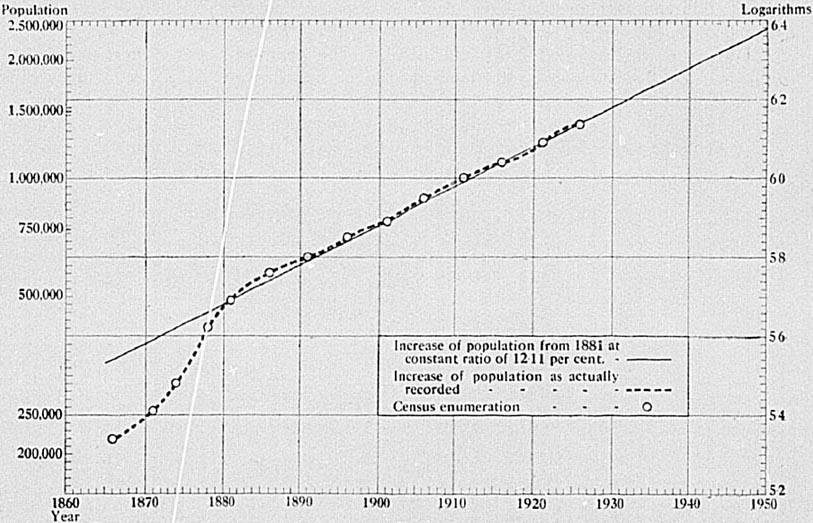
The final criterion of the Dominion's growth in respect of population is supplied by a comparison of the rates of increase of other portions of the British Empire and of various foreign countries. Contrasted with the European countries shown in the table following, the Dominion is experiencing a rapid growth, for they are “emigration” countries, while New Zealand is an “immigration” country. Contrasted on the other hand with Canada and Australia, the comparison is not altogether favourable to New Zealand, although the former countries are much older in point of settlement. Canada is, of course, comparatively close to the sources of immigrant population, while both Canada and Australia still have vast areas undeveloped.
| Country. | Population (latest Census). | Intercensal Increase per Cent, in Decennial Periods approximating to | ||||||
|---|---|---|---|---|---|---|---|---|
| Numbers. | Year. | 1910-1920. | 1900-1910. | 1890-1900. | 1880-1890. | 1870-1880. | 1800-1870. | |
* Excluding Maoris. † Europeans from census of 1926, other races from estimate; statements of increase are for Province of Cape of Good Hope only. ‡ Decrease. | ||||||||
| New Zealand* | 1,344,469 | 1,926 | 20-87 | 30-51 | 23-31 | 25-87 | 91-09 | 158-93 |
| Great Britain | 42,767,530 | 1,921 | 4-74 | 10-36 | 12-03 | 11-17 | 13-95 | 12-73 |
| Australia | 5,436,794 | 1,921 | 22-04 | 18-08 | 18-88 | 41-07 | 32-30 | 45-61 |
| Canada | 8,788,341 | 1,921 | 21-95 | 34-17 | 11-13 | 11-76 | 17-23 | 19-37 |
| Union of South Africa† | 7,537,624 | 1,926 | 8-49 | 6-44 | 57-79 | 111-82 | 45-25 | |
| Norway | 2,649,775 | 1,920 | 12-38 | 6-14 | 11-02 | .. | .. | 6-22 |
| Sweden | 5,904,489 | 1,920 | 6-92 | 7-51 | 7-35 | 4-78 | 9-53 | 8-00 |
| Netherlands | 6,865,314 | 1,920 | 17-19 | 14-77 | 13-14 | 12-43 | 12-10 | 7-87 |
| France | 40,743,851 | 1,926 | 0-03 | 1-93 | 0-83 | 1-95 | 3-61 | ‡3-43 |
| Germany | 62,539,098 | 1,925 | ‡7-81 | 15-01 | 14-04 | 9-28 | 10-17 | .. |
| Italy | 38,835,941 | 1,921 | 12-01 | 6-45 | .. | .. | 6-19 | 7-20 |
| United States | 105,720,620 | 1,920 | 14-94 | 21-02 | 20-73 | 25-50 | 30-08 | 22-63 |
Up to the “seventies” New Zealand was dependent on migration for the greater portion of her increase of population, but since then natural increase—i.e., excess of births over deaths—has been the principal factor. For a few years, indeed (1888-91), there was actually an excess of departures over arrivals.
Over the whole period 1861-1927 migration accounted for 37.3 per cent, of the total increase, excess of births over deaths accounting for 62.7 per cent. Since the beginning of the present century the former is responsible for 31.8 per cent, and the latter for 68.2 per cent, of the increase of population.
A table is appended showing for each five-yearly period since 1860 the excess of births over deaths and of immigration over emigration. Maoris are not included.
| Period. | Excess of Births over Deaths. | Excess of Arrivals over Departures. | Total Increase. | ||||||
|---|---|---|---|---|---|---|---|---|---|
| Males. | Females | Both Sexes. | Males. | Females | Both Sexes. | Males. | Females | Both Sexes. | |
* Decrease. † Departure and return of troops of Expeditionary Force not included in migration figures. | |||||||||
| 1801-65 | 7,625 | 8,985 | 16,610 | 63,285 | 29,884 | 93,169 | 70,910 | 38,869 | 109,779 |
| 1866-70 | 15,663 | 17,779 | 33,442 | 11,167 | 9,369 | 20,536 | 26,830 | 27,148 | 53,978 |
| 1871-75 | 19,409 | 21,129 | 40,538 | 46,501 | 35,445 | 81,946 | 65,910 | 56,674 | 122,484 |
| 1876-80 | 30,143 | 32,808 | 62,951 | 31,870 | 22,917 | 54,787 | 62,013 | 55,725 | 117,738 |
| 1881-85 | 32,362 | 35,016 | 67,408 | 15,958 | 13,001 | 28,959 | 48,320 | 48,047 | 96,367 |
| 1886-90 | 30,781 | 33,544 | 64,325 | -4,911* | -3,791* | -8,702* | 25,870 | 29,753 | 55,628 |
| 1891-95 | 27,255 | 30,630 | 57,885 | 9,917 | 5,403 | 15,320 | 37,172 | 36,033 | 73,205 |
| 1896-1900 | 28,097 | 31,437 | 59,534 | 7,320 | 3,138 | 10,638 | 35,417 | 34,755 | 70,172 |
| 1901-05 | 32,515 | 36,223 | 68,738 | 31,223 | 14,223 | 45,446 | 63,738 | 50,446 | 114,184 |
| 1906-10 | 38,681 | 43,067 | 81,748 | 25,454 | 15,512 | 40,966 | 64,135 | 58,579 | 122,714 |
| 1911-15† | 42,323 | 46,682 | 89,005 | 17,856 | 17,905 | 35,561 | 59,979 | 64,587 | 124,566 |
| 1916-20† | 35,248 | 41,359 | 76,607 | 6,979 | 7,875 | 14,854 | 42,227 | 49,234 | 91,461 |
| 1921-25 | 41,876 | 44,868 | 86,744 | 26,732 | 23,256 | 49,988 | 68,608 | 68,124 | 136,732 |
| 1926 | 7,976 | 8,678 | 16,654 | 7,343 | 5,057 | 12,400 | 15,319 | 13,735 | 29,054 |
| 1927 | 7,728 | 8,447 | 16,175 | 2,167 | 1,642 | 8,809 | 9,895 | 10,089 | 19,984 |
| Totals, 1861-1927 | 397,682 | 440,682 | 838,364 | 298,661 | 201,016 | 499,677 | 696,343 | 641,698 | 1,338,041 |
The diagram which follows shows much more clearly the irregularity of the migration increase and the steadiness of the natural increase, the latter, however, broken by a sharp fall on account of the influenza epidemic of 1918, and further disturbed by the low birth-rate in recent years. The curves represent five-yearly moving averages.
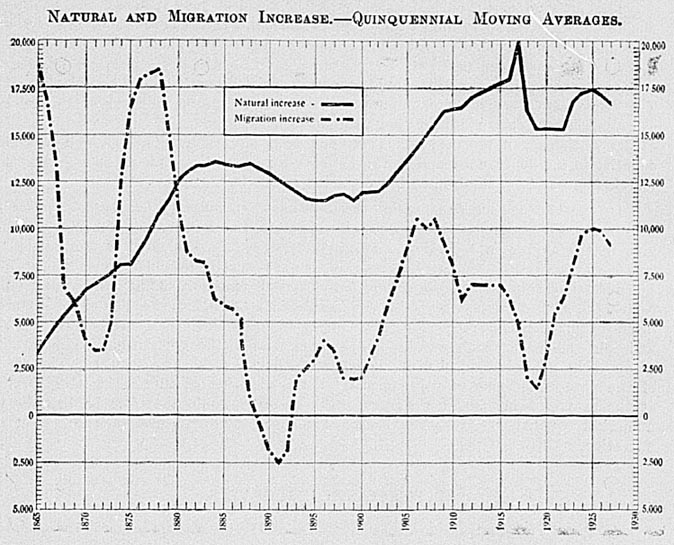
In respect of the relative proportions of the sexes in the population, New Zealand has since the first settlement of the Islands differed materially from the older countries of the world. Although in the latter the composition of the populations has been no doubt to some extent affected by migration, yet, in general, natural increase would appear to be the main determining factor, the numbers of males and females being in most of these countries approximately equal, with a more or less marked tendency, however, for the females slightly to exceed the males. The excess of females in such older countries arises from a variety of causes, amongst which the most potent are probably (a) higher rate of mortality amongst males, (b) the fact that males tend to emigrate to a greater extent than females.
Very different is the case with newer countries such as New Zealand, where the rule is (in the early years of colonization especially) for the male population to outnumber the female.
The following table is interesting as showing the early excess of males and the gradual equalization of the sexes in New Zealand, the number of females to 1,000 males having risen from 622 in 1861 to 896 in 1911. The proportion rose to 993 in 1916, mainly on account of the absence of so many men at the war, and fell again in 1921 to 956, only to show a slight rise in 1926 to 959, a figure appreciably higher than in pre-war years. The figures quoted are exclusive of Maoris.
| Census Year. | Males. | Females. | Females to 1,000 Males. |
|---|---|---|---|
| 1861 | 61.062 | 37.959 | 622 |
| 1871 | 150.356 | 106.037 | 705 |
| 1881 | 269.605 | 220.328 | 817 |
| 1891 | 332.877 | 293.781 | 883 |
| 1901 | 405.992 | 366.727 | 903 |
| 1906 | 471.008 | 417.570 | 887 |
| 1911 | 531.910 | 476.558 | 896 |
| 1916 | 551.775 | 547.674 | 993 |
| 1921 | 623.243 | 595.670 | 956 |
| 1926 | 686.384 | 658.085 | 959 |
The preponderance of males in the early years of New Zealand was doubtless due to the fact that the difficulties of pioneering and the remoteness of the country from Europe were such as to deter female immigration to a greater extent than male. This was accentuated by the character of the early industries. Gold-mining and coal-mining, for instance, would attract large numbers of men, but few women. The effect of this early preponderance of males no doubt still exists, but in an ever-diminishing degree, its gradual elimination being effected by the dying-off of the earlier settlers. In recent years there has been a considerable approach towards equality in the increase of males and females by migration, and in some years the female increase from this source has exceeded the male.
Of the two sources from which the Dominion's population has been recruited—viz., migration and natural increase—the effect of the former has hitherto been to give in the aggregate a considerable preponderance of males, and of the latter to give a regular preponderance of females. In the period 1861-1927 the gain of males by migration totalled 97,645 more than that of females. This excess was only partly offset numerically by a female surplus of 43,000 in the figures of natural increase, but the net excess of approximately 55,000 males is not nearly sufficient to maintain the former high ratio of males to females in the population. The surplus of males at present, exclusive of the Native population, is some 28,000. The effect of the natural increase of population is in the direction of eliminating this surplus at the rate of about 900 per annum, and the sexes would therefore be brought to numerical equality in 30-35 years were it not for the somewhat variable factor of migration.
As already noted, the intercensal estimates of Dominion population prepared from the records of vital statistics and of migration are, by virtue of the favourable position of the Dominion in this respect, remarkably accurate. Indeed, as regards the statistics of total population the term “estimate” is scarcely correct, for the system in use should give, and to a great extent does give, the actual figures. With the exception of the years of the Great War, when the movement of troops was not ascertained exactly, the census totals invariably showed the quarterly returns of population to be highly accurate. There is always a difference in date between the census enumeration and the nearest quarterly statement, for no two of the eighteen general census enumerations in the history of the Dominion have been taken on the same day of the year, and this in itself usually accounts for the greater part of what disparity actually is shown.
The population at the end of each of the last ten years is quoted in the appended table, together with the movement in each year and the mean population for the year:—
| Calendar Year. | Estimated Population (excluding Maoris) at End of Year. | Increase during Year. | Mean Population for Year. | |||
|---|---|---|---|---|---|---|
| Males. | Females. | Total. | Numerical. | Per Cent. | ||
| * See letter-press following. | ||||||
| 1918 | 542,046 | 566,327 | 1,108,373 | 10,701 | 0.97 | 1,103,022 |
| 1919 | 601,888 | 575,517 | 1,177,405 | 69,032 | 6.23 | 1,142,889 |
| 1920 | 617,756 | 590,079 | 1,207,835 | 30,430 | 2.58 | 1,192,620 |
| 1921 | 633,040 | 606,926 | 1,239,966 | 32,131 | 2.66 | 1,223,901 |
| 1922 | 645,524 | 619,873 | 1,265,397 | 25,431 | 2.05 | 1,251,895 |
| 1923 | 657,561 | 631,660 | 1,289,221 | 23,824 | 1.88 | 1,274,551 |
| 1924 | 671,452 | 644,722 | 1,316,174 | 26,953 | 2.09 | 1,298,635 |
| 1925 | 687,287 | 658,789 | 1,346,076 | 29,902 | 2.27 | 1,329,759 |
| 1926 | 697,113 | 668,304 | 1,365,417 | 29,054* | 2.17 | 1,352,927 |
| 1927 | 707,008 | 678,393 | 1,385,401 | 19,984 | 1.46 | 1,374,439 |
The actual increase of population (excluding Maoris) during the calendar year 1927 was 19,984. The increase for 1926 was 29,054, although from the figures shown for population at 31st December, 1925 and 1926, the increase would appear to have been much less. The population at 31st December, 1925, however, was the official estimate for that date, arrived at, incidentally, on the old basis of including with the European population half-castes living as Maoris.
As the year ended 31st March is for most of the administrative functions of the Government the period most in use, similar figures are given for March years:—
| Year ended 31st March, | Estimated Population (excluding Maoris) at and of Year. | Increase during Year. | Mean Population for Year. | |||
|---|---|---|---|---|---|---|
| Males. | Females. | Total. | Numerical. | Per Cent. | ||
| * See letter-press above. | ||||||
| 1919 | 559,887 | 568,743 | 1,128,630 | 23,847 | 2.16 | 1,116,706 |
| 1920 | 607,555 | 579,584 | 1,187,139 | 58,509 | 5.18 | 1,157,884 |
| 1921 | 622,719 | 595,003 | 1,217,722 | 30,583 | 2.58 | 1,202,430 |
| 1922 | 636,956 | 611,242 | 1,248,198 | 30,476 | 2.50 | 1,232,960 |
| 1923 | 648,545 | 623,196 | 1,271,741 | 23,543 | 1.89 | 1,258,017 |
| 1924 | 659,570 | 634,333 | 1,293,903 | 22,162 | 1.74 | 1,280,299 |
| 1925 | 676,477 | 648,560 | 1,325,037 | 31,134 | 2.41 | 1,305,896 |
| 1926 | 691,910 | 662,382 | 1,354,292 | 29,255 | 2.21 | 1,337,155 |
| 1927 | 701,774 | 671,972 | 1,373,746 | 29,382* | 2.18 | 1,357,777 |
| 1928 | 708,568 | 680,132 | 1,388,700 | 14,954 | 1.09 | 1,378,806 |
Of the total estimated population of 1,388,700, excluding Maoris, at 31st March, 1928, adults numbered 830,379 (males, 423,187; females, 407,192).
The figures given in the two preceding tables show the population exclusive of Maoris. The following table shows the population inclusive of Maoris at 31st December and at 31st March of the last ten years, with the means for the various twelve-monthly periods:—
| — | Estimated Population (including Maoris) at End of Year. | Mean Population for Year. | ||
|---|---|---|---|---|
| Males. | Females. | Total. | ||
| Years ended 31st December. | ||||
| 1918 | 567,986 | 590,163 | 1,158,149 | 1,152,798 |
| 1919 | 627,828 | 599,353 | 1,227,181 | 1,192,665 |
| 1920 | 643,696 | 613,915 | 1,257,611 | 1,242,396 |
| 1921 | 660,948 | 631,769 | 1,292,717 | 1,276,652 |
| 1922 | 673,772 | 645,112 | 1,318,884 | 1,305,126 |
| 1923 | 685,951 | 657,070 | 1,343,021 | 1,328,193 |
| 1924 | 700,033 | 670,370 | 1,370,403 | 1,352,618 |
| 1925 | 716,371 | 684,859 | 1,401,230 | 1,384,428 |
| 1926 | 730,603 | 698,952 | 1,429,555 | 1,413,700 |
| 1927 | 740,782 | 709,308 | 1,450,090 | 1,438,814 |
| Years ended 31st March. | ||||
| 1919 | 585,827 | 592,579 | 1,178,406 | 1,166,482 |
| 1920 | 633,495 | 603,420 | 1,236,915 | 1,207,660 |
| 1921 | 648,659 | 618,839 | 1,267,498 | 1,252,206 |
| 1922 | 664,979 | 636,272 | 1,301,251 | 1,285,711 |
| 1923 | 676,825 | 648,476 | 1,325,301 | 1,311,381 |
| 1924 | 688,020 | 659,833 | 1,347,853 | 1,334,029 |
| 1925 | 705,161 | 674,326 | 1,379,487 | 1,359,995 |
| 1926 | 721,173 | 688,639 | 1,409,812 | 1,392,073 |
| 1927 | 735,338 | 702,642 | 1,437,980 | 1,420,762 |
| 1928 | 742,396 | 711,121 | 1,453,517 | 1,443,323 |
Records of external migration have been kept in New Zealand since 1860. Prior to the 1st April, 1921, the statistics were compiled from returns furnished monthly by Collectors of Customs, but since that date they have been compiled from individual statements obtained from each person entering or leaving the Dominion, and much detailed and important information is consequently now available.
Including crews of vessels, 88,528 persons from overseas arrived in New Zealand during the year 1927, which, compared with 1926, shows a decrease of 8,737. During the same period 84,676 persons departed. This figure is almost on a par with the corresponding one for 1926. The gain by migration to the Dominion's population during 1927 was thus only 3,852, as compared with 12,413 in 1926 and 12,802 in 1925.
The numbers of arrivals and departures during the last ten years are given in the table following. Crews of vessels have not been taken into account, and the figures for the years 1918 and 1919 do not include members of the Expeditionary Force.
| ARRIVALS AND DEPARTURES, 1918-27. | ||||||
|---|---|---|---|---|---|---|
| Year. | Arrivals. | Departures. | ||||
| Males. | Females. | Total. | Males. | Females. | Total. | |
| 1918 | 6,356 | 5,550 | 11,906 | 6,097 | 5,563 | 11,660 |
| 1919 | 10,772 | 10,159 | 20,931 | 11,377 | 8,500 | 19,877 |
| 1920 | 23,687 | 20,375 | 44,062 | 17,951 | 14,973 | 32,924 |
| 1921 | 22,446 | 19,436 | 41,882 | 16,019 | 12,540 | 28,559 |
| 1922 | 18,811 | 16,422 | 35,233 | 15,643 | 12,746 | 28,389 |
| 1923 | 19,445 | 17,043 | 36,488 | 16,037 | 13,631 | 29,668 |
| 1924 | 21,719 | 18,096 | 39,815 | 16,489 | 14,104 | 30,593 |
| 1925 | 23,328 | 18,518 | 41,846 | 15,907 | 13,265 | 29,172 |
| 1926 | 25,508 | 20,177 | 45,685 | 18,649 | 15,176 | 33,825 |
| 1927 | 21,165 | 17,511 | 38,676 | 20,349 | 15,899 | 36,248 |
The monthly figures for 1926 and 1927 are as follows, the excess of arrivals or of departures for each month being also shown:—
| Month. | Arrivals. | Departures. | Excess of Arrivals. | Excess of Departures. | ||||
|---|---|---|---|---|---|---|---|---|
| 1926. | 1927. | 1926. | 1927. | 1926. | 1927. | 1926. | 1927. | |
| January | 4,592 | 5,264 | 2,696 | 2,967 | 1,896 | 2,297 | .. | .. |
| February | 3,333 | 3,731 | 3,161 | 3,247 | 172 | 484 | .. | .. |
| March | 5,037 | 3,964 | 4,196 | 4,030 | 841 | .. | .. | 66 |
| April | 3,077 | 2,292 | 4,647 | 4,832 | .. | .. | 1,570 | 2,540 |
| May | 4,049 | 3,123 | 2,777 | 3,295 | 1,272 | .. | .. | 172 |
| June | 2,345 | 1,982 | 2,649 | 2,834 | .. | .. | 304 | 852 |
| July | 1,961 | 2,035 | 2,595 | 2,948 | .. | .. | 634 | 913 |
| August | 3,903 | 2,238 | 2,183 | 2,337 | 1,720 | .. | .. | 99 |
| September | 3,635 | 2,362 | 1,905 | 2,828 | 1,730 | .. | .. | 466 |
| October | 4,442 | 3,331 | 2,332 | 2,134 | 2,110 | 1,197 | .. | .. |
| November | 4,253 | 3,830 | 1,865 | 2,086 | 2,388 | 1,744 | .. | .. |
| December | 5,058 | 4,524 | 2,819 | 2,710 | 2,239 | 1,814 | .. | .. |
| Totals | 45,685 | 38,676 | 33,825 | 36,248 | 11,860 | 2,428 | .. | .. |
The statistics for the twelve months ended 31st December, 1927, show that during that period 38,676 persons, excluding members of crews of vessels, arrived in the Dominion. Of these 11,327 were immigrants intending permanent residence in the country, as compared with 17,868 of a similar class in 1926. The remainder of the arrivals, 27,349 in number, were classified as shown below. Corresponding figures for the four preceding years are also given.
| — | 1923. | 1924. | 1925. | 1926. | 1927. |
|---|---|---|---|---|---|
| Immigrants intending permanent residence | 11,762 | 14,314 | 15,704 | 17,868 | 11,327 |
| New Zealand residents returning from abroad | 13,073 | 14,076 | 14,024 | 14,375 | 14,271 |
| Tourists | 7,522 | 7,425 | 7,898 | 9,509 | 9,105 |
| Persons on commercial business | 2,166 | 2,080 | 2,241 | 1,993 | 1,973 |
| Persons visiting the Dominion in connection with entertainments, sports, &c. | 911 | 1,009 | 1,193 | 994 | 782 |
| Persons in transit | 562 | 328 | 520 | 533 | 557 |
| Others (officials, &c., of other countries) | 457 | 483 | 194 | 343 | 430 |
| Not stated | 35 | 160 | 72 | 70 | 231 |
| Totals (excluding crews) | 36,488 | 39,815 | 41,846 | 45,685 | 38,676 |
The action of the New Zealand Government in temporarily suspending the major portion of its scheme of granting assisted passages to migrants from the British Isles is chiefly responsible for the decrease shown for 1927 in the number of immigrants intending permanent residence. The figures for this class of immigrant for 1927 are 5,899, as against 10,766 in 1926; while the decrease in the number of those who migrated to New Zealand without State assistance amounted to 1,674. The effect of the discontinuance of the “assisted” scheme would in all probability be greater than the figures would suggest. In order to obtain assistance intending migrants must fulfil certain conditions, and it frequently happens that some member or members of a family, being unable to comply with these conditions, have to come unaided. On this account, therefore, the “unassisted” are less than they would have been had the scheme been in operation throughout the year.
The departures recorded during 1927 numbered 36,248, as compared with 33,825 in 1926. Of these, 4,145 were shown to be New Zealand residents departing permanently, 16,659 New Zealand residents departing temporarily, and 15,414 visitors to the Dominion departing. The figures which follow show the different classes of emigrants for each of the last five years:—
| — | 1923. | 1924. | 1925. | 1926. | 1927. |
|---|---|---|---|---|---|
| New Zealand residents departing permanently | 2,474 | 2,256 | 1,946 | 2,581 | 4,145 |
| New Zealand residents departing temporarily | 14,104 | 15,006 | 13,758 | 15,157 | 16,659 |
| Visitors to the Dominion departing | 13,083 | 13,320 | 13,462 | 16,065 | 15,414 |
| Persons regarding whom no information is available | 7 | 11 | 6 | 22 | 30 |
| Totals (excluding crews) | 29,668 | 30,593 | 29,172 | 33,825 | 36,248 |
New Zealand residents going abroad temporarily on business or pleasure represented 46 per cent, of the total departures, as against 48 per cent, in 1926, while of the arrivals 37 per cent, were New-Zealanders returning to their homes after temporary absence, compared with 31 per cent, in 1926. The elimination of this class of migrant reduces the arrivals during 1927 to 24,405, and during 1926 to 31,310, and the departures respectively to 19,589 and 18,668.
Tourists and other temporary visitors in 1927 comprised 34 per cent, of the arrivals and 43 per cent, of the departures, as compared with 29 and 47 per cent, respectively in 1926. The bulk of the temporary visitors come from Australia, the British Isles, and the United States of America. The following table shows for the years 1926 and 1927 the principal countries of residence of temporary visitors, classified according to their purpose in coming to the Dominion:—
| Country of last Permanent Residence. | Purpose in coming to Dominion. | |||||||||||
|---|---|---|---|---|---|---|---|---|---|---|---|---|
| Tourists. | On Business. | Theatrical, &c. | Other, Official, &c.* | In Transit. | Total. | |||||||
| 1926. | 1927. | 1926. | 1927. | 1926. | 1927. | 1926. | 1927. | 1926. | 1927. | 1926. | 1927. | |
| * Including undefined. | ||||||||||||
| Australia | 6,204 | 5,737 | 1,374 | 1,240 | 668 | 609 | 56 | 249 | 214 | 227 | 8,516 | 8,062 |
| British Isles | 1,369 | 1,379 | 309 | 355 | 151 | 54 | 206 | 263 | 110 | 153 | 2,145 | 2,204 |
| United States of America | 498 | 656 | 129 | 139 | 71 | 88 | 12 | 21 | 38 | 11 | 748 | 915 |
| Fiji | 305 | 252 | 25 | 29 | .. | .. | 24 | 33 | 16 | 23 | 370 | 337 |
| Canada | 166 | 180 | 27 | 40 | 3 | 13 | 12 | 14 | 8 | 8 | 216 | 255 |
| South Africa | 140 | 75 | 4 | 6 | 9 | .. | 3 | 2 | 2 | .. | 158 | 83 |
| China | 138 | 247 | 13 | 4 | .. | .. | 1 | 8 | 2 | 7 | 154 | 266 |
| India | 102 | 96 | 9 | 6 | 18 | 1 | 6 | 7 | 1 | 1 | 136 | 111 |
| Samoa | 87 | 64 | 11 | 7 | .. | .. | 21 | 14 | 8 | 8 | 127 | 93 |
| Tonga | 46 | 20 | 3 | 4 | .. | .. | 12 | 8 | 15 | 9 | 76 | 41 |
| Other countries | 454 | 399 | 89 | 143 | 74 | 17 | 60 | 42 | 119 | 110 | 796 | 711 |
| Total | 9,509 | 9,105 | 1,993 | 1,973 | 994 | 782 | 413 | 661 | 533 | 557 | 13,442 | 13,078 |
Having eliminated the two classes of migrants whose movements only temporarily affect the population of the Dominion, there remains the important residue which represents the permanent additions and losses of population. During the year 1927 11,327 persons landed in the Dominion with the intention of making their future homes here, compared with 17,868 in 1926, while during the same period 4,145 permanent residents of New Zealand were attracted to other countries, as against 2,581 in 1926. These figures are based on statements of intention only, and a certain percentage of immigrants, finding the conditions in the Dominion unsuited to their particular requirements may, after a short stay, depart elsewhere. Such persons on arrival would state their intention of becoming permanent residents, but on departure might not be classified as permanent residents departing permanently. For this reason it is not possible to state what the actual net gain to the permanent population of the Dominion through migration may be in any given year. Over a period of years, of course, the best figure is arrived at by simply deducting total departures from total arrivals, including crews in each instance.
In a young country such as New Zealand it would not be surprising to find that the proportion of males to females among the new immigrants was considerably in favour of the former, but the figures for the last few years show that the male preponderance is not as great as might be expected. As a matter of fact, females comprised 44 per cent, of the total new immigrants in 1927, as compared with 42 and 41 per cent, in 1926 and 1925 respectively. No doubt the propaganda work carried out by the New Zealand and Imperial Governments in connection with the scheme for assisting domestic servants and also the wives and families of immigrants from Great Britain to the Dominion is largely responsible for this comparatively high proportion of females. An examination of the figures supports this contention, for whereas during 1927 47 per cent, of immigrants from the British Isles were females, the corresponding percentage for immigrants from all other countries was only 37.
Of the New-Zealanders who transferred their homes to other countries during the years 1927 and 1926 1,847 and 1,217 respectively were females and 2,298 and 1,364 males.
Of the total arrivals recorded, during the year 1927 11.5 per cent, were under fifteen years of age. Among the immigrants intending permanent residence, however, the proportion was much higher—viz., 21.2 per cent. The corresponding percentages for all departures and for New Zealand residents departing permanently were 10.2 and 20.9 respectively. The higher percentages under fifteen years of age in the case of permanent settlers and emigrants is, of course, due to the fact that this class of person brings or takes his family, if any, with him, whereas the remainder of persons coming to and going from the Dominion, consisting for the most part of tourists and persons on business, travel almost exclusively without at least the younger members of their families. The higher percentage of persons of forty-five years and over amongst the departures would appear to confirm to a certain extent the general impression that many immigrants return to their native land later in life. The following table shows the percentage of new permanent immigrants who arrived during 1926 and 1927, and the New Zealand residents who departed during the same period, by age-groups, and also for the same period the permanent gain through migration in the population of the Dominion:—
| — | Under 15 Years. | 15 and under 45 Years. | 45 Years and over, and Age not stated. | |||
|---|---|---|---|---|---|---|
| 1926. | 1927. | 1926. | 1927. | 1926. | 1927. | |
| Per Cent. | Per Cent. | Per Cent. | Per Cent. | Per Cent. | Per Cent. | |
| Immigrants intending permanent residence | 22.70 | 21.24 | 66.83 | 67.87 | 10.47 | 10.89 |
| Permanent departures | 21.19 | 20.89 | 59.28 | 62.17 | 19.53 | 16.94 |
| Permanent gain to population of Dominion | 22.95 | 21.44 | 68.11 | 71.15 | 8.94 | 7.41 |
From the foregoing it will be seen that over 90 per cent, of the permanent gain in population through migration consists of persons under forty-five years of age. Under the system in force, children under fifteen years of age accompanying parents or guardians are included in the statement furnished by such parent or guardian. Of the 2,406 children under fifteen years of age in 1927 2,265 were so returned. The number of parents or guardians concerned was 1,160, and it is interesting to note that 551 were accompanied by one child, 316 by two children, 168 by three, 69 by four, 40 by five, 12 by six, 3 by seven, and 1 by nine. These figures convey a fairly accurate indication of the sizes of the families which comprise the recent addition to our population, for although, as mentioned above, children accompanying guardians are also included, such cases are not very numerous.
Of the 11,327 new immigrants during 1927 intending to settle in the Dominion the vast majority, 10,772, or 95.1 per cent., came from British countries, mainly from the British Isles, Australia, Canada, South Africa, and India. The majority of immigrants from foreign countries came from Jugo-Slavia, the United States of America, and Italy. The following table shows for each of the last five years the principal countries whence arrived new immigrants who intended permanent residence in the Dominion:—
| Country of Last Permanent Residence. | 1923. | 1924. | 1925. | 1926. | 1927. |
|---|---|---|---|---|---|
| British Isles | 9,142 | 11,082 | 11,843 | 14,436 | 8,70 |
| India | 85 | 111 | 136 | 91 | 86 |
| South Africa | 114 | 110 | 136 | 112 | 67 |
| Canada | 270 | 361 | 479 | 443 | 378 |
| Australia | 1,586 | 1,576 | 1,881 | 1,785 | 1,370 |
| Other British countries | 112 | 146 | 254 | 197 | 168 |
| Denmark | 20 | 14 | 13 | 14 | 34 |
| Italy | 25 | 50 | 227 | 58 | 63 |
| Switzerland | 26 | 34 | 6 | 25 | 21 |
| Jugo-Slavia | 94 | 467 | 338 | 361 | 181 |
| China | 107 | 112 | 63 | 56 | 30 |
| United States | 70 | 86 | 165 | 137 | 116 |
| Other foreign countries | 111 | 165 | 163 | 153 | 110 |
| Totals | 11,762 | 14,314 | 15,704 | 17,868 | 11,327 |
With the exception of 206 persons (of whom 124 departed for the United States, 30 for China, 28 for European countries, 7 for South American countries, 11 for foreign islands of the Pacific, and 6 for other foreign countries), the whole of the New Zealand residents who permanently left the Dominion during 1927 went to British countries. The figures for the principal countries for the last five years are as follows:—
| — | 1923. | 1924. | 1925. | 1926. | 1927. |
|---|---|---|---|---|---|
| British Isles | 492 | 470 | 495 | 528 | 732 |
| South Africa | 25 | 25 | 29 | 51 | 37 |
| Canada | 100 | 120 | 44 | 84 | 169 |
| Australia | 1,656 | 1,470 | 1,171 | 1,637 | 2,855 |
| Fiji | 27 | 38 | 23 | 48 | 67 |
| Other British countries | 26 | 16 | 36 | 55 | 79 |
| China | 20 | 19 | 25 | 24 | 30 |
| United States | 98 | 53 | 97 | 132 | 124 |
| Other foreign countries | 30 | 45 | 26 | 22 | 52 |
| Totals | 2,474 | 2,256 | 1,946 | 2,581 | 4,145 |
During the year 1927 some 442 persons (males 322, females 120) of foreign nationality, out of the total of 11,327, arrived as new immigrants intending permanent residence in the Dominion, as compared with 756 (599 males, 157 females) out of a total of 17,868 in 1926, the remaining persons being British subjects. The figures for the three years 1924-1926 show a considerable increase over those for the year 1923, mainly owing to the large influx of immigrants from Jugo-Slavia, but the figure for 1927 has decreased to practically its former level. The chief nationalities represented among the alien immigrants for the last five years were as follows:—
| Nationals of | 1923. | 1924. | 1925. | 1926. | 1927. |
|---|---|---|---|---|---|
| Italy | 25 | 52 | 262 | 88 | 65 |
| Switzerland | 27 | 33 | 9 | 26 | 22 |
| Denmark | 23 | 18 | 20 | 20 | 42 |
| Russia | 14 | 18 | 27 | 21 | 8 |
| Jugo-Slavia | 79 | 447 | 350 | 373 | 177 |
| Greece | 6 | 19 | 22 | 16 | 12 |
| Syria | 5 | 14 | 20 | 10 | .. |
| China | 99 | 88 | 53 | 40 | 8 |
| United States | 24 | 24 | 44 | 72 | 40 |
| Other countries | 48 | 120 | 87 | 90 | 68 |
| Totals | 350 | 833 | 894 | 756 | 442 |
There are comparatively few females among foreign nationals intending permanent residence. Whereas in 1927 a little over 45 per cent, of the British immigrants were females, the corresponding percentage for foreign nationals was only slightly over 27. The proportion of young people is also relatively low in the case of foreign nationals; the percentage under twenty-one years of age for British and foreign respectively being in 1927 38 and 28.
Foreign nationals constitute only a very small proportion of the total number of New Zealand residents who departed permanently during 1927. The following table shows the principal nationalities of the permanent residents departing permanently during the last five years.
| Nationals of | 1923. | 1924. | 1925. | 1926. | 1927. |
|---|---|---|---|---|---|
| British countries | 2,420 | 2,170 | 1,907 | 2,529 | 4,036 |
| Russia | 4 | 6 | 4 | 1 | |
| Germany | 4 | 4 | 2 | 3 | |
| France | 2 | 8 | 2 | 1 | 5 |
| Norway | 1 | 1 | 1 | 2 | |
| Sweden | 1 | 2 | 1 | 1 | 4 |
| Denmark | 1 | 19 | 4 | 6 | 6 |
| Italy | 8 | 4 | 4 | 1 | 9 |
| United States | 9 | 20 | 8 | 5 | |
| China | 16 | 17 | 23 | 26 | 35 |
| Other foreign countries | 8 | 6 | 2 | 4 | 39 |
| Total foreign | 54 | 86 | 39 | 52 | 109 |
| Grand totals | 2,474 | 2,256 | 1,946 | 2,581 | 4,145 |
Although race aliens comprise comparatively small proportions of the total arrivals and departures, they are by no means unimportant. The principal race aliens with whom New Zealand is concerned are the Chinese and Indians, and these are shown separately from other race aliens. The definition of the term “race alien,” as used in connection with these statistics, is “a person of other than European race.”
The following table shows the permanent increase in the Dominion's race-alien population through migration for the years 1926 and 1927:—
| — | 1926. | 1927. | ||||||
|---|---|---|---|---|---|---|---|---|
| Chinese. | Indians. | Others. | Totals. | Chinese. | Indians. | Others. | Totals. | |
| * Decrease. | ||||||||
| Immigrants intending permanent residence | 50 | 56 | 33 | 139 | 11 | 41 | 26 | 78 |
| New Zealand residents departing permanently | 27 | 3 | 11 | 41 | 35 | 3 | 16 | 54 |
| Permanent increase of race aliens in New Zealand through migration | 23 | 53 | 22 | 98 | 24* | 38 | 10 | 24 |
It should be noted that the figures quoted above include half-castes. There has been a substantial decrease in the number of Chinese immigrants during the last few years, and this, coupled with an increase in the number departing permanently, makes an actual reduction in the Chinese population through migration during 1927 of 24 as against an increase of 23 in 1926. The permanent increase in the number of Indian immigrants remains at a fairly stationary figure. The “other” race-alien immigrants intending permanent residence in 1927 were made up mainly of 14 Polynesians.
The total arrivals and departures of race aliens during each of the last ten years are as follows:—
| Year. | Arrivals. | Departures. | ||||||
|---|---|---|---|---|---|---|---|---|
| Chinese. | Indians. | Others. | Total. | Chinese. | Indians. | Others. | Total. | |
| 1918 | 256 | 138 | 523 | 917 | 214 | 19 | 171 | 404 |
| 1919 | 418 | 193 | 97 | 708 | 238 | 18 | 66 | 322 |
| 1920 | 1,477 | 225 | 32 | 1,734 | 380 | 54 | 9 | 443 |
| 1921 | 255 | 137 | 249 | 641 | 368 | 100 | 239 | 707 |
| 1922 | 345 | 32 | 172 | 549 | 362 | 125 | 213 | 700 |
| 1923 | 365 | 115 | 249 | 729 | 378 | 66 | 188 | 632 |
| 1924 | 548 | 128 | 341 | 1,017 | 451 | 128 | 332 | 911 |
| 1925 | 517 | 216 | 323 | 1,056 | 524 | 165 | 216 | 905 |
| 1926 | 613 | 239 | 347 | 1,199 | 541 | 164 | 308 | 1,013 |
| 1927 | 542 | 151 | 270 | 963 | 587 | 135 | 184 | 906 |
The pending alteration of the law was the cause of a huge influx of Chinese in 1920, with a view to anticipating the tightening of the restrictions, which actually came into operation on the passing of the Immigration Restriction Amendment Act of that year. A limit on the number of Chinese permitted to enter the Dominion is now imposed.
The high number of race-alien arrivals in 1918 was caused by the unavoidable inclusion of natives of the British and French Pacific islands who came to New Zealand to embark for the seat of war.
At the census of 1881, the year in which taxation was first imposed on Chinese landing in New Zealand, the Chinese population numbered 5,004 persons, which fell to 4,542 in 1886, and further to 3,711 in 1896. During the period 1881-96 the poll-tax was £10 per head, and this seemed sufficient for the purpose of preventing a large influx of Chinese. During the years 1894 and 1895, however, the arrivals shown by the Customs returns were found to be somewhat greater than the departures, and in 1896 an Act was passed raising the poll-tax on Chinese immigrants to £100 per head, and limiting the number of Chinese passengers that may be carried by vessels to New Zealand to one for every 200 tons burthen. According to the census of 1901, the Chinese population was 2,857; in 1906 it was 2,570; in 1911, 2,630; in 1916, 2,147; and in 1921, 3,266, of whom 156 were half-castes. At 1st April, 1928, the approximate numbers of the principal alien races present in New Zealand were: Chinese 3,252, Indians 1,093, and Syrians 954.
In connection with the following paragraphs, it should be explained that since about May, 1927, the system of assisted immigration has been temporarily suspended except in regard to (1) domestics and single women, (2) boys under Flock House, Salvation Army, and Church of England schemes, and (3) wives, &c., of immigrants who have arrived previously.
Permanent residents of the Dominion and bona fide New-Zealanders visiting the United Kingdom may nominate any person, not a prohibited immigrant within the meaning of the Immigration Restriction Act, 1908 (N.Z.), and its amendments, or of the Undesirable Immigrants Exclusion Act, 1919 (N.Z.), residing in the United Kingdom, for an assisted passage to New Zealand under the following conditions:—
The person nominated must be under the age of fifty years. Although assisted passages cannot be granted to persons who have attained the age of fifty years, the Immigration Department can arrange full-fare passages for any such persons proceeding as members of a family or of a party the remainder of which is travelling at assisted rates. Full fares (subject to alteration by the shipping companies) are as follows: Third-class six-berth, £37; four-berth, £39; twe-berth, £43 per adult.
The person nominated must not have resided in the Dominion or in Australia for a period of at least five years immediately preceding nomination.
He must supply to the High Commissioner for New Zealand in London satisfactory medical certificate and certificate of character.
In the case of a married person, nomination must include husband, wife, and family (if any), except where a judicial separation exists or desertion is proved.
The nominator must undertake to make provision for maintenance and employment for the nominee after arrival in the Dominion, and must also guarantee that the nominee will reside in the Dominion for at least five years.
All questions as to suitability of any person nominated for an assisted passage are decided by the High Commissioner for New Zealand in London.
Provided that the above conditions are complied with, an assisted passage will be granted at the following rates, which are subject to revision:—
| Third Class. | |||
|---|---|---|---|
| Six-berth. | Four-berth. | Two-berth. | |
| Married adults, under 50 years (including widows with children) | £11 | £13 | £17 |
| Single men, 19 and under 50 | £11 | £13 | £17 |
| Single women (including widows without children)— | |||
| 19 and under 40 | Free | £2 | £6 |
| 40 and under 50 | £11 | £13 | £17 |
| Boys and girls, 12 and under 19 | Free | £2 | £6 |
| Children, 3 and under 12 | Free | £1 | £3 |
| Children, under 3, if not more than one | Free | Free | Free |
The full amount of passage-money must be paid before a passage is booked. The money can be paid in New Zealand by the nominator, or in London by the nominee, or partly by both.
In any case where nominees are unable to pay the cost of six-berth passages the Imperial and New Zealand Governments, acting in concert, will, on the approval of the High Commissioner, advance the necessary amount by way of loan, repayable within a reasonable time after their arrival in the Dominion.
Nomination forms are obtainable at Post-offices throughout the Dominion, or at the Department of Immigration, Wellington. Nominations can be cabled at an extra cost of £1. Remittances can be forwarded to nominees at time of nomination without fee.
Passages are granted on vessels belonging to the Shaw-Savill and Albion Company and the New Zealand Shipping Company from London or Southampton, and the Federal Steam Navigation Company from Liverpool. Passages can be booked to the following ports in New Zealand: Auckland, Gisborne, Napier, Wellington, Lyttelton, Timaru, Oamaru, and Port Chalmers. Nominated passages are granted by direct route only.
Passages at reduced rates are not granted to unhealthy persons. When cases of lung, chest, or other like complaints are discovered in any member of a family by the Medical Officer at London. Liverpool, or Southampton, the whole family is prevented from sailing.
In the case of immigrants under twenty-one years of age special arrangements have to be entered into for their protection on the voyage where deemed necessary or advisable.
In addition to the system of nomination, qualified domestic servants under 40 years of age may, on application to the High Commissioner, be granted free passages to New Zealand. To be eligible a person must be a bona fide domestic (general servant, cook, housemaid, parlourmaid, waitress, laundress, or nursemaid) and be in employment as such at time of application, and a written undertaking must be given to follow such calling for at least twelve months after arrival in the Dominion, and that marriage will not be contracted during that period.
Qualified farm labourers under 45 may apply for and be granted assisted passages as for single men. The conditions are the same as in the case of domestics, except, of course, that the question of marriage does not enter into the matter.
As their respective Governments do not subscribe to the provisions of the Empire Settlement Act, 1922, residents of the Irish Free State or the Channel Islands (except Guernsey) are not eligible for nomination. As far as Ireland is concerned only residents of the following counties are eligible for nomination, viz.: Antrim, Armagh, Down, Fermanagh, Londonderry, and Tyrone.
Various systems of assisted immigration have been in force since 1871, with the exception of the period 1892 to 1903 (inclusive). As explained previously, the present scheme has been in the main suspended since the middle of 1927. The numbers of assisted immigrants during each year are as follows:—
| Year. | Number. |
|---|---|
| 1871 | 303 |
| 1872 | 4,736 |
| 1873 | 8,754 |
| 1874 | 32,118 |
| 1875 | 20,370 |
| 1876 | 9,677 |
| 1877 | 5,344 |
| 1878 | 6,618 |
| 1879 | 10,311 |
| 1880 | 2,689 |
| 1881 | 103 |
| 1882 | 726 |
| 1883 | 5,902 |
| 1884 | 3,888 |
| 1885 | 1,072 |
| 1886 | 917 |
| 1887 | 1,286 |
| 1888 | 485 |
| 1889 | 91 |
| 1890 | 144 |
| 1891 | 44 |
| 1904 | 1,058 |
| 1905 | 2,191 |
| 1906 | 3,682 |
| 1907 | 2,959 |
| 1908 | 4,667 |
| 1909 | 3,299 |
| 1910 | 2,341 |
| 1911 | 3,070 |
| 1912 | 3,535 |
| 1913 | 5,151 |
| 1914 | 3,716 |
| 1915 | 1,300 |
| 1916 | 695 |
| 1917 | 231 |
| 1918 | 421 |
| 1919 | 3,569 |
| 1920 | 7,615 |
| 1921 | 8,085 |
| 1922 | 7,773 |
| 1923 | 6,181 |
| 1924 | 8,091 |
| 1925 | 8,277 |
| 1926 | 10,766 |
| 1927 | 5,899 |
The total to 31st December, 1927, is 220,150, of which number all have come from the United Kingdom, with the exception of 3,909 from the Continent of Europe spread over the five years 1874 to 1878 (inclusive).
On arrival in New Zealand the immigrants are met on board by officers of the Immigration Department, who accompany the Port Health Officer to the ship. While the vessel is in the stream it is the special duty of such officers to afford to the assisted immigrants all necessary information as regards transhipment, &c.
Each immigrant is seen as he passes towards the doctor for examination, and is handed an official letter containing information as to where his ticket will be arranged for, and the place and time of departure of his connecting train or boat (if any). It is the practice of the Department to send out advices, by wire if necessary, to friends and relatives of immigrants about to arrive, and to get back information as to where the newcomers will be met. These messages, often together with private letters, &c., are given out on board to those to whom they are addressed.
In the case of domestics, the matron in charge on board is instructed to classify the girls under two heads: (a) Those with work already arranged or with friends to go to; (b) those without either friends or work. On arrival they are met by the Girls' Superintendent of the Immigration Department. Arrangements are made for sending to their destinations those girls who are going to friends or to definite positions. Those requiring accommodation are directed to homes or hostels approved by the Minister of Immigration for this purpose. The Superintendent then separately considers the case of each girl, and arranges to place her with an applicant for a Government-assisted girl. After a girl has been placed the Department endeavours to keep in touch with her by correspondence.
With certain specified exceptions, no person over the age of fifteen years may land in New Zealand unless in possession of a passport or some other document satisfactorily establishing his or her nationality and identity. Exemption from this requirement (which is additional to the requirements of the Immigration Restriction and Undesirable Immigrants Exclusion Acts), may be granted by the Minister of Internal Affairs.
In the case of a person coming from a foreign country the passport must, with certain exceptions, have been issued or viséd by the British Ambassador or a British Consul in that country, and in the case of a person coming from any part of the British dominions the issue or visé must have been by some public official duly authorized in that behalf.
Certain exceptions are made with respect to persons coming to New Zealand from the Cook Islands and Western Samoa. In their case the only requirement is the possession of a permit to visit New Zealand granted by the Resident Commissioner of the Cook Islands or the Administrator of Samoa, as the case may be. The regulations, further, do not apply to a British subject arriving in New Zealand as the master or a member of the crew of the vessel in which he arrives, or to a British subject arriving from the Commonwealth of Australia.
With the exception of British subjects travelling to the Commonwealth of Australia, Cook Islands, and Western Samoa, all persons travelling to places beyond the seas are required to be in possession of a passport or similar document to facilitate landing thereat. British passports are issued, under the direction of His Excellency the Governor-General, by the Department of Internal Affairs. They are valid for five years and may be renewed for any number of years not exceeding five. Subject to the Immigration Regulations in force in the various countries of the Empire, they are valid for travelling anywhere within the British Empire, including territories under British protection or mandate, but not Palestine or Mesopotamia unless specially endorsed for those countries.
The legislation respecting the restriction of immigration into New Zealand is contained in the Immigration Restriction Act, 1908, and its amendments, and the Undesirable Immigrants Exclusion Act, 1919. It is administered by the Customs Department. In general the provisions outlined hereunder do not apply to (a) His Majesty's land and sea forces, (b) the officers and crew of any ship-of-war of any Government, (c) persons duly accredited to the Government of New Zealand by any other Government, (d) the officers and crew of any mercantile vessel who leave New Zealand with the vessel, (e) persons domiciled in New Zealand, (f) any persons who may be exempted in special cases (at the discretion of the proper authority).
The following classes of persons are prohibited from landing in New Zealand:—
Persons not of British birth and parentage, unless in possession of permits issued by the Customs Department.
NOTE.—A person is not deemed to be of British birth and parentage by reason that he or his parents or either of them is a naturalized British subject, or by reason that he is an aboriginal Native or the descendant of an aboriginal Native of any dominion (other than New Zealand), colony, possession, or protectorate of His Majesty.
Idiots or insane persons.
Persons suffering from contagious diseases which are loathsome or dangerous.
Persons arriving in New Zealand within two years after the termination of a period of imprisonment for a serious offence.
Persons who are considered by the Attorney-General to be disaffected or disloyal, or of such a character that their presence in New Zealand would be injurious to the peace, order, and good government of the Dominion.
Aliens of the age of fifteen years or over who refuse or neglect to take an oath (or make an affirmation) of obedience to the laws of New Zealand.
Provision is made in the law to permit persons covered by clause (1) above to pay temporary visits to New Zealand. Temporary permits are normally restricted to a period of six months, but may be extended if the proper authorities consider that the circumstances warrant such action. A deposit of £10 is required in respect of such temporary permits, and is returned on the departure of the visitor if the conditions of the temporary permit are complied with.
Chinese entering New Zealand to become permanent residents are required, in addition to being in possession of the permit indicated in clause (1) above, to pay £100 poll-tax.
When persons arrive in New Zealand who are lunatic, idiotic, deaf, dumb, blind, or infirm, and are likely to become a charge upon the public or upon any public or charitable institution, the master, owner, or charterer of the ship by which such persons come to New Zealand may be called on to enter into a bond for £100 for each such person, guaranteeing payment of any expenses which may be incurred for his support and maintenance by or in any such institution within a period of five years.
Every person of and over the age of fifteen years who lands in New Zealand must, unless exempted by the Minister of Customs, make and deliver to an officer of Customs a declaration giving the following particulars: Name, age, nationality, race or people to which he belongs, residence, particulars of children under fifteen years of age arriving with him, and (if not domiciled in New Zealand) occupation, and places of birth of himself and father.
The British Nationality and Status of Aliens (in New Zealand) Act of 1923, which came into operation on the 13th May, 1924, and the regulations made thereunder, provide that an alien friend residing in New Zealand may apply to the Minister of Internal Affairs setting forth—
His name, age, birthplace, residence, occupation, and nationality;
The length of his residence in New Zealand, and his desire to settle therein, either permanently or for a limited period, stating such limited period (if any);
A request that a certificate of naturalization may be granted to him.
If the Minister is satisfied—
That the applicant has either resided within New Zealand for a period of not less than three years, or has been in the service of the Crown in any part of His Majesty's dominions for not less than five years within the last eight years; and
That the applicant is of good character and has an adequate knowledge of the English language; and
That the applicant intends, if his application is granted, to continue to reside in His Majesty's dominions, or to enter, or continue in, the service of the Crown; and
That in all other respects the applicant is a person fit to hold and exercise the rights of a British subject in New Zealand—
he may, in his absolute discretion, give or withhold the certificate as he thinks most conducive to the public good, and no appeal lies from his decision.
The Act also applies to the Cook Islands and to Western Samoa in the same manner in all respects as if those territories were for all purposes part of New Zealand, but the power to grant certificates of naturalization in these cases is vested in the Governor-General, and in the case of a person resident in the Cook Islands is exercised on the recommendation of the Minister for the Cook Islands, and in the case of a person resident in Western Samoa on the recommendation of the Minister of External Affairs. It must not be a condition of the naturalization of any Samoan as defined in the Samoa Act, 1921, that he has an adequate knowledge of the English language.
The Minister of Internal Affairs is required to enrol for safe custody a duplicate of all certificates of naturalization issued under the Act.
Acquisition by any person of the status of a British subject by naturalization granted in the United Kingdom, or in any of the dominions, colonies, possessions, or territories of His Majesty other than New Zealand, is not to be deemed to have conferred, and does not confer, upon such person the status of a British subject in New Zealand.
The regulations made by Order in Council dated 13th May, 1924, prescribe the following fees:—
| Certificate of naturalization issued to a woman who was a British subject | £ | s. | d. |
| previous to her marriage with an alien | 0 | 5 | 0 |
| Certificate of naturalization granted to any person who served with any New Zealand Expeditionary Force or with any Imperial Force or Allied Force in the Great War | 0 | 5 | 0 |
| Certificate of naturalization granted to a native of the islands of Western Samoa | 0 | 2 | 6 |
| Certificate of naturalization granted in other cases, provided that in any case of indigence (to be determined by the Minister of Internal Affairs) the fee may be reduced to 5s | 2 | 0 | 0 |
| The registration of a declaration of alienage | 0 | 10 | 0 |
| Certified copy of any declaration or certificate | 0 | 10 | 0 |
The Minister of Internal Affairs is empowered to revoke a certificate of naturalization that has been obtained by false representation or fraud, or by concealment of material circumstances, or where the person to whom a certificate is granted has shown himself by act or speech to be disaffected or disloyal to His Majesty. The Governor-General in Council is also empowered to revoke a certificate of naturalization where he is satisfied that this course is advisable, either generally in the public interest or for special reasons affecting the person to whom such certificate has been granted. The duty and discretion imposed and conferred upon the Minister and upon the Governor - General in Council are declared to be absolute, and no order of the Minister or Order in Council therein is to be questioned in any Court or by any proceeding on any ground whatsoever.
During the year 1927, letters of naturalization in New Zealand were granted to 137 persons of the undermentioned birthplaces, as compared with 166 in the previous year.
| Country of Birth. | Males. | Females. | Totals. |
|---|---|---|---|
| Norway | 8 | .. | 8 |
| Sweden | 9 | .. | 9 |
| Denmark | 6 | .. | 6 |
| Finland | 5 | .. | 5 |
| Russia | 7 | .. | 7 |
| Estonia | 1 | .. | 1 |
| Latvia | 2 | .. | 2 |
| Poland | 1 | 1 | 1 |
| Germany | 20 | .. | 20 |
| Netherlands | 3 | .. | 3 |
| Switzerland | 10 | .. | 10 |
| Czecho-Slovakia | 1 | .. | 1 |
| Austria | 2 | .. | 2 |
| Jugo-Slavia— | |||
| Dalmatia | 15 | .. | 15 |
| Croatia | 10 | .. | 10 |
| Portugal | 1 | .. | 1 |
| Italy | 7 | .. | 7 |
| Greece | 6 | .. | 6 |
| Rumania | 1 | .. | 1 |
| Syria | 6 | .. | 6 |
| Turkestan | 1 | .. | 1 |
| Africa | 1 | .. | 1 |
| United States of America | 5 | 1 | 6 |
| West Indies | .. | 1 | 1 |
| Tahiti | 2 | .. | 2 |
| Western Samoa | 2 | .. | 2 |
| New Zealand | .. | 2 | 2 |
| Totals, all countries | 132 | 5 | 137 |
In the last six years 1,395 subjects or citizens of other nations obtained letters of naturalization in New Zealand. The following table exhibits the principal countries involved. For the last three years concerned the basis is country of birth, for the remaining three, previous nationality.
| Country. | No. |
|---|---|
| Jugo-Slavia | 356 |
| Germany | 184 |
| Denmark | 146 |
| Sweden | 99 |
| Italy | 91 |
| Norway | 71 |
| Russia | 64 |
| Switzerland | 61 |
| United States | 53 |
| Poland | 40 |
| Finland | 37 |
| Western Samoa | 25 |
| Syria | 25 |
| Austria | 24 |
| Greece | 24 |
| Netherlands | 20 |
| France | 18 |
| Belgium | 7 |
| Portugal | 7 |
| Czechs-Slovakia | 6 |
| Other countries | 37 |
| Total | 1,395 |
The total for other countries includes: Three each for Hungary, Rumania, Chile, New Zealand, and “Born at sea”; two each for Latvia, Turkey, Palestine, South America, and Tahiti; and one each for Spain, Luxemburg, Bulgaria, Estonia, Lithuania, England, Turkestan, Africa, South Africa, West Indies, Argentina, and New Caledonia.
In 1858 the North Island had a larger population than the South, this position being reversed at the succeeding enumerations until 1901, in which year the North Island was found to have slightly the larger total, a position which it has since considerably improved upon. The Maori War which broke out in 1860 retarded settlement in the North, while a large area of land reserved for the Maoris was for many years a serious hindrance to the development of this portion of the Dominion. The South Island was practically free from Maori troubles, and settlement was more rapid, though much of the land was disposed of in large areas. The discovery of gold in Otago in 1861 and on the West Coast in 1864 attracted to these localities considerable numbers of miners.
The population of the two Islands at successive censuses is given in the table following, together with the percentage that each Island bears to the total. The figures are exclusive of Maoris.
| Population of the North and South Islands, 1858-1926. | |||||
|---|---|---|---|---|---|
| Census Year. | Population (excluding Maoris). | Proportions per Cent. | |||
| North Island. | South Island.* | Total. | North Island. | South Island.* | |
| * Including Stewart Island and Chatham Islands. | |||||
| 1858 | 34,094 | 25,319 | 59,413 | 57.38 | 42.62 |
| 1861 | 41,641 | 57,380 | 99,021 | 42.05 | 57.95 |
| 1864 | 65,263 | 106,895 | 172,158 | 37.91 | 62.09 |
| 1867 | 79,913 | 138,755 | 218,668 | 36.55 | 63.45 |
| 1871 | 96,875 | 159,518 | 256,393 | 37.78 | 62.22 |
| 1874 | 111,934 | 187,580 | 299,514 | 37.37 | 62.63 |
| 1878 | 158,208 | 256,204 | 414,412 | 38.18 | 61.82 |
| 1881 | 193,047 | 296,886 | 489,933 | 39.40 | 60.60 |
| 1886 | 250,482 | 328,000 | 578,482 | 43.30 | 56.70 |
| 1891 | 281,474 | 345,184 | 626,658 | 44.92 | 55.08 |
| 1896 | 340,638 | 362,722 | 703,360 | 48.43 | 51.57 |
| 1901 | 390,579 | 382,140 | 772,719 | 50.54 | 49.45 |
| 1906 | 476,737 | 411,841 | 888,578 | 53.65 | 46.35 |
| 1911 | 563,733 | 444,735 | 1,008,468 | 55.90 | 44.10 |
| 1916 | 651,072 | 448,377 | 1,099,449 | 59.22 | 40.78 |
| 1921 | 741,255 | 477,658 | 1,218,913 | 60.81 | 39.19 |
| 1926 | 831,813 | 512,056 | 1,344,469 | 61.87 | 38.13 |
A feature of recent years has been the steady movement of population to the North Island.
The populations of the various provincial districts, as disclosed by the censuses of 1901, 1911, 1921, and 1926, with the estimate for the current year, are as follows:—
| Provincial District. | Census Population.* | Estimated Population* as at 1st April, 1928. | |||
|---|---|---|---|---|---|
| 1901. | 1911. | 1921. | 1926. | ||
| * Excluding Maoris. | |||||
| Auckland | 175,946 | 264,524 | 369,618 | 424,531 | 444,450 |
| Hawke's Bay | 35,424 | 48,546 | 60,925 | 65,620 | 67,960 |
| Taranaki | 37,855 | 51,569 | 61,911 | 68,162 | 69,610 |
| Wellington | 141,354 | 199,094 | 248,801 | 273,500 | 285,460 |
| Marlborough | 13,326 | 15,985 | 17,788 | 18,317 | 18,470 |
| Nelson | 37,915 | 48,463 | 47,628 | 50,677 | 51,270 |
| Westland | 14,506 | 15,714 | 14,181 | 15,129 | 15,620 |
| Canterbury | 143,248 | 173,443 | 199,034 | 213,890 | 220,170 |
| Otago— | |||||
| Otago portion | 125,341 | 132,402 | 136,880 | 149,522 | 149,080 |
| Southland portion | 47,804 | 58,728 | 62,147 | 65,121 | 66,610 |
| Totals | 772,719 | 1,008,468 | 1,218,913 | 1,344,469 | 1,388,700 |
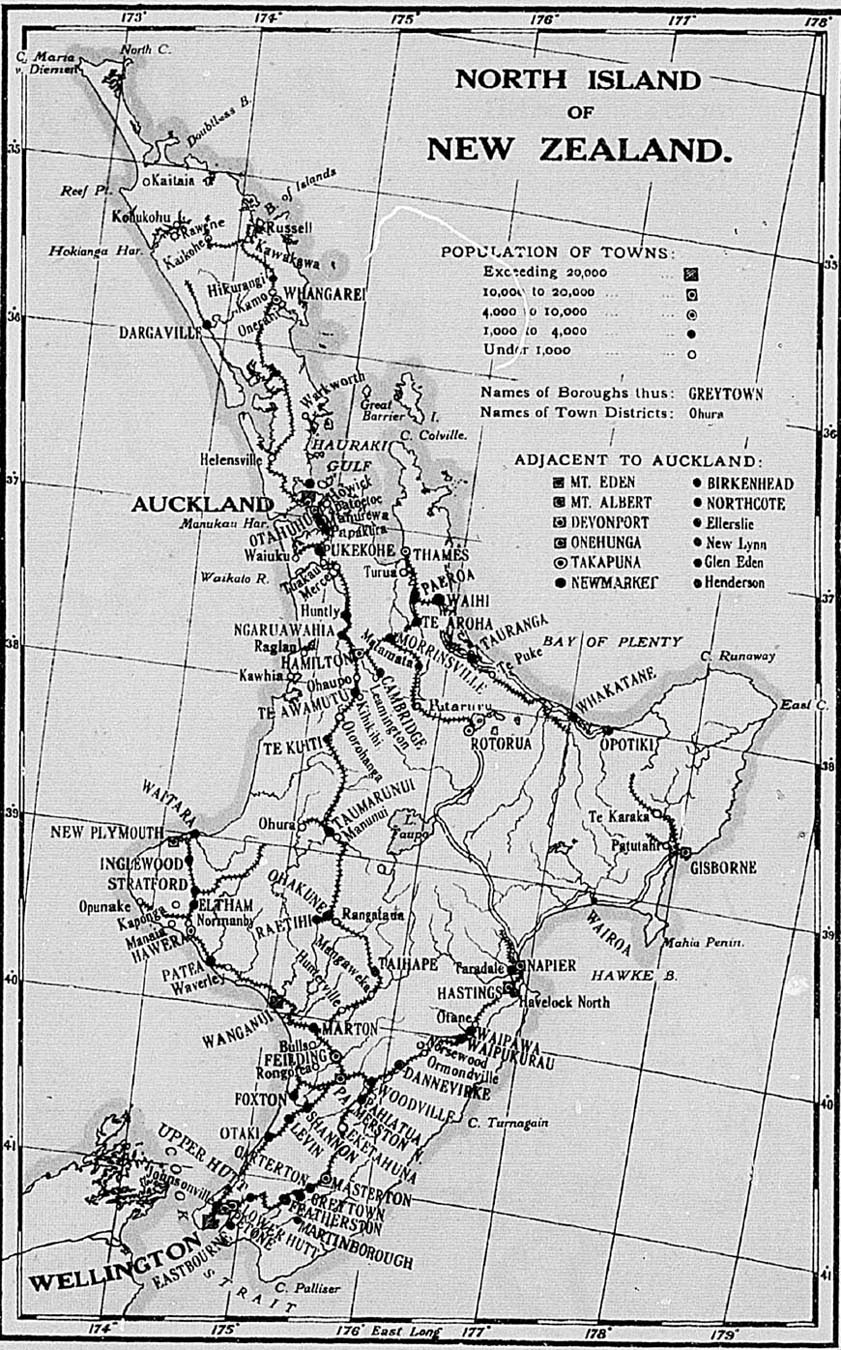
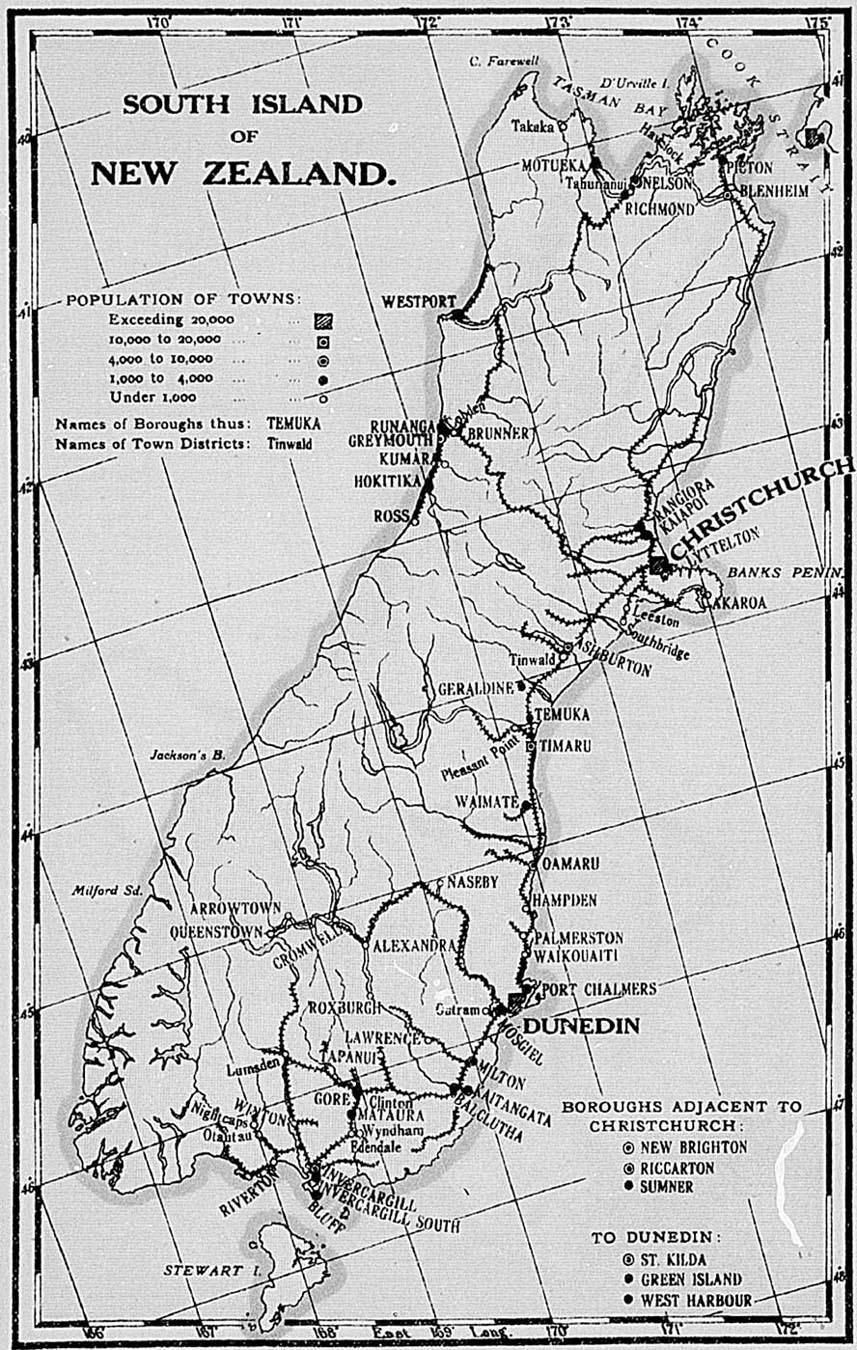
During the twenty-five years from 1901 to 1926 the population of the Dominion increased by 74 per cent, and each of the four North Island provincial districts showed a higher rate of increase—viz., Auckland, 141 per cent.; Wellington, 93 per cent.; Hawke's Bay, 85 per cent.; and Taranaki, 80 per cent. Among the South Island provincial districts Canterbury led with a percentage increase of 49, followed by Marlborough (37), Southland (36), Nelson (34), Otago (19), and Westland (4).
On 20th April, 1926, somewhat over one-third (38.5 per cent.) of the population of the Dominion (excluding Maoris) was included in the four principal urban areas—Auckland, Wellington, Christchurch, and Dunedin—and over one-half (51.6 per cent.) in these and in the ten secondary urban areas. The urban areas are not homogeneous local governing bodies, but were formed for statistical purposes, with a view to obviating difficulties formerly experienced through alterations of boundaries of cities and boroughs. Each urban area contains, in addition to the central city or borough and any suburban borough, town, or road districts, a considerable non - municipalized area adjacent to and contingent on the centre. The boundaries, which were designed to remain unaltered for a long period, thus allowing of definite comparisons being made over a series of years, were fixed with a view to providing for probable expansion.
Including those cities and boroughs which form parts of urban areas, the borough population at the census of 1926 aggregated 785,040, or 58.39 per cent, of the total population of the Dominion. Prior to 1900 there was no statutory limitation to the number of inhabitants necessary to constitute a borough, and consequently many small centres became municipalities. The Municipal Corporations Act now imposes a limit as to area, and provides that no new borough may be constituted unless the proposed area contains at least 1,000 inhabitants.
The counties contain what is generally regarded as the rural population, though this is only approximately correct, some of the boroughs, as stated above, having small populations mainly engaged in rural occupations. On the other hand, some of the non-municipalized towns, which include town districts suburban to the cities and principal boroughs and lying within the urban areas referred to above, have populations more urban than rural.
The town districts are of two classes, which may be referred to as “dependent” and “independent,” the former being in some matters under the jurisdiction of the Council of the county within which it lies, while the latter is entirely independent of county control. A town district may attain its independence of the county when its population exceeds 500, and may became a borough on reaching a population of 1,000.
For population purposes dependent town districts have their figures included in the totals of the counties within which they lie, while independent town districts are excluded, as is also the case with boroughs. Under the old method of computing urban and rural population, however, both classes of town districts are included in the county totals, as in the following table showing the urban and rural population at each census since 1881:—
| Census Year. | Counties. | Boroughs. | Percentage. | ||
|---|---|---|---|---|---|
| Counties. | Boroughs. | Shipboard, &c. | |||
| 1881 | 291,238 | 194,981 | 59.44 | 39.80 | 0.76 |
| 1886 | 327,328 | 245,612 | 56.58 | 42.46 | 0.96 |
| 1891 | 352,097 | 270,343 | 56.18 | 43.14 | 0.68 |
| 1896 | 391,735 | 307,294 | 55.69 | 43.69 | 0.62 |
| 1901 | 417,596 | 350,202 | 54.04 | 45.32 | 0.64 |
| 1906 | 458,797 | 424,614 | 51.63 | 47.79 | 0.58 |
| 1911 | 496,779 | 505,598 | 49.26 | 50.14 | 0.60 |
| 1916 | 501,259 | 585,306 | 45.59 | 53.24 | 1.17 |
| 1921 | 530,852 | 681,988 | 43.55 | 55.95 | 0.50 |
| 1926 | 551,457 | 785,040 | 41.02 | 58.39 | 0.59 |
In view of the public attention which has in recent years been bestowed upon the question of urban drift, the subject merits some further discussion. A measure of very fair accuracy is provided by the proportion of “county” and “borough” population in the table immediately preceding. Its drawback is perhaps that it slightly overstates the proportion of urban inhabitants and recent movements of the urban drift. A better criterion is contained in the next table, although perhaps the effects are here slightly understated.
For reasons indicated above, it is not altogether correct to regard the county population as rural and the borough population as urban. It is perhaps preferable to consider the question in the light of the following figures, in the computation of which the urban population is considered as that living in cities, boroughs, or town districts of over 1,000 inhabitants in 1881, 1,200 in 1886, 1,300 in 1891, 1,450 in 1896, 1,600 in 1901, 1,800 in 1906, 2,050 in 1911, 2,250 in 1916, and 2,500 in 1921 and 1926. Here the basic town has been given a rate of increase approximately equivalent to that of the country as a whole, it being assumed that a town of 2,500 bears much the same relationship at the present day as one of 1,000 inhabitants did in 1881. The results are as under:—
| Census. | Rural Population: Per Cent. | Urban Population: Per Cent. |
|---|---|---|
| 1881 | 62.34 | 37.66 |
| 1886 | 60.47 | 39.53 |
| 1891 | 61.16 | 38.84 |
| 1896 | 61.95 | 38.05 |
| 1901 | 60.87 | 39.13 |
| 1906 | 57.96 | 42.04 |
| 1911 | 57.07 | 42.93 |
| 1916 | 54.18 | 45.82 |
| 1921 | 51.23 | 48.77 |
| 1926 | 48.38 | 51.62 |
The increasing proportion of urban population in recent years is plainly manifest. It is noteworthy that the “urban drift,” either non-existent or quiescent up to 1906, in that year commenced a swift rise, which is rapidly gaining in momentum.
Consideration of urban population would be incomplete without a reference to the size of the towns dealt with. To that end a table has been compiled which shows the grouping of the residents of cities, boroughs, and town districts according to the size of their municipality. The total may be taken as corresponding sufficiently well to the urban population. The table shows some very interesting movements in urban distribution, but it is necessary to utter a caution against comparisons made without due consideration. Adjoining boroughs frequently amalgamate, and thus a large borough or city is at once in existence, although there may well be little or no change otherwise. Again, boroughs or town districts are often created out of what prior to such creation has been considered rural territory, and the change in status automatically places them within the number of the urban population without any corresponding change in the industries, &c, characteristic of the respective towns. Furthermore, the number of alterations in the boundaries of local districts is most marked.
| Boroughs and Town Districts with Populations of | 1901. | 1926. | ||||||
|---|---|---|---|---|---|---|---|---|
| Number of Boroughs, &c. | Population. | Per Cent, of | Number of Boroughs, &c. | Population. | Per Cent, of | |||
| Urban Population. | Total Population. | Urban Population. | Total Population. | |||||
| Over 50,000 | .. | .. | .. | .. | 4 | 337,221 | 40.57 | 25.08 |
| 25,000-50,000 | 2 | 77,851 | 21.19 | 10.08 | .. | .. | .. | .. |
| 10,000-25,000 | 3 | 53,821 | 14.65 | 6.96 | 12 | 185,580 | 22.32 | 13.80 |
| 5,000-10,000 | 10 | 66,259 | 18.03 | 8.58 | 11 | 82,144 | 9.88 | 6.11 |
| 2,500-5,000 | 20 | 74,489 | 20.27 | 9.64 | 23 | 85,430 | 10.28 | 6.36 |
| 1,000-2,500 | 38 | 59,117 | 16.09 | 7.65 | 63 | 102,201 | 12.29 | 7.60 |
| Under 1,000 | 63 | 35,882 | 9.77 | 4.64 | 75 | 38,722 | 4.66 | 2.88 |
| Totals | 136 | 367,419 | 100.00 | 47.55 | 188 | 831,298 | 100.00 | 61.83 |
An important characteristic of the distribution of urban population in New Zealand is what may be termed its decentralization. In place of one great metropolis containing a huge proportion of the population, as in the case of the Australian States—e.g., Victoria, whose capital city, Melbourne, contains over 50 per cent, of the total population of the State—the more highly urbanized portion of the community is localized in four widely separated centres. These four centres have always existed more or less on the same plane, a fact which has played no small part in the development of the country.
Urban and rural communities are not evenly distributed. The South Island, for example, contains proportionately more rural population than does the North Island. Of the Northern provincial districts Taranaki is the only one in which rural population predominates. The distribution as at the census of 1926 is set forth in the accompanying table:—
| Provincial District. | Boroughs, &c, of over 10,000. | Boroughs, &c., of 2,500-10,000. | Boroughs, &c., of under 2,500. | Total Population of | Remainder of Population. | |||
|---|---|---|---|---|---|---|---|---|
| Number. | Population. | Number. | Population. | Number. | Population. | |||
| Auckland | 5 | 150,173 | 13 | 63,677 | 47 | 48,334 | 262,184 | 162,347 |
| Hawke's Bay | 2 | 25,050 | 1 | 4,243 | 9 | 9,110 | 38,403 | 27,217 |
| Taranaki | 1 | 13,923 | 2 | 7,840 | 9 | 8,677 | 30,440 | 37,722 |
| Wellington | 3 | 140,471 | 6 | 35,002 | 21 | 24,414 | 199,887 | 73,613 |
| Marlborough | 1 | 4,970 | 2 | 1,479 | 6,449 | 11,868 | ||
| Nelson | 1 | 10,153 | 1 | 3,866 | 6 | 6,094 | 20,113 | 30,564 |
| Westland | 1 | 5,619 | 4 | 4,029 | 9,648 | 5,481 | ||
| Canterbury | 2 | 98,339 | 5 | 20,930 | 11 | 12,045 | 131,314 | 82,576 |
| Otago— | ||||||||
| Otago portion | 1 | 67,536 | 3 | 17,513 | 19 | 16,987 | 102,036 | 47,486 |
| Southland portion | 1 | 17,156 | 1 | 3,914 | 10 | 9,754 | 30,824 | 34,297 |
New Zealand is not alone in experiencing the modern tendency towards urban aggregation: it is, in fact, occurring in almost all countries. Accurate data on this point are not readily available, but the next table, which gives a comparison with England and the United States, removes this deficiency to some extent. Neither of these two countries, however, represents the same stage of development as the Dominion, so that the comparison suffers to that extent. The urban population quoted for England is that of the total of “urban districts”: that for the United States is the total population in towns of over 2,500 inhabitants.
| Census nearest to | New Zealand. | England and Wales. | United States of America. | |||
|---|---|---|---|---|---|---|
| Urban. | Rural. | Urban. | Rural. | Urban. | Rural. | |
| 1880 | 37.7 | 62.3 | 67.9 | 32.1 | 28.6 | 71.4 |
| 1890 | 38.8 | 61.2 | 72.0 | 28.0 | 35.4 | 64.6 |
| 1900 | 39.1 | 60.9 | 77.0 | 23.0 | 40.0 | 60.0 |
| 1910 | 42.9 | 57.1 | 78.1 | 21.9 | 45.8 | 54.2 |
| 1920 | 48.8 | 51.2 | 79.4 | 20.6 | 51.4 | 48.6 |
| URBAN AREAS.—ESTIMATED POPULATION (INCLUDING MAORIS), 1ST APRIL, 1928. | |
|---|---|
| Urban Area. | Population (including Maoris). |
| Auckland. | |
| Auckland City | 100,900 |
| Birkenhead Borough | 3,235 |
| Northcote Borough | 2,465 |
| Takapuna Borough | 6,765 |
| Devonport Borough | 10,200 |
| Newmarket Borough | 3,240 |
| Mount Eden Borough | 19,270 |
| Mount Albert Borough | 19,285 |
| Onehunga Borough | 10,950 |
| Otahuhu Borough | 4,645 |
| New Lynn Town District | 2,960 |
| Ellerslie Town District | 2,680 |
| Mount Roskill Road District | 5,625 |
| One Tree Hill Road District | 7,420 |
| Mount Wellington Road District | 1,230 |
| Panmure Township Road District | 295 |
| Remainder of urban area | 5,645 |
| Total | 206,810 |
| Wellington. | |
| Wellington City | 103,100 |
| Lower Hutt Borough | 10,725 |
| Petone Borough | 10,190 |
| Eastbourne Borough | 1,960 |
| Johnsonville Town District | 1,290 |
| Remainder of urban area | 2,855 |
| Total | 130,120 |
| Christchurch. | |
| Christchurch City | 86,600 |
| Riccarton Borough | 4,925 |
| New Brighton Borough | 4,705 |
| Sumner Borough | 3,155 |
| Lyttelton Borough | 3,710 |
| Remainder of urban area | 20,275 |
| Total | 123,370 |
| Dunedin. | |
| Dunedin City | 66,200 |
| St, Kilda Borough | 8,100 |
| Green Island Borough | 2,200 |
| West Harbour Borough | 2,030 |
| Port Chalmers Borough | 2,575 |
| Remainder of urban area | 2,955 |
| Total | 84,060 |
| Hamilton. | |
| Hamilton Borough | 14,715 |
| Remainder of urban area | 2,635 |
| Total | 17,350 |
| Gisborne. | |
| Gisborne Borough | 13,510 |
| Remainder of urban area | 2,030 |
| Total | 15,540 |
| Napier. | |
| Napier Borough | 15,890 |
| Taradale Town District | 1,135 |
| Remainder of urban area | 1,845 |
| Total | 18,870 |
| Hastings. | |
| Hastings Borough | 10,660 |
| Havelock North Town District | 1,055 |
| Remainder of urban area | 3,575 |
| Total | 15,290 |
| New Plymouth. | |
| New Plymouth Borough | 14,820 |
| Remainder of urban area | 2,230 |
| Total | 17,050 |
| Wanganui. | |
| Wanganui City | 24,740 |
| Remainder of urban area | 2,770 |
| Total | 27,510 |
| Palmerston North, | |
| Palmerston North Borough | 19,210 |
| Remainder of urban area | 1,730 |
| Total | 20,940 |
| Nelson. | |
| Nelson City | 10,420 |
| Tahunanui Town District | 680 |
| Remainder of urban area | 980 |
| Total | 12,080 |
| Timaru. | |
| Timaru Borough | 15,835 |
| Remainder of urban area | 1,705 |
| Total | 17,540 |
| Invercargill. | |
| Invercargill Borough | 19,380 |
| South Invercargill Borough | 1,050 |
| Remainder of urban area | 2,480 |
| Total | 22,910 |
| COUNTIES.—ESTIMATED POPULATION (INCLUDING MAORIS), 1ST APRIL, 1928. | ||
|---|---|---|
| (NOTE.—The column headed “Administrative” does not include boroughs or town districts independent of county control, but includes dependent town districts. The heading “Geographic” includes all cities, boroughs, or town districts geographically situated in a county.) | ||
| County. | Population (including Maoris). | |
| Administrative. | Geographic. | |
| North Island— | ||
| Mongonui | 6,790 | 7,325 |
| Whangaroa | 1,880 | 1,880 |
| Hokianga | 6,935 | 6,935 |
| Bay of Islands | 7,605 | 8,130 |
| Whangarei | 10,745 | 19,410 |
| Hobson | 6,040 | 8,025 |
| Otamatea | 4,210 | 4,210 |
| Rodney | 3,950 | 4,400 |
| Waitemata | 10,200 | 39,205 |
| Eden | 15,080 | 171,405 |
| Great Barrier | 375 | 375 |
| Manukau | 8,130 | 18,410 |
| Franklin | 11,440 | 15,375 |
| Raglan | 7,655 | 7,655 |
| Waikato | 9,600 | 28,080 |
| Waipa | 10,185 | 13,670 |
| Otorohanga | 3,960 | 4,570 |
| Kawhia | 1,880 | 1,880 |
| Waitomo | 6,790 | 9,250 |
| Taumarunui | 2,920 | 5,370 |
| Matamata | 7,960 | 9,800 |
| Piako | 7,900 | 11,885 |
| Ohinemuri | 2,960 | 8,305 |
| Hauraki Plains | 4,290 | 4,290 |
| Thames | 2,540 | 7,300 |
| Coromandel | 2,120 | 2,120 |
| Tauranga | 8,450 | 12,090 |
| Rotorua | 3,860 | 8,690 |
| Taupo | 2,340 | 2,340 |
| Whakatane | 6,120 | 7,545 |
| Opotiki | 4,020 | 5,255 |
| Matakaoa | 1,530 | 1,530 |
| Waiapu | 5,150 | 5,150 |
| Uawa | 1,710 | 1,710 |
| Waikohu | 3,565 | 3,565 |
| Cook | 6,795 | 20,305 |
| Wairoa | 5,530 | 7,940 |
| Hawke's Bay | 14,850 | 43,590 |
| Waipawa | 3,460 | 4,640 |
| Waipukurau | 990 | 2,870 |
| Patangata | 2,735 | 2,735 |
| Dannevirke | 5,000 | 9,410 |
| Woodville | 1,885 | 3,010 |
| Weber | 425 | 425 |
| Ohura | 2,605 | 2,605 |
| Whangamomona | 1,350 | 1,350 |
| Clifton | 2,700 | 2,700 |
| Taranaki | 6,485 | 23,115 |
| Inglewood | 3,125 | 4,390 |
| Egmont | 3,925 | 4,875 |
| Stratford | 5,125 | 8,540 |
| Eltham | 3,525 | 5,565 |
| Waimate West | 2,895 | 3,580 |
| Hawera | 5,430 | 10,010 |
| Patea | 3,495 | 5,265 |
| Kaitieke | 2,965 | 3,865 |
| Waimarino | 3,795 | 6,925 |
| Waitotara | 3,435 | 28,175 |
| Wanganui | 3,745 | 3,745 |
| Rangitikei | 9,625 | 16,390 |
| Kiwitea | 2,380 | 2,380 |
| Pohangina | 1,310 | 1,310 |
| Oroua | 3,735 | 8,010 |
| Manawatu | 5,030 | 6,800 |
| Kairanga | 5,135 | 24,345 |
| Horowhenua | 6,780 | 12,090 |
| Pahiatua | 3,000 | 4,490 |
| Akitio | 1,200 | 1,200 |
| Eketahuna | 2,045 | 2,835 |
| Mauriceville | 765 | 765 |
| Masterton | 3,540 | 11,920 |
| Castlepoint | 605 | 605 |
| Wairarapa South | 3,265 | 5,100 |
| Featherston | 3,890 | 7,050 |
| Hutt | 7,250 | 33,175 |
| Makara | 4,135 | 108,525 |
| Total | 360,845 | 923,755 |
| South Island— | ||
| Sounds | 945 | 945 |
| Marlborough | 7,700 | 14,150 |
| Awatere | 1,710 | 1,710 |
| Kaikoura | 2,325 | 2,325 |
| Amuri | 2,210 | 2,210 |
| Cheviot | 1,300 | 1,300 |
| Waimea | 9,140 | 22,860 |
| Takaka | 1,945 | 1,945 |
| Collingwood | 1,100 | 1,100 |
| Buller | 6,430 | 10,320 |
| Murchison | 1,400 | 1,400 |
| Inangahua | 3,530 | 3,530 |
| Grey | 5,210 | 14,330 |
| Westland | 4,220 | 7,670 |
| Waipara | 2,470 | 2,470 |
| Kowai | 1,960 | 1,960 |
| Ashley | 720 | 720 |
| Rangiora | 3,010 | 5,135 |
| Eyre | 1,860 | 3,570 |
| Oxford | 1,660 | 1,660 |
| Tawera | 780 | 780 |
| Malvern | 2,865 | 2,865 |
| Paparua | 5,230 | 5,230 |
| Waimairi | 12,515 | 17,440 |
| Heathcote | 5,255 | 103,425 |
| Halswell | 1,865 | 1,865 |
| Mount Herbert | 515 | 515 |
| Akaroa | 1,800 | 2,410 |
| Chatham Islands | 600 | 600 |
| Wairewa | 1,045 | 1,045 |
| Springs | 1,910 | 1,910 |
| Ellesmere | 3,320 | 3,930 |
| Selwyn | 1,780 | 1,780 |
| Ashburton | 12,465 | 18,335 |
| Geraldine | 5,780 | 8,670 |
| Levels | 5,220 | 21,630 |
| Mackenzie | 3,180 | 3,180 |
| Waimate | 7,275 | 9,500 |
| Waitaki | 9,460 | 17,075 |
| Waihemo | 1,440 | 2,245 |
| Waikouaiti | 4,380 | 9,595 |
| Peninsula | 2,640 | 2,640 |
| Taieri | 6,105 | 84,560 |
| Bruce | 4,500 | 7,530 |
| Clutha | 7,090 | 8,635 |
| Tuapeka | 4,875 | 6,245 |
| Maniototo | 2,715 | 2,925 |
| Vincent | 3,680 | 4,900 |
| Lake | 1,695 | 2,815 |
| Southland | 25,180 | 54,575 |
| Wallace | 9,185 | 11,390 |
| Fiord | 20 | 20 |
| Stewart Island | 660 | 660 |
| Total | 217,870 | 522,230 |
| Grand total | 578,715 | 1,445,985 |
| BOROUGHS.—ESTIMATED POPULATION (INCLUDING MAORIS), 1ST APRIL, 1928. | |
|---|---|
| Borough. | Population (including Maoris). |
| North Island— | |
| Whangarei | 6,950 |
| Dargaville | 1,985 |
| Birkenhead | 3,235 |
| Northcote | 2,465 |
| Takapuna | 6,765 |
| Devonport | 10,200 |
| Auckland (City) | 100,900 |
| Newmarket | 3,240 |
| Mount Eden | 19,270 |
| Mount Albert | 19,285 |
| Onehunga | 10,950 |
| Otahuhu | 4,645 |
| Pukekohe | 2,440 |
| Ngaruawahia | 1,225 |
| Hamilton | 14,715 |
| Cambridge | 2,030 |
| Te Awamutu | 1,700 |
| Te Kuiti | 2,460 |
| Taumarunui | 2,450 |
| Morrinsville | 1,595 |
| Te Aroha | 2,390 |
| Paeroa | 1,860 |
| Waihi | 3,485 |
| Thames | 4,760 |
| Tauranga | 2,660 |
| Rotorua | 4,830 |
| Whakatane | 1,425 |
| Opotiki | 1,235 |
| Gisborne | 13,510 |
| Wairoa | 2,410 |
| Napier | 15,890 |
| Hastings | 10,660 |
| Waipawa | 1,180 |
| Waipukurau | 1,880 |
| Dannevirke | 4,410 |
| Woodville | 1,125 |
| Waitara | 1,810 |
| New Plymouth | 14,820 |
| Inglewood | 1,265 |
| Stratford | 3,415 |
| Eltham | 2,040 |
| Hawera | 4,580 |
| Patea | 1,130 |
| Ohakune | 1,520 |
| Raetihi | 1,130 |
| Taihape | 2,475 |
| Wanganui (City) | 24,740 |
| Marton | 2,775 |
| Feilding | 4,275 |
| Palmerston North | 19,210 |
| Foxton | 1,770 |
| Shannon | 1,150 |
| Levin | 2,580 |
| Otaki | 1,580 |
| Pahiatua | 1,490 |
| Eketahuna | 790 |
| Masterton | 8,380 |
| Carterton | 1,835 |
| Greytown | 1,100 |
| Featherston | 1,060 |
| Martinborough | 1,000 |
| Upper Hutt | 3,050 |
| Lower Hutt | 10,725 |
| Petone | 10,190 |
| Eastbourne | 1,960 |
| Wellington (City) | 103,100 |
| Total | 529,160 |
| South Island— | |
| Picton | 1,280 |
| Blenheim | 5,170 |
| Nelson (City) | 10,420 |
| Richmond | 1,110 |
| Motueka | 1,510 |
| Westport | 3,890 |
| Brunner | 650 |
| Runanga | 1,400 |
| Greymouth | 5,900 |
| Kumara | 500 |
| Hokitika | 2,450 |
| Ross | 500 |
| Rangiora | 2,125 |
| Kaiapoi | 1,710 |
| Christchurch (City) | 86,600 |
| Riccarton | 4,925 |
| New Brighton | 4,705 |
| Sumner | 3,155 |
| Lyttelton | 3,710 |
| Akaroa | 610 |
| Ashburton | 5,195 |
| Geraldine | 1,000 |
| Temuka | 1,890 |
| Timaru | 15,835 |
| Waimate | 2,225 |
| Oamaru | 7,345 |
| Hampden | 270 |
| Palmerston | 805 |
| Waikouaiti | 610 |
| Port Chalmers | 2,575 |
| West Harbour | 2,030 |
| Dunedin (City) | 66,200 |
| St. Kilda | 8,100 |
| Green Island | 2,200 |
| Mosgiel | 1,955 |
| Milton | 1,530 |
| Kaitangata | 1,500 |
| Balclutha | 1,545 |
| Tapanui | 300 |
| Lawrence | 660 |
| Roxburgh | 410 |
| Naseby | 210 |
| Alexandra | 610 |
| Cromwell | 610 |
| Arrowtown | 300 |
| Queenstown | 820 |
| Gore | 3,990 |
| Mataura | 1,275 |
| Winton | 890 |
| Invercargill | 19,380 |
| South Invercargill | 1,050 |
| Bluff | 1,605 |
| Riverton | 875 |
| Total | 298,115 |
| Grand total | 827,275 |
| TOWN DISTRICTS.—ESTIMATED POPULATION (INCLUDING MAORIS), 1ST APRIL, 1928. | |
|---|---|
| Town District. | Population (including Maoris). |
| (a) Town Districts not forming Parts of Counties. | |
| North Island— | |
| Kaitaia | 535 |
| Kaikohe | 525 |
| Hikurangi | 1,165 |
| Kamo | 550 |
| Warkworth | 450 |
| Helensville | 990 |
| Henderson | 1,060 |
| Glen Eden | 1,330 |
| New Lynn | 2,960 |
| Ellerslie | 2,680 |
| Howick | 560 |
| Papatoetoe | 1,875 |
| Manurewa | 1,455 |
| Papakura | 1,745 |
| Waiuku | 840 |
| Tuakau | 655 |
| Huntly | 1,735 |
| Leamington | 560 |
| Otorohanga | 610 |
| Manunui | 900 |
| Putaruru | 790 |
| Matamata | 1,050 |
| Te Puke | 980 |
| Taradale | 1,135 |
| Havelock North | 1,055 |
| Opunake | 950 |
| Manaia | 685 |
| Rangataua | 480 |
| Mangaweka | 345 |
| Hunterville | 635 |
| Waverley | 640 |
| Bull's | 535 |
| Johnsonville | 1,290 |
| Total | 33,750 |
| South Island— | |
| Tahunanui | 680 |
| Cobden | 1,170 |
| Leeston | 610 |
| Tinwald | 675 |
| Pleasant Point | 575 |
| Lumsden | 530 |
| Wyndham | 675 |
| Otautau | 660 |
| Nightcaps | 670 |
| Total | 6,245 |
| Grand total | 39,995 |
| (b) Town Districts forming Parts of Counties. | |
| North Island— | |
| Kohukohu | 540 |
| Rawene | 425 |
| Russell | 365 |
| Kawakawa | 380 |
| Onerahi | 485 |
| Mercer | 360 |
| Raglan | 320 |
| Ohaupo | 240 |
| Kihikihi | 315 |
| Kawhia | 220 |
| Turua | 280 |
| Patutahi | 285 |
| Te Karaka | 370 |
| Otane | 350 |
| Norsewood | 190 |
| Ormondville | 290 |
| Ohura | 285 |
| Kaponga | 435 |
| Normanby | 375 |
| Rongotea | 290 |
| Total | 6,800 |
| South Island— | |
| Havelock | 250 |
| Takaka | 390 |
| South bridge | 425 |
| Outram | 350 |
| Clinton | 380 |
| Edendale | 450 |
| Total | 2,245 |
| Grand total | 9,045 |
New Zealand has many townships with considerable population, but without local self-government as boroughs or town districts. A list of such townships (other than those included in urban areas) with more than five hundred inhabitants, as at the census of 20th April, 1926, is here given. The population quoted includes, as a rule, the immediate neighbourhood as well as the actual township itself.
* Including construction camp. † Including mental hospital. | |
|---|---|
| Arapuni* | 845 |
| Ashhurst | 629 |
| Belfast | 1,107 |
| Blackball | 1,056 |
| Brightwater | 532 |
| Bunnythorpe | 747 |
| Clive | 651 |
| Coromandel | 619 |
| Denniston | 910 |
| Fairlie | 800 |
| Granity | 584 |
| Hornby | 673 |
| Kaikoura | 669 |
| Kakahi | 591 |
| Katikati | 621 |
| Lincoln | 502 |
| Longburn | 649 |
| Makarewa | 629 |
| Mamaku | 633 |
| Mangatainoka | 518 |
| Matangi | 554 |
| Methven | 771 |
| Midhirst | 523 |
| Miller's Flat | 511 |
| Millerton | 907 |
| Morven | 601 |
| Netherton | 550 |
| Ngatea | 522 |
| Ohai | 513 |
| Okaiawa | 644 |
| Ongarue | 577 |
| Orepuki | 702 |
| Owaka | 557 |
| Owhango | 512 |
| Oxford | 919 |
| Paekakariki | 524 |
| Porirua† | 1,842 |
| Portland | 541 |
| Prebbleton | 507 |
| Pukemiro | 695 |
| Rakaia | 759 |
| Reefton | 1,525 |
| Riwaka | 612 |
| Sefton | 537 |
| Stirling | 526 |
| Stoke | 804 |
| Takapau | 777 |
| Tirau | 550 |
| Tokomaru | 663 |
| Tuatapere | 635 |
| Waharoa | 584 |
| Waihou | 787 |
| Waikino | 681 |
| Waikiwi | 664 |
| Waipu | 555 |
| Waitati | 659 |
| Waitoa | 592 |
| Waiuta | 503 |
| Wakefield | 759 |
| Winchester | 549 |
Adjacent to the main Islands are many smaller islands, some of which are of considerable area, and are under cultivation; others are but islets used as sites for lighthouses, while others again are barren and unfitted for human habitation. Some of these islands are included within the boundaries of counties, and their populations are included in the county figures. The following adjacent islands not attached to any county were inhabited at the census of 1926:—
| Island. | Population (including Maoris). | ||
|---|---|---|---|
| M. | F. | Total. | |
| Kokutango | 5 | 1 | 6 |
| Pakatoa | 1 | 25 | 26 |
| Rotoroa | 63 | 6 | 69 |
| Little Barrier | 1 | 2 | 3 |
| Tiritiri | 5 | 7 | 12 |
| Rakino | 3 | 2 | 5 |
| Brown's | 2 | 1 | 3 |
| Pahiki | 4 | 4 | |
| Mokohinau | 3 | 2 | 5 |
| Ponui | 11 | 17 | 28 |
| Waiheke | 204 | 217 | 421 |
| Rangitoto | 24 | 3 | 27 |
| Motutapu | 6 | 3 | 9 |
| Motuihi | 4 | 3 | 7 |
| Kawau | 16 | 16 | 32 |
| Motuhora | 6 | 1 | 7 |
| Motuketekete | 2 | 2 | |
| Slipper | 2 | 2 | |
| Wanganui | 1 | 1 | 2 |
| Cuvier | 4 | 4 | 8 |
| Great Mercury | 3 | 3 | |
| Motiti | 51 | 38 | 89 |
| White | 22 | 2 | 24 |
| East | 4 | 6 | 10 |
| Kapiti | 9 | 5 | 14 |
| Somes | 2 | 2 | 4 |
| Arapawa | 40 | 41 | 81 |
| Forsyth | 4 | 7 | 11 |
| Blumine | 1 | 2 | 3 |
| Brothers | 3 | 3 | |
| D'Urville | 59 | 34 | 93 |
| Stephen | 5 | 10 | 15 |
| Rangitoto | 4 | 4 | 8 |
| Quarantine | 2 | 2 | 4 |
| Dog | 3 | 3 | 6 |
| Centre | 4 | 2 | 6 |
| Totals | 583 | 469 | 1,052 |
The total area of the Dominion of New Zealand, including Cook and other annexed islands, is 103,861 square miles. Omitting the annexed islands and certain uninhabited outlying islands, the area of the land-mass remaining is 103,285 square miles. This calculation, it should be explained, includes all inland waters.
Using the latter figure as a base, the density of population in 1928 may be quoted as 13.45 persons to the square mile, or, if Maoris be included, 14.07 persons to the square mile.
A truer statement of average density can be ascertained by applying not the total area as used above, but subtracting the area occupied by rivers, lakes, roads, State forests, higher portions of mountain-ranges, &c. The remaining area, amounting to about 84,500 square miles, which may be considered as the total inhabitable or usable land, carries a population of 16.43 (or, including Maoris, 17.20) persons to the square mile.
Reverting to the area first used above, as being the one in common use for this purpose, the progress of development is illustrated in the appended statement:—
| — | Persons to Square Mile. | |
|---|---|---|
| Excluding Maoris. | Including Maoris. | |
| 1881 | 4.74 | 5.17 |
| 1886 | 5.60 | 6.01 |
| 1891 | 6.07 | 6.47 |
| 1896 | 6.81 | 7.20 |
| 1901 | 7.48 | 7.90 |
| 1906 | 8.60 | 9.07 |
| 1911 | 9.76 | 10.25 |
| 1916 | 10.64 | 11.13 |
| 1921 | 11.80 | 12.31 |
| 1926 | 13.02 | 13.63 |
| 1927 | 13.30 | 13.92 |
| 1928 | 13.45 | 14.07 |
Of interest also is the relative distribution of the population, and to this end the density is quoted for provincial districts as at the Census of 1926:—
| Provincial District. | Area in Square Miles. | Persons per Square Mile. | |
|---|---|---|---|
| Excluding Maoris. | Including Maoris. | ||
| Auckland | 25,351 | 16.75 | 18.52 |
| Hawke's Bay | 4,241 | 15.47 | 16.59 |
| Taranaki | 3,732 | 18.26 | 19.25 |
| Wellington | 10,807 | 25.31 | 26.00 |
| Marlborough | 4,225 | 4.34 | 4.45 |
| Nelson | 10,875 | 4.66 | 4.68 |
| Westland | 4,881 | 3.10 | 3.13 |
| Canterbury | 13,858 | 15.43 | 15.52 |
| Otago—Otago portion | 13,957 | 10.71 | 10.74 |
| Southland portion | 11,358 | 5.73 | 5.77 |
| Dominion | 103,285 | 13.02 | 13.63 |
The South Island provincial districts, it should be noted, contain on an average much more mountainous country than those of the North Island.
The various cities, boroughs, and town districts in New Zealand occupy a total of approximately 510 square miles. Considering their population as “urban,” the urban population (1926) had a density of 1,630.0 per square mile, and the rural population a density of 4.9 per square mile.
Attention may be drawn to the necessity for the exercise of discretion in the use of data concerning density of population, particularly in comparing one country with another. Areas may be calculated in many ways, while area itself may have little relationship to potentiality of use. In the case of urban population, it is impossible to obtain the aggregate area of sites actually in occupation by business premises, residences, &c. Many boroughs contain within their boundaries large reserves which, with farming and other unbuilt-on land, tends to disguise the actual relation of population to area.
A record of early statistics of Maoris is given in the General Report on the Census of 1921. The first official general census was taken in 1857-58, and others occurred in regular sequence from 1874 onwards. Owing to inherent difficulties the earlier census records make no pretence towards complete accuracy, and even later enumerations hardly claim to be more than approximations which approach the truth as nearly as possible.
Available statistical evidence points to a decline in the numbers of the Native race since the advent of Europeans, but this decline was commonly exaggerated by early writers. Of later years an unmistakable increase has been noted. This gain, however, has been accompanied by a very considerable dilution of blood, the extent of which the more detailed data from the 1926 census will throw some light upon. The census record is as follows:—
| * Includes half-castes, vide introduction to section. | |
|---|---|
| 1857-58 | 56,049 |
| 1874 | 45,470 |
| 1878 | 43,595 |
| 1881 | 44,097 |
| 1886 | 41,969 |
| 1891 | 41,993 |
| 1896 | 39,854 |
| 1901 | 43,143 |
| 1906 | 47,731 |
| 1911 | 49,844 |
| 1916 | 49,776 |
| 1921 | 52,751 |
| 1926 | 63,670* |
| 1928 | 64,817* |
Of 64,817 Maoris in April, 1928, 61,954 were in the North Island. Auckland Provincial District contains the bulk (46,464), particularly in the Auckland Peninsula and Poverty Bay regions. Hawke's Bay contains some 4,900; Taranaki, 3,820; and Wellington 6,770. In the South Island Maoris do not attain any numerial significance. During 1927-28 the Maori population increased by 583, or 0.9 per cent.
The following table, which shows the increasing proportion of children under fifteen years of age, affords further evidence of increasing numbers:—
| Census Year. | Males. | Females. | ||
|---|---|---|---|---|
| Under 15. | Over 15. | Under 15. | Over 15. | |
| 1891 | 33.22 | 66.78 | 35.22 | 64.78 |
| 1896 | 35.28 | 64.72 | 36.82 | 63.18 |
| 1901 | 35.75 | 64.25 | 37.89 | 62.11 |
| 1906 | 38.26 | 61.74 | 39.20 | 60.80 |
| 1911 | 39.10 | 60.90 | 40.97 | 59.03 |
| 1916 | 41.35 | 58.65 | 41.43 | 58.57 |
| 1921 | 39.48 | 60.52 | 40.56 | 59.44 |
The number of half-castes is given in the next table for seven census periods. Those under the first heading have, prior to the census of 1926, been included in the Maori totals, the others being classed among the European population. It is a matter of some difficulty to ascertain the number of half-castes living as Maoris. There has been no definite rule to guide collectors in deciding when a half-caste should be classified as living as a Maori—indeed, it might be said that all the half-castes and a large proportion of the Maoris in the South Island live in European fashion. They mostly have separate holdings of land and separate homes, and have adopted the habits of the Europeans. At the censuses of 1916 and 1921 the old method of enumerating the South Island Maoris was discarded, the same methods and forms being utilized as for the European population, and in 1926 for the first time schedules were employed in the North Island, a special Maori schedule being used in most cases. In the early part of this section mention is made of a change in the classification of those intermediate in blood between European and Maori.
During the year 1901 the boundaries of the Dominion were extended to include the Cook Group and certain other of the South Pacific islands. No record of the population of these islands was then obtainable, but at each subsequent census a record of various particulars was obtained. In April, 1928, the population was estimated at 14,219, of which Europeans composed some 300. The movement of population is in the direction of a gradual increase. The figures for each census from 1906 onwards are as follows:—
| Census Year. | Males. | Females. | Total. |
|---|---|---|---|
| 1906 | 6,224 | 6,116 | 12,340 |
| 1911 | 6,449 | 6,149 | 12,598 |
| 1916 | 6,553 | 6,244 | 12,797 |
| 1921 | 6,692 | 6,517 | 13,209 |
| 1926 | 7,047 | 6,830 | 13,877 |
The population (1926) of the various islands is as follows, non-Native population being mentioned first: Aitutaki (14, 1,417); Atiu (9, 924); Mangaia (8, 1,241); Manihiki (3, 413); Manuae and Te-au-o-tu (2, 21); Mauke (15, 496); Mitiaro (2, 236); Palmerston (0, 97); Penrhyn (5, 390); Pukapuka (16, 510); Rakahanga (2, 325); Rarotonga (202, 3,682); shipping at Rarotonga (3, 49); Niue (32, 3,763).
At 1st April, 1928, the population of the mandated territory of Western Samoa was estimated at 42,949, made up as follows:—
| — | Males. | Females. | Total. |
|---|---|---|---|
| European and half-caste population | 1,292 | 1,000 | 2,292 |
| Native Samoan population | 20,018 | 19,524 | 39,542 |
| Chinese indentured-contract labour | 909 | .. | 909 |
| Chinese (non-indentured) | 52 | 8 | 60 |
| Melanesian and Polynesian indentured-contract labour | 145 | 1 | 146 |
| Totals | 22,416 | 20,533 | 42,949 |
The population at the census of 1926 was 3,886 in excess of that disclosed by the census of 1921 (36,343). A full comparison with enumerations prior to 1921 is not possible, owing to indentured-contract labour not having been included n these. A census taken in July, 1917, showed the European population to then number 1,927, and the native Samoans 35,404. The latter are now steadily increasing in number.
The sources of the data quoted herein comprise official publications, bulletins issued by the League of Nations, and the Statesman's Year-book. So far as can be ascertained with some pretension to comparative accuracy—the various estimates of the population of the Chinese Empire, for instance, vary to the extent of considerably over 100 millions—the world population is now over 1,900 millions. The 1,450,000 inhabitants of the Dominion therefore comprise about one thirteen-hundredth part of the population of the world. Details for continents are:—
| 1913. | 1926. | |
| Europe | 498,000,000 | 515,000,000 |
| Asia | 978,000,000 | 1,026,000,000 |
| Africa | 134,000,000 | 146,000,000 |
| North America | 134,000,000 | 159,000,000 |
| South America | 56,000,000 | 72,000,000 |
| Oceania | 8,000,000 | 9,000,000 |
| Totals | 1,808,000,000 | 1,927,000,000 |
The Chinese population included above is 441 millions in 1913 and 450 millions in 1926.
As a useful indication of the comparative size of various countries, the following index of population has been prepared:—
| Country. | Population (000 omitted). | Year. | Index of Population (New Zealand = 1). |
|---|---|---|---|
| England and Wales | 39,290 | 1,927 | 27 |
| Scotland | 4,895 | 1,927 | 3 |
| Northern Ireland | 1,253 | 1,927 | 1 |
| Irish Free State | 2,973 | 1,926 | 2 |
| India (including Native States) | 326,500 | 1,926 | 225 |
| Ceylon | 5,010 | 1,926 | 3 |
| Union of South Africa | 7,538 | 1,926 | 5 |
| Canada | 9,519 | 1,927 | 7 |
| Newfoundland | 262 | 1,926 | 0.2 |
| Australia | 6,167 | 1,927 | 4 |
| New South Wales | 2,371 | 1,927 | 2 |
| Victoria | 1,726 | 1,927 | 1 |
| Queensland | 894 | 1,927 | 0.6 |
| South Australia | 571 | 1,927 | 0.4 |
| Western Australia | 385 | 1,927 | 0.3 |
| Tasmania | 208 | 1,927 | 0.1 |
| New Zealand | 1,454 | 1,928 | 1 |
| Austria | 6,750 | 1,926 | 5 |
| Belgium | 7,875 | 1,927 | 5 |
| Bulgaria | 5,843 | 1,927 | 4 |
| Czecho-Slovakia | 14,357 | 1,927 | 10 |
| Denmark | 3,460 | 1,926 | 2 |
| Estonia | 1,117 | 1,926 | 0.8 |
| Finland | 3,558 | 1,927 | 2 |
| France | 40,744 | 1,926 | 28 |
| Germany | 63,100 | 1,920 | 43 |
| Greece | 6,600 | 1,927 | 5 |
| Hungary | 8,458 | 1,927 | 6 |
| Italy | 40,549 | 1,927 | 28 |
| Latvia | 1,867 | 1,926 | 1 |
| Lithuania | 2,255 | 1,927 | 2 |
| Netherlands | 7,527 | 1,927 | 5 |
| Norway | 2,789 | 1,927 | 2 |
| Poland | 29,589 | 1,927 | 20 |
| Portugal | 5,775 | 1,926 | 4 |
| Rumania | 17,220 | 1,926 | 12 |
| Russia (Soviet Union) | 147,014 | 1,927 | 101 |
| Sweden | 6,074 | 1,927 | 4 |
| Switzerland | 3,959 | 1,926 | 3 |
| Spain | 22,290 | 1,927 | 15 |
| Turkey | 13,650 | 1,927 | 9 |
| Jugo-Slavia | 12,800 | 1,926 | 9 |
| China | 450,000 | 1,926 | 310 |
| Japan | 63,007 | 1,927 | 43 |
| Mexico | 14,500 | 1,926 | 10 |
| United States | 118,628 | 1,927 | 82 |
| Argentina | 10,348 | 1,927 | 7 |
| Brazil | 39,870 | 1,927 | 28 |
| Chile | 4,004 | 1,927 | 3 |
Table of Contents
REGISTRATION of births in New Zealand dates as far back as 1847, in which year was passed a Registration Ordinance which made provision for a record of births and deaths being kept by the State. Under this Ordinance many registrations were effected, some of births as far back as 1840. Compulsory registration did not, however, come into force until 1855.
The earlier Registration Acts and their amendments provided for very little information being given in the case of births, the register containing merely date and place of birth, name and sex of child, names of father and mother, and occupation of father. In 1875, however, a more comprehensive Registration Act was passed, under which information was recorded as to ages and birthplaces of parents, and in 1912 the sexes and ages of previous issue of the marriage were added to the items required to be shown in the birth entry.
The law as to registration of births is now embodied in the Births and Deaths Registration Act, 1924, a consolidation of the then existing legislation. The provisions generally as to registration are that a birth may be registered within sixty-two days without fee. After sixty-two days and within six months a birth is registrable only after solemn declaration made before the Registrar by the parent or some person present at birth, and on payment of a late fee of 5s., which may, however, be remitted at the discretion of the Registrar-General. When six months have elapsed a birth may be registered with a Registrar of Births within one month after conviction of one of the responsible parties for neglect, but an information for such neglect must be laid within two years of date of birth. Power is given by the Act of 1924 for the Registrar-General to register an unregistered birth which occurred in New Zealand, irrespective of the time that may have elapsed, a fee of five shillings being payable and satisfactory evidence on oath and such other proof as the Registrar-General may deem necessary being required.
There is also provision in the Births and Deaths Registration Act for the re-registration of the births of adopted children, with particulars of the adopting parents in place of those of the natural parents.
Registration of still-births, previously not provided for, was made compulsory from the 1st March, 1913.
Although sixty-two days are allowed for the registration of a birth, it is compulsory to notify the birth to the Registrar within a much shorter interval—viz., forty-eight hours if in a city or borough, and twenty-one days in every other case.
In the successive Registration Acts special provision was made for exemption from the necessity of registration in the case of births and deaths of Maoris, though registration could be effected if desired. Section 20 of the Births and Deaths Registration Amendment Act, 1912 (now section 60 of the Births and Deaths Registration Act, 1924), empowered the making of regulations to provide for the registration of births and deaths of Maoris. Regulations were made accordingly, and Maori births and deaths became registrable as from the 1st March, 1913. The number of Registrars of Maori Births and Deaths in the Dominion is over 200, most of these being in the North Island, where the great majority of the Maori population is located. Every Native settlement of any size is within easy reach of one of these Registrars. Maori registrations are entered in a separate register, and the figures of births given in the following pages do not include those of Maoris, which are dealt with towards the end of this subsection.
The number of births registered in 1927 (27,881) is 592 less than the total for 1926, and 358 less than the figure for 1917, in spite of an increase of over 275,000 in population during the ten years. This is the first time since 1923 that there has been a decrease in the actual number of births registered. The rate per 1,000 of mean population (20-29) is the lowest ever recorded in the Dominion, being 0-76 per 1,000 lower than in 1926, which represented the previous lowest level.
The numbers and rates of births in each of the last twenty years are as follows:—
| Year. | Number. | Rate per 1,000. |
|---|---|---|
| 1908 | 25,940 | 27.45 |
| 1909 | 26,524 | 27.29 |
| 1910 | 25,984 | 26.17 |
| 1911 | 26,354 | 25.97 |
| 1912 | 27,508 | 26.48 |
| 1913 | 27,935 | 26.14 |
| 1914 | 28,338 | 25.99 |
| 1915 | 27,850 | 25.33 |
| 1916 | 28,509 | 25.94 |
| 1917 | 28,239 | 25.69 |
| 1918 | 25,860 | 23.44 |
| 1919 | 24,483 | 21.42 |
| 1920 | 29,921 | 25.09 |
| 1921 | 28,567 | 23.34 |
| 1922 | 29,006 | 23.17 |
| 1923 | 27,967 | 21.94 |
| 1924 | 28,014 | 21.57 |
| 1925 | 28,153 | 21.17 |
| 1926 | 28,473 | 21.05 |
| 1927 | 27,881 | 20.29 |
There is a noticeable fall in the rate in the later years of the period covered by the table, as compared with the earlier. This fall, however, is small when compared with the tremendous decline between the “seventies” and “nineties” disclosed by the following diagram, which shows also the course of the rates of deaths, natural increase, and marriages from 1855 to 1927:—
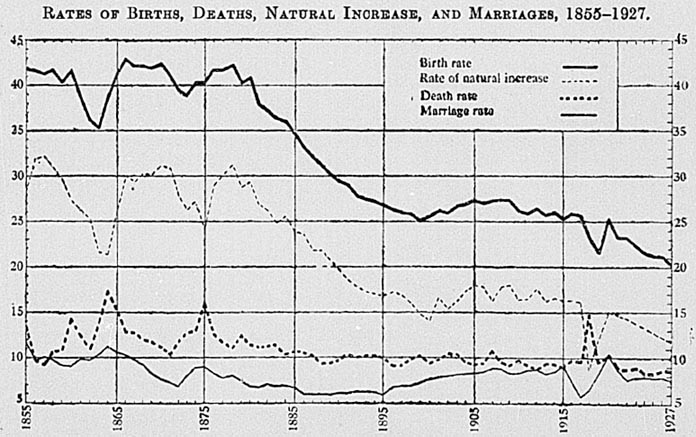
Comparisons of birth-rates over a series of years or between different countries are usually made on the basis of the crude rates—i.e., the number of births per 1,000 of the mean population, irrespective of sex or age.
The crude rates do not permit of allowance being made for variations in the proportion of women of the child-bearing ages, and it is advisable and of interest to supplement the table of crude rates with a computation of the legitimate birth-rate per 1,000 married women between 15 and 45 years of age, or the total birth-rate per 1,000 of all women of these ages. The following table gives both rates for New Zealand in each census year from 1878 to 1926.
| Year. | Number of Women 15 and under 45. | Number of Births. | Birth-rate per 1,000 Women 15 and under 45. | |||
|---|---|---|---|---|---|---|
| Married. | Total. | Legitimate. | Total. | Legitimate. | Total. | |
| 1878 | 50,999 | 80,313 | 17,341 | 17,770 | 340.0 | 221.3 |
| 1881 | 57,461 | 96,144 | 18,198 | 18,732 | 315.0 | 194.8 |
| 1886 | 62,709 | 117,895 | 18,697 | 19,299 | 298.2 | 163.7 |
| 1891 | 63,172 | 131,271 | 17,635 | 18,273 | 279.2 | 139.2 |
| 1896 | 69,816 | 158,214 | 17,778 | 18,612 | 254.6 | 117.6 |
| 1901 | 79,420 | 183,387 | 19,554 | 20,491 | 246.2 | 111.7 |
| 1906 | 98,249 | 212,598 | 23,120 | 24,252 | 235.3 | 114.1 |
| 1911 | 119,390 | 240,714 | 25,276 | 26,354 | 211.7 | 109.5 |
| 1916 | 141,322 | 267,300 | 27,363 | 28,509 | 193.6 | 106.7 |
| 1921 | 150,400 | 288,477 | 27,309 | 28,567 | 181.6 | 99.0 |
| 1926 | 161,739 | 313,363 | 26,494 | 27,881 | 163.8 | 89.0 |
The legitimate rate per 1,000 married women between the ages of 15 and 45 is seen to have fallen by over 50 per cent, between 1878 and 1926, while an even greater fall is shown for the total rate on the basis of all women of the ages mentioned. The greater fall in the latter rate than in the former is due to the fact that among women of the child-bearing ages the proportion of married women is considerably lower nowadays than in the earlier years covered.
Women formerly married at younger ages in general than they do at present, and a study of the figures for successive censuses reveals considerable changes in the age-constitution of married women within the child-bearing ages. As the birth-rate varies with age, the change in age-constitution over the period is a factor which should be taken into account. For recent years statistics are available from which to calculate the birth-rate for women of different ages, and by applying the 1926 rate for each quinquennial age-group to the numbers of women in the corresponding groups in earlier years it is possible to ascertain the total births that would have been recorded in these years on the basis of the rates ruling in 1926. From a comparison of the resultant figures with the numbers of births actually recorded in the respective years weighted index numbers can be compiled, taking the year 1926 as base. Index numbers are given below, together with the corresponding unweighted index numbers and those representing the crude rates.
| INDEX NUMBERS OF BIRTH-RATES, 1878-1926. | |||||
|---|---|---|---|---|---|
| (Base: 1926 = 1000.) | |||||
| Year. | Crude Rate. | Legitimate Rate on Basis of Married Women 15 and under 45. | Total Rate on Basis of all Women 15 and under 45. | ||
| Unweighted. | Weighted. | Unweighted. | Weighted. | ||
| 1878 | 2,068 | 2,076 | 1,747 | 2,487 | 2,416 |
| 1881 | 1,870 | 1,923 | 1,664 | 2,189 | 2,179 |
| 1886 | 1,634 | 1,821 | 1,600 | 1,839 | 1,880 |
| 1891 | 1,430 | 1,705 | 1,535 | 1,564 | 1,574 |
| 1896 | 1,298 | 1,554 | 1,429 | 1,321 | 1,321 |
| 1901 | 1,298 | 1,503 | 1,383 | 1,255 | 1,223 |
| 1906 | 1,335 | 1,437 | 1,312 | 1,282 | 1,210 |
| 1911 | 1,280 | 1,292 | 1,210 | 1,230 | 1,153 |
| 1916 | 1,278 | 1,182 | 1,159 | 1,199 | 1,146 |
| 1921 | 1,150 | 1,109 | 1,117 | 1,112 | 1,100 |
| 1926 | 1,000 | 1,000 | 1,000 | 1,000 | 1,000 |
A comparison of the five sets of index numbers shows that the fall in the rate is somewhat overstated by the crude-rate figures when compared with the rates for married women corrected for age-distribution. Even on this latter basis, however, the figures for which show the least fall, the birth-rate was 75 per cent. higher fifty years ago than it is now. The fall disclosed by the rates for all women between 15 and 45 is much greater than that shown for married women.
The effect of correcting the figures for age-distribution is seen to be very substantial in the case of the legitimate rate for married women, but insignificant in the case of the general rate for all women of the child-bearing ages. It is apparent that, while there have been considerable changes in the sex-constitution of the population and in the age-distribution of married women, there has been little movement in the age-distribution of women in general at the child-bearing ages.
Reference is made farther on in this subsection to the effect on the birth-rate in recent years of changes in the age-distribution of the male population since the war.
The effect of the declining birth-rate is shown in the following table giving the numbers of children under one year of age and the proportions which those numbers represent in the total population as recorded in successive census years:—
| Census Year. | Total Population (all Ages). | Children under One Year. | Children under One Year per 1,000 of Population. |
|---|---|---|---|
| 1886 | 578,482 | 18,355 | 31.73 |
| 1891 | 626,658 | 16,443 | 26.24 |
| 1896 | 703,360 | 17,070 | 24.27 |
| 1901 | 772,719 | 18,381 | 23.79 |
| 1906 | 888,578 | 22,289 | 25.08 |
| 1911 | 1,008,468 | 24,340 | 24.14 |
| 1916 | 1,099,449 | 27,021 | 24.57 |
| 1921 | 1,218,913 | 27,264 | 22.37 |
| 1926 | 1,344,469 | 26,021 | 19.35 |
The decline of the birth-rate in New Zealand has been partially compensated for by a decrease in the death-rate. Nevertheless, the rate of natural increase of population has fallen from 31.19 per 1,000 of mean population in 1870 to 11.84 in 1927. The following table shows the fall in all three rates:—
| Period. | Annual Rates per 1,000 living. | ||
|---|---|---|---|
| Births. | Deaths. | Natural Increase | |
| 1871-1875 | 39.88 | 12.67 | 27.21 |
| 1876-1880 | 41.21 | 11.80 | 29.41 |
| 1881-1885 | 36.36 | 10.95 | 25.41 |
| 1886-1890 | 31.15 | 9.85 | 21.30 |
| 1891-1895 | 27.68 | 10.15 | 17.53 |
| 1896-1900 | 25.75 | 9.55 | 16.20 |
| 1901-1905 | 26.60 | 9.91 | 16.69 |
| 1906-1910 | 27.06 | 9.75 | 17.31 |
| 1911-1915 | 25.98 | 9.22 | 16.76 |
| 1916-1920 | 24.32 | 10.73 | 13.59 |
| 1921-1925 | 22.22 | 8.62 | 13.60 |
| 1926-1927 | 20.67 | 8.60 | 12.07 |
In spite of the fact that the birth-rate in New Zealand is low compared with other countries, yet so low is the Dominion's death-rate that New Zealand ranks comparatively high among the nations as regards the rate of natural increase. Only 8 of the 40 countries shown in the following list have lower birth-rates than New Zealand, but only 13 have higher rates of natural increase.
| BIRTH AND NATURAL-INCREASE RATES. | |||
|---|---|---|---|
| Country | Quinquennium. | Annual Rates per 1,000. | |
| Births. | Natural Increase. | ||
| * Registration area. | |||
| Bulgaria | 1921-25 | 38.9 | 18.1 |
| Egypt | 1922-26 | 43.1 | 17.6 |
| South Africa | 1923-27 | 26.3 | 16.7 |
| Jamaica | 1922-26 | 37.1 | 15.3 |
| Canada | 1922-26 | 26.3 | 15.2 |
| Netherlands | 1923-27 | 24.4 | 14.5 |
| Rumania | 1921-25 | 36.8 | 14.5 |
| Uruguay | 1922-26 | 25.6 | 14.4 |
| Costa Rica | 1919-23 | 36.7 | 14.0 |
| Japan | 1922-26 | 34.5 | 13.3 |
| Australia | 1923-27 | 22.7 | 13.2 |
| Russia | 1921-25 | 38.8 | 13.0 |
| Ceylon | 1922-26 | 39.2 | 12.7 |
| New Zealand | 1923-27 | 21.2 | 12.6 |
| Iceland | 1920-24 | 26.7 | 12.5 |
| Lithuania | 1922-26 | 28.4 | 12.4 |
| Trinidad | 1922-26 | 33.1 | 11.9 |
| Italy | 1923-27 | 27.8 | 11.3 |
| United States* | 1921.25 | 22.6 | 10.7 |
| Czecho-Slovakia | 1922-26 | 26.2 | 10.4 |
| Denmark | 1922-26 | 21.6 | 10.3 |
| Norway | 1922-26 | 21.3 | 10.0 |
| Spain | 1922-26 | 30.0 | 10.0 |
| Hungary | 1922-26 | 28.5 | 9.5 |
| Chile | 1921-25 | 39.5 | 8.8 |
| Finland | 1922-26 | 22.7 | 8.6 |
| Scotland | 1922-26 | 22.1 | 8.4 |
| Germany | 1922-26 | 21.5 | 8.1 |
| Northern Ireland | 1922-26 | 22.9 | 7.4 |
| Latvia | 1922-26 | 22.1 | 7.4 |
| Switzerland | 1922-26 | 18.9 | 6.7 |
| Belgium | 1922-26 | 19.9 | 6.7 |
| Sweden | 1922-26 | 18.2 | 6.3 |
| England &Wales | 1923-27 | 18.3 | 6.3 |
| Irish Free State | 1922-26 | 20.5 | 6.0 |
| Austria | 1922-26 | 21.1 | 5.8 |
| British India | 1920-24 | 33.0 | 5.5 |
| British Guiana | 1921-25 | 31.7 | 4.1 |
| Estonia | 1922-26 | 19.1 | 3.5 |
| France | 1922-26 | 19.0 | 1.8 |
For twenty years prior to 1885 the New Zealand birth-rate was higher than that of Australia, but in that year the positions were reversed, and except for the seven years 1903-9 the Australian rate has been somewhat higher than that of New Zealand. It is interesting to note that the rates of the two countries have shown practically the same movement, New Zealand, however, reaching in 1899, and Australia not till four years later, the temporary limit of the rapid fall which had been steadily in progress since the “seventies.” In each country the check in the decline of the birth-rate was succeeded by a moderate but steady rise for ten years, followed by a fall commencing in New Zealand in 1909 and in Australia in 1913, an interval of four years again separating the movements of the two countries. The rates for the last ten years are as follows:—
| BIRTH-RATES PER 1,000 OF POPULATION. | ||||||||||
|---|---|---|---|---|---|---|---|---|---|---|
| State. | 1918. | 1919. | 1920. | 1921. | 1922. | 1923. | 1924. | 1925. | 1928. | 1927. |
| Queensland | 28.00 | 25.85 | 27.15 | 26.64 | 25.59 | 24.89 | 23.87 | 23.82 | 22.58 | 22.24 |
| New South Wales | 26.11 | 24.27 | 26.09 | 25.93 | 25.67 | 24.68 | 24.11 | 24.01 | 22.89 | 22.69 |
| Victoria | 22.19 | 21.47 | 23.95 | 23.16 | 23.10 | 22.31 | 22.01 | 21.49 | 20.84 | 20.30 |
| South Australia | 25.16 | 23.62 | 24.72 | 24.08 | 23.71 | 22.60 | 21.88 | 21.06 | 20.55 | 20.12 |
| Western Australia | 23.06 | 21.68 | 24.69 | 23.39 | 23.94 | 22.55 | 23.09 | 22.23 | 22.14 | 22.03 |
| Tasmania | 26.64 | 25.91 | 27.29 | 26.98 | 27.08 | 26.27 | 25.07 | 24.24 | 23.62 | 23.01 |
| Commonwealth | 25.00 | 23.53 | 25.45 | 24.95 | 24.69 | 23.77 | 23.24 | 22.89 | 22.02 | 21.67 |
| New Zealand | 23.44 | 21.42 | 25.09 | 23.34 | 23.17 | 21.94 | 21.57 | 21.17 | 21.05 | 20.29 |
It is of interest to note the quarterly fluctuations in the numbers of births registered. Some fairly sharp movements are disclosed by the figures for the last ten years, the most noticeable being the sudden increase (consequent on the termination of the war) from 5,832 in the third quarter of 1919 to 6,454 in the fourth quarter of that year and 7,622 in the first quarter of the next year. The quarterly figures for each of the last ten years are—
| Year. | Quarter ended | |||
|---|---|---|---|---|
| 31st March. | 30th June. | 30th September. | 31st December. | |
| 1918 | 6,354 | 6,647 | 6,526 | 6,333 |
| 1919 | 6,061 | 6,136 | 5,832 | 6,454 |
| 1920 | 7,522 | 7,405 | 7,684 | 7,310 |
| 1921 | 6,829 | 7,051 | 7,304 | 7,383 |
| 1922 | 7,444 | 7,220 | 7,318 | 7,024 |
| 1923 | 6,823 | 6,951 | 7,105 | 7,088 |
| 1924 | 7,081 | 6,583 | 7,159 | 7,191 |
| 1925 | 7,155 | 6,999 | 7,021 | 6,978 |
| 1926 | 7,266 | 6,837 | 7,056 | 7,314 |
| 1927 | 7,172 | 6,614 | 7,131 | 6,964 |
The extreme range of quarterly totals over the ten years is from 5,832 in the third quarter of 1919 to 7,684 in the third quarter of 1920. The first-mentioned figure represented an annual rate of 20.15 per 1,000, and the second an annual rate of 25.56.
Urban areas have been created at each of the four chief centres and at ten of the more important secondary centres, each area including in addition to the central borough and any suburban boroughs a considerable non-municipalized area adjacent to and contingent on the centre. The creation of these areas allows of vital and other statistics being compiled over a series of years for a definite area with fixed boundaries, and obviates the disabilities formerly arising from frequent alterations of boundaries of boroughs. The birth statistics of urban areas for each of the last five years are as follows:—
| BIRTH STATISTICS OF URBAN AREAS, 1923-27. | ||||||||||
|---|---|---|---|---|---|---|---|---|---|---|
| Urban Area. | Number of Births. | Rate per 1,000 of Mean Population. | ||||||||
| 1923. | 1924. | 1925. | 1926. | 1927. | 1923. | 1924. | 1925. | 1920. | 1927. | |
| Auckland | 3,205 | 3,387 | 3,451 | 3,665 | 3,557 | 19-10 | 19.58 | 19.09 | 19.07 | 17.67 |
| Wellington | 2,155 | 2,155 | 2,106 | 2,309 | 2,343 | 19.23 | 18.82 | 17.77 | 1,903 | 18.55 |
| Christchurch | 2,132 | 2,186 | 2,147 | 2,229 | 2,146 | 18.80 | 18.95 | 18.15 | 18.82 | 17.62 |
| Dunedin | 1,336 | 1,307 | 1,370 | 1,405 | 1,341 | 17.80 | 17.25 | 17.68 | 16.50 | 16.13 |
| Totals of principal areas | 8,828 | 9,035 | 9,074 | 9,608 | 9,387 | 18.85 | 18.88 | 18.33 | 18.58 | 17.63 |
| Hamilton | 412 | 443 | 399 | 372 | 347 | 26.84 | 27.48 | 23.37 | 23.14 | 20.32 |
| Gisborne | 343 | 338 | 294 | 349 | 342 | 22.69 | 22.00 | 18.73 | 23.53 | 22.80 |
| Napier | 348 | 388 | 354 | 365 | 313 | 19.47 | 21.31 | 18.72 | 20.35 | 17.00 |
| Hastings | 279 | 298 | 311 | 297 | 311 | 20.32 | 21.23 | 21.32 | 20.28 | 20.89 |
| New Plymouth | 312 | 362 | 345 | 381 | 360 | 22.40 | 25.12 | 22.46 | 23.90 | 21.66 |
| Wanganui | 527 | 522 | 555 | 546 | 542 | 21.55 | 20.89 | 21.40 | 20.89 | 20.17 |
| Palmerston North | 385 | 358 | 386 | 411 | 390 | 21.62 | 19.55 | 20.06 | 20.80 | 19.04 |
| Nelson | 242 | 206 | 212 | 226 | 223 | 21.53 | 18.07 | 18.20 | 19.21 | 18.61 |
| Timaru | 289 | 280 | 306 | 324 | 328 | 17.57 | 16.76 | 17.88 | 19.26 | 18.94 |
| Invercargill | 455 | 469 | 492 | 455 | 510 | 22.55 | 22.85 | 23.44 | 20.81 | 22.62 |
| Totals of secondary areas | 3.592 | 3.664 | 3.654 | 3.726 | 3.666 | 21.62 | 21.55 | 20.70 | 21.20 | 20.23 |
| Grand totals | 12,420 | 12,699 | 12,728 | 13,334 | 13,053 | 19.58 | 19.58 | 18.95 | 19.24 | 18.29 |
In most countries it is found that the cities and larger towns have a somewhat higher birth-rate than the general average of the country, owing largely if not entirely to the natural tendency for people in the country districts to avail themselves of the better medical and nursing facilities provided in the population centres. In New Zealand, however, the effect of this on the birth-rates of the urban areas is obviated by information as to the domicile of the parents being obtained in the case of all births registered in the areas, and the births allocated accordingly. The result is to give for each of the four principal areas a birth-rate somewhat lower than the Dominion average. The average rate for the ten secondary areas, however, varies little from that of the Dominion as a whole.
An examination of the figures shows that, with the exception of one year, there has always been a preponderance of males in the number of children born in New Zealand. The proportions are usually shown by stating the number of births of male children to every 1,000 female births. This number has been as high as 1,113 (in 1859), and as low as 991 (in 1860).
But little significance can be attached to any figures prior to 1870, on account of the comparatively small number of births. The period preceding 1870 exhibits violent fluctuations in the proportion of males, which tend to disappear as the total of births grows larger. The extreme range since 1870 has been from 1,016 male per 1,000 female births in 1878 to 1,081 in 1923.
The number of births and their sex-proportion for twenty years are given below:—
| Year. | Number of Births of | Male Births per 1,000 Female Births. | |
|---|---|---|---|
| Males. | Females. | ||
| 1908 | 13,369 | 12,571 | 1,063 |
| 1909 | 13,502 | 13,022 | 1,037 |
| 1910 | 13,442 | 12,542 | 1,072 |
| 1911 | 13,532 | 12,822 | 1,055 |
| 1912 | 13,996 | 13,512 | 1,036 |
| 1913 | 14,433 | 13,502 | 1,069 |
| 1914 | 14,535 | 13,803 | 1,053 |
| 1915 | 14,415 | 13,435 | 1,073 |
| 1916 | 14,669 | 13,840 | 1,060 |
| 1917 | 14,329 | 13,910 | 1,030 |
| 1918 | 13,124 | 12,736 | 1,030 |
| 1919 | 12,587 | 11,896 | 1,058 |
| 1920 | 15,434 | 14,487 | 1,065 |
| 1921 | 14,576 | 13,991 | 1,042 |
| 1922 | 14,897 | 14,109 | 1,056 |
| 1923 | 14,531 | 13,436 | 1,081 |
| 1924 | 14,295 | 13,719 | 1,042 |
| 1925 | 14,518 | 13,635 | 1,064 |
| 1926 | 14,649 | 13,824 | 1,060 |
| 1927 | 14,291 | 13,590 | 1,052 |
The gradual increase in the proportion of males born is illustrated by taking the average ratios of successive decennial periods. The apparent cessation in the increase, as shown by the figures for the period 1916-25, as compared with the preceding decennium, is due to the low masculinity recorded in the last two war years, when (it may be remarked in passing) the proportion of first births to total births was abnormally low.
| Period. | Male Births to 1,000 Female Births. |
|---|---|
| 1856-1865 | 1,062 |
| 1866-1875 | 1,043 |
| 1876-1885 | 1,045 |
| 1886-1895 | 1,045 |
| 1896-1905 | 1,054 |
| 1906-1915 | 1,055 |
| 1916-1925 | 1,053 |
It would appear that the proportion of males is somewhat higher for first births than for the general average of all children. Of 67,397 legitimate first births registered during the eight years 1920-27 (excluding plural births), 34,917 were of males and 32,480 of females, the proportion of males per 1,000 females being 1,075. The high proportion does not appear to be due to the youth of the mothers, there being a lower rate in cases where the mother was under twenty-five than where the mother was between twenty-five and thirty-five.
The figures for various age-groups for the eight years in conjunction are as follows:—
| SEXES OF FIRST-BORN, 1920-27. | |||
|---|---|---|---|
| Age of Mother, in Years. | Males. | Females. | Males per 1,000 Females. |
| Under 20 | 2,489 | 2,329 | 1,069 |
| 20 and under 25 | 13,341 | 12,535 | 1,064 |
| 25 and under 30 | 11,551 | 10,653 | 1,084 |
| 30 and under 35 | 5,164 | 4,708 | 1,097 |
| 35 and under 40 | 1,862 | 1,791 | 1,040 |
| 40 and over | 510 | 464 | 1,099 |
| Totals | 34,917 | 32,480 | 1,075 |
In the eight years covered there were 627 plural first births, and in 222 cases the children were both males, in 203 both females, and in the remaining 202 of opposite sex. Triplets (all females) were recorded for one first birth during the period.
Further light on the question of sexes of children may be thrown by some figures extracted from the records of births registered in the eight years 1920-27 in cases where the child was shown to be the fourth-born of a family in which the three previously born children were still living. In New Zealand the birth entries give particulars of numbers and sexes of previous issue of the parents, with the ages of the living issue, and the following interesting statement showing the sex-nativity order up to the fourth child has been compiled. Families in which plural births occurred among the first four children have been excluded.
| First-born. | Second-born. | Third-born. | Fourth-born. | Number of Cases. |
|---|---|---|---|---|
| Male | Male | Male | Male | 1,287 |
| Male | Male | Male | Female | 1,204 |
| Male | Male | Female | Male | 1,126 |
| Male | Male | Female | Female | 1,143 |
| Male | Female | Male | Male | 1,134 |
| Male | Female | Male | Female | 971 |
| Male | Female | Female | Male | 1,124 |
| Male | Female | Female | Female | 1,075 |
| Female | Female | Female | Female | 1,027 |
| Female | Female | Female | Male | 1,047 |
| Female | Female | Male | Female | 1,068 |
| Female | Female | Male | Male | 1,064 |
| Female | Male | Female | Female | 972 |
| Female | Male | Female | Male | 1,079 |
| Female | Male | Male | Female | 1,094 |
| Female | Male | Male | Male | 1,150 |
Of the 17,565 families covered, in 9,064 the first child was a male and in 8,501 a female, the number of males per 1,000 females being thus 1,066. The proportion is reduced for subsequent births, being apparently lowest in the case of third-born infants. The figures are as follows:—
| Child. | Males. | Females. | Males per 1,000 Females. |
|---|---|---|---|
| First | 9,064 | 8,501 | 1,066 |
| Second | 9,055 | 8,510 | 1,064 |
| Third | 8,972 | 8,593 | 1,044 |
| Fourth | 9,011 | 8,554 | 1,053 |
It is interesting to note that not only are males in preponderance among first-born children, but also that in cases where the first-born is a male there appears to be a greater probability of the second child being a male also. Where the first-born is a female, however, the second child appears to have a more even prospect as to sex.
The figures of first-borns registered in the eight years 1920-27, and those of first-borns in cases where the fourth child of the family was registered during the period, give similar results, and the two sets of figures taken in conjunction show that there is a higher masculinity rate among first-born children than among later issue. This conclusion serves to explain the increasing masculinity of births in successive decennial referred to previously, when it is remembered that the average number of children to a family has fallen heavily during the period, and the proportion of first-born children correspondingly increased.
The sex-proportions of illegitimate births are generally supposed to be more nearly equal than those of legitimate births. However, although little reliance can be placed on the figures for New Zealand by reason of the small numbers represented, it may be stated that the average for the period 1918-27 was 1,058 males per 1,000 females—a rate slightly in excess of that for all births (1,055) for the same period. An indication of the fluctuations in the sex proportions of illegitimate births from year to year may be gathered from the fact that in 1926 the rate was 1,176 males per 1,000 females, while in 1927 females actually exceeded males, the rate being 984 males per 1,000 females.
Counting only cases where both children were born alive, there were 331 cases of twin births (662 children) registered in 1927. There was also one case of triplets.
The number of accouchements resulting in living births was 27,548, and on the average one mother in every 83 gave birth to twins (or triplets). This proportion is considerably higher than that attained in recent previous years, although not so high as the phenomenal figure recorded for 1926, which was one in 78.
The number of cases of multiple births and the proportion per 1,000 of the total cases of births during the last ten years were—
| Year. | Total Births. | Total Cases. | Cases of Twins. | Cases of Triplets. | Multiple Cases per 1,000 of Total Cases. |
|---|---|---|---|---|---|
| * Including one case of quadruplets. | |||||
| 1918 | 25,860 | 25,560 | 294 | 3 | 11.62 |
| 1919 | 24,483 | 24,206 | 270 | 3* | 11.15 |
| 1920 | 29,921 | 29,552 | 365 | 2 | 12.42 |
| 1921 | 28,567 | 28,210 | 347 | 5 | 12.48 |
| 1922 | 29,006 | 28,678 | 328 | 11.44 | |
| 1923 | 27,967 | 27,672 | 289 | 3 | 10.55 |
| 1924 | 28,014 | 27,712 | 296 | 3 | 10.79 |
| 1925 | 28,153 | 27,848 | 301 | 2 | 10.88 |
| 1926 | 28,473 | 28,111 | 358 | 2 | 12.81 |
| 1927 | 27,881 | 27,548 | 331 | 1 | 12.05 |
The following table shows the sexes in individual cases of twin births for the last ten years:—
| Year. | Total Cases. | Both Males. | Both Females. | Opposite Sexes. |
|---|---|---|---|---|
| 1918 | 294 | 87 | 95 | 112 |
| 1919 | 270 | 81 | 79 | 110 |
| 1920 | 365 | 128 | 105 | 132 |
| 1921 | 347 | 125 | 90 | 132 |
| 1922 | 328 | 114 | 90 | 124 |
| 1923 | 289 | 110 | 90 | 89 |
| 1924 | 296 | 77 | 108 | 111 |
| 1925 | 301 | 83 | 86 | 132 |
| 1926 | 358 | 114 | 111 | 133 |
| 1927 | 331 | 112 | 104 | 115 |
During the ten years 1918-27 there were twenty-three cases of triplets. In three cases all three children were males, in seven cases all were females, in five cases there were two males and one female, and in eight cases two of the three children were females. There occurred in 1919 one case of quadruplets, all male children.
Information as to the relative ages of parents of legitimate living children whose births were registered with Registrars in 1927 is shown in the following table. Legitimate births (95 in number) registered with the Registrar-General during the year are omitted from this and the following tables.
| RELATIVE AGES OF PARENTS. | |||||||||||
|---|---|---|---|---|---|---|---|---|---|---|---|
| Age of Mother, in Years. | Age of Father, in Years. | ||||||||||
| Under 21. | 21 and under 25. | 25 and under 30. | 30 and under 35. | 35 and under 40. | 40 and under 45. | 45 and under 50. | 50 and under 55. | 55 and under 65. | 65 and over. | Total. | |
| * Including twenty-five cases where plural births would have been registered had not one child been still-born. | |||||||||||
| Single Births. | |||||||||||
| Under 21 | 138 | 703 | 472 | 105 | 35 | 11 | 6 | 1 | 1,471 | ||
| 21 and under 25 | 63 | 1,352 | 2,408 | 837 | 314 | 80 | 31 | 9 | 5 | 5,099 | |
| 25 and under 30 | 11 | 346 | 3,103 | 2,453 | 1,143 | 383 | 129 | 32 | 15 | 2 | 7,617 |
| 30 and under 35 | 1 | 46 | 571 | 2,260 | 1,926 | 874 | 291 | 88 | 34 | 3 | 6,094 |
| 35 and under 40 | 4 | 61 | 378 | 1,460 | 1,201 | 580 | 155 | 46 | 5 | 3,890 | |
| 40 and under 45 | 5 | 32 | 195 | 545 | 441 | 164 | 48 | 7 | 1,437 | ||
| 45 and over | 1 | 3 | 22 | 61 | 41 | 20 | 2 | 150 | |||
| Totals | 213 | 2,451 | 6,620 | 6,066 | 5,076 | 3,116 | 1,539 | 489 | 169 | 19 | 25,758* |
| Multiple Births, | |||||||||||
| Under 21 | 2 | 3 | 6 | 1 | 12 | ||||||
| 21 and under 25 | 1 | 8 | 26 | 4 | 1 | 40 | |||||
| 25 and under 30 | 2 | 32 | 40 | 13 | 6 | 5 | 1 | 99 | |||
| 30 and under 35 | 12 | 33 | 29 | 10 | 5 | 1 | 1 | 91 | |||
| 35 and under 40 | 2 | 1 | 3 | 26 | 17 | 9 | 1 | 59 | |||
| 40 and under 45 | 2 | 4 | 7 | 4 | 1 | 18 | |||||
| 45 and over | 1 | 1 | |||||||||
| Totals | 3 | 15 | 77 | 81 | 71 | 37 | 27 | 7 | 2 | 320 | |
| Grand totals | 216 | 2,466 | 6,697 | 6,147 | 5,147 | 3,153 | 1,566 | 496 | 171 | 19 | 26,078 |
An indication of the direct effect on the birth-rate caused by the loss of men in the war is obtained by a comparison of the above figures with similarly compiled figures for 1912, the first year for which such statistics are available. A summary is here given showing for the two years the age-groups of the fathers and mothers of legitimate children whose births were registered in the respective years. Multiple births are counted once only.
| Age-group. | Fathers. | Mothers. | ||
|---|---|---|---|---|
| 1912. | 1927. | 1912. | 1927. | |
| Under 21 | 81 | 216 | 1,107 | 1,483 |
| 21 and under 25 | 1,606 | 2,466 | 4,547 | 5,139 |
| 25 30 | 6,452 | 6,697 | 8,166 | 7,716 |
| 30 35 | 7,510 | 6,147 | 6,820 | 6,185 |
| 35 40 | 5,457 | 5,147 | 3,888 | 3,949 |
| 40 and over | 4,900 | 5,405 | 1,478 | 1,606 |
| Totals | 20,006 | 26,078 | 26,006 | 26,078 |
A study of the individual age-groups shows in the case of the fathers a huge decrease at ages 30 to 35, the group which at present is more particularly affected by the loss of men in the war. The age-group 35 to 40, which also had its present numbers materially affected by the war, shows a somewhat smaller decrease. For ages under 30 and over 40, however, fairly substantial increases are recorded.
It would appear that the considerable decrease in the birth-rate in the later year as compared with the earlier is largely accounted for by the loss of young men in the war, and to a less extent in the influenza epidemic. It should be added that even in the age-groups which show increases war and epidemic losses have tended to restrict these increases, while, on the other hand, the post-war tendency (referred to in the next subsection) for men to marry younger would normally act in the opposite direction.
Information as to the previous issue of the parents, which is required in connection with the registration of births in New Zealand, is useful not only for record purposes, but also as providing valuable data for statistical purposes. Tables are given in the Annual Report on Vital Statistics containing detailed information as to number of previous issue in connection with (1) age of mother, and (2) duration of marriage. The former table is here summarized
| LEGITIMATE BIRTHS, 1927.—NUMBER OF PREVIOUS ISSUE. | ||||||||||
|---|---|---|---|---|---|---|---|---|---|---|
| Age of Mother. | Number of Previous Issue. | Total. | ||||||||
| 0. | 1. | 2. | 3. | 4. | 5. | 6 and under 10. | 10 and under 15. | 15 and over. | ||
| * This number represents 25,758 single cases and 320 multiple cases. | ||||||||||
| Under 21 | 1,174 | 266 | 40 | 3 | .. | .. | .. | .. | .. | 1,483 |
| 21 and under 25 | 2,903 | 1,441 | 574 | 165 | 47 | 6 | 3 | .. | .. | 5,139 |
| 25 30 | 2,666 | 2,233 | 1,471 | 797 | 349 | 131 | 69 | .. | .. | 7,716 |
| 30 35 | 1,117 | 1,426 | 1,268 | 923 | 640 | 398 | 399 | 14 | .. | 6,185 |
| 35 40 | 379 | 581 | 713 | 597 | 515 | 369 | 708 | 86 | 1 | 3,949 |
| 40 45 | 92 | 142 | 190 | 158 | 191 | 154 | 393 | 131 | 4 | 1,455 |
| 45 and over | 12 | 6 | 6 | 9 | 16 | 9 | 58 | 32 | 3 | 151 |
| 1Totals | 8,343 | 6,095 | 4,262 | 2,652 | 1,758 | 1,067 | 1,630 | 263 | 8 | 26,078* |
In computing previous issue multiple births have been given their full significance, the numbers at the head of the columns relating to children born alive. In the following table this procedure has been followed not only for previous issue but also for children covered by the 1927 registrations, who are also taken into account in the computation of the averages.
| LIVING LEGITIMATE BIRTHS, 1927.—ISSUE ACCORDING TO AGE OF MOTHER. | |||
|---|---|---|---|
| Age of Mother, in Years. | Total Mothers. | Total Issue. | Average Issue. |
| 15 | 4 | 4 | 1.00 |
| 16 | 27 | 30 | 1.11 |
| 17 | 109 | 113 | 1.04 |
| 18 | 251 | 285 | 1.14 |
| 19 | 449 | 537 | 1.20 |
| 20 | 643 | 881 | 1.37 |
| 21 | 985 | 1.423 | 1.44 |
| 22 | 1.215 | 1.869 | 1.54 |
| 23 | 1.436 | 2.438 | 1.70 |
| 24 | 1.503 | 2.769 | 1.84 |
| 25 | 1.484 | 2.907 | 1.96 |
| 26 | 1.566 | 3.343 | 2.13 |
| 27 | 1.690 | 3.958 | 2.34 |
| 28 | 1.505 | 3.691 | 2.45 |
| 29 | 1.471 | 3.983 | 2.71 |
| 30 | 1.398 | 4.156 | 2.97 |
| 31 | 1.292 | 3.926 | 3.04 |
| 32 | 1.300 | 4.313 | 3.32 |
| 33 | 1.124 | 3.952 | 3.52 |
| 34 | 1.071 | 4.019 | 3.75 |
| 35 | 991 | 3.973 | 4.01 |
| 36 | 872 | 3.746 | 4.30 |
| 37 | 749 | 3.366 | 4.49 |
| 38 | 704 | 3.271 | 4.65 |
| 39 | 633 | 3.238 | 5.12 |
| 40 | 463 | 2.397 | 5.18 |
| 41 | 348 | 1.942 | 5.58 |
| 42 | 312 | 1.885 | 6.04 |
| 43 | 206 | 1.291 | 6.27 |
| 44 | 126 | 825 | 6.55 |
| 45 | 78 | 630 | 8.08 |
| 46 | 38 | 295 | 7.76 |
| 47 | 21 | 151 | 7.19 |
| 48 | 12 | 78 | 6.50 |
| 49 | 2 | 4 | 2.00 |
| Totals | 26.078 | 75.689 | 2.90 |
It should be stressed that the averages are no more than they purport to be—viz., the average number of children (including those registered in 1927) born to the present time to those mothers of legitimate children whose births were registered during the year. They do not purport to represent, nor do they represent, the average issue of all women of the ages shown.
A table is next given containing similar information according to duration of marriage.
| LIVING LEGITIMATE BIRTHS, 1927.—ISSUE ACCORDING TO DURATION OF MARRIAGE. | |||
|---|---|---|---|
| Duration of Marriage, in Years. | Total Mothers. | Total Issue. | Average Issue. |
| 0 | 4,184 | 4,237 | 1.01 |
| 1 | 3,059 | 3,813 | 1.25 |
| 2 | 2,748 | 4,420 | 1.61 |
| 3 | 2,277 | 3,522 | 1.55 |
| 4 | 1,911 | 4,370 | 2.29 |
| 5 | 1,663 | 5,296 | 3.18 |
| 6 | 1,774 | 5,598 | 3.16 |
| 7 | 1,587 | 5,984 | 3.77 |
| 8 | 1,013 | 4,468 | 4.41 |
| 9 | 727 | 3,375 | 4.64 |
| 10 | 672 | 3,070 | 4.57 |
| 11 | 757 | 3,564 | 4.71 |
| 12 | 672 | 3,499 | 5.21 |
| 13 | 615 | 3,430 | 5.58 |
| 14 | 503 | 2,952 | 5.87 |
| 15 | 394 | 2,490 | 6.32 |
| 16 | 361 | 2,379 | 6.59 |
| 17 | 258 | 1,839 | 7.13 |
| 18 | 228 | 1,668 | 7.32 |
| 19 | 208 | 1,574 | 7.57 |
| 20 | 143 | 1,226 | 8.57 |
| 21 | 101 | 861 | 8.52 |
| 22 | 76 | 654 | 8.61 |
| 23 | 65 | 581 | 8.94 |
| 24 | 40 | 377 | 9.43 |
| 25 | 13 | 127 | 9.77 |
| 26 | 16 | 180 | 11.25 |
| 27 | 4 | 33 | 8.25 |
| 28 | 5 | 61 | 12.22 |
| 29 | 2 | 22 | 11.00 |
| 30 | 2 | 19 | 9.50 |
| Totals | 26,078 | 75,689 | 2.90 |
The next table gives information as to the number of previous issue of parents of living legitimate children whose births were registered during each of the last ten years:—
| Number of Previous Issue. | 1918. | 1919. | 1920. | 1921. | 1922. | 1923. | 1924. | 1925. | 1926. | 1927. |
|---|---|---|---|---|---|---|---|---|---|---|
| 0 | 5,328 | 5,439 | 9,244 | 9,387 | 8,549 | 7,969 | 7,984 | 8,194 | 8,355 | 8,343 |
| 1 | 5,289 | 4,536 | 5,641 | 5,541 | 6,545 | 6,513 | 6,262 | 6,218 | 6,119 | 6,095 |
| 2 | 4,707 | 4,247 | 4,258 | 3,827 | 4,052 | 4,245 | 4,443 | 4,427 | 4,329 | 4,262 |
| 3 | 3,146 | 3,084 | 3,077 | 2,830 | 2,739 | 2,633 | 2,711 | 2,776 | 2,848 | 2,652 |
| 4 | 2,207 | 2,146 | 2,074 | 1,952 | 1,943 | 1,745 | 1,703 | 1,739 | 1,826 | 1,758 |
| 5 | 1,344 | 1,286 | 1,418 | 1,269 | 1,333 | 1,166 | 1,163 | 1,083 | 1,092 | 1,067 |
| 6 | 940 | 886 | 915 | 812 | 840 | 791 | 775 | 764 | 697 | 716 |
| 7 | 548 | 588 | 605 | 521 | 571 | 531 | 511 | 513 | 519 | 443 |
| 8 | 397 | 383 | 377 | 337 | 367 | 354 | 366 | 319 | 318 | 283 |
| 9 | 217 | 216 | 214 | 230 | 234 | 219 | 192 | 220 | 190 | 188 |
| 10 | 119 | 116 | 150 | 120 | 128 | 131 | 128 | 121 | 111 | 129 |
| 11 | 74 | 61 | 86 | 67 | 74 | 59 | 62 | 63 | 70 | 65 |
| 12 | 29 | 40 | 45 | 40 | 53 | 34 | 46 | 34 | 41 | 41 |
| 13 | 22 | 19 | 23 | 15 | 17 | 16 | 30 | 35 | 17 | 20 |
| 14 | 13 | 14 | 5 | 9 | 8 | 9 | 7 | 16 | 12 | 8 |
| 15 | 6 | 4 | 5 | 2 | 9 | 3 | 3 | 7 | 5 | 3 |
| 16 | 2 | 3 | .. | 3 | 2 | 1 | 1 | 1 | 2 | 3 |
| 17 | 1 | 1 | 1 | 3 | 1 | 1 | 2 | .. | .. | 2 |
| 18 | 2 | .. | .. | .. | 1 | .. | .. | .. | .. | .. |
| 19 | .. | 1 | .. | .. | .. | .. | .. | .. | .. | .. |
| Totals | 24,391 | 23,070 | 28,138 | 26,965 | 27,466 | 26,420 | 26,389 | 26,530 | 26,551 | 26,078 |
Of a total of 131,968 legitimate births registered during the five years 1923-27, no fewer than 40,845, or 31 per cent., were of first-born children, and of these 20,226, or 49 1/2 per cent., were born within twelve months, and 31,453, or 77 per cent., within two years after the marriage of the parents. In the remaining 23 per cent. of cases where there was any issue to the marriage two years elapsed before the birth of the first child.
The number of first births and the proportion of these to total births vary considerably from year to year in sympathy with variations in the annual number of marriages, the percentage having been as high as 34.81 (in 1921) and as low as 23.68 (in 1919). The proportions of first births occurring within the first and second years after marriage, however, show remarkably little variation in recent years. The figures for each of the last five years are—
| Year. | Total Legitimate Cases. | Total Legitimate First Cases. | Proportion of First Cases to Total Cases. | First Cases within One Year after Marriage. | First Cases within Two Years after Marriage. | ||
|---|---|---|---|---|---|---|---|
| Number. | Proportion to Total First Cases. | Number. | Proportion to Total First Cases. | ||||
| Per Cent. | Per Cent. | Per Cent. | |||||
| 1923 | 26,420 | 7,969 | 30.16 | 3,892 | 48.84 | 6,087 | 76.38 |
| 1924 | 26,389 | 7,984 | 30.26 | 3,997 | 50.06 | 6,124 | 76.70 |
| 1926 | 26,530 | 8,194 | 30.89 | 4,038 | 49.28 | 6,336 | 77.32 |
| 1926 | 26,651 | 8,355 | 31.47 | 4,121 | 49.32 | 6,422 | 76.86 |
| 1927 | 26,078 | 8,343 | 31.99 | 4,178 | 50.08 | 6,484 | 77.72 |
| Total for five years | 131,968 | 40,845 | 30.95 | 20,226 | 49.52 | 31,453 | 77.01 |
In the next table the figures of first birth year after the marriage of the parents are dissected into monthly period
| Duration of Marriage. | 1923. | 1924. | 1925. | 1926. | 1927. |
|---|---|---|---|---|---|
| Under 1 month | 86 | 77 | 94 | 80 | 100 |
| 1 month and under 2 months | 93 | 120 | 116 | 124 | 113 |
| 2 months and under 3 months | 171 | 188 | 160 | 178 | 197 |
| 3 months and under 4 months | 227 | 220 | 232 | 199 | 239 |
| 4 months and under 5 months | 266 | 262 | 266 | 292 | 328 |
| 5 months and under 6 months | 374 | 383 | 335 | 441 | 405 |
| 6 months and under 7 months | 401 | 414 | 454 | 477 | 493 |
| 7 months and under 8 months | 317 | 328 | 377 | 372 | 368 |
| 8 months and under 9 months | 277 | 296 | 349 | 316 | 324 |
| 9 months and under 10 months | 674 | 682 | 670 | 648 | 585 |
| 10 months and under 11 months | 568 | 537 | 538 | 530 | 572 |
| 11 months and under 12 months | 438 | 490 | 447 | 464 | 454 |
| Total under 12 months | 3,892 | 3,997 | 4,038 | 4,121 | 4,178 |
| Total 12 months and over | 4,077 | 3,987 | 4,156 | 4,234 | 4,165 |
| Grand totals | 7,969 | 7,984 | 8,194 | 8,355 | 8,343 |
The great majority of the children born between the seventh and ninth month of marriage are obviously prematurely-born infants. Omitting these, and assuming that all infants born alive within seven months after marriage have been extra maritally conceived, it would appear that during the five years, out of a total of 40,845 first-born children, 8,605, or 21 per cent., were extra-maritally conceived. This proportion has shown an almost continuous increase for many years.
During the five years 6,719 cases of illegitimate births were registered, and if these are all regarded as first births (which is not the case) a total of 15,324 extra-marital conceptions is recorded, which represents 32 per cent. of the total of legitimate first births, plus illegitimate births. The figures for each of the last five years are—
| Year. | Total Legitimate First Cases. | Illegitimate Cases. | Legitimate Cases within Seven Months after Marriage. | Proportion of Legitimate First Cases within Seven Months after Marriage. | Proportion of Extra-marital Conceptions to Total Cases of Legitimate First Births and Illegitimate Births. |
|---|---|---|---|---|---|
| Per Cent. | Per Cent. | ||||
| 1923 | 7,969 | 1,252 | 1,618 | 20.30 | 31.12 |
| 1924 | 7,984 | 1,323 | 1,664 | 20.84 | 32.09 |
| 1925 | 8,194 | 1,318 | 1,657 | 20.22 | 31.28 |
| 1926 | 8,355 | 1,455 | 1,791 | 21.44 | 33.09 |
| 1927 | 8,343 | 1,371 | 1,875 | 22.47 | 33.42 |
| Totals for 5 years | 40,845 | 6,719 | 8,605 | 21.07 | 32.22 |
The births of 1,387 children (688 males, 699 females) registered in 1927 were illegitimate. The numbers for each of the last ten years, with the percentages they bear to the total births registered, are as follows:—
| Year. | Number. | Percentage to Total Births. |
|---|---|---|
| 1918 | 1,179 | 4.65 |
| 1919 | 1,138 | 4.65 |
| 1920 | 1,424 | 4.76 |
| 1921 | 1,258 | 4.40 |
| 1922 | 1,224 | 4.22 |
| 1923 | 1,260 | 4.51 |
| 1924 | 1,338 | 4.77 |
| 1925 | 1,332 | 4.73 |
| 1926 | 1,473 | 5.17 |
| 1927 | 1,387 | 4.97 |
It is probably only natural to expect that, as the birth-rate falls, the proportion of illegitimate to total births will tend to increase. Nevertheless it is unsatisfactory and somewhat disquieting to record that this proportion in 1926 reached the unprecedentedly high figure of 5.17 per cent., while in 1927 it remained as high as 4.97 per cent. The previous highest rates were those for 1924 (4.77 per 100) and 1920 (4.76 per 100).
It will be seen from a study of the quarterly figures of illegitimate births that the large increase in the last two years as compared with 1925 occurred mainly in the latter half of 1926 and the first quarter of 1927. The only disturbance of population of any consequence which might have some influence on this unenviable record for these two years was the Dunedin Exhibition, held in the latter end of 1925 and the beginning of 1926. The figures for each quarter of 1925, 1926, and 1927 are:—
| Quarter ended | 1925. | 1926. | 1927. |
|---|---|---|---|
| 31st March | 319 | 340 | 352 |
| 30th June | 307 | 316 | 325 |
| 30th September | 355 | 389 | 365 |
| 31st December | 351 | 428 | 345 |
| Total | 1,332 | 1,473 | 1,387 |
Not only was the proportion of illegitimate births higher in 1926 and 1927 than in any previous year, but the proportion of cases where a legitimate child was born within seven months after the marriage of its parents was also considerably higher than usual, as will be seen from the last table under the previous heading.
Included in the total of 1,387 illegitimate births in 1927 were 11 cases of twins and 1 case of triplets, the number of accouchements being thus 1,374, including 3 cases registered with the Registrar-General. From the following table it will be seen that of the 1,371 mothers in cases registered with Registrars of Births, 475, or 35 per cent., were under twenty-one years of age.
| ILLEGITIMATE BIRTHS, 1927.—AGES OF MOTHERS. | |
|---|---|
| Age. | Cases. |
| Years. | |
| 13 | 1 |
| 14 | 3 |
| 15 | 7 |
| 16 | 37 |
| 17 | 69 |
| 18 | 110 |
| 19 | 141 |
| 20 | 107 |
| 21 | 111 |
| 22 | 105 |
| 23 | 86 |
| 24 | 74 |
| 25 | 58 |
| 26 | 60 |
| 27 | 39 |
| 28 | 40 |
| 29 | 35 |
| 30 | 34 |
| 31 | 40 |
| 32 | 38 |
| 33 | 29 |
| 34 | 13 |
| 35 | 33 |
| 36 | 18 |
| 37 | 14 |
| 38 | 15 |
| 39 | 16 |
| 40 | 11 |
| 41 | 12 |
| 42 | 6 |
| 43 | 2 |
| 44 | 3 |
| 45 | 2 |
| 46 | 1 |
| 47 | 1 |
| Totals | 1,371 |
The proportion of illegitimate births per 1,000 unmarried women—i.e., spinsters, widows, and divorced women — at the reproductive ages, covering a period of thirty-five years, is shown in the following table:—
| Year. | Unmarried Women aged 15-45 Years. | Illegitimate Births. | Illegitimate-birth Rate per 1,000 Unmarried Women. |
|---|---|---|---|
| 1891 | 68,990 | 638 | 9.25 |
| 1896 | 89,722 | 834 | 9.30 |
| 1901 | 105,420 | 937 | 8.89 |
| 1906 | 116,506 | 1,132 | 9.72 |
| 1911 | 116,726 | 1,078 | 9.24 |
| 1916 | 125,461 | 1,159 | 9.24 |
| 1921 | 136,539 | 1.258 | 9.21 |
| 1926 | 151,624 | 1,473 | 9.71 |
As might be expected from the experience shown by the previous tables of illegitimacy, the 1926 rate attains a comparatively high level, having been exceeded on only one occasion—viz., in 1906, when the rate was 9.72.
The rates of illegitimacy in Australia and New Zealand are quoted. The average rate for New Zealand for the ten years (4.64 per 100 of all births) is somewhat lower than that of the Commonwealth (4.81 per 100).
| PROPORTION OF ILLEGITIMATE BIRTHS IN EVERY 100 BIRTHS. | ||||||||
|---|---|---|---|---|---|---|---|---|
| Year. | Queensland. | New South Wales. | Victoria. | South Australia. | Western Australia. | Tasmania. | Commonwealth. | New Zealand. |
| 1917 | 5.01 | 4.74 | 5.53 | 3.96 | 4.15 | 5.28 | 4.91 | 4.56 |
| 1918 | 5.46 | 5.18 | 5.85 | 4.02 | 4.02 | 5.28 | 5.23 | 4.65 |
| 1919 | 5.76 | 5.14 | 5.77 | 3.92 | 4.21 | 6.14 | 5.30 | 4.65 |
| 1920 | 5.10 | 4.79 | 5.25 | 3.74 | 3.89 | 5.28 | 4.84 | 4.76 |
| 1921 | 5.22 | 4.83 | 4.85 | 3.15 | 4.03 | 5.53 | 4.75 | 4.40 |
| 1922 | 4.66 | 4.83 | 4.41 | 2.97 | 4.14 | 4.56 | 4.49 | 4.22 |
| 1923 | 5.40 | 4.95 | 4.45 | 3.08 | 3.63 | 4.44 | 4.64 | 4.51 |
| 1924 | 5.34 | 4.82 | 4.62 | 3.06 | 3.94 | 4.24 | 4.62 | 4.77 |
| 1925 | 510 | 5.06 | 4.30 | 3.13 | 4.09 | 4.73 | 4.64 | 4.73 |
| 1926 | 5.06 | 5.17 | 4.53 | 3.07 | 3.92 | 4.63 | 4.72 | 5.17 |
An important Act was passed in 1894 and re-enacted in 1908, intituled the Legitimation Act. Under this Act any child born out of wedlock whose parents afterwards intermarry is deemed to be legitimized by such marriage on the birth being registered in the manner prescribed by the Act. For legitimation purposes Registrars must register a birth when called upon to do so by any person claiming to be the father of an illegitimate child; but such person is required to make a solemn declaration that he is the father, and must also produce evidence of marriage between himself and the mother of the child.
Prior to the passing, on the 6th February, 1922, of the Legitimation Amendment Act, 1921-22, legitimation could be effected only if at the time of the birth of the child there existed no legal impediment to the intermarriage of the father and mother, but the legal-impediment proviso was repealed by that amendment.
The amendment of 1921-22 also provides for legitimation by the mother in the event of the death of the father after the intermarriage of the parents. In such a case the application for legitimation is heard by a Magistrate, and upon his certifying that it has been proved to his satisfaction that the husband of the applicant was the father of the child, the child is registered as the lawful issue of the applicant and her husband.
The following is the number of legitimations in each of the last ten years, and the total since the Act of 1894 came into force:—
| Year. | Number of Children legitimized. | ||
|---|---|---|---|
| Previously registered. | Not previously registered. | Total. | |
| 1918 | 128 | 76 | 204 |
| 1919 | 100 | 66 | 166 |
| 1920 | 109 | 85 | 194 |
| 1921 | 74 | 95 | 169 |
| 1922 | 193 | 106 | 299 |
| 1923 | 211 | 99 | 310 |
| 1924 | 194 | 81 | 275 |
| 1925 | 172 | 97 | 269 |
| 1926 | 230 | 115 | 345 |
| 1927 | 204 | 108 | 312 |
| Totals to 1927 | 3,291 | 1,926 | 5,217 |
The effect of the Legitimation Amendment Act, 1921-22, is seen in the high figures from 1922 onwards.
The Births and Deaths Registration Act contains provision for the registration of adopted children. The Clerk of the Court by which any adoption order is made is required to furnish to the Registrar-General particulars of the order, including the full name and place of birth of the child, as well as the full names and addresses of both the natural and the adopting parents. If the child's birth has been registered in New Zealand a note of the adoption order is made on it. In any case a new entry is made in the prescribed form in the register of births, particulars of the adopting parents being substituted for those of the natural parents.
During the year 1927 the registration of 421 adopted children (161 males and 260 females) was effected, as compared with 404 in 1926, 558 in 1925, and 185 in 1924.
The registration of still-births was made compulsory in New Zealand as from the 1st March, 1913. A still-born child is defined as one “which has issued from its mother after the expiration of the twenty-eighth week of pregnancy and which was not alive at the time of such issue.” Still-births are not included either as births or as deaths in the various numbers and rates shown in this subsection and in that relating to deaths.
The registrations of still-births during each of the last ten years are as follows:—
| Year. | Male. | Female. | Not stated. | Total. | Percentage of Still-births to | |
|---|---|---|---|---|---|---|
| Living Births. | All Births. | |||||
| 1918 | 306 | 300 | 5 | 701 | 2.71 | 2.64 |
| 1919 | 377 | 288 | 15 | 680 | 2.78 | 2.70 |
| 1920 | 467 | 383 | 10 | 840 | 2.81 | 2.73 |
| 1921 | 493 | 402 | 8 | 903 | 3.16 | 3.06 |
| 1922 | 469 | 364 | 9 | 842 | 2.90 | 2.82 |
| 1923 | 487 | 400 | 7 | 894 | 3.19 | 3.10 |
| 1924 | 495 | 348 | 12 | 855 | 3.05 | 2.96 |
| 1925 | 481 | 378 | 2 | 861 | 3.06 | 2.97 |
| 1926 | 470 | 416 | 886 | 3.11 | 3.02 | |
| 1927 | 506 | 372 | 878 | 3.15 | 3.05 | |
An unsatisfactory feature of the statistics is the definite tendency towards an increase in the percentage of still-births to living births.
It is a well-known fact that masculinity is much higher among still-births than among living births. The figures for the ten years covered by the above table show the rate for still-births to have been 1,278 males per 1,000 females. The rate for individual years has ranged between 1,726 (in 1914) and 1,124 (in 1915). In 1927 it was 1,360.
A table is added, showing relative ages of parents in cases of still-births registered in 1927.
| STILL-BIRTHS, 1927.—AGES OF PARENTS. | |||||||||||
|---|---|---|---|---|---|---|---|---|---|---|---|
| Age of Mother, in Years. | Age of Father, in Years. | Illegitimate Cases. | Total. | ||||||||
| Under 21. | 21 and under 25. | 25 and under 30. | 30 and under 35. | 35 and under 40. | 40 and under 45. | 45 and under 50. | 50 and under 65. | 65 and under over. | |||
| * This number represents 864 single cases and 7 plural cases. The total number of still-born children was 878. | |||||||||||
| Under 21 | 2 | 24 | 16 | 3 | 1 | 1 | .. | .. | .. | 17 | 64 |
| 21 and under 25 | 2 | 29 | 57 | 21 | 6 | 2 | .. | 1 | .. | 13 | 131 |
| 25 and under 30 | 1 | 14 | 99 | 64 | 31 | 12 | 6 | 1 | .. | 8 | 236 |
| 30 and under 35 | .. | 2 | 16 | 70 | 59 | 27 | 13 | 4 | .. | 4 | 195 |
| 35 and under 40 | .. | 1 | 2 | 16 | 56 | 39 | 27 | 6 | .. | 7 | 154 |
| 40 and under 45 | .. | .. | 1 | 1 | 10 | 28 | 27 | 12 | .. | 2 | 81 |
| 45 and over | .. | .. | .. | .. | .. | .. | 7 | 2 | 1 | .. | 10 |
| Totals | 5 | 70 | 191 | 175 | 163 | 109 | 80 | 26 | 1 | 51 | 871* |
The median age of mothers of still-born children in 1927 was 30, as compared with 29 in the case of living births. The percentage of illegitimates among still-born infants (5.86) was considerably higher than among infants born clive (4.97).
In the next table the 820 cases of legitimate still-births registered in 1927 are classified according to number of previous issue in conjunction with age of mother:—
| LEGITIMATE STILL-BIRTHS, 1927.—Age of Mother and Number of PREVIOUS ISSUE. | |||||||
|---|---|---|---|---|---|---|---|
| Number of Previous Issue. | Age of Mother, in Years. | Total. | |||||
| Under 20. | 20 and under 25. | 25 and under 30. | 30 and under 35. | 35 and under 40. | 40 and over. | ||
| 0 | 29 | 92 | 122 | 72 | 35 | 6 | 356 |
| 1 | 2 | 25 | 39 | 30 | 17 | 6 | 119 |
| 2 | .. | 13 | 31 | 26 | 17 | 13 | 100 |
| 3 | .. | 4 | 23 | 28 | 15 | 13 | 83 |
| 4 | .. | .. | 8 | 19 | 18 | 11 | 56 |
| 5 | .. | .. | 5 | 8 | 14 | 6 | 33 |
| 6 | .. | .. | .. | 5 | 11 | 2 | 18 |
| 7 | .. | .. | .. | 1 | 8 | 9 | 18 |
| 8 | .. | .. | .. | 1 | 6 | 9 | 16 |
| 9 | .. | .. | .. | 1 | 4 | 3 | 8 |
| 10 | .. | .. | .. | .. | .. | 3 | 3 |
| 11 | .. | .. | .. | .. | .. | 2 | 2 |
| 12 | .. | .. | .. | .. | 1 | 2 | 3 |
| 13 | .. | .. | .. | .. | .. | 3 | 3 |
| 14 | .. | .. | .. | .. | 1 | .. | 1 |
| 18 | .. | .. | .. | .. | .. | 1 | 1 |
| Totals | 31 | 134 | 228 | 191 | 147 | 89 | 820 |
Of the living legitimate births registered in 1927, 32 per cent. were first births, while of legitimate still-births no less than 43 per cent. were first births. It would thus appear that there is a considerably greater probability of still-birth occurring at the first accouchement than at the average of subsequent accouchements.
The following table, based on the figures for the five years 1923-27, indicates that this is so, and further demonstrates the effect of the increasing age of the mother in the causation of still-births. While for women between 20 and 25 the proportion of still-births to living births was only a little over 2 per cent. for all births and under 3 per cent. for first births, for women over forty it was nearly 6 per cent. for all births and over 11 per cent. for first births.
| LEGITIMATE BIRTHS, 1923-27.—PERCENTAGE OF STILL TO LIVING. | ||||||
|---|---|---|---|---|---|---|
| Age of Mother, in Years. | All Births. | First Births. | Percentage of Still to Living. | |||
| Living. | Still. | Living. | Still. | All Births. | First Births. | |
| Under 20 | 3,786 | 89 | 3,253 | 83 | 2.35 | 2.55 |
| 20 and under 25 | 27,753 | 627 | 15,877 | 449 | 2.26 | 2.83 |
| 25 and under 30 | 39,705 | 1,023 | 13,160 | 545 | 2.58 | 4.14 |
| 30 and under 35 | 31,748 | 999 | 5,798 | 372 | 3.15 | 6.42 |
| 35 and under 40 | 20,544 | 865 | 2,177 | 168 | 4.21 | 7.72 |
| 40 and over | 8,432 | 490 | 580 | 66 | 5.81 | 11.38 |
| Totals | 131,968 | 4,093 | 40,845 | 1,683 | 3.10 | 4.12 |
The next table shows the percentage of still-births to living births according to nativity order of legitimate births registered in the five years 1923-27. The column for mothers of all ages shows a definite gradation, the second child having the best chance of being born alive, and the probability of a still-birth increasing thereafter.
| LEGITIMATE BIRTHS, 1923-27.—PERCENTAGE OF STILL TO LIVING. | ||||||
|---|---|---|---|---|---|---|
| Nativity Order. | Living Births. | Still Births. | Percentage of Still to Living. | |||
| Mothers of All Ages. | Mothers aged 35-40. | Mothers of All Ages. | Mothers aged 35-40. | Mothers of All Ages. | Mothers aged 35-40. | |
| First | 40,845 | 2,177 | 1,683 | 168 | 4.12 | 7.72 |
| Second | 31,207 | 2,946 | 625 | 100 | 2.00 | 3.39 |
| Third | 21,706 | 3,499 | 470 | 102 | 2.17 | 2.92 |
| Fourth | 13,620 | 3,040 | 373 | 108 | 2.74 | 3.55 |
| Fifth | 8,771 | 2,607 | 293 | 103 | 3.34 | 3.95 |
| Sixth | 5,571 | 2,015 | 203 | 90 | 3.64 | 4.47 |
| Seventh | 3,743 | 1,535 | 140 | 66 | 3.74 | 4.30 |
| Eighth | 2,517 | 1,122 | 100 | 46 | 3.97 | 4.10 |
| Ninth | 1,640 | 700 | 71 | 37 | 4.33 | 5.29 |
| Tenths | 1,009 | 429 | 47 | 21 | 4.66 | 4.90 |
The column for mothers aged 35 to 40 indicates that continued child-bearing after the first two or three accouchements has some small effect on the still-birth probability. There can be no doubt, however, that age of the mother is the principal factor in the case of accouchements subsequent to the first. This being so, it is of some significance that even when no allowance is made for the younger age-constitution in general of mothers of first-born, the first-born child has a greater probability of being still-born than any subsequent child up to and including the eighth.
The number of births of Maoris registered with Registrars of Maori Births and Deaths during 1927 was 1,450 (746 males, 704 females). The births of twenty males and twenty-five females were registered under the main Act, and the total of 1,495 represents a rate of 23 per 1,000 of Maori population, a rate 14 per cent. higher than the general birth-rate for the year.
The number of Maori births recorded in 1925 was much higher than in any previous year. It is impossible to say to what extent this is due to births which occurred in previous years not being registered until 1925, but the 1926 and 1927 figures may be regarded as normal. Registrations in each of the five years 1923-27 were as follows:—
| MAORI BIRTHS, 1923-1927. | |||
|---|---|---|---|
| Year. | Number of Births. | ||
| Males. | Females. | Total. | |
| 1923 | 607 | 574 | 1,181 |
| 1924 | 629 | 617 | 1,246 |
| 1925 | 916 | 800 | 1,716 |
| 1926 | 763 | 773 | 1,536 |
| 1927 | 766 | 729 | 1,495 |
Regulations under the Cook Islands Act, 1915, providing for compulsory registration of births and deaths in the Cook Islands and Niue from the 1st July, 1916, were gazetted on the 29th June, 1916.
In the case of a birth a month is allowed in which to furnish the following particulars to a Registrar: The place and date of birth; the Christian name and sex of the child; the names and residence of both father and mother, and also (if Natives) whether of full blood, or quarter-, half-, or three-quarter-caste.
Duplicates of all entries are kept by the Registrars of the High Court at Rarotonga and Niue respectively. A fine not exceeding £5 is imposed on persons supplying false information. No fees are payable for registration.
The following are the figures of birth-registrations in each Island during the twelve months ended 31st December, 1926, or 31st March, 1927:—
| BIRTHS IN COOK ISLANDS, 1926-27. | |
|---|---|
| Island. | Number of Births. |
| Rarotonga | 134 |
| Aitutaki | 68 |
| Mangaia | 27 |
| Atiu | 37 |
| Pukapuka | 22 |
| Manihiki | 5 |
| Rakaanga | 7 |
| Mauke | 19 |
| Penrhyn | 12 |
| Niue | 93 |
| Total | 424 |
Regulations providing for the registration of births and deaths of Samoans in Western Samoa were brought into force on the 1st January, 1923.
Within seven days after the birth of any Samoan child the following particulars must be furnished to the Registrar of the village and also to the Registrar of the district in which the child was born: The place and date of birth; the Christian or first name and sex of the child; and the names and residence of both father and mother. The father and the mother are jointly responsible for the registration of birth.
Duplicate entries of all births are taken and are kept on record by the Secretary of Native Affairs at Apia. A fine not to exceed £5 is imposed on persons not complying with the regulations, and a fine not exceeding £20 for persons who knowingly furnish false particulars. No fees are payable for registration.
The births of 1,636 living children were registered during the twelve months ended 31st December, 1927, as compared with 1,965 in 1926 and 2,033 in 1925. The fall in 1927 is believed to be due to non-registration through the requirements being ignored in a proportion of cases.
Registrations during each of the last five years, with rates per 1,000 of Samoan population, have been as follows:—
| SAMOAN BIRTHS REGISTERED, 1923-27. | ||||
|---|---|---|---|---|
| Year. | Number of Native Samoan Births registered. | Rate per 1,000 of Native Samoan Population. | ||
| Males. | Females. | Total. | ||
| 1923 | 858 | 843 | 1,701 | 50.49 |
| 1924 | 964 | 936 | 1,900 | 55.38 |
| 1925 | 1,045 | 988 | 2,033 | 56.30 |
| 1926 | 1,056 | 909 | 1,965 | 52.62 |
| 1927 | 816 | 820 | 1,636 | 42.37 |
During the year 1927, 92 children were born to Europeans and half-castes.
MARRIAGE may be solemnized in New Zealand only on the authority of a Registrar's certificate, either by a person whose name is on the list of officiating ministers under the Marriage Act, or before a duly appointed Registrar or Deputy Registrar of Marriages. Marriage by an officiating minister can be solemnized only between 8 o'clock in the forenoon and 8 o'clock in the evening. Marriage before a Registrar can be celebrated at any time during the hours the office of the Registrar is open for the transaction of public business. Prior to the passing of the Marriage Amendment Act, 1920, the limits in all cases were S a.m. and 4 p.m.
Notice of intended marriage must be given to a Registrar of Marriages by one of the parties to the proposed marriage, and one of the parties must have resided for three full days in the district within which the marriage is to be solemnized. In the case of a person under twenty-one, not being a widow or widower, the consent of parent or guardian is necessary before the Registrar's certificate can be issued. Provision exists for application to a Judge of the Supreme Court in cases where a parent or guardian is non compos mentis, or unreasonably or from undue motives refuses or withholds consent.
If a declaration is made in any case that there is no parent or lawful guardian resident in the Dominion, then a certificate may be issued after the expiration of fourteen days following the date on which the notice of intended marriage was given.
The ages at which persons may contract binding marriages are the same as in England—twelve years for females and fourteen for males. Marriage may be contracted at earlier ages than those stated, but would be voidable at the discretion of either of the parties upon reaching the age of twelve or fourteen, as the case may be, and without the necessity of proceedings in Court.
The system of notice and certificate has obtained in New Zealand since 1855. By this system it is ensured not only that marriages are in order, but that no legally solemnized marriage escapes registration. Officiating ministers and Registrars are required to send to the Registrar-General returns of all marriages solemnized, and as the returns come in they are checked off with the entries in the Registrar's lists of notices received and certificates issued. In case of the non-arrival of a marriage return corresponding to any entry in the list of notices, inquiries are made as to whether solemnization has been effected.
The marriage of a man with his deceased wife's sister was legalized in New Zealand in the year 1881, and the marriage of a woman with her deceased husband's brother in 1901.
An important provision is contained in section 7 of the Marriage Amendment Act, 1920, which reads as follows:—
Every person commits an offence against this Act, and is liable on summary conviction to a fine of one hundred pounds, who—
Alleges, expressly or by implication, that any persons lawfully married are not truly and sufficiently married; or
Alleges, expressly or by implication, that the issue of any lawful marriage is illegitimate or born out of true wedlock.
“Alleges” in this section means making any verbal statement, or publishing or issuing any printed or written statement, or in any manner authorizing the making of any verbal statement, or in any manner authorizing or being party to the publication or issue of any printed or written statement.
A person shall not be deemed to make an allegation contrary to the provisions of this section by reason only of using in the solemnization of a marriage a form of marriage service which at the commencement of this Act was in use by the religious denomination to which such person belongs, or by reason only of the printing or issue of any book containing a copy of a form of marriage service in use at the commencement of this Act by any religious denomination.
The movement of the marriage-rate since 1855 is shown by the diagram on p. 111. The numbers and rates of marriages during each of the last twenty years are here given:—
| Year. | Number. | Rate per 1,000 of Population. |
|---|---|---|
| 1908 | 8,339 | 8.82 |
| 1909 | 8,094 | 8.33 |
| 1910 | 8,236 | 8.30 |
| 1911 | 8,825 | 8.70 |
| 1912 | 9,149 | 8.81 |
| 1913 | 8,813 | 8.25 |
| 1914 | 9,280 | 8.51 |
| 1915 | 10,028 | 9.12 |
| 1916 | 8,213 | 7.47 |
| 1917 | 6,417 | 5.84 |
| 1918 | 6,227 | 5.65 |
| 1919 | 9,519 | 8.33 |
| 1920 | 12,175 | 10.21 |
| 1921 | 10,635 | 8.69 |
| 1922 | 9,556 | 7.63 |
| 1923 | 10,070 | 7.90 |
| 1924 | 10,259 | 7.90 |
| 1925 | 10,419 | 7.84 |
| 1926 | 10,680 | 7.90 |
| 1927 | 10,478 | 7.62 |
The rapid fall in the marriage-rate after 1915 was compensated for to a large extent by the high figures for 1919, 1920, and 1921. The number of marriages celebrated in 1920 still easily holds the record, while the rate for that year is the highest experienced since 1864. The rate for each of the last six years, which is low by comparison with the decennium immediately preceding 1914, follows an extraordinary level course, although the tendency is still downwards.
In a country like New Zealand, where the age-constitution of the population has altered considerably, the crude marriage-rate based on the total population does not disclose the true position over a period of years. Even if only the unmarried (including widowed and divorced) population over twenty in the case of men and over fifteen in the case of women be taken into account, the rates so ascertained would still not be entirely satisfactory for comparative purposes, owing to differences in sex and age constitution, divergences between rates for different age-groups, and variations in the proportions of marriageable persons in the community. A better plan is to ascertain the rate among unmarried females in each age-group and to standardize the results on the basis of the distribution of the unmarried female population in a basic year.
This has been done for each census year from 1881 to 1926, the year 1911 being taken as the standard. The course of the standardized rates as shown in the following table varies materially from that of the crude rates:—
| Year. | Marriage-rate per 1,000. | Index Numbers of Marriage-rates taking 1911 as base = 100. | ||||
|---|---|---|---|---|---|---|
| Total Population. | Unmarried Female Population 15 and over. | Total Population. | Unmarried Female Population 15 and over. | |||
| Crude. | Standardized. | Crude. | Standardized. | |||
| 1881 | 6.6 | 73.9 | 80.7 | 76 | 125 | 137 |
| 1886 | 6.0 | 55.1 | 60.4 | 69 | 93 | 102 |
| 1891 | 6.0 | 48.3 | 50.3 | 69 | 82 | 85 |
| 1896 | 6.8 | 47.3 | 48.0 | 78 | 80 | 81 |
| 1901 | 7.8 | 50.2 | 49.0 | 90 | 85 | 83 |
| 1906 | 8.5 | 55.6 | 53.7 | 98 | 94 | 91 |
| 1911 | 8.7 | 59.1 | 59.1 | 100 | 100 | 100 |
| 1916 | 7.5 | 50.7 | 54.3 | 86 | 86 | 92 |
| 1921 | 8.7 | 59.7 | 63.9 | 100 | 101 | 108 |
| 1926 | 7.6 | 53.1 | 62.6 | 87 | 90 | 106 |
The index numbers of the three classes of rates over the series of years enable the effect of standardization to be shown at a glance. Comparing, for instance, the years 1881 and 1911, it is seen that whereas the crude rate per 1,000 of total population was nearly one-fourth less in 1881 than in 1911, the crude rate when only the unmarried female population of fifteen or over is considered was one-fourth greater, and the standardized rate more than one-third greater. Similar though less noticeable results are recorded for years subsequent to 1881.
The standardized rate for 1926 is slightly less than that recorded for 1921, although the figure is considerably higher than for any other census year subsequent to 1881.
A comparison of the marriage-rate for each State of the Australian Commonwealth with New Zealand for the ten years 1918-27 is given. The rates for the two countries have corresponded very closely in the last few years, during which there has been very little movement.
| MARRIAGES PER 1,000 OF MEAN POPULATION IN AUSTRALIA AND NEW ZEALAND. | ||||||||
|---|---|---|---|---|---|---|---|---|
| Year. | Queensland. | New South Wales. | Victoria. | South Australia. | Western Australia. | Tasmania. | Commonwealth. | New Zealand. |
| 1918 | 6.88 | 6.79 | 6.43 | 7.07 | 5.23 | 5.71 | 6.59 | 5.65 |
| 1919 | 7.51 | 7.91 | 7.95 | 8.23 | 6.86 | 7.38 | 7.80 | 8.33 |
| 1920 | 8.94 | 9.75 | 9.85 | 10.03 | 8.88 | 9.50 | 9.62 | 10.21 |
| 1921 | 7.82 | 8.78 | 8.90 | 8.82 | 7.96 | 7.82 | 8.59 | 8.69 |
| 1922 | 7.52 | 8.18 | 8.27 | 8.19 | 7.20 | 7.79 | 8.03 | 7.63 |
| 1923 | 7.24 | 8.00 | 8.16 | 7.92 | 6.82 | 7.39 | 7.83 | 7.90 |
| 1924 | 7.55 | 8.11 | 8.10 | 7.78 | 7.22 | 7.12 | 7.90 | 7.90 |
| 1925 | 7.60 | 8.14 | 8.00 | 7.82 | 7.46 | 7.05 | 7.91 | 7.84 |
| 1926 | 7.34 | 8.28 | 7.90 | 8.06 | 7.58 | 6.79 | 7.92 | 7.90 |
| 1927 | 7.04 | 8.45 | 7.88 | 7.88 | 8.07 | 6.82 | 7.95 | 7.62 |
A comparison of the latest available rates in various countries is given in the next table. Of the thirty-eight countries shown, New Zealand occupies a position a little above midway. With the exception of Ireland, all the principal countries of the British Empire are in close proximity to each other, with rates, however, somewhat lower than those of the main European countries.
| MARRIAGE-RATES OF VARIOUS COUNTRIES. | ||
|---|---|---|
| Country. | Quinquennium. | Average Yearly Rate. |
| Russia | 1920-24 | 11.3 |
| Bulgaria | 1921-25 | 11.0 |
| Belgium | 1921-25 | 10.7 |
| Rumania | 1921-25 | 10.1 |
| Czecho-Slovakia | 1922-26 | 9.5 |
| Hungary | 1922-26 | 9.5 |
| Dantzig | 1921-25 | 9.2 |
| France | 1922-26 | 90 |
| Japan | 1922-26 | 8.7 |
| Austria | 1922-26 | 8.6 |
| Germany | 1922-26 | 8.6 |
| South Africa | 1923-27 | 8.4 |
| Estonia | 1922-26 | 8.0 |
| Denmark | 1921-25 | 7.9 |
| Australia | 1923-27 | 7.9 |
| New Zealand | 1923-27 | 7.8 |
| Lithuania | 1922-26 | 7.8 |
| Italy | 1923-27 | 7.7 |
| Netherlands | 1923-27 | 7.6 |
| England and Wales | 1923-27 | 7.6 |
| Spain | 1922-26 | 7.4 |
| Switzerland | 1922-26 | 7.3 |
| Canada | 1922-26 | 7.1 |
| Portugal | 1917-21 | 7.0 |
| Chile | 1921-25 | 6.9 |
| Scotland | 1922-26 | 6.8 |
| British Guiana | 1921-25 | 6.8 |
| Finland | 1921-25 | 6.7 |
| Sweden | 1922-26 | 6.2 |
| Northern Ireland | 1922-26 | 6.1 |
| Norway | 1922-26 | 6.0 |
| Ceylon | 1922-26 | 6.0 |
| Trinidad | 1922-26 | 5.9 |
| Iceland | 1920-24 | 5.8 |
| Uruguay | 1922-26 | 5.4 |
| Costa Rica | 1919-23 | 5.0 |
| Irish Free State | 1922-26 | 4.9 |
| Jamaica | 1922-26 | 3.9 |
It is interesting to dissect the year into shorter periods and to notice the fluctuations of the marriage totals. The following table shows the number of marriages solemnized during each quarter of the last ten years:—
| MARRIAGES IN EACH QUARTER, 1918-27. | ||||
|---|---|---|---|---|
| Year. | March Quarter. | June Quarter. | September Quarter. | December Quarter. |
| 1918 | 1,457 | 1,756 | 1,593 | 1,421 |
| 1919 | 1,631 | 2,432 | 2,450 | 3,006 |
| 1920 | 2,981 | 3,329 | 2,843 | 3,022 |
| 1921 | 2,872 | 2,849 | 2,330 | 2,584 |
| 1922 | 2,249 | 2,555 | 2,214 | 2,538 |
| 1923 | 2,406 | 2,760 | 2,224 | 2,680 |
| 1924 | 2,348 | 2,976 | 2,283 | 2,652 |
| 1925 | 2,526 | 2,822 | 2,363 | 2,708 |
| 1926 | 2,575 | 3,035 | 2,268 | 2,802 |
| 1927 | 2,384 | 2,997 | 2,356 | 2,741 |
| Decennial average | 2,343 | 2,751 | 2,292 | 2,615 |
It will be seen that the June quarter is apparently considered the most propitious for the solemnization of marriage. The two years exceptional in this respect are 1919 and 1921. The high figure for the December quarter, 1919, is explained by the celebration of many marriages postponed until the return of soldiers from abroad; while in 1921 the results for the March quarter showed promise of a continuation of the standard set in 1920, but the adverse financial and economic conditions evidently caused a falling-off in marriages after Easter.
The Easter and Christmas seasons are apparently regarded as the most suitable times of the year for entering the matrimonial state, and, judging by the quarterly figures for an average year, Easter would appear to slightly predominate. In four of the last five years April has led by a small margin over December, while in the remaining year the figures were approximately the same.
The marriages contracted in each month of the last five years were as follows:—
| Month. | 1923. | 1924. | 1925. | 1926. | 1927. |
|---|---|---|---|---|---|
| January | 810 | 800 | 784 | 801 | 774 |
| February | 772 | 757 | 787 | 794 | 790 |
| March | 824 | 791 | 790 | 980 | 820 |
| April | 1,150 | 1,333 | 1,294 | 1,293 | 1,321 |
| May | 646 | 640 | 565 | 652 | 635 |
| June | 964 | 1,003 | 998 | 1,090 | 1,041 |
| July | 743 | 788 | 798 | 756 | 768 |
| August | 768 | 731 | 804 | 734 | 824 |
| September | 713 | 764 | 797 | 778 | 764 |
| October | 814 | 742 | 804 | 740 | 708 |
| November | 771 | 720 | 767 | 767 | 847 |
| December | 1,095 | 1,190 | 1,231 | 1,295 | 1,186 |
| Totals | 10,070 | 10,259 | 10,419 | 10,680 | 10,478 |
Wednesday claims three-sevenths of the total marriages, as will be seen from the following figures:—
| — | 1923. | 1924. | 1925. | 1926. | 1927. |
|---|---|---|---|---|---|
| Sunday | 48 | 57 | 46 | 41 | 42 |
| Monday | 1,220 | 1,226 | 1,143 | 1,204 | 1,155 |
| Tuesday | 1,530 | 1,690 | 1,643 | 1,625 | 1,563 |
| Wednesday | 4,266 | 4,446 | 4,500 | 4,638 | 4,354 |
| Thursday | 1,484 | 1,310 | 1,459 | 1,442 | 1,526 |
| Friday | 478 | 454 | 436 | 494 | 494 |
| Saturday | 1,044 | 1,076 | 1,192 | 1,236 | 1,344 |
| Totals | 10,070 | 10,259 | 10,419 | 10,680 | 10,478 |
Sunday marriages are rare, and Friday is evidently regarded as unlucky, as only 4 1/2 per cent. of the total marriages were celebrated on that day.
The 13th of the month also appears to be treated with respect, the average number of marriages on that day during 1927 being only 17, as against a general average of 29. The days of the year 1927 on which 100 marriages or over were performed were—
| 21st December | 176 |
| 20th April | 146 |
| 18th April | 144 |
| 1st June | 141 |
| 14th April | 140 |
| 28th December | 138 |
| 27th April | 131 |
| 15th June | 131 |
| 29th June | 107 |
All the days on which more than 80 marriages were celebrated were Wednesdays, with the exception of Easter Monday (the 18th April), the 14th April, and the 22nd December, which had 144, 140, and 91 marriages respectively.
The table which follows gives, for each of the last ten years, information as to the relative conjugal condition of bridegrooms and brides.
| Year. | Marriages between Bachelors and | Marriages between Divorced Men and | Marriages between Widowers and | ||||||
|---|---|---|---|---|---|---|---|---|---|
| Spinsters. | Divorced Women. | Widows. | Spinsters | Divorced Women. | Widows. | Spinsters | Divorced Women. | Widows. | |
| 1918 | 5,157 | 86 | 268 | 118 | 9 | 16 | 404 | 23 | 146 |
| 1919 | 8,079 | 154 | 372 | 88 | 16 | 31 | 532 | 40 | 207 |
| 1920 | 10,328 | 208 | 529 | 181 | 19 | 48 | 591 | 58 | 213 |
| 1921 | 9,000 | 196 | 421 | 178 | 26 | 36 | 538 | 58 | 182 |
| 1922 | 8,018 | 199 | 364 | 170 | 54 | 37 | 474 | 43 | 197 |
| 1923 | 8,479 | 208 | 381 | 180 | 40 | 40 | 489 | 53 | 200 |
| 1924 | 8,708 | 217 | 337 | 199 | 27 | 39 | 473 | 60 | 199 |
| 1925 | 8,813 | 234 | 336 | 205 | 38 | 60 | 471 | 57 | 205 |
| 1926 | 9,164 | 242 | 280 | 212 | 45 | 48 | 428 | 68 | 193 |
| 1927 | 9,025 | 219 | 244 | 203 | 40 | 51 | 419 | 78 | 199 |
The figures reveal considerable increases in the numbers of divorced persons remarrying. Out of every 1,000 persons married in 1914, 11 had been divorced, the corresponding figure for 1927 being 30. The increase is a reflex of the large number of divorce cases since the war.
In the years immediately following the war and the influenza epidemic, remarriages of widowed persons increased enormously, but have since returned almost to their pre-war level.
Taking the whole period covered by the foregoing table it is found that, while 2,454 divorced men remarried, the corresponding number for women was 2,815. In the case of widowed persons, however, in spite of the fact that the number of widows caused by the war and the epidemic must greatly have exceeded the widowers caused by the latter, only 5,879 widows remarried, as compared with 7,298 widowers. It would appear that in the case of divorced persons women are more likely to remarry than men, while in the case of widowers and widows the converse holds.
Included amongst widows in 1927 were fourteen women, and amongst the widowers four men, who elected to go through the form of marriage with other persons under the protection of the provisions of section 224, subsection (5), of the Crimes Act, which reads: “No one commits bigamy by going through a form of marriage if he or she has been continually absent from his or her wife or husband for seven years then last past, and is not proved to have known that his wife or her husband was alive at any time during those seven years.”
The numbers of persons married under the protection of the above subsection during the last ten years are as shown in the following table:—
| Year. | Males. | Females. | Total. |
|---|---|---|---|
| 1918 | 3 | 11 | 14 |
| 1919 | 11 | 18 | 29 |
| 1920 | 5 | 15 | 20 |
| 1921 | 7 | 16 | 23 |
| 1922 | 5 | 9 | 14 |
| 1923 | 4 | 9 | 13 |
| 1924 | 8 | 18 | 26 |
| 1925 | 9 | 11 | 20 |
| 1926 | 2 | 9 | 11 |
| 1927 | 4 | 14 | 18 |
Of the persons married in 1927, 361 bridegrooms and 1,955 brides were under twenty-one years of age. Of the bridegrooms, 11 were between seventeen and eighteen, and 41 between eighteen and nineteen. Of the brides, 1 was between fourteen and fifteen, 12 were between fifteen and sixteen, and 64 between sixteen and seventeen years of age. A table is given showing relative ages of bridegrooms and brides in groups of years.
| AGES OF PERSONS MARRIED, 1927. | ||||||||
|---|---|---|---|---|---|---|---|---|
| Age of Bridegroom, in Years. | Age of Bride, in Years. | Total Bridegrooms. | ||||||
| Under 21. | 21 and under 25. | 25 and under 30. | 30 and under 35. | 35 and under 40. | 40 and under 45. | 45 and over. | ||
| Under 21 | 237 | 109 | 13 | 1 | 1 | 361 | ||
| 21 and under 25 | 984 | 1,580 | 353 | 43 | 8 | 5 | 2,973 | |
| 25 and under 30 | 556 | 1,609 | 1,210 | 181 | 42 | 7 | 4 | 3,609 |
| 30 and under 35 | 126 | 476 | 501 | 272 | 77 | 27 | 6 | 1,485 |
| 35 and under 40 | 32 | 137 | 250 | 204 | 128 | 48 | 13 | 812 |
| 40 and under 45 | 17 | 39 | 93 | 105 | 110 | 74 | 29 | 467 |
| 45 and over | 3 | 28 | 49 | 112 | 129 | 131 | 319 | 771 |
| Total brides | 1,955 | 3,978 | 2,469 | 918 | 495 | 292 | 371 | 10,478 |
There have been some considerable changes in the proportions of men and women marrying at the various age-periods. To give an idea of the extent to which these figures have varied during the last three decades, a table is given showing the proportions of men and women married at each age-period to every 100 marriages in the years 1900 to 1927:—
| Period. | Under 21. | 21 and under 25. | 25 and under 30. | 30 and under 35. | 35 and under 40. | 40 and under 45. | 45 and over. | Total. |
|---|---|---|---|---|---|---|---|---|
| Males. | ||||||||
| 1900-04 | 1.67 | 24.75 | 38.42 | 18.63 | 8.05 | 3.58 | 4.90 | 100.00 |
| 1905-09 | 1.79 | 23.42 | 39.25 | 18.78 | 8.47 | 3.38 | 4.91 | 100.00 |
| 1910-14 | 1.94 | 22.04 | 38.04 | 20.75 | 8.54 | 3.90 | 4.79 | 100.00 |
| 1915-19 | 3.26 | 21.40 | 33.04 | 19.67 | 10.47 | 5.02 | 7.14 | 100.00 |
| 1920-24 | 3.13 | 24.66 | 32.21 | 17.73 | 10.24 | 5.43 | 6.60 | 100.00 |
| 1925-27 | 3.60 | 27.76 | 33.65 | 14.65 | 8.07 | 4.80 | 7.47 | 100.00 |
| Females. | ||||||||
| 1900-04 | 16.92 | 39.75 | 27.33 | 9.26 | 3.40 | 1.53 | 1.81 | 100.00 |
| 1905-09 | 16.15 | 37.10 | 28.53 | 10.18 | 4.21 | 1.80 | 2.03 | 100.00 |
| 1910-14 | 15.60 | 34.90 | 28.52 | 11.57 | 5.04 | 2.05 | 2.32 | 100.00 |
| 1915-19 | 15.21 | 35.01 | 26.17 | 11.39 | 6.06 | 2.98 | 3.18 | 100.00 |
| 1920-24 | 15.99 | 35.47 | 26.21 | 10.66 | 5.53 | 2.98 | 3.16 | 100.00 |
| 1925-27 | 18.21 | 37.67 | 23.74 | 9.31 | 4.72 | 2.90 | 3.45 | 100.00 |
A perusal of the above table reveals the fact that greater proportions of marriages are now being celebrated at both the younger and the older age-groups. The proportion of persons marrying under twenty-one years of age has increased from 9.30 per cent. for the period 1900-04 to 10.91 for 1925-27, the increase being much greater for males than for females. The increase in the number of males marrying under twenty-one years of age has been phenomenal, and goes back to the year 1914, there being a very sharp rise between the quinquennia 1910-14 and 1915-19. Although the following quinquennium showed a slight decrease, the average for the years 1925-27 was, contrary to all expectations, at a record figure. The figure for females was high for the period 1900-04, but decreased steadily until 1920-24, when a considerable rise was recorded, followed by a still greater rise for 1925-27, when the proportion reached the unprecedented figure of 18.21 per 100 marriages.
Taking now those persons who married at ages forty-five and over, it is found that the percentage increased from 3.35 in 1900-04 to 5.46 in 1925-27, the increase being fairly general for the two sexes, although here the increase in the female percentage is greater than that for males. The latter percentage showed a somewhat fluctuating tendency, but the female figure rose steadily. A similar movement, although to a far less extent, is apparent in the age-group 40 and under 45.
The effect of the war on the number of males marrying in the various age-groups is clearly revealed in the low figure now recorded for age-group 30 to 35. Another interesting feature of the male proportions is the fall recorded at the age-group 25 to 30, as a result of the increase at ages under 25. This is also noticeable, especially for the years 1925-27, in the female proportions.
In the years immediately preceding the war 62 per cent. of the bridegrooms were under thirty years of age, a proportion which declined rapidly during the period 1916-19. This proportion was again registered in 1924 and 1925, while the figure for 1926 and 1927 rose as high as 66 per cent.
| PERCENTAGES OF BRIDEGROOMS UNDER THIRTY YEARS OF AGE, 1918-27. | ||||
|---|---|---|---|---|
| Year. | Under 21. | 21 and under 25. | 25 and under 30 | Total under 30. |
| 1918 | 5.06 | 19.50 | 30.62 | 55.18 |
| 1919 | 3.62 | 19.49 | 31.45 | 54.56 |
| 1920 | 2.64 | 21.61 | 32.67 | 56.92 |
| 1921 | 3.00 | 24.40 | 32.43 | 59.83 |
| 1922 | 3.06 | 25.02 | 31.86 | 59.94 |
| 1923 | 3.23 | 25.48 | 32.13 | 60.84 |
| 1924 | 3.74 | 26.78 | 31.94 | 62.46 |
| 1925 | 3.51 | 26.66 | 32.66 | 62.83 |
| 1926 | 3.84 | 28.25 | 33.84 | 65.93 |
| 1927 | 3.45 | 28.37 | 34.44 | 66.26 |
For many years the average age at marriage for both males and females, more particularly the latter, showed a tendency to increase. After, however, reaching its maximum in the three years 1917, 1918, and 1919, the average age has since decreased considerably, in spite of the effect of the increase in the proportion of widowed and divorced persons among the brides and grooms. The decrease is especially noticeable in 1926 and 1927, when an abnormal number of persons married under the age of twenty-five. The figures for each of the last ten years are given.
| MEAN AGE AT MARRIAGE. | ||
|---|---|---|
| Year. | Bridegrooms. | Brides. |
| 1918 | 31.57 | 27.16 |
| 1919 | 31.21 | 27.11 |
| 1920 | 30.73 | 26.89 |
| 1921 | 30.69 | 26.72 |
| 1922 | 30.49 | 26.83 |
| 1923 | 30.49 | 26.74 |
| 1924 | 30.24 | 26.56 |
| 1925 | 30.39 | 26.56 |
| 1926 | 29.89 | 26.18 |
| 1927 | 29.92 | 26.25 |
The average ages of bachelors and spinsters at marriage are considerably lower than those shown in the preceding table, which cover all parties and are adversely affected by the inclusion of remarriages of widowed and divorced persons. The average ages of grooms and brides of the various conditions in each of the last five years were:—
| Year. | Bridegrooms. | Brides. | ||||
|---|---|---|---|---|---|---|
| Bachelors. | Divorced. | Widowers. | Spinsters. | Divorced. | Widows. | |
| Years. | Years. | Years. | Years. | Years. | Years. | |
| 1923 | 28.90 | 40.40 | 46.35 | 25.53 | 36.14 | 39.91 |
| 1924 | 28.64 | 40.92 | 46.49 | 25.37 | 35.37 | 41.35 |
| 1925 | 28.70 | 41.67 | 47.39 | 25.26 | 36.42 | 41.68 |
| 1926 | 28.31 | 40.15 | 47.44 | 24.98 | 35.15 | 42.58 |
| 1927 | 23.26 | 41.11 | 47.96 | 25.03 | 36.63 | 42.94 |
The foregoing figures give the average age at marriage, but these do not correspond with the popular age, if the age at which the most marriages are celebrated may be so termed. For several years prior to 1918 age 26 held pride of place for bridegrooms and age 21 for brides. The latter has continued right through to 1927 without alteration, but in the case of bridegrooms an alteration to age 28 occurred in 1918, followed by a return to 26 and 27 (equal) in 1919. In 1920 the most popular age for bridegrooms fell to 25, and in 1921 to 24, where it remained until 1925, in which year the figure rose once more to 25, where it has since remained. The median age for all bridegrooms in 1927 was 27—bachelors 26—while for all brides the figure was 24—spinsters 23.
Of every 1,000 men married in 1927, thirty-five were under twenty-one years of age, while 187 in every 1,000 brides were under twenty-one. The proportion of bridegrooms under twenty-one was in normal pre-war years 2 per cent. of the total number. The proportions from 1917 onwards, particularly in 1918 (5.06 per cent.), shown in the following table, therefore represent a high increase in marriages of male minors. The rate for both bridegrooms and brides was exceedingly high in 1926, and although the proportion of minors among bridegrooms decreased somewhat in 1927, that among brides rose to a still higher level.
| Year. | Bridegrooms. | Brides. | Minors, per 100 Marriages. | |||
|---|---|---|---|---|---|---|
| Adults. | Minors. | Adults. | Minors. | Bridegrooms. | Brides. | |
| 1918 | 5,912 | 315 | 5,266 | 961 | 5.06 | 15.43 |
| 1919 | 9,175 | 344 | 8,247 | 1,272 | 3.61 | 13.36 |
| 1920 | 11,854 | 321 | 10,497 | 1,678 | 2.64 | 13.78 |
| 1921 | 10,316 | 319 | 8,951 | 1,684 | 3.00 | 15.84 |
| 1922 | 9,264 | 292 | 8,028 | 1,528 | 3.06 | 15.99 |
| 1923 | 9,745 | 325 | 8,417 | 1,653 | 3.23 | 16.42 |
| 1924 | 9,875 | 384 | 8,422 | 1,837 | 3.74 | 17.91 |
| 1925 | 10,053 | 366 | 8,588 | 1,831 | 3.51 | 17.57 |
| 1926 | 10,270 | 410 | 8,715 | 1,965 | 3.84 | 18.40 |
| 1927 | 10,117 | 361 | 8,523 | 1,955 | 3.45 | 18.66 |
Of the 10,478 marriages registered n 1927, Church of England clergymen officiated at 2,900, Presbyterians at 2,805, Methodists at 1,020, and Roman Catholics at 1,172, while 1,997 marriages were celebrated before Registrars.
The following table shows the proportions of marriages by ministers of the principal denominations in the last eight years:—
| Denomination. | Percentage of Marriages. | |||||||
|---|---|---|---|---|---|---|---|---|
| 1920. | 1921. | 1922. | 1923. | 1924. | 1925. | 1926. | 1927. | |
| Church of England | 28.57 | 28.58 | 27.36 | 28.33 | 27.68 | 27.26 | 27.53 | 27.68 |
| Presbyterian | 27.06 | 26.00 | 25.81 | 25.77 | 25.81 | 26.19 | 26.31 | 26.77 |
| Methodist | 10.35 | 10.97 | 10.82 | 10.79 | 11.03 | 9.90 | 9.68 | 9.73 |
| Roman Catholic | 11.08 | 11.30 | 12.04 | 10.93 | 10.79 | 11.33 | 11.68 | 11.19 |
| Other denominations | 5.33 | 5.41 | 4.98 | 4.91 | 4.96 | 4.63 | 5.07 | 5.57 |
| Before Registrars | 17.61 | 17.74 | 18.99 | 19.27 | 19.73 | 20.69 | 19.73 | 19.06 |
| 100.00 | 100.00 | 100.00 | 100.00 | 100.00 | 100.00 | 100.00 | 100.00 | |
The foregoing figures must not be taken as a true indication of the religions of the parties married, as it does not necessarily follow that both parties are members of the Church whose officiating minister performed the ceremony, and persons married before Registrars may belong, in greater or lesser proportion, to any of the denominations. It will be noted that the proportion of marriages by Registrars is higher during the last five years than for the years immediately prior to 1923, although the proportion in 1927 shows a substantial falling off when compared with the three preceding years.
The number of names on the list of officiating ministers under the Marriage Act is (June, 1928) 1,896, and the denominations to which they belong are shown hereunder:—
| Denomination. | Number. |
|---|---|
| Church of England | 479 |
| Presbyterian Church of New Zealand | 404 |
| Roman Catholic Church | 304 |
| Methodist Church of New Zealand | 262 |
| Salvation Army | 108 |
| Baptists | 67 |
| Congregational Independents | 31 |
| Lutheran Church | 3 |
| Evangelical Lutheran Concordia Conference | 4 |
| Hebrew Congregations | 5 |
| Church of Christ | 30 |
| Catholic Apostolic Church | 4 |
| Liberal Catholic Church | 8 |
| Unitarians | 5 |
| Assemblies of God | 4 |
| United Evangelical Church | 3 |
| Seventh-day Adventists | 11 |
| Brethren | 8 |
| Latter-day Saints | 10 |
| Spiritualist Church of New Zealand | 8 |
| Ringatu Church | 35 |
| Church of the Seven Rules of Jehovah | 7 |
| Ratana Church of New Zealand | 80 |
| Others | 16 |
| Total | 1,896 |
The Ringatu Church, the Church of the Seven Rules of Jehovah, and the Ratana Church of New Zealand are Maori denominations.
In cases where both parties to a marriage are of the Native race there is no necessity under the Marriage Act to comply with the provisions of that Act, though the parties are at liberty to take advantage thereof. Considerable inconvenience, however, was found to exist on account of the non-registration of Maori marriages, and a section was inserted in the Native Land Act, 1909, whereby it was laid down that Maori marriages must be celebrated either under the provisions of the Marriage Act or in the presence of a registered officiating minister, but without complying with the other requirements of the Marriage Act. Ministers solemnizing the latter class of marriages must send returns to the Registrar-General.
Returns of 318 marriages in which both parties were of the Native race were received during the year 1927. Of these, 87 were in accordance with the provisions of the Marriage Act. The figures for each of the last ten years are as follows:—
| MAORI MARRIAGES, 1918-27. | |||
|---|---|---|---|
| Year. | Under Native Land Act. | Under Marriage Act. | Total. |
| 1918 | 197 | 26 | 223 |
| 1919 | 181 | 40 | 221 |
| 1920 | 198 | 55 | 253 |
| 1921 | 212 | 36 | 248 |
| 1922 | 248 | 30 | 278 |
| 1923 | 262 | 20 | 282 |
| 1924 | 195 | 48 | 243 |
| 1925 | 356 | 42 | 398 |
| 1926 | 261 | 53 | 314 |
| 1927 | 231 | 87 | 318 |
Maori marriages are not included in the numbers shown elsewhere in this subsection, nor are they taken into account in the computation of marriage-rates.
According to the annual report of the Cook Islands Department, the following are the figures of marriages solemnized in the Cook Islands during the twelve months ended 31st December, 1926, or 31st March, 1927:—
| MARRIAGES IN COOK ISLANDS, 1926-27. | |
|---|---|
| Island. | Number of Marriages. |
| Rarotonga | 37 |
| Aitutaki | 12 |
| Mangaia | 12 |
| Mauke | 4 |
| Atiu | 12 |
| Manihiki | 7 |
| Penrhyn | 6 |
| Rakaanga | 3 |
| Pukapuka | 10 |
| Palmerston | 2 |
| Niue | 39 |
| Total | 144 |
The remaining islands of the group either had no marriages or did not furnish returns.
During the twelve months ended 31st December, 1927, 147 marriages were registered in the mandated territory of Western Samoa. Of these, 12 were between members of the European population, the balance of the marriages being between native Samoans.
The following figures, taken from successive annual reports on the mandated territory, indicate wide variations either in actual marriages or in registrations, the 1925 total for Samoans representing a rate of 22 per 1,000 of Samoan population and that for 1927 a rate of only 4.6 per 1,000.
| MARRIAGES REGISTERED IN WESTERN SAMOA, 1923-27. | |||
|---|---|---|---|
| Year. | Samoans. | Others. | Total. |
| 1923 | 153 | 21 | 174 |
| 1924 | 200 | 32 | 232 |
| 1925 | 854 | 34 | 888 |
| 1926 | 270 | 15 | 285 |
| 1927 | 135 | 12 | 147 |
COMPULSORY registration of deaths was instituted in New Zealand in 1855. As in the case of births, a system of non-compulsory registration had obtained since 1848.
Until the year 1876 the only information provided for in the death-registration entry was as to date, place, and cause of death, and name, sex, age, and occupation of deceased. The Registration of Births and Deaths Act, 1875, required information to be recorded as regards parentage, conjugal condition, and issue of deceased. Particulars as to burial had also to be entered, as well as more detailed information regarding cause of death. Subsequent amendments to the Act have made it requisite to give additional information concerning issue, and, in the case of married males, age of widow.
Every death occurring in New Zealand is required to be registered within three days after the day of the death if in a city or borough, or seven days in any other case. There is a penalty up to £10 for neglect, the undertaker in charge of the funeral being solely responsible for registration. Prior to 1913 the undertaker was primarily looked to for registration, but, in addition, the occupier of the house and every other person present at death were also responsible parties.
The law does not impose any limit of time after which a death may not be registered as it does in the case of a birth. It is not necessary to effect a death-registration entry in the case of a still-born child, though an entry must be made in the register of births.
Any person burying or permitting or taking part in the burial of the body of any deceased person without a certificate of cause of death signed by a duly registered medical practitioner, a Coroner's order to bury the body, or a Registrar's certificate of registration of the death, renders himself liable to a fine of £10.
The following table shows the number of deaths and the death-rate per 1,000 of the mean population during each of the last twenty years:—
| Year. | Number. | Rate per 1,000 |
|---|---|---|
| 1908 | 9,043 | 9.57 |
| 1909 | 8,959 | 9.22 |
| 1910 | 9,639 | 9.71 |
| 1911 | 9,534 | 9.39 |
| 1912 | 9,214 | 8.87 |
| 1913 | 10,119 | 9.47 |
| 1914 | 10,148 | 9.31 |
| 1915 | 9,965 | 9.06 |
| 1916 | 10,596 | 9.64 |
| 1917 | 10,528 | 9.58 |
| 1918 | 16,364 | 14.84 |
| 1919 | 10,808 | 9.46 |
| 1920 | 12,109 | 10.15 |
| 1921 | 10,682 | 8.73 |
| 1922 | 10,977 | 8.77 |
| 1923 | 11,511 | 9.03 |
| 1924 | 10,767 | 8.29 |
| 1925 | 11,026 | 8.29 |
| 1926 | 11,819 | 8.74 |
| 1927 | 11,613 | 8.45 |
The figure for 1927, while not so low as some recorded in recent years, is nevertheless sufficient to maintain the death-rate on the same satisfactory low level as has been established since 1920. This succession of extremely low rates year by year would appear to indicate that a new level has been reached, lower than would a few years ago have been considered possible, with the age-constitution of the population ever increasing.
The fall in the birth-rate (resulting in there being less infants at risk relatively to total population) combined with the fall in the rate of infant mortality, is largely responsible for the position disclosed by the crude death-rate figures. As will be seen farther on, however, there has been an actual fall in the already low standardized rate, which is not affected by the fall in the birth-rate, though it is very materially affected by the decline in the rate of infant mortality.
The death-rates of males and females for the last ten years are shown separately in the next table, also the number of male deaths to every 100 female deaths, and the death-rate of males expressed as an index number of the female rate, taking the latter as equal to 100.
| Year. | Deaths per 1,000 of the Total Population. | Male Deaths to every 100 Females Deaths. | Male Rate expressed as Index Number of Female Rate (= 100). | ||
|---|---|---|---|---|---|
| Male | Female | Total | |||
| 1918 | 18.03 | 11.77 | 14.84 | 147 | 153 |
| 1919 | 10.85 | 8.06 | 9.46 | 148 | 149 |
| 1920 | 11.11 | 9.15 | 10.15 | 127 | 121 |
| 1921 | 9.75 | 7.66 | 8.73 | 133 | 127 |
| 1922 | 9.60 | 7.90 | 8.77 | 127 | 122 |
| 1923 | 9.91 | 8.12 | 9.03 | 127 | 122 |
| 1924 | 9.22 | 7.32 | 8.29 | 131 | 126 |
| 1925 | 9.09 | 7.46 | 8.29 | 127 | 122 |
| 1926 | 9.66 | 7.77 | 8.74 | 130 | 124 |
| 1927 | 9.28 | 7.58 | 8.45 | 128 | 123 |
In normal times the excess of male over female population has the effect of showing a smaller variation between the death-rates for the two sexes than is indicated by a comparison of numbers of deaths. The withdrawal of a large number of males between the ages of 20 and 45 for military service overseas, however, temporarily reduced the male population without proportionately reducing the total of male deaths, the death-rate among persons of those ages being considerably less than for the whole population. Consequently there was during the war period an increase in the percentage of the male rate to the female, a position accentuated in 1918, and to a less extent in 1919, by the influenza epidemic, which exacted a heavier toll among males than among females.
An examination of the total number of deaths registered in each quarter of the years 1918-27 gives the following results:—
| Year. | March Quarter. | June Quarter. | September Quarter. | December Quarter. |
|---|---|---|---|---|
| 1918 | 2,118 | 2,447 | 3,265 | 8,534 |
| 1919 | 2,388 | 2,645 | 3,116 | 2,659 |
| 1920 | 2,466 | 2,923 | 3,600 | 3,120 |
| 1921 | 2,480 | 2,528 | 3,094 | 2,580 |
| 1922 | 2,398 | 2,686 | 3,278 | 2,615 |
| 1923 | 2,371 | 2,635 | 3,840 | 2,059 |
| 1924 | 2,385 | 2,572 | 3,032 | 2,778 |
| 1925 | 2,454 | 2,625 | 3,181 | 2,766 |
| 1926 | 2,499 | 2,672 | 3,763 | 2,885 |
| 1927 | 2,462 | 2,845 | 3,374 | 2,932 |
The huge total for December quarter, 1918, was due to the disastrous influenza epidemic which raged during that quarter. The large increase in September quarter of each of the years 1920, 1923, and 1926 was also owing to influenza, slight epidemics occurring during those periods. In normal years the third quarter ranks highest in point of number by a considerable margin, on account of the toll that the winter months take of people in advanced ages. March quarter has in recent years claimed the lowest number of deaths.
A classification according to month of death shows that in 1927 the most deaths occurred during the months of July and August, with totals of 1,166 and 1,171 respectively. Excluding December (the figures for which are incomplete on account of a proportion of deaths occurring in that month not being registered till January), February had the least number of deaths (719), followed by April and March, with 834 and 854 respectively.
The least number of deaths on any one day, again excluding December, was 16, this number occurring on each of three successive days—viz., the 16th, 17th, and 18th February. The greatest number (55) occurred on the 11th June.
The deaths occurring during 1927 are tabulated below in single ages up to five years, and thereafter in groups, showing males and females separately:—
| Ages. | Males. | Females. | Total. |
|---|---|---|---|
| Under 1 month | 399 | 321 | 720 |
| 1-3 months | 77 | 58 | 135 |
| 3-6 months | 59 | 33 | 92 |
| 6-12 months | 75 | 58 | 133 |
| 1-2 years | 64 | 76 | 140 |
| 2-3 years | 60 | 38 | 98 |
| 3-4 years | 39 | 35 | 74 |
| 4-5 years | 23 | 18 | 41 |
| 5-10 years | 109 | 76 | 185 |
| 10-15 years | 97 | 69 | 166 |
| 15-20 years | 129 | 98 | 227 |
| 20-25 years | 152 | 153 | 305 |
| 25-30 years | 155 | 134 | 289 |
| 30-35 years | 145 | 165 | 310 |
| 35-49 years | 195 | 180 | 375 |
| 40-45 years | 257 | 191 | 448 |
| 45-50 years | 372 | 272 | 644 |
| 50-55 years | 403 | 297 | 700 |
| 55-60 years | 430 | 315 | 745 |
| 60-65 years | 508 | 361 | 869 |
| 65-70 years | 563 | 414 | 977 |
| 70-75 years | 652 | 477 | 1,129 |
| 75-80 years | 591 | 490 | 1,081 |
| 80-85 years | 487 | 390 | 877 |
| 85-90 years | 329 | 260 | 589 |
| 90-95 years | 117 | 101 | 218 |
| 95-100 years | 26 | 16 | 42 |
| 100 years | 2 | 2 | |
| 101 years | 1 | 1 | |
| 102 years | 1 | 1 | |
| Totals | 6,514 | 5,099 | 11,613 |
Some remarkable changes in the age-distribution of persons dying have occurred during the last fifty years. The total deaths in 1927 were nearly two-and-a-half times as numerous as in 1877, but the number of deaths under one year in 1927 was only a little more than two-thirds of the corresponding number recorded in 1877. This is an eloquent tribute to the efficacy of the steps taken to preserve infant life (a subject which is dealt with later on in this subsection), as during the fifty years the annual number of births increased by 65 per cent.
Turning now to deaths at ages 80 and over, a remarkable difference between the earlier and later years covered by the figures is apparent. In 1877, deaths in this group numbered only 42, or under 1 per cent, of the total of 4,685, while in 1927 1,730 deaths over 80 years of age were recorded, this number representing nearly 15 per cent, of the total deaths in that year. In 1907 the corresponding percentage was only 7. The figures are a reflex of the changes in the age-constitution of the population, combined with the great improvement in the death-rate at the earlier ages.
Furthermore, in 1927 the number of deaths in individual age-groups shows a gradual increase for practically every consecutive group from “10 and under 15” to “80 and over,” when the maximum is recorded. The experience of 1877, on the other hand, is very different, the number for consecutive age-groups increasing from ages “10 to 15” until the group “40 and under 45” is reached, thereafter decreasing till the minimum is attained at the final age-group.
The following table indicates the changes that have occurred over a period of fifty years in the numbers and proportions of deaths contributed by the various age-groups:—
| DEATHS BY AGE-GROUPS, 1877-1927. | ||||||||||
|---|---|---|---|---|---|---|---|---|---|---|
| Ages, in Years. | Number of Deaths. | Percentage to Total. | ||||||||
| 1877. | 1887. | 1897. | 1907. | 1927. | 1877. | 1887. | 1897. | 1907. | 1927. | |
| Under 1 | 1,527 | 1,795 | 1,354 | 2,228 | 1,080 | 32.80 | 29.27 | 20.53 | 22.13 | 9.30 |
| 1 and under 5 | 629 | 612 | 378 | 658 | 353 | 13.51 | 9.98 | 5.73 | 6.54 | 3.04 |
| 5 and under 10 | 226 | 247 | 150 | 201 | 185 | 4.85 | 4.03 | 2.27 | 2.00 | 1.59 |
| 10 and under 15 | 112 | 149 | 154 | 165 | 166 | 2.41 | 2.44 | 2.34 | 1.64 | 1.43 |
| 15 and under 20 | 115 | 227 | 242 | 257 | 227 | 2.47 | 3.70 | 3.68 | 2.55 | 1.95 |
| 20 and under 25 | 195 | 284 | 308 | 372 | 305 | 4.20 | 4.63 | 4.67 | 3.70 | 2.63 |
| 25 and under 30 | 196 | 241 | 283 | 412 | 289 | 4.21 | 3.93 | 4.29 | 4.09 | 2.49 |
| 30 and under 35 | 221 | 260 | 250 | 385 | 310 | 4.75 | 4.24 | 3.79 | 3.82 | 2.67 |
| 35 and under 40 | 263 | 261 | 270 | 359 | 375 | 5.65 | 4.26 | 4.09 | 3.57 | 3.23 |
| 40 and under 45 | 265 | 294 | 273 | 320 | 448 | 5.69 | 4.79 | 4.15 | 3.18 | 3.86 |
| 45 and under 50 | 186 | 292 | 322 | 371 | 644 | 4.00 | 4.76 | 4.88 | 3.69 | 5.55 |
| 50 and under 55 | 157 | 282 | 329 | 387 | 700 | 3.37 | 4.60 | 4.99 | 3.8 | 6.03 |
| 55 and under 60 | 142 | 269 | 390 | 424 | 745 | 3.05 | 4.39 | 5.91 | 4.21 | 6.41 |
| 60 and under 65 | 116 | 248 | 443 | 555 | 869 | 2.49 | 4.04 | 6.72 | 5.51 | 7.48 |
| 65 and under 70 | 109 | 225 | 430 | 754 | 977 | 2.34 | 3.67 | 6.52 | 7.49 | 8.41 |
| 70 and under 75 | 95 | 169 | 365 | 801 | 1,129 | 2.04 | 2.76 | 5.53 | 7.96 | 9.72 |
| 75 and under 80 | 59 | 132 | 322 | 679 | 1,081 | 1.27 | 2.15 | 4.88 | 8.75 | 9.31 |
| 80 and over | 42 | 145 | 332 | 738 | 1,730 | 0.90 | 2.36 | 5.03 | 7.33 | 14.90 |
| Totals for specified ages | 4,655 | 6,132 | 6,595 | 10,066 | 11,613 | 100.00 | 100.00 | 100.00 | 100.00 | 100.00 |
| Unspecified | 30 | 5 | .. | .. | .. | .. | .. | .. | .. | .. |
| Grand totals | 4,685 | 6,137 | 6,595 | 10,066 | 11,613 | .. | .. | .. | .. | .. |
The next table shows that the fall in the death-rate during recent years has been common to all ages up to 75, and to both sexes.
| DEATH-RATES PER 1,000 BY AGE-GROUPS. | |||||||||||
|---|---|---|---|---|---|---|---|---|---|---|---|
| Year. | Under 1. | 1 and under 5. | 5 and under 15. | 15 and under 25. | 25 and under 35. | 35 and under 45. | 45 and under 55. | 55 and under 65. | 65 and under 75. | 75 and under 85. | 85 and over. |
| Males. | |||||||||||
| 1901 | 78+60 | 6.81 | 1.89 | 3.52 | 3.97 | 6.16 | 11.94 | 23.12 | 50.59 | 126.26 | 280.00 |
| 1911 | 63.48 | 5.36 | 1.91 | 2.42 | 3.87 | 6.27 | 11.02 | 20.83 | 53.22 | 116.21 | 281.21 |
| 1921 | 53.10 | 4.78 | 1.85 | 2.44 | 3.56 | 5.55 | 9.61 | 19.96 | 46.17 | 102.84 | 257.70 |
| 1926 | 43.55 | 3.60 | 1.30 | 2.32 | 3.33 | 4.98 | 9.30 | 19.15 | 49.43 | 128.13 | 330.54 |
| 1927 | 42.68 | 3.47 | 1.50 | 2.22 | 2.97 | 4.65 | 9.17 | 18.85 | 46.80 | 112.50 | 264.99 |
| Females. | |||||||||||
| 1901 | 63.87 | 5.50 | 1.64 | 3.58 | 4.72 | 6.70 | 10.62 | 19.44 | 43.32 | 107.02 | 285.30 |
| 1911 | 48.74 | 5.37 | 1.48 | 2.76 | 4.34 | 4.92 | 8.38 | 17.89 | 40.44 | 104.84 | 221.90 |
| 1921 | 42.31 | 4.49 | 1.31 | 2.34 | 3.38 | 4.46 | 8.00 | 14.88 | 36.81 | 94.42 | 230.05 |
| 1926 | 35.73 | 4.00 | 1.30 | 1.95 | 3.14 | 3.98 | 7.34 | 15.02 | 39.26 | 109.48 | 284.72 |
| 1927 | 34.58 | 3.25 | 1.10 | 2.09 | 2.90 | 3.80 | 7.41 | 15.08 | 37.90 | 100.20 | 227.54 |
| Both Sexes. | |||||||||||
| 1901 | 71.40 | 6.17 | 1.77 | 3.55 | 4.33 | 6.40 | 11.37 | 21.63 | 47.87 | 117.97 | 282.52 |
| 1911 | 56.31 | 5.36 | 1.70 | 2.58 | 4.09 | 5.64 | 9.82 | 19.55 | 47.74 | 111.73 | 251.81 |
| 1921 | 47.82 | 4.64 | 1.58 | 2.39 | 3.47 | 5.10 | 8.85 | 17.59 | 41.90 | 99.00 | 245.21 |
| 1926 | 39.76 | 3.80 | 1.30 | 2.14 | 3.23 | 4.48 | 8.37 | 17.22 | 44.64 | 119.19 | 308.76 |
| 1927 | 38.74 | 3.37 | 1.30 | 2.16 | 2.93 | 4.23 | 8.33 | 17.07 | 42.57 | 106.62 | 246.89 |
The table is further of interest as showing that the female rate for the various age-groups is almost invariably lower than the male rate. The rapid increase in the death-rate at successive age-groups is well exemplified.
The average age at death of persons of either sex in each of the ten years 1918-27 was as follows:—
| Year. | Males. | Females. |
|---|---|---|
| 1918 | 44.56 | 44.29 |
| 1919 | 50.73 | 48.47 |
| 1920 | 48.74 | 45.92 |
| 1921 | 48.45 | 46.97 |
| 1922 | 50.16 | 49.69 |
| 1923 | 50.06 | 50.33 |
| 1924 | 51.05 | 49.87 |
| 1925 | 51.44 | 50.15 |
| 1926 | 52.94 | 51.14 |
| 1927 | 52.59 | 52.35 |
The comparatively low average age at death in 1918 is the result of the influenza epidemic, the average age of those succumbing to influenza being below the normal, especially in the case of males. The year 1923 is remarkable in that it is the only occasion on which the average age at death has been higher for females than for males.
The following figures showing the expectation of life at various ages are based on the experience of the two years 1921-22, and are as computed by Mr. L. S. Polden, A.I.A.
| EXPECTATION OF LIFE OF AVERAGE AFTER-LIFETIME IN NEW ZEALAND. | ||
|---|---|---|
| Age. | Males. | Females. |
| Years. | Years. | |
| 0 | 62.764 | 65.433 |
| 1 | 65.052 | 67.033 |
| 2 | 64.512 | 66.443 |
| 3 | 63.810 | 65.721 |
| 4 | 63.009 | 64.904 |
| 5 | 62.171 | 64.050 |
| 10 | 57.726 | 59.497 |
| 15 | 53.135 | 54.857 |
| 20 | 48.662 | 50.364 |
| 25 | 44.311 | 46.026 |
| 30 | 39.981 | 41.761 |
| 35 | 35.730 | 37.491 |
| 40 | 31.560 | 33.225 |
| 45 | 27.478 | 29.011 |
| 50 | 23.508 | 24.913 |
| 55 | 19.657 | 21.008 |
| 60 | 16.030 | 17.286 |
| 65 | 12.773 | 13.757 |
| 70 | 9.906 | 10.570 |
| 75 | 7.441 | 7.909 |
| 80 | 5.327 | 5.780 |
| 85 | 3.582 | 3.931 |
| 90 | 2.311 | 2.524 |
| 95 | 1.445 | 1.557 |
| 100 | 0.750 | 0.917 |
The expectation of life at age 0 has been as follows at successive periods:—
| Period. | Males. Years. | Females. Years. |
|---|---|---|
| 1891-1895 | 55.294 | 58.087 |
| 1896-1900 | 57.373 | 59.952 |
| 1901-1905 | 58.092 | 60.549 |
| 1906-1910 | 59.165 | 61.764 |
| 1911-1915 | 60.960 | 63.482 |
| 1921-1922 | 62.764 | 65.433 |
A table is given showing the death-rates of the Australian States and Common wealth and of New Zealand in each of the ten years 1918-27.
| DEATH-RATES PER 1,000 OF MEAN POPULATION, 1918-27. | ||||||||||
|---|---|---|---|---|---|---|---|---|---|---|
| State. | 1918. | 1919. | 1920. | 1921. | 1922. | 1923. | 1924. | 1925. | 1926. | 1927. |
| Queensland | 10.23 | 12.22 | 10.65 | 9.36 | 9.16 | 9.83 | 8.87 | 8.86 | 9.39 | 9.06 |
| New South Wales | 9.69 | 13.18 | 10.12 | 9.50 | 8.92 | 9.61 | 9.35 | 9.16 | 9.55 | 9.59 |
| Victoria | 10.66 | 13.15 | 11.13 | 10.52 | 9.65 | 10.71 | 10.05 | 9.47 | 9.63 | 9.71 |
| South Australia | 9.72 | 11.69 | 10.45 | 10.02 | 9.11 | 9.59 | 9.19 | 9.15 | 8.73 | 8.98 |
| Western Australia | 9.20 | 11.24 | 10.27 | 10.43 | 9.32 | 8.41 | 9.08 | 9.00 | 8.93 | 8.81 |
| Tasmania | 9.09 | 10.69 | 9.68 | 10.30 | 9.30 | 9.92 | 9.89 | 9.35 | 9.05 | 9.68 |
| Commonwealth | 9.99 | 12.69 | 10.50 | 9.91 | 9.22 | 9.89 | 9.47 | 9.20 | 9.42 | 9.45 |
| New Zealand | 14.84 | 9.46 | 10.15 | 8.73 | 8.77 | 9.03 | 8.29 | 8.29 | 8.74 | 8.45 |
From the following table it will be seen that New Zealand has the lowest death-rate in the world, Australia ranking second in this respect.
| Country. | Quinquennium. | Average Rate per 1,000. |
|---|---|---|
| * Registration area. | ||
| New Zealand | 1923-27 | 8.6 |
| Australia | 1923-27 | 9.5 |
| Union of South Africa | 1923-27 | 9.6 |
| Netherlands | 1923-27 | 9.9 |
| Canada | 1922-26 | 11.1 |
| Uruguay | 1922-26 | 11.2 |
| Denmark | 1922-26 | 11.3 |
| Norway | 1922-26 | 11.3 |
| Sweden | 1922-26 | 11.9 |
| United States* | 1921-25 | 11.9 |
| England and Wales | 1923-27 | 12.0 |
| Switzerland | 1922-26 | 12.2 |
| Belgium | 1922-26 | 13.2 |
| Germany | 1922-26 | 13.4 |
| Scotland | 1922-26 | 13.7 |
| Finland | 1922-26 | 14.1 |
| Iceland | 1922-24 | 14.2 |
| Irish Free State | 1922-26 | 14.5 |
| Latvia | 1922-26 | 14.7 |
| Northern Ireland | 1922-26 | 15.5 |
| Estonia | 1922-26 | 15.7 |
| Austria | 1921-25 | 15.7 |
| Czecho-Slovakia | 1922-26 | 15.8 |
| Lithuania | 1922-26 | 16.0 |
| Italy | 1923-27 | 16.5 |
| France | 1922-26 | 17.2 |
| Hungary | 1922-26 | 19.0 |
| Spain | 1922-26 | 20.0 |
| Bulgaria | 1921-25 | 20.8 |
| Trinidad | 1922-26 | 21.2 |
| Japan | 1922-26 | 21.2 |
| Hong Kong | 1922-26 | 21.4 |
| Jamaica | 1922-26 | 21.8 |
| Rumania | 1921-25 | 22.3 |
| Costa Rica | 1919-23 | 22.7 |
| British India | 1921-25 | 24.9 |
| Egypt | 1922-26 | 25.5 |
| Russia | 1921-25 | 25.8 |
| Ceylon | 1922-26 | 26.5 |
| British Guiana | 1921-25 | 27.6 |
| Chile | 1921-25 | 30.7 |
For the purpose of ascertaining the true movement of the death-rate in New Zealand, a system of standardization was introduced some years ago, the age- and sex-constitution of the population as disclosed at the census of 1911 being taken as the basis. The population and deaths of each year are divided, each sex separately, into five-yearly groups of ages (with one group only for ages 80 and over), and the rates for the various age-groups ascertained and weighted according to the proportion which the respective groups bore to the total population at the census of 1911. The following table gives the standardized rates for each fifth year from 1875 onwards, the crude rates being also given for purposes of comparison.
| CRUDE AND STANDARDIZED DEATH-RATES, 1875-1927. | ||||||
|---|---|---|---|---|---|---|
| Year. | Crude Rates. | Standardized Rates. | ||||
| Males. | Females. | Total. | Males. | Females. | Total. | |
| 1875 | 16.56 | 15.07 | 15.92 | 19.03 | 15.36 | 17.30 |
| 1880 | 1,205 | 10.73 | 11.46 | 13.81 | 11.47 | 12.70 |
| 1885 | 11.51 | 9.67 | 10.67 | 13.38 | 10.06 | 12.36 |
| 1890 | 10.51 | 8.68 | 9.66 | 12.26 | 10.11 | 11.25 |
| 1895 | 10.81 | 8.89 | 9.91 | 12.26 | 10.07 | 11.22 |
| 1960 | 10.33 | 8.43 | 9.43 | 11.04 | 9.29 | 10.21 |
| 1905 | 10.18 | 8.24 | 9.27 | 10.49 | 8.61 | 9.60 |
| 1910 | 10.67 | 8.63 | 9.71 | 10.67 | 8.46 | 9.62 |
| 1915 | 10.19 | 7.87 | 9.06 | 10.19 | 7.87 | 9.09 |
| 1920 | 11.11 | 9.15 | 10.15 | 10.83 | 8.84 | 9.89 |
| 1925 | 9.09 | 7.46 | 8.29 | 8.68 | 6.77 | 7.78 |
| 1927 | 9.28 | 7.58 | 8.45 | 8.68 | 6.65 | 7.72 |
Remarkable though the fall in the crude death-rate during the fifty years has been, the actual fall has been even more substantial, the standardized rate for 1927 being only 45 per cent, as high as for 1875, and 76 per cent, as high as for 1900. A comparison of the two sets of figures emphasizes the fact that the very low rates of the last few years have been achieved in spite of an upward movement in the age-constitution. The fall in the birth-rate, with the consequent decrease in the relative number of infants dying, does not affect the standardized rates, though the fall in the rate of infant mortality is an important factor in the decrease in both crude and standardized rates.
For purposes of international comparisons it is desirable to compile standardized rates on the basis of an international standard population. A standard population, based on the age-distribution of the population of 19 European countries at their censuses nearest to the year 1900, has been compiled by the International Institute of Statistics, and is now used in the compilation of international standardized rates.
Under this standard, population and deaths are divided into 11 age-groups; but, while separate standardized rates are compiled for each sex as well as for the two sexes in conjunction, no account of differences in sex-constitution is taken by the International Institute in computing the general rate. In adopting the International Institute's standard, however, Australia and New Zealand (in both of which the sex constitution differs materially from that in Europe) make allowance for sex-constitution as well as age-constitution.
The following table gives the standardized rates for New Zealand for the years 1901, 1911, 1921, and the last four years, the corresponding crude rates being also included.
| CRUDE AND INTERNATIONAL STANDARDIZED DEATH-RATES. | |||||||
|---|---|---|---|---|---|---|---|
| Year. | Crude Rates. | International Standardized Rates. | |||||
| Males. | Females. | Both Sexes. | Males. | Females. | Both Sexes. | ||
| Without Distinction between Sexes. | Without Distinction between Sexes. | ||||||
| 1901 | 10.80 | 8.71 | 9.81 | 11.81 | 11.21 | 11.64 | 11.51 |
| 1911 | 10.46 | 8.21 | 9.39 | 10.79 | 9.74 | 10.40 | 10.26 |
| 1921 | 9.75 | 7.66 | 8.73 | 9.65 | 8.63 | 9.23 | 9.14 |
| 1924 | 9.22 | 7.32 | 8.29 | 9.18 | 8.26 | 8.79 | 8.72 |
| 1925 | 9.09 | 7.46 | 8.29 | 8.99 | 8.35 | 8.75 | 8.67 |
| 1926 | 9.66 | 7.77 | 8.74 | 9.51 | 8.66 | 9.17 | 9.09 |
| 1927 | 9.28 | 7.58 | 8.45 | 8.98 | 8.17 | 8.65 | 8.57 |
An interesting point brought out by the use of the new standard in New Zealand is that the male standardized rate is actually lower than the corresponding crude rate, thus indicating that the age-constitution of the male population of the Dominion has now reached a level corresponding to that obtaining in Europe at the beginning of the present century.
The number and rate of deaths for each of the fourteen urban areas during the last five years are as shown in the following statement:—
| URBAN AREAS.—DEATHS AND DEATH-RATES, 1923-27. | ||||||||||
|---|---|---|---|---|---|---|---|---|---|---|
| Urban Areas. | Number of Deaths. | Rate per 1,000 of Mean Population. | ||||||||
| 1923. | 1924. | 1925. | 1926. | 1927. | 1923. | 1924. | 1925. | 1926. | 1927. | |
| Auckland | 1,554 | 1,616 | 1,644 | 1,811 | 1,769 | 9.26 | 9.34 | 9.09 | 9.42 | 8.79 |
| Wellington | 962 | 917 | 961 | 1,086 | 1,066 | 8.58 | 80.1 | 8.11 | 8.95 | 8.44 |
| Christchurch | 1,158 | 1,023 | 1,062 | 1,175 | 1,156 | 10.21 | 8.87 | 8.98 | 9.92 | 9.49 |
| Dunedin | 857 | 742 | 788 | 816 | 874 | 11.42 | 9.79 | 10.17 | 9.59 | 10.51 |
| Totals of principal areas | 4,531 | 4,298 | 4,455 | 4,888 | 4,865 | 9.68 | 8.98 | 9.00 | 9.45 | 9.13 |
| Hamilton | 125 | 111 | 126 | 133 | 115 | 8.14 | 6.89 | 7.38 | 8.28 | 6.73 |
| Gisborne | 117 | 119 | 123 | 154 | 144 | 7.74 | 7.74 | 7.38 | 10.38 | 9.60 |
| Napier | 186 | 173 | 163 | 202 | 208 | 10.41 | 9.50 | 8.26 | 11.26 | 11.30 |
| Hastings | 95 | 96 | 117 | 110 | 114 | 6.92 | 6.84 | 8.51 | 7.51 | 7.66 |
| New Plymouth | 134 | 141 | 150 | 151 | 126 | 9.62 | 9.78 | 9.47 | 9.47 | 7.58 |
| Wanganui | 221 | 203 | 182 | 207 | 221 | 9.04 | 8.12 | 7.92 | 7.92 | 8.22 |
| Palmerston North | 158 | 147 | 172 | 155 | 137 | 8.97 | 8.03 | 8.85 | 7.85 | 6.69 |
| Nelson | 137 | 126 | 136 | 122 | 116 | 12.27 | 11.05 | 11.37 | 10.37 | 9.68 |
| Timaru | 153 | 146 | 147 | 161 | 155 | 9.30 | 8.74 | 8.57 | 9.57 | 8.95 |
| Invercargill | 212 | 178 | 173 | 186 | 192 | 10.51 | 8.67 | 8.50 | 8.50 | 8.51 |
| Totals of secondary areas | 1,538 | 1,440 | 1,489 | 1,581 | 1,528 | 9.03 | 8.47 | 8.43 | 9.00 | 8.43 |
| Grand totals | 6,069 | 5,738 | 5,944 | 6,469 | 6,393 | 9.57 | 8.85 | 8.85 | 9.33 | 8.96 |
In compiling the statistics of deaths for the urban areas the rule is followed of carefully excluding deaths of persons who do not belong to the areas but have come from elsewhere for the purpose of obtaining better medical and nursing attention. Nevertheless, the rates for the principal urban areas, in spite of the omission of this class, are somewhat above the average for the Dominion as a whole. The average for the secondary areas, however, is not only considerably lower than that for the principal areas, but is also in some years smaller than the Dominion figure.
The table following shows the number of living issue left by married men whose deaths were registered during the ten years 1918-27, the information being given according to age of father and of issue. It will be seen that during the period under review 32,129 fathers left issue to the number of 143,256, an average of 4.46. In addition, 5,780 married men or widowers died without leaving issue.
| NUMBER AND AGES OF ISSUE LEFT BY MARRIED MEN, 1918-27. | ||||||||
|---|---|---|---|---|---|---|---|---|
| Age of Issue, in Years. | Number of Issue left by Fathers dying within the Age-groups shown at Head of Column. | |||||||
| Under 30. | 30 and under 40. | 40 and under 50. | 50 and under 60. | 60 and under 70. | 70 and under 80. | 80 and over. | Totals. | |
| 0 | 173 | 390 | 240 | 61 | 3 | 1 | 868 | |
| 1 | 170 | 540 | 303 | 71 | 16 | 4 | 1,104 | |
| 2 | 189 | 596 | 358 | 108 | 29 | 4 | 1 | 1,285 |
| 3 | 124 | 634 | 445 | 156 | 40 | 4 | 1,483 | |
| 4 | 87 | 607 | 513 | 173 | 35 | 5 | 2 | 1,422 |
| 5 | 77 | 596 | 549 | 214 | 41 | 5 | 1 | 1,483 |
| 6 | 38 | 586 | 582 | 233 | 72 | 12 | 1 | 1,524 |
| 7 | 19 | 538 | 657 | 322 | 74 | 20 | 4 | 1,634 |
| 8 | 15 | 459 | 603 | 368 | 105 | 19 | 4 | 1,573 |
| 9 | 9 | 397 | 691 | 413 | 108 | 31 | 4 | 1,653 |
| 10 | 5 | 394 | 705 | 428 | 149 | 37 | 3 | 1,721 |
| 11 | 1 | 270 | 761 | 481 | 184 | 42 | 4 | 1,743 |
| 12 | 1 | 222 | 745 | 538 | 210 | 53 | 13 | 1,782 |
| 13 | 169 | 708 | 594 | 240 | 67 | 8 | 1,786 | |
| 14 | 103 | 739 | 654 | 316 | 80 | 10 | 1,902 | |
| 15 | 1 | 78 | 690 | 669 | 350 | 87 | 14 | 1,889 |
| 16 | 40 | 634 | 769 | 408 | 135 | 25 | 2,011 | |
| 17 | 2 | 24 | 567 | 767 | 478 | 162 | 15 | 2,015 |
| 18 | 13 | 583 | 859 | 625 | 217 | 35 | 2,332 | |
| 19 | 1 | 5 | 458 | 876 | 668 | 268 | 44 | 2,320 |
| 20 | 1 | 375 | 880 | 674 | 303 | 47 | 2,280 | |
| 21 and over | 1 | 1 | 1,040 | 8,399 | 24,442 | 40,464 | 32,781 | 107,128 |
| Unspecified | 5 | 10 | 74 | 113 | 134 | 53 | 9 | 398 |
| Totals | 918 | 6,673 | 13,020 | 18,146 | 29,401 | 42,073 | 33,025 | 143,256 |
| Married men who died— | ||||||||
| (a) Without leaving issue | 300 | 673 | 771 | 958 | 1,071 | 1,123 | 884 | 5,780 |
| (b) Leaving issue | 548 | 2,613 | 3,865 | 4,602 | 6,412 | 7,861 | 6,228 | 32,129 |
| Totals | 848 | 3,286 | 4,636 | 5,560 | 7,483 | 8,984 | 7,112 | 37,909 |
Taking all deaths of married men or widowers, whether leaving issue or not, it is found that the average living issue is 3.78, as compared with 4.14 for the period 1908-17. The following table shows the average issue for various age-groups in the two decennial periods:—
| Age-group, in Years. | Deaths of Married Men or Widowers. | Total Number of Issue Left. | Average Number of Issue left. | |||
|---|---|---|---|---|---|---|
| 1908-17. | 1918-27. | 1908-17. | 1918-27. | 1908-17. | 1918-27. | |
| Under 30 | 564 | 848 | 636 | 918 | 1.13 | 1.08 |
| 30 and under 40 | 2,297 | 3,286 | 4,834 | 6,673 | 2.10 | 2.03 |
| 40 and under 50 | 3,010 | 4,636 | 9,095 | 13,020 | 3.02 | 2.80 |
| 50 and under 60 | 3,937 | 5,560 | 16,015 | 18,146 | 4.07 | 3.26 |
| 60 and under 70 | 5,721 | 7,483 | 27,053 | 29,401 | 4.73 | 3.93 |
| 70 and under 80 | 7,775 | 8,984 | 37,196 | 42,073 | 4.78 | 4.68 |
| 80 and over | 4,301 | 7,112 | 19,541 | 33,025 | 4.54 | 4.64 |
| Totals | 27,605 | 37,909 | 114,370 | 143,256 | 4.14 | 3.78 |
Several tables dealing with orphanhood are given in full in the “Annual Report on Vital Statistics.” One of these showing the number of issue under 16 left by deceased married men, is summarized and given in the next table.
| ISSUE UNDER AGE 16 LEFT BY MARRIED MEN OR WIDOWERS, 1927. | |||||||||||
|---|---|---|---|---|---|---|---|---|---|---|---|
| Age at Death, in Years. | Total Number of Cases where issue left under Age 16. | Cases leaving Number of Issue under 16 Years of Age shown at Head of Column. | Total Number of Children left under Age 16. | ||||||||
| 1 | 2 | 3 | 4 | 5 | 6 | 7 | 8 | 9 and over. | |||
| 20 and under 25 | 7 | 5 | 1 | .. | .. | .. | 1 | .. | .. | .. | 13 |
| 25 and under 30 | 27 | 16 | 8 | 2 | 1 | .. | .. | .. | .. | .. | 42 |
| 30 and under 35 | 73 | 21 | 22 | 16 | 11 | 3 | .. | .. | .. | .. | 172 |
| 35 and under 40 | 89 | 26 | 25 | 19 | 10 | 3 | 2 | 3 | .. | 1 | 231 |
| 40 and under 45 | 156 | 47 | 39 | 29 | 18 | 11 | 6 | 1 | 4 | 1 | 425 |
| 45 and under 50 | 177 | 57 | 45 | 28 | 22 | 15 | 5 | 4 | 1 | .. | 460 |
| 50 and under 55 | 142 | 56 | 45 | 21 | 5 | 6 | 6 | 1 | 1 | 1 | 319 |
| 55 and under 60 | 95 | 44 | 23 | 15 | 6 | 4 | 2 | 1 | .. | .. | 198 |
| 60 and under 65 | 68 | 40 | 13 | 6 | 8 | 1 | .. | .. | .. | .. | 121 |
| 65 and under 70 | 42 | 28 | 8 | 3 | 3 | .. | .. | .. | .. | .. | 65 |
| 70 and under 75 | 18 | 11 | 4 | 2 | 1 | .. | .. | .. | .. | .. | 29 |
| 75 and under 80 | 5 | 5 | .. | .. | .. | .. | .. | .. | .. | .. | 5 |
| 80 and over | 2 | 2 | .. | .. | .. | .. | .. | .. | .. | .. | 2 |
| Totals | 901 | 358 | 233 | 141 | 85 | 43 | 22 | 10 | 6 | 3 | 2,082 |
Among men who left any issue under age 16, the average number of such issue was 2.31. The average for all married men or widowers who died during the year was, however, only 0.54.
Of 901 cases where issue under 16 years of age was left by married men or widowers during 1927, a widow was also left in 857 cases, the aggregate children under 16 in these 857 cases being 1,979, and the average per widow 2.31. By the deaths of their fathers, children under 16 to the number of 98 were left without either parent, and for 5 children there was no information as to whether the mother was alive or dead.
A table is given showing the relative ages of married men who died during the period 1918-27 and of their widows.
| DEATHS, 1918-27.—AGES OF MARRIED MEN WHO DIED, AND OF THEIR WIDOWS. | |||||||||
|---|---|---|---|---|---|---|---|---|---|
| Age of Widow, in Years. | Age of Deceased, in Years. | ||||||||
| Under 30. | 30 and under 40. | 40 and under 50. | 50 and under 60. | 60 and under 70. | 70 and under 80. | 80 and under 90. | 90 and over. | Totals. | |
| Under 20 | 24 | 6 | 2 | .. | .. | .. | .. | .. | 32 |
| 20 and under 25 | 277 | 166 | 28 | 6 | 2 | 1 | .. | .. | 480 |
| 25 and under 30 | 373 | 691 | 125 | 17 | 6 | .. | .. | 1 | 1,213 |
| 30 and under 35 | 63 | 1,123 | 457 | 82 | 19 | 6 | 1 | .. | 1,751 |
| 35 and under 40 | 8 | 745 | 988 | 282 | 66 | 20 | 5 | .. | 2,114 |
| 40 and under 45 | 11 | 179 | 1,487 | 643 | 197 | 45 | 13 | .. | 2,575 |
| 45 and under 50 | 1 | 27 | 921 | 1,289 | 413 | 125 | 31 | 2 | 2,809 |
| 50 and under 55 | 2 | 8 | 146 | 1,561 | 889 | 298 | 69 | 4 | 2,977 |
| 55 and under 60 | .. | 1 | 37 | 822 | 1,539 | 508 | 114 | 7 | 3,028 |
| 60 and under 65 | .. | .. | 10 | 145 | 1,692 | 1,039 | 277 | 14 | 3,177 |
| 65 and under 70 | .. | .. | 5 | 23 | 866 | 1,476 | 407 | 19 | 2,796 |
| 70 and under 75 | .. | .. | .. | 4 | 167 | 1,306 | 531 | 35 | 2,043 |
| 75 and under 80 | .. | 1 | .. | 1 | 29 | 604 | 651 | 37 | 1,323 |
| 80 and under 85 | .. | .. | .. | .. | 3 | 105 | 405 | 37 | 550 |
| 85 and under 90 | .. | .. | .. | .. | .. | 10 | 93 | 23 | 126 |
| 90 and over | .. | .. | .. | .. | .. | .. | 13 | 10 | 23 |
| Ages not specified | 52 | 140 | 89 | 95 | 133 | 266 | 247 | 37 | 1,059 |
| Totals | 811 | 3,087 | 4,295 | 4,970 | 6,021 | 5,809 | 2,857 | 226 | 28,076 |
Of the 37,909 married men or widowers whose deaths were registered during the ten years 1918-27, 9,064 were shown to have been widowers, and 28,076 to have left widows; while in the remaining 769 cases there was no information on the point. Of the married men leaving widows, 24,076 had living issue also at time of death, and 4,000 had no living issue. In 7,698 cases widowers left issue, and in 1,366 cases no issue. In 355 of the 769 eases where no information was given as to whether a widow was left there was living issue, in 270 cases no living issue, and in 144 cases no information as to issue was given.
New Zealand has the lowest rate of infant mortality in the world, a fact attributable partly to such matters as climate, virility of the race, comparative absence of large industrial undertakings, &c., and partly to legislative and educative measures, the latter both by the State and by various organizations.
The following table, giving infant-mortality rates in various countries for the latest available quinquennial period, clearly shows the favourable position occupied by New Zealand:—
| Country. | Quinquennium. | Deaths under One Year per 1,000 Births. |
|---|---|---|
| * Registration area. | ||
| New Zealand | 1923-27 | 40 |
| Australia | 1922-26 | 56 |
| Norway | 1919-23 | 56 |
| Sweden | 1922-26 | 58 |
| Netherlands | 1923-27 | 59 |
| Switzerland | 1922-26 | 62 |
| Irish Free State | 1922-26 | 70 |
| South Africa | 1923-27 | 71 |
| England and Wales | 1923-27 | 72 |
| United States* | 1921-25 | 74 |
| Northern Ireland | 1922-26 | 82 |
| Denmark | 1921-25 | 85 |
| Scotland | 1922-26 | 90 |
| France | 1922-26 | 90 |
| Latvia | 1921-25 | 96 |
| Finland | 1921-25 | 96 |
| Canada | 1922-26 | 98 |
| Belgium | 1921-25 | 100 |
| Uruguay | 1919-23 | 105 |
| Germany | 1922-26 | 115 |
| Italy | 1920-24 | 132 |
| Trinidad | 1922-26 | 134 |
| Spain | 1922-26 | 138 |
| Austria | 1920-24 | 146 |
| Egypt | 1922-26 | 147 |
| Japan | 1922-26 | 152 |
| Lithuania | 1922-26 | 162 |
| Jamaica | 1922-26 | 170 |
| British Guiana | 1921-25 | 176 |
| Hungary | 1922-26 | 182 |
| Ceylon | 1922-26 | 186 |
| Rumania | 1920-24 | 209 |
Not only has New Zealand had for many years the lowest rate of infant mortality in the world, but the rate for the Dominion has shown steady and rapid improvement, more particularly during the last twenty years. Much of the success achieved has been due to the activities of the Royal New Zealand Society for the Health of Women and Children. Founded at Dunedin in 1907 this society has since extended its Plunket system throughout New Zealand, and its methods are being adopted to an ever-increasing extent in other countries.
The number of deaths of infants under one year of age for each of the ten years 1918-27 and the rate per 1,000 births registered are shown in the following table:—
| Deaths of Children under One Year of Age. 1918-27. | ||||||
|---|---|---|---|---|---|---|
| Year. | Number. | Rate per 1,000 Births. | ||||
| Males. | Females. | Total. | Males. | Females. | Total. | |
| 1918 | 704 | 548 | 1,252 | 53.64 | 43.03 | 48.41 |
| 1919 | 636 | 472 | 1,108 | 50.53 | 39.68 | 45.26 |
| 1920 | 848 | 665 | 1,513 | 54.94 | 45.90 | 50.57 |
| 1921 | 774 | 592 | 1,366 | 53.10 | 42.31 | 47.82 |
| 1922 | 718 | 497 | 1,215 | 48.20 | 35.23 | 41.89 |
| 1923 | 720 | 505 | 1,225 | 49.55 | 37.59 | 43.80 |
| 1924 | 644 | 483 | 1,127 | 45.05 | 35.21 | 40.23 |
| 1925 | 639 | 486 | 1,125 | 44.01 | 35.64 | 39.96 |
| 1926 | 638 | 494 | 1,132 | 43.55 | 35.73 | 39.76 |
| 1927 | 610 | 470 | 1,080 | 42.68 | 34.58 | 38.74 |
The rate for 1927 is the lowest ever recorded, not only for the total, but also for each sex taken separately. The rate is invariably somewhat higher among males than among females.
The pronounced fall in New Zealand's infant-mortality rate during the last two decades has not been accompanied by an increase in the death-rate of children between the ages of one and ten years. There has, on the contrary, been a substantial fall, as is shown by the following figures covering the last thirty years. The numbers and rates given refer to annual averages for the quinquennia mentioned.
| Quinquennium. | 1 and under 5. | 5 and under 10. | ||
|---|---|---|---|---|
| Number of Deaths. | Rate.* | Number of Deaths. | Rate.* | |
* Per 10,000 children at ages shown. † Four years. | ||||
| 1894-1898 | 440 | 68 | 186 | 22 |
| 1899-1903 | 504 | 76 | 194 | 23 |
| 1904-1908 | 444 | 37 | 172 | 19 |
| 1909-1913 | 447 | 49 | 193 | 18 |
| 1914-1918 | 547 | 53 | 266 | 22 |
| 1919-1923 | 465 | 44 | 245 | 19 |
| 1924-1927† | 385 | 36 | 194 | 15 |
The increase in 1914-18 as compared with 1909-13 is due to the fact that during the latter period New Zealand experienced several minor epidemics, principally diphtheria. The influenza epidemic in 1918 also somewhat affected the rate, though not to any great extent.
Since 1921 a distinction has been made between legitimate and illegitimate children in the New Zealand statistics of infant mortality. The proportion of illegitimate infants among those dying within the first year of life has been found to be greater (in some years substantially so) than the proportion of illegitimate births to total births. The figures for the last seven years are—
| Year. | Total Deaths under One Year. | Deaths of Illegitimate Infants under One Year. | Proportion of Illegitimates in Total Deaths under One Year. | Proportion of Illegitimates in Total Births. |
|---|---|---|---|---|
| Per Cent. | Per Cent. | |||
| 1921 | 1,366 | 118 | 8.64 | 4.40 |
| 1922 | 1,215 | 86 | 7.08 | 4.22 |
| 1923 | 1,225 | 82 | 6.69 | 4.51 |
| 1924 | 1,127 | 96 | 8.52 | 4.78 |
| 1925 | 1,125 | 58 | 5.16 | 4.73 |
| 1926 | 1,132 | 61 | 5.39 | 5.17 |
| 1927 | 1,080 | 77 | 7.13 | 4.97 |
The excess of the male over the female rate of infant mortality holds for each of the four divisions of the first year of life shown in the next table. The discrepancy is, however, somewhat greater in the first half of the year than in the second.
| Deaths at Age-periods under One Year per 1,000 Births. | ||||||||
|---|---|---|---|---|---|---|---|---|
| Year. | Male Deaths per 1,000 Male Births. | Female Deaths per 1,000 Female Births. | ||||||
| Under 1 Month. | 1 and under 3 Months. | 3 and under 6 Months. | 6 and under 12 Months. | Under 1 Month. | 1 and under 3 Mouths. | 3 and under 6 Months. | 6 and under 12 Months. | |
| 1918 | 29.18 | 9.98 | 5.72 | 8.76 | 24.18 | 7.46 | 3.46 | 7.93 |
| 1919 | 33.13 | 6.91 | 4.37 | 6.12 | 23.37 | 5.97 | 4.54 | 5.80 |
| 1920 | 34.40 | 8.10 | 5.96 | 6.48 | 26.99 | 6.76 | 4.76 | 7.39 |
| 1921 | 33.21 | 8.16 | 5.69 | 6.04 | 28.02 | 5.43 | 3.86 | 5.00 |
| 1922 | 31.55 | 7.52 | 3.63 | 5.50 | 22.68 | 4.68 | 2.98 | 4.89 |
| 1923 | 33.03 | 7.23 | 3.10 | 6.19 | 24.78 | 5.96 | 2.76 | 4.09 |
| 1924 | 26.37 | 6.72 | 5.11 | 6.85 | 21.43 | 3.86 | 4.23 | 5.69 |
| 1925 | 29.89 | 5.99 | 3.72 | 4.41 | 22.73 | 5.06 | 2.57 | 5.28 |
| 1926 | 28.74 | 4.78 | 3.68 | 6.35 | 21.99 | 4.41 | 3.54 | 5.79 |
| 1927 | 27.92 | 5.39 | 4.13 | 5.24 | 23.62 | 4.27 | 2.43 | 4.26 |
Even when the effect of the male excess among infants born is eliminated, the number of male deaths per 100 female deaths in the first month of life during the ten years 1918-27 is found to be 128; between one and three months, 133; between three and six months, 128; between six and twelve months, 110; and for the whole of the first year, 126.
Of every 100 males who died under one year of age during the last ten years 63 lived less than one month, 78 less than three months, and 87 less than six months. The corresponding figures for females are 62, 76, and 85 respectively.
The rates for the two sexes in conjunction are now given for each of the last five years.
| Year. | Under 1 Month. | 1 and under 3 Months. | 3 and under 6 Months. | 6 and under 12 Months. | Total under 1 Year. |
|---|---|---|---|---|---|
| 1923 | 29.07 | 6.62 | 2.93 | 5.18 | 43.80 |
| 1924 | 23.95 | 5.32 | 4.68 | 6.28 | 40.23 |
| 1925 | 26.43 | 5.54 | 3.16 | 4.83 | 39.96 |
| 1926 | 25.46 | 4.60 | 3.62 | 6.08 | 39.76 |
| 1927 | 25.83 | 4.84 | 3.30 | 4.77 | 38.74 |
If the deaths under one year of age are divided into two groups—viz., those occurring during the first month of life and those during the remainder of the twelve months—it is found that the decrease disclosed for recent years when compared with earlier is almost entirely confined to the latter class; the explanation being that with premature birth, congenital debility, and other causes of death due to pre-natal influences (which are responsible for the great majority of deaths during the first month), it has not hitherto been found possible to effect the great improvements which have been brought about in regard to complaints arising from post-natal causes. It is gratifying, however, to note that a definite improvement has been recorded in the last few years, during which ante-natal clinics have been established and other steps taken to ensure healthy children being born.
The next table shows that whereas in the last two years the death-rate under one month of age was 13 per cent. lower than in the quinquennium 1881-85, the rate for children who have survived the first month of life was little more than one-fifth as high as in the “eighties.” In other words, where the Dominion formerly lost, between the ages of one month and one year, sixty children out of every thousand, it now loses under fourteen.
| Period. | Deaths per 1,000 Births. | Deaths between 1 and 12 Months per 1,000 Children who survive 1 Month. | ||
|---|---|---|---|---|
| Under 1 Year. | Under 1 Month. | Between 1 and 12 Months. | ||
| 1881-1885 | 90.60 | 29.77 | 60.83 | 62.70 |
| 1886-1890 | 84.09 | 27.57 | 56.52 | 58.13 |
| 1891-1895 | 87.60 | 30.34 | 57.26 | 58.93 |
| 1896-1900 | 80.06 | 30.38 | 49.68 | 51.24 |
| 1901-1905 | 74.77 | 30.64 | 44.13 | 45.54 |
| 1906-1910 | 69.62 | 30.28 | 39.34 | 40.57 |
| 1911-1915 | 53.63 | 29.28 | 24.35 | 25.05 |
| 1916-1920 | 48.62 | 28.16 | 20.46 | 21.05 |
| 1921-1925 | 42.75 | 27.48 | 15.27 | 15.70 |
| 1926-1927 | 39.25 | 25.64 | 13.60 | 13.96 |
The decrease by more than half in the general rate, and nearly four-fifths in the rate between one and twelve months, and the comparatively stationary position of the rate under one month, are well indicated in the accompanying diagram.
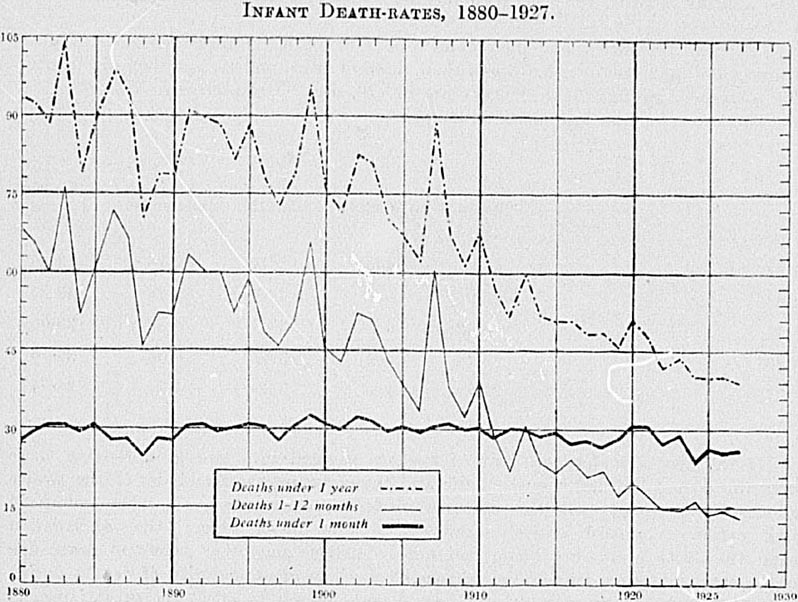
As stated above, the death-rate for infants under the age of one month has shown little improvement in recent years (in 1927 it actually increased slightly in spite of the heavy fall in the total infant-mortality rate), whereas the rates for the later divisions of the year show a definite trend towards a decline. In other words, the diseases that can be combated openly, such as epidemic diseases, respiratory diseases, and diseases due to faulty nourishment, &c. (i.e., diseases of the digestive system), have shown a definite response to the strenuous campaigns launched against them. While due credit must be accorded the efficacy of these health measures, it cannot be disguised that much has yet to be accomplished in the realm of ante-natal treatment. This is further accentuated by the following table, which shows the rates for further divisions of the first month of life:—
| Deaths under 1 Month per 1,000 Live Births. | ||||||||
|---|---|---|---|---|---|---|---|---|
| Year. | Under 1 Day. | 1 Day and under 2 Days. | 2 Days and under 1 Week. | Total under 1 Week. | 1 Week and under 2 Weeks. | 2 Weeks and under 3 | 3 Weeks and under 1 Month. | Total under 1 Month. |
| 1923 | 8.44 | 3.93 | 8.26 | 20.63 | 4.18 | 2.54 | 1.65 | 29.07 |
| 1924 | 7.89 | 3.35 | 7.50 | 18.74 | 2.25 | 1.68 | 1.28 | 23.95 |
| 1925 | 8.35 | 3.51 | 8.42 | 20.28 | 3.02 | 1.74 | 1.39 | 26.43 |
| 1926 | 8.57 | 3.54 | 8.36 | 20.47 | 2.11 | 1.65 | 1.23 | 25.46 |
| 1927 | 8.03 | 3.62 | 7.71 | 19.36 | 3.27 | 1.72 | 1.48 | 25.83 |
The above figures reveal that in every division of the first month of life there is little indication of any definite improvement in the death-rate during the last five years. With the exception of 1923 there would appear to be only the normal annual fluctuations in the figures for every group, while 1927 actually reveals a slight increase in four groups.
Nearly one-third (224) of the 720 deaths under one month in 1927 occurred within twenty-four hours of birth, and three-fourths (540) within one week. The following table gives, for each of the last five years, detailed information as to the number of deaths at various periods of the first year of life:—
| Infant Mortality, 1923-27.—Detailed Ages. | ||||||||||||
|---|---|---|---|---|---|---|---|---|---|---|---|---|
| Year. | Under 1 Day. | 1 Day and under 2 days. | Days and under 1 Week. | 1 Week and under 2 Weeks. | 2 Weeks and under 3 Weeks. | 3 Weeks and under 1 Month. | 1 Month and under 2 Months. | 2 Months and under 3 | 3 Months and under 6 Months. | 6 Months and under 9 Months. | 9 Months and under 12 Months. | Total. |
| * Including two cases where exact age not known. | ||||||||||||
| Males. | ||||||||||||
| 1923 | 131 | 61 | 143 | 69 | 46 | 29 | 74 | 31 | 45 | 48 | 42 | 720* |
| 1924 | 125 | 48 | 118 | 42 | 23 | 21 | 55 | 41 | 73 | 51 | 47 | 644 |
| 1925 | 135 | 67 | 140 | 44 | 27 | 21 | 64 | 23 | 54 | 37 | 27 | 639 |
| 1926 | 137 | 67 | 131 | 35 | 29 | 22 | 50 | 20 | 54 | 50 | 43 | 638 |
| 1927 | 115 | 54 | 127 | 44 | 33 | 26 | 48 | 29 | 59 | 44 | 31 | 610 |
| Females. | ||||||||||||
| 1923 | 105 | 49 | 88 | 48 | 26 | 17 | 50 | 30 | 37 | 30 | 25 | 505 |
| 1924 | 96 | 46 | 92 | 21 | 24 | 15 | 28 | 25 | 58 | 37 | 41 | 483 |
| 1925 | 100 | 32 | 97 | 41 | 22 | 18 | 42 | 27 | 35 | 37 | 35 | 486 |
| 1926 | 107 | 34 | 107 | 25 | 18 | 13 | 41 | 20 | 49 | 40 | 40 | 494 |
| 1927 | 109 | 47 | 88 | 47 | 15 | 15 | 34 | 24 | 33 | 29 | 29 | 470 |
| Both Sexes. | ||||||||||||
| 1923 | 236 | 110 | 231 | 117 | 71 | 46 | 124 | 61 | 82 | 78 | 67 | 1,225* |
| 1924 | 221 | 94 | 210 | 63 | 47 | 36 | 83 | 66 | 131 | 88 | 88 | 1,127 |
| 1925 | 235 | 99 | 237 | 85 | 49 | 39 | 106 | 50 | 89 | 74 | 62 | 1,125 |
| 1926 | 244 | 101 | 238 | 60 | 47 | 35 | 91 | 40 | 103 | 90 | 83 | 1,132 |
| 1927 | 224 | 101 | 215 | 91 | 48 | 41 | 82 | 53 | 92 | 73 | 60 | 1,080 |
Some remarkable changes are disclosed by the next table, which gives the infant-mortality rates for various groups of causes in quinquennial groups over a period of fifty-five years. If a comparison be made between the averages of the first and last quinquennia covered—1872-76 and 1922-26—it is found that the general infant-mortality rate shows a decline of 62 per cent., while even greater decreases are recorded for tuberculosis (93 per cent.), gastric and intestinal diseases (88 per cent.), convulsions (87 per cent.), epidemic diseases (87 per cent.), and respiratory diseases (67 per cent.). The rate for diseases of early infancy shows a decrease of only 10 per cent. in 1922-26 as compared with 1872-76, but of 14 per cent. as compared with 1917-21, and the figures indicate that some measure of success has already attended the steps taken in recent years to cope with ante-natal conditions.
The increase shown for malformations and the decrease for tuberculosis are probably somewhat less than is indicated by the figures. In the earlier years covered by the table the latter heading included all deaths from hydrocephalus, many of which were no doubt due to congenital hydrocephalus, which is now included among the malformations. A proportion of the deaths from hydrocephalus in the earlier years would also probably be due to meningitis. The most striking features of the figures for the single year 1927 in the table are the continuation of the upward trend in the death-rate from malformations, and a further drop in the rate from diseases peculiar to early infancy. The slight increases recorded for epidemic diseases and tuberculosis are probably due to the variations common to diseases which by their nature are subject to sudden fluctuations, and the next quinquennium should reveal a further decline in the death-rate from these two groups of diseases.
| Infant-mortality Rates for Principal Causes, 1872-1927. | |||||||||
|---|---|---|---|---|---|---|---|---|---|
| Period. | Epidemic Diseases. | Tuberculosis. | Infantile Convulsions. | Respiratory Diseases. | Gastric and Intestinal Diseases. | Malformations. | Early Infancy. | Other Causes. | Totals. |
| 1872-1876 | 13.5 | 5.5 | 9.7 | 12.9 | 24.2 | 1.2 | 25.0 | 17.3 | 109.3 |
| 1877-1881 | 10.2 | 5.2 | 7.5 | 12.3 | 19.8 | 1.4 | 21.9 | 15.3 | 93.6 |
| 1882-1886 | 9.3 | 4.7 | 7.9 | 11.8 | 19.1 | 1.2 | 25.5 | 12.3 | 91.8 |
| 1887-1891 | 8.9 | 3.7 | 6.3 | 10.5 | 18.5 | 1.3 | 24.7 | 8.8 | 82.7 |
| 1892-1896 | 9.8 | 3.3 | 6.6 | 11.0 | 16.6 | 1.4 | 24.9 | 11.2 | 84.8 |
| 1897-1901 | 6.1 | 2.6 | 5.6 | 10.0 | 17.2 | 1.5 | 26.2 | 9.7 | 78.9 |
| 1902-1906 | 5.5 | 1.5 | 4.1 | 9.7 | 15.3 | 1.3 | 27.6 | 7.9 | 72.9 |
| 1907-1911 | 5.9 | 1.3 | 3.3 | 7.6 | 15.5 | 1.9 | 26.7 | 6.3 | 68.5 |
| 1912-1916 | 3.6 | 0.6 | 2.2 | 5.1 | 7.4 | 3.9 | 26.2 | 3.5 | 52.5 |
| 1917-1921 | 3.2 | 0.5 | 1.9 | 4.7 | 4.5 | 4.3 | 26.1 | 2.9 | 48.1 |
| 1922-1926 | 1.8 | 0.4 | 1.3 | 4.3 | 2.8 | 4.8 | 22.4 | 3.3 | 41.1 |
| 1927 | 2.1 | 0.5 | 0.8 | 4.2 | 2.0 | 5.0 | 21.0 | 3.1 | 38.7 |
Two out of every three deaths of infants under one year of age are due to causes coming within the groups “Early Infancy” and “Malformations,” and premature birth alone is responsible for approximately one-third of the total infant mortality.
In accordance with international practice, New Zealand's infant-mortality rate represents the number of deaths of infants actually born alive expressed as a proportion per 1,000 live births. This method, however, takes no account of still-births. Reference has been made in an earlier paragraph to the effect on the infant-mortality rate of efforts made towards the reduction of those ante-natal influences which generally cause death to ensue during the early months of the first year of life. The fact that still-births are also the result of such ante-natal influences should not be lost sight of, and for this and other reasons it is of interest to compute rates for infant-mortality and still-births in conjunction, as in the following table. In the computation of the rates for numbers inclusive of still-births, the latter are taken into account in both births and deaths.
| Deaths of Infants under One Year per 1,000 Births. | ||||||
|---|---|---|---|---|---|---|
| Year. | Exclusive of Still-births. | Inclusive of Still-births. | ||||
| Males. | Females. | Total. | Males. | Females. | Total. | |
| 1918 | 53.64 | 43.03 | 48.41 | 81.56 | 65.19 | 73.53 |
| 1919 | 50.53 | 39.68 | 45.26 | 78.64 | 32.99 | 71.06 |
| 1920 | 54.94 | 45.90 | 50.57 | 82.99 | 69.54 | 76.49 |
| 1921 | 53.10 | 42.31 | 47.82 | 84.32 | 69.32 | 76.99 |
| 1922 | 48.20 | 35.23 | 41.89 | 77.55 | 59.75 | 68.92 |
| 1923 | 49.55 | 37.59 | 43.80 | 80.62 | 65.61 | 73.42 |
| 1924 | 45.05 | 35.21 | 40.23 | 77.39 | 59.48 | 68.65 |
| 1925 | 44.01 | 35.64 | 39.96 | 74.73 | 61.72 | 68.45 |
| 1926 | 43.55 | 35.73 | 39.76 | 73.29 | 63.90 | 68.74 |
| 1927 | 42.68 | 34.58 | 38.74 | 75.42 | 60.31 | 68.08 |
Some remarkable differences are revealed between the two sets of rates. Whereas the rate computed on the usual method indicates a decrease of 24.60 per cent, since 1914 (the first complete year for which still-births are available) the inclusion of stillbirths reduces the improvement to only 7.47 per cent. The explanation, of course, lies in the fact that although the number of children born alive and dying before one year has elapsed has been greatly diminished, yet, on the other hand, the number of infants born dead has shown a considerable increase between 1914 and 1927.
For some years past in the figures inclusive of still-births the male rate has been steadily decreasing, while the female rate has been steadily increasing, the combined rate tending to decline, with an odd exception here and there. The figures for 1927, however, reverse the position for the two sexes, the male rate showing a substantial rise and the female rate an even more substantial decline.
Since 1908, the classification of causes of death in New Zealand has been on the basis of the international classification of diseases initiated by Dr. Jacques Bertillon and used by the Commonwealth of Australia and the principal European and American countries.
A comparison of the causes of deaths in 1927, arranged according to an abridged classification, and the proportion per 10,000 of population of each sex, are given in the following table:—
| Class. | Number of Deaths. | Proportion per 10,000 of Mean Population. | ||||
|---|---|---|---|---|---|---|
| Males. | Females. | Total. | Males. | Females. | Total. | |
| I. Epidemic, endemic, and infectious diseases | 586 | 475 | 1,061 | 8.35 | 7.06 | 7.72 |
| II. General diseases, not included above | 908 | 939 | 1,847 | 12.94 | 13.95 | 13.44 |
| III. Diseases of the nervous system and of the organs of special sense | 655 | 589 | 1,244 | 9.34 | 8.75 | 9.05 |
| IV. Diseases of the circulatory system | 1,338 | 1,048 | 2,386 | 19.07 | 15.58 | 17.36 |
| V. Diseases of the respiratory system | 647 | 415 | 1,062 | 9.22 | 6.17 | 7.72 |
| VI. Diseases of the digestive system | 359 | 299 | 658 | 5.12 | 4.44 | 4.79 |
| VII. Non-venereal diseases of the genito-urinary system and annexa | 377 | 285 | 662 | 5.37 | 4.23 | 4.82 |
| VIII. Puerperal state | 137 | 137 | 2.04 | 1.00 | ||
| IX. Diseases of the skin and of the cellular tissue | 36 | 24 | 60 | 0.52 | 0.36 | 0.44 |
| X. Diseases of the bones and of the organs of locomotion | 25 | 9 | 34 | 0.36 | 0.13 | 0.25 |
| XI. Malformations | 87 | 74 | 161 | 1.24 | 1.10 | 1.17 |
| XII. Early infancy | 325 | 261 | 586 | 4.63 | 3.88 | 4.26 |
| XIII. Old age | 451 | 355 | 806 | 6.43 | 5.28 | 5.86 |
| XIV. External causes | 697 | 180 | 877 | 9.93 | 2.68 | 6.38 |
| XV. Ill-defined causes | 23 | 9 | 32 | 0.33 | 0.13 | 0.23 |
| Totals | 6,514 | 5,099 | 11,613 | 92.85 | 75.78 | 84.49 |
Class IV, diseases of the circulatory system, the principal of which—diseases of the heart—rank easily first among individual causes of death in New Zealand, is the most important as regards numerical strength. Next in order comes Class II (which includes cancer), followed in 1927 by Classes III, V, and I. Classes IX and X are responsible for very few deaths.
The next table shows the number of deaths from certain principal causes for the five years 1923-27, and the proportion per 10,000 of the population:—
| Cause. | Number of Deaths. | Proportion per 10,000 of Mean Population. | ||||||||
|---|---|---|---|---|---|---|---|---|---|---|
| 1923. | 1924. | 1925. | 1926. | 1927. | 1923. | 1924. | 1925. | 1926. | 1927. | |
| Typhoid fever | 23 | 19 | 16 | 19 | 11 | 0.18 | 0.15 | 0.12 | 0.14 | 0.08 |
| Measles | 7 | 52 | 11 | 13 | 29 | 0.05 | 0.40 | 0.08 | 0.10 | 0.21 |
| Scarlet fever | 13 | 13 | 7 | 8 | 16 | 0.10 | 0.10 | 0.05 | 0.06 | 0.12 |
| Whooping-cough | 39 | 47 | 16 | 108 | 41 | 0.31 | 0.36 | 0.12 | 0.80 | 0.30 |
| Diphtheria | 66 | 80 | 52 | 66 | 58 | 0.52 | 0.62 | 0.39 | 0.49 | 0.42 |
| Influenza | 403 | 90 | 86 | 288 | 131 | 3.16 | 0.69 | 0.65 | 2.13 | 0.95 |
| Infantile paralysis | 2 | 22 | 173 | 11 | 7 | 0.02 | 0.17 | 1.30 | 0.08 | 0.05 |
| Tuberculosis of respiratory system | 619 | 573 | 560 | 592 | 533 | 4.86 | 4.41 | 4.21 | 4.38 | 3.88 |
| Other forms of tuberculosis | 173 | 163 | 124 | 135 | 135 | 1.36 | 1.26 | 0.93 | 1.00 | 0.98 |
| Cancer | 1,115 | 1,245 | 1,207 | 1,341 | 1,324 | 8.75 | 9.59 | 9.08 | 9.91 | 9.63 |
| Diabetes | 181 | 173 | 162 | 162 | 188 | 1.42 | 1.33 | 1.22 | 1.20 | 1.37 |
| Anæmia, chlorosis | 76 | 106 | 86 | 97 | 78 | 0.60 | 0.82 | 0.65 | 0.71 | 0.57 |
| Exophthalmic goitre | 35 | 45 | 63 | 57 | 57 | 0.27 | 0.35 | 0.47 | 0.42 | 0.41 |
| Meningitis (all forms) | 108 | 68 | 68 | 54 | 63 | 0.85 | 0.52 | 0.51 | 0.40 | 0.46 |
| Apoplexy, cerebral hæmorrhage | 677 | 722 | 683 | 764 | 771 | 5.31 | 5.56 | 5.14 | 5.65 | 5.61 |
| Epilepsy | 59 | 48 | 77 | 54 | 40 | 0.46 | 0.37 | 0.58 | 0.40 | 0.29 |
| Convulsions of children under 5 years of age | 52 | 31 | 51 | 42 | 26 | 0.41 | 0.24 | 0.38 | 0.31 | 0.19 |
| Diseases of heart | 2,023 | 1,858 | 1,931 | 2,059 | 2,150 | 15.87 | 14.31 | 14.52 | 15.22 | 15.64 |
| Diseases of arteries | 139 | 128 | 151 | 159 | 179 | 1.09 | 0.98 | 1.14 | 1.17 | 1.30 |
| Bronchitis | 366 | 224 | 316 | 366 | 303 | 2.87 | 1.72 | 2.38 | 2.66 | 2.20 |
| Broncho-pneumonia | 277 | 200 | 215 | 210 | 207 | 2.17 | 1.54 | 1.61 | 1.55 | 1.51 |
| Pneumonia | 339 | 306 | 292 | 297 | 313 | 2.66 | 2.36 | 2.19 | 2.19 | 2.28 |
| Diarrhœa and enteritis | 129 | 180 | 107 | 104 | 91 | 1.01 | 1.39 | 0.80 | 0.77 | 0.67 |
| Appendicitis | 97 | 94 | 122 | 93 | 92 | 0.76 | 0.72 | 0.92 | 0.69 | 0.67 |
| Hernia, intestinal obstruction | 90 | 82 | 110 | 114 | 109 | 0.71 | 0.63 | 0.83 | 0.84 | 0.79 |
| Cirrhosis of liver | 42 | 43 | 45 | 47 | 47 | 0.33 | 0.33 | 0.34 | 0.35 | 0.34 |
| Simple peritonitis | 52 | 36 | 41 | 46 | 46 | 0.41 | 0.28 | 0.31 | 0.34 | 0.34 |
| Nephritis, Bright's disease | 358 | 342 | 396 | 434 | 409 | 2.81 | 2.63 | 2.98 | 3.21 | 2.98 |
| Diseases and accidents of puerperal state | 143 | 140 | 131 | 121 | 137 | 1.12 | 1.08 | 0.98 | 0.89 | 1.00 |
| Malformations | 172 | 147 | 170 | 144 | 161 | 1.35 | 1.13 | 1.28 | 1.06 | 1.17 |
| Congenital debility | 151 | 136 | 110 | 110 | 112 | 1.18 | 1.05 | 0.83 | 0.81 | 0.81 |
| Premature birth | 384 | 325 | 354 | 346 | 330 | 3.01 | 2.50 | 2.66 | 2.56 | 2.40 |
| Injury at birth | 46 | 50 | 66 | 43 | 56 | 0.36 | 0.39 | 0.50 | 0.32 | 0.41 |
| Other diseases of early infancy | 104 | 70 | 73 | 91 | 88 | 0.82 | 0.54 | 0.55 | 0.67 | 0.64 |
| Senility | 901 | 767 | 779 | 887 | 806 | 7.07 | 5.91 | 5.86 | 6.56 | 5.86 |
| Violence (1) suicide | 133 | 159 | 173 | 153 | 199 | 1.04 | 1.22 | 1.30 | 1.13 | 1.45 |
| (2) accident | 588 | 621 | 621 | 708 | 656 | 4.61 | 4.78 | 4.67 | 5.23 | 4.77 |
| (3) homicide | 11 | 11 | 15 | 14 | 22 | 0.09 | 0.08 | 0.11 | 0.10 | 0.16 |
| Other causes | 1,318 | 1,351 | 1,366 | 1,468 | 1,592 | 10.34 | 10.40 | 10.28 | 10.85 | 11.58 |
| Totals | 11,511 | 10,767 | 11,026 | 11,819 | 11,613 | 90.31 | 82.91 | 82.92 | 87.35 | 84.49 |
Detailed information concerning the various causes of death is given in the Annual Report on Vital Statistics. The statistics for tuberculosis, cancer, puerperal causes, and violence—causes which are of special interest and significance—are discussed in the following pages.
Tuberculosis of the respiratory system takes sixth place in point, of the number of deaths resulting therefrom during 1927, ranking after heart-disease, cancer, senility, cerebral hæmorrhage and apoplexy, and accidents, in that order. Each of the four years preceding 1926 in its turn established a new record in low rates of mortality from this form of tuberculosis, the continuation of the downward trend in the incidence of this disease being extremely gratifying. The 1926 rate of 4.37 per 10,000 was slightly higher than the 1925 rate, but in 1927 the rate fell to 3.88, a figure which, in addition to being an improvement of 0.49 per 10,000 over the previous year, was the lowest rate ever recorded in the Dominion.
Of the 533 persons who died from tuberculosis of the respiratory system in 1927, 382, or 72 per cent., were known to have been born in the Dominion. In 11 cases the country of birth was not known or not stated, and in the remaining 140 cases the deceased person had been born outside New Zealand. Five of the last-mentioned had been in New Zealand less than two years, and 19 less than five years.
In addition to the 533 deaths from tuberculosis of the respiratory system during 1927, there were 135 deaths from other forms of tuberculosis, made up as follows:—
| Tuberculosis of meninges and central nervous system | 61 |
| Tuberculosis of intestines and peritoneum | 19 |
| Tuberculosis of vertebral column | 12 |
| Tuberculosis of joints | 6 |
| Tuberculosis of other organs | 12 |
| Disseminated tuberculosis | 25 |
The following table gives the number and rate of deaths from tuberculosis of the respiratory system and from all forms of tuberculosis during the last ten years:—
| Year. | Deaths from Tuberculosis of the Respiratory System. | Deaths from all Tubercular Diseases. | ||
|---|---|---|---|---|
| Number. | Kate per 10,000. | Number. | Rate per 10,000. | |
| 1918 | 638 | 5.78 | 832 | 7.54 |
| 1919 | 585 | 5.12 | 762 | 6.67 |
| 1920 | 671 | 5.63 | 851 | 7.14 |
| 1921 | 609 | 4.98 | 793 | 6.48 |
| 1922 | 594 | 4.74 | 803 | 6.41 |
| 1923 | 619 | 4.86 | 792 | 6.21 |
| 1924 | 573 | 4.41 | 736 | 5.67 |
| 1925 | 560 | 4.21 | 684 | 5.14 |
| 1926 | 592 | 4.38 | 727 | 5.37 |
| 1927 | 533 | 3.88 | 668 | 4.86 |
Tuberculosis claims its victims at comparatively early age. Of those dying from this cause in 1927, persons under the age of twenty years formed 18 1/2 per cent., and those under forty-five years 74 per cent. The figures for the various age-groups are as follows:—
| Ages of Persons who died from Tubercular Diseases, 1927. | |||
|---|---|---|---|
| Ages, in Years. | Males. | Females. | Total. |
| Under 5 | 16 | 21 | 37 |
| 5 and under 10 | 10 | 11 | 21 |
| 10 “ 15 | 9 | 4 | 13 |
| 15 “ 20 | 18 | 35 | 53 |
| 20 “ 25 | 35 | 58 | 93 |
| 25 “ 30 | 38 | 29 | 67 |
| 30 “ 35 | 40 | 36 | 76 |
| 35 “ 40 | 39 | 29 | 68 |
| 40 “ 45 | 44 | 24 | 68 |
| 45 and under 50 | 35 | 9 | 44 |
| 50 “ 55 | 34 | 13 | 47 |
| 55 “ 60 | 26 | 7 | 33 |
| 60 “ 65 | 16 | 11 | 27 |
| 65 “ 70 | 4 | 5 | 9 |
| 70 “ 75 | 3 | 3 | 6 |
| 75 “ 80 | 2 | 1 | 3 |
| 80 and upwards | 3 | 3 | |
| Total deaths | 372 | 296 | 668 |
The proportions for the two sexes vary considerably over the different age-groups, females generally being in the majority up to age 25, and males thereafter.
The death-rate from tubercular diseases in most of the principal countries of the world during the latest available period of from three to five years is next shown.
| Death-rates from Tuberculosis. | ||
|---|---|---|
| Country. | Period. | Death-rates (per 10,000). |
| * Registration area. | ||
| New Zealand | 1923-27 | 5.4 |
| Australia | 1922-26 | 6.0 |
| Ceylon | 1921-25 | 7.5 |
| Canada | 1922-26 | 8.4 |
| Denmark | 1922-26 | 9.1 |
| United States* | 1921-25 | 9.3 |
| Netherlands | 1923-27 | 10.0 |
| Egypt | 1923-25 | 10.5 |
| England and Wales | 1922-26 | 10.5 |
| Belgium | 1921-25 | 10.6 |
| Scotland | 1922-26 | 11.3 |
| British Guiana | 1921-25 | 12.8 |
| Trinidad | 1923-25 | 13.2 |
| Germany | 1921-25 | 13.3 |
| Italy | 1921-25 | 14.2 |
| Sweden | 1922-26 | 14.2 |
| Irish Free State | 1922-26 | 15.1 |
| Switzerland | 1922-26 | 15.1 |
| Spain | 1922-26 | 15.4 |
| Uruguay | 1921-25 | 16.0 |
| Northern Ireland | 1922-26 | 16.0 |
| Jamaica | 1921-25 | 16.3 |
| France | 1921-25 | 17.5 |
| Czecho-Slovakia | 1923-26 | 19.3 |
| Norway | 1921-25 | 20.2 |
| Japan | 1921-25 | 20.3 |
| Finland | 1921-25 | 23.9 |
| Chile | 1921-25 | 25.0 |
| Austria | 1919-23 | 25.9 |
| Hungary | 1922-26 | 28.4 |
Cancer is annually responsible for more deaths in New Zealand than can be assigned to any cause other than diseases of the heart. The increasing prevalence of cancer is causing no little concern in the Dominion, as indeed it is throughout the civilized world.
The following diagram illustrates, on the one hand, the increase in the cancer death-rate, and, on the other the decrease in the rate of deaths from tuberculosis:—
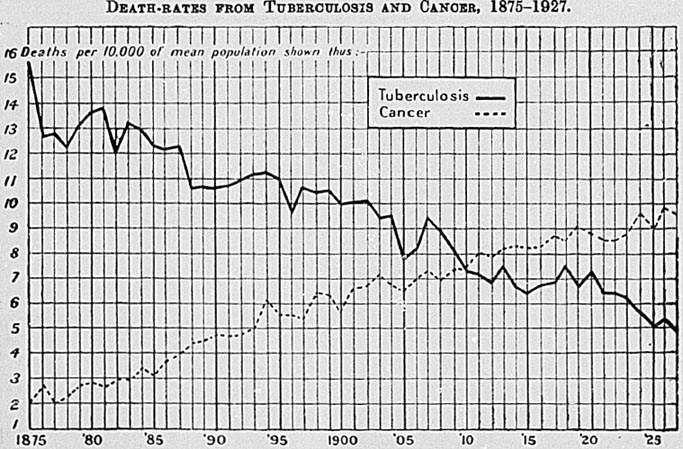
In 1927 there were 1,324 deaths from cancer in the Dominion, a proportion of 9.63 per 10,000 persons. Both number and rate are slightly lower than in the preceding year. Deaths of males during 1927 numbered 675, and of females 649.
| Deaths from Cancer, with Crude and Standardized Death-Rates, 1918-27. | |||
|---|---|---|---|
| Year. | Number. | Crude Death-rate. | Standardized Death-rate.* |
* On baste of age distribution In 1911. | |||
| 1918 | 936 | 8.49 | 7.60 |
| 1919 | 1,031 | 9.02 | 8.39 |
| 1920 | 1,029 | 8.63 | 8.17 |
| 1921 | 1,044 | 8.53 | 8.09 |
| 1922 | 1,066 | 8.52 | 7.58 |
| 1923 | 1,115 | 8.75 | 7.76 |
| 1924 | 1,245 | 9.59 | 8.49 |
| 1925 | 1,207 | 9.08 | 7.88 |
| 1926 | 1,341 | 9.91 | 8.62 |
| 1927 | 1,324 | 9.63 | 8.16 |
The following table shows the proportion of deaths from cancer to the 10,000 of mean population in some of the principal countries of the world. The rates are an average of the latest available period of from three to five years. Of the countries covered by the table, ten had higher rates than New Zealand.
| Cancer Death-rates in certain Countries | ||
|---|---|---|
| Country. | Period. | Death-rate per 10,000 of Population. |
* Registration area. | ||
| Ceylon | 1921-25 | 0.9 |
| Egypt | 1923-25 | 1.5 |
| Jamaica | 1921-25 | 2.0 |
| British Guiana | 1922-25 | 2.1 |
| Trinidad | 1923-25 | 3.7 |
| Chile | 1921-25 | 3.9 |
| Spain | 1922-26 | 6.4 |
| Italy | 1921-25 | 6.6 |
| Japan | 1921-25 | 7.0 |
| Uruguay | 1921-25 | 7.3 |
| Canada | 1922-26 | 7.6 |
| Hungary | 1921-25 | 7.7 |
| Belgium | 1921-25 | 8.0 |
| United States* | 1921-25 | 8.9 |
| Australia | 1922-26 | 9.2 |
| Irish Free State | 1922-26 | 9.3 |
| Germany | 1921-25 | 9.3 |
| New Zealand | 1923-27 | 9.4 |
| Czecho-Slovakia | 1923-25 | 9.5 |
| Northern Ireland | 1922-26 | 10.9 |
| Norway | 1921-25 | 11.0 |
| Sweden | 1921-25 | 11.3 |
| Netherlands | 1921-25 | 11.3 |
| England and Wales | 1922-26 | 13.0 |
| Scotland | 1922-26 | 13.2 |
| Austria | 1921-25 | 13.3 |
| Switzerland | 1922-26 | 13.4 |
| Denmark | 1921-25 | 13.8 |
The international table shows very clearly the comparative immunity of the coloured races to cancer, and the much smaller liability of Southern than Northern Europeans to the disease.
The following summary shows the types of cancer returned in the death entries for the year 1927:—
| Type. | Deaths. | ||
|---|---|---|---|
| Males. | Females. | Total. | |
| Carcinoma | 486 | 468 | 954 |
| Adeno-carcinoma | 2 | 3 | 5 |
| Sarcoma | 31 | 30 | 61 |
| Melanotic sarcoma | 3 | 5 | 8 |
| Fibro-sarcoma | 1 | .. | 1 |
| Lympho-sarcoma | 3 | 2 | 5 |
| Angio-sarcoma | 1 | .. | 1 |
| Osteo-sarcoma | 1 | 2 | 3 |
| Epithelioma | 27 | 10 | 37 |
| Endothelioma | .. | 1 | 1 |
| Rodent ulcer | 4 | 2 | 6 |
| Hypernephroma | 2 | .. | 2 |
| Malignant tumour | 7 | 8 | 15 |
| Malignant growth | 3 | 1 | 4 |
| Malignant disease | 9 | 10 | 19 |
| Cancer | 95 | 107 | 202 |
| Totals | 675 | 649 | 1,324 |
The parts of the body most commonly affected in New Zealand are the stomach and liver. Among females the generative and mammary organs rank high as the seat of the disease. Full details of location are published in the “Annual Report on the Vital Statistics.”
| Cancer: Seat of Disease, 1927. | |||
|---|---|---|---|
| Seat of Disease. | Males. | Females. | Total. |
| Buccal cavity | 53 | 11 | 64 |
| Stomach and liver | 247 | 167 | 414 |
| Peritoneum, intestines, rectum | 138 | 109 | 247 |
| Female genital organs | .. | 139 | 139 |
| Breast | 1 | 122 | 123 |
| Skin | 21 | 9 | 30 |
| Other organs or organs not specified | 215 | 92 | 307 |
| Totals | 675 | 649 | 1,324 |
Of the sites included in the last group in the above table the principal were: Prostate, 65; pancreas, 56; bladder, 21; larynx, 16; lung, 11; and kidney, 14.
Ninety-one per cent. of the deaths from cancer during 1927 were at ages 45 years and upwards, and 61 per cent. at ages 60 years and upwards. Females predominate generally up to age 60, and males thereafter, as is evidenced by the following table, which shows by age-groups the number of persons of each sex who died of cancer during 1927.
| Ages of Persons who died from Cancer, 1927. | |||
|---|---|---|---|
| Ages, in Years. | Males. | Females. | Total. |
| Under 5 | 1 | 2 | 3 |
| 5 and under 10 | .. | .. | .. |
| 10 “ 15 | 3 | .. | 3 |
| 15 “ 20 | 2 | 1 | 3 |
| 20 “ 25 | 6 | 1 | 7 |
| 25 “ 30 | 4 | 6 | 10 |
| 30 “ 35 | 3 | 10 | 13 |
| 35 “ 40 | 9 | 26 | 35 |
| 40 “ 45 | 19 | 27 | 46 |
| 45 and under 50 | 39 | 79 | 118 |
| 50 “ 55 | 52 | 78 | 130 |
| 55 “ 60 | 74 | 77 | 151 |
| 60 “ 65 | 108 | 89 | 197 |
| 65 “ 70 | 117 | 68 | 185 |
| 70 “ 75 | 101 | 73 | 174 |
| 75 “ 80 | 81 | 64 | 145 |
| 80 and upwards | 56 | 48 | 104 |
| Totals | 675 | 649 | 1,324 |
Exhaustive statistical inquiry covering the period from 1872 to date has shown that in New Zealand death from cancer is, on the average, now occurring later in life than formerly. It would seem that this is the case even if allowance be made for the fact that the age-constitution of the Dominion is increasing—i.e., that the average citizen of New Zealand is now older than the average citizen of ten, twenty, or fifty years ago.
In point of numbers of deaths puerperal accidents and diseases do not rank high among causes of death. Nevertheless, owing to the association between the maternal death-rate and the all-important matter of the birth-rate, deaths from puerperal causes are of special importance and significance.
During the 44-year period from 1872 to 1915 the death-rate from puerperal causes exceeded 5 per 1,000 live births on only 14 occasions, but after 1915 did not fall below this figure until 1925. The rate for 1920 (when the proportion of first births was high) was the third highest on record, having been exceeded only in 1884 and 1885, but it is gratifying to see that this high rate was not maintained, the four years following remaining fairly stationary at a comparatively low proportion, and 1925 and 1926 showing further falls. The year 1927, however, owing to an excessively high proportion of septicæmia cases, recorded a substantial rise in the death-rate from puerperal causes. The rate for each of the last 20 years is as follows:—
| Year. | Proportion per 1,000 Live Births. |
|---|---|
| 1908 | 4.59 |
| 1909 | 5.09 |
| 1910 | 4.50 |
| 1911 | 4.33 |
| 1912 | 3.64 |
| 1913 | 3.58 |
| 1914 | 4.16 |
| 1915 | 4.70 |
| 1916 | 5.86 |
| 1917 | 5.98 |
| 1918 | 5.18 |
| 1919 | 5.06 |
| 1920 | 6.48 |
| 1921 | 5.08 |
| 1922 | 5.14 |
| 1923 | 5.11 |
| 1924 | 5.00 |
| 1925 | 4.65 |
| 1926 | 4.25 |
| 1927 | 4.91 |
Commencing with 1916, special inquiry has been made in all cases where a woman of child-bearing age has been returned as having died of such causes as septicæmia, peritonitis, nephritis, &c. (without qualification), with the result that in each year several of such cases are found to be puerperal, and are now so classed. Possibly this factor also affects to a certain extent comparison with other countries.
The next table shows the number of deaths from puerperal causes during each of the last ten years, classified in the eight groups into which such causes are divided in the international classification. Over the whole period puerperal septicæmia was responsible for 37 per cent. of the total deaths from these causes.
| Deaths from Puerperal Causes, by Groups, 1918-27. | ||||||||||
|---|---|---|---|---|---|---|---|---|---|---|
| Group. | 1918. | 1919. | 1920. | 1921. | 1922. | 1923. | 1924. | 1925. | 1926. | 1927. |
| * Mainly deaths from puerperal mania. | ||||||||||
| Accidents of pregnancy | 15 | 9 | 26 | 9 | 13 | 17 | 15 | 10 | 20 | 7 |
| Puerperal hæmorrhage | 11 | 10 | 40 | 18 | 22 | 26 | 19 | 24 | 9 | 17 |
| Other accidents of labour | 19 | 11 | 12 | 10 | 13 | 4 | 6 | 7 | 9 | 10 |
| Puerperal septicæmia | 48 | 52 | 67 | 48 | 52 | 52 | 52 | 42 | 39 | 70 |
| Puerperal phlegmasia alba dolens, embolus, sudden death | 10 | 4 | 9 | 18 | 12 | 8 | 11 | 14 | 11 | 6 |
| Puerperal albuminuria and convulsions | 30 | 36 | 37 | 41 | 35 | 34 | 36 | 32 | 32 | 26 |
| Following childbirth (not included elsewhere)* | 1 | 1 | 3 | 1 | 2 | 2 | 1 | 2 | 1 | 1 |
| Puerperal diseases of the breast | .. | 1 | .. | .. | .. | .. | .. | .. | .. | .. |
| Totals | 134 | 124 | 194 | 145 | 149 | 143 | 140 | 131 | 121 | 137 |
A table showing the number and the rate per 1,000 births of deaths from puerperal septicæmia and other puerperal causes separately in some of the principal countries of the world is given below. As a consequence of the comparatively low rates that have been experienced in the Dominion during the last five years, New Zealand now occupies a much more favourable position in the international comparison than was the case a few years since.
| Deaths from Puerperal Causes in Various Countries. | ||||
|---|---|---|---|---|
| Country. | Period. | Death-rate per 1,000 Births from | ||
| Puerperal Septicæmia. | Other Puerperal Causes. | All Puerperal Causes. | ||
* Exclusive of Quebec. † Registration Area. | ||||
| Denmark | 1920-24 | 1.10 | 1.16 | 2.26 |
| Netherlands | 1921-25 | 0.72 | 1.72 | 2.44 |
| Sweden | 1918-22 | 1.28 | 1.40 | 2.68 |
| Italy | 1920-24 | 1.08 | 1.73 | 2.81 |
| Uruguay | 1919-23 | 1.75 | 113 | 2.88 |
| Japan | 1921-25 | 1.21 | 2.07 | 3.28 |
| Hungary | 1918-22 | 1.52 | 1.90 | 3.42 |
| England and Wales | 1921-25 | 1.40 | 2.50 | 3.90 |
| Spain | 1922-26 | 2.65 | 1.68 | 4.33 |
| New Zealand | 1923-27 | 1.82 | 2.97 | 4.79 |
| Northern Ireland | 1922-26 | 1.46 | 3.38 | 4.84 |
| Irish Free State | 1922-26 | 1.82 | 3.15 | 4.97 |
| Germany | 1920-24 | 2.77 | 2.27 | 5.04 |
| Jamaica | 1921-25 | 1.09 | 4.10 | 5.19 |
| Australia | 1922-26 | 1.70 | 3.51 | 5.21 |
| Switzerland | 1918-22 | 2.82 | 2.60 | 5.42 |
| Belgium | 1921-25 | 2.69 | 2.85 | 5.54 |
| Canada* | 1921-25 | 1.46 | 4.09 | 5.55 |
| Scotland | 1921-25 | 1.86 | 4.41 | 6.27 |
| United States † | 1920-24 | 2.54 | 4.36 | 6.90 |
| Chile | 1919-23 | 2.24 | 6.00 | 8.24 |
| Trinidad | 1923-25 | 3.58 | 5.68 | 9.26 |
| British Guiana | 1922-25 | 2.68 | 11.55 | 14.23 |
| Ceylon | 1921-25 | 8.15 | 11.94 | 20.09 |
Deaths from violence, apart from suicide, claim approximately 6 per cent. of the total deaths. The number and rate of deaths from the various forms of violent deaths in 1912, 1917, 1922, and 1927 are given in the next table.
| Causes of Death. | Number of Deaths. | Rate per 1,000,000 of Mean Population. | ||||||
|---|---|---|---|---|---|---|---|---|
| 1912 | 1917. | 1922. | 1927. | 1912. | 1917. | 1922. | 1927. | |
| Accidents— | ||||||||
| Poisoning | 16 | 12 | 10 | 12 | 15 | 11 | 8 | 9 |
| Conflagration | 10 | 9 | 20 | 9 | 7 | 15 | ||
| Burns and scalds | 44 | 39 | 24 | 32 | 42 | 35 | 19 | 23 |
| Died under anæsthetic, asphyxia, &c. | 26 | 27 | 25 | 23 | 25 | 25 | 20 | 17 |
| Drowning | 119 | 153 | 122 | 140 | 115 | 139 | 97 | 102 |
| Firearms | 25 | 18 | 25 | 22 | 24 | 16 | 20 | 16 |
| Falls | 43 | 60 | 47 | 68 | 41 | 55 | 38 | 49 |
| In mines and quarries | 19 | 17 | 4 | 20 | 18 | 15 | 3 | 15 |
| Crushing | 134 | 132 | 163 | 234 | 129 | 120 | 131 | 170 |
| Injuries by animals | 9 | 11 | 9 | 7 | 9 | 10 | 7 | 5 |
| Homicide | 10 | 10 | 14 | 22 | 10 | 9 | 11 | 16 |
| Fractures (causes not specified) | 32 | 30 | 34 | 36 | 31 | 27 | 27 | 26 |
| Other | 37 | 42 | 69 | 42 | 36 | 39 | 55 | 30 |
| Totals | 514 | 561 | 555 | 678 | 495 | 510 | 443 | 493 |
Deaths from violence show a slight decrease in the rate between 1912 and 1927. This is remarkable when it is seen that the death-rate from crushing, which includes accidents arising from the use of railways, motor-cars, and other vehicles, rose during the same period from 129 to 170 per 1,000,000 living. There is no doubt that the rise in the rate of deaths from this class is due to the increasing congestion of the public streets and the increased use of motor-cars and other motor-vehicles. On the other hand, noticeable decreases are shown for drowning, burns and scalds, injuries by animals, and fractures (cause not specified).
In view of the steady rise in the number of deaths attributable to railways, motor-vehicles, &c., it is advisable to further reduce the figures and rates to their respective headings. This subdivision has only recently been introduced into the statistics, and the information is available for a period of only seven years. In classifying deaths under these various subheadings the rule of assignment is that in fatalities due to collisions of railway-trains and electric tram-cars with motor-vehicles the death is assigned to the railway-train or electric tram-car as being the heavier and more powerful vehicle. In the case of collisions between motor-vehicles and horse-drawn vehicles the death is assigned to the motor-vehicle.
In the following table the number and rate per million of population of deaths from traumatism by railways, tramways, and motor-vehicles during each of the last seven years are given.
| Year. | Deaths from Traumatism by | Rate per Million of Population. | ||||
|---|---|---|---|---|---|---|
| Railways. | Tramways. | Motor-vehicles. | Hallways. | Tramways. | Motor-vehicles. | |
| 1921 | 36 | 14 | 69 | 29 | 11 | 56 |
| 1922 | 45 | 9 | 61 | 36 | 7 | 49 |
| 1923 | 69 | 14 | 59 | 54 | 11 | 46 |
| 1924 | 40 | 10 | 94 | 31 | 8 | 72 |
| 1925 | 43 | 8 | 108 | 32 | 6 | 81 |
| 1926 | 53 | 17 | 149 | 39 | 13 | 110 |
| 1927 | 42 | 8 | 138 | 31 | 6 | 100 |
Although it is evident from the above figures that deaths from traumatism by motor-vehicles are rapidly increasing, it is satisfactory to record a slight decrease for the year 1927, the toll being 138 as compared with 149 in 1926, while the rate fell from 110 per million to 100. The rate has, however, increased 78 1/2 per cent. since 1921.
The suicidal deaths in 1927 were 199—males 171, and females 28—the death-rate per 10,000 of mean population being 1.45. The figures for each of the last five years are as follows:—
| Year. | Number of Deaths. | Rate per 10,000 of Population. | ||||
|---|---|---|---|---|---|---|
| Males. | Females. | Both Sexes. | Males. | Females. | Both Sexes. | |
| 1923 | 110 | 23 | 133 | 1.69 | 0.37 | 1.04 |
| 1924 | 127 | 32 | 159 | 1.92 | 0.50 | 1.22 |
| 1925 | 138 | 35 | 173 | 2.03 | 0.54 | 1.30 |
| 1926 | 125 | 28 | 153 | 1.81 | 0.42 | 1.13 |
| 1927 | 171 | 28 | 199 | 2.44 | 0.42 | 1.45 |
The rate for 1927 is somewhat higher than the average of the five preceding years—1.20 per 10,000.
The next table shows the means of self-destruction employed in New Zealand in each of the years 1923-27:—
| Mode of Death. | 1923. | 1924. | 1925. | 1926. | 1927. |
|---|---|---|---|---|---|
| Suicide by solid or liquid poisons | 7 | 14 | 17 | 14 | 14 |
| Suicide by corrosive substances | 16 | 13 | 5 | 5 | 12 |
| Suicide by poisonous gas | 7 | 24 | 17 | 14 | 25 |
| Suicide by hanging or strangulation | 28 | 30 | 41 | 32 | 44 |
| Suicide by drowning | 19 | 20 | 30 | 20 | 21 |
| Suicide by firearms | 23 | 32 | 31 | 34 | 49 |
| Suicide by cutting or piercing instruments | 24 | 24 | 25 | 26 | 23 |
| Suicide by jumping from high places | 4 | .. | 1 | 3 | 5 |
| Suicide by crushing | 2 | .. | 1 | 2 | .. |
| Suicide by other means | 3 | 2 | 5 | 3 | 6 |
| Totals | 133 | 159 | 173 | 153 | 199 |
The greatest number of deaths from suicide over the period covered was from hanging or strangulation (175), closely followed by firearms (169), while cutting or piercing instruments (122), poison (117), and drowning (110), were next, in the order given.
A comparison of the average rates for the latest quinquennial periods available for the undermentioned countries is as follows:—
| Country. | Quinquennium. | Rate per 10,000 of Population. |
|---|---|---|
* Exclusive of Quebec. † Registration area. | ||
| Jamaica | 1921-25 | 0.15 |
| Irish Free State | 1922-26 | 0.28 |
| Chile | 1919-23 | 0.33 |
| Spain | 1922-26 | 0.42 |
| Northern Ireland | 1922-26 | 0.45 |
| Ceylon | 1922-26 | 0.50 |
| Norway | 1920-24 | 0.56 |
| Netherlands | 1921-25 | 0.62 |
| Scotland | 1921-25 | 0.66 |
| Canada* | 1921-25 | 0.78 |
| Italy | 1920-24 | 0.82 |
| England and Wales | 1922-26 | 1.04 |
| Australia | 1923-27 | 1.14 |
| United States † | 1921-25 | 1.21 |
| New Zealand | 1923-27 | 1.23 |
| Finland | 1921-25 | 1.24 |
| Uruguay | 1919-23 | 1.29 |
| Belgium | 1921-25 | 1.33 |
| Sweden | 1921-25 | 1.39 |
| Denmark | 1920-24 | 1.40 |
| Japan | 1921-25 | 1.97 |
| Austria | 1918-22 | 2.12 |
| Germany | 1919-23 | 2.14 |
| Switzerland | 1919-23 | 2.26 |
| Hungary | 1918-22 | 2.28 |
New Zealand compares favourably with most of the foreign countries shown in the above table, but somewhat unfavourably with other British countries.
In quite 50 per cent. of death entries, more than one definite disease is recorded, without taking into account indefinite conditions such as debility, coma, heart - failure, syncope, &c. In such cases it is necessary to decide which of the two or more diseases is to be assigned as the cause of death.
Certain general rules of procedure, applicable in the great majority of cases, are laid down by the international classification of causes of death. The United States Bureau of Vital Statistics has compiled a Manual of Joint Causes of Death, which follows the lines of the international classification, but gives very full details and thus permits of a much greater degree of uniformity in the use of the classification. The United States Manual has been adopted in New Zealand.
Beginning with the year 1924, a detailed tabulation of assigned and associated causes of death has been instituted, and the details are published in the Annual Report on Vital Statistics. The following table gives for 1927 a summary of the principal contributory causes, shown in juxtaposition to the totals for the same diseases when treated as assigned causes:—
| Disease. | Assigned Causes of Death of | Contributory Causes of Death of | ||||
|---|---|---|---|---|---|---|
| Males. | Females | Both Sexes. | Males. | Females | Both Sexes. | |
| Influenza | 69 | 62 | 131 | 20 | 22 | 42 |
| Septicæmia (non-puerperal) | 14 | 10 | 24 | 50 | 35 | 85 |
| Rheumatism | 30 | 33 | 63 | 20 | 31 | 51 |
| Diabetes | 83 | 105 | 188 | 7 | 5 | 12 |
| Anæmia | 33 | 45 | 78 | 23 | 30 | 53 |
| Meningitis | 40 | 21 | 61 | 36 | 29 | 65 |
| Cerebral hæmorrhage, apoplexy | 369 | 402 | 771 | 90 | 85 | 175 |
| Paralysis | 23 | 28 | 51 | 37 | 39 | 76 |
| Epilepsy | 25 | 15 | 40 | 10 | 3 | 13 |
| Infantile convulsions | 14 | 12 | 26 | 32 | 26 | 58 |
| Diseases of the heart | 1,205 | 945 | 2,150 | 204 | 167 | 371 |
| Diseases of arteries | 109 | 70 | 179 | 150 | 91 | 241 |
| Embolism and thrombosis | 17 | 21 | 38 | 26 | 45 | 71 |
| Diseases of larynx | 5 | 6 | 11 | 7 | 5 | 12 |
| Bronchitis | 171 | 132 | 303 | 97 | 94 | 191 |
| Broncho-pneumonia | 115 | 92 | 207 | 55 | 54 | 109 |
| Pneumonia | 217 | 96 | 313 | 73 | 66 | 139 |
| Pleurisy | 29 | 21 | 50 | 59 | 29 | 88 |
| Pulmonary congestion | 42 | 37 | 79 | 135 | 104 | 239 |
| Asthma | 22 | 25 | 47 | 36 | 22 | 58 |
| Other diseases of respiratory system | 46 | 6 | 52 | 46 | 17 | 63 |
| Diseases of the stomach | 73 | 27 | 100 | 39 | 25 | 64 |
| Diarrhœa and enteritis | 46 | 45 | 91 | 14 | 16 | 30 |
| Hernia, intestinal obstruction | 62 | 47 | 109 | 36 | 43 | 79 |
| Other diseases of intestines | 9 | 5 | 14 | 11 | 15 | 26 |
| Biliary calculi | 12 | 31 | 43 | 3 | 5 | 8 |
| Other diseases of the liver | 62 | 55 | 117 | 35 | 46 | 81 |
| Peritonitis | 15 | 31 | 46 | 89 | 70 | 159 |
| Nephritis | 209 | 200 | 409 | 49 | 48 | 97 |
| Other diseases of the kidneys | 38 | 29 | 67 | 47 | 21 | 68 |
| Diseases of the bladder | 14 | 2 | 16 | 54 | 8 | 62 |
| Diseases of the prostate | 107 | 107 | 28 | 28 | ||
| Gangrene | 17 | 8 | 25 | 26 | 22 | 48 |
| Acute abscess | 8 | 7 | 15 | 8 | 5 | 13 |
| Senility | 451 | 355 | 806 | 253 | 252 | 505 |
It will be noticed that diseases of the respiratory system rank very high among the contributory causes, mainly on account of their frequent occurrence as complications of heart-disease and of influenza and other epidemic diseases.
The following indicates for 1927 the principal assigned causes with which certain contributory causes were associated.
| Contributory Causes.—Principal Associations, 1927. | ||
|---|---|---|
| Contributory Cause. | Assigned Cause with which associated. | Number of Cases In which associated. |
| Influenza | Diseases of the heart | 16 |
| Septicæmia (non-puerperal) | Diseases of bones | 13 |
| Rheumatism | Diseases of the heart | 33 |
| Meningitis | Influenza | 22 |
| Diseases of the ear | 10 | |
| Cerebral hæmorrhage, apoplexy | Diseases of the heart | 77 |
| Nephritis | 46 | |
| Paralysis | Cerebral hæmorrhage, apoplexy | 32 |
| Diseases of the arteries | 10 | |
| Diseases of the heart | Chronic nephritis | 65 |
| Cancer | 35 | |
| Tuberculosis | 30 | |
| Rheumatism | 27 | |
| Pneumonia | 24 | |
| Bronchitis | 20 | |
| Diseases of thyroid | 19 | |
| Diabetes mellitus | 19 | |
| Cerebral hæmorrhage | 15 | |
| Influenza | 10 | |
| Diseases of arteries | Cerebral hæmorrhage, apoplexy | 107 |
| Diseases of the heart | 90 | |
| Nephritis | 25 | |
| Embolism and thrombosis | Diseases of the heart | 15 |
| Appendicitis | 10 | |
| Bronchitis | Diseases of the heart | 96 |
| Broncho-pneumonia | 19 | |
| Broncho-pneumonia | Diseases of the heart | 23 |
| Whooping-cough | 21 | |
| Measles | 18 | |
| Pleurisy | 13 | |
| Pneumonia | Influenza | 41 |
| Diseases of the heart | 12 | |
| Cancer | 12 | |
| Pleurisy | Pneumonia | 29 |
| Diseases of the heart | 12 | |
| Tuberculosis | 10 | |
| Pulmonary congestion | Diseases of the heart | 84 |
| Cerebral hæmorrhage, apoplexy | 27 | |
| Bronchitis | 13 | |
| Nephritis | 10 | |
| Asthma | Diseases of the heart | 26 |
| Bronchitis | 23 | |
| Other diseases of respiratory system | Tuberculosis of respiratory system | 21 |
| Intestinal obstruction | Cancer | 50 |
| Peritonitis | Appendicitis | 52 |
| Cancer | 22 | |
| Ulcer of stomach and duodenum | 22 | |
| Intestinal obstruction | 20 | |
| Diseases of the liver | Cancer | 15 |
| Diseases of the heart | 12 | |
| Nephritis | Diseases of the heart | 29 |
| Diabetes | 18 | |
| Cancer | 16 | |
| Other diseases of the kidneys | Diseases of the prostate | 24 |
| Diseases of the bladder | Diseases of the kidneys | 14 |
| Diseases of the prostate | 21 | |
| Gangrene | Diabetes | 17 |
| Senility | Diseases of the heart | 197 |
| Cerebral hæmorrhage, apoplexy | 56 | |
| Bronchitis | 46 | |
| Pulmonary congestion | 36 | |
| Diseases of the arteries | 17 | |
| Gangrene | 16 | |
| Pneumonia | 11 | |
Deaths of Maoris are not included in the statistics quoted throughout this subsection, their omission being due to the fact that a considerably lower standard of accuracy and completeness of data exists in the case of Maori registrations than in the general death records. Registrations of Maori deaths during each of the last five years have been as follows:—
| Maori Deaths, 1923-27. | ||||||
|---|---|---|---|---|---|---|
| Year. | Numbers. | Rates per 1,000 of Maori Population. | ||||
| Males. | Females. | Total. | Males. | Females. | Total. | |
| 1923 | 421 | 341 | 762 | 14.87 | 13.46 | 14.21 |
| 1924 | 406 | 367 | 773 | 14.26 | 14.38 | 14.32 |
| 1925 | 437 | 381 | 818 | 15.13 | 14.70 | 14.96 |
| 1926 | 368 | 330 | 698 | 11.07 | 10.85 | 10.96 |
| 1927 | 523 | 464 | 987 | 15.55 | 15.09 | 15.33 |
The average rate over the period was over 14 per 1,000, as compared with less than 9 per 1,000 in the case of the general population. The low rate recorded for 1926 was not maintained in 1927, the figure for which is the highest since 1922.
The rates for the two sexes are much more nearly equal for Maoris than for the rest of the population, the female rate being indeed higher than the male in 1924. Over the average of the five years the male rate among Maoris was only 3 1/2 per cent. higher than the female, as compared with a corresponding percentage excess of 23 among the general population.
Formerly the only statistics available concerning Maori deaths were mere numbers of deaths according to sex. A tabulation was, however, made in 1925 for the five years 1920-24 on the basis of age and cause of death, and similar tabulations will be made quinquennially in future. The summarized results of the tabulation for 1920-24 appeared in the 1926 and 1927 numbers of the Year-book.
With the exception of diphtheria, epidemic and infectious diseases generally exact a much heavier toll proportionately among Maoris than among the general population, the most noteworthy example being tuberculosis, particularly of the respiratory system. Other diseases of the respiratory system also show much higher rates for Maoris than for Europeans, and the same state of affairs is disclosed for diarrhœal diseases and stomach complaints.
On the other hand, there is a much lower mortality among Maoris from certain diseases which rank high as causes of death among the European population. Principal among these are cancer, heart-disease and other diseases of the circulatory system, nephritis, the group of general diseases which includes diabetes and exophthalmic goitre, and the group of diseases of the nervous system which includes apoplexy and cerebral hæmorrhage. Malformations and premature births show lower rates for Maoris than for Europeans, but the indefinite nature of the data in the registration entries covering the deaths of many infants may be partly responsible.
The Maori infant-mortality rate is much higher than the European, principally owing to the ravages of epidemic diseases, tuberculosis, respiratory diseases, and diarrhœal diseases. The infant-mortality rate for the first year of life was, for the five years 1920-24, 131 per 1,000 births in the case of Maoris, as compared with 45 per 1,000 among European infants, and this in spite of the fact that for the first month of life the Maori rate was actually lower than the European (27 as against 28). Among Maori infants who survived the first month, the death-rate during the succeeding eleven months was 90 per 1,000, as compared with only 16 per 1,000 in the case of Europeans.
As explained in the Births subsection of this section, a system of compulsory registration of deaths is now in force in the Cook Islands.
Particulars required are much the same as in New Zealand proper, but the onus of registering is thrown on the occupier of the house where the death took place, or on any person present at the time of death. If the deceased in his or her last illness was attended by a medical practitioner, a medical certificate must be supplied to the Registrar. Any person conducting a burial or a religious service thereat must notify the nearest Registrar in writing within one week.
The following are the figures of death-registrations in each island during the twelve months ended the 31st December, 1926, or the 31st March, 1927:—
| Deaths in Cook Islands, 1926-27. | |
|---|---|
| Island. | Number of Deaths. |
| Rarotonga | 90 |
| Aitutaki | 59 |
| Mangaia | 26 |
| Atiu | 37 |
| Manihiki | 19 |
| Mauke | 8 |
| Rakaanga | 1 |
| Penrhyn | 9 |
| Pukapuka | 16 |
| Niue | 82 |
| Total | 347 |
From the 1st January, 1923, the registration of deaths in Western Samoa was made compulsory, and the regulations issued provided for very complete particulars being furnished to the Registrars. Accurate information of the total deaths, and also of the deaths under one year of age, is available for each of the four years 1923-26, but the figures for 1927 given in the following table are obviously deficient, the registration requirements having been ignored in many cases. The very high death-rate shown for the year 1923 was due to a severe epidemic of dysentery.
| Samoan Deaths, Registered, 1923-27. | ||||
|---|---|---|---|---|
| Year. | Number of Deaths. | Deaths under One Year of Age. | Deaths per 1,000 of Population. | Infant Mortality Rate. (per 1,000 Births.) |
| 1923 | 1,398 | 349 | 41.5 | 200 |
| 1924 | 766 | 295 | 22.5 | 155 |
| 1925 | 857 | 379 | 23.7 | 186 |
| 1926 | 723 | 208 | 19.4 | 106 |
| 1927 | 495 | 165 | 12.8 | 101 |
In addition to the 495 deaths of Samoans in 1927, the deaths of 16 Europeans, 7 Chinese labourers, and 3 Melanesian labourers were registered.
Death-rates are of great value as indicating the relative healthiness of different countries or for different years. The statistics of causes of registered deaths are of further use as showing the incidence of fatal diseases or accidents, and as indicating in a general way the relative rise or fall of diseases over a series of years. For instance, the fall in the incidence of tuberculosis and the increase in cancer (discussed in Subsection C of this section) can be readily traced from the records of deaths attributed to these causes in different years.
In comparisons of healthiness based on death-rates, however, the effect of the advance of medical science in recent years is not taken into account. It is common knowledge that many diseases regarded a few decades age as incurable now give a fair percentage of recoveries. Similarly, the death-rates in epidemics are in general much lower now than formerly, owing partly to the steps taken to prevent the spread of the disease, partly to the necessity of early notification in most countries, and partly to increased medical knowledge. Again, many diseases seldom or never result fatally.
Of recent years much attention has been devoted in different countries to the possibility or otherwise of obtaining reliable statistics of sickness. In New Zealand certain diseases are notifiable, but beyond this the only record other than that of fatality is the information ascertainable from the returns of discharges from public hospitals. In the absence of full statistics of sickness, however, information from the two sources mentioned is of considerable value, and gives a fair indication of the prevalence of the more important diseases.
Notifications of notifiable diseases during 1927 are shown for each month of the year in the following table:—
| Disease. | January. | February. | March. | April. | May. | June. | July. | August. | September. | October. | November. | December. | Totals. |
|---|---|---|---|---|---|---|---|---|---|---|---|---|---|
| Scarlet fever | 75 | 91 | 163 | 160 | 213 | 222 | 237 | 225 | 218 | 200 | 175 | 206 | 2,185 |
| Diphtheria | 105 | 59 | 154 | 147 | 147 | 172 | 140 | 147 | 91 | 123 | 74 | 87 | 1,446 |
| Enteric fever | 21 | 17 | 53 | 26 | 15 | 33 | 19 | 20 | 10 | 11 | 18 | 27 | 270 |
| Pulmonary tuberculosis | 86 | 91 | 113 | 86 | 100 | 91 | 122 | 113 | 144 | 143 | 142 | 112 | 1,343 |
| Cerebro-spinal meningitis | 3 | 2 | 2 | 2 | 1 | 2 | 2 | 1 | 7 | .. | .. | .. | 22 |
| Acute poliomyelitis | 3 | 5 | 5 | 4 | 4 | 2 | 2 | .. | .. | .. | 2 | 2 | 29 |
| Pneumonic influenza | 7 | 7 | 11 | 8 | 6 | 19 | 13 | 20 | 21 | 21 | 14 | 29 | 176 |
| Acute primary pneumonia | 43 | 27 | 41 | 44 | 52 | 77 | 141 | 139 | 80 | 81 | 91 | 92 | 908 |
| Erysipelas | 12 | 13 | 9 | 15 | 14 | 23 | 28 | 36 | 26 | 21 | 20 | 27 | 244 |
| Puerperal fever | 28 | 13 | 26 | 19 | 19 | 22 | 22 | 29 | 14 | 22 | 12 | 18 | 244 |
| Septic abortion | 7 | 8 | 7 | 3 | 8 | 7 | 4 | 9 | 7 | 12 | 5 | 7 | 84 |
| Eclampsia | 5 | 7 | 10 | 6 | 8 | 9 | 6 | 8 | 4 | 8 | 2 | 3 | 76 |
| Tetanus | 3 | .. | .. | .. | .. | 2 | .. | 2 | 5 | 3 | 5 | 1 | 22 |
| Hydatids | 5 | 9 | 4 | 3 | .. | 3 | 6 | 3 | 4 | 11 | 5 | 3 | 56 |
| Trachoma | 2 | 1 | 2 | .. | 2 | .. | 3 | 2 | 1 | .. | .. | 2 | 15 |
| Beriberi | .. | .. | .. | .. | 2 | .. | .. | .. | .. | .. | .. | .. | 2 |
| Ophthalmia neonatorum | 3 | 5 | 2 | 2 | 3 | 1 | 1 | 2 | 2 | 3 | 5 | 7 | 38 |
| Lethargic encephalitis | 2 | 3 | .. | 2 | 3 | .. | 3 | 3 | 3 | 4 | 4 | 4 | 31 |
| Food poisoning | 1 | 3 | .. | 1 | .. | 52 | 1 | 1 | 2 | .. | 6 | 25 | 92 |
| Dysentery | 1 | .. | .. | .. | 1 | .. | .. | 1 | .. | .. | .. | .. | 3 |
| Actinomycosis | .. | .. | .. | .. | 1 | .. | .. | .. | .. | .. | 1 | .. | 2 |
| Lead poisoning | .. | .. | .. | .. | .. | .. | .. | .. | .. | .. | .. | 1 | 1 |
| Anthrax | .. | .. | 1 | .. | .. | .. | .. | .. | .. | .. | .. | .. | 1 |
| Totals | 412 | 361 | 603 | 528 | 599 | 740 | 750 | 761 | 639 | 663 | 581 | 653 | 7,290 |
A quinquennial summary of notifications of certain principal diseases is as follows:—
| Principal Infectious Diseases notified, 1923-27. | |||||
|---|---|---|---|---|---|
| Disease. | 1923. | 1924. | 1925. | 1926. | 1927. |
| Scarlet fever | 1,201 | 1,176 | 1,025 | 1,583 | 2,185 |
| Diphtheria | 1,951 | 2,717 | 1,518 | 1,975 | 1,446 |
| Enteric fever | 276 | 354 | 278 | 302 | 270 |
| Pulmonary tuberculosis | 1,002 | 1,072 | 1,247 | 1,318 | 1,343 |
| Cerebro-spinal meningitis | 36 | 31 | 27 | 35 | 22 |
| Acute poliomyelitis | 17 | 73 | 1,159 | 22 | 29 |
| Puerperal fever and septic abortion | 176 | 319 | 336 | 297 | 328 |
| Erysipelas | 213 | 210 | 181 | 233 | 244 |
Information as to case-fatality in regard to the three first-mentioned diseases above is given in the next table for each of the last ten years:—
| Year. | Diphtheria. | Scarlet Fever. | Enteric Fever. | ||||||
|---|---|---|---|---|---|---|---|---|---|
| Cases notified. | Deaths. | Case-fatality. | Cases notified. | Deaths. | Case-fatality. | Cases notified. | Deaths. | Case-fatality. | |
| Per Cent. | Per Cent. | Per Cent. | |||||||
| 1918 | 5,539 | 189 | 3.41 | 1,654 | 30 | 1.81 | 423 | 33 | 7.80 |
| 1919 | 3,499 | 149 | 4.26 | 1,521 | 23 | 1.51 | 477 | 34 | 7.13 |
| 1920 | 2,442 | 91 | 3.73 | 1,248 | 15 | 1.20 | 389 | 40 | 10.28 |
| 1921 | 2,611 | 103 | 3.95 | 1,845 | 24 | 1.30 | 451 | 24 | 5.32 |
| 1922 | 1,989 | 78 | 3.92 | 1,449 | 10 | 0.69 | 539 | 67 | 12.43 |
| 1923 | 1,951 | 66 | 3.38 | 1,201 | 13 | 1.08 | 276 | 23 | 8.24 |
| 1924 | 2,717 | 80 | 2.94 | 1,176 | 13 | 1.11 | 354 | 19 | 5.37 |
| 1925 | 1,518 | 52 | 3.43 | 1,025 | 7 | 0.68 | 278 | 16 | 5.76 |
| 1926 | 1,975 | 66 | 3.34 | 1,583 | 8 | 0.50 | 302 | 19 | 6.29 |
| 1927 | 1,446 | 58 | 4.10 | 2,185 | 16 | 0.73 | 270 | 11 | 4.07 |
During the year 1927 the total admissions to public hospitals (other than maternity hospitals) in New Zealand numbered 68,303. There were 4,452 patients in hospital at the beginning of the year, the total cases dealt with during the year being thus 72,755, equal to 506 per 10,000 of mean population, including Maoris; or, in other words, one person out of every twenty persons in the Dominion received some degree of medical treatment in public hospitals in 1927.
These figures reveal a considerable increase over those for the previous year; and, to give some idea of the rate at which treatments in public hospitals are increasing, a table is appended showing for each of the last five years the total number of patients treated, and the proportion of population:—
| Year. | Total Patients treated. | Rate per 10,000 of Mean Population. |
|---|---|---|
| 1923 | 53,847 | 405 |
| 1924 | 58,690 | 434 |
| 1925 | 61,594 | 445 |
| 1926 | 68,391 | 484 |
| 1927 | 72,755 | 506 |
As will be seen from the above figures, the number of patients treated increased from 53.847 in 1923 to 72,755 in 1927. During the same period the rate rose from 405 per 10,000 of population to 506. Judging by the rate alone these figures represent an increase of 25 per cent., or an average annual increase of 6 per cent. Over such a short period as four years these increases are remarkable, and disclose the extent to which the public generally are taking advantage of the facilities for medical treatment which are placed at their disposal by the various public hospitals.
The above figures relate only to indoor patients treated in public hospitals, and if there be added the number of out-patients treated by the public hospitals (49,748 during the twelve months ended 31st March, 1927), the number of patients treated in private hospitals, and those persons receiving medical treatment in their own homes, it will probably be found that at least one out of every ten persons in the population was under medical treatment during the year. These figures do not cover the whole field of sickness, as there is also to be considered the large number of minor complaints the condition of which did not warrant the calling in of a medical practitioner.
From figures given in the Appendix to the Annual Report of the Department of Health, it would appear that the average duration in hospital in respect of each admission is approximately twenty-one days. On this basis, sickness as represented by treatment in the public hospitals alone aggregated nearly 220,000 weeks for the year 1927. This aggregate, however, represents only slightly more than one day for each person in the Dominion.
Of the 72,755 persons treated in public hospitals in 1927, 47,753 were discharged as recovered, 13.847 as relieved, and 2.585 as unrelieved. Deaths in hospital numbered 3,782, and 4,788 patients were still in hospital at the end of the year.
The numbers of admissions, discharges, and deaths for each of the last five years are—
| Public Hospitals.—Admissions, Discharges, and Deaths, 1923-27. | ||||||
|---|---|---|---|---|---|---|
| Year. | Admissions. | Discharges. | Deaths. | Total Discharges and Deaths. | ||
| Recovered. | Relieved. | Unrelieved. J | ||||
| 1923 | 50,040 | 29,108 | 15,642 | 2,144 | 3,300 | 50,194 |
| 1924 | 55,034 | 34,088 | 14,854 | 2,585 | 3,260 | 54,787 |
| 1925 | 57,684 | 36,285 | 15,181 | 2,438 | 3,483 | 57,387 |
| 1926 | 64,177 | 43,714 | 13,832 | 2,656 | 3,835 | 64,037 |
| 1927 | 68,303 | 47,753 | 13,847 | 2,585 | 3,782 | 67,967 |
The following table gives the percentages of recovered, relieved, unrelieved, and deaths to total cases dealt with during each of the live years:—
| Year. | Percentage discharged as | Died. | ||
|---|---|---|---|---|
| Recovered. | Relieved. | Unrelieved. | ||
| 1923 | 54.06 | 29.05 | 3.98 | 6.13 |
| 1924 | 58.08 | 25.31 | 4.40 | 5.55 |
| 1925 | 58.91 | 24.65 | 3.96 | 5.65 |
| 1926 | 63.94 | 20.20 | 3.88 | 5.61 |
| 1927 | 65.64 | 19.03 | 3.55 | 5.20 |
The percentage of patients recovered has shown a continuous increase over the five years at the expense of both the relieved and unrelieved, mainly the former, this being no doubt mainly due to the increasing tendency of the public to use the public hospitals for the treatment of the less severe afflictions. The proportion of deaths among patients also shows a definite tendency to fall.
From the following table it will be seen that males considerably outnumber females among hospital patients. During the last ten years the number of males to every 100 females has ranged from 115 in 1927 to 160 in 1919. The death-rate is also invariably higher among male than among female patients.
| Year. | Discharges and Deaths. | Deaths. | Death-rate per 1,000 Cases. | |||||
|---|---|---|---|---|---|---|---|---|
| Males. | Females. | Males per 100 Females. | Males. | Females. | Males per 100 Females. | Males. | Females. | |
| 1918 | 27,119 | 19,377 | 140 | 2,955 | 1,513 | 195 | 109 | 78 |
| 1919 | 26,164 | 16,312 | 160 | 1,884 | 980 | 192 | 72 | 60 |
| 1920 | 26,627 | 19,661 | 135 | 2,177 | 1,222 | 178 | 82 | 62 |
| 1921 | 25,365 | 19,548 | 130 | 1,909 | 1,065 | 179 | 75 | 54 |
| 1922 | 26,519 | 20,842 | 127 | 1,861 | 1,123 | 166 | 70 | 54 |
| 1923 | 28,038 | 22,156 | 127 | 2,046 | 1,254 | 163 | 73 | 57 |
| 1924 | 30,015 | 24,772 | 121 | 2,039 | 1,221 | 167 | 68 | 49 |
| 1925 | 31,365 | 26,022 | 121 | 2,168 | 1,315 | 165 | 68 | 51 |
| 1926 | 34,443 | 29,594 | 116 | 2,383 | 1,452 | 164 | 69 | 49 |
| 1927 | 36,290 | 31,677 | 115 | 2,352 | 1,430 | 164 | 65 | 45 |
The ages of patients who were discharged from or who died in public hospitals during 1926 and 1927 are as shown in the following summary:—
| Public Hospitals.—Ages of Patients discharged or dying. | ||||||
|---|---|---|---|---|---|---|
| Ages of Patients, In Years. | 1926. | 1927. | ||||
| Males. | Females. | Total. | Males. | Females. | Total. | |
| Under 5 | 3,475 | 2,560 | 6,035 | 3,581 | 2,567 | 6,148 |
| 5 and under 10 | 3,564 | 2,902 | 6,466 | 3,883 | 3,059 | 6,942 |
| 10 “ 15 | 2,528 | 1,993 | 4,521 | 2,764 | 2,228 | 4,992 |
| 15 “ 25 | 6,133 | 6,504 | 12,637 | 6,685 | 7,194 | 13,879 |
| 25 “ 35 | 5,017 | 6,239 | 11,256 | 5,249 | 6,796 | 12,045 |
| 35 “ 45 | 4,309 | 4,291 | 8,600 | 4,419 | 4,524 | 8,943 |
| 45 “ 55 | 3,684 | 2,458 | 6,142 | 3,913 | 2,605 | 6,518 |
| 55 “ 65 | 2,557 | 1,337 | 3,894 | 2,622 | 1,440 | 4,062 |
| 65 and over | 3,115 | 1,260 | 4,375 | 3,108 | 1,196 | 4,304 |
| Unspecified | 61 | 50 | 111 | 66 | 68 | 134 |
| Totals | 34,443 | 29,594 | 64,037 | 36,290 | 31,677 | 67,967 |
As explained in the preceding subsection, the international classification of diseases and causes of death is used in New Zealand.
The following table shows that Class VI, “Diseases of the digestive system,” comes first on the list as regards the total cases treated, followed by “Epidemic, endemic, and infectious diseases,” “External causes,” and “Diseases of the genitourinary system,” in that order. Classes II and I come first and second respectively as regards deaths, the next on the list being Class TV, “Diseases of the circulatory system.”
| Public Hospitals.—Classification of Diseases, 1927. | |||||||
|---|---|---|---|---|---|---|---|
| Class. | Discharges. | Deaths. | Total Discharges and Deaths. | ||||
| Recovered. | Relieved. | Unrelieved. | Males. | Females. | Males. | Females. | |
| I. Epidemic, endemic, and infectious diseases | 6,504 | 2,021 | 395 | 367 | 237 | 5,155 | 4,369 |
| II. Other general diseases | 1,990 | 1,719 | 464 | 380 | 266 | 2,478 | 2,341 |
| III. Diseases of nervous system and of organs of special sense | 1,775 | 1,748 | 530 | 242 | 137 | 2,574 | 1,858 |
| IV. Diseases of circulatory system | 1,115 | 1,037 | 83 | 325 | 153 | 1,726 | 987 |
| V. Diseases of respiratory system | 3,054 | 814 | 72 | 265 | 117 | 2,735 | 1,587 |
| VI. Diseases of digestive system | 14,266 | 1,658 | 290 | 221 | 158 | 8,664 | 7,929 |
| VII. Diseases of the genito-urinary system and annexa | 3,757 | 1,291 | 189 | 176 | 86 | 1,859 | 3,640 |
| VIII. Puerperal state | 4,502 | 201 | 46 | 104 | 4,853 | ||
| IX. Diseases of the skin and of the cellular tissue | 2,321 | 512 | 38 | 30 | 17 | 1,864 | 1,054 |
| X. Diseases of the organs of locomotion | 1,169 | 591 | 59 | 23 | 13 | 1,296 | 559 |
| XI. Malformations | 103 | 108 | 46 | 19 | 16 | 169 | 123 |
| XII. Diseases of early infancy | 65 | 29 | 16 | 17 | 13 | 87 | 53 |
| XIII. Old age (senile debility, &c.) | 83 | 115 | 80 | 27 | 228 | 77 | |
| XIV. External causes | 6,385 | 1,785 | 104 | 203 | 81 | 6,890 | 1,668 |
| XV. Ill-defined causes | 747 | 250 | 138 | 4 | 5 | 565 | 579 |
| Totals | 47,753 | 13,847 | 2,585 | 2,352 | 1,430 | 36,290 | 31,677 |
Figures of total cases and of deaths for each of the fifteen classes are given in the next table for the last five years. The figures for total cases relate to the total discharges and deaths, and not to admissions, and do not cover persons still in hospital at the end of the year.
| Class. | Total Cases. | Deaths. | ||||||||
|---|---|---|---|---|---|---|---|---|---|---|
| 1923. | 1924. | 1925. | 1926. | 1927. | 1923. | 1924. | 1925. | 1926. | 1927. | |
| I | 8,140 | 7,869 | 7,831 | 9,141 | 9,524 | 682 | 574 | 672 | 723 | 604 |
| II | 3,161 | 3,877 | 4,269 | 4,759 | 4,819 | 473 | 550 | 586 | 705 | 646 |
| III | 3,461 | 3,532 | 3,583 | 4,107 | 4,432 | 328 | 331 | 302 | 320 | 379 |
| IV | 1,891 | 2,040 | 2,265 | 2,412 | 2,713 | 311 | 351 | 419 | 420 | 478 |
| V | 3,633 | 3,581 | 3,507 | 3,701 | 4,322 | 364 | 334 | 335 | 353 | 382 |
| VI | 11,699 | 13,296 | 13,656 | 15,673 | 16,593 | 330 | 334 | 354 | 368 | 379 |
| VII | 4,187 | 4,643 | 5,027 | 6,479 | 5,499 | 241 | 231 | 250 | 288 | 262 |
| VIII | 2,545 | 3,227 | 3,722 | 4,317 | 4,853 | 69 | 69 | 72 | 75 | 104 |
| IX | 2,266 | 2,616 | 2,489 | 2,644 | 2,918 | 30 | 30 | 45 | 43 | 47 |
| X | 1,744 | 1,620 | 1,680 | 1,718 | 1,855 | 40 | 31 | 30 | 37 | 36 |
| XI | 198 | 255 | 253 | 266 | 292 | 25 | 32 | 30 | 30 | 35 |
| XII | 121 | 126 | 120 | 148 | 140 | 41 | 40 | 45 | 45 | 30 |
| XIII | 406 | 347 | 344 | 335 | 305 | 168 | 128 | 114 | 118 | 107 |
| XIV | 6,097 | 6,933 | 7,659 | 8,218 | 8,558 | 191 | 222 | 221 | 298 | 284 |
| XV | 645 | 825 | 982 | 1,119 | 1,144 | 7 | 11 | 8 | 12 | 9 |
| Totals | 50,194 | 54,787 | 57,387 | 64,037 | 67,967 | 3,300 | 3,260 | 3,483 | 3,835 | 3,782 |
The greatest increase in the number of cases dealt with during the period is shown by Class VI, “Diseases of the digestive system,” largely through a continued increase in the number of cases of tonsils and adenoids. The figures for “External causes” (Class XIV) also show a comparatively large increase, and reflect to a large extent the increasing use of motor - vehicles on the roads and of machinery in industry. Class VIII, “Puerperal state,” shows a substantial rise, this being mainly due to the increasing use of public hospitals for. accouchements. Epidemics of whooping-cough and influenza caused a large increase in the number of cases for this class in the year 1926, while the figures were further swelled in 1927 by epidemics of measles and scarlet fever.
The following table gives the case-fatality or percentage of deaths to total eases treated in each class for each of the last five years.
| Percentage of Deaths to Total Discharges and Deaths, 1923-27. | |||||
|---|---|---|---|---|---|
| Class. | 1923. | 1924. | 1925. | 1926. | 1927. |
| I. Epidemic, endemic, and infectious diseases | 8.38 | 7.29 | 8.58 | 7.91 | 6.34 |
| II. Other general diseases | 14.96 | 14.19 | 13.73 | 14.81 | 13.41 |
| III. Diseases of nervous system and of organs of special sense | 9.48 | 9.37 | 8.43 | 7.79 | 8.55 |
| IV. Diseases of the circulatory system | 16.45 | 17.21 | 18.50 | 17.41 | 17.62 |
| V. Diseases of the respiratory system | 10.02 | 9.33 | 9.55 | 9.54 | 8.84 |
| VI. Diseases of the digestive system | 2.82 | 2.51 | 259 | 2.35 | 2.28 |
| VII. Diseases of the genito-urinary system and annexa | 5.76 | 4.98 | 4.97 | 5.26 | 4.76 |
| VIII. Puerperal state | 2.71 | 1.89 | 1.93 | 1.74 | 2.14 |
| IX. Diseases of the skin and of the cellular tissue | 1.32 | 1.15 | 1.81 | 1.63 | 1.61 |
| X. Diseases of the organs of locomotion | 2.29 | 1.91 | 1.79 | 2.15 | 1.94 |
| XI. Malformations | 12.63 | 12.55 | 11.86 | 11.28 | 11.99 |
| XII. Diseases of early infancy | 33.88 | 31.75 | 37.50 | 30.41 | 21.43 |
| XIII. Old age (senile debility, &c.) | 41.38 | 36.89 | 33.13 | 35.22 | 35.08 |
| XIV. External causes | 3.13 | 3.20 | 2.89 | 3.63 | 3.32 |
| XV. Ill-defined causes | 1.09 | 1.33 | 0.81 | 1.07 | 0.79 |
| Totals | 6.57 | 5.95 | 6.07 | 5.99 | 5.56 |
The above table provides a more satisfactory basis for determining the relative fatality of the various classes of diseases than does a simple comparison of numbers of deaths.
An even better comparison is afforded of the progress or retrogression in the various classes, when, in addition to the information conveyed by a perusal of differences in numbers, consideration is taken of the actual percentage movement. This is made possible by the following table, which shows the fluctuations, both numerically and as a percentage, between 1923 and 1927, for each of the fifteen classes into which diseases are divided.
| Class. | Numerical Increase 1927 over 1923. | Percentage Increase 1927 over 1923. | ||||
|---|---|---|---|---|---|---|
| Total Cases. | Deaths. | Case-fatality Rate. | Total Cases | Deaths. | Case-fatality Rate. | |
| I | 1,384 | -78 | - 2.04 | 17.00 | -11.44 | -24.34 |
| II | 1,658 | 173 | -1.55 | 52.45 | 36.58 | -10.36 |
| III | 971 | 51 | -0.93 | 28.06 | 15.55 | -9.81 |
| IV | 822 | 167 | 1.17 | 43.47 | 53.70 | 7.11 |
| V | 689 | 18 | -1.18 | 18.97 | 4.95 | -11.78 |
| VI | 4,84 | 49 | -0.54 | 41.83 | 14.85 | -19.15 |
| VII | 1,312 | 21 | -1.00 | 31.34 | 8.71 | -17.36 |
| VIII | 2,308 | 35 | -0.57 | 90.69 | 50.72 | -21.03 |
| IX | 652 | 17 | 0.29 | 28.77 | 56.67 | 21.97 |
| X | 111 | - 4 | -0.35 | 6.36 | -10.00 | -15.28 |
| XI | 94 | 10 | -0.64 | 47.47 | 40.00 | - 5.07 |
| XII | 19 | -11 | -12.45 | 15.70 | -26.83 | -36.75 |
| XIII | -101 | -61 | -6.30 | -24.88 | -36.31 | -15.22 |
| XIV | 2,461 | 93 | 0.19 | 40.36 | 48.69 | 6.07 |
| XV | 499 | 2 | - 0.30 | 77.36 | 28.57 | -27.52 |
| Totals | 17,773 | 482 | -1.01 | 35.41 | 14.61 | -15.37 |
Note.—Minus sign (-) denotes a decrease.
Examining first of all the columns relating to total cases, it is seen that, although Class VI—diseases of the digestive system—ranks first in point of numerical increase, it is only in sixth position as regards percentage increase. Class VIII, for reasons already stated in a previous paragraph, shows a substantial rise over the period, and this is sustained in the percentage increase of 90.69, which is the highest recorded. The next outstanding class is Class XV—ill-defined diseases—the large number of patients admitted in recent years for X-ray treatment or observation, and of persons in with some other patient accounting for the advance in this class. Classes II and XI also exhibit an outstanding upward trend, due primarily in the case of Class II to the ever-increasing number of cancer and diabetes cases admitted for treatment. Classes IV, VI, and XIV all show percentage increases of over 40, due in the case of Class IV to a huge swelling in the number of patients treated for diseases of the heart. In Class VI the increase seems to be fairly uniform for all the principal diseases of the digestive system, with perhaps appendicitis and hernia in the foreground. In the case of (lass XIV—external causes—the principal factors were burns and scalds, fractures and dislocations of bones, and “other external injuries.” All the remaining classes, with the exception of “diseases of the bones” and “old age” (which is the only class actually recording a decrease), record fairly high percentage increases.
Turning now to the columns relating to deaths, a different order of precedence may be observed. Deaths from diseases of the skin (Class IX) record the largest percentage increase, but the figures for these diseases are too small to possess much significance. The high increase shown for diseases of the circulatory system (Class IV). on the other hand, may be regarded on its face value, while the heavy proportional rise in the number of deaths coming in Class VIII—diseases of the puerperal state—is due entirely to the great increase in the number of cases dealt with in public hospitals. Four groups of diseases—epidemic diseases, diseases of the bones, diseases of early infancy (coinciding with the reduction in the general infant mortality rate), and diseases of old age—show an actual decrease in the number of deaths recorded.
It is not prudent to base conclusions upon the results indicated in the deaths columns, and so attention is diverted to the case-fatality columns, which reveal more truly the position as regards the effective amelioration of the various diseases. Thus, it will be seen that in only two cases—diseases of the circulatory system and external causes—is there an increase shown in the case-fatality rate. This is due principally in the latter instance, no doubt, to the ever-increasing number of vehicular accidents, many of which terminate fatally.
The first class of diseases in the international classification is devoted to “epidemic, endemic, and infectious,” the first twenty-five orders of which cover epidemic diseases. The principal epidemic diseases dealt with in public hospitals are scarlet fever and diphtheria. There are four special hospitals for the treatment of these and similar infectious diseases, all situated in the South Island. Several hospitals have fever wings attached.
It is interesting to note that, while males preponderate in influenza cases, girls appear to be more susceptible than boys to diphtheria and scarlet fever. Little difference is observed in the sex incidence of measles. The figures for the two sexes for these four diseases are—
| Year. | Influenza. | Diphtheria. | Scarlet. Fever. | Measles. | ||||
|---|---|---|---|---|---|---|---|---|
| Males. | Females. | Males. | Females. | Males. | Females. | Males. | Females. | |
| 1923 | 1,032 | 891 | 692 | 795 | 306 | 537 | 21 | 28 |
| 1924 | 286 | 208 | 990 | 1,185 | 338 | 597 | 190 | 205 |
| 1925 | 212 | 149 | 578 | 604 | 252 | 479 | 80 | 52 |
| 1926 | 746 | 623 | 752 | 832 | 479 | 708 | 87 | 70 |
| 1927 | 707 | 544 | 521 | 649 | 605 | 1,015 | 200 | 215 |
| Totals for 5 years | 2,983 | 2,415 | 3.533 | 4,065 | 1,980 | 3,336 | 578 | 570 |
Information concerning total cases and deaths in hospital during each of the last five years is given in the following table for the foregoing and other epidemic diseases:—
| Disease. | Total Cases. | Deaths. | ||||||||
|---|---|---|---|---|---|---|---|---|---|---|
| 1923. | 1924. | 1925. | 1926. | 1927. | 1923. | 1924. | 1925. | 1926. | 1927. | |
| Typhoid fever | 147 | 224 | 183 | 210 | 215 | 23 | 29 | 23 | 34 | 28 |
| Paratyphoid | 3 | 6 | 4 | 2 | 8 | .. | 1 | .. | .. | .. |
| Malaria | 8 | 17 | 8 | 8 | 7 | .. | .. | .. | .. | .. |
| Smallpox | 2 | .. | 1 | .. | 1 | .. | .. | .. | .. | .. |
| Measles | 49 | 395 | 132 | 157 | 415 | 2 | 13 | 3 | 2 | 13 |
| Scarlet fever | 843 | 935 | 731 | 1,187 | 1,629 | 13 | 8 | 6 | 8 | 11 |
| Whooping-cough | 86 | 68 | 74 | 232 | 82 | 7 | 6 | 6 | 34 | 9 |
| Diphtheria | 1,487 | 2,175 | 1,182 | 1,584 | 1,170 | 54 | 57 | 41 | 56 | 49 |
| Influenza | 1,923 | 494 | 361 | 1,369 | 1,251 | 143 | 16 | 25 | 119 | 41 |
| Mumps | 9 | 4 | 13 | 119 | 230 | .. | .. | 1 | .. | 1 |
| Dysentery | 25 | 23 | 25 | 24 | 7 | 2 | 2 | 2 | 6 | 1 |
| Epidemic jaundice | 1 | 6 | 3 | 3 | .. | .. | .. | .. | 1 | .. |
| Erysipelas | 140 | 96 | 90 | 105 | 128 | 8 | 5 | 1 | 2 | 5 |
| Infantile paralysis | 197 | 99 | 1,252 | 190 | 140 | .. | 16 | 149 | 6 | 5 |
| Lethargic encephalitis | 24 | 25 | 23 | 30 | 29 | 9 | 7 | 6 | 5 | 5 |
| Meningococeus meningitis | 2 | 1 | 5 | 5 | 3 | 1 | 1 | 4 | 2 | 1 |
| Chicken-pox | 25 | 24 | 84 | 101 | 50 | .. | .. | 1 | 1 | .. |
| German measles | 24 | 8 | 4 | 37 | 105 | .. | .. | .. | .. | .. |
| Others | 1 | .. | 6 | 4 | .. | .. | .. | .. | .. | .. |
| Totals | 4,996 | 4,600 | 4,181 | 5,367 | 5,461 | 262 | 161 | 268 | 276 | 169 |
The occurrence of epidemics can readily be traced from these figures—influenza in 1923, 1926, and 1927, measles in 1924 and 1927, diphtheria in 1924, chicken-pox in 1925-26, infantile paralysis in 1925, whooping-cough in 1926. scarlet fever in 1926-27, and German measles in 1927. In normal years diphtheria is responsible for more admissions and more deaths than any other epidemic disease.
Tuberculosis occupies seven orders in the classification of diseases, but is usually divided into two groups—viz., tuberculosis of the respiratory system, and other forms of tuberculosis. The former covers three-fifths of the cases of tubercular disease dealt with in hospitals, and a somewhat higher proportion of the deaths. A large percentage of the tubercular cases is dealt with at eight sanatoria for consumptives.
Tuberculosis cases in public hospitals and sanatoria during the last five years are as follows:—
| Location. | Cases. | Deaths. | ||||||||
|---|---|---|---|---|---|---|---|---|---|---|
| 1923. | 1924. | 1925. | 1926. | 1927. | 1923. | 1924. | 1925. | 1926. | 1927. | |
| Respiratory system | 1,326 | 1,315 | 1,458 | 1,495 | 1,682 | 243 | 250 | 253 | 284 | 296 |
| Meninges and central nervous system | 49 | 64 | 57 | 58 | 61 | 43 | 57 | 51 | 48 | 51 |
| Intestines and peritoneum | 78 | 54 | 81 | 105 | 73 | 21 | 12 | 11 | 14 | 14 |
| Vertebral column | 162 | 151 | 172 | 120 | 141 | 16 | 16 | 5 | 6 | 12 |
| Joints | 190 | 186 | 217 | 189 | 185 | 7 | 5 | 2 | 1 | 4 |
| Other organs | 233 | 284 | 294 | 278 | 251 | 14 | 8 | 4 | 7 | 4 |
| Disseminated | 33 | 36 | 25 | 30 | 16 | 22 | 24 | 17 | 23 | .. |
| Totals | 2,071 | 2,090 | 2,304 | 2,275 | 2,409 | 366 | 372 | 343 | 383 | 381 |
Fuller details as to location are given in the “Annual Report on Vital Statistics.” The death-rate is exceedingly high in the case of tuberculous meningitis, averaging 87 per cent. over the five years. Males greatly preponderate among patients treated for tuberculosis, the figures for 1927 being—males 1,409, females 1,000.
In connection with the following table of venereal-disease cases it should be noted that the figures relate to in-patients only, and do not include out-patients, who represent the great majority of cases treated for these diseases at the public hospitals.
| Year. | Syphilis. | Gonococcus or Chancroid Infection. | ||||||
|---|---|---|---|---|---|---|---|---|
| Cases. | Deaths. | Cases. | Deaths. | |||||
| Males. | Females. | Males. | Females. | Males. | Females. | Males. | Females. | |
| 1923 | 106 | 49 | 7 | 3 | 248 | 91 | 6 | .. |
| 1924 | 111 | 39 | 7 | 2 | 244 | 120 | 1 | 2 |
| 1925 | 142 | 67 | 16 | 5 | 281 | 109 | 4 | .. |
| 1926 | 147 | 72 | 24 | 7 | 379 | 121 | 4 | 1 |
| 1927 | 158 | 53 | 18 | 5 | 396 | 169 | 1 | 1 |
The number of cases of venereal diseases dealt with over the period shows a fairly large increase, but the increase is probably more the outcome of the establishment of venereal clinics during recent years than to any increase in the incidence of the diseases.
In order to obtain some definite information regarding the extent of venereal disease in the population, a questionnaire is attached to the hospital discharge-cards used in the preparation of statistical tables, requiring completion in all cases where the patient is found to be suffering from or showing evidence of recent or distant syphilitic or gonorrhœal infection, irrespective of whether the disease for which the patient is under treatment is of venereal origin or not. It should be explained that the Wassermann test is not applied except in the small proportion of cases where knowledge as to the presence of venereal disease is required for treatment purposes.
Of 67,967 patients discharged from or dying in public hospitals during 1927 only 469 showed evidence of syphilitic infection and 620 of gonorrhœal infection. The following table gives a summary of these cases by age-groups:—
| — | Under 15. | 15 and under 25. | 25 and under 45. | 45 and over. | Totals | ||||||
|---|---|---|---|---|---|---|---|---|---|---|---|
| M. | F. | M. | F. | M. | F. | M. | F. | M. | F. | Both Sexes. | |
| Syphilitic Injection. | |||||||||||
| Recent | 2 | 2 | 12 | 5 | 17 | 5 | 8 | 39 | 12 | 51 | |
| Distant | 11 | 13 | 17 | 7 | 100 | 55 | 172 | 43 | 300 | 118 | 418 |
| Acquired | 12 | 5 | 80 | 35 | 145 | 32 | 237 | 72 | 309 | ||
| Congenital | 10 | 9 | 7 | 3 | 5 | 3 | 1 | 4 | 23 | 19 | 42 |
| Not stated | 3 | 6 | 10 | 4 | 32 | 22 | 34 | 7 | 79 | 39 | 118 |
| Totals | 13 | 15 | 29 | 12 | 117 | 60 | 180 | 43 | 339 | 130 | 469 |
| Gonorrhœal Infection. | |||||||||||
| Recent | 19 | 44 | 126 | 78 | 147 | 19 | 26 | 5 | 318 | 146 | 464 |
| Distant | 2 | 3 | 8 | 22 | 46 | 17 | 56 | 2 | 112 | 44 | 156 |
| Totals | 21 | 47 | 134 | 100 | 193 | 36 | 82 | 7 | 430 | 190 | 620 |
| Grand totals | 34 | 62 | 163 | 112 | 310 | 96 | 262 | 50 | 769 | 320 | 1,089 |
Included in the total for syphilitic infection (469) are 9 cases (7 males, 2 females) who were also suffering from gonorrhœal infection. These cases are not included in the total for gonorrhœal infection.
Non-puerperal septicæmia is the principal of the remaining infectious diseases, the figures for which for the last five years are—
| Disease. | Cases. | Deaths. | ||||||||
|---|---|---|---|---|---|---|---|---|---|---|
| 1923. | 1924. | 1925. | 1926. | 1927. | 1923. | 1924. | 1925. | 1926. | 1927. | |
| Septicæmia | 549 | 638 | 713 | 760 | 844 | 29 | 21 | 25 | 17 | 18 |
| Tetanus | 19 | 16 | 26 | 17 | 21 | 7 | 7 | 10 | 11 | 9 |
| Mycoses | 6 | 5 | 5 | 1 | 8 | 2 | 1 | 1 | .. | 1 |
| Anthrax | 1 | .. | .. | .. | 1 | .. | .. | .. | .. | 1 |
| Cow-pox | .. | 1 | 3 | .. | .. | .. | .. | .. | .. | .. |
| Frambœsia | .. | 1 | .. | .. | .. | .. | .. | .. | .. | .. |
| Rat-bite fever | .. | 2 | .. | 1 | .. | .. | .. | .. | .. | .. |
| Trench fever | 4 | 1 | .. | 1 | 3 | .. | .. | .. | .. | .. |
| Trench mouth | .. | 1 | .. | .. | .. | .. | .. | .. | .. | .. |
| Yaws | .. | .. | .. | .. | 1 | .. | .. | .. | .. | .. |
Three-quarters of the total patients treated for non-puerperal septicæmia are males, and it would appear that most of the cases coming under this head are due to septic infection of wounds. Tetanus has a very high death-rate, though the numbers treated for this disease are small.
Of recent years cancer has come into great prominence amongst causes of death, now ranking in New Zealand second only to heart-disease in point of number of deaths. Information as to deaths and death-rates from cancer is given in Subsection C of this section.
The total number of deaths in public hospitals in 1927 where cancer was assigned as the cause was 438 (males 278, females 160). In addition, 293 patients treated for cancer were discharged as recovered, 491 as relieved, and 283 as unrelieved. Very few of the recoveries are in cases of internal cancer, and but a small proportion of the deaths in cases of surface cancer. It is noticeable that with but few exceptions cancer of the mouth and its annexa is confined to males.
Of the 438 patients who died in hospital from cancer during 1927, 222, or 51 per cent., had been in hospital less than one month, and of these 71 died within one week of admission.
Tables published in the “Annual Report on Vital Statistics” give detailed information as to condition on discharge and part of body affected, in conjunction with age of patient and also with period in hospital. The following table gives a summary of cancer cases during the last five years, following the international classification as to region affected:—
| Cancer Cases in Public Hospitals. 1923-27. | ||||||||||
|---|---|---|---|---|---|---|---|---|---|---|
| Region. | Cases. | Deaths. | ||||||||
| 1923. | 1924. | 1925. | 1926. | 1927. | 1923. | 1924. | 1925. | 1926. | 1927. | |
| Buccal cavity | 125 | 161 | 191 | 226 | 177 | 21 | 25 | 31 | 40 | 37 |
| Stomach and liver | 254 | 313 | 308 | 282 | 272 | 111 | 127 | 141 | 136 | 124 |
| Peritoneum, intestines, and rectum | 116 | 152 | 154 | 201 | 192 | 49 | 70 | 64 | 86 | 85 |
| Female genital organs | 126 | 160 | 170 | 198 | 221 | 35 | 35 | 34 | 31 | 48 |
| Breast | 112 | 137 | 123 | 142 | 188 | 18 | 20 | 18 | 25 | 21 |
| Skin | 105 | 101 | 126 | 138 | 128 | 8 | 15 | 11 | 21 | 9 |
| Other and undefined organs | 185 | 261 | 325 | 404 | 327 | 70 | 93 | 104 | 145 | 114 |
| Totals | 1,023 | 1,285 | 1,397 | 1,591 | 1,505 | 312 | 385 | 403 | 484 | 438 |
The percentages of deaths to total cases during the last five years are given in the following table. It may be mentioned that the two classes with the highest death rates are composed entirely of cases of internal cancer, and the “other and undefined” class, which comes third in order of percentage of deaths, also consists mainly of internal cancer cases.
| Region. | Total Cases, 1923-27. | Total Deaths, 1923-27. | Percentage of Deaths to Cases. |
|---|---|---|---|
| Buccal cavity | 880 | 154 | 18 |
| Stomach and liver | 1,429 | 639 | 45 |
| Peritoneum, intestines, and rectum | 815 | 354 | 43 |
| Female genital organs | 875 | 183 | 21 |
| Breast | 702 | 102 | 15 |
| Skin | 598 | 64 | 11 |
| Other and undefined organs | 1,502 | 526 | 35 |
| Totals | 6,801 | 2,022 | 30 |
Under the revised classification all benign tumours and tumours not actually returned as malignant or hydatid are placed under the one heading, with the exception of tumours of the brain, eye, thyroid and pituitary glands, heart, spleen, stomach, prostate, ovary, and uterus.
Formerly many other kinds of tumours, in addition to those specified above, were classed with the part of the body affected, notably tumours of the ear, nose, and breast. The inclusion of these under the one heading has had the effect of doubling the figures for non-malignant tumours by comparison with previous years.
Tumour cases included in the general class numbered 594 during 1927, and of these 561 were discharged either “recovered” or “relieved,” there being only 7 deaths. Following is a summary showing the various locations of the tumours:—
| Benign Tumours of | Number of Cases. | |
|---|---|---|
| Males. | Females. | |
| Head, face | 24 | 13 |
| Mouth, jaw | 24 | 23 |
| Nose | 60 | 39 |
| Ears | 15 | 9 |
| Neck | 15 | 10 |
| Parotid gland | 4 | 6 |
| Larynx | 3 | 3 |
| Spinal cord | 1 | 6 |
| Back (excepting spine) | 8 | 10 |
| Breast | 3 | 57 |
| Chest, mediastinum | 2 | 7 |
| Liver | 3 | .. |
| Intestines, rectum | 10 | 5 |
| Kidneys | 2 | 3 |
| Bladder, urethra | 12 | 5 |
| Abdomen | 7 | 11 |
| Male genital organs | 8 | .. |
| Bones (except jaw) | 19 | 14 |
| Arm, hand, &c. | 8 | 20 |
| Leg, foot, &c. | 18 | 16 |
| Nerve tissues | 8 | 1 |
| Other sites | 3 | 9 |
| Site not slated | 36 | 34 |
| Totals | 293 | 301 |
The principal of the remaining general diseases, with their figures for each of the last five years, are given in the next table.
Males considerably outnumber females in rheumatism cases, and represent 91 per cent. of the alcoholism cases. Females represent 84 per cent. of the cases of exophthalmic goitre and other diseases of the thyroid gland. Large increases throughout the period are recorded for goitre in general. Consequent on the introduction of the insulin treatment for diabetes, the number of patients treated for this disease shows a substantial increase during the period. The percentage of deaths to total cases treated for diabetes has. however, declined from 20.88 in 1923 to 16.00 in 1927. Next to leucæmia, the numbers for which are small, anæmia has the highest death-rate of any of the diseases included in this group. Most of the deaths from anæmia are due to the pernicious type of the disease.
Only 5 cases of chronic lead poisoning are included in the total of 34 cases of chronic poisonings for 1927, the remaining 29 (27 males and 2 females) being due to the use of drugs and tobacco.
| Disease. | Total Cases. | Deaths. | ||||||||
|---|---|---|---|---|---|---|---|---|---|---|
| 1923. | 1924. | 1925. | 1926. | 1927. | 1923. | 1924. | 1925. | 1926. | 1927. | |
| Acute rheumatism | 504 | 411 | 471 | 483 | 489 | 12 | 10 | 13 | 13 | 17 |
| Chronic rheumatism and gout | 241 | 326 | 361 | 427 | 434 | 7 | 13 | 10 | 10 | 9 |
| Rickets | 42 | 10 | 5 | 16 | 17 | 1 | 2 | 1 | 1 | |
| Diabetes | 249 | 366 | 329 | 398 | 450 | 52 | 51 | 54 | 69 | 72 |
| Anæmia and chlorosis | 106 | 123 | 157 | 163 | 165 | 31 | 29 | 32 | 39 | 28 |
| Exophthalmic goitre | 348 | 209 | 315 | 334 | 361 | 26 | 18 | 30 | 23 | 23 |
| Other diseases of the thyroid gland | 163 | 188 | 193 | 277 | 4 | 2 | 2 | 4 | ||
| Leucæmia, Ho Hodgkin's disease | 30 | 34 | 47 | 48 | 66 | 9 | 12 | 17 | 19 | 25 |
| Alcoholism | 303 | 307 | 319 | 396 | 321 | 10 | 13 | 9 | 12 | 8 |
| Chronic poisonings | 37 | 28 | 26 | 21 | 34 | 1 | 2 | 1 | 2 | |
| Other | 64 | 46 | 79 | 98 | 106 | 12 | 3 | 11 | 18 | 12 |
| Totals | 1,924 | 2,023 | 2,297 | 2,577 | 2,720 | 160 | 156 | 180 | 207 | 201 |
The diseases of the nervous system, following the international classification, are as follows:—
| Disease. | Total Cases. | Deaths. | ||||||||
|---|---|---|---|---|---|---|---|---|---|---|
| 1923. | 1924. | 1925. | 1926. | 1927. | 1923. | 1924. | 1925. | 1926. | 1927. | |
| Encephalitis | 30 | 16 | 13 | 15 | 22 | 17 | 8 | 9 | 2 | 6 |
| Meningitis | 73 | 58 | 74 | 62 | 77 | 51 | 34 | 48 | 37 | 58 |
| Locomotor ataxia | 81 | 39 | 39 | 67 | 58 | 4 | 2 | 4 | 2 | 5 |
| Other diseases of the spinal cord | 79 | 57 | 61 | 90 | 86 | 13 | 8 | 10 | 12 | 15 |
| Apoplexy, cerebral hæmorrhage | 181 | 228 | 195 | 212 | 220 | 118 | 163 | 122 | 137 | 136 |
| Cerebral thrombosis and embolism | 41 | 39 | 43 | 67 | 90 | 17 | 22 | 23 | 30 | 46 |
| Paralysis without specified cause | 158 | 176 | 191 | 177 | 173 | 32 | 39 | 37 | 31 | 34 |
| General paralysis of the insane | 14 | 15 | 7 | 17 | 14 | .. | .. | .. | 5 | .. |
| Other forms of mental alienation | 215 | 273 | 242 | 334 | 336 | 4 | 6 | 1 | 4 | 6 |
| Epilepsy | 174 | 188 | 195 | 224 | 211 | 5 | 4 | 6 | 4 | 7 |
| Convulsions | 21 | 25 | 34 | 25 | 17 | 3 | 1 | 1 | 1 | .. |
| Convulsions of infants | 47 | 55 | 61 | 63 | 51 | 10 | 5 | 4 | 5 | 2 |
| Chorea | 77 | 57 | 66 | 52 | 53 | 1 | .. | 1 | .. | .. |
| Neuralgia, neuritis | 418 | 514 | 502 | 590 | 578 | 2 | 4 | 2 | 1 | 2 |
| Softening of the brain | 6 | 3 | 2 | 6 | 5 | 5 | 2 | .. | 5 | 4 |
| Other nervous diseases | 700 | 688 | 714 | 798 | 953 | 29 | 27 | 30 | 37 | 43 |
| Totals | 2,315 | 2,431 | 2,439 | 2,799 | 2,944 | 311 | 325 | 298 | 313 | 364 |
Very high death-rates are shown for meningitis, apoplexy, cerebral embolism and thrombosis, and softening of the brain (the figures for which, however, are very small), but the general rate for the class is low, owing to the large number of cases of neuralgia, neuritis, neurasthenia, and mental alienation, for all of which the death-rate in hospitals is negligible. Mental cases are not retained in hospital for any length of time, being generally transferred to the mental hospitals as soon as possible.
Eye troubles are responsible for a considerable number of hospital cases, but very few deaths. Out of 3,694 cases during the five years 1923-27 only 5 deaths were recorded. The figures for the principal affections of the eyes during the five years are—
| Disease. | 1923. | 1924. | 1925. | 1926. | 1927. |
|---|---|---|---|---|---|
| Cataract | 132 | 136 | 145 | 177 | 142 |
| Conjunctivitis | 65 | 61 | 80 | 90 | 102 |
| Iritis | 47 | 46 | 65 | 82 | 63 |
| Strabismus | 29 | 29 | 18 | 43 | 39 |
| Glaucoma | 24 | 30 | 44 | 35 | 38 |
| Dacryocystitis | 10 | 9 | 18 | 12 | 13 |
| Keratitis | 20 | 23 | 17 | 16 | 25 |
| Trachoma | 10 | 9 | 18 | 12 | 13 |
| Ulcer of eye | 77 | 97 | 107 | 114 | 122 |
| Foreign body in eye | 31 | 27 | 36 | 34 | 51 |
| Other diseases of eyes | 24 | 171 | 199 | 177 | 189 |
| Totals | 649 | 651 | 760 | 820 | 814 |
Injuries to the eyes, other than those due to the presence of some foreign body are included in the “accident” class.
Diseases of the ears and diseases of the mastoid process are placed under the same heading in the classification. The figures for each of the last five years are—
| Year. | Diseases of Ears. | Diseases of Mastoid Process. | ||||||
|---|---|---|---|---|---|---|---|---|
| Total Cases. | Deaths. | Total Cases. | Deaths. | |||||
| Males. | Females. | Males. | Females. | Males. | Females. | Males. | Females. | |
| 1923 | 188 | 151 | 8 | 3 | 88 | 70 | 2 | 1 |
| 1924 | 151 | 154 | 4 | .. | 83 | 62 | 2 | .. |
| 1925 | 141 | 125 | 2 | 2 | 70 | 48 | .. | .. |
| 1926 | 176 | 171 | 3 | 2 | 77 | 64 | .. | 1 |
| 1927 | 280 | 222 | 5 | 4 | 91 | 81 | 3 | 2 |
Otitis media is the principal disease of the ears, representing 439 of the 502 cases, and 8 of the deaths, in 1927.
Mastoiditis was the trouble in 155 out of the 172 cases of disease of the mastoid process in 1927, and accounted for 4 of the deaths.
Diseases of the heart, which occupy the first four orders under Class IV, are responsible for nearly half of the total admissions for diseases of the circulatory system and for nine-tenths of the deaths. The figures for the principal diseases of the circulatory system for the last five years are—
| Disease. | Total Cases. | Deaths. | ||||||||
|---|---|---|---|---|---|---|---|---|---|---|
| 1923. | 1924. | 1925. | 1926. | 1927. | 1923. | 1924. | 1925. | 1926. | 1927. | |
| * Excluding cerebral embolism and thrombosis. | ||||||||||
| Pericarditis | 9 | 21 | 22 | 9 | 32 | 3 | 6 | 13 | 3 | 6 |
| Acute endocarditis and myocarditis | 68 | 81 | 78 | 91 | 115 | 22 | 34 | 34 | 33 | 35 |
| Angina pectoris | 22 | 34 | 34 | 45 | 49 | 2 | 6 | 5 | 7 | 12 |
| Other diseases of heart | 814 | 830 | 994 | 1,041 | 1,152 | 268 | 254 | 330 | 337 | 379 |
| Diseases of arteries | 72 | 97 | 95 | 106 | 101 | 14 | 37 | 30 | 26 | 31 |
| Embolism and thrombosis* | 26 | 44 | 46 | 54 | 53 | 1 | 10 | 3 | 9 | 8 |
| Varicose veins and ulcers | 245 | 258 | 265 | 261 | 298 | .. | .. | 2 | 1 | 2 |
| Hæmorrhoids | 197 | 182 | 239 | 217 | 282 | .. | .. | 2 | .. | 1 |
| Phlebitis | 38 | 41 | 35 | 49 | 53 | 1 | 4 | .. | 1 | 2 |
| Adenitis | 124 | 152 | 174 | 200 | 209 | .. | .. | .. | 1 | 1 |
| Abscess of groin | 86 | 87 | 51 | 68 | 94 | .. | .. | .. | .. | .. |
| Abscess of axilla. | 60 | 54 | 67 | 63 | 76 | .. | .. | .. | .. | .. |
| Other diseases of lymphatic system | 95 | 116 | 93 | 116 | 06 | .. | .. | .. | .. | 1 |
| Epistaxis and other hæmorrhage | 35 | 35 | 45 | 64 | 58 | .. | .. | .. | 2 | .. |
| Other diseases of circulatory system | .. | 8 | 27 | 22 | 35 | .. | .. | .. | .. | .. |
| Totals | 1,891 | 2,040 | 2,265 | 2,412 | 2,713 | 311 | 351 | 419 | 420 | 478 |
The principal diseases under the heading “Other diseases of heart” in 1927 were—
| Disease. | Cases. | Deaths. |
|---|---|---|
| Aortic valve disease | 34 | 12 |
| Mitral valve disease | 36 | 8 |
| Aortic and mitral valve disease | 5 | 2 |
| Other or unspecified valve disease | 17 | 4 |
| Fatty heart | 2 | 1 |
| Dilatation of heart | 6 | .. |
| Other or unspecified myocardial disease | 630 | 283 |
| Disordered action of the heart | 142 | 18 |
| Heart-disease (undefined) | 280 | 51 |
| Totals | 1,152 | 379 |
The total cases of respiratory disease dealt with in public hospitals during 1927 were 4,322, resulting in 382 deaths. The figures for the various headings of the classification are as follows for the last five years:—
| Disease. | Total Cases. | Deaths. | ||||||||
|---|---|---|---|---|---|---|---|---|---|---|
| 1923. | 1924. | 1925. | 1926. | 1927. | 1923. | 1924. | 1925. | 1926. | 1927. | |
| Diseases of nasalfossæ and annexa | 467 | 644 | 647 | 601 | 698 | 1 | 6 | 1 | 2 | 2 |
| Diseases of larynx | 132 | 75 | 71 | 112 | 122 | 7 | 5 | 5 | 6 | 6 |
| Bronchitis | 896 | 740 | 886 | 935 | 917 | 67 | 57 | 65 | 70 | 66 |
| Broncho-pneumonia | 516 | 397 | 401 | 413 | 508 | 122 | 80 | 83 | 85 | 85 |
| Pneumonia | 88 | 919 | 733 | 835 | 1,002 | 125 | 138 | 131 | 134 | 159 |
| Pleurisy | 453 | 418 | 387 | 455 | 642 | 17 | 25 | 15 | 17 | 22 |
| Pulmonary congestion | 26 | 16 | 28 | 45 | 39 | 7 | 5 | 11 | 17 | 12 |
| Gangrene of lung | 2 | 3 | 3 | .. | 3 | 1 | 2 | 2 | .. | 3 |
| Asthma | 228 | 268 | 262 | 218 | 291 | 8 | 10 | 8 | 11 | 9 |
| Pulmonary emphysema | 7 | 1 | .. | .. | 4 | 1 | .. | .. | .. | 1 |
| Other diseases of respiratory system | 80 | 100 | 89 | 87 | 96 | 7 | 6 | 14 | 11 | 17 |
| Totals | 3,615 | 3,581 | 3,507 | 3,701 | 4,322 | 363 | 334 | 335 | 353 | 382 |
Bronchitis, broncho-pneumonia, and pneumonia were responsible in 1927 for nearly three-fifths of the total cases in this class, and over four-fifths of the deaths. Males represent the majority of the cases of respiratory disease. The sudden increase in 1924 of diseases of the nasal fossæ and annexa is due to the inclusion under that heading, in the revised classification of diseases, of the maxillary, frontal, and ethmoidal sinuses, which were formerly treated as diseases of the bones.
Dental caries (including teeth-extractions, undefined) is the principal disease of the mouth dealt with in public hospitals, representing 458 out of a total of 781 cases in 1927. Other complaints contributing to the total were: Stomatitis, 38; alveolar abscess, 60; pyorrhœa, 94; and hæmorrhage from tooth-socket, 37. The death-rate in this group is negligible, as will be seen from the figures for the last five years.
| Year. | Total Cases. | Deaths. |
|---|---|---|
| 1923 | 409 | 2 |
| 1924 | 497 | 2 |
| 1925 | 555 | 1 |
| 1926 | 774 | 2 |
| 1927 | 781 | .. |
Admissions to public hospitals for adenoids and diseases of the tonsils are very numerous, and occupy first place in the ranking of individual causes. The great majority of the admissions are of children under ten years of age, and the period in the hospital is comparatively short. The death rate for the group is exceedingly small.
| Disease. | Total Cases. | Deaths. | ||||||||
|---|---|---|---|---|---|---|---|---|---|---|
| 1923. | 1924. | 1925. | 1926. | 1927. | 1923. | 1924. | 1925. | 1926. | 1927. | |
| Adenoids and tonsils | 2,573 | 2,875 | 2,709 | 3,440 | 4,066 | .. | .. | 1 | 5 | 1 |
| Adenoids | 150 | 208 | 156 | 175 | 75 | .. | .. | .. | .. | .. |
| Enlarged or diseased tonsils | 299 | 418 | 453 | 669 | 574 | .. | .. | .. | 1 | 2 |
| Tonsilitis, tonsillar abscess | 864 | 1,093 | 983 | 1,307 | 1,413 | 4 | 1 | 1 | 4 | 9 |
| Septic throat | 65 | 76 | 65 | 69 | 64 | .. | .. | 1 | .. | 1 |
| Pharyngitis | 42 | 49 | 35 | 35 | 43 | 2 | .. | .. | .. | 1 |
| Vincent's angina | 9 | 17 | 22 | 32 | 69 | .. | .. | .. | .. | 3 |
| Other | 28 | 32 | 4 | 37 | 41 | 3 | 1 | 1 | .. | .. |
| Totals | 4,030 | 4,768 | 4,427 | 5,764 | 6,445 | 9 | 2 | 4 | 10 | 17 |
There were 1,267 cases of and 57 deaths from diseases of the stomach during the year 1927, the principal of which were ulcer of stomach and duodenum 601 cases, gastritis 330, and dyspepsia and indigestion 163. Of the 57 deaths, gastric ulcer or duodenal ulcer was the complaint in 47 cases.
A comparison of the discharges and deaths for the principal diseases in each of the five years 1923-27 is given.
| Disease. | Total Cases. | Deaths. | ||||||||
|---|---|---|---|---|---|---|---|---|---|---|
| 1923. | 1924. | 1925. | 1926. | 1927. | 1923. | 1924. | 1925. | 1926. | 1927. | |
| Ulcer of stomach | 212 | 241 | 271 | 283 | 340 | 15 | 23 | 21 | 31 | 31 |
| Ulcer of duodenum | 163 | 168 | 228 | 299 | 261 | 17 | 15 | 16 | 27 | 16 |
| Gastritis | 379 | 382 | 372 | 305 | 330 | 3 | .. | 1 | 2 | 3 |
| Dyspepsia, indigestion | 120 | 98 | 150 | 157 | 163 | .. | .. | .. | .. | .. |
| Vomiting | 22 | 25 | 29 | 30 | 31 | .. | .. | 1 | .. | 3 |
| Hæmatemesis | 19 | 32 | 32 | 28 | 26 | .. | 2 | 1 | 3 | 3 |
| Other diseases | 143 | 103 | 110 | 90 | 116 | 8 | 2 | 4 | 1 | 1 |
| Totals | 1,058 | 1,049 | 1,192 | 1,192 | 1,267 | 43 | 42 | 44 | 64 | 57 |
The total eases of diarrhœa and enteritis included in the returns for 1927 were 783, including 39 deaths. Twenty-five of the deaths were of children under two years of age.
The total numbers of cases and of deaths in each of the last five years are—
| Year. | Total Cases. | Total Deaths. | ||||
|---|---|---|---|---|---|---|
| Under 2 Years of Age. | 2 Years and over. | Total. | Under 2 Years of Age. | 2 Years and over. | Total. | |
| 1923 | 140 | 437 | 577 | 22 | 21 | 43 |
| 1924 | 230 | 585 | 815 | 37 | 18 | 55 |
| 1925 | 155 | 508 | 663 | 22 | 13 | 35 |
| 1926 | 169 | 619 | 788 | 19 | 26 | 45 |
| 1927 | 178 | 605 | 783 | 25 | 14 | 39 |
Infants under two years of age represent 24 per cent. of the total cases for the last five years, and 58 per cent. of the deaths.
Appendicitis ranks high among hospital cases, but the death-rate is exceedingly low. During the five years 1923-27 only 397 deaths occurred out of a total of 18,404 cases dealt with, representing a percentage of 2.16. The figures for the last five years are as stated in the next table.
| Year. | Total Cases. | Deaths. | ||||
|---|---|---|---|---|---|---|
| Males. | Females. | Total. | Males. | Females. | Total. | |
| 1923 | 1,543 | 1,604 | 3,147 | 55 | 29 | 84 |
| 1924 | 1,676 | 1,822 | 3,498 | 46 | 31 | 77 |
| 1925 | 1,895 | 2,037 | 3,932 | 63 | 28 | 91 |
| 1926 | 1,922 | 1,995 | 3,917 | 46 | 26 | 72 |
| 1927 | 1,921 | 1,989 | 3,910 | 42 | 31 | 73 |
Males represent somewhat less than one-half of the total cases dealt with, but three-fifths of the deaths are of males.
Hernia and intestinal-obstruction cases included in the returns for 1927 numbered 1,477, including 88 deaths. A table showing, for the different varieties of hernia and for intestinal obstruction, the number of cases and of deaths during the last five years is given below:—
| Disease. | Total Cases. | Deaths. | ||||||||
|---|---|---|---|---|---|---|---|---|---|---|
| 1923. | 1924. | 1925. | 1926. | 1927. | 1923. | 1924. | 1925. | 1926. | 1927. | |
| Inguinal hernia | 640 | 715 | 710 | 807 | 924 | 11 | 6 | 5 | 11 | 11 |
| Ventral hernia | 90 | 90 | 95 | 121 | 120 | 3 | 3 | 4 | 1 | 7 |
| Umbilical hernia | 48 | 47 | 40 | 43 | 44 | 3 | 3 | 2 | 5 | 2 |
| Femoral hernia | 31 | 46 | 50 | 54 | 63 | 1 | 1 | 2 | 1 | 4 |
| Hernia (class undefined) | 76 | 98 | 116 | 97 | 105 | 9 | 5 | 4 | 5 | 12 |
| Intestinal obstruction | 135 | 187 | 198 | 233 | 221 | 27 | 38 | 45 | 53 | 52 |
| Totals | 1,020 | 1,183 | 1,209 | 1,355 | 1,477 | 54 | 56 | 62 | 76 | 88 |
There is a decided tendency for the figures in this group to increase, the most noticeable increases being shown for inguinal hernia and intestinal obstruction. Although the cases of hernia outnumber the intestinal-obstruction cases by nearly six to one, the number of deaths from the former is small. Deaths from intestinal obstruction, however, are comparatively numerous, and normally one-fifth of the total cases treated prove to be fatal. Females largely outnumber males in the figures for ventral, umbilical, and femoral hernia.
Non-cancerous diseases of the liver were responsible for 51 deaths during the year 1927. Of the total of 872 discharges and deaths of patients treated for liver-diseases, those suffering from cholecystitis contributed 277, and those treated for biliary calculi 371 (including 298 females).
The following table gives a brief summary of the principal diseases:—
| Disease. | Total Cases. | Deaths. | ||||||||
|---|---|---|---|---|---|---|---|---|---|---|
| 1923. | 1924. | 1925. | 1926. | 1927. | 1923. | 1924. | 1925. | 1926. | 1927. | |
| Acute yellow atrophy | 3 | 3 | .. | 1 | 1 | 3 | 2 | .. | 1 | .. |
| Hydatids | 56 | 55 | 44 | 71 | 53 | 2 | 6 | 7 | 5 | 7 |
| Cirrhosis | 45 | 40 | 39 | 51 | 47 | 12 | 13 | 12 | 15 | 14 |
| Biliary calculi | 244 | 315 | 253 | 329 | 371 | 14 | 14 | 11 | 10 | 14 |
| Cholecystitis | 138 | 135 | 256 | 245 | 277 | 7 | 8 | 20 | 16 | 6 |
| Jaundice | 116 | 70 | 85 | 54 | 59 | 2 | 1 | 8 | 1 | 3 |
| Other diseases | 43 | 24 | 36 | 46 | 64 | 6 | 3 | 8 | 7 | 7 |
| Totals | 645 | 642 | 713 | 797 | 872 | 46 | 47 | 66 | 55 | 51 |
In 236 cases in 1927 the disease treated was entered as peritonitis, without the actual cause of the condition being indicated. Peritonitis is a frequent complication of appendicitis and other diseases of the digestive system, and also of the puerperal state. Females predominate among peritonitis cases, as will be seen from the following table covering the last five years, and the death-rate is also higher among females.
| Year. | Total Cases. | Deaths. | ||||
|---|---|---|---|---|---|---|
| Males. | Females. | Total. | Males. | Females. | Total. | |
| 1923 | 67 | 95 | 162 | 15 | 21 | 36 |
| 1924 | 73 | 119 | 192 | 10 | 22 | 32 |
| 1925 | 76 | 141 | 217 | 7 | 19 | 26 |
| 1926 | 86 | 160 | 246 | 5 | 19 | 24 |
| 1927 | 85 | 151 | 236 | 9 | 24 | 33 |
The great majority of the remaining diseases of the digestive system come under the somewhat indefinite heading “Other diseases of the intestines,” which covers a considerable number of important items in the study of morbidity. The death-rate for the group is exceedingly low, as is also the rate for the group “Diseases of the œsophagus.” The figures for the principal diseases of the digestive system not already dealt with are—
| Disease. | Total Cases. | Deaths. | ||||||||
|---|---|---|---|---|---|---|---|---|---|---|
| 1923. | 1924. | 1926. | 1926. | 1927. | 1923. | 1924. | 1925. | 1926. | 1927. | |
| Diseases of the œsophagus | 61 | 40 | 15 | 29 | 27 | 1 | 1 | .. | .. | 1 |
| Worms and other intestinal parasites | 18 | 51 | 73 | 58 | 61 | .. | 2 | 7 | 1 | 3 |
| Constipation | 136 | 164 | 211 | 236 | 213 | .. | .. | .. | .. | .. |
| Ischio-rectal abscess | 85 | 55 | 93 | 113 | 98 | .. | .. | 2 | 1 | .. |
| Anal fistula | 47 | 43 | 29 | 50 | 45 | .. | .. | .. | 1 | .. |
| Anal fissure | 16 | 17 | 29 | 36 | 22 | .. | .. | .. | .. | .. |
| Anal abscess | 13 | 15 | 25 | 26 | 26 | .. | .. | .. | 1 | .. |
| Visceroptosis and enteroptosis | 48 | 57 | 44 | 53 | 48 | 2 | .. | 1 | .. | 2 |
| Other diseases of intestines | 142 | 125 | 122 | 142 | 173 | 6 | 9 | 7 | 8 | 5 |
| Diseases of the pancreas | 7 | 15 | 17 | 21 | 29 | 3 | 9 | 8 | 8 | 10 |
| Abdominal pains | 78 | 70 | 90 | 76 | 80 | 1 | .. | .. | .. | .. |
| Totals | 651 | 652 | 748 | 840 | 822 | 13 | 21 | 25 | 20 | 21 |
The increase after 1923 in the number of cases treated for worms and other intestinal parasites is due mainly to the fact that the revised classification includes under this heading all cases of hydatids other than hydatids of the liver.
Of the 61 cases of intestinal parasites shown for 1927 under the preceding heading, 42 were hydatid cases, to which should be added the 53 cases of hydatids of the liver (which includes hydatids of undefined location) shown under the heading “Diseases of the Liver.” The following table shows the 1927 figures for hydatids, with parts of the body affected:—
| Hydatids of | Cases. | Deaths. |
|---|---|---|
| Liver | 53 | 7 |
| Lung | 27 | 3 |
| Kidney | 1 | .. |
| Abdomen | 8 | 1 |
| Peritoneum | 3 | .. |
| Arm | 1 | .. |
| Muscle | 2 | .. |
| Totals | 95 | 10 |
The figures for the various diseases of the urinary system dealt with in public hospitals during the last five years are—
| Disease. | Total Cases. | Deaths. | ||||||||
|---|---|---|---|---|---|---|---|---|---|---|
| 1923. | 1924. | 1925. | 1926. | 1927. | 1923. | 1924. | 1925. | 1926. | 1927. | |
| Acute nephritis | 95 | 78 | 84 | 135 | 149 | 18 | 11 | 27 | 26 | 14 |
| Chronic nephritis | 276 | 261 | 262 | 328 | 305 | 91 | 106 | 108 | 116 | 108 |
| Pyelitis | 298 | 392 | 384 | 490 | 557 | .. | 3 | 4 | 6 | 5 |
| Hæmaturia | 28 | 31 | 50 | 65 | 43 | 1 | 1 | 1 | .. | 1 |
| Movable kidney | 22 | 12 | 20 | 13 | 16 | .. | .. | .. | .. | .. |
| Pyelonephritis | 29 | 22 | 56 | 63 | 26 | 8 | 8 | 16 | 10 | 9 |
| Pyonephrosis | 15 | 13 | 15 | 13 | 26 | 5 | 4 | 6 | 4 | 5 |
| Hydronephrosis | 8 | 15 | 10 | 15 | 30 | 1 | 1 | .. | .. | 1 |
| Abscess of kidney | 9 | 8 | 17 | 8 | 18 | .. | .. | 2 | .. | 1 |
| Other kidney-diseases | 36 | 38 | 48 | 64 | 84 | 4 | .. | 2 | 4 | 2 |
| Renal colic | 55 | 53 | 42 | 80 | 88 | .. | .. | .. | .. | .. |
| Renal stone | 64 | 59 | 71 | 75 | 91 | 2 | 1 | 4 | 6 | 3 |
| Stone in bladder or urethra | 35 | 45 | 49 | 64 | 61 | 1 | .. | .. | 3 | 7 |
| Retention of urine | 58 | 53 | 52 | 49 | 38 | 5 | 4 | 3 | 3 | 2 |
| Enuresis | 15 | 19 | 26 | 31 | 33 | .. | .. | 1 | 1 | .. |
| Cystitis | 190 | 190 | 174 | 216 | 190 | 14 | 11 | 6 | 6 | 3 |
| Cystocele | 14 | 28 | 28 | 34 | 56 | .. | .. | .. | .. | .. |
| Other diseases of bladder | 32 | 28 | 24 | 29 | 24 | 1 | .. | .. | 1 | .. |
| Stricture, &c., of urethra | 126 | 165 | 191 | 201 | 113 | 8 | 3 | 6 | 10 | 3 |
| Enlargement, &c., of prostate | 202 | 239 | 261 | 302 | 266 | 55 | 59 | 41 | 69 | 65 |
| Totals | 1,607 | 1,749 | 1,864 | 2,275 | 2,214 | 214 | 215 | 227 | 265 | 229 |
Chronic nephritis is responsible for nearly half of the total deaths in this group, though it represents only about one-seventh of the cases. Diseases of the prostate, principally cases of enlargement, have also a comparatively high death-rate. Females comprise the majority of the cases of pyelitis, movable kidney, and cystitis, though in the case of the last-mentioned males invariably exceed females among the fatal cases.
Phimosis is responsible for more admissions to public hospitals than all other non-venereal diseases of the male genital organs taken together. A table showing the figures for the years 1923-27 follows:—
| Disease, &c. | Total Cases. | ||||
|---|---|---|---|---|---|
| 1923. | 1924. | 1925. | 1926. | 1927. | |
| Phimosis | 378 | 421 | 400 | 392 | 408 |
| Paraphimosis | 16 | 10 | 22 | 24 | 18 |
| Epididymitis | 15 | 15 | 16 | 20 | 17 |
| Orchitis | 22 | 24 | 18 | 21 | 43 |
| Hydrocele | 63 | 61 | 65 | 94 | 87 |
| Undescended testicle | 16 | 34 | 21 | 28 | 29 |
| Other | 39 | 33 | 31 | 54 | 61 |
| Totals | 549 | 598 | 573 | 633 | 663 |
Only 1 death was recorded during the period covered by the table, viz., from abscess of scrotum, in 1926.
Diseases of the female genital organs, other than cancer or those diseases shown to be venereal or puerperal, are an important group in hospital cases, though the death-rate is exceedingly low. the total cases passing through public hospitals in 1927 were 2,421, involving only 33 deaths. the list follows:—
| Disease. | Total Cases. | Deaths. | ||||||||
|---|---|---|---|---|---|---|---|---|---|---|
| 1923. | 1924. | 1925. | 1926. | 1927. | 1923. | 1924. | 1925. | 1926. | 1927. | |
| Ovarian cysts | 114 | 170 | 169 | 176 | 155 | 5 | 2 | 8 | 4 | 5 |
| Salpingitis and pelvic abscess | 257 | 221 | 288 | 355 | 391 | 8 | 3 | 6 | 7 | 11 |
| Uterine tumour | 190 | 234 | 250 | 246 | 263 | 7 | 7 | 4 | 5 | 9 |
| Uterine hæmorrhage | 163 | 157 | 241 | 201 | 212 | 2 | .. | 2 | 1 | 1 |
| Metritis | 17 | 29 | 25 | 25 | 17 | .. | .. | .. | .. | .. |
| Endometritis | 164 | 185 | 245 | 260 | 289 | 1 | 1 | .. | .. | 1 |
| Cervicitis | 15 | 22 | 20 | 29 | 48 | .. | .. | .. | .. | .. |
| Endocervicitis | 11 | 12 | 16 | 41 | 34 | .. | .. | .. | .. | .. |
| Erosion of cervix uteri | 22 | 29 | 24 | 28 | 39 | .. | .. | .. | .. | .. |
| Retroversion of uterus | 328 | 382 | 381 | 342 | 359 | 1 | 1 | 2 | 1 | 1 |
| Prolapse of uterus | 217 | 213 | 282 | 235 | 209 | 3 | 2 | 1 | 2 | 1 |
| Other displacements of uterus | 33 | 19 | 22 | 38 | 31 | .. | .. | .. | .. | .. |
| Dysmenorrhœa | 71 | 96 | 97 | 100 | 86 | .. | .. | .. | .. | .. |
| Leucorrhœa | 15 | 33 | 38 | 36 | 39 | .. | .. | .. | .. | .. |
| Other diseases of uterus | 52 | 122 | 93 | 107 | 82 | .. | .. | .. | .. | 3 |
| Oophoritis | 23 | 25 | 29 | 25 | 23 | .. | .. | .. | .. | .. |
| Vaginitis | 22 | 29 | 23 | 24 | 24 | .. | .. | .. | .. | .. |
| Other diseases | 105 | 140 | 117 | 109 | 120 | .. | .. | .. | 1 | 1 |
| Totals | 1,819 | 2,118 | 2,360 | 2,377 | 2,421 | 27 | 16 | 23 | 21 | 33 |
The following table gives figures for the principal non-puerperal diseases of the female breast (other than cancer or tumours) dealt with in public hospitals during the last five years. No deaths were recorded.
| Disease. | Total Cases. | ||||
|---|---|---|---|---|---|
| 1923. | 1924. | 1925. | 1926. | 1927. | |
| Abscess of breast | 106 | 110 | 115 | 96 | 125 |
| Mastitis | 49 | 67 | 63 | 94 | 75 |
| Other | 2 | 5 | .. | 4 | 1 |
| Totals | 157 | 182 | 178 | 194 | 201 |
A total of 4,853 cases comes under the heading of puerperal in 1927. This number includes 2,241 cases of normal childbirth dealt with at public general hospitals, but does not cover maternity cases in St. Helens Hospitals.
There have been substantial increases in the number of puerperal cases treated during the last five years. This increase can justly be put down to the huge advance that has taken place in the matter of providing maternity wards at the various public hospitals. Whereas in 1923 there were only 1,000 cases of normal labour, this figure has rapidly risen until in 1927 it reached the comparatively high total of 2,241. Accidents of pregnancy accounted for the greater part of the remainder of the increase.
The totals given in the following table for miscarriage do not include threatened miscarriage (67 in 1927); nor do these for abortion include threatened abortion (119 in 1927). These, together with hyperemesis gravidarum (56 in 1927), are the principal diseases included in “Other accidents of pregnancy.”
| Puerperal Diseases and Accidents. | ||||||||||
|---|---|---|---|---|---|---|---|---|---|---|
| Disease. | Total Cases. | Deaths. | ||||||||
| 1923. | 1924. | 1925. | 1926. | 1927. | 1923. | 1924. | 1925. | 1926. | 1927. | |
| Normal labour | 1,000 | 1,323 | 1,467 | 2,009 | 2,241 | .. | .. | .. | .. | .. |
| Miscarriage | 308 | 287 | 331 | 325 | 340 | .. | 1 | 1 | 2 | 4 |
| Incomplete miscarriage | 95 | 115 | 87 | 124 | 137 | 1 | 1 | .. | 2 | .. |
| Abortion | 151 | 260 | 264 | 316 | 350 | 2 | 3 | 1 | .. | .. |
| Incomplete abortion | 239 | 345 | 438 | 440 | 478 | .. | .. | .. | 1 | 1 |
| Ectopic gestation | 93 | 105 | 89 | 107 | 129 | 2 | 3 | 1 | 4 | 5 |
| Other accidents of pregnancy | 239 | 355 | 391 | 306 | 408 | 2 | 2 | 3 | 8 | 1 |
| Puerperal hæmorrhage | 48 | 48 | 68 | 78 | 67 | 3 | 3 | 5 | 6 | 6 |
| Laceration, &c., of perinæum and cervix | 63 | 28 | 112 | 128 | 102 | .. | .. | 2 | .. | .. |
| Other accidents of labour | 43 | 49 | 73 | 81 | 90 | 5 | .. | 5 | 1 | 5 |
| Puerperal septicæmia | 152 | 204 | 249 | 218 | 299 | 38 | 33 | 34 | 34 | 63 |
| Puerperal phlebitis and phlegmasia alba dolens | 13 | 10 | 9 | 22 | 12 | 3 | 1 | 2 | 1 | .. |
| Puerperal albuminuria, convulsions | 82 | 89 | 153 | 141 | 169 | 11 | 14 | 17 | 15 | 17 |
| Puerperal mania, &c. | 12 | 6 | 11 | 15 | 19 | 2 | .. | 1 | 1 | 2 |
| Puerperal diseases of breast | 7 | 3 | .. | 7 | 12 | .. | .. | .. | .. | .. |
| Totals | 2,545 | 3,227 | 3,742 | 4,317 | 4,853 | 69 | 61 | 72 | 75 | 104 |
Cases of non-tuberculous diseases of the bones and of the organs of locomotion dealt with in 1927 numbered 1,855, including 36 deaths. Twenty deaths were due to osteomyelitis. The principal diseases in this class, following the order of the classification, for the years 1923-27 were—
| Disease. | 1923. | 1924. | 1925. | 1926. | 1927. |
|---|---|---|---|---|---|
| * All cases of arthritis included in 1923. Arthritis (undefined) is now included with chronic rheumatism. | |||||
| Osteomyelitis | 292 | 295 | 345 | 386 | 393 |
| Periostitis | 57 | 72 | 66 | 69 | 57 |
| Necrosis | 47 | 67 | 49 | 43 | 35 |
| Osteitis | 22 | 19 | 14 | 18 | 12 |
| Other diseases of bones | 218 | 208 | 183 | 166 | 191 |
| Synovitis | 118 | 160 | 153 | 159 | 145 |
| Acute arthritis | 154* | 45 | 42 | 44 | 53 |
| Ankylosis | 23 | 17 | 22 | 9 | 26 |
| Other diseases of joints | 120 | 117 | 114 | 116 | 154 |
| Amputations | 8 | 7 | 19 | 10 | 16 |
| Bursitis | 108 | 115 | 123 | 139 | 160 |
| Lumbago | 62 | 61 | 80 | 92 | 83 |
| Myalgia | 77 | 84 | 63 | 57 | 80 |
| Talipes | 78 | 90 | 109 | 129 | 110 |
| Tenosynovitis | 22 | 14 | 22 | 21 | 30 |
| Ganglion | 20 | 24 | 26 | 25 | 30 |
| Bunion | 9 | 17 | 15 | 12 | 13 |
| Other diseases of organs of locomotion | 201 | 208 | 235 | 223 | 267 |
| Totals | 1,636 | 1,620 | 1,680 | 1.718 | 1,855 |
Diseases of the skin and of the cellular tissue, which comprise four orders in the international classification, are an important group in morbidity statistics, though the death-rate is very low. Abscesses, cellulitis, and ulcers are responsible for approximately half of the total cases dealt with under this heading, eczema and furuncle ranking highest among other skin-diseases.
The figures for the principal diseases of the skin and annexa during the last five years are—
| Disease. | 1923. | 1924. | 1925. | 1926. | 1927. |
|---|---|---|---|---|---|
| Gangrene | 34 | 33 | 27 | 38 | 43 |
| Carbuncle | 76 | 89 | 109 | 110 | 128 |
| Furuncle | 94 | 152 | 157 | 148 | 180 |
| Abscess | 655 | 712 | 727 | 688 | 737 |
| Cellulitis | 316 | 410 | 376 | 387 | 420 |
| Whitlow | 84 | 89 | 97 | 105 | 121 |
| Ulcers | 191 | 231 | 184 | 195 | 216 |
| Eczema | 177 | 149 | 151 | 154 | 161 |
| Scabies | 86 | 101 | 74 | 84 | 93 |
| Dermatitis | 120 | 133 | 120 | 123 | 153 |
| Erythema | 39 | 56 | 43 | 64 | 51 |
| Impetigo | 73 | 81 | 90 | 95 | 118 |
| Ingrown nails | 42 | 64 | 52 | 55 | 50 |
| Herpes | 28 | 37 | 35 | 39 | 33 |
| Psoriasis | 13 | 22 | 23 | 28 | 14 |
| Seborrhœa | 19 | 12 | 21 | 15 | 18 |
| Urticaria | 8 | 23 | 25 | 32 | 22 |
| Ringworm | 20 | 25 | 21 | 25 | 29 |
| Pruritus | 8 | 10 | 5 | 9 | 20 |
| Onychia | 14 | 14 | 10 | 16 | 10 |
| Pemphigus | 7 | 3 | 7 | .. | 8 |
| Other diseases | 162 | 170 | 135 | 234 | 293 |
| Totals | 2,266 | 2,616 | 2,489 | 2,644 | 2,918 |
Deaths from these diseases during the year 1927 numbered 47, as compared with 43 in 1926, 45 in 1925, 30 in 1924, and 30 in 1923. The deaths include, in 1927, 17 ascribed to gangrene and 7 to cellulitis.
Congenital malformations do not bulk very largely among hospital cases, but appear to be on the increase. The figures for the last five years are given.
| Disease. | Total Cases. | Deaths. | ||||||||
|---|---|---|---|---|---|---|---|---|---|---|
| 1923. | 1924. | 1925. | 1926. | 1927. | 1923. | 1924. | 1925. | 1926. | 1927. | |
| Cleft palate | 31 | 38 | 34 | 48 | 41 | .. | 3 | 3 | .. | 3 |
| Nævus | 24 | 17 | 20 | 25 | 34 | .. | 1 | .. | .. | .. |
| Hare-lip | 17 | 22 | 14 | 12 | 10 | 1 | .. | .. | 1 | .. |
| Hydrocephalus | 5 | 7 | 6 | 8 | 9 | 2 | 5 | 1 | 1 | 4 |
| Spina bifida | 7 | 6 | 10 | 11 | 10 | 4 | 2 | 5 | 4 | 2 |
| Congenital dislocation of hip | 28 | 42 | 36 | 23 | 33 | .. | .. | .. | 1 | .. |
| Congenital talipes | 38 | 52 | 49 | 46 | 46 | .. | .. | .. | .. | 1 |
| Congenital heart-disease | 11 | 11 | 11 | 11 | 17 | 6 | 3 | 9 | 7 | 12 |
| Other malformations | 37 | 60 | 73 | 82 | 92 | 12 | 18 | 12 | 16 | 13 |
| Totals | 198 | 255 | 253 | 266 | 292 | 25 | 32 | 30 | 30 | 35 |
Thirty deaths in public hospitals during 1927 are recorded as having been due to diseases of early infancy. The chief item in this class is premature birth (20 deaths). The total discharges and deaths in 1927 amounted to only 140; thus the deaths represented 21.43 per cent. of the total cases treated. The rate in this group is always high, having been 30.41 in 1926, 37.50 in 1925, 31.75 in 1924. and 33.88 in 1923.
Hospital returns show a total of 80 male deaths and 27 female deaths from old age during 1927. These totals include the returns of three hospitals which are also old people's homes. The numbers for the five years 1923-27 are as follows—
| Year. | Total Cases. | Deaths. | ||
|---|---|---|---|---|
| Males. | Females. | Males. | Females. | |
| 1923 | 291 | 115 | 116 | 52 |
| 1924 | 242 | 105 | 80 | 48 |
| 1925 | 246 | 98 | 87 | 27 |
| 1926 | 227 | 108 | 81 | 37 |
| 1927 | 228 | 77 | 80 | 27 |
The principal headings included in this class in hospital cases are fractures, dislocations, and injuries to the various parts of the body. In the classification of deaths the cause of death is of primary importance, and in cases of deaths resulting from fractures and other injuries the actual cause is usually obtained, and the death classified accordingly. The Medical Superintendents are, however, concerned not with causes but with the nature of injuries, and the returns in the great majority of cases are classed under the headings “fractures” and “injuries,” which in death statistics would be regarded as somewhat indefinite, but which in morbidity statistics are invaluable on account of the fact that the part of the body affected is given in most of the cases. Similarly, no distinction is usually made between cases of self-inflicted, homicidal, and accidental injuries.
The following table shows as far as possible the classification of the various external causes dealt with during the five years 1923-27:—
| — | Total Cases. | Deaths. | ||||||||
|---|---|---|---|---|---|---|---|---|---|---|
| 1923. | 1924. | 1925. | 1926. | 1927. | 1923. | 1924. | 1925. | 1926. | 1927. | |
| Poisoning | 98 | 77 | 84 | 114 | 116 | 2 | 5 | 7 | 10 | 10 |
| Immersion in water | 9 | 5 | 5 | 12 | 11 | 1 | .. | .. | .. | .. |
| Burns and scalds | 307 | 338 | 346 | 381 | 436 | 25 | 27 | 24 | 25 | 38 |
| Suffocation and gas poisoning | 5 | 10 | 4 | 16 | 13 | .. | .. | 2 | 4 | 1 |
| Traumatism by firearms | 69 | 95 | 108 | 148 | 145 | 7 | 9 | 10 | 10 | 9 |
| Injuries by animals | 20 | 17 | 11 | 9 | 11 | .. | 1 | 1 | .. | .. |
| Starvation | 4 | 1 | 4 | .. | .. | 2 | .. | .. | .. | .. |
| Frostbite, excessive cold | 10 | 3 | 5 | 7 | 6 | .. | .. | .. | .. | .. |
| Effects of heat | 11 | 5 | 13 | 5 | 8 | .. | .. | 1 | .. | .. |
| Electric shock | 6 | 3 | 8 | 13 | 2 | 1 | .. | .. | .. | .. |
| Fractures, dislocations, &c. | 2,353 | 2,700 | 3,019 | 3,322 | 3,477 | 101 | 119 | 100 | 182 | 161 |
| Miscellaneous injuries | 3,205 | 3,679 | 4,052 | 4,191 | 4,333 | 52 | 61 | 76 | 67 | 65 |
| Totals | 6,097 | 6,933 | 7,659 | 8,218 | 8,558 | 191 | 222 | 221 | 298 | 284 |
In a few instances cases included in the fractures and miscellaneous injuries in the above table could have been definitely allocated to their appropriate headings of the classification, but on account of such cases obviously representing only a small proportion of the total for the respective headings it has been considered advisable to omit these headings altogether and to include the cases in the two general headings.
The location of the 4,333 miscellaneous injuries, as well as of the 3,477 fractures, dislocations, &c., for 1927 is shown in the following table:—
| Region. | Fractures, Dislocations, Ac. | Miscellaneous Injuries. |
|---|---|---|
| Head | 274 | 899 |
| Face | 128 | 549 |
| Neck | 7 | 69 |
| Back | 61 | 155 |
| Thorax and contents | 129 | 139 |
| Abdomen and contents | .. | 126 |
| External genital organs | .. | 35 |
| Upper limbs | 1,192 | 880 |
| Lower limbs | 1,670 | 975 |
| Undefined | 16 | 506 |
| Totals | 3,477 | 4,333 |
Detailed statistics of operations in connection with disease and condition on discharge have been compiled since 1925. An additional feature of the 1927 statistics is that a distinction is now made between principal operations for the diseases specified and accessory or multiple operations or operations for associated diseases or complications.
Operations in 1927 were returned in no fewer than 28,476 of the 67,967 cases dealt with during the year, as compared with 26,692 operations out of 64,037 cases in 1926. Of the 3,782 patients who died in hospital during 1927, 839 were shown to have been operated upon. A table showing the figures for the last three years follows:—
| Year. | Total Patients discharged or dying. | Total Patients operated upon. | Deaths of Patients after Operation. | ||
|---|---|---|---|---|---|
| Number. | Percentage of Total Patients discharged or dying. | Number. | Percentage of Total Patients operated upon. | ||
| 1925 | 57,387 | 24,896 | 43.38 | 811 | 3.25 |
| 1926 | 64,037 | 26,692 | 41.68 | 852 | 3.19 |
| 1927 | 67,967 | 28,476 | 41.90 | 839 | 2.91 |
Of the 839 persons who died after having been operated upon, 173 had been operated on for cancer. 70 for appendicitis, 47 for intestinal obstruction, 37 for fractures, and 35 for enlargement of the prostate. Computing these figures as a percentage of the number of patients operated upon for the disease specified, it is found that very high ratios exist for intestinal obstruction (32 per cent.), enlargement of prostate (24 per cent.), and cancer (21 per cent.). Other diseases having a high percentage of deaths after operation were diabetes (27 per cent.), diphtheria (21 per cent.), puerperal septicæmia (14 per cent.), peritonitis (13 per cent.), and ulcer of the stomach and duodenum (10 per cent.).
The great bulk of the 28,476 operations returned in 1927 were of a simple or more or less indefinite nature, the total including, for instance, 2,877 cases of incisions of abscesses, &c., 1,525 of excisions of growths or affected parts, and 1,922 of dilatation and curettement. Suturing, repair, &c., of cuts, lacerations, &c., accounted for 1,096 eases, excluding 382 cases of perineorrhaphy, trachelorrhaphy, and other sutures of the female genital organs. There were 1,235 cases of reduction of fractures, 739 of extractions of teeth, 386 of plastic operations, 256 of removal of foreign body, 230 of application of radium or diathermy, 194 of freeing of adhesions, 170 of paracentesis (including 132 of ear-drum), 127 of avulsion of nail, 85 of manipulation of joints, 53 of cauterization, and 78 of resection of rib. In 29 cases catheterization or other passing sounds were returned; in 23 cases exploratory operations, not otherwise defined, were given; in 34 cases the operation was given as removal of placenta, in 39 cases as lumbar puncture; and in 20 as arthrodesis. Cases of examination by X-ray or through natural vents are not included, nor are injections of fluids or other suchlike treatments.
Among the more definite operations, the following were the most important numerically;—
| Operation. | Number of Times performed. | ||
|---|---|---|---|
| As Principal Operation. | As Multiple or Accessory Operation. | Total. | |
| Tonsillectomy | 5,052 | 219 | 5,271 |
| Adenoidectomy | 163 | 4,163 | 4,326 |
| Appendicectomy | 3,598 | 298 | 3,896 |
| Herniotomy | 1,151 | 58 | 1,209 |
| Amputation of limbs, breast, or cervix | 683 | 36 | 719 |
| Ventrosuspension | 417 | 158 | 575 |
| Circumcision | 437 | 88 | 525 |
| Thyroidectomy | 372 | 4 | 376 |
| Laparotomy | 308 | 18 | 326 |
| Cholecystectomy | 301 | 49 | 350 |
| Sub-mucous resection | 275 | 59 | 334 |
| Hysterectomy | 289 | 22 | 311 |
| Salpingectomy | 231 | 22 | 253 |
| Hæmorrhoidectomy | 209 | 26 | 235 |
| Tenorrhaphy | 201 | 10 | 211 |
| Adenectomy | 166 | 39 | 205 |
| Gastro-enterostomy | 143 | 19 | 162 |
| Antrotomy | 132 | 28 | 160 |
| Prostatectomy | 142 | 9 | 151 |
| Mastoidotomy | 113 | 17 | 130 |
| Arthrotomy | 122 | 6 | 128 |
| Perineorrhaphy | 54 | 63 | 117 |
| Sequestrectomy | 96 | 11 | 107 |
| Oophorectomy | 84 | 33 | 117 |
| Trachelorrhaphy | 59 | 44 | 103 |
| Turbinectomy | 65 | 34 | 99 |
| Thoracotomy | 75 | 12 | 87 |
| Co porrhaphy | 46 | 41 | 87 |
| Needling cataract | 81 | 5 | 86 |
| Adenotomy | 77 | 9 | 86 |
Table of Contents
The law relating to public health in New Zealand is contained in the Health Act, 1920, which repealed the consolidated Public Health Act, 1908, and its amendments. A full account of the Act was given in the 1927 issue of the Year-book.
For the administration of the Act there is established a Department of Health, with a Director - General of Health as chief administrative officer. the Department comprises Divisions of Public Hygiene. Hospitals, Nursing, School Hygiene, Child Welfare, and Maori Hygiene, each of which is under the supervision of a Director.
For purposes of local administration the country is divided into health districts, each of which is under the charge of a Medical Officer of Health, who must be a medical practitioner with special qualifications in public health. These officers are responsible for the due observation of all regulations pertaining to public health, and act as advisers of the local governing bodies in matters affecting the public health.
In addition to being charged with the administration of the Health Act, the Department controls the registration of medical practitioner, nurses, midwives and maternity nurses, masseurs, and plumbers. It supervises the sale of food and drugs, and protects the public against exploitation by fraud in connection with alleged remedies. The Department also administers the law covering the control of cemeteries and crematoria.
The medical and dental inspection and treatment of school-children are carried out by special divisions of the Department.
The system of notification of certain diseases has been in force in New Zealand for many years, and the list of notifiable diseases has undergone several alterations. the list at present is as follows:—
Notifiable infectious diseases mentioned in Part I of First Schedule of Health Act, 1920:—
Anthrax. Cerebro-spinal fever (cerebro-spinal meningitis). Cholera. Dengue. Diphtheria. Erysipelas. Enteric fever (typhoid fever, paratyphoid fever). Leprosy. Plague (bubonic or pneumonic). Puerperal fever (puerperal septicæmia and puerperal sapræmia). Scarlet fever (scarlatina). Smallpox (variola, including varioloid, alastrim, amaas, Cuban itch, and Philippine itch). Typhus. Yellow fever. Notifiable infectious diseases declared by Gazette notice:—
* In certain circumstances. (See letterpress post.) Dysentery (amœbic and bacillary). Encephalitis lethargica. Fulminant influenza. Pneumonic influenza. Septicæmic influenza. Ophthalmia neonatorum. Acute primary pneumonia. Acute poliomyelitis (infantile paralysis). Trachoma (granular conjunctivitis, granular ophthalmia, granular eyelids). Tuberculosis (pulmonary). Septicæmia consequent on abortion or miscarriage. Syphilis.* Gonorrhœa.* Soft chancre.* Notifiable diseases, other than infectious, mentioned in Second Schedule:—
Actinomycosis. Ankylostomiasis (hookworm disease). Bilharziosis (endemic hæmaturia, Egyptian hæmaturia). Beriberi. Hydatids. Food poisoning (botulismus, ptomaine poisoning). Chronic lead poisoning. Phosphorus poisoning. Tetanus. Notifiable disease, other than infectious, declared by Gazette notice:—
Eclampsia.
By Gazette notice dated the 29th November, 1924, syphilis, gonorrhœa, and soft chancre were declared to be infectious diseases within the meaning of the Health Act, 1920. On the 9th July, 1925, regulations were made under the Health Act, 1920. and the Social Hygiene Act, 1917, providing for the compulsory notification of these diseases in certain circumstances, and for the treatment of those affected by venereal disease in a communicable form.
Under these regulations it is incumbent upon a medical practitioner, or a medical officer of a hospital, who has been treating any person suffering from venereal disease ? in a communicable form to notify the Director-General of Health if such person fails for more than two weeks (after the date fixed in that behalf by the medical practitioner or medical officer) to attend for treatment, unless he is known in the meantime to have placed himself under treatment by some other qualified person.
If the Director-General of Health has reason to believe (either from a notification as provided for above, or otherwise) that any person is suffering from venereal disease in a communicable form, ho may require such person to submit himself for examination to some medical practitioner, and to supply a medical certificate as to the state of his health in relation to venereal disease. If a medical certificate is not supplied within the time specified, or if the certificate does not definitely disclose whether or not the person to whom it relates is suffering from venereal disease in a communicable form, the Director-General of Health may authorize two medical practitioners to examine such person.
In cases where a medical certificate is not obtainable, or where the certificate shows the person to be suffering from venereal disease in a communicable form, the Director-General of Health may, if he thinks such a course necessary or expedient in the public interest, authorize a Medical Officer of Health to make an order, under section 84 of the Health Act, 1920, for the removal of such person to a hospital or other place where he may be effectively Isolated. A detention order holds good for six weeks only, though it may be renewed from time to time until the person detained is no longer suffering from the disease in a communicable form. On the other hand, on application being made to a Magistrate, an order for examination by two medical practitioners (to be named in the order) is made, and if their report shows that the person is free from venereal disease in a communicable form, the Magistrate then makes an order for his release.
Where treatment is not conveniently obtainable at a public hospital or public clinic, the Director-General of Health may authorize a registered medical practitioner to administer free treatment if the patient is unable to pay. In such cases fees for service are paid by the State according to a scale laid down.
It is an offence for any person, while suffering from venereal disease in a communicable form, to engage in any employment, or to act in any capacity, in or about any factory, shop, hotel, restaurant, house, or other place, if by reason thereof any food intended for consumption by any other person is exposed to infection from venereal disease or is likely to be so affected. If any person suffering from the disease knowingly infects, or does or suffers any act likely to infect, any other person, ho is liable to imprisonment for twelve months, together with a fine of £100.
It is the duty of every medical practitioner who is consulted by any person, sixteen years of age and over, suffering from venereal disease in a communicable form, to give such person a notice setting forth the requirements for treatment and for not infecting others, and expressly warning him or her against marrying until medically certified as cured.
Every precaution is taken for the maintenance of secrecy and the avoidance of publicity in the carrying-out of the regulations. Every person concerned in the administration of the regulations is liable to a penalty of £50 if ho divulges any information which comes to his knowledge in respect of any person suffering, or suspected to be suffering, from venereal disease.
Early in 1928 a committee of three medical practitioners was appointed by the Minister of Health to inquire into the question of the prevention and treatment of pulmonary tuberculosis in New Zealand. The findings of the committee are well indicated by the concluding paragraph of its report, which reads as follows:—
Investigation has satisfied the committee that pulmonary tuberculosis in this country does not constitute a grave national menace. Fewer people die from all forms of tuberculosis than are killed by violence. As far as can be ascertained the prevalence of pulmonary tuberculosis in this country is less than in any other country. Substantial progress has been made in adopting measures for its control and treatment; but pulmonary tuberculosis is an insidious and protracted infective disease which will gain ground and become a menace unless constantly repressed. The most important contribution that can be made to the successful issue of the campaign is co-ordination of the measures and of the efforts now employed in fighting the disease.
The following recommendations are made by the committee in furnishing its report:—
That a division for tuberculosis be established in the Health Department, and that a Director of this division be appointed.
That Hospital Boards should be encouraged to establish tuberculosis dispensaries.
That the routine use of tuberculin in sanatoria be discouraged.
That the Medical Superintendents of sanatoria be urged to admit all eases that would be likely to benefit.
That the stay of minimal cases should not, as now, be unduly prolonged.
That the accommodation at Otaki Sanatorium be increased.
That extra accommodation be provided for chronic cases in the special hospitals at Dunedin, Wellington, Christchurch, and Auckland.
That sufficient accommodation for tuberculous cases be reserved at the general hospitals in Dunedin, Wellington, Christchurch, and Auckland, for the benefit of patients and to afford medical practitioners and medical students opportunities for studying the disease.
That the medical profession be encouraged to co-operate with local authorities, the Department of Health, and voluntary-aid associations in their efforts to control the disease.
That the Otago Hospital Board be encouraged to join with the associated Boards to form one association.
That the Hospital Boards in the South Island north of Ashburton be encouraged to form an association, with a committee representative of each district.
That specially trained nurses be employed for inspection.
That the establishment of voluntary-aid committees be encouraged.
In addition to the powers of conferring degrees of Bachelor and Master of Surgery and Bachelor and Doctor of Medicine, the Senate of the New Zealand University has power to grant diplomas in public health, and to make regulations for the examination of candidates for such diplomas. The examination for the diploma in public health is held in two parts, which may be taken separately or at the same time.
Under the Medical Practitioners Act, 1914, as amended by the Medical Practitioners Amendment Act, 1924, is constituted the Medical Council of New Zealand, consisting of the Director-General of Health and six other registered medical practitioners, who are appointed to the Council by the Governor-General, the term of appointment being a three-yearly one. One of the six members is appointed on the recommendation of the New Zealand Branch of the British Medical Association.
The Council deals with all applications for registration under the Act, which enacts that every person shall be entitled to registration who satisfies the Council that ho is a graduate in medicine and surgery of the University of New Zealand; or registered on the register kept in accordance with the provisions of the Acts regulating the registration of medical practitioners in the United Kingdom, or eligible for registration on such last-mentioned register; or the holder of a foreign diploma approved by the Council, and granted by any university or institution other than the University of New Zealand or a university or institution situated in the United Kingdom, after a course of not loss than five years' study of the subjects pertaining to a medical and surgical degree or license. The Council may, however, refuse to approve any diploma (even in the case of persons registered or eligible for registration in the United Kingdom) unless it appears that New Zealand graduates are, without further examination, entitled to registration in the country granting the diploma. It may also require the holder of a foreign diploma to pass an examination in medicine and surgery to be prescribed and conducted by the Senate of the New Zealand University.
No person is entitled to be registered if he has been at any time convicted of an offence punishable by imprisonment with hard labour for a term of two years or upwards, or is otherwise not of good fame or character. Applicants who are refused registration have the right of appeal to the Supreme Court.
Applications for registration are received in the first place by the Medical Officers of Health at Auckland, Christchurch, and Dunedin, and the Secretary of the Medical Council at Wellington. One month's notice of intended application is required, such notice to be advertised once in the New Zealand Gazette and also in a newspaper circulating in the district in which the applicant intends to practise. The fee for registration is £5, payable on deposit of evidence of qualification.
The Medical Council is vested with disciplinary powers, including the suspension of a medical practitioner from practice. Right of appeal to the Supreme Court is provided. The Supreme Court, on the motion of the Medical Council, may order the removal of a name from the register in cases where a medical practitioner is guilty of grave misconduct or is convicted of an indictable offence punishable by imprisonment with hard labour for a term of two years or upwards.
A table is appended showing the additions to and removals from the Medical Register during the last five years, with the numbers on the register on the 1st January and 31st December of each year.
| Medical Register.—Additions and Removals. | |||||
|---|---|---|---|---|---|
| — | 1923. | 1924. | 1925. | 1926 | 1927. |
| Number on register on 1st January | 1,073 | 1,138 | 1,204 | 1,211 | 1,283 |
| Number added during year by registration— | |||||
| With New Zealand qualifications | 59 | 67 | 59 | 69 | 38 |
| With other qualifications | 17 | 17 | 19 | 25 | 16 |
| Number added during year by restoration | 1 | 1 | .. | .. | .. |
| Number removed during year on account of death, &c. | 12 | 19 | 71 | 22 | 17 |
| Number on register on 31st December | 1,138 | 1,204 | 1,211 | 1,283 | 1,320 |
Every adult person is entitled to be registered as a dentist in New Zealand who is the holder of a degree in dental surgery of the University of New Zealand, or a certificate of proficiency in dentistry obtained from the Senate of the University, or is the holder of a degree or diploma in dental surgery approved by the Senate and conferred by a University or dental college in the United Kingdom, or is the holder of a degree in dentistry granted in a British possession or a foreign country and recognized by the Senate. Evidence of good character is required in every case.
Application for registration is made to the Registrar-General, Wellington, the fee for registration being £1.
A table is appended showing the additions to and removals from the Dentists Register during the last five years, with the numbers on the register on the 1st January and 31st December of each year.
| Dentists Register.—Additions and Removals. | |||||
|---|---|---|---|---|---|
| — | 1923. | 1924. | 1925. | 1926. | 1927. |
| Number on register on 1st January | 749 | 765 | 802 | 820 | 836 |
| Number added during year by registration | 17 | 47 | 25 | 22 | 28 |
| Number removed during year on evidence of death | 1 | 10 | 7 | 6 | 10 |
| Number on register on 31st December | 765 | 802 | 820 | 836 | 854 |
The Nurses and Midwives Registration Act, 1925, provides for a Nurses and Midwives Registration Board, consisting of the Director-General of Health or his deputy, the Director of the Division of Nursing (who is a Registrar of the Board), a registered medical practitioner, a registered nurse, and a registered midwife, the last two to be appointed by the New Zealand Trained Nurses' Association or a similar body.
Every person who has attained the age of twenty-two years and is certified as having undergone not less than three years' training in a general hospital “approved” by the Board as a training-school under the Act, and who has passed the prescribed hospital and State examination, is entitled to registration. There are now 4,856 nurses on the register.
The Act also provides for the registration of midwives and maternity nurses.
In the case of general-trained nurses who desire to become midwives there are two courses open, as follows:—
To enter a. midwifery training-school for a straight-out course of eight months, during which practical work as set out by the Nurses and Midwives Registration Board must be undertaken. At the end of this term the candidate is eligible to sit for the State Midwifery Examination.
To enter a training-school for maternity nurses and undertake six months' work as a maternity nurse, carrying out the practical work as set out by the Board and then sitting for the maternity nurses' examination; after which the candidate must enter a training-school for midwives and undergo a further four months' course of training, and then sit for the State Midwifery Examination..
A general-trained nurse desiring to qualify as a maternity nurse undertakes, of course, the first part only of the second course outlined above.
Women other than general nurses entering for training as maternity nurses have to undergo twelve months' training, during which time they must carry out the practical work set out by the Board. At the conclusion of this period, if they successfully negotiate the State Maternity Nurses' Examination and desire to qualify as midwives they must do a further period of twelve months in practice (either privately or in an institution) as a maternity nurse, and then enter a training-school for midwives on the same footing as outlined above for a general nurse who has qualified as a maternity nurse.
The number of registered midwives on the 31st March, 1928, was 2,557, and the number of registered maternity nurses 891.
Under the Masseurs Registration Act, 1920, and the Masseurs Registration Amendment Act, 1924, there is constituted the Masseurs Registration Board of New Zealand, consisting of the Director-General of Health, a registered medical practitioner, and two persons engaged in the practice of massage in New Zealand, who are appointed to the Board by the Governor-General, the term of appointment being a three-yearly one.
The Board deals with all applications for registration under the Act, under which every person is entitled to registration who holds the qualifications required by the Act and regulations thereunder, and satisfies the Board that he or she is a person of good reputation and character. It is necessary for applicants to be in possession of certificates for the three branches of massage: —
Massage.
Medical electricity.
Remedial exercises and other branches of physiotherapy.
The certificates accepted are set forth by regulation, and are as follows: —
Complete certificate of the Chartered Society of Massage and Medical Gymnastics (England).
Complete certificate of the Incorporated Society of Trained Masseurs (England).
Australian Massage Association certificate.
Swedish Government certificate.
New Zealand Defence Department certificate in massage and medical electricity (with further course at the Massage Training-school and subsequent passing of examination in remedial exercises).
New Zealand State certificate granted after training at massage training. school and passing of subsequent State examination.
The fee for registration is £1. The Board is vested with disciplinary powers, including the removal of a name from the register on the ground of the person concerned having been convicted for an offence punishable by imprisonment or having been guilty of such improper conduct as renders him, in the opinion of the Board, unfit to be registered under the Act. Right of appeal is provided.
The Plumbers Registration Act, passed in 1912, provided for the setting-up of a Board, to be called the Plumbers Board of New Zealand. This Board consists of five members — viz., the Director - General of Health or his deputy, (Chairman); the Director of Education; a city or borough engineer nominated by the cities and boroughs which have a population of over 5,000 inhabitants, and appointed by the Governor-General; a master plumber and a journeyman plumber elected by their respective associations.
The functions of the Board are to decide what persons may be registered under the Act, and in what districts sanitary plumbing may be performed only by registered plumbers. It also decides the scope of the examinations to be held as a part of the process of securing registration.
The main principle underlying the. Actives that of securing trained and certificated sanitary plumbers, and that such registered plumbers shall not be required to pay any license fee or pass any examination under any local authorities controlling sanitary-plumbing works.
At the examination held under the Act in June and October, 1927, 434 candidates presented themselves, the results being as follows: Eighty-nine qualified in the theoretical part, 95 in the practical part, and 64 qualified or completed in both parts of the examination and were duly granted registration. The total of names entered in the register to date is 1,864.
In order to make better provision for the sale of food and drugs in a pure state, the Sale of Food and Drugs Act was passed by the Legislature, and came into force on the 1st January, 1908. The Act is administered by the Health Department, and provides for the analysis, by public analysts, of any article of food or drink, or of any drug, which may be sold, offered for sale, or exposed for sale, and for the inspection of any place where there is any food or drug intended for sale. If any such article be proved to be unfit for human consumption, or likely to cause injury to health if consumed, heavy penalties may be inflicted on the person or persons responsible. Stringent measures are provided for the prevention of adulteration of food, drink, or drugs, and for the inspection of places where such things are manufactured or packed. The selling of light-weight bread is an offence under the Act, as is also the taking back of bread after it has been in the possession of the purchaser for more than an hour.
Considerable progress has been made in following out the purposes of the Act, all the commonly used foodstuffs being standardized, and the labelling of packages being controlled by regulations, which are revised and added to as the necessity arises. However, it was found that the efforts made to ensure pure quality and truthful labelling as a guide to purchasers were being negatived to a considerable extent by the reputation given to or assumed for an article as a result of advertising. Suggestive references to fruit and orchards and the like would have considerable effect, for instance, in creating a desire for a certain beverage, but would make no reference to the fact that, judged by regulation standards, the beverage may require to be labelled “artificial.” Coffee and chicory mixtures have been described as “Coffee,” with free use of superlatives to indicate a pure and high- class article.
This was met by an amendment of the Act in 1924, which marks a noteworthy advance in legislation of this kind, and has already been used to good effect in controlling all kinds of publicity concerning any food or drug whereby a purchaser is likely to be deceived in regard to the properties of such food or drug, whether it is dealt with by a regulation or not.
The definition of “drug “ includes medicines used externally or internally by man, anesthetics, soaps, ointments, disinfectants, and tobacco.
Any person may, on payment of the prescribed fee, together with the cost of the sample, require any authorized officer to purchase a sample of any food or drug and submit it for analysis.
Statistics compiled by the Department of Health show that during the year 1927 6,399 samples of milk were examined, resulting in 227 warnings and 117 prosecutions. The figures for the previous year were 5833, 236, and 114 respectively. Other foodstuffs sampled—1926 figures in brackets—numbered 1,004 (667); warnings being 115 (59), and prosecutions 82 (54). Convictions during the year were as follows: Adulterated milk 72, fines totalling £474; butter 8, fines £28: whisky 10, fines £317; other offences 70, fines £313.
The weighing of bread, butter, and other foodstuffs is now attended to by the Department of Labour in conjunction with its duties under the Weights and Measures Act.
Section 2 of the Quackery Prevention Act, 1908, enacts that every person commits an offence who publishes or causes to be published any statement which is intended by the defendant or any other person to promote the sale of any article as a medicine, preparation, or appliance for the prevention, alleviation, or cure of any human ailment or physical defect, and which is false in any material particular relating to the ingredients, composition, structure, nature, or operation of that article, or to the effects which have followed or may follow the use thereof.
The penalty inflicted is a fine not exceeding £100 in the case of a first conviction, and not exceeding £200 for every subsequent conviction. The object of the Act is to prevent the exploitation of the public by means of medicines or treatment alleged to cure all and sundry complaints and ailments.
In order to carry out New Zealand's obligations under the Geneva Convention, League of Nations, the Dangerous Drugs Act, 1927, was enacted. The dealing in and use of prepared opium is prohibited, and the production, manufacture, sale, and distribution of other dangerous drugs are subject to a license granted by the Director-General of Health or some other lawful authority. Provisions are made to prevent illicit traffic in drugs of a habit-forming nature. Power is given to make regulations to give effect to the provisions of the Act.
The Pharmaceutical Society of New Zealand, constituted by the Pharmacy Act, 1908, consists of 693 members, whoso names were published in the Gazelle of 2nd February, 1928. These are known as “ registered chemists,” and no chemist-shop may be opened in the Dominion except under the charge of one of these.
The society is governed by the Pharmacy Board, set up by Act, consisting of ten members elected by members of the society; four representing Wellington, Hawke's Bay, Nelson, and Marlborough, two representing Auckland and Taranaki, two Canterbury and Westland, two Otago and Southland. The Board meets monthly at Wellington. Once annually a conference of all members meets for discussion of business, in different towns, as may be decided upon. The main function of the Pharmacy Board is to administer the Pharmacy Act and its amendments in the interests of the public and of the members of the society; also to watch such other legal provisions generally as may have a bearing upon pharmacy.
The society has reciprocity agreements with the societies of Great Britain and all the Australian States: that is to say, a member registered after passing the full examination of a reciprocating country can be registered in any other on payment of the fees.
The New Zealand society is a member of the International Federation of Pharmacy, a world-wide organization for dealing with matters of general interest, having its headquarters at The Hague. There are “divisions” of the society in all centres, consisting of groups of members having their own officers, and holding regular meetings for the transaction of local affairs.
The Pharmacy Board holds examinations twice annually for those who wish to obtain the necessary qualifications entitling them to registration, who also have to serve four years' apprenticeship. Approximately forty new members, on the average, are admitted to the register annually, about six of whom are admitted on the strength of British or Australian certificates. The examinations consist of—(a) The Preliminary, being Matriculation of the New Zealand University or of any other university recognized by the Board, or such other examination as may be regarded as of equal standard; (b) examinations sot by University professors in botany and chemistry—three papers and practical work; (c) examinations sot by examiners appointed by the Board in materia medica and pharmacy—two papers and practical work. On the average, some 370 candidates sit for these examinations annually.
The Board is in constant communication with the British and Australian societies, and as far as possible keeps its standard of examination on a level with theirs: but the laws of each State or country vary to some extent, and this has its influence on the examinations.
The Board has a Benevolent Fund, which is used for the relief of members who may be in needy circumstances. or of their relatives who may be unprovided for.
In addition to the statutory organization set up by the Pharmacy Act, members of the Pharmaceutical Society have another organization known as the Chemists' Defence Association (Limited), which provides insurance for its members, deals with matters of general interest of a business nature not covered by the Act, and governs ethical questions as between pharmacists and medical men and the public generally. It may be said that the profession of pharmacy in New Zealand is at least on as high a level and as well administered as in any other part of the British Empire.
By the Cemeteries Amendment Act of 1926 the administration of cemeteries is placed under the control of the Minister of Health. The Department of Health, with its Inspectors always in the field, is able to give the various matters closer attention than had been possible previously. Steps are being taken to ensure proper methods of plotting and keeping records, the importance of which has not been sufficiently recognized in the more sparsely populated areas, but the necessity for which will become more apparent as time goes on.
Now regulations are in hand to facilitate the procedure in cremations, providing also for special methods as carried out according to the rites of any religious denomination elsewhere than in a crematorium. Due precautions are being provided for in all cases to ensure against any untoward development in connection with the cremation of any body.
School medical work in New Zealand is earned out by the Division of School Hygiene, which is responsible for the supervision of all measures for safeguarding the health of school-children, and for ensuring a satisfactory environment at school.
The School Medical Service in New Zealand was placed on a definite basis in 1912, when three full-time School Medical Officers were appointed. The School Medical Officers were, at first, officers of the Education Department, but in 1921 the service was transferred to the Health Department. There is now a permanent staff consisting of a Director, twelve School Medical Officers, and thirty-one school nurses.
The Health Act, 1920, section 139, gives the necessary authority for the medical examination of children attending the primary schools, but the duties and powers of the School Medical Officers are defined in the Education Act, 1914, section 134.
The School Medical Service aims at securing for each child three complete physical examinations during his school-life, but special examinations are carried out when parents, teachers, or the School Medical Officers consider them necessary. Approximately 100,000 children were given complete or partial examination during 1927. Children found to be suffering from defect are kept under observation until the necessary treatment is obtained. It is recognized that medical treatment must be available for every child in need of it, and that adequate provision must be made for the ill-nourished and neglected. Mentally backward and feeble-minded children are given special consideration, arrangements being made for their entrance to special classes, special schools, or other institutions as circumstances indicate.
The School Medical Service works in close co-operation with the Child Welfare Branch of the Education Department, under the supervision of which are all measures for the protection of destitute and neglected children, also the regulations governing juvenile employment. It also co-operates with the officers of the Education Department in the supervision of school-buildings and sanitation. Though all newer schools make excellent provision for ventilation, there has been in recent years a strong movement in favour of open-air schools, and many of the recently erected buildings are of that type.
School Medical Officers are responsible for the medical examination of all candidates for entrance into the teaching profession.
The work of the service is also being extended to include the examination of the pre-school child.
The results of examinations have amply demonstrated the necessity for the work of inspection. Though it has been clearly shown that the average of defect found in New Zealand children is less than in countries of older civilization, still there is a great deal to be achieved, and the work of the service is essentially preventive and educational. This latter aspect is particularly important, as the object is to instruct the pupil while at his most impressionable age as to the essential principles of correct living. Many thousands of pamphlets giving advice in simple language on health topics are distributed annually, and many popular lectures on health matters are given by the School Medical Officers in various districts to teachers, parents, and children.
If defects are found, the practice of the School Medical Officer is to notify the parents of their existence, the choice of medical attendant being left entirely to the parents. If the parents are unable for financial reasons, or are too apathetic, to obtain the necessary advice and treatment, it is the duty of the School Medical Service to see that it is carried out. This is done through the medium of the school nurse, who acts as a link between the school and the home, the treatment being given at the nearest hospital. A great number of operations for minor defects are carried out at the public hospitals throughout New Zealand. Where the parent, either from home tics or physical disability, is unable to take the child to the hospital for necessary treatment, the school nurse is available for undertaking this duty. In cities the percentage of treatment obtained is from 80 to 90 per cent, of the number recommended for it; but in the country, where facilities are fewer, it is much less. It is the aim of the service to secure the interest and co-operation of the parents, as it is realized that only in this way can the work be made effective. In pursuit of this aim, parents are invited to be present at the examination of their children.
For the benefit of children suffering from subnormal nutrition, special classes have been established in several schools. The daily regime for children in these classes is supervised, special attention being given to the character of the food, the amount of rest taken, the time spent out of doors, &c. Good results have been obtained.
A successful feature of the work for the benefit of delicate and undernourished children has been the holding of annual health camps. The great improvement in physical and mental vitality of the children attending such camps affords evidence of their value.
It was realized some years age that goitre was unduly prevalent in some parts of New Zealand, and to the School Medical Officers was entrusted the duty of carrying out a survey throughout the Dominion in order to ascertain the distribution of the disease, the Protessor of Preventive Medicine at the Otago Medical School acting in co-operation. In the schools of those areas where goitre was found to be endemic, preventive and curative treatment was inaugurated. This consisted in the administration of one grain of potassium iodide once weekly for three periods of ten weeks in the year. The general results of treatment have been beneficial. As iodized salt is now available for use in endemic areas, it has been decided to limit school treatment of goitre to the main centres where adequate medical supervision is available. Children in other areas who suffer from goitre are to be referred to their own medical advisers.
The control of infectious disease in the schools is also a matter for which the School Medical Officer has to assume responsibility. This entails much routine work in close co-operation with the Medical Officer of Health.
For the purpose of lessening the incidence of, if not eradicating, diphtheria, a considerable amount of work has been done, firstly, by popular education as to the value of preventive treatment for the disease, and secondly, by the inoculation of several thousands of children with toxin anti-toxin mixture.
The Dental Division of the Health Department has at present, besides the Director, the Deputy Director, and other administrative and training staff, ten dental surgeons and eighty-four dental nurses stationed at various centres throughout the Dominion. Seventy-three dental clinics have been established to date. There are at present sixty-six probationers undergoing training, thirty-one of whom have already completed one year of their course and will be ready to take up duty about April, 1929.
The following is a summary of operations performed by the Dental Officers and dental nurses during the year 1927: Fillings, 116,916; extractions, 66,523; other operations, 76,656: total operations, 260,095.
The total number of children at present under treatment at the various clinics is approximately 41,000.
Besides these, many children have been examined and their teeth charted. Duplicate charts have been sent to parents, resulting in the treatment of many cases by private practitioners or at hospitals.
Leaflets have been printed for circulation to parents, embodying short terse rules to be followed for the prevention of dental disease. Every opportunity is taken to bring this phase of the question before the parents and the public.
PRIOR to the abolition of the provinces in 1875 hospital maintenance was left to the care of the several Provincial Councils, each of which had a system of its own. On the change-over to the county form of government in the following year all of these diverse systems came under the charge of the Central Government, and many difficulties and incongruities occurred. Gradually there grew up a system of excessive demands upon the Government, and in 1885 an attempt to reduce a somewhat chaotic state of affairs to some semblance of order and uniformity took shape in the Hospitals Act of that year, which provided for the constitution of special hospital districts and Boards. Several amendments, based on the result of experience, were passed in later years, and the present law relating to the subject is embodied in the Hospitals and Charitable Institutions Act, 1926, which is a consolidation of the Hospitals and Charitable Institutions Act, 1909, and its amendments.
The management of affairs in each hospital district is entrusted to a Hospital Board, consisting of one or more representatives of each of the districts comprising the hospital area, the total membership of the Board being not less than eight nor more than twenty. Members are elected at the ordinary general election of the contributory authorities.
A Hospital Board has power to establish, control, and manage any of the following institutions: Hospitals, charitable institutions, maternity homes, convalescent homes, sanatoria, habitual inebriates' homes, reformatory institutions for the reception of women and girls, and any other institutions for any purpose which the Governor General, by Order in Council, may declare to be a public charitable purpose. It may grant charitable aid to indigent, sick, or infirm persons; may provide medical, surgical, and nursing attention for persons not inmates of an institution; and may grant financial assistance to medical and nursing associations and private philanthropic institutions approved by the Minister. It may also make by-laws, subject to the approval of the Minister of Health, regarding all matters affecting the management, care, control, and superintendence of any institution under its jurisdiction, and generally to enable the Board to carry out its functions.
It is the duty of every Hospital Board to provide and maintain such hospitals as the Inspector-General of Hospitals considers necessary in any part of the district for (a) the reception, relief, &c., of any persons suffering from infectious diseases; (b) the reception, &c., of persons suffering from other than infectious diseases.
No rating-powers are given to Hospital Boards, but under the Hospital and Charitable Institutions Act the estimated net expenditure of a Board is apportioned by the Board among the contributory local authorities within its district in proportion to the capital value of the rateable property in each contributory district.
At the beginning of each financial year the Hospital Board prepares an estimate of its payments for the year, deducting therefrom all estimated receipts by way of patients' fees, voluntary contributions, bequests, subsidy on voluntary contributions and bequests (at £1 for £1), income from endowments, and, generally, deducting all other estimated receipts except the amount to be raised by levy on the contributory local authorities and Government subsidy on such levies. The levies on contributory local authorities are apportioned in relation to the rateable capital value of each local district. On levies for maintenance purposes a scale is in operation ranging from 14s. to 26s. per £1, and averaging throughout the Dominion £1 for £1. The principle of the scale is to give relatively greater assistance where the requirements are high in proportion to the rateable capital value of the hospital district. To this end the levy of each Board for maintenance purposes is determined as sixteen-fortieths of its estimated maintenance requirements plus the amount bearing to four-fortieths of the net estimated requirements of all Boards the same proportion as the rateable capital value of the hospital district bears to the aggregate rateable capital value of all hospital districts. After the levy of each Board is thus determined, the remainder of the Board's requirements is met by Government subsidy, with the limitation of fourteen thirty-fourths as the minimum subsidy and twenty-six forty sixths as the maximum subsidy.
Levies on contributory local authorities and Government subsidy each form about one-third of the total receipts of Hospital Boards, the remainder being chiefly patients' fees and other recoveries on account of relief.
The above remarks apply to levies for maintenance purposes. As regards capital works, the net requirements are mot by levy and by subsidy in equal amounts; the subsidy, in other words, being at the rate of £1 for £1. Where the expenditure is very heavy, Boards may have recourse to loans; but, generally speaking, loans for long periods are discouraged, even the largest works being often arranged by the spreading of the expenditure over two or three years with the assistance of bank overdraft if necessary.
The following is a summary of the receipts and payments of Hospital Boards for the years ended 31st March, 1926 and 1927.
| — | 1925-26. | 1926-27. |
|---|---|---|
| Receipts. | £ | £ |
| Cash in hand (being difference between cash in hand and overdrafts of the various Boards) | 217,561 | 205,096 |
| Voluntary contributions and bequests | 39,306 | 26,669 |
| Levies | 548,231 | 563,842 |
| Subsidies | 607,796 | 609,032 |
| Patients' payments and charitable-aid recoveries | 340,731 | 355,430 |
| Rent, interest, and dividends | 21,280 | 20.221 |
| Loans | 276,188 | 277,012 |
| Sale of capital assets | 7,857 | 6,397 |
| Miscellaneous receipts | 39,686 | 39,649 |
| Totals | 2,098,636 | 2,103,348 |
| Expenditure. | ||
| Hospital maintenance | 907,075 | 975,456 |
| Charitable aid | 177,547 | 197,592 |
| Medical associations or medical men in outlying districts | 8,841 | 9,836 |
| District nursing | 13,302 | 10,571 |
| Administration | 66,398 | 68,185 |
| Amounts paid to other Hoards or separate institutions | 47,986 | 48,399 |
| Rents, rates, and taxes | 2,723 | 2,991 |
| Interest | 51,444 | 66,949 |
| Contributions to National Provident Fund for superannuation of employees | .. | 21,691 |
| Capital works | 523,431 | 395,811 |
| Loan-repayments or payments to sinking fund | 44,182 | 63,260 |
| Miscellaneous payments | 47,566 | 53,129 |
| Amounts invested on account of funds for special purposes | 6,519 | 7,018 |
| Cash and bank balances | 201,622 | 182,460 |
| Totals | 2,098,636 | 2,103,348 |
Although the figures in the last preceding statement relate to receipts and payments, the official returns of Hospital Boards have since 1916-17 been supplied on the basis of an Income and Expenditure Account and balance-sheet. Alterations in the system of presentation of the accounts were made in 1926-27 with a viewto showing the position more suitably for statistical purposes. Under the new system the revenue shown covers the amounts receivable and expendable for the year under review as represented by amounts which for the year require to be met by actual cash, including, in the case of revenue, both capital and maintenance, but excluding excess of income or expenditure from previous year. In the case of expenditure, in addition to similar departures from the form of the Income and Expenditure Account, are excluded such expenditure as the writing-off of or reductions in patients' fees. “Fees receivable,” which in a great many cases there is no probability of being received, is a more or less fictitious item of revenue. For statistical purposes, therefore “fees received” has been substituted therefor on the receipts side.
It must be noted, however, that the result has nothing in common with a Receipts and Payments Account, but is derived entirely from the Income and Expenditure Accounts and balance-sheets forwarded by the Boards.
The following, showing the sources of revenue for the year 1926-27, relate not only to Hospital Boards, but also to Government institutions and the Mercury Bay Hospital.
| Amount. | Percentage of Total. | |
|---|---|---|
| £ | ||
| Cash in hand or bank (other than loan-money) | 151,825 | 7.9 |
| Contributable by Government | 705,539 | 36.6 |
| Levies on local authorities | 562,656 | 29.2 |
| Voluntary contributions | 25,322 | 1.3 |
| Patients' payments and recoveries in respect of those assisted | 393,835 | 20.4 |
| Rents, interest, and dividends | 28,097 | 1.4 |
| Amounts receivable from other Boards | 38,274 | 2.0 |
| Miscellaneous maintenance revenue | 10,159 | 0.5 |
| Miscellaneous capital revenue | 13,437 | 0.7 |
| Total | £1,929,144 | 1,000 |
To ascertain the total receipts for the year, the sum of £404,257 (receipts from loans for capital purposes) should be added, making the aggregate £2,333,401.
The amount contributable by the Government consists of subsidies on maintenance levies, £483,092; subsidies on capital levies, £93,298; subsidies on voluntary contributions and bequests, £21,672; cost of maintaining Government institutions. £55,152; patients' fees paid to Boards or remitted in respect of Government institutions, £47,888; and special payments to Boards, £4,437. In addition to the total of £705,539, £17,519 was contributed as subsidies or grants-in-aid to various organizations and institutions.
The maintenance expenditure for the year 1926-27, inclusive of £63,463 payable to other Boards, was £1,591,472, made up as follows:—
| Amount. | Percentage. | |
|---|---|---|
| £ | ||
| Hospital maintenance | 1,108,618 | 72.5 |
| Charitable relief— | ||
| Indoor | 112,726 | 7.4 |
| Outdoor | 92,922 | 61 |
| Medical associations | 10,370 | 0.7 |
| District nursing | 9,260 | 0.6 |
| Ambulances | 5,072 | 0.3 |
| Miscellaneous maintenance expenditure | 25,826 | 1.7 |
| Administration | 76,090 | 5.0 |
| Interest on loans | 66,133 | 4.3 |
| National Provident Fund | 20,992 | 1.4 |
| Amounts payable to other Boards | 1,528,009 63,463 | 100.0. . |
| Total maintenance expenditure | £1,591,472 | .. |
Capital expenditure for the your, excluding £55,890 paid to other Boards, was £522,684, this amount including £69,478 in respect of repayments of loan-money. The total expenditure for the year, excluding amounts paid from one Board to another, was thus £2,050,693.
The average annual cost of maintenance of general hospitals per occupied bed was as follows in the years shown:—
| HOSPITAL MAINTENANCE EXPENDITURE. | ||||||
|---|---|---|---|---|---|---|
| Year. | Provisions. | Surgery and Dispensary. | Domestic and Establishment. | Salaries and Wages. | Miscellaneous and Special Departments. | Total Maintenance. |
| £ | £ | £ | £ | £ | £ | |
| 1910-11 | 22.7 | 8.7 | 26.7 | 38.8 | 2.7 | 99.6 |
| 1914-15 | 25.0 | 10.7 | 27.0 | 43.5 | 1.9 | 108.1 |
| 1919-20 | 404 | 15.4 | 43.2 | 52.4 | 0.3 | 151.7 |
| 1922-23 | 40.3 | 14.5 | 50.6 | 72.4 | 6.7 | 184.5 |
| 1923-24 | 39.4 | 14.8 | 50.3 | 75.4 | 7.5 | 187.4 |
| 1924-25 | 40.9 | 14.9 | 50.4 | 77.0 | 8.4 | 191.6 |
| 1925-26 | 42.2 | 15.5 | 50.7 | 79.0 | 8.3 | 195.7 |
| 1926-27 | 41.7 | 16.9 | 51.6 | 80.1 | 9.6 | 1,999 |
Charitable-aid expenditure has been as follows during the last five years:—
| CHARITABLE-AID EXPENDITURE. | |||
|---|---|---|---|
| Year. | Indoor Relief. | Outdoor Relief. | Total. |
| £ | £ | £ | |
| 1922-23 | 97,742 | 76,596 | 174,338 |
| 1923-24 | 107,400 | 76,658 | 184,058 |
| 1924-25 | 105,619 | 76,508 | 182,127 |
| 1925-26 | 113,584 | 77,899 | 191,483 |
| 1926-27 | 112,726 | 92,922 | 205,648 |
The following shows the triennial average net maintenance requirements of Hospital Boards— i.e., the average estimated deficit which is provided for by levies on the local authorities and Government subsidy thereon:—
| TRIENNIAL AVERAGE MAINTENANCE REQUIREMENTS OF HOSPITAL BOARDS. | |
|---|---|
| Triennium. | Amount. |
| £ | |
| 1910-13 | 235,243 |
| 1911-14 | 255,321 |
| 1912-15 | 275,823 |
| 1913-16 | 302,214 |
| 1914-17 | 353,508 |
| 1915-18 | 365,763 |
| 1916-19 | 413,579 |
| 1917-20 | 466,002 |
| 1918-21 | 586,418 |
| 1919-22 | 680,570 |
| 1920-23 | 751,713 |
| 1921-24 | 745,543 |
| 1922-25 | 758,518 |
| 1923-26 | 803,245 |
| 1924-27 | 875,485 |
| 1925-28 | 979,333 |
The following shows the total cost to the public funds of hospitals and charitable aid for the past decade, as represented by levies and subsidies for both capital and maintenance purposes; including also subsidies on voluntary contributions and expenditure out of the Health Department's own vote: —
| Year. | Levies made. | Subsidies payable. | Expenditure out of Department's Vote. | Total. | Cost per Head of Population. | |
|---|---|---|---|---|---|---|
| £ | £ | £ | £ | s. | d. | |
| 1917-18 | 248,805 | 256,664 | 41,603 | 547,072 | 9 | 6 |
| 1918-19 | 313,121 | 290,821 | 95,579 | 699,521 | 11 | 11 |
| 1919-20 | 350,411 | 323,679 | 275,780 | 949,870 | 15 | 4 |
| 1920-21 | 517,203 | 448,556 | 104,926 | 1,070,685 | 16 | 11 |
| 1921-22 | 500,241 | 436,153 | 132,631 | 1,069,025 | 16 | 5 |
| 1922-23 | 480,672 | 403,561 | 141,184 | 1,025,417 | 15 | 6 |
| 1923-24 | 503,113 | 423,066 | 100,321 | 1,026,500 | 15 | 3 |
| 1924-25 | 497,272 | 559,493 | 138,546 | 1.195,311 | 17 | 4 |
| 1925-26 | 547,570 | 597,132 | 174,525 | 1,319,227 | 18 | 9 |
| 1926-27 | 562,718 | 602,267 | 132,568 | 1,297,553 | 18 | 1 |
The increase of hospital and charitable-aid expenditure as represented by levies, subsidies, and expenditure by the Health Department for the decade ended 1926-27 averaged 15.6 per cent. per annum. The increase in levies and subsidies alone for the same period was 14.5 per cent. per annum.
Hospital Boards' requirements rose sharply in 1919-20 and 1920-21, after which there was a lull, followed in 1923-24 by another upward trend. An underlying cause of the rise in 1923-24 was heavy capital works and the consequent burden in interest and sinking funds of loans.
The large increase which has taken place during the ten years is due, inter alia, to the following causes: Decrease in the purchasing-power of the £1 note; increased number of hospital beds: increase in staff required owing to the more complicated methods of hospital treatment, including the employment of a greater proportion of trained nurses; interest on loans; the institution of Hospital Board employees' superannuation; and a small general all-round increase in charitable aid and other items.
Interest on loans has added to the burden of Hospital Boards' expenditure, but as the policy of short-dated loans has been followed the present high rate of interest will not have to be paid for many years.
There has been a great improvement in the methods of fees-collection, and the percentage increase in patients' fees has been considerably more than the percentage increase in the cost of the hospitals. It cannot be expected, however, that anything like the cost of the hospitals will ever be recouped by patients' payments; but the Department and the Hospital Boards' Association are giving attention to the question as to whether a satisfactory solution is to be found by any contributory schemes which not only would relieve the patient of financial anxiety but would provide assured and tangible revenue to the Boards.
Between 1913-14 and 1926-27 there was an increase of 147 per cent. in the expenditure of hospitals under the control of Hospital Boards, while in the same period there was an increase of no less than 442 per cent. in the receipts from patients, including for 1926-27 fees received from other Boards. The amount of fees received per occupied bed in 1913-14 was £23.4; in 1926-27, exclusive of fees received from other Boards, it was £62.7.
| FEES COLLECTED FROM PATIENTS IN HOSPITAL BOARDS' HOSPITALS. | ||
|---|---|---|
| Amount. | Amount per Occupied Bed. | |
| £ | £ | |
| 1923-24 | 222,950 | 54.8 |
| 1924-25 | 251,778 | 57.3 |
| 1925-26 | 288,314 | 62.8 |
| 1926-27 | 300,563 | 62.7 |
Included in those fees are amounts paid by the Government, which in 1925-26 amounted to £18,890 and in 1926-27 to £28,891.
The following shows in respect of Hospital Boards the amount and periods of loans approved during the year 1926-27:—
| Years. | Amount. £ |
|---|---|
| Two | 5,000 |
| Four | 5,000 |
| Five | 16,000 |
| Eight | 25,361 |
| Ten | 50,000 |
| Seventeen | 11,000 |
| Twenty | 46,500 |
| .. | £158,861 |
The amount of loans outstanding at the 31st March, 1927, was £1,369,973, the amount having exactly doubled during the last three years. This amount, however, is reduced by a sum of £99,812 standing to the credit of sinking funds, making the net amount of loan-money £1,270,161. The amount set aside last year either by way of actual payments of principal or by way of payment to sinking fund, with interest accrued thereon, was £74,032.
Subsection D of the preceding section contains full statistics of patients treated at public hospitals other than maternity hospitals. In the following table the figures are inclusive of maternity hospitals, and relate to the financial year instead of to the calendar year:—
| Year. | Persons under Treatment. | Average Number of Occupied Beds. | Beds available. | |||
|---|---|---|---|---|---|---|
| Total Number. | Proportion per 1,000 of Population. | Number. | Proportion per 1,000 of Population. | Number. | Proportion per 1,000 of Population. | |
| 1910-11 | 25,191 | 24.09 | 2,025 | 1.94 | 3,222 | 3.08 |
| 1914-15 | 33,375 | 29.15 | 2,652 | 2.32 | 3,956 | 3.46 |
| 1919-20 | 50,785 | 42.05 | 4,025 | 3.33 | 5,743 | 4.76 |
| 1922-23 | 55,927 | 42.65 | 4,481 | 3.42 | 6,671 | 5.09 |
| 1923-24 | 59,256 | 44-42 | 4,564 | 3.42 | 6,853 | 5.14 |
| 1924-25 | 63,068 | 46-37 | 4,886 | 3.59 | 7,220 | 5.31 |
| 1925-26 | 68.461 | 48-18 | 5,111 | 3.67 | 7,501 | 539 |
| 1926-27 | 75,708 | 53.29 | 5,318 | 3.74 | 7,847 | 552 |
The number of institutions coming under the head of public hospitals at 31st March, 1927, was 129. Included in this total were 87 general hospitals (2 of which were also old people's homes), 4 convalescent hospitals, 25 maternity hospitals,
7 tuberculosis sanatoria, 4 infectious-diseases hospitals, and 2 sanatoria for general cases. A comparison of beds and patients between the last three years is given:—
| 1924-25. | 1925-26. | 1926-27. | |
|---|---|---|---|
| Number of institutions | 120 | 124 | 129 |
| Number of beds— | |||
| General— | |||
| For males | 2,326 | 2,364 | 2,306 |
| For females | 1,628 | 1,716 | 1,898 |
| Children's cots | 770 | 818 | 901 |
| Maternity | 397 | 434 | 472 |
| Tuberculosis | 959 | 1,000 | 1,065 |
| Infectious disease | 1,140 | 1,169 | 1,205 |
| Total | 7,220 | 7,501 | 7,847 |
| Average number of occupied beds per diem | 4,886 | 5,111 | 5,318 |
| Patients under treatment during year | 63,068 | 68,461 | 75,708 |
| Deaths during year | 3,312 | 3,495 | 3,814 |
| Out-patients— | |||
| Number | 39,796 | 66,118 | 50,377 |
| Attendances | 219,231 | 228,541 | 261,964 |
The Private Hospitals Act, which came into force on the 1st January, 1907, is now embodied in the Hospitals and Charitable Institutions Act, 1926, Part III of which provides for the licensing, management, and inspection of private hospitals. All such institutions must be licensed, and every application for a license must be accompanied by a statement giving full description of the house proposed to be used, number of patients, and class of cases proposed to be received. The license shall state whether it is in respect of a lying-in private hospital or a surgical and medical private hospital, or if for both classes of cases; and no private hospital may be used for any purpose other than that in respect of which the license is granted and purposes reasonably incidental thereto.
For every private hospital there must be a resident manager, either the licensee or some person appointed by the licensee, and in every case the manager must be a legally qualified medical practitioner or a registered nurse in the case of a surgical and medical hospital, or a registered midwife in the case of a lying-in hospital, or a registered nurse and midwife, or a registered nurse having as resident assistant a registered midwife, in the case of a hospital licensed for both purposes. No license may be granted in respect of a house not previously licensed until such house and annexed buildings have been approved by the Director-General of Health, and no addition may be made to any private hospital until it has been so approved. No license may be granted until the character and fitness of the applicant have been proved satisfactory, and the license must be renewed on the 1st January of each year.
In every private hospital there must be kept a register of patients showing particulars as to name, age, abode, and date of reception of each patient, date when such patient left, or, in the event of death, the date thereof, name of medical practitioner attending, and such other details as may be prescribed. Inquiry may be made at any time as to the management and conduct of any such private hospital, and if such inquiry prove unsatisfactory the license may be revoked.
Provision is made for the inspection of private hospitals in the same manner as for public institutions of the like nature, a specially qualified medical practitioner and trained nurses with midwifery certificates being appointed for the purpose.
The total number of private hospitals licensed in the Dominion is 327, of which 63 are medical and surgical hospitals, 48 medical, surgical, and maternity institutions, and 216 maternity institutions only.
Private hospitals to the number of 275, covered by a return prepared as at 30th September, 1927, had a total of 2,088 beds, 917 of these being for maternity cases.
There are seven State maternity hospitals now open for the use of the public. The St. Helens Hospital at Wellington was opened in June, 1905, and a now and up-to-date building in July, 1912; that at Dunedin was opened in October, 1905; that at Auckland in June, 1906, and a new building in February, 1923; that at Christchurch in April, 1907. State institutions have also been opened at Gisborne, Wanganui, and Invercargill.
During the year 1927 a total of 2,275 confinements took place in the seven hospitals mentioned, and 598 confinements were attended by the institution nurses outside these hospitals, as compared with 2,155 and 635 confinements respectively during the previous twelve months.
Tables are given showing information as to births and deaths in each of these institutions during the year 1927, and the totals for each of the last ten years. Births in cases dealt with outside St. Helens Hospitals by nurses attached to institutional staffs are also shown.
| ST. HELENS HOSPITALS, 1927. | ||||
|---|---|---|---|---|
| Hospital. | Confinements in Institution. | Confinements attended outside. | ||
| Live Births. | Deaths of Mothers. | Deaths of Infants. | ||
| Auckland | 676 | 2 | 13 | 234 |
| Gisborne | 165 | .. | 1 | 6 |
| Wanganui | 153 | .. | 3 | 16 |
| Wellington | 543 | 2 | 13 | 78 |
| Christchurch | 334 | 1 | 15 | 191 |
| Dunedin | 171 | .. | 4 | 55 |
| Invercargill | 233 | .. | 1 | 18 |
| Totals | 2.275 | 5 | 50 | 598 |
| ST. HELENS HOSPITALS, 1918-19 TO 1927. | ||||
|---|---|---|---|---|
| Year. | Confinements in Institutions. | Confinements attended outside. | ||
| Live Births. | Deaths of Mothers. | Deaths of Infants. | ||
| 1918-19 | 1,123 | 18 | 26 | 521 |
| 1919-20 | 1,139 | 5 | 25 | 552 |
| 1920-21 | 1,246 | 5 | 25 | 579 |
| 1921-22 | 1,392 | 5 | 25 | 572 |
| 1922-23 | 1,531 | 3 | 18 | 570 |
| 1923-24 | 1,724 | 7 | 37 | 600 |
| 1924-25 | 2,015 | 5 | 25 | 702 |
| 1925-26 | 2,060 | 7 | 36 | 644 |
| 1926 | 2,155 | 4 | 31 | 635 |
| 1927 | 2,275 | 5 | 50 | 598 |
There is a maternity hospital attached to the Medical School at Dunedin, which also serves as a training-school for medical students and midwives.
Maternity homes and wards under the control of Hospital Boards and associations are established at—
| Mangonui |
| Taumarunui |
| Raetihi |
| Waikari |
| Geraldine |
| Whangaroa |
| Matamata |
| Masterton |
| Rangiora |
| Timaru |
| Kawakawa |
| Thames |
| Blenheim |
| Oxford |
| Fairlie |
| Rawene |
| Coromandel |
| Havelock |
| Lyttelton |
| Dunedin |
| Whangarei |
| Te Puke |
| Picton |
| Linwood |
| Middlemarch |
| Warkworth |
| Whakatane |
| Motueka |
| Akaroa |
| Roxburgh |
| Otahuhu |
| Tolaga Bay |
| Denniston |
| Leeston |
| Lawrence |
| Waiuku |
| Napier |
| Waiuta |
| Rakaia |
| Naseby |
| Huntly |
| Waipawa |
| Greymouth |
| Methven |
| Cromwell |
| Kawhia |
| Stratford |
| Kaikoura |
| Ashburton |
| Lumsden |
| Te Kuiti |
| Opunake |
| Amuri |
For the reception of single girls there are special charitable institutions at Auckland, Wellington, Christchurch, and Invercargill, in addition to those established by the Salvation Army at the four chief centres and at Napier, Gisborne, and Russell.
Free public ante-natal clinics have been established in connection with all maternity hospitals which are authorized for the training of midwives and in the four centres of New Zealand by the Plunket Society. The training of midwives now includes training in ante-natal work, and in future all midwives without further special training will be qualified to undertake ante-natal examination and advice to mothers. In all there are approximately twenty public ante-natal clinics already established in New Zealand.
The total attendances at the various clinics in the Wellington Health District and in Auckland and Christchurch Cities during the year 1927 were 15,406, an increase of 2,852 over the 1926 figures for these districts. Wellington Health District had 6,917 attendances, Auckland City 4,971, Christchurch City 3,518. A total of 3,919 new cases attended these clinics, as against 3,238 in 1926 and 2,289 in 1925. The number of maternity outfits sterilized in 1927 was 515, in comparison with 401 in 1926. Figures for other clinics for 1927 are incomplete.
Every effort is being made to impress the public with the national importance of parental hygiene, ante-natal care, and the principle of voluntary notification of pregnancy. Addresses and lectures are delivered by Medical Officers of the Department of Health to nurses and societies interested in this subject. So that there will be definite co-operation between the midwife and the ante-natal clinic, and in order that the midwife may be informed of the clinical methods adopted by the Health Department, a course of lectures is given for nurses on ante-natal work twice a year.
Pamphlets and posters are issued in order to interest the public in this work. The following pamphlets are obtainable free of charge from the Department of Health:—
Suggestions to Expectant Mothers.
Diet for an Expectant Mother.
Dental Hygiene.
Prevention of Constipation.
Special Exercises for an Expectant Mother.
Ninety-eight institutions classed under the heading of benevolent and orphan asylums furnished returns to the Census and Statistics Office for the year 1927. These institutions, which are conducted by Hospital Boards, religious bodies, and other public or semi-public organizations, are alike in that they provide free accommodation on a benevolent or charitable basis, but differ largely in the classes of persons to whom they afford assistance. The generic name covers old people's homes, maternity and refuge homes for unfortunate women and girls, orphanages, homes for the infirm or afflicted, “prison gate” homes, and an institute for the blind. Some of the orphanages deal with cases similar to those dealt with by the special schools under the control of the Education Department, and a few of the women's institutions receive offenders committed to them by the Court.
The 98 institutions which furnished returns for 1927 had a total of 11,270 inmates during the year, of whom 6,304 were males and 4,966 females. They commenced the year with a total of 5,482, and had 5,539 at the end of the year. Admissions during the year totalled 4,891, and in addition 897 infants were born in the institutions.Discharges numbered 5,315, and deaths of inmates 416. The figures for institutions under the various classes of controlling authorities are as follows:—
| ADMISSIONS, DISCHARGES, ETC., 1927. | ||||||||
|---|---|---|---|---|---|---|---|---|
| Controlling Authorities. | Number of Institutions. | Inmates at 1st January. | Admissions during Year. | Births in Institutions during Year. | Discharges during Year. | Deaths in Institutions during Year. | Inmates at 31st December. | Total Inmates during Year. |
| Hospital Boards | 21 | 1,277 | 1,345 | 153 | 1,139 | 325 | 1,311 | 2,775 |
| Church of England | 14 | 788 | 323 | 42 | 350 | 4 | 799 | 1,153 |
| Roman Catholic Church | 11 | 1,373 | 582 | .. | 548 | 48 | 1,359 | 1,955 |
| Presbyterian Church | 11 | 470 | 138 | .. | 130 | 1 | 477 | 608 |
| Methodist Church | 4 | 189 | 48 | .. | 42 | .. | 195 | 237 |
| Baptist Church | 1 | 75 | 14 | .. | 19 | .. | 70 | 89 |
| Salvation Army | 22 | 797 | 1,893 | 381 | 2,255 | 23 | 793 | 3,071 |
| Undenominational associations, &c. | 14 | 513 | 548 | 321 | 832 | 15 | 535 | 1,382 |
| Totals | 98 | 5,482 | 4,891 | 897 | 5,315 | 416 | 5,539 | 11,270 |
During the year 1927 27.25 per cent. of the total number of inmates in benevolent and orphan asylums came under the supervision of the Salvation Army, and 24.62 per cent. under that of the various Hospital Boards. The Roman Catholic Church cared for a further 17.35 per cent., undenominational associations for 12.27 per cont., and the Church of England for 10.23 per cent. Of those classes of controlling authorities that do not carry out an extensive work in this direction, the Presbyterian Church catered for 5.39 per cent. of the total inmates, the Methodist Church for 2.10 per cent., and the Baptist Church for 0.79 per cent. When examining the above, cognizance must be taken of the fact that in many cases there is a variation in the class or type of inmate catered for by the different controlling bodies. For instance, none of the homes under the supervision of he Roman Catholic Church, the Presbyterian Church, the Methodist Church, or the Baptist Church are maternity homes of any description. Factors such as this affect the demands made upon the different institutions for accommodation or relief.
The ages of all inmates in the institutions at any time during the year were as follows:—
| Age-group. | Males. | Females. | Total. |
|---|---|---|---|
| Under 5 | 949 | 830 | 1,779 |
| 5 and under 10 | 751 | 719 | 1,470 |
| 10 “ 15 | 884 | 810 | 1,694 |
| 15 25 | 405 | 997 | 1,402 |
| 25 “ 35 | 354 | 690 | 1,044 |
| 35 “ 45 | 411 | 198 | 609 |
| 45 “ 55 | 481 | 129 | 610 |
| 55 “ 65 | 564 | 148 | 712 |
| 65 and over | 1,477 | 416 | 1,893 |
| Unspecified | 28 | 29 | 57 |
| Totals | 6,304 | 4,966 | 11,270 |
Some remarkable differences in the sex proportions at the various age-groups are revealed in the above table. The first throe groups, which relate to infants and young children, are naturally in close proximity us regards sex. The next group, ages “15 and under 25 years,” shows a largo excess of females. The female figures for this group, of course, are greatly swollen by the inclusion of girls and young women seeking refuge in maternity homes. The figures are also affected by the fact that the majority of boys who have spent most of their lives in orphanages obtain outside employment at these ages. The former influence continues to be felt in the following age-group also. Thereafter, a gradually increasing male excess is observed.
The overwhelming majority of males dependent upon charitable aid at these later ages is indeed remarkable, although the prison-gate and industrial type of home no doubt swells the numbers at this stage.
The next table contains interesting information concerning inmates of orphanages and of a few other institutions which provide for both children and older people. The figures relate to inmates under the age of twenty-one who were remaining in the institutions at 31st December, 1927.
| ORPHAN ASYLUMS—AGE, LEGITIMACY, AND ORPHANHOOD OF INMATES AT 31ST DECEMBER, 1927. | ||||||||
|---|---|---|---|---|---|---|---|---|
| Age, In Years. | Legitimate. | No Information as to Legitimacy. | Illegitimate. | Total. | ||||
| Father and Mother both Alive. | Father Dead, Mother Alive. | Father Alive, Mother Dead. | Father and Mother both Dead. | No Information as to Orphanhood | ||||
| 0 | 4 | 1 | 2 | .. | .. | .. | 24 | 31 |
| 1 | 8 | 3 | 3 | .. | .. | .. | 34 | 48 |
| 24 | 3 | 15 | .. | .. | .. | 24 | 66 | |
| 3 | 47 | 7 | 18 | 2 | 1 | 1 | 30 | 106 |
| 4 | 56 | 13 | 25 | 1 | 3 | .. | 21 | 119 |
| 5 | 63 | 16 | 39 | 1 | 2 | 1 | 21 | 143 |
| 6 | 81 | 25 | 51 | 3 | 2 | 2 | 23 | 187 |
| 7 | 80 | 29 | 73 | 7 | 3 | 1 | 31 | 224 |
| 8 | 85 | 33 | 51 | 11 | 1 | .. | 26 | 207 |
| 9 | 73 | 30 | 89 | 16 | 2 | 5 | 33 | 248 |
| 10 | 74 | 52 | 95 | 18 | 6 | .. | 31 | 276 |
| 11 | 82 | 53 | 85 | 26 | 2 | 3 | 23 | 274 |
| 12 | 74 | 48 | 100 | 24 | 8 | 2 | 28 | 284 |
| 13 | 64 | 40 | 92 | 32 | 6 | 4 | 23 | 261 |
| 1-4 | 52 | 41 | 79 | 26 | 5 | 5 | 22 | 230 |
| 15 | 28 | 26 | 45 | 20 | 6 | .. | 18 | 149 |
| 16 | 6 | 14 | 25 | 11 | 4 | 6 | 11 | 71 |
| 17 | 9 | 7 | 11 | 11 | .. | .. | 5 | 43 |
| 18 | 4 | 3 | 8 | 7 | .. | 1 | 5 | 28 |
| 19 | 4 | 3 | 5 | 4 | 1 | .. | 3 | 20 |
| 20 | .. | .. | .. | .. | .. | .. | 1 | 1 |
| Totals | 918 | 447 | 911 | 220 | 52 | 31 | 437 | 3,016 |
Contrary to what might generally be expected, the above figures reveal that the largest group is that covering children both of whoso parents were shown to have been alive. Cases where both parents were dead were in the minority as regards the four legitimate classes whore full information as to orphanhood is available.
Of the total of 3,016, 1,537 were males and 1,479 females, the sex distribution in the various groups being as follows:—
| Legitimate— | Males. | Females, |
|---|---|---|
| Father and mother both alive | 443 | 475 |
| Father dead, mother alive | 257 | 190 |
| Father alive, mother dead | 449 | 462 |
| Father and mother both dead | 108 | 112 |
| No information as to orphanhood | 31 | 21 |
| No information as to legitimacy | 20 | 11 |
| Illegitimate | 229 | 208 |
| Totals | 1,537 | 1,479 |
As might naturally be expected, females exceed males at ages 15 and over.
THERE are seven public mental hospitals in the Dominion maintained wholly or in part out of the public revenue. There is also one private hospital licensed for the reception of the mentally afflicted.
The number of patients at the end of 1927 was 5,673, consisting of 3,147 males and 2,526 females. These numbers, and those given elsewhere throughout this subsection, are inclusive of Maoris. Figures for Maoris are given separately towards the end of the subsection.
The patients on the register at the end of 1927 were distributed as shown below:—
| Mental Hospital. | Males. | Females. | Total. |
|---|---|---|---|
| Auckland | 655 | 524 | 1,179 |
| Tokanui | 221 | 124 | 345 |
| Porirua | 762 | 646 | 1,408 |
| Nelson | 283 | 135 | 418 |
| Hokitika | 152 | 64 | 216 |
| Christchurch | 415 | 471 | 886 |
| Dunedin (Seacliff and Waitati) | 643 | 533 | 1,176 |
| Ashburn Hall (private mental hospital) | 16 | 29 | 45 |
| Totals | 3,147 | 2,526 | 5,673 |
The number of patients remaining at the end of each of the last live years, and the proportion per 10,000 of the population at the end of the year, are shown in the following table:—
| PATIENTS REMAINING, 1923-27. | ||||||
|---|---|---|---|---|---|---|
| Year. | Number remaining at 31st December. | Proportion per 10,000 of Population. | ||||
| Males. | Females. | Total. | Males. | Females. | Total. | |
| 1923 | 2,839 | 2,157 | 4,996 | 41.39 | 32.83 | 37.20 |
| 1924 | 2,873 | 2,258 | 5,131 | 41.04 | 33.68 | 37.44 |
| 1925 | 2,921 | 2,336 | 5,257 | 40.77 | 34.11 | 37.52 |
| 1926 | 3,044 | 2,423 | 5,467 | 41.66 | 34.67 | 38.24 |
| 1927 | 3,147 | 2,526 | 5,673 | 42.04 | 35.61 | 39.12 |
| Moans of five years | 2,964 | 2,340 | 5,304 | 41.38 | 34.18 | 37.90 |
The total number of patients under oversight, care, or control during 1927 was 6,463 (males 3,614, females 2,849), as against 6,246 in 1926. The average number resident in mental hospitals was 5,213 in 1926, and 5,395 in 1927.
The total admissions to mental hospitals during the year 1927 were 945 (531 males and 414 females), this number not including 51 transfers from one institution to another. The causes of insanity as assigned on admission are given below:—
| Heredity | 130 |
| Congenital | 112 |
| Previous attack | 96 |
| Puberty and adolescence | 60 |
| Climacteric | 56 |
| Puerperal state | 16 |
| Lactation | 1 |
| Senility | 115 |
| Sexual | 3 |
| Mental stress, sudden | 2 |
| “ prolonged | 93 |
| Isolation and privation | 5 |
| Influenza | 3 |
| Syphilis | 44 |
| Diabetes | 1 |
| Thyroid insufficiency | 2 |
| Alcohol | 50 |
| Drug habit | 3 |
| Toxic | 13 |
| Encephalitis | 1 |
| Cerebral hæmorrhage | 1 |
| Hemiplegia | 2 |
| Epilepsy | 40 |
| Organic brain-disease | 3 |
| Heart-disease | 4 |
| Arterio-sclerosis | 16 |
| Traumatic | 3 |
| Post-operative | 2 |
| Ill health | 32 |
| Overwork | 1 |
| Exhaustion | 1 |
| Unknown | 34 |
| Totals. excluding transfers (51) | 945 |
Of the 945 persons admitted to mental hospitals during 1927, those admitted for the first time to any mental hospital in New Zealand numbered 782 (males 441, females, 341), and those readmitted 163 (males 90, females, 73).
The figures for 1927 represent one first admission for every 1,840 persons in the Dominion. The number of first admissions and the rate per 10,000 of population for each of the last five years were as follows:—
| FIRST ADMISSIONS. 1923-27. | ||||||
|---|---|---|---|---|---|---|
| Year. | Number of First Admissions. | Proportion per 10,000 of Population. | ||||
| Males. | Females. | Total. | Males. | Females. | Total. | |
| 1923 | 365 | 302 | 667 | 5.38 | 4.65 | 5.02 |
| 1924 | 385 | 305 | 690 | 5.58 | 4.61 | 5.10 |
| 1925 | 382 | 370 | 752 | 5.40 | 5.47 | 5.43 |
| 1926 | 425 | 357 | 782 | 5.88 | 5.17 | 5.53 |
| 1927 | 441 | 341 | 782 | 5.99 | 4.84 | 5.43 |
| Means of five years | 399 | 335 | 734 | 5.64 | 4.95 | 5.30 |
Persons labouring under mental defect, but capable of understanding the meaning of the procedure, may seek admission to a mental hospital as voluntary boarders. At the beginning of 1927 there were 170 boarders in residence (73 males, 97 females), and during the year 197 (95 males, 102 females) were admitted. If a voluntary boarder should after admission show mental defect sufficiently pronounced and sustained to render it improper to classify him any longer as such, application for a reception order is made to a Magistrate. During the year 1927 14 (8 males. 6 females) were transferred from the voluntary to the ordinary register, and 5 males and 12 females died, while 133 (75 males, 58 females) were discharged, leaving 203 resident at the end of the year (80 males, 123 females).
A summary is attached showing the ages of patients in mental hospitals at the end of 1927.
| AGES OF INMATES, 31ST DECEMBER, 1927. | |||||||
|---|---|---|---|---|---|---|---|
| Age, in Years. | Males. | Females. | Total. | Age, in Years. | Males. | Females. | Total. |
| 1 to 5 | 14 | 1 | 15 | 50 to 60 | 631 | 547 | 1,178 |
| 5 “ 10 | 30 | 24 | 54 | 60 “ 70 | 391 | 350 | 741 |
| 10 “ 15 | 64 | 38 | 102 | 70 “ 80 | 205 | 155 | 360 |
| 15 “ 20 | 90 | 64 | 154 | 80 “ 90 | 43 | 54 | 97 |
| 20 “ 30 | 366 | 236 | 602 | 90 and over | 5 | 1 | 6 |
| 30 “ 40 | 502 | 425 | 927 | Unknown | 36 | 20 | 56 |
| 40 “ 50 | 770 | 611 | 1,381 | .. | .. | .. | .. |
| .. | .. | .. | .. | Totals | 3,147 | 2,526 | 5,673 |
The next table gives the average number resident, those who were discharged as recovered, and those who died during the period 1923-27:—
| Year. | Average Number Resident. | Discharged as recovered. | Died. | ||
|---|---|---|---|---|---|
| Number. | Per Cent. of Number admitted. | Number. | Per Cent. of Average Number Resident. | ||
| 1923 | 4,868 | 319 | 39.48 | 325 | 6.67 |
| 1924 | 4,953 | 280 | 34.02 | 316 | 6.37 |
| 1925 | 5,033 | 319 | 36.45 | 324 | 6.44 |
| 1926 | 5,213 | 281 | 29.67 | 354 | 6.77 |
| 1927 | 5,395 | 285 | 30.16 | 349 | 6.47 |
| Means of five years | 5,092 | 296 | 33.95 | 333 | 6.54 |
Of those who died in mental hospitals during 1927, 126, or 36 per cent., had been inmates for less than one year, while 95, or 27 per cent., had been in residence for more than ten years. Of those discharged recovered, 207, or 72 per cent., had been inmates for less than one year. A table is given showing length of residence of patients who died and of patients who were discharged recovered during 1927.
| Length of Residence. | Patients who died. | Patients discharged recovered. | ||||
|---|---|---|---|---|---|---|
| Males. | Females. | Total. | Males. | Females. | Total. | |
| Under 1 month | 23 | 17 | 40 | 11 | 2 | 13 |
| 1 month and under 3 months | 15 | 10 | 25 | 32 | 21 | 53 |
| 3 months and under 6 months | 16 | 5 | 21 | 27 | 25 | 52 |
| 6 “ 9 “ | 15 | 6 | 21 | 29 | 21 | 50 |
| 9 “ 1 year | 10 | 9 | 19 | 22 | 17 | 39 |
| 1 year and under 2 years | 23 | 15 | 38 | 28 | 28 | 56 |
| 2 years and under 3 years | 11 | 6 | 17 | 2 | 4 | 6 |
| 3 “ 5 “ | 12 | 5 | 17 | 3 | 6 | 9 |
| 5 “ 7 “ | 11 | 4 | 15 | 1 | .. | 1 |
| 7 “ 10 “ | 11 | 9 | 20 | .. | 4 | 4 |
| 10 “ 12 “ | 8 | 5 | 13 | .. | .. | .. |
| 12 “ 15 “ | 6 | 4 | 10 | 1 | .. | 1 |
| 15 years and over | 51 | 31 | 82 | 1 | .. | 1 |
| Died during absence | 5 | 6 | 11 | .. | .. | .. |
| Totals | 217 | 132 | 349 | 157 | 128 | 285 |
Old age is the principal cause of death among mental-hospital patients, and, among individual causes, general paralysis of the insane ranks second, and tuberculosis third. The figures for the principal causes and groups of causes for the year 1927 are as follows:—
| DEATHS IN MENTAL HOSPITALS, 1927. | |
| Tuberculosis | 22 |
| Cancer | 16 |
| Other general diseases | 17 |
| General paralysis of the insane | 30 |
| Organic brain-disease | 3 |
| Epilepsy | 13 |
| Other diseases of the nervous system | 40 |
| Diseases of the circulatory system | 53 |
| Diseases of the respiratory system | 30 |
| Diseases of the digestive system | 9 |
| Diseases of the genito-urinary system | 5 |
| Diseases of the bones | 2 |
| Old age | 87 |
| External causes | 6 |
| Ill-defined causes | 5 |
| Died while on leave | 11 |
| Total | 349 |
A table is added showing for all admissions since 1876 the percentages of patients discharged (as recovered, relieved, and not improved, separately), died, and remaining.
| — | Males. | Females. | Both Sexes. |
|---|---|---|---|
| Discharged— Recovered | 38.77 | 44.46 | 41.13 |
| Relieved | 7.77 | 8.12 | 8.03 |
| Not improved | 2.01 | 2.05 | 2.03 |
| Died | 37.22 | 26.91 | 33.63 |
| Remaining at end of 1927 | 14.23 | 18.46 | 15.18 |
| .. | 100.00 | 100.00 | 100.00 |
A license may be granted to enable a private mental hospital to receive patients for treatment. Stringent conditions are attached to the issue of such licenses, which may be revoked at any time. The Inspector-General has wide powers in the regulation and control of private institutions, which are placed practically on the same footing as public mental hospitals in regard to inspection and other matters.
There is only one licensed private institution in the Dominion, that at Wakari, near Dunedin, established in 1882. Particulars of admissions, discharges, deaths, and patients remaining, for the last five years, are as follows. These figures are included in preceding tables.
| PRIVATE MENTAL HOSPITAL. | ||||
|---|---|---|---|---|
| Year. | Admissions. | Discharges. | Deaths. | Patients remaining at End of Year. |
| 1923 | 12 | 7 | 2 | 42 |
| 1924 | 9 | 4 | 3 | 44 |
| 1925 | 11 | 8 | 3 | 44 |
| 1926 | 11 | 9 | 3 | 43 |
| 1927 | 15 | 9 | 4 | 45 |
The number of Maoris admitted as patients to mental hospitals is small. The figures for the last five years are,—
| MENTAL HOSPITALS.—MAORIS ADMITTED AND REMAINING, 1923-27. | ||||||
|---|---|---|---|---|---|---|
| Year. | Admitted during Year. | Remaining at End of Year. | ||||
| Males. | Females. | Totals. | Males. | Females. | Totals. | |
| 1923 | 7 | 6 | 13 | 36 | 34 | 70 |
| 1924 | 8 | 5 | 13 | 37 | 35 | 72 |
| 1925 | 10 | 6 | 16 | 40 | 37 | 77 |
| 1926 | 7 | 8 | 15 | 40 | 32 | 72 |
| 1927 | 10 | 8 | 18 | 42 | 39 | 81 |
At the end of the year 1927 the mental hospitals of the Dominion had accommodation for 5,253 patients, the cubic content of the dormitories and sleeping-rooms being well over 3,000,000 cubic feet. Details of accommodation are as follows:—
| Institution. | Number of Patients for whom there is Accommodation. | |||||
|---|---|---|---|---|---|---|
| In Single Rooms. | In Dormitories. | Total. | ||||
| Males. | Females. | Males. | Females. | Males. | Females. | |
| Auckland | 160 | 136 | 516 | 355 | 676 | 491 |
| Tokanui | 40 | 25 | 171 | 93 | 211 | 118 |
| Porirua | 139 | 106 | 586 | 380 | 725 | 486 |
| Nelson | 12 | 13 | 269 | 85 | 281 | 98 |
| Hokitika | 31 | 17 | 139 | 57 | 170 | 74 |
| Christchurch | 93 | 88 | 240 | 275 | 333 | 363 |
| Seacliff | 166 | 105 | 485 | 402 | 651 | 507 |
| Totals, State institutions | 641 | 490 | 2,406 | 1,647 | 3,047 | 2,137 |
| Ashburn Hall Private Mental Hospital | 30 | 39 | .. | .. | 30 | 39 |
| Totals, all institutions | 671 | 529 | 2,406 | 1,647 | 3,077 | 2,176 |
The total expenditure on maintenance of mental hospitals (not including the cost of new buildings and additions), and receipts from patients and for sale of produce, &c., during the last five years were as follows:—
| Year. | Total Expenditure. | Receipts from Patients, Sale of Produce, &c. | Net Expenditure. | ||
|---|---|---|---|---|---|
| Total. | Per Head of Mean Population. | ||||
| .. | £ | £ | £ | s. | d. |
| 1923-24 | 368,231 | 114,369 | 253,862 | 3 | 9 3/4 |
| 1924-25 | 368,138 | 123,807 | 244,331 | 3 | 7 1/2 |
| 1925-26 | 400,463 | 128,259 | 272,204 | 3 | 10 3/4 |
| 1926-27 | 405,321 | 130,195 | 275,126 | 3 | 10 1/2 |
| 1927-28 | 409,622 | 134,805 | 274,817 | 3 | 9 3/4 |
Table of Contents
THE inception and establishment of educational facilities in New Zealand is the history of civilization and progress in this part of the British dominions. As might be expected, it was immediately after the advent of the first missionaries that schools for the instruction of the Native youth were established. Later, as a European population settled in the country, the need for a means of educating the white children arose, and finally the necessity for some co-ordinated scheme for the whole colony asserted itself. This latter was consummated in the Education Act of 1877, which Act is the basis of the system of education obtaining in the Dominion at the present day.
A brief historical account of education legislation and systems in operation from the earliest years of settlement to the abolition of the provinces was given in the 1928 Year-book, while the 1927 volume contained a summary of the various provincial enactments on the subject.
The passing of the Education Act of 1877 marked the foundation of the present system of free, compulsory, and secular education. The outstanding feature of the Act was the establishment of (1) a central Department of Education controlled by a Minister of the Crown; (2) twelve education districts—viz., Auckland, Taranaki, Wanganui, Wellington, Hawke's Bay, Marlborough, Nelson, North Canterbury, South Canterbury, Westland, Otago, and Southland—governed by Boards; and (3) school districts, which came under the jurisdiction of School Committees. On the Department was the onus of administering the annual appropriations by distributing to the Boards funds for the erection and maintenance of schools and the establishment of training or normal schools, and also the payment of capitation to the Boards at the rate of £3 15s. for each scholar in average daily attendance.
Education Boards were to be elected by School Committees, and to consist of nine members, three of whom were to retire annually. In the Boards were vested all property and endowments, and rents from these became part of the Board funds. The Boards were required to administer funds in carrying out the building arrangements for which grants were provided by the Department; in paying the salaries of teachers; and in granting to School Committees money for general educational purposes. The appointment and removal of teachers were in their hands, and the Act also gave the Boards power to establish scholarships, and to provide for secondary education in district high schools. Fees were, however, payable to Education Boards by pupils receiving secondary instruction. School Committees of seven members were to be elected annually. Generally the Committee had the management of educational matters within its own district, and out of the money received from the Board made payments incidental to the administration of the Committee's functions. In addition to these provisions the Act of 1877 specified the course of instruction to be given in the schools throughout the whole country. Inspectors, who were officers of the Education Boards, were to be appointed to examine and report on the school-work.
In the main the principles of the Act of 1877 are operative to-day. Several amendments made in succeeding years necessitated a consolidating measure in 1904. Among the principal alterations and additions that had been made up to that date were: The provision in 1900 for a comprehensive scheme of manual and technical instruction; the introduction of physical drill into the curriculum in 1901; and, in 1903, the institution of National Scholarships to be awarded by the Department, and the introduction of a system of free places in secondary schools and district high schools for scholars completing the primary course. Up to the year 1901 also each Board had its own scale of stalls and salaries, but an Act of 1901 fixed the relation of the number and the remuneration of teachers in a school to the number of pupils in attendance. In 1905 each education district was divided into three wards, each returning three members, one of whom in each ward retired annually.
No outstanding changes beyond the consolidation of education legislation in 1908 were made until 1914. By the Education Act of that year the whole of the law relating not only to public but also to secondary, technical, and special schools was recast. The principal changes involved the reorganization of the Department of Education, and the Inspector-General of Schools became Director of Education. Inspectors of Schools, who had hitherto been officers of the several Education Boards, became officers of the central Department, a provision, it may be noted, that had been deleted from the Bill of 1877. Provision was made for the constitution of fewer education districts in lieu of the thirteen then existing (Grey had been constituted in 1884), and by an Act of 1915 nine were created. Every education district is divided into urban areas and a rural area. An urban area consists of a borough or a group of boroughs having more than eight thousand inhabitants; and the rural area, which comprises the rest of the district, is divided into three wards. The members for each ward of the rural area and for all urban areas are, as previously, elected by the members of the several School Committees. The number of members for the rural area of an Education Board is six—two for each ward. The number of members for each urban area is two for each sixty thousand or part of sixty thousand inhabitants. School Committees continue to be elected by the householders, and hold office for one year.
A Council of Education was established in 1914. It reports to the Minister and advises upon any matters in connection with education referred to it by the Minister, or which it may consider advisable to introduce into New Zealand. The Council has, however, no administrative or executive functions. To obviate the necessity for frequent meetings of the Council the Minister is given power to constitute from time to time District Advisory Committees, to afford assistance and to advise with regard to matters concerning one district only.
Under the Act, provision is made for an annual graded list of certificated teachers. The first grading was completed and published in 1916, and has since been made annually. Except in special cases, all teaching appointments are governed by the position of the applicants on the list, and it is also to some extent the basis for the determination of the rate of salary payable.
Amending legislation, mainly of an administrative character, has been enacted at various times since 1914. By the Education Amendment Act, 1921-22, the registration of all private schools is compulsory, and teachers in both public and private schools are required to take the oath of allegiance.
The Education Amendment Act, 1924, provided for the establishment of junior high schools, the amalgamation of the governing bodies of secondary and technical schools, and the creation of a Teachers' Register.
Important alterations in regard to Junior and Senior National Scholarships were made by the Education Amendment Act, 1926, which also discontinued the system of issuing licenses to teach.
The programme of primary instruction at present provided by the Act includes English, arithmetic, geography, history and civics, drawing and handwork (including needlework), nature-study and elementary science, physical instruction, moral instruction and health, and singing.
The number of scholars and students receiving instruction in the educational institutions of the Dominion is shown in the following summary, classified according as to whether they receive primary, secondary, technical, or higher education. The table refers to roll numbers as at the end of the year in each case.
| SCHOLARS AND STUDENTS AS AT 31ST DECEMBER, 1925, 1926, AND 1927. | |||
|---|---|---|---|
| Class of Institution. | 1925. | 1926. | 1927. |
* Not shown separately. † Including technical day schools. | |||
| Primary Education. | .. | .. | .. |
| Public (State) schools | 214,724 | 216,807 | 219,945 |
| Junior high schools (excluding secondary pupils) | * | 1,750 | 2,152 |
| Native village schools | 6,386 | 6,591 | 6,620 |
| Native mission schools | 366 | 364 | 470 |
| Registered private primary schools | 25,933 | 26,778 | 27,358 |
| Lower departments of secondary schools | 339 | 460 | 411 |
| Correspondence classes | 500 | 505 | 620 |
| Total primary | 248,248 | 253,255 | 257,576 |
| Secondary Education. | .. | .. | .. |
| Secondary schools | 12,514 | 13,651 | 14,190 |
| Secondary departments of district high schools | 3,136 | 3,162 | 3,443 |
| Secondary scholars at junior high schools | * | 137 | 138 |
| Technical high schools | 5,132 | † 5,700 | † 5,703 |
| Maori secondary (boarding) schools | 536 | 570 | 524 |
| Registered private secondary schools | 2,511 | 2,794 | 2,932 |
| Total secondary | 23,829 | 26,014 | 26,930 |
| Technical Classes (excluding Technical High Schools and Technical Day Schools). | .. | .. | .. |
| Conducted by Education or High School Boards | 1,641 | 1,840 | 1,692 |
| Conducted by Technical School Boards | 10,708 | 10,361 | 10,091 |
| Conducted by University colleges | 617 | 480 | 625 |
| Total technical | 12,966 | 12,681 | 12,408 |
| University Education. | .. | .. | .. |
| University colleges | 3,949 | 4,087 | 4,362 |
| University students exempt from lectures | 493 | 566 | 516 |
| Lincoln Agricultural College | 52 | 52 | 56 |
| Total University | 4,494 | 4,705 | 4,934 |
| Total scholars and students | 289,537 | 296,655 | 301,848 |
Public primary schools, including district high schools, numbered 2,601 in 1927, the same number as in 1926. The number of registered private primary schools from which returns were received by the Education Department was 305. Aided or endowed colleges, grammar schools, and high schools in operation numbered 43, technical high schools and technical day schools 21, junior high schools 8, registered private secondary schools 40, and University colleges 4. The number of primary and secondary schools established for the education of the Native or Maori race was 156.
From the table which follows an indication is given of the growth of the education system since the creation of a central administrative Department in 1877. At that time the number of schools in proportion to the population of the colony was relatively small, but during the following twenty years the number increased rapidly. Since 1900, however, the closer settlement of the country districts and, more recently, the drift of population to the larger centres have to some extent counteracted this tendency to multiply the number of schools. At present there is one school to approximately each five hundred members of the European community.
Compared with 1926, there was in 1927 an increase of 3,419 in the number of pupils belonging to the public schools as at the end of the year, but the average attendance shows an increase of only 443 for the whole year. The figures tabulated below include pupils attending the secondary departments of district high schools.
| NUMBER OF SCHOOLS AND SCHOLARS, 1878-1927. | ||||||
|---|---|---|---|---|---|---|
| Year. | Population at 31st December (excluding Maoris). | Number of Schools. | Pupils at End of Year. | Mean of Average Weekly Roll. | Average Attendance, Whole Year. | Average Attendance as Percentage of Weekly Roll. |
| 1878 | 432,519 | 748 | 65,040 | .. | 48,773 | .. |
| 1888 | 607,380 | 1,158 | 112,685 | 113,636 | 90,108 | 79.3 |
| 1898 | 743,463 | 1,655 | 131,621 | 133,782 | 111,636 | 83.4 |
| 1908 | 960,642 | 1,998 | 147,428 | 145,974 | 127,160 | 87.1 |
| 1913 | 1,084,662 | 2,255 | 172,168 | 169,530 | 151,242 | 89.2 |
| 1918 | 1,108,373 | 2,365 | 194,934 | 191,382 | 169,836 | 884mD7 |
| 1923 | 1,289,221 | 2,566 | 214,778 | 211,624 | 190,449 | 90.0 |
| 1924 | 1,316,174 | 2,574 | 216,190 | 213,140 | 193,253 | 90.7 |
| 1925 | 1,346,076 | 2,580 | 217,860 | 215,401 | 196,759 | 91.3 |
| 1926 | 1,365,417 | 2,601 | 219,969 | 215,810 | 194,097 | 89.9 |
| 1927 | 1,385,401 | 2,601 | 223,388 | 218,020 | 194,540 | 89.2 |
Of the 2,601 schools shown above for 1927, 2,111 had average attendances of not more than eighty, and of these 1,032 had averages ranging from one to twenty.
The relative activities of the nine Education Boards administering primary education may be gauged from the following figures showing the number of schools as at 31st December, 1927, and the number of pupils at the end of each of the last five years. The latter figures are exclusive of the secondary departments of district high schools. The figures indicate in a general way that the rate of increase is more pronounced in the North Island districts than in the South.
| District. | Schools at End of 1927. | Pupils at End of:— | ||||
|---|---|---|---|---|---|---|
| 1923. | 1924. | 1925. | 1926. | 1927. | ||
| Auckland | 777 | 63,598 | 64,689 | 65,070 | 65,888 | 67,621 |
| Hawke's Bay | 199 | 15,849 | 15,865 | 16,277 | 16,492 | 16,567 |
| Taranaki | 174 | 11,341 | 11,310 | 11,474 | 11,674 | 11,719 |
| Wanganui | 209 | 16,499 | 16,983 | 17,218 | 17,220 | 17,266 |
| Wellington | 256 | 26,311 | 26,533 | 26,972 | 27,452 | 28,042 |
| Nelson | 143 | 7,072 | 7,074 | 7,143 | 7,118 | 7,023 |
| Canterbury | 393 | 37,131 | 36,853 | 36,887 | 37,384 | 37,890 |
| Otago | 259 | 21,845 | 21,719 | 21,360 | 21,177 | 21,370 |
| Southland | 191 | 12,314 | 12,234 | 12,323 | 12,402 | 12,447 |
| Totals | 2,601 | 211,960 | 213,290 | 214,724 | 216,807 | 219,945 |
In each of the education districts are located Inspectors of Schools, who form part of the staff of the Department of Education. The total number of primary school Inspectors on the 31st December, 1927, was 45, allocated as follows: Auckland, 12; Taranaki, 3; Wanganui, 4; Hawke's Bay, 3; Wellington, 6; Nelson, 2; Canterbury, 7; Otago, 5; Southland, 3.
The following table shows the age and sex of the pupils on the rolls of the public schools of the Dominion at the 30th June, 1927, and the percentage of the roll for each age:—
| Age. | 1927. | Percentages for Five Years. | ||||||
|---|---|---|---|---|---|---|---|---|
| Boys. | Girls. | Total. | 1923. | 1924. | 1925. | 1926. | 1927. | |
| 5 and under 6 years | 9,909 | 9,024 | 18,933 | 7.3 | 6.8 | 8.0 | 7.5 | 9.0 |
| 6 “ 7 “ | 12,576 | 11,498 | 24,074 | 10.0 | 9.9 | 9.4 | 11.1 | 11.4 |
| 7 8 “ | 12,809 | 11,952 | 24,761 | 11.2 | 11.0 | 10.5 | 10.1 | 11.7 |
| 8 9 “ | 11,834 | 10,839 | 22,673 | 11.4 | 11.5 | 11.2 | 10.7 | 10.7 |
| 9 “ 10 “ | 11,762 | 11,362 | 23,124 | 11.3 | 11.1 | 11.5 | 11.1 | 10.9 |
| 10 “ 11 “ | 12,744 | 12,108 | 24,852 | 11.1 | 11.4 | 11.2 | 11.4 | 11.7 |
| 11 “ 12 “ | 12,328 | 11,607 | 23,935 | 11.0 | 11.1 | 11.4 | 11.1 | 11.3 |
| 12 “ 13 | 11,760 | 11,055 | 22,815 | 10.4 | 11.0 | 10.8 | 11.0 | 10.8 |
| 13 “ 14 “ | 9,261 | 8,051 | 17,312 | 9.2 | 9.3 | 9.5 | 9.2 | 8.2 |
| 14 “ 15 “ | 4,219 | 2,980 | 7,199 | 5.2 | 5.1 | 5.0 | 5.2 | 3.4 |
| 15 and over | 1,283 | 699 | 1,982 | 1.9 | 1.8 | 1.5 | 1.6 | 0.9 |
| Totals | 110,485 | 101,175 | 211,660 | 100.0 | 100.0 | 100.0 | 100.0 | 100.0 |
In 1927 22,497 pupils (11,892 boys and 10,605 girls) loft public primary schools as against 21,470 (11,204 boys and 10,266 girls) in 1926. The probable destinations to which children leaving in 1927 proceeded are shown in the following table:—
| Destination. | Had passed Standard VI. | Had not passed Standard VI. | Totals. | |||||
|---|---|---|---|---|---|---|---|---|
| Boys. | Girls. | |||||||
| Boys. | Girls. | Boys | Girls | Number. | Per Cent. | Number. | Per Cent. | |
| Post primary | 5,857 | 5,148 | 120 | 99 | 5,977 | so | 5,247 | 49 |
| Commercial occupations— | ||||||||
| Clerical (including typing) | 124 | 81 | 28 | 20 | 152 | 1 | 101 | 1 |
| Shop and warehouse assistants | 323 | 188 | 126 | 98 | 449 | 4 | 286 | 3 |
| Trades— | ||||||||
| Engineering | 126 | 1 | 49 | 1 | 175 | 1 | 2 | .. |
| Building | 150 | .. | 58 | 1 | 208 | 2 | 1 | .. |
| Other | 278 | 71 | 155 | 36 | 433 | 4 | 107 | 1 |
| Agricultural and pastoral | 1,284 | 125 | 1,098 | 79 | 2,382 | 20 | 204 | 2 |
| Other occupations | 422 | 255 | 362 | 276 | 784 | 6 | 531 | 5 |
| Home | 508 | 2,372 | 397 | 1,483 | 905 | 8 | 3,855 | 36 |
| Not known | 205 | 110 | 222 | 161 | 427 | 4 | 271 | 3 |
| Totals | 9,277 | 8,351 | 2,615 | 2,254 | 11,892 | 100 | 10,605 | 100 |
From the above table it will be seen that of the 22,497 pupils who left in 1927 17,628, or 78 per cent. had passed Standard VI, and 4,869, or 22 per cent. had not passed that standard. The corresponding percentages in 1926 were 75 and 25 respectively. 8*
Elementary handwork in such subjects as modelling, paper and cardboard work, and brushwork is taught by the ordinary staff in practically every school of any size in the Dominion. The boys of Standards V and VI receive instruction from special teachers in woodwork or ironwork. The girls of similar standards also receive instruction from special instructors in domestic subjects, including a comprehensive course in cookery and domestic hygiene. Subjects relating to agriculture or dairy-work and general elementary science are taught by the regular staff under the supervision of itinerant instructors specially qualified in the work.
The payments made by the Department on account of salaries, incidental expenses, and material for manual instruction for the year ended 31st March, 1928, amounted to £80,798.
A capitation grant at the rate of 3d. per head on the average attendance is paid to Boards for the purpose of supplying schools with supplementary continuous readers for class-reading and, in addition, special grants are also made for the free supply of class-books in necessitous cases.
Provision has been made for the payment of subsidies of £1 for £1 on moneys raised by voluntary contributions for school libraries. In addition, a subsidy is payable by the Education Board not exceeding £5 for any one school.
Since 1922, correspondence classes have been conducted for the education of children in particularly isolated areas who would otherwise not be able to obtain any schooling. The number on the roll at the end of 1927 was 620, and remarkable progress has been shown by the pupils in their work. The staff of the school consists of a headmaster and ten assistant teachers, two of whom are engaged in the infant department.
Since May, 1907, an illustrated paper, called the School Journal, has been published by the Education Department monthly for use as the chief reader in primary schools, and is regarded as a useful and popular publication. It is issued in three parts, suited to the varying capacities of the pupils in Standards I to VI inclusive, and is supplied free to all public schools, Native schools, special schools, and other institutions more or less under the Department's control or supervision. To a very largo number of private schools it is supplied at cost price, with the result that over 17,000 copies of the School Journal are purchased monthly. Of the last issue of the School Journal for the year 1927 the number of copies printed was—Part I, 77,000; Part II, 78,000; Part III, 71,000: total, 226,000. These numbers show an increase of 2,500 over those of the previous year. The price to purchasers is at present Id. for each of Parts I and II, and 1 1/2d. for Part III, the minimum charge for one of each part being 4s. 6d. per annum.
A monthly Gazelle is published by the Department. In addition to containing articles by leading educationists, it is a medium for the prompt dissemination of official information and for the advertisement of vacancies, and copies are distributed to every adult teacher in the public schools of the Dominion. It is also purchased by many private schools, the subscription being 5s. per annum.
Free passes on the railway to the nearest public or private school are granted to children living near a railway-line but out of reach of a primary school, and the same privilege is enjoyed by pupils having to travel to attend secondary schools, district high schools, and technical high schools, and also by free-place holders travelling to attend technical schools or classes other than at technical high schools.
Education Boards are also authorized to make provision when necessary for the conveyance of pupils to primary schools by road or water, and to contribute towards the payment for board of children compelled to live away from home in order to attend school. The expenditure on these services for the last five years is shown in the following table:—
| CONVEYANCE AND BOARD.—EXPENDITURE, 1923-27. | |||||||
|---|---|---|---|---|---|---|---|
| Year. | Railway Fares. | Other Conveyance and Boarding Allowances. | Total. | ||||
| Primary. | Secondary. | Technical. | Primary. | Secondary. | Technical. | ||
| .. | £ | £ | £ | £ | £ | £ | £ |
| 1923 | 11,589 | 7,376 | 5,621 | 23,184 | .. | .. | 47,770 |
| 1924 | 12,972 | 7,647 | 5,590 | 25,049 | .. | .. | 51,258 |
| 1925 | 12,918 | 8,619 | 6,679 | 30,045 | 450 | .. | 58,711 |
| 1926 | 9,962 | 5,198 | 4,121 | 40,811 | 575 | .. | 60,667 |
| 1927 | 12,113 | 7,277 | 5,752 | 45,330 | 610 | .. | 71,082 |
Physical education is recognized as part of the primary-school curriculum, and by regulation it is compulsory on the part of head teachers to devote a minimum time of fifteen minutes a day to the subject. Its administration is in the hands of a Chief Physical Instructor and a staff of fourteen itinerant instructors. Schools are visited by the instructors for the purpose of both instructing and inspecting. Corrective classes are held in the larger schools for the purpose of remedying physical defects of the children, and exercises for this purpose are prescribed by the physical instructor after the child has been examined by a School Medical Officer. The Department uses its own syllabus of physical training, which was published in 1920, and is based on that of the London Board of Education, modified to suit New Zealand conditions.
The medical and dental inspection of school-children and the scheme of school dentistry are under the jurisdiction of the Department of Health, and reference to these matters is dealt with in Section VII of this publication.
The number of adult teachers in the public schools, exclusive of those employed in the secondary departments of district high schools, is shown for a number of years. The figures are as in December of the years given.
| ADULT TEACHERS IN PUBLIC SCHOOLS, 1878-1927. | |||
|---|---|---|---|
| Year. | Males. | Females. | Total. |
| 1878 | 707 | 454 | 1,161 |
| 1888 | 1,039 | 887 | 1,926 |
| 1898 | 1,234 | 1,370 | 2,604 |
| 1908 | 1,331 | 2,021 | 3,352 |
| 1913 | 1,603 | 2,659 | 4,262 |
| 1918 | 1,366 | 3,452 | 4,818 |
| 1923 | 1,865 | 3,791 | 5,656 |
| 1924 | 1,949 | 3,873 | 5,822 |
| 1925 | 2,008 | 3,994 | 6,002 |
| 1926 | 2,105 | 4,078 | 6,183 |
| 1927 | 2,167 | 4,063 | 6,230 |
Of the 6,230 adult teachers at the end of 1927, 92 per cent. held teachers' certificates. The number of probationers was 567 (169 males and 398 females). The average number of pupils for each adult teacher was 32; in schools with two or more teachers the average was 37. and in schools with six or more teachers the average was 44. The next table shows the number of male and female teachers respectively in each education district for the year 1927.
| ADULT TEACHERS, BY EDUCATION DISTRICTS, AS AT 31ST DECEMBER, 1927. | ||||||||
|---|---|---|---|---|---|---|---|---|
| Education District. | Sole Teachers. | Heads of Schools. | Assistant Teachers. | Total Number of Adult Teachers. | Percentage of Male to Female Adult Teachers. | |||
| M. | F. | M. | F. | M. | F. | |||
| Auckland | 210 | 208 | 268 | 41 | 235 | 892 | 1,854 | 62.5 |
| Hawke's Bay | 35 | 82 | 70 | 8 | 56 | 233 | 484 | 49.8 |
| Taranaki | 40 | 56 | 43 | 33 | 27 | 165 | 364 | 43.3 |
| Wanganui | 50 | 64 | 76 | 14 | 50 | 247 | 501 | 54.2 |
| Wellington | 42 | 103 | 79 | 17 | 95 | 415 | 751 | 40.4 |
| Nelson | 39 | 58 | 34 | 8 | 16 | 98 | 253 | 54.3 |
| Canterbury | 44 | 174 | 149 | 14 | 139 | 514 | 1,034 | 47.3 |
| Otago | 45 | 112 | 95 | 2 | 81 | 274 | 609 | 57.0 |
| Southland | 50 | 65 | 65 | 9 | 34 | 157 | 380 | 64.5 |
| Totals | 555 | 922 | 879 | 146 | 733 | 2,995 | 6,230 | 53.3 |
Omitting schools with loss than twenty-one pupils, the ratio of adult men teachers to adult women teachers in 1927 was 100 to 185. The proportion of men to women in charge of schools with not more than twenty scholars was 100 to 202. If the adult teachers of all public schools are taken it is found that the ratio of men teachers to women teachers was 100 to 187 in 1927. This information over a period of five successive years shows the reduction in the disparity evident in the earlier years.
| PUBLIC PRIMARY SCHOOL TEACHERS (FEMALES PER 100 MALES), 1923-1927. | |||||
|---|---|---|---|---|---|
| Ratio of | 1923. | 1924. | 1925. | 1926. | 1927. |
| Adult teachers— | |||||
| Schools with one to twenty scholars | 293 | 249 | 236 | 212 | 202 |
| Schools with more than twenty scholars | 191 | 191 | 193 | 191 | 185 |
| All schools | 203 | 199 | 199 | 194 | 187 |
| Probationers | 279 | 286 | 286 | 248 | 236 |
| Students in training colleges | 244 | 224 | 186 | 191 | 213 |
The average salaries paid to teachers in 1927, including house allowance or value of residence, were—Male head teachers, £445; female head teachers, £375; male assistants, £310; female assistants, £231; sole male teachers, £278; sole female teachers, £239.
Information as to the Teachers' Superannuation Fund will be found in the section of this book dealing with Pensions, Superannuation, &c.
Training colleges are situated in the four principal centres of the Dominion. The management of the training colleges is entrusted to the local Education Boards, subject to general regulations. The amount expended by the Department during the financial year 1927-28 for the training of teachers was £159,888.
The numbers of students attending the training colleges for the last three years are as follows:—
| Training College. | 1925. | 1926. | 1927. | ||||||
|---|---|---|---|---|---|---|---|---|---|
| Males. | Females. | Total. | Males. | Females. | Total. | Males. | Females. | Total. | |
| Auckland | 124 | 216 | 340 | 119 | 247 | 366 | 138 | 285 | 423 |
| Wellington | 120 | 225 | 345 | 89 | 193 | 282 | 77 | 187 | 264 |
| Christchurch | 94 | 198 | 292 | 99 | 187 | 286 | S3 | 199 | 282 |
| Dunedin | 107 | 187 | 294 | 105 | 159 | 264 | 86 | 145 | 231 |
| Totals | 415 | 826 | 1,271 | 412 | 786 | 1,198 | 384 | 816 | 1,200 |
The number attending in each of the earlier years of the last decade has been— 1918, 500; 1919, 582; 1920, 680; 1921, 904; 1922, 1,151; 1923, 1,203; and 1924, 1,274.
The ordinary course of training is for two years, and the output of trained teachers from the colleges in 1927 was 656. A limited number of suitable students who desire to specialize in the teaching of mathematics, science, art, or music may be granted an extension for a third year. There is also provision for a one-year course, which under certain conditions may be taken by University students or matriculated students who have completed a two-years course at an agricultural college or a school of home science recognized by the University of New Zealand. In addition there are short-period studentships, of not less than three months' nor more than one year's duration, for the benefit of teachers who have already been employed in teaching and are deemed worthy of further training in professional work.
By the Education Amendment Act, 1921-22, every private school was required to apply for registration before the 13th July, 1922, and no private school can now be established unless application is first made to the Department of Education for registration. Application, however, does not of necessity carry registration, as certain precedent conditions of efficiency and suitability of staff, premises, equipment, and curriculum are required to be fulfilled. By the Act of 1914 every child between the ages of seven and fourteen is required to be enrolled as a pupil of either a public or a registered school. It follows accordingly that the parents of a child of school age are liable to the penalty of £2 provided for if such child is improperly enrolled at other than a public or registered school.
At the end of the year 1927 the number of registered private primary schools was 305, with a total roll number of 27,358 and an average attendance of 23,960 for the year.
| REGISTERED PRIVATE SCHOOLS, 1923-27. | ||||||||
|---|---|---|---|---|---|---|---|---|
| Year. | Number of Schools. | Roll at End of Year. | Average Yearly Attendance. | Teachers. | ||||
| Males. | Females. | Total. | Males. | Females. | Total. | |||
| 1923 | 294 | 11,758 | 14,252 | 26,010 | 23,874 | 94 | 813 | 907 |
| 1924 | 295 | 11,895 | 14,407 | 26,302 | 23,397 | 118 | 804 | 922 |
| 1925 | 285 | 11,808 | 14,125 | 25,933 | 22,816 | 119 | 788 | 907 |
| 1926 | 301 | 12,228 | 14,550 | 26,778 | 23,639 | 129 | 860 | 989 |
The following particulars show that the bulk of the scholars concerned attend Roman Catholic schools, the proportion based on roll numbers being 80 per cent. in 1923, 78 per cent. in 1924, 79 per cent. in 1925, 79 per cent. in 1926, and 81 per cent. in 1927.
| ROMAN CATHOLIC REGISTERED PRIVATE SCHOOLS, 1923-1927. (Included in preceding table.) | ||||||||
|---|---|---|---|---|---|---|---|---|
| Year. | Number of Schools. | Boll at End of Year. | Average Yearly Attendance. | Teachers. | ||||
| Males. | Females. | Total. | Males. | Females. | Total. | |||
| 1923 | 183 | 9,591 | 11,158 | 20,749 | 19,048 | 39 | 587 | 626 |
| 1924 | 187 | 9,585 | 11,013 | 20,598 | 18,330 | 48 | 581 | 629 |
| 1925 | 186 | 9,590 | 10,992 | 20,582 | 18,008 | 44 | 576 | 620 |
| 1926 | 195 | 9,966 | 11,171 | 21,137 | 18,742 | 52 | 628 | 680 |
| 1927 | 205 | 10,501 | 11,698 | 22,199 | 19,416 | 55 | 638 | 693 |
In addition to the 305 registered primary private schools there were 40 private secondary schools on the register at the end of 1927, with a total roll number of 2,932.
The number of Native village schools in operation at the end of 1927 was 134, In addition there are twenty-two private schools at which education for Maori boys and girls is provided. Of these, ten are maintained from the incomes arising out of lands held in trust for educational purposes by various denominational bodies; the others are supported by private resources. Instruction is imparted by means of the English language only.
On the rolls of the 134 village schools at the 31st December, 1927, there were 6,620 children (including 832 Europeans). The average attendance for the year was 5,817, the percentage of regularity being 87.4, and the average weekly roll number 6,655. The total number of pupils on the rolls of the Native mission schools was 470, and on those of the secondary schools 524. At the end of the year, therefore, the total roll number of all the Native schools inspected by officers of the Education Department was 7,614.
The following table records the development of the Native village schools since the year 1881, when they were transferred from the Native Department to the control of the Education Department. No account is taken of schools which, as the European element in them has become predominant, have been handed over to the various Education Boards.
| NATIVE VILLAGE SCHOOLS.—NUMBER, ATTENDANCE, AND TEACHERS, 1881-1927. | ||||||
|---|---|---|---|---|---|---|
| Year. | Number of Schools at End of Year. | Mean of Average Weekly Roll. | Average Attendance, Whole Year. | Average Attendance as Percentage of Weekly Roll. | Number of Teachers. | |
| Males. | Females. | |||||
| 1881 | 60 | .. | 1,406 | .. | 54 | 10 |
| 1886 | 69 | 2,343 | 2,020 | 86.2 | 60 | 35 |
| 1891 | 66 | 2,395 | 1,837 | 76.7 | 60 | 34 |
| 1896 | 74 | 2,874 | 2,220 | 77.3 | 64 | 72 |
| 1902 | 98 | 3,650 | 3,005 | 82.3 | 77 | 103 |
| 1907 | 99 | 4,321 | 3,561 | 82.4 | 84 | 123 |
| 1912 | 108 | 4,644 | 4,042 | 87.0 | 90 | 144 |
| 1917 | 118 | 5,191 | 4,507 | 86.8 | 80 | 167 |
| 1922 | 127 | 6,119 | 5,436 | 88.S | 86 | 184 |
| 1923 | 124 | 6,268 | 5,586 | 89.0 | 92 | 181 |
| 1924 | 125 | 6,346 | 5,610 | 88.4 | 91 | 181 |
| 1925 | 128 | 6,366 | 5,628 | 88.4 | 92 | 188 |
| 1926 | 130 | 6,617 | 5,947 | 89.8 | 94 | 188 |
| 1927 | 134 | 6,655 | 5,817 | 87.4 | 104 | 193 |
The total net expenditure on Native schools during the year ended the 31st March, 1928, was £87,804. Included in this is the sum of £62,356 expended on teachers' and inspectors' salaries, £11,430 expended on new buildings and additions, £3,017 on maintenance of buildings, repairs, &c., and £5,601 on secondary education.
The staffs of the village schools included 85 male and 49 female head or solo teachers, and 163 assistants.
Besides the children of the Maori race who are receiving instruction in the Native schools there is a large number (7,247) attending public schools, so that the total number of primary pupils of Maori race (including those in the mission schools) is 13,505.
Since 1923 the Education Department has established eight junior high schools. One of these is attached to a public school, one to a district high school, five to secondary schools, and one is a separate establishment. Pupils on the roll of these schools at the end of 1927 numbered 2,290, as against 1,887 in 1926. The average attendance during the year was 2,216. The ages of the pupils on the roll at the 30th June, 1927, were—
| Age, In Years. | Boys. | Girls. | Total. |
|---|---|---|---|
| Under 11 | 36 | 30 | 66 |
| 11 and under 12 | 172 | 189 | 361 |
| 12 “ 13 | 371 | 355 | 726 |
| 13 “ 14 | 390 | 342 | 732 |
| 14 “ 15 | 228 | 157 | 385 |
| 15 and over | 77 | 53 | 130 |
| Total | 1,274 | 1,126 | 2,400 |
A total of 60S boys and 547 girls left junior high schools during or at the end of 1927 and proceeded to the occupations shown in the following table. The figures for 1926 are given for the purpose of comparison.
| Occupation. | 1926. | 1927. | ||
|---|---|---|---|---|
| Boys. | Girls. | Boys. | Girls. | |
| Continued full time education at some secondary or technical school | 272 | 245 | 342 | 315 |
| Commercial (clerical, typing, shop, and warehouse) | 48 | 18 | 55 | 41 |
| Trades | 85 | 15 | 71 | 15 |
| Agricultural or pastoral | 30 | .. | 48 | .. |
| Home | 21 | 139 | 47 | 138 |
| Miscellaneous | 4 | 6 | 16 | 20 |
| Not known | 34 | 32 | 29 | 18 |
| Totals | 494 | 455 | 608 | 547 |
Until 1904, secondary schools were established by special (local) Acts of the General Assembly, and the bulk of schools giving secondary education have been so constituted. At the present time the provisions of the Education Act, 1914, allow of the Minister of Education establishing such schools, and in general the minimum number of prospective pupils must be sixty in the case of secondary schools, twenty in the case of the secondary department of a district high school, and forty in the case of a technical high school or a day technical school. Secondary schools are controlled by a Board of Governors, district high schools by the Education Board of the district, and technical high schools and day technical schools either by a Board of Managers or by the Education Board of the district acting in a similar capacity. Free places are granted to suitably qualified pupils. A junior free place at a secondary school or a technical high school is tenable for two years, with a possible extension to three years. When hold at a district high school it is tenable for three years, provided that in any case a junior free place may not be held after the 31st December of the year in which the holder reaches seventeen years of age. Senior free places are tenable up to the age of nineteen. The Act provides for the award of Junior and Senior National Scholarships of a monetary value of £5 and £10 respectively, supplemented if necessary by a boarding- allowance of £35 and £50 respectively.
In addition to the four classes of institutions referred to above there are also forty registered private secondary schools and twelve Maori secondary schools which provide for post-primary education. Two of the eight junior high schools also provide a three- year course, the last year of which is devoted to secondary instruction. The total number of the seven classes of schools providing secondary education during the last five years is set out in the accompanying table.
| NUMBER OF INSTITUTIONS PROVIDING SECONDARY EDUCATION, 1923-1927. | |||||||
|---|---|---|---|---|---|---|---|
| Year. | Secondary Schools. | Secondary Departments of District High Schools. | Junior High Schools. | Technical High and Technical Day Schools. | Maori Secondary Schools. | Private Secondary Schools. | Total. |
| 1923 | 37 | 68 | 1 | 22 | 11 | 27 | 166 |
| 1924 | 37 | 73 | 1 | 22 | 11 | 30 | 174 |
| 1925 | 38 | 80 | 2 | 23 | 11 | 29 | 183 |
| 1926 | 41 | 77 | 2 | 22 | 12 | 35 | 189 |
| 1927 | 43 | 79 | 2 | 21 | 12 | 40 | 197 |
The number of pupils at the end of each year of the last decade is shown in the following table; no account is taken of lower departments of secondary schools, and in the case of district high schools only the secondary department is included.
| PUPILS RECEIVING SECONDARY INSTRUCTION AT END OF EACH YEAR, 1918-1927. | |||||||
|---|---|---|---|---|---|---|---|
| Year. | Secondary Schools. | District High Schools. | Junior High Schools. | Technical High and Technical Day Schools. | Native Secondary Schools. | Registered Private Secondary Schools. | Total. |
| 1918 | 8,384 | 2,283 | .. | 2,747 | 471 | 1,366 | 15,251 |
| 1919 | 9,068 | 2,159 | .. | 2,926 | 434 | 1,497 | 16,084 |
| 1920 | 9,196 | 2,157 | .. | 2,766 | 474 | 1,439 | 16,032 |
| 1921 | 10,030 | 2,176 | .. | 3,349 | 488 | 1,634 | 17,677 |
| 1922 | 10,736 | 2,606 | .. | 4,202 | 413 | 1,998 | 19,955 |
| 1923 | 11,619 | 2,818 | .. | 5,054 | 493 | 2,134 | 22,118 |
| 1924 | 12,010 | 2,900 | .. | 5,369 | 524 | 2,473 | 23,276 |
| 1925 | 12,514 | 3,136 | .. | 5,132 | 536 | 2,511 | 23,829 |
| 1926 | 13,651 | 3,162 | 137 | 5,700 | 570 | 2,794 | 26,014 |
| 1927 | 14,190 | 3,443 | 138 | 5,703 | 524 | 2,932 | 26,930 |
The figures for years prior to 1926 are not available in the case of junior high schools. For the years prior to 1926 the figures for technical day schools are not available and accordingly the figures shown for these years under the heading “Technical High and Technical Day Schools” include only the figures in respect of the technical high schools.
It should be pointed out that the foregoing figures give the total scholars enrolled as at the end of the year. In the classes of institution under review, however, a number of pupils leave before the close of the school year, and the figures shown are therefore on that account a little below the total number of scholars who have received instruction during the year. On the other hand, the total given is somewhat in excess of the total of pupils in average attendance over the whole year.
At the end of 1927, of the total scholars attending secondary schools 7,853 were boys and 6,337 girls; secondary departments of district high schools, 1,719 and 1,724; junior high schools, 63 and 75; technical high schools and technical day schools, 3,015 and 2,688; registered private schools 1,143 and 1,789; and Maori secondary schools 304 and 220.
In 1927 4,851 boys and 4,395 girls left secondary schools, technical high and technical day schools, and secondary departments of district high schools, as against 4,894 and 4,447 respectively, in 1926. The destination of the pupils who left in 1927 is shown in the following table.
| Occupation. | Secondary Schools. | Technical High and Day Schools. | Secondary Departments of District High Schools. | Totals. | ||||
|---|---|---|---|---|---|---|---|---|
| Boys. | Girls. | Boys. | Girls. | Boys. | Girls. | Boys. | Girls. | |
| University College | 179 | 98 | 8 | 2 | 4 | 2 | 191 | .02 |
| Teaching or Training College | 86 | 250 | 17 | 20 | 20 | 74 | 123 | 344 |
| Clerical— | ||||||||
| Government or local body | 121 | 21 | 65 | 8 | 99 | 2 | 285 | 31 |
| Banking and insurance | 125 | 6 | 13 | 4 | 21 | .. | 159 | 10 |
| Legal | 72 | 3 | 7 | 13 | 3 | 4 | 82 | 20 |
| Commercial | 367 | 325 | 95 | 220 | 40 | 55 | 502 | 600 |
| Engineering, surveying, and architecture | 121 | 1 | 162 | 2 | 22 | 1 | 305 | 4 |
| Various trades and industries | 294 | 24 | 381 | 126 | 95 | 10 | 770 | 160 |
| Shop and warehouse | 211 | 108 | 160 | 125 | 98 | 71 | 469 | 304 |
| Farming | 426 | .. | 248 | .. | 244 | 2 | 918 | 2 |
| Home | 78 | 1,127 | 55 | 557 | 60 | 488 | 193 | 2,172 |
| Other occupations | 77 | 194 | 14 | 21 | 11 | 36 | 102 | 251 |
| Not known | 408 | 133 | 273 | 229 | 71 | 33 | 752 | 395 |
| Totals | 2,565 | 2,290 | 1,498 | 1,327 | 788 | 778 | 4,851 | 4,395 |
The percentage of pupils leaving the three classes of schools in 1925, 1926, and 1927, and proceeding to the various destinations is shown below.
| Profession, Ac. | 1925. | 1926. | 1927. | |||
|---|---|---|---|---|---|---|
| Boys. | Girls. | Boys. | Girls. | Boys. | Girls. | |
| Per Cent. | Per Cent. | Per Cent. | Per Cent. | Per Cent. | Per Cent. | |
| University College | 3 | 3 | 4 | 3 | 4 | 2 |
| Teaching or Training College | 4 | 9 | 3 | 6 | 3 | 8 |
| Clerical— | ||||||
| Government or local body | 8 | 1 | 8 | 1 | 6 | 1 |
| Banking and insurance | 5 | .. | 4 | .. | 3 | .. |
| Legal | 2 | 1 | 2 | .. | 2 | .. |
| Commercial | 12 | 15 | 11 | 15 | 10 | 14 |
| Engineering, surveying, and architecture | 7 | .. | 6 | .. | 6 | .. |
| Various trades and industries | 13 | 1 | 15 | .. | 16 | 4 |
| Shop and warehouse | 8 | 5 | 9 | 7 | 10 | 7 |
| Farming | 17 | .. | 20 | .. | 19 | .. |
| Home | 4 | 47 | 4 | 52 | 4 | 49 |
| Other occupations | 3 | 6 | 4 | 7 | 2 | 6 |
| Not known | 14 | 12 | 10 | 6 | 15 | 9 |
| Totals | 100 | 100 | 100 | 100 | 100 | 100 |
Not all of the pupils receiving secondary education hold free places, but of the scholars attending Government schools no less than 96 per cent. were receiving free tuition in 1927. The following table gives, for the last three years, a summary of the various secondary free places for which payment was made by Government. In the case of the years 1925 and 1926 the position is shown as at the end of the year; in the case of 1927 the figures relate to the 30th Juno.
| Class of Free Place. | 1925. | 1926. | 1927. | ||||||
|---|---|---|---|---|---|---|---|---|---|
| Boys. | Girls. | Total. | Boys. | Girls. | Total. | Boys. | Girls. | Total. | |
* The figures for 1925 cover technical high schools only. † Not available. | |||||||||
| Secondary schools— | |||||||||
| Junior free pupils | 4,091 | 3,747 | 7,479 | 4,447 | 4,167 | 8,614 | 5,030 | 4,694 | 9,724 |
| Senior free pupils | 1,969 | 1,657 | 3,985 | 2,144 | 1,800 | 3,944 | 2,329 | 1, 848 | 4,177 |
| District high schools— | |||||||||
| Junior free pupils | 1,140 | 1,208 | 2,348 | 1,198 | 1,237 | 2,435 | 1,526 | 1,463 | 2,989 |
| Senior free pupils | 295 | 372 | 667 | 243 | 345 | 588 | 375 | 382 | 757 |
| Maori secondary schools | 59 | 81 | 140 | 65 | 80 | 145 | 65 | 80 | 145 |
| Technical high and technical day schools*— | |||||||||
| Junior free pupils | 2,193 | 1,937 | 4,130 | 2,880 | 2,586 | 5,466 | 2,914 | 2,506 | 5,420 |
| Senior free pupils | 407 | 354 | 761 | 534 | 523 | 1,057 | 523 | 512 | 1,035 |
| Junior high schools— | |||||||||
| Third-year pupils | † | † | † | 63 | 74 | 137 | 63 | 75 | 138 |
| Totals | 10,154 | 9,356 | 19,510 | 11,574 | 10,812 | 22,386 | 12,825 | 11,560 | 24,385 |
The figures below indicate the number of national scholarships current in December, 1925, 1926, and 1927 respectively. The number of scholarship-holders is, of course, included in the number of free-place holders already shown under the heading of “Free Secondary Education.”
| Number of scholarship-holders— | 1925. | 1926. | 1927. |
| Boys | 469 | 474 | 516 |
| Girls | 322 | 329 | 309 |
| Totals | 791 | 803 | 825 |
| Number receiving boarding-allowance (included in the above total) | 171 | 165 | 151 |
| Number receiving travelling-allowance (similarly included) | 56 | 53 | 49 |
| Number held at secondary schools | 656 | 676 | 702 |
| Number held at district high schools | 87 | 77 | 78 |
| Number held at technical high schools | 48 | 50 | 45 |
Regulations which came into force in January, 1918, provided for the award of bursaries to dependants of killed or disabled members of the New Zealand Expeditionary Forces. To qualify for a war bursary a child must be eligible for—
Free education at technical classes; or
A free place at a secondary school, district high school, or technical high school; or
A University or educational bursary at a University college.
Forty-nine bursaries were in operation in 1927.
Complete details of the staffs and salaries of the seven classes of schools providing secondary education are not available. The following figures are therefore confined to full-time teachers of secondary schools proper, of secondary departments of district high schools, and of technical high and technical day schools:—
| Year. | Secondary Schools. | District High Schools. | Technical High and Technical Day Schools. | ||||||
|---|---|---|---|---|---|---|---|---|---|
| Males | Females. | Total. | Males. | Females. | Total. | Males. | Females. | Total. | |
| 1923 | 256 | 218 | 474 | 50 | 80 | 130 | 160 | 110 | 270 |
| 19*4 | 272 | 221 | 493 | 58 | 83 | 141 | 177 | 119 | 296 |
| 1925 | 279 | 233 | 512 | 70 | 72 | 142 | 180 | 117 | 297 |
| 1926 | 316 | 252 | 568 | 77 | 72 | 149 | 182 | 117 | 299 |
| 1927 | 320 | 267 | 587 | 77 | 84 | 161 | 198 | 118 | 316 |
The range of salaries payable to secondary-school teachers is as follows: Principals — Men, £570 to £860; women, £430 to £670. Assistants — Men, £200 to £520; women, £168 to £408. In the case of technical-school teachers the range is: Principals (all of whom are males), £380 to £860. Assistants—Men, £140 to £525; women, £120 to £408. In addition, in secondary schools and technical schools a married Principal receives house allowance of £60 if a residence is not provided, a head of a department may receive £30, and a married assistant receives £40 per annum. In secondary schools the salaries of Principals are graded according to the size of the school, and the salaries of assistants according to the classification of the position held. In technical schools the salaries of Principals are graded according to the size of the school, and the salaries of assistants are determined on personal grading.
Somewhat analogous to private schools, but on a different basis, are the lower departments of secondary schools. These departments may be held in connection with secondary schools for pupils who have not passed Standard VI, provided that no part of the cost of instruction or of the maintenance of the department is met out of the income from the endowments of the school or from Government grants. Nine secondary schools have lower departments attached to them. Many of the pupils board at the school hostels, indicating that these departments are used by the children of country residents able to afford to send their children away from home to attend school.
The figures relating to the last five years reveal the following particulars regarding the number of pupils and teachers at the end of each year:—
| Year. | Number of Schools. | Scholars. | Teachers. | ||||
|---|---|---|---|---|---|---|---|
| Males. | Females. | Total. | Males. | Females. | Total. | ||
| 1923 | 11 | 257 | 243 | 590 | 7 | 14 | 21 |
| 1924 | 11 | 216 | 262 | 478 | 5 | 15 | 20 |
| 1925 | 8 | 172 | 167 | 339 | 3 | 10 | 13 |
| 1926 | 9 | 173 | 287 | 460 | 4 | 12 | 16 |
| 1927 | 9 | 167 | 244 | 411 | 4 | 12 | 16 |
The Education Act provides for public instruction in such subjects of art, science, and technology as are sot forth in regulations. Up to the end of 1919 the greater part of the revenue of technical schools and classes was derived from capitation payments made by the Government on the attendances of pupils, and each Board of Managers or controlling authority was responsible for the fixing of the salaries of its instructors, and the conditions of employment. In 1920, however, capitation payments were to a great extent abolished, and there was substituted a Dominion system of classification of technical-school teachers and manual-training instructors, and a corresponding system of payment of salaries. The abolition of capitation payments also involved making direct provision for the incidental expenses incurred by Technical School Boards and controlling authorities in connection with the schools, and the allowance for these for any school or class was made proportional to the total salaries paid by the Department for that school or class.
Technical classes, other than these at technical high schools or technical day schools, were held at forty-one centres during 1927, as compared with forty-eight in the previous year. The number of individual students was as follows:—
| .. | 1927. |
|---|---|
| Classes conducted by Education or High School Boards | 1,692 |
| Classes conducted by Technical School Boards or by Managers | 10,091 |
| Classes conducted by University colleges | 625 |
| Total | 12,408 |
Students receiving free education during 1927 at technical classes other than at technical high schools or technical day schools numbered 5,699 (3,658 males and 2,041 females).
Technical high schools numbered fourteen and technical day schools seven in 1927. These schools are of secondary grade, and provide industrial, domestic, agricultural, commercial, and art courses. The courses of instruction taken up by pupils at technical high schools and technical day schools during the last five years were as follows:—
| COURSES or INSTRUCTION AT TECHNICAL HIGH SCHOOLS AND TECHNICAL DAY SCHOOLS, 1923-27. | |||||
|---|---|---|---|---|---|
| Course. | 1923. | 1924. | 1925. | 1926. | 1927. |
| * Technical high schools only. | |||||
| Industrial | 1,501 | 1,349 | 1,331 | 1,656 | 1,969 |
| Commercial and general | 2,558 | 2,865 | 2,731 | 3,171 | 3,242 |
| Domestic | 663 | 778 | 744 | 749 | 891 |
| Agriculture | 296 | 332 | 280 | 323 | 314 |
| Art | 36 | 45 | 46 | 64 | 304 |
| Totals | 5,054* | 5,369* | 5,132* | 5,963* | 6,720 |
Technological examinations were conducted by the Department in 1927 on behalf of the City and Guilds of London Institute at eleven centres. The total number of entries was 440, and the number of passes was 188.
Information in regard to free places in technical schools, and probable destination of pupils leaving during the year, is given under the heading of “ Secondary Education.”
The Child Welfare Act of 1925 provided for the creation of a special branch of the Education Department to be known as the Child Welfare Branch. The Act was passed to make better provision with respect to the maintenance, care, and control of children who are specially under the protection of the State, and to provide generally for the protection and training of indigent, neglected, or delinquent children.
An important section of the Act provided for the establishment of Children's Courts, to be presided over by Stipendiary Magistrates or Justices specially authorized to exercise jurisdiction in these Courts. Provision was also made for the appointment of honorary associates of either sex, whose function it is to consider ail the facts concerning children brought before the Courts and to advise the presiding Magistrate or Justice as to what action should be taken. The appointment of Child Welfare Officers for the investigation of all cases coming before the Courts was also provided for. The functions of such officers are carried out mainly by the regular officers already employed by the Department, but in outlying districts it is hoped to utilize the services of voluntary social service agents for this important work.
The principle of dealing with children in the privacy of the Magistrate's room had been followed for many years past throughout the Dominion, and the Child Welfare Act was designed to give legality to such a practice. Very wide discretionary powers are given to the Magistrates of these special Courts in dealing with children. The ordinary procedure of requiring the child to plead, of taking evidence on oath, and, in fact, of hearing the particular charge may be dispensed with altogether. Wherever practicable the Children's Court is held in premises apart from the ordinary Police Court, and no newspaper is permitted to publish either the names of children appearing before these Courts or any particulars that are likely to identify a child.
A child was originally defined for purposes of the Act as one under sixteen years of age. This age was raised to seventeen in 1927.
In order to provide for the greater protection of infants of unmarried mothers and for the assistance and guidance of the mothers themselves, there is provision for Child Welfare Officers, on being notified of such births, to investigate each case and to render such assistance as is required, either in placing the child in a suitable foster-home or in advising the mother in the matter of affiliation proceedings, or in assisting her in obtaining employment, &c. By an amending Act in 1927 provision has been made for the inspection and registration by the Child Welfare Branch of all private institutions for children.
In addition to the work in connection with the maintenance and education of destitute, neglected, and delinquent children committed by the Courts, the Child Welfare Branch (1) supervises all infants and young children under the age of six years who are living apart from their parents; (2) makes inquiry through its field officers, for the information of Magistrates, of all applications for the adoption of children and for widows' pensions; (3) supervises all children and young persons placed under the field officers by order of the Court; and (4) provides for the maintenance, education, and training of all afflicted children who are deaf, blind, or feeble-minded, or have speech-defects.
The following figures indicate the numbers under control during each year from 1923 to 1927 inclusive:—
| .. | 1923. | 1924. | 1925. | 1926. | 1927. |
|---|---|---|---|---|---|
| Boarded out. industrial schools, and receiving-homes | 3,692 | 3,784 | 3,859 | 3,908 | 4,014 |
| Juvenile probation | 227 | 376 | 323 | 412 | 493 |
| Infant-life protection | 684 | 704 | 771 | 878 | 902 |
| Deaf children | 106 | 97 | 116 | 121 | 122 |
| Feeble-minded children | 216 | 233 | 283 | 273 | 285 |
| Totals | 4,925 | 5,191 | 5,352 | 5,592 | 5,816 |
The Child Welfare Act authorizes Children's Courts to place children under the supervision of Child Welfare Officers in cases where it appears undesirable or unnecessary to remove them from their own homes, and generally in all cases where friendly contact with the parents as well as the children is sufficient to bring about a readjustment of the home conditions or the correction of incipient anti-social traits in the children. In this important work the Department has had valuable assistance from certain of the private social service organizations, notably the Y.M.C.A. through its Big Brother movement commenced in Auckland a few years age, and now extended to most of the centres of population throughout the Dominion.
The number of cases dealt with by the Courts last year was 1,685, and of these 448 were placed under supervision and dealt with as indicated in the foregoing paragraph.
The number actually admitted to institutions, such as receiving homes, special schools, training-farms, &c., was 592, but all these, with the exception of 117 who required long periods of training or were regarded as unfit for placing-out, were suitably provided for in the community before the close of the year. The remainder of the children were dealt with in a summary manner not calling for supervision by a Child Welfare Officer.
At the end of the year 1927 the number of children boarded out in foster- homes was 1,981, as compared with 1,909 at the end of the preceding year. The boarding-out rate is 17s. 6d. per week for infants under twelve months, and 15s. for children over that age still attending school. The Department provides free medical and dental treatment and medicines, also school books and stationery.
The Boys' Training Farm at Weraroa provides for boys of all ages—usually from twelve years upwards—who require a period of reformative detention in an institution.
An institution at Otekaike is available for the education of feeble-minded boys. Older lads, under capable supervision, are employed in farm-work, garden and orchard work, and in the bootmaking, basketmaking, matmaking, and carpentering shops. Girls are provided for at the Special School at Richmond, and employed in housework and laundry-work, sewing, knitting, &c., and in outside occupations, such as gardening and flower-growing.
In order to deal with pupils who are of somewhat subnormal mentality special classes to the number of twenty have been established in connection with some of the primary schools in the larger centres. There were on 30th June, 1927, 305 pupils (191 boys and 114 girls) in attendance at these classes. In the classes a special curriculum is offered, including a large amount of manual training and handwork occupations.
This work is carried out under the supervision of trained nurses who are fully qualified in the care and feeding of infants and young children. A great many infants dealt with under this system are illegitimate.
A residential school at Sumner exists for the teaching of deaf children, and special classes are established in the main centres for the education of the hard-of-hearing children and for the correction of defective speech among children. Classes are also conducted for adults.
Control of higher education in New Zealand is vested in the New Zealand University, founded by the New Zealand University Acts of 1870, 1874, and 1875. In 1876 the University was recognized by Royal charter as entitled to grant the degrees of Bachelor and Master of Arts, and Bachelor and Doctor of Laws, of Medicine, and of Music. The Amendment Act of 1883, and the supplementary charter issued in December of the same year, added the degrees of Bachelor and Doctor of Science. Further additions have been made from time to time, and the Council of the University now has power to confer the following degrees:—
| Bachelor and Master of Agricultural Science. |
| Bachelor and Master of Architectural Science. |
| Bachelor and Master of Forestry Science. |
| Bachelor and Master of Homo Science. Bachelor and Master of Medical Science. |
| Bachelor and Master of Veterinary Science. |
| Bachelor and Master of Arts. |
| Bachelor and Master of Commerce. |
| Bachelor and Master of Engineering. |
| Bachelor and Master of Surgery. |
| Doctor of Literature. |
| Doctor of Philosophy. |
| Bachelor and Doctor of Dental Surgery. |
| Bachelor and Doctor of Medicine. |
| Bachelor and Doctor of Music. |
| Bachelor, Master, and Doctor of Laws. |
| Bachelor, Master, and Doctor of Science. |
The Council also has power to confer diplomas in public health, education, journalism, and fine arts, also such other diplomas as may be provided for in any statute made by the Council pursuant to law.
The University was formerly an examining, not a teaching, body, with four teaching institutions affiliated to it—the Auckland University College, founded in 1882; Victoria University College, founded in 1897 at Wellington; Canterbury University College, founded in 1873 at Christchurch; and Otago University, founded in 1869 at Dunedin. By the New Zealand University Amendment Act, 1926, the constitution of the University has been altered, so that it now actually consists of the four University Colleges. Each of the colleges, besides providing the usual University courses, specializes in certain directions: Otago University has medical and dental schools, a school of mining and metallurgical engineering, and a school of homo science; Canterbury University College has a school of engineering (mechanical, electrical, and civil); Auckland University College has a school of mines and a school of commerce; and Victoria University College specializes in law and science. Auckland University College and Canterbury University College have each a School of Forestry.
The constituent colleges receive annual statutory Government grants towards meeting the expenses of their general maintenance. These grants are now as follows: Auckland University College, £10,600; Victoria University College, £10,600; Canterbury University College, £3,600; Otago University, £8,200. The colleges are also in receipt of rents from endowments, Canterbury University College and Otago University being the most richly endowed.
The growth of University education is seen from the annexed table. In 1927 there were 4,362 students actually in attendance at the four University colleges. Of those, 287 were graduates, 3,383 undergraduates, and 692 unmatriculated students. In addition there were 516 students attached to the various University colleges, but exempt from lectures. There were also 56 students taking an agricultural course of University grade at the Lincoln Agricultural College.
| STUDENTS ON BOOKS OF AFFILIATED COLLEGES, 1918-1927. | |||||
|---|---|---|---|---|---|
| Year. | Attending Lectures. | Exempt Students. | Total. | ||
| Males. | Females. | Males. | Females. | ||
| 1918 | 1,122 | 1,018 | 59 | 27 | 2,226 |
| 1919 | 1,831 | 1,130 | 83 | 16 | 3,060 |
| 1920 | 2,327 | 1,345 | 122 | 28 | 3,822 |
| 1921 | 2,524 | 1,400 | 157 | 42 | 4,123 |
| 1922 | 2,591 | 1,092 | 231 | 44 | 3,958 |
| 1923 | 2,745 | 1,113 | 281 | 63 | 4,202 |
| 1924 | 2,723 | 1,085 | 348 | 80 | 4,236 |
| 1925 | 2,844 | 1,105 | 386 | 107 | 4,442 |
| 1926 | 2,875 | 1,212 | 443 | 123 | 4,653 |
| 1927 | 3,014 | 1,348 | 397 | 119 | 4,878 |
It will be noted that a very considerable increase has taken place in the total number of students over the decennium.
Professors and lecturers attached to the various University Colleges in 1927 were:—
| University College. | Professors. | Lecturers and Assistants. |
|---|---|---|
| Auckland | 19 | 29 |
| Victoria | 15 | 18 |
| Canterbury | 15 | 36 |
| Otago | 25 | 68 |
| Totals | 74 | 151 |
University Junior Scholarships are of the value of £25 per annum plus tuition fees, and are tenable for three years. In the case of holders living away from home a further sum of £35 per annum is allowed. The University National Scholarships are of the value of £20 per annum plus tuition fees, and are tenable for three years. Holders living away from home receive a boarding allowance of £30 per annum. The number of junior and national scholarships gained in 1926 was thirty. Taranaki Scholarships are of the annual value of £60, and the Senate may, at its discretion, extend the tenure from three to four years. There are also some thirty or forty local and privately endowed scholarships awarded on the results of the same entrance examination.
Scholarships awarded during the degree course are the Senior University, Sir George Grey, and John Tinline Scholarships. The various colleges have also private scholarships for which their own students may compete. The chief scholarships awarded at the end of the University course are the Rhodes Scholarships, the 1851 Exhibition Scholarship, the Medical Travelling Scholarship, the Engineering Travelling Scholarship, the Post-graduate Travelling Scholarships, the French Travelling Scholarship, the Law Travelling Scholarship, and the National Research Scholarships. All except the last-named are tenable abroad. The Research Scholarships are each of the value of £180 per annum, with an allowance not exceeding £25 for necessary books or apparatus.
So far thirty-one Rhodes Scholarships have been granted, of which seven have been gained by students of Auckland University College, nine by students of Victoria University College, eight by students of Otago University, and seven by students of Canterbury University College.
University bursaries entitle the holders to the payment of tuition and examination fees (not exceeding £20 per annum) during a three (or possibly four) years' course at a University college or at a school of agriculture recognized by the University. The number of University bursaries held in 1927 was 1,013. The number of educational bursaries under the Education Act, 1914, hold in 1927 was 63. Domestic-science bursaries, tenable al the Otago University, may be awarded under the regulations for technical instruction. Bursaries of this kind were awarded to 40 students in 1927, making 79 bursars in attendance at classes. Training-college studentships also carry tuition at University classes, and the completion of a training-college course is one of the grounds on which an educational bursary may be awarded for further University study.
Agricultural bursaries may be awarded to qualified candidates in order to enable them to obtain the necessary practical training for positions as teachers or instructors of agriculture. During 1927 six bursars were in attendance at Lincoln Agricultural College,. Canterbury, and eight bursars were attending a University college.
From the table given below will be seen the number of students who received free University education during each of the last ten years:—
| Year. | Junior University, University National, and Taranaki Scholarships. | Senior University Scholarships. | University and Educational Bursaries. | Training-college Studentships. | Other. | Total. |
|---|---|---|---|---|---|---|
| 1918 | 80 | 10 | 333 | 483 | 69 | 975 |
| 1919 | 100 | 19 | 507 | 586 | 136 | 1,348 |
| 1920 | 99 | 18 | 631 | 735 | 116 | 1,599 |
| 1921 | 99 | 13 | 705 | 774 | 65 | 1,656 |
| 1922 | 83 | 12 | 616 | 771 | 91 | 1,578 |
| 1923 | S9 | 14 | 694 | 650 | 64 | 1,511 |
| 1924 | 91 | 13 | 828 | 564 | 81 | 1,577 |
| 1925 | 90 | 13 | 885 | 574 | 106 | 1,668 |
| 1926 | 87 | 14 | 946 | 571 | 132 | 1,750 |
| 1927 | 83 | 18 | 1,076 | 749 | 149 | 2,075 |
The outstanding feature of the above table is the number of University and educational bursaries which are now awarded as compared with a period of ten years ago. This is due to a marked widening of the bursary regulations. The courses of an increasing number of secondary-school pupils are now continued to comply with the conditions under which bursaries may be awarded.
The Workers' Educational Association, which works in conjunction with the four University colleges, conducts tutorial and preliminary classes for working men and women in such subjects as economics, sociology, psychology, industrial history, English literature, English composition, modern history, electricity, hygiene, &c. Members of the staffs of the University colleges and other educationists act as tutors of the classes. The classes are held for the most part in the large cities, although to an increasing extent classes are being arranged in the smaller towns. The Government in 1927 contributed directly £3,500 per annum to the movement, in addition to which £1,250 paid by the Government out of the National Endowment Fund to the University of New Zealand is devoted to the same object, making a total of £4,750. Voluntary contributions received by the University colleges on account of the association's classes are also subsidized by the Government.
Examinations are conducted by the Education Department for the various purposes of Junior and Senior National Scholarships, of junior and senior free places in secondary schools, district high schools, and technical schools, and of teachers' certificates. Also, by arrangement with the Public Service Commissioner, examinations are held fur admission to and promotion in the Public Service.
The number of candidates who actually presented themselves for the various examinations conducted by the Education Department during the last five years is given below:—
| Examination. | 1923. | 1924. | 1925. | 1926. | 1927. |
|---|---|---|---|---|---|
| Junior National Scholarships and junior free places | 2,564 | 2,481 | 2,687 | 2,775 | 2,791 |
| Public Service Entrance, Senior National Scholarships, and Intermediate | 4,222 | 5,192 | 5,097 | 4,759 | 4,386 |
| Teachers' D and C | 3,319 | 3,353 | 3,393 | 2,689 | 2,384 |
| Kindergarten Certificate Examination | 6 | 3 | 3 | 4 | 10 |
| Mid-year Public Service Entrance Examination | .. | 162 | 121 | 219 | .. |
| London University Examinations | 1 | 1 | 2 | 2 | 1 |
| Qualifying Examination, Railway Engineering Cadets | 4 | 1 | .. | .. | .. |
| Handicraft Teachers' Certificate | .. | .. | 14 | 13 | 13 |
| Totals | 10,116 | 11,193 | 11,317 | 10,461 | 9,585 |
The University conducted examinations in 1927 in the faculties of arts, science, medicine, public health, dentistry, home science, law, engineering. commerce, agriculture, and music, and for admission to the legal and accountancy professions. There were 6,371 entrants for the degree examinations in 1927, compared with 6,593 in 1926. The number of candidates for matriculation in the last five years has been: 1923,4,517; 1924, 4,932; 1925, 5,338; 1926, 5,592; 1927, 5,287.
Out of public funds no less a sum than £3,769,969 was spent for the financial year ended 31st March, 1928. The public funds referred to, however, include not only the amount appropriated by parliamentary vote, but also sums paid from primary- education reserves revenue. Nor does this represent the whole amount expended on education in the Dominion. In the case of certain secondary schools and University colleges a considerable revenue from endowments, fees, &c., is received and becomes available for educational purposes. The figures given below relate only to direct expenditure on education from the public purse. Figures for the last five years, analysed according to the various branches of expenditure, are—
| EDUCATION EXPENDITURE, YEARS ENDED 31ST MARCH, 1924-1928. | |||||
|---|---|---|---|---|---|
| Service. | 1923-24. | 1924-25. | 1925-26. | 1926-27. | 1927-28. |
| £ | £ | £ | £ | £ | |
| General administration | 33,760 | 34,522 | 37,328 | 37,529 | 39,103 |
| Elementary education | 2,255,392 | 2,432,80 | 2,486,374 | 2,505,675 | 2,464,367 |
| Secondary education | 280,541 | 363,836 | 407,915 | 466,739 | 434,685 |
| Technical instruction | 177,601 | 194,494 | 209,183 | 213,065 | 219,343 |
| Training colleges, &c. | 160,420 | 204,869 | 203,860 | 168,190 | 159,888 |
| Higher education | 121,661 | 149,4 9 | 183,434 | 219,211 | 157,235 |
| Native schools | 72,495 | 72,490 | 79,382 | 80,709 | 88,590 |
| School for the deaf | 5,755 | 5,629 | 5,936 | 6,402 | 5,770 |
| Education of the blind | 45 | 15,128 | 10,177 | 5,058 | 1,771 |
| Schools for the feeble-minded | 7,9 3 | 8,886 | 12,363 | 13,113 | 11,175 |
| Industrial schools and probation system | 84,770 | 85,247 | 87,387 | 104,399 | 104,638 |
| Material and stores | Cr. 4,242 | Cr. 5,759 | Cr. 1,451 | Cr. 1,887 | Cr 226 |
| Miscellaneous services | 51,099 | 81,132 | 92,546 | 92,038 | 83,630 |
| Totals | 3,247,130 | 3,642,783 | 3,814,434 | 3,910,241 | 3,769,969 |
There is now given a series of comparative figures which show the increase in the cost of education since the beginning of the present century. The table following shows the expenditure in thousands of pounds, and the rate per unit of mean population:—
| COST OF EDUCATION, 1898-99 TO 1927-28. | |||||||
|---|---|---|---|---|---|---|---|
| Year ended 31st March, | Expenditure from Public Funds. | Expenditure per Head of Mean Population. | Year ended 31st March, | Expenditure from Public Funds. | Expenditure per Head of Mean Population. | ||
| (£1,000) | s. | d. | (£1,000) | s. | d. | ||
| 1899 | 519 | 13 | 4 | 1,922 | 3,497 | 54 | 5 |
| 1904 | 679 | 15 | 7 | 1,923 | 3,187 | 48 | 7 |
| 1909 | 980 | 19 | 7 | 1,924 | 3,247 | 48 | 8 |
| 1914 | 1,301 | 23 | 1 | 1,925 | 3,643 | 53 | 7 |
| 1919 | 1,986 | 34 | 1 | 1,926 | 3,814 | 54 | 10 |
| 1920 | 2,544 | 42 | 2 | 1,927 | 3,910 | 55 | 1 |
| 1921 | 3,224 | 51 | 6 | 1,928 | 3,770 | 52 | 4 |
The exceptionally marked increase of recent years in the total cost of education is in a large measure due to the increase in the numbers receiving instruction, this being particularly marked in the case of post primary schools. In the last decade the school population has increased by 21 per cent. Combined with this factor, rendering increased expenditure inevitable, t e purchasing- power of money has, of course, decreased enormously since pre-war years, so that much of the increase in cost is more apparent than real.
Table of Contents
THE ordinary civil jurisdiction of Magistrates' Courts is limited generally to claims not exceeding £200. Justices of the Peace may hear and decide certain civil cases when the sum in dispute does not exceed £20. The numbers of plaints entered and of cases tried, and the amounts sued for and for which judgment was recorded, in the lower Courts during the ten years 1918-27 are shown in the following table: —
| Year. | Plaints entered. | Cases tried. | |||
|---|---|---|---|---|---|
| Number. | Total Amount claimed. | Number. | Total Amount sued for. | Total Amount tor which Judgment entered. | |
| £ | £ | £ | |||
| 1918 | 39,176 | 563,358 | 25,594 | 378,025 | 308,429 |
| 1919 | 38,775 | 619,576 | 24,680 | 385,020 | 319,135 |
| 1920 | 46,601 | 787,524 | 28,999 | 467,665 | 399,219 |
| 1921 | 59,339 | 1,169,286 | 39,013 | 762,605 | 654,863 |
| 1922 | 65,629 | 1,279,890 | 44,296 | 936,673 | 786,373 |
| 1923 | 66,659 | 1,236,160 | 45,837 | 857,903 | 717,516 |
| 1924 | 74,435 | 1,255,754 | 50,778 | 879,945 | 737,045 |
| 1925 | 73,192 | 1,172,167 | 48,436 | 821,093 | 666,721 |
| 1926 | 81,061 | 1,333,941 | 54,010 | 933,269 | 762,172 |
| 1927 | S3,369 | 1,400,129 | 55,676 | 960,549 | 786,299 |
It would appear that the practice of using the Courts as media for the collection of small debts is growing. For instance, the number of cases tried in Magistrates' Courts in 1900 was 19,816, the aggregate sum sued for being £286,719. Although the population of the Dominion increased between 1900 and 1913 by little more than 40 per cent., the number of cases tried in 1913 (39,965) represents an increase of over 100 per cent. in the thirteen years. From 1914 to 1919 successive declines, probably occasioned by war causes, were recorded; in 1920 increases are shown, both in the number of cases tried and the amounts concerned; while the figures for each of the years 1921-1927 show an abnormally large increase in litigation by comparison with any year prior to 1921. This is especially the case with the 1927 figures, plaints entered and cases tried being the highest on record as regards both number and amount.
The numbers of actions commenced, cases tried, and judgments entered, together with the total amount for which judgments were recorded, in the Supreme Court of New Zealand during each of the ten years 1918-27 were as follows:—
| SUPREME COURT: CIVIL JURISDICTION. | |||||
|---|---|---|---|---|---|
| Year. | Number of Actions commenced. | Cases tried. | Judgments recorded. | ||
| With Jury. | Without Jury. | Number. | Amount. | ||
| £ | |||||
| 1918 | 611 | 47 | 188 | 226 | 104,927 |
| 1919 | 783 | 72 | 227 | 238 | 88,144 |
| 1920 | 915 | 91 | 329 | 262 | 96,017 |
| 1921 | 1,536 | 126 | 334 | 557 | 244,942 |
| 1922 | 1,431 | 115 | 408 | 748 | 316,533 |
| 1923 | 1,172 | 92 | 320 | 654 | 300,698 |
| 1924 | 1,780 | 93 | 429 | 853 | 358,880 |
| 1925 | 1,724 | 60 | 407 | 776 | 303,319 |
| 1926 | 1,826 | 43 | 496 | 882 | 344,198 |
| 1927 | 1,826 | 52 | 506 | 935 | 316,936 |
The provisions as to dissolution of marriage are contained in the Divorce and Matrimonial Causes Act, 1908, and its amendments.
Divorce was first made the subject of judicial proceedings by the Divorce and Matrimonial Causes Act, 1867—substantially a paraphrase of the English Act of 1857 and its earlier amendments. Prior to that date a divorce was a subject with which it was competent for the Legislature to deal by means of ad hoc legislation; but it does not appear that this was ever done in New Zealand.
By section 17 of the 1867 Act adultery on the part of the wife was the only grounds for a husband's petition for divorce, whilst the grounds for a petition on the part of the wife were the cases aggravated adultery and adultery coupled with cruelty or with desertion, which now appear in section 22 of the Divorce and Matrimonial Causes Act, 1908.
The first divergence from the English law was the Divorce Act, 1898, which repealed section 17 of the 1867 Act. The grounds then introduced instituted an equality between the sexes, and comprised—
Adultery.
Wilful desertion for five years (amended in 1919 to three years).
Habitual drunkenness for four years coupled (in case of wife's petition) with cruelty to or failure to support the wife, or coupled (in case of husband's petition) with neglect of and unfitness to discharge domestic duties.
Sentence of seven years' imprisonment for attempting to take the life of the petitioner or a child of petitioner or respondent (altered in 1920 to attempting to murder or wounding or doing actual bodily harm to the petitioner or a child).
A further ground of divorce was also created by section 17 of the 1898 Act enacting that failure to comply with a degree for the restitution of conjugal rights should be deemed desertion without reasonable cause, and should enable the institution of a suit for dissolution of marriage on the ground of desertion. Inasmuch as decrees for restitution of conjugal rights were sometimes obtained by applicants who did not genuinely desire such restitution, but merely with the intent that the decree should be disobeyed and should become the foundation of a suit for dissolution, this ground became in effect a means of obtaining a consensual divorce without the existence of any matrimonial offence in the stricter sense. Such a condition being regarded as contrary to the views relating to divorce then held by the Legislature, this ground of divorce was repealed by the Divorce and Matrimonial Causes Act Amendment Act, 1907, accrued rights being protected. It was afterwards thought desirable to restore it by section 3 of the Divorce and Matrimonial Causes Amendment Act, 1920.
In 1907 the following further grounds were introduced:—
Murder of a child of petitioner or respondent.
Insanity and confinement as a lunatic for ten out of twelve years preceding the petition.
Section 6 of the Divorce and Matrimonial Causes Amendment Act, 1913, introduced the principle of “constructive desertion” on the part of a husband, which had already to some extent been recognized by judicial decisions.
Section 3 of the Divorce and Matrimonial Causes Amendment Act, 1919, made special provision facilitating the divorce of women, being natural-born British subjects, from husbands of enemy origin absent from New Zealand. This section was repealed by the War Disabilities Removal Act, 1927.
The Divorce and Matrimonial Causes Amendment Act, 1920, introduced the important now principle of a consensual divorce, separation for not less than three years under (a) a decree of judicial separation, (b) a summary separation order, (c) a deed or agreement of separation, or (d) separation by mutual consent being a ground for dissolution of marriage.
The period of unsoundness of mind necessary as a ground of divorce was reduced to seven years, subject to certain limitations.
By the Divorce and Matrimonial Causes Amendment Act, 1921-22, the power of granting a divorce consequent upon a separation was taken away where the petition is opposed by the respondent and the Court is satisfied that the separation was due to the wrongful act or conduct of the petitioner.
During the year 1927, 722 petitions for dissolution of marriage (including 5 for nullity) were filed. This number was 17 less than in 1926, and has been exceeded on five occasions, the greatest numbers recorded being 796 in 1921, 768 in 1924, and 748 in 1920.
In 463 of the cases in 1927 decrees nisi were granted, 202 of these being made absolute during the year. In addition, decrees nisi were granted in respect of 166 petitions filed in previous years, 107 of these being made absolute before the end of the year, and 231 decrees nisi of previous years became absolute. The total number of decrees nisi for the year 1927 was thus 629, and the total number of decrees absolute 540.
In addition, 4 petitions for judical separation and 91 for restitution of conjugal rights were filed. One decree was granted in the former class, and 72 in the latter.
Figures showing the operations of the Supreme Court in its divorce jurisdiction during each of the last ten years are as follows:—
| Year. | Dissolution or Nullity of Marriage. | Judicial Separation. | Restitution of Conjugal Rights. | ||||
|---|---|---|---|---|---|---|---|
| Petitions filed. | Decrees Absolute. | Decrees Nisi. | Petitions filed. | Decrees for Separation. | Petitions filed. | Decrees for Restitution. | |
| 1918 | 380 | 199 | 279 | 4 | 4 | 2 | .. |
| 1919 | 675 | 336 | 479 | 5 | 1 | 2 | .. |
| 1920 | 748 | 469 | 574 | 9 | 2 | 4 | .. |
| 1921 | 796 | 511 | 660 | 5 | 2 | 68 | 43 |
| 1922 | 643 | 522 | 543 | 4 | 1 | 88 | 57 |
| 1923 | 666 | 522 | 603 | 5 | 2 | 77 | 56 |
| 1924 | 768 | 526 | 651 | 11 | 4 | 94 | 65 |
| 1925 | 723 | 612 | 605 | 12 | 4 | 73 | 59 |
| 1926 | 739 | 614 | 624 | 8 | 2 | 86 | 62 |
| 1927 | 722 | 540 | 629 | 4 | 1 | 91 | 72 |
The number of decrees nisi during 1927 (629) has been exceeded on two occasions, the greatest number recorded in a single year being 660 in 1921, followed by 651 in 1924. The number of decrees absolute (540), however, is 74 less than the total for 1926, which holds the record. The following table summarizes divorce figures for each of the last five years.
| — | 1923. | 1924. | 1925. | 1926. | 1927. |
|---|---|---|---|---|---|
| Petitions filed during the year | 666 | 768 | 723 | 739 | 722 |
| Decrees on petitions tiled during year— | |||||
| Absolute | 183 | 199 | 200 | 206 | 202 |
| Nisi, not made absolute during year | 229 | 283 | 224 | 244 | 261 |
| Decrees on petitions filed in previous years— | |||||
| Absolute, following on nisi in previous years | 222 | 211 | 275 | 264 | 231 |
| Absolute, following on nisi during year | 117 | 116 | 137 | 144 | 107 |
| Nisi, not made absolute during year | 74 | 53 | 44 | 30 | 59 |
| Total decrees during year— | |||||
| Absolute | 522 | 526 | 612 | 614 | 540 |
| Nisi | 603 | 651 | 605 | 624 | 629 |
| Petitions dismissed or withdrawn— | |||||
| Filed during year | 12 | 14 | 14 | 15 | 16 |
| Filed in previous years | 5 | 6 | 10 | 16 | 9 |
| Petitions, filed during year, not heard | 242 | 274 | 285 | 274 | 243 |
In 622 of the cases covered by petitions filed during 1927 the parties had been married in New Zealand. In 485 cases the marriage had been solemnized by a clergyman, and in 237 eases (33 per cent.) by a Registrar of Marriages or other civil official. Civil marriages constituted 19 per cent. of those solemnized in Mew Zealand in 1927.
The following table gives information as to class and place of marriage in respect of divorce petitions filed in each of the last ten years:—
| Year. | Husbands' Petitions. | Wives' Petitions. | Totals. | ||||||
|---|---|---|---|---|---|---|---|---|---|
| Married by a Clergyman. | Married before a Registrar or other Civil Official. | Married by a Clergyman. | Married before a Registrar or other Civil Official. | ||||||
| In New Zealand. | Outside New Zealand. | In New Zealand. | Outside New Zealand. | In New Zealand. | Outside New Zealand. | In New Zealand. | Outside New Zealand. | ||
| * Including one petition (by wife) for which no particulars available. | |||||||||
| 1918 | 89 | 13 | 77 | 6 | 116 | 13 | 62 | 4 | 380 |
| 1919 | 175 | 29 | 109 | 13 | 222 | 19 | 101 | 7 | 675 |
| 1920 | 193 | 30 | 94 | 12 | 268 | 35 | 108 | 8 | 748 |
| 1921 | 242 | 50 | 103 | 6 | 249 | 23 | 118 | 5 | 796 |
| 1922 | 173 | 43 | 63 | 15 | 215 | 27 | 100 | 7 | 643 |
| 1923 | 179 | 36 | 88 | 9 | 200 | 35 | 112 | 6 | 666* |
| 1924 | 208 | 54 | 71 | 10 | 267 | 34 | 113 | 11 | 768 |
| 1925 | 178 | 42 | 103 | 13 | 238 | 30 | 111 | 8 | 723 |
| 1926 | 187 | 40 | 96 | 12 | 228 | 36 | 130 | 10 | 739 |
| 1927 | 197 | 40 | 89 | 16 | 215 | 33 | 121 | 11 | 722 |
The next table gives information as to grounds of petition, not only in respect of petitions filed during 1927, but also for petitions where decrees were granted during the year:—
| Grounds. | Petitions filed in 1927. | Petitions where Decree Nisi granted in 1927. | Petitions where Decree Absolute granted in 1927. | |||
|---|---|---|---|---|---|---|
| Husbands' Petitions. | Wives' Petitions. | Husbands' Petitions. | Wives' Petitions. | Husbands' Petitions. | Wives' Petitions. | |
| Adultery | 110 | 60 | 78 | 52 | 71 | 45 |
| Bigamy | 2 | 1 | 1 | 1 | 1 | 1 |
| Cruelty and desertion | .. | 1 | .. | 1 | .. | 1 |
| Desertion | 88 | 121 | 70 | 111 | 64 | 87 |
| Desertion and drunkenness | .. | 1 | .. | 1 | .. | .. |
| Drunkenness | 4 | 2 | 1 | 1 | .. | 1 |
| Drunkenness and cruelty | .. | 6 | .. | 5 | .. | 7 |
| Drunkenness, cruelty, and failure to maintain | .. | 3 | .. | 5 | .. | 8 |
| Drunkenness and failure to maintain | .. | 2 | .. | 2 | .. | 2 |
| Insanity | 5 | 1 | 4 | 1 | 8 | 2 |
| Malformation | .. | 2 | .. | 1 | .. | 1 |
| Non-compliance with order for restitution of conjugal rights | 38 | 12 | 42 | 17 | 36 | 12 |
| Separation for not less than three years | 92 | 163 | 81 | 148 | 61 | 128 |
| Separation and desertion | 3 | .. | 3 | 3 | 2 | 2 |
| Sexual offence | .. | 1 | .. | .. | .. | .. |
| Totals | 342 | 380 | 280 | 349 | 243 | 297 |
The figures shown for decrees nisi include cases where both nisi and absolute decrees were granted during the year, and those for decrees absolute cover all such granted during the year whether the antecedent decree nisi was granted in 1927 or in a previous year.
The following table shows the average age of husband and wife and the average duration of marriage (at time of filing petition) in all cases where the decree absolute was granted in 1927. In 14 cases information as to age was not available for one or both parties.
| Grounds. | Average Age at Marriage. | Average Age at filing of Petition. | Average Duration of Marriage. | ||
|---|---|---|---|---|---|
| Husband. | Wife. | Husband. | Wife. | ||
| Husbands' Petitions. | |||||
| .. | Years. | Years. | Years. | Years. | Years. |
| Adultery | 28.1 | 21.3 | 39.2 | 32.4 | 1l.l |
| Desertion | 27.7 | 24.1 | 43.0 | 39.4 | 15.3 |
| Separation for not less than three years | 27.9 | 26.0 | 42.8 | 40.9 | 14.9 |
| Non-compliance with restitution order | 28.2 | 23.6 | 38.0 | 33.4 | 9.8 |
| Other grounds | 28.2 | 23.8 | 48.7 | 44.3 | 20.5 |
| Totals, husbands' petitions | 28.0 | 23.6 | 41.4 | 37.0 | 134 |
| Wives' Petitions. | |||||
| Adultery | 26.4 | 23.3 | 38.3 | 35.2 | 11.9 |
| Desertion | 27.2 | 24.1 | 40.7 | 37.6 | 13.5 |
| Separation for not less than three years | 27.6 | 23.1 | 42.7 | 38.2 | 15.1 |
| Non-compliance with restitution order | 28.5 | 25.4 | 39.9 | 36.8 | 11.4 |
| Other grounds | 27.2 | 24.1 | 39.8 | 36.7 | 12.6 |
| Totals, wives' petitions | 27.3 | 23.6 | 41.1 | 37.4 | 13.8 |
| Grand totals | 27.6 | 23.6 | 41.2 | 37.2 | 13.6 |
As might naturally be expected, the duration of marriage and the age at filing are, on the average, considerably less in adultery and non-compliance cases than in those where desertion or separation is the ground.
The averages give a good general idea of the relative ages of husband and wife, but do not bring out the effect of disparities between the ages of the two parties. The following table remedies this defect, and throws further light on the question of the age factor. As in the case of the preceding table the figures relate to petitions in respect of which a decree absolute was granted in 1927.
| Ago of Wife (at Marriage). | Husband. | Total. | ||||||||
|---|---|---|---|---|---|---|---|---|---|---|
| Younger than Wife. | Same Age as Wife. | Older than Wife by | Ago not stated. | |||||||
| 1 Year. | 2 Years. | 3 Years. | 4 Years. | 5-9 Years. | 10 Years or over. | |||||
| 15 | .. | .. | .. | .. | .. | .. | 2 | 1 | .. | 3 |
| 16 | .. | .. | .. | .. | .. | .. | 5 | 2 | .. | 7 |
| 17 | .. | 1 | .. | 1 | 1 | 8 | 7 | 3 | .. | 21 |
| 18 | .. | I | 1 | 1 | 2 | 6 | 17 | 8 | .. | 36 |
| 19 | 2 | 3 | .. | 12 | 6 | 12 | 16 | 8 | .. | 59 |
| 20 | 1 | 1 | 4 | 7 | 4 | 5 | 17 | 8 | .. | 47 |
| 21 | 5 | S | 9 | 9 | 11 | 6 | 22 | 8 | 1 | 79 |
| 22 | 9 | 6 | 7 | 7 | 7 | 5 | 18 | 6 | .. | 65 |
| 23 | 8 | 3 | 1 | 6 | 6 | 4 | 9 | 5 | .. | 42 |
| 24 | 3 | 3 | 3 | 4 | 1 | 2 | 4 | 1 | .. | 21 |
| 25 | 8 | 7 | 4 | .. | 2 | 2 | 2 | 4 | .. | 29 |
| 26 | 6 | 1 | 1 | 2 | 2 | .. | 7 | 3 | .. | 22 |
| 27 | 6 | .. | .. | .. | 1 | .. | 4 | 1 | .. | 12 |
| 28 | 9 | 1 | 1 | 1 | 1 | .. | 3 | 1 | .. | 17 |
| 29 | 5 | .. | .. | .. | .. | .. | 2 | 2 | .. | 11 |
| 30-34 | 14 | 3 | 2 | 4 | 2 | 2 | 3 | 4 | .. | 34 |
| 35-39 | 7 | .. | 1 | .. | .. | .. | 1 | 1 | .. | 10 |
| 40 and over | 6 | .. | .. | 2 | 1 | .. | 1 | 2 | .. | 12 |
| Not stated | .. | .. | .. | .. | .. | .. | .. | .. | 13 | 13 |
| Totals | 89 | 38 | 36 | 56 | 47 | 52 | 140 | 68 | 14 | 540 |
At first glance the table discloses three prominent points—viz., the high proportion of (1) cases where the wife was very young at marriage; (2) cases where young women had married men considerably their senior: and (3) cases where women somewhat older than this class had married men younger than themselves. On a comparison with the marriage tables for the year 1927, however, the first-mentioned point is found to be easily the most important, followed by the third, the percentage under the second head being only slightly greater in the divorce figures than in those of the marriages. A study of the following percentages suggests that the mere age of the bride is a much more important factor than disparities between the ages of husband and wife, and, further, that even a comparatively wide disparity when the husband is the senior is of less effect than is the case when the wife is the senior by perhaps only two or three years.
| — | Marriages. | Divorces. |
|---|---|---|
| .. | Per Cent. | Per Cunt. |
| Cases where wife under 23 at marriage | .. | .. |
| Cases where husband younger than wife— | 40 | 60 |
| Wife under 23 at marriage | 4 | 5 |
| Wife 23 or over at marriage | 25 | 34 |
| Total | 17 | 17 |
| Cases where husband older than wife by five years or over— | .. | .. |
| Wife under 23 at marriage | 43 | 47 |
| Wife 23 or over at marriage | 30 | 29 |
| Total | 35 | 39 |
A table is next given showing for the year 1927 the grounds of petitions, in combination with particulars as to the number of living issue.
| Grounds. | Number of Cases in which Number of Living Issue was | Total Number of Cases. | |||||||
|---|---|---|---|---|---|---|---|---|---|
| 0 | 1 | 2 | 3 | 4 | 5 | 6 | 7 or over. | ||
| Adultery— | |||||||||
| Husbands' petitions | 33 | 31 | 18 | 14 | 7 | 4 | 3 | .. | 110 |
| Wives' petitions | 15 | 11 | 20 | 7 | 3 | 1 | 1 | 2 | 60 |
| Bigamy | 1 | 1 | 1 | .. | .. | .. | .. | .. | 3 |
| Cruelty and desertion | .. | 1 | .. | .. | .. | .. | .. | .. | 1 |
| Desertion— | |||||||||
| Husbands' petitions | 35 | 20 | 12 | 11 | 5 | .. | 1 | 4 | 88 |
| Wives' petitions | 37 | 42 | 22 | 13 | 4 | .. | 1 | 2 | 121 |
| Desertion and drunkenness | 1 | .. | .. | .. | .. | .. | .. | .. | 1 |
| Drunkenness | 5 | .. | .. | 1 | .. | .. | .. | .. | 6 |
| Drunkenness and cruelty | 2 | .. | 3 | 1 | .. | .. | .. | .. | 6 |
| Drunkenness, cruelty, and failure to maintain | .. | 1 | 1 | .. | .. | 1 | .. | .. | 3 |
| Drunkenness and failure to maintain | 1 | .. | 1 | .. | .. | .. | .. | .. | 2 |
| Insanity | 1 | 3 | 2 | .. | .. | .. | .. | .. | 6 |
| Malformation | 2 | .. | .. | .. | .. | .. | .. | .. | 2 |
| Non-compliance with order for restitution of conjugal rights— | |||||||||
| Husbands' petitions | 21 | 5 | 7 | 2 | 1 | 1 | .. | 1 | 38 |
| Wives' petitions | 5 | 4 | 1 | 2 | .. | .. | .. | .. | 12 |
| Separation for not less than three years— | |||||||||
| Husbands' petitions | 30 | 23 | 19 | 7 | 6 | 1 | 6 | .. | 92 |
| Wives' petitions | 40 | 50 | 36 | 19 | 7 | 7 | 3 | 1 | 163 |
| Separation and desertion | 3 | 3 | 1 | .. | .. | .. | .. | .. | 7 |
| Sexual offence | 1 | .. | .. | .. | .. | .. | .. | .. | 1 |
| Totals | 233 | 195 | 144 | 77 | 33 | 15 | 15 | 10 | 722 |
In five cases the number of living issue was 7, in three cases 8, and in two eases 9.
The table which follows shows the duration of marriage in all cases for which petitions for dissolution were filed in the last five years:—
| Duration of Marriage, in Years. | Husbands' Petitions. | Wives' Petitions. | ||||||||
|---|---|---|---|---|---|---|---|---|---|---|
| 1923. | 1924. | 1925. | 1926. | 1927. | 1923. | 1924. | 1925. | 1926. | 1927. | |
| Under 5 | 60 | 42 | 59 | 52 | 58 | 50 | 41 | 45 | 48 | 52 |
| 5 and under 10 | 93 | 97 | 95 | 120 | 103 | 102 | 104 | 107 | 119 | 119 |
| 10 “ 15 | 68 | 62 | 80 | 52 | 71 | 97 | 108 | 97 | 81 | 84 |
| 15 “ 20 | 38 | 49 | 48 | 43 | 42 | 39 | 80 | 61 | 55 | 51 |
| 20 “ 30 | 37 | 72 | 41 | 46 | 53 | 52 | 71 | 65 | 87 | 59 |
| 30 and over | 16 | 21 | 13 | 22 | 15 | 13 | 21 | 12 | 14 | 15 |
| Not stated | .. | .. | .. | .. | .. | 1 | .. | .. | .. | .. |
| Totals | 312 | 343 | 336 | 335 | 342 | 354 | 425 | 387 | 404 | 380 |
The number of bodies on which inquests were held in 1927 was 1,407, including 59 Maoris. In 1,053 cases the bodies were of males, and in 354 of females.
The verdicts given at the inquests held in 1927 may be classified as under:—
| Nature of Verdict. | Males. | Females. | Total. |
|---|---|---|---|
| Diseases and natural causes | 305 | 226 | 531 |
| Accident | 573 | 97 | 670 |
| Homicide | 6 | 9 | 15 |
| Suicide | 169 | 22 | 191 |
| Totals | 1,053 | 354 | 1,407 |
Of the accidental deaths the most common forms are crushing by motor-vehicles, railways, and drowning. The verdicts show that in 1927 230 deaths, or 34 per cent. of the total fatal accidents, were due to the former cause, while to the latter 140 deaths, or 21 per cent., were due.
The inquests on suicidal deaths in 1927 show an increase of 41 on the number for the previous year. The figures for each of the last ten years are—
| .. | Inquests on Suicides. | ||
|---|---|---|---|
| Year. | Males. | Females. | Total. |
| 1918 | 99 | 22 | 121 |
| 1919 | 112 | 30 | 142 |
| 1920 | 113 | 20 | 133 |
| 1921 | 133 | 33 | 166 |
| 1922 | 131 | 33 | 164 |
| 1923 | 123 | 20 | 143 |
| 1924 | 133 | 33 | 166 |
| 1925 | 140 | 33 | 173 |
| 1926 | 120 | 30 | 150 |
| 1927 | 169 | 22 | 191 |
In case of fire causing the destruction of any building, ship, or merchandise, or any stack of grain, pulse, or hay, or any growing crop, a Coroner may hold an inquiry into the cause of such fire, the procedure being similar to that of inquests into cause of death.
During 1927 only four inquests were held on fires. In three cases the verdict was arson, and in the remaining case there was insufficient evidence.
The figures for each of the last five years are—
| Year. | Number of Fire Inquests. | Verdicts returned. | ||
|---|---|---|---|---|
| Accidental. | Arson. | No evidence. | ||
| 1923 | 10 | 2 | 3 | 5 |
| 1924 | 11 | 3 | 3 | 5 |
| 1925 | 3 | 1 | 1 | 1 |
| 1926 | 14 | .. | 2 | 12 |
| 1927 | 4 | .. | 3 | 1 |
On the 31st March, 1928, the number of permanent members of the Police Force in New Zealand was 1,105 of all ranks, being an increase of 22 during the year. The total is made up as follows: 1 commissioner, 4 superintendents, 14 inspectors, 4 sub-inspectors, 31 senior sergeants, 96 sergeants, 901 constables, 5 senior detectives, 9 detective-sergeants, and 40 detectives. There were also 12 temporary constables, 12 police surgeons, 8 matrons, 7 district constables, and 3 Native constables.
The following table shows the number of stations and of police in each police district. Temporary constables are included, but not district or Native constables.
| Police District. | No. of Stations. | No. of Police. |
|---|---|---|
| Whangarei | 17 | 28 |
| Auckland | 47 | 241 |
| Hamilton | 22 | 58 |
| Gisborne | 15 | 32 |
| Napier | 19 | 53 |
| New Plymouth | 15 | 37 |
| Wanganui | 20 | 43 |
| Palmerston North | 18 | 47 |
| Wellington | 38 | 203 |
| Greymouth | 21 | 41 |
| Christchurch | 36 | 133 |
| Timaru | 13 | 40 |
| Dunedin | 35 | 102 |
| Invercargill | 23 | 46 |
There were also 9 officers attached to headquarters, I was on loan to the Cook Islands Administration, and 3 were on leave prior to retirement.
The proportion of police to population is 1 to every 1,301 persons, and the expenditure (exclusive of the cost of buildings) on the whole Police Force for the year ended the 31st March, 1928, was 5s. 9 3/4d. per head of population.
The following table shows the growth of the Police Force since 1878, prior to which each province had its own Police Force, and reliable data are not available:—
| Year ended 31st March, | Officers. | Noncommissioned Officers. | Detectives. | Constables. | Total. | Police to Population (Including Maoris). | Cost per Inhabitant. | |
|---|---|---|---|---|---|---|---|---|
| .. | .. | .. | .. | .. | .. | .. | s. | d. |
| 1878 | 25 | 90 | 14 | 329 | 458 | 1 to 1,020 | .. | .. |
| 1885 | 20 | 65 | 17 | 372 | 474 | 1 to 1,295 | 3 | 0 3/4 |
| 1890 | 12 | 66 | 13 | 403 | 494 | 1 to 1,337 | 2 | 10 3/4 |
| 1895 | 7 | 51 | 13 | 416 | 487 | 1 to 1,502 | 2 | 6 3/4 |
| 1900 | 11 | 56 | 20 | 499 | 586 | 1 to 1,363 | 2 | 0 1/4 |
| 1905 | 12 | 65 | 25 | 553 | 655 | 1 to 1,386 | 2 | 10 1/4 |
| 1910 | 16 | 86 | 34 | 639 | 775 | 1 to 1,336 | 3 | 3 1/2 |
| 1915 | 19 | 100 | 37 | 755 | 911 | 1 to 1,263 | 4 | 1 |
| 1920 | 21 | 114 | 38 | 743 | 916 | 1 to 1,350 | 4 | 11 3/4 |
| 1925 | 23 | 121 | 51 | 831 | 1,026 | 1 to 1,344 | 5 | 9 1/2 |
| 1926 | 24 | 121 | 52 | 888 | 1,085 | 1 to 1,299 | 5 | 9 1/2 |
| 1927 | 22 | 123 | 56 | 895 | 1,096 | 1 to 1,312 | 5 | 9 1/4 |
| 1928 | 23 | 127 | 54 | 913 | 1,117 | 1 to 1,301 | 5 | 9 3/4 |
The gross total of criminal cases in Magistrates' Courts during the year 1927 was 56,239, males being charged in 53,256 cases and females in 2,983. The number of cases during each of the last ten years is as follows: —
| MAGISTRATES' COURTS.—TOTAL CASES, 1918-27. | ||||||
|---|---|---|---|---|---|---|
| Year. | Number. | Per 1,000 of Mean Population. | ||||
| Against Males. | Against Females | Totals. | Against Males. | Against Females. | Totals. | |
| 1918 | 33,466 | 2,933 | 36,399 | 59.16 | 5.00 | 31.57 |
| 1919 | 37,872 | 2,575 | 40,447 | 63.34 | 4.33 | 33.91 |
| 1920 | 41,092 | 2,399 | 43,491 | 64.63 | 3.95 | 35.01 |
| 1921 | 43,335 | 2,462 | 45,797 | 66.33 | 3.95 | 35.87 |
| 1922 | 40,594 | 2,306 | 42,900 | 60.88 | 3.61 | 32.87 |
| 1923 | 43,498 | 2,487 | 45,985 | 64.15 | 3.83 | 34.62 |
| 1924 | 46,100 | 2,456 | 48,556 | 66.77 | 3.71 | 35.90 |
| 1925 | 51,135 | 2,484 | 53,619 | 72.27 | 3.67 | 35.07 |
| 1926 | 53,284 | 2,838 | 56,122 | 73.74 | 4.11 | 39.70 |
| 1927 | 53,256 | 2,983 | 56,239 | 72.44 | 4.23 | 39.09 |
The foregoing figures include charges against Maoris. Maoris are also included in the statistics relating to Magistrates' Courts in the following pages, as well as in those for the Supreme Court. Separate figures relating to offences by Maoris are given towards the end of this section.
The 56,239 cases dealt with in 1927 resulted in 45,930 summary convictions, and in 1,235 committals to the Supreme Court for sentence after conviction in Magistrates' Courts. In 606 cases the accused person was committed to the Supreme Court for trial, and in 1,046 the Magistrate admonished and discharged the offender under a provision enabling him to do so in the case of a trivial offence, without a conviction being recorded. In 2,355 cases the charge was dismissed on the merits of the case, and in the remaining 5,067 cases the accused person was discharged for want of prosecution or want of evidence.
The summary convictions for the year 1927 represent a rate of 31.92 per 1,000 of mean population. The figures for the last ten years are—
| SUMMARY CONVICTIONS, 1918-27. | ||
|---|---|---|
| Year. | Number. | Per 1,000 of Mean Population. |
| 1918 | 29,252 | 25.37 |
| 1919 | 32,692 | 27.41 |
| 1920 | 35,517 | 28.59 |
| 1921 | 37,124 | 29.08 |
| 1922 | 34,513 | 26.44 |
| 1923 | 37,104 | 27.94 |
| 1924 | 39,594 | 29.27 |
| 1925 | 44,017 | 31.79 |
| 1926 | 46,205 | 32.68 |
| 1927 | 45,930 | 31.92 |
In comparing one year with another it should be remembered that the number of convictions may be considerably affected by alterations in the law or changes in its administration. As an example of the former may be mentioned the introduction in New Zealand of a system of compulsory military training. Convictions for breaches of the Defence Act rose from 13 in 1911 to 1,943 in 1912 and 4,849 in 1913, this being responsible for practically the whole of the increase of 3,500 in 1913 as compared with 1912. More recently, consequent on the passing of the Arms Act, 1920, convictions for offences relating to the sale and use of firearms increased from 35 in 1920 to 1,224 in 1922. On the other hand, convictions during recent years have been somewhat reduced by the introduction of the system referred to previously, where in the case of a trivial offence the offender may be admonished and discharged without a conviction being recorded.
For similar reasons to those referred to in the foregoing paragraph it is inadvisable to base comparisons of quasi criminal offences between different countries on the statistics of summary convictions for the various countries.
A great proportion of the cases dealt with in New Zealand are in respect of comparatively insignificant offences—as, for instance, drunkenness, offences against traffic regulations or against by-laws, &c.
A classification of convictions during the last five years according to principal offences and groups of offences is next given.
| — | 1923. | 1924. | 1925. | 1926. | 1927. |
|---|---|---|---|---|---|
| * Not Including convictions (80 in 1927) for selling liquor without a license, and for being in possession of an illicit still (3 in 1927)— offences against the revenue laws. | |||||
| Offences against the person | 774 | 605 | 766 | 768 | 726 |
| Offences against property (including forgery) | 3,315 | 3,698 | 3,870 | 4,528 | 4,757 |
| Drunkenness (including issue of prohibition orders) | 8,448 | 8,691 | 9,652 | 9,119 | 7,954 |
| Offensive conduct or language, and obstruction, &c., of police | 1,502 | 1,669 | 1,835 | 1,628 | 1,675 |
| Breaches of traffic regulations, &c. | 1,521 | 7,059 | 9,993 | 14,184 | 15,279 |
| Breaches of by-laws | 7,761 | 2,412 | 2,716 | 726 | 643 |
| Other offences against good order | 1,376 | 1,511 | 1,303 | 1,587 | 1,974 |
| Breaches of Licensing Act* | 2,577 | 2,999 | 3,190 | 3,002 | 3,173 |
| Broaches of Destitute Persons Act | 2,490 | 2,796 | 3,001 | 3,311 | 3,326 |
| Breaches of Impounding Act | 1,264 | 1,683 | 1,234 | 1,459 | 954 |
| Breaches of Defence Act | 2,140 | 1,893 | 1,694 | 1,685 | 1,501 |
| Breaches of Arms Act | 924 | 807 | 626 | 533 | 439 |
| Other offences | 3,012 | 3,771 | 4,137 | 3,675 | 3,529 |
| Totals | 37,104 | 39,594 | 44,017 | 46,205 | 45,930 |
Of the 726 summary convictions for offences against the person in 1927, no fewer than 633 were for common assault. Attempted suicide was responsible for 62 convictions, indecent assaults on males for 10, on females for 7, aggravated assault for 6, unlawful carnal knowledge and attempts for 4, cruelty to children for 2. assault with intent to rob and administering a noxious thing with intent to injure or annoy for 1 each. In the more serious classes of offences against the person the cases are referred to the Supreme Court for trial or sentence.
The 4,757 summary convictions for offences against property during 1927 are in the main made up of various forms of theft. Theft (not otherwise described) was responsible for 2,982 convictions, embezzlement for 16, receiving stolen property for 76, housebreaking and stealing for 44, and being in possession of housebreaking instruments for 1. In addition, there were 774 convictions for fraud and false pretences, 2 for forgery, 9 for uttering forged documents, 266 for unlawfully converting property to own use, 567 for mischief, 17 for horse, cattle, and sheep stealing, 2 for arson and attempts, and 1 for robbery and stealing from the person. The more serious classes of offences against property are also sent on to the Supreme Court to be dealt with. Details of these will be found under “ Criminal Cases in Supreme Court.”
The principal of the “Other offences against good order” is vagrancy, which represented 974 of the 1,974 summary convictions under this heading in 1927. Gambling and other offences against the gaming laws (572), Sunday-trading (317), and cruelty to animals (97) ranked next.
Under the system of classification formerly in use the great majority of breaches of traffic regulations were classed as breaches of by-laws. Consequent on the passing of the Motor-vehicles Act, 1924, a partial change was made in that year, and under a new system of classification adopted in 1926 all such offences were removed from the by-law class, which has now sunk to insignificant proportions.
Further information with respect to charges brought under the Destitute Persons Act enabled them to be separated in 1927 into three headings, as against the two shown previously. The 3,326 convictions under the Act were divided as follows: Application for affiliation, 326; application for maintenance orders, &c., 1,285; breaches of maintenance orders, &c., 1,715.
Of the 3,173 convictions for breaches of the Licensing Act, the offence of being unlawfully on licensed premises after hours (1,589) was the principal, followed by breaches of prohibition orders (956), publicans and employees selling liquor after hours (291), and unlawfully supplying Maoris with liquor in proclaimed areas (70). Under the heading “Defence Act” (1,501 convictions) the following were the principal offences during 1927: Failing to attend drill (1,054), failing to register (166), and failing to notify change of address (146). Breaches of the Impounding Act were almost entirely confined to one offence—viz., allowing horses, cattle, or sheep to wander at large—which accounted for 945 of the total convictions (954).
Included in the convictions for “Other offences” in 1927 were 444 for charges under the Child Welfare Act, 408 of these being in respect of children not under proper control or in indigent circumstances; 252 for breaches of the Stock Act (being in possession of infected stock, 234); 330 for breaches of the Shops and Offices Act (keeping open after hours, 133; failing to close on holidays, 136; failing to keep wages and time book, 30); 239 for breaches of various revenue laws (selling liquor without license, 80; failing to register dog, 100): 196 for breaches of the Sale of Food and Drugs Act (selling adulterated milk, 90); 199 for breaches of Post and Telegraph Act (erecting wireless without permit, 162).
Of a total of 45,930 summary convictions in 1927, peremptory imprisonment was imposed in only 2,813 cases, in addition to which the convicted person went to gaol in 1,068 cases in lieu of paying a fine. A summary of punishments for the year 1927 is given.
| MAGISTRATES' COURTS.—PUNISHMENTS ON SUMMARY CONVICTION. 1927. | |||||
|---|---|---|---|---|---|
| Punishments. | Offences against the Person. | Offences against Property. | Offences against Good Order. | Other Offences. | Totals. |
| Released under Offenders Probation Act | 20 | 558 | 36 | 38 | 652 |
| Convicted and discharged | 44 | 924 | 2,717 | 862 | 4,547 |
| Convicted and ordered to come up for sentence | 62 | 527 | 354 | 93 | 1,036 |
| Committed to industrial school | 3 | 83 | 3 | 52 | 141 |
| Committed to Borstal Institution, Salvation Army Home, &c. | 6 | 202 | 56 | 55 | 319 |
| Fined | 458 | 977 | 21,427 | 7,899 | 30,761 |
| Imprisonment in lieu of fine | 26 | 98 | 661 | 283 | 1,068 |
| Peremptory imprisonment | 69 | 820 | 638 | 1,286 | 2,813 |
| Whipping | .. | 6 | .. | .. | 6 |
| Bound over | 8 | 6 | 9 | .. | 23 |
| Order made | 30 | 556 | 1,624 | 2,354 | 4,564 |
| Totals | 726 | 4,757 | 27,525 | 12,922 | 45,930 |
The statistics given above refer, as stated, to all cases dealt with in Magistrates' Courts, including those in which a person is charged with two or more offences committed simultaneously or in the same connection—as, for instance, drunkenness, damaging property, and resisting the police. If only one (the most serious) offence is counted in each instance the number of cases in 1927 is reduced from 56,239 to 45,752. A summary is given for the years 1926 and 1927 comparing total and distinct cases, classified according to the results of the hearing.
| MAGISTRATES' Courts.—TOTAL AND DISTINCT CASES, 1926 AND 1927. | ||||
|---|---|---|---|---|
| — | 1926. | 1927. | ||
| Total Cases. | Distinct Cases. | Total Cases. | Distinct Cases. | |
| Dismissed or withdrawn for want of prosecution or want of evidence | 4,884 | 3,365 | 5,067 | 3,504 |
| Dismissed on the merits | 2,517 | 1,790 | 2,355 | 1,777 |
| Admonished or discharged | 905 | 692 | 1,046 | 646 |
| Committed for trial | 624 | 318 | 606 | 311 |
| Committed for sentence | 987 | 352 | 1,235 | 365 |
| Summarily convicted | 46,205 | 39,486 | 45,930 | 39,149 |
| Totals | 56,122 | 46,003 | 56,239 | 45,752 |
Persons charged in the Magistrates' Courts may be brought before the Court either on summons or after arrest, according to the nature of the offence and to other circumstances. Of the total of 56,239 cases in 1927, 15,378 were “arrest” and 40,861 “summons” cases. A summary is here given.
| Class of Offence. | Arrest Cases. | Summons Cases. | ||||||
|---|---|---|---|---|---|---|---|---|
| Cases. | Summary Convictions. | Cases. | Summary Convictions. | |||||
| Males. | Females. | Males. | Females. | Males. | Females. | Males. | Females. | |
| Against the person | 659 | 29 | 343 | 14 | 557 | 62 | 335 | 34 |
| Against property | 4,549 | 227 | 2,941 | 202 | 2,723 | 243 | 1,449 | 165 |
| Against good order | 8,450 | 521 | 8,095 | 483 | 20,094 | 960 | 18,116 | 831 |
| Other | 866 | 77 | 747 | 74 | 15,358 | 864 | 11,432 | 669 |
| Totals | 14,524 | 854 | 12,126 | 773 | 38,732 | 2,129 | 31,332 | 1,699 |
Information in connection with both arrest and summons cases is obtained on cards, which, however, give more particulars concerning the offender in regard to the former class than are available for the latter. From the information given in arrest eases it is possible to ascertain the number of distinct persons arrested and convicted, and to compile statistics as to their ages, birthplaces, &c.
The total number of convictions of arrested persons during 1927 was 12,899. which is reduced to 9,878 if multiple charges— i . e ., those in respect of offences committed by the same person at the same time—are excluded. If only the principal offence for which each person was convicted during the year is taken into account the number of distinct persons convicted after arrest is found to be 7,484, a number equal to only 58 per cent. of the gross total of convictions of arrested persons.
The next three tables give the offences and ages, offences and birthplaces, and birthplaces and ages of the distinct persons arrested and convicted during 1927
| Offences and Ages. | ||||||
|---|---|---|---|---|---|---|
| Class of Offence. | Under 20. | 20 and under 25. | 25 and under 30. | 30 and under 40. | 40 and over.* | Totals. |
| * including unspecified. | ||||||
| Against the person | 16 | 47 | 76 | 103 | 86 | 328 |
| Against property | 299 | 322 | 227 | 347 | 332 | 1,527 |
| Against good order | 91 | 429 | 579 | 1,231 | 2,851 | 5,181 |
| Other | 21 | 62 | 79 | 121 | 165 | 448 |
| Totals | 427 | 860 | 961 | 1,802 | 3,434 | 7,484 |
| Offences and Birthplaces. | |||||||
|---|---|---|---|---|---|---|---|
| Class of Offence. | New Zealand. | Australia. | England and Wales. | Scotland. | Ireland. | Elsewhere. | Totals. |
| Against the person | 191 | 15 | 68 | 20 | 12 | 22 | 328 |
| Against property | 1,036 | 84 | 239 | 61 | 48 | 59 | 1,527 |
| Against good order | 2,731 | 300 | 882 | 446 | 461 | 361 | 5,181 |
| Other | 223 | 32 | 75 | 23 | 26 | 69 | 448 |
| Totals | 4,181 | 431 | 1,264 | 550 | 547 | 511 | 7,484 |
* Including unspecified.
| Birthplaces and Ages. | ||||||
|---|---|---|---|---|---|---|
| Birthplace. | Under 20. | 20 and under 25. | 25 and under 30. | 30 and under 40. | 40 and over.* | Totals. |
| * Including unspecified. | ||||||
| New Zealand | 373 | 616 | 581 | 1,049 | 1,562 | 4,181 |
| Australia | 4 | 30 | 64 | 113 | 220 | 431 |
| England and Wales | 31 | 111 | 153 | 301 | 668 | 1,264 |
| Scotland | 6 | 33 | 62 | 124 | 325 | 550 |
| Ireland | 3 | 23 | 38 | 97 | 386 | 547 |
| Elsewhere* | 10 | 47 | 63 | 118 | 273 | 511 |
| Totals | 427 | 860 | 961 | 1,802 | 3,434 | 7,484 |
Of the 7,484 distinct persons arrested and convicted during 1927 no fewer than 5,181 were convicted for offences against good order, and of these 3,582 were for drunkenness (including 161 drunk in charge of motor-vehicle, 34 drunk in charge of other vehicle or of horse, 130 drunk and disorderly, and 2 habitual). In addition, 3 were convicted in respect of prohibition orders; 376 for indecent, riotous, or offensive conduct; 286 for using obscene, threatening, or abusive language: 18 for assaulting, resisting, or obstructing the police; 8 for soliciting prostitution: 1 for keeping a brothel; 3 for soliciting alms: 622 for other vagrancy: 4 for cruelty to animals; 220 for gambling and other offences against the gaming laws; 41 for breaches of by-laws; 8 for negligent or dangerous driving, &c., of motor and other vehicles; and 9 for offences relating to the registration, &c., of motor -vehicles.
Of the 328 distinct persons arrested and convicted during 1927 for offences against the person, 273 were convicted for common assault and 50 for attempted suicide; and of the 1,527 distinct persons arrested and convicted for offences against property, 1,087 were guilty of theft of various classes, 148 of fraud and false pretences, 36 of receiving stolen property, 162 of wilful damage, and 74 of unlawfully converting property to own use.
Criminal cases in the Supreme Court are divisible into two classes—viz., those in which the accused person has pleaded guilty in the Magistrate's Court and has been committed to the Supreme Court for sentence, and those actually tried in the Supreme Court.
The following table gives a summary of criminal cases dealt with in the Supreme Court during each of the last five years. Maoris are included in this and following tables.
| SUPREME COURT.—TOTAL CRIMINAL CASES, 1923-27. | |||||||||
|---|---|---|---|---|---|---|---|---|---|
| Year. | Cases tried in Supreme Court. | Sentences in Case of Committal for Sentence. | Total Sentences. | ||||||
| * Indictments and Informations. | Convictions. | ||||||||
| M. | F. | M. | F. | M. | F. | M. | F. | Total. | |
| 1923 | 829 | 30 | 452 | 11 | 1,154 | 46 | 1,606 | 57 | 1,663 |
| 1924 | 808 | 30 | 435 | 14 | 885 | 55 | 1,320 | 69 | 1,389 |
| 1925 | 843 | 34 | 503 | 19 | 920 | 23 | 1,423 | 42 | 1,465 |
| 1926 | 920 | 48 | 559 | 19 | 958 | 26 | 1,517 | 45 | 1,562 |
| 1927 | 838 | 25 | 465 | 10 | 1,251 | 13 | 1,716 | 23 | 1,739 |
The above table relates to the total criminal charges dealt with, each offence being taken into account. A similar table is next given, showing the number of distinct persons concerned, only the principal offence being taken into account where the same person was tried in respect of two or more offences during the year.
| SUPREME COURT.—DISTINCT PERSONS, 1923-27. | |||||||||
|---|---|---|---|---|---|---|---|---|---|
| Year. | Persons tried in Supreme Court. | Persons sentenced after Committal for Sentence. | Total Persons sentenced. | ||||||
| Indicted. | Convicted and sentenced. | ||||||||
| M. | F. | M. | F. | M. | F. | M. | F. | Total. | |
| 1923 | 333 | 25 | 207 | 9 | 387 | 22 | 594 | 31 | 625 |
| 1924 | 336 | 17 | 210 | 6 | 318 | 21 | 528 | 27 | 555 |
| 1925 | 292 | 19 | 181 | 11 | 306 | 13 | 487 | 24 | 511 |
| 1926 | 323 | 20 | 204 | 9 | 336 | 20 | 540 | 29 | 569 |
| 1927 | 307 | 14 | 195 | 5 | 361 | 8 | 556 | 13 | 569 |
Of the 321 distinct persons indicted during 1927, 200 were convicted and 88 acquitted. In the case of 21 persons no bill was returned or the prosecution otherwise not proceeded with, 7 persons were found insane, and 5 were awaiting trial at the end of the year.
The next table summarizes the offences of persons convicted or sentenced in the Supreme Court during the last five years:—
| SUPREME COURT.—SUMMARY or OFFENCES, 1923-27. | ||||||||||
|---|---|---|---|---|---|---|---|---|---|---|
| Year. | Total Convictions or Sentences. | Distinct Persons. | ||||||||
| Offences against the Person. | Offences against Property. | Forgery and Offences against the Currency. | Other Offences | Totals. | Offences against the Person. | Offences against Property. | Forgery and Offences against the Currency. | Other Offences | Totals. | |
| 1923 | 218 | 1,078 | 262 | 105 | 1,663 | 144 | 357 | 72 | 52 | 625 |
| 1924 | 248 | 822 | 233 | 86 | 1,389 | 140 | 301 | 70 | 44 | 555 |
| 1925 | 242 | 952 | 207 | 64 | 1,465 | 142 | 265 | 75 | 29 | 511 |
| 1926 | 239 | 1,045 | 193 | 85 | 1,562 | 146 | 294 | 91 | 38 | 569 |
| 1927 | 216 | 1,238 | 222 | 63 | 1,739 | 127 | 337 | 75 | 30 | 569 |
As might be expected from the nature of the offences, the number of charges per 100 persons concerned is much lower in the case of offences against the person than for other offences. The figures for the average of the last live years are—
| Class of Offence. | Total Convictions or Sentences per 100 Distinct Persons convicted or sentenced. |
|---|---|
| Against the person | 166 |
| Against property | 331 |
| Forgery and against the currency | 296 |
| Other | 226 |
| Total | 276 |
From their more serious nature in general, it might be expected that a much higher proportion of charges dealing with offences against the person would actually be tried in the Supreme Court than would be the case with other offences, and the following table, covering the year 1927, shows that this is so:—
| SUPREME COURT.—TRIAL AND SENTENCE CASES, BY CLASS OF OFFENCE, 1927. | ||||||||
|---|---|---|---|---|---|---|---|---|
| Class of Offence. | Total Convictions (or Sentences). | Distinct Persons convicted (or sentenced). | ||||||
| Numbers. | Percentages. | Numbers. | Percentages. | |||||
| After Trial. | After Committal for Sentence. | After Trial. | After Committal for Sentence. | After Trial. | After Committal for Sentence. | After Trial. | After Committal for Sentence. | |
| Against the person | 144 | 72 | 67 | 33 | 83 | 44 | 65 | 35 |
| Against property | 235 | 1,003 | 19 | 81 | 82 | 255 | 24 | 76 |
| Forgery and against the currency | 55 | 167 | 25 | 75 | 18 | 57 | 24 | 76 |
| Other | 41 | 22 | 65 | 35 | 17 | 13 | 57 | 43 |
| Totals | 475 | 1,264 | 27 | 73 | 200 | 369 | 35 | 65 |
Dealing now only with distinct persons, and counting only the most serious offence in respect of which sentence was passed, it is found that of the 127 persons sentenced for offences against the person in 1927 no fewer than 81 were guilty of sexual offences, as follows: Indecent assault, 22; indecent assault on males, 10; rape and attempts, 12; unlawful carnal knowledge and attempts, 26; incest, 4: unnatural offences, 6; and abduction, 1. Attempted murder was the offence in 1 case; manslaughter in 16 (including 12 cases in connection with motor-vehicles), wounding with intent to do bodily harm in 3, wilfully placing obstruction on railway-line in 1, aggravated assault in 6, common assault in 3, assault with intent to rob in 7, procuring or attempting to procure abortion in 2, and bigamy in 7.
Of the 337 persons sentenced for offences against property, 163 were guilty of breaking and entering (with or without theft), 71 of theft (including horse-, cattle-, and sheep-stealing), 3 of robbery and stealing from the person, 20 of burglary, 21 of receiving stolen property, 23 of fraud and false pretences, 28 of embezzlement, 7 of arson or attempted arson, and 1 of wilful damage, mischief, &c.
For forgery and offences against the currency, 75 persons were convicted and sentenced, including 53 for forgery alone, 1 for uttering alone, and 21 for forgery and uttering.
Other principal offences in 1927 were: Breaches of the Bankruptcy Act, 6; indecent, riotous, or offensive conduct, 5; escaping from lawful custody, 5; and vagrancy, 4.
The next table shows punishments inflicted on offenders by the Supreme Court during 1927, classified according to nature of principal offence. Of the 569 persons dealt with, no fewer than 117 were released under the provisions of the Offenders Probation Act, 17 ordered to come up for sentence when called on, 8 discharged, and 1 flogged, while the offence was met by the imposition of a fine in 29 cases. The remaining 397 were sentenced to imprisonment or to detention in Borstal or other reformative institutions.
| SUPREME COURT.—OFFENCES AND PUNISHMENTS OF DISTINCT PERSONS, 1927. | |||||
|---|---|---|---|---|---|
| Punishment. | Offences against the Person. | Offences against Property. | forgery and Offences against the Currency. | Other Offences. | Totals. |
| Ordered to come up for sentence | 7 | 7 | 2 | 1 | 17 |
| Discharged | 4 | 3 | .. | 1 | 8 |
| Released under Offenders Probation Act | 13 | 78 | 22 | 4 | 117 |
| Fined | 10 | 9 | 4 | 6 | 29 |
| Flogged only | 1 | .. | .. | .. | 1 |
| Imprisonment or detention— | |||||
| Imprisonment | 64 | 111 | 24 | 13 | 212 |
| “ and declared habitual criminal | .. | 11 | 1 | .. | 12 |
| “ and reformative detention | 3 | 1 | 2 | .. | 6 |
| Reformative detention only | 17 | 73 | 12 | 4 | 106 |
| Detention in Borstal institution | 8 | 44 | 8 | 1 | 61 |
| Total imprisonment or detention | 92 | 240 | 47 | 18 | 397 |
| Total persons sentenced | 127 | 337 | 75 | 30 | 569 |
| Length of sentence of imprisonment or detention— | |||||
| 15 years and upwards or life | 2 | .. | .. | .. | 2 |
| 10 and under 15 years | 5 | .. | .. | .. | 5 |
| 7 “ 10 “ | 6 | 4 | .. | .. | 10 |
| 5 “ 7 “ | 12 | 19 | 2 | 1 | 34 |
| 3 “ 5 “ | 21 | 76 | 14 | 3 | 114 |
| 2 “ 3 “ | 15 | 64 | 15 | 3 | 97 |
| 1 “ 2 “ | 13 | 52 | 11 | 3 | 79 |
| 6 months and under 1 year | 11 | 14 | 5 | 4 | 34 |
| Under 6 months | 7 | 11 | .. | 4 | 22 |
| Totals | 92 | 240 | 47 | 18 | 397 |
Twenty-eight Maoris were included in the 569 distinct offenders sentenced in the Supreme Court in 1927, and 395 others (including 8 women) were born in New Zealand. In 70 cases the birthplace was England, in 15 Scotland, in 12 Ireland, and in 28 Australia.
No fewer than 94 of the offenders were under twenty years of age, 122 between twenty and twenty-five, 101 between twenty-five and thirty, 125 between thirty and forty, 87 between forty and fifty, 34 between fifty and sixty, and 4 sixty or over. In 2 cases the age was not stated.
Under the provisions of the Judicature Amendment Act, 1913, the Court of Appeal consists of two divisions, called the First Division and the Second Division, each division consisting of live Judges of the Supreme Court, who are appointed as members of either division by the Governor-General in Council on the recommendation of three Judges of the Supreme Court, including the Chief Justice. The same division does not exercise the jurisdiction of the Court of Appeal at two successive sittings, but exercises its jurisdiction separately, except that in eases of importance involving special difficulty, the Chief Justice and one other Judge may recommend, for the approval of the Governor-General in Council, that a joint sitting of both divisions may be held. The Chief Justice or, in his absence, the senior Judge presides. The decision of the Court must be in accordance with the majority of the Judges present, but if the Judges present are equally divided in opinion the judgment, &c., appealed from is deemed to be affirmed.
In addition to the ordinary appeals from the Supreme Court, certain other proceedings arising in inferior Courts may, on an order of the Supreme Court, be removed into the Court of Appeal for argument. All decisions of the Court of Appeal are final unless leave is granted to appeal to His Majesty in Council.
In criminal cases questions of law may be reserved by the Supreme Court for the Court of Appeal, and upon a refusal by the Court to reserve any question the person aggrieved may move the Court of Appeal for leave to appeal. Any person aggrieved may also (after conviction) apply to the Court of Appeal for a now trial upon leave being granted by the Supreme Court. Any person has now the right to apply to the Court of Appeal against a sentence passed in the Supreme Court where such person has been convicted upon an indictment or sentenced for any crime on a plea of “Guilty.”
The number of civil and Crown criminal cases brought before the Appeal Court and the judgments thereon for the last ten years are as follows: —
| Year. | Crown Criminal Cases. | Civil. | |||||
|---|---|---|---|---|---|---|---|
| Number. | Convictions affirmed. | Appeals. | Cases removed. | ||||
| Number. | Allowed. | Number. | Judgments or Plaintiffs. | Judgments for Defendants. | |||
| 1918 | 5 | 3 | 11 | 5 | 7 | 5 | 2 |
| 1919 | 6 | 2 | 13 | 9 | 6 | 2 | 4 |
| 1920 | 4 | 2 | 16 | 10 | 11 | 7 | 4 |
| 1921 | 3 | 1 | 18 | 9 | 7 | 3 | 4 |
| 1922 | 4 | 4 | 28 | 14 | 10 | 4 | 5 |
| 1923 | 5 | 5 | 20 | 13 | 2 | 2 | .. |
| 1924 | 2 | 2 | 15 | 7 | 12 | 6 | 6 |
| 1925 | 4 | .. | 23 | 13 | 13 | 12 | 1 |
| 1926 | 2 | 2 | 23 | 12 | 10 | 6 | 4 |
| 1927 | 3 | 1 | 16 | 12 | 9 | 7 | 2 |
Particulars concerning applications for leave to appeal against sentences under the provisions of the Crimes Amendment Act, 1920, are given in the following table for each of the seven years since the passing of the amendment:—
| Year. | Applications. | Results of Appeals In Cases where Leave to Appeal granted. | |||
|---|---|---|---|---|---|
| Filed. | Granted. | Refused. | Sentence varied. | Appeal dismissed. | |
| 1921 | 7 | 4 | 3 | 4 | .. |
| 1922 | 32 | 4 | 27 | 1 | 3 |
| 1923 | 18 | .. | 18 | .. | .. |
| 1924 | 8 | 2 | 6 | .. | 2 |
| 1925 | 10 | .. | 10 | .. | .. |
| 1926 | 4 | .. | 4 | .. | .. |
| 1927 | 20 | 2 | 18 | 2 | .. |
The following table shows for the year 1927 the prison accommodation, the number of prisoners received, the number in prison at end of year, and the daily average number in confinement:—
| Name of Prison. | Number for whom there is Accommodation. | Number received during Year. | Number in Confinement at End of Year. | Daily Average Number in Confinement. |
|---|---|---|---|---|
| * Deemed to be prisons under section 17 of the Statute Law Amendment Act, 1917. | ||||
| Addington (Women's Reformatory) | 32 | 83 | 29 | 24.58 |
| Auckland | 395 | 1,725 | 434 | 394.49 |
| Hautu (Tokaanu) | 51 | 34 | 47 | 36.23 |
| Invereargill | 12 | 90 | 10 | 6.07 |
| Invercargill Borstal | 180 | 152 | 244 | 228.21 |
| Institution | ||||
| Napier | 28 | 251 | 29 | 19.72 |
| New Plymouth | 68 | 142 | 55 | 63.66 |
| Paparua (Templeton) | 146 | 551 | 170 | 144.63 |
| Point Halswell (Women's Reformatory) | 14 | 65 | 8 | 5.59 |
| Point Halswell Borstal | 29 | 30 | 38 | 42.04 |
| Institution | ||||
| Rangipo | 30 | 23 | 23 | 24.90 |
| Waikeria (Reformatory) | 22 | 37 | 28 | 31.33 |
| Waikeria Borstal Institution | 112 | 68 | 101 | 89.29 |
| Waikune (Erua) | 92 | 56 | 66 | 80.70 |
| Wanganui | 43 | 188 | 31 | 29.97 |
| Wellington | 182 | 968 | 128 | 136.29 |
| Wi Tako (Trentham) | 81 | 100 | 74 | 70.21 |
| Minor prisons | 147 | 844 | 34 | 30.25 |
| Police lockups* | .. | 96 | .. | .. |
| Totals | 1,664 | 5,503 | 1,549 | 1,458.16 |
The number of persons in gaol at the end of each of the last ten years, and the proportion per 10,000 of population as at the 31st December, is given in the next table:—
| PERSONS IN GAOL (31ST DECEMBER). | |||||
|---|---|---|---|---|---|
| Year. | Number. | Proportion per 10,000 of Population. | |||
| Undergoing Sentence. | On Remand and awaiting Trial, &c. | Total. | Undergoing Sentence. | Total in Confinement. | |
| 1918 | 1,005 | 42 | 1,047 | 8.68 | 9.04 |
| 1919 | 852 | 68 | 920 | 6.94 | 7.50 |
| 1920 | 996 | 64 | 1,060 | 7.92 | 8.43 |
| 1921 | 1,044 | 55 | 1,099 | 8.08 | 8.50 |
| 1922 | 1,052 | 62 | 1,114 | 8.32 | 8.90 |
| 1923 | 1,141 | 54 | 1,195 | 8.50 | 8.90 |
| 1924 | 1,197 | 50 | 1,247 | 8.85 | 9.22 |
| 1925 | 1,284 | 49 | 1,333 | 9.17 | 9.51 |
| 1926 | 1,388 | 47 | 1,435 | 9.79 | 10.11 |
| 1927 | 1,483 | 66 | 1,549 | 10.23 | 10.68 |
In the following table persons in confinement at the end of each of the last ten years are classified according to nature of sentence:—
| Year. | Simple Imprisonment. | Hard Labour, under Three Months. | Hard Labour, Three Months and under One Year. | Hard Labour, One Year and over. | Habitual Criminals. | Detained for Reformative Purposes. | On Remand, awaiting Trial, &c. | Totals. |
|---|---|---|---|---|---|---|---|---|
| * including those detained in Borstal institutions. | ||||||||
| 1918 | 15 | 45 | 128 | 566 | 42 | 209 | 42 | 1,047 |
| 1919 | 8 | 60 | 106 | 339 | 38 | 301 | 68 | 920 |
| 1920 | 21 | 97 | 149 | 281 | 63 | 385 | 64 | 1,060 |
| 1921 | 14 | 70 | 170 | 392 | 52 | 346 | 55 | 1,099 |
| 1922 | 9 | 77 | 145 | 363 | 45 | 413 | 62 | 1,114 |
| 1923 | 11 | 102 | 171 | 301 | 44 | 452 | 54 | 1,195 |
| 1924 | 19 | 102 | 147 | 424 | 51 | 454 | 50 | 1,247 |
| 1925 | 6 | 128 | 159 | 403 | 61 | 527* | 49 | 1,333 |
| 1926 | 6 | 101 | 208 | 475 | 13 | 585* | 47 | 1,435 |
| 1927 | 9 | 97 | 194 | 483 | 56 | 644* | 66 | 1,549 |
The total number of new receptions—counting each person once every time received—in the various institutions during the year 1927 was 5,503 (males 5,193. females 310), as compared with 5,326 (males 5,013, females 313) in 1926. Taking into account the 47 cases where persons were in prison awaiting trial or sentence at the beginning of the year brings this figure up to 5,550, the gross total of receptions. Included here, however, are debtors and lunatics (246), and deducting these gives 5,304, the gross total of receptions of prisoners sentenced for or persons charged with criminal offences. Of these, 841 were received on transfer from other institutions or in transitu, between institutions, so that the net total of receptions of prisoners sentenced for or persons charged with criminal offences is 4,463. In 944 cases, persons charged with criminal offences were handed to the police for trial or sentence and not returned to prison, and 66 persons remained in prison at the end of the year awaiting trial or sentence, so that the number of receptions of prisoners actually undergoing sentence for criminal offences—still counting each prisoner once every time received—was 3,453. Deducting from this figure multiple receptions of the same person (742) we get, as the total number of distinct prisoners received under sentence for criminal offences, 2,711 (males, 2,577, females 134), a decrease of 44 on the preceding year. Of the total of 2,711, 143 (males 138, females 5) were Maoris.
The number of distinct persons received into prison under sentence of imprisonment during the last ten years, with the proportion per 10,000 of mean population, is given in the next table.
| DISTINCT PRISONERS RECEIVED UNDER SENTENCE, 1918-27. | ||
|---|---|---|
| Year. | Number of Distinct Prisoners received under Sentence. | Proportion per 10,000 of Mean Population. |
| 1918 | 1,783 | 15.47 |
| 1919 | 1,833 | 15.37 |
| 1920 | 1,955 | 15.74 |
| 1921 | 2,120 | 16.61 |
| 1922 | 2,249 | 17.23 |
| 1923 | 2,358 | 17.75 |
| 1924 | 2,405 | 17.78 |
| 1925 | 2,890 | 20.88 |
| 1926 | 2,755 | 19.49 |
| 1927 | 2,711 | 18.84 |
In classifying the offences a prisoner convicted of more than one offence during the year is reckoned once only, under the heading of the principal offence— e.g., a prisoner convicted three times of drunkenness, twice of vagrancy, and once of theft is counted once only, under the heading “Offences against Property,” theft being the principal offence. Debtors and lunatics received into gaol are omitted.
The following table shows the sexes and ages of distinct prisoners received into prison under sentence during the year 1927, and distinguishes between Maoris and others:—
| AGES AND SEXES OK DISTINCT PRISONERS RECEIVED INTO PRISON UNDER SENTENCE DURING 1927. | |||||||||
|---|---|---|---|---|---|---|---|---|---|
| Age, in Years. | Excluding Maoris. | Maoris. | Including Maoris. | ||||||
| Males. | Females. | Total. | Males. | Females. | Total. | Males. | Females. | Total. | |
| Under 20 | 178 | 21 | 199 | 25 | 1 | 26 | 203 | 22 | 225 |
| 20 and under 25 | 302 | 10 | 312 | 49 | .. | 49 | 351 | 10 | 361 |
| 25 “ 30 “ | 344 | 12 | 356 | 24 | 2 | 26 | 368 | 14 | 382 |
| 30 “ 35 “ | 316 | 14 | 330 | 14 | .. | 14 | 330 | 14 | 344 |
| 35 “ 40 “ | 311 | 22 | 333 | 8 | .. | 8 | 319 | 22 | 341 |
| 40 “ 45 “ | 272 | 20 | 292 | 3 | .. | 3 | 275 | 20 | 295 |
| 45 “ 50 “ | 266 | 14 | 280 | 6 | .. | 6 | 272 | 14 | 286 |
| 50 “ 55 “ | 189 | 8 | 197 | 5 | 2 | 7 | 194 | 10 | 204 |
| 55 “ 60 “ | 146 | 4 | 150 | 1 | .. | 1 | 147 | 4 | 151 |
| 60 “ 65 “ | 59 | 1 | 60 | .. | .. | .. | 59 | 1 | 60 |
| 65 “ 70 “ | 36 | 2 | 38 | 1 | .. | 1 | 37 | 2 | 39 |
| 70 “ 75 “ | 11 | 1 | 12 | .. | .. | .. | 11 | 1 | 12 |
| 75 “ 80 “ | 6 | .. | 6 | .. | .. | .. | 6 | .. | 6 |
| 80 and over | .. | .. | .. | .. | .. | .. | .. | .. | .. |
| Not stated | 3 | .. | 3 | 2 | .. | 2 | 5 | .. | 5 |
| Totals | 2,439 | 129 | 2,568 | 138 | 5 | 143 | 2,577 | 134 | 2,711 |
The following tables show the number of distinct persons received into prison under sentence during 1927, classified according to (1) birthplaces and offences, (2) ages and offences, and (3) ages and previous convictions.
| BIRTHPLACES AND OFFENCES OF DISTINCT PRISONERS RECEIVED INTO PRISON UNDER SENTENCE DURING 1927. | |||||
|---|---|---|---|---|---|
| Birthplace. | Nature of Offence. | Totals. | |||
| Against the Person. | Against Property. | Drunkenness. | Other Offences. | ||
| New Zealand | 111 | 616 | 150 | 693 | 1,570 |
| Australia | 8 | 57 | 21 | 77 | 163 |
| England and Wales | 41 | 163 | 84 | 217 | 505 |
| Scotland | 15 | 37 | 48 | 68 | 168 |
| Ireland | 8 | 34 | 49 | 60 | 151 |
| Other British countries | 1 | 13 | 5 | 13 | 32 |
| China | .. | 2 | .. | 29 | 31 |
| Other foreign countries | 8 | 13 | 19 | 46 | 86 |
| Not stated | .. | 2 | 1 | 2 | 5 |
| Totals | 192 | 937 | 377 | 1,205 | 2,711 |
| AGES AND OFFENCES OF DISTINCT PRISONERS RECEIVED INTO PRISON UNDER SENTENCE DURING 1927. | ||||||||
|---|---|---|---|---|---|---|---|---|
| Age, in Years. | Offences against the Person. | Theft and other Offences against Property. | Drunkenness. | Vagrancy. | Other Offences. | Totals. | ||
| Sexual Offences. | Assaults. | Other. | ||||||
| Under 21 | 6 | 9 | 2 | 198 | .. | 16 | 64 | 295 |
| 21 and under 25 | 13 | 13 | 2 | 138 | 8 | 18 | 99 | 291 |
| 25 “ 30 “ | 13 | 21 | 5 | 163 | 21 | 30 | 129 | 382 |
| 30 “ 35 “ | 6 | 22 | 1 | 127 | 39 | 36 | 113 | 344 |
| 35 “ 40 “ | 3 | 15 | 2 | 92 | 56 | 44 | 129 | 341 |
| 40 “ 45 “ | 10 | 14 | 1 | 82 | 51 | 42 | 95 | 295 |
| 45 “ 50 “ | 4 | 9 | .. | 61 | 61 | 53 | 98 | 286 |
| 50 “ 55 “ | 2 | 5 | 2 | 44 | 52 | 54 | 45 | 204 |
| 55 “ 60 “ | 6 | 2 | .. | 18 | 58 | 34 | 33 | 151 |
| 60 “ 65 “ | .. | 2 | 1 | 8 | 18 | 12 | 19 | 60 |
| 65 and over | 1 | .. | .. | 4 | 13 | 23 | 16 | 57 |
| Not stated | .. | .. | .. | 2 | .. | 1 | 2 | 5 |
| Totals | 64 | 112 | 16 | 937 | 377 | 363 | 842 | 2,711 |
| AGES AND PREVIOUS CONVICTIONS OF DISTINCT PRISONERS RECEIVED INTO PRISON UNDER SENTENCE DURING 1927. | |||||||||
|---|---|---|---|---|---|---|---|---|---|
| Age, In Years. | Not previously convicted. | Number of Previous Convictions. | Total previously convicted | Total Distinct Prisoners. | |||||
| One. | Two. | Three. | Four. | Over Four. | Number not stated. | ||||
| Under 21 | 141 | 91 | 28 | 15 | 6 | 8 | 6 | 154 | 295 |
| 21 and under 25 | 157 | 36 | 31 | 21 | 11 | 17 | 18 | 134 | 291 |
| 25 “ 30 | 176 | 52 | 37 | 16 | 17 | 47 | 37 | 206 | 382 |
| 30 “ 35 | 140 | 55 | 24 | 14 | 21 | 48 | 42 | 204 | 344 |
| 35 “ 40 | 127 | 36 | 31 | 15 | 6 | 74 | 52 | 214 | 341 |
| 40 “ 45 | 93 | 39 | 25 | 20 | 7 | 65 | 46 | 202 | 295 |
| 45 “ 50 | 94 | 29 | 16 | 8 | 12 | 71 | 56 | 192 | 286 |
| 50 “ 55 | 54 | 14 | 12 | 14 | 7 | 59 | 44 | 150 | 204 |
| 55 “ 60 | 53 | 14 | 7 | 3 | 6 | 36 | 32 | 98 | 151 |
| 60 “ 65 | 22 | 6 | 3 | .. | .. | 16 | 13 | 38 | 60 |
| 65 and over | 19 | 4 | 2 | 1 | 1 | 19 | 11 | 38 | 57 |
| Not stated | 2 | 1 | 1 | .. | .. | .. | 1 | 3 | 5 |
| Totals | 1,078 | 377 | 217 | 127 | 94 | 460 | 358 | 1,633 | 2,711 |
The next table gives the offences and gravest previous offences of the distinct persons received into prison under sentence during 1927:—
| OFFENCES AND GRAVEST PREVIOUS OFFENCES OF DISTINCT PRISONERS RECEIVED INTO PRISON UNDER SENTENCE, 1927. | ||||||||
|---|---|---|---|---|---|---|---|---|
| Offences. | Gravest Previous Offence. | |||||||
| Against the Person. | Theft and other Offences against Property. | Drunkenness. | Vagrancy. | Other Offences. | Totals. | |||
| Sexual Offences. | Assault. | Other. | ||||||
| Against the person— | ||||||||
| Sexual offences | 6 | 2 | .. | 8 | 1 | .. | 5 | 22 |
| Assaults | 1 | 16 | .. | 23 | 4 | 5 | 12 | 61 |
| Other | .. | 1 | 1 | 1 | .. | .. | .. | 3 |
| Against property | 6 | 21 | .. | 488 | 21 | 27 | 68 | 631 |
| Drunkenness | 7 | 19 | 2 | 94 | 83 | 38 | 102 | 345 |
| Vagrancy | 5 | 13 | 1 | 106 | 11 | 95 | 47 | 278 |
| Other | 3 | 12 | 3 | 104 | 22 | 13 | 136 | 293 |
| Totals | 28 | 84 | 7 | 824 | 142 | 178 | 370 | 1,633 |
Included among the 1,483 prisoners undergoing sentence at the 31st December, 1927, were 385 persons (347 males, 38 females) detained in Borstal institutions under the provisions of the Prevention of Crime (Borstal Institutions Establishment) Act, 1924. This Act, which is an adaptation of Part I of the Prevention of Crime Act, 1908 (Imperial), as amended by the Criminal Justice Administration Act, 1914, is designed to prevent crime, and provides for the detention of young offenders in a special class of reformative institution. An offender between the ages of fifteen and twenty-one (twenty-three in certain cases), who would otherwise be liable to sentence of imprisonment by the Supreme Court or sentence of imprisonment of not less than one month by a Magistrate, may be made the subject of an order of detention of from two to five years by a Judge of the Supreme Court, and from one to three years by a Magistrate, without a conviction being recorded in the latter case. Inmates may be transferred from prisons, reformatory homes, State reformatory institutions, and industrial schools to Borstal institutions, and from Borstal institutions to prisons. The Minister of Justice has power to release an offender undergoing detention on condition that he is placed under the supervision or authority of a probation officer, or of a society or person (to be specified) who may be willing to take charge of the case.
The following table shows the distinct prisoners received in prison during 1927 after being sentenced to detention for reformative purposes or having been declared habitual criminals, classified according to sentences:—
| Original Sentence. | Sentenced to Reformative Detention for a Period of | Declared Habitual Criminals. | Totals. | ||
|---|---|---|---|---|---|
| Under Two Years. | Two and under Five Years. | Five Years and over. | |||
| Reformative detention only | 54 | 104 | 15 | .. | 173 |
| Under 1 year | 6 | 12 | .. | 7 | 25 |
| 1 year and under 2 | 1 | 7 | .. | 3 | 11 |
| 2 years and under 3 | 1 | 1 | .. | 5 | 7 |
| 3 “ 4 | .. | 2 | .. | 3 | 5 |
| 4 “ 5 | .. | .. | .. | 1 | 1 |
| 5 “ 7 | .. | .. | .. | 4 | 4 |
| Totals | 62 | 126 | 15 | 23 | 226 |
For the purposes of the Crimes Amendment Act of 1910 there is constituted a Prisons Board, the members of which are appointed by the Governor-General in Council for a period of three years, and may be reappointed. As at present constituted, the Board consists of the Chief Justice, as President, and six other members. The Board meets at such times as the President determines, and, subject to the provisions of the Act and regulations, may determine its own procedure.
It is the duty of the Board to make inquiry from time to time as to whether there is reasonable cause for belief that any habitual criminal undergoing sentence or reformative detention is sufficiently reformed to be released on probation or discharged, or for granting discharge to any person who has been released on probation; and to make recommendations as to the release or discharge of any habitual criminal, habitual offender, or person under sentence of reformative detention. and as to the conditions which may be imposed on any such release or probation. The Board is required to take into consideration the ease of every habitual criminal, &c., at least once a year, and to make a report to the Minister of Justice annually as to the operations of the Board, numbers dealt with, and the operation and effect of the Act.
Under the provisions of section 14 of the Statute Law Amendment Act, 1917, the Board was empowered to consider, at the request of the Minister of Justice, the cases of prisoners who had been sentenced to imprisonment with or without hard labour for periods exceeding two years, after half of the full term of imprisonment had expired, and to make recommendations to the Governor-General as to the release on probation of any such prisoner.
The following table shows the number of cases considered by the Board during each of the last ten years:—
| Year. | Habitual Criminals and Offenders. | Reformative Detention. | Hard Labour. | Habitual Criminals for Remission of Hard Labour. | Probationers for Discharge from Probation or Variation of Terms. | Totals. | |
|---|---|---|---|---|---|---|---|
| Crimes Amendment Act. | Offender Probationers. | ||||||
| 1918 | 87 | 201 | 92 | .. | .. | .. | 380 |
| 1919 | 97 | 471 | 115 | .. | 18 | .. | 701 |
| 1920 | 74 | 467 | 75 | .. | 32 | .. | 648 |
| 1921 | 75 | 564 | 167 | .. | 18 | 17 | 841 |
| 1922 | 93 | 594 | 271 | .. | 19 | 30 | 1,007 |
| 1923 | 74 | 671 | 304 | 4 | 16 | 24 | 1,093 |
| 1924 | 80 | 683 | 302 | 3 | 13 | 21 | 1,102 |
| 1925 | 70 | 747 | 295 | 1 | 12 | 9 | 1,341 |
| 1926 | 49 | 822 | 237 | 2 | 12 | 16 | 1,138 |
| 1927 | 115 | 766 | 325 | 11 | 13 | 20 | 1,250 |
Of the cases considered in 1927, recommendations were made for release on probation in 312 cases, and for discharge from prison or from probation in 74 cases, while 7 habitual criminals were granted a remission of their hard-labour sentences. Fifteen probationers under the Offenders Probation Act were ordered discharge, and a variation of the terms of probation was recommended in 3 cases. In 110 cases petitions were declined, and in the remaining 729 cases deferred.
An Act styled the First Offenders' Probation Act was passed in 1886 to provide, at the discretion of the Court, for conditional release on probation in the ease of first offenders, in lieu of imprisonment. This Act, with its amendment of 1903. was consolidated in 1908, the consolidated Act being repealed in 1920 by the Offenders Probation Act of that year, under which the system of probation is no longer confined to first offenders.
Under the Act of 1886 an “offence” for which probation could be granted was defined as—
“ Any indictable offence, not being one for murder, attempted murder, burglary, coining, corrosive-fluid throwing, demanding money with menaces, extortion of money under threats of accusation of crime, placing an explosive substance to endanger life or property, rape, robbery with violence, or an offence attended by irreparable or serious consequences, and either endangering life, or indicating, in the opinion of the Court, an established criminal intention on the part of the accused, and includes any indictable offence which may be dealt with and disposed of by a Court of summary jurisdiction.”
The Act of 1920 widens the definition to cover “any offence punishable by imprisonment, whether on indictment or otherwise.”
The maximum period of probation was originally fixed as not exceeding the longest term of imprisonment to which the offender might be sentenced for his offence; in 1903 the maximum was altered to three years, and in 1920 to five years.
Probation Officers are appointed, whose duties are defined by section 5 of the 1920 Act, which reads as follows:—
“It shall be the duty of a Probation Officer, when so required by the Court,— “(a) To make inquiries as to the character and personal history of any person accused or convicted of an offence, and as to such other matters in relation to such person as the Court may direct, and to report fully thereon to the Court in writing; and “(b) To keep a full record of such inquiries and of the results thereof.
“It shall be the special duty of the Probation Officer, if satisfied in any case that the best interests of the public and of the offender would be served by the release of the offender on probation, to recommend to the Court that he be so released.”
The conditions of release on probation are set out as follows:—
“That the offender shall report himself in person where directed within twenty-four hours after his release on probation:
“That he shall report himself in person between the hours of nine in the morning and nine in the evening of such day or days (being not less than once in every month) as may be specified in that behalf in the order, or as may be required by the Probation Officer, and at such place or places as may be directed: Provided that the Probation Officer may, if he thinks fit, authorize him to report in writing in lieu of in person on any occasion:
“That ho shall reside at an address notified to the Probation Officer, and that he shall sleep at such address unless the Probation Officer otherwise approves in writing:
“That if he removes from such address he shall give to the Probation Officer at least forty-eight hours' notice of his intention so to do; and if he removes to any place within the district of another Probation Officer ho shall, within twenty-four hours after such removal, notify the fact of his removal, and his address and employment, to the Probation Officer in that district:
“That the nature and place of his employment shall be made known to and be approved by the Probation Officer:
“That he shall not associate with any person or persons or with any class of persons with whom the Probation Officer has in. writing warned him not to associate:
“That he shall be of good behaviour, and shall commit no offence against the law:
“Such other special conditions as the Court may, in its discretion, impose.”
A breach of the conditions of the probationary license renders the offender liable to imprisonment or fine, and in addition he may, in respect of the original offence, be either committed to prison or again released on probation.
The effect of the legislation of 1920 has been to increase greatly the number of cases in which probation is extended to an offender. The following figures are taken from successive returns prepared by the Chief Probation Officer:—
| Year. | Number admitted to Probation. |
|---|---|
| 1918 | 192 |
| 1919 | 226 |
| 1920 | 264 |
| 1921 | 575 |
| 1922 | 508 |
| 1923 | 572 |
| 1924 | 586 |
| 1925 | 658 |
| 1926 | 656 |
| 1927 | 586 |
The following table gives the ages and terms of probation of offenders dealt with under the provisions of the Act during the year 1927:—
| Age in Years. | 6 Months or under. | 1 Year. | 18 Months. | 2 Years. | 3 Years. | 4 Years. | 5 Years. | Totals. |
|---|---|---|---|---|---|---|---|---|
| 10 and under 15 | .. | 4 | .. | .. | .. | .. | .. | 4 |
| 15 “ 20 | 11 | 73 | 5 | 94 | 15 | 2 | .. | 200 |
| 20 “ 25 | 11 | 63 | 2 | 57 | 20 | .. | 1 | 154 |
| 25 “ 30 | 3 | 33 | .. | 29 | 10 | .. | .. | 75 |
| 30 “ 40 | 4 | 34 | 2 | 39 | 10 | .. | .. | 89 |
| 40 “ 50 | 3 | 13 | .. | 19 | 8 | .. | .. | 3 |
| 50 “ 60 | 2 | 7 | .. | 5 | 2 | 1 | .. | 17 |
| 60 “ 70 | 1 | 1 | .. | 2 | .. | .. | .. | 4 |
| Totals | 35 | 228 | 9 | 245 | 65 | 3 | 1 | 586 |
Offences committed by juvenile offenders constitute a class worthy of special consideration. The term “ juvenile” formerly covered those under or apparently under the age of sixteen, but for statistical purposes the limit was raised to seventeen as from the 30th November, 1927, the date of the passing of the Child Welfare Amendment Act, 1927, section 27 of which altered the definition of “child” to cover persons under seventeen years of age, instead of sixteen as formerly. Figures of juvenile cases in Magistrates' Courts during each of the last ten years are as follows:—
| MAGISTRATES' COURTS.—JUVENILE CASES, 1918-27. | ||||||
|---|---|---|---|---|---|---|
| Year. | Total Cases. | Discharged for want of Prosecution or Evidence. | Dismissed on the Merits. | Admonished and discharged. | Committed for Trial or Sentence. | Summarily convicted. |
| 1918 | 1,552 | 122 | 44 | 552 | 3 | 831 |
| 1919 | 1,759 | 115 | 55 | 643 | 20 | 926 |
| 1920 | 1,579 | 80 | 59 | 646 | 17 | 777 |
| 1921 | 1,391 | 66 | 44 | 637 | 12 | 632 |
| 1922 | 1,254 | 50 | 59 | 627 | .. | 518 |
| 1923 | 1,149 | 59 | 57 | 618 | 12 | 403 |
| 1924 | 1,475 | 48 | 56 | 754 | 5 | 612 |
| 1925 | 1,461 | 71 | 58 | 716 | 6 | 610 |
| 1926 | 2,261 | 67 | 91 | 779 | 6 | 1,318 |
| 1927 | 2,542 | 88 | 59 | 957 | 48 | 1,390 |
The substantial increase in the number of juvenile cases in 1926 and 1927 is no doubt mainly due to the coming into operation of the Child Welfare Act, 1925. There is, however, a strong probability that the figures for earlier years were under-stated through the word “Juvenile” not always being entered on the card in summons cases, where otherwise the ace would not be indicated.
In the next table cases dealing with juveniles in 1927 are classified according to nature of offence and result of hearing. It will be seen that nearly two-thirds of the charges against juveniles are in respect of offences against property.
| Class of Offence. | Total | Dismissed or withdrawn for Want of Prosecution or of Evidence. | Dismissed on the Merits. | Admonished and discharged. | Committed for Trial or Sentence. | Summarily convicted. |
|---|---|---|---|---|---|---|
| * Including forgery and offences against the currency. | ||||||
| Against the person | 55 | 5 | 9 | 8 | 2 | 31 |
| Against property* | 1,666 | 49 | 36 | 781 | 46 | 754 |
| Against good order | 299 | 8 | 9 | 117 | .. | 165 |
| Other | 522 | 26 | 5 | 51 | .. | 440 |
| Totals | 2,542 | 88 | 59 | 957 | 48 | 1,390 |
The principal of the offences against the person in 1927 was common assault, which was responsible for 31 cases, resulting in the offender being convicted in 20 cases, dismissed in 5, and admonished and discharged in 5. Indecent assault resulted in 6 cases being dismissed, while in 5 cases convictions were entered.
Theft was the principal offence against property, 1,111 charges being dealt with in 1927. The case was dismissed in 49 instances, convictions were entered in 556 cases, and the offender admonished and discharged in 499. These figures do not include housebreaking and stealing, which was the offence in 74 cases, or burglary (8 cases). There were also 7 charges of sheep-stealing, 24 of fraud and false pretences (resulting in 19 convictions), and 15 charges of receiving stolen property.
Wilful damage, mischief, &c., is also an important class of offence in juvenile cases, being responsible for 334 charges in 1927. Ninety-eight of these offenders were convicted, and 206 admonished and discharged. In 66 cases the charge was unlawfully converting property to own use, the number of convictions under this heading being 38.
Of the 299 cases of offences against good order, breaches of the Lights on Vehicles Act (principally riding bicycle without light) accounted for 116 (convictions, 91); negligent or dangerous driving of motor-vehicles, 8; of other vehicles, 60 (principally riding bicycle on footpath).
It is in the “Other” offences that the effect of the introduction of the Child Welfare Act is most noticeable, the number of eases for 1927 (522) being nearly six times that recorded for 1925 (88). Over 80 per cent. of the cases in this class were brought under the Child Welfare Act, the number of cases of children not under proper control or in indigent circumstances being 429, and the resulting convictions 408. In connection with these convictions orders were made for committal to the care of the Superintendent, Child Welfare Branch, or for supervision by a Child Welfare officer in 337 cases, while in 45 cases the offender was committed to an industrial school. Of the rest, breaches of the Defence Act were responsible for 13 cases; and breaches of the Arms Act for 37.
Offences by juveniles are seldom of a very serious nature, and even when a conviction is recorded Magistrates frequently adopt the course of discharging the offender or of ordering him to come up for sentence when called upon. In the latter case it rests almost entirely with the offender himself as to whether any further steps will be taken, and it is found that in very few cases does the future conduct of the convicted person render it necessary for him to be brought before the Magistrate again for sentence.
The punishments meted out to juvenile offenders in 1927 were as follows:—
| MAGISTRATES' COURTS.—PUNISHMENTS OF JUVENILE OFFENDERS, 1927. | |||||
|---|---|---|---|---|---|
| Punishment. | Against the Person. | Against Property. | Against Good Order. | Other. | Totals. |
| Released on probation | 6 | 38 | 1 | .. | 45 |
| Convicted and discharged | 1 | 63 | 23 | 6 | 93 |
| Convicted and ordered to come up for sentence | .. | 26 | .. | .. | 26 |
| Committed to industrial school | 3 | 62 | .. | 48 | 113 |
| Committed to Borstal institution or to non-Government institution | 1 | 41 | 2 | 26 | 70 |
| Fined | 2 | 35 | 121 | 10 | 168 |
| Imprisoned | .. | 1 | .. | .. | 1 |
| Whipped | .. | 6 | .. | .. | 6 |
| Bound over with or without securities | .. | 1 | .. | .. | 1 |
| Order made | 18 | 481 | 18 | 350 | 867 |
| Total summary convictions | 31 | 754 | 165 | 440 | 1,390 |
Very few juvenile cases find their way to the Supreme Court, and, beyond the information disclosed by the Magistrates' Court returns as to committals for sentence or trial, no statistics of such eases in the higher Court are available. Statistics of ages of persons sentenced show, however, that in 1927 6 males under 16 years of age were sentenced in the Supreme Court.
Similarly, juvenile prisoners are almost non-existent, it being the custom where restraint is necessary to commit offenders to industrial schools rather than to prisons or Borstal institutions. The prison statistics show that only 9 persons (all males) under the age of sixteen were placed in confinement during 1927. Of these, 6 were committed to Borstal institutions, 2 sentenced to reformative detention, and the remaining 1 to hard labour.
Of 45,930 summary convictions in Magistrates' Courts in 1927 only 2,472, or 5.38 per cent., were of females. Drunkenness, including the issue of prohibition orders, was responsible for 405 convictions, theft 278, fraud and false pretences 57, wilful damage 26, common assault 31, attempted suicide 14, offensive conduct, or language 53, vagrancy 127, and offences against the revenue laws 24. The great majority of the convictions were in respect of minor breaches of the law, including 106 for Sunday-trading; 44 for breaches of by-laws; 218 for negligent, dangerous driving, &c. (motor-vehicles 179, others 39); 151 for breaches of Lights on Vehicles Act; 72 for offences relating to the registration, &c., of motor-vehicles; and 101 for other traffic offences. Breaches of prohibition orders accounted for 112 of the 170 convictions for breaches of the Licensing Act; child not under proper control or in indigent circumstances for 178; other breaches of the Child Welfare Act for 21; allowing horses, cattle, or sheep to wander at large for 78; breaches of the Shops and Offices Act for 69; and breaches of the Destitute Persons Act for 72.
The exclusion of multiple charges in respect of offences committed in conjunction reduces the number of summary convictions of females to 2,098, including 572 arrest cases, which represent only 415 distinct persons. The number of distinct persons concerned in the 1,526 distinct summons cases cannot be ascertained.
In addition to the 2,472 summary convictions of women in Magistrates' Courts during 1927 there were 38 committals to the Supreme Court—20 for trial and 18 for sentence. The Supreme Court statistics show that 25 charges against females were dealt with during the year, resulting in 10 convictions, representing 5 distinct persons. In addition, 8 women were sentenced after committal for sentence in respect of 13 offences.
The number of distinct female prisoners received into prison during 1927 was 134, the principal offences of these being—vagrancy, 61; drunkenness, 16; and theft, 20. The actual number of receptions of female prisoners during the year was 310, this number including 8 Maoris, and the daily average number of women prisoners in gaol was 93.58. Two reformatories (at Addington and Point Halswell) house women prisoners only. There is also a Borstal institution at Point Halswell for women only.
As explained previously, information as to birthplace and age is available in arrest cases, and the figures for 1927 show that of 7,484 persons convicted in Magistrates' Courts after arrest, 4,181, or 56 per cent., were born in New Zealand (including 368 Maoris). While New-Zealand-born males formed 61 per cent. of the total male population at ages 20 and over at the Census of 1926, they formed in 1927 only 53 per cent. of males of those ages convicted in Magistrates' Courts after arrest.
A summary of offences and ages of distinct New-Zealand-born persons convicted during 1927 is given (females are included).
| OFFENCES AND AGES.—NEW-ZEALAND-BORN ONLY (INCLUDING MAORIS). | |||||||
|---|---|---|---|---|---|---|---|
| Class of Offence. | Under 20. | 20 and under 25. | 25 and under 30. | 30 and under 40. | 40 and over. | Not. stated. | Totals. |
| Against the person | 12 | 29 | 47 | 64 | 39 | .. | 191 |
| Against property | 269 | 247 | 149 | 214 | 154 | 3 | 1,036 |
| Against good order | 78 | 307 | 354 | 705 | 1,285 | 2 | 2,731 |
| Other | 14 | 33 | 31 | 66 | 79 | .. | 223 |
| Totals | 373 | 616 | 581 | 1,049 | 1,557 | 5 | 4,181 |
During the year 1927 1,465 male and 105 female distinct New-Zealand-born prisoners were received into prison under sentence.
The following table shows the ages of distinct New-Zealand-born prisoners received into gaol during the last five years. The proportion of New-Zealand-born to total male prisoners at ages 20 and over was in 1927 55 per cent., as compared with the 61 per cent. shown previously as being the corresponding proportion in the population.
| AGES OF DISTINCT NEW-ZEALAND-BORN CONVICTED PRISONERS RECEIVED INTO PRISON, 1923-27. | ||||||||
|---|---|---|---|---|---|---|---|---|
| Year. | Under 15. | 15 and under 20. | 20 and under 25. | 25 and under 30. | 30 and under 40. | 40 and over. | Not stated. | Totals. |
| 1923 | 1 | 115 | 216 | 207 | 354 | 379 | 1 | 1,273 |
| 1924 | .. | 99 | 215 | 192 | 328 | 415 | 1 | 1,250 |
| 1925 | .. | 99 | 217 | 194 | 292 | 471 | 3 | 1,276 |
| 1926 | 1 | 188 | 300 | 221 | 349 | 504 | 1 | 1,564 |
| 1927 | .. | 199 | 268 | 236 | 391 | 473 | 3 | 1,570 |
The number of convictions of Maoris brought before Magistrates' Court for the last ten years is shown in the following table:—
| SUMMARY CONVICTIONS OF MAORIS (MAGISTRATES' COURTS), 1918-27. | ||||||
|---|---|---|---|---|---|---|
| Year. | Class of Offence. | |||||
| Against the Person. | Against Property. | Against Good Order. | Other Offences. | Totals. | ||
| Drunkenness.* | Other. | |||||
| * Excluding prohibition-order cases. | ||||||
| 1918 | 66 | 190 | 297 | 407 | 458 | 1,418 |
| 1919 | 150 | 272 | 411 | 620 | 482 | 1,935 |
| 1920 | 100 | 275 | 390 | 472 | 614 | 1,851 |
| 1921 | 75 | 297 | 314 | 444 | 548 | 1,678 |
| 1922 | 67 | 238 | 216 | 327 | 520 | 1,368 |
| 1923 | 83 | 276 | 244 | 404 | 499 | 1,506 |
| 1924 | 55 | 297 | 264 | 362 | 513 | 1,491 |
| 1925 | 73 | 344 | 310 | 469 | 458 | 1,654 |
| 1926 | 64 | 438 | 287 | 452 | 504 | 1,745 |
| 1927 | 67 | 354 | 227 | 359 | 460 | 1,467 |
Distinct Maoris convicted after arrest in 1927 numbered 368. The ages of these are given in the following table, in combination with information as to the class of offence:—
| AGES AND OFFENCES OF DISTINCT MAORIS CONVICTED (ARRESTS ONLY), 1927. | |||||||
|---|---|---|---|---|---|---|---|
| Class of Offence. | Under 20. | 20 and under 25. | 25 and under 30. | 30 and under 40. | 40 and over. | Unspecified. | Totals. |
| Against the person | 1 | 4 | 7 | 3 | 3 | .. | 18 |
| Against property | 50 | 44 | 17 | 16 | 9 | 1 | 137 |
| Against good order | .. | 34 | 50 | 51 | 71 | .. | 206 |
| Other | 3 | 1 | .. | 3 | .. | .. | 7 |
| Totals | 54 | 83 | 74 | 73 | 83 | 1 | 368 |
The number of Maoris convicted and sentenced in the higher Court exhibits the extent of serious crime amongst the Native race. Those sentenced in the Supreme Court after pleading guilty in the lower Court have been included.
| Year. | Maoris convicted or sentenced in Supreme Court for | Totals. | |||
|---|---|---|---|---|---|
| Offences against the Person. | Offences against Property. | Forgery and Offences against the Currency. | Other Offences. | ||
| 1923 | 8 | 9 | 5 | 1 | 23 |
| 1924 | 7 | 9 | 3 | 1 | 20 |
| 1925 | 17 | 16 | 6 | 2 | 41 |
| 1926 | 17 | 15 | 6 | 2 | 40 |
| 1927 | 11 | 12 | 4 | 1 | 28 |
Nineteen of the number for 1927 had been sent up from Magistrates' Courts for sentence.
The number of distinct Maori prisoners received into gaol under sentence during 1927 was 143 (including 5 women), as compared with 149 in 1926.
The extent to which convictions for drunkenness swell the total of convictions is obvious from the information given throughout this section. The number of convictions for drunkenness, including drunkenness with disorderly conduct, drunk in charge of vehicle or of horse, and habitual drunkenness, during 1927 totalled 6,096 against males and 321 against females. In addition, there were 1,537 technical convictions in cases of applications for the issue of prohibition orders. Prohibition-order eases are not included in the following table, which shows the number of convictions for drunkenness recorded, and the proportion per 1,000 of the mean population of each sex, during the last ten years:—
| CONVICTIONS FOR DRUNKENNESS, 1918-27. | ||||||
|---|---|---|---|---|---|---|
| Year. | Convict ions. | Per 1,000 of Mean Population. | ||||
| Males. | Females. | Totals. | Males. | Females. | Totals. | |
| 1918 | 6,761 | 535 | 7,296 | 11.95 | 0.91 | 6.33 |
| 1919 | 7,579 | 488 | 8,067 | 12.68 | 0.82 | 6.76 |
| 1920 | 8,374 | 519 | 8,893 | 13.17 | 0.86 | 7.16 |
| 1921 | 8,341 | 463 | 8,804 | 12.77 | 0.74 | 6.90 |
| 1922 | 5,982 | 331 | 6,313 | 8.97 | 0.52 | 4.84 |
| 1923 | 6,543 | 392 | 6,935 | 9.65 | 0.60 | 5.22 |
| 1924 | 6,729 | 394 | 7,123 | 9.75 | 0.59 | 5.27 |
| 1925 | 7,702 | 404 | 8,106 | 10.89 | 0.60 | 5.86 |
| 1926 | 7,114 | 372 | 7,486 | 9.84 | 0.54 | 5.30 |
| 1927 | 6,096 | 321 | 6,417 | 8.29 | 0.46 | 4.46 |
Of the total convictions for drunkenness during 1927, 6,165 (5,850) males and 315 females) were arrest cases, while 252 (246 males and 6 females) were cases brought before the Magistrate by summons. The following table shows the birthplaces and ages of all persons arrested and convicted for drunkenness during the year. Birthplaces and ages in summons cases are not obtainable.
| BIRTHPLACES AND AGES OF PERSONS CONVICTED FOR DRUNKENNESS (ARRESTS ONLY), 1927. | |||||||
|---|---|---|---|---|---|---|---|
| Birthplace. | Under 20. | 20 and under 25. | 25 and under 30. | 30 and under 40. | 40 and under 60. | 60 and over, and unspecified. | Totals. |
| New Zealand— | |||||||
| Maoris | .. | 31 | 37 | 46 | 68 | 12 | 194 |
| Others | 34 | 215 | 302 | 786 | 1,434 | 145 | 2,916 |
| Australia | .. | 8 | 21 | 89 | 208 | 35 | 361 |
| England and Wales | 1 | 37 | 93 | 261 | 603 | 123 | 1,118 |
| Scotland | 2 | 27 | 52 | 143 | 319 | 75 | 618 |
| Ireland | .. | 12 | 27 | 118 | 364 | 142 | 663 |
| Other European countries | 1 | 6 | 4 | 23 | 82 | 19 | 135 |
| Asia | .. | 1 | 3 | 7 | 18 | 2 | 31 |
| Africa | .. | 3 | .. | 1 | 1 | 2 | 7 |
| America | 1 | 10 | 7 | 22 | 33 | 11 | 84 |
| Other and unspecified | .. | 2 | 1 | 2 | 6 | 27 | 38 |
| Totals | 39 | 352 | 547 | 1,498 | 3,136 | 593 | 6,165 |
Among the New-Zealand-born population (including Maoris) there is evidence of less drunkenness than among persons who have come from abroad. It will be seen that in each of the age-groups given in the following table the percentage of convictions of males born in New Zealand is lower than the corresponding percentage of population, while the reverse is, of course, true in respect of males born outside the Dominion:—
| Age, in Years. | Percentage of Male Population, Census 1926. | Percentage of Convictions for Drunkenness, 1027 (Arrest Cases). | ||
|---|---|---|---|---|
| New-Zealand- born. | Others. | New-Zealand-born. | Others. | |
| 20 and under 25 | 80.33 | 19.67 | 69.89 | 30.11 |
| 25 “ 30 | 74.27 | 25.73 | 61.97 | 38.03 |
| 30 “ 40 | 68.42 | 31.58 | 55.54 | 44.46 |
| 40 “ 50 | 62.52 | 37.48 | 50.84 | 49.16 |
| 50 “ 60 | 52.55 | 47.45 | 43.33 | 56.67 |
| 60 “ 70 | 33.33 | 66.67 | 30.33 | 69.67 |
| 70 “ 80 | 15.29 | 84.71 | 14.43 | 85.57 |
Repeated charges against the same person are included in the totals shown in the preceding tables. The number of distinct persons convicted of this offence (after arrest) was 3,582 (3,425 males and 157 females), or 58 per cent. of the total “arrest” convictions for drunkenness.
The total convictions for all offences (arrests only) in 1927 were 12,899, but the distinct convictions amounted to only 9,878, the former total including 3,021 convictions for multiple charges against the same person at the same time. Of the latter 1,102 were in respect of charges dealt with at the same time as the offender was convicted of drunkenness, the principal associated offences being—
| Offence. | Number of Convictions. |
|---|---|
| Common assault | 47 |
| Theft | 35 |
| Wilful damage | 105 |
| Indecent, riotous, or offensive conduct | 115 |
| Obscene, threatening, or abusive | .. |
| language | 221 |
| Assaulting, resisting, or obstructing police | 73 |
| Vagrancy | 103 |
| Breaches of by-laws | 45 |
| Breaches of prohibition orders | 262 |
In addition, there were 48 cases where a prohibition order was issued against a person convicted at the same time of drunkenness.
Any person who has been three times convicted for drunkenness within the nine months immediately preceding any conviction for drunkenness may be declared an habitual drunkard, the number of convictions for habitual drunkenness during 1927 being 34 (males 28, females 6). A Magistrate may, in addition to or in lieu of a penalty, commit an habitual drunkard to any institution authorized by the Governor General to receive and detain such persons for any period not being less than twelve months. The law makes provision in respect of the discharge of inmates, their good conduct, discipline, and punishment for offences during detention, and for the proper inspection of such institutions.
The sentences in the 6,417 convictions for drunkenness during the year were: fined, 4,154; imprisonment in lieu of fine, 516; peremptory imprisonment, 77; committed to Salvation Army Home or other such institution, 28 (including 9 for habitual drunkenness); committed to industrial school, 1; convicted and discharged, 1,561; released under Offenders Probation Act, 4; and order made, 38. The remaining 38 were convicted and ordered to come up for sentence when called upon.
A calculation of the amount of alcoholic liquor consumed per head of mean population during the last five years is given below:—
| CONSUMPTION or BEER, WINE, AND SPIRITS PER HEAD OF MEAN POPULATION. | ||||||
|---|---|---|---|---|---|---|
| .. | Including Maoris. | Excluding Maoris. | ||||
| .. | Beer. Gal. | Wine. Gal. | Spirits. Gal. | Beer. Gal. | Wine. Gal. | Spirits. Gal. |
| 1923 | 9.790 | 0.118 | 0.465 | 10.195 | 0.123 | 0.485 |
| 1924 | 10.028 | 0.144 | 0.474 | 10.445 | 0.150 | 0.493 |
| 1925 | 9.560 | 0.163 | 0.518 | 9.953 | 0.169 | 0.539 |
| 1926 | 9.160 | 0.165 | 0.466 | 9.570 | 0.172 | 0.487 |
| 1927 | 8.885 | 0.171 | 0.554 | 9.301 | 0.179 | 0.580 |
The quantity of each kind of alcoholic liquor entered at the Customs for consumption (including beer on which excise duty was paid) was as follows during the same period:—
| .. | Beer. Gal. | Wine. Gal. | Spirits. Gal. |
|---|---|---|---|
| 1923 | 12,994,243 | 157,774 | 618,142 |
| 1924 | 13,565,071 | 194,928 | 641,236 |
| 1925 | 13,234,918 | 225,136 | 717,119 |
| 1926 | 12,949,484 | 233,679 | 658,293 |
| 1927 | 12,783,837 | 246,139 | 796,980 |
Table of Contents
THE New Zealand Military Forces consist of the Permanent Forces, the Territorial Force, and the Senior Cadets.
The units of the Permanent Forces are the New Zealand Staff Corps, the New Zealand Permanent Staff, the Royal New Zealand Artillery, the New Zealand Permanent Air Force, the New Zealand Permanent Army Service Corps, the New Zealand Army Medical Corps, the New Zealand Army Ordnance Corps, the New Zealand Army Pay Corps, and the General Duty Section of the New Zealand Permanent Forces.
The establishment of the New Zealand Permanent Forces provides for 107 professional officers, who are charged with the training of the Forces and the administration of all matters connected therewith.
The New Zealand Permanent Staff, with a strength of 135, provides drill instructors for the Territorials and cadets, and also carries out administrative functions.
The Royal New Zealand Artillery has an establishment of 95 “other ranks.” with provision for 12 extra as supernumerary to the establishment. It supplies the necessary instructors for the Territorial Artillery, provides cadres for the Field Artillery units, and maintains the harbour-defences and artillery equipment throughout the Dominion.
The New Zealand Permanent Air Force has an establishment of 6 officers (included in the 107 above-mentioned) and 24 “other ranks.”
The New Zealand Permanent Army Service Corps has an establishment of 12 “other ranks.”
The establishment for the New Zealand Army Medical Corps is 1 officer and 1 “other rank.”
The New Zealand Army Ordnance Corps comprises 6 officers (included in the 107 for the New Zealand Permanent Forces) and 110 “other ranks,” who are in charge of the mobilization equipment and bulk depots of the Forces.
The New Zealand Army Pay Corps comprises 5 officers (included in the 107 above-mentioned) and 11 “other ranks.”
The General Duty Section consists of 29 “other ranks,” who. are employed as crew of defence vessel, firemasters, caretakers, range wardens, night-watchmen, &c.
For purposes of defence the Dominion is divided into three commands—the Northern Command comprising roughly the northern half of the North Island, the Central Command comprising the remainder of the North Island, and the Southern Command comprising the South Island, Stewart Island, and the Chatham Islands.
These commands are each divided into four regimental districts, and each command contains the following units of the New Zealand Territorial Force:—
Three regiments of Mounted Rifles, seven batteries of Artillery, one Engineer Depot, one Signals Depot, four battalions of Infantry, one Army Service Corps Depot, and one Medical Depot.
This organization on mobilization produces one complete division and three brigades of Mounted Rifles, and provides the machinery by which this force could be duplicated and kept up to strength.
The strength of the Territorial Force on 31st March, 1928. was 805 officers and 20,140 “other ranks.”
The Senior Cadets are organized in battalions, and receive physical and elementary military training. The strength of the Senior Cadets on 31st March, 1928, was 525 officers and 33,939 “other ranks.”
Rifle clubs exist throughout the Dominion for the encouragement of rifle shooting, and, in addition to minor fixtures, a Dominion rifle meeting is hold at Trentham annually.
All male inhabitants of New Zealand who have resided therein for six months and are British subjects are liable to be trained as follows:—
In the Senior Cadets—from fourteen years of age, or date of leaving school (if later), to eighteen years of age (or in the case of those who at the age of eighteen are attending a secondary school, then to the date of their leaving school).
In the Territorial Force—from eighteen years (or from any later date on which they cease to attend a secondary school as aforesaid) to twenty-five.
The full period of service in the Territorial Force to which trainees are liable is not, however, carried out at present, all men who have fulfilled their obligations being transferred to the Reserve in Juno of the year they reach the age of twenty-one years.
The Headquarters of the New Zealand Military Forces is at. Wellington.
New Zealand supplied ten contingents for service during the South African War. These comprised a total of 6,500 officers and men.
Immediately the Great European War broke out an Expeditionary Force was despatched to Western Samoa and occupied those islands, while a larger force in the form of a mixed brigade was despatched to Europe. The latter force was, however, landed in Egypt, and took part in the defence of the Suez Canal. It gave a good account of itself in the desperate campaign on Gallipoli, and after being withdrawn to Egypt was expanded into a Division and a Mounted Brigade. The Division then went to the western front, while the Mounted Brigade continued to operate against the Turks in Palestine. Both forces became famous for their military qualities, and took part in practically all the great actions of their respective theatres up to the Armistice.
A total of 100,000 troops left New Zealand for service with the New Zealand Expeditionary Force, and nearly 17,000 lost their lives on active service.
On the Armistice being declared in November, 1918, New Zealand had 52,000 troops in the field, while 10,000 more were ready to embark or were under training.
The tremendous amount of transport work involved in the conveyance of these forces to Egypt, France, Britain, Gallipoli, and Samoa was carried out with extraordinary success, not one New Zealand transport having been lost while conveying troops.
The troops provided for foreign service represented nearly 10 per cent. of the total population of the Dominion in 1914, and over 40 per cent. of the male population between the ages of twenty and forty-five years, while it is known that a very large number of other New-Zealanders served in the British or Australian Naval or Military Forces.
By the Australasian Defence Act, 1887, provision was made for the payment by New Zealand of a proportional part of the cost of the establishment and maintenance of a British Naval Force to be employed for the protection of trade in Australian and New Zealand waters. Under this Act a sum of approximately £20,000 per annum was paid by the New Zealand Government to the Imperial Government.
In 1903, consequent on the passing of the Australian and New Zealand Naval Defence Act, the annual contribution payable by New Zealand was raised to “a sum not exceeding £40,000.”
By the Naval Subsidy Act, 1908, the contribution of the Dominion was again increased, this time to a sum of £100,000 payable annually for ten years from the 12th May, 1909.
In 1909 New Zealand presented the battle-cruiser “New Zealand” to the Imperial Government. Full information concerning this vessel and her visit to New Zealand in 1913 appears in the 1913 issue of this book (pages 932-941). This ship was scrapped as a result of the Washington Conference, 1921-22.
The Naval Defence Act, 1913, provided for the establishment of a New Zealand Naval Force by voluntary enlistment for a prescribed period; the period of first engagement is twelve years, or until the age of thirty is reached (if under eighteen years of ago on entering), with subsequent re-engagement periods of live years Members on discharge are drafted into the New Zealand Royal Naval Reserve for a further prescribed period— i.e., for ten years or until the age of forty- for service only in time of war. The ships and personnel forming the Force pass under the control and disposal of the Government of Groat Britain in time of war.
A New Zealand Division was inaugurated in 1914, immediately prior to the war, when H.M.S. “Philomel” was commissioned with ranks and ratings lent from the Royal Navy to servo as a training-ship. The “Philomel” was employed under the orders of the British Admiralty throughout the war, and thus no opportunity was afforded for the commencement of a scheme of training. After her service during the war the ship was refitted as a training-ship, and was commissioned on the 1st March, 1921, at Wellington. She received her first batch of recruits in May, 1921.
In 1919 Admiral of the Fleet Viscount Jellicoe of Scapa, G.C.B., O.M., G.C.V.O., visited New Zealand in H.M.S. “New Zealand,” and presented his report making recommendations and suggestions for the naval defence of the Dominion.
In 1920, H.M.S. “Chatham” was loaned free of charge to New Zealand by the British Government, and was commissioned on the 1st October of that year with officers and men of the Royal Navy: the officers on loan therefrom for three years, the men partly on loan, but mainly transferred to the New Zealand Division of the Royal Navy for a period of three years. Owing to an oil-burning vessel not being available, H.M.S. “ Chatham “ remained on the New Zealand Station until the 10th May, 1924, when she was replaced by H.M.S. “Dunedin,” the Commodore Commanding New Zealand Station transferring his broad pendant and the ship assuming the duties of flagship. On 21st October, 1925, H.M.S. “Diomede” was commissioned at Portsmouth for service as a second cruiser in the New Zealand Division. The “Dunedin” and “Diomede” are sister ships and are loaned free of charge in the same manner as H.M.S. “Chatham,” the New Zealand Government being responsible for all payments for the ships and their personnel during the period of loan. Commodore George T. C. P. Swabey, D.S.O., assumed command of the New Zealand Station in August, 1926.
During 1925 arrangements were made for the purchase of a trawler for the purpose of training reservists on the station, &c. This vessel, which has been named “Wakakura,” was commissioned on 8th April, 1926, and arrived in New Zealand in January, 1927.
A Naval Board was constituted by Order in Council of the 14th March, 1921, charged with the control of all matters relating to the Naval Forces, upon the policy directed by the Minister, and vested with the executive command of the Naval Forces. The Board is composed of the Minister of Defence (President) and the following members: the Commodore Commanding New Zealand Station (First Naval Member), the Chief Staff Officer to the Commodore (Second Naval Member), the Secretary to the Commodore Commanding (Secretary to the Board).
By Order in Council of the 20th June, 1921, it was provided that the ships and personnel comprising the New Zealand Naval Forces should be described respectively as forming and belonging to “The New Zealand Division of the Royal Navy,” which is the official designation of the Force.
Legislation was passed in February, 1922, authorizing the formation of a New Zealand Royal Naval Reserve by voluntary enlistment therein, in addition to the drafting thereto of ratings discharged from the seagoing forces. An Order in Council of the 10th July, 1922, prescribes the conditions of service in the various classes of the Reserve. All Reservists, other than those of the inactive Reserve, are required to perform specified periods of training in ships of the New Zealand Division. The Reserve will provide a nucleus for local defence. A small Reserve of Officers was approved by Order in Council dated 17th November, 1924, and commissions have been granted to officers enrolled. Three companies of the R.N.V.R. Division (Class D) have been formed at Auckland, and companies are being enrolled at Wellington, Christchurch, and Dunedin. The number of all ratings enrolled in the New Zealand Royal Naval Reserve to the 31st March, 1928. is 488.
There is a small naval base at Devonport, Auckland, where H.M.S. “ Philomel” acts as a depot-ship. Refits of H.M. ships are carried out at Devonport, where provision for oil-fuel storage has been made, two tanks having been erected. Small stocks of naval and armament stores are maintained. A naval oil-tank vessel (R.F.A. “Nucula”) is maintained by the New Zealand Government.
Up to 31st March, 1928, 551 New Zealand boys and youths have been entered for service in the division, principally in seaman and stoker ratings. All New Zealand ratings showing special aptitude in their respective branches are sent to England to undergo specialist courses in gunnery, torpedo, mechanical training, and other schools, and to gain some knowledge of the work in a large squadron. Every encouragement is given to younger ratings to undertake these courses, and it is gratifying to find that the ratings who have returned to New Zealand obtained most satisfactory results.
Officers are in the majority of cases lent from the Imperial Navy, as well as a considerable number of the petty officers and men. The pay of men of the New Zealand Division is approximately 20 per cent. higher than that of similar ratings in the Imperial Navy, and ratings permanently attached thereto are credited with deferred pay in lieu of pension. The deferred pay amounts to approximately £500 at the end of twelve years' service, or £1,200 after completing twenty-two years' service, and such a sum is invaluable in enabling men to start life ashore.
On the 21st September, 1927, the sum of £1,000,000, to be paid in eight annual instalments, was voted as a contribution to the cost of the Singapore base.
The amounts expended in respect of naval defence during the year 1927-28 were—
| .. | £ |
|---|---|
| Upkeep of New Zealand Division of Royal Navy | 486,830 |
| Debt charges (interest, sinking fund, and repayments) on loan-money raised for building battle-cruiser “New Zealand” | 89,387 |
| Contribution to Singapore Naval Base | 125,000 |
| .. | £701,217 |
H.M.S. “Veronica,” which has been on the New Zealand Station since 1920, was recommissioned in January, 1927, for further service on the station. H.M.S. “Laburnum” arrived in New Zealand waters from England in March, 1922, and was recommissioned in January, 1927. These two sloops are provided and maintained by the British Government, their duties consisting mainly of policing the South Pacific islands within the limits of the New Zealand Station.
Table of Contents
NEW ZEALAND'S overseas trade dates back into the latter portion of the eighteenth century. The seals and whales of the South Seas attracted attention to the Islands as a convenient depot, and by 1800 there were established many little settlements where the blubber was tried out. In 1794 the timber trade was inaugurated by the visit of the “Fancy,” and the export of timber, mainly kahikatea (white-pine), rapidly grew to goodly proportions. The native flax (Phormium tenax) was also early recognized as a source of wealth, and a considerable export arose. The principal imports prior to the annexation of New Zealand to the British Empire were muskets and powder for the warlike Natives.
The arrival of the New Zealand Company's expedition in 1840 stimulated the development of a more stable trade—wool had been exported to Hobart in 1839—and gradually the exports and imports of New Zealand took on their modern form. In 1852 the young colony was granted representative government, and from that date there is an accurate record of the external trade of the country.
By 1853 the export of flax had been practically ruined owing to increased competition from other sources, and the amount exported in that year was negligible. Timber, however, retained its place as a principal export, supplying 31 per cent. (£93,000) of the total exports; while wool had increased to 22 per cent. (£66,507). The value of grain exported was small, only £19,000 (6 per cent.); whale-oil amounted to £22,000, and potatoes to £30,000. The total exports in 1853 were £303,282, and the total imports £597,828.
A low and fluctuating level of trade was turned in 1860-63 into a rapidly increasing volume by the effect of the gold-discoveries which occurred in the early “sixties.” Both imports and exports were stimulated, the former to feed and clothe an ever increasing population, the latter by the export of gold.
After the increase in the early “sixties,” trade remained stationary till the expenditure of borrowed money brought the land-boom of the early “seventies” A great temporary increase of trade was succeeded by violent fluctuations and but slowly increasing trade as the effects of the bubble were slowly worked off. From 1873 till 1895 the world level of prices was falling continuously, and this factor contributed not a little to the depression of New Zealand. Little headway could be made against a falling price of wool and a decreasing production of gold, which were the main features of those twenty years.
But in 1895 world prices began to rise, and the effect is seen immediately in the upward shoot of the external trade. On only two occasions prior to the outbreak of the war was this upward tendency checked—viz., in 1908, when the commercial crisis which was felt in the Old World a year previously affected New Zealand; and in 1911, on the occasion of another depression in trade. A shortage of shipping and the enforcement of economics in the latter years cf the war led to another temporary fall, followed by two years of record trade—1919, where exports rose to the then unprecedented figure of £54,000,000; and 1920, where, mainly as a result of the filling of orders placed in earlier years, the colossal total of £61,500,000 was recorded for imports. Following this abnormal state of affairs, a return to more normal conditions occurred in 1921 and 1922, after which successive increases in both exports and imports were recorded for the next three years. A fall in export prices was principally responsible for the sharp decline in total trade in 1926, while the resultant fall in imports was the cause of the still further decline in 1927, which nevertheless ranks fifth as regards total trade and imports, and fourth in exports.
The following table shows the trade of New Zealand at ten-yearly intervals from 1853 to 1913 and yearly thereafter:—
| TOTAL TRADE, IMPORTS, AND EXPORTS, 1853-1927. | ||||
|---|---|---|---|---|
| Year. | Total Trade. | Imports. | Exports. | Excess of Exports over Imports. |
| * Excess of imports over exports. | ||||
| .. | £ | £ | £ | £ |
| 1853 | 901,110 | 597,828 | 303,282 | - 294,546* |
| 1863 | 10,510,079 | 7,024,674 | 3,485,405 | -3,539,269* |
| 1873 | 12,075,058 | 6,464,687 | 5,610,371 | -854,316* |
| 1883 | 15,070,037 | 7,974,038 | 7,095,999 | -878,039* |
| 1893 | 15,896,879 | 6,911,515 | 8,985,364 | 2,073,849 |
| 1903 | 27,799,053 | 12,788,675 | 15,010,378 | 2,221,703 |
| 1913 | 45,275,024 | 22,288,302 | 22,986,722 | 698,420 |
| 1914 | 48,117,543 | 21,856,096 | 26,261,447 | 4,405,351 |
| 1915 | 53,477,746 | 21,728,834 | 31,748,912 | 10,020,078 |
| 1916 | 59,626,220 | 26,339,283 | 33,286,937 | 6,947,654 |
| 1917 | 52,506,812 | 20,919,265 | 31,587,547 | 10,668,282 |
| 1918 | 52,750,195 | 24,234,007 | 28,516,188 | 4,282,181 |
| 1919 | 84,641,773 | 30,671,698 | 53,970,075 | 23,298,377 |
| 1920 | 108,037,774 | 61,595,828 | 46,441,946 | -15,153,882* |
| 1921 | 87,771,270 | 42,942,443 | 44,828,827 | 1,886,384 |
| 1922 | 77,738,810 | 35,012,561 | 42,726,249 | 7,713,688 |
| 1923 | 89,345,658 | 43,378,493 | 45,967,165 | 2,588,672 |
| 1924 | 101,140,314 | 48,527,603 | 52,612,711 | 4,085,108 |
| 1925 | 107,718,679 | 52,456,407 | 55,262,272 | 2,805,865 |
| 1926 | 95,165,138 | 49,889,563 | 45,275,575 | -4,613,988* |
| 1927 | 93,279,300 | 44,782,946 | 48,496,354 | 3,713,408 |
The above table shows totals for the calendar year in each case, this being the period for which the annual trade statistics are compiled. For certain purposes, however, the year ending in June is a preferable one, in that such a period shows for all practical purposes the exports of the complete production year. In the table following, therefore, figures are given for each of the last ten “June” years:—
| Year ended: 30th June, | Total Trade. | Imports. | Exports. | Excess of Exports over Imports. |
|---|---|---|---|---|
| * Excess of imports over exports. | ||||
| .. | £ | £ | £ | £ |
| 1919 | 67,919,609 | 28,631,630 | 39,287,979 | 10,656,349 |
| 1920 | 86,029,987 | 38,993,834 | 47,036,153 | 8,042,319 |
| 1921 | 116,409,902 | 65,588,021 | 50,821,881 | -14,766,140* |
| 1922 | 75,475,969 | 30,940,048 | 44,535,921 | 13,595,873 |
| 1923 | 86,931,037 | 40,014,821 | 46,916,216 | 6,901,395 |
| 1924 | 93,277,990 | 44,832,164 | 48,445,826 | 3,613,662 |
| 1925 | 108,348,461 | 50,898,485 | 57,449,976 | 6,551,491 |
| 1926 | 98,494,549 | 52,157,702 | 46,336,847 | -5,820,855* |
| 1927 | 93,768,769 | 47,373,687 | 46,395,082 | -978,605* |
| 1928 | 99,117,227 | 43,497,942 | 55,619,285 | 12,121,343 |
| The next table shows similar totals for each of the last ten financial years:— | ||||
|---|---|---|---|---|
| Year ended 31st March, | Total Trade. | Imports. | Exports. | Excess of Exports over Imports. |
| * Excess of imports over exports. | ||||
| .. | £ | £ | £ | £ |
| 1919 | 58,367,454 | 26,437,383 | 31,930,071 | 5,492,688 |
| 1920 | 83,447,374 | 32,161,993 | 51,285,381 | 19,123,388 |
| 1921 | 115,662,628 | 67,463,269 | 48,199,359 | -19,263,910* |
| 1922 | 79,925,582 | 36,123,256 | 43,802,326 | 7,679,070 |
| 1923 | 82,524,283 | 36,975,583 | 45,548,700 | 8,573,117 |
| 1924 | 96,054,362 | 44,401,756 | 51,652,606 | 7,250,850 |
| 1925 | 104,592,253 | 49,821,095 | 54,771,158 | 4,950,063 |
| 1926 | 101,723,443 | 53,025,856 | 48,697,587 | -4,328,269* |
| 1927 | 93,875,008 | 48,192,670 | 45,682,338 | -2,510,332* |
| 1928 | 99,381,388 | 44,419,357 | 54,962,031 | 10,542,674 |
The year 1927 marked a period of recovery from the unfavourable position created by the adverse balance of the previous year. Exports for 1927 amounted to £48,496,354, and imports for the same period to £44,782,946, leaving an excess of exports of £3,713,408. For the previous year the corresponding figures were: Exports, £45,275,575; imports, £49,889,563; excess of imports, £4,613,988.
Exports advanced by £3,220,779, a position due mainly to increases in butter (£2,220,193) and wool (£1,131,556). Other items in which noteworthy increases were recorded are: Frozen beef, £71,875: frozen lamb, £418,576; calf-skins, £47,191; hides, £120,094. Prominent declines occurred in: Cheese, £356,763; rabbit-skins, £146,507; phormium fibre, £52,470; kauri-gum, £54,133; timber, £50,292.
Imports of £44,782,946 during 1927 represented a decrease of £5,106,617 as compared with the 1926 figure. Although the fall is spread over a considerable number of items, the principal recessions are evident in (corresponding figures for 1926 in parentheses): Motor-vehicles, £2,037,109 (£3,632,277); parts for the foregoing (other than tires, tubes, and covers), £268,055 (£345,181); wheat, £228,492 (£603,195); flour, £203,153 (£421,326); sugar, £977,144 (£1,150,592); tea, £891,831 (£945,477); seeds, £165,157 (£256,077); apparel and ready-made clothing n.e.i., £1,994,525 (£2,202,833); hosiery. £466,626 (£506,665):carpeting, &c., £583,249 (£657,054); cotton piece-goods, £1,827,423 (£2,013,280); bags and sacks, £425,543 (£468,420); benzine, £58,034 (£117,977); crude residual oil, £397,836 (£466,134); motor-spirit n.e.i., £1,914,727 (£2,417,090); paints and varnishes, £387,219 (£440,925); coal, £515,801 (£693,870); hardware and cutlery, £1,019,904 (£1,149,738); timber, £768,995 (£856,139); stationery, £241,462 (£296,544); fancy goods, £363,341 (£429,195); arms, ammunition, and explosives, £185,995 (£289,226); musical instruments, £423,398 (£566,494). The principal increases occurred in: Drapery n.e.i., £595,173 (£515,233); silks, satins, and velvets, £839,956 (£712,508); galvanized plate and sheet iron, £604,171 (£529,243); engineers' tools, £236,230 (£176,302); tires, tubes, and covers for motor-vehicles, £1,057,470 (£928,466).
The following table shows the monthly movements of exports and imports during 1926, 1927, and the first seven months of 1928:—
| ACTUAL MONTHLY FIGURES OF EXPORTS AND IMPORTS, 1926-28. | ||||||
|---|---|---|---|---|---|---|
| Month. | 1926. | 1927. | 1928. | |||
| Exports. | Imports. | Exports. | Imports. | Exports. | Imports. | |
| .. | £ | £ | £ | £ | £ | £ |
| January | 5,037,981 | 4,660,816 | 5,205,140 | 4,011,060 | 7,606,385 | 3,770,020 |
| February | 4,331,287 | 4,290,431 | 5,015,451 | 3,292,610 | 7,842,822 | 3,578,238 |
| March | 6,895,002 | 4,741,525 | 6,450,442 | 4,692,209 | 7,687,503 | 4,284,032 |
| April | 5,153,765 | 3,850,096 | 5,082,753 | 2,818,887 | 6,563,548 | 2,697,541 |
| May | 4,081,908 | 3,457,037 | 5,235,139 | 3,747,405 | 4,738,791 | 3,424,831 |
| June | 3,972,891 | 3,716,675 | 3,603,416 | 3,638,533 | 3,276,223 | 3,161,038 |
| July | 3,436,695 | 3,477,603 | 2,930,972 | 3,249,796 | 3,355,921 | 3,666,276 |
| August | 2,036,659 | 4,074,866 | 2,259,382 | 3,654,873 | .. | .. |
| September | 2,400,732 | 5,135,319 | 2,133,993 | 4,578,666 | .. | .. |
| October | 1,673,287 | 4,336,760 | 2,343,307 | 3,588,235 | .. | .. |
| November | 2,623,670 | 3,760,339 | 2,837,875 | 3,561,474 | .. | .. |
| December | 3,631,698 | 4,388,096 | 5,398,484 | 3,949,198 | .. | .. |
The figures are now given grouped on the basis of a three-monthly moving average, the values shown for each month representing an average of that month and the months immediately preceding and following. The three-monthly moving averages present the more accurate view in that they smooth out undue fluctuations in the figures due to monthly shipping and other local conditions.
| THREE-MONTHLY MOVING AVERAGE OF EXPORTS AND IMPORTS. 1926-28. | ||||||
|---|---|---|---|---|---|---|
| Month. | 1926. | 1927. | 1928. | |||
| Exports. | Imports. | Exports. | Imports. | Exports. | Imports. | |
| .. | £ | £ | £ | £ | £ | £ |
| January | 4,660,919 | 4,530,999 | 4,680,253 | 3,897,255 | 6,949,230 | 3,765,819 |
| February | 5,421,423 | 4,564,257 | 5,557,011 | 3,998,626 | 7,712,237 | 3,877,430 |
| March | 5,460,018 | 4,294,017 | 5,516,215 | 3,601,235 | 7,364,624 | 3,519,937 |
| April | 5,376,892 | 4,016,219 | 5,589,445 | 3,752,767 | 6,329,947 | 3,468,801 |
| May | 4,402,855 | 3,674,603 | 4,640,436 | 3,401,608 | 4,859,521 | 3,094,470 |
| June | 3,830,498 | 3,550,438 | 3,923,176 | 3,545,245 | 3,790,312 | 3,417,382 |
| July | 3,148,748 | 3,756,381 | 2,931,257 | 3,514,401 | .. | .. |
| August | 2,658,029 | 4,229,263 | 2,441,449 | 3,827,778 | .. | .. |
| September | 2,036,893 | 4,515,648 | 2,245,561 | 3,940,591 | .. | .. |
| October | 2,232,563 | 4,410,806 | 2,438,392 | 3,909,458 | .. | .. |
| November | 2,642,885 | 4,161,732 | 3,526,555 | 3,699,636 | .. | .. |
| December | 3,820,169 | 4,053,165 | 5,280,915 | 3,760,231 | .. | .. |
Of recent years the modal volume of imports has ranged from four to four and a half millions per month. Figures for 1927 and 1928, however, reflect the curtailment adopted as the result of reduced returns from exports for the 1926-27 produce season. In no case since the end of 1926 has the moving average of imports attained a level of £4,000,000.
In the case of exports the seasonal nature of the trade is well distinguished. From January to April usually occur the heaviest shipments of the year, after which the volume falls away until towards the end of the year, when the exportation of butter commences.
The three-monthly averages of exports and imports during the five years from June, 1923, to June. 1928, are shown graphically in the appended diagram.
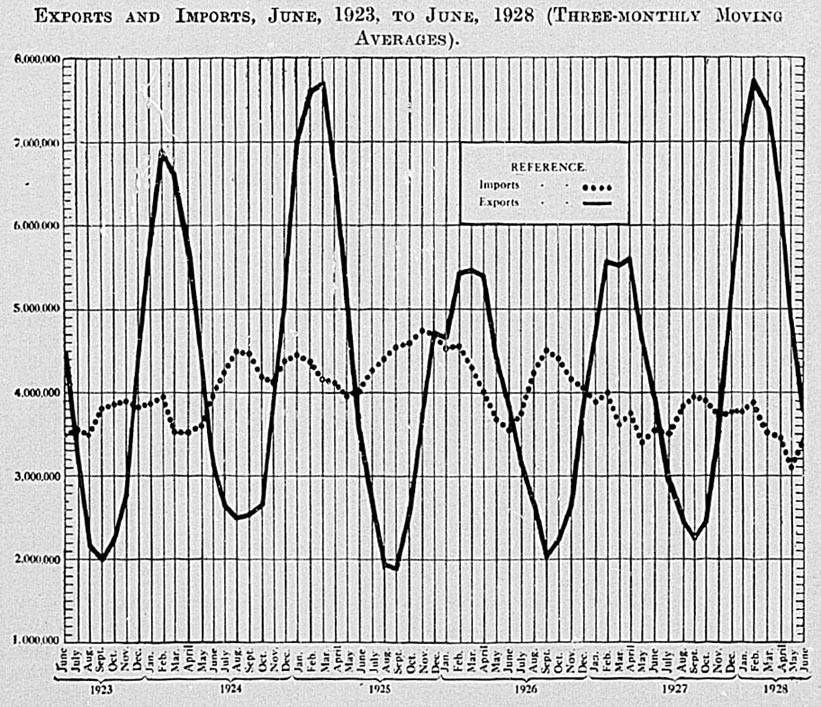
The dotted lino, representing imports, plainly shows the uniform nature of the trade; while what has been said in regard to the seasonable nature of exports is well brought out by the heavy lino with its annually recurring peak.
By reason of the seasonal nature of the production of the principal commodities exported from the Dominion, approximately two-thirds of the exports are made during the first six months of each year. Thus during 1926 and 1927, when the yearly exports amounted to £45,275,575 and £48,496,354, the figures for the first half-year in each case were £29,472,834 and £30,592,341, representing 65 per cent. and 63 per cent. respectively of the yearly figures.
A further illustration of the fluctuating nature of the export trade is evident from the wide range in the monthly figures, which, taking the figures in the preceding table, vary from £1,673,287 in October, 1926, to £7,842,822 in February, 1928.
The influx of imports is fairly constant throughout the whole year. In September, 1926, the unusually, high total of £5,135,319 was reached, while the lowest imports during the period were recorded in April, 1928; the figure being £2,697,541. In the three-monthly average the ranges in both imports and exports are. of course, not so groat.
The next table shows the total trade, imports, and exports per head of the population for each of the years 1908-27:—
| TOTAL TRADE, IMPORTS, AND EXPORTS PER HEAD, 1908-27. | |||||||||
|---|---|---|---|---|---|---|---|---|---|
| Year. | Total Trade. | Imports. | Exports. | ||||||
| .. | .. | s. | d. | £ | s. | d. | £ | s. | d. |
| 1908 | 34 | 0 | 9 | 17 | 12 | 0 | 16 | 8 | 9 |
| 1909 | 34 | 13 | 3 | 15 | 7 | 6 | 19 | 5 | 9 |
| 1910 | 37 | 14 | 1 | 16 | 7 | 9 | 21 | 6 | 4 |
| 1911 | 36 | 5 | 2 | 18 | 7 | 5 | 17 | 17 | 9 |
| 1912 | 39 | 5 | 3 | 19 | 5 | 4 | 19 | 19 | 11 |
| 1913 | 40 | 9 | 7 | 19 | 18 | 7 | 20 | 11 | 0 |
| 1914 | 42 | 4 | 1 | 19 | 3 | 5 | 23 | 0 | 8 |
| 1915 | 46 | 10 | 8 | 18 | 18 | 2 | 27 | 12 | 6 |
| 1916 | 51 | 17 | 9 | 22 | 18 | 5 | 28 | 19 | 4 |
| 1917 | 45 | 14 | 1 | 18 | 4 | 2 | 27 | 9 | 11 |
| 1918 | 45 | 15 | 2 | 21 | 0 | 5 | 24 | 14 | 9 |
| 1919 | 70 | 19 | 4 | 25 | 14 | 4 | 45 | 5 | 0 |
| 1920 | 86 | 19 | 2 | 49 | 11 | 7 | 37 | 7 | 7 |
| 1921 | 68 | 15 | 0 | 33 | 12 | 9 | 35 | 2 | 3 |
| 1922 | 59 | 11 | 3 | 26 | 16 | 6 | 32 | 14 | 9 |
| 1923 | 67 | 5 | 4 | 32 | 13 | 2 | 34 | 12 | 2 |
| 1924 | 74 | 15 | 4 | 35 | 17 | 6 | 38 | 17 | 10 |
| 1925 | 77 | 16 | 2 | 37 | 17 | 10 | 39 | 18 | 4 |
| 1926 | 67 | 6 | 4 | 35 | 5 | 10 | 32 | 0 | 6 |
| 1927 | 64 | 16 | 7 | 31 | 2 | 6 | 33 | 14 | l |
Within the last twenty years the total trade per head of the population has increased from £38 13s. Id. in 1907 to £64 16s. 7d. in 1927. During the twenty years the import rate has ranged from £15 7s. 6d. in 1909 to £4911s. 7d. in 1920. The export rate was at its highest in 1919, when £45 5s. was recorded, while 1908 claimed the lower limit of £16 8s. 9d. High rates were experienced in the “ sixties,” when, however, the population was comparatively small, while important gold-mining operations resulted in huge exports of gold and correspondingly high imports—factors which combined to give the earlier years of New Zealand's external trade a somewhat artificially high per capita rate.
The latest available comparative statistics show the Dominion's external trade per head to be greater than that of any other country. This position is due, on the one hand, to the fact that the country is able to raise huge quantities of primary produce greatly in excess of local requirements, and, on the other hand, to the comparatively backward stats of New Zealand's secondary industries, which necessitates the importation of considerable quantities of manufactured goods from abroad.
The diagram which follows shows graphically the total trade, imports, and exports per head of population during the last twenty years.
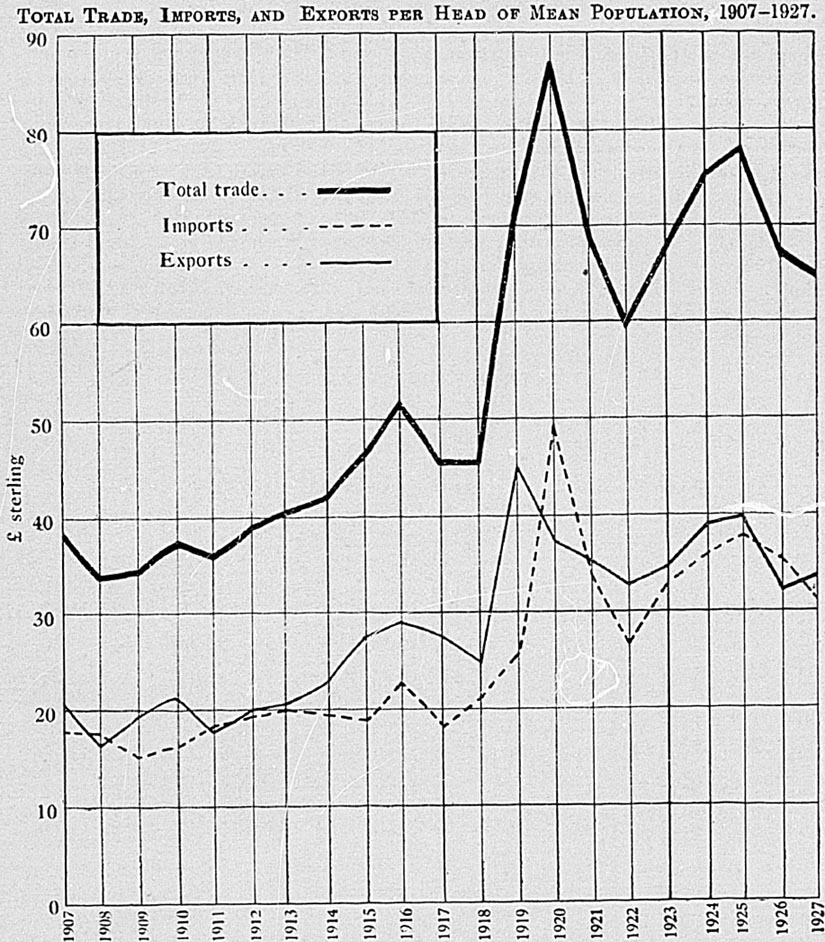
The most striking feature of the diagram is the sharp upward trend from 1918. The years 1919 and 1920, which represent the peak of the diagram, were distinctly abnormal, while the effect of higher prices has been to accentuate the upward movement. Reference to the next subsection will show that, in the case of exports at least, the great increase over the period is by no means wholly due to higher prices, there having been a definite advance in the actual volume of exports per head. The same state of affairs no doubt holds in the case of imports, the volume of which, however, cannot be accurately measured.
The relation between imports and exports is of the greatest importance to a young country like New Zealand. In the very earliest years of occupation by Europeans the exports of phormium, timber, and skins were greatly in excess of the few imports, mainly muskets and gunpowder, a fact which is explained partly by the temporary residence of the traders and more by the weaker bargaining-power of the Maori. With the settlement of the regular colony in 1840 there was evident an inflation of imports, occasioned by the amount of capital the new colonists brought in for the development of the country. From 1853 to 1870 there was an excess of imports, which, however, was tending to decrease.
A temporary excess of exports gave place in the early “seventies” to another great increase of imports, due to the borrowing policy inaugurated in that period. Except for a big decrease in 1880, the value of imports continued to be greater than exports until 1886. From that year onward there has been a continued excess of exports, except for the four years 1908, 1911, 1920, and 1926. The year 1886 is worthy of note as marking an outstanding period in the history of New Zealand's trade. A more or less fluctuating excess of imports had obtained prior to that time, but from 1886 the exports began to form a preponderating feature of the total trade.
The balance of trade is intimately bound up, in later years especially, with the large imports of capital which have been brought in to assist in the development of the country. This has already been made evident in discussing the balance of trade in early years. The excess of imports from 1853 to 1870, and again from 1872 to 1886, can definitely be traced to the importation of capital in those periods.
On that portion of the public debt held outside New Zealand at the 31st March, 1928, the annual interest charge aggregated £6,303,303, and there was a further annual charge of £386,224 in respect of repayment of funded debt to the Imperial Government. At the 31st March, 1927, local bodies' debts held outside the Dominion involved an annual interest charge of £968,100, the total payments outside the Dominion on the public and semi-public debt being thus over 7 1/2 millions.
Against this outgoing must be set the amount of new importations of capital in the shape of loans. While the expenditure on interest moves fairly consistently from year to year, the amount raised by new loans varies, and these variations are a big factor in the fluctuations of the balance of trade.
Debt charges and loan receipts are not the only invisible trade items. Money brought into the country by immigrants, expenditure by tourists and travellers, port receipts from overseas shipping, interest and dividends on New Zealand capital invested in Australia or the Pacific islands, and miscellaneous Government receipts from abroad are other items on the credit side; while on the debit side the following principal items, other than interest on Government and local-body loans, should be taken into account: Interest and dividends on overseas capital invested privately in the Dominion; shipping freights, charter-money, passage-money, &c., earned by overseas vessels for the carriage of New Zealand passengers and produce; expenditure abroad by New Zealand tourists and travellers; and miscellaneous Government expenditure abroad.
There is no Mint in New Zealand, while there is a fairly considerable production of gold bullion. Gold, therefore, ranks as an ordinary export of the Dominion, along with wool, frozen meat, and dairy-produce. In earlier days this export of gold was much more important than now, amounting in 1863 to 70 per cent. of the total exports, from which figure it shrank steadily to 6 per cent. in 1913. The proportion at the present time is only about 1. per cent.
The amount of gold bullion exported during the last ten years, with the principal destinations, is shown in the following table:—
| EXPORTS OF GOLD BULLION- FROM NEW ZEALAND, 1918-27. | |||||||
|---|---|---|---|---|---|---|---|
| Year. | To United Kingdom. | To Australia. | To India. | To United States. | To other Countries. | Total. | Percentage of Total Exports. |
| .. | £ | £ | £ | £ | £ | £ | £ |
| 1918 | 275 | 42,116 | .. | .. | .. | 42,391 | 0.15 |
| 1919 | 339,533 | 558,656 | 169,817 | 234,998 | 31,398 | 1,334,402 | 2.47 |
| 1920 | 103,353 | 12,167 | 23,884 | 718,899 | 25,445 | 883,748 | 1.90 |
| 1921 | 2,760 | 6,966 | .. | 602,308 | 134 | 612,168 | 1.36 |
| 1922 | 13,367 | 5,731 | 166,104 | 354,944 | 36 | 540,182 | 1.26 |
| 1923 | 890 | 37,715 | 332,238 | 327,740 | .. | 698,583 | 1.52 |
| 1924 | 3,189 | 2,278 | 323,921 | 222,400 | .. | 551,783 | 1.05 |
| 1925 | 1,735 | 383,338 | 47,301 | 39,895 | 95 | 472,364 | 0.85 |
| 1926 | 1,723 | 456,812 | 13,113 | 44,559 | .. | 516,207 | 114 |
| 1927 | 1,294 | 403,945 | 73,642 | 55,758 | .. | 534,639 | 1.10 |
A table is also given showing imports and exports of specie during the ten years 1918-27.
| VALUE OF SPECIE IMPORTED AND EXPORTED, 1918-27. | |||
|---|---|---|---|
| Year. | Imported. | Exported. | Excess of Specie Imports over Exports. |
| * Excess of exports. | |||
| .. | £ | £ | £ |
| 1918 | 102,216 | 35,610* | 66,605 |
| 1919 | 362,531 | 62,150 | 300,381 |
| 1920 | 41,975 | 36,580 | 5,395 |
| 1921 | 198,321 | 367 | 197,954 |
| 1922 | 186,487 | 300 | 186,187 |
| 1923 | 14,510 | 27,372 | -12,862* |
| 1924 | .. | 103,488 | - 103,488* |
| 1925 | 30,650 | 19,225 | 11,425 |
| 1926 | 77,800 | 6,651 | 71,149 |
| 1927 | 280 | .. | 280 |
It is customary to classify the trade of a country as “special” and “entrepôt,” according as to whether it represents the exchange of domestic productions for imports for home consumption, or a mere transit trade. In many countries, such as Belgium, France, and the United Kingdom, the transit trade attains considerable importance, but New Zealand, owing to her geographical position, is precluded from developing in that direction. Her imports, except for a small forwarding trade to the Pacific islands, are for her own consumption, and the great bulk of her exports are commodities of domestic production.
The following table, which excludes specie, shows for the last ten years the very small proportion which re-exports bear to the total trade of the Dominion:—
| PROPORTION OF RE-EXPORTS TO TOTAL TRADE (EXCLUDING SPECIE), 1918-27. | ||||||
|---|---|---|---|---|---|---|
| Year. | Trade. | Re-exports (Included in two preceding Columns). | Percentage of Re-exports | |||
| Imports. | Exports. | Total. | To Imports. | To Exports. | ||
| .. | £ | £ | £ | £ | .. | .. |
| 1918 | 24,131,792 | 28,480,578 | 52,612,370 | 543,568 | 2.25 | 1.91 |
| 1919 | 30,309,167 | 53,907,925 | 84,217,092 | 603,541 | 1.99 | 112 |
| 1920 | 61,553,853 | 46,405,366 | 107,959,219 | 813,072 | 1.32 | 1.75 |
| 1921 | 42,744,122 | 44,828,460 | 87,572,582 | 1,213,002 | 2.84 | 2.73 |
| 1922 | 34,826,074 | 42,725,949 | 77,552,023 | 1,026,801 | 2.94 | 2.40 |
| 1923 | 43,363,983 | 45,939,793 | 89,303,776 | 567,885 | 1.31 | 1.23 |
| 1924 | 48,527,603 | 52,509,223 | 101,036,826 | 588,395 | 1.21 | 1.12 |
| 1925 | 52,425,757 | 55,243,047 | 107,668,804 | 722,016 | 1.38 | 1.30 |
| 1926 | 49,811,763 | 45,268,924 | 95,080,687 | 929,741 | 1.86 | 2.05 |
| 1927 | 44,782,666 | 48,496,354 | 93,279,020 | 925,121 | 2.07 | 1.91 |
Before comparisons may properly be made with the trade of other countries care must be taken to ensure that the statistics are comparable in their methods of compilation and definition.
The value of imports into New Zealand is reckoned at the current domestic value in the country of export at the time of exportation, plus 10 per cent.; exports are valued f.o.b. In the United States and Canada, however, the values of imports also are calculated f.o.b., and the difference, representing freight, insurance, and charges, amounts to about 10 per cent. of the total value.
Again, in the United Kingdom the values of both imports and exports are obtained by assessment at current market prices in the United Kingdom.
A comparison of the “special” trade of various countries is shown in the table given below, the information being taken from the Commonwealth Official Year-book. Such a comparison (which covers in most cases the latest available year) necessarily ignores many of the elements considered above, but gives a sufficiently accurate idea of the relative trade of the various countries. The figures for Australia and the United States relate to the year ended 30th June, 1926.
| SPECIAL TRADE OF VARIOUS COUNTRIES. | |||||||||||||
|---|---|---|---|---|---|---|---|---|---|---|---|---|---|
| Country. | Year. | Trade.* | Trade per Head. | ||||||||||
| Imports. | Exports. | Total. | Imports. | Exports. | Total. | ||||||||
* In thousands of pounds. † Excluding bullion and specie. | |||||||||||||
| .. | .. | £ | £ | £ | £ | s. | d. | £ | s. | d. | £ | s. | d. |
| New Zealand | 1,927 | 43,858 | 47,571 | 91,429 | 30 | 9 | 8 | 33 | 1 | 3 | 63 | 10 | 11 |
| Australia | 1925-26 | 148,571 | 145,495 | 294,066 | 24 | 15 | 11 | 24 | 5 | 7 | 49 | 1 | 6 |
| Canada† | 1,926 | 205,420 | 250,737 | 456,157 | 21 | 18 | 9 | 26 | 15 | 6 | 48 | 14 | 3 |
| Denmark† | 1,923 | 78,526 | 63,343 | 141,869 | 23 | 17 | 6 | 19 | 5 | 2 | 43 | 2 | 8 |
| Switzerland† | 1,926 | 95,814 | 72,877 | 168,691 | 24 | 9 | 1 | 18 | 12 | 1 | 43 | 1 | 2 |
| Belgium | 1,924 | 186,443 | 145,949 | 332,392 | 23 | 17 | 5 | 18 | 13 | 8 | 42 | 11 | 1 |
| Netherlands | 1,923 | 173,061 | 112,435 | 285,496 | 23 | 19 | 10 | 15 | 11 | 9 | 39 | 11 | 7 |
| United Kingdom† | 1,926 | 1,117,298 | 651,893 | 1,769,191 | 24 | 14 | 2 | 14 | 8 | 4 | 39 | 2 | 6 |
| Argentina | 1,925 | 171,931 | 170,182 | 342,113 | 17 | 9 | 6 | 17 | 15 | 11 | 34 | 15 | 5 |
| Norway | 1,925 | 49,057 | 28,865 | 77,922 | 18 | 10 | 3 | 10 | 17 | 11 | 29 | 8 | 2 |
| Sweden† | 1,924 | 87,338 | 77,312 | 164,650 | 14 | 10 | 10 | 12 | 17 | 6 | 27 | 8 | 4 |
| France | 1,926 | 425,105 | 425,247 | 850,352 | 10 | 16 | 10 | 10 | 16 | 11 | 21 | 13 | 9 |
| South African Union | 1,925 | 65,839 | 82,990 | 148,829 | 8 | 17 | 9 | 11 | 4 | 1 | 20 | 1 | 10 |
| Germany† | 1,925 | 611,765 | 431,275 | 1,043,040 | 9 | 15 | 8 | 6 | 17 | 11 | 16 | 13 | 7 |
| United States† | 1925-26 | 914,167 | 957,512 | 1,871,679 | 7 | 19 | 11 | 8 | 7 | 6 | 16 | 7 | 5 |
| Italy | 1,925 | 206,412 | 139,523 | 339,935 | 5 | 1 | 1 | 3 | 10 | 4 | 8 | 11 | 5 |
| Japan† | 1,924 | 245,340 | 180,703 | 426,043 | 4 | 1 | 5 | 3 | 0 | 0 | 7 | 1 | 5 |
| Spain† | 1,923 | 97,283 | 50,611 | 147,894 | 4 | 9 | 5 | 2 | 6 | 6 | 6 | 15 | 11 |
In another respect, also, the figures are not strictly comparable, bullion and specie being included in some cases but not in others. In the case of New Zealand specie exported is a re-export, but bullion is a product of the country and ranks as an ordinary export.
New Zealand heads the list easily as regards both imports and exports per head, Australia and Canada coming next in order for total trade. The Netherlands, which formerly headed the list, now ranks only seventh.
By themselves statistics of foreign trade are not a sure test of a country's prosperity, and they must always be interpreted with a knowledge of local conditions. An increase of imports may not be the result of increased purchasing-power, but may merely represent loans from another country, or even a failure of the home supply of certain commodities. Similarly, increased exports may mean greater productivity and increased purchasing-power, but they may also denote the payments on greatly increased liabilities.
In all countries the home trade is greatly in excess of the external trade, and in larger countries, which are more self-contained, a decrease in foreign trade may be due to development within the country itself. But New Zealand is far from self- contained, and from her position must attach a great importance to external trade. Under present conditions, only by export can a sufficient market be obtained for her rich resources, and only from abroad can be obtained the manufactures which are needed for common use. The development of the external trade since 1895 has been accompanied by increasing prosperity, and every advance in exports, followed by larger imports, represents an increase in the wealth of the Dominion.
IN New Zealand the Department of H.M. Customs requires for every package exported a declared statement of the contents, value, and destination.
In all cases exports are valued “free on board at the port of shipment.” In many cases, however, the goods are not sold till arrival at their destination, and in such cases values must be assessed in New Zealand with reference to current prices.
The exports of New Zealand produce are shown separately from re-exports of imported goods.
The ultimate destination of the goods is distinguished as far as is practicable, but it is impossible to discover what proportion of the exports is intended for home consumption in the country of destination.
The table on the next page gives a summary of the main exports from New Zealand during the last twenty years. The main commodities are shown separately, and the progress of the Dominion during the last two decades is strikingly illustrated.
The main feature of the table is the prominence given to the primary products of the soil. The extractive industries of New Zealand have always supplied the overwhelming bulk of the exports, and, though the proportion of the different classes has varied from time to time, there has never been any considerable or even noticeable export of manufactured goods.
Until 1914 the statistical tables included a heading “Manufactures,” which showed a considerable total value in each year, reaching £987,072 in 1913. Included in this group, however, was phormium, the value of which (excluding tow) was in 1913 £721,924; and though the phormium is stripped and prepared in New Zealand it leaves the Dominion as a raw fibre, which can hardly be termed a “manufacture.” There are some genuine manufactures exported, such as ale and beer, cordage, twine, soap, and woollens, but their value is insignificant compared with the primary products.
All the items of pastoral products considered show great increases over the twenty years, and the total exports have more than doubled during the period. There was a slight fall in 1904, and two more serious decreases were recorded in 1908 and 1911. From that year progress was rapid, and a sharp rise brought the 1919 total to over £48,000,000, a figure which remained a record until it was superseded in 1924, and again in 1925, when over £55,000,000 was recorded. Lower prices were responsible for smaller totals in subsequent years.
In the last twenty years the proportions of the principal exports have changed a good deal. Wool, which reached its maximum percentage (47.9) in 1897, showed a tendency to decline till 1902, then partially regained its position, once more showing a marked tall in 1918, owing to a considerable portion of the clip being retained in the Dominion until the next year, when wool to the value of £19,559,537 was exported. The wool exported during the year 1927 was valued at £12,961,744, an increase of over £1,000,000 compared with the 1926 figure. The total exports of wool during the five years 1923-27 aggregated nearly 69 millions sterling.
Frozen meat in recent years has supplied approximately 20 per cent. of the total exports, a proportion considerably exceeded in 1921, when wool-prices declined to very low figure.
| EXPORTS OF PRINCIPAL ITEMS OF NEW ZEALAND PRODUCE, 1908-27. | |||||||
|---|---|---|---|---|---|---|---|
| Year. | Wool. | Frozen Meat. | Butter. | Cheese. | Tallow. | Skins, Hides, and Pelts. | Other Pastoral Produce. |
| .. | £ | £ | £ | £ | £ | £ | £ |
| 1908 | 5,332,781 | 3,188,515 | 1,171,182 | 783,419 | 481,335 | 767,692 | 231,142 |
| 1909 | 6,305,888 | 3,601,093 | 1,639,380 | 1,105,390 | 648,452 | 1,018,103 | 316,959 |
| 1910 | 8,308,410 | 3,850,777 | 1,811,975 | 1,195,373 | 756,841 | 1,129,041 | 468,298 |
| 1911 | 6,491,707 | 3,503,406 | 1,576,917 | 1,192,057 | 607,257 | 911,519 | 467,695 |
| 1912 | 7,105,483 | 3,909,569 | 2,088,809 | 1,680,393 | 684,739 | 1,091,871 | 370,616 |
| 1913 | 8,057,620 | 4,449,933 | 2,061,651 | 1,770,297 | 663,088 | 1,199,375 | 317,181 |
| 1914 | 9,318,114 | 5,863,062 | 2,338,576 | 2,564,125 | 694,348 | 1,317,593 | 433,331 |
| 1915 | 10,387,875 | 7,794,395 | 2,700,625 | 2,730,211 | 780,828 | 1,450,276 | 690,398 |
| 1916 | 12,386,074 | 7,271,318 | 2,632,293 | 3,514,310 | 785,339 | 1,667,679 | 637,409 |
| 1917 | 12,175,366 | 5,982,404 | 2,031,551 | 3,949,251 | 553,016 | 1,861,817 | 776,194 |
| 1918 | 7,527,266 | 4,957,576 | 3,402,223 | 4,087,278 | 847,618 | 2,645,864 | 1,170,011 |
| 1919 | 19,559,537 | 9,628,292 | 3,080,128 | 7,790,990 | 2,680,006 | 3,439,468 | 2,432,819 |
| 1920 | 11,863,827 | 11,673,696 | 3,022,335 | 6,160,840 | 1,748,773 | 5,032,242 | 2,058,463 |
| 1921 | 5,221,479 | 11,164,345 | 11,169,530 | 8,199,183 | 867,298 | 1,995,518 | 2,081,514 |
| 1922 | 11,882,463 | 8,387,461 | 9,041,554 | 4,686,850 | 750,574 | 2,053,761 | 1,380,130 |
| 1923 | 10,904,658 | 9,012,627 | 10,689,200 | 6,870,397 | 785,668 | 2,379,536 | 1,486,209 |
| 1924 | 15,267,544 | 9,499,877 | 11,641,668 | 7,023,297 | 799,230 | 3,144,106 | 1,569,106 |
| 1925 | 17,739,736 | 11,174,567 | 10,240,132 | 5,800,808 | 895,061 | 3,861,215 | 1,658,960 |
| 1926 | 11,830,190 | 8,656,213 | 8,695,188 | 5,939,359 | 741,045 | 3,203,831 | 1,682,260 |
| 1927 | 12,961,744 | 9,104,621 | 10,915,233 | 5,582,546 | 714,441 | 3,242,370 | 1,686,082 |
| Year. | Wheat. | Oats. | Other Agricultural Produce. | Gold. | Coal. | Kauri- gum. | Phormium Fibre and Tow. | Timber. |
|---|---|---|---|---|---|---|---|---|
| .. | £ | £ | £ | £ | £ | £ | £ | £ |
| 1908 | 344 | 108,997 | 156,389 | 2,004,799 | 85,846 | 372,798 | 420,520 | 375,235 |
| 1909 | 305,902 | 453,314 | 216,954 | 2,006,900 | 183,961 | 552,698 | 324,458 | 337,740 |
| 1910 | 216,657 | 44,299 | 220,566 | 1,896,318 | 259,562 | 465,044 | 480,519 | 407,658 |
| 1911 | 219,196 | 9,211 | 184,408 | 1,815,251 | 204,379 | 395,707 | 325,130 | 439,353 |
| 1912 | 95,702 | 483,756 | 481,147 | 1,345,131 | 216,170 | 401,305 | 407,903 | 490,508 |
| 1913 | 11,816 | 29,252 | 238,908 | 1,459,499 | 205,010 | 549,106 | 797,062 | 319,055 |
| 1914 | 3,580 | 165,930 | 278,894 | 895,367 | 282,163 | 497,444 | 492,230 | 422,864 |
| 1915 | 128 | 132,827 | 541,318 | 1,694,553 | 329,731 | 279,133 | 610,059 | 383,883 |
| 1916 | 17,835 | 30,200 | 135,680 | 1,199,212 | 326,553 | 339,882 | 1,078,632 | 381,488 |
| 1917 | 509 | 1,306 | 178,087 | 903,888 | 236,063 | 291,917 | 1,232,608 | 408,121 |
| 1918 | 460 | 872 | 194,422 | 42,391 | 227,228 | 157,313 | 1,408,147 | 556,309 |
| 1919 | 679 | 33,671 | 753,837 | 1,334,405 | 201,383 | 255,812 | 907,584 | 439,935 |
| 1920 | 388 | 52,502 | 477,166 | 883,748 | 128,509 | 556,756 | 688,972 | 697,608 |
| 1921 | 243 | 84,434 | 405,417 | 612,168 | 109,510 | 367,197 | 319,604 | 503,785 |
| 1922 | 316,528 | 91,991 | 560,425 | 540,182 | 253,762 | 563,270 | 295,530 | 479,447 |
| 1923 | 968 | 78,775 | 488,613 | 698,583 | 173,833 | 596,222 | 314,324 | 473,752 |
| 1924 | 406 | 1,104 | 429,815 | 551,788 | 161,432 | 443,576 | 424,726 | 472,120 |
| 1925 | 299 | 1,877 | 465,721 | 472,364 | 235,047 | 414,901 | 575,311 | 573,882 |
| 1926 | 343 | 5,558 | 896,263 | 516,207 | 285,909 | 332,765 | 589,603 | 475,627 |
| 1927 | 301 | 110,978 | 776,614 | 534,639 | 221,253 | 278,632 | 535,526 | 425,453 |
The main feature of the period has been the great advance, relatively and absolutely, of butter and cheese, the export of which has increased beyond all expectations—viz., from £2,277,700 in 1907 to £16,497,779 in 1927. The increase is due partly to higher prices ruling, but mainly to greater quantities being sent abroad. Whereas in 1907 the total exports of butter and cheese from New Zealand reached only 565,274 cwt., the total quantity shipped in 1927 aggregated 2,948,331 cwt. Other classes of pastoral produce have also increased to several times their total for 1907, and timber shows a substantial increase. The value of coal and phormium, however, has shown a tendency to decrease. In the case of gold, the value in 1927 was considerably less than in 1907, the figures showing over the twenty years a decline from £2,027,490 to £534,639. Agricultural produce shows a fluctuating export, with a tendency to decrease, the comparatively largo amount for 1926 and 1927 being due to increases in apples, potatoes, and seeds, and in 1927 oats and peas.
The relative importance of the main commodities is shown in the diagram given below.
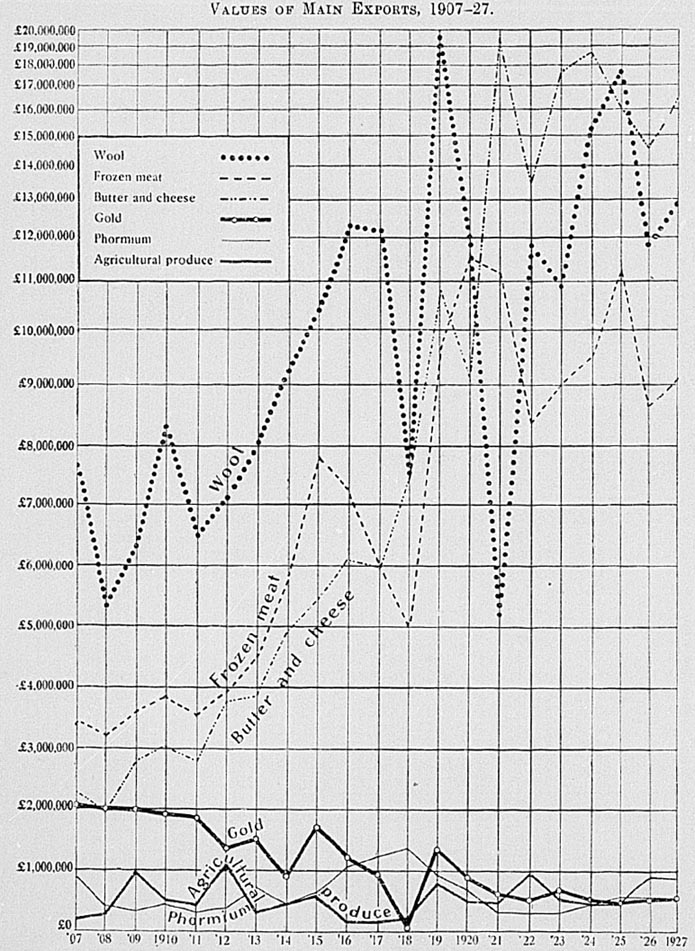
In the following table the exports are classified under the main industries, according to a broad division, to illustrate the relative importance of the pastoral, agricultural, mining, forestry, and other industries as far as the export trade is concerned. It must be remembered that in a particular industry the home trade may be relatively more important than the external trade.
| PROPORTIONS OF EXPORTS SUPPLIED by THE MAIN INDUSTRIES, 1908-27. | ||||||||||
|---|---|---|---|---|---|---|---|---|---|---|
| Year. | Exports. | Percentage of Total Exports. | ||||||||
| Pastoral. | Mining. | Agricultural. | Forest. | Other. | Pastoral. | Mining. | Agricultural. | Forest. | Other. | |
| .. | £ | £ | £ | £ | £ | Per Cent. | Per Cent. | Per Cent. | Per Cent. | Per Cent. |
| 1908 | 11,956,066 | 2,279,520 | 265,730 | 758,115 | 1,058,063 | 73.3 | 14.0 | 1.6 | 4.6 | 6.6 |
| 1909 | 14,635,265 | 2,378,775 | 976,170 | 905,930 | 765,856 | 74.4 | 12.1 | 5.0 | 4.6 | 3.9 |
| 1910 | 17,520,715 | 2,344,348 | 481,522 | 889,603 | 944,021 | 79.0 | 10.6 | 2.2 | 4.0 | 4.2 |
| 1911 | 14,750,558 | 2,165,137 | 412,815 | 843,310 | 856,670 | 77.5 | 11.4 | 2.2 | 4.4 | 4.5 |
| 1912 | 16,931,480 | 1,660,280 | 1,060,605 | 900,671 | 1,217,545 | 77.8 | 7.6 | 4.9 | 4.1 | 5.6 |
| 1913 | 18,519,115 | 1,791,777 | 279,976 | 874,110 | 1,521,714 | 80.6 | 7.8 | 1.2 | 3.8 | 6.6 |
| 1914 | 22,529,149 | 1,263,553 | 448,404 | 927,482 | 1,092,859 | 85.8 | 4.8 | 1.7 | 3.5 | 4.2 |
| 1915 | 26,534,608 | 2,149,217 | 674,273 | 674,533 | 1,716,281 | 83.6 | 6.8 | 2.1 | 21 | 5.4 |
| 1916 | 28,894,422 | 1,661,650 | 183,797 | 734,034 | 1,502,004 | 87.6 | 5.0 | 0.6 | 2.2 | 4.6 |
| 1917 | 27,329,599 | 1,274,222 | 179,902 | 711,188 | 1,593,046 | 87.9 | 4.1 | 0.6 | 2.3 | 5.1 |
| 1918 | 24,638,531 | 479,017 | 196,291 | 719,538 | 1,903,633 | 88.2 | 1.7 | 0.7 | 2.6 | 6.8 |
| 1919 | 48,611,240 | 1,668,314 | 788,187 | 698,819 | 1,537,794 | 91.2 | 3.1 | 1.5 | 1.3 | 2.9 |
| 1920 | 41,560,176 | 1,103,344 | 530,056 | 1,262,894 | 1,135,824 | 91.1 | 2.4 | 1.2 | 2.8 | 2.5 |
| 1921 | 40,698,867 | 787,591 | 490,094 | 884,279 | 754,627 | 93.3 | 1.9 | 11 | 2.0 | 1.7 |
| 1922 | 38,182,793 | 850,469 | 968,944 | 1,066,054 | 630,888 | 91.6 | 20 | 2.3 | 2.6 | 1.5 |
| 1923 | 42,128,295 | 937,238 | 568,356 | 1,080,326 | 657,693 | 92.9 | 2.1 | 1.3 | 2.4 | 1.3 |
| 1924 | 48,944,828 | 787,664 | 431,325 | 937,178 | 819,833 | 94.2 | 1.5 | 0.9 | 1.8 | 1.6 |
| 1925 | 51,370,479 | 770,439 | 467,897 | 1,000,453 | 911,763 | 94.2 | 1.4 | 0.9 | 1.8 | 1.7 |
| 1926 | 40,763,348 | 854,995 | 902,164 | 820,947 | 997,729 | 91.9 | 1.9 | 2.0 | 1.9 | 2.3 |
| 1927 | 44,207,037 | 804,834 | 887,893 | 725,047 | 946,422 | 92.9 | 1.7 | 1.9 | 1.5 | 2.0 |
The table indicates a tendency for the Dominion to rely more and more upon the pastoral industry for her main exports. The four main products of that industry—wool, frozen meat, butter, and cheese—provide an ever-increasing proportion of the total quantity of goods shipped overseas. On the other hand, the proportion of minerals has tended to fall, mainly through decreasing exports of gold, and agricultural exports fluctuate with a downward tendency. It would seem that New Zealand is restricting her agriculture to a level barely sufficient, to provide for her own needs in the matter of cereals, and only in exceptional years is there a surplus available for export.
The diagram given on the next page shows clearly the relative importance of the main classes of exports in the external trade. The most noticeable feature is the extremely high proportion of the exports supplied by the pastoral industries. The percentage supplied by this group was high in the late “nineties,” but in the early years of the present century fell relatively, owing mainly to increased exports of agricultural and mining produce. Since 1901, however, the percentage has increased almost continuously, till in 1924 and 1925 it amounted to over 94 per cent. of the total, the highest percentage ever recorded. Lower wool-prices, and to a lesser extent reduced returns from moat and (in 1926) dairy-produce, were responsible for the lower figures shown in 1926 and 1927.
Mining products, which have fallen by nearly two-thirds in total value over the twenty years, show a much greater decrease as a percentage of total exports.
Agricultural exports showed an abnormal increase from 1899 to 1903, the period which covers the South African War, but since then their importance has steadily declined. Their lowest level (0.6 per cent, of total exports) was reached in 1916 and 1917. The rise in the percentages for 1926 and 1927 was due to large shipments of apples to the United Kingdom and of potatoes to Australia, with a substantial increase in the exports of grass and clover seeds, and in 1927 of oats and peas. Forest products, though steady, show a relative downward tendency, and therefore the strip representing them tapers towards the later years.
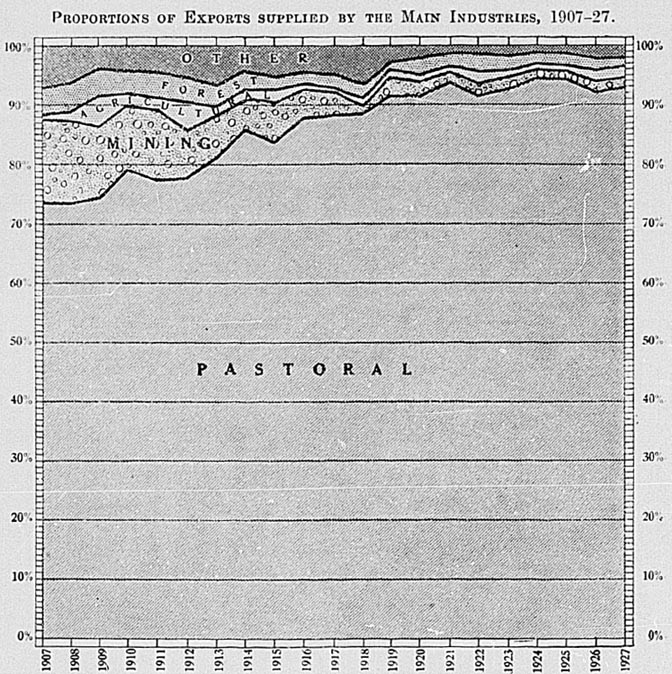
The next table compares the exports of twelve principal items during 1926 and 1927. Considerable increases are evident in butter, wool, and frozen meat, while lesser advances were recorded in skins, etc., gold, and milk. Six of the items show declines, the most notable being in cheese.
| INCREASES OR DECREASES IN THE MAIN EXPORTS IN 1927. | ||||||
|---|---|---|---|---|---|---|
| Commodity. | Value. | Amount of | Percentage. | |||
| 1926. | 1927. | Increase. | Decrease. | Increase. | Decrease. | |
| .. | £ | £ | £ | £ | .. | .. |
| Wool | 11,830,190 | 12,961,744 | 1,131,554 | .. | 9.57 | .. |
| Frozen meat | 8,656,213 | 9,104,621 | 448,408 | .. | 5.18 | .. |
| Butter | 8,695,188 | 10,915,233 | 2,220,045 | .. | 25.41 | .. |
| Cheese | 5,939,359 | 5,582,546 | .. | 356,813 | .. | 6.00 |
| Preserved milk | 345,072 | 346,271 | 1,199 | .. | 0.35 | .. |
| Tallow | 741,045 | 714,441 | .. | 26,604 | .. | 3.59 |
| Skins, hides, and pelts | 3,203,831 | 3,242,370 | 38,539 | .. | 1.20 | .. |
| Gold | 516,207 | 534,639 | 18,432 | .. | 3.57 | .. |
| Coal | 285,909 | 221,253 | .. | 64,656 | .. | 22.62 |
| Kauri-gum | 332,765 | 278,632 | .. | 54,133 | .. | 16.27 |
| Phormium | 589,603 | 535,526 | .. | 54,077 | .. | 9.17 |
| Timber | 475,627 | 425,453 | .. | 50,174 | .. | 10.55 |
In the following table exports during 1927 are grouped in classes in accordance with the statistical classification adopted for both exports and imports in 1914:—
| Exports BY STATISTICAL CLASSES, 1927. | |||
|---|---|---|---|
| No. | Class. | Domestic Produce. | Re- exports. |
| .. | .. | £ | £ |
| I | Foodstuffs of animal origin (excluding live animals) | 27,223,164 | 5,964 |
| II | Foodstuffs of vegetable origin, and common salt | 647,000 | 11,462 |
| III | Beverages (non-alcoholic), and substances used in making up the same | 571 | 7,432 |
| IV | Spirits and alcoholic liquors | 5,882 | 6,848 |
| V | Tobacco and preparations thereof | 114 | 12,625 |
| VI | Live animals | 122,340 | 2,350 |
| VII | Animal substances (mainly unmanufactured), not being foodstuffs | 16,212,387 | .. |
| VIII | Vegetable substances and non-manufactured fibres | 826,684 | 4,107 |
| IXA | Apparel | 3,831 | 44,352 |
| IXB | Textiles | 18,668 | 67,513 |
| IXC | Manufactured fibres | 5,731 | 19,578 |
| X | Oils, fats, and waxes | 743,430 | 232,114 |
| XI | Paints and varnishes | 476 | 10,453 |
| XII | Stones and minerals used industrially | 506,967 | 8,206 |
| XIII | Specie | .. | .. |
| XIVA | Metal (unmanufactured and partly manufactured) and ores | 604,248 | 17,844 |
| XIVB | Metal manufactures other than machinery and machines | 8,615 | 40,951 |
| XV | Machinery and machines | 16,941 | 85,286 |
| XVIA | Indiarubber and manufactures thereof (not including tires) | .. | 522 |
| XVIB | Leather and manufactures thereof, including substitutes | 15,616 | 10,917 |
| XVIIA | Timber | 425,453 | 475 |
| XVIIB | Wood, cane, and wicker manufactures | 4,656 | 2,474 |
| XVIII | Earthenware, china, glass, stoneware, cement, and cement materials | 3,666 | 4,737 |
| XIXA | Paper | 37 | 2,730 |
| XIXB | Stationery | 12,814 | 27,320 |
| XX | Jewellery, timepieces, and fancy goods | 344 | 58,237 |
| XXI | Optical, surgical, and scientific instruments | 5,018 | 52,570 |
| XXIIA | Drugs, chemicals, and druggists' wares | 17,-155 | 7,375 |
| XXIIB | Manures | 22,801 | 91 |
| XXIIIA | Vehicles | 396 | 68,092 |
| XXIIIB | Miscellaneous | 27,278 | 112,496 |
| .. | Parcels-post | 88,650 | .. |
| .. | Totals | 47,571,233 | 925,121 |
It will be seen that the great bulk of the exports fall into two classes—I, which includes butter, cheese, and frozen meat; and VII, which includes wool, hides, skins, and pelts. Mineral products come under XII and XIVA, and timber under XVIIA; tallow is the main item in X; phormium and seeds in VIII; while the main agricultural products are included in II. The re-exports are spread mainly over various manufactured items.
The principal items of export may conveniently be grouped under six definite heads, as in the table on the next page.
Practically all the main commodities are homogeneous articles, and it is therefore possible to give the quantities exported. For some purposes, especially for comparisons between recent and more remote years, quantities are preferable to values, since the latter contain the variable element of price.
| QUANTITIES OF THE PRINCIPAL COMMODITIES OF NEW ZEALAND PRODUCE EXPORTED, 1923-27. | ||||||
|---|---|---|---|---|---|---|
| Commodity. | 1923. | 1924. | 1925. | 1926. | 1927. | |
| The mine— | ||||||
| Coal | (tons) | 95,636 | 88,981 | 133,083 | 183,008 | 143,440 |
| Gold | (oz.) | 169,512 | 133,631 | 114,696 | 125,777 | 130,171 |
| Iron and steel (pig) | (cwt.) | .. | .. | .. | .. | 22,200 |
| Silver | (oz.) | 514,655 | 578,217 | 495,268 | 425,287 | 427,358 |
| Other minerals | (tons) | 79 | 67 | 31 | 42 | 65 |
| The fisheries— | ||||||
| Fish | (cwt.) | 20,080 | 19,059 | 15,932 | 18,742 | 22,566 |
| Oysters | (doz.) | 71,680 | 52,283 | 149,821 | 145,660 | 51,826 |
| Whalebone | (lb.) | 896 | 2,128 | 896 | 560 | 560 |
| Whale-oil | (gal.) | 55,673 | 59,479 | 96,158 | 65,870 | 71,437 |
| Ambergris | (oz.) | 3 | 688 | 411 | .. | .. |
| The forest— | ||||||
| Fungus | (cwt.) | 1,934 | 1,706 | 1,860 | 1,749 | 2,814 |
| Kauri-gum | (tons) | 6,598 | 5,261 | 5,370 | 4,877 | 4, 674 |
| Timber, sawn and hewn | (sup. ft.) | 47,568,490 | 42,928,726 | 49,204,676 | 40,465,221 | 37,147,798 |
| Pastoral products— | ||||||
| Bacon and hams | (cwt.) | 3,284 | 4,464 | 4,187 | 4,983 | 5,423 |
| Beef and pork, salted | “ | 12,739 | 11,931 | 7,510 | 4,653 | 5,170 |
| Butter | “ | 1,250,140 | 1,269,455 | 1,215,324 | 1,168,040 | 1,455,539 |
| Casein, | “ | 50,288 | 46,210 | 43,908 | 36,460 | 46,763 |
| Cheese., | “ | 1,441,460 | 1,594,486 | 1,376,754 | 1,461,548 | 1,492,792 |
| Hides and skins | (number) | 1,053,089 | 1,303,282 | 1,376,273 | 1,386,536 | 1,368,238 |
| Honey | (lb.) | 972,038 | 1,186, 269 | 1,822,043 | 1,211,396 | 850,011 |
| Live-stock— | ||||||
| Cattle | (number) | 4,566 | 322 | 186 | 122 | 96 |
| Horses | “ | 206 | 152 | 223 | 199 | 230 |
| Sheep | “ | 3,799 | 3,197 | 3,895 | 5,456 | 8,385 |
| Pigs | “ | 410 | 664 | 314 | 295 | 433 |
| Preserved meats | (cwt.) | 42,285 | 66,340 | 65,779 | 67,401 | 58,786 |
| Frozen meats, | “ | 3,043,910 | 3,213,574 | 3,414,205 | 3,031,356 | 3,364,965 |
| Sausage-casings., | “ | 21,549 | 24,003 | 28,128 | 31,432 | 30,762 |
| Rabbit-skins | (number) | 14,233,417 | 20,444,390 | 19,708,586 | 17,135,599 | 12,928,669 |
| Sheep skins and pelts. | “ | 8,246,800 | 8,825,000 | 8,695,312 | 9,231,893 | 9,918,453 |
| Tallow | (cwt.) | 504,800 | 479,766 | 500,760 | 422,560 | 477,500 |
| Wool | (lb.) | 217,500,091 | 206,189,911 | 205,726,856 | 213,154,399 | 220,500,720 |
| Agricultural products— | ||||||
| Bran and sharps | (tons) | 1,308 | 73 | 39 | 87 | 051 |
| Chart | “ | 49 | 51 | 26 | 26 | 892 |
| Flour | “ | 10 | 10 | 11 | 22 | 2 |
| Grain and pulse— | ||||||
| barley | (centals) | 3,730 | 96 | 74 | 1,146 | 48,688 |
| Beans and peas, | “ | 202,187 | 113,405 | 129,325 | 110,511 | 162,929 |
| Oats. | “ | 191,259 | 2,004 | 3,296 | 9,219 | 266,621 |
| Wheat | “ | 2,087 | 661 | 407 | 465 | 472 |
| Hops | (cwt.) | 2,515 | 5,916 | 3,031 | 3,512 | 4,729 |
| Oatmeal | (tons) | 32 | 40 | 69 | 108 | 104 |
| Potatoes, | “ | 787 | 539 | 4,943 | 21,526 | 934 |
| Seeds (grass and clover) | (cwt.) | 47,031 | 36,311 | 45,368 | 57,726 | 90,362 |
| Miscellaneous— | ||||||
| Ale and beer | (gal.) | 14,221 | 17,231 | 16,103 | 16,048 | 13,633 |
| Cordage | (cwt.) | 5,942 | 3,172 | 3,307 | 2,563 | 2,214 |
| Leather. | “ | 2,639 | 859 | 692 | 1,283 | 2,028 |
| Phormium fibre and tow | (tons) | 12,306 | 15,178 | 19,923 | 20,798 | 19,600 |
The values of those principal exports are tabulated in the following table, and the statement is rendered complete by the addition of miscellaneous groups and the provision of totals for each group and for all combined:—
| VALUES OF PRINCIPAL COMMODITIES OF NEW ZEALAND PRODUCE EXPORTED, 1923-27. | |||||
|---|---|---|---|---|---|
| Commodity. | 1923. | 1924. | 1925. | 1926. | 1927. |
| The mine- | £ | £ | £ | £ | £ |
| Coal | 173,833 | 161,432 | 235,047 | 285,909 | 221,253 |
| Gold | 698,583 | 551,788 | 472,364 | 516,207 | 534,639 |
| Iron and steel (pig) | .. | .. | .. | .. | 4,592 |
| Silver | 62,851 | 71,981 | 60,773 | 51,236 | 42,593 |
| Other minerals | 1,971 | 2,463 | 2,255 | 1,643 | 1,757 |
| Totals | 937,238 | 787,664 | 770,439 | 854,995 | 804,834 |
| The fisheries— | £ | £ | £ | £ | £ |
| Fish | 69,328 | 58,417 | 55,423 | 63,009 | 74,174 |
| Oysters | 762 | 571 | 1,474 | 1,650 | 561 |
| Whalebone | 425 | 290 | 160 | 9 | 190 |
| Whale-oil | 6,072 | 6,515 | 10,541 | 6,836 | 7,009 |
| Ambergris | 75 | 2,000 | 1,200 | .. | .. |
| Other | 80 | 103 | 39 | 64 | .. |
| Totals | 76,751 | 67,896 | 68,837 | 71,568 | 81,934 |
| The forest- | |||||
| Fungus | 9,202 | 9,165 | 10,547 | 11,246 | 20,310 |
| Kauri-gum | 596,222 | 443,576 | 414,901 | 332,765 | 278,632 |
| Timber | 473,752 | 472,120 | 573,882 | 175,627 | 425,453 |
| Other | 1,150 | 12,317 | 1,123 | 1,309 | 652 |
| Totals | 1,080,326 | 937,178 | 1,000,453 | 820,947 | 725,047 |
| Pastoral products— | |||||
| Bacon and hams | 17,367 | 26,505 | 25,398 | 31,706 | 29,025 |
| Beef and pork, salted | 19,393 | 20,599 | 14,314 | 9,452 | 10,548 |
| Butter | 10,689,200 | 11,641,668 | 10,240,132 | 8,695,188 | 10,915,233 |
| Casein | 182,112 | 129,775 | 110,171 | 106,251 | 141,388 |
| Cheese | 6,870,397 | 7,023,297 | 5,800,808 | 5,939,359 | 5,582,546 |
| Hides and skins | 785,350 | 889,654 | 1,028,510 | 830,393 | 1,008,900 |
| Honey | 25,588 | 29,721 | 53,156 | 35,432 | 25,170 |
| Live-stock — | |||||
| Cattle | 61,445 | 14,381 | 6,783 | 8,013 | 6,029 |
| Horses | 37,253 | 44,695 | 66,428 | 68,045 | 55,055 |
| Sheep | 12,888 | 25,900 | 33,465 | 35,078 | 58,644 |
| Pigs | 1,309 | 2,983 | 1,455 | 1,410 | 1,507 |
| Other | 922 | 1,128 | 715 | 2,981 | 1,106 |
| Preserved milk and cream | 513,495 | 303,917 | 425,738 | 345,072 | 346,271 |
| Preserved meats | 160,124 | 191,236 | 219,151 | 227,003 | 212,262 |
| Frozen meats | 9,012,627 | 9,499,877 | 11,174,567 | 8,656,213 | 9,104,621 |
| Sausage-casings | 424,387 | 563,887 | 675,848 | 780,811 | 755,523 |
| Rabbit-skins | 472,401 | 740,975 | 843,416 | 829,165 | 682,658 |
| Sheep skins and pelts | 1,121,695 | 1,513,477 | 1,980,289 | 1,544,273 | 1,550,812 |
| Tallow | 785,668 | 799,230 | 895,001 | 741,045 | 714,441 |
| Wool | 10,904,658 | 15,267,544 | 17,739,736 | 11,830,190 | 12,961,744 |
| Other | 29,926 | 214,379 | 26,338 | 46,208 | 43,554 |
| Totals | 42,128,295 | 48,944,828 | 51,370,479 | 40,763,348 | 44,207,037 |
| Agricultural products— | |||||
| Bran and sharps | 8,654 | 657 | 459 | 1,070 | 3,790 |
| Chaff | 607 | 521 | 309 | 325 | 4,842 |
| Flour | 235 | 204 | 267 | 491 | 49 |
| Fruits | 74,531 | 122,824 | 120,636 | 369,706 | 273,110 |
| Grain and pulse— | |||||
| Barley | 1,706 | 63 | 59 | 769 | 24,772 |
| Beans and peas | 159,018 | 85,329 | 102,611 | 99,863 | 151,711 |
| Oats | 78,775 | 1,104 | 1,877 | 5,558 | 110,978 |
| Wheat | 968 | 406 | 299 | 343 | 301 |
| Other | 814 | 268 | 96 | 623 | 92 |
| Hops | 17,699 | 41,619 | 20,153 | 16,851 | 27,774 |
| Oatmeal.: | 1,306 | 1,622 | 3,140 | 4,320 | 5,042 |
| Onions | 4,923 | 1, 233 | 8,594 | 12,592 | 3,133 |
| Potatoes | 7,497 | 5,147 | 39,948 | 164,362 | 7,410 |
| Seeds (grass and clover) | 175,754 | 149,083 | 151,164 | 200,380 | 255,798 |
| Seeds (various) | 31,002 | 17,830 | 12,596 | 14,017 | 12,599 |
| Other | 4,867 | 3,415 | 5,699 | 10,884 | 6,492 |
| Totals | 568,356 | 431,325 | 467,897 | 902,164 | 887,893 |
| Miscellaneous (Including manufactures)— | |||||
| Ale and beer | 3,783 | 5,855 | 5,105 | 4,294 | 5,869 |
| Apparel | 2,913 | 2,291 | 1,924 | 2,231 | 2,160 |
| Cement | 1,871 | 1,051 | 264 | 156 | 2,978 |
| Cordage and rope | 3,086 | 10,191 | 10,088 | 5,998 | 5,701 |
| Leather | 19,600 | 6,702 | 4,883 | 10,624 | 11,532 |
| Phormium fibre and tow | 314,324 | 424,726 | 575,311 | 589,603 | 535,526 |
| Soap | 11,720 | 10,939 | 8,317 | 9,446 | 8,947 |
| Sugar | 10,042 | 12,476 | 9,548 | 14,286 | 13,359 |
| Twine | 16,422 | 7,006 | 6,580 | 1,800 | 2,150 |
| Woollen manufactures | 10,132 | 15,537 | 3,815 | 10,455 | 12,936 |
| Other | 187,200 | 257,163 | 218,291 | 277,262 | 263,330 |
| Totals | 581,096 | 753,937 | 844,126 | 926,161 | 864,488 |
| Total exports (domestic produce) | 45,371,908 | 51,920,828 | 54,521,031 | 44,339,183 | 47,571,233 |
| Specie | 27,372 | 103,488 | 19,225 | 6,651 | .. |
| Re-exports | 567,885 | 588,395 | 722,016 | 929,741 | 925,121 |
| Total exports | 45,967,165 | 52,612,711 | 55,262,272 | 45,275,575 | 48,496,364 |
In the table which follows, exports for the ten years 1918-27 have been grouped in accordance with a classification adopted by the British Hoard of Trade. The figures are inclusive of re-exports.
| Year. | Food, Drink, and Tobacco. | Raw Materials and Articles mainly unmanufactured. | Articles wholly or mainly manufactured. | Miscellaneous. | Bullion and Specie. | Total. |
|---|---|---|---|---|---|---|
| .. | £ | £ | £ | £ | £ | £ |
| 1918 | 13,858,699 | 12,606,018 | 1,528,660 | 275,605 | 247,206 | 28,516,188 |
| 1919 | 23,608,312 | 24,928,901 | 3,492,234 | 445,996 | 1,494,632 | 53,970,075 |
| 1920 | 23,366,451 | 19,115,376 | 2,594,934 | 369,650 | 995,535 | 46,441,946 |
| 1921 | 33,016,811 | 8,609,315 | 2,157,069 | 375,014 | 670,618 | 44,828,827 |
| 1922 | 24,255,632 | 15,639,249 | 1,815,337 | 443,385 | 572,646 | 42,726,249 |
| 1923 | 28,451,208 | 14,922,297 | 1,407,424 | 401,104 | 785,132 | 45,967,165 |
| 1924 | 30,071,960 | 20,007,375 | 1,455,214 | 359,179 | 718,983 | 52,612,711 |
| 1925 | 29,207,170 | 23,525,300 | 1,625,806 | 355,771 | 548,225 | 55,262,272 |
| 1926 | 25,691,320 | 16,801,854 | 1,716,162 | 494,405 | 571,834 | 45,275,575 |
| 1927 | 27,921,062 | 17,762,194 | 1,749,231 | 492,194 | 571,673 | 48,496,354 |
The most important class is that of food, drink, and tobacco, which, in the case of exports from New Zealand, is composed almost wholly of foodstuffs, the principal items being butter, cheese, and frozen meat. Considerable variation is evident in the proportion which this class bears to the total exports, the range during the decennium being from 43.7 per cent. in 1919 to 73.6 per cent. in 1921, a fluctuation due in a large measure to varying prices. Of the total exports during the five years 1923-27 this class accounted for 57.1 per cent. Next in order of magnitude is the raw-materials class (mainly wool, hides, skins, and tallow), which during the last five years constituted 37.6 per cent. of the total exports for that period. The variation in the relationship of this class to the total (due in the main to price-variations) is also striking. In 1918 raw materials made up 46.4 per cent. of the exports, and in 1921 the percentage was as low as 19.2. The remaining classes do not figure prominently in the table, and during the five years 1923-27 accounted for but 5.3 per cent. of the total.
The first exports from New Zealand wont naturally to the earlier-developed sister colony, and for a considerable time Australia had a monopoly of our trade. In 1865 70 per cent., and even in 1871 44 per cent., of the total exports wont to Australia. But since the establishment of direct shipping lines with the United Kingdom the Mother-land has absorbed the bulk of New Zealand exports, having taken during the forty years 1875-1914 £365,880,997 (or almost exactly 80 per cent.) of a grand total of exports amounting to £469,347,969. This percentage, prior to the war, did not vary greatly from year to year, but there have naturally been considerable variations since 1914, and, as explained later, the last few years have witnessed a progressive decline.
The principal destinations of New Zealand's exports during the last twenty years are given in the table below.
| Year. | United Kingdom. | Australia. | Canada. | Pacific Islands (other than Australia). | United States. | Germany. | Other Countries.* | Total. |
|---|---|---|---|---|---|---|---|---|
| * The principal other countries are France, Belgium, Italy, Japan, Netherlands, Hawaii, and India. | ||||||||
| .. | £ | £ | £ | £ | £ | £ | £ | £ |
| 1908 | 13,143,780 | 2,103,161 | 21,051 | 203,581 | 326,415 | 40,191 | 476,315 | 16,317,494 |
| 1909 | 16,193,188 | 1,918,115 | 180,975 | 258,161 | 684,810 | 77,969 | 348,775 | 19,661,996 |
| 1910 | 18,633,118 | 2,010,751 | 160,842 | 296,244 | 553,603 | 205,931 | 319,720 | 22,180,209 |
| 1911 | 15,134,743 | 2,515,168 | 199,587 | 321,306 | 434,586 | 170,493 | 249,607 | 19,028,490 |
| 1912 | 16,861,256 | 2,848,661 | 542,271 | 338,621 | 620,988 | 254,703 | 304,078 | 21,770,581 |
| 1913 | 18,130,160 | 2,315,747 | 606,662 | 295,032 | 912,051 | 337,448 | 389,622 | 22,986,722 |
| 1914 | 21,383,891 | 1,928,410 | 595,611 | 326,025 | 1,028,054 | 456,163 | 543,293 | 26,261,447 |
| 1915 | 25,389,030 | 2,548,605 | 925,813 | 499,063 | 2,006,507 | 4 | 379,890 | 31,748,912 |
| 1918 | 26,809,988 | 2,191,545 | 691,986 | 368,069 | -2,493,987 | 5 | 671,357 | 33,286,937 |
| 1917 | 26,023,396 | 1,460,980 | 961,653 | 540,380 | 1,394,317 | 6 | 706,815 | 31,587,547 |
| 1918 | 18,244,250 | 1,803,739 | 1,793,576 | 511,842 | 4,045,648 | .. | 2,117,133 | 28,516,188 |
| 1919 | 44,312,048 | 2,219,827 | 980,190 | 548,112 | 4,200,861 | .. | 1,679,037 | 53,970,075 |
| 1920 | 31,354,300 | 2,351,799 | 1,357,774 | 718,283 | 7,456,041 | 23 | 203,726 | 46,441,946 |
| 1921 | 38,716,593 | 2,970,013 | 454,597 | 517,363 | 2,702,104 | 46,162 | 321,995 | 44, 828,827 |
| 1922 | 36,154,174 | 2,208,280 | 446,457 | 399,378 | 2,672,775 | 218,338 | 626,847 | 42,726,249 |
| 1923 | 37,324,605 | 2,642,266 | 665,696 | 466,164 | 3,531,272 | 190,600 | 1,146,562 | 45,967,165 |
| 1924 | 42,038,386 | 2,509,322 | 716,543 | 575,880 | 3,278,135 | 1,166,302 | 2,328,143 | 52,612,711 |
| 1925 | 44,073,323 | 2,502,113 | 423,068 | 548,591 | 4,319,758 | 1,614,090 | 1,751,329 | 55,262,272 |
| 1926 | 35,102,087 | 3,054,433 | 861,717 | 515,253 | 3,818,232 | 364,629 | 1,559,224 | 45,275,575 |
| 1927 | 36,877,887 | 3,665,962 | 1,666,598 | 495,402 | 2,681 091 | 1,139,654 | 1,969,760 | 48,496,364 |
Included in the exports to the United Kingdom are considerable quantities of produce which are shipped to London merely as a convenient depot for subsequent reshipment to the Continent or to America. The total re-exports in normal pre-war years amounted to about £4,000,000 annually, and although the amount fell, under war conditions, to as low as £565,529 in 1918, it has shown a substantial increase during recent years. The following table shows the principal items of New Zealand produce re-exported from the United Kingdom during each of the years 1922 to 1926:—
| RE-EXPORTS OF NEW ZEALAND PRODUCE FROM UNITED KINGDOM, 1922-26. | |||||
|---|---|---|---|---|---|
| Commodity. | 1922. | 1923 | 1924. | 1925. | 1926. |
| .. | £ | £ | £ | £ | £ |
| Butter | 352,932 | 281,776 | 543,989 | 722,664 | 405,232 |
| Cheese | 34,699 | 73,080 | 36,963 | 426,786 | 31,255 |
| Casein | 50,271 | 45,684 | 54,342 | 85,398 | 67,881 |
| Milk-powder, not sweetened | 5,794 | 51,239 | 61,644 | 95,407 | 13,100 |
| Milk, preserved, other kinds, not sweetened | 90,904 | 60,454 | 67,468 | 62,022 | 58,240 |
| Oleo-margarine, oleo-oil, and refined tallow | 51,169 | 33,028 | 13,573 | 41,975 | 45,536 |
| Peas, not fresh | 14,366 | 11,784 | 4,714 | 614 | 973 |
| Beef, frozen | 485,625 | 77,924 | 70,995 | 56,341 | 30,030 |
| Beef, tinned, canned, &c. (including tongues) and extracts and essences | 12,369 | 2,843 | 17,992 | 4,577 | 12,455 |
| Mutton and lamb, frozen | 41,600 | 44,953 | 50,086 | 42,941 | 32,527 |
| Mutton and lamb (tinned or canned), including tongues | 227 | 190 | 12,829 | 496 | 599 |
| Meat, other kinds | 1,999 | 1,809 | 9,018 | 17,322 | 4,119 |
| Hides | 9,422 | 13,383 | 142,694 | 329,340 | 269,907 |
| Sheep and lamb skins | 315,722 | 288,066 | 285,993 | 218,146 | 248,658 |
| Rabbit-skins | 152,060 | 104,689 | 99,403 | 85,004 | 81,987 |
| Kauri-gum | 72,923 | 47,144 | 63,998 | 68,317 | 64,898 |
| Tallow | 104,029 | 71,829 | 121,707 | 160,176 | 232,401 |
| Phormium fibre | 66,016 | 77,557 | 96,670 | 150,376 | 188,654 |
| Wool, raw; sheep and lambs'wool | 2,790,379 | 4,103,585 | 5,467,046 | 4,749,615 | 4,475,352 |
| All other commodities | 44,040 | 49,675 | 79,695 | 109,320 | 140,045 |
| Totals | 4,699,552 | 5,443,692 | 7,300,819 | 7,426,837 | 6,403,849 |
Total re-exports of New Zealand produce from the United Kingdom increased from £2,709,249 in 1921 to £6,403,849 in 1926, the latter figure, however, being over a million less than the high total for 1925. Wool is the principal item, and advanced from £889,170 in 1921 to £4,475,352 in 1926; in 1924 it was as high as £5,467,046. The greater part of this commodity finds its way to France, Belgium, and Germany. Other items which figure prominently in the table are butter, cheese, sheep-skins, hides, tallow, rabbit-skins, and phormium fibre.
The. table which follows shows for each of the years 1920 to 1927 the percentage of total exports claimed by each of the principal countries trading with the Dominion.
| Country. | 1920. | 1921. | 1922. | 1923. | 1924. | 1925. | 1926. | 1927. |
|---|---|---|---|---|---|---|---|---|
| .. | Per Cent. | Per Cent. | Per Cent. | Per Cent. | Per Cent. | Per Cent. | Per Cent. | Per Cent. |
| United Kingdom | 73.97 | 86.36 | 84.61 | 81.19 | 79.90 | 79.76 | 77.53 | 76.04 |
| Canada | 2.92 | 1.01 | 1.04 | 1.44 | 1.36 | 0.77 | 1.90 | 3.41 |
| India | 0.11 | 0.09 | 0.40 | 0.73 | 0.94 | 0.35 | 0.18 | 0.30 |
| Ceylon | 0.02 | 0.06 | 0.08 | 0.10 | 0.00 | 0.00 | 0.00 | 0.00 |
| South African Union | 0.01 | 0.00 | 0.40 | 0.02 | 0.06 | 0.03 | 0.07 | 0.06 |
| Australia | 5.06 | 4.62 | 5.17 | 5.74 | 4.77 | 4.53 | 6.75 | 7.56 |
| Fiji | 0.44 | 0.34 | 0.22 | 0.26 | 0.26 | 0.24 | 0.34 | 0.25 |
| Other British countries | 0.56 | 0.88 | 0.15 | 0.54 | 0.42 | 0.44 | 0.53 | 0.55 |
| Totals, British countries | 83.09 | 93.36 | 92.07 | 90.02 | 87.71 | 86.12 | 87.30 | 88.17 |
| Germany | 0.00 | 0.10 | 0.51 | 0.41 | 2.22 | 2.92 | 0.80 | 2.35 |
| France | 0.00 | 0.03 | 0.14 | 0.74 | 1.07 | 1.07 | 1.51 | 2.08 |
| Belgium | 0.00 | 0.01 | 0.02 | 0.02 | 0.20 | 0.35 | 0.38 | 0.34 |
| Japan | 0.01 | 0.04 | 0.49 | 0.45 | 0.63 | 0.42 | 0.36 | 0.52 |
| United States of America | 16.05 | 6.03 | 6.26 | 7.67 | 6.23 | 7.87 | 8.43 | 5.53 |
| Other foreign countries | 0.85 | 0.43 | 0.51 | 0.69 | 1.94 | 1.25 | 1.22 | 1.01 |
| Totals, foreign countries | 16.91 | 6.64 | 7.93 | 9.98 | 12.29 | 13.88 | 12.70 | 11.83 |
Nearly four-fifths of New Zealand's exports find their way to the United Kingdom. A certain amount of this produce, as indicated previously, is subsequently reshipped from Great Britain, principally to European countries. From a percentage of 86.36 in 1921, the United Kingdom's share has declined progressively to 76.04 in 1927. which compares with an average of 80.44 per cent. for the pre-war years 1909-13. The principal commodities, in order of decreasing magnitude, taken from the Dominion in 1927 were: wool, frozen meat, butter, cheese, hides and skins, tallow, dried milk, apples, and phormium fibre.
Exports to the United States assumed considerable dimensions during the war and immediate post-war years, being second only to United Kingdom shipments. Hides and skins are the- chief exports, other prominent items being wool, sausage- casings, butter, phormium, kauri-gum, gold, and seeds. The drop in the percentage for 1927 is ascribable to heavy declines in wool and rabbit-skins, and to lesser decreases in sausage-casings, sheep skins, kauri-gum, and phormium.
Prior to the war, Australia occupied second place among the Dominion's export customers, the average percentage of the total trade during 1909-13 being 11.30. Although the value of exports to Australia during subsequent years showed no marked decline, lack of expansion considerably reduced the Commonwealth's percentage of an ever-growing total. Since 1923, however, there has been a marked and progressive increase, and in point of value the 1927 exports to Australia are the highest yet recorded, due mainly to a big increase in butter. Gold exports to the Commonwealth have also grown in importance during recent years.
With the exception of the total for 1918, exports to Canada during 1927 constituted a record. The explanation is found in a big advance in butter,which formed over half of the total exports to Canada. Considerable increases were also recorded in sausage-casings and wool, which comprise the bulk of the remaining trade. Canada's percentage shows a steady growth since 1924, the 1927 figure of 3.41 comparing with 1.56 for the average of 1909-13.
Nearly £1,000,000 worth of wool was exported to France during 1927, this being a big increase over previous years, and bringing France's share of the total exports to 2.08 per cent., which is much higher than the pre-war figure of 0.37 per cent. Germany also took considerable quantities of wool during 1927, while a notable increase was recorded in hides and skins.
During 1927, Belgium took mainly hides and skins, wool, and phormium; Italy, wool and frozen meat; the Netherlands, wool and tallow; Japan, wool, casein, sheep-skins, and butter; China, butter; Philippine Islands, butter; Argentina, fresh apples and stud-sheep; Egypt, frozen beef; South Africa, wool and tallow; India, gold, silver, and tallow; Straits Settlements, butter; Hong Kong, fungus; Pacific Islands, potted and preserved meats.
The following table shows the exports for the five years ending with 1927, according to the countries of destination. British countries are stated first, according to geographical order, followed by foreign countries in the same order.
| DESTINATION OF EXPORTS FROM NEW ZEALAND, 1923-27. | |||||
|---|---|---|---|---|---|
| Country. | 1923. | 1924. | 1925. | 1926. | 1927. |
* Included with United Kingdom prior to April, 1924. † Including Egypt (£20) now included in Foreign Countries. * Formerly Included in British Possessions, &c. | |||||
| .. | £ | £ | £ | £ | £ |
| United Kingdom | 37,324,605 | 42,038,386 | 44,073,323 | 35,102,087 | 36,877,887 |
| British Possessions, Protectorates, &c. | .. | .. | .. | .. | .. |
| Europe— | .. | .. | .. | .. | .. |
| Irish Free State* | .. | 256 | 264 | 2,819 | 371 |
| Malta | 77 | 3 | 18 | 8 | 2 |
| .. | 77 | 259 | 282 | 2,827 | 373 |
| Asia— | .. | .. | .. | .. | .. |
| Ceylon | 45,780 | 1,111 | 484 | 947 | 1,764 |
| Hong Kong | 20,389 | 13,827 | 17,953 | 13,771 | 27,304 |
| India | 338,393 | 495,850 | 197,428 | 82,826 | 145,653 |
| Straits Settlements | 42,135 | 17,714 | 21,216 | 22,074 | 39,098 |
| Other | 57 | 604 | 200 | 397 | 194 |
| .. | 446,754 | 529,106 | 237,281 | 120,015 | 214,013 |
| Africa— | .. | .. | .. | .. | .. |
| South African Union | 7,392 | 28,585 | 19,306 | 31,540 | 31,251 |
| Other | †233 | 360 | 433 | 1,313 | 378 |
| .. | †7,625 | 28,945 | 19,739 | 32,853 | 31,629 |
| America— | .. | .. | .. | .. | .. |
| Canada | 665,696 | 716,543 | 423,068 | 861,717 | 1,666,598 |
| Other | 72 | 84 | 26 | 8,824 | 1,819 |
| .. | 665,768 | 716,627 | 423,094 | 870,541 | 1,668,417 |
| Pacific islands— | .. | .. | .. | .. | .. |
| Australia | 2,642,266 | 2,509,322 | 2,502,113 | 3,054,433 | 3,665,962 |
| Fiji | 120,777 | 135,768 | 133,450 | 152,323 | 120,202 |
| Gilbert and Ellice Islands | 1 | 3,029 | 5,243 | 9,866 | 15,591 |
| Nauru Island | 1,796 | 1,468 | 3,258 | 12,143 | 5,192 |
| Norfolk Island | 40 | 155 | 400 | 2,792 | 8,162 |
| Solomon Island (Protectorate) | 7,782 | 4,827 | 14,604 | 11,496 | 9,941 |
| Tonga | 92,102 | 94,095 | 94,270 | 67,765 | 68,155 |
| Western Samoa | 69,808 | 81,841 | 84,898 | 83,728 | 75,681 |
| Other | 518 | 2,223 | 671 | 3,748 | 372 |
| .. | 2,935,090 | 2,832,728 | 2,838,913 | 3,398,294 | 3,969,258 |
| Foreign Countries and Possessions. | .. | .. | .. | .. | .. |
| Europe— | .. | .. | .. | .. | .. |
| Belgium | 8,338 | 107,199 | 194,575 | 171,360 | 162,895 |
| Denmark | 61 | 313 | 2,939 | 1,257 | 13,277 |
| Finland | .. | 3 | .. | 4,472 | 1,719 |
| France | 340,579 | 561,569 | 600,814 | 681,668 | 1,008,291 |
| Germany | 190,600 | 1,166,302 | 1,614,090 | 364,629 | 1,139,654 |
| Italy | 68,886 | 401,764 | 325,279 | 145,266 | 78,739 |
| Netherlands | 15,769 | 261,759 | 55,013 | 112,714 | 54,982 |
| Sweden | 3 | 4,418 | 2,229 | 2,036 | 1,662 |
| Switzerland | 663 | 786 | 903 | 3,765 | 1,449 |
| Other | 103 | 351 | 12,205 | 2,926 | 2,909 |
| .. | 625,002 | 2,504,464 | 2,808,047 | 1,490,093 | 2,465,577 |
| Asia— | .. | .. | .. | .. | .. |
| China | 12,359 | 22,652 | 6,603 | 7,599 | 24,829 |
| Dutch East Indies | 881 | 8,085 | 8,016 | 17,208 | 22,745 |
| Japan | 206,090 | 330,736 | 232,213 | 162,832 | 251,547 |
| Philippine Islands | 13,604 | 21,299 | 6,319 | 14,540 | 9,992 |
| Other | 48 | 1,963 | 81 | 51 | 26 |
| .. | 232,982 | 384,735 | 253,232 | 202,230 | 309,139 |
| Africa— | .. | .. | .. | .. | .. |
| Egypt | * | 961 | 73 | 28 | 19,574 |
| Other | .. | 3,793 | 5,943 | 2,345 | 68 |
| .. | .. | 4,754 | 6,016 | 2,373 | 19,642 |
| America— | |||||
| Argentina | 15,548 | 11,686 | 11,445 | 50,050 | 63,697 |
| Chile | 1,335 | 2,365 | 5,673 | 1,515 | 526 |
| United States of America | 3,531,272 | 3,278,135 | 4,349,758 | 3,818,232 | 2,681,091 |
| Uruguay | 6,253 | 27,895 | 23,346 | 6,159 | 445 |
| Other | 1,524 | 152 | 332 | 6,914 | 2,554 |
| .. | 3,555,932 | 3,320,233 | 4,390,554 | 3,882,870 | 2,748,313 |
| Pacific islands— | |||||
| Hawaii | 113,194 | 170,222 | 144,599 | 113,151 | 130,925 |
| New Caledonia | 469 | 3,494 | 1,600 | 466 | 5,832 |
| Society Islands | 57,737 | 67,227 | 48,362 | 45,799 | 39,487 |
| Tuamotu Archipelago | .. | 1,694 | .. | 3,068 | 10,003 |
| Tutuila | 1,596 | 7,882 | 15,375 | 7,845 | 3,820 |
| Other | 334 | 1,955 | 1,855 | 1,063 | 2,039 |
| .. | 173,330 | 252,474 | 211,791 | 171,392 | 192,106 |
Eighty-eight per cent. of the total exports from New Zealand went to British countries in 1927. The United States was responsible for nearly half of the remainder.
Detailed information as to principal exports to the various countries during the last five years is given in the following pages. Re-exports are included, but not bunker coal or oil.
| PRINCIPAL EXPORTS TO VARIOUS COUNTRIES, 1923-27. | |||||
|---|---|---|---|---|---|
| Commodity. | 1923. | 1924. | 1925. | 1926. | 1927. |
| United Kingdom. | |||||
| .. | £ | £ | £ | £ | £ |
| Butter | 9,597,526 | 10,772,518 | 9,738,193 | 7,848,581 | 8,837,459 |
| Casein | 80,457 | 85,835 | 75,956 | 39,410 | 57,159 |
| Cheese | 6,809,584 | 6,983,271 | 5,780,244 | 5,892,821 | 5,528,979 |
| Eggs in shell | 5,743 | 16,766 | 572 | 7,998 | 613 |
| Honey | 25,287 | 29,429 | 52,617 | 34,993 | 24,537 |
| Meat, poultry, and game— | .. | .. | .. | .. | .. |
| Frozen— | .. | .. | .. | .. | .. |
| Beef | 863,127 | 666,147 | 832,677 | 437,098 | 514,373 |
| Lamb, whole carcasses | 6,029,554 | 5,926,763 | 6,756,387 | 5,580,606 | 6,004,598 |
| Mutton, whole carcasses | 1,882,026 | 2,537,565 | 3,068,041 | 2,121,945 | 2,025,908 |
| Pork | 94,629 | 24,159 | 143,358 | 258,825 | 283,399 |
| Other | 82,908 | 101,294 | 89,265 | 83,898 | 76,233 |
| Potted and preserved | 43,517 | 44,211 | 71,249 | 69,720 | 61,927 |
| Sausage-casings | 20,010 | 36,354 | 50,226 | 53,752 | 56,261 |
| Other | 10,026 | 21,550 | 6,587 | 2,733 | 2,815 |
| Milk, dried | 451,945 | 446,619 | 346,264 | 300,969 | 287,865 |
| Apples, fresh | 53,169 | 100,342 | 104,930 | 329,618 | 226,245 |
| Pears, fresh | 28 | 3 | 4,403 | 5,643 | 8,410 |
| Barley | 1,511 | .. | .. | 485 | 24,695 |
| Oats | 18,015 | 70 | 46 | 52 | 21,888 |
| Peas | 135,301 | 71,876 | 78,196 | 62,099 | 105,041 |
| Hops | 4,486 | 28,243 | 2,774 | 8,745 | 20,508 |
| Hides, pelts, and as, undressed— | |||||
| Cattle | 36,149 | 173,176 | 138,570 | 84,903 | 45,227 |
| Calf | 1,867 | 13,137 | 11,926 | 3,323 | 10,459 |
| Opossum | 32,682 | 51,551 | 58,816 | 35,766 | 53,272 |
| Rabbit | 307,783 | 345,686 | 401,131 | 367,323 | 428,392 |
| Sheep, with wool | 157,143 | 277,030 | 142,349 | 162,111 | 180,267 |
| Sheep, without wool | 206,892 | 198,690 | 266,707 | 193,714 | 326,456 |
| Other | 1,516 | 2,839 | 448 | 830 | 23,540 |
| Wool— | .. | .. | .. | .. | .. |
| Greasy | 6,265,537 | 7,877,301 | 10,619,834 | 6,666,309 | 7,488,725 |
| Scoured | 1,565,074 | 1,731,838 | 1,570,967 | 1,233,600 | 1,099,645 |
| Sliped | 1,237,000 | 1,936,233 | 1,834,551 | 1,583,598 | 1,425,377 |
| Washed | 10,455 | 18,747 | 10,252 | 17,475 | 20,816 |
| Copra | 18,519 | 10,522 | 10,365 | 14,182 | 1,536 |
| Phormium fibre | 43,786 | 134,575 | 226,485 | 109,897 | 196,760 |
| Tow | 1,629 | 8,791 | 18,396 | 15,618 | 22,832 |
| Seeds | 61,062 | 64,289 | 50,368 | 81,152 | 121,655 |
| Apparel | 13,193 | 13,269 | 11,551 | 12,992 | 15,811 |
| Textile piece-goods | 9,121 | 14,876 | 32,550 | 36,408 | 33,632 |
| Tallow | 678,059 | 678,706 | 843,289 | 638,224 | 586,794 |
| Oil, other than mineral | 3,022 | 2,806 | 6,714 | 1,134 | 1,886 |
| Kauri-gum | 166,535 | 160,322 | 180,916 | 138,689 | 144,302 |
| Gold | 890 | 3,189 | 1,735 | 1,723 | 1,294 |
| Leather | 17,906 | 4,115 | 6,523 | 11,106 | 19,419 |
| Timber | 15,760 | 9,668 | 5,118 | 3,370 | 9,385 |
| Stationery and books | 6,195 | 25,538 | 11,935 | 16,478 | 15,017 |
| Sugar of milk | 12,816 | 25 | 15 | .. | .. |
| Motors for road traffic and materials therefor | 10,716 | 11,341 | 3,613 | 9,249 | 8,705 |
| Parcels-post | 40,575 | 35,826 | 39,375 | 51,941 | 42,719 |
| Canada. | |||||
| Butter | 233,235 | 340,582 | 26,360 | 230,562 | 899,727 |
| Cheese | 542 | 19,322 | 2,621 | .. | 4,495 |
| Gelatine | 3,269 | 3,325 | 1,400 | 2,026 | 840 |
| Frozen meat | .. | 3,022 | 621 | 1,129 | 8,948 |
| Meats, potted and preserved | 2,832 | 2,865 | 710 | 2,960 | 3,889 |
| Sausage-casings | 141,795 | 175,455 | 231,884 | 319,470 | 422,655 |
| Hides, pelts, and skins, undressed— | .. | .. | .. | .. | .. |
| Calf | 6,597 | 6,248 | 22,478 | 28,869 | 22,126 |
| Cattle | 62,149 | 23,080 | 32,262 | 43,525 | 31,710 |
| Sheep, without wool | 27,835 | 7,476 | .. | 22,839 | 1,146 |
| Other | 15,678 | 42,466 | 12,069 | 2,083 | 2,145 |
| Wool— | .. | .. | .. | .. | .. |
| Greasy | 61,346 | 41,667 | 35,121 | 102,212 | 169,602 |
| Scoured | 68,572 | 16,228 | 8,284 | 39,769 | 11,759 |
| Sliped | 10,754 | 6,313 | 10,546 | 16,348 | 31,779 |
| Seeds | 3,647 | 5,676 | 6,144 | 5,274 | 16,461 |
| Kauri-gum | 6,116 | 7,155 | 3,991 | 5,448 | 8,027 |
| Phormium fibre | .. | 2,161 | 9,841 | 11,603 | 6,209 |
| Parcels-post | 1,532 | 2,220 | 1,986 | 2,785 | 1,482 |
| Ceylon. | |||||
| .. | £ | £ | £ | £ | £ |
| Silver | 45,115 | .. | .. | .. | .. |
| Hong Kong. | |||||
| Butter | 8,982 | 9,033 | 6,921 | 1,643 | 4,583 |
| Fungus | 10,598 | 3,383 | 10,547 | 11,064 | 20,310 |
| India. | |||||
| Wool | .. | 97,597 | 85,076 | 10,094 | .. |
| Tallow | .. | 505 | 3,839 | 6,513 | 28,666 |
| Gold | 332,238 | 323,921 | 47,301 | 13,113 | 73,642 |
| Silver | 4,827 | 70,267 | 59,592 | 50,200 | 41,008 |
| Parcels-post | 1,059 | 1,268 | 951 | 1,187 | 980 |
| Straits Settlements. | |||||
| Butter | 6,090 | 10,771 | 18,438 | 18,071 | 29,404 |
| Milk and cream, preserved, condensed, &c. (including dried) | 34,484 | 5,387 | 1,222 | 1,268 | 3,849 |
| Union of South Africa. | |||||
| Butter | .. | 9,218 | .. | .. | 6,849 |
| Wool | .. | 422 | 4,187 | 13,400 | 9,237 |
| Tallow | 1,909 | 12,869 | 10,948 | 5,970 | 7,452 |
| Falkland Islands. | |||||
| Sheep | .. | .. | .. | 4,345 | .. |
| Australia. | |||||
| Butter | 372,307 | 15,336 | 2,633 | 289,453 | 741,957 |
| Casein | 4,490 | 6,383 | 3,174 | 1,193 | 1,227 |
| Cheese | 57,608 | 17,195 | 5,613 | 40,478 | 44,762 |
| Fish | 69,435 | 58,718 | 55,839 | 64,354 | 70,170 |
| Meats, potted and preserved | 31,681 | 28,262 | 34,371 | 42,889 | 40,663 |
| Pork, preserved, other than frozen .. | 11,900 | 19,080 | 18,474 | 24,904 | 20,575 |
| Pork, frozen | 16,784 | 63,455 | 23,070 | 11,910 | 67,892 |
| Sausage-casings | 6,845 | 7,507 | 9,552 | 20,387 | 20,687 |
| Milk, preserved (including dried) | 7,773 | 34,124 | 29,467 | 34,036 | 46,427 |
| Chaff | 3 | 4 | 36 | .. | 4,441 |
| Hay | 2,463 | 1,362 | 1,556 | 2,692 | 2,971 |
| Oats (unprepared) | 54,955 | 855 | 1,410 | 4,388 | 88,571 |
| Peas | 20,456 | 10,185 | 20,470 | 33,769 | 42,397 |
| Bran | 3,545 | 23 | 21 | .. | 3,571 |
| Oats, ground or manufactured | 1,155 | 1,398 | 2,981 | 4,220 | 5,003 |
| Potatoes | .. | 10 | 23,332 | 152,072 | 963 |
| Onions | .. | 793 | 3,165 | 9,340 | 7 |
| Hops | 12,552 | 13,005 | 17,531 | 5,326 | 5,426 |
| Cattle | 56,405 | 8,663 | 4,228 | 5,932 | 5,301 |
| Horses | 38,448 | 48,384 | 66,990 | 68,945 | 68,945 |
| Sheep | 9,396 | 5,447 | 12,721 | 19,333 | 30,403 |
| Calf-skins | 91,881 | 84,901 | 65,696 | 44,129 | 68,836 |
| Cattle-hides | 368,759 | 304,854 | 226,261 | 193,703 | 207,192 |
| Sheep-skins, without wool | 54,063 | 75,184 | 52,299 | 79,471 | 93,585 |
| Other hides and skins | 7,022 | 23,172 | 31,863 | 16,518 | 5,831 |
| Wool— | |||||
| Greasy | 71,206 | 384,018 | 153,873 | 80,724 | 237,589 |
| Other | 48,973 | 134,312 | 4,588 | 61,496 | 138,611 |
| Phormium fibre | 67,286 | 103,128 | 101,329 | 100,378 | 79,444 |
| Tow | 2,735 | 26,754 | 35,241 | 35,261 | 37,628 |
| Seeds— | |||||
| Grass and clover | 39,245 | 46,957 | 59,493 | 64,598 | 42,637 |
| Linseed | 20,950 | 12,547 | 6,684 | 4,974 | 4,625 |
| Other | 5,795 | 5,758 | 5,673 | 7,988 | 7,480 |
| Apparel | 7,243 | 13,055 | 7,721 | 5,381 | 13,285 |
| Hosiery | 4,197 | 4,155 | 10,083 | 875 | 756 |
| Textile piece-goods | 35,870 | 16,512 | 11,624 | 10,189 | 6,674 |
| Rugs | 5,603 | 8,909 | 6,497 | 4,131 | 6,199 |
| Twine | 16,412 | 6,619 | 6,250 | 1,484 | 1,754 |
| Glycerine | 1,593 | 3,779 | 3,461 | 6,104 | 7,755 |
| Whale-oil | 6,042 | 4,588 | 6,244 | 6,287 | 6,355 |
| Tallow | 97,780 | 97,078 | 22,121 | 37,373 | 28,698 |
| Coal (cargo) | 27,733 | 7,507 | 3 | 576 | .. |
| Pumice-sand | 9,493 | 4,542 | 7,092 | 7,601 | 5,878 |
| Specie—Silver | 27,372 | 34,443 | 12,883 | 6,151 | .. |
| Gold | 37,715 | 2,278 | 383,338 | 456,812 | 401,216 |
| Pig iron | .. | .. | .. | .. | 4,592 |
| Silver | 6,094 | 35,458 | 14,019 | 1,017 | 1,812 |
| Agricultural implements | 13,443 | 12,554 | 5,424 | 5,762 | 5,339 |
| Dairying machinery | 3,247 | 4,609 | 4,281 | 5,776 | 5,996 |
| Electrical machinery | 11,339 | 7,910 | 4,654 | 9,434 | 14,462 |
| Leather | 4,876 | 5,242 | 3,662 | 7,143 | 3,886 |
| Timber— | |||||
| White-pine | 328,205 | 360,188 | 446,221 | 356,462 | 288,997 |
| Kauri | 43,612 | 27,485 | 54,285 | 33,706 | 41,275 |
| Rimu | 59,571 | 45,369 | 32,582 | 35,088 | 35,945 |
| Other | 24,641 | 27,485 | 30,677 | 37,837 | 41,053 |
| Books, papers, and music, printed | 8,375 | 12,556 | 10,305 | 11,899 | 10,114 |
| Jewellery | 31,198 | 3,243 | 8,827 | 29,916 | 47,034 |
| Cinematograph, bioscope, and kinetoscope films | 4,186 | 16,620 | 22,616 | 26,532 | 23,703 |
| Motors for road traffic and materials therefor | 19,471 | 14,613 | 20,126 | 51,774 | 48,995 |
| Sugar of milk | 4,358 | 10,579 | 4,701 | 9,614 | 6,603 |
| Parcels-post | 17,897 | 19,497 | 18,256 | 22,660 | 26,391 |
| Fiji. | |||||
| Butter | 6,770 | 4,742 | 2,269 | 1,740 | 469 |
| Cheese | 1,092 | 1,196 | 910 | 1,033 | 878 |
| Bacon | 2,093 | 5,308 | 349 | 2,914 | 2,159 |
| Meats, potted and preserved | 17,266 | 22,561 | 25,196 | 29,313 | 26,042 |
| Milk and cream, preserved, condensed, and dried | 2,760 | 2,066 | 2,446 | 2,841 | 2,078 |
| Confectionery | 2,431 | 2,266 | 2,270 | 2,472 | 2,393 |
| Oats | 4,876 | 54 | 27 | 44 | 109 |
| Sugar | 3,325 | 3,932 | 2,674 | 2,828 | 3,351 |
| Potatoes | 4,801 | 2,991 | 4,216 | 7,204 | 4,631 |
| Tea | 3,100 | 4,569 | 5,859 | 6,740 | 4,179 |
| Ale, porter, and beer | 1,248 | 1,640 | 1,499 | 1,459 | 1,100 |
| Cattle | 1,275 | 3,370 | 617 | 65 | 48 |
| Sheep | 3,885 | 2,781 | 1,841 | 1,349 | 1,164 |
| Apparel | 1,090 | 2,348 | 2,599 | 1,865 | 1,829 |
| Textile piece-goods | 1,738 | 2,040 | 1,907 | 1,524 | 1,426 |
| Rugs | 1,568 | 1,406 | 1,688 | 1,162 | 2,253 |
| Bags and sacks | 9,193 | 13,787 | 26,434 | 11,859 | 7,952 |
| Tallow | 2,242 | 3,242 | 2,955 | 3,186 | 1,200 |
| Coal (cargo) | 3,069 | 102 | 579 | 4,122 | 2,094 |
| Hardware, hollow-ware, and Ironmongery | 1,054 | 998 | 1,016 | 2,066 | 2,132 |
| Timber | 5,016 | 3,288 | 2,469 | 7,752 | 3,932 |
| Cinematograph, bioscope, and kinetoscope films | 10,053 | 11,236 | 11,468 | 11,565 | 11,804 |
| Soap | 1,183 | 1,176 | 1,341 | 2,009 | 1,206 |
| Parcels-post | 1,831 | 2,385 | 2,079 | 2,448 | 2,680 |
| Gilbert and Ellice Islands. | |||||
| Meats, potted and preserved | .. | 2,392 | 4,443 | 2,968 | 4,594 |
| Solomon Islands. | |||||
| Meats, potted and preserved | 367 | 248 | 4,133 | 3,846 | 4,557 |
| Tonga. | |||||
| Butter | 2,821 | 4,002 | 3,260 | 2,650 | 2,474 |
| Salted beef | 4,676 | 2,332 | 5,208 | 2,298 | 2,202 |
| Meats, potted and preserved | 23,628 | 26,619 | 30,732 | 23,221 | 24,123 |
| Biscuits | 1,236 | 1,747 | 2,400 | 677 | 698 |
| Sugar | 3,363 | 4,635 | 3,309 | 3,407 | 2,651 |
| Apparel | 2,014 | 3,205 | 3,589 | 3,042 | 2,039 |
| Textile piece-goods | 8,926 | 6,652 | 6,375 | 5,738 | 3,240 |
| Cordage and rope | 1,567 | 1,387 | 1,755 | 1,133 | 1,143 |
| Kerosene | 2,569 | 2,719 | 1,973 | 640 | 720 |
| Hardware, hollow-ware, and ironmongery | 2,156 | 1,684 | 1,662 | 1,335 | 3,008 |
| Wire | 1,318 | 1,242 | 1,453 | 666 | 445 |
| Timber | 1,740 | 3,288 | 664 | 805 | 1,698 |
| Cinematograph, bioscope, and kinetoscope films | 7,370 | 1,253 | 970 | 1,220 | 994 |
| Parcels-post | 1,214 | 1,730 | 2,356 | 2,483 | 1,927 |
| Western Samoa. | |||||
| Butter | 4,082 | 4,332 | 4,326 | 4,039 | 3,874 |
| Salted beef | 6,756 | 5,640 | 7,850 | 3,850 | 2,941 |
| Meats, potted and preserved | 18,604 | 27,330 | 26,494 | 24,492 | 24,626 |
| Frozen meat | 3,218 | 1,474 | 1,420 | 1,136 | 2,021 |
| Milk and cream, preserved, condensed, and dried | 1,689 | 1,417 | 1,463 | 1,302 | 1,518 |
| Sugar | 775 | 1,585 | 2,680 | 7,464 | 8,180 |
| Apparel | 1,066 | 1,764 | 1,480 | 1,971 | 1,466 |
| Textile piece-goods | 4,397 | 4,872 | 3,815 | 2,533 | 2,078 |
| Hardware, hollow-ware, and ironmongery | 935 | 1,244 | 1,936 | 2,007 | 2,475 |
| Medicinal preparations, drugs, &c. | 1,323 | 523 | 862 | 1,379 | 769 |
| Soap | 1,289 | 1,289 | 1,097 | 1,052 | 793 |
| Belgium. | |||||
| Meats, frozen | .. | .. | 37,951 | 24,619 | 14,125 |
| Hides, pelts, and skins | 4,617 | 53,595 | 124,934 | 76,318 | 123,997 |
| Wool | 2,696 | 51,095 | 17,380 | 26,313 | 36,687 |
| Phormium fibre | .. | .. | 4,517 | 22,722 | 20,768 |
| Tallow | 815 | 1,683 | 4,283 | 12,906 | 10,325 |
| Denmark. | |||||
| Wool | 7 | .. | 788 | 445 | 11,407 |
| France. | |||||
| Butter | 82,875 | 25,732 | 17,734 | .. | .. |
| Meats, frozen | .. | .. | 11,639 | 18,966 | 4,516 |
| Hides, pelts, and skins | 454 | 11,228 | 33,340 | 49,947 | 25,753 |
| Wool | 251,394 | 516,568 | 519,300 | 578,377 | 958,938 |
| Grass and clover seeds | .. | .. | 218 | .. | 2,818 |
| Phormium fibre | .. | .. | 4,400 | 19,308 | 9,809 |
| Kauri-gum | 2,673 | 7,628 | 7,903 | 6,801 | 3,316 |
| Germany. | |||||
| Butter | .. | 79,011 | 117,858 | .. | .. |
| Casein | .. | 5,888 | 17,564 | 35,514 | 30,697 |
| Frozen meat | .. | 36,344 | 29,672 | .. | .. |
| Sausage-casings | 219 | 781 | 4,805 | 4,103 | 5,091 |
| Dried milk | .. | .. | 15,867 | .. | .. |
| Hides, pelts, and skins | 2,133 | 5,772 | 95,611 | 79,796 | 275,961 |
| Wool | 186,439 | 1,030,038 | 1,314,630 | 207,404 | 760,673 |
| Grass and clover seeds | .. | .. | 700 | 2,750 | 17,915 |
| Phormium fibre | 406 | .. | 8,507 | 12,555 | 12,869 |
| Tallow | .. | 441 | 1,082 | 16,151 | 19,385 |
| Kauri-gum | 832 | 6,968 | 5,838 | 3,686 | 7,485 |
| Italy. | |||||
| Frozen meat | .. | 64,662 | 132,444 | 68,756 | 25,969 |
| Hides, pelts, and skins | .. | 12,536 | 24,598 | 14,228 | 367 |
| Wool | 68,010 | 319,170 | 167,639 | 57,828 | 48,441 |
| Kauri-gum | .. | 5,193 | .. | 2,819 | .. |
| Netherlands. | |||||
| .. | £ | £ | £ | £ | £ |
| Hides, pelts, and skins | .. | 1,631 | 29,890 | 9,714 | 2,163 |
| Wool | 11,609 | 256,590 | 17,099 | 24,833 | 35,598 |
| Phormium fibre | .. | .. | 3,812 | 58,540 | 3,195 |
| Tallow | .. | 13 | .. | 13,691 | 11,452 |
| Kauri-gum | 3,749 | 950 | 2,289 | 2,961 | 859 |
| China. | |||||
| Butter | 10,149 | 18,803 | 5,058 | 6,051 | 22,136 |
| Japan. | |||||
| Butter | 5,670 | 20,958 | 6,154 | 14,923 | 22,430 |
| Casein | 20,360 | 26,509 | 9,218 | 27,139 | 44,587 |
| Sheep-skins | .. | 5 | .. | .. | 32,831 |
| Wool | 172,909 | 272,927 | 214,736 | 118,738 | 150,306 |
| Philippine Islands. | |||||
| Butter | 12,418 | 18,681 | 5,600 | 13,836 | 9,298 |
| Egypt. | |||||
| Frozen beef | .. | .. | .. | .. | 18,256 |
| Portuguese East Africa. | |||||
| Tallow | .. | 3,658 | 5,921 | 2,191 | .. |
| Argentina. | |||||
| Fresh apples | 15,168 | .. | .. | 29,796 | 33,524 |
| Sheep | .. | 8,275 | 9,247 | 6,497 | 25,884 |
| Cattle | .. | 2,375 | 798 | 1,733 | .. |
| Brazil. | |||||
| Coal (cargo) | .. | .. | .. | 4,569 | .. |
| Chile. | |||||
| Sheep | 1,312 | 2,363 | 5,584 | .. | .. |
| Panama Canal Zone. | |||||
| Butter | .. | 140 | .. | .. | 2,000 |
| United States. | |||||
| Butter | 271,639 | 196,855 | 174,207 | 172,593 | 227,540 |
| Casein | 75,924 | 2,370 | 3,432 | 1,795 | 6,632 |
| Frozen meat | 14 | 776 | 72 | 916 | 19,385 |
| Sausage-casings | 260,698 | 345,611 | 381,565 | 384,078 | 250,643 |
| Dried milk | 869 | .. | 19,050 | 175 | .. |
| Hides, pelts, and skins, undressed— | |||||
| Calf | 85,568 | 121,143 | 102,871 | 103,174 | 93,205 |
| Cattle | 88,976 | 27,911 | 59,330 | 82,971 | 204,531 |
| Rabbit | 162,310 | 356,470 | 420,018 | 443,955 | 178,865 |
| Sheep, without wool | 607,021 | 914,153 | 1,439,872 | 969,246 | 735,626 |
| Other | 50,641 | 8,348 | 58,510 | 88,914 | 110,557 |
| Wool— | |||||
| Greasy | 810,046 | 571,384 | 1,104,126 | 854,058 | 273,537 |
| Other | 62,621 | 13,187 | 44,860 | 136,460 | 53,018 |
| Phormium fibre | 173,419 | 149,020 | 157,575 | 191,013 | 143,983 |
| Seeds | 79,084 | 38,164 | 35,523 | 49,297 | 53,357 |
| Tallow | 4,793 | .. | 36 | .. | 14,090 |
| Kauri-gum | 415,075 | 252,365 | 210,790 | 166,377 | 111,142 |
| Gold | 327,740 | 222,400 | 39,895 | 44,559 | 55,758 |
| Parcels-post | 5,409 | 7,345 | 5,575 | 6,388 | 5,623 |
| Uruguay. | |||||
| Fresh apples | 1,874 | 19,590 | 8,337 | 792 | .. |
| Potatoes | .. | .. | 10,538 | 2,215 | .. |
| Sheep | 3,970 | 5,937 | 2,355 | 1,760 | 252 |
| Hawaii. | |||||
| .. | £ | £ | £ | £ | £ |
| Butter | 66,181 | 98,122 | 97,901 | 77,300 | 82,070 |
| Frozen meat | 35,885 | 67,393 | 40,984 | 28,144 | 33,951 |
| Meats, potted and preserved | 189 | 138 | 48 | 642 | 2,159 |
| Dried milk | 1,394 | 953 | 1,163 | 1,061 | 392 |
| Fresh apples | 1,920 | 1,305 | 1,032 | 2,315 | 2,878 |
| Manures | 6,617 | .. | .. | 2,834 | 5,734 |
| Society Islands. | |||||
| Butter | 4,673 | 8,419 | 5,526 | 2,761 | 4,101 |
| Meats, potted and preserved | 14,169 | 23,535 | 18,643 | 16,658 | 15,592 |
| Milk and cream, condensed, preserved, and dried | 3,757 | 5,463 | 4,338 | 1,669 | 2,533 |
| Sugar | 3,085 | 1,845 | 763 | 2,921 | 1,590 |
| Potatoes | 1,131 | 1,035 | 882 | 1,030 | 763 |
| Cattle | 1,393 | 1,344 | 396 | .. | .. |
| Sheep | 1,045 | 857 | 595 | 365 | .. |
| Textile piece-goods | 5,760 | 276 | 71 | .. | .. |
| Soap | 7,827 | 7,679 | 5,183 | 5,906 | 5,770 |
| Tutuila. | |||||
| Salted beef | 229 | 66 | .. | 8 | 3,813 |
| Meats, potted and preserved | 1,252 | 3,056 | 827 | 2,211 | .. |
| Coal (cargo) | .. | 3,574 | 12,901 | 4,271 | .. |
In order to show at a glance the destinations of the main items of export, tables are appended showing the details for five years for each of the principal articles. Both New Zealand produce and re-exports are included.
| DESTINATION OF MAIN EXPORTS, 1923-27. | |||||
|---|---|---|---|---|---|
| Country to which exported. | 1923. | 1924. | 1925. | 1926. | 1927. |
| Wool. | |||||
| .. | lb. | lb. | lb. | lb. | lb. |
| United Kingdom | 181,720,079 | 154,203,409 | 162,039,136 | 169,746,655 | 169,073,530 |
| Canada | 2,372,589 | 842,811 | 835,666 | 3,002,823 | 4,071,680 |
| Australia | 2,722,772 | 6,846,983 | 2,030,427 | 2,716,011 | 5,856,183 |
| France | 5,192,571 | 7,328,522 | 7,009,818 | 12,340,829 | 17,522,456 |
| Germany | 4,662,237 | 15,805,443 | 15,954,675 | 4,379,911 | 13,244,151 |
| Japan | 4,584,222 | 3,759,829 | 2,535,932 | 2,719,318 | 2,732,688 |
| United States of America | 14,243,490 | 6,995,991 | 11,692,769 | 15,151,755 | 5,190,607 |
| Other countries | 2,068,131 | 10,461,472 | 3,628,433 | 3,097,097 | 2,809,416 |
| Totals | 217,566,091 | 206,244,460 | 205,726,856 | 213,154,399 | 220,500,720 |
| Frozen Meat. | |||||
| .. | Cwt. | Cwt. | Cwt. | Cwt. | Cwt. |
| United Kingdom | 3,012,796 | 3,069,891 | 3,237,880 | 2,930,517 | 3,266,421 |
| Canada | .. | 905 | 242 | 261 | 4,231 |
| Australia | 4,807 | 16,908 | 7,015 | 4,190 | 19,375 |
| Pacific Islands | 26,290 | 41,571 | 22,905 | 16,165 | 20,067 |
| Belgium | .. | .. | 28,949 | 18,268 | 8,248 |
| France | .. | .. | 7,745 | 16,796 | 4,561 |
| Germany | .. | 30,447 | 18,915 | .. | .. |
| Italy | .. | 53,541 | 90,491 | 47,662 | 17,115 |
| Egypt | .. | .. | .. | .. | 11,876 |
| United States of America | 3 | 204 | 49 | 292 | 9,716 |
| Other countries | 14 | 107 | 14 | 205 | 3,355 |
| Totals | 3,043,910 | 3,213,574 | 3,414,205 | 3,034,356 | 3,364,965 |
| Butter. | |||||
| .. | Cwt. | Cwt. | Cwt. | Cwt. | Cwt. |
| United Kingdom | 1,119,355 | 1,174,894 | 1,186,965 | 1,062,278 | 1,188,664 |
| Canada | 27,625 | 37,164 | 3,015 | 29,403 | 116,106 |
| Australia | 44,353 | 1,726 | 294 | 34,945 | 94,964 |
| Pacific Islands | 9,617 | 13,545 | 12,960 | 10,386 | 11,752 |
| France | 10,000 | 2,706 | 2,000 | .. | .. |
| Germany | .. | 8,290 | 14,968 | .. | .. |
| United States of America | 33,755 | 20,805 | 19,236 | 22,958 | 29,610 |
| Other countries | 5,435 | 10,325 | 5,886 | 8,070 | 14,443 |
| Totals | 1,250,140 | 1,269,455 | 1,245,324 | 1,168,040 | 1,455,539 |
| Cheese. | |||||
| .. | Cwt. | Cwt. | Cwt. | Cwt. | Cwt. |
| United Kingdom | 1,428,762 | 1,585,635 | 1,371,986 | 1,450,637 | 1,478,870 |
| Australia | 12,097 | 3,178 | 745 | 9,555 | 11,727 |
| Pacific Islands | 278 | 411 | 251 | 284 | 337 |
| Other countries | 323 | 5,262 | 3,772 | 1,072 | 1,858 |
| Totals | 1,441,460 | 1,594,486 | 1,376,754 | 1,461,548 | 1,492,792 |
| Preserved Milk. | |||||
| .. | lb. | lb. | lb. | lb. | lb. |
| United Kingdom | 14,168,510 | 11,686,033 | 10,080,021 | 9,707,302 | 9,926,037 |
| Straits Settlements | 1,138,486 | 185,596 | 47,388 | 51,561 | 137,792 |
| Australia | 276,013 | 1,184,238 | 1,051,624 | 1,313,784 | 2,153,943 |
| Fiji | 56,013 | 48,372 | 56,645 | 66,815 | 48,436 |
| Tonga | 17,338 | 16,454 | 14,138 | 10,176 | 6,099 |
| Western Samoa | 33,122 | 30,885 | 33,372 | 25,876 | 28,970 |
| Society Islands | 75,794 | 115,596 | 91,066 | 34,934 | 53,186 |
| Other countries | 462,297 | 215,800 | 2,368,373 | 114,332 | 67,522 |
| Totals | 16,227,573 | 13,482,974 | 13,742,627 | 11,324,780 | 12,421,985 |
| Tallow. | |||||
| .. | Tons. | Tons. | Tons. | Tons. | Tons. |
| United Kingdom | 22,065 | 20,699 | 23,599 | 18,255 | 19,661 |
| India | .. | 13 | 95 | 165 | 892 |
| South African Union | 52 | 318 | 290 | 166 | 247 |
| Australia | 2,867 | 2,692 | 656 | 1,027 | 891 |
| Fiji | 82 | 97 | 87 | 106 | 49 |
| Belgium | 28 | 49 | 109 | 366 | 355 |
| Germany | .. | 11 | 25 | 447 | 685 |
| Netherlands | .. | .. | .. | 389 | 393 |
| Portuguese East Africa | .. | 84 | 158 | 65 | .. |
| United States of America | 140 | .. | 1 | .. | 500 |
| Other countries | 21 | 38 | 18 | 142 | 202 |
| Totals | 25,255 | 23,988 | 25,038 | 21,128 | 23,875 |
| Hides (Cattle and Horse). | |||||
| .. | Number. | Number. | Number. | Number. | Number. |
| United Kingdom | 30,043 | 157,901 | 107,897 | 79,857 | 46,227 |
| Canada | 55,863 | 26,886 | 27,989 | 40,332 | 22,082 |
| Australia | 196,793 | 185,733 | 118,479 | 110,230 | 92,891 |
| Belgium | 3,749 | 47,436 | 83,131 | 46,737 | 9,065 |
| France | .. | 650 | 9,486 | 11,380 | 1,564 |
| Germany | .. | 5,825 | 64,941 | 56,748 | 94,692 |
| Italy | .. | 9,576 | 18,058 | 10,630 | 250 |
| Netherlands | .. | 1,322 | 10,581 | 9,657 | 1,513 |
| United States of America | 53,355 | 32,780 | 52,366 | 79,239 | 129,203 |
| Other countries | .. | 2,601 | 3,376 | 4,500 | 1,959 |
| Totals | 339,803 | 470,710 | 496,304 | 449,310 | 398,446 |
| Calf-skins. | |||||
| .. | Number. | Number. | Number. | Number. | Number. |
| United Kingdom | 5,678 | 40,302 | 32,049 | 10,711 | 31,790 |
| Canada | 21,990 | 17,991 | 57,639 | 101,123 | 63,714 |
| Australia | 295,193 | 258,301 | 203,629 | 153,187 | 225,966 |
| Belgium | .. | 3,019 | 32,247 | 49,397 | 72,046 |
| Germany | .. | .. | 6,739 | 12,004 | 65,160 |
| Netherlands | .. | .. | 36,539 | .. | 1,439 |
| United States of America | 286,294 | 386,133 | 331,985 | 425,026 | 314,026 |
| Other countries | .. | 1,101 | 1,202 | .. | .. |
| Totals | 609,155 | 706,847 | 702,029 | 751,448 | 774,141 |
| Rabbit-skins. | |||||
| .. | Number. | Number. | Number. | Number. | Number. |
| United Kingdom | 8,648,945 | 9,598,941 | 9,909,233 | 9,363,200 | 8,743,861 |
| Canada | .. | 651,866 | 80,617 | 8,790 | 14,958 |
| Australia | 4,528 | 214,116 | 112,486 | 38,531 | 64,636 |
| Belgium | 3,000 | 22,500 | 73,742 | 35,034 | 80,482 |
| France | .. | .. | 77,352 | 100,008 | 45,908 |
| Germany | 33,225 | 2,712 | 85,382 | 98,092 | 846,784 |
| Italy | .. | .. | 13,791 | 25,086 | .. |
| United States of America | 5,543,719 | 9,948,501 | 9,345,483 | 7,466,858 | 3,131,550 |
| Other countries | .. | 5,754 | 10,500 | .. | 490 |
| Totals | 14,233,417 | 20,444,390 | 19,708,586 | 17,135,599 | 12,928,669 |
| Sheep-skins (with Wool). | |||||
| .. | Number. | Number. | Number. | Number. | Number. |
| United Kingdom | 512,908 | 583,880 | 316,855 | 425,925 | 518,805 |
| Canada | 49,580 | 19,656 | 13,747 | 2,752 | 3,692 |
| Australia | 17,365 | 40,666 | 23,030 | 2,424 | 1,581 |
| Belgium | .. | 1,805 | .. | 18,253 | 21,348 |
| France | 2,445 | 29,387 | 29,965 | 109,793 | 75,925 |
| Germany | .. | .. | 2,213 | 456 | 19,925 |
| Japan | .. | .. | .. | .. | 90,253 |
| United States of America | 123,155 | 13,997 | 85,308 | 145,519 | 236,234 |
| Other countries | 560 | 10 | .. | 1,577 | 4,767 |
| Totals | 706,013 | 689,401 | 471,127 | 706,699 | 972,530 |
| Sheep-skins (without Wool). | |||||
| .. | Number | Number. | Number. | Number. | Number. |
| United Kingdom | 1,870,616 | 1,473,525 | 1,525,295 | 1,123,354 | 2,040,545 |
| Canada | 261,929 | 71,742 | .. | 191,061 | 11,460 |
| Australia | 500,680 | 622,769 | 305,109 | 613,351 | 831,043 |
| Belgium | .. | .. | .. | 63,522 | 163,566 |
| France | .. | .. | .. | .. | 30,271 |
| Germany | .. | .. | .. | 12 | 18,385 |
| Japan | .. | 30 | .. | .. | 9,480 |
| United States of America | 4,907,562 | 5,967,167 | 6,391,366 | 6,533,714 | 5,841,173 |
| Other countries | .. | 1,032 | 2,415 | 180 | .. |
| Totals | 7,540,787 | 8,136,265 | 8,224,185 | 8,525,194 | 8,945,923 |
| Sausage Casings. | |||||
| .. | lb. | lb. | lb. | lb. | lb. |
| United Kingdom | 224,215 | 419,595 | 392,371 | 391,571 | 383,455 |
| Canada | 685,369 | 819,221 | 892,026 | 1,162,902 | 1,368,081 |
| Australia | 133,436 | 217,564 | 228,976 | 409,996 | 566,086 |
| United States of America | 1,345,058 | 1.330,620 | 1,502,515 | 1,400.003 | 993,315 |
| Other countries | 57,398 | 217,984 | 149,962 | 101,379 | 139,765 |
| Totals | 2,445,476 | 3,004,984 | 3,165,850 | 3,526,841 | 3,450,702 |
| Peas. | |||||
| .. | Centals. | Centals. | Centals. | Centals. | Centals. |
| United Kingdom | 179,481 | 101,296 | 106,116 | 79,835 | 123,111 |
| Australia | 18,883 | 8,902 | 17,835 | 26,124 | 34,918 |
| United States of America | 1,630 | 2,138 | 3,214 | 3,029 | 2,741 |
| Other countries | 1,737 | 378 | 1,772 | 631 | 1,879 |
| Totals | 201,731 | 112,714 | 128,937 | 109,619 | 162,649 |
| Seeds (Grass and Clover). | |||||
| .. | Cwt. | Cwt. | Cwt. | Cwt. | Cwt. |
| United Kingdom | 14,523 | 11,965 | 8,529 | 15,196 | 34,197 |
| Canada | 709 | 950 | 1,630 | 1,295 | 3,311 |
| Australia | 15,673 | 15,299 | 24,655 | 29,958 | 27,533 |
| France | .. | .. | 20 | .. | 2,172 |
| Germany | .. | .. | 100 | 463 | 5,378 |
| United States of America | 16,370 | 8,997 | 10,605 | 11,159 | 16,729 |
| Other countries | 127 | 555 | 640 | 356 | 1,428 |
| Totals | 47,402 | 37,766 | 46,179 | 58,427 | 90,748 |
| Gold. | |||||
| .. | Oz. | Oz. | Oz. | Oz. | Oz. |
| United Kingdom | 215 | 826 | 417 | 432 | 321 |
| India | 78,937 | 76,891 | 11,265 | 3,123 | 17,539 |
| Australia | 9,252 | 660 | 93,186 | 111,299 | 98,637 |
| Germany | .. | .. | 23 | .. | .. |
| United States of America | 81,108 | 55,254 | 9,805 | 10,923 | 13,674 |
| Totals | 169,512 | 133,631 | 114,696 | 125,777 | 130,171 |
| Silver. | |||||
| .. | Oz. | Oz. | Oz. | Oz. | Oz. |
| United Kingdom | 54,077 | 6,218 | 315 | 175 | 2,194 |
| Ceylon | 372,583 | .. | .. | .. | .. |
| India | 38,185 | 582,163 | 484,434 | 415,303 | 411,729 |
| Australia | 49,810 | 9,836 | 10,498 | 9,809 | 13,435 |
| Germany | .. | .. | 21 | .. | .. |
| Totals | 514,655 | 578,217 | 495,288 | 425,287 | 427,358 |
| Kauri-gum. | |||||
| .. | Tons. | Tons. | Tons. | Tons. | Tons. |
| United Kingdom | 2,444 | 2,162 | 2,290 | 2,109 | 2,368 |
| Canada | 92 | 122 | 106 | 129 | 179 |
| Belgium | .. | .. | 33 | 97 | 7 |
| France | 26 | 102 | 110 | 99 | 34 |
| Germany | 20 | 117 | 135 | 78 | 162 |
| Italy | .. | 81 | .. | 61 | .. |
| Netherlands | 83 | 27 | 57 | 45 | 7 |
| United States of America | 3,909 | 2,601 | 2,616 | 2,198 | 1,853 |
| Other countries | 14 | 49 | 23 | 61 | 64 |
| Totals | 6,598 | 5,261 | 5,370 | 4,877 | 4,674 |
| Phormium Fibre. | |||||
| .. | Tons. | Tons. | Tons. | Tons. | Tons. |
| United Kingdom | 1,674 | 4,464 | 7,189 | 3,686 | 6,729 |
| Canada | .. | 77 | 295 | 356 | 210 |
| Australia | 2,612 | 3,447 | 3,248 | 3,321 | 2,693 |
| Belgium | .. | .. | 144 | 764 | 702 |
| France | .. | .. | 142 | 622 | 343 |
| Germany | 15 | .. | 284 | 393 | 472 |
| Netherlands | .. | .. | 125 | 1,920 | 109 |
| United States of America | 6,311 | 4,994 | 4,981 | 6,166 | 4,925 |
| Other countries | .. | .. | .. | 10 | 6 |
| Totals | 10,612 | 12,982 | 16,408 | 17,238 | 16,189 |
| Timber (Sawn and Hewn). | |||||
| .. | sup. ft. | Sup. ft. | Sup. ft. | Sup. ft. | Sup. ft. |
| United Kingdom | 738,997 | 489,987 | 2,276,843 | 4,975,812 | 283,880 |
| Australia | 47,061,318 | 42,486,514 | 48,882,252 | 40,136,541 | 36,524,345 |
| Fiji | 124,950 | 90,949 | 100,900 | 256,699 | 138,926 |
| Pacific Islands (other than Fiji) | 155,245 | 200,591 | 195,237 | 143,889 | 218,132 |
| Other countries | 12,996 | 55,448 | 94,207 | 128,856 | .. |
| Totals | 48,093,506 | 43,323,489 | 51,549,439 | 45,641,797 | 37,165,283 |
New Zealand's exports consist almost wholly of seasonal products, and the calendar year splits the season in the case of most of the principal commodities. The largest item of export, wool, is sheared from the sheep in the early summer, and the wool-sales are held in December and January. Exports of any season's wool-clip are therefore divided between one year and the next in varying proportion. A favourable season or a sudden demand may cause a great increase of exports in the December quarter, with the result that the March quarter of the next year shows low figures. The wool trade invariably bases its calculations on each season's clip, not on calendar years.
The same argument holds good in the case of butter and cheese, which are almost wholly exported in December and March quarters. It is desirable, therefore, for some purposes to tabulate New Zealand exports for years ending in June instead of December, since this division does not split the seasonal production of any main commodity, and more truly shows the results of each season as compared with previous seasons. The following table gives this information for the principal items of export during each of the last five “June” years:—
| PRINCIPAL EXTORTS OF DOMESTIC PRODUCE (VALUES) FOR YEARS ENDED 30th JUNE,1924-28. | |||||
|---|---|---|---|---|---|
| Commodity. | 1923-24. | 1924-25. | 1925-26. | 1926-27. | 1927-28. |
| .. | £ | £ | £ | £ | £ |
| Butter | 9,786,485 | 11,705,541 | 8,958,036 | 9,761,537 | 11,315,756 |
| Casein | 132,218 | 133,812 | 104,060 | 127,207 | 141,430 |
| Cheese | 6,460,167 | 6,208,553 | 6,073,638 | 5,338,376 | 6,360,766 |
| Fish | 65,274 | 63,070 | 61,684 | 65,775 | 85,562 |
| Honey | 20,647 | 46,111 | 52,763 | 26,541 | 64,529 |
| Beef, frozen | 716,902 | 926,074 | 717,584 | 485,982 | 977,623 |
| Beef, salted | 23,747 | 13,226 | 11,891 | 9,897 | 10,685 |
| Lamb, frozen | 6,092,763 | 6,833,007 | 5,783,294 | 5,460,909 | 6,669,196 |
| Mutton, frozen | 2,030,335 | 2,945,430 | 2,422,451 | 2,126,438 | 2,085,607 |
| Meats, preserved | 168,222 | 188,418 | 244,275 | 213,519 | 237,306 |
| Sausage-casings | 511,740 | 674,757 | 745,528 | 749,964 | 766,345 |
| Milk, dried and preserved | 417,075 | 557,245 | 384,767 | 324,892 | 346,477 |
| Apples, fresh | 124,960 | 116,062 | 362,264 | 258,805 | 496,870 |
| Beans and peas | 96,633 | 85,765 | 124,514 | 142,359 | 180,559 |
| Oats | 25,691 | 953 | 3,533 | 24,248 | 111,155 |
| Wheat | 499 | 393 | 327 | 273 | 330 |
| Hops | 39,924 | 14,214 | 21,604 | 26,628 | 22,612 |
| Potatoes | 8,345 | 7,536 | 85,433 | 117,137 | 7,755 |
| Live-stock | 102,588 | 121,196 | 117,047 | 117,452 | 114,224 |
| Calf-skins | 181,076 | 244,059 | 223,366 | 200,610 | 245,947 |
| Hides, horse and cattle | 547,366 | 711,448 | 583,911 | 586,610 | 903,834 |
| Rabbit-skins | 578,026 | 781,617 | 802,512 | 810,428 | 633,090 |
| Sheep-skins, with wool | 249,226 | 306,239 | 204,920 | 303,726 | 488,206 |
| Sheep-skins, without wool | 1,065,924 | 1,746,716 | 1,260,948 | 1,313,437 | 1,296,428 |
| Wool | 14,639,718 | 18,088,044 | 12,030,185 | 12,883,971 | 16,548,869 |
| Phormium fibre | 345,805 | 506,317 | 543,245 | 463,740 | 391,759 |
| Seeds, grass and clover | 135,983 | 134,926 | 165,994 | 212,782 | 291,161 |
| Tallow | 748,799 | 826,770 | 844,800 | 619,130 | 882,297 |
| Coal | 136,195 | 238,638 | 218,283 | 299,704 | 172,468 |
| Kauri-gum | 559,1371 | 453,956 | 361,875 | 310,701 | 245,834 |
| Gold | 683,845 | 477,897 | 491,055 | 522,090 | 518,468 |
| Silver | 72,572 | 71,159 | 58,078 | 41,050 | 43,711 |
| Leather | 9,386 | 8,867 | 8,331 | 23,184 | 20,787 |
| Timber, sawn | 445,248 | 520,092 | 548,871 | 434,765 | 398,474 |
| Other New Zealand produce | 637,147 | 867,237 | 882,981 | 1,053,624 | 1,108,425 |
| Totals | 47,859,668 | 56,625,345 | 45,504,048 | 45,457,491 | 54,184,545 |
The following table shows by quantities the principal items of export during the same five years as in the previous table:—
| PRINCIPAL EXPORTS OF DOMESTIC PRODUCE (QUANTITIES) FOR YEARS ENDED 30th JUNE, 1924-28. | ||||||
|---|---|---|---|---|---|---|
| Commodity. | 1923-24. | 1924-25. | 1925-26. | 1926-27. | 1927-28. | |
| Butter | cwt. | 1,123,759 | 1,362,240 | 1,090,946 | 1,360,761 | 1,467,954 |
| Casein | “ | 35,583 | 54,294 | 39,438 | 42,793 | 44,372 |
| Cheese | “ | 1,445,381 | 1,481,724 | 1,399,925 | 1,487,670 | 1,529,872 |
| Fish | “ | 18,552 | 19,865 | 16,633 | 19,923 | 24,702 |
| Honey | lb. | 801,246 | 1,705,773 | 1,802,508 | 931,708 | 1,934,940 |
| Beef, frozen | cwt. | 612,127 | 658,922 | 511,137 | 363,208 | 692,231 |
| Beef, salted | “ | 15,143 | 7,074 | 5,816 | 5,079 | 4,990 |
| Lamb, frozen | “ | 1,507,233 | 1,552,831 | 1,492,030 | 1,560,114 | 1,865,784 |
| Mutton, frozen | “ | 805,793 | 1,075,580 | 951,331 | 1,062,646 | 1,095,937 |
| Meats, preserved | “ | 51,824 | 62,996 | 68,646 | 61,803 | 68,316 |
| Sausage-casings | lb. | 2,643,700 | 3,208,369 | 3,311,825 | 3,463,548 | 3,715,870 |
| Milk, preserved | “ | 1,512,104 | 1,458,903 | 1,098,792 | 1,656,071 | 1,091,497 |
| Milk, dried | “ | 9,391,530 | 14,811,797 | 11,089,128 | 10,027,057 | 12,414,035 |
| Apples, fresh | “ | 9,969,774 | 8,499,323 | 27,834,824 | 20,750,986 | 39,651,282 |
| Beans and peas centals | “ | 122,718 | 99,272 | 162,956 | 151,115 | 208,227 |
| Oats | “ | 57,097 | 1,502 | 5,881 | 56,189 | 260,739 |
| Wheat | “ | 841 | 578 | 464 | 396 | 457 |
| Hops | lb. | 648,654 | 215,444 | 411,674 | 543,276 | 406,350 |
| Potatoes | tons | 806 | 985 | 10,254 | 15,918 | 951 |
| Calf-skins | No. | 591,026 | 742,939 | 693,752 | 753,780 | 750,408 |
| Hides, cattle and horse | “ | 380,656 | 527,804 | 436,919 | 427,398 | 451,476 |
| Rabbit-skins | “ | 17,591,240 | 20,163,368 | 18,371,251 | 15,752,173 | 12,333,438 |
| Sheep-skins, with wool | “ | 698,252 | 578,285 | 507,934 | 830,145 | 1,371,790 |
| Sheep-skins, without wool | “ | 7,997,827 | 8,702,068 | 7,670,250 | 9,696,603 | 8,626,621 |
| Wool bales | “ | 630,949 | 574,189 | 618,989 | 660,381 | 667,225 |
| Phormium fibre | tons | 12,394 | 15,978 | 17,559 | 15,624 | 13,921 |
| Seeds, grass and clover | cwt. | 35,922 | 48,074 | 45,259 | 69,964 | 75,827 |
| Tallow | tons | 22,084 | 25,147 | 23,688 | 19,089 | 29,510 |
| Coal | “ | 72,420 | 136,120 | 134,452 | 189,868 | 120,688 |
| Kauri-gum | “ | 6,264 | 5,770 | 4,849 | 4,650 | 4,588 |
| Gold | oz. | 165,332 | 115,925 | 119,253 | 127,644 | 125,855 |
| Silver | “ | 580,411 | 578,979 | 472,814 | 379,833 | 437,609 |
| Timber, sawn | sup. ft. | 43,029,491 | 45,255,129 | 47,097,820 | 37,549,716 | 35,389,421 |
The forwarding trade of New Zealand has never at any time been of great significance, and, prior to 1914, on only one occasion (in 1907) did the amount exceed a quarter of a million sterling. After 1913, however, the amount rapidly increased until in 1921 it reached the comparatively large figure of £1, 213,002. In 1923 and 1924 it dropped to less than half of this amount, since when there has been a steady recovery, the 1927 figure being £925,121.
Re-exports consist partly of goods returned from New Zealand either as unsuitable or as finished with, though the bulk of the total amount is made up by carious classes of machinery, hardware, metal manufactures, motor-vehicles, and also items such as apparel, books, tobacco, and spirits.
There is, however, a genuine entrepôt trade with the islands of the Pacific, the amount of which is still comparatively small. Exports to Cook Islands, which are treated as part of the Dominion, are not included in the figures of either exports or re-exports.
The total values of re-exports from New Zealand for the last twenty years are shown in the table below:—
| RE-EXPORTS (EXCLUDING SPECIE) FROM NEW ZEALAND, 1908-27. | |
| .. | £ |
| 1908 | 180,675 |
| 1909 | 173,215 |
| 1910 | 208,310 |
| 1911 | 198,287 |
| 1912 | 239,221 |
| 1913 | 232,473 |
| 1914 | 269,208 |
| 1915 | 387,960 |
| 1916 | 305,150 |
| 1917 | 429,115 |
| 1918 | 543,568 |
| 1919 | 603,541 |
| 1920 | 813,072 |
| 1921 | 1,213,002 |
| 1922 | 1,026,801 |
| 1923 | 567,885 |
| 1924 | 588,395 |
| 1925 | 722,016 |
| 1926 | 929,741 |
| 1927 | 925,121 |
The destination of this re-export trade is shown in the -following table for 1923-27:—
| Country. | 1923. | 1924. | 1925. | 1926. | 1927. |
|---|---|---|---|---|---|
| .. | £ | £ | £ | £ | £ |
| United Kingdom | 110,984 | 169,903 | 233,328 | 317,387 | 259,496 |
| Canada | 9,397 | 11,219 | 9,532 | 11,355 | 14,531 |
| Australia | 300,471 | 241,466 | 283,539 | 376,399 | 416,333 |
| Fiji | 35,344 | 52,850 | 55,946 | 47,580 | 43,684 |
| Tonga | 35,723 | 28,928 | 33,252 | 19,246 | 18,226 |
| Western Samoa | 18,296 | 20,308 | 22,935 | 23,064 | 21,446 |
| United States of America | 36,278 | 45,887 | 61,356 | 97,540 | 120,935 |
| Society Islands | 12,495 | 6,287 | 5,088 | 4,457 | 6,394 |
| Other countries | 8,897 | 11,547 | 17,040 | 32,713 | 24,076 |
| Totals | 567,885 | 588,395 | 722,016 | 929,741 | 925,121 |
It is widely recognized that the incidence of fluctuating prices over a number of years operates to render the currency statistics of a country's trade of little value as an indicator of movement in the volume of trade — i.e., from a quantity point of view. Owing to the homogeneous nature of the bulk of the Dominion's exports it is, fortunately, possible in nearly every case to obtain the quantity exported as well as the value. By taking the prices of a selected base year or other period it is then an easy matter of computation to find what the value of the exports of each subsequent year would have been on the basis of prices ruling at the base period. This method is used by the British Board of Trade, and also by the Australian Commonwealth Bureau of Statistics, and is especially suitable for application to New Zealand. In point of fact, 99 per cent. of the Dominion's exports can be treated quantitatively, leaving only 1 per cent. to be calculated pro rata.
In the table following the actually recorded exports are shown from 1900 to 1927. Values are also shown for 1901 onwards on the basis of prices ruling in 1900, and index numbers have been computed to show movement in the true volume of exports, both for the total and on a per capita basis.
| EXPORTS OF NEW ZEALAND PRODUCE, SHOWING VALUES AS RECORDED AND AS COMPUTED ON THE BASIS OF VALUES RULING IN 1900. | ||||||
|---|---|---|---|---|---|---|
| Year. | Recorded Value. | Value at Rates ruling In 1900. | Index Numbers of “True” Volume of Exports. | |||
| Total. | Per Head. | Total. | Per Head. | Total. | Per Head. | |
| .. | £ | £ | £ | £ | ||
| 1900 | 13,055,249 | 16.27 | 13,055,249 | 16.27 | 1,000 | 1,000 |
| 1901 | 12,690,460 | 15.46 | 13,885,227 | 16.91 | 1,064 | 1,039 |
| 1902 | 13,498,599 | 16.05 | 14,877,302 | 17.69 | 1,140 | 1,087 |
| 1903 | 14,838,192 | 17.19 | 15,148,500 | 17.55 | 1,160 | 1,079 |
| 1904 | 14,601,787 | 16.44 | 13,979,644 | 15.74 | 1,071 | 967 |
| 1905 | 15,503,530 | 16.98 | 13,618,838 | 14.91 | 1,043 | 916 |
| 1906 | 17,840,346 | 18.91 | 14,796,097 | 15.69 | 1,133 | 964 |
| 1907 | 19,783,138 | 20.46 | 15,830,149 | 16.37 | 1,213 | 1,006 |
| 1908 | 15,894,530 | 16.01 | 14,554,754 | 14.66 | 1,115 | 901 |
| 1909 | 19,462,936 | 19.09 | 17,886,541 | 17.54 | 1,370 | 1,078 |
| 1910 | 21,944,163 | 21.09 | 18,524,540 | 17.80 | 1,419 | 1,094 |
| 1911 | 18,781,898 | 17.65 | 16,131,869 | 15.16 | 1,236 | 932 |
| 1912 | 21,272,405 | 19.54 | 17,754,865 | 16.31 | 1,360 | 1,002 |
| 1913 | 22,577,890 | 20.19 | 17,506,323 | 15.65 | 1,341 | 962 |
| 1914 | 25,984,717 | 22.79 | 19,807,867 | 17.37 | 1,517 | 1,068 |
| 1915 | 31,042,662 | 27.01 | 20,099,592 | 17.49 | 1,540 | 1,075 |
| 1916 | 32,975,907 | 28.69 | 18,681,653 | 16.26 | 1,431 | 999 |
| 1917 | 31,087,957 | 27.06 | 15,567,995 | 13.55 | 1,192 | 833 |
| 1918 | 27,937,010 | 24.23 | 12,401,373 | 10.76 | 950 | 661 |
| 1919 | 53,304,384 | 44.69 | 24,826,912 | 20.82 | 1,902 | 1,280 |
| 1920 | 45,592,294 | 36.70 | 20,059,459 | 16.15 | 1,537 | 993 |
| 1921 | 43,615,473 | 34.16 | 21,298,573 | 16.68 | 1,631 | 1,025 |
| 1922 | 41,699,148 | 31.95 | 27,013,513 | 20.70 | 2,069 | 1,272 |
| 1923 | 45,371.908 | 34.16 | 23,945,233 | 18.03 | 1,834 | 1,108 |
| 1924 | 51,920,828 | 38.38 | 23,960,922 | 17.71 | 1,835 | 1,089 |
| 1925 | 54,521,031 | 39.39 | 23,879,288 | 17.26 | 1,830 | 1,061 |
| 1926 | 44,339,183 | 31.37 | 23,772,831 | 16.82 | 1,822 | 1,034 |
| 1927 | 47,571,233 | 33.07 | 25,319,715 | 17.60 | 1,941 | 1,082 |
The recorded value of domestic produce increased from £13,055,249 in 1900 to £47,571,233 in 1927. If, however, the 1927 exports are valued on the basis of prices ruling in 1900, the figure is reduced to £25,319,715. That is to say, the true volume of exports has grown during the last twenty-seven years from £13,055,249 to £25,319,715, an increase of 94 per cent. Taken on a per capita basis, the increase works out at 8.2 per cent. It is evident from the table that the peak exports (true volume) occurred in 1922, when the volume was 107 per cent. greater than in 1900. The per capita rate was highest in 1919, when the figure was 28 per cent. above the base year. A further noteworthy feature is the uniform aggregate volume during each of the years 1923 to 1926, followed by a decided increase in 1927, which ranks second to 1922 in respect to true volume.
The effect of prices on the total value of exports is probably better seen at a glance from the accompanying diagram. The curve representing values on the basis of prices ruling in 1900 may also be taken as representing the course of the volume of trade on a quantity basis.
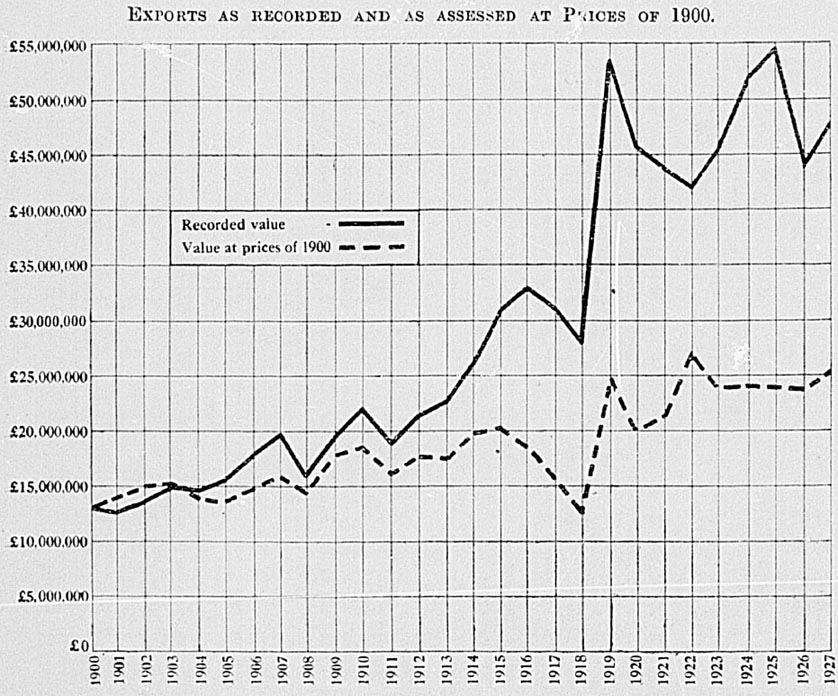
In order to show the effect of changes in price from year to year, and particularly in the latter years, it is interesting to construct a series of index numbers basing the figures for each year upon the prices of the previous year. In this way it is possible to compare succeeding years directly, instead of comparing each year with a given base. The method used is the same, except that the base is changed.
| EXTORTS OK NEW ZEALAND PRODUCE FOR EACH YEAR 1900-27, SHOWING VALUES AS RECORDED AND AS COMPUTED ON THE BASIS OF VALUES RULING IN THE PREVIOUS YEAR. | ||||
|---|---|---|---|---|
| Year. | Total Exports (Domestic Produce). | Effect of Price-changes. | ||
| Recorded Value. | Value at Prices of Previous | Year. | Gain. | |
| .. | £ | £ | £ | £ |
| 1900 | 13,055,249 | .. | .. | .. |
| 1901 | 12,690,460 | 13,885,227 | .. | 1,194,767 |
| 1902 | 13,498,599 | 13,597,171 | .. | 98,572 |
| 1903 | 14,838,192 | 13,744,665 | 1,093,527 | .. |
| 1904 | 14,601,787 | 13,693,279 | 908,508 | .. |
| 1905 | 15,503,530 | 14,224,924 | 1,278,606 | .. |
| 1906 | 17,840,346 | 16,843,708 | 996,638 | .. |
| 1907 | 19,783,138 | 19,087,151 | 695,987 | .. |
| 1908 | 15,894,530 | 18,189,260 | .. | 2,294,730 |
| 1909 | 19,462,936 | 19,533,010 | .. | 70,074 |
| 1910 | 21,944,163 | 20,157,164 | 1,786,999 | .. |
| 1911 | 18,781,898 | 19,109,809 | .. | 327,911 |
| 1912 | 21,272,405 | 20,671,508 | 600,897 | .. |
| 1913 | 22,577,890 | 20,974,623 | 1,603,267 | .. |
| 1914 | 25,984,717 | 25,546,190 | 438,527 | .. |
| 1915 | 31,042,662 | 26,367,413 | 4,675,249 | .. |
| 1916 | 32,975,907 | 28,852,737 | 4,123,170 | .. |
| 1917 | 31,087,957 | 27,479,836 | 3,608,121 | .. |
| 1918 | 27,937,010 | 24,764,483 | 3,172,527 | .. |
| 1919 | 53,304,384 | 55,928,460 | .. | 2,624,076 |
| 1920 | 45,592,294 | 43,068,470 | 2,523,824 | .. |
| 1921 | 43,615,473 | 48,408,624 | .. | 4,793,151 |
| 1922 | 41,699,148 | 55,318,596 | .. | 13,619,448 |
| 1923 | 45,371,908 | 36,962,436 | 8,409,472 | .. |
| 1924 | 51,920,828 | 45,396,647 | 6,524,181 | .. |
| 1925 | 54,521,031 | 51,779,354 | 2,741,677 | .. |
| 1926 | 44,339,183 | 54,282,688 | .. | 9,943,505 |
| 1927 | 47,571,233 | 46,397,481 | 1,173,752 | .. |
The comparison of each year with the preceding year brings out the advantage gained by a rise in prices. The gain shown represents the surplus value added by rising prices to the exports of any year, and, similarly, the loss shows how falling prices penalize New Zealand. The gains due to the rise of prices during the four years 1915-18 and in 1923 and 1924 are remarkable. The figures for 1922 and 1926 are eloquent of what falling prices mean for the Dominion. The recorded total of exports in 1926 would have been nearly ten millions greater had average prices of exports remained as in 1925. The figures for 1923 to 1925 reveal just the opposite, and show that prices of domestic produce were considerably higher in each year than during the preceding year.
A study of the figures given in the Statistical Summary at the end of this book, and showing quantities and values of the principal commodities exported over a period of fifty years, will give a good idea of the relative effects of increased volume and of price - movements in the huge growth of trade during the half - century as measured by the total value of exports.
The effect which war and post-war prices of products have exerted towards raising the Dominion's exports to an unprecedented height is further shown by the following comparison between the year ended 30th June, 1914, and the corresponding twelve-monthly periods ending in 1926, 1927, and 1928. As mentioned earlier, June years are in many respects preferable to calendar years, as affording a comparison between one season and another.
On the recorded figures, exports for 1927-28 are over twice as high as those for 1913-14. The real volume, however, has increased by 44 per cent. only, which goes to show that slightly more than half of the gain shown in the recorded values has been due to higher prices. The table covers only sixteen principal commodities, which, however, represent more than nine-tenths of the total exports.
| PRINCIPAL EXPORTS OF NEW ZEALAND PRODUCE FOR THE YEARS ENDED 30TH JUNE, 1926, 1927, AND 1928, SHOWING VALUES AS RECORDED AND AS COMPUTED ON THE BASIS OF PRICES RULING DURING THE YEAR ENDED 30TH JUNE, 1914. | |||||||
|---|---|---|---|---|---|---|---|
| Commodity. | Twelve Months ended 30th June, 1914. | Twelve Months ended 30th June, 1926. | Twelve Months ended 30th June, 1927. | Twelve Months ended 30th June, 1928. | |||
| Recorded Value. | Value at Prices of 1913-14. | Recorded Value. | Value at Prices of 1913-14. | Recorded Value. | Value at Prices of 1913-14. | ||
| .. | £ | £ | £ | £ | £ | £ | £ |
| Butter | 2,197,771 | 8,958,036 | 5,896,043 | 9,761,537 | 7,354,264 | 11,315,756 | 7,933,591 |
| Cheese | 2,317,970 | 6,073,638 | 4,180,714 | 5,338,376 | 4,411,244 | 6,360,766 | 4,536,381 |
| Beef, frozen | 561,817 | 717,584 | 731,607 | 485,982 | 519,872 | 977,623 | 990,813 |
| Lamb, frozen (whole carcasses) | 2,545,175 | 5,783,294 | 3,258,974 | 5,460,909 | 3,407,687 | 6,669,196 | 4,075,348 |
| Mutton, frozen (whole carcasses) | 1,880,583 | 2,422,451 | 1,458,656 | 2,126,438 | 1,629,333 | 2,085,607 | 1,680,377 |
| Meat, preserved | 122,078 | 244,275 | 244,735 | 213,519 | 219,517 | 237,306 | 242,650 |
| Sausage-casings | 132,038 | 745,528 | 100,471 | 749,964 | 105,074 | 766,345 | 112,728 |
| Hides | 319,995 | 583,911 | 704,369 | 586,610 | 688,555 | 903,834 | 727,346 |
| Rabbit-skins | 90,350 | 802,512 | 242,280 | 810,428 | 207,740 | 633,090 | 162,653 |
| Sheep-skins (without wool) | 545,037 | 1,260,948 | 576,028 | 1,313,437 | 728,205 | 1,296,428 | 647,851 |
| Wool | 8,262,153 | 12,030,185 | 8,790,523 | 12,883,971 | 9,400,552 | 16,548,869 | 9,072,741 |
| Phormium fibre | 576,095 | 543,245 | 421,350 | 463,740 | 374,917 | 391,759 | 334,051 |
| Tallow | 711,858 | 844,800 | 680,781 | 619,130 | 548,191 | 882,297 | 847,458 |
| Kauri-gum | 790,338 | 361,875 | 394,803 | 310,701 | 378,600 | 245,834 | 373,552 |
| Gold | 1,485,937 | 491,055 | 462,508 | 522,090 | 495,051 | 518,468 | 488,113 |
| Timber, sawn | 372,092 | 548,871 | 237,495 | 434,765 | 189,326 | 398,474; | 178,433 |
| Totals | 22,911,287 | 42,412,208 | 28,381,337 | 42,081,597 | 30,658,128 | 50,231,652 | 33,004,086 |
| Other N.Z. produce | 1,401,457 | 3,091,840 | .. | 3,375,894 | .. | 3,952,893 | .. |
| Grand totals | 24,312,744 | 45,504,048 | .. | 45,457,491 | .. | 54,184,545 | .. |
Disregarding price variation, exports for 1927-28 were 44 per cent. greater than those for 1913-14, and 7.7 per cent. above the figure for 1926-27.
In 1901 a group of Pacific islands was annexed to New Zealand, and has since been administered by the Dominion. The islands are fertile and rich in tropical products, so that there is a growing trade between them and the Dominion proper. This trade is not regarded as external to New Zealand, but merely as interchange between different parts of the Dominion, and it is therefore not included in the account of the external trade. Separate returns are made of the transactions between the Dominion and the annexed islands, and these are summarized below:—
| TOTAL VALUE OF EXPORTS FROM NEW ZEALAND TO COOK AND OTHER ANNEXED ISLANDS. 1908-27. | |
|---|---|
| Year. | Exports. |
| .. | £ |
| 1908 | 39,284 |
| 1909 | 40,204 |
| 1910 | 60,647 |
| 1911 | 56,131 |
| 1912 | 75,774 |
| 1913 | 72,046 |
| 1914 | 59,056 |
| 1915 | 55,459 |
| 1916 | 52,831 |
| 1917 | 53,449 |
| 1918 | 79,309 |
| 1919 | 88,902 |
| 1920 | 117,820 |
| 1921 | 82,398 |
| 1922 | 81,309 |
| 1923 | 100,670 |
| 1924 | 96,757 |
| 1925 | 80,977 |
| 1926 | 84,573 |
| 1927 | 84,652 |
Further particulars regarding the trade of the Cook Islands will bo found in the section of this book dealing with dependencies.
THE statistics of imports are compiled from entries passed at the Customs. Prior to 1916 the import value taken was the c.i.f. or landed value in New Zealand, freight into the Dominion being thus included. For free goods and goods liable to specific duties this landed value in New Zealand was shown, but the landed value for ad valorem goods was taken as the fair market value of the goods when sold for home consumption in the principal markets of the country whence imported, and at the time when exported, plus 10 per cent. The value shown for all merchandise imported is now the current domestic value in the country of export at the time of exportation, plus 10 per cent.
The earliest trade in New Zealand, as in most colonies, consisted more of exploitation and appropriation by visiting traders than of regular exchange. The whalers and sealers brought with them sufficient provisions to last their season, and they were never more than passing visitors to the Islands. The first genuine import trade sprang up when the Maoris became sensible of the great wealth to be won by bartering their flax for iron and other treasures of the white man. A new element was introduced when the Maori adopted the musket in preference to the old hand weapons. With the incoming of the regular colonists, trade assumed its more modern form, and the import of firearms was quickly overshadowed by the more peaceful requirements of the settlers.
Permanent settlement in 1840 rendered necessary the continued and increasing import of clothing, metals, and manufactures to sustain the colonists and to develop the colony. For many years after the first landing imports were greatly in excess of exports, and this excess represents the import of capital which was necessary to put the young colony on a firm footing. Especially in the early years New Zealand, while supplying foodstuffs from her own resources, has been dependent upon the outside world for a great proportion of the manufactures necessary for development, and also of the luxuries and amenities of modern life.
The gold rushes brought a huge increase of population and also of imports, and reference to Subsection A of this section will show the effect of the stimulus given by the gold discoveries. In the later “sixties” imports were declining; but the borrowing policy pursued in the “ seventies” resulted once more in an increase of imports for a time. Violent fluctuations succeeded, with a general tendency to diminish until, in sympathy with the increased exports, the value of imports rapidly increased from 1895. Imports have increased enormously during the last decade, and have advanced from £20,919,265 in 1917 to £44,782,946 in 1927—a percentage increase of 114. The value per head of mean population was 71 per cent. greater in 1927 than in 1917.
The 1927 total is five millions less than the figure for the previous year, due to a policy of curtailment as the result of a drop in exports in 1926.
The following table shows the total imports for New Zealand and the rate per head of mean population during the last decade.
| IMPORTS, 1918-27. | ||||||||
|---|---|---|---|---|---|---|---|---|
| Year. | Total. | Per Head. | ||||||
| Including Specie. | Excluding Specie. | Including Specie. | Excluding Specie. | |||||
| .. | £ | £ | £ | s. | d. | £ | 8. | d. |
| 1918 | 24,234,007 | 24,131,792 | 21 | 0 | 5 | 20 | 18 | 8 |
| 1919 | 30,671,698 | 30,309,167 | 25 | 14 | 4 | 25 | 8 | 3 |
| 1920 | 61,595,828 | 61,553,853 | 49 | 11 | 7 | 49 | 10 | 11 |
| 1921 | 42,942,443 | 42,744,122 | 33 | 12 | 9 | 33 | 9 | 8 |
| 1922 | 35,012,561 | 34,826,074 | 26 | 16 | 6 | 26 | 13 | 8 |
| 1923 | 43,378,493 | 43,363,983 | 32 | 13 | 2 | 32 | 13 | 0 |
| 1924 | 48,527,603 | 48,527,603 | 35 | 17 | 6 | 35 | 17 | 6 |
| 1925 | 52,456,407 | 52,425,757 | 37 | 17 | 10 | 37 | 17 | 4 |
| 1926 | 49,889,563 | 49,811,763 | 35 | 5 | 10 | 35 | 4 | 8 |
| 1927 | 44,782,946 | 44,782,666 | 31 | 2 | 6 | 31 | 2 | 6 |
Part of the increase since the war is attributable to the higher prices ruling; nevertheless, it is evident that the effect of higher prices on imports could not account for the whole of the increase, but that the quantity of goods must have considerably increased.
The nature of the imports has changed little from the time of the first settlement in New Zealand, though new commodities have naturally been introduced, the principal groups of commodities being clothing and textiles, metals and machinery, sugar, tea, alcoholic liquors, tobacco, paper and stationery, oils, motor-vehicles and accessories, chemicals and drugs, and timber. The proportions of these imports have changed little for many years, except that motor-vehicles and oils (including motor - spirits) have increased very rapidly in recent years.
Since 1914 the statistics of both imports and exports have been compiled according to a statistical classification which assembles the items in well-defined classes as shown in the following table, which gives the imports under the various classes for the year 1927.
| IMPORTS BY CLASSES, 1927. | ||
|---|---|---|
| No. | Class. | Value in 1927. |
| .. | .. | £ |
| I | Foodstuffs of animal origin (excluding live animals) | 346,150 |
| II | Foodstuffs of vegetable origin, and common salt | 3,510,450 |
| III | Beverages (non-alcoholic) and substances used in making up the same | 1,021,826 |
| IV | Spirits and alcoholic liquors | 962,672 |
| V | Tobacco and preparations thereof | 1,729,286 |
| VI | Live animals | 72,328 |
| VII | Animal substances (mainly unmanufactured), not being foodstuffs | 81,796 |
| VIII | Vegetable substances and non-manufactured fibres | 584,605 |
| IXA | Apparel | 4,363,834 |
| IXB | Textiles | 5,158,752 |
| IXC | Manufactured fibres | 643,838 |
| X | Oils, fats, and waxes | 3,173,607 |
| XI | Paints and varnishes | 388,524 |
| XII | Stones and minerals used industrially | 558,624 |
| XIII | Specie | 280 |
| XIVA | Metal, unmanufactured, partially manufactured, and ores | 527,810 |
| XIVB | Metal manufactures, other than machinery and machines.. | 5,004,071 |
| XV | Machinery and machines | 4,157,633 |
| XVIA | Indiarubber and manufactures thereof (not including tires) | 92,492 |
| XVIB | Leather and manufactures thereof, including substitutes | 428,744 |
| XVIIA | Timber | 800,143 |
| XVIIB | Wood, cane, and wicker manufactures | 181,477 |
| XVIII | Earthenware, china, glass, stoneware, cements, and cement materials | 877,470 |
| XIXA | Paper | 1,087,062 |
| XlXB | Stationery | 908,391 |
| XX | Jewellery, timepieces, and fancy goods | 798,175 |
| XXI | Optical, surgical, and scientific instruments | 570,584 |
| XXIIA | Drugs, chemicals, and druggists' wares | 1,210,027 |
| XXIIb | Manures | 495,284 |
| XXIIIA | Vehicles | 3,716,644 |
| XXIIlB | Miscellaneous | 1,330,367 |
| .. | Total | 44,782,946 |
Imports as a whole show a drop of £5,106,617 as compared with the previous year's figures, although in six out of the thirty-one classes an increase was recorded. Class XXIIIA, vehicles, shows the most pronounced fall, this reflecting a decrease in motor imports. Class X, oils, &c., also fell considerably. Less wheat and flour taken is the main reason for the decrease in Class II, foodstuffs of vegetable origin.
A somewhat different and more detailed system of classification, which allows of information being shown not only for groups of items, but also for the principal definite items, has been adopted for the following table:—
| MAIN GROUPS OF IMPORTS, 1923-27. | |||||
|---|---|---|---|---|---|
| Group or Item. | 1923. | 1924. | 1925. | 1926. | 1927. |
| * Includes methylated spirits, perfumed spirits, and spirits of wine. | |||||
| .. | £ | £ | £ | £ | £ |
| Apparel (including hats and caps) | 2,819,297 | 2,679,505 | 2,943,284 | 2,784,359 | 2,550,636 |
| Boots and shoes | 1,200,581 | 975,951 | 1,069,820 | 1,020,539 | 1,019,572 |
| Drapery, haberdashery, linens, woollens, and other textiles | 5,231,653 | 4,550,634 | 5,027,107 | 4,413,639 | 4,170,622 |
| Hosiery | 566,991 | 466,896 | 541,609 | 506,665 | 466,620 |
| Silks | 643,131 | 719,129 | 838,668 | 711,941 | 831,782 |
| Totals | 10,461,653 | 9,392,115 | 10,420,488 | 9,437,143 | 9,039,232 |
| Iron and steel (pig, wrought, wire, &c., and galvanized) | 2,437,823 | 2,713,533 | 2,605,126 | 2,369,920 | 2,598,864 |
| Railway and tramway plant | 357,121 | 469,778 | 726,178 | 267,067 | 245,839 |
| Machinery | 2,596,422 | 3,530,579 | 3,811,368 | 3,759,663 | 3,611,400 |
| Sewing and knitting machines | 102,666 | 109,476 | 122,206 | 110,212 | 110,582 |
| Hardware and ironmongery | 613,196 | 655,682 | 676,234 | 1,147,282 | 1,035,908 |
| Tools and implements (including agricultural) | 531,229 | 636,650 | 727,538 | 699,334 | 719,423 |
| Nails | 134,025 | 91,934 | 99,935 | 79,706 | 73,249 |
| Other metals and metal manufactures | 1,802,413 | 1,801,127 | 1,968,971 | 1,497,580 | 1,294,249 |
| Totals | 8,574,895 | 10,028,759 | 10,737,556 | 9,930,764 | 9,689,514 |
| Sugar | 1, 454,911 | 1,594,342 | 1,250,343 | 1,150,565 | 978,148 |
| Tea | 818,977 | 920,895 | 944,639 | 945,476 | 891,608 |
| Totals | 2,273,888 | 2,515,237 | 2,194,982 | 2,096,041 | 1,869,756 |
| Beer | 19,994 | 17,702 | 22,136 | 24,152 | 20,841 |
| Spirits* | 916,178 | 804,616 | 930,697 | 861,678 | 818,160 |
| Wine | 118,877 | 133,164 | 141,196 | 150,198 | 123,671 |
| Tobacco | 1,484,508 | 1,648,523 | 1,792,063 | 1,685,749 | 1,729,286 |
| Totals | 2,539,557 | 2,604,005 | 2,886,092 | 2,721,777 | 2,691,958 |
| Paper | 1,013,805 | 949,163 | 1,003,313 | 1,076,846 | 1,002,568 |
| Printed books | 480,410 | 502,413 | 546,952 | 487,674 | 492,366 |
| Stationery | 328,981 | 348,494 | 417,446 | 449,638 | 396,704 |
| Totals | 1,823,196 | 1,800,070 | 1,967,711 | 2,014,158 | 1,891,638 |
| Miscellaneous (specified articles)— | |||||
| Arms, ammunition, and explosives | 232,923 | 327,518 | 219,699 | 289,223 | 185,681 |
| Automobiles, motor-cars, and motor-cycles, and materials for | 3,494,402 | 4,567,496 | 5,882,387 | 5,193,474 | 3,544,821 |
| Bags and sacks | 357,888 | 317,751 | 455,109 | 468,465 | 425,543 |
| Bicycles and tricycles | 35,671 | 45,735 | 63,977 | 66,009 | 36,544 |
| Bicycle and tricycle fittings | 154,387 | 155,379 | 182,483 | 134,983 | 115,670 |
| Candles | 21,349 | 30,699 | 11,779 | 13,809 | 6,846 |
| Canvas | 40,036 | 42,096 | 48,089 | 22,137 | 41,277 |
| Carpeting, matting, and oilcloth | 696,004 | 658,733 | 691,189 | 656,754 | 583,291 |
| Carts, carriages, and materials for | 54,674 | 24,000 | 11,954 | 14,793 | 15,006 |
| Cement | 10,477 | 10,755 | 12,464 | 9,969 | 15,591 |
| China, porcelain, earthenware, and parian ware | 449,754 | 460,029 | 490,369 | 367,620 | 398,594 |
| Cinematograph films | 133,366 | 154,706 | 196,211 | 218,209 | 244,060 |
| Coal | 520,303 | 779,510 | 682,711 | 620,394 | 515,801 |
| Drugs, chemicals, and druggists' wares | 1,126,785 | 1,145,354 | 1,165,017 | 1,126,219 | 1,210,027 |
| Fancy goods and toys | 357,801 | 387,474 | 421,984 | 422,634 | 363,849 |
| Fish, potted and preserved | 115,323 | 179,753 | 185,295 | 175,076 | 169,606 |
| Fruits (fresh, preserved, bottled, and dried) | 723,827 | 772,335 | 808,989 | 835,238 | 895,221 |
| Glass and glassware | 388,638 | 377,215 | 392,463 | 401,067 | 357,103 |
| Leather and leather manufactures | 590,205 | 515,287 | 536,375 | 438,029 | 424,450 |
| Manures | 347,330 | 334,673 | 430,618 | 518,424 | 495,284 |
| Musical instruments and materials for | 389,402 | 478,967 | 608,961 | 569,087 | 424,343 |
| Oil | 2,315,463 | 3,145,099 | 3,359,536 | 3,870,714 | 3,089,741 |
| Optical, surgical, and scientific instruments | 141,975 | 159,456 | 178,730 | 187,404 | 177,254 |
| Photographic materials and goods | 117,854 | 158,353 | 144,347 | 139,207 | 149,270 |
| Seeds | 231,257 | 274,371 | 202,242 | 256,077 | 164,960 |
| Timber | 638,620 | 1,043,829 | 1,195,350 | 853,111 | 800,143 |
| Woolpacks and wool- pockets | 125,873 | 123,936 | 171,476 | 146,773 | 104,676 |
| Totals: miscellaneous (specified articles) | 13,811,587 | 16,670,539 | 18,749,804 | 18,014,899 | 14,954,652 |
| Other imports (excluding specie) | 3,879,207 | 5,516,878 | 5,469,124 | 5,596,981 | 4,645,916 |
| Total imports (excluding specie) | 43,363,983 | 48,527,603 | 52,425,757 | 49,811,763 | 44,782,666 |
| Specie imported | 14,510 | .. | 30,650 | 77,800 | 280 |
| Total imports | 43,378,493 | 48,527,603 | 52,456,407 | 49,889,563 | 44,782,946 |
It is not possible to classify imports so completely as exports. There are two big groups of items, however, which are of dominating importance, and are,moreover, fairly homogeneous. The first, “Clothing and textiles,” comprises practically all woven articles; but the second, “Metals and machinery,” is not altogether complete, since there are many items in the “Miscellaneous” group which are metal manufactures. The other three groups are well defined, and the value imported in each is, on the whole, steady.
A third system of classification which is also employed divides imports into five groups, as in the following table, which gives the figures for each of the last ten years.
| Year. | Food, Drink, and Tobacco. | Raw Materials and Articles mainly unmanufactured. | Articles wholly or mainly manufactured. | Miscellaneous and Unclassified. | Bullion and Specie. | Total. |
|---|---|---|---|---|---|---|
| .. | £ | £ | £ | £ | £ | £ |
| 1918 | 5,202,728 | 906,485 | 17,630,511 | 391,682 | 102,601 | 24,234,007 |
| 1919 | 5,173,084 | 1,073,559 | 23,834,386 | 226,854 | 363,815 | 30,671,698 |
| 1920 | 10,896,053 | 2,602,618 | 47,583,033 | 469,618 | 44,506 | 61,595,828 |
| 1921 | 6,157,679 | 3,194,027 | 33,054,410 | 336,316 | 200,011 | 42,912,443 |
| 1922 | 5,855,287 | 3,318,024 | 25,381,048 | 213,211 | 244,991 | 35,012,561 |
| 1923 | 7,045,185 | 2,233,835 | 33,712,645 | 371,641 | 15,187 | 43,378,493 |
| 1924 | 8,845,159 | 2,981,218 | 36,271,395 | 429,374 | 457 | 48,527,603 |
| 1925 | 8,555,817 | 3,069,490 | 40,413,659 | 373,319 | 44,122 | 52,456,407 |
| 1926 | 8,471,775 | 2,767,193 | 38,190,328 | 379,154 | 81,113 | 49,889,563 |
| 1927 | 7,541,338 | 2,512,613 | 34,462,816 | 263,158 | 3,021 | 44,782,946 |
Taken in conjunction with a table based on the same classification, which is given in the Exports subsection of this section, the figures show plainly how New Zealand is essentially a primary producing country, importing the bulk of her manufactured goods from overseas in exchange for her primary produce.
The import trade of the Dominion, though spread over more countries than the export trade, is yet confined mainly to the United Kingdom, Australia, the United States, and Canada. In the days of the first settlement Australia was the source from which the young colony drew most of its supplies, and for a long period imports from Australia overshadowed imports from the United Kingdom. The proportion of imports from Australia, however, tended to decrease steadily till from 60 per cent. in 1862 it fell to between 10 and 12 per cent., a figure which, except for a few variations. has remained fairly constant in recent years.
In the decade immediately preceding the war the United Kingdom supplied about 60 per cent. of the total imports. The proportion has fallen a good deal in recent years, as explained later. In the “eighties” and “nineties” the figure was, on the average, nearer 70 per cent. than 60 per cent.
The cause of this decline is to bo found in the development of trade with other countries in recent years, particularly with the United States and Canada, and in a less degree with Japan, Germany, Belgium, Italy, Sweden, and other European countries. The United States was sending goods to New Zealand practically from the foundation of the colony, and the share of the imports received from that country steadily increased till in the first decade of the present century it was 11 or 12 per cent. The adoption of Imperial preference seems to have caused a temporary drop in the figure to about 7 per cent., though the proportion has now for some years been steadily climbing again, and has, indeed, actually surpassed its old level. In 1927 18 per cent. of the total imports came from the United States.
India captured the New Zealand jute-market in the early “ eighties,” and since then there has been a regular import of corn-sacks, woolpacks, &c. In former times the colony imported its sugar from Mauritius, but after 1890 Fiji supplanted Mauritius, so that the imports from the Pacific islands are swelled to nearly 3 per cent., while Mauritius practically disappears from the list of countries. Similarly, the import of tea from China gave way about the same time to imports from Ceylon.
The table which follows shows imports from each of the principal countries during the last twenty years.
| IMPORTS FROM PRINCIPAL COUNTRIES, 1908-27. | ||||||||
|---|---|---|---|---|---|---|---|---|
| (On basis of Country of Shipment.) | ||||||||
| Year. | United Kingdom. | Australia. | Canada. | India. | Ceylon. | Fiji. | United States. | Japan. |
| .. | £ | £ | £ | £ | £ | £ | £ | £ |
| 1908 | 10,441,837 | 2,841,426 | 268,259 | 345,180 | 210,675 | 557,709 | 1,643,937 | 88,211 |
| 1909 | 9,287,786 | 2,764,210 | 198,384 | 367,999 | 230,499 | 590,214 | 1,166,063 | 86,865 |
| 1910 | 10,498,771 | 2,359,393 | 261,402 | 399,991 | 248,476 | 580,084 | 1,399,737 | 103,113 |
| 1911 | 11,787,300 | 2,944,991 | 283,410 | 326,360 | 275,672 | 728,806 | 1,682,129 | 123,248 |
| 1912 | 12,499,787 | 2,583,887 | 394,249 | 395,298 | 289,008 | 764,790 | 2,049,618 | 154,587 |
| 1913 | 13,312,193 | 2,914,848 | 452,519 | 421,209 | 275,350 | 846,493 | 2,107,990 | 151,106 |
| 1914 | 11,985,946 | 3,376,371 | 479,140 | 486,978 | 394,444 | 738,751 | 2,282,966 | 187,501 |
| 1915 | 11,141,067 | 3,554,535 | 797,816 | 527,942 | 408,697 | 1,128,959 | 2,600,248 | 304,322 |
| 1916 | 13,869,455 | 4,002,171 | 757,286 | 572,257 | 366,753 | 1,053,754 | 3,969,925 | 562,974 |
| 1917 | 8,817,513 | 3,660,931 | 757,041 | 612,063 | 353,613 | 1,203,372 | 3,900,658 | 628,822 |
| 1918 | 8,977,725 | 5,133,349 | 930,964 | 712,633 | 319,498 | 939,311 | 4,980,748 | 1,214,865 |
| 1919 | 11,839,430 | 5,081,968 | 1,622,234 | 772,838 | 383,209 | 980,186 | 7,576,314 | 1,258,016 |
| 1920 | 29,806,416 | 10,555,667 | 2,386,915 | 900,577 | 725,278 | 1,824,012 | 11,100,259 | 1,470,071 |
| 1921 | 21,448,817 | 6,486,847 | 1,687,595 | 593,151 | 316,813 | 1,909,102 | 7,746,457 | 593,343 |
| 1922 | 19,416,476 | 4,213,085 | 1,545,037 | 437,851 | 499,705 | 1,459,345 | 4,948,778 | 485,327 |
| 1923 | 24,003,671 | 4,259,323 | 2,930,626 | 732,359 | 701,665 | 859,757 | 6,696,723 | 548,632 |
| 1924 | 21,904,178 | 6,303,073 | 3,909,152 | 726,483 | 822,987 | 984,274 | 7,551,357 | 458,964 |
| 1925 | 27,263,509 | 5,855,989 | 3,906,152 | 888,787 | 836,419 | 1,251,797 | 8,626,959 | 659,146 |
| 1926 | 24,331,410 | 5,059,779 | 3,430,988 | 850,720 | 857,011 | 941,320 | 9,729,251 | 557,113 |
| 1927 | 22,678,862 | 4,264,175 | 2,721,812 | 755,967 | 840,865 | 435,034 | 7,827,755 | 579,984 |
The figures given in the foregoing table are on the basis of country of shipment. From 1914 onwards, figures are also available showing countries of origin, and a supplementary table on this basis is now given.
| IMPORTS FROM PRINCIPAL COUNTRIES, 1914-27. | ||||||||
|---|---|---|---|---|---|---|---|---|
| (On basis of Country of Origin.) | ||||||||
| Year. | United Kingdom. | Australia. | Canada. | India. | Ceylon. | Fiji. | United States. | Japan. |
| .. | £ | £ | £ | £ | £ | £ | £ | £ |
| 1914 | 11,257,720 | 2,682,218 | 455,468 | 502,495 | 420,181 | 738,428 | 2,537,545 | 232,364 |
| 1915 | 10,023,420 | 2,786,174 | 795,617 | 546,540 | 431,818 | 1,120,379 | 2,862,537 | 348,671 |
| 1916 | 13,313,583 | 3,079,170 | 761,105 | 588,196 | 380,848 | 1,050,025 | 4,358,806 | 616,903 |
| 1917 | 8,594,010 | 2,636,149 | 771,952 | 646,196 | 397,419 | 1,198,589 | 4,294,279 | 693,808 |
| 1918 | 8,703,480 | 4,043,383 | 950,588 | 720,419 | 323,123 | 935,885 | 5,472,122 | 1,266,416 |
| 1919 | 11,523,653 | 3,916,108 | 1,649,550 | 787,669 | 388,428 | 977,319 | 8,053,127 | 1,313,205 |
| 1920 | 28,554,587 | 8,024,885 | 2,453,379 | 940,569 | 729,893 | 1,818,529 | 11,750,690 | 1,522,075 |
| 1921 | 20,832,520 | 5,460,381 | 1,727,503 | 607,926 | 320,188 | 1,906,038 | 8,166,967 | 003,275 |
| 1922 | 18,296,173 | 3,293,632 | 1,550,213 | 441,581 | 501,419 | 1,448,998 | 5,379,372 | 504,955 |
| 1928 | 22,532,205 | 3,653,420 | 2,950,984 | 742,551 | 705,622 | 853,163 | 6,956,602 | 560,064 |
| 1924 | 23,203,825 | 5,651,027 | 3,914,404 | 741,202 | 837,506 | 970,393 | 7,788,593 | 496,835 |
| 1925 | 25,572,802 | 5,249,493 | 3,010,237 | 912,741 | 844,596 | 1,239,450 | 8,885,265 | 693,632 |
| 1926 | 22,827,406 | 4,025,200 | 3,431,533 | 861, 578 | 868,821 | 392,894 | 10,000,507 | 582,352 |
| 1927 | 21,464,114 | 3,869,246 | 2,739,826 | 759,829 | 855,048 | 424,785 | 8,079,467 | 591,963 |
Of the total imports in 1927, the eight countries shown above supplied 86 per cent. on the basis of origin and 89 per cent. on the basis of shipment. Other countries which supplied more than one-half of 1 per cent. of the Dominion's imports in 1927 wore:—
| Country. | Imports according to | |||
|---|---|---|---|---|
| Country of Origin. | Country of Shipment. | |||
| Value. | Per Cent. of Total. | Value. | Per Cent, of Total. | |
| .. | £ | .. | £ | .. |
| France | 891,277 | 1.99 | 531,480 | 119 |
| Dutch East Indies | 882,590 | 1.97 | 882,303 | 1.97 |
| Germany | 837,777 | 1.87 | 506,180 | 113 |
| Belgium | 399,763 | 0.89 | 322,674 | 0.72 |
| Cuba | 329,742 | 0.74 | 329,557 | 0.74 |
| Switzerland | 379,015 | 0.85 | 174,350 | 0.39 |
| Netherlands | 285,627 | 0.64 | 244,058 | 0.54 |
| Sweden | 273,994 | 0.61 | 253,870 | 0.57 |
| Italy | 271,311 | 060 | 216,528 | 0.48 |
About two-thirds of imports produced on the Continent of Europe are received direct, the balance coming mainly through the United Kingdom. Direct shipments from the United Kingdom in 1927 exceeded by £1,214,7.18 the imports of goods produced in that country. In view, however, of the considerable quantity of British goods that enter New Zealand by way of Australia it would not be correct to take that figure as fully measuring the re-export trade done by Great Britain in goods from abroad intended for the Dominion.
Australia acts as a re-exporting centre for a certain proportion of goods received from India and Ceylon. The South African Union and the British West Indies both produce more of the imports than they ship direct. The figures for Canada also show a balance in favour of goods of Canadian origin. In the case of the United States, goods to the value of approximately £250,000 annually are imported indirectly.
The next table shows for each of the years 1920 to 1927 the percentage of total imports from each of the principal countries concerned.
| IMPORTS (COUNTRY OF ORIGIN), 1920 TO 1927. | ||||||||
|---|---|---|---|---|---|---|---|---|
| Country. | 1920. | 1921. | 1922. | 1923. | 1921. | 1925. | 1926. | 1927. |
| .. | Per Cent. | Per Cent. | Per Cent. | Per Cent. | Per Cent. | Per Cent. | Per Cent. | Per Cent. |
| United Kingdom | 46.36 | 48.53 | 52.26 | 51.94 | 47.82 | 48.75 | 45.76 | 47.93 |
| Canada | 3.98 | 4.02 | 4-15 | 6.80 | 8.07 | 7.47 | 6.88 | 6.12 |
| India | 1.53 | 1-41 | 1.26 | 1.71 | 1.53 | 1-74 | 1.73 | 1.70 |
| Ceylon | 1.18 | 0.74 | 1.43 | 1.63 | 1-72 | 1.62 | 1.74 | 1.91 |
| South African Union | 0.43 | 0.20 | 0.51 | 0.25 | 0.18 | 0.22 | 0.28 | 0.27 |
| Australia | 14.00 | 12.71 | 9.40 | 8.42 | 11.64 | 10.01 | 9.27 | 8.64 |
| Fiji | 2.96 | 4.44 | 4.14 | 1.97 | 2.00 | 2.37 | 1.79 | 0.95 |
| Other British countries | 0.77 | 0.49 | 0.82 | 0.74 | 0.87 | 0.78 | 0.85 | 1.07 |
| Totals, British countries | 71.21 | 72.54 | 74.27 | 73.46 | 73.83 | 72.96 | 68.30 | 68.59 |
| Germany | 0.02 | 0.06 | 0.07 | 0.16 | 0.60 | 0.95 | 1.35 | 1-87 |
| France | 1.85 | 1.58 | 1.96 | 1.73 | 1.56 | 1.75 | 0.63 | 1.99 |
| Belgium | 0.59 | 112 | 0.90 | 0.64 | 0.56 | 0.84 | 0.79 | 0.89 |
| Japan | 2.48 | 1.40 | 1.43 | 1.29 | 1.02 | 1.32 | 1.17 | 1.32 |
| Dutch East Indies | 0.99 | 1.00 | 2.12 | 2.60 | 2.17 | 1.17 | 1.59 | .97 |
| United States of America | 19.09 | 19.01 | 15.36 | 16.04 | 16-05 | 16-94 | 20.05 | 18.04 |
| Other foreign countries | 3.77 | 3.29 | 3.89 | 4.08 | 4.21 | 4.07 | 5.12 | 5.33 |
| Totals, foreign countries | 28.79 | 27.46 | 25.73 | 26.54 | 26.17 | 27.04 | 31.70 | 31.41 |
Prior to the war, imports from the United Kingdom represented about, 60 per cent. of the total, and those of United Kingdom origin would appear on this basis to have been about 55 per cent of the aggregate. The latter are now a little less than one-half of the total. The principal reason for the decline is found in the foreign competition which became established during the war and immediate post-war years, particularly in the mot or trade. The 1927 figure shows an advance of 2.17 per cent. over the previous year, attributable in the main to increases in iron and steel goods sent to the Dominion. Although imports from the United Kingdom are concerned mainly with hardware and soft-goods, the range is a very wide one indeed, covering practically the whole field of the Dominion's imports.
Ranking next to Great Britain in the list of exporters to New Zealand, the United States built up a considerable trade during the war period, and of recent years imports from that source have accounted for one-fifth to one-sixth of the total. The highest percentage (2005) was reached in 1926, the drop to 18.04 in 1927 being due mainly to decreases in motor-vehicles and motor-spirit. Although the two items mentioned constitute the bulk of the imports, the trade is an extensive one. and includes iron and steel goods (in which electrical goods figure prominently). timber, sulphur, tobacco, soft-goods, fruits, and cinematograph, &c., films.
Imports from Australia have fallen steadily from 11.64 per cent. in 1924 to 8.64 per cent. in 1927. The explanation lies mainly in less wheat taken by the Dominion, and, in a smaller degree, less coal. Imports from Australia of some magnitude other than those already mentioned are: Confectionery, fruits (dried, bottled, and preserved) tobacco, wine, hardware and ironmongery, lead, tin, timber, glassware stationery, photographic materials, drugs, &c., and musical instruments.
As in the case of Australia, imports from Canada have undergone a progressive decline since 1924, although the percentage is still high compared with pre-war years. Motor-vehicles constitute the principal import, and it is to a falling-off in this item that the drop in Canada's share of the Dominion's trade is attributable Although motor-vehicles predominate, other prominent items are paper, timber, machinery, electrical goods, boots and shoes, clothing, fencing-wire, and fish.
Imports from Franco are also considerable, and in 1927 represented 1.99 per cent. of the total; the principal items were apparel and ready-made clothing. silks, and motor-vehicles. Imports from Germany in 1927 (1.87 per cent. of the total) are the highest for many years, and are made up chiefly of clothing, fancy goods, machinery, timepieces, musical instruments, and fertilizers. New Zealand maintains a considerable import trade with Dutch East Indies in motor-spirit, sugar, and kapok. Silks, cottons, and timber are the principal imports from Japan, which country furnished 1.7 per cent. of the total imports in 1927. Ceylon is the Dominion's principal supplier of tea; India furnishes bags, sacks, and woolpacks of a considerable value, and also moderate quantities of tea, coffee, and rice.
From Italy New Zealand imports chiefly motor-vehicles, headgear, silks, satins, &c., and nuts; from Belgium, manures, telephones, glassware, clothing, jewellery, and paper; from Switzerland, timepieces, apparel and piece-goods, and electrical goods; from Netherlands, cocoa-butter, electrical goods, and spirits; from Sweden, electrical and dairying machinery. hardware, wood-pulp, and timber; from Czechoslovakia, glassware and fancy goods; from Denmark, seeds and rennet; and from the South African Union, dried fruits. precious stones, maize, wine, and tanning- materials. Spain furnishes small quantities of nuts and wine; Portugal, wine; Norway, fish; Asiatic Turkey, dried fruits; Philippine Islands, hemp; Egypt, phosphates; Burma, rice and waxes; China, nuts, rice, silks, brushmakers' materials, and tea; and Straits Settlements, bottled and preserved fruits, spices, sago, and tapioca.
The principal source of the Dominion's sugar-supply—Fiji—gave way in 1927 to Cuba, with Dutch East Indies a close third; Peru also figured prominently in 1927, sugar to the value of over £80,000 being imported from that country. Nauru Island sends considerable supplies of phosphates to New Zealand, and smaller quantities come from the Gilbert and Ellice Islands (Ocean Island) and from the Tuamotu Archipelago.
In the preceding pages imports have been classified in two main ways—viz., according to their nature and to their source or direction. In the following pages an indication is given as to the nature of our import trade with the various countries.
In the principal countries account has been taken only of those items of a minimum total value of approximately £10,000, and in the smaller countries the main items only, so that the tables are not made too voluminous by the inclusion of great numbers of small items. The full details for the last three years will be found in the latest number of the “Annual Statistical Report on Trade and Shipping.” The figures are on the basis of country of origin.
| Principal Imports. | |||||
|---|---|---|---|---|---|
| (On basis of Country of Origin.) | |||||
| Item. | 1923. | 1924. | 1925. | 1926. | 1927. |
| United Kingdom. | |||||
| .. | £ | £ | £ | £ | £ |
| Fish | 13,869 | 18,480 | 22,154 | 27,321 | 28,990 |
| Cocoa-butter, &c. | 15,427 | 17,341 | 13,848 | 8,341 | 8,004 |
| Confectionery | 147,298 | 101,700 | 115,329 | 111,219 | 136,949 |
| Maizena and cornflour | 40,975 | 43,681 | 12,116 | 36,714 | 41,009 |
| Infants' and invalids' foods | 16,599 | 17,361 | 20,704 | 23,992 | 38,869 |
| Mustard | 31,214 | 34,530 | 33,221 | 30,487 | 28,928 |
| Nuts, edible | 2,663 | 2,529 | 3,929 | 6,509 | 9,326 |
| Oilmen's stores | 23,436 | 29,298 | 29,517 | 31,614 | 31,654 |
| Pickles and sauces | 14,840 | 19,358 | 15,516 | 18,716 | 15,122 |
| Salt | 103,918 | 98,613 | 109,259 | 93,440 | 95,146 |
| Cocoa and chocolate | 35, 646 | 38,420 | 45,376 | 37,485 | 43,861 |
| Coffee essence | 9,695 | 11,116 | 10,841 | 11,064 | 13,487 |
| Ale, porter, and beer | 19,457 | 15,173 | 20,129 | 22,653 | 17,846 |
| Gin, geneva, and schnapps | 24,594 | 33,163 | 38,287 | 47,012 | 44,506 |
| Whisky | 746,604 | 603,946 | 730,492 | 641,408 | 610,031 |
| Spirits (other than beverages) | 29,433 | 39,905 | 31,442 | 30,569 | 31,004 |
| Wine | 13,191 | 9,571 | 10,191 | 11,623 | 9,855 |
| Cigarettes | 591,717 | 690,264 | 789,594 | 767,227 | 797,304 |
| Tobacco | 326,991 | 342,565 | 375,739 | 371,055 | 379,173 |
| Horses | 17,386 | 13,333 | 11,816 | 12,401 | 16,551 |
| Engineers' waste | 16,804 | 23,407 | 22,921 | 22,774 | 21,993 |
| Seeds— | |||||
| Crass and clover | 10,629 | 28,597 | 17,153 | 13,903 | 4,155 |
| Other | 69,839 | 62,986 | 57,220 | 57,010 | 69,791 |
| Starch | 11,396 | 11,913 | 10,755 | 12,184 | 11,686 |
| Tanning-materials, crude | 11,910 | 13,823 | 11,303 | 3,886 | 2,980 |
| Yarns | 152,775 | 113,896 | 104,379 | 124,078 | 101,678 |
| Apparel and ready-made clothing n.e.i. | 1,723,736 | 1,703,608 | 1,819,483 | 1,716,213 | 1,458,989 |
| Boots and shoes and parts thereof | 998,816 | 788,527 | 854,074 | 763,871 | 789,032 |
| Furs, dressed and prepared | 5,820 | 11,465 | 11,827 | 12,075 | 27,459 |
| Haberdashery | 86,372 | 68,593 | 65,728 | 55,306 | 47,125 |
| Hats and caps | 95,914 | 98,582 | 108,471 | 121,960 | 105,428 |
| Hatmakers' materials | 59,471 | 49,646 | 56,831 | 50,676 | 31,437 |
| Hosiery | 431,033 | 328,755 | 409,520 | 367,285 | 322,314 |
| Lace and laces | 34,123 | 31,054 | 27,410 | 15,903 | 16,158 |
| Millinery | 114,134 | 111,891 | 128,169 | 129,011 | 124,412 |
| Umbrellas and materials for making | 12,753 | 17,291 | 22,442 | 20,764 | 17,447 |
| Carpets, matting, and oilcloth | 635,911 | 606,888 | 632,489 | 595,641 | 518,911 |
| Drapery n.e.i. | 450,754 | 420,638 | 513,431 | 475,948 | 486,352 |
| Felt sheathing | 21,624 | 24,945 | 27,629 | 24,906 | 26,273 |
| Textile piece-goods— | |||||
| Canvas, sailcloth | 38,514 | 41,211 | 46,144 | 21,101 | 40,992 |
| Cotton | 2,221,417 | 1,974,053 | 2,127,190 | 1,775,008 | 1,615,190 |
| Hessians and scrim | 75,421 | 69,954 | 103,649 | 80,983 | 58,778 |
| Leather cloth | 15,524 | 15,332 | 17,221 | 16,465 | 16,873 |
| Linen | 28,733 | 31,041 | 37,337 | 45,406 | 26,334 |
| Silk, satin, and velvet | 113,336 | 129,657 | 202,795 | 120,142 | 130,039 |
| Woollen | 1,116,354 | 863,155 | 830,534 | 754,460 | 723,828 |
| Other | 31,762 | 41,170 | 35,628 | 23,413 | 19,496 |
| Sewing silks and cottons | 224,840 | 204,623 | 230,261 | 178,674 | 148,773 |
| Cordage and rope | 134,808 | 144,191 | 137,677 | 92,899 | 84,793 |
| Twine | 65,967 | 62,315 | 73,011 | 74,430 | 83,524 |
| Mineral oils | 10,771 | 19,549 | 25,691 | 24,174 | 32,998 |
| Vegetable oils | 99,207 | 92,566 | 96,598 | 106,804 | 63,315 |
| Taints and colours— | |||||
| Faints ground in liquid | 31,380 | 32,801 | 38,319 | 34,628 | 25,531 |
| White-lead ground in oil | 146,142 | 134,573 | 135,129 | 129,306 | 120,576 |
| Mixed ready for use | 63,789 | 69,740 | 75,894 | 84,407 | 87,097 |
| Other | 27,227 | 25,698 | 28,344 | 35,966 | 29,545 |
| Varnishes, lacquers, and goldsize | 25,542 | 26,797 | 31,201 | 26,132 | 18,467 |
| Stone | 17,438 | 15,730 | 23,955 | 20,145 | 13,025 |
| Silver specie | 13,600 | .. | 30,150 | 77,800 | 280 |
| Iron and steel (unmanufactured) | 313,714 | 325,031 | 266,750 | 182,731 | 203,247 |
| Bolts and nuts | 78,441 | 103,618 | 99,077 | 67,145 | 62,660 |
| Brass manufactures | 21,335 | 23,336 | 18,234 | 16,638 | 18,401 |
| Chains and chain cables | 16,531 | 21,644 | 19,495 | 16,516 | 13,444 |
| Copper manufactures | 56,993 | 51,213 | 51,083 | 57,525 | 47,888 |
| Hardware and ironmongery, &c., n.e.i. | 683,191 | 718,592 | 801,245 | 718,115 | 690,908 |
| Iron and steel— | |||||
| Hoop | 34,735 | 35,422 | 31,491 | 26,666 | 29,030 |
| Plate and sheet | 776,992 | 919,003 | 865,770 | 773,080 | 898,924 |
| Tubes, pipes, and fittings | 383,283 | 452,947 | 419,665 | 492,073 | 463,180 |
| Other | 107,449 | 107,627 | 102,377 | 91,880 | 224,662 |
| Lamps (not electric), lanterns, and lampwick | 19,193 | 23,995 | 17,332 | 13,482 | 10,406 |
| Meters | 102,370 | 122,820 | 141,405 | 162,110 | 119,776 |
| Nails | 27,923 | 39,460 | 47,273 | 28,399 | 33,274 |
| Plate and plated ware | 133,137 | 98,581 | 102,208 | 93,230 | 78,587 |
| Printing-materials | 18,484 | 18,387 | 18, 351 | 21,093 | 21,303 |
| Railway and tramway plant | 257,411 | 410,177 | 497,895 | 156,749 | 205,035 |
| Rivets and washers | 20,270 | 20,193 | 23,378 | 17,807 | 18,570 |
| Stoves and ranges | 34,464 | 19,488 | 62,877 | 64,055 | 61,739 |
| Telephones and accessories and telegraphic materials | 68, 565 | 47,463 | 46,018 | 106,614 | 94,018 |
| Tinware and tin manufactures | 37,547 | 48,444 | 45,267 | 38,234 | 17,693 |
| Tools, implements, &c. | 130,439 | 164,573 | 165,744 | 193,443 | 152,280 |
| Wire— | |||||
| Copper | 118,897 | 218,741 | 195,204 | 191,427 | 175,207 |
| Fencing | 189,486 | 176,145 | 196,744 | 172,879 | 149,994 |
| Netting | 122,786 | 121,233 | 100,000 | 53,496 | 58,116 |
| Other | 8,799 | 8,942 | 9,049 | 18,279 | 19,608 |
| Other metal manufactures | 114,009 | 129,604 | 159,780 | 237,894 | 209,825 |
| Agricultural implements, &c. | 33,709 | 46,782 | 68,271 | 59,373 | 46,702 |
| Dairying machinery | 13,160 | 36,004 | 25,811 | 22,335 | 10,080 |
| Dredging machinery | 9,420 | 22,195 | 22,264 | 17,161 | 15,058 |
| Electrical machinery | 963,772 | 1,411,972 | 1,395,080 | 1,274,017 | 1,317,550 |
| Engines, including materials for and parts of— | |||||
| Gas, oil, and hot air | 38,269 | 56,746 | 60,940 | 56,001 | 50,874 |
| Steam | 67,267 | 52,440 | 63,445 | 34,272 | 25,015 |
| Gas-making machinery | 965 | 561 | 27,784 | 5,812 | 9,667 |
| Locomotives | 60,177 | 16,318 | 182,290 | 1,571 | 9,224 |
| Mining machinery | 13,997 | 12,879 | 24,283 | 11,453 | 11,053 |
| Printing machinery | 69,298 | 94,430 | 127,091 | 75,085 | 64,364 |
| Sewing-machines | 73,660 | 80,300 | 82,019 | 64,298 | 61,136 |
| Tools—Engineers' and metal- and woodworkers', &c. | 63,484 | 75,106 | 120,018 | 97,854 | 159,488 |
| Turbines, steam and water, and Pelton wheels | 83,802 | 30,138 | 15,721 | 28,105 | 17,819 |
| Winches, cranes, capstans, and windlasses | 20,208 | 31,065 | 62,129 | 37,402 | 21,694 |
| Woollen-mill machinery | 54,496 | 59,332 | 14,625 | 20,977 | 11,514 |
| Other classes of machinery and machines | 216,509 | 309,666 | 346,811 | 299,562 | 253,083 |
| Indiarubber hose, tubing, and piping | 10,949 | 10,732 | 13,538 | 19,382 | 15,773 |
| Pelting, leather and other | 58,856 | 52,340 | 61,099 | 48,691 | 27,854 |
| Leather | 200,868 | 146,745 | 177,815 | 147,982 | 160,916 |
| Saddlery and harness | 31,263 | 35,242 | 30,691 | 18,985 | 14,540 |
| Furniture, cabinetware, and upholstery | 17,586 | 28,360 | 30,314 | 33,284 | 25,818 |
| Woodenware and turnery n.e.i. | 8,063 | 12,972 | 29,353 | 19,087 | 11,863 |
| China, porcelain, and parian ware | 78,762 | 71,554 | 75,210 | 49,822 | 62,124 |
| Earthenware | 219,925 | 237,575 | 248,770 | 195,315 | 212,286 |
| Glass and glassware | 199,763 | 230,996 | 216,994 | 203,077 | 184,216 |
| Tiles | 51,459 | 78,045 | 75,391 | 55,526 | 68,328 |
| Cardboard boxes, materials for | 26,115 | 24,454 | 25,987 | 23,699 | 22,067 |
| Paperhangings | 67,052 | 81,059 | 84,311 | 87,612 | 76,591 |
| Printing-paper | 274,838 | 275,295 | 308,180 | 325,156 | 246,564 |
| Writing-paper | 140,375 | 95,494 | 93,292 | 89,409 | 80,158 |
| Books, papers, and music, printed | 366,928 | 377,907 | 423,728 | 381,784 | 380,910 |
| Calendars and showcards | 14,895 | 20,398 | 25,808 | 25,134 | 28,865 |
| Envelopes | 31,738 | 25,872 | 32,803 | 32,707 | 31,514 |
| Ink | 14,332 | 16,870 | 15,922 | 17,593 | 16,777 |
| Manufactured stationery | 74,350 | 70,043 | 94,826 | 83,856 | 61,291 |
| Fancy goods and toys | 190,163 | 188,986 | 210,732 | 196,068 | 176,873 |
| Jewellery | 52,431 | 64,372 | 65,774 | 56,997 | 32,917 |
| Sporting, gaming, and athletic requisites | 100,551 | 95,192 | 106,771 | 108,688 | 103,102 |
| Timepieces | 8,147 | 8,826 | 8,970 | 9,055 | 6,199 |
| Tobacco-pipes and smokers' requisites | 36,984 | 32,859 | 51,546 | 27,696 | 23,165 |
| Cinematograph, bioscope, and kinetoscope films | 7,248 | 9,290 | 9,663 | 16,894 | 18,870 |
| Photographic materials and goods | 38,484 | 58,058 | 48,049 | 41,817 | 53,882 |
| Surgical and dental Instruments | 45,001 | 52,523 | 59,812 | 60,211 | 63,375 |
| Acids | 27,465 | 24,022 | 16,652 | 16,219 | 13,101 |
| Cream of tartar | 16,910 | 41,570 | 21,666 | 34,631 | 35,499 |
| Cyanide of potassium and of sodium | 19,114 | 14,827 | 21,516 | 16,550 | 17,934 |
| Dyes | 49,921 | 31,931 | 22,221 | 26,033 | 18,847 |
| Disinfectants | 22,578 | 28,459 | 28,211 | 26,093 | 31,785 |
| Insecticides and tree-washes | 99,507 | 94,990 | 105,591 | 73,577 | 96,552 |
| Medicinal preparations, drugs, and druggists' sundries | 181,751 | 186,580 | 177,320 | 177,620 | 170,735 |
| Perfumery | 65,234 | 66,950 | 75,272 | 75,963 | 87,472 |
| Soda | 87,704 | 77,543 | 79,600 | 82,597 | 79,766 |
| Manures | 36,771 | 61,177 | 53,468 | 51,707 | 34,189 |
| Arms, ammunition, and explosives | 167,317 | 263,378 | 139,834 | 215,120 | 117,158 |
| Asbestos | 14,734 | 15,998 | 13,796 | 8,982 | 7,760 |
| Blue, laundry | 29,175 | 31,281 | 23,142 | 25,599 | 22,035 |
| Brushes, brushware, and brooms | 85,350 | 79,257 | 81,849 | 62,052 | 50,476 |
| Brushmakers' materials | 5,835 | 5,987 | 6,909 | 4,525 | 4,276 |
| Candles | 18,002 | 17,418 | 3,356 | 4,618 | 2,649 |
| Educational apparatus and materials | 18,728 | 15,896 | 17,891 | 14,023 | 12,676 |
| Pianos | 167,872 | 169,064 | 165,771 | 108,356 | 54,461 |
| Phonographs, gramophones, records, &c. | 70,844 | 131,014 | 217,326 | 214,082 | 120,479 |
| Other | 21,191 | 27,882 | 40,078 | 37,714 | 27,978 |
| Matches and vestas | 37,618 | 23,121 | 16,586 | 34,344 | 36,888 |
| Packing, engine | 16,393 | 13,284 | 15,075 | 12,995 | 14,700 |
| Polishes and dressings | 38,553 | 39,644 | 42,630 | 41,610 | 35,937 |
| Soap | 40,333 | 46,464 | 41,221 | 34,003 | 31,594 |
| Vehicles— | |||||
| Bicycles and materials for | 175,162 | 235,393 | 337,788 | 298,221 | 240,888 |
| Motors for road traffic and materials for | 408,027 | 648,194 | 1,200,061 | 1,091,001 | 885,413 |
| British North Borneo Protectorate. | |||||
| Mineral oils | 273 | 18,375 | 32,810 | 24,026 | 8 |
| Burma. | |||||
| Rice | 15,223 | 19,991 | 16,106 | 16,441 | 16,554 |
| Mineral oils | .. | 33,599 | .. | .. | .. |
| Waxes | 7,318 | 22,604 | 20,372 | 13,560 | 15,078 |
| Candles | 1,237 | 10,578 | 3,028 | .. | .. |
| Ceylon. | |||||
| Coconut, desiccated | 11,651 | 11,874 | 15,328 | 15,495 | 19,125 |
| Tea | 683,201 | 814,088 | 818,374 | 843,228 | 823,266 |
| Hong Kong. | |||||
| Jams, jellies, &c. | 13,557 | 19,770 | 10,053 | 11,406 | 1,160 |
| India. | |||||
| Rice. | 9,170 | 9,153 | 8,598 | 10,407 | 14,966 |
| Coffee and chicory | 8,328 | 10,015 | 9,141 | 9,518 | 7,091 |
| Tea | 72,723 | 81,927 | 100,811 | 61,747 | 48,720 |
| Shellac | 13,845 | 11,957 | 13,859 | 14,173 | 7,620 |
| Carpets, matting, and oilcloth | 23,597 | 16,422 | 20,855 | 15,627 | 16, 419 |
| Hessians and scrim | 65,949 | 62,843 | 98,986 | 72,519 | 77,528 |
| Bags and sacks— | |||||
| Corn-sacks | 232,136 | 200,458 | 229,080 | 276,593 | 249,470 |
| Jute and hessian bags | 113,708 | 101,806 | 169,237 | 175,660 | 165,946 |
| Woolpacks | 125,271 | 123,153 | 171,258 | 116,626 | 104,676 |
| Vegetable oils | 9,753 | 15,207 | 16,571 | 7,171 | 2,954 |
| Bonedust | 6,669 | 11,587 | 18,555 | 12,117 | 9,365 |
| Sarawak and Brunei. | |||||
| Mineral oils | .. | .. | 13,540 | 1,362 | .. |
| Straits Settlements. | |||||
| Fruits, bottled and preserved | 21,426 | 27,001 | 30,723 | 35,676 | 32,287 |
| Sago and tapioca | 33,479 | 28,690 | 24,449 | 12,962 | 17,346 |
| Spices | 10,670 | 8,696 | 16,630 | 19,738 | 27,156 |
| Seychelles. | |||||
| Guano | .. | .. | 6,161 | 11,415 | 14,667 |
| South African Union. | |||||
| Fruits, dried | 17,280 | 21,774 | 33,683 | 32,940 | 48,443 |
| Maize | 5,803 | 6,797 | 14,479 | 36,926 | 11,861 |
| Wine | 15,267 | 15,712 | 11,671 | 11,378 | 12,439 |
| Tanning-materials, crude | 33,903 | 25,114 | 21,608 | 25,429 | 6,183 |
| Precious stones, unmounted | 26,213 | 12,604 | 16,789 | 20,660 | 24,125 |
| British West Indies. | |||||
| Cocoa-beans, uncrushed | 15,163 | 8,020 | 5,836 | 8,080 | 8,387 |
| Rum | 7,599 | 8,087 | 8,795 | 10,988 | 8,762 |
| Canada. | |||||
| Fish | 58,915 | 99,529 | 118,460 | 111,151 | 101,976 |
| Confectionery | 29,514 | 20,945 | 37,184 | 35,246 | 29,151 |
| Fruit | 9,629 | 19,857 | 25,150 | 23,515 | 22,151 |
| Oats | .. | 122,018 | 2,583 | 20,378 | .. |
| Wheat | 50 | .. | 3,647 | 22,768 | 2,406 |
| Maizena and cornflour | 5,360 | 8,679 | 7,993 | 11,764 | 10,104 |
| Oatmeal | .. | 1,386 | 5,394 | 10,813 | 260 |
| Vegetables | 82 | 12,403 | 25,337 | 32,661 | 8,616 |
| Seeds | 11,942 | 6,547 | 8,558 | 8,728 | 9,490 |
| Apparel and ready-made clothing n.e.i. | 105,577 | 84,399 | 76,990 | 63,787 | 51,000 |
| Boots and shoes and parts thereof | 89,278 | 112,603 | 131,903 | 181,670 | 165,080 |
| Hosiery | 31,851 | 25,512 | 34,482 | 24,323 | 27,284 |
| Cotton piece-goods | 12,787 | 15,475 | 12,019 | 9,674 | 7,129 |
| Iron and steel (unmanufactured) | 16,040 | 40,838 | 94,912 | 86,878 | 113,232 |
| Fencing-staples | 19,822 | 13,580 | 20,559 | 15,545 | 10,920 |
| Hardware and ironmongery | 36,190 | 56,257 | 27,755 | 40,052 | 55,618 |
| Iron and steel tubes, pipes, and fittings | 77,625 | 66,938 | 58,132 | 58,605 | 50,031 |
| Nails | 77,156 | 35,076 | 35,282 | 38,049 | 30,501 |
| Railway and tramway plant n.e.i. | 29 | 2,609 | 7,746 | 83,246 | 2,787 |
| Tools, implements, &c. | 14,632 | 16,829 | 20,004 | 23,281 | 20,558 |
| Wire— | |||||
| Fencing | 174,393 | 108,295 | 107,436 | 84,207 | 83,001 |
| Other | 15,572 | 8,327 | 17,173 | 21,168 | 9,487 |
| Agricultural implements, &c. | 26,816 | 29,898 | 39,846 | 41,575 | 67,056 |
| Electrical machinery | 76,839 | 71,214 | 97,591 | 134,417 | 132,806 |
| Tools — Engineers' and metal- and woodworkers', &c. | 3,027 | 5,773 | 9,521 | 10,478 | 16,000 |
| Indiarubber manufactures | 4,490 | 6,300 | 12,036 | 17,209 | 14,484 |
| Belting, leather and other | 15,430 | 12,406 | 24,351 | 22,525 | 15,143 |
| Leather | 24,456 | 24,120 | 24,360 | 27,489 | 21,917 |
| Timber | 87,234 | 134,205 | 137,783 | 151,047 | 101,579 |
| Wood, cane, and wicker manufactures | 63,751 | 72,131 | 59,428 | 18,756 | 29,596 |
| Plaster-of-paris | 8,466 | 10,358 | 10,897 | 13,648 | 13,477 |
| Cardboard | 4,260 | 12,568 | 13,053 | 17,904 | 14,846 |
| Paperhangings | 18,779 | 16,562 | 17,515 | 13,918 | 10,466 |
| Printing-paper | 242,536 | 241,491 | 247,078 | 278,037 | 287,588 |
| Wrapping-paper | 62,345 | 65,316 | 57,343 | 61,206 | 50,996 |
| Writing-paper | 12,408 | 6,167 | 9,319 | 12,636 | 18,034 |
| Stationery | 14,019 | 14,568 | 12,344 | 18,866 | 14,860 |
| Photographic materials and goods | 18,841 | 25,700 | 22,207 | 12,477 | 1,325 |
| Calcium carbide | 8,805 | 9,168 | 11,344 | 11,209 | 11,934 |
| Perfumery | 12,497 | 13,173 | 11,884 | 11,552 | 6,344 |
| Musical instruments | 19,415 | 24,662 | 25,282 | 39,369 | 35,439 |
| Vehicles— | |||||
| Bicycles and materials for | 14,062 | 17,096 | 13,365 | 8,873 | 8,100 |
| Motors for road traffic and materials for | 1,299,964 | 2,077,663 | 2,019,401 | 1,300,215 | 847,790 |
| Australia. | |||||
| Biscuits | 5,647 | 10,533 | 10,777 | 13,875 | 9,649 |
| Confectionery | 83,849 | 116,209 | 128,919 | 120,640 | 146,137 |
| Chaff | 25,816 | 84,278 | 17,438 | 40,784 | 582 |
| Fruits— | |||||
| Bottled and preserved in syrup | 37,659 | 96,434 | 62,320 | 71,815 | 75,082 |
| Dried— | |||||
| Currants | 38,255 | 34,950 | 23,229 | 18,391 | 33,047 |
| Raisins | 102,620 | 106,964 | 113,472 | 132,506 | 134,380 |
| Fresh— | |||||
| Oranges | 11,143 | 50,143 | 77,049 | 67,919 | 43,597 |
| Mandarins and grape-fruit | 20,006 | 17,162 | 20,494 | 17,621 | 16,316 |
| Other | 26,400 | 22,969 | 26,103 | 28,212 | 20,402 |
| Rice, dressed | 22,443 | 20,025 | 13,582 | 21,418 | 14,498 |
| Barley | 1,180 | 50,757 | 25,510 | 13,003 | 461 |
| Maize | 806 | 11,713 | 20,360 | 783 | 169 |
| Oats | 5,596 | 57,220 | 17,590 | 8,089 | 5,592 |
| Wheat | .. | 1,039,774 | 794,207 | 569,465 | 226,079 |
| Bran | 6,049 | 24,249 | 16,894 | 15,330 | 195 |
| Wheaten flour | 2 | 3 | 122,126 | 415,780 | 173,886 |
| Pollard and sharps | 2,976 | 23,207 | 24,780 | 27,014 | 22,923 |
| Macaroni and vermicelli | 8,281 | 10,042 | 9,707 | 11,150 | 10,757 |
| Sugar | 96,642 | 190,262 | 133,335 | 10,446 | 9,569 |
| Salt | 16,336 | 5,553 | 15,929 | 14,009 | 20,880 |
| Vegetables | 25,373 | 87,024 | 7,530 | 4,077 | 12,726 |
| Whisky | 1,251 | 3,131 | 2,294 | 1,444 | 675 |
| Spirits of wine | 14,769 | 15,520 | 16,362 | 17,191 | 16,820 |
| Wine, fermented | 57,671 | 60,359 | 61,772 | 74,336 | 55,256 |
| Tobacco and preparations thereof | 373,995 | 368,130 | 424,059 | 369,320 | 355,621 |
| Horses | 6,894 | 8,282 | 12,090 | 13,713 | 14,449 |
| Wool | 27,496 | 7,512 | 14,144 | 19,205 | 4,359 |
| Seeds | 11,508 | 29,008 | 18,800 | 23,052 | 17,606 |
| Tanning-materials, crude | 5,025 | 3,130 | 2,822 | 1,374 | 7,436 |
| Apparel and ready-made clothing n.e.i. | 28,219 | 21,719 | 14,565 | 15,213 | 14,791 |
| Boots and shoes and parts thereof | 22,629 | 14,984 | 19,680 | 17,723 | 14,240 |
| Hosiery | 20,738 | 39,710 | 7,266 | 952 | 309 |
| Drapery | 2,943 | 3,064 | 5,680 | 8,742 | 16,465 |
| Mineral oils | 3,832 | 6,131 | 5,644 | 8,188 | 2,094 |
| Vegetable oils | 10,099 | 11,234 | 15,711 | 14,818 | 12,386 |
| Stearine | 5,978 | 13,213 | 8,269 | 3,475 | 4,251 |
| Paints and colours | 26,851 | 18,807 | 30,464 | 30,538 | 20,540 |
| Coal | 519,021 | 773,975 | 679,681 | 618,677 | 514,992 |
| Load, pig and bar (unmanufactured) | 44,847 | 86,319 | 73,609 | 64,676 | 42,538 |
| Tin (unmanufactured) | 40,801 | 61,129 | 64,047 | 76,913 | 78,694 |
| Hardware and ironmongery | 39,322 | 35,077 | 44,871 | 58,233 | 44,374 |
| Lead manufactures | 28,943 | 17,648 | 13,828 | 7,891 | 27,950 |
| Railway and tramway plant | 14,653 | 12,181 | 12,934 | 9,813 | 14,822 |
| Wire— | |||||
| Copper | 92,155 | 26,295 | 51,447 | 30,824 | 10,896 |
| Other | 4,883 | 12,373 | 9,834 | 14,682 | 15,378 |
| Other metal manufactures | 37,766 | 30,499 | 32,273 | 38,361 | 40,880 |
| Dairying machinery | 29,342 | 26,540 | 35,374 | 41,125 | 26,626 |
| Electrical machinery | 24,778 | 36,843 | 24,644 | 27,078 | 37,591 |
| Tools—Engineers' and metal- and woodworkers', &c. | 12,726 | 14,846 | 31,724 | 18,749 | 12,707 |
| Other classes of machinery and machines | 37,077 | 55,155 | 52,776 | 41,523 | 43,819 |
| Indiarubber hose, tubing, and piping | 29,854 | 33,133 | 25,913 | 25,512 | 21,173 |
| Belting, leather and other | 15,301 | 14,534 | 12,402 | 6,489 | 7,913 |
| Leather | 104,736 | 89,580 | 58,622 | 29,081 | 20,050 |
| Timber | 434,980 | 722,685 | 744,943 | 367,985 | 424,347 |
| Wood, cane, and wicker manufactures | 32,251 | 32,554 | 23,358 | 21,302 | 14,295 |
| Glass and glassware | 50,683 | 34,098 | 37,108 | 42,543 | 44,508 |
| Paper | 16,109 | 23,737 | 25,510 | 16,053 | 9,559 |
| Stationery | 92,534 | 102,784 | 107,132 | 112,745 | 121,964 |
| Fancy goods and toys | 14,749 | 13,295 | 13,165 | 15,514 | 14,401 |
| Jewellery | 43,032 | 24,250 | 14,911 | 8,805 | 5,239 |
| Photographic materials and goods | 45,792 | 56,976 | 56,186 | 63,986 | 60,924 |
| Dyes | 3,699 | 5,268 | 4,395 | 4,229 | 2,260 |
| Disinfectants | 8,355 | 9,841 | 12,976 | 8,424 | 8,417 |
| Liquefied and compressed gases | 20,470 | 21,223 | 20,680 | 17,011 | 14,861 |
| Medicinal preparations, drugs, and druggists' sundries | 93,858 | 72,515 | 75,062 | 72,983 | 77,480 |
| Perfumery | 9,043 | 13,820 | 10,418 | 12,093 | 11,476 |
| Manures | 40,109 | 26,636 | 22,294 | 16,409 | 14,371 |
| Arms, ammunition, and explosives | 17,320 | 25,150 | 38,349 | 36,520 | 39,401 |
| Brushes, brushware, brooms, and brushmakers' materials | 8,025 | 9,081 | 11,108 | 4,271 | 2,570 |
| Musical instruments | 12,133 | 11,145 | 18,037 | 54,598 | 100,888 |
| Polishes and dressings | 15,370 | 15,152 | 13,398 | 10,188 | 11,956 |
| Soap | 18,706 | 33,584 | 29,071 | 44,738 | 39,261 |
| Vehicles— | |||||
| Bicycles and materials for | 51,773 | 30,718 | 3 | 16,949 | 17,975 |
| Motors for road traffic and parts thereof | 28,138 | 27,425 | 14,618 | 5,804 | 6,418 |
| Fiji. | |||||
| Fruits, fresh | 107,718 | 113,718 | 143,529 | 145,753 | 144,730 |
| Sugar | 735,069 | 849,903 | 1,084,886 | 737,320 | 270,692 |
| Gilbert and Ellice Islands. | |||||
| Rock phosphates | 30,969 | 8,223 | 25,374 | 53,076 | 68,434 |
| Nauru Island. | |||||
| Rock phosphates | 46,074 | 95,800 | 105,063 | 95,492 | 130,443 |
| Western Samoa. | |||||
| Cocoa-beans, uncrushed | 8,432 | 5,740 | 8,847 | 3,998 | 7,689 |
| Austria. | |||||
| Apparel and ready-made clothing n.e.i. | 9 | 5,930 | 19,512 | 25,227 | 23,495 |
| Belgium. | |||||
| Apparel and ready-made clothing n.e.i. | 10,062 | 11,552 | 12,865 | 16,372 | 29,350 |
| Cotton piece-goods. | 21,152 | 30,387 | 30,358 | 34,555 | 26,280 |
| Zinc—Bar and spelter | 4,066 | 10,957 | 10,825 | 10,965 | 3,523 |
| Lead—Sheet | .. | 633 | 10,093 | 10,715 | 3,857 |
| Telephones and accessories, and telegraphic materials | 34,499 | 40,160 | 101,562 | 15,350 | 72,003 |
| Electrical machinery | 10,142 | 16,244 | 8,742 | 9,030 | 15,378 |
| Glass and glassware | 28,201 | 26,476 | 41,190 | 49,286 | 45,218 |
| Vegetable parchment | 35,349 | 11,347 | 9,063 | 14,656 | 14,629 |
| Jewellery | 2 | 2,168 | 24,753 | 27,572 | 17,747 |
| Manures | 78,208 | 60,421 | 87,296 | 124,891 | 87,525 |
| Matches | 8,022 | 17,320 | 13,892 | 8,706 | 5,499 |
| Motor-vehicles for road traffic and parts thereof | 1,092 | 2,640 | 16,975 | 12,266 | 12,264 |
| Czecho-Slovakia. | |||||
| Apparel and ready-made clothing n.e.i. | 10,991 | 9,983 | 6,902 | 4,727 | 6,354 |
| Glass and glassware | 12,070 | 10,440 | 14,657 | 19,574 | 14,232 |
| Fancy goods and toys | 23,223 | 17,427 | 16,205 | 9,835 | 7,942 |
| Denmark. | |||||
| Rennet | 14,968 | 16,320 | 11,932 | 10,720 | 8,016 |
| Seeds | 58,350 | 62,617 | 39,675 | 53,540 | 19,559 |
| Dairying machinery | 11,019 | 9,073 | 11,005 | 11,148 | 4,796 |
| France. | |||||
| Confectionery | 10,882 | 7,398 | 12,217 | 13,877 | 10,012 |
| Nuts, edible | .. | 4,864 | 9,666 | 6,517 | .. |
| Brandy | 35,294 | 45,410 | 41,672 | 45,168 | 46,236 |
| Wine | 15,287 | 26,284 | 30,014 | 25,387 | 24,149 |
| Seeds | 14,382 | 11,754 | 3,946 | 19,766 | 3,062 |
| Apparel and ready-made clothing n.e.i. | 65,249 | 80,047 | 129,269 | 154,093 | 154,259 |
| Furs, dressed | 11,229 | 6,810 | 10,716 | 14,411 | 15,965 |
| Haberdashery | .. | 5,384 | 7,117 | 4,768 | .. |
| Lace and laces | 11,604 | 9,805 | 6,317 | 7,346 | 11,871 |
| Millinery | 29,030 | 21,781 | 19,383 | 14,503 | 12,463 |
| Ribbons and crape | 38,171 | 28,380 | 23,049 | 15,871 | 17,734 |
| Drapery | 30,131 | 19,675 | 22,796 | 17,724 | 16,974 |
| Textile piece-goods— | |||||
| Cotton | 15,346 | 10,357 | 13,350 | 9,818 | 11,886 |
| Silk, satin, and velvet | 107,395 | 161,626 | 157,360 | 116,131 | 123,936 |
| Woollen | 28,500 | 39,630 | 31,242 | 26,184 | 35,399 |
| Fancy goods and toys | 43,245 | 41,262 | 36,459 | 37,495 | 24,410 |
| Tobacco-pipes and smokers' requisites | 48,860 | 22,400 | 12,108 | 19,006 | 31,996 |
| Perfumery and toilet preparations | 7,771 | 7,289 | 12,315 | 13,446 | 16,513 |
| Manures | 7,387 | 5,810 | 16,480 | 25,669 | 17,171 |
| Vehicles—Motors for road traffic and parts thereof | 99,406 | 82,233 | 195,602 | 103,304 | 168,899 |
| Germany. | |||||
| Apparel and ready-made clothing n.e.i. | 1,595 | 21,580 | 49,454 | 78,706 | 114,794 |
| Drapery | 651 | 4,589 | 11,444 | 16,898 | 21,023 |
| Silk piece-goods | 507 | 4,312 | 8,892 | 17,656 | 27,903 |
| Hardware and Ironmongery, &c., n.e.i. | 1,786 | 14,340 | 38,771 | 43,819 | 36,409 |
| Electrical machinery | 878 | 12,069 | 18,385 | 28,895 | 61,978 |
| Stationery | 843 | 5,158 | 11,691 | 13,017 | 14,682 |
| Glass and glassware | 509 | 9,081 | 13,446 | 22,738 | 18,460 |
| Fancy goods and toys | 14,949 | 61,535 | 74,908 | 91,091 | 81,754 |
| Timepieces | 2,090 | 13,484 | 28,752 | 31,467 | 25,981 |
| Manures | 14,595 | 14,299 | 20,587 | 28,429 | 17,933 |
| Mussels instruments | 6,904 | 20,001 | 25,964 | 26,271 | 19,998 |
| Greece. | |||||
| Dried fruits | 8,184 | 15,134 | 15,038 | 5,069 | 5,040 |
| Italy. | |||||
| Oranges and lemons | 656 | 774 | 8,359 | 14,898 | 686 |
| Nuts, edible | 31,394 | 32,229 | 49,596 | 47,572 | 38,285 |
| Haberdashery | 10,353 | 7,433 | 9,249 | 8,432 | 7,002 |
| Hats and caps | 19,611 | 19,148 | 19,590 | 23,559 | 30,330 |
| Hatmakers' materials | 1,949 | 3,579 | 13,262 | 6,896 | 6,349 |
| Silk, satin, and velvet piece-goods | 12,940 | 18,122 | 20,719 | 15,866 | 25,229 |
| Marble | 8,502 | 9,170 | 10,256 | 11,604 | 11,954 |
| Sulphur | 641 | 24,395 | 333 | 517 | 252 |
| Vehicles -Motors for road traffic and parts thereof | 82,502 | 59,779 | 123,902 | 90,759 | 70,008 |
| Netherlands. | |||||
| Cocoa-butter, &c. | 59,378 | 47,548 | 68,506 | 87,681 | 92,960 |
| Gin, geneva, and schnapps | 34,636 | 29,379 | 30,315 | 35,565 | 34,557 |
| Electrical machinery | 24,180 | 29,570 | 36,968 | 44,843 | 44,412 |
| Asphalt and bitumen | .. | .. | 38,084 | 38,854 | 11,086 |
| Cardboard boxes and materials for | 16,200 | 12,995 | 12,607 | 16,517 | 11,820 |
| Jewellery | 3,019 | 1,387 | 2,917 | 14,651 | 2,492 |
| Norway. | |||||
| Fish | 28,621 | 46,499 | 29,395 | 24,996 | 26,773 |
| Poland. | |||||
| Clover-seeds | 603 | .. | 10,287 | 6,893 | 493 |
| Portugal. | |||||
| Wine | 8,818 | 10,203 | 12,104 | 14,931 | 10,152 |
| Spain. | |||||
| Nuts, edible | 8,125 | 8,252 | 15,753 | 18,348 | 16,509 |
| Wine | 5,700 | 6,659 | 10,346 | 7,517 | 6,435 |
| Cork, cut | .. | 7,769 | 5,736 | 7,343 | 4,758 |
| Sweden. | |||||
| Wood pulp | 11,107 | 35,032 | 27,552 | 35,288 | 34,689 |
| Hardware and ironmongery, &c., n.e.i. | 12,797 | 17,089 | 29,959 | 33,064 | 21,601 |
| Dairying machinery | 106,505 | 85,612 | 70,575 | 47,455 | 53,254 |
| Electrical machinery | 16,972 | 37,283 | 50,412 | 122,644 | 75,993 |
| Timber | 181 | 20,309 | 62,053 | 25,435 | 32,571 |
| Cardboard boxes and materials for | 8,589 | 10,750 | 10,797 | 12,259 | 12,545 |
| Matches and vestas | 14,582 | 13,082 | 9,594 | 1,538 | 231 |
| Switzerland. | |||||
| Confectionery | 11,953 | 10,955 | 13,552 | 14,516 | 8,916 |
| Apparel and ready-made clothing n.e.i. | 45,101 | 48,881 | 39,934 | 27,967 | 26,121 |
| Boots and shoes and parts thereof | 744 | 10,114 | 9,498 | 6,778 | 6,020 |
| Hatmakers' materials | 17,686 | 7,829 | 7,416 | 12,370 | 12,594 |
| Ribbons and crape | 96,486 | 67,109 | 58,132 | 29,043 | 26,288 |
| Drapery n.e.i. | 34,214 | 33,272 | 30,015 | 28,453 | 22,176 |
| Silk, satin, and velvet piece-goods | 108,804 | 106,276 | 105,782 | 88,769 | 114,313 |
| Electrical machinery | 1,217 | 10,071 | 14,997 | 16,574 | 19,078 |
| Timepieces | 18,959 | 70,211 | 81,118 | 89,319 | 67,168 |
| Phonographs, records, and accessories | 5,645 | 8,834 | 17,840 | 6,969 | 1,612 |
| Dried fruits— | Asiatic Turkey. | ||||
| Dates | 35,121 | 33,848 | 41,453 | 32,908 | 34,869 |
| Raisins | 11,053 | 16,142 | 3,992 | 3,694 | 2,232 |
| Other | 12,249 | 11,803 | 12,142 | 13,689 | 13,099 |
| China. | |||||
| Rice | 11,356 | 12,478 | 10,537 | 10,776 | 11,139 |
| Nuts, edible | 14,459 | 17,450 | 24,056 | 24,580 | 18,213 |
| Tea | 7,295 | 6,638 | 10,981 | 5,717 | 5,345 |
| Silk, satin, and velvet piece-goods | 22,078 | 17,783 | 10,017 | 8,400 | 6,006 |
| Brushmakers' materials | 11,313 | 9,055 | 7,813 | 6,875 | 6,752 |
| Dutch East Indies. | |||||
| Mineral oils | 343,320 | 571,871 | 475,451 | 620,945 | 487,306 |
| Paraffin-wax | 23,278 | 24,863 | 9,961 | 17,299 | 4,377 |
| Sugar | 598,918 | 327,999 | 320 | 607 | 262,924 |
| Tea | 53,259 | 18,240 | 14,314 | 34,682 | 13,903 |
| Kapok | 70,058 | 83,257 | 75,235 | 80,821 | 68,247 |
| Japan. | |||||
| Onions | .. | 3,536 | 10,751 | 12,748 | 95 |
| Apparel and ready-made clothing n.e.i. | 29,513 | 14,632 | 22,101 | 23,371 | 22,501 |
| Textile piece-goods— | |||||
| Cotton | 107,683 | 80,850 | 172,887 | 64,007 | 61,347 |
| Silk, satin, and velvet | 257,712 | 269,553 | 311,921 | 323,720 | 377,832 |
| Timber | 51,130 | 54,749 | 71,729 | 58,247 | 41,625 |
| Fancy goods and toys | 25,043 | 14,128 | 18,999 | 19,836 | 15,572 |
| Philippine Islands. | |||||
| Hemp | 20,531 | 26,463 | 45,081 | 35,437 | 31,597 |
| Egypt. | |||||
| Phosphates | 18,138 | 17,328 | 40,168 | 18,730 | 19,974 |
| Brazil. | |||||
| Nuts, edible | 4,384 | 5,014 | 7,743 | 8,754 | 6,597 |
| Cocoa-beans, uncrushed | 9,301 | 5,023 | 3,694 | 3,396 | 2,319 |
| Precious stones (unmounted) | 545 | 12 | 122 | .. | 45,188 |
| Chile. | |||||
| Nitrate of soda | 8,380 | 9,633 | 16,671 | 13,199 | 25,557 |
| Cuba | |||||
| Cigars | 5,136 | 6,663 | 10,519 | 4,061 | 6,122 |
| Sugar | .. | .. | .. | 378,751 | 322,684 |
| Ecuador. | |||||
| Cocoa-beans, uncrushed | 5,185 | 3,126 | 4,116 | 2,275 | 3,356 |
| Mexico. | |||||
| Asphalt and bitumen | 4 | 4,880 | 23,449 | 20,192 | 10,691 |
| Peru. | |||||
| Raw sugar | .. | 197,452 | .. | .. | 83,008 |
| United States of America. | |||||
| Sausage casings | 47,875 | 48,794 | 52,532 | 89,497 | 54,135 |
| Fruits— | |||||
| Bottled and preserved in syrup | 27,121 | 8,489 | 26,302 | 5,343 | 9,462 |
| Dried— | |||||
| Prunes | 28,793 | 24,580 | 23,984 | 30,104 | 25,800 |
| Raisins | 94,220 | 77,709 | 78,881 | 103,146 | 89,535 |
| Fresh— | |||||
| Lemons | 14,653 | 10,894 | 51 | 5,978 | 20,603 |
| Oranges | 21,099 | 20,609 | .. | 6,632 | 66,400 |
| Wheat | .. | .. | 220 | 10,953 | 5 |
| Sugar | 23,390 | 27,323 | 30,503 | 21,799 | 25,294 |
| Tobacco | 168,001 | 211,760 | 158,185 | 146,293 | 169,994 |
| Seeds | 26,564 | 24,389 | 21,322 | 18,830 | 18,003 |
| Hides and skins | 1,237 | 399 | 1,108 | 15,970 | 32,464 |
| Rosin | 5,707 | 8,144 | 5,498 | 13,280 | 13,750 |
| Apparel and ready-made clothing n.e.i. | 112,616 | 79,254 | 90,205 | 94,522 | 97,814 |
| Boots and shoes, and parts thereof | 81,075 | 42,440 | 46,683 | 43,726 | 35,898 |
| Hats and caps | 30,491 | 30,806 | 24,959 | 19,980 | 14,447 |
| Hosiery | 78,348 | 68,913 | 82,969 | 100,887 | 96,958 |
| Carpets, matting, and oilcloth | 22,479 | 12,946 | 13,044 | 14,405 | 14,151 |
| Textile piece-goods— | |||||
| Cotton | 83,840 | 46,390 | 93,399 | 80,492 | 74,396 |
| Leather cloth | 13,127 | 12,843 | 20,408 | 14,883 | 13,660 |
| Silk, satin, and velvet | 17,762 | 14,826 | 10,633 | 9,609 | 7,810 |
| Sewing silks and cottons | 14,400 | 8,402 | 10,426 | 5,010 | 6,257 |
| Mineral oils— | |||||
| Benzine | 224,707 | 263,857 | 125,836 | 114,581 | 58,023 |
| Gasolene | 189,604 | 249,489 | 337,303 | 116,790 | 31,566 |
| Kerosene | 202,477 | 194,171 | 158,358 | 167,671 | 143,878 |
| Lubricating oils | 216,452 | 255,623 | 222,296 | 252,601 | 260,356 |
| Motor-spirit n.e.i. | 859,942 | 1,138,914 | 1,438,965 | 1,845,100 | 1,495,454 |
| Other | 26,404 | 162,013 | 291,226 | 440,793 | 377,806 |
| Vegetable oils | 48,912 | 41,952 | 39,723 | 39,917 | 37,931 |
| Paints and colours | 35,587 | 33,908 | 37,975 | 55,067 | 45,205 |
| Hardware and ironmongery | 198,287 | 187,660 | 185,739 | 235,201 | 168,714 |
| Iron and steel tubes, pipes, and fittings | 10,963 | 19,346 | 3,080 | 7,740 | 7,519 |
| Lamps (not electric), lanterns, and lampwick | 11,437 | 15,531 | 9,911 | 6,145 | 6,609 |
| Meters | 25,903 | 30,245 | 26,134 | 34,996 | 35,159 |
| Nails | 25,822 | 13,039 | 12,809 | 8,346 | 5,279 |
| Railway and tramway plant | 24,108 | 22,059 | 11,769 | 15,148 | 12,169 |
| Telephones and accessories and telegraphic materials | 43,827 | 35,948 | 42,905 | 155,747 | 178,271 |
| Tools, implements, &c. | 131,295 | 157,847 | 126,965 | 134,295 | 98,679 |
| Wire | 27,209 | 18,205 | 20,555 | 16,981 | 16,118 |
| Other metal manufactures | 100,459 | 120,696 | 105,620 | 174,615 | 132,000 |
| Agricultural implements, &c. | 58,213 | 76,824 | 77,863 | 66,542 | 59,549 |
| Cash registers | 18,545 | 15,415 | 23,606 | 19,825 | 14,559 |
| Dairying machinery | 11,734 | 7,617 | 5,474 | 3,924 | 3,816 |
| Dredging machinery | 3,804 | 11,159 | 19,455 | 27,297 | 30,031 |
| Electrical machinery | 320,098 | 383,397 | 367,900 | 403,898 | 355,663 |
| Gas, hot air, and oil engines, including materials for and parts of | 24,509 | 36,501 | 43,343 | 45,818 | 34,467 |
| Mining machinery | 10,461 | 19,303 | 4,541 | 8,137 | 2,599 |
| Printing machinery | 68,199 | 55,783 | 61,269 | 69,988 | 84,485 |
| Sewing-machines | 22,111 | 16,609 | 28,957 | 31,373 | 26,561 |
| Tools—Engineers' and metal- and woodworkers', &c. | 34,507 | 25,802 | 31,104 | 43,841 | 46,179 |
| Typewriters | 34,515 | 33,460 | 35,192 | 35,867 | 23,767 |
| Other classes of machinery and machines | 124,993 | 271,772 | 355,568 | 353,878 | 284,079 |
| Belting, leather and other | 16,432 | 19,433 | 18,402 | 12,672 | 8,557 |
| Leather | 76,834 | 76,220 | 76,619 | 68,009 | 72,895 |
| Timber | 63,082 | 110,101 | 169,541 | 235,643 | 186,972 |
| Wood, cane, and wicker manufactures | 48,135 | 51,942 | 54,958 | 61,353 | 57,538 |
| Asphalt and bitumen | 29,305 | 76,395 | 54,444 | 37,555 | 26,972 |
| Glass and glassware | 60,518 | 37,252 | 35,176 | 37,910 | 32,846 |
| Cardboard boxes, materials for | 36,696 | 26,539 | 20,947 | 26,933 | 28,622 |
| Books, papers, and music, printed | 46,085 | 50,257 | 48,916 | 38,881 | 42,563 |
| Fancy goods and toys | 33,140 | 30,289 | 31,757 | 28,945 | 26,311 |
| Timepieces | 43,141 | 30,823 | 26,038 | 25,898 | 25,751 |
| Cinematograph, bioscope, and kinetoscope films | 118,821 | 142,272 | 181,121 | 192,844 | 216,590 |
| Optical instruments | 15,915 | 16,421 | 10,620 | 19,661 | 11,879 |
| Photographic materials and goods | 14,211 | 16,659 | 15,978 | 17,260 | 27,269 |
| Surgical and dental instruments | 50,571 | 46,858 | 52,894 | 42,430 | 42,615 |
| Cream of tartar | 13,524 | 15,388 | 24,452 | 19,436 | 30,632 |
| Medicinal preparations, drugs, and druggists' sundries | 48,008 | 44,580 | 51,382 | 48,427 | 45,129 |
| Perfumery | 36,768 | 32,959 | 33,313 | 31,006 | 30,388 |
| Sulphur | 25,177 | 33,360 | 53,981 | 81,335 | 129,766 |
| Arms, ammunition, and explosives | 34,068 | 28,583 | 33,882 | 26,087 | 21,193 |
| Musical instruments— | £ | £ | £ | £ | £ |
| Pianos | 18,837 | 22,674 | 30,772 | 27,628 | 19,379 |
| Other | 50,768 | 53,499 | 58,094 | 45,250 | 37,690 |
| Soap | 19,778 | 11,326 | 13,383 | 12,411 | 9,708 |
| Vehicles— | |||||
| Bicycles and materials for | 118,396 | 73,103 | 104,178 | 90,530 | 42,879 |
| Motors for road traffic and parts thereof | 1,266,062 | 1,509,194 | 2,056,358 | 2,359,553 | 1,368,279 |
| Manures | 9,288 | 57 | 112 | 25,614 | 3,828 |
| Dutch West Indies. | |||||
| Crude residual oil | .. | .. | .. | 25,414 | .. |
| Hawaii. | |||||
| Fruits, bottled and preserved | 4,447 | 1,557 | 4,807 | 3,982 | 4,802 |
| New Caledonia. | |||||
| Guano | 18,902 | 21,599 | 16,031 | 18,539 | 14,304 |
| New Hebrides. | |||||
| Cocoa-beans, uncrushed | 4,475 | 9,479 | 9,490 | 16,564 | 2,888 |
| Society Islands. | |||||
| Vanilla-beans | 5,378 | 5,539 | 6,773 | 2,163 | 2,104 |
| Tuamotu Archipelago. | |||||
| Rock phosphates | 24,412 | 665 | .. | 19,653 | 20,196 |
A small group of Pacific islands was annexed to the Dominion from the 11th June, 1901, and has since been administered as the “Cook and other Pacific islands.”
Trade with these islands from 1902 onwards has not been included in the export and import totals for the Dominion, but has been shown separately in official publications. The following table shows the growth of the import trade from the group during the last twenty years:—
| Year. | Imports. |
|---|---|
| .. | £ |
| 1908 | 67,483 |
| 1909 | 73,469 |
| 1910 | 90,039 |
| 1911 | 92,382 |
| 1912 | 105,943 |
| 1913 | 109,095 |
| 1914 | 94,620 |
| 1915 | 87,890 |
| 1916 | 63,702 |
| 1917 | 72,470 |
| 1918 | 70,374 |
| 1919 | 88,820 |
| 1920 | 105,146 |
| 1921 | 102,113 |
| 1922 | 131,639 |
| 1923 | 125,446 |
| 1924 | 149,676 |
| 1925 | 126,465 |
| 1926 | 115,391 |
| 1927 | 111,095 |
The principal articles imported for the last five years are as follow:—
| Article. | 1923. | 1924. | 1925. | 1926. | 1927. |
|---|---|---|---|---|---|
| Fruits, fresh— | £ | £ | £ | £ | £ |
| Bananas | 42,154 | 52,584 | 40,687 | 18,966 | 26,464 |
| Oranges | 57,419 | 66,130 | 44,469 | 59,896 | 52,900 |
| Tomatoes | 8,750 | 9,542 | 21,441 | 21,743 | 18,013 |
| Other | 504 | 356 | 547 | 367 | 530 |
| Coconuts | 1,191 | 667 | 406 | 618 | 645 |
| Potatoes | 125 | 158 | 8 | 107 | 114 |
| Copra | 11,950 | 16,469 | 15,334 | 11,159 | 6,800 |
| Hats and caps | 1,288 | 1,395 | 1,400 | 595 | 752 |
| Cinematograph-films | 925 | 1,256 | 1,078 | 298 | 1,071 |
THE first Customs Ordinance in New Zealand was proclaimed in 1841. This Ordinance, which repealed the New South Wales Ordinance then in force in these Islands, was the first of two long series of enactments dealing with Customs law and the tariff of Customs duties.
The tariff of 1841 covered only a few items, and may be given in full as a type of all the early tariffs. It is noteworthy that, following the old mercantilist policy of colonial administration, preference was given to certain products of the Mother-land. The full schedule of duties was as follows:—
| .. | £ | s. | d. |
| Spirits or strong waters, not being the produce of the United Kingdom, of any British possession in America, or of New South Wales, or of Van Diemen's Land, per proof gallon | 0 | 5 | 0 |
| Spirits or strong waters, the produce of the United Kingdom, of any British possession in America, or of New South Wales, or of Van Diemen's Land, per proof gallon | 0 | 4 | 0 |
| Wine, for every hundred pounds' value | 15 | 0 | 0 |
| Tobacco, unmanufactured, per pound | 0 | 0 | 9 |
| Tobacco, manufactured, except cigars and snuff, per pound | 0 | 1 | 0 |
| Cigars and snuff, per pound | 0 | 2 | 0 |
| Tea, sugar, flour, meal, wheat, rice, and other grain and pulse, for every hundred pounds' value | 5 | 0 | 0 |
| On all other goods (except goods the produce and manufacture of the United Kingdom, or of New South Wales, or of Van Diemen's Land), for every hundred pounds' value | 10 | 0 | 0 |
In 1844 alterations were made in the direction of increasing most of the duties, while the preference to British countries was dropped. A very interesting item was the duty of 30 per cent. imposed “on all guns or weapons of any description, or gunpowder, or any munition of war,” evidently imposed to check the growing import of firearms for the Maoris. The rate of duty on all unspecified goods, except personal baggage, living animals, and specie, was 5 per cent.
In 1846 preference was again introduced by the imposition of a duty of 12 1/2 per cent. on all foreign unspecified goods, while similar British goods paid only 10 per cent. At the same time there appears the germ of the later free list, five items—glass bottles, bullion, live animals, books, and seeds and bulbs—being proclaimed free of duty.
The tariff of 1851 was the first elaborate scale of duties, and is noticeable for the liberal use of ad valorem duties, mainly at the rate of 10 per cent., though cottons, woollens, &c., were charged by the yard, calico by the bolt, and trousers by the pair.
The general tariff of 1864 comprised many items, but the duties were levied for revenue primarily; the rates were low, and were mostly specific duties, even drapery being charged at per cubic foot. Amendments of the tariff, mostly small and affecting only a few items, followed rapidly in 1866, 1867, 1871, and 1873; but in 1878 some sweeping changes were made, particularly the reduction on sugar from ld. per pound to 1/2d., and similar reductions on many foodstuffs, while tools were also made free of duty. Another Act in 1879 added a few dutiable articles—in this case, however, chargeable with ad valorem duty; and the Act of 1881 was similar. All these changes were revised and consolidated in the Customs Duties Consolidation Act, 1882, which also extended the range of the tariff a good deal. The tariff of 1888 was distinguished by a more liberal use of ad valorem duties, the most usual rate being 20 per cent., as against 10 per cent. in the earliest years, while a primage duty was also levied.
With the year 1895 the tariff took on its distinctive modern form, marked by the preponderance of ad valorem duties and a definitely protective intention. The scope of the tariff was greatly widened so as to enumerate in detail a number of new items, and there were many reductions, principally of the duties on foodstuffs such as dried fruits and cocoa.
The process of subdivision and protection then begun was continued in 1900, when further steps were taken in the direction of a free breakfast-table, and another notable remission was made, the duty on kerosene being abolished.
In 1907 the Customs tariff was completely revised and some important alterations were made. Among articles placed upon the free list were: Sugar, molasses and treacle, currants, raisins, figs, dates, prunes, unground spices, mustard, maizena, cornflour, almonds and nuts (except walnuts), carbonate and bicarbonate of soda, tartaric acid, infants' foods, forfar, dowlas and flax-sheeting, vegetable oils, fencing staples and standards, sheet lead; gas, electricity, and water meters; rubber and pneumatic tires for carriages. Children's boots (Nos. 0-6) and tea in bulk were admitted free if of British manufacture or growth.
Increased rates of ordinary duty were imposed on certain articles, among which were: Flavouring-essences n.o.e., medicinal preparations, drugs and druggists' sundries, candles, paraffin-wax, hosiery, cash-registers, cartridges (shot, 10-24 bore), cartridge-cases, certain sizes of iron and fibre pipes, mouldings and panels.
Tea, the produce of British dominions, if in packages of 5 lb. in weight or over, was admitted free; when put up in packages under 5 lb. there was a duty of 2d. per pound. The duty on tea of foreign growth was 2d. per pound if in packages of 5 lb. or over, and 2/5d. per pound if in packages of a less weight than 5 lb.
The Customs Duties Amendment Act, 1909, imposed a surtax of 1 per cent. on the amount of duty payable on tobacco, cigars, and cigarettes, and of 2 1/2 per cent. on the amount of duty payable on all other dutiable goods. This surtax remained in operation until the 31st March, 1911.
In 1915 again changes were made in the rates of duty levied on certain articles, in order to meet the extraordinary expenses of the war. The duty was raised on spirits from 16s. to 17s. per gallon; gas and oil engines were made subject to 10 per cent., plus an additional preferential 10 per cent. if foreign, instead of being free and 20 per cent. preferential as before; electric motors, transformers, and lamps were charged 10 per cent. plus 10 per cent., instead of 10 per cent. plus 5 per cent.; and motor-cars were charged 10 per cent. plus 10 per cent. preferential surtax, whereas before the chassis was free and the body was liable to 20 per cent. duty. On the other hand, the 20 per cent. on bicycles was reduced to 10 per cent.
At the same time a primage duty of 1 per cent. was levied on all goods imported, with the exception of a few small classes of exempted articles. In addition, power was taken to gazette at any time an extra surtax of 50 per cent. on any goods which might be specified, being the produce or manufacture of any country then (October, 1915) at war with His Majesty. Power was also taken to impose an excise duty on aerated waters, cordials, and other beverages, subject to a report by an officer of Customs to be appointed as a Commission to inquire into the advisability of controlling and regulating this manufacture. In none of these cases, however, was advantage taken of the power given. Increases were made in certain excise duties in 1915, and again in 1917.
In August, 1917, also, as part of the scheme of additional war taxation, further increases were made in the rates of duties to be levied on certain items of import. These increases were somewhat more accentuated in some cases by the Finance Act,1917, which received the assent of the Governor-General on the 15th September of that year. The rates of duty as thus amended remained in force until the coming into operation of the general tariff revision of 1921.
An outstanding feature of the 1921 tariff was the introduction of an intermediate tariff (intended to apply to countries entering into reciprocal relations with New Zealand) which, however, was abandoned in 1927. The general tariff of 1921, which applied to foreign goods, was in effect the general duty plus the preferential duty under the repealed legislation, while the British preferential tariff corresponded to the general duty under the older scale. A common ad valorem rate of duty under the repealed tariff was—General, 20 per cent.; additional preferential, 10 per cent.: this had the effect of placing a duty of 20 per cent. on British goods and 30 per cent. on foreign. Under the 1921 tariff articles affected were usually dutiable at—General, 35 per cent.; British preferential, 20 per cent.: the effect being to leave the duty of 20 per cent. on British goods as formerly and to increase the rate on foreign importations from 30 per cent. to 35 per cent.
In the 1921 Customs legislation provision was made for the imposition of an extra rate of duty on goods from countries with a depreciated rate of exchange. This ranged from 2 1/2 to 20 per cent. ad valorem, according as to whether the depreciation at the date of exportation from the country of origin or intermediate country, as the case might be, was from 10 to 20 per cent. or from 80 to 90 per cent. No depreciated currency duties have been imposed since the 9th April, 1925. Provision was also made for suspended duties, but none of these was ever imposed, and the system was discontinued in 1927.
A further feature of the Customs Amendment Act, 1921, was a provision for a special dumping duty. This may be imposed by the Minister of Customs on goods imported into New Zealand of a class or kind produced in New Zealand if the selling-price to an importer is less than the current domestic value of the goods and will have a prejudicial effect on an industry established in the Dominion. In such a case the special duty is not to exceed the difference between the actual selling-price and the current domestic value. No such dumping duty, however, is levied where the imposition is not required in the public interest.
In 1923 the 3d.-per-pound duty on hulk tea of British origin was abolished, and a reduction of 3d. per pound made in all other cases. In the same year a few further amendments to the tariff were also made, the principal of which was the imposition (from the 17th July, 1923, to the 30th September, 1924) of a duty of 5/16 d. per pound on refined sugar of No. 22 colour or over, and on invert sugar and invert syrup, whether of British or of foreign origin. Under the 1921 tariff these items were admitted free if of British origin, but were charged 1/2d. per pound if of foreign origin. After the 30th September, 1924. they were to be free in all cases, but by the Customs Amendment Act, 1924, a duty of 1/4d. per lb. was imposed as from the 1st October, 1924. A reduction of 8d. per pound in the duty on cut and plug tobacco was also made in 1924. becoming effective from the 17th January, 1925.
In 1926 a rate of 2s. per 100 superficial feet was imposed on most of those classes of sawn timber which had formerly been admitted free, and the duty on motorcar bodies (except in the case of the cheapest cars) was increased, as was also the general (but not the British preferential) rate of duty on motor-vehicles, tires, and parts.
The 1927 tariff revision still further increased British preference, the excess duty payable on foreign goods becoming in general 20 per cent., as compared with 15 per cent. under the tariff of 1921 and 10 per cent. prior to the revision of that year. In particular, numerous items which formerly paid 20 per cent. if British and 35 per cent. if foreign had the latter rate raised to 40 per cent., while the former remained unchanged.
A few additions were made to the list of items subject to preferential duties. Lemons and pickles, sauces, &c., which paid the same rates under the old tariff, irrespective of origin, now pay more under the general tariff, while the British preferential rate remains unchanged. Rennet in bulk, formerly free in any case, now bears a 10-per-cent. duty if British and 20 per cent. if foreign.
In addition to those items where the general tariff was raised, increases were imposed for protective purposes in certain cases, under both the preferential and the general tariff. The principal item under this head is timber, the duty on which (from any source) was increased from 2s. to 5s. per 100 ft. in the ease of rough-sawn (3s. for baulk timber over 25 ft. in length and 150 square inches in cross-sectional area), and from 4s. to 7s. 6d. for dressed. Other items where both sots of duties were increased include-floor-mats and floor-rugs n.e.i.; leather manufactures, n.e.i.; leather bags, attache eases, &c.; glass bottles and jars; wrapping-paper; electric insulators; wireless broadcasting sets mounted in cabinets; valves and taps; metal window-sashes; unrefined linseed-oil in bulk; paints and colours; varnishes, lacquers, gold-size, and terebene; crown seals for bottles, &c. Steam, gas, oil, and hot-air engines, and sundry other items of machinery, would nominally have come within this category also, but a regrouping of items permitted of effect being given to a provision allowing machinery, machines, machine tools, engines, &c., which are peculiar to use in manufacturing, industrial, and similar processes, and which cannot be economically made in New Zealand, to be admitted free if of British origin (20 per cent. if foreign).
Three important classes of household goods were placed on the free list if of British origin. The first includes textile piece-goods (other than of wool or hair) hemmed, whipped, or similarly worked; also plain tablecloths, table napkins, towels, quilts, sheets, &c., which have been manufactured wholly from piece-goods merely by cutting, hemming, or other similar operation. The second class covers linoleum and similar floorcloth; and the third cups, saucers, plates, dishes, and other chinaware, earthenware, and porcelainware for table use. The remissions on these and certain other items of British origin, among which are corrugated sheet iron and macaroni and vermicelli, did not take effect till the 1st July, 1928. The removal of the duty on cattle and horses (now making all live-stock free), and on bill-hooks, slashers, &c., of British origin, came into effect from the 14th September, 1927, from which date the new tariff operated. The duty on rubber heels and soles was reduced under both the general and the preferential tariffs.
Under the tariff now in operation, a sliding scale of duty is provided in the case of wheat and flour, with a view to stabilizing the price of bread. The duty on wheat is 1s. 3d. per bushel when the current domestic value at the port of export is 5s. 6d., the duty falling by 1/2d. for every 1/2d. by which the value rises, and vice versa. The standard flour duty is £3 10s. for a £13 10s. ton, the rate moving up or down by 1s. inversely to price changes of the same extent.
The rates of duty levied by the tariff are divided into two classes, specific and ad valorem. In addition to these, there is a primage duty of 1 per cent. on the value of all except a few specified imports. The specific class includes—Spirits, 36s. per gallon; perfumed spirits, 70s. per gallon for British goods, and 90s. per gallon for foreign; cigars, 12s. per lb.; cigarettes under 2 1/2 lb. per 1,000, 25s. 6d.; tobacco, fine cut, 10s. per lb.; other manufactured tobacco, 4s. 2d. and 4s. per lb.; unmanufactured tobacco, 2s. per lb. Wine, sparkling, pays 15s. per gallon; other kinds, 6s. Ale and beer are charged 2s. per gallon. The duty charged on tea in packages under 5 lb. is 2d. per pound British, and 4d. foreign; roasted coffee pays 3d. and 5d. per pound respectively; cocoa also 3d. and 5d. per lb.; and refined sugar 1/4d. per pound, irrespective of origin. The ad valorem duties range from 5 to 60 per cent., this latter figure being charged only on apparel made in a foreign country to the order of a resident of New Zealand.
Of particular interest are the changes that have been made during recent years in the tariff on motor-vehicles. Motor-vehicles and parts were, by the Customs Amendment Act. of 1921, made dutiable under the British preferential tariff at 10 per cent., and under the general tariff at 25 per cent.; in addition, bodies were charged a further £5 to £22 10s. each. By the Customs Amendment Act, 1926, the rates of duty on motor-vehicles were made 10 per cent. under the British preferential tariff, and 35 per cent. under the general tariff, plus additional body duties—viz., 10 and 15 per cent. respectively (on the whole vehicle) for the first £200 of value, and 5 and 7 1/2 per cent. on the remainder of the value.
Tires for motor-vehicles were free until 1921, but in that year a duty of 10 per cent. British and 25 per cent. (raised in 1926 to 35 per cent.) foreign was imposed. Towards the end of 1927 the Motor-spirits Taxation Act of that year imposed a duty of 4d. per gallon on motor-spirits, 92 per cent. of the net proceeds to be devoted to main highway purposes, and the balance going to the cities and larger boroughs for the construction, maintenance, &c., of streets. The duty on tires is also earmarked for the maintenance of main highways.
Excise duties are imposed on three classes of manufactures—viz., beer, tobacco and its preparations, and tinctures. The most important excise duty is that on beer, which up to 1915 was charged at the rate of 3d. per gallon. In that year the beer duty was altered so as to increase according to the specific gravity of the worts used, the rate being 3 3/4d. per gallon when the specific gravity did not exceed 1,047, and increasing by 1/16d. per gallon for every unit of specific gravity up to 1,055, and by 1/8d. thereafter. On the 2nd August, 1917, the minimum rate of duty for beer was increased from 3 3/4d. to 4 3/4d. per gallon, and further (on the 15th September, 1917) to 5 3/4d., with a maximum of 6d. per gallon. The Finance Act, 1921 (No. 2), repealed the excise duties then in force, and substituted, as from the 4th November, 1921, a rate of 11 1/2d. per gallon where the specific gravity of the worts used does not exceed 1,047, and this is increased by 1/16d. for every unit of specific gravity above 1,047. The specific gravity of distilled water at 60† F. is taken as 1,000, and the specific gravity of the worts is determined in relation thereto.
The excise duties on tobacco and the preparations thereof are second in importance. Cut tobacco is charged 1s. 8d. per lb.; fine-cut tobacco suitable for the manufacture of cigarettes, 6s. 3d. per lb.; other kinds, 1s. 6d. per lb. Cigars and snuff pay 4s. per lb., and the excise duty on cigarettes made in New Zealand is 5s. 6d. per lb. on machine-made and 4s. per lb. on hand-made cigarettes. All packages of manufactured tobacco must be labelled before leaving the manufactory, and it is necessary to obtain warrants to use cutting-machines for cutting duty-paid manufactured tobacco for sale (or to be used in the manufacture of cigarettes by hand) and to manufacture cigarettes by hand, under certain conditions.
Excise duties were formerly levied direct on certain manufactures the preparation of which involved the use of a considerable proportion of spirits. By the Customs Amendment Act, 1921, this practice no longer operates. In lieu of excise duty on the finished manufactured article, a special reduced schedule of duties is provided on alcohol imported for use in warehouses manufacturing these articles. The reduced rates are as follows: On alcohol used in the manufacture of perfumed spirits, 36s. per gallon; toilet preparations, 30s.; culinary and flavouring essences, 16s.; medicinal preparations containing more than 50 per cent. of proof spirit, 4s. 6d. per gallon; and in similar preparations containing less than 50 per cent. the alcohol used is duty-free.
In 1856 the first Gold Duty Act was passed, empowering the collection of an export duty on gold at the rate of 2s. 6d. per ounce. This rate was amended by various Acts; but in 1890 the Gold Duty Abolition Act was passed and a system of rating in mining districts was substituted for the export duty as far as the South Island was concerned. The Gold Duty Act, 1908, consolidated and repealed all previous enactments. An export duty was also imposed on timber (white-pine and kauri) by Acts of 1901 and 1903, and still operates. The rate is 3s. per 100 superficial feet for flitches, and 5s. per 100 superficial feet for logs.
In the earlier years of New Zealand's history the revenue derived from Customs and excise duties produced a greater proportion of the revenue from taxation than it does to-day. Down to the outbreak of the Great War there was a constant tendency for this proportion to decrease, and the taxation legislation of the war period temporarily accelerated the movement. The proportion rose again after 1921-22, but is nevertheless below the pre-war level. The figures for the last twenty years are as follows:—
| TOTAL TAXATION AND CUSTOMS AND EXCISE REVENUE, 1908-09 TO 1927-28. | |||
|---|---|---|---|
| Year ended 31st March. | Total Taxation. | Customs and Excise Duties. | |
| Amount. | Percentage of Total Taxation. | ||
| .. | £ | £ | Per Cent. |
| 1909 | 4,377,761 | 2,917,462 | 66.64 |
| 1910 | 4,180,516 | 2,786,490 | 65.63 |
| 1911 | 4,837,322 | 3,145,929 | 65.03 |
| 1912 | 5,296,590 | 3,398,143 | 64.16 |
| 1913 | 5,606,829 | 3,531,761 | 62.99 |
| 1914 | 5,918,034 | 3,553,785 | 60.05 |
| 1915 | 5,880,811 | 3,294,943 | 56.03 |
| 1916 | 7,266,966 | 3,524,063 | 48.49 |
| 1917 | 10,549,654 | 4,037,628 | 38.27 |
| 1918 | 12,340,853 | 3,601,383 | 29.18 |
| 1919 | 13,801,643 | 4,104,016 | 29.74 |
| 1920 | 16,251,769 | 5,185,728 | 31.91 |
| 1921 | 22,184,414 | 8,769,251 | 39.53 |
| 1922 | 16,370,516 | 5,554,334 | 33.93 |
| 1923 | 15,715,380 | 6,765,512 | 43.05 |
| 1924 | 16,540,438 | 7,993,877 | 43.05 |
| 1925 | 16,540,609 | 8,339,576 | 50.39 |
| 1926 | 17,254,688 | 9,202,946 | 53.34 |
| 1927 | 17,437,827 | 9,016,862 | 51.71 |
| 1928 | 17,145,145 | 8,872,212 | 51.75 |
The figures for both total taxation and Customs and Excise duties from 1922-23 onwards are inclusive of tire-tax, and for 1927-28 motor-spirits tax—two classes of duties collected through the Customs for road maintenance purposes.
In the foregoing table the financial year has been taken for purposes of comparison with total taxation, figures concerning which are not available for calendar years. In subsequent tables the Customs-taxation figures relate to the calendar year, which is the statistical year for trade purposes.
The two tables which follow show the amounts and percentages collected at intervals of five years, 1891-1921, and in each of the last five years, in respect of (1) foods and non-alcoholic drinks, (2) clothing and textiles, (3) alcoholic drinks and tobacco, and (4) all other articles. Excise duties on alcoholic liquors, tobacco, &c., are not included, nor are surtax, primage, and depreciated-currency duties for the years during which these have been in force.
| PRINCIPAL CLASSES OF IMPORTS FROMWHICH CUSTOMS REVENUE DERIVED. | |||||
|---|---|---|---|---|---|
| Year. | Amount of Duty derived from | Total. | |||
| Foods and Nonalcoholic Drinks. | Clothing and Textiles. | Alcoholic Drinks and Tobacco. | All other Articles. | ||
| .. | £ | £ | £ | £ | £ |
| 1891 | 312,809 | 276,072 | 651,680 | 320,141 | 1,560,702 |
| 1896 | 329,622 | 322,947 | 715,019 | 400,264 | 1,767,852 |
| 1901 | 321,625 | 434,112 | 928,176 | 512,853 | 2,196,766 |
| 1906 | 369,964 | 610,873 | 1,130,837 | 787,429 | 2,899,103 |
| 1911 | 147,456 | 682,710 | 1,286,601 | 1,048,890 | 3,165,657 |
| 1916 | 170,009 | 985,335 | 1,390,322 | 1,036,227 | 3,581,893 |
| 1921 | 237,878 | 1,297,121 | 1,930,898 | 1,826,357 | 5,292,254 |
| 1923 | 250,906 | 1,840,273 | 2,368,042 | 2,402,869 | 6,862,090 |
| 1924 | 291,781 | 1,655,180 | 2,485,227 | 2,608,310 | 7,040,498 |
| 1925 | 287,226 | 1,804,812 | 2,683,909 | 3,025,472 | 7,801,419 |
| 1926 | 389,686 | 1,760,408 | 2,679,080 | 3,102,623 | 7,931,797 |
| 1927 | 363,663 | 1,681,590 | 2,842,438 | 2,808,481 | 7,696,172 |
| PERCENTAGE OFEACH CLASS TOTHE TOTAL DUTY COLLECTED. | ||||
|---|---|---|---|---|
| Year. | Percentage of Total Duty collected on | |||
| Foods and Non-alcoholic Drinks. | Clothing and Textiles. | Alcoholic Drinks and Tobacco. | All other Articles. | |
| .. | Per Cent. | Per Cent. | Per Cent. | Per Cent. |
| 1891 | 20.05 | 17.69 | 41.75 | 20.51 |
| 1896 | 18.64 | 18.27 | 40.45 | 22.64 |
| 1901 | 14.64 | 19.76 | 42.25 | 23.35 |
| 1906 | 12.76 | 21.07 | 39.01 | 27.16 |
| 1911 | 4.66 | 21.57 | 40.64 | 33.13 |
| 1916 | 4.75 | 27.51 | 38.81 | 28.93 |
| 1921 | 4.49 | 24.51 | 36.49 | 34.51 |
| 1923 | 3.65 | 26.82 | 34.51 | 35.02 |
| 1924 | 4.14 | 23.51 | 35.30 | 37.05 |
| 1925 | 3.68 | 23.14 | 34.40 | 38.78 |
| 1926 | 4.91 | 22.19 | 33.79 | 39.11 |
| 1927 | 4.73 | 21.85 | 36.93 | 36.49 |
The Customs and excise duties received during the last five years are shown in more detail in the next table, which also shows the rate of revenue per head of mean population for each year considered.
| CUSTOMS AND EXCISE REVENUE, 1923-27. | |||||
|---|---|---|---|---|---|
| .. | 1923. | 1924. | 1925. | 1926. | 1927. |
| Customs Duties. | £ | £ | £ | £ | £ |
| Spirits | 1,054,458 | 1,102,255 | 1,226,708 | 1,204,063 | 1,374,044 |
| Wine | 38,436 | 48,935 | 56,882 | 58,803 | 62,277 |
| Ale, beer, &c. | 4,008 | 5,054 | 5,820 | 5,921 | 6,537 |
| Cigars, cigarettes, and snuff | 519,770 | 586,686 | 670,484 | 740,863 | 767,165 |
| Tobacco | 726,615 | 709,928 | 708,913 | 656,038 | 620,000 |
| Tea | 53,758 | 4,543 | 3,867 | 5,600 | 3,101 |
| Coffee, cocoa, &c. | 7,291 | 8,315 | 9,693 | 8,582 | 9,064 |
| Other goods by weight | 169,363 | 231,136 | 223,399 | 320,924 | 277,693 |
| Other goods ad valorem | 3,892,992 | 3,962,186 | 4,486,227 | 4,553,715 | 4,313,458 |
| Other duties | 278,915 | 348,619 | 409,426 | 377,288 | 262,233 |
| Primage | 410,685 | 440,449 | 482,973 | 466,740 | 414,325 |
| Depreciated-currency duty | 11,402 | 13,447 | 2,896 | .. | .. |
| Totals, Customs duties | 7,167,693 | 7,461,553 | 8,287,288 | 8,398,537 | 8,110,497 |
| —- | 1923. | 1924. | 1925. | 1926. | 1927. | ||||||||||
|---|---|---|---|---|---|---|---|---|---|---|---|---|---|---|---|
| Excise Duties. | £ | £ | £ | £ | £ | ||||||||||
| Tinctures—New Zealand | 19,368 | 19,394 | 21,552 | 19,441 | 21,658 | ||||||||||
| Cigars, cigarettes, and snuff—New-Zealand-manufactured | 76,931 | 76,640 | 77,293 | 65,664 | 79,491 | ||||||||||
| Tobacco—New-Zealand-manufactured | 8,783 | 11,534 | 18,161 | 18,331 | 39,665 | ||||||||||
| Beer—New Zealand | 626,020 | 651,201 | 634,513 | 624,768 | 611,501 | ||||||||||
| Totals, excise duties | 731,102 | 758,769 | 751,519 | 728,204 | 752,315 | ||||||||||
| .. | £ | s. | d. | £ | s. | d. | £ | s. | d. | £ | s. | d. | £ | s. | d. |
| Revenue per head:— | |||||||||||||||
| From Customs duties | 5 | 7 | 11 | 5 | 10 | 4 | 5 | 19 | 9 | 5 | 18 | 10 | 5 | 12 | 9 |
| From excise duties | 0 | 11 | 0 | 0 | 11 | 2 | 0 | 10 | 10 | 0 | 10 | 4 | 0 | 10 | 5 |
| Totals | 5 | 18 | 11 | 6 | 1 | 6 | 6 | 10 | 7 | 6 | 9 | 2 | 6 | 3 | 2 |
The following table furnishes a general view of the ratio of Customs revenue to imports since 1895, which is taken as the base year:—
| CUSTOMS REVENUE COMPAREDWITH IMPORT VALUES, 1895-1927. | |||||||||||||
|---|---|---|---|---|---|---|---|---|---|---|---|---|---|
| Year. | Imports. | Revenue. | Percentage of Revenue to Total Imports. | Index Numbers of Customs Revenue compared with Imports. | |||||||||
| Value. | Value per Head. | Amount. | Actual Value per Head. | Value per Head at 1895 Ratio. | |||||||||
| .. | £ | £ | s. | d. | £ | £ | s. | d. | £ | s. | d. | Per Cent. | .. |
| 1895 | 6,400,129 | 8 | 14 | 3 | 1,619,970 | 2 | 4 | 1 | 2 | 4 | 1 | 25.31 | 1,000 |
| 1900 | 10,646,096 | 13 | 5 | 4 | 2,170,354 | 2 | 14 | 1 | 3 | 7 | 1 | 20.39 | 805 |
| 1905 | 12,828,857 | 14 | 0 | 11 | 2,652,666 | 2 | 18 | 1 | 3 | 10 | 8 | 20.68 | 817 |
| 1910 | 17,051,583 | 16 | 7 | 9 | 2,954,989 | 2 | 16 | 9 | 4 | 2 | 10 | 17.33 | 685 |
| 1915 | 21,728,834 | 18 | 18 | 1 | 3,190,883 | 2 | 15 | 6 | 4 | 15 | 7 | 14.68 | 580 |
| 1920 | 61,595,828 | 49 | 11 | 6 | 7,953,477 | 6 | 9 | 7 | 12 | 14 | 0 | 12.91 | 510 |
| 1923 | 43,378,493 | 32 | 13 | 2 | 7,167,693 | 5 | 7 | 11 | 8 | 4 | 6 | 16.52 | 653 |
| 1924 | 48,527,603 | 35 | 17 | 6 | 7,461,553 | 5 | 10 | 4 | 9 | 1 | 11 | 15.38 | 608 |
| 1925 | 52,456,407 | 37 | 17 | 10 | 8,287,288 | 5 | 19 | 9 | 9 | 11 | 9 | 15.80 | 624 |
| 1926 | 49,889,563 | 35 | 5 | 10 | 8,398,537 | 5 | 18 | 10 | 8 | 18 | 9 | 16.83 | 665 |
| 1927 | 44,782,946 | 31 | 2 | 6 | 8,110,497 | 5 | 12 | 9 | 7 | 17 | 6 | 18.11 | 716 |
The figures given in the column “Value per head at 1895 ratio” indicate the amount of revenue per head of population which would have been obtained had the same high ratio of Customs taxation been levied as prevailed in 1895. The last two columns in the table show clearly the substantial decline in the proportion which the Customs revenue bears to the value of the imports, and demonstrate that the increase over the period, both total and per capita, in the Customs revenue is not due to heavier imposts, but has actually been achieved in spite of very considerable reductions in the scale of duties. In 1895 the proportion of revenue to the total imports was one-fourth: in 1927 it was less than one-fifth.
The increase in this proportion in 1926 and 1927 was probably due mainly to a rise in the proportion of imports from foreign countries, but partly also to a change from the 1st April, 1926, in the system of computation for British preference purposes in the case of articles only partly manufactured in British countries. The 1927 figures are also affected by the fact that while the increased rates of duties imposed by the tariff on certain items came into force during the year, the principal counter-balancing remissions (those on textiles, linoleums, chinaware, etc.) took effect only from the 1st July, 1928.
In the following table the Customs revenue collected in 1927 over each class of the statistical classification is given, together with the percentage of revenue to imports in each case:—
| CUSTOMS REVENUE BY CLASSES OF IMPORTS, 1927. | ||||
|---|---|---|---|---|
| Class. | Articles. | Total Imports. | Customs Duty collected. | Percentage of Customs Duty to Imports. |
| .. | .. | £ | £ | .. |
| I | Foodstuffs of animal origin (excluding live animals) | 346,150 | 66,413 | 19.19 |
| II | Foodstuffs of vegetable origin, and common salt | 3,510,450 | 278,722 | 7.94 |
| III | Beverages (non-alcoholic) and substances used in making up the same | 1,021,826 | 18,528 | 1.81 |
| IV | Spirits and alcoholic liquors | 962,672 | 1,454,673 | 151.11 |
| V | Tobacco and preparations thereof | 1,729,286 | 1,387,765 | 80.25 |
| VI | Live animals | 72,328 | 7 | 0.01 |
| VII | Animal substances (mainly unmanufactured), not being foodstuffs | 81,796 | 1,243 | 1.52 |
| VIII | Vegetable substances and non-manufactured fibres | 584,605 | 19,934 | 3.41 |
| IXA | Apparel | 4,363,834 | 1,105,132 | 25.32 |
| IXB | Textiles | 5,158,752 | 576,458 | 11.17 |
| IXC | Manufactured fibres | 643,838 | 15,518 | 2.41 |
| X | Oils, fats, and waxes | 3,173,607 | 109,670 | 3.46 |
| XI | Paints and varnishes | 388,524 | 49,758 | 12.81 |
| XII | Stones and minerals used industrially | 558,624 | 3,607 | 0.65 |
| XIII | Specie | 280 | .. | .. |
| XIVA | Metal, unmanufactured, partially manufactured, and ores | 527,810 | 301 | 0.06 |
| XIVB | Metal manufactures, other than machines and machinery | 5,004,071 | 394,527 | 7.88 |
| XV | Machines and machinery | 4,157,633 | 275,904 | 6.64 |
| XVIA | Indiarubber and manufactures thereof (not including tires) | 92,492 | 2,200 | 2.38 |
| XVIB | Leather and manufactures thereof (including substitutes) | 428,744 | 40,645 | 9.48 |
| XVIIA | Timber | 800,143 | 54,047 | 6.75 |
| XVIIB | Wood, cane, and wicker manufactures | 181,477 | 34,186 | 18.84 |
| XVIII | Earthenware, china, glass, stoneware, cements, and cement materials | 877,470 | 126,174 | 14.38 |
| XIXA | Paper | 1,087,062 | 20,870 | 1.92 |
| XIXB | Stationery | 908,391 | 93,084 | 10.25 |
| XX | Jewellery, timepieces, and fancy goods | 798,175 | 177,342 | 22.22 |
| XXI | Optical, surgical, and scientific instruments | 570,584 | 53,643 | 9.40 |
| XXIIA | Drugs, chemicals, and druggists' wares | 1,210,027 | 138,146 | 11.42 |
| XXIIB | Manures | 495,284 | .. | .. |
| XXIIIA | Vehicles | 3,716,644 | 1,007,161 | 27.10 |
| XXIIIB | Miscellaneous | 1,330,367 | 190,514 | 14.32 |
| .. | Primage | .. | 414,325 | .. |
| .. | Totals | 14,782,946 | 8,110,497 | 18.11 |
Thirty-seven per cent. of the Customs revenue (exclusive of primage) collected during 1927 was derived from alcoholic liquors and tobacco. Tobacco was the chief source of revenue during the period 1918 to 1926, with the exception of the years 1920, 1921, and 1925. Up to 1917, however, and also in 1921 and 1927, spirits and alcoholic liquors proved the most productive class. Apparel, which is also an important source of revenue, was responsible for the greatest amount in 1920, while first place in 1925 was held by the “Miscellaneous” class, which at that time included vehicles—since 1926 placed in a separate class.
The next table gives for 1927 the imports of free and dutiable goods arranged according to the statistical classification. The main features of the table are the overwhelming proportion of dutiable goods in the classes covering alcoholic beverages, tobacco, foodstuffs of animal origin, paints and varnishes, vehicles, and apparel, and the high proportion of free goods in non-alcoholic beverages, live animals, animal substances other than foodstuffs, manufactured fibres, stones and minerals (mainly coal), specie, raw metals, paper, and manures.
| FREE AND DUTIABLE IMPORTS BY CLASSES, 1927. | ||||||
|---|---|---|---|---|---|---|
| No. | Class. | Value of Imports. | Percentage of Total. | |||
| Free. | Dutiable. | Total. | Free. | Dutiable. | ||
| .. | .. | £ | £ | £ | .. | .. |
| I | Foodstuffs of animal origin (excluding live animals) | 858 | 345,292 | 346,150 | 0.25 | 99.75 |
| II | Foodstuffs of vegetable origin, and common salt | 2,130,621 | 1,379,829 | 3,510,450 | 60.70 | 39.30 |
| III | Beverages (non-alcoholic) and substances used in making the same | 920,505 | 101,321 | 1,021,826 | 90.08 | 9.92 |
| IV | Spirits and alcoholic liquors | .. | 962,672 | 962,672 | .. | 100.00 |
| V | Tobacco and preparations thereof | 1,832 | 1,727,454 | 1,729,286 | 0.11 | 99.89 |
| VI | Live animals | 72,328 | .. | 72,328 | 100.00 | .. |
| VII | Animal substances (mainly unmanufactured), not being foodstuffs | 77,003 | 4,793 | 81,796 | 94.14 | 5.86 |
| VIII | Vegetable substances and non-manufactured fibres | 490,048 | 94,557 | 584,605 | 83.83 | 16.17 |
| IXA | Apparel | 424,867 | 3,938,967 | 4,363,834 | 9.74 | 90.26 |
| IXB | Textiles | 2,100,670 | 3,058,082 | 5,158,752 | 40.72 | 59.28 |
| IXC | Manufactured fibres | 567,258 | 76,580 | 643,838 | 88.11 | 11.89 |
| X | Oils, fats, and waxes | 773,797 | 2,399,810 | 3,173,607 | 24.38 | 75.62 |
| XI | Paints and varnishes | 63,582 | 324,942 | 388,524 | 16.37 | 83.63 |
| XII | Stones and minerals used industrially | 542,979 | 15,645 | 558,624 | 97.20 | 2.80 |
| XIII | Specie | 280 | .. | 280 | 100.00 | .. |
| XIVA | Metal, unmanufactured, partially manufactured, and ores | 525,431 | 2,379 | 527,810 | 99.55 | 0.45 |
| XIVB | Metal manufactures other than machinery and machines | 3,027,787 | 1,976,284 | 5,004,071 | 60.51 | 39.49 |
| XV | Machinery and machines | 2,491,454 | 1,666,179 | 4,157,633 | 59.92 | 40.08 |
| XVIA | Indiarubber and manufactures thereof (not including tires) | 76,034 | 16,458 | 92,492 | 82.21 | 17.79 |
| XVIB | Leather and manufactures thereof (including substitutes) | 170,812 | 257,932 | 428,744 | 39.84 | 60.16 |
| XVIIA | Timber | 425,840 | 374,294 | 800,143 | 53.22 | 46.78 |
| XVIIB | Wood, cane, and wicker manufactures | 49,117 | 132,360 | 181,477 | 27.07 | 72.93 |
| XVIII | Earthenware, china, class, stoneware, cements, and cement materials | 297,039 | 580,431 | 877,470 | 33.85 | 66.15 |
| XIXA | Paper | 987,104 | 99,958 | 1,087,062 | 90.80 | 9.20 |
| XIXB | Stationery | 550,934 | 357,457 | 908,391 | 60.65 | 39.35 |
| XX | Jewellery, timepieces, and fancy goods | 106,105 | 692,070 | 798,175 | 13.29 | 86.71 |
| XXI | Optical, surgical, and scientific instruments | 223,847 | 346,737 | 570,584 | 39.23 | 60.77 |
| XXIIA | Drugs, chemicals, and druggists' wares | 654,213 | 555,814 | 1,210,027 | 54.07 | 45.93 |
| XXIIB | Manures | 495,284 | .. | 495,284 | 100.00 | .. |
| XXIIIA | Vehicles | 92,685 | 3,623,959 | 3,716,644 | 2.49 | 97.51 |
| XXIIIB | Miscellaneous | 448,474 | 881,893 | 1,330,367 | 33.71 | 66.29 |
| .. | Totals | 18,788,797 | 25,994,149 | 11,782,946 | 41.95 | 58.05 |
Imports free of duty include items otherwise dutiable but admitted free for Government use, &c. Otherwise the distinction made in 1927 between free and dutiable is on the basis of the position ruling at the end of the year, all petrol imports, for instance, being grouped in the dutiable class, although the duty in this case was not imposed until a few weeks before the end of the year.
The comparison of 1927 with earlier years is vitiated to some extent on this account, the figures for previous years resenting the amounts actually imported free and dutiable respectively. The figures for the last twenty years given in the following table are exclusive of specie, which is admitted free.
| FREE AND DUTIABLE IMPORTS (EXCLUDING SPECIE), 1908-27. | ||||
|---|---|---|---|---|
| Year. | Imports. | Proportion of Total. | ||
| Free. | Dutiable. | Free. | Dutiable. | |
| .. | £ | £ | Per Cent. | Per Cent. |
| 1908 | 8,658,111 | 8,589,051 | 50.20 | 49.80 |
| 1909 | 7,489,359 | 7,328,103 | 50.54 | 49.46 |
| 1910 | 8,439,495 | 8,308,728 | 50.39 | 49.61 |
| 1911 | 9,416,496 | 9,366,112 | 50.13 | 49.87 |
| 1912 | 10,649,801 | 9,926,778 | 51.76 | 48.24 |
| 1913 | 11,274,502 | 10,379,130 | 52.07 | 47.93 |
| 1914 | 11,356,092 | 9,788,135 | 53.71 | 46.29 |
| 1915 | 11,819,569 | 8,839,151 | 57.21 | 42.79 |
| 1916 | 12,789,639 | 12,255,764 | 51.07 | 48.93 |
| 1917 | 11,301,527 | 9,440,603 | 54.49 | 45.51 |
| 1918 | 13,264,559 | 10,867,233 | 54.97 | 45.03 |
| 1919 | 16,302,655 | 14,006,512 | 53.79 | 46.21 |
| 1920 | 29,915,638 | 31,638,215 | 48.60 | 51.40 |
| 1921 | 23,901,688 | 18,842,434 | 55.92 | 44.08 |
| 1922 | 17,181,674 | 17,644,400 | 49.33 | 50.67 |
| 1923 | 19,585,541 | 23,778,442 | 45.17 | 54.83 |
| 1924 | 22,964,917 | 25,562,686 | 47.32 | 52.68 |
| 1925 | 24,834,725 | 27,591,032 | 47.37 | 52.63 |
| 1926 | 22,255,765 | 27,555,998 | 44.76 | 55.24 |
| 1927 | 18,788,517 | 25,994,149 | 41.95 | 58.05 |
The placing of linoleums, textiles, chinaware, &c., on the free list as from the 1st July, 1928, will have the effect of restoring the proportion of free imports to something approaching the former level.
Principally owing to imposition of the motor-spirits tax of 4d. per gallon, the proportion of dutiable imports subject to specific duties has increased from 24 per cent. for 1926 to 29 per cent. for 1927, the amounts having been £6,565,230 and £7,597,404 in the respective years as compared with the totals of £20,990,768 and £18,396,745 subject to ad valorem duties.
The most common ad valorem duty under the present tariff is 20 per cent., followed by 25 per cent. The following shows imports in 1927 according to the nature or rate of duty ruling at the end of the year.
| Nature of Duty. | £ |
| Free (excluding specie) | 18,788,517 |
| Specific duties | 7,597,404 |
| Ad valorem duties— | |
| 5 per cent. | 733 |
| 10 per cent. | 1,948,691 |
| 15 per cent. | 1,126,107 |
| 20 per cent. | 7,139,748 |
| 24 1/4 per cent. | 312 |
| 25 per cent. | 3,836,744 |
| 30 per cent. | 177,512 |
| 35 per cent. | 781,013 |
| 40 per cent. | 1,436,791 |
| 45 per cent. | 966,109 |
| 50 per cent. | 979,780 |
| 55 per cent. | 3,000 |
| 60 per cent. | 205 |
| Totals ad valorem | 18,396,745 |
| Specie | 280 |
| Grand totals of imports | £44,782,946 |
Motor-vehicles pay a general duty of 35 per cent. and a British preferential duty of 10 per cent., with, in the main, additional body duties of 15 per cent. and 10 per cent. respectively on the first £200 value of the vehicle, and 7 1/2 per cent. and 5 per cent. respectively on the remainder of the value. Where additional body duty is payable, the whole of the imports of British origin are treated, for the purposes of this table, as being subject to 20 per cent. duty, and those of foreign origin as subject to 50 per cent. duty.
Preference to British countries in respect of certain commodities was provided for in the earliest tariff in force in New Zealand—that introduced in 1841. The amended tariff of 1844 involved the dropping of this preference to British goods, but two years later preference was again introduced.
The first definite attempt at reciprocity was made in 1870, when the Colonial Reciprocity Act gave power to the Government to make reciprocal agreements with the Australian States, including Tasmania; but this Act failed to receive the Royal assent and consequently lapsed.
In 1895, however, the Customs Duties Reciprocity Act received the Royal assent, and ratified an agreement which had been tentatively proposed with South Australia, besides giving power to the Government to make further agreements with the other Australian Status. In 1907 the New Zealand and South African Customs Treaty was negotiated. A tariff agreement with the Australian Commonwealth has been in operation since the 1st September, 1922.
Imperial preference proper was introduced in New Zealand by the Preferential and Reciprocal Trade Act, 1903, which followed the lead given by Canada. At first only a few items were covered by the extra duties levied upon goods of foreign origin, but the Tariff Act of 1907 extended this additional preferential duty to a great number of items. The effect of the 1921 and 1927 tariffs has been to widen the disparity in the duty as between goods of British and of foreign origin.
The following are the classes of goods which are deemed to be the produce or manufactures of countries the produce or manufactures of which are entitled to be entered for duty at British preferential rates:—
Goods wholly the produce of such countries:
Goods wholly manufactured within such countries from materials produced in such countries:
Goods manufactured within such countries in which all manufacturing processes are performed in such countries from unmanufactured raw materials and (or) from one or more of the partly manufactured raw materials, not produced in such countries, which are enumerated in these regulations.
Goods partially produced or partially manufactured in such countries, provided that the final process of manufacture has been performed in such countries, and also that the expenditure in material produced in such countries and (or) labour performed within such countries in each and every article is not less than one-half of the factory or works cost of such article in its finished state.
Prior to the 1st April, 1926, the minimum mentioned in paragraph (d), which is now one-half, was one-fourth.
In the calculation of the proportion of produce or labour none of the following items are to be included or considered:—
Manufacturer's profit, or the profit or remuneration of any trader, agent, broker, or other person dealing in the article in its finished condition:
Royalties;
The cost of outside packages or any cost of packing the goods thereinto;
Any cost of conveying, insuring, or shipping the goods subsequent to their manufacture.
Tea to be entitled to be entered at British preferential rates must be grown in some part of the British Empire, and the final process of manufacture must also be performed in some British country.
The following table shows the extent of the imports which are affected by preference, by giving the percentage of the total imports and of foreign imports so affected. The proportions increased generally after the tariff changes of 1907, 1917, and 1921. In the case of 1927, however, the effect of any change in this direction is hidden, owing to the falling off of imports during the year, particularly in motor-vehicles—an important item subject to the preferential surtax.
| IMPORTS AFFECTEDBY PREFERENTIAL SURTAX, 1908-27. | ||||||
|---|---|---|---|---|---|---|
| Year. | Value of Imports. | Imports on which Surtax payable. | Percentage of | |||
| Total. | British Empire. | Foreign Countries. | Total Imports. | Foreign Imports. | ||
| .. | £ | £ | £ | £ | Per Cent. | Per Cent. |
| 1908 | 17,471,284 | 14,780,276 | 2,691,008 | 895,007 | 5.12 | 33.26 |
| 1909 | 15,674,719 | 13,554,962 | 2,119,757 | 842,407 | 5.37 | 39.74 |
| 1910 | 17,051,583 | 14,465,824 | 2,585,759 | 1,000,267 | 5.87 | 38.68 |
| 1911 | 19,545,879 | 16,497,340 | 3,048,539 | 1,159,342 | 5.93 | 38.03 |
| 1912 | 20,976,574 | 17,073,272 | 3,903,302 | 1,337,182 | 6.37 | 34.26 |
| 1913 | 22,288,302 | 18,348,249 | 3,940,053 | 1,325,057 | 5.95 | 33.63 |
| 1914 | 21,856,096 | 17,649,784 | 4,206,312 | 1,228,207 | 5.62 | 29.20 |
| 1915 | 21,728,834 | 17,727,137 | 4,001,697 | 1,321,853 | 6.08 | 33.03 |
| 1916 | 26,339,283 | 20,833,461 | 5,505,822 | 2,071,175 | 7.86 | 37.62 |
| 1917 | 20,919,265 | 15,591,308 | 5,327,957 | 2,251,428 | 10.77 | 42.26 |
| 1918 | 24,234,007 | 16,017,554 | 8,216,453 | 3,457,004 | 14.27 | 42.07 |
| 1919 | 30,671,698 | 19,519,619 | 11,152,079 | 4,794,249 | 15.63 | 42.99 |
| 1920 | 61,595,828 | 43,861,299 | 17,734,529 | 7,610,756 | 12.35 | 42.91 |
| 1921 | 42,942,443 | 31,160,299 | 11,782,144 | 4,122,296 | 9.59 | 34.99 |
| 1922 | 35,012,561 | 26,005,352 | 9,007,209 | 4,902,508 | 14.00 | 54.42 |
| 1923 | 43,378,493 | 31,866,993 | 11,511,500 | 6,465,171 | 14.90 | 56.16 |
| 1924 | 48,527,603 | 35,830,909 | 12,696,694 | 6,766,358 | 13.94 | 53.29 |
| 1925 | 52,456,407 | 38,262,276 | 14,194,131 | 8,118,838 | 15.47 | 57.21 |
| 1926 | 49,889,563 | 34,073,741 | 15,815,822 | 8,750,178 | 17.53 | 55.33 |
| 1927 | 44,782,946 | 30,717,561 | 14,065,385 | 7,504,474 | 16.76 | 53.35 |
In the figures from which the above summary has been compiled the imports credited to any country prior to 1914 were those shipped to New Zealand from that country, but for 1914 and later years the figures relate to country of origin.
For the purpose of studying better the scope and effect of the preferential surtax, imports for the last three years are classified in the next table into four groups, viz.:—
Goods duty-free, whether of British or of foreign origin:
Goods duty-free if of British origin, but dutiable if of foreign origin:
Goods dutiable and with same rates of duty whether of British or of foreign origin:
Goods dutiable but with additional preferential duty when of foreign origin.
| IMPORTS OF GOODS OF BRITISH OR FOREIGN ORIGIN, CLASSIFIED ACCORDINGTO THE NATURE OF DUTY PAYABLE, 1925-1927. | ||||||
|---|---|---|---|---|---|---|
| 1925. | 1926. | 1927. | ||||
| British. | Foreign. | British. | Foreign. | British. | Foreign. | |
| .. | £ | £ | £ | £ | £ | £ |
| Free in any case | 8,112,835 | 5,270,386 | 6,112,491 | 6,043,824 | 5,842,872 | 3,668,734 |
| Free when of British origin, but dutiable when of foreign origin | 11,482,154 | 2,055,542 | 10,177,250 | 2,294,419 | 9,277,191 | 2,168,825 |
| Dutiable with same rates whether of British or foreign origin | 2,942,657 | 804,907 | 3,585,012 | 1,021,820 | 2,980,203 | 2,892,177 |
| Dutiable with a lower rate of duty when of British origin | 15,724,630 | 6,063,296 | 14,198,988 | 6,455,759 | 12,617,295 | 5,335,649 |
| Totals | 38,262,276 | 14,194,131 | 34,073,741 | 15,815,822 | 30,717,561 | 14,065,385 |
Of foreign goods imported in 1927 only 26 per cent. were free of duty, as compared with 58 per cent. in 1921. A further 21 per cent. (7 per cent. in 1921), although dutiable, paid no higher rate than if they had been of British origin. This leaves 53 per cent. (35 per cent. in 1921) with the disadvantage of the higher rate of duly applicable to foreign goods.
As stated above, there was inaugurated in 1907 a reciprocal arrangement with British South Africa whereby products of that country, when imported direct, were admitted into New Zealand at reduced rates of duty, in return for similar concessions granted by South Africa in respect of New Zealand products. This agreement was terminated on the 1st August, 1922, but by a subsequent Order in Council gazetted on the 18th November, 1922, was reinstated as from the 1st August, 1922, in a revised form, the duties on tobacco and wine being increased. Further alterations, which included the deletion of tobacco, maize, and dried apples from the list, came into force from 30th November, 1925.
The main items of import benefited by the reciprocal arrangement are dried fruits (other than apples) and wine. The former pay no duty under the reciprocal tariff, as compared with 4d. under the general tariff and 2d. under the British preferential tariff in the case of dried apricots and certain other dried fruits. Sparkling wine is admitted at 9s. 6d. per gallon, as against 15s. under the general and British preferential rates. On still wine the rate is 3s. 6d. per gallon, as compared with 6s. Other items specially provided for are feathers, fish, fresh fruit, sugar, and tea; while in the case of all other dutiable goods, with the exception of spirits and tobacco, a reduction of 3 per cent. of the duty payable is made.
The following table shows the imports from South Africa during the last ten years. Figures of exports from New Zealand to South Africa are also given.
| Year. | Imports. | Exports. | |
|---|---|---|---|
| According to Country of Shipment. | According to Country of Origin. | ||
| .. | £ | £ | £ |
| 1918 | 43,856 | 110,645 | 718 |
| 1919 | 62,628 | 169,222 | 2,241 |
| 1920 | 189,767 | 263,653 | 5,571 |
| 1921 | 34,864 | 84,704 | 2,906 |
| 1922 | 152,386 | 180,672 | 17,993 |
| 1923 | 79,742 | 110,313 | 7,392 |
| 1924 | 62,864 | 89,295 | 28,585 |
| 1925 | 104,520 | 113,950 | 19,306 |
| 1926 | 121,240 | 140,021 | 31,540 |
| 1927 | 119,305 | 122,597 | 31,251 |
The imports of South African origin during the last three years are given in more detail in the following table. All goods shown in the first two groups do not necessarily receive the benefit of the reciprocal tariff, as a small proportion may not have been imported direct from South Africa.
| Commodity. | 1925. | 1926. | 1927. |
|---|---|---|---|
| * Specially reduced duties up to 30th November, 1925. | |||
| Special Reduction or Remission of Duly. | |||
| .. | £ | £ | £ |
| Preserved fish | 455 | 41 | 285 |
| Dried apricots | 24,712 | 26,434 | 44,198 |
| Other dried fruits | 8,249 | 6,036 | 4,237 |
| Wine | 11,671 | 11,378 | 12,439 |
| Ostrich feathers | 87 | 154 | 186 |
| Total | 45,174 | 44,043 | 61,345 |
| Reduction of 3 per Cent. in Duty. | |||
| .. | £ | £ | £ |
| Fruits preserved in syrup, &c. | 1,213 | 1,513 | 4,140 |
| Maize | 14,479* | 36,926 | 11,861 |
| Jams and preserves | .. | 101 | 3,350 |
| Candied peel | .. | 69 | 1,241 |
| Paper bays | 510 | 1,019 | 297 |
| Other items | 2,138 | 2,199 | 1,638 |
| Total | 18,340 | 41,827 | 22,527 |
| No Seduction in Duly. | |||
| Spirits | 159 | 122 | 201 |
| Tobacco, cigarettes, &c. | 2,277* | 2,842 | 2,324 |
| Total | 2,436 | 2,964 | 2,525 |
| Free under General or British Preferential Tariff. | |||
| Live animals and birds | 2,199 | .. | 87 |
| Hides, pelts, and skins, undressed | 117 | 611 | 1,303 |
| Seeds | 6,138 | 3,339 | 3,838 |
| Bark | 20,935 | 20,334 | 5,678 |
| Tanning-materials, n.e.i. | 673 | 5,095 | 505 |
| Precious stones | 16,789 | 20,660 | 24,125 |
| Other items | 1,149 | 1,148 | 664 |
| Total | 48,000 | 51,187 | 36,200 |
| Grand total | 113,950 | 140,021 | 122,597 |
Prior to the amendment of the Customs tariff in 1921 Australian goods entering the Dominion were accorded British preferential treatment, although articles of New Zealand origin or manufacture entered Australia under the general tariff. From the 22nd December, 1921, however, goods produced in the Commonwealth were placed on the general tariff, and were required in consequence to pay the same duties as were levied on foreign goods. Since the 1st September, 1922, a tariff agreement, confirmed by the Tariff Agreement (New Zealand and Australia) Ratification Act, 1922, has been in operation, under which, New Zealand and Australia grant mutual concessions in the matter of Customs duties.
In addition to these reciprocal arrangements, which have operated from the 1st September, 1922, the tariff agreement provides further that goods which are imported into Australia and are subsequently transhipped to New Zealand, and which, if they had been imported direct from the country of origin into New Zealand, would have been entitled to be entered under the British preferential tariff, shall be admitted to the Dominion under the British preferential tariff. A similar provision relates to goods imported into the Dominion and transhipped to the Commonwealth. These concessions have operated from the 1st May, 1922.
The main reciprocal agreement covers 129 items, in some cases the reduction of the rate of duty amounting to less, and in some more, than that accorded British goods under the ordinary scale of preferential duties. In any instance where the rate of duty has not been lowered at least to the extent provided for British goods, the reason may generally be found in the fact that protection is sought for the development of a secondary industry in the country retaining the higher rate of duty. Then, apart from the 129 items which are thus specifically mentioned, all other goods which are produced or manufactured in either Australia or New Zealand are admitted to the other country concerned at British preferential rates of duty.
Since the reciprocal arrangements were entered into between the two countries, New Zealand exports to Australia have increased substantially, although the advance is due mainly to increases in items outside of the agreement, such as hides, wool, and gold. Imports have fluctuated, without any definite indication of a permanent increase, and here again the most notable increases have been in items not specially covered by the reciprocal tariff, such as flour and wheat, hardwood logs, &c.
Certain items of New Zealand produce (notably fish, cheese, bacon, ham, and tallow), which enter Australia at rates of duty lower than British preferential rates, show an appreciable advance since the agreement came into force, although the aggregate value of these exports to Australia does not as yet represent a large percentage of the Dominion's shipments to the Commonwealth. Similarly such items as biscuits and confectionery are steadily increasing on the imports side.
Trade between New Zealand and Australia during the last ten years has been as follows:—
| Year. | Imports from Australia. | Imports of Australian Origin. | Exports to Australia. |
|---|---|---|---|
| .. | £ | £ | £ |
| 1918 | 5,133,412 | 4,043,383 | 1,803,739 |
| 1919 | 5,081,968 | 3,916,108 | 2,249,827 |
| 1920 | 10,555,667 | 8,624,885 | 2,351,799 |
| 1921 | 6,486,847 | 5,460,381 | 2,070,013 |
| 1922 | 4,213,085 | 3,293,632 | 2,208,280 |
| 1923 | 4,259,323 | 3,653,420 | 2,642,266 |
| 1924 | 6,303,073 | 5,651,027 | 2,509,322 |
| 1925 | 5,855,989 | 5,249,493 | 2,502,113 |
| 1926 | 5,059,779 | 4,625,200 | 3,054,433 |
| 1927 | 4,264,175 | 3,869,246 | 3,665,962 |
The next table shows for the last three years the imports of items specially affected by the reciprocal tariff. The classification has been made on the basis of the tariff in force at the end of 1927, which differs in one or two unimportant respects from the position ruling during the respective years. The group “lower than other British countries” includes items which are free under the Australian reciprocal tariff, but pay duty under the British preferential tariff.
It should be explained that the items shown do not necessarily represent the whole of the imports of Australian origin generally classed under the respective headings, some items of a group (e.g., boots, shoes, &c.) coming within the scope of the reciprocal tariff, and others being treated as under the British preferential tariff.
| IMPORTS AFFECTEDBY AUSTRALIAN RECIPROCAL TARIFF, 1925-27. | |||
|---|---|---|---|
| Commodity. | 1926. | 1926. | 1927. |
| Lower than other British Countries. | |||
| .. | £ | £ | £ |
| Biscuits | 10,726 | 13,786 | 9,580 |
| Confectionery | 128,919 | 120,640 | 146,137 |
| Chaff | 17,438 | 40,784 | 582 |
| Oats | 17,590 | 8,089 | 5,592 |
| Wine | 61,772 | 74,336 | 55,256 |
| Eucalyptus oil | 6,286 | 4,946 | 6,739 |
| Other items | 6,833 | 6,151 | 5,581 |
| Total | 249,564 | 268,732 | 229,467 |
| Higher than other British Countries. | |||
| Fruits preserved in syrup | 62,320 | 71,815 | 75,082 |
| Jams and preserves | 3,889 | 1,762 | 180 |
| Macaroni and vermicelli | 9,707 | 11,150 | 10,757 |
| Hats and caps | 6,899 | 6,926 | 5,714 |
| Millinery, n.e.i. | 11,631 | 9,802 | 10,241 |
| Boots, shoes, &c. | 5,487 | 6,403 | 5,680 |
| Lead piping | 1,407 | 1,602 | 1,931 |
| Plate and platedware | 1,832 | 1,487 | 1,409 |
| Pumps, n.e.i. | 2,736 | 1,812 | 6,018 |
| Tinware, n.e.i. | 1,898 | 4,464 | 3,321 |
| Portmanteaux, trunks, etc. | 11,093 | 7,455 | 1,673 |
| Jewellery, n.e.i. | 12,309 | 6,484 | 3,975 |
| Soap | 29,071 | 44,738 | 39,261 |
| Other items | 7,655 | 5,741 | 6,411 |
| Total | 167,934 | 181,641 | 171,653 |
| Partly Lower and Partly Higher. | |||
| Dredging and excavating machinery | 6,526 | 3,851 | 1,656 |
| Partly Lower and Partly Same. | |||
| Total | 923 | 358 | 368 |
| Partly Higher and Partly Same. | |||
| Hardware, hollow-ware, and ironmongery, n.e.i. | 44,249 | 57,766 | 43,980 |
| Machinery, n.e.i. | 5,521 | 5,637 | 3,135 |
| Wheels | 2,860 | 1,579 | 1,119 |
| Brushes, brushware, and brooms | 3,452 | 1,203 | 563 |
| Other items | 318 | 2,201 | 1,930 |
| Total | 56,400 | 68,386 | 50,727 |
| Grand total | 481,347 | 522,968 | 453,871 |
In addition to the items specially covered by the reciprocal tariff, certain commodities (e.g., hardwoods), for which Australia is practically the only feasible source of supply, are admitted free of duty.
IN the earliest statistical publication for New Zealand as a whole—covering the period 1853-56—and in its successors up to and including 1867, much more prominence was given to the overseas trade of individual New Zealand ports than to the countries with which the young colony was trading. Even the total trade with individual countries was not published, the only distinction made in this connection being as to trade with (1) the United Kingdom, (2) British possessions, and (3) foreign countries.
In 1868, however, a complete change was made, and detailed statistics of imports from and exports to individual countries were instituted. From this year the port details were reduced step by step until, in place of the elaborate detailed statements for each port, two tables showing for each port only the exports to and imports from each country were presented in the annual statistical volume. Later—in 1914—the system of details for each port was partially reverted to, particulars of items imported and exported being given for Auckland, Wellington, Lyttelton, and Dunedin separately, and all other ports in conjunction.
New Zealand has twenty-one ports of entry for Customs purposes, eleven in the North Island and ten in the South. It is interesting to compare the present list with that of ports for which statistics were compiled in the “fifties.” Of the latter no fewer than seven do not appear among the present-day ports of entry, though oversea vessels occasionally arrive direct at some of them. The list of ports of entry in 1853 and 1927 is as follows:—
| 1853. |
| Mangonui. |
| Russell. |
| Whangarei. |
| Hokianga. |
| Kaipara. |
| Auckland. |
| Kawhia. |
| Napier. |
| New Plymouth. |
| Wanganui. |
| Wellington. |
| Nelson. |
| Lyttelton. |
| Akaroa. |
| Chatham Islands. |
| Otago (Dunedin). |
| Bluff. |
| 1927. |
| Kaipara. |
| Auckland. |
| Tauranga. |
| Tokomaru Bay. |
| Gisborne. |
| Napier. |
| Waitara. |
| New Plymouth. |
| Patea. |
| Wanganui. |
| Wellington. |
| Wairau (including Picton). |
| Nelson. |
| Westport. |
| Greymouth. |
| Hokitika. |
| Lyttelton. |
| Timaru. |
| Oamaru. |
| Dunedin. |
| Invercargill (Bluff). |
Dealing with the overseas trade of the Dominion, the following table gives the actual amount of imports for the several ports of entry for the five years 1923-27:—
| IMPORTS BY PORTS, 1923-27. | |||||
|---|---|---|---|---|---|
| Ports. | 1923. | 1924. | 1925. | 1926. | 1927. |
| .. | £ | £ | £ | £ | £ |
| Auckland | 15,030,915 | 6,389,712 | 17,312,990 | 17,189,076 | 14,870,824 |
| Kaipara | 3,575 | 14,540 | 7,814 | 7,060 | 4,659 |
| Tauranga | 8,217 | 36,066 | 86,878 | 22,070 | 13,648 |
| Gisborne | 209,984 | 238,534 | 242,715 | 282,395 | 224,483 |
| New Plymouth | 637,215 | 813,562 | 857,111 | 901,757 | 691,034 |
| Patea | 40,019 | 37,803 | 42,628 | 41,709 | 35,345 |
| Wanganui | 454,893 | 617,025 | 662,677 | 583,833 | 519,485 |
| Wellington | 12,725,654 | 11,064,782 | 15,874,813 | 15,653,189 | 14,478,925 |
| Napier | 883,490 | 1,096,629 | 1,116,176 | 1,059,080 | 882,389 |
| Wairau (incl. Picton) | 60,032 | 75,545 | 82,448 | 100,305 | 78,922 |
| Nelson | 200,404 | 214,798 | 224,278 | 211,755 | 212,905 |
| Westport | 61,823 | 57,229 | 68,586 | 51,208 | 61,857 |
| Greymouth | 109,666 | 113,173 | 138,191 | 144,409 | 134,427 |
| Hokitika | 11,178 | 14,557 | 13,197 | 11,755 | 9,833 |
| Lyttelton | 6,365,373 | 6,965,094 | 7,641,331 | 6,779,207 | 6,323,726 |
| Timaru | 592,011 | 969,809 | 815,621 | 797,253 | 622,734 |
| Oamaru | 124,197 | 179,580 | 162,199 | 124,034 | 105,811 |
| Dunedin | 4,878,297 | 5,290,550 | 5,921,749 | 4,937,716 | 4,578,034 |
| Invercargill | 981,550 | 1,338,615 | 1,186,005 | 991,752 | 933,905 |
| Totals | 43,378,493 | 48,527,603 | 52,456,407 | 49,889,563 | 44,782,946 |
During each of the five years covered by the above table well over half of the imports came in by way of Wellington or Auckland, the actual proportion in 1927 being 66 per cent. From 1921 onwards Auckland has displaced Wellington for the premier position on the list of importing ports.
From 1914 to 1921 the Customs Department allocated exports as far as possible to the appropriate district of production, whether exported through the port for such district or not, and no complementary figures are available to show the export trade from each individual port for this period.
The system of showing exports according to the district of production was introduced on account of complaints from the smaller ports as to the injustice done them when goods produced in their surrounding districts were shown as an export of one of the larger ports to which they had been sent by rail or by coastal vessel. The system, however, did not prove satisfactory in practice, and the former method of showing exports according to the port at which the goods were placed on board the exporting-vessel was reverted to from the 1st January, 1922.
The following table gives for the last five years the overseas exports according to the port at which they are actually placed on board the overseas vessel. During the five years 1922-26 Wellington was the principal exporting port, Auckland occupying second position during this period and taking first position in 1927. These two ports together account for more than half the total exports of the Dominion.
| OVERSEAS EXPORTS BY PORTS, 1923-27. | |||||
|---|---|---|---|---|---|
| Port. | 1923. | 1924. | 1925. | 1926. | 1927. |
| .. | £ | £ | £ | £ | £ |
| Auckland | 11,336,676 | 12,295,834 | 12,434,223 | 10,702,829 | 12,960,087 |
| Kaipara | 13,101 | 6,392 | 31,026 | 11,964 | 17,591 |
| Tokomaru Bay | 1,662,024 | 374,829 | 427,240 | 338,706 | 292,962 |
| Gisborne | 1,608,690 | 1,776,359 | 1,080,975 | 1,067,259 | |
| New Plymouth | 1,282,869 | 1,232,317 | 1,094,840 | 1,959,639 | 2,058,013 |
| Patea | .. | .. | .. | 17 | 64 |
| Wanganui | 1,754,132 | 2,254,863 | 2,438,034 | 1,541,280 | 2,036,785 |
| Wellington | 13,788,209 | 16,017,834 | 15,607,425 | 12,829,095 | 12,490,112 |
| Napier | 2,738,796 | 3,834,134 | 5,321,266 | 3,467,611 | 3,705,361 |
| Wairau (incl. Picton) | 238,316 | 223,550 | 287,734 | 237,827 | 256,888 |
| Nelson | 136,974 | 68,016 | 74,680 | 87,611 | 75,019 |
| Westport | 42,149 | 28,755 | 51,954 | 84,863 | 67,760 |
| Greymouth | 238,874 | 259,967 | 331,483 | 386,396 | 342,537 |
| Hokitika | .. | .. | 381 | 6,647 | 3,238 |
| Lyttelton | 5,169,323 | 6,249,852 | 6,385,286 | 5,085,302 | 5,094,355 |
| Timaru | 1,877,624 | 1,992,317 | 2,380,367 | 1,900,366 | 1,878,800 |
| Oamaru | 249,727 | 237,013 | 324,997 | 349,982 | 384,041 |
| Dunedin | 2,739,320 | 3,482,791 | 3,621,646 | 3,065,448 | 3,253,876 |
| Invercargill | 5,624,958 | 2,369,985 | 2,596,351 | 2,041,693 | 2,422,956 |
| Parcels-post | 73,793 | 75,572 | 76,980 | 97,324 | 88,650 |
| Totals | 45,967,165 | 52,612,711 | 55,262,272 | 45,275,575 | 48,496,354 |
The west-coast ports of both Islands, as well as Nelson and Wairau in the northern portion of the South Island, send much of their produce to Wellington for loading on to the overseas vessels, and all of these ports show considerable decreases as a result of the reintroduction of the system in force prior to 1914.
Neither under the system in force from 1914 to 1921, when exports were shown according to district of production, nor under the present system of allocating the goods to the port at which they are placed on board the exporting - vessel, is it possible to show properly the total work and progress of each port, since overseas trade only is dealt with, and goods passing over two wharves can be shown only under one without duplication in the trade statistics of the Dominion. Moreover, by dealing only with values the progress of a port cannot be accurately estimated from year to year, owing to the extent to which these total values are affected by variations in prices of the goods included. The work of a port is properly gauged by the tonnage handled; the revenue is levied on a tonnage basis, and a proper estimate of the progress and development of a port from year to year is better obtained by a study of the statistics of tonnage handled than of values. In comparing one port with another, however, care must be taken to observe whether there is any great difference in the character and value of the cargo handled, and allowance made accordingly: a port which handles principally coal, timber, or cement is not properly comparable with a port handling principally butter and cheese.
In order to obtain statistics of the total trade of each port a system of monthly returns from the various port authorities was instituted, showing under some forty headings the quantity of goods handled, distinguishing inwards and outwards cargo, coastal and overseas, and transhipments. The resultant statistics show on a tonnage basis the total exports of each port, whether placed on the overseas vessel there, sent to a central port for shipment overseas, or despatched coastwise to another port for consumption in New Zealand. For obvious reasons, total values of goods shipped coastwise cannot be obtained.
The following table gives for all ports in conjunction a summary of the cargo handled during each year from 1922 onwards:—
| Year. | Inwards.* | Transhipments. | Outwards.* | Total Manifest Tonnage. | ||
|---|---|---|---|---|---|---|
| Coastal. | Overseas. | Coastal. | Overseas. | |||
| * Excluding transhipments. | ||||||
| .. | Tons. | Tons. | Tons. | Tons. | Tons. | Tons. |
| 1922 | 1,754,464 | 1,357,178 | 438,792 | 1,864,360 | 701,560 | 6,555,146 |
| 1923 | 1,860,731 | 1,754,994 | 463,343 | 1,932,524 | 617,413 | 7,092,348 |
| 1924 | 1,913,650 | 2,261,888 | 477,783 | 1,962,771 | 599,466 | 7,693,341 |
| 1925 | 1,941,277 | 2,318,634 | 482,223 | 1,996,505 | 650,848 | 7,871,710 |
| 1926 | 1,979,885 | 2,309,069 | 472,641 | 2,075,250 | 752,326 | 8,061,812 |
| 1927 | 2,048,027 | 2,107,026 | 428,132 | 2,103,274 | 804,619 | 7,919,210 |
Detailed tables are published for each of forty-eight ports in the “Annual Statistical Report on Trade and Shipping.” In addition, successive issues of the Monthly Abstract of Statistics contain cumulative figures of the total tonnage handled at each port, and details of items for the eighteen more important ports.
The following table shows for each port the total cargo inwards and outwards in 1927. The huge proportion of transhipments in the case of Wellington is very noticeable.
| Port. | Inwards.* | Transhipments. | Outwards.* | Total Manifest Tonnage. | ||
|---|---|---|---|---|---|---|
| Coastal. | Overseas. | Coastal. | Overseas. | |||
| * Excluding transhipments. | ||||||
| .. | Tons. | Tons. | Tons. | Tons. | Tons. | Tons. |
| Awanui | 4,750 | .. | .. | 2,140 | .. | 6,890 |
| Mangonui | 2,047 | .. | .. | 924 | .. | 2,971 |
| Russell | 3,776 | .. | 11 | 4,687 | 7,791 | 16,276 |
| Hokianga | 3,510 | .. | .. | 1,724 | 5,146 | 10,380 |
| Whangarei | 34,442 | .. | .. | 155,393 | .. | 189,835 |
| Kaipara | 3,486 | 1,719 | .. | 400 | 3,171 | 8,776 |
| Mangawai | 917 | .. | .. | 359 | .. | 1,276 |
| Auckland | 699,632 | 749,111 | 77,838 | 251,911 | 154,013 | 2,010,343 |
| Onehunga | 12,801 | .. | 64 | 34,624 | .. | 47,553 |
| Great Barrier | 543 | .. | .. | 540 | .. | 1,083 |
| Raglan | 2,769 | .. | .. | 888 | .. | 3,657 |
| Kawhia | 2,381 | .. | 16 | 1,123 | .. | 3,536 |
| Thames | 11,169 | 572 | .. | 18,275 | .. | 30,016 |
| Coromandel | 1,902 | .. | .. | 1,178 | .. | 3,080 |
| Whitianga | 704 | .. | .. | 621 | .. | 1,325 |
| Tauranga | 27,928 | 2,301 | .. | 11,824 | .. | 42,053 |
| Whakatane | 14,148 | .. | .. | 5,161 | .. | 19,309 |
| Opotiki | 10,744 | .. | .. | 3,633 | .. | 14,377 |
| Tokomaru Bay | 7,082 | .. | 352 | 2,671 | 4,429 | 14,886 |
| Tolaga Bay | 1,947 | .. | .. | 779 | .. | 2,726 |
| Gisborne | 56,208 | 6,650 | 419 | 21,084 | 17,755 | 102,535 |
| Waikokopu | 13,623 | 100 | 71 | 2,130 | 2,972 | 18,967 |
| Wairoa | 6,175 | .. | .. | 1,401 | .. | 7,576 |
| Napier | 82,944 | 38,216 | 11,796 | 35,965 | 47,349 | 8,066 |
| Mokau | 332 | .. | .. | 1,199 | .. | 1,531 |
| Waitara | 2,834 | .. | .. | 422 | .. | 193,256 |
| New Plymouth | 68,263 | 75,915 | 353 | 12,800 | 37,002 | 24,686 |
| Patea | 3,907 | .. | .. | 19,770 | .. | 203,677 |
| Wanganui | 86,732 | 48,564 | .. | 35,414 | 32,996 | 223,706 |
| Foxton | 6,940 | .. | .. | 2,708 | .. | 9,648 |
| Wellington | 416,147 | 606,352 | 305,556 | 248,848 | 190,624 | 2,073,083 |
| Picton | 28,811 | .. | .. | 24,603 | 6,697 | 60,111 |
| Wairau | 9,165 | .. | .. | 8,329 | .. | 17,494 |
| Kaikoura | 3,254 | .. | .. | 1,373 | .. | 4,627 |
| Nelson | 54,832 | 5,540 | 21,352 | 28,697 | 1,786 | 133,559 |
| Waitapu | 2,489 | .. | .. | 1,585 | .. | 4,074 |
| Motueka | 7,884 | .. | 10 | 14,875 | .. | 22,779 |
| Westport | 16,805 | .. | .. | 534,240 | 57,237 | 608,282 |
| Greymouth | 15,279 | 403 | .. | 252,677 | 44,724 | 313,083 |
| Hokitika | 269 | .. | .. | 224 | .. | 493 |
| Lyttelton | 154,887 | 279,894 | 2,096 | 185,267 | 74,553 | 698,793 |
| Akaroa | 1,381 | .. | .. | 289 | .. | 1,670 |
| Timaru | 27,479 | 36,127 | 162 | 53,824 | 24,749 | 142,503 |
| Oamaru | 8,013 | 5,140 | 258 | 19,777 | 6,747 | 40,193 |
| Otago | 97,784 | 182,440 | 7,778 | 79,194 | 37,205 | 412,179 |
| Invercargill | 8,150 | .. | .. | 1,230 | .. | 9,380 |
| Bluff | 20,025 | 67,982 | .. | 16,127 | 47,673 | 151,807 |
| Half-moon Bay | 737 | .. | .. | 367 | .. | 1,104 |
| Total | 2,048,027 | 2,107,026 | 428,132 | 2,103,274 | 804,619 | 7,919,210 |
The above table shows the quantity of cargo placed on board the overseas vessels at the respective ports, and a table will be found in the shipping section of the Year-book showing the number and tonnage of overseas vessels calling at each port. These tables give a good indication of the extent to which each port enters directly into the overseas trade of the Dominion. The following table shows for the year1927 the total shipments (overseas and coastwise) from each port of the nine principal commodities exported overseas by the Dominion, and clearly indicates from which ports they originate, thus showing the extent to which the various ports handle our overseas exports, although the goods may be sent outwards coastwise for transhipment at another port. The tonnage of transhipments included in the totals given in the table is shown in italics above the figures for each port.
| TOTAL OUTWARDS CARGO HANDLEDAT EACH PORT IN 1927, SHOWING PRINCIPAL ITEMS OF NEW ZEALAND EXPORTS SEPARATELY. | |||||||||||
|---|---|---|---|---|---|---|---|---|---|---|---|
| (Transhipments are included and are also shown separately in italics.) | |||||||||||
| Port. | Wool. | Frozen Meat. | Butter | Cheese. | Tallow | Hides, Skins, and Pelts. | Coal. | Hemp (Fibre and Tow). | Timber, | All other Goods. | Total. |
| .. | Tons. | Tons. | Tons. | Tons. | Tons. | Tons. | Tons. | Tons. | Tons. | Tons. | Tons. |
| Awanui | .. | .. | .. | .. | .. | .. | .. | .. | .. | 2,140 | 2,140 |
| Mangonui | 91 | .. | 348 | .. | .. | 18 | .. | .. | .. | 167 | 924 |
| Russell | 6 | .. | .. | .. | .. | .. | .. | .. | .. | 5 | 11 |
| 224 | 1,914 | 503 | .. | 144 | 56 | 1,974 | .. | 6,467 | 1,207 | 12,489 | |
| Hokianga | .. | .. | 735 | .. | .. | .. | .. | .. | 6,135 | .. | 6,870 |
| Whangarei | 150 | .. | 1,104 | .. | 81 | 235 | 25,525 | .. | 623 | 127,675 | 155,393 |
| Kaipara | .. | .. | .. | .. | .. | .. | .. | .. | 3,531 | 40 | 3,571 |
| Mangawai | 14 | .. | .. | .. | .. | 5 | .. | .. | .. | 340 | 359 |
| Auckland | 1,173 | 97 | 10,206 | 3,802 | 67 | 1,160 | 4,896 | 2,203 | 3,938 | 50,296 | 77,838 |
| 13,009 | 12,259 | 60,856 | 15,849 | 4,915 | 7,963 | 14,297 | 6,349 | 22,855 | 325,410 | 483,762 | |
| Onehunga | .. | .. | .. | .. | 10 | .. | .. | .. | 40 | 14 | 64 |
| 97 | .. | 7 | 12 | 10 | 2 | 2,086 | .. | 687 | 31,787 | 34,688 | |
| Great Barrier | .. | .. | .. | .. | .. | .. | .. | .. | .. | 540 | 540 |
| Raglan | 271 | .. | 340 | .. | .. | .. | .. | 28 | 105 | 144 | 888 |
| Kawhia | .. | .. | .. | .. | .. | .. | .. | .. | 10 | 6 | 16 |
| 385 | .. | 193 | .. | .. | 4 | .. | .. | 24 | 533 | 1,139 | |
| Thames | 50 | .. | 101 | 911 | 71 | .. | .. | .. | 15,503 | 1,639 | 18,275 |
| Coromandel | .. | .. | .. | .. | .. | .. | .. | .. | .. | 1,178 | 1,178 |
| Whitianga | 42 | .. | 180 | .. | 4 | 7 | .. | .. | 180 | 208 | 621 |
| Tauranga | 165 | .. | 3,366 | .. | 97 | 317 | .. | 1,263 | 2,736 | 3,880 | 11,824 |
| Whakatane | 195 | .. | 164 | 1,091 | 43 | 140 | .. | 16 | 389 | 3,123 | 5,161 |
| Opotiki | 252 | .. | 1,125 | 52 | 13 | 66 | .. | .. | .. | 2,125 | 3,633 |
| Tokomaru Boy | 279 | .. | .. | .. | .. | .. | .. | .. | .. | 73 | 352 |
| 2,751 | 2,506 | .. | .. | 242 | 286 | .. | .. | .. | 1,667 | 7,452 | |
| Tolaga Bay | 701 | .. | .. | .. | .. | 5 | .. | .. | .. | 73 | 779 |
| Gisborne | 228 | .. | .. | .. | .. | .. | .. | 102 | .. | 89 | 419 |
| 9,080 | 10,327 | 1,271 | 26 | 989 | 1,148 | .. | 102 | 1,625 | 14,690 | 39,258 | |
| Waikokopu | .. | .. | .. | .. | .. | 15 | .. | 56 | .. | .. | 71 |
| 813 | 2,444 | .. | 19 | 214 | 126 | .. | 366 | .. | 1,181 | 5,173 | |
| Wairoa | 649 | 37 | .. | 76 | 18 | 42 | .. | 99 | .. | 480 | 1,401 |
| Napier | 5,421 | .. | .. | 115 | 30 | 141 | 993 | 523 | 673 | 3,900 | 11,796 |
| 25,402 | 23,894 | 1,769 | 314 | 2,359 | 2,752 | 6,215 | 527 | 1,994 | 29,884 | 95,110 | |
| Mokau | 34 | .. | .. | .. | .. | 1 | 237 | .. | 825 | 102 | 1,199 |
| Waitara | .. | .. | .. | .. | 95 | 57 | .. | .. | .. | 270 | 422 |
| New Ply-mouth | .. | 123 | .. | .. | .. | .. | .. | .. | .. | 230 | 353 |
| 313 | 12,862 | 9,124 | 17,717 | 1,011 | 975 | .. | .. | 145 | 8,008 | 50,155 | |
| Patea | 221 | 1,502 | 1,950 | 14,779 | 352 | 556 | .. | .. | 2 | 318 | 19,770 |
| Wanganui | 14,544 | 16,628 | 4,260 | 11,532 | 2,036 | 2,231 | 43 | .. | 1,624 | 15,512 | 68,410 |
| Foxton | .. | .. | .. | .. | .. | .. | .. | .. | .. | 2,708 | 2,708 |
| Wellington | 8,403 | 1,496 | 8,411 | 28,663 | 891 | 1,408 | 137,139 | 3,464 | 1,607 | 114,164 | 305,556 |
| 35,677 | 34,391 | 17,526 | 43,426 | 6,062 | 9,333 | 137,319 | 12,063 | 4,650 | 444,581 | 745,028 | |
| Picton | 1,624 | 3,053 | 52 | 581 | 448 | 207 | .. | 330 | .. | 25,005 | 31,300 |
| Wairau | 1,578 | .. | 56 | .. | .. | 66 | .. | 86 | .. | 6,543 | 8,329 |
| Kaikoura | 286 | .. | 220 | 4 | 8 | 56 | .. | .. | 407 | 392 | 1,373 |
| Nelson | 121 | .. | 262 | 397 | 2 | 18 | 9,520 | 31 | 11 | 10,990 | 21,352 |
| 1,389 | 273 | 713 | 483 | 136 | 608 | 10,958 | 72 | 111 | 37,092 | 51,835 | |
| Waitapu | 91 | .. | 383 | .. | .. | 14 | 1 | .. | 16 | 1,080 | 1,585 |
| Motueka | .. | .. | .. | .. | .. | .. | .. | .. | .. | 10 | 10 |
| 164 | .. | 140 | .. | .. | .. | .. | 43 | .. | 14,538 | 14,885 | |
| Westport | 12 | .. | 54 | .. | 17 | 178 | 584,250 | 149 | 1,285 | 5,532 | 591,477 |
| Greymouth | 57 | .. | .. | 1 | 73 | 166 | 237,013 | .. | 58,436 | 1,655 | 297,401 |
| Hokitika | .. | .. | .. | .. | .. | .. | .. | .. | 25 | 199 | 224 |
| Lyttelton | 241 | .. | 25 | 346 | .. | 4 | .. | 7 | 127 | 1,346 | 2,096 |
| 17,959 | 27,788 | 1,997 | 1,665 | 3,920 | 5,103 | 289 | 453 | 847 | 201,895 | 261,916 | |
| Akaroa | 107 | .. | 38 | 78 | .. | .. | .. | .. | .. | 66 | 289 |
| Timaru | .. | .. | 140 | .. | .. | .. | .. | .. | .. | .. | 162 |
| 7,385 | 11,587 | 643 | 550 | 1,557 | 1,125 | .. | .. | 304 | 55,584 | 78,735 | |
| Oamaru | .. | .. | .. | .. | .. | .. | 223 | .. | .. | 33 | 258 |
| 766 | 4,481 | .. | .. | 532 | 110 | 223 | .. | 2 | 20,668 | 26,782 | |
| Otago | 256 | .. | .. | 214 | .. | 100 | .. | 558 | 89 | 6,561 | 7,778 |
| 14,635 | 5,653 | 1,446 | 2,771 | 1,779 | 3,536 | 14 | 1,631 | 344 | 92,368 | 124,177 | |
| Invercargill | .. | 40 | 4 | .. | .. | .. | 203 | .. | 121 | 862 | 1,230 |
| Bluff | 7,427 | 6,109 | 888 | 11,625 | 1,420 | 852 | 18 | 3,157 | 7,008 | 25,296 | 63,800 |
| Half - moon Bay | 3 | .. | .. | .. | .. | .. | .. | .. | .. | 364 | 367 |
| Totals | 16,128 | 1,716 | 19,044 | 33,537 | 910 | 2,868 | 152,771 | 6,944 | 6,497 | 187,717 | 428,132 |
| 158,613 | 177,838 | 111,556 | 123,562 | 28,646 | 38,356 | 1,020,665 | 26,734 | 139,006 | 1,511,049 | 3,336,025 | |
Transhipments of cargo during 1927 are shown in the two preceding tables to have totalled 428,132 tons, of which 305,556 tons were transhipped at Wellington.
Transhipments are of four classes, as follows:—
Coastal to Coastal.—Cargo which has been loaded on a vessel at one New Zealand port and is transhipped to another vessel for discharge at another New Zealand port.
Coastal to Overseas.-Cargo which has been loaded on a vessel at a New Zealand port and is transhipped to another vessel for discharge at a port outside of the Dominion.
Overseas to Coastal.—Cargo which has come from overseas and is transhipped to another vessel for discharge at a New Zealand port.
Overseas to Overseas.—Cargo which has come from overseas and is transhipped to another vessel for discharge outside New Zealand.
The first class represents purely coastal trade, but each of the others may be added to the appropriate figures of overseas trade shown previously to ascertain the total tonnage of goods arriving from or departing overseas. The total inwards tonnage from overseas is found to be 2,246,821, and the total outward tonnage going overseas 997,363. It should be noted that in the compilation of statistics tonnage is reckoned by weight for some items and by measurement for others.
Two tables are appended showing the transhipment trade of each port affected for 1927, and the transhipments of the various items of merchandise &c., a distinction being made in each case between the four classes referred to above.
| TRANSHIPMENTS BY PORTS AND CLASS, 1927. | |||||
|---|---|---|---|---|---|
| Port. | Coastal to Coastal. | Coastal to Overseas. | Overseas to Coastal. | Overseas to Overseas. | Totals. |
| .. | Tons. | Tons. | Tons. | Tons. | Tons. |
| Russell | 11 | .. | .. | .. | 11 |
| Auckland | 10,947 | 20,857 | 42,784 | 3,250 | 77,838 |
| Onehunga | 64 | .. | .. | .. | 64 |
| Kawhia | 16 | .. | .. | .. | 16 |
| Tokomaru Bay | 76 | 276 | .. | .. | 352 |
| Gisborne | 90 | 329 | .. | .. | 419 |
| Waikokopu | .. | 71 | .. | .. | 71 |
| Napier | 3,383 | 6,121 | 2,292 | .. | 11,796 |
| New Plymouth | 70 | 123 | .. | 160 | 353 |
| Wellington | 65,268 | 158,025 | 80,753 | 1,510 | 305,556 |
| Nelson | 18,247 | 581 | 2,524 | .. | 21,352 |
| Motueka | 10 | .. | .. | .. | 10 |
| Lyttelton | 296 | 714 | 1,086 | .. | 2,096 |
| Timaru | .. | 162 | .. | .. | 162 |
| Oamaru | 256 | .. | 2 | .. | 258 |
| Otago | 1,779 | 565 | 5,434 | .. | 7,778 |
| Totals | 100,513 | 187,824 | 134,875 | 4,920 | 428,132 |
| TRANSHIPMENTS BY ITEMS AND CLASS, 1927. | |||||
|---|---|---|---|---|---|
| Item. | Coastal to Coastal. | Coastal to Overseas. | Overseas to Coastal. | Overseas to Overseas. | Totals. |
| .. | Tons. | Tons. | Tons. | Tons. | Tons. |
| Butter | 301 | 18,742 | .. | 1 | 19,044 |
| Cheese | 454 | 32,985 | 98 | .. | 33,537 |
| Coal | 61,048 | 87,154 | 3,749 | 820 | 152,771 |
| Fruit | 5,622 | 15,172 | 7,844 | 66 | 28,704 |
| Hemp (fibre and tow) | 207 | 6,567 | 166 | 4 | 6,944 |
| Hides, skins, and pelts | 225 | 2,592 | 45 | 6 | 2,868 |
| Kerosene, benzine, and other fuel oils | 248 | 90 | 27,430 | 4 | 27,772 |
| Manures, artificial | 1,241 | 11 | 2,513 | .. | 3,765 |
| Meat, frozen (beef, mutton, and lamb) | 20 | 1,696 | .. | .. | 1,716 |
| Sugar | 1,414 | 88 | 28 | .. | 1,530 |
| Tallow | 91 | 819 | .. | .. | 910 |
| Timber | 826 | 407 | 5,264 | .. | 6,497 |
| Wines, spirits, ale, and beer | 1,501 | 3 | 1,367 | 5 | 2,876 |
| Wool | 431 | 15,638 | 57 | 2 | 16,128 |
| All other goods | 26,884 | 5,860 | 86,314 | 4,012 | 123,070 |
| Totals | 100,513 | 187,824 | 134,875 | 4,920 | 428,132 |
Table of Contents
THE number and tonnage of the registered vessels belonging to the several ports of registry in the Dominion on the 31st December, 1927 (distinguishing sailing-vessels, steamers, and motor-vessels), were as under:—
| Ports. | Sailing- vessels. | Steam-vessels. | Motor-vessels. | ||||||
|---|---|---|---|---|---|---|---|---|---|
| Vessels. | Gross Tonnage. | Net Tonnage. | Vessels. | Gross Tonnage. | Net Tonnage. | Vessels. | Gross Tonnage. | Net Tonnage. | |
| Auckland | 63 | 4,876 | 4,147 | 103 | 22,397 | 11,219 | 173 | 6,424 | 2,958 |
| Napier | 4 | 266 | 253 | 20 | 3,995 | 2,129 | 9 | 744 | 463 |
| Wellington | 13 | 5,315 | 4,905 | 64 | 105,585 | 60,106 | 10 | 723 | 407 |
| Nelson | 2 | 35 | 35 | 15 | 7,045 | 3,376 | 8 | 403 | 209 |
| Lyttelton | 8 | 2,162 | 2,078 | 15 | 6,283 | 2,942 | 5 | 206 | 100 |
| Timaru | .. | .. | .. | 1 | 942 | 488 | .. | .. | .. |
| Dunedin | .. | .. | .. | 34 | 35,517 | 21,115 | 5 | 75 | 46 |
| Invercargill | .. | .. | .. | 9 | 1,153 | 597 | 4 | 614 | 231 |
| Totals | 90 | 12,654 | 11,418 | 261 | 182,917 | 101,972 | 214 | 9,189 | 4,414 |
Auckland is the port of registry of the majority of the vessels forming New Zealand's “mosquito” fleet, the average net tonnage of the 339 vessels on the Auckland register being only 54 tons. At Dunedin many of the vessels of the Onion Steam Ship Company of New Zealand are registered, while several of the larger vessels of this company employed in both the coastal and foreign trade of the Dominion are registered in the United Kingdom.
| Year. | Sailing-vessels. | Steam and Motor Vessels. | Totals. | ||||||
|---|---|---|---|---|---|---|---|---|---|
| Vessels. | Gross Tonnage. | Net Tonnage. | Vessels. | Gross Tonnage. | Net Tonnage. | Vessels. | Gross Tonnage. | Net Tonnage. | |
| 1918 | 178 | 25,200 | 23,158 | 379 | 116,551 | 65,388 | 557 | 141,751 | 88,546 |
| 1919 | 174 | 24,354 | 22,216 | 382 | 116,261 | 64,943 | 556 | 140,615 | 87,159 |
| 1920 | 163 | 23,334 | 21,223 | 384 | 116,611 | 64,837 | 547 | 139,945 | 86,060 |
| 1921 | 161 | 25,461 | 23,201 | 401 | 122,371 | 68,705 | 562 | 147,832 | 91,906 |
| 1922 | 138 | 23,583 | 21,484 | 418 | 127,006 | 70,860 | 556 | 150,589 | 92,344 |
| 1923 | 127 | 21,718 | 19,812 | 428 | 143,164 | 80,850 | 555 | 164,882 | 100,662 |
| 1924 | 123 | 21,297 | 19,392 | 441 | 168,847 | 94,978 | 564 | 190,144 | 114,370 |
| 1925 | 117 | 21,244 | 19,452 | 462 | 186,520 | 104,241 | 579 | 207,764 | 123,693 |
| 1926 | 92 | 12,900 | 11,634 | 466 | 189,454 | 105,703 | 558 | 202,354 | 117,337 |
| 1927 | 90 | 12,654 | 11,418 | 475 | 192,106 | 106,386 | 565 | 204,760 | 117,804 |
The number of sailing-vessels on the register has decreased rapidly during recent years, there having been a continuous decline since 1907, in which year 323 sailing-vessels were on the register.
In the following table registered vessels in the Dominion have been classified according to whether employed in the coastal or foreign trade. The totals given here do not agree with those shown previously, as in this table vessels employed exclusively in the river trade have not been included.
| Size of Vessel. | Employed in the Coastal Trade only. | Employed partly in the Coastal and partly in the Foreign Trade. | Employed in the Foreign Trade only. | |||
|---|---|---|---|---|---|---|
| Number of Vessels. | Tonnage. | Number of Vessels. | Tonnage. | Number of Vessels. | Tonnage. | |
| Under 50 tons | 76 | 1,516 | .. | .. | 1 | 29 |
| 50 tons and under 100 | 56 | 4,103 | .. | .. | 3 | 243 |
| 100 tons and under 200 | 31 | 4,456 | 2 | 266 | 6 | 926 |
| 200 tons and under 300 | 13 | 3,186 | 1 | 200 | 3 | 815 |
| 300 tons and under 400 | 5 | 1,693 | .. | .. | .. | .. |
| 400 tons and under 600 | 7 | 3,290 | .. | .. | 2 | 1,098 |
| 600 tons and under 800 | 7 | 5,064 | .. | .. | 3 | 2,206 |
| 800 tons and under 1,000 | 4 | 3,418 | .. | .. | 3 | 2,785 |
| 1,000 tons and under 1,500 | 3 | 4,005 | 3 | 3,412 | 9 | 10,812 |
| 1,500 tons and under 2,000 | .. | .. | .. | .. | 12 | 21,291 |
| 2,000 tons and over | .. | .. | .. | .. | 8 | 25,315 |
| Total | 202 | 30,731 | 6 | 3,878 | 50 | 65,520 |
Of the 202 vessels employed in the coastal trade only, 31 were sailing-vessels with an aggregate tonnage of 2,404, and 171 steam- and motor-vessels of 28,327 tons. Twenty-eight of the sailing-vessels were under 100 tons, the only vessel of this class of any size being one of 836 tons. The six vessels employed in the coastal and foreign trade were 2 sailing-vessels and 4 steam- or motor-vessels with aggregate tonnages of 300 and 3,578 respectively. Very few sailing-vessels are employed in the foreign trade, the total number in 1927 being only 8 with an aggregate tonnage of 5,350. Three were between 100 and 200 tons, 2 between 200 and 300, 2 between 600 and 800, and 1 over 2,000 tons.
Figures showing the position during each of the five years 1923-1927 are next given:—
| Year. | Employed in the Coastal Trade only. | Employed partly in the Coastal and partly in the Foreign Trade. | Employed in the Foreign Trade only. | |||
|---|---|---|---|---|---|---|
| Sailing. | Steam. | Sailing. | Steam. | Sailing. | Steam. | |
| Number of Vessels. | ||||||
| 1923 | 65 | 266 | 3 | 12 | 10 | 19 |
| 1924 | 60 | 277 | 2 | 8 | 12 | 29 |
| 1925 | 52 | 263 | 2 | 9 | 12 | 28 |
| 1926 | 37 | 164 | 2 | 4 | 9 | 43 |
| 1927 | 31 | 171 | 2 | 4 | 8 | 42 |
| Tonnage. | ||||||
| 1923 | 6,953 | 40,299 | 563 | 13,338 | 5,728 | 21,229 |
| 1924 | 4,631 | 38,805 | 300 | 10,332 | 6,473 | 39,381 |
| 1925 | 3,478 | 35,497 | 300 | 10,498 | 6,473 | 47,846 |
| 1926 | 2,839 | 26,525 | 300 | 3,911 | 6,033 | 59,979 |
| 1927 | 2,404 | 28,327 | 300 | 3,578 | 5,350 | 60,170 |
The tonnage of vessels entered and cleared during 1927 amounted to 4,396,567, as compared with 4,498,641 for 1926. The number of vessels decreased from 1,343 to 1.267.
Of late years the tendency has been for vessels of a larger size to be employed in the New Zealand trade, in order to cope with the growing imports and exports of the Dominion and for the purposes of the passenger traffic. The increase over a period of years is thus more noticeable on a comparison of tonnage than by comparing the number of vessels. The number of vessels entered inwards and cleared outwards in 1917 was 1,090 of an aggregate tonnage of 2,787,658—an average of 2,557 tons.
The 1,267 vessels in 1927 aggregated 4,396,567 tons, the average being 3,470 tons. Dealing with steamships only (971 in 1917 and 1,262 in 1927), the average tonnage is found to be 2,814 and 3,480 tons respectively. The number of sailing-vessels arriving and departing decreased from 119 in 1917 to only 5 in 1927, the aggregate tonnage falling in the same time from 55,007 to 4,427 tons.
The number and tonnage of vessels entered and cleared during each of the last ten years, separating steam from sailing, are as shown in the following table:—
| OVERSEA SHIPPING, 1918-27. | ||||||||
|---|---|---|---|---|---|---|---|---|
| Year. | Entered. | Cleared. | ||||||
| Vessels. | Tonnage. | Vessels. | Tonnage. | |||||
| Steam. | Sailing. | Steam. | Sailing. | Steam. | Sailing. | Steam. | Sailing. | |
| 1918 | 458 | 85 | 1,225,491 | 54,067 | 464 | 80 | 1,264,105 | 46,522 |
| 1919 | 472 | 92 | 1,427,759 | 53,124 | 475 | 99 | 1,444,206 | 61,050 |
| 1920 | 665 | 79 | 2,025,175 | 37,195 | 637 | 70 | 1,942,903 | 33,352 |
| 1921 | 611 | 67 | 1,891,309 | 48,927 | 610 | 68 | 1,895,419 | 48,922 |
| 1922 | 552 | 19 | 1,774,886 | 8,101 | 551 | 18 | 1,782,436 | 7,544 |
| 1923 | 646 | 18 | 2,106,587 | 5,292 | 628 | 18 | 2,055,795 | 4,707 |
| 1924 | 694 | 19 | 2,205,424 | 7,531 | 686 | 20 | 2,220,354 | 6,853 |
| 1925 | 635 | 21 | 2,112,428 | 10,313 | 640 | 23 | 2,128,137 | 11,055 |
| 1926 | 665 | 13 | 2,251,135 | 10,199 | 657 | 8 | 2,231,713 | 5,594 |
| 1927 | 630 | 4 | 2,193,300 | 2,504 | 632 | 1 | 2,198,840 | 1,923 |
The next table shows the number and tonnage of British, colonial, and foreign vessels entered and cleared in each of the ton years 1918 to 1927:—
| Year. | British. | Colonial. | Foreign. | Total. | ||||
|---|---|---|---|---|---|---|---|---|
| Vessels. | Tons. | Vessels. | Tons. | Vessels. | Tons. | Vessels. | Tons. | |
| Entered. | ||||||||
| 1918 | 193 | 838,198 | 289 | 374,130 | 61 | 67,220 | 543 | 1,279,548 |
| 1919 | 266 | 1,114,479 | 239 | 285,383 | 59 | 81,021 | 564 | 1,480,883 |
| 1920 | 363 | 1,477,965 | 302 | 403,025 | 79 | 181,380 | 744 | 2,062,370 |
| 1921 | 353 | 1,386,467 | 280 | 438,680 | 45 | 115,089 | 678 | 1,940,236 |
| 1922 | 356 | 1,369,799 | 200 | 360,365 | 15 | 52,823 | 571 | 1,782,987 |
| 1923 | 398 | 1,543,817 | 242 | 498,483 | 24 | 69,579 | 664 | 2,111,879 |
| 1924 | 342 | 1,393,545 | 329 | 691,272 | 42 | 128,138 | 713 | 2,212,955 |
| 1925 | 275 | 1,297,136 | 326 | 674,700 | 55 | 150,905 | 656 | 2,122,741 |
| 1926 | 291 | 1,376,545 | 324 | 706,065 | 63 | 178,724 | 678 | 2,261,334 |
| 1927 | 292 | 1,385,601 | 282 | 620,185 | 60 | 190,018 | 634 | 2,195,804 |
| Cleared. | ||||||||
| 1918 | 203 | 872,204 | 289 | 377,383 | 52 | 61,040 | 544 | 1,310,627 |
| 1919 | 273 | 1,139,812 | 239 | 286,062 | 62 | 79,382 | 574 | 1,505,256 |
| 1920 | 345 | 1,421,814 | 291 | 393,091 | 71 | 161,350 | 707 | 1,976,255 |
| 1921 | 356 | 1,388,147 | 267 | 417,786 | 55 | 138,408 | 678 | 1,944,341 |
| 1922 | 350 | 1,365,722 | 203 | 369,491 | 16 | 54,767 | 569 | 1,789,980 |
| 1923 | 387 | 1,517,096 | 237 | 478,086 | 22 | 65,320 | 646 | 2,060,502 |
| 1924 | 342 | 1,418,158 | 322 | 674,702 | 42 | 134,347 | 706 | 2,227,207 |
| 1925 | 286 | 1,318,680 | 323 | 663,215 | 54 | 157,297 | 663 | 2,139,192 |
| 1916 | 294 | 1,386,967 | 310 | 686,994 | 61 | 163,346 | 665 | 2,237,307 |
| 1927 | 300 | 1,402,875 | 273 | 601,741 | 60 | 196,147 | 633 | 2,200,763 |
Of the 634 vessels entered into the Dominion in 1927, 292 were registered in the United Kingdom, 211 in New Zealand, 71 in other British countries, and 60 in foreign countries. The number of vessels registered in the United Kingdom represents 40 per cent. of the total, but on a tonnage basis the percentage is found to increase to 63. The average tonnage of the vessels was 4,742. Although vessels registered in New Zealand and other British countries comprise 44 per cent. of the total vessels, the tonnage on the other hand is only 28 per cent. of the aggregate. The average tonnage is comparatively low, being only 2,199. Foreign vessels constitute 10 per cent. of the number, and 9 per cent. of the tonnage, with an average tonnage for each vessel of 3,167.
The foreign vessels entered inwards consisted of 25 American (91,110 tons), 27 Norwegian (74,844 tons), 4 Dutch, 2 German, 1 Swedish, and 1 Japanese.
Particulars of the number and net tonnage of vessels entered and cleared between New Zealand and various countries during the years 1926 and 1927 are given below:—
| Country. | 1926. | 1927. | ||||||
|---|---|---|---|---|---|---|---|---|
| Entered. | Cleared. | Entered. | Cleared. | |||||
| No. | Tonnage. | No. | Tonnage. | No. | Tonnage. | No. | Tonnage. | |
| United Kingdom | 73 | 418,312 | 95 | 539,910 | 70 | 409,892 | 93 | 546,790 |
| India | 4 | 18,476 | .. | .. | 5 | 21,455 | .. | .. |
| Straits Settlements | 3 | 8,156 | 1 | 3,421 | 5 | 14,452 | 2 | 4,540 |
| Seychelles Islands | 2 | 5,568 | .. | .. | 1 | 1,923 | .. | .. |
| South African Union | .. | .. | .. | .. | 2 | 10,143 | .. | .. |
| Canada | 37 | 185,970 | 14 | 121,027 | 37 | 191,887 | 18 | 130,316 |
| Australia | 354 | 1,001,520 | 411 | 1,175,263 | 315 | 911,602 | 380 | 1,097,946 |
| Fiji | 24 | 58,492 | 22 | 58,751 | 19 | 47,909 | 16 | 39,820 |
| Maiden Island | 1 | 2,525 | .. | .. | .. | .. | .. | .. |
| Nauru (Pleasant) Island | 11 | 28,297 | 11 | 32,210 | 13 | 40,420 | 4 | 11,089 |
| Ocean Island | 5 | 15,592 | 2 | 5,755 | 7 | 20,931 | 9 | 27,764 |
| Norfolk Island | 11 | 2,331 | 11 | 2,787 | 9 | 2,529 | 9 | 2,529 |
| Papua | 1 | 12,088 | .. | .. | .. | .. | 1 | 2,733 |
| Solomon Islands | 2 | 806 | 3 | 860 | 2 | 806 | 2 | 806 |
| Tonga | .. | .. | .. | .. | .. | .. | 1 | 29 |
| Western Samoa | .. | .. | 2 | 3,129 | .. | .. | .. | .. |
| Belgium | 2 | 7,153 | .. | .. | 1 | 4,979 | .. | .. |
| France | .. | .. | .. | .. | .. | .. | 3 | 14,172 |
| Netherlands | 1 | 2,789 | 1 | 3,379 | 1 | 3,172 | .. | .. |
| Norway | 6 | 17,672 | .. | .. | 4 | 14,649 | .. | .. |
| Egypt | 1 | 2,851 | .. | .. | .. | .. | .. | .. |
| Portugese East Africa | .. | .. | .. | .. | .. | .. | 1 | 3,031 |
| Madagascar | .. | .. | .. | .. | 1 | 2,957 | .. | .. |
| Dutch East Indies | 3 | 10,520 | 1 | 3,155 | 7 | 21,186 | 6 | 19,002 |
| Philippine Islands | .. | .. | 4 | 14,388 | .. | .. | .. | .. |
| Argentina | .. | .. | 8 | 25,703 | .. | .. | .. | .. |
| Brazil | .. | .. | 2 | 6,308 | .. | .. | .. | .. |
| Chile | 2 | 5,377 | 2 | 5,908 | 2 | 6,818 | 1 | 3,150 |
| Peru | .. | .. | .. | .. | 2 | 5,280 | 2 | 4,800 |
| Cuba | 5 | 14,601 | .. | .. | 4 | 9,598 | .. | .. |
| United States of America | 116 | 424,886 | 50 | 192,052 | 109 | 427,578 | 54 | 231,298 |
| Hawaii | .. | .. | .. | 5,394 | .. | .. | 2 | 3,855 |
| New Caledonia | 5 | 5,184 | .. | 5,274 | 2 | 2,468 | 5 | 5,813 |
| Waipole Island | 1 | 1,221 | .. | .. | 2 | 2,098 | .. | .. |
| Society Islands | .. | .. | 3 | 8,830 | .. | .. | 1 | 351 |
| Tuamotu Archipelago | 2 | 5,689 | 3 | 8,529 | 2 | 5,798 | 11 | 35,694 |
| Whale-fisheries | 6 | 5,258 | 12 | 15,274 | 12 | 15,274 | 12 | 15,235 |
| Totals | 678 | 2,261,334 | 665 | 2,237,307 | 634 | 2,195,804 | 633 | 2,200,763 |
Slightly more than half of the vessels, representing 42 per cent. of the total tonnage inwards during the two years covered by the foregoing table, came from Australia, while a somewhat higher proportion of the shipping outwards was cleared for Australia. The United Kingdom ranks second, the United States third, Canada fourth, and the Pacific islands next. The figures for the principal countries for each of the last ten years are as follows:—
| SHIPPING BETWEEN NEW ZEALAND AND PRINCIPAL COUNTRIES, 1918-27. | ||||||
|---|---|---|---|---|---|---|
| Year. | Australia. | United Kingdom. | United States. | Canada. | Fiji. | Pacific Islands (other than Fiji). |
| Entered. | ||||||
| .. | Tons. | Tons. | Tons. | Tons. | Tons. | Tons. |
| 1918 | 778,416 | 190,758 | 123,605 | 83,312 | 47,038 | 21,983 |
| 1919 | 637,368 | 388,303 | 220,819 | 70,066 | 57,877 | 27,385 |
| 1920 | 1,076,585 | 339,173 | 101,461 | 131,989 | 61,260 | 42,202 |
| 1921 | 888,287 | 415,020 | 324,089 | 167,951 | 70,461 | 33,894 |
| 1922 | 872,175 | 375,361 | 211,223 | 193,161 | 57,705 | 34,475 |
| 1923 | 1,045,264 | 387,987 | 298,470 | 192,098 | 53,779 | 42,620 |
| 1924 | 1,082,982 | 376,025 | 351,511 | 174,654 | 58,237 | 48,962 |
| 1925 | 936,569 | 433,956 | 346,987 | 195,850 | 64,211 | 65,638 |
| 1926 | 1,001,520 | 418,312 | 424,886 | 185,970 | 58,492 | 73,733 |
| 1927 | 911,602 | 409,892 | 427,578 | 191,887 | 47,909 | 75,030 |
| Cleared. | ||||||
| 1918 | 577,504 | 417,945 | 62,816 | 74,430 | 38,027 | 18,055 |
| 1919 | 683,432 | 559,476 | 58,256 | 75,603 | 40,909 | 36,008 |
| 1920 | 1,185,707 | 473,822 | 56,065 | 89,167 | 33,943 | 35,935 |
| 1921 | 1,178,138 | 535,273 | 84,571 | 69,416 | 56,223 | 15,578 |
| 1922 | 974,872 | 543,821 | 111,483 | 70,148 | 54,190 | 18,314 |
| 1923 | 1,211,532 | 523,663 | 92,844 | 105,218 | 48,737 | 53,228 |
| 1924 | 1,338,655 | 525,230 | 144,217 | 104,536 | 45,594 | 35,655 |
| 1925 | 1,193,344 | 524,962 | 154,984 | 125,412 | 53,249 | 52,004 |
| 1926 | 1,175,263 | 539,910 | 192,052 | 121,027 | 58,751 | 72,768 |
| 1927 | 1,097,946 | 546,790 | 231,298 | 130,316 | 39,820 | 90,663 |
New Zealand has twenty-one ports of entry for Customs purposes, and there are numerous other ports around the coast. A vessel arriving from overseas may call at several ports in the Dominion to discharge and load cargo, and is recorded as an overseas arrival at the first port of call, and as an overseas departure from the port from which it finally sails. Its movements from one port to another in New Zealand are treated as coastwise shipping. The figures in the following table must simply be taken as showing the extent to which various ports are made the first port of arrival or the last port of departure, and not as indicating the relative overseas trade of the various ports.
| OVERSEAS SHIPPING, 1925-27, BY PORTS OF FIRST ARRIVAL AND FINAL DEPARTURE. | ||||||
|---|---|---|---|---|---|---|
| Port. | Entered. | Cleared. | ||||
| 1925. | 1926. | 1927. | 1925. | 1926. | 1927. | |
| .. | Tons. | Tons. | Tons. | Tons. | Tons. | Tons. |
| Kaipara | 2,049 | 1,396 | 653 | 1,562 | 1,396 | .. |
| Auckland | 1,228,679 | 1,262,658 | 1,203,911 | 812,860 | 783,107 | 721,905 |
| Tauranga | .. | .. | .. | .. | .. | 351 |
| Gisborne | 14,480 | 15,502 | 19,646 | 10,034 | 14,171 | 7,395 |
| Napier | 24,554 | 35,920 | 29,514 | 21,023 | 17,731 | 29,719 |
| New Plymouth | 31,726 | 43,507 | 87,319 | 42,107 | 37,866 | 38,356 |
| Wanganui | 23,189 | 18,349 | 20,829 | 20,979 | 20,925 | 18,873 |
| Wellington | 521,200 | 625,934 | 594,111 | 750,856 | 835,707 | 833,694 |
| Picton | 11,997 | 903 | 6,751 | .. | 1,408 | 3,023 |
| Nelson | 1,541 | 199 | .. | 3,501 | .. | 4,856 |
| Westport | 3,232 | 12,856 | 12,615 | 51,917 | 138,631 | 151,291 |
| Greymouth | 1,088 | .. | 934 | 25,997 | 32,551 | 22,498 |
| Lyttelton | 93,600 | 79,907 | 59,089 | 91,860 | 74,502 | 67,549 |
| Timaru | 3,709 | 3,763 | .. | 22,091 | 22,529 | 22,309 |
| Oamaru | 7,953 | 16,034 | 933 | 1,901 | .. | 1,847 |
| Otago | 63,974 | 67,565 | 63,308 | 177,838 | 135,443 | 154,843 |
| Bluff | 89,770 | 76,841 | 96,191 | 104,666 | 121,340 | 122,254 |
| Totals | 2,122,741 | 2,261,334 | 2,195,804 | 2,139,192 | 2,237,307 | 2,200,763 |
A series of tables showing for each port the total shipping entered and cleared, and distinguishing between overseas and coastal vessels, irrespective of whether the former had been entered or cleared overseas or coastwise, is published annually in the Trade and Shipping Statistics. From these tables may be seen at a glance not only the total shipping of each port, but the number and tonnage of vessels calling there which are engaged in the overseas trade.
A summary is here given showing, for each of the ports referred to, the number and tonnage of all vessels entered during 1926 and 1927. In this summary no distinction is made between overseas and coastal vessels.
| NUMBER AND TONNAGE OF VESSELS (OVERSEAS AND COASTAL) ENTERED ATEACH PORT, 1926 AND 1927. | ||||
|---|---|---|---|---|
| Port. | 1926. | 1927. | ||
| Number. | Tonnage. | Number. | Tonnage. | |
| Parengarenga | 25 | 2,805 | 29 | 3,832 |
| Awanui | 122 | 10,230 | 101 | 5,990 |
| Mangonui | 75 | 24,023 | 74 | 22,995 |
| Whangaroa | 212 | 53,952 | 189 | 53,993 |
| Russell | 180 | 87,512 | 10 | 923 |
| Whangape | 39 | 2,557 | 178 | 83,826 |
| Hokianga | 117 | 25,979 | 108 | 18,852 |
| Whangarei | 983 | 190,217 | 1,073 | 153,295 |
| Kaipara | 23 | 7,884 | 13 | 4,206 |
| Mangawai | 59 | 2,965 | 62 | 3,124 |
| Auckland | 8,530 | 2,450,714 | 8,039 | 2,402,880 |
| Onehunga | 334 | 80,666 | 296 | 74,571 |
| Coromandel | 126 | 8,605 | 104 | 8,576 |
| Whitianga | 102 | 11,617 | 96 | 10,700 |
| Thames | 559 | 84,960 | 539 | 88,444 |
| Raglan | 54 | 10,102 | 55 | 10,736 |
| Kawhia | 56 | 11,883 | 67 | 10,264 |
| Tauranga | 295 | 114,614 | 297 | 112,710 |
| Whakatane | 108 | 7,661 | 136 | 10,081 |
| Opotiki | 81 | 7,354 | 86 | 7,879 |
| Tokomaru Bay | 256 | 111,803 | 270 | 123,535 |
| Tolaga Bay | 91 | 36,750 | 102 | 45,002 |
| Gisborne | 592 | 326,506 | 595 | 348,320 |
| Waikokopu | 112 | 79,051 | 141 | 84,125 |
| Wairoa | 106 | 8,136 | 101 | 6,723 |
| Napier | 635 | 556,308 | 687 | 587,727 |
| Mokau | 38 | 1,634 | 31 | 1,333 |
| Waitara | 64 | 3,133 | 60 | 2,930 |
| New Plymouth | 374 | 407,049 | 398 | 468,963 |
| Patea | 198 | 19,280 | 201 | 19,652 |
| Wanganui | 547 | 301,828 | 561 | 339,166 |
| Foxton | 70 | 8,724 | 57 | 7,467 |
| Wellington | 3,043 | 3,430,594 | 3,138 | 3,477,706 |
| Havelock | 29 | 811 | 27 | 651 |
| Picton | 409 | 259,743 | 395 | 268,155 |
| Wairau | 233 | 16,045 | 222 | 15,763 |
| Nelson | 1,210 | 311,288 | 1,130 | 329,994 |
| Waitapu | 187 | 11,357 | 148 | 10,341 |
| Motueka | 256 | 20,857 | 218 | 19,523 |
| Westport | 588 | 452,470 | 550 | 452,099 |
| Greymouth | 304 | 169,655 | 278 | 162,127 |
| Hokitika | 15 | 360 | 14 | 336 |
| Kaikoura | 86 | 10,716 | 108 | 11,858 |
| Lyttelton | 1,611 | 1,961,630 | 1,612 | 1,907,384 |
| Akaroa | 61 | 4,676 | 83 | 4,008 |
| Timaru | 387 | 562,589 | 379 | 501,358 |
| Oamaru | 176 | 150,952 | 181 | 155,264 |
| Otago | 543 | 951,504 | 557 | 985,394 |
| Invercargill | 145 | 7,511 | 124 | 5,769 |
| Bluff | 414 | 393,519 | 448 | 436,792 |
| Riverton | 1 | 23 | 1 | 83 |
| Half-moon Bay | 127 | 2,149 | 108 | 3,317 |
| Totals | 24,988 | 13,774,951 | 24,477 | 13,870,742 |
Wellington ranks as the first port of the Dominion as regards aggregate tonnage of shipping entered, followed by Auckland, Lyttelton, Otago, Napier, and Timaru in that order. Wellington and Lyttelton are the termini of the daily inter-Island ferry service, and to this fact is due a large part of the coastwise shipping credited to these two ports.
The number and tonnage of overseas vessels included in the totals given above for the various ports concerned are now given. The table covers all vessels engaged in the overseas trade, whether entered overseas or coastwise, and the figures for individual ports differ greatly from these given in a previous table, wherein the tonnage of overseas vessels entered is counted only for the port of first entry in the Dominion.
| NUMBER AND TONNAGE OF OVERSEAS VESSELS ENTEREDAT EACH PORT, 1926 AND 1927. | ||||
|---|---|---|---|---|
| Port. | 1926. | 1927. | ||
| Number. | Tonnage. | Number. | Tonnage. | |
| Whangaroa | 1 | 1,513 | 2 | 3,707 |
| Russell | 13 | 39,871 | 1 | 339 |
| Whangape | 1 | 197 | 7 | 26,042 |
| Hokianga | 9 | 10,574 | 6 | 5,210 |
| Whangarei | 27 | 27,652 | 26 | 33,532 |
| Kaipara | 4 | 3,855 | 4 | 2,542 |
| Auckland | 524 | 1,751,420 | 489 | 1,741,474 |
| Thames | 2 | 439 | 2 | 580 |
| Tokomaru Bay | 9 | 54,678 | 12 | 73,427 |
| Gisborne | 83 | 217,552 | 71 | 236,627 |
| Waikokopu | 12 | 64,065 | 11 | 61,691 |
| Napier | 129 | 447,009 | 117 | 463,956 |
| New Plymouth | 111 | 309,917 | 104 | 357,153 |
| Wanganui | 62 | 205,346 | 64 | 240,930 |
| Wellington | 524 | 2,031,018 | 463 | 1,966,116 |
| Picton | 26 | 64,813 | 31 | 86,955 |
| Nelson | 15 | 33,920 | 11 | 37,651 |
| Westport | 166 | 284,106 | 151 | 262,719 |
| Greymouth | 113 | 104,298 | 92 | 85,822 |
| Lyttelton | 272 | 1,059,278 | 245 | 983,236 |
| Timaru | 112 | 406,529 | 85 | 331,880 |
| Oamaru | 29 | 66,359 | 26 | 65,759 |
| Otago | 237 | 802,957 | 222 | 798,503 |
| Bluff | 105 | 336,760 | 112 | 371,300 |
| Totals | 2,586 | 8,324,126 | 2,354 | 8,237,451 |
Overseas vessels are shown to have called at twenty-four ports during 1927. including ten which were not first ports of call for a single overseas vessel. The total entries of the 634 overseas vessels during the year were 2,354, which gives an average of nearly four ports called at on each visit to the Dominion. Many vessels—as, for instance, these engaged in the transport of timber and coal, and those merely touching at a New Zealand port while en route between Australia and America—call at only one port in the Dominion, while, on the other hand, vessels engaged in the Home trade generally call at half a dozen or more ports.
The examinations for masters, mates, engineers, &c., of vessels are controlled by the Marine Department, and the regulations relating to these examinations are based upon those of the Imperial Board of Trade, with such modifications as are necessitated by local conditions; but the British Board of Trade recognizes the following New Zealand certificates only as of Imperial validity: Master, extra; master, ordinary; master, steamship; first mate, only mate, and second mate, ordinary and steamship; first- and second-class marine engineers. It is a condition of such recognition that candidates must possess service qualifications and pass examinations similar and not inferior to those prescribed by the British Board of Trade.
New regulations for the examination of masters and mates were issued by the Board of Trade in 1925, and corresponding regulations were made in New Zealand and came into force on 1st November, 1927.
During 1927-28 some 343 candidates sat for examinations. Of the 209 who passed, 104 were masters, mates, and engineers of seagoing ships; 4 were for voluntary examination in compass deviation; 17 were masters, mates, and engineers of steamers plying within restricted limits; 18 were engineers of seagoing motor-propelled boats; and 66 were engineers of such boats plying within restricted limits.
The Shipping and Seamen Act of 1908, and its amendments, provide for an annual survey by Government surveyors of all vessels, with a view to ensuring their seaworthiness. Certificates of survey were issued in 1927-28 to 239 steamers, 501 oil-engine vessels, and 17 sailing-vessels. Vessels to the number of 350 were also surveyed for seaworthiness and efficiency under section 226 of the 1908 Act.
The long coast-line of the Dominion is marred in many places by bidden rocks or reefs and other perils to navigation. This has compelled the erection of some forty-three coastal lighthouses of various types. No fewer than twelve of these are situated in the stormy area of Cook Strait and the bays opening therefrom, reaching from where the red and white rays of Cape Farewell light give warning of the seven-mile-long sandspit at the northern extremity of the South Island to the bluff shore marked by the Cape Palliser light at the southern point of the North Island.
The buildings are of varying kinds, as necessitated by their respective situations. In twenty-seven cases the light apparatus is classed as of the dioptric order—i.e., a central lamp sending its rays through a combination of surrounding lenses. Automatic lights are used in the remainder of the coastal lighthouses.
The most powerful light is that of Stephen Island, which, placed some 600 ft. above high water, is visible at a distance of 32 1/2 nautical miles. Next in order come Cape Brett light (altitude 510 ft.) and East Cape (505 feet), both visible at 30 1/2 miles; Godley Head (altitude 450 ft.), visibility 29 miles; Cuvier Island light (altitude 390 ft.) and Mokohinou (altitude 385 ft.), both of which have a visibility of 27 miles. Sixteen other lights have a range of 20 miles or over.
All manually-attended coastal lighthouses are equipped with signalling flags and lamps, the keepers being competent to transmit or receive messages. Coastal lights —i.e., those outside the bounds of the various harbour authorities—are maintained by the Marine Department.
The average cost of erection and equipment of the coastal lighthouses was about £6,000 per light. The two most costly were Cape Brett Lighthouse (£11,237) on the Auckland Peninsula, and Dog Island Lighthouse (£10,481) in Foveaux Strait. The cost of maintenance of all lighthouses under the control of the Marine Department was for 1927-28—Salaries, £16,808; stores and general maintenance, £7,458; working-expenses of tender. £20,734; administration expenses, £6,000; interest and sinking-fund charges, £16,967; depreciation, £8,768: total, £76,735. Light dues for 1927-28 totalled £81,248.
In the case of any wreck or shipping casualty in New Zealand waters a Collector of Customs, Superintendent of Mercantile Marine, or other person empowered by the Minister of Marine institutes an inquiry into the cause and circumstances of such casualty. If necessary, a formal investigation is held by a Magistrate, who has power to cancel or suspend the certificate of any officer where the damage has resulted from his wrongful act or default.
Should any wreck occur on the coast the Receiver of Wrecks for that district, usually an officer of the Customs, has the necessary authority to be used in the preservation of life and property.
During the year 1927-28, 99 inquiries, of which 3 were Magisterial, were held into shipping casualties, the number of vessels involved being 109. The principal casualty was the stranding of the s.s. “C. A. Larsen,” the Norwegian whale-factory, when approaching Paterson Inlet, Stewart Island. A summary of the casualties is given.
| Strandings— | No. | Tonnage. |
| Total wrecks | 2 | 179 |
| Slight damage | 19 | 10,150 |
| No damage | 10 | 8,272 |
| Collisions— | .. | .. |
| Slight damage | 18 | 8,029 |
| No damage | 5 | 235 |
| Fires— | No. | Tonnage. |
| Total loss | 4 | 14 |
| Slight damage | 5 | 6,618 |
| No damage | 1 | 3,154 |
| Miscellaneous | 45 | 51,789 |
| Totals | 109 | 88,440 |
Table of Contents
RAILWAY history in New Zealand dates from the year 1860 only. In that year a contract was let for the construction of a line from Christchurch to Lyttelton. The first portion of this line was opened on the 1st December, 1863, so that to Canterbury Province belongs the honour of first having railway communication within its borders. Four years later the Lyttelton Tunnel (1 1/2 miles long) had been pierced and the line completed. Meanwhile other lines were being proceeded with inland towards the Canterbury Plains. Following the lead of Canterbury, the Provincial Council of Southland commenced in 1863 a line from Invercargill to Bluff Harbour, which was opened on the 5th February, 1867. Driven by the necessity for efficient military transport, the Provincial Council of Auckland in 1863 began the construction of a line from Auckland to Drury.
The effect of the various short railways being constructed by different authorities is apparent in the different gauges adopted. The General Government recommended the adoption of a 5 ft. 6 in. gauge; nevertheless the Canterbury lines were using a 5 ft. 3 in. gauge, while the Auckland and Otago lines had the standard English gauge of 4 ft. 8 in.
Happily, these troubles were solved by the historic Railways Act of 1870. At that date only forty-six miles of railway were in operation. This Act, which was part of the public-works policy of the late Sir Julius Vogel, provided a general railway policy for the colony. Six years later, when the abolition of the provinces placed the earlier-constructed lines in the hands of the General Government, railway mileage had risen to 718 miles.
Although practically all the railways are State-owned, some were built by private enterprise. Of these the more important were constructed by the Midland and Wellington—Manawatu Railway Companies. The former line, of which some eighty-seven miles were in use, was taken over by the Government on the 27th May, 1895. The latter, from Wellington to Longburn, a distance of eighty-four miles, was acquired by the State by purchase in December, 1908.
On the 4th August, 1923, the Otira Tunnel—the connecting-link of the two railway systems on the east and west coasts of the South Island—was opened for through traffic, and this event marked the completion of one of New Zealand's greatest engineering achievements.
The Arthur's Pass Tunnel, as it is sometimes called, is seventh on the list of the world's longest tunnels, and is the longest tunnel in the British Empire. The tunnel enters the mountain-side on the east (Arthur's Pass) at an altitude of 2,435 ft. above sea-level, burrows under the summit of Arthur's Pass on a downward course, and emerges after 5 miles 25 chains at an altitude of 1,586 ft. above sea-level.
The working of the electrified section, Otira - Arthur's Pass, 8 miles 18 chains, including the tunnel of 5 1/4 miles, has been provided for by the erection of a power-station at Otira containing three modern steam boilers and two turbine-driven generators. Each of the five 50-ton electric locomotives attached to the section is capable of hauling a train of 140 tons up the ruling grade of 1 in 33 to Arthur's Pass.
The development of automatic and electric-power signalling has been greatly extended since its introduction on the New Zealand railways some years ago. At the present time automatic signalling controlling the safe running of trains is in use between Lambton and Upper Hutt, a distance of 21 miles; between Petone and Waterloo, 3 miles; between Addington and Stillwater, 97 miles; between Dunedin and Ravensbourne, 2 3/4 miles; between Auckland and Mercer, 43 miles. These installations have been carried out with the most up-to-date signalling appliances in the world: the old type of semaphore signal has been discarded, and the signalling indications are given by means of coloured lenses.
In addition to automatic signalling, power signalling for the operation of yards has largely superseded the older form of mechanical signalling. The use of electric power for these purposes offers many advantages over the older mechanical system, inasmuch that points can be worked at great distances from a central point, and the operation can be automatically controlled by the movements of the trains themselves.
The use of electric power on the New Zealand railways is increasing to a great extent for many purposes, including pumping plants for the supply of water for engines outside stations, for driving electrical machinery in the shops, and for the lighting of stations, locomotives, and carriages.
In the year 1876 the railways of New Zealand passed from the control of the Provincial Governments to the Public Works Department. A few years later the opened lines were handed over to the Working Railways Department, and in 1889 a Board of three Railway Commissioners was appointed. This form of management, however, lasted only for five years, at the end of which period a General Manager, responsible to the Minister of Railways, took over the administration, and this system continued for close on thirty years. In 1925 the system of railway management was reorganized under the control of a Railway Board of three members, but in 1928 the system of control by a General Manager was again reverted to.
At the 31st March, 1928, there were some 3,180 miles of State railways open for traffic, divided into seven distinct sections, as follows:—
| Section. | Length Miles. |
|---|---|
| North Island main lines and branches | 1,315 |
| Kaihu | 24 |
| Gisborne | 60 |
| Total, North Island | 1,399 |
| Section. | Length. Miles. |
| South Island main lines and branches | 1,618 |
| Westport | 43 |
| Nelson | 64 |
| Picton | 56 |
| Total, South Island | 1,781 |
Government railways are constructed by the Public Works Department, and are transferred to the Railways Department when completed. During the year 1927-28 16 miles (all in the North Island) were taken over by the Railways Department.
The gauge is 3 ft. 6 in., and a steel rail of 70 lb. weight per lineal yard is the standard for the permanent-way, and is in use on 1,596 miles of line. Some 1,498 miles are still in 53 lb., 55 lb., and 56 lb. steel rails, and most of the remainder is of lighter material. Sleepers, which are laid down to the number of 2,100 to the mile, are principally of Australian hardwood or New Zealand silver-pine.
All carriages and wagons required for use on the State railways have, since 1901, been manufactured in the railway workshops of the Dominion, with the exception of 2,500 four-wheeled wagons imported from England in 1921-22. Most of the locomotives also are now built in the Dominion, partly in the railway workshops and partly by an engineering firm at Thames. The Railways Department commenced building engines in 1889 at the Addington Workshops (Christchurch). From that year building operations were gradually extended, the work being restricted to two of the four principal workshops of the Department. A scheme of reorganization is now in progress, whereby the Hutt (North Island) and Hillside (South Island) workshops will be locomotive repair and building shops. Otahuhu and Addington workshops will deal with all cars and wagons in the respective Islands.
Up to the present time 231 new locomotives have been built by the Department, of which 89 were tender engines and 142 tank engines. The weights of the tender engines in working trim vary from 63 to 94 tons, while those of the tank engines run from 29 1/2 to 71 tons.
A new passenger locomotive, Class AB, was brought into operation during 1915, and has been adopted as a standard type. This is a simple superheated tender-engine of the “Pacific” type—weight in working trim, 79 tons; tractive power, 20,000 lb. The AB locomotive is of sufficient power to be also easily adapted for use as a goods engine. The standard goods locomotive used is of the four-cylinder balanced compound type, weighs 94 tons, and has a tractive power of 29,840 lb. Standard carriages are 50 ft. in length, fitted with chair seats to accommodate forty-four passengers, and lighted by the Pintsch-gas system. Electric lighting in passenger-cars is now being substituted for gas lighting, and express trains thus equipped are running on the main trunk systems in both Islands. The Westinghouse brake is fitted to all rolling-stock with the exception of that on the Kaihu, Picton, Nelson, and Westport Sections.
Information as to the rolling-stock in use on the State railways at the 31st March in each of the last ten years is given in the following table:—
| At 31st March, | Locomotives. | Passenger-vehicles. | Wagons and Brake-vans. |
|---|---|---|---|
| 1919 | 620 | 1,489 | 22,658 |
| 1920 | 616 | 1,492 | 22,937 |
| 1921 | 608 | 1,492 | 23,119 |
| 1922 | 637 | 1.496 | 23,974 |
| 1923 | 639 | 1,498 | 26,106 |
| At 31st March, | Locomotives. | Passenger-vehicles. | Wagons and Brake-vans. |
| 1924 | 655 | 1,527 | 26,198 |
| 1925 | 662 | 1,570 | 26,488 |
| 1926 | 704 | 1,602 | 26,757 |
| 1927 | 698 | 1,610 | 26,990 |
| 1928 | 678 | 1,612 | 27,228 |
Additional information, covering the five years 1923-24 to 1927-28, and giving more detailed figures as to the various types of locomotives, passenger-vehicles, and wagons, is set out in the next table.
| .. | 1923-24. | 1924-25. | 1925-26. | 1926-27. | 1927-28. |
|---|---|---|---|---|---|
| Locomotives— | .. | .. | .. | .. | .. |
| Tender | 359 | 363 | 407 | 395 | 379 |
| Tank | 281 | 278 | 276 | 289 | 287 |
| Single Fairlie | 15 | 15 | 15 | 8 | 6 |
| Electric | .. | 5 | 5 | 5 | 5 |
| Battery | .. | 1 | 1 | 1 | 1 |
| Total | 655 | 662 | 704 | 698 | 678 |
| Passenger-vehicles— | .. | .. | .. | .. | .. |
| Sleepers | 10 | 18 | 16 | 18 | 15 |
| Saloon | 32 | 33 | 33 | 34 | 35 |
| First-class | 214 | 220 | 235 | 236 | 241 |
| Second-class | 672 | 694 | 709 | 712 | 722 |
| Composite | 553 | 551 | 555 | 554 | 542 |
| Ladies' | 13 | 20 | 20 | 20 | 20 |
| Postal | 21 | 21 | 21 | 21 | 22 |
| Other | 12 | 13 | 13 | 15 | 15 |
| Total | 1,527 | 1,570 | 1,602 | 1,610 | 1,612 |
| Wagons— | .. | .. | .. | .. | .. |
| Horse-boxes | 323 | 323 | 323 | 323 | 313 |
| Cattle | 650 | 681 | 709 | 734 | 730 |
| Sheep | 1,968 | 2,071 | 2,147 | 2,147 | 2,271 |
| Frozen-meat | 658 | 658 | 696 | 724 | 723 |
| Cool-storage | 583 | 683 | 681 | 683 | 751 |
| Covered-goods | 907 | 968 | 977 | 973 | 972 |
| High-side | 15,351 | 15,339 | 15,389 | 15,418 | 15,451 |
| High-side bogie | 503 | 495 | 495 | 495 | 495 |
| Low-side | 1,610 | 1,602 | 1,628 | 1,727 | 1,729 |
| Brake-vans | 461 | 460 | 476 | 477 | 492 |
| Other | 3,184 | 3,208 | 3,236 | 3,289 | 3,301 |
| Total | 26,198 | 26,488 | 26,757 | 26,990 | 27,228 |
The following statement shows the number of miles of Government railways open in the Dominion, the number of train-miles travelled and of passengers carried. and the tonnage of goods traffic for the last twenty years:—
| Year ended 31st March, | Length open (Miles). | Train-mileage. | Passengers. | Season Tickets issued. | Goods and Live-stock.* | |
|---|---|---|---|---|---|---|
| Including Season-ticket Holders. | Excluding Season ticket Holders. | |||||
* The equivalent tonnage for live-stock has been given. † Not available. | ||||||
| .. | .. | .. | .. | .. | .. | Tons. |
| 1909 | 2,674 | 7,458,236 | † | 10,457,144 | 192,547 | 5,135,408 |
| 1910 | 2,717 | 7,889,166 | † | 11,141,142 | 199,371 | 5,490,018 |
| 1911 | 2,753 | 8,141,075 | † | 11,200,613 | 222,104 | 5,863,674 |
| 1912 | 2,798 | 8,371,687 | 20,336,577 | 11,891,134 | 236,957 | 5,887,908 |
| 1913 | 2,851 | 9,016,224 | 22,310,867 | 13,123,879 | 265,259 | 6,246,128 |
| 1914 | 2,854 | 9,319,268 | 23,173,472 | 13,355,893 | 287,037 | 6,019,633 |
| 1915 | 2,945 | 9,383,420 | 23,542,903 | 13,565,772 | 302,912 | 6,453,472 |
| 1916 | 2,960 | 9,356,522 | 24,600,693 | 14,201,506 | 330,622 | 6,370,945 |
| 1917 | 2,960 | 9,146,331 | 24,782,602 | 14,173,115 | 355,832 | 6,239,172 |
| 1918 | 2,983 | 7,468,646 | 21,438,325 | 11,408,156 | 322,487 | 5,742,968 |
| 1919 | 2,983 | 7,477,583 | 22,030,327 | 11,374,521 | 351,124 | 5,613,739 |
| 1920 | 2,996 | 7,408,608 | 24,582,186 | 12,760,814 | 400,621 | 6,000,279 |
| 1921 | 3,009 | 9,303,392 | 28,821,783 | 15,315,640 | 464,691 | 6,487,279 |
| 1922 | 3,021 | 8,717,265 | 28,121,763 | 14,262,440 | 472,865 | 6,321,351 |
| 1923 | 3,028 | 8,346,731 | 28,221,362 | 14,256,610 | 485,681 | 6,618,588 |
| 1924 | 3,053 | 9,024,503 | 28,436,475 | 13,836,311 | 525,744 | 6,925,517 |
| 1925 | 3,085 | 9,083,623 | 26,106,859 | 12,424,012 | 537,544 | 7,033,459 |
| 1926 | 3,138 | 10,319,407 | 27,653,414 | 11,813,407 | 600,292 | 7,256,142 |
| 1927 | 3,164 | 10,723,864 | 26,002,137 | 10,305,065 | 585,094 | 7,308,449 |
| 1928 | 3,180 | 10,838,594 | 25,379,665 | 9,299,157 | 632,763 | 7,366,762 |
Since the 31st March, 1908, the length of railway open for traffic has increased from 2,474 miles to 3,180 miles. Train-mileage shows since 1907-08 an increase of 52 per cent.; ordinary passengers decreased 5 per cent.; season-ticket holders increased 242 per cent.; and the total tonnage of goods and livestock increased 45 per cent.
Live-stock carried in 1927-28 comprised 459,943 cattle and horses, and 9,312,987 sheep and pigs, equivalent to a tonnage of 511,897.
The number of ordinary passengers carried during the year 1927-28 was 9,299,157, a decrease of 1,005,908 when compared with the year 1926-27. Passengers to the number of 590,800 were carried at holiday and other cheap excursion fares, and 211,862 children and adults at schools, factories, and friendly-societies excursion rates. The total excursion traffic for the year was 802,662 passengers, returning a revenue of £353,111, compared with 910,796 passengers and £384,184 revenue in 1926-27.
Season tickets issued during the year aggregated 632,763, an increase of 47,669 over the 585,094 tickets issued during 1926-27. Workers' weekly tickets on suburban lines numbered 390,152, an increase of 38,024; weekly twelve-trip tickets 116,967, an increase of 3,780; trip-bearer tickets 56,416, an increase of 7,237; school tickets 28,885, a decrease of 1,516; tourist tickets 1,232, a decrease of 26; and travellers' annual tickets 150, a decrease of 11.
The total number of passenger journeys for the year 1927-28 was 25,379,665, as compared with 26,002,137 for 1926-27. This is the lowest number that has been recorded since 1919-20, when the total passenger journeys totalled 24,582,186. Every first-class seat earned £36 13s., and every second-class seat £29 4s. during the year, the total seating-accommodation provided being 19,618 first-class and 49,075 second-class scats. In 1926-27 every first-class scat earned £39 16s. and every second-class seat £30 18s.
Detailed figures showing the number of passengers carried under various heads during the last five years are given in the following table:—
| — | 1923-24. | 1924-25. | 1925-26. | 1926-27. | 1927-28. |
|---|---|---|---|---|---|
| Passengers carried at— | .. | .. | .. | .. | .. |
| Excursion rates— | .. | .. | .. | .. | .. |
| First class | 111,124 | 123,341 | 146,417 | 120,663 | 105,372 |
| Second class | 322,061 | 362,724 | 565,326 | 522,598 | 485,428 |
| Schools, &c. | 200,748 | 76,057 | 193,719 | 267,535 | 211,862 |
| Total | 633,933 | 562,122 | 905,462 | 910,796 | 802,662 |
| Ordinary rates— | .. | .. | .. | .. | .. |
| First class, single | 779,402 | 728,000 | 662,895 | 572,277 | 488,952 |
| First class, return | 1,208,902 | 1,044,383 | 949,249 | 724,829 | 623,862 |
| Second class, single | 3,569,475 | 3,333,882 | 3,177,413 | 2,854,220 | 2,601,705 |
| Second class, return | 7,644,599 | 6,755,625 | 6,118,461 | 5,242,943 | 4,781,976 |
| Total | 13,202,378 | 11,861,890 | 10,908,018 | 9,394,269 | 8,496,495 |
| Grand total excluding season-tickets | 13,836,311 | 12,424,012 | 11,813,480 | 10,305,065 | 9,299,157 |
| Season tickets issued— | .. | .. | .. | .. | .. |
| Workers' weekly | 313,111 | 331,861 | 354,716 | 352,128 | 390,152 |
| Weekly twelve-trip | 133,002 | 136,563 | 126,179 | 113,187 | 116,967 |
| Trip-bearer | .. | .. | 37,466 | 49,179 | 56,416 |
| School | 37,008 | 25,983 | 39,530 | 30,401 | 28,885 |
| Tourist | 1,434 | 1,278 | 1,100 | 1,258 | 1,232 |
| Travellers' annual | 169 | 171 | 157 | 161 | 150 |
| Other | 41,020 | 41,688 | 41,144 | 38,780 | 38,961 |
| Total | 525,744 | 537,544 | 600,292 | 585,094 | 632,763 |
In the transportation of the above passengers for the year 1927-28 the total coaching train-miles covered was 3,944,116. as compared with 3.77.S,372 in 1926-27. A table showing the revenue received from passenger traffic. the coaching train-miles, and the revenue per train-mile for the last three years follows:—
| Year. | Coaching Train-miles. | Revenue from Passenger Traffic. | |
|---|---|---|---|
| Total. | Per Train-mile. | ||
| .. | .. | £ | £ |
| 1925-26 | 3,495,331 | 2,946,254 | 0.843 |
| 1926-27 | 3,778,372 | 2,681,547 | 0.710 |
| 1927-28 | 3,944,116 | 2,525,229 | 0.640 |
The revenue per train-mile has decreased during the last two years by 24 per cent.
The following table gives interesting information as to the constitution of the goods traffic for the years 1923-24 to 1927-28. The figures are exclusive of steamer traffic on Lake Wakatipu, which is included in the table on page 372.
| Commodity. | 1923-24. | 1924-25. | 1925-26. | 1926-27. | 1927-28. |
|---|---|---|---|---|---|
| * Included in “Miscellaneous.” | |||||
| .. | Tons. | Tons. | Tons. | Tons. | Tons. |
| Grain | 391,746 | 275,215 | 242,541 | 251,837 | 300,047 |
| Meals | 78,684 | 93,789 | 104,216 | 98,829 | 126,580 |
| Fruit | 23,149 | 30,821 | 39,660 | 46,377 | 37,792 |
| Root crops, fodder | 126,261 | 99,195 | 203,943 | 193,206 | 163,897 |
| Flax, green and dressed | 21,111 | 29,960 | 32,987 | 29,588 | 36,662 |
| Seeds | 22,512 | 22,236 | 25,640 | 22,703 | 27,232 |
| Cattle and horses | 97,032 | 106,570 | 112,249 | 118,502 | 139,317 |
| Sheep and pigs | 308,590 | 323,813 | 327,978 | 356,094 | 371,439 |
| Meat | 130,185 | 147,327 | 153,950 | 148,102 | 178,590 |
| Butter | 75,298 | 83,081 | 75,998 | 86,630 | 94,982 |
| Cheese | 72,852 | 67,359 | 72,783 | 71,462 | 75,275 |
| Wool | 122,640 | 113,271 | 124,787 | 134,286 | 135,184 |
| Dairy by-products | 7,645 | 8,963 | 13,103 | 12,220 | 16,007 |
| Fat, hides, skins | 36,013 | 36,826 | 39,522 | 34,367 | 36,467 |
| Fish | 5,327 | 6,230 | 10,873 | 8,341 | 6,794 |
| Agricultural lime | 71,872 | 95,662 | 105,523 | 102,992 | 116,428 |
| Coal, imported | 114,575 | 116,051 | 101,113 | 81,592 | 75,542 |
| Coal, New Zealand hard | 908,418 | 1,001,079 | 969,155 | 1,089,464 | 1,102,183 |
| Coal, New Zealand brown | 988,898 | 965,305 | 1,023,056 | 951,643 | 1,012,946 |
| Road-metal | 229,165 | 308,226 | 332,308 | 336,537 | 277,217 |
| Lime and coke | 20,745 | 47,396 | 58,441 | 55,244 | 54,596 |
| Timber, imported | 54,030 | 75,576 | 62,622 | 45,561 | 32,707 |
| Timber, New Zealand | 669,447 | 677,904 | 708,032 | 617,882 | 537,856 |
| Firewood, posts, &c. | 157,061 | 142,044 | 150,458 | 140,009 | 127,997 |
| Benzine | 20,578 | 26,982 | 50,649 | 61,753 | 89,977 |
| Cement, New Zealand | * | * | 69,572 | 78,236 | 78,481 |
| Manures | 217,455 | 272,070 | 312,320 | 441,396 | 586,007 |
| Miscellaneous | 1,941,051 | 1,849,037 | 1,723,227 | 1,684,899 | 1,520,195 |
| Totals | 6,918,340 | 7,021,988 | 7,246,706 | 7,299,752 | 7,358,397 |
Information showing the tonnage carried, ton-miles, average haul, and the revenue received from the various commodities during 1927-28 is now given:—
| CLASSIFICATION OF GOODS AND LIVE-STOCK TRAFFIC, 1927-28. | ||||
|---|---|---|---|---|
| Commodity. | Tonnage carried. | Tons One Mile. | Average Haul. | Revenue. |
| .. | .. | .. | Miles. | £ |
| Grain | 300,047 | 13,498,145 | 45 | 127,361 |
| Meals | 126,580 | 7,269,043 | 57 | 63,333 |
| Fruit | 37,792 | 6,784,803 | 180 | 46,393 |
| Root crops, fodder | 163,897 | 9,929,457 | 61 | 78,206 |
| Flax, green and dressed | 36,662 | 1,912,435 | 52 | 21,526 |
| Seeds | 27,232 | 1,525,012 | 56 | 19,045 |
| Cattle and horses | 139,317 | 10,622,857 | 76 | 185,704 |
| Sheep and pigs | 371,439 | 27,339,334 | 74 | 381,811 |
| Meat | 178,590 | 4,343,930 | 24 | 110,557 |
| Butter | 94,982 | 5,930,099 | 62 | 106,587 |
| Cheese | 75,275 | 3,378,544 | 45 | 74,912 |
| Wool | 135,184 | 7,181,122 | 53 | 137,407 |
| Dairy by-products | 16,007 | 1,359,199 | 85 | 17,132 |
| Fat, hides, skins | 36,467 | 1,567,661 | 43 | 38,484 |
| Fish | 6,794 | 1,124,926 | 166 | 10,125 |
| Agricultural lime | 116,428 | 7,090,310 | 61 | 36,981 |
| Coal, imported | 75,542 | 1,940,354 | 26 | 31,430 |
| Coal, New Zealand hard | 1,102,183 | 36,883,446 | 33 | 286,537 |
| Coal, New Zealand brown | 1,012,946 | 121,434,819 | 120 | 576,343 |
| Road-metal | 277,217 | 6,833,613 | 25 | 49,811 |
| Lime and coke | 54,596 | 3,370,865 | 62 | 24,589 |
| Timber, imported | 32,707 | 1,628,804 | 50 | 33,675 |
| Timber, New Zealand | 537,856 | 60,709,948 | 113 | 501,530 |
| Firewood, posts, &c. | 127,997 | 9,690,938 | 76 | 49,277 |
| Benzine | 89,977 | 7,635,276 | 85 | 172,747 |
| Cement, New Zealand | 78,481 | 9,519,346 | 121 | 75,842 |
| Manures | 586,007 | 36,371,287 | 62 | 261,313 |
| Miscellaneous | 1,520,195 | 62,035,702 | 41 | 1,199,940 |
| Totals | 7,358,397 | 468,911,275 | 64 | 4,718,598 |
The total number of freight train-miles run during the year 1927-28 in carrying the 7,358,397 tons of goods and live-stock was 6,894,478, and the total revenue received was £4,718,598. A table showing the freight train-miles, tonnage of goods and live-stock, and revenue is next given for the three years 1925-26 to 1927-28:—
| Year. | Freight Train-miles. | Tonnage of Goods and Live-stock. | Revenue. | Revenue. | ||
|---|---|---|---|---|---|---|
| Per Train-mile. | Per Ton. | Per Ton-mile. | ||||
| .. | .. | .. | £ | £ | £ | d. |
| 1925-26 | 6,824,076 | 7,246,706 | 4,554,433 | 0.667 | 0.628 | 2.38 |
| 1926-27 | 6,945,492 | 7,299,752 | 4,638,078 | 0.668 | 0.638 | 2.44 |
| 1927-28 | 6,894,478 | 7,358,397 | 4,718,598 | 0.684 | 0.642 | 2.41 |
The total cost of construction of open lines up to the 31st March, 1928, was £51,187,376. The amount spent on lines in course of construction and not handed over to the Working Railways Department for traffic purposes was £7,61,082, making the total capital invested in State railways £58,797,458. The figures for each of the last five years are given.
| CAPITAL INVESTEDIN STATE RAILWAYS AT 31ST MARCH. 1924-28. | |||||
|---|---|---|---|---|---|
| — | 1923-24. | 1924-25. | 1925-26. | 1926-27. | 1927-28. |
| .. | £ | £ | £ | £ | £ |
| Lines open for traffic | 41,399,427 | 44,570,746 | 47,608,676 | 49,183,916 | 51,187,376 |
| Lines under construction | 7,339,394 | 6,262,754 | 6,107,779 | 6,844,561 | 7,610,082 |
| Totals | 43,738,821 | 50,833,500 | 53,716,455 | 56,028,477 | 58,797,458 |
So varied are the geographical features of the Dominion that a great disparity exists in the cost of constructing the individual sections of lines. The numerous mountain-chains and the innumerable rivers fed by the heavy rainfall make railway construction in general both difficult and expensive, as the next statement shows.
| COMPARISON OF CAPITAL COST ANDOF REVENUE OFEACH SECTION, 1927-28. | ||||
|---|---|---|---|---|
| Section. | Capital Cost of Open Lines to 31st, March, 1928. | Capital Cost per Mile (Open Lines). | Net Revenue, 1927-28. | |
| Per Mile of Open Line. | Per Cent. of Capital Cost. | |||
| * Loss. | ||||
| North Island— | £ | £ | £ | £ |
| Kaihu | 189,115 | 7,880 | -117.42* | .. |
| Gisborne | 847,517 | 14,125 | -163.68* | .. |
| Main lines and branches | 24,805,768 | 18,864 | 641.08 | 3.46 |
| Totals | 25,842,400 | 18,472 | 593.55 | 3.21 |
| South Island— | .. | .. | .. | .. |
| Westport | 696,846 | 16,206 | 927.77 | 5.73 |
| Nelson | 574,096 | 8,970 | -249.17* | .. |
| Picton | 681,544 | 12,170 | -71.77* | .. |
| Main lines and blanches | 21,219,946 | 13,115 | 118.31 | 0.91 |
| Totals | 23,172,432 | 13,011 | 118.67 | 0.91 |
| Lake Wakatipu steamer service | 44,387 | .. | .. | .. |
| Subsidiary services | 2,101,240 | .. | .. | 14.94 |
| Stock of stores, &c. | 26,917 | .. | .. | .. |
| Grand totals | 51,187,376 | 16,097 | 327.59 | 3.18 |
The cost of construction has been relatively greater in the North Island than in the South, but the net revenue per mile of open line and per cent. of capital cost has in recent years been considerably greater in the North than in the South. The North Island main lines and branches and the Westport Section show a greater capital cost per mile than any other section, but they give the highest percentage of net revenue.
The railways in New Zealand have never been regarded, or run, as a profit-making concern. Even if practicable, there is little doubt that such a policy would not meet with the approval of the public, nor would it bring about any material improvement in the condition of affairs as a whole. If, in the construction and working of the railway, considerations of financial return only were regarded, much greater profit would be earned. The railways have contributed in a great measure towards bringing the Dominion to its present high state of productiveness, and have given practical assistance in the development of the country, and have encouraged local industry. For many years a profit of 3 per cent. was regarded as sufficient, and any excess over this rate was followed by reductions in passenger charges or in freights. Consequent on the extension of settlement and the soundness of the Dominion's industries, a higher rate than 3 per cent. has been aimed at in recent years. The rate looked for in 1909-10 was 3 3/4 per cent., and in 1910-11 4 per cent., followed in 1911-12 by a return to 3 3/4 per cent. These rates were obtained, but those for 1913-14 and 1914-15 fell below expectations, a result due in the earlier year to the extended strike which obtained during nearly three months of the year and to the outbreak of smallpox in the North Island, and in the later year to the outbreak of the European War. In 1915-16 and 1916-17, however, there were considerable increases, bringing the not revenue up to 4 3/4 per cent. and 5 1/4 per cent. respectively. The returns for the next three years all fell slightly below the figure for 1916-17; in 1920-21 there was an abrupt fall to somewhat less than 3 1/2 per cent., and in 1921-22 the unprecedentedly low figure of slightly over 1 per cent. was reached, a state of affairs brought about by high running-costs, the competition of motor transport, and especially the state of depression which was in evidence during the year. The year 1922-23 showed a considerable improvement over the preceding period, the return being slightly over 3 per cent.; while for the year 1923-24 the policy rate of 3 3/4 per cent. was slightly exceeded. The restrictions imposed by the Health Department on account of the epidemic of infantile paralysis considerably affected the passenger traffic for the year 1924-25, and to this may be attributed the decrease in the rate of interest earned—viz., slightly over 3 1/2 per cent.
In 1924 the Government decided upon a financial reorganization of the railways, and an entirely new system of accounts, based on commercial practice, was brought into operation on the 1st April, 1925.
The first and most important step in this direction was the establishment of a separate Working Railways Account into which all earnings are paid and from which all working-expenses, superannuation subsidies, and interest on capital are met. The interest on capital is based on the actual rates payable on the various loans.
The new financial policy embodies the setting-up of Renewals, Betterments, and Equalization Funds, and also provides for payment of subsidies from the Consolidated Fund for losses on operation of certain developmental lines.
The total revenue and expenditure of the railways during each of the last twenty years, with the net revenue, and the percentage of the last-mentioned to capital cost, are as follows:—
| Year ended 31st March. | Gross Revenue. | Expenditure. | Net Revenue | Percentage of Net Revenue to Capital Cost. | ||
|---|---|---|---|---|---|---|
| .. | £ | £ | £ | £ | s. | d. |
| 1909 | 2,929,526 | 2,114,815 | 814,711 | 3 | 2 | 7 |
| 1910 | 3,249,790 | 2,169,474 | 1,080,316 | 3 | 16 | 0 |
| 1911 | 3,494,182 | 2,303,272 | 1,190,910 | 4 | 1 | 3 |
| 1912 | 3,676,509 | 2,465,896 | 1,210,613 | 3 | 19 | 7 |
| 1913 | 3,971,002 | 2,705,609 | 1,265,393 | 4 | 0 | 9 |
| 1914 | 4,043,328 | 2,880,323 | 1,163,005 | 3 | 12 | 3 |
| 1915 | 4,105,457 | 2,920,455 | 1,185,002 | 3 | 10 | 7 |
| 1916 | 4,548,356 | 2,910,883 | 1,637,473 | 4 | 14 | 4 |
| 1917 | 4,800,810 | 2,926,864 | 1,873,946 | 5 | 5 | 11 |
| 1918 | 4,687,700 | 3,042,907 | 1,644,793 | 4 | 11 | 11 |
| 1919 | 4,988,632 | 3,308,575 | 1,680,057 | 4 | 12 | 11 |
| 1920 | 5,752,487 | 4,105,067 | 1,647,420 | 4 | 10 | 8 |
| 1921 | 6,908,531 | 5,636,601 | 1,271,930 | 3 | 8 | 4 |
| 1922 | 6,643,591 | 6,237,727 | 405,864 | 1 | 1 | 4 |
| 1923 | 6,727,802 | 5,502,497 | 1,225,305 | 3 | 0 | 10 |
| 1924 | 6,984,211 | 5,403,766 | 1,580,445 | 3 | 16 | 6 |
| 1925 | 7,112,524 | 5,545,416 | 1,567,108 | 3 | 11 | 0 |
| 1926 | 8,460,762 | 6,468,428 | 1,992,334 | 4 | 6 | 11 |
| 1927 | 8,434,654 | 6,490,880 | 1,943,774 | 3 | 19 | 10 |
| 1928 | 8,524,538 | 6,685,123 | 1,839,415 | 3 | 3 | 7 |
The above figures are inclusive of subsidiary services, which in recent years have increased considerably. From 1925-26 also the figures of receipts are swelled by the inclusion of moneys transferred from the Consolidated Fund to make good deficiencies in revenue on branch lines and isolated sections. The revenue and expenditure for the three years concerned are now given, distinguishing between railway operating and other items:—
| Year ended 31st March, | Revenue. | Expenditure. | Net Operating Revenue. | |||
|---|---|---|---|---|---|---|
| Railway operating. | Subsidiary Services. | Subsidy from Consolidated Fund. | Railway operating. | Subsidiary Services. | ||
| .. | £ | £ | £ | £ | £ | £ |
| 1926 | 7,589,274 | 511,947 | 359,541 | 6,164,570 | 303,858 | 1,424,704 |
| 1927 | 7,423,472 | 565,961 | 445,221 | 6,158,283 | 332,597 | 1,265,189 |
| 1928 | 7,343,845 | 691,125 | 489,568 | 6,302,119 | 383,004 | 1,041,726 |
The various subsidiary services now conducted by the Railways Department, with the revenue and expenditure of each during the year ended the 31st March, 1928, are as follows:—
| Service. | Revenue. | Expenditure. |
|---|---|---|
| .. | £ | £ |
| Lake Wakatipu steamers | 9,885 | 15,627 |
| Refreshment service | 122,220 | 114,644 |
| Advertising service | 52,600 | 48,921 |
| Departmental dwellings | 93,643 | 162,263 |
| Leases of refreshment-rooms, bookstalls, &c. | 20,542 | 8,828 |
| Road motor services | 32,487 | 32,721 |
| Miscellaneous receipts | 359,748 | .. |
| Totals | 691,125 | 383,004 |
Interest on railway capital liability paid during 1927-28 (and not included in the foregoing figures of expenditure) amounted to £2,130,867, there thus being a deficit of £291,452 for the year, as compared with £99,659 for the preceding year. the sum of £284,102 was set aside to provide for renewals, insurance, &c., and included in the total of expenditure for the year.
In the following table the revenue during the last ten years is classified according to the class of traffic, &c., from which it was derived. Total revenue is covered down to the end of the year 1924-25, and railway operating revenue thereafter.
| Year ended 31st March, | Passenger-fares. | Parcels, Luggage, and Mails. | Goods and Live-stock. | Labour, Demurrage, &c. | Rents and Commission. | Total. |
|---|---|---|---|---|---|---|
| .. | £ | £ | £ | £ | £ | £ |
| 1919 | 1,950,281 | 258,525 | 2,608,336 | 78,828 | 92,662 | 4,988,632 |
| 1920 | 2,303,987 | 290,453 | 2,956,237 | 105,072 | 96,738 | 5,752,487 |
| 1921 | 2,658,079 | 335,754 | 3,676,665 | 136,505 | 101,528 | 6,908,531 |
| 1922 | 2,418,227 | 339,482 | 3,646,594 | 124,106 | 115,182 | 6,643,591 |
| 1923 | 2,420,620 | 393,322 | 3,671,008 | 119,933 | 122,919 | 6,727,802 |
| 1924 | 2,349,600 | 406,832 | 3,953,213 | 141,968 | 132,598 | 6,984,211 |
| 1925 | 2,288,571 | 417,550 | 4,122,017 | 137,149 | 147,237 | 7,112,524 |
| 1926 | 2,537,047 | 409,207 | 4,499,160 | 143,860 | .. | 7,589,274 |
| 1927 | 2,304,180 | 377,367 | 4,596,166 | 145,759 | .. | 7,423,472 |
| 1928 | 2,145,296 | 379,933 | 4,680,135 | 138,481 | .. | 7,343,845 |
Revenue from the carriage of goods and live-stock has steadily and consistently increased throughout the period. Passenger traffic, however, shows a tendency to decrease, owing to motor-bus competition, &c.
The operating revenue from passenger-fares during the year 1927-28 represented an expenditure on railway travel of £1 9s. 9d. per head of mean population, including Maoris. The total railway operating revenue was equal to £5 1s. 9d. per capita.
A table is added showing information as to railway revenue in each of the Australian States for the year ended 30th June, 1927. Figures for New Zealand for the year ended 31st March, 1927, are also given.
| REVENUE OF GOVERNMENT RAILWAYS in AUSTRALIA AND NEW ZEALAND, 1926-27. | |||||||
|---|---|---|---|---|---|---|---|
| State. | Miles of Line open. | Train-miles run (,000 omitted). | Gross Revenue (,000 omitted). | Net Revenue | |||
| Amount (,000 omitted). | Per Train-mile. | Per Cent. of Capital. | |||||
* Loss. † Year ended 31st March, 1927. | |||||||
| .. | .. | .. | £ | £ | s. | d. | .. |
| Queensland | 6,302 | 11,906 | 7,325 | 830 | 1 | 5 | 1.52 |
| New South Wales | 5,750 | 26,326 | 18,907 | 5,111 | 3 | 11 | 4.59 |
| Victoria | 4,634 | 18,031 | 13,652 | 3,459 | 3 | 7 | 4.92 |
| South Australia | 2,528 | 6,960 | 4,062 | -1,736* | -5 | 0* | -6.17* |
| Western Australia | 3,918 | 5,274 | 3,608 | 922 | 3 | 4 | 4.42 |
| Tasmania | 658 | 1,303 | 539 | -12* | -0 | 2* | -0.18* |
| Commonwealth Railways | 1,733 | 832 | 499 | 27 | 0 | 8 | 0.22 |
| Totals for Australia | 25,523 | 70,632 | 48,592 | 8,601 | 2 | 5 | 2.83 |
| New Zealand† | 3,164 | 10,724 | 8,435 | 1,944 | 3 | 7 | 3.99 |
The total railway expenditure in 1927-28 represented 78.42 per cent. of the gross earnings, and the operating-expenses 85.81 per cent. of operating revenue. It is of interest to trace the movement over a period of years, as in the following statement. Here, also, figures for the last three years relate to operating revenue and expenditure, while those for previous years show the proportion of total expenditure to gross earnings.
| PERCENTAGE OF EXPENDITURE TO REVENUE, 1907-08 TO 1927-28. | |
|---|---|
| Year ended 31st March, | Per Cent. |
| 1908 | 70.59 |
| 1909 | 72.19 |
| 1910 | 66.76 |
| 1911 | 65.92 |
| 1912 | 67.07 |
| 1913 | 68.13 |
| 1914 | 71.24 |
| 1915 | 71.14 |
| 1916 | 64.00 |
| 1917 | 60.97 |
| 1918 | 64.91 |
| 1919 | 66.32 |
| 1920 | 71.37 |
| 1921 | 81.59 |
| 1922 | 93.89 |
| 1923 | 81.79 |
| 1924 | 77.37 |
| 1925 | 77.97 |
| 1926 | 81.23 |
| 1927 | 82.96 |
| 1928 | 85.81 |
The expenditure under various heads is now given for each of the last ten years. For the last three years the figures are exclusive of subsidiary services, and refer to railway operating expenditure only.
| Year ended 31st March, | Maintenance of Ways and Works. | Maintenance of Signals. | Maintenance of Rolling- stock. | Locomotive Transportation. | Traffic Transportation. | Head Office and General Charges. | Total. |
|---|---|---|---|---|---|---|---|
| .. | £ | £ | £ | £ | £ | £ | £ |
| 1919 | 715,858 | 36,700 | 566,140 | 815,656 | 1,039,595 | 134,626 | 3,308,575 |
| 1920 | 783,033 | 54,877 | 724,473 | 1,061,018 | 1,309,899 | 171,767 | 4,105,067 |
| 1921 | 983,940 | 69,109 | 984,244 | 1,672,568 | 1,722,834 | 203,906 | 5,636,601 |
| 1922 | 1,111,883 | 72,343 | 1,113,170 | 2,020,994 | 1,716,389 | 202,948 | 6,237,727 |
| 1923 | 1,040,892 | 67,425 | 1,043,590 | 1,613,564 | 1,541,132 | 195,894 | 5,502,497 |
| 1924 | 1,143,281 | 70,912 | 1,048,567 | 1,395,491 | 1,541,108 | 204,407 | 5,403,766 |
| 1925 | 1,113,048 | 81,201 | 1,083,788 | 1,408,927 | 1,611,947 | 246,505 | 5,545,416 |
| 1926 | 1,144,385 | 105,004 | 1,311,317 | 1,636,620 | 1,743,641 | 223,543 | 6,164,570 |
| 1927 | 1,074.334 | 100,861 | 1,303,444 | 1,669,352 | 1,752,998 | 257,294 | 6,158,283 |
| 1928 | 1,147,067 | 102,871 | 1,380,727 | 1,662,074 | 1,760,459 | 248,921 | 6,302,119 |
The expenditure has increased from £3,308,575 in 1918-19 to £6,302,119 in 1927-28, the increase of £2.993,544 being spread over the six headings shown in the above table in varying proportion. Locomotive transportation was responsible for £846,418, maintenance of rolling-stock £814,578, traffic transportation £720,864, and maintenance of ways and works £431,209. The increase per cent. over the period works out at 91. Maintenance of signals, with 180 per cent. increase, had the highest increase of any one group, and maintenance of ways and works, with a 60-per-cent. rise, had the lowest. Locomotive transportation, which had the highest numerical increase, had 104 per cent., and maintenance of rolling-stock and traffic transportation had percentage increases of 144 and 69 respectively.
A table showing the percentage of total expenditure under each of the various headings is next given:—
| Year ended 31st March, | Maintenance of Ways and Works. | Maintenance of Signals. | Maintenance of Rolling-stock. | Locomotive Transportation. | Traffic Transportation. | Head Office and General Charges. | Total. |
|---|---|---|---|---|---|---|---|
| .. | Per Cent. | Per Cent. | Per Cent. | Per Cent. | Per Cent. | Per Cent. | Per Cent. |
| 1919 | 21.64 | 1.ll | 17.11 | 24.65 | 31.42 | 4.07 | 100 |
| 1920 | 19.07 | 1.34 | 17.65 | 25.85 | 31.91 | 4.18 | 100 |
| 1921 | 17.47 | 1.22 | 17.46 | 29.67 | 30.56 | 3.62 | 100 |
| 1922 | 17.83 | 1.16 | 17.84 | 32.40 | 27.52 | 3.25 | 100 |
| 1923 | 18.92 | 1.22 | 18.97 | 29.32 | 28.01 | 3.56 | 100 |
| 1924 | 21.16 | 1.31 | 19.40 | 25.83 | 28.52 | 3.78 | 100 |
| 1925 | 20.07 | 1.46 | 19.54 | 25.41 | 29.07 | 4.45 | 100 |
| 1926 | 18.56 | 1.70 | 21.27 | 26.55 | 28.29 | 3.63 | 100 |
| 1927 | 17.44 | 1.64 | 21.16 | 27.11 | 28.47 | 4.18 | 100 |
| 1928 | 18.20 | 1.63 | 21.91 | 26.37 | 27.94 | 3.95 | 100 |
Maintenance of rolling-stock shows an increase from 17.11 to 21.91 per cent. during the period, while maintenance of ways and works and traffic transportation show decreases from 21.64 and 31.42 per cent. to 18.20 and 27.94 per cent. respectively.
The maintenance, running-costs, and other charges in connection with the working of the locomotives form a considerable proportion of the train-operating expenditure. For the year ended 31st March, 1928, the locomotive-operating expenses amounted to no less than 35.79 per cent. of the total operating-expenses, so it will be realized what an important part the working of the locomotives plays in the economic running of the railways.
Over the last ten years the total operating-expenses increased from £3,042,907 in 1917-18 to £6,302,119 in 1927-28, while during the same period the locomotive-operating expenses rose from £961,571 to £2,255,282. The increase in the total expenditure was thus £3,259,212, of which £1,293,711 was due to locomotive expenditure.
The following table gives detailed figures of the operations of the locomotives during each of the last ten years:—
| Year ended 31st March, | Number of Locomotives in Use. | Number of Days in Steam. | Engine-mileage. | Running-costs, including Repairs. | Total Locomotive-operating Expenses. | |||
|---|---|---|---|---|---|---|---|---|
| Total. | Total. | Total. | Per Engine-mile. | Total. | Per Engine-mile | |||
| .. | .. | .. | .. | .. | £ | d. | £ | d. |
| 1919 | 623 | 112,775 | 7,477,583 | 9,992,874 | 947,553 | 22.75 | 1,075,489 | 25.82 |
| 1920 | 618 | 112,460 | 7,408,608 | 10,023,309 | 1,218,550 | 29.16 | 1,397,992 | 33.46 |
| 1921 | 610 | 128,752 | 9,303,392 | 12,434,892 | 1,887,990 | 36.43 | 2,124,198 | 41.09 |
| 1922 | 630 | 123,361 | 8,633,637 | 11,679,441 | 2,307,563 | 47.40 | 2,546,295 | 52.12 |
| 1923 | 641 | 125,895 | 8,346,731 | 11,472,352 | 1,877,675 | 39.26 | 2,121,532 | 44.38 |
| 1924 | 662 | 133,808 | 9,024,503 | 12,450,796 | 1,696,755 | 32.69 | 1,893,186 | 36.48 |
| 1925 | 671 | 139,143 | 9,083,623 | 13,108,821 | 1,689,517 | 30.91 | 1,917,625 | 35.09 |
| 1926 | 714 | 147,465 | 10,319,407 | 14,891,544 | 1,814,255 | 29.23 | 2,157,738 | 34.75 |
| 1927 | 708 | 150,795 | 10,723,864 | 15,470,438 | 1,852,433 | 28.73 | 2,261,624 | 35.06 |
| 1928 | 690 | 153,183 | 10,838,594 | 15,658,700 | 1,834,511 | 28.12 | 2,255,282 | 34.57 |
The number of locomotives in use increased from 627 in 1917-18 to 690 in 1927-28, while the number of days in steam increased from 116,211 to 153,183 during the same period. The average number of days in steam per locomotive was 183 in 1917-18 and 222 in 1927-28.
The number of persons employed in operating the State railways at the 31st March, 1928, was 18,541. The staff is divided into two divisions—namely, the first or clerical division, and the second or out-of-door division—and is further classed in four branches, as shown in the following table, which gives the number of employees in March of each of the last ten years:—
| RAILWAY EMPLOYEES, 1918-19 TO 1927-28. | |||||
|---|---|---|---|---|---|
| As at 31st March, | General. | Traffic. | Maintenance. | Locomotive. | Total. |
| 1919 | 661 | 4,505 | 3,347 | 3,878 | 12,391 |
| 1920 | 876 | 4,740 | 3,364 | 4,405 | 13,385 |
| 1921 | 927 | 4,930 | 3,576 | 4,819 | 14,252 |
| 1922 | 974 | 5,138 | 3,855 | 5,695 | 15,662 |
| 1923 | 1,038 | 5,039 | 3,796 | 5,855 | 15,728 |
| 1924 | 1,147 | 5,124 | 4,087 | 5,995 | 16,353 |
| 1925 | 1,495 | 5,212 | 4,194 | 6,345 | 17,246 |
| 1926 | 1,621 | 5,466 | 4,316 | 6,587 | 17,990 |
| 1927 | 1,726 | 5,579 | 4,491 | 6,662 | 18,458 |
| 1928 | 1,781 | 5,609 | 4,530 | 6,621 | 18,541 |
Railway employees are under a system of classification, first introduced in 1896, and revised at various times since then.
Appeal Boards (one in each Island) are constituted to hear and redress grievances of men dissatisfied with decisions respecting the withholding of annual increments, promotion, loss of status, or breaches of discipline involving fines in excess of £2.
Each Board consists of a Magistrate and two members of the Railways service elected by the members thereof. The Minister of Railways has the power of veto in respect of any decision of the Appeal Board.
A superannuation fund in connection with the Railways service was established in 1903. Full information concerning this is given in the section dealing with “Pensions. Superannuation.” &c.
With the exception of the Ongarue accident in 1923 (when seventeen passengers were killed and twenty-nine more or less severely injured, through a falling boulder derailing the engine), the history of railways in New Zealand has been one of comparative freedom from accidents of a serious nature. A table is given dealing with railway accidents during each of the last ten years.
| RAILWAY ACCIDENTS, 1918-19 TO 1927-28. | ||||||
|---|---|---|---|---|---|---|
| Year ended 31st March, | To Passengers. | To Employees. | To Others. | Fatal. | Other. | Total. |
| 1919 | 33 | 715 | 29 | 23 | 754 | 777 |
| 1920 | 22 | 827 | 39 | 42 | 846 | 888 |
| 1921 | 10 | 987 | 41 | 24 | 1,014 | 1,038 |
| 1922 | 8 | 1,215 | 16 | 22 | 1,217 | 1,239 |
| 1923 | 18 | 1,448 | 60 | 64 | 1,462 | 1,526 |
| 1924 | 74 | 1,777 | 51 | 62 | 1,840 | 1,902 |
| 1925 | 23 | 1,657 | 94 | 37 | 1,737 | 1,774 |
| 1926 | 63 | 1,909 | 65 | 55 | 1,982 | 2,037 |
| 1927 | 37 | 1,838 | 67 | 43 | 1,899 | 1,942 |
| 1928 | 32 | 1,663 | 78 | 47 | 1,726 | 1,773 |
Of the persons meeting with fatal accidents in 1927-28, 5 were passengers, 12 employees, and 30 neither passengers nor employees.
Of the total accidents (1,773) 9 were train accidents, 83 accidents on line, 145 shunting accidents, 62 railway-crossing accidents, and 604 accidents in railway workshops.
Private railways have a total mileage of 116 miles. A complete list is as follows:—
| Railway. | Location. | Length of Railway. | ||
|---|---|---|---|---|
| .. | .. | M. | C. | L. |
| Waipa Railway and Collieries (Limited) | Ngaruawahia | 5 | 50 | 0 |
| Taupo Totara Timber Company (Limited) | Putaruru | 50 | 40 | 0 |
| Waihi Gold-mining Company (Limited) | Waikino | 5 | 72 | 0 |
| Sanson Tramway | Sanson-Himatangi | 17 | 0 | 0 |
| Castlecliff Railway | Wanganui-Castlecliff | 3 | 40 | 0 |
| Napier Harbour Board's line | Port Ahuriri | 1 | 24 | 50 |
| Waronui Coal Company | Milton | 5 | 33 | 0 |
| Taratu Coal Company | Lovell's Flat | 7 | 47 | 0 |
| Kaitangata Coal Company | Stirling | 5 | 45 | 0 |
| Dunedin City Corporation's Ocean Beach Railway | Dunedin (about) | 3 | 14 | 0 |
| Ohai Railway | From Wairio | 5 | 60 | 0 |
| Denniston Incline (Westport Coal Company's line) | Waimangaroa - Conn's Creek | 1 | 2 | 0 |
| Paparoa Company's Railway | (Worked by N.Z.R.) | 1 | 68 | 21 |
| Reefton Coal Company | Reefton | 2 | 20 | 0 |
| Tongariro Timber Company | Kakahi | .. | .. | .. |
| Total mileage | .. | 116 | 35 | 71 |
Table of Contents
MODERN urban life demands rapid and reasonably cheap transport for human beings. Although in New Zealand economic and geographical considerations have acted as a brake on the “urban drift,” the aggregation of population in certain areas has long since reached the stage where special transport facilities have been required. In recent years since motor traffic has revolutionized the short-journey passenger traffic, there has been a tendency to utilize the motor-omnibus in centres where increasing population has required special transport. There are at the present time in the Dominion eight boroughs with populations of over 10,000 which have no tramway system. In the more densely populated districts of comparatively long standing, however, the electric tramway has for over twenty years been the popular means of urban transport. Electric tramways at the present time exist in areas having an aggregate population of approximately 535,000 persons; 330,000 persons, or 61 per cent. of this population, are located in the North Island, against 205,000, or 39 per cent., in the South Island.
Electric traction was first employed for passenger transport purposes in New Zealand in 1899. In October of that year the Roslyn Tramway Co., Ltd., completed the electrification of a horse-drawn system with approximately two miles of track. Of the principal systems now in operation Auckland led the way, the Auckland Electric Tramway Co., Ltd., electrifying its horse-drawn system in 1902. At this time the population of Auckland City was approximately 67,000. Contemporaneously with the opening of the Auckland system negotiations were proceeding for the installation of similar systems at Wellington, Christchurch, and Dunedin. Indeed, a special tramway body, afterwards known as the Christchurch Tramway Board, had already been created by the Christchurch Tramway District Act, 1902. The example set by the Auckland Electric Tramway Co. apparently convinced the ratepayers of Dunedin as to the desirability of electric tramways, and on Christmas Eve, 1903, electric cars replaced the old horse-drawn vehicles that had served Dunedin for just on a quarter of a century. The following year (1904) witnessed the opening of the present electric system of the Wellington City Council. In 1905 the Christchurch Tramway Board replaced the private company that up to that time had control of the horse and steam trams that had supplied the principal means of transport in and around Christchurch City since 1878, and installed an electric system. At this time the population of Christchurch City was approximately 55,000, just about equal to that in Dunedin City. At the same time Wellington City, according to the figures recorded at the census of 1901, was more fortunate than Dunedin and Christchurch in that its tramways had a population of 64,000 to provide the necessary volume of traffic.
Of the smaller centres adopting the electric-tramway system Wanganui led the way, establishing its system in 1908. The comparatively small population of Wanganui at that time (it was just over 8,000 persons) gave the undertaking a touch of adventure, but prudent laying-out of the track, which was confined to the fiat and thickly populated area only, has enabled the system to be carried on with reasonable success. Following Wanganui the Borough of Invercargill opened a system in 1912. The population in Invercargill was then just under 16,000, or double that of Wanganui when trams commenced running there. The next year (1913) marked the entry of the electric car in Gisborne and Napier, which then had populations of 10,000 and 11,000 respectively. The youngest system in the Dominion at the present time was opened by the New Plymouth Borough Council in 1916 to serve a population of just under 10,000.
Although there are only nine electric-tramway undertakings in the Dominion, four different gauges, varying from 3 ft. 6 in. to 4 ft. 8 1/2 in., are in operation. The New Plymouth and Maori Hill (branch of Dunedin) trams are operated on a 3 ft. 6 in. gauge, those at Gisborne and Wellington on a 4 ft. gauge, those of the main Dunedin system 4 ft. 8 in., while the widest gauge, 4 ft. 8 1/2 in., is found in Auckland, Napier, Wanganui, Christchurch, and Invercargill.
Although in a few instances the horse and steam tram services that preceded electric traction were in the hands of private enterprise, electric-tramway services have since their inception been controlled by local authorities. This is, however, subject to two exceptions—viz., (1) Auckland, where a public company carried on until 1st July, 1919, when the system was taken over by the Auckland City Council; and (2) Dunedin, where a section of the system was until 1921 operated by a private company. In every case except Christchurch the Council of the city or borough concerned is in control. In Christchurch the tramways are controlled by a special local authority (Christchurch Tramway Board), which has jurisdiction over tramways only.
The local authorities derive their powers for controlling tramways from the Tramways Act, 1908, which provides, inter alia, for the construction of tramways in any borough, town district, or county in cases where an authorizing order as prescribed by that Act has been granted. There are also special Acts empowering the construction, &c., of tramways in certain places.
With the exception of Gisborne, all the electric tramways of the Dominion are operated on the overhead-trolly system. At Gisborne the cars are run with storage batteries.
The great strides that have been made in recent years in the development of hydro-electric power have reacted to the advantage of the present electric-tramway systems. The electrical energy in Auckland, Wellington, Christchurch, and Dunedin is now obtained from the hydro-electric works at Horahora, Mangahao, Lake Coleridge, and Waipori respectively. These are the largest hydro-electric works in the Dominion, and energy is obtainable from them at comparatively cheap rates. Wellington and Auckland have only recently become linked up with their present sources of power, and are as yet at a disadvantage as regards the average cost of power in comparison with Christchurch and Dunedin. According to the figures for the year ended 31st March, 1928, Christchurch's tram-power cost 0.62d. per unit, against 0.76d. for Dunedin, 0.83d. for Wellington, and l.20d. for Auckland. In using these figures due attention should be paid to the fact that, with the exception of Auckland, power is purchased in bulk by the tramway authorities, and is adapted for the use of the trams over the tramway authorities' own distribution systems. In Auckland the whole of the plant installed for the transformation and conversion of power for the tramways is the property of the authority supplying the power, the price paid by the tramway authorities being virtually for electricity delivered to the trams. The capital charges falling due annually in connection with this transforming machinery are therefore included under the heading of “Cost of Power” in Auckland, and under “General Capital Charges” for the other undertakings.
The smaller systems are at a disadvantage as regards power. The available supply in most cases has until recent years been obtainable from the local plants generating the energy for lighting purposes, and consequently the power-cost has been relatively high. The consumption of electrical energy by electric tramways throughout the Dominion during the year ended 31st March, 1928, together with the average cost per unit used, the number of units of energy per car-mile, and the number of passengers per car-mile, are given hereunder:—
| System. | Total Units of Electrical Energy used. | Cost per Unit. | Units per Car-mile.* | Passengers per Car-mile.† |
|---|---|---|---|---|
* All vehicles. † Passenger vehicles. | ||||
| .. | .. | d. | .. | .. |
| Auckland | 19,790,843 | 1.20 | 3.27 | 10.02 |
| Gisborne | 128,870 | 1.47 | 1.48 | 6.20 |
| Napier | 335,236 | 1.50 | 1.74 | 8.63 |
| New Plymouth | 741,885 | 0.71 | 2.43 | 8.74 |
| Wanganui | 1,089,937 | 1.12 | 1.91 | 5.37 |
| Wellington | 9,969,680 | 0.83 | 2.39 | 10.90 |
| Christchurch | 8,065,710 | 0.62 | 2.33 | 7.19 |
| Dunedin | 3,628,524 | 0.76 | 2.08 | 11.86 |
| Invercargill | 610,994 | 1.06 | 1.79 | 10.08 |
| Totals | 44,361,679 | 0.97 | 2.62 | 9.64 |
The Auckland, Wellington, Christchurch, and Dunedin systems obtain cheaper power than most of the smaller undertakings, but owing to the larger cars in use, these centres have relatively higher figures in respect of units per car-mile. This leads further to a relatively greater volume of traffic per car-mile in these centres.
Generally speaking, it may be said that the policy of the local authorities controlling electric tramways is not the making of profit, but the arrangement of their finances so as to produce the barest possible surplus. The principle that the trams must pay their way and not. become a burden on the rates is a cardinal rule in tramway-management.
The Tramways Act provides that a separate account must be kept in each case of all moneys received from the working of tramways, against which must be charged,—
Interest payable and percentage required to form a sinking fund in respect of every loan raised for the construction of the tramway.
The cost of maintaining the tramway in good repair, of providing and maintaining carriages and motive power, and of carrying on the traffic thereon.
Any surplus remaining, which the local authority may transfer to the District Fund.
Competition by motor-buses is a problem that is troubling tramway authorities the world over at the present time. In New Zealand the competition from buses has seriously affected many tramway systems. A series of losses on certain lines, as well as in whole systems, has been the lot of several of the tramway concerns. The competition is not confined to motor-buses. Unquestionably the increasing use of the motor-car and bicycle has told against tramway services. The competition from motor-buses appears to have become really effective against trams about 1921. Prior to that year the number of passengers carried per car-mile for all tramways manifested an upward tendency more or less commensurate with the increase in the population served. From 10.26 in 1910-11 this figure gradually rose to 11.22 in 1919-20, but since then a gradual but significant decline has been recorded. Within the seven years following 1920-21 the figure declined from 10.71 to 9.64, a decrease of approximately 10 per cent.
Of course, the whole of the decrease in the passengers carried per car-mile is not attributable to bus competition. The policy behind the control of the tramways has something to do with this. The fundamental of this policy appears to be the provision of service without the making of profit. A tramway system, therefore, providing a service to a given community must, in normal circumstances, have a bigger proportionate volume of traffic as the population served increases. In New Zealand the population served by tramways has increased by approximately 50 per cent. since 1911. It follows, therefore, that the services should now carry a relatively higher volume of passengers unless the car-miles run have been disproportionately increased, or, alternatively, new services in more sparsely populated areas have been opened. There is ample evidence that the services have increased. Therefore it is clear that the decrease in the passengers carried per car-mile is due in some measure to the latter cause. Just how much of the decrease in the volume of the traffic is attributable to this cause it is impossible, from the data available, to say, but it would be unreasonable to assume that the increase in services has been disproportionate. The fact, however, that the growth of bus services synchronizes with the fall in the volume of tram traffic appears to indicate that the principal cause of the decrease lies in this direction.
In 1926 the question of motor-bus competition was taken up in Parliament. Relief came to the trams in the Motor-omnibus Traffic Act, 1926, which contained provisions prohibiting the competition of buses with trams, except where the faro charged per section by buses is 2d. more than the tram fare.
Substantial progress has been made in electric tramways in the Dominion since 1910-11. A comparative table showing some of the more important particulars in respect of all the undertakings in operation since that year is given in the table following. The statistics for 1927-28 given in this table and elsewhere throughout this section are exclusive altogether of figures relating to the operation of buses run by the tramway authorities. Bus operations were included to an unknown extent in 1926-27 and previous years.
| Year ended 31st March, | Number of Undertakings. | Number of Employees. | Car-miles run. | Passengers carried. | Number of Passengers per Car-mile.* |
|---|---|---|---|---|---|
| * Passenger and other vehicles. | |||||
| 1911 | 6 | 1,633 | 8,080,155 | 82,865,450 | 10.26 |
| 1916 | 9 | 1,954 | 10,797,384 | 109,538,171 | 10.14 |
| 1921 | 11 | 2,605 | 13,041,341 | 139,702,891 | 10.71 |
| 1922 | 11 | 2,832 | 13,872,188 | 143,978,472 | 10.38 |
| 1923 | 10 | 2,957 | 14,052,862 | 145,598,473 | 10.36 |
| 1924 | 10 | 3,151 | 14,774,262 | 152,295,215 | 10.31 |
| 1925 | 9 | 3,144 | 15,551,322 | 152,518,060 | 9.81 |
| 1926 | 9 | 3,310 | 17,289,576 | 167,677,057 | 9.70 |
| 1927 | 9 | 3,291 | 17,123,149 | 167,599,661 | 9.79 |
| 1928 | 9 | 3,136 | 16,918,176 | 162,550,482 | 9.64 |
During the year ended 31st March, 1911, 1,633 persons found employment in the various electric-tram services: by 1928 this figure had nearly doubled, and was recorded as 3,136. The frequency of the services as depicted in the car-miles run shows that great strides have been made in this direction. These figures, however, are not directly comparable with those for 1926-27 and 1927-28; the figures for these years represent the route-miles of thoroughfare and the total mileage of track (including loops). The tendency towards the development of the double in preference to the single track is a feature attendant upon the increasing density of the population served. The length of thoroughfare traversed by track (either double or single) at 31st March, 1928, was 169 1/2 miles, the total miles of track including loops, being 261 1/4. Figures for years prior to 1926-27 were collected on a basis which does not permit of comparison with 1926-27 and 1927-28.
The financial operations of the tramways have increased along with the traffic operations. Particulars regarding the revenue and expenditure, the capital outlay, and accrued funds, since 1910-11, are given hereunder:—
| Year ended 31st March, | Number of Undertakings. | Revenue. | Expenditure. | Percentage of Expenditure to Revenue | Capital Outlay. | Accrued Funds. | ||
|---|---|---|---|---|---|---|---|---|
| Sinking Funds. | Depreciation and Renewal Funds. | Accident Funds. | ||||||
| .. | .. | £ | £ | .. | £ | £ | £ | £ |
| 1911 | 5 | 548,842 | 491,119 | 89.48 | 1,423,281 | 57,110 | 168,004 | 6,793 |
| 1916 | 9 | 750,893 | 679,799 | 90.53 | 1,972,424 | 147,993 | 655,423 | 21,359 |
| 1921 | 11 | 1,298,306 | 1,275,610 | 98.25 | 3,721,772 | 340,078 | 600,529 | 49,745 |
| 1922 | 11 | 1,474,010 | 1,451,512 | 98.47 | 4,073,911 | 334,419 | 621,090 | 49,827 |
| 1923 | 10 | 1,510,391 | 1,445,940 | 95.73 | 4,370,630 | 403,127 | 598,073 | 55,890 |
| 1924 | 10 | 1,562,791 | 1,495,181 | 95.67 | 4,013,647 | 478,241 | 643,717 | 62,666 |
| 1925 | 9 | 1,621,935 | 1,568,532 | 96.71 | 4,701,672 | 553,990 | 631,103 | 67,789 |
| 1926 | 9 | 1,607,969 | 1,584,016 | 98.51 | 4,760,756 | 632,732 | 683,614 | 71,736 |
| 1927 | 9 | 1,640,330 | 1,659,802 | 101.19 | 5,066,008 | 770,100 | 877,116 | 86,889 |
| 1928 | 9 | 1,612,964 | 1,574,598 | 97.62 | 5,036,853 | 915,301 | 787,891 | 84,887 |
The revenue and expenditure figures have trebled since 1910-11; they increased from £548,842 and £491,119 respectively in that year to £1,612,904 and £1,574,598 respectively in 1927-28. Considered in conjunction with each other these figures show that since 1910-11 there is a marked tendency for thorn to come more closely together. Were the tramways conducted for the purpose of making profit such a tendency might be viewed with apprehension, but, as pointed out previously, it is the general policy to run on the “barest possible surplus.” Perhaps the figures regarding the capital outlay, showing, as they do, the actual amount of money that has been sunk in the various undertakings, give as good an indication of the progress of the electric tramways as any other financial figures. They are also of particular interest in studying, inter alia, the fares charged in the different systems, since the capital outlay and the volume of traffic are the factors that primarily determine the fares. In 1910-11 just over £1,400,000 (loan-money) was invested in electric tramways, the accumulated sinking funds amounting to £57,110. The opening-up of new undertakings subsequent to 1910-11, and the extension of those already in existence, saw the capital outlay mount up rapidly until in 1927-28 it had reached the imposing figure of £5,036,853. Up to March, 1928, £915,301 had been accumulated as sinking funds to liquidate the loans providing the capital cost, while at the same date depreciation and renewal funds amounted to £787,891. In 1910-11 these latter funds stood at £168,004.
Figures are available showing details of the total expenditure during each of the last five years and are given in the subjoined table:—
| Year ended 31st March, | Operating Expenditure. | Capital Charges. | Other Expenses. | Total. |
|---|---|---|---|---|
| (a) Absolute Figures. | ||||
| .. | £ | £ | £ | £ |
| 1924 | 1,118,483 | 325,357 | 51,341 | 1,495,181 |
| 1925 | 1,137,478 | 380,128 | 50,926 | 1,568,532 |
| 1926 | 1,151,747 | 374,112 | 58,157 | 1,584,016 |
| 1927 | 1,224,152 | 381,591 | 54,059 | 1,659,802 |
| 1928 | 1,125,845 | 399,433 | 49,320 | 1,574,598 |
| (b) Proportion of Total. | ||||
| .. | Per Cent. | Per Cent. | Per Cent. | Per Cent. |
| 1924 | 74.81 | 21.76 | 3.43 | 100.00 |
| 1925 | 72.52 | 24.23 | 3.25 | 100.00 |
| 1926 | 72.71 | 23.62 | 3.67 | 100.00 |
| 1927 | 73.75 | 22.99 | 3.26 | 100.00 |
| 1928 | 71.50 | 25.37 | 3.13 | 100.00 |
The percentage of operating expenditure to total expenditure has decreased from 74.81 in 1923-24 to 71.50 in 1927-28. Capital charges on the other hand have risen from 21.76 per cent. to 25.37 per cent. during the same period. Other expenses show very little movement, although there is a slight downward tendency.
The total capital outlay on the various tramway undertakings is given as £5,036,853 to the 31st March, 1928, and it is of interest to dissect this amount into the principal component parts and compare the figures with those for previous years. This has been done for each of the last five years, and the figures are given in the table following:—
| As at 31st March, | Permanent-way. | Cars and other Vehicles. | Power Plant. | Land. | Buildings. | Miscellaneous and Undefined. | Total. |
|---|---|---|---|---|---|---|---|
| (a) Absolute Figures. | |||||||
| .. | £ | £ | £ | £ | £ | £ | £ |
| 1924 | 1,610,270 | 1,047,730 | 540,526 | 111,468 | 469,832 | 233,821 | 4,013,647 |
| 1925 | 2,400,264 | 1,135,544 | 343,527 | 112,736 | 426,741 | 282,860 | 4,701,672 |
| 1926 | 2,370,551 | 1,266,395 | 177,927 | 155,975 | 491,449 | 292,459 | 4,760,758 |
| 1927 | 2,384,100 | 1,383,412 | 139,560 | 208,076 | 571,190 | 379,670 | 5,066,006 |
| 1928 | 2,514,795 | 1,309,638 | 179,632 | 166,800 | 597,054 | 268,934 | 5,036,853 |
| (b) Proportion of Total. | |||||||
| .. | Per Cent. | Per Cent. | Per Cent. | Per Cent. | Per Cent. | Per Cent. | Per Cent. |
| 1924 | 40.12 | 26.10 | 13.47 | 2.78 | 11.71 | 5.82 | 100.00 |
| 1925 | 51.05 | 24.15 | 7.29 | 2.43 | 9.07 | 6.01 | 100.00 |
| 1926 | 49.92 | 26.60 | 3.74 | 3.28 | 10.32 | 6.14 | 100.00 |
| 1927 | 47.06 | 27.38 | 2.76 | 4.11 | 11.27 | 7.42 | 100.00 |
| 1928 | 49.93 | 26.00 | 3.57 | 3.31 | 11.85 | 5.34 | 100.00 |
Extensions and improvements to the permanent way have accounted for an increased outlay of £904,525 between 31st March, 1924, and the corresponding date in 1928, the percentage that this group bears to the total increasing from 40.12 to 49.93 during the four years. The amount expended on rolling-stock also rose from £1,047,730 in 1924 to £1,309,638 in 1928, but the percentage remains practically the same. During the same period £182,554 has been invested in land and buildings, the amount at the 31st March, 1928, standing at £763,854. The extension of hydro-electric development by the Government is responsible for the fall in capital outlay on power plant by the municipalities engaged in tramway undertakings.
The discussion and statistical data given hereafter relate to the operations of the various undertakings during the year ended 31st March, 1928.
In point of number of passengers carried the Auckland electric tramways easily lead the way, accounting for no less than 37 per cent. of the 162,550,482 passengers carried during the year. Next to Auckland comes Wellington, with 45,413,127 passengers, or 28 per cent. of the total, while Christchurch and Dunedin follow with 24,478,185 and 20,725,153 passengers respectively. Invercargill and Wanganui, with 3,447,846 and 3,061,800 respectively, had the greatest volume of traffic among the smaller undertakings. The number of passengers carried per car-mile is an excellent guide to the relative volume of traffic handled by the various undertakings. In the case of Dunedin, where a relatively large volume of traffic is handled on 7 1/2 miles of thoroughfare, it is not surprising that the average passenger load per car-mile (11.86) is considerably higher than in any other undertaking. Wellington follows Dunedin with 10.90 passengers per car-mile, with Auckland (10.02) coming next. Christchurch, with its huge distance of thoroughfares traversed, 53 1/2 miles, falls a long way below the other main centres with 7.19. In considering the fares charged on the Christchurch trams this fact should not be lost sight of. It is axiomatic in connection with tramway fares that the volume of traffic is perhaps the principal determining factor. The volume of traffic per car-mile in Invercargill and Napier was recorded as 10.08 and 8.63 respectively, and it is only natural that these undertakings should be in a more healthy financial condition than Wanganui and Gisborne, whose tram services carried on the average 5.37 and 6.20 passengers respectively for every car-mile run.
The following table shows the total car-miles run and the aggregate number of passengers carried by each undertaking during the year ended 31st March, 1928, also the average number of passengers per car-mile and the average fare per passenger.
| System. | Total Passengers carried. | Car-miles run (Passenger Cars and Trailers). | Passengers per Car-mile. | Average Fare per Passenger. |
|---|---|---|---|---|
| .. | .. | .. | .. | d. |
| Auckland | 60,548,989 | 6,042,882 | 10.02 | 2.41 |
| Gisborne | 539,739 | 87,020 | 6.20 | 2.34 |
| Napier | 1,604,295 | 192,818 | 8.63 | 2.14 |
| New Plymouth | 2,671,348 | 305,664 | 8.74 | 2.02 |
| Wanganui | 3,061,800 | 570,126 | 5.37 | 2.89 |
| Wellington | 45,413,127 | 4,164,827 | 10.90 | 2.30 |
| Christchurch | 24,478,185 | 3,404,501 | 7.19 | 2.59 |
| Dunedin | 20,725,153 | 1,747,519 | 11.80 | 1.63 |
| Invercargill | 3,447,846 | 341,985 | 10.08 | 1.76 |
| Totals | 162,550,482 | 10,857,342 | 9.64 | 2.29 |
Ignoring other considerations the figures in the above table display rather strikingly the relationship between the relative density of traffic and the average fare per passenger. The Dunedin tramways carry the heaviest volume of traffic per car-mile and show the lowest average fare per passenger (103d.), while Wanganui, with the lowest density of traffic, shows the highest average fare (2.89d.). These figures, it should be noted, take no account of distance travelled.
During the year ended 31st March, 1928, the revenue from electric tramways amounted to £1,612,964; of this amount £1,552,560 was derived from passenger services, while other services accounted for £60,404. Of the passenger-traffic revenue £1,062,326 represented receipts from cash fares, while £490,234 represented receipts from the sales of concession tickets. The following table shows particulars regarding the revenue of each undertaking during the year ended 31st March, 1928:—
| System. | Traffic. | Traffic Revenue per Car-mile.* | Other. | Total. | |
|---|---|---|---|---|---|
| Cash. | Concessions. | ||||
| * All vehicles. | |||||
| .. | £ | £ | d. | £ | £ |
| Auckland | 437,184 | 170,388 | 24.09 | 8,779 | 616,351 |
| Gisborne | 4,704 | 547 | 14.48 | 50 | 5,301 |
| Napier | 10,207 | 4,634 | 18.47 | 432 | 15,273 |
| New Plymouth | 11,764 | 10,703 | 17.64 | 742 | 23,209 |
| Wanganui | 31,596 | 5,247 | 15.51 | 22,837 | 59,680 |
| Wellington | 239,877 | 195,600 | 25.10 | 14,452 | 449,929 |
| Christchurch | 217,142 | 46,675 | 18.32 | 9,945 | 273,762 |
| Dunedin | 100,325 | 40,692 | 19.37 | 2,463 | 143,480 |
| Invercargill | 9,527 | 15,748 | 17.74 | 704 | 25,979 |
| Totals | 1,062,326 | 490,234 | 22.03 | 60,404 | 1,612,964 |
The Auckland and Wellington services provided 67 per cent. of the total passenger revenue, the former returning £607,572, or 39 per cent. of the total, against £435,477, or 28 per cent., in the case of Wellington. Christchurch and Dunedin fall a long way below Auckland and Wellington in passenger revenue, with £263,817 and £141,017 respectively, while of the smaller undertakings the next in order is Wanganui with £36,843.
On the expenditure side it is interesting, in view of the bus competition, to note that the total expenditure—covering operating expenses, capital charges, and other expenditure — was only £38,366 below the total revenue for the year under review. Operating-expenses accounted for £1,125,845, or 72 per cent. of the total; capital charges comprised £399,433, or 25 per cent.; while the balance (£49,320) consisted of expenditure not classified under the previous headings. The items of expenditure for each of the undertakings during the year ended 31st March, 1928, are given in the subjoined table:—
| System. | Operating Expenditure. | Capital Charges. | Other Expenses. | Total. |
|---|---|---|---|---|
| .. | £ | £ | £ | £ |
| Auckland | 454,279 | 131,074 | 12,055 | 597,408 |
| Gisborne | 4,803 | 3,008 | .. | 7,811 |
| Napier | 12,667 | 5,047 | 204 | 17,918 |
| New Plymouth | 14,938 | 8,460 | 615 | 24,013 |
| Wanganui | 30,249 | 21,296 | 9,648 | 61,193 |
| Wellington | 308,223 | 96,264 | 21,271 | 425,758 |
| Christchurch | 185,518 | 85,972 | 5,431 | 276,921 |
| Dunedin | 95,098 | 40,787 | .. | 135,885 |
| Invercargill | 20,070 | 7,525 | 96 | 27,691 |
| Totals | 1,125,845 | 399,433 | 49,320 | 1,574,598 |
The principal item comprised in the total operating expenditure is expenses on account of traffic, which amounted to £622,787, or 55 per cent. Cost of power follows traffic expenses in order of magnitude, accounting for £178,638, or 16 per cent. Track-maintenance cost £135,113, or approximately 12 per cent. of the total, being slightly greater than the item car-maintenance, which stands at £132,817 (12 per cent.). Management and office expenses accounted for the remaining portion of the total (5 per cent.) with £56,490. Information regarding the operating expenditure for each undertaking during the year ended 31st March, 1928, is given in the next table.
| System. | Power. | Traffic. | Car-maintenance. | Track maintenance (including Electrical Equipment). | Management and Office Expenses. | Total. |
|---|---|---|---|---|---|---|
| .. | £ | £ | £ | £ | £ | £ |
| Auckland | 98,954 | 232,951 | 51,290 | 50,573 | 20,511 | 454,279 |
| Gisborne | 789 | 2,580 | 627 | 21 | 786 | 4,803 |
| Napier | 2,095 | 7,487 | 1,394 | 1,168 | 523 | 12,667 |
| New Plymouth | 2,200 | 9,793 | 1,184 | 1,235 | 526 | 14,938 |
| Wanganui | 5,101 | 14,987 | 4,423 | 3,147 | 2,591 | 30,249 |
| Wellington | 34,368 | 179,000 | 38,696 | 45,120 | 11,039 | 308,223 |
| Christchurch | 20,925 | 107,692 | 22,709 | 22,348 | 11,844 | 185,518 |
| Dunedin | 11,504 | 57,657 | 10,463 | 7,718 | 7,753 | 95,098 |
| Invercargill | 2,702 | 10,640 | 2,028 | 3,783 | 917 | 20,070 |
| Totals | 178,638 | 622,787 | 132,817 | 135,113 | 56,490 | 1,125,845 |
As pointed out previously, the annual capital charges in the way of provision for interest and sinking fund and depreciation, reserve, and renewal funds,comprised 25 per cent. of the total expenditure during the year ended 31st March, 1928. The magnitude of these charges is not surprising, having regard to the relatively large capital outlay that is a necessity of tramway undertakings. Of the total provision for capital charges for the year ended 31st March, 1928 (£399,433), £237,824, or almost 59 per cent., consisted of interest charges, and £62,335, or 16 per cent., of sinking-fund charges; £80,520 represented provision for depreciation, renewal, and reserve funds; while the remaining £18,748 comprised insurance and accident fund charges. Particulars regarding the annual capital charges of each undertaking during the year under discussion are given hereunder:—
| System. | Interest. | Sinking Fund Charges. | Depreciation Fund Charges. | Renewal Fund Charges. | Reserve Fund Charges. | Accident Fund Charges and Insurance Premiums. | Total. |
|---|---|---|---|---|---|---|---|
| .. | £ | £ | £ | £ | £ | £ | £ |
| Auckland | 88,380 | 36,135 | .. | .. | .. | 6,559 | 131,074 |
| Gisborne | 2,648 | 285 | .. | .. | .. | 75 | 3,008 |
| Napier | 3,616 | 373 | .. | 858 | 200 | .. | 5,047 |
| New Plymouth | 5,369 | 2,039 | .. | 557 | .. | 495 | 8,400 |
| Wanganui | 16,074 | 4,953 | .. | .. | .. | 269 | 21,296 |
| Wellington | 40,538 | 9,314 | .. | 19,778 | 19,778 | 6,856 | 96,264 |
| Christchurch | 55,154 | 3,800 | 2,049 | 21,969 | .. | 3,000 | 85,972 |
| Dunedin | 20,964 | 4,336 | 2,998 | 11,339 | .. | 1,150 | 40,787 |
| Invercargill | 5,081 | 1,100 | .. | 1,000 | .. | 344 | 7,525 |
| Totals | 237,824 | 62,335 | 5,047 | 55,501 | 19,978 | 18,748 | 399,433 |
Apart from general considerations the gross figures relating to revenue and operating-costs, &c., indicate very little; if, however, the figures are reduced to a common relative basis they are of infinite value in showing (subject, of course, to a number of limitations) the efficiency of the various undertakings. Reflected in the comparisons made between these figures can be seen the results of different methods of management and control, the suitability or otherwise of electric tramways for certain areas, &c. The usual basis upon which the gross figures are reduced in order to make them comparable is that of the car-miles run. The figures for each undertaking in respect of the traffic revenue, the operating-costs, and capital charges have accordingly been reduced in this manner and are given hereunder:—
| System. | Per Car-mile run.* | ||
|---|---|---|---|
| Traffic Revenue. | Operating-costs. | Capital Charges. | |
| * All vehicles. | |||
| .. | d. | d. | d. |
| Auckland | 24.09 | 18.01 | 5.20 |
| Gisborne | 14.48 | 13.25 | 8.30 |
| Napier | 18.47 | 15.77 | 6.28 |
| New Plymouth | 17.64 | 11.73 | 6.64 |
| Wanganui | 15.51 | 12.73 | 8.97 |
| Wellington | 25.10 | 17.76 | 5.55 |
| Christchurch | 18.32 | 12.89 | 6.97 |
| Dunedin | 19.37 | 13.06 | 5.60 |
| Invercargill | 17.74 | 14.09 | 5.28 |
| Average | 22.03 | 15.97 | 5.67 |
In point of revenue per car-mile Wellington, with 26.10d. comes first, closely followed by Auckland, with 24.09d. Adverting to the volume of traffic in these cases it would appear that relatively high fares together with a high volume of traffic have been the responsible factors. The Dunedin system, which leads Auckland and Wellington in point of volume of traffic, comes next in revenue per car-mile (19.37d.), while Christchurch with its widespread system and relatively low volume of traffic showed 18.32d. per car-mile. Of the smaller systems, Napier, with an average of 8.63 passengers per car-mile, leads as regards revenue per car-mile, with 18.47d.
A study of the operating-costs per car-mile is attended with considerable interest. At first glance it is somewhat surprising to find that the lowest relative costs were recorded for New Plymouth, one of the smallest systems. There it cost just under 1s. (11.73d.) per car-mile to operate the tramway services during the year ended 31st March, 1928. Considering that the capital charges are comparatively high in New Plymouth, it is clear that the costs of operation would require to be kept down to a minimum. Of the four chief systems Christchurch and Dunedin, with operating-costs per car-mile of 12.89d. and 13.06d. respectively, are considerably below Auckland and Wellington, which show 18.01d. and 17.76d. respectively.
From the point of view of net revenue per car-mile, after providing for capital charges, Wellington occupies first position, with 1.79d., followed by Auckland (0.88d.) and Dunedin (0.71d.). In no other case was the revenue sufficient to meet operating-costs plus capital charges. In the case of Gisborne the operating-costs per car-mile show as 13.25d., a figure only slightly below the average revenue per car-mile, 14.48d. The capital charges per car-mile are exceptionally high in this system, and the capital charges and operating-cost together greatly exceed the revenue received.
In comparisons between the annual capital charges of the four main systems it should not be overlooked that the comparatively light charge per car-mile in Auckland is due to the fact that a relatively small amount was set aside during the year under review for the creation of depreciation and renewal funds.
Up to the 31st March, 1928, £5,036,853 had been sunk in electric tramways in the Dominion, representing nearly £10 per head of the total population served. Auckland, Wellington, and Christchurch, with £1,561,870, £1,258,419, and £1,256,871 respectively, provide the bulk of this figure. The figure for Dunedin, £372,516, appears somewhat insignificant beside those for the other systems. During the year ended 31st March, 1928, £141,611 was added to the capital outlay for all the tramway undertakings, Wellington providing £96,803 of this.
The subjoined table shows the total capital outlay at 31st March, 1928, and during the year ended 31st March, 1928, classified according to the principal headings of expenditure:—
| CAPITAL OUTLAY. | |||||||
|---|---|---|---|---|---|---|---|
| System. | Permanent Way. | Cars and other Vehicles. | Power Plant. | Land. | Buildings. | Miscellaneous and undefined. | Total. |
| (a) Up to 31st March, 1928. | |||||||
| .. | £ | £ | £ | £ | £ | £ | £ |
| Auckland | 910,275 | 396,751 | 38,298 | 26,409 | 190,137 | .. | 1,561,870 |
| Gisborne | 39,125 | 12,172 | 1,635 | .. | 2,257 | 2,270 | 57,459 |
| Napier | 42,508 | 14,287 | 6,764 | 1,032 | 5,257 | 2,322 | 72,170 |
| New Plymouth | 72,498 | 22,897 | 1,379 | 730 | 5,464 | 9,148 | 112,116 |
| Wanganui | 144,318 | 40,654 | 45,413 | 16,660 | 10,668 | .. | 257,113 |
| Wellington | 527,666 | 395,418 | .. | 58,670 | 174,778 | 101,887 | 1,258,419 |
| Christchurch | 536,154 | 293,955 | 85,668 | 32,451 | 155,336 | 153,307 | 1,256,871 |
| Dunedin | 198,555 | 95,182 | 475 | 30,552 | 47,752 | .. | 372,516 |
| Invercargill | 43,696 | 38,322 | .. | 296 | 6,005 | .. | 88,319 |
| Totals | 2,514,795 | 1,309,638 | 179,632 | 166,800 | 597,054 | 268,934 | 5,036,853 |
| (b) During Year ended 31st March, 1928. | |||||||
| .. | £ | £ | £ | £ | £ | £ | £ |
| Auckland | 16,657 | 73 | 483 | -1,200 | 1,832 | .. | 17,845 |
| Gisborne | .. | 4 | 18 | .. | 78 | .. | 100 |
| Napier | .. | .. | .. | .. | .. | .. | .. |
| New Plymouth | 8 | .. | .. | .. | .. | .. | 8 |
| Wanganui | .. | 248 | .. | .. | .. | .. | 248 |
| Wellington | 12,395 | 41,013 | .. | 200 | 33,020 | 10,175 | 96,803 |
| Christchurch | 3,708 | 1,807 | .. | -334 | 525 | 3,954 | 9,660 |
| Dunedin | 7,751 | 2,596 | .. | .. | 3,316 | .. | 13,663 |
| Invercargill | .. | 3,284 | .. | .. | .. | .. | 3,284 |
| Totals | 40,519 | 49,025 | 501 | -1,334 | 38,771 | 14,129 | 141,611 |
Closely allied to the capital outlay is the question of accrued funds. At the 31st March, 1928, these totalled £1,788,079, of which £915,301 represented accrued sinking funds, £787,891 accrued depreciation and reserve funds, and £84,887 accident and insurance funds. Fifty-four, fifty-two, and forty-seven per cent. respectively of these funds are invested in securities outside the tramway undertakings, the balance being invested in the respective undertakings.
The following is a summary of the rolling-stock in use on the various tramway systems at 31st March, 1928:—
| Kind of Vehicle. | Number. | Capacity. | |
|---|---|---|---|
| Passenger— | .. | .. | .. |
| Closed | 4-wheel | 90 | 29 passengers. |
| .. | 8-wheel | 255 | 47 passengers. |
| Open | 4-wheel | 8 | 40 passengers. |
| Combination | 4-wheel | 46 | 33 passengers. |
| .. | 8-wheel | 190 | 38 passengers. |
| Double-deckers | 4-wheel | 15 | 55 passengers. |
| .. | 8-wheel | 6 | 79 passengers. |
| Trailers | 4-wheel | 99 | 41 passengers. |
| Sprinklers | 4-wheel | 2 | 1,900 gallons. |
| Total vehicles | 711 | .. | |
There are four cable-tramway systems in the Dominion, one in Wellington and three in Dunedin. The systems, all of which operate on a 3 ft. 6 in. gauge, extend over routes totalling 5 miles 43 chains. During the year ended 31st March, 1928, 419,314 car-miles (including trailer-miles) were run, for the carriage of 7,032,930 passengers, which represents 17 passengers per car-mile. Operating-expenses during the year amounted to £36,053, or 20.64d. per car-mile, while the annual capital charges amounted to £9,757, or 4.72d. per car-mile. The total revenue derived from passenger traffic during the year amounted to £53,405, showing an average of l.82d. per passenger carried. The total capital outlay, less depreciation, stood at £112,461 at 31st March, 1928.
Table of Contents
THE total mileage of formed roads in the Dominion at the 31st March, 1927, was 48,145, in addition to which there were also 5,143 miles of bridle-tracks, and 14,365 miles of unformed legal roads. The figures for the four classes of local authorities concerned are as follows:—
| LENGTH OF ROADS AT 31ST MARCH, 1927. | |||||
|---|---|---|---|---|---|
| — | Counties. | Boroughs. | Town Districts. | Road Districts. | Total. |
| Roads and streets formed to not less than dray-width and paved or surfaced with— | Miles. | Miles. | Miles. | Miles. | Miles. |
| Bituminous or cement concrete | 23 1/4 | 86 1/2 | 9 3/4 | 13 1/2 | 133 |
| Bitumen or tar | 503 1/4 | 456 3/4 | 29 1/2 | 22 1/2 | 1,012 |
| Metal or gravel | 25,496 | 2,224 1/4 | 404 1/4 | 1,522 | 29,646 1/2 |
| Other or unspecified material | 251 3/4 | 234 3/4 | 10 | .. | 496 1/2 |
| Roads and streets formed to not less than dray-width, but not paved or surfaced | 15,885 1/4 | 259 1/2 | 123 3/4 | 588 3/4 | 16,857 1/4 |
| Total formed roads | 42,159 1/2 | 3,261 3/4 | 577 1/4 | 2,146 3/4 | 48,145 1/4 |
| Bridle-tracks | 4,965 1/4 | 15 1/4 | 3 3/4 | 158 3/4 | 5,143 |
| Unformed legal roads | 13,173 3/4 | 365 1/4 | 84 | 741 3/4 | 14,365 |
| Total of all roads | 60,298 1/2 | 3,642 1/2 | 665 | 3,047 1/4 | 67,653 1/4 |
As in the case of railway-construction, the formation of roads in many parts of the Dominion has been attended with considerable difficulties, arising from the configuration of the country and the abundance and frequency of rivers. As illustrating the latter aspect, the following table, showing the number and lengths of bridges incorporated in the roads system of the Dominion, is of interest. Only bridges 25 ft. or over in length have been taken into account, no official enumeration having been made of the innumerable culverts and short bridges that have had to be constructed to cross narrow ravines and watercourses.
| BRIDGES IN ROAD SYSTEM, 31ST MARCH, 1927. | ||||||||||
|---|---|---|---|---|---|---|---|---|---|---|
| Material of which constructed. | Counties. | Boroughs. | Town Districts. | Road Districts. | Totals. | |||||
| Number. | Total Length. | Number. | Total Length. | Number. | Total Length. | Number. | Total Length. | Number. | Total Length. | |
| .. | .. | Ft. | .. | Ft. | .. | Ft. | .. | Ft. | .. | Ft. |
| Iron and steel | 167 | 21,133 | 23 | 4,877 | 2 | 105 | 1 | 29 | 193 | 26,144 |
| Stone and concrete | 408 | 35,681 | 71 | 6,427 | 7 | 620 | 3 | 76 | 489 | 42,804 |
| Australian or other hardwood | 1,733 | 202,364 | 86 | 12,501 | 16 | 2,138 | 15 | 597 | 1,850 | 217,600 |
| Native timbers | 1,886 | 141,622 | 55 | 6,055 | 11 | 445 | 7 | 305 | 1,959 | 148,427 |
| Other and unspecified | 156 | 14,041 | .. | .. | .. | .. | .. | .. | 156 | 14,041 |
| Totals | 4,350 | 414,841 | 235 | 29,860 | 36 | 3,308 | 26 | 1,007 | 4,647 | 449,016 |
The control of roads and bridges in New Zealand comes under the administration of the Minister of Public Works, the main statutes covering roads administration being the Public Works Act, 1928, and the Counties Act, 1920, and amendments.
Outside of the cities, boroughs, and independent town districts, the local administration is very largely vested in County Councils, and all roads, unless specially exempted and declared Government roads, are controlled by the County Councils. Local authorities have the assistance and advice of the Public Works Department through its various engineers stationed in most of the main centres.
The allocation and legalization of roads is arranged by the local authorities and the Public Works Department conjointly.
The Government assists materially towards the construction of roads and bridges, and grants and subsidies are given to the County Councils according to the particular circumstances of each individual case. The county quota of the cost is usually found by raising loans secured by a special rate levied over the area to be served by the road. In this connection it may be noted that local body loans are now closely controlled, and under the Local Government Loans Board Act, 1926, a Board has been established consisting of the Secretary to the Treasury, the Engineer-in-Chief of the Public Works Department, and five other persons appointed by the Governor-General. The function of the Board is to consider and investigate all applications from local authorities for developmental loans. The ability of the district concerned to carry the loan and the soundness of the proposal generally are thus fully considered, and, moreover, the operation of the Board tends to exercise a check on excessive borrowing by local bodies.
By statutory provision loan-money is devoted solely to expenditure on construction, maintenance and general repairs being financed from revenue derived from rates, &c.
The Government's funds for loading purposes, from which the grants and subsidies above referred to are made are derived—
For construction work from the Public Works Fund, consisting mainly of loan-money raised in Great Britain.
For maintenance and repairs, from the Consolidated Fund.
As will be seen farther on, special provisions exist in the case of main highways.
The procedure adopted in allocating Government grants and subsidies to local authorities for road-construction works is one which is worthy of special mention, operating as it does in a manner particularly fair and reasonable. By means of it most cordial relations have been established between the Public Works Department and the various County Councils throughout the country.
As early in the financial year as is possible, the Department ascertains the approximate amount of Government money which will be available for that year's roading operations. This is then allocated to the several Public Works districts of control on the basis of each district's claim under such factors as area, population, rating, loans available, mileage of roads in use, estimated amount to fully complete all roads, values of Crown and Native lands suitable for settlement, and mileage of working railways in each district. These district quotas are then hi turn allotted, on the same basis and taking similar factors into consideration, to the various counties within each Public Works district. Each local body is then advised of the amount of Government money it is entitled to for the financial year, and in consultation with the District Engineer of the Department it in turn allots its quota to individual roads in order of urgency.
The benefit of the advice of the Government official removes any parochialism which might tend to arise, and by the operation of this scheme no one local authority receives a greater proportion of Government funds than that to which it is justly entitled, nor does one local body benefit at the expense of another.
The allocations by the counties and the Department are subsequently submitted to Parliament for final confirmation and approval.
Maintenance of roads is administered almost entirely by local authorities, the necessary funds being obtained from general rating, but in cases of exceptional circumstances such as those of roads of considerable length in sparsely populated districts where the local rate is totally inadequate to cover efficient maintenance, the Government grants assistance by way of subsidies from the Consolidated Fund.
Since the advent of modern fast and heavy motor traffic efficient maintenance of roads is becoming increasingly important, and, with a view to protecting the capital expenditure on roads, no opportunity is lost by the Public Works Department of impressing on local bodies their responsibility in this direction. Some few years ago the Public Works Department instituted a policy of obtaining from local authorities, before issuing any assistance for metalling work, a definite assurance that the Council was in a position and prepared to annually allot from its Revenue Fund sufficient money to efficiently maintain the metal when placed.
On account of New Zealand's climate and configuration damage to roads by heavy rains and floods frequently occurs, and in many instances the cost of restoration is beyond the financial resources of the County Council. In such cases the Government, through the Public Works Department, comes to the assistance of the local body in the way of further grants or subsidies from the Consolidated Fund.
From the inauguration of the public-works scheme in 1870 until the 31st March, 1928, the sum of £16,966,027 had been expended out of the Public Works Fund on the construction of roads and bridges. Considerable further expenditure has been paid out of the Land for Settlements Account on the construction of roads to open up Crown lands, out of the National Endowment Account for the roading of national-endowment lands, and out of the Consolidated Fund for the maintenance of roads. Expenditure out of the Main Highways Account is dealt with farther on in this section.
Until recently only a small proportion of the total road-mileage outside of boroughs was represented by roads with permanent surfacing. The advent of the motor-car, however, entirely changed the complexion of the roading problem in New Zealand, as elsewhere, and the demand for better roads arose very shortly after motor transport became an appreciable factor. Later on, with the rapid increase in the use of motor-vehicles, particularly heavy ones, the position became acute, and it was soon quite evident that the type of road that was suitable for slow-moving horse-drawn traffic was inadequate.
In comities where the country was sparsely populated, and the revenue derivable from rates was low, certain lengths of road have in the past been maintained more or less by means of grants or subsidies from the Government. It was found in New Zealand, as in other parts of the world, that under the strain of motor traffic the roads were deteriorating, while the popular clamour that they be improved to meet modern conditions was insistent. This led in 1921 to the introduction of a Main Highways Bill, which provided that all works of construction and maintenance on certain specified highways were to be carried out by the Government without any contribution from local authorities. The mileage then proposed was about 2,000 miles, but the Bill provided that this could be extended from time to time.
It was contended, however, by the local authorities that the creation of these main highways under direct Government operation would lead to dual control and overlapping supervision, and also that it was undesirable to deprive the local authorities of all powers over roads within the areas under their jurisdiction. Further, it was claimed that the scheme, by not covering a sufficient length of roads, did not give adequate relief to the local authorities. In addition, the scheme proposed to spend all the money derived from the proposed motor-taxation on a limited length of roads, a great proportion of which were running parallel with railways, and depriving of any assistance the roads that brought the produce of the country to the railways. For these reasons this Bill did not become law; but in 1922 a modified Bill again came before Parliament, and was finally passed as the Main Highways Act, 1922. The Act of 1922 has since been amended in several respects.
For the purposes of the Act a Board called the “ Main Highways Board “ was set up. The Main Highways Board consists of the Engineer-in-Chief and Under-Secretary of the Public Works Department (Chairman); the Assistant Engineer-in-Chief and the Chief Clerk of the Public Works Department; two representatives of County Councils; and one representative of owners of motor-vehicles.
In 1924 the Dominion was divided into eighteen highway districts, composed of groups of counties, suitable by geographical situation and community of interest for being so grouped. In the majority of cases the constituent counties acquiesced in the grouping; in the few cases where they did not do so the Main Highways Board exercised the authority conferred by the Act. The list of highway districts, with the counties included in each, is as follows:—
| District Number. | District Name. | Counties included. |
|---|---|---|
| 1 | Auckland North | Mongonui, Hokianga, Bay of Islands, Whangaroa, Hobson, Whangarei, Otamatea, Rodney, Waitemata. |
| 2 | Auckland South | Eden, Manukau, Franklin, Waikato, Raglan, Waipa, Coromandel, Thames, Hauraki Plains, Ohinemuri, Piako, Matamata. |
| 3 | Tauranga | Tauranga, Rotorua, Whakatane, Opotiki, Taupo. |
| 4 | Gisborne | Matakaoa, Waiapu, Uawa, Cook, Waikohu. |
| 5 | Napier | Wairoa, Hawke's Bay, Waipawa, Waipukurau, Patangata, Dannevirke, Weber, Woodville. |
| 6 | King-country | Waitomo, Taumarunui, Ohura, Kaitieke, Kawhia, Otorohanga. |
| 7 | Taranaki | Clifton, Whangamomona, Taranaki, Inglewood, Egmont, Stratford, Waimate West, Eltham, Hawera. |
| 8 | Wanganui | Patea, Waitotara, Waimarino, Wanganui, Rangitikei. |
| 9 | Wellington West | Kiwitea, Pohangina, Oroua, Kairanga, Manawatu, Horowhenua, Hutt, Makara. |
| 10 | Wellington East | Pahiatua, Akitio, Eketahuna, Mauriceville, Castlepoint, Masterton, Wairarapa South, Featherston. |
| 11 | Nelson | Collingwood, Takaka, Waimea, Sounds, Marlborough, Murchison. |
| 12 | West Coast | Buller, Inangahua, Grey, Westland. |
| 13 | Canterbury North.. | Awatere, Kaikoura, Amuri, Cheviot, Waipara. |
| 14 | Canterbury Central | Tawera, Oxford, Ashley, Kowai, Rangiora, Eyre, Waimairi, Heatheote, Paparua, Halswell, Mount Herbert, Akaroa, Wairewa, Springs, Ellesmere, Malvern, Selwyn. |
| 15 | Canterbury South | Ashburton, Geraldine, Mackenzie, Levels, Waimate, Waitaki. |
| 16 | Otago Central | Maniototo, Vincent, Lake, Waihemo, Waikouaiti. |
| 17 | Otago South | Peninsula, Taieri, Tuapeka, Bruce, Clutha. |
| 18 | Southland | Southland, Wallace, Fiord. |
Consequent on the provision of additional revenue accruing from the taxation of motor-spirits, the main highway districts were redefined in 1927 to include all boroughs with populations under 6,000. Town districts, both dependent and independent, are also included in the main highways scheme.
District Highway Councils are set up in each highway district, these Councils being constituted to include a Public Works Engineer, and one person to represent each constituent county, with an executive of three to be appointed by the members of the Council.
The functions of the District Highway Councils are to mall recommendations for each year as to which roads within the several districts should be declared main highways, and what works should be done and what expenditure incurred on these highways during that period.
The District Highway Councils are guided by the following considerations when recommending roads for declaration as main highways:—
As to whether the roads may be regarded as arterial in that they carry appreciable
volumes of through as well as local traffic:
As to whether the roads connect large centres of population within the highway district:
As to whether the roads carry appreciable traffic to and from seaports or railway centres within or without the highway districts.
The Main Highways Board assumed control of the main highways on the 9th June, 1924, on which date the first and principal schedule of main highways was proclaimed.
On the same date 1,046 miles (since increased to 1,637 miles) of main highways were gazetted Government roads, this action being in terms of section 22 of the Act, whereby the Board may declare any main highway to be a Government road, and provide a greater proportion of the cost of works of (a) construction and reconstruction, and (b) maintenance and repair. The highways which have been declared Government roads are chiefly those in districts where settlement is sparse, and where the revenue from rates collectable by the local authorities is insufficient to meet the expenditure necessary for the construction, reconstruction, and maintenance of the highways therein.
The table hereunder shows the lengths of main highways in the various highway districts at 31st March, 1928, and the mileage of those that have been declared Government roads in terms of section 22 of the Main Highways Act:—
| LENGTHS OF MAIN HIGHWAYS. | ||||||
|---|---|---|---|---|---|---|
| Number and Name of Highway District. | Ordinary Main Highways. | Main Highways declared Government Roads. | Total, all Main Highways. | |||
| .. | M. | ch. | M. | ch. | M. | ch. |
| 1. Auckland North | 413 | 50 | 163 | 37 | 577 | 7 |
| 2. Auckland South | 408 | 73 | 57 | 57 | 466 | 50 |
| 3. Tauranga | 179 | 36 | 266 | 40 | 445 | 76 |
| 4. Gisborne | 102 | 19 | 138 | 40 | 240 | 59 |
| 5. Napier | 404 | 43 | 36 | 50 | 441 | 13 |
| 6. King-country | 146 | 15 | 187 | 28 | 333 | 43 |
| 7. Taranaki | 249 | 42 | 60 | 25 | 309 | 67 |
| 8. Wanganui | 277 | 56 | 49 | 60 | 327 | 36 |
| 9. Wellington West | 283 | 7 | 25 | 32 | 308 | 39 |
| 10. Wellington East | 322 | 42 | 15 | 40 | 338 | 2 |
| Totals, North Island | 2,787 | 63 | 1,001 | 9 | 3,788 | 72 |
| 11. Nelson | 179 | 14 | 128 | 4 | 307 | 18 |
| 12. West Coast | 13 | 54 | 334 | 65 | 348 | 39 |
| 13. Canterbury North | 209 | 68 | 38 | 20 | 308 | 8 |
| 14. Canterbury Central | 328 | 57 | 74 | 0 | 402 | 57 |
| 15. Canterbury South | 438 | 50 | .. | .. | 438 | 50 |
| 16. Otago Central | 244 | 14 | 14 | 40 | 258 | 54 |
| 17. Otago South | 278 | 77 | 20 | 40 | 299 | 37 |
| 18. Southland | 429 | 76 | 26 | 0 | 455 | 76 |
| Totals, South Island | 2,183 | 10 | 636 | 9 | 2,819 | 19 |
| Totals, Dominion | 4,970 | 73 | 1,637 | 18 | 6,608 | 11 |
The Main Highways Act, 1922, gave power to the Board to contribute towards the cost of maintenance or repair of any street in a borough which is a continuation of a main highway, and the payment was limited to a rate equal to that paid in respect of the maintenance, and repair of the adjoining main highway. The Board decided in 1925 that in all cases where the population of a borough did not exceed 6,000 inhabitants assistance would be given under this authority.
As a result of the imposition of the petrol-tax of 4d. per gallon in 1927 the Board extended the assistance to boroughs under 6,000 inhabitants by declaring the continuation of all main highways to be main highways. This was done on the 23rd February, 1928, a total of 186 miles of streets in boroughs being included in the main-highways system; and from that, date the boroughs will receive from the Main Highways Board £1 for £1 on construction works and £1 10s. for £1 on expenditure on maintenance.
Under the Act of 1922 it was provided that the Main Highways Board should pay one-half of the cost of construction or reconstruction of main highways and one-third of the cost of maintenance or repair. The Main Highways Amendment Act, 1925, however, authorized the Board to increase its subsidy on the cost of maintenance on ordinary main highways from one-third to one-half, retrospective to the 1st April, 1925, while an amending Act passed in 1926 authorized a still further increase to three-fifths. It is not the intention, by giving a more liberal subsidy, to relieve local authorities of liability in respect to maintenance, the additional subsidy being for the purpose of meeting the additional cost of maintenance brought about by the increased motor traffic. The amendment of 1925 also enabled the Board to inaugurate a special system of graduated subsidies towards the cost of erection of large bridges. The amendment provided for payment by the Board of (a) one-half of the cost up to £10,000, (b) three-fifths of so much of the cost as exceeds £10,000 but does not exceed £20,000, and (c) two-thirds of so much of the cost as exceeds £20,000. It also provided for (a) a more liberal subsidy than £1 for £1 in the case of a major deviation of a main highway, (b) the repair of any extraordinary damage, and (c) certain allowances out of the funds of the Highway Board to be paid to members of the executive bodies of District Highway Councils.
In 1926 the Board was authorized, in special cases, to increase the maintenance subsidy to local authorities without the necessity for declaring the sections of main highways involved to be Government roads, in terms of section 22 of the original Act. The 1926 amendment further provided for additional assistance towards the cost of maintenance in boroughs where large bridges are situated on continuations of main highways, but by the declaration of these continuations as main highways it will not be necessary for the Board to operate under this authority in future.
The Main Highways Account is subdivided as under:—
Revenue Fund, which includes an annual transfer from the Consolidated Fund of at least £35,000; proceeds of tax on tires and tubes, as collected through the Customs Department; 92 per cent. of net proceeds of motor-spirits taxation; registration and license fees of motor-vehicles.
Construction Fund, which includes a transfer from the Public Works Fund, not less in any year than £200,000, together with all moneys borrowed as may be required for purposes of construction and reconstruction, to a limit of £3,000,000. This sum is intended to extend over a period of ten years.
From the inception of the Main Highways Account to the 31st March, 1928, the receipts have aggregated £4,031,954 and the expenditure £3,336,497, leaving a balance of £695,457, of which £622,886 was held by the Revenue Fund. The various heads of receipts and payments are as follows:—
| .. | Year ended 31st March, 1928. | Total to 31st March, 1928. |
|---|---|---|
| Receipts. | £ | £ |
| Loan-money | 50,000 | 692,004 |
| Transfers from Public Works Fund | 200,000 | 826,000 |
| Transfers voted from Consolidated Fund | 35,000 | 140,000 |
| Fees and fines under section 24 of Motor-vehicles Act | 345,510 | 1,085,488 |
| Tire-tax | 227,451 | 1,043,701 |
| Petrol-tax | 130,461 | 130,461 |
| Interest on investments, &c. | 36,533 | 114,151 |
| Recoveries | 9 | 149 |
| Totals | 1,024,964 | 4,031,954 |
| Payments. | £ | £ |
| Construction | 547,997 | 1,703,549 |
| Maintenance | 571,945 | 1,508,390 |
| Abolition of toll-gates | 1,807 | 10,345 |
| Advances to local authorities | 1,750 | 1,750 |
| Charges and expenses of raising loans | 250 | 42,468 |
| Interest recoupments to Consolidated Fund | 28,930 | 69,639 |
| Management charges of consolidated stock | 327 | 356 |
| Totals | 1,153,006 | 3,336,497 |
The imposition of a petrol-tax of 4d. per gallon by the passing of the Motor- spirits Taxation Act, 1927, provided a new source of income, and it is estimated that the total amount which will be received into the Board's Revenue Account from this tax will exceed the total derivable from both the tire-tax and the motor registration and annual license fees.
The three principal sources of income now available to the Board are estimated to yield approximately £1,250,000 annually. The annual expenditure during the next few years from both the Revenue and Construction Funds will show an increase from the average of the last two years of £1,100,000 to approximately £1,800,000; but despite such increase the amount to be borrowed annually will not be greater than heretofore.
The estimates of amounts required for maintenance and repairs, construction and reconstruction, and all other items are forwarded by the District Highway Councils, and after review by the Board are incorporated in the Estimates, which in turn are submitted for approval to Parliament, for inclusion in the annual appropriations.
The revenue from the licensing of motor-vehicles and from taxes on tires and tubes is apportioned between the North and youth Islands in the discretion of the Board, but generally so that the amount apportioned to either Island is fixed by reference to the number of motor-vehicles in that Island.
The apportionment of the tire duty and license fees in each Island is made in proportion to the number of motor-vehicles registered in each Island on the 31st March of the year concerned, and the interest and sinking fund on moneys borrowed for construction work by the Board in each Island is charged against the proportion of the allocation for the respective Islands.
An analysis of the actual expenditure on maintenance as compared with the number of motor-vehicles in each Island at the 31st March, 1928, gives the following result, expressed in percentages of the Dominion totals:—
| North Island— | Per Cent. |
| Maintenance expenditure | 67.51 |
| Motor-vehicles | 62.19 |
| South Island— | .. |
| Maintenance expenditure | 32.49 |
| Motor-vehicles | 37.81 |
At an early stage in the history of the main highways scheme, the District Highway Councils were advised that the standards of road-construction recommended for adoption should be such as are warranted by the present or early prospective traffic. To ensure uniformity in construction as far as possible throughout the Dominion the following standards for first-class, second-class, and third-class roads were laid down:—
| Item. | Unit. | First Class. | Second Class. | Third Class. |
|---|---|---|---|---|
| Formation | Minimum widths in feet | 22 | 17 | 14 |
| Curvature | Chains radius | 1 1/2 | 1 | 0 3/4 |
| Grades | .. | 1 in 15 to 1 in 20 | 1 in 15 | 1 in 12 |
| Metalling | Feet and inches | 16' x 9” | 12' x 8” | 10' x 6” |
| Surfacing | .. | Concrete; bitumen; tar; macadam. | Macadam or gravel. | Macadam or gravel. |
| Bridges | Widths in feet | 18 | 12 | 9 |
| Bridges | Types | According to sites, dimensions, convenience of materials, but generally to provide for permanent materials in substructures. In all cases standard information to be supplied. | ||
| Culverts | Types | To be of concrete, earthenware Armco, or hardwoods. | ||
As a guide to local authorities in the preparation of proposals, skeleton or outline specifications were issued, dealing with; formation; subgrades of pavements; gravelled roads; two-course water-bound macadam roads; tar or bituminous surfacing of water - bound macadam roads; tar or bituminous penetration roads; bituminous concrete roads; Portland-cement concrete roads. These specifications are not laid down as hard-and-fast rules which local authorities must in every case adopt, but are regarded as standard practice, the following of which will result in satisfactory work. The standard of construction in all cases should, of course, he regulated by local conditions, and should be commensurate with the traffic requirements. As practically all extensive construction work is generally financed wholly or in part by loan, it is essential that the character of the work should be such as to ensure a life at least equal to the period of the loan.
All proposals are examined by the Board to determine whether the proposal (1) is sound from an engineering point of view; (2) is justified as to cost, having regard to the existing surfaces; (3) is economically sound, having regard to the value to the district concerned, and the capacity of the district to pay the cost; (4) fits into and forms part of a comprehensive plan.
The Board encourages the adoption of the simplest construction suitable for the present or early prospective traffic and the conditions obtaining in the particular locality. It has, however, adopted the principle that bridges should, wherever practicable be on the best possible alignment, and constructed of the most permanent materials available.
In all works, whether formation, bridges, culverts, ditches, surfacing, or any other form of construction, the Board requires provision to be made for continuous and up-to-date maintenance. The patrol system is encouraged. By dividing the highways into suitable patrol sections, by the selection of suitable patrolmen, and by the provision of satisfactory supplies of material and efficient plant, it is considered that a very much improved standard of maintenance can in most cases be obtained without undertaking expensive reconstruction.
It is interesting to compare the average cost of maintenance per mile per annum during the four years since the Board commenced its operations. The figures are —1924-25, £51; 1925-26, £73; 1926-27, £111; 1927-28, £120.
The use of up-to-date machinery on construction and maintenance of main highways is recognized to be in the interests of economy and efficiency, and, with the idea of encouraging local bodies to use such plant, power enabling the Main Highways Board to sell roadmaking machinery, plant, equipment, and appliances to local authorities on an instalment system was given by the Main Highways Amendment Act, 1925. As a consequence of this legislation several local authorities have purchased modern roadmaking plant through the Board. The total value of plant on hire-purchase to local authorities at the 31st March, 1928, was £75,707.
A petrological laboratory was established in Wellington at the beginning of 1925. Full reports are made on the various materials submitted by local authorities for use as road-metal as well as for other purposes. The machines installed are—Deval abrasion machine for testing wearing qualities of rocks; diamond-core drill for cutting test pieces; diamond-saw and grinding-lap; Dorry hardness machine; Page impact machine. The following important properties are ascertained — Specific gravity; porosity; resistance to abrasion or attrition; resistance to friction or hardness; resistance to impact or toughness.
Tests for bitumens, tars, &c., are carried out by the Dominion Analyst, Wellington, while the testing of steel is carried out by the Public Works or Railways Departments, or at the Canterbury School of Engineering.
Before the Main Highways Act was passed the Government recognized the reasonableness of motor-vehicle owners contributing towards the cost of the construction and upkeep of the road-surfaces which were required principally for them.
Amongst the funds laid down in the Main Highways Act as being available for the Revenue Fund was a sum to be derived from the licensing of motor-vehicles. When the Main Highways Act was passed it was expected that a Motor-vehicles Act dealing with the registration and licensing of motor-vehicles would be simultaneously passed, but owing to the difficulty of co-ordinating all interests it was not until November, 1924, that the Motor-vehicles Act came into being.
This Act provided for the registration and annual licensing of all motor-vehicles, the fees payable being as follows:—
| Registration fees:— | £ | s. | d. |
|---|---|---|---|
| Motor-cycle | 0 | 10 | 0 |
| Any other motor-vehicle | 1 | 0 | 0 |
| License fees:— | .. | .. | .. |
| For every motor-cycle | 0 | 10 | 0 |
| For every private motor-car | 2 | 0 | 0 |
| For every public motor-car | 2 | 0 | 0 |
| For every motor-coach or motor-omnibus | 5 | 0 | 0 |
| For trade motors— | .. | .. | .. |
| (a.) For every 1-ton truck fitted with pneumatic tires on all wheels | 2 | 0 | 0 |
| (b.) For every motor-lorry fitted with solid tires | 5 | 0 | 0 |
| (c.) For every motor-lorry fitted with pneumatic tires on all wheels | 3 | 0 | 0 |
| For every traction-engine | 5 | 0 | 0 |
| For every trailer with three or more wheels | 3 | 0 | 0 |
| For every other trailer | 1 | 0 | 0 |
| For every other motor-vehicle | 2 | 0 | 0 |
| Other fees:— | .. | .. | .. |
| All drivers to be licensed—fee | 0 | 5 | 0 |
| All changes of ownership to be notified | 0 | 5 | 0 |
| Special fees for manufacturers and dealers in motor-vehicles— | .. | .. | .. |
| In respect of motor-cycles, each registration-plate | 0 | 5 | 0 |
| In respect of any other motor-vehicle, each registration-plate or set of plates | 0 | 10 | 0 |
All the above fees, except that for a driver's license, which is payable to the local authorities, have in terms of the Motor-vehicles Act to be credited to the Main Highways Account Revenue Fund.
The definition of a motor-vehicle for the purposes of the Act is as follows: “Motor-vehicle' means any vehicle propelled by mechanical power, and includes a trailer and any other vehicle of a class declared by regulations under the Act to be motor-vehicles; but does not include a vehicle running on rails, or a vehicle which,though not running on rails, derives power from an overhead wire, if such vehicle is the property of and is run by any local authority.”
The number of motor-vehicles registered to the 30th June, 1928, was 188,005, as compared with 167,640, 140,796, and 106,449 respectively at the corresponding date in 1927, 1926, and 1925. Those figures include registrations subsequently cancelled, the number of motor-vehicles actually on the register at 31st August, 1928, being 178,422, made up as follows:—
| Class of Motor-vehicle. | Number. |
|---|---|
| Cars | 117,796 |
| Trucks— | .. |
| 1 ton | 16,294 |
| 2 tons | 3,985 |
| 3 tons | 1,366 |
| 4 tons | 842 |
| 5 tons | 336 |
| 6 tons | 46 |
| Over 6 tons | 21 |
| Omnibuses | 1,146 |
| Traction-engines | 422 |
| Trailers— | .. |
| Two wheels | 593 |
| Three or more wheels | 253 |
| Tractors | 392 |
| Miscellaneous | 449 |
| Cycles | 34,481 |
| Total | 178,422 |
These figures include dormant registrations—i.e., those of vehicles the registration of which has not been cancelled, but which have not been re-licensed for the current year.
The numbers of the principal classes of motor-vehicles on the register in each of the eighteen highway districts at 31st August, 1928, are as follows:—
| Highway District. | Motor-cars. | Motor-trucks. | Motor-omnibuses. | Motor-cycles. | Other Motor-vehicles. | Total (including Dormant Registrations). | Dormant Registrations.* |
|---|---|---|---|---|---|---|---|
| * Of these 7,392 were dormant 1926-27 registrations, and 14,796 dormant 1927-28 registrations. | |||||||
| 1. Auckland North | 4,977 | 1,512 | 17 | 1,781 | 67 | 8,354 | 892 |
| 2. Auckland South | 22,143 | 5,574 | 323 | 5,365 | 188 | 33,593 | 3,582 |
| 3. Tauranga | 2,483 | 649 | 25 | 644 | 39 | 3,840 | 447 |
| 4. Gisborne | 2,999 | 434 | 27 | 442 | 33 | 3,935 | 527 |
| 5. Napier | 8,197 | 1,583 | 70 | 2,034 | 152 | 12,036 | 1,713 |
| 6. King-country | 1,336 | 500 | 22 | 353 | 12 | 2,223 | 350 |
| 7. Taranaki | 6,729 | 1,127 | 43 | 2,499 | 42 | 10,440 | 1,242 |
| 8. Wanganui | 5,573 | 1,049 | 37 | 1,656 | 63 | 8,378 | 1,177 |
| 9. Wellington West | 14,728 | 3,167 | 182 | 4,407 | 244 | 22,728 | 2,809 |
| 10. Wellington East | 4,382 | 712 | 31 | 894 | 128 | 6,147 | 772 |
| 11. Nelson | 3,761 | 603 | 46 | 1,401 | 66 | 5,877 | 760 |
| 12. West Coast | 1,452 | 437 | 51 | 613 | 41 | 2,594 | 382 |
| 13. Canterbury North | 1,180 | 165 | 9 | 327 | 36 | 1,717 | 172 |
| 14. Canterbury Central | 13,232 | 1,909 | 60 | 5,306 | 396 | 20,903 | 2,681 |
| 15. Canterbury South | 9,194 | 951 | 89 | 2,469 | 361 | 13,064 | 1,591 |
| 16. Otago Central | 1,533 | 229 | 16 | 355 | 26 | 2,159 | 248 |
| 17. Otago South | 7,055 | 1,438 | 60 | 2,235 | 136 | 10,924 | 1,427 |
| 18. Southland | 6,842 | 851 | 38 | 1,700 | 79 | 9,510 | 1,416 |
| Totals | 117,796 | 22,890 | 1,146 | 34,481 | 2,109 | 178,422 | 22,188 |
Of the total motor-vehicles on the register at 31st August, 1928, 111,674 (including 73,547 cars and 20,075 cycles) were in the North Island, and 66,748 (44,249 cars, 14,406 cycles) in the South Island.
Regulations under the Census and Statistics Act were issued in 1927, authorizing the collection of statistics relating to motor transport. The first collection was for the month of November, 1927, and the results were published in the Monthly Abstract of Statistics for January, 1928. This collection was in the nature of a preliminary investigation, and was fairly comprehensive in its scope, including as it did, in addition to regular organized services on defined routes, passenger or freight vehicles occasionally making more or less lengthy trips between centres of population or to holiday resorts, &c., and vehicles used for the private business purposes of their owners.
It was subsequently decided to inaugurate a regular periodic collection of motor-transport statistics, confined, however, to regular public services on defined routes, it being considered that this would give the best indication of changes in the volume and character of the transport being developed by motor-vehicles on the roads of the Dominion. The first collection on these lines was taken for the month of May, 1928.
Owing to the fact that in many instances proprietors did not have actual records showing the whole of the information required by the regulations, a certain degree of estimation had necessarily to be resorted to. The accuracy of the statistics is also somewhat affected by the unavoidable omission of a small number of concerns to which the regulations relate, and probably more so through the inclusion in returns of the whole business of concerns whose operations come only partly within the scope of the regulations. Nevertheless the statistics compiled may be regarded as giving a sufficiently close approximation for practical purposes.
Following is a summary of the results of the collection for May, 1928, according to the four classes of services covered.
| MOTOR-TRANSPORT STATISTICS, MAY, 1928. | ||||||
|---|---|---|---|---|---|---|
| — | Omnibus Services. | Passenger-car Services. | Freight Services. | Combined Passenger and Freight Services. | Total. | |
| North Island. | ||||||
| Number of vehicles | .. | 428 | 345 | 718 | 99 | 1,590 |
| Approximate value | £ | 332,512 | 128,494 | 275,474 | 27,328 | 763,808 |
| Persons employed— | ||||||
| Males | .. | 698 | 390 | 832 | 113 | 2,033 |
| Females | .. | 15 | 33 | 48 | 5 | 101 |
| Total mileage run | .. | 728,970 | 714,174 | 479,529 | 94,825 | 2,017,498 |
| Passengers carried | .. | 1,542,477 | 55,746 | .. | 2,937 | 1,601,160 |
| Freight carried | Tons | .. | .. | 61,395 | 1,461 | 62,856 |
| Total receipts | £ | 39,586 | 22,658 | 38,716 | 3,448 | 104,408 |
| South Island. | ||||||
| Number of vehicles | .. | 179 | 197 | 201 | 92 | 669 |
| Approximate value | £ | 130,474 | 64,066 | 77,470 | 26,245 | 298,255 |
| Persons employed— | ||||||
| Males | .. | 231 | 169 | 256 | 101 | 757 |
| Females | .. | 7 | 19 | 9 | 5 | 40 |
| Total mileage run | .. | 212,850 | 234,386 | 133,435 | 92,154 | 672,825 |
| Passengers carried | .. | 273,151 | 17,937 | .. | 7,893 | 298,981 |
| Freight carried | Tons | .. | .. | 20,298 | 2,306 | 22,604 |
| Total receipts | £ | 10,650 | 12,532 | 12,118 | 3,345 | 38,645 |
| Dominion. | ||||||
| Number of vehicles | .. | 607 | 542 | 919 | 191 | 2,259 |
| Approximate value | £ | 462,986 | 192,560 | 352,944 | 53,573 | 1,062,063 |
| Persons employed— | ||||||
| Males | .. | 929 | 559 | 1,088 | 214 | 2,790 |
| Females | .. | 22 | 52 | 57 | 10 | 141 |
| Total mileage run | .. | 941,820 | 948,560 | 612,964 | 186,979 | 2,690,323 |
| Passengers carried | .. | 1,815,628 | 73,683 | .. | 10,830 | 1,900,141 |
| Freight carried | Tons | .. | .. | 81,693 | 3,767 | 85,460 |
| Total receipts | £ | 50,236 | 35,190 | 50,834 | 6,793 | 143,053 |
The total number of vehicles returned was 2,259, consisting of 607 omnibuses, valued at £462,986 (an average of £763 per vehicle); 542 passenger service cars, valued at £192,560 (average, £355); 919 freight-vehicles, £352,944 (£384); and 191 combined passenger and freight vehicles, £53,573 (£280). The North Island had over 70 per cent. of the omnibuses, 63 per cent. of the passenger service cars. 78 per cent. of the freight-vehicles, and 52 per cent. of the combined passenger and freight vehicles.
The total number of persons engaged in connection with the services enumerated (inclusive of proprietors actively engaged) was 2,931, comprising 2,790 males and 141 females. Employees per vehicle for the various classes of services were as follows: Omnibuses, 1.6; passenger service cars, 1.1; freight-vehicles, 1.2; and combined passenger and freight vehicles, 1.2.
Of the total mileage of 2,690,323, slightly over two millions, or 75 per cent., was in the North Island. Omnibuses and service cars each covered almost a million miles, exceeding by over 50 per cent. the distance covered by freight-vehicles. The average total distance for the month per vehicle was: Omnibuses, 1,552 miles; passenger service cars, 1,750 miles; freight-vehicles, 667 miles; and combined passenger and freight vehicles, 979 miles.
Omnibuses carried 1,815,628 passengers for £50,236 (an average fare of 6 1/2d.); passenger service cars, 73,683 passengers for £35,190 (an average of 9s. 6 1/2d.); and freight service vehicles 81,693 tons for £50,834 (average, 12s. 5d. per ton). The corresponding figures per mile were 12.8d., 8.9d., and 19.9d. respectively.
The following table shows the quantities of the principal classes of freight carried:—
| — | North Island. | South Island. | Dominion. |
|---|---|---|---|
| .. | Tons. | Tons. | Tons. |
| Wool | 461 | 121 | 582 |
| Dairy-produce | 4,438 | 558 | 4,996 |
| Hides, skins, and tallow | 307 | 76 | 383 |
| Live-stock | 437 | 505 | 942 |
| Grain | 1,244 | 6,320 | 7,564 |
| Fruit | 422 | 1,298 | 1,720 |
| Flax (Phormium tenax) fibre or tow | 48 | 153 | 201 |
| Manures | 6,675 | 897 | 7,572 |
| Timber | 3,370 | 1,996 | 5,366 |
| Lime and cement | 2,247 | 966 | 3,213 |
| Coal | 1,683 | 1,262 | 2,945 |
| Metal, stone, gravel, &c. | 23,947 | 2,893 | 26,840 |
| Fuel oils—benzine, kerosene, &c. | 1,220 | 373 | 1,593 |
| Furniture-removals | 493 | 202 | 695 |
| General merchandise | 8,544 | 2,719 | 11,263 |
| Other | 7,320 | 2,265 | 9,585 |
| Totals | 62,856 | 22,604 | 85,460 |
Table of Contents
AT the 31st December, 1927, there were 1,909 post-offices in New Zealand, this number being exclusive of 45 receiving offices, 1 delivering office, 4 marine post-offices, and 10 railway travelling post-offices. At the same date there were 2,225 street letter-boxes in the Dominion. The number of post-offices, reckoning only those which are combined receiving and delivering offices, has shown a decrease in each of the last five years, the figures for which are—
| Year. | Number of Post-offices. |
|---|---|
| 1923 | 2,081 |
| 1924 | 2,035 |
| 1925 | 1,982 |
| 1926 | 1,954 |
| 1927 | 1,909 |
The decreases in numbers are indicative not of retrogression but of the growth of the rural-mail delivery system (referred to elsewhere), which is steadily replacing the smaller post-offices.
The following table, showing the number of articles posted and delivered during each of the last ten years, gives an indication of the extent to which the people of New Zealand utilize the postal facilities:—
| Year. | Letters and Letter-cards. | Post-cards. | Books and Pattern-packets. | Newspapers. | Parcels. |
|---|---|---|---|---|---|
| 1918 | 242,527,369 | 7,145,606 | 42,301,230 | 35,476,212 | 6,376,469 |
| 1919 | 247,143,183 | 7,292,922 | 44,320,385 | 35,498,263 | 6,193,475 |
| 1920 | 259,743,234 | 6,937,554 | 49,619,161 | 37,859,247 | 6,588,293 |
| 1921 | 253,767,131 | 6,548,655 | 53,635,951 | 38,680,982 | 6,464,244 |
| 1922 | 239,997,081 | 6,277,428 | 67,578,435 | 35,635,219 | 6,700,121 |
| 1923 | 252,021,959 | 6,603,293 | 79,546,000 | 38,138,697 | 6,886,858 |
| 1924 | 272,311,925 | 7,273,802 | 98,690,911 | 41,602,497 | 7,028,501 |
| 1925 | 294,630,760 | 9,107,081 | 115,946,882 | 44,717,406 | 7,101,628 |
| 1926 | 298,617,089 | 8,740,171 | 126,523,544 | 45,364,274 | 7,135,938 |
| 1927 | 297,478,294 | 8,882,783 | 136,199,176 | 47,089,652 | 6,903,535 |
Articles which are posted in New Zealand and delivered in the Dominion as well represent, of course, the great bulk of the business, and such articles are necessarily counted twice in the foregoing table. Separate figures of articles posted and delivered during the year 1927 are as follow:—
| .. | Posted. | Delivered. |
|---|---|---|
| Letters and letter-cards | 147,365,719 | 150,112,575 |
| Post-cards | 4,067,202 | 4,815,581 |
| Books, &c. | 70,020,863 | 66,178,313 |
| Newspapers | 20,763,048 | 26,326,604 |
| Parcels | 3,321,903 | 3,581,632 |
These figures include registered articles, of which 1,873,374 were posted in the Dominion and 1,919,325 were delivered therein.
The average numbers of letters, &c., posted in the Dominion per head of mean population (including Maoris) during each of the last ton years are as shown in the next table:—
| ARTICLES POSTEDPER HEAD OF MEAN POPULATION. 1918-27. | |||||
|---|---|---|---|---|---|
| Year. | Letters and Letter-cards. | Post-cards. | Books and Parcels. | Newspapers. | Total. |
| 1918 | 107.71 | 2.81 | 22.55 | 14.49 | 147.56 |
| 1919 | 106.07 | 2.85 | 23.13 | 13.95 | 146.00 |
| 1920 | 103.58 | 2.49 | 23.77 | 13.46 | 143.30 |
| 1921 | 95.35 | 2.25 | 25.69 | 12.94 | 136.23 |
| 1922 | 89.68 | 2.18 | 29.66 | 11.90 | 133.42 |
| 1923 | 92.27 | 2.22 | 33.73 | 12.82 | 141.04 |
| 1924 | 100.93 | 2.49 | 39.90 | 13.57 | 156.89 |
| 1925 | 105.80 | 3.20 | 45.63 | 15.03 | 169.66 |
| 1926 | 105.21 | 2.96 | 48.06 | 14.96 | 171.19 |
| 1927 | 102.42 | 2.83 | 50.97 | 14.43 | 170.65 |
During recent years the Post Office has considerably extended its rural-mail delivery system. In January, 1922, a scheme was introduced whereby a nominal fee is charged for the service. This does not bear heavily on the small farmer, and it enables the Post Office to extend rural delivery benefits to districts which formerly lacked adequate mail facilities. The rural mail-carrier not only delivers correspondence at and collects correspondence from the gates of farmers living in places far removed from the centres and even from a post-office, but he sells postage-stamps and obtains as required money-orders and postal-notes. Thus the farmer has what practically amounts to a post-office at his gate.
An indication of the popularity of the system lies in the fact that the number of rural boxes increased from 8,700 in 1920-21 to 16,931 on the 31st March, 1928.
The facilities afforded for the transmission of parcels through the Post Office to places within and beyond the Dominion have proved of much convenience to the public. The regulations admit of parcels up to 22 lb. in weight being sent to Great Britain and Ireland, and of parcels up to 11 lb. in weight being sent to all other countries of the world, while inland parcels that do not need to be carried other than by steamer or by railway may weigh up to 28 lb.
The following table shows the number and weight of parcels received from and despatched to places overseas during each of the last five years, together with the declared value of those received and the Customs duty collected:—
| PARCELS RECEIVEDFROM ANDDESPATCHED TOPLACES OVERSEAS, 1923-27. | ||||||
|---|---|---|---|---|---|---|
| Year. | Parcels received. | Parcels despatched. | ||||
| Number. | Weight. | Declared Value. | Customs Duty. | Number. | Weight. | |
| .. | .. | lb. | £ | £ | .. | lb. |
| 1923 | 303,041 | 1,846,207 | 1,343,726 | 307,022 | 43,510 | 162,792 |
| 1924 | 303,092 | 1.802,656 | 1,333,745 | 277,468 | 46,360 | 184,605 |
| 1925 | 309,336 | 2,025,810 | 1,492,300 | 311,056 | 51,047 | 194,516 |
| 1926 | 321,230 | 2,294,229 | 1,633,765 | 351,300 | 60,795 | 216,080 |
| 1927 | 322,834 | 2,358,804 | 1,491,441 | 331,277 | 63,105 | 238,331 |
The figures show a huge preponderance of inward parcels. Of the parcels received from overseas in 1927 no fewer than 189,267 came from Great Britain (including those from foreign countries via London), while 64,819 came from the United States and 49,939 from Australia. These countries, to which 28,033, 5,343, and 21,390 parcels respectively were despatched, also ranked highest among countries to which parcels were sent from New Zealand.
There are (July, 1928) 295 publications on the New Zealand Register of Newspapers. Of these, some 62 are published daily, 17 being morning papers and 45 evening papers. Twenty-four appear three times per week, 28 twice per week, 73 weekly, 5 fortnightly, 2 twice monthly, 2 four-weekly, and 99 monthly.
The number of offices open for the transaction of money-order business at the end of 1927 was 877.
During 1927, 803,535 money-orders, for a total sum of £4,995,090, were issued and 686,260 (£4,634,479) were paid. Money-orders from places beyond New Zealand numbered 46,865, for the amount of £226,080, while those issued in New Zealand for payment overseas numbered 163,592, and represented an aggregate value of £578,908.
The figures showing the progress of the money-order business during the last ton years are as follows:—
| Calendar Year. | Number of Offices. | Money-orders issued. | Money-orders paid. | |||
|---|---|---|---|---|---|---|
| Number. | Value. | Commission. | Number. | Value. | ||
| .. | .. | .. | £ | £ | .. | £ |
| 1918 | 803 | 638,500 | 3,649,371 | 17,487 | 549,785 | 3,280,653 |
| 1919 | 807 | 690,291 | 4,604,059 | 19,329 | 599,240 | 4,180,355 |
| 1920 | 823 | 699,674 | 5,276,776 | 31,302 | 606,615 | 4,876,927 |
| 1921 | 844 | 669,383 | 4,850,820 | 31,268 | 569,988 | 4,485,983 |
| 1922 | 850 | 659,943 | 4,278,529 | 27,431 | 562,376 | 3,969,867 |
| 1923 | 855 | 684,979 | 4,390,159 | 28,357 | 580,836 | 4,034,239 |
| 1924 | 862 | 731,511 | 4,692,929 | 28,542 | 619,830 | 4,309,840 |
| 1925 | 868 | 766,689 | 4,977,230 | 28,843 | 652,597 | 4,617,813 |
| 1926 | 879 | 793,110 | 5,033,127 | 24,746 | 677,415 | 4,666,097 |
| 1927 | 877 | 803,535 | 4,995,090 | 24,775 | 686,260 | 4,634,479 |
The number of offices open for the sale of postal notes at the 31st March, 1928, was 1,172. During the preceding twelve months 3,614,217 postal notes were sold, representing a value of £1,015,213. The notes paid numbered 3,599,547, of a total value of £988,821.
The increasing popularity of the postal-note system for remitting small amounts is clearly illustrated in the table given below, showing the number of postal notes issued and paid during each of the last ten years:—
| Year ended 31st March, | Number of Offices. | Postal Notes issued. | Postal Notes paid. | |||
|---|---|---|---|---|---|---|
| Number. | Value. | Commission. | Number. | Value. | ||
| .. | .. | .. | £ | £ | .. | £ |
| 1919 | 1,028 | 2,091,051 | 610,591 | 9,014 | 2,071,985 | 606,276 |
| 1920 | 1,036 | 2,197,520 | 646,411 | 9,499 | 2,172,27 | 628,104 |
| 1921 | 1,055 | 2,280,219 | 691,201 | 13,826 | 2,284,354 | 692,103 |
| 1922 | 1,069 | 2,377,622 | 723,254 | 16,529 | 2,363,776 | 708,917 |
| 1923 | 1,083 | 2,434,506 | 730,232 | 16,793 | 2,433,547 | 730,759 |
| 1924 | 1,099 | 2,652,777 | 786,146 | 18,197 | 2,633,537 | 782,048 |
| 1925 | 1,107 | 2,846,333 | 840,559 | 19,470 | 2,835,420 | 839,256 |
| 1926 | 1,176 | 3,040,722 | 902,119 | 20,754 | 3,032,931 | 899,796 |
| 1927 | 1,172 | 3,329,638 | 965,270 | 22,417 | 3,310,820 | 961,994 |
| 1928 | 1,172 | 3,614,217 | 1,015,213 | 23,845 | 3,599,547 | 988,821 |
British postal orders issued in the Dominion during the year ended 31st March, 1928, numbered 153,286, of a value of £86,956. Those paid numbered 33,360, and represented £19,927.
Up to the 31st March, 1928, a total sum of £7,464,090 had been expended on telegraph construction, including the construction of telephone exchanges. The amount expended during the financial year 1927-28 was £625,540.
There were 12,727 miles of telegraph and toll pole line in existence at the end of March, 1928, carrying 62,648 miles of wire. Of the latter, 3,184 miles were in use exclusively for telephone toll traffic, 9,813 exclusively for telegraph traffic, and 49,652 simultaneously or conjointly for toll and telegraph traffic, making totals of 52,835 available for toll traffic and 59,465 for the transmission of telegrams. A total of 13,547 miles of wire has been gained to the 31st March, 1928, for the purpose of telegraph transmission, by the superimposing of existing telephone circuits. The total length of additional telephone toll circuit improvised from the existing wire circuits by the use of subsidiary apparatus associated therewith (so-called phantom working) is 5,477 miles.
During the year ended 31st March, 1928, telegrams and toll communications to the number of 16,567,514 were transmitted, 16,523,004 of these being “paid” messages, and the balance free Government telegrams. The revenue from telegrams and toll communications was £801,946, to which should he added £1,057,177 revenue of telephone exchanges and £30,802 miscellaneous receipts, making a total telegraph and telephone revenue of £1,889,925.
A table is given showing the growth of telegraph business during the last ten years.
| Year ended 31st March, | Number of Telegrams and Toll Messages forwarded during the Year. | Revenue (including Miscellaneous Receipts). | Value of Government Messages. | Total Value of Business done during the Year. | |||
|---|---|---|---|---|---|---|---|
| Paid. | Free Government. | Total. | Telegraph and Toll. | Telephone Exchange. | |||
| .. | .. | .. | .. | £ | £ | £ | £ |
| 1919 | 11,989,882 | 101,135 | 12,091,017 | 615,786 | 373,169 | 5,036 | 993,991 |
| 1920 | 14,957,615 | 116,452 | 15,074,067 | 619,188 | 419,318 | 5,830 | 1,044,336 |
| 1921 | 13,884,466 | 116,385 | 14,000,851 | 704,228 | 533,535 | 7,036 | 1,244,799 |
| 1922 | 12,782,037 | 152,428, | 12,934,465 | 697,864 | 614,367 | 8,458 | 1,320,689 |
| 1923 | 13,342,823 | 170,385 | 13,513,208 | 713,380 | 595,967 | 9,727 | 1,319,074 |
| 1924 | 14,407,269 | 69,597 | 14,476,866 | 711,895 | 830,170 | 4,930 | 1,647,295 |
| 1925 | 15,410,390 | 61,560 | 15,471,950 | 764,290 | 867,218 | 4,420 | 1,635,928 |
| 1926 | 16,143,414 | 58,460 | 16,201,874 | 799,838 | 980,283 | 4,992 | 1,785,113 |
| 1927 | 16,316,436 | 55,790 | 16,372,226 | 824,709 | 995,071 | 4,607 | 1,824,387 |
| 1928 | 16,523,004 | 44,510 | 16,567,514 | 832,748 | 1,057,177 | 3,614 | 1,893,539 |
The present rate for ordinary telegrams is 9d. for twelve words, the charge for each additional word being 1d. For urgent telegrams the rate is 1s. 6d., and 2d. for each additional word, and for letter-telegrams 9d. for twenty-seven words and 1d. for each additional three words.
At the 31st March, 1928, there were 344 telephone exchanges in the Dominion. Of this number 327 are wholly of the magneto type, 3 common battery, 13 wholly automatic, and 1 mixed exchange area—partly magneto and partly automatic—in which 3 automatic exchanges are operated. The exchanges which are wholly automatic are: Auckland, Hamilton, Napier, Dannevirke, Stratford, Hawera, Wanganui, Palmerston North, Masterton, Wellington, Blenheim, Oamaru, and Dunedin.
The following statement shows the automatic-exchange equipment installed and in use in the Dominion on the 31st. March, 1928:—
| .. | No. |
| Individual lines installed | 49,980 |
| Party-lines installed— | .. |
| Two-party | 1,000 |
| Four-party | 1,900 |
| Rural lines | 250 |
| Individual-line stations | 43,295 |
| Party-line stations | 5,190 |
| Total of main stations | 48,485 |
| Extension stations | 11,954 |
| Total stations | 60,439 |
The following table indicates the phenomenal growth of the New Zealand telephone-exchange service during the last ten years:—
| — | 1918. | 1923. | 1924. | 1925. | 1926. | 1927. | 1928. |
|---|---|---|---|---|---|---|---|
| Exchanges | 280 | 320 | 327 | 340 | 341 | 342 | 344 |
| Subscribers, main stations | 53,501 | 82,459 | 86,605 | 94,371 | 102,509 | 107,882 | 114,079 |
| Toll and service stations | 3,434 | 3,856 | 3,906 | 3,882 | 3,940 | 4,026 | 3,880 |
| Public call offices | 261 | 351 | 371 | 380 | 409 | 435 | 546 |
| Extension stations | 10,567 | 15,366 | 15,882 | 16,916 | 18,514 | 19,746 | 21,235 |
| Telephone-station totals | 67,763 | 102,032 | 106,764 | 115,549 | 125,372 | 132,089 | 139,740 |
The total number of telephone-stations shows an increase of 71,977, or 106 per cent., during the period. Additional subscribers' stations contributed largely to this phenomenal growth, the increase in this respect being 60,578, or 113 per cent. The enormous demand for public call offices is clearly revealed in the table, these showing an increase from 261 in 1918 to 546 in 1928. Extension stations have more than doubled.
In addition to the above, there are 4,344 stations connected by private telephone-lines with departmental toll - stations, and 468 stations connected with non-departmental rural exchanges which do not have communication with the departmental system, making a grand total of 144,552 telephone-stations in New Zealand on the 31st March, 1928.
The following table shows, for each class of exchange, the percentage of business and residential stations, the percentage of individual and party-line stations, also the number of exchanges in each class:—
| .. | Class I: Exchanges or Networks observing Continuous Attendance and having more than 3,500 Paying Subscribers' Main Stations connected therewith. | Class II: Exchanges or Networks observing Continuous Attendance and having 1,001 to 3,600 Paying Subscribers Main Stations connected therewith. | Class III: Exchanges or Networks observing Continuous Attendance and having 201 to 1,000 Paying Subscribers' Main Stations connected therewith. | Class IV: Exchanges or Networks where the Attendance is restricted. | Dominion Percentages. |
|---|---|---|---|---|---|
| .. | Per Cent. | Per Cent. | Per Cent. | Per Cent. | Per Cent. |
| Business stations | 40 | 33 | 29 | 22 | 31 |
| Residential stations | 60 | 67 | 71 | 78 | 69 |
| .. | 100 | 100 | 100 | 100 | 100 |
| Individual-line stations | 90 | 75 | 56 | 38 | 68 |
| Party- and rural-line stations | 10 | 25 | 44 | 62 | 32 |
| .. | 100 | 100 | 100 | 100 | 100 |
| Number of exchanges in each class | 4 | 12 | 57 | 271 | 344 |
The “party” line system of telephone service is being largely availed of, particularly by those whose premises are situated at a distance from an exchange. In March, 1928, the number of party-line connections was 9,508, with a total of 37,379 subscribers.
The first public call offices (coin-in-the-slot telephones) erected in the Dominion were installed at Wellington in August, 1910. There are now 546 such instruments in use in the Dominion; the charge in 519 cases is 1d., in 10 2d., and in 17 3d. The revenue of slot telephones during the year ended 31st March, 1928, was £30,842.
The telephone-exchange system included on the 31st March, 1928, 12,947 miles of pole line and 463,356 miles of wire.
An analysis of the wire in existence in connection with telephone exchanges is as follows:—
| In lead-covered cables— | Miles. |
| Underground | 308,357 |
| Aerial | 65,633 |
| Open aerial— | .. |
| Metallic circuit | 89,216 |
| Earth-working | 150 |
| .. | 463,356 |
The capital expenditure on the equipment, &c., of the telephone exchanges up to the 31st March, 1928, was £6,253,509, equal to an average cost of £44 16s. 8d. for each connection. The telephone-exchange receipts for the twelve months ended 31st March. 1928, were £1,057,177.
The first wireless-telegraph station in New Zealand for communicating with ships at sea was opened at Wellington, on the 26th July, 1911.
There are now 21 stations under the control of the New Zealand Government, the principal being those at Awanui, Awarua, Wellington, and Auckland on the New Zealand mainland, at Apia in Western Samoa, at Rarotonga in the Cook Islands, and at the Chatham islands. Smaller stations on the mainland or on adjacent islands are those at Kawau Island, White Island, Stephen Island, and Puysegur Point, while there is a radio beacon station at Cape Maria Van Diemen Lighthouse.
Communication is effected with outer islands in the Cook Group by Radio-Rarotonga through small feeder-stations at Aitutaki, Atiu, and Mangaia. Small stations at Aleipata, Fagamalo, Fakaofo, Niue, Salailua, and Tuasivi communicate with Radio-Apia.
By means of the radio-stations at Awanui, Apia, and Rarotonga, communication is maintained between New Zealand and the Pacific islands.
The radio business transacted by the New Zealand coast stations during the last five years was as follows:—
| Year ended 31st March, | Forwarded. | Received. | ||||
|---|---|---|---|---|---|---|
| Messages. | Words. | Value. | Messages. | Words. | Value.* | |
| * Amount earned by New Zealand. | ||||||
| .. | .. | .. | £ | .. | .. | £ |
| 1924 | 13,907 | 244,955 | 6,414 | 22,576 | 242,390 | 4,401 |
| 1925 | 16,259 | 293,189 | 7,331 | 25,669 | 270,814 | 4,777 |
| 1926 | 16,270 | 241,621 | 7,064 | 26,002 | 280,716 | 4,669 |
| 1927 | 14,748 | 173,218 | 6,001 | 24,592 | 277,805 | 4,768 |
| 1928 | 14,440 | 169,987 | 5,688 | 25,361 | 290,933 | 4,846 |
The foregoing table does not include free (service) messages.
The general rate for transmission of radio-telegrams has been fixed at 5d. a word for all vessels on the Australian or New Zealand register. Ship-stations registered in New Zealand numbered 64 at 31st March, 1928.
The New Zealand coast stations are all connected with the land-line systems. Complete arrangements exist for the prompt transmission of wireless telegrams over them, and for ensuring that distress signals shall be immediately communicated to the proper authorities.
Private radio-stations are governed by the Regulations for Radio Receiving, Amateur Transmitting and Receiving, and Experimental Stations, and by the Regulations for Radio Broadcasting Stations and the Sale of Radio Apparatus (which were gazetted on the 5th and 12th March, 1925, respectively) and by amendments thereto.
The licenses for radio receiving-stations are designed to provide for reception from radio-telephone broadcasting stations as well as for experimental reception, and may be obtained at any postal money-order office or at any District Radio Inspector's office on payment of the prescribed fee.
The licenses for amateur transmitting and receiving stations are intended to provide facilities for experimental transmission to those interested in radio science, and are issued subject to the qualifications of the applicants being satisfactory.
The licenses for “experimental stations” are intended to provide facilities for the work of pure research in radio science, and are issued only to persons of recognized attainment in the theory or practice of radio-telegraphy, or to universities or other scientific institutions engaged in conducting experiments for the development of the science of radio-telegraphy.
The regulations for the sale of radio apparatus are intended to provide for the proper control of the sale of apparatus designed and intended for use in connection with wireless telegraphy. The regulations govern the issue of the following classes of radio-dealers' licenses, viz.:—
Class I (a), for dealers in any of the four main cities.
Class I (b), for dealers without any fixed place of business who are not representatives of Class I (a), II, or III licensees.
Class II, for dealers in towns with a population of more than 5,000.
Class III, for dealers in towns with a population of 5,000 or less.
Class IV, (portable) licenses of dealers without any fixed place of business who are representatives of Class I (a), II, or III licensees.
The regulations governing radio-telephone broadcasting are designed to render the broadcasting of music, lectures, religious services, news, and other items of interest as widely available as possible. in terms of an agreement entered into between the Government and the Radio Broadcasting Company of New Zealand (Limited) a broadcasting service is provided by the company by means of stations situated at Auckland, Wellington, Christchurch, and Dunedin. The major portion of the fees collected from listeners-in is paid to the company. Additional services are-provided by other stations operating independently of the company; these are known as private broadcasting stations, and are supported mainly by voluntary subscriptions.
The number of licensed radio-stations in New Zealand as at the 31st March, 1928, was as follows:—
| — | Receiving-stations. | Transmitting-stations. | Radio-dealers. | Total. |
|---|---|---|---|---|
| Auckland | 13,931 | 44 | 501 | 14,476 |
| Canterbury | 7,931 | 28 | 298 | 8,257 |
| Otago | 2,340 | 17 | 174 | 2,531 |
| Wellington | 15,113 | 25 | 754 | 15,919 |
| Totals | 39,315 | 141 | 1,727 | 41,183 |
The increase in the number of licensed receiving-stations during the last five years is indicated in the following table:—
| Year ended 31st March, 1924 | 2,830 |
| Year ended 31st March, 1925 | 4,702 |
| Year ended 31st March, 1926 | 3,588 |
| Year ended 31st March, 1927 | 18,162 |
| Year ended 31st March, 1928 | 39,315 |
The total revenue derived from the issue of radio licenses in the year 1927-28 was £50,892, allocated as follows:—
| Radio Broadcasting Company of New Zealand (Limited) | £42,707 |
| Post and Telegraph Department | £8,185 |
The following are the particulars of the principal broadcasting stations operating in New Zealand as at the 31st March, 1928:—
| — | Power Input to Aerial. | Wave-length (Metres). |
|---|---|---|
| .. | Watts. | .. |
| 1YA, Auckland | 500 | 333 |
| 2YA, Wellington | 5,000 | 420 |
| 3YA, Christchurch | 500 | 306 |
| 4YA, Dunedin | 370 | 463 |
These four stations operate almost continuously between the hours of 3 p.m. and 10 p.m. on week-days and 6 p.m. and 9.30 p.m. on Sundays. Sunday afternoon sessions between 3 and 4.30 p.m. are broadcast from the Auckland and Wellington stations. The Auckland, Christchurch, and Wellington stations are silent on Mondays, Tuesdays, and Wednesdays respectively, while Dunedin is silent on Mondays and Thursdays. In addition to the usual transmissions, special transmissions are broadcasted as occasions warrant.
| PRIVATE RADIO BROADCASTING STATIONS. | |||
|---|---|---|---|
| .. | Power Input to Aerial. | Wave-length (Metres). | Transmission. |
| * Tills station, although licensed, was not operating last year, as the licensees were awaiting new equipment. The new installation has now been completed and transmissions are to be resumed at an early date. | |||
| Auckland District— | Watts. | .. | .. |
| 1ZB, La Gloria Gramophone Company, Auckland | 24 | 275 | 7-10, Mon. |
| 1ZQ, L. R. E. Keith, Auckland | 20 | 253 | 4-6 p.m., Sun.; 8-10 pm., Mon. and Thur. |
| Wellington District— | .. | .. | .. |
| 2ZF, Palmerston North Radio Club, Palmerston North | 20 | 285 | 6.15-9 p.m., Wed.; 3-4.30 p.m., 7-9 p.m., Sun. |
| 2ZM, Gisborne Radio Company, Gisborne* | * | * | .. |
| Canterbury District— | .. | .. | .. |
| 3ZC, Home Recreations (Limited), Christchurch | 50 | 250 | Mon., Wed., Thur., Fri., noon-2 p.m., 5-5.45 p.m.; Tue., noon-2 p.m., 2.30-4.30, 6.30-11.30 p.m. |
| Otago District— | .. | .. | .. |
| 4ZB, Otago Radio Association, Dunedin | 10 | 300 | 8-10 p.m., Wed. |
| 4ZM, J. D. McKewen, Dunedin | 10 | 300 | 3-5 p.m., Sun.; 10-11.30 p.m., Mon. |
The Pacific cable, opened for traffic between New Zealand and Australia and Fiji on the 9th April, 1902, was completed to Bamfield, Vancouver Island, on the 31st October following, and opened for international business on the 8th December, 1902
The route is from Auckland to Vancouver, via Norfolk Island, Fiji, and Fanning Island. The Australian connection is at Norfolk Island. The deep-sea portion of the Vancouver - Fanning Island cable is stated to be the longest in the world.
Direct communication between Auckland and Sydney was established on the 31st December, 1912, thus giving the Pacific Cable Board an alternative route to Australia.
Additional facilities have been provided between New Zealand and Fiji by the laying, by the Pacific Cable Board, of a new cable between Auckland and Suva. The work was completed on the 12th August, 1923. The duplication of the two northern sections—Vancouver to Fanning Island and Fanning Island to Fiji—was completed on the 20th November, 1926. These new sections were opened for traffic on the 18th December, 1926.
In addition, the Eastern Extension, Australasia, and China Telegraph Company (Limited) provide and operate as part of their telegraph system two cables between Australia and New Zealand, the terminal offices being at Sydney and Wellington.
During the year 1927-28 the Pacific route took 66.07 per cent. of the outward business, and the Eastern route 33.93 per cent., the messages sent by the two routes numbering 210,662 and 108,167 respectively.
The length of submarine cable in use in the Dominion, apart from ocean-cable services, is 448 knots.
The huge volume and multifarious nature of the business of the Post and Telegraph Department entail the employment of a large staff. The Secretary, under the Postmaster-General, is the administrative head.
The staff at 31st March, 1928, was as follows: Permanent, 8,564; temporary, 1,226: total, 9,790. In addition, there are 1,867 country postmasters and telephonists who act as such in conjunction with other pursuits and do not rank as officers of the Department. There are also 96 officers of the Railways Department who act as postmasters.
The receipts and payments of the Post and Telegraph Department for the financial year 1927-28 are shown in the following table:—
| RECEIPTS. | |||
|---|---|---|---|
| Item. | Postal. | Telegraph. | Total. |
| .. | £ | £ | £ |
| Postages | 1,132.077 | .. | 1,132,077 |
| Money-order and postal-note commission | 51,114 | .. | 51,114 |
| Money-order commission received from foreign offices | 1,044 | .. | 1,044 |
| Private box and bag rents and rural delivery fees | 46,988 | .. | 46,988 |
| Miscellaneous receipts | 208,364 | 30,802 | 239,166 |
| Paid telegrams | .. | 404,711 | 404,711 |
| Paid tolls | .. | 397,234 | 397,234 |
| Telephone exchanges | .. | 1,057,177 | 1,057,177 |
| Totals | 1,439,587 | 1,889,924 | 3,329,511 |
| PAYMENTS. | |||
|---|---|---|---|
| Item. | Postal. | Telegraph. | Total. |
| Salaries | £ 632,762 | £ 888,502 | £ 1,521,264 |
| Conveyance of mails by sea | 65,028 | .. | 65,028 |
| Conveyance of inland mails | 135,957 | .. | 135,957 |
| Conveyance of mails by railway | 116,478 | .. | 116,478 |
| Money-order commission credited to foreign offices | 2,514 | .. | 2,514 |
| Maintenance of telegraph and telephone lines | .. | 128,967 | 128,967 |
| Motor services and workshops | 23,926 | 15,808 | 39,734 |
| Miscellaneous | 142,732 | 146,897 | 289,629 |
| Totals | 1,119,397 | 1,180,174 | 2,299,571 |
| Balance of receipts over payments | 320,190 | 709,750 | 1,029,940 |
The growth of receipts and payments during the period 1881-82 to 1927-28 is shown by the following figures:—
| Year ended 31st March, | Receipts. | Payments. |
|---|---|---|
| .. | £ | £ |
| 1882 | 234,529 | 233,291 |
| 1892 | 320,058 | 268,343 |
| 1902 | 488,573 | 465,756 |
| 1912 | 1,087,710 | 988,911 |
| 1919 | 1,972,539 | 1,702,048 |
| 1920 | 2,106,995 | 1,944,161 |
| 1921 | 2,590,441 | 2,591,786 |
| 1922 | 2,811,535 | 2,451,572 |
| 1923 | 2,687,768 | 2,114,994 |
| 1924 | 2,688,953 | 2,120,585 |
| 1925 | 2,889,450 | 2,416,257 |
| 1926 | 3,100,397 | 2,409,557 |
| 1927 | 3,220,666 | 2,346,274 |
| 1928 | 3,329,511 | 2,299,571 |
In addition to its ordinary business, the Post and Telegraph Department performs an enormous amount of work for other Departments of State. The monetary value of this business reaches many millions of pounds annually, and the operations range from the receipt of advances-to-settlers payments (£9,112,282 during the twelve months ended 31st March, 1928) to the sale of fishing licenses (£3,989), and from the payment of pensions (£2,735,153) to the performance of marriage ceremonies. The registration of motor-vehicles under the Motor-vehicles Act, 1924, is also carried out by the Post and Telegraph Department.
Table of Contents
THE total area of the Dominion, excluding the Cook and other Pacific islands annexed in 1901, is 66,390,262 acres. Of this total, 43,587,698 acres were returned in 1927 as being in occupation, including reserves and Native lands leased, but excluding areas within borough boundaries, holdings of less than 1 acre in extent, and Native land held on the communal system.
According to information published by the Lands Department, the following is the condition of the land in the Dominion as at the 31st March, 1928:—
| .. | Acres. |
|---|---|
| Total area sold or granted and held on freehold | 21,350,363 |
| Total area reserved for public purposes | 14,763,080 |
| Total area of Crown lands leased under all tenures (exclusive of reserves leased by the Crown) | 18,014,185 |
| Total area of Crown land available for future disposal | 3,112,892 |
| Total area of Native land | 5,265,233 |
| Land unfit for settlement, including rivers, lakes, roads, &c. | 3,884,509 |
| Total | 66,390,262 |
The numbers of holdings and percentages of total holdings in occupation in groups of sizes, as returned at the last five collections available, are given below—
| OCCUPIED LANDS.—HOLDINGS. | ||||||||||
|---|---|---|---|---|---|---|---|---|---|---|
| Area, in Acres. | Number of Holdings. | Percentages of Total. | ||||||||
| 1923. | 1924. | 1925. | 1926. | 1927. | 1923. | 1924. | 1925. | 1926. | 1927. | |
| 1 to 10 | 15,450 | 15,540 | 15,381 | 15,242 | 15,208 | 18.07 | 18.04 | 17.89 | 17.78 | 17.76 |
| 11 to 50 | 14,030 | 14,277 | 14,265 | 14,232 | 14,128 | 16.40 | 16.57 | 16.59 | 16.60 | 16.50 |
| 51 to 100 | 11,393 | 11,555 | 11,495 | 11,474 | 11,470 | 13.32 | 13.42 | 13.37 | 13.38 | 13.39 |
| 101 to 200 | 14,193 | 14,291 | 14,371 | 14,367 | 14,456 | 16.59 | 16.59 | 16.71 | 16.76 | 16.88 |
| 201 to 320 | 8,861 | 8,909 | 8,846 | 8,762 | 8,737 | 10.36 | 10.34 | 10.29 | 10.22 | 10.20 |
| 321 to 640 | 10,415 | 10,422 | 10,395 | 10,362 | 10,339 | 12.18 | 12.10 | 12.09 | 12.09 | 12.07 |
| 641 to 1,000 | 4,259 | 4,216 | 4,261 | 4,317 | 4,294 | 4.98 | 4.89 | 4.96 | 5.03 | 5.02 |
| 1,001 to 5,000 | 5,822 | 5,832 | 5,864 | 5,891 | 5,914 | 6.81 | 6.77 | 6.82 | 6.87 | 6.91 |
| 5,001 to 10,000 | 569 | 573 | 570 | 568 | 562 | 0.67 | 0.67 | 0.66 | 0.66 | 0.66 |
| 10,001 to 20,000 | 301 | 296 | 301 | 294 | 296 | 0.35 | 0.34 | 0.35 | 0.34 | 0.35 |
| 20,001 to 50,000 | 167 | 168 | 169 | 169 | 169 | 0.20 | 0.20 | 0.20 | 0.20 | 0.20 |
| Over 50,000. | 59 | 60 | 59 | 56 | 55 | 0.07 | 0.07 | 0.07 | 0.07 | 0.06 |
| Totals | 85,519 | 86,139 | 85,977 | 85,734 | 85,628 | 100.00 | 100.00 | 100.00 | 100.00 | 100.00 |
Seventy-five per cent. of the holdings are seen to be not more than one-half a square mile in area. These, however, represent only a little over 13 per cent. of the total area of occupied land in the Dominion, and from the following table, showing areas of holdings in occupation by size-groups and the percentage each group represents of the total area in occupation, it is seen that 68 per cent. of the occupied land is hold in areas of over 1,000 acres, and 41 1/2 per cent. in areas of over 5,000 acres.
| OCCUPIED LANDS.—AREAS. | |||||
|---|---|---|---|---|---|
| Sizes of Holdings, in Acres. | 1923. | 1924. | 1925. | 1926. | 1927. |
| Aggregate Area of Group. | |||||
| .. | Acres. | Acres. | Acres. | Acres. | Acres. |
| 1 to 10 | 73,073 | 73,746 | 73,700 | 72,957 | 72,381 |
| 11 to 50 | 397,253 | 405,642 | 405,650 | 404,817 | 401,105 |
| 51 to 100 | 881,756 | 892,793 | 887,840 | 886,784 | 885,056 |
| 101 to 200 | 2,094,165 | 2,109,410 | 2,118,701 | 2,119,247 | 2,130,213 |
| 201 to 320 | 2,270,585 | 2,281,501 | 2,265,477 | 2,247,609 | 2,239,694 |
| 321 to 640 | 4,745,854 | 4,750,329 | 4,735,425 | 4,722,140 | 4,704,913 |
| 641 to 1,000 | 3,428,628 | 3,392,881 | 3,425,566 | 3,498,739 | 3,465,408 |
| 1,001 to 5,000 | 11,393,459 | 11,386,971 | 11,477,823 | 11,595,789 | 11,590,297 |
| 5,001 to 10,000 | 3,893,329 | 3,886,902 | 3,905,686 | 3,896,934 | 3,876,706 |
| 10,001 to 20,000 | 4,235,050 | 4,169,965 | 4,242,147 | 4,162,307 | 4,171,818 |
| 20,001 to 50,000 | 5,170,089 | 5,151,061 | 5,139,745 | 5,216,027 | 5,213,179 |
| Over 50,000 | 5,069,922 | 5,071,363 | 4,954,612 | 4,783,479 | 4,836,928 |
| Totals | 43,653,163 | 43,572,564 | 43,632,372 | 43,606,829 | 43,587,698 |
| Percentage of Total Area Occupied. | |||||
| .. | Per Cent. | Per Cent. | Per Cent. | Per Cent. | Per Cent. |
| 1 to 10 | 0.17 | 0.17 | 0.17 | 0.17 | 0.17 |
| 11 to 50 | 0.91 | 0.93 | 0.93 | 0.93 | 0.92 |
| 51 to 100 | 2.02 | 2.05 | 2.03 | 2.03 | 2.03 |
| 101 to 200 | 4.80 | 4.84 | 4.86 | 4.86 | 4.89 |
| 201 to 320 | 5.20 | 5.24 | 5.19 | 5.15 | 5.14 |
| 321 to 640 | 10.87 | 10.90 | 10.85 | 10.83 | 10.79 |
| 641 to 1,000 | 7.85 | 7.79 | 7.85 | 8.02 | 7.95 |
| 1,001 to 5,000 | 26.10 | 26.13 | 26.31 | 26.59 | 26.59 |
| 5,001 to 10,000 | 8.92 | 8.92 | 8.95 | 8.94 | 8.89 |
| 10,001 to 20,000 | 9.70 | 9.57 | 9.72 | 9.55 | 9.57 |
| 20,001 to 50,000 | 11.84 | 11.82 | 11.78 | 11.96 | 11.96 |
| Over 50,000 | 11.62 | 11.64 | 11.36 | 10.97 | 11.10 |
| Totals | 100.00 | 100.00 | 100.00 | 100.00 | 100.00 |
The following table gives the numbers and average areas of holdings for each land district in the Dominion as ascertained at the 1927 collection of agricultural and pastoral statistics.
| NUMBERS AND TOTAL AND AVERAGE AREAS or HOLDINGS, 1927. | |||
|---|---|---|---|
| Land District. | Number of Holdings. | Total Area occupied. | Average Area of Holdings. |
| .. | .. | Acres. | Acres. |
| North Auckland | 13,815 | 2,955,695 | 213.94 |
| Auckland | 12,599 | 4,263,292 | 338.38 |
| Gisborne | 2,866 | 2,772,415 | 967.34 |
| Hawke's Bay | 4,516 | 2,085,499 | 461.80 |
| Taranaki | 6,442 | 1,677,149 | 260.34 |
| Wellington | 11,113 | 4,992,881 | 449.28 |
| Nelson | 3,742 | 1,287,113 | 343.96 |
| Marlborough | 1,980 | 2,504,272 | 1,264.78 |
| Westland | 1,486 | 1,683,566 | 1,132.95 |
| Canterbury | 13,351 | 8,138,614 | 609.58 |
| Otago | 7,901 | 7,967,712 | 1,008.44 |
| Southland | 5,817 | 3,259,490 | 560.33 |
| Totals | 85,628 | 43,587,698 | 509.04 |
As regards counties, Waimairi County is the most closely settled, the average area of holdings being 18.76 acres, while Fiord County shows the largest average—viz., 18,000 acres. In the latter county, however, there is in occupation only one holding of an acre or more. There are no counties in the North Island having an average in excess of 2,500 acres, but in the South Island there are no fewer than six — viz., Awatere, Amuri, Tawera, Mackenzie, Lake, and Fiord.
The average area of holdings for the Dominion is 509.04 acres, find this average is exceeded by twenty-five counties out of seventy-eight in the North Island, and by twenty-six out of fifty-one in the South Island. The average area for the North Island is 365.07 acres, and for the South 724.71 acres.
Land in occupation in each land district, tabulated according to tenure, is given in the following table:—
| OCCUPIED LANDS.—TENURE, 1927. | |||||
|---|---|---|---|---|---|
| Land District. | Total of Holdings. | Freehold, including land held on Deferred Payment (occupied by Owner). | Leased from Private Individuals or Public Bodies. | Leased from Natives. | Held from Crown under different Tenures, not including Land held on Deferred Payment. |
| * Of which 1,825,031 acres were returned as leased from private individuals and 735,027 acres from public bodies. | |||||
| .. | Acres. | Acres. | Acres. | Acres. | Acres. |
| North Auckland | 2,955,695 | 2,342,688 | 160,899 | 78,277 | 373,831 |
| Auckland | 4,263,292 | 2,831,912 | 207,831 | 340,821 | 882,725 |
| Gisborne | 2,772,415 | 1,462,473 | 207,770 | 496,787 | 605,385 |
| Hawke's Bay | 2,085,499 | 1,457,882 | 136,956 | 66,005 | 424,656 |
| Taranaki | 1,677,149 | 889,327 | 237,395 | 78,440 | 471,987 |
| Wellington | 4,992,881 | 3,450,237 | 434,362 | 446,445 | 661,837 |
| Nelson | 1,287,113 | 616,598 | 52,698 | 14,436 | 603,381 |
| Marlborough | 2,504,272 | 914,357 | 43,433 | 20,761 | 1,525,721 |
| Westland | 1,683,566 | 155,126 | 30,931 | 4,608 | 1,492,901 |
| Canterbury | 8,138,614 | 3,110,649 | 555,317 | 8,927 | 4,463,721 |
| Otago | 7,967,712 | 1,606,908 | 258,117 | 7,680 | 6,095,007 |
| Southland | 3,259,490 | 1,502,394 | 234,346 | 7,473 | 1,515,277 |
| Totals | 43,587,698 | 20,340,551 | 2,560,058* | 1,570,660 | 19,116,429 |
The acreage in the last column docs not agree exactly with the figures published in the report of the Lands and Survey Department, for the reason that, although these figures include Crown reserves leased, they do not include Crown lands not in occupation at the time of collecting the agricultural and pastoral statistics. Further, all land held on deferred payment is shown as freehold, irrespective of whether in process of purchase from the Crown or not; also, the figures are as at the 31st January, whilst those figures published by the Lands and Survey Department are as at the 31st March.
Lands in occupation are not strictly comparable with Crown lands alienated or in process of alienation, for certain lands have passed into the hands of Europeans which were never made waste lands of the Crown. It must also be remembered that not all of the freehold land in the Dominion is in occupation, while (as stated previously) holdings within borough boundaries or under one acre in extent are excluded from the annual statistics.
A special classification of holdings (according to purpose for which principally used) is made three times in each decennium. The following table gives a comparison of the last two classifications. Figures exclude borough holdings and holdings under 1 acre in extent.
| CLASSIFIED HOLDINGS, 1922-23 AND 1926-27. | ||||
|---|---|---|---|---|
| Classification. | 1922-23. | 1926-27. | ||
| Number of Holdings. | Area. | Number of Holdings. | Area. | |
| .. | .. | Acres. | .. | Acres. |
| Agricultural | 10,489 | 2,129,802 | 8,497 | 1,772,651 |
| Dairying | 38,818 | 6,267,597 | 37,505 | 5,841,549 |
| Pastoral and other (including unspecified) | 36,212 | 35,255,764 | 39,626 | 35,973,498 |
| All holdings | 85,519 | 43,653,163 | 85,628 | 43,587,698 |
Separate figures are given below for Maori holdings included in the foregoing totals. It should be noted that Maori holdings include those held and worked by full-blooded, three-quarter-caste, and half-caste Maoris. Maori lands held on the communal system are excluded.
| CLASSIFIED HOLDINGS (MAORIS ONLY), 1922-23 AND 1926-27. | ||||
|---|---|---|---|---|
| Classification. | 1922-23. | 1926-27. | ||
| Number of Holdings. | Area. | Number of Holdings. | Area. | |
| .. | .. | Acres. | .. | Acres. |
| Agricultural | 144 | 4,789 | 78 | 2,686 |
| Dairying | 947 | 143,024 | 1,154 | 156,415 |
| Pastoral and other (including unspecified) | 1,527 | 582,207 | 1,379 | 567,551 |
| All holdings | 2,618 | 730,020 | 2,611 | 726,652 |
The land in occupation in the Dominion at the 31st January, 1927, was classified according to condition and use as follows:—
| .. | Acres. |
|---|---|
| In grain and pulse crops | 671,804 |
| in grasses and clovers (for hay and seed) and green and root crops | 1,098,058 |
| In fallow | 124,003 |
| In grasses and clovers, not cut for hay or seed | 16,680,348 |
| In vineyards and orchards | 25,686 |
| In market gardens, nurseries, and seed-gardens | 5,566 |
| In private gardens and pleasure-grounds | 64,783 |
| In plantations | 160,188 |
| Total area in cultivation | 18,830,436 |
| Unimproved land | 24,757,262 |
| Total area in occupation | 43,587,698 |
Of the total of 43,587,698 acres, unimproved land amounted at 31st January, 1927, to 24,767,262 acres, and improved land to 18,830,436 acres. As might be expected in a pastoral-dairying country like New Zealand, permanent pasture (16,680,348 acres) forms a considerable portion of the land occupied. Grain and pulse crops, grasses and clovers (cut for hay or seed), and green and root crops aggregated 1,769,862 acres, or more than 4 per cent. of the total area occupied.
Further details of land in cultivation and of the various crops grown are given under their respective headings in Subsection B of the next section. Unimproved
14*lands are not again referred to, and accordingly a table is appended showing by land districts more detailed information as to the condition of unimproved occupied land.
| UNIMPROVED OCCUPIED LAND, 1927. | ||||||
|---|---|---|---|---|---|---|
| Land District. | Phormium Tenax. | Tussock and other Native Grasses. | Fern, Scrub, and Second Growth. | Standing Virgin Bush. | Barren and Unproductive Land. | Total Unimproved Occupied Land. |
| .. | Acres. | Acres. | Acres. | Acres. | Acres. | Acres. |
| North Auckland | 4,719 | 193,159 | 744,034 | 345,286 | 63,111 | 1,350,309 |
| Auckland | 22,141 | 159,710 | 1,177,006 | 605,425 | 28,548 | 1,992,830 |
| Gisborne | 780 | 142,895 | 243,896 | 379,874 | 11,062 | 778,507 |
| Hawke's Bay | 40 | 384,731 | 139,781 | 50,496 | 14,030 | 589,078 |
| Taranaki | 8 | 5,009 | 128,930 | 267,355 | 5,149 | 406,451 |
| Wellington | 15,923 | 613,614 | 330,775 | 356,486 | 79,378 | 1,396,176 |
| Nelson | 2,740 | 344,575 | 189,977 | 390,178 | 25,188 | 952,658 |
| Marlborough | 931 | 1,214,133 | 251,283 | 191,013 | 373,644 | 2,031,004 |
| Westland | 13,179 | 180,866 | 112,386 | 899,008 | 324,374 | 1,529,813 |
| Canterbury | 3,018 | 4,090,487 | 119,922 | 223,880 | 858,935 | 5,296,242 |
| Otago | 1,475 | 5,420,055 | 435,171 | 267,167 | 385,286 | 6,509,154 |
| Southland | 4,466 | 1,448,619 | 250,582 | 122,864 | 98,509 | 1,925,040 |
| Totals | 69,420| | 14,197,863 | 4,123,743 | 4,099,032 | 2,267,214 | 24,757,262 |
The Land Transfer Act, 1870, gave to New Zealand its present system of registration of title, which is similar to that first introduced into South Australia by Mr. Torrens, and subsequently adopted by the other Australian colonies. The Act of 1870 repealed the Land Registry Act, 1860, which had provided for the registration of title on a somewhat different plan, but which for various reasons had never been utilized to any extent and had remained practically a dead-letter.
Under the land transfer system the title to land is not affected by the execution of documents. Registration is the fundamental principle, and it is only on registration that any interest passes. The Land Transfer Department assumes all responsibility for the registration, and any person named in the register as taking an interest under a registered instrument acquires a practically indefeasible title.
Prior to the introduction of the system of title by registration, conveyancing in New Zealand was based upon the English laws of real property as existing at the date of the constitution of the colony, varied in some important particulars by the Conveyancing Ordinance of 1842 and other colonial legislation, now embodied in the Property Law Act, 1908. Considerable areas of land in parts of the Dominion are still held and dealt with under this system. Although provision is made for the registration of deeds affecting such land, registration is no guarantee of their validity, and a purchaser has to rely for the security of his title upon the skill and care of his legal adviser.
In the year 1924 it was estimated that only 814 per cent. of the land in the Dominion alienated from the Crown in fee-simple had been brought under the provisions of the Land Transfer Act, and that holdings or titles under the deeds-registration system numbered seventy thousand. Through subdivisions of property, this number was increasing at the rate of about 4 per cent. per annum, in spite of lands being brought under the Land Transfer Act.
The Land Transfer system of title by registration has great advantages over the older system of title by deeds, even when the deeds are duly registered. The state of a Land Transfer title can be ascertained by a search of the register with very much greater facility than can the state of a title under the other system, and the powers vested in Registrars under the Land Transfer Act enable them to keep the register simple, clear, and free from doubts; the simplicity of searching and of the preparation of instruments under the Land Transfer system enables transactions with land under that system to be carried out at less cost than under the other system; and under the Land Transfer system there is the State guarantee of a practically indefeasible title, as mentioned previously.
These considerations led to the passing in 1924 of the Land Transfer (Compulsory Registration of Titles) Act, which has for its object the bringing under the provisions of the Land Transfer Act, 1915, of all land alienated by the Crown and not already under the provisions of that Act, except lands held by aboriginal Natives of New Zealand under their customs and usages.
The Registrars in charge of the various registration districts constituted under the Laud Transfer Act, 1915, are directed by the 1924 Act to make what is in effect an official examination of all the titles to land not subject to the Land Transfer Act, and to issue certificates of title to the persons entitled to estates of freehold therein. Such certificates of title, in cases where the title is free from any defect or doubt, are ordinary certificates of title under which the holder's title is fully guaranteed by the State. If, however, it appears that the owner's title is defective or doubtful, it is the duty of the Registrar to issue what is termed a limited certificate of title, the effect of which is that the owner's title is guaranteed except as to the specific defects or doubts that may be found by the Registrar to exist. It is open to the owner to have the defects or doubts remedied or removed, and ho is then entitled to receive a certificate of title fully guaranteed. Owners or claimants of interest in land other than registered proprietors are given twelve years in which to prove their titles or to substantiate their claims, if such claims or interest have been excepted from the guarantee, and if they do not do so, then at the expiration of the twelve years the registered proprietor will be entitled to an ordinary fully-guaranteed certificate of title, upon his proving to the satisfaction of the Registrar merely that he is in possession of the land comprised in his certificate of title.
As soon as a certificate of title, whether fully guaranteed or limited, has been issued for any particular parcel of land, it will no longer be necessary for conveyancers to examine the various deeds which have affected the title. All they will need to do will be to search the certificate of title and the Registrar's minutes setting forth the defects (if any).
Provision has existed since 1841 and is now contained in the Deeds Registration Act, 1908, for the registration of deeds and instruments affecting land which is not subject to the provisions of the Land Transfer Act. Registration is not essential to the validity of the instrument, but it is highly important as a record and to secure priority. The Act provides that every deed shall be void as against any person claiming for valuable consideration under any subsequent deed duly registered unless the earlier deed was registered before the subsequent one. The Department is not responsible for the form or matter of the instruments registered beyond seeing that they are duly stamped and contain a sufficient description of the land to identify it.
Provision is made for the deposit of instruments in the Deeds Registry Office for safe custody and reference, and such deposit operates as a release from any covenant for production.
The Deeds Index and all recorded and deposited instruments are open to public inspection, and certified copies may be obtained on payment of the prescribed fees.
Information as to transactions under the Deeds Registration Act for each of the last ten years is given in the following statement:—
| Year ended 31st March, | Deeds recorded. | Fees. £ |
|---|---|---|
| 1919 | 12,798 | 13,148 |
| 1920 | 24,650 | 25,157 |
| 1921 | 38,122 | 32,251 |
| 1922 | 25,352 | 21,956 |
| 1923 | 23,176 | 20,897 |
| 1924 | 25,411 | 23,706 |
| 1925 | 27,347 | 25,152 |
| 1926 | 28,784 | 25,649 |
| 1927 | 22,585 | 20,104 |
| 1928 | 16,523 | 15,215 |
The land subject to the Land Transfer Act, 1915, comprises all land alienated from the Crown since 1870, all land included in any order under the Native Land Acts vesting such land in any person in freehold tenure, and all land vested in any person in fee-simple by virtue of any Act of the General Assembly, besides land which has been brought under the Act on the application of the proprietors after investigation and acceptance of the title by the Department, and land brought under the Act pursuant to the Land Transfer (Compulsory Registration of Titles) Act, 1924.
Information as to applications to bring land under the Land Transfer Act during each of the last ten years is given in the next table:—
| Year ended 31st March, | Applications. | |||
|---|---|---|---|---|
| Number. | Area. | Value. | ||
| Town and Suburban. | Country. | |||
| .. | .. | Acres. | Acres. | £ |
| 1919 | 291 | 133 | 76,441 | 776,403 |
| 1920 | 497 | 175 | 85,237 | 1,343,243 |
| 1921 | 619 | 208 | 70,536 | 1,767,397 |
| 1922 | 191 | 197 | 31,786 | 1,181,317 |
| 1923 | 407 | 130 | 34,515 | 815,855 |
| 1924 | 447 | 241 | 25,656 | 1,285,587 |
| 1925 | 423 | 876 | 25,626 | 1,285,325 |
| 1926 | 422 | 194 | 25,720 | 989,404 |
| 1927 | 271 | 175 | 17,983 | 677,364 |
| 1928 | 244 | 126 | 3,689 | 723,957 |
The following table shows the number of certificates issued for the last ten years. Included in the totals are those certificates issued in lieu of Crown grants, 958 being the number for 1927-28. Also included in the numbers for the last three years are certificates (8,878 in 1927-28) issued compulsorily under the Act of 1924.
| CERTIFICATES or TITLE ISSUED. | |
|---|---|
| Year ended 31st March, | Number. |
| 1919 | 7,988 |
| 1920 | 11,637 |
| 1921 | 16,010 |
| 1922 | 19,653 |
| 1923 | 14.045 |
| 1924 | 14,077 |
| 1925 | 14,206 |
| 1926 | 23,654 |
| 1927 | 25,088 |
| 1928 | 24,383 |
The table next following shows transfers registered under the Land Transfer Act during each of the last ten years:—
| TRANSFERS REGISTERED. | ||||
|---|---|---|---|---|
| Year ended 31st March, | Number. | Area. | Consideration-money. | |
| Town and Suburban. | Country. | |||
| .. | .. | Acres. | Acres. | £ |
| 1919 | 22,496 | 21,156 | 1,992,312 | 25,197,384 |
| 1920 | 45,128 | 107,432 | 3,775,251 | 62,446,574 |
| 1921 | 55,746 | 16,154 | 4,557,328 | 81,790,063 |
| 1922 | 33,784 | 10,652 | 1,984,695 | 35,436,823 |
| 1923 | 31,021 | 7,955 | 2,499,123 | 29,980,153 |
| 1924 | 33,293 | 10,697 | 1,796,871 | 33,871,246 |
| 1925 | 34,289 | 8,589 | 2,007,984 | 33,625,622 |
| 1926 | 36,038 | 8,668 | 2,007,451 | 35,195,960 |
| 1927 | 34,106 | 8,095 | 2,058,666 | 32,338,860 |
| 1928 | 31,141 | 8,188 | 1,892,819 | 30,157,665 |
Monthly statistics of transfers registered under the Land Transfer Act are given from April, 1926, onwards in the table which follows, a distinction being made between town and suburban transactions on the one hand and country transactions on the other. Slight discrepancies exist between the totals shown in the annual statistics and there arrived at for the last two years by the addition of the monthly figures, this being due to correction of minor errors when compiling the annual figures, without the corresponding adjustment being made in the totals for the appropriate months.
| Month. | Town and Suburban Properties. | Country Properties. | All Properties. | |||
|---|---|---|---|---|---|---|
| Number. | Consideration. | Number. | Consideration. | Number. | Consideration. | |
| .. | .. | 1926-27. | .. | .. | .. | |
| .. | .. | £ | .. | £ | .. | £ |
| April | 1,775 | 1,228,045 | 739 | 1,172,087 | 2,514 | 2,400,132 |
| May | 2,346 | 1,404,813 | 755 | 1,524,500 | 3,101 | 2,929,313 |
| June | 2,274 | 1,468,358 | 843 | 1,591,671 | 3,117 | 3,060,029 |
| July | 2,486 | 1,738,390 | 800 | 1,605,058 | 3,286 | 3,343,448 |
| August | 2,124 | 1,566,598 | 801 | 1,475,773 | 2,925 | 3,042,371 |
| September | 2,382 | 1,739,469 | 793 | 1,495,386 | 3,175 | 3,234,855 |
| October | 2,348 | 1,486,649 | 722 | 1,277,722 | 3,070 | 2,764,371 |
| November | 2,191 | 1,378,148 | 692 | 1,044,954 | 2,883 | 2,423,102 |
| December | 2,349 | 1,790,409 | 733 | 1,165,245 | 3,082 | 2,955,654 |
| January | 1,259 | 807,069 | 383 | 457,803 | 1,642 | 1,264,872 |
| February | 1,956 | 1,272,819 | 564 | 1,155,752 | 2,520 | 2,428,571 |
| March | 2,161 | 1,294,522 | 630 | 1,198,522 | 2,791 | 2,493,044 |
| Year 1926-27 | 25,651 | 17,175,289 | 8,455 | 15,164,473 | 34,106 | 32,339,762 |
| .. | .. | 1927-28. | .. | .. | .. | |
| April | 1,526 | 1,021,310 | 478 | 777,370 | 2,004 | 1,798,680 |
| May | 2,307 | 1,624,821 | 709 | 1,210,431 | 3,016 | 2,835,252 |
| June | 2,060 | 1,541,790 | 645 | 1,348,976 | 2,705 | 2,890,766 |
| July | 2,137 | 1,727,735 | 691 | 1,448,899 | 2,828 | 3,176,634 |
| August | 2,203 | 1,489,014 | 818 | 1,411,217 | 3,021 | 2,900,231 |
| September | 2,052 | 1,410,737 | 705 | 1,365,442 | 2,757 | 2,776,179 |
| October | 2,003 | 1,204,311 | 632 | 910,931 | 2,635 | 2,145,242 |
| November | 2,129 | 1,310,701 | 621 | 1,031,941 | 2,750 | 2,342,642 |
| December | 2,282 | 1,461,158 | 619 | 1,089,166 | 2,901 | 2,550,324 |
| January | 1,137 | 887,026 | 348 | 718,359 | 1,485 | 1,605,385 |
| February | 1,806 | 1,261,378 | 561 | 1,091,926 | 2,367 | 2,353,304 |
| March | 2,092 | 1,546,651 | 582 | 1,236,818 | 2,674 | 2,783,469 |
| Year 1927-28 | 23,734 | 16,486,632 | 7,409 | 13,671,476 | 31,143 | 30,158,108 |
| .. | .. | 1928-29. | .. | .. | .. | |
| April | 1,428 | 1,016,447 | 428 | 800,906 | 1,856 | 1,817,353 |
| May | 2,272 | 1,569,190 | 692 | 1,548,364 | 2,964 | 3,117,554 |
| June | 1,974 | 1,414,924 | 749 | 1,387,043 | 2,723 | 2,801,967 |
| July | 2,100 | 1,471,607 | 786 | 1,735,788 | 2,886 | 3,207,395 |
| August | 2,175 | 1,566,025 | 782 | 1,562,544 | 2,957 | 3,128,569 |
| September | 1,809 | 1,159,415 | 678 | 1,300,885 | 2,487 | 2,460,300 |
Information as to mortgages registered under the Land Transfer and Deeds Registration Acts is contained in the section of this book dealing with “Mortgages.”
THE Crown lands are administered under the authority of the Land Act, 1924, the Land for Settlements Act, 1925, and the Discharged Soldiers Settlement Act, 1915, by the Minister of Lands at Wellington, his executive officer being the Under-Secretary of Lands, who is the permanent head of the Department of Lands and Survey. New Zealand is divided into twelve land districts, each being under the local direction of a Commissioner of Crown Lands and a Land Board. The Commissioner's office is known as the principal land office, and in some of the larger districts there are one or more local land offices. It is with these land offices that the selector has to transact all business, from the first consultation of the maps to the final receipt of the Crown title.
The names of the land districts and of the towns where the principal office of each is situated are as under:—
| Land District. | Principal Land Office situated at |
|---|---|
| North Auckland | Auckland. |
| Auckland | Auckland. |
| Gisborne | Gisborne. |
| Hawke's Bay | Napier. |
| Taranaki | New Plymouth. |
| Wellington | Wellington. |
| Land District. | Principal Land Office situated at |
| Nelson | Nelson. |
| Marlborough | Blenheim. |
| Westland | Hokitika. |
| Canterbury | Christchurch. |
| Otago | Dunedin. |
| Southland | Invercargill. |
Commissioners of Crown Lands are executive officers of the land districts, having large discretionary powers under the Act. Each is the Chairman of the Land Board of his district, and transacts all its routine business in the sale, letting, and occupation of Crown lands. The Commissioners deal with trespassers and intruders (persons and cattle), removing the former and prosecuting the owners of the latter; they recover all penalties, ascertain the boundaries of Crown lands, enforce all contracts for the disposition of Crown lands, recover rents and other moneys, deal with determinable contracts, prosecute and defend suits, and do whatever is necessary in the course of their duties.
A Land Board consists of five members—viz., the Commissioner of Crown Lands for the district (who is ex officio Chairman), three members nominated by the Governor-General, and one member elected by the Crown tenants of the district.
The Boards transact all business connected with the sale, letting, disposal, and occupation of Crown lands, and all matters connected with the management and control of the public lands in their hands. They are the solo judges of the fulfilment of conditions in leases and licenses, and they can declare them forfeit. All meetings are open to the Press and public, with certain limitations.
A selector may purchase for cash, or on deferred payment, or may select on renewable lease. Every applicant must be of the age of seventeen years or upwards, and may apply for Crown land solely for his own use and benefit, and not directly or indirectly for the use or benefit of any other person. Including the land he applies for, he is not to be the owner, holder, or occupier under any tenure of more than one year's duration, either severally or jointly or in common with any other person or persons, of any land anywhere in New Zealand exceeding in the whole 5,000 acres of land, computed as follows:—
Every acre of first-class land is reckoned as 7 1/2 acres;
Every acre of second-class land is reckoned as 2 1/2 acres;
Every acre of third-class land is reckoned as 1 acre.
By the passing of the Land Laws Amendment Act, 1926, it was provided that after the 9th September, 1926, no more Crown lands were to be disposed of under the occupation-with-right-of-purchase tenure, and that any lands which might have been so disposed of could be disposed of by way of sale on deferred payment in addition to the other modes of disposal provided by the Land Act. The following is a summary of the conditions of deferred payment licenses:—
Term of license: Thirty-four and one-half years.
Deposit: Such amount as may be fixed by the Land Board, being not less than 3 per cent. of the price of the land, together with £1 1s. license fee.
The balance of the purchase-money, together with interest thereon at the rate of 51 per cent. per annum, shall be payable by half-yearly instalments extending over the above-mentioned period.
With the first half-yearly instalment there shall be paid the interest on balance of purchase - money for period between date of license and date of commencement of term thereof.
The licensee shall have the right at any time during the currency of his license to pay off either the whole of the purchase-money or any half-yearly instalment or instalments there of then remaining unpaid.
Upon payment of the purchase-money in full, and of all interest thereon, a Certificate of Title in respect of the land purchased shall be issued to the purchaser on payment of the prescribed Crown Grant fee.
The interest of the licensee shall be subject to forfeiture in the event of his failure to pay any instalment of principal and interest due under the license or to comply with any of the conditions thereof.
Applicants to be seventeen years of age and upwards.
Purchaser shall execute required statutory declaration; and shall execute license within thirty days after being notified that it is ready for signature.
Residence on land comprised in the license is to commence within four years on bush or swamp land, and within one year on open or partly open land, and shall be continuous thereafter for ten years.
Licensee is required to improve the land within one year to the value of 10 per cent. of the price; within two years, to the value of another 10 percent.; and thereafter, but within six years, to the value of another 10 per cent. of the price. In addition to the foregoing, and within six years, improvements are also to be effected to the value of £1 for every acre of first-class land, 10s. for every acre of second-class land, and 2s. 6d.; for every acre of third-class land.
Licensee to pay all rates, taxes, and assessments.
Transfer not allowed until after completion of two years' continuous residence, except under extraordinary circumstances, and then only with permission.
Roads may be taken through the lands at any time within seven years from date of license.
License is liable to forfeiture if conditions are violated.
Under the table prescribing the instalments of purchase-money and interest payable during the terra of 34 1/2 years the instalment payable in respect of every £100 of the price is £3 5s., payable at the end of each successive period of six months.
Crown Land may be selected and occupied under the following tenures and systems:—
Town, suburban, and village lands—
For cash and deferred payment, by public auction;
By lease for terms up to ten years:
By renewable lease for thirty-three years.
Rural land (unimproved), (under optional system)—
For cash, by application;
Purchase by deferred payment;
Renewable lease for sixty-six years.
Village settlements—
Under the three foregoing tenures of optional system.
Special settlements (rural land)—
On renewable lease for sixty-six years and under special regulations.
Land-for-settlement estates (improved rural and pastoral land)—
Under renewable lease for thirty-three years, with right to acquire freehold of 400 acres of first-class land, 1,200 acres of second-class land, or 3,000 acres of third-class land.
For cash or on deferred payment, by auction.
Pastoral land—
By small-grazing-run lease for twenty-one years, with right of renewal (maximum area, 20,000 acres);
By pastoral license on terms up to thirty-five years.
Land within mining districts—
On pastoral licenses under special regulations, with right to acquire the freehold or exchange to a renewable lease;
On occupation leases under special regulations, with similar rights as to purchase of freehold and exchange.
Miscellaneous—
Temporary occupation on terms up to live years;
Sale or occupation for special purposes;
Outlying land.
Full particulars are given in the Crown Lands Guide, issued periodically and obtainable at any land office, as to the conditions of lease and occupation. Improvements to a certain value are required to be effected on rural land purchased for cash or on deferred payment or held on renewable-lease, and residence is compulsory for certain periods on most Crown leaseholds. Rebate of rent or interest is given in many cases when the half-yearly instalment is paid within thirty days of its becoming due. Applications for mortgage, transfer, and sublease of a Crown leasehold under most of the tenures require the approval of the Land Board of the district.
National endowments may be disposed of under renewable lease, small-grazing-run lease, or pastoral license. These lands are occupied on the same conditions as ordinary Crown lands.
Owners of renewable leases and small-grazing-run leases of national-endowment lands now have the right to acquire the fee-simple of their holdings on the conditions provided by the Act pertaining to each class of lease. A pastoral licensee of national-endowment land, if the area is not more than sufficient for the maintenance of the licensee and his family, can acquire the fee-simple.
Education endowments are available for leasing under the Education Reserves Amendment Act, 1910 (modifying the Education Reserves Act, 1908), which permits of a lease being granted under the Public Bodies' Leases Act, 1908, as well as under the Land Act, 1924. The freehold of the land cannot be acquired.
Public reserves not vested in trustees or a local authority may be leased under the Public Reserves and Domains Amendment Act, 1911, for any term not exceeding twenty-one years, with right of renewal for a further term. The freehold of the land cannot be acquired.
During the year ended 31st March, 1928, an area of 189,149 acres of land was offered for selection under the various tenures provided by the Land Act, Land for Settlements Act, and Education Reserves Act.
Under renewable lease an area of 87,086 acres was offered, 11,547 acres being national endowment, 15,012 acres land for settlements, 59,349 acres ordinary Crown lands, and 1,178 acres educational endowment; while an area of 37,980 acres of ordinary Crown land was offered under the optional system. The pastoral-run area comprised 26,694 acres.
In addition to the above a total area of 7,047 acres of Crown, settlement, and national-endowment lands was set apart for selection by discharged soldiers, under the ordinary tenures of the Land Act and the Land for Settlements Act, and the special tenures of the Discharged Soldiers Settlement Act. Fuller particulars regarding these lauds will be found at the end of this subsection.
The total selections during the year covered an area of 460,591 acres, by 1,913 selectors. These figures include, however, 212 purchases of small town, suburban, and rural lands, aggregating 3,722 acres, offered for sale at auction. The ordinary Crown lands holdings represented 236,697 acres; land for settlements and Cheviot Estate, 44,256 acres; national endowment, 168,684 acres; educational endowments, 10,432 acres; and other endowments, 522 acres. Selections by discharged soldiers are included in the foregoing totals.
Areas under this heading include all lands sold for cash or selected on the deferred-payment system, small grazing-runs, and leases under the following tenures: Renewable lease, mining districts land occupation leases, educational-endowment leases, and pastoral licenses in mining districts under special regulations. A five-years summary of selections is as follows:—
| Year ended 31st March, | Sold for Cash. | Deferred-payment Licenses. | Leases and Licenses (Ordinary Settlement). | Small Grazing-runs. | Totals. |
|---|---|---|---|---|---|
| .. | Number. | Number. | Number. | Number. | Number. |
| 1924 | 163 | 247 | 503 | 3 | 916 |
| 1925 | 154 | 115 | 459 | 1 | 729 |
| 1926 | 217 | 188 | 486 | 8 | 899 |
| 1927 | 186 | 388 | 503 | 3 | 1,080 |
| 1928 | 212 | 425 | 477 | 2 | 1,116 |
The acreage represented by the selections included in the foregoing table is as follows:—
| Year ended 31st March, | Sold For Cash. | Deferred-payment Licenses. | Leases and Licenses (Ordinary Settlement). | Small Grazing-runs. | Totals. |
|---|---|---|---|---|---|
| .. | Acres. | Acres. | Acres. | Acres. | Acres. |
| 1924 | 2,371 | 53,846 | 97,664 | 1,245 | 155,126 |
| 1925 | 3,656 | 3,891 | 125,259 | 905 | 133,711 |
| 1926 | 5,539 | 887 | 113,184 | 10,704 | 130,314 |
| 1927 | 11,386 | 9,191 | 84,800 | 5,505 | 110,882 |
| 1928 | 3,722 | 19,112 | 107,266 | 14,114 | 144,214 |
The following table shows in a condensed form the area of land held from the Crown at 31st March, 1928, the yearly rental payable, and the area made freehold to that date:—
| Tenure. | Total Number of Selectors. | Total Area held. | Total Yearly Rental or Instalment payable. | Total Area made Freehold. | |
|---|---|---|---|---|---|
| Number of Purchasers. | Area. | ||||
| * Excluding “cash lands.” | |||||
| .. | .. | Acres. | £ | .. | Acres. |
| Cash lands | .. | .. | .. | .. | 13,260,835 |
| Deferred payment | 3,211 | 364,075 | 81,122 | 10,792 | 1,268,214 |
| Perpetual lease | 173 | 8,875 | 1,124 | 3,101 | 862,785 |
| Occupation with right of purchase | 3,818 | 1,126,436 | 94,579 | 4,827 | 1,244,199 |
| Lease in perpetuity | 7,639 | 1,622,433 | 194,921 | 3,150 | 528,995 |
| Renewable lease | 7,845 | 2,114,302 | 409,071 | 267 | 47,786 |
| Agricultural lease | 9 | 282 | 21 | 1,408 | 140,896 |
| Mining districts land occupation leases | 695 | 18,549 | 1,714 | 133 | 4,190 |
| Homestead | .. | .. | .. | 61 | 80,453 |
| Pastoral licenses in mining districts under special regulations | 674 | 145,324 | 3,562 | 79 | 16,756 |
| Small grazing-runs | 838 | 2,701,268 | 103,645 | 51 | 61,857 |
| Pastoral runs | 636 | 9,556,128 | 91,397 | 4 | 6,155 |
| Miscellaneous leases and licenses | 6,750 | 1,143,505 | 45,899 | 117 | 11,612 |
| .. | .. | .. | .. | .. | .. |
| Totals | 32,288 | 18,801,177 | 1,027,055 | 23,990* | 17,534,733 |
| Thermal-springs leases (Rotorua) | 310 | 1,992 | 1,888 | 19 | 192 |
| Education endowments— | .. | .. | .. | .. | .. |
| Primary | 3,572 | 779,392 | 119,154 | 4 | 81 |
| Secondary | 457 | 40,082 | 11,160 | .. | .. |
| Totals | 4,339 | 821,466 | 132,202 | 23 | 273 |
| Grand totals | 36,627 | 19,622,643 | 1,159,257 | 24,013* | 17,535,006 |
| Other endowment lands | 793 | 353,699 | 16,367 | 4 | 5,019 |
National-endowment lands are included in the above table in the figures for the various tenures under which they are held. National-endowment lands of an aggregate area of 6,698,329 acres were held at 31st March, 1928, by 4,531 selectors, the annual rental payable being £137,251. Settlement lands under the Land for Settlements Act, which are dealt with later on in this subsection, are also included.
The next table shows the area of Crown land made freehold during the year ended 31st March, 1928, together with the amount of purchase-money. The information is given for the various tenures under which the land was held immediately prior to the freehold being acquired by the occupier.
| CROWS LAND MADE FREEHOLD, YEAR ENDED 31ST MARCH, 1928. | ||
|---|---|---|
| Tenure. | Area. | Amount realized. |
| .. | Acres. | £ |
| Cash lands sold | 3,722 | 42,146 |
| Freehold acquired under following tenures— | .. | .. |
| Deferred payment | 14,825 | 66,874 |
| Occupation with right of purchase | 6,560 | 6,285 |
| Lease in perpetuity | 2,157 | 5,428 |
| Renewable lease | 2,934 | 5,804 |
| Mining districts land occupation lease | 121 | 338 |
| Pastoral licenses in mining districts | 347 | 269 |
| Small grazing-runs | 2,226 | 4,310 |
| Miscellaneous | 31 | 1,306 |
| Totals | 32,923 | 132,760 |
Much of the land legislation of recent years has been in the direction of preventing large areas of good land from being acquired or retained by a single individual. Part VI of the Land for Settlements Act, 1925, provides for an agreement being made between the Minister of Lands and the owner in fee-simple of any land for the subdivision of that land, and for the disposal by public tender of the allotments by way of sale or by way of lease with right of purchase.
Section 97 provides for similar agreements between the Minister and the owners of Native freehold land in respect of the disposition by sale or lease of that land.
In Part VII of the Land for Settlements Act, 1925, provision is made whereby the Minister of Lands may at any time in writing notify an owner of laud that such land or a portion thereof is required for purposes of settlement. The owner of the land is required, within six months after such notice has been gazetted, to notify the Minister whether he elects (a) to himself subdivide and offer the land for sale in subdivisions, or (b) to enter into an agreement with the Minister as above, or (c) that the land shall be taken compulsorily under the Act.
In sections 381 and 382 of the Land Act. 1924, provision exists for compulsorily taking private land (not within a borough or town district) in cases where in the opinion of the Board of Land Purchase Commissioners such land has been acquired by way of aggregation, and where such aggregation is contrary to the public-interest. Compensation is payable for all land so taken.
The purchase of private lands by the Crown for closer settlement purposes is authorized by the Land for Settlements Act, 1925, a consolidation of former legislation. In each land district is a local Land Purchase Board, of which the Commissioner of Crown Lands is the Chairman, and its recommendations are dealt with by the Dominion Land Purchase Board (Wellington).
The number of estates offered during the year ended 31st March, 1928, was 84, of an area of 171,786 acres. In addition several were submitted direct to the Commissioners of Crown Lands of the several districts and considered by the local Boards. The figures given herein do not include any purchases under section 2 of the Discharged Soldiers Settlement Amendment Act, 1917. The area purchased during the year was 1,631 acres, of a value of £18,598.
The total number of estates purchased since the inception of the land-for-settlements scheme is 643, of a total area of 1,999,501 acres, the aggregate amount of purchase-money being £13,120,179. The figures for each land district are—
| SUMMARY OF ESTATES ACQUIREDUP TOTHE 31ST MARCH, 1928. | |||
|---|---|---|---|
| Land District. | Number. | Area. | Purchase-money. |
* Including North Auckland. † Including Gisborne. | |||
| .. | .. | Acres. | £ |
| Auckland* | 99 | 392,139 | 1,546,236 |
| Hawke's Bay† | 63 | 311,426 | 2,356,804 |
| Taranaki | 25 | 27,628 | 369,818 |
| Wellington | 146 | 158,626 | 2,249,043 |
| Marlborough | 22 | 224,090 | 755,482 |
| Nelson | 14 | 48,821 | 150,473 |
| Westland | 2 | 5,125 | 8,343 |
| Canterbury | 173 | 447,596 | 3,444,747 |
| Otago | 73 | 293,188 | 1,779,317 |
| Southland | 26 | 90,862 | 459,916 |
| Totals | 643 | 1,999,501 | 13,120,179 |
The transfer of certain areas from Crown to settlement lands, and the adjustment of areas to account for ascertained surpluses or deficiencies, bring the total area to 2,195,091 acres at the 31st March, 1928. Of this, 220,496 acres have been sold for cash or made freehold, the total purchase-money being £930,629, and 95,726 acres are occupied by roads or by reserves unlet. At the 31st March, 1928, 7,096 selectors were holding a total of 1,819,945 acres, the annual rental for which amounts to £525,560; and the remaining 58,924 acres were unlet. The figures for each land district are as follow:—
| POSITION OF LAND FOR SETTLEMENTS ATTHE 31ST MARCH, 1928. | ||||||
|---|---|---|---|---|---|---|
| Land District. | Area acquired. | Area occupied by Roads and Reserves unlet. | Area of Land unlet, including Land forfeited, surrendered, or resumed and not relet, and also Land not yet offered for Selection. | Total Area purchased for Cash or made Freehold to Date. | ||
| Number of Purchasers. | Area. | Price realized. | ||||
| .. | Acres. | Acres. | Acres. | .. | Acres. | £ |
| North Auckland | 42,416 | 889 | 5,908 | 217 | 2,329 | 31,231 |
| Auckland | 354,361 | 77,982 | 25,897 | 710 | 126,671 | 296,048 |
| Gisborne | 86,170 | 379 | 9,968 | 45 | 6,228 | 51,195 |
| Hawke's Bay | 227,386 | 2,430 | 14 | 113 | 20,101 | 123,234 |
| Taranaki | 28,235 | 256 | 1,035 | 49 | 1,490 | 35,404 |
| Wellington | 146,517 | 1,105 | 1,193 | 373 | 12,443 | 119,537 |
| Nelson | 68,188 | 929 | 7,516 | 6 | 1,634 | 2,953 |
| Marlborough | 235,867 | 2,643 | 2,175 | 50 | 9,150 | 37,099 |
| Westland | 5,126 | 77 | .. | 3 | 396 | 218 |
| Canterbury | 605,706 | 4,255 | 2,080 | 293 | 17,725 | 137,758 |
| Otago | 297,919 | 3,732 | 546 | 66 | 7,473 | 36,599 |
| Southland | 97,200 | 1,049 | 2,592 | 105 | 14,856 | 59,353 |
| Totals | 2,195,091 | 95,726 | 58,924 | 2,033 | 220,496 | 930,629 |
| District. | Total Lands leased at 31st March, 1928. | Rent and other Payments received during 1927-28. | Total Receipts from inception to 31st March, 1928. | ||
|---|---|---|---|---|---|
| Number of Selectors. | Area. | Annual Rental. | |||
| .. | .. | Acres. | £ | £ | £ |
| North Auckland | 280 | 33,290 | 10,929 | 5,964 | 151,243 |
| Auckland | 887 | 123,811 | 33,158 | 40,928 | 878,957 |
| Gisborne | 220 | 69,595 | 24,727 | 22,954 | 218,140 |
| Hawke's Bay | 615 | 204,841 | 72,655 | 67,526 | 663,705 |
| Taranaki | 145 | 25,454 | 14,378 | 10,229 | 186,971 |
| Wellington | 1,008 | 131,776 | 71,638 | 83,113 | 986,720 |
| Nelson | 66 | 58,109 | 3,847 | 1,341 | 54,851 |
| Marlborough | 492 | 221,899 | 36,690 | 36,188 | 714,324 |
| Westland | 32 | 4,653 | 537 | 470 | 14,225 |
| Canterbury | 1,891 | 581,646 | 162,153 | 156,629 | 3,117,160 |
| Otago | 1,115 | 286,168 | 77,197 | 76,266 | 1,437,976 |
| Southland | 345 | 78,703 | 17,651 | 18,364 | 413,580 |
| Totals | 7,096 | 1,819,945 | 525,560 | 519,972 | 8,837,852 |
On the 1st January, 1910, the Land Settlement Finance Act, which is described fully in the 1915 issue of this book, came into force. The associations incorporated now number forty-six. There were no transactions during the year 1927-28.
Under the provisions of the Discharged Soldiers Settlement Act, 1915, and amendments, any person is entitled to the benefits of the Act who, as a member of a New Zealand Naval or Expeditionary Force, served beyond New Zealand in connection with the war of 1914-18, returned to New Zealand, and received an honourable discharge, together with any person who immediately prior to the commencement of the war was a bona fide resident of New Zealand, and also served during the war with some portion of His Majesty's Naval or Military Forces (not being Forces raised in New Zealand) and received an honourable discharge therefrom. In addition, all discharged members of an Expeditionary Force who, having been classed as medically fit for service beyond the seas, served as members of that Force in a camp of military training and remained attached to that camp on the 12th November, 1918, are entitled to apply for advances or private land under sections 2 or 3 of the Discharged Soldiers Settlement Amendment Act, 1917.
There is power to dispose of land under the ordinary tenures of the Land Act, 1924, and the Land for Settlements Act, 1925—i.e., for cash, on deferred payment, or on renewable lease under the former Act, and on renewable lease under the latter Act; also under the “special tenures” of the Discharged Soldiers Settlement Act, 1915, which are cash, deferred payment, or a renewable lease with a purchasing clause. The various tenures mentioned may be explained as under, and are given under two headings—viz., “Ordinary Tenures” and “Special Tenures.”
(A.) Ordinary Tenures.
Cash.—In all cases of purchase of land for cash the applicant is required to pay one-fifth of the purchase-money at the date of the sale, and the balance, with the Crown-grant fee, within thirty days from the date of the approval of the application.
Deferred Payment.—Term, thirty-four find a half years; conditions as shown on p. 425.
Renewable Lease under the Land Act.—Term, sixty-six years, with a perpetual right of renewal; rental, 4 per cent. on the capital value of the land. There is a right to the freehold.
Renewable Lease under the Land for Settlements Act.—Term, thirty-three years, with perpetual right of renewal; rental, 5 per cent. on the capital value of the land. Right of purchase at any time during the currency of the lease. Purchase of the freehold may be made on the deferred-payment system if desired.
(B.) Special Tenures.
Cash.—As shown under “Ordinary Tenures” above.
Deferred Payment under Special Tenures.—Term, thirty-four and a half years; conditions as shown on p. 425, except that licensee may not transfer within ten years, except with consent.
Renewable Lease with Purchasing Clause under Special Tenures.—Term may be for any period not exceeding thirty-three years in the case of settlement land, and sixty-six years in the case of Crown land, with perpetual rights of renewal for thirty-three years or sixty-six years as the case may be. Freehold may be acquired any time during the currency of the lease. Purchase of the freehold may be made on the deferred-payment system if desired.
The following table shows the total area proclaimed under the Discharged Soldiers Settlement Act, 1915. Of the total area proclaimed, ordinary Crown lands amounted to 600,439 acres, Cheviot Estate to 3,356 acres, land for settlements to 399,744 acres, and national-endowment land to 430,998 acres.
| District. | Under Section 3 of the Act. (Ordinary Tenures.) | Under Section 4 of the Act. (Special Tenures.) | Total Area proclaimed. | |||
|---|---|---|---|---|---|---|
| Year ended 31st March, 1928. | Total to 31st March, 1928. | Year ended 31st March, 1928. | Total to 31st March, 1928. | Year ended 31st March, 1928. | Total to 31st March, 1928. | |
| .. | Acres. | Acres. | Acres. | Acres. | Acres. | Acres. |
| North Auckland | .. | 23,679 | 440 | 44,968 | 440 | 68,647 |
| Auckland | .. | 62,439 | 2,589 | 154,509 | 2,589 | 216,948 |
| Gisborne | .. | 43 | 2,390 | 14,643 | 2,390 | 14,686 |
| Hawke's Bay | .. | 27,263 | 10 | 172,975 | 10 | 200,238 |
| Taranaki | .. | 15,657 | .. | 38,787 | .. | 54,444 |
| Wellington | .. | 2,490 | 148 | 110,338 | 148 | 112,828 |
| Nelson | .. | 35,380 | .. | 35,238 | .. | 70,618 |
| Marlborough | .. | .. | .. | 20,674 | .. | 20,674 |
| Westland | .. | 27,752 | .. | 480 | .. | 28,232 |
| Canterbury | .. | 254,401 | 704 | 47,187 | 704 | 301,588 |
| Otago | .. | 239,780 | 143 | 80,230 | 143 | 320,010 |
| Southland | .. | 10,824 | 623 | 14,800 | 623 | 25,624 |
| Totals | .. | 699,708 | 7,047 | 734,829 | 7,047 | 1,434,537 |
During the year ended 31st March, 1928, 92 applications were made under the provisions of the Discharged Soldiers Settlement Act, and allotments were made in the case of 56 applicants, the total area being 15,160 acres.
The various systems of financial assistance in connection with the settlement of discharged soldiers were dealt with in the 1924 and previous issues of the Year-book.
Operations at the present time are confined to advances on current account for stocking and developing farms.
From the inception of the scheme of discharged soldiers settlement in 1915 to the end of the financial year 1927-28 £22,765,465 had been advanced to 22,716 discharged soldiers, as follows:—
| Class. | Number of Soldiers. | Amount. £ |
|---|---|---|
| Advances on current account (including £1,499,806 for the erection of buildings on farms) | 5,161 | 5,046,677 |
| Advances towards purchase of farms, market gardens, and orchards, and discharge of mortgages | 5,531 | 8,992,510 |
| Advances towards purchase and erection of dwellings and discharge of mortgages thereon in town and suburban areas | 12,024 | 8,726,278 |
| Totals | 22,716 | £22,765,465 |
Repayments of principal to the 31st March, 1928, total £6,774,116, of which £1,009,346 was repaid during the financial year 1927-28. Receipts in respect of interest and sundries brought the total receipts for the year to £1,792,006.
During 1927-28, loans totalling £137,601 were granted. Of this amount £28,360 was for the erection of dwellings, and £109,241 towards the improvement and stocking of lands. Advances actually made during the year, including loans previously authorized and readvances from current account, totalled £545,535.
By the Discharged Soldiers Settlement Amendment Act, 1923, a Dominion Revaluation Board was constituted with power to revalue and reduce where necessary the capital values of lands leased by soldiers from the Crown, and also to reduce mortgages in cases where soldiers had acquired lauds by means of Government advances. To assist this Board twenty-four district revaluation committees were set up, whose reports were submitted for consideration and action. Of 5,347 applications received for revaluation the Dominion Board issued determinations in 5,284 cases, while the remaining 63 applications lapsed owing to forfeiture or abandonment. Reductions were made in capital and mortgage values to the total of £2,678,078, and negotiations with private mortgagees and unsecured creditors resulted in mortgages and debts of various descriptions totalling £162,365 being reduced by over 75 per cent. In addition, private mortgages totalling £71,761 were purchased by the Crown at a discount of over 41 per cent.
The Board has also been engaged in investigating current accounts under the Discharged Soldiers Settlement Amendment Act, 1924. Approximately 4,900 accounts were subject to investigation.
NATIVE land is of two kinds—namely, customary land and Native freehold land. Customary land is land which has never been the subject of a Crown grant and is held by Natives under the customs and usages of the Maori people. It is land in respect of which the ancient customary Native title as recognized and guaranteed by the Treaty of Waitangi has not yet been extinguished. Such land, since it has not been Crown-granted, remains vested in the Crown, subject, however, to the customary title of the Natives, and to their right to have the customary title transformed into a freehold title by the Native Land Court.
Customary land has always been restricted from alienation except in favour of the Crown. By the Treaty of Waitangi the exclusive right to purchase such land was reserved to the Crown, and in all statutes since passed the alienation of customary land to private individuals has been prohibited, and this prohibition is now extended to the Crown. Native freehold land is the land held by Natives under an English freehold title, though subject to certain restrictions on alienation and other special incidents which are unknown to the ordinary law.
Whether land is Native or European land depends upon the beneficial ownership of it, and not merely on the legal ownership. If land is held by a European upon trust for a Native, it is Native land; if it is held in trust by a Native for a European, it is European land. There are, however, four exceptions to this:—
When land has once become European land, it never again becomes Native land unless by special enactment.
Land purchased by a Native from the Crown for a pecuniary consideration is not Native land.
Land held by a Native in severalty may be declared to be European land by the Native Appellate Court.
Under certain circumstances the Native owner may be declared a European.
Even though one of many Native owners may sell, the land remains Native land until all have disposed of their interest, or until the purchaser has had his interests partitioned off. A “Native” means a Maori or half-caste, or a person intermediate in blood between a Maori and a half-caste.
The Native Land Court consists of a Chief Judge and such other Judges as the Governor-General thinks fit to appoint. All powers of the Court may be exercised by a single Judge, but there are certain important powers vested exclusively in the Chief Judge. Commissioners are appointed who exercise such jurisdiction of a Judge as the Governor-General authorizes. The chief matters within the jurisdiction of the Court are:—
The investigation of title to customary land, and transforming it into Native freehold land.
The exclusive power of partitioning land among the owners.
The sanctioning of exchanges for other Native land and European land.
Granting probates of wills and succession orders to Natives.
Making orders for the adoption of children.
Appointing trustees for Natives who are minors or under other disability.
The incorporation of the owners of Native land.
The determination of various claims as between Natives.
Particulars of the business dealt with by the Native Land Court during the twelve months ended 31st March, 1928, are as follows:—
| Number of sittings | 124 |
| Number of cases notified | 22,126 |
| Number of cases for which orders were made | 7,385 |
| Number of cases dismissed | 1,739 |
| Number of cases adjourned sine die | 13,876 |
| Number of partitions made | 727 |
| Area affected (acres) | 183,791 |
| Number of investigations of title | 8 |
| Area affected (acres) | 1,310 |
| Number of succession orders made | 6,216 |
| Number of other orders made | 2,776 |
The Native Appellate Court consists of any two or more Judges of the Native Land Court. With certain exceptions the Appellate Court has jurisdiction to hear and determine appeals, whether on law or on fact, from all final orders of the Native Land Court.
There are seven Maori Land Boards, each consisting of the Judge and Registrar of the Native Land Court district, the Judge acting as President. The chief functions of a Maori Land Board are—
To grant confirmation of alienation of Native land.
To administer certain large areas of Native land vested in those Boards in trust for the Native owners, the Boards having extensive powers of sale, lease, and management.
To act as statutory agent of the Native owners in respect of certain areas of Native land set apart for Native settlement.
To control the administration and disposition of Native land, by resolution of the assembled owners.
The total area vested in and administered by the various Maori Land Boards as at the 31st March, 1928, was 672,778 acres.
During the year 1927-28 50,304 acres of vested land were disposed of by lease and 229 acres were sold, while 700 acres were revested in the Native owners.
With regard to Native freehold land, the Boards during the year approved of 304 leases comprising 41,420 acres, and confirmed 411 transfers (apart from sales to the Crown) affecting 55,180 acres of freehold land.
The ordinary provisions as to alienation of Native land do not affect the power to dispose of land by will, but a Native cannot will to a European except it be a husband or wife or other relative of the person making the will. A Native cannot dispose of customary land, whether by will or otherwise. No alienation of Native land by a Native has any effect until it is confirmed by a Maori Land Board, and the instrument of alienation must be attested by a solicitor, a Justice of the Peace, a Magistrate, a Justice a Registrar, a Commissioner of the Native Land Court, or a Postmaster. If the Native has not a sufficient knowledge of the English language it must also be attested by a licensed interpreter, who must certify that the Native understood the effect of the instrument. It must also have endorsed a translation and a plan of the land affected.
The Board, before confirming an alienation, must satisfy itself—
That the instrument has been duly executed:
That the alienation is not contrary to good faith or the interests of the Native alienating:
That no Native is rendered landless by the alienation:
That the consideration is adequate:
That the purchase-money is paid or secured:
That the rules as to limitation of area have not been infringed:
That the alienation is not a breach of trust and is not otherwise prohibited by law.
A lease cannot be for a longer term than fifty years, and a mortgage must have the approval of the Governor-General in Council.
For the purpose of effecting the purchase of Native land by the Crown there is constituted a Native Land Purchase Board, consisting of the Minister of Native Affairs, the Under-Secretary of Lands, the Under-Secretary of the Native Department, and the Valuer-General. The duty of the Board is to undertake, control, and carry out negotiations for purchase, and the performance and completion of contracts entered into. Pending any purchase by the Crown the Governor-General may, by Order in Council, prohibit any attempt at alienation otherwise than to the Crown. Any such attempted alienation is absolutely void, and constitutes an offence punishable by fine or imprisonment. Upon the purchase being completed the land is proclaimed Crown land, and is subject to administration under the Land Act, 1924. Where it is subject to lease when purchased the option may be extended to the tenant of purchasing the land from the Crown or having at the expiration of his lease a renewable lease granted to him
Since the Board was constituted, on the 1st April, 1910, a total of 1,432,137 acres of Native land has been purchased by the Crown, the aggregate purchase-money paid being £3,414,945. The total area of Native land alienated by way of sale to the Crown or to other purchasers since 1910 is 3,067,101 acres.
The area of Native land still held by Natives in the North Island is estimated at 4,083,057 acres, and in the whole Dominion at 4,348,715 acres. In many cases the Natives are utilizing their land for pastoral and dairying purposes. Other lands are being farmed for them by Maori Land Boards and by the East Coast Commissioner. Various returns disclose that there are under Maori ownership upwards of 420,000 sheep, 72,000 cattle, 10,000 horses, and 11,000 pigs.
The administration of Native funds and Native reserves, formerly conducted by the Public Trustee, was by statute transferred to the Native Trustee as from 1st April, 1921. This was part of a comprehensive scheme which seeks to rehabilitate the Maori by inducing him to farm and manage his own lands. As a further means to this end the Native Trust Office Board advances money to Natives on the security of their lands, the expenditure of this money and the management of Native farming operations generally being supervised in a helpful and sympathetic manner by departmental officers specially appointed for this particular purpose.
The Native Trustee Act, 1920, which together with its amendments of 1921-22, 1922, 1924, and 1926, embodies the legislation relating to the creation and functions of the Native Trust Office, provides for the appointment of a Native Trustee and of a Native Trust Office Board, consisting of the Minister of Native Affairs, one other member of the Executive Council being either a Native or a half-caste, the Native Trustee, the Under-Secretaries of Native Affairs and of Lands, and one other person appointed by the Governor-General. The Office is subject to the control of the Minister of Native Affairs.
The Native Trustee administers many reserves of Native land on behalf of the beneficiaries, and grants leases thereof. The beneficial owners of these reserves have no power of alienation other than to the Crown.
The Native Trustee also, where necessary, acts as trustee for Natives who are minors or under other disabilities, and acts as executor or administrator of the estates of deceased Natives.
Several special funds set up for the benefit of Natives are controlled by the Native Trustee, the chief of these being the fund raised by Maoris during the war for the relief of returned Maori soldiers. This fund has been invested in two large sheep farms, which are entirely controlled by the Native Trustee.
The funds of the Native Trust Office at the 31st March, 1928, amounted to £774,069, made up as follows:—
| Amounts held under— | £ |
| West. Coast Settlement Reserves Act, 1892 | 61,606 |
| Native Reserves Act, 1882 | 51,465 |
| Native Land Act, 1909 (Part X) | 122,255 |
| Native Land Act, 1909 (Miscellaneous) | 38,881 |
| Native Trustee Act, 1920, and amendments | 36,035 |
| Miscellaneous funds (including Maori Land Board accounts) | 384,939 |
| Sundry creditors | 3,258 |
| Reserve and Assurance Fund | 69,069 |
| Investment Fluctuation Fund | 6,561 |
| Total | £774,069 |
Of the total funds £559,390 was invested in the form of mortgages, and £167,790 in local bodies' securities.
Commissions, fees, charges, and net interest on investments for the year 1927-28 totalled £16,158. The not profit for the year was £4,315, of which £3,884 was placed to the Reserve and Assurance Fund and £431 to the Investment Fluctuation Fund.
THE surveys of Crown lands, Native lands, and land purchased under the Land for Settlement Act, 1925, or the Discharged Soldiers Settlement Act, 1915, are executed under the authority of the Minister of Lands, and are carried out by staff and contract surveyors licensed by the Surveyors' Board constituted under the Surveyors' Institute and Board of Examiners Act, 1908.
In respect of surveys for the purpose of the Land Transfer Act, an additional and special license under the hand of the Surveyor-General is required, in terms of section 177 of the Land Transfer Act, 1915.
Any surveyor or other person, in pursuance of the written authority of the Surveyor-General or of the Chief Surveyor of the district, may enter upon Native land for survey purposes, and any person who obstructs any surveyor or other person so authorized is guilty of an offence punishable on summary conviction by fine or imprisonment (vide section 403 of the Native Land Act, 1909).
Authority for a surveyor and his assistant to enter on any land for the purpose of making a survey under the Public Works Act must be obtained from the Minister of Public Works, the Minister of Lands, the Surveyor-General or his Deputy, or the local body, as the case may be.
Regulations for conducting the survey of the Dominion lands are made by the Surveyors' Board in terms of the Surveyors' Institute and Board of Examiners Act, 1908, as amended in 1922. Power is conferred on the Surveyor-General to make rules for all or any of the following purposes:—
The conduct and control of fundamental or basic surveys to he made for standard, topographical, geodesical, or other scientific purposes.
The conduct and control of the technical operations carried out by the Department of Lands and Survey.
Prescribing the fees to be paid for the inspection or examination or checking of plans, and also prescribing rates of payment for surveys executed under the direction of the Crown.
The Surveyor-General is the custodian of the legal standards of length for survey purposes. All measurements of land affecting titles are to be expressed in terms of the chain of 100 links, and all areas in acres, roods, perches, and decimals of a perch.
Comparison of surveyors measuring-bands with certified copies of these are made on request free of cost by the Chief Surveyors, or at the Surveyor-General's Office.
Until the abolition of the provincial system of government in November, 1876, the surveys of New Zealand were conducted by nine survey departments, each independent of the other, and working on no common system. At that date an amalgamation into one department was accomplished. Several of the provincial services had conducted their surveys on a trigonometrical basis, but, as the others were building one survey on another by traverse on magnetic or other azimuthal bearings, without any reference to true meridian or the independent check of triangulation, a state of considerable confusion and uncertainty had arisen in the survey records.
In these circumstances it was necessary to devise a system that would rapidly bring the surveys under control and record, so that settlers might be placed in secure possession of their land, and the Crown ho safe to issue titles on reliable plans and descriptions.
The plan adopted was to divide the country into twenty-eight districts, designated “meridional circuits.” At the initial or main station of each the astronomical meridian was determined from observations of circumpolar stars, and the latitude from observations of stars north and south of zenith, Lines of bearings on the true astronomical meridian of the initial station were extended throughout its circuit to the plains and valleys where surveys were in progress. Within three years these standard bearings had been so extended as to enable all the surveys to be conducted on the true meridian of their respective circuits; for, following immediately on this operation, a base-line was measured, and a minor triangulation of two- and three-mile sides, starting from one of the stations of the standard bearings, was spread over the country whenever most required for the check and connection of the settlement surveys. In this way the Dominion was placed very quickly under a system of correct recordable survey, readily adjustable to the requirements of a population rapidly spreading over areas widely apart. The intervening spaces have since been filled in, and the network of triangles is a continuous chain extending over the Islands from north to south a distance of 1,100 miles. Simultaneously with the minor triangulation of the country a topographical survey was carried on, giving the positions of rivers, plains, mountains, forests; best lines for future roads; altitudes of valleys, passes, and mountains; and generally a correct representation of the features of the country, to a scale of 2 in. to the mile.
Settlement survey, as the name implies, is the marking off of the land purchases already made, or the subdivision by survey of the Crown lands into areas for future selection. The surveyor, aided by the topographical map of the district, makes a careful examination of the country, selecting and grading, if need be, the most suitable main and occupation lines of road which he traverses, proving the accuracy of his work by beginning on one of the stations of the minor triangulation and closing on another. This satisfactorily done, the sectioned areas are designed so as to fairly distribute road - frontages, water - supply, and natural advantages to the several sections. The boundary - lines of sections are marked at each corner by stout pegs, and by lock-spits, with additional pegs and lock-spits on the lines giving the range from the road-frontage. Lithographic plans of these surveys are published showing road-lines, number of sections, areas, streams, and natural features, thereby enabling settlers to find their purchases or to make selections without any chance of mistake.
The main object of the survey is to enable the settlement of the lands to proceed on a system of survey and record which, for the settler, will give him possession of a definite piece of land which can never afterwards be overridden by a rival claim, and for the Crown the assurance that its guarantee of title will not involve it in embarrassing claims for compensation through overlapping boundaries.
The settlement surveys comprise Crown and Native lands and land purchased under the Land for Settlements Act, 1925, or the Discharged Soldiers Settlement Act, 1915.
In the measurement of lines the linked chain has been superseded for several years by steel and invar tapes adjusted to the standard band in the custody of the Chief Surveyor at each district office, or at the Head Office in Wellington.
In base and verification lines the ground is cleared of surface irregularities, the steel or invar tape is stretched with an oven strain, the terminals are marked by a fine puncture on lead, the inclination of surface and changes of temperature noted and allowed for, and the measurement repeated three times alternately from opposite ends of base.
In traverse-lines there is no preparation of surface, but the angle of slope is taken, also the temperature, and the corresponding correction made. In bush and rugged country the work is greatly expedited by using a 1/16 in. tape in 4- or 5-chain lengths. It is very light, is unwound from a reel, and stretches taut across rivers, gullies, or uneven surfaces. The maximum error allowed in traverse is 4 links to the mile; but since the introduction of the steel tape the error rarely exceeds 2 links even in the most difficult circumstances.
For convenience of record the country is divided into survey districts of 12 1/2 miles or 1,000 chains square, and then again into survey blocks of 3 1/8 miles or 250 chains square. The trigonometrical and topographical sheets of the survey districts are to a scale of 2 in. to the mile, and the survey blocks, which contain the working-plans of the subdivision for sale and settlement, are to a scale of 8 in. to the mile. The sheets are of a uniform size of 30 in. square, and are kept flat in portfolios on shelves or in drawers in fireproof rooms.
The reduction of the trigonometrical stations is made on the meridian and perpendicular of the initial station of the circuit, or the initial station of the survey district, according to circumstances. The traverse-lines of the survey blocks are reduced to one of the trigonometrical stations in the survey block. These reductions were tabulated, and, being all connected and held in one complete network of check, serve ever afterwards as an unmistakable means of rehabilitating the survey should boundaries become obliterated or be challenged by rival landowners.
In a new country it is of the first importance that all surveys should stand the mathematical test of reduction to the meridian and perpendicular of a governing trigonometrical survey, for, unlike the surveys of old countries, where time-honoured landmarks and a settled population conserve boundaries, the surveys of a new country have no such aids, but, instead, have to create boundaries in the unoccupied wilderness, which at best can only be marked by perishable surface marks. Then again, the frequent changes of ownership of land in the Dominion facilitated by the Land Transfer system, and the responsibility of the Government in guaranteeing all titles under it, are cogent reasons why the rigid mathematical system of reduction of traverse to the meridian and perpendicular of the stations of a trigonometrical survey should be adopted and maintained.
The geodetic survey of New Zealand was commenced in 1909 by the measurement of a base-line in the Wairarapa District, and its activities continued until the outbreak of the Great War in 1914, when the work was stopped. Operations were resumed in 1921, and have been continually extended up to the present time.
The ultimate aim of the geodetic survey is to establish, by means of a primary triangulation, a number of fixed points over the country at fairly regular intervals, and with a high degree of accuracy.
As the triangulation progresses, surveys of lesser degrees of accuracy are connected to it, and thus finally geographic results over the Dominion can be moulded into one harmonious whole on a co-ordinated scheme, and on a basis which gives the correct relation of one part to another, with no possibility of overlapping where the different systems join.
Precise levelling is being conducted in connection with the geodetic survey. All elevations are on a mean sea-level datum, and are based on the principal tidal stations.
The standard bench-marks consist of a galvanized-iron tube set in concrete. In selecting sites for these bench-marks, which are generally about one mile apart, every effort is made to place them so as to be secure from disturbance in the future.
The Imperial standard of length is now uniformly used on all surveys throughout the Dominion. Steel bands are in the custody of the Chief Surveyors in the various land districts, which are true copies of the Imperial standard at a temperature of 62° F. and under a tension of 15 lb. avoirdupois.
For the purpose of standardization of the invar tapes used on the base-line measurements, an apparatus was obtained from the Cambridge Scientific Instrument Company, England, in 1912. The apparatus consists of a standard bar, 10 links long, and comparator, and is the standard with which the tapes used in the measurement of base-lines are compared.
The azimuth and latitude of the initial station of each of the meridional circuits were determined by astronomical observations of stars with a large-pattern theodolite. More accurate determinations of latitude have been made with a zenith telescope by Talcott's method; and the Almucantar method, advocated by Mr. S. C. Chandler, of Harvard College Observatory, has been used with satisfactory results.
The method adopted to determine the absolute longitude of the initial stations in 1871 was that technically termed “moon culminations.” Since then the electric telegraph has been used in longitude work, and the most recent determination of differences of longitude has been accomplished by wireless telegraphy.
With the object of facilitating land-transfer work, standard points have been laid down in the streets of most of the principal towns in the Dominion and on some of the main highways, and there are still other towns and main roads in which these surveys are now in progress, or soon will be.
The Department in making these surveys does not attempt to settle the boundaries of properties. Permanent monuments are laid down, the bearings and distances between them are accurately observed and measured, and their relation to the occupancy is shown on a large-scale plan, which furnishes a sure guide and standard of reference for all surveys under the land-transfer system.
For this precise work much more accurate instruments are used than would suffice for ordinary laud surveys. In the more recent surveys precise levelling has been included in the operations, and the height of each monument above the mean sea-level is shown on the plan.
A basic topographical survey of the Dominion is in progress, which aims at collecting information for the purpose of constructing a map showing with practical accuracy all the drainage, culture, and relief features which the scale of representation will permit. It is the foundation or mother map from which can be constructed any variety of maps for the serving of separate purposes, or on which can be indicated, in colours or otherwise, any special class of information.
Work was commenced by mapping for the Defence Department in 1899 an area of 200 square miles surrounding the City of Dunedin, and since then several areas have been surveyed in Auckland, Wellington, and Nelson Districts. These surveys are now in progress in the thermal-springs region, Rotorua, the Motueka Valley, Nelson District, and Taranaki, and soon will be commenced in other land districts.
A Geographic Board has been appointed to deal with the following subjects:—
To adopt rules for the orthography of geographic names.
To examine cases of doubtful spelling of geographic names and decide on the spelling of such names for use on the official maps of the Department.
To investigate and decide on the priority of the discovery of any geographical feature, and recommend the name to be given to such feature.
To collect original Maori place-names for record on the official maps.
To determine any alien names appearing on the official maps that shall be replaced by Native or British names.
To investigate and decide upon any proposed alteration of a geographic name.
The members of the Board are well-known authorities in such matters, and comprise the following: The Venerable Archdeacon Williams (Gisborne), Hon. Sir Frederick Chapman, Messrs. Elsdon L. Best, M. Crompton-Smith, J. C. Andersen, and W. T. Neill (Surveyor-General). Mr. B. Ward is Secretary to the Board.
The tidal work carried out by the Department at the commencement of the survey operations in the Dominion consisted of determinations of mean high-water mark (H.W.M.) for the purpose of defining the boundary of land abutting on tidal waters.
Later the adoption of mean sea-level as the datum of reference for the heights shown on the maps of the trigonometrical and precise levelling surveys led to a more accurate system of tidal observations being initiated; but it was not until 1909 that a complete tidal survey was inaugurated, at the request of the Admiralty, to include the predictions of the times and heights of high and low water of the ports of Auckland and Wellington in the Admiralty Tide-tables.
The tidal observations are made mainly by the self-registering tide-gauges, in which a curve is traced which shows the height of the water at any time above an arbitrary datum. This curve is decomposed, by a process devised by Lord Kelvin, and known as “harmonic analysis,” into its harmonic elements. These components are now computed for the ports of Auckland, Wellington, Lyttelton, Dunedin, Bluff, and Westport, from which the predicted times and heights of high and low water are obtained by means of the tide-predictor at the Tidal Institute, University of Liverpool, and published in advance in the “New Zealand Nautical Almanac,” the Admiralty Tide-tables, and several of the maritime publications of foreign nations.
The six ports for which tide-tables are prepared serve as standards of reference on which to base, by means of tidal difference, the times and heights of high and low water of all the other ports in the Dominion.
A magnetic survey of the Dominion was commenced in February, 1899, with instruments of the Kew pattern kindly lent to the Department by the Royal Society, London.
Observations of the magnetic declination, inclination, and horizontal intensity were taken over the period from 1899 to 1909. During this period observations were obtained at 334 stations, distributed as uniformly as possible throughout the islands of New Zealand.
The usual field methods of observation and reduction were adopted, and the results reduced to epoch 30th June, 1903, chiefly by the aid of data and magneto-grams obtained at the base station, Christchurch Observatory, from 1902 onwards.
The results were published in “The Magnetic Survey of New Zealand,” by the Department of Lands and Survey, in 1916, and are in constant practical use by mariners, surveyors, and aviators.
A reobservation at a few selected repeat stations has twice been performed since 1909 by observers of the Carnegie Institution of Washington, and the stations on the Chatham Islands were reobserved by officers of the Department in 1924.
The Christchurch Magnetic Observatory was established in the Botanic Gardens in 1901 to serve as a base station for the magnetic survey of the Dominion, then in progress, and as a base for the magnetic work of various expeditions.
The work of recording magnetic declination, horizontal force, and vertical force by the Adie magnetographs was commenced in January, 1902, and since then the records have been continuous, though since 1905 the vertical component of the field has been artificially disturbed. A subsidiary station was therefore established at Amberley, twenty-five miles north of Christchurch, beyond the range of artificial disturbance. A complete set of Eschenhagen magnetographs is in operation there in an above-ground insulated structure.
The activities of the Observatory include meteorological, seismological, and atmospheric electric observations, the results of which are published annually in the “Records of the Survey of New Zealand.”
The facilities at the Christchurch Observatory for comparison and standardization of magnetic instruments have been availed of by the following expeditions:—
The British National Antarctic Expedition of 1901-01 (Captain R. F. Scott, s.v. “Discovery”).
The “Nimrod” in 1907 (Sir Ernest Shackleton).
The “Galilee” in 1907 (Carnegie Institution of Washington).
The “Terra Nova” in 1910 (Captain Scott's second Antarctic Expedition).
The “Carnegie” in 1915 (Carnegie Institution of Washington).
The “Carnegie” in 1916 (Carnegie Institution of Washington).
The “Carnegie” in 1920 (Carnegie Institution of Washington).
The annual reports of parties and officers conducting basic surveys and scientific operations are collected into a publication under the title of “The Records of the Survey of New Zealand.” This makes thorn readily available for reference by the public and scientific societies interested.
Maps on various scales are published by the Lands and Survey Department when drawn, and the present state of the publication is indicated below. Catalogues and price-lists may be had on application to the Surveyor-General, and the maps may be purchased from him or through any bookseller. Local maps may also be obtained from the Chief Surveyors of the land districts.
Two series of maps are published on this scale, one of the separate survey districts, which are areas 1,000 chains square, and the other comprising the county. The details shown are practically the same in each series, being chiefly of a cadastral nature, showing sections, areas, roads, streams, and trig. stations with heights. Of the survey district maps those within the Land Districts of Taranaki, Wellington, Marlborough, Nelson, Otago, and Southland are practically complete; North Auckland, Westland, and Canterbury are partly so; and Auckland, Gisborne, and Hawke's Bay are not yet commenced. In all, 570 out of the total 1,005 are drawn and published. County maps covering the whole of the North Island and the greater part of the South Island are also published, so that maps of any area may be obtained on a scale of 1 mile to 1 inch except that portion within Fiord County, of which detailed surveys have not yet been made.
A series on this scale has only recently been commenced. The intention is to publish sheets comprising 1° in longitude by 1/2° in latitude, covering the whole of the Dominion in about 100 sheets. The detail shown will be similar to the 1-mile maps mentioned above, and these maps will eventually supersede the county maps. Up to the present seven only have been published.
Maps on this scale may be had covering the whole of the Dominion, but they are not similar in character. For instance the five sheets comprising the northern half of the North Island show sectional detail, while the others omit these and give more prominence to topographical features. The styles of draughting are, moreover, varied, which docs not permit of these maps being assembled into a homogeneous whole. A new series now being drawn, consisting of thirty-six sheets 2° in longitude by 1° in latitude, will overcome this difficulty. Fifteen of these are now published or in the press.
On this scale is published a series map in twelve sheets, each sheet comprising an area 4° in longitude and 2° in latitude. This is a general atlas map giving special prominence to roads and towns.
Wall-maps on scales of 10 and 16 miles to 1 inch and 1: 1,000,000 are published—each Island separately; and on 24 miles, both Islands in their relative position. A 32-miles-to-1-inch map of each Island is also published, besides smaller scale outline maps suitable for a base for book-illustrating.
Up to the present very little has been done, but topographical surveys are in hand, and maps will be published as the surveys are completed. Dunedin and vicinity map, on a scale of 40 chains to 1 inch, and Auckland and Wellington sheets, on 1: 125,000 (approximately 2 miles to 1 inch), have been published; while Rotorua, Taranaki, and Nelson sheets are being prepared.
Maps of the six cities and of about a hundred and fifty of the boroughs, town districts, and towns have been published on scales of from 5 to 10 chains to 1 inch.
Table of Contents
THE Dominion of New Zealand is a country specially favoured for primary production. The soil covering is varied in character, a considerable portion of it being of exceptional fertility; but even the poorer soils are largely capable of profitable utilization by reason of the comparatively mild and equable weather conditions. The best grasses and fodder plants flourish in the congenial environment, and the country has gained a world-wide reputation for the quality of its pastures. Numerous streams intersect the country, and present to the farmer a great potential source of cheap power. Electricity is now put to a variety of uses on the farm, but by far the most important is that of providing power for mil king-machinery.
A conspicuous feature of New Zealand farming is that the stock do not require to be stalled in the winter, though the pastures are more or less supplemented by fodder crops in the colder months of the year. This fact, combined with the factor of soil-fertility, enables the New Zealand farmer to produce stock at a much smaller cost than the farmer in countries where artificial feeding has to be employed or where droughts periodically occur.
New Zealand is primarily a grazing-country, and, while more of the land is every year being given up to the cultivation of fodder crops, its future will, no doubt, be inseparably associated with stock-raising, principally of dairy cattle and of sheep. Though less than a century has elapsed since the colonization of New Zealand, nearly seventeen million acres of land in the Dominion have been sown down in English grasses. A great proportion of the crops grown in the Dominion are for the production of such commodities as meat, wool, and dairy-produce.
Grain crops, principally oats and wheat, are grown on a fairly large scale in the eastern and southern districts of the South Island. Barley is also grown, but to a very much smaller extent. Much of the crop of oats produced is chaffed for stock-feeding purposes within the country. Root crops, principally turnips, are grown on a large scale for winter feed and for stock-fattening purposes, more particularly in the South Island. Owing to the comparative difficulty of growing large areas of turnips free from disease, other stock-foods are coming into prominence. Mangolds are being cultivated to a larger extent, and farmers are beginning to realize the great value of lucerne. Ensilage-making, particularly in the stack form, is increasing in the dairying districts. Quite a feature of milk - producing operations is the growing of green fodder crops to maintain the milk-supply during the drier months of the year. It will be seen that live-stock in New Zealand is for the most part maintained on food produced on the farm itself.
The North Island of the Dominion is remarkable for the congenial environment it furnishes for many phases of primary production. In no part is the winter really severe, and the question of stalling stock during the colder months of the year has not to be considered. It is more a grazing than an agricultural country, and practically all the cereal crops raised are used for feeding farm stock. The dominant industries are dairying and sheep-farming. There is probably no liner sheep-country in the world than the limestone downs of Hawke's Bay. It may be said with every confidence that there is more butterfat produced to the acre on many farms in the Taranaki District than on any equal area in the world when it is considered that all the food provided for the stock is produced on the farm itself. The standard of dairy-farming is steadily improving, not only by reason of special fodder being provided for the drier parts of the summer and the colder months of the year, but on account of the fact that the farmer is coming to realize the value of herd testing and culling.
In various parts of the Island fruitgrowing, principally of apples, pears, and peaches, is being placed on a sound commercial basis. In the northern portion citrus fruits can be successfully produced, and, with the adoption of better storage and marketing methods, lemons in particular are being cultivated on a considerable scale. Outdoor grapes are freely grown. Both the North and the South Islands have established an export trade in apples, and to a less extent in pears.
During recent years the Waikato district and the Auckland Provincial District in general have shown themselves to be admirably adapted to the dairy industry, and dairying has made remarkable development. The Auckland District, in fact, has become easily the largest exporter of butter in the Dominion, while it also leads in the production of milk-powder.
With the adoption of improved methods in the treatment of the land, and the demonstration of correct manurial treatment, farming in the Auckland Provincial District has been placed on a much more stable basis. Assisted by a favourable climate, of which a short and mild winter is a feature, stock-raising of all descriptions is being carried on with conspicuous success. The country is eminently adapted for the production of root and fodder crops, and stock can be brought to maturity and fattened for the market at a minimum of cost.
The South Island is the portion of the Dominion where agriculture proper was first established, the settlement of the land being greatly facilitated by the fact that on the eastern, southern, and northern portions large fertile plains, rolling downs, and hills were available, devoid of the forests which in a very large portion of the North Island have had to be cleared before the land could be utilized by the farmer. Agricultural operations in the South have been maintained at a high standard for many years, principally in Otago and Canterbury, many of the pioneers of which districts were British yeomen farmers who brought with them the boat methods of the Old Land. So in the breeding of live-stock, many of the original holders of land in the South, and the shepherds and herdsmen they employed, had been well trained in stock - management by live-stock breeders of the Mother - country. The South Island may be fairly said to have been the nursery of the live-stock of the Dominion, and the high quality of the stock bred in the country is in a large measure due to the capacity of the men who founded and developed the flocks and herds in the eastern and southern districts. The growing of the finer wools, and the raising of fat lambs for the frozen-meat industry, are features of primary production in the South Island, while the dairy industry is also well represented, especially in Otago and Southland. Draught horses of a very fine stamp are also bred on a considerable scale in some districts.
While the climate in the southern districts of the South Island is not so congenial as that in the northern, there are only a few portions where the winter is at all rigorous. The Nelson Provincial District, in the north-west corner of the Island, is noted for its climate, which is remarkably equable in character. Nelson has a sunshine-record which is equalled in but few parts of the Temperate Zone. The district is specially suitable for fruitgrowing, which is being developed on a rapidly expanding commercial scale. At the other end of the Island, in Central Otago, a peculiar configuration of the country enables fruitgrowing to be prosecuted with great success. The winter is comparatively severe, but the warm summer sun and the absence of wind make it an ideal environment for fruitgrowing.
In some sections, particularly in Canterbury, Otago, and Marlborough, grain-growing is prosecuted on a considerable scale. The Canterbury Plains, extending a hundred and fifty miles north and south and running inland for forty miles from the sea, represent an area of over 3,000,000 acres. This forms the principal grain-growing area. Wheat, oats, and barley are cultivated to a large extent. In Otago and Southland oats are the grain principally produced. In some of the richer lands the yield of wheat has reached very high figures, even up to 80 or 90 bushels per acre, while over 100 bushels to the acre have been recorded for crops of oats. In root crops up to 70 tons per acre of turnips have been secured, while the yield of mangolds has frequently reached 90 tons.
Under the control of the Minister of Agriculture the Department of Agriculture is a service which is mainly concerned in advancing the interests of primary production. Under a Director-General of Agriculture there are Directors of Divisions of Live-stock, Dairy, Fields, and Horticulture, also a Chemistry Section.
While the service is mainly educative, it also carries out important inspection work. Under the Live-stock Division, all meat exported is inspected by qualified officers. Cattle are inspected for tuberculosis and other bovine troubles; sheep and swine also receive attention; slaughterhouses are licensed and controlled; and all stock exported and imported is examined by the veterinarians of the Department. Special instruction and advice are given in swine husbandry and in wool growing and handling. The Division is provided with a well-equipped laboratory, mainly devoted to veterinary research, &c.
Dairy-produce is inspected and graded prior to shipment, a close supervision being also exercised over the moisture content of butter and cheese, as well as over the weights of such produce; dairy-farm premises are inspected; herd-testing is promoted, and a system of semi-official testing of purebred dairy cows is in operation. Milk-samples are tested for dairy companies and farmers.
The duties of the Fields Division comprise agricultural instruction, the control of experimental areas, the laying-out of experimental work on State farms, advice, regarding crops, pastures, and farm-management, co-operative experimental work, agricultural investigations generally, including crop-management and the control of crop diseases and crop pests, seed-testing, hemp-grading, and grain-grading.
The Horticulture Division is charged with orchard instructional work and instruction to beekeepers, and the inspection of fruit and trees imported and offered for sale. It inspects orchards and apiaries, and generally controls diseases of plants and bees.
The Chemistry Section carries out analyses of soils, limestones, fertilizers, water, &c. The Biological Laboratory attached to the Division investigates and gives advice in agricultural botany, plant-pathology, entomology. and related subjects.
There are several experimental farms and horticultural stations which carry out experiments and demonstrations of national as well as local import, including the breeding of purebred cattle and sheep. Several of the farms were established to solve local problems, and the objective in each case has been attained. The principal establishments are those at Ruakura (Hamilton), Weraroa (Levin), Te Kauwhata (Lower Waikato), and Ashburton. Other experimental areas are operated at Puwera (Whangarei), Albany (Auckland), Marton, Gore, Winton, and Galloway (Central Otago).
The agricultural instructional work covers a comprehensive field, farmers being assisted by visits or by letters of advice. Thousands of farmers visit the experimental farms and areas. Comprehensive educational displays are frequently made at winter shows, largely illustrative of the experiments conducted by the Department. Numbers of farmers also co-operate with the Department in conducting experiments on their farms. A monthly journal, the New Zealand Journal of Agriculture, is published at a low rate of subscription, and bulletins are frequently issued. Any farmer can obtain advice regarding his soil, have seed examined for germination-capacity and purity, mille tested for butterfat content or for the presence of disease, plants identified, and diseases of either animals or plants described, and remedies suggested—all these services being rendered free of charge.
By an Act of Parliament passed in 1913 provision was made for the establishment of a Board of Agriculture, consisting of not more than twelve members appointed by the Governor-General, of whom not more than four were to be appointed on the recommendation of the agricultural and pastoral societies of the North Island, and an equal number on the recommendation of such societies in the South Island. The functions of the Board are to advise the Minister of Agriculture on matters relating to the development of agricultural and other rural industries in New Zealand. In particular, but without limiting the application of the term “agricultural and rural industries,” the. functions of the Board extend to the following matters:—
The aiding, improving, and developing of agriculture and all rural industries, including fruit-culture, horticulture, forestry, dairying, the breeding of stock
and poultry, beekeeping, and the flax industry;
The prevention and control of disease in stock and poultry, the control of rabbits and noxious weeds, and the dipping of sheep;
The establishment of agricultural colleges and agricultural education generally; and
The aiding or facilitating of the carriage and distribution of produce.
In the years previous to and inclusive of 1908-09 complete agricultural and pastoral statistics were collected annually by sub-enumerators appointed by the Department of Agriculture; in 1909-10 full statistics were not collected, but the areas under the principal grain and root crops were ascertained, and an estimate was made of the yields; for 1910-11 complete information was obtained in connection with the 1911 census. In the four succeeding years returns were collected by post regarding the acreage and yield of the principal crops; but this method of collection was found to be less satisfactory than the personal visit, and the figures for these years are probably not quite accurate.
Beginning with the 1915-16 season, a new and comprehensive system of collection of agricultural and pastoral statistics was instituted. Under this system complete collections of agricultural and pastoral statistics are made annually by the Census and Statistics Office through the agency of officers of the Police Department. Practically every holding of one acre or over (with the exception of those within borough boundaries and Maori lands held on the communal system) is canvassed personally. Interim returns of principal crops and live-stock are published in the Monthly Abstract of Statistics, and when the collection is completed the full statistics are published in the “Annual Statistical Report on Agricultural and Pastoral Production.” Complementary to the personal canvass a system of postal verification of yields of linseed and potatoes has been instituted. This was found necessary owing to the fact that at the time of the sub-enumerator's visit a large proportion of the crops mentioned was not harvested. The results have fully justified the new system.
In addition to the main collection of agricultural and pastoral statistics the following supplementary inquiries are undertaken: Areas sown or intended to be sown in wheat, oats, barley, and potatoes (taken at the end of September); stocks of flour, wheat, and oats in the hands of millers, merchants, storekeepers, and farmers (at the end of November); estimated yields of wheat and oats (early in February); and returns of wheat and oats threshed (throughout the threshing season). The results of these first three inquiries are gazetted, and they are also, together with the figures of threshings, published from time to time in the Monthly Abstract of Statistics.
Summarized statistical information concerning agricultural and pastoral production will be found in Subsections B and C respectively of this section. Farm machinery and farm employees are probably best dealt with together (the more particularly as part of the machinery in use cannot be definitely allocated to one branch or the other of farming), and are accordingly referred to in this subjection.
Information concerning farm machinery is of value as showing in some measure the degree of reliance placed upon mechanical labour. The number of persons employed upon farms (including working proprietors or managers) is also given in the appropriate tables.
The number of milking plants shown in the returns for 1928 was 18,049, as against 17,090 in 1927. Cream-separators numbered 45,246, the same number as in 1927. Some 64,513 cows could be milked simultaneously by the machinery in use in the Dominion on the 31st January, 1928, as against 61,165 in 1927. The approximate number of cows milked by machinery on 31st January, 1928, was 816,643, as against 753,751 in 1927.
| DAIRYING MACHINERY AND PERSONS EMPLOYED, 1927-28. | ||||||
|---|---|---|---|---|---|---|
| Land District (excluding Interior Boroughs). | Persons employed on Holdings used principally for Dairying Purposes (including Working Proprietors or Managers). | Milking Plants. | Cream-separators. | |||
| Males. | Females. | Total. | Number. | Cows capable of being simultaneously. | ||
| North Auckland | 10,360 | 3,196 | 13,556 | 2,879 | 9,627 | 7,131 |
| Auckland | 14,483 | 4,430 | 18,913 | 5,758 | 21,009 | 7,598 |
| Gisborne | 1,231 | 200 | 1,431 | 327 | 1,240 | 1,455 |
| Hawke's Bay | 1,942 | 501 | 2,443 | 648 | 2,177 | 2,415 |
| Taranaki | 7,786 | 2,768 | 10,554 | 2,979 | 11,226 | 1,796 |
| Wellington | 7,442 | 2,056 | 9,498 | 2,699 | 9,239 | 5,012 |
| Nelson | 1,400 | 243 | 1,643 | 294 | 946 | 2,009 |
| Marlborough | 548 | 244 | 792 | 180 | 598 | 1,220 |
| Westland | 633 | 239 | 872 | 148 | 520 | 513 |
| Canterbury | 2,402 | 732 | 3,134 | 736 | 2,399 | 8,043 |
| Otago | 2,294 | 733 | 3,027 | 409 | 1,500 | 4,561 |
| Southland | 3,018 | 1,692 | 4,710 | 992 | 4,033 | 3,493 |
| Totals, 1927-28 | 53,539 | 17,034 | 70,573 | 18,049 | 64,513 | 45,246 |
| Totals, 1926-27 | 49,713 | 20,088 | 69,801 | 17,090 | 61,195 | 45,246 |
The number of shearing plants returned in 1928 was 6,518, with 19,677 stands. As against this, the number of shearing plants was 6,305 in 1927, and the number of stands 19,269. Wool-presses totalled 9,504 in 1928. as against 8,832 in 1927.
| PASTORAL MACHINERY AND PERSONS EMPLOYED, 1927-28. | ||||||
|---|---|---|---|---|---|---|
| Land District (excluding Interior Boroughs). | Persons employed on Holdings used principally (or Pastoral and other (including unspecified) Purposes (Including Working Proprietors or Managers). | Shearing-machines. | Wool-presses. | |||
| Males. | Females. | Total. | Plants. | Stands. | ||
| North Auckland | 2,896 | 336 | 3,232 | 390 | 955 | 427 |
| Auckland | 3,224 | 231 | 3,455 | 525 | 1,340 | 599 |
| Gisborne | 3,044 | 227 | 3,271 | 604 | 2,790 | 628 |
| Hawke's Bay | 3,581 | 218 | 3,799 | 330 | 2,846 | 1,408 |
| Taranaki | 1,415 | 66 | 1,481 | 299 | 862 | 381 |
| Wellington | 7,668 | 801 | 8,469 | 2,019 | 5,940 | 2,264 |
| Nelson | 999 | 95 | 1,094 | 103 | 217 | 270 |
| Marlborough | 1,586 | 231 | 1,817 | 184 | 605 | 459 |
| Westland | 383 | 35 | 418 | 12 | 27 | 57 |
| Canterbury | 6,668 | 608 | 7,276 | 939 | 2,567 | 1,540 |
| Otago | 5,672 | 637 | 6,309 | 419 | 1,076 | 1,044 |
| Southland | 3,359 | 1,024 | 4,383 | 194 | 452 | 427 |
| Totals, 1927-28 | 40,495 | 4,509 | 45,004 | 6,518 | 19,677 | 9,504 |
| Totals, 1926-27 | 41,292 | 8,333 | 49,625 | 6,305 | 19,269 | 8,832 |
Agricultural tractors numbered 2,883 in 1928 (2,588 in 1927), with a nominal horsepower of 45,234 (as against 39,225 in 1927). The number of reapers-and-binders was
A summary of persons employed on farms in each land district is given below for each of the last five years. The figures are inclusive of working proprietors and managers.
| FARM EMPLOYEES, 1924-28. | |||||
|---|---|---|---|---|---|
| Land District (excluding Interior Boroughs). | 1924. | 1925. | 1926. | 1927. | 1928. |
| North Auckland | 19,760 | 19,143 | 19,010 | 17,124 | 17,636 |
| Auckland | 22,438 | 21,893 | 22,216 | 22,514 | 23,485 |
| Gisborne | 4,903 | 5,181 | 5,182 | 5,203 | 4,804 |
| Hawke's Bay | 7,777 | 8,009 | 7,997 | 7,282 | 6,829 |
| Taranaki | 12,842 | 13,490 | 13,380 | 13,073 | 12,060 |
| Wellington | 20,139 | 20,475 | 19,993 | 19,656 | 18,525 |
| Nelson | 4,490 | 4,076 | 4,133 | 4,134 | 3,795 |
| Marlborough | 3,173 | 3,663 | 3,334 | 3,200 | 2,992 |
| Westland | 1,508 | 1,530 | 1,385 | 1,330 | 1,294 |
| Canterbury | 22,403 | 20,260 | 18,719 | 18,733 | 17,414 |
| Otago | 13,530 | 13,377 | 11,757 | 10,737 | 10,951 |
| Southland | 12,195 | 11,645 | 10,345 | 9,813 | 9,696 |
| Totals | 145,158 | 142,742 | 137,451 | 132,799 | 129,481 |
The fall in the total farm employees has been confined mainly to females, as will be seen from the following figures. The great fall in the female figure for 1928 is due to an alteration in the method of enumeration.
| Year. | Males. | Females. | Total. |
|---|---|---|---|
| 1924 | 106,938 | 38,220 | 145,158 |
| 1925 | 105,301 | 37,441 | 142,742 |
| 1926 | 102,771 | 34,680 | 137,451 |
| 1927 | 102,335 | 30,464 | 132,799 |
| 1928 | 106,649 | 22,832 | 129,481 |
The following summary of farm machinery employed on holdings outside borough boundaries during the last five years is of interest as showing the greatly increased use now being made of electricity and of mechanical equipment as compared with the position disclosed only four years previously:—
| FARM MACHINERY AND ENGINES, 1924-28. | |||||
|---|---|---|---|---|---|
| Class of Machinery, &c. | 1924. | 1925. | 1926. | 1927. | 1928. |
| Milking plants | 14,553 | 15,561 | 16,391 | 17,090 | 18,049 |
| Cream-separators | 42,473 | 44,656 | 45,765 | 45,246 | 45,246 |
| Shearing-machines— | .. | .. | .. | .. | .. |
| Plants | 5,480 | 5,728 | 5.949 | 6,305 | 6,518 |
| Stands | 17,844 | 18,445 | 18,797 | 19,269 | 19,677 |
| Wool-presses | 8,035 | 8,601 | 8,641 | 8,832 | 9,504 |
| Agricultural tractors | 512 | 1,026 | 2,025 | 2,588 | 2,883 |
| Reapers-and-binders | 15,048 | 15,831 | 15,574 | 15,287 | 15,432 |
| Threshing-machines | 332 | 377 | 361 | 364 | 406 |
| Chaffcuters | 2,970 | 2,903 | 2,865 | 2,562 | 2,326 |
| Water-wheels or motors | 871 | 846 | 817 | 784 | 932 |
| Electric motors | 2,587 | 3,451 | 6,356 | 3,436 | 10,806 |
| Steam-engines | 626 | 622 | 473 | 435 | 505 |
| Internal-combustion engines | 18,864 | 19,894 | 19,584 | 18,885 | 18,321 |
NEW ZEALAND is a country very favourably situated for grazing purposes, and consequently the cropping of the soil is not carried out on a very extensive scale, the greater proportion of the area in occupation being either under permanent artificially-sown pastures or still remaining in tussock or other native grasses. Certain areas in the Dominion, however, have been found to be particularly suited for the growing of wheat, oats, and other cereal crops, and the production of grain is now almost exclusively limited to those areas which are especially so suited. On the other hand, the desirability for supplementing the supply of fodder during the winter months of the year, for the large number of sheep and cattle in the Dominion, has necessitated the cultivation of considerable areas of turnips, mangolds, and green fodder crops, besides the maintenance of large acreages of grasses and clovers and of lucerne for the production of hay and ensilage. Fairly large areas are also sown down annually in the better-class grasses and clovers for the production of grass-seed.
In general the extent to which agricultural farming is carried on in the Dominion may be said to be now limited to the growing of those crops necessary for the augmentation of existing pastures in order to maintain a high standard of production, and to the growing of grain for local consumption. Grass-seed and peas are the only two crops that regularly have a sufficient margin for export, it being only in exceptional years that there is a sufficient surplus in the total yield of other crops to allow of any appreciable quantity to be exported overseas.
During the last ten years the total area under crop has ranged from 1,570,999 acres in 1918-19 to 1,974,741 acres in 1921-22, but generally speaking there is very little movement from year to year. Green and root crops comprise by far the greater proportion, 712,509 acres, or 42.18 per cent., of the 1,689,369 acres under crop in 1927-28 being sown down in these crops. Of the total area under grain and pulse crops, approximately one-half is threshed, the remaining one-half being either cut for chaff, hay, or ensilage or fed off to stock. The condition of the crop at the time of harvesting greatly influences the proportions utilized for either purpose. The total figures exhibit anything but a steady movement, although on the whole there is a pronounced downward trend. The area under grasses and clovers, not including permanent pastures, has steadily increased during the last ton years. This especially applies to the area to be cut for hay or ensilage, and is no doubt the result of the increased use now made of the latter type of storage. Grasses and clovers sown for seed, although showing a fluctuating tendency, have a decided upward movement.
In the following table the area under crop according to the different classes of crop is given for each of the last ten years:—
| Year. | Grain and Pulse Crops. | Green and Root Crops. | Grasses and Clovers. | Total Area under Crop. | ||
|---|---|---|---|---|---|---|
| For Threshing. | For Chaff, Hay, Ensilage, &c. | Cut for Seed. | Cut for Hay Ensilage, &c. | |||
| .. | Acres. | Acres. | Acres. | Acres. | Acres. | Acres. |
| 1918-19 | 432,776 | 318,188 | 616,871 | 71,607 | 131,557 | 1,570,999 |
| 1919-20 | 372,227 | 341,219 | 745,460 | 72,975 | 117,110 | 1,648,991 |
| 1920-21 | 451,764 | 431,365 | 770,568 | 94,957 | 161,813 | 1,910,467 |
| 1921-22 | 588,141 | 365,953 | 742,130 | 91,154 | 187,363 | 1,974,741 |
| 1922-23 | 484,954 | 329,117 | 775,849 | 86,727 | 175,558 | 1,852,205 |
| 1923-24 | 299,938 | 359,871 | 752,071 | 81,063 | 188,979 | 1,681,922 |
| 1924-25 | 371,944 | 327,900 | 735,656 | 103,159 | 229,644 | 1,768,303 |
| 1925-26 | 310,289 | 267,236 | 763,868 | 79,549 | 224,777 | 1,645,719 |
| 1926-27 | 399,504 | 272,300 | 721,904 | 87,699 | 288,455 | 1,769,862 |
| 1927-28 | 412,431 | 218,507 | 712,509 | 65,681 | 280,241 | 1,689,369 |
The geographical distribution of these crops according to land districts is next given for the year 1927-28:—
| Land District. | Grain and Pulse Crops. | Green and Root Crops. | Grasses and Clovers. | Total Area under Crop. | ||
|---|---|---|---|---|---|---|
| For Threshing. | For Chaff, Hay, Ensilage, &c. | Cut for Seed. | Cut for Hay, Ensilage, &c. | |||
| .. | Acres. | Acres. | Acres. | Acres. | Acres. | Acres. |
| North Auckland | 966 | 1,267 | 12,211 | 291 | 21,384 | 36,119 |
| Auckland | 4,436 | 2,565 | 46,829 | 99 | 80,955 | 134,884 |
| Gisborne | 5,134 | 1,335 | 6,411 | 198 | 5,215 | 18,293 |
| Hawke's Bay | 2,398 | 7,064 | 27,864 | 1,743 | 15,254 | 54,323 |
| Taranaki | 167 | 4,600 | 24,027 | .. | 48,893 | 77,687 |
| Wellington | 4,922 | 8,863 | 52,930 | 1,235 | 30,031 | 97,981 |
| Nelson | 3,971 | 5,795 | 7,412 | 511 | 6,118 | 23,807 |
| Marlborough | 13,887 | 10,571 | 10,419 | 2,418 | 7,355 | 44,650 |
| Westland | .. | 549 | 1,191 | .. | 838 | 2,578 |
| Canterbury | 300,805 | 102,394 | 255,111 | 27,699 | 32,267 | 718,276 |
| Otago | 52,918 | 41,198 | 131,897 | 4,729 | 22,360 | 253,102 |
| Southland | 22,827 | 32,306 | 136,207 | 26,758 | 9,571 | 227,669 |
| Totals | 412,431 | 218,507 | 712,509 | 65,681 | 280,241 | 1,689,369 |
Of the total area under crop in 1927-28, 718,276 acres were returned as being in the Canterbury Land District, 253,102 acres in the Otago District, and 227,669 acres in the Southland District. These three districts comprise the southern portion of the South Island, which altogether claimed 75.18 per cent. of the total area. The only districts in the North Island having any appreciable area under crop were Auckland, with 134,884 acres, and Wellington, with 97,981 acres.
The Canterbury Land District had 72.93 per cent. of the total area under grain and pulse crops for threshing, and 46.68 per cent. of the area for chaff, hay, ensilage, &c. Three-quarters of the area in green and root crops was grown in the Canterbury, Otago, and Southland Districts, while grasses and clovers cut for seed were mainly confined to Canterbury and Southland. On the other hand, grasses and clovers (including lucerne) cut for hay and ensilage show the North Island in a more favourable position, the predominating districts being Auckland and Taranaki, with 80,965 acres and 48,893 acres respectively. These two districts are the centre of the dairying industry in New Zealand and both maintain a large number of dairy cattle.
The principal crops grown during the year 1927-28 were turnips (459,704 acres), oats (303,708 acres), wheat (262,799 acres), green fodder crops (216,702 acres), and grasses and clover for hay and ensilage (280,241 acres). As compared with the previous year's figures the greatest differences appear in the acreages devoted to oats, a decrease of 83,054 acres; grasses and clovers for seed, a decrease of 22,018 acres; barley, a decrease of 8,662 acres; and grasses and clovers for chaff, hay, ensilage, &c., a decrease of 8,214 acres. Noteworthy increases were recorded for wheat, 41,110 acres; peas and beans, 9,633 acres; and tobacco, 466 acres. The area occupied by tobacco has risen from 28 acres in 1923-24 to 6.90 acres in 1927-28.
The areas under each of the principal crops for the last five years have been as follows:—
| Crop. | 1923-24. | 1924-25. | 1925-26. | 1926-27. | 1927-28. |
|---|---|---|---|---|---|
| .. | Acres. | Acres. | Acres. | Acres. | Acres. |
| Wheat | 178,652 | 169,094 | 153,248 | 221,689 | 262,799 |
| Oats | 417,377 | 472,315 | 367,205 | 386,762 | 303,708 |
| Barley | 21,876 | 25,380 | 26,339 | 30,414 | 21,752 |
| Maize | 9,166 | 9,221 | 9,065 | 10,979 | 10,840 |
| Peas and beans | 18,676 | 14,027 | 11,749 | 15,495 | 25,128 |
| Linseed | 12,119 | 6,679 | 8,143 | 4,933 | 5,213 |
| Hops | 701 | 738 | 648 | 636 | 649 |
| Potatoes | 20,993 | 23,092 | 23,484 | 24,616 | 21,693 |
| Turnips | 477,381 | 452,894 | 468,475 | 462,360 | 459,704 |
| Mangolds | 9,989 | 15,111 | 13,296 | 11,870 | 10,329 |
| Onions | 374 | 548 | 514 | 765 | 703 |
| Green fodder | 239,652 | 240,061 | 255,429 | 219,031 | 216,702 |
| Grasses and clovers for seed | 81,063 | 103,159 | 79,549 | 87,699 | 65,681 |
| Grasses and clovers for chaff, hay, ensilage, &c. | 188,979 | 229,644 | 224,777 | 288,455 | 280,241 |
| Tobacco | 28 | 206 | 150 | 224 | 690 |
| Other crops | 4,896 | 6,134 | 3,648 | 3,934 | 3,537 |
| Totals | 1,681,922 | 1,768,303 | 1,645,719 | 1,769,862 | 1,689,369 |
Besides showing the area allocated to the various crops, it is further desirable that the areas should be divided into land districts, so as to show their distribution throughout the Dominion. This has been done for the year 1927-28, and the figures reveal some interesting results.
In six of the twelve land districts hay and ensilage formed the principal crop, while in three others it was the second crop in importance. Turnips occupied first place in four districts, second place in three, and third in four; while oats hold the premier position in one district and the second position in four. In Gisborne maize ranked second in importance, and in Canterbury wheat was in first position. Green crops hold a prominent position in all districts, being in third place in six districts and in fourth place in four others. The detailed figures are as follows:—
| Crop. | North Auckland. | Auckland. | Gisborne. | Hawke's Bay. | Taranaki. | Wellington. |
|---|---|---|---|---|---|---|
| .. | Acres. | Acres. | Acres. | Acres. | Acres. | Acres. |
| Wheat | 133 | 98 | 54 | 569 | 79 | 2,611 |
| Oats | 1,143 | 2,253 | 1,219 | 7,556 | 4,459 | 9,963 |
| Barley | 35 | 115 | 316 | 899 | 143 | 824 |
| Maize | 893 | 4,501 | 4,866 | 383 | 83 | 78 |
| Peas and beans | 29 | 34 | 4 | 45 | 3 | 292 |
| Linseed | .. | .. | 10 | 10 | .. | 16 |
| Hops | .. | .. | .. | .. | .. | .. |
| Potatoes | 1,512 | 679 | 304 | 509 | 187 | 1,604 |
| Turnips | 6,106 | 35,608 | 3,212 | 11,864 | 18,324 | 31,352 |
| Mangolds | 319 | 1,224 | 203 | 391 | 1,630 | 2,322 |
| Onions | 161 | 12 | 2 | 4 | 4 | 19 |
| Green fodder | 3,842 | 8,835 | 2,270 | 14,873 | 2,921 | 17,539 |
| Grasses and clovers for seed | 291 | 99 | 198 | 1,743 | .. | 1,235 |
| Grasses and clovers for chaff, hay, ensilage, &c. | 21,384 | 80,955 | 5,215 | 15,254 | 48,893 | 30,031 |
| Crop. | Nelson. | Marl borough. | Westland. | Canterbury. | Otago. | Southland. |
|---|---|---|---|---|---|---|
| .. | Acres. | Acres. | Acres. | Acres. | Acres. | Acres. |
| Wheat | 1,425 | 3,617 | 26 | 218,672 | 29,993 | 5,522 |
| Oats | 6,090 | 11,480 | 523 | 153,680 | 56,225 | 49,117 |
| Barley | 779 | 3,616 | .. | 9,095 | 5,568 | 362 |
| Maize | 1 | 8 | .. | 24 | 3 | .. |
| Peas and beans | 816 | 5,679 | .. | 16,520 | 1,652 | 54 |
| Linseed | .. | 25 | .. | 4,932 | 220 | .. |
| Hops | 604 | 5 | .. | .. | .. | .. |
| Potatoes | 469 | 242 | 14 | 13,520 | 1,641 | 1,012 |
| Turnips | 4,655 | 4,108 | 1,086 | 141,824 | 95,579 | 105,986 |
| Mangolds | 26 | 164 | .. | 2,857 | 1,176 | 17 |
| Onions | 3 | 2 | .. | 490 | 5 | 1 |
| Green fodder | 1,560 | 5,899 | 81 | 96,240 | 33,457 | 29,185 |
| Grasses and clovers for seed | 511 | 2,418 | .. | 27,699 | 4,729 | 26,758 |
| Grasses and clovers for chaff, hay, ensilage, &c. | 6,118 | 7,355 | 838 | 32,267 | 22,360 | 9,571 |
The total area under grain and pulse crops in 1927-28 was 630,938 acres, as compared with 671,804 acres in 1926-27. Of the total in 1927-28, 412,431 acres were for threshing and 218,507 acres were for chaff, hay, ensilage, &c., 65 per cent. of the total area under grain and pulse crops thus being threshed out during the year, as against 59 per cent. (399,504 acres) in 1926-27. In the table below the areas of the principal crops threshed, and the total and the per-acre yield, are given for each of the ten years 1918-19 to 1927-28:—
| AREAS. | ||||||
|---|---|---|---|---|---|---|
| Year. | Wheat. | Oats. | Barley, | Maize. | Peas and Beans. | Linseed. |
| .. | Acres. | Acres. | Acres. | Acres. | Acres. | Acres. |
| 1918-19 | 208,030 | 172,686 | 18,753 | 9,792 | 17,929 | 3,890 |
| 1919-20 | 139,611 | 179,800 | 22,907 | 9,064 | 14,416 | 5,046 |
| 1920-21 | 219,985 | 147,559 | 46,802 | 11,514 | 14,466 | 9,663 |
| 1921-22 | 352,918 | 170,655 | 33,078 | 10,522 | 12,789 | 5,880 |
| 1922-23 | 275,775 | 143,890 | 17,473 | 9,732 | 24,449 | 10,645 |
| 1923-24 | 173,864 | 63,842 | 21,286 | 8,208 | 18,676 | 12,119 |
| 1924-25 | 166,964 | 147,387 | 25,138 | 8,621 | 14,027 | 6,679 |
| 1925-26 | 151,673 | 102,485 | 25,969 | 8,508 | 11,749 | 8,143 |
| 1926-27 | 220,083 | 117,326 | 29,886 | 10,249 | 15,495 | 4,933 |
| 1927-28 | 260,987 | 88,223 | 21,091 | 10,291 | 25,128 | 5,213 |
| TOTAL YIELDS. | ||||||
|---|---|---|---|---|---|---|
| Year. | Wheat. | Oats. | Barley. | Maize. | Peas and Beans. | Linseed. |
| * Not available. | ||||||
| .. | Bushels. | Bushels. | Bushels. | Bushels. | Bushels. | Tons. |
| 1918-19 | 6,567,629 | 6,884,609 | 710,932 | 413,595 | 505,950 | * |
| 1919-20 | 4,559,934 | 6,967,862 | 815,807 | 405,775 | 369,306 | 2,291 |
| 1920-21 | 6,872,262 | 5,225,115 | 1,586,711 | 500,845 | 355,395 | 4,552 |
| 1921-22 | 10,565,275 | 6,752,663 | 1,151,813 | 488,452 | 339,398 | 2,830 |
| 1922-23 | 8,395,023 | 5,688,157 | 598,040 | 505,776 | 697,548 | 5,133 |
| 1923-24 | 4,174,537 | 1,964,511 | 597,416 | 405,855 | 362,787 | 2,705 |
| 1924-25 | 5,447,758 | 5,707,174 | 798,128 | 426,875 | 410,582 | 2,135 |
| 1925-26 | 4,617,041 | 4,115,606 | 947,002 | 423,700 | 287,775 | 2,361 |
| 1926-27 | 7,952,442 | 4,997,535 | 1,243,333 | 491,468 | 454,722 | 1,929 |
| 1927-28 | 9,541,444 | 3,852,687 | 861,985 | 482,928 | 802,416 | 1,563 |
| YIELDS PER ACRE. | ||||||
|---|---|---|---|---|---|---|
| Year | Wheat. | Oats. | Barley. | Maize. | Peas and Beans. | Linseed. |
| * Not available. | ||||||
| .. | Bushels. | Bushels. | Bushels. | Bushels. | Bushels. | Tons. |
| 1918-19 | 31.57 | 39.87 | 37.91 | 42.17 | 28.16 | * |
| 1919-20 | 32.66 | 38.75 | 35.61 | 44.76 | 25.62 | 0.45 |
| 1920-21 | 31.24 | 35.41 | 33.90 | 43.50 | 24.54 | 0.47 |
| 1921-22 | 29.94 | 39.56 | 34.81 | 46.42 | 26.54 | 0.48 |
| 1922-23 | 30.44 | 39.75 | 34.23 | 51.96 | 28.51 | 0.48 |
| 1923-24 | 24.01 | 30.77 | 28.07 | 49.40 | 19.43 | 0.22 |
| 1924-25 | 32.62 | 38.72 | 31.75 | 49.47 | 29.27 | 0.32 |
| 1925-26 | 30.44 | 40.14 | 36.47 | 49.80 | 24.49 | 0.29 |
| 1926-27 | 36.13 | 42.58 | 41.60 | 47.95 | 29.35 | 0.39 |
| 1927-28 | 36.56 | 43.66 | 40.87 | 46.93 | 31.93 | 0.30 |
Wheat for threshing is grown principally in Canterbury, 84.74 per cent. of the total grain produced in 1927-28 coming from this district. Otago, with 10.08 per cent., supplied the bulk of the remainder. The growing of oats for threshing is also mainly confined to these two districts with the addition of Southland, the proportion of grain produced by each being 58.43 per cent., 18.17 per cent., and 20.15 per cent. respectively. Seventy per cent. of the barley produced in the Dominion is supplied by Canterbury and Otago—Marlborough furnishing nearly the whole of the remainder. Maize, on the other hand, is almost exclusively confined to the northern part of the North Island, Auckland and Gisborne supplying 89.87 per cent. of the total grain produced. Peas and beans are grown to any extent only in Canterbury and Marlborough, while linseed is evidently not looked upon as a favourable crop outside of Canterbury.
Wheat is one of the most important crops grown by the farmer, but in New Zealand the area now devoted to this purpose is not very considerable. At one time wheat occupied a very prominent position, for in the “eighties” the area under wheat was returned as between 300,000 and 400,000 acres, and the production of grain more than sufficient for local needs, thus allowing for quite an appreciable export. The advent of the butter and cheese factories and the introduction of refrigeration, however, gave a great impetus to the dairying and pastoral industries, resulting in a large proportion of the land usually utilized for wheat-growing being sown clown in grass and other animal fodder crops.
The area in wheat for threshing in 1927-28 was 260,987 acres, giving a total yield of 9,541,444 bushels. The corresponding figures in 1926-27 were 220,083 acres and 7,952,442 bushels respectively. The average yield per acre in 1927-28 worked out at 36.56 bushels, which compares with the 36.13 bushels in 1926-27.
A table is appended, showing, by land districts, the area in wheat for threshing, the total yield, and the yield per acre, for the year 1927-28.
| Land District. | Area. | Total Yield. | Yield per Acre. |
|---|---|---|---|
| .. | Acres. | Bushels. | Bushels. |
| North Auckland | 68 | 1,524 | 22.41 |
| Auckland | 60 | 1,296 | 21.60 |
| Gisborne | 54 | 1,750 | 32.41 |
| Hawke's Bay | 444 | 15,740 | 35.45 |
| Taranaki | 76 | 2,860 | 37.63 |
| Wellington | 2,281 | 81,186 | 35.59 |
| Nelson | 1,406 | 37,877 | 26.94 |
| Marlborough | 3,478 | 98,366 | 28.28 |
| Westland | .. | .. | .. |
| Canterbury | 217,933 | 8,086,015 | 37.10 |
| Otago | 29,677 | 1,025,153 | 34.54 |
| Southland | 5,510 | 189,677 | 34.42 |
| Totals | 260,987 | 9,541,444 | 36.56 |
The following diagram will give a clear conception of the relationship between area and yield of wheat for the period 1868-69 to 1927-28. It is seen that in later years the yield curve diverges considerably from that for the area, the tendency being upward. As a matter of fact, the average yield per acre for the ten seasons at the end of the curve is fully 2 bushels more than the average for the first ten seasons.
The heavy black line can be taken as representing not only the area sown (in acres), but also the yield which that area would have produced had a standard yield of 25 bushels per acre been maintained throughout. Prior to the 1899-1900 season the average yield per acre fell below 25 bushels per acre on fourteen occasions, while subsequent to that date the yield has been above 25 bushels per acre, except on only five occasions. This increase in the average yield largely reflects the increased use of artificial manures. It is noteworthy that the fifteen occasions upon which the demand (or anticipated demand) was sufficient to induce 300,000 acres or more to be sown include six occasions upon which the average yield fell below 25 bushels per acre. The average yield over the whole period amounts to 27 1/2 bushels per acre, while for the fifteen occasions upon which 300,000 acres or more were sown the average was slightly under 25 bushels per acre.
It may be said that, although from twenty to thirty countries in the world generally produce more wheat than does New Zealand, only one or two European countries have a better record of production per acre. This says much for the fertility of the soil of the Dominion, for cultivation here is naturally less intensive than it is in the closely settled Continental countries.
The area (for threshing) and the production of wheat per head of population (including Maoris) for the last ten years are now given. The population is taken at the 31st March, a date corresponding approximately to harvest-time.
| Year. | Per Head of Population. | Year. | Per Head of Population. | ||
|---|---|---|---|---|---|
| Area. | Production. | Area. | Production. | ||
| .. | Acres. | Bushels. | .. | Acres. | Bushels. |
| 1918-19 | 0.18 | 5.57 | 1923-24 | 0.13 | 3.10 |
| 1919-20 | 0.11 | 3.69 | 1924-25 | 0.12 | 3.95 |
| 1920-21 | 0.17 | 5.42 | 1925-26 | 0.11 | 3.28 |
| 1921-22 | 0.27 | 8.12 | 1926-27 | 0.15 | 5.53 |
| 1922-23 | 0.21 | 6.33 | 1927-28 | 0.18 | 6.56 |
Unless there is a considerable carry-over from the previous season, importation of wheat requires to be made when the production falls below about 6 bushels per head of population. In 1919, 1,336,222 bushels of wheat were imported; in 1920, 1,905,163 bushels; and in 1921, 306,257 bushels. In 1922 the abnormal harvest of 10,500,000 bushels permitted almost 1,250,000 bushels to be exported, the imports in that year being insignificant, while in 1923 there was again an excess, although small, of exports over imports. In 1924 there was again a shortage, which was required to be met by the importation of 3,548,340 bushels of wheat, followed by 2,253,740 bushels of wheat and 8,206 tons of flour in 1925, 1,697,385 bushels of wheat and 26,891 tons of flour in 1926, and 737,082 bushels of wheat and 14,324 tons of flour in 1927. The yield for 1927-28 is considerably higher than in any of the four immediately preceding seasons, and is as a matter of fact slightly in excess of the estimated annual consumption.
The following information is based on the production figures as ascertained at the five collections of agricultural and pastoral statistics previous to and including 1927, while due weight is given to imports and exports of wheat and flour (including exports to Cook Islands) and estimated carry-over.
| WHEAT-CONSUMPTION, 1923-27. | |||
|---|---|---|---|
| Year. | Production of Wheat at Harvest. | Excess of Imports over Exports of Wheat.* | Total. |
* Including flour converted on the basis of 48 bushels of wheat to 1 short ton of flour. † Excess of exports over imports. | |||
| .. | Bushels. | Bushels. | Bushels. |
| 1923 | 8,395,023 | -10,113† | 8,384,910 |
| 1924 | 4,174,537 | 3,544,752 | 7,719,289 |
| 1925 | 5,447,758 | 2,642,212 | 8,089,970 |
| 1926 | 4,617,041 | 2,975,674 | 7,592,715 |
| 1927 | 7,952,442 | 1,418,701 | 9,371,143 |
| Total for five years | 30,586,801 | 10,571,226 | 41,158,027 |
| Average | 6,117,360 | 2,114,245 | 8,231,605 |
| Plus average net decrease in carry-over | 64.538 | ||
| Estimated average annual consumption | 8,296,143 | ||
Over the average of the last five years it is found that New Zealand has consumed annually some 8,296,143 bushels of wheat for all purposes, including seed, fowl-feed, &c. Of this total 309,180 bushels have been required on the average for seed purposes, and 284,853 bushels were threshing-millers' seconds. The latter would probably be all used for fowl and other stock feeding purposes. The balance available for gristing into flour may thus be taken as averaging 7,702,110 bushels, representing 160,461 tons of 2,000 lb. at the rate of 48 bushels to the ton.
Information concerning carry-over or surplus at the end of the season was first collected under the present system in 1916. At the 30th November, 1927, there was a surplus (allowing for flour) of 1,983,989 bushels, while the carry-over on the 30th November, 1922, was 2,306,680 bushels (or the equivalent), the surplus having thus decreased during the five years by 322,691 bushels, or at the rate of 64,638 bushels annually.
The area and yield of wheat in 1927-28 for each State of the Commonwealth of Australia and for New Zealand were as shown in the following table.
| State. | Wheat Crop. | ||
|---|---|---|---|
| Area. | Total Yield. | Average Yield per Acre. | |
| .. | Acres. | Bushels. | Bushels. |
| Queensland | 230,000 | 3,777,000 | 16.42 |
| New South Wales (including Federal Territory) | 3,006,770 | 26,927,100 | 9.07 |
| Victoria | 3,064,172 | 26,160,814 | 8.54 |
| South Australia | 2,941,360 | 24,066,012 | 8.18 |
| Western Australia | 2,993,677 | 35,134,156 | 12.30 |
| Tasmania | 28,000 | 672,000 | 24.00 |
| Totals for Commonwealth | 12,263,979 | 116,737,082 | 9.52 |
| New Zealand | 260,987 | 9,541,444 | 35.56 |
| Grand totals | 12,524,966 | 126,278,526 | 10.08 |
The average production per acre for the ten seasons ending with 1927-28 is—for New Zealand, 32.56 bushels per acre; and for Australia, 12.00 bushels per acre.
In point of area oats is the most important grain crop of the Dominion. About 84 per cent. is grown in Canterbury, Otago, and Southland, 6 per cent. in the remainder of the South Island, and 10 per cent. in the North Island. The greater portion of the oat crop is usually converted into chaff without threshing, but the proportion so dealt with depends partly on the condition of the crop and partly on market conditions. In 1918-19, 36.40 per cent. of the area harvested was threshed; in 1919-20, 35.82 per cent.; in 1920-21, 25.67 per cent.; in 1921-22, 33.16 per cent.; in 1922-23, 30.51 per cent.; in 1923-24 only 15.29 per cent.; in 1924-25, 31.21 per cent.; in 1925-26, 27.91 per cent.; in 1926-27, 30.34 per cent.; and in 1927-28, 29.04 per cent.
The total and average yields per acre of grain and of chaff, hay, or ensilage for the last ton seasons were as follows:—
| Season. | Grain. | Chaff, Hay, or Ensilage. | ||
|---|---|---|---|---|
| Total Yield. | Average per Acre. | Total Yield. | Average per Acre. | |
| .. | Bushels. | Bushels. | Tons. | Tons. |
| 1918-19 | 6,884,609 | 39.87 | 461,739 | 1.53 |
| 1919-20 | 6,967,862 | 38.75 | 467,640 | 1.45 |
| 1920-21 | 5,225,115 | 35.41 | 557,023 | 1.36 |
| 1921-22 | 6,752,663 | 39.56 | 538,194 | 1.56 |
| 1922-23 | 5,688,157 | 39.75 | 480,147 | 1.59 |
| 1923-24 | 1,964,511 | 30.77 | 366,546 | 1.12 |
| 1924-25 | 5,707,174 | 38.72 | 507,173 | 1.64 |
| 1925-26 | 4,115,606 | 40.14 | 354,373 | 1.45 |
| 1926-27 | 4,997,535 | 42.58 | 434,967 | 1.70 |
| 1927-28 | 3,852,687 | 43.66 | 344,322 | 1.71 |
| Detailed figures for land districts for the year 1927-28 are next given:— | ||||||
|---|---|---|---|---|---|---|
| Land District. | Grain. | Chaff Hay, or Ensilage. | ||||
| Area. | Total Yield. | Avenge per Acre. | Area. | Total Yield. | Average per Acre. | |
| .. | Acres. | Bushels. | Bushels. | Acres. | Tons. | Tons. |
| North Auckland | 1 | 40 | 40.00 | 1,054 | 1,410 | 1.34 |
| Auckland | 10 | 300 | 30.00 | 2,052 | 2,825 | 1.38 |
| Gisborne | 6 | 240 | 40.00 | 1,154 | 2,044 | 1.77 |
| Hawke's Bay | 704 | 22,631 | 32.15 | 6,036 | 10,361 | 1.72 |
| Taranaki | 34 | 1,780 | 52.35 | 4,203 | 10,687 | 2.54 |
| Wellington | 1,605 | 60,851 | 37.91 | 7,686 | 14,242 | 1.85 |
| Nelson | 318 | 7,934 | 24.95 | 5,415 | 6,212 | 1.15 |
| Marlborough | 1,056 | 33,783 | 31.99 | 10,045 | 20,130 | 2.00 |
| Westland | .. | .. | .. | 463 | 860 | 1.86 |
| Canterbury | 52,113 | 2,251,226 | 43.18 | 92,732 | 157,173 | 1.69 |
| Otago | 15,534 | 697,617 | 44.91 | 38,682 | 63,032 | 1.63 |
| Southland | 16,842 | 776,285 | 46.09 | 31,015 | 55,346 | 1.73 |
| Totals | 88,223 | 3,852,687 | 43.66 | 201,437 | 344,322 | 1.71 |
The oat crop for 1925-26 in the States of the Commonwealth and New Zealand was as follows:—
| State. | Oat Crop. | ||
|---|---|---|---|
| Area. | Total Yield. | Average per Acre. | |
| .. | Acres. | Bushels. | Bushels. |
| Queensland | 1,293 | 14,546 | 11.25 |
| New South Wales | 101,097 | 1,615,650 | 15.97 |
| Victoria | 437,696 | 4,998,165 | 11.42 |
| South Australia | 158,062 | 1,808,443 | 11.44 |
| Western Australia | 278,344 | 2,939,380 | 10.56 |
| Tasmania | 36,741 | 835,473 | 22.74 |
| Totals for Commonwealth | 1,013,233 | 12,211,657 | 12.05 |
| New Zealand | 102,485 | 4,115,606 | 40.14 |
| Grand totals | 1,115,718 | 16,327,263 | 14.63 |
Potatoes are grown very extensively in the Dominion, the total area in this crop in 1927 being 21,693 acres, with a total yield of 121,402 tons, equal to an average yield per acre of 5.59 tons. The figures for the last ten years are as follows:—
| Year. | Area. | Total Yield. | Yield per Acre. |
|---|---|---|---|
| .. | Acres. | Tons. | Tons. |
| 1918-19 | 19,116 | 105,483 | 5.50 |
| 1919-20 | 24,933 | 144,705 | 5.79 |
| 1920-21 | 22,068 | 126,648 | 5.72 |
| 1921-22 | 19,418 | 112,090 | 5.76 |
| 1922-23 | 20,197 | 113,826 | 5.63 |
| 1923-24 | 20,993 | 105,552 | 5.00 |
| 1924-25 | 23,092 | 122,184 | 5.27 |
| 1925-26 | 23,484 | 143,781 | 6.09 |
| 1926-27 | 24,616 | 116,771 | 4.73 |
| 1927-28 | 21,693 | 121,402 | 5.59 |
The Canterbury Land District is the great potato-producing centre, and it is of general interest to further subdivide this area up into its component counties which has been done in the following table. The figures relate to the 1927-28 season:—
| County. | Area. | Total Yield. | Yield per Acre. |
|---|---|---|---|
| .. | Acres. | Tons. | Tons. |
| Rangiora | 1,315 | 8,863 | 6.74 |
| Waimairi | 1,064 | 8,249 | 6.00 |
| Paparua | 2,336 | 11,141 | 4.77 |
| Eyre | 1,046 | 6,188 | 5.92 |
| Halswell | 518 | 3,362 | 6.47 |
| Springs | 464 | 2,482 | 5.35 |
| Ellesmere | 1,325 | 8,416 | 6.35 |
| Ashburton | 808 | 4,262 | 5.27 |
| Geraldine | 500 | 2,901 | 5.80 |
| Levels | 931 | 5,102 | 5.48 |
| Waimate | 1,565 | 9,617 | 6.15 |
| Other counties | 1,648 | 7,222 | 5.40 |
| Total, Canterbury Land District | 13,520 | 77,795 | 5.75 |
Although grass is the main crop of the farmer in New Zealand, it has been found that at certain periods during the year the pastures need supplementing in order that the grassland may not become unduly exhausted, and also in order to maintain stock in a satisfactory condition. In midwinter the grass is at a low stage of productivity generally, while under dry summer conditions it loses a great amount of its nutritive value. During these periods, therefore, it is necessary that some extra feed should be provided, and this is usually done either by cutting the grass for hay when there is an ample surplus on the pastures during the flush of the growing season, or by the provision of ensilage, green fodder, or root crops.
The following table gives detailed figures of the areas of the supplementary fodder crops available during each of the last ten years:—
| Year. | Chaff, Hay, or Ensilage. | Green Fodder. | Root Crops for feeding to Stock. | ||
|---|---|---|---|---|---|
| Cereal Crops. | Grasses and Clovers, including Lucerne. | Cereal Crops not harvested. | Other Crops. | ||
| .. | Acres. | Acres. | Acres. | Acres. | Acres. |
| 1918-19 | 304,172 | 131,557 | 14,026 | 149,622 | 447,619 |
| 1919-20 | 325,599 | 117,110 | 15,620 | 166,758 | 553,174 |
| 1920-21 | 413,019 | 161,813 | 18,346 | 185,284 | 562,586 |
| 1921-22 | 347,135 | 187,363 | 18,818 | 201,351 | 520,877 |
| 1922-23 | 304,564 | 175,558 | 25,353 | 249,417 | 505,738 |
| 1923-24 | 329,829 | 188,979 | 30,042 | 239,652 | 491,052 |
| 1924-25 | 310,474 | 229,644 | 17,426 | 240,061 | 471,965 |
| 1926-26 | 246,810 | 224,777 | 20,412 | 255,429 | 484,441 |
| 1926-27 | 257,658 | 288,455 | 14,742 | 219,031 | 477,492 |
| 1927-28 | 203,838 | 280,241 | 14,669 | 216,702 | 472,101 |
During the last ten years the number of acres of supplementary crops has increased from 1,046,996 in 1917-18 to 1,187,551 in 1927-28. The greater part of this increase is found to have been in grasses and clovers cut for chaff, hay, or ensilage and in green fodder crops. The former increased from 131,557 acres in 1918-19 to 280,241 in 1927-28, while the latter increased during the same period from 149,622 acres to 216,702 acres.
Crops for chaff, hay, or ensilage aggregated in 1927-28 484,079 acres; root crops for feeding to stock totalled 472,101 acres, and green fodder crops 231,371 acres. Of the first-mentioned crops, grasses and clovers cut for hay or ensilage totalled 250,984 acres, and lucerne 29,257 acres; oats was the only cereal crop utilized in any quantity for this purpose, the area in 1927-28 being 201,437 acres. Of the cereal crops fed off to stock during the past year, oats comprised 14,048 acres of the total area. Turnips are the principal root crop grown in the Dominion, the total acreage in 1927-28 being 459,704 acres; mangolds occupied 10,329 acres, carrots and parsnips 1,288 acres, and pumpkins and marrows 780 acres.
A comparison of the areas of the principal crops used for these purposes is given below:—
| Crop. | 1923-24. | 1924-25. | 1925-26. | 1926-27. | 1927-28. |
|---|---|---|---|---|---|
| Chaff, hay, ensilage— | Acres. | Acres. | Acres. | Acres. | Acres. |
| Wheat | 1,629 | 1,105 | 857 | 928 | 1,191 |
| Oats | 326,652 | 308,527 | 245,026 | 255,372 | 201,437 |
| Barley | 590 | 242 | 370 | 528 | 661 |
| Maize | 958 | 600 | 557 | 730 | 549 |
| Grasses and clovers | 188,979 | 229,644 | 224,777 | 260,674 | 27,781 |
| Lucerne | 250, 984 | 29, 257 | |||
| Green fodder— | .. | .. | .. | .. | .. |
| Wheat | 3,159 | 1,025 | 718 | 678 | 621 |
| Oats | 26,883 | 16,401 | 19,694 | 14,064 | 14,048 |
| Other | 239,652 | 240,061 | 255,429 | 219,031 | 216,702 |
| Root crops— | .. | .. | .. | .. | .. |
| Turnips | 477,381 | 452,894 | 468,475 | 462,360 | 459,704 |
| Mangolds | 9,989 | 15,111 | 13,269 | 11,870 | 10,329 |
| Carrots and parsnips | 1,647 | 1,475 | 1,279 | 1,425 | 1,288 |
| Pumpkins and marrows | 1,271 | 1,485 | 816 | 967 | 780 |
The total area of grasses and clover cut for seed during the year 1927-28 was 65,681 acres, yielding 994,773 bushels of 20 lb., as against 1,330,387 bushels from 87,699 acres in 1926-27.
A considerable export of grass-seed has been built up during recent years, especially with the United Kingdom, Australia, and the United States of America, and in response to this increase in exports there has been a decided tendency for the area to increase also, although spasmodically.
The areas and yields of the principal grass and clover crops actually cut for seed during each of the ten years 1918-19 to 1927-28 are given in the following table. Second or catch crops are taken account of in the yield figures, the total yield including crops obtained from areas which had previously yielded some other crop in the season concerned. The areas, however, do not include second crops, and average yields cannot therefore be obtained by the mere division of the total yield by the area shown.
| AREAS. | ||||||
|---|---|---|---|---|---|---|
| Year. | Ryegrass. | Cocksfoot. | Chewings Fescue. | Crested Dogstail. | Red Clover and Cowgrass. | White Clover. |
| .. | Acres. | Acres. | Acres. | Acres. | Acres. | Acres. |
| 1918-19 | 31,250 | 19,318 | 2,329 | 2,212 | 6,682 | 6,798 |
| 1919-20 | 39,580 | 16,789 | 3,425 | 2,322 | 6,181 | 2,284 |
| 1920-21 | 56,471 | 17,527 | 3,469 | 3,879 | 6,347 | 3,356 |
| 1921-22 | 51,356 | 14,987 | 6,231 | 6,713 | 6,910 | 3,030 |
| 1922-23 | 34,850 | 13,431 | 10,365 | 6,423 | 13,494 | 5,526 |
| 1923-24 | 43,487 | 11,619 | 9,279 | 4,749 | 5,543 | 4,161 |
| 1924-25 | 66,764 | 12,268 | 4,459 | 1,969 | 10,400 | 3,196 |
| 1925-26 | 45,154 | 9,745 | 6,902 | 2,679 | 6,579 | 5,358 |
| 1926-27 | 42,082 | 9,820 | 9,634 | 9,307 | 8,540 | 4,029 |
| 1927-28 | 23,545 | 11,493 | 10,021 | 8,948 | 7,887 | 2,294 |
| YIELDS. | ||||||
|---|---|---|---|---|---|---|
| Year. | Ryegrass. | Cocksfoot. | Chewings Fescue. | Crested Dogstail. | Red Clover and Cowgrass. | White Clover. |
| * Of 20 lb. | ||||||
| .. | Bushels.* | lb. | lb. | lb. | lb. | lb. |
| 1918-19 | 646,194 | 3,761,814 | 551,588 | 451,372 | 1,255,478 | 958,360 |
| 1919-20 | 652,672 | 2,201,729 | 827,769 | 572,431 | 1,146,882 | 335,203 |
| 1920-21 | 1,015,507 | 2,724,816 | 680,116 | 722,336 | 1,554,770 | 512,480 |
| 1921-22 | 952,933 | 2,713,648 | 1,650,327 | 1,442,788 | 1,518,824 | 362,812 |
| 1922-23 | 681,709 | 1,971,135 | 2,334,386 | 1,259,613 | 2,570,650 | 870,087 |
| 1923-24 | 725,959 | 1,428,759 | 1,499,177 | 753,836 | 1,213,835 | 581,676 |
| 1924-25 | 1,517,554 | 1,852,754 | 1,198,111 | 398,432 | 2,015,486 | 490,073 |
| 1925-26 | 1,041,716 | 1,381,607 | 1,574,502 | 469,598 | 1,517,763 | 954,082 |
| 1926-27 | 904,156 | 1,858,082 | 2,177,125 | 1,482,214 | 1,935,328 | 671,828 |
| 1927-28 | 523,412 | 1,992,377 | 2,684,601 | 2,116,488 | 2,041,413 | 399,298 |
By far the greater proportion of the total area is under rye-grass, followed in order by cocksfoot, Chewings fescue, crested dogstail, red-clover and cow-grass, and white-clover. Cocksfoot shows by far the greatest movement over the period, the total area having rapidly decreased since 1918-19, while that for Chewings fescue shows an increase from 2,329 acres in 1918-19 to 10,021 acres in 1927-28. Crested dogstail also shows a decided upward movement, increasing from 2,212 acres in 1918-19 to 8,948 acres in 1927-28.
It is of interest to see where the different varieties of grass and clover are principally grown. The next table gives the acreages by districts:—
| Land District. | Ryegrass. | Cooksfoot. | Chewings Fescue. | Crested Dogstall. | Red Clover and Cowgrass. | White Clover. |
|---|---|---|---|---|---|---|
| .. | Acres. | Acres. | Acres. | Acres. | Acres. | Acres. |
| North Auckland | 21 | 24 | .. | .. | .. | .. |
| Auckland | 23 | 41 | .. | .. | .. | .. |
| Gisborne | 139 | 36 | .. | .. | 6 | 10 |
| Hawke's Bay | 1,638 | 28 | .. | 56 | 16 | 5 |
| Taranaki | .. | .. | .. | .. | .. | .. |
| Wellington | 645 | 66 | 50 | 362 | 81 | 27 |
| Nelson | 10 | 50 | 6 | .. | 425 | 12 |
| Marlborough | 122 | 24 | 40 | 13 | 1,732 | 228 |
| Westland | .. | .. | .. | .. | .. | .. |
| Canterbury | 9,911 | 9,916 | 255 | 683 | 5,064 | 1,691 |
| Otago | 2,049 | 931 | 132 | 832 | 523 | 138 |
| Southland | 8,987 | 377 | 9,538 | 7,002 | 40 | 183 |
Grass is by far the most important crop to the farmer, the soils, the climate, and other natural conditions obtaining in the Dominion being very favourable for the growth of grass. Wherever there is light and moisture English grasses thrive when the natural bush and fern are cleared off, and, from the mildness of the winter season, there are very few places where there is not some growth even in the coldest months of the year, enabling cattle to be kept all the year round in the open.
At the beginning of the year 1928 there were 16,871,530 acres under artificially sown grasses, and in addition 14,091,717 acres still remained in tussock or other native grasses, making a total of 30,963,247 acres of grassland available for grazing purposes to the sheep and cattle farmers. The gradual increase in the area under sown grassesand the decline in tussock and native grasses is clearly shown in the following table, covering the ten years 1918-19 to 1927-28:—
| Year. | Artificially Sown Pasture Grasses. | Tussock and other Native Grasses. | Total Area under Grass for Grazing Purposes. |
|---|---|---|---|
| .. | Acres. | Acres. | Acres. |
| 1918-19 | 15,831,604 | 15,625,468 | 31,457,072 |
| 1919-20 | 16,125,265 | 14,892,113 | 31,017,378 |
| 1920-21 | 15,912,803 | 14,993,446 | 30,906,249 |
| 1921-22 | 16,112,598 | 14,609,603 | 30,722,201 |
| 1922-23 | 16,258,651 | 14,739,382 | 30,998,033 |
| 1923-24 | 16,447,570 | 14,806,237 | 31,253,807 |
| 1924-25 | 16,450,625 | 14,470,990 | 30,921,615 |
| 1925-26 | 16,615,960 | 14,298,618 | 30,914,578 |
| 1926-27 | 16,680,348 | 14,197,853 | 30,878,201 |
| 1927-28 | 16,871,530 | 14,091,717 | 30,963,247 |
During the year 1927-28 183,669 acres of land which had not previously been cultivated was sown down in new pasture, as against 181,631 acres in 1926-27.
Large areas in various parts of New Zealand are covered with Phormium tenax, or New Zealand flax, the fibre of which is largely used for rope-making, &c. Of the total area of occupied land in the Dominion 66,492 acres were in Phormium tenax, as compared with 54,702 acres ten years ago. The figures for each of the last ten years are as follows:—
| Year. | Area. Acres. |
|---|---|
| 1918-19 | 55,621 |
| 1919-20 | 49,867 |
| 1920-21 | 44,002 |
| 1921-22 | 43,896 |
| 1922-23 | 39,456 |
| 1923-24 | 43,180 |
| 1924-25 | 54,814 |
| 1925-26 | 57,780 |
| 1926-27 | 69,420 |
| 1927-28 | 66,492 |
Over seventy per cent. of the area in Phormium tenax in 1927-28 was in the Auckland, Wellington, and Canterbury Land Districts, the individual figures being 18,466 acres, 16,401 acres, and 12,753 acres respectively.
At the census of factory production for the year 1926-27 there were 73 flax-mills in operation, employing 1,193 hands, the total value of the output being £495,784. Flax used by the mills totalled 138,931 tons, resulting in 15,779 tons of dressed fibre and 3,136 tons of tow. The total area of flax cut by the above mills was 8,811 acres, and there were a further 22,488 acres not cut or not ready for cutting during the year.
In 1927-28 there were 5,655 acres in market gardens, 489 acres in nurseries and seed-gardens, and 68,566 acres in private gardens and pleasure-grounds. The area in plantations (not virgin bush) was 232,083 acres.
Ten years' figures are as follows:—
| Year. | Market Gardens. | Nurseries, &c. | Private Gardens, &c. | Plantations. |
|---|---|---|---|---|
| .. | Acres. | Acres. | Acres. | Acres. |
| 1918-19 | 2,472 | 501 | 55,226 | 48,981 |
| 1919-20 | 3,540 | 456 | 56,837 | 54,563 |
| 1920-21 | 3,578 | 371 | 58,802 | 104,218 |
| 1921-22 | 4,262 | 395 | 57,927 | 52,462 |
| 1922-23 | 3,996 | 388 | 60,868 | 57,500 |
| 1923-24 | 4,264 | 418 | 61,648 | 66,056 |
| 1924-25 | 4,516 | 482 | 63,206 | 71,218 |
| 1925-26 | 4,599 | 505 | 64,872 | 88,656 |
| 1926-27 | 5,102 | 464 | 64,783 | 160,188 |
| 1927-28 | 5,655 | 489 | 68,566 | 232,083 |
In the collection of agricultural and pastoral statistics commercial orchards are defined as “those producing fruit for sale to the value of £50 and upwards annually, or, if not in full bearing, or if for any reason the crop has been a failure, that are calculated to produce fruit for sale to that value when in full bearing or in normal seasons, as the case may be.” This definition is one used for statistical purposes only, and has no reference to commercial orchard districts under the Fireblight Act, 1922, or to orchards under the Orchard-tax Act, 1927.
Private orchards consist chiefly of small areas the produce of which is consumed principally on the holding, or, if sold, does not aggregate an annual value of £50. Larger areas, which through age, disease, or other cause are incapable of producing a yearly revenue of the stipulated amount, are also included in private orchards.
A great impetus to the planting of fruit-trees was given by the discovery some years ago that tracts of land, principally in the Nelson Land District, which formerly bore nothing but stunted manuka and were looked on as being practically useless, were eminently suited for growing fruit, particularly apples. For a time considerable areas of this and other land were annually added to the Dominion's orchard area, but in the last few years planting has diminished to comparatively small proportions.
The position is fairly well indicated by the following table, which shows the area outside borough boundaries which has been returned as under fruit-trees at each of the last ten annual enumerations:—
| AREA IN ORCHARD, 1918-19 TO 1927-28. | ||||
|---|---|---|---|---|
| Year. | Commercial Orchards. | Private Orchards. | Total. | |
| Bearing. | Not Bearing. | |||
| .. | Acres. | Acres. | Acres. | Acres. |
| 1918-19 | 14,182 | 12,968 | 7,572 | 34,722 |
| 1919-20 | 15,545 | 10,959 | 6,675 | 33,179 |
| 1920-21 | 16,603 | 9,235 | 5,669 | 31,507 |
| 1921-22 | 17,607 | 7,604 | 5,910 | 31,121 |
| 1922-23 | 20,235 | 4,929 | 5,679 | 30,84 |
| 1923-24 | 20,084 | 3,754 | 5,851 | 29,688 |
| 1924-25 | 19,547 | 2,651 | 5,327 | 27,525 |
| 1925-26 | 19,876 | 1,937 | 5,255 | 27,668 |
| 1926-27 | 19,036 | 1,245 | 5,096 | 25,377 |
| 1927-28 | 18,283 | 1,581 | 5,123 | 24,987 |
The increase in the area of “bearing” commercial orchards over the period has been achieved at the expense of the non-bearing area, which has fallen from 12,968 acres in 1918-19 to 1,581 acres in 1927-28. Evidently there has been a good deal of cutting-out of orchards, particularly private orchards, owing to their having passed their period of utility, or for other reasons, such as the increase in land-values, the presence of disease, &c.
The figures show a decrease of 9,735 acres between 1918-19 and 1927-28. The decrease in the area of utility orchards has undoubtedly been considerably less, and there is indeed reason to believe that with the application of more modern methods of culture the yield is steadily increasing. Unfortunately, the area shown cannot be relied upon as being altogether accurate; and though the position is improving in this respect, it would seem that the area (which as stated above is not inclusive of orchards within borough boundaries) is still to a certain extent overstated.
The distribution of the orchard area of the Dominion, as shown by the 1927-28 collection of statistics, is as follows:—
| AREA IN ORCHARD, 1927-28. | ||||
|---|---|---|---|---|
| Land District. | For Commercial Purposes. | For Private Use only. | Total Area in Orchard. | |
| Bearing. | Not bearing. | |||
| .. | Acres. | Acres. | Acres. | Acres. |
| North Auckland | 4,083 | 429 | 1,233 | 5,745 |
| Auckland | 759 | 61 | 645 | 1,465 |
| Gisborne | 230 | 23 | 338 | 591 |
| Hawke's Bay | 2,118 | 377 | 209 | 2,704 |
| Taranaki | 19 | 1 | 36 | 56 |
| Wellington | 392 | 38 | 541 | 971 |
| Nelson | 5,075 | 285 | 243 | 5,603 |
| Marlborough | 430 | 10 | 177 | 617 |
| Westland | 22 | 4 | 20 | 46 |
| Canterbury | 1,666 | 62 | 995 | 2,723 |
| Otago | 3,479 | 290 | 465 | 4,234 |
| Southland | 10 | 1 | 221 | 232 |
| Dominion | 18,283 | 1,581 | 5,123 | 24,987 |
A good market exists locally for choice, clean fruit, but, as additional areas come into bearing, growers are having to look to outside markets to take the surplus. With a view to assisting towards building up an export trade in apples and pears the State has from 1924 onwards guaranteed growers a net return of ld. per lb. on fruit exported in compliance with the Government's requirements as to grading, &c.
For the purpose of the proper control of the fruit industry the Fruit Control Act was passed in the session of 1924. Part I of the Act provides for a Dominion Fruit-export Control Board, to have power of control of all fruit intended for export, while Part II provides for local boards to have control over fruit intended for local consumption. Neither part was to come into operation until a proposal to that effect was carried at a poll of the producers.
Polls taken in December, 1924, resulted in the provisions of Part I being carried by a majority of 151 votes, Otago Provincial District being, however, excluded from the operation of the control on account of a petition to that effect having been signed by 70 per cent. of the producers in that district. The proposal with respect to provincial control of fruit intended for sale in New Zealand was negatived in each provincial district. A voluntary local Control Board was, however, established in the Nelson District in the 1924-25 season.
The Department of Agriculture assists orchardists by supplying information on fruitgrowing generally, and as to the most up-to-date methods to adopt for the control of diseases and insect pests, pruning, &c. Practical demonstrations of pruning, spraying, and the grading and packing of fruit are given regularly by the Orchard Instructors attached to the Department.
Extensive experiments have been carried out in the growing of tomatoes and the control of diseases affecting them, many thousands of pounds having been lost through failure of the tomato crops grown under glass during the last few years. The results of these experiments have proved of great value, and have enabled growers to adopt successful methods for the production of large and profitable crops. There are approximately 900 glasshouses in the Dominion used for the production of tomatoes, table grapes, &c.
The total acreage in vineyards outside of borough boundaries is 269 acres. The growing of outdoor grapes is chiefly confined to the districts situated between the North Capo and Hawke's Bay. The greater portion of the crop is used for wine-making, but considerable quantities of outdoor-grown grapes are sold for table use.
Since 1913 the State has had authority to borrow money for the purpose of making advances for the establishment of cold stores for fruit and of fruit-canning works, and otherwise for the assistance of the fruitgrowing industry.
The Orchard-tax Act, 1916, provided for the levying, in each year from 1916 to 1921, of a tax of 1s. per acre on commercial orchards (with a minimum of 2s. 6d.), the proceeds to be paid over to the New Zealand Fruitgrowers' Federation and to be expended in aid of the fruitgrowing industry. The operation of the Act was extended for a further period of five years by the Orchard-tax Amendment Act, 1921, on the expiry of which the Orchard-tax Act, 1927, was passed. This Act makes the tax a permanent one, raises the minimum to 5s, and provides for additional tax in the case of orchardists in commercial fruitgrowing districts for the purpose of combating fireblight. No tax is payable in respect of any orchard with less than 120 fruit-trees, the term “fruit” including apples, pears, quinces, oranges, lemons, peaches, nectarines, apricots, plums, and cherries, and any other kind of fruit which may be so declared by Gazette notice.
Registrations of commercial orchards during 1927 numbered 5,684, 3,021 being taxable and 2,663 non-taxable, the amount of £1,269 being collected in orchard tax.
Information regarding areas top-dressed, together with the kinds and quantities of fertilizer applied to land so treated, was collected in 1926-27 for the first time. The summarized figures show that 1,952,490 acres were top-dressed in 1927-28, the total quantity of fertilizer used amounting to 5,783,276 cwt., as compared with 1,521,259 acres and 4,383,002 cwt. in 1926-27. With reference to the total area quoted, and obtained by adding together the areas top-dressed with the fertilizers stated, it should be borne in mind that this figure is not a true representation of the actual total area top-dressed. This is accounted for by the fact that in many cases where farmers top-dressed the same areas with two or more of the fertilizers quoted, either separately or as a mixture, duplication of such areas under the appropriate fertilizer headings undoubtedly resulted. Consequently the actual total area top-dressed would be correspondingly less.
It will readily be seen from the table set forth below that superphosphate is by far the most commonly used fertilizer, accounting as it does for 59 per cent. of the total quantity of top-dressing applied. It is instructive to note also the comparatively small amount of top-dressing effected in the South Island as compared with the North Island.
| Nature of Top-dressing. | North Island. | South Island. | Dominion. | |||
|---|---|---|---|---|---|---|
| Area. | Quantity used. | Area. | Quantity used. | Area. | Quantity used. | |
| .. | Acres. | Cwt. | Acres. | Cwt. | Acres. | Cwt. |
| Superphosphate | 1,180,235 | 3,024,936 | 188,815 | 380,872 | 1,369,050 | 3,405,808 |
| Basic slag | 262,174 | 776,028 | 14,793 | 36,667 | 276,967 | 812,695 |
| Other artificial fertilizers and manures | 155,647 | 455,299 | 29,552 | 78,232 | 185,199 | 533,531 |
| Stable and farm manure | 2,179 | .. | 971 | .. | 3,150 | .. |
| Lime | 47,289 | 276,048 | 70,835 | 755,194 | 118,124 | 1,031,242 |
| Totals | 1,647,524 | 4,532,311 | 304,966 | 1,250,965 | 1,952,490 | 5,783,276 |
The collection of particulars relative to irrigated land was introduced in 1925-26, and the figures for the three years are given in the table below. It will be seen that the total area irrigated has increased by 9,158 acres since 1925-26, practically the whole of the increase being in pasture-land and green fodder and root crops:—
| Nature of Irrigated Land. | Area irrigated. | ||
|---|---|---|---|
| 1925-26. | 1926-27. | 1927-28. | |
| .. | Acres. | Acres. | Acres. |
| Orchards | 2,066 | 2,027 | 2,244 |
| Green fodder and root crops | 1,840 | 2,273 | 3,099 |
| Pasture | 42,380 | 49,942 | 50,157 |
| Lucerne | 784 | 2,165 | 1,290 |
| Oats | 778 | 428 | 316 |
| Wheat | 62 | 65 | 60 |
| Barley | 17 | 58 | 16 |
| Market gardens | 74 | 29 | 4 |
| Other crops | 81 | 46 | 54 |
| Totals | 48,082 | 57,033 | 57,240 |
THE numbers of live-stock of various kinds at each of the last five annual enumerations are as shown in the following table. With the exception of the figures for sheep as disclosed by the special annual collection of sheep returns as at the 30th April, the figures relate to the 31st January.
| — | 1924. | 1925. | 1926. | 1927. | 1928. |
|---|---|---|---|---|---|
| Horses | 330,430 | 326,830 | 314,867 | 303,713 | 307,160 |
| Asses and mules | 148 | 190 | 161 | 222 | 250 |
| Dairy cows | 1,312,588 | 1,323,432 | 1,303,856 | 1,303,225 | 1,352,398 |
| Cattle (including dairy cows) | 3,563,497 | 3,503,744 | 3,452,486 | 3,257,729 | 3,273,769 |
| .. | .. | .. | .. | .. | .. |
| Sheep shorn during season | 21,077,684 | 22,335,528 | 22,686,200 | 23,441,808 | 23,958,577 |
| .. | .. | .. | .. | .. | .. |
| Lambs tailed during season | 11,133,336 | 11,467,147 | 11,435,780 | 12,069,681 | 13,178,972 |
| .. | .. | .. | .. | .. | .. |
| Sheep (including lambs) as at 30th April | 23,775,776 | 24,547,955 | 24,904,993 | 25,649,016 | 27,133,810 |
| .. | .. | .. | .. | .. | .. |
| Pigs | 414,271 | 440,115 | 472,534 | 520,143 | 586,898 |
| Goats— | .. | .. | .. | .. | .. |
| Angora | 5,579 | 5,696 | 4,945 | 5,816 | 5,896 |
| Other | 12,617 | 13,279 | 16,816 | 20,283 | 18,355 |
The following table gives the number of the principal kinds of live-stock in Australia and New Zealand for the year 1926-27 :-
| State. | As at | Sheep. | Cattle. | Horses. | Pigs. |
|---|---|---|---|---|---|
| * Sheep, 30th April, 1927; others, 31st January, 1927. | |||||
| New South Wales | 30 June., 1927 | 55,705,923 | 2,813,144 | 622,009 | 332,827 |
| Victoria | 31 Dec., 1926 | 14,919,653 | 1,435,761 | 447,988 | 284,271 |
| Queensland | 31 Dec., 1926 | 16,860,772 | 5,464,845 | 570,690 | 183,662 |
| South Australia | 31 Dec., 1926 | 7,283,945 | 340,007 | 234,352 | 79,108 |
| Western Australia | 31 Dec., 1926 | 7,458,766 | 827,303 | 166,463 | 69,798 |
| Tasmania | 31 Dec., 1926 | 1,807,558 | 213,112 | 36,830 | 38,906 |
| Northern Territory | 31 Dec., 1926 | 6,407 | 863,597 | 42,801 | 343 |
| Federal Capital Territory | 30 June, 1927 | 224,077 | 5,509 | 1,383 | 94 |
| Totals for Commonwealth | .. | 104,267,101 | 11,963,278 | 2,122,516 | 989,009 |
| New Zealand | * | 25,649,016 | 3,257,729 | 303,713 | 520,143 |
The following diagram will give an idea of the large increase in the number of sheep, cattle, horses, and pigs in New Zealand since 1858:—
NOTE.—The base of each small rectangle represents an interval of one year, and the vertical height the number of animals, as follows: Sheep, one million; cattle, one hundred thousand; horses and pigs, each fifty thousand.
The Dominion is eminently suited for sheep-breeding, practically every description of sheep finding a favourable local habitat. In the hilly and down country of the South Island the Merino has been bred for very many years, and was the original sheep depastured. In fact, the Merino ewe furnished the foundation of the crossbred stock which has made Canterbury mutton famous on British meat-markets. In the early days of the Canterbury meat trade the English Leicester of the original type was the favourite ram for putting to the Merino ewe. Of later years the Lincoln has been largely employed to cross with the Merino, and black-faced rams have been further employed to put to the crossbred ewes. Systematic inbreeding of Merino-longwool half-bred sheep produced the now world-known Corriedale breed. In the North Island the Romney sheep, which suits the rather moist climate of this portion of the Dominion, has become the most popular sheep; it is also increasing in numbers in the South Island. The Lincoln and the Border Leicester are also favoured in both Islands, while the Southdown is taking the lead for fat-lamb production throughout the Dominion.
During the ten years from 1886 to 1896 the number of sheep in the North Island practically doubled. This increase continued until 1902, when the total number of sheep was given as 10,286,346. Following on a short period of reaction the total again began to rise, reaching the record number of 14,758,278 in 1918. From 1918 to 1922 the total sheep in this Island declined by over 2 1/2 millions, but since that date there has been a continual increase, the number for 1928 being only 250,000 less than the number recorded in 1918.
On the other hand, the number of sheep in the South Island has fluctuated considerably, the number in 1928 being only 2 1/2 millions more than that recorded in 1886. During this same period the sheep in the North Island increased by 9 millions. The South Island flocks attained a high level in 1918, after which there was a considerable falling off until checked in 1923. The number recorded for 1928 is the highest on record, being an increase over the preceding year of nearly one million.
The total number of sheep in the Dominion in 1928 records an increase of 1,484,794 over the figure for the previous year. This number sets a new record for the Dominion, being nearly 600,000 more than the previous highest (26,538,302 in 1918).
| Year. | North Island. | South Island. | Total. |
|---|---|---|---|
| 1919 | 14,211,944 | 11,616,610 | 25,828,554 |
| 1920 | 13,166,750 | 10,753,220 | 23,919,970 |
| 1921 | 12,774,323 | 10,510,708 | 23,285,031 |
| 1922 | 12,095,805 | 10,126,454 | 22,222,259 |
| 1923 | 12,809,663 | 10,271,776 | 23,081,439 |
| 1924 | 13,478,717 | 10,297,059 | 23,775,776 |
| 1925 | 13,719,541 | 10,828,414 | 24,547,955 |
| 1926 | 13,830,250 | 11,074,743 | 24,904,993 |
| 1927 | 13,957,820 | 11,691,196 | 25,649,016 |
| 1928 | 14,482,105 | 12,651,705 | 27,133,810 |
In the table given above the Chatham Islands are included in the South Island, as they form portion of the Canterbury-Kaikoura Sheep District. In dealing with land districts, however, they are included with Wellington.
The following table shows the number of sheep and of breeding-ewes in the Dominion on the 30th April, 1927 and 1928. It will be noted that of the land districts Wellington had the most sheep in 1928, followed by Canterbury, Otago, Gisborne, and Hawke's Bay, in that order. Although a substantial increase is shown in the aggregate, two land districts (Nelson and Marlborough) showed decreases in 1928 when compared with 1927.
| Land District. | Sheep on 30th April. | Breeding-ewes on 30th April. | ||
|---|---|---|---|---|
| 1927. | 1928. | 1927. | 1928. | |
| North Auckland | 852,960 | 902,093 | 480,290 | 501,933 |
| Auckland | 1,049,451 | 1,100,847 | 590,565 | 658,734 |
| Gisborne | 3,071,806 | 3,102,129 | 1,677,050 | 1,670,766 |
| Hawke's Bay | 2,899,481 | 3,077,763 | 1,724,126 | 1,793,663 |
| Taranaki | 785,166 | 814,054 | 433,254 | 453,815 |
| Wellington | 5,389,895 | 5,576,902 | 3,040,192 | 3,173,517 |
| Nelson | 421,662 | 411,178 | 226,728 | 220,894 |
| Marlborough | 1,070,509 | 1,062,147 | 557,398 | 559,243 |
| Westland | 63,374 | 68,805 | 41,086 | 47,020 |
| Canterbury | 4,825,575 | 5,266,827 | 3,102,292 | 3,197,895 |
| Otago | 3,361,551 | 3,684,494 | 1,842,893 | 2,001,665 |
| Southland | 1,857,586 | 2,066,571 | 1,115,856 | 1,254,906 |
| Totals | 25,649,016 | 27,133,810 | 14,831,730 | 15,534,051 |
Very substantial increases in the number of breeding-ewes have been recorded during the last two years, the number as at 30th April, 1927 and 1928, being 14,831,730 and 15,534,051 respectively, as compared with 15,948,252 in 1926 and11,569,675 in 1920. The number of rams (stud and flock) in the Dominion on the 30th April, 1928, was 396,351, as against 388,274 in 1927, an increase of 8,077. This number sets a new record for the Dominion, mainly owing to the rapid increase in the number of flock rams. Stud rams, on the other hand, show a considerable decrease when compared with the figures of twenty years ago.
The following table shows the number of rams, wethers, breeding-ewes, dry ewes, and lambs in the Dominion for the last five years:—
| Year. | Rams. | Wethers. | Breeding-ewes. | Dry Ewes. | Lambs. | Totals. |
|---|---|---|---|---|---|---|
| Stud Sheep (entered in Flock-book). | ||||||
| 1924 | 12,008 | .. | 179,533 | 9,727 | 132,137 | 333,405 |
| 1925 | 12,400 | .. | 184,744 | 7,867 | 131,485 | 336,496 |
| 1926 | 13,808 | .. | 192,055 | 10,053 | 138,526 | 354,442 |
| 1927 | 12,334 | .. | 199,219 | 8,644 | 144,897 | 365,094 |
| 1928 | 12,151 | .. | 205,720 | 7,347 | 145,969 | 371,187 |
| Sheep of a distinctive breed but not entered in Flock-book. | ||||||
| 1924 | 320,806 | 933,040 | 3,207,733 | 218,412 | 1,633,188 | 6,313,179 |
| 1925 | 343,179 | 982,631 | 3,295,240 | 204,864 | 1,695,955 | 6,521,869 |
| 1926 | 356,727 | 1,008,783 | 3,153,805 | 232,363 | 1,492,959 | 6,244,637 |
| 1927 | 375,940 | 1,011,119 | 3,502,309 | 213,719 | 1,656,626 | 6,759,713 |
| 1928 | 384,200 | 1,042,157 | 3,812,550 | 212,534 | 1,914,884 | 7,366,325 |
| Crossbred and other Sheep not otherwise enumerated. | ||||||
| 1924 | .. | 1,873,992 | 9,688,828 | 818,311 | 4,748,061 | 17,129,192 |
| 1925 | .. | 2,081,032 | 10,235,239 | 671,035 | 4,702,284 | 17,689,590 |
| 1926 | .. | 2,203,652 | 10,602,392 | 837,319 | 4,662,551 | 18,305,914 |
| 1927 | .. | 2,063,855 | 11,130,202 | 609,328 | 4,720,824 | 18,524,209 |
| 1928 | .. | 1,982,490 | 11,515,781 | 649,246 | 5,248,781 | 19,396,298 |
| Totals. | ||||||
| 1924 | 332,814 | 2,807,032 | 13,076,094 | 1,046,450 | 6,513,386 | 23,775,776 |
| 1925 | 355,579 | 3,063,663 | 13,715,223 | 883,766 | 6,529,724 | 24,547,955 |
| 1926 | 370,535 | 3,212,435 | 13,948,252 | 1,079,735 | 6,294,036 | 24,904,993 |
| 1927 | 388,274 | 3,074,974 | 14,831,730 | 831,691 | 6,522,347 | 25,649,016 |
| 1928 | 396,351 | 3,024,647 | 15,534,051 | 869,127 | 7,309,634 | 27,133,810 |
The number of breeding-ewes has varied considerably from time to time, the maximum having been attained in 1928. There has been a continuous increase during each of the last eight years, the total in all amounting to four million. The number of dry ewes on 30th April, 1928, was 869,127, which is, with the exception of the years 1923 and 1927, the smallest number that has been recorded sines 1905.
The number of lambs returned in 1922 was the smallest since 1906, but a recovery was made in 1923 to 6 1/2 millions, where it remained until 1928, when the figure jumped to 7 1/3 millions. Although this number shows a considerable increase over the numbers recorded in recent years, it is by no means a record, having been exceeded in 1915, 1918, and 1919. The largest number of lambs recorded in any one year is the 7,895,888 returned in 1918.
In sympathy with the successive increases in the number of sheep in recent years, the number of flocks has increased almost proportionately, as is shown by the following table :—
| NUMBER OF FLOCKS. | |||||
|---|---|---|---|---|---|
| Size of Flocks. | 1924. | 1925. | 1926. | 1927. | 1928. |
| Under 500 | 11,927 | 11,953 | 12,332 | 12,613 | 12,266 |
| 500 and under 1,000 | 5,071 | 5,461 | 5,732 | 5,884 | 5,957 |
| 1,000 and under 2,500 | 4,393 | 4,637 | 4,858 | 4,960 | 5,415 |
| 2,500 and under 5,000 | 1,356 | 1,399 | 1,452 | 1,461 | 1,606 |
| 5,000 and under 10,000 | 522 | 536 | 532 | 541 | 573 |
| 10,000 and under 20,000 | 128 | 138 | 120 | 128 | 139 |
| 20,000 and upwards | 26 | 22 | 19 | 22 | 26 |
| Totals (all flocks) | 23,423 | 24,146 | 25,045 | 25,609 | 25,982 |
The average size of the flocks is found to have been 1,015 sheep in 1924, 1,017 in 1925, 994 in 1926, 1,002 in 1927, and 1,040 in 1928.
The numbers of the different classes composing the flocks in April, 1928, were as follows :—
| — | North Island. | South Island. | Total In Dominion. |
|---|---|---|---|
| Stud sheep (entered in Flock-book)— | .. | .. | .. |
| Merino | 1 | 29,170 | 29,171 |
| Lincoln | 8,222 | 1,047 | 9,269 |
| Romney | 110,415 | 51,258 | 161,673 |
| Border Leicester | 1,017 | 23,140 | 24,157 |
| English Leicester | 920 | 20,306 | 21,226 |
| Shropshire | 479 | 3,974 | 4,453 |
| Southdown | 43,433 | 19,886 | 63,319 |
| Corriedale | 2,457 | 48,630 | 51,087 |
| Ryeland | 1,580 | 3,172 | 4,752 |
| Other breeds | 102 | 1,978 | 2,080 |
| Totals | 168,626 | 202,561 | 371,187 |
| Sheep of a distinctive breed but not entered in Flock-book— | .. | .. | .. |
| Merino | 42,612 | 1,036,807 | 1,079,419 |
| Lincoln | 78,240 | 17,946 | 96,186 |
| Romney | 3,000,911 | 512,900 | 3,513,811 |
| Border Leicester | 6,067 | 68,887 | 74,954 |
| English Leicester | 5,959 | 77,320 | 83,279 |
| Shropshir | 3,810 | 10,786 | 14,596 |
| Southdown | 81,510 | 25,087 | 106,597 |
| Corriedale | 31,945 | 1,009,535 | 1,041,480 |
| Ryeland | 20,521 | 1,318,295 | 1,338,816 |
| Half-bred | 12,410 | 1,659 | 14,069 |
| Other breeds | 665 | 2,453 | 3,118 |
| Totals | 3,284,650 | 4,081,675 | 7,366,325 |
| Flock sheep— | .. | .. | .. |
| Crossbreds and others not otherwise enumerated | 11,028,829 | 8,367,469 | 19,396,298 |
| Grand totals | 14,482,105 | 12,651,705 | 27,133,810 |
The most recent statistics (30th April, 1928) show that the Romney is still the predominating breed in all land districts with the exception of Marlborough and Canterbury (where half-breds occupy the premier position), and Otago (where the rapidly increasing popularity of the Corriedale has placed this breed in the lead, closely followed, however, by half-breds and Merinos).
The number of sheep in the Australian States and in New Zealand at enumerations corresponding approximately to the end of the years 1900, 1910, 1920, and 1927 was as follows:—
| — | 1900. | 1910. | 1920. | 1927. |
|---|---|---|---|---|
* Includes Federal Capital Territory. † Includes Northern Territory. | ||||
| Queensland | 10,030,971 | 20,331,838 | 17,404,840 | 16,501,913 |
| New South Wales* | 41,857,099 | 45,560,969 | 33,851,828 | 49,000,000 |
| Victoria | 10,673,265 | 12,882,665 | 12,171,084 | 16,000,000 |
| South Australia† | 5,060,540 | 6,324,717 | 6,366,006 | 7,406,000 |
| Western Australia | 2,625,855 | 5,158,516 | 6,532,965 | 8,447,750 |
| Tasmania | 1,792,481 | 1,788,310 | 1,570,832 | 1,860,000 |
| New Zealand | 19,355,195 | 23,996,126 | 23,285,031 | 27,133,810 |
| Totals | 91,395,406 | 116,043,141 | 101,182,586 | 126,349,473 |
The latest figures obtainable showing the number of sheep in the principal countries for which information is available are given hereunder :—
| Country. | Number of Sheep. |
|---|---|
| * Including goats. | |
| Russia (U.S.S.R.) | 134,293,000* |
| Australia | 99,215,663 |
| United States | 44,545,000 |
| Argentina | 36,209,000 |
| South African Union | 35,377,744 |
| New Zealand | 27,133,810 |
| British India | 23,201,000 |
| Spain | 20,067,209 |
| England and Wales | 16,386,100 |
| Uruguay | 14,443,341 |
| Turkey | 13,222,000 |
| Rumania | 12,941,051 |
| Peru | 12,500,000 |
| Italy | 11,000,000 |
| France | 10,693,120 |
| Morocco | 9,248,462 |
| Bulgaria | 8,681,000 |
| Brazil | 7,933,437 |
| Jugo-Slavia | 7,735,915 |
| Scotland | 7,423,600 |
| Greece | 6,500,000 |
| Chile | 6,000,000 |
| Country. | Number of Sheep. |
| Anglo-Egyptian Sudan | 5,250,000* |
| Algeria | 5,083,191 |
| Irak | 5,055,000 |
| Tanganyika | 4,479,210* |
| Portugal | 4,450,000 |
| Persia | 4,000,000 |
| Germany | 3,813,374 |
| Canada | 3,263,706 |
| Irish Free State | 3,120,637 |
| Mexico | 2,381,000 |
| Tunis | 2,171,970 |
| Poland | 1,917,837 |
| Basutoland | 1,859,712 |
| Norway | 1,595,237 |
| Hungary | 1,566,351 |
| Lithuania | 1,410,000* |
| Finland | 1,368,173 |
| Egypt | 1,232,220 |
| Sweden | 1,140,000 |
| Latvia | 1,127,500 |
| Bolivia | 1,000,000 |
Wool obtained from sheep shorn during the season 1927-28 amounted to 187,883,202 lb., while lambs yielded 7,004,322 lb. The following table shows the amount of wool produced in each land district in the Dominion during the seasons 1926-27 and 1927-28 :—
| WOOL PRODUCED, 1926-27 AND 1927-28. | ||||
|---|---|---|---|---|
| Land District. | Wool obtained during Season 1926-27 from | Wool obtained during Season 1927-28 from | ||
| Sheep. | Lambs. | Sheep. | Lambs. | |
| .. | lb. | lb. | lb. | lb. |
| North Auckland | 5,886,414 | 268,316 | 6,026,737 | 385,192 |
| Auckland | 7,982,725 | 560,052 | 8,492,755 | 697,812 |
| Gisborne | 21,297,037 | 1,490,088 | 23,396,476 | 1,615,388 |
| Hawke's Bay | 21,385,392 | 758,065 | 23,449,746 | 937,702 |
| Taranaki | 6,308,629 | 471,673 | 6,268,962 | 477,916 |
| Wellington | 42,247,095 | 2,478,796 | 43,887,398 | 2,763,734 |
| Nelson | 2,160,014 | 13,772 | 2,174,926 | 32,867 |
| Marlborough | 7,755,107 | 40,275 | 7,701,182 | 44,352 |
| Westland | 355,516 | 3,300 | 399,670 | 14,693 |
| Canterbury | 31,985,950 | 19,273 | 31,433,377 | 30,706 |
| Otago | 21,062,013 | 7,523 | 22,598,773 | 2,608 |
| Southland | 10,960,503 | 336 | 12,053,200 | 1,292 |
| Totals | 179,386,395 | 6,111,469 | 187,883,202 | 7,004,322 |
It should be noted that these figures cover only sheep shorn by farmers. Wool obtained by the various freezing companies from sheep slaughtered is not covered by this inquiry.
The following table gives the average weight of fleece for each land district in each of the last five years :—
| AVERAGE WEIGHT OF FLEECE, 1923-24 TO 1927-28. | |||||
|---|---|---|---|---|---|
| Land District. | 1923-24. | 1924-25. | 1925-26. | 1926-27. | 1927-28. |
| .. | lb. | lb. | lb. | lb. | lb. |
| North Auckland | 7.10 | 7.29 | 6.82 | 6.87 | 7.09 |
| Auckland | 7.12 | 7.27 | 6.99 | 7.24 | 7.65 |
| Gisborne | 7.92 | 8.17 | 7.31 | 7.36 | 8.13 |
| Hawke's Bay | 8.17 | 9.03 | 8.10 | 7.82 | 8.65 |
| Taranaki | 7.63 | 7.86 | 7.41 | 7.65 | 7.90 |
| Wellington | 8.32 | 8.82 | 8.07 | 8.29 | 8.57 |
| Nelson | 5.85 | 6.35 | 5.89 | 5.85 | 6.01 |
| Marlborough | 7.60 | 7.91 | 7.39 | 7.80 | 7.66 |
| Westland | 6.23 | 6.10 | 6.03 | 6.20 | 6.54 |
| Canterbury | 7.14 | 7.42 | 6.87 | 7.70 | 7.42 |
| Otago | 6.79 | 7.29 | 7.05 | 7.45 | 7.28 |
| Southland | 6.62 | 6.77 | 6.65 | 7.14 | 7.00 |
| Dominion | 7.57 | 7.98 | 7.38 | 7.65 | 7.84 |
The approximate annual production of wool for the last ten years, taking the exports for the twelve months immediately preceding the commencement of shearing and adding thereto the quantity used in the Dominion for manufacturing purposes, is shown in the next table, but no addition has been made for wool on sheep-skins exported, nor for loss in scouring and washing.
| Year ended 30th September. | Quantity exported. | Quantity purchased by Local Mills. | Total. |
|---|---|---|---|
| .. | lb. | lb. | lb. |
| 1919 | 258,363,524 | 6,720,400 | 265,083,924 |
| 1920 | 165,821,508 | 8,599,212 | 174,420,720 |
| 1921 | 174,950,190 | 5,307,495 | 180,257,685 |
| 1922 | 325,256,613 | 8,483,140 | 333,739,753 |
| 1923 | 214,845,027 | 9,170,697 | 224,015,724 |
| 1924 | 210,582,999 | 7,786,337 | 218,369,336 |
| 1925 | 195,394,999 | 5,141,473 | 200,536,472 |
| 1926 | 218,272,768 | 5,611,711 | 223,884,479 |
| 1927 | 219,756,043 | 6,275,984 | 226,032,027 |
| 1928 | 227,389,554 | 6,870,131 | 234,259,685 |
The following summary is interesting as showing the various classes of wool purchased by the New Zealand mills. For 1927-28 greasy wool represents 91/12 per cent. of the total.
| — | Merino. | Half-bred. | Corriedale. | Crossbred. | Total. |
|---|---|---|---|---|---|
| * Included with crossbred. | |||||
| .. | lb. | lb. | lb. | lb. | lb. |
| Greasy | 1,137,358 | 3,275,225 | 170,088 | 1,702,886 | 6,285,557 |
| Washed | 199 | 2,154 | .. | 110 | 2,463 |
| Scoured | 26,642 | 2,233 | .. | 2,233 | 31,108 |
| Sliped | 13,033 | 52,480 | 912 | 57,075 | 123,500 |
| Crutchings | 67,374 | 126,941 | .. | 233,188 | 427,503 |
| Totals, 1927-28 | 1,244,606 | 3,459,033 | 171,000 | 1,995,492 | 6,870,131 |
| Totals, 1926-27 | 1,159,346 | 3,112,673 | * | 2,003,965 | 6,275,984 |
The percentages of greasy, scoured, and washed wool to the total quantities exported during the last ten calendar years are—
| Year. | Greasy. | Scoured and Sliped. | Washed. | Year. | Greasy. | Scoured and Sliped. | Washed. |
|---|---|---|---|---|---|---|---|
| .. | Per Cent. | Per Cent. | Per Cent. | .. | Per Cent. | Per Cent. | Per Cent. |
| 1918 | 77.92 | 21.21 | 0.87 | 1,923 | 76.01 | 23.89 | 0.10 |
| 1919 | 71.78 | 28.07 | 0.15 | 1,924 | 78.58 | 21.30 | 0.12 |
| 1920 | 65.53 | 34.29 | 0.18 | 1,925 | 80.70 | 19.23 | 0.07 |
| 1921 | 74.50 | 25.42 | 0.08 | 1,926 | 78.13 | 21.73 | 0.14 |
| 1922 | 70.95 | 28.96 | 0.09 | 1,927 | 81.28 | 18.58 | 0.14 |
The following diagram shows the increase in the weight of wool exported since 1882, also the great expansion of the frozen-meat trade in the same period. The decrease during the war period is attributable to lack of shipping facilities.
Most of the leading breeds of the cattle of Great Britain are represented in the Dominion by herds bred on sound lines, though the development of the beef breeds in later years has received a check partly owing to the advance taking place in dairying operations and partly through the difficulties of competing with other countries in the British market. There are still very many fine Shorthorn herds of the beef type, while Hereford and Aberdeen-Angus cattle are also largely bred. There are herd-books for each of these breeds.
The breeding of dairy cattle has made great progress in recent years. Herd-book societies are established for the Jersey, Friesian, Ayrshire, Milking Shorthorn, and Red Poll breeds. The various societies have heartily co-operated in a scheme for establishing registers of merit in connection with the certificate-of-record testing of purebred dairy cattle, thus giving a great fillip to the breeding of purebred dairy stock. The dairy-farmer is encouraged to use purebred bulls and thereby to assist materially in raising the standard of the dairy stock of the country. He is now coming to appreciate the value of herd-testing work, and thus, knowing the really profitable cows in his herd, will be anxious to secure a bull which will enable them to perpetuate their good qualities.
An important factor responsible for the improved position of dairy cattle in New Zealand is the milking-machine, which is making the farmer more independent of hired labour. With the higher price of land there is a gradual tendency towards smaller farms and the keeping of fewer but better cows. Also, there is a growing realization of the necessity for a more liberal system of feeding, particularly in the direction of growing special fodder crops to maintain the milk-flow at all seasons of the year. Generally, dairy-farming in New Zealand is being conducted on a sound basis, and the industry now ranks fully with meat and wool production in importance.
The total number of cattle in the Dominion at the enumeration of 1928 was 3,273,769, as against 3,257,729 in 1927. The figures for the two years, according to the classification in use, are as follows :—
| Bulls two years old and over, for stud— | 1927. | 1928. |
| For beef purposes | 11,972 | 11,710 |
| For dairy purposes | 46,870 | 47,624 |
| Cows and heifers two years old and over, for dairying— | .. | .. |
| In milk | 1,181,545 | 1,242,729 |
| Dry | 121,680 | 109,669 |
| Cows and heifers two years old and over, other than for dairying | 482,973 | 451,189 |
| Heifers one and under two years old | 384,743 | 362,624 |
| Steers two years old and over | 384,525 | 369,553 |
| Steers and bulls one and under two years old | 158,459 | 128,918 |
| Calves under one year old— | .. | .. |
| Heifers | 357,658 | 405,671 |
| Bulls and steers | 127,304 | 144,082 |
| Totals | 3,257,729 | 3,273,769 |
A policy which has been partly responsible for placing the breeding of dairy cattle on up-to-date principles has been the establishment of purebred herds at three of the State experimental farms, where they are bred according to an exact record of performance. High-priced stock have been imported in order that the foundation herds at the farms may be of the best quality. The yearling bulls from these State milk-record herds command high values. The appreciation of the farming community for this officially tested stock has been chiefly responsible for the gratifying manner in which private breeders of pedigree stock have participated in the certificate-of-record testing system of the Department of Agriculture and the herd-book societies. With regard to the testing of dairy-farmers' herds, the Department in the season of 1910-11 established a model herd-testing association in the Wairarapa district, carrying out the work of testing and of recording results free of all charge to the farmers taking part. This had the effect of creating at once wide interest in the important herd-testing movement, and the following season model associations were established in several leading dairying districts. These were intended not only to demonstrate the value of herd-testing when properly conducted and with full comparative records published at the end of the season, but also to encourage farmers to establish co-operative testing associations on their own account. The object was achieved, and many associations are now in operation. Most of these are supervised by the Department of Agriculture.
By far the greater proportion of the total cattle in the Dominion is found in the North Island, the figures being 2,680,112 in the North Island and 593,657 in the South Island. The proportion of dairy cattle in the North Island works out at 40 per cent., while the South Island figure is slightly greater, being 44 1/2 per cent.
A table showing the distribution of cattle in the Dominion according to land districts is appended below :—
| Land District. | Dairy Cattle. | Other Cattle. | Total. |
|---|---|---|---|
| North Auckland | 221,315 | 243,743 | 465,058 |
| Auckland | 374,513 | 359,355 | 733,868 |
| Gisborne | 35,000 | 260,401 | 295,401 |
| Hawke's Bay | 51,416 | 151,363 | 202,779 |
| Taranaki | 207,179 | 149,623 | 356,802 |
| Wellington | 198,191 | 428,013 | 626,204 |
| Nelson | 28,816 | 34,670 | 63,486 |
| Marlborough | 16,351 | 24,695 | 41,046 |
| Westland | 12,460 | 27,746 | 40,206 |
| Canterbury | 77,959 | 87,786 | 165,745 |
| Otago | 55,898 | 69,525 | 125,423 |
| Southland | 73,300 | 84,451 | 157,751 |
| Totals | 1,352,398 | 1,921,371 | 3,273,769 |
In every district with the exception of Auckland and Taranaki the number of beef cattle exceeds the number of dairy cattle. Auckland Land District has the greatest number of dairy cattle, followed by North Auckland, Taranaki, and Wellington. The order of the principal land districts for beef cattle is: Wellington, Auckland, North Auckland, and Gisborne.
Although the Auckland Land District has the greatest number of dairy cattle, in point of area occupied Taranaki takes first position with 123 dairy cattle to every 1,000 acres, Auckland coming next with 88, and North Auckland third with 75.
In connection with the enumeration of live-stock, information is collected thrice in each decade as to breeds of cattle, horses, and pigs, in addition to the usual details of age, sex, &c. A summary of the results of the 1924 enumeration as regards cattle is given in the following table, figures for 1928 not being available in time for inclusion.
| CATTLE INTHE DOMINION ON 31ST JANUARY, 1924, CLASSIFIED ACCORDINGTO BREED, SEX, AND AGE. (EXCLUDING BOROUGHS.) | |||||||
|---|---|---|---|---|---|---|---|
| Breed. | Bulls Two Years Old and over, for Breeding only. | Cows and Heifers Two Years Old and over. | Heifers One and under Two Years Old. | Steers Two Years Old and over. | Steers and Bulls One and under Two Years Old. | Calves (Heifer, Steer, and Bull) under One Year Old. | Total Cattle. |
| Purebred— | .. | .. | .. | .. | .. | .. | .. |
| Jersey | 6,458 | 10,336 | 3,048 | 2,983 | 1,763 | 3,966 | 28,554 |
| Guernsey | 6 | 14 | 6 | .. | .. | 10 | 36 |
| Alderney | 1 | .. | .. | .. | 1 | .. | 2 |
| Friesian | 1,533 | 3,675 | 1,203 | 126 | 262 | 1,378 | 8,177 |
| Ayrshire | 477 | 2,082 | 551 | 29 | 105 | 588 | 3,832 |
| Red Poll | 136 | 485 | 132 | 9 | 48 | 244 | 1,054 |
| Shorthorn (including Milking Short-horns) | 1,219 | 3,995 | 786 | 33 | 158 | 1,097 | 7,288 |
| Hereford | 467 | 1,994 | 453 | 242 | 245 | 833 | 4,234 |
| Polled Angus | 572 | 2,011 | 448 | 32 | 381 | 851 | 4,295 |
| Other purebred cattle | 2 | .. | .. | 14 | .. | .. | 16 |
| Crossbred with predominating strain of— | .. | .. | .. | .. | .. | .. | .. |
| Jersey and other | 18,855 | 539,636 | 135,375 | 7,888 | 6,946 | 174,370 | 883,070 |
| Channel Island breeds | .. | .. | .. | .. | .. | .. | .. |
| Friesian | 4,837 | 159,076 | 35,929 | 19,724 | 8,971 | 46,731 | 275,268 |
| Ayrshire | 983 | 34,041 | 6,150 | 1,820 | 943 | 7,460 | 51,397 |
| Milking Short-horn | 8,481 | 489,727 | 101,821 | 30,420 | 20,181 | 124,061 | 774,691 |
| Red Poll | 316 | 1,773 | 654 | 406 | 225 | 1,039 | 4,413 |
| Other dairy breeds (including unspecified) | 16 | 3,946 | 581 | 430 | 164 | 831 | 5,968 |
| Shorthorn | 6,498 | 231,577 | 66,154 | 195,781 | 66,055 | 100,422 | 666,487 |
| Hereford | 4,750 | 183,768 | 53,113 | 118,820 | 53,085 | 100,992 | 514,528 |
| Polled Angus | 3,262 | 108,137 | 30,483 | 51,874 | 28,960 | 63,225 | 285,941 |
| Devon | 62 | 723 | 185 | 322 | 151 | 475 | 1,918 |
| Other beef breeds (including unspecified) | 5 | 3,339 | 1,100 | 2,639 | 930 | 1,629 | 9,642 |
| Total, purebred | 10,871 | 24,592 | 6,627 | 3,468 | 2,963 | 8,967 | 57,488 |
| Total, crossbred | 48,065 | 1,755,743 | 431,545 | 430,124 | 186,611 | 621,235 | 3,473,323 |
| Dominion totals | 58,936 | 1,780,335 | 438,172 | 433,592 | 189,574 | 630,202 | 3,530,811 |
The latest available information showing the number of cattle in the main countries of the world is as follows :—
| Country. | Number of Cattle. |
|---|---|
| British India | 120,340,000 |
| Russia (U.S.S.R.) | 67,835,000 |
| United States | 55,696,000 |
| Argentine Republic | 37,064,850 |
| Brazil | 34,271,324 |
| Germany | 17,982,864 |
| France | 14,940,960 |
| Australia | 11,963,278 |
| South African Union | 10,514,281 |
| Canada | 9,172,238 |
| Poland | 8,601,796 |
| Uruguay | 8,431,613 |
| Madagascar | 7,139,900 |
| Italy | 7,100,000 |
| England and Wales | 6,026,000 |
| Turkey | 5,492,615 |
| Paraguay | 5,249,043 |
| Cuba | 4,785,921 |
| Czecho-Slovakia | 4,691,320 |
| Rumania | 4,552,166 |
| Tanganyika | 4,479,210 |
| Irish Free State | 4,048,430 |
| Siam | 4,013,882 |
| Spain | 3,794,029 |
| Jugo-Slavia | 3,729,340 |
| New Zealand | 3,273,769 |
| Denmark | 2,911,949 |
| Sweden | 2,736,000 |
| Mexico | 2,187,867 |
| Austria | 2,162,346 |
| Venezuela | 2,077,684 |
| Netherlands | 2,062,771 |
| French Morocco | 1,932,840 |
| Chile | 1,918,433 |
| Bulgaria | 1,877,108 |
| Finland | 1,871,865 |
| Hungary | 1,804,575 |
| Belgium | 1,738,814 |
| Korea | 1,594,814 |
| Switzerland | 1,587,110 |
| Ceylon | 1,537,000 |
| Anglo-Egyptian Sudan | 1,500,000 |
| Japan | 1,459,653 |
| Scotland | 1,203,900 |
| Norway | 1,200,279 |
| Lithuania | 1,128,000 |
| French West Africa | 1,048,102 |
The Dairy Industry Act, 1908 (a consolidation of previous legislation), with its amendments of 1915, 1922, 1924, and 1926, provides for the appointment of Inspectors of dairy stock and factories or other places used for the manufacture of dairy-produce, and power is given to condemn or forbid their use, if necessary. The sale of unwholesome milk or other dairy-produce is prohibited, and provision is made for the inspection, grading, and shipping of all dairy-produce exported. Butter containing less than 80 per cent. of butterfat or more than 16 per cent. of water must not be exported. A national brand is provided for by regulations gazetted in August, 1926. This brand is to be placed on every package forwarded for export and containing creamery butter or factory cheese grading 90 points or over.
Provision is made for the framing of regulations for the registration of dairies, the licensing of persons carrying on the manufacture or sale of the produce, the registration of trade-marks or brands, and for inspection and grading. A fine not exceeding £50 may be inflicted for any offence under this part of the Act.
Milk or cream purchased for the manufacture of dairy-produce and paid for according to the percentage of butterfat it contains must have this percentage determined by the Babcock, Gerber, or other proscribed test. A certified statement of overrun must be furnished to each supplier, and provision is made for an independent investigation by the Audit Department where a supplier is dissatisfied with the statement received.
The Act also provides for the registration of co-operative dairy companies, and shareholders are protected in the event of certain contingencies. A dairy company must not include in its registered name the word “co-operative,” unless it is entitled to be registered as a co-operative dairy company under the Act.
The following table shows the number of factories registered under the Dairy Industry Act, together with the amount of butter and cheese forwarded for export and the number of suppliers to such factories.
Pride of place as regards butter-production is easily taken by Auckland, while Taranaki forwarded for export in 1927-28 two and a half times the amount of cheese which was forwarded by her nearest competitor (Otago and Southland). Taranaki comes second and Wellington a close third in butter-production. Disregarding dual-plant factories, the returns for the season 1927-28 indicated an average (for export) of 342 tons per factory for butter and 289 tons for cheese, while if dual-plant factories are included the averages are 264 tons and 230 tons respectively.
| District. | Number of Factories. | Forwarded for Export, 1927-28. | Number of Suppliers. | ||||
|---|---|---|---|---|---|---|---|
| Butter. | Cheese. | Dual Plant. | Butter. | Cheese. | Butter. | Cheese.* | |
| * Suppliers to dual-plant establishments included in this column only. | |||||||
| .. | .. | .. | .. | Tons. | Tons. | .. | .. |
| Auckland | 66 | 31 | 8 | 47,338 | 11,206 | 17,456 | 1,304 |
| Hawke's Bay | 16 | 15 | 2 | 3,404 | 3,387 | 3,906 | 548 |
| Taranaki | 56 | 66 | 38 | 9,191 | 32,635 | 3,042 | 3,239 |
| Wellington | 32 | 48 | 8 | 8,626 | 11,431 | 4,973 | 1,544 |
| Nelson | 8 | 3 | 1 | 1,087 | 459 | 1,152 | 425 |
| Marlborough | 5 | 1 | 4 | 648 | 718 | 695 | 197 |
| Westland | 8 | 2 | 1 | 487 | 38 | 619 | 42 |
| Canterbury | 13 | 14 | 3 | 1,755 | 1,901 | 4,756 | 1,884 |
| Otago and Southland | 14 | 77 | 1 | 2,058 | 12,427 | 6,981 | 2,896 |
| Totals, 1927-28 | 218 | 257 | 66 | 74,594 | 74,202 | 43,580 | 12,079 |
| Totals, 1926-27 | 243 | 269 | 68 | 67,887 | 75,365 | 42,472 | 12,635 |
Commencing with January, 1927, monthly figures are now compiled showing by district of production the quantities of butter and cheese loaded out from grading-store for export. The districts adopted are the land districts, which in some cases have been further subdivided. A list of the counties included in the various production districts was given in the Monthly Abstract of Statistics for March, 1927. The butter or cheese is in every case assumed to be the product of the district in which the factory at which it was manufactured is situated. Exports for the various production districts for the twelve months ended 31st July, 1928, are as follows, 40 boxes of butter or 14 crates of cheese being equivalent to 1 ton:—
| District. | Butter. | Cheese. |
|---|---|---|
| Land District of North Auckland— | Boxes. | Crates. |
| Northern portion | 424,359 | .. |
| Southern portion | 185,787 | 5,704 |
| Land District of Auckland— | .. | .. |
| Western portion | 901,942 | 116,901 |
| Eastern portion | 227,227 | 25,637 |
| Land District of Gisborne— | .. | .. |
| Opotiki County | 31,967 | 662 |
| Remainder of Land District | 50,456 | 2,188 |
| Land District of Hawke's Bay | 84,258 | 46,249 |
| Land District of Taranaki | 289,909 | 426,881 |
| Land District of Wellington— | .. | .. |
| North-western portion | 121,257 | 13,275 |
| South-western portion | 224,849 | 46,160 |
| Eastern portion | 45,558 | 107,434 |
| Land District of Nelson | 41,736 | 5,918 |
| Land District of Marlborough | 24,521 | 9,904 |
| Land District of Westland | 15,559 | 581 |
| Land District of Canterbury— | .. | .. |
| Northern portion | 39,741 | 14,025 |
| Southern portion | 25,396 | 10,592 |
| Land District of Otago | 33,184 | 28,335 |
| Land District of Southland | 21,816 | 130,268 |
| Totals, Dominion | 2,789,522 | 990,714 |
It should be noted that the foregoing figures refer to butter and cheese exported, and do not include quantities graded and subsequently used for local consumption.
Returns of factory production showed that during the year ended 31st March, 1927, 1,708,219 cwt. of butter was produced by butter-factories in the Dominion.
In addition to this, 28,405 cwt. of whey butter was manufactured. For the twelve months ended 31st January, 1927, 57,156 cwt. of butter was produced on holdings of 1 acre and over, followed by 53,945 cwt. for the year 1927-28.
Returns from cheese-factories give the quantity manufactured during the twelve months ended 31st March, 1927, as 1,564,276 cwt.
The total export of butter and cheese in the last ten years, and the total quantity of each commodity sent to the United Kingdom, are tabulated below:—
| Calendar Year. | Total Export of Butter. | Butter exported to the United Kingdom. | Total Export of Cheese. | Cheese exported to the United Kingdom. |
|---|---|---|---|---|
| .. | Cwt. | Cwt. | Cwt. | Cwt. |
| 1918 | 431,023 | 415,250 | 883,445 | 844,198 |
| 1919 | 345,818 | 336,606 | 1,572,355 | 1,517,102 |
| 1920 | 32,009 | 282,679 | 1,222,070 | 1,220,409 |
| 1921 | 898,478 | 878,737 | 1,368,786 | 1,368,051 |
| 1922 | 1,120,200 | 1,081,512 | 1,161,196 | 1,160,285 |
| 1923 | 1,250,140 | 1,119,355 | 1,441,460 | 1,428,762 |
| 1924 | 1,269,455 | 1,174,894 | 1,594,486 | 1,585,635 |
| 1925 | 1,245,324 | 1,186,965 | 1,376,754 | 1,371,986 |
| 1926 | 1,168,040 | 1,062,278 | 1,461,548 | 1,450,637 |
| 1927 | 1,455,539 | 1,188,664 | 1,492,792 | 1,478,870 |
Exports of butter to countries other than the United Kingdom in 1927 include 116,106 cwt. to Canada, 94,964 cwt. to Australia, 29,610 cwt. to the United States, and 10,492 cwt. to Hawaii, besides smaller quantities to other countries. With the exception of a small quantity exported to Australia, very little cheese is shipped to countries other than the United Kingdom.
The quantities of butter and cheese exported continued about equal till the year 1895. During the period 1896-1907 butter assumed the lead, reaching its maximum of comparative importance in 1903, in which year the export was nearly four times that of cheese. A remarkable rise then took place in the cheese exports, and the increase in the exports continued so rapidly that 1919 saw the quantity of cheese nearly five times that of butter. Cheese exports then declined slightly in volume, and butter made great strides, having more than trebled in four years, until in 1922 quantities of butter and cheese exported were about equal. Cheese, however, went to the fore again in 1923, and increased its lead still further in 1924, which year witnessed record shipments of both butter and cheese. The 1927 figure for butter created a new record for the Dominion. On a value basis, of course, butter exports greatly exceed cheese, the figures for 1927 being £10,915,233 for butter and £5,582,546 for cheese.
Under the Dairy-produce Export Control Act, 1923, there has been established a Board consisting of two Government nominees, nine representatives of suppliers to dairy factories, and one person representing manufacturers of dairy-produce. A London agency of the Board has also been constituted, to consist of such number of persons as may be decided upon by the Board—but at least one person must be appointed by the Government, through the Director-General of Agriculture. Broadly defined, the duties of the Board are to control the export and sale of butter and cheese in the interests of the producers, while the London agency is required to keep the Board informed as to current prices and other matters relating to the disposal of New Zealand dairy-produce in England. The funds of the Board are derived from levies on butter and cheese exported, the present levies being 1/32d. per lb. on butter and 1/64d. on cheese.
The operation of the Act was subject to veto by the majority of the dairy-producers of the Dominion as determined by popular vote, but the number of votes polled amounted to 22,284 for and 9,255 against the bringing of the Act into operation, there being thus a majority of 13,029 for the proposal.
The Board has power to exercise either limited or absolute control over the export of dairy-produce. Absolute control was instituted from midnight on 31st August, 1926, but limited control was reverted to as from midnight on 30th September, 1927.
Figures showing sheep and lambs slaughtered for food purposes during each of the last five years, together with the exports of frozen mutton and lamb, are given in the tables following.
The balance between killings and exports during the period represents an annual consumption of 82 lb. of mutton and lamb per head of population, including Maoris.
| Year. | Slaughterings. | Exports (including Pieces) during Twelve Months ended 31st March. | Balance for Home Consumption. | |||
|---|---|---|---|---|---|---|
| At Abattoirs and Slaughterhouses during Twelve Months ended 31st March. | On Farms during Twelve Months ended 3lst January. | Total. | Number. | Approximate Weight. | ||
| Mutton. | ||||||
| .. | Carcasses. | Carcasses. | Carcasses. | Carcasses. | Carcasses. | Cwt. |
| 1923-24 | 2,774,043 | 590,616 | 3,364,659 | 1,719,437 | 1,645,222 | 881,369 |
| 1924-25 | 3,354,300 | 552,002 | 3,906,302 | 2,037,953 | 1,868,349 | 1,000,901 |
| 1925-26 | 3,026,127 | 543,859 | 3,569,986 | 2,058,083 | 1,511,903 | 809,948 |
| 1926-27 | 3,257,386 | 553,343 | 3,810,729 | 2,027,216 | 1,783,513 | 955,453 |
| 1927-28 | 3,180,354 | 523,095 | 3,703,449 | 2,220,972 | 1,482,477 | 794,184 |
| Totals for five years | 15,592,210 | 2,762,915 | 18,355,125 | 10,063,661 | 8,291,464 | 4,441,855 |
| Lamb. | ||||||
| .. | Carcasses. | Carcasses. | Carcasses. | Carcasses. | Carcasses. | Cwt. |
| 1923-24 | 5,226,850 | 47,328 | 5,274,178 | 5,076,429 | 197,749 | 63,562 |
| 1924-25 | 4,923,373 | 45,049 | 4,968,422 | 4,401,142 | 567,280 | 182,340 |
| 1925-26 | 5,160,941 | 45,380 | 5,206,321 | 4,736,519 | 469,802 | 151,008 |
| 1926-27 | 5,494,411 | 50,439 | 5,544,850 | 5,048,186 | 496,664 | 159,642 |
| 1927-28 | 5,932,437 | 48,341 | 5,980,778 | 5,804,901 | 175,877 | 56,532 |
| Totals for five years | 26,738,012 | 236,537 | 26,974,549 | 25,067,177 | 1,907,372 | 613,084 |
New Zealand mutton and lamb meet with a ready sale in the London market, but the Dominion's frozen beef compotes under difficulties with chilled and fresh beef from countries nearer the United Kingdom, with the consequence that exports of frozen beef from the Dominion have declined in recent years. To counteract this, there is a tendency in New Zealand to consume more beef and less mutton.
The following table shows the number and approximate weight of cattle slaughtered for food purposes in each of the last five years, together with the weight of beef exported. In the figures of slaughterings an average weight of 700 lb. per carcass is taken, and the export figures include potted and preserved meats, the greater portion of which is beef.
| Year. | Slaughterings. | Exports during Twelve Months ended 31st March. | Balance for Home Consumption: Approximate Weight. | |||
|---|---|---|---|---|---|---|
| At Abattoirs and Slaughterhouses during Twelve Months ended 31st March. | On Farms during Twelve Months ended 31st January. | Total. | Approximate Weight. | |||
| .. | Carcasses. | Carcasses. | Carcasses. | Cwt. | Cwt. | Cwt. |
| 1923-24 | 411,034 | 12,406 | 423,440 | 2,646,500 | 740,743 | 1,905,757 |
| 1924-25 | 488,138 | 12,541 | 500,679 | 3,129,244 | 657,754 | 2,471,490 |
| 1925-26 | 457,831 | 11,023 | 468,854 | 2,930,337 | 730,818 | 2,199,519 |
| 1926-27 | 404,985 | 8,070 | 413,055 | 2,581,594 | 433,521 | 2,148,073 |
| 1927-28 | 462,688 | 7,651 | 470,339 | 2,939,619 | 633,830 | 2,305,789 |
| Totals for five years | 2,224,676 | 51,691 | 2,276,367 | 14,227,294 | 3,196,666 | 11,030,628 |
Under the Meat-export Control Act, 1921-22, there has been formed a Meat-producers Board consisting of eight members. Five of these members represent producers of meat for export, two are appointed by the Government, and one represents stock and station agents. Briefly, the objects of the Board are to control the export of meat in the interests of the producers.
Since its inauguration the Board has performed a great deal of work. Matters which have received attention have been marking of parcels, grading of meat, loading and discharging frozen produce, regulation of shipments, freights (rail and sea), and freezing charges, besides other matters of prime importance to the producers of meat for export. The Board has fixed the size of shipping-parcels of mutton and lamb at a minimum of 250 carcasses. The question of grading has been firmly tackled, with consequent improvement in uniformity throughout the Dominion. Shipments are regulated to avoid (so far as possible) causing a glut in the Home market.
The Board has succeeded in arranging for successive reductions in the shipping freight-rates, as shown in the table following :—
| .. | .. | Freight to London. | .. | |
|---|---|---|---|---|
| .. | Old Rate. | 1922-23. | 1924-25. | 1925-29. |
| .. | Per lb.* | Per lb.† | Per lb.† | Per lb.† |
* Plus 2 1/2 per cent. † Net. | ||||
| .. | d. | d. | d. | d. |
| Mutton | 1 5/8 | 1 1/4 | 1 3/32 | 1.01 |
| Lamb | 1 3/4 | 1 1/2 | 1 9/32 | 1.18 |
| Veal | 1 5/8 | 1 1/8 | 7/8 | 0.81 |
| Pork | 1 5/8 | 1 | 7/8 | 0.81 |
| Beef, quarters | 1 3/8 | 1 1/8 | 7/8 | 0.81 |
| Boned beef, cases | 1 5/8 | 1 1/8 | 7/8 | 0.81 |
| Boned beef, bags | 1 3/4 | 1 1/8 | 7/8 | 0.81 |
| Frozen sundries, cases | 1 5/8 | 3/4 | 3/4 | 0.69 |
| Frozen sundries, bags | 1 3/4 | 3/4 | 3/4 | 0.69 |
| Mutton, legs and pieces, cases | 1 5/8 | 1 7/16 | 1 1/8 | 1.04 |
| Mutton, legs and pieces, bags. | 1 3/4 | 1 7/16 | 1 1/8 | 1.04 |
On average-sized carcasses the reductions to date are equivalent to the following sums per head, namely—sheep 3s. 6d., lambs 1s. 11d., pigs 9s., bullocks 38s. 6d.
Reductions have also been effected in other charges since 1922, the per unit reductions to date for various services being—
| .. | Sheep. | Lambs. | Bullocks. | Pigs. | ||||
|---|---|---|---|---|---|---|---|---|
| Shipping freight — | s. | d. | s. | d. | s. | d. | s. | d. |
| Frozen meat | 2 | 10 | 1 | 6.2 | 32 | 0 | 5 | 11.2 |
| Tallow, pelts, and hides | 0 | 2.5 | 0 | 1.5 | 1 | 0 | .. | .. |
| Insurance | 0 | 2.4 | 0 | 2 | 1 | 4.2 | 0 | 3.6 |
| London charges (based on six weeks' storage) | 0 | 3.8 | 0 | 2.2 | 3 | 10.3 | 0 | 5.8 |
| Kidney-fat in lambs | .. | .. | 0 | 10 | .. | .. | .. | .. |
| Freezing charges (not all companies have reduced to this extent) | 1 | 7.8 | 0 | 11.5 | 19 | 9.6 | 2 | 5.7 |
| .. | .. | .. | .. | .. | .. | .. | .. | .. |
| New Zealand railway tariff (based on works 50 miles from port) | 0 | 2.2 | 0 | 1.3 | 2 | 6.5 | 0 | 3.3 |
| .. | .. | .. | .. | .. | .. | .. | .. | .. |
| Totals | 5 | 5 | 3 | 11 | 60 | 7 | 9 | 6 |
The Board regulates shipments from the Dominion with a view to securing, as far as may be possible, steady prices to the consumer. The following table shows shipments during each month of the season 1926-27 and the first eight months of the season 1927-28:—
| Month of Shipment. | Season 1926-27. | Season 1927-28. | ||||
|---|---|---|---|---|---|---|
| Beef. | Mutton. | Lamb. | Beef. | Mutton. | Lamb. | |
| .. | Quarters. | Carcasses. | Carcasses. | Quarters. | Carcasses. | Carcasses. |
| November | 2,878 | 32,842 | 26,808 | 6,450 | 70,258 | 65,691 |
| December | 1,588 | 58,178 | 108,601 | 18,401 | 55,473 | 236,799 |
| January | 1,743 | 154,547 | 679,704 | 24,807 | 125,093 | 733,637 |
| February | 5,875 | 217,520 | 627,685 | 19,099 | 219,207 | 779,841 |
| March | 2,360 | 174,472 | 548,746 | 46,617 | 233,678 | 657,410 |
| April | 8,034 | 226,794 | 686,357 | 53,214 | 215,906 | 774,145 |
| May | 11,197 | 229,137 | 928,849 | 21,866 | 166,473 | 745,437 |
| June | 23,294 | 157,368 | 553,339 | 47,548 | 180,009 | 548,225 |
| July | 49,362 | 257,694 | 682,758 | .. | .. | .. |
| August | 52,875 | 258,276 | 217,264 | .. | .. | .. |
| September | 25,158 | 221,447 | 214,421 | .. | .. | .. |
| October | 3,026 | 123,789 | 119,176 | .. | .. | .. |
For the first time since 1918 an increase was recorded in 1928 in the number of horses in the Dominion, the figure at 31st January being 307,160—an increase of 3,447 on the total for the previous year. The following table gives details by land districts:—
| Land District (including Boroughs). | Stallions Three Years Old and over. | Geldings Three Years Old and over. | Mares Three Years Old and over. | Fillies under Three Years Old. | Colts or Geldings under Three Years Old. | Total Horses. | |
|---|---|---|---|---|---|---|---|
| Dry. | With Foal at Foot or to Foal this Season. | ||||||
| North Auckland | 169 | 15,964 | 13,541 | 899 | 1,150 | 894 | 32,617 |
| Auckland | 247 | 21,506 | 19,331 | 1,505 | 1,693 | 1,484 | 45,766 |
| Gisborne | 170 | 8,311 | 6,826 | 1,220 | 1,337 | 1,258 | 19,122 |
| Hawke's Bay | 117 | 6,749 | 6,356 | 725 | 802 | 768 | 15,517 |
| Taranaki | 100 | 9,163 | 8,623 | 567 | 783 | 579 | 19,815 |
| Wellington | 342 | 17,400 | 16,945 | 1,991 | 2,174 | 1,914 | 40,766 |
| Nelson | 49 | 3,023 | 3,105 | 218 | 304 | 286 | 6,985 |
| Marlborough | 69 | 2,840 | 2,655 | 366 | 530 | 395 | 6,855 |
| Westland | 18 | 1,020 | 1,050 | 94 | 100 | 65 | 2,347 |
| Canterbury | 280 | 25,115 | 23,135 | 2,836 | 3,478 | 3,229 | 58,073 |
| Otago | 182 | 14,014 | 13,770 | 1,543 | 2,166 | 1,946 | 33,621 |
| Southland | 126 | 10,500 | 10,658 | 1,146 | 1,783 | 1,463 | 25,676 |
| Totals | 1,869 | 135,605 | 125,995 | 13,110 | 16,300 | 14,281 | 307,160 |
The numbers of horses in each of the last five years have been as follows:—
| Year (31st January). | Number of Horses. | Numerical Decrease. | Decrease per Cent. |
|---|---|---|---|
| * Increase. | |||
| 1924 | 330,430 | 388 | 0.12 |
| 1925 | 326,830 | 3,600 | 1.09 |
| 1926 | 314,867 | 11,963 | 3.80 |
| 1927 | 303,713 | 11,154 | 3.54 |
| 1928 | 307,160 | 3,447* | 1.13* |
Details of breeds of horses, as ascertained at the special collection of 1924, are as given in the following table :—
| HORSES INTHE DOMINION ON 31ST JANUARY, 1924, CLASSIFIED ACCORDINGTO BREED, SEX, AND AGE. (EXCLUDING BOROUGHS.) | |||||||
|---|---|---|---|---|---|---|---|
| — | Thoroughbred. | Trotting. | Ponies under Fourteen Hands. | Other Light Horses (Hack or Harness). | Draught (including Three-quarter-draught). | Spring Cart or Light Artillery (Including Half-draught). | Totals. |
| Stallions three years old and over | 247 | 137 | 133 | 188 | 712 | 61 | 1,478 |
| .. | .. | .. | .. | .. | .. | .. | .. |
| Geldings three years old and over | 1,700 | 1,403 | 3,833 | 47,682 | 57,964 | 27,060 | 139,642 |
| .. | .. | .. | .. | .. | .. | .. | .. |
| Dry mares three years old and over | 1,572 | 1,069 | 4,071 | 42,887 | 54,399 | 25,412 | 129,410 |
| .. | .. | .. | .. | .. | .. | .. | .. |
| Mares three years old or over with foal at foot or to foal this season | 752 | 334 | 422 | 4,351 | 6,341 | 1,597 | 13,797 |
| .. | .. | .. | .. | .. | .. | .. | .. |
| .. | .. | .. | .. | .. | .. | .. | .. |
| Fillies under three years old | 582 | 308 | 441 | 4,766 | 7,044 | 1,662 | 14,803 |
| Colts or geldings under three years old | 486 | 265 | 334 | 3,790 | 5,991 | 1,520 | 12,386 |
| .. | .. | .. | .. | .. | .. | .. | .. |
| Unspecified | 30 | 31 | 198 | 1,019 | 211 | 192 | 1,681 |
| Total horses | 5,369 | 3,547 | 9,432 | 104,683 | 132,662 | 57,504 | 313,197 |
Asses and mules numbered 250 as at the 31st January, 1928, being an increase of 28 on the figures for 1927.
After earlier vicissitudes, pig-breeding now shows signs of being in a more stable condition, increases in the total number having been recorded in each year since 1919. The number on the 31st January, 1928, was 586,898, as against 520,143 in 1927 and 235,347 in 1919.
The following table shows the classification by breeds as at the special collection in 1924. The figures are exclusive of pigs within borough boundaries.
| Breed. | Pigs under One Year Old. | Breeding-boars One Year Old and over | Breeding-sows One Year Old and over. | Other Pigs One Year Old and over. | Total. |
|---|---|---|---|---|---|
| Pure Berkshire | 71,295 | 5,338 | 18,010 | 6,536 | 101,179 |
| Pure Yorkshire | 4,548 | 492 | 1,850 | 338 | 7,228 |
| Other purebred pigs | 2,394 | 265 | 935 | 244 | 3,838 |
| Crossbred pigs | 236,552 | 4,853 | 34,553 | 18,839 | 294,797 |
| Totals | 314,789 | 10,948 | 55,348 | 25,957 | 407,042 |
Figures as at the 31st January, 1928, are given in the next table, according to land districts.
| PIGS AT 31ST JANUARY, 1928. | |||||
|---|---|---|---|---|---|
| Land District (Including Boroughs). | Pigs under One Year Old. | Breeding-boars One Year Old and over. | Breeding-sows One Year Old and over. | Other Pigs One Year Old and over. | Total Pigs. |
| North Auckland | 71,088 | 2,465 | 13,232 | 3,865 | 90,650 |
| Auckland | 139,807 | 4,675 | 25,878 | 10,340 | 180,700 |
| Gisborne | 13,041 | 494 | 2,675 | 928 | 17,138 |
| Hawke's Bay | 13,872 | 546 | 2,540 | 859 | 17,817 |
| Taranaki | 48,696 | 1,937 | 9,565 | 4,790 | 64,988 |
| Wellington | 61,926 | 2,213 | 11,807 | 2,176 | 78,122 |
| Nelson | 13,711 | 421 | 2,142 | 518 | 16,792 |
| Marlborough | 6,105 | 198 | 1,156 | 690 | 8,149 |
| Westland | 5,623 | 158 | 741 | 212 | 6,734 |
| Canterbury | 48,962 | 1,248 | 7,478 | 1,044 | 58,732 |
| Otago | 22,375 | 678 | 3,396 | 592 | 27,041 |
| Southland | 16,747 | 470 | 2,493 | 325 | 20,035 |
| Totals | 461,953 | 15,503 | 83,103 | 26,339 | 586,898 |
During the five years ended the 31st March, 1928, 1,790,614 pigs were slaughtered at abattoirs and registered slaughterhouses, and during the quinquennium to 31st January, 1928, 237,512 were slaughtered by farmers on holdings of 1 acre or over, the total slaughterings during the five years representing approximately 2,300,000 hundredweight of pork, bacon, and ham. The figures for each year are—
| Year. | Pigs slaughtered. | Approximate Weight of Pork, Bacon, and Ham. | ||||
|---|---|---|---|---|---|---|
| At Abattoirs, &c. | On Farms. | Total. | Pigs slaughtered at Abattoirs, &c. | Pigs slaughtered on Farms. | Total. | |
| .. | Number. | Number. | Number. | Cwt. | Cwt. | Cwt. |
| 1923-24 | 266,384 | 53,769 | 320,153 | 309,196 | 62,410 | 371,606 |
| 1924-25 | 307,774 | 51,409 | 359,183 | 357,234 | 59,675 | 416,909 |
| 1925-26 | 358,339 | 47,897 | 406,236 | 415,929 | 55,595 | 471,524 |
| 1926-27 | 402,720 | 41,601 | 444,321 | 467,443 | 44,572 | 512,015 |
| 1927-28 | 455,397 | 42,836 | 498,233 | 487,925 | 45,896 | 533,821 |
| Totals for five years | 1,790,614 | 237,512 | 2,028,126 | 2,037,727 | 268,148 | 2,305,875 |
Exports of frozen pork during the five calendar years 1923-27 totalled 281,296 cwt., and 22,592 cwt. of bacon and hams and 19 cwt. of salted pork were also exported. Over the period 87 per cent. of the pork, bacon, and ham produced was consumed in the Dominion.
The number of Angora goats in the Dominion on the 31st January, 1928, was 5,896, an increase of 80 since 1927. Other goats decreased by 1,928 during the period, the number in 1928 being 18,355.
The number of poultry in New Zealand at the taking of the 1926 census was ascertained to be 3,781,145, a decrease of 209,864 as compared with the number for the year 1921 (3,991,009). The number of poultry per head of population was 2.8, which is the lowest figure since 1864.
The figures of poultry for each of the last five censuses are as follows:—
| Census Year. | Fowls. | Ducks. | Geese. | Turkeys. | Total. |
|---|---|---|---|---|---|
| 1906 | 2,784,269 | 281,999 | 44,300 | 77,101 | 3,187,669 |
| 1911 | 3,215,031 | 329,230 | 45,389 | 97,933 | 3,687,583 |
| 1916 | 3,141,354 | 220,808 | 46,955 | 56,521 | 3,465,638 |
| 1921 | 3,491,567 | 379,988 | 46,234 | 73,220 | 3,991,009 |
| 1926 | 3,308,384 | 352,030 | 43,879 | 76,852 | 3,781,145 |
In connection with the census of 1926, statistics were compiled as to the sizes of flocks of fowls, and the results are instructive as showing that, though poultry-farming as a definite branch of farming exists to some small extent, poultry-keeping is generally carried on merely as a side-line.
The classification of flocks of fowls is—
| Size of Flock. | Number of Flocks. | |
|---|---|---|
| Under 12 | .. | 55,278 |
| 12 and under | 25 | 62,710 |
| 25 and under | 50 | 27,459 |
| 50 and under | 75 | 5,514 |
| 75 and under | 100 | 1,178 |
| 100 and under | 150 | 1,022 |
| 150 and under | 200 | 314 |
| 200 and under | 300 | 334 |
| 300 and under | 400 | 126 |
| 400 and under | 500 | 72 |
| 500 and under | 750 | 99 |
| 750 and under | 1,000 | 49 |
| 1,000 and over | .. | 66 |
| Total | 154,221 | |
The average number of fowls per flock was thus only twenty-one. The total number of households keeping poultry of any kind was 158,856, of which no fewer than 68,133 were in cities and boroughs.
The Poultry Act, 1924, provides for the regulating of the keeping of poultry and the sale and export of poultry and eggs. Provision is made for the appointment of Inspectors, on whom certain powers of entry for purposes of inspection of poultry or eggs intended for export are conferred. Poultry are required to be kept under sanitary conditions, and cruelty to poultry is made an offence. Every owner of poultry is required to notify an Inspector of any outbreak of disease among his poultry, and to comply with the Inspector's directions. It is an offence to sell diseased poultry. The Governor-General in Council is empowered to declare diseases, to appoint ports of export, and to appoint grading-stores.
The dairying-lands of the Dominion are eminently suited for the rearing of bees, and a very high-grade product is put on the market from local apiaries. The export trade is, of course, small when compared with the main primary industries, but is capable of considerable development. Honey from the apiaries of the Dominion is much appreciated wherever it is known.
In New Zealand the Department of Agriculture devotes proportionately the same attention to detail in the case of honey for export as is given to butter and cheese forwarded for consumption beyond the Dominion. Honey must be forwarded to grading-stores at Auckland, Wellington, Lyttelton, Timaru, Dunedin, and Bluff for grading prior to export, and may be exported only through the ports of Auckland, Waitara, Wellington, Lyttelton, Timaru, and Dunedin. Stringent regulations have been enacted in order to control foul-brood, bee-moths, and other diseases of bees. Beekeepers are required to register their apiaries, and it is an offence to keep bees in an unregistered apiary. Only frame hives may be used.
At the general registration of the 31st May, 1923, 6,289 apiaries, representing some 89,600 hives, were registered, 31,412 hives being Italian, 21,836 black, and 36,352 crossbred. Of the 6,289 apiaries, 3,014 contained under 5 hives; 1,203, 5 to 9 hives; 1,016, 10 to 24 hives; 552, 25 to 49 hives; 388, 50 to 99 hives; and 116, 100 hives or over.
During the period 1923 to 1927 the number of apiaries on the register was largely augmented there being approximately 7,500 apiaries registered, representing some 100,000 hives. In 1927 the law relating to the bee industry was consolidated and amended.
Exports of honey for the last five years were—
| Year. | Quantity, lb. | Value. £ |
|---|---|---|
| 1923 | 972,038 | 25,588 |
| 1924 | 1,186,269 | 29,721 |
| 1925 | 1,822,043 | 63,156 |
| 1926 | 1,211,396 | 35,432 |
| 1927 | 850,011 | 25,170 |
A system of control on much the same lines as in the case of meat and dairy-produce was introduced by the Honey-export Control Act, 1924. The function of the Board set up (after a poll of producers, who decided by a large majority in favour of the scheme) is to control all honey intended for export.
Table of Contents
THE administration of the State forests and of the afforestation activities of New Zealand was for many years under the control of the Lands and Survey Department, but in 1919 a separate Forestry Department was formed. This was reorganized in 1920 as the State Forest Service, and on the passing of the Forests Act, 1921-22, the forest authority was defined as the Commissioner of State Forests, the Director of Forestry, the Secretary of Forestry, and such conservators, rangers, and other officers as may from time to time be appointed as officers of the State Forest Service.
The central management and administrative control of the Service consists of the Director and the Secretary, with the Head Office at Wellington. Other personnel of the Service consists of the Chief Inspector, conservators, a milling expert, an engineer in forest products, forest assistants, rangers, forest guards, and clerical officers.
New Zealand in 1920 evolved a definite national forest policy, which has for its main objectives—
The development of an economic policy of New Zealand timber for the New Zealand people, ensuring ample timber-supplies for the Dominion by the management of the forest domain on a sustained-yield basis;
Regulation of stream-flow, conservation of water-supplies, and maintenance of climate stability through protection forests;
Restoration of denuded forest lands to a timber-production basis;
Dedication of all the national forest resources as State forests.
The rapid advance of settlement since 1840, the operations of sawmills, and the ravages caused by fires of kauri-gum diggers, mining prospectors, and other pioneers, have resulted in the original forest area of New Zealand being rapidly reduced, so that according to the forest inventory the remaining total area of forest in the Dominion is now only about 12,593,000 acres, or 19.1 per cent. of the total area. A considerable proportion of this area, however, being ordinary Crown land, Native land, and privately-owned land, will probably be deforested and made available for settlement. About half of the area is alpine meadow-land, subalpine scrub-land, or protection forest.
A classification of the total area of the North, South, and Stewart Islands, as disclosed by the national forest inventory completed in 1923, shows that there are 20,565 square miles of forest land, of which 5,646 square miles carry stands of over 5,000 ft., board measure, of softwoods to the acre, and may be classed as “merchantable” forest land.
The latest returns show that there are approximately 2,290 million commercial cubic feet of economically exploitable softwoods.
Kauri is now to all intents a State monopoly, and the last remaining stand of any importance privately owned has been handed over to the logging contractors. It has been the policy during the past few years only to dispose of kauri existing in isolated clumps which were in danger from fire, and an ever-present temptation to gum poachers, their isolated state presenting difficulties in efficient patrolling. This policy will be continued until sufficient data has been obtained to enable a management-plan to be perfected which will place these forests on a sustained-yield basis. It can be safely said that no more than 250 million superficial feet of kauri remains.
The life of the stands of totara and matai is being extended by applying these timbers solely to the uses for which their peculiar properties make them particularly suitable, totara being used where durability is required and matai for flooring and kindred uses.
Heavy importations of box-shooks as a substitute for white-pine have also extended the life of this valuable timber for food-containers.
Rimu continues to be the principal building-timber, and is destined to play a still greater part as the other softwoods diminish.
It is anticipated that greater use will be made in the future of the Dominion's hardwoods. Tests have demonstrated that some at least of our hardwoods, particularly tawa, of which there are large areas in the North Island, will produce a very satisfactory pulp for the manufacture of paper.
Other investigations are being carried out and information collected to develop the best use for every wood in the forest, and it is confidently expected that in this way the timber resources will be further conserved.
The policy of dedicating for forest management all Crown forests and other forest lands chiefly valuable for timber cropping and conservation and not for agricultural or pastoral uses has been maintained by the Government since the inauguration of the present forest policy, with the results shown in the following schedule :—
| AREAS DEDICATEDTO FORESTRY AND CONSERVATION. | ||||
|---|---|---|---|---|
| Period. | Permanent State Forests. | Provisional State Forests. | Forest Reserves and Miscellaneous. | Total Area. |
| * 418,370 acres reserved prior to 1919; of this, 96,270 acres have been transferred to the control of the Forest Service. | ||||
| .. | Acres. | Acres. | Acres. | Acres. |
| Dedicated prior to year 191 | 1,662,007 | .. | * | 1,662,007 |
| Dedicated during the period 1919-28 (net increase) | 285,865 | 5,664,347 | 96,270 | 6,046,482 |
| Totals at 31st March, 1928 | 1,947,872 | 5,664,347 | 96,270 | 7,708,489 |
Acquisitions by purchase of forested lands or lands for afforestation through the medium of the State Forests Account are made from time to time, and are included in the total area dedicated for the period.
The composition and distribution of the forest types of New Zealand are dependent chiefly upon climatic conditions, the amount of precipitation, with the resulting soil-moisture, being the main determining climatic factor. At least four broad forest divisions may be distinguished:—
Kauri Division.- Kauri-forest type, in that part of the Dominion lying north of a line drawn from Tauranga to Port Waikato. Kauri is the predominant tree.
Podocarp or Rain-forest Division.—
Rimu type, common throughout on the foothills up to 2,000 ft.; the heaviest stands occur in the central part of the North Island, the west-coast and southern portions of the South Island.
Kahikatea type, found on alluvial flats throughout the Dominion.
Totara type, on the drier spurs of the rain-forest region, with its optimum in the central and eastern portions of the North Island.
Eastern Dry Division.—Beech type, on high land, generally above 2,000 ft., in the central part of the North Island, and over most of the South Island, generally between 1,000 ft. and 4,000 ft. altitude.
Scrub Types.—Manuka type; gorse and blackberry type; mangrove type; &c.
From the number of species, the abundance of lianes, perching plants, tree-ferns, filmy ferns, &c., the rain forests have the appearance and general character of tropical forests. The components of the rain forest vary, however, in different localities, and often one or two species dominate the association to such an extent as to warrant the application of a typo name—e.g., “tawa association,” “tawhero association,” &c.
Though the forest-trees of New Zealand are ninety-nine in number, there are only about twenty of them which are of value as timber-trees; in fact, at present only six are being used to any extent by sawmillers, and of these five are coniferous (softwood) timbers. There are already indications that the high prices and growing scarcity of many of the best New Zealand timbers will bring about the use of many of those now neglected. There are several timbers—e.g., puriri, kohekohe, pukatea-which possess very high qualities, but which are now to be obtained only in such small quantities that they are of little commercial importance. A short description of each of the chief forest-trees appeared in the 1924 number of the Year-book.
The principal timbers milled in New Zealand at present are rimu and kahikatea. The subjoined table gives the particulars regarding the output of timber by species for the last five years, together with the relative position each species of timber occupies in regard to the total production:—
| Species of Timber. | 1922-23. | 1923-24. | 1924-25. | 1925-26. | 1926-27. |
|---|---|---|---|---|---|
| .. | Ft. B.M. | Ft. B.M. | Ft. B.M. | Ft. B.M. | Ft. B.M. |
| Kauri | 22,460,759 | 19,743,196 | 22,891,535 | 22,765,877 | 18,474,981 |
| Rimu | 155,627,936 | 181,093,581 | 195,572,705 | 195,451,758 | 170,498,282 |
| Kahikatea | 66,088,219 | 56,699,443 | 65,572,439 | 75,634,869 | 65,490,059 |
| Matai | 23,747,049 | 24,326,148 | 23,947,707 | 26,141,027 | 19,380,469 |
| Totara | 20,843,718 | 18,904,361 | 18,509,551 | 14,109,576 | 14,179,462 |
| Beech | 5,227,018 | 6,528,981 | 6,836,403 | 8,701,197 | 8,595,898 |
| Pinus radiata (insignis) | 7,683,602 | 7,386,249 | 7,705,981 | 7,071,794 | 6,667,976 |
| Other and unspecified | 2,673,576 | 2,387,257 | 3,058,553 | 3,348,098 | 2,388,131 |
| Totals | 304,351,877 | 317,069,216 | 344,094,874 | 353,224,196 | 305,675,258 |
| .. | Per Cent. of Total. | Per Cent. of Total. | Per Cent. of Total. | Per Cent. of Total. | Per Cent. of Total. |
| Kauri | 7.38 | 6.23 | 6.65 | 6.45 | 6.04 |
| Rimu | 51.13 | 57.12 | 56.84 | 55.34 | 55.79 |
| Kahikatea | 21.72 | 17.88 | 19.06 | 21.41 | 21.42 |
| Matai | 7.80 | 7.67 | 6.96 | 7.40 | 6.34 |
| Totara | 6.85 | 5.96 | 5.38 | 3.99 | 4.64 |
| Beech | 1.72 | 2.06 | 1.98 | 2.46 | 2.81 |
| Pinus radiata (insignis) | 2.52 | 2.33 | 2.24 | 2.00 | 2.18 |
| Other and unspecified | 0.88 | 0.75 | 0.89 | 0.95 | 0.78 |
| Totals | 100.00 | 100.00 | 100.00 | 100.00 | 100.00 |
The total of 2,388,131 ft. b.m. shown for “Other and unspecified” species for 1926-27 is made up as follows:—
| Species. | Ft. B.M. |
|---|---|
| Poplar | 566,170 |
| Miro | 362,347 |
| Rata | 209,583 |
| Tanekaha | 135,929 |
| Taraire | 132,000 |
| Mangeao | 77,147 |
| Blue-gum | 74,388 |
| Pukatea | 71,498 |
| Rewarewa | 47,306 |
| Silver-pine | 41,766 |
| Hinau | 40,373 |
| Puriri | 33,000 |
| Kamahi | 25,410 |
| Kawaka | 12,642 |
| Maire | 11,404 |
| Macrocarpa | 4,601 |
| Yellow-pine | 4,080 |
| Willow | 2,737 |
| Unspecified | 535,750 |
| Total | 2,388,131 |
Exports of New Zealand timber during the calendar year 1927 amounted to 37,147,798 ft. b.m., valued at £425,453, the principal species being kahikatea (27,802,038 ft.), rimu (3,841,366 ft.), beech (2,580,604 ft.), and kauri (2,476,222 ft.). Imports during the year comprised 45,033,179 ft. b.m. of sawn timber (including 17,638,401 ft. of Oregon pine, 12,903,190 ft. of Australian hardwoods, 7,582,849 ft. of redwood, 2,389,853 ft. of cedar, 2,206,846 ft. of hemlock, and 1,836,917 ft. of oak), valued at £534,417; 8,139,837 ft. b.m. of logs and poles, valued at £125,069; 3,240,349 ft. b.m. of butter-boxes and cheese-crates, valued at £44,954; and laths, sleepers, and other items of a value of £95,703. The figures of exports and imports of timber during the last five years are :—
| Year. | Exports of New Zealand Timber. | Imports of Timber. | ||||
|---|---|---|---|---|---|---|
| Measured in Feet. | Other Items. | Total Value. | ||||
| Quantity. | Value. | Quantity. | Value. | |||
| .. | Ft. B.M. | £ | Ft. B.M. | £ | £ | £ |
| 1923 | 47,570,490 | 473,752 | 36,137,538 | 552,108 | 86,512 | 638,620 |
| 1924 | 42,928,726 | 472,120 | 59,810,611 | 914,506 | 129,323 | 1,043,829 |
| 1925 | 49,204,676 | 573,882 | 71,300,921 | 998,277 | 197,073 | 1,195,350 |
| 1926 | 40,465,221 | 475,627 | 65,448,115 | 811,617 | 41,494 | 853,111 |
| 1927 | 37,147,798 | 425,453 | 56,413,365 | 704,440 | 95,703 | 800,143 |
Much work has been done and much progress achieved since the inauguration of the national forest policy in 1920, and the foundation has been laid for the proper utilization of the Dominion's forest resources and for the systematic provision of timber for future requirements.
A national forest inventory and stock-taking, which took over three years to compile, was completed in 1923. This examination made available for the first time in the forestry history of New Zealand a survey of the Dominion's resources in forest wealth, and provided essential data for building future plans of management.
General forest reconnaissance of the State forests has, during the collection of data for the national forest inventory, or during timber inspections, investigation of watershed protection forests, &c., since 1920, been carried out over practically the whole of the State forests.
The basis of a forest-management plan is the cutting budget, as economic considerations control the silvicultural policy. At the present time the exigencies of practical logging and local general economic conditions call for clear felling, and this policy will probably be continued in the over-mature stands of podocarp forests in the North Island.
Investigations which have recently been made in the South Island tend, however, to show that the forests of Westland can be placed on a sustained-yield basis, and further data are being collected to demonstrate the possibilities of this system.
Demarcation of the State forests has been 12.3 per cent. completed, 927,360 acres having been permanently defined in the field, and 69 standard survey plans for these areas have been prepared and approved.
The forest atlas is being gradually built up by the addition of topographic and forest-typo features to these authoritative plans.
Permanent forest improvements have been built wherever urgently required, and include ten dwellinghouses for officers at outlying stations, patrol huts, a seed-extraction house, and other buildings; over forty-two miles of forest telephone-line; several miles of forest roads; and over one hundred and fifty miles of new forest tracks. Four modern fire lookout stations and many fire-fighting-tool depots have been erected in the State plantations.
Preliminary working plans are in operation for plantations under formation. Progress in forest demarcation, forest improvements, forest statistics, and in silvical, incremental, and utilization studios has been such that forest-management plans can be prepared and applied to certain forests as the necessary technical staff becomes available.
Forest-management investigations include volume-tables and mill-conversion studies for the native “pine” trees in both Islands. A Forest Service log-scale has been published.
The State Forest Service co-operates with and advises other Government Departments in regard to timber lands under their control, timber production, planting, &c. For local bodies, forest planting and other similar projects are investigated and reported upon, while for prospective industrial and private planters reports and advisory memoranda are prepared. The services of the Department are also readily given to the public with regard to all timber technological problems, and to a thousand-and-one other aspects of woods and forestry.
Silvicultural investigations and forest-management studies have been carried out mainly for the purpose of obtaining fundamental data for the preparation of forest-working plans.
Up to the present complete data on the growth and yield of our various exotic timber stands have been collected. While growth studies of the major podocarp species are also available, these latter data need to be supported by stand studies before use can be made of them for formulating forest-working plans.
Trial plantings with exotic conifers have been carried out in cut-over podocarp forest areas in an endeavour to solve the problem of restocking by artificial means these at present unproductive areas.
Ecological studies, which are so closely related to silviculture, have been undertaken in the podocarp, beech, and kauri forests, and definite conclusions arrived at. Studies are still being carried on in the tawa forests of the North Island.
Artificial restocking of manuka-scrub country with kauri is being carried out on a small scale.
Permanent sample plots, numbering about four hundred, are at present under observation in the exotic plantations, and to a lesser degree in indigenous forests.
Realizing that the maximum utilization of New Zealand's indigenous and man-made forests can be attained only after intensive forest products research, a special branch of the State Forest Service was instituted in 1921 to deal with these problems. Researches since that date have accordingly been made to utilize waste, to enhance the quality of the timber in the various plantations and standing forests, and to increase the efficiency of the primary and secondary industries relying on forest products for their existence.
Mechanical and physical properties have been accurately determined for twenty species of native and exotic timber in the form of small clear specimens. All tests were carried out on an international working plan, allowing direct comparisons to be made between the timbers in the various countries of the world, and making possible the substitution of local for imported species. Structural costs have been carried out on two species, enabling exact grading rules to be drawn up for heavy timbers. Poles, crossarms, plywoods, and containers for the carriage of dairy-produce have been tested, thereby allowing the drawing up of efficient specifications in all these classes.
Wood preservative treatments have been developed for all native and exotic species suitable for fencing-posts. Partial treatments have been given to full-sized locally-grown polos, which have since been installed in service lines. All types of preservatives, including creosote and water-soluble preserving-salts, have been studied, and information is now available to enable an early start to be made in the commercial preservation of local timbers. A commercial and inexpensive treatment for the prevention of sap-stain in white-pine has been developed.
A uniform classification and grading system has been developed, making possible the ordering of timber on definite specification throughout the Dominion. Air-seasoning practices have been revised, and by means of more efficient methods operators have reduced both time of seasoning and air-drying degrade. The possibility of the water-carriage of native timbers has been dealt with, and flotation methods have been developed for hardwood timbers.
The chemical utilization of New-Zealand-grown timbers has been studied abroad by an officer from New Zealand, who was present at and co-operated in many of the tests. sixteen species were subjected to exhaustive pulping and paper-making tests in the most modern laboratories and plants in the world. Detailed information on the classes and grades of paper which can be produced commercially from local timbers is now available.
The suitability of New Zealand timber for the production of gums, tanning-materials, distillation products, and oils has been investigated. Local timbers have been tried out in thirteen secondary industries, and in many cases proved to be eminently satisfactory for many special purposes.
The greater part of the forest-products local research work has been carried out in co-operation with the Auckland, Victoria, and Canterbury University Colleges.
A modern and efficient sales policy for the disposal of the ripe and mature timber in State forests was put into operation in 1920, with splendid consequential results both to the State and to the wood using and consuming public, for New Zealand is now securing a fairer and larger share of the competitive market value of all merchantable forests sold for exploitation. The standing timber is appraised and disposed of by tender as a block sale, the quantity of each species being shown in cubic feet, with the equivalent board foot measurement. The receipts from timber sales during the last five years are as follows :—
| Year. | Timber sold. | Contract Price obtained. |
|---|---|---|
| * Includes three extraordinary departmental sales amounting to £140,000. | ||
| .. | Ft. B.M. | £ |
| 1923-24 | 212,085,000 | 266,388* |
| 1924-25 | 69,253,000 | 96,158 |
| 1925-26 | 73,659,000 | 80,565 |
| 1926-27 | 43,144,000 | 52,125 |
| 1927-28 | 24,310,100 | 34,000 |
Up to and including the financial year 1915-16 the expenditure on forestation was provided out of rents and royalties received from State Forest reserves and by an annual contribution from the Consolidated Fund. In 1916-17 provision was made for the borrowing of money for forestry purposes, and since that date all receipts and payments are shown in a State Forests Account.
An analysis of receipts and payments during the last ten years is given below.
| Year. | Receipts. | Payments. | ||||||
|---|---|---|---|---|---|---|---|---|
| Forest Income. | Loans raised.* | Interest on Investments. | Total. | Capital. | Operation.* | Interest on Loans. | Total. | |
* Including advances from Consolidated Fund. † Including £100,000 purchase of Selwyn Settlement forest. | ||||||||
| .. | £ | £ | £ | £ | £ | £ | £ | £ |
| 1918-19 | 7,529 | 36,900 | .. | 44,429 | 39,162 | 2,182 | 1,861 | 43,205 |
| 1919-20 | 8,514 | 65,000 | .. | 73,514 | 60,844 | 5,975 | 3,577 | 70,396 |
| 1920-21 | 19,518 | 70,000 | .. | 89,518 | 64,802 | 14,570 | 6,127 | 85,499 |
| 1921-22 | 30,784 | 86,780 | .. | 117,564 | 69,840 | 38,087 | 9,797 | 117,724 |
| 1922-23 | 63,372 | 214,221 | 2,935 | 280,528 | 51,823 | 38,591 | 19,701 | 110,115 |
| 1923-24 | 93,480 | 209 | 6,013 | 99,702 | 54,323 | 43,077 | 23,172 | 120,572 |
| 1924-25 | 161,469 | 100,000 | 6,727 | 268,196 | 171,920† | 56,245 | 23,157 | 251,322 |
| 1925-26 | 152,550 | .. | 7,178 | 159,728 | 115,886 | 63,729 | 28,004 | 207,619 |
| 1926-27 | 128,556 | .. | 4,552 | 133,118 | 134,411 | 72,787 | 29,077 | 236,275 |
| 1927-28 | 115,398 | 160,000 | 1,224 | 276,622 | 152,395 | 75,896 | 35,040 | 263,331 |
Deer are still a menace to the forests in certain districts by their destruction of young growth, and also to farmers by raids on cereal and turnip crops. Wild pigs also constitute a serious menace to farmers by the mortality caused to young lambs. In recognition of the serious aspect of the matter the State provided funds for the destruction of these pests, and up to the 31st March, 1928, £6,000 was expended on the destruction of 60,000 deer, and £3,500 on the destruction of 70,000 pigs. Further measures are being taken to control these pests, and the ultimate solution of the problem will probably lie in the direction of commercial exploitation of skins, hides, antlers, &c. Opossums continue to provide a valuable by-product of the forest, and during the 1927 season 149,000 skins were secured to the value of £81,700. The Service at present co-operates with the Department of Internal Affairs and the various acclimatization societies in the control of these animals, and a proportion of the revenue received therefrom is devoted to the destruction of deer, pigs, and goats.
The Service is actively concerned with the protection of indigenous birds which act as pollinators of forest-tree flowers, as checks on the spread of insect pests, and as distributors of forest-tree seeds. Thirty-six species of birds are predominantly forest-dwellers, of which twenty-eight species live either wholly or in part on insects, sixteen chiefly or partly on berries, and five suck nectar from forest flowers, and as already mentioned act as chief agents in pollination. For these reasons the State Forest Service has closely co-operated with the Department of Internal Affairs, the New Zealand Native Birds Protection Society, and other interested bodies with a view to creating a better public sentiment on this important matter. Illegal shooting is punishable by a fine, and where prima facie cases can be established legal proceedings are invariably taken.
One of the greatest problems of forest-conservation is that of fire-prevention, and fire-fighting methods have been further perfected by the establishment of fire lookout stations, access-tracks, tool caches, improved telephone communication, and the provision of mobile fire-fighting equipment. Psychrometer readings are regularly taken, and are of great value in recording the periods of low humidity and consequent higher fire-hazard. The summer of 1927-28 was probably the driest for many years, and was one of extreme fire-danger; but, although very many fires occurred, the losses in State forests were remarkably low. The fire districts scheme principally continues to work well, and thirty-two forest fire districts have been constituted to date, covering an area of 1,610,000 acres. Local bodies and commercial afforestation companies are beginning to avail themselves of the statutory powers which provide for the constitution of private fire districts on lands under their control, and already three such districts have been formed.
The policy of popularizing forestry, of inculcating a love of trees and of nature, and of developing a wide appreciative knowledge of the benefits to be secured from tree-culture has been steadily pursued. Activities in this direction include popular lectures, exhibits at agricultural shows, moving-picture films, the sale of trees for planting at lowest prices, the publication and Dominion-wide circulation of descriptive literature, direct advertisement, and a “forestry in the schools” campaign. Tree nurseries have been established in many schools throughout the Dominion, and tree-seeds, in addition to young trees are provided free of charge by the Forest Service for planting purposes by scholars. The formation of school-endowment plantations has been commenced by ten schools. University educational facilities have been provided by Auckland and Canterbury University Colleges respectively, where professional forest engineers, technicians, and rangers can be thoroughly trained in all matters pertaining to forestry.
New Zealand has 4,860,000 acres of fern, scrub, and second-growth land hitherto unproductive but highly suitable for the growth of trees. Nearly 135,000 acres of this have been afforested by the State.
State afforestation on an organized basis dates from 1896, when an Afforestation Branch of the Lands Department was formed, and forest-tree nurseries were established at Tapanui and Eweburn in the South Island, and at Rotorua in the North Island. Shortly afterwards afforestation was started on an extensive scale at these and other localities.
The total expenditure on State afforestation up to the 31st March, 1928, has been £963,306. Profitable thinning has been carried out on an experimental scale, with a view to extending thinning operations over several thousand acres where it is needed to improve the volume increment.
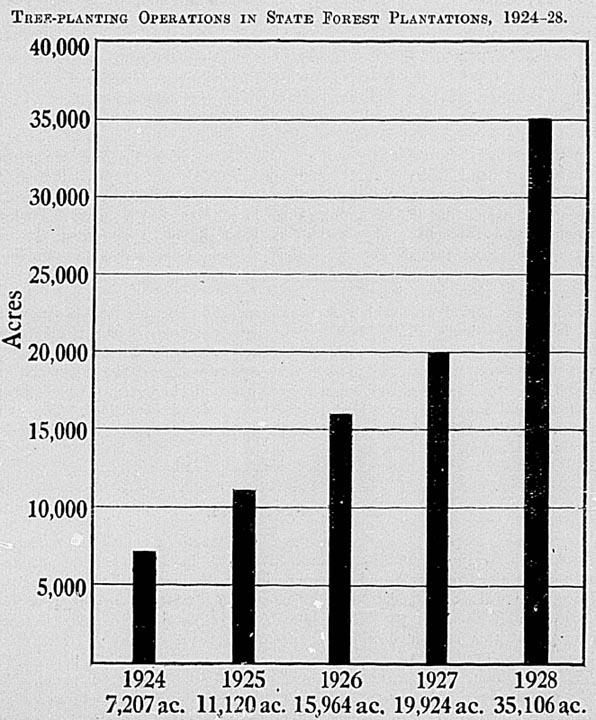
The total area of State plantations is now 133,997 acres, of which 96,399 acres are in the North Island, and 37,598 in the South Island. In the North Island the three main plantations are in the Rotorua district—Whakarewarewa (8,037 acres), Waiotapu (7,010 acres), and Kaingaroa (75,503 acres).
The reserve known as Whakarewarewa Plantation is situated immediately behind Rotorua Nursery, whence it extends in a southerly direction for a distance of seven miles. Waiotapu Plantation, which is twenty miles distant by road from Rotorua, comprises a large block of undulating country lying to the east of the Rotorua - Taupo Road. Joining this plantation on the east is the reserve on the Kaingaroa Plains, distant from Rotorua some thirty miles, and comprising a comparatively small part of the extensive plateau which lies between the Rangitaiki River on the east and the Waiotapu Valley on the west. Here are situated the youngest portions of the State plantations and the present centre of the tree-planting activities.
While many species were experimented with in the initial stages of the work, the chief species used to any considerable extent in the Rotorua district were European larch, Austrian pine, Corsican pine, Western yellow-pine, and a variety of eucalypti, Of more recent years the species used for planting have been Douglas fir, Western yellow-pine, Pinus radiata (insignis), Corsican pine, and, to a smaller extent, Weymouth pine.
The other plantations in the North Island are situated at Puhipuhi (1,200 acres) and Waipoua (141 acres), North Auckland, on areas which once carried kauri forest; at the head of Auckland Harbour at Riverhead (2,668 acres), and in Wellington at Karioi (1,306 acres), where the establishment of large-scale plantations has been commenced; and at Tangimoana (534 acres), on the Rangi-tikei sand-dune experimental area.
In the South Island the main plantations are situated in the northern portion of the Canterbury Land District, at Hanmer Springs (7,900 acres) and Balmoral (13,016 acres); in Central Otago at Naseby (2,366 acres); in South Otago at Conical Hills (3,533 acres), Greenvale (3,646 acres), Blue Mountains (3,256 acres), Dusky Hill (746 acres), and Pukerau (573 acres); in Westland at the Forest Experiment Station (1,288 acres); in Nelson at Golden Downs (494 acres); in Marlborough at Dumgree (342 acres). The balance of 438 acres consists of small experimental plantations in various localities.
During the period over which State afforestation has been in progress in the South Island practically all the best-known commerce trees of the Northern Hemisphere have been experimented with, but many have been discarded as unsuitable for various reasons, until at the present time operations are being conducted with a comparatively small range of conifers of proved economic importance, which experience has shown will most readily adapt themselves to local conditions. The principal species now being raised for afforestation purposes are Pinus radiata (insignis), P. ponderosa, P. Laricio, and Douglas fir.
To provide trees for the establishment of State plantations, nurseries are maintained at Waipoua, Puhipuhi, and Riverhead in the Auckland district; at Rotorua and Kaingaroa; and at Tangimoana in the Wellington district. The nursery at Rotorua is also the chief distributing-station of trees for local authorities and private individuals in the North Island, and a total of 154,250,000 trees has been raised at this station since 1898; while the total number of trees raised to the 31st March, 1928, for all North Island nurseries is 173,000,000.
The Chief South Island nurseries are situated at Hanmer, Tapanui, Naseby, and Golden Downs, and these, together with several other minor nurseries, some of which are now closed, have successfully raised 95,000,000 trees to the 31st March, 1928.
Of the total number of trees raised in all nurseries, 160,230,000 have been utilized in State plantations and 26,928,000 for distribution to local authorities and private individuals, the balance remaining in stock in the nurseries.
During the year ended 31st March, 1928, the nurseries disposed of 21,573,000 trees, of which 17,763,000 went to the State plantations and the balance to private individuals.
The same forces that have enabled the Government to work to a wider objective in the creation of man-raised forests have also been reflected in the splendid interest shown by boroughs, town districts, counties, Power and Harbour Boards, and other local bodies in the formation of commercial forests.
During the year 1927-28 local bodies established approximately 2,300 acres of new plantations. In the North Island local authorities planted about 300 acres in areas ranging from 1 acre upwards, and also obtained trees from the State Forest Service for planting for shelter or beautification purposes. In the South Island local authorities planted approximately 2,000 acres in areas ranging from 2 to 800 acres.
A special feature of the State Forest Service activities is the raising of forest-tree plants of high quality for sale, at prices that cover merely actual cost and overhead expenses, to local authorities, school committees, settlers, proprietary and co-operative afforestation companies, and others. This system, inaugurated in 1915. has resulted in the supply to date of some 26,500,000 trees, of which 3,480,000 were supplied during the year ended 31st March, 1928. In addition, many trees are obtained for private afforestation from the Dominion Federated Nurserymen's Association.
During 1927-28 the State Forest Service, which now operates an up-to-date seed-extracting plant, supplied 2,156 lb. of tree-seeds to Dominion and overseas growers, as compared with 3,861 lb. in 1926-27. The Service also co-operates with Forest Administrations abroad by exchanging considerable quantities of tree-seeds.
The State Forest Service encourages and fosters private planting by means of expert advice, personal instruction, correspondence, lectures and demonstrations at agricultural and industrial shows, distribution of circulars and leaflets, and preparation of planting plans.
The rising timber-prices recorded in the last decade, and the certainty in the future of further decreases in the available supply, together with a reasonable assurance of a constant and growing demand, have in recent years drawn attention to the growing of timber as a profitable undertaking, and in 1923 the planting of forests was undertaken by commercial concerns.
Two classes of companies have been formed to carry out the various ventures. The first is the ordinary joint-stock company, where the property is vested in the company and the shareholders receive a pro rata share of the profits according to the amount of capital contributed; the second is a private company registered with a comparatively small capital, but of which the investing public do not become shareholders. The company contracts with each investor that in consideration of his paying the prescribed amount of cash it will convey to him at the end of a given term a certain area of land duly planted according to a prescribed agreement. The interests of the investing public are watched over by trustees appointed by investors, and the lands concerned are convoyed by way of mortgage to the trustees until the time for conveyance to the investor arrives. Of the sixteen returns received from companies engaged in forestation operations during the year ended the 31st March, 1927, six were from companies organized on the latter basis; but, though in the minority in point of numbers, their operations form the greater part of the work carried out during the year.
It will be readily understood that in many instances the companies furnishing returns were in their early infancy during the year ended 31st March, 1927. Definite conclusions cannot, therefore, be drawn from the statistical data given, without the exercise of extreme caution.
The latest figures show that phenomenal progress has been made in commercial forestation in the short space of twelve months. At 31st March, 1926, the total assets of the companies furnishing returns aggregated £938,205, while the figures for the same date in 1927 were recorded as £1,448,921, an increase of over 50 per cent. Shareholders in companies and purchasers of forest areas paid in actual cash £131,127 and £367,693 respectively, or a total of £498,820, during this period; the total receipts amounted to £526,123 during the year 1926-27, against £392,915 in the previous year. Perhaps the most tangible evidence of the development is to be found in a comparison between the figures regarding the planting operations during the two years. Those for 1925-26, showing 10,003,100 trees as having been planted on 15,826 acres, are completely dwarfed by the latest figures, which show 30,388,137 trees as having been planted on 49,824 acres. The number of employees engaged increased from 261 at 31st March, 1926, to 482 at the corresponding date in 1927.
The following statement shows the liabilities and assets of the forestation companies at 31st March, 1927 :—
| Liabilities. | £ |
|---|---|
| Paid-up share capital | 339,662 |
| Loan-money | 23,631 |
| Forfeited Shares Account | 3,828 |
| Mortgages | 266,933 |
| Sundry creditors | 54,845 |
| Other liabilities | 760,022 |
| .. | £1,448,921 |
| Assets. | £ |
| Land for forestation purposes | 459,012 |
| Land for other purposes | 393 |
| Buildings | 33,146 |
| Development Account | 676,630 |
| Investments | 94,100 |
| Other assets | 185,640 |
| .. | £1,448,921 |
The instalments paid up to the present by the purchasers of forest areas have been regarded as temporarily akin to loan-moneys, and are included under the item “Other liabilities,” thus accounting for the high figure shown under this heading.
The amount debited by the various companies to Development Account (£676,630) is also very high in comparison with the remaining assets. This is explained by the fact that, unless engaged in nursery or other revenue-producing operations, a forestation company will not derive any income (apart from thinnings, &c.) until its forests mature. This postponement of its returns renders the creation of a Development Account necessary, in order that the actual results of the venture may be ascertained in due course. All expenditure is charged in the meantime to this account, and at the end of the period, when the forests are sold or matured, the amount standing to the debit of this account will be set against the proceeds from the sale of the timber. The result will then represent either profit or loss on the venture. As expenditure in the way of the formation of forests, &c., continues, the amount standing to the debit of the Development Account will increase. Among the items charged to the Development Account are many of a non-recurring nature (e.g., preliminary expenses), and in any comparisons between this figure and the number of acres planted, with the object of ascertaining the cost per acre, this must not be lost sight of. Strictly speaking, such comparisons cannot be accurately drawn until the forests mature or are disposed of.
The greatest relative increase in the individual items on the assets side as between 1926 and 1927 was that (84 per cent.) recorded in the Development Account. In view of the foregoing remarks, this is not altogether unexpected. The recorded value of the other assets showed an increase of 78 per cent., while the balance-sheet valuation of investments was 63 per cent. greater in 1927 than in 1926. The value of land for forestation purposes increased by 19 per cent. The composition of the total assets has undergone a considerable change between the 31st March, 1926 and 1927. Land for forestation purposes, which constituted 42 per cent. of the total assets in the former year, fell relatively to 32 per cent.in the latter year. This was due to the relatively greater increase in the Development Account, which constituted 39 per cent. of the total in 1926 and 47 per cent. in 1927.
Altogether the total liabilities at 31st March, 1927, were 54 per cent. greater than the total at 31st March, 1926. The greatest relative increase was recorded in the comparatively insignificant item “Forfeited Shares and Bonds Account,” which increased sixfold; the next greatest relative increase being for loan-money, which more than doubled. The paid-up shares capital showed an increase of £115,472, or 52 per cent., while the biggest item “Other liabilities” was augmented by 98 per cent. This figure rose from £384,662 in 1926 to £760,022 in 1927; it includes the liability to bondholders for instalments paid, which, of course, increases substantially from year to year until all instalments have been paid. There has been a fairly marked change in the composition of the total liabilities, as a glance at the percentages given, revealing the ratio between each item and the total, will readily disclose. In 1926 the paid-up capital and the other liabilities comprising payments to bondholders, reserves, &c., represented 65 per cent. of the total, the remaining 35 per cent. constituting what may be termed “outside” liabilities. By the 31st March, 1927, these “outside” liabilities comprised only 24 per cent. of the total liabilities, while paid-up capital, liabilities to bondholders, &c., accounted for the remaining 76 per cent.
The receipts and payments of forestation companies during the year 1926-27 were as follows:—
| Receipts. | £ |
|---|---|
| Shareholders | 131,127 |
| Bondholders | 367,693 |
| Loan-moneys | 16,762 |
| Other sources | 10,541 |
| .. | £526,123 |
| Payments. | £ |
| Tree-raising | 20,030 |
| Establishment charges | 74,557 |
| Maintenance | 5,501 |
| Management, &c. | 178,303 |
| Land-purchase | 89,326 |
| Other | 150,776 |
| .. | £518,553 |
During the year ended 31st March, 1927, the various forestation companies had cash receipts totalling £526,123. Of this figure, 94 per cent. represented cash received from shareholders in the way of calls, and from purchasers of forest areas as instalments on the purchase price of such areas. Shareholders contributed £131,127, or 25 per cent. of the total receipts, while £367,693, or 69 per cent., came from purchasers of forest areas. The balance of the cash receipts comprised receipts of loan-moneys (£16,762), and sundry amounts totalling £10,541 from various sources.
“Management and office expenses” was recorded as the largest single item of payments during the year, £178,363, or 34 per cent. of the total payments, falling under this heading. At first glance, this item may appear to be disproportionately largo, but it must be remembered that during the period covered many companies were in the earliest stages of development, when preliminary, formation, and other cognate payments naturally overshadow payments on behalf of the main objects of the companies.
Payments made directly in the way of forestation amounted to £100,088, or 19 per cent. of the total, as compared with £44,334, or 12 per cent. in 1926.
The six companies engaged in the sale of forest areas affected sales involving 34,117 acres of land during the twelve months ended 31st March, 1927, making a total of 101,226 acres sold to that date. The instalments paid in accordance with the contracts of sale entered into during the twelve months amounted to £364,074,while the total instalments received up to the 31st March, 1927, on all bonds were returned as £727,634. The total commitments of the investing public on account of contracts entered into during the year amounted to £851,427, bringing the total for this figure to £2,518,972 at 31st March, 1927.
Against the foregoing figures must be set contracts involving 6,033 acres, of a total purchase price of £150,825, which have been cancelled by the purchasers. Instalments amounting to £2,909 were paid up on these cancelled contracts.
On 31st March, 1927, 482 persons found employment with commercial forestation concerns. A classification of these employees, together with the amounts paid as salaries and wages during the year, is given hereunder:—
| Nature of Employment. | Number of Employees. | Salaries and Wages paid. | ||
|---|---|---|---|---|
| Males. | Females. | To Males. | To Females. | |
| .. | .. | .. | £ | £ |
| Tree-raising | 52 | 14 | 9,532 | 1,586 |
| Planting | 278 | .. | 54,519 | .. |
| Maintenance | 40 | .. | 7,170 | .. |
| Forest-fire prevention | 73 | .. | 14,271 | .. |
| Management | 23 | 2 | 7,080 | 350 |
| Totals | 466 | 16 | 92,572 | 1,936 |
Fairly extensive planting operations were carried on during the year by most of the companies furnishing returns. Particulars regarding the species and number of trees planted, and the areas planted, are given in the following table :—
| — | Number of Trees planted during the Year. | New Area planted during the Year. | Total Area planted to 31st March, 1927. | |
|---|---|---|---|---|
| To replace Blanks. | On New Areas. | |||
| .. | Number. | Number. | Acres. | Acres. |
| Pinus radiata (insignis) | 153,500 | 29,785,240 | 49,269 | 64,498 |
| Eucalyptus eugenioides | .. | 148,000 | 155 | 160 |
| Eucalyptus saligna | 15,000 | 26,000 | 30 | 30 |
| Eucalyptus botryoides | .. | 20,000 | 30 | 30 |
| Eucalyptus Macarthuri | .. | 25,000 | 30 | 30 |
| Californian redwood | .. | 84,000 | 154 | 156 |
| Acacia mollis (wattle) | .. | 160,500 | 72 | 110 |
| Cryptomeria japonica | .. | 100 | 1 | 1 |
| Unspecified | .. | 139,297 | 83 | 212 |
| Totals | 168,500 | 30,388,137 | 49,824 | 65,227 |
Altogether 213,308 acres of land had been acquired by forestation companies at 318t March, 1927. Of this area, 5,358 acres were leasehold and 207,950 freehold. Based on cost, the value of the freehold land was returned at £404,640, which gives an average of £1 19s. per acre.
In addition to the routine work carried out to this end by the State Forest Service, by authority of the Forests Act, 1921-22, great assistance is afforded by the State in other ways.
The method first adopted in New Zealand for inducing the planting of trees for the production of timber was by means of “land grants”—a settler being given a free grant of land if ho planted a certain portion of his land with suitable trees. In Canterbury, where the system was adopted in the early “seventies,” an area of as much as two acres of Crown lands for one acre planted with trees was sometimes granted. Several large plantations that were established in Canterbury by this method may now be seen; and in some cases very good returns have during late years been obtained from the milling of these. The Selwyn and Ashburton County Councils are the outstanding examples of local authorities taking advantage of this scheme, and are now netting handsome revenues from their tree plantations.
The State assists also by reduction of rent to Crown tenants planting trees on their land, by granting subsidies to local authorities to aid in tree-planting schemes, and by remission of taxation on tree plantations.
New Zealand legislation gives distinct encouragement to tree-planting. Neither the value of trees that have been planted (other than fruit-trees and live hedges) nor the value of trees that have been preserved for shelter and ornamental purposes is included in the value of the land on which such trees are growing as assessed for the purposes of land-tax and local rates. Such land is valued for land-tax and local-rating purposes as grazing-land. When the trees in a plantation are milled or sold, the proceeds of such milling or sale are taxable as income. Trees are not part of a deceased person's dutiable estate; only the land on which they are growing is subject to payment of duty. From 1st April, 1927, however, every County Council is empowered to make an annual levy of 1/2d. per hundred feet board measure on timber in the county converted from the log into sawn timber.
Table of Contents
WITH its great extent of coast-line, splendid natural harbours, and numerous sheltered bays, New Zealand has from the earliest times been famed for the productivity of its coastal fisheries. Off its more northerly coasts, which come within the influence of the south equatorial current, a rich variety of subtropical fish life is found, as exemplified by such species as the flying-fish, the sunfish, the swordfish, and several shark species. On the other hand, its southern coasts, washed by the antarctic drift, are the natural haunt of the fur-bearing seal, and yield varieties of fish which are characteristic of cold-water conditions. Up to the present only the east coast fishing-grounds have been regularly exploited on a commercial scale. Most of the western fishing-grounds remain in practically virgin condition, and offshore deep-sea fisheries have been neither exploited nor explored.
The ease with which abundant catches were made led to a certain wastefulness in the utilization of the fisheries in the past, but with the development of a more rational appreciation of the value of the marine natural resources, it is certain that the fishing industry will become increasingly important as a source of food-supply to the population of the Dominion and as a means of providing an export trade to countries less favoured by nature.
Of the many kinds of excellent edible fishes the most important are the flounders of different species (Rhombosolea), which occur in the more shallow and sheltered waters, the snapper (Pagrosomus auratus), which is particularly abundant in the north, the blue cod (Parapercis colias), which provides the staple product of the southern line fisheries, and the groper or hapuku (Polyprion oxygeneios), which is caught on lines in the deeper water from the North Cape to Stewart Island.
Provision exists in the Fisheries Act, 1908, whereby owners of boats and fish curers may be required to furnish returns to the Marine Department in such form and in such manner as may be prescribed by the Governor-General in Council, but advantage of this provision has not yet been taken to enable information to be collected as to the quantity of fish caught. A statement is, however, compiled annually by the Chief Inspector of Fisheries as to the weight and value of fish caught. The figures for each fishing-port are as follows for the year ended 31st March, 1928 :—
| Name of Port. | Principal Kinds of Fish caught. | Quantity. | Total Value. |
|---|---|---|---|
| .. | .. | .. | £ |
| Mangonui | Snapper, trevally, tarakihi, kingfish, rock-cod, gurnard, kahawai, flounder, hapuku | 135 cwt. | 89 |
| Hokianga | Snapper, mullet, kahawai, flounder | 60 cwt. | 60 |
| Russell | Crayfish, mullet, hapuku, snapper, flounder, kahawai, kingfish, maumau | 12,000 cwt. | 7,800 |
| Whangarei | Snapper, mullet, flounder, hapuku | 2,900 cwt. | 2,800 |
| Kaipara | Snapper, flounder, mullet, kahawai, trevally, gurnard | 4,400 cwt. | 9,300 |
| .. | Toheroa | 950 cases | 1,850 |
| Auckland District | Snapper, tarakihi, trevally, flounder, sole, gurnard, hapuku, john-dory, kingfish, moki, rock-cod, kahawai, butterfish, barracouta, mullet, garfish | 153,410 cwt. | 139,633 |
| .. | Crayfish | 2,500 cases | 2,750 |
| .. | Mussels | 5,969 sacks | 1,645 |
| Tauranga | Snapper, hapuku, trevally, kahawai, rock-cod, garfish, moki, flounder, crayfish | 2,000 cwt. | 5,600 |
| Gisborne | Tarakihi, gurnard, snapper, flounder, sole, kahawai. hapuku, crayfish | 3,761 cwt. | 4,467 |
| Napier | Tarakihi, snapper, moki, kahawai, gurnard, trevally, hapuku, southern kingfish, barra couta, john-dory, flounder, solo, brill | 18,912 cwt. | 23,507 |
| .. | Crayfish | 480 sacks | 895 |
| .. | Whitebait | 27 cwt. | 375 |
| New Plymouth | Snapper, hapuku, kingfish, tarakihi, kahawai, cod, crayfish, gurnard | 950 cwt. | 1,770 |
| Wanganui | Blue-cod, hapuku, flounder, snapper | 374 cwt. | 455 |
| Foxton | Flounder, snapper, hapuku, kahawai, whitebait | 700 cwt. | 2,000 |
| Wellington | Tarakihi, gurnard, flounder, sole, snapper, ling, warehou, hapuku, moki, butterfish, blue cod, southern kingfish | 38,163 cwt. | 71,965 |
| Picton | Hapuku, moki, butterfish, garfish, crayfish, blue cod | 13,920 cwt. | 19,487 |
| Blenheim | Red cod, sole, flounder, ling, snapper, moki, hapuku, gurnard, tarakihi, mackerel, butterfish. crayfish | 2,100 cwt. | 4,000 |
| Nelson | Snapper, flounder, gurnard, bream, hapuku, cod, crayfish, barracouta | 2,870 cwt. | 4,607 |
| Westport | Red cod, crayfish, flounder, hapuku, gurnard, kahawai, ling, moki, snapper, sole, turbot, whitebait | 911 cwt. | 2,511 |
| Greymouth | Flounder, sole, cod, hapuku, snapper, herring | 81 cwt. | 320 |
| .. | Whitebait | 80 cwt. | 1,400 |
| Hokitika | Hapuku, snapper, flounder, herring, kahawai | 513 cwt. | 150 |
| .. | Whitebait | 925 cwt. | 8,295 |
| Kaikoura | Hapuku, ling, trumpeter, southern kingfish, butterfish, tarakihi, mold, crayfish | 2,832 cwt. | 7,892 |
| Kaiapoi | Whitebait | 340 cwt. | 1,700 |
| Akaroa | Hapuku, ling, conger eel, flounder, sole, brill, blue and red cod, crayfish, barracouta, kingfish, kahawai, moki, butterfish, &c. | 3,143 cwt. | 7,333 |
| Lyttelton | Hapuku, barracouta, red cod, ling, flounder, sole, gurnard, brill | 1,026 cwt. | 14,036 |
| Timaru | Flounder, solo, brill, hapuku, ling, red cod, gurnard, kingfish, barracouta | 7,400 cwt. | 17,020 |
| Oamaru | Hapuku, red cod, blue cod, moki, barracouta, ling | 2,076 cwt. | 3,012 |
| Moeraki | Hapuku, red cod, blue cod, moki, crayfish, barracouta, ling | 3,663 cwt. | 5,408 |
| Otago District | Hapuku, ling, red cod, barracouta, kingfish, blue cod, moki, trumpeter, tarakihi, trevally, mullet, garfish, kahawai, gurnard, kelpfish, sole, flounder, brill, skate | 47,340 cwt. | 47,340 |
| Invercargill | Blue and red cod, hapuku, moki, flounder, kingfish, mullet, ling, sole, crayfish, barracouta, whitebait | 2,500 cwt. | 4,500 |
| Bluff | Hapuku, blue cod, flounder | 3,126 cwt. | 10,454 |
| Stewart Island | Blue cod, hapuku, trumpeter, moki | 9,320 cwt. | 14,257 |
| Chatham Islands | Blue cod, hapuku, trumpeter | 4,955 cwt. | 5,000 |
The quantity of fish recorded as having been brought in from the fishing-grounds for the year ended the 31st March, 1928, was 350,851 cwt., which, with items where the weight was not shown, represented a wholesale value of £446,768. The wholesale value of the oysters landed from the various beds was £23,071, and the produce of the whale-fisheries was £13,710.
Included in New Zealand produce exported during the last five years were—
| Item. | 1923. | 1924. | 1925. | 1926. | 1927. |
|---|---|---|---|---|---|
| .. | £ | £ | £ | £ | £ |
| Fish | 69,328 | 58,417 | 55,423 | 63,009 | 74,194 |
| Oysters | 762 | 571 | 1,474 | 1,650 | 561 |
| Whalebone | 425 | 290 | 160 | 9 | 190 |
| Whale-oil | 6,072 | 6,515 | 10,541 | 6,836 | 7,009 |
| Ambergris | 75 | 2,000 | 1,200 | .. | .. |
| Other products of fisheries | 89 | 103 | 39 | 64 | 26 |
| Totals | 76,751 | 67,896 | 68,837 | 71,568 | 81,980 |
The value of fish (preserved) imported in 1927 was £169,606.
A table showing the various classes of vessels engaged in the fishing industry, together with the number of persons employed, is given below for the year ended 31st March, 1928:—
| — | Whole Time. | Part Time. | Total. |
|---|---|---|---|
* Includes 23 not allocated. † Includes 8 not allocated. | |||
| Vessels engaged in fishing for wet fish— | .. | .. | .. |
| Steam trawlers | 22 | 4 | 26 |
| Motor trawlers | 21 | 52 | 73 |
| Steamers—Danish seining | 2 | 4 | 6 |
| Motor-vessels—Danish seining | 29 | 11 | 40 |
| Motor-vessels—Set-net and lino fishing | 534 | 337 | 871 |
| Sailing-boats | 40 | 216 | 256 |
| Row-boats | 254 | 216 | 470 |
| Vessels engaged in shell-fishing— | .. | .. | .. |
| Oyster-dredging vessels | 5 | .. | 5 |
| Mussel-dredging vessels | .. | 12 | 12 |
| Crayfishing-vessels | .. | 131 | 131 |
| Number of persons employed— | .. | .. | .. |
| Fishermen | 1,773 | 835 | 2,631* |
| Others | 700 | 199 | 907† |
A summary table giving similar information for each port in the Dominion follows :—
| Name of Port. | Vessels engaged in Fishing for Wet Fish. | Vessels engaged in Shell-fishing. | Number of Persons employed. | |||||
|---|---|---|---|---|---|---|---|---|
| Steam-vessels. | Motor-vessels. | Sailing-boats. | Row-boats. | Fishermen. | Others. | Total. | ||
| * Including Manukau, Mercury Bay, and Coromandel. | ||||||||
| Mangonui | .. | 2 | 1 | 2 | 2 | 5 | .. | 5 |
| Hokianga | .. | 8 | .. | 17 | .. | 37 | .. | 37 |
| Russell | .. | 25 | 1 | 3 | 5 | 48 | 6 | 54 |
| Kaipara | .. | 74 | .. | 10 | .. | 80 | 15 | 95 |
| Whangarei | .. | 19 | .. | 1 | 2 | 39 | 15 | 54 |
| Auckland* | 5 | 190 | 4 | 42 | 32 | 490 | 330 | 820 |
| Thames | .. | 46 | .. | 5 | 2 | 110 | 40 | 150 |
| Tauranga | .. | 40 | 5 | 5 | .. | 121 | 12 | 133 |
| Gisborne | 2 | 4 | .. | 6 | .. | 19 | 12 | 31 |
| Napier | 12 | 24 | .. | 63 | 18 | 220 | 19 | 239 |
| New Plymouth | .. | 15 | .. | 13 | 15 | 48 | 30 | 78 |
| Wanganui | .. | 16 | .. | 6 | .. | 5 | .. | 6 |
| Foxton | .. | 5 | .. | 20 | .. | 43 | 4 | 47 |
| Wellington | 2 | 56 | 10 | 36 | 35 | 270 | 100 | 370 |
| Name of Port. | Vessels engaged in Fishing for Wet Fish. | Vessels engaged in Shell-fishing. | Number of Persons employed. | |||||
|---|---|---|---|---|---|---|---|---|
| Steam-vessels. | Motor-vessels. | Sailing-boats. | Row-boats. | Fishermen. | Others. | Total. | ||
| * Including Moeraki. | ||||||||
| Picton | .. | 50 | .. | .. | .. | 87 | .. | 87 |
| Blenheim | .. | 12 | .. | .. | 2 | 23 | 8 | 31 |
| Nelson | 1 | 25 | .. | 1 | 2 | 46 | 10 | 56 |
| Westport | .. | 9 | .. | .. | 1 | 11 | 7 | 18 |
| Greymouth | 1 | 6 | 2 | 10 | .. | 21 | 4 | 25 |
| Hokitika | .. | .. | .. | 1 | .. | 1 | .. | 1 |
| Kaikoura | .. | 15 | .. | 6 | 2 | 25 | 1 | 26 |
| Kaiapoi | .. | .. | .. | 30 | .. | 30 | .. | 30 |
| Akaroa | .. | 16 | .. | 5 | 7 | 30 | .. | 30 |
| Lyttelton | 2 | 39 | 26 | 85 | .. | 195 | 120 | 315 |
| Timaru | 3 | 46 | .. | .. | .. | 28 | 8 | 36 |
| Oamaru* | .. | 38 | .. | 2 | 10 | 53 | 7 | 60 |
| Otago District | 4 | 91 | .. | 24 | 8 | 214 | 103 | 317 |
| Invercargill | .. | 30 | 6 | 4 | .. | 85 | 25 | 110 |
| Bluff | .. | 44 | .. | 3 | .. | 154 | 20 | 174 |
| Stewart Island | .. | 39 | .. | .. | .. | 93 | 11 | 104 |
| Totals | 32 | 984 | 256 | 470 | 148 | 2,631 | 907 | 3,538 |
The principal oyster-beds round the coast of New Zealand are those situated in Foveaux Strait, between South and Stewart Islands, and the rock-oyster beds on the east and west coasts of the Auckland Peninsula. The Foveaux Strait beds are very extensive. An official prospecting cruise was carried out in respect of these beds in 1906, resulting in a number of new beds being discovered and reliable information being ascertained concerning the areas and qualities of the various beds. Further investigations of the nature of a biological survey were undertaken in 1927.
During the 1927 season 21,009 sacks of oysters, valued at £15,757, were dredged from the Foveaux Strait beds, as compared with 27,828 sacks, valued at £19,479, in1926.
The rock-oyster beds of Auckland were worked for many years under a variety of systems, including the leasing of the beds to individuals and the licensing of pickers to take oysters on payment of s. fee, but owing to stripping of the beds close seasons had frequently to be proclaimed. For some years an export duty of 6d per hundredweight was payable on all North Island oysters exported, and in 1899 the export of rock-oysters and also of mangrove-oysters was absolutely prohibited. A further step towards conserving the beds was taken in 1908, when the picking and wholesale marketing of rock-oysters from the North Island beds was undertaken by the State, private picking being prohibited. A table is given showing the quantity and value of oysters picked and sold by the State during each of the last five years; also the cost of picking and selling, this item including interest and depreciation on the cost of the oil-launches used by the Inspectors. It will be seen that a profit accrues to the State, and the scheme has, moreover, resulted in the conservation and extension of the beds.
| Season. | Oysters sold. | Prices realised. | Cost of Picking and Selling. |
|---|---|---|---|
| .. | Sacks. | £ | £ |
| 1923 | 6,800 | 7,356 | 5,045 |
| 1924 | 6,841 | 8,395 | 6,255 |
| 1925 | 8,288 | 10,206 | 7,688 |
| 1925 | 6,771 | 8,345 | 6,997 |
| 1927 | 5,915 | 7,314 | 5.967 |
Various attempts were made several years age by private persons to form artificial oyster-beds, but none of these met with success.
Realizing the necessity for extending and improving the oyster-beds in the Auckland District, the Marine Department in 1909 and 1910 commenced replanting the bays and foreshore on the Coromandel coast. These beds had been practically wiped out by the old system of licensed picking. The system adopted by the Department for stocking depleted areas consisted of taking rocks covered with oysters of all ages from well-stocked bods and planting them in suitable places along the foreshore. The work done on the Coromandel coast and at the Bay of Islands has been very successful, and several of the replanted beds are now well stocked with mature oysters. More recently the formation of new beds has been undertaken, hollow rock walls being built in sheltered bays and on tidal flats. In the spawning season the oyster-spat attaches itself to the under-side of the rocks, which are allowed to remain in that position for a month or two when they are turned over to permit the young oysters to grow to marketable size, the cap-stones thus covered being usually moved to the level of maximum growth and the walls provided with fresh cap-stones which in turn become covered with spat.
Oyster-cultivation work is being systematically carried on in the Hauraki Gulf, in the Bay of Islands, and in the Whangarei district. The rock walls previously built are now well covered with young oysters. Large numbers of the oysters on the walls built at Bay of Islands in 1920 and 1921 are now being picked for market.
In the earlier part of the nineteenth century New Zealand was the centre of an important whale-fishery, many whaling-stations being established in the North of Auckland and in Cook and Foveaux Straits. The industry gradually declined in importance until at present only two stations remain. The whales caught are mostly of the hump-back variety. At Whangamumu, North Auckland, a whaling-steamer, fitted with the most modern appliances for killing and handling whales, has been placed in commission, and a very serviceable whaling plant has been established. Seventy-four whales were taken last season (1927) in this locality, yielding 388 tons of oil and 70 tons of bonedust, of a total value of approximately £7,210. Whaling operations are also carried on in Tory Channel, in Marlborough. The value of the product of the Marlborough whale-fisheries in 1927 (325 tons of oil) was £6,500-53 hump-back whales and 1 right whale were taken.
A reference to the whaling operations carried out in the Ross Sea appears in the section on “Dependencies.”
For many years past the taking of seals has been prohibited, the close season originally declared having been extended from time to time for periods of three years. The latest extension carries the close season to 27th November, 1931, but does not apply to the taking of seals from Campbell Island under any license issued by the Minister of Marine.
A site for a marine fish-hatchery was selected at Purakanui, Otago, in 1900, but this being found unsuitable for its intended purpose another site was chosen at Portobello, in Otago Harbour. The erection of the hatchery was carried out by a Board set up to superintend the work of the hatchery, funds being provided by the State, and grants being made by the Otago Institute, the Australasian Association for the Advancement of Science, and a number of acclimatization societies. The State makes an annual grant towards the maintenance of the hatchery, the buildings and equipment of which have also been added to from time to time.
Experiments have been carried out with a view to introducing certain English food fishes to New Zealand waters—viz., lobsters, edible crabs, and turbot. Valuable work has also been done in the direction of hatching the spawn of various indigenous fishes and in making a study of their life-habits.
The early colonists who emigrated from Britain to New Zealand were much surprised to find a country with such splendid rivers and lakes, but with no fish of any commercial or sporting value in them. In a few years the question of introducing some of the British salmonidæ was considered, and as early as 1864 the matter assumed definite shape when the Otago Provincial Council took it up, and voted a sum for the importation of Atlantic salmon and English brown trout. There was, however, some delay in arranging for shipment, and it was not until 1868 that the first consignments of salmon and trout eggs arrived. Since that time the English brown trout (S. fario), Loch Leven (S. levenensis), American rainbow (S. irideus), American brook-trout (S. fontinalis), Quinnat salmon (O. tschawytscha), Atlantic salmon, English perch, and tench, have been successfully acclimatized.
Ova of the sockeye or blue-back salmon were imported in 1902, and specimens of this fish were caught in 1907. A number exist in Lake Ohau, having acquired a land-locked habit. These fish run up creeks at the head of the lake and spawn there every season in March and April.
Several shipments of whitefish-ova have been made since 1898, the fry being liberated in Lakes Kanieri and Tekapo. Reports as to the fish having been seen are received from time to time, but so far as is known no whitefish have yet been caught.
With the exception of the Hot Lakes District, which is under the control of the Department of Internal Affairs, the propagation of trout and the oversight of fishing operations is carried out by local Acclimatization Societies, fishing licenses being issued on payment of a small fee.
As already stated, the first shipment of Atlantic-salmon eggs arrived in 1868, and from that year to 1902 about fifteen consignments were brought out. Some of the earlier shipments arrived in bad condition, and none had a loss of less than 25 per cent. Up to 1908 there was no proof that these fish had been acclimatized, and the Government in that year decided to make a vigorous and systematic effort to establish them, concentrating on a single river. The Waiau, in Southland, was chosen as the most suitable river, and a hatehery, capable of accommodating a million eggs, was erected on a cold-water creek near the lower end of Lake Te Anau. A quarter of a million eggs were obtained from eastern Canada in 1908, and one million from England in 1909, and the same number from England in 1911. In each case an export was sent to pack the eggs and attend to them on the voyage out, with the result that each shipment arrived with a loss of not more than 1 per cent.
In the 1920-21 and 1921-22 angling seasons salmon were taken near the mouth of the Waiau. Inspection of the Upokororo, the tributary into which most of the young fish hatched from the three shipments referred to above had been liberated, disclosed the fact that a number of salmon had spawned there, and three specimens caught on the spawning-beds were definitely identified as Atlantic salmon. In 1922-23 fifty-six Atlantic salmon were caught in the Waiau and its tributaries. During the 1923-24 season good catches were made by anglers in the Upokororo and Eglington Rivers and in Lake Te Anau near its outflow, and several were caught in the lower reaches of the Waiau. Approximately three hundred were taken by anglers that season, and subsequent seasons have witnessed progressive increases.
During the season 1927-28 approximately eight hundred salmon were caught by anglers. Most of the fish were taken in the Upokororo River and at the outlet of Lake To Anau. The fish appear to have increased rapidly. Last spawning season the weather and river conditions were not very favourable for collecting salmon-eggs, and only 659,000 were secured. The Marine Department is now stocking the Wanganui River, in the North Island, with these fish, and most of the eggs collected in the last five seasons have been hatched out at the Government hatchery on Waitea Creek, on the upper Wanganui, and the young fish liberated in suitable tributary streams and in the main river. The balance of the eggs collected have been allotted to the Waiau River system.
The first importation of quinnat-salmon ova was made in 1875, and from that date to 1880 several shipments were made. On the arrival of these consignments the eggs were parcelled out to the different acclimatization societies, and the young fish hatched were planted in rivers from the north of Auckland to the far south, but no results were obtained from these shipments.
In 1900 the Government decided to make a vigorous effort to establish this fish, and decided to confine its efforts to one of the rivers considered to be the most suitable, and the Waitaki was chosen, as in its general characteristics it bears a considerable resemblance to some of the salmon rivers on the Pacific coast of America. The first shipment of eggs for the Government salmon-hatchery arrived in January, 1900. From that year to 1907 annual importations of half a million eggs each year were made, and, as they were specially packed and attended to by an expert during the voyage, they invariably arrived in splendid condition; the loss would not be more than 1/2 per cent. The result of the systematic effort made to establish the quinnat has been highly successful. In the seasons of 1905 and 1906 they were found spawning in the Hakataramea and other tributaries of the Waitaki, and in 1907 fifty thousand eggs were collected from salmon caught in the Hakataramea. Since then there has been a steady increase in the Waitaki every season, and they have now spread northward into all the snow-fed rivers as far as the Waiau, North Canterbury.
The run of quinnat salmon this season (1928) in some of the snow-fed rivers on the east coast was one of the largest which has been experienced since their introduction. Three netting licenses were issued for taking salmon for market, in the estuary of the Waimakariri, and a fourth not was operated on behalf of the Marine Department for investigational purposes. Licenses for £1 for the season are issued to anglers empowering them to sell their catches, and sea-fishermen, on payment of a license fee of £1, are allowed to take salmon and market their catches. The number of eggs collected last season was 1,013,000, of which 600,000 were sent to the Government hatchery at Maori Creek, the young fish being liberated in the Wairau River and its tributaries.
Table of Contents
IN no other country of equal size to New Zealand are indications of a greater number of economic minerals to be found, yet, with the exception of iron-ore, the known mineral reserves are not great in comparison with those in many other countries. The coal reserves of the Dominion are considerable, however, and their duration will be extended by the utilization of the enormous water-power resources of the country.
The gold-mining industry, which in its early stages contributed greatly to the progress and settlement of New Zealand, has for a number of years declined in importance, in common with the experience of most other gold-producing countries.
The following statement shows the quantity and value of the production of metalliferous mines, of stone-quarries under the Stone-quarries Act, and of coal-mines during 1926 and 1927 :—
| Mineral. | 1926. | 1927. | ||||
|---|---|---|---|---|---|---|
| Quantity. | Value. | Quantity. | Value. | |||
| .. | Oz. | £ | Oz. | £ | ||
| Gold and silver (estimated) | 554,529 | 539,302 | 506,420 | 550,166 | ||
| Platinum | 31 | 313 | 33 | 231 | ||
| .. | Tons | cwt. | .. | Tons | cwt. | .. |
| Tungsten-ore | 9 | 1 | 475 | 6 | 9 | 445 |
| Iron | 3,997 | 0 | 19,585 | 3,383 | 0 | 17,761 |
| Quicksilver | .. | 0 | 14 | 462 | ||
| Stone | 516,075 | 570,369 | ||||
| Pumice | 2,358 | 0 | 8,081 | 1,733 | 0 | 6,230 |
| Sulphur | 594 | 0 | 5,217 | 469 | 0 | 3,375 |
| Coal | 2,239,999 | 0 | 2,239,999 | 2,366,740 | 0 | 2,366,740 |
| Totals | 3,329,047 | 3,515,779 | ||||
The production of gold and silver is of necessity taken together, as separate figures are not available. Kauri-gum, the fossilized resin of former kauri forests, is counted as a mineral, but the production figures are not available.
The next statement shows the value of New Zealand minerals exported from the 1st January, 1853, to the 31st December, 1927, with separate details for the years 1926 and 1927 :—
| Mineral. | 1926. | 1927. | Increase or Decrease. | Total from 1st January, 1853,to 31st December, 1927. |
|---|---|---|---|---|
| * Ounces of the fineness of 20 carats and upwards. | ||||
| .. | £ | £ | £ | £ |
| Gold* | 516,207 | 534,639 | Inc. 18,432 | 92,938,038 |
| Silver | 51,236 | 42,589 | Dec. 8,647 | 3,059,249 |
| Quicksilver | .. | .. | .. | 8,336 |
| Tungsten-ore | 998 | 821 | Dec. 177 | 305,944 |
| Manganese | .. | 12 | Inc. 12 | 62,006 |
| Pig iron | .. | 4,592 | Inc. 4,592 | 4,592 |
| Kauri-gum | 332,765 | 278,632 | Dec. 54,133 | 22,134,383 |
| Other minerals | 9,761 | 6,636 | Dec. 3,125 | 457,770 |
| Coal | 285,909 | 221,253 | Dec. 64,656 | 6,427,308 |
| Totals | 1,196,876 | 1,089,174 | .. | 125,397,626 |
Gold-mining operations in New Zealand are divided into three branches. viz.:
(1) Quartz-mining, (2) alluvial mining, and (3) dredging.
The actual figures of gold-production are not available owing to no distinction being made between gold and silver in the case of mines which produce both. The following statement shows the value of the bullion-production during 1927, also the number of persons employed, and the number of gold-mines and dredges:—
| — | Production of Bullion.* | Number of Persons ordinarily employed at Productive and Unproductive Mines and Dredges. | Number of Productive Mines and Dredges. | |
|---|---|---|---|---|
| Quantity. | Value. | |||
| * Including a proportion of silver. | ||||
| .. | Oz. | £ | .. | .. |
| Quartz-mining | 480,978 | 449,281 | 1,089 | 22 |
| Dredge mining | 15,040 | 60,731 | 104 | 4 |
| Alluvial mining | 10,402 | 40,154 | 468 | 346 |
| .. | .. | .. | .. | .. |
| Totals, 1927 | 506,420 | 550,166 | 1,661 | 372 |
| Totals, 1926 | 554,529 | 539,302 | 1,704 | 314 |
The quantity of gold and silver bullion produced during the year 1927 was 48,109 oz. less than in the previous year, but the value was greater by £10,864.
The export of gold according to districts of production during 1926 and 1927, together with the total since April, 1857, when the first parcel was exported, is as shown in the next table.
| GOLD EXPORTS, 1926 AND 1927, AND TOTAL, 1857-1927. | ||||||
|---|---|---|---|---|---|---|
| District. | 1926. | 1927. | Total, 1857-1927. | |||
| Quantity. | Value. | Quantity. | Value. | Quantity. | Value. | |
| .. | Oz. | £ | Oz. | £ | Oz. | £ |
| Auckland | 81,352 | 339,488 | 80,762 | 338,309 | 7,398,223 | 28,751,899 |
| Wellington | .. | .. | .. | .. | 188 | 706 |
| Marlborough | 660 | 2,520 | 305 | 1,183 | 107,013 | 416,595 |
| Nelson | 43 | 175 | 720 | 2,809 | 1,741,969 | 6,906,745 |
| West Coast | 37,087 | 147,338 | 40,226 | 159,439 | 6,523,745 | 25,895,735 |
| Canterbury | 2 | 9 | .. | .. | 157 | 620 |
| Otago | 6,071 | 24,517 | 7,447 | 30,164 | 7,765,637 | 30,926,108 |
| Unknown | 562 | 2,160 | 711 | 2,735 | 9,903 | 39,630 |
| Totals | 125,777 | 516,207 | 130,171 | 534,639 | 23,546,735 | 92,938,038 |
The most important gold-mining operations in New Zealand consist in the working of quartz lodes and the extraction of the precious metals therefrom. Quartz-mining is conducted in the North Island in Ohinemuri County, and to a less extent in Tauranga, Thames, and Coromandel Counties. The mountain-ranges and hills of andesite and other volcanic rocks which form the Hauraki Goldfields are intersected by lodes containing gold and silver. In the South Island quartz-mining operations are carried on in the Reefton and Blackwater districts, also to a small extent in the Wakamarina Valley (Marlborough). In Otago operations are generally confined to the working of quartz-mines in which scheelite is associated with gold. The average value per ton of are treated during 1927 amounted to £1 15s. 3d., as compared with £1 17s. 2d. during 1926.
Alluvial gold is found chiefly on the west coast of the South Island and in Otago, where mining operations have been conducted over an area of 17,000 square miles. On the West Coast the auriferous alluvium originated from the weathering and denudation of the gold-bearing lodes during countless ages. The rich leads or defined placers of auriferous wash are the result of concentration. The first transportation of auriferous gravel from the mountains was by streams, and following this the glaciers carried much material from the interior seawards. During the advance and retreat of these glaciers immense masses of drift were deposited all over the low lands and even high up on the lower hills. Since glacial times the rivers have continued the movement of auriferous gravel from the interior to the sea. In Otago the conditions are different—the alluvial gold rests in the hollows of the denuded surface of the schistose rocks, from which it has most probably been derived.
The method of working these deposits depends on the depth of the superincumbent strata and the elevation at which they occur: where there is ample fall and a good supply of water is available, hydraulic sluicing has been generally adopted; but where the material is mainly or partly below water-level, and is comparatively free from hard boulders or hard matrix, elevating or dredging is employed.
This system of gold-mining, which originated in New Zealand, is generally employed on rivers and streams and at places where the sluicing method may not be advantageously applied owing to the absence of water-supply or to excessive water in the deposits. Gold-dredging is rapidly declining in importance, the number of productive dredges having decreased from 167 during 1906 to four during 1927.
The greatest weekly output by a New Zealand gold-dredge was attained by the “Lady Ranfurly” during six clays ended the 4th November, 1904, when operating on the River Molyneux (Clutha), 1,273 oz. of gold being obtained.
The following table shows the result of gold-dredging operations in New Zealand from 1918 to 1927 inclusive:—
| Year. | Total Number of Dredges working. | Value of Production. | Average Production per Dredge. | Dividend-paying Dredges owned by Registered Companies. | Number of Persons employed. | |
|---|---|---|---|---|---|---|
| Number. | Dividends | |||||
| .. | .. | £ | £ | .. | £ | .. |
| 1918 | 28 | 63,691 | 2,274 | 5 | 4,925 | 187 |
| 1919 | 19 | 47,838 | 2,518 | 4 | 2,845 | 138 |
| 1920 | 12 | 34,672 | 2,889 | 1 | 1,400 | 112 |
| 1921 | 11 | 36,179 | 3,289 | 1 | 600 | 136 |
| 1922 | 11 | 67,239 | 6,113 | .. | .. | 121 |
| 1923 | 8 | 68,003 | 8,500 | 1 | 3,283 | 100 |
| 1924 | 5 | 58,540 | 11,708 | 1 | 6,566 | 78 |
| 1925 | 5 | 40,994 | 8,199 | 1 | 3,283 | 107 |
| 1926 | 5 | 52,969 | 10,594 | .. | .. | 93 |
| 1927 | 4 | 60,731 | 15,183 | 2 | 6,766 | 104 |
Of the total production in 1927, £53,128 was won by the Rimu Flat dredge at Rimu, on the West Coast, £5,038 by the New River dredge at Dunganville, also on the West Coast, and £2,565 by two dredges in Otago and Southland.
During the year 1924 the Kawarau Gold-mining Company (Limited) made a commencement with the damming of Lake Wakatipu. The dam is equipped with ten stony sluice-gates, each having an effective waterway 40ft. in width by 7ft. 6 in. in height, and each being supported at its end by massive concrete pillars, of which there are eleven, including the abutments. The object of this work is to keepback the water in Lake Wakatipu during certain months of the year, and thus enable mining operations to be carried out as far as possible in the Kawarau River. The company has subleased, under tribute agreements, portions of the mining rights held by it in the Kawarau River. Substantial sums of money have been raised by the subsidiary companies for the purpose of carrying on mining operations in the river.
The dam at Kawarau Falls was completed during the year 1926. On the 30th August of that year the gates were closed; but at no point along the river did the water fall low enough to expose any virgin ground, consequently the amount of gold recovered by claimholders was very small. The disappointing results were attributed to the lateness of the season and the fact that the tributaries of the river were carrying more water than in midwinter, but little more success has attended the closing of the (bun for periods during the winters of 1927 and 1928.
The following figures showing the world's gold-production for the last ten years have been compiled from official sources by the American Bureau of Metal Statistics:—
| Year. | Fine Ounces. |
|---|---|
| 1918 | 18,556,920 |
| 1919 | 17,629,977 |
| 1920 | 16,125,697 |
| 1921 | 15,983,772 |
| 1922 | 15,444,830 |
| 1923 | 17,786,472 |
| 1924 | 19,023,134 |
| 1925 | 19,031,137 |
| 1926 | 19,321,416 |
| 1927 | 19,433,552 |
Nearly the whole of the silver exported from New Zealand, amounting in value at the end of 1927 to £3,059,249. has been obtained from the refinement of bullion from the quartz-mines, principally those of the Hauraki Goldfield, where gold and silver are found alloyed, the ratio of the two metals in the alloy varying greatly. No other silver-mining operations have been carried out profitably in this country.
Iron-ore occurs in New Zealand at Parapara. Golden Bay; on the seashore in Taranaki; at Kerr Point and Waitangi River, North Auckland; in the Raglan-Kawhia district; on Mount Peel, Nelson; on Mount Royal, near Palmerston; on Table Hill, near Milton; in the Lake Wakatipu district; and in the Mount Cook district, Westland.
The most extensive iron-ore deposits occur near Parapara and Onakaka, Golden Bay, in the Nelson Provincial District. The limonite-deposit of this locality is of great extent, and it is estimated in “Iron-ore Resources of the World,” published by the International Geological Congress, to contain 64,000,000 metric tons, of which about 30,000,000 tons occur in the Onakaka Block.
As Onakaka the ore and crystalline limestone flux occur at an altitude of about 1,200 ft. above the works, being conveyed thereto by aerial tramway 8,000 ft. in length. During 1921 the Onakaka Iron and Steel Company constructed a blast-furnace installation on its lease at Onakaka. The present capacity of the plant is 30 tons of pig iron per day. but it could be altered at little cost to produce an output of 50 tons per day. A trial run was made in 1922, the first half with coke imported from Australia, and the second half with coke from Miramar gasworks made from Liverpool (N.Z.) coal. The latter gave results at least as good as those from Australian coke, and the consumption of coke in both cases was 22cwt. per ton of pig iron produced. The pig iron was of good marketable quality, and was reported on favourably by users in different parts of the Dominion. The two important facts demonstrated by the test were—(1) That a good foundry pig iron could be produced by the Onakaka plant; (2) that the furnace could be run with Miramar coke as fuel and with a consumption of 22 cwt. of coke per ton of iron.
The company has erected a wharf about 1,000 ft. in length at Onakaka for the purpose of providing facilities for landing coal and shipping its products to different parts of the Dominion. Between the 12th January, 1924, and the8th of the following month about 1,000 tons of pig iron were produced. It was then found that the cost of transportation of coal from the wharf to the works, and of pig iron from the works to the wharf, by means of motor-wagons along the road was too high. The company thereupon arranged to have a rope-road constructed, which work has now been completed. It was also found that the number of coke-ovens previously built was inadequate, and additional coke-ovens were erected. The company now uses its own coke in the manufacture of pig iron.
During 1927 6,886 tons of ore were smelted for a production of 3,383 tons of pig iron, valued at £17,761. The company is now able to put iron on the market at a price which enables it to compete with imported iron. Additional capital has been raised, to increase the capacity of the blast furnace and install a pipe-founding plant, by means of which it is expected to keep the furnace at full production throughout the whole of the year. Additional coke-ovens are now being erected, the wharf extended, and the blast furnace enlarged. The analyses of three samples of Onakaka iron in 1925 show its average composition to be as follows: Graphite carbon, 3.02 per cent.; combined carbon, 0.48; silicon, 2.11; sulphur, 0.07; phosphorus, 0.32; manganese, 0.70; iron, 93.24.
Along the seashore from Paten to New Plymouth occur large quantities of magnetic ironsand more or less titaniferous. This has originated through the disintegration of hornblende-andesites and their tufas, which occur very extensively near New Plymouth around the volcanic cone of Mount Egmont. It is quite impossible to give any definite idea of the quantity of this ironsand; undoubtedly, however, it exists in immense quantities, and is measurable in millions of tons. The most extensive deposit of ironsand occurs near Patea, the quantity of which has been estimated to be at least 5,374,000 tons of high-grade ore in addition to a great quantity of low-grade ironsand.
Between the years 1869 and 1918 several attempts were made to smelt Taranaki ironsand. In 1921 the Mines Department arranged for the shipment of 20 tons of Taranaki ironsands to Messrs. Thomas Summerson and Sons' works at Darlington, England, for the purpose of having tests made to ascertain the suitability by that firm's process of the sand for the production of pig iron and steel therefrom. The experiments, which were conducted under the supervision of Professor Harbord, representing the New Zealand Government, were made in an electric furnace. The results were not quite satisfactory, considered from a commercial point of view, as the cost of producing pig iron and steel was too high.
Professor Harbord's report shows that in his opinion the production of steel direct from the are or in one furnace is not commercial, and that two furnaces are essential—one to reduce the are, and the other to refine the metal produced and to convert it into steel.
The conclusion arrived at by Professor Harbord is that the conditions in New Zealand are such that a blast furnace and modern steel plant are not at present feasible, but if power, coke, coal, and limestone are obtainable at reasonable prices small quantities of pig iron and steel may be produced to partially meet the local requirements, and this would form the basis for building up a large industry when the demand is increased sufficiently to justify expansion on a larger scale.
The report also shows that both pig iron and steel of satisfactory quality, containing little titanium, can he produced from titaniferous ironsands in the electric furnace. The full text of the report appears in parliamentary paper C.-15, 1922.
At Kerr Point the deposit of iron-ore consists of limonite, but docs not probably exceed 100,000 tons. The iron-ore near the head of the Waitangi River is also limonite of excellent quality, but does not exceed 100,000 tons. The limonite deposits in the Kawhia-Raglan district and on Table Hill, so far as known, are not large. Little authentic information exists concerning the iron-ore deposits at Mount Peel or at Mount Royal. In the Lake Wakatipu district from Moke Creek, through Benmore in the direction of Mount Gilbert, a band of hæmatite has been reported to occur, also at Maori Point, Shotover River. On the Westland side of Mount Cook large quantities of magnetite are disseminated through chlorite schist.
During 1914 the Government, with a view to stimulating interest in this industry, passed an Act having for its object the payment of fairly large bonuses for the production 17*in New Zealand of pig iron, puddled bar iron, and steel. In 1920, the time-limit, as specified by the principal Act, in which notice of intention to claim the bounty was to be given, having expired, an amendment was passed reviving the payment of bonuses, and extending the time-limit in which notice of intention to claim the bounty was to be given. The bonus on pig iron was by an amendment passed in 1925 increased to £1 10s. per ton, the increased rate to be payable on all pig iron produced at any time after the 1st January, 1925. The bonus is payable for three years after date of production, and thereafter the rates are decreased yearly for pig iron and puddled bar iron by 2s. per ton and steel by 4s. per ton. No bounties under the Act are payable after the 31st March, 1934.
Scheelite, one of the principal ores of tungsten, was for a number of years mined on a fairly extensive scale in conjunction with gold, the principal gold-scheelite mines being those at or near Glenoroehy, Paradise. Macrae's, Stoneburn. Hyde, and Barewood, Otago; and at Wakamarina Valley, Marlborough.
Since the termination of the war there has been a considerable collapse in the tungsten-ore-mining industry owing to the great decline in price on the Home market, due greatly to accumulated stocks. During the war the Empire's supply was commandeered, and the price increased to £3 8s. per unit (on a 65-per-cent. WO3 basis per ton).
The following statement shows the quantity and value of scheelite exported in each of the last twenty years:—
| Year. | Quantity exported. | Value. | Year. | Quantity exported. | Value. |
|---|---|---|---|---|---|
| .. | Tons. | £ | .. | Tons. | £ |
| 1908 | 68 | 6,055 | 1,918 | 169 1/2 | 37,922 |
| 1909 | 58 | 4,263 | 1,919 | 113 | 29,489 |
| 1910 | 143 | 15,070 | 1,920 | 10 | 1,378 |
| 1911 | 138 | 11,853 | 1,921 | .. | .. |
| 1912 | 135 | 13,347 | 1,922 | 7 1/2 | 528 |
| 1913 | 221 | 22,933 | 1,923 | 13 | 875 |
| 1914 | 204 | 21,498 | 1,924 | 15 | 1,156 |
| 1915 | 194 | 27,784 | 1,925 | 31 | 2,255 |
| 1916 | 266 | 49,070 | 1,926 | 13 1/2 | 998 |
| 1917 | 161 | 28,972 | 1,927 | 12 1/2 | 821 |
The total quantity exported to 31st December, 1927, is 2,397 tons, valued at £305,944.
Ores of copper are found in New Zealand in no fewer than thirty-two localities, but during the past, fifty years attempts at their successful exploitation have been unprofitable, the total recorded copper-production to the end of 1927 amounting in value to only £19,390. There was no production during 1927. Prior to the inauguration of systematic records there was a considerable production from mines on Great Barrier and Kawau Islands.
Copper-mines have been worked on Kawau and Great Barrier Islands in the Hauraki Gulf, and on the Dun Mountain, near Nelson. Underground prospecting has been carried on near Kaeo, Whangaroa; at Maharahara, near Woodville: and at Mount Radiant, near Karamea; but no conclusive results have been obtained. A syndicate has been engaged in reopening the mine at Maharahara, but so far the results are disappointing.
Manganese-ore has been found at Otau, Wairoa, Bay of Islands, Purua Bay, Mangapai, Otonga, Waiheke Island, and Taieri Mouth. Many years ago a considerable amount of manganese-ore was mined at Tikiora, near the Bay of Islands. At a later period operations were carried on at Waiheke Island, distant about twelve miles from Auckland. On that island manganese-ore may be traced for several miles, where it occurs in massive but bunchy form and of excellent quality, bulk analyses returning 56.5 per cent. metallic manganese. Some thousands of tons have been exported, but it is supposed that fluctuating prices prevented expansion of this industry. The total quantity of manganese-ore exported to the end of 1927 amounted to 19,385 tons, of a value of £62,006.
After several unsuccessful attempts, extending over a number of years, to work cinnabar-deposits in the Auckland Province, satisfactory results were obtained some years ago by the New Zealand Quicksilver-mines (Limited), whose mine and furnace were situated at Puhipuhi, about twenty-eight miles by road from Whangarei.
After a lapse of five years, part of the mine is now being worked by a syndicate under the name of the Great British Mercury Mine. Fourteen hundredweight of mercury was produced during the year 1927, valued at £462. The total quantity of quicksilver exported to the 31st December, 1927, was 16 tons 12 cwt., valued at £8,336. The area near Kaikohe, on which is situated the Ohaeawai quicksilver deposits, has recently been purchased by the Imperial Chemical Industries (Limited). The company is now designing a plant to treat the cinnabar. Such a step was not decided upon until after the area had been systematically bored and the approximate values of the deposits had been ascertained.
Cassiterite in the form of “stream-tin” occurs near Port Pegasus, Stewart Island, where it has been worked to some extent. “Lode-tin” has been found in the same locality, and is now being prospected. Small quantities of cassiterite have also been detected in the stream-gravels of the Reefton, Greymouth, and Westport districts. Among other localities in which traces of tin occur are Wet Jacket Arm (Otago) and Campbell Island.
In the published lists of minerals of New Zealand platinum is stated to occur in several places, associated generally with gold in gravel. It is only from Southland, however, that platinum has been exported.
The Customs Department has not kept any separate record of the quantity and value of platinum entered for exportation, the value of this metal exported being included in a general total of exports by parcel-post, by which means platinum has generally been despatched from the Dominion.
In Southland native platinum occurs in auriferous wash, and is distributed on the beaches and coastal terraces from Blue Cliffs, west of Invercargill, to Longbeach, Waikawa River, east of Invercargill, over a distance of about ninety-two miles. It is probable that the platiniferous sands of Southland have been derived from serpentine or other olivine-bearing rocks, which are known to occur in Fiordland. In Russia and in Lapland platinum has been found in a matrix of serpentine (altered peridotite).
Native platinum has been obtained in payable quantities from claims at Cameron Creek, Groveburn, Orepuki, Pahi, Round Hill, Steel Head, Bushy Point, Waipnpa, Otara Beach, Twelve-mile Beach, and Waikawa. The coarsest and heaviest samples have been obtained from west of Waiau River, that obtained east of Otara being extremely fine. Direct from the gold-saving mats at the alluvial workings at the Waikoau River, Rowallen, as high a proportion as 1 oz. platinum to 3 oz. gold has been obtained.
The platinum is collected by miners as a residue, after amalgamation, of alluvial gold, and is reduced by further washing to about a 50-per-cent. concentrate, the remainder of the concentrate being chiefly iridosmine (osmiridium).
This industry is now again engaging attention in the Orepuki district, and during 1927 33 oz. of platinum concentrates, valued at £231, were recovered from alluvial and sea-beach claims at Orepuki and Wakapatu.
Native sulphur in sufficient quantity to be profitably worked occurs in the thermal districts of the North Island, near Rotorua and Lake Taupo, and at White Island. With the exception of the lake deposit on White Island, all the known native sulphur in payable quantity occurs in the form of pockets in pumice, or sinter around fumaroles or thermal springs (from which it has been sublimed in crystalline form), and as black sulphur. The fumarolic deposits, although of high grade generally, are inextensive when compared with those of massive form in seams or in veins as extensively worked in Japan, Sicily, and North America.
Sulphur is destined in the future to play an important part in the progress of the Dominion, and. recognizing this, the Government in 1922 completed the purchase of a large block of sulphur-bearing land in the North Island, which, when served by a railway, will constitute a most valuable asset.
Another attempt is being made to work the White Island sulphur deposits. Operations were commenced late in 1925, when a small quantity of high-grade sulphur was shipped to Auckland, and liquefied out at 99.8 per cent. pure. Up to the end of 1927 2,683 tons of crude sulphur had been shipped. The product, after treatment, was put on the market as a fertilizer. Twenty-seven boreholes were put down in 1927 to an average depth of 180 ft. for the purpose of testing the sulphur deposits below the floor of the crater, and the tramline from Crater Bay was relaid at a lower level in order to gain better facilities for working the higher-grade sulphur found on the floor and sides of the crater.
White Island also contains several guano deposits, but no reliable estimate has yet been made of the quantity and quality available. Wireless communication is maintained between the island and the mainland.
Coal, varying in grade from anthracite to lignite, occurs in many parts of New Zealand. In proportion to the present yearly consumption of about 2,500,000 tons (approximately 20 per cent. of which is imported), the supply may be considered relatively large, but in comparison with probable future needs it is decidedly small. It is likely, indeed, that the proved bituminous-coal resources of the Dominion will be practically exhausted within a hundred years. The resources of brown coal are very much greater.
An estimate of the proved and probable coal in New Zealand prepared in 1927 is as follows :—
| Class of Coal. | Proved. | Probable. | Possible. |
|---|---|---|---|
| .. | Imperial Tons. | Imperial Tons. | .. |
| Anthracite | Very little. | Very little. | Very little. |
| Bituminous | 206,000,000 | 444,000,000 | Small. |
| Semi-bituminous | 60,000,000 | 72,000,000 | Small. |
| Brown | 247,000,000 | 738,000,000 | Large. |
| Lignite | 150,000,000 | 377,000,000 | Large. |
| .. | .. | .. | .. |
| Totals | 663,000,000 | 1,631,000,000 | Large. |
No individual coal-seam has yet been traced for more than a few miles in any direction. The variations in thickness are extraordinary. There are many instances of seams 10 ft. to 20 ft. thick thinning to 1 ft. or 2 ft. in distances of a quarter of a mile or less. The following instances of thick seams may be mentioned: In the Waikato district (Auckland), 50 ft. to 60 ft. of brown coal; in the Buller-Mokihinui district (Nelson), 53 ft. of bituminous coal; in the Kaitangata district (Otago), 30 ft. or more of brown coal; at Coal Creek, near Roxburgh, Central Otago, 80 ft. for, according to Professor Park, 100 ft.) of lignite; at Nightcaps (Southland). 36 ft. of brown coal.
In New Zealand the difficulties in settling the relative ages of the principal coalfields are such that for many years the subject has been a controversial one. The known facts may be summarized as follows: In south-east Otago (Waikawa, Catlin's River) and in Southland (Hokonui Hills) small seams of coal occur in Jurassic rocks, but in no case is a workable seam known to be present. The chief coal-bearing rocks are probably of early Tertiary age, but late Cretaceous coal-seams almost certainly occur. There are also considerable quantities of lignite of Miocene-Pliocene, and possibly even Pleistocene age.
The output of the several classes of coal mined in each inspection district during 1927 is summarized as follows :—
| Class of Coal. | Output of Coal during 1927. | Total Output to the End of 1927. | |||
|---|---|---|---|---|---|
| Northern District (North Island). | West Coast District (South Island). | Southern District (South Island). | Totals. | ||
| .. | Tons. | Tons. | Tons. | Tons. | Tons. |
| Bituminous and sub-bituminous | 172,348 | 1,118,181 | .. | 1,290,529 | 40,470,314 |
| Brown | 575,182 | 37,792 | 341,462 | 954,436 | 21,761,713 |
| Lignite | .. | 218 | 121,557 | 121,775 | 4,094,055 |
| Totals for 1927 | 747,530 | 1,156,191 | 463,019 | 2,366,740 | 66,326,082 |
| Totals for 1926 | 653,849 | 1,122,176 | 463,974 | 2,239,999 | 63,959,342 |
The gross output of coal for 1927 was 126,741 tons in excess of the total for 1926, and is the greatest annual output yet recorded. The record may to some extent be attributed to the Railways Department using a greater quantity of New Zealand coal instead of imported coal than has been the case during recent years.
The market for all classes of coal was dull throughout the year, and at many of the mines a considerable amount of slack time was worked. The combined capacity of the existing mines is well ahead of the demand, particularly for brown and lignite coal. The industry was almost free from stoppages due to labour trouble. Cooperative mining still continues to be successfully carried out in the Northern and West Coast Districts.
The following statement shows the tons of coal raised, the number of persons employed, and the number of lives lost by accidents in or about coal-mines, &c., in each of the last ten years, with the totals to the 31st December, 1927 :—
| Year. | Output. (Tons.) | Persons employed above and below Ground. | Tons raised per Person employed Underground. | Lives lost. | ||
|---|---|---|---|---|---|---|
| Number. | Per Million Tons raised. | Per Thousand Persons employed. | ||||
| 1918 | 2,034,250 | 3,994 | 703 | 6 | 2.95 | 1.50 |
| 1919 | 1,847,848 | 3,944 | 648 | 10 | 5.41 | 2.54 |
| 1920 | 1,843,705 | 4,078 | 630 | 1 | 0.54 | 0.25 |
| 1921 | 1,809,095 | 4,367 | 574 | 10 | 5.53 | 2.29 |
| 1922 | 1,857,819 | 4,556 | 552 | 6 | 3.23 | 1.32 |
| 1923 | 1,969,834 | 5,000 | 540 | 5 | 2.54 | 1.00 |
| 1924 | 2,083,207 | 4,869 | 594 | 10 | 4.80 | 2.05 |
| 1925 | 2,114,995 | 4,777 | 606 | 8 | 3.78 | 1.67 |
| 1926 | 2,239,999 | 5,159 | 586 | 15 | 6.69 | 2.90 |
| 1927 | 2,366,740 | 5,374 | 593 | 10 | 4.23 | 1.86 |
| Totals to date | 66,326,082 | .. | .. | 412 | 6.21 | .. |
Experimental work on the briquetting of coals shows that good briquettes can be made from most of the lignites tried (Mataura, Bannockburn, Charleston, Taratu, &c.) without the use of any binder, but that this is not the case with brown coal and bituminous coal. The best and most economical briquettes from brown and bituminous coals are obtained by using coal-tar pitch or bitumen. Briquettes made from bituminous coal with either of these binders are of very good quality and of moderate cost. In the case of brown coals such briquettes stand handling and weathering very well, but crumble in the fire. This defect can, however, be entirely removed by mixing the brown coal with about 20 per cent. of a bituminous coal. Briquettes made with such a mixture and a suitable amount of pitch or bitumen are of moderate cost, and of excellent quality in every respect for household use. If the proportion of bituminous coal is increased to 50 per cent. of the mixture the briquettes are free from the tendency to sparking so characteristic of Waikato brown coals and should furnish an excellent locomotive fuel.
With a view to investigating the possibilities of increasing the market for small coal, representative samples of coal from Waikato, Reefton, Otago, and Southland were forwarded for special investigation and report upon their commercial and economic uses to Professor W.A. Bone, D.Sc., Ph.D., F.R.S., of the Imperial College of Science and Technology, London, the recognized authority in the Empire on the low-temperature carbonization of coal. Professor Bone's conclusions as to the utilization of this small coal are given as follows in his report:—
“In my opinion the best prospect of utilizing these coals commercially would be either (i) as pulverized fuels for the firing of boilers or reverberatory furnaces, or (ii) as briquettes, after being crushed and briquetted with the addition of some 4 per cent. or 5 per cent. of pitch or other suitable binder. Speaking generally, probably a suitable process of low-temperature carbonization (say at 550° to 600° C.), when such becomes commercially available, would be the best means of 'up-grading' these coals; because, in addition to yielding satisfactory amounts of fuel oils, the residues, which would be free-burning and smokeless in their combustion, could readily be used either as pulverized fuels for steam generation and the like or as briquetted fuels.”
During 1927 the research work on coal carried out at the Dominion Laboratory consisted chiefly of the examination of samples of carbonized residue, briquettes, and oil, resulting from the low-temperature carbonization of several tons of Waikato slack, by the Rolle process at Halle, Germany. The results confirmed those obtained at the Imperial Institute, London, by Sir Richard Redmayne, and published in his report on the carbonization tests. During the year a Coal Research Association was formed, and research on coal is now being carried out under the direction of the association.
The low-temperature carbonization of some brown coals at various temperatures has been investigated, using the Gray-King laboratory apparatus, and also a small aluminium Fischer retort. To enable larger-scale tests to be carried out, a Fischer rotary retort, to hold a charge of from 20 lb. to 30 lb. of coal, has now been installed, with the necessary pumps, gas-holder, and other accessories. This will be in operation shortly. Special attention will be paid to the oil obtained by the process.
The Coal-mines Act of 1901 provided for the acquisition and working of State coal-mines in New Zealand under the direct control of the Minister of Mines. At the present time two State collieries are in operation.
During 1927-28 the Liverpool Colliery produced 137,180 tons of marketable coal, a decrease of 7,790 tons on the previous year's production. The James Colliery produced 37,142 tons of marketable coal during the year, an increase of 6,995 tons on the production for 1926-27.
The disposal, inclusive of stock on hand at beginning of year, was as follows :—
| Supplied to | Tons. |
|---|---|
| Depots | 54,831 |
| Railways | 20,873 |
| Other Government Departments | 9,222 |
| Shipping companies | 12,515 |
| Gas companies | 68,772 |
| Other consumers | 9,600 |
| Total | 175,813 |
The total sales of State coal from the Liverpool Mine for the year amounted to 136,978 tons, value £185,970, as compared with 144,581 tons, value £197,175, for 1926-27, a decrease of 7,603 tons, and a decrease in value of £11,205. The values include sales made c. and f. and f.o.b. as well as f.o.r.
The average price realized by the mine on the total sales for the year was £1 7s. 1.8d. per ton, a decrease of 1.5d. on the previous year's average.
The total sales of State coal from the James Mine for the year amounted to 38,835 tons, value £56,080, giving an average of £1 8s. 10.6d. per ton, an increase of 0.94d. on last year's average. As in the case of the Liverpool Mine, the values include sales made c. and f. and f.o.b. as well as f.o.r.
The sales of coal, &c., through the medium of the depots totalled 134,830 tons, value £253,579, as against 115,881 tons, value £228,347, for 1926-27.
The profits at the mines were £17,674, and at the depots, &c., £4,132, making a total net profit of £21,806. The sum of £4,552 was applied to Sinking Fund Account.
Drilling for petroleum has in recent years been carried out in Taranaki, Hawke's Bay, Canterbury, and Westland. Throughout the Dominion twenty-six deep boreholes in search of petroleum have been drilled, the deepest being at Moturoa, near New Plymouth, which has attained a depth of approximately 6,000 ft. Petroleum of good quality but in limited quantity has been proved at Moturoa, but up to the present time boring for petroleum in the Dominion has attained only a small and intermittent flow. An effort is being made by the Blenheim Oil-well Reclamation Company, Limited, to recondition and bring into production the Blenheim well. An oil-sand was known to exist at about 2,180 ft. The intention of the company was to clear the well to that depth, plug it there, and then “shoot” the well. From that horizon 30,000 gallons of oil had been got in 1914. The well was cleared to the depth required, but a string of 7 in. casing fell down the well, and by the end of 1927 only part of the casing had been recovered. Work is still in progress.
An Australian company, the Taranaki Oilfields, Limited, was formed in 1924 to further test the Taranaki oilfield, but has so far met with no success in its search for oil. Drilling operations were commenced at the beginning of 1925, and two wells were started, one at Tarata and another on the foreshore at Moturoa. By the end of 1926 the Tarata well had been drilled to a depth of 5,010 ft. and the Moturoa well 4,360 ft. without striking payable oil or gas. Drilling in the Taranaki district has since been suspended.
A great deal of field-work was done during 1925 in the Gisborne district and several favourable structures located. Drilling commenced in 1926. Waipu No. 1 well was sunk to a depth of 2,540 ft. but got no oil. Another well, Waipu No. 2, was started near Tokomaru Bay late in the year, and during 1927 was sunk to a depth of 2,908 ft. without striking oil. The Gisborne No. 1 well was put down to a depth of 2,140 ft. on a favourable structure near Morere; it still has some distance to go before it reaches the cretaceous rocks, which, on the geological evidence, are expected to be oil-bearing. Towards the end of 1927 the site was prepared and the erection of the derrick begun for another well, known as the Gisborne No. 2 well, on a favourable structure found in the Manganone Valley, about seven miles from the No. 1 well. Field-work by oil-geologists was carried on continuously in Taranaki and Gisborne districts with a view to locating favourable oil structures.
Oil-seepages occur near the Mangles River in the Murchison district, and a company was formed to drill this area. Drilling was commenced early in 1920, and by the end of 1927 the depth reached was 3,461 ft. Some gas and a show of oil were got at about 2,300 ft.
Oil-prospecting operations throughout the Dominion have received very liberal financial assistance from the Government in the forms of bonuses, subsidies, and loans.
The Kauri-gum industry is under the administration of a separate Department controlled by a Superintendent. During 1927, 4,674 tons of kauri-gum, valued at £278,632, were exported, the total quantity of gum exported to the end of 1927 being 403,973 tons, valued at £22,134,383.
The European market for this fossil resin—used in the manufacture of varnish and linoleum—being greatly restricted by the recent war, new but smaller markets were obtained. The Kauri-gum Industry Act, 1914, providing for State purchase of gum from diggers and the disposal of the gum, served a useful purpose in enabling the industry to keep going in spite of the disorganization occasioned by the war.
As in the case of several other important items of primary produce, the kauri-gum industry has now a Control Act. This Act, passed in 1925, makes provision for the control of the trade in and of the export of kauri-gum.
At Clarendon and Milburn, Otago, considerable deposits of phosphate rock were discovered in 1902, and have since been actively worked. A thin bed of phosphoric rock has been identified at Kaikoura and Amuri Bluff, in Marlborough. A similar bed occurs near Port Robinson. Phosphatic nodules are found in the Kaikorai Valley (near Dunedin), at Weka Pass (North Canterbury), and elsewhere. A limestone containing 10.6 per cent. of tricalcic phosphate occurs in the neighbourhood of Onewhero, Waikato district. Other districts where phosphatic material of good quality, though, so far as known, not in commercial quantity, is found are Amberley, Dipton, Oamaru, Waimate, Wangapeka, Clarence Valley, Tutira Block (Mangaharuru Survey District, Hawke's Bay), and Whangarei.
Phosphatic minerals, the most common of which is the hydrous iron phosphate vivianite, have been discovered in numerous other localities besides those mentioned above, but commercially these occurrences are of little importance.
The mineral nephrite, the “pounamu” of the Maori, more popularly known as one of the varieties of “greenstone.” whenever observed in situ, occurs as rounded segregations in tale or tale-serpentine rocks. These segregations vary up to 2 ft. or even more in lateral dimensions. As a rule they average less than 1 ft. in width. So far as is known, the mineral has been found in its original locus only in the Griffin Range, Turiwhate Survey District, North Westland.
Pounamu is a deep-green semi-transparent mineral with dark opaque patches. With the wearing-away of the enclosing matrix the segregations are freed as rounded masses, and were once transported by the Arahura, Taramakau, and other glaciers, and are now found as boulders in the glacial debris along the lower streams of the Arahura and Taramakau Valleys. From boulders all greenstone ornaments have hitherto been manufactured.
New Zealand possesses a great variety of handsome and durable building-stones scattered throughout both Islands. In Auckland there are basalt, andesite, porphyrite and quartz biotite-diorite, known in the building trade as Coromandel “granite,” a hard, coarsely crystalline rock, capable of taking a fine polish. In addition there are the Whangarei limestone and the Raglan stone, the former an excellent building-stone, the latter a good freestone. Taranaki has the horneblende andesites of New Plymouth and Mount Egmont, and Wellington the andesites of Ruapehu.
In Nelson there is the granite of Tata Island and Tonga Bay, and the marble or crystalline limestones of the Pikiruna (Riwaka) Range. The Parliamentary Buildings at Wellington were constructed of this marble. West Nelson and Westland are well provided with granites and limestones of good quality, well adapted for building purposes; and in the Griffin Range, North Westland, there is found an abundance of finely coloured serpentine, unsurpassed as a decorative stone. Building-stone is scarce in Marlborough, but Canterbury is well supplied, having an abundance of Lyttelton bluestone (andesite) and Mount Somers stone, a limestone of exceptional quality. In Otago there is an abundance of excellent building-stone, ranging from the well-known Oamaru stone to the granite, gneiss, and limestones of Fiordland, all close to deep water. In Southland there is the so-called Ruapuke “granite,” the norite of the Bluff, and the granites of Stewart Island.
Many of the principal buildings in New Zealand have been constructed in stone from local quarries.
The value of stone, &c., produced during 1927 was £570,369, as against £516,075 for the previous year.
The following table shows the number of quarries under the Stone-quarries Act, also the number of persons ordinarily employed thereat, and the output of crude stone during 1927 :—
| Provincial District. | Number of Working Quarries under the Act. | Number of Persons ordinarily employed. | Output of Crude Stone. | ||||||
|---|---|---|---|---|---|---|---|---|---|
| Stone of Gravel for Macadamizing or Ballast. | Stone for Harbour-works. | Building or Monumental Stone. | Limestone for Agriculture. | Limestone for Cement or Mortar. | Miscellaneous. | Value of Quarry. | |||
| .. | .. | .. | Tons. | Tons. | Tons. | Tons. | Tons. | Tons. | £ |
| Auckland | 170 | 1,286 | 721,230 | 175,143 | 6,451 | 23,007 | 286,760 | 157,016 | 333,485 |
| Hawke's Bay | 11 | 75 | 13,178 | 8,561 | .. | 10,416 | .. | .. | 6,694 |
| Taranaki | 15 | 64 | 29,415 | 16,370 | .. | 4,175 | .. | .. | 10,653 |
| Wellington | 43 | 246 | 138,281 | 8,930 | .. | 8,072 | 784 | .. | 56,899 |
| Marlborough | 12 | 155 | 6,613 | 30,537 | 327 | 2,676 | 38,942 | 9,004 | 19,185 |
| Nelson | |||||||||
| Westland | |||||||||
| Canterbury | 12 | 119 | 102,339 | .. | 3,149 | 1,789 | 2,000 | .. | 36,798 |
| Otago | 37 | 396 | 134,918 | 86,248 | 16,337 | 93,938 | 43,989 | 106,655 | |
| Southland | |||||||||
| Totals, 1927 | 300 | 2,341 | 1,145,974 | 325,789 | 26,264 | 144,073 | 372,475 | 166,020 | 570,369 |
| Totals, 1926 | 313 | 2,243 | 1,071,393 | 162,399 | 72,918 | 122,181 | 357,018 | 10,584 | 516,075 |
By section 2 of the Stone-quarries Amendment Act, 1920, the application of the Act was extended to include every place, not being a mine, in which persons work in quarrying stone and any part of which has a face more than 15 ft. deep, and also any tunnel in the construction of which explosives are used. The Act, however, does not apply to any Government operations, or any road or railway cutting, or excavations for buildings.
The following table shows the number of persons employed in or about mines and stone-quarries during the last two years :—
| — | 1926. | 1927. | Increase or Decrease. |
|---|---|---|---|
| Metalliferous mines | 1,805 | 1,771 | Decrease 34 |
| Coal-mines | 5,159 | 5,374 | Increase 215 |
| Stone-quarries | 2,243 | 2,341 | Increase 98 |
| Totals | 9,207 | 9,486 | Increase 279 |
The following table shows the number and proportion of persons killed at coalmines, at metal-mines, and at quarries and places under the Stone-quarries Act for the last ten years :—
| Year. | Coal-mines. | Metal-mines. | Stone-quarries. | |||
|---|---|---|---|---|---|---|
| Number of Deaths. | Proportion per 1,000 Persons employed. | Number of Deaths. | Proportion per 1,000 Persons employed. | Number of Deaths. | Proportion per 1,000 Persons employed. | |
| 1918 | 6 | 1.50 | 2 | 0.77 | 2 | 1.40 |
| 1919 | 10 | 2.54 | 4 | 1.82 | 1 | 0.71 |
| 1920 | 1 | 0.25 | 1 | 0.51 | .. | .. |
| 1921 | 10 | 2.29 | 1 | 0.48 | 1 | 0.64 |
| 1922 | 6 | 1.32 | 1 | 0.47 | 2 | 1.44 |
| 1923 | 5 | 1.00 | .. | .. | 3 | 1.82 |
| 1924 | 10 | 2.05 | 3 | 1.61 | 4 | 2.29 |
| 1925 | 8 | 1.67 | 3 | 1.72 | 3 | 1.52 |
| 1926 | 15 | 2.90 | 3 | 1.66 | 3 | 1.34 |
| 1927 | 10 | 1.86 | .. | .. | 1 | 0.42 |
In no other country does the State offer such liberal and varied assistance to miners and prospectors as in New Zealand. During and since the war State aid to mining in this Dominion has been given in several forms, viz.:—
(1) Geological survey and bulletins; (2) financial aid to prospecting; (3) Government prospecting-drills; (4) loans for mining operations; (5) schools of mines; (6) subsidized roads to mining-fields; (7) Government water-races.
Since the first discovery of coal and the precious metals in New Zealand the Government has employed skilled geologists, who have reported, after examination, on all the known mineral deposits. Since 1916 the Geological Survey Branch of the Mines Department (transferred to the newly organized Department of Scientific and Industrial Research in 1926) has been enlarged, and has included on its staff the most eminent geologists of the Dominion.
As an aid towards the development of the mining industry the Government offers varied and liberal assistance to prospectors in the form of subsidies, loans, export and technical advice, use of plant, &c. Subject to the provisions of the Mining Act, the holder of a valid miner's right is entitled to prospect for gold or any other metal or mineral (except coal) on any Crown land. He may also obtain authority from the Governor-General to prospect on Native land, and ho may also prospect on private land with the consent of the owner. Wardens in mining districts and Commissioners of Crown Lands in other districts may, with the consent of the Minister of Mines, grant prospecting licenses for coal.
Assistance is offered to prospectors as under:—
Subsidies for prospecting (vide Regulation 115 under the Mining Act):—
For prospecting new ground by parties of not less than two men, a subsidy not exceeding £1 19s. per week per man.
For sinking in dry ground by parties of not less than two men—from surface to 15 ft., 1s. 11d. per foot; from 15 ft. to 30 ft., 3s. 3d. per foot; from 30 ft. to 60 ft., 3s. 11d. per foot; over 60 ft., 5s. 2d. per foot.
For sinking in wet ground where slabbing is necessary, double the foregoing rates. For sinking in solid rock by blasting, 9s. 9d. per foot: but if the cost exceeds £1 19s. per foot, then 13s. per foot may be paid.
For tunnelling or driving through drift or blue reef—up to 400 ft., 1s. 11d. per foot; 400 ft. to 700 ft., 3s. 3d. per foot; 700 ft. to 1,000 ft., 3s. 11d. per foot; over 1,000 ft., 5s. 2d. per foot.
For tunnelling or driving through hard rock by blasting, a subsidy of 6s. 6d. per foot is offered; but if the cost exceeds £1 6s. per foot, then 8s. 8d. per foot may per paid. When timbering by sets is necessary, then a subsidy not exceeding 2s. 7d. per foot of driving, or one-half the cost of the timber, may be paid.
Subsidies for prospecting deep levels for gold-quartz lodes down to a depth of not less than 1,000 ft., and for alluvial drift not less than 250 ft. (vide Regulation 113 under the Mining Act): Such subsidies may be granted up to half the estimated cost of the work, but not to exceed £10,000.
The identification and assaying free of charge, of samples from bona fide prospectors, at the Dominion Laboratory, Wellington, or at the schools of mines, provided the locality from which the samples are obtained is given.
Any prospector desiring information regarding favourable localities, or the most suitable method of prospecting, or any other matter connected with mining, may receive free advice upon application to the Mines Department, Wellington.
During the year ended 31st March, 1928, a total of £13,860 was expended in subsidies for prospecting, and 146 persons were employed in connection therewith.
Prospecting-drills of various types suitable for the conditions existing in the Dominion are lent to bona fide prospectors. A monthly rental is charged for the plant, and the hirer is required to maintain it in good order and condition, as security for which a deposit is required, together with a bond varying in amount according to the class of drill loaned.
Where the Government provides an expert drill superintendent to take charge, one-half of his salary, together with one-half the amount of the authorized travelling allowances and expenses incurred while proceeding from his last employment to the site of the drilling operations, and one-half of his camp allowance while the work is in progress, is paid by the Mines Department, but if the hirer provides the drill superintendent the whole of his salary is paid by the hirer. All working-expenses are also paid by the hirer, including renewals, &c., and the loss on carbons.
The hirer is required to furnish to the Mines Department weekly reports of boring results.
For boring in rock for coal and oil-shale seams or for mineral lodes (reefs) the following drills are available :—
One Schram-Harker steam-power-driven diamond drill of 1,100 ft. capacity; weight, 8 tons (casing excluded).
One Schram-Harker kerosene-engine-driven combination diamond drill of 600 ft. capacity; weight, 7 tons (including casing). Will drill to 75 ft. in gravels by percussion method. Suitable drill for boring lignite or soft deposits.
One Sullivan C.N. steam-power-driven diamond drill of 800 ft. capacity; weight, 10 tons (including casing).
The above drills produce cores of the rocks penetrated.
For boring in gravel or other alluvium for alluvial gold :—
Three Keystone percussion traction drills, driven by steam-power, of 150 ft. capacity in favourable ground; weight of each drill, 9 tons (including 100 ft. of 6 in. drive pipe).
One hand placer drill of 60 ft. capacity; weight, about 30 cwt.; can be transported on field by hand labour.
Considerable use was made of the Government prospecting-drills during 1927, an aggregate of 7.194 ft. being drilled in 120 holes for six parties.
For the education of prospectors and mining students five schools of mines are subsidized or entirely supported by the Government, in addition to the Otago University School of Mines. The schools of mines are situated at Thames, Waihi, Huntly, Westport, and Roa.
The expenditure on these schools by the Government during the year ended the 31st March, 1928, was £3,517, as against £3,886 during the previous year.
A great deal of useful and necessary work continues to be performed by the schools of mines, but in those districts where mining has seriously declined and has been replaced by other industries few of the students taking the classes are engaged or likely to be engaged in mining.
The expenditure in the form of subsidies and direct grants upon roads on gold-fields during the year ended the 31st March, 1928, amounted to £3,841, as compared with £3,612 during the previous year.
To enable alluvial-gold mining to be carried on in the neighbourhood of Kumara (Westland) and Naseby (Central Otago), the Government, during former years, constructed or acquired water-races of great capacity, at an approximate cost of about £350,000, and for a number of years the water from these races, which was supplied to parties of miners at a reasonable price, enabled considerable quantities of gold to be won, and thus gave profitable employment to many persons. Of late years, however, the gold-production has greatly declined.
The control of the Mount Ida water-races was transferred to the Public Works Department in 1924, with the intention that water not being used in gold-mining should be utilized for irrigation, and in 1927 the Kumara races were sold by the Government to the Westland Power Board.
Another form of Government assistance to mining consists of the publication of information as to localities recommended to the attention of prospectors. Particulars of localities so recommended are given in the 1928 number of the Year-book.
Examinations are held by the Board of Examiners annually of candidates for certificates as first-class and second-class mine-managers, battery-superintendents, and dredgemasters under the Mining Act, and for certificates as first-class and second-class mine-managers and mine-surveyors under the Coal-mines Act. Examinations of candidates for certificates as underviewers and firemen and deputies under the Coal-mines Act are held periodically when necessary. No candidate is permitted to present himself for examination unless he holds an authority from the Secretary to the Board of Examiners.
AS required by the Coal-mines Act, 1925, the owner of every coal-mine contributes 1/2d. per ton on all coal sold, for the relief of coal-miners who may be injured whilst working, and for the relief of families of coal-miners who may be killed or injured.
Under that Act the Miners' Sick and Accident Funds were as from the 1st April, 1926, abolished and incorporated in the Coal-miners' Relief Fund. The amounts pooled at the 1st April, 1926, were—Sick and Accident Funds £14,603, Coal-miners' Relief Fund £12,469, a total of £27,072.
All accident relief payments are now made from the Coal-miners' Relief Fund, which is administered by the Public Trustee with the assistance of local committees.
Notwithstanding that the Public Trustee increased the rate of interest on the funds held by him by 1/2 per cent., the Relief Fund shows a diminution of £712 as at 31st March, 1928, as against a diminution of £204 as at 31st March, 1927. This has been occasioned by the increased payments made during the year. The interest earned for the twelve months ended 31st March, 1928, was £1,365, as against £1,141 for the previous year, while for the same periods the income from the 1/2d. per ton contribution was £5,073 and £4,214 respectively.
The total expenditure for the year ended 31st March, 1928, amounted to £7,153, as against £5,585 for the previous year. The amount standing to the credit of the fund as at the 31st March, 1928, was £26,157, as against £26,869 twelve months earlier.
Table of Contents
THE population of New Zealand is as yet insufficient to maintain a wide range of secondary industries, and consequently the Dominion's industrial field is for the. main part limited to the treatment of the principal primary products. Statistics for recent years, however, indicate brisk advancement among the principal branches of manufacture, as well as a tendency, with the increasing population, for greater diversity in the branches covered.
Statistics of factory production were collected in New Zealand from 1867 to 1916 in conjunction with the population census—viz., in 1867, 1871, 1874, 1878, and 1881, and quinquennially thereafter. Commencing with the year 1918-19, the collection became an annual one.
Under the regulations authorizing the collection of statistics of factory production a “factory” is defined as an establishment engaged in manufacture, repair, or preparation of articles for wholesale or retail trade or for export, which employs at least two hands or uses motive power, with the exception of the following, which are expressly excluded: Bakeries, butcheries, laundries, smithies, waterworks, shops engaged in retail trade only, and farmers or others using motive power for their own individual and private use. The following are, however, required to furnish returns even although employing less than two hands and not using motive power: Tanneries; bacon, butter, cheese, soap or candle factories; brickyards; and limeworks.
The definition is fairly comprehensive, and clearly includes such industries as for instance, jewellery and watch repairing, boot, shoe, and saddlery repairing, and similar trades. In former years a number of small establishments thus engaged were included in the statistics, but such are now excluded unless they are also engaged in actual manufacture employing at least two hands.
Other classes of establishments formerly covered by the statistics but excluded from 1921-22 onwards are those engaged in dressmaking and millinery (unless manufacturing wholesale for sale in retail shops), bespoke tailoring, and establishments engaged in tea blending and packing, bottling liquor, stone quarrying and crushing, asphalting, or monumental masonry. The latter industries were excluded to bring the statistics into line with other parts of the Empire. In addition, returns are not pressed for from plumbers or from builders who make joinery for their own building contracts.
This has had the effect of showing an apparent decrease in the number of establishments in some industries and also in the total of all industries; but in other respects the effect on the statistics is negligible, the number of employees and the value of materials used, products, &c., covered by the trades concerned being comparatively small. The comparative tables which follow have, where necessary, been adjusted to some extent by deducting from the totals figures for industries which appear in some years and not in others.
It should be noted that these statistics do not cover, and do not purport to cover, all establishments registered as factories in the Dominion, for the following reasons: “One man” businesses are excluded with the exception of tanneries, bacon, butter, cheese, soap or candle factories, brickyards, or limeworks; some small repair-shops (as explained previously) are excluded even although they may employ two or more hands; and in some cases where a factory has two or more branches it has been found impracticable to obtain separate returns, and all branches have been treated as one establishment. The effect of this is seen from the fact that while for the year 1926-27 16,619 factories, employing 103,404 hands, were registered under the Factories Act, only 5,088 factories (with, however, 81,904 persons engaged) were covered by the statistics of factory production.
Comparisons with former years are also affected to a certain extent through improvements that have been made from time to time in the method of collection and in the statistical treatment of the data. Further, owing to the shorter interval between collections and the improvement in the keeping of records, manufacturers are now in general able to supply more accurate returns than formerly.
The establishments recorded in 1926-27 numbered 5,088, an excess of 285 over the number recorded in the previous year. This increase is confined mainly to a few industries, the principal being—Motor-engineering, 146; furniture-making, 26; printing and publishing, 19; engineering, 18; electrical engineering, 13; concrete block and fibrous plaster making, 11; woodware and turnery, 10; biscuit and confectionery making, 10.
It is not surprising to find the number of motor and cycle, printing, engineering, and woodware establishments having their numbers swelled each year. These industries have been appropriately termed “neighbourhood” industries, and are usually found serving defined communities, each of which has its own motor-garage, printing-works, and joinery-shop. In a growing community the tendency is for new establishments of these classes to come into existence as against the expansion of those already in existence.
The substantial increase in the number of motor-engineering establishments is the anticipated accompaniment to the phenomenal development of motor transport in the Dominion of recent years. The motor-vehicle has now become established as the principal means of road transport, and with the improvements effected to roads in recent years the number of motors has increased enormously.
A change in the method of recording the number of establishments is principally responsible for the increases shown for the butter and cheese industry in 1925-26 and 1926-27 over previous years. Prior to 1925-26 the unit of ownership was the basis worked upon, but from 1925-26 the actual number of factories has been counted. Certain companies own a number of factories.
The remarks made previously regarding comparisons between the figures for different years are particularly applicable in connection with the number of establishments. A comparison between the gross figures for the years shown in the subjoined table gives an altogether wrong impression of the actual state of affairs. The net figures (i.e., those relating only to industries common to all years) are comparable, and show that the number of establishments returned in the latest collection is considerably greater than that for any other year shown.
| Provincial District. | 1915-16. | 1920-21. | 1923-24. | 1924-25. | 1925-26. | 1926-27. |
|---|---|---|---|---|---|---|
| Auckland | 1,236 | 1,312 | 1,272 | 1,339 | 1,435 | 1,531 |
| Hawke's Bay | 256 | 293 | 256 | 247 | 247 | 260 |
| Taranaki | 246 | 250 | 228 | 228 | 300 | 324 |
| Wellington | 953 | 1,028 | 961 | 950 | 1,038 | 1,076 |
| Marlborough | 57 | 54 | 70 | 79 | 76 | 76 |
| Nelson | 156 | 153 | 150 | 140 | 147 | 162 |
| Westland | 105 | 109 | 117 | 120 | 129 | 120 |
| Canterbury | 776 | 748 | 675 | 701 | 697 | 776 |
| Otago | 579 | 570 | 469 | 477 | 463 | 481 |
| Southland | 306 | 287 | 263 | 266 | 271 | 282 |
| Gross Totals | 4,670 | 4,804 | 4,461 | 4,547 | 4,803 | 5,088 |
| Net Totals | 3,786 | 4,033 | 4,461 | 4,547 | 4,803 | 5,088 |
In point of numbers Auckland claims the premier position, having over 450 more establishments than Wellington, which is 300 ahead of Canterbury, with Otago nearly 300 behind Canterbury. Taranaki, Southland, and Hawke's Bay all have between 200 and 400 establishments, followed by Nelson, Westland, and Marlborough in that order.
The following table shows the number of establishments, classified by industries and provincial districts, for the year ended 31st March, 1927 :—
| Class of Industry. | Auckland. | Hawke's Bay. | Taranaki. | Wellington. | Marlborough. | Nelson. | Westland. | Canterbury. | Otago. | Southland. | Totals. |
|---|---|---|---|---|---|---|---|---|---|---|---|
| Animal food | 144 | 31 | 119 | 105 | 9 | 13 | 11 | 57 | 40 | 76 | 605 |
| Vegetable food | 34 | 5 | 2 | 20 | 2 | 4 | 1 | 42 | 28 | 4 | 142 |
| Drinks, narcotics, and stimulants | 52 | 22 | 14 | 44 | 6 | 16 | 8 | 38 | 17 | 11 | 228 |
| Animal matters (not otherwise classed) | 22 | 7 | 7 | 18 | 2 | 3 | 1 | 13 | 7 | 1 | 81 |
| Working in wood | 183 | 30 | 12 | 117 | 18 | 42 | 55 | 47 | 33 | 43 | 580 |
| Vegetable produce for fodder | 4 | .. | 1 | .. | .. | .. | .. | 3 | .. | .. | 8 |
| Paper manufactures | 5 | .. | .. | 4 | .. | .. | .. | 3 | 5 | 2 | 19 |
| Heat, light, and power | 38 | 14 | 13 | 28 | 4 | 8 | 4 | 30 | 12 | 7 | 158 |
| Processes relating to stone, clay, glass, Sc. | 81 | 10 | 9 | 44 | 5 | 7 | 3 | 24 | 18 | 14 | 215 |
| Metals other than gold or silver | 140 | 14 | 22 | 105 | 2 | 14 | 6 | 79 | 45 | 16 | 443 |
| Precious metals | 11 | 1 | .. | 13 | .. | .. | .. | 7 | 8 | 1 | 41 |
| Books and publications | 109 | 15 | 15 | 81 | 5 | 11 | 4 | 50 | 36 | 18 | 344 |
| Musical instruments | 2 | .. | .. | .. | .. | .. | .. | 1 | 4 | .. | 7 |
| Ornaments and minor art products | 17 | 2 | 1 | 18 | .. | 1 | .. | 15 | 9 | .. | 63 |
| Equipment for sports and games | 1 | .. | .. | 2 | .. | .. | .. | 1 | .. | .. | 4 |
| Designs, medals, type, and dies | 5 | .. | .. | 8 | .. | .. | .. | 2 | 1 | .. | 16 |
| Machines, tools, and implements | 10 | .. | 2 | 5 | .. | .. | .. | 11 | 5 | 4 | 37 |
| .. | .. | .. | .. | .. | .. | .. | .. | .. | .. | .. | .. |
| Carriages and vehicles | 273 | 68 | 68 | 214 | 13 | 26 | 18 | 162 | 81 | 44 | 967 |
| Harness, saddlery, and leather-ware | 49 | 14 | 8 | 23 | .. | 1 | .. | 45 | 15 | 11 | 166 |
| Ships, boats, and their equipment | 35 | 2 | 2 | 8 | 1 | 2 | .. | 7 | 9 | 1 | 67 |
| House furnishings | 146 | 19 | 21 | 75 | 3 | 9 | 5 | 51 | 18 | 11 | 358 |
| Chemicals and by-products | 12 | 2 | 3 | 25 | .. | 1 | .. | 14 | 14 | .. | 71 |
| Textile fabrics | 2 | 1 | .. | 4 | .. | .. | .. | 3 | 5 | 1 | 16 |
| Apparel | 126 | 2 | 5 | 83 | 1 | .. | 1 | 63 | 55 | 3 | 339 |
| Fibrous materials | 17 | 1 | .. | 22 | 5 | 4 | 3 | 6 | 13 | 14 | 85 |
| Miscellaneous | 13 | .. | .. | 10 | .. | .. | .. | 2 | 3 | .. | 28 |
| Totals | 1,531 | 260 | 324 | 1,076 | 76 | 162 | 120 | 776 | 481 | 282 | 5,088 |
The number of establishments is not a very satisfactory basis on which to judge of the development of the various industries. In those industries where the initial capital outlay is large and the materials operated upon are easily transferable (e.g., meat-freezing, &c.), there is a tendency for the establishments to expand within themselves, while in other cases, such as motor and cycle engineering, where the initial capital outlay is small and where each establishment supplies the needs of individual communities, a mushroom-like growth in the number of establishments is evident.
An interesting classification of establishments is according to the number of persons engaged, and the following table gives the establishments for the last five years classified in this way :—
| Year. | 10 or under. | 11-20. | 21-50. | 51-100. | Over 100. | Total. |
|---|---|---|---|---|---|---|
| 1922-23 | 2,913 | 637 | 509 | 160 | 116 | 4,335 |
| 1923-24 | 2,933 | 691 | 544 | 165 | 128 | 4,461 |
| 1924-25 | 2,972 | 721 | 572 | 157 | 125 | 4,547 |
| 1925-26 | 3,135 | 787 | 588 | 173 | 120 | 4,803 |
| 1926-27 | 3,455 | 773 | 563 | 176 | 121 | 5,088 |
As might be expected, the establishments with the smaller numbers of employees reflect greater movements during the period than the larger establishments. It is interesting to note that the number of establishments employing over 100 persons increased by 1 in 1926-27, while the class employing between 51 and 100 persons increased by 3 to 170, the highest figure yet recorded. The next group (21-50) decreased by 25, while the 11-20 group declined by 14. The smallest group, with 10 employees or under, showed a sharp increase of 320.
Prior to 1923-24 the number of establishments employing 10 workers or under showed annual increases of over 100 as compared with the immediately preceding year, but in that and the following year the increases in the establishments under this heading over the numbers recorded in the previous years were only 20 and 39 respectively. This proportionately lower increase in the smaller establishments was, however, counteracted by an upward movement in the establishments employing between 10 and 100 hands. The movements in the numbers of establishments under each heading are disclosed perhaps a little more clearly in the following table showing the percentages of each group to the total over the last five years.
| Year. | 10 or under. | 11-20. | 21-50. | 51-100. | Over 100. | Total. |
|---|---|---|---|---|---|---|
| .. | Per Cent. | Per Cent. | Per Cent. | Per Cent. | Per Cent. | Per Cent. |
| 1922-23 | 67.20 | 14.69 | 11.74 | 3.69 | 2.68 | 100.00 |
| 1923-24 | 65.75 | 15.49 | 12.19 | 3.70 | 2.87 | 100.00 |
| 1924-25 | 65.36 | 15.86 | 12.58 | 3.45 | 2.75 | 100.00 |
| 1925-20 | 65.27 | 16.39 | 12.24 | 3.60 | 2.50 | 100.00 |
| 1926-27 | 67.90 | 15.19 | 11.07 | 3.46 | 2.38 | 100.00 |
Broadly speaking, the above table shows that up to 1925-26 there was a tendency for the number of factories employing under 11 hands to decline relatively to the other factories, while those having more than 10 hands engaged show the reverse tendency. This tendency, however, was reversed in 1926-27 by a relative increase in the “10 or under” group against decreases in all the other groups.
The following table shows the number of employees engaged in factories of the various categories, with the percentage of each to the total, and the number of employees per establishment:—
| Year. | 10 or under. | 11-20. | 21-50. | 51-100. | Over 100. | Total. |
|---|---|---|---|---|---|---|
| Number of Employees. | ||||||
| 1922-23 | 12,451 | 9,429 | 16,275 | 11,219 | 24,288 | 73,662 |
| 1923-24 | 12,330 | 10,127 | 16,921 | 11,481 | 26,802 | 77,661 |
| 1924-25 | 12,658 | 10,702 | 18,133 | 11,226 | 27,608 | 80,327 |
| 1925-26 | 14,641 | 11,595 | 17,850 | 11,877 | 26,055 | 82,018 |
| 1920-27 | 15,219 | 11,354 | 17,216 | 12,128 | 25,987 | 81,904 |
| Percentages of Total. | ||||||
| 1922-23 | 16.90 | 12.80 | 22.09 | 15.24 | 32.97 | 100.00 |
| 1923-24 | 15.88 | 13.04 | 21.79 | 14.78 | 34.51 | 100.00 |
| 1924-25 | 15.76 | 13.32 | 22.57 | 13.98 | 34.37 | 100.00 |
| 1925-26 | 17.85 | 14.14 | 21.76 | 14.48 | 31.77 | 100.00 |
| 1926-27 | 18.58 | 13.86 | 21.02 | 14.81 | 31.73 | 100.00 |
| Employees per Establishment. | ||||||
| 1922-23 | 4.27 | 14.80 | 31.97 | 70.12 | 209.38 | 16.99 |
| 1923-24 | 4.20 | 14.66 | 31.10 | 69.58 | 209.39 | 17.41 |
| 1924-25 | 4.26 | 14.84 | 31.70 | 71.50 | 220.86 | 17.67 |
| 1925-26 | 4.67 | 14.73 | 30.36 | 68.65 | 217.12 | 17.08 |
| 1926-27 | 4.40 | 14.69 | 30.58 | 68.91 | 214.77 | 16.10 |
The average number of employees per establishment showed a slight upward trend for some years prior to 1925-26, with however a fall in that year, and a further and substantial fall in 1926-27. The percentages given in the foregoing table show that the proportion of the total employees engaged in factories having20 hands or under was 29.70 per cent. in 1922-23 against 32.44 in 1926-27, while the remaining larger factories accounted for 70.30 per cent. of the employees in the first-mentioned against 67.56 per cent. in the last-mentioned year.
Prior to 1918-19 information regarding productive employees only was asked for, but from that date to 1924-25 information regarding all employees was sought under the following heads, viz.: Administrative, productive, and distributive. Experience has shown that the classification of employees and salaries and wages paid under these headings has usually entailed difficulty and uncertainty. Consequently, in 1925-26, with a view to eliminating the estimation necessary in some cases to complete the return, and further to simplify the forms in so far as the smaller establishments were concerned, the headings providing for particulars regarding employees (including working proprietors) were altered, the information now being collected under the following occupational headings: Proprietors actively engaged; managers, overseers, &c.; accountants, clerks, &c.; and wage-earning employees. Further, information is collected in respect of the number of employees engaged each month. This has proved a very effective check on the figures returned as representing the average number of employees engaged during the year, and has shown fairly clearly that this figure had been overstated in previous years, particularly in seasonal industries such as meat-freezing and butter and cheese making.
The following table shows the total employees returned at each of the last five collections, classified by provincial districts:—
| Year. | Auckland. | Hawke's Bay. | Taranaki. | Wellington. | Marlborough. | Nelson. | Westland. | Canterbury. | Otago. | Southland. | Total. |
|---|---|---|---|---|---|---|---|---|---|---|---|
| Numbers. | |||||||||||
| 1922-23 | 23,838 | 2,692 | 2,312 | 14,842 | 549 | 1,154 | 1,353 | 13,539 | 10,583 | 2,800 | 73,662 |
| 1923-24 | 25,290 | 2,716 | 2,450 | 15,493 | 589 | 1,336 | 1,695 | 13,934 | 11,041 | 3,117 | 77,661 |
| 1924-25 | 26,411 | 2,814 | 2,415 | 17,021 | 568 | 1,251 | 1,828 | 14,082 | 10,643 | 3,294 | 80,327 |
| 1925-26 | 27,063 | 2,841 | 2,550 | 17,617 | 513 | 1,300 | 1,810 | 13,806 | 11,040 | 3,478 | 82,018 |
| 1926-27 | 26,902 | 2,786 | 2,576 | 18,324 | 538 | 1,363 | 1,634 | 13,872 | 10,674 | 3,235 | 81,904 |
| Percentages of Dominion Total. | |||||||||||
| 1922-23 | 32.36 | 3.65 | 3.14 | 20.15 | 0.75 | 1.57 | 1.84 | 18.37 | 14.37 | 3.80 | 100.00 |
| 1923-24 | 32.56 | 3.50 | 3.16 | 19.95 | 0.76 | 1.72 | 2.18 | 17.94 | 14.22 | 4.01 | 100.00 |
| 1924-25 | 32.88 | 3.50 | 3.01 | 21.19 | 0.71 | 1.56 | 2.27 | 17.53 | 13.25 | 4.10 | 100.00 |
| 1925-26 | 33.00 | 3.46 | 3.11 | 21.48 | 0.63 | 1.58 | 2.21 | 16.83 | 13.46 | 4.24 | 100.00 |
| 1926-27 | 32.85 | 3.40 | 3.14 | 22.37 | 0.66 | 1.66 | 2.00 | 16.94 | 13.03 | 3.95 | 100.00 |
It is interesting to note that 55 per cent. of the total employees are located in the Auckland and Wellington Provincial Districts, and that Auckland alone accounts for nearly 33 per cent. of the total, as against 22 per cent. for Wellington. The gross figures for the latest collection show that five of the provincial districts record increases, and five decreases in the number of employees, while the percentages given indicate that the Auckland, Wellington, Nelson, and Canterbury Provincial Districts are increasing at a relatively higher rate than the other districts.
It is not surprising to find that the distribution of the sexes among the employees shows a considerable preponderance of males. In 1918-19 the number of females per 100 males was 32, which figure fell to 28 in the two following years, the decrease being due, no doubt, to the re-entry of many overseas troops into industrial life. In 1921-22 the exclusion of the dressmaking industry was responsible for a further decrease in the proportion of females to males, but the figures for succeeding years have remained fairly constant. The following table gives the number of females per 100 males employed in factories in each provincial district for the last five years.
| Provincial District. | 1922-23. | 1923-24. | 1924-25. | 1925-26. | 1920-27. |
|---|---|---|---|---|---|
| Auckland | 22 | 22 | 21 | 21 | 22 |
| Hawke's Bay | 7 | 7 | 8 | 9 | 10 |
| Taranaki | 7 | 7 | 8 | 6 | 7 |
| Wellington | 22 | 21 | 22 | 23 | 23 |
| Marlborough | 2 | 2 | 2 | 2 | 3 |
| Nelson | 14 | 14 | 12 | 10 | 12 |
| Westland | 2 | 2 | 2 | 2 | 2 |
| Canterbury | 26 | 25 | 24 | 26 | 25 |
| Otago | 40 | 38 | 36 | 37 | 37 |
| Southland | 9 | 8 | 9 | 9 | 10 |
| Totals | 23 | 22 | 21 | 22 | 22 |
| .. | 1925-26. | 1925-26. | ||
|---|---|---|---|---|
| Group. | Number of Persons. | Per Cent. of Total. | Number of Persons. | Per Cent. of Total. |
| Proprietors actively engaged | 2,604 | 3.18 | 2,873 | 3.51 |
| Managers, overseers, &c. | 4,637 | 5.65 | 4,619 | 5.64 |
| Accountants, clerks, &c. | 7,245 | 8.83 | 7,337 | 8.96 |
| Wage-earning employees | 67,532 | 82.34 | 67,075 | 81.89 |
| Totals | 82,018 | 100.00 | 81,904 | 100.00 |
In the smaller districts there are few industries employing female labour to any extent, and the preponderance of males in such districts is very great; but this preponderance is considerably smaller in the four main districts, where female labour is in greater demand. In Otago the excess of males is less than in any other district, being as a matter of fact approximately two-thirds of that in Auckland and Wellington. Canterbury also has a comparatively small excess, but the presence of woollen-mills, which employ mainly female labour, is no doubt responsible for the position in both Canterbury and Otago.
A summary showing the number of persons returned under each of the occupational headings already referred to is given hereunder for the years ended 31st March, 1926 and 1927.
Of the total number of persons engaged on the average during the year ended 31st March, 1927, 81.89 per cent. were returned as wage-earning employees, 8.96 per cent. as accountants, clerks, &c., 5.64 per cent. as managers, overseers, &c., and 3.51 per cent. as proprietors actively engaged. Counting proprietors actively engaged with managers, overseers, &c., it would appear that there is on the average one person in these two classes for every nine wage-earning employees. This proportion may appear high, but it must not be overlooked that the New Zealand factory is as yet a small unit.
The figures relating to the amounts paid as salaries and wages cover the amounts paid in the ordinary way as salaries and wages, as well as bonuses and overtime. Since 1906 the amount paid in wages has approximately trebled, while during the same period the “added value” shows a similar increase. The inflation which marked the early post-war period is particularly manifest in the figures for salaries and wages, and the aggregate amounts paid to labour during 1918-19 and the two subsequent years show violent fluctuations. Indeed, within the twelve months following the year 1918-19 the amount paid away in this connection increased by nearly £2,000,000, to be followed in 1920-21 with another increase of £3,000,000 over 1919-20 and of £5,000,000 over 1918-19. During this time the number of employees had not, however, remained stationary, but did not show increases nearly commensurate with the increase in salaries and wages; the percentage increases of the figures for the years 1919-20 and 1920-21 over the year immediately preceding, and of 1920-21 over 1918-19, were 8.94 per cent., 8.18 per cent., and 17.85 per cent. respectively. Corresponding increases in salaries and wages show percentages of 22.73, 25.85, and 54.45 respectively.
Since the drop following the slump of 1921-22 the total amount paid in wages has climbed steadily upwards. In 1923-24 the record set in 1920-21 was practically equalled, while the amounts recorded in each of the last three collections successively established new records. The amount paid in salaries and wages has increased by £1,357,521, or 9 per cent., within the short space of two years. The number of employees during the same period increased by 1,577, or nearly 2 per cent., showing prima facie that there is a tendency for the average wage per employee to increase. In point of fact, approximately 75 per cent. of the total increase of £1,357,521 over the last two years was required to pay actual increases in the average rates, the balance being paid to new employees. The following figures, which represent the average wage-rates over all employees as actually recorded in the last eight collections, and as expressed on the basis of the purchasing-power of the sovereign in 1914, show clearly that the average earnings have substantially increased during that period:—
| Year. | Average Yearly Earnings. | |
|---|---|---|
| As Recorded. | As adjusted on Basis of Purchasing-power of Sovereign, 1914.* | |
| * Retail Prices—All Groups. | ||
| .. | £ | £ |
| 1919-20 | 160 | 102 |
| 1920-21 | 186 | 105 |
| 1921-22 | 195 | 110 |
| 1922-23 | 187 | 118 |
| 1923-24 | 188 | 119 |
| 1924-25 | 195 | 122 |
| 1925-26 | 206 | 127 |
| 1926-27 | 208 | 128 |
The following table shows the wages paid during the last five years according to provincial districts :—
| Provincial District. | 1922-23. | 1923-24. | 1924-25. | 1925-26. | 1926-27. |
|---|---|---|---|---|---|
| .. | £ | £ | £ | £ | £ |
| Auckland | 4,451,192 | 4,907,600 | 5,232,278 | 5,679,359 | 5,684,748 |
| Hawke's Bay | 503,443 | 519,957 | 580,097 | 635,859 | 617,604 |
| Taranaki | 430,415 | 473,373 | 486,258 | 565,340 | 577,685 |
| Wellington | 2,900,206 | 3,000,546 | 3,478,532 | 3,772,665 | 3,902,994 |
| Marlborough | 95,601 | 90,159 | 89,191 | 100,902 | 104,341 |
| Nelson | 184,640 | 219,324 | 224,929 | 260,163 | 268,608 |
| Westland | 279,276 | 344,717 | 428,699 | 448,674 | 392,299 |
| Canterbury | 2,610,882 | 2,551,320 | 2,638,457 | 2,736,029 | 2,818,181 |
| Otago | 1,799,784 | 1,901,511 | 1,911,760 | 2,027,794 | 1,998,671 |
| Southland | 509,445 | 564,934 | 620,001 | 705,384 | 682,592 |
| Totals | 13,764,884 | 14,573,441 | 15,690,202 | 16,932,169 | 17,047,723 |
The amounts received by male and female employees, and the average amount received per employee of each sex, as recorded in the last five collections, are set out below:—
| Year. | Males. | Females. | Both Scores. | |||
|---|---|---|---|---|---|---|
| Total. | Average. | Total. | Average. | Total. | Average. | |
| .. | £ | £ | £ | £ | £ | £ |
| 1922-23 | 12,492,799 | 208.13 | 1,272,085 | 93.28 | 13,764,884 | 186.87 |
| 1923-24 | 13,220,908 | 207.13 | 1,352,633 | 97.78 | 14,573,411 | 187.65 |
| 1924-25 | 14,327,777 | 216.92 | 1,362,425 | 97.53 | 15,690,202 | 195.33 |
| 1925-26 | 15,480,725 | 229.72 | 1,451,444 | 99.22 | 16,932,169 | 206.44 |
| 1926-27 | 15,534,622 | 231.94 | 1,513,101 | 101.36 | 17,047,723 | 208.14 |
Owing to the fact that employees who were engaged for part of the year only were not excluded from the figures in computing the averages given above, and, further, as it was not practicable to take into consideration other factors which would disturb their accuracy, the averages shown cannot be regarded in other than a general way.
The following table shows the salaries and wages paid during the year ended 31st March, 1927, in each class of industry, classified according to whether paid to (1) proprietors actively engaged, (2) managers, overseers, &c., (3) accountants, clerks, &c., or (4) wage-earning employees.
| Class of Industry. | Proprietors actively engaged. | Managers, Overseers, &c. | Accountants, Clerks, Salesmen, &c. | Wage-earning Employees. | Total. | |||||
|---|---|---|---|---|---|---|---|---|---|---|
| Males. | Females. | Males. | Females. | Males. | Females. | Males. | Female. | Males. | Females. | |
| .. | £ | £ | £ | £ | £ | £ | £ | £ | £ | £ |
| Animal food | 13,180 | .. | 396,910 | .. | 220,752 | 32,412 | 1,832,318 | 8,978 | 2,463,160 | 41,390 |
| Vegetable food | 16,327 | 867 | 85,555 | 1,524 | 67,372 | 16,682 | 379,621 | 108,059 | 548,875 | 127,132 |
| Drinks, narcotics, and stimulants | 29,834 | 320 | 76,140 | 60 | 53,858 | 10,959 | 326,906 | 21,463 | 486,738 | 32,802 |
| Animal matters (not otherwise classed) | 6,469 | .. | 41,076 | 1,440 | 21,004 | 4,373 | 153,631 | 6,190 | 222,180 | 12,003 |
| Working in wood | 95,797 | 580 | 175,820 | .. | 72,502 | 10,767 | 1,886,686 | 407 | 2,230,805 | 11,754 |
| Vegetable produce for fodder | .. | .. | 1,802 | .. | 1,828 | 705 | 7,248 | .. | 10,878 | 705 |
| Paper manufactures | 902 | 316 | 9,639 | 602 | 2,849 | 1,343 | 39,014 | 23,320 | 52,404 | 25,581 |
| Heat, light, and power | 650 | .. | 86,738 | 503 | 229,705 | 41,121 | 1,429,188 | 1,701 | 1,746,281 | 43,325 |
| Processes relating to stone, clay, glass, &c. | 32,098 | 50 | 90,855 | .. | 25,388 | 6,212 | 587,383 | 793 | 735,724 | 7,055 |
| Metals other than gold or silver | 83,974 | .. | 161,391 | 393 | 69,081 | 19,128 | 1,091,152 | 6,205 | 1,405,598 | 25,726 |
| Precious metals | 10,113 | .. | 3,912 | .. | 566 | 1,114 | 28,622 | 430 | 43,213 | 1,544 |
| Hooks and publications | 57,409 | 254 | 220,020 | 5,057 | 167,452 | 44,132 | 1,123,553 | 134,414 | 1,568,434 | 183,857 |
| Musical instruments | 816 | .. | 1,333 | .. | .. | 172 | 13,635 | .. | 15,784 | 172 |
| Ornaments and minor art products | 12,024 | .. | 4,619 | .. | 210 | 1,016 | 43,434 | 3,581 | 60,287 | 4,597 |
| Equipment for sports and games | 923 | .. | 2,076 | .. | 1,209 | 745 | 7,484 | .. | 11,692 | 745 |
| Designs, medals, type, and dies | 5,045 | .. | 4,047 | .. | 276 | 770 | 16,751 | 52 | 26,119 | 822 |
| Machines, tools, and implements | 1,776 | .. | 26,768 | 260 | 39,678 | 5,044 | 153,233 | 6,814 | 221,455 | 12,118 |
| Carriages and vehicles | 154,986 | 436 | 103,661 | .. | 46,639 | 23,901 | 787,418 | 453 | 1,092,704 | 24,790 |
| Harness, saddlery, and leatherware | 27,548 | 100 | 41,959 | 224 | 23,201 | 3,151 | 229,406 | 10,863 | 322,114 | 14,338 |
| Ships, boats, and their equipment | 10,938 | .. | 22,597 | 156 | 7,403 | 2,061 | 165,580 | 7,324 | 206,518 | 9,541 |
| House-furnishings | 78,882 | 305 | 50,856 | 624 | 20,409 | 8,480 | 421,229 | 29,873 | 571,376 | 39,282 |
| Chemicals and by-products | 2,021 | .. | 58,287 | 2,486 | 40,570 | 6,842 | 164,222 | 23,785 | 265,100 | 33,113 |
| Textile fabrics | 250 | .. | 38,865 | 442 | 14,280 | 2,148 | 191,045 | 131,051 | 244,440 | 133,641 |
| Apparel | 57,361 | 8,446 | 118,698 | 12,800 | 47,732 | 20,860 | 437,738 | 669,806 | 661,529 | 711,912 |
| Fibrous materials | 10,921 | 94 | 22,498 | .. | 8,957 | 894 | 239,257 | 4,741 | 281,633 | 5,729 |
| Miscellaneous | 3,926 | 447 | 6,896 | 300 | 3,681 | 2,042 | 25,078 | 6,638 | 39,581 | 9,427 |
| Totals | 714,170 | 12,215 | 1,853,018 | 26,871 | 1,186,602 | 267,074 | 11,780,832 | 1,206,941 | 15,534,622 | 1,513,101 |
A supply of cheap motive power is essential for industrial development. New Zealand industries have in the past been somewhat handicapped in this respect, as coal and oil, which were in the earlier days the only sources of power, were by no means cheap. The difficulties in the way of obtaining a plentiful supply of cheap motive power are now being overcome by the development of hydroelectric power, for which New Zealand is geographically ideal. The Government has in recent years developed this phase of the Dominion's resources, and in doing so has provided a margin of power for attracting special industries depending on a supply of cheap motive power, as well as amply meeting present demands.
The following table shows the number of each class of engine used in factories for the last five years, with figures of horse-power.
| Class of Engine. | 1922-23. | 1923-24. | 1924-25. | 1925-26. | 1926-27. | |
|---|---|---|---|---|---|---|
| Steam | No. | 2,310 | 2,263 | 2,274 | 2,199 | 2,024 |
| .. | H.P. | 98,875 | 113,894 | 126,847 | 133,877 | 134,285 |
| Coal-gas | No. | 561 | 505 | 457 | 358 | 297 |
| .. | H.P. | 10,088 | 12,177 | 11,548 | 9,395 | 6,858 |
| Suction gas | No. | 246 | 239 | 208 | 187 | 159 |
| .. | H.P. | 13,949 | 12,381 | 11,676 | 10,826 | 9,455 |
| Oil | No. | 418 | 395 | 359 | 351 | 321 |
| .. | H.P. | 6,451 | 6,966 | 7,805 | 9,589 | 9,894 |
| Electric | No. | 5,784 | 6,673 | 8,057 | 9,651 | 11,324 |
| .. | H.P. | 56,108 | 62,221 | 76,167 | 90,157 | 102,816 |
| Water | No. | 210 | 221 | 233 | 254 | 269 |
| .. | H.P. | 41,630 | 43,272 | 54,364 | 105,410 | 145,431 |
| Totals | No. | 9,529 | 10,296 | 11,588 | 13,000 | 14,394 |
| .. | H.P. | 227,101 | 250,911 | 288,407 | 359,254 | 408,739 |
The aggregate available horse-power of the engines used shows enormous increases over the last quarter of a century, and since 1900-01 has increased approximately sixfold. In 1900-01 the average horse-power of the engines used per establishment and per employee was 10.7 and 0.8 respectively, while in 1920-21 the corresponding figures appeared as 48.89 and 2.73. The averages per establishment and per employee show further increases in 1926-27 to 80.33 and 4.99 respectively.
The table on the next page shows the engines used and their horse-power as recorded in the last five collections, classified according to the various classes of industries. The total horse - power of engines engaged in the production of heat, light, and power increased from 71,801 in 1922-23 to 220,175 in 1926-27. Establishments engaged in the preparation of animal food, which rank second as regards aggregate horse - power used, also show a substantial increase over the period, while a much greater advance is disclosed by the figures for establishments engaged in processes relating to stone, clay, glass, &c., which rank fourth, the timber-milling and wood-working industry occupying third position.
The phenomenal increase in the motive power for the heat, light, and power group in 1925-26 and 1926-27 as compared with 1924-25 is duo to the enormous development of hydro-electric undertakings in recent years. These undertakings do not furnish returns until the actual generation of electric current is commenced; and as quite a number of large works (including the Mangahao scheme) have only recently been completed, the results of the boom in electricity have been largely crowded into the last two years. Of the total increase of 105,578 horse-power in the heat, light, and power group in 1926-27, as compared with 1924-25, no less than 90,982 horse-power represents the increase in the horse-power of water-turbines and pelton wheels installed in electricity-generating establishments.
| Class of Industry. | 1922-23. | 1923-24. | 1924-25. | 1925-26. | 1926-27. | |||||
|---|---|---|---|---|---|---|---|---|---|---|
| Number of Engines. | Horsepower. | Number of Engines. | Horsepower. | Number of Engines. | Horsepower. | Number of Engines. | Horsepower. | Number of Engines. | Horsepower. | |
| Animal food | 2,548 | 57,034 | 2,657 | 53,865 | 2,808 | 55,204 | 3,184 | 60,559 | 3,384 | 61,205 |
| Vegetable food | 385 | 8,063 | 435 | 8,219 | 484 | 9,197 | 552 | 9,502 | 658 | 10,584 |
| Drinks, narcotics, and stimulants | 471 | 3,394 | 488 | 3,564 | 521 | 3,806 | 576 | 3,883 | 614 | 4,069 |
| Animal matters (not otherwise classed) | 138 | 1,688 | 128 | 1,507 | 125 | 1,224 | 149 | 2,030 | 173 | 1,920 |
| Working in wood | 1,313 | 35,491 | 1,422 | 33,924 | 1,648 | 37,758 | 1,745 | 38,700 | 1,821 | 36,147 |
| Vegetable produce for fodder | 25 | 337 | 24 | 331 | 34 | 412 | 37 | 421 | 16 | 260 |
| Paper manufactures | 32 | 1,162 | 58 | 3,403 | 63 | 4,008 | 70 | 3,724 | 74 | 4,443 |
| Heat, light, and power | 170 | 71,801 | 186 | 93,907 | 183 | 114,597 | 201 | 175,652 | 208 | 220,175 |
| Processes relating to stone, clay, glass, &c. | 384 | 12,573 | 408 | 14,027 | 497 | 18,792 | 559 | 18,978 | 649 | 20,742 |
| Metals other than gold or silver | 625 | 6,953 | 745 | 7,932 | 837 | 8,691 | 926 | 8,947 | 1,041 | 9,377 |
| Precious metals | 62 | 82 | 61 | 77 | 56 | 76 | 58 | 76 | 54 | 85 |
| Books and publications | 884 | 5,246 | 986 | 5,364 | 1,251 | 6,041 | 1,413 | 6,879 | 1,569 | 7,507 |
| Musical instruments | 12 | 55 | 8 | 38 | 10 | 35 | 18 | 60 | 20 | 72 |
| Ornaments and minor art products | 20 | 47 | 23 | 44 | 25 | 50 | 27 | 56 | 31 | 65 |
| Equipment for sports and games | 12 | 52 | 12 | 51 | 10 | 44 | 11 | 54 | 11 | 63 |
| Designs, medals, type, and dies | 15 | 20 | 17 | 29 | 20 | 33 | 23 | 40 | 29 | 49 |
| Machines, tools, and implements | 117 | 990 | 129 | 1,080 | 121 | 1,128 | 151 | 1,225 | 164 | 1,110 |
| Carriages and vehicles | 750 | 3,147 | 781 | 3,145 | 842 | 3,355 | 1,014 | 3,538 | 1,291 | 4,132 |
| Harness, saddlery, and leatherware | 273 | 3,020 | 287 | 2,925 | 304 | 3,084 | 329 | 3,182 | 342 | 3,407 |
| Ships, boats, and their equipment | 98 | 662 | 90 | 656 | 93 | 714 | 103 | 690 | 107 | 691 |
| House-furnishings | 397 | 3,129 | 435 | 3,202 | 457 | 3,247 | 554 | 3,652 | 649 | 3,923 |
| Chemicals and byproducts | 111 | 1,097 | 164 | 1,551 | 306 | 3,874 | 310 | 3,446 | 415 | 4,478 |
| Textile fabrics | 97 | 4,544 | 111 | 4,938 | 163 | 5,494 | 194 | 5,619 | 210 | 5,571 |
| Apparel | 462 | 2,052 | 477 | 2,195 | 544 | 2,263 | 582 | 2,400 | 610 | 2,419 |
| Fibrous materials | 106 | 4,276 | 127 | 4,665 | 142 | 4,987 | 178 | 5,676 | 210 | 5,910 |
| Miscellaneous | 22 | 186 | 37 | 272 | 44 | 293 | 36 | 265 | 44 | 335 |
| Totals | 9,529 | 227,101 | 10,296 | 250,911 | 11,588 | 288,407 | 13,000 | 359,254 | 14,394 | 408,739 |
In conjunction with the returns of factory production, statistics as to the quantity of coal used in the various manufacturing industries are now collected. The most noticeable feature of the figures for 1926-27 is that 67 per cent. of the coal used as above in the Dominion was shown as consumed in the North Island. The biggest contributing factor to this is undoubtedly the extensive use of hydroelectric power in the two main centres of the South Island. The most noticeable differences appear in electric supply and gasworks. Electric-supply establishments in the North Island used 107,798 tons of coal, against 8,211 tons in the South Island, while gasworks in the North Island consumed 155,583 tons, against 73,275 tons in the South Island.
There was a sharp decline in the quantity of coal consumed in factories in 1925-26. The latest figure, however, shows an increase of 26,389 tons, or 3 per cent. over that recorded in 1925-26.
As between the various classes of industries it is interesting to note that coal-consumption on the electric tramways had disappeared in 1926-27. As recently as 1923-24 the coal-consumption in this industry was 58,616 tons during the year.
The following table shows the consumption of coal in the various industries as recorded in each of the last five collections:—
| Industry. | Year ended 31st March. | ||||
|---|---|---|---|---|---|
| 1923. | 1924. | 1925. | 1926. | 1927. | |
| .. | Tons. | Tons. | Tons. | Tons. | Tons. |
| Meat freezing and preserving | 114,815 | 116,132 | 114,656 | 104,066 | 94,924 |
| Butter, cheese, and condensed milk | 85,324 | 83,336 | 108,323 | 93,151 | 107,533 |
| Grain-milling | 11,788 | 12,488 | 9,856 | 5,056 | 3,707 |
| Brewing and malting | 10,868 | 10,456 | 11,936 | 11,482 | 11,452 |
| Gas making and supply | 242,740 | 249,710 | 245,022 | 232,713 | 228,858 |
| Electricity generation and supply | 50,255 | 95,729 | 131,589 | 93,555 | 116,009 |
| Electric tramways | 67,643 | 58,616 | 7,481 | 983 | .. |
| Lime crushing and burning and cement- making | 65,514 | 105,406 | 99,877 | 98,465 | 103,117 |
| Brick, tile, and pottery making | 35,966 | 41,843 | 47,764 | 55,511 | 53,095 |
| Engineering, boilermaking, and other metal-working | 8,106 | 12,214 | 6,108 | 6,365 | 5,814 |
| .. | .. | .. | .. | .. | .. |
| Tanning, fellmongering, and wool-scouring | 13,235 | 11,688 | 9,654 | 8,697 | 7,966 |
| Woollen-milling | 21,814 | 22,342 | 20,226 | 18,897 | 18,361 |
| Biscuits, confectionery-making, and sugar- | 7,366 | 7,352 | 7,714 | 9,225 | 9,387 |
| boiling | .. | .. | .. | .. | .. |
| Soap and candle making | 7,060 | 6,452 | 6,482 | 7,592 | 7,602 |
| Boiling-down and manure-making | 8,832 | 7,036 | 6,612 | 6,460 | 7,061 |
| Sawmilling and sash and door making | 6,390 | 7,235 | 8,050 | 8,446 | 8,196 |
| Flax milling, rope and twine making | 5,764 | 6,751 | 9,820 | 7,133 | 5,935 |
| Other industries | 51,840 | 53,265 | 53,332 | 64,983 | 70,152 |
| Totals | 815,320 | 908,051 | 904,502 | 832,780 | 859,169 |
It is interesting to note that in 1926-27 the factories in New Zealand used approximately 110,000 tons of imported coal. Difficulties in the way of transport and the purpose for which the coal is used sometimes make it advantageous to use imported coal. For instance, statistics relating to the manufacture of gas prove conclusively that imported coal appears to have higher gas-producing qualities than New Zealand coal. In addition to the total of 859,169 tons of coal used by manufacturing industries and 362,591 tons by shipping, 379,182 tons were consumed by locomotives on the New Zealand Government Railways, together with an unknown amount in railway workshops, by threshing-mills, &c. It would thus appear that of a total consumption of slightly over 2,500,000 tons of coal per annum, somewhat over 60 per cent. is utilized for industrial purposes.
The table hereunder shows the quantity (in tons) of New Zealand and imported coal used in factories, mills, works, &c., during the year ended 31st March, 1927 :—
| Industry. | New Zealand. | Imported. | Total. |
|---|---|---|---|
| * Cannot be allocated. | |||
| .. | Tons. | Tons. | Tons. |
| Meat freezing and preserving | 94,765 | 159 | 94,924 |
| Butter, cheese, and condensed milk | 103,610 | 3,923 | 107,533 |
| Grain-milling | 3,603 | 104 | 3,707 |
| Brewing and malting | 10,476 | 976 | 11,452 |
| Gas making and supply | 134,525 | 94,333 | 228,858 |
| Electricity generation and supply | .. | .. | 116,009* |
| Lime crushing and burning and cement-making | 102,867 | 250 | 103,117 |
| Brick, tile, and pottery making | 48,521 | 4,574 | 53,095 |
| Engineering, boilermaking, and other metal-working | 4,930 | 884 | 5,814 |
| Tanning, fellmongering, and woolscouring | 7,795 | 171 | 7,966 |
| Woollen-milling | 18,361 | .. | 18,361 |
| Biscuits, confectionery-making, and sugar-boiling | 8,880 | 507 | 9,387 |
| Soap and candle making | 7,554 | 48 | 7,602 |
| Boiling-down and manure-making | 6,990 | 71 | 7,061 |
| Sawmilling and sash and door making | 7,824 | 372 | 8,196 |
| Flaxmilling, rope and twine making | 5,921 | 14 | 5,935 |
| Other industries | 66,436 | 3,716 | 70,152 |
| Totals | 633,058 | 110,102 | 859,169 |
The value of materials used or operated upon does not afford a very satisfactory basis of comparison as between one industry and another, for the reason that the changes wrought during the process of manufacture vary considerably in degree. For instance, materials used or operated upon in the tanning, fellmongering, and wool-scouring industry were in 1926-27 valued at £1,560,060, while those used in printing, publishing, and bookbinding were valued at £1,106,024. If, however, value of output is considered, it is found that the figure for printing and publishing (£4,527,696) is over £2,000,000 greater than that for tanning, &c. (£2,034,212).
The appended table gives the value of materials used in manufacturing industries, according to provincial districts, for the five years 1922-23 to 1926-27 :—
| Provincial District. | 1922-23. | 1923-24. | 1924-25. | 1925-26. | 1926-27. |
|---|---|---|---|---|---|
| .. | £ | £ | £ | £ | £ |
| Auckland | 14,585,802 | 15,133,139 | 16,792,206 | 17,102,751 | 17,752,564 |
| Hawke's Bay | 2,106,844 | 2,486,654 | 3,037,532 | 2,641,721 | 2,379,079 |
| Taranaki | 3,544,365 | 3,694,745 | 4,000,975 | 4,169,058 | 3,759,250 |
| Wellington | 9,184,643 | 9,448,411 | 10,773,307 | 10,391,769 | 10,073,758 |
| Marlborough | 304,208 | 324,590 | 316,813 | 375,397 | 332,761 |
| Nelson | 491,605 | 598,641 | 585,240 | 601,688 | 533,521 |
| Westland | 189,639 | 174,526 | 182,832 | 196,320 | 172,103 |
| Canterbury | 8,382,918 | 8,674,880 | 9,680,180 | 9,717,366 | 8,836,112 |
| Otago | 4,320,204 | 4,328,022 | 4,548,453 | 4,732,086 | 4,228,232 |
| Southland | 1,985,459 | 2,163,425 | 2,243,882 | 2,545,613 | 2,146,102 |
| Totals | 45,095,687 | 47,027,033 | 52,161,420 | 52,473,769 | 50,213,482 |
The value of materials used in the various classes of industries during the last five years is given in the table hereunder :—
| Class of Industry. | Value of Materials used. | ||||
|---|---|---|---|---|---|
| 1922-23. | 1923-24. | 1924-25. | 1925-26. | 1926-27. | |
| .. | £ | £ | £ | £ | £ |
| Animal food | 25,581,683 | 26,354,325 | 29,586,015 | 29,241,916 | 27,187,687 |
| Vegetable food | 4,739,775 | 4,717,299 | 4,686,856 | 4,597,544 | 4,367,354 |
| Drinks, narcotics, and stimulants | 781,223 | 786,403 | 983,280 | 948,176 | 1,014,818 |
| Animal matters (not otherwise classed) | 603,519 | 587,313 | 659,738 | 693,006 | 750,105 |
| Working in wood | 1,408,105 | 1,604,431 | 1,845,068 | 1,938,713 | 1,881,976 |
| Vegetable produce for fodder | 67,184 | 77,048 | 95,241 | 59,071 | 69,645 |
| Paper manufactures | 85,602 | 82,365 | 127,051 | 150,575 | 166,770 |
| Heat, light, and power | 2,160,587 | 2,357,151 | 2,614,178 | 2,980,311 | 3,573,037 |
| Processes relating to stone, clay, glass, &c. | 294,246 | 320,411 | 421,129 | 452,698 | 472,470 |
| .. | .. | .. | .. | .. | .. |
| Metals other than gold or sliver | 1,067,951 | 1,223,819 | 1,368,717 | 1,389,915 | 1,395,127 |
| Precious metals | 52,277 | 49,172 | 49,453 | 54,010 | 44,202 |
| Books and publications | 885,123 | 916,818 | 1,025,405 | 1,078,981 | 1,106,024 |
| Musical instruments | 7,427 | 5,867 | 8,459 | 19,772 | 13,532 |
| Ornaments and minor art products | 52,909 | 54,838 | 60,536 | 55,060 | 54,104 |
| Equipment for sports and games | 12,937 | 13,334 | 7,344 | 5,407 | 7,842 |
| Designs, medals, type, and dies | 5,430 | 6,512 | 6,899 | 10,643 | 11,059 |
| Machines, tools, and Implements | 266,699 | 286,382 | 394,646 | 400,632 | 351,235 |
| Carriages and vehicles | 619,682 | 678,469 | 671,112 | 737,453 | 808,297 |
| Harness, saddlery, and leatherware | 1,936,117 | 2,237,734 | 2,540,879 | 2,405,110 | 1,714,909 |
| Ships, boats, and their equipment | 190,292 | 204,384 | 232,308 | 228,628 | 200,263 |
| House-furnishings | 530,778 | 642,395 | 732,066 | 784,658 | 806,259 |
| Chemicals and by-products | 426,095 | 586,612 | 877,904 | 970,228 | 1,025,264 |
| Textile fabrics | 722,794 | 764,848 | 705,121 | 642,595 | 533,653 |
| Apparel | 2,250,106 | 2,122,452 | 1,970,219 | 2,121,406 | 2,141,184 |
| Fibrous materials | 296,789 | 296,852 | 333,720 | 344,975 | 338,565 |
| Miscellaneous | 50,357 | 49,799 | 158,076 | 162,286 | 178,101 |
| Totals | 45,095,687 | 47,027,033 | 52,161,420 | 52,473,769 | 50,213,482 |
The cost of the materials used at the factory is asked for on the returns, but in the butter, cheese, &c., industry this information is not available. The establishments engaged in this industry are mainly co-operative companies and do not actually purchase the milk, &c., from the suppliers, but treat it on their behalf, and divide the proceeds of the manufactured goods according to the quantity of milk or butterfat supplied. The figures shown do not represent the actual cost price of the milk and butter-fat used in these concerns, but are in such cases the proceeds from the sale of the manufactured products, less the expenses of manufacture.
In considerations affecting the cost of materials used it should be borne in mind that the semi-primary industries (meat-freezing and butter and cheese making) bulk very largely therein. In 1926-27, for example, these industries accounted for approximately £26,000,000 out of a total of £50,000,000 for cost of materials used. These industries are operated principally by co-operative enterprises on the part of the producers, and the cost of material given in such cases represents the difference between the return from the manufactured product and the expenses of manufacturing and marketing. Constituting as they do over 50 per cent. of the total cost of materials used in all industries, the figures for these industries strongly colour the total figures for any year. Indeed, a study of the total cost of materials over a number of years shows that the frequent and wide oscillations in the primary-produce prices are clearly reflected therein.
The products of manufacture are valued at the current selling-price of the goods manufactured or work done at the factory, where a valuation on this basis is possible, but in many of the principal industries, such as butter, cheese, &c., and meat-freezing, where the commodities are marketed abroad, it is possible that the values of the products are in excess of the actual values as at the factory. By excluding indirect expenses incurred beyond the factory from the value of the products based on the actual selling-prices, an attempt has been made to reduce the values shown in such cases to the value at the factory.
In making use of the value of gross products it must be borne in mind that the figures include the value of raw materials operated upon, which constitutes more than half of the total value; in fact, the cost of materials used has represented no less than 61, 61, 62, 61, and 60 per cent. respectively of the value of the products in the last five years. Where the products of one industry—for example, sawmilling — are treated again in other industries, such as furniture-making, joinery, &c., it must be obvious that the value of timber shown as products of the former industry appears again as the materials of the latter industry and enters into the value of joinery and furniture made. Duplication of this kind is apparent in many industries.
The following table shows the gross value of products by provincial districts for the years 1922-23 to 1926-27 :—
| Provincial District. | 1922-23. | 1923-24. | 1924-25. | 1925-26. | 1926-27. |
|---|---|---|---|---|---|
| .. | £ | £ | £ | £ | £ |
| Auckland | 24,544,257 | 25,764,304 | 28,134,561 | 28,215,419 | 29,061,530 |
| Hawke's Bay | 3,324,982 | 3,681,129 | 4,227,815 | 3,883,580 | 3,608,734 |
| Taranaki | 4,850,053 | 4,979,022 | 5,396,883 | 5,458,411 | 5,248,873 |
| Wellington | 14,923,815 | 15,386,201 | 17,423,409 | 17,329,258 | 17,108,450 |
| Marlborough | 498,527 | 484,783 | 529,183 | 563,978 | 508,797 |
| Nelson | 935,845 | 1,076,288 | 1,118,841 | 1,119,389 | 1,071,211 |
| Westland | 710,693 | 826,577 | 976,797 | 1,025,184 | 898,217 |
| Canterbury | 13,023,529 | 13,469,075 | 14,656,628 | 14,981,494 | 14,107,517 |
| Otago | 7,727,816 | 8,053,579 | 8,123,880 | 8,587,633 | 7,977,105 |
| Southland | 3,313,906 | 3,275,439 | 3,513,316 | 3,878,853 | 3,422,069 |
| Totals | 73,853,423 | 76,996,397 | 84,101,313 | 85,043,199 | 83,012,503 |
The following table shows the gross value of products by classes of industries as recorded in the last five collections:—
| Class of Industry. | Value of Products. | ||||
|---|---|---|---|---|---|
| 1922-23. | 1923-24. | 1924-25. | 1925-26. | 1926-27. | |
| .. | £ | £ | £ | £ | £ |
| Animal food | 32,640,666 | 33,173,678 | 36,881,241 | 35,658,364 | 33,880,830 |
| Vegetable food | 6,462,845 | 6,395,407 | 6,446,548 | 6,386,942 | 6,255,903 |
| Drinks, narcotics, and stimulants | 1,875,170 | 1,871,803 | 2,281,024 | 2,293,646 | 2,467,143 |
| Animal matters (not otherwise classed) | 1,172,517 | 1,073,878 | 1,202,078 | 1,187,654 | 1,266,234 |
| Working in wood | 5,534,604 | 5,857,322 | 6,424,182 | 6,507,753 | 5,834,335 |
| Vegetable produce for fodder | 109,433 | 110,462 | 147,643 | 89,452 | 90,388 |
| Paper manufactures | 221,303 | 217,389 | 284,159 | 330,678 | 343,738 |
| Heat, light, and power | 4,224,835 | 4,562,343 | 4,846,630 | 5,499,195 | 6,109,861 |
| Processes relating to stone, clay, glass, &c. | 1,439,476 | 1,858,086 | 2,094,624 | 2,188,017 | 2,222,537 |
| Metals other than gold or silver | 2,779,687 | 3,161,570 | 3,441,263 | 3,603,150 | 3,637,643 |
| Precious metals | 135,331 | 129,946 | 124,545 | 123,720 | 109,178 |
| Books and publications | 3,531,936 | 3,623,123 | 4,052,545 | 4,407,655 | 4,527,696 |
| Musical Instruments | 27,921 | 22,319 | 24,165 | 43,510 | 31,642 |
| Ornaments and minor art products | 129,738 | 138,473 | 151,583 | 146,687 | 146,538 |
| Equipment for sports and games | 32,704 | 30,710 | 19,016 | 21,248 | 27,242 |
| Designs, medals, type, and dies | 28,785 | 32,589 | 41,300 | 48,332 | 55,891 |
| Machines, tools, and implements | 602,259 | 720,907 | 733,088 | 837,347 | 737,626 |
| Carriages and vehicles | 1,705,917 | 1,867,320 | 1,938,057 | 2,213,031 | 2,515,026 |
| Harness, saddlery, and leatherware | 2,822,641 | 3,088,276 | 3,192,624 | 3,092,144 | 2,342,941 |
| Ships, boats, and their equipment | 417,941 | 463,586 | 565,829 | 585,540 | 496,557 |
| House-furnishings | 1,186,107 | 1,365,040 | 1,533,227 | 1,645,087 | 1,717,986 |
| Chemicals and by-products | 808,831 | 1,019,839 | 1,530,002 | 1,737,547 | 1,895,036 |
| Textile fabrics | 1,164,342 | 1,475,855 | 1,308,933 | 1,213,817 | 1,107,333 |
| Apparel | 4,051,437 | 3,939,034 | 3,766,621 | 4,052,183 | 4,104,093 |
| Fibrous materials | 635,774 | 674,677 | 839,452 | 901,608 | 826,404 |
| Miscellaneous | 111,223 | 122,765 | 230,934 | 228,892 | 262,752 |
| Totals | 73,853,423 | 76,996,397 | 84,101,318 | 85,043,199 | 83,012,503 |
As indicated under the heading of “products,” the value of products is not always a satisfactory measure of either the absolute or the relative importance of a given industry, for the reason that only part of this value is actually created by the manufacturing processes carried on in the industry itself. Another part, and in many cases by far the larger portion, represents the value of the materials used. From a manufacturing standpoint, therefore, the best measure of the importance of an industry is the value created by the manufacturing operations carried on within the industry. This value is obtained by deducting the cost of materials used from the gross value of the products, and is referred to as the “added value.” As the basis of the added value is the value of products, it is clear that it must be affected by fluctuations in values, and this fact should not be lost sight of when use is made of these figures.
For the purpose of eliminating the effect of fluctuations in prices from the added value special index numbers have been prepared, on the basis of wholesale prices in 1909-13, for commodities that are chiefly manufactured or produced in New Zealand, and the added value has been adjusted in accordance therewith. The adjusted figures, together with the increase per cent. of the figure for each year over the immediately preceding one, are given hereunder, and represent comparable monetary units whose purchasing-power during each of the years covered was the same as the purchasing-power of corresponding units in 1909-13. An additional column wherein the figures are expressed relatively in terms of the figure for 1919-20 is also given.
| Year. | £ (,000 omitted). | Expressed relatively (1919-20 100). | Increase per Cent. |
|---|---|---|---|
| * Decrease. | |||
| 1919-20 | 11,880 | 100 | .. |
| 1920-21 | 14,325 | 121 | 20.58 |
| 1921-22 | 17,440 | 147 | 21.75 |
| 1922-23. | 18,270 | 154 | 4.77 |
| 1923-24 | 18,130 | 153 | -0.77* |
| 1924-25 | 19,069 | 161 | 5.18 |
| 1925-26 | 20.445 | 172 | 7.21 |
| 1926-27 | 21,678 | 183 | 6.03 |
It is not claimed that the above figures are quite free from the effects of price- fluctuations—to render the figures so would be for practical purposes impossible—but it is submitted that the gross figures for each year, having been reduced to a common price-level, are sufficiently accurate to be comparable, and can be accepted as an index, though only an approximate one, of the value created in the factories and works during the years given. Even though the adjusted figures are of necessity only roughly approximate, they are infinitely more truly indicative of the actual state of affairs than the unadjusted figures.
The rapid growth in the Dominion's industrial activity during recent years is reflected in the added-value figure recorded at successive collections. Taking the totals for industries common to all years, the added value, which appeared at £9,702,780 in 1906, reached the imposing figure of £32,799,021 in 1926-27, an increase of nearly 250 per cent. The largest increase shown by the figures for one collection over those for the immediately preceding one was between the years 1919-20 and 1920-21, the added value in the latter year exceeding that in the former by approximately £4,000,000. This increase was mainly due to price movements. The increase of the figure for 1924-25 over that for the immediately preceding year was approximately £2,000,000, and was the largest increase between any two successive years since 1920-21. An upward turn in prices about this time was no doubt responsible for this increase. Since 1924-25 the price-level has steadily receded, with the result that no great differences in the added value have since been recorded. The figures recorded for 1925-26 and 1926-27 showed slight advances on those immediately preceding them.
The added value by provincial districts for the last five collections, taking all industries into account, is given in the table hereunder, together with the ratio per cent. the figures for each district bear to the totals for each year :—
| Provincial District. | 1922-23. | 1923-24. | 1924-25. | 1925-26. | 1926-27. |
|---|---|---|---|---|---|
| .. | Aggregate added Value. | .. | .. | ||
| .. | £ | £ | £ | £ | £ |
| Auckland | 9,958,455 | 10,631,165 | 11,342,355 | 11,112,668 | 11,308,966 |
| Hawke's Bay | 1,218,138 | 1,194,475 | 1,190,283 | 1,241,859 | 1,229,655 |
| Taranaki | 1,305,688 | 1,284,277 | 1,395,908 | 1,289,353 | 1,489,623 |
| Wellington | 5,739,172 | 5,937,790 | 6,650,102 | 6,937,489 | 7,034,692 |
| Marlborough | 194,319 | 160,193 | 212,370 | 188,581 | 176,036 |
| Nelson | 444,240 | 477,647 | 533,601 | 517,701 | 537,690 |
| Westland | 521,054 | 652,051 | 793,965 | 828,864 | 726,114 |
| Canterbury | 4,640,611 | 4,794,195 | 4,976,448 | 5,264,128 | 5,271,405 |
| Otago | 3,407,612 | 3,725,557 | 3,575,427 | 3,855,547 | 3,748,873 |
| Southland | 1,328,447 | 1,112,014 | 1,269,434 | 1,333,240 | 1,275,967 |
| Totals | 28,757,736 | 29,969,364 | 31,939,893 | 32,569,430 | 32,799,021 |
| .. | Proportion of Total. | .. | .. | ||
| .. | Per Cent. | Per Cent. | Per Cent. | Per Cent. | Per Cent. |
| Auckland | 34.63 | 35.47 | 35.51 | 34.12 | 34.48 |
| Hawke's Bay | 4.24 | 3.98 | 3.73 | 3.81 | 3.75 |
| Taranaki | 4.54 | 4.29 | 4.37 | 3.96 | 4.54 |
| Wellington | 19.95 | 19.82 | 20.82 | 21.30 | 21.45 |
| Marlborough | 0.68 | 0.53 | 0.66 | 0.58 | 0.54 |
| Nelson | 1.54 | 1.59 | 1.67 | 1.59 | 1.64 |
| Westland | 1.81 | 2.18 | 2.49 | 2.54 | 2.21 |
| Canterbury | 16.14 | 16.00 | 15.58 | 16.16 | 16.07 |
| Otago | 11.85 | 12.43 | 11.19 | 11.84 | 11.43 |
| Southland | 4.62 | 3.71 | 3.98 | 4.10 | 3.89 |
| Totals | 100.00 | 100.00 | 100.00 | 100.00 | 100.00 |
For the last five years the Auckland Provincial District has contributed the largest proportion of the total added value, with Wellington, Canterbury, and Otago following in that order, and Southland, Taranaki, and Hawke's Bay in excess of one million each.
The following table shows various percentages and rates that have been computed in connection with the added value for the last five years:—
| — | 1922-23. | 1923-24. | 1924-25. | 1925-26. | 1926-27. |
|---|---|---|---|---|---|
| .. | £ | £ | £ | £ | £ |
| Added value per head of mean population | 21.93 | 22.47 | 23.49 | 23.32 | 23.09 |
| Added value per person engaged | 390.40 | 385.90 | 397.62 | 397.37 | 400.46 |
| Added value per £100 expended on salaries and wages | 208.92 | 205.64 | 203.57 | 192.37 | 192.39 |
| .. | Per Cent. | Per Cent. | Per Cent. | Per Cent. | Per Cent. |
| Percentage of salaries and wages to added value | 47.86 | 48.63 | 49.12 | 51.98 | 51.98 |
| .. | .. | .. | .. | .. | .. |
| Percentage of added value to cost of materials used | 63.77 | 67.97 | 61.23 | 62.04 | 65.32 |
| .. | .. | .. | .. | .. | .. |
In 1919-20 the added value per person engaged was £312, while in 1926-27 it had reached £400, an increase of 28 per cent. The wholesale - prices index numbers for the years shown in this table do not show increases commensurate with the increase in added value; in fact, the general index number for 1926 (1620) shows a decrease of 13 per cent. as compared with the figure for 1919 (1858). As the general index number is based on many commodities which are not manufactured to any extent in the Dominion, it is well to consider the movements in the index numbers (already referred to) which have been computed in regard to New Zealand manufactures only. The index numbers in question decreased from 1845 in 1919 to 1469 in 1926, or by 20 per cent. During the same period the aggregate mechanical power available increased by 111 per cent., which is quite out of proportion to the increase of approximately 12 per cent. in the total persons engaged. In view of the above it seems a reasonable conclusion that the increase in the added value per employee has been due to increased motive power, combined to a certain extent with an increase in the productivity of labour.
The figures given in respect of the added value per £100 expended on wages are interesting, inasmuch as they indicate to a certain extent the manufacturer's return for each £100 paid away as wages. It is perhaps not out of place to point out that this comparison is merely an arbitrary one, and that other factors such as cost of motive power, general overhead, &c., combine with labour in the creation of the value. Taking into consideration the increase in motive power and ignoring fluctuations in values, the upward tendency in the added value per £100 expended on wages is due principally to the expanding use of motive power.
More or less conflicting results are shown by the proportion per cent. of salaries and wages to added value during the period under review, but up to 1921-22 the figures illustrate the tendency for wages to follow fluctuations in prices. In 1919-20, when prices soared, wages did not increase in proportion, with the result that labour's share of the fund created by manufacture dropped slightly, but in 1920-21, when prices fell and wages lagged behind, labour secured an increased share. Wages did not drop until some time after the fall in prices, with the result that the proportion paid away as wages was higher than usual, and industry became relatively unprofitable. Further, the increased real cost of labour reduced the demand for it, and unemployment followed. The following year recorded a fall in wages, while prices had recovered to some extent, and the proportion received by labour was therefore smaller. A further fall in the percentage paid away as wages was recorded in 1922-23, but a slightly upward movement occurred in 1923-24 and 1924-25. This upward tendency showed a sharp incline in 1925-26, when the percentage rose to 52, a proportion again recorded in 1926-27.
Although the relation between the aggregates of wages paid and of added value bear out to a certain extent the changing times through which industry has passed in the last five years, yet definite conclusions cannot be arrived at without due regard to the effects brought about by the increased use of machinery and changes in the relative importance of different groups of industries. Some idea of the effects of the latter consideration can be seen from the following table showing the percentages of wages to added value in some of the principal classes of industries :—
| Class of Industry. | 1922-23. | 1923-24. | 1924-25. | 1925-26. | 1926-27. |
|---|---|---|---|---|---|
| .. | Per Cent. | Per Cent. | Per Cent. | Per Cent. | Per Cent. |
| Animal food | 32.79 | 33.65 | 33.58 | 38.32 | 37.42 |
| Vegetable food | 33.53 | 35.76 | 35.58 | 36.73 | 35.79 |
| Drinks, narcotics, and stimulants | 41.79 | 37.71 | 37.21 | 37.22 | 35.77 |
| Animal matters (not otherwise classed) | 42.47 | 44.94 | 41.24 | 45.81 | 45.37 |
| Working in wood | 52.94 | 54.03 | 55.03 | 56.65 | 56.74 |
| Heat, light, and power | 60.71 | 64.93 | 67.01 | 66.46 | 70.57 |
| Books and publications | 43.56 | 46.60 | 49.61 | 49.05 | 51.21 |
| Machines, tools, and implements | 69.10 | 54.11 | 69.05 | 59.44 | 60.45 |
| Apparel | 77.57 | 70.62 | 68.19 | 69.72 | 69.97 |
| Fibrous materials | 52.40 | 55.05 | 54.78 | 58.99 | 58.91 |
The table given hereunder shows the added value by classes of industries for each of the years 1922-23 to 1926-27:—
| Class of Industry. | 1922-23. | 1923-24. | 1924-25. | 1925-26. | 1926-27. |
|---|---|---|---|---|---|
| .. | £ | £ | £ | £ | £ |
| Animal food | 7,058,983 | 6,819,353 | 7,295,226 | 6,416,448 | 6,693,143 |
| Vegetable food | 1,723,070 | 1,678,108 | 1,759,692 | 1,789,398 | 1,888,549 |
| Drinks, narcotics, and stimulants | 1,093,947 | 1,095,400 | 1,297,744 | 1,345,470 | 1,452,325 |
| Animal matters (not otherwise classed) | 568,998 | 486,565 | 542,340 | 494,648 | 516,129 |
| .. | .. | .. | .. | .. | .. |
| Working in wood | 4,126,499 | 4,252,891 | 4,579,114 | 4,569,040 | 3,952,359 |
| Vegetable produce for fodder | 42,249 | 33,414 | 52,402 | 30,381 | 20,693 |
| Paper manufactures | 135,701 | 135,024 | 157,108 | 180,103 | 176,968 |
| Heat, light, and power | 2,064,248 | 2,205,192 | 2,232,452 | 2,518,884 | 2,536,824 |
| Processes relating to stone, clay, glass, &c. | 1,145,230 | 1,537,675 | 1,673,495 | 1,735,319 | 1,750,067 |
| .. | .. | .. | .. | .. | .. |
| Metals other than gold or silver | 1,711,736 | 1,937,751 | 2,072,546 | 2,213,235 | 2,242,516 |
| Precious metals | 83,054 | 80,774 | 75,092 | 69,710 | 64,976 |
| Books and publications | 2,646,813 | 2,706,305 | 3,027,140 | 3,328,674 | 3,421,672 |
| Musical instruments | 20,494 | 16,452 | 15,706 | 23,738 | 18,110 |
| Ornaments and minor art products | 76,829 | 83,635 | 91,047 | 91,627 | 92,434 |
| Equipment for sports and games | 19,767 | 17,376 | 11,672 | 15,841 | 19,400 |
| Designs, medals, type, and dies | 23,355 | 26,077 | 34,401 | 37,689 | 44,832 |
| Machines, tools, and implements | 335,560 | 434,525 | 338,442 | 436,715 | 386,391 |
| Carriages and vehicles | 1,086,235 | 1,188,851 | 1,266,945 | 1,475,578 | 1,706,729 |
| Harness, saddlery, and leatherware | 886,524 | 840,542 | 651,745 | 687,084 | 628,032 |
| Ships, boats, and their equipment | 227,649 | 259,202 | 333,521 | 356,912 | 296,294 |
| House-furnishings | 655,329 | 722,645 | 801,161 | 860,429 | 911,727 |
| Chemicals and by-products | 382,736 | 433,227 | 652,098 | 767,319 | 869,772 |
| Textile fabrics | 441,548 | 711,007 | 603,812 | 571,222 | 573,680 |
| Apparel | 1,801,331 | 1,816,582 | 1,796,402 | 1,930,777 | 1,962,909 |
| Fibrous materials | 338,985 | 377,825 | 505,732 | 556,633 | 487,839 |
| Miscellaneous | 60,866 | 72,966 | 72,858 | 66,606 | 84,651 |
| Totals | 28,757,736 | 29,969,364 | 31,939,893 | 32,569,430 | 32,799,021 |
The values of the fixed assets give some idea as to the permanency and stability of the manufacturing industries in New Zealand as well as affording the means of judging to some extent of the amount of capital that has been sunk therein.
In connection with the statistics of fixed assets it should be understood that the figures given are of necessity only approximate, the principal reason for this being that where one building houses two or more factories carrying on different industries an apportionment has to be made between the industries, and this cannot be done with absolute accuracy. Furthermore, in many instances fixed assets are stated at their book value, and thin may be an understatement owing to appreciated site-value, or an overstatement owing to insufficient allowance being made for depreciation, obsolescence, &c. Where premises occupied are rented or leased (particularly if only a portion) it has been found impossible to arrive at the correct value. In such circumstances the practice has been to ascertain the annual rental value and capitalize this.
The following table shows the value of land, buildings, and plant and machinery recorded in the years 1922-23 to 1926-27 by provincial districts :—
| Provincial District. | 1922-23. | 1923-24. | 1924-25. | 1925-26. | 1926-27. |
|---|---|---|---|---|---|
| .. | £ | £ | £ | £ | £ |
| Auckland | 14,684,367 | 16,877,209 | 18,802,318 | 20,528,802 | 21,337,903 |
| Hawke's Bay | 1,779,534 | 1,812,904 | 1,779,530 | 2,025,074 | 2,264,417 |
| Taranaki | 1,900,321 | 1,788,372 | 1,907,088 | 2,560,344 | 2,730,545 |
| Wellington | 10,009,230 | 9,974,750 | 10,591,068 | 13,993,321 | 15,262,436 |
| Marlborough | 308,086 | 325,853 | 354,517 | 338,017 | 338,854 |
| Nelson | 588,664 | 705,431 | 731,838 | 830,111 | 944,352 |
| Westland | 715,462 | 711,878 | 715,158 | 815,764 | 834,302 |
| Canterbury | 8,152,851 | 8,065,429 | 8,622,874 | 9,548,108 | 10,166,685 |
| Otago | 4,457,568 | 4,590,221 | 4,725,028 | 5,074,922 | 5,371,193 |
| Southland | 1,623,042 | 1,646,007 | 1,749,423 | 3,435,229 | 3,472,438 |
| Totals | 44,219,125 | 45,498,054 | 49,978,842 | 59,149,692 | 62,723,125 |
The value of land, buildings, and plant and machinery may be taken as representing approximately the fixed capital, and a classification by classes of industries is therefore interesting, as it shows to a certain extent the amount of this capital required in the various classes. It is recognized that electric-supply undertakings and gasworks require heavy expenditure on plant and machinery, &c., and it is not surprising that the value of fixed assets employed in the industries coming under the “Heat, light, and power” class is much greater than that for any other class, notwithstanding that the added value in this case is relatively small. It is particularly interesting to note that while the added value in the “Animal food” class amounts to £6,693,143, as against £2,536,824 for heat, light, and power, the fixed capital in the latter case is £28,514,595, while in the former it is £8,731,797— nearly £20,000,000 less. The following table shows the value of land, buildings, plant, and machinery by classes of industries for the last five collections:—
| Class of Industry. | 1922-23. | 1923-24. | 1924-25. | 1925-26. | 1926-27. |
|---|---|---|---|---|---|
| .. | £ | £ | £ | £ | £ |
| Animal food | 9,470,214 | 8,502,359 | 8,933,667 | 9,417,844 | 8,731,797 |
| Vegetable food | 1,698,223 | 1,919,501 | 2,209,240 | 2,143,632 | 2,225,020 |
| Drinks, narcotics, and stimulants | 1,350,464 | 1,167,199 | 1,308,030 | 1,341,624 | 1,394,762 |
| Animal matters (not otherwise classed) | 445,383 | 431,542 | 471,924 | 504,179 | 545,148 |
| Working in wood | 3,243,686 | 3,274,955 | 3,383,882 | 3,476,857 | 3,340,068 |
| Vegetable produce for fodder | 91,554 | 83,002 | 92,739 | 74,286 | 56,611 |
| Paper manufactures | 168,991 | 194,039 | 259,036 | 264,183 | 261,818 |
| Heat, light, and power | 14,333,367 | 15,786,878 | 18,372,645 | 25,683,829 | 28,514,595 |
| Processes relating to stone, clay, glass, &c. | 1,279,184 | 1,435,351 | 1,568,521 | 1,701,541 | 1,747,730 |
| Metals other than gold or silver | 1,760,763 | 1,916,217 | 2,012,938 | 2,066,314 | 2,306,907 |
| Precious metals | 125,537 | 140,289 | 126,337 | 105,466 | 112,783 |
| Books and publications | 2,312,734 | 2,454,826 | 2,822,580 | 3,091,938 | 3,407,747 |
| Musical instruments | 31,106 | 24,944 | 19,415 | 27,354 | 29,283 |
| Ornaments and minor art products | 118,834 | 151,715 | 135,819 | 155,179 | 130,922 |
| Equipment for sports and games | 17,280 | 16,947 | 17,339 | 15,340 | 15,289 |
| Designs, medals, type, and dies | 27,326 | 32,374 | 38,467 | 50,300 | 53,644 |
| Machines, tools, and implements | 430,702 | 386,318 | 405,815 | 410,390 | 418,562 |
| Carriages and vehicles | 2,256,035 | 2,155,913 | 1,982,698 | 2,181,412 | 2,743,083 |
| Harness, saddlery, and leatherware | 636,160 | 607,111 | 578,163 | 594,790 | 604,447 |
| Ships, boats, and their equipment | 245,231 | 267,785 | 267,420 | 261,406 | 268,088 |
| House-furnishings | 855,305 | 808,586 | 803,435 | 911,090 | 928,127 |
| Chemicals and by-products | 467,881 | 518,333 | 1,043,689 | 1,404,404 | 1,504,968 |
| Textile fabrics | 706,844 | 822,634 | 940,818 | 990,942 | 973,197 |
| Apparel | 1,518,488 | 1,615,750 | 1,533,634 | 1,624,435 | 1,696,787 |
| Fibrous materials | 557,835 | 630,767 | 552,402 | 557,069 | 573,735 |
| Miscellaneous | 69,998 | 92,719 | 98,159 | 84,888 | 138,007 |
| Totals | 44,219,125 | 45,498,054 | 49,978,342 | 59,149,692 | 62,723,125 |
Special mention should perhaps be made in respect of the abnormal increase of £9,170,850, or 18 per cent., in the total value of land, buildings, plant, and machinery in 1925-26 over 1924-25. This phenomenal increase was due, as might be inferred from previous remarks, to the fact that the results of the development in hydro-electricity plants in recent years were to a large extent crowded into the year ended 31st March, 1926. Of the total increase recorded for all industries during that yearno less than £6,923,235 was accounted for by the electric-supply industry. The increase in 1926-27 is also mainly due to further extensions in this industry.
The relation between the value of (a) land and buildings, and (b) plant and machinery illustrates the tendency for the latter to increase at a proportionately faster rate than the former. In 1906 the proportions per cent. of land and buildings and of plant and machinery to the total fixed assets were 57 and 43 respectively, but in the last collection these positions were more than reversed, the percentages being 36 1/2 and 63 1/2. Each collection since 1906 has shown a gradual and consistent decrease in the percentage of the value of land and buildings to the total fixed assets, and an increase in the figure for plant and machinery. The table given hereunder shows the movement during the last five years:—
| Year. | Land and Buildings. | Plant and Machinery. | Total Amount. | ||
|---|---|---|---|---|---|
| Amount. | Per Cent. of Total. | Amount. | Per Cent. of Total. | ||
| .. | £ | .. | £ | .. | £ |
| 1922-23 | 19,904,178 | 45.01 | 24,314,947 | 54.99 | 44,219,125 |
| 1923-24 | 19,289,484 | 42.40 | 26,208,570 | 57.60 | 45,498,054 |
| 1924-25 | 19,923,436 | 39.86 | 30,055,406 | 60.14 | 49,978,842 |
| 1925-26 | 22,217,789 | 37.56 | 36,931,903 | 62.44 | 59,149,692 |
| 1926-27 | 22,875,447 | 36.47 | 39,847,678 | 63.53 | 62,723,125 |
Although information as to the amount of capital sunk in each factory has been collected for some years, the figures in this respect have been found to be inaccurate and have not been made use of. The chief factors militating against the collection of satisfactory information in this connection are the methods of accounting in use in many of the smaller establishments, and the difficulty of apportioning the capital where an establishment is only partly manufacturing. In the case of joint-stock companies the capital figures have been found to be reasonably accurate, and have been published in the “Annual Statistical Report on Factory Production” for some years. The following table shows particulars of the capital employed in factories by joint-stock companies at the 1911 and each succeeding collection :—
| Year. | Number of Companies. | Subscribed Capital. | Paid-up Capital. | Percentage of Paid-up Capital to Total Capital. | Loan Capital (excluding Bank Overdraft).* | Percentage of Loan Capital to Total Capital. | Total Capital (Paid-up and Loan Capital).* | Paid-up Shares issued Vendors as Part of Purchase Consideration, included under heading “Paid-up Capital.” |
|---|---|---|---|---|---|---|---|---|
| * Including reserves In 1926 and 1927. | ||||||||
| .. | .. | .. | Private Companies. | .. | .. | .. | ||
| .. | .. | £ | £ | .. | £ | .. | £ | £ |
| 1911 | 433 | 2,950,765 | 2,606,435 | 88.87 | 326,275 | 11.13 | 2,932,710 | 798,050 |
| 1916 | 595 | 6,751,073 | 5,115,045 | 87.98 | 699,059 | 12.02 | 5,814,104 | 1,561,841 |
| 1919 | 761 | 7,918,816 | 7,209,558 | 89.16 | 876,698 | 10.84 | 8,086,256 | 1,347,371 |
| 1920 | 788 | 6,846,867 | 6,328,721 | 86.68 | 972,366 | 13.32 | 7,301,087 | 1,214,773 |
| 1921 | 954 | 8,665,683 | 7,829,180 | 86.69 | 1,202,008 | 13.31 | 9,031,183 | 1,481,147 |
| 1922 | 897 | 9,439,728 | 8,686,580 | 88.29 | 1,152,147 | 11.71 | 9,838,727 | 1,183,445 |
| 1923 | 980 | 10,616,977 | 9,743,238 | 87.82 | 1,351,306 | 12.18 | 11,094,544 | 1,367,205 |
| 1924 | 1,073 | 11,145,577 | 10,290,736 | 86.11 | 1,660,217 | 13.89 | 11,950,953 | 1,099,693 |
| 1925 | 1,141 | 11,107,584 | 10,250,703 | 86.82 | 1,566,134 | 13.18 | 11,806,837 | 1,459,043 |
| 1926 | 1,227 | 11,512,106 | 10,663,883 | 80.14 | 2,643,104 | 19.86 | 13,306,987 | 1,454,733 |
| 1927 | 1,225 | 12,683,832 | 11,616,749 | 81.30 | 2,672,184 | 18.70 | 14,288,933 | 1,788,645 |
| Year. | Number of Companies. | Subscribed Capital. | Paid-up Capital. | Percentage of Paid-up Capital to Total Capital. | Loan Capital (excluding Bank Overdraft).* | Percentage of Loan Capital to Total Capital. | Total Capital (Paid-up and Loan Capital).* | Paid-up Shares issued Vendors as Part of Purchase Consideration, included under heading “Paid-up Capital.” |
|---|---|---|---|---|---|---|---|---|
* Including reserves in 1926 and 1927. † Including co-operative companies from 1923 onwards. | ||||||||
| .. | .. | .. | Public Companies.† | .. | .. | .. | ||
| .. | .. | £ | £ | .. | £ | .. | £ | £ |
| 1911 | 566 | 12,497,095 | 10,501,692 | 85.80 | 1,738,126 | 14.20 | 12,239,818 | 1,778,786 |
| 1916 | 445 | 15,442,482 | 12,432,852 | 86.62 | 1,920,739 | 13.38 | 14,353,591 | 1,387,341 |
| 1919 | 447 | 17,649,958 | 15,052,664 | 85.28 | 2,597,309 | 14.72 | 17,649,973 | 1,702,944 |
| 1920 | 428 | 18,999,051 | 16,518,568 | 87.76 | 2,303,752 | 12.24 | 18,822,320 | 1,683,078 |
| 1921 | 483 | 19,897,588 | 17,515,421 | 90.06 | 1,933,123 | 9.94 | 19,448,544 | 2,260,432 |
| 1922 | 426 | 18,089,454 | 16,092,693 | 86.52 | 2,507,411 | 13.48 | 18,600,104 | 4,209,195 |
| 1923 | 845 | 24,405,077 | 20,549,176 | 87.45 | 2,949,846 | 12.55 | 23,499,022 | 2,245,922 |
| 1924 | 833 | 26,455,416 | 22,647,701 | 85.63 | 3,800,539 | 14.37 | 26,448,240 | 3,316,417 |
| 1925 | 877 | 23,752,543 | 20,634,305 | 85.12 | 3,607,560 | 14.88 | 24,241,865 | 3,585,141 |
| 1926 | 951 | 25,889,930 | 21,857,926 | 78.38 | 6,030,348 | 21.62 | 27,888,274 | 2,911,779 |
| 1927 | 774 | 24,538,354 | 22,057,233 | 82.40 | 4,710,064 | 17.60 | 26,767,297 | 3,443,051 |
| .. | .. | Total (Public and Private Companies). | .. | .. | ||||
| 1911 | 999 | 15,447,860 | 13,108,127 | 86.39 | 2,064,401 | 13.61 | 15,172,528 | 2,576,836 |
| 1916 | 1,040 | 21,193,555 | 17,547,897 | 87.01 | 2,619,798 | 12.99 | 20,167,695 | 2,949,185 |
| 1919 | 1,208 | 25,568,774 | 22,262,222 | 86.50 | 3,474,007 | 13.50 | 25,736,229 | 3,050,312 |
| 1920 | 1,216 | 25,845,918 | 22,847,289 | 87.46 | 3,276,118 | 12.54 | 26,123,407 | 2,897,851 |
| 1921 | 1,437 | 28,563,271 | 25,344,601 | 88.99 | 3,135,131 | 11.01 | 28,479,732 | 3,741,579 |
| 1922 | 1,323 | 27,529,182 | 24,779,273 | 87.13 | 3,659,558 | 12.87 | 28,438,831 | 5,392,640 |
| 1923 | 1,825 | 35,022,054 | 30,292,414 | 87.57 | 4,301,152 | 12.43 | 34,593,666 | 3,613,127 |
| 1924 | 1,906 | 87,600,993 | 32,938,437 | 85.78 | 5,460,756 | 14.22 | 38,399,193 | 4,416,110 |
| 1925 | 2,018 | 34,860,127 | 30,885,008 | 85.68 | 5,163,694 | 14.32 | 36,048,702 | 4,994,184 |
| 1926 | 2,178 | 37,402,036 | 32,521,809 | 78.95 | 8,673,452 | 21.05 | 41,195,261 | 4,366,512 |
| 1927 | 1,999 | 37,222,186 | 33,673,982 | 82.02 | 7,382,248 | 17.98 | 41,056,230 | 5,226,696 |
An examination of the above figures reveals that from 1911 onwards somewhat more than 10 per cent. of the capital invested in the factories and works operated by companies was obtained by way of loan. Public companies work on a slightly higher percentage of loan capital than private companies, and from 1916 onwards the paid-up and loan capital of private companies has been consistently in excess of the subscribed capital, while public companies have only on three occasions between 1911 and 1925—and then by comparatively small margins—had the use of paid-up and loan capital in actual excess of the subscribed capital. This dealing within the margin of the subscribed capital by public companies is due, no doubt, to the fact that such concerns are, in comparison with private companies, more or less at a disadvantage as regards procuring extra capital, and keep a wider margin of uncalled capital available to meet emergencies. The relationship between the paid-up and loan capital invested as shown in the percentages in the previous table has shown slight, though highly significant, movements. The general contraction of credit and the difficulty in obtaining loans which followed the slump in 1921 were responsible for the percentage of loan capital to the total capital in that year falling slightly below normal. The gradual recovery of the credit structure from its derangement in 1921 saw the proportion of loans moving significantly upwards, the proportion in 1925 being thehighest yet recorded. Owing to reserves being included with loans in 1926 and 1927 it is not possible to obtain a proper comparison between those and previous years.
The following table, showing the added value per £100 of capital (loan and paid up) for private and public companies, throws considerable light on the relative returns received on capital invested in both kinds of companies:—
| Year. | Added Value per £100 of Capital. | ||
|---|---|---|---|
| Private Companies. | Public Companies. | Private and Public Companies. | |
| .. | £ | £ | £ |
| 1911 | 60.75 | 32.17 | 37.70 |
| 1916 | 50.72 | 36.87 | 40.86 |
| 1919 | 58.40 | 35.65 | 42.80 |
| 1920 | 79.12 | 43.67 | 53.58 |
| 1921 | 79.54 | 47.06 | 57.36 |
| 1922 | 73.57 | 49.08 | 57.55 |
| 1923 | 70.34 | 48.15 | 55.91 |
| 1924 | 73.56 | 40.81 | 51.74 |
| 1925 | 81.34 | 60.95 | 67.62 |
| 1926 | 76.56 | 52.06 | 59.95 |
| 1927 | 72.18 | 55.53 | 61.08 |
The increase in the added value per £100 of capital in both public and private companies is due to a decrease in capital brought about by the stricter exclusion from the returns of capital not sunk in manufacturing operations, rather than to more profitable use being made of capital.
The figures show that the added value per £100 of capital is higher in the case of private companies than for public companies, and indicate either that the capital is put to better use in the former companies than in the latter, or that there is relatively more capital employed in public than in private companies.
In considering the figures given in regard to capital it must be borne in mind that the registered capital is taken in each case, except where the company may not be fully engaged in manufacture (in which case an apportionment on the basis of fixed assets is taken), and that the capital necessarily includes capital invested in securities outside the company. This excess capital, as it may be called, would for various reasons be more likely to be found to any great extent in public companies than in private companies, and has, no doubt, the effect of swelling the capital figure for public companies to some considerable extent, beyond the amount actually invested in the various factories. The smaller return for each £100 of capital invested in the case of public companies is no doubt due in some measure to this fact, but the main cause for the difference would appear to lie in the more economical administration of the private companies as compared with the public companies.
Information as to the character of organization of the establishments engaged in factory production is given in the following table for each of the last three years.
| Character of Organization. | 1924-25. | 1925-26. | 1926-27. | |||
|---|---|---|---|---|---|---|
| No. | Added Value. | No. | Added Value. | No. | Added Value. | |
| .. | .. | £ | .. | £ | .. | £ |
| Individual | 1,490 | 3,186,517 | 1,578 | 3,391,534 | 1,800 | 3,314,360 |
| Private firm or partnership | 906 | 2,607,317 | 894 | 2,479,740 | 877 | 2,309,340 |
| Public registered company | 457 | 10,743,405 | 459 | 11,395,660 | 489 | 11,512,327 |
| Private registered company | 1,141 | 9,602,966 | 1,227 | 10,194,504 | 1,296 | 10,314,017 |
| Municipal | 129 | 1,768,634 | 144 | 1,959,428 | 147 | 1,996,379 |
| Co-operative and miscellaneous | 424 | 4,031,054 | 501 | 3,148,564 | 479 | 3,352,598 |
| Totals | 4,547 | 31,939,893 | 4,803 | 32,569,430 | 5,088 | 32,799,021 |
The figures in the preceding table show that the excellent facilities offered by the limited-liability company have been taken advantage of by the larger manufacturing establishments. Although the majority of establishments were either individual or partnership concerns, the actual added value of such concerns during each of the periods shown has been only slightly over 17 per cent. of the total added value. Public and private registered companies contributed more than 60 per cent. of the total output during the same periods.
A table is now given showing for the various classes of industries the number of establishments instituted during the periods inchoated :—
| Class of Industry. | Number established. | ||||||||||
|---|---|---|---|---|---|---|---|---|---|---|---|
| Prior to 1800. | 1890-99 | 1900-09. | 1910-21. | 1922. | 1923. | 1924. | 1925. | 1926. | Not stated. | Total. | |
| Animal food | 40 | 96 | 129 | 228 | 12 | 21 | 5 | 6 | 3 | 65 | 605 |
| Vegetable food | 48 | 11 | 12 | 24 | 1 | 8 | 8 | 8 | 3 | 19 | 142 |
| Drinks, narcotics, and stimulants | 78 | 18 | 23 | 38 | 1 | 5 | 7 | 6 | 1 | 41 | 228 |
| .. | .. | .. | .. | .. | .. | .. | .. | .. | .. | .. | .. |
| Animal matters (not otherwise classed) | 13 | 10 | 16 | 19 | 2 | 1 | 5 | 2 | 1 | 12 | 81 |
| .. | .. | .. | .. | .. | .. | .. | .. | .. | .. | .. | .. |
| Working in wood | 48 | 30 | 95 | 177 | 18 | 43 | 35 | 34 | 28 | 72 | 580 |
| Vegetable produce for fodder | 2 | 1 | .. | 3 | .. | .. | .. | .. | .. | 2 | 8 |
| Paper manufactures | 7 | .. | 2 | 2 | 2 | 1 | .. | .. | 1 | 4 | 19 |
| Heat, light, and power | 23 | 8 | 33 | 61 | 6 | 8 | 5 | 12 | .. | 2 | 158 |
| Processes relating to stone, clay, glass, &c. | 25 | 13 | 30 | 73 | 5 | 10 | 11 | 13 | 8 | 27 | 215 |
| .. | .. | .. | .. | .. | .. | .. | .. | .. | .. | .. | .. |
| Metals other than gold or silver | 87 | 33 | 66 | 123 | 19 | 20 | 14 | 14 | 11 | 56 | 443 |
| .. | .. | .. | .. | .. | .. | .. | .. | .. | .. | .. | .. |
| Precious metals | 9 | 7 | 7 | 11 | .. | 1 | .. | .. | 1 | 5 | 41 |
| Books and publications | 103 | 43 | 42 | 77 | 10 | 11 | 12 | 9 | 7 | 30 | 344 |
| Musical instruments | 1 | .. | .. | 3 | .. | .. | .. | .. | 1 | 2 | 7 |
| Ornaments and minor art products | 10 | 5 | 7 | 22 | 3 | .. | 2 | .. | .. | 14 | 63 |
| .. | .. | .. | .. | .. | .. | .. | .. | .. | .. | .. | .. |
| Equipment for sports and games | 1 | 1 | 1 | 1 | .. | .. | .. | .. | .. | .. | 4 |
| .. | .. | .. | .. | .. | .. | .. | .. | .. | .. | .. | .. |
| Designs, medals, type, and dies | 2 | 2 | 4 | 7 | .. | .. | .. | .. | 1 | .. | 16 |
| Machines, tools, and implements | 14 | 2 | 4 | 5 | 2 | 2 | 2 | 1 | 1 | 4 | 37 |
| .. | .. | .. | .. | .. | .. | .. | .. | .. | .. | .. | .. |
| Carriages and vehicles | 61 | 44 | 81 | 398 | 47 | 73 | 51 | 68 | 40 | 104 | 967 |
| Harness, saddlery, and leatherware | 42 | 16 | 34 | 32 | 4 | 7 | .. | 1 | 2 | 28 | 166 |
| .. | .. | .. | .. | .. | .. | .. | .. | .. | .. | .. | .. |
| Ships, boats, and their equipment | 22 | 8 | 13 | 11 | 2 | 1 | 3 | 2 | .. | 5 | 67 |
| .. | .. | .. | .. | .. | .. | .. | .. | .. | .. | .. | .. |
| House-furnishings | 31 | 26 | 49 | 124 | 22 | 14 | 17 | 17 | 9 | 49 | 358 |
| Chemicals and by-products | 11 | 9 | 11 | 19 | 3 | 3 | 2 | 5 | 2 | 6 | 71 |
| Textile fabrics | 9 | 3 | 1 | 2 | .. | .. | 1 | .. | .. | .. | 16 |
| Apparel | 35 | 27 | 54 | 105 | 18 | 21 | 14 | 18 | 11 | 36 | 339 |
| Fibrous materials | 8 | 5 | 18 | 17 | 2 | 3 | 4 | 8 | 4 | 16 | 85 |
| Miscellaneous | 7 | 6 | 4 | 7 | .. | .. | 2 | .. | .. | 2 | 28 |
| Totals | 737 | 424 | 746 | 1,589 | 179 | 253 | 200 | 224 | 135 | 601 | 5,088 |
Out of the total manufacturing establishments in existence in New Zealand during the year ended 31st March, 1927, only 737 were in operation prior to 1890, so that in the 37 years following that date, excluding those cases where the date of establishment is unknown, 3,750 of the present establishments came into existence, at an average rate over the whole period of 101 per annum, or 8 per month. The actual rate of increase, however, has been much greater from 1910 onwards.
For statistical purposes the following classification has been adopted for use in connection with the organization of industry: individual, partnership, joint-stock companies (public and private), municipal (covering both local and general government), and co-operative and miscellaneous. A broad division based on entrepreneurial influence, or the absence of it, would be—individuals, partnerships, and private companies, as against public companies, the State, and co-operative and miscellaneous. New Zealand's industrial progress has been fairly rapid, but industry is as yet organized on a relatively small scale. The statistical evidence does not appear to indicate a concentrative tendency so marked as in older countries where the industrial arts are in a relatively more advanced stage.
The law in the Dominion restricts the membership of a partnership to not more than 20 persons, a private company to not less than 2 or more than 25 persons, and a public company to not less than 7 persons. Co-operation in industry is characteristic of the semi-primary industries engaged in the preparation of primary produce for the market. The principal of these are the butter and cheese making and meat freezing and preserving industries. Municipal enterprises are confined mainly to industries of the public-service type—e.g., gasworks, generation and distribution of electricity, and electric tramways—while the State operates the chief central hydro-electric generating stations and the Government Printing Office.
There are considerable differences in the average size of the industrial units operated under the different kinds of organization; the order of magnitude, however, has remained substantially the same over the last decade. The public companies show the highest added value per establishment, municipal organization comes next, after which there is a substantial drop to private companies. Co-operative organization follows private companies fairly closely, but there is a big gap between this class and the partnerships and individuals. The average for the individuals is, of course, considerably below that for partnerships. The following table shows the added value per establishment according to the organization for the years ended 31st March, 1919 to 1927 :—
| ADDED VALUE PER ESTABLISHMENT. | |||||||
|---|---|---|---|---|---|---|---|
| Year. | Individual. | Partnership. | Joint-stock Companies. | Municipal and General Government. | Co-operative and Miscellaneous. | Total. | |
| Public. | Private. | ||||||
| .. | £ | £ | £ | £ | £ | £ | £ |
| 1918-19 | 1,385 | 2,068 | 14,078 | 6,206 | 9,028 | 5,312 | 4,218 |
| 1919-20 | 1,784 | 2,581 | 19,207 | 7,330 | 8,765 | 5,904 | 5,220 |
| 1920-21 | 2,038 | 3,004 | 18,948 | 7,530 | 9,785 | 6,450 | 5,612 |
| 1921-22 | 2,196 | 3,023 | 21,428 | 8,070 | 11,780 | 8,450 | 6,484 |
| 1922-23 | 2,147 | 3,035 | 23,357 | 7,964 | 12,575 | 8,449 | 6,634 |
| 1923-24 | 2,102 | 3,197 | 23,814 | 8,193 | 12,705 | 8,780 | 6,718 |
| 1924-25 | 2,139 | 2,878 | 23,509 | 8,416 | 13,710 | 9,507 | 7,024 |
| 1925-26 | 2,149 | 2,773 | 24,812 | 8,320 | 13,607 | 6,285 | 6,776 |
| 1926-27 | 1,860 | 2,651 | 24,678 | 7,970 | 13,581 | 6,999 | 6,568 |
The above figures represent the arithmetic average in each case—i.e., the total added value for each class divided by the number of establishments. It is possible that the median or the mode would have been better types upon which to judge each group, but they are difficult to ascertain. In instances such as these the extreme items always influence the average to an undue extent. In making material comparisons changes in the value of money should not be forgotten, since they are, no doubt, largely responsible for the increases shown.
The following table shows the relative position of each kind of organization to the total for all classes in respect of the number of establishments, the number of persons engaged, the total house-power of engines in use, and the added value :—
| Year. | Individual. | Partnership. | Joint-stock Companies. | Municipal and General Government. | Co-operative and Miscellaneous. | Totals. | |
|---|---|---|---|---|---|---|---|
| Public. | Private. | ||||||
| PERCENTAGE OF TOTAL ESTABLISHMENTS. | |||||||
| .. | Per Cent. | Per Cent. | Per Cent. | Per Cent. | Per Cent. | Per Cent. | Per Cent. |
| 1918-19 | 39.05 | 21.65 | 10-51 | 17.89 | 1.64 | 9.26 | 100.00 |
| 1919-20 | 38.72 | 21.85 | 9.82 | 18.09 | 2.52 | 9.00 | 100.00 |
| 1920-21 | 37.53 | 21.44 | 10.06 | 19.86 | 2.58 | 8.53 | 100.00 |
| 1921-22 | 33.35 | 22.30 | 10.19 | 21.46 | 2.65 | 10.05 | 100.00 |
| 1922-23 | 33.75 | 21.31 | 9.83 | 22.61 | 2.67 | 9.83 | 100.00 |
| 1923-24 | 33.74 | 20.69 | 9.17 | 24.05 | 2.78 | 9.57 | 100.00 |
| 1924-25 | 32.77 | 13.93 | 10.05 | 25.09 | 2.84 | 9.32 | 100.00 |
| 1925-26 | 32.88 | 18.14 | 9.-54 | 25.48 | 3.00 | 10.46 | 100.00 |
| 1926-27 | 35.38 | 17.24 | 9.61 | 25.47 | 2.89 | 9.41 | 100.00 |
| PERCENTAGE OF TOTAL PERSONS ENGAGED. | |||||||
| .. | Per Cent. | Per Cent. | Per Cent. | Per Cent. | Per Cent. | Per Cent. | Per Cent. |
| 1918-19 | 15.54 | 12.71 | 33.89 | 28.76 | 3.65 | 5.45 | 100.00 |
| 1919-20 | 15.32 | 12.09 | 35.86 | 25.93 | 5.37 | 5.43 | 100.00 |
| 1920-21 | 14.91 | 11.29 | 34.90 | 27.88 | 5.48 | 5.54 | 100.00 |
| 1921-22 | 12.83 | 10.03 | 35.85 | 28.57 | 6.07 | 6.65 | 100.00 |
| 1922-23 | 13.00 | 9.73 | 34.07 | 30.49 | 6.24 | 6.47 | 100.00 |
| 1923-24 | 12.37 | 9.83 | 33.00 | 32.17 | 6.54 | 6.09 | 100.00 |
| 1924-25 | 11.73 | 8.84 | 33.76 | 33.06 | 7.16 | 5.45 | 100.00 |
| 1925-26 | 13.09 | 9.31 | 31.18 | 33.22 | 7.88 | 5.32 | 100.00 |
| 1926-27 | 1,318 | 8.73 | 31.05 | 33.86 | 8.28 | 4.90 | 100.00 |
| PERCENTAGE OF TOTAL HORSE-POWER. | |||||||
| .. | Per Cent. | Per Cent. | Per Cent. | Per Cent. | Per Cent. | Per Cent. | Per Cent. |
| 1918-19 | 7.07 | 6.42 | 42.15 | 17.77 | 17.36 | 9.23 | 100.00 |
| 1919-20 | 5.88 | 6.04 | 37.35 | 13.82 | 31.62 | 5.29 | 10,000 |
| 1920-21 | 6.05 | 6.62 | 36.06 | 14.84 | 31.46 | 4.97 | 10,000 |
| 1921-22 | 5.50 | 5.73 | 34.13 | 16.59 | 30.35 | 7.70 | 100.00 |
| 1922-23 | 5.79 | 5.63 | 33.89 | 17.60 | 28.84 | 8.25 | 100.00 |
| 1923-24 | 4.97 | 5.43 | 29.25 | 17.47 | 34.84 | 8.04 | 100.00 |
| 1924-25 | 4.68 | 4.46 | 28.46 | 17.49 | 37.84 | 7.07 | 100.00 |
| 1925-26 | 4.02 | 3.38 | 22.79 | 15.49 | 48.23 | 6.09 | 100.00 |
| 1926-27 | 3.63 | 2.61 | 21.79 | 14.15 | 52.55 | 5.27 | 100.00 |
| PERCENTAGE OF TOTAL ADDED VALUE. | |||||||
| .. | Per Cent. | Per Cent. | Per Cent. | Per Cent. | Per Cent. | Per Cent. | Per Cent. |
| 1918-19 | 12.82 | 10.61 | 35.07 | 26.32 | 3.52 | 11.66 | 100.00 |
| 1919-20 | 13.23 | 10.80 | 36.15 | 25.40 | 4.24 | 10.18 | 100.00 |
| 1920-21 | 13.63 | 11.48 | 33.94 | 26.64 | 4.50 | 9.81 | 100.00 |
| 1921-22 | 11.29 | 10.40 | 33.68 | 26.71 | 4.83 | 13.09 | 100.00 |
| 1922-23 | 10.92 | 9.75 | 34.60 | 27.14 | 5.07 | 12.52 | 100.00 |
| 1923-24 | 10.55 | 9.85 | 32.50 | 29.33 | 5.26 | 12.51 | 100.00 |
| 1924-25 | 9.98 | 8.16 | 33.64 | 30.06 | 5.54 | 12.62 | 100.00 |
| 1925-26 | 10.42 | 7.63 | 34.93 | 31.29 | 6.03 | 9.70 | 100.00 |
| 1926-27 | 10.02 | 6.96 | 36.11 | 30.91 | 5.97 | 10.03 | 100.00 |
Reference has already been made to the fact that the added value is affected by changes in the value of money. These changes, however, are common to all the classes of organization, and therefore cancel out. It is interesting to observe that public companies provided 36.11 per cent. of the total added value in 1926-27, against 35.07 per cent. in 1918-19; whereas partnerships and individuals together represented 23.43 per cent. in 1918-19, but in 1926-27 this proportion had shrunk to 16.98 per cent. The co-operative and miscellaneous group showed a slight recession over the period, while the municipal and State group increased its relative position from 3.52 per cent. to 5.97 per cent.
Considered from the point of view of the number of persons engaged, it is rather striking in view of what has just been remarked, that the only groups to show relative increases were private companies and municipal and general government. The former group changed from 28.76 per cent. to 33.86 per cent., while the latter increased from 3.65 per cent. to 8.28 per cent. The marked increase in the percentage of the total horse-power available in establishments organized by the State and municipal enterprise is due to the development by the State and local government of the hydro-electric industry. The horse-power figures include the horse-power of water-turbines and Pelton wheels used for generating electricity.
The present represents an attempt to classify industry according broadly to the nature of the work carried on. The results of a classification drawn up specially for this purpose are presented in the tables that follow. The principal object of the classification made use of is the segregation of those industries which because of their close association with and dependence on the great primary industries of the Dominion, or the fact that they represent the provision of public utilities under monopoly conditions, are not generally associated with the somewhat vague but popular expression “secondary industries.” It is authentically recognized that the term “manufacturing industries” is more appropriate than this term. The main basis of the classification is the relationship between the value of the material worked upon and the value of the finished product, as expressed in what is known for statistical purposes as the “added value.” In those industries which may for some purposes be regarded as extensions of the primary industries the raw material undergoes only slight changes in the factory or workshop, with the result that the “added value” created is relatively small. In the genuine manufacturing industries (e.g., boot and shoe manufacturing) the raw material is subjected to much more detailed and elaborate processes. The “added value” in these industries is therefore relatively high.
Group I comprises those industries engaged in the preparation of farm-products for the market, with resulting by-products. The material is not seriously changed in form, and the “added value” is relatively small in proportion to the value of the output.
Separate figures were not available for tanneries in 1915-16. The figures for this industry have therefore been included in Group I for both 1915-16 and 1926-27. The total value of the output of this industry in 1926-27 was £601,345.
The specific industries falling within this group are as follows:—
Meat freezing and preserving.
Ham and bacon curing.
Butter and cheese making.
Sausage-casing.
Fellmongering and wool-scouring.
Tanneries.
Boiling-down and manure-making.
Group II covers those industries which provide public-utility services under monopoly conditions in so far as competition within the industry is concerned. It covers gasworks, electricity generation and supply, and electric tramways.
Group III covers what are generally referred to as semi-primary industries. They are based upon the application of labour to natural resources. The “added value” in these industries bulks large in proportion to the value of the output and represents principally wages.
Owing to the fact that separate figures were not available for log-saw-milling as distinct from resawing and planing mills in 1915-16, the figures in respect of the latter branch of this industry are included in this group for both 1915-16 and 1926-27. The total value of the output for this branch of the industry in 1926-27 amounted to £1,916,756.
The following industries comprise this group:—
Fish-curing.
Log-sawmilling.
Lime-crushing.
Brick, tile, and pottery making.
Concrete-block and fibrous-plaster making.
Pumice-insulation.
Flax-milling.
Group IV covers all industries for which statistics are available and which have not been included in the previous groups. It includes several industries, such as grain-milling, iron-smelting, &c., which may be regarded as being on the borderline between it and Group III, and several industries, such as motor engineering and repairing, piano-repairing, &c., which are not perhaps covered by the term “secondary industry” as generally used.
It is not claimed that the classification adopted will suit all requirements. Some rearrangement may be necessary to meet particular cases. Nor is it claimed that it is mutually exclusive and collectively exhaustive throughout, although this can be said of Groups I and II as between themselves.
The following table shows the principal statistics for the various industries for the years ended 31st March, 1916 and 1927, classified into the groups already referred to, together with the percentage proportion the figure for each group bore to the total for all groups in each instance:—
| Group. | Persons engaged. | Salaries and Wages paid. | Materials used. | Products. | Added Value. | Land, Buildings, Plant, and Machinery. |
|---|---|---|---|---|---|---|
| Absolute Figures. | ||||||
| 1915-16. | ||||||
| .. | .. | £ | £ | £ | £ | £ |
| I | 9,772 | 1,270,062 | 19,704,189 | 23,978,508 | 4,274,319 | 4,676,280 |
| II | 2,775 | 443,343 | 864,323 | 1,861,182 | 996,859 | 4,009,793 |
| III | 8,752 | 1,046,240 | 1,319,340 | 2,983,729 | 1,664,389 | 3,518,034 |
| IV | 29,445 | 3,356,505 | 8,810,225 | 15,139,166 | 6,328,941 | 8,727,084 |
| Totals | 50,744 | 6,116,150 | 30,698,077 | 43,962,585 | 13,264,508 | 20,931,191 |
| 1926-27. | ||||||
| I | 11,263 | 2,844,059 | 29,183,060 | 36,550,416 | 7,367,356 | 9,294,336 |
| II | 7,583 | 1,789,606 | 3,573,037 | 6,109,861 | 2,536,824 | 28,514,595 |
| III | 12,307 | 2,503,673 | 1,926,513 | 7,408,542 | 5,482,029 | 5,012,996 |
| IV | 50,751 | 9,910,385 | 15,530,872 | 32,943,684 | 17,412,812 | 19,901,198 |
| Totals | 81,904 | 17,047,723 | 50,213,482 | 83,012,503 | 32,799,021 | 62,723,125 |
| Percentage of each Group to Total. | ||||||
| 1915-16. | ||||||
| .. | Per Cent. | Per Cent. | Per Cent. | Per Cent. | Per Cent. | Per Cent. |
| I | 19.26 | 20.77 | 64.19 | 54.54 | 32.23 | 22.34 |
| II | 5.47 | 7.25 | 2.82 | 4.23 | 7.51 | 19.16 |
| III | 17.25 | 17.11 | 4.29 | 6.79 | 12.55 | 16.81 |
| IV | 58.02 | 54.87 | 28.70 | 34.44 | 47.71 | 41.69 |
| Totals | 100.00 | 100.00 | 100.00 | 100.00 | 100.00 | 100.00 |
| 1926-27. | ||||||
| I | 13.75 | 16.68 | 58.12 | 44.03 | 22.46 | 14.82 |
| II | 9.26 | 10.50 | 7.12 | 7.36 | 7.74 | 45.46 |
| III | 15.03 | 14.69 | 3.84 | 8.92 | 16.71 | 7.99 |
| IV | 61.96 | 58.13 | 30.92 | 39.69 | 53.09 | 31.73 |
| Totals | 100.00 | 100.00 | 100.00 | 100.00 | 100.00 | 100.00 |
As between the four groups for 1927, “Group IV, Manufacturing Industries,” provides employment for 61.96 of the total persons engaged, pays 58.13 per cent. of the total wages paid, contributes 53.09 per cent. of the “added value” for all industries, but has a capital investment (as indicated by the value of land, buildings, plant, and machinery) which represents only 31.73 per cent. of the total. It is perhaps not generally realized that the three public-service industries (gasworks, electricity generation and supply, and electric tramways) in the Dominion represent a capital investment of approximately £28,500,000, against approximately £20,000,000 in manufacturing industries. The figure for manufacturing industries is approximately twice that for those in Group I (£9,300,000), and approximately four times those in Group III (£5,000,000).
The “added value,” which may be regarded as representing fairly accurately the value created in the process of manufacture, treatment, or repair, does not by any means vary in accordance with the amount of capital as represented by the value of land, buildings, plant, and machinery. This is hardly surprising, since the comparison ignores the position of labour in production. Even if an annual allowance is made for the use of capital (5 per cent. on value of land, buildings, plant, and machinery) and is added to the amount paid as salaries and wages, the proportions of the summated results as between the groups do not correspond entirely. The total charge (salaries and wages + 5 per cent. on value of land, buildings, plant, and machinery) is much more productive, if the figures for added value for each group have any meaning in this connection, in Groups I, III, and IV than in the public services. It is true that the full productive capacity of the electric-supply service has not yet been reached, but, nevertheless, this is an important aspect of the Dominion's industrial field. A heavy flow of capital has been directed towards the electric-supply industry where the return is relatively postponed.
Comparisons between the relative percentage figures for each group of industries in 1915-16 and 1926-27 reveal some rather striking tendencies in the Dominion's industrial field. The most striking is the reorientation of the position with regard to capital as represented by the value of land, buildings, plant, and machinery. The public-service industries came third in 1915-16, with 19.16 per cent. of the total, against 22.34 per cent. for Group I and 41.69 per cent. for Group IV. Between 1915-16 and 1926-27 approximately £24,500,000 was changed into land, buildings, plant, and machinery for use in the three principal public services, but principally in the electric-supply industry. This had the effect of making the figure for Group II in 1926-27, 45.46 per cent. of the total, against 14.82 per cent. for Group I and 31.73 per cent. for Group IV. It should not be forgotten that these figures are relative, not absolute. They do not indicate decreases in the three groups other than the public services. As a matter of fact, Group I increased from £4,676,280 in 1915-16 to £9,294,336 in 1926-27, and Group III from £3,518,034 to £5,012,996; while Group IV, manufacturing industries, rose from £8,727,084 to £19,901,198. What the figures do in effect indicate in no uncertain manner is that the flow of capital into the public services, particularly the electric-supply industry, during the last ten years has completely submerged the fairly substantial increases in the other groups.
The number of persons engaged in the various groups also shows changes. The percentage of the total employed in Group I in 1915-16, 19.26 per cent.; dropped to 13.75 in 1926-27; Group II increased from 5.47 per cent. to 9.26 per cent. in 1926-27; Group III shrank from 17.25 per cent. to 15.03 per cent., while Group IV, manufacturing industries, rose from 58.02 per cent. to 61.96 per cent. In point of actual numbers the groups showed the following increases: Group I, 1,491; Group II, 4,808; Group III, 3,555; and Group IV, 21,306.
Individual particulars regarding the principal industries for the five years 1922-23 to 1926-27 are set out in the following pages. Fuller details for individual years are given in successive issues of the Annual Statistical Report on Factory Production.
| STATISTICS OF PRINCIPAL INDUSTRIES, 1922-23 TO 1926-27. | ||||||
|---|---|---|---|---|---|---|
| — | 1922-23. | 1923-24. | 1924-25. | 1925-26. | 1926-27. | |
| * Not available—value included under “Other products.” | ||||||
| Meat Freezing and Preserving. | ||||||
| Number of— | ||||||
| Works | .. | 48 | 46 | 43 | 43 | 39 |
| Persons engaged | .. | 7,408 | 7,361 | 7,567 | 5,798 | 5,428 |
| Amount of— | ||||||
| Salaries and wages paid | £ | 1,419,063 | 1,335,281 | 1,471,028 | 1,466,867 | 1,478,934 |
| Horse-power | H.p. | 39,576 | 34,972 | 35,312 | 39,175 | 39,262 |
| Approximate value of— | ||||||
| Land and buildings | £ | 3,875,548 | 2,874,865 | 3,130,402 | 2,994,468 | 2,866,736 |
| Machinery and plant | £ | 2,098,923 | 1,780,137 | 1,803,505 | 1,785,265 | 1,662,886 |
| Frozen sheep— | ||||||
| Carcasses | No. | 2,052,226 | 1,792,475 | 2,331,150 | 2,111,824 | 2,264,947 |
| Value | £ | 2,334,786 | 2,251,243 | 3,028,514 | 2,487,983 | 2,152,197 |
| Frozen lambs— | ||||||
| Carcasses | No. | 4,945,973 | 4,832,820 | 4,764,718 | 4,931,716 | 5,310,114 |
| Value | £ | 5,985,997 | 5,914,122 | 6,414,114 | 6,290,775 | 5,776,631 |
| Frozen mutton and lamb pieces— | ||||||
| Quantity | Cwt. | 30,990 | 12,174 | 18,160 | 35,870 | 14,524 |
| Value | £ | 69,389 | 30,645 | 50,078 | 55,976 | 30,567 |
| Frozen beef— | ||||||
| Quantity | Cwt. | 729,830 | 825,613 | 985,838 | 738,887 | 572,919 |
| Value | £ | 791,546 | 977,469 | 1,255,730 | 980,192 | 721,176 |
| Frozen rabbits— | ||||||
| Value | £ | 8,459 | 9,541 | 14,952 | 9,936 | 15,169 |
| Preserved meats— | ||||||
| Quantity | Cwt. | 76,248 | 75,379 | 103,589 | 128,067 | 112,182 |
| Value | £ | 242,683 | 245,560 | 291,016 | 351,931 | 357,650 |
| Tallow— | ||||||
| Quantity | Cwt. | 344,389 | 323,573 | 467,499 | 346,636 | 332,817 |
| Value | £ | 517,706 | 506,651 | 688,083 | 591,694 | 513,586 |
| Bonedust— | ||||||
| Quantity | Cwt. | 161,051 | 99,202 | 60,267 | 85,029 | 70,176 |
| Value | £ | 112,915 | 46,001 | 27,164 | 34,987 | 32,139 |
| Other manures— | ||||||
| Quantity | Cwt. | 483,315 | 364,818 | 532,971 | 539,991 | 554,226 |
| Value | £ | 222,021 | 130,776 | 191,284 | 218,686 | 181,620 |
| Neatsfoot and trotter oil— | ||||||
| Quantity | Gallons | 38,592 | 37,780 | 36,500 | 41,430 | 37,474 |
| Value | £ | 6,383 | 7,184 | 5,291 | 6,528 | 6,326 |
| Bones, horns, hoofs, &c.— | ||||||
| Quantity | Cwt. | 4,514 | 1,622 | 1,998 | 1,671 | 2,050 |
| Value | £ | 6,282 | 1,720 | 2,542 | 2,557 | 2,450 |
| Wool- | ||||||
| Quantity | lb. | * | * | * | 23,741,161 | 26,500,969 |
| Value | £ | * | * | * | 1,422,944 | 1,516,293 |
| Other products—Value | £ | 2,358,040 | 3,160,311 | 3,866,406 | 2,243,144 | 2,324,910 |
| Total value of output | £ | 12,677,331 | 13,261,678 | 15,812,389 | 14,678,312 | 13,630,714 |
| Ham and Bacon Curing. | ||||||
| Number of— | ||||||
| Works | .. | 38 | 38 | 36 | 38 | 44 |
| Persons engaged | .. | 290 | 288 | 333 | 353 | 401 |
| Amount of— | ||||||
| Salaries and wages paid | £ | 61,493 | 68,948 | 76,797 | 82,838 | 93,378 |
| Horse-power | H.p. | 1,301 | 1,388 | 1,252 | 1,306 | 1,269 |
| Approximate value of— | ||||||
| Land and buildings | £ | 127,220 | 118,679 | 129,778 | 120,843 | 162,514 |
| Machinery and plant | £ | 60,030 | 82,213 | 75,936 | 88,479 | 60,492 |
| Pigs dealt with— | ||||||
| Number | .. | 151,201 | 175,917 | 195,659 | 216,045 | 238,589 |
| Value | £ | 476,462 | 634,476 | 613,092 | 746,770 | 891,315 |
| Value of other materials used | £ | 33,286 | 27,615 | 33,888 | 36,578 | 32,576 |
| Hams and bacon—Quantity | Cwt. | 137,006 | 168,328 | 190,214 | 201,080 | 224,167 |
| Lard—Quantity | Cwt. | 7,014 | 7,888 | 7,521 | 9,827 | 9,423 |
| Total value of output | £ | 657,496 | 906,042 | 959,189 | 1,099,020 | 1,164,180 |
| Fish Curing and Preserving. | ||||||
| Number of— | ||||||
| Works | .. | 12 | 9 | 9 | 12 | 15 |
| Persons engaged | .. | 114 | 99 | 87 | 90 | 90 |
| Approximate value of— | ||||||
| Land and buildings | £ | 37,696 | 33,994 | 27,041 | 34,140 | 44,431 |
| Machinery and plant | £ | 17,967 | 16,477 | 16,467 | 28,758 | 21,101 |
| Fish cured—Value | £ | 109,514 | 75,243 | 57,720 | 51,419 | 55,165 |
| Fish canned—Value | £ | 6,000 | 3,485 | 7,238 | 8,873 | 8,893 |
| Value of other products | £ | 8,701 | .. | 8,043 | 22,241 | .. |
| Total value of output | £ | 124,215 | 78,728 | 73,001 | 82,533 | 64,058 |
| Butter, Cheese, and Condensed-milk Factories. | ||||||
| Number of— | ||||||
| Factories | .. | 431 | 445 | 445 | 518 | 507 |
| Persons engaged | .. | 4,212 | 4,321 | 4,324 | 4,140 | 3,996 |
| Amount of— | ||||||
| Salaries and wages paid | £ | 810,858 | 868,006 | 881,713 | 888,382 | 913,242 |
| Horse-power | H.p. | 16,000 | 17,325 | 18,395 | 19,926 | 20,304 |
| Approximate value of— | ||||||
| Land and buildings | £ | 1,707,041 | 1,720,205 | 1,773,416 | 2,456,936 | 2,076,418 |
| Machinery and plant | £ | 1,545,789 | 1,875,789 | 1,977,122 | 1,908,955 | 1,837,219 |
| Number of separators— | ||||||
| At home | .. | 34,845 | 36,414 | 36,798 | 37,625 | 42,053 |
| At butter-factories | .. | 613 | 824 | 866 | 640 | 606 |
| Butterfat separated— | ||||||
| At home | lb. | 108,182,546 | 112,068,684 | 94,862,029 | 92,423,033 | 142,583,345 |
| At butter-factories | lb. | 40,089,862 | 32,500,710 | 56,236,858 | 47,809,491 | 14,922,207 |
| Milk received by cheese-factories | lb. | 1,287,360,988 | 1,680,417,442 | 1,563,265,082 | 1,638,367,094 | 1,741,649,729 |
| Fat received | lb. | 52,509,031 | 70,092,509 | 60,526,650 | 63,689,947 | 65,858,234 |
| Value of materials used | £ | 15,696,639 | 15,136,630 | 15,801,956 | 16,454,519 | 15,375,601 |
| Butter produced (including whey butter)— | ||||||
| Quantity | Cwt. | 1,576,444 | 1,473,783 | 1,652,266 | 1,544,722 | 1,736,624 |
| Value | £ | 12,822,056 | 12,207,741 | 13,303,609 | 12,607,857 | 12,537,074 |
| Cheese produced— | ||||||
| Quantity | Cwt. | 1,247,987 | 1,534,980 | 1,436,541 | 1,520,169 | 1,564,276 |
| Value | £ | 5,473,173 | 5,994,651 | 6,021,305 | 6,331,808 | 5,566,650 |
| Value of other produce | £ | 886,395 | 724,838 | 711,748 | 858,834 | 918,154 |
| Total value of all produce | £ | 19,181,624 | 18,927,230 | 20,036,662 | 19,798,499 | 19,021,878 |
| Grain-mills. | ||||||
| Number of— | ||||||
| Mills | .. | 52 | 53 | 52 | 53 | 52 |
| Persons engaged | .. | 688 | 670 | 695 | 675 | 648 |
| Amount of— | ||||||
| Salaries and wages paid | £ | 166,471 | 165,913 | 167,467 | 171,325 | 162,325 |
| Horse-power | H.p. | 4,442 | 4,603 | 4,384 | 4,751 | 5,087 |
| Approximate value of— | ||||||
| Land and buildings | £ | 388,365 | 390,060 | 403,698 | 411,443 | 384,828 |
| Machinery and plant | £ | 277,080 | 282,302 | 319,157 | 370,741 | 359,577 |
| Wheat used—Quantity | Bushels | 5,655,563 | 6,258,159 | 6,470,496 | 5,998,661 | 5,074,795 |
| Total grain—Value | £ | 2,326,297 | 2,272,122 | 1,933,679 | 2,316,832 | 2,001,297 |
| Flour produced | Tons | 121,663 | 139,702 | 133,428 | 128,699 | 110,373 |
| Oatmeal produced | Tons | 5,035 | 5,529 | 7,259 | 4,674 | 3,715 |
| Other products—Value | £ | 503,559 | 505,415 | 484,254 | 559,301 | 521,972 |
| Total value of output | £ | 3,156,530 | 3,059,004 | 2,718,611 | 3,064,820 | 2,699,333 |
| — | 1922-23. | 1923-24. | 1924-25. | 1925-26. | 1926-27. | |
|---|---|---|---|---|---|---|
* Not shown separately. * Shoe-ettes. * Gallons. † Including unallocated. | ||||||
| Biscuit and Confectionery Making. | ||||||
| Number of— | ||||||
| Works | .. | 60 | 59 | 64 | 69 | 79 |
| Persons engaged | .. | 2,032 | 2,290 | 2,404 | 2,592 | 2,655 |
| Amount of— | ||||||
| Salaries and wages paid | £ | 261,847 | 290,928 | 318,703 | 347,878 | 365,442 |
| Horse-power | H.p. | 1,838 | 2,214 | 2,655 | 3,117 | 3,724 |
| Approximate value of— | ||||||
| Land and buildings | £ | 276,527 | 412,756 | 376,679 | 458,927 | 477,493 |
| Machinery and plant | £ | 273,196 | 306,069 | 334,490 | 408,184 | 497,657 |
| Flour used—Quantity | Tons | 4,771 | 4,964 | 5,552 | 5,264 | 5,098 |
| Sugar used—Quantity | Tons | 6,603 | 6,830 | 6,911 | 7,578 | 6,902 |
| Value of other materials | £ | 422,933 | 489,937 | 488,331 | 525,833 | 547,896 |
| Biscuits and confectionery made | £ | 1,165,104 | 1,283,218 | 1,358,950 | 1,429,710 | 1,440,721 |
| Other products | £ | 65,259 | 101,248 | 110,858 | 158,749 | 185,548 |
| Total value of products | £ | 1,230,363 | 1,384,466 | 1,469,808 | 1,588,459 | 1,626,269 |
| Fruit-preserving and Jam-making. | ||||||
| Number of— | ||||||
| Works | .. | 7 | 7 | 7 | 7 | 8 |
| Persons engaged | .. | 322 | 298 | 299 | 247 | 260 |
| Salaries and wages paid | £ | 42,181 | 50,103 | 47,928 | 44,625 | 45,814 |
| Approximate value of— | ||||||
| Land and buildings | £ | 49,218 | 46,120 | 46,970 | 48,385 | 49,492 |
| Machinery and plant | £ | 27,174 | 28,436 | 23,707 | 33,410 | 29,507 |
| Fruit used | Tons | 3,293 | 2,762 | 2,633 | 3,064 | 3,097 |
| Value of— | ||||||
| Fruit used | £ | 62,691 | 51,100 | 53,377 | 58,134 | 66,719 |
| Sugar and other ingredients | £ | 58,480 | 55,137 | 56,775 | 52,461 | 55,217 |
| Fruit bottled or preserved—Value | £ | 18,902 | 16,359 | 23,402 | 16,255 | 15,487 |
| Jams and jellies made— | ||||||
| Quantity | Cwt. | 51,763 | 54,708 | 53,878 | 51,083 | 65,931 |
| Value | £ | 189,158 | 200,866 | 185,404 | 189,903 | 204,399 |
| Other preserves—Value | £ | 29,135 | 26,481 | 30,936 | 28,617 | 53,550 |
| Total value of output | £ | 237,195 | 243,706 | 239,742 | 234,775 | 273,436 |
| Breweries and Malt-houses. | ||||||
| Number of— | ||||||
| Establishments | .. | 54 | 53 | 51 | 49 | 53 |
| Persons engaged | .. | 1,038 | 974 | 977 | 978 | 997 |
| Amount of— | ||||||
| Salaries and wages paid | £ | 283,158 | 228,510 | 260,528 | 266,665 | 272,242 |
| Horse-power | H.p. | 2,176 | 2,244 | 2,275 | 2,314 | 2,514 |
| Approximate value of— | ||||||
| Land and buildings | £ | 567,458 | 407,502 | 445,644 | 471,473 | 494,486 |
| Machinery and plant | £ | 305,837 | 291,803 | 307,631 | 291,202 | 308,205 |
| Barley used in production of malt | Bushels | 557,357 | 523,926 | 590,312 | 585,953 | 588,611 |
| Hops used | Cwt. | 5,352 | 6,313 | 5,313 | 6,107 | 5,602 |
| Sugar used | Cwt. | 22,675 | 20,374 | 25,038 | 24,866 | 25,089 |
| Total cost of materials used | £ | 393,591 | 363,560 | 545,571 | 502,555 | 519,533 |
| Ale brewed | Gallons | 12,241,835 | 10,921,367 | 12,739,796 | 12,928,664 | 12,972,983 |
| Stout brewed | Gallons | 1,496,566 | 1,011,830 | 1,344,810 | 1,311,897 | 1,409,723 |
| Ale bottled Doz. | qts. | 547,529 | 464,211 | 598,744 | 584,179 | 432,518 |
| Stout bottled Doz. | qts. | 324,845 | 286,352 | 392,802 | 387,897 | 291,200 |
| Value of output | £ | 1,053,016 | 943,030 | 1,298,291 | 1,280,233 | 2,007,704 |
| Aerated-water and Cordial Factories. | ||||||
| Number of— | ||||||
| Works | .. | 121 | 123 | 136 | 135 | 138 |
| Persons engaged | .. | 582 | 589 | 675 | 664 | 689 |
| Salaries and wages paid | £ | 113,796 | 123,804 | 137,297 | 145,194 | 149,835 |
| Approximate value of— | ||||||
| Land and buildings | £ | 181,438 | 180,980 | 222,350 | 232,761 | 236,490 |
| Machinery and plant | £ | 115,192 | 125,619 | 147,360 | 149,545 | 148,405 |
| Total cost of materials used | £ | 107,968 | 131,770 | 128,141 | 129,587 | 136,532 |
| Other expenses | £ | 57,360 | 68,313 | 67,061 | 76,083 | 90,310 |
| Aerated waters—In bottles | Doz. | 1,874,181 | 2,067,628 | 2,297,418 | 2,772,067 | 2,954,138 |
| Aerated waters—In bulk | Gallons | 132,896 | 283,340 | 156,425 | 184,704 | 176,826 |
| Cordials—In bottles | Doz. | 34,650 | 46,078 | 53,631 | 64,224 | 59,397 |
| Hop-beer—In bottles | Doz. | 221,314 | 202,278 | 115,512 | 212,068 | 260,471 |
| Hop-beer—In bulk | Gallons | 165,756 | 141,651 | 188,873 | 171,175 | 187,758 |
| Total value of all manufactures | £ | 354,341 | 404,795 | 413,746 | 437,843 | 441,836 |
| Sauce, Pickle, and Vinegar Making. | ||||||
| Number of— | ||||||
| Works | .. | 21 | 19 | 18 | 17 | 20 |
| Persons engaged | .. | 269 | 279 | 239 | 237 | 258 |
| Salaries and wages paid | £ | 46,030 | 46,688 | 43,338 | 46,919 | 49,082 |
| Approximate value of— | ||||||
| Land and buildings | £ | 70,295 | 51,768 | 71,423 | 67,263 | 67,840 |
| Machinery and plant | £ | 26,319 | 27,322 | 27,649 | 40,531 | 39,521 |
| Value of materials used | £ | 100,185 | 103,353 | 104,204 | 103,291 | 105,683 |
| Other expenses of manufacture | £ | 23,347 | 21,357 | 39,165 | 34,974 | 33,388 |
| Total value of all manufactures | £ | 188,773 | 198,326 | 200,164 | 202,065 | 210,779 |
| Soap and Candle Works. | ||||||
| Number of— | ||||||
| Works | .. | 18 | 20 | 22 | 23 | 25 |
| Persons engaged | .. | 397 | 464 | 472 | 460 | 473 |
| Salaries and wages paid | £ | 85,492 | 92,765 | 98,278 | 97,916 | 98,531 |
| Approximate value of— | ||||||
| Land and buildings | £ | 106,131 | 117,008 | 144,360 | 169,856 | 173,343 |
| Machinery and plant | £ | 82,644 | 121,891 | 110,274 | 111,693 | 118,180 |
| Soap manufactured— | ||||||
| Quantity | Tons | 6,522 | 8,557 | 8,845 | 8,774 | 8,624 |
| Value | £ | 302,123 | 272,552 | 317,392 | 332,365 | 340,118 |
| Soap-powder (including washing-powder)— | ||||||
| Quantity | lb. | * | * | * | * | 2,451,669 |
| Value | £ | * | * | * | * | 46,575 |
| Candles manufactured— | ||||||
| Quantity | lb. | 3,932,150 | 3,806,805 | 4,000,472 | 3,353,458 | 2,725,498 |
| Value | £ | 125,468 | 105,495 | 117,292 | 100,055 | 89,030 |
| Other manufactures—Value | £ | 124,637 | 118,693 | 126,213 | 105,606 | 91,079 |
| Total value of all manufactures | £ | 552,228 | 496,740 | 560,897 | 538,026 | 566,802 |
| Clothing and Waterproof Factories. | ||||||
| Number of works | .. | 224 | 213 | 211 | 221 | 229 |
| Number of persons engaged— | ||||||
| Males | .. | 1,085 | 1,202 | 1,074 | 1,145 | 1,201 |
| Females | .. | 6,033 | 5,645 | 5,578 | 5,688 | 5,680 |
| Salaries and wages paid— | ||||||
| To males | £ | 360,996 | 267,004 | 246,276 | 289,377 | 303,015 |
| To females | £ | 541,060 | 548,980 | 529,667 | 555,006 | 570,125 |
| Approximate value of— | ||||||
| Land and buildings | £ | 875,346 | 927,995 | 826,920 | 871,285 | 915,596 |
| Machinery and plant | £ | 155,599 | 156,485 | 155,351 | 155,140 | 159,161 |
| Output— | ||||||
| Suits | No. | 163,258 | 159,787 | 161,322 | 199,524 | 197,256 |
| Shirts | Doz. | 103,993 | 106,572 | 93,052 | 131,516 | 141,746 |
| Hats and caps | Doz. | 60,257 | 141,634 | 63,821 | 41,728 | 73,761 |
| Other garments | No. | 684,188 | 913,145 | 567,157 | 672,593 | 1,113,272 |
| Total value | £ | 2,409,377 | 2,400,278 | 2,339,462 | 2,515,280 | 2,600,462 |
| Hosiery-factories. | ||||||
| Number of— | ||||||
| Works | .. | 11 | 10 | 11 | 16 | 19 |
| Persons engaged | .. | 300 | 304 | 357 | 498 | 575 |
| Salaries and wages paid | £ | 34,472 | 33,504 | 33,951 | 63,029 | 77,267 |
| Approximate value of— | ||||||
| Land and buildings | £ | 37,525 | 30,573 | 37,453 | 51,755 | 82,206 |
| Machinery and plant | £ | 44,464 | 45,616 | 46,713 | 76,067 | 82,960 |
| Total value of all manufactures | £ | 171,626 | 155,773 | 170,043 | 297,076 | 296,759 |
| Boot and Shoe Factories. | ||||||
| Number of works | .. | 80 | 81 | 81 | 81 | 81 |
| Number of persons engaged— | ||||||
| Males | .. | 1,716 | 1,586 | 1,549 | 1,602 | 1,484 |
| Females | .. | 977 | 887 | 926 | 939 | 892 |
| Salaries and wages paid— | ||||||
| To males | £ | 353,531 | 331,387 | 318,126 | 335,216 | 324,718 |
| To females | £ | 102,389 | 96,195 | 90,296 | 93,724 | 88,261 |
| Approximate value of— | ||||||
| Land and buildings | £ | 254,921 | 302,890 | 316,274 | 317,190 | 302,722 |
| Machinery and plant | £ | 126,079 | 128,217 | 127,599 | 131,968 | 131,985 |
| Value of materials used— | ||||||
| New Zealand leather | £ | 397,757 | 366,655 | 309,414 | 306,246 | 291,776 |
| Imported leather | £ | 247,710 | 250,964 | 209,100 | 186,164 | 174,487 |
| Other materials | £ | 103,710 | 87,621 | 78,858 | 97,504 | 100,235 |
| Total value | £ | 749,177 | 705,240 | 597,372 | 589,914 | 566,498 |
| Manufactures— | ||||||
| Adults' boots and shoes | Pair | 1,437,663 | 1,471,093 | 1,372,777 | 1,363,690 | 1,317,362 |
| Children's boots and shoes | Pair | 49,041* | 56,299* | 34,085* | 42,833 | 79,811 |
| Slippers | Pair | 20,529 | 17,217 | 18,965 | 14,850 | 8,659 |
| Uppers | Pair | 1,741 | 2,111 | 1,934 | 1,928 | 1,896 |
| Leggings | Pair | 25 | 53 | 158 | 225 | 87 |
| Total value of all manufactures | £ | 1,441,701 | 1,354,833 | 1,225,698 | 1,197,785 | 1,168,314 |
| Flax-mills. | ||||||
| Number of— | ||||||
| Mills | .. | 42 | 48 | 64 | 71 | 73 |
| Persons engaged | .. | 755 | 967 | 1,211 | 1,241 | 1,193 |
| Amount of— | ||||||
| Salaries and wages paid | £ | 118,334 | 149,001 | 221,984 | 275,755 | 233,897 |
| Horse-power | H.p. | 2,779 | 2,942 | 3,245 | 4,241 | 4,550 |
| Approximate value of— | ||||||
| Land and buildings | £ | 375,141 | 421,165 | 328,045 | 324,577 | 329,842 |
| Machinery and plant | £ | 64,898 | 81,855 | 93,189 | 112,741 | 120,161 |
| Raw material used— | ||||||
| Quantity | Tons | 74,951 | 98,444 | 129,985 | 146,444 | 138,931 |
| Value | £ | 72,196 | 73,903 | 113,794 | 119,932 | 125,074 |
| Fibre dressed— | ||||||
| Quantity | Tons | 9,502 | 11,553 | 14,873 | 17,065 | 15,779 |
| Value | £ | 252,747 | 305,071 | 453,503 | 500,315 | 443,950 |
| Tow produced— | ||||||
| Quantity | Tons | 1,463 | 1,768 | 2,713 | 4,727 | 3,136 |
| Value | £ | 19,120 | 23,215 | 44,087 | 48,351 | 44,032 |
| Total value of output | £ | 277,267 | 334,169 | 505,761 | 553,285 | 495,784 |
| Sawmills. | ||||||
| Number of— | ||||||
| Mills | .. | 426 | 446 | 471 | 482 | 423 |
| Persons engaged | .. | 8,638 | 9,435 | 10,082 | 9,643 | 8,198 |
| Amount of— | ||||||
| Salaries and wages paid | £ | 1,893,464 | 2,058,774 | 2,286,831 | 2,319,672 | 1,959,311 |
| Horse-power | H.p. | 32,404 | 30,843 | 34,407 | 35,028 | 32,159 |
| Approximate value of— | ||||||
| Land and buildings | £ | 863,704 | 883,151 | 855,253 | 828,259 | 748,921 |
| Machinery and plant | £ | 1,227,518 | 1,161,392 | 1,232,439 | 1,326,239 | 1,201,274 |
| Tramways | £ | 735,822 | 810,847 | 902,961 | 923,639 | 959,300 |
| Sawn timber— | ||||||
| Quantity | Ft. | 304,351,877 | 317,069,216 | 344,094,874 | 353,224,196 | 305,675,258 |
| Value | £ | 3,048,220 | 3,164,569 | 3,468,099 | 3,438,079 | 2,932,250 |
| Posts, rails, &c.—Value | £ | 19,961 | 18,430 | 19,727 | 27,346 | 24,143 |
| Resawing, planed flooring, skirting, &c.— | ||||||
| Quantity | Ft. | 62,284,953 | 67,558,213 | 76,660,370 | 84,613,160 | 70,128,151 |
| Value | £ | 974,806 | 1,135,371 | 1,424,037 | 1,478,029 | 1,189,084 |
| Moulding— | ||||||
| Quantity | Ft. | 4,677,147 | 7,894,759 | 8,872,683 | 11,878,503 | 10,702,402 |
| Value | £ | 80,444 | 87,991 | 100,849 | 146,530 | 130,953 |
| Doors and sashes—Value | £ | 134,948 | 127,669 | 151,476 | 140,746 | 116,262 |
| Joinery, undescribed | £ | 311,696 | 488,226 | 466,697 | 488,655 | 480,457 |
| Total value of output | £ | 4,570,075 | 5,022,256 | 5,630,885 | 5,719,385 | 4,873,149 |
| Gasworks. | ||||||
| Number of— | ||||||
| Works | .. | 53 | 51 | 50 | 48 | 46 |
| Persons engaged | .. | 1,859 | 2,011 | 2,010 | 2,053 | 1,929 |
| Salaries and wages paid | £ | 340,126 | 443,020 | 451,153 | 440,906 | 467,725 |
| Approximate value of— | ||||||
| Land and buildings | £ | 532,405 | 584,112 | 525,048 | 554,026 | 563,333 |
| Machinery and plant | £ | 3,259,128 | 3,358,934 | 3,419,758 | 3,719,645 | 3,974,242 |
| Coal used— | ||||||
| Quantity | Tons | 242,740 | 249,710 | 245,022 | 232,713 | 228,858 |
| Value | £ | 608,146 | 572,166 | 543,069 | 512,648 | 496,124 |
| Total gas generated Cub. | ft. | 3,570,431,350 | 3,730,206,434 | 3,739,172,005 | 3,870,395,889 | 3,998,663,784 |
| Gas sold— | ||||||
| Quantity Cub. | ft. | 3,121,423,299 | 3,241,070,596 | 3,258,267,031 | 3,372,464,156 | 3,416,616,323 |
| Value | £ | 1,308,447 | 1,303,849 | 1,266,081 | 1,261,074 | 1,251,025 |
| Coke sold— | ||||||
| Quantity | Tons | 84,167 | 80,009 | 81,128 | 79,376 | 78,883 |
| Value | £ | 141,442 | 140,377 | 148,565 | 166,155 | 163,388 |
| Tar sold— | ||||||
| Quantity | Gallons | 2,481,837 | 2,465,545 | 2,711,811 | 2,697,684 | 2,775,926 |
| Value | £ | 68,461 | 70,729 | 72,263 | 73,792 | 76,475 |
| Other receipts | £ | 40,737 | 53,646 | 69,043 | 65,030 | 62,619 |
| Total receipts | £ | 1,559,087 | 1,568,601 | 1,555,952 | 1,566,051 | 1,553,507 |
| Total expenditure | £ | 1,378,176 | 1,376,863 | 1,346,292 | 1,379,878 | 1,363,043 |
| Quantity of gas sold for— | ||||||
| Street lighting Cub. | ft. | 65,692,622 | 63,290,018 | 56,248,871 | 46,402,431 | 484,000 |
| General lighting Cub. | ft. | 270,617,450 | 459,832,600 | 458,590,250 | 389,742,950 | 163,231,857 |
| Heating and cooking Cub. | ft. | 350,266,900 | 371,483,500 | 400,766,000 | 447,996,117 | 465,315,433 |
| Motive power Cub. | ft. | 31,399,500 | 30,084,300 | 24,982,100 | 20,012,833 | 16,292,933 |
| Undefined purposes Cub. | ft. | 2,403,446,827 | 2,316,380,178 | 2,317,679,810 | 2,468,309,825 | 2,771,292,100 |
| Total Cub. | ft. | 3,121,423,299 | 3,241,070,596 | 3,258,267,031 | 3,372,464,156 | 3,416,616,323 |
| Number of—Electric Current. | ||||||
| Works | .. | 79 | 85 | 89 | 103 | 102 |
| Persons engaged | .. | 1,082 | 1,247 | 1,407 | 1,985 | 2,363 |
| Salaries and wages paid | £ | 223,665 | 267,165 | 300,514 | 454,709 | 529,335 |
| Horse-power available | H.p. | 71,801 | 93,907 | 114,597 | 169,086 | 286,966 |
| Fuel used— | ||||||
| Coal and coke | Tons | 54,968 | 95,729 | 131,589 | 93,555 | 116,009 |
| Oil | Tons | 232,667* | 35,639* | 2,527 | 488 | 1,328 |
| Total units generated | .. | 207,379,021 | 258,413,218 | 310,406,597 | 476,917,125 | 633,413,708 |
| Revenue | £ | 1,155,357 | 1,430,951 | 1,668,743 | 2,235,175 | 2,916,021 |
| Expenditure | £ | 1,020,886 | 1,278,520 | 1,547,318 | 2,116,703 | 2,737,208 |
| Capital outlay— | ||||||
| Land and buildings | £ | 591,095 | 592,165 | 671,954 | 1,316,364 | 1,317,074 |
| Generating plant | £ | 2,061,798 | 2,442,661 | 2,784,298 | 4,304,515 | 4,617,865 |
| Distribution system and substations | £ | 2,372,566 | 2,997,858 | 3,861,257 | 6,323,561 | 7,359,011 |
| Other | £ | 1,145,745 | 1,775,834 | 2,385,591 | 4,616,740 | 5,414,101 |
| Total† | £ | 6,171,204 | 7,830,185 | 9,726,167 | 16,649,402 | 18,911,012 |
| Current sold for— | ||||||
| Street lighting | Units | 3,729,171 | 4,655,632 | 5,478,012 | 8,093,995 | 9,156,468 |
| General lighting, heating, and cooking | Units | 104,509,217 | 147,115,339 | 158,723,257 | 103,986,256 | 138,867,406 |
| Motive power | Units | 36,701,032 | 37,726,568 | 45,579,243 | 69,084,235 | 94,056,928 |
| Tramway supply | Units | 22,452,511 | 22,162,670 | 33,984,272 | 35,231,094 | 36,910,231 |
| Other local purposes | Units | 3,927,825 | 3,779,438 | 11,810,875 | 178,464,633 | 255,062,580 |
| Total | Units | 171,319,756 | 215,439,647 | 255,575,659 | 394,859,613 | 534,053,613 |
| Number of—Lime and Cement Works. | ||||||
| Works | .. | 22 | 27 | 28 | 26 | 26 |
| Persons engaged | .. | 840 | 999 | 939 | 851 | 899 |
| Amount of— | ||||||
| Salaries and wages paid | £ | 184,306 | 203,610 | 214,109 | 207,282 | 216,969 |
| Horse-power | H.p. | 8,381 | 9,992 | 13,677 | 13,321 | 14,645 |
| Approximate value of— | ||||||
| Land and buildings | £ | 245,149 | 220,745 | 308,907 | 329,533 | 355,970 |
| Machinery and plant | £ | 282,542 | 425,199 | 446,017 | 448,264 | 425,844 |
| Value of materials used | £ | 149,979 | 134,281 | 233,659 | 220,404 | 237,737 |
| Total value of output | £ | 611,161 | 880,266 | 965,997 | 904,955 | 925,003 |
| Number of—Brick, Tile, and Pottery Works. | ||||||
| Works | .. | 76 | 69 | 68 | 71 | 73 |
| Persons engaged | .. | 1,121 | 1,235 | 1,283 | 1,392 | 1,316 |
| Amount of— | ||||||
| Salaries and wages paid | £ | 225,822 | 247,109 | 281,421 | 310,194 | 303,561 |
| Horse-power | H.p. | 3,570 | 3,336 | 4,141 | 4,690 | 5,002 |
| Approximate value of— | ||||||
| Land and buildings | £ | 382,295 | 353,627 | 327,188 | 342,148 | 358,523 |
| Machinery and plant | £ | 193,028 | 189,847 | 205,941 | 234,162 | 237,260 |
| Bricks manufactured— | ||||||
| Common | No. | 49,398,373 | 55,929,736 | 65,131,301 | 71,670,073 | 66,593,701 |
| Fire | No. | 1,372,883 | 3,417,519 | 1,150,549 | 1,244,930 | 1,305,361 |
| Total value | £ | 259,098 | 290,079 | 302,900 | 333,807 | 307,495 |
| Value of pottery manufactured | £ | 305,986 | 308,481 | 331,864 | 366,376 | 379,601 |
| Total value of all manufactures | £ | 565,084 | 598,560 | 634,764 | 700,183 | 697,477 |
| Number of—Tinware and Sheet-metal Works. | ||||||
| Works | .. | 119 | 119 | 111 | 119 | 125 |
| Persons engaged | .. | 1,114 | 1,231 | 1,233 | 1,436 | 1,489 |
| Salaries and wages paid | £ | 202,980 | 226,146 | 227,108 | 277,592 | 279,826 |
| Approximate value of— | ||||||
| Land and buildings | £ | 266,879 | 262,169 | 305,998 | 283,290 | 322,897 |
| Machinery and plant | £ | 107,461 | 114,115 | 125,755 | 130,827 | 155,776 |
| Value of materials used | £ | 306,961 | 333,444 | 340,073 | 355,612 | 417,321 |
| Total value of manufactures and repairs | £ | 661,782 | 706,469 | 696,925 | 731,176 | 866,231 |
| Number of—Iron and Brass Foundries. | ||||||
| Works | .. | 41 | 48 | 51 | 48 | 47 |
| Persons engaged | .. | 607 | 832 | 945 | 955 | 947 |
| Amount of— | ||||||
| Salaries and wages paid | £ | 120,768 | 164,467 | 212,262 | 215,169 | 207,093 |
| Horse-power | H.p. | 1,005 | 1,611 | 1,669 | 1,578 | 1,685 |
| Approximate value of— | ||||||
| Land and buildings | £ | 125,042 | 154,761 | 183,313 | 176,518 | 178,283 |
| Machinery and plant | £ | 75,188 | 81,392 | 94,618 | 89,577 | 97,628 |
| Value of materials used or operated on | £ | 116,197 | 170,090 | 187,330 | 171,052 | 158,763 |
| Total value of manufactures (including repairs) | £ | 327,705 | 435,475 | 512,029 | 486,589 | 479,544 |
| Number of—Engineering-works. | ||||||
| Works | .. | 147 | 159 | 177 | 196 | 214 |
| Persons engaged | .. | 2,993 | 3,524 | 3,509 | 3,807 | 3,778 |
| Amount of— | ||||||
| Salaries and wages paid | £ | 542,412 | 682,392 | 702,662 | 802,707 | 786,161 |
| Horse-power | H.p. | 4,832 | 5,033 | 5,739 | 6,170 | 6,109 |
| Approximate value of— | ||||||
| Land and buildings | £ | 584,277 | 646,359 | 643,507 | 676,900 | 723,360 |
| Machinery and plant | £ | 390,270 | 422,601 | 440,273 | 476,010 | 467,802 |
| Value of materials used | £ | 615,508 | 562,660 | 682,378 | 711,597 | 639,663 |
| Total value of manufactures (including repairs) | £ | 1,459,923 | 1,644,224 | 1,846,218 | 1,993,911 | 1,847,662 |
| Printing and Publishing Establishments. | ||||||
| Number of works | .. | 280 | 292 | 310 | 325 | 344 |
| Persons engaged— | ||||||
| Males | No. | 4,288 | 4,562 | 5,237 | 5,737 | 6,288 |
| Females | No. | 1,167 | 1,317 | 1,542 | 1,537 | 1,586 |
| Salaries and wages paid— | ||||||
| To males | £ | 1,031,976 | 1,118,585 | 1,334,622 | 1,459,692 | 1,568,434 |
| To females | £ | 121,045 | 142,444 | 167,040 | 173,105 | 183,857 |
| Approximate value of land, buildings, machinery, and plant | £ | 2,312,734 | 2,454,826 | 2,822,580 | 3,091,938 | 3,407,747 |
| Value of materials used | £ | 885,123 | 916,818 | 1,025,405 | 1,078,981 | 1,106,024 |
| Value of all manufactures | £ | 3,531,936 | 3,623,123 | 4,052,545 | 4,407,655 | 4,527,696 |
| Number of—Agricultural and Dairying Machinery and Implement Making. | ||||||
| Works | .. | 30 | 25 | 27 | 28 | 25 |
| Persons engaged | .. | 939 | 973 | 986 | 1,040 | 885 |
| Amount of— | ||||||
| Salaries and wages paid | £ | 192,288 | 196,143 | 198,073 | 220,482 | 191,002 |
| Horse-power | H.p. | 786 | 843 | 925 | 990 | 833 |
| Approximate value of— | ||||||
| Land and buildings | £ | 247,894 | 184,363 | 225,680 | 237,693 | 205,782 |
| Machinery and plant | £ | 116,073 | 137,733 | 125,763 | 111,597 | 140,230 |
| Value of all materials used | £ | 214,805 | 231,919 | 339,942 | 349,763 | 295,725 |
| Total value of manufactures | (including £ repairs) | 483,966 | 597,699 | 619,775 | 716,672 | 607,339 |
| Number of—Coachbuilding-works. | ||||||
| Works | .. | 188 | 189 | 167 | 173 | 179 |
| Persons engaged | .. | 1,127 | 1,302 | 1,316 | 1,496 | 1,497 |
| Amount of— | ||||||
| Salaries and wages paid | £ | 208,630 | 242,857 | 260,467 | 327,970 | 312,691 |
| Horse-power | H.p. | 984 | 1,073 | 1,082 | 1,161 | 1,263 |
| Approximate value of— | ||||||
| Land and buildings | £ | 361,698 | 371,336 | 347,399 | 390,824 | 455,926 |
| Machinery and plant | £ | 66,769 | 70,487 | 71,112 | 73,551 | 80,732 |
| Value of materials used | £ | 215,735 | 260,962 | 269,643 | 286,425 | 255,793 |
| Total value of manufactures (including repairs) | £ | 591,265 | 711,081 | 720,886 | 764,491 | 681,912 |
| Motor and Cycle Works. | ||||||
| Number of— | ||||||
| Works | .. | 514 | 549 | 560 | 642 | 788 |
| Persons engaged | .. | 2,347 | 2,588 | 2,808 | 3,549 | 4,331 |
| Salaries and wages paid | £ | 384,229 | 434,213 | 494,580 | 658,257 | 804,803 |
| Approximate value of— | ||||||
| Land and buildings | £ | 1,507,768 | 1,408,180 | 1,257,541 | 1,400,042 | 1,308,032 |
| Machinery and plant | £ | 319,810 | 305,910 | 306,646 | 316,995 | 398,393 |
| Total value of manufactures (including repairs) | £ | 1,114,652 | 1,156,239 | 1,217,171 | 1,448,540 | 1,833,114 |
| Harness, Saddlery, and Leatherware. | ||||||
| Number of— | ||||||
| Works | .. | 71 | 77 | 76 | 70 | 87 |
| Persons engaged | .. | 440 | 459 | 434 | 351 | 350 |
| Salaries and wages paid | £ | 79,625 | 87,465 | 88,747 | 72,221 | 68,325 |
| Approximate value of— | ||||||
| Land and buildings | £ | 157,959 | 157,527 | 141,853 | 135,196 | 143,410 |
| Machinery and plant | £ | 11,868 | 13,015 | 12,750 | 12,279 | 13,556 |
| Value of materials used | £ | 102,724 | 125,946 | 128,550 | 94,453 | 90,993 |
| Total value of manufactures (including repairs) | £ | 208,074 | 250,027 | 239,709 | 185,883 | 179,006 |
| Tanning, Fellmongery, and Wool-scouring. | ||||||
| Number of— | ||||||
| Works | .. | 62 | 60 | 59 | 57 | 56 |
| Persons engaged | .. | 1,412 | 1,293 | 1,179 | 961 | 937 |
| Amount of— | ||||||
| Salaries and wages paid | £ | 288,317 | 272,502 | 251,766 | 228,964 | 222,853 |
| Horse-power | H.p. | 2,941 | 2,814 | 2,990 | 3,081 | 3,286 |
| Approximate value of— | ||||||
| Land and buildings | £ | 269,517 | 215,412 | 196,402 | 210,946 | 228,549 |
| Machinery and plant | £ | 149,397 | 157,063 | 143,920 | 146,232 | 145,897 |
| Value of materials used | £ | 1,786,571 | 2,042,321 | 2,340,456 | 2,241,178 | 1,560,060 |
| Materials operated upon— | ||||||
| Sheep-skins | No. | 2,033,203 | 1,342,753 | 1,051,034 | 895,686 | 891,983 |
| Greasy wool | lb. | 31,658,889 | 26,280,448 | 26,426,159 | 23,956,195 | 21,857,400 |
| Hides, pelts, &c. | No. | 890,163 | 571,748 | 828,322 | 1,117,697 | 1,372,105 |
| Bark used— | ||||||
| New Zealand | Tons | 101 | 70 | 175 | 171 | 220 |
| Other | Tons | 3,078 | 2,807 | 2,276 | 2,082 | 2,067 |
| Output— | ||||||
| Scoured and sliped wool | lb. | 29,033,929 | 24,397,358 | 20,947,091 | 18,766,581 | 17,806,336 |
| Pelts | No. | 941,907 | 615,096 | 238,393 | 279,151 | 315,154 |
| Leather | lb. | 4,502,455 | 5,219,713 | 3,929,551 | 4,070,099 | 4,058,578 |
| Basils | lb. | 285,477 | 235,914 | 217,732 | 172,145 | 239,282 |
| Pickled pelts | No. | 1,263,621 | 832,060 | 1,140,450 | 1,239,781 | 1,466,913 |
| Total value of manufactures and produce | £ | 2,463,227 | 2,702,534 | 2,809,486 | 2,759,192 | 2,034,212 |
| Number of—Ship and Boat Building. | ||||||
| Establishments | .. | 30 | 30 | 30 | 29 | 35 |
| Persons engaged | .. | 678 | 798 | 892 | 844 | 780 |
| Salaries and wages paid | £ | 139,032 | 160,869 | 218,290 | 197,946 | 177,706 |
| Number of vessels built | .. | 90 | 119 | 100 | 114 | 99 |
| Total value of manufactures and repairs | £ | 280,272 | 325,187 | 390,051 | 410,108 | 348,287 |
| Sail, Tent, and Oilskin Making. | ||||||
| Number of— | ||||||
| Works | .. | 34 | 32 | 32 | 32 | 32 |
| Persons engaged | .. | 186 | 203 | 206 | 227 | 231 |
| Salaries and wages paid | £ | 31,370 | 30,165 | 35,305 | 39,941 | 38,353 |
| Sails manufactured | No. | 1,057 | 883 | 1,000 | 1,111 | 906 |
| Tents and flies manufactured | No. | 8,747 | 13,045 | 12,358 | 13,778 | 12,541 |
| Oilskins manufactured | No. | 6,596 | 10,987 | 14,576 | 8,186 | 7,251 |
| Horse and cow covers manufactured | No. | 27,277 | 19,566 | 18,284 | 21,713 | 21,767 |
| Total value of all manufactures | £ | 137,669 | 138,399 | 175,778 | 175,432 | 148,270 |
| — | .. | 1921-22. | 1922-23. | 1924-25. | 1925-26. | 1926-27. |
| Furniture-making Works. | ||||||
| Number of— | ||||||
| Factories | .. | 269 | 271 | 286 | 311 | 337 |
| Persons engaged | .. | 2,002 | 2,042 | 2,337 | 2,767 | 2,751 |
| Salaries are wages paid | £ | 380,644 | 364,691 | 413,921 | 532,808 | 538,386 |
| Approximate value of— | ||||||
| Land and buildings | £ | 576,766 | 636,317 | 600,110 | 689,332 | 693,205 |
| Machinery and plant | £ | 117,670 | 118,695 | 116,536 | 132,014 | 134,493 |
| Value of materials used | £ | 436,304 | 421,930 | 562,759 | 627,720 | 629,640 |
| Total value of manufactures | £ | 1,028,144 | 1,003,770 | 1,256,073 | 1,375,620 | 1,413,054 |
| Woollen-mills. | ||||||
| Number of— | ||||||
| Mills | .. | 12 | 12 | 13 | 12 | 12 |
| Persons engaged | .. | 2,498 | 2,620 | 2,381 | 2,326 | 2,380 |
| Amount of— | ||||||
| Salaries and wages paid | £ | 364,106 | 396,436 | 381,886 | 362,020 | 369,323 |
| Horse-power | H.p. | 3,766 | 4,298 | 5,190 | 5,238 | 5,221 |
| Approximate value of— | ||||||
| Land and buildings | £ | 249,370 | 262,766 | 334,219 | 328,446 | 334,005 |
| Machinery and plant | £ | 420,716 | 437,229 | 593,171 | 642,038 | 611,770 |
| Scoured wool used— | ||||||
| Quantity | lb. | 4,438,993 | 4,951,670 | 3,985,060 | 3,873,928 | 3,691,919 |
| Value | £ | 412,398 | 551,719 | 563,082 | 525,665 | 425,832 |
| Output— | ||||||
| Tweed and cloth | Yards | 1,604,478 | 1,273,780 | 909,448 | 989,652 | 963,890 |
| Flannel | Yards | 1,379,711 | 1,526,579 | 1,173,663 | 1,073,209 | 1,310,384 |
| Blankets | Pairs | 96,948 | 105,433 | 132,445 | 128,485 | 127,966 |
| Rugs and shawls | No. | 42,483 | 52,149 | 55,712 | 71,336 | 54,405 |
| Yarn | lb. | 589,179 | 453,591 | 541,890 | 472,045 | 396,830 |
| Total value | £ | 1,229,829 | 1,132,082 | 1,263,743 | 1,159,771 | 1,053,306 |
Commencing with 1918-19, special annual returns as to wages and employment have been collected. The information contained in the returns has been tabulated, and is presented here under the following headings: (a) Wage-rates and number of employees; (b) overtime; (c) short time.
The period covered by the returns in this case is the nearest normal week to 31st March in each year, and the data collected include the number of employees engaged at each wage rate, as well as the total employees and the total earnings during the specified week. Working proprietors, managers, overseers, accountants, and clerks do not come within the scope of the return, which covers productive employees only, and out-workers, if any. All productive employees of either sex are covered, irrespective of age, and the figures are therefore inclusive of many young male and female workers receiving low wages. The inclusion of these workers has had the effect of making the average earnings lower than they would otherwise have been, and this fact must not be overlooked when the figures are made use of.
Due attention should also be paid to the fact that, although every endeavour is made to choose comparable weeks each year, there are certain factors beyond the control of the Census and Statistics Office which may disturb the comparability of the figures from year to year. An unduly late or early season, abnormally wet weather, &c., would conceivably operate to affect the usefulness of either the number of employees or their earnings as indexes of the volume of employment. In using the average earnings it should be borne in mind that these have been computed from the amount earned during the specified week, and are, of course, affected by overtime and short time. If a worker is on overtime for the particular week covered by the returns, his earnings will be greater than his weekly wage-rate; if on short time, his earnings will be less than the full weekly rate. Because of this the average weekly earnings differ from the average weekly wage-rate; and as overtime in the aggregate exceeds short time, the former usually exceeds the latter.
The following table shows, for the nearest normal week to the 31st March in the years 1920 to 1927, the total earnings during the specified week, the number of wage-earning employees engaged in all industries covered by the returns, the average earnings, the average weekly wage-rate, the median wage-rate, and the mid-value of the modal or largest group recorded each year:—
| Year ended 31st March, | Total Wage-earning Employees. | Total Earnings. | Average Earnings. | Arithmetic Mean Weekly Wage-rate. | Median Wage-rate. | Mid-value of Modal or Largest Group. | ||||||||
|---|---|---|---|---|---|---|---|---|---|---|---|---|---|---|
| Males. | ||||||||||||||
| .. | Number. | £ | £ | s. | d. | £ | s. | d. | £ | s. | d. | £ | s. | d. |
| 1920 | 48,228 | 197,536 | 4 | 1 | 11 | 4 | 4 | 7 | 4 | 2 | 7 | 4 | 2 | 6 |
| 1921 | 46,980 | 221,032 | 4 | 14 | 1 | 4 | 13 | 7 | 4 | 16 | 2 | 4 | 17 | 6 |
| 1922 | 49,235 | 220,036 | 4 | 9 | 5 | 4 | 5 | 7 | 4 | 13 | 6 | 4 | 12 | 6 |
| 1923 | 53,071 | 227,210 | 4 | 5 | 7 | 4 | 9 | 5 | 4 | 10 | 1 | 4 | 2 | 6 |
| 1924 | 54,652 | 235,117 | 4 | 6 | 0 | 4 | 9 | 0 | 4 | 10 | 9 | 4 | 12 | 6 |
| 1925 | 56,983 | 254,982 | 4 | 9 | 6 | 4 | 5 | 4 | 4 | 12 | 9 | 4 | 12 | 6 |
| 1926 | 56,848 | 255,020 | 4 | 9 | 9 | 4 | 7 | 5 | 4 | 13 | 1 | 4 | 17 | 6 |
| 1927 | 56,613 | 253,320 | 4 | 9 | 6 | 4 | 6 | 5 | 4 | 13 | 10 | 4 | 17 | 6 |
| Females. | ||||||||||||||
| 1920 | 10,166 | 17,422 | 1 | 14 | 3 | 1 | 8 | 11 | 1 | 15 | 8 | 1 | 17 | 6 |
| 1921 | 10,477 | 20,299 | 1 | 18 | 9 | 1 | 14 | 5 | 2 | 0 | 11 | 2 | 2 | 6 |
| 1922 | 10,841 | 20,518 | 1 | 17 | 10 | 1 | 15 | 3 | 1 | 19 | 11 | 2 | 7 | 6 |
| 1923 | 12,130 | 22,622 | 1 | 17 | 4 | 1 | 16 | 7 | 1 | 18 | 9 | 2 | 2 | 6 |
| 1924 | 11,820 | 21,975 | 1 | 17 | 2 | 1 | 16 | 4 | 1 | 19 | 6 | 2 | 2 | 6 |
| 1925 | 12,048 | 21,399 | 1 | 15 | 6 | 1 | 16 | 2 | 2 | 0 | 0 | 2 | 2 | 6 |
| 1926 | 12,287 | 23,345 | 1 | 18 | 0 | 1 | 15 | 5 | 2 | 0 | 0 | 2 | 7 | 6 |
| 1927 | 12,807 | 24,439 | 1 | 18 | 2 | 1 | 14 | 11 | 2 | 0 | 1 | 2 | 7 | 6 |
The statistics for the year 1918-19 included the dressmaking and millinery industry, which has not been covered in subsequent years, and the figures for 1918-19 are accordingly omitted from the foregoing table.
The average earnings of male wage-earning employees have, with the exception of 1920, 1923, and 1924, been higher than the average weekly rate of wages paid; while in the case of females the average earnings were below the average weekly wage-rate on one occasion only. The general indication from these figures is that overtime is more common than short time. This is borne out by the figures relating to these phenomena. It should not be overlooked, however, that the earnings for overtime are considerably above the ordinary wage-rates.
The average earnings for males show a sharp upward movement in 1921, followed by a gradual decline until 1925, when the average turned upwards again. The figures for the females show, broadly speaking, the same movement. The highest average-earnings figure for males as well as females was recorded for 1920-21, when the price-level was extremely high.
In calculating the average weekly wage-rate it has been necessary to estimate the number of instances falling in certain of the extreme classes, which are divided into 10s. or indefinite classes, against the 5s. classes adopted in respect of the great mass of instances falling between the extremes. These estimations would not, however, seriously affect the reliability of the resultant averages. The median and modal wage-rates, which are practically free from influence in so far as the extreme items are concerned, are given because they present slightly different aspects of the wage-rates.
In the following table a summary showing the number of employees within the various wage-groups is given for the specified weeks covered by the returns in 1922 and 1927. Some noteworthy changes in the distribution have occurred in the five years.
| Weekly Rate of Wages. | Males. | Females. | ||
|---|---|---|---|---|
| 1922. | 1927. | 1922. | 1927. | |
| Under 20s. | 939 | 1,142 | 906 | 1,283 |
| 20s. and under 25s. | 1,311 | 1,812 | 1,082 | 1,360 |
| 25s. and under 30s. | 1,085 | 1,145 | 1,207 | 1,350 |
| 30s. and under 35s. | 1,226 | 1,677 | 1,318 | 1,132 |
| 35s. and under 40s. | 733 | 1,176 | 917 | 1,085 |
| 40s. and under 45s. | 891 | 960 | 1,048 | 948 |
| 45s. and under 50s. | 577 | 984 | 2,050 | 2,720 |
| 50s. and under 55s. | 568 | 743 | 1,059 | 1,021 |
| 55s. and under 60s. | 388 | 424 | 457 | 940 |
| 60s. and under 65s. | 960 | 890 | 385 | 437 |
| 65s. and under 70s. | 508 | 360 | 146 | 197 |
| 70s. and under 75s. | 1,020 | 758 | 94 | 126 |
| 75s. and under 80s. | 1,518 | 1,018 | 35 | 47 |
| 80s. and under 85s. | 3,244 | 4,660 | 51 | 67 |
| 85s. and under 90s. | 5,325 | 5,500 | 11 | 16 |
| 90s. and under 95s. | 6,127 | 6,643 | 25 | 29 |
| 95s. and under 100s. | 4,296 | 7,007 | 8 | 9 |
| 100s. and under 105s. | 5,272 | 5,688 | 13 | 22 |
| 105s. and under 110s. | 3,627 | 3,281 | 9 | 1 |
| 110s. and under 115s. | 2,905 | 2,954 | 4 | 6 |
| 115s. and under 120s. | 1,254 | 1,103 | 6 | 1 |
| 120s. and under 130s. | 2,779 | 3,202 | 9 | 5 |
| 130s. and under 140s. | 891 | 1,226 | .. | 3 |
| 140s. and under 160s. | 993 | 1,508 | .. | 2 |
| 160s. and over | 798 | 752 | 1 | .. |
| Totals | 49,235 | 56,613 | 10,841 | 12,807 |
Short time and overtime are one of the results of the irregularity that characterize economic activity. This activity does not run smoothly, but is constantly in a state of flux. Business is constantly passing through various stages: first recovery, followed by expanding business, then boom conditions, and finally depression. Each of these stages takes some time to complete, and witnesses either short time or overtime, as industry is either slack or busy. Apart from this aspect of the question, short time and overtime are characteristic of certain seasons of the year; particularly is this so in New Zealand, where the summer months mark a period of intense activity in most industries, which changes to stagnation or a period of quiet in the winter.
As the information collected in respect of overtime does not entail the keeping of special statistical books in each establishment, but can be readily ascertained from the records kept in the wages-books, the information contained in the table given below may be accepted as being fairly accurate. Although data relating to overtime have been collected since the inception of the “Special Returns as to Wages and Employment,” the figures have been published only since 1922-23.
The following table shows the total hours overtime worked by male and female wage-earners, together with certain other averages, for the years ended 31st March, 1923-27:—
| Year ended 31st March, | Number of Hours Overtime worked during Year. | Average Number of Weeks per Establishment during which Overtime worked. | Average Number of Hours per Employee affected per Week. | Average Number of Hours Overtime during Year for all Employees, whether working Overtime or not. | ||||
|---|---|---|---|---|---|---|---|---|
| .. | Males. | Females. | Totals. | .. | M. | F. | M. | F. |
| 1923 | 1,676,902 | 122,331 | 1,799,233 | 4.9 | 6.2 | 5.9 | 31.8 | 10.1 |
| 1924 | 1,636,049 | 100,642 | 1,736,691 | 5.6 | 6.0 | 5.6 | 29.9 | 8.5 |
| 1925 | 1,720,798 | 153,204 | 1,874,002 | 6.5 | 6.5 | 6.0 | 30.0 | 13.0 |
| 1926 | 1,928,908 | 154,091 | 2,082,999 | 6.7 | 5.9 | 5.4 | 33.9 | 12.5 |
| 1927 | 1,808,403 | 178,780 | 1,987,183 | 5.9 | 5.6 | 5.0 | 31.9 | 14.0 |
According to the above table there was more overtime worked in 1925-26 than in any other year covered by the table. This year was one of marked industrial activity. The overtime for this year, although large in aggregate hours, was more spread, the average number of hours per employee affected per week being lower than in any of the preceding years. The averages for 1926-27 fell below those for 1925-26, indicating even more “spread” than in the latter year.
Associating the total hours of overtime with the total number of employees in the industries concerned, the averages for males and females show the last two years covered by the table to be among the highest of those for which figures are given.
Although, broadly speaking, overtime may be regarded as an indication that the industries for which it has been recorded are undermanned, it should not be overlooked that it is not always to be taken as an indication that there is a demand for more labour in these industries. In rush periods suitable labour is not always readily offering for the short period necessary, and overtime is generally spread over a number of establishments and over various grades of employees in insufficient amounts to warrant the engagement of additional labour.
During the year ended 31st March, 1927, no less than 1,987,183 hours overtime was worked in all industries furnishing returns, the efforts of male workers accounting for 1,808,403 hours, against 178,780 hours for females. Compared with similar figures for the previous year, the foregoing figures represent a decrease of 120,505 hours for males, an increase of 24,689 hours for females, and a decrease of 95,816 hours for the total of both sexes. Of course, all employees are not actually affected by overtime, and out of the total of 56,613 males and 12,807 females engaged in all industries, 10,311 of the former and 2,331 of the latter were on the average directly concerned with overtime each week, the males working on the average 5.58 hours per week and the females 5.03 hours.
An average over all the employees engaged in all industries discloses the fact that if overtime were distributed evenly among all employees each male worker would do 31.94 hours and each female worker 13.96 hours per year. Again, if all establishments worked overtime each would be occupied for 5.86 weeks in excess of ordinary time.
The table given hereunder shows particulars in respect of the overtime worked in the various industries during the year 1926-27:—
| Industry. | Number of Hours Overtime worked during Year. | Average Number of Weeks per Establishment during which Overtime worked. | Average Number of Hours per Employee affected per Week. | Average Number of Hours Overtime during Year for all Employees, whether working Overtime or not. | |||
|---|---|---|---|---|---|---|---|
| .. | M. | F. | .. | M. | F. | M. | F. |
| Aerated waters | 11,712 | 216 | 3.31 | 7.27 | 9.00 | 24.76 | 8.22 |
| Agricultural machinery | 3,022 | .. | 4.28 | 5.49 | .. | 5.17 | .. |
| Bag and sack | 1,071 | 252 | 13.06 | 3.90 | 5.43 | 56.37 | 5.04 |
| Biscuit and confectionery | 9,789 | 8,260 | 5.70 | 6.27 | 5.66 | 9.18 | 6.57 |
| Blindmaking | 1,440 | 260 | 6.80 | 4.44 | 6.34 | 205.71 | 37.14 |
| Boiling-down and manure | 7,951 | .. | 6.34 | 4.99 | .. | 38.22 | .. |
| Boots and shoes | 2,046 | 1,742 | 2.00 | 4.71 | 4.29 | 1.69 | 2.15 |
| Brewing and malting | 23,533 | .. | 19.85 | 6.54 | .. | 29.49 | .. |
| Brick, tile, and pottery | 14,734 | .. | 5.99 | 6.13 | .. | 12.42 | .. |
| Brush and broom | 646 | 480 | 3.00 | 7.28 | 4.00 | 5.67 | 5.78 |
| Butter and cheese | 32,391 | .. | 1.75 | 6.59 | .. | 11.91 | .. |
| Chemical fertilizers | 49,330 | .. | 26.14 | 7.75 | .. | 85.94 | .. |
| Chemicals | 421 | 240 | 7.36 | 3.79 | 4.00 | 4.95 | 4.07 |
| Clothing | 26,006 | 87,497 | 9.50 | 7.36 | 6.96 | 30.81 | 15.28 |
| Coachbuilding | 8,738 | .. | 4.81 | 6.50 | .. | 8.20 | .. |
| Coffee and spice | 1,173 | 2,232 | 8.40 | 6.37 | 6.00 | 24.96 | 43.76 |
| Cooperages, packing-case, &c. | 8,285 | .. | 6.30 | 6.77 | .. | 32.62 | .. |
| Electric current | 45,420 | .. | 10.43 | 4.84 | .. | 24.37 | .. |
| Electric tramways | 419,900 | .. | 40.44 | 4.37 | .. | 131.18 | .. |
| Electrical engineering | 2,648 | .. | 4.29 | 9.89 | .. | 14.24 | .. |
| Electroplating | 447 | .. | 1.00 | 5.81 | .. | 9.31 | .. |
| Engineering (general) | 97,219 | .. | 10.11 | 5.75 | .. | 3,209 | .. |
| Engraving | 1,369 | .. | 9.14 | 5.38 | .. | 16.70 | .. |
| Fibrous plaster and concrete | 13,788 | .. | 4.44 | 7.05 | .. | 29.27 | .. |
| Fish-curing | 403 | .. | 0.87 | 31.00 | .. | 6.30 | .. |
| Flax-milling | 2,747 | .. | 1.41 | 4.96 | .. | 2.18 | .. |
| Flock-milling | 248 | .. | 8.50 | 3.75 | .. | 10.78 | .. |
| Fruit-preserving and jam | 8,255 | 1,795 | 14.86 | 7.02 | 4.17 | 52.92 | 16.77 |
| Furniture and cabinetmaking | 5,375 | 1,138 | 2.11 | 5.75 | 5.17 | 2.58 | 6.86 |
| Gas-manufacture | 30,982 | .. | 14.45 | 3.81 | .. | 19.38 | .. |
| Grain-crushing | 15 | .. | 0.38 | 2.60 | .. | 0.42 | .. |
| Grain-milling | 11,442 | 528 | 10.33 | 4.85 | 4.00 | 23.35 | 40.62 |
| Ham and bacon curing | 5,435 | .. | 5.41 | 4.58 | .. | 18.68 | .. |
| Hosiery | 2,843 | 2,154 | 5.52 | 6.30 | 5.37 | 35.54 | 4.26 |
| Iron and brass foundries | 23,916 | .. | 7.74 | 11.14 | .. | 33.31 | .. |
| Leadlight-manufacture | 5,570 | .. | 6.30 | 6.94 | .. | 16.68 | .. |
| Leather goods | 891 | 1,461 | 2.10 | 6.53 | 5.50 | 8.25 | 18.26 |
| Lime and cement | 82,910 | .. | 13.64 | 4.77 | .. | 103.64 | .. |
| Mattress and bedding | 4,877 | 3,901 | 15.77 | 4.78 | 5.69 | 27.87 | 29.11 |
| Meat freezing and preserving | 330,796 | .. | 19.95 | 6.02 | .. | 52.63 | .. |
| Motor and cycle engineering | 94,832 | 84 | 9.07 | 3.54 | 4.00 | 29.35 | 3.23 |
| Paint and varnish | 1,418 | .. | 8.58 | 4.86 | .. | 21.48 | .. |
| Paper-bag and box | 4,907 | 6,090 | 15.44 | 5.76 | 5.26 | 62.91 | 25.80 |
| Perambulators and baskets | 695 | .. | 0.76 | 7.18 | .. | 3.34 | .. |
| Picture-framing | 408 | 18 | 2.71 | 7.43 | 6.00 | 10.46 | 4.50 |
| Polishes | 36 | 108 | 0.57 | 6.00 | 6.00 | 1.50 | 5.14 |
| Printing and publishing | 191,027 | 31,775 | 15.12 | 5.95 | 6.82 | 48.56 | 29.23 |
| Industry. | Number of Hours Overtime worked during Year. | Average Number of Weeks per Establishment during which Overtime worked. | Average Number of Hours per Employee affected per Week. | Average Number of Hours Overtime during Year for all Employees, whether working Overtime or not. | |||
|---|---|---|---|---|---|---|---|
| .. | M. | F. | .. | M. | F. | M. | F. |
| Proprietary medicines | 20,022 | 1,644 | 7.47 | 7.60 | 4.70 | 160.18 | 22.22 |
| Rangemaking | 4 | .. | 0.50 | 1.00 | .. | 0.01 | .. |
| Rope and twine | 7,718 | 60 | 16.00 | 5.14 | 6.00 | 40.84 | 2.50 |
| Saddlery and harness | 2,190 | 756 | 1.11 | 8.81 | 9.33 | 11.47 | 19.89 |
| Sail, tent, and oilskin | 1,188 | 303 | 1.45 | 6.93 | 5.00 | 12.51 | 4.27 |
| Sauce, pickle, and vinegar | 1,939 | 1,514 | 8.24 | 6.34 | 9.88 | 15.15 | 19.41 |
| Sausage-casings | 54,033 | .. | 15.91 | 11.52 | .. | 144.09 | .. |
| Sawmilling, &c. | 11,209 | .. | 1.26 | 4.54 | .. | 1.59 | .. |
| Ship and boat building | 20,499 | 60 | 10.06 | 8.58 | 6.00 | 34.22 | 30.00 |
| Soap and candle | 1,794 | 56 | 5.68 | 2.69 | 4.00 | 6.36 | 0.72 |
| Tanning | 7,188 | .. | 6.93 | 5.08 | .. | 18.02 | .. |
| Tinware and sheet-metal | 22,047 | 3,648 | 5.55 | 5.54 | 5.71 | 19.31 | 65.14 |
| Watches and jewellery | 879 | .. | 1.86 | 4.48 | .. | 5.11 | .. |
| Wirework | 1,438 | .. | 3.94 | 6.27 | .. | 11.23 | .. |
| Woodware and turnery | 2,782 | .. | 1.12 | 4.63 | .. | 3.21 | .. |
| Woollen-mills | 19,868 | 13,065 | 40.42 | 4.62 | 4.59 | 21.41 | 10.11 |
| Woolscouring and fellmongery | 4,045 | .. | 3.21 | 6.53 | .. | 7.04 | .. |
| Industries for which the number of returns received was less than four | 36,566 | 6,228 | 13.63 | 7.33 | 5.58 | 55.66 | 18.99 |
| Miscellaneous | 87 | 1,215 | 0.95 | 7.92 | 7.50 | 1.23 | 27.00 |
| Totals | 1,808,403 | 178,780 | 5.86 | 5.58 | 5.03 | 31.94 | 13.96 |
Industries in which overtime was not worked at all during the year are omitted from the table, but are included in the totals on which the general averages are based.
Information regarding time lost in factories has been collected for some years, but prior to 1923-24 it was found to be so unsatisfactory as not to warrant publication. The difficulties militating against the collection of satisfactory information on the question have been overcome to an appreciable extent by the issue of more explicit instructions bearing on the matter with the result that reasonably accurate information is now available on this important phase of the Dominion's industrial life.
For statistical purposes short time is deemed to be time lost through machinery, tools, &c., being out of order, lack of materials, adverse market conditions, cessation of work due to weather conditions, and other cognate causes. Time lost through holidays (annual, ordinary, or public holidays) and sickness, however, is not counted as short time. Information as to how much short time can be attributed to each cause is, unfortunately, not available, and it is therefore impossible to form any definite conclusions as to the extent to which unavoidable circumstances are responsible, It is interesting, however, to note that the sawmilling and meat freezing and preserving industries account respectively for 37 and 22 per cent. of the total hours of short time suffered by male employees in 1926-27.
Broadly speaking, the short-time figures represent the short-period slackening off in the demand for labour, and are an aspect of the unemployment problem. Short time is a phenomenon that is comparatively frequently met in the Dominion's industrial life, but differs considerably in incidence from unemployment. For instance, as already indicated, it may be due to non-economic causes, such as the weather, and found largely in certain industries where employees work exposed to weather conditions. Again, it may be due to a breakdown in the machinery employed in the factory. Where, however, the cause lies in industrial depression, short time and unemployment are for practical purposes synonymous.
The following table gives particulars relating to the short time worked in the industries covered by the annual census of factory production, during the years ended 31st March, 1924 to 1927:—
| Year ended 31st March, | Number of Hours Short Time worked during Year. | Average Number of Weeks per Establishment during which Short Time worked. | Average Number of Hours per Employee affected per Week | Average Number of Hours Short Time during Year for all Employees, whether working Short Time or not. | ||||
|---|---|---|---|---|---|---|---|---|
| .. | Males. | Females. | Total. | .. | M. | F. | M. | F. |
| 1924 | 593,001 | 66,219 | 659,220 | 1.3 | 11.9 | 18.5 | 10.9 | 5.6 |
| 1925 | 724,686 | 161,550 | 886,236 | 1.4 | 12.6 | 14.3 | 12.7 | 13.8 |
| 1926 | 712,834 | 141,279 | 854,113 | 1.6 | 12.7 | 17.6 | 12.5 | 11.5 |
| 1927 | 966,922 | 163,741 | 1,130,663 | 1.8 | 12.4 | 19.9 | 17.1 | 12.8 |
Comparisons with the figures for 1923-24 should not be pressed too closely, as the data for this year are not so reliable as those for subsequent years. The outstanding point in the above table is the substantial increase in the short time worked during 1926-27. The total short time for this year (1,130,663 hours) was 276,550 hours, or 32 per cent., above the figure for the previous year. The average number of hours short time per employee affected per week was, compared with 1925-26, lower in the case of males, but higher for females. An arithmetic average computed with the total employees in all industries as the denominator shows the figures for both males and females to be higher than those for the preceding year.
Altogether 1,130,663 hours short time were recorded during the year, or, in other words, it would take 514 men working 44 hours a week just under a year to make up the deficiency in time. Male employees suffered in the aggregate 966,922 hours, against 163,741 hours for females. These figures represent increases, as compared with those for the previous year, of 254,088 and 22,462 respectively. As in the case of overtime, short time does not affect all employees, and out of the total employees (56,613 males, 12,807 females) only 5,933 males and 957 females were directly affected during the whole year. Although comparatively few employees were directly affected by short time, it would appear that those who were affected suffered considerably, the average number of hours per employee affected per week being 12.44 hours in the case of males and considerably more (19.91 hours) in the case of females. Averages taken over the total establishments and employees and the total hours short time for the year disclose the fact that if the short time were evenly distributed each male worker would have lost 17.08 hours, each female worker 12.79 hours, and each establishment 1.81 weeks in the year.
Subjoined is a table showing particulars in respect of the short time suffered in the various industries during the year 1926-27:—
| Industry. | Number of Hours Short Time worked during Year. | Average Number of Weeks per Establishment during which Short Time worked. | Average Number of Hours per Employee affected per Week. | Average Number of Hours Short Time during Year for all Employees, whether working Short Time or not. | |||
|---|---|---|---|---|---|---|---|
| .. | M. | F. | .. | M. | F. | M. | F. |
| Aerated waters | 1,210 | .. | 0.75 | 9.25 | .. | 2.56 | .. |
| Agricultural machinery | 21,958 | .. | 4.86 | 4.86 | .. | 37.54 | .. |
| Bag and sack | .. | 470 | 3.80 | .. | 8.25 | .. | 9.40 |
| Billiard-tables | 64 | .. | 2.00 | 8.00 | .. | 1.94 | .. |
| Biscuits and confectionery | 4,750 | 10,680 | 0.73 | 37.79 | 40.31 | 4.46 | 8.49 |
| Boiling-down and manure | 416 | .. | 1.62 | 8.00 | .. | 2.00 | .. |
| Boots and shoes | 73,141 | 31,423 | 15.77 | 11.61 | 11.84 | 60.55 | 38.79 |
| Brick, tile, and pottery | 10,267 | .. | 2.33 | 14.14 | .. | 8.66 | .. |
| Brush and broom | 3,028 | 2,804 | 3.25 | 16.69 | 31.31 | 26.56 | 33.78 |
| Butter and cheese | 1,623 | .. | 0.07 | 5.61 | .. | 5.97 | .. |
| Clothing | 3,627 | 71,971 | 2.56 | 18.87 | 20.27 | 4.30 | 12.57 |
| Coachbuilding | 18,784 | .. | 3.61 | 10.56 | .. | 17.64 | .. |
| Cooperages, packing-case, &c. | 704 | .. | 0.40 | 44.00 | .. | 2.77 | .. |
| Electric current | 6,337 | .. | 2.05 | 11.17 | .. | 3.40 | .. |
| Electric tramways | 12,000 | .. | 1.67 | 8.00 | .. | 3.75 | .. |
| Electrical engineering | 70 | .. | 1.13 | 2.00 | .. | 0.38 | .. |
| Electroplating | 1,158 | .. | 1.07 | 13.90 | .. | 24.13 | .. |
| Engineering (general) | 14,353 | .. | 0.97 | 10.52 | .. | 4.74 | .. |
| Engraving | 265 | .. | 1.36 | 12.85 | .. | 3.23 | .. |
| Fibrous plaster and concrete | 5,147 | .. | 0.59 | 12.04 | .. | 10.93 | .. |
| Fish-curing | 1,320 | .. | 2.00 | 22.00 | .. | 20.62 | .. |
| Flax-milling | 85,746 | .. | 6.51 | 17.44 | .. | 68.05 | .. |
| Furniture and cabinetmaking | 10,999 | 1,120 | 1.23 | 17.27 | 35.00 | 5.28 | 6.75 |
| Gas-manufacture | 5,304 | .. | 2.31 | 3.00 | .. | 3.32 | .. |
| Grain-milling | 10,383 | .. | 2.83 | 24.43 | .. | 21.19 | .. |
| Ham and bacon curing | 1,510 | .. | 0.92 | 14.59 | .. | 5.19 | .. |
| Hosiery | .. | 5,004 | 4.95 | .. | 6.13 | .. | 9.89 |
| Iron and brass foundries | 4,780 | .. | 2.23 | 40.49 | .. | 6.66 | .. |
| Leadlight-manufacture | 1,150 | .. | 1.27 | 24.00 | .. | 3.44 | .. |
| Leather goods | 850 | 780 | 1.00 | 3.32 | 19.50 | 7.87 | 9.75 |
| Lime and cement | 6,137 | .. | 4.92 | 7.89 | .. | 7.67 | .. |
| Mattress and bedding | 98 | 351 | 3.08 | 7.81 | 13.00 | 0.56 | 2.62 |
| Meat freezing and preserving | 209,550 | .. | 11.41 | 8.02 | .. | 33.34 | .. |
| Motor and cycle | 4,367 | .. | 0.37 | 8.96 | .. | 1.35 | .. |
| Musical instruments | 473 | .. | 3.00 | 31.53 | .. | 6.57 | .. |
| Paper-bag and box | .. | 3,016 | 4.19 | .. | 12.55 | .. | 12.78 |
| Perambulators and baskets | 4,653 | .. | 2.26 | 18.58 | .. | 22.37 | .. |
| Picture-framing | 112 | .. | 0.67 | 8.00 | .. | 2.87 | .. |
| Printing and publishing | 2,215 | 11,063 | 0.70 | 12.19 | 32.58 | 0.56 | 10.18 |
| Proprietary medicines | 308 | 297 | 1.63 | 22.00 | 3.50 | 2.46 | 4.01 |
| Rangemaking | 11,749 | .. | 8.62 | 4.25 | .. | 43.51 | .. |
| Saddlery and harness | 10,399 | 1,270 | 7.03 | 16.51 | 16.70 | 54.45 | 33.42 |
| Sail, tent, and oilskin | 744 | .. | 1.00 | 24.00 | .. | 7.83 | .. |
| Sausage-casings | 17,812 | .. | 3.64 | 10.49 | .. | 47.50 | .. |
| Sawmilling, &c. | 353,698 | .. | 6.57 | 13.31 | .. | 50.13 | .. |
| Ship and boat building | 1,368 | .. | 1.09 | 14.37 | .. | 2.28 | .. |
| Tanning | 3,332 | .. | 3.43 | 8.95 | .. | 8.35 | .. |
| Tinware and sheet-metal | 8,666 | .. | 0.17 | 41.90 | .. | 7.59 | .. |
| Watches and jewellery | 2,574 | .. | 211 | 14.00 | .. | 19.35 | .. |
| Wirework | 1,456 | .. | 1.88 | 7.28 | .. | 11.38 | .. |
| Woodware and turnery | 2,283 | .. | 0.62 | 15.53 | .. | 2.64 | .. |
| Woollen-mills | 10,780 | 23,127 | 13.25 | 17.29 | 22.86 | 11.62 | 17.90 |
| Woolscouring and fellmongery | 12,649 | .. | 3.81 | 15.36 | .. | 22.04 | .. |
| Industries for which the number of returns received was less than four | 180 | .. | 0.05 | 12.00 | .. | 0.27 | .. |
| Miscellaneous | 375 | 365 | 0.91 | 37.50 | 36.50 | 5.28 | 8.11 |
| Totals | 966,922 | 163,741 | 1.81 | 12.44 | 19.91 | 17.08 | 12.79 |
Table of Contents
IN 1925 the annual collection of returns covering the operations of builders and contractors on the same lines as the returns of factory production was instituted. The latest list of builders and contractors subscribing to the Carpenters and Joiners' award as members of the New Zealand Federated Builders and Contractors' Industrial Association of Employers, was used as the basis of the inquiry, but proved to be an anachronism to a large extent, quite a considerable number of forms being returned “unclaimed.” Steps were later initiated extending the investigation to builders who were not members of the New Zealand Federated Builders and Contractors' Industrial Association of Employers.
The regulations empowering the collection of the statistics defined the term “building and contracting establishment” as including establishments engaged in the construction or repair of buildings, wharves, jetties, bridges, or other construction work which employ two or more hands, inclusive of working proprietors, and the period to be covered as the twelve months ended the 31st March each year.
The statistics of building and construction do not include the construction of railways, &c., by the Railways Department, or of public works (roads, streets, bridges, wharves, buildings, &c.) erected by the Public Works Department or local authorities, except where the work has been carried out by contract. Particulars have been included in respect of a few local authorities which have a special staff engaged on repairing and making alterations to existing structures, Reference is made later on to the inclusion of the number and value of private dwellings erected by the Railways Department.
From the nature of the industry, it is obviously impossible to collect returns from all who engage in building operations, and undoubtedly many who only intermittently undertake building contracts or whose operations are small do not furnish returns. Nevertheless, the statistics cover the great bulk of building operations throughout the Dominion, all builders and contractors engaged in a large way or on big contracts and the majority of others regularly undertaking building and construction work being included among those from whom returns have been received in the two years since the collection was initiated. A comparison with the value of building permits issued in cities, boroughs, and town districts during the year ended 31st March, 1927 (as summarized in the latter part of this section), sheds some light on the general completeness of the statistics. It should be noted that the permits do not cover buildings erected outside the boundaries of cities, boroughs, town districts, and certain suburban road districts. There is therefore no information available as to the extent of this “country” building, but, as the great bulk of the population-increase is occurring in the towns, comparatively little building will be carried on in the country districts. Permits were issued during 1926-27 for the construction of new buildings to the value of £9,357,977, and for alterations and additions £1,661,412; the returns of building and construction cover work during the same period to the value of £6,269,513 on new buildings, while the jobbing and repair work returned (covering alterations and additions) was valued at £1,062,947. Regard should be had to the fact that the permits issued during a year do not represent the actual building carried on during the year. Without, therefore, overlooking the fact that the returns of building and construction cover the “country” building, whereas the permits do not, it would appear that the proportion of operations not covered by the collection is relatively small.
The explanations given hereunder will be found of assistance in interpreting the terms used in connection with the statistics:—
“Average number of persons engaged”: This represents the sum of the persons engaged each month during the year covered, divided by twelve.
“Other expenses of operation”: This heading comprises expenditure on fuel and power, insurance, depreciation, &c.
“Value of work done”: This represents the total contract price of the work actually commenced and finished during the year. Where contracts were not commenced and finished within the period covered the value of the work done was assessed as being a proportion of the total contract price, equal to the proportion which the total expenditure during the period bears to the total estimated expenditure on the contract.
The number of persons engaged (including working proprietors but excluding subcontractors) and the salaries and wages paid to these during the year ended 31st March, 1927, are given hereunder:—
| — | Persons engaged. | Salaries and Wages paid. | ||||
|---|---|---|---|---|---|---|
| Males. | Females. | Total. | To Males. | To Females. | Total. | |
| .. | .. | .. | .. | £ | £ | £ |
| Proprietors | 1,049 | .. | 1,049 | 313,337 | .. | 313,337 |
| Managers and overseers | 256 | .. | 256 | 107,211 | .. | 107,211 |
| Accountants, clerks, &c. | 145 | 91 | 236 | 33,778 | 10,087 | 43,865 |
| Wage-earners | 9,204 | 9,204 | 2,068,487 | .. | 2,068,487 | .. |
| Totals | 10,654 | 91 | 10,745 | 2,522,813 | 10,087 | 2,532,900 |
The total number of persons engaged increased from 9,942 in 1925-26 to 10,745 in 1926-27, while the total salaries and wages paid rose from £2,429,831 to £2,532,900 during the same period. There was a considerable falling off in the number of working-proprietors, the figures being 1,159 and 1,049 for the two years respectively. Wage-earners, however, increased from 8,346 in 1925-26 to 9,204 in 1926-27, this indicating that building activity was more brisk during the latter year. Excluding female employees, the figures for which are exceedingly small, the average amount received in salaries and wages was £245 in 1925-26 and £237 in 1926-27. Wage-earners averaged £233 in the former year and £225 in the latter.
Motive power is utilized in the building industry for concrete-mixers, and in joinery-factories operated by builders in conjunction with their building operations. Particulars regarding the number and horse-power of engines and motors in use are given below:—
| Kind of Power. | 1925-26. | 1926-27. | ||
|---|---|---|---|---|
| Number. | Horse-power. | Number. | Horse-power. | |
| Steam | 47 | 1,130 | 39 | 852 |
| Coal-gas | 31 | 304 | 28 | 265 |
| Suction-gas | 4 | 34 | 6 | 61 |
| Oil | 116 | 597 | 145 | 734 |
| Electric | 515 | 3,771 | 693 | 4,662 |
| Water | 9 | 41 | 3 | 10 |
| Totals | 722 | 5,877 | 914 | 6,584 |
A considerable increase in both number and horse-power of engines and motors in use is noticeable in 1926-27 as compared with 1925-26. In common with other industries where motive power is employed, the number of electric motors installed has increased greatly in keeping with the extension of electricity supply throughout the Dominion.
In a number of cases separate figures regarding the various items enumerated on the forms under this heading were not available. Estimates were used where possible in such cases, but where estimation was impossible the whole amount was shown under the heading “Other and unspecified materials.”
The cost of materials supplied by builders (exclusive of payments made to subcontractors) is given hereunder for the two years so far covered by the statistics:—
| .. | 1925-26. | 1926-27. |
|---|---|---|
| .. | £ | £ |
| Timber | 1,440,740 | 1,403,668 |
| Bricks | 154,062 | 180,095 |
| Lime | 22,680 | 25,772 |
| Cement | 218,044 | 277,005 |
| Other and unspecified | 858,600 | 925,502 |
| Total | £2,694,126 | £2,812,042 |
The amounts paid by builders during 1925-26 and 1926-27 to subcontractors are given hereunder. These payments were usually readily ascertainable, and the figures in this connection may be regarded as being subject to a very small percentage of error. No distinction is possible between wages, cost of materials, &c., in the case of payment to subcontractors:—
| .. | 1925-26. | 1926-27. |
|---|---|---|
| .. | £ | £ |
| Plumbers | 473,271 | 456,825 |
| Painters | 293,926 | 295,116 |
| Electricians | 97,226 | 130,408 |
| Joiners | 342,298 | 319,625 |
| Bricklayers | 229,133 | 195,204 |
| Other | 827,127 | 923,608 |
| Total | £2,262,981 | £2,320,786 |
The distribution of the separately enumerated payments to subcontractors during 1926-27 was as follows: Plumbers, 33 per cent.; joiners, 23 per cent.; painters, 21 per cent.; bricklayers, 14 per cent.; electricians, 9 per cent.
To facilitate the completion of the portion of the return dealing with the value of work done a distinction was made between contracts commenced and finished during the year and those worked on during the year but not commenced and finished within that space of time. The headings given hereunder were prescribed for the classification of the work done, according to the nature of the structure raised, while jobbing and repair work was asked for separately. The amounts returned under the foregoing classifications are given hereunder:—
| .. | 1925-26. | 1926-27. |
|---|---|---|
| .. | £ | £ |
| Buildings— | ||
| Commenced and finished during year | 4,528,620 | 4,319,912 |
| Worked on but not commenced and finished during year | 2,049,056 | 1,949,601 |
| Bridges, wharves, jetties— | ||
| Commenced and finished during year | 76,575 | 220,186 |
| Worked on but not commenced and finished during year | 50,339 | 73,914 |
| Other construction work— | ||
| Commenced and finished during year | 84,293 | 202,142 |
| Worked on but not commenced and finished during year | 156,503 | 886,041 |
| Jobbing and repair work | 1,207,997 | 1,062,947 |
| .. | £8,153,383 | £8,714,743 |
The jobbing and repair work in 1926-27 accounts for 12 per cent. of the total value of work done (£8,714,743).
Particulars regarding the operations of the New Zealand Railways Department have not been included in the above figures. The addition of the value of dwellings erected by the Department (£251,300) during 1926-27 brings the total for that year to £8,966,043.
Separate data are collected concerning the buildings completed during the year. These are presented in the following table for the year 1926-27:—
| Kind of Building. | Number. | Value. | Average Value. |
|---|---|---|---|
| * Including 359 houses built by Railways Department of a total value of £251,300. | |||
| Private dwellings— | £ | £ | |
| One to four rooms | 1,263 | 747,670 | 592 |
| Five to eight rooms* | 2,110 | 2,129,808 | 1,009 |
| Nine rooms and over | 50 | 133,058 | 2,661 |
| .. | 3,423 | 3,010,536 | 879 |
| Business premises | 531 | 1,822,194 | 3,432 |
| Other | 670 | 831,359 | 1,241 |
| Totals | 4,624 | 5,664,089 | 1,225 |
The average amount received by contractors for the erection of dwellings containing from one to four rooms during the year ended 31st March, 1927, was £592, while the average payment for houses with from five to eight rooms worked out at £1,009. Dwellings with nine rooms and over showed an average payment of £2,661. The corresponding figures for the year 1925-26 were £604, £1,001, and £3,633 respectively. Owing to the wide variation in the size, &c., of the business and other buildings erected, the average conveys but little in these cases.
The typical business unit in the building industry is the individual or single contractor or builder. Out of the 958 establishments furnishing returns no less than 668 were individual concerns, the balance comprising 218 partnerships, 60 private companies, 9 local authorities, and 3 public companies. The building industry is essentially one where the skill of the contractor weighs heavily in attracting business; moreover, it presents difficulties to adequate supervision when adopted on a large scale; while the “personal” element bulks largely in the administration. These factors explain why the great bulk of the Dominion's building operations are carried on by individual and partnership establishments. The following table gives the principal data for each class of organization:—
| Character of Organization. | Establishments. | Persons engaged. | Salaries and Wages. | Materials supplied by Contractors. | Payments to Subcontractors. | Total Value of Work done. |
|---|---|---|---|---|---|---|
| .. | No. | No. | £ | £ | £ | £ |
| Individual | 668 | 4,451 | 1,037,425 | 1,472,496 | 1,085,684 | 3,951,253 |
| Partnership | 218 | 2,134 | 512,168 | 645,497 | 537,204 | 1,860,928 |
| Public company | 3 | 1,156 | 248,037 | 72,318 | 120,806 | 714,096 |
| Private company | 60 | 2,526 | 828,590 | 563,835 | 572,636 | 2,026,098 |
| Municipal | 9 | 478 | 106,680 | 57,896 | 4,456 | 162,368 |
| Totals | 958 | 10,745 | 2,532,900 | 2,812,042 | 2,320,786 | 8,714,743 |
The subjoined table shows the principal statistics by provincial districts:—
| — | Establishments. | Persons engaged. | Salaries and Wages. | Materials supplied by Contractors. | Payments to Subcontractors. | Total Value of Work done. |
|---|---|---|---|---|---|---|
| .. | No. | No. | £ | £ | £ | £ |
| Auckland | 228 | 3,541 | 842,198 | 872,635 | 696,061 | 2,539,155 |
| Hawke's Bay | 68 | 489 | 116,146 | 161,646 | 82,503 | 389,196 |
| Taranaki | 37 | 250 | 59,141 | 89,189 | 59,517 | 231,084 |
| Wellington | 234 | 3,338 | 811,563 | 815,065 | 732,037 | 3,029,129 |
| Marlborough | 5 | 44 | 10,029 | 10,629 | 6,865 | 30,465 |
| Nelson | 30 | 252 | 56,397 | 70,929 | 39,753 | 170,751 |
| Westland | ||||||
| Canterbury | 222 | 1,771 | 402,976 | 474,349 | 433,365 | 1,440,418 |
| Otago | 72 | 781 | 175,338 | 212,170 | 180,624 | 613,309 |
| Southland | 62 | 279 | 59,112 | 105,430 | 90,061 | 271,236 |
| Totals | 958 | 10,745 | 2,532,900 | 2,812,042 | 2,320,786 | 8,714,743 |
Of the total number of persons finding employment in the building industry (10,745), no fewer than 6,879, or 64 per cent., are located in the Auckland and Wellington Provincial Districts. As between Auckland and Wellington, Wellington leads in the volume of building done during both years for which statistics are available.
A comparison between the principal figures for the building industry and the other main industries in the Dominion shows some interesting points. The building industry employs a relatively small amount of fixed capital as compared with the other industries; this is not unexpected since labour is the principal agent of production in this industry. As regards the number of persons engaged and the amount of salaries and wages paid, the building industry occupies the first place in the Dominion, being fairly closely followed by the sawmilling industry. A relatively greater margin exists in favour of the building industry if the comparison is based on the added value, which represents the difference between the cost of materials supplied by builders and the total value of products or work done.
The following table shows, for the year ended 31st March, 1927, the number of persons engaged, the amount paid as salaries and wages, the value of fixed capital employed, and the added value in respect of the budding industry and five other principal industries:—
| Industry. | Persons engaged. | Amount paid as Salaries and Wages. | Fixed Capital (i.e., Value of Land, Buildings, Plant, and Machinery). | Added Value. |
|---|---|---|---|---|
| .. | No. | £ | £ | £ |
| Building | 10,745 | 2,532,900 | 868,878 | 5,902,701 |
| Meat-freezing | 5,428 | 1,478,934 | 4,529,622 | 2,766,485 |
| Butter and cheese making | 3,996 | 913,242 | 3,913,637 | 3,646,277 |
| Sawmilling | 8,198 | 1,959,311 | 2,909,495 | 3,488,952 |
| Printing | 7,874 | 1,752,291 | 3,407,747 | 3,421,672 |
| Clothing-manufacture | 6,881 | 873,140 | 1,074,757 | 1,211,716 |
Statistics of building permits have been collected annually since 1921-22 for all boroughs and town districts. Certain suburban road districts in Eden County (three in 1926-27 and six in 1927-28) have been included in the last two years.
A summary of building permits issued during each year from 1921-22 onwards is as follows:—
| Year. | Number of New Private Dwellings. | Value of New Buildings, all Classes. | Total Value of all Building Operations. |
|---|---|---|---|
| .. | .. | £ | £ |
| 1921-22 | 4,330 | 4,602,834 | 5,283,012 |
| 1922-23 | 5,025 | 6,124,439 | 7,101,681 |
| 1923-24 | 6,245 | 7,708,933 | 9,146,479 |
| 1924-25 | 5,805 | 7,823,331 | 9,304,160 |
| 1925-26 | 6,850 | 8,613,549 | 10,169,530 |
| 1926-27 | 7,179 | 9,357,977 | 11,019,389 |
| 1927-28 | 5,690 | 8,127,732 | 9,665,216 |
The outstanding feature of the building activities for the year 1927-28 is the gross decrease of over £1,300,000 as compared with values for the preceding year. This decline was due principally to fewer private dwellings being erected. A more detailed summary for the last three years follows:—
| BUILDING PERMITS ISSUED: CITIES, BOROUGHS, AND TOWN DISTRICTS. | |||
| Private dwellings,— | |||
| New buildings- | 1925-26. | 1926-27. | 1927-28. |
| Number | 6,850 | 7,179 | 5,690 |
| Value | £5,897,264 | £6,141,574 | £4,831,526 |
| Value of alterations and additions | £681,950 | £752,031 | £661,749 |
| Business premises,— | |||
| New buildings— | |||
| Number | 909 | 940 | 922 |
| Value | £2,107,638 | £2,579,173 | £2,487,589 |
| Value of alterations and additions | £621,593 | £680,991 | £640,297 |
| Total, including other buildings,— | |||
| New buildings— | |||
| Number | 7,917 | 8,354 | 6,914 |
| Value | £8,613,549 | £9,357,977 | £8,127,732 |
| Value of alterations and additions | £1,555,981 | £1,661,412 | £1,537,484 |
The average value of private dwellings, as shown by returns of building permits, was £861 in 1925-26, £855 in 1926-27, and £849 in 1927-28. For business premises corresponding figures are £2,319 (1925-26), £2,744 (1926-27), and £2,698 (1927-28).
Of the £4,831,526 representing the cost of new dwellings contemplated in 1927-28, £2,749,355 was designed for wooden residences and £416,576 for houses in other materials. This excludes cases where the material was unspecified.
If allowance be made for permits issued by the three road districts not included in 1926-27 (forty-one new dwellings of a value of £23,774) building operations in respect of new private dwellings show a decrease of 1,530 (value £1,333,822), as compared with the previous year. The number of private dwellings erected is the lowest since 1922-23. New business premises also show a decrease on the previous year by eighteen in number and £91,584 in value. The total value of all building operations (£9,665,216, which includes £24,370 in respect of the road districts referred to above) is £1,354,173 less than the previous year, which was probably the highest in the history of the country.
The following figures show the total value of all buildings or alterations for which permits were issued (including also Government operations) in towns where a level of £100,000 was exceeded:—
| .. | £ |
| Wellington City | 2,024,291 |
| Auckland City | 1,499,330 |
| Lower Hutt Borough | 671,838 |
| Dunedin City | 659,887 |
| Christchurch City | 621,802 |
| Palmerston North Borough | 253,528 |
| Otahuhu Borough | 224,847 |
| Petone Borough | 203,086 |
| Wanganui City | 164,465 |
| Mount Albert Borough | 157,501 |
| Invercargill Borough | 154,911 |
| New Plymouth Borough | 140,635 |
| Timaru Borough | 139,532 |
| Mount Eden Borough | 128,053 |
| Napier Borough | 126,620 |
| One Tree Hill Road District | 120,431 |
| Hastings Borough | 119,284 |
| Mount Roskill Road District | 118,340 |
| Onehunga Borough | 111,188 |
For the third year in succession Wellington City, which is the largest municipality in point of population, heads the list of building values. Its total of just over £2,000,000, which is probably a record for building operations, shows a very small increase on the previous year. Its suburban borough of Lower Hutt, with an increase of over £300,000, is now in third place. Auckland City shows a decrease of £68,000, but again occupies second place. It will be observed, however, that no fewer than six of the towns on the above list are suburban to Auckland. Dunedin City shows a decrease of £150,000 on the previous year, and Christchurch City one of £184,000.
In addition to the comprehensive annual returns of building permits obtained from all boroughs and town districts, monthly returns are also collected from twenty-one principal towns, with their suburban boroughs and town districts, and (in the case of Auckland) road districts. These monthly returns, while not giving a complete record for all towns in the Dominion, nevertheless cover a population of over 700,000 and afford a good index of the movement in building activity. Full details are regularly published in the Monthly Abstract of Statistics, from which the following summarized figures are taken:—
| BUILDING PERMITS IN LARGER TOWNS.—APRIL, 1927, to SEPTEMBER, 1928. | ||||||||
|---|---|---|---|---|---|---|---|---|
| Month. | Alterations to Existing Buildings. | New Buildings. | Total Permits. | |||||
| Number. | Value. | Dwellings only. | Totals. | Number. | Value. | |||
| Number. | value | Number. | Value. | |||||
| 1927. | .. | £ | .. | £ | .. | £ | .. | £ |
| April | 742 | 89,164 | 337 | 300,522 | 443 | 477,426 | 1,185 | 566,590 |
| May | 980 | 140,997 | 440 | 380,195 | 531 | 605,680 | 1,511 | 746,677 |
| June | 823 | 82,267 | 412 | 353,006 | 503 | 530,753 | 1,326 | 613,020 |
| July | 789 | 106,338 | 503 | 427,877 | 604 | 656,763 | 1,393 | 763,101 |
| August | 865 | 138,991 | 463 | 413,462 | 558 | 570,817 | 1,423 | 709,808 |
| September | 771 | 146,143 | 502 | 435,530 | 613 | 637,348 | 1,384 | 783,491 |
| October | 831 | 84,045 | 478 | 419,270 | 594 | 1,063,154 | 1,425 | 1,147,199 |
| November | 894 | 122,971 | 480 | 416,867 | 627 | 712,239 | 1,521 | 835,210 |
| December | 555 | 91,661 | 358 | 310,025 | 456 | 456,239 | 1,011 | 547,900 |
| 1928. | .. | .. | .. | .. | .. | .. | .. | .. |
| January | 587 | 132,021 | 370 | 329,937 | 451 | 668,824 | 1,038 | 800,845 |
| February | 709 | 141,160 | 439 | 369,159 | 540 | 615,091 | 1,249 | 756,251 |
| March | 877 | 110,448 | 420 | 382,641 | 512 | 593,818 | 1,389 | 704,266 |
| April | 733 | 135,056 | 328 | 277,538 | 407 | 382,762 | 1,140 | 517,818 |
| May | 872 | 123,687 | 382 | 332,445 | 487 | 573,233 | 1,359 | 696,920 |
| June | 756 | 101,565 | 383 | 333,802 | 471 | 858,265 | 1,227 | 959,830 |
| July | 815 | 110,067 | 416 | 379,142 | 520 | 803,416 | 1,335 | 913,483 |
| August | 861 | 141,620 | 377 | 333,465 | 486 | 565,652 | 1,347 | 707,272 |
| September | 715 | 150,824 | 386 | 349,072 | 452 | 549,894 | 1,167 | 700,718 |
Table of Contents
THE legislation relating to the custody, administration, and audit of the public moneys and securities is contained in the Public Revenues Act, 1926, which consolidated and amended the then existing enactments on the subject. All public moneys, excepting those payable to or received by the Post Office Savings-bank, the Government Insurance Department, the Public Trust Office, the Native Trust Office, the Commissioners of the Public Debt Sinking Funds, the State Advances Office, the State Fire and Accident Insurance Office, the Public Service Superannuation Fund, and the National Provident Fund are paid into one account at the bank called the “Public Account,” and are carried to one or other of the following funds or accounts in the books of the Treasury:—
The Consolidated Fund.
The Public Works Fund.
Separate accounts or funds specially created.
The financial year commences on the 1st day of April and ends on the 31st day of March. The revenue of any financial year is the money received into the Public Account at the bank at Wellington within the year, together with that received into the Public Account at London of which advice is received in time for inclusion in the accounts for the year. The expenditure is the money paid (a) at the Treasury within the year, (b) by imprestees of which accounts are received at the Treasury within the year, and (c) at London of which advice is received in time for inclusion.
At the end of each financial year the Appropriation Act of that year lapses, but the Minister of Finance is authorized for a period of three months from the commencement of the next financial year to pay money in respect of any service, provided that the amount does not exceed the unexpended balance voted for that purpose in the previous year, together with an amount equal to one-fourth of such vote.
The usual practice is for Parliament to meet at the end of June in each year, and to vote supplies from month to month until the estimated expenditure for the year has been approved and the annual Appropriation Act is passed.
In the audit of expenditure both the pre-audit and post-audit systems are in operation. Pre-audit is applied to vouchers in respect of payments on account of salaries of new appointees, temporary officers, and officers claiming more than one month's salary at any time; interest, loan transactions, and return of deposits; unauthorized expenditure; or expenditure chargeable against the accounts of local bodies. Post-audit is applied to all other payments.
Vouchers must be certified as correct by the proper officer, and forwarded by him to the Head of his Department for approval. Vouchers subject to pre-audit are then forwarded to the Audit Office, and on being found correct are sent on to the Treasury to be entered on requisitions for payment. Vouchers subject to post-audit are transmitted by the head of the Department direct to the Treasury. Payment is made by the Treasury, and the claim is afterwards submitted for audit.
The full list of accounts included in the public accounts, with the gross receipts and payments of each, and the balances at the beginning and end of the financial year 1927-28, are given in the statement which follows. The State Advances Account, covering State advances to settlers, workers, and local authorities, together with several minor accounts dealing with advances for various purposes, which are administered directly by the State Advances Board, are not included; nor are the funds of the Government Life Insurance Department, the State Fire and Accident Insurance Department, and the Public Trust Office, which are administered by the Departments concerned. Reference to the working of these Departments will be found elsewhere in this book.
| RECEIPTS AND PAYMENTS OF ACCOUNTS, 1927-28, WITH BALANCES AT 1ST APRIL, 1927, AND 31ST MARCH, 1928. | |||||
|---|---|---|---|---|---|
| Account. | Balance, 1st April, 1927. | Receipts. | Payments. | Balance, 31st March, 1928. | |
| In Cash and Imprests. | In Investments. | ||||
| £ | £ | £ | £ | £ | |
| Consolidated Fund | 3,681,466 | 29,847,961 | 30,227,195 | 1,984,431 | 1,317,801 |
| Nauru and Ocean Islands | 3,250 | 36,548 | 36,353 | 245 | 3,200 |
| Nauru and Ocean Islands Sinking Fund | 164 | 9,373 | 9,430 | 7 | 100 |
| Local Bodies | 9,573 | 32,280 | 33,395 | 8,458 | .. |
| Deposits | 354,567 | 862,504 | 941,075 | 23,077 | 252,919 |
| Public Works (General Purposes) | 839,387 | 4,705,928 | 4,216,512 | 705,803 | 623,000 |
| Waihou and Ohinemuri Rivers Improvement | 1,666 | 189,435 | 179,023 | 12,078 | .. |
| Electric Supply | 274,191 | 1,611,003 | 1,812,493 | 72,701 | .. |
| Electric Supply Sinking Fund | 38,663 | 37,053 | .. | 216 | 75,500 |
| Advances to other Governments | 49,636 | 323,371 | 326,441 | 46,566 | .. |
| Bank of New Zealand Shares | 1,683,594 | 351,953 | 234,766 | .. | 1,800,781 |
| Cheviot Estate | 172,658 | 25,340 | 6,609 | 709 | 190,680 |
| Conversion | 31 | .. | .. | 31 | .. |
| Deteriorated Lands | 4,722 | 22,878 | 12,187 | 15,413 | .. |
| Discharged Soldiers Settlement | 699,270 | 1,819,732 | 1,883,625 | 289,133 | 346,244 |
| Discharged Soldiers Settlement Loans Act 1920 Depreciation Fund | 355,966 | 65,535 | 4,384 | 20,242 | 396,875 |
| Education Loans | 56,162 | 546,721 | 545,169 | 17,714 | 40,000 |
| General Purposes Relief | 25,963 | 6,395 | 2,820 | 4,538 | 25,000 |
| Hauraki Plains Settlement | 12,359 | 78,663 | 80,627 | 10,395 | .. |
| Howard Estate | .. | 240 | 240 | .. | .. |
| Hunter Soldiers' Assistance Trust | 3,734 | 884 | 139 | 429 | 4,050 |
| Hutt Valley Land Settlement | 27,171 | 103,689 | 107,027 | 23,833 | .. |
| Kauri-gum Industry | 2,365 | 3,383 | 5,676 | 72 | .. |
| Land Assurance | 81,052 | 4,588 | 3,239 | 801 | 81,600 |
| Land for Settlements | 163,453 | 620,270 | 597,121 | 6,277 | 180,325 |
| Land for Settlements (Discharged Soldiers Settlement) | 118,274 | 102,549 | 168,933 | 6,890 | 45,000 |
| Land for Settlements (Opening up Crown Lands) | 9,060 | 14,291 | 14,721 | 8,630 | .. |
| Loans Redemption | 239 | 13,324,547 | 13,292,773 | 32,013 | .. |
| Main Highways Account Revenue | 752,939 | 804,835 | 934,888 | 379,986 | 242,900 |
| Main Highways Account Construction | 70,560 | 610,821 | 608,810 | 72,571 | .. |
| Mining Advances | 13,612 | 2,007 | 1,003 | 7,616 | 7,000 |
| National Endowment | 129,312 | 149,148 | 142,841 | 26,989 | 108,630 |
| National Endowment Trust | 25,139 | 8,562 | 466 | 945 | 32,290 |
| Native Land Settlement | 114,398 | 97,265 | 139,343 | 8,320 | 64,000 |
| Public Debt Repayment | 4,395 | 993,980 | 998,188 | 187 | .. |
| Railways Improvement | 402,655 | 1,789,367 | 1,515,253 | 102,519 | 574,250 |
| Rangitaiki Land Drainage | 14,839 | 11,920 | 20,951 | 3,808 | 2,000 |
| Remittances from London | .. | 2,888,000 | 2,888,000 | .. | .. |
| Remittances to London | .. | 3,700,000 | 3,700,000 | .. | .. |
| Reserve Fund | 2,000,000 | .. | .. | .. | 2,000,000 |
| Samoan Loan | .. | 29,200 | 29,200 | .. | .. |
| State Advances Loan | 2,381 | 1,406,159 | 1,408,128 | 412 | .. |
| State Coal-mines | 33,704 | 320,511 | 317,817 | 22,098 | 14,300 |
| State Coal-mines Sinking Fund | 55,105 | 7,233 | .. | 5,313 | 57,025 |
| State Forests | 23,640 | 334,361 | 320,217 | 17,784 | 20,000 |
| Swamp Land Drainage | 4,388 | 138,251 | 123,376 | 19,263 | .. |
| Westport Harbour | 81,807 | 181,903 | 206,261 | 1,449 | 56,000 |
| Working Railways | 864,514 | 9,297,033 | 9,519,116 | 247,431 | 395,000 |
| Public Account Cash Balance Investment | .. | .. | .. | Dr. 2,275,000 | 2,275,000 |
| Totals | 13,262,024 | 77,517,670 | 77,615,831 | 1,932,393 | 11,231,470 |
The gross receipts of all accounts for the financial year 1927-28 are shown by the foregoing statement to have been £77,517,670, and the gross payments £77,615,831. From figures given farther on it will be seen that, after making allowances for transfers between accounts and other items, the actual receipts and payments come to a much lower figure.
Section 22 of the Appropriation Act, 1923, introduced for accounting purposes an alteration in the treatment of moneys received from the sale of stores or material, or as payment for services, &c. Formerly such moneys were credited to the relative vote, and were deemed to be appropriated to the respective services in addition to the votes for such services. In compiling estimates of expenditure the sums estimated to be received to the credit of each service were utilized to abate the total estimated expenditure of such service.
The present system, which came into force from the 1st April, 1924, is indicated by the following subsections of section 51 of the Public Revenues Act, 1926.
Moneys received by the Crown from the sale of stores or material, or as payment for services, or as recoveries in respect of expenditure, or as fees, or in respect of interdepartmental charges and adjustments of accounts, may, as the Treasury from time to time determines, be credited to the relative vote, and shall be known as credits-in-aid of that vote.
In preparing the estimates of the expenditure for any year the sums estimated to be received in that year as credits-in-aid of any vote shall be deducted from the total estimated expenditure for that vote for the year, and the amounts so estimated to be received as credits-in-aid shall be appropriated in the Appropriation Act of the year for the services of such vote:
Provided that nothing herein shall be deemed to authorize the expenditure from any vote of any moneys in excess of the amounts appropriated for the services of that vote, otherwise than in respect of credits-in-aid, and the amount actually received in that year as credits-in-aid of that vote.
Any surplus in respect of any vote arising either from an excess of the moneys actually received as credits-in-aid over the amount estimated to be so received, or by way of reduction of expenditure, may, with the approval of the Treasury, be temporarily applied for the purposes of that vote, either in making up any deficiency in the amounts actually received as credits-in-aid, or in defraying expenditure which is not adequately provided for by appropriation.
The effect of the change is that, by comparison with former years, both receipts and payments, as shown in the public accounts from 1924-25 onwards, are increased by the amount of credits-in-aid.
A statement of the amounts involved in each account in 1927-28, which gives a good indication as to the extent to which comparisons with years prior to 1924-25 are disturbed, is appended:—
| Account or Fund. | £ |
| Consolidated | 4,447,981 |
| Pubic Works | 815,286 |
| Waihou and Ohinemuri Rivers Improvement | 7,278 |
| Electric Supply | 28,933 |
| Deteriorated Lands | 4,683 |
| Discharged Soldiers Settlement | 8,684 |
| Education Loans | 11,721 |
| Hauraki Plains Settlement | 6,115 |
| Kauri-gum Industry | 103 |
| Land for Settlements | 15,619 |
| Land for Settlements (Discharged Soldiers Settlement) | 1,147 |
| Land for Settlements (Opening up Crown Lands for Settlement) | 238 |
| Main Highways Account Revenue | 29,880 |
| Main Highways Account Construction | 60,813 |
| Native Land Settlement | 569 |
| Railways Improvement | 94,110 |
| Rangitaiki Land Drainage | 1,344 |
| State Coal-mines | 1,732 |
| State Forests | 1,536 |
| Swamp Land Drainage | 655 |
| Westport Harbour | 528 |
| Working Railways | 1,063,614 |
| Total | £6,602,569 |
Apart from interest recoveries of the Consolidated Fund (part from various accounts included in the public accounts, part from other accounts, and the small residue from other sources), the great bulk of the credits-in-aid and credits-in-reduction (probably over 95 per cent.) represent transfers between accounts or between different items in the same account.
Included in the credits shown under the preceding heading was an amount of £2,556,430, representing recoveries by the Consolidated Fund in respect of interest payments on the public debt. Of this amount, £1,237,484 was recovered from other accounts or funds included in the public accounts, the details being:—
| Account or Fund. | Interest recouped to Consolidated Fund. |
| £ | |
| Nauru and Ocean Islands | 26,695 |
| Waihou and Ohinemuri Rivers Improvement | 2,300 |
| Electric Supply | 330,775 |
| Cheviot Estate | 5,632 |
| Discharged Soldiers Settlement | 327,686 |
| General Purposes Relief Advances | 2,700 |
| Hauraki Plains Settlement | 8,000 |
| Land for Settlements | 357,449 |
| Land for Settlements (Discharged Soldiers Settlement) | 50,000 |
| Land for Settlements (Opening up Crown lands) | 8,146 |
| Main Highways Account Revenue | 28,930 |
| Mining Advances | 900 |
| Rangitaiki Land Drainage | 5,010 |
| State Coal-mines | 9,102 |
| State Forests | 28,714 |
| Swamp Land Drainage | 10,184 |
| Westport Harbour | 35,261 |
| Total | £1,237,484 |
Various small amounts (£5,305 in all) were also recouped to the Consolidated Fund in respect of management charges of consolidated stock, and stamp duty on transfers of consolidated stock; £7,452 was recovered from the Westport Harbour Account towards sinking-fund payment; and £489 from the Land for Settlements Account towards the reduction of the funded debt. These items are all treated as credits of the Consolidated Fund.
Included in the receipts of the Consolidated Fund, other than credits, is the sum of £2,130,867 interest on railway capital liability, which was recovered from the Working Railways Account; interest on the Public Debt Redemption Fund includes £320,000 paid by the Discharged Soldiers Settlement Account in respect of interest on surplus moneys transferred to that account and now forming part of the Public Debt Redemption Fund and the item “Interest on Public Moneys” includes £33,804 from the Land for Settlements Account as interest on capital moneys received from the sale of Crown lands, and £5,879 from the Westport Harbour Account and £3,999 from the State Forests Account by way of interest on amounts transferred to those accounts from the Consolidated Fund.
Other interest transactions between or within accounts are represented by interest payments from the Consolidated Fund in respect of balances of accounts invested in Government securities. On this account approximately £165,000 was paid to other accounts during 1927-28, while £214,300 paid out by the Consolidated Fund as interest on securities in which its own and certain other balances were invested was included as receipts under the heading of “Interest on Public Moneys.”
In addition to the foregoing, £9,482 was transferred between accounts by way of interest on temporary transfers of moneys under section 40 of the Public Revenues Act, 1926.
Interest recoupments and items treated as credits-in-aid or credits-in-reduction by no means cover the full amount of transfers between accounts. Owing to transfers not always being distinguished in the published accounts, it is not possible to arrive at the full total involved, but a close approximation can be ascertained, and, apart from the classes referred to, transfers between accounts during 1927-28 are found to have aggregated approximately £3,585,000, including the items other than interest shown under the preceding heading.
The principal item involved was the transfer of £993,764 from the Consolidated Fund to the Public Debt Repayment Account in accordance with the present debt-reduction scheme. Losses on isolated sections and branch lines of railway involved the payment of £484,659 from the Consolidated Fund to the Working Railways Account. The sum of £200,000 was transferred from the Public Works Fund to the Main Highways Account Construction Fund, while the Revenue Fund of the latter account transferred £300,000 to the Construction Fund and received £442,031 from the Consolidated Fund. Other transfers from the Consolidated Fund included £250,000 of surplus moneys transferred to the Public Works Fund and £117,187 paid over to the Bank of New Zealand Shares Account in respect of instalments payable for the purchase of C long-term mortgage shares. The Consolidated Fund, on the other hand, benefited to the extent of £234,766 dividends received in the first place by the Bank of New Zealand Shares Account, and also received several small items from other accounts.
Transfers between different items of an account are not specifically shown, but are usually treated as credits-in-aid. Departmental receipts of the Printing and Stationery Department, practically the whole of which represents payments from other Departments, rank, however, as ordinary receipts of the Consolidated Fund. The amount for 1927-28 was £245,396, and probably £235,000 of this may be treated as interdepartmental transfers, bringing the approximate total of transfers, other than interest or credits, to the £3,585,000 shown above.
In addition to the transfers shown, temporary transfers between accounts and repayments thereof (shown with the exception of £31,000, repaid advances, only in the statement for the borrowing account, in accordance with section 16 of the Finance Act, No. 2, 1927), swelled the total payments by £495,000 and the total receipts by £461,000.
Summarizing now the various classes of transfers, the totals by which receipts and payments for the year are swelled are found to be approximately £13,532,000 and £13,566,000, made up as follows:—
| £ | |
| Credits— | |
| Interest and amortization | 2,564,371 |
| Other | 4,038,198 |
| Interest recoupments, other than credits-in-reduction | 2,883,331 |
| Other transfers | 3,585,000 |
| Total, excluding temporary transfers | £13,070,900 |
| Temporary transfers— | |
| Receipts | 461,000 |
| Payments | 495,000 |
| Totals of all transfers— | |
| Receipts | £13,531,900 |
| Payments | £13,565,900 |
In several accounts both receipts and expenditure are increased by the inclusion of certain per contra items. Of these the most important are those associated with the renewal of loan-moneys, no less a sum than £12,928,206 coming within this category in the receipts and expenditure of the Loans Redemption Account in 1927-28. The elimination of this amount reduces the receipts of the Loans Redemption Account from £13,324,547 to £396,341, and the expenditure from £13,292,773 to £364,567. The Remittances from and to London Accounts, covering the withdrawal of money in London or Wellington for remittance to or from New Zealand, account for items totalling £6,588,000 on both the receipts and payments sides. The Consolidated Fund figures are swelled by £250,000 in respect of the raising of temporary loans and their subsequent redemption during the year, and other small items bring the total of per contra items, which do not represent receipts and payments, to £19,828,718. In addition, book adjustments in respect of allocations in previous years affect receipts to the extent of £24,000.
Further reductions have still to be made from the gross total before a figure approximately representing true Governmental revenue and expenditure (apart from State advances and other activities not included in the public accounts) can be arrived at. The Accounts of Local Bodies merely record the receipt of moneys collected by the Government on behalf of local bodies and the payment of these to the local bodies concerned. Similarly, the Deposits Account represents only lodgments and withdrawals of non-Government moneys. The Advances to other Governments Account covers payments made on behalf of other Governments and recoveries from those Governments. These three accounts do not in any way represent Government revenue or expenditure, and their transactions should be omitted from the net totals.
In a somewhat similar category come the Samoan Loan Suspense Account and the State Advances Loan Account. The former merely covers the loans raised or amounts set aside by the New Zealand Government for the purpose of relending or advancing to the Samoan Administration; while the latter covers the raising of moneys for advances to settlers, workers, and local authorities, and the transfer of these to the State Advances Office, whose operations are, as previously stated, outside the public accounts. These two accounts are also omitted in arriving at the net totals.
The total deductions to be made from gross receipts and payments thus amount to somewhat over 36 millions on each side, viz.:—
| Receipts. | Payments. | |
| £ | £ | |
| Transfers between accounts | 13,531,900 | 13,565,900 |
| Per contra items | 19,828,718 | 19,828,718 |
| Adjustments | 24,000 | |
| Accounts of Local Bodies | 32,280 | 33,395 |
| Deposits Account | 862,504 | 941,075 |
| Advances to other Governments Account | 323,371 | 326,441 |
| Samoan Loan Suspense Account | 29,200 | 29,200 |
| State Advances Loan Account | 1,406,159 | 1,408,128 |
| £36,038,132 | £36,132,857 |
The deduction of these totals from the gross receipts and payments leaves net totals for both receipts and payments of approximately £41,500,000, as compared with receipts £42,000,000 and payments £40,600,000 in 1926-27. The totals would be still further reduced if only the net increase in loan-money were taken into account as a receipt, and both receipts and payments diminished by the amount of loan-money redeemed (£2,477,136 in 1927-28).
The Ordinary Revenue Account of the Consolidated Fund covers the ordinary revenue and expenditure of the General Government.—i.e., apart from capital items, commercial undertakings, advances, &c. Its operations afford the best comparison of State revenue and expenditure from year to year.
The revenue proper of the Consolidated Fund is derived principally from taxation, post and telegraph receipts, and interest on public moneys, with (since 1925-26) a transfer from the Working Railways Account in respect of interest on railway capital liability. Interest recoupments are also made from various trading and lending accounts, but these rank as credits.
Expenditure from the Consolidated Fund is divided into two main groups, according to whether it is made under permanent or under annual appropriation. The latter heading covers the expenditure under the various departmental votes, while the former covers interest on and amortization of the public debt, and expenditure under special Acts, including that on pensions, superannuation, subsidies to local authorities, and (since 1925-26) a payment to the Working Railways Account to cover losses on isolated sections and branch lines.
Prior to 1925-26 railway revenue and expenditure formed part of the Consolidated Fund, but from that year has been transferred to a separate account. In the following table of revenue and expenditure the revenue is given both inclusive and exclusive of railway receipts up to 1924-25, and of interest on railway capital liability thereafter; the expenditure is similarly given both inclusive and exclusive of railway expenditure up to 1924-25, and of losses on isolated sections and branch lines for 1925-26 and subsequent years. The figures given are exclusive of credits.
| Year ended 31st March, | Revenue. | Expenditure. | Surplus (Including Railways). | ||
|---|---|---|---|---|---|
| Including Railways. | Excluding Railways. | Including Railways. | Excluding Railways. | ||
| * Deficit. | |||||
| £ | £ | £ | £ | £ | |
| 1919 | 22,352,372 | 17,376,927 | 18,673,599 | 15,258,004 | 3,678,773 |
| 1920 | 26,081,340 | 20,315,325 | 23,781,524 | 19,475,559 | 2,299,816 |
| 1921 | 34,260,961 | 27,342,469 | 28,068,730 | 21,857,719 | 6,192,231 |
| 1922 | 28,127,007 | 21,443,771 | 28,466,838 | 21,993,604 | -339,831* |
| 1923 | 27,579,443 | 20,859,579 | 26,263,760 | 21,317,579 | 1,315,683 |
| 1924 | 27,960,370 | 21,005,901 | 26,148,005 | 20,994,864 | 1,812,365 |
| 1925 | 28,643,000 | 21,537,894 | 27,399,200 | 21,762,617 | 1,243,800 |
| 1926 | 24,725,762 | 22,812,451 | 23,570,083 | 23,225,253 | 1,155,679 |
| 1927 | 24,943,107 | 22,899,674 | 24,355,965 | 23,926,897 | 587,142 |
| 1928 | 25,123,980 | 22,993,113 | 24,944,905 | 24,460,246 | 179,075 |
An analysis of the revenue received by the Consolidated Fund during each of the last ten financial years is made in the next table.
Revenue under the head of “Taxation” includes Customs and excise duties, land-tax, income-tax, death duties, duties on instruments, a tax on bank-note issue, totalizator-tax, amusements-tax, and (from December, 1927) duties and license-fees for main highway purposes. Revenue from “Crown Lands” consists of rents and (prior to 1923-24) national-endowment net revenue, but does not include proceeds of sales. The principal items included in the receipts from “Other Sources” are interest on the Public-Debt Redemption Fund and interest on public moneys, other items being departmental receipts, registration and other fees, marine charges, revenue from tourist and health resorts. &c.
| Year ended 31st March, | Revenue derived from | Total Revenue. | |||||
|---|---|---|---|---|---|---|---|
| Taxation. | Railways.* | Post and Telegraph. | Crown Lands. | Other Sources. | Including Railways. | Excluding Railways. | |
| * The figure shown from 1925-26 onwards represents interest on railway capital liability only. | |||||||
| £ | £ | £ | £ | £ | £ | £ | |
| 1919 | 13,801,643 | 4,975,445 | 1,982,539 | 311,558 | 1,281,187 | 22,352,372 | 17,376,927 |
| 1920 | 16,251,769 | 5,766,015 | 2,036,565 | 331,597 | 1,695,394 | 26,081,340 | 20,315,326 |
| 1921 | 22,184,414 | 6,918,492 | 2,478,532 | 319,641 | 2,359,882 | 34,260,961 | 27,342,469 |
| 1922 | 16,370,516 | 6,683,236 | 2,748,480 | 303,178 | 2,021,597 | 28,127,007 | 21,443,771 |
| 1923 | 15,594,288 | 6,719,864 | 2,705,030 | 287,343 | 2,272,918 | 27,579,443 | 20,859,579 |
| 1924 | 16,416,870 | 6,954,469 | 2,681,240 | 222,378 | 1,685,413 | 27,960,370 | 21,005,901 |
| 1925 | 16,172,306 | 7,105,106 | 2,706,882 | 211,749 | 2,446,957 | 28,643,000 | 21,537,894 |
| 1926 | 16,978,496 | 1,913,311 | 3,077,735 | 202,429 | 2,553,791 | 24,725,762 | 22,812,451 |
| 1927 | 16,899,556 | 2,043,433 | 3,226,558 | 202,186 | 2,571,374 | 24,943,107 | 22,899,674 |
| 1928 | 16,848,754 | 2,130,867 | 3,323,260 | 200,915 | 2,620,184 | 25,123,980 | 22,993,113 |
The second of the two total columns—viz., that excluding railway revenue up to 1924-25 and interest on railway capital liability thereafter—affords the best means of judging the movement in the revenue of the Consolidated Fund over the period. It is true that the figures for the last three years are inflated somewhat by the operation of the Repayment of the Public Debt Act, 1925, under which the Consolidated Fund is credited with the earnings of the Public Debt Redemption Fund (£878,408 in 1927-28), which are applied towards meeting the charge against the Consolidated Fund in respect of amounts set aside to cover redemptions. The greater part of this money, however, was already being credited to the Consolidated Fund by way of interest on public moneys, so that the net increase on this account is only in the neighbourhood of £400,000 annually.
The principal heads of expenditure from the Consolidated Fund during the last ten years are set out in the following table. As in the case of revenue, the best comparison is obtained by omitting figures relating to railways.
| Year ended 31st March, | Amount expended on | Total Expenditure. | |||||
|---|---|---|---|---|---|---|---|
| Railways.* | Post and Telegraph. | Education.† | Public Debt Services. | Other Items. | Including Railways. | Excluding Railways. | |
* The figure from 1925-26 onwards represents losses on isolated sections and branch lines only. † Excluding teachers' superannuation. | |||||||
| £ | £ | £ | £ | £ | £ | £ | |
| 1919 | 3,415,695 | 1,699,701 | 1,736,888 | 6,086,769 | 5,734,646 | 18,673,599 | 15,258,004 |
| 1920 | 4,305,965 | 1,941,494 | 2,190,560 | 7,249,426 | 8,094,079 | 23,781,524 | 19,475,559 |
| 1921 | 6,211,011 | 2,588,360 | 2,632,401 | 7,831,593 | 8,805,365 | 28,068,730 | 21,857,719 |
| 1922 | 6,473,234 | 2,448,688 | 2,748,516 | 8,442,278 | 8,354,122 | 28,466,838 | 21,993,604 |
| 1923 | 4,946,181 | 2,112,543 | 2,671,994 | 8,899,957 | 7,633,085 | 26,263,760 | 21,317,579 |
| 1924 | 5,153,141 | 2,117,952 | 2,701,014 | 8,881,877 | 7,294,021 | 26,148,005 | 20,994,864 |
| 1925 | 5,636,583 | 2,413,436 | 2,881,115 | 8,862,644 | 7,605,422 | 27,399,200 | 21,762,617 |
| 1926 | 344,830 | 2,406,791 | 2,966,108 | 9,342,164 | 8,510,190 | 23,570,083 | 23,225,253 |
| 1927 | 429,068 | 2,343,438 | 3,070,096 | 9,745,932 | 8,767,431 | 24,355,965 | 23,926,897 |
| 1928 | 484,659 | 2,297,058 | 3,101,904 | 9,757,602 | 9,303,682 | 24,944,905 | 24,460,246 |
After allowing for recoveries from trading and other accounts, public-debt charges absorbed 42.44 per cent. of net revenue, excluding railway revenue, in 1927-28, as compared with 28.52 per cent. in 1917-18. If, however, the receipts from the Working Railways Account in respect of interest on railway capital liability (£2,130,867) be treated similarly to other interest recoveries, the proportion for 1927-28 reduces to 36.56 per cent.
In addition to the amounts shown as having been expended on education out of the Consolidated Fund during the last five years, 70 per cent. of the net revenue of the National Endowment Account has also been applied for education purposes. Prior to 1923-24 the net revenue of the National Endowment Account was transferred to the Consolidated Fund, where it was included on the receipts side with the revenue from Crown Lands, and apportioned on the expenditure side between education and old-age pensions in the proportions of 70 per cent. and 30 per cent. respectively. From 1923-24, however, the apportionment is made direct from the National Endowment Account without the net revenue being first transferred to the Consolidated Fund. By comparison with 1922-23 and previous years the revenue from Crown lands in 1923-24 and subsequent years is thus understated, while expenditure on education and on old-age pensions is similarly understated.
The amounts concerned in the respective years are—
| Year ended 31st March, | National Endowment Net Revenue. | Amount apportioned to Education. | Amount apportioned to Old-age Pensions. |
|---|---|---|---|
| £ | £ | £ | |
| 1924 | 111,125 | 77,788 | 33,337 |
| 1925 | 123,923 | 86,746 | 37,177 |
| 1926 | 125,017 | 87,512 | 37,505 |
| 1927 | 126,493 | 88,545 | 37,948 |
| 1928 | 129,312 | 90,518 | 38,794 |
Details of revenue and expenditure of the Consolidated Fund during the year ended the 31st March, 1928, are given. The items of revenue are not grouped in the same form as is followed in the public accounts, on account of the desirability of showing all taxation items together. It should be explained that the amount here shown for revenue from taxation is exclusive of part of the proceeds of tire-tax and of license fees under the Motor-vehicles Act, which during the first eight months of the year were paid directly into the Main Highways Account and not into the Consolidated Fund.
| Consolidated Fund.—Revenue, 1927-28. | ||
| £ | £ | |
| From taxation— | ||
| Customs revenue | 7,942,589 | |
| Motor-vehicles—Duties, licenses, &c. (part of year) | 369,118 | |
| Excise duty | 609,624 | |
| Land-tax | 1,154,479 | |
| Income-tax | 3,273,729 | |
| Death duties | 1,899,370 | |
| Duty on instruments | 428,805 | |
| Bank composition | 195,301 | |
| Totalizator revenue | 567,890 | |
| Amusements-tax | 63,165 | |
| Other taxation | 344,684 | |
| 16,848,754 | ||
| Postal | 1,442,218 | |
| Telegraph | 426,631 | |
| Telephone | 1,057,177 | |
| Toll | 397,234 | |
| Registration and other fees | 200,259 | |
| Marine | 112,502 | |
| Interest on public moneys | 698,057 | |
| Interest on railway capital liability | 2,130,867 | |
| Interest on Public Debt Redemption Fund | 878,408 | |
| Local Bodies' Loans Act (refund of cost of roads and bridges from proceeds of disposal of lands) | 10,158 | |
| Rents of buildings | 32,178 | |
| Tourist and health resorts | 66,964 | |
| Territorial revenue | 200,915 | |
| Departmental receipts | 560,803 | |
| Miscellaneous (including recoveries on account of expenditure of previous years) | 60,855 | |
| Net total | 25,123,980 | |
| Credits in aid and in reduction | 4,447,981 | |
| Gross total | £29,571,961 | |
| Consolidated Fund.—Expenditure, 1927-28. | |||
|---|---|---|---|
| Gross. | Credits. | Net. | |
| £ | £ | £ | |
| Permanent charges— | |||
| Civil List | 30,289 | .. | 30,289 |
| Interest on public debt | 10,953,503 | 2,556,429 | 8,397,074 |
| Amortization of debt | 1,368,470 | 7,942 | 1,360,528 |
| Pensions, including family allowances | 2,551,541 | 2,614 | 2,548,927 |
| Subsidies to superannuation funds and National Provident Fund | 241,292 | 43,511 | 197,781 |
| Subsidies to Hospital Boards | 683,149 | .. | 683,149 |
| Subsidies or rates to local bodies | 215,679 | .. | 215,679 |
| For education purposes | 127,301 | 12 | 127,289 |
| Losses on isolated railway sections and branch lints | 484,659 | .. | 484,659 |
| Transfers to Main Highways Account Revenue Fund | 391,063 | .. | 391,063 |
| Contribution towards Singapore Naval Base | 125,000 | .. | 125,000 |
| Other | 337,040 | 19,099 | 317,941 |
| Total, permanent charges | 17,508,986 | 2,629,607 | 14,879,379 |
| Annual appropriations— | |||
| Legislative Departments | 103,494 | 5,857 | 97,637 |
| Prime Minister's Department | 12,603 | 3 | 12,600 |
| Treasury Department | 41,623 | 3,758 | 37,865 |
| Land and Income Tax Department | 60,383 | 1,500 | 58,883 |
| Stamp Duties Department | 119,415 | 17,124 | 102,291 |
| National Provident and Friendly Societies Department | 25,104 | 312 | 24,792 |
| Post and Telegraph working-expenses | 2,974,839 | 677,781 | 2,297,058 |
| Public buildings | 168,938 | 84,228 | 84,710 |
| Government and other domains | 6,044 | 36 | 6,008 |
| Maintenance and repairs to roads | 113,739 | 2,038 | 111,701 |
| Maintenance of irrigation-works, &c. | 17,618 | 354 | 17,264 |
| Native Department | 39,324 | 10,040 | 29,284 |
| Department of External Affairs | 35,921 | 455 | 35,466 |
| Cook Islands | 63,839 | 13,886 | 49,953 |
| Department of Industries and Commerce | 35,944 | 2,626 | 33,318 |
| Department of Justice | 145,918 | 13,273 | 132,645 |
| Prisons Department | 161,199 | 66,979 | 94,220 |
| Crown Law Office | 6,685 | 1,304 | 5,381 |
| Police Department | 424,845 | 6,870 | 417,975 |
| Pensions Department | 172,515 | 3,237 | 169,278 |
| Mines Department | 34,771 | 1,474 | 33,297 |
| Department of Internal Affairs | 419,563 | 69,846 | 349,717 |
| Audit Department | 51,928 | 25,011 | 26,917 |
| Public Service Commissioner's Office | 6,581 | 219 | 6,362 |
| Printing and Stationery | 226,297 | .. | 226,297 |
| Mental Hospitals | 409,623 | 134,805 | 274,818 |
| Department of Health | 351,630 | 104,986 | 246,644 |
| Naval defence | 520,338 | 33,508 | 486,830 |
| Defence | 507,504 | 25,745 | 481,759 |
| Customs Department | 179,384 | 4,361 | 175,023 |
| Marine Department | 124,054 | 4,976 | 119,078 |
| Department of Labour | 58,531 | 2,051 | 56,480 |
| Department of Lands and Survey | 306,701 | 120,179 | 186,522 |
| Scenery-preservation | 6,599 | 22 | 6,577 |
| Valuation | 63,356 | 11,746 | 51,610 |
| Electoral | 9,807 | 80 | 9,727 |
| Department of Agriculture | 462,397 | 96,787 | 365,610 |
| Tourist and Health Resorts | 77,504 | 633 | 76,871 |
| Education Department | 3,254,532 | 254,917 | 2,999,615 |
| Department of Scientific and Industrial Research | 48,842 | 4,019 | 44,823 |
| Services not provided for | 27,290 | 11,347 | 15,943 |
| Emergency expenditure | 6,678 | 1 | 6,677 |
| Total, annual appropriations | 11,883,900 | 1,818,374 | 10,065,526 |
| Grand total, expenditure | 29,392,886 | 4,447,981 | 24,944,905 |
A system of Departmental balance-sheets and statements of accounts was inaugurated on commercial lines in 1920 to show the true cost of the various Departments and services, as distinct from payments out of appropriations on the basis referred to at the beginning of this subsection. These balance-sheets and statements of accounts are published annually in Parliamentary Paper B.-1 [Part IV], to which the reader is referred for details of income, expenditure, &c., in respect of the various Departments and services.
If to the gross revenue for the year (£29,571,961) be added a balance of £3,681,466 brought forward from the previous year, and £26,000 repayments of temporary advances to other accounts, the total receipts become £33,279,427. In addition to the gross expenditure shown (£29,392,886), £95,979 was utilized for debt-reduction purposes out of surplus moneys, £117,187 was transferred to the Bank of New Zealand Shares Account, £250,000 to the Public Works Fund, and £45,000 to the State Forests Account; £75,106 was paid to local authorities to subsidize amounts expended in relief of unemployment, and £1,037 was expended by way of charges and expenses of redemptions. The deduction of the resultant total (£29,977,195) from the total receipts (£33,279,427) leaves a balance of £3,302,232, which has been carried forward to the current year.
Apart from the expenditure properly chargeable to the year's operations, payments out of surplus revenues of the Consolidated Fund are made from time to time for capital or debt-reduction purposes. Prior to 1920-21 such payments out of surplus were confined almost entirely to transfers to the Public Works Fund. Since that year, however, while £3,250,000 has been transferred to the Public Works Fund (making a total of £14,555,000 since 1891), no less a sum than £23,000,000 has been utilized for other capital purposes or the reduction of debt. The sum of £13,500,000 was transferred to the Discharged Soldiers Settlement Account in 1920-21 and 1921-22, and a further £200,000 was paid over to the Discharged Soldiers Settlement Loans Act 1920 Depreciation Fund Account before the annual payment of £50,000 came to be treated as a permanent appropriation in 1924-25. The sum of £100,000 was transferred to the Education Loans Account in 1923-24, £45,000 advanced to the State Forests Account in 1927-28, and £925,781 transferred to the Bank of New Zealand Shares Account in 1926-27 and 1927-28. In 1920-21 £1,200,000 was transferred to the Reserve Fund Account., thereby increasing the reserve fund to £2,000,000, and two years later a further £800,000 was utilized to redeem the original reserve fund securities. Other payments towards debt-reduction purposes have been made as follows:—
| Year ended 31st March, | Amount. |
|---|---|
| £ | |
| 1922 | 560,011 |
| 1923 | 2,359,960 |
| 1924 | 1,344,741 |
| 1925 | 1,052,130 |
| 1926 | 566,161 |
| 1927 | 588,868 |
| 1928 | 95,979 |
These amounts are additional to those paid by way of permanent appropriation towards the repayment of the public debt under the Act of 1925 and the reduction of the funded debt. Some of the items are recovered from other accounts, and all reparation-moneys hitherto paid into the Consolidated Fund (these are now paid direct to the Loans Redemption Account) have been used for debt-reduction purposes and are included in the figures given.
Other payments out of surplus moneys of the Consolidated Fund include subsidies to a total of £75,106 in 1927-28 in respect of amounts expended by local authorities in the relief of unemployment.
For the prosecution of the policy of public works inaugurated in 1870 there was set up a Public Works Fund. For many years all expenditure on public works was borne by this fund, but in course of time separate subsidiary accounts were established to deal with certain special activities. These subsidiary accounts have in general either become merged in the General Purposes Account of the Public Works Fund or have ceased to exist on the completion of the work for which they were called into existence. The following list shows the subsidiary accounts of the Public Works Fund that have been set up, with the year of commencement and of termination:—
| Subsidiary Account. | Year of Commencement. | Year of Termination. | How terminated. |
|---|---|---|---|
| Native Land Purchase | 1892-93 | 1897-98 | Merged in General Purposes Account. |
| Lands Improvement | 1894-95 | 1897-98 | Merged in General Purposes Account. |
| Paeroa-Waihi Railway | 1903-04 | 1905-06 | Moneys expended. |
| Hutt Railway and Road Improvement | 1904-05 | 1916-17 | Balance transferred to Railways Improvement Authorization Act 1914 Account. |
| Railways Improvement Authorization Act (Railways Improvement from 1909-10) | 1904-05 | 1916-17 | Balance transferred to Railways Improvement Authorization Act 1914 Account. |
| Waikaka Branch Railway | 1907-08 | 1908-09 | Moneys expended. |
| Wellington - Manawatu Railway Purchase | 1908-09 | 1909-10 | Moneys expended. |
| Waihou and Ohinemuri Rivers Improvement | 1910-11 | .. | Still in existence. |
| Aid to Water - power Works | 1912-13 | 1917-18 | Balance transferred to Electric Supply Account. |
| Irrigation and Water-supply | 1912-13 | 1916-17 | Moneys expended. |
| Railways Improvement Authorization Act, 1914 | 1915-16 | .. | Still in existence (as a separate account). |
| Telegraph Extension | 1916-17 | 1977-18 | Moneys expended. |
| Electric Supply | 1917-18 | .. | Still in existence. |
The Railways Improvement Authorization Act 1914 Account, which came into operation as a subsidiary account of the Public Works Fund in 1915-16, became a separate account in 1923-24. Other separate accounts which now deal with public works are: The Education Loans Account, which since 1920-21 has removed from the General Purposes Account of the Public Works Fund the expenditure in connection with the erection, &c., of buildings and the acquisition of land for educational purposes; and the Construction Fund of the Main Highways Account, which was established in 1923-24 to provide finance for the construction, reconstruction, &c., of main highways. At the same time a Main Highways Account Revenue Fund was also set up to cover the maintenance, repair, &c., of main highways, the activities covered by the Revenue Fund being analogous rather to those of the Consolidated Fund than to those of the Public Works Fund.
In addition to the accounts mentioned as covering the construction of public works, there are three accounts (Hauraki Plains Settlement, Rangitaiki Land Drainage, and Swamp Drainage) which also properly rank as Public Works Accounts, although their operations are under the control of the Lands Department. These three accounts have all been set up for similar purposes—viz., the drainage, reclamation, and roading of low-lying or swampy land for the purpose of rendering it fit for settlement.
The list of accounts dealing with the construction of public works is thus—
| Public Works Fund— |
| General Purposes Account. |
| Waihou and Ohinemuri Rivers Improvement Account. |
| Electric Supply Account. |
| Education Loans Account. |
| Main Highways Account Construction Fund. |
| Railways Improvement Authorization Act 1914 Account. |
| Hauraki Plains Settlement Account. |
| Rangitaiki Land Drainage Account. |
| Swamp Land Drainage Account. |
A summary of the receipts of the accounts covering the construction of public works is given below for the last five years. The figures are exclusive of credits, and transfers between the accounts considered are omitted, as are also temporary transfers from other accounts.
| Year ended 31st March, | Loan-money. | Transfers from Consolidated Fund or other Accounts. | Recoveries on account of Expenditure of Previous Years. | Interest on Investments. | Sales of Electrical Energy. | Other and Unspecified. | Total. |
|---|---|---|---|---|---|---|---|
| £ | £ | £ | £ | £ | £ | £ | |
| 1924 | 3,257,389 | 1,101,067 | 9,291 | 79,150 | 118,949 | 31,444 | 4,597,290 |
| 1925 | 4,336,329 | 1,060,868 | 40,795 | 46,272 | 135,587 | 24,394 | 5,644,245 |
| 1926 | 6,842,565 | 500,083 | 28,476 | 11,918 | 234,439 | 31,842 | 7,649,323 |
| 1927 | 7,095,446 | 1,133 | 149,101 | 16,631 | 339,994 | 35,288 | 7,637,593 |
| 1928 | 6,986,750 | 551,304 | 40,098 | 22,025 | 367,947 | 53,086 | 8,021,210 |
The figures for transfers from other accounts include each year a small contribution from the Consolidated Fund to the Waihou and Ohinemuri Rivers Improvement Account, and in 1924-25 a sum of £58,633 paid to the Rangitaiki Land Drainage Account to cover the remission of rates to ratepayers for the three years ended 31st March, 1924. In addition to transfers of surplus moneys from the Consolidated Fund to the General Purposes Account of the Public Works Fund (£1,000,000 in 1923-24, £1,000,000 in 1924-25, £500,000 in 1925-26, and £250,000 in 1927-28), £100,000 was transferred to the Education Loans Account in 1923-24. The total for 1927-28 includes £300,000 transferred from the Revenue Fund of the Main Highways Account to the Construction Fund.
Of the total of £53,086 under the head of “Other and Unspecified” for 1927-28, £275 was shown to be from sales of land, and £568 from the sale, letting, or other disposal of land. Rents and royalties, so shown, totalled £10,297, and rates £23,014; while the bulk of the miscellaneous receipts of the Rangitaiki Land Drainage Account (£116) and the Swamp Land Drainage Account (£1,814) is in respect of rents, royalties, &c. A considerable proportion of the miscellaneous receipts of the Electric Supply Account (£10,020) is also in respect of rents. The principal item in the miscellaneous receipts of the Hauraki Plains Settlement Account (£1,608) is tram-freights, repayment of and interest on advances for artesian-well boring being another item of importance.
The balance of the “Other and Unspecified” total is made up of—Allocation of gold duty towards payment of interest, &c., payable by the Waihou and Ohinemuri Rivers Improvement Account, £2,325; levy on gold-mining companies for the same purpose, £11; “thirds” under Land Act, £16; interest on land-sales, £55; interest on overdue instalments of loan-money, £49; and premiums in connection with loan-raising, £2,918.
The expenditure of the various accounts dealing with the construction of public works is summarized below for the last five years. As in the case of receipts, the figures have been diminished by the exclusion of credits and of transfers between the various accounts.
| Year ended 31st March, | Public Works. | Charges and Expenses of raising or transferring Loan-money. | Amortization of Debt. | Interest. | Management Charges of Consolidated Stock. | Other Items (Noncapital). | Total. |
|---|---|---|---|---|---|---|---|
| £ | £ | £ | £ | £ | £ | £ | |
| 1924 | 5,120,097 | 312,484 | 32,632 | 256,746 | 738 | 11,549 | 5,734,246 |
| 1925 | 6,105,733 | 250,606 | 13,647 | 244,972 | 30 | 11,743 | 6,626,731 |
| 1926 | 7,180,606 | 424,100 | 4,748 | 230,972 | 376 | 12,591 | 7,853,393 |
| 1927 | 6,658,672 | 232,675 | 20,249 | 288,540 | 405 | 7,178 | 7,207,719 |
| 1928 | 6,925,108 | 172,903 | 34,698 | 364,117 | 2,347 | 9,782 | 7,508,955 |
Of the expenditure shown in the residue column, the bulk (£8,587 in 1927-28) represents maintenance of completed works and expenses of administration in the Hauraki Plains scheme. It should be noted that in the case of the Electric Supply Account the expenditure out of vote, which is all included in the first column of the table, covers maintenance as well as construction. The same applies to the item “Departmental” in the Public Works Fund, and other items are probably also affected, but for all practical purposes a comparison of capital expenditure on public works is afforded as between one year and another. The principal items of public-works expenditure included in the first column are as follows for the five years:—
| Year ended 31st March, | Railways. | Roads. | Telegraph Extension. | Development of Water-power. | Public Buildings. | Lands and River Improvement, Irrigation, &c. | Immigration. | Departmental and Other. |
|---|---|---|---|---|---|---|---|---|
| £ | £ | £ | £ | £ | £ | £ | £ | |
| 1924 | 1,795,467 | 754,237 | 717,410 | 812,975 | 488,122 | 352,666 | 92,600 | 106,620 |
| 1925 | 2,131,968 | 832,177 | 957,294 | 847,478 | 700,938 | 355,168 | 136,353 | 144,357 |
| 1926 | 2,786,189 | 949,077 | 931,661 | 945,573 | 849,041 | 300,457 | 107,521 | 311,087 |
| 1927 | 2,316,823 | 1,127,010 | 558,041 | 1,130,013 | 876,980 | 272,572 | 184,918 | 192,315 |
| 1928 | 2,517,457 | 1,253,801 | 625,540 | 1,389,341 | 592,019 | 265,922 | 67,157 | 213,871 |
The total shown for lands and river improvement includes a certain amount of expenditure on roading, which is not shown separately in the Hauraki Plains Settlement, Rangitaiki Land Drainage, and Swamp Lands Drainage Accounts. In addition to expenditure on roads included in accounts taken as covering public works, there is the expenditure incurred in roading Crown lands and lands purchased for settlement, which is a charge on the Land for Settlements Account and is included in the values upon which the rentals of the lands are based.
A more detailed statement of the expenditure out of Public Works accounts during 1927-28 is now given:—
| Public Works Accounts.—Expenditure, 1927-28. | |||
|---|---|---|---|
| Gross. | Credits. | Net. | |
| £ | £ | £ | |
| Public works, departmental | 237,503 | 106,815 | 130,688 |
| Railways | 2,888,390 | 370,933 | 2,517,457 |
| Public buildings— | |||
| General | 42,828 | 275 | 42,553 |
| Courthouses | 7,533 | 2 | 7,531 |
| Prison buildings and works | 23,622 | 1,263 | 22,359 |
| Police-stations | 5,589 | 28 | 5,561 |
| Postal and Telegraph | 77,319 | 126 | 77,193 |
| Agricultural | 2,863 | .. | 2,863 |
| Mental-hospital buildings | 51,306 | 187 | 51,119 |
| Health and hospital institutions | 27,534 | 13,173 | 14,361 |
| Educational | 380,200 | 11,721 | 368,479 |
| Timber-supply, sawmills, &c. | 16,937 | 23,934 | Cr. 6,997 |
| Quarries | 25,276 | 34,601 | Cr. 9,325 |
| Lighthouses | 8,091 | 112 | 7,979 |
| Harbour-works | 17,085 | 1,194 | 15,891 |
| Development of tourist resorts | 36,838 | 165 | 36,673 |
| Immigration | 177,617 | 110,460 | 67,157 |
| Main highways | 608,810 | 60,813 | 547,997 |
| Roads, &c. | 768,336 | 98,504 | 669,832 |
| Roads on goldfields | 2,354 | 24 | 2,330 |
| Roads to give access to outlying districts | 37,882 | 4,240 | 33,642 |
| Telegraph extension | 684,547 | 59,007 | 625,540 |
| Contingent defence | 40,128 | 142 | 39,986 |
| Hauraki Plains drainage, &c. | 38,438 | 6,069 | 32,369 |
| Rangitaiki land drainage | 15,273 | 1,344 | 13,929 |
| Swamp land drainage | 38,002 | 655 | 37,347 |
| Lands, miscellaneous | 76,908 | 4,010 | 72,898 |
| Irrigation, water-supply, and drainage | 54,997 | 5,262 | 49,735 |
| Waihou and Ohinemuri Rivers improvement | 66,922 | 7,278 | 59,644 |
| Development of water-power | 1,418,274 | 28,933 | 1,389,341 |
| Plant, material, and stores | 73,226 | 74,514 | Cr. 1,288 |
| Maintenance, &c., of Hauraki Plains works | 8,587 | 46 | 8,541 |
| Subsidy to Ellesmere Drainage Board | 439 | .. | 439 |
| Expenses in connection with Ellesmere Lake lands | 121 | .. | 121 |
| Refund of rates | 668 | .. | 668 |
| Recoupment of rates to Consolidated Fund | 13 | .. | 13 |
| Services not provided for (General Purposes Account) | 692 | 428 | 264 |
| Charges of raising loans | 172,903 | .. | 172,903 |
| Interest recouped to Consolidated Fund | 356,269 | .. | 356,269 |
| Interest on temporary transfers | 7,848 | .. | 7,848 |
| Management charges of consolidated stock | 2,347 | .. | 2,347 |
| Amortization of debt | 34,698 | .. | 34,698 |
| Totals | £8,535,213 | 1,026,258 | 7,508,955 |
The total net expenditure of the Public Works Fund proper since its inception in 1870 has been £104,451,722, spread over the various classes of public works as follows:—
| Net Expenditure of Public Works Fund, General Purposes Account, 1870 to 31st March, 1928. | |
|---|---|
| Class. | Amount. |
| £ | |
| Immigration | 3,184,566 |
| Public works, departmental | 2,490,565 |
| Railways | 51,106,403 |
| Roads | 16,966,027 |
| Land-purchases | 2,061,147 |
| Development of mining | 881,845 |
| Telegraph extension | 9,291,947 |
| Public buildings | 10,136,524 |
| Lighthouses, harbour-works, and defences | 1,249,213 |
| Contingent defence | 1,280,916 |
| Rates on Native lands | 68,672 |
| Thermal springs | 14,600 |
| Development of tourist resorts | 460,766 |
| Lands improvement | 426,607 |
| Plant, material, and stores | 348,217 |
| Charges and expenses of raising loans | 2,596,624 |
| Coal-mines | 10,835 |
| Interest and sinking fund | 218,500 |
| Irrigation and water-supply | 781,282 |
| Timber-supply, sawmills, &c. | 5,687 |
| Acquisition and operation of quarries | 11,144 |
| Motor transport service | 33,635 |
| Transfer to Main Highways Account Construction Fund | 826,000 |
| Total | £104,451,722 |
The total receipts of the fund to 31st march, 1928, were £105,780,525, of which £90,109,687 represented the proceeds of loans, and £14,555,000 transfers from the Consolidated Fund. The largest item in the residue of £1,115,838 was an amount of £506,820 in respect of sinking funds set free, next in importance being receipts from stamp duties to 31st December, 1876 (£264,658). The balance of the fund at 31st March, 1928, was £1,328,803.
The various accounts dealing with the settlement of lands comprise an important group in the public accounts. Their operations consist in the main of the purchase of land and its preparation for settlement on a system of sale or lease, or the making of advances to the selectors themselves for the purpose of acquiring or improving properties.
The principal advances accounts, those relating to State advances to settlers and workers, are, as stated earlier in this subsection, outside the public accounts and are not included here. The list of accounts covering land-settlement and included in the public accounts is—
Land for Settlements Account.
Land for Settlements Account (Discharged Soldiers Settlement).
Land for Settlements Account (Opening up Crown Lands).
Discharged Soldiers Settlement Account.
Discharged Soldiers Settlement Loans Act 1920 Depreciation Fund Account.
Native Land Settlement Account.
National Endowment Account.
National Endowment Trust Account.
Deteriorated Lands Account.
Cheviot Estate Account.
Hutt Valley Land Settlement Account.
To these might be added the Hauraki Plains Settlement, Rangitaiki Land Drainage, and Swamp Land Drainage Accounts, all of which are concerned with the preparation of land for settlement or the improvement of lands. At present, however, much the greater part of their operations is in the nature of public-works construction out of borrowed money, and they are accordingly included among the public-works accounts under the preceding heading.
A summary of the receipts and payments of the land-settlement accounts is now given for the year ended 31st March, 1928. Transfers between the various accounts in the group, temporary transfers, and credits are excluded.
| LAND-SETTLEMENT ACCOUNTS—RECEIPTS AND EXPENDITURE, 1927-28. | |
| Receipts. | £ |
| Repayments of advances | 1,012,853 |
| Sales of land | 225,203 |
| Rents | 649,573 |
| Survey liens | 7,626 |
| Interest— | |
| On advances | 701,211 |
| On sales of land | 38,933 |
| On survey liens | 1,483 |
| On investments | 73,472 |
| On temporary transfers | 7,966 |
| Loan-money (deteriorated lands) | 10,000 |
| Transfers from other accounts | 63,885 |
| Recoveries on account of expenditure of previous years | 18 |
| Recoupment of administration expenses (deteriorated lands) | 4,683 |
| Te Wera Estate | 7,181 |
| Total | £2,804,087 |
| Expenditure. | £ |
| Administration | 61,959 |
| Purchase of lands | 53,154 |
| Incidental expenses, including roading, surveys, &c. | 201,978 |
| Payments to lessees in respect of improvements | 1,508 |
| To Wera Estate | 18,412 |
| Advances made | 633,141 |
| Interest payments | 1,104,263 |
| Management charges of consolidated stock | 1,985 |
| Stamp duty on transfers of stock | 235 |
| Amortization of debt | 639,794 |
| Transfers to other accounts | 23,050 |
| “Halves,” “thirds,” and “fourths” to Local Bodies' Deposits Accounts | 11,381 |
| National-endowment residue for education and old-age pensions | 129,312 |
| Discharged Soldiers Settlement Suspense Account (net) | 664 |
| Total | £2,880,836 |
The principal points brought out by the summary are that debt-reductions during the year represented more than the difference between advances repaid and advances made, and that the receipts by way of rents and interest on advances more than sufficed to cover interest payments on indebtedness and on the portion of the Public Debt Redemption Fund held by the Discharged Soldiers Settlement Account.
It should be explained that, on account of a distinction not being made in one or two cases between rents and other items, the whole amount has been treated as rents in the above summary.
With the exception of the accounts covering trading operations of the Government, most of the remaining accounts call for little comment, dealing as they do with such matters as the receipt and payment of non-Government moneys, the investment of funds, the redemption and repayment of loan-moneys, &c., or merely being book entries of moneys set aside for certain purposes. Reference should, however, be made to the Main Highways Account Revenue Fund, which is dealt with in the section of this book devoted to roads, and to the Mining Advances and General Purposes Relief Advances Accounts, which, with the Discharged Soldiers Settlement Account, are the only advances accounts still included in the public accounts. The operations of these two accounts are at present small, their combined expenditure in 1927-28 being only £3,823 (advances made, £223; interest recoupments to Consolidated Fund, £3,600), and their receipts £8,400 (repayment of advances, £4,724; interest on advances, £1,889; interest on investments and temporary transfers, £1,787).
Several important trading operations of the Government (Public Trust, fire, life, and accident insurance) are outside the orbit of the public accounts, while certain others are still included in the Consolidated Fund; and the Electric Supply Account covers both construction and trading operations. The tendency towards separating the trading accounts in the public accounts led to the Working Railways Account being established as from 1st April, 1925, and a separate account covering Post and Telegraph revenue and expenditure as from 1st April, 1928.
Trading accounts in operation during 1927-28, other than those which might be so regarded but have already been dealt with under previous headings, were as follows:—
Working Railways Account.
Westport Harbour Account.
State Coal-mines Account.
State Forests Account.
Kauri-gum Industry Account.
The revenue of these five accounts during the year ended 31st March, 1928, aggregated £8,906,460, made up as follows:—
| TRADING ACCOUNTS.—REVENUE, 1927-28. | ||
|---|---|---|
| Item. | Account. | Amount. |
| £ | ||
| Railway revenue | Working Railways | 7,725,284 |
| Transfer from Consolidated Fund in respect of losses on isolated sections, &c. | ″ | 484,659 |
| Port charges, coal rate, &c. | Westport Harbour | 41,668 |
| Endowments | ″ | 20,345 |
| Rents | ″ | 312 |
| Sale of endowment lands | ″ | 20 |
| Sale of coal and wood, rents, &c. | State Coal-mines | 316,255 |
| Forests revenue | State Forests | 119,447 |
| Administration expenses recovered | ″ | 2,064 |
| Advance from Consolidated Fund | ″ | 45,000 |
| Loan-money | ″ | 115,000 |
| Sale of gum | Kauri-gum Industry | 3,173 |
| Interest receipts | Various | 32,548 |
| Recoveries on account of expenditure of previous years | ″ | 685 |
| Total | .. | £8,906,460 |
Expenditure during the year exceeded receipts by £220,456, and was composed of the following amounts:—
| TRADING ACCOUNTS.—EXPENDITURE, 1927-28. | |
| Out of annual appropriations— | £ |
| Working railways | 6,324,636 |
| Westport Harbour | 41,464 |
| State coal-mines | 302,399 |
| State forests | 214,734 |
| Kauri-gum industry | 1,373 |
| Interest | 2,215,596 |
| Management charges of consolidated stock | 159 |
| Charges and expenses of raising loans | 644 |
| Amortization of debt | 12,004 |
| Transfers to other accounts | 13,907 |
| £9,126,916 | |
Credits in aid, credits in reduction, and temporary transfers are excluded from the foregoing figures of receipts and payments.
ALL revenue collected by means of taxation was until the end of the financial year 1921-22 paid into the Consolidated Fund and applied to general purposes. From 1922-23 to the 5th December, 1927, however, certain items were paid into the Main Highways Account Revenue Fund to help to defray the cost of improving and maintaining roads. From the last-mentioned date, however, all such moneys are paid into the Consolidated Fund in the first instance, and then transferred to the Main Highways Account Revenue Fund.
Customs duties on imported goods, excise duties on beer and tobacco, land and income taxes, death duties, duties on instruments, licensing fees under the Motor-vehicles Act, a tax on bank-note issues, a tax on totalizator investments, and an amusements-tax are the main sources of revenue by taxation.
Particulars of the collections during the last ten years, under the main headings, are shown in the following table. The total taxation from 1922-23 to 1927-28 includes amounts paid direct into the Revenue Account of the Main Highways Fund, and to this extent differs from the taxation totals shown in the preceding subsection as having been paid during those years into the Consolidated Fund.
| Year ended 31st March, | Customs and Excise Duties. | Land-tax. | Income-tax. | Death Duties. | Totalizator Taxes. | Other Taxes. | Total. |
|---|---|---|---|---|---|---|---|
| £ | £ | £ | £ | £ | £ | £ | |
| 1919 | 4,104,018 | 1,512,693 | 6,219,336 | 869,371 | 229,273 | 866,954 | 13,801,643 |
| 1920 | 5,185,728 | 1,557,903 | 6,369,765 | 978,095 | 413,654 | 1,746,624 | 16,251,769 |
| 1921 | 8,769,251 | 1,688,979 | 8,248,945 | 1,106,925 | 497,961 | 1,872,353 | 22,184,414 |
| 1922 | 5,554,334 | 1,637,816 | 6,002,987 | 1,512,754 | 515,249 | 1,147,376 | 16,370,516 |
| 1923 | 6,765,512 | 1,541,502 | 3,831,932 | 1,829,852 | 607,657 | 1,138,925 | 15,715,380 |
| 1924 | 7,993,877 | 1,426,463 | 3,781,532 | 1,517,315 | 618,425 | 1,202,826 | 16,540,438 |
| 1925 | 8,339,576 | 1,335,251 | 3,386,052 | 1,520,749 | 590,385 | 1,377,596 | 16,549,609 |
| 1926 | 9,202,946 | 1,266,659 | 3,368,516 | 1,484,189 | 659,642 | 1,272,736 | 17,254,688 |
| 1927 | 9,016,862 | 1,229,067 | 3,422,216 | 1,690,374 | 583,421 | 1,495,887 | 17,437,827 |
| 1928 | 8,872,212 | 1,154,479 | 3,273,729 | 1,899,370 | 567,890 | 1,377,465 | 17,145,145 |
All principal heads of taxation yielded less revenue in 1927-28 than in 1926-27. The fall in Customs and excise revenue would have been greater than is indicated but for the imposition of the petrol - tax, which yielded £143,516 during the few months of 1927-28 that it was in operation.
The percentage of taxation receipts under each heading to the total amount collected for each of the last ten years is as under:—
| Year ended 31st March, | Customs and Excise Duties. | Land-tax. | Income-tax. | Death Duties. | Totalizator Taxes. | Other Taxes. |
|---|---|---|---|---|---|---|
| Per Cent. | Per Cent. | Per Cent. | Per Cent. | Per Cent. | Per Cent. | |
| 1919 | 29.74 | 16.96 | 45.06 | 6.30 | 1.66 | 6.28 |
| 1920 | 31.91 | 9.59 | 39.19 | 6.02 | 2.55 | 10.74 |
| 1921 | 39.53 | 7.61 | 37.18 | 4.99 | 2.24 | 8.45 |
| 1922 | 33.93 | 10.00 | 36.67 | 9.24 | 3.15 | 7.01 |
| 1923 | 43.05 | 9.81 | 24.38 | 11.64 | 3.87 | 7.25 |
| 1924 | 48.33 | 8.62 | 22.86 | 9.18 | 3.74 | 7.27 |
| 1925 | 50.39 | 8.07 | 20.46 | 9.19 | 3.57 | 8.32 |
| 1926 | 53.34 | 7.34 | 19.52 | 8.60 | 3.82 | 7.38 |
| 1927 | 51.71 | 7.05 | 19.62 | 9.69 | 3.35 | 8.58 |
| 1928 | 51.75 | 6.73 | 19.10 | 11.08 | 3.31 | 8.03 |
Some remarkable alterations in percentages are noticed during the period. The post-war reductions in income-tax have caused a fall from 45 to 19 per cent. in the proportion of the total borne by income-tax. On the other hand, Customs and excise duties, thanks principally to a high level of imports during the last few years and to the fall in income-tax, have risen from 30 to 52 per cent. The relative positions of land-tax and death duties have also been reversed.
The revenue from taxation per head of mean population, including Maoris, during the last ten years is shown in the next table:—
| Year ended 31st March, | Rate per Head. | ||
|---|---|---|---|
| £ | s. | d. | |
| 1919 | 11 | 17 | 1 |
| 1920 | 13 | 11 | 1 |
| 1921 | 17 | 14 | 4 |
| 1922 | 12 | 14 | 8 |
| 1923 | 11 | 19 | 8 |
| 1924 | 12 | 8 | 0 |
| 1925 | 12 | 3 | 5 |
| 1926 | 12 | 7 | 11 |
| 1927 | 12 | 5 | 6 |
| 1928 | 11 | 17 | 7 |
In spite of much higher imports (with consequential higher Customs revenue), and the imposition of three new classes of taxation to provide revenue for the maintenance of main highways, the rate per head has been lower in each of the last five years than in 1921-22, when income-tax brought in a little over £6,000,000 of revenue, as compared with less than £3,500,000 at the present time.
The amount of revenue derived from Customs and excise duties during each of the last ten years is shown below. The figures are given both exclusive and inclusive of tire-tax and motor-spirits taxation, specially imposed to raise revenue for the maintenance of main highways, a subject dealt with under the next heading.
| Year ended 31st March, | Customs Duties. | Excise Duties. | Total Customs and Excise Duties. | ||
|---|---|---|---|---|---|
| Excluding Main Highways Items. | Including Main Highways Items. | Excluding Main Highways Items. | Including Main Highways Items. | ||
| £ | £ | £ | £ | £ | |
| 1919 | 3,830,682 | 3,830,682 | 273,334 | 4,104,016 | 4,104,016 |
| 1920 | 4,830,325 | 4,830,325 | 355,403 | 5,185,728 | 5,185,728 |
| 1921 | 8,408,726 | 8,408,726 | 360,525 | 8,769,251 | 8,769,251 |
| 1922 | 5,095,436 | 5,095,436 | 458,898 | 5,554,334 | 5,554,334 |
| 1923 | 6,032,292 | 6,153,384 | 612,128 | 6,644,420 | 6,765,512 |
| 1924 | 7,238,215 | 7,361,783 | 632,094 | 7,870,309 | 7,993,877 |
| 1925 | 7,536,889 | 7,689,192 | 650,384 | 8,187,273 | 8,339,576 |
| 1926 | 8,344,677 | 8,573,388 | 629,558 | 8,974,235 | 9,202,946 |
| 1927 | 8,204,474 | 8,395,049 | 621,813 | 8,826,287 | 9,016,862 |
| 1928 | 7,891,621 | 8,262,588 | 609,624 | 8,501,245 | 8,872,212 |
The revenue from Customs duties in 1917-18 was £3,364,308, and the increase under that head for the ten years is therefore 146 per cent., or, excluding tire-tax and motor-spirits taxation, 135 per cent. In the ten calendar years corresponding to the above period the value of imports (excluding specie) increased from £20,742,130 to £44,782,666, or by 116 per cent.
The abnormally high Customs revenue collected in 1920-21 was the direct outcome of the large importations resulting from the fulfilment of delayed orders of a very considerable quantity and value. As was to be expected, the revenue fell almost to its former level in 1921-22, but increased again after that year. The figure for 1925-26 (£8,573,388) is the highest ever recorded, that for 1927-28 (£8,262,588) being the fourth highest. The increase in excise revenue after 1920-21 is due to a substantial increase in the rate of beer duty.
Generally speaking, the average rate of Customs duty has increased very little during recent years. The increase in the total Customs duties collected is thus almost entirely due to the increased prosperity of the country as reflected by its trade.
For a fuller discussion of Customs taxation than can be given here the reader is referred to the section of this book dealing with “External Trade.”
The Main Highways Act, 1922, laid down that the Revenue Account of the Main Highways Fund was to be credited, inter alia, with—
All moneys received as Customs duties imposed in respect of rubber tires, rubber tiring, and inner tubes of rubber for pneumatic tires, n.e.i. (as per the Customs tariff):
All moneys received by the Crown under any Act in respect of the licensing of motor-vehicles.
The tire-tax had been imposed by the Customs Amendment Act, 1921, prior to the passing of which tires had been admitted free. The licensing of motor-vehicles by the Crown became operative in the financial year 1924-25, consequent on the passing of the Motor-vehicles Act, 1924.
A third class of taxation for main-highways purposes was introduced towards the end of 1927 by the Motor-spirits Taxation Act of that year, which imposed a duty of 4d. per gallon on all motor-spirits imported. The duty collected is paid into the Consolidated Fund in the first place, and after deduction of expenses of administration and of refunds (which are provided for in cases where the motor-spirit is used otherwise than for motor-vehicles), the residue is divided between (1) the Revenue Account of the Main Highways Fund, and (2) boroughs with a population of 6,000 or over, in the proportions of 92 per cent. and 8 per cent. respectively.
With the exception of a proportion of the tire-tax in respect of tires attached to or imported with motor-vehicles (which was first paid into the Consolidated Fund and an allocation later made for transfer), the whole of the proceeds of the tire-tax and license fees was formerly paid direct to the Revenue Account of the Main Highways Fund. In accordance with section 24 of the Finance Act (No. 2), 1927, however, all taxation receipts for main-highways purposes since the 5th December, 1927, are paid into the Consolidated Fund in the first place, and then transferred as permanent appropriations.
Taxation receipts for main-highways purposes have been as follows up to 31st March, 1928:—
| Year ended 31st March, | Tire-tax. | Motor-spirits Taxation. | Fees, &c., under Motor-vehicles Act. | Total. | Proportion of Total Taxation. |
|---|---|---|---|---|---|
| £ | £ | £ | £ | Per Cent. | |
| 1923 | 121,092 | .. | .. | 121,092 | 0.77 |
| 1924 | 123,568 | .. | .. | 123,568 | 0.75 |
| 1925 | 152,303 | .. | 257,500 | 409,803 | 2.48 |
| 1926 | 228,711 | .. | 86,681 | 315,392 | 1.83 |
| 1927 | 190,575 | .. | 395,797 | 586,372 | 3.36 |
| 1928 | 227,451 | 143,516 | 345,510 | 716,477 | 4.18 |
The low figure shown for 1925-26 in respect of fees under the Motor-vehicles Act is due to the fact that a considerable proportion of revenue from this source, which in the ordinary course of events would have been collected during the last quarter of the year, was not paid into the account until early in 1926-27.
Except in regard to minor details, the system of land and income taxation in force at the outbreak of the Great War had remained unaltered for many years. Probably the only noteworthy point was the gradual hardening-up of the graduated land-tax, designed to prevent aggregation of land and to compel the cutting-up of large estates rather than to secure additional revenue.
The war taxation of 1915, however, not only included increased rates of 33 1/3 per cent. in the case of income-tax, 1/4d. in the pound in the case of land-tax payable on mortgages, and 50 per cent. in the case of graduated land-tax, but also involved an important change of principle. Among the incomes previously exempt from income-tax were those derived directly from land, but in 1915 income-tax was made payable on such incomes.
With the exception of the abolition of the land-tax on mortgages and the substitution of an income-tax in its place, the principles of land-tax assessment were not altered in 1916, nor were the rates increased, but an entirely new scheme known as the excess-profits tax was brought into operation in respect of income-tax, the 1915 system remaining also, with increased rates, for ordinary income-tax. The excess-profits tax being found inequitable and otherwise unsatisfactory, a system of progressive land and income tax, with a special war tax on incomes, was adopted in 1917.
In 1920 a complete revision of the rates of taxation was made. The new rates became effective on assessments for the year commencing on the 1st April. 1921, and for following years. A feature of the new legislation was the introduction of a deduction from the amount of tax payable of 10 per cent. in respect of tax assessed on “earned income.”
In 1923 further alterations were made, the principal being the restoration of the exemption from income-tax of income derived from the direct use or cultivation of land. Reductions in the rates of taxation were also made, and are referred to in detail under the heading of “Income-tax” farther on.
Further reductions in income-tax rates were made in 1924 and 1925, and other alterations in respect of exemptions, method of assessment, &c., were also made. Alterations made in 1927 in the progressive scale of increases in the rate of tax and also in the scale of reduction of exemptions had the effect of slightly increasing income-tax except on the very highest incomes and those below £450.
The 1925 number of this book contains a summary of the recommendations of a Royal Commission which was appointed in April, 1924, to inquire into “the present system of land and income taxation in New Zealand in all its aspects, including the scope, rates, and incidence of the several taxes; allowances and reliefs; assessment, appeal, and collection; and prevention of evasion.”
Sections XXXIV and XXXV of this book contain some interesting statistics showing the incidence of land and income tax, and the distribution of land values and incomes.
Land-tax is assessed on the unimproved value of land after deductions provided for by statute have been made by way of special exemption. These exemptions are referred to hereunder.
The basis of taxation prior to 1917 was a double system of ordinary and graduated tax. For some years the ordinary rate had been 1d. for each pound of unimproved value, while the graduated tax ranged at a rate varying from 1/32d. to 5 5/6d. in the pound, according as to whether the value of the land was from £5,000 to £200,000 or more. This system of taxation was abolished in 1917, and in its place was instituted a single progressive tax.
As the amended law operated for the four financial years 1917-18 to 1920-21, the scale of taxation ranged from 1d. to 7d. in the pound. The 1d. rate applied in oases where the unimproved value on which tax was payable did not exceed £1,000, and the rate was increased by 1/32000 of a penny for every pound in excess of £1,000 up to a maximum of 7d. These rates, however, proved to be merely nominal, as for the four years concerned a super-tax of 50 per cent. virtually increased the minimum to 1 1/2d. and the maximum to 10 1/2d. in the pound. A further 50-percent. increase on the total amount assessed is imposed in the case of absentees, including shareholders in companies, but not in the case of companies themselves.
Further alteration in the rate of land-tax was made by the Legislature in 1920, and became effective for assessments after the 1st April, 1921. The scale of taxation of land the unimproved value of which does not exceed £1,000 remained as before at the rate of a penny in the pound, but the rate thereafter was increased by 1/20000 of a penny for every pound in excess of £1,000 up to a maximum of 7 17/20d. For the year 1921-22 the rate of super-tax was reduced to 33 1/3 per cent., and on the whole of the land-tax a rebate of 10 per cent. was allowed for prompt payment. The super-tax was continued for the year 1922-23 at the rate of 10 per cent. only, without any rebate, and for the year 1923-24 was removed altogether, while from 1924-25 onward a deduction of 5 per cent. from the tax computed according to the scale rates mentioned has been provided.
The special exemptions deductible from the unimproved value for the purpose of arriving at the taxable balance have not been materially altered by recent legislation. Under the law as it has operated since the 1st April, 1917, an owner of land the unimproved value of which does not exceed £1,500 is allowed an exemption of £500, and where the unimproved value lies between £1,500 and £2,500 there is a similar exemption, diminished, however, by £1 for every £2 over the £1,500 mark, so that no exemption is allowed when £2,500 is reached.
Where the land is subject to a registered mortgage an alternative scale is provided—viz., £10,000 in cases where the unimproved value does not exceed £10,000, the exemption of £10,000 to be diminished by £2 for every £1 above the margin of £10,000 of unimproved value. Where the capital value of the mortgage is less than the amount of deduction provided, such capital value is to be deducted instead. Prior to 1921 the mortgage exemption was £1,500 in cases where the unimproved value did not exceed £3,000, and from then to 1924, £4,000 up to a maximum of £6,000 unimproved value. A deduction of £1 for every £2 of unimproved value above the maximum was provided under the former scale, and of £2 for every £1 under the latter; so that the exemptions disappeared altogether at £6,000 and £8,000 respectively, as compared with £15,000 at present.
No special exemption is allowed in the case of land not situated in a borough, which has been owned by a person for three years and not improved to the extent of £1 per acre or equal to one-third of the unimproved value, when in the opinion of the Commissioner of Taxes it should have been so improved. In the case of such land, also, the rate of land-tax is 50 per cent. more than the ordinary rate.
In lieu of the special exemptions set out above, the Commissioner of Taxes has discretionary powers to grant relief in certain specified cases of hardship. Subject to deductions provided, lessees and life tenants are liable to tax, and joint owners are to be assessed jointly as regards the land held in conjunction, and also severally in respect of each owner's interest in such land and any other land. This liability for joint assessment also applies to companies owning land if half of the paid-up capital or half (in nominal value) of the allotted shares of each company is hold by or on behalf of shareholders in the other.
It has for some years been the law that in case of default by a taxpayer in respect of land-tax the amount of lax may be demanded from his successor in title, from a tenant of the taxpayer or his successor, or from a mortgagee of the estate or interest concerned. Section 11 of the Land and Income Tax Amendment Act, 1924, declares land-tax to constitute a charge on the land, and, notwithstanding any disposition of it, such land continues to be liable in the hands of a purchaser or other holder thereof for the payment of the tax so long as the charge remains in force. Registration of the charge is required, and no disposition of the land or of any interest in it may be registered while the charge remains in force. Relief in cases of hardship is provided for by the Land and Income Tax Amendment Act, 1925.
Income-tax is payable on the full incomes of registered companies and of absentees, and in other cases on incomes in excess of £300 per annum. Between £450 and £750 the exemption is reduced by £1 for every £2 above £450, and between £750 and £900 by £1 for every £1 above £750, no exemption at all being allowed under this head for incomes above £900. Certain specified incomes are wholly exempt from taxation, and a further £50 is deductible from assessable income for each child or grandchild under eighteen years of age who is dependent on the taxpayer, as are also amounts up to £50 contributed towards the support of the taxpayer's widowed mother. A maximum exemption of 15 per cent. is allowed for life-insurance premiums and National Provident Fund, superannuation, and similar contributions and there is an exemption of 5 per cent. of the capital value of land used exclusively for the purpose of the taxpayer's business or for the purpose of deriving rent, royalties, or other profits. Income derived by the owner of land in respect of profits from the direct use or cultivation thereof is wholly exempt from income-tax. Income-tax is, however, payable by lessees of Crown pastoral leases, small grazing-runs, &c., no land-tax being payable in these cases.
For the four financial years 1917-18 to 1920-21 the rates of progressive income-tax ranged from 6d. to 3s. in the case of persons and firms, and from 1s. to 3s. for companies. The 6d. rate for persons and firms applied where the taxable income was not more than £400, and the 1s. rate for companies where the taxable income did not exceed £1,600, the rates being increased by 1/200 of a penny for every additional pound until the maximum tax of 3s. in the pound was reached. Income derived by holders of company debentures from such debentures bore a uniform tax of 1s., plus a special war tax of 1s. 6d.
The special war tax also applied to assessable income in excess of £300 in the case of all other income-tax payers. For incomes up to £400 the rate of special war tax was 9d. in the pound, and this was increased by 3/400 of a penny for every additional pound of income, but so as not to exceed 4s. 6d. in the pound. The maximum total rate of income-tax was thus 7s. 6d. in the pound.
New rates of income-tax were enacted in 1920. On the income of persons and firms the rate was fixed at 1s. in the pound up to a £400 limit of income, and between £400 and £G,000 the tax was increased by 1/100 of a penny for each pound of income in excess of £400. On incomes exceeding 66,000 the rate was made 5s. 8d. in the pound, increased by 1/200 of a penny for each pound in excess of £6,000, with a maximum tax of 7s. 4d. in the pound. In addition to these rates a supertax of 20 per cent. was levied in 1921-22, and the whole of the income-tax was made subject to a rebate of 5 per cent. for prompt payment. Both super-tax and rebate were in 1922-23 discontinued.
A new principle of taxation was introduced in the 1920 Act with regard to “earned income,” which is defined to mean the salary or wages (including bonuses) received by the taxpayer in relation to hie employment, and further includes all income derived by a taxpayer (other than a company or local body) by reason of hie personal exertions. The tax on such income is, up to a limit of £2,000, subject to a reduction of 10 per cent.
For the year commencing with the 1st April, 1923, income-tax rates were reduced by 20 per cent., and in the following year by 33 1/3 per cent., in all cases except in respect of income from debentures, for which special rates apply. The minimum rate was fixed at 7d. and the maximum at 4s. 6d. for 1925-26 and 1926-27. These limits were maintained in 1927-28, but certain intervening changes were made. The present rate of tax is 7d. in the pound for incomes not exceeding £300, the rate being increased by 1/100d. for every £1 in excess of £300 up to a maximum of £1,500. For incomes between £1,500 and £3,900 the rate is 1s. 7d., increased by 3/400d. for every £1 in excess of £1,500; and for those between £3,900 and £5,900 it is 3s. 1d., increased by 1/200d. for every £1 in excess of £3,900. Above £5,900 the rate is 3s. 11d. in the pound, increased by 1/400d. for every £1 in excess of £5,900, but with a limit of 4s. 6d. in the pound.
Under the Act of 1920 a flat rate of 3s. in the pound was levied on income derived from company debentures, and of 2s. 6d. in the pound on income from debentures issued by local bodies in the Dominion. These rates still apply in respect of debentures issued prior to the 29th August, 1923, hut for debentures (whether company or local body) issued after that date a uniform rate of 4s. 6d. in the pound has been in force as from the 1st April, 1924.
It should be noted that the rates referred to—2s. 6d., 3s., or 4s. 6d., as the case may be—are maximum rates, and therefore that investment in local- or public-authority debentures is a favoured one so far as income-tax is concerned. A person whose income carries the present maximum rate of tax, 4s. 6d., pays only 2s. 6d. or 3s., as the case may be, on such portion of it as is derived from debentures issued prior to the 29th August, 1923; on the other hand, the person whoso income from debentures is less than £300 pays no income-tax at all in respect of debentures; while a person whose income carries a less rate than 2s. 6d., 3s., or 4s. 6d., as the case may be, is charged only such lesser rate on debenture interest. Any deduction for tax which may be made by the local or public authority is adjusted later by the Land and Income Tax Department.
A holder, if resident outside New Zealand, of stock or debentures issued by the Government of New Zealand, or any local or public authority, or by the Public Trustee as agent of a land-settlement association, the interest on which is payable out of New Zealand, is not liable in New Zealand for income-tax on such interest.
The law dealing with these classes of duty is embodied in the Death Duties Act, 1921, as subsequently amended. The main heads of taxation are estate and succession duties, which are generally referred to by the collective title of “death duties.” In addition to these there are gift duties and Native succession duties.
Estate and succession duties are due and payable to the Commissioner of Stamp Duties on assessment, an additional 5 per cent. penalty, together with interest at 6 per cent. per annum, being payable if duty is not paid within three months. Gift duties are payable at the time the gift is made, and Native succession duties before the registration of the succession order by the Native Land Court. Generally the decision of the Commissioner of Stamp Duties in regard to matters of fact incidental to the assessment of duty is final, but there is an appeal on points of law or of fact by way of a case stated to the Supreme Court. An appeal on a question of law may be referred to the Court of Appeal.
The net revenue received from death duties, including gift and Native succession duties, during each of the last ten years was—
| Year ended 31st March, | Amount. |
|---|---|
| £ | |
| 1919 | 869,371 |
| 1920 | 978,095 |
| 1921 | 1,106,925 |
| 1922 | 1,512,754 |
| 1923 | 1,829,852 |
| 1924 | 1,517,315 |
| 1925 | 1,520,749 |
| 1926 | 1,484,189 |
| 1927 | 1,690,374 |
| 1928 | 1,899,370 |
The total for the year ended 31st March, 1928, is made up as follows:—
| £ | |
| Estate duty | 1,455,976 |
| Succession duty | 391,738 |
| Gift duty | 51,656 |
| Total | £1,899,370 |
When the final balance of the dutiable estate of a deceased person, estimated as at the date of his death, exceeds £1,000 an estate duty is levied on the amount thereof, in the case of any estate the final balance of which does not exceed £10,000, any interest acquired by the wife of the deceased up to the value of £5,000 is exempt from estate duty. The value of any life-insurance policy or policies comprised in the estate is also deductible up to a maximum of £1,000, irrespective of the amount of the estate. The rate of duty on the whole estate must, however, be determined before any deduction is made under either head.
Up to 1920 duty was leviable on property in excess of £500, and the scale of duties ranged from 1 per cent. in cases where the not estate was between £500 and £1,000 to a maximum of 15 per cent. for large estates. The amendment made to the scale in 1920 considerably increased the duty payable, and the rates, which are now embodied in the Act of 1921, run from 1 per cent. on estates not exceeding £2,000 in value to 20 per cent. on estates of more than £100,000. The scale of duties is as follows:—
| SCALE OF ESTATE DUTY. | ||
|---|---|---|
| Final Balance of Estate. | Rate per Cent. | |
| £ | £ | |
| 1,000 to | 2,000 | 1 |
| 2,000 to | 3,000 | 2 |
| 3,000 to | 4,000 | 3 |
| 4,000 to | 6,000 | 4 |
| 6,000 to | 8,000 | 5 |
| 8,000 to | 10,000 | 6 |
| 10,000 to | 15,000 | 7 |
| 15,000 to | 20,000 | 8 |
| 20,000 to | 25,000 | 9 |
| 25,000 to | 30,000 | 10 |
| 30,000 to | 35,000 | 11 |
| 35,000 to | 40,000 | 12 |
| 40,000 to | 45,000 | 13 |
| 45,000 to | 50,000 | 14 |
| 50,000 to | 60,000 | 15 |
| 60,000 to | 70,000 | 16 |
| 70,000 to | 80,000 | 17 |
| 80,000 to | 90,000 | 18 |
| 90,000 to | 100,000 | 19 |
| Exceeding | 100,000 | 20 |
In addition to the estate duty referred to above, a succession duty is payable by any person who acquires a beneficial interest in the estate of a deceased person either by will or by intestacy. An exemption from duty is made in favour of charitable trusts, and special provision is made that the wife, lineal descendant, or lineal ancestor of a soldier who has met his death on account of the late war is allowed an additional £5,000 exemption to the amounts shown below.
The rates of duty vary according to the nearnese of kin of the beneficiary to the deceased person. The rates shown below were introduced in amending legislation in 1920, and, as in the case of the estate duties, are embodied in the 1921 consolidating Act.
| SCALE OF SUCCESSION DUTY. | ||
|---|---|---|
| If Successor is | Value of Estate. | Rate per Cent. |
| £ | ||
| Wife | Up to 10,000 | Nil. |
| 10,000 to 20,000 | 2 | |
| Over 20,000 | 4 | |
| Husband | Up to 500 | Nil. |
| 500 to 1,500 | 1 | |
| 1,500 to 2,500 | 2 | |
| Over 2,500 | 3 | |
| Brother or sister | Up to 500 | Nil. |
| 500 to 20,000 | 5 | |
| Over 20,000 | 10 | |
| Child or lineal descendant | Up to 1,000 | Nil. |
| 1,000 to 5,000 | 1 | |
| 5,000 to 10,000 | 2 | |
| 10,000 to 15,000 | 3 | |
| 15,000 to 20,000 | 3 1/2 | |
| Over 20,000 | 4 | |
| Other relative to 4th degree | Up to 500 | Nil. |
| 500 to 10,000 | 5 | |
| Over 10,000 | 10 | |
| Other person | Up to 500 | Nil. |
| 500 to 20,000 | 10 | |
| Over 20,000 | 20 | |
In respect to moneys exceeding £1,000 that may be payable to persons domiciled out of New Zealand, and where the beneficiary is not the husband or wife of the deceased or a relative of the deceased within the third degree of consanguinity, there is an additional rate equal to 10 per cent. of the excess over £1,000.
Where any succession order is made by the Native Land Court on the death of a Native, no death duty in the ordinary way is payable on the property included in it, but a Native succession duty of 2 per cent. is payable on the value of the property, with a general exemption of £200.
A gift means any disposition of property which is made otherwise than by will, whether with or without an instrument in writing, without full and adequate consideration in money or its equivalent. No duty is payable on a gift which, together with the value of all other gifts (not exempt from duty by reason of their nature) made at the same time or within twelve months previously or subsequently by the same donor to the same or any other beneficiary, otherwise than by way of a charitable trust, does not exceed the value of £1,000, and exemption from gift duty is provided in cases of the voluntary discharge of a mortgage debt where the donor and beneficiary are not connected by ties of blood or marriage. Various other exemptions were made by the Death Duties Amendment Act, 1923.
The amount of the gift duty is payable by either the donor or the beneficiary, but the beneficiary is entitled to be indemnified by the donor unless the terms of the gift provide otherwise. Particulars of any gift made are required to be furnished for assessment of duty within one month of the date of the gift, and in default an additional duty of 50 per cent. is payable. Where duty is payable, the rate is based on the following scale:—
| Value of Gift. | Rate of Duty. |
| £1,000 to £5,000 | n5 per cent. |
| £5,000 to £10,000 | 7 1/2 per cent. |
| Over £10,000 | 10 per cent. |
These rates, which were introduced in 1920, superseded the flat rate then in force of 5 per cent. on all gifts exceeding £1,000 in value. The revenue from gift duty amounted to £51,656 for the financial year ended 31st March, 1928, the figures for the last ten years being as follows:—
| Year ended 31st March, | £ |
| 1919 | 31,736 |
| 1920 | 54,160 |
| 1921 | 74,885 |
| 1922 | 70,440 |
| 1923 | 48,556 |
| 1924 | 61,660 |
| 1925 | 73,602 |
| 1926 | 50,996 |
| 1927 | 45,576 |
| 1928 | 51,656 |
These amounts, it should be noted, are included under the revenue shown previously under the head of “Death Duties.”
The term “stamp duties” covers a miscellany of items of taxation imposed by the Stamp Duties Act, 1923, as amended subsequently. An important group of stamp duties—those payable by racing clubs on totalizator investments, dividends, and stakes—is dealt with under a separate heading later on in this subsection. The principal of the remaining duties under the Stamp Duties Act are as shown in the following schedule:—
| Item. | Rate of Duty. |
|---|---|
| * Or fractional part thereof. | |
| Conveyance duty— | |
| Conveyances not expressly made subject to any other rate of conveyance duty or not expressly exempted from such duty | 10s. for every £50.* |
| Transfers of mortgages, debentures, or money payable or to become payable, or anything in action, or any interest in a trust fund | 5s. for every £100.* |
| Transfers of moneys in respect of supply of milk, cream, or other dairy-produce to a factory | 2d. |
| Transfers of shares or of any equitable interest in shares | 3s. for every £50.* |
| Transfers of mining property or of any legal or equitable interest in mining property | 3s. for every £50.* |
| Mortgage duty— | |
| Registration of a mortgage on land | 2s. 6d. |
| Registration of variation of terms of a mortgage | 2s. 6d. |
| Discharge of a mortgage | 2s. 6d. |
| Duty on leases or licenses | 3s. for every £50* of annual rent. |
| Duty on bills of exchange or promissory notes— | |
| Bills of exchange or promissory notes payable on demand | 2d. |
| Bills of exchange payable otherwise than on demand | 1s. for every £50.* |
| Promissory notes payable otherwise than on demand— | |
| For sum not exceeding £25 | 6d. |
| For sum between £25 and £50 | 1s. |
| For sum exceeding £50 | 1s. for every £50.* |
| Bank-note duty (based on average amount of bank-notes in circulation during quarter) | 15s. (quarterly) for every £100.* |
| Duty on sales of shares in mining companies— | |
| Where contract-note does not exceed £100 | 1s. |
| Where contract-note exceeds £100 | 2s. 6d. |
| Duty on agreements (where £20 or over concerned) | 1s. 3d. |
| Duty on appraisements (according to amount of appraisement or valuation)— | |
| £20 or under | 1s. |
| £20-£50 | 2s. 6d. |
| £50—£100 | 5s. |
| £100—£200 | 10s. |
| £200-£500 | 15s. |
| Over £500 | £1. |
| Duty on awards (according to amount or value of matter in dispute)— | |
| £20 or under | 1s. |
| £20-£50 | 2s. 6d. |
| £50-£100 | 5s. |
| £100-£200 | 10s. |
| £200-£500 | 15s. |
| £500-£1,000 | £1. |
| Over £1,000, and in cases not otherwise provided for | £1 15s. |
| Duty on bills of lading (executed in New Zealand in respect of carriage of goods from New Zealand to overseas countries) | 1s. |
| Duty on charter-parties | 1s. |
| Duty on declarations under Justices of Peace Act | 3s. |
| Duty on affidavits | 3s. |
| Duty on deeds of assignment | £3. |
| Duty on deeds not otherwise charged | 12s. 6d. |
| Duty on duplicates and counterparts of dutiable instruments | 3s. (or same duty as original instrument if under 3s.). |
| Duty on marine policies— | |
| On a voyage policy, or on a time policy for a period not exceeding six months | 3d. for every £100.* |
| On a time policy for a period exceeding six months | 6d. for every £100.* |
| Duty on receipts (for amounts of £2 or over) | 2d. |
| Duty on incorporation of companies | £6. |
| Duty on annual licenses of companies— | |
| New Zealand companies | 1s. for every £100* of nominal capital (maximum duty £200). |
| Overseas insurance or banking companies | £200. |
| British companies (other than insurance or banking companies) not employing the whole or substantially the whole of their actual capital in New Zealand | 6d. for every £100* of nominal capital (maximum duty £100, minimum £10). |
| Other overseas companies | 1s. for every £100* of nominal capital (minimum duty £10). |
| Duty on instruments of guarantee (where £20 or over involved) | 2s. 6d. |
There are numerous exemptions from certain classes of stamp duties, as well as various special provisions, which cannot be given in detail here.
The Government tax on totalizator investments is 2 1/2 per cent. of the gross amount passed through the machines. Prior to the 1st March, 1910, the percentage was 1 1/2. A refund of 1 1/4 per cent. (up to a limit of £250) may be made to any club which during the year concerned has expended (or incurred liability to expend) an amount not less than the amount of refund, in the permanent improvement of its racecourse by the erection of buildings, &c. This authority was extended in 1927 to cover the payment of interest or repayment of principal in respect of moneys borrowed for the purposes mentioned, which in the case of hunt club? include the purchase or permanent improvement of land for kennel-sites.
From the 1st November, 1915, a tax of 1 per cent. was imposed on the total value of all stakes, and a tax of 2 1/2 per cent. on totalizator dividends, in addition to the tax on totalizator investments. From the 22nd December, 1921, the tax on stakes was increased to 10 per cent., and that on dividends to 5 per cent. From the 1st April, 1924, the tax on stakes was reduced to 5 per cent.
The following figures, taken from successive annual reports of the Inspector of Totalizators, and covering the last five years, relate to the racing-year, which ends on the 31st July:—
| — | Year ended 31st July, | ||||
|---|---|---|---|---|---|
| 1924. | 1925. | 1926. | 1927. | 1928. | |
| * Retained by the clubs. | |||||
| Number of racing-days | 289 | 320 | 326 | 319 | 319 |
| Number of races | 2,285 | 2,527 | 2,578 | 2,522 | 2,523 |
| .. | £ | £ | £ | £ | £ |
| Amount of stakes | 593,064 | 624,165 | 640,798 | 617,256 | 591,780 |
| Totalizator investments | 7,724,393 | 8,445,859 | 8,605,552 | 7,552,894 | 7,634,077 |
| Amount paid in dividends | 6,569,386 | 7,183,135 | 7,317,752 | 6,422,270 | 6,489,047 |
| Government taxes— | |||||
| On totalizator investments | 193,110 | 211,147 | 215,140 | 188,822 | 190,852 |
| On dividends | 347,651 | 380,124 | 387,312 | 339,942 | 343,591 |
| On stakes | 51,655 | 31,208 | 32,040 | 30,863 | 29,589 |
| Totals | 592,416 | 622,479 | 634,492 | 559,627 | 564,032 |
| 7 1/2 per cent. of totalizator investments retained by clubs | 579,330 | 633,439 | 645,419 | 566,467 | 572,556 |
| Unpaid fractions* | 34,916 | 38,014 | 39,959 | 35,393 | 38,031 |
The totalizator revenue accruing to the State during the 1927-28 racing-year is seen to have totalled £564,032. For the financial year ended the 31st March, 1928, the amount was £567,890.
Refunds to racing clubs in respect of permanent improvements to racecourses totalled £25,209 in the financial year 1927-28, as against £31,174 during the preceding twelve months.
A form of tax first introduced in 1917 is the amusements-tax, payable on payments for admission to entertainments. “Entertainment” is defined as “any exhibition, performance, amusement, game, or sport to which persons are admitted for payment.” Formerly tax was payable where the charge for admission exceeded 3d. (later 1s.), but no tax is now payable where the charge for admission is not more than 2s. When the charge exceeds 2s. a tax of 1d. is imposed on each shilling or part of a shilling, and, in addition to the tax so calculated, a further sum of 1d. is payable where the price for admission exceeds 3s. 6d. Provision is made for exemption in certain specified cases—viz., shows promoted by agricultural, pastoral, horticultural, or poultry societies, meetings held for educational, scientific, patriotic, or philanthropic purposes, and swimming-sports.
The following net amounts have been collected during the last ten years:—
| Year ended 31st March, | Amount collected. |
|---|---|
| £ | |
| 1919 | 39,845 |
| 1920 | 68,064 |
| 1921 | 79,921 |
| 1922 | 103,815 |
| 1923 | 137,546 |
| 1924 | 115,039 |
| 1925 | 78,877 |
| 1926 | 64,163 |
| 1927 | 63,555 |
| 1928 | 63,165 |
Local governing authorities have power under various Acts of the Legislature to impose taxes for general or special purposes as set out in another section of this book. The amount of revenue collected for local purposes during the ten years ended 31st March, 1927, is shown below:—
| Year ended 31st March, | Local Revenue derived from | Total. | |||||
|---|---|---|---|---|---|---|---|
| General Rates. | Special and Separate Rates. | Licenses and other Taxes. | Amount. | Per Head of Population. | |||
| £ | £ | £ | £ | £ | s. | d. | |
| 1918 | 1,791,028 | 883,513 | 192,482 | 2,867,023 | 2 | 9 | 8 |
| 1919 | 2,028,151 | 911,455 | 199,366 | 3,138,972 | 2 | 13 | 9 |
| 1920 | 2,106,397 | 1,037,816 | 245,078 | 3,389,291 | 2 | 16 | 1 |
| 1921 | 2,338,539 | 1,211,051 | 264,320 | 3,813,910 | 3 | 0 | 11 |
| 1922 | 2,501,949 | 1,277,946 | 276,990 | 4,056,885 | 3 | 3 | 1 |
| 1923 | 2,742,828 | 1,534,953 | 285,969 | 4,563,750 | 3 | 9 | 7 |
| 1924 | 2,775,986 | 1,669,641 | 313,090 | 4,758,717 | 3 | 11 | 4 |
| 1925 | 2,922,003 | 1,746,881 | 344,248 | 5,013,132 | 3 | 13 | 8 |
| 1926 | 3,263,757 | 1,775,888 | 435,724 | 5,475,369 | 3 | 18 | 8 |
| 1927 | 3,273,682 | 2,037,578 | 576,761 | 5,888,021 | 4 | 2 | 11 |
Of recent years there has been great activity in local enterprise, the necessary funds being provided partly out of general rates, but mainly by borrowing, interest on loans and payments to sinking funds being secured in most cases by special rates. The increase in the amount of general rates collected during the ten years 1916-17 to 1926-27 was £1,578,110, or 93 per cent.; special and separate rates increased by £1,198,611, or 143 per cent.; and total rates by £2,776,721, or 110 per cent. Licenses and other taxes show an increase for the ten years of £391,150, or 211 per cent., and total local taxation an increase of £3,167,871, or 116 per cent.
A table is given setting out in greater detail the taxation by local authorities during the year ended the 31st March, 1927.
| REVENUE FROM LOCAL TAXATION, 1926-27. | |||||
|---|---|---|---|---|---|
| Local Districts. | Rates. | Licenses. | Other Taxes. | Total. | |
| General. | Special and Separate. | ||||
| £ | £ | £ | £ | £ | |
| Counties | 1,625,794 | 268,976 | 130,939 | 568 | 2,026,277 |
| Boroughs | 1,162,275 | 1,570,628 | 301,726 | 119,250 | 3,153,879 |
| Town districts | 54,375 | 44,546 | 15,808 | .. | 114,729 |
| Road districts | 62,945 | 26,767 | 8,470 | .. | 98,182 |
| River districts | 53,489 | 7,773 | .. | .. | 61,262 |
| Land-drainage districts | 29,897 | 20,313 | .. | .. | 50,210 |
| Electric-power districts | 67,780 | .. | .. | .. | 67,780 |
| Water-supply districts | 386 | 3,282 | .. | .. | 3,668 |
| City and suburban drainage districts | 76,485 | 95,155 | .. | .. | 171,640 |
| Local railway districts | 196 | .. | .. | .. | 196 |
| Rabbit districts | 15,246 | 138 | .. | .. | 15,384 |
| Harbour Boards | 124,814 | .. | .. | .. | 124,814 |
| Totals | 3,273,682 | 2,037,578 | 456,943 | 119,818 | 5,888,021 |
The figures quoted above are exclusive of wharfage dues, charges, fees, and tolls received by Harbour Boards.
EARLY in the history of the settlement of New Zealand the necessity for financial assistance to open up the forest-clad rugged country was made apparent. In the year 1856 the first Loan Act was passed by the General Assembly, and under that authority £500,000 was raised. In addition to the requirements for necessary initial public works, the opposition to settlement by the Maoris, resulting in active hostilities, compelled considerable borrowing. At the conclusion of the Maori War the work of road and railway construction was mainly carried on under the administration of the Provincial Councils, who exercised control over expenditure within their respective districts, the General Government being responsible for undertakings of a national character. Under this system of divided responsibility no general and comprehensive scheme of public works could be carried out.
By 1870 the General Government was indebted to the extent of £4,347,866, while the debt of the Provincial Councils amounted to £3,208,350. In that year the General Government brought forward a public-works and immigration policy by which it was proposed to raise a loan of ten millions for the construction of main trunk railways, roads, and other public works of importance to the country as a whole, as well as for the promotion of settlement on a largo scale, the expenditure to be spread over a period of ten years. This policy was accepted by the Legislature, and embodied in the Immigration and Public Works Act, 1870. The necessity for local railways and other works soon caused the original proposals to be exceeded, and to a far greater amount than was at first contemplated. Broadly stated, the system of opening up the lands in advance of settlement was adopted, the State retaining the ownership and control of facilities for transport and communication.
In 1892 the General Government began the repurchase of lands already alienated. The money required for this purpose has been borrowed, but the rentals obtained by the leasing of the lands are sufficient for the payment of interest and amortization charges on the amount raised. In 1894 the Advances to Settlers Act was passed, authorizing the raising of loans for advances on the security of real estate. This was followed by the Advances to Workers Act in 1906. Provision was also made for local bodies to borrow from the Advances Office, including power to borrow for workers' dwellings. Both interest and sinking-fund charges are met by interest received from borrowers, and are thus not a charge on the Consolidated Fund.
By far the most rapid increase in the national indebtedness, however, has taken place as a result of activities necessitated by the European War. Of the total gross debt of over 251 millions of pounds at the 31st March, 1928, 156 1/2 millions have been incurred since the 31st March, 1914, including 72 millions attributable to loan-money required for the European War; and this latter amount does not include 9 millions raised by the Government for the settlement of discharged soldiers.
The Minister of Finance may raise loans, when authorized by Parliament so to do, by the issue of debentures, or scrip, or stock, in New Zealand or elsewhere at his discretion, and may prescribe the mode and conditions of repayment of loans, the rates of interest (not exceeding the maximum rate fixed by the authorizing Act), and the times and places of payment of principal and interest respectively. Power is given to convert debentures or scrip into consolidated stock, and the Minister may specify the terms of conversion at the time when a loan is raised, or arrange that terms shall be subsequently agreed upon. For the purpose of paying off or renewing at maturity any debenture, scrip, or other security, new debentures or other securities may be issued and disposed of if necessary. Authority also exists for the conversion of loan-money which has not yet matured, as well as for the redemption and cancellation of securities before maturity.
During the war period provision was made for the issue to the public of “Post Office investment certificates” of a nominal value of £1 and upwards, and in 1920 legislation was enacted which sanctioned a continuous issue of these certificates. Receipts from this source are utilized for the purposes of any loan which may be authorized by Parliament.
The term of the certificates, formerly a minimum of five years, was altered in 1927 to such term as the Minister of Finance may determine. The certificates are now being issued for various periods from one year upwards.
The money composing the public debt has been borrowed on the security of the public revenues of the Dominion. No portion of the public estate is pledged for payment of either principal or interest.
The gross indebtedness of the General Government and the rate of indebtedness per head of population (inclusive of Maoris) for each of the last twenty years are given in the following table:—
| GROSS INDEBTEDNESS, 1908-09 TO 1927-28. | ||||
|---|---|---|---|---|
| As at 31st March, | Amount. | Per Head of Population. | ||
| * This includes £1,976,600 rained in March, 1914, for redemptions early in 1914-15. | ||||
| £ | £ | s. | d. | |
| 1909 | 70,938,534 | 69 | 16 | 4 |
| 1910 | 74,890,645 | 72 | 6 | 10 |
| 1911 | 81,078,122 | 76 | 15 | 3 |
| 1912 | 84,353,913 | 78 | 0 | 3 |
| 1913 | 90,060,763 | 81 | 0 | 5 |
| 1914 | 99,730,427* | 87 | 10 | 2 |
| 1915 | 100,059,910 | 86 | 19 | 7 |
| 1916 | 109,637,397 | 95 | 6 | 4 |
| 1917 | 129,836,105 | 112 | 16 | 2 |
| 1918 | 150,840,055 | 130 | 12 | 11 |
| 1919 | 176,076,260 | 149 | 8 | 5 |
| 1920 | 201,170,755 | 162 | 12 | 9 |
| 1921 | 206,324,319 | 162 | 15 | 7 |
| 1922 | 219,054,385 | 168 | 6 | 10 |
| 1923 | 218,953,324 | 165 | 4 | 2 |
| 1924 | 221,616,361 | 164 | 8 | 5 |
| 1925 | 227,814,647 | 165 | 2 | 11 |
| 1926 | 238,855,478 | 169 | 8 | 6 |
| 1927 | 245,850,889 | 170 | 19 | 5 |
| 1928 | 251,396,252 | 172 | 19 | 2 |
On only two occasions in the history of New Zealand has a reduction in the gross public debt been effected during the financial year. The first occasion was in 1891-92, when the debt was reduced by £117,282, and the second in 1922-23, when another slight reduction (£101,061) was recorded.
In 1923-24 the large sum of £2,679,450 was loaned out of accumulated surpluses and other accounts to the State Advances Office, and as the securities issued by that Office are charged against the debt an increase in the public debt to that amount was disclosed by the accounts. It may be pointed out that this amount more than accounts for the increase of £2,663,037 during the year ended the 31st March, 1924, and that if it were not treated as a debt a decrease of £16,413 in the gross debt would have been recorded for that year.
The movement of the gross public debt—total and per head of population—since 1880 is shown in the diagram on the next page. This strikingly brings out the great increase in indebtedness occasioned by the war of 1914-19.
The history of the public debt in New Zealand may conveniently and with advantage be divided into four distinct periods—viz., (1) Up to the end of the financial year 1890-91; (2) from the 31st March, 1891, to the 31st March, 1914; (3) from the 31st March, 1914, to the 31st March, 1920; and (4) from the 31st March, 1920, to date.
Up to the 31st March, 1891, loan expenditure had been chiefly concerned with railways and roads, the taking-over of the loan liabilities of the Provincial Governments on their abolition, and the Maori War.
The year 1891 marks the beginning of a period during which the functions of the State were widely extended, most notably as regards financial assistance to settlers, workers, and local bodies, the repurchase of alienated lands, the working of coal-mines, the development of hydro-electric power, and the establishment of State fire- and accident-insurance offices. In every department these new activities, as well as the old, have been directly successful, while the indirect benefits are incapable of measurement. A considerable portion of the annual interest on the debt, although paid out of the Consolidated Fund in the first instance, does not fall upon the taxpayers as such, the revenue derived from several of the more important undertakings being sufficient to meet the interest on the money borrowed in respect of them.
The advent of the European War created a second point of demarcation in the history of the loan expenditure of the General Government, necessitating as it did the postponement of all public works, &c., except those of pressing necessity. Expenditure of an unproductive nature occasioned by the war was necessarily continued for some time after the Armistice, but the end of the financial year 1919-20 may be fairly regarded as concluding this period. Although in the years immediately following the period 1914-15 to 1919-20 considerable sums were provided by loan-money for purposes directly arising out of the war, yet the bulk of such money was expended in undertakings in the nature of investments, and so should not be regarded as partaking of the nature of unproductive war expenditure.
The gross indebtedness at the 31st March, 1891, 1914, 1920, and 1928, with the increase between these dates, is as follows:—
| * Excluding £4,976,600 raised in March, 1914, for redemptions early in 1911-15. | |
|---|---|
| £ | |
| At 31st March, 1891 | 38,830,350 |
| Increase to 31st March, 1914 | 55,923,477* |
| At 31st March, 1914 | 94,753,827* |
| Increase to 31st March, 1920 | 106,416,928 |
| At 31st March, 1920 | 201,170,755 |
| Increase to 31st March, 1928 | 50,225,497 |
| At 31st March, 1928 | £251,396,252 |
A summary of the gross public indebtedness as at 31st March, 1928, grouped in broadly defined classes, is given below. Much of the money borrowed is obtained for specific purposes, and can be accurately placed in one or other of the five classes shown. On the other hand, however, general public-works loans are obtained to cover the cost of a number of undertakings ranging from railways (directly productive) to public buildings (unproductive). As the Public Works Fund receives from time to time transfers from the Consolidated Fund, and as no distinction is made between expenditure out of revenue and expenditure out of loan, it is necessary to allocate the loan-money over the various items according to the total expenditure on each. The result is accurate enough for practical purposes.
| ALLOCATION OF GROSS PUBLIC INDEBTEDNESS AT 31ST MARCH, 1928. | |
|---|---|
| Class of Undertaking. | Gross Indebtedness at 31st March, 1928. |
| Productive Works. | £ |
| Railways | 53,304,495 |
| Telegraphs and telephones | 8,542,895 |
| Hydro-electric power | 7,133,909 |
| Lighthouses and harbour-works | 1,129,619 |
| Westport Harbour | 700,100 |
| State coal-mines | 227,601 |
| Tourist resorts | 438,896 |
| Swamp-drainage | 536,000 |
| Rangitaiki land-drainage | 492,000 |
| Total | 72,505,515 |
| Land-settlement and Forests. | .. |
| Cheviot Estate | 160,918 |
| Land for settlements | 8,584,180 |
| Discharged soldiers settlement | 9,014,006 |
| Hauraki Plains settlement | 740,000 |
| Purchase of Native lands | 1,902,297 |
| Native-land settlement | 3,894,482 |
| State forests | 716,172 |
| Total | 25,012,055 |
| Investments. | .. |
| Advances to settlers | 19,342,780 |
| Advances to workers | 8,948,893 |
| Advances to local authorities | 2,790,293 |
| Loans to local bodies | 3,550,718 |
| Samoan loan | 132,000 |
| Bank of New Zealand shares | 875,000 |
| Mining advances | 49,050 |
| Fruit-preserving industry advances | 58,590 |
| Cold-storage advances | 73,720 |
| General purposes relief advances | 70,000 |
| Fishing industry promotion advances | 3,475 |
| Kauri-gum industry | 75,000 |
| Housing and loans for workers' dwellings | 396,795 |
| Nauru and Ocean Islands | 522,120 |
| Total | 36,888,434 |
| Indirectly Productive Purposes. | .. |
| Highways, roads, and bridges | 17,075,387 |
| Old provincial liabilities (mostly roads and bridges) | 878,739 |
| Irrigation, land and river improvement | 1,760,963 |
| Development of mining | 802,807 |
| Immigration | 2,895,514 |
| Total | 23,413,350 |
| Financially Unproductive Purposes. | .. |
| Public buildings, including schools | 12,499,818 |
| Defence and Maori Wars | 4,686,717 |
| Naval defence | 1,506,580 |
| Great European War | 71,970,636 |
| Revenue deficiencies | 2,903,097 |
| Loans-redemption expenses (unallocated) | 10,050 |
| Total | 93,576,898 |
| Grand total | 251,396,252 |
The proportion of the total debt represented by the five main divisions shown above is as follows:—
| Per cent. | |
| Productive works | 28.84 |
| Land-settlement and forests | 9.95 |
| Investments | 14.67 |
| Indirectly productive purposes | 9.32 |
| Financially unproductive purposes | 37.22 |
| Total | 100.00 |
The directly interest-earning portion of the debt as at 31st March, 1928, amounts to 53.46 per cent. of the total debt, and is represented by assets which are of much greater value than the amount of borrowed money spent upon them, a considerable amount of surplus ordinary revenue, as well as other moneys of the nature of special receipts, having been expended from time to time on railways and other public services.
While expenditure on public buildings is, properly speaking, unproductive, the debt on this account is represented by valuable assets, as is also the case with the education loans.
At the 31st March, 1914, the financially unproductive and unclassified debt represented only about 20 per cent. of the total public debt; but during the six years ended 31st March, 1920, war indebtedness aggregating £80,089,025 was responsible for approximately 75 per cent. of the debt incurred during this period being of an unproductive nature. Additional indebtedness on account of war expenditure was incurred during the next two years, the total war loans raised aggregating £82,245,673; but the end of the financial year 1919-20 saw the cessation of expenditure on a huge scale on this account, the moneys borrowed since then having been principally directed towards public works of a reproductive nature and to investments. The war debt has been reduced by over 10 millions, and now stands at £71,970,636.
New loan-money aggregating £8,022,499 was raised during 1927-28 for the following purposes:—
| Public Works Fund— | £ |
| General Purposes Account | 3,597,271 |
| Electric Supply Account | 1,085,012 |
| Waihou and Ohinemuri Rivers Improvement Account | 85,000 |
| Deteriorated Lands Account | 10,000 |
| Education Loans Account | 375,000 |
| Hauraki Plains Account | 40,000 |
| Main Highways Account | 56,000 |
| Railways Improvement Account | 1,694,466 |
| Samoan Loan Account | 1,000 |
| State Forests Account | 115,000 |
| Swamp Land Drainage Account | 60,000 |
| State Advances to Workers Account | 890,000 |
| For redemptions in 1928-29 | 19,750 |
| Total | £8,022,499 |
Loans paid off during the year aggregated £2,477,136, the redemption-moneys coming from the following sources:—
| £ | |
| Public Debt Repayment Account | 999,188 |
| Consolidated Fund (for funded debt) | 367,705 |
| Surplus moneys of Consolidated Fund | 94,479 |
| Reparation-moneys | 366,370 |
| Nauru and Ocean Islands Sinking Fund | 9,430 |
| Discharged Soldiers Settlement Account | 533,620 |
| Discharged Soldiers Settlement Loans Act 1920 Depreciation Fund | 4,384 |
| Land for Settlements Account (Discharged Soldiers Settlement) | 100,000 |
| Native-land Settlement Account | 1,300 |
| Discount on securities redeemed below par | 660 |
| Total | £2,477,136 |
Allocating the various increases and decreases over the classes and headings used in discussing the total public debt, the following distribution is arrived at:—
| Class of Undertaking. | Increase. | Decrease. |
|---|---|---|
| Productive Works. | £ | £ |
| Railways | 2,964,782 | .. |
| Telegraphs and telephones | 696,209 | .. |
| Hydro-electric power | 1,085,012 | .. |
| Lighthouses and harbour-works | 26,567 | .. |
| Tourist resorts | 40,816 | .. |
| Swamp-drainage | 60,000 | .. |
| Rangitaiki land-drainage | .. | 2,500 |
| Total | 4,870,886 | .. |
| Land-settlement and Forests. | .. | .. |
| Land for settlements | .. | 3,989 |
| Discharged soldiers settlement | .. | 660,720 |
| Hauraki Plains settlement | 40,000 | .. |
| Native-land settlement | .. | 2,300 |
| State forests | 115,000 | .. |
| Total | .. | 512,009 |
| Class of Undertaking. | Increase. | Decrease. |
| Investments. | £ | £ |
| Advances to workers | 890,870 | .. |
| Loans to local bodies | .. | 75 |
| Samoan loan | 1,000 | .. |
| Cold-storage advances | .. | 550 |
| Housing | .. | 100 |
| Nauru and Ocean Islands | .. | 9,430 |
| Total | 881,715 | .. |
| Indirectly Productive Purposes. | .. | .. |
| Highways, roads, and bridges | 1,058,134 | .. |
| Irrigation, land and river improvement | 231,487 | .. |
| Immigration | 74,744 | .. |
| Total | 1,364,365 | .. |
| Financially Unproductive Purposes. | .. | .. |
| Public buildings, including schools | 612,246 | .. |
| Defence and Maori Wars | 44,503 | .. |
| Naval defence | .. | 23,587 |
| Great European War | .. | 1,592,545 |
| Revenue deficiencies | .. | 100,211 |
| Total | .. | 1,059,594 |
| Grand total | 5,545,363 | .. |
In spite of the fact that of the total indebtedness of 251 millions of pounds at the 31st March, 1928, no less than 81 millions had been incurred for purposes which not only were unproductive but were not represented by assets of any kind, yet, even on the conservative basis adopted by the Treasury, the following statement shows that the State assets which may be set against the public debt exceed the total gross indebtedness by 11 millions. Stores and supplies on hand are not included in the assets.
| STATE ASSETS AT 31ST MARCH, 1928. | ||
| Cash and investments— | £ | £ |
| Cash in Public Account or in hands of officers (less liabilities) | Cr. 24,711 | |
| Investment of cash balances | 7,045,146 | |
| Reserve Fund (securities at cost) | 1,928,162 | |
| Post Office Savings-bank Reserve Fund | 1,000,000 | |
| Bank of New Zealand shares (nominal value) | 2,109,375 | |
| Public Debt Redemption Fund | 23,125,645 | |
| 35,183,617 | ||
| Sinking funds accrued | 2,635,766 | |
| Loans and advances outstanding | 37,111,525 | |
| Lands and forests | 71,930,663 | |
| Revenue-earning and trading operations— | ||
| Railways (capital cost, including assets taken over from provinces) | 58,591,440 | |
| Telegraphs (value of assets) | 8,495,003 | |
| Pacific cable (estimated value of Dominion's interest) | 100,000 | |
| Electric-power supply and development (capital cost) | 7,523,929 | |
| Westport Harbour works (value of assets) | 566,011 | |
| Lighthouses and harbour-works (capital expenditure) | 1,249,379 | |
| Tourist and health resorts (capital expenditure) | 475,881 | |
| State coal-mines (value of assets) | 246,403 | |
| Kauri-gum (trading capital) | 39,188 | |
| Nauru and Ocean Islands (purchase price of rights) | 565,040 | |
| 77,852,274 | ||
| Public buildings (including school buildings) | 13,526,058 | |
| Roads | 20,218,031 | |
| Sawmills and quarries | 16,830 | |
| Development of mining (capital expenditure) | 882,975 | |
| Immigration (capital expenditure) | 3,184,566 | |
| Total | £262,542,305 | |
Until comparatively recent years the large proportion of the productive power of the Dominion diverted to the construction of railways, roads, &c., and engaged in the preparation of land for farming necessitated the borrowing of capital from abroad; but of late the accumulation of savings, chiefly of small sums deposited in the savings-banks, has enabled the Government to raise considerable amounts from time to time locally. This was more particularly the case in connection with war loans, some 55 millions of pounds of which were raised in the Dominion. Since the war the tendency has been to go to the London market again.
Between the 31st March, 1914, and the corresponding date in 1928 the amount of New Zealand's public debt domiciled in London increased from 78 1/2 to nearly 140 millions, while that domiciled in New Zealand increased from 17 to 107 1/2 millions. The amount raised in Australia is negligible. The following table shows, of the total amount outstanding in each of the last ten years, the amount domiciled in London, Australia, and New Zealand:—
| PUBLIC DEBT: WHERE DOMICILED. | ||||||
|---|---|---|---|---|---|---|
| At 31st March, | Amount. | Percentage of Total. | ||||
| London. | Australia. | New Zealand. | London. | Australia. | New Zealand. | |
| £ | £ | £ | Per Cent. | Per Cent. | Per Cent. | |
| 1919 | 95,708,329 | 3,385,650 | 76,982,281 | 54.35 | 1.93 | 43.72 |
| 1920 | 95,708,329 | 3,385,650 | 102,076,776 | 47.58 | 1.68 | 50.74 |
| 1921 | 99,691,515 | 1,655,450 | 104,977,354 | 48.32 | 0.80 | 50.88 |
| 1922 | 105,919,159 | 2,287,440 | 110,847,786 | 48.35 | 1.05 | 50.60 |
| 1923 | 110,668,268 | 2,159,490 | 106,125,566 | 50.54 | 0.99 | 4,847 |
| 1924 | 114,876,893 | 2,106,600 | 104,632,868 | 51.84 | 0.95 | 47.21 |
| 1925 | 120,818,487 | 2,952,200 | 104,043,960 | 53.03 | 1.30 | 45.67 |
| 1926 | 128,047,659 | 3,643,100 | 107,164,719 | 53.61 | 1.52 | 44.87 |
| 1927 | 132,512,805 | 4,042,450 | 109,295,634 | 53.90 | 1.64 | 44.46 |
| 1928 | 139,756,973 | 4,168,850 | 107,470,429 | 55.59 | 1.66 | 42.75 |
A summary of the loans outstanding on the 31st March, 1928, showing the amounts falling clue in each financial year, is given.
| Due Date: Year ending 31st March, | Amount. |
|---|---|
* Unpresented, by 31st March, 1959. † Repayable by annual instalments. The whole amount should be paid off | |
| £ | |
| 1921 | 115* |
| 1925 | 100* |
| 1926 | 45* |
| 1927 | 350* |
| 1928 | 48,560* |
| 1929 | 16,523,945 |
| 1930 | 41,949,357 |
| 1931 | 20,449,506 |
| 1932 | 6,747,306 |
| 1933 | 5,207,863 |
| 1934 | 3,021,010 |
| 1935 | 1,275,000 |
| 1936 | 5,097,360 |
| 1937 | 1,000 |
| 1938 | 3,000 |
| 1939 | 22,102,039 |
| 1940 | 24,980,731 |
| 1941 | 514,165 |
| 1942 | 5,289,450 |
| 1943 | 4,000,000 |
| 1944 | 7,362,001 |
| 1945 | 7,788,064 |
| 1946 | 29,784,813 |
| 1948 | 895,000 |
| 1949 | 1,923,600 |
| 1950 | 1,106,500 |
| 1951 | 3,002,500 |
| 1952 | 5,899,001 |
| 1963 | 10,884,629 |
| Funded debt | 25,539,242† |
| Total | £251,396,252 |
The amounts of loan-money that have matured or will mature during the current financial year, with the months when due, are as follows:—
| * Unpresented. | |
|---|---|
| Due Date. | £ |
| 1920, December | 115* |
| 1925, March | 100* |
| 1925, December | 45* |
| 1926, August | 50* |
| 1927, February | 300* |
| 1927, August | 400* |
| 1927, November | 47,110* |
| 1928, February | 1,050* |
| 1928, April | 470,800 |
| 1928, May | 1,073,550 |
| 1928, June | 45,500 |
| 1928, July | 78,890 |
| 1928, August | 1,600,000 |
| 1928, September | 3,800 |
| 1928, October | 7,020 |
| 1928, November | 1,500 |
| 1928, December | 314,075 |
| 1929, January | 4,434,690 |
| 1929, February | 7,199,600 |
| 1929, March | 1,294,520 |
The highest and lowest London prices far the New Zealand 4-, 3 1/2-, and 3-percent. stock, taken over a range of ten years, are quoted.
| QUOTATIONS, NEW ZEALAND STOCK. | ||||||||
|---|---|---|---|---|---|---|---|---|
| Year. | 4-per-Cents. (1943-63.) | 4-per-Cents. (1929.) | 3 1/2-per-Cents. (1940.) | 3-per-Cents. (1945.) | ||||
| Highest. | Lowest. | Highest. | Lowest. | Highest. | Lowest. | Highest. | Lowest. | |
| 1918 | 85 1/2 | 78 1/4 | 90 7/8 | 84 | 79 | 71 3/4 | 68 3/4 | 61 3/4 |
| 1919 | 86 | 77 1/8 | 90 | 83 | 79 | 68 1/8 | 69 1/8 | 60 |
| 1920 | 79 1/2 | 68 1/4 | 86 1/4 | 79 | 70 3/4 | 64 1/2 | 62 1/2 | 56 1/4 |
| 1921 | 75 7/8 | 68 | 89 | 82 | 72 | 66 | 65 | 57 1/2 |
| 1922 | 89 | 72 5/8 | 95 1/2 | 88 5/8 | 82 7/8 | 71 5/8 | 74 1/2 | 64 |
| 1923 | 93 3/4 | 85 3/4 | 96 3/4 | 91 | 86 3/4 | 80 1/2 | 78 | 72 3/4 |
| 1924 | 91 7/8 | 82 1/4 | 97 | 93 3/4 | 86 1/2 | 80 3/8 | 77 5/8 | 73 |
| 1925 | 89 3/4 | 84 | 97 23/32 | 94 1/4 | 85 7/8 | 82 | 78 | 74 |
| 1926 | 86 3/4 | 84 1/2 | 97 3/4 | 94 5/8 | 86 3/8 | 83 1/2 | 77 1/2 | 74 1/2 |
| 1927 | 88 | 84 1/4 | 99 1/2 | 97 | 87 15/16 | 85 | 79 | 75 5/8 |
Similar information in respect of stocks of more recent date is given in the following statement:—
| Year. | 6-per-Cents. (1936-51.) | 5-per-Cents. (1935-45.) | 4 1/2-per-Cents. (1944.) | 4-per-Cents. (1933-43.) | ||||
|---|---|---|---|---|---|---|---|---|
| Highest. | Lowest. | Highest. | Lowest. | Highest. | Lowest. | Highest. | Lowest. | |
| 1921 | 103 5/8 | 99 | ||||||
| 1922 | 111 | 100 7/8 | 102 1/4 | 100 | .. | .. | .. | .. |
| 1923 | 112 1/2 | 107 1/4 | 104 3/4 | 100 1/8 | .. | .. | 91 | 87 1/2 |
| 1924 | 111 | 105 5/8 | 104 1/2 | 99 1/2 | 98 1/2 | 95 3/8 | 91 3/4 | 86 |
| 1925 | 110 5/8 | 105 5/8 | 103 1/2 | 99 1/4 | 98 3/8 | 94 1/4 | 91 1/8 | 85 |
| 1926 | 109 1/8 | 105 3/4 | 103 1/4 | 99 | 96 1/2 | 94 | 90 | 87 1/2 |
| 1927 | 109 1/4 | 106 | 102 7/8 | 99 3/8 | 97 3/4 | 94 3/4 | 91 1/16 | 87 7/8 |
Of the total amount of public debt outstanding at the end of March, 1928, only £30,225,428 or 12 per cent. of the total, bears interest at a lower rate than 4 per cent., as against 48 per cent. of the total at 31st March, 1914. Four per cent. is payable on £82,391,942, 4 1/2 per cent. on £61,218,638, and 5 per cent. on £21,720,276, while a rate of £4 19s. 5.88d. per cent. is payable on the funded debt of £25,539,212. A higher rate than 5 per cent. is payable on £29,201,561. The following are the rates of interest payable on the whole public debt:—
| Rate of Interest. | Amount at each Rate. |
|---|---|
* Including £25,539,242 at £4 19s. 5.88d. per cent. † £650,000 discounted at 4 3/18 per cent., £400,000 at 4 5/32 per cent. | |
| £ | |
| 6 percent. | 6,602,841 |
| 5 1/2 per cent. | 12,632,870 |
| 5 1/4 per cent. | 9,955,850 |
| 5 1/8 per cent. | 10,000 |
| 5 per cent. | 47,259,518* |
| 4 1/2 per cent. | 61,218,638 |
| 4 per cent. | 82,391,942 |
| 3 3/4 per cent. | 792,500 |
| 3 1/2 per cent. | 19,770,132 |
| 3 per cent. | 9,662,791 |
| Unpresented | 49,170 |
| Redemption bills | 1,050,000† |
| Total | £251,396,252 |
The total annual amount of interest payable on the public debt as at 31st March, 1928 (including £1,466 payable direct from the Native Land Settlement Account), is £11,071,819, which gives an average rate of £4 8s. 1d. per £100 (exclusive of unpresented debentures), an average slightly higher than that for the previous year (£4 7s. 9d.).
It should be understood that the foregoing relates to the interest payable on the debt outstanding at the various rates specified, and does not represent the payments made during the financial year, nor are sinking-fund charges included.
The actual net interest payments during the last twenty years out of the Consolidated Fund Ordinary Revenue Account are shown in the following table, together with the rate per head of mean population:—
| NET INTEREST PAYMENTS FROM CONSOLIDATED FUND, 1908-09 TO 1927-28. | ||||
|---|---|---|---|---|
| Year ended 31st March, | Amount. | Rate per Head. | ||
| £ | £ | s. | d. | |
| 1909 | 2,166,927 | 2 | 3 | 4 |
| 1910 | 2,302,338 | 2 | 4 | 11 |
| 1911 | 2,404,348 | 2 | 6 | 0 |
| 1912 | 2,457,952 | 2 | 5 | 10 |
| 1913 | 2,514,256 | 2 | 5 | 10 |
| 1914 | 2,665,656 | 2 | 7 | 4 |
| 1915 | 2,823,878 | 2 | 9 | 4 |
| 1916 | 2,933,762 | 2 | 11 | 0 |
| 1917 | 3,705,961 | 3 | 4 | 6 |
| 1918 | 3,936,080 | 3 | 8 | 4 |
| 1919 | 5,409,210 | 4 | 12 | 9 |
| 1920 | 6,352,344 | 5 | 5 | 2 |
| 1921 | 6,807,217 | 5 | 8 | 8 |
| 1922 | 7,390,864 | 5 | 15 | 0 |
| 1923 | 7,904,260 | 6 | 0 | 7 |
| 1924 | 7,877,597 | 5 | 18 | 1 |
| 1925 | 7,865,262 | 5 | 15 | 8 |
| 1926 | 8,129,799 | 5 | 16 | 10 |
| 1927 | 8,450,794 | 5 | 19 | 0 |
| 1928 | 8,397,074 | 5 | 15 | 6 |
The above amounts are net payments out of the Consolidated Fund only, and do not comprise the whole of the interest payments in respect of moneys raised by way of loans. For loans raised for the purposes of State advances to settlers, workers, local authorities, &c., and under the Land for Settlements Act, the interest, although made a charge upon the Consolidated Fund, is recovered from the receipts derived from the leasing of the lands or from interest paid by borrowers. Other loan-money coming within the same category is that raised for State coal-mines, the development of water-power, Native-land settlement, the purchase of the Cheviot Estate, the Rangitaiki land-drainage, the Hauraki Plains settlement, the Waihou and Ohinemuri Rivers improvement, and a number of other purposes.
Such interest does not become a burden upon the taxpayer, and consequently is not included in the figures upon which the rate per head of mean population is calculated.
The gross interest charges borne by the Consolidated Fund during the year ended 31st March, 1928, totalled £10,953,503, of which £2,556,429 was recovered from other accounts, &c. In addition there should be set off against the interest charges certain amounts shown in the public accounts, not as recoveries but as revenue. These are interest on railway capital liability, £2,130,867 (or, after deduction of subsidy on branch lines, &c., £1,646,208), and interest earned on the investment of public moneys (£698,057). In addition there is interest chargeable against the Post Office, which in 1927-28 is included in the excess of postal and telegraph receipts over working-expenses, but will in 1928-29 and future years form a definite item of revenue of the Consolidated Fund.
The provision of sinking funds for the repayment of loans dates back to the flotation of the first New Zealand loan (£500,000) in 1856, a sinking fund of 2 per cent. per annum being provided for the repayment of this loan. The sinking-fund principle was followed for all subsequent loans up to 1870, at which date the total public debt of the colony was £7,556,216, of which £3,208,350 represented Provincial Government indebtedness. The ultimate redemption of the whole £7,556,216 was provided for by sinking funds—part at 2 per cent. and the balance at 1 per cent.
The practice of instituting a sinking fund in connection with each loan issued was abandoned in 1870, although sinking-fund payments continued to be made in respect of earlier loans. Legislation was passed in 1877, and again in 1884, with a view to the release of the sinking funds, this object being achieved to a largo extent by converting old loans into inscribed stock. In 1884, also, it was provided that the payments to sinking fund would in effect be made by the sale of debentures, which were to be redeemed out of the additions to sinking funds as these became released through conversions.
The abandonment of the sinking-fund policy in 1870 was duo to a feeling that sinking funds were unnecessary for the redemption of moneys expended on public works, the value of which in themselves would in the course of thirty or forty years be immensely greater than the amount of money put into them, without taking count of the wealth created through the public works. Gradually this view was modified, and it was recognized that the argument did not at least apply to dead-weight debt. Consequently, in 1906 a special sinking fund for the repayment of Maori War and defence loans was instituted, and under the Naval Defence Act, 1909, a sinking fund was provided for to pay off the loan raised to meet the cost of “H.M.S. New Zealand.”
In 1906, also, sinking funds were instituted in respect of loans raised for State advances to settlers and workers. These sinking funds might more correctly be termed “internal reserve funds,” the accumulations being immediately converted into capital, although kept apart in the accounts. Originally the sinking-fund payment provided for was to be 10 per cent. of the interest received on advances, but later on it was fixed at 1 per cent. of the loan liability, the 1 per cent. sinking-fund payment giving place in 1922 to a provision that any profits remaining after the constitution of a general reserve fund were to be paid into sinking fund.
By 1910 it was felt that the repayment of the whole debt should be provided for, and a scheme making provision to repay the existing public debt, with application to future borrowings also, was embodied in the Public Debt Extinction Act, 1910. Under this Act, payment was made to the sinking fund each year of an amount which, if invested at the net rate earned by the fund during the preceding triennium, would automatically wipe out the whole of the public debt, as at the end of the preceding financial year, for which no special sinking-fund arrangements were made. The Public Debt Extinction Act was superseded in 1925 by the Repayment of the Public Debt Act, 1925, which is referred to in detail below. At the 31st March, 1910, approximately £63,000,000 of the total gross indebtedness of £74,890,645 was not provided with a sinking fund or an internal reserve for its repayment.
Subsequent to the coming into operation of the public-debt-extinction scheme, special sinking funds were provided in respect of certain loans, the most important of which were the loans raised to meet the expenses of the Great War. Other loans which had special sinking-fund provisions included those raised in connection with land for settlement, Native-land settlement, Hauraki Plains settlement, Rangitaiki land-drainage, State coal-mines, electric supply, advances to Samoan Treasury, and purchase of phosphate rights in Nauru and Ocean Islands. The sinking funds in connection with the Westport Harbour loans, which were taken over by the Government, were also kept separate from the Public Debt Extinction Fund. With certain exceptions, mentioned farther on, these sinking funds now form part of the Public Debt Redemption Fund.
The Repayment of the Public Debt Act, 1925, which repealed the Public Debt Extinction Act, 1910, substituted for the long-term sinking-fund system a method whereby the Dominion's debt-reduction resources may be available to purchase and cancel Government securities as the market price is advantageous, or pay them off at maturity, and so ensure an actual reduction in the public debt annually. For this purpose there is issued annually out of the Consolidated Fund a sum equal to 1/2 per cent. of the debt affected as at the 31st March, plus 1/2 per cent. of the total amount previously repaid or redeemed under the provisions of the Act. To this is added a sum equal to interest at 3 1/2 per cent. per annum on the debt paid off under the scheme. By this means the bulk of the savings in interest on debt paid off is applied to further repayments of debt, and the debt existing at the commencement of the scheme will be liquidated in about sixty years, while all future loans will be liquidated within a similar period from the date of their inception.
Under the Act of 1925 a capital fund termed “The Public Debt Redemption Fund” was created, consisting of (1) the accumulations of sinking funds, amounting to £11,225,645 (leaving aside the State Advances, Westport Harbour, and other special sinking funds); (2) the amount advanced out of surplus revenue for discharged soldiers settlement, originally £13,500,000, but since reduced to £11,900,000 through amounts having been written off as a result of the revaluation of the properties of discharged soldiers. The earnings from this fund of £23,125,645 are credited to the Consolidated Fund and applied towards meeting the charge against that fund created by the Act.
The Act does not apply to the whole of the public debt, the following classes being specifically excluded:—
Moneys borrowed on the security of Treasury bills issued under section 41 of the Public Revenues Act, 1926.
Moneys borrowed in respect of the Advances to Settlers, Advances to Workers, and Advances to Local Authorities Branches of the State Advances Office.
Moneys borrowed in respect of the State Coal-mines, Electric Supply, Nauru and Ocean Islands, and Westport Harbour Accounts.
Moneys borrowed under the New Zealand Loan Act, 1863.
Loans funded by agreement with the Imperial Government under the authority of section 8 of the Finance Act, 1922.
Moneys borrowed under the authority of section 26 of the Finance Act, 1921-22, or section 4 of the Finance Act, 1925 (for loans to Samoan Administration).
Of the total gross indebtedness of £227,814,647 at the 31st March, 1925, £174,128,135 was subject to the operations of the Repayment of the Public Debt Act, 1925. The corresponding figure at the 31st March, 1928, was £186,059,312, the portion of the public debt excluded from the provisions of the Act being at that date—
| £ | |
| Advances to settlers | 19,342,781 |
| Advances to workers | 8,948,893 |
| Advances to local authorities | 2,790,293 |
| State coal-mines | 227,601 |
| Electric supply | 7,133,910 |
| Nauru and Ocean Islands | 522,120 |
| Westport Harbour | 700,100 |
| Funded debt | 25,539,242 |
| Samoan loan | 132,000 |
| Total | £65,336,940 |
To the 31st March, 1928, securities of a nominal value of £2,831,564 had been redeemed under the operation of the Repayment of the Public Debt Act. These transactions have effected an annual saving of interest of £39,592, the difference between the rate formerly payable on the securities redeemed and the rate of 3 1/2 per cent. now payable to the Public Debt Repayment Account in respect of these securities. The following table shows the rate of interest that was payable on securities redeemed to 31st March, 1928:—
| Rate of Interest. | Nominal Value of Securities redeemed. | Cost of Redemptions. | Annual Saving of Interest. |
|---|---|---|---|
| Per Cent. | £ | £ | £ |
| 4 | 404,054 | 396,495 | 2,020 |
| 4 1/2 | 880,850 | 865,472 | 8,809 |
| 5 | 758,000 | 757,446 | 11,370 |
| 5 1/4 | 300,500 | 300,483 | 5,259 |
| 5 1/2 | 13,900 | 13,900 | 278 |
| 6 | 474,260 | 474,260 | 11,856 |
| Totals | 2,831,564 | 2,808,056 | 39,592 |
As pointed out earlier in this subsection, the funds in the Public Debt Repayment Account are not the only source from which debt-redemptions are made.
The next table shows the operations of the Public Debt Repayment Account during each of the three years of its existence:—
| Year ended 31st March, | Transfers from Consolidated Fund. | Utilized to redeem and cancel Securities. | Nominal Value of Securities redeemed and cancelled. | |||
|---|---|---|---|---|---|---|
| 1/2 per cent. of Debt at Beginning of Year or redeemed under Act. | 3 3/2 per cent. of Debt redeemed. | Total. | ||||
| Prior to Beginning of Year. | During Year.* | |||||
| * Computed from dates of redemption. | ||||||
| £ | £ | £ | £ | £ | £ | |
| 1926 | 870,641 | .. | 2,093 | 872,734 | 870,637 | 889,733 |
| 1927 | 896,651 | 31,141 | 13,737 | 941,529 | 939,231 | 942,020 |
| 1928 | 919,727 | 64,111 | 9,926 | 993,764 | 998,188 | 999,811 |
As against the payments to the Public Debt Repayment Account the Consolidated Fund was credited with £897,756 in 1925-26, £863,942 in 1926-27, and £878,408 in 1927-28, in respect of interest earned by the Public Debt Redemption Fund.
At the 31st March, 1922, £27,532,164 of New Zealand's public debt was owing to the British Government, all but £1,191,919 of this being on account of war expenditure.
Section 8 of the Finance Act, 1922, authorized the Minister of Finance to arrange with the Imperial Government for the funding of this debt, and arrangements were accordingly made, and were embodied in a memorandum of agreement dated the 6th September, 1922.
The funding was carried out on an annuity basis of 6 per cent., the total payment each year being £1,651,930. Interest is at the rate of £4 19s. 5.88d. per cent., the balance of the 6 per cent. going to reduction of the debt.
The first half-yearly payment of £825,965 was made to the British Government on the 1st December, 1922. The division between interest and principal in the payments made during each year has been as follows:—
| Year ended 31st March, | Interest. | Principal. | Balance of Debt outstanding. |
|---|---|---|---|
* Half-year only. † Including £200,000 additional, paid off Naval Defence loan. | |||
| £ | £ | £ | |
| 1923* | 684,794 | 141,171 | 27,390,993 |
| 1924 | 1,358,966 | 292,964 | 27,098,029 |
| 1925 | 1,344,212 | 507,718† | 26,590,311 |
| 1926 | 1,318,641 | 333,289 | 26,257,022 |
| 1927 | 1,301,856 | 350,074 | 25,906,948 |
| 1928 | 1,284,224 | 367,706 | 25,539,242 |
Under the agreement the original amount of £27,532,164 will be automatically discharged from the public debt by the end of the financial year 1958-59. The amount payable for amortization in 1928-29 is £386,224, and will gradually increase per annum as the interest-payment reduces on the lessening debt. An important condition of the agreement with the British Government is that the whole or any part of the funded debt may be redeemed at any time. This condition was taken advantage of when on let December, 1924, £200,000 was paid off the Naval Defence loan.
Particulars of the funded debt, with amounts repaid to 31st March, 1928, and the annual charges on account of interest and repayment, are as follows:—
| PUBLIC DEBT FUNDED IN TERMS OF FINANCE ACT, 1922, SECTION 8. | |||||
|---|---|---|---|---|---|
| — | Amount of Debt funded. | Total Debt repaid to 31st March, 1928. | Annual Charge, 1928-29. | ||
| Interest. | Repayment of Debt. | Total. | |||
| £ | £ | £ | £ | £ | |
| Public Revenues Amendment Act, 1914, section 8 (war expenses) | 2,067,411 | 132,247 | 95,919 | 28,126 | 124,045 |
| Public Revenues Amendment Act, 1915, section 5 (war expenses) | 8,105,992 | 518,518 | 376,085 | 110,275 | 486,360 |
| Finance Act, 1916, section 35 (war expenses) | 4,736,842 | 303,002 | 219,770 | 64,441 | 284,211 |
| War Purposes Loans Act, 1917 | 4,830,000 | 308,962 | 224,092 | 65,708 | 289,800 |
| Finance Act, 1918, section 10 (war expenses) | 6,600,000 | 422,184 | 306,213 | 89,787 | 396,000 |
| Naval Defence Act, 1909 | 963,131 | 293,374 | 33,012 | 24,775 | 57,787 |
| Aid to Public Works and Land Settlement Act, 1910 | 191,010 | 12,218 | 8,862 | 2,598 | 11,460 |
| Land for Settlements Act, 1908 | 37,778 | 2,417 | 1,753 | 514 | 2,267 |
| Totals | 27,532,164 | 1,992,922 | 1,265,706 | 386,224 | 1,651,930 |
The provisions of the Repayment of the Public Debt Act, 1925, do not apply to the funded debt.
The following table shows the net amounts actually paid out of the Consolidated Fund Ordinary Revenue Account under appropriation in respect of debt-amortization charges during each of the last ten years. Redemptions of loans out of surplus revenue are not included.
| NET AMORTIZATION CHARGES PAID OUT OF CONSOLIDATED FUND, 1918-19 TO 1927-28. | ||||
|---|---|---|---|---|
| Year ended 31st March, | Payments to Sinking Fund. | Payments in Reduction of Funded Debt. | Payments to Public Debt Repayment Account. | Total. |
| £ | £ | £ | £ | |
| 1919 | 677,559 | .. | .. | 677,559 |
| 1920 | 897,082 | .. | .. | 897,082 |
| 1921 | 1,026,171 | .. | .. | 1,026,171 |
| 1922 | 1,051,414 | .. | .. | 1,051,414 |
| 1923 | 854,526 | 141,171 | .. | 995,697 |
| 1924 | 711,709 | 292,571 | .. | 1,004,280 |
| 1925 | 690,076 | 307,306 | .. | 997,382 |
| 1926 | 7,000 | 332,632 | 872,734 | 1,212,366 |
| 1927 | 4,000 | 349,609 | 941,529 | 1,295,138 |
| 1928 | Cr. 52 | 367,216 | 993,764 | 1,360,928 |
As stated previously, interest from the Public Debt Redemption Fund is paid to the Consolidated Fund to assist in meeting the charges under the third head in the foregoing table.
The passing of the Repayment of the Public Debt Act, 1925, has robbed the comparative figures of accrued sinking funds of much of their significance. The following table is nevertheless of interest, as showing the growth of the sinking funds up to the date of the alteration of the system:—
| ACCRUED SINKING FUNDS, 1908-09 TO 1927-28. | ||
|---|---|---|
| Year ended 31st March, | Accrued Sinking Funds. | |
| Amount. | Proportion of Gross Debt. | |
| £ | Per Cent. | |
| 1909 | 1,479,224 | 2.09 |
| 1910 | 1,503,225 | 2.07 |
| 1911 | 1,754,486 | 2.16 |
| 1912 | 2,160,603 | 2.56 |
| 1913 | 2,603,642 | 2.89 |
| 1914 | 3,063,992 | 3.07 |
| 1915 | 3,178,055 | 3.18 |
| 1916 | 3,679,964 | 3.36 |
| 1917 | 4,263,590 | 3.28 |
| 1918 | 4,971,605 | 3.30 |
| 1919 | 5,951,056 | 3.38 |
| 1920 | 7,257,564 | 3.61 |
| 1921 | 8,763,072 | 4.25 |
| 1922 | 10,655,394 | 4.86 |
| 1923 | 11,879,256 | 543 |
| 1924 | 12,974,028 | 5.85 |
| 1925 | 13,462,839 | 5.91 |
| 1926 | 2,274,262 | 0.95 |
| 1927 | 2,443,540 | 0.99 |
| 1928 | 2,635,766 | 1.05 |
It is also interesting to compare, as in the following table, the individual sinking funds at the 31st March, 1910 (prior to the introduction of the Extinction Fund scheme), at 31st March, 1925 (prior to the substitution of the Redemption Fund scheme), and at the 31st March, 1928.
| — | At 31st March, 1910. | At 31st March, 1925. | At 31st March. 1928. |
|---|---|---|---|
| £ | £ | £ | |
| Canterbury Loan Ordinance, 1862 | 20,596 | .. | .. |
| New Zealand Loan Act, 1863 | 215,051 | 2,207 | .. |
| Government loans to local bodies | 753,209 | 799,601 | .. |
| War and defence loans | 168,109 | 192,691 | .. |
| State advances to settlers | 101,628 | 1,555,087 | 1,804,663 |
| State advances to workers | 7,838 | 67,117 | 88,734 |
| State advances to local authorities | 4,000 | 308,980 | 375,021 |
| Naval Defence Act, 1909 | .. | 876,380 | .. |
| War loans (1914-18) | .. | 4,898,934 | .. |
| Land for settlements | 232,794 | 1,179,732 | .. |
| Native-land settlement | .. | 11,977 | .. |
| Guaranteed mining advances | .. | 877 | .. |
| Hauraki Plains settlement | .. | 2,176 | .. |
| Opening up Crown lands for settlement | .. | 3,416 | .. |
| Rangitaiki land-drainage | .. | 904 | .. |
| Public Debt Extinction Act, 1910 | .. | 3,311,144 | .. |
| State coal-mines | .. | 41,669 | 62,338 |
| Nauru and Ocean Islands | .. | 13,539 | 107 |
| Samoan loan | .. | 3,070 | 9,137 |
| Westport Harbour loans | .. | 181,230 | 220,050 |
| Electric supply | .. | 12,108 | 75,716 |
| Totals | 1,503,225 | 13,462,839 | 2,635,766 |
While the sinking funds were annually increasing it was customary to regard the net-indebtedness figures as giving the best comparison between one year and another. The initiation of the new system of amortization has, however, destroyed the comparison on this basis, and the gross figures now afford a better and more comparable index.
The figures of net indebtedness for the last twenty years are as follows:—
| NET INDEBTEDNESS, 1908-09 TO 1927-28. | ||||
|---|---|---|---|---|
| As at 31st March, | Amount. | Per Head of Population. | ||
| £ | £ | s. | d. | |
| 1909 | 69,459,310 | 68 | 7 | 3 |
| 1910 | 73,387,420 | 70 | 17 | 10 |
| 1911 | 79,323,636 | 75 | 2 | 0 |
| 1912 | 82,193,310 | 76 | 0 | 3 |
| 1913 | 87,457,121 | 78 | 13 | 7 |
| 1914 | 91,689,835 | 80 | 9 | 1 |
| 1915 | 96,644,455 | 84 | 0 | 3 |
| 1916 | 105,957,433 | 92 | 2 | 4 |
| 1917 | 125,572,515 | 109 | 2 | 1 |
| 1918 | 145,868,450 | 126 | 6 | 10 |
| 1919 | 170,125,204 | 144 | 7 | 5 |
| 1920 | 193,913,191 | 156 | 15 | 5 |
| 1921 | 197,561,222 | 155 | 17 | 4 |
| 1922 | 208,241,121 | 160 | 0 | 8 |
| 1923 | 207,024,048 | 156 | 4 | 2 |
| 1924 | 208,595,743 | 154 | 15 | 3 |
| 1925 | 214,287,128 | 155 | 6 | 9 |
| 1926 | 236,581,216 | 167 | 16 | 3 |
| 1927 | 243,407,349 | 169 | 5 | 5 |
| 1928 | 248,740,730 | 171 | 2 | 7 |
In general the net indebtedness shown in the above table is merely the balance left after deducting the accrued sinking funds from the amount of debentures and stock in circulation. In some years, however, a further deduction has been made on account of loan-money, included in the gross indebtedness, having been raised at the end of the financial year for the redemption of debentures falling due early in the succeeding financial year. The years concerned and the amounts so deducted on this account are—
| Year ended 31st March, | Amount. |
| £ | |
| 1914 | 4,976,600 |
| 1915 | 237,400 |
| 1921 | 25 |
| 1922 | 157,870 |
| 1923 | 50,020 |
| 1924 | 46,590 |
| 1925 | 64,680 |
| 1928 | 19,750 |
In computing the net indebtedness no allowance is made for the fact that portion of the debt is actually held by the Government itself, securities to the value of £4,813,587 being held by Treasury accounts as at 31st March, 1928. In the course of the year's financial transactions securities are bought and sold by Treasury accounts, and the investments hold as at 31st March in each year, while forming part of the debt, do not represent amounts due directly or indirectly to the public.
When allowance is made for the fact that 96 1/2 millions of the debt of the Australian States as at 30th June, 1927, was owing to the Commonwealth, the rate of indebtedness per head in Australia at that date was slightly lower than the Dominion rate per head as at 31st March, 1928. If the Commonwealth figure, less the amount loaned to States, be added to that of each individual State it is found that of the six Australian States only New South Wales and Victoria have lower per-head rates of indebtedness than this Dominion.
In making comparisons between New Zealand and Australia it should be remembered that the Dominion's debt includes 31 millions raised for the purpose of State advances, which has no counterpart in the total for Australia, where savings-bank funds and other resources are utilized for advances. In addition to the sinking funds shown in the table on the opposite page, moreover, New Zealand has in the Public Debt Redemption Fund a capital set-off of 23 millions against the gross debt.
The following figures show the gross and net public debt of each State of the Australian Commonwealth, and of the Commonwealth itself, on the 30th June, 1927, and of New Zealand on the 31st March, 1928:—
| State. | Gross Indebtedness. | Accrued Sinking Funds. | Net Indebtedness. | Indebtedness per Head. | |||||
|---|---|---|---|---|---|---|---|---|---|
| Gross. | Net. | ||||||||
| £ | £ | £ | £ | s. | d. | £ | s. | d. | |
| New South Wales | 240,781,363 | 564,857 | 240,216,506 | 101 | 11 | 4 | 101 | 6 | 7 |
| Victoria | 146,404,530 | 5,591,726 | 140,812,804 | 84 | 16 | 0 | 81 | 11 | 3 |
| Queensland | 105,734,916 | 1,721,422 | 104,013,494 | 118 | 4 | 3 | 116 | 5 | 9 |
| South Australia | 90,284,162 | 1,744,010 | 88,540,152 | 158 | 2 | 10 | 155 | 1 | 9 |
| Western Australia | 71,501,913 | 8,908,806 | 62,593,107 | 185 | 14 | 0 | 162 | 11 | 3 |
| Tasmania | 24,516,688 | 1,319,874 | 23,196,814 | 117 | 15 | 4 | 111 | 8 | 7 |
| Total, Australian States | 679,223,572 | 19,850,695 | 659,372,877 | 110 | 6 | 10 | 107 | 2 | 4 |
| Commonwealth | 461,067,742 | .. | 461,067,742 | 75 | 15 | 2 | 75 | 15 | 2 |
| Total Commonwealth and States | 1,140,291,314 | 19,850,695 | 1,120,440,619 | 186 | 2 | 0 | 182 | 17 | 6 |
| Less advances by Commonwealth to States, &c. | 96,559,393 | .. | 96,559,393 | 16 | 17 | 4 | 16 | 17 | 4 |
| Total for Australia | 1,043,731,921 | 19,850,695 | 1,023,881,226 | 169 | 4 | 8 | 166 | 0 | 2 |
| New Zealand | 251,396,252 | 2,635,766 | 248,740,736 | 172 | 19 | 2 | 171 | 2 | 7 |
The statistics given throughout this subsection refer to the indebtedness of the General Government only, and do not include the debt of local governing authorities, which is dealt with in the section of this volume relating to local government.
Local governing authorities had at the 31st March, 1927, a gross indebtedness of £65,382,220, and if this amount be added to the gross debt of the General Government at the same date (£245,850,889) the aggregate becomes £311,233,109. From this total should be deducted £5,422,118 in respect of outstanding loans to local authorities from the State Advances Office, and £2,189,627 on account of inscribed debt under the Government Loans to Local Bodies Act, leaving £303,621,364 as the sum total of the public and semi-public debt as at the 31st March, 1927. This figure represents a rate of £211 2s. 11d. per head of mean population.
The figures relating to local authorities' indebtedness in the foregoing paragraph are inclusive of Hospital Boards, and to this extent differ from those given in the section on local government. Hospital Board indebtedness at 31st March, 1927, totalled £1,369,973, including £12,257 from the State Advances Office.
As has been shown in Subsection C of this section, an appreciable proportion of the public debt of New Zealand is represented by money borrowed by the State not for its own requirements, but for the purpose of lending out at easy rates of interest for various defined purposes.
As early as 1892 the Government commenced the purchase of lands for cutting up for sale or lease to private individuals, and two years later the passing of the Advances to Settlers Act, 1894, marked the inauguration of a series of schemes for lending money to settlers, workers, &c., for the purchase of homes, the improvement of farms, and the development of resources and of industries. The schemes vary considerably in detail, but all he in one of two main classes—those in which the money is advanced on security, and those on which the expenditure is incurred by the Government itself in the first place and recouped from sales or leases. Advances to settlers, workers, discharged soldiers, and local authorities are the principal examples of the former class, and the purchase of land for settlements (including the settlement of discharged soldiers) is the principal of the latter.
Of the advances proper, several classes are administered by a separate Department known as the State Advances Department, and the accounts relating to these are not included in the public accounts, nor are they dealt with in Subsection A of this section. The various systems of advances administered by the State Advances Department are dealt with in detail in the present subsection, as is also the rural intermediate credits scheme. The system of advances to discharged soldiers for settlement purposes is dealt with in the section of this book dealing with land tenure and settlement, while particulars of advances for mining purposes are given in the section relating to mining.
The Advances to Settlers Office was established by an Act passed in 1894, An administrative officer called the Superintendent was appointed early in the following year, and a Board set up to advise and co-operate with the Superintendent. Advances can be granted only with the consent of the Board.
The capital fund was limited to £3,000,000, which was to be raised within two years after the passing of the Act at an annual rate of interest not higher than 4 per cent. The minimum advance was fixed at £25, and the maximum at £2,500 (now £3,500), repayable in thirty-six years and a half by half-yearly instalments of 3 per cent. on the amount borrowed.
The legislation has been amended at different times, and is now embodied in the State Advances Act, 1913, and its amendments. It authorizes the borrowing of moneys for the purpose of lending to settlers, workers, and local authorities. Each year there may be borrowed for advances to settlers £5,000,000, to workers £1,500,000, and to local authorities £5,000,000.
Money is advanced to settlers on first mortgage of lands and improvements held under the following classes of tenure, free from all encumbrances, liens, and interests other than leasehold interests:—
Freehold land in fee-simple under the Land Transfer Act.
Freehold land in fee-simple the title to which is registered under the Deeds Registration Act.
Crown land held on perpetual lease under the Land Act.
Crown land held under Part III or Part IV of the Land Act.
Crown land held on lease as a small grazing-run under the Land Act.
Crown land held on agricultural lease under the Mining Act.
Crown land held on lease (not being for mining purposes) under the Westland and Nelson Coalfields Administration Act.
Native land held on lease under the West Coast Settlement Reserves Act.
Land held on lease under the Westland and Nelson Native Reserves Act.
Land held under the Thermal Springs Districts Act.
Educational and other reserves held under leases administered by the Land Boards.
Crown land held by license on the deferred-payment system.
Land held under lease from a leasing authority as defined by the Public Bodies' Leasing-powers Act, or the Public Bodies' Leases Act, and providing for the payment by the incoming tenant of valuation for improvements made upon the land.
Land held under lease from a Maori Land Board under the Maori Land Settlement Act.
Crown lands held on lease for agricultural purposes under the Mining Districts Land Occupation Act, or Part VIII of the Land Act.
Crown lands held on license for residence-sites under the Mining Act.
Crown lands held on lease under section 45, Part III, of the Mining Act.
Maori lands which have been transferred in trust for leasing to and are held under leases from a Maori Land Board under the powers contained in the Native Land Act.
Land held under certain classes of lease granted by a Borough Council under the Municipal Corporations Act.
Land held under certain leases granted by the Wanganui River Trust.
Land held under lease granted by a leasing authority as defined by the Public Bodies' Leases Act, in any case where the lease is for any term not less than fourteen years, with a recurrent right of renewal for further terms of not less than fourteen years.
Crown land or settlement land held on lease or license under section 4 of the Discharged Soldiers Settlement Act.
Crown land held on lease or license for pastoral purposes under Part VI of the Land Act.
Loans can be granted only on the instalment system and for periods not exceeding thirty-six and a half years—
On all freeholds, up to three-fourths of the value of the security:
On leaseholds, up to three-fourths of the value of the lessee's interest in the lease.
Where an advance is required for the purpose of erecting a building, the amount of the loan granted by the Board may be advanced in progress-payments from time to time as the erection of the building proceeds. An inspection and report must be made by an officer of the Valuation Department prior to payment of any progress-payment on account of the loan, and for each such inspection a fee of 15s. is payable by the applicant.
No loan of less than £25 or more than £3,500 can be granted. Applications for loans not exceeding £500 have priority over applications for larger sums. If the applicant has already obtained any advance under the Act and is desirous of obtaining a further advance, the amount of the application, added to the amount of the advances already obtained, must not exceed £3,500, The property which the applicant offers as security for the loan must consist of one or more holdings of the several classes of tenure mentioned previously, and must, of course, be of the necessary value; and, if the property is leasehold, all the covenants and conditions of the lease, including the payment of rent, must have been regularly complied with.
All applications must be accompanied by a valuation fee according to the following scale:—
| £ | s. | d. | |
| Not exceeding £100 | 0 | 15 | 0 |
| Exceeding £100 but nut exceeding £250 | 1 | 11 | 6 |
| Exceeding £250 but nut exceeding £500 | 2 | 2 | 0 |
| Exceeding £500 but nut exceeding £3,500 | 2 | 12 | 6 |
Mortgages are repayable by half-yearly payments of principal and interest combined. They may also be wholly repaid at any time. Very low rates of interest were adopted at the inception of the scheme, the general rate up to the end of 1925 being 5 per cent., reducible to 4 1/2 per cent. for prompt payment. Owing to the increase in the rate at which the money has had to be borrowed by the Government a somewhat higher rate on new loans has now been imposed.
Interest on new loans is charged at the rate of 6 1/4 per cent., reducible to 5 3/4 per cent., save on advances authorized for the purpose of repaying mortgages, in which case the rate is 6 1/2 per cent., reducible to 6 per cent., provided that in each case payment is made not later than fourteen days after due date and no arrears in respect of instalments or other payments under the mortgage remain outstanding.
The following table shows, taking a loan of £100 at 6 1/4 per cent. as an instance, how much of each instalment is applied to repaying the principal, and how much is in payment of interest. It shows also the amount of rebate in respect of each instalment, and the balance of principal remaining due after payment of the respective instalments until the loan is entirely repaid.
| TABLE OF PRESCRIBED HALF-YEARLY INSTALMENTS FOR EVERY ONE HUNDRED POUNDS OF THE LOAN AT 6 1/4 PER CENT. | ||||||||||||||
|---|---|---|---|---|---|---|---|---|---|---|---|---|---|---|
| Half-year. | Half-yearly Instalment. | Apportioned thus: | 1/2 per Cent. Rebate of Interest. | Balance of Principal owing. | ||||||||||
| On Account of Interest at 6 1/4 per Cent. | On Account of Principal | |||||||||||||
| Thirty-six-and-a-half-years Term. | ||||||||||||||
| .. | £ | s. | d. | £ | s. | d. | £ | s. | d. | s. | d. | £ | s. | d. |
| 1 | 3 | 9 | 11 | 3 | 2 | 6 | 0 | 7 | 5 | 5 | 0 | 99 | 12 | 7 |
| 2 | 3 | 9 | 11 | 3 | 2 | 4 | 0 | 7 | 7 | 5 | 0 | 99 | 5 | 0 |
| 3 | 3 | 9 | 11 | 3 | 2 | 1 | 0 | 7 | 10 | 5 | 0 | 98 | 17 | 2 |
| 4 | 3 | 9 | 11 | 3 | 1 | 10 | 0 | 8 | 1 | 4 | 11 | 98 | 9 | 1 |
| 5 | 3 | 9 | 11 | 3 | 1 | 7 | 0 | 8 | 4 | 4 | 11 | 98 | 0 | 9 |
| 6 | 3 | 9 | 11 | 3 | 1 | 3 | 0 | 8 | 8 | 4 | 11 | 97 | 12 | 1 |
| 7 | 3 | 9 | 11 | 3 | 1 | 0 | 0 | 8 | 11 | 4 | 11 | 97 | 3 | 2 |
| 8 | 3 | 9 | 11 | 3 | 0 | 9 | 0 | 9 | 2 | 4 | 10 | 96 | 14 | 0 |
| 9 | 3 | 9 | 11 | 3 | 0 | 6 | 0 | 9 | 5 | 4 | 10 | 96 | 4 | 7 |
| 10 | 3 | 9 | 11 | 3 | 0 | 2 | 0 | 9 | 9 | 4 | 10 | 95 | 14 | 10 |
| 11 | 3 | 9 | 11 | 2 | 19 | 10 | 0 | 10 | 1 | 4 | 9 | 95 | 4 | 9 |
| 12 | 3 | 9 | 11 | 2 | 19 | 7 | 0 | 10 | 4 | 4 | 9 | 94 | 14 | 5 |
| 13 | 3 | 9 | 11 | 2 | 19 | 3 | 0 | 10 | 8 | 4 | 9 | 94 | 3 | 9 |
| 14 | 3 | 9 | 11 | 2 | 18 | 11 | 0 | 11 | 0 | 4 | 9 | 93 | 12 | 9 |
| 15 | 3 | 9 | 11 | 2 | 18 | 6 | 0 | 11 | 5 | 4 | 8 | 93 | 1 | 4 |
| 16 | 3 | 9 | 11 | 2 | 18 | 2 | 0 | 11 | 9 | 4 | 8 | 92 | 9 | 7 |
| 17 | 3 | 9 | 11 | 2 | 17 | 10 | 0 | 12 | 1 | 4 | 8 | 91 | 17 | 6 |
| 18 | 3 | 9 | 11 | 2 | 17 | 5 | 0 | 12 | 6 | 4 | 7 | 91 | 5 | 0 |
| 19 | 3 | 9 | 11 | 2 | 17 | 1 | 0 | 12 | 10 | 4 | 7 | 90 | 12 | 2 |
| 20 | 3 | 9 | 11 | 2 | 16 | 8 | 0 | 13 | 3 | 4 | 6 | 89 | 18 | 11 |
| 21 | 3 | 9 | 11 | 2 | 16 | 3 | 0 | 13 | 8 | 4 | 6 | 89 | 5 | 3 |
| 22 | 3 | 9 | 11 | 2 | 15 | 10 | 0 | 14 | 1 | 4 | 6 | 88 | 11 | 2 |
| 23 | 3 | 9 | 11 | 2 | 15 | 4 | 0 | 14 | 7 | 4 | 5 | 87 | 16 | 7 |
| 24 | 3 | 9 | 11 | 2 | 14 | 11 | 0 | 15 | 0 | 4 | 5 | 87 | 1 | 7 |
| 25 | 3 | 9 | 11 | 2 | 14 | 5 | 0 | 15 | 6 | 4 | 4 | 86 | 6 | 1 |
| 26 | 3 | 9 | 11 | 2 | 14 | 0 | 0 | 15 | 11 | 4 | 4 | 85 | 10 | 2 |
| 27 | 3 | 9 | 11 | 2 | 13 | 6 | 0 | 16 | 5 | 4 | 3 | 84 | 13 | 9 |
| 28 | 3 | 9 | 11 | 2 | 12 | 11 | 0 | 17 | 0 | 4 | 3 | 83 | 16 | 9 |
| 29 | 3 | 9 | 11 | 2 | 12 | 5 | 0 | 17 | 6 | 4 | 2 | 82 | 19 | 3 |
| 30 | 3 | 9 | 11 | 2 | 11 | 10 | 0 | 18 | 1 | 4 | 2 | 82 | 1 | 2 |
| 31 | 3 | 9 | 11 | 2 | 11 | 4 | 0 | 18 | 7 | 4 | 1 | 81 | 2 | 7 |
| 32 | 3 | 9 | 11 | 2 | 10 | 9 | 0 | 19 | 2 | 4 | 1 | 80 | 3 | 5 |
| 33 | 3 | 9 | 11 | 2 | 10 | 1 | 0 | 19 | 10 | 4 | 0 | 79 | 3 | 7 |
| 34 | 3 | 9 | 11 | 2 | 9 | 6 | 1 | 0 | 5 | 4 | 0 | 78 | 3 | 2 |
| 35 | 3 | 9 | 11 | 2 | 8 | 10 | 1 | 1 | 1 | 3 | 11 | 77 | 2 | 1 |
| 36 | 3 | 9 | 11 | 2 | 8 | 3 | 1 | 1 | 8 | 3 | 10 | 76 | 0 | 5 |
| 37 | 3 | 9 | 11 | 2 | 7 | 6 | 1 | 2 | 5 | 3 | 10 | 74 | 18 | 0 |
| 38 | 3 | 9 | 11 | 2 | 6 | 10 | 1 | 3 | 1 | 3 | 9 | 73 | 14 | 11 |
| 39 | 3 | 9 | 11 | 2 | 6 | 1 | 1 | 3 | 10 | 3 | 8 | 72 | 11 | 1 |
| 40 | 3 | 9 | 11 | 2 | 5 | 4 | 1 | 4 | 7 | 3 | 8 | 71 | 6 | 6 |
| 41 | 3 | 9 | 11 | 2 | 4 | 7 | 1 | 5 | 4 | 3 | 7 | 70 | 1 | 2 |
| 42 | 3 | 9 | 11 | 2 | 3 | 10 | 1 | 6 | 1 | 3 | 6 | 68 | 15 | 1 |
| 43 | 3 | 9 | 11 | 2 | 3 | 0 | 1 | 6 | 11 | 3 | 5 | 67 | 8 | 2 |
| 44 | 3 | 9 | 11 | 2 | 2 | 2 | 1 | 7 | 9 | 3 | 4 | 66 | 0 | 5 |
| 45 | 3 | 9 | 11 | 2 | 1 | 3 | 1 | 8 | 8 | 3 | 4 | 64 | 11 | 9 |
| 46 | 3 | 9 | 11 | 2 | 0 | 5 | 1 | 9 | 6 | 3 | 3 | 63 | 2 | 3 |
| 47 | 3 | 9 | 11 | 1 | 19 | 6 | 1 | 10 | 5 | 3 | 2 | 61 | 11 | 10 |
| 48 | 3 | 9 | 11 | 1 | 18 | 6 | 1 | 11 | 5 | 3 | 1 | 60 | 0 | 5 |
| 49 | 3 | 9 | 11 | 1 | 17 | 6 | 1 | 12 | 5 | 3 | 0 | 58 | 8 | 0 |
| 50 | 3 | 9 | 11 | 1 | 16 | 6 | 1 | 13 | 5 | 2 | 11 | 56 | 14 | 7 |
| 51 | 3 | 9 | 11 | 1 | 15 | 6 | 1 | 14 | 5 | 2 | 10 | 55 | 0 | 2 |
| 52 | 3 | 9 | 11 | 1 | 14 | 5 | 1 | 15 | 6 | 2 | 9 | 53 | 4 | 8 |
| 53 | 3 | 9 | 11 | 1 | 13 | 3 | 1 | 16 | 8 | 2 | 8 | 51 | 8 | 0 |
| 54 | 3 | 9 | 11 | 1 | 12 | 2 | 1 | 17 | 9 | 2 | 7 | 49 | 10 | 3 |
| 55 | 3 | 9 | 11 | 1 | 11 | 0 | 1 | 18 | 11 | 2 | 6 | 47 | 11 | 4 |
| 56 | 3 | 9 | 11 | 1 | 9 | 9 | 2 | 0 | 2 | 2 | 5 | 45 | 11 | 2 |
| 57 | 3 | 9 | 11 | 1 | 8 | 6 | 2 | 1 | 5 | 2 | 3 | 43 | 9 | 9 |
| 58 | 3 | 9 | 11 | 1 | 7 | 2 | 2 | 2 | 9 | 2 | 2 | 41 | 7 | 0 |
| 59 | 3 | 9 | 11 | 1 | 5 | 10 | 2 | 4 | 1 | 2 | 1 | 39 | 2 | 11 |
| 60 | 3 | 9 | 11 | 1 | 4 | 6 | 2 | 5 | 5 | 2 | 0 | 36 | 17 | 6 |
| 61 | 3 | 9 | 11 | 1 | 3 | 1 | 2 | 6 | 10 | 1 | 10 | 34 | 10 | 8 |
| 62 | 3 | 9 | 11 | 1 | 1 | 7 | 2 | 8 | 4 | 1 | 9 | 32 | 2 | 4 |
| 63 | 3 | 9 | 11 | 1 | 0 | 1 | 2 | 9 | 10 | 1 | 7 | 29 | 12 | 6 |
| 64 | 3 | 9 | 11 | 0 | 18 | 6 | 2 | 11 | 5 | 1 | 6 | 27 | 1 | 1 |
| 65 | 3 | 9 | 11 | 0 | 16 | 11 | 2 | 13 | 0 | 1 | 4 | 24 | 8 | 1 |
| 66 | 3 | 9 | 11 | 0 | 15 | 3 | 2 | 14 | 8 | 1 | 3 | 21 | 13 | 5 |
| 67 | 3 | 9 | 11 | 0 | 13 | 7 | 2 | 16 | 4 | 1 | 1 | 18 | 17 | 1 |
| 68 | 3 | 9 | 11 | 0 | 11 | 10 | 2 | 18 | 1 | 0 | 11 | 15 | 19 | 0 |
| 69 | 3 | 9 | 11 | 0 | 10 | 0 | 2 | 19 | 11 | 0 | 10 | 12 | 19 | 1 |
| 70 | 3 | 9 | 11 | 0 | 8 | 1 | 3 | 1 | 10 | 0 | 8 | 9 | 17 | 3 |
| 71 | 3 | 9 | 11 | 0 | 6 | 2 | 3 | 3 | 9 | 0 | 6 | 6 | 13 | 6 |
| 72 | 3 | 9 | 11 | 0 | 4 | 2 | 3 | 5 | 9 | 0 | 4 | 3 | 7 | 9 |
| 73 | 3 | 9 | 11 | 0 | 2 | 2 | 3 | 7 | 9 | 0 | 2 | .. | .. | .. |
| Thirty-years Term. | ||||||||||||||
| 1 | 3 | 14 | 3 | 3 | 2 | 6 | 0 | 11 | 9 | 5 | 0 | 99 | 8 | 3 |
| 2 | 3 | 14 | 3 | 3 | 2 | 2 | 0 | 12 | 1 | 5 | 0 | 98 | 16 | 2 |
| 3 | 3 | 14 | 3 | 3 | 1 | 10 | 0 | 12 | 5 | 4 | 11 | 98 | 3 | 9 |
| 4 | 3 | 14 | 3 | 3 | 1 | 5 | 0 | 12 | 10 | 4 | 11 | 97 | 10 | 11 |
| 5 | 3 | 14 | 3 | 3 | 1 | 0 | 0 | 13 | 3 | 4 | 11 | 96 | 17 | 8 |
| 6 | 3 | 14 | 3 | 3 | 0 | 7 | 0 | 13 | 8 | 4 | 10 | 96 | 4 | 0 |
| 7 | 3 | 14 | 3 | 3 | 0 | 2 | 0 | 14 | 1 | 4 | 10 | 95 | 9 | 11 |
| 8 | 3 | 14 | 3 | 2 | 19 | 9 | 0 | 14 | 6 | 4 | 9 | 94 | 15 | 5 |
| 9 | 3 | 14 | 3 | 2 | 19 | 3 | 0 | 15 | 0 | 4 | 9 | 94 | 0 | 5 |
| 10 | 3 | 14 | 3 | 2 | 18 | 10 | 0 | 15 | 5 | 4 | 8 | 93 | 5 | 0 |
| 11 | 3 | 14 | 3 | 2 | 18 | 4 | 0 | 15 | 11 | 4 | 8 | 92 | 9 | 1 |
| 12 | 3 | 14 | 3 | 2 | 17 | 10 | 0 | 16 | 5 | 4 | 8 | 91 | 12 | 8 |
| 13 | 3 | 14 | 3 | 2 | 17 | 4 | 0 | 16 | 11 | 4 | 7 | 90 | 15 | 9 |
| 14 | 3 | 14 | 3 | 2 | 16 | 9 | 0 | 17 | 6 | 4 | 6 | 89 | 18 | 3 |
| 15 | 3 | 14 | 3 | 2 | 16 | 3 | 0 | 18 | 0 | 4 | 6 | 89 | 0 | 3 |
| 16 | 3 | 14 | 3 | 2 | 15 | 8 | 0 | 18 | 7 | 4 | 5 | 88 | 1 | 8 |
| 17 | 3 | 14 | 3 | 2 | 15 | 1 | 0 | 19 | 2 | 4 | 5 | 87 | 2 | 6 |
| 18 | 3 | 14 | 3 | 2 | 14 | 6 | 0 | 19 | 9 | 4 | 4 | 86 | 2 | 9 |
| 19 | 3 | 14 | 3 | 2 | 13 | 10 | 1 | 0 | 5 | 4 | 4 | 85 | 2 | 4 |
| 20 | 3 | 14 | 3 | 2 | 13 | 3 | 1 | 1 | 0 | 4 | 3 | 84 | 1 | 4 |
| 21 | 3 | 14 | 3 | 2 | 12 | 7 | 1 | 1 | 8 | 4 | 2 | 82 | 19 | 8 |
| 22 | 3 | 14 | 3 | 2 | 11 | 11 | 1 | 2 | 4 | 4 | 2 | 81 | 17 | 4 |
| 23 | 3 | 14 | 3 | 2 | 11 | 2 | 1 | 3 | 1 | 4 | 1 | 80 | 14 | 3 |
| 24 | 3 | 14 | 3 | 2 | 10 | 6 | 1 | 3 | 9 | 4 | 0 | 79 | 10 | 6 |
| 25 | 3 | 14 | 3 | 2 | 9 | 9 | 1 | 4 | 6 | 4 | 0 | 78 | 6 | 0 |
| 26 | 3 | 14 | 3 | 2 | 9 | 0 | 1 | 5 | 3 | 3 | 11 | 77 | 0 | 9 |
| 27 | 3 | 14 | 3 | 2 | 8 | 2 | 1 | 6 | 1 | 3 | 10 | 75 | 14 | 8 |
| 28 | 3 | 14 | 3 | 2 | 7 | 4 | 1 | 6 | 11 | 3 | 9 | 74 | 7 | 9 |
| 29 | 3 | 14 | 3 | 2 | 6 | 6 | 1 | 7 | 9 | 3 | 9 | 73 | 0 | 0 |
| 30 | 3 | 14 | 3 | 2 | 5 | 8 | 1 | 8 | 7 | 3 | 8 | 71 | 11 | 5 |
| 31 | 3 | 14 | 3 | 2 | 4 | 9 | 1 | 9 | 6 | 3 | 7 | 70 | 1 | 11 |
| 32 | 3 | 14 | 3 | 2 | 3 | 10 | 1 | 10 | 5 | 3 | 6 | 68 | 11 | 6 |
| 33 | 3 | 14 | 3 | 2 | 2 | 11 | 1 | 11 | 4 | 3 | 5 | 67 | 0 | 2 |
| 34 | 3 | 14 | 3 | 2 | 1 | 11 | 1 | 12 | 4 | 3 | 4 | 65 | 7 | 10 |
| 35 | 3 | 14 | 3 | 2 | 0 | 11 | 1 | 13 | 4 | 3 | 3 | 63 | 14 | 6 |
| 36 | 3 | 14 | 3 | 1 | 19 | 10 | 1 | 14 | 5 | 3 | 2 | 62 | 0 | 1 |
| 37 | 3 | 14 | 3 | 1 | 18 | 9 | 1 | 15 | 6 | 3 | 1 | 60 | 4 | 7 |
| 38 | 3 | 14 | 3 | 1 | 17 | 8 | 1 | 16 | 7 | 3 | 0 | 58 | 8 | 0 |
| 39 | 3 | 14 | 3 | 1 | 16 | 6 | 1 | 17 | 9 | 2 | 11 | 56 | 10 | 3 |
| 40 | 3 | 14 | 3 | 1 | 15 | 4 | 1 | 18 | 11 | 2 | 10 | 54 | 11 | 4 |
| 41 | 3 | 14 | 3 | 1 | 14 | 2 | 2 | 0 | 1 | 2 | 9 | 52 | 11 | 3 |
| 42 | 3 | 14 | 3 | 1 | 12 | 11 | 2 | 1 | 4 | 2 | 8 | 50 | 9 | 11 |
| 43 | 3 | 14 | 3 | 1 | 11 | 7 | 2 | 2 | 8 | 2 | 6 | 48 | 7 | 3 |
| 44 | 3 | 14 | 3 | 1 | 10 | 3 | 2 | 4 | 0 | 2 | 5 | 46 | 3 | 3 |
| 45 | 3 | 14 | 3 | 1 | 8 | 11 | 2 | 5 | 4 | 2 | 4 | 43 | 17 | 11 |
| 46 | 3 | 14 | 3 | 1 | 7 | 6 | 2 | 6 | 9 | 2 | 2 | 41 | 11 | 2 |
| 47 | 3 | 14 | 3 | 1 | 6 | 0 | 2 | 8 | 3 | 2 | 1 | 39 | 2 | 11 |
| 48 | 3 | 14 | 3 | 1 | 4 | 6 | 2 | 9 | 9 | 2 | 0 | 36 | 13 | 2 |
| 49 | 3 | 14 | 3 | 1 | 2 | 11 | 2 | 11 | 4 | 1 | 10 | 34 | 1 | 10 |
| 50 | 3 | 14 | 3 | 1 | 1 | 4 | 2 | 12 | 11 | 1 | 8 | 31 | 8 | 11 |
| 51 | 3 | 14 | 3 | 0 | 19 | 8 | 2 | 14 | 7 | 1 | 7 | 28 | 14 | 4 |
| 52 | 3 | 14 | 3 | 0 | 18 | 0 | 2 | 16 | 3 | 1 | 5 | 25 | 18 | 1 |
| 53 | 3 | 14 | 3 | 0 | 16 | 3 | 2 | 18 | 0 | 1 | 4 | 23 | 0 | 1 |
| 54 | 3 | 14 | 3 | 0 | 14 | 5 | 2 | 19 | 10 | 1 | 2 | 20 | 0 | 3 |
| 55 | 3 | 14 | 3 | 0 | 12 | 7 | 3 | 1 | 8 | 1 | 0 | 16 | 18 | 7 |
| 56 | 3 | 14 | 3 | 0 | 10 | 8 | 3 | 3 | 7 | 0 | 10 | 13 | 15 | 0 |
| 57 | 3 | 14 | 3 | 0 | 8 | 8 | 3 | 5 | 7 | 0 | 8 | 10 | 9 | 5 |
| 58 | 3 | 14 | 3 | 0 | 6 | 7 | 3 | 7 | 8 | 0 | 6 | 7 | 1 | 9 |
| 59 | 3 | 14 | 3 | 0 | 4 | 6 | 3 | 9 | 9 | 0 | 4 | 3 | 12 | 0 |
| 60 | 3 | 14 | 3 | 0 | 2 | 3 | 3 | 12 | 0 | 0 | 2 | .. | .. | .. |
| Twenty-years Term. | ||||||||||||||
| 1 | 4 | 8 | 3 | 3 | 2 | 6 | 1 | 5 | 9 | 5 | 0 | 98 | 14 | 3 |
| 2 | 4 | 8 | 3 | 3 | 1 | 8 | 1 | 6 | 7 | 4 | 11 | 97 | 7 | 8 |
| 3 | 4 | 8 | 3 | 3 | 0 | 10 | 1 | 7 | 5 | 4 | 10 | 96 | 0 | 3 |
| 4 | 4 | 8 | 3 | 3 | 0 | 0 | 1 | 8 | 3 | 4 | 10 | 94 | 12 | 0 |
| 5 | 4 | 8 | 3 | 2 | 19 | 1 | 1 | 9 | 2 | 4 | 9 | 93 | 2 | 10 |
| 6 | 4 | 8 | 3 | 2 | 18 | 2 | 1 | 10 | 1 | 4 | 8 | 91 | 12 | 9 |
| 7 | 4 | 8 | 3 | 2 | 17 | 3 | 1 | 11 | 0 | 4 | 7 | 90 | 1 | 9 |
| 8 | 4 | 8 | 3 | 2 | 16 | 3 | 1 | 12 | 0 | 4 | 6 | 88 | 9 | 9 |
| 9 | 4 | 8 | 3 | 2 | 15 | 3 | 1 | 13 | 0 | 4 | 5 | 86 | 16 | 9 |
| 10 | 4 | 8 | 3 | 2 | 14 | 3 | 1 | 14 | 0 | 4 | 4 | 85 | 2 | 9 |
| 11 | 4 | 8 | 3 | 2 | 13 | 2 | 1 | 15 | 1 | 4 | 3 | 83 | 7 | 8 |
| 12 | 4 | 8 | 3 | 2 | 12 | 1 | 1 | 16 | 2 | 4 | 2 | 81 | 11 | 6 |
| 13 | 4 | 8 | 3 | 2 | 10 | 11 | 1 | 17 | 4 | 4 | 1 | 79 | 14 | 2 |
| 14 | 4 | 8 | 3 | 2 | 9 | 9 | 1 | 18 | 6 | 4 | 0 | 77 | 15 | 8 |
| 15 | 4 | 8 | 3 | 2 | 8 | 7 | 1 | 19 | 8 | 3 | 11 | 75 | 16 | 0 |
| 16 | 4 | 8 | 3 | 2 | 7 | 4 | 2 | 0 | 11 | 3 | 9 | 73 | 15 | 1 |
| 17 | 4 | 8 | 3 | 2 | 6 | 1 | 2 | 2 | 2 | 3 | 8 | 71 | 12 | 11 |
| 18 | 4 | 8 | 3 | 2 | 4 | 9 | 2 | 3 | 6 | 3 | 7 | 69 | 9 | 5 |
| 19 | 4 | 8 | 3 | 2 | 3 | 5 | 2 | 4 | 10 | 3 | 6 | 67 | 4 | 7 |
| 20 | 4 | 8 | 3 | 2 | 2 | 0 | 2 | 6 | 3 | 3 | 4 | 64 | 18 | 4 |
| 21 | 4 | 8 | 3 | 2 | 0 | 6 | 2 | 7 | 9 | 3 | 3 | 62 | 10 | 7 |
| 22 | 4 | 8 | 3 | 1 | 19 | 1 | 2 | 9 | 2 | 3 | 2 | 60 | 1 | 5 |
| 23 | 4 | 8 | 3 | 1 | 17 | 6 | 2 | 10 | 9 | 3 | 0 | 57 | 10 | 8 |
| 24 | 4 | 8 | 3 | 1 | 15 | 11 | 2 | 12 | 4 | 2 | 10 | 54 | 18 | 4 |
| 25 | 4 | 8 | 3 | 1 | 14 | 4 | 2 | 13 | 11 | 2 | 9 | 52 | 4 | 5 |
| 26 | 4 | 8 | 3 | 1 | 12 | 7 | 2 | 15 | 8 | 2 | 7 | 49 | 8 | 9 |
| 27 | 4 | 8 | 3 | 1 | 10 | 10 | 2 | 17 | 5 | 2 | 6 | 46 | 11 | 4 |
| 28 | 4 | 8 | 3 | 1 | 9 | 1 | 2 | 19 | 2 | 2 | 4 | 43 | 12 | 2 |
| 29 | 4 | 8 | 3 | 1 | 7 | 3 | 3 | 1 | 0 | 2 | 2 | 40 | 11 | 2 |
| 30 | 4 | 8 | 3 | 1 | 5 | 4 | 3 | 2 | 11 | 2 | 0 | 37 | 8 | 3 |
| 31 | 4 | 8 | 3 | 1 | 3 | 4 | 3 | 4 | 11 | 1 | 10 | 34 | 3 | 4 |
| 32 | 4 | 8 | 3 | 1 | 1 | 4 | 3 | 6 | 11 | 1 | 8 | 30 | 16 | 5 |
| 33 | 4 | 8 | 3 | 0 | 19 | 3 | 3 | 9 | 0 | 1 | 6 | 27 | 7 | 5 |
| 34 | 4 | 8 | 3 | 0 | 17 | 1 | 3 | 11 | 2 | 1 | 4 | 23 | 16 | 3 |
| 35 | 4 | 8 | 3 | 0 | 14 | 10 | 3 | 13 | 5 | 1 | 2 | 20 | 2 | 10 |
| 36 | 4 | 8 | 3 | 0 | 12 | 7 | 3 | 15 | 8 | 1 | 0 | 16 | 7 | 2 |
| 37 | 4 | 8 | 3 | 0 | 10 | 2 | 3 | 18 | 1 | 0 | 10 | 12 | 9 | 1 |
| 38 | 4 | 8 | 3 | 0 | 7 | 9 | 4 | 0 | 6 | 0 | 7 | 8 | 8 | 7 |
| 39 | 4 | 8 | 3 | 0 | 5 | 3 | 4 | 3 | 0 | 0 | 5 | 4 | 5 | 7 |
| 40 | 4 | 8 | 3 | 0 | 2 | 8 | 4 | 5 | 7 | 0 | 3 | .. | .. | .. |
The mortgagor may at any time repay the whole balance of principal owing with interest to date of payment, and obtain a discharge of the mortgage on payment of the fee prescribed for such discharge.
The mortgagor may also from time to time pay, in addition to the half-yearly payment, a sum of £5 or a multiple of £6, which, at the next instalment due date, may be applied in one of the following methods, according as he directs:—
In payment of the half-yearly instalments (consisting partly of interest and partly of principal) as they fall due, until the deposit is exhausted; or,
In payment of as many future half-yearly instalments of principal (but not of interest) as it will cover, and, as far as such instalments are concerned, the corresponding interest will not be charged. On the next half-yearly date, however, the mortgagor will be required to continue his payments as before, the advance payment having the effect of reducing the period during which he would have to pay such instalments. For instance, a mortgagor has a loan of £100 at 6 1/4 per cent. for a term of 36 1/2 years. On the due date of his eighth half-yearly instalment he pays, in addition to the amount due, a sum of £5, This is applied in payment of his ninth, tenth, eleventh, twelfth, thirteenth, fourteenth, fifteenth, sixteenth, and seventeenth instalments of principal—9s. 5d., 9s. 9d., 10s. 1d., 10s. 4d., 10s. 8d., 11s., 11s. 5d., 11s. 9d., 12s. 1d., making a total of £4 16s. 6d.; and the corresponding interest—£3 0s. 6d., £3 0s. 2d., £2 19s. 10d., £2 19s. 7d., £2 19s. 3d., £2 18s. 11d., £2 18s. 6d., £2 18s. 2d., £2 17s. 10d. (which has not begun to accrue)—is not charged. A balance of 3s. 6d. remains in his favour. Then on the next due date he makes the half-yearly payment as usual (less 3s. 6d.), but instead of being the ninth it counts as the eighteenth instalment, and by this means the whole loan is repaid four and a half years earlier than it otherwise would be.
On the due date of any instalment, after at least one-tenth of the loan has been repaid by means of the half-yearly instalments or of moneys repaid in advance, or both, the mortgagor (provided he is not in arrear with any instalment or other payment due under the mortgage) may, with the consent of the Superintendent, readjust the loan by treating the balance of principal then unpaid, if not less than £100, as a fresh loan duly granted on that date for a fresh term.
Following is the scale of fees payable for preparation of mortgages:—
Law-costs of perusing title, preparing, completing, and registering mortgage (to be deducted from the advance):—
| £ | s. | d. | |
| If advance be not exceeding £250 | 0 | 7 | 6 |
| Exceeding £250 but not exceeding £500 | 0 | 10 | 0 |
| Exceeding £500 but not exceeding £750 | 0 | 15 | 0 |
| Exceeding £750 but not exceeding £1,000 | 1 | 1 | 0 |
| Exceeding £1,000 but not exceeding £1,500 | 1 | 6 | 0 |
| Exceeding £1,500 but not exceeding £2,000 | 1 | 11 | 6 |
| Exceeding £2,000 but not exceeding £3,500 | 1 | 17 | 6 |
With cash disbursements, which are the same in every case, namely:—
| Mortgage forms | 0 | 2 | 0 |
| Search fee (with an additional 2s. for every certificate of title after the first) | 0 | 2 | 0 |
| Registration (with an additional 2s. for every certificate of title after the first) | 0 | 10 | 0 |
Law-costs of perusing title, preparing, completing, and registering mortgage (to be deducted from the advance):—
| £ | s. | d. | |
| If advance be not exceeding £150 | 0 | 18 | 0 |
| Exceeding £150 but not exceeding £250 | 1 | 0 | 6 |
| Exceeding £250 but not exceeding £500 | 1 | 5 | 0 |
| Exceeding £500 but not exceeding £750 | 1 | 13 | 0 |
| Exceeding £750 but not exceeding £1,000 | 2 | 3 | 0 |
| Exceeding £1,000 but not exceeding £1,500 | 2 | 13 | 0 |
| Exceeding £1,500 but not exceeding £2,000 | 3 | 13 | 0 |
| Exceeding £2,000 but not exceeding £3,500 | 4 | 13 | 0 |
| With cash disbursements:— | |||
| Mortgage form | 0 | 1 | 0 |
| Fee chargeable by solicitor not residing in registration centre for employing agent to register mortgage | 0 | 5 | 0 |
| Fee for partial or total discharge of mortgage | 0 | 5 | 0 |
| Fee for execution of consent by the Superintendent to any document | 0 | 5 | 0 |
| Fee for production of title-deeds held by the Superintendent | 0 | 5 | 0 |
Advances may also be made on the security of stock and farm implements. Every advance must be secured by a mortgage of land or chattels either with or without any collateral security to be approved by the Board of the Office. Not more than £500 may be advanced to any one borrower, the term of the loan not to exceed five years.
The principal moneys comprised in any advance are repayable by instalments as follows:—
10 per cent. at the end of the first year.
15 per cent. at the end of the second year.
20 per cent. at the end of the third year.
25 per cent. at the end of the fourth year.
30 per cent. at the end of the fifth year.
Interest on the amount of the loan for the time being outstanding is payable at the rate of 7 per cent. per annum, reducible to 6 1/2 per cent. per annum provided that the half-yearly instalments of principal and interest are paid within fourteen days of due date.
Every application must be accompanied by a valuation fee according to the following scale:—
| £ | s. | d. | |
| On application for loan not exceeding £250 | 2 | 2 | 0 |
| On application for loan exceeding £250 but not exceeding£500 | 2 | 12 | 6 |
The fees for searching Chattels Register-book, and of preparing, completing, and registering instrument by way of security (exclusive of cash disbursements), are—
| £ | s. | d. | |
| For advance not exceeding £250 | 1 | 1 | 0 |
| For advance exceeding £250 | 1 | 17 | 6 |
From the inception of the scheme of advances to settlers in 1894, loans aggregating £40,975,297 have been authorized to 74,149 applicants, the total actual payments to 31st March, 1928, being £37,871,955, of which £18,085,999 has been repaid in respect of principal, leaving £19,785,956 still outstanding to 28,349 settlers. A table is given showing the business to date and for each of the last ten years.
| ADVANCES TO SETTLERS, 1918-19 TO 1927-28. | ||||
|---|---|---|---|---|
| Year ended 31st March, | Loans authorized. | Amount advanced. | Amount repaid. | |
| Number. | Amount. | |||
| £ | £ | £ | ||
| 1919 | 986 | 363,875 | 350,140 | 529,023 |
| 1920 | 2,219 | 1,031,855 | 808,180 | 1,118,486 |
| 1921 | 2,085 | 1,107,430 | 1,060,260 | 1,065,003 |
| 1922 | 1,524 | 773,375 | 805,975 | 552,269 |
| 1923 | 2,140 | 1,209,035 | 945,900 | 611,480 |
| 1924 | 6,204 | 5,416,987 | 3,904,150 | 1,009,499 |
| 1925 | 3,321 | 4,289,875 | 3,516,130 | 846,771 |
| 1926 | 4,747 | 5,409,310 | 3,905,900 | 1,010,355 |
| 1927 | 1,853 | 1,980,795 | 3,566,220 | 1,025,621 |
| 1928 | 1,132 | 1,680,465 | 1,402,640 | 874,234 |
| Totals to 31st March, 1928 | 74,149 | 40,975,297 | 37,871,955 | 18,085,999 |
The effect of the State Advances Amendment Act of 1923, providing for additional borrowing of money for the purposes of advances, and widening the scheme in the direction of enabling larger amounts to be advanced in individual cases, is apparent in the figures for 1923-24 and following years.
Not all of the advances to settlers are made from the funds of the Advances to Settlers Branch of the State Advances Office. Part of the business shown in the foregoing table relates to the Public Debt Sinking Funds Branch and the Advances Office Sinking Fund Branch, the funds of which are utilized for advances purposes. For 1927-28, also, the figures include the transactions under the scheme of rural advances, which are dealt with under the next heading. The advances to settlers outstanding at 31st March, 1928, are classified according to source, as follows:—
| Branch. | Number. | Amount. |
|---|---|---|
| £ | ||
| Advances to Settlers | 25,307 | 16,955,067 |
| Public Debt Sinking Funds | 1,153 | 983,649 |
| Advances Office Sinking Fund | 1,552 | 1,096,293 |
| Rural Advances | 337 | 750,947 |
| Totals | 28,349 | £19,785,956 |
Of the £1,680,765 authorized to be advanced to settlers during the year ended the 31st March, 1928, only £56,065 was for the actual erection of dwellings. The number of loans for the erection of dwellings was 86, the average advance authorized for this purpose being £652.
Dealing now only with the operations of the Advances to Settlers Branch (full information not being available in respect of advances from the Public Debt Sinking Funds and the Advances Office Sinking Fund, and rural advances being dealt with under the next heading), the advances authorized during the year 1927-28 numbered 576, representing a total amount of £502,370, The number of borrowers and the sums actually advanced during the year, classified according to amount, were—
| Category. | Number of Advances. | Amount advanced. |
|---|---|---|
| £ | ||
| Not exceeding £500 | 128 | 41,565 |
| Exceeding £500 but not exceeding £1,000 | 235 | 188,390 |
| Exceeding £1,000 but not exceeding £2,000 | 166 | 215,850 |
| Exceeding £2,000 but not exceeding £3,500 | 60 | 168,025 |
| Totals | 589 | £613,830 |
The nature of the security upon which these advances were made was as follows:—
| Security. | Number of Advances. | Amount advanced. |
|---|---|---|
| £ | ||
| Freehold | 472 | 507,030 |
| Leasehold | 103 | 88,635 |
| Freehold and leasehold combined | 14 | 18,165 |
| Totals | 589 | £613,830 |
The average freehold advance made during the year was £1,074, the average leasehold advance £861, and the average of advances secured on both freehold and leasehold combined £1,297, Corresponding figures for the year ended the 31st March, 1923 (prior to the passing of the State Advances Amendment Act, 1923), were—Freehold, £510; leasehold, £534: and combined freehold and leasehold, £680.
The number and amount of advances from the Advances to Settlers Branch which were outstanding at the 31st March, 1928, were classified according to amount as follows:—
| Category. | Number of Advances. | Amount outstanding. |
|---|---|---|
| £ | ||
| Not exceeding £500 | 14,142 | 3,071,256 |
| Exceeding £500 but not exceeding £1,000 | 6,243 | 4,711,137 |
| Exceeding £1,000 but not exceeding £2,000 | 3,674 | 4,914,786 |
| Exceeding £2,000 but not exceeding £3,500 | 1,248 | 4,257,888 |
| Totals | 25,307 | £16,955,067 |
The nature of the security for the advances outstanding on the 31st March. 1928, was—
| Security. | Number of advances. | Amount outstanding. |
|---|---|---|
| £ | ||
| Freehold | 16,597 | 13,263,532 |
| Leasehold | 8,409 | 3,401,599 |
| Freehold and leasehold combined | 301 | 289,936 |
| Totals | 25,307 | £16,955,067 |
The number and amounts of current advances on rural and on urban and suburban land are—
| Number. | Amount. | |
|---|---|---|
| £ | ||
| On rural land | 15,132 | 10,981,397 |
| On urban and suburban land | 10,175 | 5,973,670 |
| Totals | 25,307 | £16,955,067 |
The gross profits of the Settlers Branch of the State Advances Office for the year ended the 31st March, 1928, were £123,724, and the cost of management and expenses of the branch £35,100, being 0.168 per cent., or 3s. 4d. per £100 of the capital employed. Loss on the realization of securities, and the writing-down of doubtful securities and of office equipment, accounted for £39,545, The net profits amounted to £49,079, of which £12,351 was utilized towards the writing-down of loan-flotation charges and £8,937 for income-tax. The balance of £27,791 was invested in the Advances Office Sinking Fund Account.
Advances made by the Advances to Settlers Branch have aggregated £33,930,480 from its inception in 1894 to the 3lst March, 1928, During that period losses have totalled £89,433, or only 5s. 3d. in every £100 of the amount advanced. The sinking fund established under the State Advances Act, 1913, after redemption of loans totalling £126,700, amounts to £1,804,663.
The liabilities and assets of the Settlers Branch at the 31st March, 1928, were—
| Liabilities. | £ |
| Sundry loans | 19,342,780 |
| Temporary advances from Public Debt Sinking Funds Branch | 108,000 |
| Temporary advances from Advances Office Sinking Fund Account | 666,500 |
| Temporary advances from Miscellaneous Business Branch | 269,400 |
| Held for investment on behalf of Housing Insurance Fund | 4,392 |
| Advances Suspense Account | 13,710 |
| Fire Loss Suspense Account | 16,943 |
| Income-tax Suspense Account | 8,936 |
| Sundry creditors | 1,709 |
| Interest payable on loans, accrued but not due | 167,661 |
| Reserve for bad debts | 63,292 |
| Sinking Fund | 1,445,998 |
| Reserve Fund | 25,000 |
| £22,134,321 | |
| Assets. | £ |
| Investment Account—Principal owing by mortgagors | 16,955,067 |
| Temporary advances to Local Authorities Branch | 374,500 |
| Temporary advances to Workers Branch | 1,810,500 |
| Temporary advances to Rural Advances Branch | 270,500 |
| Temporary investments | 150,000 |
| Interest on mortgages, overdue | 169,882 |
| Interest on mortgages, accrued but not due | 215,403 |
| Interest on temporary investments, accrued | 37 |
| Office furniture and equipment | 6,138 |
| Sundry debtors | 65,552 |
| Loan Charges Account | 192,218 |
| Sinking Fund held by Advances Office Sinking Fund Account | 1,804,663 |
| Cash in hand and in bank at 31st March, 1928 | 119,861 |
| £22,134,321 |
A Commission was set up in 1925 to inquire into the question of the necessity or expediency of passing legislation for the purpose of affording further financial assistance to farmers. In the course of its investigations the Commission visited various American and European countries, and on its return to the Dominion presented a comprehensive report giving particulars of its inquiries and making recommendations for the provision by the State of intermediate rural credits as well as the extension of the present system of long-term advances. The recommendations are too lengthy to repeat here, but the full text of these and of the report will be found in parliamentary paper B.-5 of the 1926 session.
As an outcome of the Commission's inquiries and recommendations, the Rural Advances Act was passed in the session of 1926, This Act established, as from the 1st April, 1927, a separate branch of the State Advances Office, known as the Rural Advances Branch, and controlled by the State Advances Board, to which for the purposes of the Act is added an additional member representative of the interests of persons engaged in primary production.
The business of the Rural Advances Branch is to make advances, under the special provisions of the Act, on the security of first mortgages of the various classes of land specified on page 635, exclusive of urban and suburban lands. Advances may be made not exceeding £5,500, inclusive of any amounts granted under the Advances to Settlers or Advances to Workers schemes. Advances must not exceed two-thirds of the value of the security in the case of freehold land, or two-thirds of the value of the lessee's interest in the case of leasehold land.
To provide funds wherewith to make rural advances, the Superintendent of the State Advances Office may issue bonds or stock or other securities, which constitute a floating charge on all the assets of the Rural Advances Branch, including all mortgages for the time being securing loans granted under the Act. Such bonds, &c., are not secured on the public revenues, and do not form part of the public debt. Bonds to an aggregate value of £543,300 were issued during the twelve months ended 31st March, 1928.
During the first year's operations 519 loans amounting to £1,146,770 were authorized and 337 advances totalling £751,900 were actually paid over. Repayments of principal during the year totalled £953, advances current at the end of the year being £750,947.
The advances paid over during the year were classified as to amount as follows:—
| Category. | Number of Advances. | Amount advanced. |
|---|---|---|
| £ | ||
| Not exceeding £500 | 21 | 7,420 |
| Exceeding £500, but not exceeding £1,000 | 62 | 52,570 |
| Exceeding £1,000 but not exceeding £2,000 | 97 | 158,935 |
| Exceeding £2,000 but not exceeding £3,500 | 106 | 303,760 |
| Exceeding £3,500 but not exceeding £5,500 | 51 | 229,215 |
| Totals | 337 | £751,900 |
The nature of the security was as follows:—
| Security. | Number of Advances. | Amount advanced. |
|---|---|---|
| £ | ||
| Freehold | 268 | 621,395 |
| Leasehold | 56 | 105,930 |
| Freehold and leasehold combined | 13 | 24,575 |
| Totals | 337 | £751,900 |
The gross profits of the Rural Advances Branch for the year ended 31st March, 1928, were £830, and the expenses of management £744, the net profits for the year being £86, The liabilities and assets as at 31st March, 1928, were:—
| Liabilities. | £ |
| Sundry loans | 543,300 |
| Temporary advances from Settlers' Branch | 270,500 |
| Advances Suspense Account | 9,260 |
| Fire Loss Suspense Account | 200 |
| Suspense Account | 96 |
| Sundry creditors | 1,207 |
| Interest on loans, accrued | 565 |
| Profit and Loss Account | 86 |
| £825,214 | |
| Assets. | £ |
| Investment Account—Principal owing by mortgagors | 750,947 |
| Temporary investment | 283 |
| Interest on mortgages, overdue | 2,030 |
| Int rest on mortgages, accrued | 9,282 |
| Loan-charges Account | 33,900 |
| Cash in hand and in bank at 31st March, 1928 | 28,772 |
| £825,214 |
A special return shows that up to the 30th September, 1928, bonds to an amount of £620,900 were issued and £588,426 was raised. Applications received for advances totalled 1,603, of which 1,256 were dealt with by 30th September. The amount of money advanced was £1,143,710.
The Rural Intermediate Credit Act, passed during the 1927 session of Parliament, provided for the setting-up of a special Rural Intermediate Credit Board, and the making of loans as follows:—
To members of co-operative rural intermediate credit associations, whoso formation (with not less than twenty members and with certain defined objects) is provided for. The application for the loan is received and considered by the association concerned, which, on approving it, applies to the Board to advance the amount required to cover the loan. The term of the loan is not more than five years. An association may arrange with a bank or other approved financial institution for a loan in cases where the term is less than six months.
To persons engaged in farming operations on their own account, the loan (for certain specified purposes and for a term of not more than five years) being advanced direct. Applications under this head are dealt with by District Rural Intermediate Credit Boards.
To co-operative societies (with not less than thirty members and with a sub-scribed capital of at least £2,500) having for their principal objects the production or sale of staple agricultural or pastoral products. In this case the term of the loan is not less than six months nor more than three years.
The total amount of advances in force at any time to a person in classes (a) or (b) above must not exceed £1,000, In the case of co-operative societies the amount advanced is to be not more than 80 per cent. of the fair market value of the livestock or produce upon which the loan is secured.
The Rural Intermediate Credit Board consists of seven members, including the Public Trustee, who is the principal executive member, and in his capacity as such is styled the Commissioner of Rural Intermediate Credit. The funds of the Board are obtained partly by way of advance from the Consolidated Fund and partly by the issue of debentures.
The Rural Intermediate Credit Act came into force on the 1st January, 1928, between which date and 30th June (the end of the accounting year) the principal activities were devoted to preliminary work in connection with the establishment of the Board and of District Boards, the organization of systems, &c. Very little money was actually advanced prior to 30th June, but transactions to the 31st August, 1928, were as follows:—
| £ | |
| Investments (including loans made and face value of bills and notes discounted) | 30,899 |
| Loans granted but not completed | 34,214 |
| Applications entertained and in course of consideration | 31,510 |
| Total | £96,623 |
The investments referred to above were made up as follows:—
| Advances to associations under Part II of the Act | 13,655 |
| Advances to farmers under Part III of the Act | 15,979 |
| Bills and notes discounted (face value) | 1,265 |
| Total | £30,899 |
The interest fixed for advances other than to co-operative rural intermediate credit associations is 6 1/2 per cent. per annum, this being also the discount rate. In the case of loans to co-operative rural intermediate credit associations the rate charged is 6 per cent., so that associations may be in a position to make advances to their members at 6 1/2 per cent. The Board has imposed conditions as to the manner in which this margin of 1/2 per cent. is to be employed by the associations.
The system of advances to workers, instituted in 1906, is on much the same general lines as that of the advances to settlers. Advances are made on first mortgage of lands and improvements held under the various classes of tenure enumerated at the beginning of this subsection. The scales of charges and of payments of principal and interest, and the provisions for paying off the whole or part of the principal outstanding, apply to the workers' scheme as well as to the settlers'.
A worker is defined as a person of either sex engaged (whether as an employee or on his or her own account) in manual or clerical work who is not in receipt of an annual income exceeding £300, increased by £25 in respect of each child or other person dependent on him, and is not the owner of any land other than that offered as security.
Originally the scheme of advances to workers was confined to persons in receipt of not more than £200 per annum, and the maximum amount that could be advanced to any applicant was £450. Legislation passed in 1923, however, greatly enlarged the scope of the scheme.
Not more than £1,250 may be granted to any one borrower; and an advance must not exceed 95 per cent. of the total value of the security in the case of freehold land, or 95 per cent. of the value of the lessee's interest in the case of leasehold land, or, where the loan is to provide for the erection of a dwellinghouse, 95 per cent. of the cost of the dwellinghouse inclusive of the cost of the land and improvements. No advance can be made to any applicants who do not take up their permanent residence on the property. Married applicants must make the declaration on the application form jointly with wife or husband, as the case may require.
Where an advance is required for the purpose of erecting a dwelling, the application form must he accompanied by evidence in the form of sale-note, receipt, agreement, or otherwise as to the purchase price of the section and tender accepted or contract entered into for the erection of the dwelling. The amount of the loan granted by the Board may be advanced in progress-payments as the erection of the building proceeds. An inspection and report must be made by an officer of the Valuation Department prior to any progress-payment being made on account of the loan, and for each such inspection a fee of 10s. 6d. is payable by the applicant. The Department requires that not less than three inspections be made, and that the fencing be completed before all the loan is paid over.
If the applicant's title is free from encumbrance, mortgages under the Land Transfer Act are prepared and completed free of charge to the mortgagor, with the exception of the repayment of cash disbursements, which are deducted from the advance. In all other respects the scale of costs and fees is the same as under the advances-to-settlers scheme.
Advances to workers authorized during 1927-28 numbered 1,373, representing a total amount of £1,215,590. This amount is £422,900 less than the figure for the preceding year, and £1,543,810 below the total for 1925-26, which was easily the highest amount ever authorized in any one year.
Of the £1,215,590 authorized for advances to workers during 1927-28, £1,177,210, or 97 per cent., was for the actual erection of dwellings. The total number of loans for this purpose was 1,312, and the average advance £897.
The total of the actual money advanced to workers up to the 31st March, 1928, (including moneys repaid and again advanced), was £14,870,820. The actual number of advances and the aggregate amount outstanding at the same date were 19,392 and £10,591,554 respectively.
The following table gives particulars of the transactions for each of the last ten years, and the total transactions since the passing of the Government Advances to Workers Act on the 29th October, 1906:—
| ADVANCES TO WORKERS, 1918-19 TO 1927-28. | ||||
|---|---|---|---|---|
| Year ended 31st March, | Loans authorized. | Amount advanced. | Amount repaid. | |
| Number. | Amount. | |||
| £ | £ | £ | ||
| 1919 | 372 | 119,555 | 87,590 | 147,791 |
| 1920 | 1,083 | 420,465 | 225,055 | 368,597 |
| 1921 | 1,556 | 718,630 | 660,790 | 388,469 |
| 1922 | 987 | 449,220 | 407,580 | 207,843 |
| 1923 | 1,748 | 871,805 | 724,830 | 234,092 |
| 1924 | 3,243 | 2,198,310 | 1,803,630 | 458,264 |
| 1925 | 1,873 | 1,362,370 | 1,351,785 | 334,830 |
| 1926 | 3,299 | 2,759,400 | 2,241,860 | 516,156 |
| 1927 | 1,911 | 1,638,490 | 2,536,355 | 423,615 |
| 1928 | 1,373 | 1,215,590 | 1,358,096 | 353,540 |
| Totals from inception to 31/3/1928 | 30,724 | 15,626,900 | 14,870,820 | 4,279,266 |
There has been a considerable increase in the total amount advanced during the last five years. The amounts paid over during these five years have aggregated no less a sum than £9,291,725, or more than three-fifths of the total amount advanced since the inception of the scheme. This increase is consequent on the passing of the State Advances Amendment Act in 1923, when provision was made for the addition of more capital and for the enlargement of the scheme to enable larger advances to be made to applicants. The average advance authorized in 1927-28 was £885, whereas prior to the passing of the 1923 Act the figure never exceeded £450.
Of the advances outstanding at 31st March, 1928, 19,120 to the amount of £10,453,194 had been advanced from the Advances to Workers Account, 130 (£69,691) from the Public Debt Sinking Funds, and 142 (£68,669) from the Advances Office Sinking Fund. Dealing only with the operations of the Advances to Workers Branch, the advances actually paid during the year numbered 1,508 for an aggregate of £1,345,912. The tenures upon which these loans were made were—
| Tenure. | Number of Loans. | Aggregate Amount. |
|---|---|---|
| £ | ||
| Freehold | 1,478 | 1,321,632 |
| Leasehold | 30 | 24,280 |
| Totals | 1,508 | £1,345,912 |
The net amount outstanding at the end of the financial year was £10,453,194, secured upon the following tenures:—
| Tenure. | Number of Loans outstanding. | Aggregate Amount outstanding. |
|---|---|---|
| £ | ||
| Freehold | 17,998 | 9,880,386 |
| Leasehold | 1,122 | 572,808 |
| Totals | 19,120 | £10,453,194 |
For the year ended 31st March, 1928, the gross profits of the branch amounted to £12,122. The cost of management expenses of the branch was £7,903, being 0.087 per cent., or 1s. 9d. per £100 of capital employed. The Sinking Fund, after redemption of loans totalling £187,000, amounts to £88,734.
Total advances made by the Advances to Workers Branch to 31st March; 1928, have been £14,563,032, and losses to that date have been only £4,982, equal to 8d. per £100.
The financial position of the Advances to Workers Branch of the State Advances Office as at the 31st March, 1928, is shown in the following statement:—
| ADVANCES TO WORKERS BRANCH: LIABILITIES AND ASSETS, 31ST MARCH, 1928. | |
| Liabilities. | £ |
| Sundry loans | 8,948,023 |
| Temporary loans from Settlers Branch | 1,810,500 |
| Interest due and unpaid | 8,942 |
| Interest on loans, accrued but not due | 69,507 |
| Advances Suspense Account | 99,236 |
| Fire Loss Suspense Account | 2,149 |
| Suspense Account | 5,279 |
| Income Tax Suspense Account | 589 |
| Sundry creditors | 201 |
| Reserve for bad debts | 985 |
| Sinking Fund | 67,643 |
| £11,013,054 | |
| Assets. | £ |
| Investment Account—Principal owing by mortgagors | 10,453,194 |
| Temporary investments | 129 |
| Interest on mortgages, overdue | 62,447 |
| Interest on mortgages, accrued | 125,649 |
| Sundry debtors | 1,536 |
| Loan Charges Account | 234,394 |
| Profit and Loss Account | 45,265 |
| Sinking Funds held by Advances Office Sinking Fund Account | 88,734 |
| Cash in hand and in bank at 31st March, 1928 | 1,706 |
| £11,013,054 | |
The administration of the Workers' Dwellings Act, 1910, and the Housing Act, 1919, was transferred to the State Advances Department in 1923, as part of a scheme to consolidate the various systems of State advances. The purchaser of a dwelling-house pursuant to an agreement under either of the Acts mentioned may, on application in that behalf made by him on the prescribed form, agree with the Superintendent to surrender his rights under the agreement (which is thereupon cancelled) and to accept a loan under Part III of the State Advances Act, 1913.
In any such case the land and dwellinghouse to which the agreement relates ceases to be subject to any restrictions under the Workers' Dwellings Act, 1910, or section 21 or section 22 of the Housing Act, 1919, and the land is not thereafter deemed to be set apart for the purposes of the Workers' Dwellings Act, 1910, or of Part I of the Housing Act, 1919 (as the case may be).
On the cancellation of any such agreement as aforesaid the land to which the agreement relates is transferred or granted in fee-simple to the purchaser, subject to a mortgage to secure a loan under Part III of the State Advances Act, 1913, of such amount, not exceeding 95 per cent. of the purchase-money mentioned in the agreement, as the Board may approve.
Since the system of State advances to local authorities was initiated in 1910, loans authorized, 2,520 in number, have aggregated £6,761,219, of which £6,426,490 has been actually advanced. Repayments to the 31st March, 1928, have totalled £1,089,608, leaving an indebtedness of £5,336,882 in respect of principal moneys. Figures for each of the last ten years and to date are as follows:—
| ADVANCES TO LOCAL AUTHORITIES, 1918-19 TO 1927-28. | ||||
|---|---|---|---|---|
| Year ended 31st March, | Loans authorized. | Amount advanced. | Amount repaid. | |
| Number. | Amount. | |||
| £ | £ | £ | ||
| 1919 | 119 | 214,300 | 130,575 | 46,615 |
| 1920 | 229 | 717,160 | 311,880 | 49,034 |
| 1921 | 194 | 689,225 | 444,825 | 53,926 |
| 1922 | 246 | 725,730 | 708,410 | 66,591 |
| 1923 | 213 | 478,035 | 711,375 | 78,694 |
| 1924 | 194 | 444,805 | 438,205 | 90,075 |
| 1925 | 127 | 227,330 | 338,805 | 93,432 |
| 1926 | 112 | 157,520 | 198,630 | 103,660 |
| 1927 | 55 | 45,890 | 70,200 | 113,143 |
| 1928 | 28 | 20,615 | 32,295 | 116,025 |
| Totals from inception to 31/3/28 | 2,520 | 6,761,219 | 6,426,490 | 1,089,608 |
Coincident with the extension of the systems of advances to settlers and workers, there has been a large falling-off in advances to local authorities, repayments of principal having exceeded advances in each of the last two years.
As in the case of advances to settlers and workers, advances to local authorities are made from three distinct sources—viz., the funds of the Advances to Local Authorities Branch of the State Advances Office, the Public Debt Sinking Funds, and the Advances Office Sinking Fund. Of the amount outstanding at the 31st March, 1928 (£5,336,882), the Public Debt Sinking Funds claimed £2,121,013, and the Advances Office Sinking Fund £411,768.
A statement of the liabilities and assets of the Local Authorities Branch as at the 31st March, 1928, is appended.
| Liabilities. | £ |
| Sundry loans | 2,790,293 |
| Loan-moneys—Unexpended balances | 3,988 |
| Temporary advances from Settlers Branch | 374,500 |
| Suspense Account | 121 |
| Sundry creditors | 19,967 |
| Interest on loan-moneys, accrued but not due | 36,554 |
| Sinking Fund | 146,811 |
| £3,372,234 | |
| Assets. | £ |
| Investment Account—principal owing by local bodies | 2,804,101 |
| Interest on debentures— | |
| Overdue | 2,798 |
| Accrued but not due | 24,646 |
| Loan Charges Account | 31,751 |
| Sinking funds held by Advances Office Sinking Fund Account | 375,020 |
| Profit and Loss Account | 133,701 |
| Cash in hand and in bank at 31st March, 1928 | 217 |
| £3,372,234 | |
A net loss of £10,381 was recorded by the Local Authorities Branch for the year ended 31st March, 1928.
In terms of the Repatriation Act, 1918, provision was made for the granting of financial assistance by the State to discharged soldiers and nurses, and to the widows and widowed mothers of discharged soldiers, for the purpose of purchasing or establishing businesses and obtaining furniture, tools, and equipment. A special report covering transactions up to the 31st December, 1922, showed that a total of 6,366 business loans had been lent on security to an aggregate amount of £1,160,536. The number of loans and the amount advanced for the purchase of furniture, tools, equipment, &c., totalled 15,915 and £758,626 respectively. No loans have been authorized subsequent to that date, the sole operations of the branch being now confined to the collection of repayments. During the year 1927-28 the sum of £42,587 in respect of principal moneys was repaid. In regard to business loans, 1,535 borrowers are now indebted to the extent of £203,272, while furniture loans still unpaid at the end of the year amounted to £129,463 in respect of 5,773 borrowers. The total amount, therefore, outstanding at the 31st March, 1928, in relation to principal moneys was £332,735.
Repatriation advances should not be confused with the system of advances to discharged soldiers to enable them to acquire farms and homes. Discharged soldiers' settlement advances are dealt with in Section XVII of this book.
In the 1923 and preceding numbers of the Year-book appeared an account of the system initiated to cope with the serious shortage of houses due to war conditions. The Housing Act, 1919, provided for the erection of dwellings not only by the State, but also by local authorities, employers, associations of public servants, and public-utility societies, the State advancing the money. A synopsis of the Act, as amended in 1920, will be found in the 1923 Year-book.
The administration of the Housing Act was originally placed in the hands of a Housing Board and Housing Superintendent, but was transferred to the State Advances Department by the State Advances Amendment Act, 1922, the Housing Account being incorporated in the State Advances Account. The position of the Housing Account as at 31st March, 1928, is shown by the following balance-sheet:—
| HOUSING ACCOUNT.—LIABILITIES AND ASSETS. | |
| Liabilities. | £ |
| Debentures | 412,388 |
| Expended from Public Works Fund | 319,918 |
| 732,306 | |
| Less loan-moneys redeemed | 19,568 |
| Total loans | 712,738 |
| Liability to Railways Department | 78,779 |
| Liability to Consolidated Fund | 100 |
| Income-tax Suspense Account | 225 |
| Suspense Account | 3,081 |
| Sundry creditors | 2,067 |
| Interest on loans, overdue | 17,464 |
| Interest on loans, accrued but not due | 3,891 |
| Insurance Fund | 5,608 |
| Sinking Fund | 519 |
| Reserve for losses on realization and for bad debts | 6,987 |
| £831,492 | |
| Assets. | £ |
| Principal owing on dwellings purchased | 409,119 |
| Principal owing on sections purchased | 3,644 |
| Principal owing on advances | 365 |
| Principal owing on mortgages | 195 |
| Temporary advances to Settlers Branch | 217,700 |
| Hutt Housing Suspense Account | 74,226 |
| Completed dwellings | 15,100 |
| Dwellings let | 19,347 |
| Freehold land | 36,244 |
| Sinking Fund investments | 3,904 |
| Insurance Fund investment | 4,392 |
| Sundry debtors | 965 |
| Interest on dwellings and land, overdue | 8,950 |
| Interest on dwellings and land, accrued | 65 |
| Kent overdue | 2,224 |
| Insurance premiums overdue | 476 |
| Insurance premiums paid in advance | 391 |
| Profit and Loss Account | 36,135 |
| Cash in hand and in bank at 31st March, 1928 | 50 |
| £831,492 | |
The activities of this branch have now been almost entirely transferred to the Workers Branch. During the year ended 31st March, 1928, only seven houses were disposed of, while £8,650 was expended in preparing land for the erection of dwellings. Mortgages and instalments of principal repaid during the year amounted to £65,603, and interest payments to £32,664.
Up to the 31st March, 1928, loans to the value of £3,975 had been borrowed for advances to employers for workers' dwellings. The amount of principal still owing by borrowers was £2,913, while £850 had been temporarily transferred to the Settlers Branch.
The Fruit-preserving Industry Act of 1913 and its amendments authorize the raising of a sum not exceeding £40,000 in any one year for the purpose of granting advances for the promotion of the fruit industry. A sum not exceeding £9,000 in any case may be advanced for establishing or extending fruit-packing sheds, cold stores for fruit, fruit-canning works, and other works in connection with the packing, grading, or preservation of fruit. The total amount borrowed by the State for this purpose was £69,599, of which £11,009 has been paid off. The total amount owing to the State in respect of advances made under the Act was at the end of the financial year 1927-28 £42,184. The balance-sheet of the Fruit-preserving Industry Advances Account is given below:—
| FRUIT-PRESERVING INDUSTRY ADVANCES ACCOUNT. | |
| Liabilities. | £ |
| Sundry loans | 58,590 |
| Liability to Consolidated Fund | 5,000 |
| Suspense Account | 171 |
| Income-tax Suspense Account | 16 |
| Interest on loans | 2,578 |
| Rent accrued | 37 |
| Reserves for losses on realization and for bad debts | 3,516 |
| Sinking Fund | 104 |
| £70,011 | |
| Assets. | £ |
| Principal owing by mortgagors | 42,184 |
| Properties acquired | 4,212 |
| Temporary advances to Settlers Branch | 16,290 |
| Sinking Fund investments | 717 |
| Interest on mortgages, overdue | 1,768 |
| Interest on mortgages, accrued | 313 |
| Sundry debtors | 81 |
| Profit and Loss Account | 4,331 |
| Cash in hand and in bank at 31st March, 1928 | 115 |
| £70,011 | |
A net profit of £83 was recorded for the year 1927-28. The excess of interest receipts (£2,577) over interest payments (£2,343) was £234, this gross profit being reduced by the expenses of management (£100), and expenses on the realization of assets (£51).
In order to afford some relief in the way of providing financial assistance to the fishing industry, the Fishing Industry Promotion Act was passed in 1919. A sum of £25,000 may be annually set aside for this purpose. Advances, not to exceed £5,000 in any case, may be made to any person or persons for establishing cool-storage plants, preserving fish by canning or otherwise, purchasing and equipping fishing-boats, and otherwise in assisting generally the fishing industry. Advances are adequately secured by a first mortgage of the freehold or leasehold interest in the site of the proposed plant in the case of cool-storage sheds and fish-canning works, and in the case of fishing-boats and their equipment by a first mortgage of or instrument over such boats and gear. In addition (but not in substitution) there are various other classes of security that may be accepted. Very few applications for loans under this heading have been received, the amount outstanding on account of principal owing on bills of sale being £1,073 at 31st March, 1928, at which date the amount borrowed by the Government and not paid off was only £3,475. The balance-sheet for the year ended 31st March, 1928, is as follows:—
| FISHING INDUSTRY PROMOTION ACCOUNT. | |
| Liabilities. | £ |
| Sundry loans | 3,475 |
| Liability to Consolidated Fund | 1,660 |
| Income-tax Suspense Account | 6 |
| Interest on loans, accrued but not due | 51 |
| Interest on loans, overdue | 126 |
| Sinking Fund | 6 |
| £4,724 | |
| Assets. | £ |
| Principal owing on bills of sale | 1,073 |
| Temporary advances to Settlers Branch | 2,990 |
| Sinking Fund investments | 47 |
| Interest on bills of sale, overdue | 34 |
| Interest on bills of sale, accrued | 14 |
| Sundry debtors | 7 |
| Profit and Loss Account | 372 |
| Cash in hand and in bank at 31st March, 1928 | 187 |
| £4,724 | |
Interest moneys received during the year 1927-28 amounted to £204, while interest on loans involved an expenditure of £155, and management expenses £18, making the net profit for the year £31.
Under the Appropriation Act, 1917, section 22, authority was given for the raising of certain sums of money (not exceeding a total of £120,000) from time to time, to be utilized in the form of advances for cold-storage purposes. Section 30 of the Finance Act, 1918 (No. 2), repealed the former measure and increased the amount that could be borrowed for the purpose of providing additional cold storage in New Zealand to an aggregate sum of £270,000. The total amount raised under the authority of the above Act was £120,750, of which £47,030 has been redeemed, leaving a balance at the end of 1927-28 of £73,720. Of this sum the amount actually owing by mortgagors in respect of principal advanced was £41,760, while temporary advances to the Settlers Branch accounted for £31,570. The balance-sheet showing the position as at the 31st March, 1928, is given below:—
| COLD-STORAGE ADVANCES ACCOUNT. | |
| Liabilities. | £ |
| Sundry loans | 73,720 |
| Liability to Consolidated Fund | 1,530 |
| Income-tax Suspense Account | 120 |
| Interest on loans, overdue | 1,338 |
| Interest on loans, accrued but not due | 244 |
| Sinking Fund | 161 |
| £77,113 | |
| Assets. | £ |
| Principal owing by mortgagors | 41,760 |
| Temporary Advances to Settlers Branch | 31,570 |
| Sinking Fund investments | 1,087 |
| Interest on mortgages, overdue | 1,529 |
| Interest on mortgages, accrued | 709 |
| Sundry debtors | 23 |
| Profit and Loss Account | 161 |
| Cash in hand and in bank at 31st March, 1928 | 274 |
| £77,113 | |
This account showed a net profit of £658 for the year ended 31st March, 1928, interest receipts amounting to £3,744, interest payments on loan-money £2,971, and management expenses £115.
Table of Contents
THE history of old-age pensions in New Zealand dates back to 1898, in which year was passed the original Old-age Pensions Act, which provided for a pension of £18 per annum to persons of sixty-five and over who had twenty-five years' continuous residence in the country and complied with the requirements in other respects. The law relating to old-age pensions is now contained in the Pensions Act, 1926, which is a consolidation of previous enactments on the subject.
The qualifications for the old-age pension are briefly as follows:—
The applicant, if a male, must have reached the age of sixty-five, or, if a female, must have reached the age of sixty, except in cases where the applicant is the parent of two or more children under fifteen years of age who are dependent on him (or her). The pension age in such eases is sixty for men and fifty-five for women, and the pension payable may be any sum up to £13 per annum, in addition to the ordinary pension payable as set out hereunder.
The applicant must be resident in New Zealand, and must have resided continuously in the Dominion for the past twenty-five years. Continuous residence is not interrupted by absences not exceeding two years in the aggregate. An additional six months' period of absence is allowed for every additional year's residence in excess of the twenty-five years immediately preceding the date of application, provided that the applicant has resided in New Zealand during the twelve months immediately preceding the date of establishment of his claim to a pension. In the case of a seaman continuous residence is not interrupted by absences on board a ship trading to and from New Zealand, and either registered or owned in the Dominion, provided the applicant establishes the fact that during such absences his family or home was in New Zealand.
The applicant must not during the past twelve years have been imprisoned for four months or on four occasions for an offence punishable by twelve months' imprisonment and dishonouring him in the public estimation.
The applicant must not during the past twenty-five years have been imprisoned for five years for any offence dishonouring him in the public estimation.
The applicant must not during the past twelve years have deserted his wife (or husband, as the case may be) or his children under the age of fifteen years.
The applicant must have lived a sober and reputable life during the past year.
The yearly income of the applicant, if single, must not reach £97 10s., and, if married, £143.
The net value of accumulated property, as defined by the Act, must be under £460.
The applicant must not have deprived himself or herself of property or income to qualify for a pension.
All residents of New Zealand who fulfil the necessary conditions are eligible for the old-age pension, with the exception of—
Maoris who receive votes other than pensions out of the grant appropriated by the Civil List Act, 1908.
Aliens.
Naturalized subjects who have not been naturalized one year.
Chinese or other Asiatics, whether naturalized or not, and whether British subjects by birth or not.
The term “alien” is deemed not to include a woman who ceased to be a British subject by reason of marriage with an alien who is since deceased, or from whom she is legally separated.
The original Act of 1898 provided for a pension of £18 per annum, or 6s. 11d. per week. This amount was, however, increased to £26 per annum (i.e., 10s. a week, or £2 3s. 4d. a month) by the Amendment Act of 1905. Under the Finance Act, 1917, every person in receipt of an old-age pension was paid an additional 5s. a week, or £13 per annum, by way of war bonus, and, in terms of the provisions of the Finance Act, 1920, this bonus was incorporated in the statutory pension, bringing it to 15s. a week, or £39 per annum. The Pensions Amendment Act, 1924, provided an additional 2s. 6d. per week in cases where the pensioner was without property and had no income other than his pension, and the Pensions Amendment Act, 1925, extended this increase to all pensioners, making the present general rate £45 10s. per annum. The full pension of £45 10s. is reducible by—
£1 for every complete £1 of income over £52.
£1 for every complete £10 of net capital value of accumulated property.
A further deduction of £1 for every year or part of a year by which the age of a woman pensioner is less than 65 is also made, except in cases where the pensioner is the mother of two or more children under 15 years of age who are dependent on her.
The income of a married applicant for pension purposes is considered to be half of the joint incomes of husband and wife. The joint incomes of a married couple must not exceed, with pension added, the sum of £143.
Income includes free board and lodging up to £26 per annum, but does not include—
Sick allowance or funeral benefit from a registered friendly society, or benefit payable under the National Provident Fund Act.
Any money received on the sale or exchange of land or property.
Any money received under an insurance policy on the destruction or damage by fire or otherwise of a building or other property.
Capital expended for the benefit of the applicant or the wife or husband or dependent children of the applicant.
Any principal or capital sum received on the intestacy or under the will of a deceased husband or wife.
Any moneys raised by public subscription for the benefit of the applicant, or of his wife (or her husband) or dependent children.
Any moneys, not exceeding £100, received by way of compensation or damages in respect of the death of any person.
The income chargeable is that received during the twelve months ending on the first day of the month immediately preceding the month in which the claim is admitted, the Magistrate dealing with the application having power to exempt personal earnings in cases where it is shown to his satisfaction that owing to loss of employment or any other cause such earnings have ceased.
Net accumulated property is the capital value (reduced by £50) of all real and personal property owned by an applicant, other than any property on which he permanently resides, or life-assurance policies and annuities, or other life interests in the capital sum of which the applicant has no interest beyond the income derived therefrom. The net accumulated property of a husband or wife for pension purposes is half of the total net accumulated properties of both.
The exemption of the value of the home in the computation of net accumulated property was not provided for prior to 1925.
The number of old-age pensions in force on the 31st March, 1928, was 24,875, an increase of 1,124 on the figure for the previous year. The annual liability was £1,038,249, being an average of £41 15s. per pension. The total payment in respect of old-age pensions during the year was £1,010,575. A decennial summary is—
| At 31st March, | Pensioners. | Amount paid during Year. |
|---|---|---|
| £ | ||
| 1919 | 19,872 | 743,063 |
| 1920 | 19,993 | 732,968 |
| 1921 | 19,837 | 731,343 |
| 1922 | 20,491 | 743,620 |
| 1923 | 21,181 | 755,324 |
| 1924 | 21,468 | 767,805 |
| 1925 | 22,062 | 806,953 |
| 1926 | 22,905 | 903,577 |
| 1927 | 23,751 | 982,356 |
| 1928 | 24,875 | 1,010,575 |
The total payments in respect of old-age pensions have aggregated £14,630,341 to the 31st March, 1928. As mentioned in subsection A of the preceding section, 30 per cent. of the net revenue from national endowments is apportioned to old-age pensions expenditure, the total amount so credited to 31st March, 1928, being £543,206.
The Widows' Pensions Act, 1911, came into operation on the 1st January, 1912. The scope of this Act, which is embodied in its amended form in the Pensions Act, 1926, has been widened from time to time by various amendments.
Applicants for widows' pensions must be British subjects of good character, with at least one child under fifteen, and applications require to be lodged with the local Registrar of Pensions, and to be investigated by a Magistrate, who alone has power to grant pensions. The term “widow” includes a woman whoso husband is detained in a mental hospital.
The pension payable is £52 per annum to a widow with one child under fifteen years of age, with £26 per annum added for each additional child under fifteen, the maximum pension payable being £208 per annum. The term “child” includes a stepchild or a child legally adopted during the lifetime of the husband of the applicant.
The number of widows' pensions in force on the 31st March, 1928, was 4,098, covering in addition 8,933 children. The annual value of these pensions was £307,865, and the gross payments during the year were £304,066.
The figures for the last five years are as follows:—
| Year ended 31st March, | Number at End of Year. | Annual Value. | Annual Payments. |
|---|---|---|---|
| £ | £ | ||
| 1924 | 3,526 | 209,739 | 202,818 |
| 1925 | 3,598 | 281,141 | 236,378 |
| 1926 | 3,833 | 301,121 | 286,460 |
| 1927 | 3,970 | 305,586 | 301,861 |
| 1928 | 4,098 | 307,865 | 304,066 |
The average pension as at 31st March, 1928, was £75 2s. The total widows' pension payments since the inauguration of the scheme in 1912 have been £2,326,077.
The Military Pensions Act, 1912, was enacted to provide for the payment of an annual pension of £36 (now £49) to veterans of the Maori War who were awarded the New Zealand War Medal for active service in that war. This Act is now embodied in the Pensions Act of 1926.
The qualifications required of an applicant are as follows:—
He must have resided in New Zealand for the ten years immediately preceding the date of his application.
He must not have been imprisoned during the same period for any offence punishable by imprisonment for two years.
He must not during the same period have deserted or failed to provide for his wife and children.
He must be of good moral character and sober habits.
A person in receipt of a military pension in respect of Maori War service is not thereby debarred from applying for and receiving an old-age pension, in addition to his military pension.
The number of pensions in force on the 31st March, 1928, was 308, representing an annual value of £15,092 (£49 per pension). The payments on account of military pensions during the year aggregated £16,390. The figures for five years are—
| Year ended 31st March, | Number at End of Year. | Annual Value. | Annual Payments. |
|---|---|---|---|
| £ | £ | ||
| 1924 | 589 | 28,861 | 30,350 |
| 1925 | 519 | 25,431 | 26,848 |
| 1926 | 444 | 21,756 | 23,067 |
| 1927 | 374 | 18,326 | 19,458 |
| 1928 | 308 | 15,092 | 16,390 |
The number of pensioners of this class is rapidly decreasing, having fallen from 1,153 in 1918 to 308 in 1928, while the annual value fell during the same period from £53,208 to £15,092. The grand total paid in pensions of this class since the institution of the scheme in 1912-13 has been £549,065.
Part IV of the Pensions Act, 1926, which incorporates the Miner's Phthisis Act, 1915, as amended by the Finance Acts, 1919 and 1920, provides for a pension to any miner who is totally incapacitated for work owing to miner's phthisis (pneumoconiosis) contracted while working as a miner in New Zealand.
The rates of pension payable are—
To a married man or to a widower with children under fourteen years of age, £1 15s. a week
To a single man, £1 5s. a week.
The qualifications for this class of pension are—
The applicant must have been a British subject for one year.
He must have resided in New Zealand for five years immediately prior to his application.
He must have been employed as a miner in New Zealand for two years and a half.
He must not have deserted or failed to provide for his wife or children, nor have been convicted for any offence punishable by imprisonment for two years.
He must be of sober habits and good moral character.
The widow of any miner who is entitled to a pension under the Act and who dies of miner's phthisis is entitled to claim a pension of 17s. 6d. a week during widowhood. The actual reasonable expenses (not exceeding £20) of the funeral of a miner dying of miner's phthisis are also payable.
The number of pensions in force at 31st March, 1928, was 721, representing an annual liability of 7pD;45,773, the average pension being £63 10s. Pension payments during the year totalled £45,096, bringing the aggregate from the commencement of the scheme to £346,274. Against this the amount of £40,828 has been credited in respect of gold duty. Funeral expenses paid to 31st March, 1928, have totalled £4,815.
A summary is given showing the position as at the 31st March of each year of the period 1924-28.
| Year ended 31st March | Number. | Annual Liability. | Annual Payment. |
|---|---|---|---|
| £ | £ | ||
| 1924 | 580 | 36,634 | 36,084 |
| 1925 | 607 | 37,934 | 38,506 |
| 1926 | 640 | 40,462 | 40,239 |
| 1927 | 668 | 41,951 | 41,940 |
| 1928 | 721 | 45,773 | 45,096 |
The total pensions granted since 1916 have been 1,447. Of these 532 have been discontinued on account of death, and 194 for other causes.
The War Pensions Act, 1915, as amended, provides for the payment of pensions on certain conditions—
To disabled members of the New Zealand Forces:
To dependants of disabled, deceased, or missing members of the New Zealand Forces.
“Member of the Forces” may include—
A member of any New Zealand Expeditionary Force raised for service beyond New Zealand in the late war:
A member of any New Zealand Naval Force raised for service beyond New Zealand in the late war:
A member of the New Zealand Army Nursing Service who, while domiciled in New Zealand, served beyond New Zealand in the late war and was in the pay of the New Zealand Government:
A member of the New Zealand Defence or Naval Forces temporarily attached to any other portion of His Majesty's Forces who served beyond New Zealand in the late war and was in receipt of pay from the Imperial Government:
Any person, not being a member of any New Zealand Expeditionary or Naval Force, who, while domiciled in New Zealand, served beyond New Zealand in the late war and was in receipt of pay from the New Zealand Government:
Any person, not being a member of any New Zealand Expeditionary Force, who was engaged on active military service in any capacity in New Zealand in connection with the late war.
A “dependant” may be wife, child, father, mother, grandfather, grandmother, stepfather, stepmother, grandchild, brother, sister, or mother-in-law, and, except wife or child, must have been wholly or in part dependent upon a member of the Forces at any time during the twelve months immediately preceding the date on which the said member joined the Forces.
A “dependant” may, however, include a father or mother who was not actually dependent during the said twelve months, but is without adequate means of support.
A “child” means a person under the age of sixteen years, being a son, daughter, stepson, stepdaughter, or illegitimate child of a member of the Forces, or a child legally adopted by such member before he became a member of the Forces.
The death or disablement of any member of the Forces must have occurred in the course of his military service in connection with the late war, but may have taken place either in New Zealand or after departure from New Zealand.
The pension may be refused to a disabled applicant if any wilful misconduct contributed to the disablement.
The full scale of pensions was published in the 1920 issue of this book.
The gross annual value of the pensions in force at the 31st March, 1928, was £1,131,752. A summary follows:—
| SUMMARY OF ANNUAL LIABILITY AT 31ST MARCH, 1928. | ||||
|---|---|---|---|---|
| Class of Pension. | Number of Pensioners. | Number of Children. | Annual Value. | Average Pension. |
| £ | £ | |||
| Soldiers (permanent) | 8,941 | 11 | 437,549 | 49 |
| Soldiers (temporary) | 3,439 | 16 | 240,094 | 70 |
| Dependants of disabled soldiers | 902 | 1,727 | 76,374 | 85 |
| Widows (without children) | 650 | .. | 57,528 | 89 |
| Widows (with children) | 719 | 1,105 | 110,799 | 154 |
| Other dependants of deceased soldiers— | ||||
| Parents | 5,170 | 9 | 183,183 | 35 |
| Other adult dependants | 135 | 9 | 4,606 | 34 |
| Guardians of children | 604 | 802 | 21,619 | 36 |
| Totals | 20,560 | 3,679 | 1,131,752 | 55 |
Information as to number and rate of war pensions in force at 31st March, 1928, is given in the following table:—
| WAR PENSIONS IN FORCE AT EACH RATE AT 31ST MARCH, 1928. | |||||
|---|---|---|---|---|---|
| Rate (nearest £1). | Soldiers (Permanent). | Soldiers (Temporary). | Wives and Parents (on Account of Disablement). | On Account of Death. | |
| Widows (including Children's Pensions). | Parents and other Dependants. | ||||
| £ £ | |||||
| 301-350 | 2 | 1 | .. | .. | .. |
| 261-300 | 5 | 2 | .. | 2 | .. |
| 231-260 | 32 | 1 | 4 | 12 | .. |
| 201-233 | 18 | 1 | 7 | 42 | .. |
| 191-200 | 1 | 6 | .. | 27 | .. |
| 181-190 | 146 | 326 | 16 | 92 | 1 |
| 171-180 | 19 | 4 | 3 | 8 | .. |
| 161-170 | 94 | 100 | 4 | 62 | 1 |
| 151-160 | 48 | 83 | 58 | 156 | 1 |
| 141-150 | 41 | 68 | 3 | 18 | .. |
| 131-140 | 36 | 14 | 7 | 51 | .. |
| 121-130 | 111 | 191 | 66 | 274 | 15 |
| 111-120 | 43 | 19 | 20 | 67 | 10 |
| 101-110 | 118 | 137 | 149 | 32 | 14 |
| 91-100 | 307 | 49 | 33 | 7 | 44 |
| 81-90 | 302 | 8 | 18 | 68 | 14 |
| 71-80 | 368 | 118 | 137 | 442 | 203 |
| 61-70 | 295 | 97 | 40 | .. | 79 |
| 51-60 | 1,203 | 324 | 169 | 5 | 543 |
| 41-50 | 337 | 145 | 28 | .. | 103 |
| 31-40 | 1,522 | 515 | 42 | 2 | 1,509 |
| 21-30 | 2,760 | 1,046 | 79 | 1 | 3,308 |
| 6-20 | 1,133 | 184 | 19 | 1 | 64 |
| Totals | 8,941 | 3,439 | 902 | 1,369 | 5,909 |
The total payments on war pensions to the 31st March, 1928, were £14,850,607, the figures for each year being—
| Year ended 31st March, | Pension Payments. |
|---|---|
| £ | |
| 1916 | 13,910 |
| 1917 | 180,389 |
| 1918 | 515,445 |
| 1919 | 1,199,755 |
| 1920 | 1,812,419 |
| 1921 | 1,886,952 |
| 1922 | 1,726,174 |
| 1923 | 1,489,392 |
| 1924 | 1,315 560 |
| 1925 | 1,244,483 |
| 1926 | 1,185,161 |
| 1927 | 1,128,988 |
| 1928 | 1,151,979 |
By an amendment of the War Pensions Act, 1915, provision was made for the payment of economic pensions to soldiers or their dependants. An “economic pension” is defined under the Act as a supplementary pension granted on economic grounds, and being in addition to any pension payable as a right in respect of the death or disablement of a member of the Force.
Economic pensions consist of three classes, viz.,—
A maximum pension of £1 10s. weekly to disabled soldiers.
A maximum pension of 10s. weekly to widows of soldiers with one child, with an additional 2s. 6d. weekly for each child in excess of one.
A maximum pension of £1 weekly to widowed mothers of deceased soldiers.
In each case the income of the pensioner affects the grant. Pensions payable under Class (1) have taken the place of the previously payable supplementary grants of £1 a week under section 4 of the 1917 Act, and the 10s. a week granted under the Finance Act, 1920, and are also payable under certain conditions to soldiers whose disablement is of such a nature as to militate against their obtaining or following remunerative employment. Soldiers pensioned for minor disabilities do not receive economic pensions.
The total number of economic pensions in force at the 31st March, 1928, was 1573, of an annual value of £95,744. Payments in respect of economic pensions are included in the general total of war pensions.
Section 13 of the Finance Act, 1919, provides that every person permanently resident in New Zealand who on the passing of that Act was in receipt of a pension or allowance under Part IX of the Defence Act, 1909, in respect of military service in South Africa shall be entitled to a pension under the War Pensions Act, 1915, in the same manner as if he had been a member of the Forces within the meaning of that Act. Any pension under this section is not to be of such amount that the total amount receivable (including any Imperial pension) would be more than the pension payable if he had been a member of the Forces within the War Pensions Act, 1915.
The total number of pensions in force under this heading at the 31st March, 1928, was sixty-three, corresponding to an annual liability of £2,663. The amount actually paid out on claims during the year was £2,710.
In addition to the war pensions granted to South African veterans, old-age pensioners who served in the South African War may receive additional old-age pension of 5s. per week in cases where total income, including pension, does not exceed £97 10s. per annum.
Section 34 of the Finance Act, 1926, provides for pensions to be paid in the event of the death or disablement of members of the New Zealand Defence or Naval Forces by reason of misadventure suffered in the performance of their duties. The pensions rates under this section are not to exceed the corresponding pension rates under the War Pensions Act, and all applications for pensions of this class are to be dealt with by the War Pensions Board.
To relieve distress arising out of the influenza epidemic of 1918 a system of pensions was instituted. The number of pensions in force at the 31st March, 1928, was 209, representing an annual liability of £8,142, the average pension being £38 19s. The amount paid during the financial year 1927-28 in respect of epidemic pensions was £8,747, and the total amount paid since the commencement of the scheme £436,265.
The number of pensions is rapidly decreasing, having fallen during the past year by 50, or since the 31st March, 1920, by 730.
Part III of the Pensions Act, 1926, which incorporates legislation passed in 1924 and amended in 1925, provides for the payment of a pension of £45 10s. per annum to blind people over the age of twenty. To be eligible for a pension an applicant must (1) have been born blind in New Zealand, or (2) have become blind while permanently resident in New Zealand, or (3) have been permanently resident in New Zealand for at least ten years before the 29th October, 1924, or twenty-five years before the date of applying for the pension. Ten years' continuous residence in the Dominion is required in every case.
Similar provisions apply in regard to property and unearned income as in the case of old-age pensions. In regard to earned income, however, an additional pension equal to 25 per cent. of earnings is granted, with a proviso that total income and pension must not exceed £3 12s. 6d. per week.
The number of pensions in force at the 31st March, 1928, was 259, representing an annual liability of £12,479, or an average of £48 4s. per annum. The amount of pension-money paid under this head to the 31st March, 1928, was £31,691.
The Family Allowances Act was passed in the session of 1926, to provide for the granting of allowances towards the maintenance of children by parents of limited income. The Act came into force on the 1st April, 1927.
The allowance is at the rate of 2s. per week for each child in excess of two, the average weekly income of the applicant and his wife and children, including allowance, not to exceed £4, plus 2s. for each child in excess of two. For the purposes of the Act the term “child” means a child under the age of fifteen, being a son, daughter, stepson, or stepdaughter of the applicant, and includes a child legally adopted by the applicant or his wife, but not an illegitimate child. A child who is not in fact maintained as a member of the family, or in respect of whom a pension out of public moneys is otherwise payable, is also excluded. In certain cases the allowance may be continued after a child has attained the age of fifteen.
In the computation of income for the purpose of deciding the eligibility of an applicant for an allowance, the following are taken into account:—
All money or money's worth received within the period of one year immediately preceding the date of the application from all sources by any member of the family for his own use or benefit or for the use or benefit of any member of the family:
Interest at the rate of five per cent. per annum (or such higher rate as may actually be received) on the value of the beneficial interest of any member of the family in any real or personal property (other than furniture and personal effects in the possession of the family).
In special cases anticipated increases or decreases in income may be taken into account. Deduction from income as above computed is made in respect of expenditure incurred in the production of the income.
The application for the allowance is made by the father, but in general the allowance is paid to the mother, provision being made for payment to the father in certain exceptional cases.
Apart from the conditions as to income and children, the applicant and (except in cases where the allowance is not payable to the wife) his wife must have been resident in New Zealand for not less than one year, and the children in respect of whom the allowance is payable must either have been born in the Dominion or have been resident therein for one year. Except with the direction of the Minister in Charge of the Pensions Department, no allowance may be paid in the case of aliens or of Asiatics, whether British subjects or not. An application for an allowance may be refused if the applicant or his wife is of notoriously bad character, or has been guilty of any offence or misconduct dishonouring him or her in the public estimation. Refusal may also be made if the applicant or his wife has directly or indirectly deprived himself or herself of property or income in order to obtain the benefits of the scheme. The allowance is required to be applied toward the maintenance or education of the children concerned, and may be refused unless it is shown that it will be so applied.
The number of claims lodged during the year ended 31st March, 1928, totalled 3,980, of which 3,154 were granted and 579 rejected. Of the rejected claims 411 represent cases where the income of the family was in excess of the limit, while in 74 cases the application was withdrawn or the necessary evidence not forthcoming.
The total number of children of the 3,154 families receiving allowances was 16,066, and the number in excess of two was 9,758, the average per family being 5.09 and 3.09 respectively. The number of families according to the number of children in excess of two is set out in the following table:—
| Number of Children in Excess of Two. | Number of Families. |
|---|---|
| One | 549 |
| Two | 751 |
| Three | 706 |
| Four | 542 |
| Five | 343 |
| Six | 178 |
| Over six | 85 |
At the 31st March, 1928, the number of family allowances in force was 3,006, with an annual liability of £46,557. This averages £15 10s. per annum each or approximately 6s. weekly, the maximum for three children. The total amount paid out during the year was £37,652. Of the 3,154 families receiving allowances during the year 110 had incomes of £1 or under; 342 over £1 and up to £2; 789 over £2 and up to £3; 1,691 over £3 and up to £4; and 222 over £4 and up to £5. The weekly rates at which allowances were granted were—
| Rate. | Number. |
| 1s. | 17 |
| 2s. | 583 |
| 3s. | 36 |
| 4s. | 749 |
| 5s. | 22 |
| 6s. | 712 |
| 7s. | 20 |
| 8s. | 488 |
| 9s. | 8 |
| 10s. | 302 |
| 11s. | 1 |
| 12s. | 144 |
| 14s. | 43 |
| 15s. | 1 |
| 16s. | 21 |
| 18s. | 6 |
| 20s. | 1 |
In addition to the various classes of pensions enumerated in the foregoing part of this section, the Pensions Department is charged with the payment of pensions under the Civil Service Act, 1908, and other miscellaneous pensions and annuities.
The total number and the gross annual value of pensions in force under the Civil Service Act at the 31st March, 1928, were 42 and £12,220 respectively. The total payments during the year amounted to £13,260. There were at the same date 108 special annuities, of a total annual value of £10,569, the amount actually paid out during the year being £11,031.
A summary showing the total amount of pensions administered by the Pensions Department during the two years ended 31st March, 1927 and 1928, follows:—
| Class of Pension. | Annual Value. | Gross Payments. | ||
|---|---|---|---|---|
| 1926-27. | 1927-28. | 1926-27. | 1927-28. | |
| £ | £ | £ | £ | |
| War | 1,126,206 | 1,131,752 | 1,128,988 | 1,151,979 |
| Old-age | 995,353 | 1,038,249 | 982,356 | 1,010,575 |
| Widows' | 305,586 | 307,865 | 301,861 | 304,066 |
| Maori War | 18,326 | 15,092 | 19,458 | 16,390 |
| Miners' | 41,951 | 45,773 | 41,940 | 45,096 |
| Epidemic | 9,016 | 8,142 | 10,951 | 8,747 |
| Blind | 11,090 | 12,479 | 10,338 | 12,264 |
| Boer War | 2,689 | 2,663 | 2,624 | 2,710 |
| Civil Service Act | 13,929 | 12,220 | 14,659 | 13,260 |
| Special Annuities | 11,410 | 10,569 | 10,054 | 11,031 |
| Family Allowances | .. | 46,557 | .. | 37,652 |
| Totals | 2,535,556 | 2,631,361 | 2,523,229 | 2,613,770 |
Schemes in force for the provision of superannuation pensions for public servants on their retirement embrace the State Railways, Public Service (including Police), Teachers, and Stipendiary Magistrates. Local bodies are empowered to establish schemes under the Local Authorities Superannuation Act, 1908.
The law relating to the various superannuation schemes, other than those for the Railways Department and local authorities, is contained in the Public Service Superannuation Act, 1927, a consolidation of former legislation on the subject.
The Public Service superannuation scheme, which includes all branches of the Public Service except the Railways Department and that part of the Education service which comes under the operations of the teachers' superannuation scheme, came into force on the 1st January, 1908; The scheme, although optional on the part of public servants permanently employed at that date, is compulsory on all persons appointed thereafter.
The Police Provident Fund, which was established on the 1st December, 1899, under the Police Provident Act, 1899, was merged in the Public Service Superannuation Fund on the 1st April, 1910.
The fund is administered by a Board consisting of eleven members, comprising a Minister of the Crown, four permanent heads of Departments, and six members elected by contributors—two by those in the Post and Telegraph Department, one by those in the Police Force, and three by those in other Departments. Elected members hold office for three years, with the right of offering themselves for re-election.
The fund consists of contributions from contributors, interest on investments, Government subsidy, fines imposed on public servants, and proceeds of sales of unclaimed property.
The contributors to the fund are of two classes—“original” and “new,” In the first class are those who, on the initiation of the fund, were allowed the option of joining the fund, of effecting life insurance, or of paying 5 per cent. of their salaries into the Public Trust Office Common Fund for their future benefit; while in the second class are the compulsory contributors—i.e., all officers who have been permanently appointed since the original Act of 1907 came into force. The latter class includes temporary employees made permanent by reason of five years' continuous service, which service must, however, have commenced on or prior to the 25th November, 1907, the date of the passing of the 1907 Act.
The contributions vary with the age on joining the fund: For ages under thirty they are 5 per cent. of the salary; ages thirty and under thirty-five, 6 per cent.; thirty-five and under forty, 7 per cent.; forty and under forty-five, 8 per cent.; forty-five and under fifty, 9 per cent.; fifty and over, 10 per cent.
The principal benefits are—
A pension for every year of service equal to one-sixtieth of the average annual salary for the last three years, payable (a) after forty years' service, or (b) at age sixty-five, or (c) on retirement owing to ill health. The maximum pension is not to exceed two-thirds of the salary, nor, in the case of entrants after the 24th December, 1909, £300 per annum.
A pension of £31 per annum to the widow of a contributor or pensioner during widowhood, and £26 per annum for each child under the age of fourteen. Prior to the 1st April, 1925, widows' and children's pensions were £18 and £13 per annum respectively.
Females may retire after thirty years' service or at the age of fifty-five, while the retiring-age may be reduced in certain cases for both males and females. Special pensions may be given in the case of members of the Police Force for injuries received on duty.
At the 31st March, 1928, there were 17,002 contributors, paying £249,022 per annum into the fund. The pensioners at the same date numbered 2,680, and were entitled to £342,881 per annum, made up as follows:—
| Number. | Pension. | |
|---|---|---|
| £ | ||
| Retired for age or length of service | 1,433 | 295,618 |
| Retired for ill health | 180 | 15,228 |
| Police injured on duty | 9 | 1,227 |
| Widows | 660 | 20,460 |
| Children | 398 | 10,348 |
| .. | 2,680 | £342,881 |
The following table contains particulars of the public servants who were contributing to the fund at the 31st March, 1928, grouped according to their respective rates of contribution:—
| Rate per Cent. of Contribution. | Number. | Annual Salary. | Annual Contribution. | ||
|---|---|---|---|---|---|
| Male. | Female. | Total. | |||
| £ | £ | ||||
| 5 | 11,611 | 1,610 | 13,221 | 3,230,840 | 161,542 |
| 6 | 1,573 | 141 | 1,714 | 574,249 | 34,455 |
| 7 | 997 | 104 | 1,101 | 368,649 | 25,805 |
| 8 | 600 | 71 | 671 | 225,696 | 18,056 |
| 9 | 219 | 17 | 236 | 79,763 | 7,179 |
| 10 | 55 | 4 | 59 | 19,849 | 1,985 |
| Totals | 15,055 | 1,947 | 17,002 | 4,499,046 | 249,022 |
Accumulated funds at the 31st March, 1928, amounted to £2,528,454. 7pD;1,626,998 being invested in mortgage securities, and 7pD;927,950 in New Zealand Government securities. The above figures include £21,510 invested on Stipendiary Magistrates' account.
The classes of security in which the moneys of the fund may be invested are—
Securities of the New Zealand Government.
Debentures issued by a local authority and secured upon general or special rates, or partly by rates and partly in some other manner.
Advances by way of first mortgage on the security of any real estate held in fee-simple in New Zealand, to an amount not exceeding three-fifths of the estimated value of such estate, according to a valuation approved by the Board.
Deposits in any bank of issue in New Zealand, or in the Post Office Savings-bank.
Any other securities that may from time to time be authorized by the Governor-General in Council on the recommendation of the Board.
Officers who have retired since the initiation of the scheme, and who possessed compensation rights under the Civil Service Act, 1866, would have been entitled to receive the sum of £550,964, the amount of compensation accrued to the date when they joined the Superannuation Fund, had they not become participants in the benefits of the fund. To this amount must be added accretions to the date of retirement, approximately £133,000, for which the Consolidated Fund would otherwise have been liable, and the whole may be fairly set against the total subsidies paid to the fund, amounting to £1,376,500.
An examination of the Public Service Superannuation Fund is made once in every three years by an Actuary appointed for the purpose by the Governor-General. The actuarial examination was made as at the 31st December in each third year up to and including 1919, but by section 53 of the Finance Act, 1922, the examination which would otherwise have been due at the 31st December, 1922, was postponed to the 31st March, 1924, future examinations to be made as at the 31st March in each third year from 1927 onwards.
The Actuary's report must shew the state of the fund at the close of the triennium, having regard to the prospective liabilities and assets, and the probable annual sums required by the fund to provide the retiring and other allowances falling due within the ensuing three years, without affecting or having recourse to the actuarial reserve appertaining to the contributors' contributions—in other words, without trenching on the moneys paid by existing contributors to be invested for the purpose of providing their allowances when they retire.
When an original contributor retires on superannuation his retiring-allowance may be divided—although in practice it is not so divided—into two parts: i.e., that part which relates to his service prior to joining the fund and for which he was not required to contribute, and that part subsequent to joining the fund and for which he did contribute. It is mainly in respect of the first part, together with the supplementary benefits to widows and children, that a subsidy is required from the State.
The Government subsidy to the fund was originally £20,000 per annum, rising in 1910 to £22,500, and in the next two years to £23,000. In 1913 it was increased to £48,000, and in 1919 to £86,000. In consequence of the position disclosed by the Actuary as at 31st December, 1919, an additional amount of £100,000 was contributed to the fund by the Government, divided between the years 1923-24 and 1924-25. The additional charge on account of the increase granted in 1925 in the amount of pensions payable to widows and children is met by the Consolidated Fund.
The actuarial report for the triennium ended 31st March, 1927, shows that on the basis of valuation adopted the subsidies paid for 1911 and 1912 were too low by £25,000 per annum; for the three years 1914-16, too low by £18,000 per annum; for 1917 and 1918, too low by £38,000 per annum; for the three years 1920-22, too low by £39,000 per annum; for 1923, too low by £86,000; for the first three months of 1924, too low by £9,000; for the twelve months ended 31st March, 1925, too low by £104,000; and for each of the next two years too low by £154,000; making a total shortage to 31st March, 1927, of £804,000, or, with accumulations at 4 1/2 per cent. to 1928, £1,060,325. The valuation of the fund as at the 31st March, 1927, gave the following results:—
| £ | £ | |
| Present value of existing pensions and allowances | £2,924,825 | |
| Present value of prospective benefits | 9,052,579 | |
| Less present value of members' contributions | 2,823,844 | |
| 6,228,735 | ||
| Total net liabilities | 9,153,560 | |
| Funds in hand | 2,493,790 | |
| Present value of total liability of State | 6,659,770 | |
| Less present value of existing subsidy of £86,000 | 1,911,111 | |
| Value of future subsidies to be provided for by the State over and above present subsidy of £86,000 | £4,748,659 |
The actuarial report estimated that, apart from making provision for the shortages of past years, the subsidy for each of the three years ending 31st March, 1928 to 1930, should be increased to £231,000. It was stated that at least £50,000 per annum should be added to the subsidy to meet the deficiency in past subsidy payments; and administration expenses, which have hitherto been borne by the fund, were estimated to require a further £4,000 subsidy per annum.
All previous valuations of the fund were made on the basis of interest at 4 per cent., a 4 1/2 per cent. rate being adopted for the latest period. This rate is, however, much lower than that at present being received, the average rate of interest earned on the mean funds during recent years being:—
| Year ended 31st December. | Average Rate per Cent. | ||
|---|---|---|---|
| £ | s. | d. | |
| 1916 | 5 | 1 | 2 |
| 1917 | 5 | 3 | 3 |
| 1918 | 5 | 4 | 1 |
| 1919 | 5 | 5 | 10 |
| 1920 | 5 | 3 | 1 |
| 1921 | 5 | 6 | 0 |
| 1924 | 5 | 16 | 3 |
| 1925 | 5 | 18 | 7 |
| 1926 | 6 | 1 | 5 |
| 1927 | 6 | 1 | 0 |
| 1928 | 6 | 1 | 8 |
The total revenue of the fund for the year ended 31st March, 1928, was £497,351, including members' contributions £249,301, interest on investments and on contributions £146,790, and Government subsidy £99,810, the last-mentioned including a special payment of £13,810 on account of increased benefits to widows and children. The total amount expended during the year was £398,387, comprising retiring and other allowances £338,138, refunds of contributions £50,193, transfers to other funds £465, and cost of administration £7,932.
A table is now given showing the progress of the fund from 1910 to 1927-28:—
| Year ended | Number of Contributors. | Total Amount of Contributions. | Interest received from Investments. | Contributions from Government. | Annual Value of Allowances. | Accumulated Fluid. |
|---|---|---|---|---|---|---|
| * Fifteen months. | ||||||
| £ | £ | £ | £ | £ | ||
| 31st December, 1910 | 8,371 | 90,215 | 10,212 | 22,500 | 39,944 | 263,948 |
| 31st December, 1912 | 10,027 | 109,840 | 16,257 | 23,000 | 53,385 | 423,556 |
| 31st December, 1914 | 11,803 | 128,930 | 25,607 | 48,000 | 70,399 | 655,811 |
| 31st December, 1916 | 13,313 | 141,844 | 42,314 | 48,000 | 88,392 | 896,568 |
| 31st December, 1918 | 13,784 | 146,039 | 49,378 | 48,000 | 100,389 | 1,015,603 |
| 31st December, 1920 | 15,387 | 241,639 | 71,950 | 106,000 | 142,719 | 1,502,906 |
| 31st March, 1923* | 14,989 | 217,409 | 121,330 | 107,500 | 224,598 | 1,869,028 |
| 31st March, 1924 | 15,021 | 217,692 | 113,608 | 136,000 | 251,894 | 2,039,043 |
| 31st March, 1925 | 15,782 | 230,603 | 122,510 | 136,000 | 264,146 | 2,211,555 |
| 31st March, 1926 | 16,328 | 238,996 | 132,993 | 99,269 | 314,214 | 2,317,399 |
| 31st March, 1927 | 16,914 | 245,635 | 140,268 | 99,444 | 330,002 | 2,429,290 |
| 31st March, 1928 | 17,002 | 249,022 | 146,790 | 99,810 | 342,881 | 2,528,454 |
The scheme of superannuation for teachers came into operation from 1st January, 1906. The benefits were brought into line with those of the Public Service Superannuation Fund in 1908, existing contributors having, however, the right of electing to remain subject to the provisions formerly in force. The present legislation relating to the superannuation of teachers is contained in Part IV of the Public Service Superannuation Act, 1927.
There are a few slight differences between the Public Service and the Teachers' Funds, the chief being that where back service is recognized it need not be continuous, and that a contributor is not deemed to have retired from the Education service by reason of unemployment unless the unemployment extends for twelve months or unless the contributor deliberately retires from the service as distinct from a particular position in the service. Under certain circumstances the period of twelve months can be extended by the Board.
The total amount standing to the credit of the fund at the 31st January, 1928, was £1,134,015, an increase of £50,860 during the year. The revenue for the year was £271,153, including members' contributions and arrears £131,872, interest £68,053, and Government subsidy £71,228. The total amount of Government subsidy paid into the fund to the 31st January, 1928, is £680,753. The expenditure of the fund for the year ended 31st January, 1928, was £220,293, of which retiring and other allowances represented £188,553, and refund of contributions £26,075.
On the 31st January, 1928, there were 8,680 contributors, the annual contributions amounting to £126,983.
The retiring and other allowances were 1,364, representing a charge of £192,635 per annum, made up of—
| Number. | Amount of Pension. | |
|---|---|---|
| £ | ||
| Retired for age or length of service | 952 | 167,058 |
| Retired for ill health | 128 | 17,205 |
| Widows | 195 | 6,058 |
| Children | 89 | 2,314 |
| .. | 1,364 | £192,635 |
The progress of the fund during the last ten years is shown in the following table:—
| Year ended | Number of Contributors. | Total Amount of Contributions. | Interest received. | Government Subsidy. | Total Amount, paid in Allowances. | Accumulated Fund. |
|---|---|---|---|---|---|---|
| * Thirteen months. | ||||||
| £ | £ | £ | £ | £ | ||
| 31st December, 1918 | 4,894 | 60,160 | 22,666 | 17,000 | 48,354 | 458,056 |
| 31st December, 1919 | 5,019 | 72,297 | 26,686 | 43,000 | 57,489 | 526,702 |
| 31st December, 1920 | 5,174 | 87,310 | 30,295 | 43,000 | 66,589 | 599,303 |
| 31st December, 1921 | 5,872 | 96,391 | 35,146 | 43,000 | 74,315 | 681,777 |
| 31st January, 1923* | 6,296 | 100,309 | 45,041 | 71,583 | 100,132 | 779,636 |
| 31st January, 1924 | 6,858 | 101,632 | 48,725 | 63,833 | 112,861 | 858,662 |
| 31st January, 1925 | 7,443 | 111,025 | 53,689 | 68,000 | 126,232 | 942,755 |
| 31st January, 1926 | 7,968 | 127,671 | 64,844 | 70,681 | 169,258 | 1,008,823 |
| 31st January, 1927 | 8,376 | 147,028 | 73,420 | 71,428 | 184,707 | 1,083,155 |
| 31st January, 1928 | 8,680 | 131,872 | 68,053 | 71,228 | 188,553 | 1,134,015 |
The Government Railways Superannuation Fund was established on the 1st January, 1903, by the Government Railways Superannuation Fund Act, 1902, now embodied in the Government Railways Act, 1926.
The pension is here also one-sixtieth of the annual rate of pay for every year of service, but the retiring-age is sixty for both males and females, instead of ages sixty-five and fifty five respectively as in the Public Service. The only other differences of importance are that the annual allowances to widows and children are paid only on the death of contributors before retiring on a pension, and that the pension is computed on the last salary, except where the contributor has served in a lower grade within the previous five years, in which case the average for seven years is taken.
The total amount standing to the credit of the Government Railways Superannuation Fund at the close of the financial year ended 31st March, 1928, was £1,111,200, an increase of £125,372 on the balance to the credit of the fund for the previous year.
Prior to the 1st April, 1924, the moneys belonging to the fund formed part of the Common Fund of the Public Trust Office, and bore interest at the rate of 5 per cent. on the daily credit balance. From the date mentioned, however, they have been separately invested by the Public Trustee. The average rate of interest earned during the year 1927-28 was 5.82 per cent.
The revenue for the year totalled £399,287, including members' contributions £158,600, interest £58,293, subsidy from Railways Department £182,380 (including £12,380 on account of increased allowances to widows and children). The expenditure during the year amounted to £274,031, of which retiring - allowances represented £227,861, allowances to widows and children £27,153, and refunds of contributions, &c., £15,140.
At the 31st March, 1928, there were 2,405 persons on the fund, receiving allowances involving an annual liability of £247,442.
The progress of the fund during the last ten years is given below:—
| Year ended 31st March, | Number of Contributors. | Amount received from Contributors. | Interest earned by Fund. | Amount received from Government. | Amount paid in Allowances. | Accumulated Fund. |
|---|---|---|---|---|---|---|
| £ | £ | £ | £ | £ | ||
| 1919 | 10,657 | 78,825 | 17,016 | 25,000 | 101,149 | 363,804 |
| 1920 | 10,169 | 104,130 | 17,485 | 75,000 | 109,125 | 408,233 |
| 1921 | 10,715 | 122,957 | 21,960 | 75,000 | 124,435 | 464,491 |
| 1922 | 11,457 | 135,661 | 23,160 | 75,000 | 138,620 | 543,541 |
| 1923 | 11,686 | 129,509 | 26,175 | 75,000 | 157,415 | 584,219 |
| 1924 | 12,236 | 133,580 | 28,565 | 125,000 | 171,665 | 671,827 |
| 1925 | 12,628 | 145,193 | 36,941 | 105,000 | 196,091 | 734,112 |
| 1926 | 13,371 | 154,121 | 43,751 | 182,465 | 225,955 | 862,139 |
| 1927 | 13,564 | 157,916 | 50,716 | 182,609 | 242,739 | 985,828 |
| 1928 | 13,626 | 158,600 | 58,293 | 182,380 | 255,014 | 1,111,200 |
Section 39 of the Finance Act, 1924, which is now incorporated in the Public Service Superannuation Act, 1927, made special provision for retiring-allowances in the case of Stipendiary Magistrates, who (with the exception of those in office at the 6th November, 1924, who elected within two months to remain contributors to the Public Service Fund) were removed from the Public Service scheme.
The scheme for Magistrates provides for the same rates of contribution as under the Public Service scheme, but gives an annual retiring-allowance for each year of service (whether continuous or not) equal to one-fortieth of the annual salary receivable at the date of retirement, with, however, a limit of twenty-five fortieths. The retiring-age is also increased to sixty-eight, instead of sixty-five.
Members' contributions during the year ended the 31st March, 1928, totalled £1,872, and interest on investments brought in £1,209. Administration expenses during the year were only £35, and retiring-allowances were £962. The fund at the 31st March, 1928, amounted to £21,510.
The Local Authorities Superannuation Act, 1908, which came into force on the 10th October, 1908, applies to Borough Councils, County Councils, Town Boards, Road Boards, Harbour Boards, tramway companies, or any body possessing rating-powers over any district.
Statistical information as to the various funds which have been initiated under the authority of this statute is not available.
The National Provident Fund was established by Act in 1910, and came into operation on the 1st March, 1911. The fund is administered by a Board composed of the Minister of Finance as Chairman and four members appointed by the Governor-General, one of whom is the Superintendent of the fund.
The system is open to any person between the ages of sixteen and fifty years residing in New Zealand whose average income during the three years prior to joining has not exceeded £300 per annum. There is no medical examination on entry, and the method of joining is extremely simple, the applicant having merely to fill in a form at a postal money-order office or local office of the fund, and pay a first weekly contribution.
The following benefits are payable:—
After contributing for twelve months, a payment not exceeding £6 for medical attendance and nursing on the birth of a contributor's child or children.
After contributing for five years, an allowance, after three months' incapacity to work, of 7s. 6d. per week for each child of a contributor under fourteen years of age; payable independent of any allowances due from friendly societies. No contributions payable while in receipt of incapacity allowance.
After contributing for five years, an allowance, on the death of a contributor, of 7s. 6d. per week for each child under fourteen years of age, and 7s. 6d. for the widow so long as any child is under fourteen years of age.
On reaching age sixty, a pension of 10s., 20s., 30s., or 40s. per week, according to the scale of contributions. The receipt of a pension under the National Provident Fund Act does not affect a person's claim to the old-age pension under the Pensions Act.
The maternity allowance is payable only if the combined income of a contributor and wife or husband does not exceed £300 per annum at the time of claim, but this limitation does not debar from the other benefits. The incapacity allowance is not to exceed the pecuniary loss which, in the opinion of the Board, the contributor has probably suffered during incapacity, and the income of a contributor during incapacity, independent of the fund, is not to exceed the rate of £4 per week.
The contributions for each 10s. of weekly pension range from 9d. per week in the case of persons joining at age sixteen to 9s. 4d. per week for persons joining at age fifty.
In the event of a contributor leaving the fund or dying, all contributions (less any benefits received) are returnable. If a contributor dies before the first five years are completed his representatives receive the contributions he has paid, less anything he received dining lifetime. Should he die after age sixty, before receiving in benefits a sum equal to the contributions paid in during his lifetime, the difference is returnable to his representatives; and, further, if the allowances paid for widow and children do not exhaust the contributions his representatives are entitled to the residue. If a contributor dies before age sixty, leaving a widow and no children, all the contributions are returnable, less benefits paid out.
The benefits under the Act are guaranteed by the State, which subsidizes the contributions to the extent of one-fourth of the amount paid into the fund.
An important extension of the fund was made in 1914, when it was provided that the employees of local authorities, &c., could be enrolled in the fund for superannuation purposes. A further extension was made in 1916, whereby members of approved friendly societies were granted maternity allowances and offered annuities on reduced terms and under special tables.
In 1925 provision was made for the payment out of the National Provident Fund of retiring-allowances to nurses and other members of the permanent staffs of Hospital Boards. The National Provident Fund Act, 1926, which is a consolidation of previous legislation on the subject, imposes on Hospital Boards the obligation to contribute to the Fund on behalf of their permanent officers, and thus places Hospital Boards in a different category to other local bodies, who are empowered, but not obliged, to become contributors.
Section 26 of the Finance Act (No. 2), 1927, was passed with a view to facilitating schemes of contribution by employers on behalf of employees. It provides for such contributions being made in respect of employees who may be over 50 years of age or in receipt of an income exceeding £300 per annum.
Since the inauguration of the fund in 1911, 66,075 persons (57,952 males and 8,123 females) have entered, and of these 35,457 (males 30,584, females 4,873) have discontinued for one reason or another, leaving 30,618 (males 27,368, females 3,250) on the books at the 31st December, 1927. Of 4,498 discontinuances in 1927, only 73 were on account of death and 59 on account of having attained the pension-age.
The numbers of contributors for the various pension rates as at 31st December, 1927, were as follows, male and female contributors being shown separately :—
| Pension Rate. | Males. | Females. | Total. |
|---|---|---|---|
| 10s. | 20,521 | 701 | 21,222 |
| 20s. | 2,749 | 280 | 3,029 |
| 30s. | 238 | 36 | 274 |
| 40s. | 356 | 55 | 411 |
| Other | 3,504 | 2,178 | 5,682 |
| Totals | 27,368 | 3,250 | 30,618 |
During the year 1927 maternity allowances aggregating £43,526 were paid out, including £36,446 claimed for members of approved friendly societies. In addition, £8,610 was granted by way of allowances to widows and children, £7,952 by way of refund of contributions on account of death, £17,691 on retirement, and £2,941 in respect of incapacity.
The growth of the National Provident Fund scheme during the last ten years is indicated in the following table:—
| Year. | Number of Contributors. | Annual Rate of Contribution Payable. | Total Amount of Fund. | Claims paid during Year. | |||
|---|---|---|---|---|---|---|---|
| Maternity | Incapacity. | Retiring. | Widows and Children. | ||||
| £ | £ | £ | £ | £ | £ | ||
| 1918 | 13,410 | 69,486 | 246,901 | 17,809 | .. | 314 | 526 |
| 1919 | 16,154 | 91,450 | 338,729 | 16,167 | 373 | 740 | 2,298 |
| 1920 | 19,724 | 129,003 | 473,361 | 31,972 | 664 | 2,772 | 3,118 |
| 1921 | 21,713 | 142,269 | 632,525 | 38,562 | 1,187 | 4,368 | 3,922 |
| 1922 | 22,118 | 144,971 | 793,144 | 38,876 | 1,595 | 5,580 | 4,826 |
| 1923 | 23,230 | 158,456 | 969,946 | 40,188 | 2,196 | 7,269 | 5,570 |
| 1924 | 24,231 | 163,181 | 1,165,284 | 40,292 | 2,515 | 9,782 | 6,365 |
| 1925 | 25,763 | 175,357 | 1,377,967 | 38,538 | 1,877 | 11,851 | 6,941 |
| 1926 | 29,441 | 231,312 | 1,652,902 | 41,686 | 2,486 | 15,029 | 7,775 |
| 1927 | 30,618 | 238,734 | 1,957,227 | 43,526 | 2,941 | 17,691 | 8,610 |
The Revenue Account of the fund for the year ended the 31st December, 1927, is as follows:—
| REVENUE ACCOUNT FOR THE YEAR 1927. | |
| Revenue. | £ |
| Amount of fund at beginning of year | 1,652,902 |
| Contributions | 228,379 |
| Interest | 101,304 |
| Fines | 914 |
| Government contribution under Act | 57,857 |
| Refund of maternity claims by the State | 43,526 |
| Benefits refunded | 4,876 |
| Contributions overpaid | 14 |
| Miscellaneous | 1 |
| £2,089,773 | |
| Expenditure. | £ |
| Maternity claims (general) | 7,080 |
| Maternity claims (approved friendly societies) | 36,446 |
| Refund of contributions on lapse, reduction, and withdrawal | 51,812 |
| Incapacity allowances | 2,941 |
| Refund of contributions on death | 7,952 |
| Allowances to widows and children | 8,610 |
| Allowances on retirement | 17,691 |
| Refund of overpaid contributions | 14 |
| Amount of fund at end of year | 1,957,227 |
| £2,089,773 | |
The balance-sheet of the fund as at the end of the year 1927 is also given.
BALANCE-SHEET AS AT 31ST DECEMBER, 1927. * Included in Revenue Account. | |
|---|---|
| Liabilities. | £ |
| Fund as per Revenue Account | 1,957,227 |
| Claims due and in course of payment | 3,523 |
| Refunds in suspense | 33,291 |
| Deposits on incomplete applications | 1 |
| Suspense Account | 129 |
| Contributions prepaid | 7,058 |
| Investment fluctuation reserve | 13,829 |
| £2,015,058 | |
| Assets. | £ |
| In hands of Public Trustee— | |
| Invested | 1,854,357 |
| Uninvested | 24,984 |
| Balance with Post Office | 7,156 |
| Balances in transit | 13,411 |
| Contributions outstanding or in course of transmission*— | 14 |
| Contributions due but not overdue | 13,261 |
| Contributions overdue | 3,777 |
| Government subsidy due under Act* | 57,857 |
| Refund due in respect of maternity claims* | 3,754 |
| Fines due | 472 |
| Interest due | 5,705 |
| Interest accrued but not due* | 27,748 |
| Writing off Suspense Account | 2,576 |
| £2,015,058 | |
The actuarial investigation of the National Provident Fund as at 31st December, 1925, disclosed the following position:—
| ACTUARIAL INVESTIGATION. | |
| Liabilities. | £ |
| Value of liability for— | |
| Pensions | 2,774,909 |
| Orphans' benefits | 206,971 |
| Widows' benefits | 211,943 |
| Incapacity allowances | 75,054 |
| Return of contributions on death | 90,947 |
| Return of contributions on withdrawal | 310,646 |
| Sundry benefits | 21,126 |
| Balance (surplus) | 54,200 |
| £3,745,796 | |
| Assets. | £ |
| Amount of the fund at 31st December, 1925 | 1,377,967 |
| Value of future contributions | 1,906,247 |
| Value of future State subsidies of one-fourth (assumed to be received a year later than above) | 461,582 |
| £3,745,796 | |
The assets are seen to exceed the liabilities by £54,200. This favourable position may be compared with that disclosed in 1913 and 1919, when small deficiencies of £234 and £5,934 respectively were shown. The amounts required to provide maternity allowances are voted by Parliament annually, and these allowances are accordingly regarded as being outside the actuarial aspects of the scheme.
Table of Contents
LOCAL government throughout New Zealand is exercised by a number of local authorities constituted under various Acts of Parliament. These Acts provide for the creation of districts over which the local authorities exercise jurisdiction. Different types of district are distinguishable, each typo being identified with a specific function or group of functions. Geographically, the Dominion is divided into 129 counties, which comprise its total area. Administratively, boroughs and independent town districts, which are contained within the areas of the several counties, are regarded as separate entities. From an administrative point of view, therefore, the fundamental districts are counties, boroughs, and independent town districts. Upon this foundation a considerable superstructure of districts of other types has been erected. These overlapping districts may be divided into two broad classes : (1) Districts formed from parts of counties—e.g., road districts; and (2) those which are comprised of a group of adjacent districts of other types united for a common purpose—e.g., electric-power districts. The number of local authorities actively functioning at the 31st March, 1927, was 690, made up as follows: County Councils, 124; Borough Councils, 119; Town Boards (independent), 40; Town Boards (dependent), 29; Road Boards, 34; River Boards, 42; Land-drainage Boards, 64; City and Suburban Drainage Boards, 3; Water-supply Boards, 6; Fire Boards, 47; Local Railway Boards, 2; Harbour Boards, 41; Electric-power Boards, 43; Hospital Boards, 47; Tramway Board, 1; Gas-lighting Board, 1; and Rabbit Boards, 47. In addition to the foregoing there were 18 District Councils of the Main Highways Board constituted under the Main Highways Act, 1922. These, although not local authorities in the strict sense of the word, are nevertheless intimately connected with certain aspects of local government, and have power to make recommendations of great importance.
Full details of the constitution, functions, powers, &c., of local authorities, and also an account of the origin and development of local government in the Dominion are contained in the Local Authorities Handbook, published by the Census and Statistics Office. Detailed statistics relating to each local governing body are also contained within the covers of that publication. Some of the principal powers of local authorities are briefly referred to in the following paragraphs.
Local authorities in New Zealand derive their powers from the Acts under which they are constituted, and also from special empowering Acts. In addition to legislation providing for particular types of local authority or for individual local authorities, there are a number of statutory measures which are more or less applicable to all local authorities, such as the Local Elections and Polls Act, 1925, and the Local Bodies' Loans Act, 1926. In the case of Harbour Boards, there is in addition to a general Harbours Act a special Act for each Board, which is subordinate to the general Act. Certain types of local authority—City and Suburban Drainage Boards, Local Railway Boards, the Tramway Board, and the Gas-lighting Board—derive their principal powers from special constituting Acts.
Local authorities have general powers of entering into contracts for any of the purposes for which they are constituted; of selling and leasing land; and of taking or purchasing any land which may be necessary or convenient for any public work.
Under the Local Government Loans Board Act, 1926, the provisions of which came into operation on the 1st April, 1927, all loan proposals of local authorities, except in regard to money borrowed in anticipation of revenue, require the sanction of the Local Government Loans Board. The Board consists of the Secretary to the Treasury, the Engineer-in-Chief of the Public Works Department, and five other members appointed by the Governor-General. In cases where a poll of ratepayers is necessary preparatory to raising a loan, the Board's consent must be obtained before the poll is held. Upon receipt from a local authority of an application and statement giving such particulars as may be required, the Board may make such investigations as it thinks fit; it has power to refer the application back to the local authority for modification or amendment, or to direct that the loan proposal be split into constituent items so that the ratepayers may vote separately on each item. In no case may the Board sanction any application unless provision is made to its satisfaction for repayment of the loan within such period as it deems reasonable, having regard to the probable duration and continuing utility of the works on which the loan-moneys are to be expended.
The principal legislation dealing with the borrowing-powers of local authorities is contained in the Local Bodies' Loans Act, 1926, which is mainly a consolidation of previous measures on the subject. A local authority is thereby empowered to raise a special loan for the construction of any public work, for the purchase of land or buildings, or for the purpose of engaging in any undertaking which the local authority may lawfully enter into. As explained previously, a loan proposal first requires the sanction of the Local Government Loans Board. It must then be sanctioned by the ratepayers at a special poll held for the purpose, and the proposal is not deemed to have been carried unless at least three-fifths of the valid votes recorded are in favour of it, save in the case of boroughs and town districts, where a bare majority only is necessary. The properties and revenue of the local authority may be pledged as security for the repayment of any principal sum or interest thereon, or a special rate may be levied for the same purpose.
The borrowing activities of certain types of local authority are subject to special provisions. Under the Hospital and Charitable Institutions Act, 1926, a Hospital Board must first obtain the approval of the Minister of Health before exercising its power to borrow. In the case of Fire Boards, the precedent consent of the Minister of Internal Affairs is required. Likewise Rabbit Boards must first seek the approval of the Minister of Agriculture. In both of these eases the amount that may be borrowed is limited by statute. Harbour Boards derive their authority to borrow for harbour-works from special empowering legislation. Similar authority is given for the capital works of City and Suburban Drainage Boards, the Christ-church Tramway Board, and the Petone and Hutt Gas-lighting Board.
Local authorities are largely dependent on revenue from rates to carry out their activities, and even loans raised for special purposes are ultimately liquidated by such revenues—known then as special rates. Three broad classes of rates are distinguished:—
General, for general purposes.
Separate rates are levied for the construction of public works, for the acquisition of land or buildings, or for the benefit of the whole or part of a local district.
A special rate is imposed to secure the repayment of loan-money, being sufficient to produce interest and sinking fund, or interest and instalment of principal, as the case may be. Special rates can be levied only by resolution gazetted, and, unlike general and separate rates, are not subject to any statutory limit.
There are three main systems of rating: (1) Capital (land and improvements), (2) annual, and (3) unimproved. In a few cases rating is on an acreage basis; and in the case of certain Rabbit Boards the rate is according to the number of sheep or cattle owned.
The Rating Act, 1925, provides that the local authority of any district (other than a district wherein the system of rating on the unimproved value is in force) may from time to time by resolution determine whether the system of rating on the annual value or on the capital value shall be in force in the district. The system of rating is upon the basis that 1s. in the £1 on the annual value is deemed to be equivalent to 3/4d. in the £1 on the capital value of rateable property; or where in a district not rating on the annual value it is necessary for any purpose to ascertain the annual value of any rateable property, then the annual value thereof is equal to 6 per cent. on the capital value of such property. The annual value is deemed to be the letting-value, less 20 per cent. in case of houses, buildings, and other perishable property, and 10 per cent. of land, but in no case is the rateable value to be less than 5 per cent. of the value of the fee-simple.
The Rating on Unimproved Value Act, 1896, was passed by the General Assembly to afford local authorities the opportunity of adopting the principle of rating which is expressed in the title of the measure. The Act is now incorporated in the Rating Act, 1925. It is entirely at the option of the ratepayers of local districts to adopt the system, and provision is made for a return to the old system of rating, if desired, after three years' experience of the new one. The Act provides that a proportion of the ratepayers on the roll, varying from 25 per cent. where the total number does not exceed 100, to 15 per cent. where the number exceeds 300, may by demand in writing, delivered to the Chairman or Mayor of the district, require that a proposal to rate property on the basis of the unimproved value may be submitted to the ratepayers, whose votes shall be taken between twenty-one and twenty-eight clays after delivery of the demand. The poll is to be taken in the same manner as in the case of a proposal to raise a loan in the district under the Local Bodies' Loans Act, 1926.
Under the original Act it was necessary for a minimum number of one-third of the ratepayers to vote, and a majority of their votes carried the proposal. Now the question of adoption or otherwise is decided by a bare majority of the valid votes recorded, irrespective of the number of ratepayers who have voted.
A rescinding proposal can be carried at a poll by the same means as one for adoption, but not until after three years have elapsed; and, vice versa, rejection of a proposal bars its being brought forward for a similar period.
The valuation roll is supplied to the local authority by the Valuer-General under the provisions of the Valuation of Land Act, 1925, and the definitions of “capital value,” “improvements,” “unimproved value,” and “value of improvements” found in that Act apply also to rating on unimproved value. Provision is made for adjustment of rating-powers given under other Acts by fixing equivalents. Thus a rate of 1s. in the pound on the annual value is to be considered equal to 3/4d. in the pound on the capital value.
The adjustments are to be made so that the rates on the unimproved value shall be such as to produce as much as, but not more than, the rates on the capital or annual value. For instance, supposing a local authority has a rating-power up to 3/4d. in the pound on the capital value, then it can levy any rate in the pound on the unimproved value of land in its district so long as the producing-capacity of such rate is not greater than would be the producing-capacity of a 3/4d. rate on the capital value of the district. When a fixed rate, under the older system of rating, is security for a loan, the Controller and Auditor-General is given power to fix the now rate himself if of opinion that the new rate on the unimproved value does not afford equally good security as the one to be given up.
It should be noted that some local authorities automatically adopt rating on unimproved value. For example, a town district, borough, or another county formed from part of a county which itself rates on unimproved values, automatically rates on the system in force in the county at the time of the constitution of the new district; also two boroughs amalgamating adopt the system in force in the district with the greater population, unless their Councils agree to the contrary.
The unimproved value of land is the basis on which some 40 per cent. of the local authorities (excluding Harbour Boards) functioning during 1926-27, assessed their rates for that year. A comparative table is:—
| SYSTEMS OF RATING IN FORCE, 1926-27. | |||||||
|---|---|---|---|---|---|---|---|
| — | System of Rating. | Total. | |||||
| Unimproved Value. | Capital Value. | Annual Value. | Acreage Basis. | On Stock. | Nil. | ||
| Counties | 51 | 73 | 124 | ||||
| Boroughs | 74 | 20 | 25 | .. | .. | .. | 119 |
| Town districts | 33 | 31 | 5 | .. | .. | .. | 69 |
| Road districts | 1 | 32 | 1 | .. | .. | .. | 34 |
| River districts | 14 | 18 | 1 | 2 | .. | .. | 35 |
| Land-drainage districts | 26 | 32 | .. | .. | .. | 1 | 59 |
| Electric-power districts | 13 | 27 | .. | .. | .. | .. | 40 |
| Water-supply districts | .. | 5 | .. | .. | .. | .. | 5 |
| City and suburban drainage districts | .. | 2 | 1 | .. | .. | .. | 3 |
| Tramway district | .. | 1 | .. | .. | .. | .. | 1 |
| Local railway districts | .. | 2 | .. | .. | .. | .. | 2 |
| Rabbit districts | 1 | 9 | .. | 30 | 5 | .. | 45 |
| Totals | 213 | 252 | 33 | 32 | 5 | 1 | 536 |
Although the figures referred to indicate that the number of local authorities rating on the unimproved value is approximately 40 per cent. of the total, yet on a population basis the figures reveal that in reality 57 per cent. of the people of the Dominion are being so rated. The position in regard to the four major classes of local authorities at 1st April, 1927, was as follows:—
| POPULATION (EXCLUDING MAORIS) RATED ON UNIMPROVED VALUE. | ||||||
|---|---|---|---|---|---|---|
| District. | Rating on Unimproved Value. | Total for Dominion.* | Ratio of Unimproved Value to Dominion. | |||
| No. | Population. | No. | Population. | No. | Population. | |
| * Exclusive of migratory, &c., population of 8,635. | ||||||
| Per Cent. | Per Cent. | |||||
| Counties (excluding all town districts) | 51 | 233,255 | 124 | 579,330 | 41.13 | 40.26 |
| Boroughs | 74 | 532,830 | 119 | 801,440 | 62.18 | 66.48 |
| Town districts (dependent) | 15 | 5,510 | 27 | 9,800 | 55.55 | 56.22 |
| Town districts (independent) | 18 | 19,820 | 42 | 39,575 | 42.86 | 50.08 |
The result of all polls on the question of rating on the unimproved value of land which have been taken since the Act of 1896 came into force are given in the Local Authorities Handbook.
A study of the finance of local governing authorities from their incipient stages to the present time reveals a process of evolution from a state of semi-dependence on the Central Government to a stage where, with the exception of subsidies on rates and occasional grants for special works, all expense is borne locally. While local bodies were the proper authorities to deal with such matters as the construction of roads and bridges, it was recognized that work of this nature was to a large extent of national significance, and governmental aid was freely accorded. This is evidenced by a consideration of the fact that under various Acts, including the Roads and Bridges Construction Act, 1882, advances were made under which the recipient body,although bound to pay interest half-yearly for a number of years, the period varying inversely with the rate of interest, was relieved from all further liability, ipso facto, on payment of the last instalment. With the increase in population and the growth of prosperity, however, the opinion grew that local authorities should, in all fairness, bear the greater part of the expense of their own activities. This resulted in the withdrawal of such advantageous conditions, and at the present time, although the credit of the State is still available for the benefit of those local authorities requiring loans, and such assistance as indicated above is given, they are to all intents and purposes self-supporting
The sources from which the various classes of local authorities secure the moneys necessary to exercise their functions vary greatly according to the nature of the statutory duties of the local authority concerned. Generally, however, receipts fall under one of three main classes—viz., rates, licenses and fees, and receipts which cannot properly be regarded as revenue. These three classes are dealt with in detail below, where the nature and relative importance of each is more particularly referred to.
The tables given in this section cover the operations of all local authorities which furnish statistical returns to the Census and Statistics Office. Hospital Boards supply their returns to the Inspector-General of Hospitals, and their financial statistics are given in Section VIIB of this volume.
The figures given in the tables are for the year ended 31st March, except in the case of certain Harbour Boards and of fire districts and rabbit districts. The financial year of most Harbour Boards formerly ended on 31st December, but a change was recently made to 30th September. The 1926-27 statistics appearing in this section in respect of harbours are, for the majority of harbours, for the nine months ended 30th September, 1926. Statistics of fire districts are for the June year, and of rabbit districts for the December year.
Local governing authorities received by way of rates in the financial year 1926-27 a total amount of £5,311,260, of which £3,273,682 consisted of general rates and £2,037,578 of special and separate rates. The sum of £456,943 was raised by licenses, and £119,818 by other taxes, making £5,880,021 altogether from taxation, which sum is equivalent to £4 2s. 11d. per head of the mean population, as compared with £3 18s. 8d. for 1925-26 Revenue derived from rates increased from £2,534,539 in 1916-17 to £5,311,260 in 1926-27. Revenue from the Government increased in the same period from £242,618 to £332,721. Receipts other than “revenue” were £1,411,422 in 1916-17 and £6,680,176 in 1926-27; but these figures vary from year to year according to circumstances, such as large operations by way of construction of works, for which money has to be specially raised.
The receipts of local governing authorities, divided into the various groups shown above, are given for each of the last ten years.
| Year ended 31st March. | Revenue from | Total Revenue. | Receipts not Revenue. | Total Receipts. | ||
|---|---|---|---|---|---|---|
| Rates. | Licenses, Fees. Rents, and other Sources. | Government. | ||||
| £ | £ | £ | £ | £ | £ | |
| 1918 | 2,674,541 | 3,034,894 | 248,855 | 5,958,290 | 1,250,047 | 7,208,337 |
| 1919 | 2,939,606 | 3,184,741 | 267,330 | 6,391,677 | 942,780 | 7,334,457 |
| 1920 | 3,144,213 | 4,219,608 | 266,974 | 7,630,795 | 3,329,003 | 10,959,798 |
| 1921 | 3,549,590 | 5,048,791 | 287,583 | 8,885,964 | 3,429,662 | 12,315,626 |
| 1922 | 3,779,895 | 5,757,252 | 317,530 | 9,854,677 | 5,486,912 | 15,341,589 |
| 1923 | 4,277,781 | 5,942,927 | 301,024 | 10,521,732 | 7,399,674 | 17,921,406 |
| 1924 | 4,445,627 | 6,403,378 | 300,766 | 11,149,771 | 5,685,107 | 16,834,878 |
| 1925 | 4,668,884 | 7,213,306 | 298,774 | 12,180,964 | 7,613,399 | 19,794,363 |
| 1926 | 5,039,645 | 8,014,583 | 319,338 | 13,373,566 | 7,505,702 | 20,879,268 |
| 1927 | 5,311,260 | 8,621,964 | 332,721 | 14,265,945 | 6,680,176 | 20,946,121 |
A summary of receipts for the year 1926-27 is given below. The total revenue of the local authorities for the financial year was £14,265,945, and they further received a sum of £6,680,176 which could not properly be termed “revenue,” making altogether a grand total of receipts amounting to £20,946,121. The rates formed 37.2 per cent. of the revenue proper; licenses, rents, and other sources yielded 60.4 per cent.; and 2.4 per cent. came from the General Government.
Of the revenue proper of counties, which amounted to £2,538,296, no less a sum than £1,894,770, or 74.7 per cent., was raised by way of rates. Town districts, road districts, river districts, land-drainage districts, and city and suburban drainage districts also rely on taxing for the greater part of their income. In the case of boroughs, electric-power districts, and Harbour Boards, on the other hand, rates supply a comparatively small proportion of the total revenue. During 1926-27 this source of income accounted for only 36 per cent. of the total revenue of boroughs, the corresponding proportion for Harbour Boards and electric-power districts being as low as 10 1/2 per cent. and 5 per cent. respectively.
| LOCAL GOVERNING AUTHORITIES.—RECEIPTS, 1926-27. | |||||
|---|---|---|---|---|---|
| — | Revenue from | Receipts not Revenue. | Total Receipts. | ||
| Rates. | Licenses, Rents, &c. | Government. | |||
| £ | £ | £ | £ | £ | |
| Counties | 1,894,770 | 403,836 | 239,690 | 1,620,454 | 4,158,750 |
| Boroughs | 2,732,903 | 4,942,201 | 45,443 | 2,745,011 | 10,465,558 |
| Town districts | 98,921 | 61,863 | 5,995 | 117,522 | 284,301 |
| Road districts | 89,712 | 44,895 | 6,391 | 139,274 | 280,272 |
| River districts | 61,262 | 17,113 | 692 | 48,843 | 127,910 |
| Land-drainage districts | 50,210 | 1,730 | .. | 42,382 | 94,322 |
| Electric-power districts | 67,780 | 1,310,530 | .. | 1,109,382 | 2,487,692 |
| Water-supply districts | 3,668 | 942 | .. | 30 | 4,640 |
| City and suburban drainage districts | 171,640 | 10,414 | .. | 368,162 | 550,216 |
| Tramway district | .. | 270,658 | .. | 27,000 | 297,658 |
| Railway districts | 196 | 33,886 | .. | 120 | 34,202 |
| Gas-lighting district | .. | 43,303 | .. | .. | 43,303 |
| Rabbit districts | 15,384 | 2,739 | 14,016 | 1,167 | 33,306 |
| Fire districts | .. | 135,942 | 2,863 | 16,139 | 154,944 |
| Harbour Boards | 124,814 | 1,341,912 | 17,631 | 444,690 | 1,929,047 |
| Totals | 5,311,260 | 8,621,964 | 332,721 | 6,680,176 | 20,946,121 |
As stated previously, rates contributed in 1926-27 the sum of £5,311,260 to the revenue of local governing authorities. General rates levied brought in £3,273,682, and special and separate rates £2,037,578. Of the latter, £1,570,628 was received by boroughs and £268,976 by counties. The whole of the rates collected by Harbour Boards were general rates.
| RATES COLLECTED BY LOCAL GOVERNING AUTHORITIES, 1917-18 TO 1926-27. | |||
|---|---|---|---|
| Year ended 31st March, | General. | Special and Separate. | Total. |
| £ | £ | £ | |
| 1918 | 1,791,028 | 883,513 | 2,674,541 |
| 1919 | 2,028,151 | 911,455 | 2,939,606 |
| 1920 | 2,106,397 | 1,037,816 | 3,144,213 |
| 1921 | 2,338,539 | 1,211,051 | 3,549,690 |
| 1922 | 2,501,949 | 1,277,946 | 3,779,895 |
| 1923 | 2,742,828 | 1,534,953 | 4,277,781 |
| 1924 | 2,775,987 | 1,669,642 | 4,445,629 |
| 1925 | 2,922,003 | 1,746,881 | 4,668,884 |
| 1926 | 3,263,757 | 1,775,888 | 6,039,645 |
| 1927 | 3,273,682 | 2,037,578 | 5,311,260 |
General rates bring in somewhat less than two-thirds of the total revenue from rates. The proportion shows a tendency to decline, having fallen from 67 per cent. in 1916-17 to 62 per cent. in 1926-27.
Separate rates are of two classes—“general” and “particular.” General separate rates are levied for the construction, maintenance, &c., of any public work, for the acquisition of land or buildings, or for engaging in any undertaking for the benefit of the whole or part of a local district. Particular separate rates are levied in respect of water-supply, lighting, sanitation, and libraries. Special rates are those levied as security for the repayment of loans.
It is of interest to note that for the year 1926-27 the total of all rates collected by counties was equal to £5.70 per £1,000 of rateable capital value (land and improvements). In boroughs it was £12.13; in independent town districts, £11.09; and in town districts forming parts of counties, £6.06.
Rates are not the only form of local taxation. Local authorities derive a certain amount of revenue from publicans' licenses, auctioneers' and hawkers licenses, abattoir fees, dog-taxes, pound-taxes, tolls, &c. Sources of revenue not classed as taxation are—Rents; fines and penalties; market dues; sales of material; sales of light and power from gasworks and electric-supply works; tramway receipts; interest on deposits; wharf duos, &c.
Revenue received from the Government comprises—Rates on Crown and Native lands; timber and flax royalties; goldfields revenue and gold duty; fees and fines; subsidy on rates; one-third of receipts from lands sold on deferred payment and from perpetual leases; one-fourth of rents from small grazing-runs; other. In addition, there are special grants from the General Government for various local works of a public or semi-public character. Those are not considered revenue, and are included with “Receipts not revenue.”
A further class of receipts from the Government is provided by loans from the State Advances Office.
A statement of revenue receipts by controlling bodies of local districts from the Government during the last five financial years is given in the next table:—
| LOCAL GOVERNING AUTHORITIES.—REVENUE RECEIPTS FROM GOVERNMENT, 1922-23 TO 1926-27. | |||||
|---|---|---|---|---|---|
| — | Year ended 31st March, | ||||
| 1923. | 1924. | 1925. | 1926. | 1927. | |
| £ | £ | £ | £ | £ | |
| Rates on Crown and Native lands | 8,216 | .. | 101 | 798 | 2,165 |
| One-third receipts from land sold on deferred payment and from perpetual leases | 23,860 | 25,162 | 28,061 | 22,678 | 21,527 |
| One-fourth of rents from small grazing-runs | 5,795 | 5,527 | 6,107 | 6,322 | 3,485 |
| Timber and flax royalties | 4,476 | 4,243 | 7,378 | 11,705 | 18,953 |
| Goldfields revenue and gold duty | 21,648 | 24,622 | 23,107 | 19,890 | 22,477 |
| Subsidies on rates | 203,448 | 202,322 | 202,254 | 222,736 | 229,065 |
| Fees and fines | 4,476 | 5,619 | 4,323 | 4,636 | 6,676 |
| Other receipts | 29,105 | 33,271 | 27,443 | 30,573 | 28,373 |
| Total Revenue Account | 301,024 | 300,766 | 298,774 | 319,338 | 332,721 |
Government loans (£284,252) and grants for special works, &c. (£916,120), bring the total receipts from Government during 1926-27 to £1,533,093. Of this total counties received £1,269,202, and boroughs only £94,046.
The expenditure of local governing authorities during each of the last twenty years has been as follows:—
| Year ended 31st March, | Expenditure. |
|---|---|
| £ | |
| 1908 | 4,491,113 |
| 1909 | 4,800,711 |
| 1910 | 4,898,482 |
| 1911 | 5,360,261 |
| 1912 | 6,074,372 |
| 1913 | 6,537,769 |
| 1914 | 6,796,314 |
| 1915 | 6,806,567 |
| 1916 | 6,920,736 |
| 1917 | 6,758,593 |
| 1918 | 7,103,073 |
| 1919 | 7,320,277 |
| 1920 | 10,883,586 |
| 1921 | 12,61,690 |
| 1922 | 15,091,875 |
| 1923 | 15,695,507 |
| 1924 | 16,520,950 |
| 1925 | 19,422,833 |
| 1926 | 20,915,645 |
| 1927 | 21,747,557 |
The expenditure of the various classes of local governing authorities during 1926-27 is shown below in more detail:—
| LOCAL GOVERNING AUTHORITIES.—EXPENDITURE, 1926-27. | ||||||
|---|---|---|---|---|---|---|
| — | Construction and Maintenance. | Hospitals and Charitable Aid. | Management. | Interest on Loans and Overdraft. | Other. | Total Expenditure. |
| * Included in “Public works.” | ||||||
| £ | £ | £ | £ | £ | £ | |
| Counties | 2,983,748 | 316,707 | 284,072 | 377,770 | 106,974 | 4,069,271 |
| Boroughs | 7,740,582 | 233,678 | 353,340 | 1,520,426 | 738,821 | 10,586,847 |
| Town districts | 180,022 | 7,973 | 24,426 | 39,134 | 12,773 | 264,328 |
| Road districts | 80,826 | 7,375 | 22,614 | 30,849 | 21,252 | 262,916 |
| River districts | 93,288 | .. | 15,703 | 12,363 | 3,949 | 125,303 |
| Land-drainage districts | 52,569 | .. | 10,488 | 21,533 | 11,737 | 96,327 |
| Electric-power districts | 2,326,068 | .. | * | 459,845 | 213,318 | 2,999,231 |
| Water-supply districts | 2,639 | .. | 554 | 737 | 180 | 4,110 |
| City and suburban drainage districts | 378,620 | .. | 21,599 | 105,035 | 68,413 | 573,667 |
| Tramway district | 220,911 | .. | 21,488 | 53,805 | 49,636 | 345,840 |
| Railway districts | 19,534 | .. | 3,003 | 3,652 | 1,945 | 28,134 |
| Gas-lighting district | 48,456 | .. | 1,540 | 3,498 | 597 | 54,091 |
| Rabbit districts | 25,014 | .. | 9,129 | 213 | 778 | 35,134 |
| Fire districts | 128,515 | .. | 18,896 | 10,523 | 12,366 | 170,300 |
| Harbour Boards | 1,450,808 | .. | 154,942 | 439,995 | 86,313 | 2,132,058 |
| Totals | 15,831,600 | 565,733 | 941,794 | 3,079,378 | 1,329,052 | 21,747,557 |
The table following gives, in respect of boroughs only, the expenditure out of loan-money during the last ten years, classified under various heads:—
| EXPENDITURE OUT OF LOANS.—BOROUGHS ONLY, 1917-18 TO 1926-27. | |||||||||
|---|---|---|---|---|---|---|---|---|---|
| Year ended 31st March, | Streets and Footways. | Drainage and Sanitation. | Waterworks. | Tramways. | Abattoirs, Slaughterhouses, and Pounds. | Lighting and Power Services. | Other Public Works. | Management, Interest, and Sundries. | Total. |
| £ | £ | £ | £ | £ | £ | £ | £ | £ | |
| 1918 | 72,290 | 86,346 | 45,917 | 6,880 | .. | 104,359 | 57,086 | 12,571 | 385,449 |
| 1919 | 92,923 | 62,710 | 40,593 | .. | 671 | 68,276 | 34,014 | 5,163 | 304,350 |
| 1920 | 109,858 | 77,471 | 49,383 | 1,231,571 | .. | 84,283 | 100,248 | 286 | 1,653,100 |
| 1921 | 227,774 | 118,730 | 95,107 | 93,113 | 5,141 | 158,473 | 128,152 | 8,437 | 834,927 |
| 1922 | 229,495 | 217,503 | 174,514 | 116,799 | 52 | 605,019 | 107,142 | 47,347 | 1,497,871 |
| 1923 | 455,105 | 295,920 | 194,472 | 99,750 | 1,616 | 814,177 | 276,810 | .. | 2,137,850 |
| 1924 | 389,840 | 306,089 | 163,942 | 192,655 | 22,273 | 514,312 | 292,145 | .. | 1,881,256 |
| 1925 | 706,380 | 317,868 | 309,033 | 217,557 | 12,177 | 540,540 | 310,332 | .. | 2,413,887 |
| 1926 | 1,039,948 | 348,685 | 456,359 | 214,237 | 25,089 | 268,306 | 266,729 | .. | 2,619,353 |
| 1927 | 875,704 | 311,820 | 362,177 | 223,445 | 15,883 | 235,018 | 214,648 | .. | 2,238,695 |
The assets and liabilities of local governing authorities at the end of the financial year 1926-27 are as shown in the table following. The figures shown in the column “Other assets” are taken from the respective balance-sheets, but are far from complete. In a number of cases no assets whatever are shown, while in others nothing is included for the reserves held. These totals can he taken as an approximate and conservative indication only of the property held in addition to the actual cash assets.
| — | Assets. | Liabilities. | ||||
|---|---|---|---|---|---|---|
| Cash Assets. | Other Assets (as estimated in published Balance-sheets). | Loans—Net Indebtedness (excluding Government Loans and those from the State Advances Office). | Loans from State Advances Office. (Amount owing on 31st March, 1927.) | Inscribed Stock, i.e., Loans from Treasury under Loans to Local Bodies Acts. (Estimated Present Indebtedness.) | Liabilities other than the Loans included in preceding Columns (Bank Overdrafts, Temporary Loans, Outstanding Accounts, &c.) | |
| £ | £ | £ | £ | £ | £ | |
| Counties | 1,572,580 | 1,815,109 | 3,430,784 | 2,334,137 | 518,903 | 365,873 |
| Boroughs | 4,108,139 | 26,986,533 | 23,939,695 | 2,382,367 | 405,986 | 759,520 |
| Town districts | 117,206 | 541,778 | 493,878 | 257,445 | 4,113 | 27,963 |
| Road districts | 89,222 | 277,496 | 514,007 | 68,225 | 12,669 | 12,549 |
| River districts | 42,875 | 140,720 | 121,505 | 43,535 | 25,942 | 15,566 |
| Land-drainage districts | 64,258 | 50,079 | 178,471 | 176,312 | 38,207 | 20,081 |
| Electric-power districts | 1,589,483 | 10,074,726 | 9,611,757 | .. | .. | 558,832 |
| City and suburban drainage districts | 167,894 | 868,387 | 1,930,442 | 142 | .. | 22,689 |
| Water-supply districts | 1,294 | 1,445 | 13,500 | 1,418 | 434 | 58 |
| Tramway district | 354,163 | 1,265,598 | 1,076,150 | .. | .. | 28,317 |
| Railway districts | 5,338 | 148,423 | 39,912 | .. | .. | 17,560 |
| Gas-lighting district | .. | 104,614 | 60,413 | .. | .. | 24,295 |
| Rabbit districts | 33,687 | 18,314 | 1,227 | 1,940 | .. | 3,622 |
| Fire districts | 19,434 | 399,763 | 172,888 | .. | .. | 59,422 |
| Harbour Boards | 1,765,008 | 14,306,279 | 8,522,835 | 144,340 | .. | 610,441 |
| Totals | 9,930,581 | 56,999,264 | 50,107,464 | 5,409,861 | 1,006,254 | 2,526,788 |
The assets of local governing authorities as at 31st March, 1927, were valued at £66,929,845, made up of cash assets, £9,930,581, and other assets (estimated), £56,999,264. In connection with the latter class, it should be noted that the figure is on the conservative side, inasmuch as no valuations are made for certain items. This applies particularly to roads, which, although representing considerable wealth to the community, do not figure at all in the assets. In this connection it may be mentioned that the greater part of the expenditure of counties and road districts goes in this direction, while in the case of boroughs no less than 30 per cent. of the loan-money expended during the last five years went on streets and footways. Assets of all local authorities for the last ten years are as under:—
| As at 31st March, | Cash Assets. | Other Assets (estimated). |
|---|---|---|
| £ | £ | |
| 1918 | 4,084,054 | 25,179,641 |
| 1919 | 2,763,822 | 25,842,485 |
| 1920 | 3,324,104 | 28,616,383 |
| 1921 | 3,850,890 | 32,696,010 |
| 1922 | 5,485,357 | 36,035,779 |
| 1923 | 7,696,076 | 39,494,352 |
| 1924 | 8,219,119 | 43,451,174 |
| 1925 | 8,876,522 | 48,299,927 |
| 1926 | 9,743,969 | 53,646,527 |
| 1927 | 9,930,581 | 56,999,264 |
Cash assets are made up chiefly of loan balances, reserve investments, and cash in hand. Sinking funds, which amounted to £6,305,295 at 31st March, 1927, do not appear in the above table, but are shown as a deduction from the gross loan indebtedness of local authorities. Other assets, which have increased 129 per cent. since 1917, are comprised mainly of fixed assets and stocks of stores and materials. An analysis of assets other than cash assets is as follows:—
| £ | |
| Halls, libraries, offices, sundry premises, furniture, &c. | 2,595,522 |
| Electrical works | 13,841,638 |
| Gasworks | 1,454,125 |
| Tramway works | 5,067,833 |
| Railway works | 123,740 |
| Wharves, quays, slips, docks, dredges, boats, tugs, sheds, &c. | 9,051,651 |
| Drainage, sewerage, and water-supply systems | 9,508,133 |
| Reserves, parks, gardens, recreation-grounds, cemeteries, &c. | 2,709,688 |
| Endowments | 3,624,457 |
| Reclaimed land | 3,517,396 |
| Workers' dwellings, roadmens' cottages, &c. | 538,319 |
| Sundry plant, tools, stocks, and materials | 2,657,120 |
| Other and unspecified | 2,309,642 |
| Total | £56,999,264 |
Boroughs are responsible for 47 per cent. of the total, Harbour Boards for 25 per cent., and electric-power districts for 18 per cent. Counties show the comparatively low percentage of 3, but this is due to the fact that practically the whole of county expenditure goes on roads, for which no valuation is available.
The total indebtedness at the end of 1926-27, excluding loans from the State Advances Office and the inscribed debt under the Government Loans to Local Bodies Acts (the latter including stock exchanged for debentures under the Roads and Bridges Construction Act), was £56,412,759. Against this were sinking funds amounting to £6,305,295, leaving the net indebtedness, other than to the State, £50,107,464. The annual charge for interest was £3,000,223, and for sinking fund £628,750. The indebtedness to the State Advances Office was £5,409,861, representing loans originally amounting to £6,293,835. The instalments of principal and interest on this amounted to an annual charge of £341,414. The section of this book dealing with State advances contains further information regarding State advances to local authorities.
The estimated net indebtedness under the Government Loans to Local Bodies Acts, including inscribed stock exchanged for debentures under the Roads and Bridges Construction Act, 1882, was £1,006,254 at the end of the year. This debt is decreasing yearly, and will be extinguished in course of time. The amount outstanding is repayable by annual instalments of £80,508.
The outstanding loans of local authorities at the end of each of the last twenty years are shown in the following table:—
| As at 31st March, | Debentures and Stock in Circulation. | Loans from State Advances Office. | Inscribed Debt. | Total Debt. | ||||
|---|---|---|---|---|---|---|---|---|
| Gross Debt. | Net Debt. | Amount borrowed. | Amount owing. | Gross Debt. | Present indebtedness. | Gross Debt. | Net Debt. | |
| £ | £ | £ | £ | £ | £ | £ | £ | |
| 1908 | 12,532,334 | 11,343,352 | .. | .. | 2,399,017 | 1,798,834 | 14,931,351 | 13,142,186 |
| 1909 | 13,303,622 | 12,184,409 | .. | .. | 2,617,135 | 1,943,728 | 15,920,757 | 14,128,137 |
| 1910 | 14,937,685 | 13,765,802 | .. | .. | 2,872,232 | 2,119,023 | 17,809,917 | 15,884,825 |
| 1911 | 15,727,613 | 14,462,770 | 405,195 | 404,163 | 2,972,795 | 2,173,293 | 19,104,571 | 17,040,226 |
| 1912 | 16,590,877 | 15,161,727 | 1,195,680 | 1,186,611 | 2,985,998 | 2,169,447 | 20,763,486 | 18,517,785 |
| 1913 | 17,483,332 | 15,882,926 | 1,740,925 | 1,711,797 | 2,988,298 | 2,168,252 | 22,183,427 | 19,762,975 |
| 1914 | 18,923,482 | 17,202,764 | 2,063,005 | 2,007,797 | 2,842,150 | 2,079,570 | 23,773,429 | 21,290,131 |
| 1915 | 19,445,475 | 17,602,669 | 2,399,420 | 2,312,754 | 2,780,492 | 1,975,860 | 24,538,721 | 21,891,283 |
| 1916 | 20,754,168 | 18,822,896 | 2,680,245 | 2,562,970 | 2,728,174 | 1,872,990 | 26,045,312 | 23,258,856 |
| 1917 | 21,432,767 | 19,277,706 | 2,836,055 | 2,676,407 | 2,690,412 | 1,795,080 | 26,799,586 | 23,749,193 |
| 1918 | 22,260,537 | 19,782,845 | 2,962,190 | 2,762,900 | 2,630,244 | 1,681,330 | 27,653,681 | 24,227,075 |
| 1919 | 22,673,712 | 19,922,153 | 3,095,740 | 2,846,837 | 2,554,401 | 1,552,423 | 28,074,950 | 24;321,413 |
| 1920 | 24,608,293 | 21,917,235 | 3,406,290 | 3,108,458 | 2,471,191 | 1,466,727 | 30,187,942 | 26,492,420 |
| 1921 | 26,196,960 | 23,230,084 | 3,852,465 | 3,492,374 | 2,425,623 | 1,415,567 | 32,104,957 | 28,138,025 |
| 1922 | 30,266,204 | 27,018,370 | 4,557,545 | 4,097,095 | 2,381,790 | 1,328,174 | 36,745,089 | 32,443,639 |
| 1923 | 36,079,382 | 32,164,674 | 5,262,400 | 4,770,135 | 2,341,667 | 1,244,969 | 43,191,184 | 38,179,778 |
| 1924 | 39,110,000 | 34,625,414 | 5,701,835 | 5,113,529 | 2,314,304 | 1,190,870 | 46,537,833 | 40,929,813 |
| 1925 | 45,720,794 | 40,770,527 | 6,029,965 | 5,360,074 | 2,272,598 | 1,128,552 | 53,353,466 | 47,259,153 |
| 1926 | 51,726,897 | 46,029,549 | 6,228,397 | 5,453,240 | 2,239,617 | 1,067,009 | 59,419,754 | 52,549,798 |
| 1927 | 56,412,759 | 50,107,464 | 6,293,835 | 5,409,861 | 2,189,627 | 1,006,254 | 64,012,247 | 56,523,579 |
Of the total not indebtedness of £56,523,579 at the 31st March, 1927, boroughs were responsible for no less than £26,728,048, which represents 12.03 per cent. of their rateable capital value. In the case of counties, which have a much less per capita expenditure on public works, the percentage is only 2.10. As might be expected, it is higher in independent town districts, the figure being 8.63.
The following table shows, per head of the population, the gross debt of local governing authorities and the annual charge thereon for the last twenty years.
| Year ended 31st March, | Estimated or Census Population. | Gross Debt. | Annual Loan Charge. | ||||||
|---|---|---|---|---|---|---|---|---|---|
| Amount. | Rate per Head. | Amount. | Rate per Head. | ||||||
| £ | £ | s. | d. | £ | £ | s. | d. | ||
| 1908 | 985,320 | 14,931,351 | 15 | 3 | 1 | 752,949 | 0 | 15 | 3 |
| 1909 | 1,016,063 | 15,920,757 | 15 | 13 | 4 | 803,194 | 0 | 15 | 9 |
| 1910 | 1,035,212 | 17,809,917 | 17 | 4 | 1 | 895,059 | 0 | 17 | 3 |
| 1911 | 1,056,199 | 19,104,571 | 18 | 1 | 9 | 960,810 | 0 | 18 | 2 |
| 1912 | 1,081,344 | 20,763,486 | 19 | 4 | 0 | 1,064,251 | 0 | 19 | 8 |
| 1913 | 1,111,589 | 22,183,427 | 19 | 19 | 2 | 1,104,474 | 0 | 19 | 10 |
| 1914 | 1,139,668 | 23,773,429 | 20 | 17 | 3 | 1,195,288 | 1 | 0 | 11 |
| 1915 | 1,150,386 | 24,538,721 | 21 | 6 | 7 | 1,238,065 | 1 | 1 | 6 |
| 1916 | 1,150,250 | 26,045,312 | 22 | 12 | 3 | 1,339,420 | 1 | 3 | 3 |
| 1917 | 1,150,938 | 26,799,586 | 23 | 5 | 8 | 1,393,394 | 1 | 4 | 2 |
| 1918 | 1,154,559 | 27,653,681 | 23 | 19 | 0 | 1,459,606 | 1 | 5 | 3 |
| 1919 | 1,178,406 | 28,074,950 | 23 | 16 | 6 | 1,489,890 | 1 | 5 | 3 |
| 1920 | 1,236,915 | 30,187,942 | 24 | 8 | 1 | 1,633,341 | 1 | 6 | 5 |
| 1921 | 1,267,498 | 32,104,957 | 25 | 6 | 7 | 1,755,951 | 1 | 7 | 7 |
| 1922 | 1,301,251 | 36,745,089 | 28 | 4 | 9 | 2,133,764 | 1 | 12 | 9 |
| 1923 | 1,325,301 | 43,191,184 | 32 | 11 | 10 | 2,579,571 | 1 | 18 | 11 |
| 1924 | 1,347,853 | 46,537,833 | 34 | 10 | 8 | 2,798,645 | 2 | 1 | 6 |
| 1925 | 1,379,487 | 53,353,466 | 38 | 13 | 7 | 3,331,163 | 2 | 8 | 3 |
| 1926 | 1,409,812 | 59,419,754 | 42 | 3 | 0 | 3,740,647 | 2 | 13 | 1 |
| 1927 | 1,437,980 | 64,012,247 | 44 | 10 | 4 | 4,050,895 | 2 | 16 | 4 |
Over the period there has been an uninterrupted increase, not only in the total debt, but also in the rate per head. The annual charge for loans shows a similar growth. Within the last seven years the local-body debt has more than doubled.
The table below is of interest as showing the increase of loan indebtedness in each of the principal typos of local authority. The figures represent the gross liability on all loans other than Government loans.
| As at 31st March, | Counties. | Boroughs. | Town Districts. | Road Districts. | Electric-power Districts. | Harbour Boards. | Other Districts. | Total. |
|---|---|---|---|---|---|---|---|---|
| £ | £ | £ | £ | £ | £ | £ | £ | |
| 1918 | 421,214 | 12,150,384 | 252,520 | 71,886 | .. | 7,268,993 | 2,095,540 | 22,260,537 |
| 1919 | 537,415 | 12,365,958 | 287,270 | 75,781 | .. | 7,301,143 | 2,106,145 | 22,673,712 |
| 1920 | 752,176 | 13,944,507 | 311,208 | 51,916 | .. | 7,377,142 | 2,171,344 | 24,608,293 |
| 1921 | 1,046,378 | 14,575,825 | 372,788 | 62,146 | 147,750 | 7,628,288 | 2,453,785 | 26,186,966 |
| 1922 | 1,328,297 | 16,282,960 | 351,065 | 79,891 | 1,480,000 | 8,110,911 | 2,633,080 | 30,266,204 |
| 1923 | 1,802,633 | 19,501,988 | 377,306 | 152,461 | 3,052,300 | 8,437,987 | 2,754,707 | 36,079,382 |
| 1924 | 1,870,078 | 19,819,497 | 408,580 | 207,671 | 4,740,865 | 9,020,188 | 3,043,121 | 39,110,000 |
| 1925 | 2,332,461 | 23,483,057 | 411,859 | 273,450 | 6,514,757 | 9,600,203 | 3,105,007 | 45,720,794 |
| 1926 | 3,054,131 | 25,607,439 | 435,753 | 405,300 | 8,745,755 | 9,845,766 | 3,632,753 | 51,726,897 |
| 1927 | 3,653,238 | 27,662,027 | 538,869 | 528,875 | 10,113,400 | 10,113,411 | 3,797,909 | 56,412,759 |
During the twelve months ended the 31st March, 1927, the gross indebtedness (excluding loans from Government) of all local authorities is shown to have increased by £4,685,862. The principal contributories to this growth were: Boroughs, £2,054,588; electric-power districts, £1,367,645; counties, £604,107; and Harbour Hoards, £267,675. During the last decade the debt has increased nearly threefold, boroughs being responsible for over £16,055,542 of the £34,979,992 increase. Electric-power districts do not appear until 1921, since when the debt has grown steadily to over £10,000,000 in 1927.
An analysis of the local-authority debt, according to purpose raised, provides some interesting results. A summary as at the end of the financial year 1926-27 is as under:—
| Purpose of Loans. | Loans other than from Government. | Loans from State Advances Office. | Inscribed Debt. | Totals. |
|---|---|---|---|---|
| £ | £ | £ | £ | |
| Electric supply and lighting | 14,893,704 | 388 | .. | 14,894,092 |
| Roads, streets, footways, and bridges | 9,451,158 | 2,801,904 | 1,212,814 | 13,465,876 |
| Drainage, sewerage, and water-supply | 10,556,023 | 1,638,637 | 682,063 | 12,876,723 |
| Harbour-works | 10,113,441 | 146,408 | 19,488 | 10,279,337 |
| Tramways, omnibuses, and other passenger and carrying services | 4,903,419 | .. | .. | 4,903,419 |
| Municipal buildings | 987,999 | .. | 4,068 | 992,067 |
| Gas supply and lighting | 935,118 | 33,824 | .. | 968,942 |
| Workers' dwellings | 143,107 | 465,876 | .. | 608,983 |
| Land-drainage | 181,450 | 216,021 | 79,642 | 477,113 |
| Parks, reserves, and gardens | 376,830 | .. | .. | 376,830 |
| Fire-prevention | 346,932 | .. | .. | 346,932 |
| Abattoirs | 194,100 | 4,664 | 101,897 | 300,661 |
| Miscellaneous | 3,058,523 | 55,752 | 88,080 | 3,202,355 |
| Unclassified | 270,955 | 46,387 | 1,575 | 318,917 |
| Totals | 56,412,759 | 5,409,861 | 2,189,627 | 64,012,247 |
Electric supply and lighting loans account for 23 per cent. of the total; roads, streets, footways, and bridges, 21 per cent.; drainage, sewerage, and water-supply, 20 per cent.; harbour-works, 16 per cent.; and tramways, &c., 8 per cent. This leaves 12 per cent. for other objects. Hydro-electric works on a large scale are of comparatively recent date, and this fact accounts in a large measure for the rapid growth of the debt within the last few years. That there has been considerable activity in other directions also is evidenced by the fact that of loan - money amounting to £11,291,041 expended on new works by boroughs during the last five years (1922-23 to 1926-27) no less a sum than £3,466,977 (30 per cent.) went on roads, streets, and footways; £3,018,596 (27 per cent.) on drainage, sewerage, and water-supply; and £947,644 (8 per cent.) on tramways and other passenger services. The amount expended by boroughs on electric supply and lighting during the five years was £2,233,828, representing 20 per cent. of the total. The foregoing considerations, taken in conjunction with the fact that, except in the case of Harbour Boards, capital works are very rarely undertaken other than by means of borrowed money, are' the explanation of the present size of the Dominion's local-body debt. As a commentary on Harbour Board finance, it is interesting to note that of the sum of £14,714,479 expended on harbour-works up to 30th September, 1926, no less than £4,691,153 (32 per cent.) was provided out of revenue.
It is of interest to note that Government loans have been made for the more primary needs of local districts. In the case of State Advances loans 52 per cent. of the existing debt is for roads, streets, and footways; 30 per cent. for drainage, sewerage, and water-supply; and 8 per cent. for workers' dwellings. Of the inscribed debt total 55 per cent. is for roads, &c., and 31 per cent. for drainage, sewerage, and water-supply.
In addition to the loans of boroughs shown as such, the loans of certain other local authorities must also come under the category of municipal debt. A number of services, which in some cases are controlled by the Councils of municipalities, are in other instances under the jurisdiction of special Boards—a circumstance, however, which does not alter the nature or incidence of the service. In order to ascertain the total municipal debt of the Dominion, therefore, there has been added to the debt of boroughs appearing as such the loan indebtedness of the Christchurch Tramway Board; of the City and Suburban Drainage Boards at Auckland, Christchurch, and Dunedin; of the Petone and Lower Hutt Gas-lighting Board; and of all Fire Boards.
Having regard to the size of the municipal debt, which represents over half of the total local-body debt, and bearing in mind also the somewhat heterogeneous nature of municipal activity, the analysis of the municipal debt given below is of special interest. The figures given are included in those shown for the analysis of the total local-body debt.
| £ | |
| Boroughs | 30,823,857 |
| City and suburban drainage districts | 2,051,042 |
| Christchurch tramway district | 1,102,600 |
| Petone and Lower Hutt gas-lighting district | 64,441 |
| Fire districts | 198,641 |
| £34,240,581 |
Classifying this amount according to the main purposes for which it was raised, the following result is obtained:—
| £ | |
| Drainage, sewerage, and water-supply | 12,012,937 |
| Roads, streets, footways, and bridges | 7,090,712 |
| Tramways and other passenger and carrying services | 4,853,419 |
| Electric supply and lighting | 4,512,307 |
| Gas supply and lighting | 964,782 |
| Municipal buildings | 880,199 |
| Workers' dwellings | 397,947 |
| Parks, reserves, and gardens | 354,217 |
| Fire-prevention | 344,922 |
| Abattoirs | 300,661 |
| Miscellaneous | 2,368,616 |
| Unclassified | 159,862 |
| Total | £34,240,581 |
Drainage, sewerage, and water-supply loans are responsible for 35 per cent. of the total, and roads, streets, footways, and bridges for 21 per cent. Trading concerns, which are taken as electric and gas supply and lighting, and tramways, &c., account for 30 per cent. of the total indebtedness.
The loans outstanding, other than Government loans, at the end of the financial year 1926-27 are shown below, classified according to various rates of interest and as to whether domiciled in New Zealand or abroad:—
| Rate of Interest. | Domiciled in New Zealand. | Domiciled in United Kingdom. | Domiciled in Australia. | Total. |
|---|---|---|---|---|
| Per Cent. | £ | £ | £ | £ |
| Under 4 | 4,439 | .. | .. | 4,439 |
| 4 | 1,603,236 | 2,073,223 | 898,550 | 4,575,009 |
| 4 1/4 | 789,800 | 140,900 | 861,000 | 1,791,700 |
| 4 3/8 | 37,000 | .. | .. | 37,000 |
| 4 1/2 | 3,058,490 | 1,855,225 | 441,550 | 5,355,265 |
| 4 3/4 | 105,650 | .. | 319,790 | 425,410 |
| 5 | 4,448,179 | 4,582,547 | 232,195 | 9,262,921 |
| 5 1/8 | 63,000 | .. | .. | 63,000 |
| 5 1/4 | 5,457,477 | 340,000 | 3,250 | 5,800,727 |
| 5 1/2 | 5,776,010 | 1,570,400 | 803,265 | 8,149,675 |
| 5 5/8 | 24,100 | .. | 181,000 | 205,100 |
| 5 2/3 | 10,000 | .. | .. | 10,000 |
| 5 3/4 | 4,240,161 | 210,000 | 1,082,349 | 5,532,510 |
| 5 7/8 | 2,500 | .. | .. | 2,500 |
| 6 | 10,543,832 | 1,530,000 | 837,677 | 12,911,509 |
| 6 1/4 | 1,100 | .. | .. | 1,100 |
| 6 1/2 | 1,119,514 | 823,000 | 152,650 | 2,095,164 |
| 6 3/4 | 10,000 | .. | .. | 10,000 |
| 7 | 42,700 | .. | 137,000 | 179,700 |
| Totals | 37,337,188 | 13,125,295 | 5,950,276 | 56,412,759 |
A further table is given showing for each of the last ten years the amount of the debt domiciled in New Zealand and elsewhere, other than loans from the General Government. Columns are added showing the interest payable and the average rate of interest per cent. Twenty years age slightly more than 50 per cent. of the debt was domiciled abroad. Since then the bulk of local authority borrowing has been done in the Dominion, the proportion of the debt domiciled overseas at 31st March, 1927, being 34 per cent. of the total, as against 39 per cent. ten years ago.
| INDEBTEDNESS AND INTEREST CHARGES. | |||||
|---|---|---|---|---|---|
| Year ended 31st March, | Domiciled in New Zealand. | Domiciled Abroad. | Total Indebtedness. | Annual Interest Payable. | Average Rate per Cent. |
| £ | £ | £ | £ | £ | |
| 1918 | 14,096,187 | 8,164,350 | 22,260,537 | 1,034,272 | 4.64 |
| 1919 | 14,749,763 | 7,923,949 | 22,673,712 | 1,048,999 | 4.63 |
| 1920 | 16,854,725 | 7,753,570 | 24,608,295 | 1,137,057 | 4.62 |
| 1921 | 17,737,891 | 8,449,069 | 26,186,960 | 1,221,549 | 4.66 |
| 1922 | 21,196,094 | 9,070,110 | 30,266,204 | 1,462,039 | 4.83 |
| 1923 | 25,688,390 | 10,370,992 | 36,059,382 | 1,827,992 | 5.06 |
| 1924 | 26,668,533 | 12,441,467 | 39,110,000 | 1,992,220 | 5.09 |
| 1925 | 29,412,907 | 16,307,887 | 45,720,794 | 2,396,824 | 5.24 |
| 1926 | 34,863,971 | 16,862,926 | 51,726,897 | 2,740,445 | 5.29 |
| 1927 | 37,337,188 | 19,075,571 | 56,412,759 | 3,000,223 | 5.32 |
Of the total annual interest payable on the debt as at 31st March, 1927, £2,031,347 was payable in New Zealand, £663,132 in the United Kingdom, and £305,744 in Australia. The average rate of interest for each of the foregoing countries works out as follows: New Zealand, 5.44 per cent.; Australia, 5.14 per cent.; United Kingdom, 5.05 per cent.
Although the yearly loan statistics compiled from the annual returns of local governing authorities are on a high piano of completeness, no information is available therefrom in regard to current borrowing activities throughout the year. To cope with the demand for information in this respect a system of quarterly loan statistics was instituted from 1st April, 1925, rendering it incumbent upon local authorities to furnish particulars of amounts raised during each quarter. A summary of the results obtained from a collection of these statistics for the financial year 1927-28 is given below.
| LOAN TRANSACTIONS. 1927-28. | ||||||
|---|---|---|---|---|---|---|
| Class of Local Body. | Unexpired and Unexercised Authorities at 31st March, 1927. | Amount authorized during Year ended 31st March, 1928. | Total of two preceding Columns. | Amount raised during Year ended 31st March, 1928. | Authorities cancelled or expired during Year ended 31st March, 1928. | Balance unexpired and unexercised at 31st March, 1928. |
| £ | £ | £ | £ | £ | £ | |
| Counties | 962,205 | 86,207 | 1,048,412 | 272,535 | 31,151 | 744,726 |
| Boroughs | 3,522,379 | 2,330,042 | 5,852,421 | 2,201,938 | 135,245 | 3,515,238 |
| Town districts | 114,038 | 106,852 | 220,890 | 56,527 | 4,135 | 160,228 |
| Road districts | 139,010 | 4,300 | 143,310 | 54,600 | .. | 88,710 |
| River districts | 39,343 | 11,500 | 50,843 | 33,700 | .. | 17,143 |
| Land-drainage districts | 64,545 | 15,450 | 79,995 | 19,345 | 1,200 | 59,450 |
| Water-supply districts | 150 | .. | 150 | .. | .. | 150 |
| City and suburban drainage districts | 197,100 | 230,000 | 427,100 | 280,900 | .. | 146,200 |
| Tramway district | 15,150 | 12,950 | 28,100 | 12,950 | .. | 15,150 |
| Gas-lighting district | .. | 3,500 | 3,500 | 3,500 | .. | .. |
| Rabbit districts | .. | 3,450 | 3,450 | 3,450 | .. | .. |
| Fire districts | .. | 46,288 | 46,288 | 14,670 | 1,093 | 30,525 |
| Electric-power districts | 1,717,421 | 350,929 | 2,068,350 | 1,164,932 | 5,000 | 898,418 |
| Harbour Boards | 2,670,350 | 715,900 | 3,386,250 | 1,048,600 | 2,400 | 2,335,250 |
| Totals | 9,441,691 | 3,917,368 | 13,359,059 | 5,167,647 | 180,224 | 8,011,188 |
Of the unexpired loan balance of £8,011,188 at 31st March, 1928, boroughs held authorities aggregating £3,515,238, or 44 per cent.; Harbour Boards, £2,335,250 (29 per cent.); electric-power districts, £898,418 (11 per cent.); and counties, £744,726 (9 per cent.).
Table of Contents
THE system of separately assessing the value of the land itself and the value of the buildings and improvements effected thereon was first put into practice in New Zealand for the purposes of State taxation on the passing of the Land-tax Act, 1878, under which a tax was levied on land-values, the impost being 1/2d. in the pound on the capital value of real estate, less the assessed value of the improvements.
The Land-tax Act, 1878, was superseded by the Property-tax Act, 1879, which provided for the levy of a uniform tax of 1d. in the pound on the capital value of all property—real and personal—above the amount of £500 in value.
The Property-tax Act, 1879, was in its turn superseded by the Land and Income Assessment Act, 1891. Under this enactment a land-tax was imposed on land and mortgages of land, with an exemption for improvements on land up to £3,000. An exemption from income-tax was also allowed on all incomes derived from land and mortgages of land.
Two years later, under the provisions of the Land and Income Assessment Acts Amendment Act, 1893, all improvements on land were entirely exempted.
An endeavour to extend the principle of general exclusion of improvements to local taxation resulted in the passing of the Rating on Unimproved Value Act, 1896, which gave ratepayers of local districts the option of deciding that equivalent rates on the unimproved values of lands in their district should be substituted for the rates levied on the full capital values or on the annual values.
The valuing of land up to the year 1896 was not conducted on a uniform basis. Each State Department and each local authority worked quite independently, and employed as valuers whom it thought fit. The Land-tax Department periodically employed a small army of temporary valuers when it required a new valuation of lands for taxation purposes, and each local authority bad its own particular method of making up its roll for the levying of rates. Estimates of values arrived at by various authorities varied to a dangerous degree. Some values were very high, being based on speculative prices, while many were extremely low. Frequently the same property had several values assigned to it.
In order to overcome as far as possible the obvious defects of the old system it was decided to establish a new system of valuation, by which all valuations required by State Departments—whether for loan, taxation, or other purposes—and by local authorities that rate on the capital or unimproved value, should be made by valuers employed by the State at fixed salaries and responsible to the Government alone.
The Government Valuation of Land Act, 1896, way in due course passed. This Act provided for the setting-up of a separate Department of State charged with the duty of assessing the values of real estate in the Dominion for taxation and other purposes of the General Government and for local-rating purposes.
The existing law relating to the valuation of land in New Zealand is contained in the Valuation of Land Act, 1925 (which is a consolidation of previous legislation on the subject), and its amendments of 1926 and 1927.
The work of the Valuation Department is directed by the Valuer-General. The actual work of valuation is done by District Valuers and assistant valuers. The former are permanent officers, while the latter are temporarily employed to make valuations at such times and on such terms and conditions as are found necessary. Assistant valuers are remunerated by fees.
A valuation made by an assistant valuer or local valuer is subject to endorsement by the District Valuer before it is accepted by the Valuer-General.
The essential qualifications of a valuer who is employed in a country district are local knowledge of land-values and a practical knowledge of farming pursuits, both agricultural and pastoral, and of values of improvements. A valuer who is employed in a city or suburban district must have a special knowledge of building-construction and of the values of all kinds of improvements in addition to a knowledge of land-values.
The Dominion is divided for administrative purposes into convenient valuation districts, to each of which is assigned a District Valuer, whose functions are not, however, confined to a specific district, but may be exercised in such districts as the Valuer-General from time to time directs.
The duty of a valuer is to examine each property and to estimate to the best of his ability (1) the unimproved value of the land contained therein, (2) the value of the buildings (if any) or other improvements (if any) upon such land, and (3) the “capital value” of the property. The Valuation of Land Amendment Act, 1927, provides that in boroughs rating on the unimproved value the unimproved value only or the value of improvements only may be ascertained, the capital value being adjusted accordingly.
The definition of “land” in the Valuation of Land Act, 1925, as amended in 1926 and 1927, is as follows : “‘Land’ means all land, tenements, and hereditaments, whether corporeal or incorporeal, in New Zealand, and all chattel or other interests therein, and all trees growing or standing thereon: Provided that the value of any trees that have been planted (other than fruit-trees or live hedges), and the value of any trees that have been preserved for shelter or ornamental purposes, shall not be included in any valuation appearing in a valuation roll supplied by the Valuer-General to a local authority pursuant to section 38 hereof.”
“Unimproved value” is defined in the Valuation of Land Act, 1925, as follows: “‘Unimproved value’ of any land means the sum which the owner's estate or interest therein, if unencumbered by any mortgage or other charge thereon, might be expected to realize at the time of valuation if offered for sale on such reasonable terms and conditions as a bona fide seller might be expected to impose, and if no improvements had been made on the said land.”
Under the New Zealand law the increased value attaching to any piece of land which is due to the successful working of other lands in the district, or to State or local body expenditure on public works, or to the general prosperity and development of the country, forms portion of the “unimproved value.” Any increased value, however, which is represented by the improvements effected by the individual possessor, either past or present, does not form part of the “unimproved value.”
Valuers are enjoined not to strain after high values, nor to accept isolated “boom” prices, values involved in exchanges of land, or special prices paid for land under exceptional circumstances, as a standard of value, but to determine the value neither above nor below the fair selling-value in view of the many and diverse purposes for which the values are used.
The Valuation of Land Act defines “improvements” as follows: “‘Improvements’ on land means all work done or material used at any time on or for the benefit of the land by the expenditure of capital or labour by any owner or occupier thereof in so far as the effect of the work done or material used is to increase the value of the land, and the benefit thereof is unexhausted at the time of valuation; but does not include work done or material used on or for the benefit of the land by the Crown or by any statutory public body, except so far as the same has been paid for by the owner or occupier either by way of direct contribution or by way of special rates on loans raised for the purpose of constructing within a county any road, bridge, irrigation-works, water-races, drainage works, or river-protection works: Provided that the value of improvements made out of loan-moneys raised for the purpose of constructing within a county any road, bridge, irrigation-works, water-races, drainage-works, or river-protection works as aforesaid shall not exceed the amount of principal estimated by the Valuer-General to have been repaid by the owner in respect of any such loan by way of special rates.”
Subject to the limitations contained in the above definition, all buildings, fencing, planting, draining, constructing of private roads and water-races, clearing of timber, &c., permanent grassing, and all other work of a permanent nature effected upon or for the benefit of land are improvements. No work can, however, be considered an improvement if the benefit thereof is exhausted at the date of valuation.
The Valuation of Land Act defines “value of improvements” as “the added value which at the date of valuation the improvements give to the land.”
“Capital value” is defined as follows: “‘Capital value’ of land means the sum which the owner's estate or interest therein, if unencumbered by any mortgage or other charge thereon, might be expected to realize at the time of valuation if offered for Bale on such reasonable terms and conditions as a bona fide seller might be expected to require.”
The capital value is the fair selling-value in the open market, but not the auction value or value derivable at a forced sale.
Land containing or supposed to contain oil, coal, or other mineral deposits is valued as for the surface use only, and is of the same unimproved value as similar land in the neighbourhood (always without any regard to speculative mineral value) until the oil or minerals are produced, when the profits (if any) will be duly valued.
The Valuation of Land Act directs that a valuation roll shall be prepared for each district setting forth in respect of each separate property the following particulars:—
The name of the owner of the land and the nature of his estate or interest therein, together with the name of the beneficial owner in the case of land held in trust.
The name of the occupier within the meaning of the Rating Act:
The situation, description, and area of the land:
The nature and value of the improvements on the land:
The unimproved value of the land:
The capital value of the land:
Such other particulars as are prescribed.
The district valuation roll so long as it continues in force is by law the roll from which the valuation roll of every local authority rating on the capital or on the unimproved value is framed.
The district valuation rolls may he revised by the Valuer-General as at such date or dates as the Governor-General in Council from time to time directs, and the revision may relate either to all the properties on a valuation roll or to any of them. There are no fixed periods between one general revision and the next, the periods varying considerably as between recently-settled and old-established districts. The necessity for revision really depends upon the extent to which values have moved since the last revision.
After the values in a district have been revised a new valuation roll is prepared and the Valuer-General addresses to each person whose name appears thereon a notice setting forth the values at which his property is entered, and naming a date on or before which all objections to the values must be lodged. An objection to the valuation must be made in writing.
The Valuer-General refers objections to values to the District Valuer to enable him to review valuations before the sitting of the Assessment Court. If after careful reconsideration by the District Valuer it is decided that an objection shall be allowed or a reasonable compromise effected, the valuation is altered accordingly. On the other hand, if the Valuer-General is in possession of evidence that the valuer's estimates are fair, but the objector will not accept them, the objection is heard and determined by the Assessment Court.
The Assessment Court consists of three members, of whom one—the President—is a barrister or solicitor of the Supreme Court of New Zealand, appointed by the Governor-General in Council. Of the other two members of the Court, one member is appointed by the Governor-General in Council, and the other by the local authority of the district whose roll has been revised, or by two or more local authorities acting in unison, provided the appointee is not a member or a paid officer of any local authority. The Valuation of Land Amendment Act, 1927, provides for assessors representing local bodies to be elected (after nomination by two or more ratepayers) by a meeting of ratepayers convened for the purpose.
If the objection to the valuation is allowed, the reduction is immediately entered on the valuation roll. If the objection is disallowed, the owner may, within fourteen days after the hearing by the Assessment Court, give notice to the Valuer-General that he requires the capital value to be reduced to the value which he (the objector) considers to be the fair selling-value as specified in his notice, or the land to be acquired on behalf of His Majesty at that value.
If the Valuer-General is of opinion that the Assessment Court has made an unfair reduction in a valuation he may, within fourteen days of the hearing, require the owner to consent to what he (the Valuer-General) considers is the fair selling capital value, and, failing such consent being given within thirty days after notice is delivered at his address, he may, with the approval of the Governor-General in Council, acquire the property at that value on behalf of His Majesty.
The decision of the Assessment Court on any objection is subject to appeal to the Supreme Court on a question of law. On all other questions the decision of the Assessment Court is final. The decision of a majority of the three members constitutes the decision of the Court, but if no two members agree the President's decision is taken.
General valuations of land for the whole of New Zealand were made periodically up to the year 1897-98. Since that year no general valuations for the whole Dominion have been made, but portions are revalued from time to time. The figures in the following table, showing valuations over a number of years, therefore represent general valuations up to 1897 only, while for subsequent years the figures have been revised to include the latest valuations of small divisions.
In the twenty-four years from 1878 to 1902 the value, both of land and of improvements, increased by slightly over 50 per cent. In the eighteen years from 1902 to 1920, as the effect of a long period of prosperity, the total valuations more than trebled, while in the seven years that have elapsed since 1920 unimproved values have increased by over £50,000,000 and capital values by over £148,000,000.
| CAPITAL AND UNIMPROVED VALUES, 1878-1927. | ||
|---|---|---|
| Year. | Capital Value (Land and Improvements). | Unimproved Value of Land (included in previous Column). |
| £ | £ | |
| 1878 | 99,566,679 | 62,573,868 |
| 1882 | 101,000,000 | .. |
| 1885 | 113,270,649 | .. |
| 1888 | 111,137,714 | 75,497,379 |
| 1891 | 122,225,029 | 75,832,465 |
| 1897 | 138,591,347 | 84,401,244 |
| 1902 | 154,816,132 | 94,847,727 |
| 1905 | 197,684,475 | 122,937,126 |
| 1907 | 236,644,536 | 149,682,689 |
| 1909 | 271,516,022 | 172,759,948 |
| 1911 | 293,117,065 | 184,062,798 |
| 1913 | 340,559,728 | 212,963,468 |
| 1914 | 365,342,237 | 228,493,376 |
| 1915 | 371,076,683 | 230,705,147 |
| 1916 | 389,164,729 | 241,322,255 |
| 1917 | 405,466,071 | 251,087,708 |
| 1918 | 421,383,373 | 260,921,812 |
| 1919 | 445,533,445 | 275,988,409 |
| 1920 | 470,093,697 | 290,880,264 |
| 1921 | 518,584,318 | 317,631,245 |
| 1922 | 544,503,376 | 329,174,337 |
| 1923 | 553,403,794 | 330,790,991 |
| 1924 | 568,500,653 | 333,869,581 |
| 1925 | 587,349,575 | 339,310,260 |
| 1926 | 603,250,306 | 341,047,952 |
| 1927 | 618,264,093 | 341,519,107 |
Information covering the last ten years as to the gross capital and unimproved values in the North and South Islands and in the whole Dominion is given in the following table, which also shows the separate totals for counties, boroughs, and town districts (independent of county jurisdiction).
| GROSS VALUES, 1918-27. | |||||||
|---|---|---|---|---|---|---|---|
| Year. | Number. | North Island. | South Island.* | New Zealand. | |||
| Capital Value (Land and Improvements). | Unimproved Value of Land (included in previous Column). | Capital Value (Land and Improvements). | Unimproved Value of Land (included in previous Column). | Capital Value (Land and Improvements). | Unimproved Value of Land (included in previous Column). | ||
| * Including Stewart Island and Chatham Islands. | |||||||
| Counties. | |||||||
| .. | .. | £ | £ | £ | £ | £ | £ |
| 1918 | 125 | 164,928,221 | 109,611,569 | 103,714,879 | 76,670,835 | 268,643,100 | 186,282,404 |
| 1919 | 127 | 182,705,967 | 120,687,776 | 108,086,615 | 80,086,519 | 290,792,582 | 200,774,295 |
| 1920 | 129 | 192,504,367 | 126,201,659 | 114,988,297 | 85,947,072 | 307,492,664 | 212,148,731 |
| 1921 | 129 | 206,439,797 | 134,007,675 | 125,642,531 | 93,566,567 | 332,082,328 | 227,574,242 |
| 1922 | 129 | 210,502,471 | 135,866,105 | 127,069,782 | 94,059,679 | 337,572,253 | 229,925,784 |
| 1923 | 129 | 212,365,004 | 136,619,976 | 125,801,994 | 93,108,293 | 338,166,998 | 229,728,269 |
| 1924 | 129 | 214,571,989 | 137,323,119 | 126,047,703 | 93,131,206 | 340,619,692 | 230,454,325 |
| 1925 | 129 | 217,347,187 | 138,452,089 | 126,696,666 | 93,162,705 | 344,043,853 | 231,614,794 |
| 1928 | 129 | 218,934,039 | 137,478,551 | 127,019,176 | 93,135,848 | 345,953,215 | 230,614,399 |
| 1927 | 129 | 220,899,534 | 136,669,081 | 128,528,964 | 93,546,458 | 349,428,498 | 230,215,539 |
| Boroughs. | |||||||
| 1918 | 118 | 97,648,139 | 51,772,269 | 49,660,419 | 20,358,456 | 147,308,558 | 72,130,725 |
| 1919 | 117 | 98,520,614 | 51,910,886 | 50,615,526 | 20,737,636 | 149,136,170 | 72,648,522 |
| 1920 | 116 | 103,409,093 | 53,707,077 | 52,511,730 | 21,877,277 | 155,920,823 | 75,584,354 |
| 1921 | 117 | 119,091,896 | 61,297,945 | 60,050,052 | 25,330,805 | 179,141,948 | 86,628,750 |
| 1922 | 118 | 137,157,309 | 70,173,035 | 62,096,949 | 25,594,465 | 199,254,258 | 95,767,500 |
| 1923 | 118 | 142,049,548 | 71,059,184 | 64,572,622 | 26,200,198 | 206,622,170 | 97,259,382 |
| 1924 | 118 | 153,284,674 | 73,591,427 | 67,069,287 | 26,435,569 | 220,353,961 | 100,026,996 |
| 1925 | 118 | 165,944,934 | 77,762,005 | 69,402,512 | 26,505,881 | 235,347,446 | 104,267,886 |
| 1926 | 119 | 176,492,484 | 79,937,203 | 72,316,315 | 26,911,670 | 248,808,799 | 106,848,873 |
| 1927 | 119 | 184,483,849 | 80,253,298 | 75,083,757 | 27,279,451 | 259,567,606 | 107,532,749 |
| Independent Town Districts. | |||||||
| 1918 | 36 | 4,820,083 | 2,255,646 | 611,632 | 253,037 | 5,431,715 | 2,508,683 |
| 1919 | 37 | 4,941,519 | 2,301,302 | 663,174 | 264,290 | 5,604,693 | 2,565,592 |
| 1920 | 39 | 5,979,357 | 2,851,680 | 700,853 | 295,499 | 6,680,210 | 3,147,179 |
| 1921 | 36 | 6,663,746 | 3,126,936 | 696,296 | 301,317 | 7,360,042 | 3,428,253 |
| 1922 | 36 | 6,944,401 | 3,175,747 | 732,464 | 305,306 | 7,676,865 | 3,481,053 |
| 1923 | 41 | 7,747,912 | 3,457,862 | 866,714 | 345,478 | 8,614,626 | 3,803,340 |
| 1924 | 39 | 6,644,556 | 3,042,977 | 882,444 | 345,283 | 7,527,000 | 3,388,260 |
| 1925 | 40 | 7,043,127 | 3,081,319 | 915,149 | 346,261 | 7,958,276 | 3,427,580 |
| 1926 | 39 | 7,450,925 | 3,202,324 | 1,037,367 | 382,356 | 8,488,292 | 3,584,680 |
| 1927 | 40 | 8,221,372 | 3,387,736 | 1,046,617 | 383,083 | 9,267,989 | 3,770,819 |
| Grand Totals. | |||||||
| 1918 | .. | 267,396,443 | 163,639,484 | 153,986,930 | 97,282,328 | 421,383,373 | 260,921,812 |
| 1919 | .. | 286,168,130 | 174,899,964 | 159,365,315 | 101,088,445 | 445,533,445 | 275,988,409 |
| 1920 | .. | 301,892,817 | 182,760,416 | 168,200,880 | 108,119,848 | 470,093,697 | 290,880,264 |
| 1921 | .. | 332,195,439 | 198,432,556 | 186,388,879 | 119,198,689 | 518,584,318 | 317,631,245 |
| 1922 | .. | 354,604,181 | 209,214,887 | 189,899,195 | 119,959,450 | 544,503,376 | 329,174,337 |
| 1923 | .. | 362,162,464 | 211,137,022 | 191,241,330 | 119,653,969 | 553,403,794 | 330,790,991 |
| 1924 | .. | 374,501,219 | 213,957,523 | 193,999,434 | 119,912,058 | 568,500,653 | 333,869,581 |
| 1925 | .. | 390,335,248 | 219,295,413 | 197,014,327 | 120,014,84 7 | 537,349,575 | 339,310,260 |
| 1926 | .. | 402,877,448 | 220,618,078 | 200,372,858 | 120,429,874 | 603,250,306 | 341,047,952 |
| 1927 | .. | 413,604,755 | 220,310,115 | 204,659,338 | 121,208,992 | 618,264,093 | 341,519,107 |
The values shown in the preceding table are, as stated, the gross values; they include the value not only of rateable properties, but also of churches, schools, unoccupied Crown lands, and other lands exempt from local rating. A summary of rateable values for the year 1927 is next given.
| RATEABLE VALUES. 1927.—SUMMARY. | ||||||
|---|---|---|---|---|---|---|
| — | North Island. | South Island.* | New Zealand. | |||
| Capital Value (Land and Improvements). | Unimproved Value of Land (included in previous Column). | Capital Value (Land and Improvements). | Unimproved Value of Land (included in previous Column). | Capital Value (Land and Improvements). | Unimproved Value of Land (included in previous Column). | |
| * Including Stewart Island and Chatham Islands. | ||||||
| £ | £ | £ | £ | £ | £ | |
| Counties | 210,871,194 | 129,756,720 | 123,223,612 | 89,868,396 | 334,094,806 | 219,625,116 |
| Boroughs | 168,050,009 | 71,903,144 | 67,960,921 | 24,532,576 | 236,010,930 | 96,435,720 |
| Town districts (independent) | 7,660,889 | 3,181,501 | 965,878 | 356,493 | 8,626,767 | 3,537,994 |
| Totals | 386,582,092 | 204,841,365 | 192,150,441 | 114,757,465 | 578,732,503 | 319,598,830 |
As has been pointed out previously, the figures shown for 1927 and other years subsequent to 1898 do not represent general revaluations of the whole Dominion in the years shown. Revaluations are made, district by district, as circumstances permit, or as the progress of the district renders advisable. An analysis of the gross capital value shown for the year 1927 gives the following results:—
| GROSS CAPITAL VALUES.—YEAR OF VALUATION. | ||||
|---|---|---|---|---|
| Last revised as at April in Year | Counties. | Boroughs. | Town Districts (Independent). | Total. |
| £ | £ | £ | £ | |
| 1897 | 161,629 | .. | .. | 161,629 |
| 1898 | 17,984 | 76,781 | .. | 94,765 |
| 1902 | .. | 25,010 | .. | 25,010 |
| 1904 | .. | 31,609 | .. | 31,609 |
| 1905 | .. | 310,882 | .. | 310,882 |
| 1907 | .. | 898,228 | .. | 898,228 |
| 1909 | .. | 42,700 | .. | 42,700 |
| 1911 | .. | 943,850 | .. | 943,850 |
| 1912 | .. | 78,583 | 362,182 | 440,765 |
| 1913 | 2,991,185 | 175,550 | 33,601 | 3,200,336 |
| 1914 | 9,290,627 | 3,249,755 | 558,436 | 13,098,818 |
| 1915 | 3,881,077 | .. | .. | 3,881,077 |
| 1916 | 21,160,447 | 3,862,201 | 122,951 | 25,145,599 |
| 1917 | 29,687,304 | 5,081,480 | 192,771 | 34,961,555 |
| 1918 | 30,601,701 | 498,269 | 582,036 | 31,682,006 |
| 1919 | 53,033,533 | 142,408 | .. | 53,175,941 |
| 1920 | 53,289,486 | 12,116,387 | 293,424 | 65,699,297 |
| 1921 | 70,365,369 | 95,932,692 | 1,938,403 | 168,236,464 |
| 1922 | 15,062,113 | 60,026,549 | 302,315 | 75,390,977 |
| 1923 | 5,665,589 | 8,115,479 | 162,934 | 13,944,002 |
| 1924 | 3,331,867 | 9,597,430 | 1,228,735 | 14,158,032 |
| 1925 | 5,797,898 | 32,406,967 | 579,450 | 38,784,315 |
| 1926 | 29,153,120 | 18,458,316 | 2,635,507 | 50,246,943 |
| 1927 | 15,937,569 | 7,496,480 | 275,244 | 23,709,293 |
| Totals | 349,428,498 | 259,567,606 | 9,267,989 | 618,264,093 |
It should be explained that in those few cases where a borough, town district, or local division of a county has been valued partly in one year and partly in another, and information is not available as to the amounts represented by the valuations in the respective years, the whole district has been included in the latest of the years shown. Napier Borough, for instance, was revised partly in 1914 and partly in 1917, but is wholly included in the 1917 figures shown above.
Those districts which have not been revalued during, say, the last ten years may be regarded as having made little or no progress since the last valuation, which has accordingly been allowed to stand. Fiord County, with a gross capital value of £144,296 and a rateable capital value of only £15,831, has not been revalued since 1897, nor have certain islands.
The gross capital and unimproved values for each county, borough, and independent town district as in 1927 are next given. The particulars for component parts of administrative counties—viz., road districts, dependent town districts, and portions of outlying country—are given in the “Local Authorities Handbook.”
| TABLE SHOWING GROSS CAPITAL AND UNIMPROVED VALUES OF EACH COUNTY IN NEW ZEALAND. | ||
|---|---|---|
| County. | Capital Value (Land and Improvements). | Unimproved Value of Land (included in previous Column). |
| £ | £ | |
| Mongonui | 1,505,720 | 595,833 |
| Whangaroa | 287,220 | 177,873 |
| Hay of Islands | 1,745,723 | 970,216 |
| Hokianga | 1,300,996 | 780,236 |
| Whangarei | 4,660,429 | 2,211,063 |
| Hobson | 2,140,965 | 1,223,706 |
| Otamatea | 1,730,326 | 957,799 |
| Rodney | 1,782,244 | 927,989 |
| Waitemata | 4,328,216 | 2,783,883 |
| Eden | 7,832,864 | 3,970,011 |
| Manukau | 4,594,580 | 2,997,845 |
| Franklin | 5,643,137 | 3,774,391 |
| Great Harrier Island | 171,102 | 114,237 |
| Islands— | .. | .. |
| Little Harrier, Waiheke, &c. | 551,562 | 361,724 |
| Waikato | 5,529,979 | 3,120,929 |
| Raglan | 3,738,105 | 2,347,325 |
| Waipa | 5,800,636 | 3,504,001 |
| Coromandel | 683,198 | 386,388 |
| Thames | 738,035 | 376,274 |
| Hauraki Plains | 2,261,334 | 1,310,955 |
| Ohinemuri | 723,467 | 155,465 |
| Tauranga | 1,997,546 | 1,137,291 |
| Piako | 3,803,655 | 2,583,590 |
| Matamata | 3,263,463 | 1,976,831 |
| Rotorua | 1,114,768 | 656,737 |
| Whakatane | 2,435,675 | 1,164,664 |
| Taupo | 711,686 | 489,866 |
| Taumarunui | 1,635,766 | 1,135,050 |
| Ohura | 1,548,501 | 901,840 |
| Kawhia | 982,154 | 573,694 |
| Waitomo | 3,496,136 | 2,122,853 |
| Otorohanga | 2,158,143 | 1,455,694 |
| Islands— | .. | .. |
| Motiti | 33,120 | 19,150 |
| Opotiki | 2,350,529 | 1,286,134 |
| Matakaoa | 1,008,562 | 571,512 |
| Waiapu | 3,768,702 | 1,971,480 |
| Uawa | 1,734,555 | 1,109,220 |
| Waikohu | 5,029,333 | 3,000,114 |
| Cook | 6,467,035 | 4,309,136 |
| Wairoa | 3,826,328 | 2,431,719 |
| Hawke's Bay | 11,019,606 | 8,180,733 |
| Waipawa | 2,978,635 | 2,111,118 |
| Waipukurau | 916,521 | 682,736 |
| Dannevirke | 3,419,228 | 2,251,409 |
| Woodville | 2,053,609 | 1,470,598 |
| Patangata | 4,636,273 | 3,601,901 |
| Weber | 735,930 | 480,952 |
| Clifton | 1,508,534 | 846,535 |
| Taranaki | 2,771,280 | 1,530,839 |
| Inglewood | 1,435,386 | 676,619 |
| Egmont | 1,659,735 | 878,767 |
| Stratford | 3,314,170 | 2,085,957 |
| Whangamomona | 994,904 | 533,009 |
| Waimate West | 2,098,507 | 1,350,533 |
| Eltham | 2,697,947 | 1,468,993 |
| Hawera | 3,462,063 | 2,144,970 |
| Patea | 3,595,213 | 2,366,578 |
| Waitotara | 2,796,763 | 1,861,905 |
| Waimarino | 2,312,650 | 1,302,783 |
| Wanganui | 3,211,956 | 1,900,467 |
| Rangitikei | 10,187,633 | 6,329,445 |
| Kiwitea | 3,382,191 | 2,190,820 |
| Pohangina | 1,735,384 | 1,100,106 |
| Kaitieke | 1,479,303 | 955,975 |
| Manawatu | 3,626,671 | 2,561,909 |
| Oroua | 3,115,254 | 2,155,309 |
| Kairanga | 4,879,956 | 3,390,838 |
| Horowhenua | 5,432,470 | 3,745,795 |
| Islands— | .. | .. |
| Kapiti, Mana, and Somes | 17,984 | 13,378 |
| Chatham Islands | 285,864 | 195,893 |
| Pahiatua | 2,528,441 | 1,424,691 |
| Akitio | 1,274,821 | 606,485 |
| Castlepoint | 826,615 | 533,126 |
| Eketahuna | 1,850,477 | 1,007,807 |
| Mauriceville | 539,575 | 303,390 |
| Masterton | 4,362,545 | 2,730,587 |
| Wairarapa South | 3,029,392 | 1,767,471 |
| Featherston | 4,758,105 | 3,034,717 |
| Hutt | 3,585,477 | 1,827,365 |
| Makara | 1,552,835 | 717,747 |
| Collingwood | 457,127 | 276,629 |
| Tukaka | 719,719 | 396,776 |
| Waimea | 3,173,334 | 1,753,815 |
| Sounds | 825,106 | 497,803 |
| Marlborough | 5,195,420 | 3,681,065 |
| Awatere | 2,243,418 | 1,756,524 |
| Buller | 1,450,856 | 768,463 |
| Murchison | 747,171 | 439,716 |
| Inangahua | 766,880 | 401,091 |
| Grey | 972,559 | 634,960 |
| Westland | 1,184,561 | 832,272 |
| Kaikoura | 1,667,828 | 1,192,519 |
| Cheviot | 1,727,793 | 1,411,502 |
| Amuri | 2,593,042 | 2,091,260 |
| Waipara | 4,290,504 | 3,675,001 |
| Ashley | 1,127,556 | 905,500 |
| Kowai | 1,636,133 | 1,331,210 |
| Oxford | 1,163,804 | 950,288 |
| Rangiora | 1,816,364 | 1,476,593 |
| Eyre | 1,716,615 | 1,387,535 |
| Waimairi | 5,141,254 | 2,674,788 |
| Paparua | 2,375,781 | 1,570,471 |
| Malvern | 2,584,856 | 2,036,305 |
| Tawera | 577,044 | 478,574 |
| Heathcote | 1,977,505 | 943,705 |
| Halswell | 857,924 | 684,289 |
| Selwyn | 1,735,007 | 1,393,437 |
| Springs | 1,265,976 | 1,032,975 |
| Ellesmere | 2,781,067 | 2,314,282 |
| Mount Herbert | 700,665 | 573,213 |
| Wairewa | 1,515,689 | 1,246,219 |
| Akaroa | 2,362,120 | 1,940,460 |
| Ashburton | 11,700,975 | 9,727,524 |
| Geraldine | 3,561,630 | 2,872,804 |
| Levels | 3,684,774 | 2,960,581 |
| Mackenzie | 2,986,240 | 2,281,018 |
| Waimate | 6,708,434 | 5,484,796 |
| Waitaki | 5,328,315 | 4,082,487 |
| Maniototo | 1,476,274 | 1,035,710 |
| Waihemo | 821,303 | 599,239 |
| Waikouaiti | 1,286,935 | 806,951 |
| Peninsula | 695,169 | 346,147 |
| Taieri | 2,360,418 | 1,652,730 |
| Tuapeka | 2,424,471 | 1,668,949 |
| Bruce | 1,799,240 | 1,185,064 |
| Clutha | 3,196,561 | 1,978,989 |
| Islands— | .. | .. |
| Quarantine and Goat | 3,454 | 900 |
| Vincent | 1,610,905 | 1,051,832 |
| Lake | 576,276 | 406,052 |
| Fiord | 144,295 | 137,513 |
| Wallace | 3,715,361 | 2,536,169 |
| Southland | 14,567,168 | 9,597,750 |
| Stewart Island | 230,350 | 174,240 |
| Islands— | .. | .. |
| Antipodes, &c. | 13,880 | 13,880 |
| TABLE SHOWING GROSS CAPITAL AND UNIMPROVED VALUES OF EACH BOROUGH IN NEW ZEALAND. | ||
|---|---|---|
| Borough. | Capital Value (Land and Improvements). | Unimproved Value of Land (included in previous Column). |
| £ | £ | |
| Whangarei | 2,411,449 | 980,075 |
| Dargaville | 752,311 | 262,593 |
| Birkenhead | 876,012 | 365,122 |
| Devonport | 3,356,807; | 1,417,250 |
| AUCKLAND CITY— | .. | .. |
| City Portion | 29,061,648 | 16,396,900 |
| Parnell Portion | 2,172,228 | 1,052,935 |
| Grey Lynn Portion | 2,592,482 | 866,737 |
| Arch Hill Portion | 496,599 | 189,795 |
| Eden Terrace Portion | 577,165 | 223,215 |
| Point Chevalier Portion | 1,035,929 | 475,405 |
| Epsom Portion | 2,843,460 | 1,177,945 |
| Remuera Portion | 5,331,069 | 2,282,431 |
| Total of City | 44,110,580 | 22,665,363 |
| Newmarket | 1,503,780 | 811,200 |
| Onehunga | 2,927,355 | 1,119,375 |
| Takapuna | 2,312,818 | 1,046,124 |
| Northcote | 628,651 | 280,896 |
| Mount Albert | 5,276,391 | 1,975,471 |
| Avondale | 1,137,536 | 490,713 |
| Mount Eden | 5,527,614 | 2,137,188 |
| Otahuhu | 1,220,114 | 452,659 |
| Pukekohe | 923,095 | 469,167 |
| Hamilton | 6,451,424 | 3,008,860 |
| Cambridge | 791,733 | 341,568 |
| Ngaruawahia | 251,360 | 66,910 |
| Te Awamutu | 652,008 | 316,173 |
| Thames | 969,565 | 329,395 |
| Tauranga | 814,635 | 416,392 |
| Paeroa | 449,400 | 187,344 |
| Waihi | 326,417 | 43,047 |
| Morrinsville | 613,278 | 242,830 |
| Te Aroha | 693,538 | 288,510 |
| Rotorua | 1,789,471 | 1,018,873 |
| Whakatane | 450,346 | 169,980 |
| Taumarunui | 664,255 | 280,554 |
| Te Kuiti | 624,667 | 324,978 |
| Opotiki | 367,860 | 184,767 |
| Gisborne | 5,707,444 | 2,396,970 |
| Wairoa | 776,068 | 341,632 |
| Napier | 4,201,271 | 1,695,235 |
| Hastings | 3,248,342 | 1,529,546 |
| Dannevirke | 1,408,956 | 501,762 |
| Woodville | 175,550 | 60,398 |
| Waipawa | 304,352 | 139,973 |
| Waipukurau | 172,544 | 161,825 |
| New Plymouth | 4,715,811 | 1,748,168 |
| Hawera | 1,784,459 | 770,400 |
| Patea | 159,329 | 57,591 |
| Waitara | 335,365 | 108,055 |
| Inglewood | 246,487 | 88,236 |
| Stratford | 1,039,234 | 453,338 |
| Eltham | 580,022 | 200,451 |
| Wanganui City | 8,192,202 | 3,324,467 |
| Marton | 807,343 | 216,517 |
| Raetihi | 286,465 | 114,260 |
| Ohakune | 142,408 | 46,049 |
| Taihape | 653,395 | 328,261 |
| Feilding | 1,567,353 | 565,094 |
| Palmerston North | 6,773,449 | 2,469,431 |
| Foxton | 309,514 | 114,498 |
| WELLINGTON CITY— | .. | .. |
| City Portion | 26,168,902 | 13,810,179 |
| Wadestown Portion | 841,868 | 245,017 |
| Northland Portion | 808,166 | 228,618 |
| Melrose— | .. | .. |
| Kilbirnie Portion | 4,287,958 | 1,007,643 |
| Island Bay Portion | 1,447,805 | 355,830 |
| Ohiro Portion | 2,283,503 | 573,466 |
| Onslow Portion | 1,022,206 | 305,655 |
| Karori Portion | 1,052,913 | 314,449 |
| Miramar Portion | 2,201,958 | 547,941 |
| Total of City | 40,115,279 | 17,388,798 |
| Shannon | 214,070 | 88,271 |
| Levin | 702,920 | 220,223 |
| Otaki | 338,567 | 148,920 |
| Pahiatua | 330,961 | 96,947 |
| Masterton | 2,511,778 | 857,295 |
| Carterton | 496,614 | 103,608 |
| Greytown | 215,523 | 54,706 |
| Upper Hutt | 639,551 | 221,750 |
| Lower Hutt | 2,942,253 | 1,052,559 |
| Petone | 2,334,130 | 656,744 |
| Eketahuna | 163,258 | 45,417 |
| Featherston | 188,035 | 44,681 |
| Eastbourne | 529,077 | 147,845 |
| Richmond | 255,542 | 118,961 |
| Nelson City | 2,164,792 | 870,594 |
| Picton | 359,352 | 152,597 |
| Blenheim | 1,611,360 | 591,103 |
| Motueka | 320,546 | 157,274 |
| Westport | 739,534 | 355,663 |
| Greymouth | 943,850 | 268,178 |
| Brunner | 76,781 | 17,614 |
| Kumara | 31,609 | 6,862 |
| Hokitika | 397,111 | 89,022 |
| Ross | 25,010 | 7,606 |
| Runanga | 58,605 | 18,723 |
| Rangiora | 569,195 | 170,260 |
| Kaiapoi | 334,608 | 89,663 |
| CHRISTCHURCH CITY— | .. | .. |
| St. Albans Portion | 4,288,378 | 1,324,657 |
| North Richmond Portion | 494,590 | 124,725 |
| Papanui Portion | 832,645 | 257,230 |
| Richmond Portion | 321,310 | 97,000 |
| North-east Portion | 913,302 | 341,465 |
| North-west Portion | 3,107,970 | 1,631,715 |
| South-east Portion | 2,177,300 | 987,713 |
| South-west Portion | 5,002,420 | 2,789,988 |
| Sydenham Portion | 2,559,684 | 829,795 |
| Opawa Portion | 264,355 | 98,980 |
| St. Martin's Portion | 203,715 | 59,230 |
| Beckenham-Fisherton Portion | 365,954 | 74,690 |
| Linwood Portion | 1,600,302 | 500,570 |
| Linwood North Portion | 438,390 | 93,130 |
| Avonside | 290,915 | 74,320 |
| Linwood East Portion | 135,020 | 34,205 |
| Spreydon West Portion | 618,505 | 186,740 |
| Spreydon East Portion | 736,745 | 164,390 |
| Woolston Portion | 25,205,290 | 9,937,234 |
| Total of City | 853,790 | 266,691 |
| New Brighton | 1,123,845 | 426,670 |
| Sumner | 825,890 | 323,372 |
| Lyttelton | 671,715 | 253,730 |
| Akaroa | 168,143 | 74,241 |
| Riccarton | 1,401,568 | 411,633 |
| Ashburton | 709,021 | 274,264 |
| Timaru | 5,034,472 | 1,931,522 |
| Geraldine | 200,809 | 51,150 |
| Temuka | 419,830 | 131,120 |
| Waimate | 498,269 | 128,910 |
| Oamaru | 1,638,295 | 555,820 |
| Hampden | 32,127 | 9,657 |
| Naseby | 19,978 | 2,583 |
| Palmerston | 123,543 | 29,718 |
| Waikouaiti | 116,444 | 39,818 |
| Port Chalmers | 375,981 | 120,778 |
| West Harbour | 249,382 | 73,672 |
| DUNEDIN CITY— | .. | .. |
| Valley Portion | 948,666 | 286,284 |
| Maori Hill Portion | 851,341 | 240,190 |
| Roslyn Portion | 1,611,503 | 478,605 |
| Mornington Portion | 1,059,229 | 262,740 |
| Leith Portion | 4,520,458 | 1,827,731 |
| Central Portion | 4,998,472 | 2,200,310 |
| Caversham Portion | 1,410,041 | 395,300 |
| South Dunedin Portion | 1,012,783 | 270,615 |
| Anderson's Bay Portion | 920,960 | 224,020 |
| Total of City | 17,333,453 | 6,185,795 |
| St. Kilda | 1,731,498 | 396,555 |
| Green Island | 397,765 | 85,520 |
| Mosgiel | 301,345 | 97,085 |
| Roxburgh | 86,095 | 21,525 |
| Lawrence | 111,209 | 29,444 |
| Tapanui | 42,700 | 9,125 |
| Milton | 240,738 | 55,991 |
| Balclutha | 329,745 | 111,082 |
| Kaitangata | 112,521 | 31,538 |
| Cromwell | 82,486 | 16,219 |
| Alexandra | 95,323 | 15,085 |
| Arrowtown | 21,519 | 3,375 |
| Queenstown | 65,633 | 11,600 |
| Gore | 1,018,371 | 325,991 |
| Mataura | 314,255 | 86,115 |
| Winton | 184,305 | 56,845 |
| Invercargill | 5,013,304 | 1,752,314 |
| South Invercargill | 374,795 | 136,300 |
| Riverton | 171,560 | 49,450 |
| Bluff | 349,640 | 109,455 |
| TABLE SHOWING GROSS CAPITAL AND UNIMPROVED VALUES OF EACH TOWN DISTRICT (OUTSIDE THE JURISDICTION OF ANY COUNTY) IN NEW ZEALAND. | ||
|---|---|---|
| Town District. | Capital Value (Land and Improvements). | Unimproved Value of Land (included in previous Column). |
| £ | £ | |
| Kaikohe | 129,720 | 62,155 |
| Kamo | 135,805 | 56,450 |
| Kaitaia | 162,934 | 71,720 |
| Hikurangi | 154,086 | 43,871 |
| Warkworth | 102,060 | 28,015 |
| Helensville | 232,215 | 81,635 |
| Henderson | 275,244 | 133,495 |
| New Lynn | 669,276 | 255,828 |
| Glen Eden | 273,205 | 107,340 |
| Ellerslie | 724,076 | 271,759 |
| Waiuku | 270,434 | 125,839 |
| Howick | 166,692 | 73,732 |
| Papatoetoe | 738,022 | 368,797 |
| Manurewa | 415,091 | 164,818 |
| Papakura | 504,659 | 229,890 |
| Tuakau | 168,559 | 78,475 |
| Huntly | 252,641 | 87,821 |
| Leamington | 143,385 | 68,060 |
| To Puke | 300,890 | 124,689 |
| Matamata | 449,730 | 198,660 |
| Otorohanga | 121,615 | 51,412 |
| Taradale | 256,159 | 135,762 |
| Havelock North | 325,877 | 136,641 |
| Opunake | 161,319 | 62,620 |
| Manaia | 122,951 | 44,072 |
| Waverley | 106,210 | 41,678 |
| Rangataua | 33,601 | 10,200 |
| Mangaweka | 58,203 | 22,294 |
| Hunterville | 104,404 | 36,995 |
| Hull's | 119,197 | 38,055 |
| Manunui | 71,156 | 25,856 |
| Martinborough | 237,416 | 48,203 |
| Johnsonville | 234,510 | 100,899 |
| Cobden | 103,315 | 34,812 |
| Tahunanui | 151,606 | 50,733 |
| Leeston | 152,980 | 39,795 |
| Tinwald | 137,390 | 74,480 |
| Pleasant Point | 121,280 | 51,755 |
| Nightcaps | 70,100 | 15,130 |
| Oautau | 132,338 | 50,277 |
| Lumsden | 53,974 | 15,251 |
| Wyndham | 123,634 | 50,850 |
Table of Contents
THE Banking Act, 1908, consolidates the law of New Zealand relating to the general business of banking in the Dominion. The Act provides that the incorporation of banks by Royal Charter shall be as effectual within New Zealand as Acts of the General Assembly. The number of directors is prescribed, and authority is given to any bank to increase its capital on a resolution of the shareholders. Transfers of shares on which there is any liability must be approved by the directors or their duly appointed attorney or attorneys. Every bank trading in the Dominion is required to furnish quarterly statements of its business, for publication in the Gazette. A sworn copy of an entry in the books of a bank shall in all legal proceedings be evidence of such entry, and a bank is not required in any legal proceedings to which it is not a party to produce its books before a Court, unless ordered by a Judge for special cause. Provision is made for bank holidays, and for the destruction of cheques, drafts, bills of exchange, or promissory notes after the expiration of ten years from the date or duo date of such documents.
Part II of the Bills of Exchange Act, 1908, consolidates the law relating to cheques on a bank.
The Companies Act, 1908, with the exception of Part IX (re companies incorporated outside New Zealand), and also of the provisions relating to branch registers, does not apply to banking companies formed within and operating only within the Dominion.
There are six banks of issue trading in New Zealand, two of these institutions, the Bank of New Zealand and the National Bank of New Zealand, being incorporated by special Acts of the General Assembly of the Dominion. The Bank of New Zealand has branches in London, Australia, Fiji, and Samoa, while its branches and agencies within the Dominion number 233. The other five banks have between them 290 establishments within the Dominion, making a total of 523, or an average of one bank to every 2,782 inhabitants.
The paid-up capital of the above banks, their reserve funds, and the rate and amount of their last dividend as on the 31st December, 1927, were as follows:—
| Bank. | Paid-up Capital. | Rate per Cent. per Annum of Last Dividend and Bonus. | Amount of Last Half-yearly Dividend and Bonus. | Amount of Reserved Profits at Time of declaring Dividend. |
|---|---|---|---|---|
* Interest payable for half-year. † Dividend for full year. | ||||
| Bank of New Zealand— | £ | Per Cent. | £ | £ |
| 4-per-cent. stock guaranteed by New Zealand Government | 529,988 | .. | 10,599* | 3,609,655 |
| “A” preference shares issued to the Crown (Act of 1920) | 500,000 | 10 | 50,000† | |
| “B” preference shares issued to the Crown (Act of 1920) | 1,375,000 | 13 | 181,250† | |
| “C” Long-term mortgage shares issued to the Crown | 175,781 | 6 | 879 | |
| “D” Long-term mortgage shares | 428,077 | 7 1/2 | 2,185 | |
| Ordinary shares | 3,750,000 | 14 1/3 | 537,500† | |
| Union Bank of Australia (Limited) | 3,500,000 | 15 | 262,500 | 4,610,438 |
| Bank of New South Wales | 7,423,440 | 10 | 701,211 | 5,650,000 |
| Bank of Australasia | 4,000,000 | 14 | 280,000 | 3,945,508 |
| National Bank of New Zealand (Limited) | 2,000,000 | 12 and bonus of 2 per cent. | 160,000 | 2,345,319 |
| Commercial Bank of Australia (Limited)— | .. | .. | .. | .. |
| Ordinary | 1,241,494 | 15 | 78,906 | 1,381,760 |
| Preference | 2,117,350 | 4 (preference only) | 42,347 | |
The movement of paid-up capital and reserved profits during the last ten years is given below:—
| Year. | Paid-up Capital. | Reserved Profits. |
|---|---|---|
| £ | £ | |
| 1918 | 13,147,857 | 11,524,731 |
| 1919 | 13,992,997 | 11,793,408 |
| 1920 | 18,048,904 | 13,201,889 |
| 1921 | 18,224,655 | 11,778,582 |
| 1922 | 20,488,225 | 14,210,228 |
| 1923 | 21,727,526 | 15,131,489 |
| 1924 | 22,327,537 | 19,461,399 |
| 1925 | 24,581,064 | 17,627,901 |
| 1926 | 24,772,284 | 20,000,461 |
| 1927 | 27,041,130 | 21,542,680 |
A consideration of the table below indicates the great development of banking in New Zealand during the last quarter of a century. Such a growth has been possible only through a corresponding expansion of trade and industry, concomitant with a progressive increase in the population of the country. The figures for each year have been arrived at by taking the average of the four quarterly returns, which represent the averages during the respective quarters and not the position at any definite date. Deposits include amounts on fixed and current deposit and also Government deposits. Advances comprise notes and bills discounted and debts due to the banks (exclusive of debts abandoned as bad).
| DEPOSITS, ADVANCES, ASSETS, AND LIABILITIES, 1857-1927. | ||||
|---|---|---|---|---|
| Year. | Deposits. | Advances. | Assets. | Liabilities. |
| £ | £ | £ | £ | |
| 1857 | 343,316 | .. | 419,860 | 432,494 |
| 1870 | 3,127,769 | 4,334,820 | 6,315,354 | 3,819,670 |
| 1880 | 8,538,935 | 11,228,865 | 14,220,275 | 9,550,177 |
| 1890 | 12,368,610 | 13,996,086 | 17,735,259 | 13,356,598 |
| 1900 | 15,570,610 | 11,343,411 | 17,314,535 | 16,964,582 |
| 1910 | 24,968,761 | 18,439,999 | 26,398,927 | 26,742,081 |
| 1920 | 59,405,341 | 38,241,932 | 56,111,433 | 67,818,469 |
| 1923 | 49,039,482 | 43,322,242 | 59,641,235 | 56,204,292 |
| 1924 | 49,502,499 | 44,559,661 | 61,325,865 | 57,131,235 |
| 1925 | 52,207,202 | 45,298,955 | 62,128,808 | 60,219,697 |
| 1926 | 50,135,114 | 49,149,260 | 65,765,297 | 58,008,161 |
| 1927 | 48,294,096 | 50,032,203 | 66,626,676 | 56,321,397 |
In 1880 deposits represented an average of £16.46 per head of the mean population; in 1890, £18.66; in 1900, £19.41; in 1910, £23.99; and in 1911, £25.16. In 1912, however, the average fell to £23.53, and in 1913 (the strike year) a further fall was recorded, the rate per head being £23.01. The years 1914 and 1915 showed a recovery, the rates being £24.24 and £27.35 respectively; while for 1916 the rate jumped to £32.63. In 1917 it rose to £37.36, and each successive year showed a substantial increase on the previous year until 1920, when the rate was £47.81. From then till 1926 the rate fluctuated between £35 and £40, falling to £33.57 n 1927.
The ratio of advances to deposits, which was 131.50 per cent. in 1880, reached its maximum in 1883, when it stood at 171.16 per cent. The proportion since that year fell, till in 1903 it was only 70.67 per cent. The 1916 ratio (66.42 per cent.) was lower than in any previous year. The ratio then remained fairly constant until a rise to 102.45 occurred in 1921. A fall to 97.51 in 1922 was followed by rates ranging around 90, until 1926, when an advance to 98.03 was recorded, followed by the still higher rate of 103.60 in 1927.
In 1886 the average amount of advances made by the banks was £15,834,877, equal to £25.36 per head of the mean population. The advances gradually declined in amount and in proportion to population until 1891, when they were in value £11,448,745, or £17.04 per head. In 1897 advances stood at £10,020,640, or £13.16 per head, which is the lowest average since the year 1872. There was then a continuous rise both in amounts of advances and in rates per head of population until 1908, for which year the figures were £21,172,808, or £21.32 per head. After 1908 the amounts fluctuated, but the tendency was still to rise. During the two years 1917 and 1918 the total amount advanced by the banks increased by nearly seven millions, totalling in the latter year £31,711,350. Subsequent years showed further increases, the average advances for 1921 reaching the record figure of £50,607,541, after which the total hovered round £44,000,000 until 1925. The amount for 1927 was £50,032,203, equal to £34.78 per head.
The largest amount of discounts in any year was £6,061,959, in 1879, a rate of £12.32 per head. In the previous year had occurred the highest rate—£12.88 per head. From 1879 there was a fall, year by year, until 1896, when the sum was £1,756,791, or £2.35 per head, since when there have been further successive falls in the amount per head, which reached the low figure of £1.09 in 1918, rising progressively to £1.93 in 1921, after which it gradually fell away, the rate for 1927 being £1.12.
The liabilities of the banks of issue for the last ten years are shown in the table following, the figures given referring to New Zealand business only. The liabilities shown represent the average of the four quarters of the year.
| LIABILITIES, 1918-27. | |||||
|---|---|---|---|---|---|
| Year. | Notes in Circulation. | Bills in Circulation. | Balances due to other Banks. | Deposits. | Total Liabilities.* |
| * Including for 1927 transfers from Long-term Mortgage Department in case of Bank of New Zealand. | |||||
| £ | £ | £ | £ | £ | |
| 1918 | 6,266,768 | 123,344 | 95,681 | 45,562,939 | 52,048,732 |
| 1919 | 7,087,545 | 173,722 | 110,682 | 50,489,444 | 57,861,393 |
| 1920 | 7,890,418 | 239,877 | 282,833 | 59,405,341 | 67,818,469 |
| 1921 | 7,569,319 | 191,273 | 1,650,436 | 49,397,411 | 58,808,439 |
| 1922 | 7,019,220 | 266,963 | 669,257 | 45,913,394 | 53,868,834 |
| 1923 | 6,593,068 | 307,419 | 264,323 | 49,039,482 | 56,204,292 |
| 1924 | 6,587,546 | 315,601 | 725,589 | 49,502,499 | 57,131,235 |
| 1925 | 6,775,470 | 312,983 | 924,042 | 52,207,202 | 60,219,697 |
| 1926 | 6,730,421 | 292,370 | 850,256 | 50,135,114 | 58,008,161 |
| 1927 | 6,510,018 | 292,369 | 948,926 | 48,294,096 | 56,321,397 |
Total liabilities have advanced from £48,541,961 in 1917 to £56,321,397 in 1927, an increase of 16 per cent. The note issue rose from a level of below two millions in pre-war years to its zenith of £7,890,418 in 1920. Since then a gradual process of deflation has been in operation, the note-circulation in 1927 being £6,510,018.
The next table shows the total liabilities for each quarter during the same period:—
| QUARTERLY LIABILITIES, 1918-28. | |||||
|---|---|---|---|---|---|
| Year. | March Quarter. | June Quarter. | September Quarter. | December Quarter. | Average of Quarters. |
| £ | £ | £ | £ | £ | |
| 1918 | 51,343,979 | 56,454,086 | 51,258,666 | 49,138,199 | 52,048,732 |
| 1919 | 53,661,066 | 58,103,513 | 58,977,222 | 60,703,773 | 57,861,393 |
| 1920 | 67,659,577 | 71,310,711 | 68,648,556 | 63,655,033 | 67,818,469 |
| 1921 | 62,815,649 | 62,255,474 | 56,946,858 | 53,215,773 | 58,808,439 |
| 1922 | 54,350,336 | 55,365,324 | 53,845,543 | 51,914,132 | 53,868,834 |
| 1923 | 55,888,101 | 59,459,267 | 55,968,705 | 53,501,095 | 56,204,292 |
| 1924 | 58,860,057 | 58,673,343 | 55,347,458 | 55,644,080 | 57,131,235 |
| 1925 | 61,309,075 | 62,215,238 | 59,194,084 | 58,160,391 | 60,219,697 |
| 1926 | 59,484,110 | 60,765,989 | 57,219,995 | 54,562,551 | 58,008,161 |
| 1927 | 56,804,371 | 58,092,957 | 54,575,763 | 55,812,497 | 56,321,397 |
| 1928 | 60,554,206 | 63,658,269 | 61,789,574 | .. | .. |
Details of liabilities for each of the last seven quarters are now given.
| LIABILITIES, 1927-28. | |||||
|---|---|---|---|---|---|
| Quarter. | Notes in Circulation. | Bills in Circulation. | Balances due to other Banks. | Deposits. | Total Liabilities.* |
| * Including transfers from Long-term Mortgage Department in case of Bank of New Zealand. | |||||
| 1927. | £ | £ | £ | £ | £ |
| March | 6,603,681 | 286,072 | 1,009,003 | 48,624,084 | 56,804,371 |
| June | 6,587,002 | 284,005 | 1,188,617 | 49,773,410 | 58,092,957 |
| September | 6,279,329 | 285,945 | 395,057 | 47,302,898 | 54,575,763 |
| December 1928 | 6,570,061 | 313,455 | 1,203,026 | 47,475,991 | 55,812,497 |
| March | 6,376,668 | 338,250 | 1,195,824 | 52,336,872 | 60,554,206 |
| June | 6,432,110 | 295,635 | 1,752,819 | 54,903,208 | 63,658,269 |
| September | 6,166,288 | 266,854 | 946,864 | 54,224,704 | 61,789,574 |
Assets are now presented in a manner similar to that in which liabilities are shown.
| ASSETS. 1918-27. | ||||||
|---|---|---|---|---|---|---|
| Year. | Coin and Bullion. | Notes and Bills discounted. | Debts due, exclusive of Bad Debts. | Balances due from other Banks. | All other Assets. | Total Assets. |
| £ | £ | £ | £ | £ | £ | |
| 1918 | 8,085,961 | 1,261,204 | 30,450,147 | 153,091 | 8,619,724 | 48,570,127 |
| 1919 | 8,017,159 | 1,446,299 | 30,271,421 | 211,291 | 8,669,039 | 48,615,209 |
| 1920 | 7,728,942 | 1,753,072 | 36,488,860 | 344,451 | 9,796,108 | 56,111,433 |
| 1921 | 7,660,532 | 2,463,396 | 48,144,145 | 1,634,975 | 8,798,234 | 68,701,282 |
| 1922 | 7,822,562 | 1,643,730 | 43,124,448 | 1,143,957 | 8,044,873 | 61,779,570 |
| 1923 | 7,900,594 | 1,609,302 | 41,712,940 | 717,575 | 7,700,824 | 59,641,235 |
| 1924 | 7,816,145 | 1,589,763 | 42,969,898 | 725,589 | 8,224,470 | 61,325,865 |
| 1925 | 7,722,917 | 1,639,168 | 43,659,787 | 1,214,321 | 7,892,615 | 62,128,808 |
| 1926 | 7,797,319 | 1,787,504 | 47,361,756 | 881,845 | 7,936,873 | 65,765,297 |
| 1927 | 7,874,971 | 1,610,368 | 48,421,835 | 978,264 | 7,741,238 | 66,626,676 |
As in the case of liabilities, the growth in assets during the decade has been very considerable, the 1917 figure of £44,979,616 comparing with £66,626,676 in 1927 and£68,701,282 in the peak year of 1921. Debts due, which loom largely in the total each year, increased from £27,433,164 in 1917 to £48,421,835 in 1927.
| QUARTERLY ASSETS, 1918-28. | |||||
|---|---|---|---|---|---|
| Year. | March Quarter. | June Quarter. | September Quarter. | December Quarter. | Average of Quarters. |
| £ | £ | £ | £ | £ | |
| 1918 | 45,507,363 | 49,441,629 | 48,898,699 | 50,432,818 | 48,570,127 |
| 1919 | 49,217,272 | 49,184,582 | 46,757,710 | 49,301,272 | 48,615,209 |
| 1920 | 50,096,529 | 52,469,358 | 56,403,894 | 65,475,952 | 56,111,433 |
| 1921 | 71,097,423 | 71,664,585 | 66,378,428 | 65,664,691 | 68,701,282 |
| 1922 | 64,666,809 | 63,352,322 | 59,343,196 | 59,755,951 | 61,779,570 |
| 1923 | 59,335,217 | 58,313,692 | 58,797,007 | 62,119,023 | 59,641,235 |
| 1924 | 61,523,985 | 60,243,834 | 60,258,641 | 63,276,999 | 61,325,865 |
| 1925 | 61,199,186 | 60,452,029 | 61,340,146 | 65,523,870 | 62,128,808 |
| 1926 | 65,171,194 | 65,624,704 | 64,367,510 | 67,897,779 | 65,765,297 |
| 1927 | 67,646,156 | 67,529,757 | 64,668,327 | 66,662,463 | 66,626,676 |
| 1928 | 63,164,339 | 62,736,746 | 61,324,367 | .. | .. |
In the next table details of assets are given for each quarter since the beginning of 1927:—
| ASSETS, 1927-28. | ||||||
|---|---|---|---|---|---|---|
| Quarter. | Coin and Bullion. | Notes and Bills discounted. | Debts due, exclusive of Bad Debts. | Balances due from other Banks. | All other Assets. | Total Assets. |
| 1927. | £ | £ | £ | £ | £ | £ |
| March | 7,875,042 | 1,861,619 | 48,939,190 | 1,053,370 | 7,916,935 | 67,646,156 |
| June | 7,884,842 | 1,508,109 | 49,244,998 | 1,212,248 | 7,679,560 | 67,529,757 |
| September | 7,873,626 | 1,399,868 | 47,415,363 | 393,125 | 7,586,345 | 64,668,327 |
| December 1928. | 7,866,375 | 1,671,876 | 48,087,788 | 1,254,310 | 7,782,114 | 66,662,463 |
| March | 7,867,459 | 1,504,896 | 44,565,475 | 1,354,219 | 7,872,290 | 63,164,339 |
| June | 7,567,494 | 1,177,455 | 44,249,501 | 1,931,007 | 7,811,289 | 62,736,746 |
| September | 7,350,045 | 1,171,970 | 43,947,454 | 1,070,846 | 7,784,052 | 61,324,367 |
The total amount of deposits, the amount per head of mean population, the total advances, and the ratio of advances to deposits, taking the average of the four quarters for each of the last ten years, are as follows:—
| DEPOSITS AND ADVANCES, 1918-27. | ||||||
|---|---|---|---|---|---|---|
| Year. | Deposits. | Advances. | ||||
| Total Amount. | Per Head of Population. | Total Amount. | Ratio to Deposits. | |||
| £ | £ | s. | d. | £ | Per Cent. | |
| 1918 | 45,562,939 | 39 | 10 | 5 | 31,711,350 | 69.59 |
| 1919 | 50,489,444 | 42 | 6 | 8 | 31,717,720 | 62.82 |
| 1920 | 59,405,341 | 47 | 16 | 3 | 38,241,932 | 64.37 |
| 1921 | 49,397,411 | 38 | 13 | 10 | 50,607,541 | 102.45 |
| 1922 | 45,913,394 | 35 | 3 | 7 | 44,768,178 | 97.51 |
| 1923 | 49,039,482 | 36 | 18 | 5 | 43,322,242 | 88.34 |
| 1924 | 49,502,499 | 36 | 11 | 11 | 44,559,661 | 90.01 |
| 1925 | 52,207,202 | 37 | 14 | 2 | 45,298,955 | 86.77 |
| 1926 | 50,135,114 | 35 | 9 | 3 | 49,149,260 | 98.03 |
| 1927 | 48,294,096 | 33 | 11 | 4 | 50,032,203 | 103.60 |
As in the case of liabilities and assets, deposits and advances have increased greatly during the ten years. The peak years of 1919 and 1920, in the case of deposits, indicate the high-water mark of the short-lived prosperity associated with the war and post-war period. The high figures shown for advances in 1921, 1926, and 1927 indicate the extent to which the assistance of the banks is utilized in time of trade depression.
| QUARTERLY DEPOSITS, 1918-28. | |||||
|---|---|---|---|---|---|
| Year. | March Quarter. | June Quarter. | September Quarter. | December Quarter. | Average of Quarters. |
| £ | £ | £ | £ | £ | |
| 1918 | 45,212,446 | 50,101,352 | 44,782,761 | 42,155,199 | 45,562,939 |
| 1919 | 46,904,666 | 50,623,748 | 51,368,191 | 53,061,173 | 50,489,444 |
| 1920 | 59,408,136 | 62,977,257 | 60,659,079 | 54,576,891 | 59,405,341 |
| 1921 | 53,455,135 | 53,699,628 | 47,101,630 | 43,333,250 | 49,397,411 |
| 1922 | 44,866,839 | 47,399,600 | 46,957,703 | 44,429,434 | 45,913,394 |
| 1923 | 48,659,637 | 52,091,994 | 48,983,798 | 46,422,497 | 49,039,482 |
| 1924 | 51,693,551 | 51,606,632 | 47,853,800 | 46,856,013 | 49,502,499 |
| 1925 | 53,090,842 | 54,551,316 | 51,459,751 | 49,726,897 | 52,207,202 |
| 1926 | 51,314,674 | 52,595,627 | 50,010,356 | 46,619,798 | 50,135,114 |
| 1927 | 48,624,084 | 49,773,410 | 47,302,898 | 47,475,991 | 48,294,096 |
| 1928 | 52,336,872 | 54,903,208 | 54,224,704 | .. | .. |
The following table shows the three different classes of deposits for each quarter during the last five years:—
| Year. | March Quarter. | June Quarter. | September Quarter. | December Quarter. |
|---|---|---|---|---|
| Government. | ||||
| .. | £ | £ | £ | £ |
| 1923 | 5,193,822 | 6,409,041 | 5,044,962 | 3,592,320 |
| 1924 | 4,660,259 | 3,977,321 | 2,731,774 | 2,179,514 |
| 1925 | 3,193,614 | 3,087,680 | 3,706,327 | 3,696,534 |
| 1926 | 4,012,194 | 4,326,278 | 4,027,503 | 2,383,149 |
| 1927 | 3,095,271 | 3,283,043 | 2,089,147 | 1,774,934 |
| 1928 | 2,378,577 | 1,956,075 | 1,628,687 | .. |
| Non Interest-bearing. | ||||
| 1923 | 26,445,502 | 28,276,204 | 25,800,739 | 24,261,042 |
| 1924 | 28,436,162 | 28,336,760 | 25,220,639 | 24,776,888 |
| 1925 | 29,765,517 | 30,497,210 | 26,811,762 | 25,189,554 |
| 1926 | 26,865,851 | 27,594,496 | 24,907,961 | 23,131,103 |
| 1927 | 24,440,778 | 24,741,263 | 21,815,505 | 21,438,335 |
| 1928 | 24,482,151 | 25,357,145 | 23,344,953 | .. |
| Interest-bearing. | ||||
| 1923 | 17,020,314 | 17,406,749 | 18,138,098 | 18,569,135 |
| 1924 | 18,597,130 | 19,292,552 | 19,991,386 | 19,899,611 |
| 1925 | 20,131,711 | 20,966,426 | 20,941,662 | 20,840,809 |
| 1926 | 20,436,629 | 20,674,853 | 21,074,892 | 21,105,546 |
| 1927 | 21,088,035 | 21,749,104 | 23,398,246 | 24,262,722 |
| 1928 | 25,476,144 | 27,589,988 | 29,251,064 | .. |
Deposits as a whole show a general trend to be at their maximum in the June quarter. This tendency is particularly pronounced in the case of Government deposits by reason of the receipt of income-tax in the earlier months of the year, after which the amount dwindles away to reach a minimum in the December quarter. Interest - bearing deposits show but little variation from quarter to quarter. In the non-interest-bearing class, which is made up of current accounts, the lowest level is generally associated with the final quarter of the year, and the highest with the second quarter, a state of affairs probably due largely to the seasonal influence of sheep-farming among the Dominion's productive activities.
The table following shows the amount of advances quarterly during the last ten years, together with the ratio to deposits:—
| QUARTERLY ADVANCES AND RATIO TO DEPOSITS, 1918-28. | ||||||||
|---|---|---|---|---|---|---|---|---|
| Year. | Total Advances. | Percentage of Advances to Deposits. | ||||||
| March. | June. | September. | December. | March. | June. | September. | December. | |
| £ | £ | £ | £ | |||||
| 1918 | 29,317,895 | 32,807,810 | 31,646,634 | 33,073,061 | 64.84 | 65.48 | 70.66 | 78.45 |
| 1919 | 32,203,646 | 32,410,706 | 30,149,773 | 32,106,755 | 68.65 | 64.04 | 58.69 | 60.50 |
| 1920 | 32,042,043 | 34,789,581 | 39,017,808 | 47,118,295 | 53.93 | 55.24 | 64.32 | 86.33 |
| 1921 | 52,446,341 | 54,385,486 | 48,039,610 | 47,558,727 | 98.11 | 101.27 | 101.98 | 109.75 |
| 1922 | 46,491,316 | 46,155,933 | 42,994,448 | 43,431,017 | 103.62 | 97.37 | 91.56 | 97.65 |
| 1923 | 42,521,571 | 41,711,273 | 42,826,728 | 46,229,395 | 87.38 | 80.07 | 87.43 | 99.58 |
| 1924 | 44,403,524 | 43,975,587 | 43,923,081 | 45,936,453 | 85.90 | 85.04 | 91.79 | 98.36 |
| 1925 | 43,730,262 | 43,935,771 | 44,975,360 | 48,554,426 | 82.37 | 80.54 | 87.40 | 97.64 |
| 1926 | 48,285,140 | 48,714,742 | 48,323,946 | 51,273,211 | 94.09 | 92.62 | 96.63 | 109.12 |
| 1927 | 50,800,809 | 50,753,107 | 48,815,231 | 49,759,644 | 103.88 | 101.44 | 102.52 | 104.26 |
| 1928 | 46,070,371 | 45,426,956 | 45,119,424 | .. | 88.03 | 82.74 | 83.21 | .. |
The amount of advances generally attains a maximum in the final quarter of each year. The ratio of advances to deposits shows a considerable range, from 53.93 per cent. in the first quarter of 1920, to 109.75 per cent. in the December quarter of the following year.
Deposits per head of population in banks of issue in each of the Australian States during the second quarter of each of the last five years are shown. Figures for New Zealand are given by way of comparison.
| DEPOSITS PER HEAD IN JOINT STOCK BANKS IN AUSTRALIA AND IN BANKS OF ISSUE IN NEW ZEALAND, 1923-27 (JUNE QUARTER). | |||||||||||||||
|---|---|---|---|---|---|---|---|---|---|---|---|---|---|---|---|
| State. | 1923. | 1924. | 1925. | 1926. | 1927. | ||||||||||
| £ | s. | d. | £ | s. | d. | £ | s. | d. | £ | s. | d. | £ | s. | d. | |
| New South Wales | 42 | 19 | 4 | 40 | 13 | 4 | 43 | 9 | 6 | 45 | 0 | 3 | 45 | 0 | 11 |
| Victoria | 53 | 1 | 6 | 51 | 9 | 0 | 51 | 6 | 8 | 53 | 4 | 2 | 53 | 6 | 7 |
| Queensland | 35 | 11 | 2 | 36 | 1 | 7 | 36 | 16 | 9 | 38 | 10 | 10 | 37 | 1 | 5 |
| South Australia | 35 | 16 | 8 | 38 | 1 | 3 | 37 | 5 | 7 | 38 | 6 | 11 | 39 | 13 | 9 |
| Western Australia | 26 | 9 | 5 | 25 | 15 | 5 | 24 | 19 | 1 | 22 | 17 | 7 | 26 | 5 | 5 |
| Tasmania | 24 | 16 | 3 | 26 | 8 | 6 | 24 | 12 | 7 | 26 | 5 | 9 | 27 | 17 | 4 |
| Northern Territory | 49 | 3 | 2 | 52 | 1 | 6 | 54 | 13 | 9 | 57 | 11 | 1 | 50 | 11 | 1 |
| Total, Commonwealth | 42 | 8 | 9 | 41 | 7 | 9 | 42 | 7 | 0 | 43 | 18 | 2 | 43 | 19 | 3 |
| New Zealand | 39 | 10 | 0 | 38 | 9 | 2 | 39 | 15 | 10 | 37 | 6 | 2 | 34 | 12 | 6 |
It should he noted that the figures for each of the Australian States and also for the whole Commonwealth are exclusive of deposits at the Commonwealth Bank-Excluding savings-bank deposits (which are included in the comparative table of savings-banks which appears towards the end of this section); deposits with the Commonwealth Bank for June quarter of 1927 represented £4 13s. 1d. per head of population.
The statistics which follow have been compiled from weekly returns furnished by the six banks of issue. The collection of these returns was initiated in April, 1928, the first return being that for the week ended 9th April. These statistics provide a valuable addition to the financial statistics of the Dominion, furnishing, as they do, more adequate data for the interpretation of changes in the financial, commercial, and industrial structure of the country. The majority of the items, it is true, are already provided for in the quarterly bank statements, although the value of such quarterly data is largely discounted by its infrequency. Bank debits and bank clearings are new items, designed to give some indication of changes in the volume of business. Debits represent the total amounts debited to customers' accounts at all branches, and clearings show the total outward exchanges delivered at all branches. The additional information afforded by these new items, together with the greater frequency of details hitherto available at quarterly intervals only, places the banking statistics of the Dominion in line with those of the leading countries of the world, and should contribute materially to a better understanding and to more accurate forecasts of changes in economic and business conditions.
The tables below show by months a summary of the weekly returns from inception to the latest month available. The figures represent the average of four or five weekly returns, the period in each case terminating with the week ending on the last Monday of the month. In the weekly returns debits and clearings represent transactions during the week; all other items show the position as at the end of the week.
| ADVANCES AND DEPOSITS. | ||||||
|---|---|---|---|---|---|---|
| Weekly Average of Four or Five Weeks ended | Advances. | Deposits. | Ratio of Advances to Deposits. | |||
| Notes and Dills discounted. | Debts due. | Government. | Not bearing Interest. | Bearing Interest. | ||
| 1928. | £ | £ | £ | £ | £ | Per Cent. |
| April 30 | 1,169,758 | 45,229,208 | 2,293,697 | 26,100,138 | 27,070,171 | 83.66 |
| May 28 | 1,143,425 | 44,874,747 | 1,881,839 | 25,489,994 | 27,922,533 | 83.22 |
| June 25 | 1,169,732 | 44,390,227 | 1,533,031 | 25,168,381 | 28,676,914 | 82.27 |
| July 30 | 1,142,561 | 44,020,740 | 1,413,199 | 24,335,879 | 29,284,425 | 82.06 |
| August 27 | 1,152,617 | 44,205,960 | 1,703,705 | 23,252,929 | 29,585,430 | 83.16 |
| September 24 | 1,199,197 | 45,196,859 | 1,823,667 | 22,727,172 | 29,629,039 | 85.63 |
| October 29 | 1,249,635 | 46,962,090 | 1,847,927 | 22,221,690 | 29,670,339 | 89.71 |
| DEBITS, CLEARINGS, RESERVES, AND NOTES. | ||||||
|---|---|---|---|---|---|---|
| Weekly Average of Four or Five Weeks ended | Bank Debits. | Bank Clearings. | Metal Reserves. | Legal-tender Notes. | ||
| Coin. | Bullion. | Gross Circulation. | Net Circulation. | |||
| 1928. | £ | £ | £ | £ | £ | £ |
| April 30 | 18,833,742 | 9,361,474 | 7,766,121 | 47,424 | 6,702,836 | 6,567,778 |
| May 28 | 19,487,852 | 9,418,958 | 7,413,928 | 49,204 | 6,222,243 | 6,106,420 |
| June 25 | 18,618,481 | 8,909,822 | 7,294,235 | 55,790 | 6,351,259 | 6,230,343 |
| July 30 | 18,634,809 | 8,907,548 | 7,303,304 | 58,864 | 6,191,912 | 6,096,779 |
| August 27 | 17,875,015 | 8,371,416 | 7,301,048 | 47,428 | 6,112,845 | 6,040,940 |
| September 24 | 16,911,039 | 7,969,060 | 7,287,509 | 48,407 | 6,202,368 | 6,132,735 |
| October 29 | 19,248,612 | 8,874,214 | 7,277,758 | 51,688 | 6,260,492 | 6,196,607 |
The prosperity of New Zealand is so intimately bound up with conditions of external trade—in which the Dominion holds the highest per capita rate in the world—that business conditions generally, and consequently banking resources, are susceptible in a marked degree to any appreciable change in the balance of trade. A favourable export season, in winch there is a substantial excess of exports over imports, spells a period of prosperity characterized by increased bank deposits and a diminution in advances, the resultant increase in the excess of deposits over advances being roughly on the same scale as the improvement in the trade balance. Reversely,a movement in the trade balance unfavourable to the Dominion tends to produce slump conditions marked by diminished bank deposits and an increase in advances. In these circumstances, the excess of deposits over advances is reduced, and may (depending on the severity of the slump) disappear altogether, to give way to an excess of advances. Here again the movement corresponds roughly to the recession in the trade balance.
This close relationship between trade and banking movements is brought out in the diagram below, which shows progress over the last thirty years. The trade balance is for each calendar year, and the banking resources represent the average for each December quarter. Notwithstanding an occasional lag in the banking movement, the conflation established is striking.
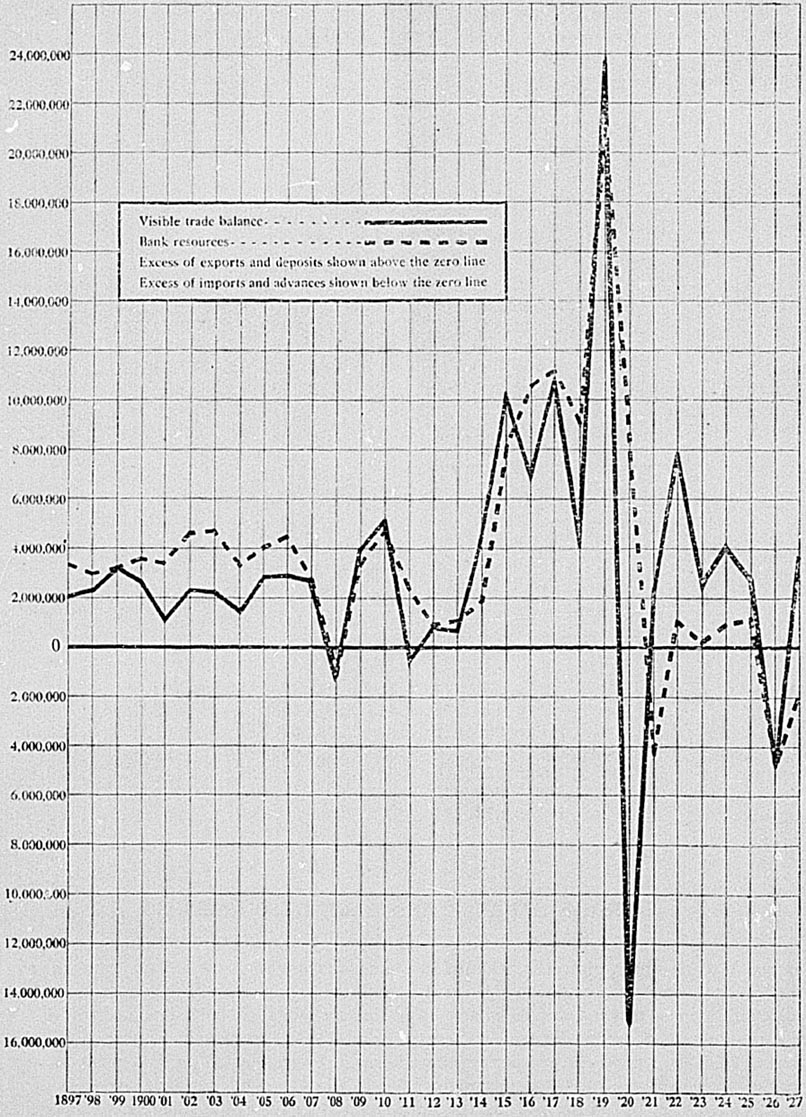
The overdraft rates and the rates of discount current in the Dominion were 1/2 per cent. higher in 1920 than the corresponding rates ruling prior to the European War. A further increase of 1/2 per cent., following a period when importations had been made on a larger scale than at any previous time in the Dominion's history, was made in January, 1921, the demand on banks for money being very considerable. Another aspect of the position, which is apparent from the figures given earlier in this section, was the rapid diminution—from twenty millions to two millions—in the excess of deposits (other than Government) over advances during the closing six months of 1920. It is not surprising accordingly to find a further increase in the overdraft (and the discount) rates as from March, 1921. There was no further alteration in the rate until January, 1923, when the overdraft rate was reduced to 6 1/2 per cent., a rate which ruled until April, 1927. As a result of financial stringency, occasioned by adverse trade conditions during 1926-27, both the overdraft and discount rates were increased to 7 per cent. in May, 1927. Vastly improved conditions, brought about by the successful export season of 1927-28 and a diminution in imports, were responsible for the reduction of both rates to 6 1/2 per cent. in July, 1928.
The Banking Act, 1908, deals with the issue of notes generally. The Governor-General may empower any bank to issue and circulate notes, subject to the provisions and restrictions contained in the charter or letters patent under which such bank is incorporated; all such notes to be payable in gold only at the office of the bank at the place of issue, and to be a first charge on all assets of the bank.
The private Act of the Bank of New Zealand contains the following clause: “That the total amount of promissory notes payable on demand, issued and in circulation within the Dominion, shall not at any time exceed the amount of coin, bullion, and public securities which shall for the time being be held by the said corporation within the Dominion of New Zealand or within the United Kingdom, nor three times the amount of the coin for the time being held by the said corporation within the said Dominion.” Similar provision exists relating to the National Bank of New Zealand (Limited).
On the 5th August, 1914, immediately after the outbreak of the late war, an amendment to the Banking Act was passed empowering the Governor-General in Council, from time to time, to make a Proclamation declaring “that the notes payable on demand by any bank therein named, and then issued or thereafter to be issued or reissued within New Zealand under any lawful authority in that behalf, shall during the period limited by the Proclamation be everywhere within New Zealand a good and legal tender of money to the amount therein expressed to be payable.” Conditions governing the issue of such Proclamation are laid down, and the bank may be required to give adequate security that it will redeem the notes in gold on the expiration of the period covered by the Proclamation. Provision is also made for payment by the State Treasury in case of default by the bank. During the period any such Proclamation is in force coined gold must not be exported except with the consent of the Minister of Finance. During the period between 5th August, 1914, and 5th November, 1919, this prohibition also applied to uncoined gold.
Immediately on the passing of the amendment referred to, a Proclamation was gazetted declaring notes of all six banks of issue doing business in New Zealand to be legal tender from the 6th August to the 6th September, 1914. Further extensions were made from time to time, and the present authority expires on 10th January, 1929.
It should be noted that the figures of notes in circulation given in this section relate to liabilities only, and exclude notes held by the issuing bank. Statistics as to the number of notes created and remaining uncancelled are not available.
In connection with the Post Office in New Zealand a savings-bank has been conducted since the 1st February, 1867. The minimum deposit receivable, except in certain specified cases, is 1s., and no interest is given on any sum less than £1 or in excess of £2,000. Interest on sums up to £500 is paid at the rate of 4 percent. per annum, and on sums between £500 and £2,000 at the rate of 3 1/4 per cent. for the amount over £500. For some years prior to 1st April, 1928, interest was payable on amounts up to £5,000, and such amounts on deposit at that date will continue to bear interest at 3 1/4 per cent.
The Postmaster-General may pay deposits to a maximum of £200 to the legal representative of a deceased depositor without requiring him to take out letters of administration or to prove the will. This provision, together with another provision whereby a depositor may nominate one or more persons to receive part or all of the amount at credit after the depositor's death, enables a widow or orphan to obtain possession of perhaps much-needed funds without either delay or cost.
The number of post-offices open for the transaction of savings-bank business at the 31st March, 1928, was 870.
There were 93,331 new accounts opened during the year ended the 31st March, 1928, and 72,443 accounts were closed during the period. The total number of open accounts at the 31st March, 1928, was 804,725, or one to every 1.81 of the population, including Maoris.
The deposits received during the year amounted to £27,611,066, and the withdrawals to £30,584,997. The total sum standing at credit of all accounts on the 3lBt March, 1928, was £47,758,726, which gave an average of £59 6s. 11d. to the credit of each open account. Information for each of the last ten years is given below.
| POST OFFICE SAVINGS-BANK, 1918 TO 1927-28. | ||||||
|---|---|---|---|---|---|---|
| Year ended 31st March, | Number of Depositors at End of Year. | Total Amount of Deposits during Year. | Total Amount of Withdrawals during Year. | Excess of Deposits over Withdrawals. | Interest. | Total Amount to Credit of Depositors at End of Year. |
* Calendar year. † Fifteen months ended 31st March. | ||||||
| £ | £ | £ | £ | £ | ||
| 1918* | 590,205 | 18,101,105 | 14,938,842 | 3,162,263 | 1,059,472 | 33,418,125 |
| 1919* | 630,783 | 29,758,447 | 25,962,377 | 3,796,070 | 1,178,935 | 38,393,130 |
| 1921† | 664,819 | 44,302,852 | 41,162,486 | 3,140,366 | 1,818,535 | 43,352,031 |
| 1922 | 678,930 | 29,125,997 | 30,236,231 | -1,110,234 | 1,599,907 | 43,841,704 |
| 1923 | 690,790 | 26,682,427 | 27,769,263 | -1,086,836 | 1,605,525 | 44,360,393 |
| 1924 | 710,157 | 29,598,372 | 29,510,321 | 88,051 | 1,649,976 | 46,098,421 |
| 1925 | 735,148 | 29,582,897 | 30,413,609 | -830,712 | 1,680,920 | 46,948,628 |
| 1926 | 758,155 | 31,833,622 | 32,602,506 | -768,884 | 1,731,578 | 47,911,322 |
| 1927 | 783,827 | 29,456,383 | 30,149,629 | -693,216 | 1,767,426 | 48,985,502 |
| 1928 | 804,725 | 27,611,066 | 30,584,997 | -2,973,931 | 1,747,156 | 47,758,726 |
The minus sign (-) represents excess of withdrawals over deposits.
The Post Office Savings-bank commenced operations on the 1st February, 1867, and the progress of the establishment since that date is shown on the next page in graphical representation, the curves representing number of open accounts, total amount to credit, and average amount to credit respectively. This diagram shows clearly the largo increase in the business of the Post Office Savings-bank during recent years.
The amount standing to credit of depositors has increased from £2,048,442 in 1888 to £47,758,726 at the 31st March, 1928. There was a steady increase in the average amount standing to the credit of each depositor up to the 31st March, 1921, but a slight fall has been recorded since then.
The huge increase in the amount at deposit in recent years has been accompanied by an even greater proportionate increase in interest payments, owing to the rate of interest having substantially advanced. The total interest credited to depositors from the 1st February, 1867, to the 31st March, 1928, has aggregated £25,489,448, a sum equal to 53 percent. of the total amount remaining on deposit at the 31st March. 1928.
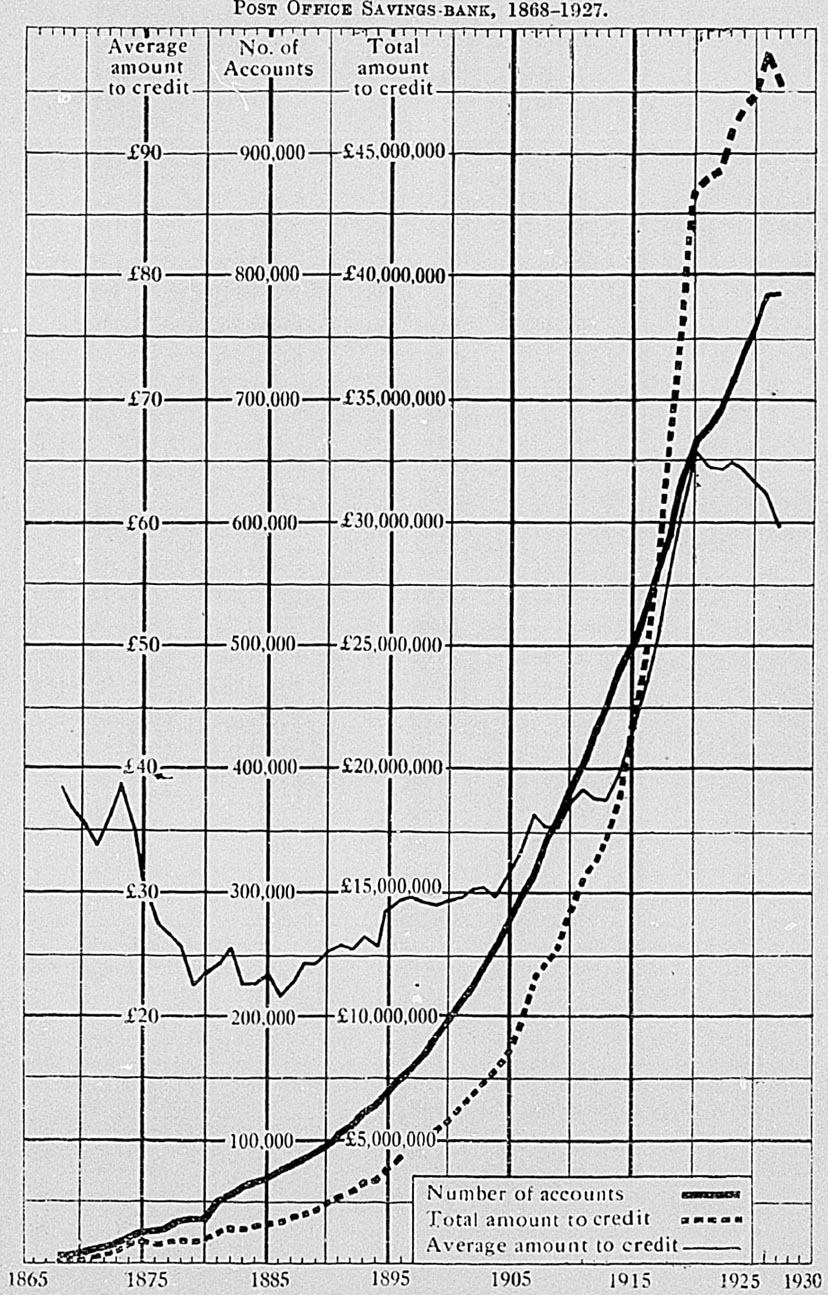
In the next table Quarterly deposits and withdrawals are shown for the last ten year—
| DEPOSIT., 1918-28. | ||||
|---|---|---|---|---|
| Year. | March Quarter. | June Quarter. | September Quarter. | December Quarter. |
| £ | £ | £ | £ | |
| 1918 | 4,434,731 | 4,597,665 | 4,678,476 | 4,390,233 |
| 1919 | 5,865,478 | 6,674,007 | 7,084,959 | 10,134,003 |
| 1920 | 9,271,609 | 9,025,516 | 8,639,396 | 9,472,973 |
| 1921 | 7,893,358 | 8,220,843 | 7,631,891 | 6,897,019 |
| 1922 | 6,376,244 | 6,742,626 | 6,902,755 | 6,342,609 |
| 1923 | 6,694,437 | 7,635,031 | 6,818,733 | 7,827,378 |
| 1924 | 7,317,230 | 7,597,610 | 7,333,455 | 7,110,970 |
| 1925 | 7,540,862 | 8,290,799 | 8,779,105 | 7,430,184 |
| 1926 | 7,333,534 | 7,967,338 | 7,533,916 | 7,195,823 |
| 1927 | 7,659,305 | 7,108,540 | 6,635,762 | 7,152,342 |
| 1928 | 6,714,421 | 6,928,670 | 6,630,943 | .. |
| WITHDRAWALS, 1918-28. | ||||
|---|---|---|---|---|
| Year. | March Quarter. | June Quarter. | September Quarter. | December Quarter. |
| £ | £ | £ | £ | |
| 1918 | 3,349,323 | 4,407,089 | 3,761,620 | 3,420,810 |
| 1919 | 4,829,473 | 6,174,872 | 7,146,243 | 7,811,789 |
| 1920 | 8,358,598 | 7,859,479 | 8,070,403 | 9,372,291 |
| 1921 | 7,501,715 | 7,945,158 | 8,087,725 | 7,436,040 |
| 1922 | 6,767,308 | 7,170,649 | 6,948,683 | 6,850,689 |
| 1923 | 6,799,242 | 7,094,447 | 7,116,024 | 8,285,283 |
| 1924 | 7,014,567 | 7,812,881 | 7,774,402 | 7,691,041 |
| 1925 | 7,135,285 | 7,756,878 | 9,063,086 | 8,372,823 |
| 1926 | 7,409,719 | 7,643,443 | 7,801,617 | 7,900,956 |
| 1927 | 6,803,612 | 7,853,591 | 7,997,994 | 7,909,574 |
| 1928 | 6,759,305 | 7,455,672 | 6,950,564 | .. |
The smallest total of deposits for any quarter during the decade was £4,390,233 in December quarter of 1918, while the withdrawal of £3,349,323 in March quarter of the same year represents the lowest level of withdrawals during the period. The final quarter of 1919 claims the highest deposits with £10,134,003, while the greatest withdrawals occurred in the same quarter of the following year, when £9,372,291 was accounted for.
The securities standing in the name of the Postmaster-General on account of the Post Office Savings-bank Fund on the 31st March, 1928, represented a nominal value of £48,275,968. Most of this fund is invested in New Zealand Government securities. A summary of the investments is as follows:—
| £ | |
| In New Zealand Government securities | 47,206,417 |
| In local bodies' securities | 524,100 |
| In Government stock of other British countries | 545,451 |
| £48,275,968 |
There are five savings-banks not connected with the Post Office. The total amount deposited in them during the year ended the 31st March, 1928, was £5,787,835. The withdrawals reached the sum of £5,453,091. The total amount to the credit of depositors at the 31st March, 1928, was £7,657,407. Figures for ten years are as follows:—
| PRIVATE SAVINGS-BANKS, 1918-19 TO 1927-28. | ||||||
|---|---|---|---|---|---|---|
| Year ended 31st March, | Number of Depositors at End of Year. | Total Amount of Deposits during Year. | Total Amount of Withdrawals during Year. | Excess of Deposits over Withdrawals. | Interest. | Total Amount to Credit of Depositors at End of Year. |
| £ | £ | £ | £ | £ | ||
| 1919 | 89,203 | 2,058,360 | 1,775,531 | 282,829 | 107,991 | 3,111,529 |
| 1920 | 95,472 | 3,308,628 | 2,981,887 | 326,741 | 119,625 | 3,557,895 |
| 1921 | 100,342 | 3,555,871 | 3,410,456 | 145,415 | 137,774 | 3,841,084 |
| 1922 | 104,395 | 3,191,181 | 3,265,338 | -74,157 | 150,501 | 3,917,428 |
| 1923 | 110,077 | 4,076,876 | 3,511,038 | 565,838 | 180,435 | 4,663,701 |
| 1924 | 117,442 | 4,492,881 | 4,145,848 | 347,033 | 205,845 | 5,216,579 |
| 1925 | 124,731 | 4,823,839 | 4,526,652 | 297,187 | 226,366 | 5,740,132 |
| 1926 | 135,074 | 5,392,729 | 5,022,121 | 370,608 | 253,643 | 6,364,383 |
| 1927 | 151,407 | 5,500,281 | 5,137 088 | 363,193 | 280,534 | 7,008,110 |
| 1928 | 166,694 | 5,787,835 | 5,453,091 | 334,744 | 314,553 | 7,657,407 |
| The minus sign (-) represents excess of withdrawals over deposits. | ||||||
The following table shows the results of the transactions of each of the private savings-banks during the twelve months ended 31st March, 1928.
| Bank. | Date of Establishment. | Number of Depositors at End of Year. | Total Amount of Deposits during Year. | Total Amount of Withdrawals during Year. | Excess of Deposits over Withdrawals. | Total Amount to Credit of Depositors at End of Year. |
|---|---|---|---|---|---|---|
| * Excess of withdrawals over deposits. | ||||||
| £ | £ | £ | £ | |||
| Auckland | 1,847 | 130,316 | 3,935,294 | 3,797,788 | 137,506 | 5,144,794 |
| New Plymouth | 1,850 | 6,036 | 228,621 | 214,605 | 14,016 | 292,301 |
| Hokitika | 1,866 | 1,773 | 46,410 | 47,403 | -993* | 111,793 |
| Dunedin | 1,864 | 19,548 | 856,735 | 744,414 | 112,321 | 1,580,395 |
| Invercargill | 1,864 | 9,021 | 720,775 | 648,881 | 71,894 | 528,124 |
| Totals | 166,694 | 5,787,835 | 5,787,835 | 5,453,091 | 334,744 | 7,657,407 |
The deposits in the savings-banks of the Commonwealth and of New Zealand on the 31st March, 1928, are shown in the table following. The Australian figures, which are inclusive of deposits in the branches of the Commonwealth Savings-bank in the various States, are taken from the Quarterly Summary of Australian Statistics issued by the Commonwealth Statistician.
| State. | Number of Depositors. | Amount on Deposit. | Average Amount per Depositor. | Deposits to Credit per Head of Population. | ||||
|---|---|---|---|---|---|---|---|---|
| £ | £ | s. | d. | £ | s. | d. | ||
| New South Wales | 1,676,830 | 78,522,289 | 46 | 16 | 7 | 32 | 7 | 7 |
| Victoria | 1,501,433 | 65,931,384 | 43 | 18 | 3 | 37 | 14 | 1 |
| Queensland | 453,224 | 22,465,948 | 49 | 11 | 5 | 24 | 17 | 6 |
| South Australia | 526,260 | 23,992,848 | 45 | 11 | 10 | 41 | 12 | 3 |
| Western Australia | 324,088 | 10,108,322 | 31 | 2 | 9 | 25 | 10 | 9 |
| Tasmania | 142,694 | 5,170,936 | 36 | 4 | 9 | 24 | 7 | 9 |
| Northern Territory | 1,383 | 72,744 | 52 | 12 | 0 | 17 | 3 | 4 |
| Total, Commonwealth | 4,625,912 | 206,264,471 | 44 | 11 | 9 | 32 | 18 | 9 |
| New Zealand | 971,419 | 55,416,133 | 57 | 0 | 11 | 38 | 7 | 11 |
The average deposits standing to the credit of depositors in the banks of issue for the quarter ended 31st March, 1928, were £52,336,872, and if to this figure be added the deposits in the Post Office and private savings-banks at the same date the grand total amounts to £107,753,005, representing an average of £74 2s. 8d. per head of population. In addition there are the deposits with the building societies, referred to later in this book, and there are also deposits with financial companies of which no particulars are collected.
Table of Contents
THE statutory provisions affecting life insurance in New Zealand are in the main contained in the Life Insurance Act, 1908, and the Life Insurance Amendment Act, 1921-22, Any association other than a friendly society which issues policies or grants annuities on human life in New Zealand comes within the scope of the enactments. Two classes of companies are distinguished—namely, local and foreign, the latter including all offices the principal place of which is situated beyond the Dominion. In both instances securities are required to be deposited with the Public Trustee before business can be carried on. Before the passing of the amending Act of 1921-22 the maximum deposit required from a New Zealand company was £20,000, with a minimum of £5,000, the amount being regulated according to the volume of business done, while for a company incorporated overseas the maximum went to £50,000, Both classes of offices, however, are now on the same basis. Every life company carrying on business at the time of the coming into operation of the amending Act, or which commences business thereafter, must deposit with the Public Trustee money or securities of the statutory character to the value of £6,000; and, in addition, for every £100,000 or part thereof that the total amount assured by its policies current in New Zealand exceeds £100,000, a further £5,000 until a maximum of £50,000 is reached. In other respects New Zealand and overseas companies are placed on the same footing as regards deposits.
In the case of composite offices, provision is made for the receipts of life and annuity business to be treated as a separate fund, and the Act safeguards the interest of the policyholder by making such funds available only for liabilities arising from life business.
The law bearing on industrial assurance has received the attention of the Legislature in the Life Insurance Amendment Act, 1920, In this class of insurance the premiums must be payable at shorter intervals than three months. Provision is made for the control by regulation of the activities of this class of business. Companies are required to deposit with the Minister of Finance forms of policy tables, rates, and other documents, and policies must contain only such conditions as have been approved by the Governor-General in Council. Restrictions are placed on the forfeiture of policies in default of payments or other requirements.
Annual returns of life assurance are required to be deposited with the Minister of Finance. It is from these returns that the statistical matter following has been compiled.
The outstanding features of life-assurance business during recent years is the remarkable increase that has taken place in the amount of new assurances effected. The growth characterizes both the ordinary life department and the industrial side. No doubt this is in a large measure a reflection of the prosperous condition of the country. A further reason for the growth of new business is probably furnished by the diminished purchasing-power of the sovereign, and the consequent depreciation of the value of policies on a pre-war basis. It is well known, too, that with the increased probate and succession duties payable on large estates life-insurance policies are a means used to provide ready cash when other assets may not be convertible at an advantage. It may be added, in passing, that the substantial growth of business evident is general not only in New Zealand, but also in Australia, the United Kingdom, and the United States of America.
At the close of 1926 eleven life-assurance offices were represented in New Zealand, this number being the same as in the previous year. Only two of the offices are purely New Zealand institutions—namely, the Government Life Insurance Office and the Provident Life Assurance Co. Seven of the other societies have their head offices in Australia and two in England. The Provident Life Assurance Co. and four of the Australian offices transact both ordinary life and industrial business, and several of the companies have branches for assurance against accident. This latter class of insurance is dealt with in Subsection B of this section.
The statistics here given relate exclusively to business transacted in the Dominion.
During the year 1926 24,427 policies, insuring £9,425,686, were issued in the Ordinary Branch and 42,993 policies for £2,343,604 in the Industrial Section, making the total new insurances £11,769,290; compared with the previous year's figure of £11,556,022, an increase of £213,268, Discontinuances amounted to £5,018,926 in the Ordinary Branch and £1,396,630 in the Industrial, making the total discontinuances for the year £6,415,556, The corresponding figure for 1925 was £6,091,481, The amounts in force at the end of 1926 were £76,787,251 and £9,966,843 in the Ordinary and Industrial branches respectively, giving a total of £86,754,094 as against an aggregate of £81,400,360 at the end of 1925.
Details of the ordinary life-insurance policies issued and discontinued during the year 1926 by the respective offices are contained in the following table. The aggregate net increase in the sum assured is £4,406,760, and in the annual premiums payable thereon £151,881, The corresponding figures for 1925 were £4,574,885 and £153,754 respectively.
| ORDINARY LIFE ASSURANCE.—POLICIES ISSUED AND DISCONTINUED, 1926. | ||||||
|---|---|---|---|---|---|---|
| Office. | Policies issued. | Policies discontinued. | ||||
| Number. | Sum assured. | Annual Premiums. | Number. | Sum assured. | Annual Premiums. | |
| £ | £ | £ | £ | |||
| Australian Mutual Provident | 6,013 | 3,199,718 | 101,726 | 3,359 | 1,206,958 | 41,470 |
| Australian Provincial | 1,378 | 489,712 | 18,820 | 980 | 352,100 | 12,912 |
| Australian Temperance and General | 3,735 | 803,240 | 32,057 | 1,994 | 425,553 | 16,602 |
| Colonial Mutual | 1,588 | 500,711 | 18,821 | 1,455 | 372,501 | 13,203 |
| Mutual Life and Citizens' | 1,424 | 491,310 | 17,349 | 1,405 | 355,809 | 11,310 |
| National Mutual | 1,902 | 859,090 | 33,117 | 1,514 | 506,541 | 20,765 |
| Norwich Union | 436 | 468,698 | 15,573 | 334 | 287,222 | 8,528 |
| Provident Life | 864 | 212,360 | 5,563 | 588 | 139,146 | 3,160 |
| Southern Cross | 1,377 | 517,142 | 20,714 | 602 | 223,536 | 9,342 |
| Yorkshire | .. | .. | .. | 5 | 850 | 31 |
| New Zealand Government Life | 5,710 | 1,883,705 | 60,609 | 4,089 | 1,148,710 | 35,145 |
| Totals | 24,427 | 9,425,686 | 324,349 | 16,325 | 5,018,926 | 172,468 |
In the case of the new business transacted during 1926 the average sum assured under each policy issued was £386, and the average premium £3 8s. 10d. per cent.
The next table presents an interesting review of the progress of ordinary life-assurance business over a period of ten years. The amount of new policies issued shows a considerable increase since 1917, with, however, a slight falling-off in 1921, and a much more marked decline in 1922, followed by a phenomenal rise of over £2,000,000 in 1923, Compared with 1923, the increases during 1924 and 1925 show a declining tendency, amounting to a little over £600,000 and £400,000 respectively, while 1926 records a slight decrease—£10,270, Discontinuances during 1922 were particularly heavy, amounting to £4,453,186, This figure was over £1,200,000 in excess of the previous year. The following year resulted in a decrease of half a million, but further substantial increases were recorded during the next three years, the total for 1926 exceeding that of 1922 by £565,740.
| ORDINARY LIFE ASSURANCE.—PROGRESS OF BUSINESS, 1917-26. | |||||||||
|---|---|---|---|---|---|---|---|---|---|
| Year. | Policies issued. | Policies discontinued. | Policies existing at End of Year. | ||||||
| Number. | Sum assured. | Annual Premiums. | Number. | Sum assured. | Annual Premiums. | Number. | Sum assured. | Annual Premiums. | |
| £ | £ | £ | £ | £ | £ | ||||
| 1917 | 12,272 | 3,303,123 | 131,944 | 12,374 | 2,571,106 | 90,523 | 164,143 | 42,885,432 | 1,372,277 |
| 1918 | 16,517 | 5,233,669 | 228,533 | 11,571 | 2,776,081 | 153,529 | 169,089 | 45,343,020 | 1,447,281 |
| 1919 | 18,581 | 6,411,362 | 245,939 | 10,664 | 2,681,975 | 114,757 | 177,006 | 49,072,407 | 1,578,463 |
| 1920 | 19,998 | 6,856,128 | 225,680 | 10,816 | 2,738,502 | 91,390 | 186,188 | 53,190,033 | 1,712,753 |
| 1921 | 19,926 | 6,778,258 | 226,728 | 11,772 | 3,229,942 | 112,765 | 194,342 | 56,738,349 | 1,826,716 |
| 1922 | 17,686 | 6,376,813 | 210,680 | 14,910 | 4,453,186 | 149,610 | 197,118 | 58,661,976 | 1,887,786 |
| 1923 | 22,248 | 8,408,585 | 278,775 | 13,649 | 3,951,557 | 134,289 | 205,717 | 63,119,004 | 2,032,272 |
| 1924 | 23,786 | 9,016,163 | 302,649 | 14,734 | 4,329,561 | 148,403 | 214,769 | 67,805,606 | 2,186,518 |
| 1925 | 24,380 | 9,435,956 | 318,626 | 16,091 | 4,861,073 | 164,843 | 223,058 | 72,380,491 | 2,340,272 |
| 1926 | 24,427 | 9,425,686 | 324,349 | 16,325 | 5,018,926 | 172,468 | 231,160 | 76,787,251 | 2,492,153 |
The number of ordinary life policies in force at the end of 1916 was 164,245, representing a sum assured of £42,153,415; so that the increases in number and value during the decennium have been 41 percent. and 82 percent. respectively, as compared with an increase of total population of approximately 24 percent. in the same period.
Particulars of policies discontinued during the last four years are contained in the next table, annuities not being included in the numbers shown, which thus do not coincide with those given in the preceding table which includes annuities.
| ORDINARY LIFE ASSURANCE.—PARTICULARS OF DISCONTINUANCES. | ||||||
|---|---|---|---|---|---|---|
| Year. | Death. | Maturity. | Surrender. | Lapse. | Other Causes. | Totals. |
| Number of Policies. | ||||||
| 1923 | 1,278 | 2,614 | 3,051 | 6,198 | 461 | 13,602 |
| 1924 | 1,420 | 2,789 | 3,309 | 6,681 | 494 | 14,693 |
| 1925 | 1,329 | 2,916 | 3,396 | 7,617 | 785 | 16,043 |
| 1926 | 1,386 | 2,809 | 4,227 | 7,410 | 435 | 16,267 |
| Sum assured. | ||||||
| .. | £ | £ | £ | £ | £ | £ |
| 1923 | 394,098 | 510,598 | 861,797 | 2,020,949 | 164,115 | 3,951,557 |
| 1924 | 451,636 | 552,668 | 941,599 | 2,216,314 | 167,344 | 4,329,561 |
| 1925 | 443,972 | 555,175 | 1,002,450 | 2,538,382 | 321,094 | 4,861,073 |
| 1926 | 425,060 | 535,321 | 1,307,826 | 2,579,310 | 171,409 | 5,018,926 |
During the war period and following the influenza epidemic of 1918, discontinuances by death were particularly heavy. The figure for 1918 was £966,866, compared with £443,972 in 1925 and £425,060 in 1926, A high total was registered for 1922, principally due to the large number of lapsed policies, and this no doubt was attributable to the financial depression of that period, while the increase in 1926 was more than accounted for by surrenders. It would appear that the abnormal total for surrenders in 1926 is to some extent the natural outcome of the high level of new business set up in 1923 and improved on in 1924, as in most instances a policy does not acquire a surrender value until it has been in force two years.
Reducing the amounts in the foregoing table to a percentage basis, the following result is arrived at:—
| ORDINARY LIFE ASSURANCE.—PERCENTAGE OF AMOUNT DISCONTINUED. | ||||||
|---|---|---|---|---|---|---|
| Year. | Death. | Maturity. | Surrender. | Lapse. | Other Causes. | Total. |
| 1923 | 9.97 | 12.92 | 21.81 | 51.14 | 4.16 | 100.00 |
| 1924 | 10.43 | 12.76 | 21.75 | 51.19 | 3.87 | 100.00 |
| 1925 | 9.13 | 11.42 | 20.62 | 52.22 | 6.61 | 100.00 |
| 1926 | 8.47 | 10.66 | 26.06 | 51.39 | 3.42 | 100.00 |
Slightly over half of the total amount represented by discontinuances was due in each of the four years to lapsed policies, these and surrenders accounting for over 70 percent. of the amount written off.
A statement of the income and outgo of all the companies operating in the Dominion, so far as ordinary business only is concerned, further illustrates the increase in the business for the ten years. The ratio of management expenses to premium and total receipts is also given.
| ORDINARY LIFE ASSURANCE.—NEW ZEALAND BUSINESS.—INCOME AND OUTGO. | ||||||
|---|---|---|---|---|---|---|
| Year. | Receipts and Expenditure. | Expenses of Management. | ||||
| Total Receipts, excluding Transfers. | Total Expenditure, excluding Transfers. | Excess of Receipts. | Amount. | Proportion to Premium Receipts. | Proportion to Total Receipts. | |
| £ | £ | £ | £ | Per Cent. | Per Cent. | |
| 1917 | 2,091,512 | 1,804,647 | 286,865 | 173,407 | 12.63 | 8.29 |
| 1918 | 2,225,897 | 2,054,409 | 171,488 | 215,351 | 14.55 | 9.67 |
| 1919 | 2,348,263 | 1,716,049 | 632,214 | 253,257 | 16.18 | 10.78 |
| 1920 | 2,513,707 | 1,527,017 | 986,690 | 278,886 | 16.50 | 11.09 |
| 1921 | 2,648,715 | 1,661,405 | 987,310 | 286,833 | 16.00 | 10.83 |
| 1922 | 2,763,729 | 1,839,932 | 923,797 | 282,603 | 15.13 | 10.23 |
| 1923 | 3,003,179 | 1,871,971 | 1,131,208 | 302,960 | 15.18 | 10.22 |
| 1924 | 3,115,142 | 2,062,961 | 1,052,181 | 352,180 | 16.36 | 11.31 |
| 1925 | 3,275,684 | 2,104,609 | 1,171,075 | 377,994 | 16.41 | 11.54 |
| 1926 | 3,472,526 | 2,137,945 | 1,334,581 | 385,187 | 15.75 | 11.09 |
From 1920 to 1923 there was a downward trend in the percentage of management expenses to total receipts. This would appear to reflect the general economy campaign of that period. During 1924, however, there was an increase of more than 1 per cent. over 1923, and this was followed by a further rise in 1925, disclosing a percentage higher than that of any other year of the decade under review. A decrease was recorded in 1926.
A summary of the receipts and expenditure under the various heads is now given in a five-years table. Now premiums, which amounted to £207,196 in 1921, have during the succeeding quinquennium increased by 45 1/2 per cent., and the total premium receipts have during the same period increased by £653,096, or 36 1/2 per cent. The other principal item of revenue — viz., interest on investments, &c.—has risen from £826,475 to £985,335, giving a percentage increase of a fraction over 19 per cent. On the expenditure side the payment of death claims in 1926, while £107,863 higher than in 1921, was lower than in three of the four intervening years. Claims by maturity, and also management expenses, show the steady upward movement that might naturally be expected. Payments in respect of surrenders have also moved steadily upward, with, however, an added impetus in 1926.
| ORDINARY LIFE ASSURANCE.—NEW ZEALAND BUSINESS.—RECEIPTS AND EXPENDITURE (EXCLUDING TRANSFERS), 1922.26. | |||||
|---|---|---|---|---|---|
| — | 1922. | 1923. | 1924. | 1925. | 1926. |
| Revenue. | £ | £ | £ | £ | £ |
| Renewal premiums | 1,667,572 | 1,743,019 | 1,866,883 | 2,004,062 | 2,143,816 |
| New premiums | 199,792 | 253,009 | 286,128 | 298,750 | 301,577 |
| Consideration for annuities | 19,386 | 17,346 | 23,282 | 33,203 | 29,018 |
| Interest | 874,478 | 911,249 | 931,101 | 936,086 | 985,335 |
| Increase in value of investments | 2,176 | 277 | .. | 1,538 | 1,524 |
| Other revenue | 325 | 78,279 | 7,748 | 2,045 | 11,256 |
| Total revenue | 2,763,729 | 3,003,179 | 3,115,142 | 3,275,684 | 3,472,526 |
| Expenditure. | .. | .. | .. | .. | .. |
| Claims by death | 687,888 | 668,628 | 768,481 | 734,827 | 684,894 |
| Claims by maturity | 507,090 | 524,267 | 541,440 | 580,539 | 586,093 |
| Annuities | 38,822 | 38,446 | 38,786 | 39,901 | 41,081 |
| Surrenders | 232,895 | 246,897 | 263,935 | 262,232 | 325,337 |
| Cash bonuses | 30,279 | 21,492 | 33,950 | 31,281 | 29,289 |
| Management | 282,603 | 302,960 | 352,180 | 377,994 | 385,187 |
| Taxes | 53,725 | 47,148 | 44,888 | 48,500 | 48,799 |
| Depreciation in investments | 2,624 | 17,849 | 13,629 | 26,775 | 25,529 |
| Other expenditure | 4,006 | 4,284 | 5,672 | 2,560 | 11,736 |
| Total expenditure | 1,839,932 | 1,871,971 | 2,062,961 | 2,104,609 | 2,137,945 |
Looking now at the other phase of life assurance, the next table shows for 1926 to what extent industrial business was undertaken by each of the offices transacting this class of assurance in the Dominion.
| INDUSTRIAL ASSURANCE.—NEW ZEALAND BUSINESS, 1926. | ||||||
|---|---|---|---|---|---|---|
| Office. | Policies Issued. | Policies discontinued. | ||||
| Number. | Sum assured. | Annual Premiums. | Number. | Sum assured. | Annual Premiums. | |
| £ | £ | £ | £ | |||
| Australian Mutual Provident | 7,998 | 576,178 | 29,062 | 4,780 | 283,265 | 16,274 |
| Australian Temperance and General | 18,766 | 984,024 | 66,656 | 11,533 | 574,850 | 40,133 |
| Colonial Mutual | 8,704 | 407,557 | 22,587 | 6,252 | 268,896 | 15,707 |
| Mutual Life and Citizens' | 2,120 | 101,107 | 5,762 | 2,244 | 82,958 | 5,009 |
| Provident Life | 5,405 | 274,738 | 17,111 | 4,196 | 186,661 | 11,586 |
| Totals | 42,993 | 2,343,604 | 141,178 | 29,005 | 1,396,630 | 88,709 |
A summary of the progress of industrial business is given in the following table, covering the ten years 1917 to 1926, The increase in the now business effected in this class of insurance has been remarkable, the annual figures rising from £845,042 in 1916 to £2,343,604 in 1926, an increase of nearly 180 per cent.
| INDUSTRIAL LIFE ASSURANCE.—PROGRESS OF BUSINESS, 1917.26. | |||||||||
|---|---|---|---|---|---|---|---|---|---|
| Year. | Policies Issued. | Policies discontinued. | Policies existing at End of Year. | ||||||
| Number. | Sum assured. | Annual Premiums. | Number. | Sum assured. | Annual Premiums. | Number. | Sum assured. | Annual Premiums. | |
| £ | £ | £ | £ | £: | £ | ||||
| 1917 | 24,733 | 888,915 | 64,551 | 15,577 | 536,853 | 37,425 | 118,823 | 3,532,073 | 233,621 |
| 1918 | 26,906 | 1,020,008 | 73,326 | 16,038 | 553,827 | 40,378 | 129,691 | 3,998,254 | 266,569 |
| 1919 | 29,783 | 1,283,489 | 87,819 | 18,399 | 670,177 | 47,860 | 141,075 | 4,611,566 | 306,528 |
| 1920 | 29,724 | 1,463,720 | 93,039 | 18,299 | 761,350 | 49,586 | 152,500 | 5,313,936 | 349,981 |
| 1921 | 27,799 | 1,459,762 | 84,437 | 17,500 | 821,658 | 50,169 | 162,799 | 5,952,040 | 384,249 |
| 1922 | 29,483 | 1,524,342 | 91,399 | 19,637 | 919,049 | 57,428 | 172,645 | 6,557,333 | 418,220 |
| 1923 | 30,516 | 1,659,395 | 99,442 | 19,820 | 949,905 | 61,193 | 183,341 | 7,266,823 | 456,469 |
| 1924 | 36,705 | 1,992,763 | 120,273 | 23,019 | 1,129,374 | 71,317 | 197,027 | 8,130,212 | 505,425 |
| 1925 | 38,882 | 2,120,066 | 127,597 | 24,914 | 1,230,408 | 77,782 | 210,995 | 9,019,869 | 555,239 |
| 1926 | 42,993 | 2,343,604 | 141,178 | 29,005 | 1,396,630 | 88,709 | 224,983 | 9,966,843 | 607,708 |
The increase for the year 1926 in new insurances was 4,111 policies for a total of £223,538, compared with the previous year's increase of 2,177 policies for a sum assured of £127,303, The increase in 1926 may also be compared with the slight decrease of £10,000 in new business in the Ordinary Branch of life insurance during the year. The average sum insured in the case of new policies amounted to £55 and the annual premium to £6 0s. 6d., corresponding averages for the total policies in force at the end of the year being £44 and £6 1s. 11d. respectively. Discontinuances in 1926 increased by £166,222, as against the previous year's increase of £101,034, Between 1916 and 1926 the number of policies in force has increased by 115,316 (105 per cent.), and the amount held at risk by £6,786,832 (213 per cent.).
A summary of the number of policies and the sums assured written off according to the several causes is now given in the form of a five-years' table.
| INDUSTRIAL LIFE ASSURANCE.—PARTICULARS OF DISCONTINUANCES. | ||||||
|---|---|---|---|---|---|---|
| Year. | Death. | Maturity. | Surrender. | Lapse. | Other Causes. | Total. |
| Number of Policies. | ||||||
| 1922 | 1,106 | 2,254 | 708 | 15,348 | 221 | 19,637 |
| 1923 | 1,243 | 2,769 | 849 | 14,792 | 167 | 19,820 |
| 1924 | 1,243 | 3,206 | 975 | 17,391 | 204 | 23,019 |
| 1925 | 1,184 | 3,764 | 1,005 | 18,770 | 191 | 24,914 |
| 1926 | 1,483 | 5,883 | 1,413 | 19,990 | 236 | 29,005 |
| Sum Assured. | ||||||
| .. | £ | £ | £ | £ | £ | £ |
| 1922 | 30,007 | 47,158 | 33,350 | 798,139 | 10,395 | 919,049 |
| 1923 | 35,629 | 57,161 | 46,659 | 802,371 | 8,085 | 949,905 |
| 1924 | 39,243 | 66,934 | 54,745 | 957,699 | 10,753 | 1,129,374 |
| 1925 | 36,137 | 75,817 | 59,332 | 1,048,768 | 10,354 | 1,230,408 |
| 1926 | 48,383 | 139,778 | 72,661 | 1,122,106 | 13,702 | 1,396,630 |
The amount written off in each year is considerably greater in proportion in the Industrial than in the Ordinary Branch. Whereas in the ease of the latter 6.93 per cent. of the amount in force at the end of 1925 became void during 1926, the corresponding percentage for industrial insurance was 1548, An interesting comparison is afforded between the following table, which comprises the sums assured in the preceding one reduced to a percentage basis, and the corresponding table in the Ordinary Section.
| INDUSTRIAL LIFE ASSURANCE.—PERCENTAGE OF AMOUNT DISCONTINUED. | ||||||
|---|---|---|---|---|---|---|
| Year. | Death. | Maturity. | Surrender. | Lapse. | Other Causes. | Total |
| 1922 | 3.27 | 5.13 | 3.63 | 86.84 | 1.13 | 100.00 |
| 1923 | 3.75 | 6.02 | 4.91 | 84.47 | 0.85 | 100.00 |
| 1924 | 3.47 | 5.93 | 4.85 | 84.80 | 0.95 | 100.00 |
| 1925 | 2.94 | 6.16 | 4.82 | 85.24 | 0.84 | 100.00 |
| 1926 | 3.47 | 10.01 | 5.20 | 80.34 | 0.98 | 100.00 |
The principal difference between the proportions for the two branches is the high percentage of lapses in the case of industrial insurance. Noteworthy features of the 1926 figures for this class are a decrease of nearly 5 in the percentage represented by lapsed policies and an increase of nearly 4 in that for maturities.
The total income and outgo for industrial assurance, summarized for the ten years 1917-26, are as follows:—
| INDUSTRIAL ASSURANCE.—NEW ZEALAND BUSINESS.—INCOME AND OUTGO, 1917.26. | ||||||
|---|---|---|---|---|---|---|
| Year. | Receipts and Expenditure. | Expenses of Management. | ||||
| Total Receipts, excluding Transfers. | Total Expenditure, excluding Transfers. | Excess of Receipts. | Amount. | Proportion to Premium Receipts. | Proportion to Total Receipts. | |
| £: | £: | £ | £ | Per Cent. | Per Cent. | |
| 1917 | 232,895 | 128,468 | 104,427 | 77,921 | 35.49 | 33.46 |
| 1918 | 264,000 | 156,618 | 107,382 | 88,071 | 35.51 | 33.36 |
| 1919 | 303,568 | 180,070 | 123,498 | 107,504 | 37.82 | 35.41 |
| 1920 | 347,825 | 195,038 | 152,787 | 121,600 | 37.52 | 34.95 |
| 1921 | 394,098 | 194,798 | 199,300 | 130,645 | 35.96 | 33.15 |
| 1922 | 434,957 | 223,345 | 211,612 | 136,260 | 34.35 | 31.33 |
| 1923 | 485,362 | 253,101 | 232,261 | 148,307 | 33.93 | 30.56 |
| 1924 | 539,409 | 291,282 | 248,127 | 169,347 | 35.30 | 31.39 |
| 1925 | 598,599 | 322,156 | 276,443 | 186,769 | 35.23 | 31.20 |
| 1926 | 655,244 | 423,685 | 231,559 | 202,933 | 35.00 | 30.97 |
A table giving for each of the last five years the main details in connection with the income and outgo referred to above is appended, and affords interesting comparisons in the fluctuation of the various heads of receipts and expenditure. Premium receipts show a steady increase over the whole period. In 1921 this source of income produced £363,227, and the increase over the five years is accordingly 60 per cent. The expenses of management, which in this class of business are relatively high, amounted in 1926 to 35 per cent. of the premium receipts, as compared with 38 percent. ten years earlier. The corresponding figure in the Ordinary Branch for 1926 was 16 per cent. The difference is largely accounted for by the high cost of collection of premiums in the Industrial Branch, principally in the shape of renewal commission. In the Ordinary Branch commission (new and renewal) worked out at approximately 8 percent. of the premium income, and in the Industrial Branch at 22 per cent.
| INDUSTRIAL LIFE ASSURANCE.—NEW ZEALAND BUSINESS.—RECEIPTS AND EXPENDITURE (EXCLUDING TRANSFERS), 1922.26. | |||||
|---|---|---|---|---|---|
| — | 1922. | 1923. | 1924. | 1925. | 1926. |
| Revenue. | £ | £ | £ | £ | £ |
| Premiums | 396,628 | 437,144 | 479,687 | 530,188 | 579,882 |
| Interest | 35,549 | 44,708 | 52,320 | 61,372 | 70,402 |
| Other revenue | 2,780 | 3,510 | 7,402 | 7,039 | 4,960 |
| Total revenue | 434,957 | 485,362 | 539,409 | 598,599 | 655,244 |
| Expenditure. | .. | .. | .. | .. | .. |
| Claims by death | 34,060 | 38,253 | 48,089 | 66,569 | 110,754 |
| Claims by maturity | 39,577 | 51,731 | 51,530 | 47,140 | 79,512 |
| Surrenders | 5,269 | 6,686 | 10,777 | 11,811 | 21,815 |
| Management | 136,260 | 148,307 | 169,347 | 186,769 | 202,933 |
| Taxes | 3,886 | 4,261 | 3,989 | 3,972 | 4,176 |
| Depreciation in investments | 1,139 | 955 | 1,010 | 1,074 | 679 |
| Other payments | 3,154 | 2,908 | 6,540 | 4,821 | 3,816 |
| Total expenditure | 223,345 | 253,101 | 291,282 | 322,156 | 423,685 |
The balance-sheets of the companies transacting industrial business do not in every case apportion their liabilities and assets over ordinary and industrial business, for although the legislation in force requires separate statements to be furnished for receipts and expenditure, policies issued and discontinued, &c., no such requirement exists in regard to balance-sheets.
The figures presented below accordingly refer to both classes of insurance, and, as indicated earlier in this subsection, relate to New Zealand business only.
Dealing first with liabilities, the position of the various offices over a period of five years is shown.
| LIFE ASSURANCE.—NEW ZEALAND LIABILITIES, 1922.26. | |||||
|---|---|---|---|---|---|
| Office. | 1922. | 1923. | 1924. | 1925. | 1926. |
* Includes accident. † Discontinued New Zealand business. | |||||
| £ | £ | £ | £ | £ | |
| Australian Mutual Provident | 7,152,808 | 7,055,110 | 7,145,412 | 6,980,573 | 7,108,997 |
| Australian Provincial* | 174,270 | 192,476 | 181,281 | 204,514 | 234,623 |
| Australian Temperance and General | 799,339 | 978,203 | 1,207,523 | 1,431,301 | 1,626,852 |
| Colonial Mutual* | 568,221 | 654,457 | 752,671 | 862,887 | 956,283 |
| Mutual Life and Citizens'* | 1,542,800 | 1,567,111 | 1,602,841 | 1,578,319 | 1,559,984 |
| National Mutual | 2,042,261 | 2,218,010 | 2,401,572 | 2,521,875 | 2,629,399 |
| New York Life | 62,159 | 48,419 | 27,912 | † | † |
| Norwich Union | 96,655 | 141,020 | 198,265 | 265,485 | 330,646 |
| Provident Life | 297,812 | 333,855 | 371,955 | 421,841 | 475,912 |
| Southern Cross | .. | .. | 42,909 | 54,937 | 74,849 |
| Yorkshire | 99,886 | 115,820 | 123,000 | 116,499 | 6,948 |
| New Zealand Government Life | 6,276,019 | 6,489,868 | 6,712,888 | 6,994,229 | 7,295,023 |
| Totals | 19,112,230 | 19,794,349 | 20,768,229 | 21,432,460 | 22,299,516 |
The aggregate capital and liabilities at the end of 1926, as compared with the two preceding years, were as follows:—
| 1924. | 1925. | 1926. | |
|---|---|---|---|
| £ | £ | £ | |
| Paid-up capital | 95,782 | 95,884 | 95,891 |
| Life assurance and annuity funds | 19,746,411 | 20,411,084 | 21,377,304 |
| Depreciation, reserve, and other special funds | 281,545 | 295,425 | 246,713 |
| Claims admitted but not paid | 188,683 | 177,011 | 134,274 |
| Other liabilities | 455,808 | 453,056 | 445,334 |
| Totals | £20,768,229 | £21,432,460 | £22,299,516 |
The assets at the end of each of the five years 1922.26 were as follows:—
| LIFE ASSURANCE.—NEW ZEALAND ASSETS, 1922.26. | |||||
|---|---|---|---|---|---|
| Assets. | 1922. | 1923. | 1924. | 1925. | 1926. |
| * Included for the most part with “Railway and other stocks” and “Other investments.” | |||||
| £ | £ | £ | £ | £ | |
| Mortgages on property | 6,047,352 | 6,002,102 | 6,018,042 | 5,852,186 | 6,040,754 |
| Loans on policies | 2,602,451 | 2,812,378 | 2,995,776 | 3,171,567 | 3,440,601 |
| New Zealand Government securities | 6,424,932 | 6,603,884 | 6,619,062 | 6,308,825 | 6,679,669 |
| Indian and colonial securities | 16,028 | 15,435 | 16,085 | 8,045 | 41,221 |
| Railway and other stocks | 1,181,183 | 575,677 | 35,632 | 35,132 | 34,350 |
| Municipal and local bodies' securities | * | * | 2,365,660 | 2,905,285 | 2,863,388 |
| Landed and house property | 520,935 | 559,031 | 626,920 | 722,444 | 866,510 |
| Other investments | 319,027 | 1,203,627 | 3,777 | 4,156 | 4,659 |
| Loans on personal security | 4,799 | 5,169 | 8,397 | 7,162 | 6,037 |
| Agents' balances | 19,008 | 24,768 | 20,055 | 17,403 | 11,052 |
| Outstanding premiums | 206,293 | 202,978 | 230,301 | 259,123 | 285,040 |
| Interest accrued, &c. | 272,429 | 281,550 | 291,433 | 271,879 | 284,811 |
| Cash | 436,015 | 405,272 | 336,385 | 296,973 | 132,188 |
| Other assets | 1,061,778 | 1,102,478 | 1,200,704 | 1,572,280 | 1,609,236 |
| Totals | 19,112,230 | 19,794,349 | 20,768,229 | 21,432,460 | 22,299,516 |
The foregoing figures do not necessarily represent the extent to which the various companies have invested in New Zealand securities, &c., but are merely the totals of the assets of the New Zealand branches. An example of this will be found in the case of New Zealand Government securities. This item is shown as £9,578,405 in the total of the whole-world balance-sheets, whereas only £6,679,669 is shown as belonging to the New Zealand branches.
The Life Insurance Department of the Government of New Zealand was founded in 1869, at a time when New-Zealanders had comparatively poor facilities for the insurance of their lives. The institution possesses the unique advantage of being based on the solid principle of State security, payment of all policies being guaranteed by the Government of the Dominion: Industrial insurance is not transacted by the Department.
During 1927 some 5,578 new policies insuring £1,791,845 were issued, compared with the previous year's figures of 5,710 and £1,883,705, respectively. At the end of 1927 there were 66,856 policies in force bearing an annual premium income of £595,780, and the amount in force exclusive of bonus was £19,303,916; while reversionary bonus additions totalled £1,973,434. The average sum assured per policy in force was £289, compared with £287 in 1926, and £282 in 1925.
The following table gives a synopsis of the activities of the Department for the last ten years in so far as the amount of business transacted is concerned:—
| STATE LIFE INSURANCE.—PROGRESS, 1918-27. | ||||||||
|---|---|---|---|---|---|---|---|---|
| Year. | New Business. | Policies in Force at End of year. | ||||||
| Number of Policies. | Premiums. | Sum assured. | Number of Policies. | Premiums. | Value of Business. | |||
| Sum assured. | Bonuses. | Total. | ||||||
| £ | £ | £ | £ | £ | £ | |||
| 1918 | 4,265 | 46,778 | 1,252,538 | 53,803 | 404,965 | 13,257,682 | 1,512,861 | 14,770,543 |
| 1919 | 4,983 | 58,569 | 1,617,795 | 55,770 | 423,065 | 14,123,728 | 1,423,016 | 15,546,744 |
| 1920 | 4,872 | 51,221 | 1,659,660 | 57,321 | 449,123 | 14,924,147 | 1,335,163 | 16,259,310 |
| 1921 | 4,963 | 50,734 | 1,631,250 | 59,189 | 474,151 | 15,721,088 | 1,558,646 | 17,279,734 |
| 1922 | 3,797 | 40,071 | 1,286,609 | 59,487 | 483,734 | 15,995,235 | 1,453,866 | 17,449,101 |
| 1923 | 4,754 | 48,815 | 1,581,722 | 60,545 | 501,321 | 16,549,451 | 1,357,161 | 17,906,612 |
| 1924 | 5,149 | 54,197 | 1,718,842 | 61,804 | 522,391 | 17,190,783 | 1,696,381 | 18,887,164 |
| 1925 | 5,830 | 60,951 | 1,910,013 | 63,775 | 549,956 | 18,008,402 | 1,584,927 | 19,593,329 |
| 1926 | 5,710 | 60,609 | 1,883,705 | 65,396 | 575,420 | 18,743,397 | 1,475,007 | 20,218,404 |
| 1927 | 5,578 | 58,006 | 1,791,845 | 66,856 | 595,780 | 19,303,916 | 1,973,434 | 21,277,350 |
The total income of the Department for 1927 was £987,326—viz., premium income, £586,535; interest and rents (after payment of land and income tax), £386,462; annuity purchase-money, £14,329. The total income for 1927 was £35,429 in excess of the figure for the preceding year.
During the year 1927, payments (including bonus additions) to the value of £275,069 were made on account of matured policies and £198,130 was paid out to representatives of deceased policyholders. Expenses of management totalled £57,879.
The total assurance, annuity, and endowment funds, apart from a special investment fluctuation reserve of £209,707, amounted at the end of 1927 to £7,303,925, an increase of £274,341 during the year.
The Department's balance-sheet on the 31st December, 1927, showed that the total assets amounted to £7,584,401, and were invested as shown in the following statement, which also gives the distribution of the assets at the end of the previous year for purposes of comparison:—
| Class of Investment. | At 31st December, 1926. | At 31st December, 1927. | ||
|---|---|---|---|---|
| Amount. | Percentage of Total Assets. | Amount. | Percentage of Total Assets. | |
| * Mainly due and overdue premiums and interest, and interest accrued. | ||||
| £ | £ | |||
| Mortgages on freehold property | 2,576,715 | 35.32 | 2,875,495 | 37.92 |
| Loans on policies | 944,434 | 12.95 | 978,496 | 12.90 |
| Government securities | 2,231,680 | 30.59 | 2,205,010 | 29.07 |
| Local bodies' securities | 1,185,231 | 16.25 | 1,176,356 | 15.51 |
| Landed and house property | 145,523 | 1.99 | 161,474 | 2.13 |
| Miscellaneous assets* | 174,677 | 2.40 | 177,409 | 2.34 |
| Cash in hand and on current account | 36,763 | 0.50 | 10,161 | 0.13 |
| Totals | 7,295,023 | 100.00 | 7,584,401 | 100.00 |
A statement of the liabilities and assets as at the 31st December, 1927, is also given.
| STATE LIFE INSURANCE.—LIABILITIES AND ASSETS AT 31ST DECEMBER. 1927. | ||
|---|---|---|
| Liabilities. | £ | |
| Total Assurance, Annuity, and Endowment Funds (as per Revenue Account) | 7,303,925 | |
| Claims admitted, proofs not yet completed | 43,550 | |
| Annuities | 811 | |
| Commission | 690 | |
| Medical fees | 390 | |
| Premium and other deposits | 12,429 | |
| Sundry accounts owing | 5,458 | |
| Accident and Fidelity Fund | 2,980 | |
| Investment Fluctuation Reserve | 209,707 | |
| Sinking funds on local-body loans | 4,461 | |
| £7,584,401 | ||
| Assets. | £ | |
| Loans on policies | 978,496 | |
| Government securities | 2,205,016 | |
| Municipal Corporation debentures | 205,936 | |
| County securities | 104,891 | |
| Harbour Board debentures | 30,200 | |
| Town Board debentures | 32,177 | |
| Road Hoard debentures | 21,800 | |
| Drainage Board debentures | 1,847 | |
| Power Board debentures | 779,506 | |
| Landed and house property | 140,386 | |
| Landed and house property (leasehold) | 1,757 | |
| Mortgages on property | 2,875,495 | |
| Properties acquired by foreclosure | 19,331 | |
| Overdue premiums on policies £ in force | 8,760 | .. |
| Outstanding premiums due but not overdue | 48,439 | .. |
| .. | .. | 57,199 |
| Overdue interest | 7,128 | .. |
| Outstanding interest due but not overdue | 8,924 | .. |
| Interest accrued but not due | 99,489 | .. |
| .. | .. | 115,541 |
| Agents' balances | 3,137 | |
| Sundry debtors | 1,532 | |
| Cash in hand and on current account | 10,161 | |
| £7,584,401 | ||
The rate of interest realized on the mean funds of the Department, after deduction of land and income tax from interest, was as follows for each of the ten years 1918-27:—
| £ | s. | d. | |
|---|---|---|---|
| 1918 | 4 | 13 | 8 |
| 1919 | 5 | 2 | 4 |
| 1920 | 4 | 19 | 2 |
| 1921 | 5 | 3 | 5 |
| 1922 | 5 | 3 | 11 |
| 1923 | 5 | 6 | 8 |
| 1924 | 5 | 7 | 7 |
| 1925 | 5 | 9 | 1 |
| 1926 | 5 | 11 | 1 |
| 1927 | 5 | 10 | 10 |
By regulations dated the 25th October, 1927, the period between actuarial valuations of the Government Life Insurance Department's funds and liabilities—formerly three years—was altered to one year.
The first annual valuation—as at the 31st December, 1927, revealed a gross surplus of assets over liabilities amounting to £211,335. Of this sum £3,984 had been paid away as interim bonuses during the year, leaving a net balance of £207,351. Of this latter amount £16,851 was carried forward, and the remainder (£190,500) divided amongst participating policyholders in the form of compound reversionary bonuses percent. on the sum assured and existing bonuses for each full year's premium paid during the year. This division provided for reversionary bonuses amounting to £305,484.
The Temperance and General Sections require to be valued separately, the result for the year 1927 being that no differentiation was recommended between the rates of bonuses as between the two sections. The experience for the triennium ended 31st December, 1926, was similar, but for that ended 31st December, 1923, a more favourable mortality experience in the Temperance Section resulted in a higher rate of bonus being allotted in that section. Due consideration is given to the difference in the present rates of premium and those charged prior to 1900, the following rates of bonuses for the various classes of policies being decided on for 1927:—
| Per Cent. | |||
|---|---|---|---|
| £ | s. | d. | |
| Whole life and long-term endowment assurances maturing at age 80 (present issue) | 2 | 0 | 0 |
| Endowment assurances (present issue) | 1 | 18 | 0 |
| Whole life and endowment assurances (closed series) | 1 | 16 | 0 |
| Double endowments (closed series) | 1 | 10 | 0 |
| Pure endowments and double endowments (present issue) | 1 | 7 | 6 |
The rates of bonus resulting from the 1927 valuation are substantially higher than any previously declared by the Department, the corresponding figure for the first class mentioned having been £5 for the triennium 1924-26.
It is claimed that no office in Australia or New Zealand adopts a stronger valuation basis than the Department, quite apart from the amount held in the Investment Fluctuation Reserve, of which little short of the whole will ultimately be available for retransfer. For the 1923 investigation the Department was able in a single triennium to step from a 3 1/2 per cent. to a 3 percent. net premium valuation of its policy liabilities, and the latter rate was used also for the 1926 and 1927 investigations.
IN terms of the Accident Insurance Companies Act, 1908, accident-insurance policies may be issued by any association, whether incorporated or not, provided such association is not established under any Act relating to friendly societies. The principal contingencies for which policies may be issued are in respect of—
Accident, disease, or mental or physical disability;
Employers' liability under statutory or common law;
Charges under the Workers' Compensation for Accident Act taking precedence of incumbrances, mortgages, or charges lawfully existing.
With the huge increase in motor-traffic in recent years an important class of policy—viz., motor-car comprehensive, has come into existence, and has increased rapidly. Other important classes of accident-insurance policies are in respect of plate-glass insurance and fidelity-guarantee insurance.
As a security to the public transacting business with accident-insurance offices, a substantial deposit is required to be made with the Public Trustee by any company whose head office is situated overseas. No deposit is necessary in the case of companies incorporated in the Dominion under the New Zealand laws. The amount of the deposit required is dealt with in the next subsection in discussing the cognate matter of fire insurance, to which reference should be made.
The principal Act provides for annual returns to be deposited with the Minister of Finance, and until recently these were utilized as a means of statistical information. Unfortunately, these returns did not distinguish between the various classes of accident insurance, and in order to remedy this deficiency regulations providing for the collection of returns by the Government Statistician were gazetted under the Census and Statistics Act. The first collection under these regulations was for the year 1925. In addition to obtaining particulars of employers' liability insurance as distinct from other forms of accident insurance, information regarding assets and liabilities, agencies, branches, dates of establishment, &c., has been made available by the new method of collection.
The regulations referred to have since been amended in order to extend the inquiry relating to the classes of accident business transacted, and the collection for 1927 provides for particulars of personal accident and sickness insurance, motor-vehicle insurance, and risks under the Motor-omnibus Licensing Regulations being obtained in addition to the information now available.
The number of insurance offices transacting accident business in New Zealand in 1926 was 46, the principal registered offices of the companies concerned being as follows: Great Britain, 19; Australia, 9; Hong Kong, 1; United States, 1; and New Zealand, 16.
The total premiums received for 1926 amounted to £1,247,601, and the total revenue to £1,330,678, compared with £1,116,463 and £1,157,968 respectively for 1925. The total revenue in each case is exclusive of reserve to meet unexpired risks at the beginning of the year, which for 1926 was £468,633. The increase in premiums in 1926 was £131,138 as against the previous year's increase of £264,781. It should be noted, however, that the figures for 1925 and 1926 include certain classes of insurance which, although conducted by the Accident Branches of the various offices, were act included in the 1924 and previous returns. The 1925 statistics also covered for the first time the operations of three companies which had been conducting business for some years, but the returns of which for previous years had not been included among those received from the Treasury for tabulation.
During the year claims amounting to £674,133 were paid, and the total expenditure (exclusive of reserve for unexpired risks, amounting to £525,888) was £1,145,117, as ‘against the previous year's figures of £550,608 and £979,883. Of the premiums received, £602,695, or 49 per cent., and of claims paid, £337,099, or 50 per cent., represented the business of the sixteen companies established in New Zealand. It will accordingly be seen that the local companies accounted for a very considerable proportion of the accident insurance transacted in the Dominion. The following table gives a summary of the income and outgo of the various offices for 1926, distinguishing the amount received for premiums and the amount paid out in claims. Reserves to meet unexpired risks at the beginning and end of the year are not included in total receipts and expenditure.
| ACCIDENT INSURANCE.—INCOME AND OUTGO, 1926. | |||||
|---|---|---|---|---|---|
| Name of Company. | Income. | Outgo. | Percent. of Claims to Premiums. | ||
| Premiums. | Total Receipts.* | Claims. | Total Expenditure.* | ||
| * Excluding reserves to meet unexpired risks. | |||||
| Overseas Companies. | £ | £ | £ | £ | |
| Alliance | 38,569 | 38,569 | 14,323 | 27,726 | 37.14 |
| Atlas | 11,017 | 11,017 | 5,335 | 10,642 | 48.43 |
| Australian Provincial Association | 7,139 | 7,402 | 2,802 | 5,420 | 39.25 |
| British Traders' | 15,022 | 15,022 | 6,494 | 12,798 | 43.23 |
| Colonial Mutual | 8,435 | 9,726 | 2,705 | 6,811 | 32.07 |
| Commercial Union | 41,150 | 42,511 | 31,062 | 48,766 | 75.48 |
| General | 5,482 | 5,482 | 785 | 4,214 | 14.32 |
| Guardian | 18,106 | 19,144 | 8,117 | 15,674 | 44.83 |
| Hartford | 5,471 | 5,471 | 3,334 | 5,134 | 60.94 |
| Insurance Office of Australia | 16,423 | 17,473 | 8,763 | 17,684 | 53.36 |
| Liverpool and London and Globe | 18,199 | 18,199 | 9,191 | 16,506 | 50.50 |
| London | 634 | 804 | 79 | 423 | 12.46 |
| London and Lancashire | 35,220 | 36,270 | 19,473 | 33,908 | 55.29 |
| Mutual Life and Citizens | 21,414 | 21,649 | 9,938 | 19,144 | 46.41 |
| North British and Mercantile | 16,265 | 16,265 | 9,191 | 15,855 | 56.51 |
| Northern | 20,050 | 21,910 | 11,233 | 20,045 | 56.02 |
| Norwich and London | 20,431 | 21,485 | 10,342 | 19,935 | 50.62 |
| Ocean | 72,993 | 74,644 | 42,676 | 70,767 | 58.47 |
| Phœnix | 26,802 | 26,802 | 16,768 | 27,347 | 62.56 |
| Prudential | 4,971 | 4,971 | 3,175 | 5,194 | 63.87 |
| Queensland | 26,467 | 27,497 | 10,691 | 22,305 | 40.39 |
| Royal | 48,579 | 48,579 | 22,485 | 37,003 | 46.29 |
| Royal Exchange | 27,988 | 27,988 | 13,386 | 25,102 | 47.83 |
| Southern Cross | 2,258 | 2,334 | 902 | 2,256 | 39.95 |
| Southern Union | 13,167 | 14,463 | 5,562 | 14,677 | 42.24 |
| Sun | 26,496 | 26,496 | 14,699 | 25,083 | 55.48 |
| Union | 25,574 | 25,574 | 14,795 | 24,820 | 57.85 |
| United | 10,861 | 10,861 | 3,277 | 9,629 | 30.17 |
| Victoria | 30,708 | 30,708 | 14,256 | 28,215 | 46.42 |
| Yorkshire | 29,015 | 29,015 | 21,195 | 33,760 | 73.05 |
| Totals | 644,906 | 658,331 | 337,034 | 606,843 | 52.26 |
| New Zealand Companies. | .. | .. | .. | .. | .. |
| Farmers' Co-operative | 17,210 | 19,480 | 9,756 | 16,323 | 56.69 |
| Mercantile and General | 7,925 | 10,182 | 2,623 | 7,087 | 33.10 |
| National | 40,138 | 46,776 | 17,339 | 35,669 | 43.20 |
| New Zealand | 226,570 | 250,223 | 131,972 | 205,379 | 58.25 |
| New Zealand Dental | 140 | 176 | 177 | 230 | 126.43 |
| New Zealand Medical | 5,161 | 5,585 | 3,050 | 4,374 | 59.10 |
| Otago Farmers' | 1,583 | 1,583 | 609 | 1,407 | 38.47 |
| Provident Life | 5,543 | 5,847 | 3,073 | 5,244 | 55.44 |
| Sawmillers' Mutual | 10,446 | 11,150 | 9,508 | 11,150 | 91.02 |
| S.I.M.U. Mutual | 7,609 | 7,685 | 1,473 | 4,321 | 19.36 |
| South British | 153,841 | 172,297 | 85,239 | 134,291 | 55.41 |
| Standard | 58,338 | 62,320 | 32,677 | 54,962 | 5,601 |
| Taranaki Farmers' | 1,356 | 1,388 | 635 | 1,135 | 46.83 |
| Wairarapa Automobile | 2,170 | 2,439 | 548 | 1,165 | 25.25 |
| West Coast Sawmillers' | 6,324 | 6,677 | 4,566 | 5,099 | 72.20 |
| State Office | 58,341 | 68,539 | 33,854 | 50,438 | 58.03 |
| Totals | 602,695 | 672,347 | 337,099 | 538,274 | 55.93 |
| Grand totals | 1,247,601 | 1,330,678 | 674,133 | 1,145,117 | 54.03 |
In 1926 the ratio of the total expenses to premiums received averaged 92 per cent., or to total receipts, including premiums, 86 per cent., compared with 88 per cent. and 85 percent. respectively during the previous year.
The table next presented gives in a summary form the aggregate receipts and expenditure for the last decade. The premium income in 1916 was £349,230, so that the amount of accident business transacted has increased by £898,371, or 257 per cent., during the space of ten years. The number of offices operating has risen from 30 to 46.
| RECEIPTS AND EXPENDITURE, 1917-26. | |||||||||
|---|---|---|---|---|---|---|---|---|---|
| Year. | Number of Offices. | Receipts. | Expenditure. | ||||||
| Premiums. Other Receipts. | Total. | Claims. | Commission. | Salaries. | Other Expenses. | Total. | |||
| £ | £ | £ | £ | £ | £ | £ | £ | ||
| 1917 | 31 | 351,103 | 5,377 | 356,480 | 179,514 | 51,879 | 41,134 | 48,500 | 321,027 |
| 1918 | 34 | 359,962 | 3,711 | 363,673 | 183,291 | 52,984 | 40,048 | 50,401 | 326,724 |
| 1919 | 35 | 449,784 | 6,270 | 456,054 | 228,032 | 64,976 | 47,336 | 58,192 | 398,536 |
| 1920 | 34 | 533,316 | 7,235 | 540,551 | 240,337 | 84,299 | 51,822 | 78,483 | 454,941 |
| 1921 | 35 | 706,014 | 8,561 | 714,575 | 337,190 | 108,289 | 72,611 | 100,728 | 618,818 |
| 1922 | 35 | 706,370 | 11,876 | 718,246 | 361,527 | 105,049 | 72,726 | 112,629 | 651,931 |
| 1923 | 36 | 752,995 | 14,248 | 767,243 | 388,903 | 118,372 | 76,599 | 123,594 | 707,468 |
| 1924 | 36 | 851,682 | 17,248 | 868,930 | 440,759 | 137,751 | 85,902 | 127,041 | 791,453 |
| 1925 | 40 | 1,116,463 | 41,505 | 1,157,968 | 550,608 | 188,879 | 116,015 | 124,381 | 979,883 |
| 1926 | 46 | 1,247,601 | 83,077 | 1,330,678 | 674,133 | 206,591 | 139,502 | 124,891 | 1,145,117 |
As against the increase in premium income must be considered the augmentation in claims, which have shown an even greater proportionate increase, having grown from £168,321 in 1916 to £674,133 in 1926.
An interesting review of the expenses incurred in transacting accident insurance is contained in the table following. The fluctuations over a period of ten years are shown in percentages of outgo to income under various heads. In this connection the fact that the State Office has in the past systematically tabulated the experience of the whole of the workers' compensation insurance business in New Zealand upon a scientific actuarial basis has placed that Office in a position to regulate effectively the premiums charged in the Dominion in respect of this class of business.
| ACCIDENT INSURANCE.—EXPENSE RATIO, 1917-26. | |||||||
|---|---|---|---|---|---|---|---|
| Year. | Ratio per Cent. of | ||||||
| Claims to Premiums. | Commission to Premiums. | Salaries to Premiums. | Other Expenses to Premiums. | Total Expenses (other than Claims) to Premiums. | Total Expenditure to Premiums. | Total Expenditure to Total Receipts. | |
| 1917 | 51.13 | 14.77 | 11.73 | 13.80 | 40.30 | 91.43 | 90.05 |
| 1918 | 50.92 | 14.72 | 11.13 | 14.00 | 39.85 | 90.77 | 89.84 |
| 1919 | 50.70 | 14.44 | 10.52 | 12.95 | 37.91 | 88.61 | 87.39 |
| 1920 | 45.06 | 15.80 | 9.72 | 14.72 | 40.24 | 85.30 | 84.16 |
| 1921 | 47.76 | 15.34 | 10.27 | 14.27 | 39.88 | 87.64 | 86.59 |
| 1922 | 51.18 | 14.87 | 10.30 | 15.94 | 41.01 | 92.29 | 90.77 |
| 1923 | 51.65 | 15.72 | 10.17 | 16.41 | 42.30 | 93.95 | 92.21 |
| 1924 | 51.75 | 16.17 | 10.09 | 14.92 | 41.18 | 92.93 | 91.08 |
| 1925 | 49.32 | 16.92 | 10.39 | 11.14 | 38.45 | 87.77 | 84.62 |
| 1926 | 54.03 | 16.56 | 11.18 | 10.01 | 37.75 | 91.78 | 86.06 |
The percentage of claims to premiums was higher for 1926 than in any of the other years shown. Expenses other than claims, however, reached in 1926 their lowest relative level during the ten years.
In the following table, particulars of employers' liability insurance as distinct from all other forms of accident insurance are given for the years 1925 and 1926. It will be noticed that there is an apparent discrepancy between the totals of premiums and claims for 1925 as shown herein and the figures already quoted. This is accounted for by the fact that, in order to arrive at the net financial results of the year's operations, it is necessary to take into account reinsurance transactions, and up to this stage premiums and claims had been taken at the net figure.
For the purpose of classifying premiums and claims in 1925, however, only direct insurances with the general public were taken into account. The experience of that year revealed little difference between the gross and the net figures, and for 1926 the “net” results have been used throughout. This should be remembered when these statistics are being dealt with, but it is considered that comparisons between the two years are not affected to any great extent.
| — | Premiums. | Claims. | ||
|---|---|---|---|---|
| 1925. | 1926. | 1925 | 1926. | |
| £ | £ | £ | £ | |
| Employers liability insurance | 542,762 | 567,702 | 330,503 | 346,602 |
| All other forms of accident insurance | 584,743 | 679,899 | 237,644 | 327,531 |
| Totals | 1,127,505 | 1,247,601 | 568,147 | 674,133 |
Reducing the foregoing figures to a percentage basis the following results are arrived at:—
| — | Percentage of | |||||
|---|---|---|---|---|---|---|
| Claims to Premiums. | Premiums to Total Premiums. | Claims to Total Claims. | ||||
| 1925. | 1926. | 1925. | 1926. | 1925. | 1926. | |
| Employers' liability insurance | 60.89 | 61.05 | 48.14 | 45.50 | 58.17 | 51.41 |
| All other forms of accident insurance | 40.64 | 48.17 | 51.86 | 54.50 | 41.83 | 48.59 |
| Totals | 50.39 | 54.03 | 100.00 | 100.00 | 100.00 | 100.00 |
Whereas the employers' liability insurance produced in 1925 only 48 per cent. and in 1926 45 1/2 percent. of the accident premiums, it was responsible for over 58 percent. and 51 1/2 per cent. of claims in the respective years; and it would appear that when compared with accident insurance as a whole this class of insurance produces much less favourable results from the insurance companies' point of view.
The law relating to workers' compensation provides that in certain cases a claim for compensation becomes a charge on the employer's land, and that this charge takes precedence of mortgages on the land. This provision led to mortgagees requiring mortgagors to take out an insurance policy indemnifying them against any charge in connection with workers' compensation taking priority of their mortgages. As employers almost invariably insure their workers against accident, the mortgagee's risk is very small.
Relief to mortgagors has been provided by the Mortgagees' Indemnity (Workers' Charges) Act, passed during the 1927 session of Parliament. This Act provides that when mortgages are presented for stamping, an additional stamp duty of 1s. is to be paid, known as a mortgagee's indemnity fee. The indemnity fees are paid into the Land Assurance Fund, from which losses incurred by mortgagees through the enforcement of charges under the Workers' Compensation Act will be met. The necessity for taking out an insurance policy and of paying premiums (which range between 5s. and £2, according to the amount of the mortgage) will thus be obviated, and a section of the Act definitely absolves the mortgagor from any obligation to insure or keep insured the mortgagee against loss of this nature in respect of any mortgage under the Act.
The Motor-vehicles Insurance (Third-party Risks) Act was passed in the session of 1928 for the purpose of compelling owners of motor-vehicles to insure against their liability to pay damages on account of the death of or bodily injury to another person.
The payment of the insurance premiums (in accordance with a scale to be prescribed) is to be made annually (commencing with the licensing year 1929-30) to Deputy Registrars of Motor-vehicles at the same time as the annual license fee is paid under the Motor-vehicles Act, owners of motor-vehicles nominating each year the insurance company with which the contract of insurance is to be made. The contract is deemed to be complete on the payment of the premium.
Companies willing to undertake this form of insurance are to notify the Registrar of Motor-vehicles to that effect, any such notice being binding unless formally revoked in the manner provided. A notice of revocation does not affect any contract already entered into. The names of companies which have signified their willingness to undertake insurance under the Act are to be gazetted.
The liability of any insurance company under any contract under this Act is limited to £2,000 in respect of any passenger in the motor-vehicle concerned, and to £20,000 for all claims made by or in respect of passengers. Otherwise there is no limit as to amount, but the liability of the company does not extend to indemnify the owner against—
Any claim made in respect of the death of or of injury suffered by any person living with the owner as a member of the same family, or in respect of the death of or of injury suffered by a relative of the owner where the degree of relationship is not more remote than the fourth:
Any claim made in respect of the death of or of injury suffered by any person in the service of the owner at the time of the accident:
Any claim against the owner of a motor-vehicle (not being a vehicle plying for hire or used in the course of the business of carrying passengers for hire) made in respect of the death of or of injury suffered by any person who was at the time of the accident in respect of which the claim has arisen being conveyed in the motor-vehicle, or was driving, or entering, or alighting from, or about to enter or alight from, such motor-vehicle:
Any claim against the owner of a motor-vehicle plying for hire or used in the course of the business of carrying passengers for hire, made in respect of the death of or of injury suffered by any person who (not being a passenger for hire) was at the time of the accident in respect of which the claim has arisen being conveyed in the motor-vehicle, or was driving, or entering, or alighting from, or about to enter or alight from, such motor-vehicle.
In the year 1901 the Government Insurance Department opened an Accident Branch. Arrangements were made under which the funds, assets, and liabilities were kept separate and distinct from the main life-insurance business, and powers were vested in the Governor-General to make regulations in regard to tables fixing rates of premium and other details for the conduct of the Accident Insurance Branch. On the 1st January, 1925, the whole of the accident business was transferred to the control of the State Fire Insurance Office, and is now carried on in conjunction with that establishment.
General accident business is undertaken, but the branch was opened more especially with a view to relieve employers of labour of the liability imposed upon them by the Workers' Compensation for Accidents Act. The policies cover the full liability of an employer to his workmen under the Workers' Compensation Act, and the liability under common law to the extent of £1,000 per man. Personal-accident policies are also issued securing amounts for accidental death and permanent total or partial disablement, and weekly allowances during temporary disablement, whether caused by accident or sickness. Under the Government Accident Insurance Amendment Act of 1924 the Department is authorized to underwrite all classes of accident insurance accepted by accident insurance companies, and the Branch now accepts motor-car comprehensive, plate-glass, and fidelity-guarantee insurance.
The premium income and claims of the Accident Branch during the last twenty years have been as follows:—
| STATE ACCIDENT INSURANCE.—PREMIUMS AND CLAIMS. | ||
|---|---|---|
| Year. | Net Premium Income. | Claims. |
| £ | £ | |
| 1908 | 20,898 | 11,926 |
| 1909 | 253,337 | 12,805 |
| 1910 | 21,364 | 12,522 |
| 1911 | 20,756 | 10,497 |
| 1912 | 23,513 | 12,016 |
| 1913 | 23,277 | 11,492 |
| 1914 | 22,090 | 9,633 |
| 1915 | 23,265 | 9,092 |
| 1916 | 22,350 | 10,698 |
| 1917 | 22,058 | 9,270 |
| 1918 | 21,630 | 10,830 |
| 1919 | 25,285 | 13,150 |
| 1920 | 29,852 | 14,975 |
| 1921 | 35,932 | 16,786 |
| 1922 | 33,348 | 20,330 |
| 1923 | 35,268 | 22,402 |
| 1924 | 39,614 | 24,764 |
| 1925 | 49,967 | 30,552 |
| 1926 | 58,340 | 33,854 |
| 1927 | 65,560 | 38,973 |
Premiums during the year 1927 showed an increase of £7,220, and claims an increase of £5,119. The net surplus for the year's working was £16,255, compared with £14,333 for 1926.
The ratio of claims to premiums for the year 1927 worked out at 59.4 per cent., as against the previous year's percentage of 58.0, while the average for the quinquennium 1923.27 was 60.5. The ratio of working-expenses to premiums for 1927 was 23.5 per cent., compared with 26.3 for 1926.
The following is the Revenue Account for the year ended 31st December, 1927:—
| STATE ACCIDENT INSURANCE REVENUE ACCOUNT, 1927. | ||
| £ | ||
| Premiums after deduction of reinsurances | 65,560 | |
| Interest | £10,895 | |
| Less land and income tax | 2,430 | |
| 8,465 | ||
| £74,025 | ||
| Free year bonus on personal-accident policies | 154 | |
| Claims | 38,973 | |
| Commission | 5,007 | |
| Salaries | 8,312 | |
| Contribution to Superannuation Fund | 105 | |
| Expenses of management | 1,970 | |
| Further appropriation for unearned premiums | 3,249 | |
| Amount of accident funds, 31st December, 1927 | 16,255 | |
| £74,025 | ||
The liabilities and assets on the 31st December, 1927, were as follows:—
| STATE ACCIDENT INSURANCE.—LIABILITIES AND ASSETS. | |
|---|---|
| Liabilities. | £ |
| Accident Funds, as per Revenue Account | 16,255 |
| Outstanding claims | 14,500 |
| Government taxes | 2,430 |
| Commission | 487 |
| Premium and other deposits | 141 |
| Sundry creditors | 1,584 |
| Officers' Fidelity Fund | 500 |
| Reserve for unearned premiums | 29,502 |
| Investment Fluctuation Reserve | 3,000 |
| Reserve Fund constituted under section 20 of the Government Accident Insurance Act, 1908 | 176,282 |
| .. | £244,681 |
| Assets. | £ |
| Government war-loan securities | 100,500 |
| Other Government securities | 3,000 |
| Local authority securities | 87,331 |
| Mortgages on property | 4,350 |
| Fixed deposits and at short call | 30,000 |
| Interest accrued but not due | 3,043 |
| Agents' balances | 1 |
| Sundry debtors | 1,938 |
| Cash in hand and on current account | 14,518 |
| .. | £244,681 |
The total assets at the end of the year amounted to £244,681, compared with £217,796 at the end of 1926. New Zealand Government securities represent 42 percent. of the total assets, and local-authority securities 36 per cent. Reserves and funds, which stood at £206,035 at the end of 1926, have been increased to £225,539.
IN the Dominion's legislation four separate classes of fire-insurance offices are distinguished—namely, (1) Local insurance companies established within the limits of New Zealand; (2) foreign insurance companies established beyond New Zealand; (3) British offices similarly established; and (4) mutual fire-insurance associations. To these may be added the State Fire Insurance Office, established under a separate Act of Parliament
The Companies Act, 1908, provides for the incorporation with limited liability of local insurance companies formed for the insurance of property other than that of shareholders. Such a company requires a paid-up capital of £50,000 intact, and if the amount of paid-up capital falls below this sum incorporation can be effected only with unlimited liability. Insurance companies established or incorporated overseas require to have a like paid-up capital intact. The transaction of business by such companies is, however, subject to special legislation as set out below. Mutual associations are dealt with by the Mutual Fire Insurance Act, 1908, and are referred to specially at a later stage in this subsection.
Prior to the passing of the Insurance Companies' Deposits Act, 1921-22, and its amendment of 1922, no deposit whatever was required by companies carrying on the business of fire insurance, and practically none was required in respect of the business of employers' liability insurance. Now, however, deposits in cash must be made with the Public Trustee by fire and accident offices, varying according as to whether the company concerned is established or incorporated in a British country (other than New Zealand) or has its chief office in a foreign country. No deposit is required from a company constituted in New Zealand under the New Zealand laws.
The actual amounts of the deposits required to be made in accordance with the statutory provision of the principal Act were: For British companies carrying on operations in New Zealand—in respect of fire-insurance business, £15,000; in respect of employers' liability business, £15,000; and in respect of all other classes of business (except life and marine), £5,000. Foreign companies were required to deposit a sum of £35,000, which covered all classes of business (except life and marine). Overseas companies becoming established in New Zealand after the passing of the principal Act are required to make deposits on a somewhat higher scale than the foregoing. British offices must deposit the sum of £22,500 on account of fire business, the same amount for employers' liability insurance business, and £5,000 in respect of all other classes (other than life and marine) of insurance business. A newly established foreign company must deposit the sum of £50,000, and this covers all classes of business other than life and marine.
A further amendment was passed in 1927 requiring agents operating in New Zealand on behalf of underwriters established abroad to make deposits on the same scale as that ruling for companies.
The amount held by the Public Trustee on the 31st March, 1928, under the Insurance Companies' Deposits Act was £1,056,804, including interest accrued but not disbursed. In terms of the Act the whole of these moneys are invested in the Common Fund of the Public Trust Office, and interest is payable to the respective companies at the rate payable from time to time on investments held in that fund.
Statistics of fire insurance are collected annually by the Census and Statistics Office. The principal heads of inquiry relate to—(a) Stability of the company as shown by the balance-sheet for whole-world business; (b) the extent to which the office has assets in the Dominion; (c) the amount of business transacted during the year under review; (d) fires and losses; (e) revenue and expenditure; and (f) working-expenses.
For 1926, statistics were collected from 43 offices carrying on business in New Zealand. The head offices of these were distributed as follow: England, 21; New Zealand, 13; Australia, 6; Hong Kong, 1; United States of America, 2. Included in the 13 New Zealand companies were 3 mutual fire-insurance associations and the State Fire Office.
The following table indicates generally the extent to which fire-insurance offices have funds available to meet losses and liabilities. Funds of life departments are added for completeness, but by the Life Insurance Act, 1908 (which follows the provisions of the Imperial statute on the subject), life funds must be accounted for separately, and form a security for life-policy holders which is not available to other phases of insurance transacted. The amount of funds (other than life) in New Zealand and elsewhere is, it will be seen, over 255 millions.
| FIRE INSURANCE.—LIABILITIES AND ASSETS, 1926. | ||||
|---|---|---|---|---|
| — | Liabilities. | Total Assets. | ||
| Overseas Companies. | Local offices. | Mutual Associations. | ||
| * These figures in the case of mutual associations relate to premium-note capital. | ||||
| £ | £ | £ | £ | |
| Paid-up capital | 25,511,932 | 2,437,332 | 175,313* | 28,124,577 |
| Reserves | 167,733,681 | 4,367,994 | 31,965 | 172,133,640 |
| Other liabilities | 54,001,640 | 947,436 | 10,874 | 54,959,950 |
| Totals | 247,247,253 | 7,752,762 | 218,152 | 255,218,167 |
| Life funds | 357,474,473 | .. | .. | 357,474,473 |
| Grand totals | 604,721,726 | 7,752,762 | 218,152 | 612,692,640 |
New Zealand assets of all offices transacting business amounted in 1926 to £8,657,103. In the following table the figures for the amount of assets in New Zealand under various heads are given for the last three years. In 1923 the total was £7,335,330, so that the increase during the three years was £1,321,773. New Zealand Government and local-authority securities are a popular form of investment for fire-insurance funds, and, although a decrease of £200,000 in the former occurred during 1926, the total at the end of the year was higher by £330,000 than in 1924. Local-authority securities were also higher by £330,000 in 1926 than in 1924. House and landed property continues to show a steady increase while moneys invested in mortgages, &c., have varied but little during the last few years.
| FIRE INSURANCE.—ASSETS IN NEW ZEALAND, 1924-26. | |||
|---|---|---|---|
| Assets in New Zealand. | 1924. | 1925. | 1926. |
| * Included in “Other assets.” | |||
| £ | £ | £ | |
| House and landed property | 665,284 | 689,589 | 735,007 |
| New Zealand Government securities | 3,379,166 | 3,911,106 | 3,710,841 |
| New Zealand local-authority securities | 1,188,629 | 1,341,716 | 1,522,617 |
| Mortgages, &c. | 337,919 | 366,973 | 344,723 |
| Outstanding premiums | * | * | 283,012 |
| Cash and other assets in New Zealand | 2,147,530 | 2,287,381 | 2,060,903 |
| Total New Zealand assets | 7,718,528 | 8,596,765 | 8,657,103 |
Looking now at the general progress of fire-insurance business in the Dominion, a comparison of recent operations is afforded by the table below for 1924, 1925, and 1926.
| FIRE INSURANCE.—AMOUNTS UNDERWRITTEN, PREMIUMS, AND LOSSES, 1924-26. | |||
|---|---|---|---|
| — | 1924. | 1925. | 1926. |
| * Excluding reinsurances accepted from other offices. | |||
| Offices in New Zealand. | |||
| Number of separate companies | 42 | 42 | 43 |
| Number of towns in which branches established | 154 | 148 | 159 |
| Number of towns in which agencies exist | 9,961 | 10,653 | 11,100 |
| Number of separate agencies in New Zealand | 12,268 | 12,976 | 13,429 |
| Amounts underwritten. | .. | .. | .. |
| Gross amount of insurance cover in force in New Zealand on 31st December* | £332,959,709 | £357,467,898 | £383,368,702 |
| Number of policies representing the foregoing* | 631,009 | 653,362 | 684,702 |
| Gross amount of new and renewal business underwritten during year* | £372,954,821 | £399,804,032 | £420,138,601 |
| Number of policies representing the foregoing* | 695,498 | 720,232 | 748,308 |
| Premiums. | .. | .. | .. |
| Total gross premiums charged on business (new and renewal) underwritten during year | £1,912,707 | £2,041,969 | £2,068,377 |
| Percentage of gross premiums to total amount of business underwritten | 0.51 | 0.51 | 0.49 |
| Total premiums (as shown above), less premiums refunded to insured other than to other offices | £1,772,924 | £1,886,290 | £1,903,675 |
| Losses. | .. | .. | .. |
| Total number of separate fire losses with which offices were concerned | 5,038 | 5,257 | 5,949 |
| Gross losses | £1,046,328 | £876,358 | £1,127,140 |
| Percentage of gross loss to amount underwritten (new and renewal) during year (as shown above) | 0.28 | 0.22 | 0.27 |
| Percentage of gross loss to total premiums, less refunds to insured (as shown above) | 59.02 | 46.46 | 59.21 |
| Average loss per fire | £208 | £167 | £189 |
At the end of 1926 the fire-insurance cover on property in New Zealand totalled £383,368,702, represented by 684,702 policies, as compared with £357,467,898 and 653,362 policies at the end of 1925. The increase in the amount during the five years 1921-26 amounted to £95,661,998, or 33 per cent. The total amount underwritten during 1926 increased by more than twenty millions over the 1925 total, while the number of policies concerned increased by 28,076. The amount charged to the insuring public by way of premiums during 1926 was £2,068,377, or, less refunds, £1,903,675.
The year 1926 was particularly disastrous in regard to loss of property, &c., by fire. New records were established as regards both the number of fires and the amount paid out by the insurance companies. The number of separate fires with which the several offices were concerned was 5,949, an increase of 692 over the 1925 total, the next highest on the list. The amount paid out by way of compensation reached the huge total of £1,127,140, compared with £876,358 in 1925, and £1,046,328 in 1924. The percentage of loss to premiums less refunds was 59.2, compared with 46.5 percent. in 1925 and 59.0 percent. in 1924. The average loss per fire worked out at £189 9s. 4d., as against £166 14s. 1d. in 1925 and £207 13s. 9d. in 1924. The high average per fire in 1924 was duo to one particularly disastrous fire, which was also largely responsible for the high figure shown by the total amount paid out.
The table set out below shows for the years 1898 to 1926 the premium income and the fire losses, together with the percentage of loss in each year, in five-yearly periods, and in ten-yearly periods. Statistics of fire insurance have been collected only since 1918, and the figures prior to that date have kindly been supplied by the Council of the Fire Underwriters' Associations of New Zealand, and refer only to those insurance offices in New Zealand which are members of the Council of the Fire Underwriters' Associations. The official figures from 1918 onwards refer, of course, to all offices.
| FIRE INSURANCE: PREMIUM INCOME AND LOSSES, 1898-1926. | |||||
|---|---|---|---|---|---|
| Year. | Premium Income. | Fire Losses. | Percentage of Loss. | ||
| Yearly Periods. | Five-yearly Periods. | Ten-yearly Periods. | |||
* Nine years. † Four years. | |||||
| £ | £ | ||||
| 1898 | 382,284 | 302,490 | 79.1 | 62.2 | 64.0 |
| 1899 | 399,110 | 185,210 | 46.4 | ||
| 1900 | 432,944 | 254,006 | 58.6 | ||
| 1901 | 453,583 | 385,609 | 85.0 | ||
| 1902 | 490,722 | 215,500 | 43.8 | ||
| 1903 | 527,861 | 223,000 | 42.2 | 65.4 | |
| 1904 | 565,000 | 427,874 | 75.7 | ||
| 1905 | 494,822 | 322,496 | 65.2 | ||
| 1906 | 508,222 | 407,869 | 80.3 | ||
| 1907 | 538,076 | 341,444 | 63.4 | ||
| 1908 | 578,222 | 544,606 | 94.2 | 66.8 | 57.9 |
| 1909 | 596,769 | 415,951 | 69.6 | ||
| 1910 | 637,856 | 368,887 | 57.8 | ||
| 1911 | 688,820 | 424,194 | 61.6 | ||
| 1912 | 733,945 | 406,385 | 55.3 | ||
| 1913 | 790,525 | 450,970 | 57.0 | 51.2 | |
| 1914 | 813,469 | 434,310 | 53.3 | ||
| 1915 | 854,509 | 433,467 | 50.7 | ||
| 1916 | 912,222 | 373,896 | 40.9 | ||
| 1917 | 969,186 | 531,121 | 54.8 | ||
| 1918 | 1,241,829 | 472,247 | 38.0 | 35.9 | 43.9* |
| 1919 | 1,351,083 | 390,598 | 28.9 | ||
| 1920 | 1,622,048 | 448,656 | 27.7 | ||
| 1921 | 1,768,416 | 738,638 | 41.8 | ||
| 1922 | 1,785,308 | 739,676 | 41.4 | ||
| 1923 | 1,780,463 | 796,281 | 44.7 | 52.4† | |
| 1924 | 1,772,924 | 1,046,328 | 59.0 | ||
| 1925 | 1,886,290 | 876,358 | 46.5 | ||
| 1926 | 1,903,675 | 1,127,140 | 59.2 | ||
The State Fire Office for many years had the intention of returning some of its accumulated profits by way of a bonus to its policyholders. It was found, however, that the cost involved in paying a bonus in the manner usually followed by, life-insurance offices would prove very costly, and in order to allow policyholders to benefit to the greatest possible extent the State Fire Insurance Act was amended in 1922 to enable the Board of the Office to allow a rebate to insurers. Accordingly a rebate of 15 percent. was declared on all premiums paid during the twelve months beginning on the 1st August, 1923, and all other fire offices granted a similar rebate. On the expiry of that period the Board reviewed the position and declared a continuance of the rebate at the rate of 10 percent. for a further period of twelve months. This rate was continued until the 31st December, 1925, when it was increased to 12 1/2 per cent., at which figure it has since remained.
During the period covered by the returns for 1923 that the rebate was in force the insuring public benefited to the extent of £141,794, during 1924 by £271,440, during 1925 by £231,172, and during 1926 by £287,318, making a total concession to the insuring public of £931,724 to the end of 1926. Regard should be had to the foregoing when comparisons with previous years are attempted in respect of premiums and total income.
A statement of the total income and outgo, both gross and net, of all offices is now given in respect of New Zealand business. The gross reserve for unexpired risks, it should be noted, is calculated on the assumption that it bears the same proportion to gross premium income as does the actual net reserve to the net premium income.
| FIRE INSURANCE.—INCOME AND OUTGO, 1924-26. | ||||||
|---|---|---|---|---|---|---|
| — | 1924. | 1925. | 1926. | |||
| Gross. | Net. | Gross. | Net. | Gross. | Net. | |
| * Including reinsurance premiums. | ||||||
| Income. | £ | £ | £ | £ | £ | £ |
| Reserve to meet unexpired risks as at beginning of year | 783,880 | 531,889 | 760,621 | 530,502 | 820,624 | 580,864 |
| Reserve, additional to foregoing | 30,057 | 30,057 | 30,256 | 30,256 | 32,174 | 32,174 |
| Amount of fire premiums receivable during year* | 2,028,733 | 1,267,216 | 2,173,865 | 1,363,107 | 2,195,704 | 1,353,478 |
| Interest and dividends on stock, mortgages, &c. | 115,162 | 115,162 | 117,336 | 117,336 | 98,159 | 98,159 |
| Rents | 29,801 | 29,801 | 33,958 | 33,958 | 33,194 | 33,194 |
| Other revenue | 3,341 | 3,341 | 2,579 | 2,579 | 5,776 | 5,776 |
| Totals | 2,990,974 | 1,977,466 | 3,118,615 | 2,077,738 | 3,185,631 | 2,103,645 |
| Outgo. | .. | .. | .. | .. | .. | .. |
| Amount of fire losses incurred during year, including adjustment and other expenses of settlement, but less salvage and amounts covered by reinsurance | 1,046,328 | 634,072 | 876,358 | 621,410 | 1,127,140 | 760,825 |
| New Zealand Government taxes | 79,148 | 71,154 | 56,129 | 50,985 | 43,194 | 39,056 |
| Local-authority rates | 3,276 | 2,902 | 3,452 | 3,057 | 3,360 | 2,923 |
| License fees | 5,107 | 5,036 | 4,821 | 4,741 | 4,649 | 4,397 |
| Fire Board levies | 42,819 | 36,076 | 45,605 | 38,041 | 54,113 | 43,824 |
| Rents | 24,257 | 22,811 | 24,996 | 23,297 | 24,195 | 22,456 |
| Allowances and commissions on premiums to agents, sub-agents, and others | 245,739 | 158,623 | 253,152 | 168,798 | 258,426 | 163,785 |
| Salaries and wages, including commissions on profits or bonuses | 223,280 | 204,188 | 225,224 | 200,550 | 232,945 | 202,380 |
| Other expenses of management | 126,619 | 106,490 | 130,004 | 106,796 | 131,504 | 107,776 |
| Reserve to meet unexpired risks as at the end of the year | 760,719 | 530,501 | 820,623 | 581,596 | 843,362 | 580,566 |
| Reserve, additional to foregoing | 30,158 | 30,158 | 32,174 | 32,174 | 31,183 | 31,183 |
| Other expenditure | 7,803 | 7,803 | 5,910 | 5,910 | 4,890 | 4,890 |
| Totals | 2,595,253 | 1,809,814 | 2,478,418 | 1,837,355 | 2,758,961 | 1,964,061 |
If reserve to meet unexpired risks as at the beginning of the year be omitted, the net income for the year 1926 is found to have been lower than that for 1925. The net outgo, on the other hand, was over £125,000 more in 1926 than in 1925, the excess being more than accounted for by the increase in fire losses.
A favourable result accrued to fire offices in the Dominion as a result of business for the two years 1919 and 1920, and this was so notwithstanding the increased costs of management under every head. For the next six years, however, particularly in 1924 and 1926, considerably heavier fire losses resulted in comparatively bad years of business.
The net premiums and net losses for 1926 are set out for each office in the following table. The total receipts and expenditure are also given in each case.
The total income and total expenditure include reserves for unexpired risks at the beginning and end of year, respectively. With the exception of the Mutual Associations this reserve is in most instances 40 percent. of the net premium income, and in some cases roaches 50 per cent.
| FIRE INSURANCE.—REVENUE AND EXPENDITURE, 1926. | ||||
|---|---|---|---|---|
| Name of Fire-insurance Office. | Net Revenue. | Net Expenditure. | ||
| Premiums. | Total. | Fire Losses. | Total. | |
| Overseas Companies. | £ | £ | £ | £ |
| Alliance | 48,706 | 69,013 | 26,311 | 63,573 |
| Atlas | 41,363 | 56,191 | 24,347 | 64,474 |
| Australian Alliance | 4,480 | 7,217 | 2,816 | 6,650 |
| British Traders' | 18,261 | 27,297 | 11,916 | 32,527 |
| Commercial Union | 51,195 | 73,718 | 24,289 | 62,217 |
| Excess | 23,910 | 34,307 | 14,690 | 35,014 |
| General | 1,536 | 1,816 | 343 | 2,469 |
| Guardian | 27,819 | 43,487 | 15,558 | 42,573 |
| Hartford | 8,903 | 16,675 | 5,625 | 14,434 |
| Home | 14,325 | 25,085 | 10,263 | 24,090 |
| Insurance Office of Australia | 12,965 | 18,935 | 7,080 | 15,804 |
| Liverpool and London and Globe | 33,195 | 49,234 | 14,431 | 45,076 |
| London Assurance Corporation | 6,244 | 9,268 | 4,707 | 9,846 |
| London and Lancashire | 21,689 | 32,239 | 17,094 | 35,579 |
| North British and Mercantile | 17,542 | 24,666 | 10,004 | 24,871 |
| Northern Assurance | 20,672 | 33,635 | 15,839 | 31,945 |
| Norwich Union | 19,032 | 30,716 | 10,084 | 27,432 |
| Ocean | 13,325 | 19,497 | 6,857 | 17,434 |
| Phœnix | 36,008 | 50,941 | 22,502 | 53,028 |
| Prudential | 10,560 | 13,802 | 8,372 | 16,578 |
| Queensland | 24,705 | 37,512 | 11,153 | 36,718 |
| Royal | 51,687 | 109,551 | 35,365 | 115,333 |
| Royal Exchange | 26,202 | 42,033 | 14,525 | 37,569 |
| Southern Union | 8,316 | 10,074 | 5,420 | 10,490 |
| Sun | 50,273 | 71,517 | 33,784 | 73,386 |
| Union | 25,485 | 37,097 | 8,232 | 37,306 |
| United | 32,342 | 44,416 | 18,013 | 49,188 |
| Victoria | 48,556 | 70,103 | 25,614 | 72,764 |
| Yorkshire | 19,701 | 29,141 | 13,264 | 36,804 |
| T. L. Shepherd and Co. | 3,020 | 3,020 | 15,148 | 15,148 |
| Total (overseas companies) | 722,017 | 1,092,203 | 433,646 | 1,110,320 |
| Local Companies. | .. | .. | .. | .. |
| Dominion Co-operative | 1,879 | 2,687 | 964 | 2,622 |
| Farmers' Co-operative | 18,641 | 28,679 | 9,638 | 24,408 |
| Mercantile and General | 8,877 | 15,219 | 5,347 | 14,821 |
| National | 66,853 | 104,262 | 33,468 | 90,592 |
| New Zealand | 154,680 | 258,325 | 94,721 | 225,399 |
| New Zealand Medical | 1,994 | 3,120 | 304 | 1,918 |
| S.I.M.U. | 95 | 96 | 2 | 77 |
| South British | 131,746 | 213,506 | 69,884 | 175,063 |
| Standard | 59,806 | 89,927 | 28,315 | 78,541 |
| State | 172,975 | 279,715 | 79,063 | 228,477 |
| Total (local companies) | 617,546 | 995,536 | 321,706 | 841,918 |
| Mutual Associations. | .. | .. | .. | .. |
| Otago Farmers' Union | 6,838 | 7,406 | 3,399 | 6,806 |
| Taranaki Farmers' | 3,648 | 4,744 | 745 | 2,467 |
| Wellington Farmers' | 3,429 | 3,756 | 1,329 | 2,550 |
| Total (mutual associations) | 13,915 | 15,906 | 5,473 | 11,823 |
| Total (all offices) | 1,353,478 | 2,103,645 | 760,825 | 1,964,061 |
The next table, covering the last two years, shows the percentage of working-expenses to premium income (net and gross) and total net income. Although it is recognized that taxes are in no sense a working-expense, yet they are undoubtedly a heavy recurring call on the profits of an institution, and the ratios are accordingly given both exclusive and inclusive of taxes. For recent years the working-expenses ratios have been much affected by the special bonus rebates previously mentioned. It is desirable, therefore, to adjust the figures in terms of the rebate, showing one set of percentages worked on the actual figures and one on the adjusted figures.
| FIRE INSURANCE.—WORKING-EXPENSES, 1925 AND 1926. | ||||
|---|---|---|---|---|
| Items. | 1925. | 1926. | ||
| Actual. | Adjusted for Rebate. | Actual. | Adjusted for Rebate. | |
| Per Cent. | Per Cent. | Per Cent. | Per Cent. | |
| Net working-expenses (excluding taxes) to net premium income | 40.44 | 36.34 | 40.70 | 35.66 |
| Net working-expenses (including taxes) to net premium income | 44.18 | 39.70 | 43.56 | 38.17 |
| Gross working-expenses (excluding taxes) to gross premium income (including reinsurances from other offices) | 32.03 | 28.95 | 32.38 | 28.65 |
| Net working-expenses (excluding taxes) to total net income (excluding reserve for unexpired risks at beginning of year) | 36.34 | 32.99 | 36.93 | 32.74 |
| Net working-expenses (including taxes) to total net income (excluding reserve for unexpired risks at beginning of year) | 39.70 | 36.04 | 39.53 | 35.04 |
The net fire losses for 1926 were £760,825, as compared with £621,410 for 1925. In 1926 there were 4,587 fires and 41 conflagrations (cases where three or more buildings are affected). The corresponding figures for the previous year were 4,018 and 28. The total gross loss in 1926 represented 59.21 percent. of the premiums charged (less refunds to insured other than fire offices), and 0.27 percent. of the total risk covered. The corresponding figures for 1925 were 46.46 percent. and 0.22 per cent. The following table gives figures of fires and losses for each year from 1918 onwards. It should be noted that from 1924 onwards these figures relate to calendar years, and the figures of losses thus differ slightly from those shown elsewhere, which refer to varying periods covered by the accounts of the different offices.
| FIRES AND LOSSES, 1918-26. | ||||||
|---|---|---|---|---|---|---|
| Year. | Separate Fires. | Conflagrations. | Buildings, &c., affected | Gross Cover.* | Gross Loss. | Ratio of Loss to Cover.* |
| * On buildings affected. | ||||||
| £ | £ | Per Cent. | ||||
| 1918 | 2,273 | 76 | 2,964 | 2,294,428 | 472,247 | 20.58 |
| 1919 | 2,604 | 48 | 3,057 | 2,867,227 | 390,598 | 13.62 |
| 1920 | 2,476 | 55 | 2,923 | 2,730,784 | 448,656 | 16.43 |
| 1921 | 3,001 | 66 | 3,565 | 4,086,411 | 738,638 | 18.08 |
| 1922 | 3,298 | 55 | 3,681 | 3,686,681 | 739,076 | 20.05 |
| 1923 | 3,636 | 51 | 3,988 | 4,223,264 | 796,281 | 18.85 |
| 1924 | 4,083 | 41 | 4,405 | 4,368,621 | 1,008,746 | 23.09 |
| 1925 | 4,018 | 28 | 4,340 | 4,728,691 | 861,977 | 18.23 |
| 1926 | 4,587 | 41 | 5,014 | 6,249,024 | 1,129,257 | 18.07 |
The next table shows for each of the four principal urban areas and the remainder of the Dominion the fires and losses for 1926:—
| FIRES AND LOSSES, 1926. | ||||||
|---|---|---|---|---|---|---|
| — | Separate Fires. | Conflagrations. | Buildings, &c., affected | Gross Cover.* | Gross Loss. | Ratio of Loss to Cover.* |
| * On buildings affected. | ||||||
| Urban areas— | ||||||
| .. | .. | .. | .. | £ | £ | Per Cent. |
| Auckland | 542 | 2 | 601 | 1,142,262 | 139,257 | 12.19 |
| Wellington | 466 | 4 | 527 | 1,007,890 | 80,615 | 8.00 |
| Christchurch | 419 | 1 | 460 | 716,620 | 63,215 | 8.82 |
| Dunedin | 383 | 3 | 397 | 699,059 | 75,137 | 10.75 |
| Rest of Dominion | 2,777 | 31 | 3,029 | 2,683,193 | 771,033 | 28.74 |
| Totals | 4,587 | 41 | 5,014 | 6,249,024 | 1,129,257 | 18.07 |
The lower loss ratio in the cases of the principal urban areas as compared with the rest of the Dominion is to be expected in view of the greater fire-brigade facilities for handling fires in the larger centres. Companies usually allow this factor to influence the premium required.
Mutual associations are dealt with by the Mutual Fire Insurance Act, 1908, which allows at least 100 owners of isolated or farm property to subscribe to a declaration and form themselves into a mutual association to insure against loss by fire to an amount in the aggregate of not less than £40,000. Such associations effect insurance on the premium-note principle, and accept premium notes to he assessed for losses in the proportion of the total amount of such notes. The amount of a member's premium notes limits his liability.
In addition to furnishing returns to the Census and Statistics Office, each mutual association (of which there are three in existence) is required to furnish to the Public Trustee a statement of the condition of the association as at the 31st March in each year. The following particulars are taken from the statements furnished to the Public Trustee for the year ended 31st March, 1928:—
| — | Taranaki Farmers' Mutual Fire Insurance Association. | Wellington Farmers' Mutual Fire Insurance Association. | Otago Farmers' Mutual Fire Insurance Association. |
|---|---|---|---|
| Assets— | £ | £ | £ |
| Cash in hand and in bank | 3,666 | 1,708 | 14 |
| Fixed deposits | 5,500 | 11,050 | .. |
| Outstanding premium notes | 62,473 | 61,119 | 66,918 |
| Other investments | 11,150 | .. | 12,789 |
| Other assets | 404 | 125 | 1,186 |
| Total assets | 83,193 | 74,002 | 80,907 |
| Liabilities— | |||
| Existing claims | 477 | .. | 232 |
| Policies in force | 1,054,290 | 631,618 | 3,031,989 |
| Reserves | 635 | .. | .. |
| Total liabilities | 1,055,402 | 631,618 | 3,032,221 |
| Income— | £ | £ | £ |
| Premium notes | 5,938 | 8,017 | 11,291 |
| Interest | 933 | 458 | 579 |
| Other receipts | 75 | 12 | 14 |
| Total income | 6,946 | 8,487 | 11,884 |
| Expenditure— | |||
| Losses paid | 2,603 | 1,546 | 4,956 |
| Expenses | 2,042 | 1,660 | 4,844 |
| Reinsurance | 551 | 519 | 845 |
| Other payments and expenditure | 875 | .. | 182 |
| Total expenditure | 6,071 | 3,725 | 10,827 |
In year 1903 an Act was passed “to establish a State Fire Insurance Office and to make other provisions for the insurance and protection of insurable property in New Zealand against loss or damage by fire.” This Act came into operation on the 4th January, 1905, when the State Fire Insurance Office opened for public business with an advance of £2,000 borrowed from the Treasury.
At the end of the first year the Office showed an income of £13,135 and a net surplus of £481. From this the progress of the Office may be gauged from the figures for 1927, which show an annual income of £243,496, and assets of over £700,000.
As has been mentioned earlier in this subsection, under the State Fire Insurance Amendment Act, 1922, provision is made that when the Board considers that the funds of the Office are sufficient to meet liabilities it may direct that a rebate be allowed to insurers in respect of premiums thereafter becoming payable. In 1923 the State Fire Office declared a rebate to policyholders, which took the form of a 15-per-cent. reduction on all premiums falling due between the 1st August, 1923, and 31st July, 1924. On the expiry of this period a rebate of 10 percent. was declared, to apply for twelve months from the 1st August, 1924. This rate was continued until the 31st December, 1925, when it was increased to 12 1/2 per cent., at which figure it has since remained. The amount granted in rebates to State Fire policyholders during 1927 was £25,765, which, added to the amounts granted in preceding years, makes a total concession to policyholders of £100,667.
As a consequence of the operations of the State Fire Office the rates on trade risks and the like were early reduced by 10 per cent., and those on dwellings, offices, and similar risks by 33 1/3 per cent. These reductions, together with the institution of the rebate system, have resulted in very substantial savings to the insuring public.
The net income from all sources in 1927 amounted to £243,496, and the net premium income to £207,611, compared with the previous year's figures of £233,545 and £197,471 respectively. The surplus for the year, after making provision for rebates, reserves, and depreciation and writing down of Office premises, was £35,883.
The net losses were £98,135, as compared with £79,062 for 1926, the ratio to net premium income being 47.27 percent. and 40.04 percent. respectively.
The following table shows the progress of business during the last ten years:—
| Year. | Net Premium Income. | Total Net Income. | Net Losses. | Accumulated Funds. | Assets. |
|---|---|---|---|---|---|
| £ | £ | £ | £ | £ | |
| 1918 | 90,077 | 99,459 | 29,872 | 214,020 | 244,928 |
| 1919 | 100,764 | 110,565 | 23,211 | 256,338 | 288,349 |
| 1920 | 124,538 | 135,670 | 21,182 | 316,057 | 348,390 |
| 1921 | 136,429 | 150,073 | 38,126 | 361,138 | 405,301 |
| 1922 | 142,592 | 156,476 | 46,091 | 410,006 | 447,605 |
| 1923 | 154,164 | 169,249 | 46,178 | 458,513 | 493,962 |
| 1924 | 165,070 | 190,300 | 60,817 | 499,007 | 530,283 |
| 1925 | 176,664 | 207,418 | 56,997 | 568,061 | 604,096 |
| 1926 | 197,471 | 233,545 | 79,062 | 623,622 | 661,519 |
| 1927 | 207,611 | 243,496 | 98,135 | 670,061 | 707,826 |
The balance-sheet of the State Fire Insurance Office as at the 31st December, 1927, is appended.
| Liabilities. | ||
|---|---|---|
| Capital authorized by the State | £ | £ |
| Fire Insurance Act, 1908 | 100,000 | .. |
| Less not raised | 100,000 | .. |
| .. | .. | Nil. |
| Reserve Fund | 489,634 | |
| Investments Fluctuation Reserve Fund | 10,000 | |
| Reserve for unearned premiums | 83,044 | |
| Bonus rebate reserve | 26,500 | |
| Reinsurance Reserve Fund | 25,000 | |
| Premium and other deposits | 1,159 | |
| Outstanding fire losses | 11,975 | |
| Government taxes | 11,958 | |
| Sundry creditors | 142 | |
| Other amounts owing by the Office— | .. | .. |
| Reinsurance premiums due | £9,827 | .. |
| Commission | 1,748 | .. |
| Rent | 38 | .. |
| Printing, stationery, and advertising | 21 | .. |
| Postages and sundry charges | 902 | .. |
| .. | .. | 12,531 |
| Fire-insurance funds, as per Revenue Account | 35,883 | |
| .. | .. | £707,826 |
| Assets. | £ | |
| Government war-loan securities | 148,146 | |
| Other Government securities | 88,150 | |
| Local-authority securities | 87,696 | |
| Fixed deposits and at short call | 75,000 | |
| Land and buildings | 216,610 | |
| Outstanding premiums | 8,195 | |
| Interest accrued but not due | 5,376 | |
| Rent accrued or due | 243 | |
| Sundry debtors | 1,726 | |
| Cash in Bank of New Zealand at Wellington, or in transit to Wellington | £76,348 | .. |
| Imprest Account balances | 336 | .. |
| .. | .. | 76,684 |
| .. | .. | £707,826 |
Exclusive of Government taxes, which amounted to 5.76 per cent., the working-expense ratio to premium income was 27.55 per cent., and without Fire Board contributions only 24.23 per cent.
The accumulated funds at the close of 1927 amounted to £670,061, a substantial increase of £46,439 over the figure for the previous year (£623,622); while the assets as at the 31st December, 1927, totalled £707,826, an increase of £46,307.
At the 31st December, 1927, there were 168 fire brigades (including branches) in New Zealand, with a total of 448 officers and 2,115 men. Figures for each of the last five years are—
| Year. | Stations. | Officers. | Men. | Total Personnel. |
|---|---|---|---|---|
| 1923 | 159 | 410 | 2,037 | 2,447 |
| 1924 | 158 | 400 | 2,021 | 2,421 |
| 1925 | 163 | 411 | 2,029 | 2,440 |
| 1926 | 170 | 448 | 2,079 | 2,527 |
| 1927 | $ | 448 | 2,115 | 2,563 |
Table of Contents
THE legislation dealing with friendly societies is contained in the Friendly Societies Act, 1909, and its amendments of 1911, 1915, and 1922. Provision is made for the registration of all societies and branches with a central Government officer entitled the Registrar of Friendly Societies, and also for the general oversight by the Government of the administration of the funds of the societies. The powers, duties, and obligations of societies are Bet out, as is also a schedule of offences and of penalties therefor.
A scheme for the extension of State benefits to members of friendly societies, on special terms, was introduced by the Finance Act, 1916 (Part IX), and extended and amended by the National Provident Fund Amendment Act, 1919, which is now embodied in the National Provident Fund Act, 1926. Information concerning the scheme is given in Section XXV of this book, in the article dealing with the National Provident Fund.
At the 31st December, 1927, there were 1,015 lodges, courts, &c., on the Register of Friendly Societies, a net increase of twenty-four during the year. The figures for the various orders are as follows:—
| Name of Order. | Registrations at 1st January, 1927. | Established. | Closed. | Registrations at 31st December, 1927. |
|---|---|---|---|---|
| Manchester Unity Independent Order of Oddfellows | 235 | 4 | 239 | |
| Independent Order of Oddfellows | 178 | 13 | 1 | 190 |
| National Independent Order of Odd-fellows | 3 | .. | .. | 3 |
| British United Order of Oddfellows | 1 | .. | .. | 1 |
| Ancient Order of Foresters | 160 | .. | .. | 160 |
| Ancient Order of Shepherds | 1 | .. | .. | 1 |
| United Ancient Order of Druids | 141 | 2 | .. | 143 |
| Independent Order of Rechabites | 66 | 1 | 1 | 66 |
| Order of Sons of Temperance | 10 | .. | .. | 10 |
| Sons and Daughters of Temperance | 1 | .. | .. | 1 |
| Hibernian Australasian Catholic Benefit Society | 71 | 1 | 1 | 71 |
| Protestant Alliance Friendly Society of Australasia | 13 | 2 | .. | 15 |
| Grand United Order of Oddfellows | 12 | .. | .. | 12 |
| Isolated friendly societies | 56 | 4 | .. | 60 |
| Working-men's clubs | 16 | .. | .. | 16 |
| Independent Order of Good Templars | 11 | .. | .. | 11 |
| Specially authorized societies | 16 | .. | .. | 16 |
| Totals | 991 | 27 | 3 | 1,015 |
Annual returns of receipts, expenditure, &c., are required by law, but it would appear that many lodges do not comply with the requirements. For the year 1927 the Registrar of Friendly Societies received returns from 864 lodges, with an aggregate membership of 98,251 at the end of the year, as compared with 843 lodges and 95,383 members for 1926. The following table shows the membership at the beginning and end of the year, with the accretions and losses of members during the year, in respect of the 864 lodges returned in 1927:—
| Number of members, 1st January | 95,383 | |
| Number admitted by— | ||
| Initiation, &c. | 9,313 | |
| Clearance | 1,125 | |
| 10,438 | ||
| 105,821 | ||
| Number who died | 776 | |
| Number left by— | ||
| Clearance | 1,183 | |
| Arrears, &c. | 5,611 | |
| 7,570 | ||
| Number of members at 31st December | 98,251 |
The above figures show an increase in membership equal to 3.01 per cent., as compared with 3.41 per cent. for 1926.
The figures of membership of lodges furnishing returns during each of the last ten years are as follows:—
| Year. | Number of Lodges tabulated. | Number of Members. |
|---|---|---|
| 1918 | 731 | 67,527 |
| 1919 | 735 | 70,598 |
| 1920 | 732 | 74,210 |
| 1921 | 731 | 77,814 |
| 1922 | 746 | 80,777 |
| 1923 | 774 | 84,228 |
| 1924 | 782 | 87,433 |
| 1925 | 817 | 91,353 |
| 1926 | 843 | 95,383 |
| 1927 | 864 | 98,251 |
The figures are of use for comparative purposes, in spite of the comparatively large proportion of lodges which do not furnish returns, as it is found that with few exceptions the same lodges are the delinquents each year.
In the following statement of the mortality experience for the last five years no account has been taken of age incidence:—
| Year. | Deaths of Members. | Deaths of Members' Wives. | ||
|---|---|---|---|---|
| Number. | Per 1,000 Members at Risk. | Number. | Per 1,000 Members at Risk. | |
| 1923 | 684 | 8.29 | 328 | 3.98 |
| 1924 | 674 | 8.09 | 295 | 3.54 |
| 1925 | 648 | 7.22 | 328 | 3.66 |
| 1926 | 748 | 8.02 | 323 | 3.46 |
| 1927 | 776 | 7.98 | 320 | 3.29 |
The number of members sick during 1927 was 18,691, representing 21.1 per cent. of members at risk. The sickness experienced during 1927 aggregated 189,147 weeks, equal to ten weeks per sick member, and two weeks for each member at risk.
The total funds of the societies and branches as at the 31st December, 1927, amounted to £3,526,717, made up as follows: Sick and Funeral Funds (inclusive of amounts transferred to special funds out of surplus), £3,277,479; Medical and Management Funds, goods, &c., £157,145; Widow and Orphans' Funds, £26,394; and Distress, Benevolent Funds, &c., £66,699. Dividing the total funds by the number of members at the end of the year it is found that the average capital per member is £36 17s. 11d. There has been a continuous increase in the amount of accumulated funds standing to the credit of friendly societies during the ten years 1918-27. The average capital per member has also appreciably increased, the increase over the ten years amounting to 15 per cent., in spite of an increase in membership of 45 per cent.
The total funds and the average capital per member at the end of each of the last ten years were as under:—
| Year. | Total Funds. | Average Capital. | ||
|---|---|---|---|---|
| £ | £ | s. | d. | |
| 1918 | 2,100,443 | 31 | 2 | 1 |
| 1919 | 2,184,653 | 30 | 18 | 11 |
| 1920 | 2,321,176 | 31 | 5 | 7 |
| 1921 | 2,445,843 | 31 | 8 | 8 |
| 1922 | 2,593,692 | 32 | 2 | 2 |
| 1923 | 2,747,952 | 32 | 12 | 6 |
| 1924 | 2,955,340 | 33 | 16 | 0 |
| 1925 | 3,136,237 | 34 | 6 | 7 |
| 1926 | 3,337,683 | 35 | 6 | 8 |
| 1927 | 3,526,717 | 35 | 17 | 11 |
These sums are held against the societies' liabilities under their sickness and funeral insurances, and actuarial valuations made by the Friendly Societies Office from time to time indicate how far they are sufficient or otherwise.
The following statement shows the disposal of the total funds (including those of the central bodies) as at the 31st December, 1927:—
| Funds. | £ |
|---|---|
| Sick and Funeral Funds | 3,036,670 |
| Surplus Appropriation Funds, &c. | 240,809 |
| Management Funds, goods, &c. | 157,145 |
| Widow and Orphans' Funds | 25,394 |
| Distress, Benevolent Funds, &c. | 66,699 |
| .. | £3,526,717 |
| Assets. | £ |
| Investments at interest | 3,023,872 |
| Value of land and buildings | 358,978 |
| Cash not bearing interest | 97,749 |
| Value of goods | 22,359 |
| Owing by Management Funds | 19,327 |
| Other assets | 4,432 |
| .. | £3,526,717 |
The net income from investments credited to the Sick and Funeral Funds for 1927 amounted to £168,447, the average rate being £5 16s. 7d. per cent., as against £5 16s. 3d. in 1926. The figures of Sick and Funeral Funds and of interest earnings thereon during 1927 are given for each order in the following table:—
| Order. | Total Worth of Sick and Funeral Funds as at | Interest earned during 1927. | Average Rate per Cent. | |
|---|---|---|---|---|
| 1st January, 1927. | 31st December, 1927 | |||
| £ | £ | £ | £ | |
| M.U.I.O.O.F. | 1,052,784 | 1,085,985 | 58,008 | 5.58 |
| I.O.O.F. | 230,726 | 252,777 | 14,971 | 6.39 |
| N.I.O.O.F. | 5,878 | 5,916 | 266 | 4.61 |
| B.U.O.O.F. | 5,378 | 5,539 | 329 | 6.21 |
| A.O.F. | 638,696 | 651,583 | 34,824 | 5.55 |
| A.O.S. | 1,454 | 1,451 | 91 | 5.47 |
| U.A.O.D. | 625,430 | 680,509 | 38,389 | 6.06 |
| I.O.F. | 141,203 | 147,570 | 8,622 | 6.16 |
| O.S.T. | 22,400 | 23,445 | 1,258 | 5.64 |
| S.D.T. | 10,728 | 11,102 | 619 | 5.84 |
| H.A.C.B.S. | 76,124 | 81,751 | 4,932 | 6.45 |
| P.A.F.S.A. | 37,993 | 39,826 | 2,234 | 5.91 |
| G.U.O.O.F. | 795 | 1,287 | 44 | 4.32 |
| Other societies | 59,666 | 47,929 | 3,860 | 7.44 |
| Totals | 2,909,255 | 3,036,670 | 168,447 | 5.83 |
The receipts and expenditure of the Sick and Funeral Funds for the year 1927 totalled £440,360 and £311,125 respectively, made up as follows:—
| SICK AND FUNERAL FUNDS, 1927. | |
|---|---|
| Receipts. | £ |
| Members' contributions | 178,305 |
| Interest and rent | 168,447 |
| Repayments by central body | 53,495 |
| Other receipts | 40,113 |
| .. | £440,360 |
| Expenditure. | £ |
| Sick-pay | 124,892 |
| Funeral donations | 33,305 |
| Contributions and levies to central body | 80,892 |
| Other expenditure | 72,036 |
| .. | £311,125 |
Members' contributions averaged £1 16s. 10d. per member, and interest and rent receipts amounted to £1 14s. 10d. per member, reckoned on the mean number of members for the year. Sickness benefits paid averaged £6 13s. 8d. per member sick, or £1 5s. 10d. when averaged over all members, while funeral benefits represented 6s. 11d. per member.
The receipts of the Medical and Management Expenses Funds for 1927 totalled £227,892, and the expenditure was £220,850, the details being as follows:—
| MEDICAL AND MANAGEMENT EXPENSES FUNDS, 1927. | |
|---|---|
| Receipts. | £ |
| Members' contributions | 209,142 |
| Interest and rent | 4,797 |
| Other receipts | 13,953 |
| .. | £227,892 |
| Expenditure. | £ |
| Medical attendance and medicine | 146,457 |
| Management expenses | 52,489 |
| Levies to central body | 16,335 |
| Other expenditure | 5,569 |
| .. | £220,850 |
A comparison of the latest available statistics showing the number of members, of friendly societies, the amount of their accumulated capital, and the average capital per member in each of the Australian States and in the Dominion of New Zealand is given in the next table. The average amount of capital per member in the Dominion greatly exceeds the average for any of the Australian States.
| State or Dominion. | Date of Return. | Number of Lodges. | Number of Members. | Amount of Funds. | Capital per Member. | ||
|---|---|---|---|---|---|---|---|
| £ | £ | s. | d. | ||||
| New Zealand | 31/12/1927 | 864 | 98,251 | 3,526,717 | 35 | 17 | 11 |
| Victoria | 30/6/1927 | 1,473 | 160,411 | 4,513,972 | 28 | 2 | 10 |
| South Australia | 31/12/1926 | 673 | 77,791 | 2,037,800 | 26 | 3 | 11 |
| Queensland | 30/6/1926 | 561 | 65,204 | 1,405,300 | 21 | 11 | 0 |
| Western Australia | 30/6/1927 | 353 | 23,022 | 403,224 | 17 | 10 | 4 |
| Tasmania | 31/12/1926 | 183 | 24,614 | 359,756 | 14 | 12 | 4 |
| New South Wales | 30/6/1927 | 2,396 | 240,502 | 3,480,767 | 14 | 9 | 6 |
Table of Contents
THE law relating to building societies incorporated in the Dominion is contained in the Building Societies Act, 1908, which is a consolidation of legislation most of which has been operative since 1880. The Assistant Registrar of Companies in each district acts as Registrar of Building Societies, and before a society can be incorporated the formalities prescribed by the Act and regulations must be completed. Rules, as well as subsequent alterations thereof, must before registration be certified to as conforming to legal requirements by a revising barrister appointed by the Governor-General for the purpose. A fee of £5 5s. is payable by the society concerned for this service, but no second fee is payable for amendments made within five years following. The fee payable to the Registrar of Building Societies on incorporation is £3 3s., but no stamp duties are payable on any instruments or documents made under the Act.
Building societies are afforded all the powers of an ordinary mortgagee, and where a mortgagor makes default in payment of moneys the society may exercise the usual power of sale through the Registrar of the Supreme Court. No reconveyance is needed to discharge a mortgage made under the Act, a receipt endorsed being a sufficient discharge for this purpose.
The two classes of building and investment societies — viz., permanent and terminating—are distinguished according as to whether the society is by its rules to terminate at a fixed date or when a specified result is attained.
Returns of each society's operations are furnished annually to the Census and Statistics Office. The dates upon which the societies close their accounts vary considerably within the year, but the figures given below may be taken as corresponding approximately to the financial years ended on the 31st March of the years shown.
The number of societies in existence in 1927-28 was 93. Of these, 49 were permanent and 44 terminating, the latter being comprised of 176 groups. The following table shows the number of societies in operation over a period of five years:—
| NUMBER OF BUILDING SOCIETIES, 1923-24 TO 1927-28. | |||
|---|---|---|---|
| Year. | Number of Permanent Societies. | Number of Terminating Societies. | |
| Societies. | Groups. | ||
| 1923-24 | 37 | 44 | 140 |
| 1924-25 | 41 | 45 | 155 |
| 1925-26 | 44 | 44 | 166 |
| 1926-27 | 45 | 43 | 174 |
| 1927-28 | 49 | 44 | 176 |
There has been a tendency for individual societies to enlarge their activities rather than for the number of societies to increase. Although the number of terminating societies shows no increase over the five years under review, the number of groups has increased substantially.
A synopsis of the extent to which investments have been made in building-society shares during the last five years is contained in the table next presented:—
| BUILDING SOCIETIES.—SHARES AND MEMBERS, 1923-24 TO 1927-28. | |||||
|---|---|---|---|---|---|
| — | 1928-24. | 1924-25. | 1925-26. | 1926-27. | 1927-28. |
| Investing Shares. | |||||
| Number of shares | 161,072 | 191,551 | 222,507 | 245,763 | 256,228 |
| Members holding | 38,322 | 44,776 | 48,220 | 59,021 | 54,534 |
| Aggregate value | £1,850,822 | £2,046,805 | £2,262,551 | £2,518,082 | £2,668,059 |
| Paid-up Shares. | .. | .. | .. | .. | .. |
| Number of shares | 84,234 | 163,863 | 200,741 | 210,527 | 392,287 |
| Members holding | 2,368 | 3,077 | 3,385 | 3,169 | 4,298 |
| Aggregate value | £578,987 | £685,379 | £755,975 | £789,088 | £988,603 |
The average value in 1927-28 of each investing share paying periodic subscription was £10 8s. 3d., as compared with £11 18s. 8d. in 1922-23, and of each paid-up share £2 10s. 5d., as compared with £7 5s. 11d. five years ago. A comparison of the distribution of share-money and the number of holders of shares between permanent and terminating societies yields the following results:—
| BUILDING SOCIETIES, PERMANENT AND TERMINATING, 1927-28. | |||
|---|---|---|---|
| — | Permanent. | Terminating. | Total. |
| Investing Shares. | |||
| Number of shares | 123,568 | 132,660 | 256,228 |
| Members holding | 11,163 | 43,371 | 54,534 |
| Aggregate value | £1,069,968 | £1,598,091 | £2,668,059 |
| Paid-up Shares. | .. | .. | .. |
| Number of shares | 392,287 | .. | 392,287 |
| Members holding | 4,298 | .. | 4,298 |
| Aggregate value | £988,503 | .. | £988,503 |
Of the total aggregate value of both investing and paid-up shares, amounting to £3,656,562, 56 percent. is held in permanent societies and 44 percent. in terminating societies. On the other hand, the number of members holding shares in permanent societies is only 26 percent. of the total, the terminating societies' shareholders representing 74 per cent. It should be pointed out, however, that one person may hold shares in several groups of a terminating society.
The numbers of loans and borrowers, both of permanent and of terminating societies, are as follows:—
| BUILDING SOCIETIES.—LOANS AND BORROWERS, 1923-24 TO 1921—28. | ||||||
|---|---|---|---|---|---|---|
| Year. | Permanent Societies. | Terminating Societies. | Total. | |||
| Borrowers. | Amount. | Borrowers. | Amount. | Borrowers. | Amount. | |
| £ | £ | £ | ||||
| 1923-24 | 5,345 | 2,582,721 | 4,982 | 1,428,389 | 10,327 | 4,011,110 |
| 1924-25 | 5,870 | 2,970,235 | 5,896 | 1,554,597 | 11,766 | 4,524,832 |
| 1925-26 | 6,560 | 3,273,714 | 5,461 | 1,713,097 | 12,021 | 4,986,811 |
| 1926-27 | 7,041 | 3,497,491 | 6,086 | 1,907,381 | 13,127 | 5,404,872 |
| 1927-28 | 7,899 | 4,099,105 | 6,029 | 1,995,771 | 13,928 | 6,094,876 |
Since 1922-23 there has been an increase of 3,743 in the number of borrowers and of £2,385,943 in the amount borrowed. Permanent societies show the greater advance.
| BUILDING SOCIETIES.—AVERAGE AMOUNT BORROWED, 1923-24 TO 1927-28. | |||||||||||||||
|---|---|---|---|---|---|---|---|---|---|---|---|---|---|---|---|
| Class. | 1923-24. | 1924-25. | 1925-26. | 1926-27. | 1927-28. | ||||||||||
| £ | s. | d. | £ | s. | d. | £ | s. | d. | £ | s. | d. | £ | s. | d. | |
| Permanent societies | 483 | 4 | 0 | 506 | 0 | 1 | 499 | 0 | 10 | 496 | 14 | 6 | 518 | 18 | 9 |
| Terminating societies | 286 | 14 | 2 | 263 | 13 | 4 | 313 | 13 | 11 | 313 | 8 | 1 | 331 | 0 | 7 |
| All societies | 388 | 8 | 2 | 384 | 11 | 4 | 414 | 16 | 10 | 412 | 0 | 10 | 437 | 12 | 0 |
Building societies have experienced a continued demand for money available for household property, partly owing to the high prices ruling for dwellings and partly because of the acute shortage of houses from which the Dominion has suffered as a whole during recent years. The figures in the table below are accordingly of more than usual interest in so far as they reflect the extent of advances made to shareholders.
| BUILDING SOCIETIES.—INCOME AND OUTGO, 1923-24 TO 1927-28. | |||||
|---|---|---|---|---|---|
| — | 1923-24. | 1924-25. | 1925-26. | 1926-27. | 1927-28. |
| Income. | £ | £ | £ | £ | £ |
| Investors' subscriptions and paid-up shares | 395,861 | 498,788 | 577,847 | 625,556 | 718,881 |
| Advances repaid | 561,429 | 680,317 | 761,604 | 781,856 | 737,943 |
| Deposits received | 1,079,655 | 1,252,155 | 1,524,998 | 1,442,724 | 1,697,536 |
| Interest received | 154,114 | 174,793 | 196,440 | 212,212 | 232,631 |
| Other receipts | 72,992 | 95,229 | 91,096 | 143,079 | 122,896 |
| Total income | 2,264,051 | 2,701,282 | 3,151,985 | 3,205,427 | 3,509,887 |
| Outgo. | .. | .. | .. | .. | .. |
| Withdrawals | 272,810 | 271,019 | 297,209 | 328,942 | 360,212 |
| Advances | 867,229 | 1,060,029 | 1,174,174 | 1,170,344 | 1,347,974 |
| Expenses of management | 41,212 | 46,792 | 50,733 | 54,030 | 56,973 |
| Deposits repaid | 961,227 | 1,171,092 | 1,386,923 | 1,422,235 | 1,451,363 |
| Interest, dividends, and other expenditure | 144,412 | 187,805 | 217,633 | 237,614 | 263,559 |
| Total outgo | 2,286,890 | 2,736,737 | 3,126,672 | 3,213,165 | 3,480,081 |
The liabilities and assets of building and investment societies for each of the years 1923-24 to 1927-28 are as follows:—
| LIABILITIES OF BUILDING AND INVESTMENT SOCIETIES, 1923-24 TO 1927-28. | ||||
|---|---|---|---|---|
| Year. | To Shareholders (including Reserve Funds and Undivided Profits). | Deposits. | To Bankers and other Creditors. | Total Liabilities. |
| £ | £ | £ | £ | |
| 1923-24 | 2,912,090 | 1,211,687 | 186,115 | 4,309,892 |
| 1924-25 | 3,253,576 | 1,292,224 | 267,107 | 4,812,907 |
| 1925-26 | 3,602,294 | 1,555,468 | 184,411 | 5,342,173 |
| 1926-27 | 3,960,294 | 1,436,423 | 353,099 | 5,749,816 |
| 1927-28 | 4,402,665 | 1,684,276 | 421,200 | 6,508,141 |
| ASSETS OF BUILDING AND INVESTMENT SOCIETIES, 1923-24 TO 1927-28. | ||||
|---|---|---|---|---|
| Year. | Advances on Mortgage. | Other Investments and Assets. | Cash in Hand and on Deposit. | Total Assets. |
| £ | £ | £ | £ | |
| 1923-24 | 4,011,111 | 143,627 | 155,154 | 4,309,892 |
| 1924-25 | 4,524,832 | 140,693 | 147,382 | 4,812,907 |
| 1925-26 | 4,986,811 | 147,718 | 207,644 | 5,342,173 |
| 1926-27 | 5,404,872 | 194,404 | 150,540 | 5,749,816 |
| 1927-28 | 6,094,876 | 236,420 | 176,846 | 6,508,141 |
The extent to which building and investment societies are supported in the Dominion is apparent from the table below of similar activities in the Commonwealth of Australia for 1926-27:—
| BUILDING SOCIETIES.—OPERATIONS IN 1926-27. | |||||
|---|---|---|---|---|---|
| State. | Number of Societies. | Number of Shareholders. | Number of Shares. | Number of Borrowers. | Amount advanced during Year. |
* For year 1926. † Not available. | |||||
| £ | |||||
| Now South Wales* | 7 | 2,375 | 27,774 | 4,586 | 277,244 |
| Victoria | 26 | 10,751 | † | 11,394 | 1,025,581 |
| Queensland | 10 | 5,621 | 1,203,704 | 3,205 | 216,969 |
| South Australia* | 24 | 17,011 | 69,958 | 3,095 | 216,900 |
| Western Australia | 15 | 10,280 | 30,060 | 1,860 | 155,785 |
| Tasmania* | 4 | 2,682 | 34,739 | 1,418 | 84,664 |
| New Zealand | 88 | 62,190 | 456,290 | 13,127 | 1,170,344 |
Table of Contents
UNDER the Property Law Act a “mortgage” is defined as including a charge on any property for securing money or money's worth; and “mortgage-money” means money or money's worth secured by a mortgage. Under the Land Transfer Act “mortgage” means and includes any charge on land created under the provisions of that Act for securing—
The repayment of a loan or satisfaction of an existing debt;
The repayment of future advances, or repayment or satisfaction of any future or unascertained debt or liability, contingent or otherwise;
The payment to the holders for the time being of any bonds, debentures, promissory notes or other securities, negotiable or otherwise, made or issued by the mortgagor before or after the creation of such charge;
The payment to any person or persons by yearly or periodical payments or otherwise of an annuity, rent-charge, or sum of money other than a debt.
Where the ownership of land is registered under the Land Transfer Act mortgages on that land are granted by virtue of the provisions of that Act, and take effect as securities and do not operate as transfers of the estate or interest charged. In the case of other land or property a mortgage is granted under what is known as the deeds or deeds-registration system; the mortgage in this instance operating as a conveyance or assignment of the land or property mortgaged, for the mortgagee becomes the registered proprietor of the land, subject to the right of the mortgagor to have the property re-registered in his name on the discharge of his obligations under the mortgage. Although in form a mortgage under the deeds system is a conveyance, in equity it is treated as merely a charge on the land.
Any land covered by the definitions of “land” in the Property Law Act, 1908, and the Land Transfer Act, 1915, may be mortgaged. Where, however, property is subject to restrictions upon alienation, these restrictions usually apply to prevent such property being mortgaged. The following are the main instances in which mortgage of property is forbidden by law:—
Family homes registered under the Family Protection Act, 1908.
Maintenance-moneys under the Family Protection Act, 1908.
Inalienable life annuities (Inalienable Life Annuities Act, 1910).
Various pensions (Pensions Act, 1926).
Property subject to restraint upon anticipation, unless by consent of the Supreme Court.
Property subject to restraint upon alienation in accordance with section 24 of the Property Law Act, 1908.
An infant's property, by the infant (Infants Act, 1908, sections 12 and 13).
A memorandum of discharge vacates the mortgage debt and operates as a deed of reconveyance of the estate and interest of the mortgagee in the mortgaged property “to the person for the time being entitled to the equity of redemption”; but the mortgagee may execute a deed of reconveyance “if he thinks fit and the mortgagor requires it.” The Public Trustee is empowered to receive mortgage-moneys on account of absentee mortgagees, and in the case of a deed of mortgage to execute the necessary memorandum of discharge. A mortgagor may redeem in the following cases:—
Before the due date, on payment of interest for the unexpired term of the mortgage.
At the due date, in accordance with the provisions of the mortgage.
After the due date, upon giving three months' notice in writing or paying three months' interest in lieu of notice, except where the mortgagee is or has been in possession or has taken steps to enforce his security, in which case the mortgagor may redeem at any time upon payment of all moneys due.
After default and before sale by the mortgagee. If the mortgagee has entered into possession of the mortgaged land or part of it, the mortgagor loses his right of redemption after twenty years from the date of the mortgagee's entering into possession, or after twenty years from the last written acknowledgement of the mortgagor's title or of his right to redeem.
The Property Law Act abolished what was formerly known as the doctrine of consolidation of mortgages. Where a mortgagor is liable under more than one mortgage, he may now pay off one mortgage without being called on to pay off any mortgage or mortgages on property not comprised in the mortgage he is paying off.
Under New Zealand law a mortgagee has no power of foreclosure in respect of realty. The following, however, represent his principal rights:—
He is entitled to the custody of the title-deeds of the property mortgaged.
He may sue on the personal covenant contained in the mortgage-deed.
He may enter and take possession. This right is exercisable either by actually entering upon the land or a part of it or by bringing an action for possession. If there is a tenant whose rights are binding on the mortgagee, the latter can give notice to the tenant to pay the rent to him, and this will be equivalent to taking possession.
He may assign his interest, either absolutely or by way of submortgage.
He may sell, either under the express powers (if any) in the mortgage-deed, for under powers implied by statute, if these have not been negatived in the deed.
Instead of selling, as above, a mortgagee entitled to exercise his power of sale may apply to the Registrar of the Supreme Court to conduct the sale. The mortgagee must state in his application the estimated value of the land, and the date of the sale must be not less than one month and not more than three months from the date of the application. He may bid at the sale and become the purchaser of the land, but in such case the amount paid for the land shall not be less than the value of the land as estimated. If it is, the mortgagor must be allowed in account the full amount of the estimate.
Information concerning the now expired Mortgages Extension (Moratorium) Acts is given in the 1928 and previous issues of the Year-book.
A table is given showing the amount represented by mortgages registered and discharged during each of the last sixteen years.
| Year ended 31st March, | Mortgages registered. | Mortgages discharged. |
|---|---|---|
| £ | £ | |
| 1913 | 22,597,478 | 13,293,906 |
| 1914 | 21,352,695 | 12,726,773 |
| 1915 | 19,382,213 | 11,276,289 |
| 1916 | 22,463,297 | 12,802,549 |
| 1917 | 21,056,874 | 12,994,003 |
| 1918 | 18,126,924 | 11,614,517 |
| 1919 | 19,007,286 | 11,040,897 |
| 1920 | 48,442,900 | 23,086,746 |
| 1921 | 66,960,434 | 29,464,132 |
| 1922 | 34,789,324 | 13,234,365 |
| 1923 | 26,031,596 | 14,579,767 |
| 1924 | 37,862,419 | 22,246,512 |
| 1925 | 41,123,966 | 29,733,883 |
| 1926 | 47,093,780 | 33,958,144 |
| 1927 | 39,979,681 | 29,233,329 |
| 1928 | 33,190,519 | 23,998,840 |
Although affording a valuable index of the movement over the period, the figures cannot be accepted as indicating the amount of indebtedness incurred by way of mortgage. Duplicate registrations are included, as are also collateral and guarantee mortgages not representing money indebtedness. An extreme example of duplication occurred in the year 1923-24 when an amount of £1,000,000 was registered in each of four districts, the same amount being also registered in a fifth district in the first month of the next financial year. On the other hand no amount is shown as secured in a proportion of cases where a mortgage is given in anticipation of advances, &c. In addition there are numbers of privately arranged advances which are not registered, and stock and crop liens, bills of sale, and instruments under the Chattels Transfer Act are not included in the statistics.
Many discharges are not registered, particularly in the case of leaseholds and also of second or other further mortgages, when the power of sale has been exercised by the first mortgagee. Moreover, in the case of table mortgages, the whole amount remains on the register till the last instalment of principal is repaid.
The total amount for which mortgages were registered, both under the deeds-registration system and under the Land Transfer Act, in each registration district during the five years 1923-24 to 1927-28 is given in the subjoined table.
In addition to a total of 36,016 mortgages which represent the aggregate of £33,190,519 for 1927-28, there were 3,109 mortgages in which no amount was shown as secured.
| MORTGAGES.—TOTAL AMOUNT REGISTERED, 1923-24 TO 1927-28. | |||||
|---|---|---|---|---|---|
| District. | 1923-24. | 1924-25. | 1925-26. | 1926-27. | 1927-28. |
| £ | £ | £ | £ | £ | |
| Auckland | 12,705,760 | 12,649,663 | 12,977,173 | 13,044,263 | 10,125,741 |
| Poverty Bay | 1,983,295 | 1,127,989 | 1,127,002 | 1,164,630 | 960,781 |
| Hawke's Bay | 2,197,860 | 2,794,584 | 2,669,000 | 1,957,920 | 1,860,379 |
| Taranaki | 1,903,101 | 2,234,869 | 3,116,951 | 2,450,511 | 1,645,598 |
| Wellington | 8,607,024 | 9,349,396 | 13,111,219 | 10,085,415 | 9,058,782 |
| Nelson | 529,092 | 599,954 | 712,286 | 472,253 | 393,411 |
| Marlborough | 618,392 | 731,220 | 1,453,684 | 657,915 | 411,475 |
| Canterbury | 6,117,734 | 6,144,836 | 6,718,714 | 5,677,088 | 5,014,847 |
| Otago | 1,916,380 | 3,742,777 | 3,151,244 | 2,758,223 | 2,473,973 |
| Southland | 1,168,144 | 1,630,216 | 1,945,716 | 1,529,465 | 1,118,958 |
| Westland | 116,617 | 118,462 | 110,791 | 181,998 | 126,574 |
| Totals | 37,862,419 | 41,123,966 | 47,093,780 | 39,979,681 | 33,190,519 |
The whole of the eleven registration districts show decreases in the value of mortgages registered during 1927-28 as compared with the previous year, the aggregate decrease for the whole Dominion being 17 per cent. Auckland district shows a noteworthy decrease of nearly £3,000,000.
A distribution of the above figures according as to whether the registration was made under the deeds system or the Land Transfer Act is now given. The period taken is the triennium 1925-26 to 1927-28.
| MORTGAGES REGISTERED UNDER DEEDS-REGISTRATION AND LAND-TRANSFER SYSTEMS, 1925-26 TO 1927-28. | ||||||
|---|---|---|---|---|---|---|
| District. | 1925-26. | 1926-27. | 1927-28. | |||
| Deeds Registration. | Land Transfer. | Deeds Registration. | Land Transfer. | Deeds Registration | Land Transfer. | |
| £ | £ | £ | £ | £ | £ | |
| Auckland | 3,202,551 | 9,774,622 | 2,646,757 | 10,397,506 | 2,186,192 | 7,939,549 |
| Poverty Bay | 35,725 | 1,091,277 | 19,040 | 1,145,590 | 1,250 | 959,531 |
| Hawke's Bay | 545,995 | 2,123,005 | 357,423 | 1,600,497 | 213,532 | 1,646,847 |
| Taranaki | 347,781 | 2,769,170 | 268,267 | 2,182,244 | 151,302 | 1,494,296 |
| Wellington | 1,131,971 | 11,979,248 | 785,057 | 9,300,358 | 432,127 | 8,626,655 |
| Nelson | 163,560 | 548,726 | 110,075 | 362,178 | 67,103 | 326,308 |
| Marlborough | 733,827 | 719,857 | 145,440 | 512,475 | 94,214 | 317,261 |
| Canterbury | 403,264 | 6,315,450 | 179,333 | 5,497,755 | 140,583 | 4,874,264 |
| Otago | 536,692 | 2,614,552 | 610,112 | 2,148,111 | 457,589 | 2,016,384 |
| Southland | 169,758 | 1,775,958 | 91,252 | 1,438,213 | 39,680 | 1,079,278 |
| Westland | 5,460 | 105,331 | 1,295 | 180,703 | .. | 126,574 |
| Totals | 7,276,584 | 39,817,196 | 5,214,051 | 34,765,630 | 3,783,572 | 29,406,947 |
It will be noted that of the total of £33,190,519 registered in 1927-28, £29,406,947 came under the Land Transfer Act. This represents approximately 89 percent. of the total amount registered as advanced on mortgage. This proportion, which had altered very little over a number of years now shows a tendency to increase, consequent on the passing of the Land Transfer (Compulsory Registration of Titles) Act, 1924.
Of the total amount of £33,190,519 registered for the financial year 1927-28, mortgages up to £500 in value represented 15 percent. of the total value registered, from £501 to £1,000 24 per cent., from £1,001 to £5,000 37 per cent., and above £5,000 24 percent. of the total value registered. The following table gives the number and amount in each registration district according to the sum advanced:—
| MORTGAGES.—NUMBER AND AMOUNT ACCORDING TO SUM ADVANCED, 1927-28. | ||||||||
|---|---|---|---|---|---|---|---|---|
| District. | £500 and under. | £501 to £1,000. | £1,001 to £5,000. | Over £5,000. | ||||
| Number. | Amount. | Number. | Amount. | Number- | Amount. | Number. | Amount. | |
| £ | £ | £ | £ | |||||
| Auckland | 5,606 | 1,496,430 | 3,444 | 2,636,212 | 2,103 | 3,973,906 | 181 | 2,019,193 |
| Poverty Bay | 250 | 66,846 | 150 | 116,050 | 111 | 277,274 | 43 | 500,611 |
| Hawke's Bay | 677 | 187,047 | 469 | 353,502 | 271 | 628,256 | 63 | 691,574 |
| Taranaki | 670 | 182,435 | 424 | 318,929 | 384 | 834,977 | 38 | 309,257 |
| Wellington | 4,481 | 1,173,594 | 2,656 | 2,064,923 | 1,665 | 3,260,375 | 221 | 2,559,890 |
| Nelson | 435 | 105,214 | 165 | 121,740 | 87 | 153,007 | 2 | 13,450 |
| Marlborough | 119 | 31,474 | 71 | 53,309 | 76 | 166,079 | 16 | 160,613 |
| Canterbury | 3,062 | 806,312 | 1,551 | 1,155,704 | 795 | 1,733,702 | 128 | 1,319,129 |
| Otago | 2,482 | 672,014 | 921 | 673,210 | 373 | 736,933 | 44 | 391,816 |
| Southland | 876 | 198,865 | 417 | 308,067 | 234 | 468,226 | 16 | 143,800 |
| Westland | 169 | 41,688 | 47 | 34,960 | 22 | 42,926 | 1 | 7,000 |
| Totals | 18,827 | 4,961,919 | 10,315 | 7,836,606 | 6,121 | 12,275,661 | 753 | 8,116,333 |
In addition to the above, there were 3,109 mortgages registered for which no amount was shown. Excluding these, the average advance for each mortgage registered was £922, as compared with £947 in 1926-27.
Figures are available in the case of Land Transfer registrations showing for each registration district the amount advanced on urban and rural properties. No similar data are available in regard to mortgages registered under the deeds system, but bearing in mind that the latter constituted in 1927-28 but 11 percent. of the total it will be evident that the figures given approximately indicate the character of the securities. The distinction is between “town and suburban” and “country” holdings, but information is not always available to enable a strictly accurate classification to be made. Generally, however, town and suburban mortgages are regarded as such if secured on properties situated within cities or boroughs, and include also mortgages secured on small holdings in the nature of building allotments which are not definitely distinguishable as country properties. From the table on the next page it will be seen that mortgages classified as town and suburban are secured on areas averaging about a third of an acre in extent, as compared with an average area, in 1927-28, of some 373 acres in the case of “country” securities.
The value of mortgages on country property registered in 1927-28 was nearly two millions less than that on town and suburban property. In point of numbers 71 percent. of the mortgages referred to town and suburban areas, and 29 percent. to country properties. The acreage on which these advances are secured represents in the case of country mortgages 99.8 percent. of the total, and on town and suburban property 0.2 per cent. only. On the other hand, the average amount secured per acre on rural holdings is £3 16s., as against £2,129 in the case of town and suburban properties. The average amount of each mortgage on country property is £1,416, as compared with £636 on town and suburban holdings.
| MORTGAGES REGISTERED UNDER THE LAND TRANSFER ACT, 1927-28. | ||||||
|---|---|---|---|---|---|---|
| District. | Town and Suburban. | Country. | ||||
| Number. | Area. | Amount secured. | Number. | Area. | Amount secured. | |
| Acres. | £ | Acres. | £ | |||
| Auckland | 6,949 | 2,863 | 4,800,862 | 2,673 | 642,607 | 3,138,687 |
| Poverty Bay | 323 | 172 | 172,059 | 344 | 379,015 | 787,472 |
| Hawke's Bay | 1,016 | 504 | 604,255 | 466 | 249,737 | 1,042,592 |
| Taranaki | 675 | 232 | 415,774 | 847 | 193,197 | 1,078,522 |
| Wellington | 7,261 | 1,323 | 5,362,178 | 1,899 | 582,591 | 3,264,477 |
| Nelson | 322 | 84 | 142,562 | 299 | 95,853 | 183,746 |
| Marlborough | 127 | 91 | 76,838 | 138 | 193,411 | 240,423 |
| Canterbury | 4,163 | 986 | 2,248,236 | 1,699 | 568,379 | 2,626,028 |
| Otago | 2,464 | 634 | 1,272,713 | 652 | 412,796 | 743,671 |
| Southland | 1,123 | 415 | 471,956 | 609 | 279,007 | 607,322 |
| Westland | 155 | 37 | 65,709 | 98 | 30,344 | 60,865 |
| Totals | 24,578 | 7,341 | 15,633,142 | 9,724 | 3,626,937 | 13,773,805 |
A table showing information for each of the last ten years is also given.
| MORTGAGES REGISTERED UNDER LAND TRANSFER ACT, 1918-19 TO 1927-28. | |||||||
|---|---|---|---|---|---|---|---|
| Year ended 31st March, | Number. | Area. | Amount secured. | ||||
| Town and Suburban. | Country. | Total. | Town and Suburban. | Country. | Total. | ||
| Acres. | Acres. | Acres. | £ | £ | £ | ||
| 1919 | 16,069 | 18,742 | 2,830,260 | 2,849,002 | 3,351,593 | 12,539,684 | 15,891,277 |
| 1920 | 35,632 | 43,398 | 6,050,551 | 6,093,949 | 9,726,821 | 30,948,328 | 40,675,149 |
| 1921 | 46,803 | 66,224 | 6,821,808 | 6,888,032 | 16,133,642 | 39,948,328 | 56,081,970 |
| 1922 | 33,409 | 8,971 | 5,469,212 | 5,478,183 | 10,743,765 | 17,744,501 | 28,488,266 |
| 1923 | 27,438 | 7,404 | 4,172,054 | 4,179,458 | 9,544,791 | 11,819,043 | 21,363,834 |
| 1924 | 32,537 | 7,680 | 3,249,656 | 3,257,336 | 15,541,664 | 15,930,463 | 31,472,127 |
| 1925 | 35,217 | 8,189 | 4,066,690 | 4,074,879 | 16,294,629 | 17,778,010 | 34,072,639 |
| 1926 | 40,418 | 126,220 | 4,302,658 | 4,428,878 | 18,033,254 | 21,783,942 | 39,817,196 |
| 1927 | 38,557 | 7,985 | 4,004,856 | 4,012,841 | 17,475,127 | 17,290,503 | 34,765,630 |
| 1928 | 34,302 | 7,341 | 3,626,937 | 3,634,278 | 15,633,142 | 13,773,805 | 29,406,947 |
The total amount of mortgages discharged for the years 1925-26, 1926-27, and 1927-28 is as follows:—
| MORTGAGES.—NUMBER AND AMOUNT DISCHARGED, 1925-26 TO 1927-28. | ||||||
|---|---|---|---|---|---|---|
| District. | Year ended 31st March, 1926. | Year ended 31st March, 1927. | Year ended 31st March, 1928. | |||
| Number. | Amount. | Number. | Amount. | Number. | Amount. | |
| £ | £ | £ | ||||
| Auckland | 12,219 | 9,450,483 | 10,846 | 8,715,134 | 8,433 | 6,912,765 |
| Poverty Bay | 782 | 1,083,809 | 621 | 1,012,368 | 582 | 1,034,150 |
| Hawke's Bay | 1,909 | 2,306,763 | 1,425 | 1,799,411 | 1,178 | 1,625,290 |
| Taranaki | 2,202 | 2,016,607 | 2,034 | 2,246,849 | 1,304 | 1,403,416 |
| Wellington | 8,792 | 9,464,167 | 7,453 | 7,689,276 | 6,583 | 6,099,210 |
| Nelson | 982 | 644,226 | 847 | 504,007 | 765 | 574,960 |
| Marlborough | 342 | 828,209 | 305 | 450,221 | 271 | 358,286 |
| Canterbury | 5,109 | 4,236,339 | 4,371 | 3,805,754 | 4,113 | 3,373,395 |
| Otago | 3,212 | 2,256,743 | 2,862 | 1,722,226 | 2,895 | 1,662,892 |
| Southland | 1,921 | 1,572,962 | 1,601 | 1,187,256 | 1,305 | 873,878 |
| Westland | 170 | 97,836 | 152 | 100,827 | 156 | 80,598 |
| Totals | 37,640 | 33,958,144 | 32,517 | 29,233,329 | 27,585 | 23,998,840 |
Of the total amount released in 1927-28, £20,122,467 was under the Land Transfer Act and £3,876,373 under the deeds-registration system. The corresponding figures for the previous year were £25,279,303 and £3,954,026 respectively.
Monthly figures of registrations and discharges are regularly published in the Monthly Abstract of Statistics. The totals for each month from January. 1926, to September, 1928, are as follows:—
| MORTGAGES.—TRANSACTIONS EACH MONTH, JANUARY, 1926, TO SEPTEMBER, 1928. | ||||
|---|---|---|---|---|
| Month. | Mortgages registered. | Mortgages discharged. | ||
| Number. | Amount. | Number. | Amount. | |
| 1926. | £ | £ | ||
| January | 2,238 | 2,188,449 | 1,754 | 1,433,079 |
| February | 3,594 | 3,095,527 | 2,665 | 2,176,116 |
| March | 4,913 | 4,321,266 | 3,433 | 2,711,793 |
| April | 3,466 | 3,374,512 | 2,660 | 2,423,526 |
| May | 4,552 | 4,235,264 | 3,360 | 3,096,906 |
| June | 4,321 | 4,082,079 | 3,329 | 3,223,538 |
| July | 4,500 | 3,925,224 | 3,473 | 3,189,499 |
| August | 4,170 | 3,814,886 | 2,839 | 2 625,772 |
| September | 4,067 | 3,433,227 | 2,837 | 2,751,561 |
| October | 3,819 | 3,132,360 | 2,674 | 2,216,054 |
| November | 3,748 | 3,003,145 | 2,771 | 2,334,436 |
| December | 3,915 | 3,448,988 | 2,537 | 2,132,590 |
| 1927. | .. | .. | .. | .. |
| January | 2,094 | 1,708,413 | 1,501 | 1,229,538 |
| February | 3,008 | 2,720,208 | 2,149 | 1,700,611 |
| March | 3,564 | 3,101,375 | 2,387 | 2,309,298 |
| April | 2,635 | 2,382,437 | 1,810 | 1,923,768 |
| May | 3,703 | 2,978,148 | 2,550 | 1,956,712 |
| June | 3,436 | 2,788,268 | 2,428 | 2,310,926 |
| July | 3,545 | 3,151,609 | 2,469 | 2,045,184 |
| August | 3,724 | 3,384,251 | 2,659 | 2,244,144 |
| September | 3,414 | 3,039,824 | 2,430 | 2,188,937 |
| October | 3,415 | 2,825,125 | 2,396 | 1,907,638 |
| November | 3,380 | 2,679,488 | 2,423 | 2,054,474 |
| December | 3,765 | 3,175,603 | 2,526 | 2,517,815 |
| 1928. | .. | .. | .. | .. |
| January | 1,784 | 1,519,970 | 1,287 | 1,072,927 |
| February | 2,892 | 2,572,241 | 2,105 | 1,748,519 |
| March | 3,432 | 2,693,555 | 2,502 | 2,027,796 |
| April | 2,249 | 1,951,622 | 1,725 | 1,637,038 |
| May | 3,501 | 3,156,084 | 2,665 | 2,416,978 |
| June | 3,266 | 3,025,595 | 2,560 | 2,408,242 |
| July | 3,601 | 3,338,912 | 2,855 | 2,682,415 |
| August | 3,640 | 3,154,440 | 2,933 | 2,615,220 |
| September | 3,211 | 2,701,838 | 2,592 | 2,156,607 |
Classified according to the various rates of interest, the amounts in the mortgage-leeds registered during 1926-27 and 1927-28 were—
| MORTGAGES.—RATES OF INTEREST, 1926-27 AND 1927-28. | ||
|---|---|---|
| Rate per Cent. | 1926-27. | 1927-28. |
| £ | £ | |
| 0 | 1,475 | 1,475 |
| 1/2 | .. | 650 |
| 1 | 254 | 759 |
| 2 | 850 | 375 |
| 2 1/2 | 19,985 | 26,234 |
| 2 3/4 | .. | 26,426 |
| 3 | 6,636 | 13,140 |
| 3 1/2 | 200 | 400 |
| 3 3/4 | 200 | .. |
| 4 | 35,773 | 95,596 |
| 4 1/4 | .. | 140 |
| 4 1/2 | 36,928 | 23,394 |
| 4 3/4 | 200 | .. |
| 5 | 3,061,865 | 2,144,220 |
| 5 1/4 | 34,110 | 3,200 |
| 5 1/2 | 1,140,555 | 757,676 |
| 5 3/4 | 53,363 | 180,900 |
| 6 | 10,788,598 | 10,381,093 |
| 6 1/4 | 616,843 | 384,521 |
| 6 1/3 | 300 | .. |
| 6 1/2 | 9,185,895 | 7,267,205 |
| 6 2/3 | 655 | 11,400 |
| 6 3/4 | 37,184 | 23,811 |
| 7 | 5,303,004 | 5,292,247 |
| 7 1/4 | 17,615 | 6,300 |
| 7 1/2 | 467,212 | 439,220 |
| 7 3/4 | 750 | 150 |
| 8 | 1,218,129 | 1,113,349 |
| 8 1/4 | 1,200 | .. |
| 8 1/2 | 152,188 | 93,059 |
| 8 3/4 | 600 | .. |
| 9 | 228,293 | 175,261 |
| 9 1/2 | 5,205 | 5,339 |
| 10 | 475,461 | 453,512 |
| 11 | 1,000 | 1,520 |
| 11 1/3 | 60 | .. |
| 11 2/3 | 60 | .. |
| 12 | 2,050 | 3,587 |
| 12 1/2 | 2,625 | 1,120 |
| 15 | 200 | 2,125 |
| 16 | .. | 300 |
| 20 | 521 | 86 |
| 30 | .. | 53 |
| Unspecified | 7,081,639 | 4,260,676 |
| Totals | 39,979,681 | 33,190,519 |
It is evident that the great bulk of the money raised by way of mortgage bears interest at rates varying from 5 to 7 per cent., the 6-per-cent. class actually showing the largest amount, followed by 6 1/2 per cent. The average rate of interest on all mortgages registered during each of the last sixteen years has been as follows:—
| Year ended 31st March, | Average Rate per Cent. |
|---|---|
| 1913 | 5.76 |
| 1914 | 5.82 |
| 1915 | 5.76 |
| 1916 | 5.74 |
| 1917 | 5.80 |
| 1918 | 5.84 |
| 1919 | 5.84 |
| 1920 | 5.75 |
| 1921 | 5.89 |
| 1922 | 6.42 |
| 1923 | 6.57 |
| 1924 | 6.38 |
| 1925 | 6.30 |
| 1926 | 6.22 |
| 1927 | 6.38 |
| 1928 | 6.40 |
But little variation is shown during the period from 1913 to 1921. The year 1921-22, however, witnessed a jump to 6.42 per cent., coinciding with the financial stringency associated with the post-war trade depression. The peak of 6.57 percent. was reached in the following year, after which there was a gradual downward trend, to 1925-26. The rise since 1925-26 may be attributed to the slump conditions commencing in that year.
Table of Contents
THE law relating to bankruptcy in New Zealand is contained in the Bankruptcy Act, 1908 (which is a consolidation of previous enactments), and the Bankruptcy Amendment Act, 1927. The Act of 1908 consists of 176 sections, grouped in fourteen Parts, as follows:—
| I. The Bankruptcy Court. |
| II. The Official Assignee. |
| III. Proceedings up to Adjudication. |
| IV. Supervisors of Administration of Bankrupt's Property. |
| V. Duties of Bankrupt. |
| VI. Administration of Bankrupt's Property. |
| VII. Meetings of Creditors. |
| VIII. Proofs of Debt. |
| IX. Composition with Creditors. |
| X. Distribution of Assets. |
| XI. Discharge. |
| XII. Annulling of Adjudication. |
| XIII. Penal Provisions. |
| XIV. Miscellaneous. |
Jurisdiction in bankruptcy matters is vested in the Supreme Court. The Governor-General, however, may by Proclamation confer similar jurisdiction on a Magistrate's Court in cases where the liabilities do not exceed £300. The powers of the Court are fully set out in Part I of the Act.
All proceedings in bankruptcy are commenced by a petition filed in the Court. A petition may be filed either by the debtor or by a creditor, a fee of £6 being payable. The filing of a debtor's petition is equivalent to an order of Court adjudging the debtor a bankrupt, no order being required in the case of a debtor's petition. Not less than £30 in the aggregate must be owing by the debtor to the creditor or creditors filing a petition.
Immediately on a debtor's petition being filed or a creditor's petition being adjudicated on, the Registrar of the Court gives notice to the Official Assignee in Bankruptcy, in whom all the property of the bankrupt thereupon vests. The bankrupt must hand over his books to the Official Assignee, make out balance-sheets, give inventories of his property and debts, and generally assist in the realization of his property. The Assignee may summon the bankrupt before himself, or before a Magistrate, to be examined on oath. The Bankruptcy Amendment Act, 1927, forbids (save with the consent of the Court, on the application of the Official Assignee) the publication of a report of any examination of a bankrupt before the Assignee or of any matter arising in the course of such an examination.
The Official Assignee is empowered to sell the bankrupt's property, to claim debts due to the bankrupt estate, to carry on the business of the bankrupt so far as is necessary or expedient for its beneficial winding-up, or to divide the property among the creditors. The bankrupt may be appointed by the Official Assignee to manage his estate or carry on his business on behalf of the creditors.
Creditors may accept a composition in satisfaction of the debts due them. In such a case, after approval of the Court, a deed of composition is executed and filed, and the bankruptcy annulled.
On application being made by the bankrupt, the Court is empowered to grant him an order of discharge, either absolute, suspended, or conditional. The application, which must be made within four months after adjudication, may be opposed either by the Official Assignee or by any creditor who has proved his claim. A public examination of the bankrupt may be demanded by the Assignee or a creditor.
Offences by the bankrupt are dealt with in Part XIII of the principal Act, which provides a term of imprisonment not exceeding two years for various special offences, including—
Trading on fictitious capital.
Contracting debts without reasonable expectation of being able to pay them.
Failing to keep usual books.
Wilfully omitting to keep proper books, with intent to conceal the true state of his affairs.
Making gifts, transfers, &c., with intent to defraud his creditors.
Concealing or fraudulently removing property.
Furnishing wilfully incorrect statements of his property or the state of his affairs.
Absconding.
The number of transactions in bankruptcy during the last ten years was as follows:—
| Year. | Petitions by Debtors. | Adjudications on Petitions by Creditors. | Cases in which Composition accepted. | Orders of Immediate Discharge granted. | Cases in which Orders of Discharge were suspended. |
|---|---|---|---|---|---|
| 1918 | 133 | 31 | 1 | 53 | 9 |
| 1919 | 109 | 32 | 1 | 128 | 13 |
| 1920 | 117 | 27 | .. | 72 | 14 |
| 1921 | 289 | 47 | 1 | 48 | 6 |
| 1922 | 552 | 138 | 2 | 114 | 11 |
| 1923 | 565 | 109 | 2 | 177 | 16 |
| 1924 | 561 | 109 | .. | 200 | 33 |
| 1925 | 535 | 118 | 3 | 221 | 30 |
| 1926 | 662 | 90 | 2 | 223 | 23 |
| 1927 | 729 | 138 | 2 | 288 | 44 |
The number of bankruptcies in 1927 (867) is considerably above the pre-war level, and, coupled with the figures for the five preceding years, serves to illustrate the severity of the trade depression of 1921-22, and also that of 1926-27, to which the considerable increase in bankruptcies during 1926 and 1927 is attributable. The figure for 1927 is 115 above that for the previous year, and is the highest since 1888. Debtors' petitions increased by 67 as compared with the 1926 figure, and adjudications on creditors' petitions by 48.
The figures given above and also further on in this section do not cover private assignments and compositions, particulars respecting such not having been available hitherto. The figures of cases dealt with by Official Assignees, while indicative of the trend, do not show even approximately the full extent of insolvency in different years.
Arrangements have now been made for the annual collection of statistics of private assignments, commencing with the year 1928. It may be mentioned that for the first nine months of 1928, 157 deeds of assignment were registered with the Stamp Duties Department—94 in the North Island and 63 in the South.
Debtors are required to file a statement of the extent of their liabilities and assets, but there is often a marked difference between these statements and the amounts actually realized by the Official Assignee or the debts subsequently proved by creditors. It is the two latter sets of figures that really gauge the extent of financial embarrassment suffered in a community in a time of trade depression.
The following table shows for each of the last ten years the amount of assets as shown in debtors' statements and as realized by the Official Assignee, together with the amounts of debts proved and the amounts paid in dividends and preferential claims:—
| Year. | Number of Bankruptcies. | Debtors' Statements of Assets, excluding Amounts secured to Creditors. | Amounts realized by Official Assignees. | Amount of Debts proved. | Amounts paid in Dividends and Preferential Claims. |
|---|---|---|---|---|---|
| £ | £ | £ | £ | ||
| 1918 | 164 | 50,356 | 67,729 | 88,607 | 33,176 |
| 1919 | 141 | 43,627 | 54,622 | 59,767 | 24,980 |
| 1920 | 144 | 44,026 | 47,897 | 77,752 | 45,228 |
| 1921 | 335 | 362,601 | 78,271 | 558,504 | 38,646 |
| 1922 | 690 | 344,861 | 126,145 | 834,356 | 63,009 |
| 1923 | 674 | 368,673 | 124,641 | 668,925 | 65,667 |
| 1924 | 670 | 279,602 | 118,641 | 703,995 | 74,878 |
| 1925 | 653 | 235,377 | 98,648 | 471,028 | 80,187 |
| 1926 | 752 | 236,915 | 102,899 | 585,687 | 71,515 |
| 1927 | 867 | 331,363 | 108,850 | 679,473 | 72,388 |
A similar classification by districts for the year 1927 is given below:—
| District or Sub-district. | Number of Bankruptcies. | Debtors' Statements of Assets, excluding Amounts secured to Creditors. | Amounts realized by Official Assignees. | Amount of Debts proved. | Amounts paid in Dividends and Preferential Claims. |
|---|---|---|---|---|---|
| £ | £ | £ | £ | ||
| Whangarei | 26 | 7,661 | 2,638 | 14,285 | 2,075 |
| Auckland | 220 | 104,160 | 25,591 | 179,507 | 16,330 |
| Hamilton | 29 | 24,797 | 6,559 | 25,718 | 3,654 |
| Gisborne | 37 | 15,875 | 5,111 | 26,685 | 2,673 |
| New Plymouth | 39 | 5,915 | 3,708 | 32,126 | 2,797 |
| Hawera | 30 | 7,017 | 1,547 | 16,312 | 4,626 |
| Wairoa | 7 | 4,476 | 1,030 | 2,590 | 323 |
| Napier | 52 | 12,590 | 3,151 | 29,362 | 2,917 |
| Dannevirke | 14 | 2,217 | 3,963 | 24,911 | 119 |
| Wanganui | 21 | 11,089 | 3,508 | 44,115 | 1,438 |
| Taihape | 28 | 3,556 | 1,349 | 30,850 | 1,111 |
| Palmerston North | 54 | 27,328 | 3,551 | 22,018 | 1,343 |
| Pahiatua | 5 | 833 | 619 | 1,484 | 597 |
| Masterton | 19 | 4,017 | 1,523 | 9,164 | 1,511 |
| Wellington | 43 | 15,572 | 5,038 | 31,410 | 3,346 |
| Blenheim | 11 | 1,490 | 2,608 | 6,039 | 1,076 |
| Nelson | 14 | 4,568 | 2,040 | 11,411 | 2,042 |
| Westport | 5 | 1,604 | 3,465 | 2,177 | 2,149 |
| Reefton | 2 | 79 | 5 | 274 | 12 |
| Greymouth | 8 | 1,037 | 1,213 | 7,814 | 117 |
| Hokitika | 2 | 766 | 114 | 3,934 | 379 |
| Christchurch | 82 | 18,214 | 9,511 | 53,816 | 7,235 |
| Ashburton | 20 | 4,130 | 2,172 | 15,649 | 2,481 |
| Timaru | 30 | 10,074 | 4,299 | 2,567 | 2,879 |
| Oamaru | 5 | 1,718 | 1,337 | 3,866 | 969 |
| Dunedin | 26 | 34,038 | 8,095 | 46,373 | 5,011 |
| Southland | 38 | 6,542 | 5,105 | 35,016 | 3,178 |
| Totals | 867 | 331,363 | 108,850 | 679,473 | 72,388 |
The table following shows for each of the years 1918 to 1927 the average amount of debts proved per estate, and also the average dividend paid.
| Year. | Average Debts proved per Estate. | Proportion of Dividends to Debts. |
|---|---|---|
| £ | Per Cent. | |
| 1918 | 540 | 37.44 |
| 1919 | 423 | 41.79 |
| 1920 | 540 | 58.17 |
| 1921 | 1,662 | 6.92 |
| 1922 | 1,209 | 7.55 |
| 1923 | 992 | 9.81 |
| 1924 | 1,050 | 10.84 |
| 1925 | 721 | 17.02 |
| 1926 | 779 | 12.21 |
| 1927 | 784 | 10.65 |
Generally speaking it may be said that the higher the average liability per estate the lower the rate of the dividend, and vice versa. A very high rate was paid during the years 1918-20, which is all the more striking by reason of the remarkable drop in 1921—the year marking the commencement of the post-war trade depression. Subsequent years witnessed a gradual although progressive improvement up to 1925, after which there was a fall, due probably to conditions arising of the slump experienced in 1926-27.
Section 120 of the Bankruptcy Act, 1908, as amended by the Bankruptcy Amendment Act, 1927 (which, inter alia, varied the order of priority as between rent and wages), lays down that moneys realized by the Official Assignee by the realization of a bankrupt's property are to be applied in the following order of priority:—
In payment of costs and expenses incurred by the Assignee, or by a creditor or the debtor in connection with the filing of the petition, &c.
In payment of commission payable to the supervisor of the estate and to the Assignee, as per scale.
In payment of wages duo to employees of the bankrupt, up to certain specified limits of time and amount.
In payment of rent due, under certain conditions, for a period not exceeding three months.
In payment, pari passu, of all debts provable and proved.
In payment of interest on debts proved, from the date of adjudication.
In payment to the bankrupt of any surplus.
The total payments made from the assets realized in 1927 were—
| £ | |
| Dividends to creditors (excluding preferential and secured claims) | 60,264 |
| Preferential claims (rents, wages, &c.) | 12,124 |
| Secured claims | 13,341 |
| Government commission | 14,897 |
| Costs of actions, solicitors' and supervisors' fees | 9,134 |
| Expenses incurred in carrying on estates | 11,554 |
| Other charges | 5,452 |
| Total | £126,766 |
Balances in bank to the credit of estates aggregated £52,847 on 31st December, 1927, an increase of £12,310 during the year.
The following table shows for each of the last five years the number of bankruptcies with various amounts of liabilities:—
| Liabilities. | 1923. | 1924. | 1925. | 1926. | 1927. |
|---|---|---|---|---|---|
| Under £50 | 19 | 23 | 19 | 44 | 21 |
| £50-£100 | 41 | 46 | 37 | 62 | 81 |
| £100-£250 | 147 | 148 | 170 | 175 | 225 |
| £250-£500 | 159 | 162 | 135 | 154 | 177 |
| £500-£1,000 | 136 | 145 | 126 | 141 | 168 |
| £1,000-£2,000 | 96 | 80 | 91 | 94 | 119 |
| £2,000-£5,000 | 56 | 44 | 49 | 68 | 46 |
| £5,000 and over | 18 | 22 | 23 | 14 | 28 |
| Not stated | 2 | .. | 3 | .. | 2 |
| Totals | 674 | 670 | 653 | 752 | 867 |
Liabilities in the bulk of failures do not exceed £1,000, the number under this amount in 1927 being 672, representing 77 per cent. of the total.
The following table shows in summarized form the occupations of those adjudged bankrupt in the last two years:—
| OCCUPATIONS OF BANKRUPTS, 1926 AND 1927. | ||
|---|---|---|
| Class of Occupation. | 1926. | 1927. |
| Fishing and trapping | 3 | 2 |
| Agricultural and pastoral | 180 | 202 |
| Forestry | 12 | 7 |
| Mining and quarrying | 3 | 3 |
| Processes relating to chemicals, animal and vegetable products | 6 | 6 |
| Processes relating to metals, machines, tools, conveyances, jewellery | 18 | 39 |
| Processes relating to fibrous materials, textiles, and dress | 13 | 23 |
| Processes relating to food, drink, and tobacco | 25 | 13 |
| Processes relating to wood, basketware, furniture, &c. | 5 | 3 |
| Processes relating to paper, stationery, printing, photography | 1 | 3 |
| Construction or repair of buildings, roads, railways, canals | 77 | 101 |
| Transport and communication | 60 | 61 |
| Commerce and finance | 143 | 171 |
| Public administration, clerical, and professional | 19 | 30 |
| Entertainment, sport, and recreation | 12 | 14 |
| Personal or domestic service | 29 | 34 |
| Dependent on public or private support | 5 | 18 |
| Indefinite occupations | 141 | 137 |
| Totals | 752 | 867 |
Of the 1927 total, 203 were employers of labour, 426 were working on their own account, and 239 were working for wages. The farming community showed 202 failures, while occupations connected with commerce and finance accounted for the considerable total of 171. The principal callings affected were (1926 figures in parentheses): Farmers, 181 (147); labourers, 112 (125); builders, 41 (25); contractors (unspecified), 32 (14); storekeepers, 17 (20); carriers, 17(19); hotelkeepers, 15 (10); farm labourers 14 (11); motor-drivers, 12 (15); carpenters, 10 (18).
Section 14 of the Bankruptcy Amendment Act, 1927, provides for the annual gazetting of the names, occupations, and other particulars of all persons who were adjudged bankrupt since 31st March, 1927, and who have not obtained an order of discharge, or whose order of discharge was suspended for a term or was subject to conditions remaining unfulfilled. The number of undischarged bankrupts under this section at 31st March, 1928, was 728.
Table of Contents
A STATEMENT compiled by the Treasury and showing the value of State assets which may be set off against the public debt is now included in the Financial Statement each year. The latest statement, showing the position as at the 31st March, 1928, is here reproduced as giving the best available information on the subject.
| ESTIMATED STATE ASSETS, 31ST MARCH, 1928. | |||
| Cash and investments:— | |||
| £ | £ | £ | |
| Cash in the Public Account and in the hands of officers of the Government | 1,894,821 | ||
| Less liabilities outstanding | 1,919,532 | ||
| Cr. 24,711 | |||
| Investment of cash balances | 7,045,146 | ||
| Reserve fund (securities at cost) | 1,928,162 | ||
| Post Office Savings-bank Reserve Fund | 1,000,000 | ||
| Bank of New Zealand shares (nominal value) | 2,109,375 | ||
| Public Debt Redemption Fund | 23,125,645 | ||
| 35,183,617 | |||
| Sinking funds accrued— | |||
| State Advances debt | 2,268,418 | ||
| State Coal-mines | 62,338 | ||
| Westport Harbour loans | 220,050 | ||
| Samoan loan | 9,137 | ||
| Nauru and Ocean Islands Sinking Fund Account | 107 | ||
| Electric Supply Sinking Fund Account | 75,716 | ||
| 2,635,766 | |||
| Loans and advances outstanding— | |||
| Mining purposes | 26,836 | ||
| Local bodies inscribed debt (annuity value of interest receivable) | 914,315 | ||
| Samoan loan (less sinking fund) | 151,063 | ||
| Repatriation advances outstanding | 331,356 | ||
| £ | |||
| Discharged soldiers' mortgages and property held | 16,537,302 | ||
| Less amount included in Public Debt Redemption Fund | 11,900,000 | ||
| 4,637,302 | |||
| State Advances—mortgages and property held, less sinking funds and investments included elsewhere | 31,019,788 | ||
| General purposes relief—advances outstanding | 30,865 | ||
| 37,111,525 | |||
| Revenue earning and trading accounts— | |||
| Railways (capital cost, including unopened lines and value of assets taken over from provinces) | 58,591,440 | ||
| Telegraphs (value of assets) | 8,495,003 | ||
| Pacific cable (estimated value of Dominion's interest) | 100,000 | ||
| Electric-power supply and development (capital cost) | 7,523,929 | ||
| Westport Harbour-works (value of assets) | 566,011 | ||
| Lighthouses and harbour-works (capital expenditure) | 1,249,379 | ||
| Tourist and health resorts (capital expenditure) | 475,881 | ||
| State coal-mines (value of assets) | 246,403 | ||
| Kauri-gum (trading capital) | 39,188 | ||
| Nauru and Ocean Islands (purchase price of rights) | 565,040 | ||
| 77,852,274 | |||
| Lands and forests— | |||
| £ | £ | ||
| Crown lands (estimated value, including settlement lands, Native lands, and education reserves) | 30,351,114 | ||
| Land-drainage schemes (capital invested) | 1,459,568 | ||
| Irrigation and water-supply (capital expenditure) | 784,080 | ||
| Waihou and Ohinemuri Rivers improvement (capital expenditure) | 607,989 | ||
| Lands improvement (capital expenditure) | 429,181 | ||
| Samoan Crown Estates (value of Dominion's interest) | 662,360 | ||
| Howard Estate | 75,000 | ||
| State forests (estimated value of forests, reserves, plantations, and nurseries) | 37,561,371 | ||
| 71,930,663 | |||
| Indirectly productive expenditure— | |||
| Public buildings (including school buildings) | 13,526,058 | ||
| Roads (including roads on Crown lands and main high ways | 20,218,031 | ||
| Timber-supply, sawmills, &c. (capital invested) | 5,687 | ||
| Quarries (acquisition and working) | 11,143 | ||
| Development of mining (capital expenditure) | 882,975 | ||
| Immigration (capital expenditure) | 3,184,566 | ||
| 37,828,460 | |||
| Total | £262,542,305 | ||
From the point of view of the purpose for which this statement was compiled, the inclusion of the items “Roads,” “Development of mining,” and “Immigration” is open to no objection. In considering the value of public property, however, it is preferable to omit such items, leaving the total at £238,000,000. The expenditure by the State on roads, immigration, and mining is reflected in the value of property, both public and private.
It may be here stated that, although much of the expenditure of counties, boroughs, town districts, and road districts has been in respect of the construction of streets, roads, and bridges, these items are not included as assets of the respective bodies under the next heading.
The form of return in use for the collection of statistics of local governing authorities provides for particulars of cash assets and an estimate of other assets being supplied. The figures in respect of the latter are far from complete, no assets apart from cash assets being included by some local authorities, while in other cases no value is assigned to reserves. Nevertheless the following total as at 31st March, 1927, may be taken as an approximate though somewhat conservative estimate of the position:—
| Class of Local Authority. | Cash Assets. | Other Assets (estimated). |
|---|---|---|
| £ | £ | |
| Counties | 1,572,580 | 1,815,109 |
| Boroughs | 4,108,139 | 26,986,533 |
| Town districts | 117,206 | 541,778 |
| Road districts | 89,222 | 277,496 |
| River districts | 42,875 | 140,720 |
| Land-drainage districts | 64,258 | 50,079 |
| Electric-power districts | 1,589,483 | 10,074,726 |
| City and suburban drainage districts | 167,894 | 868,387 |
| Water-supply districts | 1,294 | 1,445 |
| Tramway district | 354,163 | 1,265,598 |
| Railway districts | 5,338 | 148,423 |
| Gas-lighting district | .. | 104,614 |
| Rabbit districts | 33,687 | 18,314 |
| Fire districts | 19,434 | 399,763 |
| Harbour Boards | 1,765,008 | 14,306,279 |
| Totals | 9,930,581 | 56,999,264 |
Full details of estimated assets of the foregoing classes of local authorities are contained in the Local Authorities Handbook and a summary is here given. Naturally the assets vary in nature considerably according to the nature and purpose of the particular class of local authority.
| £ | |
| Cash assets | 9,930,581 |
| Halls, libraries, offices, sundry premises, furniture, &c. | 2,595,522 |
| Electrical-works | 13,841,638 |
| Gasworks | 1,454,125 |
| Tramway-works | 5,667,833 |
| Railway-works | 123,740 |
| Wharves, quays, slips, docks, dredges, boats, tugs, sheds, &c. | 9,051,651 |
| Drainage, sewerage, and water-supply systems | 9,508,133 |
| Reserves, parks, gardens, recreation-grounds, cemeteries, &c. | 2,709,688 |
| Endowments | 3,624,457 |
| Reclaimed land | 3,517,396 |
| Workers' dwellings, roadmen's cottages, &c. | 538,319 |
| Sundry plant, tools, stocks, and materials | 2,657,120 |
| Other and unspecified | 2,309,642 |
| Total | £66,929,845 |
In arriving at the aggregate public wealth of the Dominion, as distinct from private wealth, it is necessary to take into account the fact that of the total indebtedness of local bodies at the 31st March, 1927, £6,500,000 was owing to the General Government. The approximate public wealth of the Dominion would thus be £238,000,000, plus £67,000,000, minus £6,500,000, making a net total of £298,500,000.
Estimates of the private wealth of the Dominion are arrived at on the assumption that the wealth per head of the living is approximately equal to that left by the average person dying. The fact that the younger and more numerous members of the population do not possess as much accumulated wealth as the older members, taken in conjunction with the fact that the death-rate varies with age, renders it necessary for this purpose to divide the population into quinquennial age-groups. The average wealth of persona dying within any one age-group being known, the average wealth of living persons belonging to that age-group is assumed to be identical, and an estimate of the total private wealth of the Dominion is arrived at by weighting the average wealth of persons in each age-group by the number of persons in that group.
The average wealth of deceased persons is obtained by a consideration of the estates certified for stamp duty. For each person whose estate is dealt with by the Stamp Duties Department a return is forwarded to the Census and Statistics Office allowing name, age, date of death, and amount of estate certified. The few instances where the ages of deceased persons are not ascertainable are allocated to the various age-groups in proportion to the contribution of each to the total.
If the period under review be short, the infrequency of the appearance of large estates may occasion from time to time considerable discrepancies in the results according as many or few large estates appear in the returns. Matters are further complicated by the fact that from six to twelve months usually elapse after the date of death before the estate is finally certified, with the result that an abnormal number of deaths towards the end of any one year may swell the number of deaths for the year without affecting the number of estates certified, thus bringing about a fictitiously low average wealth of deceased persons for that year and a fictitiously high average wealth for the following year. The epidemic of influenza in the last quarter of 1918 produced just this effect. For these reasons it is desirable to extend the estimate over a series of years and to strike an average. On the other hand, owing to the rapid movement in values during the last few years too long a period yields an artificial estimate. In the computation of the latest estimate an average has been taken over the years 1923-27.
It has been found that the number of estates dealt with in any period is usually equal to about one-third only of the total deaths registered during that period; and as most persons leave some estate, however small, it is necessary to make some allowance for estates which have not passed through the Stamp Duties Office. It should be noted in this connection that up to 1920, estates below £500 ware exempt from estate duty, and if under £200, from succession duty also. Since 1920 the exemptions have been widened somewhat, and now estates under £1,000 escape estate duty, and if under £500, succession duty. In many cases, however, estates of a lower value than the figures indicated are passed for probate or letters of administration. The method formerly adopted of making a proportionate allowance of 10 per cent. for all unrecorded estates involved a slight weakness, in that it gave too low an amount for persons dying at early ages and too high an amount for persons dying at advanced ages, so that, while these factors balanced each other and did not affect very appreciably the total result, it has been deemed better, in order to ensure closer accuracy, to make a fixed allowance, increasing from £20 for the age-group 15 to 20 years to £100 at ages 35 to 40 and over. In such cases no distinction is made between the wealth of males and that of females. It has been found that the average for males is generally much higher than that for females; and slightly greater accuracy still is obtained by treating the estates of the two sexes separately, making a fixed allowance for unrecorded estates ranging from £30 for males and £10 for females for the age-group 15 to 20 years to £150 for males and £50 for females at ages 35 to 40 and over. No allowance at all is made for estates of persona under 15. The following tables illustrate the results of the two methods:—
| ESTIMATED PRIVATE WEALTH, 1927. | ||||||
|---|---|---|---|---|---|---|
| (a.) Both Sexes taken together. | ||||||
| Age, in Years. | Number of Estates certified, 1923-27. | Total Amount, including Allowance for Unrecorded Estates. | Number of Deaths registered, 1923-27. | Average Wealth per Person dying. | Estimated Population, 31st December, 1927. | Estimated Private Wealth, 31st December 1927. |
| £ | £ | £ | ||||
| Under 5 | 6 | 1,068 | 7,714 | 0.1384 | 132,614 | 18,354 |
| 5 and under 10 | 13 | 2,452 | 1,014 | 2.4181 | 134,667 | 325,638 |
| 10 and under 15 | 14 | 3,771 | 770 | 4.8974 | 134,724 | 659,797 |
| 15 and under 20 | 73 | 58,131 | 1,089 | 53.3802 | 129,811 | 6,929,337 |
| 20 and under 25 | 269 | 181,528 | 1,477 | 122.9032 | 119,890 | 14,734,865 |
| 25 and under 30 | 453 | 331,896 | 1,487 | 223.1984 | 107,958 | 24,096,053 |
| 30 and under 35 | 590 | 743,480 | 1,712 | 434.2757 | 98,230 | 42,658,902 |
| 35 and under 40 | 854 | 1,335,237 | 2,043 | 653.5668 | 95,393 | 62,345,698 |
| 40 and under 45 | 1,073 | 1,765,361 | 2,354 | 749.9410 | 99,145 | 74,352,900 |
| 45 and under 50 | 1,471 | 3,180,477 | 2,983 | 1,066.2008 | 90,427 | 96,413,340 |
| 50 and under 55 | 1,675 | 3,805,117 | 3,275 | 1,161.8678 | 73,725 | 85,658,704 |
| 55 and under 60 | 1,937 | 6,020,532 | 3,463 | 1,738.5308 | 55,870 | 97,131,716 |
| 60 and under 65 | 2,271 | 8,648,120 | 3,965 | 2,181.1148 | 40,637 | 88,633,962 |
| 65 and under 70 | 2,792 | 9,982,598 | 4,768 | 2,093.6657 | 29,798 | 62,387,051 |
| 70 and under 75 | 3,019 | 12,779,299 | 5,302 | 2,410.2790 | 20,446 | 49,280,564 |
| 75 and under 80 | 2,813 | 11,735,711 | 5,158 | 2,275.2445 | 12,571 | 28,602,099 |
| 80 and under 85 | 2,318 | 11,287,319 | 4,362 | 2,587.6476 | 6,059 | 15,678,557 |
| 85 and under 90 | 1,333 | 6,949,194 | 2,747 | 2,529.7394 | 2,638 | 6,673,453 |
| 90 and under 95 | 382 | 2,157,756 | 843 | 2,559.6157 | 644 | 1,648,393 |
| 95 and over | 86 | 340,056 | 210 | 1,619.3143 | 154 | 249,374 |
| Totals | 23,442 | 81,309,103 | 56,736 | .. | 1,385,401 | 758,478,757 |
| MALES. | ||||||
| .. | .. | £ | .. | £ | .. | £ |
| Under 5 | 1 | 375 | 4,302 | 0.0872 | 67,750 | 5,908 |
| 5 and under 10 | 9 | 1,162 | 553 | 2.1013 | 68,741 | 144,445 |
| 10 and under 15 | 9 | 2,669 | 416 | 6.4159 | 68,607 | 440,176 |
| 15 and under 20 | 58 | 39,355 | 600 | 65.5917 | 66,628 | 4,370,244 |
| 20 and under 25 | 215 | 126,649 | 776 | 163.2075 | 61,764 | 10,080,348 |
| 25 and under 30 | 331 | 245,688 | 759 | 323.6996 | 55,294 | 17,898,646 |
| 30 and under 35 | 412 | 588,401 | 872 | 674.7718 | 47,027 | 31,732,493 |
| 35 and under 40 | 585 | 1,048,940 | 1,079 | 972.1409 | 46,558 | 45,260,936 |
| 40 and under 45 | 706 | 1,355,050 | 1,315 | 1,030.4563 | 50,243 | 51,773,216 |
| 45 and under 50 | 979 | 2,586,772 | 1,717 | 1,506.5649 | 47,000 | 70,808,550 |
| 50 and under 55 | 1,082 | 2,897,386 | 1,901 | 1,524.1378 | 38,887 | 59,269,147 |
| 55 and under 60 | 1,232 | 4,846,652 | 2,015 | 2,405.2863 | 29,688 | 71,408,140 |
| 60 and under 65 | 1,399 | 7,082,813 | 2,296 | 3,084.8489 | 21,095 | 65,074,888 |
| 65 and under 70 | 1,745 | 7,836,003 | 2,810 | 2,788.6132 | 15,330 | 42,749,440 |
| 70 and under 75 | 1,899 | 10,459,909 | 3,064 | 3,413.8084 | 10,938 | 37,340,236 |
| 75 and under 80 | 1,718 | 9,287,696 | 2,862 | 3,245.1768 | 6,594 | 21,398,696 |
| 80 and under 85 | 1,446 | 9,052,304 | 2,440 | 3,709.9607 | 3,111 | 11,541,688 |
| 85 and under 90 | 857 | 5,904,408 | 1,519 | 3,887.0362 | 1,349 | 5,243,612 |
| 90 and under 95 | 247 | 1,842,751 | 481 | 3,831.0832 | 329 | 1,260,426 |
| 95 and over | 62 | 274,979 | 121 | 2,272.5537 | 75 | 170,442 |
| Totals for males | 14,992 | 65,479,962 | 31,898 | .. | 707,008 | 547,971,677 |
| FEMALES. | ||||||
| Under 5 | 5 | 693 | 3,412 | 0.2031 | 64,864 | 13,174 |
| 5 and under 10 | 4 | 1,290 | 461 | 2.7983 | 65,926 | 184,481 |
| 10 and under 15 | 5 | 1,102 | 354 | 3.1130 | 66,117 | 205,822 |
| 15 and under 20 | 15 | 19,456 | 489 | 39.7873 | 63,183 | 2,513,881 |
| 20 and under 25 | 54 | 53,159 | 701 | 75.8331 | 58,126 | 4,407,875 |
| 25 and under 30 | 122 | 80,868 | 728 | 111.0824 | 52,664 | 5,850,044 |
| 30 and under 35 | 178 | 146,999 | 840 | 174.9988 | 51,203 | 8,960,464 |
| 35 and under 40 | 269 | 276,247 | 964 | 286.5632 | 48,835 | 13,994,319 |
| 40 and under 45 | 367 | 407,161 | 1,039 | 391.8778 | 48,902 | 19,163,608 |
| 45 and under 50 | 492 | 591,905 | 1,266 | 467.5395 | 43,427 | 20,303,838 |
| 50 and under 55 | 593 | 909,631 | 1,374 | 662.0313 | 34,838 | 23,063,846 |
| 55 and under 60 | 705 | 1,175,880 | 4,448 | 812.0718 | 26,182 | 21,261,664 |
| 60 and under 65 | 872 | 1,570,307 | 1,669 | 940.8670 | 19,542 | 18,386,423 |
| 65 and under 70 | 1,047 | 2,154,295 | 1,958 | 1,100.2528 | 14,468 | 15,918,458 |
| 70 and under 75 | 1,120 | 2,321,740 | 2,238 | 1,037.4173 | 9,508 | 9,863,764 |
| 75 and under 80 | 1,095 | 2,445,165 | 2,296 | 1,064.9673 | 5,977 | 6,365,310 |
| 80 and under 85 | 872 | 2,232,215 | 1,922 | 1,161.4022 | 2,948 | 3,423,814 |
| 85 and under 90 | 476 | 1,040,286 | 1,228 | 847.1384 | 1,289 | 1,091,961 |
| 90 and under 95 | 135 | 315,355 | 362 | 871.1464 | 315 | 274,411 |
| 95 and over | 24 | 64,777 | 89 | 727.8315 | 79 | 57,499 |
| Totals for females | 8,450 | 15,808,531 | 24,838 | .. | 678,393 | 175,304,656 |
| Grand totals | 23,442 | 81,288,493 | 56,736 | .. | 1,385,401 | 723,276,333 |
It is seen that under method (a) the estimated private wealth of the Dominion at the 31st December, 1927, works out at £758,478,757, and under method (b) at £723,276,333, which may be taken as the more correct figure. The discrepancy of£35,202,424 between the two amounts is due to the fact that nearly two-thirds of the estates dealt with during the period belonged to males, and, the average wealth per male being higher than that per female, it follows that under the first method the estimated wealth of the whole population will tend to be somewhat overstated. The estimated wealth per head of the whole population was £522, and per head of persons of twenty years and over (practically the adult population) £847.
It is obvious that estimates of private wealth based on the probate system are approximate only. Certain of the factors that render this inevitable have been referred to earlier, and there are others almost equally important. One which, if considered alone, would appear to indicate a considerable amount of over-statement in the estimate lies in the fact that in a substantial proportion of estates part of the wealth consists of insurance policies. In the probate returns the maturity value of the policy is taken, whereas among the living the average surrender value of policies in force is much below the maturity value. Against this, however, is the pronounced tendency towards conservatism in the valuation of property for death duty purposes. Further, a not inconsiderable amount of property is disposed of before death by way of gift, and thus does not appear in the probate returns.
Any attempt to allow for the effect of the various items referred to would probably only result in a spurious accuracy on a subject in regard to which all that is possible or even desired is a reasonably close approximation. Such an approximation, with, if anything, a slight tendency to under-statement, may be confidently claimed for the foregoing estimate, but the inevitable shortcomings of the system should not be overlooked, particularly in making comparisons between New Zealand and other countries.
Estimates of private wealth have been made annually since 1912. It was originally proposed to adopt a ten-years basis as soon as figures for ten years were available, but the advent of the war and the rapid movement in values made it advisable to adopt a shorter period, at least temporarily. As indicated previously, also, the former system of making a proportionate allowance of 10 per cent. for unrecorded estates was abandoned in 1919 in favour of the present scheme of a fixed allowance varying with age. The latter change will have had little effect on the comparability of the figures, and the former was designed to assist towards retaining comparability. In any comparison, however, it is necessary to keep in mind the fact that the greater part of the increase in recent years as compared with earlier is duo to inflation of values. Nevertheless, when allowance is made for this on the basis of the best information available—viz., the movement in the wholesale-prices index number—a pronounced increase over the last decennium is still apparent.
An estimate of the private wealth in 1914, taking an average over the years 1908-14, shows £285,485,829; but in this instance the now-abandoned 10-per-cent. method was used, and no distinction between the two sexes was made. The average per head of population shown by the 1914 estimate was £255, or, if only population twenty years of age and over be considered, £424, as compared with corresponding averages of £522 and £847 disclosed by the 1927 estimate. If both sets of figures be converted to the 1909-13 standard of wholesale prices, the 1914 averages become £232 and £387, and the 1927 averages £339 and £550.
It should be explained that the foregoing computations are exclusive of Maoris. The inclusion of Maoris would not affect the per capita rates to any extent, but would involve an addition of 4 or 5 per cent. to the totals shown for the various estimates quoted. An addition of 4 per cent. to the aggregate figure previously given for 1927 would bring the estimated private wealth of the Dominion to £752,000,000.
A table is now given showing the number of estates finally passed during 1926 and 1927, classified according to amount. Estates of Maoris are hero included.
| Amount. | Number of Estates. | Aggregate Net Value of Estates. | |||
|---|---|---|---|---|---|
| 1926. | 1927. | 1926. | 1927. | ||
| £ | £ | £ | £ | ||
| Under 500 | 2,153 | 2,095 | 398,008 | 399,931 | |
| 500 and | under 1,000 | 805 | 902 | 583,208 | 655,805 |
| 1,000 and | under 2,000 | 731 | 780 | 1,043,628 | 1,125,176 |
| 2,000 and | under 3,000 | 353 | 377 | 862,901 | 928,769 |
| 3,000 and | under 4,000 | 229 | 243 | 796,678 | 844,961 |
| 4,000 and | under 5,000 | 142 | 171 | 647,424 | 764,336 |
| 5,000 and | under 7,500 | 230 | 243 | 1,412,617 | 1,481,417 |
| 7,500 and | under 10,000 | 106 | 121 | 916,742 | 1,051,905 |
| 10,000 and | under 15,000 | 117 | 119 | 1,428,475 | 1,433,825 |
| 15,000 and | under 20,000 | 47 | 50 | 812,431 | 849,742 |
| 20,000 and over | 107 | 134 | 5,886,734 | 7,947,098 | |
| Totals | 5,020 | 5,235 | 14,788,846 | 17,482,965 | |
The table below shows for the period 1924 to 1927 the total number of estates classified according to age and amount.
| Age. | Under £500. | £500 to £999. | £1,000 to £1,999. | £2,000 to £2,999. | £3,000 to £3,999. | £4,000 to £4,999. | £5,000 to £7,499. | £7,500 to £9,999. | £10,000 to £14,999. | £15,000 to £19,999. | £20,000 and over. | Totals. |
|---|---|---|---|---|---|---|---|---|---|---|---|---|
| Under 5 | 3 | 3 | ||||||||||
| 5 and under 10 | 10 | 1 | .. | .. | .. | .. | .. | .. | .. | .. | .. | 11 |
| 10 and under 15 | 9 | 3 | .. | .. | .. | .. | .. | .. | .. | .. | .. | 12 |
| 15 and under 20 | 48 | 8 | 1 | .. | .. | .. | 1 | .. | 1 | .. | .. | 59 |
| 20 and under 25 | 155 | 31 | 12 | 5 | 2 | .. | .. | 1 | 1 | .. | .. | 207 |
| 25 and under 30 | 235 | 61 | 32 | 5 | 3 | 1 | 4 | 3 | .. | .. | .. | 344 |
| 30 and under 35 | 276 | 69 | 52 | 12 | 10 | 4 | 3 | 4 | .. | 1 | 2 | 433 |
| 35 and under 40 | 354 | 137 | 77 | 28 | 26 | 6 | 15 | 2 | 5 | .. | 5 | 655 |
| 40 and under 45 | 385 | 183 | 107 | 42 | 25 | 11 | 20 | 14 | 8 | 4 | 5 | 804 |
| 45 and under 50 | 480 | 238 | 171 | 75 | 46 | 29 | 39 | 16 | 17 | 6 | 19 | 1,136 |
| 50 and under 55 | 498 | 260 | 229 | 98 | 55 | 35 | 61 | 27 | 23 | 9 | 14 | 1,309 |
| 55 and under 60 | 516 | 278 | 257 | 139 | 75 | 60 | 68 | 36 | 23 | 19 | 32 | 1,503 |
| 60 and under 65 | 568 | 305 | 322 | 153 | 93 | 55 | 93 | 41 | 59 | 26 | 43 | 1,758 |
| 65 and under 70 | 687 | 375 | 356 | 214 | 119 | 73 | 132 | 60 | 62 | 26 | 61 | 2,165 |
| 70 and under 75 | 741 | 407 | 402 | 202 | 120 | 91 | 138 | 57 | 64 | 33 | 76 | 2,331 |
| 75 and under 80 | 682 | 359 | 376 | 194 | 125 | 89 | 120 | 65 | 82 | 32 | 74 | 2,198 |
| 80 and under 85 | 547 | 289 | 287 | 139 | 104 | 77 | 111 | 63 | 67 | 29 | 73 | 1,786 |
| 85 and under 90 | 332 | 166 | 158 | 94 | 70 | 35 | 62 | 33 | 31 | 12 | 38 | 1,031 |
| 90 and under 95 | 87 | 39 | 55 | 28 | 14 | 14 | 21 | 9 | 13 | 6 | 14 | 300 |
| 95 and over | 19 | 9 | 11 | 8 | 2 | 2 | 2 | 3 | 3 | 2 | 2 | 63 |
| Unspecified | 251 | 102 | 62 | 28 | 16 | 13 | 19 | 9 | 8 | 8 | 10 | 526 |
| Totals | 6,883 | 3,320 | 2,367 | 1,464 | 905 | 595 | 909 | 443 | 467 | 213 | 468 | 18,634 |
Of the total number of estates finally passed during the four years 1924 to 1927, 55 per cent. were of a value less than £1,000. The number of estates of a value of £6,000 and over was 13 per cent. of the total; of £10,000 and over, 6 per cent.; and of £20,000 and over, 2 1/2 per cent.
The public wealth of the Dominion has been estimated at approximately £298,500,000, and the private wealth, including that of Maoris, at approximately £752,000,000. In the probate figures used as the basis of computation of private wealth, deductions are made on account of debts, mortgages, and other charges against property. As, however, these in general will rank as assets when estates to which the charges are owing are in their turn passed for probate, the general effect is negligible, except in so far as such items as State advances and debts owing overseas are concerned. The State advances outstanding are included in the public-wealth figure. In the case of the public wealth the figure given practically represents gross assets, no deduction having, of course, been made on account of indebtedness of the General Government and of local governing bodies. Wore the whole of this indebtedness owing outside the Dominion, no deduction on this account would be necessary for the purpose of the present computation, which is merely to ascertain an approximation of the wealth of the Dominion, without taking account of the fact that there are external charges against that wealth. In arriving at the sum of public and private wealth, however, it is necessary to make allowance for the indebtedness of the General Government and of local governing bodies within the Dominion, this being included in the private-wealth estimate.
Of the gross public debt at the 31st March, 1928, £107,500,000 was domiciled in New Zealand, and of the gross debt of local governing bodies a year earlier £37,500,000 was domiciled in the Dominion, exclusive of the £6,500,000 borrowed from the General Government, allowance for which has already been made in the estimation of the approximate public wealth. To arrive at an estimate of the national wealth the sum of £145,000,000 requires to be deducted from the aggregate of the public and private wealth figures previously given, the result being:—
| £ | |
| Approximate public wealth | 298,500,000 |
| Estimated private wealth | 752,000,000 |
| Total | 1,050,500,000 |
| Less public and local-body debt domiciled in Dominion | 145,000,000 |
| Estimated national wealth | £905,500,000 |
It appears scarcely necessary to point out that the estimate given can be regarded at best as a rough approximation only. No practicable system has yet been devised that will permit of a reliably close estimation of national wealth being arrived at, and the difficulties in this respect are enormously increased during a period of changing values, such as have been experienced during the last decade.
The bulk of the wealth of the Dominion is represented by land and improvements thereon, particulars of the valuation of which are given in Section XXVII of this book. Further information concerning the value of land, with particular reference to its utilization and its relative distribution among the population, is obtainable from the annual returns of land which are furnished to the Commissioner of Taxes for the purpose of land-tax assessment. Statistics compiled from these returns are available for the three years 1924-25, 1925-26, and 1926-27, and afford valuable information not only as to the distribution of land on a value basis, but also as to the incidence of land taxation. The latter aspect properly belongs to the subject of taxation, which is dealt with in Section XXIVB of this book; but, owing to the close interrelation of the two matters, and the impossibility of discussing one fully without largely bringing in the other, both are covered in the present section.
It should be explained that in the statistical tabulation it has not been found possible to cover each year the whole of the returns for that year, returns under query or not to hand at the time of tabulation being of necessity omitted. Apart from the fact that the actual totals would be somewhat in excess of those shown, the omission of a small percentage does not impair the statistical value of the tables or invalidate conclusions drawn from the figures.
Returns covered by the statistics for 1926-27 numbered 70,933, representing an aggregate unimproved value of £233,775,669, as compared with 68,218 returns and £228,522,553 unimproved value of land tabulated in 1925-26. Owing to the operations of the various exemptions, dealt with later on, the number of holdings on which tax was assessed reduced to 51,506 in 1926-27 and 50,063 in 1925-26.
Of the 70,933 returns covered in 1926-27, no fewer than 48,063, or 68 per cent. of the total, were in respect of holdings of a lower value than £2,500, at which amount the ordinary exemption ceases. The aggregate unimproved value of these 48,063 holdings was £55,973,550, or only 25 per cent. of the grand total. On the other hand, the 4,165 returns where the unimproved value was over £10,000 formed less than 6 per cent. of the total, but represented 38 per cent. of the total unimproved value.
The following table shows the distribution of holdings according to unimproved value for 1925-26 and 1926-27. The insignificant totals for holdings under £500 are due to the fact that, with few exceptions, such are entirely exempt from land-tax.
| LAND-TAX RETURNS.—SUMMARY BY AMOUNT OF UNIMPROVED VALUE. | |||||||
|---|---|---|---|---|---|---|---|
| Amount. | Number of Returns. | Number of Taxpayers. | Total Unimproved Value. | ||||
| 1925-26. | 1926-27. | 1925-26. | 1926-27. | 1925-26. | 1926-27. | ||
| £ | £ | £ | £ | ||||
| Under 100 | 17 | 16 | 6 | 6 | 1,035 | 1,053 | |
| 100- | 199 | 25 | 23 | 9 | 7 | 3,895 | 3,592 |
| 200- | 299 | 35 | 31 | 8 | 9 | 8,524 | 7,724 |
| 300- | 399 | 38 | 31 | 8 | 8 | 13,093 | 10,696 |
| 400- | 499 | 41 | 31 | 6 | 6 | 18,596 | 13,616 |
| 500- | 599 | 4,317 | 4,575 | 3,306 | 3,446 | 2,437,535 | 2,553,746 |
| 600- | 699 | 5,786 | 6,234 | 4,736 | 5,024 | 3,696,626 | 3,988,642 |
| 700- | 799 | 4,690 | 5,024 | 3,681 | 3,882 | 3,476,769 | 3,726,608 |
| 800- | 899 | 3,887 | 4,086 | 3,000 | 3,111 | 3,266,411 | 3,436,087 |
| 900- | 999 | 3,224 | 3,321 | 2,385 | 2,412 | 3,037,010 | 3,127,993 |
| 1,000- | 1,999 | 18,712 | 19,540 | 13,125 | 13,514 | 26,406,154 | 27,690,582 |
| 2,000- | 2,499 | 5,109 | 5,151 | 3,408 | 3,344 | 11,351,038 | 11,413,211 |
| 2,500- | 2,999 | 3,606 | 3,962 | 2,316 | 2,511 | 9,840,135 | 10,750,159 |
| 3,000- | 3,999 | 4,895 | 4,922 | 3,228 | 3,227 | 16,857,559 | 16,936,183 |
| 4,000- | 4,999 | 3,160 | 3,246 | 2,073 | 2,183 | 14,078,947 | 14,474,802 |
| 5,000- | 5,999 | 2,221 | 2,230 | 1,511 | 1,521 | 12,136,380 | 12,191,686 |
| 6,000- | 6,999 | 1,585 | 1,598 | 1,125 | 1,135 | 10,223,898 | 10,831,637 |
| 7,000- | 7,999 | 1,188 | 1,206 | 845 | 856 | 8,889,700 | 9,024,935 |
| 8,000- | 8,999 | 827 | 837 | 611 | 617 | 6,990,428 | 7,090,923 |
| 9,000- | 9,999 | 684 | 704 | 520 | 533 | 6,478,287 | 6,670,705 |
| 10,000- | 14,999 | 1,909 | 1,944 | 1,894 | 1,936 | 23,442,700 | 23,560,419 |
| 15,000- | 19,999 | 904 | 859 | 904 | 856 | 14,913,684 | 14,776,505 |
| 20,000- | 29,999 | 702 | 712 | 702 | 712 | 17,045,234 | 17,321,192 |
| 30,000- | 39,999 | 297 | 295 | 297 | 295 | 10,122,344 | 10,154,700 |
| 40,000- | 49,999 | 132 | 123 | 132 | 123 | 5,796,053 | 5,371,901 |
| 50,000- | 99,999 | 189 | 194 | 189 | 194 | 12,255,547 | 12,670,960 |
| 100,000 and over | 38 | 38 | 38 | 38 | 5,734,971 | 5,975,412 | |
| Totals | 68,218 | 70,933 | 50,063 | 51,506 | 228,522,553 | 233,775,669 | |
It should be understood that the classification by amount is on the basis of the unimproved value of the land, and not, in the case of taxpayers, on the basis of taxable balance. Taking as an example the group “£500-£599” for the year 1926-27, the figures given in the table show that 4,575 returns were received in this category, representing an aggregate of £2,553,746, and that of the 4,575 persons, &c., concerned 3,446 were assessed for land-tax. It may be added that the amount in respect of which tax was assessed was only £233,096. Statistics of taxable balance are given farther on.
In the statistical treatment of the data a distinction is made according to the class of taxpayers, the division being as follows:—
Class I—Persons and firms.
Class II—Deceased persons' estates, trusts, &c.
Class III—Natives, Native Land Boards, Native trusts, &c.
Class IV—Companies.
The figures for the respective classes for the years 1925-26 and 1926-27 are as follows:—
| LAND-TAX RETURNS.—CLASSES, 1925-26 AND 1926-27. | ||||||
|---|---|---|---|---|---|---|
| Class. | Number of Returns. | Number of Taxpayers. | Total Unimproved Value. | |||
| 1925-26. | 1926-27. | 1925-26. | 1926-27. | 1925-26. | 1926-27. | |
| £ | £ | |||||
| I | 59,734 | 62,014 | 42,511 | 43,597 | 184,556,517 | 186,297,888 |
| II | 4,323 | 4, 629 | 3,946 | 4,202 | 19,106,042 | 20,769,348 |
| III | 2,288 | 2,377 | 2,191 | 2,258 | 6,038,715 | 6,056,094 |
| IV | 1,873 | 1,913 | 1,415 | 1,449 | 18,821,279 | 20,652,339 |
| Totals | 68,218 | 70,933 | 50,063 | 51,506 | 228,522,553 | 233,775,669 |
The general class covers the overwhelming majority of returns and taxpayers and four-fifths of the aggregate unimproved value. As might be expected, however, the average unimproved value per return is much lower in this class than in that composed of the companies. The averages for the respective classes are:—
| 1925-26. | 1926-27. | |
|---|---|---|
| Class. | £ | £ |
| I | 3,090 | 3,004 |
| II | 4,420 | 4,487 |
| III | 2,639 | 2,552 |
| IV | 10,049 | 10,796 |
| Totals | 3,350 | 3,296 |
Reference to the next table, which summarizes returns and their aggregate unimproved value by class in conjunction with amount, will show that the preponderance of the general class of persons and firms is much greater in the lower categories than in the higher.
| LAND-TAX RETURNS.—CLASSES BY AMOUNTS, 1926-27. | |||||||||
|---|---|---|---|---|---|---|---|---|---|
| Amount. | Number of Returns. | Total Unimproved Value. | |||||||
| Class I. | Class II. | Class III. | Class IV. | Class I. | Class II. | Class III. | Class IV. | ||
| £ | £ | £ | £ | £ | £ | ||||
| Under 500 | 63 | 7 | 62 | .. | 17,092 | 1,805 | 17,784 | .. | |
| 500- | 599 | 4,156 | 216 | 163 | 40 | 2,319,332 | 120,562 | 91,144 | 22,708 |
| 600- | 699 | 5,616 | 314 | 237 | 67 | 3,593,250 | 200,724 | 151,842 | 42,826 |
| 700- | 799 | 1,518 | 247 | 195 | 64 | 3,350,151 | 183,408 | 145,120 | 47,929 |
| 800- | 899 | 3,628 | 251 | 144 | 63 | 3,050,705 | 211,149 | 121,568 | 52,665 |
| 900- | 999 | 2,960 | 174 | 142 | 45 | 2,788,254 | 163,401 | 133,928 | 42,410 |
| 1,000- | 1,999 | 17,232 | 1,186 | 728 | 394 | 24,410,586 | 1,690,575 | 1,014,941 | 574,480 |
| 2,000- | 2,499 | 4,494 | 353 | 164 | 140 | 9,953,810 | 780,858 | 365,853 | 312,690 |
| 2,500- | 2,999 | 3,501 | 243 | 110 | 108 | 9,495,413 | 663,314 | 298,848 | 292,584 |
| 3,000- | 3,999 | 4,287 | 339 | 146 | 150 | 14,746,139 | 1,167,958 | 504,180 | 517,906 |
| 4,000- | 4,999 | 2,788 | 254 | 82 | 127 | 12,422,890 | 1,121,601 | 361,961 | 568,850 |
| 5,000- | 5,999 | 1,928 | 164 | 56 | 82 | 10,535,789 | 903,255 | 304,561 | 448,981 |
| 6,000- | 6,999 | 1,377 | 126 | 30 | 65 | 9,400,372 | 816,407 | 194,344 | 429,514 |
| 7,000- | 7,999 | 1,010 | 126 | 24 | 46 | 7,561,146 | 944,418 | 178,278 | 341,993 |
| 8,000- | 8,999 | 694 | 83 | 17 | 43 | 5,882,862 | 701,794 | 143,452 | 362,815 |
| 9,000- | 9,999 | 577 | 69 | 16 | 42 | 5,468,539 | 655,359 | 150,857 | 395,950 |
| 10,000- | 14,999 | 1,607 | 199 | 23 | 116 | 19,485,608 | 2,379,411 | 274,005 | 1,421,895 |
| 15,000- | 19,999 | 693 | 84 | 8 | 74 | 11,931,078 | 1,447,909 | 132,337 | 1,265,181 |
| 20,000- | 29,999 | 519 | 99 | 9 | 85 | 12,573,500 | 2,412,056 | 245,203 | 2,090,433 |
| 30,000- | 39,999 | 184 | 48 | 8 | 55 | 6,295,783 | 1,675,411 | 275,992 | 1,907,514 |
| 40,000- | 49,999 | 76 | 28 | 2 | 17 | 3,314,307 | 1,211,867 | 88,439 | 757,288 |
| 50,000 and over | 111 | 19 | 11 | 91 | 7,701,282 | 1,316,106 | 861,457 | 8,767,527 | |
| Totals | 62,014 | 4,629 | 2,377 | 1,913 | 186,297,888 | 20,769,348 | 6,056,094 | 20,652,339 | |
Ten returns in Class I and 24 in Class IV were for amounts of £100,000 and over, the aggregate unimproved value of the former being £1,264,314 and of the latter £4,243,802. Class II had only one return, and Class III three returns, in the group “£100,000 and over.”
It is found impossible to distinguish in the statistics between urban and rural lands, or even to classify the land according to the use to which it is put. In the absence of information on these two points, the best classification possible is that on the basis of occupation of the taxpayer. Seven broad divisions according to occupation have accordingly been adopted, as follows:—
Farming and allied pursuits.
Professional.
Manufacturing and industrial.
Commerce and trade.
Banking, insurance, and finance.
Transportation.
Miscellaneous and unspecified.
While in general the land returned by those in the first six groups is used for purposes indicated by the occupations of the taxpayers, there are bound to be exceptions, as, for instance, farm lands owned by financial institutions, or urban lands used as business promises though owned by farmers. Undoubtedly, however, group 7 covers much rural land, though it is impossible to even roughly estimate the proportion.
A summary of returns, taxpayers, and unimproved value of land for the various occupational groups is given for 1925-26 and 1926-27:—
| LAND-TAX RETURNS.—OCCUPATIONS, 1925-26 AND 1926-27. | ||||||
|---|---|---|---|---|---|---|
| Occupational Group. | Number of Returns. | Number of Taxpayers. | Total Unimproved Value. | |||
| 1925-26. | 1926-27. | 1925-26. | 1926-27. | 1925-26. | 1926-27. | |
| £ | £ | |||||
| 1 | 38,423 | 38,540 | 25,684 | 25,470 | 144,220,469 | 142,365,938 |
| 2 | 3,394 | 4,242 | 2,372 | 2,886 | 6,632,003 | 7,957,445 |
| 3 | 3,308 | 3,306 | 2,586 | 2,549 | 8,788,516 | 8,895,270 |
| 4 | 4,381 | 5,232 | 3,323 | 3,831 | 16,316,290 | 20,126,002 |
| 5 | 63 | 47 | 50 | 41 | 2,338,714 | 2,540,425 |
| 6 | 455 | 523 | 381 | 430 | 804,685 | 1,005,371 |
| 7 | 18,194 | 19,043 | 15,667 | 16,299 | 49,421,876 | 50,885,218 |
| Totals | 68,218 | 70,933 | 50,063 | 51,506 | 228,522,553 | 233,775,669 |
Well over 50 per cent. of returns and unimproved value are seen to fall in group 1, while group 7 (which, as stated above, covers a proportion of farm land) has four times as many returns and two and a half times as much unimproved value as group 4, which ranks third in both respects. The proportion of returns which are assessed for tax is least in groups 1 and 2, but in spite of the position occupied by group 1 in this respect (due, of course, to a considerable proportion of farmers being either small owners or having their lands comparatively heavily mortgaged) this group actually ranks third in average unimproved value. The banking, insurance, and finance group has easily the highest average of unimproved value, an average in 1926-27 nearly fifteen times as high as that shown by the farming group, and more than sixteen times the average for all returns. The averages for the various occupational groups are:—
| Occupational Group. | Average per Return. | |
|---|---|---|
| 1925-26. | 1926-27. | |
| £ | £ | |
| 1 | 3,754 | 3,694 |
| 2 | 1,954 | 1,876 |
| 3 | 2,657 | 2,630 |
| 4 | 3,724 | 3,847 |
| 5 | 37,122 | 54,052 |
| 6 | 1,769 | 1,922 |
| 7 | 2,716 | 2,672 |
| Totals | 3,350 | 3,296 |
In the next table a double classification is made for the year 1926-27, the returns and unimproved value for each occupational group being further subdivided according to class.
| LAND-TAX RETURNS.—OCCUPATION BY CLASS, 1926-27. | ||||||||
|---|---|---|---|---|---|---|---|---|
| Occupational Group. | Number of Returns. | Total Unimproved Value. | ||||||
| Class I. | Class II. | Class III. | Class IV. | Class I. | Class II. | Class III. | Class IV. | |
| £ | £ | £ | £ | |||||
| 1 | 36,315 | 314 | 1,827 | 84 | 134,212,855 | 1,976,068 | 4,888,939 | 1,288,076 |
| 2 | 4,184 | 21 | 24 | 13 | 7,709,373 | 85,517 | 43,295 | 119,260 |
| 3 | 2,618 | 16 | 17 | 655 | 4,456,171 | 55,078 | 27,117 | 4,356,904 |
| 4 | 4,464 | 29 | 27 | 712 | 10,711,225 | 95,871 | 38,855 | 9,280,051 |
| 5 | 8 | .. | .. | 39 | 17,230 | .. | .. | 2,523,195 |
| 6 | 471 | 5 | 8 | 39 | 628,011 | 4,137 | 23,069 | 350,154 |
| 7 | 13,954 | 4,244 | 474 | 371 | 28,563,023 | 18,552,677 | 1,034,819 | 2,734,699 |
| Totals | 62,014 | 4,629 | 2,377 | 1,913 | 186,297,888 | 20,769,348 | 6,056,094 | 20,652,339 |
The companies are, as might be expected, proportionately highest in the groups covering banking, insurance, and finance, and the manufacturing and industrial pursuits, the latter closely followed by commercial and trading occupations. The effect of the inclusion of the companies in the statistics is well seen from a comparison of the average unimproved value for the various groups as between Class I (persons and firms) and Class IV (companies). The figures for 1926-27 are:—
| Occupational Group. | Average Unimproved Value. | |
|---|---|---|
| Class I, | Class IV. | |
| £ | £ | |
| 1 | 3,696 | 15,334 |
| 2 | 1,843 | 9,174 |
| 3 | .. | 6,652 |
| 4 | 2,399 | 13,034 |
| 5 | 2,154 | 64,697 |
| 6 | 1,333 | 8,978 |
| 7 | 2,047 | 7,371 |
| Totals | 3,004 | 10,796 |
Full details of amount of unimproved value for each of the twenty-eight divisions made by the double classification of occupation by class will be found in the Miscellaneous Statistical Report issued by the Census and Statistics Office. For the purposes of this section the figures for only the four principal occupational groups, without distinction as to class, can be given.
| LAND-TAX RETURNS.—OCCUPATION BY AMOUNT, 1926-27. | ||||||||
|---|---|---|---|---|---|---|---|---|
| Amount. | Number of Returns. | Total Unimproved Value. | ||||||
| 1. Farming. | 3. Manufacturing and Industrial. | 4. Commerce and Trade. | 7. Miscellaneous. | 1. Farming. | 3. Manufacturing and Industrial. | 4. Commerce and Trade. | 7. Miscellaneous. | |
| £ £ | £ | £ | £ | £ | ||||
| Under 500 | 69 | 3 | 7 | 41 | 19,240 | 1,360 | 1,521 | 10,963 |
| 500-599 | 1,479 | 345 | 378 | 1,842 | 825,036 | 193,108 | 210,820 | 1,029,119 |
| 600-699 | 2,172 | 413 | 574 | 2,391 | 1,393,678 | 265,303 | 367,302 | 1,525,239 |
| 700-799 | 1,953 | 313 | 455 | 1,782 | 1,451,237 | 233,332 | 336,965 | 1,320,339 |
| 800-899 | 1,755 | 239 | 350 | 1,354 | 1,478,209 | 200,435 | 294,700 | 1,137,388 |
| 900-999 | 1,502 | 162 | 270 | 1,039 | 1,415,652 | 153,063 | 254,526 | 1,005,408 |
| 1,000-1,999 | 10,871 | 935 | 1,370 | 5,02 | 16,597,103 | 1,301,657 | 1,907,953 | 7,053,830 |
| 2,000-2,499 | 3,300 | 192 | 330 | 1,083 | 7,307,341 | 427,954 | 734,049 | 2,410,628 |
| 2,500-2,999 | 2,712 | 137 | 235 | 702 | 7,347,297 | 368,812 | 640,219 | 1,915,011 |
| 3,000-3,999 | 3,364 | 147 | 282 | 956 | 11,590,267 | 505,847 | 965,758 | 3,276,696 |
| 4,000-4,999 | 2,201 | 97 | 199 | 635 | 9,813,250 | 436,652 | 890,434 | 2,827,367 |
| 5,000-5,999 | 1,559 | 53 | 134 | 409 | 8,520,954 | 291,160 | 727,963 | 2,237,946 |
| 6,000-6,999 | 1,101 | 45 | 89 | 318 | 7,631,089 | 288,489 | 573,227 | 2,049,702 |
| 7,000-7,999 | 828 | 40 | 56 | 257 | 6,190,872 | 298,411 | 418,025 | 1,928,774 |
| 8,000-8,999 | 575 | 16 | 52 | 170 | 4,872,278 | 136,108 | 440,616 | 1,437,677 |
| 9,000-9,999 | 472 | 19 | 58 | 135 | 4,468,216 | 180,595 | 548,036 | 1,282,965 |
| 10,000-14,999 | 1,298 | 52 | 146 | 392 | 15,692,585 | 638,268 | 1,783,366 | 4,764,802 |
| 15,000-19,999 | 561 | 35 | 68 | 174 | 9,655,558 | 601,155 | 1,181,119 | 2,981,699 |
| 20,000-29,999 | 420 | 35 | 74 | 166 | 10,171,893 | 836,529 | 1,820,975 | 4,083,092 |
| 30,000-39,999 | 171 | 9 | 43 | 63 | 5,880,714 | 319,745 | 1,468,724 | 2,181,243 |
| 40,000-49,999 | 67 | 4 | 12 | 33 | 2,939,984 | 171,338 | 521,333 | 1,433,140 |
| 50,000-99,999 | 94 | 15 | 41 | 38 | 6,055,406 | 1,046,949 | 2,666,909 | 2,499,876 |
| 100,000 and over | 16 | .. | 9 | 4 | 2,018,079 | .. | 1,371,462 | 492,314 |
| Totals | 38,540 | 3,306 | 5,232 | 19,043 | 142,365,938 | 8,895,270 | 20,126,002 | 50,885,218 |
Group 5 (banking, insurance, and finance), which is not included in the above table, is noteworthy on account of the high average unimproved value of land shown by the 47 returns classified in this group. In 8 of the 47 cases the unimproved value was £100,000 or over, in 12 £50,000 or over, and in 21 £10,000 or over. The professional group had only 2 cases, and the transport group only 1 case, where the unimproved value exceeded £50,000.
It is interesting to compare, as between the different groups, the percentage of cases where the unimproved value was under £2,500 (the limit of the ordinary exemption), and the corresponding percentage where the unimproved value was £10,000 or over. A wide range is disclosed by the following figures for the year 1926-27, the most noticeable feature being the extreme variation from the average in the case of the banking, insurance, and finance group:—
| LAND-TAX RETURNS.—CASES UNDER £2,500 AND OVER £10,000, 1926-27. | ||||||||
|---|---|---|---|---|---|---|---|---|
| Occupational Group. | Under £2,500. | £10,000 and over. | ||||||
| Cases. | Total Unimproved Value. | Cases. | Total Unimproved Value. | |||||
| Number. | Percent; of Total. | Amount. | Per Cent. of Total. | Number. | Per Cent. of Total. | Amount | Per Cent. of Total. | |
| £ | £ | |||||||
| 1 | 23,101 | 20 | 29,487,496 | 21 | 2,627 | 7 | 52,444,219 | 37 |
| 2 | 3,570 | 84 | 3,659,378 | 46 | 92 | 2 | 1,775,902 | 22 |
| 3 | 2,602 | 79 | 2,776,212 | 31 | 150 | 5 | 3,612,984 | 41 |
| 4 | 3,734 | 71 | 4,107,836 | 20 | 393 | 8 | 10,813,888 | 54 |
| 5 | 16 | 34 | 21,939 | 1 | 21 | 45 | 2,454,901 | 97 |
| 6 | 449 | 86 | 427,775 | 43 | 12 | 2 | 293,029 | 29 |
| 7 | 14,591 | 77 | 15,492,914 | 30 | 870 | 5 | 18,436,166 | 36 |
| Totals | 48,063 | 68 | 55,973,550 | 24 | 4,165 | 6 | 89,831,089 | 38 |
Attention need scarcely be drawn to the high proportion of small holdings, the low proportion (numerically) of the more valuable holdings, and the high percentage of the total unimproved value represented by holdings over the £10,000 mark.
As shown in Section XXIVB of this book, certain deductions and exemptions are provided in the taxation of land. An owner of land the unimproved value of which does not exceed £1,500 is allowed an exemption of £500, and where the unimproved value lies between £1,500 and £2,500 there is a similar exemption, diminished, however, by £1 for every £2 over the £1,500 mark, so that no exemption under this head is allowed when £2,500 is reached. This exemption is that here referred to as the “ordinary” exemption.
Where the land is subject to a registered mortgage an alternative scale is provided—viz., £10,000 in cases where the unimproved value does not exceed that amount, the exemption being diminished by £2 for every £1 above the margin of £10,000 of unimproved value, and disappearing altogether at £15,000. Where the capital value of the mortgage is less than the amount of deduction provided, such capital value is deductible instead.
In lieu of the ordinary and mortgage exemptions, the Commissioner of Taxes has discretionary powers to grant relief in certain specified cases of hardship.
The total exemptions granted in 1926-27 aggregated £87,586,414, or 37 1/2 per cent. of the total unimproved value. No less a sum than £73,236,537 (83 1/2 per cent. of the total exemptions) was in respect of the mortgage exemption, and practically the whole of the remainder came under the heading of ordinary exemption. Only £177,207 exemption on account of hardship was allowed, all except £18,750 of this being in respect of holdings under £5,000 in unimproved value.
The following table summarizes for 1925-26 and 1926-27 the exemptions granted in respect of each of the four classes of taxpayers:—
| LAND-TAX RETURNS.—EXEMPTIONS BY CLASSES, 1925-26 AND 1926-27. | ||||||||
|---|---|---|---|---|---|---|---|---|
| Class. | 1925-26. | 1926-27. | Percentage of Total Exemption to Total Unimproved Value. | |||||
| Ordinary. | Mortgage. | Hardship. | Ordinary. | Mortgage. | Hardship. | 1925-26. | 1926-27. | |
| £ | £ | £ | £ | £ | £ | |||
| 1 | 11,816,568 | 64,616,799 | 148,079 | 12,215,465 | 67,940,484 | 134,212 | 41 | 43 |
| II | 897,137 | 2,493,387 | 20,196 | 967,680 | 2,840,779 | 42,995 | 18 | 19 |
| III | 736,908 | 54,201 | .. | 773,971 | 70,282 | .. | 13 | 14 |
| IV | 220,063 | 2,148,045 | .. | 215,554 | 2,384,992 | .. | 13 | 13 |
| Totals | 13,670,676 | 69,312,432 | 168, 275 | 14,172,670 | 73,236,537 | 177,207 | 36 | 37 |
The mortgage exemption for 1926-27 shows an increase of nearly £4,000,000 over the figure for 1925-26, and of more than £15,000,000 over that for 1924-25 (£57,981,162). As the present scale of exemptions has been in force during each of the three years, the huge increase in mortgage exemptions is apparently wholly attributable to a corresponding increase in mortgages.
An increase in mortgage exemptions should, in the normal course of events, cause a reduction in the ordinary exemptions for holdings under £2,500. An unencumbered holding of an unimproved value of £1,500, for instance, would be exempted to the extent of £500 in respect of the ordinary exemption. If it became mortgaged to the extent of £750, a mortgage exemption of £750 would take the place of the former ordinary exemption of £500. Presumably the decrease in the ordinary exemption totals for 1925-26 and 1926-27 as compared with 1924-25 (£14,244,723) is accounted for in this way.
The general class of persons and firms not only receive the great bulk of the total exemption, but, owing to the generally smaller holdings in this class, also have a much higher proportionate remission.
It will be seen from the next table that among the occupational groups the banking, insurance, and finance group has a much lower percentage of exemptions than the other groups, on account of its high average unimproved value.
| LAND-TAX RETURNS.—EXEMPTIONS BY OCCUPATIONS, 1925-26 AND 1926-27. | ||||||||
|---|---|---|---|---|---|---|---|---|
| Occupational Group. | 1925-26. | 1926-27. | Percentage of Total Exemption to Total Unimproved Value. | |||||
| Ordinary. | Mortgage. | Hardship. | Ordinary. | Mortgage. | Hardship. | 1925-26. | 1926-27. | |
| £ | £ | £ | £ | £ | £ | |||
| 1 | 5,657,994 | 52,694,234 | 49,647 | 5,606,784 | 54,189,241 | 43,655 | 40 | 42 |
| 2 | 826,739 | 2,326,499 | 1,573 | 1,015,775 | 2,920,911 | .. | 48 | 49 |
| 3 | 881,359 | 1,956,919 | .. | 867,630 | 2,146,671 | 1,390 | 32 | 34 |
| 4 | 997,128 | 3,696,746 | .. | 1,153,613 | 4,566,240 | .. | 29 | 28 |
| 5 | 7,922 | 44,500 | .. | 4,197 | 27,918 | .. | 2 | 1 |
| 6 | 145,097 | 185,190 | .. | 164,605 | 204,270 | 600 | 41 | 37 |
| 7 | 5,154,437 | 8,408,344 | 117,055 | 5,360,066 | 9,181,286 | 131,562 | 28 | 29 |
| Totals | 13,670,676 | 69,312,432 | 168,275 | 14,172,670 | 73,236,537 | 177,207 | 36 | 37 |
It is interesting to compare the relative incidence of the ordinary and mortgage exemptions over the various groups. In the farming group the figures for 1926-27 show nearly £10 of mortgage exemption for every £1 of ordinary exemption, as compared with under £7 in the banking, insurance, and finance group, under £4 in the commerce and trade group, between £2 and £3 in the professional and the manufacturing and industrial groups, and between £1 and £2 in the other two groups. The general average shows slightly over £5 of mortgage exemption per £1 of ordinary exemption in 1925-26 and 1926-27, as compared with just over £4 in 1924-25.
A comparison between the last two years on the basis of amount of unimproved value, as in the next table, shows that there was in each case a more or less pronounced increase in the amount of mortgage exemption in the later year. These figures are illuminating, and throw valuable light on one aspect of the mortgage question.
| LAND-TAX RETURNS.—EXEMPTIONS BY UNIMPROVED VALUE, 1925-26 AND 1926-27. | ||||||||
|---|---|---|---|---|---|---|---|---|
| Amount of Unimproved Value. | 1925-26. | 1926-27. | Percentage of Total Exemption to Total Unimproved Value. | |||||
| Ordinary. | Mortgage. | Hardship. | Ordinary. | Mortgage. | Hardship. | 1925-26. | 1926-27. | |
| £ £ | £ | £ | £ | £ | £ | £: | ||
| 500-599 | 1,859,846 | 350,874 | 2,664 | 1,918,180 | 399,085 | 3,385 | 91 | 91 |
| 600-699 | 2,312,077 | 713,697 | 9,396 | 2,458,505 | 819,730 | 4,425 | 82 | 82 |
| 700-799 | 1,766,023 | 811,413 | 10,872 | 1,866,339 | 916,992 | 10,939 | 74 | 75 |
| 800-899 | 1,392,408 | 863,079 | 3,718 | 1,443,009 | 945,998 | 7,382 | 69 | 70 |
| 900-999 | 1,104,324 | 910,393 | 54,845 | 1,116,061 | 975,362 | 2,910 | 68 | 67 |
| 1,000-1,999 | 4,884,271 | 10,441,550 | 28,465 | 5,025,215 | 11,289,384 | 59,415 | 58 | 59 |
| 2,000-2,499 | 329,922 | 5,317,413 | 17,290 | 324,872 | 5,542,360 | 17,616 | 50 | 51 |
| 2,500-2,999 | .. | 5,130,512 | 21,165 | .. | 5,704,130 | 16,880 | 52 | 53 |
| 3,000-3,999 | .. | 8,647,782 | 8,500 | .. | 8,856,482 | 33,005 | 51 | 52 |
| 4,000-4,999 | .. | 7,696,790 | 3,500 | .. | 7,745,623 | 2,500 | 55 | 54 |
| 5,000-5,999 | .. | 6,279,342 | 2,500 | .. | 6,402,928 | 3,750 | 52 | 53 |
| 6,000-6,999 | .. | 5,274,488 | .. | .. | 5,805,037 | 6,500 | 52 | 54 |
| 7,000-7,999 | .. | 4,470,178 | 2,500 | .. | 4,595,610 | 2,000 | 50 | 51 |
| 8,000-8,999 | .. | 3,345,026 | .. | .. | 3,485,148 | 2,500 | 48 | 49 |
| 9,000-9,999 | .. | 3,059,630 | .. | .. | 3,295,046 | .. | 47 | 49 |
| 10,000-14,999 | .. | 5,983,612 | .. | .. | 6,386,943 | .. | 26 | 27 |
The percentage of exemptions remains very high right down to the £10,000 mark.
The operation of the various exemptions had the effect, in 1926-27, of reducing the aggregate unimproved value of £233,775,669 to a taxable balance of £146,189,255, the latter total representing 62 1/2 per cent. of the former. The percentage of taxable balance to unimproved value is readily ascertainable for the individual classes, occupational groups, and unimproved-value categories by simply subtracting from 100 the figure showing the corresponding percentage of exemption. The percentage of taxable balance to unimproved value in 1926-27 ranged from 9 in the case of holdings between £500 and £600 to 73 for holdings between £10,000 and £15,000, and, of course, 100 thereafter. Among the occupational groups, the extremes were 51 per cent.—for the professional group—and 99 per cent.—for the banking, insurance, and finance group. Of the four classes, persons and firms had a much smaller percentage (57) of taxable balance than the other three, which had 81, 86, and 87 per cent. respectively.
A progressive scale of land-tax has been in force in New Zealand for several years, At the present time the basic rate is 1d. in the £1 of taxable balance, this rate applying where the taxable balance does not exceed £1,000. The rate after the first £1,000 is increased by 1/20000d. for every pound in excess of £1,000, up to a maximum of 7 17/20 d. A deduction of 5 per cent. from the tax computed according to these scale rates has been in force from 1924-25 onwards.
The total tax assessed in respect of the returns covered by the inquiry was £1,189,689 in 1924-25, £1,141,643 in 1925-26, and £1,138,259 in 1926-27. These totals may be compared with amounts of £1,335,251, £1,266,659, and £1,229,067 actually collected during the corresponding years. As explained earlier, the statistical inquiry did not cover the complete returns for the respective years.
A comparison of total unimproved value, taxable balance, and tax assessed for 1925-26 and 1926-27 is given by classes in the following table:—
| LAND-TAX ASSESSED.—BY OCCUPATIONS, 1925-26 AND 1926-27. | ||||||
|---|---|---|---|---|---|---|
| Class. | 1925-26. | 1926-27. | ||||
| Unimproved Value. | Taxable Balance. | Tax assessed. | Unimproved Value. | Taxable Balance. | Tax assessed. | |
| £ | £ | £ | £ | £ | £ | |
| I | 184,556,517 | 107,975,071 | 763,167 | 186,297,888 | 106,007,727 | 741,092 |
| II | 19,106,042 | 15,695,322 | 122,109 | 20,769,348 | 16,917,894 | 134,000 |
| III | 6,038,715 | 5,247,606 | 18,999 | 6,056,094 | 5,211,841 | 14,784 |
| IV | 18,821,279 | 16,453,171 | 237,368 | 20,652,339 | 18,051,793 | 248,383 |
| Totals | 228,522,553 | 145,371,170 | 1,141,643 | 233,775,669 | 146,189,255 | 1,138,259 |
A remarkable difference is apparent as between Class IV (companies) and Class I (persons and firms). Whereas the latter showed a somewhat higher unimproved value, but a lower taxable balance and amount of tax assessed, in 1926-27 than in 1925-26, the former, which also showed a higher unimproved value in 1926-27, showed an almost proportionately higher taxable balance and tax. The tax assessed in Class I in 1926-27 represented 14s. in every £100 of taxable balance, and 7s. 11d. in every £100 of unimproved value, as compared with corresponding proportions of £1 7s. 6d. and £1 4s. 1d. in the case of the companies. Again, the average tax per return was only £12 in the case of persons and firms, but nearly £130 in the case of companies.
A table similar in form to the above, and showing the figures for the various occupational groups is now given.
| LAND-TAX ASSESSED.—BY OCCUPATIONS, 1925-26 AND 1926-27. | ||||||
|---|---|---|---|---|---|---|
| Occupational Group. | 1926-28. | 1926-27. | ||||
| Unimproved Value. | Taxable Balance. | Tax assessed. | Unimproved Value. | Taxable Balance. | Tax assessed. | |
| £ | £ | £ | £ | £ | £ | |
| 1 | 144,220,469 | 85,818,594 | 622,682 | 142,365,938 | 82,526,258 | 603,205 |
| 2 | 6,632,003 | 3,477,192 | 24,208 | 7,957,445 | 4,020,759 | 26,119 |
| 3 | 8,788,516 | 5,950,238 | 52,011 | 8,895,270 | 5,879,579 | 46,428 |
| 4 | 16,316,290 | 11,622,416 | 124,435 | 20,126,002 | 14,406,149 | 145,937 |
| 5 | 2,338,714 | 2,286,292 | 60,131 | 2,540,425 | 2,508,310 | 66,568 |
| 6 | 804,685 | 474,398 | 3,295 | 1,005,371 | 635,896 | 4,138 |
| 7 | 49,421,876 | 35,742,040 | 254,881 | 50,885,218 | 36,212,304 | 245,864 |
| Totals | 228,522,553 | 145,371,170 | 1,141,643 | 233,775,669 | 146,189,255 | 1,138,259 |
To readily compare the incidence of taxation over the various occupational groups it is desirable to compute averages, as in the following table:—
| LAND-TAX ASSESSED.—AVERAGES BY OCCUPATIONS, 1926-27. | ||||||
|---|---|---|---|---|---|---|
| Occupational Group. | Average Tax assessed. | |||||
| Per Return. | Per Taxpayer. | Per £100 of Unimproved Value. | Per £100 of Taxable Balance. | |||
| £ | £ | s. | d. | s. | d. | |
| 1. Farming, &c. | 16 | 24 | 8 | 6 | 14 | 7 |
| 2. Professional | 6 | 9 | 6 | 7 | 13 | 0 |
| 3. Manufacturing and industrial | 14 | 18 | 10 | 5 | 15 | 10 |
| 4. Commerce and trade | 28 | 38 | 14 | 6 | 20 | 3 |
| 5. Banking, insurance, and finance | 1,416 | 1,624 | 52 | 5 | 53 | 9 |
| 6. Transportation | 8 | 10 | 8 | 3 | 13 | 0 |
| 7. Miscellaneous | 13 | 15 | 9 | 8 | 13 | .. |
| Totals | 16 | 22 | 9 | 9 | 15 | 7 |
The figures give, from still another aspect, an idea of the high average value of land owned by the banking, insurance, and finance group relatively to other groups. The important farming group occupies a position in the table which coincides fairly closely with the general average.
The next and final table shows, similarly to the above, the average tax figures for holdings of the various categories on the basis of amount of unimproved value. The averages move comparatively slowly until the larger amounts are reached, when they rise steeply, a position due partly to the higher value itself, partly to a reduction in the proportion of exemption and the ultimate disappearance of the exemption, and partly to the progressive scale of taxation in force.
| LAND-TAX ASSESSED.—BY AMOUNT OF UNIMPROVED VALUE, 1926-27. | ||||||||||||
|---|---|---|---|---|---|---|---|---|---|---|---|---|
| Amount of Unimproved Value. | Taxable Balance. | Tax assessed. | Average Tax assessed. | |||||||||
| Per Return. | Per Taxpayer. | Per £100 of Unimproved Value. | Per £100 of Taxable Balance. | |||||||||
| £ £ | £ | £ | £ | s. | d. | £ | s. | d. | s. | d. | s. | d. |
| Under 500 | 8,572 | 33 | 0 | 5 | 0 | 0 | 18 | 3 | 1 | 9 | 7 | 8 |
| 500-599 | 233,096 | 880 | 0 | 3 | 10 | 0 | 5 | 1 | 0 | 8 | 7 | 7 |
| 600-699 | 705,982 | 2,755 | 0 | 8 | 10 | 0 | 11 | 0 | 1 | 5 | 7 | 10 |
| 700-799 | 932,338 | 3,625 | 0 | 14 | 5 | 0 | 18 | 8 | 1 | 11 | 7 | 9 |
| 800-899 | 1,039,698 | 4,045 | 0 | 19 | 10 | 1 | 6 | 0 | 2 | 4 | 7 | 9 |
| 900-999 | 1,033,660 | 3,996 | 1 | 4 | 1 | 1 | 13 | 2 | 2 | 6 | 7 | 9 |
| 1,000-1,999 | 11,316,568 | 44,143 | 2 | 5 | 2 | 3 | 5 | 4 | 3 | 2 | 7 | 10 |
| 2,000-2,499 | 5,528,363 | 22,125 | 4 | 5 | 11 | 6 | 12 | 4 | 3 | 11 | 8 | 0 |
| 2,500-2,999 | 5,029,149 | 20,740 | 5 | 4 | 8 | 8 | 5 | 2 | 3 | 10 | 8 | 3 |
| 3,000-3,999 | 8,046,696 | 34,873 | 7 | 1 | 8 | 10 | 16 | 2 | 4 | 1 | 8 | 8 |
| 4,000-4,999 | 6,726,679 | 29,618 | 9 | 2 | 6 | 13 | 11 | 4 | 4 | 1 | 8 | 10 |
| 5,000-5,999 | 5,785,008 | 26,395 | 11 | 16 | 9 | 17 | 7 | 1 | 4 | 4 | 9 | 2 |
| 6,000-6,999 | 5,020,100 | 23,680 | 14 | 16 | 4 | 20 | 17 | 3 | 4 | 4 | 9 | 5 |
| 7,000-7,999 | 4,427,325 | 21,486 | 17 | 16 | 4 | 25 | 2 | 0 | 4 | 9 | 9 | 8 |
| 8,000-8,999 | 3,603,275 | 18,075 | 21 | 11 | 11 | 29 | 5 | 11 | 5 | 1 | 10 | 0 |
| 9,000-9,999 | 3,375,659 | 17,411 | 24 | 14 | 8 | 32 | 13 | 4 | 5 | 3 | 10 | 0 |
| 10,000-14,999 | 17,173,476 | 97,764 | 50 | 5 | 10 | 50 | 10 | 0 | 8 | 4 | 11 | 5 |
| 15,000-19,999 | 14,767,775 | 103,887 | 120 | 18 | 9 | 121 | 7 | 3 | 14 | 1 | 14 | 1 |
| 20,000-29,999 | 17,314,201 | 144,656 | 203 | 3 | 4 | 203 | 3 | 4 | 16 | 8 | 16 | 8 |
| 30,000-39,999 | 10,154,700 | 101,298 | 343 | 7 | 8 | 343 | 7 | 8 | 19 | 11 | 19 | 11 |
| 40,000-49,999 | 5,371,901 | 64,494 | 524 | 6 | 11 | 524 | 6 | 11 | 24 | 0 | 24 | 0 |
| 50,000-99,999 | 12,670,594 | 196,741 | 1,014 | 2 | 7 | 1,014 | 2 | 7 | 31 | 1 | 31 | 1 |
| 100,000 and over | 5,924,440 | 155,539 | 4,093 | 2 | 7 | 4,093 | 2 | 7 | 52 | 1 | 52 | 6 |
| Totals | 146,189,255 | 1,138,259 | 16 | 0 | 11 | 22 | 2 | 0 | 9 | 9 | 15 | 7 |
Table of Contents
No complete statistics of annual income are available for New Zealand, nor has any official investigation of the total income of the Dominion yet been attempted. Very valuable data, however, exist in regard to incomes of those furnishing returns to the Commissioner of Taxes for the purpose of income-tax assessment, and statistics of incomes were compiled from these at various times prior to 1923 by the Land and Income Tax Department. In the year mentioned a system of annual statistics on the subject was inaugurated, and the detailed results have since been published by the Census and Statistics Office in one of its annual statistical reports.
As, with certain exceptions, the annual returns of income are not required where the income is less than £250 (and are generally not furnished where the income is between £250 and £300), these returns are confined to a comparatively small minority of the population, and do not permit of statistics being compiled covering the great majority of incomes. This deficiency has been remedied to a great extent by the inclusion of a question in the schedule used at the census of 1926 asking in the case of each individual in the Dominion for an indication of the “income category” within which he or she lies. These income categories were adopted in preference to actual income to obviate as far as possible objections to the question as being inquisitorial. They provided for a distinguishing letter being shown according to whether the annual income was—
| Nil. |
| Under £52. |
| £52 and under £156. |
| £156 and under £208. |
| £208 and under £260. |
| £260 and under £312. |
| £312 and under £364. |
| £364 and over. |
At the appropriate stage of the census tabulation, statistics will be compiled showing the distribution of the population in the various income categories, according to sex, age, occupation, occupational status, number of dependants, &c. Taken in conjunction with the income statistics already in existence, the census data will also enable a reasonably close approximation of the national income to be arrived at.
Information concerning the system of income-tax in New Zealand is given in Section XXIVB of this book. To permit of a proper understanding of the statistics given in the present section it is as well to briefly recapitulate the system, as in the following paragraphs:—
Income-tax is payable on the full incomes of registered companies and of absentees, and in other cases on incomes in excess of £300 per annum. For 1927-28, the exemption was reduced by £1 for every £2 above £450 in the case of incomes between £450 and £750, and by £1 for every £1 above £750 for incomes between £750 and £900, the exemptions ceasing at £900. During previous years covered by the statistics given in the following pages, the exemption was reduced by £1 for every £1 above £600, up to a maximum income of £900. An absentee is defined as a person whose home has not been in New Zealand during any part of the income year.
An exemption of 5 per cent. of the capital value of land from which the income is derived is provided. A deduction of £50 is made from assessable income for each child or grandchild under eighteen years of age who is dependent on the taxpayer, and amounts up to £50 contributed towards the support of the taxpayer's widowed mother are also deductible from income.
The remaining class of exemptions is in respect of premium payments on insurances effected by the taxpayer on his own life, and of payments to the National Provident Fund, a superannuation fund, or the insurance fund of a friendly society. Deductions under this head may not exceed 15 per cent. of the earned income or, where the total income does not exceed £2,000, 15 per cent. of total income.
Certain specified incomes are exempt from taxation, included among these since 1923-24 being practically all incomes derived from the direct use or cultivation of land.
Earned income, the tax on which is subject to a reduction of 10 per cent. up to a limit of income of £2,000, is defined as the salary or wages (including bonuses) received by the taxpayer in relation to his employment, and includes all income derived by a taxpayer (other than a company or local body) by reason of his personal exertions. The difference between the totals for earned income and assessable income represents income from sources not defined as “earned.”
Part of the statistical information given in this section (that relating to income-tax) more properly belongs to Section XXIVB, but for reasons similar to those which apply in the case of the statistics of land holdings, it is preferable to treat the figures relating to incidence of tax with those showing the distribution of the incomes on which the tax is assessed.
It should be explained that the incomes returned in any year are those received during the previous year. The figures given throughout this section in respect of 1927-28 returns, for instance, relate approximately to incomes received during the twelve months ended 31st March, 1927.
The following table briefly summarizes the main items of information for each of the last five years:—
| SUMMARY, 1923-24 TO 1927-28. | |||||
|---|---|---|---|---|---|
| Item. | 1923-24. | 1924-25. | 1925-26. | 1926-27. | 1927-28. |
| Number of returns | 74,750 | 79,551 | 80,369 | 84,640 | 104,581 |
| Number of taxpayers | 36,091 | 41,680 | 43,822 | 48,899 | 51,931 |
| .. | £ | £ | £ | £ | £ |
| Earned income | 24,420,870 | 27,035,344 | 28,402,162 | 30,363 437 | 34,752,105 |
| Assessable income | 44,738,064 | 49,947,009 | 52,632,488 | 54,804,293 | 58,651,561 |
| Exemptions— | |||||
| 5 per cent. of capital value | 2,195,521 | 2,567,670 | 2,715,597 | 2,717,718 | 2,895,160 |
| Ordinary (under section 74) | 16,823,766 | 17,788,001 | 17,791,691 | 18,706,016 | 23,206,859 |
| Children, &c. | 2,033,275 | 2,238,389 | 2,315,990 | 2,502,996 | 2,597,621 |
| Life insurance premiums, &c. | 616,135 | 708,970 | 776,902 | 831,082 | 936,098 |
| Taxable balance | 23,069,367 | 26,643,979 | 29,052,308 | 30,046,481 | 29,015,823 |
| Tax assessed | 3,335,205 | 3,173,085 | 3,190,277 | 3,235,699 | 3,104,869 |
The figures for 1922-23 are not properly comparable with those for subsequent years, on account of income derived from the direct use and cultivation of land being (with certain insignificant exceptions) exempted from income-tax after that year. Owing to the exclusion of this source of income in 1923-24, the amount of exemption in respect of the capital value of land in that year actually aggregated less than did the corresponding exemption in 1922-23 (£2,493,154), when the amount was on the basis of unimproved value. The fall in tax assessed between 1923-24 and 1924-26, in spite of the increase in taxable balance, is a testimony to the reductions in the rate of income-tax.
Although incomes returned in 1927-28 were nearly 20,000 more in number and nearly £4,000,000 more in aggregate amount than in 1926-27, taxpayers showed an increase of only slightly more than 3,000, while taxable balance actually declined by over £1,000,000. The explanation lies in the fact that the whole of the increase is accounted for by incomes under £500, incomes over that amount and more particularly at the higher levels having actually declined. A comparison of incomes under and over £500, as between 1926-27 and 1927-28, gives the following results:—
| INCOMES UNDER AND OVER £500, 1926-27 AND 1927-28. | ||||
|---|---|---|---|---|
| Item. | Incomes under £500. | Incomes £500 and over. | ||
| 1926-27. | 1927-28. | 1926-27. | 1927-28. | |
| Number of returns | 58,380 | 78,477 | 26,260 | 26,104 |
| Number of taxpayers | 23,587 | 26,648 | 25,312 | 25,283 |
| .. | £ | £ | £ | £ |
| Earned income | 14,585,051 | 19,966,924 | 15,778,386 | 14,785,181 |
| Assessable income | 18,148,667 | 23,775,188 | 36,655,626 | 34,876,373 |
| Exemptions— | ||||
| 5 per cent. of capital value | 226,078 | 266,329 | 2,491,640 | 2,628,831 |
| Ordinary (under section 74) | 14,606,988 | 19,673,390 | 4,099,028 | 3,533,469 |
| Children, &c. | 1,136,939 | 1,267,772 | 1,366,057 | 1,329,849 |
| Life insurance premiums, &c. | 267,759 | 305,525 | 563,323 | 630,573 |
| Taxable balance | 1,910,903 | 2,262,172 | 28,135,578 | 26,753,651 |
| Tax assessed | 59,308 | 67,936 | 3,176,391 | 3,036,933 |
The inclusion of so many small incomes for the first time in the 1927-28 statistics largely destroys comparability with earlier years—averages, proportions, &c., being seriously affected. The alteration in the ordinary exemption reductions is another factor affecting exemptions, taxable balance, and tax, while the tax imposed is also increased in the case of certain categories by a change in the gradations of the taxation scale.
For the financial year 1927-28 returns received by the Commissioner of Taxes and showing any income totalled 104,581. Of these 3,153 were in respect of companies, 1,789 were furnished by non-resident traders, and 191 by agents for debenture-holders, the remaining 99,448 (95 per cent. of the total) being in the general class of taxpayers, which includes absentees other than non-resident traders.
Of 99,448 persons in the general class dealt with, no fewer than 32,537 had an income of less than £300, and only 1,451 of these—absentees or trustees, or otherwise not entitled to exemption under section 74—were assessed for tax. Of 66,911 persons and firms with incomes of £300 or over, 45,478 were assessed as having to pay income-tax, the remaining 21,433 having no taxable balance left after the various exemptions and deductions had been taken into account.
Of the 3,153 companies covered by the statistics for 1927-28, 131 escaped taxation through the application of the capital-value exemption, the number of taxpayers in this class being 3,022. The whole of the 1,789 non-resident traders and of the 191 agents for debenture-holders were required to pay income-tax, no exemptions being applicable to these two classes.
A classification of returns and taxpayers on the basis of class is given in the following table for each of the last four years:—
| RETURNS AND TAXPAYERS, BY CLASSES, 1924-25 TO 1927-28. | ||||||||
|---|---|---|---|---|---|---|---|---|
| Class. | 1924-25. | 1925-26. | 1926-27. | 1927-28. | ||||
| Returns | Taxpayers. | Returns | Taxpayers. | Returns | Taxpayers. | Returns. | Taxpayers. | |
| I. Persons, firms, &c. | 75,328 | 37,584 | 75,953 | 39,527 | 79,574 | 43,910 | 99,448 | 46,929 |
| II. Companies | 2,762 | 2,635 | 2,922 | 2,801 | 2,984 | 2,907 | 3,153 | 3,022 |
| III. Agents for debenture-holders | 295 | 295 | 294 | 294 | 274 | 274 | 191 | 191 |
| IV. Non-resident traders | 1,166 | 1,166 | 1,200 | 1,200 | 1,808 | 1,808 | 1,789 | 1,789 |
| Totals | 79,551 | 41,680 | 80,369 | 43,822 | 84,640 | 48,899 | 104,581 | 51,931 |
The general class represents throughout the period the great majority of the returns, and it occupies a similar position in regard to taxpayers, though in this respect its proportion of the total is somewhat less—viz. (in 1927-28), 90 per cent., as compared with the 95 per cent. shown previously as its proportion of the returns. When attention is turned to aggregate assessable income, the percentage of this class to the total is still further reduced, being in 1927-28 only 79 per cent.
In the next table the total assessable income shown by the returns for each class is given, together with the average per return. The overwhelming superiority of the class covering companies is the most noticeable feature of the averages.
| ASSESSABLE INCOME, BY CLASSES, 1924-25 TO 1927-28. | ||||||||
|---|---|---|---|---|---|---|---|---|
| Class. | Aggregate. | Average. | ||||||
| 1924-25. | 1925-26. | 1926-27. | 1927-28. | 1924-25 | 1925-26 | 1926-27 | 1927-28 | |
| £ | £ | £ | £ | £ | £ | £ | £ | |
| I | 37,201,596 | 39,270,534 | 41,327,019 | 46,286,852 | 494 | 517 | 519 | 465 |
| II | 11,624,109 | 12,250,685 | 12,228,859 | 11,415,063 | 4,209 | 4,193 | 4,098 | 3,620 |
| III | 601,380 | 590,552 | 567,573 | 339,739 | 2,039 | 2,009 | 2,071 | 1,779 |
| IV | 519,924 | 520,717 | 680,842 | 609,907 | 446 | 438 | 377 | 341 |
| Totals | 49,947,009 | 52,632,488 | 54,804,293 | 56,651,561 | 628 | 655 | 647 | 561 |
In the compilation of the statistics a distinction is made as to the source from which the income is derived, incomes being divided into ten groups according to source, as follows:—
| Group No. | Source. |
|---|---|
| 0 | Salary or wages. |
| 1 | Professional occupations (on own account). |
| 2 | Commerce, trade, or business. |
| 3 | Industry or manufacture. |
| 4 | Farming. |
| 5 | Provision of transport or communication. |
| 6 | Building and construction. |
| 7 | Mining or extraction. |
| 8 | Investments and the like. |
| 9 | Provision of or engaging in entertainment, sport, or recreation. |
Actual figures as to the amount of income derived from the various sources are not available on account of the fact that in a considerable proportion of cases income has been obtained from more than one source. The rule followed in such cases in compiling the statistics is to include the whole income under the principal source from which it was derived. As an indication of the extent to which the figures are affected, attention may be drawn to the inclusion of approximately 4 per cent. of earned income in the total assessable income of the source “Investments and the like.”
Of the ten classes of source from which income is derived, source 0, “Salary or wages,” is the most important as regards number of incomes, number of taxpayers, amount of assessable income, and amount of earned income. It may be added that this source also leads in the matter of exemptions—so much so, in fact, that its total of £23,531,468 assessable income in 1927-28 shrank to a comparatively insignificant taxable balance of £5,773,863, which yielded only £286,857 of tax.
The following table shows the number of returns and of taxpayers classified according to source for each of the four years 1924-25 to 1927-28:—
| RETURNS AND TAXPAYERS, BY SOURCE OF INCOME, 1924-25 TO 1927-28. | ||||||||
|---|---|---|---|---|---|---|---|---|
| Source. | 1924-25. | 1925-26. | 1926-27. | 1927-28. | ||||
| Returns. | Taxpayers. | Returns. | Taxpayers. | Returns. | Taxpayers. | Returns. | Taxpayers. | |
| 0 | 37,288 | 16,869 | 37,144 | 18,434 | 40,516 | 20,965 | 59,506 | 24,356 |
| 1 | 3,214 | 2,486 | 3,467 | 2,709 | 3,542 | 2,813 | 3,581 | 2,823 |
| 2 | 17,273 | 9,278 | 17,425 | 8,886 | 18,163 | 10,396 | 18,329 | 10,279 |
| 3 | 1,485 | 1,147 | 1,454 | 1,138 | 1,715 | 1,399 | 1,577 | 1,282 |
| 4 | 397 | 200 | 624 | 400 | 478 | 222 | 557 | 269 |
| 5 | 680 | 376 | 746 | 411 | 893 | 428 | 1,005 | 468 |
| 6 | 1,390 | 758 | 1,432 | 880 | 1,638 | 1,267 | 1,650 | 992 |
| 7 | 126 | 75 | 138 | 73 | 152 | 85 | 133 | 76 |
| 8 | 17,610 | 10,441 | 17,856 | 10,835 | 17,443 | 11,243 | 18,161 | 11,320 |
| 9 | 88 | 50 | 83 | 56 | 110 | 81 | 82 | 66 |
| Totals | 79,551 | 41,680 | 80,369 | 43,822 | 84,640 | 48,899 | 104,581 | 51,931 |
Source 4, “Farming,” ranked second to source 0 in 1922-23 as regards number of returns. For the year 1923-24 income derived from the direct use or cultivation of land was wholly exempted from income-tax, but the tax was reimposed in the following year in the ease of Crown lands held as small grazing-runs or on pastoral lease, which would otherwise have escaped both land- and income-tax.
A classification of assessable income on the foregoing basis is next given, the average assessable income being also shown for each source:—
| ASSESSABLE INCOME, BY SOURCE, 1924-25 TO 1927-28. | ||||||||
|---|---|---|---|---|---|---|---|---|
| Source. | Aggregate. | Average. | ||||||
| 1924-25. | 1925-26. | 1926-27. | 1927-28. | 1924-25. | 1925-26. | 1926-27. | 1927-28. | |
| £ | £ | £ | £ | £ | £ | £ | £ | |
| 0 | 16,062,065 | 16,510,119 | 18,111,299 | 23,531,468 | 431 | 444 | 447 | 395 |
| 1 | 2,739,887 | 3,072,742 | 3,210,571 | 3,129,723 | 852 | 886 | 906 | 874 |
| 2 | 14,799,074 | 15,749,987 | 15,846,612 | 14,939,456 | 857 | 904 | 873 | 815 |
| 3 | 3,885,907 | 3,622,773 | 3,973,830 | 3,492,452 | 2,617 | 2,492 | 2,317 | 2,215 |
| 4 | 296,503 | 551,187 | 274,180 | 300,892 | 747 | 883 | 574 | 540 |
| 5 | 998,221 | 854,396 | 936,799 | 998,398 | 1,468 | 1,145 | 1,049 | 993 |
| 6 | 750,954 | 902,369 | 1,044,009 | 1,038,659 | 540 | 630 | 637 | 629 |
| 7 | 139,097 | 189,967 | 225,402 | 207,306 | 1,104 | 1,377 | 1,483 | 1,559 |
| 8 | 10,189,198 | 11,075,875 | 11,062,688 | 10,891,240 | 579 | 620 | 634 | 600 |
| 9 | 86,103 | 103,073 | 118,903 | 121,967 | 978 | 1,242 | 1,081 | 1,487 |
| Totals | 49,947,009 | 52,632,488 | 54,804,293 | 58,651,561 | 628 | 655 | 764 | 561 |
Source 0, “Salary or wages,” is seen to have the greatest aggregate, but the lowest average. Easily the highest average is shown for source 3, “Industry or manufacture.”
A third principle of classification followed in the compilation of the statistics of incomes and income-tax is according to size of income. An annual report published by the Census and Statistics Office gives full details of incomes of the various sizes in conjunction with source of income and class of taxpayer. These details cannot be repeated here, but the following table showing the number of returns and of taxpayers for the various categories in each of the last four years gives a good indication of the relative distribution of incomes over £300 per annum throughout the community.
| RETURNS AND TAXPAYERS, BY SIZE OF INCOMES, 1924-25 TO 1927-28. | ||||||||
|---|---|---|---|---|---|---|---|---|
| Size of Income. | 1924-25. | 1925-26. | 1926-27. | 1927-28. | ||||
| Returns. | Taxpayers. | Returns. | Taxpayers. | Returns. | Taxpayers. | Returns. | Taxpayers. | |
| £ £ | ||||||||
| Under 300 | 24,676 | 3,372 | 22,131 | 3,218 | 22,098 | 4,012 | 34,945 | 3,780 |
| 300-399 | 21,226 | 8,535 | 21,042 | 7,632 | 23,402 | 9,925 | 28,529 | 11,286 |
| 400-499 | 11,165 | 8,289 | 12,135 | 8,973 | 12,880 | 9,650 | 15,003 | 11,582 |
| 500-599 | 6,051 | 5,434 | 6,792 | 6,123 | 7,261 | 6,632 | 7,489 | 7,042 |
| 600-699 | 4,113 | 3,946 | 4,630 | 4,479 | 4,719 | 4,581 | 4,587 | 4,483 |
| 700-799 | 2,558 | 2,511 | 2,842 | 2,780 | 2,953 | 2,897 | 2,874 | 2,793 |
| 800-899 | 1,689 | 1,643 | 1,860 | 1,815 | 2,018 | 1,985 | 2,046 | 1,988 |
| 900-999 | 1,212 | 1,189 | 1,348 | 1,321 | 1,357 | 1,340 | 1,350 | 1,323 |
| 1,000-1,999 | 4,572 | 4,494 | 5,007 | 4,923 | 5,272 | 5,209 | 5,305 | 5,219 |
| 2,000-2,999 | 1,064 | 1,050 | 1,231 | 1,217 | 1,326 | 1,321 | 1,206 | 1,197 |
| 3,000-3,999 | 436 | 433 | 484 | 477 | 489 | 486 | 432 | 426 |
| 4,000-4,999 | 221 | 220 | 244 | 244 | 250 | 247 | 263 | 263 |
| 5,000-5,999 | 126 | 124 | 150 | 148 | 132 | 132 | 111 | 111 |
| 6,000-6,999 | 71 | 71 | 90 | 90 | 87 | 87 | 82 | 82 |
| 7,000-7,999 | 58 | 58 | 63 | 63 | 57 | 57 | 62 | 61 |
| 8,000-8,999 | 40 | 39 | 39 | 39 | 54 | 53 | 42 | 42 |
| 9,000-9,999 | 23 | 22 | 26 | 25 | 48 | 48 | 28 | 27 |
| 10,000-19,999 | 124 | 124 | 128 | 128 | 116 | 116 | 123 | 123 |
| 20,000-29,999 | 49 | 49 | 44 | 44 | 48 | 48 | 39 | 38 |
| 30,000-39,999 | 18 | 18 | 24 | 24 | 21 | 21 | 20 | 20 |
| 40,000-49,999 | 11 | 11 | 14 | 14 | 11 | 11 | 13 | 13 |
| 50,000-99,999 | 48 | 48 | 28 | 28 | 25 | 25 | 20 | 20 |
| 100,000 and over | 17 | 17 | 16 | 16 | 12 | 12 | ||
| Totals | 79,551 | 41,680 | 80,369 | 43,822 | 84,640 | 48,899 | 104,581 | 51,931 |
Only 39 1/2 per cent. of those with incomes between £300 and £400 were required to pay any income-tax in 1927-28. The proportion of taxpayers to returns rapidly increases and reaches 94 per cent. in the category £500-£599.
Of the 104,581 persons, companies, &c., dealt with in 1927-28, 34,945 or 33 1/2 per cent., had incomes of less than £300, their aggregate incomes being £7,395,082, or only 12 1/2 per cent. of the total. Incomes under £1,000 aggregated £35,920,073, or 61 per cent. of the total, but represented 92 1/2 per cent. of the returns. Only 227 (less than 1/4 per cent. of those who furnished returns) showed incomes of £10,000 or over, but their total incomes amounted to £7,899,847, or 13 1/2 per cent. of the grand total of £58,651,561.
Information as to aggregate incomes within the various categories is given in the next table. A column is added showing for 1927-28 separate figures for the general class of taxpayers (Class I).
It may be mentioned that, almost without exception, the average income in each group falls a little below the half-way mark of the group.
| AGGREGATE ASSESSABLE INCOME, BY SIZE OF INCOME, 1924-25 TO 1927-28. | |||||
|---|---|---|---|---|---|
| Size of Income. | Aggregate Assessable Income. | ||||
| 1924-25. | 1925-26. | 1926-27. | 1927-28. | ||
| Total. | Class I. | ||||
| £ £ | £ | £ | £ | £ | £ |
| Under 300 | 5,166,677 | 4,456,714 | 4,398,548 | 7,395,082 | 7,158,633 |
| 300-399 | 7,314,106 | 7,284,133 | 8,085,637 | 9,777,357 | 9,678,678 |
| 400-499 | 4,888,075 | 5,261,347 | 5,664,482 | 6,602,749 | 6,502,212 |
| 500-599 | 3,261,330 | 3,652,836 | 3,925,874 | 4,059,432 | 3,963,868 |
| 600-699 | 2,626,569 | 2,949,107 | 3,020,356 | 2,947,263 | 2,826,083 |
| 700-799 | 1,906,116 | 2,114,901 | 2,196,086 | 2,144,098 | 2,051,505 |
| 800-899 | 1,422,621 | 1,568,464 | 1,702,931 | 1,725,640 | 1,623,877 |
| 900-999 | 1,146,543 | 1,275,616 | 1,281,926 | 1,268,452 | 1,186,704 |
| 1,000-1,999 | 6,176,476 | 6,752,083 | 7,098,910 | 7,111,734 | 6,222,160 |
| 2,000-2,999 | 2,555,650 | 2,980,985 | 3,185,732 | 2,889,012 | 2,314,611 |
| 3,000-3,999 | 1,494,773 | 1,662,697 | 1,676,622 | 1,454,894 | 993,938 |
| 4,000-4,999 | 978,434 | 1,070,514 | 1,106,514 | 1,166,305 | 709,244 |
| 5,000-5,999 | 685,628 | 810,567 | 714,539 | 604,094 | 250,867 |
| 6,000-6,999 | 457,749 | 580,737 | 560,280 | 526,969 | 174,983 |
| 7,000-7,999 | 434,317 | 473,646 | 423,716 | 461,622 | 172,312 |
| 8,000-8,999 | 338,660 | 329,577 | 456,333 | 354,036 | 117,359 |
| 9,000-9,999 | 216,697 | 245,584 | 452,617 | 262,975 | 57,295 |
| 10,000-19,999 | 676,314 | 1,743,746 | 1,599,359 | 1,653,344 | 214,942 |
| 20,000-29,999 | 1,197,570 | 1,039,750 | 1,149,840 | 944,295 | 67,581 |
| 30,000-39,999 | 1,614,900 | 809,510 | 730,605 | 692,071 | |
| 40,000-49,999 | 484,764 | 615,711 | 482,654 | 577,787 | |
| 50,000-99,999 | 4,903,040 | 1,822,549 | 1,698,244 | 1,407,979 | .. |
| 100,000 and over | 3,131,714 | 3,192,488 | 2,624,371 | .. | |
| Totals | 49,947,009 | 52,632,488 | 54,804,293 | 58,651,561 | 46,286,852 |
Class I represents 97 per cent. of aggregate assessable income in cases where the income is under £1,000, hut only 3 1/2 per cent. among incomes of £10,000 or over.
Of the gross assessable income of £58,651,561 in 1927-28, £34,752,105, or 59 per cent. of the total, ranked as earned income, and as such became entitled to a reduction of 10 per cent. in taxation. Earned income is, of course, practically confined to the general class of taxpayers, no part of the income of companies and of agents for debenture-holders, and only a very small proportion of that of non-resident traders, coming within the definition of earned income. A comparison of aggregate assess-able income and earned income for the six years 1922-23 to 1927-28 is here given:—
| ASSESSABLE AND EARNED INCOME, BY CLASSES, 1922-23 TO 1927-28. | ||||||
|---|---|---|---|---|---|---|
| Year. | Persons and Firms. | Non-resident Traders. | Totals of all Classes. | |||
| Assessable Income. | Earned Income. | Assessable Income. | Earned Income. | Assessable Income. | Earned Income. | |
| £ | £ | £ | £ | £ | £ | |
| 1922-23 | 37,522,867 | 28,648,205 | 471,259 | 19,693 | 46,353,941 | 28,667,898 |
| 1923-24 | 33,612,632 | 24,410,999 | 313,953 | 9,871 | 44,738,064 | 24,420,870 |
| 1924-25 | 37,201,596 | 27,017,388 | 519,924 | 7,956 | 49,947,009 | 27,035,344 |
| 1925-26 | 39,270,534 | 28,376,760 | 520,717 | 25,402 | 52,632,488 | 28,402,162 |
| 1926-27 | 41,327,019 | 30,306,769 | 680,842 | 56,668 | 54,804,293 | 30,363,437 |
| 1927-28 | 46,286,852 | 34,698,604 | 609,907 | 53,501 | 58,651,561 | 34,752,105 |
The effect of the exemption after 1922-23 of income derived from the direct use or cultivation of the land is indicated by a comparison of the earned-income figures for 1922-23 and 1923-24. As a matter of fact, the earned income of the farming group in 1922-23 (£4,653,608) was somewhat greater than the difference between the two years. The distribution of earned income over the various sources, both absolutely and in proportion to assessable income, is shown in the next table for the last four years.
| EARNED INCOME, BY SOURCE, 1924-25 TO 1927-28. | ||||||||
|---|---|---|---|---|---|---|---|---|
| Source. | Earned Income. | Proportion of Assessable Income. | ||||||
| 1924-25. | 1925-26. | 1926-27. | 1927-28. | 1924-25 | 1925-26 | 1926-27 | 1927-28 | |
| £ | £ | £ | £ | Per Cent. | Per Cent. | Per Cent. | Per Cent. | |
| 0 | 15,340,892 | 15,753,979 | 17,268,865 | 22,296,139 | 96 | 95 | 95 | 99 |
| 1 | 2,535,288 | 2,827,789 | 2,960,359 | 2,885,187 | 93 | 92 | 92 | 92 |
| 2 | 7,073,391 | 7,244,499 | 7,777,912 | 7,246,364 | 48 | 46 | 49 | 49 |
| 3 | 467,304 | 513,910 | 405,080 | 306,899 | 12 | 14 | 10 | 9 |
| 4 | 259,049 | 496,180 | 232,714 | 257,861 | 87 | 90 | 85 | 86 |
| 5 | 245,575 | 273,055 | 309,394 | 364,797 | 25 | 32 | 33 | 37 |
| 6 | 657,567 | 773,375 | 894,087 | 879,561 | 88 | 86 | 86 | 85 |
| 7 | 43,982 | 45,116 | 49,840 | 54,536 | 32 | 24 | 22 | 26 |
| 8 | 401,158 | 450,025 | 440,378 | 418,297 | 4 | 4 | 4 | 4 |
| 9 | 11,138 | 24,234 | 24,808 | 42,464 | 13 | 24 | 21 | 35 |
| Totals | 27,035,344 | 28,402,162 | 30,363,437 | 34,752,105 | 54 | 54 | 55 | 59 |
Source 0, “Salary or wages,” as might be expected, shows the highest percentage of earned income, the inability of this group to reach the 100 per cent. being due to the inclusion of incomes over £2,000 and also of amounts derived by salary or wage earners from other sources, principally saving-banks deposits and other investments. Source 8 (investments and the like) which might be expected to include no earned income, nevertheless shows a small percentage of such, this being due to the fact that the classification of each return is made on the basis of the source from which the income is principally derived.
The next table shows the amount of earned income included in the total assessable income for the various categories according to amount of assessable income:—
| EARNED INCOME BY AMOUNT OF ASSESSABLE INCOME, 1924-25 TO 1927-28. | ||||||||
|---|---|---|---|---|---|---|---|---|
| Amount of Assessable Income. | Earned Income. | Proportion of Assessable Income. | ||||||
| 1924-25. | 1925-26. | 1926-27. | 1927-28. | 1924-25 | 1925-26 | 1926-27 | 1927-28 | |
| £ £ | £ | £ | £ | £ | Per Cent. | Per Cent. | Per Cent. | Per Cent. |
| Under 300 | 3,831,942 | 3,210,186 | 3,176,195 | 6,072,206 | 74 | 72 | 72 | 82 |
| 300-399 | 6,161,472 | 6,134,203 | 6,869,256 | 8,516,735 | 84 | 84 | 85 | 87 |
| 400-499 | 3,819,069 | 4,173,808 | 4,539,600 | 5,377,983 | 78 | 80 | 80 | 81 |
| 500-599 | 2,415,335 | 2,736,398 | 2,980,770 | 3,032,923 | 74 | 75 | 76 | 75 |
| 600-699 | 1,857,311 | 2,080,222 | 2,140,412 | 2,081,883 | 71 | 71 | 71 | 71 |
| 700-799 | 1,252,778 | 1,449,065 | 1,495,707 | 1,439,662 | 66 | 69 | 68 | 67 |
| 800-899 | 912,506 | 1,009,105 | 1,124,757 | 1,106,410 | 64 | 64 | 66 | 64 |
| 900-999 | 690,075 | 796,254 | 801,714 | 801,285 | 60 | 62 | 63 | 63 |
| 1,000-1,999 | 3,365,986 | 3,793,140 | 4,031,173 | 3,666,734 | 54 | 56 | 57 | 52 |
| 2,000-2,999 | 1,139,434 | 1,391,974 | 1,543,659 | 1,341,432 | 45 | 47 | 49 | 46 |
| 3,000-3,999 | 542,064 | 584,802 | 594,320 | 508,925 | 36 | 35 | 35 | 35 |
| 4,000-4,999 | 351,398 | 406,067 | 376,589 | 326,133 | 36 | 38 | 34 | 28 |
| 5,000-5,999 | 194,104 | 185,644 | 169,702 | 132,114 | 28 | 23 | 24 | 22 |
| 6,000-6,999 | 120,847 | 97,469 | 122,588 | 71,710 | 26 | 17 | 22 | 14 |
| 7,000-7,999 | 86,495 | 54,534 | 54,892 | 68,447 | 20 | 12 | 13 | 15 |
| 8,000-8,999 | 84,450 | 53,929 | 90,813 | 59,859 | 25 | 16 | 20 | 17 |
| 9,000-9,999 | 27,133 | 1,149 | 42,063 | 20,728 | 13 | .. | 9 | 8 |
| 10,000-19,999 | 121,855 | 147,219 | 106,909 | 85,783 | 7 | 8 | 7 | 5 |
| 20,000 and over | 61,090 | 96,994 | 102,318 | 41,153 | 1 | 1 | 1 | 1 |
| Totals | 27,035,344 | 28,402,162 | 30,363,437 | 34,752,105 | 54 | 54 | 55 | 59 |
The proportion of earned income to assessable income falls rapidly as income increases, but the fall is not altogether steady, nor is it uniform as between one year and another. The lower percentage for thee group “under £300” as compared with incomes between £300 and £600 is due to the fact that all companies must furnish returns, while in the case of persons and firms incomes under £250 need not be returned.
As explained earlier in this section, non-resident traders and agents for debenture-holders are not entitled to any exemptions. In the following table the aggregate exemptions to each of the other two classes of taxpayers are shown for the last four years:—
| EXEMPTIONS, BY CLASSES OF INCOMES, 1924-25 TO 1927-28. | ||||||||
|---|---|---|---|---|---|---|---|---|
| Class of Income. | Aggregate Exemptions. | Proportion of Assessable Income. | ||||||
| 1924-25. | 1925-26. | 1926-27. | 1927-28. | 1924-25 | 1925-26 | 1926-27 | 1927-28 | |
| £ | £ | £ | £ | Per Cent. | Per Cent. | Per Cent. | Per Cent. | |
| I | 22,169,045 | 22,375,624 | 23,665,110 | 28,335,093 | 60 | 57 | 57 | 61 |
| II | 1,133,985 | 1,204,556 | 1,092,702 | 1,300,645 | 10 | 10 | 9 | 11 |
| Totals | 23,303,030 | 23,580,180 | 24,757,812 | 29,635,738 | 47 | 45 | 45 | 51 |
The whole of the exemption shown in the case of companies was in respect of the capital-value provision. Of the £28,335,093 exemptions to persons and firms in 1927-28, £23,206,859 was allowed as ordinary exemption (£300), £1,594,515 in respect of the capital value of land used in the production of income, £2,597,621 on account of allowances for children and widowed mothers, and £936,098 on account of life-insurance premiums, payments to superannuation funds, &c.
The exemptions are next shown spread over incomes derived from the various sources set out earlier in this section:—
| EXEMPTIONS, BY SOURCE OF INCOME, 1924-25 TO 1927-28. | ||||||||
|---|---|---|---|---|---|---|---|---|
| Source of Income. | Aggregate Exemptions. | Proportion of Assessable Income. | ||||||
| 1924-25. | 1925-26. | 1926-27. | 1927-28. | 1924-25 | 1925-26 | 1926-27 | 1927-28 | |
| £ | £ | £ | £ | Per Cent. | Per Cent. | Per Cent. | Per Cent. | |
| 0 | 11,926,916 | 11,834,574 | 12,936,047 | 17,757,605 | 74 | 72 | 71 | 75 |
| 1 | 872,380 | 911,888 | 928,166 | 905,377 | 32 | 30 | 29 | 29 |
| 2 | 4,598,228 | 4,685,453 | 4,769,741 | 4,812,567 | 31 | 30 | 30 | 32 |
| 3 | 553,280 | 529,281 | 528,183 | 517,955 | 14 | 15 | 13 | 15 |
| 4 | 117,992 | 177,155 | 134,766 | 141,409 | 40 | 32 | 49 | 47 |
| 5 | 194,610 | 220,118 | 264,743 | 272,839 | 19 | 26 | 28 | 27 |
| 6 | 396,229 | 405,953 | 459,898 | 432,964 | 53 | 45 | 44 | 42 |
| 7 | 30,447 | 40,274 | 39,287 | 37,364 | 22 | 21 | 17 | 18 |
| 8 | 4,583,736 | 4,743,366 | 4,660,378 | 4,721,536 | 45 | 43 | 42 | 43 |
| 9 | 29,212 | 32,118 | 36,603 | 36,122 | 34 | 31 | 31 | 30 |
| Totals | 23,303,030 | 23,580,180 | 24,757,812 | 29,635,738 | 47 | 45 | 45 | 51 |
The highest percentage of exemptions is recorded for source 0, which, as previously demonstrated, has the lowest average income. Sources 3 (industry or manufacture), and 7 (mining), which have a large proportion of companies, show the lowest percentage of exemptions.
As a percentage of assessable income, exemptions naturally show a decrease as income increases, as is well brought out in the proportion columns of the next table.
| EXEMPTIONS, BY SIZE OF INCOME, 1924-25 TO 1927-28. | ||||||||
|---|---|---|---|---|---|---|---|---|
| Size of Income. | Aggregate Exemptions. | Proportion of Assessable Income. | ||||||
| 1921-25. | 1925-26. | 1926-27. | 1927-28. | 1924-25 | 1925-26 | 1926-27 | 1927-28 | |
| £ £ | £ | £ | £ | £ | Per Cent. | Per Cent. | Per Cent. | Per Cent. |
| Under 300 | 4,855,552 | 4,143,798 | 4,035,861 | 7,034,096 | 94 | 93 | 92 | 95 |
| 300-399 | 6,886,443 | 6,822,152 | 7,564,696 | 9,198,196 | 94 | 94 | 94 | 94 |
| 400-499 | 4,016,148 | 4,313,093 | 4,637,207 | 5,280,724 | 83 | 82 | 82 | 80 |
| 500-599 | 2,282,909 | 2,547,821 | 2,723,352 | 2,495,442 | 70 | 70 | 69 | 61 |
| 600-699 | 1,418,201 | 1,548,616 | 1,607,786 | 1,357,133 | 54 | 53 | 53 | 46 |
| 700-799 | 680,729 | 750,927 | 773,400 | 747,541 | 36 | 36 | 35 | 35 |
| 800-899 | 338,446 | 351,509 | 375,843 | 374,611 | 24 | 22 | 22 | 22 |
| 900-999 | 203,123 | 211,211 | 210,498 | 206,944 | 18 | 17 | 16 | 16 |
| 1,000-1,999 | 982,757 | 1,058,257 | 1,084,541 | 1,106,702 | 16 | 16 | 15 | 16 |
| 2,000-2,999 | 360,099 | 400,250 | 419,400 | 421,838 | 14 | 13 | 13 | 15 |
| 3,000-3,999 | 203,866 | 233,542 | 224,194 | 186,769 | 14 | 14 | 13 | 13 |
| 4,000-4,999 | 133,391 | 123,561 | 159,060 | 178,801 | 14 | 12 | 14 | 15 |
| 5,000-5,999 | 104,463 | 115,810 | 90,416 | 66,747 | 15 | 14 | 13 | 11 |
| 6,000-6,999 | 45,620 | 87,527 | 75,085 | 76,598 | 10 | 15 | 13 | 15 |
| 7,000-7,999 | 48,744 | 65,678 | 66,133 | 81,647 | 11 | 14 | 16 | 18 |
| 8,000-8,999 | 40,078 | 48,637 | 63,078 | 55,621 | 12 | 15 | 14 | 16 |
| 9,000-9,999 | 35,090 | 53,705 | 43,767 | 36,486 | 16 | 22 | 10 | 14 |
| 10,000-19,999 | 194,840 | 168,411 | 182,477 | 248,869 | 12 | 10 | 11 | 15 |
| 20,000-29,999 | 114,501 | 120,596 | 109,170 | 135,996 | 10 | 12 | 9 | 14 |
| 30,000-39,999 | 39,607 | 84,400 | 82,690 | 115,400 | 6 | 10 | 11 | 17 |
| 40,000-19,999 | 45,808 | 66,298 | 65,919 | 56,529 | 9 | 18 | 14 | 10 |
| 50,000-99,999 | 272,615 | 145,440 | 99,822 | 102,171 | 6 | 8 | 6 | 7 |
| 100,000 and over | 118,941 | 63,417 | 70,877 | 4 | 2 | 3 | ||
| Totals | 23,303,030 | 23,580,180 | 24,757,812 | 29,635,738 | 47 | 45 | 45 | 51 |
There has been a decided movement over the period, the lower income groups generally showing a fall in the percentage of exemption to assessed income, and the higher groups a rise. This latter movement is associated with a similar movement in the capital-value exemption, and appears to be due principally to higher values of premises used for business and industrial undertakings.
Figures for the four classes of exemptions for the year 1927-28 are given in the next table, which also shows the average exemption per return:—
| EXEMPTIONS BY NATURE OF EXEMPTION AND SIZE OF INCOME, 1927-26. | ||||||||
|---|---|---|---|---|---|---|---|---|
| Size of Income. | Total Exemptions. | Average Exemptions per Income returned. | ||||||
| 5 per Cent. of Capital Value. | Section 74 (£300). | Children; &c. | Life Insurance, &c. | 5 per Cont. of Capital Value. | Section 74 (£300). | Children, &c. | Life Insurance, &c. | |
| £ £ | £ | £ | £ | £ | £ | £ | £ | £ |
| Under 300 | 56,403 | 6,976,809 | 649 | 235 | 2 | 199 | .. | .. |
| 300-399 | 92,552 | 8,373,373 | 587,461 | 144,810 | 3 | 293 | 21 | 5 |
| 400-499 | 117,374 | 4,323,208 | 679,662 | 160,480 | 8 | 288 | 45 | 11 |
| 500-599 | 118,794 | 1,837,091 | 411,700 | 127,857 | 16 | 245 | 55 | 17 |
| 600-699 | 109,297 | 904,817 | 255,179 | 87,840 | 24 | 197 | 56 | 19 |
| 700-799 | 108,645 | 419,754 | 153,731 | 65,411 | 38 | 146 | 53 | 23 |
| 800-899 | 81,223 | 136,233 | 107,457 | 49,698 | 40 | 67 | 52 | 24 |
| 900-999 | 80,007 | 22,773 | 67,942 | 36,222 | 59 | 17 | 50 | 27 |
| 1,000-1,999 | 544,966 | 131,427 | 257,011 | 173,298 | 103 | 25 | 48 | 33 |
| 2,000-2,999 | 272,261 | 47,540 | 50,168 | 51,869 | 226 | 39 | 42 | 43 |
| 3,000-3,999 | 140,486 | 17,271 | 12,276 | 16,736 | 325 | 40 | 28 | 39 |
| 4,000-4,999 | 154,134 | 5,035 | 7,985 | 11,647 | 586 | 19 | 31 | 44 |
| 5,000-5,999 | 62,145 | 250 | 1,850 | 2,502 | 560 | 2 | 17 | 22 |
| 6,000-6,999 | 69,839 | 2,873 | 1,900 | 1,986 | 852 | 35 | 23 | 24 |
| 7,000-7,999 | 77,723 | 300 | 1,000 | 2,624 | 1,254 | 5 | 16 | 42 |
| 8,000-8,999 | 53,330 | .. | 850 | 1,441 | 1,270 | .. | 20 | 34 |
| 9,000-9,999 | 34,359 | 1,143 | 300 | 684 | 1,227 | 41 | 11 | 24 |
| 10,000-19,999 | 246,779 | 832 | 500 | 758 | 2,006 | 7 | 4 | 6 |
| 20,000-29,999 | 129,866 | 6,130 | .. | .. | 3,330 | 157 | .. | .. |
| 30,000-39,999 | 115,400 | .. | .. | .. | 5,770 | .. | .. | .. |
| 40,000-49,999 | 56,529 | .. | .. | .. | 4,348 | .. | .. | .. |
| 50,000-99,999 | 102,171 | .. | .. | .. | 5,109 | .. | .. | .. |
| 100,000 and over | 70,877 | .. | .. | .. | 5,906 | .. | .. | .. |
| Totals | 2,895,160 | 23,206,859 | 2,597,621 | 936,098 | 28 | 222 | 25 | 9 |
As would naturally be expected in the case of any percentage remission, the average exemption under the 5-per-cent. provision increases rapidly and steadily with the size of the income. It should be added that, if taken as a percentage of total income, this exemption shows a steady rise from slightly under 1 per cent. of incomes between £300 and £400 to nearly 17 per cent. of incomes between £7,000 and £8,000 A fall then occurs, the 5-per-cent. exemption representing under 10 per cent. of incomes between £40,000 and £50,000, and less than 3 per cent. of incomes over £100,000.
The £300 exemption, which during the year under discussion was reduced on incomes above £450 and did not apply at all to those above £900, averaged in 1927-28 £293 for incomes between £300 and £400, £288 for incomes between £400 and £500, and £245 between £500 and £600. Thereafter the average diminishes rapidly, but does not altogether disappear until the £30,000 class is reached, this being due to the inclusion in large trust returns of small amounts the recipients of which come within the provisions of the £300 exemption.
The other two classes of exemptions call for little comment. Each shows a more or less steady rise, followed by a fall at the higher income groups, where the companies predominate.
After all exemptions have been deducted from the assessable income the balance of income (if any) is taxed in accordance with the schedule in force at the time. Figures of taxable balance are readily ascertained from a study of the corresponding totals of assessable income and of exemptions, and will be given here under one system of classification only—viz., that on the basis of amount of assessable income.
| TAXABLE BALANCE, BY SIZE OF INCOME, 1924-25 TO 1927-28. | ||||||||
|---|---|---|---|---|---|---|---|---|
| Size of Income. | Aggregate Taxable Balance. | Proportion of Assessable Income. | ||||||
| 1924-25. | 1925-26. | 1926-27. | 1927-28. | 1924-25. | 1925-26. | 1926-27. | 1927-28. | |
| £ £ | £ | £ | £ | £ | Per Cent. | Per Cent. | Per Cent. | Per Cent. |
| Under 300 | 311,125 | 312,916 | 362,687 | 360,936 | 6 | 7 | 8 | 5 |
| 300-399 | 427,663 | 461,981 | 520,941 | 579,161 | 6 | 6 | 6 | 6 |
| 400-499 | 871,927 | 948,254 | 1,027,275 | 1,322,025 | 17 | 18 | 18 | 20 |
| 500-599 | 978,421 | 1,105,015 | 1,202,522 | 1,563,990 | 30 | 30 | 31 | 39 |
| 600-699 | 1,208,368 | 1,400,491 | 1,412,570 | 1,590,130 | 46 | 47 | 47 | 54 |
| 700-799 | 1,225,387 | 1,363,974 | 1,422,686 | 1,396,557 | 64 | 64 | 65 | 65 |
| 800-899 | 1,084,175 | 1,216,955 | 1,327,088 | 1,351,029 | 76 | 78 | 78 | 78 |
| 900-999 | 943,420 | 1,064,405 | 1,071,428 | 1,031,508 | 82 | 83 | 84 | 84 |
| 1,000-1,999 | 5,193,719 | 5,693,826 | 6,014,369 | 6,005,032 | 84 | 84 | 85 | 84 |
| 2,000-2,999 | 2,195,551 | 2,580,735 | 2,766,332 | 2,467,174 | 86 | 87 | 87 | 85 |
| 3,000-3,999 | 1,290,907 | 1,429,155 | 1,452,428 | 1,268,125 | 86 | 86 | 87 | 87 |
| 4,000-4,999 | 845,043 | 946,953 | 947,454 | 987,504 | 86 | 88 | 86 | 85 |
| 5,000-5,999 | 581,165 | 694,757 | 624,123 | 537,347 | 85 | 86 | 87 | 89 |
| 6,000-6,999 | 412,129 | 493,210 | 485,195 | 450,371 | 90 | 85 | 87 | 85 |
| 7,000-7,999 | 385,573 | 407,968 | 357,583 | 379,975 | 89 | 86 | 84 | 82 |
| 8,000-8,999 | 298,582 | 280,940 | 393,255 | 298,415 | 88 | 85 | 86 | 84 |
| 9,000-9,999 | 181,607 | 191,879 | 408,850 | 226,489 | 84 | 78 | 90 | 86 |
| 10,000-19,999 | 1,481,474 | 1,575,335 | 1,416,882 | 1,404,475 | 88 | 90 | 89 | 85 |
| 20,000-29,999 | 1,083,069 | 919,154 | 1,040,670 | 808,299 | 90 | 88 | 91 | 86 |
| 30,000-39,999 | 575,293 | 725,110 | 647,915 | 576,671 | 94 | 90 | 89 | 83 |
| 40,000-49,999 | 438,956 | 549,413 | 416,735 | 521,258 | 91 | 82 | 86 | 90 |
| 50,000-99,999 | 4,630,425 | 1,677,109 | 1,598,422 | 1,305,808 | 49 | 92 | 94 | 93 |
| 100,000 and over | 3,012,773 | 3,129,071 | 2,553,494 | 96 | 98 | 97 | ||
| Totals | 26,643,979 | 29,052,308 | 30,046,481 | 29,015,823 | 53 | 55 | 55 | 49 |
The next table enables an interesting comparison to be made between taxable balance per return and taxable balance per taxpayer, and affords a comparison in these two respects between the various years, and for incomes of different sizes.
| AVERAGE TAXABLE BALANCE, 1924-25 TO 1927-28. | ||||||||
|---|---|---|---|---|---|---|---|---|
| Size of Income. | Taxable Balance per Return. | Taxable Balance per Taxpayer. | ||||||
| 1924-25. | 1925-26. | 1926-27. | 1927-28. | 1924-25. | 1925-26. | 1926-27. | 1927-28. | |
| £ £ | £ | £ | £ | £ | £ | £ | £ | £ |
| Under 300 | 13 | 14 | 16 | 10 | 92 | 97 | 90 | 95 |
| 300-399 | 21 | 22 | 22 | 20 | 50 | 61 | 52 | 51 |
| 400-499 | 78 | 78 | 80 | 88 | 105 | 106 | 106 | 114 |
| 500-599 | 162 | 163 | 166 | 209 | 180 | 180 | 181 | 222 |
| 600-699 | 294 | 303 | 299 | 347 | 306 | 313 | 308 | 355 |
| 700-799 | 479 | 480 | 482 | 486 | 488 | 491 | 491 | 500 |
| 800-899 | 642 | 654 | 658 | 660 | 660 | 670 | 669 | 680 |
| 900-999 | 778 | 790 | 790 | 786 | 793 | 806 | 800 | 802 |
| 1,000-1,999 | 1,136 | 1,137 | 1,141 | 1,132 | 1,156 | 1,157 | 1,155 | 1,151 |
| 2,000-2,999 | 2,064 | 2,096 | 2,086 | 2,046 | 2,091 | 2,121 | 2,094 | 2,061 |
| 3,000-3,999 | 2,961 | 2,953 | 2,970 | 2,935 | 2,981 | 2,996 | 2,989 | 2,977 |
| 4,000-4,999 | 3,823 | 3,881 | 3,790 | 3,755 | 3,841 | 3,881 | 3,886 | 3,755 |
| 5,000-5,999 | 4,612 | 4,632 | 4,728 | 4,841 | 4,687 | 4,694 | 4,728 | 4,841 |
| 6,000-6,999 | 5,805 | 5,480 | 5,577 | 5,492 | 5,805 | 5,480 | 5,577 | 5,492 |
| 7,000-7,999 | 6,648 | 6,476 | 6,273 | 6,129 | 6,648 | 6,476 | 6,273 | 6,229 |
| 8,000-8,999 | 7,464 | 7,204 | 7,282 | 7,105 | 7,656 | 7,204 | 7,420 | 7,105 |
| 9,000-9,999 | 7,896 | 7,380 | 8,518 | 8,089 | 8,255 | 7,675 | 8,518 | 8,388 |
| 10,000-19,999 | 11,947 | 12,307 | 12,214 | 11,418 | 11,947 | 12,307 | 12,214 | 11,418 |
| 20,000-29,999 | 22,103 | 20,890 | 21,681 | 20,726 | 22,103 | 20,890 | 21,681 | 21,271 |
| 30,000-39,999 | 31,961 | 30,213 | 30,853 | 28,834 | 31,961 | 30,213 | 30,853 | 28,834 |
| 40,000-49,999 | 39,905 | 39,244 | 37,885 | 40,097 | 39,905 | 39,244 | 37,885 | 40,097 |
| 50,000-99,999 | 96,467 | 59,896 | 63,937 | 65,290 | 96,467 | 59,896 | 63,937 | 65,290 |
| 100,000 and over | 177,221 | 195,567 | 212,791 | 177,221 | 195,567 | 212,791 | ||
| Totals | 335 | 361 | 355 | 277 | 639 | 663 | 614 | 559 |
Owing principally to the inclusion of so many new incomes in the lowest categories, the general average for 1927-28 shows a distinct fall as compared with that for the previous year, whether on the basis of taxable balance per return or per taxpayer.
The revenue from income-tax during the financial year ended the 31st March, 1928, was £3,273,729. This amount is £168,860 in excess of the total tax shown in the statistical tables as having been assessed for the same year (£3,104,869), the difference being duo partly to the imposition of an additional 5 per cent. in the event of late payment, partly to the inclusion of arrears in the total of tax collected, and partly to the omission of a few returns from the statistical tables.
A summary of assessments of tax during each of the last six years gives the following results:—
| INCOME-TAX ASSESSED, 1922-23 TO 1927-28. | |||||||||||
|---|---|---|---|---|---|---|---|---|---|---|---|
| Year. | Total Tax assessed. | Average Tax assessed. | |||||||||
| Per Income. | Per Taxpayer. | Per £1 of Assessable Income. | Per £1 of Taxable Balance. | ||||||||
| £ | £ | s. | d. | £ | s. | d. | s. | d. | s. | d. | |
| 1922-23 | 3,639,603 | 39 | 10 | 4 | 94 | 7 | 3 | 1 | 7 | 3 | 5 |
| 1923-24 | 3,335,205 | 44 | 12 | 4 | 92 | 8 | 3 | 1 | 6 | 2 | 11 |
| 1924-25 | 3,173,085 | 39 | 17 | 9 | 76 | 2 | 7 | 1 | 3 | 2 | 5 |
| 1925-26 | 3,190,277 | 39 | 13 | 11 | 72 | 16 | 0 | 1 | 3 | 2 | 2 |
| 1926-27 | 3,235,699 | 38 | 4 | 7 | 66 | 3 | 5 | 1 | 2 | 2 | 2 |
| 1927-28 | 3,104,869 | 29 | 14 | 6 | 59 | 17 | 4 | 1 | 1 | 2 | 2 |
The last two columns in particular give a good indication of the effect of tax-reductions during the period. The maximum tax fell from 7s. 4d. in the £1 in 1922-23 to 4s. 6d. in the £1 in 1925-26 and subsequent years. Here as elsewhere the comparison with earlier years is vitiated by the much higher proportion of small incomes in 1927-28, combined with the change in the reductions from ordinary exemption, and also the change in the graduated scale of tax.
In 1927-28 the 3,022 taxpaying companies were assessed for £1,883,865 income-tax, the 191 agents for debenture-holders for £57,339, and the 1,789 non-resident traders for £37,573. The remaining £1,126,092 was divided among 46,929 taxpayers in the general class—persons, firms, &c. The following table shows the tax assessed in the case of each of the four classes during the last four years, and also contrasts the incidence of the assessment between the classes in 1927-28:—
| INCOME-TAX ASSESSED, BY CLASSES, 1924-25 TO 1927-28. | ||||||||||
|---|---|---|---|---|---|---|---|---|---|---|
| Class. | Total Tax assessed. | Average Tax assessed, 1927-28. | ||||||||
| 1924-25. | 1925-26. | 1926-27. | 1927-28. | Per Income. | Per Taxpayer. | Per £1 of Assessable Income. | Per £1 of Taxable Balance. | |||
| £ | £ | £ | £ | £ | £ | s. | d. | s. | d. | |
| I | 930,107 | 1,004,627 | 1,029,412 | 1,126,092 | 11 | 24 | 0 | 6 | 1 | 3 |
| II | 2,109,435 | 2,062,671 | 2,072,510 | 1,883,865 | 597 | 623 | 3 | 4 | 3 | 9 |
| III | 91,359 | 92,105 | 90,880 | 57,339 | 300 | 300 | 3 | 5 | 3 | 5 |
| IV | 42,184 | 30,874 | 42,897 | 37,573 | 21 | 21 | 1 | 3 | 1 | 3 |
| .. | 3,173,085 | 3,190,277 | 3,235,699 | 3,104,869 | 30 | 60 | 1 | 1 | 2 | 2 |
The figures refer, of course, only to incomes for which returns have been furnished to the Commissioner of Taxes. All persons and companies in business are required to furnish returns, but returns are not required from persons whose incomes are derived from salary, wages, interest, rent, annuity, or other annual payment, if the total income is under £250 per annum. It must be remembered, therefore, in considering the figures given in the tables belonging to the general class covering “Persons, firms, &c.,” that there will be large numbers of individuals in the Dominion with incomes under £300 per annum who have not furnished returns, whereas in the case of the other three classes this will not be the case, as all companies, agents for debenture-holders, and non-resident traders are required to furnish returns irrespective of the size of their incomes. Bearing this in mind, the effect of the progressive rates of the income-tax and of the non-application of the £300 exemption is strikingly brought out in the case of the companies. The companies paid in 1927-28 61 per cent. of the tax assessed, while the average percentage of tax paid to assessable income returned was over six times as much as in the case of persons, firms, &c., and was three times as great on the basis of the taxable balance.
A table on the same lines as the foregoing is now given showing the figures for each of the ten groups of sources:—
| INCOME-TAX ASSESSED, BY SOURCE OF INCOME, 1924-25 TO 1927-28. | ||||||||||
|---|---|---|---|---|---|---|---|---|---|---|
| Source. | Total Tax assessed. | Average Tax assessed, 1927-28. | ||||||||
| 1924-25. | 1925-26. | 1926-27. | 1927-28. | Per Income. | Per Taxpayer. | Per £1 of Assessable Income. | Per £1 of Taxable Balance. | |||
| £ | £ | £ | £ | £ | £ | s. | d. | s. | d. | |
| 0 | 201,058 | 222,185 | 244,013 | 286,857 | 5 | 12 | 0 | 2 | 1 | 0 |
| 1 | 118,194 | 133,251 | 141,534 | 158,886 | 44 | 56 | 1 | 0 | 1 | 5 |
| 2 | 1,537,588 | 1,573,241 | 1,549,592 | 1,399,307 | 76 | 136 | 1 | 10 | 2 | 9 |
| 3 | 654,545 | 561,955 | 598,556 | 533,282 | 338 | 416 | 3 | 1 | 3 | 7 |
| 4 | 13,496 | 27,265 | 7,645 | 9,606 | 17 | 36 | 0 | 8 | 1 | 2 |
| 5 | 162,623 | 108,503 | 118,815 | 126,520 | 126 | 270 | 2 | 6 | 3 | 6 |
| 6 | 23,494 | 34,527 | 42,374 | 49,094 | 30 | 49 | 0 | 11 | 1 | 7 |
| 7 | 19,476 | 26,867 | 33,924 | 32,288 | 243 | 425 | 3 | 1 | 3 | 10 |
| 8 | 434,297 | 493,748 | 491,847 | 498,067 | 27 | 44 | 0 | 11 | 1 | 7 |
| 9 | 8,314 | 8,735 | 7,399 | 10,962 | 134 | 166 | 1 | 10 | 2 | 7 |
| Totals | 3,173,085 | 3,190,277 | 3,235,699 | 3,104,869 | 30 | 60 | 1 | 1 | 2 | 2 |
Easily the lowest average tax assessed is shown for income derived from source 0 (salary or wages), an average of only 2d. in the £1 of total assessable income, or 1s. in the £1 of taxable balance, being assessed, as compared with corresponding averages of 3s. 1d. and 3s. 10d. in the case of source 7 (mining or extraction). Next to the latter, sources 3 (industry or manufacture), 5 (provision of transport and communication), and 2 (commerce, trade, or business), have the highest averages of tax assessed.
The wide range between the different sources is due to the great variation in the average income derived from the respective sources, combined with the fact that the rate of taxation in the £1 increases with increasing taxable balance, the minimum rate during 1927-28 being 7d. in the £1, and the maximum 4s. 6d. The effect of the progressive rates of income-tax can be better seen from the next table, which gives information according to size of assessable income.
| INCOME-TAX ASSESSED, BY SIZE OF INCOME, 1926-27 AND 1927-28. | ||||||||||||
|---|---|---|---|---|---|---|---|---|---|---|---|---|
| Size of Income. | Total Tax assessed. | Average Tax assessed 1927-28. | ||||||||||
| 1926-27. | 1927-28. | Per Income. | Per Taxpayer. | Per £1 of Assessable Income. | Per £1 of Taxable Balance. | |||||||
| £ £ | £ | £ | £ | s. | d. | £ | s. | d. | s. | d. | s. | d. |
| Under 300 | 13,394 | 12,770 | 0 | 7 | 4 | 3 | 7 | 7 | .. | .. | 0 | 1 |
| 300-399 | 15,967 | 17,270 | 0 | 12 | 1 | 1 | 10 | 7 | .. | .. | 0 | 7 |
| 400-499 | 29,947 | 37,896 | 2 | 10 | 6 | 3 | 5 | 6 | 0 | 1 | 0 | 7 |
| 500-599 | 35,473 | 44,865 | 5 | 19 | 10 | 6 | 7 | 5 | 0 | 3 | 0 | 7 |
| 600-699 | 41,949 | 50,757 | 11 | 1 | 4 | 11 | 6 | 5 | 0 | 4 | 0 | 8 |
| 700-799 | 48,090 | 51,306 | 17 | 17 | 0 | 18 | 7 | 5 | 0 | 6 | 0 | 9 |
| 800-899 | 50,220 | 57,967 | 28 | 14 | 5 | 29 | 3 | 2 | 0 | 8 | 0 | 10 |
| 900-999 | 43,735 | 50,555 | 37 | 8 | 11 | 38 | 4 | 3 | 0 | 10 | 0 | 11 |
| 1,000-1,999 | 312,634 | 379,158 | 71 | 9 | 5 | 72 | 13 | 0 | 1 | 1 | 1 | 3 |
| .. | .. | .. | £ | £ | .. | .. | .. | .. | ||||
| 2,000-2,999 | 214,137 | 229,747 | 191 | 192 | 1 | 7 | 1 | 10 | ||||
| 3,000-3,999 | 149,527 | 154,480 | 358 | 363 | 2 | 1 | 2 | 5 | ||||
| 4,000-4,999 | 117,728 | 141,944 | 540 | 540 | 2 | 5 | 2 | 10 | ||||
| 5,000-5,999 | 93,469 | 92,112 | 830 | 830 | 3 | 0 | 3 | 5 | ||||
| 6,000-6,999 | 80,909 | 78,447 | 957 | 957 | 3 | 0 | 3 | 6 | ||||
| 7,000-7,999 | 65,238 | 69,444 | 1,120 | 1,138 | 3 | 0 | 3 | 8 | ||||
| 8,000-8,999 | 78,325 | 60,778 | 1,447 | 1,447 | 3 | 5 | 4 | 1 | ||||
| 9,000-9,999 | 83,726 | 47,812 | 1,708 | 1,771 | 3 | 8 | 4 | 3 | ||||
| 10,000-19,999 | 299,324 | 297,953 | 2,422 | 2,422 | 3 | 7 | 4 | 3 | ||||
| 20,000-29,999 | 220,643 | 171,848 | 4,406 | 4,522 | 3 | 8 | 4 | 3 | ||||
| 30,000-39,999 | 143,850 | 122,402 | 6,120 | 6,120 | 3 | 8 | 4 | 3 | ||||
| 40,000-49,999 | 91,707 | 108,850 | 8,373 | 8,373 | 3 | 9 | 4 | 2 | ||||
| 50,000-99,999 | 324,292 | 266,847 | 13,342 | 13,342 | 3 | 9 | 4 | 2 | ||||
| 100,000 and over | 681,415 | 559,661 | 46,638 | 46,638 | 4 | 3 | 4 | 5 | ||||
| Totals | 3,235,699 | 3,104,869 | 30 | 60 | 1 | 1 | 2 | 2 | ||||
The average income between £300 and £400 paid in 1927-28 only 12s. 1d., or less than 1/2d. in the £1 of total assessable income returned, as compared with £71, or 1s. 1d. in the £1, for incomes between £1,000 and £2,000. Incomes over £100,000 paid in 1927-28 slightly less on the average than the maximum—4s. 6d. in the £1—provided by the progressive rates in force.
Table of Contents
RETAIL-PRICE quotations, from which index numbers are regularly calculated, are collected each month in twenty-five towns of the Dominion, selected as being representative of New Zealand as a whole. These twenty-five towns are distributed over both Islands, from Whangarei in the North to Invercargill in the South, and are representative of both coastal and inland districts, and of both large and small centres. Returns of prices are collected by local Inspectors of Factories for the most part from representative retailers, and from these data index numbers are computed in the Census and Statistics Office, Wellington. Average retail-price quotations for each commodity in each town are published in the Monthly Abstract of Statistics at the end of each quarter, while index numbers appear in each month's issue.
The commodities for which monthly prices are collected and monthly index numbers compiled are almost exclusively articles of food, divided into three groups—groceries (including a few minor items of general groceries other than foods), dairy-produce, and meat. Fuel and light prices have also been collected at monthly, and house-rents at six-monthly, intervals since the inauguration of price statistics in 1914. More recently the inquiry has been extended to cover clothing and miscellaneous items, figures for which are now collected at quarterly intervals. A full list of the commodities covered will be found in the “Annual Report on Prices, &c.”
Separate series of index numbers of retail prices are compiled and published for the following groups:—
| Group I.—Groceries. |
| Group II.—Dairy-produce. |
| Group III.—Meat. |
| Group IV.—Housing. |
| Group V.—Fuel and light. |
| Group VI.—Clothing (including drapery and footwear). |
| Group VII.—Miscellaneous items. |
In addition, index numbers are compiled and published for the food (that is, the first three) groups combined, and also for all groups combined.
The “base” originally adopted in the case of Groups I to V was the average aggregate annual cost of a fixed “regimen” (or list of articles in common household use, with the relative quantities of each consumed by the average household) in the four chief centres over the five-yearly period 1909-13. This cost is equated to 1000, which is the price-index for the average of the four chief centres in the base period. Price-indexes for dates other than the base period are computed by ascertaining the ratio borne by the total cost of the fixed regimen at such other date to the total cost of the same regimen in the base period, and multiplying by 1000. Price-indexes are thus computed separately for each town, the resulting index numbers being subsequently combined to form a single index number. Separate price-indexes for Groups I to V are also computed on the base: prices in July, 1914 = 1000. The only base in the case of Groups VI and VII is the average of prices in July, 1914, in the four chief centres, equated to 1000.
The following table gives a general survey of the course of retail food-prices from 1891 to the years the outbreak of the Great War. Index numbers have been computed for each of the lour chief centres for each year, and these figures are simply averaged, the price-index for each centre receiving the same weight or importance in the averaging process as that for any other centre. The index numbers for each of the four chief centres have been compiled from the records of prices of the commodities coming under each of the three separate food groups in such a manner that the index numbers for each group are in the combining process accorded their proper relative importance.
| THREE FOOD GROUPS.—INDEX NUMBERS FOR FOUR CHIEF CENTRES, 1891-1914. | |
|---|---|
| (Base: Average aggregate annual expenditure, four chief centres, 1909-13=1000.) | |
| Year. | Index Number |
| * Average of Auckland, Wellington, and Dunedin. Full data for Christchurch for years prior to 1899 are not available. The index number for Christchurch in 1899 (897) was, however, almost identical with the average of the remaining chief centres. | |
| 1891 | 913* |
| 1892 | 915* |
| 1893 | 934* |
| 1894 | 932* |
| 1895 | 905* |
| 1896 | 904* |
| 1897 | 899* |
| 1898 | 960* |
| 1899 | 896 |
| 1900 | 906 |
| 1901 | 928 |
| 1902 | 954 |
| 1903 | 946 |
| 1904 | 935 |
| 1905 | 990 |
| 1906 | 1,003 |
| 1907 | 993 |
| 1908 | 994 |
| 1909 | 972 |
| 1910 | 991 |
| 1911 | 983 |
| 1912 | 1,017 |
| 1913 | 1,037 |
| 1914 | 1,082 |
The following table shows the index numbers for each centre, and also the unweighted average of the four centres, and the Dominion weighted average during the war and post-war years:—
| THREE FOOD GROUPS.—INDEX NUMBERS, 1914-27. | ||||||
|---|---|---|---|---|---|---|
| (Base: Average aggregate annual expenditure, four chief centres, 1909-13 = 1000.) | ||||||
| Year. | Auckland. | Wellington. | Christchurch. | Dunedin. | Average of Four Centres. | Dominion Weighted Average. |
| 1914 | 1,110 | 1,100 | 1,044 | 1,074 | 1,082 | 1,087 |
| 1915 | 1,206 | 1,216 | 1,176 | 1,191 | 1,197 | 1,203 |
| 1916 | 1,291 | 1,290 | 1,249 | 1,244 | 1,268 | 1,276 |
| 1917 | 1,369 | 1,397 | 1,346 | 1,328 | 1,360 | 1,370 |
| 1918 | 1,496 | 1,521 | 1,438 | 1,488 | 1,486 | 1,491 |
| 1919 | 1,552 | 1,575 | 1,531 | 1,563 | 1,555 | 1,561 |
| 1920 | 1,769 | 1,789 | 1,806 | 1,811 | 1,794 | 1,794 |
| 1921 | 1,747 | 1,751 | 1,745 | 1,771 | 1,754 | 1,756 |
| 1922 | 1,490 | 1,529 | 1,538 | 1,507 | 1,516 | 1,521 |
| 1923 | 1,507 | 1,543 | 1,537 | 1,526 | 1,528 | 1,530 |
| 1924 | 1,605 | 1,592 | 1,562 | 1,577 | 1,584 | 1,587 |
| 1925 | 1,640 | 1,597 | 1,578 | 1,606 | 1,605 | 1,615 |
| 1926 | 1,600 | 1,596 | 1,557 | 1,640 | 1,599 | 1,605 |
| 1927 | 1,535 | 1,553 | 1,523 | 1,555 | 1,542 | 1,548 |
It will be noted that food-prices in the four centres, as recorded by the above index numbers, move with considerable uniformity, although the extent of the movement varies as between the different cities.
The index-numbers in the table are comparable both horizontally and vertically, since each column has the same base.
To obtain a general estimate of the course of prices for the whole Dominion it has been necessary to obtain a weighted average of the index numbers for each of the twenty-five representative towns. It is obvious that it would not be correct to obtain a simple average of the prices in Alexandra, with a population of barely 600, and in Auckland, with a population of over 200,000: although such a simple average was quite legitimate when an index number for the four chief centres alone was in question, since for most practical purposes each of these four chief centres might be deemed of equal importance. For purposes of the Dominion weighted-average index number, therefore, price-indexes for each town have been weighted in accordance with the number of people in the respective centres, and a composite index number has been obtained, which, though necessarily artificial, represents accurately enough the average level of retail prices in the Dominion.
The twenty-five towns considered have a total population of approximately half that of New Zealand, and they are therefore more or less completely representative of the Dominion. The four chief centres, which include well over a third of the Dominion's population, account for about 70 per cent. of the population of the twenty-five towns, so that their influence in the Dominion index number is naturally predominating. This, however, can be defended on the ground that the chief centres not only comprise a great part of the people of the Dominion but also set the standard which is generally followed throughout the country.
The highest monthly figure for the three food groups combined was 1915, representing a level 79 per cent. above that of July, 1914: this was recorded in December, 1920. Apart from British India, where currency conditions are special and peculiar, New Zealand's peak level for retail prices was lower than the peak level in any other country.
Attention may be drawn in passing to the comparatively small differences recorded between the average figures for the four chief centres and the Dominion weighted averages. In this respect, as will be shown later on in this section, the average of the three food groups combined stands in marked contrast to the rent group.
Index numbers for each town during each of the years 1926 and 1927, and during each of the last six quarters, are appended. The quarterly figures are based on the average prices of the three months in the quarter, so that it is possible for them to differ materially from the prices current at the end of the quarter. Comparisons relating to different quarters of the year should allow for the influence of seasonal fluctuations, not only in prices but in amounts consumed. The method adopted presupposes a fixed consumption, the quantities consumed being arrived at on an annual basis. In the case of some important commodities, notably potatoes and eggs amongst foods, such seasonal fluctuations are considerable.
| THREE FOOD GROUPS.—INDEX NUMBERS FOR TWENTY-FIVE TOWNS. | ||||||||
|---|---|---|---|---|---|---|---|---|
| (Base: Average aggregate annual expenditure, four chief centres, 1909-13 = 1000.) | ||||||||
| Town. | Average of Four Quarters, 1926. | Average of Four Quarters, 1927. | First Quarter, 1927. | Second Quarter, 1927. | Third Quarter, 1927. | Fourth Quarter, 1927. | First Quarter, 1928. | Second Quarter, 1928. |
| Auckland | 1,600 | 1,535 | 1,568 | 1,544 | 1,515 | 1,515 | 1,545 | 1,566 |
| Wellington | 1,596 | 1,553 | 1,555 | 1,566 | 1,545 | 1,547 | 1,552 | 1,558 |
| Christchurch | 1,557 | 1,523 | 1,541 | 1,514 | 1,517 | 1,521 | 1,530 | 1,515 |
| Dunedin | 1,640 | 1,555 | 1,582 | 1,553 | 1,534 | 1,551 | 1,574 | 1,563 |
| Whangarei | 1,727 | 1,687 | 1,700 | 1,704 | 1,681 | 1,664 | 1,685 | 1,685 |
| Hamilton | 1,608 | 1,537 | 1,537 | 1,533 | 1,537 | 1,540 | 1,551 | 1,574 |
| Rotorua | 1,629 | 1,632 | 1,632 | 1,640 | 1,617 | 1,639 | 1,643 | 1,651 |
| Waihi | 1,685 | 1,640 | 1,692 | 1,692 | 1,580 | 1,594 | 1,592 | 1,612 |
| Gisborne | 1,731 | 1,655 | 1,673 | 1,664 | 1,632 | 1,649 | 1,613 | 1,631 |
| Napier | 1,584 | 1,555 | 1,556 | 1,566 | 1,555 | 1,544 | 1,556 | 1,543 |
| Dannevirke | 1,649 | 1,601 | 1,624 | 1,613 | 1,586 | 1,582 | 1,572 | 1,597 |
| New Plymouth | 1,587 | 1,563 | 1,568 | 1,565 | 1,551 | 1,566 | 1,577 | 1,578 |
| Wanganui | 1,594 | 1,474 | 1,475 | 1,473 | 1,454 | 1,494 | 1,525 | 1,541 |
| Taihape | 1,663 | 1,637 | 1,619 | 1,651 | 1,630 | 1,649 | 1,627 | 1,656 |
| Palmerston North | 1,539 | 1,505 | 1,504 | 1,500 | 1,496 | 1,520 | 1,522 | 1,540 |
| Masterton | 1,650 | 1,631 | 1,638 | 1,621 | 1,624 | 1,639 | 1,630 | 1,657 |
| Blenheim | 1,713 | 1,687 | 1,681 | 1,687 | 1,671 | 1,707 | 1,698 | 1,696 |
| Nelson | 1,751 | 1,683 | 1,717 | 1,690 | 1,664 | 1,661 | 1,680 | 1,698 |
| Greymouth | 1,673 | 1,611 | 1,606 | 1,608 | 1,605 | 1,623 | 1,636 | 1,619 |
| Ashburton | 1,626 | 1,583 | 1,597 | 1,578 | 1,579 | 1,579 | 1,590 | 1,581 |
| Timaru | 1,615 | 1,544 | 1,588 | 1,527 | 1,515 | 1,547 | 1,542 | 1,530 |
| Oamaru | 1,588 | 1,450 | 1,468 | 1,454 | 1,431 | 1,448 | 1,485 | 1,469 |
| Alexandra | 1,683 | 1,595 | 1,602 | 1,596 | 1,580 | 1,603 | 1,656 | 1,597 |
| Gore | 1,587 | 1,562 | 1,567 | 1,570 | 1,548 | 1,563 | 1,575 | 1,558 |
| Invercargill | 1,625 | 1,580 | 1,619 | 1,535 | 1,570 | 1,594 | 1,649 | 1,581 |
| Dominion weighted average | 1,605 | 1,548 | 1,567 | 1,550 | 1,534 | 1,542 | 1,559 | 1,561 |
Food-prices fell slightly from the first to the third quarters of 1927, since when a gradual upward movement has taken place, the index rising from 1534 in the third quarter of 1927 to 1561 in the second quarter of 1928. The latter figure is, however, still 44 points below the yearly average for 1926. The Dominion weighted average for 1927 is 57 points lower than that for 1926—a considerable decrease.
The nature of these movements will be clearer on a consideration of each of the three food groups separately.
Index numbers of retail prices of groceries in each of the four chief centres in each year from 1914 to 1927 are given in the following table, which also shows the unweighted average of the four centres and the Dominion weighted average.
| GROCERIES.—INDEX NUMBERS, 1914-27. | ||||||
|---|---|---|---|---|---|---|
| (Base: Average aggregate annual expenditure, four chief centres, 1909-13 = 1000.) | ||||||
| Year. | Auckland. | Wellington. | Christchurch. | Dunedin. | Average of Four Centres. | Dominion Weighted Average. |
| 1914 | 1,035 | 1,082 | 1,046 | 1,056 | 1,055 | 1,064 |
| 1915 | 1,172 | 1,227 | 1,210 | 1,219 | 1,207 | 1,206 |
| 1916 | 1,196 | 1,269 | 1,197 | 1,192 | 1,214 | 1,219 |
| 1917 | 1,268 | 1,395 | 1,279 | 1,248 | 1,298 | 1,305 |
| 1918 | 1,461 | 1,579 | 1,417 | 1,503 | 1,490 | 1,488 |
| 1919 | 1,535 | 1,644 | 1,530 | 1,560 | 1,567 | 1,570 |
| 1920 | 1,890 | 1,991 | 1,913 | 1,904 | 1,925 | 1,925 |
| 1921 | 1,951 | 2,004 | 1,973 | 1,975 | 1,976 | 1,988 |
| 1922 | 1,784 | 1,819 | 1,769 | 1,783 | 1,789 | 1,810 |
| 1923 | 1,692 | 1,736 | 1,690 | 1,743 | 1,715 | 1,730 |
| 1924 | 1,740 | 1,765 | 1,714 | 1,764 | 1,746 | 1,760 |
| 1925 | 1,712 | 1,706 | 1,640 | 1,719 | 1,694 | 1,716 |
| 1926 | 1,697 | 1,679 | 1,672 | 1,742 | 1,698 | 1,713 |
| 1927 | 1,696 | 1,667 | 1,644 | 1,678 | 1,671 | 1,690 |
The outstanding feature illustrated by this table is, of course, the substantial increase in prices since the outbreak of the war, the price-indexes for 1920 and 1921 representing the peak period in the movement of prices since 1914. The highest monthly figure recorded in this group was 2089, in January, 1921, with 2080 in the previous month a close second. The decline which then set in was checked when the index number had fallen to 1687, in March, 1923. From then on till an index number of 1823 was recorded in January, 1924, prices for this group rose. A fall to 1697 in October, 1924, was then recorded, followed by a sharp rise to 1802 in December, since when the index number again fell considerably. It will be observed that the 1927 figure is the lowest since 1919.
The factors underlying the fluctuations in the groceries group will be more clearly understood when it is remembered that the items comprising the group are varied in nature, and may be treated in three subgroups as under:—
Group IA.—Groceries, excluding bread, flour, oatmeal, potatoes, onions, and sugar.
Group IB.—Bread, flour, oatmeal, potatoes, and onions.
Group IC.—Sugar.
The fundamental distinction is that the items comprising Group IA are almost wholly imported from overseas, while those in Group IB are almost wholly produced in the country. Sugar is not strictly a product of New Zealand, the raw material being imported and refined at Auckland.
| GROCERIES SUBGROUPS.—INDEX NUMBERS, 1914-27. | |||||
|---|---|---|---|---|---|
| (Base: Average aggregate annual expenditure on items comprised by respective subgroups, four chief centres, 1909-13 = 1000.) | |||||
| Year. | Auckland. | Wellington. | Christchurch. | Dunedin. | Average of Four Centres. |
| Group Ia.—General Groceries. | |||||
| 1914 | 994 | 1,097 | 1,047 | 1,114 | 1,063 |
| 1915 | 989 | 1,066 | 1,115 | 1,132 | 1,078 |
| 1916 | 1,035 | 1,121 | 1,115 | 1,132 | 1,101 |
| 1917 | 1,171 | 1,227 | 1,203 | 1,219 | 1,205 |
| 1918 | 1,367 | 1,493 | 1,388 | 1,459 | 1,427 |
| 1919 | 1,488 | 1,624 | 1,541 | 1,590 | 1,561 |
| 1920 | 1,897 | 2,037 | 2,041 | 2,032 | 2,002 |
| 1921 | 1,850 | 1,758 | 1,845 | 1,880 | 1,833 |
| 1922 | 1,720 | 1,745 | 1,739 | 1,804 | 1,752 |
| 1923 | 1,671 | 1,685 | 1,693 | 1,763 | 1,703 |
| 1924 | 1,703 | 1,646 | 1,660 | 1,742 | 1,688 |
| 1925 | 1,687 | 1,603 | 1,628 | 1,676 | 1,649 |
| 1926 | 1,658 | 1,589 | 1,604 | 1,674 | 1,631 |
| 1927 | 1,671 | 1,620 | 1,599 | 1,647 | 1,634 |
| Group Ib.—Bread, Flour, Oatmeal, Potatoes, and Onions. | |||||
| 1914 | 1,114 | 1,173 | 1,033 | 1,074 | 1,098 |
| 1915 | 1,364 | 1,408 | 1,293 | 1,356 | 1,355 |
| 1916 | 1,367 | 1,416 | 1,252 | 1,220 | 1,314 |
| 1917 | 1,430 | 1,588 | 1,356 | 1,249 | 1,406 |
| 1918 | 1,634 | 1,733 | 1,463 | 1,567 | 1,599 |
| 1919 | 1,665 | 1,727 | 1,549 | 1,551 | 1,623 |
| 1920 | 1,790 | 1,834 | 1,636 | 1,640 | 1,725 |
| 1921 | 1,872 | 1,871 | 1,794 | 1,732 | 1,817 |
| 1922 | 1,793 | 1,830 | 1,720 | 1,736 | 1,770 |
| 1923 | 1,730 | 1,800 | 1,642 | 1,715 | 1,722 |
| 1924 | 1,749 | 1,857 | 1,737 | 1,745 | 1,772 |
| 1925 | 1,862 | 1,898 | 1,714 | 1,808 | 1,820 |
| 1926 | 1,855 | 1,890 | 1,839 | 1,851 | 1,859 |
| 1927 | 1,828 | 1,820 | 1,755 | 1,778 | 1,795 |
| Group Ic.—Sugar. | |||||
| 1914 | 983 | 1,055 | 1,145 | 1,025 | 1,052 |
| 1915 | 1,191 | 1,211 | 1,290 | 1,228 | 1,230 |
| 1916 | 1,208 | 1,310 | 1,304 | 1,294 | 1,279 |
| 1917 | 1,219 | 1,399 | 1,344 | 1,354 | 1,329 |
| 1918 | 1,266 | 1,428 | 1,359 | 1,423 | 1,369 |
| 1919 | 1,314 | 1,470 | 1,444 | 1,497 | 1,431 |
| 1920 | 2,153 | 2,338 | 2,383 | 2,285 | 2,290 |
| 1921 | 2,781 | 2,857 | 2,875 | 2,919 | 2,858 |
| 1922 | 1,955 | 1,940 | 2,005 | 1,893 | 1,948 |
| 1923 | 1,662 | 1,709 | 1,820 | 1,776 | 1,742 |
| 1924 | 1,825 | 1,879 | 1,851 | 1,998 | 1,888 |
| 1925 | 1,413 | 1,434 | 1,472 | 1,584 | 1,476 |
| 1926 | 1,307 | 1,286 | 1,398 | 1,416 | 1,352 |
| 1927 | 1,402 | 1,380 | 1,470 | 1,489 | 1,435 |
The above figures show clearly that, while imported items were principally responsible for the huge increase in the groceries index number for 1920, their influence largely neutralized the increases for the other subgroups in 1921; while since the peak year the rate of decrease of these items (and of sugar) has been considerably greater than that of commodities produced locally. The last-mentioned have, as a matter of fact, increased again since 1923, the index number for 1926 being the highest yet recorded in this subgroup, while the 1927 index, though lower than that for the previous year, is still relatively high. A sharp rise in the index for sugar has been recorded, though the present figure is still considerably lower than that for the other groups.
Group IB invariably shows an exceptionally high price-level during the summer months, owing to seasonal scarcities of potatoes and onions, so that, in the absence of fluctuations in Groups IA and IC, the index numbers for December and January for the groceries group as a whole would be somewhat higher than the corresponding index numbers for other months of the year.
Prices in the groceries group generally (Groups IA, IB, and IC combined) fell slightly during the year 1927, the Dominion weighted average index number for that year (1690) being 23 points lower than the corresponding figure for 1926. There were considerable variations, however, in the movement as between the various towns. In the four chief centres the indexes for Auckland and Wellington show decreases of 1 point and 12 points respectively, whereas the figures for Christchurch and Dunedin have decreased by 28 points in the former case and by 64 points in the, latter. This movement is in marked contrast to that in the previous year, when Auckland and Wellington showed considerable decreases, while the indexes for the southern centres actually increased. In all those subgroups the indexes for individual towns moved in sympathy, the single exception being in the subgroup “general groceries,” where the Wellington index increased by 31 points, the other towns showing a decrease.
The prices of commodities included in the dairy-produce group showed an almost continuous increase from 1891 to 1921—an increase which was considerably accelerated on the outbreak of the Great War. A particularly sharp rise during 1920, continuing during the early months of the following year until a peak was reached in May (at an index number of 1978), was more than neutralized by a phenomenal drop at the end of 1921, since when (except for a slight rise during 192-1) there has been astonishingly little movement in this group either in individual towns or for the Dominion as a whole. It is interesting, however, to note in passing that Wellington's index number for dairy-produce has in general maintained a level considerably higher, and that of Christchurch a level considerably lower, than those for the other two chief centres.
| DAIRY-PRODUCE.—INDEX NUMBERS, 1914-27. | ||||||
|---|---|---|---|---|---|---|
| (Base: Average aggregate annual expenditure, four chief centres, 1909-13 = 1000.) | ||||||
| Year. | Auckland. | Wellington. | Christchurch. | Dunedin. | Average of Four Centres. | Dominion Weighted Average. |
| 1914 | 1,019 | 1,114 | 1,016 | 1,065 | 1,054 | 1,045 |
| 1915 | 1,140 | 1,196 | 1,133 | 1,146 | 1,154 | 1,153 |
| 1916 | 1,288 | 1,350 | 1,251 | 1,263 | 1,288 | 1,274 |
| 1917 | 1,362 | 1,425 | 1,318 | 1,351 | 1,364 | 1,353 |
| 1918 | 1,443 | 1,476 | 1,328 | 1,432 | 1,420 | 1,415 |
| 1919 | 1,518 | 1,553 | 1,434 | 1,529 | 1,508 | 1,504 |
| 1920 | 1,776 | 1,800 | 1,723 | 1,763 | 1,766 | 1,755 |
| 1921 | 1,906 | 1,891 | 1,730 | 1,814 | 1,833 | 1,838 |
| 1922 | 1,456 | 1,501 | 1,425 | 1,397 | 1,445 | 1,445 |
| 1923 | 1,457 | 1,540 | 1,458 | 1,464 | 1,480 | 1,479 |
| 1924 | 1,560 | 1,645 | 1,464 | 1,572 | 1,560 | 1,543 |
| 1925 | 1,562 | 1,591 | 1,486 | 1,560 | 1,550 | 1,537 |
| 1926 | 1,583 | 1,590 | 1,486 | 1,572 | 1,558 | 1,548 |
| 1927 | 1,540 | 1,534 | 1,439 | 1,510 | 1,506 | 1,498 |
Reference to the “Statistical Report on Prices, &c.,” where detailed tables of index numbers of retail prices are published for each town for each month of the year,shows plainly the seasonal variations in the prices of several items in this group, the Dominion weighted average index number varying during 1927 between a peak of 1581 in May to a lowest level of 1434 in December.
The index numbers for the meat group show a steady increase up to 1920, in December of which year the peak for this group was reached, at an index number of 1690. By March of the following year the index had dropped to 1471, largely owing to the fact that with the cessation of control by the Imperial Government large stocks of meat were liberated on the London market. By December, 1921, the monthly index number had fallen to 1233. From the low level of 1198 recorded in the spring of 1922 there was a sharp rise of approximately 200 points till the next spring; from when on till late in 1924 the index number remained remarkably steady. About the end of 1924 a rise set in, however, which continued until the index number was in November, 1925, within 16 points of the post-war peak, since when a falling tendency has manifested itself, with the result that the 1927 index is only 6 points higher than the 1924 level.
| MEAT.—INDEX NUMBERS, 1914-27. | ||||||
|---|---|---|---|---|---|---|
| (Base : Average aggregate annual expenditure, four chief centres. 1909-13 = 1000.) | ||||||
| Year. | Auckland. | Wellington. | Christchurch. | Dunedin. | Average of Four Centres. | Dominion Weighted Average. |
| 1914 | 1,266 | 1,112 | 1,099 | 1,103 | 1,145 | 1,150 |
| 1915 | 1,293 | 1,205 | 1,191 | 1,190 | 1,220 | 1,235 |
| 1916 | 1,413 | 1,274 | 1,313 | 1,283 | 1,321 | 1,348 |
| 1917 | 1,500 | 1,380 | 1,449 | 1,417 | 1,437 | 1,463 |
| 1918 | 1,575 | 1,476 | 1,540 | 1,507 | 1,525 | 1,545 |
| 1919 | 1,596 | 1,504 | 1,607 | 1,588 | 1,574 | 1,591 |
| 1920 | 1,611 | 1,529 | 1,726 | 1,727 | 1,648 | 1,657 |
| 1921 | 1,384 | 1,337 | 1,469 | 1,485 | 1,419 | 1,410 |
| 1922 | 1,145 | 1,183 | 1,324 | 1,235 | 1,222 | 1,211 |
| 1923 | 1,310 | 1,302 | 1,398 | 1,294 | 1,326 | 1,314 |
| 1924 | 1,468 | 1,340 | 1,437 | 1,346 | 1,398 | 1,400 |
| 1925 | 1,603 | 1,464 | 1,564 | 1,495 | 1,532 | 1,539 |
| 1926 | 1,491 | 1,494 | 1,461 | 1,560 | 1,502 | 1,507 |
| 1927 | 1,331 | 1,424 | 1,429 | 1,431 | 1,404 | 1,406 |
The Dominion weighted average for the meat group for the year 1927 was 1406, a decrease of 101 points as compared with that for the previous year. All the four chief centres showed considerable decreases. The Dunedin index, which increased 65 points in the previous year, fell as much as 129 points during 1927, with the result that it is now only 7 points higher than Wellington and 2 points higher than Christ-church. The Auckland index again showed a phenomenal decrease (160 points), the 1927 index (1331) being exceptionally low.
For purposes of all the foregoing tables the base period has been taken as the average of the years 1909-13. For many purposes, however, interest centres on the increase in prices over those prevailing immediately prior to the outbreak of the Great War. One of the advantages of the aggregate expenditure method is that it enables index numbers computed on one base to be rigorously converted by a simple application of the rule of proportion to some other base regarded as desirable for some special purpose, thus obviating the necessity for the laborious recomputation of the index numbers on the new base ab initio. July, 1914, is a particularly desirable base, representing as it does conditions immediately prior to the outbreak of the Great War. The following table shows Dominion weighted average increases in food-prices between July, 1914, and each quarter of 1927:—
| INCREASE IN FOOD-PRICES BETWEEN 1914 (JULY) AND 1927. | ||||||||||
|---|---|---|---|---|---|---|---|---|---|---|
| Group. | First Quarter, 1927. | Second Quarter, 1927. | Third Quarter, 1927. | Fourth Quarter, 1927. | Average of Year 1927. | |||||
| Index Number. | Percentage Increase.* | Index Number. | Percentage Increase.* | Index Number. | Percentage Increase.* | Index Number. | Percentage Increase.* | Index Number. | Percentage Increase.* | |
| * Over July, 1914. | ||||||||||
| Groceries (index number, July, 1914: 1033) | 1,724 | 66.9 | 1,677 | 62.3 | 1,665 | 61.2 | 1,693 | 63.9 | 1,690 | 63.6 |
| Dairy-produce (index number, July, 1914: 1057) | 1,489 | 40.9 | 1,565 | 48.1 | 1,487 | 40.7 | 1,449 | 37.1 | 1,498 | 41.7 |
| Meat (index number, July, 1914: 1127) | 1,424 | 26.4 | 1,381 | 22.5 | 1,403 | 24.5 | 1,417 | 25.7 | 1,406 | 24.8 |
| Three food groups (index number. July, 1914: 1070) | 1,567 | 46.4 | 1,550 | 44.9 | 1,534 | 43.4 | 1,542 | 44.1 | 1,548 | 44.7 |
The meat group shows a comparatively small increase over July, 1914, but it must be remembered that this group was relatively high in that month.
The accompanying table exhibits recent retail-price quotations, in London and in Wellington, of certain articles in common household consumption. Prices for butter and cheese are the London prices of New Zealand produce.
| RETAIL PRICES OF CERTAIN COMMODITIES, LONDON AND WELLINGTON, 1926-28. | ||||||||||||||
|---|---|---|---|---|---|---|---|---|---|---|---|---|---|---|
| — | Bread (21b. Loaf). | Flour (24 lbs.) | Sugar (Pound). | Tea (Pound). | Milk (Quart). | Butter (Pound). | Cheese (Pound). | |||||||
| London. | Wgtn. | London. | Wgtn. | London. | Wgtn. | London. | Wgtn. | London. | Wgtn. | London. | Wgtn. | London. | Wgtn. | |
| 1926. | d. | d. | d. | d. | d. | d. | d. | d. | d. | d. | d. | d. | d. | d. |
| January | 5 | 6 1/2 | 59 | 73 | 3 1/2 | 3 | 28 | 27 3/4 | 7 | 6 1/2 | 23 | 19 1/4 | 14 | 13 1/2 |
| April | 4 3/4 | 6 1/2 | 58 | 71 1/2 | 3 1/2 | 3 | 28 | 27 3/4 | 6 | 6 1/2 | 23 | 20 1/4 | 14 | 12 1/4 |
| July | 5 | 6 1/2 | 61 | 71 1/2 | 3 3/4 | 3 | 26 | 27 3/4 | 6 | 7 1/2 | 23 | 20 1/2 | 14 | 12 |
| October | 4 3/4 | 7 | 58 | 74 | 4 | 3 | 24 | 27 3/4 | 7 | 6 1/2 | 21 | 19 | 13 | 11 1/2 |
| 1927. | .. | .. | .. | .. | .. | .. | .. | .. | .. | .. | .. | .. | .. | .. |
| January | 4 3/4 | 6 1/2 | 58 1/2 | 69 1/2 | 4 1/4 | 3 1/4 | 24 | 28 1/4 | 7 | 6 | 23 | 18 1/4 | 13 | 11 1/2 |
| April | 4 1/2 | 6 1/2 | 56 | 64 3/4 | 4 1/4 | 3 1/4 | 24 | 27 1/2 | 6 | 7 | 20 | 16 1/2 | 11 | 11 1/4 |
| July | 4 3/4 | 6 1/2 | 58 | 62 1/2 | 3 1/4 | 3 | 24 | 26 1/2 | 6 | 7 | 22 | 18 1/4 | 12 | 11 1/4 |
| October | 4 1/2 | 6 1/2 | 55 | 62 1/2 | 3 3/4 | 3 | 24 | 27 1/4 | 7 | 6 | 23 | 20 | 14 | 11 1/2 |
| 1928. | .. | .. | .. | .. | .. | .. | .. | .. | .. | .. | .. | .. | .. | .. |
| January | 4 1/2 | 6 1/2 | 55 | 63 | 3 3/4 | 3 | 24 | 27 3/4 | 7 | 6 | 22 | 17 3/4 | 13 | 11 3/4 |
| April | 4 1/2 | 6 1/2 | 51 1/2 | 63 1/4 | 3 1/2 | 3 | 24 | 27 3/4 | 6 | 6 | 22 | 19 1/4 | 13 | 11 3/4 |
Prices for bread and flour are consistently higher in Wellington, owing to higher prices prevailing for wheat. Sugar is cheaper in Wellington, the price of this commodity being appreciably lower in New Zealand than in most other parts of the Empire. Milk, which for some time was consistently a halfpenny dearer in Wellington than in London, is now exactly the same price; the summer and winter prices in both cities corresponding. Butter is from 3d. to 5d cheaper in Wellington, and cheese approximately 2d. cheaper. Taken all round the prices of these seven important household commodities are remarkably even in the two cities.
Using the weights used in the compilation of the New Zealand food price-index, attempts have been made to determine the relation between food-prices in New Zealand and in other countries, experiments having shown that the use of the weights employed in the computation of the index numbers of the other countries respectively does not greatly affect the result in the cases of comparisons between countries with not essentially dissimilar standards of living. The commodities included, though comparatively few, cover the most important foodstuffs. The percentages shown in the first column of figures below are the results, taking food-prices in New Zealand (Dominion weighted average) in February, 1928, as 100.
| Country. | Percentage of Food Price to New Zealand Food Prices. | |
|---|---|---|
| February, 1928. | July, 1914. | |
| United States | 133 | 129 |
| Canada | 129 | 125 |
| Australia | 111 | 105 1/2 |
| South Africa | 115 | 141 |
The data in the last column of this table have been arrived at by working back from the results shown in the previous column on the basis of the published index numbers respectively for the countries concerned.
In investigating changes in the cost of housing the Census and Statistics Office has deemed it sufficient to trace the movements of house-rent over a series of years, on the grounds that such provide a reasonably accurate indication of movements in housing-costs in general, not only for those classes of persons who may be paying rent, but also for those who own or partially own the dwellings they occupy.
By reason of the fact that leases, infrequent changes of residence, and the difficulty of departing from customary rents all tend to make the movement of the general level of rents comparatively slow, it has not been deemed necessary to attempt to measure the changes over short periods. The data from which the rent figures given hereafter have been compiled are therefore collected semi-annually only, in the months of February and August. Annual index numbers for rent are computed on the assumption that the February index number represents conditions prevailing during the first four and a half months of the year, the August number conditions prevailing during the next six months, and the number for February of the following year conditions prevailing during the last one and a half months of the year. Though somewhat arbitrary, this assumption gives a truer picture of conditions prevailing during the year than a straight-out simple unweighted average of the February and August index numbers for the year under investigation.
| HOUSE-RENT.—INDEX NUMBERS, 1914-27. | ||||||
|---|---|---|---|---|---|---|
| (Base : Average aggregate annual expenditure, four chief centres, 1909-13 = 1000.) | ||||||
| Year. | Auckland. | Wellington. | Christchurch. | Dunedin. | Average of Four Centres. | Dominion Weighted Average. |
| 1914 | 1,036 | 1,173 | 962 | 969 | 1,035 | 985 |
| 1915 | 1,005 | 1,191 | 965 | 965 | 1,056 | 994 |
| 1916 | 985 | 1,217 | 951 | 963 | 1,029 | 989 |
| 1917 | 980 | 1,249 | 967 | 949 | 1,036 | 1,008 |
| 1918 | 1,010 | 1,296 | 1,016 | 984 | 1,077 | 1,037 |
| 1919 | 1,055 | 1,321 | 1,060 | 994 | 1,108 | 1,067 |
| 1920 | 1,175 | 1,311 | 1,113 | 1,012 | 1,153 | 1,124 |
| 1921 | 1,279 | 1,348 | 1,276 | 1,071 | 1,244 | 1,236 |
| 1922 | 1,363 | 1,439 | 1,355 | 1,192 | 1,337 | 1,335 |
| 1923 | 1,481 | 1,602 | 1,499 | 1,309 | 1,473 | 1,460 |
| 1924 | 1,605 | 1,823 | 1,612 | 1,287 | 1,582 | 1,575 |
| 1925 | 1,720 | 1,904 | 1,727 | 1,389 | 1,685 | 1,664 |
| 1926 | 1,824 | 2,045 | 7,991 | 1,498 | 1,792 | 1,767 |
| 1927 | 1,877 | 2,226 | 1,862 | 1,628 | 1,898 | 1,846 |
It is advisable to stress that the index numbers in respect of rent indicate the movement in the average rentals of a large number of houses already let, in many cases for some time, and that they do not purport to convey any statement as to the price at which housing accommodation has been obtainable from time to time by would-be occupants of houses then being relet.
The following table shows the average rents ruling for houses of various numbers of rooms in each of the four chief centres in February and August, 1927, and February, 1928:—
| Number of Rooms. | Auckland. | Wellington. | Christchurch. | Dunedin. | ||||||||||||||||||||
|---|---|---|---|---|---|---|---|---|---|---|---|---|---|---|---|---|---|---|---|---|---|---|---|---|
| Feb., 1927. | Aug., 1927. | Feb., 1928. | Feb., 1927. | Aug., 1927. | Feb., 1928. | Feb., 1927. | Aug., 1927. | Feb., 1928. | Feb., 1927. | Aug., 1927. | Feb., 1928. | |||||||||||||
| s. | d. | s. | d. | s. | d. | s. | d. | s. | d. | s. | d. | s. | d. | s. | d. | s. | d. | s. | d. | s. | d. | |||
| 4 | 21 | 9 | 23 | 3 | 23 | 0 | 22 | 1 | 24 | 5 | 23 | 6 | 20 | 10 | 20 | 5 | 20 | 4 | 15 | 6 | 16 | 7 | 16 | 10 |
| 5 | 27 | 4 | 27 | 2 | 26 | 8 | 33 | 0 | 33 | 1 | 32 | 3 | 27 | 6 | 28 | 3 | 28 | 8 | 21 | 1 | 24 | 10 | 25 | 6 |
| 6 | 32 | 2 | 32 | 7 | 32 | 6 | 39 | 10 | 40 | 8 | 42 | 5 | 31 | 4 | 33 | 9 | 31 | 4 | 29 | 8 | 29 | 10 | 30 | 0 |
Index numbers for each of the twenty-five towns at each of the dates of collection in 1926 and 1927 and at February, 1923, are appended, along with yearly index numbers for 1926 and 1927:—
| HOUSE-RENT.—INDEX NUMBERS FOR TWENTY-FIVE REPRESENTATIVE TOWNS. | |||||||
|---|---|---|---|---|---|---|---|
| (Base : Average aggregate annual expenditure, four chief centres, 1909-13 = 1000.) | |||||||
| Town. | Yearly Average, 1926. | Yearly Average, 1927. | February, 1926. | August, 1926. | February, 1927. | August, 1927. | February, 1928. |
| Auckland | 1,824 | 1,877 | 1,778 | 1,850 | 1,858 | 1,892 | 1,871 |
| Wellington | 2,045 | 2,226 | 1,954 | 2,078 | 2,185 | 2,251 | 2,251 |
| Christchurch | 1,799 | 1,862 | 1,752 | 1,828 | 1,826 | 1,892 | 1,848 |
| Dunedin | 1,498 | 1,628 | 1,454 | 1,506 | 1,596 | 1,642 | 1,666 |
| Whangarei | 1,940 | 1,854 | 1,909 | 1,972 | 1,906 | 1,818 | 1,840 |
| Hamilton | 1,933 | 1,828 | 1,964 | 1,923 | 1,881 | 1,795 | 1,800 |
| Rotorua | 1,820 | 1,828 | 1,825 | 1,814 | 1,831 | 1,849 | 1,737 |
| Waihi | 824 | 866 | 796 | 837 | 853 | 860 | 929 |
| Gisborne | 1,558 | 1,611 | 1,508 | 1,588 | 1,588 | 1,615 | 1,660 |
| Napier | 1,612 | 1,701 | 1,500 | 1,675 | 1,694 | 1,699 | 1,726 |
| Dannevirke | 1,496 | 1,563 | 1,521 | 1,450 | 1,605 | 1,518 | 1,619 |
| New Plymouth | 1,933 | 1,896 | 1,909 | 1,969 | 1,864 | 1,925 | 1,876 |
| Wanganui | 1,782 | 1,828 | 1,755 | 1,794 | 1,814 | 1,825 | 1,880 |
| Taihape | 1,684 | 1,703 | 1,625 | 1,723 | 1,708 | 1,687 | 1,752 |
| Palmerston North | 1,837 | 1,907 | 1,753 | 1,877 | 1,925 | 1,897 | 1,895 |
| Masterton | 1,577 | 1,656 | 1,527 | 1,599 | 1,635 | 1,665 | 1,685 |
| Blenheim | 1,387 | 1,491 | 1,356 | 1,387 | 1,481 | 1,506 | 1,457 |
| Nelson | 1,441 | 1,528 | 1,440 | 1,435 | 1,469 | 1,563 | 1,565 |
| Greymouth | 1,164 | 1,271 | 1,115 | 1,190 | 1,208 | 1,335 | 1,204 |
| Ashburton | 1,492 | 1,530 | 1,489 | 1,486 | 1,526 | 1,560 | 1,425 |
| Timaru | 1,726 | 1,802 | 1,667 | 1,755 | 1,789 | 1,809 | 1,815 |
| Oamaru | 1,362 | 1,408 | 1,271 | 1,420 | 1,405 | 1,398 | 1,459 |
| Alexandra | 966 | 1,052 | 912 | 988 | 2,041 | 1,062 | 1,047 |
| Gore | 1,151 | 1,205 | 1,119 | 1,174 | 1,154 | 1,228 | 1,265 |
| Invercargill | 1,574 | 1,555 | 1,545 | 1,594 | 1,577 | 1,535 | 1,566 |
| Dominion weighted average | 1,767 | 1,846 | 1,714 | 1,792 | 1,824 | 1,861 | 1,854 |
The Dominion weighted average index for 1927 (1846) is the highest on record, being 79 points higher than that for 1926, the previous peak. In this connection it is interesting to note that the February, 1928, figure shows a slight decrease, when compared with that for August, 1927. Although fifteen of the twenty-five towns still show increases, there is a noticeable slackening in the rate of increase; while of the four principal centres (where the housing problem is normally more acute than in the smaller towns) Auckland and Christchurch show decreases, and Wellington remains the same. A slight increase was recorded in Dunedin, which still, however, has a considerably lower index number than the other three chief centres. This is the first fall that has been recorded in the Dominion weighted average index number for rent since February, 1916.*
* The Dominion index-number for rent rose again (to 1871) in August, 1928.
Generally speaking, apart from the consideration of different rates of population-increase, the chief centres have higher rentals than the minor centres. As, however, the four largest centres have lower indexes for food than the majority of the smaller towns, the combination of these two groups presents quite a different picture from that displayed by either group individually. For instance, Blenheim, which, with Whangarei, has the highest index for food, has a very low rent index, only five of the twenty-five towns showing lower figures. Wellington, on the other hand, has by far the highest rent index and a low food index, only seven towns being lower. The following table, showing a comparison between price-levels during 1927 in the four chief centres and in the twenty-one smaller towns from which information is collected, is illuminative in illustrating the differences between the cities and the country towns:—
| Group. | Yearly Average, 1927. | Yearly Average, 1926. | |||
|---|---|---|---|---|---|
| Weighted Average of Four Chief Centres. (a.) | Weighted Average of Twenty-one Smaller Centres (b.) | Excess of (a) over (b). | Dominion Weighted Average. | Dominion Weighted Average. | |
| * Excess of (b) over (a). | |||||
| Groceries | 1,675 | 1,725 | -50* | 1,690 | 1,713 |
| Dairy-produce | 1,511 | 1,468 | 43 | 1,498 | 1,548 |
| Meat | 1,392 | 1,441 | -49* | 1,406 | 1,507 |
| Three food groups | 1,540 | 1,569 | -29* | 1,548 | 1,605 |
| House-rent | 1,915 | 1,685 | 230 | 1,846 | 1,767 |
Rent and dairy-produce prices are shown to be higher in the larger cities than in the secondary towns, while the reverse position holds in the case of groceries and meat. The difference between country towns on the one hand and the more closely populated cities is, however, much more marked in the case of rent than in that of any of the food groups.
The following table shows the index numbers for the various groups for each of the twenty-five towns:—
| FOOD GROUPS AND RENT INDEX NUMBERS FOR TWENTY-FIVE REPRESENTATIVE TOWNS, 1927. | |||||
|---|---|---|---|---|---|
| (Base: Average aggregate annual expenditure, four chief centres. 1909-13 = 1000.) | |||||
| Town. | Group I: Groceries. | Group II: Dairy Produce. | Group III: Meat. | Groups I-III: Food Groups. | Group IV: House Rent. |
| Auckland | 1,696 | 1,540 | 1,331 | 1,535 | 1,877 |
| Wellington | 1,667 | 1,534 | 1,424 | 1,553 | 2,226 |
| Christchurch | 1,644 | 1,439 | 1,429 | 1,523 | 1,862 |
| Dunedin | 1,678 | 1,510 | 1,431 | 1,555 | 1,628 |
| Whangarei | 1,890 | 1,582 | 1,504 | 1,687 | 1,854 |
| Hamilton | 1,805 | 1,474 | 1,243 | 1,537 | 1,828 |
| Rotorua | 1,876 | 1,541 | 1,387 | 1,632 | 1,828 |
| Waihi | 1,797 | 1,486 | 1,546 | 1,640 | 866 |
| Gisborne | 1,852 | 1,506 | 1,508 | 1,655 | 1,611 |
| Napier | 1,684 | 1,535 | 1,407 | 1,555 | 1,701 |
| Dannevirke | 1,855 | 1,499 | 1,353 | 1,601 | 1,563 |
| New Plymouth | 1,656 | 1,416 | 1,544 | 1,563 | 1,896 |
| Wanganui | 1,670 | 1,394 | 1,280 | 1,474 | 1,828 |
| Taihape | 1,889 | 1,539 | 1,388 | 1,637 | 1,703 |
| Palmerston North | 1,696 | 1,334 | 1,381 | 1,505 | 1,907 |
| Masterton | 1,765 | 1,501 | 1,551 | 1,631 | 1,656 |
| Blenheim | 1,839 | 1,602 | 1,552 | 1,687 | 1,491 |
| Nelson | 1,730 | 1,529 | 1,730 | 1,683 | 1,528 |
| Greymouth | 1,661 | 1,581 | 1,568 | 1,611 | 1,271 |
| Ashburton | 1,567 | 1,473 | 1,680 | 1,583 | 1,530 |
| Timaru | 1,607 | 1,446 | 1,532 | 1,544 | 1,802 |
| Oamaru | 1,612 | 1,467 | 1,238 | 1,450 | 1,408 |
| Alexandra | 1,804 | 1,500 | 1,398 | 1,595 | 1,052 |
| Gore | 1,684 | 1,504 | 1,449 | 1,562 | 1,205 |
| Invercargill | 1,758 | 1,469 | 1,432 | 1,580 | 1,555 |
| Weighted average for Dominion | 1,690 | 1,498 | 1,406 | 1,548 | 1,846 |
The above table shows that Whangarei has the highest index numbers for both groceries and dairy - produce, closely followed in the latter case by Grey-mouth. Meat-prices are dearest in Nelson. Prices of groceries are considerably lower in Ashburton than in other towns, it being worthy of note that the two next lowest towns, Timaru and Oamaru, are also (with the exception of Christ-church) situated nearest of the remaining twenty - four towns to Ashburton. Palmerston North is lowest in respect of dairy - produce prices, while meat is exceptionally cheap in Oamaru.
An alternative statement of the difference in price-levels as between each of the twenty-five towns considered is given in the next table. Similar figures may easily be computed for the various quarters by working from the index numbers and equating 1000 to 20s. The retail-price indexes in the average of the five years 1909-13 in the four centres are taken as bases and equated to 20s., and the sums of money shown in the following table bear the same proportion to 20s. as the corresponding price-index bears to 1000. The amounts displayed in the table may be compared vertically but not horizontally, since the various groups have different bases.
| AMOUNT REQUIRED TO PURCHASE IN TWENTY-FIVE REPRESENTATIVE TOWNS IN 1927 WHAT WOULD HAVE COST 20s. IN THE AVERAGE OF THE FOUR CHIEF CENTRES, 1909-13. | ||||||||||
|---|---|---|---|---|---|---|---|---|---|---|
| Town. | Group I: Groceries. | Group II: Dairy-produce. | Group III: Meat. | Groups I-III: Food Groups. | Group IV: House-rent. | |||||
| s. | d. | s. | d. | s. | d. | s. | d. | s. | d. | |
| Auckland | 33 | 11 | 30 | 9 | 26 | 7 | 30 | 9 | 37 | 6 |
| Wellington | 33 | 4 | 30 | 8 | 28 | 6 | 31 | 1 | 44 | 6 |
| Christchurch | 32 | 11 | 28 | 9 | 28 | 7 | 30 | 6 | 37 | 3 |
| Dunedin | 33 | 7 | 30 | 2 | 28 | 7 | 31 | 1 | 32 | 7 |
| Whangarei | 37 | 9 | 31 | 8 | 30 | 1 | 33 | 9 | 37 | 1 |
| Hamilton | 36 | 1 | 29 | 6 | 24 | 10 | 30 | 9 | 36 | 7 |
| Rotorua | 37 | 6 | 30 | 10 | 27 | 9 | 32 | 8 | 36 | 7 |
| Waihi | 35 | 11 | 29 | 9 | 39 | 11 | 32 | 9 | 17 | 4 |
| Gisborne | 37 | 0 | 30 | 1 | 30 | 2 | 33 | 1 | 32 | 3 |
| Napier | 33 | 9 | 30 | 9 | 28 | 2 | 31 | 1 | 34 | 0 |
| Dannevirke | 37 | 1 | 30 | 0 | 27 | 1 | 32 | 0 | 31 | 3 |
| New Plymouth | 33 | 1 | 28 | 4 | 30 | 11 | 31 | 3 | 37 | 11 |
| Wanganui | 33 | 5 | 27 | 11 | 25 | 7 | 29 | 6 | 36 | 7 |
| Taihape | 37 | 9 | 30 | 9 | 27 | 9 | 32 | 9 | 34 | 1 |
| Palmerston North | 33 | 11 | 26 | 8 | 27 | 7 | 30 | 1 | 38 | 2 |
| Masterton | 35 | 4 | 30 | 0 | 31 | 0 | 32 | 7 | 33 | 1 |
| Blenheim | 36 | 9 | 32 | 0 | 31 | 1 | 33 | 9 | 29 | 10 |
| Nelson | 34 | 7 | 30 | 7 | 34 | 7 | 33 | 8 | 30 | 7 |
| Greymouth | 33 | 3 | 31 | 7 | 31 | 4 | 32 | 3 | 25 | 5 |
| Ashburton | 31 | 4 | 29 | 6 | 33 | 7 | 31 | 8 | 30 | 7 |
| Timaru | 32 | 2 | 28 | 11 | 30 | 8 | 30 | 11 | 36 | 0 |
| Oamaru | 32 | 3 | 29 | 4 | 24 | 9 | 29 | 0 | 28 | 2 |
| Alexandra | 36 | 1 | 30 | 0 | 28 | 0 | 31 | 11 | 21 | 0 |
| Gore | 33 | 8 | 30 | 1 | 29 | 0 | 31 | 3 | 24 | 1 |
| Invercargill | 35 | 2 | 29 | 5 | 28 | 8 | 31 | 7 | 31 | 1 |
| Dominion weighted average | 33 | 9 | 30 | 0 | 28 | 1 | 31 | 0 | 36 | 11 |
Considerable difficulties are met with in any attempt to follow accurately the course of prices in the fuel and light group. It has, in fact, been found impossible to settle on any list of commodities used in anything like comparable proportions as between the four chief centres at any one time, or indeed in any one centre over any great length of time. Not only do the comparative usages of coal, electricity, gas, kerosene, and candles vary greatly even between the four centres, but the first commodity presents a very special difficulty for comparative purposes by reason of the several different qualities of it used in the various towns.
However, a small group of seven items—coal, coke, firewood, kerosene, gas for lighting, electricity for lighting, and candles—has been considered, and prices for the four chief centres have been collected for as many past years as possible (from 1907 onwards). It was not feasible to extend even this list to the remaining twenty-one centres covered by the retail-prices investigation.
The peak in the fuel and light group (as shown by the monthly index numbers) was attained in July, 1921, the price-index for that month being 2109. Details for each of the war-time and post-war years, and for each quarter since the beginning of 1927, are appended.
| FUEL AND LIGHT.—INDEX NUMBERS, 1914-28. | |||||
|---|---|---|---|---|---|
| (Base: Average aggregate annual expenditure, four chief centres, 1909-13 = 1000.) | |||||
| Period. | Auckland. | Wellington. | Christchurch. | Dunedin. | Average of Four Centres. |
| Year. | |||||
| 1914 | 1,035 | 1,139 | 1,150 | 916 | 1,060 |
| 1915 | 1,025 | 1,134 | 1,136 | 955 | 1,063 |
| 1916 | 1,147 | 1,190 | 1,219 | 1,062 | 1,165 |
| 1917 | 1,335 | 1,292 | 1,459 | 1,201 | 1,322 |
| 1918 | 1,442 | 1,393 | 1,559 | 1,319 | 1,428 |
| 1919 | 1,555 | 1,498 | 1,690 | 1,489 | 1,558 |
| 1920 | 1,902 | 1,853 | 1,914 | 1,807 | 1,869 |
| 1921 | 2,133 | 2,028 | 2,311 | 1,889 | 2,090 |
| 1922 | 1,969 | 1,934 | 2,066 | 1,714 | 1,921 |
| 1923 | 1,919 | 1,791 | 1,982 | 1,645 | 1,834 |
| 1924 | 1,947 | 1,771 | 1,972 | 1,614 | 1,826 |
| 1925 | 1,916 | 1,796 | 1,951 | 1,652 | 1,829 |
| 1926 | 1,980 | 1,807 | 1,959 | 1,661 | 1,852 |
| 1927 | 1,994 | 1,810 | 1,961 | 1,667 | 1,858 |
| Quarter. | .. | .. | .. | .. | .. |
| First, 1927 | 1,982 | 1,808 | 1,962 | 1,668 | 1,855 |
| Second, 1927 | 1,982 | 1,806 | 1,967 | 1,669 | 1,856 |
| Third, 1927 | 1,981 | 1,799 | 1,960 | 1,665 | 1,851 |
| Fourth. 1927 | 2,032 | 1,829 | 1,954 | 1,665 | 1,870 |
| First, 1928 | 2,062 | 1,822 | 1,953 | 1,663 | 1,875 |
| Second, 1928 | 2,061 | 1,822 | 1,951 | 1,663 | 1,874 |
Over the average of the four centres a considerable advance in the index numbers of this group occurred up to 1921, the highest annual figure (average of four chief centres) being considerably above the highest recorded in any of the four preceding groups, or any of their subgroups except Group IC (sugar). This movement has been common to all four cities, and was particularly rapid as between 1919 and 1920, when the general index number increased by 311 points. There was a further considerable increase during 1921, since when substantial decreases have been recorded in all four centres. Very little movement took place in the average index during 1927, but a fairly substantial rise was recorded in the Auckland index for the fourth quarter of the year, due to a rise in the price of coal in that city.
More conveniently situated coal-supplies and the comparatively early inauguration of a hydro-electric supply (when construction - costs were lower than now) are responsible for Dunedin consistently showing lower index numbers than the other three main centres.
In regard to the method of treatment of the clothing and miscellaneous groups, it is to be explained that, as in the case of fuel and light, the inquiry is in general restricted to the four chief centres; further, except as regards fares, in respect of which accurate weights based on usage in the base period are available, enabling the aggregate-expenditure method to be employed, no satisfactory information is available or procurable which would enable individual weights to be allotted to each item. For this reason the same measure of precision is not possible in the treatment of these groups, but by selective balancing of representative items and arranging them in representative subgroups a measure of weighting is secured, each subgroup being treated as a separate unit. The ratios of prices at the date under investigation to prices in July, 1914, for the various items comprising the different subgroups are first averaged geometrically, and the results so obtained are then combined in order to arrive at the price ratio for the group. The weights allotted to the subgroups for this latter purpose are in a measure arbitrary, but are based on the best information available.
| Group and Subgroup. | Weight. |
|---|---|
| VI. Clothing— | |
| (a.) Clothing and drapery | 11.00 |
| (b.) Footwear | 2.89 |
| .. | 13.89 |
| VII. Miscellaneous— | .. |
| (a.) Household furnishings | 3.00 |
| (b.) Household ironmongery and brushware | 2.00 |
| (c.) Crockery | 2.00 |
| (d.) Train and tram fares | 3.50 |
| (e.) Newspapers and periodicals | 2.50 |
| (f.) Personal expenditure | 0.95 |
| .. | 13.95 |
Prior to November, 1925, price quotations in connection with the commodities of Groups VI and VII were collected semi-annually only, in January and July, annual figures being computed in the same manner, mutatis mutandis, as annual index numbers for rent. Since the date mentioned, however, they have been collected quarterly.
The movement of prices of clothing and miscellaneous items from year to year may be traced in the table under the next heading.
From a collection of household budgets by the Labour Department in 1910-11 the average household expenditure under various heads was found to be as follows:—
| Per Cent. | |
|---|---|
| Food | 34.13 |
| Housing | 20.31 |
| Clothing, drapery, and footwear | 13.89 |
| Fuel and light | 5.22 |
| Miscellaneous | 26.45 |
| .. | 100.00 |
These weights are applied to the index numbers of the different groups in the process of arriving at the “all groups” retail price-index, with the exception that the weight applied to the miscellaneous group is 13.95 and not 26.45. Thus 87 1/2 per cent. of household expenditure is covered by the index number. The remaining 12 1/2 per cent. represents miscellaneous items for which it has so far been found impossible to obtain reliable price-quotations. Their omission has the effect of giving them the same general average price-movement as the 87 1/2 per cent. covered.
The following table shows the index numbers for all groups for each year from 1914 onwards. It should be noted that the annual index numbers given represent the average price-level during each year, not at any of the particular points during the year at which the prices for the respective groups were collected:—
| ALL GROUPS INDEX NUMBERS, 1914-28. | |||||||||
|---|---|---|---|---|---|---|---|---|---|
| (Base: Dominion weighted average of prices in July, 1914, in twenty-five centres in case of Groups I to IV, and average of prices in July, 1914, in four chief centres in case of Groups V, VI, and VII = 1000.) | |||||||||
| — | Food Groups. | Rent. (IV.) | Fuel and Light. (V.) | Clothing, Drapery, and Footwear. (VI.) | Miscellaneous. (VII.) | All Groups combined. (I-VII.) | |||
| Groceries. (I.) | Dairy-produce. (II.) | Meat. (III.) | Three Food Groups. (I-III.) | ||||||
* Interpolated. † February figure. | |||||||||
| July, 1914 | 1,000 | 1,000 | 1,000 | 1,000 | 1,000 | 1,000 | 1,000 | 1,000 | 1,000 |
| Year-1915 | 1,167 | 1,091 | 1,096 | 1,124 | 1,010 | 1,013 | 1,089 | 1,035 | 1,072 |
| 1916 | 1,180 | 1,205 | 1,196 | 1,193 | 1,005 | 1,101 | 1,274 | 1,216 | 1,160 |
| 1917 | 1,263 | 1,280 | 1,298 | 1,280 | 1,024 | 1,260 | 1,563 | 1,423 | 1,287 |
| 1918 | 1,440 | 1,339 | 1,371 | 1,393 | 1,054 | 1,361 | 1,790 | 1,733 | 1,426 |
| 1919 | 1,520 | 1,423 | 1,412 | 1,459 | 1,084 | 1,485 | 2,163 | 2,003 | 1,567 |
| 1920 | 1,864 | 1,660 | 1,470 | 1,677 | 1,142 | 1,782 | 2,450 | 2,305 | 1,776 |
| 1921 | 1,924 | 1,739 | 1,251 | 1,641 | 1,256 | 1,992 | 2,256 | 2,327 | 1,774 |
| 1922 | 1,752 | 1,367 | 1,075 | 1,421 | 1,357 | 1,831 | 1,879 | 2,040 | 1,597 |
| 1923 | 1,675 | 1,399 | 1,166 | 1,430 | 1,484 | 1,748 | 1,756 | 1,867 | 1,580 |
| 1924 | 1,704 | 1,460 | 1,242 | 1,483 | 1,601 | 1,741 | 1,675 | 1,795 | 1,604 |
| 1925 | 1,661 | 1,454 | 1,366 | 1,509 | 1,690 | 1,744 | 1,641 | 1,740 | 1,622 |
| 1926 | 1,658 | 1,461 | 1,313 | 1,498 | 1,796 | 1,765 | 1,552 | 1,727 | 1,628 |
| 1927 | 1,636 | 1,417 | 1,248 | 1,447 | 1,873 | 1,771 | 1,487 | 1,717 | 1,615 |
| Feb., 1927 | 1,662 | 1,403 | 1,264 | 1,463 | 1,854 | 1,769 | 1,516 | 1,733 | 1,623 |
| May, 1927 | 1,623 | 1,496 | 1,224 | 1,452 | 1873* | 1,770 | 1,486 | 1,720 | 1,617 |
| Aug.,1927 | 1,615 | 1,399 | 1,248 | 1,435 | 1,891 | 1,770 | 1,474 | 1,710 | 1,610 |
| Nov., 1927 | 1,630 | 1,377 | 1,256 | 1,439 | 1888* | 1,789 | 1,470 | 1,704 | 1,611 |
| Feb., 1928 | 1,670 | 1,369 | 1,248 | 1,450 | 1,884 | 1,787 | 1,451 | 1,702 | 1,611 |
| May, 1928 | 1,602 | 1,502 | 1,279 | 1,464 | 1884† | 1,787 | 1,459 | 1,706 | 1,619 |
For purposes of this table the index numbers for the first five groups are converted to July, 1914, base by dividing the index numbers on base 1909-13 = 1000 by the following correction divisors, being in each case the index number for July, 1914, on base 1909-13 = 1: Groceries, 1.033; dairy-produce, 1.057; meat, 1.127; three food groups, 1.070; rent, 0.984; fuel and light, 1.049.
The following table, which is based on the average of the index numbers of the four chief centres as set out in the preceding table, gives an indication (in money figures) of the extent to which prices have risen during the period 1914-28. The table shows the amount necessary, on the average, to purchase in successive war-time and post-war years the same quantity of various types of commodities as would have cost 20s. in July, 1914.
| — | Food Groups. | Rent. | Fuel and Light. | Clothing, Drapery, and Footwear. | Miscellaneous. | All Groups combined. | ||||||||||||
|---|---|---|---|---|---|---|---|---|---|---|---|---|---|---|---|---|---|---|
| Groceries | Dairy-produce. | Meat. | Three | |||||||||||||||
* Interpolated. † February figure. | ||||||||||||||||||
| s. | d. | s. | d. | s. | d. | s. | d. | s. | d. | s. | d. | s. | d. | s. | d. | s. | d. | |
| July, 1914 | 20 | 0 | 20 | 0 | 20 | 0 | 20 | 0 | 20 | 0 | 20 | 0 | 20 | 0 | 20 | 0 | 20 | 0 |
| Year—1915 | 23 | 4 | 21 | 10 | 21 | 11 | 22 | 6 | 20 | 2 | 20 | 4 | 21 | 9 | 20 | 8 | 21 | 5 |
| 1916 | 23 | 7 | 24 | 1 | 23 | 11 | 23 | 10 | 20 | 1 | 22 | 0 | 25 | 6 | 24 | 4 | 23 | 2 |
| 1917 | 25 | 3 | 25 | 7 | 26 | 0 | 25 | 7 | 20 | 6 | 25 | 3 | 31 | 3 | 28 | 6 | 25 | 9 |
| 1918 | 28 | 10 | 26 | 9 | 27 | 5 | 27 | 10 | 21 | 1 | 27 | 3 | 35 | 10 | 34 | 8 | 28 | 7 |
| 1919 | 30 | 5 | 28 | 6 | 28 | 3 | 29 | 2 | 21 | 8 | 29 | 9 | 43 | 3 | 40 | 1 | 31 | 5 |
| 1920 | 37 | 3 | 33 | 2 | 29 | 5 | 33 | 6 | 22 | 10 | 35 | 8 | 49 | 0 | 46 | 1 | 35 | 7 |
| 1921 | 38 | 6 | 34 | 9 | 25 | 0 | 32 | 10 | 25 | 1 | 39 | 5 | 45 | 1 | 46 | 6 | 35 | 6 |
| 1922 | 35 | 0 | 27 | 4 | 21 | 6 | 28 | 5 | 27 | 2 | 36 | 6 | 37 | 7 | 40 | 10 | 31 | 11 |
| 1923 | 33 | 6 | 28 | 0 | 23 | 4 | 28 | 7 | 29 | 8 | 34 | 11 | 35 | 1 | 37 | 4 | 31 | 6 |
| 1924 | 34 | 1 | 29 | 2 | 24 | 10 | 29 | 8 | 32 | 0 | 34 | 8 | 33 | 6 | 35 | 11 | 32 | 1 |
| 1925 | 33 | 3 | 29 | 1 | 27 | 4 | 30 | 2 | 33 | 8 | 34 | 9 | 32 | 10 | 34 | 10 | 32 | 5 |
| 1926 | 33 | 2 | 29 | 3 | 29 | 3 | 30 | 0 | 35 | 11 | 35 | 4 | 31 | 0 | 34 | 6 | 32 | 7 |
| 1927 | 32 | 9 | 28 | 4 | 25 | 0 | 28 | 11 | 37 | 6 | 35 | 5 | 29 | 9 | 34 | 4 | 32 | 4 |
| Feb., 1927 | 33 | 3 | 28 | 1 | 25 | 3 | 29 | 3 | 37 | 1 | 35 | 5 | 30 | 4 | 34 | 8 | 32 | 6 |
| May, 1927 | 32 | 6 | 29 | 11 | 24 | 6 | 29 | 0 | 37 | 6* | 35 | 5 | 29 | 9 | 34 | 5 | 32 | 4 |
| Aug., 1927 | 32 | 4 | 28 | 0 | 25 | 0 | 28 | 9 | 37 | 10 | 35 | 5 | 29 | 6 | 34 | 2 | 32 | 2 |
| Nov., 1927 | 32 | 7 | 27 | 6 | 25 | 1 | 28 | 9 | 37 | 9* | 35 | 9 | 29 | 5 | 34 | 1 | 32 | 3 |
| Feb., 1928 | 33 | 5 | 27 | 5 | 25 | 0 | 29 | 0 | 37 | 8 | 35 | 9 | 29 | 0 | 34 | 0 | 32 | 3 |
| May, 1928 | 32 | 0 | 30 | 0 | 25 | 7 | 29 | 3 | 37 | 8† | 35 | 9 | 29 | 2 | 34 | 1 | 32 | 5 |
The general increase in prices since the outbreak of the Great War has materially reduced the purchasing - power of the £1 note, as is shown by the following table which sets out the relative “worth” in terms of commodities (hut stated for convenience in terms of money) represented by 20s. during the years 1914-27. The average “worth” in July, 1914, has been taken as a base and equated to 20s.
| Date. | Food Groups. | Rent. | Fuel and Light. | Clothing, Drapery, and Footwear. | Miscellaneous. | All Groups combined. | ||||||||||||
|---|---|---|---|---|---|---|---|---|---|---|---|---|---|---|---|---|---|---|
| Groceries | Dairy-produce. | Meat. | Three Food Groups. | |||||||||||||||
* Interpolated. † February figure. | ||||||||||||||||||
| s. | d. | s. | d. | s. | d. | s. | d. | s. | d. | s. | d. | s. | d. | s. | d. | s. | d. | |
| July, 1914 | 20 | 0 | 20 | 0 | 20 | 0 | 20 | 0 | 20 | 0 | 20 | 0 | 20 | 0 | 20 | 0 | 20 | 0 |
| Year—1915 | 17 | 2 | 18 | 4 | 18 | 3 | 17 | 10 | 19 | 10 | 19 | 8 | 18 | 4 | 19 | 4 | 18 | 8 |
| 1916 | 16 | 11 | 16 | 7 | 16 | 9 | 16 | 9 | 19 | 11 | 18 | 2 | 15 | 8 | 16 | 5 | 17 | 3 |
| 1917 | 15 | 10 | 15 | 8 | 15 | 5 | 15 | 8 | 19 | 6 | 15 | 10 | 12 | 10 | 14 | 1 | 15 | 6 |
| 1918 | 13 | 11 | 14 | 11 | 14 | 7 | 14 | 4 | 19 | 0 | 14 | 8 | 11 | 2 | 11 | 6 | 14 | 0 |
| 1919 | 13 | 2 | 14 | 1 | 14 | 2 | 13 | 8 | 18 | 5 | 13 | 5 | 9 | 3 | 10 | 0 | 12 | 9 |
| 1920 | 10 | 9 | 12 | 1 | 13 | 7 | 11 | 11 | 17 | 6 | 11 | 2 | 8 | 2 | 8 | 8 | 11 | 3 |
| 1921 | 10 | 5 | 11 | 6 | 16 | 0 | 12 | 2 | 15 | 11 | 10 | 2 | 8 | 10 | 8 | 7 | 11 | 3 |
| 1922 | 11 | 5 | 14 | 8 | 18 | 7 | 14 | 1 | 14 | 9 | 10 | 11 | 10 | 8 | 9 | 10 | 12 | 6 |
| 1923 | 11 | 11 | 14 | 4 | 17 | 2 | 14 | 0 | 13 | 6 | 11 | 6 | 11 | 5 | 10 | 9 | 12 | 8 |
| 1924 | 11 | 9 | 13 | 8 | 16 | 1 | 13 | 6 | 12 | 6 | 11 | 6 | 11 | 11 | 11 | 2 | 12 | 6 |
| 1925 | 12 | 0 | 13 | 9 | 14 | 8 | 13 | 3 | 11 | 10 | 11 | 6 | 12 | 2 | 11 | 6 | 12 | 4 |
| 1926 | 12 | 0 | 13 | 9 | 15 | 3 | 13 | 4 | 11 | 2 | 11 | 4 | 12 | 11 | 11 | 7 | 12 | 3 |
| 1927 | 12 | 3 | 14 | 1 | 16 | 0 | 13 | 10 | 10 | 8 | 11 | 4 | 13 | 5 | 11 | 8 | 12 | 5 |
| Feb., 1927 | 12 | 0 | 14 | 3 | 15 | 10 | 13 | 8 | 10 | 9 | 11 | 4 | 13 | 2 | 11 | 6 | 12 | 4 |
| May, 1927 | 12 | 4 | 13 | 4 | 16 | 4 | 13 | 9 | 10 | 8* | 11 | 4 | 13 | 5 | 11 | 8 | 12 | 4 |
| Aug., 1927 | 12 | 5 | 14 | 4 | 16 | 0 | 13 | 11 | 10 | 7 | 11 | 3 | 13 | 7 | 11 | 8 | 12 | 5 |
| Nov., 1927 | 12 | 3 | 14 | 6 | 15 | 11 | 13 | 11 | 10 | 7* | 11 | 2 | 13 | 7 | 11 | 9 | 12 | 5 |
| Feb., 1928 | 12 | 0 | 14 | 7 | 16 | 0 | 13 | 10 | 10 | 7 | 11 | 2 | 13 | 9 | 11 | 9 | 12 | 5 |
| May 1928 | 12 | 6 | 13 | 4 | 15 | 8 | 13 | 8 | 10 | 7† | 11 | 2 | 13 | 8 | 11 | 9 | 12 | 4 |
In the consideration of this last table care must be taken that the figures are given their correct significance. Briefly, they represent—in money figures—the worth (or purchasing-power) of 20s. expended in purchasing the commodities shown at the heads of the columns, as compared with 20s. of full pre-war purchasing-power in July, 1914.
Another fact which must be noted is that the figures shown in this table will not rise or fall to equal extent with any movements shown in the index number, and the percentage rise or fall will not be the same in this table as the corresponding percentage fall or rise respectively in the table of price-indexes. When a price-index rises from 1000 to 1600, it costs 32s. to buy what 20s. bought before; but the purchasing-power of 20s. is then equal to the purchasing-power of only five-eighths of 20s. (that is, 12s. 6d.) in the base period. A rise of 60 per cent. in the price-level has as its counterpart a fall of but 37 1/2 per cent. in the purchasing-power of the monetary unit. On the other hand, an index number falling below the level ruling in the base period moves relatively less rapidly than the corresponding figure representing the increasing purchasing-power of the pound.
The year showing the highest average level for all groups (78 per cent. above July, 1914) is 1920, although according to half-yearly price-collections the highest point reached by the all groups index number was recorded in the collection for February, 1921 (at 85 per cent. above the July, 1914, level). Probably the peak for all groups was in fact reached in December, 1920, when prices began to break, falling sharply during 1921, the decline being offset to some extent by the rapidly increasing rent-index.
The following diagram shows a comparison of the movement in the index numbers for food, rent, and all groups:—
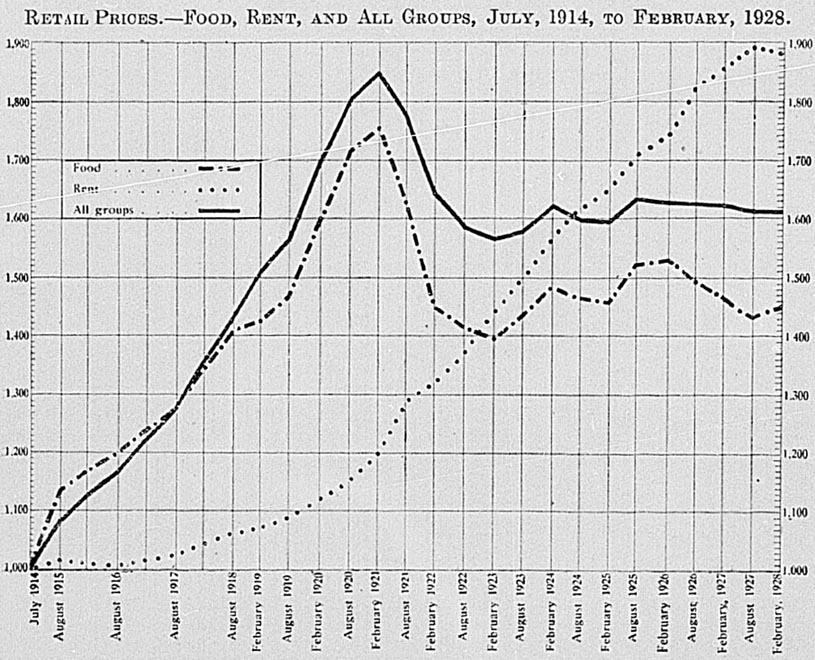
In most countries index numbers of wholesale prices are compiled from the price data available in trade journals or from the published reports of wholesale markets. In New Zealand wholesale markets scarcely exist, and consequently price data for the wholesale-prices investigation have been collected from wholesale merchants and traders, who from the volume of the business they transact are able to supply representative information.
Since 1917 such wholesale-price quotations have been collected monthly, the inquiry being for the most part confined to the four chief centres. In the case of a few commodities (e.g., newsprint), of which there is a local consumption so large that the article can scarcely be omitted from the price-index, yet for which no actual local market exists, the inclusion of the commodity in the index number has been rendered possible by ascertaining movements of prices from the import statistics. Statistics of imports and exports as a source of price data have, however, been avoided as far as possible, on the ground that where quotations are obtained from traders care can be taken to ensure that the grade, &c., quoted for is kept constant. A considerable volume of data as to wholesale prices has also been secured from merchants and traders (and in a few cases from import figures) by means of retrospective investigations covering the years 1891 to 1917, and sufficient information has been secured to permit of the compilation for each year from 1891 onwards of a “general” wholesale-price index number based on the prices of 106 commodities.
General index numbers of wholesale prices for each year from 1891 to 1913 follow. These represent unweighted averages for the four chief centres.
| GENERAL INDEX NUMBERS OF WHOLESALE PRICES, 1891-1913. | |
|---|---|
| (Base: Average aggregate annual expenditure, four chief centres, 1909-13 = 1000.) | |
| Year. | Index Number. |
| 1891 | 994 |
| 1892 | 972 |
| 1893 | 973 |
| 1894 | 927 |
| 1895 | 920 |
| 1896 | 943 |
| 1897 | 942 |
| 1898 | 972 |
| 1899 | 893 |
| 1900 | 917 |
| 1901 | 931 |
| 1902 | 975 |
| 1903 | 954 |
| 1904 | 922 |
| 1905 | 994 |
| 1906 | 1,016 |
| 1907 | 1,016 |
| 1908 | 1,006 |
| 1909 | 949 |
| 1910 | 983 |
| 1911 | 994 |
| 1912 | 1,041 |
| 1913 | 1,032 |
From 1909 onwards still more detailed information has been secured, and separate index numbers for each year from 1913 onwards are published for a number of different groups and classes of commodities, the total number of items covered being approximately 180.
During 1926 a revision of the wholesale price-index was effected, specially designed, inter alia, to permit of the inclusion in the index number of several such items as motor-spirit, &c., the importance of which has increased enormously of late years. As the maximum usefulness of the revised wholesale index number will no doubt be found in future comparisons rather than in comparisons with the past, such new commodities have been allotted weights proportioned not to their 1909-13 consumption, but to their present-day consumption divided by a figure representing the ratio of the present-day population to that of the years 1909-13, the list of commodities represents a wide range, covering articles of home production and of foreign production, of farm, mine, marine, factory, &c., origin, and representing all stages of production.
For purposes of computing wholesale-price indexes, a cross-classification of the commodities covered is now adopted. On the basis of the nature and origin of the commodity there are now seven groups, and on the basis of the purpose of the commodity there are five classes, while a third basis of classification yields a separate index number for imported articles. This system of division into classes has been introduced to provide information as to fluctuations in prices of the raw materials and equipment utilized in the leading types of industry (e.g., farming, building, &c.), and as to fluctuations in the prices of imported articles as distinct from home products, &c. Three of the groups are further subdivided into subgroups, the basis of subdivision being sometimes the nature and origin of the commodities, sometimes the degree of manufacture.
Full details of the revised system, with a schedule of the commodities covered by the various groups and classes, were given in the 1927 number of this book.
The wholesale-price index is purely a commodity index, no attempt having been made to cover the wholesale prices of services such as the supply of electric power, transportation, &c.
For purposes of the wholesale inquiry recourse is had to a modification of the method of the retail-prices investigation—the aggregate expenditure method. The 1927 Year-book gives a detailed account of this also.
The base adopted for purposes of the wholesale-price inquiry is the average of the wholesale prices in the four chief centres during 1909 to 1913, the price quotations from the various merchants being so combined that each return from any given town has the same weight in the averaging process as any other return from that town, while in obtaining Dominion average prices for any given commodity each of the four centres is given the same weight.
The following table shows annual wholesale index numbers by groups.
| WHOLESALE PRICES.—INDEX NUMBERS BY GROUPS, 1913 AND 1922-27. (Base: Average annual aggregate expenditure, four chief centres, 1909-13 = 1000.) | |||||||
|---|---|---|---|---|---|---|---|
| Group. | 1913. | 1922. | 1923. | 1924. | 1925. | 1926. | 1927. |
| 1. Foodstuffs, &c., of vegetable origin— | |||||||
| A. Agricultural produce | 967 | 1,429 | 1,526 | 1,752 | 1,716 | 1,729 | 1,440 |
| B. Fresh fruit and vegetables | 1,031 | 1,464 | 1,264 | 1,583 | 1,365 | 1,289 | 1,464 |
| C. Milled agricultural products | 982 | 1,773 | 1,571 | 1,599 | 1,844 | 1,928 | 1,713 |
| D. Other vegetable foodstuffs and groceries | 1,010 | 1,904 | 1,852 | 1,860 | 1,726 | 1,684 | 1,710 |
| A.-D. Four subgroups combined | 991 | 1,678 | 1,648 | 1,761 | 1,714 | 1,708 | 1,593 |
| 2. Textile manufactures | 1,020 | 2,343 | 2,201 | 2,179 | 2,182 | 2,094 | 2,010 |
| 3. Wood and wood products | 1,072 | 2,172 | 2,183 | 2,192 | 2,145 | 2,077 | 1,979 |
| 4. Animal products— | |||||||
| A. Meats | 1,111 | 1,172 | 1,387 | 1,415 | 1,598 | 1,378 | 1,313 |
| B. Raw animal products (not foods) | 1,085 | 1,109 | 1,402 | 1,724 | 1,455 | 1,287 | 1,417 |
| C. Leather | 1,126 | 1,773 | 1,681 | 1,605 | 1,579 | 1,562 | 1,577 |
| D. Manufactured foodstuffs and groceries of animal, origin | 1,030 | 1,488 | 1,540 | 1,550 | 1,539 | 1,487 | 1,427 |
| A.-D. Four subgroups combined | 1,088 | 1,287 | 1,447 | 1,490 | 1,568 | 1,410 | 1,368 |
| 5. Metals and their products | 932 | 1,268 | 1,129 | 1,151 | 1,175 | 1,070 | 1,011 |
| 6. Non-metallic minerals and their products— | |||||||
| A. Mineral oils | 1,004 | 1,458 | 1,089 | 1,026 | 1,006 | 895 | 752 |
| B. Coals | 1,037 | 2,121 | 1,935 | 1,920 | 1,889 | 1,875 | 1,892 |
| C. Other non-metallic minerals and their products | 1,026 | 2,121 | 1,886 | 1,836 | 1,785 | 1,737 | 1,723 |
| A.-C. Three subgroups combined | 1,022 | 1,852 | 1,583 | 1,506 | 1,512 | 1,453 | 1,400 |
| 7. Chemicals and manures | 1,030 | 1,510 | 1,408 | 1,365 | 1,296 | 1,223 | 1,171 |
| All groups combined | 1,055 | 1,736 | 1,666 | 1,739 | 1,697 | 1,620 | 1,541 |
The percentage represented by each group or subgroup in the base aggregate expenditure is as follows:—
| Group or Subgroup. | Percentage. |
|---|---|
| IA | 10.7 |
| IB | 2.1 |
| IC | 4.3 |
| ID | 11.9 |
| II | 12.7 |
| III | 5.5 |
| IVA | 11.0 |
| IVB | 1.7 |
| IVC | 1.1 |
| IVD | 5.1 |
| V | 14.3 |
| VIA | 6.8 |
| VIB | 7.1 |
| VIC | 2.9 |
| VII | 2.8 |
In the next table index-numbers are given by classes from 1913 to 1927. The table also shows the separate index number for imported items; alongside which, for purposes of convenience of comparison, are set the index numbers of export prices. It should be noted that the export-price index is computed by a method entirely different from that adopted in connection with the computing of the wholesale-price index.
| WHOLESALE PRICES.—INDEX NUMBERS BY CLASSES. | ||||||||
|---|---|---|---|---|---|---|---|---|
| (Base: Average annual aggregate expenditure, four chief centres, 1909-13=1000.) | ||||||||
| Year. | Consumers' Goods. | Producers' Materials, &c. | All Classes combined. | Index Number of Imported Items. | Index Number of Export Prices. | |||
| Class I: Foodstuffs. | Class II: Non-Foods. | Class III: Materials for Farming Industry. | Class IV: Materials for Building and Construction. | Class V Materials for other Industries. | ||||
| * No export price index computed for this year. | ||||||||
| 1913 | 1,039 | 1,044 | 1,068 | 1,134 | 1,055 | 1,055 | 1,084 | * |
| 1914 | 1,129 | 1,032 | 1,081 | 1,189 | 1,095 | 1,098 | 1,089 | 1,108 |
| 1915 | 1,343 | 1,006 | 1,279 | 1,347 | 1,238 | 1,235 | 1,107 | 1,315 |
| 1916 | 1,420 | 1,116 | 1,298 | 1,622 | 1,319 | 1,328 | 1,280 | 1,529 |
| 1917 | 1,501 | 1,317 | 1,467 | 2,026 | 1,543 | 1,511 | 1,556 | 1,744 |
| 1918 | 1,634 | 1,759 | 1,714 | 2,496 | 1,786 | 1,778 | 2,017 | 1,798 |
| 1919 | 1,698 | 1,957 | 1,781 | 2,280 | 1,878 | 1,858 | 2,114 | 1,851 |
| 1920 | 1,806 | 2,367 | 2,202 | 2,737 | 2,286 | 2,181 | 2,594 | 1,823 |
| 1921 | 1,749 | 2,175 | 1,794 | 2,637 | 2,140 | 2,025 | 2,268 | 1,687 |
| 1922 | 1,496 | 1,951 | 1,476 | 2,261 | 1,802 | 1,736 | 1,909 | 1,270 |
| 1923 | 1,565 | 1,795 | 1,426 | 2,175 | 1,649 | 1,666 | 1,718 | 1,554 |
| 1924 | 1,592 | 1,790 | 1,615 | 2,151 | 1,677 | 1,739 | 1,693 | 1,769 |
| 1925 | 1,611 | 1,742 | 1,556 | 2,127 | 1,703 | 1,697 | 1,673 | 1,886 |
| 1926 | 1,496 | 1,652 | 1,473 | 2,034 | 1,677 | 1,620 | 1,586 | 1,526 |
| 1927 | 1,459 | 1,584 | 1,259 | 1,945 | 1,604 | 1,541 | 1,514 | 1,513 |
Of the total base aggregate expenditure, Class I represented 30.1 per cent., Class II 20.5 per cent., Class III 11.8 per cent., Class IV 7.4 per cent., and Class V 30.2 per cent., while the imported items aggregated 42.8 per cent. of the total.
By using these figures (and those previously given for the groups) as weights, index numbers can be averaged for different groups or classes so as to arrive at special index numbers that may be desired for any purpose. A combination of the index numbers for Groups ID and IVD, for example, yields an excellent figure for the wholesale prices of groceries; a combination of the index numbers for Classes I and II gives a figure for the wholesale prices of “consumption goods”; and so on.
On the outbreak of the Great War those raw materials and semi-manufactured products that form the staple exports of the Dominion rose most rapidly. It is probable that many wholesale houses held considerable stocks of imported commodities, and that this, with other factors, retarded the upward movement of the index number of imported items until about 1918, when this index number began rapidly to overhaul the index number of export prices, attaining at its peak in 1920 a level much higher than the peak level of any other general price-index. The export items were also the first to fall, this price-index showing a slight drop in 1920, while the wholesale and import price-indexes were still continuing their upward rise wholly unchecked. Similarly, the post-war slump is reflected a full year earlier in the export price-index than in the wholesale price-index; while at the present time the export price-index has for long been showing a marked falling tendency, which is only just beginning to be reflected in the wholesale price-index.
Since the Armistice the index number of export prices has shown much wider fluctuations than the other price-indexes. This is probably duo rather to the fact that our staple exports are for the most part easily graded commodities, and therefore a fit object for speculation, than to the differences in the methods of compiling the price-indexes.
Broadly speaking, the peaks for groups comprising mainly exported articles represented a lower level than the peaks for groups comprising mainly imported articles. The prices both of New Zealand's staple exports and of her staple imports are, in general, determined by world-market conditions; so that, roughly, the prices in New Zealand of articles of export represent world prices minus the cost of transport, insurance, duties, &c., while the prices in the Dominion of articles of import represent world prices plus the cost of transport, insurance, duties, &c.; all of which items during the war period increased considerably more rapidly than did the prices of commodities.
There is no substantial difference between the price movements exhibited by consumers' goods on the one hand and producers' goods on the other. Farming-materials, however, appear to have risen less and building materials more than any other classes. The great rise in building-materials is by no means unconnected with the fact that of all the groups that representing wood and wood-products shows the greatest rise, with the solitary exception of the textile-manufactures group. Mineral oils show the smallest rise, and metals and their products the next smallest. Both these groups represent in a large degree commodities where the consumer is receiving the benefit of the economies of mass production.
Speaking generally, the movements of the index numbers for retail and for wholesale prices have been similar, though there has been a tendency for rises in retail prices to lag behind rises in wholesale prices, owing to the effects of retail friction, maximum-price legislation, and similar factors. Thus, the peak for wholesale prices (general index number) was reached in October, 1920, while that for retail prices (all groups) was not reached till at least two months later the peak of the general wholesale-price index was, moreover, about 270 points higher than the peak index number for retail prices.
As in the case of retail prices, the peak level of wholesale prices in New Zealand (recorded at 2291 in October, 1920) represented a lower peak level than that of any other country publishing price statistics, with the solitary exception of India.
The following table of comparative wholesale prices in England and New Zealand during March, 1928, is of interest as showing the relative prices of the staple agricultural and dairy products in the two countries:—
| WHOLESALE PRICES IN NEW ZEALAND AND ENGLAND DURING MARCH, 1928. | |||||||||
|---|---|---|---|---|---|---|---|---|---|
| Item. | Unit. | England. | New Zealand. | ||||||
| Description. | Price. | Description. | Price. | ||||||
| £ | s. | d. | £ | s. | d. | ||||
| Flour | Ton | London straights | 17 | 0 | 0 | New Zealand. | 17 | 11 | 3 |
| Wheat | Cwt. | English Gazette | 0 | 9 | 10 | Tuscan | 0 | 10 | 10 |
| Oats | Cwt | English Gazette | 0 | 10 | 9 | Gartons | 0 | 9 | 9 |
| Potatoes | Ton | Good English | 7 | 7 | 6 | New Zealand table | 8 | 11 | 5 |
| Butter | Cwt. | New Zealand | 8 | 11 | 0 | New Zealand Ist Grade | 8 | 2 | 6 |
| Bacon | Cwt. | Danish | 4 | 5 | 0 | New Zealand slides | 4 | 8 | 5 |
| Wool | Lb. | Victoria good average | 0 | 2 | 2 1/2 | Merino | 0 | 2 | 0 1/4 |
| Tallow | Cwt. | Australian | 2 | 0 | 0 | New Zealand | 1 | 4 | 2 |
The prices for the items here enumerated are similar in both countries, the only item where a considerable difference is recorded being tallow, for which commodity the New Zealand price is appreciably lower. Flour, wheat, potatoes and bacon are slightly cheaper in England, while oats, butter, and wool are a little dearer in that country than in New Zealand.
The prosperity of New Zealand is so closely bound up with the prices realized for the commodities exported that great interest necessarily centres on a special index number of wholesale prices based solely on the prices of exported commodities. Annual index numbers of export prices based on prices prevailing in the “nineties” were formerly compiled from data supplied by the Customs Department, and for many years were published in the Year-book. A new series of export-price indexes with the average prices of the years 1909-13 as base (= 1000) has recently been instituted; and in this new series monthly as well as annual figures are available, while the commodities are also grouped according to their nature. Certain staple export commodities are considered; the recorded values of the exports of these commodities for the month or year under investigation are divided by the values the same quantities of these commodities as were exported during this period would have had if prices had remained as in the base period, and the price indexes are obtained by multiplying this quotient by 1000. The fewness and the substantial homogeneity of the commodities which may be regarded as New Zealand's staple exports render this procedure eminently simple and satisfactory.
The twenty-five commodities covered account for about 95 per cent. of the total exports, leaving only 5 per cent. unaccounted for. The effect of the exclusion of this small residuum is to give it a price-movement similar to that of the items covered. Substantial accuracy for the index number may therefore reasonably be claimed.
The following table shows annual figures for export prices from 1914 onwards. The miscellaneous group includes apples, peas, phormium-fibre, kauri-gum, and certain important kinds of timber.
| INDEX NUMBERS OF EXPORT PRICES, 1914-27. | ||||||
|---|---|---|---|---|---|---|
| (Base: Average export prices of years 1909-13 = 1000.) | ||||||
| Year. | Group I: Dairy-produce. | Group II: Meat. | Group III: Wool. | Group IV: Hides, Skins, and Tallow. | Group V: Miscellaneous. | All Groups combined. |
| 1914 | 1,038 | 1,218 | 1,101 | 1,089 | 1,037 | 1,108 |
| 1915 | 1,203 | 1,468 | 1,362 | 1,133 | 1,078 | 1,315 |
| 1916 | 1,349 | 1,509 | 1,723 | 1,394 | 1,361 | 1,529 |
| 1917 | 1,562 | 1,761 | 1,768 | 2,187 | 1,700 | 1,744 |
| 1918 | 1,574 | 1,777 | 1,780 | 2,383 | 2,060 | 1,798 |
| 1919 | 1,747 | 1,780 | 1,816 | 2,426 | 1,781 | 1,851 |
| 1920 | 1,806 | 1,716 | 1,809 | 2,098 | 1,800 | 1,823 |
| 1921 | 2,231 | 1,766 | 848 | 1,539 | 1,832 | 1,687 |
| 1922 | 1,495 | 1,522 | 939 | 1,522 | 1,686 | 1,270 |
| 1923 | 1,621 | 1,875 | 1,277 | 1,561 | 1,634 | 1,554 |
| 1924 | 1,650 | 1,868 | 1,906 | 1,732 | 1,645 | 1,769 |
| 1925 | 1,515 | 2,085 | 2,233 | 2,061 | 1,679 | 1,886 |
| 1926 | 1,411 | 1,755 | 1,431 | 1,876 | 1,562 | 1,526 |
| 1927 | 1,375 | 1,662 | 1,527 | 1,829 | 1,491 | 1,513 |
The outstanding differences between the method of compilation of the index numbers for export prices on the one hand and the index numbers for wholesale and for retail prices on the other hand rests on the fact that the “weights” of the various commodities included in the case of the export-price index are determined by the quantities of the commodities exported during the period under investigation; while in the case of the other price indexes the weights are determined by the quantities of the commodities consumed (domestically only in the case of the retail prices, and domestically plus industrially in the case of the wholesale) during some fixed period, usually the base period.
Under the influence of speculation in wool (an easily gradable and non-perishable raw material, and therefore a specially suitable object for speculation) a record monthly figure for export prices was reached at 2214 in January, 1925 the index number for the special wool group in that month standing at the phenomenal figure of 2715, and rising a further 24 points the following month, only to fall by 448 points in March, and to drop to 1565 at the end of the year, and to 1372 by April, 1926. Between 1891 and 1914 the annual New Zealand wholesale price of crossbred wool (medium to good) fluctuated between 4 1/2d. per pound (in 1901) and 5d. per pound (in 1902) on the one hand and 10d. per pound (in 1906 and again in 1912) and 10 1/4d. per pound (in 1913 and 1914) on the other. In 1916 the price was 1s. 3 3/4d., from 1917 to 1919 1s. 3 1/2d., in 1920 1s. 2 1/4d., in 1921 only 5 3/4d.; after which the price rose again gradually until it was 1s. 6 3/4d. in 1924; while the average for 1926 dropped to 1s. 2 1/2d. Between 1891 and 1914 the wholesale price of butter fluctuated between the relatively much narrower limits of 10 1/4d. (in 1897, 1899, and 1904) and 1s. 2 1/4d. (in 1914); while the maximum yearly price since 1914 was 1s. 11 3/4d. (in 1921). Cheese fluctuated between 4 1/2d. (in 1896, 1898, and 1899) and 7d. (in 1912 and 1914). Its post-war maximum was 1s. 1 1/4d. (in 1921). The greatest post-war rise occurred in the hides, skins, and tallow group, a fact which is closely connected with the one already adverted to in the consideration of wholesale-price indexes, to the effect that the leather group showed the highest peak level. Of the export-prices groups, meat showed the lowest peak level.
Since January, 1925, the general index number for export prices has fallen considerably, the annual average index for 1927 being 1513. To this fall all the groups have contributed. Wool, however, shows a substantial improvement on the 1926 figures, a rise of 96 points being recorded in the index for this group.
Table of Contents
THE material used in the compilation of statistics of wages in New Zealand is collected almost entirely from the awards of the Arbitration Court. It is recognized that the rates specified in such awards are minimum rates, and that wages may in some cases be above the prescribed minima, so that a rise or fall in the award rates does not necessarily connote an immediate change in the wage rates of workers being paid more than these rates. Nevertheless, for the purpose of tracing the movement in wage rates over any considerable space of time the award rates form a more reliable basis than any information which could be collected directly from employers or trade-union secretaries as to the ruling or predominant rates in any industry. In the case of two important classes of workers—agricultural and pastoral employees and railway employees—no awards exist. Information has been obtained from the Labour Department as to the ruling rates of wages in the former case, and from the Railways Department in the latter case.
The rates used throughout are those paid to adult workers; but no distinction has been made between male and female workers. In the case of most industries included in the compilations only male workers are employed, but in the textile and weaving group and the domestic-service group (which includes hotel and restaurant workers) female workers predominate. The index numbers for these groups are consequently consistently lower than those for other groups in such tables of index numbers as are based on the “all groups” weighted average wage.
The award rates for the four principal districts—Northern, Wellington, Canterbury, and Otago and Southland—have in general been taken as representative of the ruling wages throughout the Dominion. For such industries as are carried on in the towns these rates are quite satisfactory; in cases where the important centre of an industry is situated outside the geographical boundaries of the four principal districts the award rates for that centre have been used. For instance, the rates used for coal-mining and sawmilling in the Canterbury District are those prescribed by the awards for the Westland Industrial District.
In weighting the rates extracted from the awards for each district in order to obtain index numbers, the occupations for which rates have been obtained have been grouped into fourteen industrial groups.
Owing to the difficulty of obtaining the requisite data, the individual occupations in each group have not hitherto been weighted. A careful selection of representative occupations in each industry has, however, been made so that the movement in the unweighted arithmetic average of wages paid in these occupations gives a fairly reliable indication of the movement in average wages paid in all occupations in the industries included in each group. While this undoubtedly holds good as between the occupations in each group the same method would not be sufficiently accurate in combining groups and districts for the purpose of compiling index numbers. The numbers of workers recorded on the trade-union rolls for December, 1916, as registered trade-unionists in the various unions were used in weighting between groups and districts. Since the figures thus obtained represented the numbers of workers to whom the various awards applied this source of information was quite satisfactory as regards most occupations included in the compilations.
It was, however, apparent on examination of the rolls that the number enrolled as agricultural and pastoral workers was by no moans proportionate to the total number of wage-earners employed in that class of work when compared with the numbers enrolled in other industries. It was found necessary, therefore, to interpolate the weights for this group, using the census figures of 1916 for wage-earners as a basis.
The following table shows the weights adopted for each group:—
| WEIGHTS USED FOR EACH GROUP IN EACH INDUSTRIAL DISTRICT. | |||||
|---|---|---|---|---|---|
| (00's omitted.) | |||||
| Industrial Group. | Northern. | Wellington. | Canterbury. | Otago and Southland. | Dominion. |
| Food, drink, and tobacco | 17 | 21 | 12 | 13 | 63 |
| Clothing, boots, &c. | 13 | 10 | 9 | 10 | 42 |
| Textiles and weaving | 2 | 11 | 2 | 2 | 17 |
| Building and construction | 24 | 29 | 16 | 15 | 84 |
| Wood-manufacture | 11 | 6 | 5 | 11 | 33 |
| Printing, &c. | 4 | 7 | 4 | 3 | 18 |
| Metal-working and engineering | 9 | 5 | 10 | 9 | 33 |
| Other manufactures | 6 | 2 | 10 | 2 | 20 |
| Mining | 19 | .. | 22 | 5 | 46 |
| Agricultural and pastoral | 63 | 46 | 42 | 37 | 188 |
| Land transport | 28 | 34 | 28 | 26 | 116 |
| Shipping and cargo-working | 19 | 32 | 6 | 14 | 71 |
| Hotel, restaurant, and other personal service | 29 | 22 | 5 | 7 | 63 |
| Miscellaneous | 21 | 19 | 14 | 5 | 59 |
| Totals for all groups | 265 | 244 | 185 | 159 | 853 |
The following table shows the nominal-wage index numbers for each group and all groups combined for 1914 and for each year from 1918 to 1927, the base on which the index numbers in this table have been computed is the Dominion weighted average wage for all groups combined for the average of the years 1909-13, equated to 1,000.
| NOMINAL-WAGE INDEX NUMBERS, BY INDUSTRIAL GROUPS, 1914 AND 1918-27. | |||||||||||
|---|---|---|---|---|---|---|---|---|---|---|---|
| (Base: Dominion weighted average wages for all industrial groups combined, 1909-13=1,000.) | |||||||||||
| Industrial Group. | 1914. | 1918. | 1919. | 1920. | 1921. | 1922. | 1923. | 1924. | 1925. | 1926. | 1927. |
| Food, drink, and tobacco | 1,074 | 1,193 | 1,228 | 1,498 | 1,624 | 1,643 | 1,628 | 1,711 | 1,778 | 1,817 | 1,856 |
| Clothing, boots, &c. | 737 | 855 | 936 | 1,113 | 1,215 | 1,182 | 1,145 | 1,162 | 1,191 | 1,178 | 1,178 |
| Textiles and weaving | 972 | 1,094 | 1,225 | 1,309 | 1,466 | 1,490 | 1,553 | 1,555 | 1,558 | 1,569 | 1,560 |
| Building and construction | 1,236 | 1,357 | 1,491 | 1,764 | 1,888 | 1,835 | 1,773 | 1,799 | 1,804 | 1,802 | 1,796 |
| Wood-manufacture | 1,111 | 1,286 | 1,378 | 1,617 | 1,896 | 1,816 | 1,754 | 1,810 | 1,837 | 1,910 | 1,960 |
| Printing, &c. | 1,274 | 1,373 | 1,552 | 1,879 | 2,008 | 1,895 | 1,813 | 1,822 | 1,967 | 1,991 | 2,028 |
| Metal-working and engineering | 1,161 | 1,309 | 1,430 | 1,721 | 1,825 | 1,805 | 1,779 | 1,780 | 1,784 | 1,813 | 1,858 |
| Other manufactures | 1,087 | 1,231 | 1,322 | 1,592 | 1,820 | 1,743 | 1,694 | 1,702 | 1,731 | 1,739 | 1,768 |
| Mining | 1,145 | 1,305 | 1,334 | 1,482 | 1,774 | 1,766 | 1,754 | 1,799 | 1,820 | 1,820 | 1,820 |
| Agricultural and pastoral | 1,011 | 1,374 | 1,458 | 1,541 | 1,550 | 1,461 | 1,492 | 1,486 | 1,491 | 1,494 | 1,489 |
| Land transport | 1,076 | 1,238 | 1,371 | 1,644 | 1,739 | 1,684 | 1,644 | 1,702 | 1,736 | 1,773 | 1,787 |
| Shipping and cargo-working | 1,249 | 1,556 | 1,642 | 1,826 | 2,126 | 2,087 | 2,015 | 2,064 | 2,106 | 2,114 | 2,136 |
| Hotel, restaurant, and other personal service | 955 | 1,103 | 1,145 | 1,269 | 1,528 | 1,526 | 1,469 | 1,497 | 1,502 | 1,532 | 1,526 |
| Miscellaneous | 1,021 | 1,179 | 1,254 | 1,593 | 1,669 | 1,590 | 1,519 | 1,553 | 1,587 | 1,636 | 1,666 |
| All industrial groups combined | 1,073 | 1,278 | 1,368 | 1,570 | 1,703 | 1,654 | 1,625 | 1,651 | 1,679 | 1,699 | 1,710 |
NOTE.—The index numbers in this table are comparable both vertically and horizontally. Similar index numbers on base 1914 = 1,000 are compiled quarterly and published In the Monthly Abstract of Statistics.
Wages rose steadily and in fairly regular gradations from year to year from 1914 to 1918. When the provisions of the War Legislation and Statute Law Amendment Act providing for the regulation of wages in accordance with movements in the cost of living came into effect the lag between prices and wages was partially eliminated; consequently sharp increases took place—90 points between 1918 and 1919, 202 points between 1919 and 1920, and 133 points between 1920 and 1921. The effect of the post-war slump thereafter becomes apparent, decreases being recorded in the two subsequent years (1922 and 1923), the nominal wage index for all groups of industries falling from 1703 in 1921 to 1625 in 1923. Following the recovery from the slump, the index number rose year by year until in 1927 it reached 1710, the highest level yet recorded.
The groups covering (1) clothing, boots, &c., (2) textiles and weaving, and (3) hotel and restaurant workers, show consistently lower index numbers than those of most other groups, the reason being that in the cases enumerated female workers form a large proportion of the total wage-earners. The index numbers for the groups “shipping and cargo-working,” “printing, &c.,” and “building and construction” are, in general, higher than is the case in other groups the high proportion of skilled workers in the printing and building trades would account for the relatively high wages paid in these groups. The group “shipping and cargo-working” includes waterside workers, whose wages per hour are usually somewhat higher than those in other occupations of the same grade, due no doubt to allowance being made, in the fixing of wages, for the casual nature of the occupation. In the case of the remainder of the workers in this group—viz., cooks, stewards, engineers, and seamen—an addition has, for purposes of computing the index numbers, been made to the award rates equivalent to the value of board and lodging supplied.
In the preceding table Dominion index numbers were given for each individual group and for all groups combined, but no attempt was made to differentiate between the four industrial districts. The following table shows the index numbers for all groups combined for each industrial district and the Dominion weighted average for the years 1914 to 1927. From this table comparisons may be made between the index numbers for the four principal industrial districts.
| NOMINAL-WAGE INDEX NUMBERS, FOUR PRINCIPAL INDUSTRIAL DISTRICTS, 1914-27. | |||||
|---|---|---|---|---|---|
| (Base: Dominion weighted average wages for all industrial groups combined, 1909-13 = 1000.) | |||||
| Year. | Northern Industrial District. | Wellington Industrial District. | Canterbury Industrial District. | Otago and Southland Industrial District. | Dominion Weighted Average. |
| 1914 | 1,069 | 1,072 | 1,088 | 1,064 | 1,073 |
| 1915 | 1,428 | 1,355 | 1,130 | 1,269 | 1,135 |
| 1916 | 1,143 | 1,125 | 1,162 | 1,296 | 1,170 |
| 1917 | 1,094 | 1,203 | 1,231 | 1,324 | 1,225 |
| 1918 | 1,257 | 1,245 | 1,290 | 1,348 | 1,278 |
| 1919 | 1,335 | 1,327 | 1,399 | 1,450 | 1,368 |
| 1920 | 1,505 | 1,528 | 1,640 | 1,661 | 1,570 |
| 1921 | 1,677 | 1,662 | 1,745 | 1,761 | 1,703 |
| 1922 | 1,629 | 1,630 | 1,672 | 1,709 | 1,654 |
| 1923 | 1,621 | 1,600 | 1,639 | 1,654 | 1,625 |
| 1924 | 1,647 | 1,637 | 1,671 | 1,676 | 1,651 |
| 1925 | 1,645 | 1,678 | 1,692 | 1,727 | 1,679 |
| 1926 | 1,661 | 1,702 | 1,707 | 1,735 | 1,699 |
| 1927 | 1,672 | 1,714 | 1,719 | 1,760 | 1,710 |
NOTE.—The wage indexes shown in this table are comparable both vertically and horizontally.
From the foregoing table it is evident that no considerable differences exist between the index numbers for the four principal districts. In the case of several industries Dominion awards are made which apply to all districts. Such differences as are observed are due to a certain extent to the fact that some industries included in the compilations are not carried on in all districts. For instance, the sugar-refining industry is confined to the Northern District, and, while in the Northern, Canterbury (which for this purpose is deemed to include Westland), and Otago and Southland Districts the mining industry is an important one, coal-mining at least is not carried on in the Wellington Industrial District. This point can be more clearly seen by a study of the following table, which show's for the year 1927 the index numbers for the individual groups in each district as well as the Dominion weighted average index numbers.
| NOMINAL-WAGE INDEX NUMBERS BY INDUSTRIAL GROUPS AND DISTRICTS, 1927. | |||||
|---|---|---|---|---|---|
| (Base: Dominion weighted average wages for all industrial groups combined, 1909-13 = 1000.) | |||||
| Industrial Group. | Index Numbers. | ||||
| Northern Industrial District. | Wellington Industrial District. | Canterbury Industrial District. | Otago and Southland Industrial District. | Dominion Weighted Average. | |
| Food, drink, and tobacco | 1,837 | 1,877 | 1,851 | 1,851 | 1,856 |
| Clothing, boots, &c. | 1,178 | 1,178 | 1,178 | 1,178 | 1,178 |
| Textiles and weaving | 1,617 | 1,539 | 1,564 | 1,611 | 1,560 |
| Building and construction | 1,793 | 1,796 | 1,788 | 1,822 | 1,796 |
| Wood-manufacture | 1,934 | 1,944 | 1,973 | 1,990 | 1,960 |
| Printing, &c. | 2,087 | 2,085 | 2,085 | 1,914 | 2,028 |
| Metal-working and engineering | 1,897 | 1,875 | 1,851 | 1,819 | 1,858 |
| Other manufactures | 1,785 | 1,783 | 1,875 | 1,807 | 1,768 |
| Mining | 1,802 | .. | 1,838 | 1,812 | 1,820 |
| Agricultural and pastoral | 1,416 | 1,412 | 1,530 | 1,664 | 1,489 |
| Land transport | 1,795 | 1,790 | 1,782 | 1,779 | 1,787 |
| Shipping and cargo-working | 2,136 | 2,136 | 2,136 | 2,136 | 2,136 |
| Hotel, restaurant, and other personal service | 1,526 | 1,526 | 1,526 | 1,526 | 1,526 |
| Miscellaneous | 1,685 | 1,655 | 1,660 | 1,664 | 1,666 |
| All industrial groups combined | 1,672 | 1,714 | 1,719 | 1,760 | 1,710 |
NOTE.—The wage indexes in this table are comparable both vertically and horizontally.
The following table shows the unweighted averages of award rates for the four principal districts as at 31st March of 1914 and of each year from 1924 to 1928. The estimated value of board and lodging has been added to the wages in those occupations where it is a necessary perquisite of employment. More detailed statistics, showing rates for each of the four principal industrial districts, are included in the Annual Statistical Report on Prices, &c.
| AVERAGE MINIMUM WEEKLY ADULT WAGES, 1914 AND 1924-28. | ||||||||||||
|---|---|---|---|---|---|---|---|---|---|---|---|---|
| (NOTE:—The figures given are averages for the four principal industrial districts as at 31st March in the years shown.) | ||||||||||||
| Occupation. | Average Wage (Four Principal Districts) at 31st March, | |||||||||||
| 1914. | 1924. | 1925. | 1926. | 1927. | 1928. | |||||||
| s. | d. | s. | d. | s. | d. | s. | d. | s. | d. | s. | d. | |
| Bakers—Journeymen | 55 | 0 | 91 | 6 | 97 | 6 | 97 | 6 | 97 | 6 | 100 | 0 |
| Labourers | 48 | 0 | 76 | 0 | 78 | 0 | 78 | 0 | 78 | 0 | 80 | 6 |
| Butchers—First shopmen | 72 | 6 | 102 | 9 | 106 | 7 1/2 | 116 | 10 1/2 | 116 | 10 1/2 | 116 | 10 1/2 |
| Second shopmen | 62 | 6 | 94 | 0 | 96 | 0 | 105 | 0 | 105 | 0 | 105 | 0 |
| Butter-factory employees— | ||||||||||||
| Churning and buttermaking—General hands | 52 | 6 | 77 | 4 | 77 | 8 | 79 | 4 | 81 | 9 | 81 | 9 |
| Flour-milling—Kilnmen | 48 | 0 | 91 | 0 | 91 | 0 | 92 | 8 | 92 | 8 | 92 | 8 |
| Assistant smuttermen | 52 | 0 | 83 | 0 | 83 | 0 | 84 | 8 | 84 | 8 | 84 | 8 |
| Rollermen | 56 | 0 | 95 | 0 | 95 | 0 | 95 | 0 | 96 | 8 | 96 | 8 |
| Meat-freezing— | ||||||||||||
| Freezing-chamber hands | 64 | 0 | 101 | 2 1/2 | 96 | 3 | 96 | 3 | 99 | 0 | 99 | 0 |
| General hands | 54 | 0 | 84 | 8 1/2 | 88 | 0 | 88 | 0 | 91 | 8 | 91 | 8 |
| Meat-preserving— | ||||||||||||
| Boners | 62 | 0 | 96 | 9 3/4 | 99 | 11 | 99 | 11 | 102 | 8 | 102 | 8 |
| Meat-preserver—Second man | 59 | 6 | 88 | 8 3/4 | 93 | 6 | 93 | 6 | 95 | 4 | 95 | 4 |
| Sausage-casing making — General hands | 58 | 8 | 80 | 8 | 91 | 8 | 91 | 8 | 95 | 4 | 95 | 4 |
| Aerated-waters and cordial making— | ||||||||||||
| Cordial-makers | 58 | 9 | 84 | 2 | 84 | 8 | 93 | 0 | 93 | 0 | 93 | 0 |
| Bottle-washers | 45 | 0 | 73 | 10 1/2 | 73 | 10 1/2 | 83 | 0 | 83 | 0 | 83 | 0 |
| Brewing—Labourers | 47 | 7 1/2 | 80 | 1 | 82 | 10 | 83 | 0 | 83 | 0 | 83 | 6 |
| Tailors—Journeymen | 53 | 9 | 90 | 0 | 90 | 0 | 90 | 0 | 95 | 0 | 95 | 0 |
| Factory hands | 56 | 0 | 81 | 10 | 84 | 0 | 84 | 0 | 87 | 6 | 87 | 6 |
| Tailoresses (factory)—Journeywomen | 27 | 6 | 42 | 6 | 44 | 0 | 45 | 0 | 45 | 0 | 45 | 0 |
| Boot operatives— | ||||||||||||
| Male | 52 | 6 | 84 | 4 | 84 | 4 | 85 | 3 | 85 | 3 | 88 | 11 |
| Female journeywomen | 27 | 6 | 47 | 6 | 47 | 6 | 48 | 6 | 48 | 6 | 50 | 0 |
| Woollen-mills— | ||||||||||||
| Males—Spinners | 51 | 0 | 85 | 9 | 85 | 9 | 85 | 9 | 93 | 9 | 93 | 9 |
| General hands | 46 | 6 | 74 | 6 | 74 | 6 | 74 | 6 | 82 | 6 | 82 | 6 |
| Females—All adults | 26 | 3 | 41 | 0 | 41 | 0 | 41 | 0 | 45 | 0 | 45 | 0 |
| Building and construction— | ||||||||||||
| Bricklayers | 68 | 5 1/4 | 99 | 11 1/4 | 99 | 11 1/4 | 99 | 11 1/4 | 99 | 11 1/4 | 99 | 11 1/4 |
| Carpenters | 64 | 3 1/2 | 97 | 2 | 97 | 2 | 97 | 2 | 101 | 9 | 101 | 9 |
| Joiners | 64 | 3 1/2 | 97 | 2 | 97 | 2 | 97 | 2 | 101 | 9 | 101 | 9 |
| Plasterers | 67 | 9 1/2 | 96 | 10 1/4 | 96 | 10 1/4 | 96 | 10 1/4 | 99 | 11 | 99 | 11 |
| Plumbers (competent) | 66 | 0 | 94 | 5 1/4 | 95 | 4 | 95 | 4 | 95 | 4 | 95 | 4 |
| Bricklayers' labourers | 55 | 0 | 79 | 1 | 84 | 0 | 86 | 7 | 86 | 7 | 86 | 7 |
| Other builders' labourers | 52 | 6 1/2 | 76 | 6 3/4 | 79 | 0 | 83 | 5 | 83 | 5 | 83 | 5 |
| Sawmilling, bush— | ||||||||||||
| Engine-drivers (first-class) | 54 | 0 | 88 | 5 | 95 | 0 | 104 | 6 | 104 | 6 | 104 | 6 |
| Sawyers | 53 | 0 1/2 | 94 | 11 1/4 | 100 | 0 1/2 | 103 | 4 | 103 | 4 | 103 | 4 |
| Tailers-out | 43 | 9 | 83 | 11 3/4 | 88 | 3 1/4 | 89 | 10 | 89 | 10 | 89 | 10 |
| Yardmen | 55 | 8 3/4 | 82 | 4 3/4 | 91 | 7 | 100 | 2 | 100 | 2 | 100 | 2 |
| General hands | 51 | 0 | 80 | 5 | 83 | 4 1/4 | 84 | 4 | 84 | 4 | 84 | 4 |
| Boatbuilding—Shipwrights | 62 | 8 | 95 | 7 | 100 | 4 1/4 | 100 | 4 1/4 | 101 | 2 | 103 | 8 1/4 |
| Boatbuilders | 58 | 9 | 92 | 4 1/2 | 92 | 4 1/2 | 92 | 4 1/2 | 99 | 4 | 101 | 10 1/4 |
| Metal-works, &c.— | ||||||||||||
| Blacksmiths, farriers | 61 | 7 | 89 | 10 3/4 | 89 | 10 3/4 | 95 | 4 | 99 | 0 | 99 | 0 |
| Boilermaking—Journeymen | 62 | 8 | 94 | 3 | 95 | 4 | 95 | 4 | 99 | 0 | 99 | 0 |
| Iron and brass moulders | 64 | 7 1/2 | 91 | 11 1/2 | 95 | 4 | 95 | 4 | 99 | 0 | 99 | 0 |
| Tinsmiths—Journeymen | 62 | 8 | 94 | 2 1/4 | 95 | 4 | 95 | 4 | 99 | 0 | 99 | 0 |
| Engineering— | ||||||||||||
| Fitters, &c. | 64 | 7 1/2 | 94 | 5 | 95 | 4 | 95 | 4 | 99 | 0 | 99 | 0 |
| Electrical workers | 61 | 10 1/2 | 94 | 1 | 95 | 4 | 95 | 4 | 99 | 0 | 99 | 0 |
| Motor mechanics | 64 | 11 1/2 | 94 | 5 | 95 | 1 1/4 | 95 | 4 | 99 | 0 | 99 | 0 |
| Skin and leather workers— | ||||||||||||
| Curriers | 58 | 0 | 95 | 8 | 95 | 0 | 95 | 0 | 102 | 0 | 102 | 0 |
| Pelt-fleshers | 54 | 6 | 97 | 0 | 95 | 0 | 95 | 0 | 95 | 0 | 95 | 0 |
| General hands | 49 | 6 | 79 | 0 | 84 | 4 | 84 | 4 | 85 | 8 | 85 | 8 |
| Mineral and stone workers— | ||||||||||||
| Brickmakers | 53 | 11 1/2 | 99 | 0 | 100 | 0 | 100 | 0 | 103 | 2 | 104 | 2 |
| General hands | 46 | 9 3/4 | 83 | 0 | 84 | 0 | 84 | 0 | 85 | 4 | 86 | 4 |
| Mining (coal)— | ||||||||||||
| Surface—Tippers | 53 | 7 1/2 | 84 | 2 | 85 | 10 | 85 | 10 | 90 | 8 | 90 | 8 |
| Labourers | 54 | 3 3/4 | 86 | 10 | 85 | 10 | 85 | 10 | 90 | 8 | 90 | 8 |
| Winchmen | 55 | 0 | 87 | 6 | 92 | 2 | 92 | 1 | .. | .. | .. | .. |
| Miners | 63 | 3 | 103 | 4 | 99 | 9 | 99 | 9 | 110 | 2 | 110 | 2 |
| Truckers | 55 | 11 | 92 | 8 | 91 | 7 3/4 | 91 | 7 3/4 | 94 | 1 | 94 | 1 |
| Mining (gold)— | ||||||||||||
| Miners in rises with machines | 63 | 9 | 86 | 10 1/4 | 86 | 10 1/4 | 87 | 9 1/4 | 87 | 9 1/4 | 87 | 9 1/4 |
| Stone-breaker labourers | 54 | 2 | 79 | 3 1/2 | 79 | 3 1/2 | 80 | 2 1/2 | 80 | 2 1/2 | 80 | 2 1/2 |
| Quarrymen | 52 | 8 1/2 | 80 | 2 | 85 | 3 1/4 | 85 | 3 1/4 | 85 | 3 1/4 | 85 | 3 1/4 |
| Agricultural and pastoral workers— | ||||||||||||
| General farm hands | 41 | 8 | 51 | 6 3/4 | 50 | 11 1/4 | 50 | 11 1/4 | 54 | 4 1/2 | 54 | 4 1/2 |
| Harvesters | 64 | 4 | 105 | 5 | 101 | 10 | 101 | 10 | 105 | 6 | 105 | 6 |
| Ploughmen | 45 | 8 | 60 | 11 1/4 | 57 | 6 | 57 | 6 | 65 | 4 | 65 | 4 |
| Musterers | 53 | 10 | 102 | 1 1/2 | 105 | 0 | 105 | 0 | 110 | 0 | 110 | 0 |
| Shepherds | 46 | 6 | 55 | 5 | 56 | 8 | 56 | 8 | 75 | 0 | 75 | 0 |
| Wool-pressers | 48 | 0 | 72 | 9 | 79 | 5 | 79 | 5 | 95 | 9 | 95 | 9 |
| Railways— | ||||||||||||
| Engine-drivers | 75 | 0 | 108 | 1 1/2 | 109 | 11 1/2 | 109 | 11 1/2 | 109 | 11 1/2 | 109 | 11 1/2 |
| Firemen | 60 | 0 | 93 | 9 | 90 | 3 | 90 | 3 | 90 | 3 | 90 | 3 |
| Guards | 63 | 0 | 100 | 0 | 106 | 8 | 106 | 8 | 106 | 8 | 106 | 8 |
| Tramways—Motormen | 53 | 6 | 86 | 6 | 90 | 0 | 92 | 3 | 94 | 6 | 94 | 6 |
| Conductors | 47 | 7 1/2 | 82 | 6 | 85 | 6 | 85 | 0 | 89 | 6 | 89 | 6 |
| Shipping and cargo-working— | ||||||||||||
| Assistant stewards, first class | 40 | 4 1/2 | 86 | 0 | 89 | 3 | 89 | 3 | 108 | 3 | 108 | 3 |
| Assistant stewards, second class | 33 | 5 1/2 | 83 | 8 | 86 | 11 | 86 | 11 | 105 | 11 | 105 | 11 |
| Chief cooks | 75 | 0 | 122 | 8 | 126 | 1 1/2 | 126 | 1 1/2 | 140 | 6 | 140 | 6 |
| Second cooks | 51 | 11 | 99 | 10 | 103 | 0 | 103 | 0 | 122 | 1 | 122 | 1 |
| A.B. seamen | 50 | 4 1/2 | 95 | 0 | 97 | 8 | 97 | 8 | 111 | 2 | 111 | 2 |
| Ordinary seamen, first class | 41 | 1 3/4 | 68 | 6 | 74 | 3 | 74 | 3 | 89 | 3 | 89 | 3 |
| Waterside workers—Ordinary cargo | 62 | 4 | 92 | 4 | 97 | 2 | 97 | 2 | 97 | 2 | 97 | 2 |
| Hotel workers—Chefs (male) | 86 | 10 1/2 | 116 | 7 1/2 | 145 | 0 | 145 | 0 | 145 | 0 | 145 | 0 |
| Waiters (male) | 53 | 0 | 88 | 7 1/2 | 87 | 0 | 87 | 0 | 87 | 0 | 87 | 0 |
| Cooks (female) | 46 | 3 | 78 | 6 | 78 | 6 | 78 | 6 | 78 | 6 | 78 | 6 |
| Housemaids | 34 | 10 1/2 | 61 | 0 | 61 | 0 | 61 | 0 | 61 | 0 | 61 | 0 |
| Waitresses | 39 | 1 3/4 | 63 | 1 1/2 | 61 | 0 | 61 | 0 | 61 | 0 | 61 | 0 |
| Miscellaneous— | ||||||||||||
| Soft-goods assistants (male) | 55 | 0 | 81 | 3 | 92 | 6 | 93 | 1 1/2 | 93 | 1 1/2 | 95 | 0 |
| Warehouse storemen | 51 | 3 1/4 | 77 | 0 | 85 | 0 | 85 | 0 | 85 | 0 | 85 | 0 |
| Grocers' assistants | 50 | 0 | 88 | 1 1/2 | 91 | 11 | 93 | 1 1/2 | 93 | 1 1/2 | 95 | 0 |
The index numbers quoted in the foregoing pages relate to nominal wages—that is, they are based on actual money rates without any allowance being made for changes known to have occurred in the purchasing-power of the monetary unit during the period under review. It is obvious that this factor is of considerable importance; for a rise in wages may be offset by a fall in the purchasing-power of the monetary unit, while, on the other hand, a fall in money wages may be offset by a rise in the purchasing-power of the monetary unit. Changes in the index numbers of retail prices are inversely proportional to changes in the purchasing-power of the pound note; and index numbers of effective (or “real”) wages can be arrived at by dividing the index numbers for nominal wages by the corresponding index numbers for retail prices covering all groups of domestic expenditure. To this end the index numbers of nominal wages on the base 1909-13 =1000 are first converted to base 1914 by dividing them by the correction factor 1.073, the index number of nominal wages for 1914 on the former base being 1073. The resulting nominal wage index numbers on the new base are then divided by the retail price indexes (“all groups”) on base July 1914 = 1000, and the resulting quotient multiplied by 1000 yields the effective wage-indexes for the dates concerned.
In the compilation of index numbers of effective wages no allowance has been made for changes in the hours of labour or in other miscellaneous factors affecting the distinction between real and nominal wages.
| EFFECTIVE-WAGE INDEX NUMBERS, 1914 AND 1918-27. | |||||||||||
|---|---|---|---|---|---|---|---|---|---|---|---|
| (Base: Purchasing-power of Dominion weighted average wages for all industrial groups combined, 1914 = 1000.) | |||||||||||
| Industrial Group. | 1914. | 1918. | 1919. | 1920. | 1921. | 1922. | 1923. | 1924. | 1925. | 1926. | 1927. |
| Food, drink, and tobacco | 1,001 | 778 | 729 | 784 | 853 | 959 | 962 | 997 | 1,022 | 1,041 | 1,071 |
| Clothing, boots, &c. | 687 | 558 | 555 | 583 | 638 | 690 | 677 | 677 | 685 | 675 | 680 |
| Textiles and weaving | 906 | 714 | 727 | 685 | 770 | 870 | 918 | 906 | 896 | 895 | 900 |
| Building and construction | 1,152 | 885 | 885 | 924 | 992 | 1,071 | 1,048 | 1,048 | 1,037 | 1,031 | 1,037 |
| Wood-manufacture | 1,035 | 839 | 818 | 847 | 995 | 1,060 | 1,037 | 1,054 | 1,056 | 1,095 | 1,131 |
| Printing, &c. | 1,187 | 896 | 921 | 984 | 1,054 | 1,107 | 1,072 | 1,061 | 1,131 | 1,144 | 1,170 |
| Metal-working and engineering | 1,082 | 854 | 849 | 901 | 958 | 1,054 | 1,051 | 1,037 | 1,026 | 1,039 | 1,072 |
| Other manufactures | 1,013 | 803 | 785 | 834 | 955 | 1,018 | 1,001 | 991 | 995 | 996 | 1,020 |
| Mining | 1,067 | 851 | 792 | 776 | 931 | 1,031 | 1,037 | 1,048 | 1,046 | 1,042 | 1,050 |
| Agricultural and pastoral | 942 | 896 | 866 | 807 | 814 | 853 | 881 | 866 | 857 | 856 | 859 |
| Land transport | 1,003 | 808 | 814 | 861 | 913 | 983 | 971 | 992 | 998 | 1,015 | 1,031 |
| Shipping and cargo-working | 1,164 | 1,015 | 975 | 956 | 1,116 | 1,219 | 1,191 | 1,203 | 1,211 | 1,211 | 1,233 |
| Hotel, restaurant, and other personal service | 890 | 719 | 680 | 665 | 802 | 891 | 868 | 872 | 863 | 878 | 880 |
| Miscellaneous | 952 | 769 | 745 | 834 | 876 | 929 | 898 | 904 | 912 | 937 | 964 |
| All industrial groups combined | 1,000 | 833 | 812 | 822 | 894 | 966 | 960 | 959 | 965 | 973 | 987 |
NOTE.—The index numbers in this table are comparable horizontally and vertically.
The diagram which follows shows the movement in retail prices, nominal wages, and effective wages since 1914. Nominal wages are seen to have lagged behind prices while the latter were rising, and to have continued to rise between 1920 and 1921 while prices were declining. The result is a steady fall in effective wages until 1920, and a sharp rise between 1921 and 1922, followed by a slight fall between 1922 and 1924, since which year three successive increases have taken place.
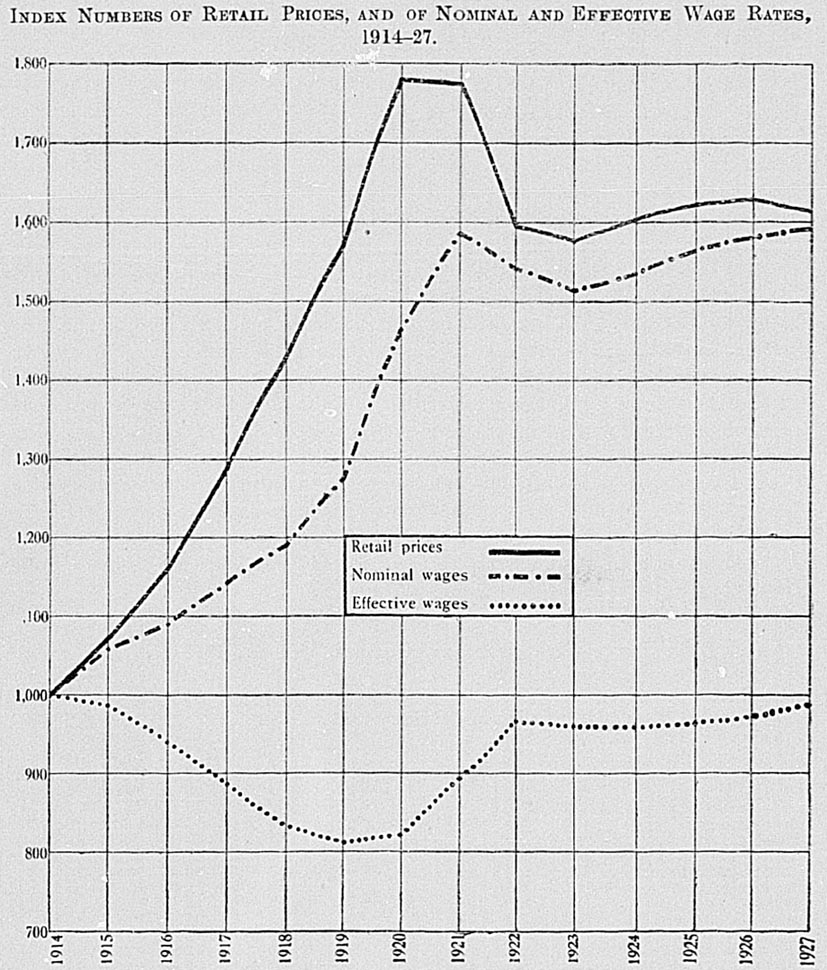
The index numbers in the preceding tables being all on a common base, comparisons between movements in the various groups cannot be readily made; an increase of (say) 10 per cent. in the group “clothing and boots,” in which the index numbers are consistently low, being considerably smaller numerically than an increase of the same percentage in (say) the printing trade, where the index numbers are considerably higher. The following tables bring out the movements in the various groups more clearly, the 1914 index number for each group being taken as base in each case. Care must be exercised in drawing inferences from these tables, for, while horizontal comparisons are quite valid, the vertical comparison between the various groups is valid only in so far as it shows in which groups the greater or the smaller increases have been observed since the base period (1914 in this case). For example, although nominal wages in the textile and weaving group show in 1927 an increase of 60 per cent. since 1914, while those in the group “mining” have increased by only 59 per cent., nevertheless wages were higher in the latter group in 1927 since they were considerably higher in 1914—the base year.
| NOMINAL-WAGE INDEX NUMBERS, EACH INDUSTRIAL GROUP AND “ALL GROUPS” COMBINED, 1914 and 1918-27. | |||||||||||
|---|---|---|---|---|---|---|---|---|---|---|---|
| (Bases: Dominion average wages for each industrial group respectively, 1914 = 1000.) | |||||||||||
| Industrial Group. | 1914. | 1918. | 1919. | 1920. | 1921. | 1922. | 1923. | 1921. | 1925. | 1926. | 1927. |
| Food, drink, and tobacco | 1,000 | 1,111 | 1,143 | 1,395 | 1,512 | 1,530 | 1,516 | 1,593 | 1,655 | 1,691 | 1,728 |
| Clothing, boots, &c. | 1,000 | 1,160 | 1,270 | 1,510 | 1,649 | 1,604 | 1,554 | 1,577 | 1,616 | 1,600 | 1,600 |
| Textiles and weaving | 1,000 | 1,126 | 1,260 | 1,347 | 1,508 | 1,533 | 1,598 | 1,600 | 1,603 | 1,609 | 1,604 |
| Building and construction | 1,000 | 1,098 | 1,206 | 1,427 | 1,528 | 1,485 | 1,434 | 1,455 | 1,460 | 1,457 | 1,454 |
| Wood-manufacture | 1,000 | 1,158 | 1,240 | 1,455 | 1,707 | 1,635 | 1,579 | 1,629 | 1,653 | 1,719 | 1,765 |
| Printing, &c. | 1,000 | 1,078 | 1,218 | 1,475 | 1,576 | 1,487 | 1,423 | 1,430 | 1,544 | 1,569 | 1,593 |
| Metal-working and engineering | 1,000 | 1,127 | 1,232 | 1,482 | 1,572 | 1,555 | 1,532 | 1,533 | 1,537 | 1,562 | 1,601 |
| Other manufactures | 1,000 | 1,132 | 1,216 | 1,465 | 1,674 | 1,603 | 1,558 | 1,566 | 1,592 | 1,600 | 1,625 |
| Mining | 1,000 | 1,140 | 1,165 | 1,294 | 1,549 | 1,542 | 1,532 | 1,571 | 1,560 | 1,589 | 1,589 |
| Agricultural and pastoral | 1,000 | 1,359 | 1,442 | 1,524 | 1,533 | 1,445 | 1,476 | 1,470 | 1,475 | 1,477 | 1,473 |
| Land transport | 1,000 | 1,151 | 1,274 | 1,528 | 1,616 | 1,565 | 1,528 | 1,582 | 1,613 | 1,648 | 1,661 |
| Shipping and cargo-working | 1,000 | 1,246 | 1,315 | 1,462 | 1,702 | 1,671 | 1,613 | 1,653 | 1,686 | 1,692 | 1,710 |
| Hotel, restaurant, and other personal service | 1,000 | 1,155 | 1,199 | 1,329 | 1,600 | 1,598 | 1,538 | 1,568 | 1,573 | 1,605 | 1,598 |
| Miscellaneous | 1,000 | 1,155 | 1,228 | 1,560 | 1,635 | 1,557 | 1,488 | 1,521 | 1,554 | 1,604 | 1,633 |
| All industrial groups combined | 1,000 | 1,191 | 1,275 | 1,463 | 1,587 | 1,541 | 1,514 | 1,539 | 1,565 | 1,583 | 1,594 |
NOTE.—Vertical comparisons are indicative merely of the relative percentage increases of wages in the different industrial groups since 1914, not of the actual relative levels of wages in the different industries.
| EFFECTIVE-WAGE INDEX NUMBERS IN EACH GROUP AND “ALL GROUPS” COMBINED 1914 and 1918-27. | |||||||||||
|---|---|---|---|---|---|---|---|---|---|---|---|
| (Bases: Purchasing - powers of Dominion average wages for each industrial group respectively, 1914 = 1000.) | |||||||||||
| Industrial Group. | 1914. | 1918. | 1919. | 1920. | 1921. | 1922. | 1923. | 1924. | 1925. | 1926. | 1927. |
| Food, drink, and tobacco | 1,000 | 777 | 728 | 783 | 852 | 958 | 961 | 996 | 1,021 | 1,039 | 1,070 |
| Clothing, boots, &c. | 1,000 | 812 | 808 | 849 | 929 | 1,004 | 985 | 985 | 997 | 983 | 991 |
| Textiles and weaving | 1,000 | 788 | 802 | 756 | 850 | 960 | 1,013 | 1,000 | 989 | 988 | 993 |
| Building and construction | 1,000 | 768 | 768 | 802 | 861 | 930 | 910 | 909 | 900 | 896 | 900 |
| Wood-manufacture | 1,000 | 811 | 790 | 818 | 961 | 1,024 | 1,002 | 1,018 | 1,019 | 1,058 | 1,093 |
| Printing, &c. | 1,000 | 755 | 776 | 829 | 888 | 933 | 903 | 894 | 952 | 964 | 986 |
| Metal-working and engineering | 1,000 | 789 | 785 | 833 | 885 | 974 | 971 | 958 | 947 | 960 | 991 |
| Other manufactures | 1,000 | 793 | 775 | 823 | 943 | 1,005 | 988 | 978 | 981 | 983 | 1,006 |
| Mining | 1,000 | 798 | 742 | 727 | 873 | 966 | 972 | 982 | 962 | 977 | 984 |
| Agricultural and pastoral | 1,000 | 951 | 919 | 857 | 864 | 906 | 935 | 919 | 910 | 908 | 912 |
| Land transport | 1,000 | 806 | 812 | 858 | 910 | 980 | 968 | 988 | 994 | 1,012 | 1,028 |
| Shipping and cargo-working | 1,000 | 872 | 838 | 821 | 959 | 1,047 | 1,023 | 1,034 | 1,039 | 1,040 | 1,059 |
| Hotel, restaurant and other personal service | 1,000 | 808 | 764 | 747 | 901 | 1,001 | 975 | 980 | 970 | 986 | 989 |
| Miscellaneous | 1,000 | 808 | 783 | 876 | 920 | 976 | 943 | 950 | 958 | 985 | 1,012 |
| All industrial groups combined | 1,000 | 833 | 812 | 822 | 894 | 966 | 960 | 959 | 965 | 973 | 987 |
NOTE.—Vertical comparisons are indicative merely of the relative percentage increases of wages in the different industrial groups since 1914, not of the actual relative levels of wages in the different Industries.
The movement in nominal wages is very even as between the different industrial groups, being distributed round about 60 per cent. above the 1914 level, with two or three notable exceptions. The group “wood-manufacture” shows the highest increase over 1914, this group, already first on the list, rising still further during the year; although, indeed, the groups “shipping and cargo-working” and “printing, &c.,” both have higher actual average rates of wage. The group “building and construction” shows the lowest increase, which fact is due to the comparatively high rates prevailing in this group in 1914, and not to exceptionally low rates at the present time.
The following table shows index numbers of hours worked in the various industrial groups for 1914 and for each year from 1918 to 1927. The material from which the index numbers have been compiled has been taken from the awards of the Arbitration Court in most cases; but, where hours are not prescribed in the awards, reference has been made to the Factories Act and the Shops and Offices Act. The agricultural and pastoral workers group has been omitted from the computations.
| INDEX NUMBERS OF AVERAGE HOURS WORKED, 1914 AND 1918-27. | |||||||||||
|---|---|---|---|---|---|---|---|---|---|---|---|
| (Base: Dominion weighted average hours worked in all industrial groups combined, 1909-13 = 1000.) | |||||||||||
| Industrial Group. | 1911. | 1918. | 1919. | 1920. | 1921. | 1922. | 1923. | 1924. | 1925. | 1926. | 1927. |
| Food, drink, and tobacco | 993 | 982 | 982 | 958 | 951 | 949 | 948 | 945 | 945 | 945 | 945 |
| Clothing, boots, &c. | 928 | 930 | 929 | 911 | 905 | 901 | 901 | 901 | 901 | 901 | 901 |
| Textiles and weaving | 976 | 976 | 976 | 957 | 937 | 934 | 934 | 934 | 934 | 934 | 934 |
| Building and construction | 910 | 903 | 901 | 902 | 903 | 900 | 900 | 901 | 901 | 901 | 901 |
| Wood-manufacture | 951 | 920 | 918 | 918 | 914 | 914 | 914 | 917 | 917 | 917 | 917 |
| Printing, &c. | 978 | 975 | 958 | 910 | 892 | 889 | 889 | 890 | 890 | 890 | 890 |
| Metal-working and engineering | 958 | 951 | 952 | 922 | 911 | 910 | 908 | 908 | 908 | 908 | 908 |
| Other manufactures | 973 | 958 | 966 | 971 | 919 | 947 | 946 | 945 | 945 | 945 | 945 |
| Mining | 958 | 950 | 934 | 929 | 898 | 908 | 908 | 920 | 920 | 920 | 918 |
| Land transport | 1,002 | 999 | 999 | 999 | 933 | 930 | 929 | 952 | 952 | 952 | 952 |
| Shipping and cargo-working | 1,054 | 1,102 | 1,150 | 1,110 | 1,098 | 1,098 | 1,098 | 1,098 | 1,098 | 1,043 | 1,043 |
| Hotel, restaurant, and other personal service | 1,203 | 1,203 | 1,203 | 1,152 | 1,013 | 982 | 982 | 982 | 982 | 982 | 982 |
| Miscellaneous | 955 | 961 | 960 | 923 | 912 | 901 | 897 | 890 | 890 | 890 | 890 |
| All industrial groups combined | 995 | 993 | 999 | 979 | 975 | 943 | 942 | 946 | 946 | 941 | 941 |
NOTE.—The index numbers in the above table are comparable both horizontally and vertically.
The index numbers in the above table being all on a common base, comparisons between movements in the different groups cannot be readily made. The following table brings out the movements in the various groups more clearly, the 1909-13 hours worked in the case of each group being taken as the base in each case for that group. Care must be exorcised in drawing inferences from this table; for while horizontal comparisons can be rigorously effected vertical comparisons are of value only for the purpose of indicating which groups have shown the greatest and which the smallest decreases since the base period.
| INDEX NUMBERS OF AVERAGE HOURS WORKED, 1914 AND EACH YEAR, 1918-27. | ||||||||||||
|---|---|---|---|---|---|---|---|---|---|---|---|---|
| (Base: Dominion weighted average hours worked in each industrial group respectively, 1909-13 = 1000.) | ||||||||||||
| Industrial Group. | 1909-13. | 1914. | 1918. | 1919. | 1920. | 1921. | 1922. | 1923. | 1924. | 1925. | 1926. | 1927. |
| Food, drink, and tobacco | 1,000 | 995 | 985 | 985 | 960 | 953 | 951 | 950 | 947 | 947 | 947 | 947 |
| Clothing, boots, &c. | 1,000 | 997 | 999 | 998 | 982 | 972 | 968 | 968 | 968 | 968 | 968 | 968 |
| Textiles and weaving | 1,000 | 1,000 | 1,000 | 1,000 | 981 | 960 | 957 | 957 | 957 | 957 | 957 | 957 |
| Building and construction | 1,000 | 993 | 986 | 984 | 985 | 986 | 983 | 983 | 984 | 984 | 984 | 984 |
| Wood-manufacture | 1,000 | 1,000 | 967 | 905 | 965 | 961 | 961 | 961 | 964 | 964 | 964 | 964 |
| Paper - manufacture, printing, &c. | 1,000 | 1,000 | 997 | 980 | 961 | 912 | 909 | 909 | 910 | 910 | 910 | 910 |
| Metal-working and engineering | 1,000 | 997 | 990 | 991 | 959 | 948 | 947 | 945 | 945 | 945 | 945 | 945 |
| Other manufactures | 1,000 | 999 | 984 | 992 | 997 | 974 | 972 | 971 | 970 | 970 | 970 | 970 |
| Mining | 1,000 | 1,000 | 992 | 975 | 970 | 937 | 948 | 948 | 960 | 960 | 960 | 958 |
| Land transport | 1,000 | 999 | 996 | 996 | 996 | 930 | 927 | 926 | 949 | 949 | 949 | 949 |
| Shipping and cargo working | 1,000 | 980 | 1,024 | 1,069 | 1,032 | 1,020 | 1,020 | 1,020 | 1,020 | 1,020 | 969 | 969 |
| Hotel, restaurant, and other personal service | 1,000 | 990 | 990 | 990 | 948 | 834 | 808 | 808 | 808 | 808 | 808 | 808 |
| Miscellaneous | 1,000 | 062 | 968 | 967 | 930 | 918 | 907 | 903 | 896 | 896 | 896 | 896 |
| All industrial groups combined | 1,000 | 995 | 993 | 999 | 979 | 975 | 943 | 942 | 946 | 946 | 941 | 941 |
NOTE.—Vertical comparisons are indicative merely of the relative percentage changes in hours worked In the different industries since the base period, not of the actual respective number of hours worked in the different industrial groups.
The outstanding feature of the table is the gradual and almost uninterrupted decline in the index number. The increase recorded between 1923 and 1924 is due almost exclusively to an increase in the hours of labour in certain branches of the Railway service.
The following tables show the index numbers for the various districts. In spite of the fact that certain industries are more or less confined to certain districts and that, consequently, fluctuations arise from this fact alone, the index numbers show remarkably little variation as between district and district.
| INDEX NUMBERS OF AVERAGE HOURS WORKED: FOUR PRINCIPAL INDUSTRIAL DISTRICTS, 1911-27. | |||||
|---|---|---|---|---|---|
| (Base: Dominion weighted average hours worked for all industrial groups combined, 1909-13 = 1000.) | |||||
| Year. | Northern Industrial District. | Wellington Industrial District. | Canterbury Industrial District. | Otago and Southland Industrial District. | Dominion Weighted Average. |
| 1914 | 1,004 | 1,004 | 973 | 987 | 995 |
| 1915 | 1,006 | 998 | 967 | 982 | 991 |
| 1916 | 1,003 | 1,015 | 962 | 983 | 994 |
| 1917 | 1,009 | 1,018 | 966 | 991 | 992 |
| 1918 | 989 | 990 | 950 | 977 | 993 |
| 1919 | 1,000 | 1,006 | 968 | 981 | 999 |
| 1920 | 1,005 | 1,005 | 964 | 987 | 979 |
| 1921 | 942 | 957 | 943 | 944 | 975 |
| 1922 | 937 | 958 | 930 | 947 | 943 |
| 1923 | 936 | 955 | 928 | 946 | 942 |
| 1924 | 940 | 958 | 933 | 951 | 946 |
| 1925 | 940 | 958 | 933 | 951 | 946 |
| 1926 | 934 | 951 | 931 | 946 | 941 |
| 1927 | 934 | 951 | 930 | 946 | 941 |
NOTE.—The index numbers in the above table are comparable both horizontally and vertically.
| INDEX NUMBERS OF AVERAGE HOURS WORKED, BY INDUSTRIAL GROUPS AND DISTRICTS. 1927. | |||||
|---|---|---|---|---|---|
| (Base: Dominion weighted average hours worked for all industrial groups combined, 1909-13 = 1000.) | |||||
| Industrial Group. | Northern Industrial District. | Wellington Industrial District. | Canterbury Industrial District. | Otago and Southland Industrial District. | Dominion Weighted Average. |
| Food, drink, and tobacco | 958 | 928 | 935 | 964 | 945 |
| Clothing, boots, &c. | 895 | 909 | 895 | 904 | 901 |
| Textiles and weaving | 938 | 936 | 926 | 926 | 934 |
| Building and construction | 895 | 912 | 895 | 895 | 901 |
| Wood-manufacture | 919 | 924 | 924 | 907 | 917 |
| Printing, &c. | 888 | 885 | 885 | 910 | 890 |
| Metal-working and engineering | 911 | 911 | 902 | 912 | 908 |
| Other manufactures | 936 | 924 | 952 | 951 | 945 |
| Mining | 905 | .. | 927 | 936 | 918 |
| Land transport | 952 | 952 | 952 | 952 | 952 |
| Shipping and cargo-working | 1,043 | 1,043 | 1,043 | 1,043 | 1,043 |
| Hotel, restaurant, and other personal service | 976 | 976 | 976 | 1,025 | 982 |
| Miscellaneous | 863 | 916 | 909 | 853 | 890 |
| All industrial groups combined | 934 | 951 | 930 | 946 | 941 |
NOTE.—The index numbers in the above table are comparable both horizontally and vertically.
The following table shows the hours worked as at 31st March in each case in certain important occupations selected from the list from which index numbers have been compiled. The figures given are unweighted averages of hours worked in the four principal industrial districts. Details as to individual districts are published in one of the annual statistical reports issued by the Census and Statistics Office.
| AVERAGE HOURS WORKED PER WEEK, 1914 AND 1924-28. | ||||||
|---|---|---|---|---|---|---|
| (NOTE.—The figures shown relate to the averages of the four principal industrial districts, as at 31st March in the years shown.) | ||||||
| Occupation. | 1914. | 1924. | 1925. | 1926. | 1927. | 1928. |
| Bakers | 48 | 44 1/2 | 46 | 46 | 46 | 46 |
| Butchers—Shopmen | 56 | 48 | 48 | 48 | 48 | 48 |
| Butter-factory employees | 48 | 48 1/2 | 48 1/2 | 48 1/2 | 48 1/2 | 48 1/2 |
| Flour-mill employees | 48 | 48 | 48 | 48 | 48 | 48 |
| Freezing-works employees | 48 | 44 | 44 | 44 | 44 | 44 |
| Aerated-water and cordial making employees | 46 1/2 | 46 | 46 | 46 | 46 | 46 |
| Brewery workers | 46 1/4 | 45 | 44 1/4 | 44 1/4 | 44 1/2 | 44 1/4 |
| Tailors | 48 | 44 | 44 | 44 | 44 | 44 |
| Tailoresses | 45 | 44 | 44 | 44 | 44 | 44 |
| Boot operatives, male and female | 45 | 44 | 45 | 45 | 45 | 45 |
| Woollen-mill employees— | ||||||
| Male | 48 | 45 | 45 | 45 | 45 | 45 |
| Female | 48 | 45 | 45 | 45 | 45 | 45 |
| Bricklayers | 45 | 44 | 44 | 44 | 44 | 44 |
| Carpenters | 44 3/4 | 44 | 44 | 44 | 44 | 44 |
| Joiners | 44 3/4 | 44 | 44 | 44 | 44 | 44 |
| Plasterers | 44 | 44 | 44 | 44 | 44 | 44 |
| Plumbers | 44 | 44 | 44 | 44 | 44 | 44 |
| Sawmill hands | 46 1/2 | 46 3/4 | 461/4 | 46 1/4 | 46 1/4 | 46 1/4 |
| Boatbuilders and shipwrights | 47 | 44 | 44 | 44 | 44 | 44 |
| Blacksmiths | 46 1/4 | 45 | 45 | 45 | 45 | 45 |
| Boilermakers | 47 3/4 | 44 | 44 | 44 | 44 | 44 |
| Tinsmiths | 47 | 44 3/4 | 44 3/4 | 44 3/4 | 44 3/4 | 44 3/4 |
| Skin and leather workers | 48 | 48 | 48 | 48 | 48 | 48 |
| Mineral and stone workers | 47 | 47 3/4 | 47 3/4 | 47 3/4 | 47 3/4 | 47 3/4 |
| Miners (coal)— | ||||||
| Surface | 43 1/4 | 45 | 44 | 44 | 44 | 44 |
| Underground | 43 1/4 | 43 3/4 | 43 3/4 | 43 3/4 | 43 3/4 | 43 3/4 |
| Miners (gold) | 47 1/2 | 45 1/4 | 45 1/4 | 45 1/4 | 45 1/4 | 44 |
| Quarrymen | 47 3/4 | 46 3/4 | 46 3/4 | 46 3/4 | 46 3/4 | 46 3/4 |
| Railway employees— | ||||||
| Engine-drivers and firemen | 48 | 44 | 44 | 44 | 44 | 44 |
| Guards | 48 | 44 | 48 | 48 | 48 | 48 |
| Tramway employees — Conductors and motormen | 48 | 48 | 48 | 48 | 48 | 48 |
| Shipping— | ||||||
| Stewards (at sea) | .. | 70 | 70 | 70 | 63 | 63 |
| Cooks (at sea) | .. | 70 | 70 | 70 | 63 | 63 |
| Seamen (at sea) | 56 | 51 | 51 | 51 | 51 | 51 |
| Waterside workers | 44 | 44 | 44 | 44 | 44 | 44 |
| Hotel workers— | ||||||
| Male | 65 | 48 | 48 | 48 | 48 | 48 |
| Female | 65 | 48 | 48 | 48 | 48 | 48 |
| Soft-goods assistants | 48 | 48 | 48 | 48 | 48 | 48 |
| Warehouse storemen | 45 3/4 | 44 | 44 | 44 | 44 | 44 |
| Grocers' assistants | 52 | 47 | 47 | 47 | 47 | 47 |
| Restaurant workers— | ||||||
| Male | 61 | 51 | 51 | 51 | 51 | 51 |
| Female | 52 1/4 | 48 | 48 | 48 | 48 | 48 |
Table of Contents
AT a very early stage in the economic history of New Zealand, legislative enactments designed for the protection of the wage-earner and the amelioration of social conditions generally were placed on the statute-book. It is not surprising that such Acts as the Trade-unions Act of 1878 and the Master and Apprentices Act of 1865 found places among the laws of this country so early in its history, since experience in the older countries in a more advanced state of economic development had proved the necessity for a certain amount of State regulation of the terms of the wage contract. But legislators of New Zealand were not content merely to follow in the wake of their more conservative brethren overseas; and we find the State, in its endeavour to improve social conditions generally, not only regulating industry by a rapidly growing code of labour laws but also venturing into the economic field itself when it considered such participation in the public interest. The establishment of a Government Life Insurance Department in 1869 and of a Public Trust Office in 1873, and in later years the establishment of a State Fire Insurance Office, are examples of this.
In addition to the Master and Apprentices Act and the Trade-unions Act, certain sections of other early Acts deal with labour conditions. Section 23 of the Offences against the Person Act of 1867 protected servants and apprentices from ill-treatment by their employers, while a considerable portion of the Shipping and Seamen Act of 1877 regulated conditions of life aboard ship, payment of wages, &c. The Inspection of Machinery Act of 1882 provided for the inspection of machinery in factories, &c., and required that persons in charge of boilers should be properly qualified. An Employers' Liability Act was passed in 1882, this Act legislating in the matter of industrial accidents with the object of mitigating the consequences to the worker without recourse to expensive litigation at common law.
Until recent times factory production was of very minor importance in New Zealand when compared with that of the agricultural and pastoral industries; nevertheless, even in the “eighties” and early “nineties” it was apparent that some of the evils experienced in the early stages of the development of factory production in the older countries already existed in New Zealand; and, during the lean years between 1885 and 1891 (during which period there was an excess of emigration over immigration of about 20,000), the grim spectre of unemployment hovered over the erstwhile prosperous colony. In 1889 it was alleged that “sweating” existed in New Zealand, especially in the clothing trades; and, although a Commission set up to inquire into the matter declared it could find no traces of this evil, a minority report did not fully agree with this view, and it was admitted that conditions were unsatisfactory in various respects.
An important measure affecting labour passed during this period of stress was the Electoral Act of 1889, which established the principle of “one man one vote.” This enactment prevented property owners with holdings in several electorates from voting in each electorate, the extension of the franchise to women in 1893 ensured that future Parliaments should be truly representative of the nation as a whole.
The maritime strike of 1890, which caused great distress throughout the country, proved to the trade-unions that they were not sufficiently strong to obtain their demands by direct action; and, at the same time, aroused public interest and caused the Legislature to consider measures designed to prevent the recurrence of such industrial strife in the future. It is not surprising, therefore, to find labour legislation occupying the attention of Parliament during the years immediately following. A brief résumé of the enactments affecting labour passed during the period 1890-98 is here given.
The Truck Act of 1891 ensured to the worker the payment of his wages in full in coin of the realm; the Wages Attachment Act of 1895 limited a creditor's right to obtain orders of Court attaching forthcoming earnings; the Factories Act of 1891 provided for the inspection of factories and the regulation of conditions of employment therein; and the Shop and Shop Assistants Act of 1892 provided similarly for the benefit of workers in shops. Trade-unionists, who were protected by an Act passed in 1878 from prosecution for conspiracy by reason merely that they were in restraint of trade, were still further protected by the Conspiracy Law Amendment Act of 1894, which deemed that any act by a union in furtherance of a trade dispute should not be deemed unlawful so as to render such persons liable to criminal prosecution for conspiracy, if such act committed by one person would not be deemed unlawful. This removed a very serious handicap under which unionists up to this time had suffered. The Servants Registry Act of 1895 provided for the inspection of servants registry-offices and regulated the fees charged therein. The Shipping and Seamen Act Amendment Act, 1894, contained, inter alia, clauses improving conditions aboard ship. The Coal-mines Act of 1891 contained, in addition to clauses aiming at the improvement of working-conditions, provision for a fund—to be established by a levy on all coal sold—for the relief of the families of miners killed or injured during the course of their employment. The inspection of accommodation provided for shearers was dealt with in the Shearers' Accommodation Act of 1898, which also gave the Inspectors authority to demand that, where necessary, improvements should be made. The scope of this Act was extended in 1907 to include agricultural labourers and flax and sawmill hands. Other important measures affecting workers passed during these years were the Old-age Pensions Act of 1898, which provided for the payment of a yearly pension to every person (with only a limited number of exceptions) over sixty-five years of age with twenty-five years residence in the country; and the State Advances to Settlers Act of 1894, which, by providing for the advancing of money to settlers on the land, gave the poorer classes an opportunity of acquiring rural holdings.
The most important of the labour laws passed during this period was the Industrial Conciliation and Arbitration Act of 1894, which was designed for the peaceful settlement of industrial disputes by conciliation and arbitration. This Act is dealt with in some detail farther on in this section.
Another interesting experiment brought into operation at this time was the construction of public works under the co-operative system, which was adopted by the Government in 1891. Works such as road and railway formation have been carried out by this system, the plant, explosives, &c., being supplied to the men by the State at cost price or at low hire. A modified form of the system then adopted is still followed in public works construction.
The enactments passed during the period 1890-98 form the nucleus of the labour code at present in force in this country, although in some cases administrative experience has found defects in the working of certain sections of these Acts and rendered subsequent amendments necessary; while the rapid economic development of the country and the growth of new ideas on the subject of labour legislation has led to many additions to the enactments passed during that period. In two important respects the legislation passed in the “nineties” has since been considerably altered. The Factories and Shop Assistants Acts of these years referred in the main to the protection of working women, girls, and boys, the Acts prior to 1901 taking no cognizance of the working-hours of men. Again, later Factories Acts prescribed minimum rates of wages for women and girls, a feature lacking in the earlier Acts. The passing of the Labour Department Act in 1903, giving statutory recognition and powers to the Department of Labour, which had been formed in 1891, was an important milestone in the progress of labour legislation in New Zealand. The duties of the Department are to administer the labour laws and to furnish information in all industrial matters, while power is given to collect statistics with the authority wherewith a commission of inquiry is invested. The annual reports of the Department contain a wealth of information concerning industrial matters in the Dominion.
The question of housing for workers in the larger centres of population has for a long time past presented a difficult problem. In 1905 a Workers' Dwelling Act was passed authorizing the Minister of Labour to erect dwellings to be let to bona fide workers at a rental of 5 per cent. per annum of the capital value of such dwellings, and in the following year a system of advances to workers for the purpose of acquiring homes was instituted. Later statutes dealing with the same subject were the Housing Acts of 1910 and 1919 and the State Advances Act of 1913, which, as amended in 1923, is the now existing law on the subject. Under the latter Act advances to workers receiving a salary of £300 per annum or under, with an allowance of £25 per annum for each dependant, are made for the purpose of erecting dwellings, while provision is made for repayment in instalments over a maximum period of thirty-six and a half years. Certain sections of the War Legislation Amendment Act of 1916 dealt with house rents; the maximum rent being fixed by statute at 8 per cent. per annum of the capital value of the dwelling, except in cases where the dwelling had been erected, improved, or structurally altered since the commencement of the Great War. Material alterations in the law from 1st August, 1927, were made by the Rent Restriction Act, 1926, which also enacted a repeal of the whole legislation on the subject as from 1st January, 1928. Postponements to 1st May, 1928, and 1st January, 1929, respectively were made by the Rent Restriction Continuance Act, 1927.
In order to encourage the principle of profit-sharing among workers the Companies Empowering Act was passed in 1924, which empowered any company registered under the Companies Act, 1908, to issue labour shares to its employees. Such shares, which are not transferable, have no nominal value, and do not form part of the ordinary capital of the company. Except as otherwise provided, these shares entitle the holders to the same privileges as the ordinary shareholders. The Arbitration Court is empowered to adjudicate as to whether in any particular case the scheme is of benefit to the workers, and if in its recommendation the issue of labour shares is revoked, the shares already issued are to he paid for in cash or capital shares. In the event of an employee leaving his employment or dying, the shares must be surrendered in cash or capital shares to him or to his heirs.
In 1910 an Act was passed establishing a National Provident Fund subsidized by the State; and in the following year the Widows' Pensions Act was placed on the statute-book. In 1926 a scheme of allowances to parents of three or more children was provided for by the Family Allowances Act. Details respecting these enactments will be found in Section XXV of this book.
With but few exceptions, the labour legislation on the New Zealand statute-book is designed for the protection of individual sections of workers; for example, the Factories Act applies to factory workers, the Shops and Offices Act to employees in shops and offices, the labour clauses of the Shipping and Seamen Act to seamen, and the Coal-mines Act to miners, &c. The Arbitration Act has a wider scope in that awards are made under it covering almost every type of industry carried on in the country. From another point of view, however, it is specific in application, in that only unions registered under the Act come under its provisions, and that each award applies to a particular body of workers in a particular trade and usually in a definite district or locality. Acts like the Workers' Compensation Act are more general in their application, but it is only such enactments as the Wages Protection and Contractors' Liens Act (which has replaced the old Wages Protection Acts), as well as other statutes on cognate subjects, which are quite general in application. Certain sections of the Bankruptcy Act, which give priority of payment for wages or salaries of workers (with certain limitations as to amount and period) in preference to certain other debts in the case of the bankruptcy of an employer, fall in the same category. Under the Bankruptcy Amendment Act, 1927, wages now take precedence over rents. Under the Companies' Act wages (with the same limitations as under the Bankruptcy Act) are a first claim on the assets of a company being wound up.
In no case do the provisions laid down by any particular labour law cancel the worker's rights at common law; but since, naturally enough, better conditions are laid down by statute than the worker is entitled to at common law, it is unusual to find in these days litigation under the common law affecting master and servant. It sometimes happens, however, notably in workers' compensation cases, that appeal is made at common law instead of under the Act, since there are no statutory limits to the damages which may be obtained at common law.
Since, with the exception of such of the labour statutes as are of general application, no labour legislation exists affecting certain classes of workers—e.g., domestic servants—their relations with their employers are still governed mainly by the common law affecting master and servant.
In the following pages the principal Acts in New Zealand affecting labour are dealt with in some detail.
The present law on the subject of workers' compensation is embodied in the Workers' Compensation Act, 1922, and its amendment of 1926. The principal provisions of tin's Act are as follows:—
“Worker,” for purposes of the Act, means any person who has entered into, or works under, a contract of service or apprenticeship with an employer, whether by way of manual labour, clerical work, or otherwise, and whether remunerated by wages, salary, or otherwise; but does not include any person employed otherwise than by way of manual labour whose remuneration exceeds £400 per annum. The Act applies only to the employment of a worker under a contract of service or apprenticeship either in and for the purposes of any trade or business carried on by the employer, or in any of the following occupations, most of them hazardous, irrespective of whether or not carried on for purposes of the employer's trade: mining; quarrying; excavation; cutting of standing timber and scrub; clearing land; erection or demolition of buildings and other structures; manufacture and use of explosives; handling power machinery in motion; driving vehicles; domestic service (engagement for not less than throe days); and any occupation in which a worker incurs a risk of falling any distances exceeding 12 ft., if the injury to or death of the worker results from such a fall. For purposes of this provision, an employer may have more than one trade or business. In general, persons working as independent contractors are not under contracts of service or apprenticeship, and are consequently not workers. But by way of exception persons who have contracted to perform any work in a gold- or a coal-mine, or to cut standing timber or scrub, or to clear land of stumps or logs, and who do not sublet the contract or employ labour (or who, if they do employ labour, actually perform part of the work themselves), though not “workers,” are yet covered by the Act.
The worker is not entitled to compensation unless he sustains by accident arising out of and in the course of his employment, and happening within New Zealand or on a New Zealand ship, personal injury incapacitating him from carrying on his occupation. No compensation is payable in respect of any accident as above defined which is attributable to the serious and wilful misconduct of the worker injured, unless the injury results in death or serious and permanent disablement. No compensation is payable in respect of the death of a worker following on, or incapacity resulting from or aggravated by, unreasonable refusal to submit to medical or surgical treatment. Except under certain safeguarding restrictions, “contracting out” is forbidden.
Certain defined diseases are deemed to be personal injuries by accident if they arose within twelve months previous to the date of disablement and are due to the nature of the employment. There is power under the Act for the list of such diseases to be added to from time to time by regulation, as circumstances warrant the adoption of such a course.
Generally speaking, the employer is the person liable to pay compensation; and for this purpose “employer” includes any body of persons, corporate or unincorporate, the Crown (with certain minor exceptions), and the representatives of a deceased employer. Where a person (the principal), in the course of and for the purposes of his trade or business, contracts with another (the contractor) for the execution by the latter of work undertaken by the former, a workman employed by the contractor on meeting with an accident may claim compensation from either the principal or the contractor, except in certain cases. If the principal pays, he may, however (with certain minor exceptions), recover the sum paid from the contractor. The principal is not liable, however, unless the accident occurs on or about his land, premises, or ship; or on or about land, premises, or ship, on or in which the principal has contracted to do the work in connection with which the accident happens. Where the injury for which compensation is payable has resulted under circumstances creating a legal liability in some person other than the employer to pay damages in respect thereof, the person by whom the compensation is paid or payable is entitled to indemnification by the person so liable.
The Workers' Compensation Amendment Act, 1926, amended the Act of 1922 in the direction of raising the limits of compensation. The compensation payable from 1st January, 1927, on which date the amendment came into force, is as follows:—
In case of death: Reasonable expenses of medical or surgical attendance, including first aid, and of funeral (maximum £50), less any sums paid by way of compensation for the accident prior to the death of the person injured; but plus—
Where he leaves total dependants, a sum equal to 208 times his average weekly earnings, or the sum of £300, whichever is the larger, but not exceeding £1,000; or
Where he leaves partial dependants only, a sum reasonable and proportionate to the injury to those dependants, but not exceeding the sums specified in (a).
In case of injury: At the discretion of the Court, either—
During total incapacity, weekly payments amounting to 66 2/3 per cent. of the worker's average weekly earnings at the time of the accident (maximum £4 per week; minimum in cases where ordinary rate of pay was not less than £1 10s. per week, £1); during partial incapacity, weekly payments amounting to 66 2/3 per cent. of the difference between the amount of the average weekly earnings before the accident and the average weekly amount which the worker is earning or able to earn in suitable employment or business after the accident, but not exceeding £4 per week; or
A lump sum equal to the present value at 5 per cent. per annum compound interest of the aggregate weekly payments which, in the opinion of the Court, would probably become payable to the worker under (a).
Weekly payments are not to extend over a longer aggregate period than six years, and the aggregate amount is not to exceed £1,000.
In addition to 2 (a) and 2 (b) above, a sum not exceeding £1 is payable in respect of medical and surgical attendance and first aid to the worker in respect of his injury. No compensation is payable if incapacity lasts less than three days. In the case of certain injuries involving permanent disability (e.g., dismemberment or loss of use), compensation is assessed according to a special scheme representing an aliquot part (varying according to the nature of the dismemberment) of the compensation payable in the case of total incapacity. In the case of injury to workers whose earnings at the date of the accident are low by reason of their being at the time under twenty-one, or of their being apprenticed to a trade, &c., and in certain other specified cases, special provisions exist in order to prevent hardships.
Proceedings under the Act in respect of compensation for injuries are not maintainable by a worker unless written notice of the accident has been given to the employer as soon as possible after its occurrence: though the Court has power to excuse failure, due to reasonable causes, to give that notice, on the part of the person injured, or if it is clear that the absence of such notice has not prejudiced the employer's position. Except where the Court excuses delay resulting from mistake or other reasonable cause, proceedings must be taken within six months of the date of the accident or the date of the last payment of compensation in respect of injury, or the date of the death of the person injured, whichever is the later. Such proceedings are taken in the Arbitration Court; though in certain cases they will be heard in the Magistrate's Court. The Court may accept, admit, and call for such evidence as in equity and in good conscience it thinks fit, irrespective of whether strictly legal evidence or not. Costs lie in the discretion of the Court. There is no right of appeal; but for good cause orders or agreements in respect of compensation may be reviewed and even set aside by the Court at any time.
The right of a dependant who survives a worker to receive compensation for the death of that worker survives the dependant: and compensation can be recovered by the representative of that dependant.
The Wages Protection and Contractors' Liens Act, 1908, is a consolidation of statutes previously known as the Truck Act, 1891; the Contractors and Workmen's Lien Act, 1892; the Workmen's Wages Act, 1893; the Threshing-machine Owners' Lien Act, 1895; the Wages Attachment Act, 1895; and the Wages Protection Act, 1899. The consolidated Act guards the interests of workers in several directions, principally in that it secures the regular payment of wages.
In cases of contracts between employers and contractors who employ wages-men, or between contractors and subcontractors who likewise employ wages-men, the Act permits the attachment of moneys in the hands of the employers for the payment of wages in arrear. The person for whom the contract is being performed is deemed to be the employer.
The attachment of a worker's wages for debt is prohibited, except in the case of any surplus exceeding £2 per week. (This, however, has been affected by section 20 of the Industrial Conciliation and Arbitration Amendment Act, 1908, under which, in the case of a penalty for a breach of that Act, the surplus above £1 per week earned by unmarried men may be attached by judgment in the Magistrate's Court.)
The Act prohibits payment for wages being made in goods (truck), or in any other way than in money or by approved cheque; and also prohibits any stipulation as to how the wages-money is to be expended. The truck provisions do not, however, apply where the employer supplies house accommodation, board and lodging, fuel, medical assistance, materials, tools, and the like required for the work, nor to seamen or farmworkers.
A contractor, subcontractor, and any worker is entitled to obtain hens on the lands or chattels of the employer upon giving duo notice, and the employer must then retain in his hands sufficient of the contract-moneys to satisfy and guarantee payment of the claimant's dues. This is subject to the limitations stated. For example, the worker's earnings are limited to thirty days' pay, and so long as the employer retains 25 per cent. of the contract-money for the purpose till the expiration of thirty-one days after the completion of the contract the employer is not liable for any further payment; but if any additional amount has not been paid by him to the contractor when a lien is lodged the employer shall retain enough of such amount to meet the lien. When any part of the contract-money has been duly withheld by the employer pursuant to the Act the contractor has no claim on the employer for that money, except so far as that amount is not required for the purposes of the Act. Liens are given priority in the order of workers, subcontractors, and contractors. There are exemptions made in favour of mortgages on the employer's land if registered prior to the lodging of the lien, unless the mortgagee is a party to the contract. In the case of the death of a lien-holder the right passes to his personal representative.
If the cost of threshing a crop is not paid to the workers employed in threshing it the cost of threshing can be made a charge on the proceeds of the realization of such crop.
No deduction from workers' wages may be made for purposes of insurance against compensation for accident.
Liens to be imposed as security for miners' wages or earnings are dealt with under the Mining Act, 1926, and the Coal-mines Act, 1925.
As mentioned earlier in this section, the original Industrial Conciliation and Arbitration Act was placed on the New Zealand statute-book in 1894. Its object was to encourage the formation of industrial unions and associations, and to facilitate the settlement of industrial disputes by conciliation and arbitration. It provided for the registration as “industrial unions” of societies of workers or employers in the various industrial districts, and, as “industrial associations,” of any council or other body representing any number of such unions; for the making of industrial agreements pursuant to the Act, and the filing of such in the Supreme Court; for the formation of industrial districts, the election of Boards of Conciliation, and the setting-up of a Court of Arbitration.
In 1898 an amendment was passed empowering the Court in its award to prescribe minimum rates of wages, with special provision for a lower rate being paid in the case of workers unable to earn the prescribed minimum. An important amendment was passed in 1903 prohibiting any employer, worker, union of workers, or union of employers from taking proceedings to defeat any of the provisions of an award during its currency. It forbade an employer to dismiss any employee merely because he happened to be entitled to the benefit of an award or merely because he was a member of a union.
In 1905 an amendment was passed providing for the punishment by fine of any employer or worker bound by an award or industrial agreement affecting an industry who takes part in a strike or lockout in that industry. In 1908 an additional penalty was added in the case of certain “public utility” industries, such as gas-manufacture, the supply of milk or meat, tramway services, &c. By this amendment the constitution of Conciliation Boards was altered to provide for the appointment of four Conciliation Commissioners, whose duty it is to call together representatives of employers and employees in the event of a dispute arising, and to sit with these representatives as a Conciliation Council to endeavour to effect a settlement. The decision of the Council is not binding, but disputes must be referred to a Council before they may be referred to the Arbitration Court.
A further amendment in 1911 empowered the Court to make an industrial agreement into an award, provided such agreement does not conflict with an existing award or is not contrary to the public interest. It also provided that recommendations of Conciliation Councils shall become in effect industrial agreements if none of the parties to a dispute disagrees with such recommendations.
The law as it existed in 1925 was consolidated in that year, previous consolidations having been effected in 1900, 1905, and 1908.
In 1927 a Bill was introduced into Parliament to exclude from the jurisdiction of the Arbitration Court the farming industry and certain associated industries. The Bill met with considerable opposition and was not proceeded with. An amending Act was, however, passed, providing that no award relating to any agricultural, pastoral, or dairying operations, or to any other work effected on a farm, or to the manufacture or production of butter, cheese, or other milk products should be made before 1st September, 1928. In the meantime it was arranged that a National Industrial Conference, representative of all interests concerned, should be held to go fully into this and other questions affecting labour and the relationships between employers and employees.
The conference duly met during the Parliamentary recess, and after full discussion came to unanimous agreement on a number of matters, others being left over for further consideration in the next recess. The provisions of the amendment of 1927 were accordingly re-enacted in 1928, another amendment postponing till 1st September, 1929, the date prior to which awards in the industries mentioned were not to be made, and also providing that no awards in these industries were to be altered or amended before that date without the consent of all parties concerned.
A second amendment passed in 1928 permits of industrial agreements and (with the consent of the parties concerned) awards being made for or extended to a term of five years. This amendment also allows of an award or industrial agreement, in lieu of prescribing minimum rates of wages, prescribing a method or basis for calculating minimum rates.
The administration of the Act is in the hands of the Labour Department, and Inspectors of Factories are charged with the duty of seeing that the provisions of awards and agreements are carried out. The following paragraphs indicate the procedure followed in regard to industrial disputes under the Industrial Conciliation and Arbitration Act:—
An industrial union (or association of unions) of workers registered under the Act may cite a union or association of unions of employers, or an employer, or a number of employers, before a Council of Conciliation for the hearing of an industrial dispute before a Commissioner and assessors appointed from either side.
An industrial union (or association of unions) of employers registered under the Act, or an individual employer, or employers, may cite a union of workers in a similar manner. The workers may compel any of their employers to come under the Act; but the employers cannot compel their workers to come under it, unless the latter have registered as an industrial union or association thereunder; registration is voluntary.
If an agreement is arrived at and is signed by the parties, it may be filed by any party as an “industrial agreement” and be enforced accordingly; or if the assessors only have signed an agreement—termed a “recommendation” in the Act (which is usually more convenient where the parties are scattered)—that recommendation may be forwarded to the Clerk of Awards, who gives notice of it to the parties. If within the following month no objection is received, the recommendation becomes binding in the same manner as an industrial agreement.
In the event of no agreement or of a partial agreement only being arrived at, the whole matter is referred to the Arbitration Court. After hearing argument upon the matters not agreed upon, the Court makes its award, which becomes binding upon the employers specified in the award, upon any employers commencing business in the district subsequently to the date of the award, and upon all persons working for such employers. In many cases even where a “recommendation” has been arrived at in the Conciliation Council, instead of following the procedure mentioned in the preceding paragraph the parties find it more convenient to have the recommendation made into an award, and, as the Court has no jurisdiction in the case of complete agreement, it has become the practice to disagree pro forma on one or more clauses. This enables the Court to make an award in accordance with the recommendation.
Until a few years ago it was the practice for unions of workers to cite the employers as parties to a dispute, and it was only in very rare cases that the employers took the initiative, but in recent years several cases have occurred where the employers have cited the workers' unions before Conciliation Councils—for example, freezing-workers, cooks and stewards, seamen, watersiders, coal-miners, dairy employees, and shearers.
In all cases where an industrial agreement or accepted recommendation or award is filed it becomes binding on all the parties, and a strike or lockout becomes unlawful. In a few cases the workers concerned have objected to the award, and have struck work rather than accept the conditions fixed.
It is interesting to trace the development of the powers conferred on the Court formed under this Act. The original purpose of the Act—the settlement of industrial disputes by the peaceful methods of conciliation and arbitration—has at no time been lost sight of; but, naturally enough, it has been found necessary from time to time to expand the scope of the awards in order to achieve this object, the 1898 amendment empowering the Court to prescribe minimum rates of wages added very considerably to the powers wielded by the Court; and, indeed, the scope of the awards has widened to include provisions regulating conditions of employment in minute detail. Since the working conditions laid down by the awards are better than those prescribed by the Factories Acts, &c., these Acts have in practice become a dead-letter as affecting workers under the jurisdiction of the Court. In most awards a preference clause is inserted, which gives unionists registered under the Act preference over non-unionists for employment with such employers as are registered as parties to any particular award.
Section 18 of the War Legislation and Statute Law Amendment Act, 1918, empowered the Court to amend during the term of an award or industrial agreement the provisions of the award or agreement, in so far as they related to rates of remuneration or hours of employment. In varying the conditions, the Court was to take into account the movement in the cost of living, and any changes in the special conditions affecting the industry concerned. This measure, which was designed to meet the abnormal conditions caused by the Great War, remained in force till 1923.
In addition to the powers mentioned above, the administration of the Apprentices Act of 1923 is placed in the hands of the Court.
The Labour Disputes Investigation Act, which was passed in 1913, applies to all disputes to which the Industrial Conciliation and Arbitration Act does not relate—viz., where there is no award or industrial agreement or accepted recommendation thereunder in force.
Under this Act, if a dispute concerning wages or other conditions of employment arises between a society or societies of workers, whether registered or not, that are not bound by any award or industrial agreement, and their employers, the society must, before it may strike, give to the Minister of Labour formal notice of the dispute, setting forth the names of the parties to the dispute and the claims made by the society. The Minister then refers the dispute to a Conciliation Commissioner to call a conference, or to a “Labour Disputes Committee” for investigation and recommendation. Such a committee consists of from one to three members chosen from each side, with an independent chairman. In the event of no settlement being arrived at a secret ballot is taken by the Registrar of Industrial Unions among the members of the society as to whether, in the case of no recommendation having been made, a strike should eventuate; or, in the case of a recommendation having been made, as to whether the recommendation should be adopted. Seven days' notice must be given to the employers should a strike be decided upon.
Similar provisions apply with reference to the filing of a dispute and to a lookout by the employers.
In the event of an agreement being arrived at it may be filed with the Clerk of Awards. It is then enforceable in the same manner as an industrial agreement under the Industrial Conciliation and Arbitration Act.
By this Act the principle of settlement of industrial disputes by conciliation and arbitration is extended to workers outside the scope of the Arbitration Court, so that definite restrictions on the right to strike or to lockout exist over the whole field of industry in New Zealand. The powers under this Act are not, of course, as far-reaching as those under the Arbitration Act, its main object being that workers or employers should take time for consideration of the points at issue and not precipitate themselves into industrial strife.
The original Factories Act, which was passed in 1891, provided for the registration as a factory of any office, building, or place in which three or more persons were engaged in working for hire or reward, in any handicraft, or in preparing or manufacturing articles for trade or sale, and for the inspection of such factories. Other provisions dealt with sanitation in factories, the protection of women and children as regards hours of employment, and the notification of accidents in factories to the Inspectors appointed under the Act. No boy under thirteen years of age, or girl under fourteen, was permitted to be employed in any factory. This Act was repealed in 1894, the Act of that year containing several new features, notably provision for the labelling of work sent out from the factory and manufactured in private houses; a forty-eight-hour week was prescribed for women and boys, who were further protected by a clause prohibiting their employment between the hours of 6 p.m. and 7.45 a.m. without the written consent of the Inspector, who was empowered to permit a limited amount of overtime. The definition of a factory was widened to include establishments where two people were employed. In one respect the Act of 1894 compared unfavourably with the previous enactment. Under the 1891 Act women and youths had worked an eight-hour day with a weekly half-holiday; but the 1894 Act, by merely prescribing a forty-eight-hour week, meant that they had by law, to take a half-holiday at their own expense. Under the 1901 Act this fault was rectified; and, in addition, cognizance was taken of the working-hours of men—the hours being fixed at forty-eight hours per week for men, with a maximum of eight and three-quarter hours per day, and forty-five per week for women and youths, with a maximum of eight and a quarter hours per day. Overtime was permitted with extra payment: but, in the case of women and girls, the number of hours per day and the number of days per year were limited. Boys and girls could not be employed without payment or at a lower wage than 5s. per week. There have been no major amendments since 1901, although the law has been consolidated in 1908 and in 1921-22. The statutory half-holiday for women and girls, which was fixed for Saturday, may be altered to the day fixed for the closing of shops and offices in the district, consequent on a poll of the electors thereof. Before a boy or girl under sixteen may be employed in a factory a certificate of fitness must be obtained, which may be granted by the Inspector, having regard to age, standard of education, and general fitness for employment.
The Shops and Offices Act, 1921-22, is a consolidation of former legislation which originated in 1892. The Act regulates the hours of assistants in shops, and provides for the fixing of the hours of closing of shops. The former are in most cases as follows: Except in certain exempted trades, and in small towns for which later hours are prescribed, work must cease at 6 p.m. on four nights of the week, at 9 p.m. on one night, and at 1 p.m. on the day of the weekly half-holiday, the hours must not in any case exceed forty-eight per week, or nine per day, with the exception of eleven on one day in the week. Limited overtime, to be paid for, may, however, be worked for stocktaking and other special occasions.
In regard to the closing of shops, a weekly half-holiday from 1 p.m. is compulsory, with a few exceptions—e.g., fishmongers and fruiterers. The closing-day is chosen in each district by the local authority, except where it is fixed by a poll of the electors taken on petition of a certain number. Even in the exempted trades a half-holiday must be given to each assistant on a day to be fixed by the occupier.
The closing-hours of shops in any district on the other days of the week have for many years been fixed pursuant to the Act by “requisition” of a majority of the shopkeepers if desired either in the whole of the local district or in any trade in the local district. The hours of closing have been thus determined in very many trades and districts.
In 1920 an amendment of the Act prescribed compulsory closing-hours at 6 p.m. on four days of the week and 9 p.m. on one day in the well-populated areas, except in certain exempted trades, thus incorporating by statute the closing-hours as already determined by “requisition” in many cases. The Court of Arbitration under the Industrial Conciliation and Arbitration Act is also now empowered, when making an award in any trade, to fix not only reduced hours of employment of assistants (which has been done in many trades), but also earlier closing-hours of all shops in that trade in the locality, whether or not assistants are employed therein, with authority to make exemptions in cases of hardship, and this provision has also been acted on.
Each trade in any district may also, by a majority vote, obtain an order of the Minister of Labour prohibiting the sale in such district, during the time the shops in such trade are required to be closed, of the goods the sale of which is comprised in such trade. This is inserted to meet those cases where the trades of various shopkeepers overlap one another, some of whom only are required to close at a certain hour. The provision enabling a majority of the shopkeepers in any trade to fix the closing-hours for that trade applies only to those who are principally engaged therein; if the latter are desirous that other shopkeepers carrying on the trade as a minor portion of their business should cease selling the same goods at the closing-hours fixed they may apply to the Minister in the manner above indicated for an order prohibiting such sales.
The Act fixes a minimum wage of 10s. per week, with an annual increase of not less than 5s. per week until £1 10s. per week is reached. As in the case of factories, higher rates of wages are, in the case of many shop-assistants, fixed by awards or industrial agreements under the Industrial Conciliation and Arbitration Act.
All assistants employed in hotels and restaurants are brought under special provisions as to holidays, hours (which must not exceed forty-eight per week nor ten per day), overtime, &c.
The Act also makes provision for the comfort, health, and safety of assistants—viz., in regard to ventilation, boating, sanitation, hygiene, and sitting-accommodation.
An amending Act passed in 1927 contains no departures from the principles adopted in the framing of the principal Act, its main object being the elimination of minor difficulties encountered in the administration thereof. The latest hour at which assistants can be employed is set down under the 1921-22 Act as 9.30 p.m. (except on Christmas Eve and New Year's Eve). This limit has been altered to 10.30 p.m. in the case of assistants in restaurants where the business is combined with that of a baker or confectioner. Alterations have also been made as regards the earliest commencing hour of work, this now being 3 a.m. (formerly 4 a.m.) in the case of milkmen, 4 a.m. for bakers and butchers, and 7 a.m. in all other cases, including assistants under sixteen in the three foregoing occupations.
Provision is made for the keeping of a time-table of hours of duty of fruiterers' assistants; and, under certain conditions, shops which sell smoking requisites in addition to carrying on other business may be compelled to close early in the evenings. Vendors of motor spirit or oil are not compelled to observe the limitations as to closing hours, provided that this is the sole business conducted on the premises.
The law relating to shipping and seamen as laid down by the Shipping and Seamen Act, 1908, and subsequent amendments, contains many provisions designed for the safety of passengers and crew and for the amelioration of working-conditions on board ship. A vast amount of regulation is contained in the Act dealing with matters which do not come under those heading's, so that this résumé of its contents by no means covers the whole ground covered by the Act.
Adequate provision is made to ensure competence on the part of the controlling officers of ships, the following clauses dealing with this important aspect: A master or owner may not engage a certificated officer for the purpose only of enabling the ship to clear, and not for the purpose of making the voyage. Home-trade steamships of 60 tons register and upwards, and home - trade sailing - ships of 100 tons register must carry certificated mates, and such ships of 100 tons register and upwards trading more than 300 miles between terminal ports must have second mates. A foreign-going ship is required to carry two certificated mates. Foreign - going certificated mates are entitled to ship as mates in the home-trade.
Provision is made for issuing certificates of competency to second mates of home-trade ships, and for recognizing as valid in the Dominion certificates of masters, mates, and engineers granted in any part of the British Dominions.
Any master or mate may, at any time, be required by the shipowner or the Minister of Marine to be examined in the sight tests by the Government Examiners.
Further clauses dealing with the safety of the ship require the adjustment of compasses to be carried out under regulations made by the Marine Department; and power is given to the Minister to define restricted limits for steamers and for vessels propelled by oil, gas, &c. The Governor-General in Council is empowered to make regulations as to the loading and stowage of ballast, and the loading of grain cargo in bulk. It is an offence to ship wool, flax, tow, or skins in such a condition as to be liable to spontaneous combustion.
As early as 1909 regulations were framed requiring ships registered in New Zealand and carrying passengers to be provided with wireless telegraphy apparatus. In 1922 the scope of this provision was substantially widened by the omission of the words “and carrying passengers,” and in 1924 authority was given to make regulations in this respect covering any class or classes of ships registered in New Zealand, or any class or classes of home-trade ships, whether registered in New Zealand or not. The regulations, which came into force from the 1st January, 1926, apply to all vessels registered in New Zealand and to all home-trade vessels not so registered which are of 1,600 tons gross registered tonnage or over, or which carry more than twelve passengers or more than twenty-five persons. Vessels being towed or plying solely on lakes, rivers, or harbours, or within river or extended-river limits are exempted, and power is given the Minister of Marine to exempt a vessel in cases where compliance is impracticable or the provision of an installation is unnecessary or unreasonable. The regulations define the nature of the installations and service and the number and grade of operators in different classes of vessels, and provide for inspection.
The provisions regarding working-conditions on vessels require, inter alia, that proper sanitary, hospital, and lavatory accommodation, including bathrooms, be provided for the crew, together with an adequate supply of hot water for those employed in connection with the engines, and a minimum of space to be provided in the seamen's quarters is laid down. Masters and officers who assault seamen on the high seas are liable to imprisonment or fine.
Intercolonial in addition to home-trade ships are made liable to pay the wages, maintenance, and medical expenses of seamen taken ill in the service of the ship for the remainder of the agreement, not exceeding three months, and, in the case of intercolonial ships, if the agreement expires within one month from the commencement of the illness, payment is to be made for one month after the expiry. The illness which entitles a man to the benefits provided for is one which requires medical treatment for fourteen days.
The clearances of foreign-going ships which are required to pay the coastal rate of wages are to be withheld until such wages are paid.
Desertion is defined, and deserters who cannot be dealt with before their ship sails can afterwards be prosecuted by the owner or agent, and copies of the agreement and the entries in the log-book are to be accepted by Courts as evidence. Forfeited wages are to be paid into the Public Account.
It is unlawful for any person other than the owner, master, mate, or engineer of a ship, or a Superintendent of Mercantile Marine, to engage or supply seamen for ships, and only such seamen as have a knowledge of the English language are to be allowed to ship.
Interelonial and home-trade agreements are to be transmitted to a Superintendent of Mercantile Marino within twenty-one days of their expiration.
The law as to inquiries into shipping casualties is on the lines of the Imperial Merchant Shipping Act, and provision is made for rehearings, for Superintendents of Mercantile Marine taking part in such inquiries, and for Magistrates ordering a change of venue. Inquiries are not to be held in Police Courts unless other suitable buildings are not available; and in cases where there has been loss of life but no injury to the ship the inquiries may be held by Coroners.
Owing to the special hazards to which workers in mines are subject, and the technical nature of the work of inspection, conditions of employment in mines are governed by certain sections of the Mining Acts. The Mining Act, 1926, which consolidates no loss than fifteen previous enactments on the subject, lays down, inter alia, in considerable detail, regulations governing working-conditions in all mines except coal-mines. Inspectors of Mines are appointed, with wide powers towards ensuring safety in mines. The Act requires that a person acting in the capacity of mine-manager of any mine where there are twelve men or more employed at any one time above ground, or six or more underground, should hold a certificate granted after examination by a Board of Examiners empowered under the Act to grant such certificates. Provision is made for proper ventilation in mines; special care is required to be taken in handling explosives; dangerous places must be properly timbered; special regulations are made as to hauling-machinery, &c., No female and no male person under the age of fourteen years may be employed in or about a mine, except in a clerical capacity. The employment of manual labour on Sundays without the previous written consent of an Inspector of Mines is prohibited. Overtime must be paid for any time worked in excess of eight hours a day, counting from the time the miner enters the underground workings until he leaves them. Time worked on Sundays and holidays must be paid for at time-and-a-half rates. All machinery used to supply motive power is subject to the provisions of the Inspection of Machinery Act, 1908, as far as these provisions apply. A sufficient supply of water must be supplied where it is necessary for the laying of dust in a mine. No youth may be employed in a mine for more than eight hours per day or forty-eight hours per week except in eases of emergency.
The Mining Amendment Act, 1927, provides, inter alia, that a mine where twenty men or over are employed on one shift must have two outlets.
Conditions of employment in coal-mines are dealt with in the Coal-mines Act. In general the provisions of this Act resemble those of the Mining Act, though, of course, to combat the special risks of coal-mining additional regulation is necessary. For every coal-mine there must be a duly qualified manager, who must be either the owner of the mine or some person appointed by the owner, and who is responsible for the control, management, and direction of the mine. Inspectors of Coalmines are appointed, who must hold certificates as first-class mine-managers under the Act. Certain sections of the Act deal with the prevention of coal-dust, the use of safety-lamps, the prohibition of work in places where the presence of gas is suspected, and the inspection of the mine before the commencement of work, &c. Suitable housing accommodation must be supplied for workers if required by notice of the Minister of Mines.
A levy of a halfpenny per ton on every ton of marketable coal raised from the mine is made under the terms of the Act; such moneys to form a relief fund for the relief of miners injured in the course of employment and of their dependants in the case of death. Information as to miners' pensions, provided for originally by the Miners' Phthisis Act of 1915, is contained in Section XXV of this book.
By an amending Act passed during the 1927 session, wages for a period not exceeding six months, payable by the owner of a coal-mine in respect of mining operations, constitute an equitable charge on plant and machinery, with priority over mortgages, &c. Proceedings for the enforcement of the charge must be commenced within twelve months.
The Scaffolding and Excavation Act, 1922, which superseded the original Act of 1906, makes provision for the protection of workers employed on any building-work, including the erection, alteration, or demolition of a building, and including scaffolding, cranes, gear, &c. The Act also applies to certain excavations made in connection with building-work. For the purpose of enforcement Inspectors of Scaffolding are appointed. Notice of the intention to commence building-work that will involve the risk of a fall of 12 ft. or more, or to make an excavation or set up a crane, must be given to the Inspector. The Inspector is empowered to order work to cease, to brand or destroy unsafe gear, and generally to see that the life and health of workers are safeguarded.
The Apprentices Act, 1923, largely supersedes the Master and Apprentice Act of 1865. The latter Act had become somewhat out of date, and most of the conditions of employment of apprentices had for many years been fixed in awards and industrial agreements under the Industrial Conciliation and Arbitration Act. In view of the feeling that the fixing of the conditions of employment of apprentices should not be the subject of an industrial dispute between employers and unions of workers, and that the shortage of apprentices and skilled worker's necessitated special attention, the Apprentices Act was passed in 1923, the employment of apprentices is accordingly now controlled by special orders of the Court of Arbitration, acting independently of its powers under the Industrial Conciliation and Arbitration Act, and by Apprenticeship Committees to be set up in the various industries and localities. The Court may delegate many of its powers to these committees, but aggrieved persons have the right of appeal to the Court, whose decision is final.
Power is given to compel employers to take and teach a minimum number of apprentices, in order to ensure as far as possible that the future requirements of the industries may be met. The Act of 1923 restricted employers to a maximum proportion of apprentices to journeymen, but this section of the Act was repealed in 1927.
Full power is given by the Apprentices Act to ensure that both the employers and the apprentices carry out their obligations. These powers include cancellation of apprenticeships, transfer, examination, and technical-school attendance of apprentices, also power to prohibit certain employers from taking apprentices. All contracts of apprenticeship and all voluntary transfers and cancellations of apprenticeships must now be registered, and it is the duty of the District Registrars to see before registering apprenticeships that the conditions are in accordance with the Act and orders thereunder, and are otherwise just to both parties. There is, however, a right of appeal from their decisions to the Court. The Registrar and District Registrars are also charged with the duty of seeing that the Act and decisions thereunder are generally complied with.
Provision is made to enable employers in intermittent trades, such as building, who perhaps cannot continuously employ apprentices, to take them jointly, in which case they are jointly liable; also to enable adults and others already possessing a knowledge of an industry to enter into apprenticeships under such conditions, other than those generally provided for apprentices, as the committee or Court may approve.
In order to encourage young persons to enter the skilled trades and avoid “blind-alley” occupations, the Act provides for collaboration with the head teachers in the various schools, who are required to watch the progress of the children under their care, and to report to the District Registrars of Apprentices as to the character, aptitude, and attainments of the various children leaving the schools. On receipt of such reports it is the duty of the District Registrars to give such advice as may be in their power to assist the children or their parents or guardians to decide on the most suitable employments. Juvenile employment bureaux also operate free of charge to all parties concerned.
With a view to assisting the Director of Education in shaping the courses of education so that the labour requirements of the various industries of the Dominion may, so far as possible, be met, the Act also provides that the Director shall be apprised from time to time of the number of persons employed in skilled industries, with information as to the prospects of future employment therein.
Table of Contents
IN New Zealand dual provision for the registration and protection of unions of employers and workers exists in the Trade-unions Act and the Industrial Conciliation and Arbitration Act. A brief résumé, of these enactments is given in the section of this Year-book dealing with labour laws.
While special provision is made for the publication of an annual statement showing the numerical strength of the various unions registered under the Industrial Conciliation and Arbitration Act, no such provision exists in regard to unions registered under the Trade-unions Act. Although returns regarding membership were required under the latter Act, such particulars, in deference to the desire of the unions not to have their affairs made public, were not published. Consequently it is impossible to obtain any data as to the numerical strength of the unions, only the numbers of unions registered being available. Although in 1900 37 unions registered under the Trade-unions Act were on the books, this number dropped to as low as 15 in 1908, and was at the 31st December, 1927, only 26. As no machinery exists for the regular purging of the rolls, a union remains on the books, in spite of its failure to furnish returns, until the Registrar has definite information that such union is defunct. Accordingly, even the data regarding numbers of unions under the Trade-unions Act are not altogether reliable.
It seems fairly evident that the Trade-unions Act has, by reason of the operation of the Industrial Conciliation and Arbitration Act, fallen largely into desuetude, especially inasmuch as many unions on the rolls under the earlier Act are also registered under the later Act.
Provision was made under section 7, subsection (17), of the Industrial Conciliation and Arbitration Act of 1900 (now section 17 of the Industrial Conciliation and Arbitration Act, 1925), for the furnishing of an annual return showing the number and membership of unions registered under the Act. It is from this return, published in successive issues of the Annual Report of the Department of Labour (parliamentary paper H.-11) that the tables in this section have been compiled. As the powers of the administrator of this Act are considerably wider than was the case in regard to the Trade-unions Act, while the penalties for infringement are at the same time more severe, the roll published in the report is complete.
The numbers and memberships of industrial unions of employers registered under the Industrial Conciliation and Arbitration Act as at the end of each of the last ten years are shown in the table on the following page.
| INDUSTRIAL UNIONS OF EMPLOYERS, 1918-27. | |||||||||
|---|---|---|---|---|---|---|---|---|---|
| As at 31st December. | Industrial District. | Totals. | |||||||
| Northern. | Wellington. | Canterbury. | Otago and Southland. | Taranaki. | Marlborough. | Nelson. | Westland. | ||
| Number of Unions. | |||||||||
| 1918 | 42 | 35 | 23 | 34 | 6 | 1 | 2 | 2 | 145 |
| 1919 | 39 | 30 | 25 | 34 | 6 | 1 | 2 | 2 | 139 |
| 1920 | 39 | 35 | 25 | 33 | 6 | 1 | 3 | 2 | 144 |
| 1921 | 40 | 35 | 25 | 30 | 5 | 1 | 3 | 2 | 141 |
| 1922 | 37 | 33 | 24 | 30 | 6 | 1 | 3 | 2 | 136 |
| 1923 | 35 | 33 | 27 | 28 | 6 | 1 | 3 | 3 | 136 |
| 1924 | 36 | 31 | 29 | 30 | 5 | 1 | 3 | 3 | 138 |
| 1925 | 37 | 31 | 28 | 31 | 8 | 2 | 4 | 4 | 145 |
| 1926 | 35 | 29 | 27 | 29 | 8 | 2 | 4 | 3 | 137 |
| 1927 | 34 | 30 | 29 | 29 | 7 | 2 | 3 | 2 | 136 |
| Membership. | |||||||||
| 1918 | 1,230 | 866 | 2,157 | 883 | 123 | 49 | 15 | 23 | 5,346 |
| 1919 | 1,204 | 762 | 2,028 | 939 | 111 | 57 | 21 | 24 | 5,146 |
| 1920 | 1,439 | 1,082 | 1,638 | 999 | 114 | 55 | 33 | 23 | 5,383 |
| 1921 | 1,488 | 1,032 | 1,669 | 923 | 106 | 56 | 34 | 28 | 5,336 |
| 1922 | 1,301 | 966 | 1,651 | 940 | 131 | 57 | 32 | 56 | 5,134 |
| 1923 | 1,490 | 1,098 | 1,708 | 859 | 129 | 73 | 37 | 89 | 5,483 |
| 1924 | 1,346 | 1,032 | 1,641 | 900 | 106 | 75 | 36 | 69 | 5,205 |
| 1925 | 1,356 | 1,071 | 1,596 | 899 | 175 | 73 | 40 | 68 | 5,278 |
| 1926 | 1,437 | 1,164 | 1,530 | 859 | 173 | 77 | 48 | 57 | 5,345 |
| 1927 | 1,225 | 1,058 | 1,589 | 925 | 164 | 78 | 25 | 8 | 5,072 |
The number of unions of employers and their membership rose gradually to a maximum of 149 unions, with 5,819 members, in 1914, the year following that of the prolonged waterside workers' strike. Since that year many slight ups and downs have been recorded, the membership as at 31st December, 1927 (5,072) being somewhat lower than that for the previous year, and, indeed, the lowest during the last ten years, although the variation has been very slight during the whole of this period.
The figures for the individual districts contain some points of interest. Of the four chief districts, the Northern has the greatest number of unions of employers, followed by Wellington, Canterbury, and Otago and Southland. In both the latter districts 29 unions of employers are registered. Canterbury, however, in spite of being lower than both Auckland and Wellington in respect of numbers of unions, has the highest membership, followed by Auckland, Wellington, and Otago and Southland. Prior to 1920 Wellington had consistently the lowest membership among the four principal districts.
Details for years prior to 1918 will be found in the 1927 issue of the Year-book.
Industrial unions of workers and their membership are shown in the following table as at the end of each of the last ten years. It should be explained that the “Total” column includes the Amalgamated Society of Railway Servants, and from 1922 onwards the Engine-drivers, Firemen's, and Cleaners' Association, the figures for both of which organizations are not included in the district totals.
It should also be emphasized that the statistics cover only unions registered under the Industrial Conciliation and Arbitration Act, and that all unions are not so registered.
| INDUSTRIAL UNIONS OF WORKERS, 1918-27. | |||||||||
|---|---|---|---|---|---|---|---|---|---|
| As at 31st December. | Industrial District. | Totals.* | |||||||
| Northern. | Wellington. | Canterbury. | Otago and Southland. | Taranaki. | Marlborough. | Nelson. | West-land. | ||
| * Including unions of railway employees—not included in figures for any district. | |||||||||
| Number of Unions. | |||||||||
| 1918 | 96 | 84 | 59 | 85 | 13 | 5 | 8 | 19 | 370 |
| 1919 | 98 | 83 | 64 | 88 | 16 | 5 | 10 | 17 | 382 |
| 1920 | 101 | 87 | 66 | 96 | 17 | 6 | 13 | 19 | 406 |
| 1921 | 103 | 87 | 67 | 98 | 20 | 6 | 15 | 21 | 418 |
| 1922 | 103 | 85 | 67 | 99 | 19 | 7 | 13 | 20 | 415 |
| 1923 | 105 | 83 | 66 | 101 | 18 | 7 | 13 | 20 | 415 |
| 1924 | 103 | 81 | 64 | 100 | 16 | 8 | 14 | 14 | 402 |
| 1925 | 104 | 80 | 64 | 98 | 16 | 8 | 13 | 12 | 397 |
| 1926 | 98 | 82 | 64 | 100 | 14 | 8 | 13 | 14 | 395 |
| 1927 | 100 | 80 | 65 | 100 | 18 | 7 | 14 | 15 | 401 |
| Membership. | |||||||||
| 1918 | 20,239 | 19,102 | 9,449 | 10,635 | 605 | 214 | 288 | 3,086 | 71,447 |
| 1919 | 22,932 | 21,437 | 12,425 | 13,363 | 809 | 214 | 428 | 3,011 | 82,553 |
| 1920 | 25,728 | 25,435 | 15,010 | 15,950 | 1,087 | 316 | 611 | 3,587 | 96,350 |
| 1921 | 26,914 | 24,747 | 15,368 | 14,815 | 1,315 | 348 | 663 | 4,054 | 97,719 |
| 1922 | 26,545 | 22,320 | 15,761 | 14,631 | 1,350 | 378 | 602 | 3,803 | 96,838 |
| 1923 | 25,816 | 21,854 | 15,249 | 13,937 | 1,089 | 344 | 560 | 3,996 | 94,438 |
| 1924 | 27,656 | 22,540 | 15,402 | 14,430 | 1,035 | 363 | 611 | 2,821 | 96,822 |
| 1925 | 28,004 | 24,495 | 16,182 | 15,319 | 1,463 | 454 | 581 | 2,840 | 100,540 |
| 1926 | 27,286 | 23,958 | 16,721 | 14,974 | 1,488 | 533 | 571 | 2,956 | 99,567 |
| 1927 | 26,079 | 25,941 | 17,673 | 14,912 | 1,745 | 495 | 611 | 2,483 | 101,071 |
In drawing inferences from the preceding table allowance must be made for the fact that, as these figures represent the numbers on the rolls of the various unions, a certain amount of duplication takes place, it being quite possible for a worker to be a member of two or more unions at the one time, especially in the case of a casual occupation such as waterside working. It is quite impossible to form any idea as to what extent such duplication takes place; but it is very unlikely that it occurs to such an extent as to affect materially the total figures.
There has been a gradual increase in both numbers and membership of workers' unions during the last decennium, the membership rising from 72,873 in 1917 to 101,071 in 1927. Reference to the detailed table showing particulars for years back to 1900, published in the 1927 issue of the Year-book, reveals the fact that this growing tendency has been steady and practically uninterrupted. The membership rose year by year, without exception, from 17,989 in 1900 to 73,991 in 1914. Then the effect of the war on union membership becomes apparent, for the membership fell off during the war years, a phenomenal rise being recorded in 1919, the year immediately following the cessation of hostilities. The total for 1927 is the highest so far recorded.
Until the year 1916 the Wellington District held pride of place both in regard to the number of workers' unions registered and on the basis of membership; but since that year the number of unions has shown a falling tendency, while the number of members has not risen to the same extent as has been the case in the Northern District; with the result that since 1916 the latter district has displaced Wellington from its position, although the 1927 figures for the two districts are practically the same. In recent years the number of unions in the Otago and Southland District has been consistently higher than in Canterbury, though from 1921 onwards the membership has been lower. Westland shows a much higher membership than the other three minor districts, but is still a long away behind any of the four major districts.
In the following table industrial unions of workers are classified according to membership:—
| INDUSTRIAL UNIONS OF WORKERS.—CLASSIFICATION ACCORDING TO NUMBER OF MEMBERS, 1901 AND 1921-27. | ||||||||||
|---|---|---|---|---|---|---|---|---|---|---|
| Year. | Under 50. | 50 and under 100. | 100 and under 200. | 200 and under 300. | 300 and under 500. | 500 and under 1000. | 1,000 and under 2,000. | 2,000 and under 3,000. | 3,000 and over. | Totals. |
| Number of Unions. | ||||||||||
| 1901 | 99 | 43 | 30 | 19 | 5 | 4 | 1 | 1 | .. | 202 |
| 1921 | 139 | 100 | 70 | 36 | 28 | 28 | 11 | 3 | 3 | 418 |
| 1922 | 139 | 90 | 66 | 40 | 37 | 25 | 13 | 4 | 1 | 415 |
| 1923 | 144 | 81 | 75 | 34 | 41 | 25 | 11 | 3 | 1 | 415 |
| 1924 | 135 | 83 | 69 | 35 | 35 | 27 | 14 | 3 | 1 | 402 |
| 1925 | 125 | 86 | 66 | 34 | 37 | 29 | 16 | 3 | 1 | 397 |
| 1926 | 128 | 80 | 72 | 31 | 33 | 30 | 17 | 3 | 1 | 395 |
| 1927 | 127 | 84 | 74 | 27 | 39 | 25 | 20 | 4 | 1 | 401 |
| Membership. | ||||||||||
| 1901 | 2,759 | 3,018 | 4,032 | 4,815 | 2,073 | 2,520 | 1,651 | 2,900 | .. | 23,768 |
| 1921 | 4,147 | 7,075 | 9,708 | 9,182 | 11,066 | 18,527 | 14,580 | 7,433 | 16,001 | 97,719 |
| 1922 | 3,899 | 6,434 | 9,070 | 9,617 | 14,385 | 16,802 | 16,842 | 10,216 | 9,573 | 96,838 |
| 1923 | 3,738 | 5,582 | 10,467 | 8,162 | 16,365 | 17,990 | 15,440 | 6,916 | 9,778 | 94,438 |
| 1924 | 3,744 | 5,649 | 9,951 | 8,240 | 13,428 | 17,489 | 20,832 | 7,482 | 10,007 | 96,822 |
| 1925 | 3,478 | 6,048 | 9,352 | 8,195 | 14,522 | 19,569 | 22,462 | 7,697 | 9,217 | 100,540 |
| 1926 | 3,587 | 5,689 | 10,064 | 7,516 | 13,100 | 20,435 | 22,860 | 7,321 | 9,005 | 99,567 |
| 1927 | 3,607 | 5,951 | 10,213 | 6,280 | 15,094 | 16,723 | 24,896 | 9,190 | 9,117 | 101,071 |
| Percentage of Total Membership. | ||||||||||
| 1901 | 11.61 | 12.70 | 16.96 | 20.26 | 8.72 | 10.60 | 6.95 | 12.20 | .. | 100.00 |
| 1921 | 4.24 | 7.24 | 9.94 | 9.40 | 11.32 | 18.96 | 14.92 | 7.61 | 16.37 | 100.00 |
| 1922 | 4.03 | 6.64 | 9.37 | 9.93 | 14.85 | 17.35 | 17.39 | 10.55 | 9.89 | 100.00 |
| 1923 | 3.96 | 5.92 | 11.08 | 8.64 | 17.33 | 19.05 | 16.35 | 7.32 | 10.35 | 100.00 |
| 1924 | 3.87 | 5.83 | 10.28 | 8.50 | 13.87 | 18.06 | 21.52 | 7.73 | 10.34 | 100.00 |
| 1925 | 3.46 | 6.02 | 9.30 | 8.15 | 14.44 | 19.46 | 22.34 | 7.66 | 9.17 | 100.00 |
| 1926 | 3.60 | 5.71 | 10.11 | 7.55 | 13.17 | 20.52 | 22.95 | 7.35 | 9.04 | 100.00 |
| 1927 | 3.57 | 5.89 | 10.11 | 6.21 | 14.93 | 16.55 | 24.63 | 9.09 | 9.02 | 100.00 |
The steady growth in the average size of industrial unions of workers is brought out in the above table. It is noteworthy that while the actual number of unions has increased from 202 in 1901 to 401 in 1927, an increase of 99 per cent., the membership has increased from 23,768 to 101,071, an increase of 325 per cent. The increase in membership in anions containing 300 members and over is particularly marked.
In the next table industrial unions of employers are classified as to both numbers and membership according to their distribution in industries and in districts.
| INDUSTRIAL UNIONS OF EMPLOYERS AS AT 31ST DECEMBER, 1927. | |||||||||
|---|---|---|---|---|---|---|---|---|---|
| Industrial Group. | Industrial District. | ||||||||
| Northern. | Wellington. | Canterbury. | Otago and Southland. | Taranaki. | Marlborough. | Nelson. | Westland. | Totals. | |
| Number of Unions. | |||||||||
| Food, drink, &c. | 7 | 1 | 5 | 5 | 1 | .. | .. | .. | 19 |
| Clothing, boots, &c. | 4 | 3 | 3 | 1 | 1 | .. | 1 | .. | 13 |
| Textiles and weaving | .. | .. | .. | .. | .. | .. | .. | .. | .. |
| Building and construction | 5 | 9 | 6 | 6 | 1 | .. | .. | .. | 27 |
| Wood-manufacture | 3 | 4 | 3 | 1 | .. | .. | .. | .. | 11 |
| Paper - manufacture and printing | 3 | 2 | 4 | 2 | 1 | .. | 1 | .. | 13 |
| Metal-works and engineering | 4 | 2 | 2 | 3 | .. | .. | .. | .. | 11 |
| Other manufactures | .. | .. | 1 | 1 | .. | .. | .. | .. | 2 |
| Mining, &c. | 1 | .. | .. | 2 | .. | .. | .. | 1 | 4 |
| Agricultural and pastoral | 2 | 2 | 1 | 2 | 1 | 1 | .. | .. | 9 |
| Land transport | 1 | 1 | 1 | 1 | .. | .. | .. | .. | 4 |
| Shipping and cargo-working | 3 | 2 | 2 | 2 | 1 | 1 | 1 | 1 | 13 |
| Hotels, restaurants, &c. | 1 | .. | 1 | .. | .. | .. | .. | .. | 2 |
| Miscellaneous | .. | 4 | .. | 3 | 1 | .. | .. | .. | 8 |
| Totals | 34 | 30 | 29 | 29 | 7 | 2 | 3 | 2 | 136 |
| Membership. | |||||||||
| Food, drink, &c. | 403 | 28 | 273 | 109 | 12 | .. | .. | .. | 825 |
| Clothing, boots, &c. | 152 | 62 | 39 | 8 | 19 | .. | 9 | .. | 289 |
| Textiles and weaving | .. | .. | .. | .. | .. | .. | .. | .. | .. |
| Building and construction | 264 | 406 | 324 | 280 | 15 | .. | .. | .. | 1,289 |
| Wood-manufacture | 78 | 53 | 41 | 6 | .. | .. | .. | .. | 178 |
| Paper - manufacture and printing | 73 | 37 | 31 | 40 | 11 | .. | 10 | .. | 202 |
| Metal-works and engineering | 60 | 25 | 41 | 39 | .. | .. | .. | .. | 165 |
| Other manufactures | .. | .. | 11 | 5 | .. | .. | .. | .. | 16 |
| Mining, &c. | 1 | .. | .. | 6 | .. | .. | .. | 1 | 8 |
| Agricultural and pastoral | 143 | 292 | 738 | 226 | 62 | 70 | .. | .. | 1,531 |
| Land transport | 24 | 80 | 18 | 44 | .. | .. | .. | .. | 166 |
| Shipping and cargo-working | 13 | 24 | 25 | 14 | 7 | 8 | 6 | 7 | 104 |
| Hotels, restaurants, &c. | 14 | .. | 48 | .. | .. | .. | .. | .. | 62 |
| Miscellaneous | .. | 51 | .. | 148 | 38 | .. | .. | .. | 237 |
| Totals | 1,225 | 1,058 | 1,589 | 925 | 164 | 78 | 25 | 8 | 5,072 |
The most noteworthy feature of this table is the extremely high membership of unions of agricultural and pastoral employers. As will be seen from the tables immediately following, this is in marked contrast to the position respecting unions of workers, a position due no doubt to the fact that a large number of small farmers belong to the employers' unions. The workers, on the other hand, are almost entirely seasonal workers, especially in the case of the majority of those unionized—viz., the shearers and the threshing-mill employees. In these cases the workers travel round and work for several employers in the one season.
It is worthy of note that the Canterbury District, while lower than both Auckland and Wellington in respect of number of unions of employers, has actually the highest number of members. This is due to the facts mentioned in the preceding paragraph, 738 out of a total of 1,589 members belonging to the “Agricultural and pastoral” group. The number of members of unions of employers in the building trade is particularly high in all the major districts, the highest membership (406) being recorded in the Wellington District.
Important features of the 1927 statistics are the considerable rise in the “Building and construction” group (876 to 1289), and marked decreases in the groups “Food, drink, &c.” and “Agricultural and pastoral”; the membership of the former dropping by 388, and that of the latter by 158. A decrease of 273 has been recorded in the total for all groups combined.
Similar information to that given on the preceding page for industrial unions of employers is now given for workers' unions.
| INDUSTRIAL UNIONS OF WORKERS AS AT 31ST DECEMBER, 1927. | |||||||||
|---|---|---|---|---|---|---|---|---|---|
| Industrial Group. | Industrial District. | ||||||||
| Northern. | Wellington. | Canterbury. | Otago and Southland. | Taranaki. | Marlborough. | Nelson. | Westland. | Totals. | |
| * Including 2 unions of railway employees, with a total membership of 11,132. | |||||||||
| Numbers of Unions. | |||||||||
| Food, drink, &c. | 12 | 9 | 9 | 12 | 4 | 1 | 1 | .. | 48 |
| Clothing, boots, &c. | 5 | 3 | 4 | 7 | 1 | .. | .. | .. | 20 |
| Textiles and weaving | 2 | 2 | 2 | 3 | .. | .. | .. | 1 | 10 |
| Building and construction | 14 | 19 | 14 | 13 | 3 | .. | 3 | 2 | 68 |
| Wood-manufacture | 5 | 5 | 4 | 6 | 2 | .. | 1 | 1 | 24 |
| Paper - manufacture and printing | 5 | 4 | 2 | 6 | .. | .. | 1 | 1 | 19 |
| Metal-works and engineering | 8 | 5 | 4 | 8 | 1 | .. | 1 | 1 | 28 |
| Other manufactures | 8 | 6 | 6 | 7 | .. | .. | 1 | .. | 28 |
| Mining, &c. | 5 | .. | .. | 7 | .. | .. | 1 | 2 | 15 |
| Agricultural and pastoral | 1 | 1 | 3 | 4 | .. | 2 | .. | .. | 11 |
| Land transport | 2 | 6 | 3 | 6 | 2 | 1 | 1 | 1 | 24* |
| Shipping and cargo-working | 16 | 8 | 3 | 5 | 1 | 1 | 1 | 2 | 37 |
| Hotels, restaurants, &c. | 2 | 2 | 2 | 3 | 1 | 1 | 1 | 1 | 13 |
| Miscellaneous | 15 | 10 | 9 | 13 | 3 | 1 | 2 | 3 | 56 |
| Totals | 100 | 80 | 65 | 100 | 18 | 7 | 14 | 15 | 401* |
| Membership. | |||||||||
| Food, drink, &c. | 2,330 | 3,553 | 2,409 | 1,764 | 741 | 80 | 22 | .. | 10,899 |
| Clothing, boots, &c. | 2,059 | 781 | 1,615 | 1,300 | 7 | .. | .. | .. | 5,762 |
| Textiles and weaving | 138 | 663 | 343 | 722 | .. | .. | .. | 26 | 1,892 |
| Building and construction | 4,214 | 4,737 | 2,993 | 2,220 | 185 | .. | 124 | 54 | 14,527 |
| Wood-manufacture | 1,231 | 879 | 713 | 1,186 | 44 | .. | 16 | 1,098 | 5,167 |
| Paper - manufacture and printing | 806 | 920 | 537 | 636 | .. | .. | 7 | 14 | 2,920 |
| Metal-works and engineering | 2,385 | 1,511 | 1,384 | 1,118 | 89 | .. | 36 | 55 | 6,578 |
| Other manufactures | 699 | 299 | 312 | 301 | .. | .. | 70 | .. | 1,681 |
| Mining, &c. | 1,699 | .. | .. | 462 | .. | .. | 14 | 439 | 2,614 |
| Agricultural and pastoral | 536 | 1,175 | 2,602 | 916 | .. | 236 | .. | .. | 5,465 |
| Land transport | 507 | 1,735 | 1,280 | 979 | 121 | 30 | 82 | 25 | 15,891* |
| Shipping and cargo-working | 3,311 | 4,952 | 897 | 1,307 | 200 | 52 | 87 | 271 | 11,077 |
| Hotels, restaurants, &c. | 2,886 | 2,295 | 1,593 | 705 | 160 | 69 | 57 | 258 | 8,023 |
| Miscellaneous | 3,278 | 2,441 | 995 | 1,296 | 198 | 28 | 96 | 243 | 8,575 |
| Totals | 26,079 | 25,941 | 17,673 | 14,912 | 1,745 | 495 | 611 | 2,483 | 101,071* |
The highest numbers of unions registered in single groups are found in the groups “Building and construction” (68 unions) “Miscellaneous” (56 unions), and “Food, drink, &c.” (48 unions). The greatest number of workers on the rolls, however, is found in the group “Land transport” (15,891 members), followed by the group “Building and construction” (14,527 members). Unionism has not advanced to any great extent among workers in agricultural and pastoral pursuits, the fact that the workers are widely scattered no doubt being largely responsible. In fact, the shearers' unions are the only important unions in this class of employment. The group “Other manufactures” has the lowest actual number of unionists (1,681), but this is no doubt due to the fact that the industries covered by this group account for only a small proportion of wage-earners in New Zealand.
The group “Land transport” includes members of the Amalgamated Society of Railway Servants and of the Engine-drivers', Firemen's, and Cleaners' Association, totalling 11,132 workers, all of whom are registered under the Act. The total of 14,527 for the building trade must be regarded as very high for an industry with such widely scattered branches and activities. The unions under the head of “Shipping and cargo-working” have an aggregate membership of 11,077. As will be seen in a later table, this group has the highest percentage of registered unionists to total wage-earners.
The Northern Industrial District contains the greatest number of registered unionists (26,079), followed by Wellington (25,941). The Westland Industrial District has considerably more registered unionists than other minor districts, the cause being the relatively large number of registered unionists in the saw-milling industry in that district.
At 31st December, 1927, there were 13 industrial associations of employers and 36 of workers, the former having 79 affiliated unions and the latter 242. The following summary shows, for the years 1926 and 1927, the number of industrial associations of employers and workers in each industrial group, with the number of affiliated unions in each case.
| INDUSTRIAL DISTRIBUTION OF ASSOCIATIONS AND UNIONS, 31ST DECEMBER, 1926 AND 1927. | ||||||||
|---|---|---|---|---|---|---|---|---|
| Industrial Group. | Employers. | Workers. | ||||||
| Associations. | Affiliated Unions. | Associations. | Affiliated Unions. | |||||
| 1926. | 1927. | 1926. | 1927. | 1926. | 1927. | 1926. | 1927. | |
| Food, drink, &c. | 1 | 1 | 2 | 2 | 3 | 5 | 17 | 22 |
| Clothing, boots, &c. | 1 | 1 | 4 | 4 | 2 | 2 | 11 | 12 |
| Textiles and weaving | .. | .. | .. | .. | 1 | 1 | 6 | 5 |
| Building and construction | 2 | 3 | 17 | 26 | 5 | 6 | 52 | 60 |
| Wood-manufacture | 2 | 2 | 10 | 12 | 3 | 3 | 14 | 14 |
| Paper-manufacture and printing | 2 | 2 | 17 | 15 | 3 | 3 | 14 | 13 |
| Metal-works and engineering | 1 | 1 | 4 | 4 | 4 | 3 | 21 | 21 |
| Other manufactures | .. | .. | .. | .. | .. | .. | .. | .. |
| Agricultural and pastoral | 1 | 1 | 4 | 4 | 1 | 1 | 2 | 2 |
| Land transport | .. | .. | .. | .. | 2 | 2 | 18 | 16 |
| Shipping and cargo-working | 1 | 1 | 8 | 10 | 1 | 4 | 27 | 31 |
| Hotels, restaurants, &c. | .. | .. | .. | .. | 2 | 1 | 10 | 9 |
| Miscellaneous | .. | 1 | .. | 2 | 5 | 5 | 32 | 37 |
| Totals | 11 | 13 | 66 | 79 | 32 | 36 | 224 | 242 |
The building and construction group is seen to have the largest number of affiliated unions of both workers and employers. In the group covering paper-manufacturing and printing a peculiar position is disclosed, in that the number of affiliated unions of employers! is not only greater than the corresponding number of workers' unions, but also exceeds the total number of registered unions of employers. Presumably some unions are affiliated with both of the associations of employers in this industry.
The following table, showing the proportion of workers belonging to unions registered under the Industrial Conciliation and Arbitration Act to the total number of wage-earners in the country, is of interest as manifesting the movement in unionism during the period under review, with a rough idea of its extent. It must be remembered that the figures given for total wage-earners at the census include professional and business classes in which unionism does not exist, and agricultural and pastoral employees where it is practically non-existent. Moreover, females are included in both sets of figures, and the proportion of women unionized is always small.
| Year. | Total Wage-earners. | Year. | Number of Workers on Rolls of Registered Unions. | Percentage of Wage-earners on Rolls of Registered Unions. |
|---|---|---|---|---|
| 1901 (March) | 224,346 | 1900 (December) | 17,989 | 8 |
| 1906 (April) | 269,039 | 1905 (December) | 29,869 | 11 |
| 1911 (April) | 304,272 | 1910 (December) | 57,091 | 19 |
| 1916 (October) | 302,161 | 1916 (December) | 71,587 | 24 |
| 1921 (April) | 370,692 | 1920 (December) | 96,350 | 26 |
| 1926 (April) | 414,673 | 1925 (December) | 101,071 | 24 |
This table gives some idea of the increase in the proportion of wage-earners belonging to registered unions during the period under review; but perhaps a better idea can be gained from the following table, where index numbers are employed to-show the movement since 1901, the totals on the rolls being adjusted to make allowance for the increases in the number of wage-earners.
| Census Year. | Index. |
|---|---|
| 1901 | 100 |
| 1906 | 137 |
| 1911 | 234 |
| 1916 | 295 |
| 1921 | 324 |
| 1926 | 304 |
The following table shows the percentage of registered unionists to total wage-earners in several industrial groups. The idea given is only approximate, in that the groups do not exactly coincide in some cases; in fact, the group “Miscellaneous” was omitted altogether, in view of the heterogeneous nature of the constituent-industries in the group.
| Industrial Group. | Wage-earners (Census, April, 1926). | Number on Rolls of Registered Unions, 31st December, 1925. | Percentage of Wage-earners on Rolls of Registered Unions. | Corresponding Percentage 1921. |
|---|---|---|---|---|
| Food, drink, &c. | 19,054 | 11,696 | 61 | 65 |
| Clothing and drapery manufacture | 16,314 | 6,061 | 37 | 43 |
| Textiles and weaving | 4,844 | 1,896 | 39 | 47 |
| Building and construction | 22,822 | 14,739 | 65 | 54 |
| Sawmilling, forestry, &c. | 14,111 | 6,067 | 43 | 36 |
| Paper - manufacture and printing | 7,319 | 2,726 | 37 | 36 |
| Metal-working and engineering | 16,017 | 5,863 | 37 | 47 |
| Other manufactures | 12,366 | 1,948 | 16 | 19 |
| Mining and quarrying | 8,106 | 3,215 | 40 | 54 |
| Agricultural and pastoral | 52,010 | 2,903 | 6 | 3 |
| Hotels, restaurants, &c. | 43,059 | 7,859 | 18 | 24 |
| Land transport | 28,499 | 16,103 | 57 | 54 |
| Shipping and cargo-working | 16,146 | 10,821 | 67 | 85 |
The highest proportions of unionists are shown by the group “Shipping and cargo-working” “Building and construction,” and “Food, drink, &c.,” with 67,65, and 61 per cent. respectively in 1926. Agricultural and pastoral workers, who covered the huge total, comparatively speaking, of 52,010 workers, had only 2,903, or 6 per cent., of their number on the union rolls.
Comparison of the percentage of unionists to total wage-earners in the various groups in 1921 and 1926 brings out some interesting features. The proportion of unionists in the group “Shipping and cargo-working” has fallen from 85 per cent. to 67 per cent. It still, however, retains its position as the highest group. “Mining and quarrying” also shows a considerable drop, the cancellation of registration of some unions of West Coast miners being responsible for this decrease. “Building and construction” shows a large increase. It is noteworthy that the “Textiles and weaving” group, which has no unions of employers, has decreased considerably in respect of membership of unions of workers.
Table of Contents
EXCEPT for occasional returns relating to State unemployment relief which have been laid on the table of the House from time to time, practically no direct statistical evidence as to the extent of unemployment in New Zealand prior to 1892 is available, but the figures for external migration provide statistics bearing indirectly on the matter; while further evidence on the employment situation is available from sundry non-statistical sources of history.
In general, as was natural in a newly settled country, labour was more or less chronically in short supply during the early years of settlement. Unemployment, however, is, on the other hand, well known to have been acute in the middle and late “sixties,” owing to the paralysing effect of the Maori wars in the North and to the collapse of the alluvial gold booms in Otago and Westland. At no time, however, during the depression of the late “sixties” does there appear to have been any unemployment amongst females; the dearth of domestic assistance having been a matter of comment in the House at the depths of the 1868 depression. With the inauguration at the beginning of the “seventies” of the Vogel policy of public works and assisted immigration, employment was available for large numbers of new arrivals; but, mainly owing to the highly seasonal nature of the demand for labour in connection with the grain crops (at that date relatively more important in New Zealand than now), it was soon found necessary so to arrange passages that few immigrants arrived in the colony during the winter months, and so to draft the programmes of public-works construction that additional labourers were taken on at that season. At the beginning of the “eighties” scarcity of funds for the prosecution of public works necessitated, along with other considerations, the checking for a space of the stream of assisted immigrants. By 1883 the position had materially improved; but unemployment once more became serious in the late “eighties” and early “nineties,” mainly owing to the fall in the prices that New Zealand's products (notably wool) were fetching in the world's markets, and to a further slackening of the rate of prosecution of public works. During both these periods the unemployment position was so acute as to be responsible for a considerable exodus of male population to Australia and elsewhere.
Statistics of State relief afforded to unemployed workpeople at different dates lack comparability owing to changes in the conditions under which relief has been granted. While the statistics may show for any given date the actual number of unemployed who have been in receipt of relief, they do not show (nor can they reasonably be expected to show) the percentage which that number represents of the working population covered. They certainly measure the effort made by the authorities to relieve unemployment where no adequate system of unemployment insurance is established. They rarely, however, provide continuous information spread over a long series of years, for on the cessation of the circumstances which have called forth the measures of relief they naturally automatically cease. The mere existence of such figures from time to time in the past in New Zealand must be regarded as symptomatic of unfavourable conditions as regards employment; and in this respect they are sometimes of value when information on the subject is not readily available from other sources.
According to monthly figures published in order to show the numbers of persons employed on relief works (mainly road and railway construction) it would appear that the most acute position in the late “eighties” was reached during August or September, 1888, there being at the end of the former month no fewer than 727 persons so employed. Seasonal demands for labour in private employment were thereafter responsible for activities on the relief works being gradually relaxed. By the end of April, 1889, the figure had fallen to 117; and, although it rose again (under seasonal influences) to 247 by the end of September of that year, by February, 1890, the need for relief works had passed away. Nevertheless, with the continued fall in the prices of New Zealand produce in the world's markets, and with the contraction of public-works expenditure, particularly in the South Island, consequent on the exhaustion of external loans, the position again became acute in the winter of 1891, and it was this depression which was mainly responsible for the coming into being of the Labour Department on the 1st day of June in that year.
The creation of the Labour Department in 1891 has not only assisted to deal with the problem of unemployment, but has been the means of useful statistical data being obtained and recorded. The figures relating to the activities of the Employment Bureaux of the Department do not show the full volume of unemployment, but they may safely be regarded as roughly symptomatic of the general unemployment situation, rising when unemployment increases and falling when it decreases, though not necessarily in the same mathematically rigorous proportion. For example, the extent to which there is duplicate registration of an unemployed person with the State and with private bureaux probably varies considerably with the condition of the labour-market; as does also the extent to which jobless men avail themselves of different means of getting into touch with manless jobs—viz., employment agencies, “want ads,” direct application at the job, &c.
The following table shows the numbers of the unemployed assisted to employment from year to year by the Labour Department. The figures exclude the operations of the Women's Employment Branch of the Department, which was twice created (not under identical names) on those somewhat rare occasions when there has been a dearth of employment for women, and twice abandoned as urgency passed:—
| Year ended 31st March, | Number assisted. |
|---|---|
| 1892 | 2,593 |
| 1893 | 3,874 |
| 1894 | 3,371 |
| 1895 | 3,030 |
| 1896 | 2,871 |
| 1897 | 1,718 |
| 1898 | 2,035 |
| 1899 | 2,115 |
| 1900 | 2,147 |
| 1901 | 3,124 |
| 1902 | 1,830 |
| 1903 | 3,704 |
| 1904 | 2,860 |
| 1905 | 3,130 |
| 1906 | 6,712 |
| 1907 | 7,393 |
| 1908 | 6,305 |
| 1909 | 10,391 |
| 1910 | 8,506 |
| 1911 | 7,102 |
| 1912 | 5,735 |
| 1913 | 5,848 |
| 1914 | 5,645 |
| 1915 | 7,515 |
| 1916 | 5,978 |
| 1917 | 2,966 |
| 1918 | 2,952 |
| 1919 | 3,199 |
| 1920 | 4,205 |
| 1921 | 3,364 |
| 1922 | 4,989 |
| 1923 | 3,987 |
| 1924 | 3,877 |
| 1925 | 3,890 |
| 1926 | 3,397 |
| 1927 | 10,268 |
| 1928 | 15,246 |
The total number of men for whom employment has been found by the Department of Labour up to 31st March, 1928, is 177,872, the dependants of these numbering 231,134. Of the 177,872 men assisted, private employment was found for 82,667, while the remaining 95,205 went to works of various kinds for the General Government and for local authorities.
The fluctuations revealed by the figures in past years seem to be closely bound up with the success of the local harvest (the grain crops were relatively much more important factors in the total economy of New Zealand twenty or thirty years ago than they are to-day); with the prices realized by New Zealand's export produce in the world's markets; with the loan funds available for the construction of public works; and with the volume of male net immigration. Thus the high unemployment figures of 1893-95 corresponded with the world-wide depression then prevailing; with a consequent fall in the prices realized by New Zealand's export products, notably kauri-gum, and, to a lesser degree, wool; with resulting local bank failures, causing widespread difficulties in commercial and industrial circles; with the stoppage of the Midland Railway works; also with a wave of immigration from Australia, where industrial conditions were apparently even more acute.
About 1894-95 the world prices of New Zealand's principal exports ceased to fall, and later began to rise, while already for some years the commercial success of refrigeration had been enabling a considerable export trade in frozen meat and dairy-produce to be built up. By 1896 the unemployment situation was greatly relieved, and the previously familiar countryside spectacle of “swaggers” had almost ceased for the time being to exist. The North Island gold boom of 1897 further helped matters, though with its collapse in the following year, synchronizing with a temporary slump in the price of wool, something in the nature of a set-back occurred.
The high figure for 1900-01 may have been partly due to dislocations brought about by the Boer War; it is probably, however, largely fictitious, this year having been one of greatly increased activity in connection with the prosecution of the North Island Main Trunk, the Otago Central, the Midland, the Cheviot, the Kawa-kawa, the Stratford-Ongarue, and other railways, and persons seeking employment on such works as artisans and labourers were obliged to register with the Labour Department. The increased figures for 1902-03 and following years may be ascribed to a collapse of the dredging boom in Otago, with its consequent adverse reactions on the Dunedin engineering trades; to a wave of immigration following droughts in Australia in 1903 and 1904, and to further similar waves in 1906 and in 1908: these factors apparently being sufficient to outweigh the effects of a now rapidly rising export price-level. The high figures for 1908-09 are partly a reflex, too, of the Wall Street panic of 1907 and the consequent shortage of purchasing-power in the hands of New Zealand's customers. They also followed an especially serious fall in the demand for phormium-fibre, and the throwing out of employment of many labourers and artisans on the completion in 1908 of the North Island Main Trunk Railway.
The great improvement in the unemployment situation between 1891-92 and 1904-05 is reflected by the fact that the average duration in months of unemployment fell from 2.4 in 1891-92 to 1.8 in 1893-94. By 1895-96 it had temporarily risen to 2.0; but it fell again, at first rapidly and then more slowly, to 1.3 in 1900-01 and 1901-02. In 1902-03 it was 1.4; in 1903-04, 0.8; and in 1904-05, 0.7.
On the outbreak of the Great War many firms adopted a policy of rigorous retrenchment, and private building came almost to a standstill, with the result that applications for employment increased rapidly till a maximum was attained in September, 1914. Among building artisans and labourers, especially in the South Island, unemployment was particularly rife. The position was relieved by the establishment of relief works of a public character in the chief and secondary centres of population, in many instances by the municipal authorities. After September the position quickly improved, as a result of an increased seasonal demand for labour; through the removal of much labour-power to military service; through war-begotten demands for increased supplies of clothing, boots, saddlery, and the like; through a considerably augmented demand for labour in connection with the fitting-out of troopships; &c. The shortage of labour then ushered in continued till about the end of 1920; but after that date over-importation and consequent financial stringency (due partly to a fall in the export price-level) were responsible for a serious slump. The situation was most acute during the week ended 24th June, 1922, at the end of which there were 1,825 unfilled applications still remaining on the books of the Labour Department. The position was relieved by the provision of employment on public works of secondary importance, which otherwise, in accordance with the post-war policy of “concentration” in public-works construction, would have been obliged to wait their turn for a few years—especially on railway-works.
Early in 1926, in consequence of a sharp fall in the prices of New Zealand's principal primary products, unemployment began to make itself felt again, and during the winter of that year was particularly acute, in spite of the steps taken by the General Government, local authorities, and private organizations to provide work. Prices continued to stay down; and, contrary to expectations and to the experience of recent preceding years, only a comparatively slight improvement in the unemployment situation was manifested during the summer months, the position reaching an acute stage during the winter of 1927.
Though considerable improvement took place during the summer of 1927, the winter period of 1928 showed the highest number during the last five years of unplaced applicants (3,414 at 4th June, 1928) remaining on the books.
The following table shows the position at quarterly intervals commencing with the second quarter of 1924. The highest levels (in heavy type) for each year are also included.
| ACTIVITIES OF LABOUR DEPARTMENT'S EMPLOYMENT BUREAUX, BY DISTRICTS, MIDDLE WEEK OF EACH QUARTER, 1924-28. | ||||||||
|---|---|---|---|---|---|---|---|---|
| Week ended | Number of Placements during week. | Number of Placements in Government Employment included n Foregoing. | Applications still pending at End of Week. | |||||
| Auckland. | Wellington. | Christchurch. | Dunedin. | Other Branch Offices.* | Total.* | |||
| * During April, 1927, several new offices were created; consequently the comparison is slightly affected. | ||||||||
| 19 May, 1924 | 65 | 21 | 173 | 168 | 28 | 43 | 98 | 510 |
| 4 Aug., 1924 | 123 | 79 | 204 | 151 | 59 | 21 | 194 | 629 |
| 18 Aug., 1924 | 90 | 50 | 190 | 154 | 43 | 10 | 99 | 496 |
| 17 Nov., 1924 | 61 | 8 | 149 | 99 | 36 | 9 | 58 | 351 |
| 16 Feb., 1925 | 67 | 10 | 120 | 90 | 15 | 9 | 63 | 297 |
| 18 May, 1925 | 35 | 1 | 171 | 98 | 23 | 32 | 98 | 422 |
| 27 July, 1925 | 66 | 3 | 200 | 115 | 274 | 38 | 165 | 792 |
| 17 Aug., 1925 | 96 | 24 | 181 | 91 | 60 | 14 | 105 | 451 |
| 16 Nov., 1925 | 72 | 17 | 214 | 58 | 32 | 19 | 99 | 422 |
| 15 Feb., 1926 | 57 | 4 | 186 | 99 | 48 | 35 | 98 | 466 |
| 17 May, 1926 | 52 | 7 | 263 | 130 | 55 | 69 | 194 | 711 |
| 21 June, 1926 | 317 | 142 | 837 | 313 | 262 | 203 | 632 | 2,247 |
| 16 Aug., 1926 | 239 | 64 | 639 | 278 | 341 | 255 | 302 | 1,815 |
| 15 Nov., 1926 | 134 | 59 | 621 | 234 | 132 | 181 | 177 | 1,345 |
| 21 Feb., 1927 | 190 | 96 | 546 | 299 | 255 | 183 | 223 | 1,506 |
| 16 May, 1927 | 206 | 104 | 629 | 328 | 338 | 185 | 518 | 1,998 |
| 8 Aug., 1927 | 632 | 271 | 823 | 344 | 405 | 229 | 1,109 | 2,910 |
| 15 Aug., 1927 | 533 | 208 | 806 | 377 | 376 | 249 | 890 | 2,698 |
| 21 Nov., 1927 | 247 | 48 | 551 | 331 | 235 | 251 | 379 | 1,747 |
| 20 Feb., 1928 | 380 | 113 | 1,027 | 590 | 292 | 218 | 660 | 2,787 |
| 21 May, 1928 | 343 | 288 | 1,000 | 494 | 355 | 251 | 1,020 | 3,120 |
| 4 June, 1928 | 316 | 185 | 960 | 494 | 548 | 233 | 1,129 | 3,414 |
| 20 Aug., 1928 | 274 | 155 | 826 | 328 | 440 | 157 | 785 | 2,536 |
It must be stressed that every care has been taken to enable those out of employment to register at the various bureaux, with the object of assisting them to suitable work. Postal applications are now received by the Labour Department's officers, and it is advisable therefore to point out that the publicity given to this phase of the Department's work has caused some of those who would have sought other avenues of assistance to register with the Department.
It should be mentioned that in the compilation of the statistics care is taken to exclude from the figures of applications remaining on the books all cases of applicants for employment from whom the Department of Labour has not heard for fourteen days; it being assumed that such applicants have obtained employment through other moans, such as private employment bureaux, newspaper advertisements, the good offices of friends and relatives, &c.
A second table shows the position during the middle week of each month from January, 1927, onwards. Several new bureaux in smaller districts were opened in April, 1927, and the figures for that and subsequent months will be affected to a certain extent by the inclusion of these, although a proportion of those on the books of the new offices would probably have registered with some Government bureau in any case.
| ACTIVITIES OF LABOUR DEPARTMENT'S EMPLOYMENT BUREAUX AND APPLICANTS REMAINING ON THE BOOKS, BY DISTRICTS, MIDDLE WEEK OF EACH MONTH, FROM JANUARY, 1927. | |||||||||
|---|---|---|---|---|---|---|---|---|---|
| Middle Week of | Number of New Applications for Employment during Week. | Number of Placements during Week. | Number of Placements in Government Employment included in Foregoing. | Number of Applications remaining on Books at End of Week. | |||||
| Auckland. | Wellington. | Christchurch. | Dunedin. | Other Branch Offices. | Total. | ||||
| 1927. | |||||||||
| January | 604 | 115 | 4 | 540 | 261 | 196 | 223 | 186 | 1,406 |
| February | 615 | 190 | 96 | 546 | 299 | 255 | 183 | 223 | 1,506 |
| March | 777 | 334 | 183 | 605 | 278 | 200 | 168 | 474 | 1,725 |
| April | 451 | 133 | 69 | 571 | 264 | 272 | 134 | 489 | 1,730 |
| May | 752 | 206 | 104 | 629 | 328 | 338 | 185 | 518 | 1,998 |
| June | 954 | 361 | 141 | 558 | 494 | 339 | 424 | 595 | 2,410 |
| July | 1,044 | 371 | 118 | 543 | 553 | 358 | 286 | 818 | 2,558 |
| August | 1,066 | 533 | 208 | 806 | 377 | 376 | 249 | 890 | 2,698 |
| September | 914 | 413 | 117 | 716 | 325 | 420 | 179 | 662 | 2,302 |
| October | 760 | 362 | 72 | 564 | 319 | 383 | 198 | 571 | 2,035 |
| November | 610 | 247 | 48 | 551 | 331 | 235 | 251 | 379 | 1,747 |
| December | 541 | 215 | 31 | 568 | 348 | 179 | 129 | 351 | 1,575 |
| 1928. | .. | .. | .. | .. | .. | .. | .. | .. | .. |
| January | 915 | 254 | 56 | 671 | 402 | 312 | 168 | 465 | 2,018 |
| February | 1,288 | 380 | 113 | 1,027 | 590 | 292 | 218 | 660 | 2,787 |
| March | 820 | 423 | 215 | 845 | 364 | 268 | 244 | 715 | 2,436 |
| April | 1,028 | 222 | 137 | 817 | 351 | 308 | 197 | 861 | 2,534 |
| May | 1,023 | 343 | 288 | 1,000 | 494 | 355 | 251 | 1,020 | 3,120 |
| June | 1,348 | 452 | 236 | 818 | 440 | 491 | 311 | 1,253 | 3,313 |
| July | 1,049 | 417 | 173 | 678 | 382 | 590 | 289 | 1,130 | 3,069 |
| August | 915 | 274 | 155 | 826 | 328 | 440 | 157 | 785 | 2,536 |
| September | 802 | 283 | 150 | 824 | 342 | 458 | 168 | 500 | 2,292 |
The numbers of applications remaining on the books from time to time since September, 1921, are next shown in the form of a curve, which shows the movement at a glance. The diagram is based on the figures at the end of the middle week of the successive months shown.
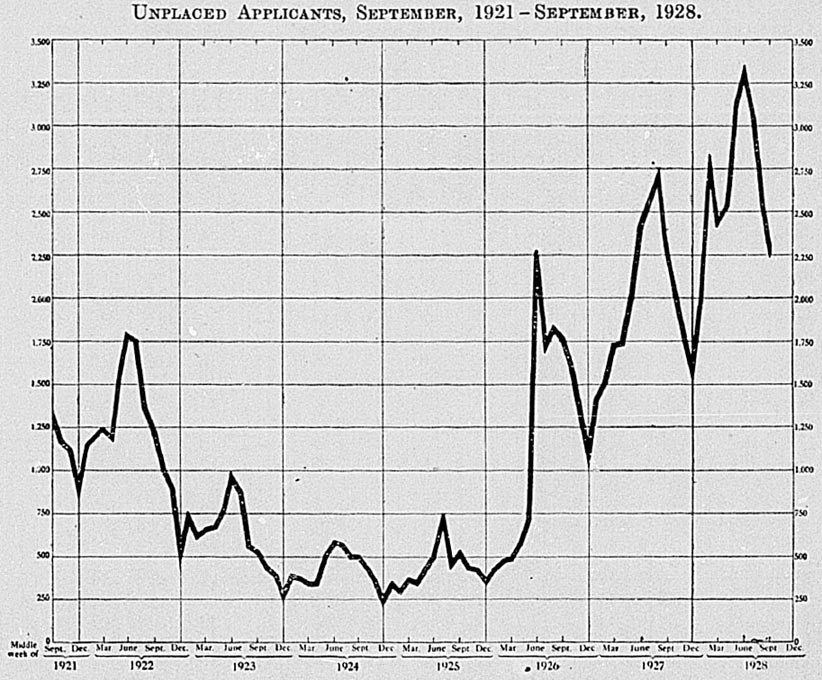
A marked seasonal fluctuation will be observed. The number of unplaced applicants is always lowest during the summer portion of the year, mainly owing to the greater demands for farm labour at that time. Unemployment generally continues to be low until the conclusion of the grain and threshing seasons; but after March, with the closing of many of the freezing-works, the tendency to rise is greatly augmented, until the maximum for the year is reached some time in June or July, about which months it is customary for the Public Works Department to engage additional labourers on its more important undertakings in order to help relieve the position.
During the summer months the proportion of labourers to total persons on the books of the Labour Department usually falls from its winter level of about 80 per cent. (during the middle week of August, 1923, it was actually 69 per cent.) to 50 per cent. or lower (during the middle week of February, 1925, it was as low as 46 per cent.), the experience of the last three years, when unemployment has been progressively more severe, does not quite bear this out. In January, 1927, 56 per cent. of the unplaced applicants were labourers; in August, 1927, the peak month, the figure was 50 per cent.; while in January, 1928, it reached the high level of 59 per cent. The total number of outstanding applications in the last-mentioned month (2,018) was particularly high for this time of the year, the obvious inference being that the brunt of the exceptionally severe unemployment situation fell on the unskilled labourer.
The following table shows in greater detail the occupations of persons whose applications remained on the books at the end of the middle week of each month from January, 1927, to May, 1928, and at the end of the first week of each of the next four months.
| OCCUPATIONS OF APPLICANTS REMAINING ON THE BOOKS, JANUARY, 1927-SEPTEMBER, 1928. | ||||||||||||
|---|---|---|---|---|---|---|---|---|---|---|---|---|
| Middle Week of | Unskilled Labour. | Land Transport. | Ocean Transport. | Hotel and Domestic. | Salesmen. | Clerks. | Building Trades. | Farming and Gardening. | Mining and Quarrying. | Engineering and Mechanical Trades. | * Others and undefined. | Totals. |
| * This column includes applicants on books of sub-districts, complete details of which are not available. | ||||||||||||
| 1927. | ||||||||||||
| January | 785 | 87 | 29 | 32 | 29 | 30 | 68 | 113 | 15 | 113 | 105 | 1,406 |
| February | 767 | 93 | 26 | 62 | 41 | 47 | 121 | 109 | 15 | 95 | 130 | 1,506 |
| March | 807 | 95 | 22 | 65 | 43 | 46 | 127 | 134 | 12 | 106 | 268 | 1,725 |
| April | 887 | 111 | 16 | 65 | 37 | 51 | 111 | 91 | 10 | 111 | 240 | 1,730 |
| May | 1,031 | 108 | 19 | 65 | 33 | 51 | 144 | 145 | 10 | 143 | 249 | 1,998 |
| June | 1,378 | 100 | 28 | 70 | 42 | 58 | 170 | 148 | 16 | 155 | 245 | 2,410 |
| July | 1,389 | 132 | 24 | 88 | 46 | 46 | 205 | 144 | 3 | 169 | 312 | 2,558 |
| August | 1,340 | 147 | 26 | 82 | 37 | 47 | 186 | 136 | 6 | 139 | 552 | 2,698 |
| September | 1,131 | 121 | 27 | 90 | 35 | 47 | 130 | 92 | 11 | 134 | 484 | 2,302 |
| October | 1,023 | 121 | 23 | 73 | 43 | 43 | 88 | 96 | 11 | 95 | 419 | 2,035 |
| November | 950 | 87 | 17 | 62 | 33 | 34 | 79 | 104 | 8 | 94 | 279 | 1,747 |
| December | 834 | 78 | 23 | 56 | 28 | 17 | 76 | 80 | 12 | 82 | 289 | 1,575 |
| 1928. | .. | .. | .. | .. | .. | .. | .. | .. | .. | .. | .. | .. |
| January | 1,191 | 104 | 20 | 32 | 37 | 23 | 124 | 84 | 14 | 120 | 269 | 2,018 |
| February | 1,536 | 150 | 18 | 67 | 42 | 60 | 242 | 116 | 24 | 171 | 361 | 2,787 |
| March | 1,285 | 142 | 18 | 59 | 44 | 51 | 179 | 131 | 14 | 124 | 389 | 2,436 |
| April | 1,318 | 137 | 17 | 61 | 30 | 51 | 120 | 96 | 17 | 109 | 578 | 2,534 |
| May | 1,731 | 169 | 18 | 82 | 34 | 64 | 163 | 146 | 19 | 102 | 592 | 3,120 |
| June | 1,980 | 160 | 17 | 82 | 36 | 63 | 225 | 172 | 29 | 156 | 207 | 3,127 |
| July | 1,958 | 243 | 23 | 72 | 27 | 63 | 225 | 171 | 14 | 153 | 184 | 3,133 |
| August | 1,471 | 203 | 30 | 71 | 36 | 41 | 189 | 153 | 20 | 164 | 250 | 2,628 |
| September | 1,320 | 187 | 20 | 71 | 28 | 42 | 166 | 125 | 19 | 124 | 216 | 2,318 |
No statistics are available as to the activities of the private registry offices, of which there were 96 on the 31st March, 1928. These private bureaux were, under the Servants' Registry Offices Act, 1895 (re-enacted in 1908), placed under the control of the Labour Department instead of the municipal authorities, under whose supervision they had been since the first legislation on the subject was passed in 1892. All registry offices carried on for profit are required to be registered, a condition precedent to registration being the obtaining by the proposed licensee of a certificate of character from a Magistrate. Maximum fees chargeable to employers and workers are prescribed. Records and accounts of the engagements made have to be kept, and the offices are open to inspection by officers of the Labour Department. Registry-office keepers are forbidden to keep lodging-houses for servants or to have any interest in such houses.
The volume of work performed by the private bureaux is not such that their exclusion from the statistics seriously detracts from the value of the latter. Partly on this account but mainly to avoid duplication, it has not been thought worth while to take the necessary steps to have figures for the activities of private bureaux included.
The great disadvantage of the census inquiry regarding unemployment is that it provides data only at long intervals—in New Zealand, quinquennially. Moreover, as successive population censuses are not always held in the same month, and as unemployment is in many countries (including New Zealand) subject to a very high seasonal variation, figures for unemployment at successive census dates are liable to exhibit fictitious fluctuations. Further difficulties emerge when one census-taking happens to correspond with a period when a large number of workers are unemployed as a result of an industrial dispute.
On the other hand, the census source of information as to unemployment is exceedingly valuable in certain respects. It provides date as to unemployment in conjunction with such interesting relevant facts as conjugal condition, nationality, length of residence, age, religion, &c.—combinations of date which are not readily available from other sources of information as to unemployment. Another point is this: in countries such as New Zealand, where the available statistics do not show the total numbers of unemployed, the census fills the gap, and incidentally provides some criterion whereby, on the basis of the ratio between the census and the other available unemployment data at the date of the former, interpolations to yield the total number of unemployed at intercensal dates may be effected with some tolerable claim to precision.
The census of the night of 17th April, 1921, provided data as to unemployment at that date, though no attempt was made to separate persons out of work through scarcity of employment from those out of work as a result of illness, accident, old age, industrial disputes, or other circumstances.
At the date of the 1921 census the unemployed represented 3.95 per cent. of the male and 3.56 per cent. of all wage-earners. The situation is set forth by industrial groups in the following table:—
| Industrial Group. | Number out of Employment. | Percentage of Unemployed among Total Wage-earners. | ||||
|---|---|---|---|---|---|---|
| Males. | Females. | Totals. | Males. | Females. | Totals. | |
| Primary production | 2,848 | 14 | 2,862 | 4.14 | 0.45 | 3.98 |
| Industrial | 3,199 | 433 | 3,632 | 3.94 | 2.45 | 368 |
| Transport and communication | 1,237 | 21 | 1,258 | 2.59 | 0.80 | 2.50 |
| Commercial | 1,302 | 343 | 1,645 | 3.09 | 1.95 | 2.75 |
| Professional | 432 | 442 | 874 | 1.76 | 2.47 | 2.06 |
| Domestic | 314 | 697 | 1,011 | 4.97 | 2.34 | 2.80 |
| Other groups | 1,729 | 204 | 1,933 | 18.36 | 10.46 | 17.00 |
| Total unemployed | 11,061 | 2,154 | 13,215 | 3.95 | 2.38 | 3.56 |
The next table shows more readily the position between the different industrial groups:—
| Industrial Group. | Percentage of Unemployed to Total Unemployed. | Percentage of Wage-earners to Total Wage-earners. | ||||
|---|---|---|---|---|---|---|
| Males. | Females. | Total. | Males. | Females. | Total. | |
| Primary production | 24.57 | 3.46 | 19.41 | 25.75 | 0.65 | 21.66 |
| Industrial | 28.95 | 19.50 | 26.64 | 28.92 | 20.10 | 27.48 |
| Transport and communication | 17.03 | 2.91 | 13.57 | 11.18 | 0.98 | 9.52 |
| Commercial | 15.06 | 19.39 | 16.12 | 11.77 | 15.92 | 12.45 |
| Professional | 8.78 | 19.75 | 11.46 | 3.91 | 20.52 | 6.61 |
| Domestic | 2.25 | 32.84 | 9.73 | 2.84 | 32.36 | 7.65 |
| Other groups | 3.36 | 2.15 | 3.07 | 15.63 | 9.47 | 14.63 |
| Totals | 100.00 | 100.00 | 100.00 | 100.00 | 100.00 | 100.00 |
The figures used in arriving at the proportions of wage-earners were the total wage-earners in each class, whether unemployed or not.
The “primary production” class, as far as male workers are concerned, had in 1921 a percentage of unemployed slightly in excess of its normal proportion. A similar state of affairs is shown for the “domestic” class. The abnormal position as regards “other groups” is accounted for in the main by labourers, &c., whose industry was unspecified. The majority of these, had they been in employment, would, no doubt, have been classified under the “industrial” class. It may, therefore, be safely assumed that the figures for this latter class are understated. The remaining classes show up in a very favourable light as far as the unemployment problem is concerned. For females the “industrial” and “professional” classes had slightly more than their share of unemployed, while the remaining classes, with the exception of the residual “other groups,” had less. Similar factors apply here as in the case of the males, with the exception that the unspecified cases cannot be quite so safely allotted to any particular class.
The census inquiry relating to unemployment required the period for which the wage-earner had been out of employment since the termination of the last engagement to be stated in weeks. A brief summary of this aspect of unemployment statistics is contained in the next table:—
| Duration of Unemployment, in Complete Weeks. | Males. | Females. | Both Sexes. | |||
|---|---|---|---|---|---|---|
| Numbers. | Proportion per Cent. | Numbers. | Proportion per Cent. | Numbers. | Proportion per Cent. | |
| 1 | 840 | 8.13 | 135 | 6.87 | 975 | 7.92 |
| 2 | 1,731 | 16.75 | 274 | 13.94 | 2,005 | 16.30 |
| 3 | 1,283 | 12.41 | 210 | 10.68 | 1,493 | 12.13 |
| 4 | 1,312 | 12.69 | 255 | 12.97 | 1,567 | 12.74 |
| 5-8 | 1,906 | 18.44 | 373 | 18.97 | 2,279 | 18.52 |
| 9-13 | 1,069 | 10.34 | 261 | 13.28 | 1,330 | 10.81 |
| 14-25 | 939 | 9.08 | 249 | 12.66 | 1,188 | 9.66 |
| 26-51 | 560 | 5.42 | 115 | 5.85 | 675 | 5.49 |
| 52 and over | 697 | 6.74 | 94 | 4.78 | 791 | 6.43 |
| Total specified | 10,337 | 100.00 | 1,966 | 100.00 | 12,303 | 100.00 |
In approximately 8 per cent. of the specified cases the duration was for less than two complete weeks, and in nearly 50 per cent. for a period less than five weeks. In the majority of cases where the duration was for six months or over, apparently influences other than the paucity of employment were relatively more important than in cases of shorter durations.
The next table contains particulars of the proportion of the total of unemployed wage-earners to be found in each age-group:—
| Age-group. | Employed Wage-earners. | Unemployed Wage-earners. | ||
|---|---|---|---|---|
| Males. | Females. | Males. | Females. | |
| Under 21 | 19.13 | 36.08 | 14.23 | 29.03 |
| 21-24 | 11.33 | 19.72 | 11.70 | 20.76 |
| 25-29 | 11.67 | 14.66 | 11.52 | 14.96 |
| 30-34 | 11.43 | 8.80 | 9.77 | 9.57 |
| 35-44 | 21.55 | 12.02 | 18.81 | 13.23 |
| 45-54 | 14.30 | 6.03 | 14.71 | 7.15 |
| 55-64 | 7.26 | 2.13 | 11.21 | 3.53 |
| 65 and over | 3.33 | 0.56 | 8.05 | 1.77 |
| Total specified | 100.00 | 100.00 | 100.00 | 100.00 |
In most instances the proportion differed comparatively little from the proportion of employed wage-earners in the corresponding age-groups. Generally speaking, however, unemployment was shown to be relatively more prevalent amongst old than amongst young persons.
Further light on the conditions conducive to unemployment is shed by the following table:—
| NUMBER OF UNEMPLOYED MALES PER 1,000 MALE WAGE-EARNERS, EMPLOYED AND UNEMPLOYED, CENSUS, 1921. | ||||||||
|---|---|---|---|---|---|---|---|---|
| Duration of Unemployment, in Complete Weeks. | Ages in Years Last Birthday. | |||||||
| Under 21. | 21-24. | 25-34. | 35-44. | 45-54. | 55-64. | 65 and over. | Total. | |
| 1 | 3.1 | 3.2 | 3.1 | 2.7 | 2.6 | 3.4 | 3.9 | 3.0 |
| 2 | 5.8 | 7.7 | 5.5 | 5.8 | 6.0 | 7.8 | 7.7 | 6.2 |
| 3 | 4.6 | 5.1 | 3.9 | 3.9 | 4.8 | 6.2 | 6.4 | 4.6 |
| 4 | 4.2 | 4.9 | 4.2 | 4.2 | 4.8 | 7.0 | 7.9 | 4.7 |
| 5-8 | 5.5 | 7.2 | 6.5 | 6.2 | 6.9 | 8.8 | 14.4 | 6.8 |
| 9-12 | 2.1 | 3.3 | 3.2 | 3.3 | 3.5 | 6.3 | 10.3 | 3.5 |
| 13-25 | 1.3 | 2.7 | 33 | 2.8 | 4.7 | 7.1 | 15.9 | 3.6 |
| 26-51 | 0.6 | 1.5 | 1.9 | 1.6 | 2.1 | 4.6 | 9.1 | 2.0 |
| 52 and over | 0.4 | 1.9 | 2.4 | 2.0 | 2.7 | 5.8 | 12.5 | 2.5 |
| Not stated | 1.6 | 3.3 | 2.4 | 2.0 | 2.6 | 4.0 | 7.4 | 2.6 |
| Total | 29.2 | 40.8 | 36.4 | 34.5 | 40.7 | 61.0 | 95.5 | 39.5 |
The modal, or most frequent, duration of unemployment amongst males is seen to have been between 2 and 3 weeks for all ages of wage-earners; but the figures show that there was a definite tendency for the duration of unemployment to be prolonged amongst the older wage-earners. The rate of unemployment was at a minimum at ages under 21. It was fairly high at 21 and under 25, due perhaps to the termination of periods of apprenticeship and subsequent difficulty in obtaining employment in one's trade; perhaps somewhat to the fact that at that age persons who have been employed in blind-alley occupations find themselves out of a job when they come to expect a man's wage; perhaps partly to the fact that about those ages there is amongst many men a period of irresponsibility and shift-lessness, lasting until the advent of some inducement to “settle down” in a permanent home. From the very early “forties” there is disclosed a tendency for unemployment rates to increase with age; a man is becoming too old for certain jobs, while health is frequently not so good.
Another interesting feature of unemployment statistics from a social point of view is in connection with the conjugal condition of those affected. The percentages thus classified were as under at the census of 1921, the figures quoted referring only to persons 16 years of age and upwards:—
| Conjugal Condition. | Employed Wage-earners. | Unemployed Wage-earners. | ||
|---|---|---|---|---|
| Males. | Females. | Males. | Females. | |
| Never married | 47.17 | 87.36 | 52.35 | 88.03 |
| Married | 49.54 | 7.38 | 42.13 | 4.66 |
| Widowed | 2.98 | 4.72 | 5.03 | 6.35 |
| Divorced | 0.31 | 0.54 | 0.49 | 0.96 |
| Total specified | 100.00 | 100.00 | 100.00 | 100.00 |
Married men, while representing in 1921 49 1/2 per cent. of the total employed wage-earners 16 years of age and upwards, made up only just over 42 per cent. of the unemployed, the remaining three classes having a proportion above the normal. A somewhat similar state of affairs is revealed in the case of females.
In connection with the 1926 census, some attempt was made to distinguish various types of unemployment according to the cause. The following inquiries were included in the questionnaire:—
Grade of Occupation.—Enter . . . . W.N. (except in cases of leave of absence) if unemployed for more than a week immediately prior to the census.
Unemployment and Sickness.—State number of working-days lost during the twelve months immediately preceding the census: (1) through sickness, accident, or injury (a) received in course of employment, (b) received otherwise than in course of employment; (2) through lack of employment not due to strikes or lockouts in your industry.
The tabulation of the results of this inquiry is not yet completed.
Estimates of unemployment amongst industrial unionists have since the middle week of November, 1925, been furnished quarterly by secretaries of rather more than 200 unions to the Census and Statistics Office, where the information supplied is tabulated for insertion regularly in the Monthly Abstract of Statistics. Like the unemployment statistics available from the census, and unlike those available from the Labour Department's employment bureaux, the statistics thus collected permit of the computation of unemployment “rates,” relating the number of persons unemployed to the number subject to the risk of unemployment. It should be stressed that, for purposes of these statistics, only those persons are counted as unemployed who were out of work as a result of scarcity of employment for more than three days during the week concerned: persons idle for three days or less, or idle because of illness, accident, or strikes or lockouts directly concerning their trade, &c., are not taken into account. The effect of counting as “unemployed” only those persons out of work as above for more than three days is to eliminate from the numbers of unemployed virtually all persons working short-time.
Despite the exclusion from the inquiry of those industries in which the work is highly seasonal (e.g., freezing), or in which employment is essentially permanent (e.g., tramway operation), or highly casual (e.g., watersiding), or normally part-time (e.g., performing in orchestras), and although inquiries were not addressed to unions with fewer than a score of members, it has yet been found possible to secure returns covering more than half the members of registered industrial unions throughout the Dominion. The figures, though not presenting a complete picture, yet probably constitute a reasonably fair sample of conditions regarding unemployment, and may be claimed to represent the position as regards the labour-market throughout the Dominion with a fair degree of accuracy. Somewhat less accuracy can be claimed for the figures for individual industrial groups and for individual industrial districts, which may be affected to a considerable extent (especially where the numbers concerned are small) by chance differences in the nature of the unions constituting the sample. The different character of the industries carried on in the different districts is also likely to affect comparisons; for very different conditions as regards the labour-market may be expected to exist in a predominantly mining district like Westland from those in a predominantly dairying district such as Taranaki.
Movements from time to time in the figures for the same groups or districts may (by reason of constancy in the nature of the sample) be reasonably expected to yield reliable pictures of changes in the employment situation in so far as those groups or districts are concerned. If the statistics as a whole are subject to a definite bias in any one direction it is probably towards an overestimation of the amount of unemployment (as above defined): this being due to the fact that some unionists are members of more than one union but obviously cannot be employed in more than one trade at once. The estimates of the trade-union secretaries are no doubt in individual cases subject to errors on account of absence of complete information, for it is only in those fairly numerous cases where there is some inducement for members out of work to report their condition promptly (e.g., provision in the rules for a reduction of union dues, or for a payment in the case of unemployment of benefits out of funds held by the union) that “live” unemployment registers are kept: in all other cases the estimates of the numbers unemployed rest on the individual judgments (based always, of course, on more or less close knowledge of the facts) of the union secretaries, such judgments probably on the whole being equally liable to errors of excess as of defect.
| UNEMPLOYMENT AS ESTIMATED BY INDUSTRIAL UNIONS. | ||||||||||||
|---|---|---|---|---|---|---|---|---|---|---|---|---|
| — | Membership of Reporting Unions: Week ended | Persons unemployed for more than Three Days during the Week on account of Lack of Employment: Week ended | Percentage of Unemployed to Total Members: Week ended | |||||||||
| 19 Nov., 1927. | 18 Feb., 1928. | 19 May, 1928. | 18 Aug., 1928. | 19 Nov., 1927. | 18 Feb., 1928. | 19 May, 1928. | 18 Aug., 1928. | 19 Nov., 1927. | 18 Feb., 1928. | 19 May, 1928. | 18 Aug., 1928. | |
| * Including principally salesmen, storemen and packers, gardeners, &c. | ||||||||||||
| (a) Industrial Groups. | ||||||||||||
| Food, drink, and tobacco | 3,052 | 2,943 | 3,015 | 3,015 | 118 | 84 | 98 | 110 | 3.9 | 2.9 | 3.3 | 3.6 |
| Clothing and drapery | 3,105 | 3,209 | 3,172 | 3,297 | 79 | 190 | 293 | 242 | 2.5 | 5.9 | 9.2 | 7.3 |
| Textiles and weaving | 1,635 | 1,659 | 1,286 | 1,258 | 250 | 3 | 3 | .. | 1.5 | 0.2 | 0.2 | .. |
| Building and construction | 13,849 | 14,032 | 13,770 | 13,587 | 1,316 | 1,836 | 1,932 | 1,708 | 9.5 | 13.1 | 14.0 | 12.6 |
| Sawmilling and wood manufacture | 5,272 | 5,123 | 4,713 | 3,725 | 1,065 | 1,150 | 850 | 701 | 20.2 | 22.4 | 18.0 | 18.8 |
| Paper manufacture and printing | 2,486 | 2,453 | 2,484 | 2,472 | 81 | 55 | 52 | 66 | 3.3 | 2.2 | 2.1 | 2.7 |
| Metal working and engineering | 6,355 | 6,448 | 6,510 | 6,604 | 459 | 638 | 531 | 606 | 7.2 | 9.9 | 8.2 | 9.2 |
| Other manufactures | 1,027 | 1,028 | 1,052 | 1,027 | 163 | 136 | 123 | 119 | 15.9 | 13.2 | 11.7 | 11.6 |
| Mining | 3,079 | 3,013 | 3,050 | 3,055 | 127 | 92 | 74 | 122 | 41 | 3.1 | 2.4 | 4.0 |
| Land transport | 2,517 | 2,586 | 2,408 | 2,580 | 106 | 125 | 110 | 111 | 4.2 | 4.8 | 4.6 | 4.3 |
| Shipping | 1,335 | 1,302 | 1,326 | 1,337 | 381 | 398 | 388 | 419 | 28.5 | 30.6 | 29.3 | 31.3 |
| Hotel, restaurant, and other personal service | 6,283 | 7,099 | 6,896 | 7,035 | 532 | 678 | 699 | 713 | 8.5 | 9.6 | 10.1 | 10.1 |
| General labourers | 3,083 | 2,205 | 2,096 | 2,045 | 386 | 550 | 681 | 701 | 12.5 | 24.9 | 32.5 | 34.3 |
| Other miscellaneous* | 3,717 | 4,948 | 4,593 | 4,748 | 468 | 670 | 644 | 680 | 12.6 | 13.5 | 14.0 | 14.3 |
| Totals | 56,795 | 58,048 | 56,371 | 55,785 | 5,531 | 6,605 | 6,478 | 6,298 | 9.7 | 11.4 | 11.5 | 11.3 |
| (b) Industrial Districts. | ||||||||||||
| Northern | 18,089 | 17,918 | 17,602 | 17,284 | 2,056 | 2,430 | 2,873 | 3,105 | 11.4 | 13.6 | 16.3 | 18.0 |
| Wellington | 14,355 | 15,163 | 14,667 | 14,816 | 1,347 | 1,586 | 1,474 | 1,359 | 9.4 | 10.5 | 10.0 | 9.2 |
| Canterbury | 11,732 | 11,678 | 11,614 | 11,884 | 829 | 886 | 848 | 790 | 7.1 | 7.6 | 7.3 | 6.8 |
| Otago and Southland | 9,109 | 9,304 | 8,996 | 9,178 | 873 | 906 | 945 | 796 | 9.6 | 9.7 | 10.5 | 8.7 |
| Taranaki | 823 | 1,300 | 888 | 1,334 | 108 | 308 | 73 | 154 | 131 | 23.7 | 8.2 | 11.5 |
| Marlborough | ||||||||||||
| Nelson | ||||||||||||
| Westland | 2,687 | 2,685 | 2,604 | 1,489 | 318 | 489 | 265 | 94 | 11.8 | 18.2 | 10.2 | 6.3 |
| Totals | 56,795 | 58,048 | 56,371 | 55,785 | 5,531 | 6,605 | 6,478 | 6,298 | 9.7 | 11.4 | 11.5 | 11.3 |
August, 1927, was the peak period since the inception of the unionist unemployment statistics, there being estimated to be 11.6 per cent. of the unionists out of employment owing to lack of work. November showed a definite reduction, due partly to improvement in the sawmilling industry and partly to the seasonal work available in building and construction and in the tailoring trades.
The situation became more acute in February, 1928, the timber industry losing ground somewhat, also the building and shipping trades. Though the figures for the “general labourers” group are necessarily incomplete (it being impossible in many cases to split up the builders' and general labourers' unions, which are included in the “building and construction” group), unemployment among general labourers shows a sharp increase. This group has through 1928 continued to show a comparatively high percentage of unemployed.
Little alteration has taken place from February to August, 1928, with the exception of a slight improvement in the position of the timber industry, which has fallen from the peak in August, 1927 (28.1 per cent.), to 18.8 per cent.
The statistics given in the foregoing table relate of course only to unemployment arising from scarcity of jobs. Quarterly data are, however, collected in New Zealand also in regard to unemployment amongst unionists arising from sickness, accident, and other causes. Of 30,788 male unionists in connection with whom such returns were obtained, it was found that 395 were unemployed for more than three days during the middle week of the third quarter of 1928 on account of sickness, 258 on account of accident, and 21 on account of other causes. Just over 2 per cent. of unionists were therefore unemployed on account of these factors.
A table comparing the position in New Zealand with that in certain other countries where similar data are available is added, with the warning that, owing to possible variations in methods of collecting and compiling the statistics and in the industrial structures of the countries concerned, international comparisons in this field are to be effected with the utmost diffidence and caution. It should also be remembered in interpreting the figures that data for a single week do not necessarily reflect a typical state of affairs, especially in view of the fact that unemployment varies considerably with the seasons in many countries.
| Country. | Percentage of Unionists unemployed to Total Unionists. | |||
|---|---|---|---|---|
| Date. | Percentage. | Date. | Percentage. | |
| * Including persons absent through sickness, accident, and other minor causes, but not strikes and lockouts. | ||||
| United Kingdom | August, 1927 | 9.3 | February, 1928 | 10.4 |
| Sweden | August, 1927 | 7.7 | February, 1928 | 13.4 |
| Denmark | August, 1927 | 16.5 | February, 1928 | 25.9 |
| Belgium | August, 1927 | 1.2 | February, 1928 | 1.2 |
| Canada | August, 1927 | 3.7 | February, 1928 | 7.0 |
| Australia | 1st Quarter, 1928 | 10.7* | 3rd Quarter, 1927 | 6.7* |
| New Zealand | February, 1928 | 11.4 | August, 1928 | 11.3 |
Provision was made in the returns of factory production and of building and construction for the year ended 31st March, 1927, for the collection of data relating to the number of wage-earning employees engaged on the 15th or nearest representative day thereto in each month during the calendar year 1926.
These figures taken in conjunction with the monthly totals of employees on public works, throw light on the subject of seasonal fluctuation, which is a well-recognized feature of certain industries. The statistics show that seasonal fluctuation is not confined to what are usually regarded as seasonal industries, such as meat-freezing, butter and cheese making, &c., but that it is almost the exception rather than the rule for any industry to maintain fairly equable activity throughout the year. Most industries have their regular alternation of busy months and slack months. The causes of these seasonal fluctuations are sometimes classified as climatic or social. It is perhaps better to say that each type of cause is to be found in nearly every case. Climatic conditions necessarily give rise to social habits; indeed, nearly all social habits involving regular annual fluctuation in the demand for labour may be traced ultimately to differences of temperature and weather. On the other hand, social habits once established generally go beyond climatic necessities.
According to the 1926 census there were in April of that year, roughly speaking, 240,000 wage-earners in the Dominion. These have been classified under the following headings:—
| Group. | Number of Wage-earners (nearest Thousand). |
|---|---|
| Agricultural and pastoral | 44 |
| Manufacturing | 74 |
| Transport and communication | 35 |
| Commerce | 32 |
| Building and construction | 16 |
| Mining and quarrying | 6 |
| Forest occupations | 4 |
| Sport and entertainments | 2 |
| Personal and domestic | 6 |
| Labourers | 20 |
| Total | 239 |
Factories from which returns were received had in the census month 53,744 wage-earning employees, and building and construction concerns 9,279, while Public Works employees in the same month numbered 7,021, making a total of approximately 70,000 in the industries covered by the present inquiry.
Considering the total number of wage-earners each month in all the branches of industry covered by the present discussion, attention is immediately drawn to the months of February and August. The former represents the peak month, the latter the lowest month, for the year. The number of wage-earning employees for February was 70,670, against 64,534 in August, showing a range of 6,136 wage-earners. This difference, which was gradually accumulated during the late summer, the autumn, and the winter months, represents a quantitative expression of the downward swing in employment that started in March and ended in August. Between the figures for March and February there was a difference of 131, or 0.19 per cent.; that for April was 495, or 0.70 per cent., below that for March; while May showed a decrease of 1,627, or 2.32 per cent., as compared with April. The next decrease—viz., that between June and May—was recorded as 2,196, or 3.21 per cent., and represented the sharpest drop in employment over the twelve months covered. July saw a further drop of 1,409, or 2.13 per cent., below the June level, while the lowest ebb from an employment point of view was reached in August, which fell by 278, or 0.43 per cent., below July, to 64,534.
The period of recovery; which commenced in early spring, was sharp and sudden.. No fewer than 1,597 more wage-earners were recorded for September than for August; or, in other words, for every 100 workers employed in August an additional 2.47 were taken on in September. This rate of recovery was not maintained in October, when the level of employment showed an increase of 531, or 0.80 per cent., over that for the preceding month, but another glimpse of it occurred in November, the figure for which was 1,284, or 1.93 per cent., greater than that for October. The month of December witnessed further marked activity in employment, and during that month 1,914, or 2.82 per cent., additional workers found employment in the industries under discussion. No figures are extant at present beyond December, 1926, except for the Public Works-employees. It appears reasonable, however, to suppose that the movement in the early months of 1927 would be similar to that evinced in 1926—viz., an increase in January, a further increase in February, followed by the downward swing already referred to in the subsequent months.
The following table shows the number of wage-earning employees engaged each month during the calendar year 1926 in each of the three main branches of industry covered by the inquiry, together with relative numbers which have been computed on the basis that the arithmetic mean for each group equals 100:—
| WAGE-EARNING EMPLOYEES, 1926. | ||||
|---|---|---|---|---|
| Month. | Manufacturing Industries. | Building Industry. | Public Works Department. | Total. |
| Absolute Numbers. | ||||
| January | 53,786 | 9,126 | 6,444 | 69,356 |
| February | 54,747 | 9,289 | 6,634 | 70,670 |
| March | 54,573 | 9,231 | 6,735 | 70,539 |
| April | 53,744 | 9,279 | 7,021 | 70,044 |
| May | 52,099 | 9,368 | 6,950 | 68,417 |
| June | 49,599 | 9,155 | 7,467 | 66,221 |
| July | 48,247 | 8,937 | 7,628 | 64,812 |
| August | 47,916 | 9,005 | 7,613 | 64,534 |
| September | 49,053 | 9,348 | 7,730 | 66,131 |
| October | 49,571 | 9,228 | 7,863 | 66,662 |
| November | 50,705 | 9,330 | 7,911 | 67,946 |
| December | 53,315 | 9,178 | 7,367 | 69,860 |
| Average for year | 51,446 | 9,206 | 7,280 | 67,932 |
| Relative Numbers. | ||||
| (Arithmetic mean over twelve months for each group = 100.) | ||||
| January | 105 | 99 | 89 | 102 |
| February | 106 | 101 | 91 | 104 |
| March | 106 | 100 | 93 | 104 |
| April | 104 | 101 | 96 | 103 |
| May | 101 | 102 | 95 | 101 |
| June | 96 | 99 | 103 | 97 |
| July | 94 | 97 | 105 | 95 |
| August | 93 | 98 | 105 | 95 |
| September | 95 | 102 | 106 | 97 |
| October | 96 | 100 | 108 | 98 |
| November | 99 | 101 | 109 | 100 |
| December | 104 | 100 | 101 | 103 |
The relative numbers have been plotted on the diagram on the opposite page, and show the general movement of each group of employees during the year more distinctly than the figures themselves. Great caution should be exercised in reading the diagram, which is so constructed as to show the relative movement in the various groups. It is the relative, not the absolute, figures that are used in each case. An increase of, say 10 per cent, in the figure for the Public Works employees, the mean for which over the twelve months was 7,280, occupies precisely the same space as an increase of 10 per cent. in the total for all the groups covered, the mean for which was 67,932. In the first-mentioned group an increase of 10 per cent. would indicate an absolute increase of 728 employees, approximately one-tenth of the number (6,793) represented by a similar relative increase in the major group. Put briefly, the scale used represents the percentage increases or decreases from the average. It should not therefore be concluded that because the line for the Public Works employees and that for the manufacturing and building industries move sympathetically in opposite directions all the workers who are seasonally thrown out of employment in the last-mentioned group go to swell the numbers of Public Works employees. What is indicated is that an increase of, say, 10 per cent. in the number of Public Works employees occurs at the same time as a decrease of 10 per cent. in the total for the manufacturing and building industries.
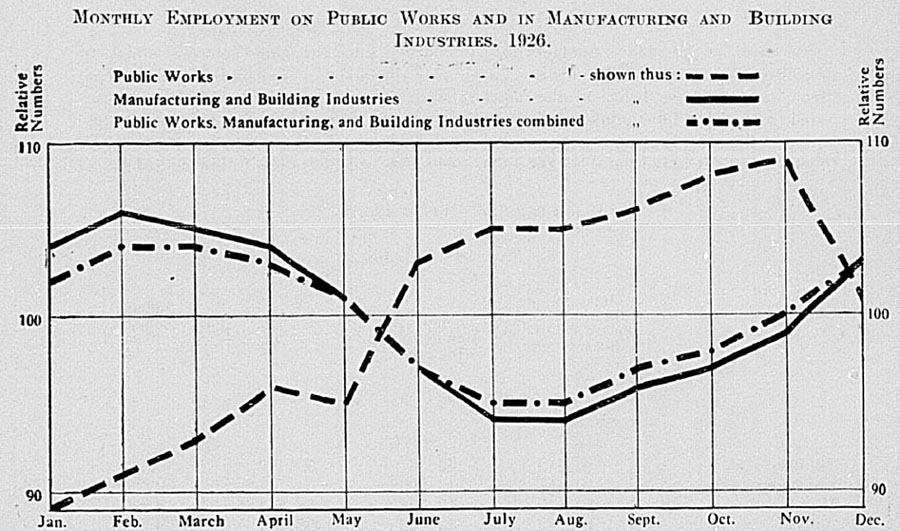
Following on the remarks emphasizing the differences between the absolute numbers in the manufacturing and building industries and the Public Works Department, if the numbers were somewhere about equal a line plotted to represent both groups in conjunction would follow roughly the same course over the twelve months. That the numbers in the two groups do vary substantially, and that the course followed by the line for the manufacturing and building industries is not seriously altered by constructing it to cover also the Public Works employees, is shown by the dotted line which has been so constructed.
There is a very marked relationship between the movements in the manufacturing and building industries, and the Public Works employees. Up to May the numbers of employees recorded for the former were above the average for the twelve months, while the numbers recorded for the latter for the same months were below the average. From June to August the employment, in the manufacturing and building industries swung downwards, then upwards again, passing the average about December. Early June marked the commencement of a period of activity in the Public Works Department, which gradually grew in intensity through the winter months, reached its peak in November, and declined sharply in December to just a shade above the average. In the manufacturing and building industries there were 6,831 more workers engaged in February (54,747), the highest month, than in August (47,916), the lowest month, while the range in the Public Works employees was 1,467—from 6,444 in January, the lowest month, to 7,911 in November, the highest month. It is thus seen that although there was, broadly speaking, a distinct inverse correspondence between employment in the Public Works Department and in the manufacturing and building industries in 1926, the number of employees in the Public Works Department was still moving upwards after the number in the manufacturing and building industries had reached its lowest ebb in August. As previously mentioned, the Public Works employment reached its peak in November. Taking into consideration the broad principle that employment on public works is most intense when other employment is slackest, this upward movement after August may be regarded as due to special circumstances. In the following year (1927), when the average employed on public works during the year was 8,053, against 7,280 in 1926, a sharp peak was reached in August, after which the number of employees sharply declined to December.
A division of the manufacturing industries into (a) those closely allied to agricultural and pastoral pursuits, and (b) all other manufacturing industries, throws considerable light on the marked and seasonal tendencies of (a) as compared with (b). The numbers of wage-earning employees in each of these groups, and in the building industry, during each month of the calendar year 1926, together with relative numbers for each group, are given in the following table:—
| WAGE-EARNING EMPLOYEES, 1926. | ||||
|---|---|---|---|---|
| Month. | Manufacturing Industries. | Building Industry. | ||
| Meat-freezing, Ham and Bacon, Butter and Cheese, Sausage Casing, &c., Industries. | Other Manufacturing Industries. | Total. | ||
| Absolute Numbers. | ||||
| January | 10,349 | 43,437 | 53,786 | 9,126 |
| February | 10,947 | 43,800 | 54,747 | 9,289 |
| March | 10,805 | 43,768 | 54,573 | 9,231 |
| April | 10,282 | 43,462 | 53,744 | 9,279 |
| May | 8,995 | 43,104 | 52,099 | 9,368 |
| June | 6,805 | 42,794 | 49,599 | 9,155 |
| July | 5,495 | 42,752 | 48,247 | 8,937 |
| August | 5,088 | 42,828 | 47,916 | 9,005 |
| September | 5,620 | 43,433 | 49,053 | 9,348 |
| October | 6,023 | 43,548 | 49,571 | 9,228 |
| November | 6,782 | 43,923 | 50,705 | 9,330 |
| December | 9,150 | 44,165 | 53,315 | 9,178 |
| Average for year | 8,028 | 43,418 | 51,446 | 9,206 |
| Relative Numbers. | ||||
| (Arithmetic moan over twelve months for each group =100.) | ||||
| January | 129 | 100 | 105 | 99 |
| February | 136 | 101 | 106 | 101 |
| March | 135 | 101 | 106 | 100 |
| April | 128 | 100 | 104 | 101 |
| May | 112 | 99 | 101 | 102 |
| June | 85 | 99 | 96 | 99 |
| July | 68 | 98 | 94 | 97 |
| August | 63 | 99 | 93 | 98 |
| September | 70 | 100 | 95 | 102 |
| October | 75 | 100 | 96 | 100 |
| November | 84 | 101 | 99 | 101 |
| December | 114 | 102 | 104 | 100 |
The above relative numbers have been plotted in the next diagram. The precautions mentioned previously apply with equal force to this diagram. The vertical scale represents percentage differences from the arithmetic mean for each group.
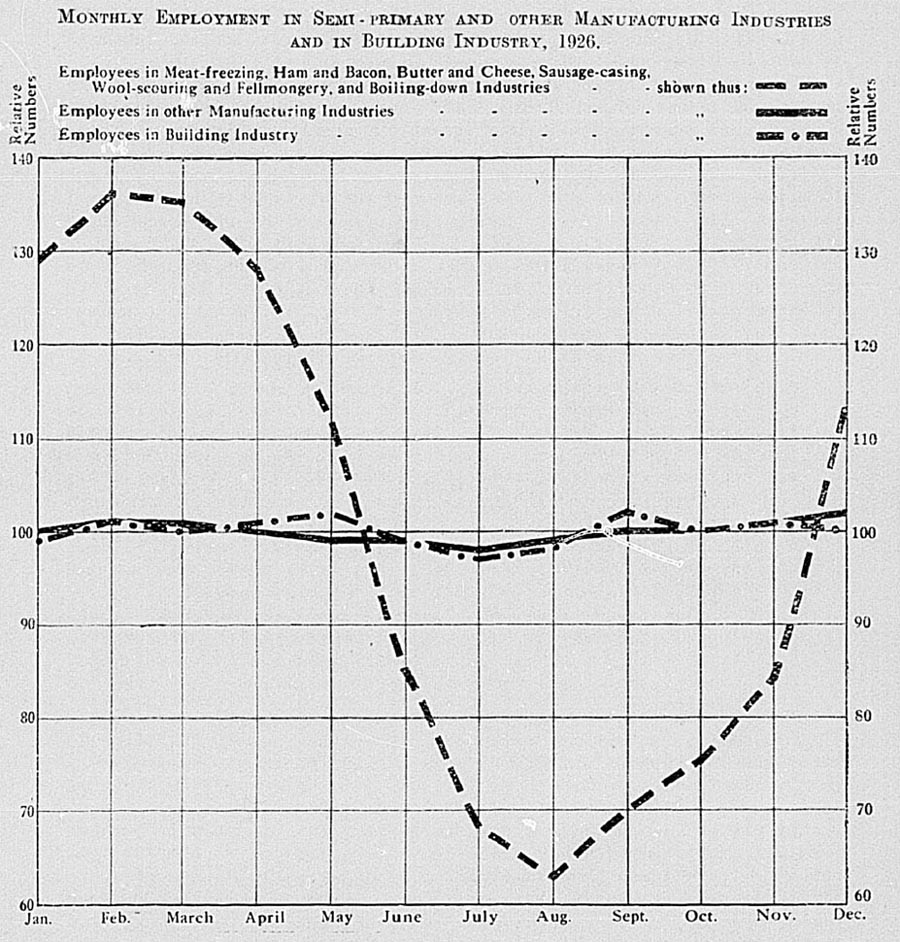
The outstanding feature in the foregoing diagram is the extent of the variations in employment in the group of industries closely allied to agricultural and pastoral pursuits. The highest point in this group was reached in February (10,947), the lowest in August (5,088), representing a range of 5,859. In other words, the figure for the peak month was more than double that for the lowest month. The movement between February and August appears to be fairly rhythmical, swinging upwards in January and February, gradually downwards in March and April, sharply downwards in May, June, and July, to August, the slackest month from the point of view of employment. Early in September the period of recovery commenced, gradually at first, but gaining momentum until between the 15th November and 15th December no fewer than 2,368 additional workers were absorbed into these industries.
There was an average of 43,418 workers engaged during the calendar year 1926 in the other manufacturing industries. The figures recorded for each month from May to August were below the average, the other months being above it. December was the month of greatest activity, with 44,165 workers, July being the lowest, with 42,752 workers, showing a range of 1,413 workers. The course of employment throughout the year in this group was maintained with little relative deviations from the mean. There was, however, a distinct upward swing in the summer and spring months, which was counterbalanced by a downward movement in the winter months. The course of employment in the building industry was, not unexpectedly, more irregular than that in the manufacturing industries just discussed. There were two periods of marked activity in this industry, one in May and another in September, while, as in the manufacturing industries, the slackest month occurred in July.
Broadly speaking, the following conclusions emerge from the foregoing remarks:—
Those industries closely allied to the agricultural and pastoral production pass through definite periods of activity and slackness during the calendar year. The period of activity commences in November or December, attains its maximum about February, and recedes in March, April, and May; then commences the slack period, which is at its worst about August, after which a recovery, at first gradual, then sharp, brings the perennial return to activity.
The manufacturing and building industries are apparently subject to seasonal fluctuations in employment, the general characteristics of which are activity in the summer and slackness in the winter months.
The number of artisians and labourers employed by the Public Works Department increases in the winter and decreases in the summer months, but does not, on the scale ruling in 1926, substantially alter the general course of employment throughout the year in the industries covered in this discussion.
The considerable number of workers who, in the winter months, find themselves out of employment in the industries covered most either earn enough during their short periods of activity to last over until the next season or drift into other industries. Unfortunately, statistics are not available on this interesting point, beyond those relating to the Public Works Department, which show that some at least find employment therein. If figures were available regarding monthly employment by local authorities it would probably be found that many are engaged by these bodies during the slack period. It is proposed in future years to collect data on this point from local bodies. As regards employment in other directions, such as transport and farming, for instance, there is reason to believe that the seasonal characteristics would be found there also, thus adding to the number of workers who either are without employment in the winter months or who obtain it in other directions. It would be very difficult to throw further light on the question of these workers without much more complete statistics than are at present available.
The following table shows the number of male and female employees engaged on the fifteenth or nearest representative day of the calendar year 1926 in the various groups of industries:—
| MONTHLY EMPLOYMENT, BY INDUSTRIES, 1926. | |||||||||||||
|---|---|---|---|---|---|---|---|---|---|---|---|---|---|
| Industry. | January. | February. | March. | April. | May. | June. | July. | August. | September. | October. | November. | December. | Average over 12 Months. |
| (a) Males. | |||||||||||||
| Animal food | 9,490 | 10,017 | 9,863 | 9,371 | 8,190 | 6,168 | 4,946 | 4,554 | 5,106 | 5,575 | 6,320 | 8,501 | 7,342 |
| Vegetable food | 2,081 | 2,082 | 2,135 | 2,111 | 2,078 | 2,070 | 2,042 | 2,024 | 2,014 | 2,036 | 2,042 | 2,098 | 2,068 |
| Drinks, narcotics, and stimulants | 1,465 | 1,445 | 1,434 | 1,400 | 1,385 | 1,375 | 1,381 | 1,373 | 1,375 | 1,414 | 1,453 | 1,504 | 1,417 |
| Animal matters (not otherwise classed) | 792 | 805 | 789 | 770 | 721 | 638 | 581 | 552 | 539 | 549 | 557 | 691 | 665 |
| Working in wood | 8,105 | 8,308 | 8,269 | 8,171 | 8,170 | 8,033 | 7,888 | 7,858 | 8,037 | 8,025 | 8,007 | 8,002 | 8,073 |
| Vegetable produce for fodder | 23 | 23 | 23 | 23 | 39 | 39 | 41 | 41 | 37 | 33 | 26 | 27 | 31 |
| Paper-manufactures | 193 | 191 | 186 | 184 | 183 | 187 | 187 | 178 | 175 | 181 | 183 | 186 | 185 |
| Heat, light, and power | 4,540 | 4,530 | 4,502 | 4,508 | 4,498 | 4,579 | 4,605 | 4,689 | 4,589 | 4,652 | 4,735 | 4,735 | 4,597 |
| Processes relating to stone, clay, glass, &c. | 2,774 | 2,789 | 2,803 | 2,755 | 2,733 | 2,610 | 2,670 | 2,719 | 2,783 | 2,802 | 2,832 | 2,861 | 2,761 |
| Metals other than gold or silver | 5,674 | 5,687 | 5,728 | 5,743 | 5,689 | 5,768 | 5,822 | 5,650 | 5,612 | 5,641 | 5,726 | 5,718 | 5,705 |
| Precious metals | 140 | 141 | 142 | 139 | 136 | 138 | 140 | 140 | 139 | 139 | 137 | 139 | 139 |
| Books and publications | 3,678 | 3,675 | 3,696 | 3,681 | 3,689 | 3,701 | 3,701 | 3,710 | 3,744 | 3,732 | 3,737 | 3,752 | 3,708 |
| Musical instruments | 85 | 87 | 88 | 88 | 84 | 90 | 92 | 90 | 90 | 92 | 91 | 83 | 88 |
| Ornaments and minor art products | 253 | 265 | 267 | 271 | 263 | 263 | 261 | 247 | 260 | 262 | 261 | 263 | 261 |
| Equipment for sports and games | 34 | 35 | 36 | 30 | 33 | 32 | 34 | 36 | 37 | 36 | 36 | 36 | 35 |
| Designs, medals, type, and dies | 76 | 75 | 75 | 77 | 78 | 82 | 83 | 83 | 83 | 77 | 85 | 85 | 80 |
| Machines, tools, and implements | 838 | 832 | 829 | 824 | 814 | 770 | 715 | 733 | 749 | 759 | 745 | 755 | 780 |
| Carriages and vehicles | 4,083 | 4,135 | 4,132 | 4,100 | 4,098 | 4,081 | 4,095 | 4,163 | 4,275 | 4,328 | 4,366 | 4,524 | 4,198 |
| Harness, saddlery, and leatherware | 1,153 | 1,233 | 1,249 | 1,239 | 1,178 | 1,083 | 1,019 | 1,028 | 1,012 | 918 | 899 | 952 | 1,080 |
| Ships, boats, and their equipment | 879 | 794 | 722 | 682 | 697 | 773 | 770 | 796 | 913 | 750 | 821 | 720 | 768 |
| House-furnishings | 2,235 | 2,277 | 2,294 | 2,298 | 2,263 | 2,266 | 2,245 | 2,239 | 2,327 | 2,310 | 2,319 | 2,320 | 2,283 |
| Chemicals and by-products | 624 | 653 | 706 | 738 | 725 | 710 | 762 | 769 | 864 | 779 | 773 | 715 | 735 |
| Textile fabrics | 924 | 941 | 938 | 974 | 982 | 985 | 968 | 959 | 945 | 950 | 936 | 936 | 953 |
| Apparel | 2,026 | 2,075 | 2,082 | 2,086 | 2,098 | 2,133 | 2,109 | 2,079 | 2,096 | 2,103 | 2,102 | 2,092 | 2,090 |
| Fibrous materials | 1,511 | 1,538 | 1,443 | 1,336 | 1,145 | 909 | 970 | 1,081 | 1,226 | 1,304 | 1,395 | 1,450 | 1,276 |
| Miscellaneous | 110 | 114 | 142 | 145 | 130 | 116 | 120 | 125 | 126 | 124 | 121 | 170 | 128 |
| Building and construction | 9,126 | 9,289 | 9,231 | 9,279 | 9,368 | 9,155 | 8,937 | 9,005 | 9,348 | 9,228 | 9,330 | 9,178 | 9,206 |
| Total—Males | 62,912 | 64,036 | 63,804 | 63,023 | 61,467 | 58,754 | 57,184 | 56,921 | 58,401 | 58,799 | 60,035 | 62,493 | 60,652 |
| Deviations from arithmetic mean | + 2,260 | + 3,384 | + 3,152 | + 2,371 | + 815 | -1,898 | -3,468 | -3,731 | -2,251 | -1,853 | -617 | + 1,841 | .. |
| (b) Females. | |||||||||||||
| Animal food | 124 | 126 | 126 | 119 | 113 | 83 | 77 | 87 | 108 | 118 | 119 | 118 | 110 |
| Vegetable food | 1,304 | 1,353 | 1,371 | 1,296 | 1,384 | 1,378 | 1,387 | 1,350 | 1,337 | 1,343 | 1,404 | 1,402 | 1,359 |
| Drinks, narcotics, and stimulants | 240 | 253 | 251 | 248 | 226 | 215 | 223 | 236 | 263 | 287 | 299 | 297 | 253 |
| Animal matters (not otherwise classed) | 88 | 86 | 88 | 88 | 85 | 92 | 92 | 93 | 94 | 92 | 93 | 95 | 91 |
| Working in wood | 24 | 22 | 21 | 22 | 22 | 21 | 21 | 21 | 21 | 22 | 20 | 21 | 21 |
| Paper-manufactures | 249 | 260 | 251 | 252 | 263 | 262 | 260 | 258 | 259 | 268 | 266 | 266 | 260 |
| Heat, light, and power | 3 | 3 | 3 | 3 | 3 | 3 | 3 | 3 | 3 | 3 | 3 | 3 | 3 |
| Processes relating to stone, clay, glass, &c. | 8 | 7 | 9 | 10 | 10 | 9 | 8 | 8 | 8 | 8 | 8 | 8 | 8 |
| Metals other than gold or silver | 77 | 79 | 79 | 73 | 74 | 77 | 69 | 75 | 78 | 77 | 81 | 76 | 76 |
| Precious metals | 4 | 4 | 4 | 4 | 4 | 4 | 4 | 4 | 4 | 4 | 4 | 4 | 4 |
| Books and publications | 1,097 | 1,110 | 1,098 | 1,128 | 1,122 | 1,120 | 1,104 | 1,095 | 1,129 | 1,145 | 1,132 | 1,111 | 1,116 |
| Ornaments and minor art products | 45 | 43 | 45 | 45 | 44 | 43 | 43 | 41 | 42 | 43 | 44 | 43 | 43 |
| Designs, medals, type, and dies | 1 | 1 | 1 | 1 | 1 | 1 | 1 | 1 | 1 | 1 | .. | .. | 1 |
| Machines, tools, and implements | 74 | 72 | 69 | 72 | 73 | 68 | 63 | 64 | 68 | 71 | 71 | 81 | 71 |
| Carriages and vehicles | 9 | 9 | 9 | 10 | 10 | 9 | 9 | 9 | 9 | 9 | 9 | 9 | 9 |
| Harness, saddlery, and leatherware | 124 | 126 | 127 | 128 | 130 | 133 | 131 | 120 | 119 | 115 | 118 | 115 | 124 |
| Ships, boats, and their equipment | 76 | 87 | 91 | 82 | 74 | 75 | 71 | 74 | 67 | 67 | 71 | 69 | 75 |
| House-furnishings | 282 | 288 | 284 | 269 | 268 | 270 | 274 | 270 | 268 | 272 | 276 | 286 | 276 |
| Chemicals and by-products | 233 | 262 | 255 | 245 | 237 | 234 | 229 | 235 | 245 | 243 | 232 | 229 | 240 |
| Textile fabrics | 1,207 | 1,231 | 1,240 | 1,248 | 1,253 | 1,283 | 1,249 | 1,258 | 1,253 | 1,260 | 1,274 | 1,281 | 1,253 |
| Apparel | 6,341 | 6,664 | 6,757 | 6,729 | 6,654 | 6,582 | 6,479 | 6,587 | 6,761 | 6,934 | 6,863 | 6,740 | 6,674 |
| Fibrous materials | 57 | 63 | 63 | 64 | 68 | 68 | 63 | 62 | 62 | 66 | 63 | 63 | 63 |
| Miscellaneous | 65 | 72 | 76 | 79 | 83 | 80 | 78 | 79 | 76 | 75 | 79 | 78 | 77 |
| Total—Females | 11,732 | 12,221 | 12,318 | 12,215 | 12,201 | 12,110 | 11,938 | 12,030 | 12,275 | 12,523 | 12,529 | 12,395 | 12,207 |
| Deviations from arithmetic mean | -475 | +14 | + 111 | +8 | -6 | -97 | -269 | -177 | + 68 | +316 | + 322 | + 188 | .. |
The deviations from the figures for each month and the arithmetic mean for a]] months are given in the above table. These figures show rather more clearly than the total figures the fluctuations in employment from month to month. In order to obtain some concrete expressions for comparative purposes as to the changes in the number of male and female employees engaged each month, what is known as the standard deviation has been calculated for each class of employee. The method used is the customary one well known to statisticians. The standard deviation in the case of males showed 2,493.33 against 222.64 for females; the arithmetic means for the two instances were 60,652 for the former against 12,207 for the latter. Expressed simply, the average deviation from the figures for the twelve months covered and the average for the year was for males 2,493.33, and for females 222.64. By relating these figures to the two means in the form of percentages it is possible to compare the dispersion or the fluctuations between the two figures. The percentage for males works out at 4.11 per cent., against 1.82 per cent. for females, showing clearly that on the figures analysed male employment fluctuated relatively more during 1926 than female. This is rather surprising, as women and girls are in particular industries (e.g., clothing) subject to greater fluctuations in employment than the workers belonging to the stronger sex. It should not be forgotten, however, that many of the industries showing extremely marked seasonal tendencies are not big employers of women and girls.
The table on the next page shows the male and female employees engaged in the industries forwarding returns of factory production or building and construction, classified by Provincial Districts. The monthly course of employment of males in the four principal provincial districts is here shown graphically.
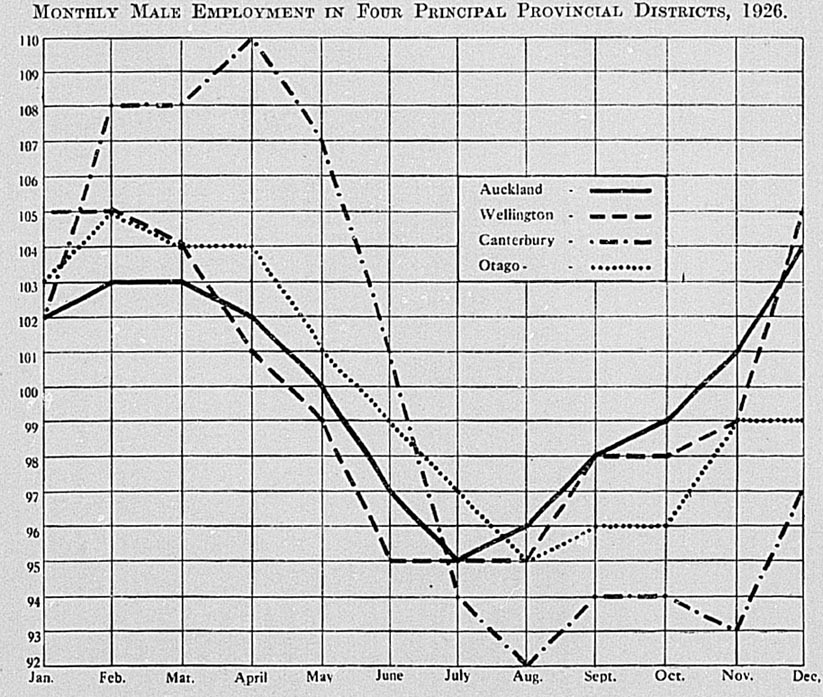
| MONTHLY EMPLOYMENT, BY PROVINCIAL DISTRICTS, 1926. | |||||||||||||
|---|---|---|---|---|---|---|---|---|---|---|---|---|---|
| Provincial District. | January. | February. | March. | April. | May. | June. | July. | August. | September. | October. | November. | December. | Average for 12 Months. |
| (a) Males. | |||||||||||||
| Auckland | 20,635 | 20,746 | 20,766 | 20,627 | 20,180 | 19,484 | 19,210 | 19,413 | 19,820 | 19,952 | 20,413 | 20,981 | 20,186 |
| Hawke's Bay | 2,662 | 2,605 | 2,645 | 2,504 | 2,396 | 2,164 | 1,949 | 1,915 | 1,996 | 1,953 | 2,185 | 2,554 | 2,294 |
| Taranaki | 2,173 | 2,106 | 2,099 | 1,971 | 1,849 | 1,716 | 1,637 | 1,665 | 1,835 | 1,965 | 2,058 | 2,199 | 1,939 |
| Wellington | 14,836 | 14,910 | 14,750 | 14,339 | 14,055 | 13,524 | 13,530 | 13,476 | 13,839 | 13,837 | 14,038 | 14,889 | 14,169 |
| Marlborough | 444 | 448 | 445 | 413 | 401 | 380 | 359 | 362 | 369 | 376 | 392 | 465 | 404 |
| Nelson | 1,025 | 1,051 | 1,054 | 1,026 | 1,028 | 994 | 969 | 989 | 1,067 | 1,085 | 1,089 | 1,124 | 1,042 |
| Westland | 1,375 | 1,431 | 1,400 | 1,442 | 1,488 | 1,448 | 1,400 | 1,322 | 1,376 | 1,366 | 1,372 | 1,335 | 1,396 |
| Canterbury | 10,150 | 10,673 | 10,753 | 10,910 | 10,614 | 9,989 | 9,290 | 9,121 | 9,269 | 9,279 | 9,238 | 9,646 | 9,911 |
| Otago | 7,064 | 7,231 | 7,149 | 7,141 | 6,932 | 6,775 | 6,692 | 6,527 | 6,616 | 6,607 | 6,828 | 6,824 | 6,865 |
| Southland | 2,548 | 2,835 | 2,743 | 2,650 | 2,524 | 2,280 | 2,148 | 2,131 | 2,214 | 2,379 | 2,422 | 2,476 | 2,446 |
| Total—Males | 62,912 | 64,036 | 63,804 | 63,023 | 61,467 | 58,754 | 57,184 | 56,921 | 58,401 | 58,799 | 60,035 | 62,493 | 60,652 |
| (b) Females. | |||||||||||||
| Auckland | 3,905 | 4,116 | 4,167 | 4,050 | 4,050 | 4,008 | 3,954 | 4,051 | 4,174 | 4,265 | 4,275 | 4,205 | 4,102 |
| Hawke's Bay | 128 | 130 | 132 | 131 | 133 | 134 | 144 | 141 | 139 | 137 | 140 | 142 | 136 |
| Taranaki | 75 | 74 | 77 | 76 | 72 | 75 | 79 | 76 | 77 | 74 | 76 | 75 | 75 |
| Wellington | 2,472 | 2,572 | 2,548 | 2,584 | 2,605 | 2,640 | 2,568 | 2,560 | 2,669 | 2,705 | 2,696 | 2,649 | 2,606 |
| Marlborough | 3 | 3 | 3 | 3 | 3 | 3 | 3 | 3 | 3 | 4 | 4 | 4 | 3 |
| Nelson | 101 | 102 | 129 | 125 | 118 | 107 | 107 | 102 | 105 | 106 | 103 | 107 | 109 |
| Westland | 7 | 7 | 7 | 7 | 5 | 5 | 5 | 5 | 7 | 7 | 7 | 7 | 6 |
| Canterbury | 2,272 | 2,374 | 2,380 | 2,391 | 2,411 | 2,381 | 2,322 | 2,316 | 2,340 | 2,394 | 2,397 | 2,385 | 2,364 |
| Otago | 2,566 | 2,639 | 2,673 | 2,648 | 2,605 | 2,578 | 2,576 | 2,600 | 2,568 | 2,629 | 2,628 | 2,619 | 2,611 |
| Southland | 203 | 204 | 202 | 200 | 199 | 179 | 180 | 176 | 193 | 202 | 203 | 202 | 195 |
| Total—Females | 11,732 | 12,221 | 12,318 | 12,215 | 12,201 | 12,110 | 11,938 | 12,030 | 12,275 | 12,523 | 12,529 | 12,395 | 12,207 |
In interpreting the diagram on page 867, due attention must be paid to the fact that the curves have been plotted, not from figures showing the number of employees each month, but from relative numbers which have been computed for the employment figure for each month and equated to the arithmetic mean for the twelve months, which equals 100. The vertical scale represents relative or percentage differences as compared with the mean for the twelve months. The outstanding point disclosed by the diagram is the range of the seasonal fluctuation in Canterbury as against the other districts. Although the diagram enables comparisons of a general nature to be drawn as between the four provinces, it does not provide anything definite or concrete upon which to base the comparisons. To enable this to be done the standard deviations in the figures for each province have been computed and related to the arithmetic means in the manner already described. The resultant figures, which may be designated the relative dispersions, and regarded as quantitative expressions of the fluctuations in employment, work out as follows:—
| Per Cent. | |
|---|---|
| Auckland | 2.85 |
| Otago | 3.34 |
| Westland | 3.34 |
| Wellington | 3.77 |
| Nelson | 4.18 |
| Canterbury | 6.64 |
| Southland | 8.86 |
| Marlborough | 8.90 |
| Taranaki | 9.83 |
| Hawke's Bay | 13.18 |
The figures are arranged in descending order according to the degree of fluctuation. According to them employment runs more smoothly in Auckland and more unevenly in Kawke's Bay than in any other provincial district. It is not difficult to observe in these figures the effect of the semi-primary industries subject to a marked seasonal fluctuation. Hawke's Bay and Canterbury are examples of this. The existence of freezing-works in both districts has no doubt been a powerful factor in making the relative dispersions in these cases comparatively high. It is possible that the segregation of the figures for the true manufacturing as distinct from the semi-primary industries by districts, would shed further light on the aspect of seasonal variations in employment.
As indicated in the section of this publication relating to factory production, female employment is not found to any great extent in the industrial field (as covered by the returns of factory production) in the Dominion. What there is is mainly found in the four main centres. For this reason the relative dispersion in female employment in the four main districts only has been calculated. The results are given hereunder:—
| Per Cent. | |
|---|---|
| Wellington | 2.13 |
| Auckland | 2.76 |
| Otago | 1.26 |
| Canterbury | 1.69 |
It is clear from the above figures that female employment does not fluctuate to a very great extent in any of the four main districts, and that Auckland shows greater variations than the other districts.
Table of Contents
THE collection of information regarding industrial disputes was initiated by the Census and Statistics Office at the beginning of the year 1920. Information concerning disputes prior to that year was obtained by examination of the records of the Labour Department, fairly complete data being available from this source with regard to the number of disputes, their nature, causes, methods of settlement, and results In many instances, however, it was impracticable to ascertain the duration of disputes and the number of workers involved in them, and it has been impossible to estimate the number of working days lost or the loss in wages caused by disputes prior to 1920.
Under the system originated in 1920 returns furnished by Inspectors of Factories form the main source from which information is obtained. It is considered that the statistics based on these reports are less liable to bias than would be the case if parties to the dispute or other private persons were relied on to furnish the information. It is the duty of an Inspector, during the course of a dispute in his industrial district to collect all available particulars relating to it. The Inspectors have power to demand information from the parties concerned in the dispute, and by exercising this power when necessary they can obtain complete information.
On the termination of a dispute the Inspector in the district in which it has taken place is required to fill in and forward to the Census and Statistics Office and to the Head Office of the Labour Department a return showing—(a) The location of the dispute; (b) its nature—whether direct strike, sympathetic strike, partial strike, or lockout; (c) the number of workers directly and indirectly concerned in the dispute; (d) the dates of commencement and termination of the dispute; (e) the cause, the method of settlement, and the result of the dispute; (f) the estimated loss in wages caused by the dispute; (g) the names of the firms affected and the industry in which the dispute has taken place. If the dispute results in a change of wages or hours, then the wages and hours before and after the dispute are to be shown.
Broadly speaking, industrial disputes may be divided into two main classes—strikes and lockouts. Strikes may be further subdivided into three classes—direct strikes, sympathetic strikes, and partial strikes. A direct strike is a concerted refusal on the part of a body of workers to continue work, for the purpose of forcing their demands on an employer or of resisting demands made by him. A stop-work meeting docs not necessarily constitute a strike: it may be held merely to discuss certain matters relating to conditions of employment, &c., or to decide whether or not a strike shall take place. A sympathetic strike occurs when the workers strike not to force their own demands on their employer, but in sympathy with the claims of other workers. A partial strike is a strike which does not involve a complete stoppage of work; a “go-slow” policy adopted by a body of workers may be classified as a partial strike, provided that the fact that they are adopting a “go-slow” policy is soundly established. A lockout occurs when an employer or a body of employers refuses work to a body of workers in order to force certain demands on them or to resist demands made by them.
In these tabulations the term “industrial disputes” refers only to those disputes which result in a strike or a lockout. Many disputes are, of course, settled without recourse to such measures; these are not recorded for statistical purposes.
At a comparatively early date in the economic history of New Zealand the desirability of mitigating the severity of industrial disputes by legislative enactment became apparent to the Legislature; and the distress caused by the maritime strike of 1890-91 led to the passing in 1894 of the Industrial Conciliation and Arbitration Act, which was designed to facilitate the peaceful settlement of industrial disputes by conciliation and arbitration. This Act, however, applies only to such industrial unions as are registered under the Act, and such registration is voluntary. To such bodies of workers as are not so registered the Labour Disputes Investigation Act, passed in 1913, applies. This enactment requires the workers in the case of a strike, or the employers in the case of a lockout, to notify the Minister of Labour of the points at issue before any actual cessation of work takes place.
Fuller details of these Acts will be found in Section XXXVIII of this book.
From the passing of the Industrial Conciliation and Arbitration Act in 1894 till the end of 1905 there were no industrial disputes dealt with under the Act; indeed, New Zealand may be said to have been almost entirely free from industrial disputes during that period.
The following table shows the nature and magnitude of disputes during each of the years 1918-27. Unfortunately, particulars are not available as to the number of working-days lost for years prior to 1920; and, indeed, the figures showing the number of workers involved are incomplete in many cases, including two cases in 1920. Connequently only a rough idea of the magnitude of disputes occurring in any year before 1921 can be gleaned from the figures, although the number of disputes and their classification are complete.
| NATURE AND MAGNITUDE OF DISPUTES, 1918-27. | |||||||||||
|---|---|---|---|---|---|---|---|---|---|---|---|
| Year. | Nature of Dispute. | Number of Firms affected. | Number of Workers involved.* | ||||||||
| Direct Strike. | Sympathetic Strike. | Partial Strike. | Lockout. | Total | Direct Strike. | Sympathetic Strike. | Partial Strike. | Lockout. | Total | ||
| * Prior to 1921 figures are Incomplete in most years. | |||||||||||
| 1918 | 33 | 6 | 1 | 40 | 44 | 3,984 | 39 | 33 | 4,056 | ||
| 1919 | 32 | 1 | 12 | .. | 45 | 59 | 2,938 | .. | 1,092 | .. | 4,030 |
| 1920 | 71 | 4 | 2 | .. | 77 | 107 | 9,491 | 5,309 | 338 | .. | 15,138 |
| 1921 | 63 | 5 | 9 | .. | 77 | 112 | 8,534 | 917 | 982 | .. | 10,433 |
| 1922 | 53 | 4 | 1 | .. | 58 | 67 | 5,778 | 376 | 260 | .. | 6,414 |
| 1923 | 45 | 2 | 2 | .. | 49 | 79 | 6,659 | 207 | 296 | .. | 7,162 |
| 1924 | 33 | .. | 1 | .. | 34 | 58 | 14,791 | .. | 24 | .. | 14,815 |
| 1925 | 73 | 6 | 2 | 2 | 83 | 93 | 7,694 | 1,229 | 47 | 935 | 9,905 |
| 1926 | 49 | 9 | 1 | .. | 59 | 67 | 4,437 | 1,788 | 39 | .. | 6,264 |
| 1927 | 35 | .. | 3 | .. | 38 | 40 | 4,389 | .. | 87 | .. | 4,478 |
Of the 38 disputes recorded during the year 1927, 29 were of two days duration or less, while only six lasted for more than one week. There were no disputes which could be classed as serious, although two disputes in the freezing industry lasted for some weeks. In one case 50 men were on strike for a considerable period, the management engaging free labour.
The following table shows the nature and magnitude of disputes in each industrial district for the year 1927. The number of working-days lost is shown in this table, and is calculated by multiplying the number of workers involved by the number of days lost (exclusive of Sundays and public holidays). It is assumed that work would have been continuous if no dispute had taken place, and no allowance is made for loss of work from unemployment or other causes which might have occurred even if there had been no dispute. In some cases, such as shearing, there is a definite amount of work to be done, and a stoppage of work does not decrease the total amount of work done, but only postpones its completion. In those cases the figures are perhaps more or less fictitious, but in the great majority of cases they represent a real loss.
| NATURE AND MAGNITUDE OF DISPUTES IN EACH INDUSTRIAL DISTRICT, 1927. | ||||||
|---|---|---|---|---|---|---|
| — | Northern. | Wellington. | Westland. | Canterbury. | Otago and Southland. | Totals. |
| Number of Disputes. | ||||||
| Direct strike | 7 | 7 | 11 | 8 | 2 | 35 |
| Partial strike | .. | .. | .. | 1 | 2 | 3 |
| Totals | 7 | 7 | 11 | 9 | 4 | 38 |
| Number of Firms affected. | ||||||
| Totals | 8 | 7 | 11 | 10 | 4 | 40 |
| Number of Workers involved. | ||||||
| Direct strike | 1,107 | 443 | 2,433 | 253 | 153 | 4,389 |
| Partial strike | .. | .. | .. | 42 | 45 | 87 |
| Totals | 1,107 | 443 | 2,433 | 295 | 198 | 4,476 |
| Number of Working-days lost. | ||||||
| Direct strike | 4,466 | 3,333 | 4,134 | 399 | 153 | 12,485 |
| Partial strike | .. | .. | .. | .. | .. | .. |
| Totals | 4,466 | 3,333 | 4,134 | 399 | 153 | 12,485 |
The following table shows the duration of the disputes which occurred during the years 1923-27:—
| DURATION AND MAGNITUDE OF INDUSTRIAL DISPUTES, 1923-27. | |||||
|---|---|---|---|---|---|
| Duration. | 1923. | 1924. | 1925. | 1926. | 1927. |
| Number of Disputes. | |||||
| 1 day and less | 26 | 19 | 40 | 24 | 18 |
| 2 days and more than 1 day | 4 | 2 | 9 | 10 | 11 |
| 3 days and more than 2 days | 6 | 5 | 7 | 3 | 1 |
| Over 3 days to 1 week | 1 | 1 | 9 | 5 | 2 |
| 1 week to 2 weeks | 3 | 4 | 7 | 3 | 4 |
| 2 weeks to 4 weeks | 1 | 2 | 2 | 6 | .. |
| 4 weeks to 6 weeks | 1 | 1 | 3 | 3 | .. |
| 6 weeks to 8 weeks | .. | .. | 2 | .. | 1 |
| 8 weeks and over | 7 | .. | 4 | .. | 1 |
| Totals | 49 | 34 | 83 | 59 | 38 |
| Number of Workers involved. | |||||
| 1 day and less | 2,098 | 1,670 | 3,496 | 2,915 | 2,456 |
| 2 days and more than 1 day | 593 | 32 | 947 | 252 | 697 |
| 3 days and more than 2 days | 1,203 | 163 | 778 | 288 | 4 |
| Over 3 days to 1 week | 35 | 25 | 1,516 | 319 | 639 |
| 1 week to 2 weeks | 349 | 12,521 | 867 | 1,024 | 588 |
| 2 weeks to 4 weeks | 111 | 154 | 420 | 681 | .. |
| 4 weeks to 6 weeks | 257 | 250 | 520 | 785 | .. |
| 6 weeks to 8 weeks | .. | .. | 128 | .. | 50 |
| 8 weeks and over | 2,516 | .. | 1,233 | .. | 42 |
| Totals | 7,162 | 14,815 | 9,905 | 6,264 | 4,476 |
During the five years covered by the table 127 disputes, out of a total of 263, lasted for only one day or for less than one day.
| DURATION AND MAGNITUDE OF INDUSTRIAL DISPUTES, 1927. | ||||
|---|---|---|---|---|
| Duration. | Number of Disputes. | Number of Workers involved. | Number of Working-days Lost. | Estimated Loss in Wages. |
| £ | ||||
| 1 day and less | 18 | 2,456 | 2,258 | 2,123 |
| 2 days and more than 1 day | 11 | 697 | 1,293 | 1,236 |
| 3 days and more than 2 days | 1 | 4 | 12 | 6 |
| Over 3 days and less than 1 week | 2 | 639 | 2,947 | 2,914 |
| 1 week to 2 weeks | 4 | 588 | 3,825 | 3,534 |
| 6 weeks to 8 weeks | 1 | 50 | 2,150 | 2,000 |
| 8 weeks and over | 1 | 42 | .. | 6 |
| Totals | 38 | 4,476 | 12,485 | 11,819 |
In 1927 the great majority of disputes were of a trivial nature, as is evidenced from a study of the above table of the 4,476 workers involved in strikes during this year 3,796 were on strike for periods of less than one week. The average working-days lost for all workers on strike was only 2.8 days.
The following table shows the number of disputes in each industrial district for the years 1918-27, and also the number of workers involved:—
| NUMBER AND MAGNITUDE OF DISPUTES IN EACH INDUSTRIAL DISTRICT, 1918-27. | |||||||||
|---|---|---|---|---|---|---|---|---|---|
| Year. | Northern. | Taranaki. | Wellington. | Marlborough. | Nelson. | Westland. | Canterbury. | Otago and Southland. | Totals. |
| * Including railway strikes, which cannot be allocated to industrial districts. The railway strikes of 1920 were confined to the North Island. | |||||||||
| Number of Disputes. | |||||||||
| 1918 | 9 | .. | 6 | .. | 1 | 19 | 1 | 4 | 40 |
| 1919 | 10 | 1 | 8 | .. | 3 | 15 | 3 | 5 | 45 |
| 1920 | 22 | .. | 12 | .. | 1 | 25 | 9 | 6 | 77* |
| 1921 | 21 | 1 | 15 | .. | 2 | 15 | 4 | 19 | 77 |
| 1922 | 10 | 1 | 11 | .. | 1 | 16 | 10 | 9 | 58 |
| 1923 | 15 | 3 | 6 | .. | .. | 13 | 1 | 11 | 49 |
| 1924 | 5 | 3 | 5 | .. | .. | 6 | 5 | 9 | 34* |
| 1925 | 17 | 1 | 21 | .. | 1 | 21 | 10 | 12 | 83 |
| 1926 | 12 | 2 | 12 | 1 | .. | 17 | 7 | 8 | 59 |
| 1927 | 7 | .. | 7 | .. | .. | 11 | 9 | 4 | 38 |
| Number of Workers involved. | |||||||||
| 1918 | 422 | .. | 75 | .. | .. | 3,499 | .. | 60 | 4,056 |
| 1919 | 394 | .. | 118 | .. | 111 | 2,306 | 880 | 221 | 4,030 |
| 1920 | 2,991 | .. | 1,081 | .. | 10 | 5,106 | 260 | 164 | 15,138* |
| 1921 | 3,829 | 44 | 2,373 | .. | 63 | 2,319 | 312 | 1,493 | 10,433 |
| 1922 | 703 | 53 | 940 | .. | 49 | 2,771 | 1,010 | 888 | 6,414 |
| 1923 | 1,592 | 164 | 636 | .. | .. | 3,998 | 115 | 657 | 7,162 |
| 1924 | 315 | 131 | 126 | .. | .. | 1,235 | 437 | 732 | 14,815* |
| 1925 | 1,494 | 81 | 2,868 | .. | 8 | 4,489 | 574 | 391 | 9,905 |
| 1926 | 1,080 | 39 | 907 | 80 | .. | 3,132 | 652 | 374 | 6,264 |
| 1927 | 1,107 | .. | 443 | .. | .. | 2,433 | 295 | 198 | 4,476 |
In the following table industrial disputes are classified according to the industries in which disputes took place. The classification into industrial groups is the same as that used in the compilation of wage statistics. “Wood-manufacture” includes both sawmilling and the secondary stages of manufacture (cabinetmaking, &c). “Domestic service” includes in addition to employees in hotels, restaurants, &c., workers in laundries and in hairdressing saloons. “Metal-working” includes all the engineering trades, brassmoulding, fitting, &c. The designations given to the other groups are self-explanatory.
| INDUSTRIAL DISPUTES CLASSIFIED ACCORDING TO INDUSTRIAL GROUPS, 1923-27. | |||||
|---|---|---|---|---|---|
| Industrial Group. | 1923. | 1924. | 1925. | 1926. | 1927. |
| Number of Disputes. | |||||
| I. Food, drink, &c. | 4 | 1 | 4 | 11 | 6 |
| II. Clothing | .. | .. | .. | .. | .. |
| III. Textiles and weaving | .. | .. | 2 | .. | .. |
| IV. Building and construction | 1 | .. | 1 | .. | .. |
| V. Wood-manufacture | 1 | .. | .. | .. | .. |
| VI. Paper-manufacture and printing | .. | .. | .. | .. | .. |
| VII. Metal-working | .. | 1 | .. | .. | .. |
| VIII. Other manufactures | .. | 2 | .. | .. | .. |
| IX. Mining | 16 | 13 | 22 | 25 | 14 |
| X. Agricultural and pastoral | .. | .. | .. | 1 | 1 |
| XI. Land transport | .. | 1 | .. | .. | .. |
| XII. Shipping and cargo-working | 26 | 13 | 52 | 20 | 15 |
| XIII. Domestic service, &c. | .. | 1 | .. | .. | .. |
| XIV. Miscellaneous | 1 | 2 | 2 | 2 | 2 |
| Totals | 49 | 34 | 83 | 59 | 38 |
| Number of Workers involed. | |||||
| I. Food, drink, &c. | 163 | 24 | 144 | 1,451 | 366 |
| II. Clothing | .. | .. | .. | .. | .. |
| III. Textiles and weaving | .. | .. | 365 | .. | .. |
| IV. Building and construction | 25 | .. | 100 | .. | .. |
| V. Wood-manufacture | 68 | .. | .. | .. | .. |
| VI. Paper-manufacture and printing | .. | .. | .. | .. | .. |
| VII. Metal-working | .. | 13 | .. | .. | .. |
| VIII. Other manufactures | .. | 14 | .. | .. | .. |
| IX. Mining | 4,599 | 1,983 | 5,101 | 4,159 | 3,109 |
| X. Agricultural and pastoral | .. | .. | .. | 7 | 6 |
| XI. Land transport | .. | 11,839 | .. | .. | .. |
| XII. Shipping and cargo-working | 2,293 | 852 | 4,157 | 575 | 544 |
| XIII. Domestic service, &c. | .. | 5 | .. | .. | .. |
| XIV. Miscellaneous | 14 | 85 | 38 | 72 | 451 |
| Totals | 7,162 | 14,815 | 9,905 | 6,264 | 4,476 |
Out of a total of 263 disputes during the five years 90 occurred in the mining industry. Of the 42,622 workers involved in disputes during the five years 18,951 were engaged in this industry. The great majority of these disputes were, however, of very abort duration.
Further information concerning disputes in the various industrial groups is given for the year 1927 in the next table.
| INDUSTRIAL DISPUTES, 1927, CLASSIFIED ACCORDING TO INDUSTRIAL GROUPS. | |||||||
|---|---|---|---|---|---|---|---|
| Industrial Group. | Number of Disputes. | Number of Firms affected. | Number of Workers involved. | Number of Working-days lost. | Estimated Loss in Wages. | ||
| Directly. | Indirectly. | Total. | |||||
| £ | |||||||
| I. Food, drink, &c. | 6 | 6 | 266 | 100 | 366 | 2,461 | 2,178 |
| IX. Mining | 14 | 14 | 3,017 | 92 | 3,109 | 5,835 | 5,875 |
| X. Agricultural and pastoral | 1 | 1 | 6 | .. | 6 | 6 | 6 |
| XII. Shipping and cargo-working | 15 | 17 | 465 | 79 | 514 | 1,545 | 707 |
| XIV. Miscellaneous | 2 | 2 | 446 | 5 | 451 | 2,638 | 3,053 |
| Totals | 38 | 40 | 4,200 | 276 | 4,476 | 12,485 | 11,819 |
The greatest number of disputes took place in the shipping and cargo-working group. That all cases were of a trivial nature is evidenced by the fact that the average number of working days lost was under three days. Several minor strikes were recorded in the mining industry, mostly of one day's duration.
In the next table the causes of disputes occurring during the years 1923-27 are shown. Under the heading “Wages” are included disputes concerning a reduction or increase in the rates of wages in industries where time rates are paid, or concerning an increase or decrease in the rates for piecework in industries where piece rates are paid. Disputes concerning an increase or decrease in the rates for overtime are also included in this class.
Disputes concerning the number of hours of work are clarified under the heading “Hours.”
Disputes concerning the employment or non-employment of certain classes of persons are included under the heading “Employment.” This question usually arises in connection with trade-union affairs — the employment of non-unionists, or the dismissal of men when, in the opinion of the other workers, their dismissal is due merely or mainly to the fact that they are prominent in union activities.
The heading “Other working - conditions” includes all causes of disputes relating to conditions of work, &c.
Under the heading “Sympathy” are included all disputes caused by workers striking not on account of a grievance with their own particular employer, but in sympathy with the demands of other workers.
“Other causes” refers to all causes of disputes not included in the above classes.
| CAUSES OF INDUSTRIAL DISPUTES, 1923-27. | |||||
|---|---|---|---|---|---|
| Cause. | 1923. | 1924. | 1925. | 1926. | 1927. |
| Number of Disputes. | |||||
| Wages | 13 | 12 | 34 | 19 | 8 |
| Hours | 4 | .. | .. | .. | .. |
| Employment | 9 | 12 | 13 | 10 | 10 |
| Other working-conditions | 20 | 7 | 26 | 17 | 18 |
| Sympathy | 2 | .. | 6 | 9 | .. |
| Other causes | 1 | 3 | 4 | 4 | 2 |
| Totals | 49 | 34 | 83 | 59 | 38 |
| Number of Workers involved. | |||||
| Wages | 2,824 | 12,545 | 4,757 | 2,142 | 1,384 |
| Hours | 193 | .. | .. | .. | .. |
| Employment | 1,558 | 1,120 | 1,175 | 1,121 | 352 |
| Other working-conditions | 2,130 | 553 | 2,355 | 1,013 | 2,442 |
| Sympathy | 207 | .. | 1,229 | 1,788 | .. |
| Other causes | 250 | 597 | 389 | 200 | 298 |
| Totals | 7,162 | 14,815 | 9,905 | 6,264 | 4,476 |
The following table classifies disputes for the year 1927 according to cause, and shows for each group of causes the number of disputes, the number of workers involved, the time lost, and the estimated loss in wages.
| CAUSES OF DISPUTES DURING THE YEAR 1927. | ||||
|---|---|---|---|---|
| Cause. | Number of Disputes. | Number of Workers Involved. | Number Working days lost. | Estimated Loss in Wages. |
| £ | ||||
| Wages | 8 | 1,384 | 3,606 | 3,792 |
| Employment | 10 | 352 | 3,125 | 2,622 |
| Other working conditions | 18 | 2,442 | 5,158 | 4,715 |
| Other causes | 2 | 298 | 596 | 690 |
| Totals | 38 | 4,476 | 12,485 | 11,819 |
The methods of settlement of industrial disputes may be classified as follows:—
By negotiations under the Industrial Conciliation and Arbitration Act:
By negotiations under the Labour Disputes Investigation Act:
By private negotiations between the employers and workers, resulting in the framing of a compromise:
By the substitution of other workers for strikers:
By other methods. Under this head are included cases in which the men return to work without the points at issue being definitely settled; or where the employers or workers give way without placing the matter before a Labour Disputes Committee or a Conciliation Council; or any other method by which a strike may be settled which does not come under the four preceding heads.
Following is a table showing the methods of settlement of disputes during the last five years. There were no settlements during the period by negotiations under the Labour Disputes Investigation Act. Only four settlements under this head have been effected since the Act was passed in 1913.
| METHODS OF SETTLEMENT OF INDUSTRIAL DISPUTES, 1923-27. | |||||
|---|---|---|---|---|---|
| Method of Settlement. | 1923. | 1924. | 1925. | 1926. | 1927. |
| Number of Disputes. | |||||
| Negotiations under the Industrial Conciliation and Arbitration Act | 3 | .. | .. | 1 | 4 |
| Compromise between parties to the dispute | 9 | 11 | 15 | 19 | 5 |
| Substitution | 1 | 2 | .. | 5 | 2 |
| Otherwise | 36 | 21 | 68 | 34 | 27 |
| Totals | 49 | 34 | 83 | 59 | 38 |
| Number of Workers involved. | |||||
| Negotiations under the Industrial Conciliation and Arbitration Act | 260 | .. | .. | 20 | 596 |
| Compromise between parties to the dispute | 2,887 | 1,169 | 1,210 | 2,562 | 1,340 |
| Substitution | 98 | 10 | .. | 108 | 56 |
| Otherwise | 3,917 | 13,636 | 8,695 | 3,574 | 2,484 |
| Totals | 7,162 | 14,815 | 9,905 | 6,264 | 4,476 |
Further information for the year 1927 is given in the next table.
| METHOD OF SETTLEMENT OF DISPUTES, 1927. | ||||
|---|---|---|---|---|
| Method of Settlement. | Number of Disputes. | Number of Workers involved. | Number of Working-days lost. | Estimated Loss in Wages. |
| £ | ||||
| Negotiations under Industrial Conciliation and Arbitration Act | 4 | 596 | 565 | 640 |
| Compromise | 5 | 1,340 | 3,550 | 3,922 |
| Substitution | 2 | 56 | 2,156 | 2,006 |
| Otherwise | 27 | 2,484 | 6,214 | 5,251 |
| Totals | 38 | 4,476 | 12,485 | 11,819 |
The results of all industrial disputes are classified under one of the four heads used in the next table. The system of classification is more fully explained by the following notes:—
In favour of workers. All disputes where the demands of the workers are totally conceded come under this category.
In favour of employers. Disputes are classified under this head when the workers give way on the points at issue.
Compromise. Disputes where the demands of the workers are partially but not wholly conceded come under this head.
Disputes are classified as “indeterminate” when work is resumed without any definite settlement of the questions out of which the trouble arose.
In the following table is given a summary of results of industrial disputes occurring during the period 1923-27:—
| RESULTS OF INDUSTRIAL DISPUTES, 1923-27. | |||||
|---|---|---|---|---|---|
| Result. | 1923. | 1924. | 1925. | 1926. | 1927. |
| Number of Disputes. | |||||
| In favour of workers | 2 | 11 | 19 | 12 | 11 |
| In favour of employers | 16 | 7 | 21 | 15 | 6 |
| Compromise | 10 | 9 | 17 | 10 | 7 |
| Indeterminate | 21 | 7 | 26 | 22 | 14 |
| Totals | 49 | 34 | 83 | 59 | 38 |
| Number of Workers involved. | |||||
| In favour of workers | 118 | 741 | 1,200 | 619 | 1,079 |
| In favour of employers | 1,612 | 12,196 | 4,179 | 828 | 240 |
| Compromise | 2,998 | 1,078 | 1,879 | 1,203 | 1,505 |
| Indeterminate | 2,434 | 800 | 2,647 | 3,614 | 1,652 |
| Totals | 7,162 | 14,815 | 9,905 | 6,264 | 4,476 |
| Number of Working-days lost. | |||||
| In favour of workers | 118 | 3,824 | 5,927 | 788 | 3,629 |
| In favour of employers | 54,516 | 71,463 | 45,354 | 4,503 | 3,011 |
| Compromise | 143,607 | 12,994 | 5,415 | 15,036 | 3,715 |
| Indeterminate | 3,571 | 824 | 17,856 | 27,484 | 2,130 |
| Totals | 201,812 | 89,105 | 74,552 | 47,811 | 12,485 |
The class “Indeterminate” is considerably the largest, and this is only natural since a great number of disputes—notably “sympathetic” strikes—cannot by their very nature have a definite settlement one way or the other. Again, considerable care has been taken in assigning disputes to the various classes, no dispute being classified as ending in favour of either the workers or the employers unless the result is quite clear. Of disputes ending definitely in favour of one party or the other during the five years workers won in 55 instances and employers in 65.
In the following table the causes and results of disputes occurring during 1927 are shown in conjunction:—
| INDUSTRIAL DISPUTES, 1927, CLASSIFIED ACCORDING TO CAUSES AND RESULTS. | |||||
|---|---|---|---|---|---|
| Result. | Causes. | ||||
| Wages. | Employment. | Other Working Conditions. | Other Causes. | Total. | |
| Number of Disputes. | |||||
| In favour of workers | 2 | 3 | 6 | .. | 11 |
| In favour of employers | .. | 5 | 1 | .. | 6 |
| Compromise | 2 | .. | 5 | .. | 7 |
| Indeterminate | 4 | 2 | 6 | 2 | 14 |
| Totals | 8 | 10 | 18 | 2 | 38 |
| Number of Workers involved. | |||||
| In favour of workers | 229 | 66 | 784 | .. | 1,079 |
| In favour of employers | .. | 236 | 4 | .. | 240 |
| Compromise | 834 | .. | 671 | .. | 1,505 |
| Indeterminate | 321 | 50 | 983 | 298 | 1,652 |
| Totals | 1,384 | 352 | 2,442 | 298 | 4,476 |
| Number of Working-days lost. | |||||
| In favour of workers | 311 | 83 | 3,235 | .. | 3,629 |
| In favour of employers | .. | 2,999 | 12 | .. | 3,011 |
| Compromise | 3,004 | .. | 711 | .. | 3,715 |
| Indeterminate | 291 | 43 | 1,200 | 596 | 2,130 |
| Totals | 3,606 | 3,125 | 5,158 | 596 | 12,485 |
Table of Contents
As a result of an international conference of official statisticians held at Geneva in 1923, under the auspices of the International Labour Office set up by the League of Nations, the collection and compilation of statistics of industrial accidents on substantially uniform lines is now being undertaken in virtually all countries. From the administrative standpoint the principal types of industrial accidents occurring in New Zealand may be classified under the various heads which follow.
The following is the definition of a “factory” according to the Factories Act, 1921-22:—
Any building, office, or place in which two or more persons are employed directly or indirectly, in any handicraft, or in preparing or manufacturing goods for trade or sale, including any building, office, or place in which work such as is ordinarily performed in a factory is performed for or on behalf of any local authority whether for trade or sale or not; but not including any building in course of erection, nor any temporary workshop or shed for workmen engaged in the erection of such building; but (whatever the number of persons employed therein) including
Every bakehouse . . .; and also
Every building or place in which steam or other mechanical power or appliance is used for the purpose of preparing or manufacturing goods for trade or sale, or packing such goods for transit; and also
Every building or place in which electrical energy is generated or transformed as an illuminant or a motive power for trade or sale, or in which coal-gas or any other form of gas is produced for the like purposes: and also
Every laundry . . .; and also
Every building or place in which any Asiatic is directly or indirectly employed or occupied in laundry-work or any other handicraft, or in preparing or manufacturing goods for trade or sale, or in packing them for transit.
It should be noted that a factory as above defined is not identical with a factory as defined for purposes of the factory production inquiry (Section XXII of this book).
Section 39 of the Factories Act prescribes certain safety devices for the protection of machine workers in factories, and provides penalties for default on the part of factory-occupiers.
Section 41 requires the reporting to Inspectors of Factories (who are officers of the Labour Department, which administers the Act) of all accidents likely to in capacitate the injured person for at least forty-eight hours. Reports are compiled by Inspectors of Factories in connection with each such accident causing loss of work amounting to three days or upwards. These are retained in the District Offices of the Labour Department until the 31st January of the calendar year following that in which the accident occurred, when they are forwarded to the Head Office of the Labour Department. Up to and including the year 1923 statistics were compiled in that office for inclusion in parliamentary paper H.-11, the Annual Report of the Labour Department; but since then the individual reports of accidents have, after scrutiny in the Labour Department's Head Office, been forwarded to the Census and Statistics Office for statistical analysis.
The Scaffolding and Excavation Act, 1922, which superseded the original Act of 1902, does not apply to mines or quarries, or to any ship, boat, or other vessel, or to any excavation made by any local authority or public body, or to any work in connection with a tramway. The Act makes similar provisions to the Factories Act for the appointment of officers of the Labour Department as Inspectors, for the provision of safety-devices and precautionary measures, and for the prompt reporting of all accidents likely to incapacitate the sufferer for at least forty - eight hours, in connection with any building-work, scaffolding, crane, or excavation. For this purpose “building-work” is defined as “any work in connection with the construction, alteration, repair, painting, renewal, or demolition of any erection, edifice, structure, bridge, viaduct, wall, fence, or chimney”; “scaffolding” as “any structure or framework used for the support or protection of workmen engaged in any building-work, and including any swinging stage used or intended to be used for any of the purposes aforesaid”; “excavation” as “any work in connection with preparing or excavating foundations for buildings, or for sewerage, gas, water, or electric supply when such work is more than 5 ft. in depth from the top of the excavation”; and “crane” as including “any engine, hoist, lift, derrick, apparatus, or contrivance of a like kind used on any building for the hoisting, lowering, carrying, or removing from place to place of material, goods, or workmen, and worked by steam, electric, or hand power, or in any other manner”; but the term does not include any machine or boiler by which the motive power of a crane is generated, if a certificate for such machine or boiler is required under the Inspection of Machinery Act, 1908.
The procedure adopted in connection with the compilation of statistics of scaffolding accidents is identical with that in connection with factory accidents. The scaffolding accidents were for the first time handled by the Census and Statistics Office for the year 1925.
Statistics of accidents to railway employees have long been compiled in the Railways Head Office from returns received from District Offices, and are published in the Railways Statement, parliamentary paper D.-2. Commencing with accidents occurring on the 1st July, 1925, individual reports of all accidents involving loss of work for three days or upwards have been supplied by the Railways Department to the Census and Statistics Office for more detailed analysis and tabulation. From the year 1926 complete information is available.
Commencing on the 1st January, 1925, reports have been compiled by district officers in connection with each accident involving loss of work amounting to at least three days. These are forwarded to the Head Office of the Public Works Department, and thence to the Census and Statistics Office for compilation, after the 31st January of the calendar year following that in which the accidents occurred.
The same remarks apply as in the case of accidents to employees of the Public Works Department.
Particulars of accidents to employees in metalliferous mines, in coal-mines, and in quarries and other places under the Stone-quarries Act, are given in successive numbers of the Mines Statement, parliamentary paper C.-2. Summarized figures are given in Section XXI of this book.
There are numerous types of industrial accidents for which it has not as yet been found practicable to collect and compile statistics. The principal classes of such accidents are those occurring to persons engaged in land transport (other than railway operation), in “watersiding,” in bushfelling, and in marine navigation. Accidents of the last-mentioned type are reportable to the Marine Department under the Shipping and Seamen Act.
According to the English common law relating to torts, a person injured by the wilful act, negligence or omission of another person might recover damages by legal action. It was considered to be the duty of the employer to use reasonable care in protecting his employees against injury while engaged in his service: an employer might thus become liable because the premises, plant, machinery, or other gear supplied by him were unsafe or inadequate; because he employed an incompetent servant who through lack of skill was responsible for the accident, &c. This duty imposed on the employer called, however, merely for the guarding of those dangerous conditions which the employer knew of, or should have known of, by the exercise of reasonable care. Accidents will, however, happen in the best-regulated establishments, through the fault of no one—through the inherent hazards of industry. Such risks the worker was deemed to shoulder on accepting employment, the presumption being that wages became adjusted to a higher level in especially hazardous industries as a compensation to the worker for the extra risks involved.
The common-law remedy applied only in cases of negligence on the part of the master, and it became so encrusted with exceptions grafted upon it by judicial interpretation that only in rare cases was a worker successful in a common-law action against his employer for damages for injuries received in the course of employment. The plight of the injured worker was aggravated by the fact that the burden of proof rested on him, and by the fact that almost without exception the legal and financial resources of his employer were far superior to any which he was able to command.
The English law on the subject became the law in New Zealand, on the foundation of the colony, except in so far as it was modified by local legislation.
With the continued growth of industrialism there arose a demand for legislation which would mitigate the asperities of the plight of the injured worker and his family in the numerous cases where they were unable to obtain relief under the common law. The first instalment of reform in New Zealand came with the passing of the Employers' Liability Act, 1882 (modelled largely on the lines of the corresponding English Act of two years earlier); which, with its amendments, moderated some of the harsher effects of the fellow-servant (or common-employment) doctrine, and imposed a higher standard of responsibility on employers in connection with the prevention of industrial accidents. This Act also marks an important advance in that the common-law rule that a personal action dies with the injured person was abrogated in favour of the deceased worker's dependants.
This Act was repealed in New Zealand in 1908. Meanwhile a new principle, that of workmen's compensation, had been developed, by which the inherent hazards of industry have been made a charge upon the industry concerned (and in most cases, through the industry, upon the consumers of the goods and services supplied by that industry). A Workmen's Compensation for Accidents Act was passed in New Zealand in 1900, and (with sundry amendments) consolidated in 1908. In the same year this Act was replaced by the Workers' Compensation Act, 1908, now (with certain fairly extensive amending Acts) consolidated in the corresponding Act of 1922, and further amended in regard to compensation by the Amendment Act of 1926, increasing the amount of compensation payable from the 1st January, 1927, the period covered by this year's tabulations. Under the present law the employer is, quite independently of whether or not he has been at fault at all, liable to pay compensation in respect of all accidents arising out of and in the course of employment, except those due to the serious and wilful misconduct of the person injured, and even in respect of such accidents if they result in serious and permanent disablement.
Information concerning the Workers' Compensation Act is given in Section XXXVIII of this book.
Some measure whereby the frequency of accidents in different industries or occupations, or districts, or countries may be rigorously compared, or whereby some unequivocal indication may be obtained as to whether accidents are or are not increasing in frequency, is highly desirable. Because hours worked are not fully standardized for industry generally the number of accidents occurring in a given time per 1,000 employees cannot but be regarded as an unsatisfactory measure of frequency. A difference in hours worked entails a difference in industrial risk. For the purpose of computing frequency-rates in New Zealand, data as to the number of employees in establishments coming under the heading of various industries have accordingly been compiled in the Census and Statistics Office from returns furnished for the purpose by the Labour Department's Inspectors of Factories; while information as to the hours worked has been ascertained from the awards, and supplemented by the statistics of short time and overtime compiled from data collected in connection with the annual census of factory production. Similar data have been obtained from the records of the Post and Telegraph, Public Works, and Railways Departments. Taking one hour's work performed by one man as the unit, and calling this unit a “man-hour,” it is then a simple matter to find the total-number of man-hours worked in each industry, enabling frequency rates of factory accidents to be computed on the basis of number of accidents per 100,000 man-hours worked.
The following table shows, in respect of industrial accidents tabulated for the year 1927, the frequency rates for each industrial group, together with compensation paid (including medical and surgical expenses):—
| INDUSTRIAL ACCIDENTS, 1927.—FREQUENCY RATES AND COMPENSATION. | |||||
|---|---|---|---|---|---|
| Industry. | Number of Accidents. | Accidents per 100,000 Man-hours worked. | Number of Accidents where Particulars are available as to Compensation paid. | Total Amount of Compensation or Damages paid in such Cases. | Average Compensation per Case where Compensation known. |
* Data on which to compute not available. † Excluding scaffolding accidents. | |||||
| Food, drink, and tobacco— | |||||
| .. | .. | .. | .. | £ | £ |
| Baking | 10 | 0.209 | 10 | 726.7 | 72.7 |
| Flourmilling | 7 | 0.761 | 7 | 272.4 | 38.9 |
| Biscuitmaking | 54 | 1.004 | 54 | 418.6 | 7.8 |
| Brewing, aerated waters | 31 | 0.966 | 31 | 749.5 | 24.2 |
| Butchering | 9 | 0.258 | 9 | 666.3 | 74.0 |
| Meat freezing and preserving | 1,365 | 17.257 | 1,364 | 14,592.5 | 10.7 |
| Butter and cheese making | 28 | 0.405 | 28 | 1,532.8 | 54.7 |
| Other | 72 | 1.387 | 72 | 551.5 | 7.7 |
| Totals | 1,576 | 4.169 | 1,575 | 19,5103 | 12.4 |
| Clothing, boots, &c.— | |||||
| Dressmaking, tailoring, &c. | 11 | 0.046 | 11 | 52.2 | 4.8 |
| Bootmaking and repairing | 12 | 0.215 | 11 | 282.1 | 25.6 |
| Other | 6 | 0.143 | 6 | 33.6 | 5.6 |
| Totals | 29 | 0.086 | 28 | 367.9 | 131 |
| Textiles and weaving— | |||||
| Woollen-mills | 31 | 0.530 | 31 | 343.8 | 11.1 |
| Flax-mills | 9 | 0.744 | 9 | 228.6 | 25.4 |
| Rope and twine works | 3 | 0.682 | 3 | 56.2 | 18.7 |
| Other | 7 | 1.296 | 7 | 36.5 | 5.2 |
| Totals | 50 | 0.623 | 50 | 665.1 | 13.3 |
| Public Works— | |||||
| Railway-construction | 469 | 7.053 | 468 | 7,177.7 | 15.3 |
| Road-construction | 224 | 3.304 | 221 | 5,191.6 | 23.5 |
| Hydro-electric works | 131 | 4.119 | 131 | 1,234.9 | 9.4 |
| Public buildings | 3 | 0.484 | 3 | 60.0 | 20.6 |
| Other | 133 | 8.313 | 132 | 3,124.4 | 23.7 |
| Totals | 960 | 5.098 | 955 | 16,788.6 | 17.6 |
| Under Scaffolding and Excavation Act— | |||||
| Carpenters | 107 | * | 107 | 5,145.1 | 48.1 |
| Builders' labourers | 150 | * | 150 | 3,341.9 | 22.3 |
| Other | 88 | * | 88 | 3,740.9 | 42.5 |
| Totals | 345 | * | 345 | 12,227.9 | 35.4 |
| Wood-manufacture— | |||||
| Sawmilling | 91 | 1.494 | 89 | 5,294.1 | 59.5 |
| Coachbuilding | 14 | 0.408 | 14 | 118.7 | 8.5 |
| Furniture-making | 63 | 1.288 | 63 | 1,642.3 | 26.1 |
| Boatbuilding | 2 | 0.247 | 2 | 9.5 | 4.8 |
| Joinery and building workshops | 79 | 1.172 | 79 | 3,381.4 | 42.8 |
| Other | 38 | 2.054 | 38 | 1,013.1 | 26.7 |
| Totals | 287 | 1.205 | 285 | 11,459.1 | 40.2 |
| Paper-manufacture and printing— | |||||
| Paper-manufacture | 3 | 1.579 | 3 | 32.1 | 10.7 |
| Printing—Government | 8 | 0.721 | 8 | 153.7 | 19.2 |
| Other than Government | 69 | 0.701 | 69 | 2,235.1 | 32.4 |
| Other | 13 | 4.643 | 13 | 105.6 | 8.1 |
| Totals | 93 | 0.814 | 93 | 2,526.5 | 27.2 |
| Metal-working and engineering— | |||||
| Foundries, general engineering | 214 | 1.704 | 213 | 3,614.5 | 17.0 |
| Electrical | 7 | 0.314 | 7 | 75.7 | 10.8 |
| Cycle and motor | 96 | 1.064 | 96 | 2,053.2 | 21.4 |
| Building—Workshops | 16 | 0.458 | 16 | 101.1 | 6.3 |
| Other | 106 | 2.961 | 106 | 1,839.1 | 17.3 |
| Totals | 439 | 1.422 | 438 | 7,683.6 | 17.5 |
| Other manufactures— | |||||
| Brickmaking | 54 | 0.926 | 54 | 3,522.4 | 65.2 |
| Gas-manufacture | 22 | 1.250 | 22 | 224.9 | 10.2 |
| Electric supply | 3 | 0.278 | 2 | 61.5 | 30.8 |
| Leather-working | 15 | 0.448 | 15 | 1,084.6 | 72.3 |
| Soap and starch works | 10 | 0.935 | 9 | 128.1 | 14.2 |
| Jewellery | 21 | 0.270 | 2 | 4.5 | 2.2 |
| Chemical and manure works | 59 | 2.056 | 58 | 920.4 | 15.9 |
| Other | 40 | 0.875 | 40 | 2,150.9 | 53.8 |
| Totals | 205 | 0.963 | 202 | 8,097.3 | 40.1 |
| Transport and communication— | |||||
| Railways— | |||||
| Permanent-way employees | 329 | 5.281 | 329 | 8,540.7 | 26.0 |
| Locomotive workshop employees | 441 | 5.919 | 441 | 4,458.7 | 10.1 |
| Maintenance workshop employees | 51 | 1.386 | 51 | 816.2 | 160 |
| Engine-drivers and firemen | 103 | 2.845 | 103 | 1,584.8 | 15.4 |
| Other locomotive employees | 93 | 3.153 | 93 | 772.5 | 8.3 |
| Guards | 24 | 2.051 | 24 | 1,221.1 | 50.9 |
| Shunters | 59 | 7.375 | 59 | 1,747.7 | 29.6 |
| Signalmen, storemen, &c. | 402 | 6.109 | 402 | 4,722.0 | 11.7 |
| Totals | 1,502 | 4.624 | 1,502 | 23,863.7 | 15.9 |
| Post and Telegraph— | |||||
| Clerical officers | 6 | 0.113 | 6 | 100.2 | 16.7 |
| Tradesmen | 22 | 1.746 | 22 | 315.9 | 14.4 |
| Storemen | 2 | 1.111 | 2 | 239.7 | 119.9 |
| Telegram-sorters, &c. | 1 | 0.476 | 1 | 1.7 | 1.7 |
| Exchange clerks and attendants | 3 | 0.013 | 3 | 14.8 | 4.9 |
| Overseers, foremen, &c. | 35 | 2.941 | 35 | 692.1 | 19.8 |
| Linesmen and labourers | 149 | 5.284 | 149 | 3,795.6 | 25.5 |
| Chauffeurs | 12 | 4.615 | 12 | 137.9 | 11.5 |
| Postmen | 20 | 1.307 | 20 | 1,105.4 | 55.3 |
| Messengers | 13 | 2,031 | 13 | 146.8 | 11.3 |
| Message-boys and girls | 21 | 1.050 | 21 | 244.1 | 11.6 |
| Totals | 284 | 1.596 | 284 | 6,794.2 | 23.9 |
| Tram-car construction and repair | 15 | 10.000 | 15 | 99.6 | 6.6 |
| Quarrying | 8 | 2.286 | 8 | 257.6 | 32.2 |
| Personal service— | |||||
| Laundry-work | 9 | 0.417 | 9 | 448.1 | 49.8 |
| Miscellaneous minor industries— | |||||
| Oil-canning and packing | 38 | 5.205 | 38 | 580.2 | 15.3 |
| Other | 8 | 0.196 | 8 | 60.7 | 7.6 |
| Totals | 46 | 0.954 | 46 | 640.9 | 13.9 |
| Summary. | .. | .. | .. | .. | .. |
| Factory accidents | 2,757 | 1.582 | 2,749 | 51,756.0 | 18.8 |
| Public Works accidents | 960 | 5.098 | 955 | 16,788.6 | 17.6 |
| Scaffolding accidents | 345 | * | 345 | 12,227.9 | 35.4 |
| Railway accidents | 1,502 | 4.624 | 1,502 | 23,863.7 | 15.9 |
| Post and Telegraph accidents | 284 | 1.596 | 284 | 6,794.2 | 23.9 |
| Grand totals | 5,848 | 2.262† | 5,835 | 111,430.4 | 19.1 |
It will be seen that accidents to employees of the Public Works Department show the highest frequency rate, with those to Railway employees ranking next. Of those groups covered by the Factories Act, the “Food and drink” group has the highest rate, due to the exceptionally high figure for freezing works employees, which subdivision has the highest individual frequency rate, with tram-car construction and repair next, and shunters ranking third. The “Clothing, boots, &c.” group shows the lowest group-rate, with one of its components—employees in dress-making, &c.—the lowest individual frequency rate amongst factory employees. Accidents to exchange clerks and attendants in the Post and Telegraph Department have the lowest individual frequency rate of all the accidents covered.
The division of compensation into average amount paid according to the disability resulting, is as under:—
| Class. | Temporary Disability. | Permanent Partial Disability. | Fatality. | |||
|---|---|---|---|---|---|---|
| Number of Cases where Compensation stated. | Average Amount. | Number of Cases where Compensation stated. | Average Amount. | Number of Cases where Compensation stated. | Average Amount. | |
| £ | £ | £ | ||||
| Factories | 2,600 | 8.8 | 136 | 154.4 | 13 | 605.6 |
| Public Works | 922 | 10.6 | 26 | 210.1 | 7 | 218.2 |
| Scaffolding | 321 | 14.5 | 18 | 283.4 | 6 | 411.2 |
| Railways | 1,472 | 9.6 | 24 | 190.7 | 6 | 860.9 |
| Post and Telegraph | 271 | 12.3 | 9 | 98.7 | 4 | 639.9 |
| Totals | 5,586 | 9.8 | 213 | 173.8 | 36 | 544.2 |
The high average for permanent partial disability in the “scaffolding” group is due to the serious injuries resulting from falls from scaffolding, &c., in this group; on the other hand, the low figure shown in the case of fatal accidents to Public Works employees is due to the fact that in several instances there were no dependants to claim compensation.
With regard to the extent and degree of the disability sustained, it is usual to distinguish fatal accidents, accidents causing temporary disability, accidents causing permanent partial disability, and accidents causing permanent total disability. In the actual compilation of the statistics difficulty occasionally arises as to whether a particular injury should be regarded as temporary or permanent; and in cases of doubt the conservative practice has been adopted of debiting the injury to the temporary-disability class.
| INDUSTRIAL ACCIDENTS, 1927.—CAUSES OF ACCIDENTS BY EXTENT OF DISABILITY. | |||||
|---|---|---|---|---|---|
| Cause. | Temporary Disability. | Permanent Partial Disability. | Fatality. | Total. | Percentage of Total Accidents. |
| Machinery— | |||||
| Prime movers | 13 | 1 | .. | 14 | 14.0 |
| Transmission | 37 | 4 | 1 | 42 | |
| Lifting-machinery | 120 | 8 | 4 | 132 | |
| Power-working machines | 520 | 107 | 2 | 629 | |
| Vehicles | 390 | 6 | 7 | 403 | 69 |
| Explosives and fires | 26 | 5 | 6 | 37 | 0.6 |
| Poisonous, hot, and corrosive substances | 162 | 5 | 1 | 168 | 2.9 |
| Electricity | 10 | .. | 2 | 12 | 0.2 |
| Falls of persons— | |||||
| From elevations | 272 | 14 | 6 | 292 | 13.2 |
| Into excavations | 39 | 1 | .. | 40 | |
| Slipping and stumbling on the level | 436 | 4 | .. | 440 | |
| Stepping on or striking against fixed objects— | |||||
| Stepping on | 50 | .. | .. | 50 | 5.9 |
| Striking against | 291 | 2 | .. | 293 | |
| Falling objects not being handled by the person injured | 76 | 1 | 1 | 78 | 1.3 |
| Falls of earth | 91 | 3 | 1 | 95 | 1.6 |
| Handling of objects— | |||||
| Heavy | 1,156 | 14 | 1 | 1,171 | 27.6 |
| Sharp | 350 | 2 | .. | 352 | |
| Hand-trucks, &c. | 92 | 1 | .. | 93 | |
| Hand tools— | |||||
| In hands of injured— | |||||
| Glancing of tool | 879 | 18 | 1 | 898 | 19.8 |
| Breaking of tool | 18 | 2 | .. | 20 | |
| Flying particles | 80 | 7 | .. | 87 | |
| Other | 106 | .. | .. | 106 | |
| In hands of other than person injured | 49 | .. | .. | 49 | |
| Animals (including vehicle accidents due to animals) | 74 | 1 | .. | 75 | 1.3 |
| Miscellaneous— | |||||
| Strains, sprains, and septic wounds undefined as to cause (sustained while slaughtering) | 96 | .. | .. | 96 | 4.7 |
| Doors, windows, covers, gates (excluding elevators) | 42 | 2 | .. | 44 | |
| Other | 123 | 6 | 3 | 132 | |
| Summary. | .. | .. | .. | .. | .. |
| Factories | 2,608 | 136 | 13 | 2,757 | 47.1 |
| Public Works | 926 | 27 | 7 | 960 | 16.4 |
| Scaffolding | 321 | 18 | 6 | 345 | 5.9 |
| Railways | 1,472 | 24 | 6 | 1,502 | 25.7 |
| Post and Telegraph | 271 | 9 | 4 | 284 | 4.9 |
| Totals | 5,598 | 214 | 36 | 5,848 | 100.0 |
Of the factory accidents terminating fatally or resulting in permanent disability—149 in all—105 were due to machinery. This is to be expected from the nature of the work, for though all factory accidents resulting from machinery bear a much smaller proportion to total factory accidents—i.e., 601 to 2,757—there is far more likelihood of permanent disability through dismemberment or loss of power of a limb, or part of a limb, occurring when dealing with machinery.
In the Public Works Department machinery accidents (42) were few in comparison with the total, and only 5 resulted in permanent disability. Out-of-door accidents —due to slipping and falling and to blasting mishaps—are more common, and the cases included in the group “explosive and fires” show the greatest number of accidents resulting in permanent partial disability—4 out of the 27 cases. Of the 7 fatal accidents, 2 resulted from this cause also.
As would be expected, the groups “handling of objects” (79), “falls of persons” (75), and “vehicles” (51) show the highest figures as causes of accidents to Post and Telegraph employees; each of these three groups shows one fatal accident.
Of those accidents reported under the terms of the Scaffolding and Excavation Act, 89 were due to falls, 87 to handling of heavy objects, and only 25 to machinery.
Five of the 6 fatal accidents were due to falling from elevations, as were 8 of the 18 cases of permanent partial disability.
Though in the case of railway employees, accidents due to vehicles did not predominate—the handling of objects being the major cause of accident (467 cases)—they ranked next highest with 263 cases, with fall of persons third (220 cases). Of the 6 fatalities 4 were due to vehicles, and of the 24 permanent disablements, 6.
Variation as regards cause for all accidents is almost negligible, there being less than 2 per cent. difference this year in any of the main divisions as compared with last year.
The natures of the injuries sustained during 1927 in the different classes of accidents were—
| INDUSTRIAL ACCIDENTS, 1927.—NATURE OF INJURY BY CLASS OF ACCIDENT. | |||||
|---|---|---|---|---|---|
| Nature of Injury. | Class of Accident. | ||||
| Factory. | Public Works. | Scaffolding. | Hallways. | Post and Telegraph. | |
| Contusions and abrasions | 659 | 414 | 114 | 558 | 62 |
| Burns and scalds | 100 | 11 | 4 | 60 | 12 |
| Concussions | 12 | 1 | 8 | 5 | 2 |
| Cuts and lacerations | 1,133 | 137 | 68 | 317 | 61 |
| Punctures | 173 | 42 | 28 | 55 | 25 |
| Amputations | 104 | 7 | 6 | 15 | 4 |
| Dislocations | 15 | 7 | 8 | 6 | 1 |
| Fractures | 90 | 44 | 25 | 62 | 19 |
| Sprains and strains | 401 | 257 | 67 | 383 | 76 |
| Asphyxiation | 2 | .. | .. | .. | .. |
| Others and ill-defined | 68 | 40 | 17 | 41 | 22 |
| Totals | 2,757 | 960 | 345 | 1,502 | 284 |
| Number of cases where septic poisoning followed | 486 | 89 | 40 | 156 | 33 |
| Percentage of such cases | 17.6 | 9.3 | 11.3 | 10.4 | 11.6 |
It will be observed that the natures of the injuries sustained vary considerably as among the different classes of accidents. Cuts and lacerations figure exceptionally largely amongst factory accidents, 625 cases out of the 1,133 recorded under this head being due to glancing of tools or work, and 290 to machine operation. Contusions and abrasions figure largely amongst all classes of accidents, and are due to a wide variety of causes, none of which can be regarded as outstanding. Strains and sprains are also deserving of notice as ranking high amongst the different types of injury. A large proportion of these injuries are traceable to the handling of heavy objects, viz., 163 out of 401 in the case of factory accidents (and a further 4 cases of rupture, necessitating cessation of work), 26 out of 67 in the case of scaffolding accidents, only 19 out of 76 in the ease of Post and Telegraph accidents, 105 of the 257 cases among Public Works employees, and 139 in the case of the 383 Railways Department accidents. Slipping or stumbling is the next largest factor in causing strains.
Factory accidents registered the greatest percentage of cases where septic poisoning supervened; only 32 of these followed accidents due to machinery, the majority being consequential on slaughtering accidents, where the type of work is such that healing of small wounds is likely to be retarded. Glancing of tools, of which many are slaughtering accidents, showed the highest individual number (134); while scratches by bones and thorns during slaughtering were responsible for 78 septic cases. Handling of sharp or rough objects caused the greatest number of cases (71), other than those causes which would include slaughtering accidents.
No one cause predominated in the case of septic poisoning amongst scaffolding accidents. In the Public Works Department, 24 out of 89 cases were due to the handling of sharp objects; in the Railways Department, 49 out of the 156 cases; and in the Post and Telegraph Department, 14 of the 33 cases. Knocking against fixed objects was also a general source of septic poisoning.
Minor injuries are in the nature of things likely to be considered trivial by the injured person, and not worthy of special consideration, but the figures indicate that prompt attention and reasonable after-care would save a considerable amount of lost time.
Informative figures showing the number of cases in which the different parts of the body were affected by industrial accidents occurring in 1927 are given in the following table:—
| INDUSTRIAL ACCIDENTS, 1927.—PART OF BODY AFFECTED. | |||||
|---|---|---|---|---|---|
| Part of Body affected. | Class of Accident. | ||||
| Factory. | Public Works. | Scaffolding. | Railways. | Post and Telegraph. | |
| Head | 41 | 19 | 33 | 23 | 5 |
| Eyes | 79 | 33 | 9 | 61 | 10 |
| Rest of face | 45 | 17 | 11 | 19 | 9 |
| Neck | 5 | 1 | 1 | 3 | .. |
| Back | 153 | 131 | 29 | 119 | 18 |
| Thorax and contents | 70 | 50 | 18 | 68 | 6 |
| Abdomen and contents | 34 | 27 | 5 | 42 | 9 |
| External genitals | 2 | 2 | 1 | 9 | .. |
| Upper limbs— | |||||
| Collarbone and shoulder | 41 | 29 | 13 | 44 | 7 |
| Arm | 193 | 53 | 21 | 88 | 19 |
| Hand and wrist | 459 | 136 | 42 | 159 | 29 |
| Finger and thumb | 1,190 | 142 | 65 | 319 | 50 |
| Lower limbs— | |||||
| Pelvis, hip, and thigh | 26 | 13 | 11 | 43 | 4 |
| Leg | 144 | 134 | 40 | 180 | 41 |
| Ankle and foot | 225 | 139 | 35 | 285 | 58 |
| Undefined or multiple | 50 | 34 | 11 | 40 | 19 |
| Totals | 2,757 | 960 | 345 | 1,502 | 284 |
Noteworthy differences among the different classes of accidents are disclosed. As might have been expected, injuries to hands and fingers rank high amongst factory accidents. Of 459 injuries to the hands no fewer than 143 were due to glancing of tools or work and 59 to power-working machinery, while of 1,190 injuries to the fingers and thumbs 459 were due to glancing of tools or work and 369 to power-working machines. Amongst scaffolding accidents injuries to hands and fingers also predominate, due to the glancing of the tool used, for the major part.
As to Post and Telegraph employees, leg injuries predominate, of which the major cause is falling, or slipping, and so causing sprains, &c.
On considering Railway employees, it is found that the greater proportion of the 319 cases of injuries to fingers and thumbs are fairly evenly distributed as to cause among glancing tools, machinery, and being caught between the object handled and another object. The next largest group, injuries to ankles and feet, has as the main factor the handling of heavy objects.
In the Public Works Department, handling of heavy objects had the largest individual number of cases of injuries to the upper and lower limbs—which type of injury here predominated.
Investigation was further made as to the predominance of injuries to the right or left upper limbs, and the following is in detail the result obtained. As yet full definition is not given in many cases: hence the large number of cases where location is not definitely stated.
| Location. | Left. | Right. | Not stated, or both. |
|---|---|---|---|
| Collarbone, shoulder | 41 | 55 | 38 |
| Arm | 143 | 173 | 58 |
| Hand and wrist | 333 | 350 | 142 |
| Index finger | 196 | 167 | 4 |
| Other finger (or not stated) | 334 | 260 | 98 |
| Two or more fingers | 126 | 105 | 28 |
| Thumb | 238 | 163 | 47 |
| Totals | 1,411 | 1,273 | 415 |
The preponderance of left-hand injuries is due, in the main, as one would expect, to the holding of the work with the left hand while operating with the right hand.
Further tabulations were made for the 1927 year correlating nature of injury with part of body affected. This showed that the most common type of accident was to the fingers and thumbs, resulting in cuts or lacerations: of the 5,848 accidents tabulated, 1,009 came under this category. Of the 136 cases of amputations, 129 also resulted in loss of some part of the fingers or thumbs. Contusions of fingers and thumbs numbered 372, and cuts and lacerations of the hand 321. Of the 1,184 sprains and strains, 375 resulted in injury to the back, and sprained ankles accounted for a further 184.
A further measure of the extent of disability is furnished in the cases of temporary disability by data as to duration of absence from work as the result of the accident. A summary of this aspect of the matter—giving actual numbers and ratios to all accidents in each division—is given below. The average duration of incapacity in cases of temporary disability was 19.6 days for factory accidents, 20.6 days for accidents to Post and Telegraph employees, 21.2 days for accidents to Railway employees, 26.1 days for accidents to Public Works employees, and 27.7 days for scaffolding accidents.
| Duration. | Factories. | Public Works. | Scaffolding. | Railways. | Post and Telegraph. | |||||
|---|---|---|---|---|---|---|---|---|---|---|
| No. | Percentage | No. | Percentage. | No. | Percentage. | No. | Percentage. | No. | Percentage. | |
| 1 week or under | 598 | 21.7 | 132 | 13.7 | 70 | 20.3 | 362 | 241 | 93 | 32.7 |
| 1 week to 2 weeks | 881 | 32.0 | 280 | 29.2 | 89 | 25.9 | 423 | 28.2 | 85 | 29.9 |
| 2 weeks to 4 weeks | 712 | 25.8 | 287 | 29.9 | 88 | 25.5 | 376 | 25.0 | 51 | 18.0 |
| 4 weeks to 6 weeks | 205 | 7.4 | 90 | 9.4 | 29 | 8.4 | 138 | 9.2 | 21 | 7.4 |
| 6 weeks to 13 weeks | 155 | 5.6 | 94 | 9.8 | 28 | 8.1 | 136 | 90 | 15 | 5.3 |
| 13 weeks to 6 months | 43 | 1.6 | 27 | 2.8 | 6 | 1.7 | 34 | 2.3 | 2 | 0.7 |
| Over 6 months | 8 | 0.3 | 10 | 1.0 | 6 | 1.7 | 3 | 0.2 | 4 | 1.4 |
| Total specified cases of temporary disability | 2,602 | 94.4 | 920 | 95.8 | 316 | 91.6 | 1,472 | 98.0 | 271 | 95.4 |
| Cases where employee did not return or duration not stated | 6 | 0.2 | 6 | 0.6 | 5 | 1.5 | .. | .. | .. | .. |
| Permanent partial disability | 136 | 4.9 | 27 | 2.8 | 18 | 5.2 | 24 | 1.6 | 9 | 3.2 |
| Fatality | 13 | 0.5 | 7 | 0.8 | 6 | 1.7 | 6 | 0.4 | 4 | 1.4 |
| Totals | 2,757 | 100.0 | 960 | 100.0 | 345 | 100.0 | 1,502 | 100.0 | 284 | 100.0 |
Of the five classes, factory accidents show in 1927 the lowest average duration of temporary incapacity, duo to the large proportion taking place in freezing-works; the percentage of fatalities is lowest in this class and that covering Railway employees. The high percentage of cases of permanent disability in factory accidents is explained by the predominance of machinery.
The Post and Telegraph Department shows the next lowest average for temporary incapacity, but in regard to fatalities and permanent disablements has again this year a heavier toll.
The Railways Department's figures show the highest proportion of cases of temporary disability, and the average duration of temporary incapacity is this year comparatively low. This division also shows the lowest proportion of fatalities, and also cases of permanent disability.
In the case of Public Works accidents the percentage of cases of temporary disability is fairly high, but the length of time away is greater. Falls of earth, explosions, and slipping and falling from elevations tend to result in severe injury, and these are the major causes of the comparatively high proportion of severe accidents in this Department.
Scaffolding accidents show the longest, duration of temporary incapacity, and also the lowest percentage of such cases. The percentage of cases of permanent disablement is also greatest, due to the serious injuries that result from falling from elevations.
In many cases the employee did not cease work immediately, in some instances a long period intervening. The following table shows for such cases the length of time elapsing before the employee left work and the final cause of cessation from work.
| (a) Period elapsing before leaving Work; or (b) Final Cause. | Factories. | Public Works. | Scaffolding. | Railways. | Post and Telegraph. |
|---|---|---|---|---|---|
| Under 1 week | 178 | 35 | 16 | 244 | 36 |
| Over 1 week and under 2 weeks | 28 | 6 | 2 | 19 | 4 |
| Over 2 weeks | 10 | 6 | .. | 20 | .. |
| Incipient septic poisoning | 110 | 15 | 4 | 79 | 14 |
| Strains | 39 | 15 | 5 | 91 | 11 |
| Other causes | 67 | 17 | 9 | 113 | 15 |
| Totals | 216 | 47 | 18 | 283 | 40 |
| Percentage of all accidents | 7.8 | 4.9 | 5.2 | 18.1 | 14.1 |
This indicates that many employees suffering from minor injuries pay no immediate attention, especially in the case of small cuts, strains, or abrasions. The neglect may cause more severe pain (with abrasions, septic poisoning), and the absence then enforced is likely to be longer than if the first injury had had immediate attention. Lost time means lost wages, especially if the injury results in under three days' absence, in which case no compensation is payable. Further, in the case of apprentices, lost time has to be made up at the termination of their period of apprenticeship, and these two considerations are likely to militate against the worker ceasing work immediately on account of a minor injury.
By the 31st January of the calendar year following that in connection with which factory accidents under investigation occurred, there must always necessarily be a number of employees injured during the previous calendar year who have not yet returned to work. In order to render the statistics of time lost and compensation paid as complete as possible supplementary reports on such outstanding cases are prepared by Inspectors of Factories for the Census and Statistics Office in June of the year following that in which the accidents occurred. By June most outstanding cases can be cleared up, although there remains a not altogether inconsiderable residuum of cases where employees fail to return to their former work — especially through having taken up other employment or through the seasonal closing clown of the industry (e.g., freezing) in connection with which the accident occurred, so that they cannot he traced. The cases still outstanding at the end of January must naturally be the severer cases, and, as the severest cases of all are still outstanding in June, the toll of time lost as a result of factory accidents must be slightly underestimated in the statistics. The June clearing-up accounts for a few minor discrepancies existing between the statistics of factory accidents published in this volume and those published in the Annual Report of the Department of Labour.
The mere number of industrial accidents per 100,000 man-hours worked is not a measure of hazard, for it takes no account of the severity of accidents. In the electric-lighting industry accidents are few, but those which do occur are apt to prove fatal. In the meat-freezing industry, on the other hand, accidents are frequent, but few of them are very severe. A single death usually inflicts a greater economic loss upon the victim's family or upon the community than does a large number of minor temporary disabilities. Yet both types of accident count for one, and for one only, in statistics of accidents and of accident rates. A misleading picture is therefore liable to be painted so long as attention is focused solely on frequency rates. The best, and indeed the only satisfactory, measure of accident severity is time lost, which, in conjunction with the number of accidents, permits of a close approximation being arrived at as to the economic cost of industrial accidents, and affords the best possible basis for comparison between different countries, different industries, or different years.
The problem of dealing with cases of death and of permanent disability presents some initial difficulty. While differences exist in the average ages of workmen in different industries, and in different occupations within the same industry, and while more labour-power is on the average lost by the death of a worker aged 20 than by that of a worker aged 50, yet it would seem that the age of the individual killed is not particularly relevant to the character of the hazard from which the injury has resulted. If severity weights in the case of death were made to vary with the ages of the persons injured the resultant severity rates would be distorted by purely fortuitous age-variations amongst the victims of industrial accidents. Accordingly, as a measure of severity rates, it has been assumed that deaths of workers through industrial accidents result in New Zealand in a loss of 60,000 working-hours in each case, a round figure which is arrived at (deeming a normal working year to comprise 50 weeks of 44 hours each) on the basis of the average expectation of working-life (which is assumed not in any case to extend beyond 65)—as ascertained from the New Zealand life tables—of a male worker meeting with an accident at the average age at which accidents to male workers occur in New Zealand factories. For the inherent interest attaching, however, to data as to the potential working-hours lost by individuals meeting with death, &c., through industrial accidents, similar statistics have also been compiled taking into account the actual age and sex at the date of the accident of the persons injured, again assuming a normal working-year to be one of 2,200 hours; or 50 weeks of 44 hours each. For this purpose separate tables for males and females have been compiled in the Census and Statistics Office, showing the average expectation of working-life—under the age of 65 for males and 60 for females—at each year of life It is interesting to note that this figure of 60,000 working-hours gives, on the basis of an eight-hour day, an identical figure to that arrived at independently by the Swedish authorities—viz., 7,500 working-days. In the case of injuries resulting in permanent total incapacity the same device is adopted as in the case of death.
In a large number of countries, including New Zealand, compensation scales in the case of permanent partial disability are based mainly on the loss or disability of specific bodily members rather than on the actual impairment of earnings. For the statistical treatment of the subject, particularly for international comparisons, a scale has been drawn up under which time lost on account of permanent partial disability is assessed on the basis of a proportional part of the time lost in connection with injuries resulting in death, the proportion being fixed according to an estimate of the average degree of physical disability resulting from the particular bodily impairment involved. The international scheme (slightly amended) is as follows: Loss, or loss of use of, both eyes, 100 per cent.; dismemberment or loss of use of leg from above knee, or arm from above elbow, 75 per cent.: dismemberment or loss of use of arm from at or below elbow. 60 per cent.; dismemberment or loss of use of hand, 50 per cent.; dismemberment or loss of use of leg from at or below knee, 50 per cent.; loss of hearing of both ears, 50 per cent.; dismemberment or loss of use of foot, 40 per cent.; permanent disability of thumb and four lingers, 40 per cent.; permanent disability of thumb and three fingers, 33 1/3 per cent.: loss of sight of one eye, 30 per cent.; permanent disability of four fingers, 30 per cent.; permanent disability of thumb and two fingers, 25 per cent.; permanent disability of thumb and one finger, 20 per cent.; permanent disability of three fingers, 20 per cent.; permanent disability of two fingers, 12 1/2 per cent.; permanent disability of thumb, 10 per cent.; loss of hearing of one ear, 10 per cent.; permanent disability of great toe, 5 per cent.; permanent disability of any two or more toes, 5 per cent.; permanent disability of one finger, 5 per cent. The figures for time lost so arrived at in cases of permanent partial disability have been used as a measure of accident severity, without the addition of the time actually lost by the patient. Thus such cases will be permanently accounted for, as regards severity, in connection with the statistics for the year of their occurrence. In this way a common basis is arrived at for accident experience, duly weighted according to severity, thus rendering possible rigorous comparison from country to country, from year to year, from industry to industry, and from establishment to establishment.
Detailed results in respect of industrial accidents during 1927 are appended:—
| INDUSTRIAL ACCIDENTS, 1927.—EXTENT OF DISABILITY AND SEVERITY RATES, BY INDUSTRIES. | ||||||||
|---|---|---|---|---|---|---|---|---|
| Industry. | Total Cases of Accidents resulting in— | Toll of Calendar Days lost per Accident. | Toll of Hours lost per 100,000 Man-hours worked. | |||||
| Temporary Disability. | Permanent Partial Disability. | Fatality. | Total. | Where Fixed Allowance is made in case of Fatality or Permanent Disability. | Where Age is taken into account in case of Fatality or Permanent Disability. | Where Fixed Allowance is made in case of Fatality of Permanent Disability. | Where Age is taken into account in case of Fatality or Permanent Disability. | |
* Data on which to compute not available. † Excluding scaffolding accidents. | ||||||||
| Food, drink, and tobacco— | ||||||||
| Baking | 6 | 4 | .. | 10 | 593.4 | 831.7 | 779 | 1,091 |
| Flour-milling | 6 | 1 | .. | 7 | 165.1 | 175.9 | 790 | 841 |
| Biscuitmaking | 52 | 2 | .. | 54 | 42.5 | 50.0 | 268 | 316 |
| Brewing, aerated waters | 30 | 1 | .. | 31 | 120.3 | 174.9 | 730 | 1,062 |
| Butchering | 7 | 2 | .. | 9 | 365.0 | 554.9 | 592 | 899 |
| Meat freezing and preserving | 1,345 | 20 | .. | 1,365 | 36.0 | 32.4 | 3,908 | 3,510 |
| Butter and cheese making | 26 | 1 | 1 | 28 | 394.1 | 462.8 | 1,004 | 1,179 |
| Other | 68 | 3 | 1 | 72 | 169.7 | 189.1 | 1,479 | 1,649 |
| Totals | 1,540 | 34 | 2 | 1,576 | 56.4 | 59.3 | 1,477 | 1,553 |
| Clothing, boots, &c.— | ||||||||
| Dressmaking, tailoring, &c. | 11 | .. | .. | 11 | 22.1 | 22.1 | 6 | 6 |
| Bootmaking and repairing | 9 | 3 | .. | 12 | 292.2 | 305.4 | 395 | 413 |
| Other | 6 | .. | .. | 6 | 27.3 | 27.3 | 25 | 25 |
| Totals | 26 | 3 | .. | 29 | 134.9 | 140.4 | 73 | 76 |
| Textiles and weaving— | ||||||||
| Woollen-mills | 28 | 3 | .. | 31 | 77.7 | 60.6 | 259 | 202 |
| Flax-mills | 8 | 1 | .. | 9 | 97.3 | 51.0 | 455 | 238 |
| Hope and twine works | 2 | 1 | .. | 3 | 168.3 | 257.3 | 721 | 1,103 |
| Other | 7 | .. | .. | 7 | 16.3 | 16.3 | 133 | 133 |
| Totals | 45 | 5 | .. | 50 | 78.1 | 64.5 | 306 | 252 |
| Public Works— | ||||||||
| Railway-construction | 458 | 9 | 2 | 469 | 92.5 | 74.3 | 4,101 | 3,294 |
| Road-construction | 210 | 11 | 3 | 224 | 246.0 | 245.2 | 5,109 | 5,093 |
| Hydro-electric works | 128 | 1 | 2 | 131 | 169.1 | 218.9 | 4,380 | 5,669 |
| Public buildings | 3 | .. | .. | 3 | 45.3 | 45.3 | 138 | 138 |
| Other | 127 | 6 | .. | 133 | 118.6 | 109.8 | 6,196 | 5,739 |
| Totals | 926 | 27 | 7 | 960 | 142.2 | 138.8 | 4,558 | 4,447 |
| Under Scaffolding and Excavation Act— | ||||||||
| Carpenters | 96 | 8 | 3 | 107 | 455.7 | 415.0 | * | * |
| Builders' labourers | 146 | 4 | .. | 150 | 97.8 | 119.8 | * | * |
| Other | 79 | 6 | 3 | 88 | 464.7 | 514.1 | * | * |
| Totals | 321 | 18 | 6 | 345 | 302.4 | 311.9 | * | * |
| Wood-manufacture— | ||||||||
| Sawmilling | 69 | 20 | 2 | 91 | 483.7 | 549.3 | 4,543 | 5,159 |
| Coachbuilding | 14 | .. | .. | 14 | 16.4 | 16.4 | 42 | 42 |
| Furniture-making | 55 | 8 | .. | 63 | 149.5 | 110.4 | 1,211 | 894 |
| Boatbuilding | 2 | .. | .. | 2 | 15.5 | 15.5 | 24 | 24 |
| Joinery and building workshops | 59 | 19 | 1 | 79 | 416.7 | 530.6 | 3,070 | 3,909 |
| Other | 33 | 5 | .. | 38 | 108.4 | 133.4 | 1,400 | 1,722 |
| Totals | 232 | 52 | 3 | 287 | 316.1 | 363.0 | 2,395 | 2,751 |
| Paper-manufacture and printing— | ||||||||
| Paper-manufacture | 3 | .. | .. | 3 | 22.3 | 22.3 | 222 | 222 |
| Printing— | ||||||||
| Government | 8 | .. | .. | 8 | 32.9 | 32.9 | 149 | 149 |
| Other than Government | 60 | 8 | 1 | 69 | 240.4 | 179.9 | 1,060 | 793 |
| Other | 12 | 1 | .. | 13 | 62.0 | 79.5 | 1,809 | 2,319 |
| Totals | 83 | 9 | 1 | 93 | 190.6 | 148.1 | 975 | 758 |
| Metal-working and engineering— | ||||||||
| Foundries, general engineering | 206 | 7 | 1 | 214 | 127.4 | 114.1 | 1,364 | 1,222 |
| Electrical | 7 | .. | .. | 7 | 22.4 | 22.4 | 44 | 44 |
| Cycle and motor | 91 | 4 | 1 | 96 | 219.9 | 278.3 | 1,471 | 1,862 |
| Building—Workshops | 16 | .. | .. | 16 | 19.8 | 19.8 | 57 | 57 |
| Other | 99 | 7 | .. | 106 | 79.4 | 75.7 | 1,477 | 1,408 |
| Totals | 419 | 18 | 2 | 439 | 130.4 | 135.8 | 1,165 | 1,214 |
| Other manufactures— | ||||||||
| Brickmaking | 49 | 4 | 1 | 54 | 422.5 | 269.6 | 2,460 | 1,570 |
| Gas-manufacture | 21 | .. | 1 | 22 | 450.0 | 318.4 | 3,536 | 2,502 |
| Electric supply | 3 | .. | .. | 3 | 103.0 | 103.0 | 180 | 180 |
| Leather-working | 14 | .. | 1 | 15 | 660.2 | 688.9 | 1,858 | 1,939 |
| Soap and starch works | 9 | 1 | .. | 10 | 62.9 | 91.2 | 370 | 536 |
| Jewellery | 2 | .. | .. | 2 | 5.5 | 5.5 | 9 | 9 |
| Chemical and manure works | 56 | 3 | .. | 59 | 47.1 | 35.6 | 608 | 461 |
| Other | 37 | 1 | 2 | 40 | 503.4 | 229.3 | 2,770 | 1,262 |
| Totals | 191 | 9 | 5 | 205 | 324.3 | 216.6 | 1,964 | 1,312 |
| Transport and communication— | ||||||||
| Railways— | ||||||||
| Permanent-way employees | 319 | 7 | 3 | 329 | 157.2 | 89.2 | 5,219 | 2,960 |
| Locomotive workshop employees | 433 | 8 | .. | 441 | 350 | 32.5 | 1,303 | 1,209 |
| Maintenance workshop employees | 49 | 2 | .. | 51 | 83.9 | 82.8 | 7,309 | 7,217 |
| Engine-drivers and firemen | 102 | 1 | .. | 103 | 63.0 | 58.8 | 1,127 | 1,052 |
| Other locomotive employees | 92 | 1 | .. | 93 | 24.1 | 26.5 | 4,773 | 5,242 |
| Guards | 23 | .. | 1 | 24 | 415.1 | 106.3 | 5,352 | 1,371 |
| Shunters | 56 | 1 | 2 | 59 | 349.0 | 425.9 | 16,178 | 19,743 |
| Signalmen, storemen, &c. | 398 | 4 | .. | 402 | 330 | 32.4 | 1,268 | 1,245 |
| Totals | 1,472 | 24 | 6 | 1,502 | 82.6 | 64.7 | 2,400 | 1,880 |
| Post and Telegraph— | ||||||||
| Clerical officers | 6 | .. | .. | 6 | 16.5 | 16.5 | 12 | 12 |
| Tradesmen | 20 | 2 | .. | 22 | 57.5 | 58.9 | 632 | 647 |
| Storemen | 1 | 1 | .. | 2 | 722.5 | 847.0 | 5,046 | 5,916 |
| Telegram-sorters, &c. | 1 | .. | .. | 1 | 9.0 | 9.0 | 27 | 27 |
| Exchange clerks, attendants | 3 | .. | .. | 3 | 110 | 11.0 | 9 | 9 |
| Overseers, foremen, &c. | 35 | .. | .. | 35 | 23.4 | 23.4 | 433 | 433 |
| Linesmen, labourers | 141 | 6 | 2 | 149 | 181.0 | 178.8 | 6,010 | 5,937 |
| Chauffeurs | 12 | .. | .. | 12 | 14.9 | 14.9 | 433 | 433 |
| Postmen | 19 | .. | 1 | 20 | 486.7 | 432.9 | 3,999 | 3,557 |
| Messengers | 13 | .. | .. | 13 | 23.9 | 23.9 | 305 | 305 |
| Message boys and girls | 20 | .. | 1 | 21 | 467.7 | 751.5 | 3,087 | 4,960 |
| Totals | 271 | 9 | 4 | 284 | 178.5 | 195.5 | 1,790 | 1,960 |
| Tram - car construction and repair | 15 | .. | .. | 15 | 13.8 | 13.8 | 867 | 867 |
| Quarrying | 6 | 2 | .. | 8 | 189.8 | 165.8 | 2,726 | 2,381 |
| Personal service— | ||||||||
| Laundry-work | 6 | 3 | .. | 9 | 702.3 | 960.2 | 1,839 | 2,515 |
| Miscellaneous minor industries— | ||||||||
| Oil canning and packing | 37 | 1 | .. | 38 | 81.3 | 96.1 | 2,660 | 3,145 |
| Other | 8 | .. | .. | 8 | 16.8 | 16.8 | 21 | 21 |
| Totals | 45 | 1 | .. | 46 | 70.1 | 82.3 | 420 | 494 |
| Summary. | ||||||||
| Factory accidents | 2,608 | 136 | 13 | 2,757 | 123.4 | 122.1 | 1,227 | 1,215 |
| Public Works accidents | 926 | 27 | 7 | 960 | 142.2 | 138.8 | 4,558 | 4,447 |
| Scaffolding accidents | 321 | 18 | 6 | 345 | 302.4 | 311.9 | * | * |
| Railway accidents | 1,472 | 24 | 6 | 1,502 | 82.6 | 64.7 | 2,400 | 1,880 |
| Post and Telegraph accidents | 271 | 9 | 4 | 284 | 178.5 | 195.5 | 1,790 | 1,960 |
| Totals | 5,598 | 214 | 36 | 5,848 | 129.2 | 124.9 | 1,683† | 1,608† |
In making a comparison of severity rates the assessment of permanent disability or death is that at the constant age, as it eliminates the fortuitous element of varying ages.
The group “Personal service,” comprising wholly this year laundry employees, shows the heaviest toll of calendar days lost per accident. This was due to one severe accident, resulting in the fingers being drawn into the laundry-machine. Permanent disability to the extent of 30 per cent. of her earning-power resulted. Of individual occupations, that of “storemen” in the Post and Telegraph Department shows the heaviest toll. Here one worker sustained a fall in which his leg was broken, and his earning-power reduced by 12 1/2 per cent. At the other end of the scale tram-car construction and repair shows as a group the lowest average days lost per accident. There were several accidents, the frequency rate being extremely high, but all were minor cases. The “jewellery” subdivision of the “other manufactures” group has individually the lowest average of days lost.
In comparing severity rates—hours lost per 100,000 man-hours worked—the “Public Works” group shows the heaviest toll, followed by “quarrying” and “railway maintenance and working.” The lowest severity rate amongst the groups is that of the “clothing” group, followed by the “textiles” and “tram-car construction” group. Of the subgroups, “shunters” show easily the highest severity rate; two fatalities took place during the year, and one case of permanent disability. Next in order are “railway maintenance workshops,” “other Public Works employees,” and “linesmen and labourers” in the Post and Telegraph Department. Those industries covered by the provisions of the Factories Act have “sawmilling” and “meat-freezing” as the individual industries with the highest severity rates. The subgroup showing the least number of hours lost is that of “clothing and dressmaking,” with “exchange clerks and attendants” and “jewellery manufacture and repair” equal for second place.
With regard to “scaffolding” accidents, which as a group show a very high average number of days lost, it must be remembered that a fall from an elevation such as a worker may be employed at in building operations, will probably result in death or severe disability, which was the case in this year's accidents. Cases of permanent partial disability showed the assessment at 30 per cent. or over. Severity rates could not safely be given, as the number of employees in the building trades (some 23,000) could not be regarded as a correct basis of exposure to liability of scaffolding accidents.
In interpreting the figures, and making a comparison from year to year, it must be remembered that the adventitious element—as to the number of fatal and severe accidents in any individual year or group—has a great influence in assessing severity rates and calendar days lost.
A summary is given showing for the two years for which returns have been obtained for the five classes of accidents now covered (1) the total number of accidents; (2) cases of fatalities and of temporary and permanent partial disability; (3) total days lost, taking a constant age where permanent partial disability or fatality is incurred; and (4) total compensation paid. Fuller details for 1926 may be obtained from the 1928 number of the Year-book.
| — | Factories. | Public Works Department. | Scaffolding and Excavation. | Railways Department. | Post and Telegraph Department. | Totals. | |
|---|---|---|---|---|---|---|---|
| Number of cases— | |||||||
| 1926 | 2,778 | 782 | 278 | 1,516 | 220 | 5,574 | |
| 1927 | 2,757 | 960 | 345 | 1,502 | 284 | 5,848 | |
| Cases of fatality— | |||||||
| 1926 | 13 | 9 | 7 | 10 | 1 | 40 | |
| 1927 | 13 | 7 | 6 | 6 | 4 | 36 | |
| Cases of permanent disability— | |||||||
| 1926 | 130 | 26 | 12 | 30 | 4 | 202 | |
| 1927 | 136 | 27 | 18 | 24 | 9 | 214 | |
| Cases of temporary disability— | |||||||
| 1926 | 2,635 | 747 | 259 | 1,476 | 215 | 5,332 | |
| 1927 | 2,608 | 926 | 321 | 1,472 | 271 | 5,598 | |
| Total calendar days lost for all accidents— | |||||||
| 1926 | 354,922 | 163,797 | 111,861 | 185,037 | 28,168 | 843,785 | |
| 1927 | 340,103 | 136,558 | 104,322 | 124,009 | 50,680 | 755,672 | |
| Number of cases where compensation was paid— | |||||||
| 1926 | 2,751 | 774 | 264 | 1,516 | 217 | 5,522 | |
| 1927 | 2,749 | 955 | 345 | 1,502 | 284 | 5,835 | |
| Total compensation paid— | |||||||
| 1926 | £ | 48,558 | 16,223 | 11,328 | 27,325 | 3,976 | 107,410 |
| 1927 | £ | 51,756 | 16,788 | 12,228 | 23,864 | 6,794 | 111,430 |
In comparing compensation paid the effect of the 1926 amendment should be taken into consideration, also the severity of the accidents which have occurred; and in a general comparison the growth or decrease in number of employees in the groups should also he recognized. With regard to calendar days lost, the provisions of the International Schedule cover certain broad definitions of injuries which may vary from the assessment for compensation in respect to permanent partial disability, and such assessment is based on the remainder of the worker's life rather than on present impairment of earning-power.
Provision is made in certain cases for the actual impairment of wage-earning capacity to be stated. Of the 190 cases of permanent partial incapacity, 117 answered the question as to what wages the employee would earn on resumption. In 95 cases it was reported that, though dismemberment or disablement had occurred, no diminution of earning-power had taken place. In 22 cases, however, definite and serious impairment eventuated. Of 11 such cases in factory accidents 4 were of 30 per cent. and over, 5 of 20 per cent. and under 30 per cent., and 2 under 10 per cent. In those reported under the provisions of the Scaffolding and Excavation Act (6 cases) 1 was of 40 per cent., 1 of 30 per cent., 2 of 25 per cent., 1 of 17 per cent., and 1 of 5 per cent. The Railways Department's returns do not supply this information, but 4 of the Public Works employees were so injured that in 2 cases 25 per cent. of the earning-power was lost, in 1 ease 8 1/2 per cent., and in 1 case 3 per cent. Of the Post and Telegraph Department's employees 1 suffered a 12 1/2 per cent. impairment of his earning-capacity as a manual labourer.
The average ages of workers meeting with accidents where the age was reported were as follows for the year 1927:—
| Males. | Females. | Both Sexes. | |
|---|---|---|---|
| Years. | Years. | Years. | |
| Factories | 31.37 | 19.87 | 30.94 |
| Public Works | 36.90 | .. | 36.90 |
| Scaffolding | 34.82 | .. | 34.82 |
| Railways | 35.34 | 23.86 | 35.29 |
| Post and Telegraph | 29.43 | .. | 29.43 |
| All reported accidents | 33.15 | 20.50 | 33.40 |
The average age of males injured in industrial accidents is just slightly less than the average age of male wage-earners as returned at the 1921 census—viz., 34.0. In the case of females, however, the census average ago for all wage-earners (27.0 years) is substantially higher than the average for those injured; and it would appear that women employees in factories are, in general, younger than those engaged in other forms of employment. The very much younger ages for females than for males is accounted for by the fact that males normally spend the whole of their working-lives in factories, &c., while for the majority of women employees remunerated employment is terminated at a comparatively early age by marriage.
An analysis of machinery accidents only during 1927 shows that 17 per cent. of the total took place on Mondays, 15 per cent. on Tuesdays, 18 per cent. on Wednesdays, 18 per cent. on Thursdays, 19 per cent. on Fridays, and 9 per cent. on Saturdays.
The months of May, June, and July show the heaviest three-monthly percentage, though March is the month showing the highest individual percentage.
The effects of fatigue are brought out by a tabulation of industrial accidents according to the hours of occurrence.
| INDUSTRIAL ACCIDENTS, 1927.—HOUR OF OCCURRENCE. | |||||||||||
|---|---|---|---|---|---|---|---|---|---|---|---|
| Time of Occurrence, to nearest Hour. | Group. | Cause. | Totals. | ||||||||
| Factory. | Public Works. | Scaffolding. | Railways. | Post and Telegraph. | Machinery. | Falls of persons. | Handling Objects. | Hand Tools. | Other. | ||
| 8 a.m. | 98 | 15 | 5 | 58 | 7 | 32 | 25 | 42 | 41 | 43 | 183 |
| 9 a.m. | 298 | 54 | 24 | 120 | 21 | 81 | 48 | 143 | 123 | 122 | 517 |
| 10 a.m. | 461 | 128 | 87 | 190 | 42 | 102 | 104 | 277 | 230 | 195 | 908 |
| 11 a.m. | 442 | 128 | 65 | 208 | 48 | 142 | 116 | 272 | 169 | 192 | 891 |
| 12 noon | 244 | 85 | 29 | 105 | 31 | 72 | 72 | 133 | 96 | 121 | 494 |
| 1 p.m. | 74 | 12 | 6 | 67 | 8 | 32 | 19 | 33 | 39 | 44 | 167 |
| 2 p.m. | 227 | 95 | 27 | 106 | 24 | 79 | 62 | 107 | 110 | 121 | 479 |
| 3 p.m. | 346 | 119 | 37 | 183 | 24 | 113 | 92 | 214 | 117 | 173 | 709 |
| 4 p.m. | 318 | 104 | 38 | 185 | 30 | 102 | 93 | 195 | 123 | 162 | 675 |
| 5 p.m. | 162 | 63 | 19 | 53 | 18 | 33 | 55 | 71 | 68 | 88 | 315 |
| Other hours | 66 | 67 | 3 | 200 | 19 | 23 | 68 | 75 | 21 | 168 | 355 |
| Not stated | 10 | 86 | 4 | 25 | 11 | 6 | 18 | 45 | 21 | 46 | 136 |
| Not applicable | 11 | 4 | 1 | 2 | 1 | .. | .. | 9 | 2 | 8 | 19 |
| Totals | 2,757 | 960 | 345 | 1,502 | 284 | 817 | 772 | 1,616 | 1,160 | 1,483 | 5,848 |
This table shows the latter part of the morning—10 a.m. and 11 a.m. being almost equal in incidence—as the time when most accidents occur, especially in factories, the Public Works Department, and the Railways Department; but it is apparent that the Saturday half-holiday reduces materially the number of accidents occurring in the late afternoon, and this should be considered in its interpretation. Finally, most establishments are idle between noon and 1 p.m. When these facts are allowed for, it would appear that for most classes of accidents there is a tendency for the risk to increase (in sympathy with increasing fatigue) with each additional hour of the working half-day, the midday and the night-time rest eliminating the cumulated effects of such fatigue. In the case of some causes of accidents, the increased risk with the number of hours continuously worked is much greater than in other eases: the increase, as the working half-day progresses, in the number of accidents caused by falls of persons in particular is exceptionally marked.
A more definite indication is given by considering the length of time the employee had worked when the accident occurred.
| INDUSTRIAL ACCIDENTS, 1927.—NUMBER OF HOURS ALREADY WORKED AT TIME OF OCCURRENCE. | ||||||||||
|---|---|---|---|---|---|---|---|---|---|---|
| Number of Hours already worked. | Factories. | Public Works. | Scaffolding. | Railways. | Totals. | |||||
| No. | Percentage. | No. | Percentage. | No. | Percentage. | No. | Percentage. | No. | Percentage. | |
| Under 1 | 185 | 6.7 | 16 | 1.7 | 14 | 4.0 | 96 | 6.4 | 311 | 5.6 |
| 1 and under 2 | 335 | 18.2 | 55 | 5.7 | 31 | 9.0 | 157 | 10.4 | 578 | 10.4 |
| 2 and under 3 | 469 | 17.0 | 131 | 13.6 | 94 | 27.2 | 219 | 14.6 | 913 | 16.4 |
| 3 and under 4 | 442 | 16.0 | 142 | 14.8 | 62 | 18.0 | 207 | 13.8 | 853 | 15.3 |
| 4 and under 5 | 254 | 9.2 | 100 | 10.4 | 23 | 6.7 | 149 | 9.9 | 526 | 9.4 |
| 5 and under 6 | 250 | 9.1 | 71 | 7.4 | 29 | 8.4 | 129 | 8.6 | 479 | 8.6 |
| 6 and under 7 | 356 | 12.9 | 117 | 12.2 | 34 | 9.9 | 186 | 12.4 | 693 | 12.5 |
| 7 and under 8 | 306 | 11.1 | 110 | 11.5 | 37 | 10.7 | 190 | 12.6 | 643 | 11.6 |
| Over 8 | 128 | 4.6 | 89 | 9.3 | 16 | 4.6 | 130 | 8.7 | 363 | 6.5 |
| Not stated | 32 | 1.2 | 129 | 13.4 | 5 | 1.5 | 39 | 2.6 | 205 | 3.7 |
| Totals | 2,757 | 100.0 | 960 | 100.0 | 345 | 100.0 | 1,502 | 100.0 | 5,564 | 100.0 |
The foregoing tabulation shows, both in general and in the individual groups, that the greatest number of accidents occurred during the third hour worked in the day. The Public Works group is the only individual group which deviates from this, and in considering this group the greater preponderance of cases where length of time already worked was not stated must be taken into account. Accidents reported under the Scaffolding and Excavation Act show over one-quarter of the total accidents in this group, which confirms the marked increase as the half-day increases in the cause—“falls of persons”—in the table showing the actual hour of Occurrence. Between the sixth and seventh hour shows the heaviest toll after the usual break allowed for meals, but this is not so acute as that of the third hour. Railways Department accidents show the greatest percentage of accidents where the time worked has been over seven hours—i.e., 21.3 per cent., as compared with Public Works, 20.8; factories, 15.7; and scaffolding, 15.3—which may be accounted for by the exigencies of the railway service entailing long hours both in the workshops and while maintaining the service.
Table of Contents
ALTHOUGH abundant water-power is available throughout New Zealand, comparatively little use had been made of it before 1900, but since then the development has been extensive, and promises to be still more extensive in the early future. In 1903 water-power to the extent of 9,911 horse-power was actually in use. By 1913 this amount had risen to 34,956 horse-power, by 1923 to 54,244, and by 1928 to 149,486. The last-mentioned figure is more than double that for 1925, the increase being due mainly to the Mangahao supply becoming available at to the extension of the Lake Coleridge scheme.
The Public Works Act vests the sole right to use the water-power of the Dominion in the Crown, subject to any existing rights, and gives the Government the right to develop such power, or to delegate such power to any local authority, or, outside a mining district, to any person or company, subject to conditions. Advantage has been taken of this in several cases, the right in the case of local authorities being issued subject to a royalty of 1s. per year per kilowatt of maximum output, and in the case of private concerns developing water-power for electrical distribution, subject to a royalty of 4s. per year per kilowatt of maximum output.
Persistent demands were made for some years that the Government should itself develop the power sources of the Dominion for the benefit of the people generally, and in 1910 the Aid to Water-power Works Act was passed, and the Lake Coleridge scheme for the supply of Christchurch City and Canterbury Provincial District was selected for development. Operations were commenced on these works in 1911 and completed in 1915, with a capacity of 4,500 kw., which was extended to 27,000 kw. in 1926, and is now being further extended to 34,500 kw. This scheme has proved thoroughly successful. After the successful inauguration of the Lake Coleridge scheme, a complete system was drawn up of interconnected power systems in both the North and South islands.
A very complete report, with estimates of the demand and cost of supply for the North Island, was submitted by the then Chief Electrical Engineer, Mr. Evan Parry, B.Sc., &c., in October, 1918. After a full discussion of the use of electricity in the Dominion he assessed the demand at 1/5 h.p. (0.15 kw.) per head of population, and estimated the total power required, allowing for losses, at 160,000 h.p. of installed capacity in the North Island and 110,000 h.p. in the South Island.
After careful comparisons with the developments in other countries and detailed estimates of the future demand in New Zealand, this has been adopted as the basis of the Government scheme. For the North Island the scheme embraces three main stations—viz., Mangahao (24,000 h.p.), Lake Waikaremoana (40,000 h.p., capable of extension to 140,000 h.p.), and the Arapuni Rapids, on the Waikato River (96,000 h.p., capable of extension to 160,000 h.p.). These three power-stations are to be ultimately interconnected by a complete system of 110,000-volt lines for a total length of 1,112 miles with 309 miles of branch mains at 50,000 and 33,000 volts.
The total cost of the North Island scheme was estimated at £7,300,000. Between 1918 and the passing of the legislative authorizations in 1919 and 1920 costs generally increased to a large extent, and the authorizations were therefore increased accordingly. The items under each power scheme in the authorizations include, of course, the portion of the transmission-lines and substations supplied from each source.
It was estimated that the programme would take ten years to develop, and that the total annual charges when completed, allowing 7 1/2 per cent. to cover interest, depreciation, and sinking fund, and £220,000 per annum for working-expenses, would amount to £767,728—that is, practically £6 per horse-power, or £8 per kilowatt-year.
Since the scheme was drawn up it has been decided to increase the total plant capacity at Arapuni to 136,000 h.p., but only 60,000 h.p. is at present under construction.
The cost of the complete North Island scheme of wholesale generation and transmission as estimated in 1918 was as follows:—
| — | Amount. | Per Horsepower. | |||
|---|---|---|---|---|---|
| Generating-stations (total plant capacity, 160,000 h.p.)— | |||||
| .. | H.P. | Cost. | Per H.P. | £ | £ |
| .. | .. | £ | £ | .. | .. |
| Mangahao | 24,000 | 438,654 | 18.30 | .. | .. |
| Waikaremoana | 40,000 | 544,369 | 13.16 | .. | .. |
| Arapuni | 96,000 | 1,078,700 | 10.80 | .. | .. |
| .. | .. | .. | .. | 2,061,723 | 12.88 |
| .. | 160,000 | .. | .. | .. | .. |
| Main transmission-lines | 1,553,880 | 11.22 | |||
| Extra branch transmission-lines at lower voltage to main sub-stations not on main lines | 241,360 | ||||
| Main substations | 838,808 | 5.24 | |||
| Distribution-lines and secondary substations | 2,086,000 | 13.04 | |||
| .. | .. | .. | .. | 6,781,771 | 42.38 |
| Interest during construction | 271,271 | 1.69 | |||
| Assistance to local authorities and power-users | 100,000 | 0.62 | |||
| Working capital | 150,000 | 0.94 | |||
| Total | 7,303,042 | 45.63 | |||
On the same basis 130,000 h.p. is also required in the South Island, and towards this developments are in hand for an ultimate capacity as follows:—
| Horse-power. | |
|---|---|
| Lake Coleridge (Public Works Department) | 46,000 |
| Waipori Falls (Dunedin City Council) | 28,000 |
| Lake Monowai (Southland Electric-power Board) | 16,000 |
| Waitaki River, Awakino (Public Works Department) | 40,000 |
| .. | 130,000 |
In addition the following schemes have been partially investigated as affording future sources for the supply of power:—
| Horse-power. | |
|---|---|
| Teviot River | 25,000 |
| Lake Hawea | 80,000 |
| Lake Tekapo | 20,000 |
| Waimakariri River | 30,000 |
| Clarence River | 25,000 |
| Toaroha River | 10,000 |
| Arnold River | 4,000 |
| Gowan River | 25,000 |
The statutory authorizations to date for the development of hydro-electric power in the Dominion are as follows:—
| Aid to Water-power Works Act, 1910— | £ |
|---|---|
| Lake Coleridge electric-power works | 500,000 |
| Electric-power Works Loan Act, 1919— | |
| Arapuni electric-power works | 4,500,000 |
| Mangahao electric-power works | 1,600,000 |
| Lake Coleridge extensions | 257,500 |
| Horahora electric-power works | 412,500 |
| Waikaremoana—Surveys, &c. | 30,000 |
| Otago—Surveys, &c. | 30,000 |
| Finance Act, 1920— | |
| Waikaremoana electric-power works | 2,600,000 |
| Kaituna River | 150,000 |
| Lake Coleridge extensions | 720,000 |
| Surveys and investigations | 30,000 |
| .. | £10,830,000 |
The total expenditure to the 31st March, 1928, including capital outlay, stocks, and debit balances on the trading accounts, is as follows:—
| £ | |
|---|---|
| Lake Coleridge | 1,681,025 |
| Horahora | 1,050,122 |
| Waikaremoana | 671,211 |
| Mangahao | 2,706,192 |
| Arapuni | 1,997,796 |
| Other surveys | 33,807 |
| .. | £8,140,153 |
Of the above, the Lake Coleridge, Horahora, and Mangahao systems are in commercial operation, Waikaremoana is partly so, and Arapuni is under construction.
The Aid to Water-power Works Act of 1910 empowered the State to establish hydro-electric-supply installations, and the first—at Lake Coleridge, sixty-five miles west of Christchurch—has been in operation since 1915. This plant was originally designed for a total capacity of 12,000 kilowatts (16,000 horse-power), but advantage has been taken of natural features of the lake and adjacent rivers to extend the supply up to 34,500 kw. During March, 1921, the Harper River was diverted into the lake, and the level of the water in the lake has been appreciably raised thereby.
The 66,000-volt transmission-line is constructed in triplicate to Christchurch, thus ensuring continuity of supply, two lines having a capacity of 12,000 kw. each, and the other a capacity of 5,000 kw. The population being served is nearly 245,000, and a large demand for power is being made. The capital outlay to the 31st March, 1928, was £1,561,081; the total revenue for the year 1927-28 was £171,127, and after payment of all charges, including interest and depreciation, an excess of £25,580 was shown. The sum of £62,465 has been paid to the credit of Sinking Fund Account, while the accumulated Depreciation Fund stands at £173,231. The power-house maximum output during 1927-28 was 21,020 kw.
In addition to the transmission-lines to Christchurch a double-circuit transmission-line is in operation, supplying the towns of Ashburton and Timaru, at which places the voltage is stepped down for local reticulation. This transmission-line is continued as a single-circuit line to supply Oamaru.
The growth of the supply and the general financial results for each of the last five years are as follows:—
| Year ended 31st March, | |||||
|---|---|---|---|---|---|
| * Including units purchased—nil in 1927-28. | |||||
| — | 1924. | 1925. | 1926. | 1927. | 1928. |
| Capital outlay | £892,801 | £1,008,491 | £1,366,951 | £1,538,569 | £1,561,081 |
| Working-costs | £20,777 | £23,270 | £27,035 | £30,728 | £40,054 |
| Interest | £44,444 | £47,780 | £50,324 | £65,094 | £75,630 |
| Depreciation | £12,584 | £15,679 | £19,350 | £28,168 | £29,863 |
| Total costs | £77,805 | £86,729 | £96,709 | £123,990 | £145,547 |
| Total revenue | £78,508 | £92,163 | £123,355 | £150,240 | £171,127 |
| Maximum load, kw.— | |||||
| Power house | 10,800 | 13,180 | 14,430 | 16,880 | 21,020 |
| Substations | 9,490 | 11,190 | 13,583 | 15,512 | 19,313 |
| Units output— | |||||
| Power-house* | 48,777,886 | 56,935,840 | 68,860,614 | 78,342,797 | 93,853,759 |
| Substation | 45,778,007 | 53,261,142 | 61,167,881 | 71,791,696 | 85,969,069 |
| Total units distributed | 43,792,872 | 51,287,033 | 60,952,889 | 70,887,661 | 84,770,718 |
| Average weekly load factor, per cent— | |||||
| Power-house | 53.0 | 51.8 | 54.8 | 53.4 | 51.0 |
| Substation | 54.3 | 50.8 | 54.0 | 52.9 | 50.6 |
In November, 1920, the Waihi Gold-mining Company's electric-power plant at Horahora was acquired by the State for £212,500. The necessary transmission-lines have since been erected, and the plant has been extended. The capital account to the 31st March, 1928, stands at £973,173, winch includes £363,945 out of Arapuni moneys brought into operation in connection with the Horahora scheme.
The main features of the plant acquired are the headworks and generating-station on the Waikato River at Horahora, seventeen miles from Cambridge, with a plant capacity of six generators, each capable of generating 1,050 kw., or a total of 6,300 kw.; the transmission-line on steel towers from Horahora to Waikino (fifty-five miles); and the transformer - station at Waikino, for transforming the energy supplied to the Waihi Company's mine. Extensions to the power-house building, and alterations to the head-race and tail-race, were completed during the year 1924-25, and two new 2,000 kw. units have been installed and placed in operation.
The operations for the twelve months ended the 31st March, 1928, resulted in a gross revenue of £125,312, or £78,744 in excess of working-expenses. Interest amounted to £44,190, depreciation to £18,646, and sinking fund payments to £9,732, a surplus of £6,176 being left after paying all charges. The total amounts standing to the credit of the Sinking Fund and Depreciation Fund at the 31st March, 1928, were £49,847 and £84,272 respectively. Accumulated surpluses at the same date totalled £53,845.
A table showing the progress of the scheme during each of the last five years is given below.
| Year ended 31st March, | |||||
|---|---|---|---|---|---|
| —1924. | 1925. | 1926. | 1927. | 1928. | |
| * Including units purchased—11,372,298 in 1927-28. | |||||
| £ | £ | £ | £ | £ | |
| Capital outlay | 474,817 | 522,973 | 735,091 | 844,948 | 973,173 |
| Working-costs | 12,474 | 14,106 | 19,612 | 28,713 | 46,568 |
| Interest | 21,231 | 20,129 | 31,269 | 37,989 | 44,190 |
| Depreciation | 10,393 | 9,757 | 13,601 | 16,481 | 18,646 |
| Sinking Fund | .. | 4,139 | 11,342 | 8,448 | 9,732 |
| Total costs | 44,098 | 48,131 | 75,824 | 91,631 | 119,136 |
| Total revenue | 59,924 | 65,184 | 85,830 | 108,748 | 125,312 |
| Maximum load— | Kw. | Kw. | Kw. | Kw. | Kw. |
| Power-house, for year | 7,400 | 7,600 | 11,400 | 12,400 | 12,400 |
| Power-house, average weekly | 6,852 | 6,963 | 9,665 | 11,090 | 11,370 |
| Output— | Units. | Units. | Units. | Units. | Units. |
| Power-house* | 45,077,150 | 45,070,650 | 65,435,630 | 86,652,102 | 100,075,668 |
| Substations total | 40,614,013 | 41,461,299 | 60,286,867 | 84,802,102 | 97,930,378 |
| Total units sold | 39,914,854 | 41,281,159 | 60,261,326 | 75,844,229 | 87,852,067 |
| Load-factor— | Per Cent. | Per Cent. | Per Cent. | Per Cent. | Per Cent. |
| Power-house, annual | 69.6 | 67.6 | 65.5 | 72.9 | 81.7 |
| Power-house, average weekly | 75.3 | 71.9 | 77.5 | 81.6 | 88.2 |
The Public Works Department supplies two large gold-mining companies and two largo factories direct. The balance of the reticulation is carried out by seven Electric-power Boards, the Tourist Department (Rotorua), and the Hamilton, Thames, and Te Aroha Borough Councils. Power to the amount of 2,000 kv.a. is also supplied to the Auckland Electric-power Board at Penrose substation.
Owing to the great demand for power and the consequent overloading of the Horahora plant, the Government has taken over the Grand Junction plant and has also provided a Diesel plant at Penrose for the supply of power to the Auckland Power Board.
Construction-work on the tunnels, two dams, pipe-lines, and power-house building in connection with the Mangahao electric-power-supply scheme was completed in 1924, and two of the main units of the plant (12,000 kv.a.) were ready for operation at the beginning of November, 1924, when the official “turning-on” ceremony took place. The second instalment of 12,000 kv.a. was placed in operation during 1925. The Khandallah substation was completed and placed in operation in December, 1924. The third dam was completed during 1927.
Power was supplied to Wellington City in March, 1925, and to the following Power Boards: Horowhenua, in November, 1924; Manawatu-Oroua, in December, 1924; Hutt Valley, in December, 1924; Tararua, in April, 1925; Wairarapa, in May, 1925; Dannevirke, in May, 1925; Central Hawke's Bay, in September, 1925; Wanganui-Rangitikei, in April, 1926; and Hawke's Bay, in April, 1927.
The capital outlay to 31st March, 1928, was £2,373,921. The total revenue for the year ended 31st March, 1928, which is the third complete year of operation, was £155,857. Working-expenses totalled £33,914, and there was also an expenditure of £111,745 for power purchased during the year. Interest costs were £106,441 and depreciation £35,301. The total costs for the year under review were thus £287,401, and the loss £131,544. The results of the operations for the first three years of supply are—
| — | Year ended 31st March, | ||
|---|---|---|---|
| 1926. | 1927. | 1928. | |
| £ | £ | £ | |
| Capital outlay | 2,022,315 | 2,242,871 | 2,373,921 |
| Working-costs | 21,865 | 26,921 | 33,914 |
| Cost of power purchased | .. | 22,554 | 111,745 |
| Interest | 92,226 | 98,881 | 106,441 |
| Depreciation | 30,056 | 32,997 | 35,301 |
| Total costs | 144,147 | 181,353 | 287,401 |
| Gross revenue | 76,859 | 124,450 | 155,857 |
| .. | Kw. | Kw. | Kw. |
| Maximum load, power-house, for year | 13,960 | 18,100 | 20,040 |
| .. | Units. | Unite. | Units. |
| Output—Power-house total | 49,482,425 | 72,133,890 | 74,726,880 |
| Units purchased | .. | 6,413,994 | 29,241,229 |
| Units sold | 45,131,120 | 73,842,017 | 97,411,486 |
| Load-factor— | Per Cent. | Per Cent. | Per Cent. |
| Power-house, annual | 40.0 | 45.3 | 42.4 |
| Power-house, average weekly | 60.0 | 55.3 | 53.1 |
In view of the ramifications attaching to the electric supply industry it is difficult to present a compendious statistical treatment covering the whole industry. Indeed, the development of the central generating-stations supplemented by subsidiary distributing-stations, would render the one treatment, from some aspects at least, unintelligible, since the generating-stations differ essentially from the distributing-stations. The treatment given hereunder deals separately with generating as distinct from distributing stations. In many cases distributing-stations operate “standby” generating plants when required, and in a few cases small generating plants are operated continuously.
In addition to the Government schemes the following hydro-electric schemes of 1,000 kw. and over are in operation:—
Waipori River, thirty-two miles from Dunedin. Water is conducted from several artificial storage reservoirs on the Waipori River and its tributaries, through a tunnel and pipe-lines to the power-house, which is situated at the bottom of a narrow ravine. The present capacity of the plant is 13,750 kw., and the head available is 700 ft. Power is generated at 2,400 volts and transmitted at 35,000. The capital outlay to 31st March, 1928, was £1,110,298.
At Wairua Falls (Whangarei) a 2,000 kw. plant was installed in 1916 by the Dominion Portland Cement Company to furnish power for cement-making. The energy is transmitted a distance of sixteen miles to the factory at a voltage of 22,000. A branch-line also supplies the Borough of Whangarei and the farming districts en route.
New Plymouth has a plant of 3,500 kw. This plant was installed in 1906, and transmits power at 6,600 volts.
The Southland Electric-power Board has constructed a 4,000 kw. plant at Lake Monowai, and transmits power at 66,000 volts to Invercargill, Gore, and Winton. The Monowai River at its outlet from the lake is diverted through an open channel and a steel pipe 8 ft. in diameter to a surge-chamber above the power-house on the bank of the Waiau River. A head of 180 ft. is available, permitting an ultimate development of 20,000 h.p. on a 50-per-cent. load-factor.
The Taranaki Electric-power Board has constructed a plant to develop 4,000 h.p. from the Manganui River; the Marlborough Electric-power Board has constructed a plant to develop 1,000 kw. from the Waihopai River; and the Tauranga Borough Council has constructed a plant to develop 3,000 kw. from the Wairoa River.
There are numerous smaller hydro schemes and several systems generating energy from other sources, the principal of the latter being the steam station of the Auckland Electric-power Board.
During the year ended 31st March, 1928, 43 generating-stations were in operation. Of these 34 were operated by local authorities, 3 by the General Government, and 6 by private enterprise. Water was the chief source of power at 33 stations, oil at 4, steam at 3, and gas at 3.
The following table is submitted for the purpose of showing the relative positions of steam, gas, oil, and hydro stations; salient statistics are given in respect of each kind of station:—
| — | Steam. | Gas. | Oil. | Hydro. | Total. |
|---|---|---|---|---|---|
| Number of stations | 3 | 3 | 4 | 33 | 43 |
| Number of employees | 553 | 12 | 126 | 1,651 | 2,342 |
| Capital outlay (book value) | £2,590,929 | £33,436 | £333,505 | £10,118,985 | £13,076,855 |
| Revenue (including rates) | £620,409 | £8,878 | £59,839 | £1,117,768 | £1,806,894 |
| Expenditure | £556,176 | £8,935 | £59,660 | £1,270,860 | £1,895,631 |
| Units generated | 87,930,000 | 217,000 | 3,825,000 | 390,690,000 | 482,662,000 |
| Units purchased | 15,543,000 | 217,000 | 448,000 | 45,933,000 | 62,141,000 |
| Units sold | 84,276,000 | 178,000 | 1,697,000 | 381,588,000 | 467,739,000 |
| Expenditure per unit sold | 2d. | 12d. | 8d. | 1d. | 10d. |
| Units sold per £100 of capital outlay | 3,253 | 532 | 509 | 3,771 | 3,577 |
| Units sold per employee | 152,399 | 14,830 | 13,464 | 231,125 | 199,718 |
| Percentage of each Class to Totals | |||||
| Employees | 23.61 | 0.51 | 5.38 | 70.50 | 100.00 |
| Capital outlay (book value) | 19.81 | 0.26 | 2.55 | 77.38 | 100.00 |
| Revenue (including rates) | 34.34 | 0.49 | 3.31 | 61.86 | 100.00 |
| Expenditure | 29.34 | 0.47 | 3.15 | 67.04 | 100.00 |
| Units sold | 18.02 | 0.04 | 0.36 | 81.58 | 100.00 |
The above table reveals two principal points: first, that the great bulk of generating machinery in the Dominion is driven by hydro power: second, that the hydro-stations are attended with much greater productive economies than the other classes of stations.
Broadly speaking, there are two classes of employment in electricity-generating stations, viz.—(a) that connected directly with the generation and distribution of the energy and characterized by an element of permanency; and (b) that connected with the erection of plant and equipment, and in the long-run of a temporary character. An attempt was made in the 1927-28 statistics to collect some data on these two aspects of the industry. Statistics relating to employees and wages were split under two headings, according as the latter were normally paid out of the revenue from the sale of current or not.
The following summary shows the principal details both for employees and for salaries and wages paid:—
| Class of Employment. | Males. | Females. | Total. |
|---|---|---|---|
| (1) PERSONS ENGAGED. | |||
| (a) Salaries or Wages paid out of Revenue from Sale of Energy. | |||
| Secretaries, managers, engineers | 120 | 3 | 123 |
| Clerical staff | 177 | 87 | 264 |
| Wage-earning employees | 774 | 4 | 778 |
| Total | 1,071 | 94 | 1,165 |
| (b) Salaries or Wages not paid directly out of Revenue from Sale of Energy. | |||
| House-wiring | 87 | .. | 87 |
| Trading departments | 18 | 1 | 19 |
| New construction-works | 1,071 | .. | 1,071 |
| Total | 1,176 | 1 | 1,177 |
| Grand totals | 2,247 | 95 | 2,342 |
| (2) SALARIES AND WAGES PAID. | |||
| To Employees in Class (a). | |||
| .. | £ | £ | £ |
| Secretaries, managers, engineers | 44,300 | 319 | 44,619 |
| Clerical staff | 42,144 | 8,751 | 50,895 |
| Wage-earning employees | 202,363 | 442 | 202,805 |
| Total | 288,807 | 9,512 | 298,319 |
| To Employees in Class (b). | |||
| House-wiring | 14,020 | .. | 14,020 |
| Trading departments | 3,309 | 88 | 3,397 |
| New construction-works | 235,753 | .. | 235,753 |
| Total | 253,082 | 88 | 253,170 |
| Grand totals | 541,889 | 9,600 | 551,489 |
The outstanding feature in the above table is the fact that employees whose salaries or wages are not paid out of revenue from the sale of energy actually exceed those directly employed in connection with the generation and distribution of energy, while the total of their salaries and wages just falls short of that for the other group. This is indicative of capital development on a relatively large scale.
Statistics relating to the capital outlay of any industry are not always simple to collect. Confusion arises as to whether the term covers the gross capital expenditure, or this figure less depreciation and expenditure on plant scrapped or sold—i.e., the net capital outlay. In the past the gross capital outlay figure less expenditure on plant scrapped or sold has been asked for, but commencing with 1927-28 the inquiry has been enlarged to cover both the gross and net outlays.
The following table shows a summarization of the data collected for 1927-28:—
| Class of Expenditure. | During Year ended 31st March. 1928. | As at 31st March, 1928. | ||
|---|---|---|---|---|
| Expenditure. | Depreciation written off. | Expenditure. | Book Value. | |
| £ | £ | £ | £ | |
| Land in connection with power-house, headworks, cottages, &c. | 11,289 | 315 | 390,711 | 390,046 |
| Power-house, buildings, cottages, &c. | 30,159 | 4,415 | 727,248 | 706,885 |
| Generating-plant, headworks, &c. | 312,804 | 29,596 | 4,319,363 | 4,159,007 |
| Special standby plant | 19,056 | 594 | 80,105 | 75,684 |
| Main transmission-line and main substations | 292,005 | 25,535 | 2,500,911 | 2,453,056 |
| Distribution system, sub-stations, land, cottages, &c. | 387,409 | 27,850 | 3,499,155 | 3,401,700 |
| Public (street) lighting | 7,922 | 3,959 | 205,730 | 187,645 |
| Interest during construction | 45,853 | 298 | 499,258 | 497,980 |
| Motors and other apparatus on hire | 16,609 | 1,684 | 66,973 | 65,952 |
| Stocks and materials (excluding stocks in trading departments) | Cr. 2,886 | .. | 155,103 | 154,683 |
| Capital sunk in trading department (including land, buildings, &c.) | 2,186 | 86 | 200,016 | 198,742 |
| Miscellaneous (cost of raising loans, law-costs, &c.) | 21,101 | 2,529 | 796,744 | 785,475 |
| Totals | 1,143,507 | 96,861 | 13,441,317 | 13,076,855 |
In considering the above figures, it is no doubt unnecessary to point out that the figures in the last column represent those in the preceding column, less the total amounts that have been written off the asset accounts, whether by way of depreciation or sale of plant, &c. Due cognizance must be taken of a practice, particularly among Power Boards, whereby provision for depreciation is credited for any given year to a special depreciation reserve account instead of the various asset accounts. The asset account is not credited until provision has been made for the full value of the asset it represents. It is true that this procedure differs only in book entries from the usual annual writing-off of depreciation, and in future provision will be made to have the annual provision shown as a deduction by way of depreciation. For the year under discussion, however, provision in this manner for depreciation has not been deducted from the total expenditure.
During the year under discussion just over £1,000,000 was expended in capital equipment for generating-stations. The great bulk of this expenditure (59 per cent.) was sunk in transmission-lines and distribution systems, the former accounting for 34 per cent. of the total against 25 per cent. for the latter. The expenditure on generating plant, headworks, &c., amounted to £312,804, or 27 per cent. of the total. It is rather striking that the total book value of the power-house buildings, generating plant, and headworks comprised altogether only £4,865,892, or 37 per cent. of the total for all assets, while transmission-lines, substations, and distribution systems acounted for £5,854,756, or 45 per cent. of the total. These figures show rather forcibly that the actual generation of energy by water-power is not the principal problem in the electric-supply industry in the Dominion, the real problem existing in the transmission and distribution of the energy.
Closely allied to the capital outlay is the question of accrued funds. These take two forms—first, accrued sinking funds for the liquidation of loans; and, second, the provision out of current revenue of sufficient to purchase new plant when the life of that in use comes to an end. At the 31st March, 1928, accrued funds of generating-stations totalled £1,879,805, which it is reasonably safe to assume, in the absence of any definite data, were represented by securities outside the electric-supply undertakings. A classification of these reserve funds according to their nature is given hereunder:—
| £ | |
|---|---|
| Depreciation reserves | 728,981 |
| Renewal funds | 144,959 |
| Sinking funds | 740,275 |
| Reserve funds | 265,590 |
| .. | £1,879,805 |
Particulars relating to the power plant in use at generating-stations during the year ended 31st March, 1928, are set out hereunder:—
| Source of Power. | Main Plant. | Standby Plant. | Total. | |||
|---|---|---|---|---|---|---|
| Number. | B.h.p. | Number | B.h.p. | Number | B.h.p. | |
| Water turbines and pelton wheels | 83 | 142,757 | 4 | 1,500 | 87 | 144,257 |
| Boilers | 21 | 38,400 | 11 | 4,141 | 32 | 42,541 |
| Steam-engines | 17 | 40,966 | 1 | 16 | 18 | 40,982 |
| Gas-engines | 7 | 452 | 5 | 1,285 | 12 | 1,737 |
| Oil-engines | 16 | 3,822 | 9 | 3,233 | 25 | 7,055 |
| Totals | 144 | 226,397 | 30 | 10,175 | 174 | 236,572 |
The generating-plant consisted of 118 main generators of 143,578 kw., and 21 standby generators of 6,978 kw.
Altogether, 482,662,232 units were generated at generating-stations during the year under discussion. Fifty-two per cent. of this total was generated in the three Government stations at Horahora, Mangahao, and Lake Coleridge, which contributed 18, 15, and 19 per cent. respectively of the total figure. In addition to the units generated, the three Government stations purchased, principally from steam and oil plants, some 40,613,527 units. The purchased units at Mangahao, for example, represent units generated by the Wellington City Council and other local authorities which formerly operated steam and oil stations but which now receive energy from Mangahao, and generate additional energy as required in their own plants which virtually act as standby plants to Mangahao. During the dry spell in 1928 these standby plants were called upon to a considerable extent.
The following summary shows the number of units generated, purchased, and sold by the three Central Government stations and all other generating-stations during the year ended 31st March, 1928:—
| Station. | Units. | Percentage non-productive. | |||
|---|---|---|---|---|---|
| Generated. | Purchased. | Total. | Sold. | ||
| Horahora | 88,703,370 | 11,372,298 | 100,075,668 | 87,852,067 | 12.21 |
| Mangahao | 74,726,880 | 29,241,229 | 103,968,109 | 97,411,486 | 6.31 |
| Lake Coleridge | 93,853,759 | .. | 93,853,759 | 84,770,718 | 9.68 |
| Other stations | 225,378,223 | 21,527,425 | 246,905,648 | 197,704,562 | 19.92 |
| Totals | 482,662,232 | 62,140,952 | 544,803,184 | 467,738,833 | 14.14 |
The relatively greater percentage of energy lost in transmission in the smaller stations as compared with the three larger stations is due to the fact that the former stations, as a general rule sell retail, and the transmission losses cover in these cases all losses between generation and consumption, whereas in the latter case the energy is sold in bulk, and the transmission losses, therefore, occur between the generating-station and the bulk purchasing-station.
The fact that the three Government hydro stations sell in bulk to distributing units (Power Boards, boroughs, &c.), whereas the majority of the other stations sell retail, is clearly displayed by the revenue figures relating to the sale of current. Although the former stations provided 58 per cent. of the total units sold, their revenue from the sale of current constituted only 26 per cent. of the total revenue from this source for all stations. The fact that the costs of operation are relatively lower in the Government stations as compared with the other stations is also a factor in accounting for the relatively smaller proportion of the total revenue coming from the former stations, since costs of operation are the principal determinants of the selling-prices of the energy. In addition to the sale of energy generating-stations derive a small amount of revenue from miscellaneous sources, the principal of these being, in the case of stations which generate and sell retail, the profits derived from the sale and hire of apparatus. The revenue for the year ended 31st March, 1928, for generating-stations, classified according to the source whence it was derived, is given hereunder:—
| Source of Revenue. | Horahora. | Mangahao. | Lake Coleridge. | Other Stations | Total. |
|---|---|---|---|---|---|
| £ | £ | £ | £ | £ | |
| Sale of energy | 122,671 | 154,229 | 168,749 | 1,246,089 | 1,691,738 |
| Profits—Sale of apparatus | .. | .. | 387 | 10,326 | 10,713 |
| Hire of apparatus | 10 | 97 | 634 | 9,557 | 10,298 |
| Miscellaneous | 2,631 | 1,531 | 1,357 | 11,125 | 16,644 |
| Interest | .. | .. | .. | 14,064 | 14,064 |
| Rates | .. | .. | .. | 63,437 | 63,437 |
| Totals | 125,312 | 155,857 | 171,127 | 1,354,598 | 1,806,894 |
A study of the expenditure figures immediately reveals to what a large extent the generation of electrical energy is subject to the law of increasing returns. Overhead costs, comprising management expenses and capital charges, completely overshadow the prime costs, which may be taken as the operating-expenses. During the year under discussion, of the total expenditure recorded (£1,895,631), no less than 65 per cent. represented overhead expenses, while operating-expenses or prime costs stood at 35 per cent. It is not difficult to imagine from these figures that the actual output of electrical energy can be enormously increased for a relatively small additional per-unit cost. This is an important phase of this industry, since up to a certain point the per-unit costs of generation must progressively fall as the output is increased.
The subjoined table gives an analysis of expenditure recorded for generating-stations during the year ended 31st March, 1928, showing separate particulars for the three Government stations and other stations:—
| — | Horahora. | Mangahao. | Lake Coleridge. | Other. | Total. |
|---|---|---|---|---|---|
| A. Operating Expenditure. | |||||
| .. | £ | £ | £ | £ | £ |
| Cost of power | 11,268 | 111,745 | .. | 36,922 | 159,935 |
| Cost of generation | 3,430 | 6,789 | 4,720 | 76,547 | 91,486 |
| Fuel | .. | .. | .. | 156,255 | 156,255 |
| Stores | 104 | .. | 177 | 9,742 | 10,023 |
| Repairs | 2,303 | .. | 10,373 | 31,355 | 44,031 |
| Standby plant | 10,609 | .. | .. | 944 | 11,553 |
| Cost of transmission | 7,757 | 16,212 | 7,420 | 11,125 | 42,514 |
| Cost of distribution | 5,466 | 5,203 | 8,006 | 124,456 | 143,131 |
| Public-street lighting | .. | .. | .. | 8,631 | 8,631 |
| Totals | 40,937 | 139,949 | 30,696 | 455,977 | 667,559 |
| B. Miscellaneous Expenditure. | |||||
| Cost of management | 4,759 | 5,736 | 8,587 | 94,518 | 113,600 |
| Insurance | 66 | 66 | 140 | 21,758 | 22,030 |
| Losses from trading | .. | .. | .. | 816 | 816 |
| Other expenditure | 806 | .. | 631 | 16,499 | 17,936 |
| Totals | 5,631 | 5,802 | 9,358 | 133,591 | 154,382 |
| C. Capital Charges. | |||||
| Interest | 44,190 | 106,441 | 75,630 | 407,848 | 634,109 |
| Sinking fund | 9,732 | .. | 25,580 | 117,257 | 152,569 |
| Depreciation reserve | 18,646 | 35,301 | 29,863 | 88,182 | 171,992 |
| Renewal funds | .. | .. | .. | 13,276 | 19,452 |
| Reserve | 6,176 | .. | .. | 21,681 | 21,681 |
| Special capital charges | .. | .. | .. | 73,887 | 73,887 |
| Totals | 78,744 | 141,742 | 131,073 | 722,131 | 1,073,690 |
| Grand totals | 125,312 | 287,493 | 171,127 | 1,311,699 | 1,895,631 |
The expression of the expenditure per unit sold is given hereunder:—
| — | Horahora. | Mangahao. | Lake Coleridge. | Other. | Total. |
|---|---|---|---|---|---|
| d. | d. | d. | d. | d. | |
| Operating-expenses | 0.11 | 0.34 | 0.09 | 0.55 | 0.34 |
| Capital charges and miscellaneous expenses | 0.23 | 0.36 | 0.39 | 1.04 | 0.63 |
| Totals | 0.34 | 0.70 | 0.48 | 1.59 | 0.97 |
Taking a general comparison between the figures per unit for the Government and other generating-stations, it is readily seen that both operating and overhead costs are relatively lower in the former than in the latter. The total expenditure per unit for the other stations is more than four times that for Horahora, treble that for Lake Coleridge, and double that for Mangahao.
Comparisons in costs between the Government stations should not be made without taking into consideration the varying quantities of energy purchased, mainly from steam, oil, or gas standby stations. The more energy is purchased the higher will be the per-unit costs.
Some idea of the geographical distribution of generating-stations throughout the Dominion is afforded by the following table, which shows the principal statistics of these stations classified according to provincial districts.
| Provincial District. | Persons engaged. | Salaries and Wages paid. | Revenue (including Rates). | Expenditure. | Capital outlay (Book Value). | Units sold. |
|---|---|---|---|---|---|---|
| Number. | £ | £ | £ | £ | Number. (000 omitted) | |
| Auckland | 876 | 218,047 | 794,818 | 717,281 | 3,966,313 | 195,414 |
| Hawke's Bay | 68 | 17,736 | 74,802 | 75,616 | 325,309 | 7,884 |
| Taranaki | 207 | 44,206 | 134,356 | 141,793 | 997,796 | 16,235 |
| Wellington | 437 | 94,851 | 211,306 | 346,831 | 2,761,369 | 102,099 |
| Marlborough | 103 | 21,588 | 16,991 | 18,701 | 311,982 | 432 |
| Nelson | 45 | 9,970 | 41,524 | 40,430 | 156,608 | 1,658 |
| Westland | 40 | 9,883 | 24,366 | 25,969 | 136,790 | 5,081 |
| Canterbury | 149 | 26,698 | 172,598 | 171,998 | 1,614,038 | 84,831 |
| Otago | 296 | 75,884 | 185,343 | 189,199 | 1,159,785 | 39,137 |
| Southland | 121 | 32,626 | 150,790 | 167,813 | 1,646,865 | 14,968 |
| Totals | 2,247 | 551,489 | 1,806,894 | 1,895,631 | 13,076,855 | 467,739 |
From the point of view of units sold it is interesting to note that Auckland contributes 195,413,000 units, or over one-third of the total for the whole Dominion, while Wellington and Canterbury between them comprise just under one-half the total, with 102,099,000 and 84,831,000 units respectively.
The policy of the Government generally is to supply power in bulk, leaving the reticulation and retail supply in the hands of the local authorities. Formerly the only local authorities available were the cities, boroughs, counties, and town districts, but with the extension of electric supply into the country areas a stronger organization became necessary, and this was provided under the Electric-power Boards Act of 1918. This Act provides for several local districts to combine for the purpose of electric-power distribution, and to set up a special Electric-power Board to carry out the work, with rating-powers over the district concerned.
Amendments to the original Act, based on the results of experience, were passed in 1919, 1920, 1921, 1922, and 1923. The legislation was consolidated and amended in the Electric-power Boards Act, 1925, amendments to which were enacted in 1927 and 1928.
The development of the reticulation by means of Electric-power Boards has made substantial progress during the last few years. There are now 43 districts constituted and 35 actually carrying out the distribution and sale of electrical energy (March, 1928). The total area covered is 66,903 square miles, or 65 per cent. of the total area of the Dominion. The total population concerned is 929,762, or 64 per cent. of the total population of the Dominion; and the unimproved value of the land included in the electric-power districts and outer areas is £255,906,336, or 75 per cent. of the total unimproved value of the Dominion.
So far only one of the four main cities—viz., Auckland—has been included in the inner area of a power district, but of the secondary centres the City of Wanganui, and the boroughs of Pahnerston North, Invercargill, Timaru, Napier, Hastings, Masterton, Lower Hutt, Potone, Blenheim, Greymouth, Gisborne, and Oamaru are included. The advantage of Power Board organization is more obvious to rural than to urban ratepayers, and yet the above position indicates that some of the more important centres are realizing that it is to their advantage generally to be associated with the country in undertaking the work of reticulation of electric power on a comprehensive scale.
The Boards already formed are getting to work energetically in carrying out their functions. Twenty-two Boards—viz., Waitemata, Thames Valley, Cambridge, Central, Franklin, Waitomo, Te Awamutu, Hutt Valley, Horowhenua, Manawatu - Oroua, Wanganui - Rangitikei, Hawke's Bay, Central Hawke's Bay, Dannevirke, Tararua, Wairarapa, Malvern, Banks Peninsula, Springs-Ellesmere, Ashburton, South Canterbury, and Waitaki—have carried out fairly complete reticulation of their areas, and are distributing power taken in bulk from the plants at Horahora, Mangahao, and Lake Coleridge. The Auckland Board has taken over the city electric-power station, and is providing for large extensions of both plant and mains. It has also entered into a contract to take the whole of its power, with a minimum of 15,000 kw., from the Government when the Arapuni Station is completed, which is estimated to be in 1929. Taranaki is now giving a supply from its own generating-station at Tariki. Wairoa is taking power in bulk from the Department's station at Lake Waikaremoana, and supplies the Borough of Wairoa and a few consumers in the neighbourhood. Six—viz., Opunakc, Taranaki, Wairerc, Marlborough, Southland, and Teviot—have local water-power stations in operation, and the Golden Bay Power Board is arranging to do likewise. Two others—viz., Poverty Bay and Bay of Plenty—are arranging to take power in bulk from the Government hydro-electric sources, and are preparing their systems of reticulation with this end in view. The Westland Power Board has delegated its license to a private company for a term of years, while the Grey Power Board has erected a steam station of its own. The Tauranga, Otago, and Otago Central Boards have arranged to purchase power in bulk from other authorities. The other four—viz., Hobson, Buller, Reefton, and South Taranaki—are making arrangements which have not yet been finalized.
The following table gives details of the date of constitution, the area, population, and rateable value of each of the 43 power districts already formed, also the amounts of the loans already authorized, and the voting on each poll taken. The total amount of the loans authorized by the 38 districts which have taken their polls is £11,272,726. The population of the districts concerned is 891,974, so that the loans authorized amount to £12.6 per head of population, as compared with £13.1 last year. The unimproved valuation of the districts is £249,850,581, the loans authorized amounting to 4.5 per cent. of the unimproved rateable value of the lands pledged as security for the loans. The voting at the polls totalled 49,228 to 7,940—i.e., a majority of 86 per cent.
| ELECTRIC-POWER BOARDS AS CONSTITUTED ON 31ST MARCH, 1928. | ||||||||
|---|---|---|---|---|---|---|---|---|
| Board. | Proclamation constituting Power Board gazetted. | Number of Members on Board. | Approximate Area of District. | Population. | Value of Rateable Property. | Amount of Loan authorized. | Voting for Loan Poll. | |
| For. | Ag'nst. | |||||||
| Square Miles. | £ | £ | ||||||
| Ashburton | 17/11/21 | 12 | 2,542 | 18,001 | 11,500,000 | 326,150 | 1,590 | 96 |
| Auckland | 1/4/22 | 12 | 300 | 175,000 | 50,491,865 | 1,603,000 | 7,096 | 476 |
| Banks Peninsula | 8/1/20 | 7 | 385 | 4,050 | 4,685,385 | 100,000 | 331 | 23 |
| Bay of Plenty | 20/8/25 | 8 | 3,075 | 11,600 | 2,219,657 | 170,000 | 436 | 137 |
| Duller | 11/5/22 | 5 | 1,987 | 9,197 | 696,374 | Poll not yet taken. | ||
| Cambridge | 8/1/26 | 8 | 137 | 6,000 | 2,559,567 | 113,236 | 474 | 71 |
| Central | 8/7/20 | 8 | 817 | 18,039 | 8,091,272 | 307,000 | 1,059 | 78 |
| Central Hawke's Bay | 19/10/22 | 9 | 1,300 | 10,500 | 6,839,951 | 150,000 | 543 | 41 |
| Dannevirke | 11/8/21 | 10 | 696 | 12,614 | 4,275,674 | 175,000 | 646 | 95 |
| Franklin | 25/9/24 | 9 | 822 | 16,359 | 6,763,871 | 234,820 | 1,127 | 154 |
| Golden Bay | 18/6/25 | 5 | 51 | 1,400 | 455,593 | 25,000 | 118 | 48 |
| Grey | 26/10/22 | 9 | 1,450 | 12,285 | 1,545,502 | 138,000 | 1,368 | 298 |
| Hawke's Bay | 19/6/24 | 11 | 1,684 | 42,210 | 18,127,637 | 304,000 | 681 | 68 |
| Hobsou | 29/3/23 | 8 | 778 | 7,180 | 1,424,942 | Poll not yet taken. | ||
| Horowhenua | 1/12/21 | 9 | 630 | 16,000 | 3,403,255 | 260,000 | 973 | 26 |
| Hutt Valley | 6/7/22 | 11 | 530 | 35,640 | 3,119,920 | 390,000 | 2,333 | 343 |
| 11/12/24 | ||||||||
| Malvern | 28/6/23 | 6 | 2,141 | 5,050 | 3,037,533 | 65,000 | 508 | 33 |
| Manawatu-Oroua | 1/12/21 | 12 | 1,301 | 39,011 | 13,846,231 | 500,000 | 1,144 | 96 |
| Marlborough | 11/9/24 | 8 | 3,218 | 20,780 | 9,442,042 | 300,000 | 1,334 | 300 |
| North Canterbury | 26/2/27 | 8 | 1,058 | 13,085 | 6,052,918 | 160,300 | 430 | 86 |
| Opunake | 9/8/21 | 7 | 202 | 7,300 | 1,728,168 | 92,000 | 61 | 9 |
| 11/3/22 | ||||||||
| Otago | 18/10/23 | 7 | 2,281 | 24,082 | 3,578,923 | 240,000 | 1,217 | 179 |
| 23/12/26 | ||||||||
| Otago Central | 26/10/22 | 9 | 2,684 | 5,170 | 538,838 | 60,000 | 380 | 17 |
| Poverty Bay | 12/6/24 | 11 | 1,751 | 36,276 | 16,502,852 | 280,000 | 1,203 | 244 |
| Reefton | 30/6/21 | 5 | 24, | 1,639 | 178,055 | Poll not yet taken. | ||
| South Canterbury | 3/7/24 | 12 | 5,102 | 41,618 | 12,946,839 | 329,000 | 1,861 | 584 |
| Southland | 19/11/19 | 12 | 10,851 | 67,112 | 15,200,658 | 1,650,000 | 6,516 | 450 |
| South Taranaki | 24/1/25 | 8 | 862 | 16,500 | 6,271,271 | Poll not yet taken. | ||
| Springs-Ellesmere | 1/7/20 | 5 | 412 | 11,370 | 6,480,598 | 140,000 | 959 | 56 |
| Taranaki | 18/5/22 | 8 | 1,687 | 22,000 | 6,141,672 | 430,000 | 1,026 | 250 |
| Tararun | 23/3/22 | 10 | 1,265 | 10,255 | 2,833,994 | 164,480 | 714 | 83 |
| Tauranga | 14/6/23 | 7 | 639 | 11,806 | 1,124,773 | 114,500 | 421 | 277 |
| Te Awamutu | 8/1/20 | 8 | 270 | 7,620 | 3,699,132 | 178,000 | 173 | 107 |
| Teviot | 22/7/22 | 7 | 320 | 1,500 | 195,431 | 50,500 | 191 | 27 |
| Thames Valley | 8/1/19 | 12 | 2,301 | 40,794 | 12,932,134 | 850,000 | 1,236 | 806 |
| Wairarapa | 25/3/20 | 9 | 1,996 | 20,000 | 9,183,537 | 327,250 | 2,284 | 312 |
| Wairere | 18/1/23 | 7 | 407 | 2,700 | 380,000 | 38,500 | 82 | 8 |
| Wairoa | 29/7/20 | 10 | 1,354 | 7,678 | 4,378,796 | 100,000 | 504 | 31 |
| Waitaki | 9/8/23 | 9 | 2,333 | 17,580 | 6,735,789 | 135,000 | 1,286 | 124 |
| Waitemata | 15/10/23 | 12 | 627 | 36,489 | 10,786,927 | 280,000 | 5,052 | 1,603 |
| 25/11/24 | ||||||||
| 29/11/24 | ||||||||
| Waitomo | 6/3/24 | 7 | 1,260 | 8,000 | 1,066,361 | 117,000 | 557 | 90 |
| Wanganui-Rangitikei | 1/12/21 | 12 | 2,620 | 55,000 | 22,099,617 | 375,000 | 1,315 | 214 |
| Westland | 28/10/20 | 9 | 750 | 3,272 | 196,268 | Poll not yet taken. | ||
| Totals | .. | 378 | 66,903 | 929,762 | 303,759,825 | 11,272,726 | 49,229 | 7,940 |
The next table shows the capital expenditure incurred by each Board up to the end of the financial year 1927-28, the revenue and expenditure, and the amount of rates struck and collected.
The total capital outlay by the 35 Boards which have started construction is £11,078,670, a portion of this being on works not yet in service. The gross revenue from the sale of electricity was £1,553,627, of which 36.7 per cent. was received by the Auckland Board. The general result is a profit over the whole business of the Power Boards of £107,702, as compared with £10,216 for the previous year. Losses are disclosed in several cases, but such in the early stages do not indicate any want of security in the business as a whole, being inherent in the commencement of any concern depending to such an extent on a large initial capital outlay to earn a revenue which takes time to develop.
| ELECTRIC-POWER BOARDS.—RETURN FOR YEAR EKDED 31ST MARCH, 1928. | |||||||||||||||
|---|---|---|---|---|---|---|---|---|---|---|---|---|---|---|---|
| Board. | Main supply commenced. | Capital Outlay. | Revenue. | Expenditure. | Profit. | Loss. | General Rate, | Special Rates. | Valuation Basis. | ||||||
| Sale of Electricity. (Gross.) | Sale of Materials. (Profit.) | Total.* | Capital Charges, &c. | Power. | Total.* | Levied. | Colelcted. | Levied. | Collected. | ||||||
* Including other items. † Availability rate. NOTE.— Bay of Plenty, Buller, Golden Bay, Hobson. North Canterbury, Reefton, South Taranaki, and Westland are not operating. | |||||||||||||||
| £ | £ | £ | £ | £ | £ | £ | £ | £ | d. | £ | d. | £ | |||
| Ashburton | 1,923 | 316,160 | 34,928 | .. | 35,483 | 18,619 | 14,394 | 37,491 | .. | 2,008 | .. | .. | .. | .. | C. |
| Auckland | 1,908 | 2,568,817 | 570,149 | .. | 578,579 | 184,661 | 232,113 | 451,810 | 123,769 | .. | .. | .. | .. | .. | C. |
| Hanks Peninsula | 1,921 | 97,626 | 10,478 | 343 | 11,157 | 7,165 | 5,390 | 15,288 | .. | 4,131 | 1/12 | .. | 1/7 | 4,288 | C. |
| Cambridge | 1,922 | 104,018 | 16,360 | 474 | 17,860 | 7,029 | 7,123 | 16,723 | 1,137 | .. | .. | .. | .. | .. | C. |
| Central | 1,921 | 258,335 | 37,491 | .. | 40,047 | 17,812 | 14,248 | 37,014 | 3,033 | .. | .. | .. | .. | .. | C. |
| Central Hawke's Bay | 1,925 | 110,860 | 15,092 | .. | 16,049 | 7,298 | 5,026 | 14,264 | 1,785 | .. | .. | .. | .. | .. | U. |
| Dannevirke | 1,925 | 176,396 | 19,430 | 181 | 20,648 | 9,230 | 6,523 | 18,284 | 2,364 | .. | .. | .. | .. | .. | U. |
| Franklin | 1,925 | 185,288 | 25,133 | 1,938 | 29,931 | 8,651 | 7,925 | 19,096 | 10,835 | .. | .. | .. | .. | .. | C. |
| Grey | 1,926 | 108,115 | 17,741 | 13 | 18,046 | 7,052 | 8,475 | 18,422 | .. | 376 | .. | .. | 1 1/2, 1/9, 3/5 and 1 5/8 | .. | C. |
| Hawke's Bay | 1,927 | 176,241 | 18,483 | .. | 19,818 | 12,365 | 9,834 | 23,241 | .. | 3,423 | .. | .. | .. | .. | C. |
| Horowhenua | 1,924 | 181,375 | 38,465 | 387 | 41,353 | 12,165 | 20,831 | 38,033 | 3,320 | .. | .. | .. | .. | .. | C. |
| Hutt Valley | 1,925 | 305,667 | 58,568 | 502 | 60,192 | 18,455 | 23,591 | 48,609 | 11,583 | .. | .. | .. | .. | .. | U. |
| Malvern | 1,925 | 54,397 | 5,369 | 391 | 6,205 | 2,842 | 2,236 | 6,041 | 164 | .. | 1/4 and 1/5 | .. | .. | .. | C. |
| Manawatu-Oroua | 1,924 | 421,728 | 50,531 | 658 | 52,811 | 28,741 | 19,501 | 52,613 | 198 | .. | .. | .. | .. | .. | U. |
| Marlborough | 1,927 | 281,587 | 4,654 | .. | 9,984 | 10,011 | 1,033 | 11,792 | .. | 1,808 | .. | .. | .. | .. | C. |
| Opunake | 1,924 | 100,239 | 10,344 | .. | 10,522 | 7,634 | 2,060 | 11,486 | .. | 964 | .. | .. | .. | .. | C. |
| Otago | 1,926 | 251,703 | 20,799 | .. | 21,277 | 14,365 | 11,284 | 27,348 | .. | 6,071 | .. | .. | .. | .. | C. |
| Otago Central | 1,925 | 63,915 | 6,131 | 512 | 6,863 | 3,668 | 983 | 6,617 | 246 | .. | .. | .. | .. | .. | C. |
| Poverty Bay | 1,912 | 202,034 | 29,951 | 607 | 31,305 | 5,967 | 14,793 | 24,822 | 6,483 | .. | .. | .. | .. | .. | C. |
| South Canterbury | 1,925 | 274,530 | 33,419 | 100 | 33,866 | 13,222 | 15,171 | 30,420 | 3,446 | .. | .. | .. | .. | .. | U. |
| Southland | 1,925 | 1,650,033 | 91,948 | 53 | 102,783 | 115,500 | 25,236 | 164,645 | .. | 61,862 | 3/4 | 47,000 | 1 1/4 and 7/8 | 11,446 | U. |
| Springs-Ellesmere | 1,922 | 102,332 | 16,177 | 188 | 16,538 | 7,415 | 4,726 | 14,811 | 1,727 | .. | .. | .. | .. | .. | C. |
| Taranaki | 1,927 | 451,941 | 23,746 | .. | 24,346 | 24,075 | 5,804 | 33,863 | .. | 9,517 | .. | 9 | 2† | 2,757 | C. |
| Tararua | 1,925 | 141,363 | 16,860 | 293 | 17,900 | 8,703 | 6,385 | 18,200 | .. | 300 | .. | .. | .. | .. | U. |
| Tauranga | 1,926 | 113,016 | 18,220 | 48 | 20,438 | 7,364 | 8,947 | 20,178 | 260 | .. | .. | .. | .. | .. | U. |
| Te Awamutu | 1,921 | 159,002 | 23,063 | 61 | 23,698 | 10,326 | 7,272 | 20,433 | 3,265 | .. | 1/7 | 2,105 | .. | .. | C. |
| Teviot | 1,924 | 48,520 | 4,515 | 50 | 4,577 | 3,535 | 710 | 4,819 | .. | 242 | 1/2 | 409 | .. | .. | U. |
| Thames Valley | 1,920 | 711,741 | 107,534 | 3,410 | 114,641 | 49,268 | 44,065 | 112,366 | 2,275 | .. | .. | .. | .. | .. | C. |
| Wairarapa | 1,924 | 320,533 | 38,714 | 1,966 | 42,064 | 24,335 | 8,855 | 43,074 | .. | 1,010 | .. | .. | .. | .. | C. |
| Wairere | 1,925 | 32,893 | 2,834 | .. | 2,926 | 2,313 | 291 | 3,503 | .. | 577 | .. | .. | .. | .. | U. |
| Wairoa. | 1,923 | 80,662 | 11,4 19 | 468 | 12,023 | 5,250 | 6,942 | 13,173 | .. | 1,150 | 1/40 | 657 | 7/32 | 1,280 | C. |
| Waitaki | 1,926 | 144,942 | 24,720 | 887 | 25,712 | 8,141 | 8,241 | 18,742 | 6,970 | .. | .. | .. | .. | .. | C. |
| Waitemata | 1,926 | 293,709 | 44,976 | 1,582 | 48,394 | 15,707 | 15,587 | 42,692 | 5,702 | .. | .. | .. | .. | .. | C. |
| Waitomo | 1,926 | 93,731 | 10,788 | .. | 11,283 | 5,737 | 5,468 | 14,747 | .. | 3,464 | .. | .. | 1 1/4, 1/8, 3/8, and 3/8 | .. | U. |
| Wanganui-Bangitikei | 1,924 | 495,221 | 94,567 | 275 | 98,872 | 35,767 | 37,940 | 82,829 | 16,043 | .. | .. | .. | .. | .. | C. |
| Totals | .. | 11,078,670 | 1,553,627 | 15,387 | 1,628,191 | 720,388 | 609,003 | 1,520,489 | 204,605 | 96,903 | .. | 50,180 | .. | 19,774 | .. |
During last year 6 of the Boards struck a general rate, which was collected in 5 cases, and 5 of the Boards struck special rates, which were collected in 4 cases. The Taranaki Electric-power Board was the only one to strike an availability rate during the year.
Several of the Boards are passing through a critical stage owing to the high cost and high interest rates ruling in 1921 when they started construction-work, and the fact that thay have undertaken the construction of many lines without requiring the guarantees from consumers authorized by clause 7 (d) of the 1922 regulations, and since amplified in the 1927 Electric-supply Regulations. But costs and rates of interest are now substantially lower, and the other Boards are profiting by such experiences, and much better results will be attained by the Power Boards generally in future as the result of the experience of these earlier districts.
Power Boards are not the only authorities engaged in the distribution of electric current, a considerable number of local authorities of other classes being also so engaged. The following data and explanations cover all distribution stations whether they are operated by Power Boards, other local authorities, or private enterprise.
The statistics given hereunder in respect of distribution stations cover some stations which generate a small amount of energy apart from what is purchased from the generating-stations. This generation as a general rule is carried on with steam and oil plants which have not yet been scrapped, and which now operate chiefly as standby plants.
During the year ended 31st March, 1928, there were 55 distribution stations in the Dominion, purchasing energy from generating-stations, and, with the exception of a small amount sold in bulk, retailing it to the consumer. All these stations were operated by local authorities, with the exception of a small station in Canterbury operated by a dairy company and another one at Rotorua operated by the New Zealand Government through the Tourist Department. The Canterbury Provincial District leads the way in the number of distributing-stations, no fewer than 19 out of the total of 55 for the whole Dominion being located within its boundaries. Auckland follows Canterbury with 15, while Wellington, Hawke's Bay, Taranaki, Otago, and Southland have 8, 4, 3, 3, and 3 respectively.
The remarks made on page 907 in respect of the permanent and temporary aspects of employment in generating-stations apply with equal force to the distributing-stations. Particulars regarding the latter stations for the year ended 31st March, 1928, are presented hereunder:—
| Class of Employment. | Males. | Females. | Total. |
|---|---|---|---|
| (1) PERSONS ENGAGED. | |||
| (a) Salaries or Wages paid out of Revenue from Sale of Energy. | |||
| Secretaries, managers, engineers | 111 | 1 | 112 |
| Clerical staff | 209 | 120 | 329 |
| Wage-earning employees | 590 | 1 | 591 |
| Totals | 910 | 122 | 1,032 |
| (b) Salaries or Warns not paid directly out of Revenue from Sale of Energy. | |||
| House-wiring | 182 | 6 | 188 |
| Trading departments | 38 | 17 | 55 |
| New construction-works | 732 | 7 | 739 |
| Totals | 952 | 30 | 982 |
| Grand totals | 1,862 | 152 | 2,014 |
| (2) SALARIES AND WAGES PAID. | |||
| To Employees in Class (a). | |||
| .. | £ | £ | £ |
| Secretaries, managers, engineers | 40,000 | 100 | 40,100 |
| Clerical staff | 48,033 | 14,786 | 62,819 |
| Wage-earning employees | 152,219 | 64 | 152,283 |
| Totals | 240,252 | 14,950 | 255,202 |
| To Employees in Class (b). | |||
| House-wiring | 36,153 | 763 | 36,916 |
| Trading departments | 7,602 | 1,593 | 9,195 |
| New construction-works | 171,492 | 895 | 172,387 |
| Totals | 215,247 | 3,251 | 218,498 |
| Grand totals | 455,499 | 18,201 | 473,700 |
The plant of distribution stations was recorded as follows for the year ended 31st March, 1928:—
| Kind of Engine. | Main Plant. | Standby Plant. | Total. | |||
|---|---|---|---|---|---|---|
| No. | Brake Horsepower. | No. | Brake-Horsepower. | No. | Brake Horsepower. | |
| Water-turbines and pelton wheels | 9 | 1,436 | 5 | 630 | 14 | 2,066 |
| Boilers | 9 | 16,900 | 12 | 4,800 | 21 | 21,700 |
| Steam-engines | 6 | 13,900 | 18 | 6,980 | 24 | 20,880 |
| Gas-engines | 2 | 250 | 10 | 2,600 | 12 | 2,850 |
| Oil-engines | .. | .. | 6 | 1,170 | 6 | 1,170 |
| Totals | 26 | 32,486 | 51 | 16,180 | 77 | 48,666 |
In addition to the foregoing, distributing-stations had the use of 16 main-plant generators of 8,318 kw. and 33 standby generators of 6,722 kw.
The presence of main-plant generators in distributing-stations presents an ambiguity. It is explicable by the fact that some distributing-stations purchase a certain proportion of their energy and generate the balance.
It is not surprising that the great bulk of the capital outlay for distributing-stations should be sunk in distribution works, since the distribution of energy is the principal work carried on. Of the total capital outlay at 31st March, 1928, approximately 60 per cent. was sunk in this class of asset, against 13 per cent. and 9 per cent. in transmission-lines and standby plant respectively. The relatively low figure for transmission-lines is due to the fact that the transmission-lines between the generating and distributing stations appear in the capital outlay for the former. The following summary shows the capital outlay during the year ended 31st March, 1928, and the total at that date, classified according to the nature of the asset acquired:—
| Class of Expenditure. | During Year ended 31st March, 1928. | As at 31st March, 1928. | ||
|---|---|---|---|---|
| Expenditure. | Depreciation written off. | Expenditure. | Book Value | |
| £ | £ | £ | £ | |
| Land in connection with power-house, headworks, cottages, &c. | 174 | 46 | 51,784 | 51,662 |
| Power-house buildings, cottages, &c. | 412 | 972 | 187,953 | 183,275 |
| Generating plant, headworks, &c. | 6,571 | 24,271 | 640,303 | 596,101 |
| Special standby plant | 22,756 | .. | 95,755 | 95,755 |
| Main transmission-line and main substations | 193,641 | 9,013 | 996,647 | 983,816 |
| Distribution system, sub-stations, land, cottages, &c. | 556,698 | 28,304 | 4,739,699 | 4,682,783 |
| Public (street) lighting | 9,947 | 1,706 | 165,761 | 163,305 |
| Interest during construction | 37,371 | 836 | 315,775 | 314,939 |
| Motors and other apparatus on hire | 3,267 | 6 | 21,209 | 21,203 |
| Stocks and materials (excluding stocks in trading departments) | 448 | .. | 145,131 | 145,131 |
| Capital sunk in trading department (including land, buildings, &c.) | 1,952 | .. | 102,829 | 102,829 |
| Miscellaneous (cost of raising loans, law-costs, &c.) | 52,200 | 18,370 | 454,783 | 429,768 |
| Totals | 885,437 | 83,524 | 7,917,629 | 7,770,567 |
Distribution stations had set aside at 31st March, 1928, £1,076,923 in the way of reserves, sinking funds, and accident funds. Sinking funds comprised £682,302, or just over half this total, while depreciation reserves represented £128,916, or just over one tenth. The balance was made up as follows: Renewal funds, £166,002; reserve funds, £89,596; and accident funds, £10,107.
Particulars relating to the number of units purchased, generated, and sold by distribution stations during the year ended 31st March, 1928, according to provincial districts, are given hereunder:—
| Provincial District. | Units generated. | Units purchased. | Total Unite generated and purchased. | Total Units sold. |
|---|---|---|---|---|
| Auckland | 738,199 | 56,008,899 | 56,747,098 | 45,985,364 |
| Hawke's Bay | 39,825 | 9,349,642 | 9,389,467 | 7,858,389 |
| Taranaki | 35,979 | 1,776,360 | 1,812,339 | 1,433,238 |
| Wellington | 26,079,410 | 69,567,013 | 95,646,423 | 80,224,484 |
| Canterbury | 58,081 | 67,559,830 | 67,617,911 | 57,724,324 |
| Otago | 174,649 | 7,739,669 | 7,914,318 | 6,229,177 |
| Southland | 24,100 | 5,775,363 | 5,799,463 | 5,134,636 |
| Totals | 27,150,243 | 217,776,776 | 244,927,019 | 204,589,612 |
Of the total units dealt with during the year (244,927,019) approximately 11 per cent. were generated by the distributing-stations, the balance (89 per cent.) being purchased from generating-stations or intermediate distributing-stations. Losses in transmission and distribution accounted for 16 per cent. of the total units generated and purchased, leaving a balance of 204,589,612 units sold. Of this figure 26,233,748 was sold in bulk.
The revenue from all sources was recorded as £1,638,882 during the year ended 31st March, 1928, the great bulk of which (£1,566,432) represented revenue from sales of current. Quite a considerable trade was done in the sale and hire of apparatus. This trade provided a profit of £28,748 for the year. The subjoined table shows the revenue for the year, classified according to the source whence it was derived and by provincial districts:—
| Provincial District. | Revenue. | ||||||
|---|---|---|---|---|---|---|---|
| Sale of Current. | Profits from Trading Account. | Hire of Apparatus. | Miscellaneous. | Interest. | Rates. | Total. | |
| £ | £ | £ | £ | £ | £ | £ | |
| Auckland | 366,859 | 7,513 | 5,443 | 4,751 | 6,875 | 2,267 | 393,708 |
| Hawke's Bay | 16,529 | 324 | 127 | 5 | .. | 833 | 17,818 |
| Taranaki | 59,601 | 256 | 657 | 615 | 2,295 | 11 | 63,435 |
| Wellington | 639,934 | 2,374 | 3,856 | 3,284 | 6,790 | 323 | 656,561 |
| Canterbury | 383,617 | 5,166 | 1,280 | 3,313 | 4,593 | 4,471 | 402,440 |
| Otago | 51,650 | 1,399 | .. | 30 | 773 | .. | 53,852 |
| Southland | 48,242 | 75 | 278 | 2,140 | .. | 333 | 51,068 |
| Totals | 1,566,432 | 17,107 | 11,641 | 14,138 | 21,326 | 8,238 | 1,638,882 |
As regards the revenue from the sale of current, the following figures, giving a classification of revenue according to the purposes for which the power was consumed, are of interest:—
| Revenue. £ | Percentage of Total. | |
|---|---|---|
| Street-lighting | 56,108 | 3.58 |
| Light, heating, and cooking | 969,419 | 61.89 |
| Power | 394,025 | 25.16 |
| Tramways | 42,643 | 2.72 |
| Other local purposes | 12,447 | 0.79 |
| Bulk supply | 91,790 | 5.86 |
| Total | 1,566,432 | 100.00 |
The total expenditure for distribution stations for the year ended 31st March, 1928, was approximately £260,000 less than that recorded for generating-stations, the figure for the former being £1,635,301 against £1,895,631 for the latter. The proportion of operating-expenses to total expenditure was higher in the case of distribution as against generating-stations, while overhead expenses, including miscellaneous and management expenses and capital charges, were relatively higher in the generation than in the distribution stations. The actual percentages worked out as follows:—
| Operating-expenses. | Overhead. | |
|---|---|---|
| Distribution | 41 | 59 |
| Generation | 35 | 65 |
The following table shows a classification of the expenditure for distribution stations for the year ended 31st March, 1928, according to the nature of the expenditure and by provincial districts:—
| Expenditure on | Auckland. | Hawke's Bay. | Taranaki. | Wellington. | Canterbury. | Otago. | Southland | Total. |
|---|---|---|---|---|---|---|---|---|
| (a) Operating-expenses. | ||||||||
| .. | £ | £ | £ | £ | £ | £ | £ | £ |
| Generation | 2,387 | 133 | 391 | 22,686 | 1,353 | 1,332 | 2,680 | 30,962 |
| Power-purchases | 96,849 | 19,578 | 6,112 | 79,336 | 130,384 | 13,866 | 16,172 | 362,297 |
| Fuel | 2,689 | 127 | 64 | 63,815 | 25 | 305 | 58 | 67,083 |
| Stores | 593 | 23 | 82 | 2,192 | 2,480 | 9 | 33 | 5,412 |
| Repairs | 621 | 8 | 28 | 10,341 | 845 | 30 | 277 | 12,150 |
| Standby plant | 366 | .. | .. | .. | 1,042 | .. | .. | 1,408 |
| Transmission | 4,786 | .. | .. | 1,329 | 1,437 | 1,636 | 198 | 9,386 |
| Distribution | 39,657 | 4,342 | 2,353 | 62,613 | 56,447 | 3,126 | 4,601 | 173,139 |
| Public (street) lighting | 1,720 | 272 | 135 | 3,131 | 2,187 | 204 | 347 | 7,996 |
| Total | 149,668 | 24,483 | 9,165 | 245,443 | 196,200 | 20,308 | 24,366 | 669,833 |
| (b) Miscellaneous. | ||||||||
| Management | 38,717 | 4,444 | 1,163 | 33,355 | 26,934 | 4,482 | 2,651 | 111,746 |
| Insurance | 2,260 | 69 | 251 | 1,611 | 2,176 | 590 | 272 | 7,229 |
| Losses from trading | 677 | .. | .. | 1,342 | 1,968 | 474 | .. | 4,461 |
| Other | 17,454 | 836 | 686 | 21,059 | 1,712 | 479 | 2,120 | 44,346 |
| Total | 59,108 | 5,349 | 2,100 | 57,367 | 32,790 | 6,025 | 5,043 | 167,782 |
| (c) Capital Charges | ||||||||
| Interest | 109,064 | 26,114 | 3,581 | 128,460 | 80,660 | 21,752 | 9,203 | 378,834 |
| Sinking Fund | 26,737 | 4,195 | 830 | 25,558 | 26,248 | 4,422 | 5,053 | 93,043 |
| Depreciation reserve | 19,171 | 3,095 | 15,398 | 30,641 | 39,054 | 7,927 | .. | 115,286 |
| Renewal Fund | 3,774 | .. | .. | 19,244 | 1,240 | .. | 5,198 | 29,456 |
| Reserve Fund | 11,140 | .. | .. | 17,244 | 20,552 | .. | .. | 48,936 |
| Other | 11,028 | 2,000 | .. | 82,054 | 31,846 | .. | 5,203 | 132,131 |
| Total | 180,914 | 35,404 | 19,809 | 303,201 | 199,600 | 34,101 | 24,657 | 797,686 |
| Grand total | 389,690 | 65,236 | 31,074 | 606,011 | 428,590 | 60,634 | 54,066 | 1,635,301 |
Something in the way of a general survey of the whole electric power industry is afforded by the following table, which shows the principal statistics for both generating and distributing stations for the year ended 31st March, 1928:—
| Provincial District. | Persons engaged. | Revenue (including Rates). | Expenditure. | Capital Outlay (Book Value) at 31st March, 1928. |
|---|---|---|---|---|
| £ | £ | £ | ||
| Auckland | 1,382 | 1,188,526 | 1,106,971 | 6,121,389 |
| Hawke's Bay | 152 | 138,237 | 140,852 | 836,945 |
| Taranaki | 224 | 152,174 | 172,867 | 1,041,300 |
| Wellington | 1,200 | 867,867 | 952,842 | 5,441,818 |
| Marlborough | 103 | 16,991 | 18,701 | 311,982 |
| Nelson | 45 | 41,524 | 40,430 | 156,608 |
| Westland | 40 | 24,366 | 25,969 | 136,790 |
| Canterbury | 626 | 575,038 | 600,588 | 3,366,351 |
| Otago | 418 | 239,195 | 249,833 | 1,617,810 |
| Southland | 162 | 201,858 | 221,879 | 1,816,429 |
| Totals | 4,352 | 3,445,776 | 3,530,932 | 20,847,422 |
Owing to the fact that some generating-stations are engaged in retailing current as well as selling it in bulk, it is necessary to consider the figures for both kinds of stations in a consideration of the quantities of energy used for various purposes and the revenue derived from each source.
The table given hereunder shows the energy classified according to the purpose for which it was used, together with the amount of revenue derived from the sales for each purpose:—
| Provincial District. | Street-lighting. | Light, Heating, and Cooking. | Power. | Tramways. | Other Local Purposes. | Total. |
|---|---|---|---|---|---|---|
| Number of Units (000 omitted). | ||||||
| Auckland | 33,108 | 662,806 | 393,960 | 199,197 | 9,558 | 1,298,629 |
| Hawke's Bay | 4,726 | 56,629 | 18,319 | 3,352 | 10,538 | 93,564 |
| Taranaki | 3,774 | 93,831 | 48,508 | 7,419 | 742 | 154,274 |
| Wellington | 23,788 | 391,057 | 178,031 | 110,814 | 6,389 | 710,079 |
| Marlborough | 610 | 3,218 | 322 | .. | .. | 4,150 |
| Nelson | 1,930 | 8,633 | 4,945 | .. | 583 | 16,091 |
| Westland | 1,189 | 5,536 | 41,106 | .. | 2,982 | 50,813 |
| Canterbury | 29,567 | 416,897 | 166,999 | .. | 3,196 | 616,659 |
| Otago | 9,594 | 163,220 | 191,164 | 44,933 | 395 | 409,306 |
| Southland | 997 | 109,984 | 16,540 | 6,110 | 10,892 | 144,523 |
| Total | 109,283 | 1,911,811 | 1,059,894 | 371,825 | 45,275 | 3,498,088 |
| Revenue. | ||||||
| .. | £ | £ | £ | £ | £ | £ |
| Auckland | 62,137 | 534,061 | 290,917 | 99,813 | 4,413 | 991,341 |
| Hawke's Bay | 3,333 | 81,443 | 18,198 | 2,353 | 6,353 | 111,680 |
| Taranaki | 3,306 | 89,308 | 34,615 | 2,095 | 407 | 129,731 |
| Wellington | 25,716 | 418,732 | 145,848 | 39,941 | 2,247 | 632,484 |
| Marlborough | 1,329 | 7,499 | 467 | .. | .. | 9,295 |
| Nelson | 2,280 | 26,251 | 5,128 | .. | 364 | 34,023 |
| Westland | 1,473 | 10,164 | 11,153 | .. | 1,081 | 23,871 |
| Canterbury | 13,900 | 304,120 | 81,172 | .. | 1,407 | 400,599 |
| Otago | 11,329 | 133,322 | 68,190 | 11,505 | 170 | 224,516 |
| Southland | 1,872 | 102,195 | 10,373 | 2,702 | 5,360 | 122,502 |
| Total | 126,675 | 1,707,095 | 666,061 | 158,409 | 21,802 | 2,680,042 |
The following table shows the hydro-electric horse-power actually in use in the various districts at the 31st March, in each of the last five years:—
| District. | 1923-24. | 1924-25. | 1925-26. | 1926-27. | 1927-28. |
|---|---|---|---|---|---|
| H.P. | H.P. | H.P. | H.P. | H.P. | |
| Auckland North | 2,747 | 2,967 | 2,786 | 2,800 1/2 | 2,800 1/2 |
| Auckland | 6,028 1/2 | 5,921 1/2 | 5,369 | 7,166 1/2 | 6,488 |
| Auckland South | 9,523 | 10,147 1/2 | 13,599 1/2 | 16,502 1/2 | 16,512 1/2 |
| Gisborne | 1,250 | 1,262 | 1,262 | 3,262 | 3,269 |
| Hawke's Bay | 379 | 322 3/4 | 372 | 384 | 389 |
| Taranaki North | 3,437 1/2 | 4,453 | 5,939 | 9,864 | 10,489 |
| Taranaki | 1,988 1/2 | 1,557 1/2 | 1,707 1/2 | 1,592 | 1,542 |
| Wellington North | 570 | 566 | 566 | 1,111 | 1,141 |
| Wellington | 1,584 1/2 | 1,491 | 34,503 1/2 | 34,467 | 34,443 |
| Nelson | 194 1/2 | 323 1/2 | 350 1/2 | 353 1/2 | 1,853 1/2 |
| Westland | 2,745 | 2,170 | 2,363 1/2 | 2,289 | 2,387 |
| Canterbury | 13,562 | 16,006 | 16,006 | 40,506 | 40,506 |
| Canterbury South | 206 | 206 | 213 | 177 | 177 |
| Otago | 10,827 1/2 | 12,492 | 17,128 | 17,615 | 16,574 1/2 |
| Southland | 3,643 3/4 | 10,257 3/4 | 10,889 3/4 | 10,889 3/4 | 10,913 3/4 |
| Totals | 58,686 3/4 | 70,143 1/2 | 113,055 1/4 | 148,979 3/4 | 149,485 3/4 |
The following table gives an analysis of the purposes for which water-power was employed as at the 31st March, 1928:—
| WATER-POWER IN USE AT THE 31ST MARCH, 1928. | |||||||||||
|---|---|---|---|---|---|---|---|---|---|---|---|
| District. | Mining. | Electric Supply. | Flax-mills. | Sawmills. | Flour-mills. | Dairying. | Constructionworks. | Freezingworks. | Paper-mills. | Miscellaneous. | Total. |
| H.P. | H.P. | H.P. | H.P. | H.P. | H.P. | H.P. | H.P. | H.P. | H.P. | H.P. | |
| Auckland North | .. | 2,680 | .. | 12 | .. | 24 | .. | 75 | .. | 9 1/2 | 2,800 1/2 |
| Auckland | 1,142 | 5,200 | 4 | 15 | .. | 23 | 37 | 10 | .. | 57 | 6,488 |
| Auckland South | .. | 16,328 | 60 | .. | .. | 107 1/2 | .. | .. | .. | 17 | 16,512 1/2 |
| Gisborne | .. | 3,257 | .. | .. | .. | .. | .. | .. | .. | 12 | 3,269 |
| Hawke's Bay | .. | 368 | .. | .. | .. | 21 | .. | .. | .. | .. | 389 |
| Taranaki North | .. | 9,795 | .. | .. | 24 | 598 | .. | 10 | .. | 62 | 10,489 |
| Taranaki | .. | 1,075 | .. | .. | .. | 308 | .. | .. | .. | 159 | 1,542 |
| Wellington North | .. | 1,105 | .. | .. | .. | 6 | .. | .. | .. | 30 | 1,141 |
| Wellington | .. | 34,311 | .. | .. | .. | 51 1/2 | .. | .. | .. | 80 1/2 | 34,443 |
| Nelson | 115 | 1,551 | 71 | 47 | .. | 24 1/2 | .. | .. | .. | 45 | 1,853 1/2 |
| Westland | 254 | 1,809 | 38 | 188 | .. | 49 | .. | .. | .. | 49 | 2,387 |
| Canterbury | .. | 40,318 | 27 | .. | 109 | 9 | .. | .. | .. | 43 | 40,506 |
| Canterbury South | .. | 110 | 30 | .. | 12 | .. | .. | .. | .. | 25 | 177 |
| Otage | 14 | 16,354 | 7 | 16 1/2 | 73 | .. | .. | .. | .. | 110 | 16,574 1/2 |
| Southland | 78 | 7,688 | 42 | 19 | 69 | 21 | .. | 1,200 | 450 | 1,346 3/4 | 10,913 3/4 |
| Total | 1,603 | 141,949 | 279 | 297 1/2 | 287 | 1,242 1/2 | 37 | 1,295 | 450 | 2,045 3/4 | 149,485 3/4 |
In addition to the developed power in New Zealand there is a practically unlimited amount of undeveloped power. The following table gives the particulars of the more important available water-powers. Many of these are suitable for general industrial development, but the largest ones, as a rule being in the unsettled portions of the South Island and near the deep-water sounds, are particularly suitable for utilization in connection with electro-chemical or electro-metallurgical industries.
| NORTH ISLAND. | ||||||
|---|---|---|---|---|---|---|
| Source of Power. | Gross Head. | Storage: Daily (D), Seasonal (S). | Schemes on which Investigations have been made avid Definite Proposals outlined: Proposed Ultimate Capacity. | Plant already installed: Normal Full-load Capacity. | Development at Present under Construction: Normal Pull-load Capacity. | Power Schemes in which Detailed Investigation is either Lacking or Incomplete. (Estimate based on 50 per Cent. Load-factor). |
| * Will be absorbed by major development; | ||||||
| Auckland— | Ft. | H.P. | H.P. | H.P. | H.P. | |
| Omapere Lake | 550 | D.S | .. | .. | .. | 1,000 |
| Wairua Falls | 130 | D | 2,666 | 2,666 | .. | .. |
| Kaituna River | 784 | D, 8 | 65,000 | .. | .. | .. |
| Omanawa | 110 | .. | 1,400 | 1,400 | .. | .. |
| Wairoa River | 80 | D | 4,200 | 4,200 | .. | .. |
| Waikato River— | ||||||
| Aratiatia Rapids | 170 | D, S | 136,000 | .. | .. | .. |
| Orakeikorako | 35 | D, S | .. | .. | .. | 14,000 |
| Aniwhaniwha | 80 | D, S | .. | .. | .. | 32,000 |
| Atiamuri | 25 | D, S | .. | .. | .. | 10,000 |
| Arapuni | 175 | D, S | 160,000 | .. | 60,000 | .. |
| Horahora | 27 | 8 | 13,800 | 13,800 | .. | .. |
| Pokaiwhenua-Horahora | 170 | D, S | 4,600 | .. | .. | .. |
| Marakopa Falls | 420 | .. | .. | .. | .. | 3,100 |
| Wairere Falls - Mokau River | 65 | .. | 2,000 | 500 | .. | .. |
| Hawke's Bay— | ||||||
| Waikaremoana— | ||||||
| Upper | 440 | D, 8 | 40,000 | .. | .. | .. |
| Main | 675 | .. | 60,000 | 2,600 | 40,000 | .. |
| Lower | 365 | .. | 40,000 | .. | .. | .. |
| Te Reinga Falls | 125 | .. | .. | .. | .. | 1,300 |
| Waikohu River | 847 | .. | .. | .. | .. | 6,000 |
| Wanganui— | ||||||
| Mangawhero - Wanganui River | 680 | .. | .. | .. | .. | 12,000 |
| Raukawa Falls (alternative) | 90 | .. | .. | .. | .. | 1,600 |
| Rangitikci River-Makohine | 300 | D | .. | .. | .. | 75,000 |
| Wangaehu River | 70 | .. | .. | .. | .. | 1,500 |
| Karioi | 180 | .. | .. | .. | .. | 8,800 |
| Taranaki— | ||||||
| Waitara River | 140 | .. | .. | .. | .. | 4,600 |
| Waiwakaiho River | 240 | D | 9,000 | 3,000 | .. | .. |
| Tariki - Mangonui River | 330 | D | 6,750 | 4,500 | .. | .. |
| Wellington— | ||||||
| Maugahao River | 895 | D, Part S | 24,000 | 24,000 | .. | .. |
| Makuri River | 384 | .. | .. | .. | .. | 6,400 |
| Waiohine River-Woodside | 120 | .. | .. | .. | .. | 2,400 |
| Hutt River | 330 | D, S | 11,000 | .. | .. | .. |
| Tauherenikau River | 440 | D | .. | .. | .. | 11,000 |
| Kourarau | 719 | D, Part S | 2,600 | 1,300 | .. | .. |
| SOUTH ISLAND. | ||||||
|---|---|---|---|---|---|---|
| Source of Power. | Gross Head. | Storage: Daily (D), Seasonal (S). | Schemes on which Investigations have: been made and Definite Proposals outlined: Proposed Ultimate Capacity. | Plant already installed: Normal Full-load Capacity. | Development at Present under Construction: Normal Full-load Capacity. | Power Schemes in which Detailed Investigation is either Lucking or Incomplete. (Estimate based on 50 per Cent. Load-factor). |
| Marlborough— | Ft. | H P. | H.P. | H.P. | H.P. | |
| Waihopai River | 100 | .. | 1,910 | 1,500 | .. | .. |
| Clarence River-Ericaburn | 180 | D | 16,000 | .. | .. | .. |
| Nelson and Buller— | ||||||
| Boulder Lake | 2,600 | D, S | .. | .. | .. | 22,000 |
| Rotoiti Lake | 660 | D, S | .. | .. | .. | 20,000 |
| Rotoroa Lake | 465 | D, S | 40,000 | .. | .. | .. |
| Inangahua River | 125 | .. | .. | .. | .. | 8,000 |
| Four-mile Creek | 450 | .. | .. | .. | .. | 2,000 |
| Cobb River | 1,800 | .. | .. | .. | .. | 10,000 |
| Westland— | ||||||
| Lake Brunner | 200 | D, S | .. | .. | .. | 30,000 |
| Kumara Water-race | 330 | .. | .. | .. | .. | 2,400 |
| Otira River | 700 | .. | .. | .. | .. | 2,300 |
| Rolleston River - Otira | 700 | .. | .. | .. | .. | 2,000 |
| Kanieri Lake | 255 | D, S | 2,000 | 940 | .. | .. |
| Toaroha River | 760 | .. | .. | .. | .. | 10,000 |
| Whitcombe River - Hokitika River | 800 | .. | .. | .. | .. | 16,000 |
| Kakapotahi River | 580 | .. | .. | .. | .. | 4,800 |
| Wanganui River-Hende's Ferry | 580 | .. | .. | .. | .. | 40,000 |
| Wataroa | 700 | .. | .. | .. | .. | 80,000 |
| Canterbury— | ||||||
| Clarence River - Jollie's Pass | 1,160 | .. | .. | .. | .. | 10,000 |
| Clarence Rivcr-Conway River | 1,050 | .. | .. | .. | .. | 20,000 |
| Waiau-ua (Culverden) | 200 | .. | .. | .. | .. | 20,000 |
| Waimakariri River— | ||||||
| Gorge Bridge | 90 | D | .. | .. | .. | 35,000 |
| Otarama | 150 | D | 57,000 | .. | .. | .. |
| Broken River | 119 | D | .. | .. | .. | 41,000 |
| Esk River | 180 | D | .. | .. | .. | 53,000 |
| Lake Coleridge | 480 | D, S | 46,000 | 36,000 | 10,000 | .. |
| Acheron River | 480 | D, S | 4,000 | .. | .. | .. |
| Wilberforce River | 480 | D, S | .. | .. | .. | 40,000 |
| Rakaia River | 30 | D | .. | .. | .. | 6,000 |
| Lake Tekapo | 100 | D, S | 40,000 | .. | .. | .. |
| Lake Pukaki | 50 | D, S | 18,000 | .. | .. | .. |
| Ohau River - Ohau Bridge | 85 | D, S | 30,000 | .. | .. | .. |
| Otago and Southland— | ||||||
| Waitaki River— | ||||||
| Gooseneck | 80 | D, S | 100,000 | .. | .. | .. |
| Black Jack's Point | 70 | D, S | 90,000 | .. | .. | .. |
| Upper Otematata | 43 | D, S | 55,000 | .. | .. | .. |
| Lower Otematata | 37 | D, S | 50,000 | .. | .. | .. |
| Awakino | 70 | D, S | 100,000 | .. | 40,000 | .. |
| Lower Awakino | 30 | D, S | 43,000 | .. | .. | .. |
| Ahuriri River-Waitaki River | 300 | D, S | .. | .. | .. | 15,000 |
| Waipori | 725 | D, S | 28,000 | 16,250 | .. | .. |
| Lee Stream | 750 | .. | .. | .. | .. | 1,800 |
| Deep Stream - Taieri | 900 | .. | .. | .. | .. | 8,400 |
| Taieri River - Deep Stream | 220 | .. | .. | .. | .. | 12,000 |
| Tallaburn - Clutha River | 890 | .. | .. | .. | .. | 2,200 |
| Teviot River | 1,685 | S | 22,000 | 1,000 | .. | .. |
| Manuherikia River | 350 | .. | .. | .. | .. | 5,800 |
| Hawea Lake - Wanaka Lake | 198 | D, S | 80,000 | .. | .. | .. |
| Shotover River-Wakatlpu | 250 | .. | .. | .. | .. | 10,000 |
| Lake To Anau-George Sound | 673 | D, S | Under consideration | .. | .. | .. |
| Lake Manapouri - Deep Cove | 598 | D, S | Under consideration | .. | .. | .. |
| Lake Monowai - Waiau River | 154 | D, S | 16,000 | 8,000 | .. | .. |
| Lake Hauroko - Te Waewae | 514 | D, S | .. | .. | .. | 100,000 |
Table of Contents
THE Public Trust Office is designed mainly to afford, at low rates of commission, a secure and convenient recourse in any case where a person residing either in New Zealand or abroad, and desiring to draw a will, form a trust, or appoint an agent or attorney in the Dominion, may be in doubt or difficulty as to the choice of a trustee, executor, agent, or attorney. The Office aims also to relieve those who for various reasons may be unable or unwilling to commence or continue the administration of trust property to which they may have been appointed.
The Public Trust Office commenced operations in 1873, at the end of which year 257 estates, of a total value of £17,500, were being administered by the Office. Since then there has been a progressive increase in both number and value of estates administered, the records at 31st March, 1928, showing 15,800 estates of a value of £44,155,548.
The following table shows the growth of the Public Trust Office during the last ten years:—
| Year ended 31st March, | Total Value of Estates in Office, including Unrealized Assets. | Funds at Credit of Estates and Accounts. | Gross Income. |
|---|---|---|---|
| £ | £ | £ | |
| 1919 | 19,242,347 | 10,065,027 | 194,452 |
| 1920 | 20,860,686 | 11,911,290 | 240,469 |
| 1921 | 22,364,319 | 13,918,906 | 244,090 |
| 1922 | 25,497,779 | 15,329,125 | 220,794 |
| 1923 | 28,904,798 | 17,466,787 | 246,692 |
| 1924 | 32,404,724 | 19,215,388 | 257,623 |
| 1925 | 35,570,642 | 20,864,356 | 299,439 |
| 1926 | 38,009,480 | 24,426,009 | 282,386 |
| 1927 | 41,043,523 | 26,485,917 | 274,845 |
| 1928 | 44,155,548 | 28,485,442 | 275,544 |
New estates which came into the Office during the year ended 31st March, 1928, numbered 3,526, and represented a value of £6,511,928. The classification of these and of the estates under administration at 31st March, 1928, is as follows:—
| — | New Estates during 1927-28. | Estates under Administration at 31st March, 1928. | ||
|---|---|---|---|---|
| Number. | Value. | Number. | Value. | |
| £ | £ | |||
| Wills estates | 1,152 | 3,365,106 | 3,652 | 10,961,210 |
| Trust estates | 290 | 732,738 | 2,163 | 6,753,205 |
| Intestate estates | 604 | 482,239 | 2,223 | 1,541,841 |
| Mental patients' estates | 423 | 360,552 | 1,456 | 1,552,981 |
| Miscellaneous estates | 1,057 | 1,571,293 | 6,306 | 23,346,311 |
| Totals | 3,526 | 6,511,928 | 15,800 | 44,155,548 |
Moneys held by the Public Trustee for investment may, at the discretion of clients, either be invested in the Common Fund of the Office or be specially invested outside of the Common Fund. In the former case the investments are not earmarked to the estate, but capital and interest are guaranteed by the State. Interest, which is at such rate as is fixed from time to time by the Governor-General (5 1/4 per cent. at present, except for moneys at call), accrues from the date the moneys reach the Office, and is free of all commission and other charges.
In the case of special investment outside of the Common Fund, the investments belong to the estate, but there is no State guarantee, and (subject to the Public Trustee's ordinary liability as a trustee) any loss falls on the estate. Commission is charged on the interest collected.
In general, investment in the Common Fund is preferred by clients, the safety of such investment outweighing in most cases the probably higher interest rates obtainable from special investment.
The capital funds of the Public Trust Office invested on the 31st March, 1928, amounted to £28,465,963, made up as follows:—
| £ | |
|---|---|
| Government securities | 2,145,121 |
| Local bodies' debentures | 8,722,514 |
| Land Settlement Finance Act debentures | 43,000 |
| Private debentures and shares | 17,852 |
| Mortgages | 16,999,384 |
| Loans | 964 |
| Savings-bank accounts | 318 |
| Overdrafts by way of advances to estates and beneficiaries | 366,452 |
| Advances for protection of securities acquired or in possession | 15,255 |
| Properties acquired by foreclosure (less reserve) | 155,103 |
| Total | £28,465,963 |
The gross income during the financial year 1927-28 was £275,544, as compared with £274,845 in 1926-27, and £282,386 in 1925-26.
The working-expenses during 1927-28 were £226,949, and depreciation on office premises, &c., accounted for £14,484, and superannuation subsidy to £3,006, leaving a net profit of £31,105. The net profits of the Office during each of the last ten years are shown below:—
| Year ended 31st March, | Net Profits. |
|---|---|
| £ | |
| 1919 | 70,156 |
| 1920 | 78,246 |
| 1921 | 10,691 |
| 1922 | 11,053 |
| 1923 | 58,700 |
| 1924 | 65,542 |
| 1925 | 90,522 |
| 1926 | 47,484 |
| 1927 | 32,650 |
| 1928 | 31,105 |
A variety of causes contributed to the phenomenal fall in 1920-21 and 1921-22, the main factors being the granting of increased benefits to beneficiaries and the necessary provision for the cost-of-living bonus to members of the staff. Substantial concessions made from 1st January, 1926, by way of reduced charges on the one hand and increased rates on the other, are responsible for the low figures for the last three years.
The Office reserves, which have been built up out of the profits made by the Office in successive years, amounted on the 31st March, 1928, to £676,200.
An outstanding feature of the work of the Office at the present time is the rapid increase in the number of wills deposited, which affords convincing evidence of the growing confidence on the part of testators in the appointment of the Public Trustee as executor and trustee of their estates. The number of wills on deposit at the 31st March, 1914, was 6,427: by 1920 it had increased to 25,792; while at 31st March, 1928, it had risen to 58,065.
During the year ended 31st March, 1928, 5,789 wills were deposited with the Public Trustee, and 1,255 were withdrawn on account of the death of the testator or for other reasons, the net increase for the year being 4,534.
During the year ended the 31st December, 1927, 698 joint-stock companies were registered, with a total nominal capital of £8,701,808, including 584 private companies, with a nominal capital of £2,786,108, and 10 overseas companies with an aggregate of £2,333,600.
In the following table companies registered in 1927 are classified according to the amount of their nominal capital. The greatest number of private companies occurred in the group under £1,000, while public companies were most frequent in the class of £50,000 and over. It is of interest to note that 72 per cent. of private concerns were registered with capitals of less than £10,000, while companies of larger denominations, although representing hut 28 per cent. of the total in point of numbers, claimed 55 per cent. of the aggregate capital. Sixty per cent. of the public companies had nominal capitals of £10,000 or over, the aggregate capital of these amounting to 95 per cent. of the total. Six of the ten overseas companies had a nominal capital of over £50,000.
| COMPANIES REGISTERED, BY CLASS AND BY AMOUNT OF NOMINAL CAPITAL, 1927. | ||||||
|---|---|---|---|---|---|---|
| Amount. | Private Companies. | Public Companies. | Overseas Companies. | |||
| Number. | Aggregate Nominal Capital. | Number. | Aggregate Nominal Capital. | Number. | Aggregate Nominal Capitol. | |
| £ | £ | £ | ||||
| Under £1,000 | 126 | 56,076 | 3 | 500 | .. | .. |
| £1,000 and under £2,000 | 109 | 133,795 | 4 | 4,500 | .. | .. |
| £2,000 and under £3,000 | 80 | 170,961 | 8 | 16,500 | 1 | 2,500 |
| £3,000 and under £4,000 | 57 | 180,075 | 2 | 6,000 | .. | .. |
| £4,000 and under £5,000 | 42 | 175,687 | 4 | 16,000 | .. | .. |
| £5,000 and under £6,000 | 42 | 211,200 | 9 | 45,000 | 1 | 5,100 |
| £6,000 and under £7,000 | 20 | 122,950 | 5 | 30,600 | 1 | 6,000 |
| £7,000 and under £8,000 | 16 | 116,350 | .. | .. | .. | .. |
| £8,000 and under £9,000 | 9 | 72,800 | 5 | 40,800 | .. | .. |
| £9,000 and under £10,000 | 3 | 27,950 | 1 | 9,000 | .. | .. |
| £10,000 and under £15,000 | 35 | 380,842 | 18 | 190,400 | .. | .. |
| £15,000 and under £20,000 | 10 | 150,500 | 6 | 94,800 | .. | .. |
| £20,000 and under £50,000 | 33 | 811,922 | 13 | 335,000 | 1 | 20,000 |
| £50,000 and over | 2 | 175,000 | 26 | 2,793,000 | 6 | 2,300,000 |
| Totals | 584 | 2,786,108 | 104 | 3,582,100 | 10 | 2,333,600 |
The next table gives figures of total registrations during each of the last throe years, classified according to amount of nominal capital.
| COMPANIES REGISTERED BY AMOUNT OF NOMINAL CAPITAL. 1925 TO 1927. | ||||||
|---|---|---|---|---|---|---|
| Amount. | 1925. | 1926. | 1927. | |||
| Number. | Aggregate Nominal Capital. | Number. | Aggregate Nominal Capital. | Number. | Aggregate Nominal Capital. | |
| £ | £ | £ | ||||
| Under £1,000 | 62 | 27,896 | 82 | 37,391 | 129 | 56,576 |
| £1,000 and under £2,000 | 98 | 116,833 | 119 | 147,875 | 113 | 138,295 |
| £2,000 and under £3,000 | 74 | 159,611 | 70 | 151,796 | 89 | 189,961 |
| £3,000 and under £4,000 | 51 | 159,275 | 66 | 206,855 | 59 | 186,075 |
| £4,000 and under £5,000 | 39 | 162,048 | 37 | 152,050 | 46 | 191,687 |
| £5,000 and under £6,000 | 60 | 302,500 | 55 | 278,550 | 52 | 261,300 |
| £6,000 and under £7,000 | 23 | 141,385 | 28 | 171,200 | 26 | 159,550 |
| £7,000 and under £8,000 | 11 | 79,246 | 8 | 58,000 | 16 | 116,350 |
| £8,000 and under £9,000 | 13 | 104,000 | 11 | 90,700 | 14 | 113,600 |
| £9,000 and under £10,000 | 8 | 72,500 | 6 | 55,490 | 4 | 36,950 |
| £10,000 and under £15,000 | 56 | 601,500 | 52 | 548,500 | 53 | 571,242 |
| £15,000 and under £20,000 | 24 | 388,118 | 18 | 291,580 | 16 | 245,300 |
| £20,000 and under £50,000 | 65 | 1,635,000 | 54 | 1,455,470 | 47 | 1,166,922 |
| £50,000 and over | 37 | 10,810,486 | 49 | 7,104,774 | 34 | 5,268,000 |
| Totals | 621 | 14,760,398 | 655 | 10,748,231 | 698 | 8,701,808 |
In point of numbers the total for 1927 is the highest on record. As regards aggregate nominal capital registered, however, the 1927 amount is the lowest since 1921.
In comparing one year with another, as in the following table, it should not be overlooked that re-registrations on account of reconstruction of companies or for other reasons are included. Such re-registrations may have a considerable effect on the year's total, when a large company is concerned.
| COMPANIES REGISTERED, 1908-27. | ||
|---|---|---|
| Year. | Number | Aggregate Nominal Capital. |
| £ | ||
| 1908 | 283 | 4,364,952 |
| 1909 | 290 | 3,224,656 |
| 1910 | 283 | 2,663,988 |
| 1911 | 327 | 3,673,759 |
| 1912 | 316 | 3,591,362 |
| 1913 | 282 | 6,658,722 |
| 1914 | 226 | 4,987,526 |
| 1915 | 304 | 4,431,830 |
| 1916 | 258 | 4,072,803 |
| 1917 | 261 | 5,367,201 |
| 1918 | 200 | 3,055,351 |
| 1919 | 328 | 5,942,605 |
| 1920 | 501 | 9,553,933 |
| 1921 | 337 | 3,498,208 |
| 1922 | 417 | 13,125,494 |
| 1923 | 502 | 13,006,085 |
| 1924 | 565 | 21,367,310 |
| 1925 | 621 | 14,760,398 |
| 1926 | 655 | 10,748,231 |
| 1927 | 698 | 8,701,808 |
The tables given below, the result of a special compilation, show the number and capital of all companies on the register as at 31st December, 1926. In the case of public companies the information has been obtained from the statutory return furnished annually by each company to the Registrar of Companies, and includes details of the nominal, subscribed, and paid up capitals, and also of the amount of mortgages registered under the Companies Act. As regards private companies the information is less complete, there being no annual return as in the case of public companies. Upon the registration of a private company it is necessary that all the capital should be subscribed for in accordance with the Act, so that the subscribed capital is identical with the nominal capital. There are, however, no data from which the paid-up capital can be compiled.
| PUBLIC COMPANIES ON REGISTER, 31ST DECEMBER, 1926. | |||||
|---|---|---|---|---|---|
| Amount of Nominal Capital. | Number. | Aggregate Nominal Capital. | Subscribed Capital. | Paid-up Capital. | Mortgages under Companies Act. |
| £ | £ | £ | £ | ||
| Under £1,000 | 82 | 36,456 | 26,522 | 24,468 | 3,253 |
| £1,000 and under £2,000 | 88 | 107,300 | 68,814 | 58,459 | 26,902 |
| £2,000 and under £3,000 | 123 | 254,886 | 165,572 | 140,072 | 64,957 |
| £3,000 and under £4,000 | 86 | 250,300 | 151,605 | 128,879 | 35,344 |
| £4,000 and under £5,000 | 46 | 188,340 | 131,206 | 105,177 | 56,330 |
| £5,000 and under £6,000 | 133 | 667,600 | 404,077 | 349,450 | 129,897 |
| £6,000 and under £7,000 | 35 | 211,177 | 146,738 | 121,416 | 34,644 |
| £7,000 and under £8,000 | 24 | 174,600 | 125,084 | 105,654 | 29,833 |
| £8,000 and under £9,000 | 40 | 322,000 | 234,457 | 189,578 | 49,790 |
| £9,000 and under £10,000 | 9 | 81,750 | 59,028 | 50,172 | 4,377 |
| £10,000 and under £15,000 | 197 | 2,094,820 | 1,405,137 | 1,165,120 | 405,618 |
| £15,000 and under £20,000 | 77 | 1,180,250 | 825,252 | 702,850 | 194,445 |
| £20,000 and under £50,000 | 307 | 8,485,083 | 5,835,216 | 4,999,942 | 1,539,350 |
| £50,000 and under £100,000 | 157 | 9,256,125 | 6,592,523 | 5,674,961 | 1,082,898 |
| £100,000 and over | 226 | 66,234,171 | 42,646,288 | 36,166,395 | 12,523,488 |
| Totals | 1,630 | 89,544,858 | 58,807,519 | 49,982,593 | 16,181,126 |
| PRIVATE COMPANIES ON REGISTER, 31ST DECEMBER, 1926. | ||
|---|---|---|
| Amount of Nominal Capital. | Number. | Aggregate Nominal Capital. |
| £ | ||
| Under £1,000 | 262 | 121,270 |
| £1,000 and under £2,000 | 433 | 534,569 |
| £2,000 and under £3,000 | 400 | 866,870 |
| £3,000 and under £4,000 | 314 | 989,200 |
| £4,000 and under £5,000 | 207 | 848,617 |
| £5,000 and under £6,000 | 315 | 1,597,204 |
| £6,000 and under £7,000 | 204 | 1,246,524 |
| £7,000 and under £8,000 | 107 | 771,516 |
| £8,000 and under £9,000 | 91 | 739,511 |
| £9,000 and under £10,000 | 58 | 526,995 |
| £10,000 and under £15,000 | 417 | 4,498,123 |
| £15,000 and under £20,000 | 155 | 2,451,528 |
| £20,000 and under £50,000 | 364 | 9,740,376 |
| £50,000 and under £100,000 | 73 | 4,517,430 |
| £100,000 and over | 39 | 6,610,610 |
| Totals | 3,439 | 36,060,343 |
The total capital employed by the 630 public companies on the register at 31st December, 1926, is shown to have been £66,163,719.
As regards the mortgages shown for these companies, however, it should be noted that the figure given falls short of accuracy by reason of the fact that many of the mortgages are to secure current accounts. Moreover, information regarding bank overdrafts and other accommodation not requiring registration is not available.
At the 31st December, 1926, there were 3,439 private companies on the register, having a nominal and subscribed capital of £36,060,343. Assuming that the ratio of subscribed capital to paid-up capital obtaining in the case of private companies engaged in manufacturing industries (this information being available from the annual returns of factory production) is constant throughout all private companies, the total paid-up capital of all private companies may be put down as approximately £33,400,000. Making a similar assumption in regard to the ratio of mortgages to paid-up capital, the mortgages of all private companies at the end of 1926 works out at about £8,250,000, which added to the paid-up capital gives a total working capital of £41,650,000. For both public and private companies the total working capital would thus be nearly £108,000,000.
The figures given above do not include foreign companies, regarding which information is extremely scanty. At the end of 1926 there were 205 foreign companies on the register. No nominal capital was shown for 22 of these, and the remaining 183 showed a total nominal capital of £145,281,645. This amount, however, gives no indication whatever as to the capital invested in the Dominion.
In addition to the foregoing, there were 22 companies limited by guarantee, 10 unlimited companies, and 8 companies of a miscellaneous character.
There were 2,052 applications for letters patent during 1927; 1,147 were filed with provisional specifications, and 905 with complete specifications; while 301 complete specifications were lodged in respect of applications with which provisional specifications had been previously filed.
The total number of applications received up to the 31st December, 1927, was 59,806, and the patents in force in New Zealand at that date numbered 7,856. The number of patent agents on the register was 20.
In the following table are shown the countries of residence of persons who applied for patents in New Zealand during the last three years. Owing to applications being received from joint applicants resident in different countries, also from applicants giving two addresses, the figures total more than the actual number of applications received.
| APPLICATIONS FOR PATENTS IN NEW ZEALAND, 1925-27. | |||
|---|---|---|---|
| Country. | 1925. | 1926. | 1927. |
| New Zealand | 1,183 | 1,428 | 1,204 |
| United Kingdom | 279 | 397 | 332 |
| Australia | 295 | 319 | 295 |
| United States | 180 | 187 | 183 |
| Germany | 20 | 27 | 39 |
| France | 22 | 28 | 33 |
| Canada | 12 | 14 | 32 |
| Netherlands | 16 | 9 | 10 |
| Belgium | 4 | 7 | 10 |
| Switzerland | 7 | 9 | 7 |
| Sweden | 10 | 6 | 7 |
| Denmark | 8 | 9 | 5 |
| Norway | 3 | 3 | 4 |
| India | 3 | 1 | 4 |
| Czecho-Slovakia | .. | 2 | 2 |
| Spain | .. | .. | 2 |
| Italy | 12 | 8 | 1 |
| Union of South Africa | 4 | 6 | 1 |
| Hungary | 1 | 1 | 1 |
| Cuba | .. | .. | 1 |
| Federated Malay States | .. | .. | 1 |
| Egypt | .. | .. | 1 |
| Mexico | .. | .. | 1 |
| Argentina | 2 | 2 | .. |
| Austria | 1 | 2 | .. |
| Dutch East Indies | .. | 1 | .. |
| Fiji | .. | 1 | .. |
| Western Samoa | .. | 1 | .. |
| Japan | 3 | .. | .. |
| Kenya | 1 | .. | .. |
| Northern Nigeria | 1 | .. | .. |
The total number of applications during 1927 in respect of trade-marks was 1,325, and the fees received totalled £3,371.
Of the 1,325 applications, 460 were made by residents of New Zealand, 284 came from Great Britain, 132 from Australia, 189 from the United States, and 202 from Germany.
The number of applications for registration of designs totalled 145, as compared with 204 in 1926. Thirty-eight applications came from the United Kingdom, 7 from Australia, 4 from the United States, 3 from France, and the balance from New Zealand.
The following table shows the number of applications for patents and for the registration of trade-marks and designs in 1890, 1900, 1910, 1915, and each of the last ten years:—
| Year. | Patents. | Trademarks. | Designs. |
|---|---|---|---|
| 1890 | 616 | 160 | 5 |
| 1900 | 1,009 | 348 | 15 |
| 1910 | 1,831 | 818 | 46 |
| 1915 | 1,299 | 565 | 89 |
| 1918 | 1,386 | 695 | 53 |
| 1919 | 1,880 | 1,272 | 74 |
| 1920 | 2,193 | 1,391 | 109 |
| 1921 | 2,115 | 995 | 141 |
| 1922 | 2,183 | 1,103 | 214 |
| 1923 | 2,075 | 1,163 | 183 |
| 1924 | 2,085 | 1,338 | 185 |
| 1925 | 2,046 | 1,332 | 203 |
| 1926 | 2,137 | 1,143 | 204 |
| 1927 | 2,052 | 1,325 | 145 |
The Inspection of Machinery Act makes provision for the inspection of all steam boilers and digesters, of hydraulic, electric, and other lifts, and of any prime movers such as gas, oil, and air engines used to drive machinery on land, also of machinery used on vessels afloat that are not self-propelled.
It also provides for the issue of certificates to those who pass the prescribed examinations for land engineers and engine-drivers in charge of boilers and machinery, for winding-engine drivers for mining purposes, for drivers employed on locomotives working on railway-lines not under the control of the Government Working Railways Department, and for the drivers of traction-engines on roads. Certificates are also issued to electric-tram drivers as provided by the Tramways Amendment Act, 1910. The issue of these certificates is controlled by a Board of Examiners set up by the Act, the Chairman being the Chief Inspector of Machinery.
During the year ended 31st March, 1928, inspections of machinery to the number of 40,957 were carried out, as compared with 39,223 during the preceding twelve months. The class of machinery examined is shown by the following statement:—
| Class. | Number. |
|---|---|
| Hydraulic lifts | 223 |
| Electric lifts | 942 |
| Gas-lifts | 1 |
| Oil-lifts | 6 |
| Steam-lifts | 13 |
| Gas, hydraulic, and electric-motor hoists | 1,350 |
| Water-engines, peltons, turbines, and water-wheels | 467 |
| Oil-engines | 14,204 |
| Gas-engines | 743 |
| Electric motors | 22,960 |
| Miscellaneous | 48 |
| Total | 40,957 |
Electric motors were first shown separately in the returns in 1922-23, in which year the number examined was 8,013. The figure for 1927-28 (22,960) represents an increase of 14,947, or 187 per cent., in only five years.
Annual inspections of boilers during the year ended 31st March, 1928, numbered 7,681, as follows:—
| Class. | Not exceeding 5 Horse-power. | Exceeding 5 but not exceeding 10 Horse-power. | Exceeding 10 Horse-power. | Total. |
|---|---|---|---|---|
| Stationary | 1,161 | 1,600 | 2,307 | 5,068 |
| Portable | 221 | 856 | 402 | 1,479 |
| Digesters and other steam-pressure vessels | .. | .. | .. | 1,134 |
| Totals | 1,382 | 2,456 | 2,709 | 7,681 |
In addition to the annual inspections of boilers, new boilers to the number of 261, and representing an aggregate of 1,368 horse-power, were inspected and tested before being used. Of these, 162, of a horse-power of 772, had been made in New Zealand, the others being imported.
During the year ended 31st March, 1928, 379 certificates were issued to land-engineers, engine-drivers, and electric-tram drivers, on their passing the necessary examinations. The certificates were classified as follows:—
| Service— | |
| First-class engine-driver | 3 |
| Competency— | |
| First-class engine-driver | 30 |
| Second-class engine-driver | 190 |
| Steam winding engine-driver | 1 |
| Locomotive- and traction-engine driver | 51 |
| Locomotive-engine driver | 7 |
| Traction-engine driver | 32 |
| Electric-tram driver | 65 |
| Total | 379 |
The number of labourers and artisans employed on public works during each month of the year ended the 31st March, 1928, was as follows:—
| EMPLOYEES ON PUBLIC WORKS. | ||||||
|---|---|---|---|---|---|---|
| Month. | Railways. | Roads. | Hydroelectric Works. | Public Buildings. | Other Works. | Total. |
| 1927—April. | 2,915 | 2,500 | 1,453 | 193 | 878 | 7,939 |
| May | 2,810 | 2,762 | 1,364 | 359 | 663 | 7,958 |
| June | 2,780 | 3,256 | 1,437 | 343 | 723 | 8,539 |
| July | 2,837 | 3,555 | 1,391 | 317 | 659 | 8,759 |
| August | 2,814 | 3,803 | 1,400 | 284 | 643 | 8,944 |
| September | 2,880 | 3,627 | 1,374 | 250 | 628 | 8,759 |
| October | 2,880 | 3,275 | 1,369 | 190 | 742 | 8,456 |
| November | 2,938 | 2,540 | 1,421 | 284 | 728 | 7,911 |
| December | 2,681 | 2,827 | 1,099 | 207 | 770 | 7,584 |
| 1928—January | 2,606 | 2,584 | 1,159 | 203 | 698 | 7,250 |
| February | 2,644 | 2,666 | 1,163 | 197 | 674 | 7,344 |
| March | 2,565 | 3,118 | 1,068 | 187 | 667 | 7,605 |
| Averages | 2,779 | 3,043 | 1,308 | 251 | 706 | 8,087 |
The (monthly) average number of men employed in 1895, 1900, 1905, 1910, 1915, 1920, and each of the last, six years was as follows:—
| Year ended 31st March, | Roads. | Railways, Buildings, &c. | Total. |
|---|---|---|---|
| 1895 | 1,103 | 962 | 2,065 |
| 1900 | 1,825 | 1,243 | 3,068 |
| 1905 | 1,407 | 2,119 | 3,526 |
| 1910 | 1,762 | 3,929 | 5,691 |
| 1915 | 2,494 | 2,234 | 4,728 |
| 1920 | 1,495 | 2,498 | 3,993 |
| 1923 | 1,009 | 5,188 | 6,197 |
| 1924 | 1,210 | 4,876 | 6,086 |
| 1925 | 1,614 | 5,151 | 6,765 |
| 1926 | 1,618 | 5,462 | 7,080 |
| 1927 | 2,095 | 5,330 | 7,425 |
| 1928 | 3,043 | 5,044 | 8,087 |
The co-operative contract system adopted in connection with the construction of public works in New Zealand is somewhat as follows: When a length of railway or road is to be constructed on the co-operative principle the formation work is divided into sections, the size of which depends upon the difficulty of the work. Plans and a simple specification of the work are prepared, also an estimate of the cost based on the rate of wages ruling in the district for similar work. The work, at a price reckoned at so-much per unit of quantity or measurement, is offered to a party of men, who, if they accept, become the contractors. The work done by the men is measured periodically, and full payment made to the party, who divide the money amongst themselves according to the time worked by each workman. The engineer in charge of the work has a certain amount of discretion and control in respect of the character of the men employed, the progress of the work, hours of labour, &c.
The constitution of the party is left very much to the men themselves and they have power, subject to the approval of the engineer, to ballot out any member who proves himself undesirable or inefficient. The Department supplies the men with materials, explosives, &c., at cost price.
When the work is let by direct contract tenders are publicly invited, but the sections of work included in each contract are more extensive than under the co-operative system, yet not in general too large to enable parties of working contractors to tender.
Notwithstanding many statistical pitfalls, figures showing the total value of production are of interest and of great value if assessed on a uniform system throughout. In the compilation of statistics of value of production for New Zealand, the results of which are given below, wholesale prices have been used in all cases as being the nearest values at present obtainable to the value at the source of production. An allowance has been made for such items as grass-seed, of which practically all the unexported production is returned to the soil. Deductions have also been made from Group I for items the inclusion of which would lead to duplication in the aggregate. Items of this nature are chaff, hay, fodder, and root crops, &c. These are produced for the purpose of adding value to live-stock, &c., the accretions in value of which are accounted for in Groups II and III. The output of factories has been taken as the total value of output at the factory, less the cost of materials used or operated on. The gross output of freezing-works has been included in Group II, whilst Group III includes the gross output of butter, cheese, and preserved-milk factories. An attempt has been made to estimate the approximate value of production by builders, labourers, road and railway workers, industrial workers not in Group V, dressmakers, &c. In and subsequent to 1922-23, figures of building permits are available, and from then on these have been used for estimating the production of the building trade.
It should be noted that every effort has been made to avoid duplication, but this is not entirely possible on the data available. It is considered, however, that in the aggregate the figures are conservative. No allowance is made for the production on small holdings of under one acre, kitchen-gardens, &c., nor of home products of which dressmaking, jam-making, &c., would alone comprise something very considerable in the aggregate.
The following table is submitted subject to the foregoing remarks:—
| VALUE OF PRODUCTION, BY CLASSES, 1900-01 TO 1926-27. | |||||||||
|---|---|---|---|---|---|---|---|---|---|
| Year. | Group I: Agricultural Products. | Group II: Pastoral Products. | Group III: Dairying, Poultry, and Bees. | Group IV: Mining Products. | Group V: Factory Products. | Group VI: Fisheries. | Group VII: Forest Products. | Group VIII: Production of Builders, Labourers, and Industrial Workers, &c. | Total. |
| £ | £ | £ | £ | £ | £ | £ | £ | £ | |
| 1900-01 | 4,083,108 | 11,000,972 | 2,783,666 | 2,703,147 | 5,307,531 | 86,530 | 2,101,666 | 3,907,210 | 31,978,830 |
| 1905-06 | 4,318,664 | 12,474,853 | 3,942,516 | 3,871,991 | 6,403,274 | 92,068 | 3,220,221 | 5,076,180 | 39,399,767 |
| 1910-11 | 4,026,526 | 20,169,907 | 6,352,245 | 3,774,898 | 8,143,334 | 219,403 | 3,465,778 | 5,752,351 | 51,904,442 |
| 1915-16 | 7,566,704 | 32,390,322 | 12,081,850 | 3,374,477 | 9,739,070 | 342,63 | 2,658,122 | 5,986,060 | 74,138,968 |
| 1916-17 | 6,338,897 | 35,417,330 | 12,959,649 | 2,978,918 | 10,603,853 | 208,062 | 2,902,109 | 7,109,800 | 78,518,618 |
| 1917-18 | 7,491,846 | 38,821,732 | 13,991,403 | 2,523,630 | 11,468,636 | 227,103 | 3,102,605 | 7,928,630 | 85,555,585 |
| 1918-19 | 8,153,668 | 36,008,709 | 15,519,973 | 3,593,916 | 12,333,419 | 306,152 | 3,174,001 | 9,096,600 | 88,186,438 |
| 1919-20 | 8,967,933 | 38,595,940 | 19,270,181 | 3,778,682 | 15,557,618 | 386,059 | 3,912,964 | 9,151,600 | 99,620,977 |
| 1920-21 | 8,951,714 | 27,543,108 | 25,659,266 | 3,431,391 | 19,125,46 | 435,671 | 5,621,258 | 9,201,258 | 99,969,612 |
| 1921-22 | 9,796,425 | 22,678,171 | 21,614,244 | 2,727,205 | 17,590,926 | 465,470 | 5,412,638 | 9,574,500 | 89,859,679 |
| 1922-23 | 8,365,530 | 28,398,110 | 25,584,391 | 2,761,078 | 18,419,600 | 363,140 | 5,432,883 | 9,771,390 | 99,096,122 |
| 1923-24 | 7,226,592 | 32,918,313 | 25,169,625 | 3,088,246 | 19,648,748 | 472,765 | 5,961,849 | 11,472,801 | 105,958,939 |
| 1924-25 | 8,424,421 | 3,007,145 | 26,519,824 | 3,074,094 | 20,941,141 | 91,402 | 6,589,387 | 11,172,789 | 116,220,203 |
| 3925-26 | 8,399,401 | 36,436,335 | 26,355,734 | 3,142,279 | 22,278,378 | 584,372 | 6,698,118 | 12,066,103 | 115,960,720 |
| 1926-27 | 8,843,267 | 33,369,530 | 25,912,173 | 3,329,047 | 23,118,728 | 531,600 | 5,712,944 | 13,496,947 | 114,314,236 |
As shown in the table, the largest group is that covering pastoral products, followed (in recent years) by the group which includes dairying, poultry, and bees. Secondary industries show steady growth, as indicated by the figure for Group V, while the great increase in building activity is largely responsible for the high figure now shown for Group VIII. If agriculture is credited with the production of all crops (including pasture grasses) this group takes second place, and in some years actually takes precedence of the pastoral group, as the following table shows.
| VALUE OF AGRICULTURAL PRODUCTS. | ||
|---|---|---|
| Year. | Gross Value (including Pasture Grasses, Fodder Crops, &c.). | Net Value. |
| £ | £ | |
| 1900-01 | 11,636,593 | 4,088,108 |
| 1905-06 | 12,809,594 | 4,318,664 |
| 1910-11 | 14,381,332 | 4,026,526 |
| 1915-16 | 29,573,500 | 7,566,704 |
| 1916-17 | 28,035,034 | 6,338,897 |
| 1917-18 | 29,866,104 | 7,491,846 |
| 1918-19 | 31,074,966 | 8,153,668 |
| 1919-20 | 32,994,037 | 8,967,933 |
| 1920-21 | 33,115,205 | 8,951,714 |
| 1921-22 | 33,736,484 | 9,796,425 |
| 1922-23 | 32,036,732 | 8,365,530 |
| 1923-24 | 30,214,170 | 7,226,592 |
| 1924-25 | 32,161,854 | 8,424,421 |
| 1925-26 | 31,986,246 | 8,399,401 |
| 1926-27 | 32,770,570 | 8,843,267 |
It has been shown in the External Trade Section of this book that the increase in the total value of exports during recent years is attributable more to increased prices than to the greater volume of commodities shipped. What is true of exports—the country's surplus production—is also found to apply in the case of production as a whole, the quadrupling of the annual value since 1900-01 being due partly to the increased volume of production, but more to the great advance in prices. It should be added that the increase in the volume of production is proportionately slightly greater than the increase in population.
From the figures of total value of production it is possible, by taking into account the increase of population and the movement in wholesale prices of New Zealand produce, to compile a series of index numbers of relative productive activity, which afford the only satisfactory basis of comparison. The index numbers are given in the following table:—
| INDEX NUMBERS OF RELATIVE PRODUCTIVE ACTIVITY, 1900-01 TO 1926-27. | ||||||
|---|---|---|---|---|---|---|
| Year. | Mean Population for Twelve Months ended 30th June (including Maoris). | Value of Production. | Relative Value of Production per Head (1910-11 = 1000). | Index Number of Wholesale Prices of New Zealand Produce (1910-11 = 1000). | Relative Productive Activity (1910-11 = 1000). | |
| Total. | Per Head of Mean Population. | |||||
| £ | £ | £ | ||||
| 1900-01 | 811,028 | 31,978,830 | 39.43 | 796 | 934 | 852 |
| 1905-06 | 922,074 | 39,399,767 | 42.73 | 863 | 1,017 | 849 |
| 1910-11 | 1,047,670 | 51,904,442 | 49.54 | 1,000 | 1,000 | 1,000 |
| 1915-16 | 1,150,372 | 74,138,968 | 64.45 | 1,301 | 1,360 | 957 |
| 1916-17 | 1,148,578 | 78,518,618 | 68.36 | 1,380 | 1,435 | 961 |
| 1917-18 | 1,151,235 | 85,555,585 | 74.32 | 1,500 | 1,554 | 965 |
| 1918-19 | 1,174,628 | 58,136,438 | 75.08 | 1,516 | 1,650 | 919 |
| 1919-20 | 1,217,150 | 99,620,977 | 81.85 | 1,652 | 1,788 | 924 |
| 1920-21 | 1,259,869 | 99,969,612 | 79.35 | 1,602 | 1,877 | 853 |
| 1921-22 | 1,291,413 | 89,859,579 | 69.58 | 1,405 | 1,742 | 807 |
| 1922-23 | 1,317,154 | 99,096,122 | 75.24 | 1,519 | 1,633 | 930 |
| 1923-24 | 1,339,786 | 105,958,939 | 79.33 | 1,601 | 1,684 | 951 |
| 1924-25 | 1,367,978 | 116,220,203 | 84.96 | 1,715 | 1,737 | 987 |
| 1925-26 | 1,399,578 | 115,960,720 | 82.85 | 1,672 | 1,706 | 980 |
| 1926-27 | 1,427,461 | 114,314,236 | 80.08 | 1,616 | 1,615 | 1,001 |
Taking the figures on their face value, it is seen that relative production (1910-11 = 1000) fell off considerably from the base period until 1920-21, when a alight recovery was attained compared with the previous period. Since 1919-20 there has been a steady rise in the index number of relative productive activity, the figure for 1926-27 being the highest yet recorded. The volume of production in relation to population is shown to have been considerably greater in each of the last five years than in either year for which information is available prior to 1910-11. It should be stressed, however, that these figures are only the “best available,” and subject to some criticism on account of their shortcomings. Absolute reliance should not be placed upon the result obtained, but the figures may be reasonably accepted as indicating tendencies which are accurately portrayed so far as the data available will permit.
The increased use of hydro-electric power and of machinery is no doubt a factor in the increase in productive activity in the last few years.
By taking the total production figures of a commodity and adding or subtracting the net imports or exports, a result is obtained which gives approximately the total quantity available for home consumption. In the following table an attempt has been made to gauge the extent to which certain commodities are consumed in New Zealand. In order to eliminate the fluctuations which would naturally occur if a single year were taken—this is especially noticeable in the case of imports and exports—the figures relate to an average of the last three years. It should be mentioned here that in the case of potatoes and onions no attempt has been made to estimate the total quantity raised in home gardens for local consumption, and the figures for these commodities are deficient to that extent.
The figures showing production, imports, exports, amount available for home consumption, and consumption per head for the principal items of foodstuffs are given in the following table:—
| CONSUMPTION OF CERTAIN ARTICLES OF FOODSTUFFS. | ||||||
|---|---|---|---|---|---|---|
| Article. | Production. | Imports. | Exports. | Excess of Imports over Exports. | Amount available for Home Consumption. | |
| Total. | Per Head. | |||||
| * Excess of exports over imports. | ||||||
| lb. | lb. | lb. | lb. | lb. | lb. | |
| Butter | 190,389,711 | .. | 142,689,645 | -142,689,645* | 47,700,066 | 34.11 |
| Cheese | 168,783,478 | .. | 160,769,518 | -160,769,518* | 8,013,960 | 5.73 |
| Fresh meat— | ||||||
| Beef | 315,524,533 | .. | 67,569,749 | -67,569,749* | 247,954,784 | 174.77 |
| Mutton | 199,739,240 | .. | 115,418,381 | -115,418,381* | 84,320,859 | 59.43 |
| Lamb | 200,783,388 | .. | 184,028,283 | -184,028,283* | 16,755,105 | 11.81 |
| Pork | 49,056,267 | .. | 28,223,925 | - 28,223,925* | 20,832,342 | 14.68 |
| Bacon and ham | 22,977,210 | 1,112 | 549,531 | -548,419* | 22,428,791 | 15.88 |
| Potatoes | 285,776,213 | 1,021,440 | 20,619,213 | -19,597,773* | 266,178,440 | 188.47 |
| Onions | 9,850,027 | 7,167,253 | 1,593,393 | 5,573,860 | 15,423,887 | 10.92 |
| Flour | 280,213,920 | 32,947,167 | 294,300 | 32,652,867 | 312,866,787 | 221.53 |
| Oatmeal, rolled oats | 10,909,920 | 781,041 | 210,584 | 570,457 | 11,480,377 | 8.13 |
| Maizena and cornflour | .. | 2,601,768 | 2,163 | 2,599,605 | 2,599,605 | 1.84 |
| Macaroni and vermicelli | .. | 596,693 | 7 | 596,686 | 596,686 | 0.42 |
| Sago and tapioca | .. | 2,959,175 | 2,613 | 2,956,562 | 2,956,562 | 2.09 |
| Rice | .. | 6,770,688 | 126,000 | 6,644,688 | 6,644,688 | 4.70 |
| Arrowroot | .. | 215,196 | 363 | 214,833 | 214,833 | 0.15 |
| Desiccated coconut | .. | 894,768 | .. | 894,768 | 894,768 | 0.63 |
| Mustard | .. | 251,297 | .. | 251,297 | 251,297 | 0.18 |
| Peel | 91,131 | 469,807 | 31 | 469,776 | 560,907 | 0.40 |
| Salt | .. | 74,392,677 | 30,160 | 74,362,517 | 74,362,517 | 52.65 |
| Refined sugar | 125,857,684 | 809,947 | 1,683,771 | -873,824* | 124,983,860 | 88.50 |
| Tea | .. | 10,862,472 | 68,262 | 10,794,210 | 10,794,210 | 7.64 |
| Dried apricots | .. | 721,175 | 6,373 | 714,802 | 714,802 | 0.51 |
| Currants | .. | 1,385,304 | 6,151 | 1,379,153 | 1,379,153 | 0.98 |
| Dates | .. | 3,173,343 | 12,273 | 3,161,070 | 3,161,070 | 2.24 |
| Figs | .. | 864,365 | 531 | 863,834 | 863,834 | 0.61 |
| Prunes | .. | 1,807,807 | 2,508 | 1,805,299 | 1,805,299 | 1.28 |
| Raisins and sultanas | .. | 8,831,473 | 15,051 | 8,816,422 | 8,816,422 | 6.24 |
| Apples | 65,275,267 | 1,675,428 | 19,563,557 | -17,888,129* | 47,387,138 | 33.55 |
| Pears | 9,467,967 | 228 | 437,922 | -437,694* | 9,030,273 | 6.39 |
| Lemons | 797,972 | 1,322,778 | 20,247 | 1,302,531 | 2,100,503 | 1.49 |
| Bananas | .. | 25,312,742 | .. | 25,312,742 | 25,312,742 | 17.92 |
| Oranges | 165,368 | 13,497,189 | 5,011 | 13,492,178 | 13,657,546 | 9.67 |
| Tobacco | .. | 4,438,080 | 59,327 | 4,428,753 | 4,428,753 | 3.14 |
| .. | Gallons. | Gallons. | Gallons. | Gallons. | Gallons. | Gals. |
| Vinegar | 590,526 | 28,988 | 620 | 28,368 | 618,894 | 0.44 |
| Ale and beer | 14,235,958 | 60,536 | 15,941 | 44,595 | 14,280,553 | 10.11 |
| Spirits | .. | 788,091 | 4,000 | 784,091 | 784,091 | 0.56 |
| Wine | .. | 232,447 | 1,796 | 230,651 | 230,651 | 0.16 |
New Zealand is one of the greatest dairying countries in the world, and it might be confidently expected that the annual consumption of butter and cheese per head of the population would be high; but, although this is the case with butter—34 lb. per head—it is not so with cheese, the 5 3/4 lb. per person being very small when compared with a consumption of 10 lb. per head in the United Kingdom.
The people of New Zealand have always been regarded as great meat-eaters, and that this assumption is based on more than mere supposition is amply borne out by the figures given in the table. The average consumption of fresh meat per head of population in the Dominion is 261 lb., while in addition 15 1/4 lb. of bacon and ham are also consumed. Beef easily heads the list with an average consumption of 175 1b. per person, followed by mutton 59 lb., pork 14 3/4 lb., and lamb 11 3/4 lb. For purposes of comparison the figures for Australia and Canada are given herewith —beef, 110 lb. and 75 lb.; mutton and lamb, 69 lb. and 9 lb.; pork (all kinds), 14 lb. and 77 lb. respectively. It should be explained that these figures (which, incidentally, are inclusive of bone) are based on arbitrarily selected average weights of dressed carcasses, and are not claimed to be more than approximately correct.
Of the agricultural products flour leads the way with 221 lb., closely followed by potatoes, 188 lb. Onions are credited with 11 lb., and oatmeal, rolled oats, and other similar preparations with 8 lb. Of the imported articles rice has an average consumption of 4 3/4 lb. per head, sago and tapioca 2 lb., and cornflour, &c., 1 3/4 lb. The figures for dried fruits are also substantial, those for raisins and sultanas, dates, and currants being naturally most prominent.
Fresh fruit is now regarded as quite an important article of food, and the consumption figures throw some light on the extent to which the different fruits are consumed in the Dominion. The ever popular apple comes easily first with 33 1/2 lb. for each person, bananas being second with 18 lb., oranges third with 9 3/4 lb., and pears next with 6 1/2 lb.
Coming now to the items looked upon more as luxuries than as real necessities, it is found that the average consumption of tobacco per person is 3 lb., of ale and beer 10 gallons, of spirits 1/2 gallon, and of wine 1/6 gallon.
A general election of parliamentary representatives was held in November, 1928—for Maori electorates on the 13th, and for European electorates on the 14th. Official details of the voting in the various electorates are not available in time for publication in this issue of the Year-book, but the members of the new House of Representatives are as follows:—
| MEMBERS OF THE HOUSE OF REPRESENTATIVES, NOVEMBER, 1928. | |
|---|---|
| Name. | Electoral District. |
| For European Electorates. | |
| Ansell, Alfred Edward | Chalmers. |
| Armstrong, Hubert Thomas | Christchurch East. |
| Atmore, Harry | Nelson. |
| Barnard, William Edward | Napier. |
| Bitchener, John | Waitaki |
| Black, George Charles Cecil | Motueka. |
| Bodkin, William Alexander | Central Otago. |
| Broadfoot, Walter James | Waitomo. |
| Burnett, Thomas David | Temuka. |
| Campbell, Hugh McLean | Hawke's Bay. |
| Carr, Rev. Clyde Leonard | Timaru. |
| Chapman, Charles Henry | Wellington North. |
| Clinkard, Cecil Henry | Rotorua. |
| Coates, Right Hon. Joseph Gordon, P.C., M.C. | Kaipara. |
| Cobbe, John George | Oroua. |
| De la Perrelle, Philip Aldborough | Awarua. |
| Dickie, Harold Galt | Patea. |
| Donald, James Bell | Auckland East. |
| Field, William Hughes | Otaki. |
| Fletcher, John Shearer | Grey Lynn. |
| Forbes, George William | Hurunui. |
| Fraser, Peter | Wellington Central. |
| Hall, Arthur William | Hauraki. |
| Hamilton, Adam | Wallace. |
| Harris, Alexander | Waitemata. |
| Hawke, Richard Wilson | Kaiapoi. |
| Healy, Edward Francis | Wairau. |
| Hogan, James Thomas | Rangitikei. |
| Holland, Henry | Christchurch North. |
| Holland, Henry Edmund | Buller. |
| Howard, Edwin John | Christchurch South. |
| Hunter, Sir George, Kt. | Waipawa. |
| Jenkins, Harry Reginald | Parnell. |
| Jones, David | Mid - Canterbury. |
| Jordan, William Joseph | Manukau. |
| Kyle, Herbert Seton Stewart | Riccarton. |
| Langstone, Frank | Waimarino. |
| Linklater, Joseph | Manawatu. |
| Lye, Frederick | Waikato. |
| Lysnar, William Douglas | Gisborne. |
| McCombs, James | Lyttelton. |
| McDonald, Thomas William | Wairarapa. |
| McDougall, David | Mataura. |
| McKeen, Robert | Wellington South. |
| Macmillan, Charles Edward de la Barca | Tauranga. |
| Macpherson, John Andrew | Oamaru. |
| Martin, William Lee | Raglan. |
| Mason, Henry Greathead Rex | Auckland Suburbs. |
| Massey, John Norman | Franklin. |
| Munns, George Charles | Roskill. |
| Munro, James Wright | Dunedin North. |
| Murdoch, Alfred James | Marsden. |
| Nash, James Alfred | Palmerston. |
| O'Brien, James | Westland. |
| Parry, William Edward | Auckland Central. |
| Poison, William John | Stratford. |
| Ransom, Ethelbert Alfred | Pahiatua. |
| Rushworth, Harold Montague | Bay of Islands. |
| Samuel, Albert Moeller | Thames. |
| Savage, Michael Joseph | Auckland West. |
| Semple, Robert | Wellington East. |
| Smith, Sydney George | New Plymouth. |
| Stallworthy, Arthur John | Eden. |
| Statham, Hon. Sir Charles Ernest, Kt. | Dunedin Central. |
| Stewart, Hon. William Downie | Dunedin West. |
| Sullivan, Daniel Giles | Avon. |
| Sykes, George Robert | Masterton. |
| Taverner, William Burgoyne | Dunedin South. |
| Veitch, William Andrew | Wanganui. |
| Waite, Fred | Clutha. |
| Ward, Right Hon. Sir Joseph George, Bart., P.C., K.C.M.G. | Invercargill. |
| Wilford, Thomas Mason | Hutt. |
| Wilkinson, Charles Anderson | Egmont. |
| Williams, Hon. Kenneth Stewart | Bay of Plenty. |
| Wright, Hon. Robert Alexander | Wellington Suburbs. |
| Young, Hon. James Alexander | Hamilton. |
| For Maori Electorates. | |
| Tau Henare | Northern Maori. |
| Ngata, Hon. Sir Apirana Turupa, Kt. | Eastern Maori. |
| Pomnre, Hon. Sir Maui Ngatatu, K.B.E., C.M.G. | Western Maori. |
| Makitanara, Tuiti | Southern Maori. |
During the year ended the 31st. March, 1927, 1,804 licenses for the sale of intoxicating liquors were granted. Of these, 1,121 were publicans' and accommodation licenses, 59 New Zealand wine, 31 packet, 149 wholesale, 397 conditional licenses, and 47 club charters. The fees paid amounted to £41,312, and formed part of the revenue of the local governing bodies of the districts in which the licenses were issued.
Particulars are given in the following table:—
| NUMBER OF LICENSES GRANTED DURING THE YEAR 1926-27, AND THE AMOUNT OF FEES PAID TO LOCAL AUTHORITIES THEREFOR. | ||||
|---|---|---|---|---|
| Licenses. | In Counties. | In Boroughs. | In Town Districts. | Total. |
| Publicans' licenses | 305 | 610 | 41 | 956 |
| Accommodation licenses | 150 | 11 | 4 | 165 |
| Total licensed houses | 455 | 621 | 45 | 1,121 |
| New Zealand wine licenses | 44 | 15 | .. | 59 |
| Packet licenses | 7 | 24 | .. | 31 |
| Wholesale licenses | 3 | 144 | 2 | 149 |
| Conditional licenses | 237 | 159 | 1 | 397 |
| Club charters | 3 | 44 | .. | 47 |
| Total licenses granted | 749 | 1,007 | 48 | 1,804 |
| Amount of license fees paid to local bodies | £10,863 | £28,681 | £1,768 | £41,312 |
The number of publicans' and accommodation licenses granted in counties, boroughs, and independent town districts during each of the last ten years is here given, together with the total amount of fees paid for all licenses for the sale of intoxicating liquor:—
| Year ended 31st March, | Counties. | Boroughs. | Town Districts. | Total. | Total Fees, All Licenses. |
|---|---|---|---|---|---|
| £ | |||||
| 1918 | 540 | 598 | 46 | 1,184 | 41,208 |
| 1919 | 507 | 606 | 43 | 1,156 | 39,817 |
| 1920 | 496 | 611 | 49 | 1,156 | 40,337 |
| 1921 | 481 | 613 | 47 | 1,141 | 40,538 |
| 1922 | 480 | 615 | 40 | 1,135 | 40,593 |
| 1923 | 474 | 611 | 40 | 1,125 | 40,975 |
| 1924 | 468 | 610 | 45 | 1,123 | 41,276 |
| 1925 | 460 | 611 | 44 | 1,115 | 41,079 |
| 1926 | 452 | 613 | 43 | 1,108 | 40,889 |
| 1927 | 455 | 621 | 45 | 1,181 | 41,312 |
The average number of persons to each licensed house in counties, boroughs, and independent town districts respectively for 1926-27 is next shown:—
| — | Number of Licensed Houses.* | Population. | Number of Persons to each Licensed House. |
|---|---|---|---|
| * I.e., houses holding publicans' or accommodation licenses. | |||
| Counties | 455 | 579,330 | 1,273 |
| Boroughs | 621 | 810,440 | 1,305 |
| Town districts | 45 | 38,535 | 856 |
| Totals | 1,121 | 1,428,305 | 1,274 |
The annual fees payable for licenses are,—
| (1.) For a publican's license— | |
| £ | |
| (a.) Within the limits of a borough or town district | 40 |
| (b.) Outside the aforesaid limits | 25 |
| (2.) For a New Zealand wine license | 1 |
| (3.) For an accommodation license, a sum to be determined by the Licensing Committee, not exceeding | 20 |
| (4.) For a packet license— | |
| (a.) For a vessel exceeding 50 tons register | 10 |
| (b.) For a vessel not exceeding 50 tons register | 5 |
| (5.) For a wholesale license | 20 |
| (6.) For a conditional license, according to duration of license, a sum not exceeding | 30 |
The approximate capital value of the licensed houses in the counties for the year ended 31st March, 1927, was stated at £785,223, in certain boroughs at £3,595,494, and in certain town districts at £141,081. There was, besides, an annual value of £112,936 for licensed houses in other boroughs and town districts, which, capitalized at 6 per cent., would represent £1,882,266. The capital value of all licensed houses may therefore be put down at approximately £6,400,000. Caution should be exercised in this connection; as some of the valuations on which the above total is based are by no means recent.
The licensing poll of the 14th November, 1928, held in conjunction with the parliamentary elections, was the fourth at which the three issues—national continuance, State purchase and control, and national prohibition (without compensation)—were submitted to the electors. The votes recorded for the various issues at each of the four polls referred to are as follows, the figures for 1928 being subject to slight alteration.
| 1919. | 1922. | 1925. | 1928.* | |
|---|---|---|---|---|
| * Subject to slight alteration. | ||||
| For national continuance | 241,251 | 282,669 | 299,590 | 374,502 |
| For State purchase and control | 32,261 | 35,727 | 56,037 | 64,276 |
| For national prohibition | 270,250 | 300,791 | 319,450 | 294,453 |
In the no-license districts an additional issue is submitted — viz., local restoration—three-fifths of the valid votes cast being required for the carrying of the proposal. For the first time on record one district—Ohinemuri—registered in 1925 the necessary three-fifths majority in favour of restoration. No district carried restoration in 1928.
Of the seventy-two public Acts passed in the session of 1927, four are compilations prepared by the Compiler of Statutes. The compilations referred to are the Public Service Superannuation Act (No. 27), the Police Offences Act (No. 35), the Justices of the Peace Act (No. 37), and the Electoral Act (No. 44).
Of the new legislation, probably the most important enactment is the Rural Intermediate Credit Act, passed to give further effect to the report of the Royal Commission on Rural Credits. The purpose of the present Act is to provide machinery for the making of loans to farmers for terms intermediate between six months and five years. With the intention of encouraging co-operative enterprise, part of the scheme provides for loans being made by a central Board to incorporated associations of farmers, these associations in turn advancing money as required to their individual shareholders. Other important measures are the Dangerous Drugs Act (No. 18), passed to give effect to the requirements of the International Opium Convention of 1925: the Child Welfare Amendment Act (No. 61), extending the powers of Government officials to inspect and supervise the work of private organizations in relation to the maintenance and control of children in orphanages and other like institutions; also defining and extending the jurisdiction of Children's Courts: the Motor-spirits Taxation Act (No. 47), to provide further revenue for the construction and maintenance of roads and streets: the Summer Time Act (No. 14), providing for the adoption of “summer time” in New Zealand during the 1927-28 summer: and the War Disabilities Removal Act, removing the remaining disabilities affecting former alien enemies.
The following review by Mr. J. Christie, LL.M., Parliamentary Law Draftsman, deals only with the more important measures:—
Unemployment.—Provision in relief of unemployment was made (1) in the Local Authorities Empowering (Relief of Unemployment) Extension Act, 1927, and (2) by section 4 of the first Imprest Supply Act, 1927. By the first-mentioned Act the duration of the authority conferred by Act 1926, No. 2, was extended until the 30th June, 1928. The authority conferred by the 1926 Act, and now extended, is an authority to borrow moneys, with the consent of the Governor-General in Council but without taking a poll of ratepayers, to be expended on public works undertaken primarily for the purpose of providing employment for men who would otherwise be without employment or without sufficient employment to enable them to maintain themselves and their families in reasonable comfort. The provision in the Imprest Supply Act above referred to is an authority for payment out of the Consolidated Fund of subsidies to local authorities undertaking public works for relief of unemployment. The aggregate amount of subsidy so payable is fixed at £150,000.
Western Samoa (Mandated Territory).—By the Samoa Act, 1921-22, repeating in this respect the provisions of the Samoa Constitution Order, 1920, made under authority of the Treaty of Peace Act, 1919 (New Zealand), and the Western Samoa Order in Council, 1920 (Imperial), the Governor-General in Council is empowered to make all such regulations as he thinks necessary for the peace, order, and good government of Western Samoa. Under this authority many so-called regulations have been issued. The subject-matter of these regulations has not been limited to matters of administrative machinery, but the view has been taken that the power conferred on the Governor-General in Council to legislate by regulation for Western Samoa is as extensive as the like power conferred on the Parliament of New Zealand by the Constitution Act to make laws for the peace, order, and good government of New Zealand. Nevertheless, the question of deportation from Samoa was regarded as one of such importance that the usual practice of legislation by regulation was departed from, and in the Samoa Amendment Act (1927, No. 7) the Legislature has expressly authorized the deportation from Samoa of persons believed by the Administrator to be “preventing or hindering the due performance by the Government of the Dominion of its functions and duties under the terms of the Mandate and of the Covenant of the League of Nations, or the due administration of the executive government of Samoa.” Before exercising the power of deportation conferred on him by the Act the Administrator is required to hold an inquiry, at which the person concerned has the right to be present* and to be heard. At such inquiry the Administrator must inform the person concerned of the matters alleged against him, and full opportunity of denial or explanation must be allowed. If after inquiry as aforesaid the belief of the Administrator remains unaltered, he may, with the authority of the Governor-General in Council,—
In the case of a European, order him to depart from Samoa and to remain absent therefrom for a period not exceeding five years:
In the ease of a Samoan, order him to remove to a place in Samoa, there to remain for a period not exceeding two years.
Deportation under the Act is not in the nature of punishment for an offence, but its true purpose is to operate as a safeguard of the Administration in its efforts to promote the interests of the Native inhabitants of Samoa by removing elements which, if precautionary measures were not taken, might readily produce revolt and bloodshed.
Land and Income Tax.—Section 2 of the Land and Income Tax Amendment Act (1927, No. 12) relates to the “special exemption” of an amount not exceeding £300 allowed by the Land and Income Tax Act, 1923, for the purpose of ascertaining the amount of income on which income-tax is payable in any year. By the Act of 1923 the maximum exemption of £300 was reducible by £1 for every £1 of assessable income in excess of £600, so that the exemption was gradually diminished and finally disappeared with an assessable income of £900. The amending Act provides that the process of reduction shall commence with an income in excess of £450. From £450 to £750 the reduction is at the rate of £1 for every £2 of income in excess of £450; from £750 upwards the reduction is at the rat: of £1 for every £1. As under the former law, the exemption disappears at £900.
Section 3 of the amending Act relates to the payment of income-tax in respect of income derived from debentures issued by companies. By section 116 of the Land and Income Tax Act, 1923, every company that has issued such debentures is made the agent of the debenture-holders for the making of returns and the payment of debenture-tax. The amendment allows a company to rid itself of this statutory obligation to make returns and pay tax on behalf of its debenture-holders by supplying to the Commissioner of Taxes sufficient certified particulars to enable the Commissioner to make a personal assessment. The amendment is on the lines of similar legislation passed in 1921 with respect to local authorities and to the holders of debentures issued by local authorities.
The Land and Income Tax (Annual) Act (1927, No. 13) fixes the rates of land-tax and income-tax for the financial year ending on 31st March, 1928. Except with respect to special classes of income, the rates of income-tax have within recent years been based on a graduated scale, the minimum tax being 7d. in the £1 and the maximum tax 4s. 6d. in the £1. Between these extremes a graduated scale, increased for every £1 of income, was fixed. The annual taxing Act for the financial year 1927-28 preserves the limits of 7d. and 4s. 6d. respectively, but in comparison with former years provides a series of finer gradations in the scale between those limits. The object of the change was the removal of anomalies rather than an increase of revenue, though an appreciable increase of taxation has resulted.
Summer Time.—The effect of the Summer Time Act (1927, No. 14) was to substitute “summer time” for “standard time” during the period commencing on the first Sunday of November, 1927, and ending on the first Sunday of March, 1928. New Zealand standard time is 11 1/2 hours in advance of Greenwich mean time. Summer time during this period was one hour in advance of New Zealand standard time.
An exception in the substitution of summer time for standard time was made by the Act in its application to awards or industrial agreements governing the employment of workers in the threshing of grain or the shearing of sheep, it being left optional to employers and workers engaged in those occupations to adopt summer time if they should think fit to do so.
The Bill was introduced by Mr. T. K. Sidey, M.P. (Dunedin South). On not less than seventeen former occasions Mr. Sidey had introduced the same Bill under varying titles and with slightly differing provisions, but, until the present occasion without result.
Marriage.—By the Marriage Act, 1908, provision is made for gazetting annually a list of “officiating ministers,” being minister of religion appointed by their respective denominations to officiate as marriage officers. In certain denominations (for example, among the people known as “The $Brethren”) the office of minister of religion does not exist, and some disability has consequently been suffered by the people attached thereto. The Marriage Amendment Act (1927, No. 15) provides that, if the Minister of Internal Affairs is satisfied with respect to any religious body that the constitution' or tenets of that body do not recognize or make provision for the office of minister of religion within the membership of that body, he may direct that there be inserted in the list of officiating ministers the names of such adult members of that religious body as he thinks proper, being in his opinion persons of good character and otherwise qualified to act as officiating ministers. Additions to the list of officiating ministers may be made under this section only on the petition in writing of ten adult members of the religious body concerned.
Fungicides and Insecticides.—The Fungicides and Insecticides Act (1927, No. 17) bears witness to the growing importance of the fruit industry, and is intended to give to fruitgrowers the protection from spurious and adulterated spraying and other compounds which they have demanded. Weed-killers are also included within its scope. The Act, in the main, consists of machinery provisions. Regulations will prescribe standards, and there is power to register vendors and otherwise to control the sale of fungicides and insecticides. Proposals made by the British Board of Agriculture for ensuring proper standards have largely influenced the drafting of this measure. From the United States there has been adopted, with modifications, a provision designed to prevent extravagant “boosting” of worthless compounds. It is an offence to claim for a specific an efficacy not warranted by the results from its use.
Dangerous Drugs.—The Dangerous Drugs Act (1927, No. 18) confers the powers necessary to enable New Zealand to carry out the obligations imposed by her adherence to the several international Conventions relating to the drug traffic. As far as the Dominion is concerned, the powers conferred are at present largely precautionary, for, with the exception of opium-smoking, (in the main confined to Asiatics), there is no drug traffic here as the term is understood in larger centres of population. The Act adopts the definitions laid down in the Conventions, and follows the provisions of the Imperial Acts, with the addition of the special provisions of our own Opium Acts. The administration of the Act is divided between two Government Departments. The importation and exportation of drugs is controlled by the Customs Department, and the manufacture and disposal of drugs is controlled by the Health Department. The scheme of licenses and the powers of search, &c., are as in the Imperial statutes.
Horticulture.—The New Zealand Institute of Horticulture Act (1927, No. 20) makes provision for the statutory recognition of certificates and diplomas in horticulture, to be issued in accordance with its rules by the New Zealand Institute of Horticulture (Incorporated). No legal obstacle exists to the issue of such certificates and diplomas without specific statutory authority, but it was urged by the Institute that the value of certificates would be enhanced by the fact that they could be issued only after examination in accordance with a scheme approved by the Governor-General in Council. The Act makes provision accordingly.
Parliamentary Elections.—In addition to various amendments of minor importance made with respect to the machinery for conducting parliamentary elections, the Legislature Amendment Act (1927, No. 23) made provision for the issue of regulations by the Governor-General to enable voters who may be precluded from attending personally at polling-places to vote by post for the purposes of a parliamentary election. The persons so entitled to vote by post include the following:—
Persons who on polling-day are absent from New Zealand:
Persons who on polling-day would not be within five miles of a polling-place:
Persons who on polling-day will be travelling under conditions which will preclude them from attending at a polling-place:
Persons suffering from invalidity or infirmity:
Lighthouse-keepers.
This amending Act was passed to prepare the way for a consolidating measure (the Electoral Act, 1927, No. 44), which was introduced and passed later in the same session, and by which the amending Act was repealed.
War Disabilities Removal.—The War Disabilities Removal Act (1927, No. 24) repeals all enactments passed during the war and immediately thereafter, imposing disabilities upon persons who were then alien enemies. The disabilities in question related particularly to—
Employment in the teaching profession:
Acquisition of land:
Entry into New Zealand:
Divorce.
Fruit Industry.—The Orchard-tax Act, 1927, re-enacts and extends the provisions of the Orchard-tax Act, 1916, which expired by effluxion of time at the end of 1926. The purpose of the Act is not to provide public revenue, but to utilize the machinery of the State for the collection of moneys from persons engaged in the fruitgrowing industry, to be expended in the interests of that industry. The expenses of collection having been deducted and paid into the Public Account, the residue is made payable to the Fruitgrowers' Federation, to be expended for the purposes referred to above. Provision is also made for a further levy being made in certain cases, the net proceeds to be available in the hands of a local committee to enable effective steps to be taken to prevent the outbreak or the spread, as the case may be, of the disease affecting orchards commonly known as “fireblight.”
Customs Duties.—The Customs Amendment Act (1927, No. 26) repeals the tariff which was enacted in 1921, and substitutes a new tariff therefor. In addition, certain administrative amendments are made in the Customs Act, 1913, but these amendments do not materially affect the general principles of that Act. An important extension of the powers of the Governor-General in Council is, however, made by section 14 of the amending Act. By that section power is given to the Governor-General in Council to impose Customs duties, not exceeding 25 per cent. ad valorem, in any of the following cases:—
In the case of goods imported into New Zealand from any foreign country, if in the opinion of the Governor-General that foreign country discriminates, to the disadvantage of goods the produce or manufacture of New Zealand, between those goods and the goods of any other country:
In the case of goods imported into New Zealand from any foreign country, if in the opinion of the Governor-General the duty charged by that country on the importation of goods being the produce or manufacture of New Zealand is excessive; or in the case of goods imported into New Zealand from any foreign country that restricts (otherwise than by Customs duties) or prohibits wholly or partially the importation into that country of goods being the produce or manufacture of New Zealand:
In the case of goods imported into New Zealand from any foreign country, if in relation to such goods there is no treaty, agreement, or arrangement in force between the Government of that country and the Government of New Zealand.
Public Service Superannuation.—The Public Service Superannuation Act (1927, No. 27) consolidates the several enactments relating to the establishment and operation of superannuation schemes for—
Officers of the Public Service:
The Police Force:
Stipendiary Magistrates:
Persons engaged in the Education service.
No material alteration is made in the subject-matter of the law.
Apiaries.—The Apiaries Act (1927, No. 29) repeals and re-enacts, with amendment, the law relating to the keeping of bees and the prevention of the outbreak or spread of disease affecting bees and their produce.
Guardianship.— The Guardianship of Infants Amendment Act (1927, No. 30) amends the Act passed in 1926 by expressly conferring on Courts of summary jurisdiction the power to consent to the proposed marriage of a minor. Hitherto this power has been exercisable only by the Supreme Court.
Crown Lands.—The Land for Settlements Act (1927, No. 21) and the Land Laws Amendment Act (1927, No. 33) amend the law relating to the disposal by sale or lease of Crown lands or of lands which, though not vested in the Crown, are administered by a Department of State. The general purpose of the amending Acts is to improve conditions of tenure, and no material alterations of general interest have been made in the law.
Police Offences.—The Police Offences Act (1927, No. 35) is a compilation of the law relating to offences punishable otherwise than on indictment. No alteration of the law has been made in the compilation.
Justices of the Peace.—The Justices of the Peace Act (1927, No. 37) is a compilation of the law relating to the appointment and jurisdiction of Justices of the Peace. No material alterations have been made in the law.
Fertilizers.—The Fertilizers Act (1927, No. 38) replaces an older Act which had remained unchanged on the statute-book for over twenty years. As in Great Britain, the fertilizer question has been agitating farmers for a considerable period, and a more drastic law has long been demanded. The difficulty has been to decide on a reasonable basis for reform and to keep the balance between farmer and vendor. The new Act has not borrowed much from the Imperial statute recently passed as a result of the report of a Commission. It retains the basic feature of the older Act—namely, registered vendors who are required to deposit with a Government Department particulars of all brands of fertilizers sold, and to supply similar particulars in an invoice certificate to the purchaser on the sale of more than 5 cwt. of any brand. But the vendor is now required to disclose very much fuller particulars, so set out as to be easily understood by the farmer. For instance, the form in which any fertilizing ingredient occurs must be shown, the nature of any filler or diluent disclosed, and in certain cases fineness of grinding declared. The vendor has been given some relief in the matter of bulk sales and the storing of fertilizers in branded packages. In the administration of the Act farmers rely on Inspectors to see that vendors observe the law, and it is seldom that they make use of the remedy open to them of an action for breach of warranty. Section 20 of the Act is designed to meet what vendors claim to be unfair competition. A practice has grown up of so-called co-operative buying abroad of the fertilizer requirements of farmers. Actually farmers are invited by a canvasser to give an order for fertilizer. The total quantity is then imported and distributed in circumstances, it is alleged, not constituting a sale. No invoice certificate is, therefore, received by the farmer, who is regarded as an importer for his own use. It is alleged that farmers are induced to buy in this way cheaper fertilizers, which are not, however, equal in real value to what is offered by local vendors. The section requires that particulars of the fertilizer shall be supplied to each of the farmers concerned, and that a sample shall be sent for analysis. Section 23 prohibits the use of the term “fertilizer” to describe a substance which is not a fertilizer capable of being sold under a registered brand. Provisions have been adopted from a Victorian statute (Australia) relating to the burden of proof, and the remedy of a vendor against a prior vendor.
Importation of Plants.—The Introduction of Plants Act (1927, No. 39) provides machinery for controlling the importation into New Zealand of plants of a kind not hitherto found in New Zealand. The importation of certain other plants—viz., plants classified as noxious weeds—is definitely prohibited.
Bankruptcy.—Prior to the passing of the Bankruptcy Amendment Act (1927, No. 41) the law of bankruptcy had remained unaltered in New Zealand since the passing of the Bankruptcy Act, 1892. Representations have from time to time been made that the law of New Zealand in this matter should be brought into conformity with the law of England, with the view more particularly of recognizing the administration of bankrupt estates by private trustees. All bankrupt estates in New Zealand (using the term “bankrupt” in the strict and limited sense of being subject to the Bankruptcy Act) are vested in and administered by a public official known as the Official Assignee, provision being made for the appointment of an Official Assignee for each district of the Supreme Court. Objection has from time to time been taken, in relation to Official Assignees, to the effect that it is impossible for an Assignee to have a first-hand knowledge of all the different classes of businesses which in his official capacity he may be called upon to administer, and that in consequence the administration of estates is prejudiced. To a certain extent the complaint may be true, and the result has been that in many important cases private assignments have been made by insolvent debtors and the machinery of the Bankruptcy Act has not been availed of. The Government has never, however, been persuaded as to the wisdom of abolishing the office of Official Assignee or of making the Official Assignee subordinate to privately appointed trustees, and for this and other reasons the law of bankruptcy in New Zealand has never been brought into line in this respect with the English law. The Act of 1927, however, has adopted some of the machinery provisions of the English Act, and has also made certain minor improvements. The provisions adopted from the English Act have reference to—
Bankruptcy notices:
Bankruptcy proceedings against a married woman:
Extension of the Assignee's powers of sale by private contract:
Power of Assignee to disclaim onerous property.
A novel feature of the Act is the provision contained in section 14, which requires the Minister of Justice to publish annually in the Gazette a list of all persons adjudged bankrupt since the 31st March, 1927, and for the time being undischarged.
Magistrates' Courts.—The Magistrates' Courts Amendment Act (1927, No. 42) adopts, with modifications, certain of the procedural provisions applicable to proceedings in the Supreme Court. It also extends in certain directions the jurisdiction of the Magistrate's Court. The amendments have been made primarily to prepare the way for a compilation which will probably be passed in the session of 1928.
Rural Credits.—The Rural Intermediate Credit Act (1927, No. 45) is an important measure designed to facilitate the provision of financial assistance to farmers and other persons engaged in primary production. This enactment is a direct outcome of a Commission of Inquiry which left New Zealand in 1926 to investigate rural financial conditions in North and South America and in Europe. The purpose of the Act is to supplement the existing machinery afforded by the State Advances Office and other Government Departments for the provision of long-term loans for productive purposes, such loans being repayable by equal half-yearly instalments, each such instalment consisting partly of principal and partly of interest. Under the present Act loans are to be granted for periods not less than six months and not exceeding five years, the term “Intermediate” in the title having reference to the period intermediate between the short-term loans available from banks and other financial institutions and the long-term loans granted, as above referred to, by Departments of State.
Two alternative schemes are provided for in the Act. Under the first of these, loans may be granted directly to farmers out of the funds of the Rural Intermediate Credit Board. Under the second scheme, loans are not granted directly to farmers, but are granted in the first place to incorporated companies of which farmers are the shareholders. Loans made to such companies are made only for the purpose of enabling them to finance their shareholders by way of loan, every shareholder being required to be the holder of shares of a nominal value of not less than 10 per cent. of the amount of his loan, which may be secured on land or chattels, or on approved personal security. Underlying this scheme is the motive of encouraging the development of co-operative enterprise among small farmers.
The financial stability of the scheme is not guaranteed by the Government, and the Rural Intermediate Credit Board is not a Department of State, although the Public Trustee is the principal executive member thereof and the staff of the Public Trust Office is being used in carrying out the business of the Board. Nevertheless, the Government has undertaken to supply a considerable portion of the capital required for a successful initiation of the scheme, and in addition the Board has power to issue debentures charged upon its assets.
The following is a general statement indicating the extent to which the General Government is prepared to assist the Board in fulfilling its functions: In the first place, the Minister of Finance is empowered to pay out of the Consolidated Fund, by way of loan to the Board, sums not exceeding in the aggregate £400,000. The term of such loan is not definitely fixed, but the minimum period thereof is fixed at twenty years. No interest is payable by the Board for the first ten years of the term of any such loan. All moneys received by the Board by way of loan from the Consolidated Fund as aforesaid are to be apportioned as follows:—
One-third is payable to a Redemption Fund, to be invested in Government securities and to be applied in the redemption of debentures issued by the Board:
The remaining two-thirds are to be available by the Board for the purpose of carrying on its business.
In addition to the capital moneys provided by way of loan as aforesaid from the Consolidated Fund, the Board is empowered to issue debentures secured upon its assets, the aggregate amount thereof being fixed so as not at any time to exceed—
The amount received from the Consolidated Fund by way of loan, plus
The amount secured by all mortgages and other securities the property of the Board and held by it in the course of its business, or exceed the sum of £5,000,000 (whichever is the less).
The purposes for which moneys may be advanced under the Act to farmers (either directly by the Board or indirectly through the association of which such farmers are shareholders) are the following:—
The clearing, fencing, draining, and general improvement of land:
The erection of buildings on any such land:
The purchase of implements, stock, seeds, plants, trees, and other things required in respect of the occupation and use of any land:
The payment of any mortgage, debt, or other liability of the applicant incurred in relation to farming operations:
Any other purpose in relation to farming operations that may be approved by the Board.
Supplementary provisions are also made for payment by the Board of advances to co-operative societies established otherwise than under the Act for purposes in relation to primary production. Loans to such co-operative societies are for the purpose of enabling them to carry on their own business, and not, as in the case of associations established under the Act, merely for the purpose of financing their shareholders.
The usual power is conferred upon the Governor-General in Council to make such regulations as may be required for giving effect to the Act.
Motor-spirits Taxation.—The Motor-spirits Taxation Act (1927, No. 47) imposes a Customs duty of 4d. a gallon on all motor-spirits imported into New Zealand. Provision is made for the making of a refund, on application, of duty paid on motor-spirits used otherwise than as fuel for motor-vehicles. The residue of the revenue derived from the tax so imposed (left after the expenses of administration have been deducted) is apportioned as follows:—
Ninety-two per cent. thereof is made payable to the Revenue Fund of the Main Highways Account established under the Main Highways Act, 1922:
The remaining 8 per cent. is apportioned among boroughs with a population of six thousand and upwards.
Moneys appropriated to the Revenue Fund of the Main Highways Account are available for the purposes of that fund (primarily the maintenance of main highways); moneys paid to Borough Councils are available towards the cost of construction, reconstruction, and maintenance of streets forming a continuation of any main highway.
Post Office.—Part I of the Post and Telegraph Amendment Act (1927, No. 48) relates wholly to the financial arrangements of the Post Office, and provides for the separation of the Post Office Account from the Public Account. The separation will take effect as from the 1st April, 1928. Hitherto the Post Office has been (nominally at least) merely a revenue-producing branch of the General Government. As from the date above mentioned the Department will be conducted as if it were an independent organization. This does not apply with respect to any profits that may be derived from the operations of the Post Office Savings-bank, which will continue as hitherto to be payable into the Consolidated Fund. Other provisions in the Act relate to various matters affecting the operations of the Department. Inter alia, more stringent provisions are made with respect to the unlicensed use of apparatus for receiving or transmitting wireless telegraphic communications. The amending provisions in this respect are due to the development of broadcasting.
Law of Properly.—Sections 2 to 5 of the Property Law Amendment Act (1927, No. 49) relate to the procedure for the effective grant of rights of access of light and air over land. All such rights are required to be registered before they become effective. Section 6 adopts the provisions of section 184 of the Law of Property Act, 1925 (Imperial), as to the presumption of survivorship in regard to claims to property in the case of commorientes.
Mortgagees' Indemnity (Workers' Charges).—By section 47 of the Workers' Compensation Act, 1922, re-enacting the provisions of earlier Acts, the amount of compensation payable by an employer to a worker in respect of an accident arising out of or in the course of his employment in or about any building is made an equitable charge upon the employer's estate or interest in that building and in the land on which it is situated. Hitherto mortgagees have invariably required that mortgagors should insure against the risk of loss involved in the charge so created against mortgaged land. This requirement has imposed on mortgagors an appreciable burden, though the risk has been infinitesimal. By the Mortgagees' Indemnity (Workers' Charges) Act (1927, No. 50) a special stamp duty of 1s. is charged on all mortgages. In the case of mortgages executed after the passing of the Act such duty is made payable at the time of their registration; in the case of existing mortgages the payment of the duty is postponed until the registration of the discharge. The revenue to be derived from this special duty is made payable into the Land Assurance Fund Account (established under the Land Transfer Act), and the loss suffered by a mortgagee by reason of the enforcement of any charge as aforesaid is made payable out of the said account.
To avoid misapprehension it may be well to emphasize the fact that the Act does not relate in any way to the payment of compensation, but only to loss suffered by a mortgagee from the enforcement of a charge created against mortgaged land to secure the payment of compensation.
Main Highways.—The Main Highways Amendment Act (1927, No. 51) further amends in matters of detail the provisions of the Main Highways Act, 1922. The amending Act provides, inter alia,—
That the Main Highways Board may, out of its funds, provide either the whole of the cost of any experimental construction work undertaken by it, or a greater proportion of that cost than would normally be payable by the Board. This provision operates in relief of local authorities, which share with the Main Highways Board the cost of the construction and maintenance of main highways.
For the revocation of the delegation of its powers made by the Board in favour of a local authority if the Board is dissatisfied in any case with the exercise by that local authority of such delegated powers.
Valuation of Land.—Under the Valuation of Land Act, 1925, the Valuer-General is required from time to time to ascertain the value of all allotments of land situated within the district of any local authority, showing in respect of each allotment—
The value of the land without improvements (referred to in the Act as the unimproved value):
The value of the improvements:
The capital value of the land.
Subject to appeals to an Assessment Court, the values so ascertained are entered upon a district roll and are used, among other purposes, as a basis for the imposition of local rates. The Valuation of Land Amendment Act (1927, No. 52) provides that where a Borough Council has adopted the system of rating property on the basis of its unimproved value the Valuer-General may, on being required so to do, ascertain the unimproved value of the land in that district, to the exclusion of other values. The amendment has been made for the purpose of convenience only, for in the event of any revaluation of property all the values above referred to must ultimately be ascertained. As a preliminary step in the process or revaluation, however it is con-considered practicable and convenient that the unimproved value may be expeditiously ascertained separately, thus enabling the local authority to give effect without undue delay to a decision to adopt the system of rating on the unimproved value.
Shops and Offices.—The Shops and Offices Amendment Act (1927, No. 53) amends in various matters of detail the provisions of the Shops and Offices Act, 1921-22, relative to the hours of employment of workers, and also to the hours during which shops and offices may be open for the transaction of business. The Act relates very largely to matters of detail, and it is impossible to summarize effectively its provisions.
Importation of Seeds.—The Seeds Importation Act (1927, No. 54) is another measure designed to protect the farming community. Certain grass and fodder plants are being increasingly grown for seed in New Zealand, and it is claimed that the New Zealand seed is superior to much imported seed of the same kind, both by reason of its greater suitability for local conditions and by reason of its freer germination. Farmers believe that when they specify New Zealand seed they sometimes have foisted upon them cheap imported seed, which gives poor results. The Act requires imported seed to be treated so as to be easily distinguishable. Staining will probably be the method of treatment prescribed. The necessary machinery for the inspection of seeds and the regulation of imports is provided.
Public Service.—By the Public Service Act, 1912, the general body of the Public Service (with the exception of certain special Departments and certain special offices) was placed under the control of a Public Service Commissioner, who became responsible for the appointment, rates of payment, and promotion of officers of the Service. Prior to the passing of that Act the Public Service was controlled by the Government for the time being in power, and it was practically impossible to avoid charges of political influence in the matter both of the appointment and the promotion of officers.
The Act passed in 1912 was based on models afforded by Australian legislation, and the success which has attended its operation has been due to the reasonableness and impartiality with which it has been administered, rather than to its own merits as a piece of legislation. Owing largely to the political differences inseparable from the subject-matter, the Act has not hitherto been altered in any essential respect. The Public Service Amendment Act (1927, No. 60) has been passed with two objects in view, viz.,—
To remove certain defects in the Act of 1912; and
To provide an amended scheme of appointment, promotion, transfer, and appeal which could be adopted more or less in its entirety and applied by other legislation to the two main Departments not subject to the control of the Commissioner—viz., the Government Railways Department and the Post and Telegraph Department.
Child Welfare.—The Child Welfare Amendment Act (1927, No. 61) extends and amends the provisions of the Child Welfare Act, 1925. Part I relates to orphanages and other like institutions (in the Act referred to as children's homes) established and maintained by organizations other than the State. Every such children's home is required to be registered, and the Superintendent and other responsible officers appointed under the principal Act are given a right of inspection at all reasonable times. The Minister of Education is empowered to require the controlling authority of a children's home to undertake any structural or other alterations of premises which in his opinion may be necessary to secure the safety or other well-being of the children. If default is made in complying with the requisition of the Minister he may, with the concurrence of the Governor-General in Council, cancel the registration of the premises. With respect to the children maintained in a registered children's home, the manager, on behalf of the controlling authority, is given the same powers and responsibilities (other than guardianship) as the Superintendent of Child Welfare has under the principal Act in respect of children committed to his care by a Children's Court. Any agreements for payment in respect of the maintenance of a child in a registered children's home made between the manager, on behalf of the controlling authority, and the parent or guardian of the child, may be registered in a Magistrate's Court and be enforced as if it were an order made under the Destitute Persons Act.
By the principal Act, passed in 1925, provision was made for the appointment of specially selected Magistrates or Justices to exercise jurisdiction in Children's Courts. In this respect the legislation conformed to the systems in operation in England and elsewhere. It has, however, been found impracticable in New Zealand to retain the scheme of specially selected Magistrates, and in practice all Stipendiary Magistrates as a matter of course have been appointed to exercise jurisdiction in Children's Courts. As the principal Act originally stood, this necessitated a separate appointment of the same Magistrate if he was called on to exercise jurisdiction elsewhere than in the Court over which he habitually presides. The amending Act now provides that a Magistrate appointed to exercise jurisdiction in a specified Children's Court shall, without further appointment, be competent to exercise jurisdiction in any Children's Court. With respect to the extent of the jurisdiction of the Children's Court, a certain amount of misapprehension existed in the minds of some of the Magistrates appointed to exercise jurisdiction. In particular, it was suggested that a Children's Court had no jurisdiction in relation to indictable offences. It was difficult to reconcile this view with the language of the statute, which contains certain provisions relating expressly and exclusively to indictable offences. Nevertheless, it was deemed expedient in the amending Act to declare precisely the extent of the jurisdiction exercisable in a Children's Court, and this has been done by a series of declaratory provisions. These provisions are briefly as follows:—
Justices (including Magistrates) sitting in Children's Courts have the same jurisdiction as those sitting in an ordinary Court.
In any matter before a Children's Court the Justices have all the powers which they ordinarily have—i.e., to dismiss an information, to commit for trial or sentence, to commit to a Borstal institution, to admit to probation.
In any matter before them, whether an indictable offence or not, they can exercise the special power conferred by section 31 of the principal Act—i.e., to commit a child to the care of the Superintendent.
As passed, the principal Act required that wherever possible a Children's Court should be held elsewhere than in an ordinary Courtroom. This provision proved somewhat inconvenient in practice, and the law has now been amended to permit of the use of ordinary Court buildings for the purposes of a Children's Court, with a direction that as far as possible the children attending a Children's Court must not be allowed to associate with or be brought into contact with persons in attendance at any other Court.
An important alteration of the law is made by section 17 of the amending Act. It has been officially stated that informations are frequently made charging children with trivial offences—for example, minor breaches of by-laws—that should not, in the interests of the children concerned, be dealt with by formal judicial proceedings even in a Children's Court. The section referred to gives to a Stipendiary Magistrate power to review all informations against a child, and to discharge any such information without a formal hearing if in his discretion he thinks fit so to do. The effect of such discharge will be to cancel the proceedings, so that there will be no judicial record of the matter.
By the principal Act the Supreme Court was given jurisdiction to remit to a Children's Court the proceedings relating to any young person charged before the Supreme Court with an offence if in the opinion of the Court the matter could be more properly dealt with in a Children's Court. The amending Act extends this provision by enabling the Supreme Court itself to deal with young offenders in the same manner as a Children's Court could do.
For the purposes of the principal Act the term “child” has been extended to include all young persons under the age of seventeen years.
Stamp Duties.—The Stamp Duties Amendment Act (1927, No. 62) makes a series of minor amendments in the Stamp Duties Act, 1923. The amendments made are of little, if any, general interest. Section 3 makes provision for what must be an unusual case. By the principal Act provision is made determining the method of ascertaining the true value of property in cases where the true value is not expressed in the instrument to be assessed. In the case of land that value is deemed to be the value appearing in the Government valuation roll. It has happened that by reason of a temporary financial depression farm properties have changed hands for a consideration much below the Government valuation. In such a case the principal Act required that, in so far as the consideration named in an instrument of transfer was less than the valuation appearing in the valuation roll, the transfer should be treated as if it were a gift, and gift duty should be payable accordingly. In cases of the class referred to above the Commissioner has been satisfied that the consideration expressed in the instrument has been a bona fide consideration, notwithstanding the disparity between it and the valuation appearing on the Government valuation roll. The Valuer-General has not, however, been prepared to alter his valuation, regarding the reduction as a result not of a true reduction in value, but merely of a temporary depression. Section 3 of the amending Act enables the Commissioner in such cases, if satisfied that the consideration expressed in the instrument is not less than the fair market value for the time being of the property transferred, to treat the consideration as adequate, and so exclude any operation of the provisions as to gift duty.
Section 11 of the amending Act makes more stringent provisions to ensure that racing clubs shall pay the totalizator and other duties for which they become liable in respect of race meetings. It has been known to happen that clubs have disbursed the proceeds of a race meeting, and have thus left themselves unable to pay the duties owing to the Crown. To prevent a recurrence of such a happening, it is now provided that the amount payable by way of duty in respect of a race meeting shall forthwith be deducted from the proceeds thereof, and shall either be paid direct to the Department charged with the administration of the Act or be paid into a trust account. The amendment further provides that if any duty payable by a club is not paid within the time limited by the Act the amount unpaid shall be a debt recoverable from the directors, trustees, or other persons acting in the management of the affairs of the club.
Government Railways.—The Government Railways Amendment Act (1927, No. 66) relates principally to the administration of the Government Railways Department. The Act makes provision (much on the lines of the Public Service Amendment Act referred to previously) with respect to the appointment of officers of the Department, for promotions and transfers within the Department, for the constitution of a Board of Appeal, and for determining the grounds of appeal possessed by officers of the Department in relation to the decisions of their superiors.
Provision is also made for the erection by the Department of dwelling-houses intended for sale to employees of the Department on lands of the Crown available for railway purposes. This authority to erect dwellinghouses is extended to enable the Department to erect for a member of the Department a dwellinghouse on land the property of that member.
Motor-vehicles.—The Motor-vehicles Amendment Act (1927, No. 68) amends in various particulars the provisions of the Motor-vehicles Act, 1924. The Act of 1924 was drafted on the assumption that on the registration of a motor-vehicle a registration-number would be allotted to it, and that a registration-plate bearing that number would be permanently affixed to the vehicle. It was contemplated, in addition, that an annual license to use the vehicle would be issued on payment of the appropriate fees. This system has, as a matter of fact, not been adopted, but in lieu thereof the system commonly in use in the United States of America, under which a new registration-plate is issued annually, has been adopted. One obvious advantage of this latter system is that it readily discloses whether or not an annual license fee has been paid in respect of any motor-vehicle, for the registration-plates of one year differ in colour and design from the plates used in the immediately preceding year. Although a certain amount of exception has been taken by motorists to the scheme, it is understood that from an official point of view it works most satisfactorily. The amending Act alters the Act of 1924 so as to bring it into harmony with the practice that has been adopted in this matter.
By the Act of 1924 it was provided that, except in respect of vehicles plying for hire, no fees should be chargeable in relation to motor-vehicles other than those prescribed by the Act. In the case of vehicles plying for hire the power of local authorities to prescribe license fees was preserved. There has in recent years been a considerable development in the transport of both passengers and goods over long distances by motor-vehicles, the routes passing through the districts of several local authorities. As the law stood, each local authority along the route was within its rights in charging a license fee if the vehicle received or delivered passengers or goods within the district. Though the practice of charging such fees was not generally adopted, it was found necessary to limit the right in some way, and by section it of the present amending Act it is provided that where a motor-vehicle is plied regularly for hire between two terminal points situated in the districts of different local authorities such vehicle shall be subject to such charges as may be lawfully made only by the two local authorities within whose respective districts the terminal points are situated.
By the principal Act special provision was made for the issue of dealers' plates to be attached to motor-vehicles held by a dealer for purposes of sale. Stringent restrictions were placed upon the use of any vehicle bearing a dealer's plate, practically the only purpose for which it could be legitimately used being by way of demonstration with a view to sale. Such restrictions were found inconvenient, and, moreover, were very difficult of enforcement. The amending Act has increased from 10s. to £2 the fee payable for dealers' plates, and by way of compensation has permitted the use of vehicles bearing such plates for any purpose in connection with the business of the owner as a manufacturer of or dealer in motor-vehicles.
By section 17 of the amending Act the principal Act is made applicable, as from the 1st April, 1928, to motor-vehicles the property of the Crown. The reason for this extension is to provide further revenues for main highways, the fees receivable under the Act being by the principal Act made payable into the Main Highways Revenue Account. The former exemption enjoyed by local authorities from the, payment of license fees has also been restricted, and the only vehicles now exempted are those that are used exclusively in connection with the construction of roads or streets.
Coal-mines.—By section 2 of the Coal-mines Amendment Act (1927, No. 70) all wages for a period not exceeding six months payable by the owner of a coal-mine in respect of mining operations are constituted an equitable charge upon the owner's interest in the land on which the mine is situated, and in all plant, machinery, and appliances used for the purposes of coal-mining operations. Every such charge is deemed to have determined on the expiration of twelve months after the date of its creation, unless in the meantime proceedings for its enforcement have been commenced.
Insurance Companies' Deposits.—By the Insurance Companies' Deposits Act, 1921-22, insurance companies incorporated and carrying on certain classes of insurance business in New Zealand have been required to make deposits of varying amounts with the Public. Trustee as security for the protection of the interests of policy-holders. For the purposes of that Act the term “company” was defined to mean any association of persons, whether corporate or unincorporate. It was held by the Supreme Court of New Zealand that this definition did not extend to include underwriters being members of Lloyd's carrying on insurance business in New Zealand. By the Insurance Companies' Deposits Amendment Act (1927, No. 71) an obligation to make the prescribed deposits has been imposed upon agents carrying on business in New Zealand on behalf of British or foreign underwriters. In the case of British underwriters the deposit is fixed as follows:—
For fire-insurance business, £15,000:
For employers' liability insurance business, £15,000:
For other business, £5,000.
The agent of a foreign underwriter is required to make a deposit of £50,000.
Restriction of Rent.—Certain radical alterations in the law relating to the restriction of rent were made by the Rent Restriction Act, 1926, to come into operation as from the 1st August, 1927. By the Rent Restriction Continuance Act (1927, No. 72) the commencement of these alterations was postponed until the 1st May, 1928, and the duration of the Act as amended was further extended until the 1st January, 1929.
Finance.—The Finance Act (No. 2), (1927, No. 74), is a miscellany of financial provisions affecting either the public revenues or the revenues of local authorities. The following are some of its more important provisions:—
In Part I (relating to public revenues and public loans) provision is made, inter alia, for the grant of a sum of £1,000,000 to the Imperial Government as a contribution from the Government of New Zealand towards the establishment of a naval base at Singapore.
By the Justices of the Peace Act it is provided that all fines recovered in any Court of justice shall be paid into and form part of the Consolidated Fund, except in cases where special statutory provision exists to the contrary. In many cases proceedings for breaches of the general law (for example, under the Health Act, the Motor-vehicles Act, or the Police Offences Act) are initiated by officers of local authorities in the performance of their duties. Hitherto, in pursuance of the general rule, the fines recovered in such cases have gone into the public revenues, and because of this fact local authorities have sometimes shown a disinclination to take proceedings. By section 13 of the Act now under review it is provided that, with the consent of the Minister of Finance, all fines so recovered may be paid to the local authority by whom the proceedings were instituted. This provision is limited by a proviso, of general application, to the effect that where by any Act fines are made payable otherwise than to the Consolidated Fund an amount equal to 5 per cent. thereof recovered shall in every case be paid into the Consolidated Fund in aid of the expenses of administration.
Part II of the Finance Act extends the provisions of the National Provident Fund Act, 1926, so as to permit of greater elasticity in dealing with applications by employers for the establishment within the fund of superannuation schemes for the benefit of their workers.
By the Scientific and Industrial Research Act, 1926, there was established a Department of Scientific and Industrial Research. One of the functions of the Department so established is to conduct scientific investigations in relation to the primary and secondary industries of New Zealand. The Department has been requested by representatives of persons engaged in the growing and milling of wheat and its conversion into flour to undertake certain investigations having for their ultimate object the improvement of wheat and of flour produced in New Zealand. The industries concerned have, through representatives, expressed their willingness to contribute towards the cost of these investigations, and Part III of the Finance Act authorizes the initiation of a scheme for the imposition of levies on growers of wheat, on millers, and on bakers. The scheme is left to be formulated by regulations, and it is provided in the Act that regulations imposing such levies shall not be made unless a meeting is first held of representatives of the persons engaged in the industries concerned and a resolution recommending the imposition of levies is passed at such meeting.
Prior to 1926 the value of timber-trees was included for purposes of local taxation in the value of the land upon which those trees were growing. By the Valuation of Land Amendment Act, 1926, it was declared that the value of such trees was not to be retained on any local valuation roll after the 31st March, 1927. This provision adversely affected the revenues of certain County Councils in whose districts there are large areas of timber-bearing lands. As partial compensation for the loss of revenue involved it is provided by section 28 of the Finance Act that a levy not exceeding “one halfpenny per hundred feet board measure” shall be payable by the sawmiller to the appropriate County Council in respect of “all standing trees cut within its district and converted from the log into sawn timber.”
Industrial Conciliation and Arbitration.—During the 1927 session a Bill was introduced excluding from the jurisdiction of the Arbitration Court the farming industry and certain associated industries. This Bill met with considerable opposition and was not proceeded with. The Industrial Conciliation and Arbitration Amendment Act (1927, No. 75) is a temporary measure which provides that no award relating to any agricultural, pastoral, or dairying operations, or to any other work effected on a farm, or to the manufacture or production of butter, cheese, or other products of milk, or to persons engaged in the industries concerned, shall be made at any time before the 1st September, 1928.
Electric-power Boards. —The Electric-power Boards Amendment Act (1927, No. 76) makes several amendments to the Electric-power Boards Act, 1925. Under the principal Act an Electric-power Board has authority to levy certain rates over all lands in its district, notwithstanding that with respect to some of those lands no provision is made, or is likely in the near future to be made, for the supply of electric power. In the case of rates levied to provide for the ordinary expenditure of an Electric-power Board the principal Act requires that such rates shall be uniform over all lands subject thereto. It is recognized that lands for the benefit of which no power is or is likely to be made available cannot be equitably charged at the same rate as lands for which power is available, and the amending Act enables an Electric-power Board to determine, before making a rate, that the full amount thereof shall be payable with respect only to properties for the benefit of which at the time of making the rate a supply of electric power is available at a point not more than 10 chains distant from the boundary.
Section 10 of the amending Act relates to sinking funds provided in respect of loans raised by Electric-power Boards for the purposes of electrical undertakings, and confers on a Board authority to suspend payments into the sinking fund, for a period not exceeding five years, while the revenues of the undertaking are insufficient to meet the working-expenses, interest on the loan, and depreciation charges. This section is based upon the provisions of section 4 of the Local Authorities (Financial Provisions) Act, 1921 (Imperial). The only other provisions of general interest contained in the amending Act have reference to the establishment of fire-insurance funds, accident funds, depreciation funds, and reserve funds, and for the temporary investment of those funds pending their application for the purposes for which they were severally established. The machinery provisions relevant to the establishment, investment, and application of the said funds are in accordance with the requirements of the Government Audit Office.
Table of Contents
ON page 1 of this book the islands comprising the Dominion of New Zealand are divided into three groups, viz.:—
Islands forming the Dominion proper, for statistical and general practical purposes.
Outlying islands included within the geographical boundaries of New Zealand as proclaimed in 1847.
Annexed islands.
Only the first of these groups has been covered by the preceding sections of this book. The present section deals briefly with the second and third groups, and also with the mandated territories of Western Samoa and Nauru, the Ross Dependency, and the Tokelau or Union Group.
The outlying islands included within the geographical boundaries as proclaimed in 1847 are—
| Three Kings Islands. |
| Auckland Islands. |
| Campbell Island. |
| Antipodes Islands. |
| Bounty Islands. |
| Snares Islands. |
The THREE KINGS ISLANDS (so named by Tasman on account of his having discovered them on the anniversary of the Feast of the Epiphany) are a group of uninhabited islets extending about seven miles in an east-north-east direction, and situated about thirty-eight miles west-north-west of Cape Maria van Diemen, at the northern extremity of the North Island. It was here that the s.s. “Elingamite” was wrecked on the 9th November, 1902, with heavy loss of life.
The AUCKLAND ISLANDS were discovered on the 18th August, 1806, by Captain Abraham Bristow, in the ship “Ocean.” The discoverer, who named the group after Lord Auckland, again visited the islands in 1807 and took formal possession of them. They lie about 290 miles south of Bluff Harbour, their accepted position being given as latitude 50° 32' south and longitude 166° 13' east. They have several good harbours. Port Ross, at the northern end of the principal island, was described by the eminent French commander D'Urville as one of the best harbours of refuge in the known world. At the southern end of the island there is a through passage extending from the east to the west coast. It has been variously named Adams Strait and Carnley Harbour, and forms a splendid sheet of water. The largest of the islands is about twenty-seven miles long by about fifteen miles broad, and is very mountainous, the highest part being about 2,000 ft. above the sea.
CAMPBELL ISLAND, which lies about 150 miles south-east of the Auckland Islands, was discovered in 1810 by Frederick Hazelburgh, master of the brig “Perseverance,” owned by Mr. Robert Campbell, of Sydney. It is mountainous, and of a circumference of about thirty miles. There are several good harbours.
The ANTIPODES ISLANDS are an isolated group, consisting of several detached rocky islands lying nearly north and south over a space of four to five miles: accepted position, 49° 41′ 15″ south, and longitude 178° 43′ east.
The BOUNTY ISLANDS, a little cluster of islets, thirteen in number, and without verdure, were discovered in 1788 by Captain Bligh, R.N., of H.M.S. “Bounty”; position verified by observation, 47° 43′ south, longitude 179′ 0 1/2′ east.
The SNARES ISLANDS are situated about fifty-six miles to the south-west of Stewart Island, and comprise six islets of a total area of about 600 acres.
On each group of outlying islands the New Zealand Government maintains a depot of provisions and clothing for the use of castaways.
The KERMADEC ISLANDS, four in number, with some outlying islets, rank as “annexed islands,” having been annexed to New Zealand by Proclamation dated the 21st July, 1887. The islands are situated between the parallels of 29° 10' and 31° 30' south latitude, and between the meridians of 177° 45' and 179° west longitude. The principal island, Sunday, is 600 miles distant from Auckland, and lies a little more than half-way to Tonga, but 100 miles to the eastward of the direct steam route to that place. It is 300 miles eastward of the steam route to Fiji, and 150 miles westward of the steam route from Auckland to Rarotonga. Macaulay Island (named after the father of Lord Macaulay) and Curtis Islands were discovered in May, 1788, by Lieutenant Watts, in the “Penrhyn,” a transport ship. The remainder of the group was discovered in 1793 by Rear-Admiral de Bruni, Chevalier d'Entrecasteaux, during the course of his search for the missing La Pérouse. The Admiral gave the name of “Kermadec” to the whole group of islands, after the captain of his consort ship “L'Espérance,” and the name of the Admiral's ship; “La Recherche,” was given to the largest island. The name so given was not continued, but “Raoul” took its place, this name being apparently that of the sailing-master of the “La Recherche,” Josoph Raoul. The name “Sunday,” by which it is now generally known, may have become attached to the island from the fact that it was discovered on a Sunday.
The islands are volcanic, and in two of them signs of activity are still to be seen. The rainfall is plentiful but not excessive. The climate is mild and equable, and slightly warmer than that of the north of New Zealand. The following are the areas of the islands and islets of the group: Sunday Island, 7,200 acres; Herald group of islets, 85 acres; Macaulay Island, 764 acres; Curtis Islands, 128 acres and 19 acres; L'Espérance, 12 acres: total, 8,208 acres. Sunday Island is twenty miles in circumference, roughly triangular in shape, and at the highest point 1,723 ft. above the sea-level. It is rugged and broken over a very large extent of its surface, and, except in a few places, covered with forest. The soil everywhere on the island is very rich, being formed by the decomposition of a dark-coloured pumiceous tuff and a black andesitic lava, with which is closely mixed a fine vegetable mould. The great luxuriance and richness of the vegetation bear witness to the excellence of the soil, which is everywhere—except where destroyed by eruptions and on the steep cliffs—the same rich loam. Want of water is one of the drawbacks. Three of the four lakes on the island are fresh, but are so difficult of approach as to be practically useless.
The Bell family lived on Sunday Island for several years from 1878 onwards, and a further settlement was attempted in 1889, but was abandoned in the following year. A Crown grant on Sunday Island was obtained in 1926 by Mr. C. H. Parker, who took possession in November of that year, but died in the following March, his companions thereupon returning to Auckland.
The COOK ISLANDS, with others included within the extended boundaries of the Dominion as from the 11th June, 1901, are as under:—
RAROTONGA (1,638 miles from Auckland), the most fertile and valuable of the Cook Group, is a magnificent island, rising to a height of 2,100 ft. It is clothed to the tops of the mountains with splendid vegetation, and has abundant streams, considerable tracts of sloping land, and rich alluvial valleys. The two harbours are poor.
MANGAIA, the south-easternmost of the Cook Group, is of volcanic origin, and about eighteen miles in circumference. It is second in importance to Rarotonga, and produces large quantities of coconuts, bananas, oranges, limes, citrons, and other fruits.
ATIU resembles Mangaia in appearance and extent. It is a raised mass of coral, steep and rugged, except where there are small sandy beaches and some clefts, where the ascent is gradual. On the highest point of the central ridge coconuts, bananas, oranges, and coffee grow with the utmost luxuriance; and the kumera, one of the most valuable of South Sea vegetables, yields large crops.
MAUKE (or Parry Island) is a low circular island about two miles across, lying to the north-east of Rarotonga. Like Mangaia and Atiu, it is surrounded by an unbroken fringing reef. It is very fertile.
MITIARO is a low-lying island, from three to four miles long and one mile wide.
HERVEY ISLANDS: This group consists of two islands, Manuae and Te Au-o-Tu, surrounded by a reef which is about 10 1/2 miles in circumference.
TAKUTEA is a small coral island, about half a square mile in area, some 120 miles distant from Rarotonga.
AITUTAKI presents a most fruitful appearance, its shores being bordered by flat land on which are innumerable coconut and other trees, the higher ground being beautifully interspersed with lawns. It is eighteen miles in circuit.
NIUE (or Savage Island), lying about 300 miles to the east of Tonga, is a coral island, thirty-six miles in circumference, rising to a height of 200 ft. It is fertile and has the usual tropical productions. Cotton-growing has been introduced on an experimental scale.
PALMERSTON is an atoll lying about 450 miles east of Niue and about 220 from the nearest island of the Cook Group (Aitutaki), and is remarkable as the “San Pablo” of Magellan, the first island discovered in the South Sea. It has no harbour. The soil is fairly fertile, and there is some good hardwood timber.
SUWARROW lies about 500 miles east of Apia, the capital of Western Samoa. It is a coral atoll, of a triangular form, fifty miles in circumference, the reef having an average width of half a mile across, enclosing a land-locked lagoon eight miles by six, which is capable of being made into an excellent harbour. The island is out of the track of hurricanes, but is at present uninhabited, although visited periodically.
PUKAPUKA (Danger): Next to the 10th parallel, but rather north of the latitude of the Navigators and east of them, are a number of small atolls. Of these, the nearest to the Samoan Group—about 500 miles—is Danger Island, bearing north-west of Suwarrow about 250 miles.
NASSAU is a line island of about 360 acres, and lies about 45 miles to the south-east of Pukapuka or Danger Island. The area under cultivation (well-planted coconuts) is about 300 acres.
RAKAANGA is an atoll, three miles in length and of equal breadth.
MANIHIKI, lying about 400 miles eastward of Danger Island, is an atoll, about thirty miles in circumference, valuable from the extent of the coconut-groves. The interior lagoon contains a vast deposit of pearl-shell.
PENRHYN (Tongareva) lies about 300 miles north-east of Manihiki. It is one of the most famous pearl-islands in the Pacific, and there is a lagoon (with two entrances) capable of being made into a harbour fit for a large number of vessels. The island grows large quantities of coconuts.
Government is by Island Councils consisting of ex officio, elected, or nominated members. Generally, European officials and Arikis or Native chiefs are Councillors ex officio, and nominated members hold office during the pleasure of the Governor-General or for a fixed period not exceeding five years. Women are eligible both as members and as electors of Island Councils. The Cook Islands Amendment Act, 1921, provided for the election of a European member of the Island Council of Rarotonga as a representative of the European population.
Each Council is empowered to make laws for the good government of the island, with the proviso that such laws must not be repugnant to Acts of the New Zealand Parliament or regulations made thereunder. The maximum penalties imposed by the Ordinance of an Island Council must not exceed three months' imprisonment or a fine of £50. The Council has no power to deal with Customs duties, to borrow money, to establish Courts of Justice, or to appropriate expenditure of revenue other than that raised under authority of their Ordinance. No Ordinance has effect until it has received the assent of the Resident Commissioner or the Governor-General. The Governor-General may, by notice in the Gazette, disallow any Ordinance within one year after the Commissioner has given his assent.
Laws are enforced through the High Court, which has all jurisdiction, civil or criminal, necessary for the administration of justice. Judges and Commissioners of the High Court are appointed by the Governor-General; the Chief Judge resides at Rarotonga, a second at Niue. A Commissioner may, with some exceptions, exercise the full powers and functions of a Judge, but rules of Court may allow an appeal from his decision to that of a Judge.
A judgment obtained in a civil proceeding in the High Court may be enforced in the Supreme Court of New Zealand. From any decision in the former Court an appeal lies to the Supreme Court in the Dominion.
The manufacture or importation of intoxicating liquor is prohibited absolutely, except that the Resident Commissioner may import liquor to be sold for medicinal, sacramental, or industrial purposes, but for no other purpose. Attempts are made by the Natives of Rarotonga to evade the law by illicitly manufacturing “bush-beer,” an offence which the Administration is endeavouring to check. Of 1,104 cases dealt with at the High Court of Rarotonga during 1927 no fewer than 733 were in respect of manufacturing, consuming, or being in possession of intoxicating liquor, and there were in addition 19 cases of drunkenness. No similar cases were dealt with in the High Court of Niue.
At the census of the 20th April, 1926, the islands had a population of 13,877, made up as shown in the following statement. Uninhabited islands are not included.
| Island. | Native Population. | Population other than Native. | Totals. | ||||||
|---|---|---|---|---|---|---|---|---|---|
| Males. | Females. | Both Sexes. | Males. | Females. | Both Sexes. | Males. | Females. | Both Sexes. | |
| Aitutaki | 720 | 697 | 1,417 | 7 | 7 | 14 | 727 | 704 | 1,431 |
| Atiu | 474 | 450 | 924 | 5 | 4 | 9 | 479 | 454 | 933 |
| Mangaia | 636 | 605 | 1,241 | 7 | 1 | 8 | 643 | 606 | 1,249 |
| Manihiki | 214 | 199 | 413 | 3 | .. | 3 | 217 | 199 | 416 |
| Manuae and Te Au-o-Tu | 21 | .. | 21 | 2 | .. | 2 | 23 | .. | 23 |
| Mauke | 263 | 233 | 496 | 8 | 7 | 15 | 271 | 240 | 511 |
| Mitiaro | 113 | 123 | 236 | 2 | .. | 2 | 115 | 123 | 238 |
| Palmerston | 48 | 49 | 97 | .. | .. | .. | 48 | 49 | 97 |
| Penrhyn | 201 | 189 | 390 | 3 | 2 | 5 | 204 | 191 | 395 |
| Pukapuka | 266 | 244 | 510 | 9 | 7 | 16 | 275 | 251 | 526 |
| Rakaanga | 172 | 153 | 325 | 1 | 1 | 2 | 173 | 154 | 327 |
| Rarotonga | 1,969 | 1,762 | 3,731 | 122 | 83 | 205 | 2,091 | 1,845 | 3,936 |
| Totals, Cook and northern islands | 5,097 | 4,704 | 9,801 | 169 | 112 | 281 | 5,266 | 4,816 | 10,082 |
| Niue | 1,763 | 2,000 | 3,763 | 18 | 14 | 32 | 1,781 | 2,014 | 3,795 |
| Grand totals | 6,860 | 6,704 | 13,564 | 187 | 126 | 313 | 7,047 | 6,830 | 13,877 |
The population totals for each of the last five censuses are—
| Island. | 1906. | 1911. | 1916. | 1921. | 1926. |
|---|---|---|---|---|---|
| * Includes 112 soldiers in camp in New Zealand. | |||||
| Aitutaki | 1,162 | 1,237 | 1,302 | 1,373 | 1,431 |
| Atiu | 918 | 812 | 759 | 837 | 933 |
| Mangaia | 1,531 | 1,471 | 1,245 | 1,230 | 1,249 |
| Manihiki | 521 | 444 | 493 | 432 | 416 |
| Manuae and Te Au-o-Tu | .. | 29 | 23 | .. | 23 |
| Mauke | 446 | 457 | 490 | 578 | 511 |
| Mitiaro | 210 | 199 | 237 | 207 | 238 |
| Niue | 3,822 | 3,943 | 3,880 | 3,750 | 3,795 |
| Palmerston | 82 | 107 | 90 | 83 | 97 |
| Penrhyn | 420 | 335 | 326 | 376 | 395 |
| Pukapuka | 435 | 490 | 474 | 530 | 526 |
| Rakaanga | 352 | 315 | 295 | 310 | 327 |
| Rarotonga | 2,441 | 2,759 | 3,064 | 3,503 | 3,936 |
| Suwarrow | .. | .. | 7 | .. | .. |
| Totals | 12,340 | 12,598 | 12,797* | 13,209 | 13,877 |
The estimated population of the islands at 31st March, 1928, was 14,219. A system of compulsory registration of births, deaths, and marriages is in force in the islands. The latest available figures are given in the “Vital Statistics” section of this book.
In 1916 education in the Cook Islands was placed under the control of the Minister for the Cook Islands, and Government schools in charge of certificated European teachers from New Zealand have since that date been established on all the principal islands of the Lower Cook Group.
In 1923 the Cook Islands Department arranged with the London Missionary Society, in consideration of an annual subsidy of £500, to open schools in the islands of the Northern Cook Group and to provide trained full-time Native teachers. This instruction is given in the vernacular in accordance with the Government syllabus.
Including seven subsidized mission schools in the northern islands (with 403 pupils) there are now 18 schools under the jurisdiction of the Administration in the Cook Islands and the northern islands, with a total of 1,924 pupils on the rolls.
A technical school has been established at Avarua (Rarotonga), with classes in agriculture, drawing, and woodwork, and an advanced class in carpentry. In most of the schools classes for simple cookery and for mat and basket weaving are held. Agriculture and wood-work are also taught in all schools.
A training college and normal school were established at Avarua early in 1927.
In Niue there are two Government schools where agriculture, handicraft, domestic art, and wood-work form part of the curriculum. The leading pupils are being trained with a view to taking charge of village schools, which it is hoped may soon be established in other districts of Niue.
The roll number of the two Government schools in Niue was 308 at the 31st December, 1927. In addition, there were 506 pupils attending nine subsidized mission schools.
Scholarships for annual competition, tenable for two years at St. Stephen's College, Auckland, and the Maori College, Otaki, for boys, and Hukarere School, Napier, for girls, have been created by the Administration.
Wireless communication with New Zealand is maintained by the station at Rarotonga. Subsidiary stations have been established at the islands of Atiu, Aitutaki, Mangaia, and Niue.
The revenue and expenditure for each of the last ten years are as shown in the table following, separate figures being given for the Cook Islands Administration and the Island of Niue:—
| Year ended 31st March, | Revenue. | Expenditure. | ||||
|---|---|---|---|---|---|---|
| Cook Islands. | Niue. | Total. | Cook Islands. | Niue. | Total. | |
| £ | £ | £ | £ | £ | £ | |
| 1919 | 13,847 | 3,604 | 17,451 | 12,343 | 3,111 | 15,454 |
| 1920 | 22,881 | 6,563 | 29,444 | 17,061 | 3,662 | 20,723 |
| 1921 | 27,099 | 6,938 | 34,037 | 27,745 | 5,221 | 32,966 |
| 1922 | 17,719 | 4,293 | 22,012 | 23,528 | 8,893 | 32,421 |
| 1923 | 19,791 | 6,069 | 25,860 | 19,119 | 6,453 | 25,572 |
| 1924 | 19,138 | 4,642 | 23,780 | 18,431 | 4,403 | 22,834 |
| 1925 | 23,536 | 3,598 | 27,134 | 21,554 | 3,449 | 25,003 |
| 1926 | 23,268 | 4,622 | 27,890 | 23,416 | 3,080 | 26,496 |
| 1927 | 19,104 | 4,690 | 23,794 | 23,886 | 5,718 | 29,604 |
| 1928 | 18,998 | 6,055 | 25,053 | 17,488 | 6,436 | 23,924 |
The principal items contributing to the total receipts of £25,053 for the year ended 31st March, 1928, were: Customs duties, £13,533; copra-export duty, £2,053; stamp-sales, £2,036; and Court fees and fines, £1,135. Subsidies totalling £1,750 were paid to the Niue Administration by the New Zealand Government in respect of public buildings (£1,000), medical services (£250), and payments to London Missionary Society for education purposes (£500).
The exports of the islands for the year 1927 aggregated £152,707, and imports £130,612, as against corresponding totals of £156,243 and £152,036 for 1926. The figures for each of the last ten years are—
| Year. | Exports. | Imports. | ||||
|---|---|---|---|---|---|---|
| Cook Islands. | Niue. | Total. | Cook Islands. | Niue. | Total. | |
| £ | £ | £ | £ | £ | £ | |
| 1918 | 82,708 | 16,537 | 99,245 | 99,632 | 17,258 | 116,890 |
| 1919 | 127,729 | 35,997 | 163,726 | 142,925 | 21,783 | 164,708 |
| 1920 | 94,697 | 13,140 | 107,837 | 177,911 | 20,524 | 198,435 |
| 1921 | 69,361 | 16,721 | 86,082 | 112,974 | 26,339 | 139,313 |
| 1922 | 135,766 | 15,122 | 150,888 | 116,726 | 15,418 | 132,144 |
| 1923 | 118,710 | 13,227 | 131,937 | 131,590 | 18,388 | 149,978 |
| 1924 | 154,554 | 14,603 | 169,157 | 138,202 | 16,798 | 155,000 |
| 1925 | 151,939 | 17,429 | 169,368 | 130,609 | 18,747 | 149,356 |
| 1926 | 138,588 | 17,655 | 156,243 | 134,473 | 17,563 | 152,036 |
| 1927 | 138,357 | 14,350 | 152,707 | 116,606 | 14,006 | 130,612 |
As might naturally be expected, most of the trade of the Group is with New Zealand. The United States has stepped into the second position in recent years. The figures for 1927 are—
| Country. | Exports. | Imports. | ||||
|---|---|---|---|---|---|---|
| From Cook Islands. | From Niue. | Total. | Into Cook Islands. | Into Niue. | Total. | |
| £ | £ | £ | £ | £ | £ | |
| New Zealand | 99,106 | 14,290 | 113,396 | 87,773 | 10,896 | 98,669 |
| United States | 29,195 | .. | 29,195 | 13,142 | 132 | 13,274 |
| United Kingdom | 9,821 | .. | 9,821 | 6,682 | 2,003 | 8,685 |
| Australia | .. | .. | .. | 5,044 | 878 | 5,922 |
| Tahiti | 235 | .. | 235 | 1,486 | .. | 1,486 |
| France | .. | .. | .. | 730 | .. | 730 |
| Canada | .. | .. | .. | 631 | .. | 631 |
| India | .. | .. | .. | 361 | .. | 361 |
| Germany | .. | .. | .. | 212 | .. | 212 |
| Belgium | .. | .. | .. | 101 | .. | 101 |
| Japan | .. | .. | .. | 68 | 27 | 95 |
| Switzerland | .. | .. | .. | 1 | .. | 91 |
| Austria | .. | .. | .. | 80 | .. | 80 |
| Hawaii | .. | 52 | 52 | 1 | 8 | 9 |
| Ceylon | .. | .. | .. | 54 | .. | 54 |
| Norway | .. | .. | .. | 50 | .. | 50 |
| Western Samoa | .. | 1 | 1 | .. | 36 | 36 |
| Portugal | .. | .. | .. | 30 | .. | 30 |
| Netherlands | .. | .. | .. | 28 | .. | 28 |
| American Samoa | .. | .. | .. | .. | 18 | 18 |
| Czecho-Slovakia | .. | .. | .. | 15 | .. | 15 |
| Fiji | .. | 7 | 7 | 4 | 1 | 5 |
| Java | .. | .. | .. | 11 | .. | 11 |
| Tonga | .. | .. | .. | .. | 7 | 7 |
| China | .. | .. | .. | 5 | .. | 5 |
| Italy | .. | .. | .. | 4 | .. | 4 |
| South Africa | .. | .. | .. | 2 | .. | 2 |
| Sweden | .. | .. | .. | 1 | .. | 1 |
| Totals | 138,357 | 14,350 | 152,707 | 116,606 | 14,006 | 130,612 |
The principal exports from the Cook Islands and the northern islands are fruit, copra, and pearl-shell, and from Niue copra and the well-known Niue hats and fancy baskets. With a view to improving the marketing of fruit (principally in New Zealand), arrangements have been made for the grading and packing of all fruit for export to be done under the control and supervision of inspectors in district packing-sheds to be erected by the Native growers. The export of fruit from Niue has been hampered in the past by the difficulty and irregularity of communication with New Zealand, but the recent provision of a Government vessel has already been reflected in increased exports of bananas.
Exports of principal items from the Cook Islands and Nine during 1927 were—
| Quantity. | Value. | |
|---|---|---|
| £ | ||
| Copra | 1,934 tons | 40,279 |
| Oranges | 121,972 cases | 57,059 |
| Bananas | 53,034 cases | 25,975 |
| Tomatoes | 41,080 cases | 19,319 |
| Pearl-shell | 119 tons | 3,660 |
| Fungus | 49,951 lb. | 2,319 |
| Fancy baskets | 1,748 doz. | 1,445 |
| Hats | 1,327 1/2 doz. | 935 |
| Coconuts | .. | 876 |
Four large and many smaller islands, the whole of volcanic origin, form the Group known by its Native name of Samoa. The Native race inhabiting the islands is of typical Polynesian character, with straight hair, brown colouring, good physique, and mild and hospitable disposition.
The first known visit of Europeans to the islands was that of a Dutch expedition, under Jacob Roggeveen, in its voyage around the world in 1721-22. In 1768 De Bougainville called at the islands, and in 1787 La Pérouse, who named them “Navigators Islands,” a name by which they are still frequently called. The first British vessel to pay a visit was H.M.S. “Pandora,” in 1790. Missionaries, who were to play an important part in the development of the country, made their advent in the person of two members of the London Missionary Society, arriving at Savai'i, in 1830.
The first formal recognition of “whites” took place some eight years later, when Captain Bethune, of the British Navy, concluded a commercial treaty with the Native chiefs, by which harbour dues were to be paid and security to European interests guaranteed in return. Next year (1839) Lieutenant Charles Wilkes, in command of a United States exploring expedition, completed a similar treaty.
Three great nations were to have control of the destinies of the Samoans. Great Britain appointed a Consular Agent in 1847, the United States a Commercial Agent in 1853, and Germany her first representative in 1861.
In 1869 one of the frequent internecine wars of the Natives broke out, a war that was to have far-reaching consequences, for the foreign authorities took for the first time direct measures to ensure peace. The trouble arose over rival claimants to the Native chieftainship, and continued, despite several patched-up truces, for several years.
Petitions were presented to Great Britain in 1877, and the United States in 1878, that the islands should be annexed, but the statesmen of those days did not consider it advisable. In 1878, however, the United States were given the privilege of forming a naval and coaling station at Pago Pago, in the island of Tutuila, much the best harbour of the Group. Next year similar privileges were granted the other two Powers—Germany at Saluafata, and Great Britain at a place to be settled later.
Finally, at a conference in Berlin in 1889, an Act was signed by the representatives of the three States, guaranteeing the neutrality and independence of the islands. This arrangement lasted until 1898, when, on the death of King Malietoa Laupepa, disturbances again arose over the succession. In accordance with the recommendation of a joint Commission the kingship was abolished. The Anglo-German agreement of the 14th November, 1899, accepted by the United States in January, 1900, gave to Germany all rights over Western Samoa, and to the United States, Tutuila and the other islands of Eastern Samoa.
On the outbreak of war in 1914 between the United Kingdom and Germany a New Zealand Expeditionary Force took possession of Western Samoa, landing at Apia on the 29th August, and remained in occupation until the establishment of Civil government under the aegis of the Dominion.
The islands are now administered by the New Zealand Government under mandate of the League of Nations.
On the 1st May, 1920, by Orders passed by the Governor-General in Council, provision was made for the civil administration of the Territory; and by the Samoa Act, 1921, the constitution and legal system of the Territory were settled. Amendments have been made by the Samoa Amendment Act, 1923.
Western Samoa is administered by an Administrator appointed by the Governor-General of New Zealand, and responsible to the Minister of External Affairs. There is a Legislative Council, consisting of not less than four nor more than six official members appointed by the Governor-General, and three unofficial members who are elected by the European residents. The Administrator, acting with the advice and consent of this Council, is empowered to make Ordinances for the peace, order, and good government of the Territory, subject to disallowance by the Governor-General. A High Court is established, and the Supreme Court of New Zealand is given jurisdiction over Western Samoa.
The Samoan Natives are to a large extent granted domestic self-government.
The Fono of Faipules (Native Parliament, leading chiefs representing every district), who are appointed by the Administrator, meets twice yearly to consider matters affecting the welfare of the Samoan people, and to submit recommendations thereon to the Administrator.
Under the present system of administration the mandated territory has progressed steadily, particularly in the realms of health, production, and commerce, but a temporary set-back has recently resulted from certain political activities. The report of the Royal Commission set up to inquire into matters affecting the administration of Western Samoa (parliamentary paper A.-4B of the 1928 session) deals at length with the whole question. This report was carefully studied by the Permanent Mandates Commission of the League of Nations, which in its published conclusions fully vindicated the Administration and condemned the action of those responsible for instigating the trouble among the Samoan Natives.
Western Samoa includes the Islands of Upolu, Savai'i, Apolima, and Manono, together with several small islets, lying between the 13th and 15th degrees of south latitude and the 171st and 173rd degrees of longitude west of Greenwich.
The principal islands are Savai'i and Upolu. Savai'i is the larger of the two, with a length of 48 miles, a breadth of 25 miles, and a total area of 703 square miles. The island is mountainous, rising to a height of over 4,000 ft. Upolu, which extends some 45 miles in length and 13 in breadth, measures about 430 square miles in area. Of the two, Upolu is the more fertile and populous, and contains the port and capital of Apia. Rainfall is plentiful throughout the Group.
At the 1st April, 1928, the estimated population of Western Samoa was 42,949, made up as follows:—
| Males. | Females. | Total. | |
|---|---|---|---|
| Native Samoan population | 20,018 | 19,524 | 39,542 |
| European and half-caste population | 1,292 | 1,000 | 2,292 |
| Chinese indentured labourers | 909 | .. | 909 |
| Chinese (non-indentured) | 52 | 8 | 60 |
| Melanesian and Polynesian indentured labourers | 145 | 1 | 146 |
| Totals | 22,416 | 20,533 | 42,949 |
The following figures of the movement of the population relate to the twelve months ended the 31st December, 1927:—
| — | Births. | Deaths. | Marriages. | Immigration. | Emigration |
|---|---|---|---|---|---|
| Native Samoans | 1,636 | 495 | 135 | 941 | 870 |
| Europeans and half-castes | 92 | 16 | 12 | 499 | 566 |
| Chinese indentured labourers | .. | 7 | .. | .. | 1 |
| Melanesian and Polynesian indentured labourers | .. | 3 | .. | .. | 5 |
| Totals | 1,728 | 521 | 147 | 1,440 | 1,442 |
There is reason to believe that registration was not effected in many cases of births, deaths, and marriages of Samoans during 1927, owing to the political situation, the statistical effect of which is seen in other directions also.
By the Samoa Health Ordinance, 1921, which is on the lines of the New Zealand Health Act, 1920, but remodelled to suit local conditions, the control of the medical and sanitary services was placed in the hands of a Board of Health. A Government hospital is maintained at Apia, district hospitals have been established at Tuasivi and Safotu (Savai'i) and Aleiapata (Upolu), and there are fourteen dispensaries in out-districts and at mission-stations.
Of the more important tropical diseases only three are prevalent in Western Samoa—viz, uncinariasis (or hookworm disease), frambœsia, and filariasis. Frambœsia (yaws) is so common that practically no Samoan reaches adult life without having suffered from the infection.
Every effort has been made to stamp out these diseases, particularly hookworm and yaws, and systematic campaigns to this end have been in progress since 1923. These have resulted in a marked improvement in the general health of the Natives.
The sanitation of Apia has been considerably improved in recent years. Until 1920 sanitation may be said to have been practically unknown. There were no men with a sufficient knowledge of plumbing and drainlaying, and the work carried out was in most cases crude and unsatisfactory. Sinks and bathrooms discharged their contents on the ground under the floor, or just outside the house. The average pit privy was most insanitary and unsightly. Some of the septic tanks installed prior to that date have worked satisfactorily, but many have required to be remodelled. With the introduction of Civil administration a commencement was made to improve conditions; and regulations, consisting largely of detailed specifications of the standard of work required, were drafted. A Health Inspector with qualifications in plumbing and drainlaying was appointed, and a careful survey was made of the condition of every building in Apia and the immediate vicinity.
As a result of these activities the sanitation of Apia has been rapidly brought up to a reasonable standard. The administration set an example by improving, as rapidly as finance and labour permitted, the conditions prevailing in the buildings under its control the two largest drainage schemes installed in Apia are at the hospital and at the schools. Most of the work has been done by Native labour under white supervision, with the help of a few Chinese artisans.
The reticulation of Apia with a high-pressure water-supply system has been completed. Water has been piped into several villages from springs in the hills. In other villages where this is not possible large reinforced-concrete tanks are being erected to receive the rain-water from church buildings.
Education in Samoa has hitherto been almost entirely in the hands of the missions, which have done splendid work in teaching practically every Native to read and write in the vernacular. As a consequence, the Samoan is probably the best educated of the Polynesian races. Formerly higher education was not attempted except for the training of pastors, whose duty included that of teaching in the village schools connected with their respective churches. But latterly higher education in the English language has been carried out by the Administration schools at Ifi Ifi, Malifa, Vaipouli, and Avele, by the London Missionary Society at Papauta, by the Methodist Mission at Faleula, and by the Marist Brothers and Sisters at Apia. These schools are annually inspected by one of the Senior Inspectors of the New Zealand Education Department.
At the census taken on 31st December, 1926, it was found that 13,788 children were attending the various Government and mission schools. The great bulk of the pupils are at village mission schools, where the instruction is in the hands of Native pastors. Second-grade or district schools, where the Government and the missions cooperate, the teachers being paid by the Government, number 37, with an aggregate roll number of 1,908 at the end of 1927. The third-grade Government schools had a total roll number of 715 at 31st March, 1928.
A syllabus of education drawn up in 1925 makes provision for the following:—
All education to be based upon Native life and not on foreign conditions.
Every pupil to have a thorough knowledge of the Samoan language.
English to be taught as a subject and not to replace the Native language.
Native teachers to be specially trained in the methods of imparting knowledge.
Manual work, agriculture, carpentry, plumbing, &c., to form an important part of the syllabus.
Hygiene, adapted to local needs so as to enable the Natives to better protect themselves from the ravages of hookworm, yaws, and epidemics common to the country, to be treated as an important subject.
Text-books to be adapted to Samoan conditions.
Two scholarships per year to be given to boys to receive higher education in New Zealand.
Native teachers to visit New Zealand periodically to widen their knowledge by seeing some of the Maori and technical schools in that country.
Elementary technical instruction has formed part of the school syllabus for some time, and in 1927 a technical school was established at Apia.
Of a total area of about 725,000 acres in the islands of Savai'i and Upolu, only 143,630 acres have been alienated from the Natives—all prior to the British occupation of the Territory. Of the land remaining to the Natives approximately 348,600 acres are cultivable, the remaining 232,770 acres being waste or inferior land. Of the former, 40,914 acres are in coconut plantations, and 13,200 acres in other crops, mainly bananas and tare, the balance being undeveloped. A small area is devoted to cotton growing.
Land alienated includes 103,630 acres of Crown estates and other Government land, 5,000 acres belonging to the missions, and 35,000 acres owned by European companies or private planters. The mission holdings are partly cultivated, but excluding these only 18,926 acres of alienated land has been developed. An area of 12,035 acres is in coconuts, 3,933 acres in cacao, 2,072 acres in rubber (including 547 acres interplanted with cacao), 386 acres in bananas for export, and 20 acres in cotton, the balance of the 18,926 acres consisting of 480 acres of rubber plantations which have been abandoned by the planters and are being worked by their Native owners to whom the land has reverted.
The revenue for the financial year ended 31st March, 1928, including a subsidy of £20,000 from the New Zealand Government, was £126,038, of which Customs and taxation contributed £73,540, other principal items being—Fees and charges (Court, hospital, &c.), £8,308; marine, £6,670; and post-office and wireless-telegraphy receipts, £8,315. Native taxes, which showed a total of £17,849 in 1926-27, yielded only £2,466 in 1927-28. The ordinary expenditure for the year totalled £143,422. The figures of revenue and expenditure for each of the last five years are—
| Year ended 31st March, | Revenue. | Expenditure. |
|---|---|---|
| £ | £ | |
| 1924 | 133,917 | 143,010 |
| 1925 | 130,914 | 135,523 |
| 1926 | 150,038 | 145,688 |
| 1927 | 133,812 | 141,710 |
| 1928 | 126,038 | 143,422 |
The revenue is augmented by an annual subsidy from the New Zealand Government, the amount (£20,000 in 1927-28) being based on the additional cost of the Medical and Education Departments of Samoa since New Zealand accepted the mandate, and on the cost of the radio-station in excess of revenue.
The figures of expenditure do not include expenditure on public works out of loan account, which during the year ended 31st March, 1928, totalled £11,236, £3,248 of this being expended on Native water-supplies and £4,613 on Customs wharf and goods-shod. The total loan expenditure on public works from the inauguration of the present system of Government to 31st March, 1928, has been £166,925. The loan-money has been provided by the New Zealand Government, £25,000 being donated as a gift free of charge, and the balance being on loan at 5 per cent. and repayable in thirty years.
The exports and imports of Western Samoa for each of the last ten years are—
| Year. | Exports. | Imports. |
|---|---|---|
| £ | £ | |
| 1918 | 306,640 | 309,396 |
| 1919 | 532,500 | 291,368 |
| 1920 | 386,587 | 561,153 |
| 1921 | 241,539 | 408,892 |
| 1922 | 365,610 | 282,939 |
| 1923 | 288,774 | 268,881 |
| 1924 | 361,418 | 274,803 |
| 1925 | 379,388 | 345,989 |
| 1926 | 320,783 | 324,940 |
| 1917 | 335,978 | 304,369 |
The principal item of export is copra, exports of which in 1927 totalled 11,665 tons, of a value of £242,672. Up to about 1923 the bulk of the copra went to the United States, but the whole export in 1927 went to the United Kingdom and the Continent of Europe, the exact destination not being known in respect of 3,016 tons, of a value of £64,027. Cocoa-beans of a value of £48,216, representing 792 tons, and rubber, £24,802 (158 tons), constituted the only other items of any importance. The introduction of cotton-growing is reflected in the export of raw cotton of a value of £259, while another industry established by the administration—viz., the extraction of papain from pawpaws (mummy-apples), increased the exports to the extent of £790.
Of the exports in 1927, £317,749 was the produce of Western Samoa, the remaining £18,229 being re-exports. Of the total of £271,951 for which definite information was available, £144,145 went to the United Kingdom, £70,322 to Germany, £31,327 to the United States, and £15,912 to New Zealand. The imports came principally from New Zealand (£88,889), Australia (£68,700), the United Kingdom (£62,893), and the United States (£51,345).
In addition to a scale of import duties, there are export duties on copra (£1 per ton), cocoa (£2 per ton), rubber (1d. per lb.), and bêche-de-mer (1/2d. per lb.) The net import duty collected in 1927 was £46,325, export duties collected totalling £14,738.
Fifty-eight steam-vessels, of an aggregate tonnage of 88,032, were entered inwards at the Port of Apia during 1927. The tonnage of cargo brought by these vessels was 12,354, while cargo entered outwards totalled 13,125 tons.
Barely one-third of a degree south of the Equator, and lying 166° 55' east of Greenwich, is the little phosphate island known as Nauru or Pleasant Island. Prior to the world-wide conflagration of 1914-19 this rich though little-known island was a German possession. It was surrendered to H.M.A.S. “Melbourne” on the 9th September, 1914, and was included with the German New Guinea possessions in the capitulation of Herbertshohe. The island was garrisoned with Australian troops on the 6th November, 1914, and a Civil administration was established on the 1st January, 1915. A mandate for the administration of the island was conferred by the Allied and Associated Powers upon the British Empire, to come into operation at the same date as the Treaty of Peace with Germany. The mandate is held jointly by the Imperial Government, the Government of Australia, and the New Zealand Government.
An agreement between the three parties to the mandate was drawn up and completed on the 2nd July, 1919. The administrative control of the island is vested in an Administrator, whose term of appointment is five years.
Under the concession granted by the German Government to the Jaluit Gesellschaft, and transferred by that company to the Pacific Phosphate Company, the rights of which were purchased by the Governments of Great Britain, Australia, and New Zealand for £3,500,000 (including the company's interests in the nearby Ocean Island), and vested by these Governments in the British Phosphate Commission, the Commission holds the exclusive right to work the phosphate deposits on the island. A royalty of 7 1/2d. per ton of phosphate shipped is paid, 4d. going to the Native landowner, 1 1/2d. being used by the Administrator solely for the benefit of the Nauruan people, and the remaining 2d. held in trust by the Administrator for the benefit of the landowner.
The yearly production of phosphates was for the five years ended the 30th June 1925, to be allocated between the three Governments in the following proportions, which coincide with the proportion of capital supplied by each towards the undertaking: Great Britain, 42 per cent.; Australia, 42 per cent.; New Zealand, 16 per cent. Any portion of its share not required by any Government may be disposed of either to the other Governments pro rata, or, if they do not require it, to other countries. The partner countries receive interest at 6 per cent. on their capital invested, and redemption of capital within fifty years is provided for by a sinking fund. At the end of the first quinquennial period the allocation of phosphates was to have been readjusted on She basis of actual requirements, similar readjustments to be made every five years in future. The re-allocation was, however, deferred at the instance of Great Britain, which has hitherto taken very little of its quota, being at present able to obtain phosphates to better advantage from North African sources of supply. The total shipments, with deliveries to New Zealand, during each of the eight years since the present system was instituted, have been as follows:—
| Year ended 30th June, | Total Shipments. | Shipments to New Zealand. | |
|---|---|---|---|
| Quantity. | Per cent. of Total. | ||
| Tons. | Tons. | ||
| 1921 | 364,424 | 17,100 | 4.69 |
| 1922 | 361,486 | 38,500 | 10.65 |
| 1923 | 313,758 | 51,550 | 16.43 |
| 1924 | 451,909 | 60,850 | 13.47 |
| 1925 | 470,723 | 98,790 | 20.99 |
| 1926 | 391,700 | 77,400 | 19.76 |
| 1927 | 593,340 | 135,200 | 22.79 |
| 1928 | 501,915 | 124,270 | 24.75 |
| Totals to 30th June, 1928 | 3,449,255 | 603,660 | 17.50 |
Australia usually takes over 70 per cent. of the total output, leaving a small balance for distribution to Japan and other countries. In 1927-28 the whole supply went to Australia and New Zealand, and in addition 42,946 tons of Makatea and Morocco phosphates were imported into the Dominion.
Nauru, which is encircled by a road ten miles long, has an area of only 5,000 to 6,000 acres. The island is surrounded by a wide reef. Near the coast is a belt of flat land, covered with coconut-trees, of an area of about 1,400 acres. Behind this rises higher land covering some 4,250 acres, and enclosing a lagoon of almost fresh water. This higher country consists of a mass of phosphate of great richness.
At the 1st April, 1927, there were 1,266 Native inhabitants, who speak a language akin to that of the Gilbert-Islanders. In addition there were 761 Chinese, 15 Gilbert and Ellice Islanders, and 6 Caroline and Marshall Islanders, who have been introduced for the working of the phosphate-deposits. Europeans numbered 115, the total population being thus 2,163.
Imports during 1926 were valued at £104,117, consisting almost entirely of food-supplies and of machinery for the working of the phosphate. In addition to the phosphate a little copra is exported. Sixty-four vessels, of a total tonnage of 294,448, were entered and cleared in 1926.
Nauru possesses a wireless station, which was erected by the German authorities as part of their chain of wireless stations throughout the Pacific. Wireless telephonic communication between Nauru and Ocean Islands has been instituted.
The revenue of the Nauru Administration for the year 1926 was £16,424, and the expenditure £13,963. The figures for each of the last five years available are—
| Year. | Revenue. | Expenditure. |
|---|---|---|
| £ | £ | |
| 1922 | 12,372 | 10,378 |
| 1923 | 11,837 | 10,265 |
| 1924 | 18,199 | 13,580 |
| 1925 | 15,174 | 15,256 |
| 1926 | 16,424 | 13,963 |
The New Zealand Government receives from the British Phosphate Commission an annual contribution of £35,849 towards interest on and amortization of loan-money raised to meet the Dominion's share of the purchase-money of the Pacific Phosphate Company's rights, the utilization of the contribution during the last five years has been as follows:—
| Year ended 31st March, | Interest. | Sinking Fund. | Debt Reduction. | |
|---|---|---|---|---|
| From Sinking Fund. | From other sources. | |||
| * Including £1,320 from other sources. | ||||
| £ | £ | £ | £ | |
| 1924 | 30,000 | 7,178* | .. | .. |
| 1925 | 30,000 | 5,849 | .. | .. |
| 1926 | 30,000 | 5,849 | 20,150 | 40,000 |
| 1927 | 27,825 | 8,024 | 8,300 | .. |
| 1928 | 26,695 | 9,154 | 9,430 | .. |
The indebtedness of the New Zealand Government on account of Nauru and Ocean Islands, originally £600,000, had been reduced to £522,120 at 31st March, 1928.
By Imperial Order in Council of the 30th July, 1923, the coasts of the Ross Sea, with the adjacent islands and territories between the 160th degree of east longitude and the 150th degree of west longitude, and south of the 60th degree of south latitude, were proclaimed a British settlement within the meaning of the British Settlements Act, 1887, under the name of the Ross Dependency. The dependency has been placed under the jurisdiction of the Governor-General of New Zealand.
Under an agreement entered into with the Imperial Government prior to the Ross Sea area coming under the jurisdiction of New Zealand, Messrs. Konow and Larsen, of Oslo, are licensed to catch whales in the waters of the dependency for a period of twenty-one years. The license is not an exclusive one, hut the licensees were given to understand at the time of its granting that they would be given some opportunity to recoup the heavy initial expenditure arising out of a pioneer expedition. The benefits accruing to the Government under the license are an annual payment of £200 in respect of each floating establishment (factory-ship), and a royalty of 2s. 6d. per barrel of oil taken over and above 20,000 barrels. The expedition is limited to two floating establishments with five catchers to each establishment.
The whale-oil taken in each of the five seasons during which the license has been in operation is as follows:—
| Season. | Barrels.* |
|---|---|
| * Of 40 imperial gallons. | |
| 1923-24 | 17,791 |
| 1924-25 | 32,165 |
| 1925-26 | 37,700 |
| 1926-27 | 70,300 |
| 1927-28 | 124,000 |
Royalty receipts for the season 1927-28 totalled £6,977, in addition to the annual license fee of £200.
Regulations dated the 1st November, 1926, prohibit the carrying-on of whaling operations within the boundaries of the Ross Dependency without a license, the fee payable for which is £200. The owner or master of a vessel engaged in whaling of used as a floating whale-factory is liable to a fine not exceeding £1,000 for each day on which operations are carried on without a license. A penalty not exceeding £100 per day is provided for in cases of non-compliance with the terms of the license granted in respect of any vessel used for whaling or as a floating factory and a similar penalty for failure to properly equip a floating factory or to convert a whale into commercial products within 48 hours after delivery at the factory. Provision is made for the arrest on warrant of any vessel in respect of which an offence against the regulations is committed.
The regulations apply, of course, only to territorial waters, and operations have been carried on outside territorial waters during the last two seasons by an unlicensed expedition, which is reported to have secured about 35,000 barrels of oil in 1926-27 and about 46,000 barrels in 1927-28.
The latest addition to New Zealand's dependencies is the Tokelau or Union Group, which consists of three islands, or groups of islets (Atafu, Nukunono, and Fakaofo), of a total area of 2,550 acres. They are situated between 8° and 10° of south latitude and between 171° and 173° of west longitude, and are distant about 270 miles from Apia, Samoa, which has since 1923 been the port of entry for the group.
These islands were ceded to Great Britain in 1916, from which year up to 1925 they formed part of the Gilbert and Ellice Islands Colony. They were transferred to the jurisdiction of New Zealand as from the 11th February, 1926, and are now-administered by the Administrator of Western Samoa on behalf of the New Zealand Government.
The population of the islands at the census of 1926 was 1,033, the figures for the three islands being—Atafu, 360; Nukunono, 229; Fakaofo, 444.
Education is entirely in the hands of the missions, which maintain Native teachers in the islands.
The Natives are Polynesians, and the language is allied to that of Samoa. The islanders are ruled by their own chiefs with the assistance of Native Councils.
The only exportable product of the islands is copra. The total amount of copra available for export in a normal year is estimated to be 365 tons—viz., 65 from Atafu, 210 from Nukunono, and 90 from Fakaofo.
| POPULATION.—CALENDAR YEARS. | ||||||
|---|---|---|---|---|---|---|
| Year. | Estimated Population at End of Year (inclusive of Maoris). | Estimated Mean Population (inclusive of Maoris). | ||||
| Males. | Females. | Total. | Males. | Females. | Total. | |
| 1878 | 264,565 | 211,549 | 476,114 | 258,092 | 206,072 | 464,164 |
| 1879 | 281,832 | 225,492 | 507,324 | 273,199 | 218,520 | 491,719 |
| 1880 | 292,302 | 236,157 | 528,459 | 287,067 | 230,825 | 517,892 |
| 1881 | 299,354 | 245,653 | 545,007 | 296,043 | 240,941 | 536,984 |
| 1882 | 307,671 | 254,133 | 561,804 | 303,513 | 249,893 | 553,406 |
| 1883 | 319,033 | 265,941 | 584,974 | 313,352 | 260,037 | 573,389 |
| 1884 | 331,035 | 277,366 | 608,401 | 325,034 | 271,654 | 596,688 |
| 1885 | 336,493 | 282,830 | 619,323 | 333,764 | 280,098 | 613,862 |
| 1886 | 340,486 | 290,869 | 631,355 | 337,726 | 286,549 | 624,275 |
| 1887 | 347,398 | 297,932 | 645,330 | 343,942 | 294,401 | 638,343 |
| 1888 | 347,788 | 301,561 | 649,349 | 347,593 | 299,747 | 647,340 |
| 1889 | 351,428 | 306,593 | 658,021 | 349,608 | 304,077 | 653,685 |
| 1890 | 355,397 | 312,080 | 667,477 | 353,413 | 309,336 | 662,749 |
| 1891 | 359,035 | 317,016 | 676,051 | 357,227 | 314,549 | 671,776 |
| 1892 | 368,007 | 324,419 | 692,426 | 363,521 | 320,718 | 684,239 |
| 1893 | 380,496 | 333,762 | 714,258 | 374,252 | 329,090 | 703,342 |
| 1894 | 386,624 | 341,497 | 728,121 | 383,560 | 337,630 | 721,190 |
| 1895 | 392,586 | 348,113 | 740,699 | 389,605 | 344,805 | 734,410 |
| 1896 | 398,660 | 355,356 | 754,016 | 395,029 | 351,259 | 746,288 |
| 1897 | 406,376 | 362,534 | 768,910 | 402,518 | 358,945 | 761,463 |
| 1898 | 413,797 | 369,520 | 783,317 | 410,087 | 366,027 | 776,114 |
| 1899 | 420,352 | 376,007 | 796,359 | 417,075 | 372,763 | 789,838 |
| 1900 | 425,301 | 382,831 | 808,132 | 422,827 | 379,419 | 802,246 |
| 1901 | 437,343 | 393,457 | 830,800 | 432,046 | 389,065 | 821,111 |
| 1902 | 449,028 | 402,044 | 851,072 | 443,186 | 397,750 | 840,936 |
| 1903 | 462,794 | 412,854 | 875,648 | 455,911 | 407,449 | 863,360 |
| 1901 | 477,112 | 423,570 | 900,682 | 469,953 | 418,212 | 888,165 |
| 1905 | 490,486 | 435,119 | 925,605 | 483,799 | 429,345 | 913,144 |
| 1906 | 507,189 | 449,268 | 956,457 | 500,047 | 443,278 | 943,325 |
| 1907 | 518,187 | 459,028 | 977,215 | 512,688 | 454,148 | 966,836 |
| 1908 | 535,867 | 472,506 | 1,008,373 | 527,027 | 465,767 | 992,794 |
| 1909 | 545,944 | 484,713 | 1,030,657 | 540,906 | 478,609 | 1,019,515 |
| 1910 | 555,466 | 494,944 | 1,050,410 | 550,705 | 489,829 | 1,040,534 |
| 1911 | 566,202 | 509,048 | 1,075,250 | 561,302 | 502,585 | 1,063,887 |
| 1912 | 579,685 | 522,786 | 1,102,471 | 572,944 | 515,917 | 1,088,861 |
| 1913 | 595,582 | 538,924 | 1,134,506 | 587,634 | 530,854 | 1,118,488 |
| 1914 | 594,634 | 551,204 | 1,145,838 | 595,108 | 545,064 | 1,140,172 |
| 1915 | 590,436 | 562,202 | 1,152,638 | 592,535 | 556,703 | 1,149,238 |
| 1916 | 575,835 | 574,504 | 1,150,339 | 577,715 | 571,510 | 1,149,225 |
| 1917 | 563,300 | 584,148 | 1,147,448 | 569,567 | 579,326 | 1,148,893 |
| 1918 | 567,986 | 590,163 | 1,158,149 | 565,643 | 587,155 | 1,152,798 |
| 1919 | 627,828 | 599,353 | 1,227,181 | 597,907 | 594,758 | 1,192,665 |
| 1920 | 643,696 | 613,915 | 1,257,611 | 635,762 | 606,634 | 1,242,396 |
| 1921 | 660,948 | 631,769 | 1,292,717 | 653,306 | 623,346 | 1,276,652 |
| 1922 | 673,772 | 645,112 | 1,318,884 | 666,789 | 638,337 | 1,305,126 |
| 1923 | 685,951 | 657,070 | 1,343,021 | 678,079 | 650,114 | 1,328,193 |
| 1924 | 700,033 | 670,370 | 1,370,403 | 690,401 | 662,217 | 1,352,618 |
| 1925 | 716,371 | 684,859 | 1,401,230 | 707,539 | 676,889 | 1,384,428 |
| 1926 | 730,603 | 698,952 | 1,429,555 | 722,604 | 691,096 | 1,413,700 |
| 1927 | 740,782 | 709,308 | 1,450,090 | 735,196 | 703,618 | 1,438,814 |
| POPULATION.—YEARS ENDED 31ST MARCH. | ||||||
|---|---|---|---|---|---|---|
| Year ended 31st March, | Estimated Population at End of Year (inclusive of Maoris). | Estimated Mean Population (inclusive of Maoris). | ||||
| Males. | Females. | Total. | Males. | Females. | Total. | |
| 1879 | 268,730 | 214,861 | 483,591 | 265,716 | 210,209 | 475,925 |
| 1880 | 285,915 | 228,738 | 514,653 | 277,323 | 221,799 | 499,122 |
| 1881 | 294,154 | 238,090 | 532,244 | 290,035 | 233,414 | 523,449 |
| 1882 | 301,417 | 247,630 | 549,047 | 298,001 | 242,896 | 540,897 |
| 1883 | 310,157 | 256,498 | 566,655 | 305,787 | 252,064 | 557,851 |
| 1884 | 322,545 | 269,252 | 591,797 | 316,351 | 262,875 | 579,226 |
| 1885 | 333,599 | 279,601 | 613,200 | 328,072 | 274,427 | 602,499 |
| 1886 | 335,114 | 285,451 | 620,565 | 333,593 | 282,226 | 615,819 |
| 1887 | 342,647 | 292,700 | 635,347 | 338,881 | 289,075 | 627,956 |
| 1888 | 347,665 | 299,249 | 646,914 | 345,156 | 295,975 | 641,131 |
| 1889 | 349,235 | 302,893 | 652,128 | 348,450 | 301,071 | 649,521 |
| 1890 | 355,796 | 309,057 | 664,853 | 352,516 | 305,975 | 658,491 |
| 1891 | 355,716 | 312,878 | 668,594 | 355,756 | 310,968 | 666,724 |
| 1892 | 360,877 | 318,588 | 679,465 | 358,307 | 315,735 | 674,042 |
| 1893 | 371,539 | 326,643 | 698,182 | 366,208 | 322,616 | 688,824 |
| 1894 | 382,854 | 335,886 | 718,740 | 377,197 | 331,264 | 708,461 |
| 1895 | 388,223 | 343,245 | 731,468 | 385,539 | 339,565 | 725,104 |
| 1896 | 393,808 | 349,568 | 743,376 | 391,016 | 346,406 | 737,422 |
| 1897 | 400,540 | 356,963 | 757,503 | 396,580 | 352,790 | 749,370 |
| 1898 | 407,649 | 363,919 | 771,568 | 404,095 | 360,441 | 764,536 |
| 1899 | 415,511 | 371,019 | 786,530 | 411,580 | 367,469 | 779,049 |
| 1900 | 420,930 | 377,541 | 798,471 | 418,221 | 374,280 | 792,501 |
| 1901 | 429,112 | 386,750 | 815,862 | 425,745 | 383,066 | 808,811 |
| 1902 | 437,783 | 395,356 | 833,139 | 433,448 | 391,053 | 824,501 |
| 1903 | 453,611 | 404,332 | 857,993 | 445,697 | 399,869 | 845,566 |
| 1904 | 467,129 | 414,971 | 882,100 | 460,370 | 409,677 | 870,047 |
| 1905 | 481,658 | 426,458 | 908,116 | 474,394 | 420,714 | 895,108 |
| 1906 | 495,136 | 437,978 | 933,114 | 488,397 | 432,218 | 920,615 |
| 1907 | 510,057 | 451,541 | 961,598 | 503,806 | 445,844 | 949,650 |
| 1908 | 523,209 | 462,111 | 985,320 | 516,633 | 456,826 | 973,459 |
| 1909 | 540,108 | 475,955 | 1,016,063 | 531,659 | 469,033 | 1,000,692 |
| 1910 | 548,449 | 486,763 | 1,035,212 | 544,279 | 481,359 | 1,025,638 |
| 1911 | 557,448 | 498,751 | 1,056,199 | 552,949 | 492,757 | 1,045,706 |
| 1912 | 569,376 | 511,968 | 1,081,344 | 563,880 | 505,948 | 1,069,828 |
| 1913 | 584,556 | 527,033 | 1,111,589 | 576,966 | 519,501 | 1,096,467 |
| 1914 | 598,211 | 541,457 | 1,139,668 | 591,383 | 534,245 | 1,125,628 |
| 1915 | 596,014 | 554,372 | 1,150,386 | 597,113 | 547,914 | 1,145,027 |
| 1916 | 585,496 | 564,754 | 1,150,250 | 590,755 | 559,563 | 1,150,318 |
| 1917 | 573,569 | 577,369 | 1,150,938 | 577,715 | 571,510 | 1,149,225 |
| 1918 | 568,036 | 586,523 | 1,154,559 | 570,802 | 581,946 | 1,152,748 |
| 1919 | 585,827 | 592,579 | 1,178,406 | 576,931 | 589,551 | 1,166,482 |
| 1920 | 633,495 | 603,420 | 1,236,915 | 609,661 | 597,999 | 1,207,660 |
| 1921 | 648,659 | 618,839 | 1,267,498 | 641,077 | 611,129 | 1,252,206 |
| 1922 | 664,979 | 636,272 | 1,301,251 | 657,746 | 627,965 | 1,285,711 |
| 1923 | 676,825 | 648,476 | 1,325,301 | 669,867 | 641,514 | 1,311,381 |
| 1924 | 688,020 | 659,833 | 1,347,853 | 681,002 | 653,027 | 1,334,029 |
| 1925 | 705,161 | 674,326 | 1,379,487 | 694,303 | 665,692 | 1,359,995 |
| 1926 | 721,173 | 688,639 | 1,409,812 | 711,583 | 680,490 | 1,392,073 |
| 1927 | 735,338 | 702,642 | 1,437,980 | 726,154 | 694,608 | 1,420,762 |
| 1928 | 742,396 | 711,121 | 1,453,517 | 737,351 | 705,972 | 1,443,323 |
| EXTERNAL MIGRATION. | ||||||||
|---|---|---|---|---|---|---|---|---|
| Year. | Arrivals. | Departures. | ||||||
| Males. | Females. | Total. | Race Aliens included in foregoing Totals.* | Males. | Females. | Total. | Race Aliens included in foregoing Totals.† | |
* Not available prior to 1897. † Not available prior to 1916. | ||||||||
| 1878 | 10,671 | 5,592 | 16,263 | 4,138 | 1,623 | 5,761 | ||
| 1879 | 15,186 | 8,771 | 23,957 | .. | 3,852 | 1,382 | 5,234 | .. |
| 1880 | 9,564 | 5,590 | 15,154 | .. | 5,816 | 2,107 | 7,923 | .. |
| 1881 | 6,643 | 3,045 | 9,688 | .. | 5,705 | 2,367 | 8,072 | .. |
| 1882 | 7,042 | 3,903 | 10,945 | .. | 5,082 | 2,374 | 7,456 | .. |
| 1883 | 11,218 | 7,997 | 19,215 | .. | 6,230 | 2,956 | 9,186 | .. |
| 1884 | 12,475 | 7,546 | 20,021 | .. | 7,303 | 3,397 | 10,700 | .. |
| 1885 | 10,766 | 5,433 | 16,191 | .. | 7,866 | 3,829 | 11,695 | .. |
| 1886 | 11,068 | 5,033 | 16,101 | .. | 10,442 | 4,595 | 15,037 | .. |
| 1887 | 9,224 | 4,465 | 13,689 | .. | 8,434 | 4,278 | 12,712 | .. |
| 1888 | 9,112 | 4,494 | 13,606 | .. | 15,048 | 7,733 | 22,781 | .. |
| 1889 | 10,158 | 5,234 | 15,392 | .. | 9,493 | 5,685 | 15,178 | .. |
| 1890 | 9,753 | 5,275 | 15,028 | .. | 10,809 | 6,001 | 16,810 | .. |
| 1891 | 9,427 | 5,004 | 14,431 | .. | 11,396 | 6,233 | 17,629 | .. |
| 1892 | 12,131 | 5,991 | 18,122 | .. | 8,469 | 4,695 | 13,164 | .. |
| 1893 | 17,385 | 8,750 | 26,135 | .. | 10,263 | 5,460 | 15,723 | .. |
| 1894 | 16,375 | 8,862 | 25,237 | .. | 15,708 | 7,276 | 22,984 | .. |
| 1895 | 14,181 | 7,681 | 21,862 | .. | 13,746 | 7,221 | 20,967 | .. |
| 1896 | 11,145 | 6,091 | 17,236 | .. | 10,032 | 5,732 | 15,764 | .. |
| 1897 | 12,153 | 6,439 | 18,592 | 57 | 10,250 | 5,590 | 15,840 | .. |
| 1898 | 12,524 | 6,331 | 18,855 | 76 | 10,438 | 5,721 | 16,159 | .. |
| 1899 | 11,862 | 6,614 | 18,506 | 123 | 10,567 | 6,052 | 16,619 | .. |
| 1900 | 11,966 | 6,108 | 18,074 | 111 | 11,043 | 5,200 | 16,243 | .. |
| 1901 | 16,968 | 8,118 | 25,086 | 146 | 12,426 | 6,138 | 18,561 | .. |
| 1902 | 21,522 | 8,771 | 30,293 | 102 | 15,600 | 6,701 | 22,301 | .. |
| 1903 | 20,479 | 10,404 | 30,883 | 166 | 12,983 | 6,625 | 19,608 | .. |
| 1904 | 21,980 | 10,652 | 32,632 | 320 | 14,671 | 7,606 | 22,277 | .. |
| 1905 | 21,344 | 11,341 | 32,685 | 341 | 15,390 | 7,993 | 23,383 | .. |
| 1906 | 25,607 | 13,626 | 39,233 | 454 | 17,211 | 9,174 | 26,385 | .. |
| 1907 | 23,228 | 12,880 | 36,108 | 314 | 19,310 | 11,068 | 30,378 | .. |
| 1908 | 29,342 | 15,628 | 44,970 | 655 | 19,707 | 11,002 | 30,709 | .. |
| 1909 | 24,065 | 14,585 | 38,650 | 442 | 22,244 | 11,687 | 33,931 | .. |
| 1910 | 22,135 | 13,634 | 35,769 | 367 | 20,451 | 11,910 | 32,361 | .. |
| 1911 | 25,333 | 16,056 | 41,389 | 804 | 23,539 | 13,650 | 37,189 | .. |
| 1912 | 26,775 | 17,885 | 44,660 | 803 | 21,914 | 13,819 | 35,733 | .. |
| 1913 | 25,891 | 18,697 | 44,588 | 589 | 18,560 | 11,809 | 30,369 | .. |
| 1914 | 22,526 | 15,120 | 37,646 | 823 | 20,025 | 12,481 | 32,506 | .. |
| 1915 | 14,487 | 11,064 | 25,551 | 322 | 13,318 | 9,158 | 22,476 | 329 |
| 1916 | 11,959 | 9,840 | 21,799 | 1,013 | 11,932 | 9,231 | 21,163 | 569 |
| 1917 | 9,159 | 6,490 | 15,649 | 724 | 7,597 | 6,272 | 13,869 | 708 |
| 1918 | 6,356 | 5,550 | 11,906 | 917 | 6,097 | 5,563 | 11,660 | 404 |
| 1919 | 10,772 | 10,159 | 20,931 | 708 | 11,377 | 8,500 | 19,877 | 322 |
| 1920 | 23,687 | 20,375 | 44,062 | 1,734 | 17,951 | 14,973 | 32,924 | 443 |
| 1921 | 22,446 | 19,436 | 41,882 | 641 | 16,019 | 12,540 | 28,559 | 707 |
| 1922 | 18,811 | 16,422 | 35,233 | 549 | 15,643 | 12,746 | 28,389 | 700 |
| 1923 | 19,445 | 17,043 | 36,488 | 729 | 16,037 | 13,631 | 29,668 | 632 |
| 1924 | 21,719 | 18,096 | 39,815 | 1,017 | 16,489 | 14,104 | 30,593 | 911 |
| 1925 | 23,328 | 18,518 | 41,846 | 1,056 | 15,907 | 13,265 | 29,172 | 905 |
| 1926 | 25,508 | 20,177 | 45,685 | 1,199 | 18,649 | 15,176 | 33,825 | 1,013 |
| 1927 | 21,165 | 17,511 | 38,676 | 963 | 20,349 | 15,899 | 36,248 | 906 |
| VITAL STATISTICS. | ||||||||
|---|---|---|---|---|---|---|---|---|
| Year. | Numbers. | Rates per 1,000 of Mean Population. | Deaths under 1 Year per 1,000 Births. | |||||
| Births. | Marriages. | Deaths. | Deaths under 1 Year. | Births. | Marriages. | Deaths. | ||
| 1878 | 17,770 | 3,377 | 4,645 | 1,486 | 41.96 | 7.97 | 10.96 | 83.62 |
| 1879 | 18,070 | 3,352 | 5,583 | 1,941 | 40.32 | 7.48 | 12.46 | 107.42 |
| 1880 | 19,341 | 3,181 | 5,437 | 1,805 | 40.78 | 6.71 | 11.46 | 93.33 |
| 1881 | 18,732 | 3,277 | 5,491 | 1,731 | 37.95 | 6.64 | 11.13 | 92.41 |
| 1882 | 19,009 | 3,600 | 5,701 | 1,678 | 37.32 | 7.07 | 11.19 | 88.27 |
| 1883 | 19,202 | 3,612 | 6,061 | 1,995 | 36.28 | 6.82 | 11.45 | 103.90 |
| 1884 | 19,846 | 3,800 | 5,740 | 1,573 | 35.91 | 6.87 | 10.39 | 79.26 |
| 1885 | 19,693 | 3,813 | 6,081 | 1,756 | 34.35 | 6.65 | 10.61 | 89.17 |
| 1886 | 19,299 | 3,488 | 6,135 | 1,899 | 33.15 | 5.99 | 10.54 | 98.40 |
| 1887 | 19,135 | 3,563 | 6,137 | 1,795 | 32.09 | 5.97 | 10.29 | 93.81 |
| 1888 | 18,902 | 3,617 | 5,708 | 1,336 | 31.22 | 5.97 | 9.43 | 70.68 |
| 1889 | 18,457 | 3,632 | 5,772 | 1,456 | 30.17 | 5.94 | 9.44 | 78.89 |
| 1890 | 18,278 | 3,797 | 5,994 | 1,438 | 29.44 | 6.12 | 9.66 | 78.67 |
| 1891 | 18,273 | 3,805 | 6,518 | 1,667 | 29.01 | 6.04 | 10.35 | 91.23 |
| 1892 | 17,876 | 4,002 | 6,459 | 1,594 | 27.83 | 6.23 | 10.06 | 89.17 |
| 1893 | 18,187 | 4,115 | 6,767 | 1,600 | 27.50 | 6.22 | 10.23 | 87.97 |
| 1894 | 18,528 | 4,178 | 6,918 | 1,507 | 27.28 | 6.15 | 10.19 | 81.34 |
| 1895 | 18,546 | 4,110 | 6,863 | 1,637 | 26.78 | 5.94 | 9.91 | 88.27 |
| 1896 | 18,612 | 4,843 | 6,432 | 1,439 | 26.33 | 6.85 | 9.10 | 77.32 |
| 1897 | 18,737 | 4,928 | 6,595 | 1,354 | 25.96 | 6.83 | 9.14 | 72.26 |
| 1898 | 18,955 | 5,091 | 7,244 | 1,510 | 25.74 | 6.91 | 9.84 | 79.66 |
| 1899 | 18,835 | 5,461 | 7,680 | 1,806 | 25.12 | 7.28 | 10.24 | 95.89 |
| 1900 | 19,546 | 5,860 | 7,200 | 1,469 | 25.60 | 7.67 | 9.43 | 75.16 |
| 1901 | 20,491 | 6,095 | 7,634 | 1,563 | 26.34 | 7.83 | 9.81 | 71.40 |
| 1902 | 20,655 | 6,394 | 8,375 | 1,712 | 25.89 | 8.01 | 10.50 | 82.89 |
| 1903 | 21,829 | 6,748 | 8,528 | 1,770 | 26.61 | 8.23 | 10.40 | 81.03 |
| 1904 | 22,766 | 6,983 | 8,087 | 1,616 | 26.94 | 8.26 | 9.57 | 70.98 |
| 1905 | 23,682 | 7,200 | 8,061 | 1,599 | 27.22 | 8.28 | 9.27 | 67.52 |
| 1906 | 24,252 | 7,592 | 8,339 | 1,506 | 27.08 | 8.48 | 9.31 | 62.10 |
| 1907 | 25,094 | 8,192 | 10,066 | 2,228 | 27.30 | 8.91 | 10.95 | 88.79 |
| 1908 | 25,940 | 8,339 | 9,043 | 1,761 | 27.45 | 8.82 | 9.57 | 67.89 |
| 1909 | 26,524 | 8,094 | 8,959 | 1,634 | 27.29 | 8.33 | 9.22 | 61.60 |
| 1910 | 25,984 | 8,236 | 9,639 | 1,760 | 26.17 | 8.30 | 9.71 | 67.73 |
| 1911 | 26,354 | 8,825 | 9,534 | 1,484 | 25.97 | 8.70 | 9.39 | 56.31 |
| 1912 | 27,508 | 9,149 | 9,214 | 1,409 | 26.48 | 8.81 | 8.87 | 51.22 |
| 1913 | 27,935 | 8,813 | 10,119 | 1,653 | 26.14 | 8.25 | 9.47 | 59.17 |
| 1914 | 28,338 | 9,280 | 10,148 | 1,456 | 25.99 | 8.51 | 9.31 | 51.38 |
| 1915 | 27,850 | 10,028 | 9,965 | 1,394 | 25.33 | 9.12 | 9.06 | 50.05 |
| 1916 | 28,509 | 8,213 | 10,596 | 1,446 | 25.94 | 7.47 | 9.64 | 50.70 |
| 1917 | 28,239 | 6,417 | 10,528 | 1,360 | 25.69 | 5.84 | 9.58 | 48.16 |
| 1918 | 25,860 | 6,227 | 16,364 | 1,252 | 23.44 | 5.65 | 14.84 | 48.41 |
| 1919 | 24,483 | 9,519 | 10,808 | 1,108 | 21.42 | 8.33 | 9.46 | 45.26 |
| 1920 | 29,921 | 12,175 | 12,109 | 1,513 | 25.09 | 10.21 | 10.15 | 50.57 |
| 1921 | 28,567 | 10,635 | 10,682 | 1,366 | 23.34 | 8.69 | 8.73 | 47.82 |
| 1922 | 29,006 | 9,556 | 10,977 | 1,215 | 23.17 | 7.63 | 8.77 | 41.89 |
| 1923 | 27,967 | 10,070 | 11,511 | 1,225 | 21.94 | 7.90 | 9.03 | 43.80 |
| 1924 | 28,014 | 10,259 | 10,767 | 1,127 | 21.57 | 7.90 | 8.29 | 40.23 |
| 1925 | 28,153 | 10,419 | 11,026 | 1,125 | 21.17 | 7.84 | 8.29 | 39.96 |
| 1926 | 28,473 | 10,680 | 11,819 | 1,132 | 21.05 | 7.90 | 8.74 | 39.76 |
| 1927 | 27,881 | 10,478 | 11,613 | 1,080 | 20.29 | 7.62 | 8.45 | 38.74 |
| METEOROLOGY (WELLINGTON). | ||||||||||
|---|---|---|---|---|---|---|---|---|---|---|
| Year. | Atmospheric Pressure. | Temperature in Shade. | Rain. | Total Bright Sunshine. | ||||||
| Maximum. | Mean. | Minimum. | Maximum. | Mean. | Minimum. | Number of Days. | Total Fall in Year. | |||
| in. | in. | in. | °Fahr. | °Fahr. | °Fahr. | days. | in. | h. | m. | |
| 1878 | 30.594 | 29.873 | 28.819 | 79.7 | 55.1 | 31.5 | 178 | 54.60 | .. | .. |
| 1879 | 30.673 | 29.965 | 29.026 | 80.5 | 55.5 | 30.0 | 151 | 51.93 | .. | .. |
| 1880 | 30.539 | 29.964 | 29.169 | 79.5 | 56.2 | 33.8 | 176 | 46.77 | .. | .. |
| 1881 | 30.559 | 29.965 | 29.091 | 80.0 | 55.9 | 34.0 | 137 | 50.13 | .. | .. |
| 1882 | 30.467 | 29.900 | 29.114 | 79.0 | 55.4 | 36.0 | 166 | 55.69 | .. | .. |
| 1883 | 30.481 | 29.933 | 29.039 | 85.0 | 55.0 | 32.0 | 169 | 51.99 | .. | .. |
| 1884 | 30.592 | 29.905 | 29.041 | 79.0 | 53.6 | 32.0 | 168 | 62.34 | .. | .. |
| 1885 | 30.639 | 30.001 | 29.296 | 76.0 | 54.5 | 33.0 | 162 | 36.81 | .. | .. |
| 1886 | 30.743 | 29.958 | 29.067 | 79.0 | 54.4 | 32.0 | 169 | 54.48 | .. | .. |
| 1887 | 30.579 | 29.931 | 28.909 | 83.0 | 54.9 | 31.0 | 188 | 56.97 | .. | .. |
| 1888 | 30.654 | 29.912 | 29.088 | 73.3 | 54.4 | 35.0 | 186 | 41.00 | .. | .. |
| 1889 | 30.886 | 30.004 | 28.987 | 80.0 | 55.3 | 31.5 | 155 | 31.36 | .. | .. |
| 1890 | 30.606 | 29.978 | 29.132 | 82.0 | 55.8 | 32.0 | 165 | 45.23 | .. | .. |
| 1891 | 30.593 | 29.971 | 29.037 | 81.0 | 54.8 | 31.3 | 166 | 35.13 | .. | .. |
| 1892 | 30.650 | 29.999 | 29.283 | 77.5 | 55.9 | 32.5 | 184 | 67.66 | .. | .. |
| 1893 | 30.492 | 29.963 | 29.073 | 82.0 | 56.7 | 34.0 | 186 | 53.03 | .. | .. |
| 1894 | 30.619 | 29.960 | 29.021 | 80.0 | 56.4 | 33.3 | 175 | 51.00 | .. | .. |
| 1895 | 30.423 | 29.905 | 29.189 | 88.0 | 55.1 | 32.0 | 185 | 66.47 | .. | .. |
| 1896 | 30.533 | 29.939 | 29.176 | 79.0 | 55.4 | 34.0 | 185 | 57.55 | .. | .. |
| 1897 | 30.530 | 29.916 | 29.161 | 81.0 | 55.5 | 31.0 | 184 | 48.96 | .. | .. |
| 1898 | 30.647 | 29.912 | 29.139 | 77.3 | 55.2 | 31.9 | 162 | 41.96 | .. | .. |
| 1899 | 30.561 | 29.966 | 29.019 | 76.3 | 54.7 | 31.0 | 181 | 52.72 | .. | .. |
| 1900 | 30.500 | 29.955 | 29.036 | 79.0 | 55.0 | 34.0 | 191 | 51.00 | .. | .. |
| 1901 | 30.497 | 29.938 | 29.113 | 79.0 | 55.0 | 30.0 | 175 | 41.56 | .. | .. |
| 1902 | 30.594 | 29.928 | 29.073 | 81.0 | 54.1 | 32.0 | 201 | 38.75 | .. | .. |
| 1903 | 30.765 | 30.029 | 29.294 | 79.5 | 54.6 | 31.0 | 161 | 53.80 | .. | .. |
| 1904 | 30.734 | 29.928 | 29.005 | 82.3 | 54.6 | 32.0 | 170 | 60.41 | .. | .. |
| 1905 | 30.580 | 29.939 | 29.076 | 77.0 | 54.5 | 30.5 | 172 | 51.17 | .. | .. |
| 1906 | 30.863 | 29.965 | 29.086 | 75.0 | 53.9 | 33.5 | 151 | 42.31 | .. | .. |
| 1907 | 30.573 | 29.970 | 29.022 | 80.2 | 55.3 | 33.0 | 150 | 44.26 | 1,853 | 53 |
| 1908 | 30.581 | 29.993 | 29.250 | 79.0 | 54.6 | 33.0 | 141 | 34.93 | 2,009 | 3 |
| 1909 | 30.521 | 29.982 | 29.120 | 75.2 | 55.9 | 36.0 | 160 | 38.88 | 2,223 | 31 |
| 1910 | 30.511 | 29.985 | 29.090 | 78.2 | 56.2 | 35.2 | 161 | 45.42 | 2,157 | 3 |
| 1911 | 30.609 | 29.944 | 29.002 | 76.0 | 55.6 | 35.4 | 180 | 40.85 | 2,276 | 37 |
| 1912 | 30.570 | 29.921 | 29.013 | 77.8 | 54.6 | 29.2 | 195 | 48.30 | 1,953 | 17 |
| 1913 | 30.590 | 29.918 | 29.074 | 79.8 | 55.3 | 34.0 | 196 | 52.01 | 1,973 | 39 |
| 1914 | 30.649 | 29.992 | 29.110 | 79.6 | 55.3 | 31.2 | 156 | 31.90 | 2,172 | 10 |
| 1915 | 30.579 | 29.972 | 29.140 | 84.0 | 55.7 | 31.2 | 143 | 27.83 | 1,919 | 32 |
| 1916 | 30.765 | 30.013 | 29.141 | 85.0 | 57.5 | 33.4 | 136 | 37.35 | 2,058 | 51 |
| 1917 | 30.595 | 29.948 | 28.927 | 81.5 | 57.2 | 33.6 | 164 | 43.82 | 1,957 | 36 |
| 1918 | 30.487 | 29.904 | 28.980 | 79.3 | 55.5 | 30.1 | 159 | 49.58 | 1,915 | 8 |
| 1919 | 30.667 | 29.967 | 28.998 | 81.1 | 54.6 | 29.9 | 136 | 28.51 | 2,022 | 46 |
| 1920 | 30.609 | 29.965 | 29.042 | 79.8 | 54.5 | 28.6 | 150 | 49.28 | 1,885 | 37 |
| 1921 | 30.571 | 29.984 | 28.902 | 81.6 | 55.1 | 30.3 | 157 | 42.86 | 2,060 | 4 |
| 1922 | 30.601 | 29.958 | 29.140 | 82.3 | 55.9 | 31.0 | 150 | 29.23 | 1,999 | 9 |
| 1923 | 30.585 | 29.919 | 29.202 | 77.2 | 55.6 | 30.0 | 164 | 41.02 | 1,939 | 14 |
| 1924 | 30.656 | 29.980 | 29.213 | 83.6 | 57.1 | 31.5 | 164 | 49.21 | 1,925 | 37 |
| 1925 | 30.675 | 29.927 | 28.939 | 78.2 | 55.3 | 29.9 | 175 | 52.17 | 2,044 | 9 |
| 1926 | 30.552 | 29.922 | 28.981 | 81.1 | 55.3 | 31.7 | 172 | 42.38 | 2,048 | 44 |
| 1927 | 30.606 | 29.930 | 29.165 | 84.0 | 55.4 | 31.2 | 167 | 43.35 | 2,055 | 6 |
| EDUCATION. | ||||||||
|---|---|---|---|---|---|---|---|---|
| Year. | Number of Scholars receiving | University Students. | ||||||
| Primary Education at | Secondary Education at | |||||||
| Public Schools.* | Registered Private Schools. | Native Village Schools. | Secondary Schools. | District High Schools.* | Technical High Schools.† | Registered Private Schools. | ||
* Including junior high schools from 1926. † Including day technical schools from 1926. | ||||||||
| 1878 | 65,366 | 9,206 | 1,382 | 1,159 | 160 | |||
| 1879 | 75,556 | 10,234 | 1,618 | 1,417 | .. | .. | .. | 240 |
| 1880 | 82,401 | 11,238 | 1,623 | 1,631 | .. | .. | .. | 211 |
| 1881 | 83,587 | 9,987 | 2,010 | 1,819 | .. | .. | .. | 239 |
| 1882 | 87,179 | 10,002 | 2,024 | 1,899 | .. | .. | .. | 279 |
| 1883 | 92,476 | 11,255 | 1,923 | 2,384 | .. | .. | .. | 361 |
| 1884 | 97,238 | 12,203 | 2,226 | 2,642 | .. | .. | .. | 419 |
| 1885 | 102,407 | 11,989 | 2,161 | 2,659 | .. | .. | .. | 442 |
| 1886 | 106,328 | 12,497 | 2,346 | 2,358 | .. | .. | .. | 490 |
| 1887 | 110,919 | 13,417 | 2,631 | 2,242 | .. | .. | .. | 588 |
| 1888 | 112,685 | 13,893 | 2,512 | 2,120 | .. | .. | .. | 662 |
| 1889 | 115,456 | 13,516 | 2,462 | 2,147 | .. | .. | .. | 588 |
| 1890 | 117,912 | 13,691 | 2,259 | 2,117 | .. | .. | .. | 596 |
| 1891 | 119,523 | 14,176 | 2,231 | 2,205 | .. | .. | .. | 705 |
| 1892 | 122,620 | 14,467 | 2,133 | 2,262 | .. | .. | .. | 695 |
| 1893 | 124,690 | 14,931 | 2,134 | 2,251 | .. | .. | .. | 680 |
| 1894 | 127,300 | 14,649 | 2,418 | 2,454 | .. | .. | .. | 680 |
| 1895 | 129,856 | 14,704 | 2,675 | 2,525 | .. | .. | .. | 742 |
| 1896 | 131,037 | 13,979 | 2,862 | 2,614 | .. | .. | .. | 677 |
| 1897 | 132,197 | 14,524 | 2,864 | 2,709 | .. | .. | .. | 653 |
| 1898 | 131,621 | 14,857 | 2,972 | 2,706 | .. | .. | .. | 667 |
| 1899 | 131,315 | 15,380 | 3,065 | 2,723 | .. | .. | .. | 766 |
| 1900 | 130,724 | 15,602 | 3,109 | 2,792 | .. | .. | .. | 805 |
| 1901 | 131,351 | 15,397 | 3,273 | 2,899 | 662 | .. | .. | 783 |
| 1902 | 132,262 | 15,667 | 3,742 | 3,072 | 1,479 | .. | .. | 864 |
| 1903 | 133,568 | 15,687 | 3,693 | 3,722 | 2,096 | .. | .. | 862 |
| 1904 | 135,475 | 16,445 | 3,754 | 4,038 | 2,330 | .. | .. | 971 |
| 1905 | 137,623 | 16,738 | 3,863 | 4,060 | 2,872 | .. | .. | 1,153 |
| 1906 | 139,302 | 17,217 | 4,174 | 4,270 | 2,594 | .. | .. | 1,332 |
| 1907 | 141,071 | 18,174 | 4,183 | 4,196 | 2,452 | .. | .. | 1,325 |
| 1908 | 147,428 | 16,244 | 4,217 | 4,327 | 2,142 | 699 | .. | 1,634 |
| 1909 | 152,416 | 17,989 | 4,121 | 4,856 | 1,891 | 846 | .. | 1,846 |
| 1910 | 156,324 | 19,052 | 4,280 | 5,176 | 1,916 | 1,253 | .. | 1,862 |
| 1911 | 161,648 | 19,967 | 4,557 | 5,465 | 1,777 | 1,341 | 831 | 1,900 |
| 1912 | 166,264 | 20,350 | 4,694 | 5,831 | 1,815 | 1,526 | 883 | 2,228 |
| 1913 | 172,168 | 21,251 | 4,647 | 6,154 | 1,837 | 1,664 | 545 | 2,318 |
| 1914 | 178,509 | 22,247 | 5,072 | 6,418 | 1,896 | 1,839 | 850 | 2,257 |
| 1915 | 183,214 | 22,477 | 5,191 | 6,488 | 2,102 | 1,955 | 992 | 2,039 |
| 1916 | 185,884 | 23,635 | 5,132 | 7,052 | 2,115 | 2,105 | 1,004 | 1,985 |
| 1917 | 188,174 | 25,685 | 5,173 | 7,590 | 2,180 | 2,347 | 1,206 | 1,977 |
| 1918 | 192,680 | 26,371 | 5,064 | 8,384 | 2,283 | 2,747 | 1,366 | 2,226 |
| 1919 | 193,900 | 20,977 | 5,198 | 9,068 | 2,159 | 2,926 | 1,497 | 3,060 |
| 1920 | 197,645 | 22,193 | 5,508 | 9,196 | 2,157 | 2,766 | 1,439 | 3,822 |
| 1921 | 205,181 | 23,924 | 5,822 | 10,030 | 2,176 | 3,349 | 1,634 | 4,123 |
| 1922 | 210,491 | 24,861 | 6,161 | 10,736 | 2,606 | 4,202 | 1,998 | 3,958 |
| 1923 | 211,960 | 26,010 | 6,186 | 11,619 | 2,818 | 5,054 | 2,134 | 4,202 |
| 1924 | 213,290 | 26,302 | 6,310 | 12,010 | 2,900 | 5,369 | 2,473 | 4,236 |
| 1925 | 214,724 | 25,933 | 6,386 | 12,514 | 3,136 | 5,132 | 2,511 | 4,442 |
| 1926 | 218,557 | 26,778 | 6,591 | 13,651 | 3,299 | 5,700 | 2,794 | 4,653 |
| 1927 | 222,097 | 27,358 | 6,620 | 14,190 | 3,581 | 5,703 | 2,932 | 4,878 |
| JUSTICE. | ||||||||
|---|---|---|---|---|---|---|---|---|
| Year. | Summary Convictions in Magistrates' Courts. | Total Convictions and Sentences in Superior Courts. | Total Distinct Persons sentenced in Superior Courts. | Prisoners in Gaol at end of Year (undergoing Sentence). | ||||
| Number. | Rate per 1,000 of Mean Population. | Number. | Rate per 1,000 of Mean Population. | Number. | Rate per 1,000 of Mean Population. | Number. | Rate per 10,000 of Population. | |
| 1878 | 16,370 | 35.27 | 292 | 0.63 | 239 | 0.51 | 596 | 12.52 |
| 1879 | 16,088 | 32.72 | 296 | 0.60 | 260 | 0.53 | 698 | 13.76 |
| 1880 | 15,025 | 29.01 | 388 | 0.75 | 370 | 0.71 | 703 | 13.30 |
| 1881 | 14,079 | 26.22 | 270 | 0.50 | 235 | 0.44 | 641 | 11.76 |
| 1882 | 16,573 | 29.95 | 265 | 0.48 | 219 | 0.40 | 578 | 10.28 |
| 1883 | 16,944 | 29.55 | 258 | 0.45 | 231 | 0.40 | 567 | 9.69 |
| 1884 | 17,968 | 30.11 | 287 | 0.48 | 241 | 0.40 | 560 | 9.20 |
| 1885 | 17,804 | 29.00 | 266 | 0.43 | 236 | 0.33 | 531 | 8.57 |
| 1886 | 16,705 | 26.76 | 306 | 0.49 | 286 | 0.46 | 558 | 8.84 |
| 1887 | 15,557 | 24.37 | 386 | 0.60 | 347 | 0.54 | 633 | 9.81 |
| 1888 | 14,472 | 22.36 | 308 | 0.48 | 265 | 0.41 | 605 | 9.32 |
| 1889 | 14,082 | 21.54 | 276 | 0.42 | 228 | 0.35 | 611 | 9.29 |
| 1890 | 14,128 | 21.32 | 270 | 0.41 | 227 | 0.34 | 517 | 7.75 |
| 1891 | 13,349 | 19.87 | 283 | 0.42 | 221 | 0.33 | 494 | 7.31 |
| 1892 | 13,583 | 19.85 | 241 | 0.35 | 195 | 0.29 | 433 | 6.25 |
| 1893 | 13,710 | 19.49 | 304 | 0.43 | 272 | 0.39 | 463 | 6.48 |
| 1894 | 12,934 | 17.93 | 371 | 0.51 | 324 | 0.45 | 483 | 6.63 |
| 1895 | 13,383 | 18.22 | 407 | 0.55 | 359 | 0.49 | 531 | 7.17 |
| 1896 | 14,481 | 19.40 | 355 | 0.48 | 311 | 0.42 | 493 | 6.54 |
| 1897 | 15,325 | 20.13 | 366 | 0.48 | 315 | 0.41 | 623 | 8.10 |
| 1898 | 16,991 | 21.89 | 391 | 0.50 | 386 | 0.50 | 533 | 6.80 |
| 1899 | 17,586 | 22.27 | 405 | 0.51 | 383 | 0.48 | 508 | 6.38 |
| 1900 | 19,242 | 23.99 | 427 | 0.53 | 391 | 0.49 | 527 | 6.52 |
| 1901 | 20,724 | 25.24 | 361 | 0.44 | 354 | 0.43 | 661 | 8.39 |
| 1902 | 22,455 | 26.70 | 349 | 0.42 | 339 | 0.40 | 602 | 7.45 |
| 1903 | 25,186 | 29.17 | 398 | 0.46 | 380 | 0.44 | 688 | 8.26 |
| 1904 | 25,672 | 28.90 | 527 | 0.59 | 519 | 0.58 | 701 | 7.78 |
| 1905 | 25,371 | 27.78 | 449 | 0.49 | 433 | 0.47 | 760 | 8.21 |
| 1906 | 27,670 | 29.33 | 445 | 0.47 | 433 | 0.46 | 833 | 8.71 |
| 1907 | 30,901 | 31.96 | 490 | 0.51 | 481 | 0.50 | 791 | 8.09 |
| 1908 | 30,852 | 31.08 | 543 | 0.55 | 532 | 0.54 | 815 | 8.08 |
| 1909 | 31,151 | 30.55 | 552 | 0.54 | 544 | 0.53 | 877 | 8.51 |
| 1910 | 32,435 | 31.17 | 495 | 0.48 | 494 | 0.47 | 843 | 8.01 |
| 1911 | 33,029 | 31.05 | 453 | 0.43 | 427 | 0.40 | 802 | 7.46 |
| 1912 | 36,191 | 33.24 | 480 | 0.44 | 428 | 0.39 | 821 | 7.45 |
| 1913 | 39,685 | 35.48 | 446 | 0.40 | 409 | 0.37 | 834 | 7.35 |
| 1914 | 41,723 | 36.59 | 522 | 0.46 | 483 | 0.42 | 981 | 8.56 |
| 1915 | 39,675 | 34.52 | 509 | 0.44 | 441 | 0.38 | 941 | 8.16 |
| 1916 | 35,459 | 30.85 | 448 | 0.39 | 401 | 0.35 | 834 | 7.25 |
| 1917 | 34,189 | 29.76 | 623 | 0.54 | 377 | 0.33 | 954 | 8.31 |
| 1918 | 29,252 | 25.37 | 632 | 0.55 | 355 | 0.31 | 1,005 | 8.68 |
| 1919 | 32,692 | 27.41 | 808 | 0.68 | 461 | 0.39 | 852 | 6.94 |
| 1920 | 35,517 | 28.59 | 1,011 | 0.81 | 459 | 0.37 | 996 | 7.92 |
| 1921 | 37,124 | 29.08 | 1,475 | 1.16 | 616 | 0.48 | 1,044 | 8.08 |
| 1922 | 34,513 | 26.44 | 1,417 | 1.09 | 601 | 0.46 | 1,052 | 8.32 |
| 1923 | 37,104 | 27.94 | 1,663 | 1.25 | 625 | 0.47 | 1,141 | 8.50 |
| 1924 | 39,594 | 29.27 | 1,388 | 1.03 | 555 | 0.41 | 1,197 | 8.85 |
| 1925 | 44,017 | 31.79 | 1,465 | 1.06 | 511 | 0.37 | 1,284 | 9.17 |
| 1926 | 46,205 | 32.68 | 1,562 | 1.10 | 569 | 0.40 | 1,388 | 9.79 |
| 1927 | 45,930 | 31.92 | 1,739 | 1.21 | 569 | 0.40 | 1,483 | 10.23 |
| AGRICULTURE. | ||||||
|---|---|---|---|---|---|---|
| Season. | Wheat for Threshing. | Oats for Threshing, | ||||
| Area. | Yield. | Yield per Acre. | Area. | Yield. | Yield per Acre. | |
| * Yield probably overstated for these four seasons, due to total being obtained by applying ascertained averages to areas returned by farmers as sown for threshing. Areas returned in these years as intended for threshing would appear, in many cases, to have been eventually utilized for other purposes. | ||||||
| Acres. | Bushels. | Bushels. | Acres. | Bushels. | Bushels. | |
| 1878-79 | 264,861 | 6,076,604 | 22.94 | 278,031 | 8,365,586 | 30.09 |
| 1879-80 | 270,198 | 7,610,012 | 28.16 | 330,208 | 12,062,607 | 36.53 |
| 1880-81 | 324,949 | 8,147,797 | 25.07 | 215,030 | 6,891,961 | 32.05 |
| 1881-82 | 365,715 | 8,297,890 | 22.69 | 243,387 | 6,924,848 | 28.45 |
| 1882-83 | 390,818 | 10,270,591 | 26.28 | 319,858 | 10,520,428 | 32.89 |
| 1883-84 | 377,706 | 9,827,136 | 26.02 | 262,954 | 9,231,339 | 35.11 |
| 1884-85 | 270,043 | 6,866,777 | 25.43 | 354,794 | 12,360,449 | 34.84 |
| 1885-86 | 173,891 | 4,242,285 | 24.40 | 329,488 | 8,603,702 | 26.11 |
| 1886-87 | 253,025 | 6,297,638 | 24.89 | 387,228 | 11,973,295 | 30.92 |
| 1887-88 | 357,359 | 9,424,059 | 26.37 | 336,474 | 10,512,119 | 31.24 |
| 1888-89 | 362,153 | 8,770,246 | 24.22 | 367,225 | 10,977,065 | 29.89 |
| 1889-90 | 335,861 | 8,448,506 | 25.15 | 426,071 | 13,673,584 | 32.10 |
| 1890-91 | 301,460 | 5,723,610 | 18.99 | 346,224 | 9,947,036 | 28.73 |
| 1891-92 | 402,273 | 10,257,738 | 25.50 | 323,508 | 11,009,020 | 34.03 |
| 1892-93 | 381,245 | 8,378,217 | 21.98 | 326,531 | 9,893,989 | 30.30 |
| 1893-94 | 242,737 | 4,891,695 | 20.15 | 376,646 | 12,153,068 | 32.27 |
| 1894-95 | 148,575 | 3,613,037 | 24.32 | 351,852 | 10,221,393 | 29.05 |
| 1895-96 | 245,441 | 6,843,768 | 27.88 | 364,788 | 12,263,540 | 33.62 |
| 1896-97 | 258,608 | 5,926,523 | 22.92 | 372,597 | 11,232,803 | 30.15 |
| 1897-98 | 315,801 | 5,670,017 | 17.95 | 354,819 | 9,738,391 | 27.44 |
| 1898-99 | 399,034 | 13,073,416 | 32.76 | 417,320 | 16,511,388 | 39.56 |
| 1899-1900 | 269,749 | 8,581,898 | 31.81 | 398,243 | 16,325,832 | 40.99 |
| 1900-1 | 206,465 | 6,527,154 | 31.61 | 449,534 | 19,085,837 | 42.45 |
| 1901-2 | 163,462 | 4,046,589 | 24.76 | 405,924 | 15,045,233 | 37.06 |
| 1902-3 | 194,355 | 7,457,915 | 38.37 | 483,659 | 21,766,708 | 45.00 |
| 1903-4 | 230,346 | 7,891,654 | 34.26 | 409,390 | 15,107,237 | 38.57 |
| 1904-5 | 258,015 | 9,123,673 | 35.36 | 342,189 | 14,553,611 | 42.53 |
| 1905-6 | 222,183 | 6,798,934 | 30.60 | 354,291 | 12,707,982 | 35.86 |
| 1906-7 | 206,185 | 5,605,252 | 27.18 | 351,929 | 11,201,789 | 31.83 |
| 1907-8 | 193,031 | 5,567,139 | 28.84 | 386,885 | 15,021,861 | 38.82 |
| 1908-9 | 252,391 | 8,772,790 | 34.75 | 406,908 | 18,906,788 | 46.46 |
| 1909-10 | 311,000 | 8,661,100 | 28.00 | 377,000 | 13,804,000 | 37.00 |
| 1910-11 | 322,167 | 8,290,221 | 25.73 | 302,827 | 10,118,917 | 33.41 |
| 1911-12 | 215,528 | 7,261,138 | 33.69 | 403,668 | 19,662,668* | 48.71 |
| 1912-13 | 189,869 | 5,179,626 | 27.28 | 386,786 | 13,583,924* | 35.12 |
| 1913-14 | 166,774 | 5,231,700 | 31.37 | 361,741 | 14,740,946* | 40.75 |
| 1914-15 | 229,600 | 6,644,336 | 28.94 | 287,561 | 11,436,301* | 39.77 |
| 1915-16 | 329,207 | 7,108,360 | 21.59 | 212,688 | 7,653,208 | 35.98 |
| 1916-17 | 217,743 | 5,051,227 | 23.19 | 177,524 | 5,371,436 | 30.29 |
| 1917-18 | 280,978 | 6,807,536 | 24.23 | 156,202 | 4,942,759 | 31.64 |
| 1918-19 | 208,030 | 6,567,629 | 31.57 | 172,686 | 6,884,609 | 39.87 |
| 1919-20 | 139,611 | 4,559,934 | 32.66 | 179,800 | 6,967,862 | 38.75 |
| 1920-21 | 219,985 | 6,872,262 | 31.24 | 147,559 | 5,225,115 | 35.41 |
| 1921-22 | 352,918 | 10,565,275 | 29.94 | 170,655 | 6,752,663 | 39.56 |
| 1922-23 | 275,775 | 8,395,023 | 30.44 | 143,090 | 5,688,157 | 39.75 |
| 1923-24 | 173,864 | 4,174,537 | 24.01 | 63,842 | 1,964,511 | 30.77 |
| 1924-25 | 166,964 | 5,447,758 | 32.62 | 147,387 | 5,707,174 | 38.72 |
| 1925-26 | 151,673 | 4,617,041 | 30.44 | 102,485 | 4,115,606 | 40.14 |
| 1926-27 | 220,083 | 7,952,442 | 36.13 | 117,326 | 4,997,535 | 42.58 |
| 1927-28 | 260,987 | 9,541,444 | 36.56 | 88,223 | 3,852,687 | 43.66 |
| LIVE-STOCK. | ||||||
|---|---|---|---|---|---|---|
| Year. | Horses. | Total Cattle. | Dairy Cows. | Sheep. | Pigs. | Goats. |
| * Not enumerated. | ||||||
| 1879 | * | * | * | 11,570,847 | * | * |
| 1880 | * | * | * | 11,530,623 | * | * |
| 1881 | 161,736 | 698,637 | * | 12,190,215 | 200,083 | 11,223 |
| 1882 | * | * | * | 12,408,106 | * | * |
| 1883 | * | * | * | 13,306,329 | * | * |
| 1884 | * | * | * | 13,978,520 | * | * |
| 1885 | * | * | * | 14,546,801 | * | * |
| 1886 | 187,382 | 853,358 | * | 15,174,263 | 277,901 | 10,220 |
| 1887 | * | * | * | 15,155,626 | * | * |
| 1888 | * | * | * | 15,042,198 | * | * |
| 1889 | * | * | * | 15,423,328 | * | * |
| 1890 | * | * | * | 16,116,113 | * | * |
| 1891 | 211,040 | 788,919 | * | 17,865,423 | 222,553 | 9,055 |
| 1892 | * | * | * | 18,570,752 | * | * |
| 1893 | * | * | * | 19,380,369 | * | * |
| 1894 | * | 885,305 | * | 20,230,829 | * | * |
| 1895 | * | 964,034 | 257,140 | 19,826,604 | * | * |
| 1896 | 237,418 | 1,047,901 | 276,217 | 19,138,493 | 239,778 | * |
| 1897 | 249,813 | 1,138,067 | 300,219 | 19,687,954 | 209,834 | * |
| 1898 | 252,834 | 1,209,165 | 324,485 | 19,673,725 | 186,027 | * |
| 1899 | 258,115 | 1,203,024 | 333,536 | 19,348,506 | 193,512 | * |
| 1900 | 261,931 | 1,222,139 | 355,256 | 19,355,195 | 249,751 | * |
| 1901 | 266,245 | 1,256,680 | 372,416 | 20,233,099 | 250,975 | * |
| 1902 | 279,672 | 1,361,784 | 381,492 | 20,342,727 | 224,024 | * |
| 1903 | 286,955 | 1,460,663 | 428,773 | 18,954,553 | 193,740 | * |
| 1904 | 298,714 | 1,593,547 | 468,125 | 18,280,806 | 226,591 | * |
| 1905 | 314,322 | 1,736,850 | 498,241 | 19,130,875 | 255,320 | * |
| 1906 | 326,537 | 1,810,936 | 517,720 | 20,108,471 | 249,727 | * |
| 1907 | 342,608 | 1,851,750 | 543,927 | 20,983,772 | 242,273 | * |
| 1908 | 352,832 | 1,816,299 | 541,363 | 22,449,053 | 241,128 | * |
| 1909 | 363,259 | 1,773,326 | 536,629 | 23,480,707 | 245,092 | * |
| 1910 | * | * | * | 24,269,620 | * | * |
| 1911 | 404,284 | 2,020,171 | 633,733 | 23,996,126 | 348,754 | * |
| 1912 | * | * | * | 23,750,153 * | * | * |
| 1913 | * | * | * | 24,191,810 | * | * |
| 1914 | * | * | * | 24,798,763 | * | * |
| 1915 | * | * | * | 24,901,421 | * | * |
| 1916 | 371,331 | 2,417,491 | 750,323 | 24,788,150 | 297,501 | 17,601 |
| 1917 | 373,600 | 2,575,230 | 777,439 | 25,270,386 | 283,770 | 18,235 |
| 1918 | 378,050 | 2,869,465 | 793,212 | 26,538,302 | 258,694 | 17,730 |
| 1919 | 363,188 | 3,035,478 | 826,135 | 25,828,554 | 235,347 | 16,924 |
| 1920 | 346,407 | 3,101,945 | 893,454 | 23,919,970 | 266,829 | 14,534 |
| 1921 | 337,259 | 3,139,223 | 1,004,666 | 23,285,031 | 349,892 | 17,367 |
| 1922 | 332,105 | 3,323,223 | 1,137,055 | 22,222,259 | 384,333 | 17,480 |
| 1923 | 330,818 | 3,480,694 | 1,248,643 | 23,081,439 | 400,889 | 17,071 |
| 1924 | 330,430 | 3,583,497 | 1,312,588 | 23,775,776 | 414,271 | 18,196 |
| 1925 | 326,830 | 3,503,744 | 1,323,432 | 24,547,955 | 440,115 | 18,975 |
| 1926 | 314,867 | 3,452,486 | 1,303,856 | 24,904,993 | 472,534 | 21,761 |
| 1927 | 303,713 | 3,257,729 | 1,303,225 | 25,649,016 | 520,143 | 26,099 |
| 1928 | 307,160 | 3,273,769 | 1,352,398 | 27,133,810 | 586,898 | 24,251 |
| TRADE. | ||||||||||||
|---|---|---|---|---|---|---|---|---|---|---|---|---|
| Year. | Imports. | Exports. | Total Trade. | Rate per Head of Mean Population (including Maoris). | ||||||||
| Imports. | Exports. | Total Trade. | ||||||||||
| £ | £ | £ | £ | s. | d. | £ | s. | d. | £ | s. | d. | |
| 1878 | 8,755,663 | 6,015,700 | 14,771,363 | 18 | 17 | 3 | 12 | 19 | 2 | 31 | 16 | 5 |
| 1879 | 8,374,585 | 5,743,126 | 14,117,711 | 17 | 0 | 8 | 11 | 13 | 7 | 28 | 14 | 3 |
| 1880 | 6,162,011 | 6,352,692 | 12,514,703 | 11 | 18 | 0 | 12 | 5 | 4 | 24 | 3 | 4 |
| 1881 | 7,457,045 | 6,060,866 | 13,517,911 | 13 | 17 | 9 | 11 | 5 | 9 | 25 | 3 | 6 |
| 1882 | 8,609,270 | 6,658,008 | 15,267,278 | 15 | 11 | 2 | 12 | 0 | 7 | 27 | 11 | 9 |
| 1883 | 7,974,038 | 7,095,999 | 15,070,037 | 13 | 18 | 2 | 12 | 7 | 6 | 26 | 5 | 8 |
| 1884 | 7,663,888 | 7,091,667 | 14,755,555 | 12 | 16 | 11 | 11 | 17 | 9 | 24 | 14 | 8 |
| 1885 | 7,479,921 | 6,819,939 | 14,299,860 | 12 | 3 | 9 | 11 | 2 | 2 | 23 | 5 | 11 |
| 1886 | 6,759,013 | 6,672,791 | 13,431,804 | 10 | 16 | 6 | 10 | 13 | 9 | 21 | 10 | 3 |
| 1887 | 6,245,515 | 6,866,169 | 13,111,684 | 9 | 15 | 8 | 10 | 15 | 2 | 20 | 10 | 10 |
| 1888 | 5,941,900 | 7,767,325 | 13,709,225 | 9 | 3 | 7 | 12 | 0 | 0 | 21 | 3 | 7 |
| 1889 | 6,308,863 | 9,341,864 | 15,650,727 | 9 | 13 | 0 | 14 | 5 | 10 | 23 | 18 | 10 |
| 1890 | 6,260,525 | 9,811,720 | 16,072,245 | 9 | 8 | 11 | 14 | 16 | 1 | 24 | 5 | 0 |
| 1891 | 6,503,849 | 9,566,397 | 16,070,246 | 9 | 13 | 8 | 14 | 4 | 10 | 23 | 18 | 6 |
| 1892 | 6,943,056 | 9,534,851 | 16,477,907 | 10 | 2 | 11 | 13 | 18 | 8 | 24 | 1 | 7 |
| 1893 | 6,911,515 | 8,985,364 | 15,896,879 | 9 | 16 | 7 | 12 | 15 | 6 | 22 | 12 | 1 |
| 1894 | 6,788,020 | 9,231,047 | 16,019,067 | 9 | 8 | 3 | 12 | 16 | 0 | 22 | 4 | 3 |
| 1895 | 6,400,129 | 8,550,224 | 14,950,353 | 8 | 14 | 4 | 11 | 12 | 10 | 20 | 7 | 2 |
| 1896 | 7,137,320 | 9,321,105 | 16,458,425 | 9 | 11 | 3 | 12 | 9 | 10 | 22 | 1 | 1 |
| 1897 | 8,055,223 | 10,016,993 | 18,072,210 | 10 | 11 | 7 | 13 | 3 | 1 | 23 | 14 | 8 |
| 1898 | 8,230,600 | 10,517,955 | 18,748,555 | 10 | 12 | 1 | 13 | 11 | 1 | 24 | 3 | 2 |
| 1899 | 8,739,633 | 11,938,335 | 20,677,968 | 11 | 1 | 4 | 15 | 2 | 4 | 26 | 3 | 8 |
| 1900 | 10,646,096 | 13,246,161 | 23,892,257 | 13 | 5 | 5 | 16 | 10 | 3 | 29 | 15 | 8 |
| 1901 | 11,817,915 | 12,881,424 | 24,699,339 | 14 | 7 | 7 | 15 | 13 | 9 | 30 | 1 | 4 |
| 1902 | 11,326,723 | 13,644,977 | 24,971,700 | 13 | 9 | 5 | 16 | 4 | 6 | 29 | 13 | 11 |
| 1903 | 12,788,675 | 15,010,378 | 27,799,053 | 14 | 16 | 3 | 17 | 7 | 9 | 32 | 4 | 0 |
| 1904 | 13,291,694 | 14,748,348 | 28,040,042 | 14 | 19 | 4 | 16 | 12 | 1 | 31 | 11 | 5 |
| 1905 | 12,828,857 | 15,655,947 | 28,484,804 | 14 | 1 | 0 | 17 | 2 | 11 | 31 | 3 | 11 |
| 1906 | 15,211,403 | 18,095,137 | 33,306,540 | 16 | 2 | 6 | 19 | 3 | 8 | 35 | 6 | 2 |
| 1907 | 17,302,861 | 20,068,957 | 37,371,818 | 17 | 17 | 11 | 20 | 15 | 2 | 38 | 13 | 1 |
| 1908 | 17,471,284 | 16,317,494 | 33,788,778 | 17 | 12 | 0 | 16 | 8 | 9 | 34 | 0 | 9 |
| 1909 | 15,674,719 | 19,661,996 | 35,336,715 | 15 | 7 | 6 | 19 | 5 | 9 | 34 | 13 | 3 |
| 1910 | 17,051,583 | 22,180,209 | 39,231,792 | 16 | 7 | 9 | 21 | 6 | 4 | 37 | 14 | 1 |
| 1911 | 19,545,879 | 19,028,490 | 38,574,369 | 18 | 7 | 5 | 17 | 17 | 9 | 36 | 5 | 2 |
| 1912 | 20,976,574 | 21,770,581 | 42,747,155 | 19 | 5 | 4 | 19 | 19 | 11 | 39 | 5 | 3 |
| 1913 | 22,288,302 | 22,986,722 | 45,275,024 | 19 | 18 | 7 | 20 | 11 | 0 | 40 | 9 | 7 |
| 1914 | 21,856,096 | 26,261,447 | 48,117,543 | 19 | 3 | 5 | 23 | 0 | 8 | 42 | 4 | 1 |
| 1915 | 21,728,834 | 31,748,912 | 53,477,746 | 18 | 18 | 2 | 27 | 12 | 6 | 46 | 10 | 8 |
| 1916 | 26,339,283 | 33,286,937 | 59,626,220 | 22 | 18 | 5 | 28 | 19 | 4 | 51 | 17 | 9 |
| 1917 | 20,919,265 | 31,587,547 | 52,506,812 | 18 | 4 | 2 | 27 | 9 | 11 | 45 | 14 | 1 |
| 1918 | 24,234,007 | 28,516,188 | 52,750,195 | 21 | 0 | 5 | 24 | 14 | 9 | 45 | 15 | 2 |
| 1919 | 30,671,698 | 53,970,075 | 84,641,773 | 25 | 14 | 4 | 45 | 5 | 0 | 70 | 19 | 4 |
| 1920 | 61,595,828 | 46,441,946 | 108,037,774 | 49 | 11 | 7 | 37 | 7 | 7 | 86 | 19 | 2 |
| 1921 | 42,942,443 | 44,828,827 | 87,771,270 | 33 | 12 | 9 | 35 | 2 | 3 | 68 | 15 | 0 |
| 1922 | 35,012,561 | 42,726,249 | 77,738,810 | 26 | 16 | 6 | 32 | 14 | 9 | 59 | 11 | 3 |
| 1923 | 43,378,493 | 45,967,165 | 89,345,658 | 32 | 13 | 2 | 34 | 12 | 2 | 67 | 5 | 4 |
| 1924 | 48,527,603 | 52,612,711 | 101,140,314 | 35 | 17 | 6 | 38 | 17 | 10 | 74 | 15 | 4 |
| 1925 | 52,456,407 | 55,262,272 | 107,718,679 | 37 | 17 | 10 | 39 | 18 | 4 | 77 | 16 | 2 |
| 1926 | 49,889,563 | 45,275,575 | 95,165,138 | 35 | 5 | 10 | 32 | 0 | 6 | 67 | 6 | 4 |
| 1927 | 44,782,946 | 48,496,354 | 93,279,300 | 31 | 2 | 6 | 33 | 14 | 1 | 64 | 16 | 7 |
| Year. | Exports of New Zealand Produces. | |||||
|---|---|---|---|---|---|---|
| Wool. | Frozen Meat. | Tallow. | ||||
| Quantity. | Value. | Quantity. | Value. | Quantity. | Value. | |
| lb. | £ | Cwt. | £ | Cwt. | £ | |
| 1878 | 59,270,256 | 3,292,807 | .. | .. | 100,380 | 178,502 |
| 1879 | 62,222,810 | 3,126,439 | .. | .. | 92,710 | 145,595 |
| 1880 | 66,860,150 | 3,169,300 | .. | .. | 101,470 | 146,535 |
| 1881 | 59,415,940 | 2,909,760 | .. | .. | 83,155 | 120,611 |
| 1882 | 65,322,707 | 3,118,554 | 15,244 | 19,339 | 108,780 | 165,938 |
| 1883 | 68,149,430 | 3,014,211 | 87,975 | 118,328 | 141,185 | 233,557 |
| 1884 | 81,139,028 | 3,267,527 | 254,069 | 345,090 | 150,770 | 234,829 |
| 1885 | 86,507,431 | 3,205,275 | 296,473 | 373,857 | 138,600 | 176,962 |
| 1886 | 90,853,744 | 3,072,971 | 346,055 | 427,193 | 129,700 | 119,619 |
| 1887 | 88,824,382 | 3,321,074 | 402,107 | 455,870 | 154,720 | 147,233 |
| 1888 | 83,225,733 | 3,115,098 | 552,298 | 628,800 | 136,460 | 124,950 |
| 1889 | 102,227,354 | 3,976,375 | 656,822 | 783,374 | 159,020 | 159,460 |
| 1890 | 102,817,077 | 4,150,599 | 898,894 | 1,087,617 | 173,300 | 162,471 |
| 1891 | 106,187,114 | 4,129,686 | 1,000,307 | 1,194,724 | 175,580 | 173,257 |
| 1892 | 118,180,912 | 4,313,307 | 869,600 | 1,033,377 | 165,220 | 165,513 |
| 1893 | 109,719,684 | 3,774,738 | 903,836 | 1,085,167 | 170,060 | 183,588 |
| 1894 | 144,295,154 | 4,827,016 | 1,025,243 | 1,194,545 | 199,400 | 204,499 |
| 1895 | 116,015,170 | 3,662,131 | 1,134,097 | 1,262,711 | 263,560 | 260,999 |
| 1896 | 129,151,624 | 4,391,848 | 1,103,362 | 1,251,993 | 222,540 | 208,821 |
| 1897 | 135,835,117 | 4,443,144 | 1,407,921 | 1,566,286 | 310,200 | 259,964 |
| 1898 | 149,385,815 | 4,645,804 | 1,551,773 | 1,698,750 | 347,160 | 302,141 |
| 1899 | 147,169,497 | 4,324,627 | 1,865,827 | 2,088,856 | 338,620 | 311,649 |
| 1900 | 140,706,486 | 4,749,196 | 1,844,831 | 2,123,881 | 367,780 | 368,473 |
| 1901 | 146,820,079 | 3,699,103 | 1,857,547 | 2,253,262 | 335,360 | 351,710 |
| 1902 | 160,419,023 | 3,354,563 | 2,138,557 | 2,718,763 | 424,060 | 550,131 |
| 1903 | 155,128,381 | 4,041,274 | 2,378,650 | 3,197,043 | 396,940 | 517,871 |
| 1904 | 144,647,376 | 4,673,826 | 1,912,979 | 2,793,599 | 322,480 | 357,974 |
| 1905 | 139,912,737 | 5,381,333 | 1,690,684 | 2,694,432 | 318,942 | 347,888 |
| 1906 | 154,384,568 | 6,765,655 | 2,025,507 | 2,877,031 | 378,400 | 455,026 |
| 1907 | 171,635,595 | 7,657,278 | 2,354 808 | 3,420,664 | 414,880 | 590,965 |
| 1908 | 162,518,481 | 5,332,781 | 2,120,303 | 3,188,515 | 372,520 | 481,335 |
| 1909 | 189,683,703 | 6,305,888 | 2,572,604 | 3,601,093 | 484,160 | 648,452 |
| 1910 | 204,368,957 | 8,308,410 | 2,654,196 | 3,850,777 | 520,180 | 756,841 |
| 1911 | 169,424,811 | 6,491,707 | 2,250,565 | 3,503,400 | 413,120 | 607,257 |
| 1912 | 188,361,790 | 7,105,483 | 2,573,238 | 3,909,569 | 470,900 | 684,739 |
| 1913 | 186,533,036 | 8,057,620 | 2,578,693 | 4,449,933 | 454,860 | 663,088 |
| 1914 | 220,472,898 | 9,318,114 | 3,229,969 | 5,863,062 | 490,300 | 694,348 |
| 1915 | 196,570,114 | 10,387,875 | 3,591,260 | 7,794,395 | 535,260 | 780,828 |
| 1916 | 185,506,859 | 12,386,074 | 3,326,045 | 7,271,318 | 449,440 | 785,339 |
| 1917 | 178,274,486 | 12,175,366 | 2,446,945 | 5,982,404 | 251,980 | 553,016 |
| 1918 | 108,724,575 | 7,527,266 | 2,036,904 | 4,957,576 | 328,420 | 847,618 |
| 1919 | 274,246,613 | 19,559,537 | 3,822,683 | 9,628,292 | 937,480 | 2,680,006 |
| 1920 | 162,327,176 | 11,863,827 | 4,629,282 | 11,673,696 | 540,820 | 1,748,773 |
| 1921 | 158,714,828 | 5,221,479 | 4,322,754 | 11,164,345 | 554,240 | 867,298 |
| 1922 | 321,533,215 | 11,882,463 | 3,518,004 | 8,387,461 | 529,900 | 750,574 |
| 1923 | 217,566,091 | 10,904,658 | 3,043,910 | 9,012,627 | 504,860 | 785,668 |
| 1924 | 206,189,911 | 15,267,544 | 3,213,574 | 9,499,877 | 479,760 | 799,230 |
| 1925 | 205,726,856 | 17,739,736 | 3,414,205 | 11,174,567 | 500,760 | 895,061 |
| 1926 | 213,154,399 | 11,830,190 | 3,034,356 | 8,656,213 | 422,560 | 741,045 |
| 1927 | 220,500,720 | 12,961,744 | 3,364,965 | 9,104,621 | 477,500 | 714,441 |
| Year. | Exports of New Zealand Produces. | |||||
|---|---|---|---|---|---|---|
| Butter. | Cheese. | Gold. | ||||
| Quantity. | Value. | Quantity. | Value. | Quantity. | Value. | |
| Cwt. | £ | Cwt. | £ | Oz. | £ | |
| 1878 | 3,106 | 12,111 | 3,019 | 9,368 | 311,437 | 1,244,190 |
| 1879 | 339 | 1,631 | 172 | 628 | 284,100 | 1,134,641 |
| 1880 | 2,717 | 8,350 | 717 | 1,983 | 303,215 | 1,220,263 |
| 1881 | 2,426 | 8,496 | 3,056 | 6,112 | 250,683 | 996,867 |
| 1882 | 11,264 | 52,088 | 3,553 | 10,130 | 230,893 | 921,664 |
| 1883 | 8,869 | 42,020 | 2,519 | 6,892 | 222,899 | 892,445 |
| 1884 | 15,766 | 66,593 | 10,342 | 25,074 | 246,392 | 988,953 |
| 1885 | 24,923 | 102,387 | 15,245 | 35,742 | 222,732 | 890,056 |
| 1886 | 23,175 | 105,537 | 16,429 | 45,657 | 235,578 | 939,648 |
| 1887 | 17,018 | 54,921 | 23,913 | 54,562 | 187,938 | 747,878 |
| 1888 | 29,995 | 118,252 | 36,682 | 78,918 | 229,608 | 914,309 |
| 1889 | 37,955 | 146,840 | 26,558 | 67,105 | 197,492 | 785,490 |
| 1890 | 34,816 | 122,701 | 40,451 | 84,986 | 187,641 | 751,360 |
| 1891 | 39,430 | 150,258 | 39,770 | 86,675 | 251,161 | 1,007,172 |
| 1892 | 53,930 | 227,162 | 41,493 | 91,042 | 237,393 | 951,963 |
| 1893 | 58,149 | 254,645 | 46,201 | 99,626 | 227,502 | 915,921 |
| 1894 | 60,771 | 251,280 | 55,655 | 115,203 | 221,614 | 887,865 |
| 1895 | 57,964 | 227,601 | 76,743 | 150,909 | 293,493 | 1,162,181 |
| 1896 | 71,353 | 281,716 | 71,372 | 130,166 | 263,694 | 1,041,428 |
| 1897 | 99,002 | 402,605 | 77,683 | 150,517 | 251,647 | 980,204 |
| 1898 | 96,801 | 403,690 | 68,711 | 135,776 | 280,175 | 1,080,691 |
| 1899 | 136,086 | 571,799 | 69,440 | 141,818 | 389,570 | 1,513,180 |
| 1900 | 172,583 | 740,620 | 102,849 | 229,111 | 373,614 | 1,439,602 |
| 1901 | 201,591 | 882,406 | 104,294 | 238,685 | 455,558 | 1,753,784 |
| 1902 | 253,998 | 1,205,802 | 74,746 | 163,539 | 507,852 | 1,951,426 |
| 1903 | 285,106 | 1,318,067 | 74,780 | 194,998 | 533,314 | 2,037,832 |
| 1904 | 314,360 | 1,380,460 | 84,526 | 185,486 | 520,323 | 1,987,501 |
| 1905 | 305,722 | 1,408,557 | 88,562 | 205,171 | 520,485 | 2,093,936 |
| 1906 | 320,225 | 1,560,235 | 131,206 | 341,002 | 563,843 | 2,270,904 |
| 1907 | 328,441 | 1,615,345 | 236,833 | 662,355 | 508,210 | 2,027,490 |
| 1908 | 229,971 | 1,171,182 | 280,798 | 783,419 | 506,381 | 2,004,799 |
| 1909 | 321,108 | 1,639,380 | 400,607 | 1,105,390 | 506,371 | 2,006,900 |
| 1910 | 356,535 | 1,811,975 | 451,915 | 1,195,373 | 478,286 | 1,896,318 |
| 1911 | 302,387 | 1,576,917 | 439,174 | 1,192,057 | 454,837 | 1,815,251 |
| 1912 | 378,117 | 2,088,809 | 577,070 | 1,680,393 | 343,163 | 1,345,131 |
| 1913 | 372,258 | 2,061,651 | 611,663 | 1,770,297 | 376,161 | 1,459,499 |
| 1914 | 434,067 | 2,338,576 | 863,776 | 2,564,125 | 227,954 | 895,367 |
| 1915 | 420,144 | 2,700,625 | 817,258 | 2,730,211 | 422,825 | 1,694,553 |
| 1916 | 358,632 | 2,632,293 | 949,416 | 3,514,310 | 292,620 | 1,199,212 |
| 1917 | 254,397 | 2,031,551 | 885,743 | 3,949,251 | 218,624 | 903,888 |
| 1918 | 431,023 | 3,402,223 | 883,430 | 4,087,278 | 11,987 | 42,391 |
| 1919 | 345,818 | 3,080,128 | 1,572,311 | 7,790,990 | 320,207 | 1,334,405 |
| 1920 | 312,009 | 3,022,335 | 1,222,050 | 6,160,840 | 212,973 | 883,748 |
| 1921 | 898,478 | 11,169,530 | 1,368,786 | 8,199,183 | 149,595 | 612,168 |
| 1922 | 1,120,200 | 9,041,554 | 1,161,196 | 4,686,850 | 131,848 | 540,182 |
| 1923 | 1,250,140 | 10,689,200 | 1,441,460 | 6,870,397 | 169,512 | 698,583 |
| 1924 | 1,269,455 | 11,641,668 | 1,594,486 | 7,023,297 | 133,631 | 551,788 |
| 1925 | 1,245,324 | 10,240,132 | 1,376,754 | 5,800,808 | 114,696 | 472,364 |
| 1926 | 1,168,040 | 8,695,188 | 1,461,548 | 5,939,359 | 125,777 | 516,207 |
| 1927 | 1,455,539 | 19,915,233 | 1,492,792 | 5,582,546 | 130,171 | 534,639 |
| Year. | Exports of New Zealand Produces. | |||||
|---|---|---|---|---|---|---|
| Kaurl-gum. | Phormium Fibre. | Timber (sawn and hewn). | ||||
| Quantity. | Value. | Quantity. | Value. | Quantity. | Value. | |
| Tons. | £ | Tons. | £ | Sup.ft. | £ | |
| 1878 | 3,445 | 132,975 | 622 | 10,666 | 4,071,326 | 33,656 |
| 1879 | 3,228 | 147,535 | 445 | 7,874 | 5,103,189 | 24,025 |
| 1880 | 4,725 | 242,817 | 894 | 15,617 | 7,611,576 | 40,321 |
| 1881 | 5,460 | 253,778 | 1,308 | 26,285 | 13,180,280 | 65,119 |
| 1882 | 5,533 | 260,369 | 2,040 | 41,955 | 16,486,901 | 94,493 |
| 1883 | 6,518 | 336,606 | 2,013 | 36,761 | 23,783,521 | 124,898 |
| 1884 | 6,393 | 342,151 | 1,525 | 23,475 | 24,767,156 | 128,924 |
| 1885 | 5,876 | 299,762 | 1,063 | 16,316 | 28,439,013 | 141,355 |
| 1886 | 4,920 | 257,653 | 1,112 | 15,922 | 29,349,789 | 127,905 |
| 1887 | 6,790 | 362,434 | 1,578 | 25,094 | 30,919,464 | 127,108 |
| 1888 | 8,482 | 380,933 | 4,042 | 75,269 | 43,474,434 | 177,877 |
| 1889 | 7,519 | 329,590 | 17,084 | 361,182 | 42,568,600 | 176,608 |
| 1890 | 7,438 | 378,563 | 21,158 | 381,789 | 42,098,863 | 181,689 |
| 1891 | 8,388 | 437,056 | 15,809 | 281,514 | 42,824,365 | 182,431 |
| 1892 | 8,705 | 517,678 | 12,793 | 214,542 | 22,860,551 | 87,581 |
| 1893 | 8,317 | 510,775 | 12,587 | 219,375 | 26,718,046 | 101,082 |
| 1894 | 8,338 | 404,567 | 4,677 | 66,256 | 31,901,415 | 116,116 |
| 1895 | 7,425 | 418,766 | 1,806 | 21,040 | 38,297,905 | 141,892 |
| 1896 | 7,126 | 431,323 | 2,968 | 32,985 | 34,984,414 | 133,511 |
| 1897 | 6,641 | 398,010 | 2,769 | 30,674 | 39,326,396 | 154,169 |
| 1898 | 9,905 | 586,767 | 4,850 | 74,556 | 40,721,632 | 164,723 |
| 1899 | 11,116 | 607,919 | 10,371 | 184,411 | 50,425,741 | 196,749 |
| 1900 | 10,159 | 622,293 | 15,906 | 332,182 | 57,517,085 | 232,174 |
| 1901 | 7,541 | 446,114 | 10,171 | 195,728 | 71,822,369 | 294,699 |
| 1902 | 7,430 | 450,223 | 20,852 | 534,031 | 49,251,549 | 208,005 |
| 1903 | 9,357 | 631,102 | 22,652 | 595,684 | 57,097,990 | 240,713 |
| 1904 | 9,203 | 501,817 | 26,936 | 710,281 | 60,326,992 | 254,021 |
| 1905 | 10,883 | 561,444 | 27,877 | 696,467 | 75,370,136 | 318,895 |
| 1906 | 9,154 | 522,486 | 27,779 | 776,106 | 75,528,899 | 304,941 |
| 1907 | 8,708 | 579,888 | 28,547 | 832,068 | 72,154,417 | 311,862 |
| 1908 | 5,530 | 372,798 | 17,403 | 396,288 | 84,554,414 | 375,235 |
| 1909 | 8,250 | 552,698 | 14,318 | 306,973 | 71,599,318 | 337,740 |
| 1910 | 8,693 | 465,044 | 20,645 | 448,414 | 81,940,062 | 407,658 |
| 1911 | 7,587 | 395,707 | 17,366 | 300,209 | 86,309,570 | 439,353 |
| 1912 | 7,908 | 401,305 | 18,641 | 376,264 | 94,454,491 | 490,508 |
| 1913 | 8,780 | 549,106 | 28,092 | 721,924 | 63,469,105 | 319,055 |
| 1914 | 8,473 | 497,444 | 19,702 | 455,214 | 83,342,949 | 422,864 |
| 1915 | 4,575 | 279,133 | 23,220 | 571,621 | 76,797,131 | 383,883 |
| 1916 | 5,456 | 339,882 | 27,674 | 1,001,725 | 71,503,154 | 381,488 |
| 1917 | 4,594 | 291,917 | 23,516 | 1,197,396 | 71,338,174 | 408,121 |
| 1918 | 2,419 | 157,313 | 25,167 | 1,387,763 | 74,932,815 | 556,309 |
| 1919 | 4,128 | 255,812 | 22,347 | 866,930 | 49,726,670 | 439,935 |
| 1920 | 6,481 | 556,756 | 18,949 | 647,545 | 69,664,014 | 697,608 |
| 1921 | 3,901 | 367,197 | 9,643 | 293,775 | 45,902,627 | 503,785 |
| 1922 | 6,391 | 563,270 | 9,727 | 265,080 | 44,186,848 | 479,447 |
| 1923 | 6,598 | 596,222 | 10,612 | 284,897 | 47,570,490 | 473,752 |
| 1924 | 5,261 | 443,576 | 12,982 | 388,887 | 42,928,726 | 472,120 |
| 1925 | 5,370 | 414,901 | 16,408 | 516,466 | 49,204,676 | 573,882 |
| 1926 | 4,877 | 332,765 | 17,238 | 526,311 | 40,465,221 | 475,627 |
| 1927 | 4,674 | 278,632 | 16,189 | 473,221 | 37,147,798 | 425,453 |
| INDEBTEDNESS OF GENERAL GOVERNMENT. | |||||||||
|---|---|---|---|---|---|---|---|---|---|
| As at 31st March, | Amount, of Debentures and Stock in Circulation. | Gross Indebtedness per Head of Population. | Amount of Sinking Fund accrued. | Net Indebtedness. | Net Indebtedness per Head of Population. | ||||
* As at 30th June. † In 1925-26 the sinking funds accrued were, with certain exceptions, transferred to the Public Debt Redemption Fund. | |||||||||
| £ | £ | s. | d. | £ | £ | £ | s. | d. | |
| 1879* | 22,608,311 | 47 | 9 | 8 | 1,678,127 | 20,930,184 | 43 | 19 | 2 |
| 1880 | 23,958,311 | 47 | 4 | 6 | 1,805,231 | 22,153,080 | 43 | 13 | 4 |
| 1881 | 28,185,711 | 52 | 19 | 2 | 1,077,442 | 27,108,269 | 50 | 18 | 8 |
| 1882 | 28,479,111 | 51 | 17 | 5 | 1,163,518 | 27,315,593 | 49 | 15 | 0 |
| 1883 | 29,445,011 | 51 | 19 | 3 | 1,305,523 | 28,139,488 | 49 | 13 | 2 |
| 1884 | 31,071,582 | 52 | 10 | 1 | 1,434,949 | 29,636,633 | 50 | 1 | 7 |
| 1885 | 32,195,422 | 52 | 10 | 1 | 1,531,884 | 30,663,538 | 50 | 0 | 1 |
| 1886 | 33,880,722 | 54 | 11 | 11 | 1,617,166 | 32,263,556 | 51 | 19 | 10 |
| 1887 | 35,741,653 | 56 | 5 | 1 | 1,427,199 | 34,314,454 | 54 | 0 | 2 |
| 1888 | 36,758,437 | 56 | 16 | 5 | 1,344,427 | 35,414,010 | 54 | 14 | 10 |
| 1889 | 38,375,050 | 58 | 16 | 11 | 1,390,915 | 36,984,135 | 56 | 14 | 3 |
| 1890 | 38,667,950 | 58 | 3 | 2 | 1,386,186 | 37,281,764 | 56 | 1 | 6 |
| 1891 | 38,830,350 | 58 | 1 | 7 | 1,487,042 | 37,343,308 | 55 | 17 | 1 |
| 1892 | 38,713,068 | 56 | 19 | 6 | 1,037,862 | 37,675,206 | 55 | 9 | 0 |
| 1893 | 39,257,840 | 56 | 4 | 7 | 1,113,770 | 38,144,070 | 54 | 12 | 8 |
| 1894 | 39,826,415 | 55 | 8 | 3 | 951,924 | 38,874,491 | 54 | 1 | 9 |
| 1895 | 40,386,964 | 55 | 4 | 3 | 751,932 | 39,635,032 | 54 | 3 | 9 |
| 1896 | 43,050,780 | 57 | 18 | 3 | 778,891 | 42,271,889 | 56 | 17 | 4 |
| 1897 | 44,366,618 | 58 | 11 | 5 | 814,294 | 43,552,324 | 57 | 9 | 11 |
| 1898 | 44,963,424 | 58 | 5 | 6 | 881,903 | 44,081,521 | 57 | 2 | 8 |
| 1899 | 46,938,006 | 59 | 13 | 7 | 857,279 | 46,080,727 | 58 | 11 | 9 |
| 1900 | 47,874,452 | 59 | 19 | 2 | 944,375 | 46,930,077 | 58 | 15 | 6 |
| 1901 | 49,591,245 | 60 | 15 | 8 | 1,033,494 | 48,557,751 | 59 | 10 | 4 |
| 1902 | 52,966,447 | 63 | 11 | 6 | 1,128,816 | 51,837,631 | 62 | 4 | 5 |
| 1903 | 55,899,019 | 65 | 3 | 0 | 1,357,739 | 54,541,280 | 63 | 11 | 4 |
| 1904 | 57,522,215 | 65 | 4 | 3 | 1,500,687 | 56,021,528 | 63 | 10 | 2 |
| 1905 | 59,912,000 | 65 | 19 | 7 | 1,650,718 | 58,261,282 | 64 | 3 | 3 |
| 1906 | 62,191,040 | 66 | 13 | 0 | 1,661,519 | 60,529,521 | 64 | 17 | 4 |
| 1907 | 64,179,040 | 66 | 14 | 10 | 2,042,068 | 62,136,972 | 64 | 12 | 4 |
| 1908 | 66,453,897 | 67 | 8 | 11 | 1,268,361 | 65,185,536 | 66 | 3 | 2 |
| 1909 | 70,938,534 | 69 | 16 | 4 | 1,479,224 | 69,459,310 | 68 | 7 | 3 |
| 1910 | 74,890,645 | 72 | 6 | 10 | 1,503,225 | 73,387,420 | 70 | 17 | 10 |
| 1911 | 81,078,122 | 76 | 15 | 3 | 1,754,486 | 79,323,636 | 75 | 2 | 0 |
| 1912 | 84,353,913 | 78 | 0 | 3 | 2,160,603 | 82,193,310 | 76 | 0 | 3 |
| 1913 | 90,060,763 | 81 | 0 | 5 | 2,603,642 | 87,457,121 | 78 | 13 | 7 |
| 1914 | 99,730,427 | 87 | 10 | 2 | 3,063,992 | 91,689,835 | 80 | 9 | 1 |
| 1915 | 100,059,910 | 86 | 19 | 7 | 3,178,055 | 96,644,455 | 84 | 0 | 3 |
| 1916 | 109,637,397 | 95 | 6 | 4 | 3,679,964 | 105,957,433 | 92 | 2 | 4 |
| 1917 | 129,836,105 | 112 | 16 | 2 | 4,263,590 | 125,572,515 | 109 | 2 | 1 |
| 1918 | 150,840,055 | 130 | 12 | 11 | 4,971,605 | 145,868,450 | 126 | 6 | 10 |
| 1919 | 176,076 260 | 149 | 8 | 5 | 5,951,056 | 170,125,204 | 144 | 7 | 5 |
| 1920 | 201,170,755 | 162 | 12 | 9 | 7,257,564 | 193,913,191 | 156 | 15 | 5 |
| 1921 | 206,324,319 | 162 | 15 | 7 | 8,763,072 | 197,561,222 | 155 | 17 | 4 |
| 1922 | 219,054,385 | 168 | 6 | 10 | 10,655,394 | 208,241,121 | 160 | 0 | 8 |
| 1923 | 218,953,324 | 165 | 4 | 2 | 11,879,256 | 207,024,048 | 156 | 4 | 2 |
| 1924 | 221,616,361 | 164 | 8 | 5 | 12,974,028 | 208,595,743 | 154 | 15 | 3 |
| 1925 | 227,814,647 | 165 | 2 | 11 | 13,462,839 | 214,287,128 | 155 | 6 | 9 |
| 1926 | 238,855,478 | 169 | 8 | 6 | 2,274,262† | 236,581,216 | 167 | 16 | 3 |
| 1927 | 245,850,889 | 170 | 19 | 5 | 2,443,540 | 243,407,349 | 169 | 5 | 5 |
| 1928 | 251,396,252 | 172 | 19 | 2 | 2,635,766 | 248,740,736 | 171 | 2 | 7 |
| REVENUE AND EXPENDITURE OF GENERAL GOVERNMENT. | ||||||
|---|---|---|---|---|---|---|
| Year ended 31st March, | Consolidated Fund. | Public Works Fund. | ||||
| Receipts. | Payments. | Receipts. | Payments. | |||
| From Taxation. | From other Sources. | Total. | Total. | |||
* Year ended 30th June. † Nine months ended 31st March. ‡ Commencing with 1925-26 railway revenue and expenditure are removed from the transactions of the Consolidated Fund. Revenue of the Consolidated Fund, however, now includes Interest paid by the Working Railways Account in respect of railway capital liability, while the expenditure covers payment to the Working Railways Account in respect of losses on non-paying branch lines and isolated sections. | ||||||
| £ | £ | £ | £ | £ | £ | |
| 1879* | 1,519,505 | 2,648,384 | 4,167,889 | 4,365,275 | 20,541 | 1,519,484 |
| 1880† | 1,447,717 | 1,687,188 | 3,134,905 | 3,845,035 | 3,632 | 2,244,428 |
| 1881 | 1,755,414 | 1,529,628 | 3,285,042 | 4,019,851 | 1,841 | 1,527,807 |
| 1882 | 1,890,679 | 1,866,814 | 3,757,493 | 3,675,797 | 15,211 | 826,790 |
| 1883 | 1,956,557 | 1,960,603 | 3,917,160 | 3,824,736 | 1,004,898 | 897,037 |
| 1884 | 1,957,080 | 1,914,187 | 3,871,267 | 3,924,005 | 945,776 | 1,409,589 |
| 1885 | 1,815,674 | 2,139,514 | 3,955,188 | 4,101,318 | 2,504,113 | 1,336,727 |
| 1886 | 2,016,730 | 2,080,266 | 4,096,996 | 4,282,901 | 198,867 | 1,475,386 |
| 1887 | 1,882,050 | 1,946,412 | 3,828,462 | 4,310,875 | 1,499,500 | 1,333,484 |
| 1888 | 1,876,235 | 1,845,444 | 3,721,679 | 4,212,474 | 500,000 | 966,159 |
| 1889 | 2,031,658 | 2,341,357 | 4,373,015 | 4,226,112 | 1,503,000 | 613,939 |
| 1890 | 2,090,405 | 2,176,714 | 4,267,119 | 4,256,921 | 83,142 | 482,464 |
| 1891 | 2,173,985 | 2,322,043 | 4,496,028 | 4,369,566 | 4,262 | 334,756 |
| 1892 | 2,179,739 | 2,248,791 | 4,428,530 | 4,417,843 | 216,533 | 391,501 |
| 1893 | 2,339,511 | 2,330,040 | 4,669,551 | 4,324,990 | 215,765 | 462,506 |
| 1894 | 2,353,250 | 2,339,213 | 4,692,463 | 4,455,116 | 418,323 | 406,797 |
| 1895 | 2,300,350 | 2,147,549 | 4,447,899 | 4,352,185 | 353,000 | 504,486 |
| 1896 | 2,335,760 | 2,220,255 | 4,556,015 | 4,370,481 | 162,272 | 575,087 |
| 1897 | 2,521,911 | 2,276,797 | 4,798,708 | 4,509,981 | 540,275 | 601,343 |
| 1898 | 2,678,576 | 2,400,654 | 5,079,230 | 4,602,372 | 759,673 | 865,543 |
| 1899 | 2,707,099 | 2,551,129 | 5,258,228 | 4,858,511 | 935,691 | 916,327 |
| 1900 | 2,891,126 | 2,808,492 | 5,699,618 | 5,140,127 | 1,062,116 | 993,223 |
| 1901 | 3,042,890 | 2,864,026 | 5,906,916 | 5,479,704 | 1,401,788 | 1,309,021 |
| 1902 | 3,113,079 | 3,039,760 | 6,152,839 | 5,914,915 | 2,364,796 | 2,143,252 |
| 1903 | 3,277,964 | 3,169,471 | 6,447,435 | 6,214,019 | 1,398,950 | 1,514,445 |
| 1904 | 3,649,601 | 3,480,516 | 7,130,117 | 6,434,281 | 1,875,614 | 1,796,841 |
| 1905 | 3,754,379 | 3,592,818 | 7,347,197 | 6,635,902 | 1,908,683 | 1,354,158 |
| 1906 | 3,841,596 | 3,808,502 | 7,650,098 | 7,122,340 | 1,555,768 | 1,811,819 |
| 1907 | 4,264,555 | 4,214,401 | 8,478,956 | 7,774,926 | 1,918,081 | 2,168,894 |
| 1908 | 4,645,754 | 4,418,235 | 9,063,989 | 8,213,965 | 1,846,054 | 2,109,882 |
| 1909 | 4,377,761 | 4,623,424 | 9,001,185 | 8,785,513 | 3,628,270 | 3,363,895 |
| 1910 | 4,180,516 | 5,058,401 | 9,238,917 | 8,990,922 | 2,093,697 | 2,216,397 |
| 1911 | 4,837,322 | 5,459,951 | 10,297,273 | 9,343,106 | 3,396,648 | 2,058,691 |
| 1912 | 5,296,590 | 5,764,571 | 11,061,161 | 10,340,368 | 1,256,456 | 2,340,380 |
| 1913 | 5,606,829 | 6,127,442 | 11,734,271 | 11,082,038 | 3,300,729 | 2,548,918 |
| 1914 | 5,918,034 | 6,311,627 | 12,229,661 | 11,825,864 | 3,478,751 | 2,760,798 |
| 1915 | 5,880,811 | 6,571,134 | 12,451,945 | 12,379,803 | 2,224,491 | 2,737,364 |
| 1916 | 7,266,966 | 7,240,564 | 14,507,530 | 12,943,107 | 3,187,154 | 2,583,212 |
| 1917 | 10,549,654 | 7,805,540 | 18,355,194 | 14,058,770 | 1,105,837 | 1,775,513 |
| 1918 | 12,340,853 | 7,865,369 | 20,206,222 | 15,120,288 | 1,091,195 | 1,401,837 |
| 1919 | 13,801,643 | 8,550,729 | 22,352,372 | 18,673,599 | 1,240,680 | 1,387,661 |
| 1920 | 16,251,769 | 9,829,571 | 26,081,340 | 23,781,524 | 2,243,389 | 2,232,815 |
| 1921 | 22,184,414 | 12,075,847 | 34,260,261 | 28,068,730 | 5,012,156 | 3,658,240 |
| 1922 | 16,370,516 | 11,756,491 | 28,127,007 | 28,466,838 | 9,792,916 | 6,875,636 |
| 1923 | 15,594,288 | 11,985,155 | 27,579,443 | 26,263,760 | 3,968,565 | 4,729,679 |
| 1924 | 16,416,870 | 11,543,500 | 27,960,370 | 26,148,005 | 4,275,914 | 4,658,272 |
| 1925 | 16,172,306 | 12,470,694 | 28,643,000 | 27,399,200 | 4,833,280 | 5,482,069 |
| 1926‡ | 16,978,496 | 7,747,266 | 24,725,762 | 23,570,083 | 5,956,878 | 5,874,313 |
| 1927 | 16,899,556 | 8,043,551 | 24,943,107 | 24,355,965 | 5,931,170 | 5,505,897 |
| 1928 | 16,848,754 | 8,275,226 | 25,123,980 | 24,944,905 | 5,464,225 | 5,213,833 |
| LOCAL BODIES. | ||||||
|---|---|---|---|---|---|---|
| Year ended 31st March, | Receipts. | Payments. | Total Gross Indebtedness. | |||
| Revenue. | Other Receipts. | Total. | ||||
| From Rates. | From other Sources. | |||||
| £ | £ | £ | £ | £ | £ | |
| 1878 | 210,916 | 1,313,963 | .. | 1,524,879 | 1,185,972 | 1,069,337 |
| 1879 | 234,988 | 1,127,038 | .. | 1,362,026 | 1,630,869 | 1,259,415 |
| 1880 | 266,938 | 989,256 | .. | 1,256,194 | 1,601,691 | 1,597,204 |
| 1881 | 249,087 | 814,142 | 889,705 | 1,952,934 | 1,871,752 | 3,039,807 |
| 1882 | 297,328 | 694,652 | 419,608 | 1,411,588 | 1,637,337 | 3,277,584 |
| 1883 | 327,128 | 600,450 | 311,466 | 1,239,044 | 1,397,863 | 3,540,046 |
| 1884 | 398,659 | 744,527 | 331,994 | 1,475,180 | 1,499,117 | 4,039,769 |
| 1885 | 401,393 | 841,895 | 430,561 | 1,673,849 | 1,653,706 | 4,436,309 |
| 1886 | 410,639 | 882,618 | 514,728 | 1,807,985 | 1,644,706 | 5,086,044 |
| 1887 | 434,237 | 790,063 | 992,633 | 2,216,933 | 1,885,001 | 5,825,683 |
| 1888 | 433,832 | 795,067 | 511,594 | 1,740,493 | 1,819,787 | 6,015,354 |
| 1889 | 445,929 | 676,428 | 316,139 | 1,438,496 | 1,560,605 | 6,164,901 |
| 1890 | 460,303 | 707,725 | 206,688 | 1,374,716 | 1,476,540 | 6,316,716 |
| 1891 | 463,581 | 662,765 | 236,902 | 1,363,248 | 1,381,320 | 6,427,473 |
| 1892 | 488,824 | 693,296 | 214,124 | 1,396,244 | 1,400,467 | 6,550,183 |
| 1893 | 508,157 | 709,676 | 340,538 | 1,558,371 | 1,482,548 | 6,750,698 |
| 1894 | 551,412 | 681,831 | 623,038 | 1,856,281 | 1,589,124 | 7,253,072 |
| 1895 | 581,868 | 683,857 | 328,798 | 1,594,523 | 1,584,518 | 7,422,306 |
| 1896 | 592,903 | 738,146 | 269,145 | 1,600,194 | 1,627,079 | 7,547,511 |
| 1897 | 598,526 | 765,047 | 246,919 | 1,610,492 | 1,636,716 | 7,675,814 |
| 1898 | 644,552 | 790,602 | 304,645 | 1,739,799 | 1,733,016 | 7,783,445 |
| 1899 | 685,769 | 820,727 | 385,368 | 1,891,864 | 1,778,574 | 7,995,400 |
| 1900 | 714,151 | 848,032 | 372,028 | 1,934,211 | 1,960,073 | 8,149,272 |
| 1901 | 734,023 | 919,831 | 825,039 | 2,478,893 | 2,250,572 | 8,785,303 |
| 1902 | 800,471 | 1,019,024 | 775,432 | 2,594,927 | 2,528,092 | 9,245,364 |
| 1903 | 846,716 | 1,053,582 | 966,087 | 2,866,385 | 2,867,506 | 9,886,676 |
| 1904 | 950,150 | 1,206,069 | 1,142,595 | 3,298,814 | 3,230,712 | 10,756,062 |
| 1905 | 1,019,431 | 1,255,222 | 1,350,631 | 3,625,284 | 3,497,321 | 12,056,736 |
| 1906 | 1,151,219 | 1,392,148 | 1,326,597 | 3,869,964 | 3,601,506 | 12,873,165 |
| 1907 | 1,233,049 | 1,579,391 | 1,227,473 | 4,039,913 | 3,897,515 | 13,903,153 |
| 1908 | 1,356,257 | 1,750,665 | 1,410,994 | 4,517,916 | 4,491,113 | 14,931,351 |
| 1909 | 1,390,698 | 1,934,122 | 1,440,746 | 4,765,566 | 4,800,711 | 15,920,757 |
| 1910 | 1,526,317 | 1,934,034 | 2,362,171 | 5,822,522 | 4,898,482 | 17,809,917 |
| 1911 | 1,592,601 | 2,171,725 | 1,776,958 | 5,541,284 | 5,360,261 | 19,104,571 |
| 1912 | 1,677,877 | 2,298,934 | 2,425,258 | 6,402,069 | 6,074,372 | 20,763,486 |
| 1913 | 1,799,299 | 2,531,686 | 2,383,123 | 6,714,108 | 6,537,769 | 22,183,427 |
| 1914 | 2,005,638 | 2,719,112 | 2,411,575 | 7,136,325 | 6,796,314 | 23,773,429 |
| 1915 | 2,140,086 | 2,861,297 | 2,595,706 | 7,597,089 | 6,806,567 | 24,538,721 |
| 1916 | 2,355,155 | 2,967,645 | 2,469,275 | 7,792,075 | 6,920,736 | 26,045,312 |
| 1917 | 2,534,539 | 3,243,942 | 1,411,422 | 7,189,903 | 6,758,593 | 26,799,586 |
| 1918 | 2,674,541 | 3,283,749 | 1,250,047 | 7,208,337 | 7,103,073 | 27,653,681 |
| 1919 | 2,939,606 | 3,452,071 | 942,780 | 7,334,457 | 7,320,277 | 28,074,950 |
| 1920 | 3,144,213 | 4,486,582 | 3,329,003 | 10,959,798 | 10,883,586 | 30,18,942 |
| 1921 | 3,549,590 | 5,336,374 | 3,429,662 | 12,315,626 | 12,761,690 | 32,104,957 |
| 1922 | 3,779,895 | 6,074,782 | 5,486,912 | 15,341,589 | 15,091,875 | 36,745,089 |
| 1923 | 4,277,781 | 6,243,951 | 7,399,674 | 17,921,406 | 15,695,507 | 43,191,184 |
| 1924 | 4,445,627 | 6,704,144 | 5,685,107 | 16,834,878 | 16,520,950 | 46,537,833 |
| 1925 | 4,668,884 | 7,512,080 | 7,613,399 | 19,794,363 | 19,422,833 | 53,353,466 |
| 1926 | 5,039,645 | 8,333,921 | 7,505,702 | 20,879,268 | 20,915,645 | 59,419,754 |
| 1927 | 5,311,260 | 8,954,685 | 6,680,176 | 20,946,121 | 21,747,557 | 64,012,247 |
| LOCAL BODIES.—LOAN INDEBTEDNESS. | ||||||
|---|---|---|---|---|---|---|
| As at 31st March, | Counties. | Boroughs. | Harbour Boards. | Electric-power Districts. | Other. | Total. |
| £ | £ | £ | £ | £ | £ | |
| 1878 | .. | 1,056,119 | .. | .. | .. | 1,056,119 |
| 1879 | .. | 1,259,415 | .. | .. | .. | 1,259,415 |
| 1880 | .. | 1,597,304 | .. | .. | .. | 1,597,304 |
| 1881 | .. | 1,844,007 | 1,195,800 | .. | .. | 3,039,807 |
| 1882 | .. | 1,940,684 | 1,336,900 | .. | .. | 3,277,584 |
| 1883 | 7,800 | 1,958,546 | 1,508,900 | .. | 64,800 | 3,540,046 |
| 1884 | 8,110 | 2,107,300 | 1,575,200 | .. | 271,720 | 3,962,330 |
| 1885 | 7,800 | 2,156,455 | 1,872,100 | .. | 276,868 | 4,313,223 |
| 1886 | 3,510 | 2,257,775 | 2,414,945 | .. | 275,280 | 4,951,510 |
| 1887 | 8,700 | 2,452,585 | 2,887,700 | .. | 271,762 | 5,620,747 |
| 1888 | 14,282 | 2,527,353 | 3,006,900 | .. | 264,268 | 5,812,803 |
| 1889 | 23,523 | 2,534,556 | 3,057,118 | .. | 276,853 | 5,892,050 |
| 1890 | 8,505 | 2,541,453 | 3,155,600 | .. | 272,501 | 5,978,059 |
| 1891 | 8,010 | 2,540,390 | 3,226,000 | .. | 268,293 | 6,042,693 |
| 1892 | 9,660 | 2,539,445 | 3,276,300 | .. | 256,529 | 6,081,934 |
| 1893 | 11,660 | 2,567,095 | 3,369,410 | .. | 255,704 | 6,203,869 |
| 1894 | 11,010 | 2,738,184 | 3,610,450 | .. | 255,180 | 6,614,824 |
| 1895 | 10,510 | 2,757,395 | 3,652,350 | .. | 265,255 | 6,685,510 |
| 1896 | 10,510 | 2,777,495 | 3,686,959 | .. | 262,614 | 6,737,578 |
| 1897 | 10,510 | 2,817,378 | 3,703,561 | .. | 261,949 | 6,793,398 |
| 1898 | 11,710 | 2,834,306 | 3,723,380 | .. | 264,965 | 6,834,361 |
| 1899 | 10,500 | 2,881,567 | 3,804,187 | .. | 267,000 | 6,963,254 |
| 1900 | 6,900 | 2,939,025 | 3,845,881 | .. | 265,544 | 7,057,350 |
| 1901 | 6,714 | 3,251,817 | 4,035,331 | .. | 269,207 | 7,563,069 |
| 1902 | 6,714 | 3,435,884 | 4,123,631 | .. | 273,466 | 7,839,695 |
| 1903 | 6,614 | 3,655,436 | 4,256,481 | .. | 298,665 | 8,217,196 |
| 1904 | 6,214 | 4,226,800 | 4,308,851 | .. | 357,045 | 8,898,910 |
| 1905 | 7,800 | 4,863,986 | 4,382,551 | .. | 763,905 | 10,018,242 |
| 1906 | 15,228 | 5,314,173 | 4,554,151 | .. | 834,499 | 10,718,051 |
| 1907 | 31,678 | 5,920,305 | 4,676,551 | .. | 987,514 | 11,616,048 |
| 1908 | 37,138 | 6,540,071 | 4,877,676 | .. | 1,077,449 | 12,532,334 |
| 1909 | 56,534 | 7,016,926 | 5,052,845 | .. | 1,177,317 | 13,303,622 |
| 1910 | 76,877 | 7,687,209 | 5,788,400 | .. | 1,385,199 | 14,937,685 |
| 1911 | 99,038 | 8,159,986 | 6,001,650 | .. | 1,466,939 | 15,727,613 |
| 1912 | 122,418 | 8,507,486 | 6,235,978 | .. | 1,724,995 | 16,590,877 |
| 1913 | 121,911 | 9,084,205 | 6,371,636 | .. | 1,905,580 | 17,483,332 |
| 1914 | 183,936 | 10,083,810 | 6,608,700 | .. | 2,047,036 | 18,923,482 |
| 1915 | 247,694 | 10,206,353 | 6,869,500 | .. | 2,121,928 | 19,445,475 |
| 1916 | 265,091 | 11,086,719 | 7,014,390 | .. | 2,387,968 | 20,754,168 |
| 1917 | 286,679 | 11,606,485 | 7,151,743 | .. | 2,387,860 | 21,432,767 |
| 1918 | 421,214 | 12,150,384 | 7,268,993 | .. | 2,419,946 | 22,260,537 |
| 1919 | 537,415 | 12,365,958 | 7,301,143 | .. | 2,469,196 | 22,673,712 |
| 1920 | 752,176 | 13,944,507 | 7,377,142 | .. | 2,534,468 | 24,608,293 |
| 1921 | 1,046,378 | 14,575,825 | 7,528,288 | 147,750 | 2,888,719 | 26,186,960 |
| 1922 | 1,328,297 | 16,282,960 | 8,110,911 | 1,480,000 | 3,064,036 | 30,266,204 |
| 1923 | 1,802,633 | 19,501,988 | 8,437,987 | 3,052,300 | 3,284,474 | 36,079,382 |
| 1924 | 1,870,078 | 19,819,497 | 9,020,188 | 4,740,865 | 3,659,372 | 39,110,000 |
| 1925 | 2,332,461 | 23,483,057 | 9,600,203 | 6,514,757 | 3,790,316 | 45,720,794 |
| 1926 | 3,054,131 | 25,607,439 | 9,845,766 | 8,745,755 | 4,473,806 | 51,726,897 |
| 1927 | 3,658,238 | 27,662,027 | 10,113,441 | 10,113,400 | 4,865,653 | 56,412,759 |
NOTE.—Loans from Government—i.e., Inscribed Debt and Advances from State Advances Office—have not been included.
| BANKS OF ISSUE (AVERAGE OF FOUR QUARTERS). | ||||||
|---|---|---|---|---|---|---|
| Year. | Assets. | Liabilities. | ||||
| Advances. | Coin and Bullion. | Total (including other Items). | Notes in Circulation. | Deposits. | Total (including other Items). | |
| £ | £ | £ | £ | £ | £ | |
| 1878 | 12,544,561 | 1,894,865 | 15,393,630 | 965,046 | 8,960,369 | 10,031,009 |
| 1879 | 13,145,185 | 1,915,574 | 16,054,295 | 950,425 | 8,021,073 | 9,057,463 |
| 1880 | 11,228,865 | 2,166,578 | 14,220,275 | 918,297 | 8,538,935 | 9,550,177 |
| 1881 | 11,888,669 | 2,045,915 | 14,863,645 | 916,269 | 9,069,377 | 10,083,188 |
| 1882 | 14,285,567 | 1,900,203 | 17,162,234 | 971,386 | 8,945,346 | 10,015,273 |
| 1883 | 14,821,780 | 1,881,675 | 17,794,761 | 968,520 | 8,659,477 | 9,706,700 |
| 1884 | 14,947,091 | 2,023,088 | 18,442,139 | 971,903 | 9,643,214 | 10,691,599 |
| 1885 | 15,470,275 | 2,101,784 | 18,811,567 | 968,481 | 10,083,296 | 11,130,244 |
| 1886 | 15,834,877 | 2,177,544 | 19,041,827 | 943,075 | 10,579,711 | 11,603,194 |
| 1887 | 15,310,050 | 2,342,052 | 18,799,847 | 896,517 | 11,031,614 | 11,995,495 |
| 1888 | 15,041,897 | 2,319,325 | 18,709,444 | 873,045 | 11,155,778 | 12,108,353 |
| 1889 | 14,272,481 | 2,217,833 | 17,652,915 | 879,440 | 11,528,424 | 12,486,717 |
| 1890 | 13,996,086 | 2,536,529 | 17,735,259 | 903,010 | 12,368,610 | 13,356,598 |
| 1891 | 11,448,745 | 2,405,099 | 16,814,518 | 937,309 | 12,796,098 | 13,820,458 |
| 1892 | 12,128,065 | 2,450,712 | 17,558,168 | 959,943 | 13,587,062 | 14,623,335 |
| 1893 | 12,688,303 | 2,627,367 | 18,255,534 | 973,894 | 14,433,777 | 15,489,633 |
| 1894 | 11,897,740 | 2,896,562 | 17,746,421 | 901,526 | 13,927,217 | 14,930,791 |
| 1895 | 11,600,080 | 3,310,943 | 18,159,781 | 897,919 | 13,544,415 | 14,491,627 |
| 1896 | 10,972,226 | 3,308,392 | 16,900,199 | 946,366 | 14,490,827 | 15,520,431 |
| 1897 | 10,020,640 | 3,093,295 | 17,276,771 | 1,009,038 | 14,290,512 | 15,380,248 |
| 1898 | 10,564,266 | 2,791,081 | 17,013,404 | 1,070,133 | 14,143,229 | 15,299,058 |
| 1899 | 10,954,435 | 2,675,361 | 17,190,433 | 1,163,759 | 14,591,223 | 15,834,858 |
| 1900 | 11,343,411 | 2,739,197 | 17,314,535 | 1,299,825 | 15,570,610 | 16,964,582 |
| 1901 | 12,148,335 | 2,996,345 | 18,422,274 | 1,361,355 | 16,034,848 | 17,490,035 |
| 1902 | 12,747,773 | 3,201,824 | 18,999,180 | 1,375,788 | 17,231,768 | 18,701,063 |
| 1903 | 13,435,993 | 3,608,941 | 19,913,546 | 1,450,267 | 19,011,114 | 20,563,870 |
| 1904 | 14,651,198 | 3,896,195 | 20,893,096 | 1,468,161 | 19,074,960 | 20,643,359 |
| 1905 | 15,496,395 | 4,006,108 | 21,770,525 | 1,468,977 | 20,545,601 | 22,144,166 |
| 1906 | 16,649,329 | 4,593,954 | 23,829,933 | 1,574,254 | 22,422,243 | 24,143,008 |
| 1907 | 18,514,045 | 4,836,718 | 26,584,239 | 1,644,645 | 23,517,111 | 25,334,348 |
| 1908 | 21,172,808 | 4,840,942 | 29,098,567 | 1,615,109 | 21,821,753 | 23,611,903 |
| 1909 | 19,078,032 | 4,947,096 | 26,937,265 | 1,577,558 | 21,996,621 | 23,728,326 |
| 1910 | 18,439,999 | 5,035,764 | 26,398,927 | 1,626,094 | 24,968,761 | 26,742,081 |
| 1911 | 21,259,727 | 5,195,333 | 29,433,614 | 1,677,842 | 26,765,122 | 28,625,803 |
| 1912 | 22,907,656 | 5,338,295 | 31,196,400 | 1,714,667 | 25,622,083 | 27,508,348 |
| 1913 | 22,902,298 | 5,204,266 | 30,708,932 | 1,674,333 | 25,733,187 | 27,591,099 |
| 1914 | 24,250,246 | 5,712,751 | 32,502,312 | 1,998,388 | 27,640,507 | 29,808,349 |
| 1915 | 23,638,970 | 6,781,006 | 33,209,483 | 2,846,275 | 31,433,653 | 34,448,270 |
| 1916 | 24,911,706 | 7,393,917 | 37,015,486 | 4,049,529 | 37,757,917 | 41,977,619 |
| 1917 | 28,847,749 | 8,072,279 | 44,979,615 | 5,410,957 | 42,930,713 | 48,541,961 |
| 1918 | 31,711,350 | 8,085,961 | 48,570,126 | 6,266,768 | 45,562,939 | 52,048,732 |
| 1919 | 31,717,720 | 8,017,159 | 48,615,209 | 7,087,545 | 50,489,444 | 57,861,393 |
| 1920 | 38,241,932 | 7,728,942 | 56,111,433 | 7,890,418 | 59,405,341 | 67,818,469 |
| 1921 | 50,607,541 | 7,660,532 | 68,701,282 | 7,569,319 | 49,397,411 | 58,808,439 |
| 1922 | 44,768,178 | 7,822,562 | 61,779,570 | 7,019,220 | 45,913,394 | 53,868,834 |
| 1923 | 43,322,242 | 7,900,594 | 59,641,235 | 6,593,068 | 49,039,482 | 56,204,292 |
| 1924 | 44,559,661 | 7,816,145 | 61,325,865 | 6,587,546 | 49,502,499 | 57,131,235 |
| 1925 | 45,298,955 | 7,722,917 | 62,128,808 | 6,775,470 | 52,207,202 | 60,219,697 |
| 1926 | 49,149,260 | 7,797,319 | 65,765,297 | 6,730,421 | 50,135,114 | 58,008,161 |
| 1927 | 50,032,203 | 7,874,971 | 66,626,676 | 6,510,018 | 48,294,096 | 56,321,397 |
| POST OFFICE SAVINGS-BANK. | ||||||
|---|---|---|---|---|---|---|
| Year. | Number of Depositors at end of Year. | Total Amount of Deposits during Year. | Total Amount of Withdrawals during Year. | Excess of Deposits over Withdrawals. | Interest Credited to Depositors. | Total Amount to Credit of Depositors. |
* Fifteen months, 1st January, 1920, to 31st March, 1921. † Year ended 31st March following. ‡ Excess of withdrawals over deposits. | ||||||
| £ | £ | £ | £ | £ | ||
| 1878 | 32,132 | 762,085 | 742,054 | 20,031 | 31,665 | 819,071 |
| 1879 | 34,747 | 812,400 | 876,181 | -63,781‡ | 31,716 | 787,006 |
| 1880 | 38,667 | 864,442 | 780,505 | 83,937 | 32,823 | 903,766 |
| 1881 | 51,008 | 1,189,012 | 902,195 | 286,817 | 42,205 | 1,232,788 |
| 1882 | 57,517 | 1,325,852 | 1,142,599 | 183,253 | 54,910 | 1,470,951 |
| 1883 | 61,936 | 1,178,474 | 1,295,720 | -117,246‡ | 56,047 | 1,409,752 |
| 1884 | 65,717 | 1,227,910 | 1,195,931 | 31,979 | 57,382 | 1,499,112 |
| 1885 | 69,957 | 1,341,001 | 1,264,305 | 76,696 | 62,228 | 1,638,036 |
| 1886 | 74,871 | 1,248,405 | 1,336,287 | -87,882‡ | 65,825 | 1,615,979 |
| 1887 | 79,724 | 1,312,151 | 1,182,409 | 129,742 | 67,364 | 1,813,085 |
| 1888 | 84,488 | 1,544,747 | 1,387,471 | 157,276 | 78,080 | 2,048,442 |
| 1889 | 90,745 | 1,515,282 | 1,457,081 | 58,201 | 84,810 | 2,191,452 |
| 1890 | 97,208 | 1,658,543 | 1,500,437 | 158,106 | 92,319 | 2,441,876 |
| 1891 | 104,467 | 1,842,988 | 1,693,515 | 149,473 | 104,099 | 2,695,448 |
| 1892 | 112,528 | 1,878,270 | 1,821,349 | 56,921 | 111,302 | 2,863,671 |
| 1893 | 122,684 | 2,386,090 | 2,122,522 | 263,568 | 114,760 | 3,241,998 |
| 1894 | 129,423 | 2,252,862 | 2,268,624 | -15,762$ | 114,643 | 3,340,880 |
| 1895 | 137,683 | 2,794,507 | 2,369,333 | 425,174 | 129,490 | 3,895,543 |
| 1896 | 147,758 | 2,881,153 | 2,591,559 | 289,594 | 126,498 | 4,311,635 |
| 1897 | 159,331 | 3,187,219 | 2,891,169 | 296,050 | 137,240 | 4,744,925 |
| 1898 | 169,968 | 3,279,611 | 3,194,894 | 84,717 | 128,129 | 4,957,771 |
| 1899 | 183,046 | 3,644,980 | 3,417,299 | 227,681 | 134,918 | 5,320,371 |
| 1900 | 197,408 | 4,170,429 | 3,827,416 | 343,013 | 146,169 | 5,809,552 |
| 1901 | 212,436 | 4,611,456 | 4,230,193 | 381,263 | 159,198 | 6,350,013 |
| 1902 | 227,465 | 5,069,619 | 4,708,772 | 360,847 | 172,926 | 6,883,787 |
| 1903 | 243,675 | 5,661,593 | 5,343,828 | 317,765 | 187,130 | 7,388,682 |
| 1904 | 259,164 | 5,836,540 | 5,664,770 | 171,770 | 200,930 | 7,761,382 |
| 1905 | 276,066 | 6,625,744 | 5,984,185 | 641,559 | 259,081 | 8,662,023 |
| 1906 | 298,746 | 7,907,155 | 6,907,104 | 1,000,051 | 291,192 | 9,953,266 |
| 1907 | 319,773 | 9,351,664 | 8,125,123 | 1,226,541 | 343,424 | 11,523,231 |
| 1908 | 342,077 | 9,674,075 | 9,417,820 | 256,255 | 379,808 | 12,159,294 |
| 1909 | 359,714 | 9,611,120 | 9,499,320 | 111,800 | 395,804 | 12,666,898 |
| 1910 | 380,585 | 10,708,939 | 9,695,515 | 1,013,424 | 424,668 | 14,104,990 |
| 1911 | 405,566 | 11,627,368 | 10,662,046 | 965,322 | 472,875 | 15,543,187 |
| 1912 | 432,199 | 11,725,183 | 11,449,711 | 275,472 | 511,599 | 16,330,257 |
| 1913 | 458,594 | 11,286,702 | 11,041,454 | 245,248 | 555,908 | 17,131,414 |
| 1914 | 483,262 | 11,904,323 | 10,603,018 | 1,301,305 | 615,310 | 19,048,029 |
| 1915 | 509,085 | 13,706,057 | 11,294,973 | 2,411,084 | 707,252 | 22,166,365 |
| 1916 | 538,072 | 15,576,408 | 12,957,420 | 2,618,988 | 817,856 | 25,603,209 |
| 1917 | 566,351 | 17,106,529 | 14,461,169 | 2,645,360 | 947,821 | 29,196,390 |
| 1918 | 590,205 | 18,101,105 | 14,938,842 | 3,162,263 | 1,059,472 | 33,418,125 |
| 1919 | 630,783 | 29,758,447 | 25,962,377 | 3,796,070 | 1,178,935 | 38,393,130 |
| 1920* | 664,819 | 44,302,852 | 41,162,486 | 3,140,366 | 1,818,535 | 43,352,031 |
| 1921† | 678,930 | 29,125,997 | 30,236,231 | -1,110,234‡ | 1,599,907 | 43,841,704 |
| 1922† | 690,790 | 26,682,427 | 27,769,263 | -1,086,836‡ | 1,605,525 | 44,360,393 |
| 1923† | 710,157 | 29,598,372 | 29,510,321 | 88,051 | 1,649,976 | 46,098,421 |
| 1924† | 735,148 | 29,582,897 | 30,413,609 | -830,712‡ | 1,680,920 | 46,948,628 |
| 1925† | 758,155 | 31,833,622 | 32,602,506 | -768,884‡ | 1,731,578 | 47,911,322 |
| 1926† | 783,827 | 29,456,383 | 30,149,629 | -693,246‡ | 1,767,426 | 48,985,502 |
| 1927† | 804,725 | 27,611,066 | 30,584,997 | -2,973,931‡ | 1,747,156 | 47,758,726 |
| POSTAL. | |||||||
|---|---|---|---|---|---|---|---|
| Year. | Letters posted and delivered. | Newspapers posted and delivered. | Money-orders issued. | Postal Notes issued.‡ | Postal Revenue.‡ | ||
| Number. | Amount. | Number. | Amount. | ||||
* Received and despatched. † Counted once only. ‡ Year ended 31st. March following | |||||||
| £ | £ | £ | |||||
| 1878 | 15,524,761* | 9,410,366* | 101,017 | 368,255 | .. | .. | 158,998 |
| 1879 | 20,957,818* | 10,057,944* | 117,999 | 428,673 | .. | .. | 141,448 |
| 1880 | 22,824,468* | 10,272,917* | 135,648 | 465,405 | .. | .. | 149,517 |
| 1881 | 25,557,931* | 12,248,043* | 135,556 | 452,182 | .. | .. | 156,579 |
| 1882 | 30,525,579* | 13,313,099* | 148,162 | 499,368 | .. | .. | 168,325 |
| 1883 | 33,588,408* | 13,030,563* | 172,556 | 541,133 | .. | .. | 172,665 |
| 1884 | 35,257,846* | 14,093,742* | 186,052 | 572,666 | .. | .. | 188,772 |
| 1885 | 35,829,855* | 14,233,878* | 188,622 | 581,395 | 16,442 | 6,771 | 197,456 |
| 1886 | 38,084,592* | 14,324,047* | 155,680 | 547,755 | 92,546 | 37,019 | 206,029 |
| 1887 | 39,377,774* | 15,381,323* | 159,579 | 555,744 | 122,255 | 46,973 | 213,355 |
| 1888 | 40,398,020* | 16,202,849* | 162,387 | 555,996 | 149,879 | 55,785 | 212,247 |
| 1889 | 42,301,233* | 16,721,016* | 172,076 | 589,545 | 175,023 | 64,244 | 222,978 |
| 1890 | 43,917,200* | 17,912,734* | 176,427 | 602,077 | 189,915 | 68,395 | 229,867 |
| 1891 | 47,612,864* | 18,501,912* | 195,239 | 651,990 | 220,683 | 77,808 | 245,395 |
| 1892 | 50,610,742* | 18,557,565* | 199,438 | 694,847 | 247,902 | 86,176 | 252,494 |
| 1893 | 52,085,449* | 19,556,030* | 210,957 | 750,929 | 285,389 | 99,073 | 253,457 |
| 1894 | 52,168,336* | 19,271,590* | 222,678 | 776,783 | 319,368 | 110,142 | 254,800 |
| 1895 | 29,586,949† | 12,675,973† | 243,497 | 812,604 | 349,627 | 120,957 | 242,615 |
| 1896 | 30,442,053† | 13,216,521† | 269,566 | 902,160 | 376,796 | 126,448 | 262,482 |
| 1897 | 33,030,095† | 14,261,345† | 293,659 | 970,831 | 409,866 | 131,643 | 272,163 |
| 1898 | 35,654,947† | 15,095,487† | 318,370 | 1,029,241 | 431,449 | 137,085 | 304,947 |
| 1899 | 38,484,371† | 15,717,388† | 344,664 | 1,118,808 | 461,417 | 144,631 | 325,301 |
| 1900 | 39,898,479† | 17,045,715† | 369,834 | 1,214,853 | 490,506 | 151,180 | 316,858 |
| 1901 | 52,567,560† | 18,973,632† | 405,967 | 1,286,508 | 556,316 | 169,527 | 281,097 |
| 1902 | 57,714,631† | 18,517,276† | 367,207 | 1,277,059 | 616,264 | 187,709 | 302,604 |
| 1903 | 61,687,457† | 19,696,434† | 396,312 | 1,416,225 | 707,044 | 215,275 | 343,207 |
| 1904 | 66,501,434† | 21,500,744† | 407,783 | 1,476,887 | 785,347 | 244,719 | 383,243 |
| 1905 | 71,116,261† | 23,626,362† | 417,441 | 1,541,712 | 875,324 | 270,300 | 410,967 |
| 1906 | 79,084,566† | 23,716,431† | 439,020 | 1,686,231 | 981,642 | 307,323 | 438,729 |
| 1907 | 159,680,654 | 38,862,863 | 441,487 | 1,773,591 | 1,092,631 | 340,436 | 478,388 |
| 1908 | 175,440,111 | 41,358,913 | 488,084 | 2,050,684 | 1,222,280 | 383,472 | 544,642 |
| 1909 | 186,926,337 | 42,561,641 | 538,740 | 2,307,593 | 1,414,752 | 441,099 | 566,990 |
| 1910 | 196,768,968 | 42,305,554 | 569,657 | 2,457,523 | 1,666,959 | 517,315 | 603,150 |
| 1911 | 205,450,627 | 43,801,719 | 607,764 | 2,759,393 | 1,821,566 | 566,650 | 613,252 |
| 1912 | 214,184,119 | 43,460,016 | 666,425 | 3,231,350 | 1,970,643 | 627,443 | 644,637 |
| 1913 | 223,961,200 | 43,572,759 | 690,745 | 3,357,774 | 2,238,842 | 711,518 | 695,136 |
| 1914 | 233,901,320 | 43,779,983 | 691,518 | 3,427,505 | 2,314,327 | 714,683 | 698,898 |
| 1915 | 242,547,859 | 41,311,535 | 664,860 | 3,471,818 | 2,370,079 | 712,753 | 858,583 |
| 1916 | 242,121,361 | 41,807,999 | 669,355 | 3,607,087 | 2,286,463 | 685,708 | 964,793 |
| 1917 | 245,796,945 | 40,366,792 | 642,683 | 3,476,645 | 2,166,597 | 628,920 | 976,027 |
| 1918 | 242,527,369 | 35,476,212 | 638,500 | 3,649,371 | 2,091,051 | 610,591 | 983,585 |
| 1919 | 247,143,183 | 35,498,263 | 690,291 | 4,604,059 | 2,197,520 | 646,411 | 1,068,489 |
| 1920 | 259,743,234 | 37,859,247 | 699,674 | 5,276,776 | 2,280,219 | 691,201 | 1,352,677 |
| 1921 | 253,767,131 | 38,680,982 | 669,383 | 4,850,820 | 2,377,622 | 723,254 | 1,499,304 |
| 1922 | 239,997,081 | 35,635,219 | 659,943 | 4,278,529 | 2,434,506 | 730,232 | 1,378,421 |
| 1923 | 252,021,959 | 38,138,697 | 684,979 | 4,390,159: | 2,652,777 | 786,146 | 1,146,588 |
| 1924 | 272,311,925 | 41,602,497 | 731,511 | 4,692,929 | 2,846,333 | 840,559 | 1,257,942 |
| 1925 | 294,630,760 | 44,717,406 | 766,689 | 4,977,230 | 3,040,722 | 902,119 | 1,320,277 |
| 1926 | 298,617,089 | 45,364,274 | 793,110 | 5,033,127 | 3,329,638 | 965,270 | 1,400,886 |
| 1927 | 297,478,294 | 47,089,652 | 803,535 | 4,995,090 | 3,614,217 | 1,015,213 | 1,439,587 |
| GOVERNMENT RAILWAYS. | |||||||
|---|---|---|---|---|---|---|---|
| Year ended 31st March, | Miles Open for Traffic. | Capital Cost of Open Lines. | Train-mileage. | Passengers carried, excluding Season-ticket Holders. | Goods and Live-stock.* | Revenue.† | Expenditure.† |
* Equivalent tonnage of live-stock. † From 1925-26, figures relate to railway operation only. | |||||||
| £ | Tons. | £ | £ | ||||
| 1879 | 1,089 | 8,362,332 | 2,488,073 | 2,722,740 | 959,756 | 758,096 | 545,478 |
| 1880 | 1,171 | 8,460,210 | 2,640,898 | 2,967,090 | 1,128,671 | 762,572 | 580,016 |
| 1881 | 1,288 | 9,228,334 | 2,396,765 | 2,849,561 | 1,398,087 | 836,454 | 521,957 |
| 1882 | 1,333 | 9,443,000 | 2,502,804 | 2,911,477 | 1,460,145 | 892,026 | 523,099 |
| 1883 | 1,371 | 10,478,997 | 2,785,685 | 3,283,378 | 1,590,989 | 953,347 | 592,821 |
| 1884 | 1,404 | 11,251,633 | 2,841,745 | 3,272,644 | 1,726,471 | 961,304 | 655,990 |
| 1885 | 1,479 | 11,810,194 | 2,882,422 | 3,232,886 | 1,778,140 | 1,045,712 | 690,026 |
| 1886 | 1,613 | 12,472,814 | 3,020,550 | 3,362,266 | 1,856,733 | 1,047,418 | 690,340 |
| 1887 | 1,721 | 13,017,567 | 3,008,949 | 3,426,403 | 1,783,524 | 998,768 | 699,072 |
| 1888 | 1,753 | 13,352,978 | 2,944,786 | 3,451,850 | 1,770,638 | 994,843 | 687,328 |
| 1889 | 1,777 | 13,472,837 | 2,796,007 | 3,132,803 | 1,954,126 | 997,615 | 647,045 |
| 1890 | 1,809 | 13,899,955 | 2,868,203 | 3,376,459 | 2,112,734 | 1,095,569 | 682,787 |
| 1891 | 1,842 | 14,278,586 | 2,894,776 | 3,433,629 | 2,134,023 | 1,121,701 | 700,703 |
| 1892 | 1,869 | 14,656,691 | 3,010,489 | 3,555,764 | 2,122,987 | 1,115,432 | 706,517 |
| 1893 | 1,886 | 14,733,120 | 3,002,174 | 3,759,044 | 2,258,235 | 1,181,522 | 732,142 |
| 1894 | 1,948 | 15,137,036 | 3,113,231 | 3,972,701 | 2,128,709 | 1,172,792 | 735,359 |
| 1895 | 1,993 | 15,352,613 | 3,221,620 | 3,905,578 | 2,123,343 | 1,150,851 | 732,160 |
| 1896 | 2,014 | 15,425,532 | 3,307,226 | 4,162,426 | 2,175,943 | 1,183,041 | 751,368 |
| 1897 | 2,018 | 15,577,392 | 3,409,218 | 4,439,387 | 2,461,127 | 1,286,158 | 789,054 |
| 1898 | 2,055 | 15,993,903 | 3,666,483 | 4,672,264 | 2,628,746 | 1,376,008 | 857,191 |
| 1899 | 2,090 | 16,404,076 | 3,968,708 | 4,955,553 | 2,744,441 | 1,469,665 | 929,737 |
| 1900 | 2,104 | 16,703,887 | 4,187,893 | 5,468,284 | 3,251,716 | 1,623,891 | 1,052,358 |
| 1901 | 2,212 | 17,207,328 | 4,620,971 | 6,243,593 | 3,461,331 | 1,727,236 | 1,127,848 |
| 1902 | 2,235 | 18,170,722 | 5,066,360 | 7,356,130 | 3,667,039 | 1,874,586 | 1,252,237 |
| 1903 | 2,291 | 19,081,735 | 5,443,333 | 7,575,390 | 3,918,261 | 1,974,038 | 1,343,415 |
| 1904 | 2,328 | 20,692,911 | 5,685,399 | 8,306,383 | 4,259,217 | 2,180,641 | 1,438,724 |
| 1905 | 2,374 | 21,701,572 | 6,107,079 | 8,514,112 | 4,185,467 | 2,209,231 | 1,492,900 |
| 1906 | 2,407 | 22,498,972 | 6,413,573 | 8,826,382 | 4,415,166 | 2,349,704 | 1,621,239 |
| 1907 | 2,458 | 23,504,272 | 6,755,454 | 9,600,786 | 4,824,563 | 2,624,600 | 1,812,482 |
| 1908 | 2,474 | 24,365,647 | 7,051,274 | 9,756,716 | 5,070,176 | 2,761,938 | 1,949,759 |
| 1909 | 2,674 | 27,762,592 | 7,458,236 | 10,457,144 | 5,135,408 | 2,929,526 | 2,114,815 |
| 1910 | 2,717 | 28,513,476 | 7,889,166 | 11,141,142 | 5,490,018 | 3,249,790 | 2,169,474 |
| 1911 | 2,753 | 29,606,546 | 8,141,075 | 11,200,613 | 5,863,674 | 3,494,182 | 2,303,272 |
| 1912 | 2,798 | 30,506,089 | 8,371,687 | 11,891,134 | 5,887,908 | 3,676,509 | 2,465,896 |
| 1913 | 2,851 | 31,611,220 | 9,016,224 | 13,123,879 | 6,246,128 | 3,971,002 | 2,705,609 |
| 1914 | 2,854 | 32,355,087 | 9,319,268 | 13,355,893 | 6,019,633 | 4,043,328 | 2,880,323 |
| 1915 | 2,945 | 34,133,825 | 9,383,420 | 13,565,772 | 6,453,472 | 4,105,457 | 2,920,455 |
| 1916 | 2,960 | 34,857,882 | 9,356,522 | 14,201,506 | 6,370,945 | 4,548,356 | 2,910,883 |
| 1917 | 2,960 | 35,378,664 | 9,146,331 | 14,173,115 | 6,239,173 | 4,800,810 | 2,926,864 |
| 1918 | 2,983 | 36,001,432 | 7,468,646 | 11,408,156 | 5,742,968 | 4,687,700 | 3,042,907 |
| 1919 | 2,983 | 36,167,681 | 7,477,583 | 11,374,521 | 5,611,738 | 4,988,632 | 3,308,575 |
| 1920 | 2,996 | 36,390,115 | 7,408,608 | 12,760,814 | 6,000,279 | 5,752,487 | 4,105,067 |
| 1921 | 3,009 | 37,235,254 | 9,303,392 | 15,315,640 | 6,487,279 | 6,908,531 | 5,636,601 |
| 1922 | 3,021 | 39,309,097 | 8,717,265 | 14,262,440 | 6,321,351 | 6,643,591 | 6,237,727 |
| 1923 | 3,028 | 40,275,161 | 8,346,731 | 14,256,610 | 6,618,588 | 6,727,802 | 5,502,497 |
| 1924 | 3,053 | 41,399,427 | 9,024,503 | 13,836,311 | 6,925,517 | 6,984,211 | 5,403,766 |
| 1925 | 3,085 | 44,570,746 | 9,083,623 | 12,424,012 | 7,033,459 | 7,112,524 | 5,545,416 |
| 1926 | 3,138 | 47,608,676 | 10,319,407 | 11,813,480 | 7,256,142 | 7,589,274 | 6,164,570 |
| 1927 | 3,164 | 49,183,916 | 10,723,864 | 10,305,065 | 7,308,449 | 7,423,472 | 6,158,283 |
| 1928 | 3,180 | 51,187,376 | 10,838,594 | 9,299,157 | 7,366,762 | 7,343,845 | 6,302,119 |
| BANKRUPTCY. | |||||
|---|---|---|---|---|---|
| Year. | Number of Bankruptcies. | Debtors' Statements of Assets, excluding Amounts secured to Creditors. | Amount realized by Official Assignees. | Amount of Debts proved. | Amount paid in Dividends and Preferential Claims. |
| * Not available. | |||||
| £ | £ | £ | £ | ||
| 1878 | 1,044 | 406,939 | * | * | * |
| 1879 | 1,836 | 2,113,945 | * | * | * |
| 1880 | 1,483 | 1,198,270 | * | * | * |
| 1881 | 1,412 | 717,381 | * | * | * |
| 1882 | 1,333 | 803,072 | * | * | * |
| 1883 | 1,656 | 1,320,943 | * | * | * |
| 1884 | 846 | 801,150 | 112,539 | 481,222 | 44,118 |
| 1885 | 984 | 297,306 | 109,862 | 332,887 | 94,188 |
| 1886 | 1,089 | 415,953 | 128,370 | 566,291 | 102,966 |
| 1887 | 1,036 | 311,745 | 135,633 | 503,759 | 109,255 |
| 1888 | 881 | 252,322 | 98,213 | 571,741 | 79,843 |
| 1889 | 724 | 441,874 | 187,048 | 755,165 | 95,032 |
| 1890 | 652 | 262,733 | 112,951 | 381,124 | 122,276 |
| 1891 | 605 | 141,971 | 84,341 | 302,712 | 72,572 |
| 1892 | 507 | 122,050 | 66,497 | 238,953 | 43,662 |
| 1893 | 484 | 111,483 | 68,844 | 464,274 | 37,721 |
| 1894 | 626 | 187,785 | 85,538 | 310,078 | 70,889 |
| 1895 | 485 | 133,603 | 88,684 | 239,562 | 70,018 |
| 1896 | 412 | 115,455 | 71,712 | 256,870 | 37,492 |
| 1897 | 419 | 73,466 | 40,942 | 133,345 | 45,015 |
| 1898 | 407 | 90,068 | 45,474 | 285,155 | 30,994 |
| 1899 | 389 | 59,435 | 34,269 | 158,932 | 30,084 |
| 1900 | 304 | 77,689 | 53,415 | 141,800 | 37,411 |
| 1901 | 222 | 58,658 | 49,781 | 84,452 | 30,358 |
| 1902 | 205 | 61,604 | 39,386 | 110,995 | 29,406 |
| 1903 | 204 | 46,767 | 23,761 | 88,019 | 17,618 |
| 1904 | 257 | 86,094 | 43,514 | 125,392 | 28,103 |
| 1905 | 304 | 100,813 | 47,798 | 146,332 | 28,150 |
| 1906 | 347 | 106,376 | 50,761 | 192,927 | 35,448 |
| 1907 | 350 | 77,698 | 59,849 | 158,663 | 42,459 |
| 1908 | 406 | 200,447 | 67,018 | 199,069 | 47,800 |
| 1909 | 471 | 204,187 | 71,351 | 259,017 | 44,110 |
| 1910 | 393 | 127,634 | 79,100 | 176,001 | 47,796 |
| 1911 | 344 | 88,592 | 40,009 | 133,517 | 28,757 |
| 1912 | 312 | 64,398 | 39,965 | 120,325 | 26,825 |
| 1913 | 343 | 155,582 | 42,735 | 228,829 | 25,813 |
| 1914 | 391 | 174,410 | 64,153 | 199,251 | 33,910 |
| 1915 | 294 | 92,876 | 63,310 | 153,926 | 42,374 |
| 1916 | 304 | 123,441 | 56,416 | 172,774 | 29,223 |
| 1917 | 265 | 138,696 | 63,645 | 178,244 | 27,405 |
| 1918 | 164 | 50,356 | 67,729 | 88,607 | 33,176 |
| 1919 | 141 | 43,627 | 54,662 | 59,767 | 24,980 |
| 1920 | 145 | 44,026 | 47,897 | 77,752 | 45,227 |
| 1921 | 336 | 362,601 | 78,271 | 558,504 | 38,646 |
| 1922 | 690 | 344,861 | 126,145 | 834,356 | 63,009 |
| 1923 | 674 | 368,673 | 124,641 | 668,925 | 65,667 |
| 1924 | 670 | 279,602 | 118,641 | 703,995 | 74,878 |
| 1925 | 653 | 235,377 | 98,648 | 471,028 | 80,187 |
| 1926 | 752 | 236,915 | 102,899 | 585,687 | 71,515 |
| 1927 | 867 | 331,363 | 163,850 | 679,473 | 72,388 |
Table of Contents
By E. J. FAWCETT, M.A., Farm Economist, Fields Division, Department of Agriculture: and W. N. PATON, Farm Economics Section, Department of Agriculture.
FOR the purposes of a study of this nature, where the aim is to obtain a general index number or its equivalent depicting combined production, quantities alone are useless, since various commodities are expressed in different units. A combined production figure is arrived at by making use of arbitrary standard values and equivalents. After applying these to the quantities for the various products, values for the latter are obtained. These combined give total production in terms of value. As this aggregate value is derived from flat-rate prices throughout the range of the period studied, they reflect quantity rather than value of production. Index numbers as commonly used have generally a base or par value of 100 or 1,000. In this review it was considered advisable to adopt a unit based on equivalents. This method has the advantage of greater utility, as it may be very simply converted from units to standard value, quantities, or actual values. The unit adopted was one of £10,000, and, as will be seen from the following table, possesses all the qualities claimed.
| STANDARD VALUES USED: GRASSLAND PRODUCTS. | |||
|---|---|---|---|
| Live animals— | £ | s. | d. |
| Cattle (per head) | 10 | 0 | 0 |
| Horses (per head) | 30 | 0 | 0 |
| Pies (per head) | 2 | 0 | 0 |
| Sheep (per head) | 2 | 0 | 0 |
| By-products— | |||
| Calf-skins (each) | 0 | 2 | 6 |
| Hair(cwt.) | 5 | 0 | 0 |
| Hides (each) | 1 | 0 | 0 |
| Horns (ton) | 15 | 0 | 0 |
| Kidneys (cwt.) | 2 | 0 | 0 |
| Lard (ton) | 25 | 0 | 0 |
| Sausage-casings (cwt.) | 20 | 0 | 0 |
| Sheep-skins (each) | 0 | 4 | 9 |
| Tallow (ton) | 20 | 0 | 0 |
| Meats— | |||
| Calves (each) | 0 | 10 | 0 |
| Cattle (per carcass) | 5 | 0 | 0 |
| Lamb (per carcass) | 1 | 0 | 0 |
| Pigs (per carcass) | 2 | 10 | 0 |
| Sheep (per carcass) | 1 | 0 | 0 |
| Wool (lb.) | 0 | 1 | 0 |
| Butterfat (lb.) | 0 | 1 | 3 |
| UNIT VALUE OF GRASSLAND PRODUCTS. | |
| (Unit of production = £10,000 at standard values.) | |
| 2,000 cattle carcasses | = 1 unit. |
| 200,000 lb. wool | = 1 |
| 160,000 1b. butterfat | = 1 unit. |
| 10,000 lamb carcasses | = 1 unit. |
| 10,000 mutton carcasses | = 1 unit. |
| 4,000 pig carcasses | = 1 unit. |
| 20,000 calf carcasses | = 1 unit. |
| 1,000 live cattle | = 1 unit. |
| 3333 live horses | = 1 unit. |
| 5,000 live pigs | = 1 unit. |
| 5,000 live sheep | = 1 unit. |
| 80,000 calf-skins | = 1 unit. |
| 2,000 cwt. hair | = 1 unit. |
| 10,000 hides | = 1 unit. |
| 666.6 tons horns | = 1 unit. |
| 5,000 cwt. kidneys | = 1 unit. |
| 400 tons lard | = 1 unit. |
| 500 cwt. sausage-casings | = 1 unit. |
| 42,106 sheep-skins | = 1 unit. |
| 500 tons tallow | = 1 unit. |
NOTES.—1. To find total returns for any item at the standard value quoted, add four noughts (0000) to production units given in tables.
2. To find quantity of any commodity produced, multiply the units produced by the number of such commodity which represent a unit.
3. To find sale values for any commodity, add or subtract the difference between prices realized and the standard values used.
The standard values quoted for the various live-stock products are based on what is considered to be approximately an average value over the period under review. For convenience in calculation, these values in the majority of eases have been taken in whole numbers or simple fractions thereof. In the live-animal section values allowed for animals exported alive are higher than for carcasses, owing to a proportion of the former being pedigree animals. The values for meats have been decided upon after careful thought. The figure for sheep and lamb carcasses gives a decided advantage to the earlier years if interpreted in money, as prices then were low. On the basis of units of production, however, this does not affect the position. Sheep-skins at 4s. 9d. each is an average value for such, with and without wool.
The co-efficients given have been derived from the standard values quoted, £10,000 being the value of one unit of production.
Table 1 depicts primary live-stock production on the unit basis. Values for sheep, lambs, pigs, cattle, and calves are based on total slaughterings. The Livestock Division of the Department of Agriculture compiles and publishes each year figures of slaughterings at abattoirs, meat-export slaughterhouses, bacon-factories, and ordinary slaughterhouses for years ending 31st March. The Census and Statistics Office compiles and publishes slaughterings of stock on farms each year for twelve months ending 31st January. As the latter do not vary greatly from year to year, they have been added to the former to give the total for the season. The figures for total wool-production have been obtained by adding sliped wool to the wool-clip of the season, and are based partly on actual and partly on estimated figures. Wool on skins exported is allowed for under skins, with and without wool (see by-products). Total butterfat is comprised of partly actual and partly estimated figures, and indicates total production at the milk-pail, accounting for all losses, &c., from this stage forward. In the absence of records of such items as milk and cream consumption per capita, whole-milk fed to calves, losses, &c., estimates are necessary in order to fill the blanks. This work was gone into very thoroughly, and may be accepted as reliable.
The products included in Table 1 may be termed primary grassland products. What are termed the by-products of these are given in Table 2. All figures in this table are exports for years ended 31st December. Little, if any, of the following season's production is likely to be included in these totals, because of the lag between production and export. Live animals exported may not be truly a by-product, but this item is of such minor importance that it was thought best to include it here. The total of these is given on the extreme right.
For convenience, Table 3 sets out total live-stock products divided into its main sections. Table 4 furnishes the reader with the numbers of dairy cows, total cattle, sheep and lambs, breeding-ewes, area occupied, and area of total grassland. All but the last are official figures of the Census and Statistics Office, with the exception of those years marked. For these years enumerations were not made, and the blanks for dairy cows and total cattle were completed on the geometric mean, and those for area occupied on the arithmetic mean. Total grassland is comprised of sown, native, and tussock grasses. A considerable amount of estimation was demanded to procure this figure, as beyond 1914-15 tussock and native-grass areas were included with total unproductive area. The estimations were “smoothed,” giving a “straight-line trend” throughout the entire period, instead of showing part actual and part estimated figures. It is considered that this estimation closely follows the actual position. Table 5 should be self-explanatory. Sections (a) and (d) are based on all dairy cows in milk and dry. “Smoothed products per acre of total grassland” needs some explanation. Total live-stock products as given in Table 3 were smoothed on the straight-line secular trend, and these divided by the estimated figures for total grassland (which also are on a straight-line secular trend). “Percentage of area occupied which is unproductive” has been arrived at by expressing the difference between the straight-line figures for total grassland and total area occupied as a percentage of total area occupied. “Production per sheep as at 30th April” is obtained by dividing total sheep-industry figures (i.e., lamb, mutton, and wool) by the number of sheep and lambs as at 30th April. This was considered the best base available for the purpose. Sections (d) and (f) are presented in graphical form in diagrams Nos. 3 and 4 respectively.
It will be seen from the foregoing that we have available total live-stock production, numbers of stock, and area of grassland. From these it is possible to consider how unit production has fluctuated. Lamb, mutton, wool, butterfat, beef, and calf figures are selected as being directly associable to area of grassland. The pig industry has been excluded, not because it is not a primary grassland product, but more because this industry has not been so fully exploited in early years as in the case of the others. By dividing the total of production for these sections by total area in grass we have figures for production per acre. The area devoted to crops for stock-feeding is difficult to handle in this question, and has been excluded. At the same time, production per acre has been considerably affected by feed crops. It has been assumed that each cattle beast is equivalent to six sheep in grass-consumption. All cattle have been converted to sheep units of stock on this basis, all dairy and beef animals being included, whether mature, two-year-olds, yearlings, or calves. The conversion figure adopted is considered a reasonable one in the light of information available. However, were the value taken as five or seven, it would not materially affect the trends established from the other. By dividing total production by the total sheep units of stock we obtain a figure of production per animal, assuming all stock to be sheep. Sheep units of stock earned per acre of all grassland is derived by dividing total sheep units of stock by total acres of all grassland. We now have figures for production per acre and per head of stock, and stock carried per acre. These three factors are the principal ones to be studied in considering production. In diagram No. 1, curves have been given on a common scale to facilitate comparison, and depict (1) total production of lamb, mutton, wool, butterfat, beef, and calf; (2) production of lamb, mutton, wool, butterfat, beef, and calf per acre of all grassland; (3) total sheep units of stock carried; (4) sheep units of stock carried per acre of all grassland; (5) production of lamb, mutton, wool, butterfat, beef, and calf per sheep unit of stock carried, and (6) total grassland (i.e., sown, native, and tussock grasses). The whole lines give the actual points for the various years, while the broken lines indicate the straight-line secular trends. No actual figures have been quoted for all grassland, since this could only be done from 1915-16 onwards. Secular trends have been obtained from the range 1901-2 to 1925-26 by taking moments about the mid-point—viz., 1913-14—allotting the arithmetic mean to this year, and adding or subtracting from this value year by an amount derived by dividing the sum of the mom$ by the sum of the squares of the intervals from the mid-point. There are several methods in common use to establish the secular trend, the one of moving averages being probably the most reliable for all purposes. Where the data exhibits straight-line tendency it is simpler to employ the straight-line “smooth.” All the curves shown in diagram No. 1 are of a decided straight-line trend, and it is therefore reasonable to smooth them by the straight-line method. The 1901-2 point of the secular trends was used as the base in converting the other points of the curves to a percentage or index-number basis. The scales, therefore, show percentage increase over the first year of the secular trends. The values for the actual points of these curves are given in Table 6. The similarity in the trend of the actual points of the first and second, and the third and fourth curves is due to the data in the first and third curves being divided by total grassland figures, which are in straight-line trend. Had actual values been available for the latter throughout its entire range, this could have been avoided. This point, however, does not detract from the value of the second and fourth curves. In diagram No. 2 the secular trends of the six curves of No. 1 are given commencing from a common point, in order to show the relative increase of each on a percentage basis during the period under review. The secular trend is the most reliable base to employ in showing percentage variation during a period. Diagrams Nos. 3 and 4 show production of butterfat per cow and return per sheep respectively, and are based on figures appearing in columns (d) and (f) of Table 5. Diagram No. 5 is based on the data shown in curves two, four, and five of diagram No. 1, and gives the percentage variation of the actual points of these curves about the corresponding points on their secular trends. Imagine the inclined secular-trend lines of diagram No. 1 brought to the horizontal and coincidence with one another, and this gives the significance of the zero line of diagram No. 5. The actual points about the secular trends are plotted on a percentage basis in order to bring these to a common scale. Table 7 gives the readings of the plotted points. It is interesting to note that production per head of stock varies inversely with stock carried per acre of grassland between 1901-2 and 1905-6, and between 1915-16 and 1926-27. For the portion between 1905-6 and 1915-16 the correlation is direct, except for years 1907-8 and 1910-11. For later years we find that reduction in stock carried per acre has been coincident with increase in both production per head of stock and per acre of grassland.
The total volume of production derived mainly from the grasslands of New Zealand has shown an appreciable increase over the period under review. It will be seen from Table 6 that, when measured in standard units, the rise has been steady (with minor fluctuations), rising from 1571 to 3832 units. The top line of diagram No, 2 shows the trend of increase over the whole period, amounting to 136.7 per cent. This total increase has been contributed to by all branches of grassland products, but mainly by butterfat, lamb, wool, and beef.
The trend of increased production and efficiency are best studied from diagram No. 2, where all features are shown starting from a common point.
It will be seen that—
The total grassland farmed has increased by 11.7 per cent.
When all cattle are reduced to sheep equivalents the total number of sheep units carried has increased by 69.7 per cent. Thus it is shown that the stock carried per grass acre has increased.
This increased carrying-capacity of stock units per acre of all grassland amounts to 51.8 per cent.
The total production of lamb, mutton, wool, butterfat, beef, and calf products has increased by 136.7 per cent., showing that—
The production per acre of grasslands has increased for these products by 109.9 per cent. As total production has increased more rapidly than has the units of stock carried or the area of grassland we find that—
Production of lamb, mutton, wool, butterfat, beef, and calf products has increased by 37.2 per cent. per sheep unit of stock carried.
The increases given for (3), (5), and (6) when calculated directly from the base-quantities—i.e., (1), (2), and (4)—are respectively 51.9 per cent., 111.9 per cent., and 39.4 per cent., the variations being due to the operations of “smoothing.”
It must be appreciated that all animal products are not produced from grass alone, sown crops of the rape, turnip, and green-feed type being supplementary factors.
It should also be noted that capital represented by the increase in stock of all classes is considerable. This has not been included as an item of production, although it might justly be interpreted as such. Capital represented by increased area of improved land is in the same category. The data used represent the annual position from the farmers' viewpoint as nearly as it can be ascertained.
| TABLE 1.—PRODUCTION ON UNIT BASIS: MAIN PRODUCTS. | |||||||||
|---|---|---|---|---|---|---|---|---|---|
| Season. | Mutton. | Lamb. | Wool. | Total Sheep Industry. | Butter-fat. | Pigs. | Beef. | Calf. | Total Units. |
| 1901-2 | 248 | 167 | 813 | 1,228 | 303 | 4 | 40 | 1,575 | |
| 1902-3 | 373 | 231 | 784 | 1,388 | 331 | 6 | 50 | .. | 1,775 |
| 1903-4 | 345 | 234 | 751 | 1,330 | 381 | 8 | 49 | .. | 1,768 |
| 1901-5 | 267 | 210 | 760 | 1,237 | 398 | 17 | 55 | 1 | 1,708 |
| 1905-6 | 234 | 260 | 798 | 1,292 | 404 | 18 | 59 | 1 | 1,774 |
| 1906-7 | 318 | 300 | 860 | 1,478 | 424 | 25 | 87 | 1 | 2,015 |
| 1907-8 | 283 | 292 | 882 | 1,457 | 432 | 27 | 101 | 1 | 2,018 |
| 1908-9 | 328 | 339 | 924 | 1,591 | 462 | 35 | 137 | 1 | 2,226 |
| 1909-10 | 314 | 373 | 961 | 1,648 | 541 | 28 | 150 | 1 | 2,368 |
| 1910-11 | 382 | 410 | 945 | 1,737 | 552 | 41 | 143 | 1 | 2,474 |
| 1911-12 | 364 | 325 | 955 | 1,644 | 574 | 58 | 119 | 1 | 2,396 |
| 1912-13 | 376 | 356 | 949 | 1,681 | 639 | 48 | 130 | 1 | 2,499 |
| 1913-14 | 447 | 439 | 996 | 1,882 | 686 | 48 | 150 | 1 | 2,767 |
| 1914-15 | 445 | 453 | 1,017 | 1,915 | 699 | 60 | 174 | 2 | 2,850 |
| 1915-16 | 447 | 415 | 1,002 | 1,864 | 753 | 55 | 185 | 2 | 2,859 |
| 1916-17 | 420 | 348 | 988 | 1,756 | 797 | 62 | 195 | 1 | 2,811 |
| 1917-18 | 423 | 274 | 979 | 1,676 | 755 | 55 | 172 | 1 | 2,659 |
| 1918-19 | 500 | 301 | 1,115 | 1,916 | 778 | 51 | 179 | 1 | 2,925 |
| 1919-20 | 618 | 334 | 1,015 | 1,967 | 849 | 59 | 209 | 2 | 3,086 |
| 1920-21 | 532 | 362 | 988 | 1,882 | 969 | 53 | 185 | 2 | 3,091 |
| 1921-22 | 490 | 515 | 1,091 | 2,096 | 1,243 | 72 | 134 | 2 | 3,547 |
| 1922-23 | 358 | 460 | 952 | 1,770 | 1,410 | 70 | 180 | 2 | 3,432 |
| 1923-24 | 336 | 527 | 961 | 1,824 | 1,428 | 80 | 212 | 3 | 3,547 |
| 1924-25 | 391 | 497 | 949 | 1,837 | 1,506 | 99 | 250 | 4 | 3,696 |
| 1925-26 | 357 | 521 | 1,016 | 1,894 | 1,462 | 101 | 234 | 4 | 3,695 |
| 1926-27 | 381 | 554 | 1,068 | 2,003 | 1,617 | 111 | 207 | 5 | 3,943 |
| TABLE 2.—EXPORTS ON UNIT BASIS OF ANIMAL BY-PRODUCTS AND LIVE ANIMALS. | |||||||||
|---|---|---|---|---|---|---|---|---|---|
| Season. | Skins (Sheep and Lamb). | Sausage-casings. | Kidneys. | Tallow. | Calfskins. | Hides. | Hair, Horns, Lard. | Horses, Sheep, Cattle, Pigs (Live Animals). | Total. |
| 1901-2 | 145 | 27 | 1 | 42 | 0 | 5 | 5 | 17 | 242 |
| 1902-3 | 166 | 29 | 2 | 40 | 0 | 5 | 1 | 6 | 249 |
| 1903-4 | 141 | 25 | 1 | 32 | 0 | 5 | 1 | 3 | 208 |
| 1904-5 | 111 | 22 | 1 | 32 | 0 | 10 | 1 | 4 | 181 |
| 1905-6 | 125 | 27 | 2 | 38 | 1 | 13 | 1 | 5 | 212 |
| 1906-7 | 160 | 31 | 2 | 41 | 2 | 18 | 1 | 5 | 260 |
| 1907-8 | 145 | 28 | 1 | 37 | 1 | 18 | 3 | 3 | 236 |
| 1908-9 | 167 | 32 | 1 | 28 | 2 | 19 | 5 | 7 | 261 |
| 1909-10 | 177 | 45 | 2 | 52 | 1 | 18 | 11 | 17 | 323 |
| 1910-11 | 174 | 44 | 1 | 41 | 2 | 13 | 9 | 19 | 303 |
| 1911-12 | 181 | 63 | 1 | 47 | 2 | 15 | 8 | 8 | 325 |
| 1912-13 | 187 | 62 | 1 | 45 | 2 | 17 | 6 | 5 | 325 |
| 1913-14 | 196 | 81 | 2 | 49 | 2 | 22 | 7 | 11 | 370 |
| 1914-15 | 218 | 89 | 2 | 47 | 3 | 27 | 8 | 19 | 413 |
| 1915-16 | 201 | 45 | 2 | 45 | 3 | 30 | 5 | 9 | 340 |
| 1916-17 | 163 | 36 | 2 | 25 | 1 | 18 | 7 | 2 | 254 |
| 1917-18 | 219 | 40 | 1 | 33 | 1 | 21 | 4 | 2 | 321 |
| 1918-19 | 213 | 46 | 3 | 94 | 1 | 32 | 7 | 1 | 397 |
| 1919-20 | 231 | 50 | 2 | 54 | 3 | 29 | 3 | 2 | 374 |
| 1920-21 | 209 | 45 | 18 | 55 | 6 | 33 | 1 | 2 | 369 |
| 1921-22 | 242 | 45 | 2 | 45 | 6 | 22 | 2 | 2 | 366 |
| 1922-23 | 193 | 43 | 1 | 50 | 8 | 34 | 3 | 6 | 338 |
| 1923-24 | 208 | 50 | 1 | 48 | 9 | 47 | 5 | 2 | 370 |
| 1924-25 | 209 | 56 | 1 | 50 | 9 | 50 | 4 | 2 | 381 |
| 1925-26 | 216 | 63 | 1 | 42 | 9 | 45 | 7 | 2 | 385 |
| 1926-27 | 230 | 62 | 1 | 48 | 10 | 40 | 5 | 2 | 398 |
| TABLE 3.—TOTALS OF PRODUCTION FROM PASTURES ON UNIT BASIS. | |||||
|---|---|---|---|---|---|
| Season. | Sheep-products. | Dairy-products. | Pigs, Cattle, Calves. | Live-stock By-products and Live Animals. | Total Live-stock Products. |
| 1901-2 | 1,228 | 303 | 44 | 242 | 1,817 |
| 1902-3 | 1,388 | 331 | 56 | 249 | 2,024 |
| 1903-4 | 1,330 | 381 | 57 | 208 | 1,976 |
| 1904-5 | 1,237 | 398 | 73 | 181 | 1,889 |
| 1905-6 | 1,292 | 404 | 78 | 212 | 1,986 |
| 1906-7 | 1,478 | 424 | 113 | 260 | 2,275 |
| 1907-8 | 1,457 | 432 | 129 | 236 | 2,254 |
| 1908-9 | 1,591 | 462 | 173 | 261 | 2,487 |
| 1909-10 | 1,648 | 541 | 179 | 323 | 2,691 |
| 1910-11 | 1,737 | 552 | 185 | 303 | 2,777 |
| 1911-12 | 1,644 | 574 | 178 | 325 | 2,721 |
| 1912-13 | 1,681 | 639 | 179 | 325 | 2,824 |
| 1913-14 | 1,882 | 686 | 199 | 370 | 3,137 |
| 1914-15 | 1,915 | 683 | 236 | 413 | 3,263 |
| 1915-16 | 1,864 | 753 | 242 | 340 | 3,199 |
| 1916-17 | 1,756 | 797 | 258 | 254 | 3,065 |
| 1917-18 | 1,676 | 755 | 228 | 321 | 2,980 |
| 1918-19 | 1,916 | 778 | 231 | 397 | 3,322 |
| 1919-20 | 1,967 | 849 | 270 | 374 | 3,460 |
| 1920-21 | 1,882 | 969 | 240 | 369 | 3,460 |
| 1921-22 | 2,096 | 1,243 | 208 | 366 | 3,913 |
| 1922-23 | 1,770 | 1,410 | 252 | 338 | 3,770 |
| 1923-24 | 1,824 | 1,428 | 295 | 370 | 3,917 |
| 1924-25 | 1,837 | 1,506 | 353 | 381 | 4,077 |
| 1925-26 | 1,894 | 1,462 | 339 | 385 | 4,080 |
| 1926-27 | 2,003 | 1,617 | 323 | 398 | 4,341 |
| TABLE 4.—TOTALS OF STOCK, AREAS OCCUPIED, AND AREA IN GRASS. | ||||||
|---|---|---|---|---|---|---|
| Season. | Total Cows in Milk or Dry at 31st January. | Total Cattle at 31st January. | Total Sheep and Lambs at 30th April. | Breeding-ewes at 30th April (Flock and Stud). | Total Area occupied. | Total Area in Grass (“smoothed” estimate): Sown, Native, and Tussock. |
| * Interpolated. | ||||||
| Acres. | Acres. | |||||
| 1901-2 | 381,492 | 1,361,784 | 20,342,727 | 9,610,149 | 35,507,889 | 28,412,100 |
| 1902-3 | 428,773 | 1,460,663 | 18,954,553 | 9,071,751 | 35,887,447 | 28,545,500 |
| 1903-4 | 468,125 | 1,593,547 | 18,280,806 | 9,222,448 | 36,476,481 | 28,678,900 |
| 1904-5 | 498,241 | 1,736,850 | 19,130,875 | 10,079,184 | 36,511,154 | 28,812,300 |
| 1905-6 | 517,720 | 1,810,936 | 20,108,471 | 10,479,187 | 37,167,460 | 28,945,700 |
| 1906-7 | 543,927 | 1,851,750 | 20,983,772 | 10,736,846 | 37,408,473 | 29,079,100 |
| 1907-8 | 541,363 | 1,816,299 | 22,449,053 | 11,244,041 | 37,564,288 | 29,212,500 |
| 1908-9 | 536,629 | 1,773,326 | 23,480,707 | 12,370,346 | 38,204,349 | 29,345,900 |
| 1909-10 | 583,163* | 1,892,729* | 24,269,620 | 12,515,380 | 39,221,237* | 29,479,300 |
| 1910-11 | 633,733 | 2,020,171 | 23,996,126 | 12,324,463 | 40,238,126 | 29,612,700 |
| 1911-12 | 655,503* | 2,094,033* | 23,750,153 | 12,277,029 | 40,467,709* | 29,746,100 |
| 1912-13 | 678,021* | 2,170,595* | 24,191,810 | 12,521,036 | 40,697,292* | 29,879,500 |
| 1913-14 | 701,312* | 2,249,956* | 24,798,763 | 12,920,176 | 40,926,875* | 30,012,900 |
| 1914-15 | 725,403* | 2,332,219* | 24,901,421 | 12,615,341 | 41,156,458* | 30,146,300 |
| 1915-16 | 750,323 | 2,417,491 | 24,788,150 | 12,892,767 | 41,386,040 | 30,279,700 |
| 1916-17 | 777,439 | 2,575,230 | 25,270,386 | 13,260,169 | 42,744,719 | 30,413,100 |
| 1917-18 | 793,212 | 2,869,465 | 26,538,302 | 13,022,034 | 43,212,079 | 30,546,500 |
| 1918-19 | 826,135 | 3,035,478 | 25,828,554 | 12,341,900 | 43,342,706 | 30,679,900 |
| 1919-20 | 903,454 | 3,101,945 | 23,919,970 | 11,569,675 | 43,473,079 | 30,813,300 |
| 1920-21 | 1,004,666 | 3,139,223 | 23,285,031 | 12,147,788 | 43,546,757 | 30,946,700 |
| 1921-22 | 1,137,055 | 3,323,223 | 22,222,259 | 12,496,054 | 43,528,337 | 31,080,100 |
| 1922-23 | 1,248,643 | 3,480,694 | 23,081,439 | 13,063,003 | 43,653,163 | 31,213,500 |
| 1923-24 | 1,312,588 | 3,563,497 | 23,775,776 | 13,076,094 | 43,572,564 | 31,346,900 |
| 1924-25 | 1,323,432 | 3,503,744 | 24,547,955 | 13,715,223 | 43,632,372 | 31,480,300 |
| 1925-26 | 1,363,856 | 3,452,486 | 24,904,993 | 13,948,252 | 43,606,829 | 31,613,700 |
| 1926-27 | 1,303,225 | 3,257,729 | 25,649,016 | 14,831,730 | 43,587,698 | 31,747,100 |
| TABLE 5. | ||||||
|---|---|---|---|---|---|---|
| Season. | Value or Standard Values of | Butterfat Production per Cow. (d) | Percentage of Area occupied which is unproductive. (e) | Value of Sheep-products per Sheep (as at 30th April). (f) | ||
| Dairy-products per Cow. (a) | Total Products per Acre occupied. (b) | “Smoothed” Total Products per Acre;of Sown, Native, and Tussock Grasses. (c) | ||||
| £ | £ | £ | lb. | Per Cent. | £ | |
| 1901-2 | 7.942 | 0.512 | 0.640 | 127.20 | 19.98 | 0.604 |
| 1902-3 | 7.720 | 0.564 | 0.667 | 123.48 | 20.46 | 0.732 |
| 1903-4 | 8.139 | 0.542 | 0.695 | 130.34 | 21.38 | 0.728 |
| 1904-5 | 7.988 | 0.517 | 0.723 | 127.83 | 21.09 | 0.647 |
| 1905-6 | 7.803 | 0.534 | 0.750 | 124.74 | 22.12 | 0.643 |
| 1906-7 | 7.795 | 0.608 | 0.778 | 124.79 | 22.27 | 0.704 |
| 1907-8 | 7.980 | 0.600 | 0.806 | 127.66 | 22.23 | 0.649 |
| 1908-9 | 8.609 | 0.651 | 0.833 | 139.25 | 23.19 | 0.678 |
| 1909-10 | 9.277 | 0.686 | 0.861 | 148.45 | 24.84 | 0.679 |
| 1910-11 | 8.710 | 0.690 | 0.888 | 139.46 | 26.41 | 0.724 |
| 1911-12 | 8.757 | 0.672 | 0.916 | 140.10 | 26.49 | 0.692 |
| 1912-13 | 9.424 | 0.694 | 0.944 | 150.78 | 26.58 | 0.695 |
| 1913-14 | 9.782 | 0.766 | 0.971 | 156.52 | 26.67 | 0.759 |
| 1914-15 | 9.636 | 0.793 | 0.999 | 154.07 | 26.75 | 0.769 |
| 1915-16 | 10.036 | 0.773 | 1.027 | 160.52 | 26.84 | 0.752 |
| 1916-17 | 10.252 | 0.717 | 1.054 | 163.96 | 28.85 | 0.695 |
| 1917-18 | 9.518 | 0.690 | 1.082 | 152.23 | 29.31 | 0.632 |
| 1918-19 | 9.417 | 0.766 | 1.110 | 150.64 | 29.22 | 0.742 |
| 1919-20 | 9.502 | 0.796 | 1,137 | 152.04 | 29.12 | 0.822 |
| 1920-21 | 9.645 | 0.795 | 1.165 | 154.25 | 28.93 | 0.808 |
| 1921-22 | 10.932 | 0.899 | 1.192 | 174.97 | 28.60 | 0.943 |
| 1922-23 | 11.292 | 0.864 | 1.220 | 180.62 | 28.50 | 0.767 |
| 1923-24 | 10.879 | 0.899 | 1.248 | 174.10 | 28.06 | 0.767 |
| 1924-25 | 11.380 | 0.934 | 1.275 | 182.09 | 27.85 | 0.748 |
| 1925-26 | 11.213 | 0.936 | 1.303 | 179.40 | 27.50 | 0.760 |
| 1926-27 | 12.408 | 0.996 | 1.331 | 198.50 | 27.16 | 0.781 |
| TABLE 6. | |||||
|---|---|---|---|---|---|
| Season. | Production of Lamb, Mutton, Wool, Butterfat, Beef, and Calf (based on Standard Values). | Sheep Units of Stock carried on all Grassland (each Cattle Beast equals Six Sheep). | |||
| Total Production (in £10,000). | Production per Acre of all Grassland (in £). | Production per Sheep Unit of Stock carried (in £). | Total Sheep Units of Stock carried (in 10,000). | Sheep Units of Stock per Acre of all Grassland. | |
| 1901-2 | 1,571 | 0.553 | 0.551 | 2,851 | 1.004 |
| 1902-3 | 1,769 | 0.620 | 0.638 | 2,772 | 0.971 |
| 1803-4 | 1,760 | 0.614 | 0.632 | 2,784 | 0.971 |
| 1904-5 | 1,691 | 0.587 | 0.572 | 2,955 | 1.026 |
| 1905-6 | 1,756 | 0.607 | 0.567 | 3,097 | 1.070 |
| 1906-7 | 1,990 | 0.684 | 0.620 | 3,209 | 1.104 |
| 1907-8 | 1,991 | 0.682 | 0.597 | 3,335 | 1.142 |
| 1908-9 | 2,191 | 0.747 | 0.642 | 3,412 | 1.163 |
| 1909-10 | 2,340 | 0.794 | 0.657 | 3,563 | 1.209 |
| 1910-11 | 2,433 | 0.822 | 0.674 | 3,612 | 1.220 |
| 1911-12 | 2,338 | 0.786 | 0.644 | 3,631 | 1.221 |
| 1912-13 | 2,451 | 0.820 | 0.659 | 3,722 | 1.246 |
| 1913-14 | 2,719 | 0.906 | 0.710 | 3,830 | 1.276 |
| 1914-15 | 2,790 | 0.925 | 0.717 | 3,889 | 1.290 |
| 1915-16 | 2,804 | 0.926 | 0.714 | 3,929 | 1.298 |
| 1916-17 | 2,749 | 0.904 | 0.675 | 4,072 | 1.339 |
| 1917-18 | 2,604 | 0.852 | 0.595 | 4,376 | 1.432 |
| 1918-19 | 2,874 | 0.937 | 0.653 | 4,404 | 1.436 |
| 1919-20 | 3,027 | 0.982 | 0.712 | 4,253 | 1.380 |
| 1920-21 | 3,038 | 0.982 | 0.721 | 4,212 | 1.361 |
| 1921-22 | 3,475 | 1.118 | 0.824 | 4,216 | 1.357 |
| 1922-23 | 3,362 | 1.077 | 0.765 | 4,397 | 1,409 |
| 1923-24 | 3,467 | 1.106 | 0.768 | 4,516 | 1.441 |
| 1924-25 | 3,597 | 1.143 | 0.789 | 4,557 | 1.448 |
| 1925-26 | 3,594 | 1.137 | 0.782 | 4,562 | 1.443 |
| 1926-27 | 3,832 | 1.207 | 0.848 | 4,520 | 1.424 |
| TABLE 7.—PERCENTAGE VARIATION ABOUT SECULAR TREND. | |||
|---|---|---|---|
| Season. | Production of Lamb, Mutton, Wool, Butterfat, Beef, and Calf per Acre of all Grassland. | Sheep Units of Stock carried per Acre of all Grassland. | Production of Lamb, Mutton, Wool, Butter-fat, Beef, and Calf per Sheep Unit of Stock carried. |
| Per Cent. | Per Cent. | Per Cent. | |
| 1901-2 | -0.896 | +0.299 | -3.839 |
| 1902-3 | +6.346 | -4.990 | +9.621 |
| 1903-4 | + 1.153 | -6.903 | +7.118 |
| 1904-5 | -7.120 | -3.480 | -6.507 |
| 1905-6 | -7.469 | -1.291 | -6.589 |
| 1906-7 | +0.440 | -0.090 | +0.649 |
| 1907-8 | -3.262 | + 1.420 | -4.326 |
| 1908-9 | +2.328 | + 1.483 | + 1.421 |
| 1909-10 | +5.305 | +3.598 | +2.496 |
| 1910-11 | +5.519 | + 2.693 | + 3.692 |
| 1911-12 | -2.117 | +0.992 | -2.127 |
| 1912-13 | -0.966 | + 1.300 | -1.199 |
| 1913-14 | +6.338 | +2.080 | +5.185 |
| 1914-15 | +5.473 | + 1.494 | +4.824 |
| 1915-16 | +2.774 | +0.464 | + 3.179 |
| 1916-17 | -2.376 | + 1.980 | -3.708 |
| 1917-18 | -10.410 | + 7.426 | -16.078 |
| 1918-19 | -3.897 | + 6.056 | -9.052 |
| 1919-20 | -1.800 | +0.363 | -1.928 |
| 1920-21 | -4.101 | -2.507 | -1.904 |
| 1921-22 | +6.577 | -4.166 | + 10.901 |
| 1922-23 | +0.372 | -1.948 | + 1.728 |
| 1923-24 | +0.728 | -1.165 | + 1.052 |
| 1924-25 | + 1.871 | -2.096 | +2.600 |
| 1925-26 | -0.871 | -3.735 | + 1.415 |
| 1926-27 | +3.074 | -6.315 | +7.888 |
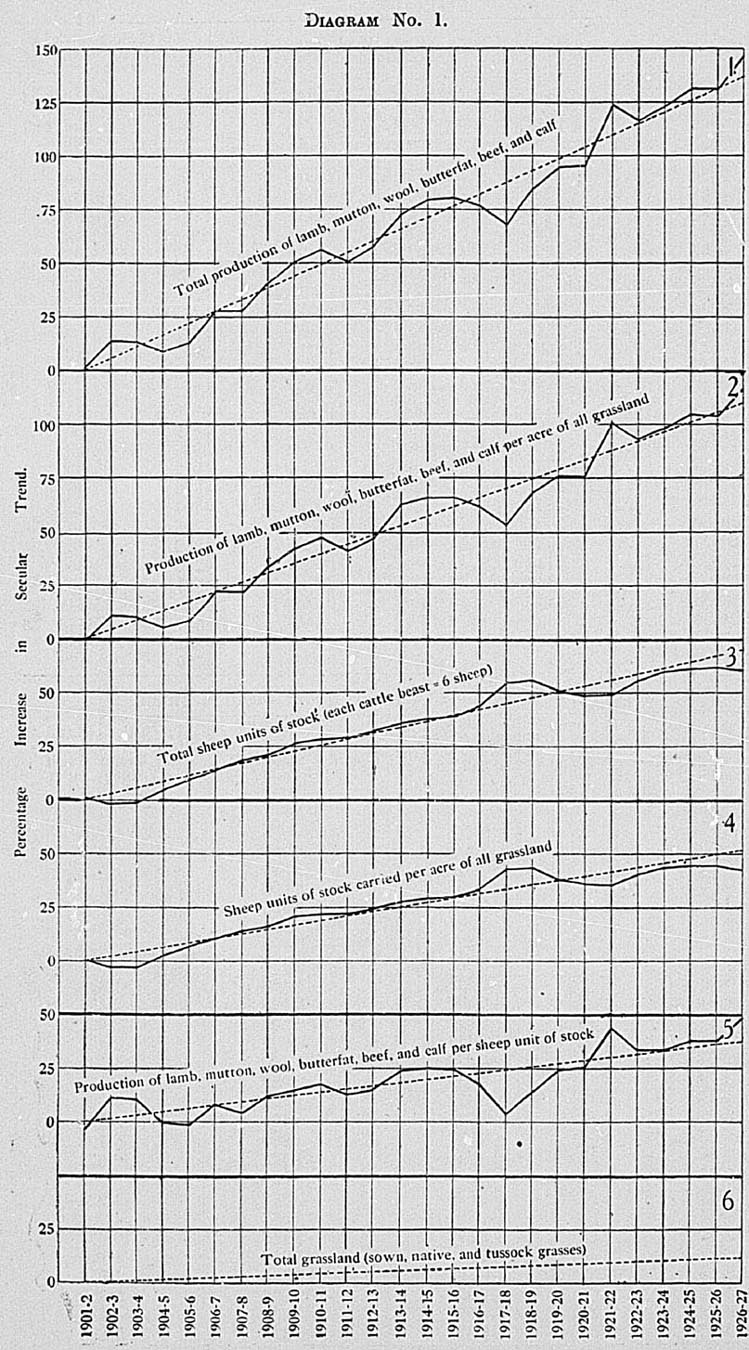
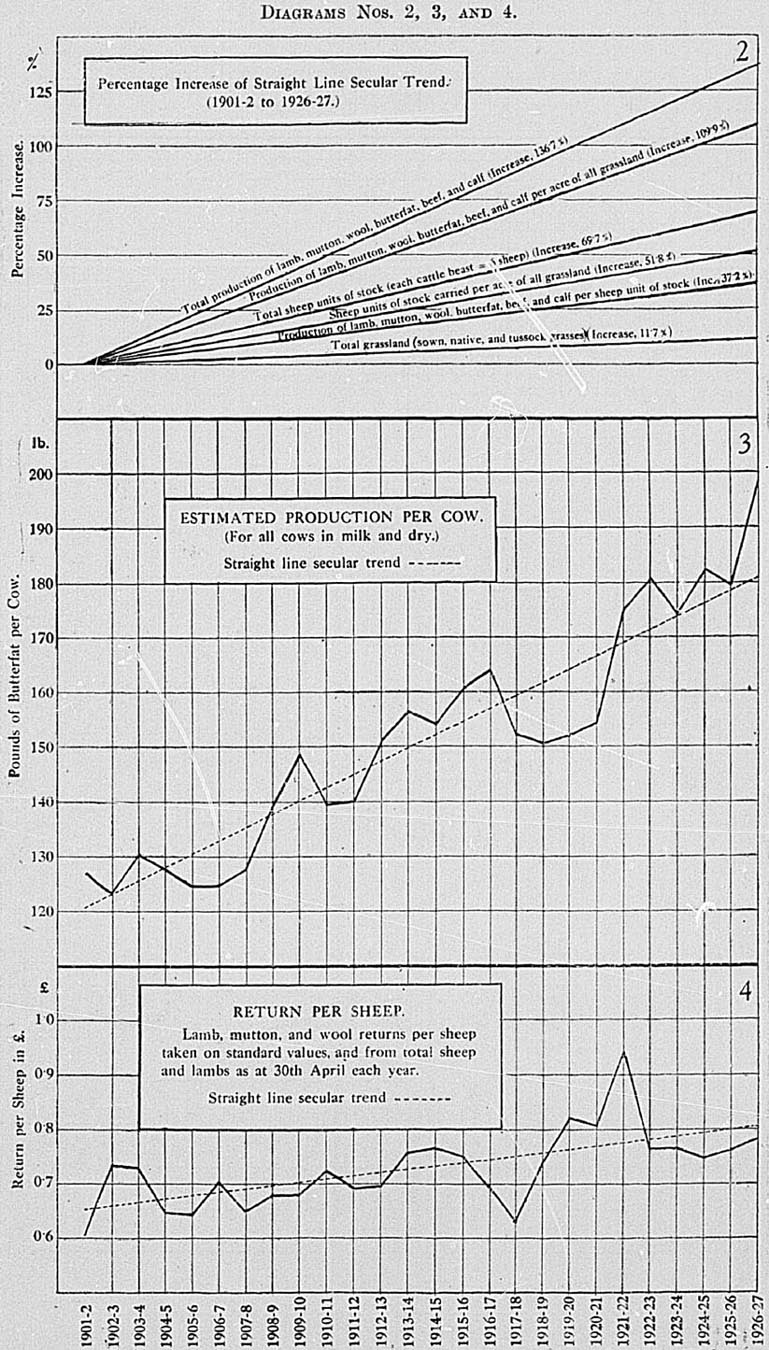
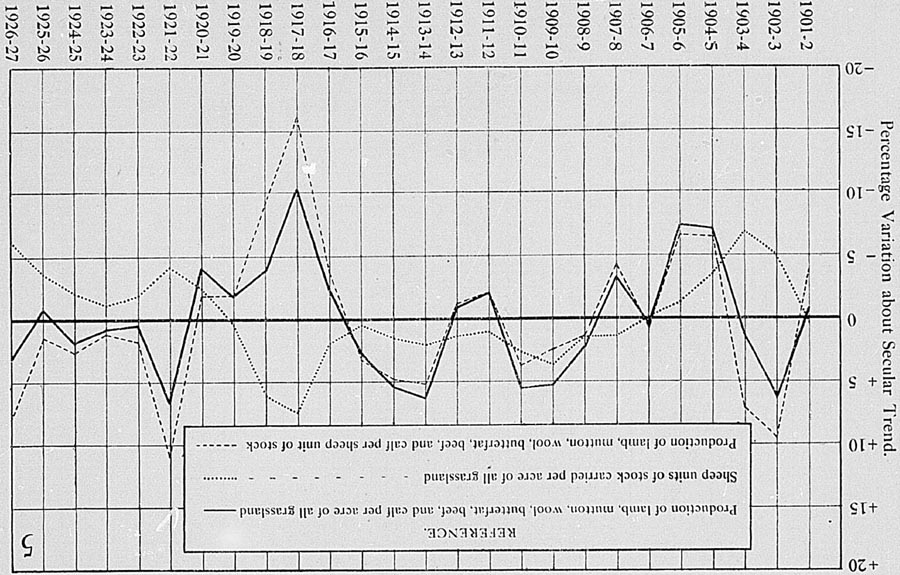
Table of Contents
| POPULATION:— | Males. | Females. | Total. |
|---|---|---|---|
| Estimated (inclusive of Maoris but exclusive of residents of Cook and other Pacific islands) at 30th September, 1928 | 743,830 | 712,883 | 1,456,713 |
| MIGRATION:— | Males. | Females. | Total. |
|---|---|---|---|
| Arrivals (excluding crews), ten months, 1928 | 14,948 | 12,286 | 27,234 |
| Departures (excluding crews), ten months, 1928 | 16,592 | 13,975 | 30,567 |
| VITAL STATISTICS:— | Males. | Females. | Total. |
|---|---|---|---|
| Births, nine months, 1928 | 10,632 | 9,867 | 20,499 |
| Deaths, nine months, 1928 | 4,911 | 3,913 | 8,824 |
| Corresponding yearly rates per 1,000 | Births, 19.68; deaths, 8.47 | ||
| EXPORTS:— | £ |
|---|---|
| Total for ten months, 1928 | 48,445,630 |
| Total, New Zealand produce, ten months, 1928 | 47,143,984 |
| Quantity. | Value. | ||
|---|---|---|---|
| Principal items (New Zealand produce)— | £ | ||
| Butter | cwt. | 1,111,633 | 8,592,844 |
| Cheese | cwt. | 1,232,690 | 5,196,727 |
| Beef, frozen | cwt. | 657,771 | 973,126 |
| Lamb, whole carcasses, frozen | cwt. | 1,753,656 | 6,348,730 |
| Mutton, whole carcasses, frozen | cwt. | 931,746 | 1,818,677 |
| Pork, frozen | cwt. | 127,784 | 362,479 |
| Sausage-casings | lb. | 3,549,546 | 747,667 |
| Milk, dried | lb. | 11,981,910 | 263,619 |
| Apples | lb. | 39,091,728 | 489,793 |
| Hides, cattle and horse | number | 388,146 | 843,169 |
| Rabbit-skins | number | 10,791,781 | 516,847 |
| Sheep-skins, with wool | number | 1,166,492 | 427,225 |
| Sheep-skins, without wool | number | 8,577,152 | 1,364,684 |
| Wool | bales | 592,847 | 15,131,080 |
| Phormium-fibre | tons | 10,548 | 287,884 |
| Tallow | tons | 24,228 | 751,572 |
| Kauri-gum | tons | 3,636 | 197,850 |
| Gold | oz. | 98,928 | 407,743 |
| Timber | sup. ft. | 26,736,775 | 290,365 |
| IMPORTS:— | Value. |
|---|---|
| £ | |
| Total for ten months, 1928 | 36,715,283 |
| Principal imports— | |
| Sugar | 876,242 |
| Tea | 774,346 |
| Whisky | 423,084 |
| Cigarettes | 611,896 |
| Tobacco | 640,074 |
| Apparel | 1,861,055 |
| Boots, shoes, and slippers | 915,628 |
| Hosiery | 425,169 |
| Carpeting, matting, and oilcloth | 480,243 |
| Drapery n.e.i. | 395,910 |
| Cotton piece-goods | 1,654,345 |
| Silk, satin, and velvet piece-goods | 862,763 |
| Woollen piece-goods | 706,273 |
| Bags and sacks | 425,559 |
| Crude residual oil | 321,522 |
| Motor-spirit n.e.i. | 1,332,562 |
| Coal | 300,669 |
| Hardware and metal manufactures, n.e.i. | 747,955 |
| Iron and steel—Galvanized plate and sheet | 306,751 |
| Iron and steel—Tubes, pipes, and fittings | 378,618 |
| Electrical machinery and equipment | 1,474,256 |
| Timber | 616,330 |
| Paper, printing | 501,238 |
| Paper, other | 410,029 |
| Motor-vehicles | 2,001,754 |
| Rubber-tires, &c., for motor-vehicles | 816,014 |
| SHIPPING, OVERSEAS:— | Number. | Tonnage. |
|---|---|---|
| Inwards, ten months, 1928 | 498 | 1,793,098 |
| Outwards, ten months, 1928 | 490 | 1,836,808 |
| RAILWAYS:— | £ |
|---|---|
| Operating revenue, 1st April to 13th October, 1928 | 3,701,210 |
| Operating Expenditure, 1st April to 13th October, 1928 | 3,423,884 |
| OCCUPIED HOLDINGS:— | ||
|---|---|---|
| One Acre and over, outside borough boundaries, 1928— | ||
| Sizes of Holdings. | Number | Aggregate Area. |
| Acres. | Acres. | |
| 1-10 | 15,184 | 72,994 |
| 11-50 | 14,130 | 402,040 |
| 51-100 | 11,492 | 887,474 |
| 101-200 | 14,475 | 2,131,205 |
| 201-320 | 8,794 | 2,245,257 |
| 321-640 | 10,369 | 4,722,315 |
| 641-1,000 | 4,259 | 3,425,803 |
| 1,001-5,000 | 5,938 | 11,711,352 |
| 5,001-10,000 | 559 | 3,846,559 |
| 10,001-20,000 | 297 | 4,188,166 |
| 20,001-50,000 | 162 | 4,969,305 |
| Over 50,000 | 57 | 4,852,984 |
| Total | 85,716 | 43,455,454 |
| AGRICULTURE:— | |
|---|---|
| Areas sown or intended to be sown, season 1928-29— | Acres. |
| Wheat | 255,000 |
| Oats | 303,000 |
| Barley | 22,000 |
| Potatoes | 21,100 |
| MORTGAGES:— | Number. | Amount. |
|---|---|---|
| £ | ||
| Registered, seven months ended October, 1928 | 23,177 | 20,397,256 |
| Discharged, seven months ended October, 1928 | 18,135 | 16,363,835 |
| LAND TRANSFERS:— | Number. | Consideration. |
|---|---|---|
| Registrations, seven months ended October, 1928— | £ | |
| Town and suburban properties | 13,819 | 9,502,452 |
| Country properties | 4,854 | 9,481,172 |
| Total | 18,673 | 18,983,624 |
| TELEGRAPHIC BUSINESS:— | Number. | Revenue. |
|---|---|---|
| £ | ||
| Ordinary telegrams, six months ended September, 1928 | 2,561,180 | 131,579 |
| Urgent ordinary telegrams, six months ended September, 1928 | 103,863 | 10,571 |
| Night letter-telegrams, six months ended September, 1928 | 195,456 | 8,667 |
| Press telegrams, six months ended September, 1928 | 276,141 | 35,633 |
| Toll communications, six months ended September, 1928. | 4,989,801 | 207,623 |
| Total | 8,126,441 | 394,073 |
| MONEY-ORDER AND POSTAL-NOTE BUSINESS:— | Number. | Amount. |
|---|---|---|
| £ | ||
| Money-orders issued, six months ended September, 1928 | 395,311 | 2,424,495 |
| Money-orders paid, six months ended September, 1928 | 337,170 | 2,255,574 |
| Postal-notes issued, six months ended September, 1928 | 1,830,255 | 536,757 |
| Postal-notes paid, six months ended September, 1928 | 1,803,594 | 513,963 |
| PENSIONS:— | Number. | Annual Value. |
|---|---|---|
| £ | ||
| Old-age, October, 1928 | 25,621 | 1,076,082 |
| Widows', October, 1928 | 4,235 | 317,625 |
| Military, October, 1928 | 273 | 13,377 |
| War, October, 1928 | 20,640 | 1,135,200 |
| Miners', October, 1928 | 742 | 47,117 |
| Epidemic, October, 1928 | 201 | 7,839 |
| Blind, October, 1928 | 271 | 13,076 |
| Family allowances, October, 1928 | 3,481 | 53,955 |
| BANKRUPTCY:— | North Island. | South Island. | Total. |
|---|---|---|---|
| Persons, &c., adjudged bankrupt, ten months ended October, 1928 | 475 | 198 | 673 |
| Deeds of assignment, ten months ended October, 1928 | 105 | 67 | 172 |
| STATE ADVANCES (LOANS AUTHORIZED):— | Number. | Amount. |
|---|---|---|
| £ | ||
| To settlers, six months ended September, 1928 | 98 | 71,445 |
| To workers, six months ended September, 1928 | 839 | 745,005 |
| ESTATES CERTIFIED FOR STAMP DUTY:— | Number. | Amount. |
|---|---|---|
| £ | ||
| Ten months ended October, 1928 | 4,322 | 11,246,103 |
| CONSOLIDATED FUND:— | £ |
|---|---|
| Receipts, six months ended September, 1928 | 9,183,309 |
| Expenditure, six months ended September, 1928 | 10,596,980 |
| LOANS OF LOCAL BODIES:— | |
|---|---|
| Amount raised six months ended September, 1928:— | £ |
| Counties | 89,417 |
| Boroughs | 942,454 |
| Electric-power Boards | 369,950 |
| Harbour Boards | 134,100 |
| Others | 168,929 |
| Total | 1,704,850 |
| RETAIL PRICES, ALL GROUPS:— | |
| Dominion index number (base: Year, 1914 = 1,000), August, 1928 | 1,613 |
| WAGE RATES:— | |
| Dominion index number (base: Year, 1914 = 1,000), September quarter, 1928 | 1,598 |
| INDUSTRIAL DISPUTES:— | |
| Number reported during nine months ended September, 1928 | 31 |
| Number of workers affected | 8,637 |
| Approximate loss in wages | £20,427 |
The following tables give a numerical epitome of various population characteristics extracted from such records of the Census of 20th April, 1926, as have been compiled to date. In most cases a comparison is provided with the previous census—viz., that of 17th April, 1921. In a few instances data are subject to revision.
The figures, except in two tables dealing specifically with Maoris, do not include the Native population, nor are residents of the Cook and other annexed Pacific islands or Western Samoa included. For detailed statistics reference should be made to the Census results, which are published in separate volumes. (See list on page 74.)
| AGES. | ||||||
|---|---|---|---|---|---|---|
| Age (in Groups of Years). | Numbers. | Proportion per Cent. | Increase since 1921. | |||
| Males. | Females. | Total. | Number. | Per Cent. | ||
| * Decrease. | ||||||
| Under 5 | 68,654 | 65,777 | 134,431 | 10.02 | 5,239 | 4.06 |
| 5 and under 10 | 67,678 | 65,118 | 132,796 | 9.90 | 911 | 0.69 |
| 10 and under 15 | 68,263 | 65,686 | 133,949 | 9.99 | 12,515 | 10.31 |
| 15 and under 20 | 63,481 | 60,833 | 124,314 | 9.27 | 16,964 | 15.80 |
| 20 and under 25 | 57,902 | 54,910 | 112,812 | 8.41 | 15,605 | 16.05 |
| 25 and under 30 | 51,883 | 51,767 | 103,650 | 7.73 | 10,476 | 11.24 |
| 30 and under 35 | 45,290 | 49,589 | 94,879 | 7.07 | -483* | -0.51* |
| 35 and under 40 | 49,042 | 49,609 | 98,651 | 7.36 | 1,279 | 1.31 |
| 40 and under 45 | 48,902 | 46,655 | 95,557 | 7.13 | 7,564 | 8.60 |
| 45 and under 50 | 45,918 | 41,546 | 87,464 | 6.52 | 17,523 | 25.05 |
| 50 and under 55 | 35,218 | 31,069 | 66,287 | 4.94 | 10,391 | 18.59 |
| 55 and under 60 | 27,132 | 24,028 | 51,160 | 3.82 | 11,320 | 28.41 |
| 60 and under 65 | 19,286 | 18,084 | 37,370 | 2.79 | 5,720 | 18.07 |
| 65 and under 70 | 14,449 | 13,206 | 27,655 | 2.06 | 3,191 | 13.04 |
| 70 and under 75 | 10,505 | 8,850 | 19,355 | 1.44 | 3,350 | 20.93 |
| 75 and under 80 | 6,071 | 5,412 | 11,483 | 0.86 | 849 | 7.98 |
| 80 and under 85 | 3,108 | 2,915 | 6,023 | 0.45 | 256 | 4.44 |
| 85 and under 90 | 1,364 | 1,188 | 2,552 | 0.19 | 461 | 22.05 |
| 90 and under 95 | 321 | 285 | 606 | 0.04 | 184 | 43.60 |
| 95 and under 100 | 55 | 59 | 114 | 0.01 | 38 | 50.00 |
| 100 and over | 8 | 4 | 12 | 0.00 | 4 | 50.00 |
| Totals for specified ages | 684,530 | 656,590 | 1,341,120 | 100.00 | 123,357 | 10.13 |
| Unspecified— | ||||||
| Adults | 1,704 | 1,341 | 3,045 | .. | 1,928 | 172.61 |
| Minors | 150 | 154 | 304 | .. | 271 | 821.21 |
| Total population | 686,384 | 658,085 | 1,344,469 | .. | 125,556 | 10.30 |
| AVERAGE AGE, 1896-1926. | ||||||
|---|---|---|---|---|---|---|
| Census. | Males. | Females. | Both Sexes. | |||
| Mean. | Median. | Mean. | Median. | Mean. | Median. | |
| 1896 | 26.27 | 22.21 | 23.83 | 19.92 | 25.12 | 21.04 |
| 1901 | 27.25 | 23.54 | 25.06 | 21.62 | 26.21 | 22.56 |
| 1906 | 27.72 | 24.95 | 25.91 | 23.13 | 26.87 | 24.09 |
| 1911 | 28.04 | 25.98 | 26.57 | 24.28 | 27.35 | 25.19 |
| 1916 | 28.50 | 27.04 | 27.31 | 25.16 | 27.84 | 26.00 |
| 1921 | 28.93 | 26.63 | 28.11 | 25.76 | 28.53 | 26.17 |
| 1926 | 29.42 | 26.46 | 29.03 | 26.50 | 29.23 | 26.48 |
| CONJUGAL CONDITION. | |||||||
|---|---|---|---|---|---|---|---|
| Age (in Groups of Years). | Never married. | Married. | Legally-separated. | Widowed. | Divorced. | Not specified. | Totals. |
| Males. | |||||||
| 16 and under 20 | 49,998 | 213 | 6 | 3 | 1 | 376 | 50,597 |
| 20 and under 21 | 11,609 | 324 | 3 | 10 | .. | 91 | 12,037 |
| 21 and under 25 | 38,869 | 6,486 | 55 | 39 | 17 | 399 | 45,865 |
| 25 and under 30 | 27,081 | 23,879 | 172 | 228 | 114 | 409 | 51,883 |
| 30 and under 35 | 13,085 | 31,105 | 220 | 403 | 203 | 274 | 45,290 |
| 35 and under 40 | 9,841 | 37,495 | 292 | 811 | 309 | 294 | 49,042 |
| 40 and under 45 | 8,048 | 38,721 | 361 | 1,150 | 323 | 299 | 48,902 |
| 45 and under 50 | 7,047 | 36,375 | 329 | 1,530 | 343 | 294 | 45,918 |
| 50 and under 55 | 5,464 | 27,194 | 262 | 1,761 | 275 | 262 | 35,218 |
| 55 and under 60 | 3,997 | 20,636 | 207 | 1,889 | 189 | 214 | 27,132 |
| 60 and under 65 | 2,851 | 13,983 | 173 | 1,998 | 128 | 153 | 19,286 |
| 65 and under 70 | 2,057 | 9,848 | 137 | 2,158 | 91 | 158 | 14,449 |
| 70 and under 75 | 1,464 | 6,499 | 105 | 2,253 | 50 | 134 | 10,505 |
| 75 and under 80 | 808 | 3,270 | 55 | 1,837 | 15 | 86 | 6,071 |
| 80 and under 85 | 411 | 1,346 | 23 | 1,275 | 8 | 45 | 3,108 |
| 85 and under 90 | 185 | 473 | 7 | 676 | 3 | 20 | 1,364 |
| 90 and over | 71 | 96 | 1 | 207 | 1 | 8 | 384 |
| Adults of unspecified age | 253 | 308 | 18 | 67 | 3 | 1,055 | 1,704 |
| Totals, age 16 and over | 183,139 | 258,251 | 2,426 | 18,295 | 2,073 | 4,571 | 468,755 |
| Females. | |||||||
| 16 and under 20 | 46,682 | 1,513 | 12 | 14 | 3 | 278 | 48,502 |
| 20 and under 21 | 10,026 | 1,451 | 16 | 2 | 3 | 68 | 11,566 |
| 21 and under 25 | 28,290 | 14,538 | 132 | 92 | 33 | 259 | 43,344 |
| 25 and under 30 | 18,094 | 32,544 | 334 | 404 | 157 | 234 | 51,767 |
| 30 and under 35 | 10,874 | 36,928 | 334 | 1,061 | 216 | 176 | 49,589 |
| 35 and under 40 | 8,511 | 38,376 | 429 | 1,843 | 279 | 171 | 49,609 |
| 40 and under 45 | 6,745 | 36,387 | 459 | 2,569 | 322 | 173 | 46,655 |
| 45 and under 50 | 5,943 | 31,468 | 423 | 3,276 | 239 | 197 | 41,546 |
| 50 and under 55 | 4,392 | 22,385 | 290 | 3,710 | 160 | 132 | 31,069 |
| 55 and under 60 | 3,263 | 15,882 | 214 | 4,433 | 84 | 152 | 24,028 |
| 60 and under 65 | 2,103 | 10,403 | 178 | 5,193 | 67 | 140 | 18,084 |
| 65 and under 70 | 1,187 | 6,268 | 117 | 5,473 | 42 | 119 | 13,206 |
| 70 and under 75 | 598 | 3,185 | 74 | 4,877 | 17 | 99 | 8,850 |
| 75 and under 80 | 320 | 1,465 | 22 | 3,549 | 3 | 53 | 5,412 |
| 80 and under 85 | 169 | 522 | 8 | 2,187 | 1 | 28 | 2,915 |
| 85 and under 90 | 53 | 128 | 5 | 987 | 1 | 14 | 1,188 |
| 90 and over | 21 | 26 | 1 | 296 | .. | 4 | 348 |
| Adults of unspecified age | 163 | 352 | 15 | 112 | 8 | 691 | 1,341 |
| Totals, age 16 and over | 147,434 | 253,821 | 3,063 | 40,078 | 1,635 | 2,988 | 449,019 |
| RELIGIONS. | ||||||
|---|---|---|---|---|---|---|
| Religious Profession. | Numbers. | Proportion per Cent. | Increase (or Decrease) since 1921. | |||
| Males. | Females. | Total. | Number. | Per Cent. | ||
| Christian. | ||||||
| Church of England | 280,913 | ,273,080 | 553,993 | 41.21 | 39,386 | 7.65 |
| Presbyterian | 167,043 | 163,688 | 330,731 | 24.60 | 31,186 | 10.41 |
| Roman Catholic (including Catholic undefined) | 86,507 | 86,857 | 173,364 | 12.89 | 9,231 | 5.62 |
| Methodist | 58,675 | 62,537 | 121,212 | 9.02 | 8,868 | 7.89 |
| Baptist | 10,169 | 11,786 | 21,955 | 1.63 | 2,029 | 10.18 |
| Brethren | 5,945 | 6,979 | 12,924 | 0.96 | 1,869 | 16.91 |
| Salvation Army | 5,871 | 6,370 | 12,241 | 0.91 | 650 | 5.61 |
| Church of Christ | 3,673 | 4,311 | 7,984 | 0.59 | -656 | -7.59 |
| Congregational | 3,417 | 3,865 | 7,282 | 0.54 | -695 | -8.71 |
| Protestant (undefined) | 2,272 | 1,453 | 3,725 | 0.28 | 3,115 | 510.66 |
| Seventh-day Adventist | 1,160 | 1,713 | 2,873 | 0.21 | 649 | 29.18 |
| Lutheran | 1,481 | 1,002 | 2,483 | 0.19 | -253 | -9.25 |
| Christian Scientist | 534 | 848 | 1,382 | 0.10 | 534 | 62.97 |
| Undenominational Christian | 596 | 769 | 1,365 | 0.10 | 1,333 | 4,165.63 |
| Christadelphian | 503 | 576 | 1,079 | 0.08 | 34 | 3.25 |
| Christian (undefined) | 565 | 465 | 1,030 | 0.08 | -350 | -25.36 |
| Unitarian | 562 | 462 | 1,024 | 0.08 | -399 | -28.04 |
| Pentecostal | 319 | 407 | 726 | 0.05 | 726 | .. |
| Latter Day Saints (Mormon) | 326 | 273 | 599 | 0.05 | 156 | 35.21 |
| Bible Students | 269 | 309 | 578 | 0.04 | 315 | 119.77 |
| Society of Friends (Quaker) | 253 | 196 | 449 | 0.03 | 18 | 4.18 |
| Evangelical | 191 | 225 | 416 | 0.03 | 228 | 121.28 |
| Liberal Catholic | 143 | 186 | 329 | 0.03 | 219 | 199.09 |
| Catholic Apostolic | 126 | 154 | 280 | 0.02 | -100 | -26.32 |
| Missions | 149 | 124 | 273 | 0.02 | 27 | 10.98 |
| Eastern Orthodox Catholic | 173 | 95 | 268 | 0.02 | 75 | 38.86 |
| Ratana | 114 | 79 | 193 | 0.01 | 193 | .. |
| Swedenborgian | 59 | 70 | 129 | 0.01 | 32 | 32.99 |
| Dissenter | 67 | 44 | 111 | 0.01 | 108 | 3,600.00 |
| Church of God | 38 | 35 | 73 | 0.02 | -49 | -40.16 |
| Gospel Hall | 19 | 30 | 49 | 49 | .. | |
| Church of Jesus Christ | 23 | 24 | 47 | 15 | 46.88 | |
| Ringatu | 18 | 17 | 35 | 35 | .. | |
| Danish Church (Lutheran) | 19 | 15 | 34 | 28 | 466.67 | |
| New Thought | 15 | 11 | 26 | 16 | 160.00 | |
| Independent | 13 | 9 | 22 | 4 | 22.22 | |
| Follower of Jesus, Jesus | 12 | 8 | 20 | 3 | 17.65 | |
| Bible Christians | 5 | 10 | 15 | 15 | .. | |
| Conditional Immortalist | 3 | 6 | 9 | -10 | -52.63 | |
| Other Christians | 170 | 96 | 266 | 0.02 | 120 | 82.19 |
| Totals, Christian religions | 632,410 | 629,184 | 1,261,594 | 93.83 | 98,754 | 8.49 |
| Non-Christian. | ||||||
| Hebrew | 1,339 | 1,252 | 2,591 | 0.19 | 211 | 8.87 |
| Confucian | 1,105 | 89 | 1,194 | 0.09 | -906 | -43.13 |
| Theosophist | 308 | 374 | 682 | 0.05 | -150 | -18.03 |
| Hindu | 335 | 3 | 338 | 0.03 | -$48 | -12.44 |
| Buddhist | 160 | 9 | 169 | 0.01 | 126 | 293.02 |
| Sikh | 91 | 6 | 97 | 0.02 | 59 | 155.26 |
| Mohammedan | 75 | 1 | 76 | 11 | 16.92 | |
| Bahai | 7 | 18 | 25 | 23 | 1,150.00 | |
| Faithist, Kosmon Faithist | 12 | 5 | 17 | 17 | .. | |
| Brahman | 13 | 2 | 15 | -1 | -6.25 | |
| Other Non-Christian Religions | 28 | 6 | 34 | -2 | -5.56 | |
| Totals, Non - Christian religions | 3,473 | 1,765 | 5,238 | 0.39 | -660 | -11.19 |
| Other Beliefs. | ||||||
| No religion (so returned) | 2,160 | 678 | 2,838 | 0.21 | -1,081 | -27.58 |
| Spiritualist | 607 | 664 | 1,271 | 0.10 | -239 | -15.83 |
| No denomination | 488 | 445 | 933 | 0.07 | -449 | -32.49 |
| Freethinker | 641 | 177 | 818 | 0.06 | -391 | -32.34 |
| Agnostic | 628 | 176 | 804 | 0.06 | 78 | 10.74 |
| Rationalist | 374 | 183 | 557 | 0.04 | 127 | 29.53 |
| Atheist | 193 | 61 | 254 | 0.02 | 63 | 32.98 |
| Uncertain | 134 | 90 | 224 | 0.02 | 55 | 32.54 |
| Socialist | 22 | 16 | 38 | .. | -29 | -43.28 |
| Truth | 13 | 7 | 20 | .. | 13 | 185.71 |
| Deist | 16 | 3 | 19 | .. | .. | .. |
| Higher Thought | 5 | 10 | 15 | .. | 15 | .. |
| Humanitarian | 7 | 5 | 12 | .. | -4 | -25.00 |
| Others | 191 | 85 | 276 | 0.02 | 73 | 35.96 |
| Totals, other beliefs | 5,479 | 2,600 | 8,079 | 0.60 | -1,769 | -17.96 |
| Object to state | 40,970 | 21,615 | 62,585 | 4.66 | 23,994 | 62.18 |
| Not specified | 4,052 | 2,921 | 6,973 | 0.52 | 5,237 | 301.67 |
| Grand totals | 686,384 | 658,085 | 1,344,469 | 100.00 | 125,556 | 10.30 |
| PLACES OF WORSHIP. | ||||
|---|---|---|---|---|
| Provincial District. | Number of Places of Worship. | Number of Persons for whom Accommodation.* | Number of Persons usually present at largest attended Service of Day.* | Number of Persons resident in Church District who attend Services.* |
| * Excludes cases in which accommodation, &c., not specified. | ||||
| Auckland | 1,397 | 173,423 | 76,607 | 124,972 |
| Hawke's Bay | 226 | 27,015 | 12,420 | 25,130 |
| Taranaki | 240 | 27,676 | 12,800 | 24,086 |
| Wellington | 665 | 90,187 | 45,112 | 88,200 |
| Marlborough | 128 | 8,934 | 4,423 | 9,202 |
| Nelson | 251 | 25,106 | 11,039 | 15,790 |
| Westland | 111 | 9,542 | 5,023 | 7,804 |
| Canterbury | 580 | 82,262 | 41,189 | 85,235 |
| Otago— | ||||
| Otago portion | 460 | 65,113 | 30,251 | 56,637 |
| Southland portion | 225 | 29,575 | 15,335 | 25,429 |
| Totals | 4,283 | 538,833 | 254,199 | 462,485 |
| ORPHANHOOD. | ||||
|---|---|---|---|---|
| Condition as to Orphanhood. | Census, 1921. | Census, 1926. | ||
| Number. | Proportion Per Cent. | Number. | Proportion Per Cent. | |
| Male children (under 16 years)— | ||||
| Parents both living | 185,595 | 91.00 | 198,244 | 92.00 |
| Father dead | 10,596 | 5.20 | 10,024 | 4.65 |
| Mother dead | 6,616 | 3.24 | 6,113 | 2.84 |
| Parents both dead | 1,152 | 0.56 | 1,104 | 0.51 |
| Totals | 203,959 | 100.00 | 215,485 | 100.00 |
| Female children (under 16 years)— | ||||
| Parents both living | 179,185 | 90.85 | 190,272 | 91.92 |
| Father dead | 10,424 | 5.28 | 9,698 | 4.69 |
| Mother dead | 6,545 | 3.32 | 5,976 | 2.89 |
| Parents both dead | 1,085 | 0.55 | 1,042 | 0.50 |
| Totals | 197,239 | 100.00 | 206,988 | 100.00 |
| All children (under 16 years)— | ||||
| Parents both living | 364,780 | 90.92 | 388,516 | 91.96 |
| Father dead | 21,020 | 5.24 | 19,722 | 4.67 |
| Mother dead | 13,161 | 3.28 | 12,089 | 2.86 |
| Parents both dead | 2,237 | 0.56 | 2,146 | 0.51 |
| Totals | 401,198 | 100.00 | 422,473 | 100.00 |
| Unspecified cases— | ||||
| Male children (under 16 years) | 2,237 | .. | 2,144 | .. |
| Female children (under 16 years) | 1,966 | .. | 2,078 | .. |
| DEPENDENT CHILDREN. | ||||
|---|---|---|---|---|
| Number of Dependent Children.* | Married Men and Widowers. | Widows. | ||
| Number of Cases. | Proportion per Cent. | Number of Cases. | Proportion per Cent. | |
| * I.e., children under 16 years of age. | ||||
| Nil or not specified | 113,974 | 41.21 | 31,993 | 79.83 |
| 1 | 55,959 | 20.24 | 3,675 | 9.17 |
| 2 | 45,553 | 16.47 | 2,091 | 5.22 |
| 3 | 28,542 | 10.32 | 1,177 | 2.94 |
| 4 | 16,060 | 5.81 | 614 | 1.53 |
| 5 | 8,488 | 3.07 | 307 | 0.76 |
| 6 | 4,273 | 1.55 | 124 | 0.31 |
| 7 | 2,141 | 0.77 | 51 | 0.13 |
| 8 | 980 | 0.36 | 22 | 005 |
| 9 | 366 | 0.13 | 15 | 0.04 |
| 10 | 148 | 0.05 | 7 | 0.02 |
| 11 | 46 | 0.02 | 1 | .. |
| 12 | 12 | .. | 1 | .. |
| 13 | 3 | .. | .. | .. |
| 14 | 1 | .. | .. | .. |
| Totals | 276,546 | 100.00 | 40,078 | 100.00 |
| RACE ALIENS. | |||||||
|---|---|---|---|---|---|---|---|
| Race. | Numbers. | Proportion per Cent. | Increase since 1921.* | ||||
| Males. | Females. | Both Sexes. | Males. | Females. | Per Cent. | ||
* The minus sign (-) denotes a decrease. † Excludes all Maori half-castes, but includes quarter-castes. | |||||||
| European† | 681,501 | 656,666 | 1,338,167 | 99.53 | 64,872 | 64,056 | 10.66 |
| Race aliens— | |||||||
| Chinese— | |||||||
| Full blood | 2,770 | 316 | 3,086 | 0.25 | -135 | 111 | -0.77 |
| Mixed blood | 157 | 131 | 288 | 69 | 63 | 84.62 | |
| Indian— | |||||||
| Full blood | 661 | 30 | 691 | 0.07 | 62 | 11 | 11.81 |
| Mixed blood | 149 | 147 | 296 | 126 | 117 | 458.49 | |
| Syrian— | |||||||
| Full blood | 449 | 367 | 816 | 0.07 | 98 | 67 | 25.35 |
| Mixed blood | 76 | 59 | 135 | 49 | 30 | 141.07 | |
| Japanese | 41 | 18 | 59 | 0.01 | 12 | 9 | 55.26 |
| Filipino | 14 | 2 | 16 | 14 | 2 | .. | |
| Arab | 14 | .. | 14 | 11 | .. | 366.67 | |
| Other Asiatic | 10 | 6 | 16 | -50 | -42 | -85.19 | |
| Polynesian, n.e.i.— | |||||||
| Full blood | 138 | 42 | 180 | 0.04 | 29 | 2 | 20.81 |
| Mixed blood | 205 | 203 | 408 | 114 | 109 | 120.54 | |
| Fijian | 67 | 42 | 109 | 0.01 | 53 | 30 | 319.23 |
| Negro | 71 | 22 | 93 | 0.01 | -6 | 3 | -3.13 |
| West Indian | 37 | 24 | 61 | 0.01 | 13 | 7 | 48.78 |
| Abyssinian | 8 | 2 | 10 | 1 | 1 | 25.00 | |
| Australian aboriginal | 8 | 2 | 10 | 5 | 1 | 150.00 | |
| Other race aliens | 6 | 5 | 11 | -21 | 4 | -60.71 | |
| Half-caste, race not specified | 2 | 1 | 3 | -29 | -27 | -94.92 | |
| Not specified, but apparently non-European | .. | .. | .. | .. | -39 | -10 | -100.00 |
| Totals, race aliens | 4,883 | 1,419 | 6,302 | 0.47 | 376 | 488 | 15.89 |
| Grand totals, all races | 686,384 | 658,085 | 1,344,469 | 100.00 | 65,248 | 64,544 | 10.69 |
| DURATION OF RESIDENCE. | ||||
|---|---|---|---|---|
| Duration of Residence. | Males. | Females. | Total | Per cent. of Population.* |
| * Proportions in this column are exclusive of unspecified cases. | ||||
| Native-born | 493,009 | 498,287 | 991,296 | 75.4 |
| Foreign-born— | ||||
| Under 5 years | 35,195 | 27,068 | 62,263 | 4.7 |
| 5 and under 10 years | 14,439 | 15,509 | 29,948 | 2.3 |
| 10 “ 15 “ | 20,640 | 19,557 | 40,197 | 3.0 |
| 15 “ 20 “ | 25,292 | 18,019 | 43,311 | 3.3 |
| 20 “ 25 “ | 18,801 | 10,700 | 29,501 | 2.2 |
| 25 “ 30 “ | 8,516 | 4,605 | 13,121 | 1.0 |
| 30 “ 35 “ | 6,884 | 4,852 | 11,736 | 0.9 |
| 35 “ 40 “ | 5,117 | 3,883 | 9,000 | 0.7 |
| 40 “ 45 “ | 9,442 | 8,630 | 18,072 | 1.4 |
| 45 “ 50 “ | 10,525 | 8,902 | 19,427 | 1.5 |
| 50 “ 55 “ | 13,725 | 12,205 | 25,930 | 2.0 |
| 55 “ 60 “ | 2,858 | 2,792 | 5,650 | 0.4 |
| 60 and over | 7,933 | 7,866 | 15,799 | 1.2 |
| Totals, foreign-born | 179,367 | 144,588 | 323,955 | 24.6 |
| Not specified | 14,008 | 15,210 | 29,218 | * |
| Grand totals | 686,384 | 658,085 | 1,344,469 | 100.0 |
| INDUSTRIAL DISTRIBUTION. | ||||||
|---|---|---|---|---|---|---|
| Industry Group. | Census, 1921. | Census, 1926. | ||||
| Males. | Females. | Total. | Males. | Females. | Total. | |
| Numbers. | ||||||
| Primary production | 142,736 | 9,200 | 151,936 | 138,550 | 3,526 | 142,076 |
| Industrial | 98,613 | 20,319 | 118,932 | 113,641 | 20,616 | 134,257 |
| Transport and communication | 52,665 | 2,670 | 55,335 | 56,441 | 2,283 | 58,724 |
| Commerce and finance | 58,519 | 20,601 | 79,120 | 64,295 | 19,493 | 83,788 |
| Public administration and professional | 29,803 | 22,082 | 51,885 | 34,307 | 23,948 | 58,255 |
| Domestic and personal service | 8,927 | 32,762 | 41,689 | 8,084 | 36,416 | 44,500 |
| Other groups | 15,151 | 18,771 | 33,922 | 23,758 | 16,490 | 40,248 |
| Total breadwinners | 406,414 | 126,405 | 532,819 | 439,076 | 122,772 | 561,848 |
| Dependants | 206,377 | 467,019 | 673,396 | 223,682 | 528,273 | 751,955 |
| Unspecified | 10,452 | 2,246 | 12,698 | 23,626 | 7,040 | 30,666 |
| Totals | 623,243 | 595,670 | 1,218,913 | 686,384 | 658,085 | 1,344,469 |
| Proportions per Cent. | ||||||
| Primary production | 23.29 | 1.55 | 12.60 | 20.90 | 0.54 | 10.82 |
| Industrial | 16.09 | 3.43 | 9.86 | 17.15 | 3.17 | 10.22 |
| Transport and communication | 8.60 | 0.45 | 4.59 | 8.52 | 0.35 | 4.47 |
| Commerce and finance | 9.55 | 3.47 | 6.56 | 9.70 | 3.00 | 6.38 |
| Public administration and professional | 4.86 | 3.72 | 4.30 | 5.18 | 3.68 | 4.43 |
| Domestic and personal service | 1.46 | 5.52 | 3.45 | 1.22 | 5.59 | 3.39 |
| Other groups | 2.47 | 3.16 | 2.81 | 3.58 | 2.53 | 3.06 |
| Total breadwinners | 66.32 | 21.30 | 44.17 | 66.25 | 18.86 | 42.77 |
| Dependants | 33.68 | 78.70 | 55.83 | 33.75 | 81.14 | 57.23 |
| Totals | 100.00 | 100.00 | 100.00 | 100.00 | 100.00 | 100.00 |
| OCCUPATIONS. | |||
|---|---|---|---|
| Occupation Group. | Males. | Females. | Total. |
| Fishermen and trappers | 2,784 | 6 | 2,790 |
| Agricultural and pastoral occupations | 116,295 | 3,279 | 119,574 |
| Forest occupations | 6,201 | 9 | 6,210 |
| Miners and quarrymen | 7,319 | .. | 7,319 |
| Workers in stone, clay, earthenware, lime, cement, and glass, &c. | 1,992 | 5 | 1,997 |
| Workers in processes relating to chemicals, animal and vegetable products n.e.i. | 2,906 | 111 | 3,017 |
| Workers in non-precious metals, electric fittings, &c. | 25,813 | 60 | 25,873 |
| Workers in precious metals, jewellery, scientific instruments, &c. | 952 | 17 | 969 |
| Makers of ships, boats, conveyances, &c. | 7,545 | 7 | 7,552 |
| Workers in fibrous materials, textiles, &c. | 3,422 | 1,775 | 5,197 |
| Workers in clothing and dress | 6,258 | 13,284 | 19,542 |
| Workers in harness, saddlery, and leatherware (excluding boots and shoes) | 978 | 95 | 1,073 |
| Workers in food, drink, and tobacco | 12,144 | 779 | 12,923 |
| Workers in wood n.e.i. | 25,045 | 134 | 25,179 |
| Workers in paper, printers, and photographers | 4,817 | 1,670 | 6,487 |
| Workers in other materials | 568 | 203 | 771 |
| Workers in building and construction | 23,343 | 14 | 23,357 |
| Workers in the supply of gas, water, electricity or power, stationary-engine drivers, &c. | 3,249 | 23 | 3,272 |
| Workers in transport and communication | 41,388 | 1,125 | 42,513 |
| Commercial occupations | 53,043 | 14,243 | 67,286 |
| Public administration | 8,578 | 12,550 | 21,128 |
| Clerical and professional | 42,370 | 26,890 | 69,260 |
| Entertainment, sport, and recreation | 3,122 | 452 | 3,574 |
| Personal and domestic, hotelkeeping, &c. | 9,260 | 38,841 | 48,101 |
| Other or ill-defined occupations | 34,391 | 1,771 | 36,162 |
| Persons not actively engaged in gainful occupations | 242,601 | 540,742 | 783,343 |
| Totals | 686,384 | 658,085 | 1,344,469 |
NOTE.—Compiled on basis of personal occupation, irrespective of industry with which associated.
| INDUSTRIES. | |||
|---|---|---|---|
| Industry Group. | Males. | Females. | Total. |
| Fishing and trapping | 2,599 | 7 | 2,606 |
| Agricultural and pastoral | 116,953 | 3,396 | 120,349 |
| Forestry | 10,614 | 94 | 10,708 |
| Mining and quarrying | 8,384 | 29 | 8,413 |
| Manufacture, &c.— | |||
| Stone, clay, earthenware, &c., n.e.i. | 2,788 | 37 | 2,825 |
| Chemicals, animal and vegetable products n.e.i. | 3,857 | 227 | 4,084 |
| Metals, implements | 14,502 | 330 | 14,832 |
| Carriages and vehicles | 2,127 | 29 | 2,156 |
| Shipbuilding and equipment | 621 | 3 | 624 |
| Jewellery, watch and clock making | 814 | 28 | 842 |
| Textile fabrics and fibrous materials | 3,178 | 1,544 | 4,722 |
| Dress | 6,347 | 13,374 | 19,721 |
| Harness, saddlery, and leatherware | 958 | 97 | 1,055 |
| Food, drink, and tobacco | 17,212 | 1,951 | 19,163 |
| Woodworking, cane and basket ware | 2,426 | 124 | 2,550 |
| Furniture and fittings | 3,356 | 232 | 3,588 |
| Stationery, printing, bookbinding, and photography | 6,445 | 2,080 | 8,525 |
| Other miscellaneous manufactures | 883 | 159 | 1,042 |
| Construction or repair of buildings, roads, railways, &c. | 43,086 | 221 | 43,307 |
| Gas, water, and electricity supply | 4,772 | 180 | 4,952 |
| Transport | 47,972 | 956 | 48,928 |
| Communication | 8,469 | 1,327 | 9,796 |
| Commerce and finance | 64,295 | 19,493 | 83,788 |
| Public administration | 9,585 | 1,009 | 10,594 |
| Defence (including naval) | 1,805 | 23 | 1,828 |
| Law and order | 4,306 | 1,240 | 5,546 |
| Religion and social welfare | 2,256 | 2,347 | 4,603 |
| Health | 3,983 | 8,196 | 12,179 |
| Education | 5,197 | 9,750 | 14,947 |
| Other professional | 3,521 | 772 | 4,293 |
| Entertainment, sport, and recreation | 3,654 | 611 | 4,265 |
| Personal and domestic service | 8,084 | 36,416 | 44,500 |
| No industry, or industry not stated | 47,384 | 23,530 | 70,914 |
| Dependent on public or private support | 223,951 | 528,273 | 752,224 |
| Totals | 686,384 | 658,085 | 1,344,469 |
NOTE.—Compiled on basis of industry, &c., with which associated.
| MAORIS.—AGES. | |||
|---|---|---|---|
| Age (in Groups of Years). | Males. | Females. | Total. |
| Under 5 | 5,240 | 5,140 | 10,380 |
| 5 and under 10 | 4,534 | 4,295 | 8,829 |
| 10 “ 15 | 4,146 | 3,882 | 8,028 |
| 15 “ 20 | 3,512 | 3,251 | 6,763 |
| 20 “ 25 | 2,916 | 2,715 | 5,631 |
| 25 “ 30 | 2,455 | 2,269 | 4,711 |
| 20 “ 35 | 1,705 | 1,578 | 3,283 |
| 35 “ 40 | 1,728 | 1,424 | 3,152 |
| 40 “ 45 | 1,416 | 1,256 | 2,672 |
| 45 “ 50 | 1,336 | 1,037 | 2,373 |
| 50 “ 55 | 1,052 | 839 | 1,891 |
| 55 “ 60 | 833 | 617 | 1,450 |
| 60 “ 65 | 719 | 668 | 1,387 |
| 65 “ 70 | 579 | 461 | 1,040 |
| 70 “ 75 | 431 | 389 | 820 |
| 75 “ 80 | 230 | 175 | 405 |
| 80 “ 85 | 141 | 143 | 284 |
| 85 “ 90 | 55 | 62 | 117 |
| 90 “ 95 | 24 | 29 | 53 |
| 95 “ 100 | 14 | 20 | 34 |
| 100 and over | 8 | 20 | 28 |
| Totals, specified ages | 33,074 | 30,270 | 63,344 |
| Unspecified— | |||
| Adults | 90 | 81 | 171 |
| Minors | 53 | 47 | 100 |
| Unspecified in any way | 41 | 14 | 55 |
| Totals | 33,258 | 30,412 | 63,670 |
| MAORIS—RELIGIOUS PROFESSIONS. | ||||
|---|---|---|---|---|
| Religious Profession. | Males. | Females. | Total. | Per cent. of Maori Population. |
| Christian— | ||||
| Church of England | 11,463 | 10,275 | 21,738 | 3,414 |
| Ratana Church | 5,980 | 5,587 | 11,567 | 18.17 |
| Roman Catholic | 4,327 | 4,231 | 8,558 | 13.44 |
| Ringatu (including Hauhau) | 2,360 | 2,180 | 4,540 | 7.13 |
| Methodist | 2,111 | 1,955 | 4,066 | 6.39 |
| Mission, n.o.d. | 1,966 | 1,838 | 3,804 | 5.97 |
| Latter-day Saints (Mormon) | 1,783 | 1,678 | 3,461 | 5.44 |
| Preshyterian | 319 | 319 | 638 | 1.00 |
| Followers of Te Whiti and Toliu | 202 | 173 | 375 | 0.59 |
| Maori Church (so returned) | 47 | 43 | 90 | 0.14 |
| Seventh-day Adventist | 39 | 45 | 84 | 0.13 |
| Seven Rules of Jehovah | 41 | 30 | 71 | 0.11 |
| Other Christian Churches | 168 | 167 | 335 | 0.53 |
| Non-Christian Churches | 6 | 6 | 12 | 0.02 |
| Other beliefs | 229 | 210 | 439 | 0.69 |
| Object to state | 1,825 | 1,368 | 3,193 | 5.01 |
| Indefinitely specified | 392 | 307 | 699 | 1.10 |
| Totals | 33,258 | 30,412 | 63,670 | 100.00 |
| PUBLIC LIBRARIES. | ||||||
|---|---|---|---|---|---|---|
| Provincial District. | Number of Public Libraries. | Number of Subscribers. | Average Number of Subscribers per Library. | Number of Volumes in Library. | Number of Newspapers regularly received. | Number of Magazines, Periodicals, &c., regularly received. |
| Auckland | 106 | 13,288 | 125 | 329,803 | 610 | 1,182 |
| Hawke's Bay | 21 | 2,211 | 105 | 63,700 | 160 | 165 |
| Taranaki | 23 | 2,480 | 108 | 63,391 | 176 | 196 |
| Wellington | 48 | 10,169 | 212 | 202,393 | 479 | 779 |
| Marlborough | 9 | 521 | 58 | 17,154 | 31 | 21 |
| Nelson | 30 | 2,079 | 69 | 55,156 | 122 | 195 |
| Westland | 14 | 583 | 42 | 17,898 | 70 | 75 |
| Canterbury | 86 | 13,820 | 161 | 245,375 | 256 | 899 |
| Otago— | ||||||
| Otago portion | 64 | 15,384 | 240 | 209,698 | 287 | 715 |
| Southland portion | 34 | 2,868 | 84 | 62,324 | 144 | 344 |
| Totals | 435 | 63,403 | 146 | 1,266,892 | 2,335 | 4,571 |
| CHRONOLOGICAL LIST OF SOME OF THE PRINCIPAL EVENTS IN THE HISTORY OF NEW ZEALAND. | |
| 1642. | Discovery of New Zealand by Tasman. |
| 1769. | Captain Cook's first visit to New Zealand. |
| 1788. | Discovery of Macaulay and Curtis Islands (Kermadec Group), and of Bounty Islands. |
| 1791. | Discovery of Snares and Chatham Islands. |
| 1792. | First sealing gang left on New Zealand coast. |
| 1793. | Discovery of Raoul or Sunday Island (Kermadec Group). Visit of Lieutenant Governor King, of Norfolk Island, to Doubtless Bay. |
| 1800. | Discovery of Antipodes Islands. |
| 1806. | Discovery of Auckland Islands. |
| 1807. | Defeat of Hongi and the Ngapuhi Tribe. |
| 1810. | Discovery of Campbell Island. |
| 1814. | Arrival of Rev. Samuel Marsden, and introduction of Christianity. Horses, oxen, sheep, and poultry first brought to New Zealand. |
| 1818. | Hongi's and Te Morenga's great expedition to East Cape. |
| 1819-20. | Raid on Taranaki and Port Nicholson by Patuone, Nene, and Te Rauparaha. |
| 1820. | Hongi's visit to England. Rev. S. Marsden travelled from Waitemata, via Kaipara, to Bay of Islands—the first white man to do so. First vessel entered Auckland Harbour. |
| 1821. | Hongi's capture of Mauinaina and Te Totara Pas. Ngati-Toa migration from Kawhia to Otaki. |
| 1822. | Fall of Matakitaki Pa, Waikato, to Hongi. |
| 1823. | Fall of Mokoia Pa, Rotorua, to Hongi. |
| 1823-28. | Jurisdiction of Courts of Justice in New South Wales extended to British subjects in New Zealand. |
| 1824. | Fall of Te Whetumatarau Pa to Pomare. |
| 1825. | First attempt at colonization by an expedition under Captain Herd. Great defeat of Ngati-Whatau by Hongi. |
| 1827. | Hongi's forces destroyed mission station at Whangaroa. |
| 1828. | Death of Hongi. |
| 1829. | Brig “Hawes” captured by Maoris. |
| 1830. | Battles of Taumata-wiwi and Kororareka. Fall of Kaiapohia Pa, Canterbury, to Te Rauparaha. |
| 1831. | Tory Channel whaling-station established. Application of thirteen chiefs for the protection of King William IV. Capture of Pukerangiora Pa, Waitara, by Waikato. |
| 1832. | Repulse of Waikato at Nga-motu Pa. |
| 1833. | Mr. Busby appointed British Resident at Bay of Islands. |
| 1834. | Bishop William's first visit to East Cape. Battle near Otaki. Waimate Pa shelled and captured by British—first occasion on which H.M. troops employed in New Zealand. |
| 1835. | Declaration of independence of the whole of New Zealand as one nation, with title of “United Tribes of New Zealand.” Ngati-Awa tribes migrated to and conquered Chatham Islands. |
| 1836. | Battles between Waikato and Te Arawa. |
| 1838. | Pelorus Sound discovered. Arrival of Roman Catholic mission under Bishop Pompallier. |
| 1839. | Governor of New South Wales authorized to include within the limits of that colony any territory that might be acquired in sovereignty by Her Majesty in New Zealand. Preliminary expedition of New Zealand Company under Colonel Wakefield arrived at Port Nicholson. |
| 1840. | Arrival of New Zealand Company's settlers at Port Nicholson. Treaty of Waitangi signed. British sovereignty proclaimed. Captain Hobson appointed Lieutenant-Governor, with residence at Auckland. Settlements formed at Petre (Wanganui) and Akaroa. |
| 1841. | Issue of charter of incorporation of New Zealand Company. New Zealand proclaimed independent of New South Wales. Arrival of New Plymouth settlers. |
| 1842. | Settlement founded at Nelson. |
| 1843. | Affray with Natives at the Wairau, and massacre of persons who had surrendered. |
| 1844. | Royal flagstaff at Kororareka cut down by Heke. |
| 1845. | Destruction of Kororareka by Heke. |
| 1846. | Arrival of first steam vessel (H.M.S. “Driver”) in New Zealand waters. Capture of pa at Ruapekapeka and termination of Heke's war. Native hostilities near Wellington. Te Rauparaha captured and detained as a prisoner. New Zealand divided into two provinces, New Munster and New Ulster, and representative institutions conferred. |
| 1847. | Attack by Maoris on Wanganui. |
| 1848. | Suspension of that part of New Zealand Government Act which had conferred representative institutions. Severe earthquake at Wellington. Otago founded. |
| 1850. | Surrender of New Zealand Company's charter, all its interests reverting to the Imperial Government. Canterbury founded. |
| 1852. | Discovery of gold at Coromandel. Constitution Act passed, granting representative institutions to New Zealand, and dividing country into six provinces. |
| 1854. | Opening at Auckland of first session of the General Assembly. |
| 1855. | First members elected to the House of Representatives under system of responsible Government. Very severe earthquake on both sides of Cook Strait. |
| 1856. | Appointment of first Ministry under system of responsible Government. |
| 1857. | Goldfield opened at Collingwood. |
| 1858. | New Provinces Act passed. Hawke's Bay Province constituted. |
| 1859. | Establishment of Marlborough Province. |
| 1860. | Hostilities in Waitara district. |
| 1861. | Truce arranged with Waitara Maoris. Bank of New Zealand incorporated. Southland Province established. Gold discovered at Gabriel's Gully, Otago. |
| 1862. | Coromandel proclaimed a goldfield. Wreck of s.s. “White Swan,” with loss of many public records. First electric-telegraph line opened—Christchurch to Lyttelton. |
| 1863. | Wreck of H.M.S. “Orpheus” on Manukau bar, with loss of 181 lives. Control of Native affairs transferred to Colonial Government. Commencement of Waikato War. Defeat of Maoris at Rangiriri, and occupation of Ngaruawahia. First railway in New Zealand opened. |
| 1864. | Severe fighting in Waikato and elsewhere, including Battles of Rangiaohia, Orakau, Gate Pa, and Te Ranga. Gold discovered on west coast of South Island. |
| 1865. | Seat of Government transferred to Wellington. Further fighting, followed by proclamation of peace. Activities of Hauhau fanatics, including murders of Europeans. Rebel Natives defeated at Wairoa. |
| 1866. | Further defeats of rebel Natives. Commencement of Panama steam mail-service. Cook Strait submarine telegraph-cable laid. |
| 1867. | Opening of Thames Goldfield. Admission of four Maori members to House of Representatives as direct representatives of Maori people. |
| 1868. | Maori prisoners, under leadership of Te Kooti, seized schooner “Rifleman” and escaped from Chatham Islands to mainland, where they massacred Europeans and were engaged in a series of fights with European forces and friendly Natives. Considerable fighting also with other rebel Natives. |
| 1869. | Continuation of fighting with rebels and of pursuit after Te Kooti. Termination of Panama mail-service. Visit of H.R.H. the Duke of Edinburgh. Government Life Insurance Office established. |
| 1870. | Further fighting with Te Kooti. Last of Imperial troops left New Zealand. Commencement of San Francisco mail-service. Bounty Island taken possession of Inauguration of Vogel public-works policy. Act passed to establish the New Zealand University. Southland Province reunited with Otago. |
| 1871. | Commencement of railway-construction under public-works policy. |
| 1872. | Resumption of friendly relations with Waitara Maoris. Appointment of Maori chiefs (two) to Legislative Council. Public Trust Office created. |
| 1873. | Establishment of New Zealand Shipping Company. |
| 1874. | In pursuance of immigration and public-works policy, 31,774 assisted immigrants introduced. Westland Province established. |
| 1875. | Resumption of amicable relations' with Maori King. Establishment of Union Steam Ship Company. Abolition of Provinces Act passed. |
| 1876. | New Zealand connected by cable with Australia. Abolition of Provinces Act came into operation, provincial institutions being abolished and the country divided into counties and boroughs. |
| 1877. | Education Act passed, providing for free and compulsory education. |
| 1879. | Trouble with Parihaka Natives, under Te Whiti, and imprisonment of 180 of these. Triennial Parliaments Act passed. Adult male suffrage introduced. |
| 1880. | Release of Parihaka prisoners. |
| 1881. | Wreck of s.s. “Tararua,” with loss of 130 lives. Severe earthquakes in Wellington. Arrest of Te Whiti and Tohu. |
| 1882. | First shipment of frozen meat from New Zealand. |
| 1883. | Amnesty to Maori political offenders proclaimed. Te Whiti and Tohu released. Direct steam communication inaugurated between New Zealand and England. |
| 1885. | New Zealand Industrial Exhibition at Wellington. |
| 1886. | Tarawera eruption, involving loss of 101 lives and destruction of Pink and White Terraces. |
| 1887. | Annexation of Kermadec Islands. Members of House of Representatives reduced to seventy-four, including four Maoris. Australian Naval Defence Act passed, providing for additional naval force on the Australian Station. |
| 1888. | British protectorate over Cook Islands proclaimed. |
| 1889. | South Seas Exhibition at Dunedin. |
| 1890. | Great maritime strike. First election of House of Representatives under one-man-one-vote principle. |
| 1891. | Inauguration of Liberal regime under Hon. John Ballance, succeeded on his death in 1893 by Mr. Seddon. This and following years marked by passage of industrial and social legislation. |
| 1892. | Introduction of lease-in-perpetuity system of land-tenure. |
| 1893. | Franchise extended to women. Special licensing poll introduced. |
| 1894. | Industrial Conciliation and Arbitration Act passed. Government Advances to Settlers Act passed. Wreck of s.s. “Wairarapa,” with loss of 135 lives. First ascent of Mount Cook. |
| 1895. | Government assumed management of Midland Railway. |
| 1896. | Brunner Mine explosion, causing sixty-seven deaths. Abolition of nonresidential or property qualification to vote. Government Valuation of Land Act passed. |
| 1898. | Old-age Pensions Act passed. |
| 1899. | Labour Day instituted. New Zealand Contingent (the first of ten) sent to South Africa. |
| 1900. | Number of European representatives in Lower House increased to seventy-six. |
| 1901. | T.R.H. the Duke and Duchess of York visited New Zealand. Universal penny postage adopted by New Zealand. Cook and other Pacific islands annexed. |
| 1902. | Pacific cable opened. Wreck of s.s. “Elingamite” with loss of 43 lives. Conference of colonial Premiers in London, at which New Zealand was represented by Right Hon. R. J. Seddon. |
| 1903. | Empire Day proclaimed. State Fire Insurance Act passed. |
| 1904. | New Zealand rifle team competed at Bisley, and won Kolapore Cup. |
| 1905. | Workers' Dwellings Act passed. Title of New Zealand's representative in London altered to “High Commissioner.” “All Black” Rugby football team visited United Kingdom, winning all matches but one. |
| 1906. | Death of Right Hon. R. J. Seddon, Premier since 1893. Government Advances to Workers Act passed. New Zealand International Exhibition at Christ-church. |
| 1907. | New Zealand constituted a Dominion. Lease-in-perpetuity system of land-tenure abolished. Parliament Buildings destroyed by fire. |
| 1908. | Through communication established between Wellington and Auckland. Wellington—Manawatu Railway purchased by Government. American Fleet visited Auckland. New Zealand's subsidy to British Navy increased to £100,000 per annum. Second Ballot Act passed. |
| 1909. | S.s. “Penguin” wrecked, with loss of seventy-five lives. Battle-cruiser presented by New Zealand to Imperial Government. System of compulsory military training introduced. |
| 1910. | Field-Marshal Lord Kitchener's visit to New Zealand to report and advise on defences. Public Debt Extinction Act, National Provident Fund Act, and Workers' Dwellings Act passed. |
| 1911. | Wireless telegraphy installed in New Zealand. Widows' Pensions Act passed. First poll on national prohibition taken. |
| 1912. | Foundation-stone of new Parliament Buildings laid. Public Service placed under Commissioner control. |
| 1913. | Visit of Dominions Royal Commission. Visit of gift ship H.M.S. “New Zealand” to Dominion. Aeroplane presented to New Zealand as nucleus of proposed air fleet. Extensive strikes. Second Ballot Act repealed. |
| 1914. | Western Samoa occupied by New Zealand Advance Expeditionary Force. Main Expeditionary Force left for Egypt. Huntly coal-mine disaster, whereby forty-three lives lost. |
| 1915. | New Zealand Expeditionary Force engaged in operations on Gallipoli Peninsula. National Cabinet formed. National register of men compiled. |
| 1916. | New Zealand Division transferred to western front, where it took part in heavy fighting during this and two following years, Mounted Brigade being retained in Egypt, and being later engaged in successful advance into Palestine. Compulsory enrolment of men for war service introduced. Lake Coleridge electric-supply scheme opened. |
| 1918. | S.s. “Wimmera” sunk by enemy mine off New Zealand coast. Otira tunnel pierced. Great influenza epidemic, causing over five thousand deaths. |
| 1919. | Visit of French mission under General Pau. Second visit of H.M.S. “New Zealand,” bringing Admiral of the Fleet Viscount Jellicoe of Seapa. Women made eligible for seats in Parliament. Dissolution of National Ministry. New Zealand represented at Peace Conference by Right Hon. W. F. Massey, P.C., Prime Minister. |
| 1920. | Visit of H.R.H. the Prince of Wales. Railway strike. First aeroplane flight over Cook Strait. League of Nations gave New Zealand mandate to administer Western Samoa. Anzac Day constituted a national holiday. |
| 1921. | System of compulsory registration of firearms introduced. Samoa Act passed, making provision for “peace, order, and good government” of Western Samoa in terms of mandate. New Zealand represented at Disarmament Conference, Washington, by Hon. Sir John Salmond. |
| 1922. | Earth tremors over period of several weeks in Taupe district. British Empire Exhibition Mission visited New Zealand. Anzac Day made observable in all respects as if it were a Sunday. Meat-export trade placed under control of a Board. Enrolment of volunteers in view of possible outbreak of war with Turkey. |
| 1923. | Seventeen lives lost in railway accident at Ongarue. Opening of Arthur's Pass tunnel. Ross Dependency proclaimed and placed under jurisdiction of Governor-General of New Zealand. Sockburn aerodrome purchased by Government. Highway districts created. Reintroduction of penny postage. Extension of scheme of advances to settlers and workers. Dairy-produce Export Control Act passed, and adopted by dairy producers. |
| 1924. | Visit of Special Service Squadron to New Zealand. “All Black” Rugby football team visited Great Britain and Ireland. New Zealand took part in British Empire Exhibition at Wembley. Railway strike. Direct two-way radio communication effected between New Zealand and England. Mangahao electric-supply scheme opened. S.s. “Ripple” lost with all hands off Cape Palliser. Motor-vehicles Act passed, providing for registration and annual licensing of motor-vehicles. Land Transfer (Compulsory Registration of Titles) Act passed, bringing under Land Transfer Act all land hitherto alienated in fee-simple and not already under Land Transfer Act. Visit of a party of Samoan faipules to New Zealand. |
| 1925. | Death of Right Hon. W. F. Massey, Prime Minister since 1912. Visit of American Fleet to New Zealand. Social Hygiene Regulations made, to provide means of coping with spread of venereal disease. Repayment of the Public Debt Act passed. Strike of seamen on British vessels trading to New Zealand. New Zealand and South Seas International Exhibition at Dunedin. |
| 1926. | Administration of Tokelau (Union) Islands transferred to New Zealand. Webster claims against New Zealand finally rejected. Visit of Indian Army hockey team to New Zealand. Absolute control adopted by Dairy-produce Control Board. Family Allowances Act passed. Explosion in Dobson coal-mine, whereby nine lives lost. |
| 1927. | Visit of T.R.H. the Duke and Duchess of York. New Zealand cricket team toured England. Summer Time Act passed. Limited control substituted for absolute control by Dairy-produce Control Board. Tariff revised, increasing British preference. Petrol-tax imposed. Royal Commission investigated certain matters in connection with Western Samoa. Visit of Right Hon. L. S. Amery, Secretary of State for Dominions. |
| 1928. | National Industrial Conference held. Loss of Moncrieff and Hood in attempt to fly across Tasman. Kingsford Smith and party made first successful flight across Tasman in monoplane “Southern Cross.” “All Black” Rugby football team visited South Africa. Mandates Commission of League of Nations vindicated actions of Samoan administration. Compulsory insurance of motor-vehicles provided for by Motor-vehicles Insurance (Third-party Risks) Act. Commander Byrd's Antarctic Expedition arrived, en route for Ross Sea. Delegates to Empire Forestry Conference visited New Zealand. |
The following list, containing the names of some of the principal works dealing with New Zealand, Samoa, the Cook Islands, and the Ross Dependency, does not purport to be a complete list, owing mainly to considerations of space. The year of publication is given in each case, and the list is arranged as far as possible in chronological order of issue.
| NEW ZEALAND. | |
| 1807. | New Zealand. By Dr. Savage. London—J. Murray. |
| 1817. | Voyage to New Zealand. By John L. Nicholas. London—Black. |
| 1823. | Journal of Ten Months' Residence in New Zealand. By Captain Cruise. London—Longmans. |
| 1830. | The New Zealanders (Library of Entertaining Knowledge). London—Chas, Knight. |
| 1832. | Nine Months' Residence in New Zealand. By Augustus Earle. London—Longmans. |
| 1836. | Two Visits to New Zealand. By Dr. Marshall. London—Nisbet and Co. |
| 1840. | Manners and Customs of the New - Zealanders. By J, S. Polack. London—Madden and Co. |
| 1843. | Travels in New Zealand. By E. Dieffenbach. London—Murray. 1846. The New-Zealanders. (Five coloured illustrations.) By G. F. Angus. London—Thomas McLean. |
| 1855. | Te-Ika-a-Maui, or New Zealand and its Inhabitants. By Rev. Richard Taylor. London—Wertheim and MacIntosh. (Second edition, enlarged, 1870). |
| 1856. | Traditions and Superstitions of the New-Zealanders. By Edward Shortland, London—Longmans. |
| 1859. | New Zealand and its Colonization. By William Swainson, formerly Attorney-General for New Zealand. London—Smith, Elder, and Co. |
| 1859. | Story of New Zealand. By Dr. Thomson. London—John Murray. |
| 1863. | Old New Zealand. By Judge Mailing. Auckland—Creighton and Scales. |
| 1864. | The Maori King, or the Story of our Quarrel with the Natives of New Zealand. By J. E. Gorst, M.A. London—Macmillan and Co. |
| 1874. | Life of Henry Williams. By Hugh Carleton. Auckland—Upton. |
| 1878. | Forty Years in New Zealand. By Rev. J. Buller. London—Hodder and Stoughton. |
| 1879. | Reminiscences of the War in New Zealand. By T. W. Gudgeon. London—Sampson Low. |
| 1879. | George Augustus Selwyn. By Rev. H. W. Tucker. London—W. W. Gardner. |
| 1885. | Polynesian Mythology and Maori Legends. By Sir G. Grey. |
| 1887. | Mission Commercial en Nouvelle-Zélande. Par Emile de Harven. Bruxelles—P. Weissenbruch. |
| 1889. | Ancient History of the Maori. By John White. London. |
| 1890. | Early History of New Zealand. By R. A. Sherrin and J. H. Wallace. Edited by Thomson W. Leys. (Brett's Historical Series.) Auckland—Brett. |
| 1891. | Storia della Nuova Zelanda (2 vols.). Per D. Felice Vaggioli. Parma—Vese, Fiaccadori. |
| 1893. | Captain Cook's Journal during his First Voyage round the World. Edited by Captain W. J. L. Wharton, R.N. London—Elliot Stock. |
| 1895. | History of New Zealand. By G. W. Rusden. Melbourne—Melville, Mullen, and Slade. |
| 1895. | Les Nouvelles Sociétés Anglo-saxonnes. By P. Leroy-Beaulieu, Paris. |
| 1896. | The Art Workmanship of the Maori Race in New Zealand. By Augustus Hamilton. Dunedin—Fergusson and Mitchell. |
| 1896. | Journal of Sir Joseph Banks. Edited by Sir Joseph D. Hooker. London—Macmillan and Co. |
| 1896. | Moko, or Maori Tattooing. By Major-General Robley. London—Chapman and Hall. |
| 1897. | New Zealand Rulers and Statesman (1844-97). By W. Gisborne, London. |
| 1898. | Abel Janszoon Tasman's Journal of his Discovery of Van Diemen's Land and New Zealand in 1642, &c. By J. E. Heeres. Amsterdam—F. Mueller and Co. |
| 1898. | Contributions to the Early History of New Zealand. By T. M. Hocken, London. |
| 1898. | Now Zealand (Story of the Empire Series). By W. P. Reeves. London—Marshall and Sons. |
| 1899. | History of New Zealand. 2v. (1896-99). By Alfred Saunders. Christchurch—Whitcombe and Tombs; Smith, Anthony, Sellars, and Co. |
| 1900. | Old Marlborough. By T. L. Buick. Palmerston North—Hart and Keeling. |
| 1900. | A Country without Strikes. By H. D. Lloyd. New York—Doubleday Page. |
| 1901. | Newest England. By H. D. Lloyd. London. 1901. New Zealand. By R. A. Loughnan, Wellington. |
| 1901. | Le Socialisme sans Doctrines. By A. Metin, Paris. (Second edition in 1910.) |
| 1902. | The Progress of New Zealand in the Century. By R. F. Irvine and O. T. J. Alpers, London. |
| 1902. | State Experiments in Australia and New Zealand. By W. P. Reeves. London—Grant Richards. |
| 1902. | The Last Maori War in New Zealand. By Major-General Sir George S. Whitmore, K.C.M.G., M.L.C. London—Sampson, Low, Marston, and Co. |
| 1902. | L'Evolution Sociale en Australasie. By L. Vigoureux. Paris. |
| 1903. | Old Manawatu. By T. L. Buick. Palmerston North—Buick and Young. |
| 1904. | La Démocratic en Nouvelle Zélande. Paris, 1904. Translated by E. V. Burns, 1914. London. |
| 1904. | Wars of the Northern against the Southern Tribes of New Zealand in the Nineteenth Century. By S. Percy Smith, F.R.G.S. Wellington—Whitcombe and Tombs, Ltd. (Second and enlarged edition in 1910.) |
| 1904. | La Nouvelle Zélande. Par Comte de Courte. Paris—Hachette et Cie. |
| 1905. | The Maori Race. By E. Tregear. Wanganui—A. D. Willis. (Revised edition in 1926.) |
| 1905. | The Animals of New Zealand. An Account of the Colony's Air-breathing Vertebrates. By Captain F. W. Hutton and James Drummond. (Third edition, 1907.) Christchurch—Whitcombe and Tombs, Ltd. |
| 1906. | Adrift in New Zealand. By E. W. Elkington, London. |
| 1907. | Maori Life in Ao-tea. By Johannes C. Andersen. Christchurch—Whitcombe and Tombs, Ltd. |
| 1907. | Maori and Polynesian. By J. M. Brown. London. |
| 1907. | Our Feathered Immigrants. Evidence for and against Introduced Birds in New Zealand, together with Notes on Native Avifauna. Illustrated. By J. Drummond, Wellington—Government Printer. |
| 1908. | State Regulation of Labour and Labour Disputes in New Zealand. By Henry Broadhead. Christchurch—Whitcombe and Tombs, Ltd. |
| 1908. | New Zealand. By F. W. Wright and W. P. Reeves. London—Black. |
| 1908. | New Zealand. (Romance of Empire Series.) By Reginald Horsley. London—T. C. and E. C. Jack. |
| 1908. | Adventure in New Zealand. By E. J. Wakefield. New Edition. Wellington—Whitcombe and Tombs, Ltd. |
| 1908. | Bibliography of the Literature relating to New Zealand. By T. M. Hocken, Wellington. |
| 1908. | Historical Records of New Zealand. By the Hon. Dr. Robert McNab, Litt.D. Wellington—Government Printer. |
| 1908. | New Zealand Revisited. By the Right Hon. Sir John Eldon Gorst. London—Sir Isaac Pitman and Sons, Ltd. |
| 1909. | New Zealand in Evolution, Industrial, Economic, and Political. By G. H. Scholefield, with an introduction by W. P. Reeves. London—T. F. Unwin. |
| 1909. | Murihiku. A History of the South Island of New Zealand and the Islands Adjacent and Lying to the South, from 1642 to 1835. By the Hon. Dr. Robert McNab, Litt.D. Wellington—Whitcombe and Tombs, Ltd. |
| 1909. | The Dominion of New Zealand. By A. P. Douglas. London. |
| 1909. | Australien in Politik Wirtschaft. By R. Schachner. Jena—Fischer. |
| 1910. | The Maoris of New Zealand. By J. Cowan. Wellington—Whitcombe and Tombs, Ltd. |
| 1910. | The Geology of New Zealand. By James Park. Christchurch—Whitcombe and Tombs, Ltd. |
| 1910. | Maori Patterns, Painted and Carved. By J. H. Menzies. Christchurch—Smith and Anthony. |
| 1910. | New Zealand Plants and their Story. By L. Cockayne, Ph.D., F.L.S. (Second edition, 1919.) Wellington—Government Printer. |
| 1910. | History and Traditions of the Maoris of the West Coast, North Island of New Zealand. By S. Percy Smith, F.R.G.S. New Plymouth—Polynesian Society. |
| 1910. | Birds of the Water, Wood, and Waste. By H. Guthrie-Smith. Christchurch—Whitcombe and Tombs, Ltd. |
| 1911. | Hawaiki: The Original Home of the Maori. By S. Percy Smith, F.R.G.S. Third Edition. Christchurch—Whitcombe and Tombs, Ltd. |
| 1911. | The Course of Prices in New Zealand. By James W. McIlraith, LL.B., Litt.D. Wellington—Government Printer. |
| 1911. | State Socialism in New Zealand. By J. E. Le Rossignol and W. Downie Stewart. London—G. G. Harrop and Co. |
| 1911. | New Zealand. By the Right Hon. Sir Robert Stout, P.O., K.C.M.G., LL.D., and J. Logan Stout, LL.B. Cambridge University Press. |
| 1911. | With the Lost Legion in New Zealand. By Colonel G. Hamilton-Browne. London—T. Werner Laurie. |
| 1911. | Die Soziale Frage in Australien and Neuseeland. By R. Schachner. Jena—Fischer. |
| 1911. | An Old New-Zealander. By T. Lindsay Buick. London—Whitcombe and Tombs, Ltd. |
| 1912. | Stone Implements of the Maori. By Elsdon Best. (Dominion Museum Bulletin No. 4.) Wellington—Government Printer. |
| 1913. | La Nuova Zelanda. Giuseppe Capra. Scuola Tipografica D. Bosco—S. Benigno Canavese. |
| 1913. | New Zealand: its History, Commerce, and Industrial Resources. By S. Playne, London. |
| 1913. | Social Welfare in New Zealand. By H. H. Lusk, London. |
| 1913. | The Lore of the Whare Wananga. Third Volume of Memoirs of Polynesian Society. On Maori Religion, Myths, Cosmogony, &c. |
| 1914. | The Constitutional History and Law of New Zealand. By J. Hight, Litt.D., and H. D. Bamford, LL.D. Christchurch—Whitcombe and Tombs, Ltd. |
| 1914. | The Treaty of Waitangi. By T. Lindsay Buick. Wellington—S. and W. Mackay. |
| 1914. | The Wilds of Maoriland. By M. J. Bell. London. |
| 1914. | Oxford Survey of the British Empire. Vol. 5. Australasian Territories. London. |
| 1914. | Early Rangitikei. By Sir James G. Wilson, Kt. Christchurch—Whitcombe and Tombs, Ltd. |
| 1914. | Mutton Birds and Other Birds. By H. Guthrie-Smith. Christchurch—Whitcombe and Tombs, Ltd. |
| 1916. | Jubilee History of South Canterbury. By Johannes C. Andersen. Christchurch—Whitcombe and Tombs, Ltd. |
| 1916. | Innere Kolonisation in Neuseeland. By W. Plugge. Jena—Fischer. |
| 1916. | The “Socialism” of New Zealand. By R. H. Hutchinson. New York—New Review Publishing Association. |
| 1916. | Arbitration and Conciliation in Australasia. By M. T. Rankin. London—Allen and Unwin. |
| 1917. | A Natural History of Australia, New Zealand, and the Adjacent Islands. By R. P. Thomson. London. |
| 1917. | A Dictionary of the Maori Language. By Herbert L. Williams. Wellington—Government Printer. |
| 1919. | Official History of New Zealand's Effort in the Great War. Vol. 1. The New-Zealanders at Gallipoli. By Major Fred Waite, D.S.O., N.Z.E. Wellington—Whitcombe and Tombs, Ltd. |
| 1919. | New Zealand To-day. By Hon. G. W. Russell. Christchurch—G. W. Russell, Ltd. |
| 1920. | Prices: An Inquiry into Prices in New Zealand. By the Census and Statistics Office, Wellington. Wellington—Government Printer. |
| 1921. | New Zealand One Hundred Years Ago. By Major Richard A. Cruise. Auckland—Brett Printing and Publishing Co. (A reprint of the book published in 1823.). |
| 1921. | Official History of New Zealand's Effort in the Great War. Vol. 2. The New Zealand Division, 1910-19. By Colonel H. Stewart, C.M.G., D.S.O., M.C. Wellington—Whitcombe and Tombs, Ltd. |
| 1921. | Maori and Pakeha: a History of New Zealand. By A. W. Shrimpton, M.A., and A. E. Mulgan. Christchurch—Whitcombe and Tombs, Ltd. |
| 1921. | The Vegetation of New Zealand. By L. Cockayne, Ph.D., F.R.S., F.L.S., F.N.Z.Inst. Leipzig—Wilhelm Engelmann. (Vol. 14 of a work Die Vegetation der Erde.) |
| 1921. | The Hot Springs of New Zealand. By Arthur Stanley Herbert, M.D. London—H. K. Lewis and Co., Ltd. |
| 1921. | Tutira: the Story of a New Zealand Sheep-station. By H. Guthrie-Smith. London—Blackwood and Sons. |
| 1922. | The Naturalization of Animals and Plants in New Zealand. By Hon. George M. Thomson, F.L.S., F.N.Z.Inst., M.L.C. Cambridge University Press. |
| 1922. | The Geomorphology of New Zealand. By C. A. Cotton, D.Sc., F.G.S., F.N.Z.Inst. Wellington—Government Printer. |
| 1922. | Maori Myth and Religion. Spiritual and Mental Concepts of the Maori. Astronomical Knowledge of the Maori. Maori Division of Time. By Elsdon Best, F.N.Z.Inst. Dominion Museum Monographs 1-4. Wellington—Government Printer. |
| 1922. | The New Zealand Wars: a History of the Maori Campaigns and the Pioneering Period: Vol. 1, 1845-64. By James Cowan. Wellington—Government Printer. Vol. 2, 1864-72, issued 1923. |
| 1922. | Medical Practice in Otago and Southland in the Early Days. By Robert Valpy Fulton, M.D. Edin. Dunedin—Otago Daily Times. |
| 1922. | Official History of New Zealand's Effort in the Great War. Vol. 3. The New-Zealanders in Sinai and Palestine. By Lieut.-Colonel C. Guy Powles, C.M.G., D.S.O. Wellington—Whitcombe and Tombs, Ltd. |
| 1922. | New Zealand Citizen: an Elementary Account of the Citizen's Rights and Duties and the Work of Government. By E. K. Mulgan, M.A. (late Senior Inspector of Schools), and Alan E. Mulgan. Auckland—Whitcombe and Tombs, Ltd. |
| 1922. | Practice of the Supreme Court and Court of Appeal of New Zealand. By Right Hon. Sir R. Stout, P.O., K.C.M.G., and W. R. Sim. Auckland—Whitcombe and Tombs, Ltd. |
| 1922. | The Auckland Regiment. By 2nd Lieut. 0. E. Burton, M.M., Medaille d'Honneur. Auckland—Whitcombe and Tombs, Ltd. |
| 1922. | New Zealand Artillery in the Field, 1914-18. By Lieut. J. R. Byrne, N.Z.F.A. Auckland—Whitcombe and Tombs, Ltd. |
| 1923. | The Waikato War, together with some Account of Te Kooti Rikirangi. By John Featon (new edition revised by Captain Mair). Auckland—Brett Printing and Publishing Co. |
| 1923. | Potynesian Voyagers. Maori Schools of Learning. (Dominion Museum Bulletins Nos. 5 and 6.) By Elsdon Best. Wellington—Government Printer. |
| 1923. | Human Australasia. By 0. F. Thwing. New York—McMillan. |
| 1923. | Cultivation of New Zealand Plants. By L. Cockayne. Auckland—Whitcombe and Tombs, Ltd. |
| 1923. | War Effort of New Zealand: a Popular History of (a) Minor Campaigns in which New-Zealanders took part; (b) Services not fully dealt with in the Campaign Volumes; (c) the War at the Bases. Edited by Lieut. H. T. B. Drew. Wellington—Whitcombe and Tombs, Ltd. |
| 1924. | Dominion Civics. By Miss N. E. Coad. Wellington—Whitcombe and Tombs, Ltd. |
| 1924. | The Maori. By Elsdon Best. Published by the Board of Maori Ethnological Research. 2 vols. Wellington—H. Tombs. |
| 1924. | Bibliography of Printed Maori to 1900. (New Zealand Dominion Museum.) By Herbert W. Williams. Wellington—Government Printer. |
| 1924. | Who's Who in New Zealand and the Western Pacific, 1925. Wellington—Gordon and Gotch. |
| 1924. | Maori Religion and Mythology. (Dominion Museum Bulletin No. 10). By Elsdon Best. Wellington—Government Printer. |
| 1924. | Game Animals of New Zealand. By T. E. Dorne. London—Murray. |
| 1924. | Red Deer Stalking in New Zealand. By T. E. Donne. London—Constable. |
| 1924. | Sterbende Welt. By A. Reischek. Leipzig—Brockhaus. |
| 1924. | The Long White cloud (Aotearoa). By W. P. Reeves. Third Edition (to which is added a sketch of recent events in New Zealand by C. J. Wray). London—Allen and Unwin. |
| 1924. | White Wings (on early shipping). By H. Brett. Auckland—Brett Co. |
| 1924. | The Law of Property. By James M. E. Garrow. (Second Edition.). Vol. 1 (Real Property). Vol. 2 (Personal Property), 1926. Wellington—Ferguson and Osborn, Ltd. |
| 1925. | The Maori as He Was. By Elsdon Best. Wellington—Government Printer. |
| 1925. | Bird Life on Island and Shore. By H. Guthrie-Smith. Edinburgh—Wm. Blackwood and Sons. |
| 1925. | Recollections of Early New Zealand. By H. B. Morton. Auckland—Whitcombe and Tombs, Ltd. |
| 1925. | Bibliography of Australasian Poetry and Verse. By P. Serle. Melbourne University Press. |
| 1925. | Constance Grande. By Julian Grande. London—Chapman and Hall. |
| 1925. | Evolution considered in the Light of Hybridization. By J. P. Lotsy. Introduction and List of New Zealand Hybrids, by Dr. L. Cockayne. Christchurch—Canterbury College. |
| 1925. | Fungous Diseases of Fruit-trees in New Zealand. By G. H. Cunningham. Auckland—New Zealand Fruitgrowers' Federation. |
| 1925. | The Maori Canoe. (Dominion Museum Bulletin No. 7.) By Elsdon Best. Published under the direction of the Board of Maori Ethnological Research. Wellington—Government Printer. |
| 1925. | Games and Pastimes of the Maori. (Dominion Museum Bulletin No. 8.) By Elsdon Best. Published under the direction of the Board of Maori Ethnological Research. Wellington—Whitcombe and Tombs, Ltd. |
| 1925. | Maori Agriculture. (Dominion Museum Bulletin No. 9.) By Elsdon Best. Published under the direction of the Board of Maori Ethnological Research. Wellington—Whitcombe and Tombs, Ltd. |
| 1925. | Land Legislation and Settlement in New Zealand. By W. R. Jourdain. Wellington—Lands and Survey Department. |
| 1925. | Manual of New Zealand Flora. Edition 2: revised and enlarged. By T. F. Cheeseman, F.L.S., F.Z.S., F.N.Z.Inst., &c. Edited by W. R. B. Oliver. Wellington—Government Printer. |
| 1925. | New Zealand Birds and how to identify them. By P. Monerieff. Auckland—Whitcombe and Tombs, Ltd. |
| 1925. | Short History of New Zealand. By J. B. Condliffe. Christchurch—L. M. Isitt. |
| 1925. | Story of Old Wairoa. By T. Lambert. Dunedin—Coulls, Somerville, Wilkie, Ltd. |
| 1926. | Geography of the Pacific. By Miss N. E. Coad. Wellington—New Zealand Book Depot. |
| 1926. | History of the Pacific. By Miss N. E. Coad. Wellington—New Zealand Book Depot. |
| 1926. | Memoirs of Sir J. E. Denniston. By J. G. Denniston and others. Christchurch—Gaskoll and Co. |
| 1926. | New Zealand: its Political Connection with Great Britain. Vol. 1. By J. I. Hetherington. Dunedin—Coulls, Somerville, Wilkie, Ltd. |
| 1926. | Treasury of New Zealand Verse: New Edition of New Zealand Verse. By W. F. Alexander and A. E. Currie. Auckland—Whitcombe and Tombs, Ltd. |
| 1926. | New Zealand's First War. By T. Lindsay Buick. Published under the direction of the Board of Maori Ethnological Research. Wellington—Government Printer. |
| 1926. | Bird-song and New Zealand Song-birds. By J. C. Andersen. Christchurch—Whitcombe and Tombs, Ltd. |
| 1926. | Travel in New Zealand. 2 vols. By James Cowan. Christchurch—Whitcombe and Tombs, Ltd. |
| 1926. | The Insects of Australia and New Zealand. By R. J. Tillyard. Sydney—Angus and Robertson. |
| 1926. | The Maoris in the Great War. By James Cowan. Wellington—Whitcombe and Tombs, Ltd. |
| 1926. | The Visit of H.R.H. the Prince of Wales to the Dominion of New Zealand, April-May, 1920. By Guy H. Scholefield. Wellington—Government Printer. |
| 1926. | Tales of the Angler's Eldorado, New Zealand. By Zane Grey. London—Hodder and Stoughton. |
| 1926. | England and New Zealand. By J. A. Harrop. London—Methuen and Co., Ltd. |
| 1926. | Plant Life in Maoriland. By Marguerite W. Crookes, M.A. Auckland—Whitcombe and Tombs, Ltd. |
| 1927. | The Pa Maori. (Dominion Museum Bulletin No. 6.) By Elsdon Best. Published under the direction of the Board of Maori Ethnological Research. Wellington—Wliitcombe and Tombs, Ltd. |
| 1927. | Plants of New Zealand. By R. M. Laing and E. W. Blackwell. Third edition, revised and enlarged. Christchurch—Whitcombe and Tombs, Ltd. |
| 1927. | Colonization of New Zealand. By J. S. Marais. London—Oxford University Press. |
| 1927. | New Zealand. By W. P. Reeves. Illustrations by F. and W. Wright. Second edition, with 32 illustrations. London—A. and C. Black. |
| 1927. | Place Names of Banks Peninsula. By J. C. Andersen. Published by the Board of Science and Art. Wellington—Government Printer. |
| 1927. | Maori String Figures. By J. C. Andersen. Memoirs of the Board of Maori Ethnological Research, Vol. 2. Wellington—Ferguson and Osborn. |
| 1927. | The Evolution of Maori Clothing. By P. H. Buck. The Board of Maori Ethnological Research. New Plymouth—Avery and Sons, Ltd. |
| 1927. | Royalty in New Zealand. Issued by the Government Publicity Office. |
| 1927. | Peoples and Problems of the Pacific. By J. Macmillan Brown. London, E.C.—T. Fisher Unwin, Ltd., Bouverie House, Fleet Street. |
| 1927. | Reference List of Scientific Periodicals in New Zealand. By G. Archey. Published by the New Zealand Institute. |
| 1927. | Earliest New Zealand. The Journals and Correspondence of the Rev. John Butler. Compiled by R. J. Barton. Masterton—Palamontain and Petherick. |
| 1927. | The Maori Past and Present. By T. E. Donne, C.M.G. With forty-six illustrations and map. London—Seeley, Service, and Co., Ltd. |
| 1927. | Rod-fishing in New Zealand Waters. By T. E. Donne, C.M.G. With illustrations and map. London—Seeley, Service, and Co., Ltd. |
| 1927. | Natural History of Canterbury. Issued by the Philosophical Institute of Canterbury (R. Speight, Arnold Wall, and R. M. Laing, Honorary Editors). Christ-church—Simpson and Williams, Ltd. |
| 1927. | Tales of a Pioneer. Episodes in the Life of Alfred Saunders. Selected and arranged by His Two Youngest Daughters. Christchurch—L. M. Isitt, Ltd. |
| 1927. | The Tongariro National Park, New Zealand. By James Cowan, F.R.G.S. Published under the authority of the Tongariro National Park Board. Wellington—Ferguson and Osborn, Ltd. |
| 1927. | Trees from Other Lands for Shelter and Timber in New Zealand—Eucalypts. By J. H. Simmonds. Illustrated with seventy-six botanic plates and twenty-eight scenic plates. Auckland—The Brett Printing and Publishing Company. |
| 1927. | Official History of the New Zealand Engineers during the Great War, 1914-1919. Wanganui—Evans, Cobb, and Sharpe, Ltd. |
| 1928. | Cheerful Yesterdays. By the Hon. O. T. J. Alpers. With a Preface by the Earl of Birkenhead, P.C. London—John Murray. |
| 1928. | New Zealand Trees and Shrubs. By H. II. Allan, M.A., D.Sc., F.L.S., F.N.Z.Inst. Auckland—Whitcombe and Tombs, Ltd. |
| 1928. | A Pioneer Missionary among the Maoris, 1850-1879. Being Letters and Journals of Thomas Samuel Grace. Edited jointly by S. J. Brittan., G. F., C. W., and A. V. Grace. Palmerston North—G. H. Bennett and Co., Ltd. |
| 1928. | A Summary of the Mercantile Law of New Zealand. By Percival R. Waddy, B.A. and LL.B. (Univ. of Sydney), LL.M. (Univ. of N.Z.). Auckland—Whitcombe and Tombs, Ltd. |
| 1928. | The Wellington Regiment, N.Z.E.F., 1914-1919. By W. H. Cunningham, D.S.O., C. A. L. Treadwell, O.B.E., J. S. Hanna. Wellington—Ferguson and Gaborn, Ltd. |
| 1928. | The Amazing Career of Edward Gibbon Wakefield. By A. J. Harrop, M.A. (N.Z.), Ph.D. (Canterbury). With extracts from “A Letter from Sydney” (1829). London—George Allen and Unwin, Ltd. |
| 1928. | Maori Artistry. By W. Page Rowe. Memoirs of the Board of Maori Ethnological Research. Vol. 3. New Plymouth—Thomas Avery and Sons, Ltd. |
| 1928. | the Changing Maori. By Felix M. Keesing, M.A. Memoirs of the Board of Maori Ethnological Research. Vol. 4. New Plymouth—Thomas Avery and Sons, Ltd. |
| 1928. | Captain Hobson and the New Zealand Company: A Study in Colonial Administration. By J. C. Beaglehole, M.A. Vol. 13, Nos. 1-3; October, 1927 - April, 1928. Smith College Studies in History, Northampton Maas.—Department of History of Smith College. |
| 1928. | New Zealand Expeditionary Force. Record of Personal Services during the War . . . Unofficial, hut based on Official Records. Compiled by Lieut. Colonel John Studholme, sometime A.A.G., N.Z.E.F. Wellington—Government Printer. |
| 1928. | Where the White Man Treads. By W. B. Otorohanga (Baucke). Second Edition revised. Auckland—Wilson and Horton, Ltd. |
| 1928. | Myths and Legends of the Polynesians. By J. C. Andersen. London—Harrap and Co., Ltd. |
| SAMOA. | |
| 1845. | Quelques Semaines dans l'Archipel de Samoa. By G. F. de Lurey. (Extrait du Bulletin de la Société da Geographie.) Paris. |
| 1846. | Mission Life in Samoa. By G. A. Lundie. Glasgow—W. Collins. |
| 1872. | Report on the Islands of the Samoa Group. By E. Wakeman. New York—Slote and James. |
| 1875. | My Story of Samoan Methodism. By M. Dyson. Melbourne—Ferguson and Moore. |
| 1878. | Grammar and Dictionary of the Samoan Language. By G. Pratt. London—Trubner and Co. |
| 1879. | Freundschafts-Vertrag zwischen des Deutschen Reiche und der Regierung von Samoa. (Agreement between Germany and Samoa.) |
| 1884. | Samoa a Hundred Years Ago and Long Before. By George Turner. London—Macmillan. |
| 1887. | My Consulate in Samoa. By W. B. Churchward. London—Bentley and Son. |
| 1889. | Iles Samoa. By A. Marques. Lisbon. |
| 1889. | Les Iles des Samoa ou des Navigateurs. By A. de Ganniers. Paris. |
| 1890. | Le Missionaire des Samoa. By A. Monfat. Bellecour. |
| 1893. | Kurze Anleitung zum Verstandisz der Samoanischen Sprache. By B. Funk. Berlin—Mittler and Sohn. |
| 1895. | In Stevenson's Samoa. By Marie Eraser. London—Smith and Elder. |
| 1896. | Samoanische Toxte. By O. Stuebel. Berlin—Mueller. |
| 1897. | Old Samoa. By Rev. John B. Stair. London—Religious Tract Society. |
| 1899. | The Imbroglio in Samoa. By H. C. Ide. (From North American Review, June, 1899.) |
| 1899. | Samoan Question. By W. Cooper. Auckland—Wilson and Horton. |
| 1900. | Samoa: Das Land, die Leute und die Mission. By G. Kurze. Berlin—M. Warneck. |
| 1902. | Samoan Uma. By L. P. Churchill. New York—Forest and Stream Publishing Co. |
| 1902. | Manuia Samoa. By Richard Dekken. Oldenburg—G. Stalling. |
| 1902. | Samoa. By Dr. F. Reinecke. Berlin—W. Susserott. |
| 1902-3. | Die Samoa-Inspln. By A. Kramer. Stuttgart. |
| 1904. | Samoa: die Perle der Sudsee. By Otto E. Ehlers. Berlin—H. Paetel. |
| 1906. | The Fishes of Samoa. By D. S. Jordan and A. Scale. Bulletin 25, United States Fisheries Bureau. |
| 1910. | Beitrage zur Geologic der Samoainseln. By I. Friedlander. Munchen. |
| 1910. | Die deutschen Kolonien. By Major A. D. Kurd Schwabe. Berlin—Weller and Huttich. (Samoa, in Vol. 2.) |
| 1912. | Island Reminiscences. By Thomas Trood, British Vice-Consul at Apia, Samoa. Sydney—McCarron, Stewart, and Co. |
| 1918. | History of Samoa. By R. M. Watson. Wellington—Whitcombe and Tombs, Ltd. |
| 1918. | Grammar and Vocabulary of the Samoan Language. By H. Neffgen. London—Kegan, Paul, Trench, Trubner, and Co. |
| 1924. | Samoa Expeditionary Force, 1914-15. By S. J. Smith. Wellington—Ferguson and Osborn. |
| 1925. | Handbook of Western Samoa. New Zealand External Affairs Department. Wellington—Government Printer. |
| 1926. | A New Samoan Grammar. By Spencer Churchward, M.A. Melbourne-Spectator Publishing Company Proprietary, Ltd. |
| COOK ISLANDS. | |
| 1892. | The, South Pacific . . . with Notes on the Hervey Group. By Rev. W. W. Gill. Sydney—Government Printer. |
| 1893. | Phrase Book of the Cook Islands. By F. Nicholas. Wellington. |
| 1905. | A Compilation of Acts . . . relating to the Government of the Cook Islands. N.Z. Crown Law Office. |
| 1916. | Rarotongan Records. By Rev. W. W. Gill. (From the Journal of the Polynesian Society). New Plymouth. |
| 1927. | Material Culture of the Cook Islands. By Te Raugi Hiroa (Dr. P. H. Buck). Memoirs of the Board of Maori Ethnological Research. Vol. 2. New Plymouth—Avery and Sons. |
ROSS DEPENDENCY. * By H. T. Ferrar, N.Z. Geological Survey. Mr. Terror has written a number of short articles dealing with Ross Dependency, including Notes on the Physical Geography of the Antarctic (Geographical Journal, vol. 25, pp. 373-386—1905); Notes on the Geology of the Antarctic (Appendix to Captain Scott's “Voyage of the Discovery”—1905); the Geological History of Ross Dependency (N.Z. Journal of Science and Technology, vol. 7, pp. 354-361—1925). | |
|---|---|
| 1847. | A Voyage of Discovery and Research in the Southern and Antarctic Regions . . . 1839-43. By Sir James Clark Ross, R.N. (2 vols.). London—John Murray. (This is the “Erebus” and “Terror” voyage, which resulted in the famous volumes by Sir Joseph Hooker on the Flora of New Zealand (2 vols.), Tasmania (3 vols.), and Antarctica (2 vols.), and on the Zoology (2 vols.), edited by John Richardson and John Edward Gray.) |
| 1901. | The Antarctic Manual, for the Use of the Expedition of 1901. Edited by George Murray, F.R.S. London—Royal Geographical Society. |
| 1901. | First on the Antarctic Continent . . . an Account of the British Antarctic Expedition, 1898-1900. By Carsten E. Borehgrevink, F.R.G.S. London—George Newnes, Ltd. |
| 1901. | To the South Polar Regions: Expedition of 1898-1900. By Louis Bernacchi, F.R.G.S. London—Hurst and Blackett, Ltd. |
| 1902. | Report on the Collections of Natural History made in the Antarctic Regions during the Voyage of the “Southern Cross.” London—British Museum. |
| 1904. | The Antarctic Regions. By Dr. Karl Fricker. London—Swan, Sonnenschein, and Co. |
| 1905. | Naermest Sydpolen Aaret, 1900. By Carsten E. Borehgrevink. Copenhagen—Gyldendalske Boghandel. |
| 1905. | The Siege of the South Pole: the Story of Antarctic Exploration. By Hugh Robert Mill, LL.D., D.Sc. London—Alston Rivers, Ltd. |
| 1905. | The Voyage of the “Discovery.” By Captain Robert F. Scott, C.V.O., R.N. (2 vols.). London—Smith, Elder, and Co. |
| 1905. | Two Years in the Antarctic: being a Narrative of the British National Antarctic Expedition. By Albert B. Armitage, Lieutenant, R.N.R. London—Edward Arnold. |
| 1906. | The Voyage of the “Scotia”: being the Record of a Voyage of Exploration in Antarctic Seas. By Three of the Staff. London—William Blackwood and Sons. |
| 1907. | South Polar Times. Vol. 1, April to August, 1902, and Vol. 2, April to August, 1903. London—Smith, Elder, and Co. (Facsimile of the magazine produced on the “Discovery” month by month during the winters of 1902-3. Contains drawings, many coloured maps, &c., and whilst much of the matter is ephemeral, it contains information concerning the country, its flora and fauna, including Ross Island, &c. Vol. 3 was published in 1914.) |
| 1907-12. | National Antarctic Expedition, 1901-4. Natural History—Vol. 1, Geology* 1907; Vol. 2, Zoology, 1907; Vol. 3, Zoology and Botany, 1907; Vol. 4, Zoology, 1908; Vol. 5, Zoology and Botany, 1910; Vol. 6, Zoology and Botany, 1912: Physical Observations, 1908: Meteorology, Part I, 1908: Photographs and Sketches, 1908: Panoramas, n.d.: Charts, n.d. (11 vols.). London—British Museum. |
| 1908. | Aurora Australis. Published at the winter quarters of the British Antarctic-Expedition, 1907, during the winter months of April, May, June, and July, 1908. (Contains an account of the ascent of Mount Erebus.) |
| 1909. | The Heart of the Antarctic: being the Story of the British Antarctic Expedition. 1907-1909. By E. H. Shackleton, C.V.O. (2 vols.). London—William Heinemann. |
| 1910. | The Heart of the Antarctic. By Sir Ernest Shackleton, C.V.O. London—William Heinemann. (Popular edition in 1 vol. of the edition of 1909.) |
| 1910. | 21 Meilen vom Suedpol, die Geschichte der Britishen Suedpol Expedition, 1907-9. Von E. H. Shackleton . . . (2 B.). Berlin—Wilhelm Suesserott. |
| 1910-11. | British Antarctic Expedition, 1907-9, under command of Sir E. H. Shackleton, C.V.O. Reports of Scientific Investigations. Vol. 1, Biology, Parts I to VII, and Vol. 2, Biology, Parts I to IV. London—British Museum. |
| 1911. | Shackleton in the Antarctic; By Sir Ernest Shacklaton, C.V.O. London—William Heinemann. (Adapted from “The Heart of the Antarctic.”) |
| 1913. | Scott's Last Expedition. Vol. 1, Journals of Captain R. F. Scott, C.V.O., R.N.; Vol. 2, Reports of the Journeyings and the Scientific Work undertaken by Dr. E. A. Wilson and the Surviving Members of the Expedition. Arranged by Leonard Huxley. London—Smith, Elder, and Co. |
| 1914. | Antarctic Adventure: Scott's Northern Party. By Raymond E. Priestly. London—T. Fisher Unwin. |
| 1914. | Antarctic Penguins: a Study of their Social Habits. By Dr. G. Murray Levich, R.N. London—William Heinemann. |
| 1914. | South Polar Times. Vol. 3, April to October, 1911. London—Smith, Elder, and Co. (Vols. 1 and 2 published in 1907.) |
| 1914. | The Voyages of Captain Scott. By Charles Turley. London—Smith, Elder, and Co. |
| 1914-23. | British Antarctic (“Terra Nova”) Expedition, 1910. Zoology, Vol. 1, Nos. 1-4; Vol. 2. Nos. 1-11; Vol. 3, Nos. 1-10; Vol. 4, Nos. 1-4; Vol. 5, Nos. 1 and 2; Vol. 6, Nos. 1 and 2; Botany, Part III. Geology, Vol. 1, Nos. 1-5 (the work still being issued). London—British Museum. |
| 1916. | The Voyages of the “Morning.” By Captain Gerald S. Doorly, R.N.R. London—Smith, Elder, and Co. |
| 1916. | With Scott: the Silver Lining. By Griffith Taylor, D.Sc., &c. London—Smith, Elder, and Co. |
| 1919. | South: the Story of Shackleton's Last Expedition. 1914-17. By Sir Ernest Shackleton, C.V.O. London—William Heinemann. |
| 1921. | The Great White South: being an account of Experiences with Captain Scott's South Pole Expedition, and of the Nature Life of the Antarctic. By Herbert G. Pouting, F.R.G.S. London—Duckworth and Co. |
| 1921. | South with Scott. By Edward R. G. Evans. London—Collins. (A popular edition issued in 1923.) |
| 1922. | The Worst Journey in the World: Antarctic, 1910-13. By Apsley Cherry-Garrard. (2 vols.) London—Constable and Co. |
| 1923. | South: the Story of Shackleton's 1914-17 Expedition. By Sir Ernest Shackleton, C.V.O. London—William Heinemann. |
| 1923. | Shackleton's Last Voyage. By F. Wild. London—Cassell. |
| 1924. | To the Frozen South. By A. J. Villiers. Hobart—Davies Bros. |
| Article on | Appeared for the Last or Only Time in the Year-book of | |
|---|---|---|
| Year. | Page. | |
| Acclimatization | 1,894 | 430 |
| Agriculture in New Zealand (by M. Murphy, F.L.S.) | 1,912 | 809 |
| “Britomart,” Mission of, at Akaroa in August, 1840 | 1,927 | 1,012 |
| Building-stones | 1,892 | 194 |
| Cancer in New Zealand—a statistical study | 1,926 | 889 |
| Chatham Islands, the | 1,900 | 531 |
| Cheviot Estate, the | 1,895 | 264 |
| Christchurch to West Coast, journey from | 1,899 | 548 |
| Coal-deposits of New Zealand, the | 1,900 | 479 |
| Cook Islands, the laws of | 1,902 | 573 |
| Co-operative system of constructing public works | 1,894 | 234 |
| Education system of New Zealand, the | 1,925 | 816 |
| Effect of nativity order on infantile mortality | 1,925 | 835 |
| Exotic trees in Canterbury | 1,904 | 569 |
| External trade of New Zealand, the | 1,915 | 858 |
| Forest-trees and the timber industry | 1,899 | 470 |
| Frozen-meat trade, the | 1,894 | 311 |
| Gold-dredging industry, the | 1,899 | 509 |
| Government training-ship “Amokura” | 1,913 | 942 |
| Hanmer Thermal Springs | 1,905 | 631 |
| Hemp industry, the | 1,900 | 477 |
| H.M.S. “New Zealand” | 1,913 | 932 |
| Kauri-gum | 1,900 | 489 |
| Labour in New Zealand | 1,894 | 362 |
| Land and income tax assessment | 1,913 | 884 |
| Laws of England and New Zealand, difference between | 1,896 | 281 |
| Local Government in New Zealand | 1,925 | 845 |
| Maori, ancient, his amusements, games, &c. | 1,907 | 707 |
| Maori, ancient, his clothing | 1,908 | 734 |
| Maori, chant (tangi) | 1,907 | 711 |
| Maori, colour-sense of the | 1,905 | 637 |
| Maori, marriage customs | 1,906 | 638 |
| Maori, mythology | 1,900 | 536 |
| Maori, neolithic, the | 1,902 | 578 |
| Maori, place-names | 1,919 | 936 |
| Maori, religion | 1,901 | 530 |
| Maori, sociology | 1,903 | 641 |
| Maori, songs | 1,908 | 739 |
| Marlborough Sounds, the | 1,901 | 517 |
| Midland Railway, the | 1,894 | 386 |
| Mineral waters of New Zealand | 1,913 | 896 |
| Moa, heir of the | 1,899 | 517 |
| Mortality rates, New Zealand | 1,927 | 995 |
| Mount Cook, a night on | 1,900 | 525 |
| Mount Cook, district, the | 1,899 | 554 |
| Mount Cook, its glaciers, and the Hermitage | 1,898 | 552 |
| Mount Sefton, ascent of | 1,900 | 519 |
| New Zealand Contingents for South Africa | 1,900 | 449 |
| New Zealand International Exhibition | 1,907 | 701 |
| Otago lakes, the | 1,901 | 523 |
| Patents, designs, and trade-marks | 1,893 | 350 |
| Pumice-stone deposits of New Zealand | 1,900 | 486 |
| Railways in New Zealand, their history and progress | 1,894 | 377 |
| Scenic wonderland, a | 1,898 | 565 |
| Sheep, crossbreeding of | 1,894 | 308 |
| Sheep-farming | 1,894 | 302 |
| Shipping companies— | ||
| New Zealand Shipping Company | 1,895 | 392 |
| Shaw, Savill, and Albion Company | 1,895 | 393 |
| Union Steamship Company of New Zealand | 1,895 | 389 |
| Southern Alps, the | 1,894 | 474 |
| State farms | 1,894 | 243 |
| Sydney Pageant, the | 1,901 | 527 |
| Terman intelligence tests in New Zealand schools | 1,925 | 823 |
| Thermal-springs district | 1,905 | 614 |
| Timber-trees of the world | 1,903 | 605 |
| Tokaanu to Raetihi | 1,899 | 539 |
| Topographical nomenclature of the Maori | 1,919 | 936 |
| Tree-planting | 1,906 | 611 |
| Tuhoeland | 1,899 | 546 |
| Varieties of soil | 1,892 | 193 |
| Wages and working-hours in New Zealand | 1,919 | 860 |
| Waihi Gold-mining Company | 1,897 | 432 |
| Waikato district and through to Wanganui | 1,899 | 520 |
| Waiouru to Mangaonoho | 1,899 | 543 |
| Wanganui River, up the, to Tokaanu | 1,900 | 509 |
| Wattle-growing in the Auckland Provincial District | 1,897 | 430 |
| Wellington-Manawatu Railway, the | 1,895 | 381 |
| West Coast Sounds, the | 1,894 | 482 |
| White Island, a day on | 1,906 | 637 |
A.
- Abattoirs, Animals slaughtered at, 483, 487.
- Absolute Decrees in Divorce, 247.
- Accident Funds, 391, 526.
- Accident Insurance, 719.
- State, 723.
- Accidents, 164, 193, 251.
- Industrial, 880-900.
- Mining, 519, 524.
- Railway, 382, 880-900.
- Acclimatization of Fishes, 508.
- Accommodation—
- In Hospitals, 212.
- In Mental Hospitals, 222.
- In Prisons, 262.
- Accommodation Licenses, 938.
- Accounts, Public, 585.
- Accrued Sinking Funds, 631.
- Acreage and Yield of Crops, 452-468.
- Acreage of Holdings, 417.
- Acts affecting Labour, 823-836.
- Acts passed in 1927, 939-953.
- Actuarial Valuation—
- National Provident Fund, 667.
- Public Service Superannuation Fund, 660.
- State Life Insurance, 717.
- Ad valorem Duties, 336.
- Added Value in Manufacturing, 541.
- Adenoids: Hospital Cases, 185.
- Adjacent Islands, Population of, 104.
- Administration, 51-56.
- Administrators, 57.
- Admissions to Hospitals, 172.
- Admissions to Mental Hospitals, 219.
- Adoptions, 125.
- Adult Suffrage, 54.
- Adulteration of Food, 202.
- Advances—
- Bank, 696.
- Cold Storage, 649.
- Discharged Soldiers, 432.
- Fishing Industry Promotion, 649.
- Fruit-preserving Industry, 648.
- Local Authorities, 646.
- Repatriation, 647.
- Rural, 641.
- Settlers, 634.
- Workers, 644.
- Aerated water Factories, 559.
- Afforestation, 497.
- After-lifetime, Average, 145.
- Age, Mean—
- At Death, 145.
- At Marriage, 137.
- At Successive Censuses, 1004.
- Ages, 1004.
- Of Brides and Bridegrooms, 135.
- Of Deceased Persons, 143.
- Of Divorced Persons, 249.
- Of Hospital Patients, 174.
- Of Industries, 549.
- Of Inmates of Benevolent Institutions, 216.
- Of Inmates of Mental Hospitals, 220.
- Of Issue left, 149.
- Of Maoris convicted, 273.
- Of Migrants, 86.
- Of Mothers of Illegitimate Children, 124.
- Of New-Zealand-born convicted, 272.
- Of Parents, 118, 126.
- Of Persons arrested and convicted, 257.
- Of Persons convicted of Drunkenness, 274.
- Of Persons dying, 143.
- Of Persons injured in Industrial Accidents, 898.
- Of Persons married, 135.
- Of Prisoners, 264.
- Of Public-school Pupils, 227.
- Aggregation of Land, 429.
- Agricultural and Pastoral Production, 445-489.
- Value of, 933.
- Agricultural Bursaries, 242.
- Agricultural College, Lincoln, 241.
- Agricultural Machinery Factories, 567.
- Agricultural Produce exported, 291, 296.
- Agriculture, 445-468.
- Board of, 447.
- Department of, 447.
- Aid, State—
- To Cold Storage, 649.
- To Discharged Soldiers, 432, 647.
- To Fishing Industry, 649.
- To Fruit-preserving Industry, 648.
- To Housing, 647.
- To Immigrants, 90.
- To Kauri-gum Industry, 522.
- To Local Authorities, 646.
- To Mining, 524.
- To Settlers, 634.
- To Tree-planting, 503.
- To Water-power Development, 901.
- To Workers, 644.
- Aitutaki Island, 956.
- Alcoholic Liquors—
- Consumption of, 276.
- Sale of, 937.
- Alien Immigrants, 87.
- Alienation of Land, 426.
- Alienation of Native Lands, 435.
- Aliens—
- Immigration of, 87.
- Naturalization of, 94.
- Race, 89.
- “All Groups” Index Numbers, 801.
- Allocation of Public Debt, 620.
- Allowances, Family, 657.
- Alluvial-gold Mining, 513.
- Alpine Meadow-land, 490.
- Vegetation of, 45.
- Altitude of Mountains, 3.
- Amortization of Debt, 627.
- Amusements-tax, 614.
- Angora Goats, 487.
- Animals, Domestic, 469-489.
- Annexation, 50.
- Annexed Islands, 1, 955-960.
- Population of, 108.
- Annual Value Rating-system, 669.
- Ante-natal Clinics, 215.
- Ante-nuptial Conceptions, 122.
- Anti-dumping Legislation, 338.
- Antipodes Islands, 1, 954.
- Apia, 961.
- Apiaries, Registration of, 488.
- Apiculture, 488.
- Appeal Court, 261.
- Appellate Court, Native, 435.
- Appendicitis Cases in Hospitals, 186.
- Apples, 466.
- Applicants for Crown Land, 425.
- Apprentices Act, 835.
- Arapuni Power Scheme, 901.
- Arbitration Act, 829.
- Unions registered under, 837-845.
- Arbitration Court, 829.
- Area of Indigenous Forests, 490.
- Area of New Zealand, 2.
- Area under Cultivation, 420.
- Army, 277.
- Arrested Persons convicted, 256.
- Arrivals, 84-89.
- Arthur's Pass Tunnel, 369.
- Articles on Special Subjects in Previous Issues, 1025.
- Assembly, General, 51.
- Asses and Mules, 486.
- Assessable Income, 776.
- Assessment Court, 685.
- Assessment of Land and Income Tax, 607, 770, 785.
- Assets—
- Of Bankrupts, 752.
- Of Banks, 695.
- Of Building Societies, 743.
- Of Fire-insurance Companies, 727.
- Of Forestation Companies, 500.
- Of Friendly Societies, 738.
- Of Life-insurance Companies, 715.
- Of Local Bodies, 676, 757.
- Of Manufacturing Industries, 544.
- Of National Provident Fund, 666.
- State, 623, 756.
- Assigned Estates, 751-755.
- Assisted Immigration, 90.
- Associated Diseases, 167.
- Asylums, 218-222.
- Benevolent and Orphan, 215.
- Atiu Island, 955.
- Atlantic Salmon, 509.
- Auckland Islands, 1, 954.
- Audit of Expenditure, 585.
- Australia and New Zealand—
- Bank Deposits in, 698, 706.
- Birth-rates of, 114.
- Building Societies in, 743.
- Death-rates of, 145.
- Debt of, 632.
- Deposits in Banks in, 698, 706.
- Friendly Societies in, 739.
- Illegitimacy-rates of, 124.
- Live-stock in, 469.
- Marriage-rates of, 132.
- Oat Crop of, 460.
- Public Debt of, 632.
- Railway Revenue of, 379.
- Reciprocity between, 350.
- Savings-banks Deposits in, 706.
- Sheep in, 473.
- Trade between, 304, 330, 351.
- Wheat Crop of, 459.
- Australia, Reciprocity with, 350.
- Authorities, Loan, Unexercised, 682.
- Automatic Signalling, 369.
- Automatic Telephones, 409.
- Automobiles, Registration of, 402.
- Avifauna, 47.
- Award Rates of Wages, 814.
B.
- Bacon produced, 487, 556.
- Balance of Trade, 286, 699.
- Balances of Accounts, 586.
- Banking, 692-706.
- Bank-notes, Issue of, 701.
- Tax on, 604.
- Bankruptcy, 751-755.
- Banks of Issue, 692-701.
- Banks, Savings—
- Post Office, 702.
- Private, 705.
- Barley, 455.
- Barren Land, 416, 420.
- Baths, Medicinal, 5.
- Bats, 46.
- Beans, 455.
- Beds, Hospital, 212.
- Beef consumed and exported, 483.
- Beer, Consumption of, 276.
- Beer Duty, 340, 605.
- Beer produced, 559.
- Bees, 488.
- Benevolent Asylums, 215.
- Benign Tumours, Hospital Cases, 181.
- Bertillon Classification of Diseases, 157.
- Bibliography, 1017.
- Birds, 47.
- In Forests, 496.
- Birthplaces—
- Of Persons arrested and convicted, 257.
- Of Persons convicted of Drunkenness, 274.
- Of Persons naturalized, 95.
- Of Prisoners, 265.
- Births, 110-129.
- Biscuit-factories, 558.
- Blind, Pensions for the, 656.
- Blind, School for the, 2-10.
- Board of School-children, 228.
- Boatbuilding-works, 569.
- Boats, Fishing, 506.
- Boer War, 278.
- Pensions, 656.
- Boilers, Inspection of, 930.
- Bones, Diseases of, treated in Hospital, 191.
- Boot and Shoe Factories, 561.
- Boroughs, 55, 668-682.
- Capital and Unimproved Values, 690.
- Extension of Main Highways through, 399.
- Population of, 102.
- Borrowers from Building Societies, 741.
- Borrowing Powers of Local Bodies, 668.
- Borstal Institutions, 266.
- Boundaries of New Zealand, 1.
- Bounty Islands, 1, 954.
- Boys' Training Farm, 240.
- Brass-foundries, 566.
- Bread, Law re Sale of, 202.
- Breast-diseases treated in Hospital, 190.
- Breeding-ewes, 471.
- Breeds of Cattle, 478.
- Breeds of Sheep, 473.
- Breweries, 559.
- Brickworks, 565.
- Brides and Grooms—
- Ages of, 135.
- Condition of, 134.
- Bridges, 394.
- Briquetting of Coal, 519.
- British Postal Orders, 409.
- British Preference, 336, 347.
- British Sovereignty, 50.
- British Trade Representatives, 68.
- Broadcasting, 412.
- Bronchitis Cases in Hospital, 184.
- Brother-in-law, Marriage with, 130.
- Building and Construction, 578-584.
- Building Permits, 583.
- Building Societies, 740-743.
- Buildings, 581.
- Building-stones, 522.
- Bullion held by Banks, 695.
- Bullion, Movement of, 287.
- Bulls, 477.
- Bursaries, 236, 242.
- Bush, Virgin, Area of, 420, 490.
- Bush-beer Manufacture, 957.
- Business Failures, 751-755.
- Butter—
- Exported, 291-318, 481.
- Factories, 480, 557.
- Grading of, 447, 480.
- Production of, 480, 557.
C.
- Cabinet, 51.
- Members of, 60.
- Cable Tramways, 393.
- Cables, Ocean, 414.
- Cadets, Senior, 277.
- Calf-skins exported, 310.
- Call, Deposits at, 697.
- Campbell Island, 1, 954.
- Cancer, 160, 180.
- Candle-factories, 560.
- Capital—
- Expenditure of Government, 598.
- Invested in Electric-power Undertakings, 908, 918.
- Invested in Factories, 546.
- Invested in Railways, 375.
- Invested in Tramways, 392.
- Of Banks of Issue, 692.
- Of Joint-stock Companies, 926.
- Capital Value of Land, 683-691.
- Rating on, 669.
- Cargo handled at Ports, 355.
- Car-miles run by Trams, 389.
- Carrots, 462.
- Carry-over of Wheat, 459.
- Cash Lands, 426, 431.
- Cassiterite, 517.
- Castaways, Depots of Provisions for, 954.
- Casualties in the War, 278.
- Casualties, Shipping, 368.
- Cattle, 477.
- Causes of Death, 157.
- Of Infants, 155.
- Of Maoris, 169.
- Causes of Industrial Accidents, 886.
- Causes of Industrial Disputes, 875.
- Causes of Insanity, 219.
- Cement-works, 565.
- Cemeteries, 204.
- Census, 77.
- And Statistics Office, 71.
- Legislation, 70.
- Statistics, 1004.
- Cereals, 455.
- Certificated Teachers, 230.
- Certificates of Title, 422.
- Limited, 421.
- Chaff, 461.
- Chaffcutters, 450.
- Charges before Magistrates, 253.
- Charitable Aid, 210.
- Chatham Islands, 1.
- Flora, 45.
- Cheese—
- Exported, 291-318, 481.
- Factories, 480, 557.
- Grading of, 447, 480.
- Produced, 480, 557.
- Chemists, Registration of, 203.
- Cheque-paying Banks, 692.
- Chewings Fescue, 462.
- Child Welfare, 238.
- Childbirth, Deaths in, 163.
- Childbirth: Hospital Cases, 190.
- Children born, Sexes of, 116.
- Children, Dependent, 1008.
- Care of, 238.
- Children under One Year, Deaths of, 151.
- Children's Courts, 238, 269.
- Children's Homes, 215, 239.
- Chinese, 89.
- Christchurch Magnetic Observatory, 443.
- Chronological List of Events, 1013.
- Churches, 1007.
- Cinnabar, 517.
- Circulatory System, Diseases of, 184.
- City and Suburban Drainage Districts, 668-682.
- Civil Law Cases, 245.
- Civil Marriages, 138.
- Civil Service, 66.
- Pensions, 658.
- Superannuation, 659.
- Claims, Insurance, 709-735.
- Class-books, School, 228.
- Clearings, Bank, 699.
- Climate, 28-43.
- Clinics, Ante-natal, 215.
- Clothing-factories, 560.
- Clothing-prices, 801.
- Clover-seeds, 462.
- Exported, 311.
- Club Charters, 937.
- Coachbuilding-works, 567.
- Coaching train-mileage, 373.
- Coal exported, 291.
- Coal used in Factories, 537.
- Coal-miners' Relief Fund, 526.
- Coal-mines Act, 835.
- Coal-mining, 518.
- Coastal Trade, 355.
- Coastwise Shipping, 365.
- Coates Ministry, 60.
- Cocksfoot, 462.
- Coin held by Banks, 695.
- Coin-in-slot Telephones, 411.
- Cold-storage Advances, 649.
- Coleridge, Lake, Water-power, 903.
- Colleges, University, 241.
- Collieries, 518.
- Colonization, 50.
- Commerce, 281-359.
- Commercial Failures, 751-755.
- Commercial Forestation, 499.
- Commercial Orchards, 466.
- Committals for Sentence, 253, 258.
- Common Fund of Public Trust Office, 925.
- Communicable Diseases, 179, 197.
- Companies, Joint-stock, 926.
- In Manufacturing Industries, 546.
- Companies, Taxation of, 609, 765-787.
- Compensation to Workers, 826.
- Compulsory Education, 222.
- Compulsory Insurance of Motor-vehicles, 723.
- Compulsory Registration—
- Of Electors, 54.
- Of Land Titles, 421.
- Compulsory Training, 277.
- Conciliation Councils, 829.
- Condensed-milk Factories, 557.
- Conditional Licenses, 937.
- Confectionery-factories, 558.
- Confinement—
- Deaths in, 163.
- Hospital Cases, 190.
- Maternity Hospital Cases, 214.
- Conjugal Condition, 1005.
- Of Persons marrying, 134.
- Conjugal Rights, Restitution of, 247.
- Conservation of Forests, 491.
- Consolidated Fund, 591.
- Constitution, 51.
- Of Cook Islands, 956.
- Construction of Railways, Cost of, 375.
- Construction of Roads, 394-402.
- Consuls, Foreign, 68.
- Consumption of Commodities, 935.
- Alcoholic Liquors, 276.
- Coal, 518, 537.
- Meat, 483, 487.
- Timber, 492.
- Wheat, 458.
- Contagious Diseases, 179, 197.
- Contractors' Liens, 828.
- Contributory Causes of Death, 167.
- Conveyance Duty, 612.
- Conveyance of Children to School, 229.
- Conveyancing, 420.
- Convictions in Supreme Courts, 258.
- Convictions, Summary, 253.
- For Drunkenness, 274.
- Of Juveniles, 269.
- Of Maoris, 273.
- Of New-Zealand-born, 272.
- Of Persons arrested, 256.
- Of Women, 271.
- Cook and other Pacific Islands, 1, 955.
- Bibliography, 1023.
- Births, 128.
- Deaths, 170.
- Exports to, 318.
- Flora, 45.
- Imports from, 335.
- Marriages, 140.
- Population, 108, 957.
- Radio-stations, 411.
- Cook's Visits to New Zealand, 49.
- Co-operative Dairy Companies, 480.
- Co-operative Public Works, 932.
- Copper, 516.
- Cordial-factories, 559.
- Corn Crops, Acreage and Yield of, 455.
- Coroners' Inquests, 251.
- Correspondence Classes, 228.
- Corriedale Sheep, 470.
- Cost of Railway-construction, 375.
- Council, Executive, 51.
- Members of, 60.
- Council, Legislative, 52.
- Members of, 64.
- Councils of Conciliation, 829.
- Counties, 55, 668-682.
- Capital and Unimproved Values, 689.
- Population of, 101.
- Courts—
- Appeal, 261.
- Arbitration, 829.
- Assessment, 685.
- Bankruptcy, 751.
- Children's, 238, 269.
- Divorce, 246.
- Magistrates', 245, 325.
- Native Appellate, 435.
- Native Land, 434.
- Supreme, 245, 258.
- Cow-testing, 447, 478.
- Creameries, 480.
- Cream-separators on Farms, 448.
- Credit, Rural Intermediate, 643.
- Creditors' Petitions, 751.
- Credits in Aid, 587.
- Crematoria, 204.
- Crime, Law and, 245-276.
- Criminal Cases, 253-261.
- Criminals, Habitual, 266.
- Crops, 452-168.
- Crown Lands, 424-433.
- Crown Tenants, 428.
- Cuckoos, 47.
- Cultivation, Area in, 419.
- Curriculum, School, 224.
- Curtis Islands, 955.
- Customary Land, 434.
- Customs Tariff and Revenue, 336-352.
- Customs Taxation, 341, 605.
- Cycle-works, 568.
D.
- Dairy Industry, 180.
- Dairying Machinery in Use, 448.
- Dairy-produce, 480.
- Export Control, 482.
- Export of, 291-318, 481.
- Grading of, 447, 480.
- Retail Prices, 793.
- Danger Island, 1, 956.
- Dangerous Drugs, 203.
- Dates of Maturity of Loans, 624.
- Dates of Principal Events, 1013.
- Day Technical Schools, 238.
- Dead-births, 125.
- Deaf, School for the, 240.
- Death Duties, 610.
- Deaths, 141-170.
- From Industrial Accidents, 886.
- In Hospitals, 173.
- In Mental Hospitals, 220.
- Of Friendly Society Members, 737.
- Debentures, 617, 677.
- Debenture-tax, 609.
- Debits, Bank, 699.
- Debt of Local Bodies, 633, 677.
- Debt, Public, 617-633.
- Debtors' Petitions, 751.
- Deceased Husband's Brother, Marriage with, 130.
- Deceased Wife's Sister, Marriage with, 130.
- Decrees in Divorce, 247.
- Deeds Registration, 421.
- Deer, 496.
- Defence, 277-280.
- Pensions, 656.
- Deferred-payment Lands, 425.
- Degrees, University, 240.
- Demography, 77-109.
- Denominational Schools, 232.
- Density of Population, 105.
- Dental Treatment of School-children, 206.
- Dentists, Registration of, 200.
- Departmental Reports, 74.
- Departments, Government, 66.
- Departures, 84-89.
- Dependencies, 1, 954-967.
- Dependent Children, 1008.
- Care of, 238.
- Deposits, 696-706.
- By Insurance Companies, 707, 726.
- Depots for Castaways, 954.
- Depreciated Rate of Exchange, Provisions re, 338.
- Designs, Registration of, 930.
- Destination—
- Of Emigrants, 87.
- Of Exports, 298-311.
- Of Shipping, 363.
- Detention, Reformative, 266.
- Diamond Drills, 525.
- Diarrhoea Cases in Hospital, 186.
- Differential Tariff, 336, 347.
- Diphtheria Cases in Hospital, 177.
- Diplomas, 241.
- In Public Health, 198.
- Direction of Export Trade, 298-311.
- Direction of Import Trade, 323-335.
- Direction of Oversea Shipping, 363.
- Discharged Mortgages, 748.
- Discharged Soldiers—
- Financial Assistance for, 432, 647.
- Land for, 431.
- Pensions for, 654.
- Discharges from Hospitals, 172.
- Discharges from Mental Hospitals, 220.
- Discount Rates, 701.
- Discovery of Mew Zealand, 49.
- Diseases, Notification of, 171, 196.
- Diseases, Principal, Deaths from, 158.
- Diseases treated in Hospitals, 174-194.
- Dislocations treated in Hospitals, 193.
- Disputes, Industrial, 870-879.
- Dissolution of Marriages, 246.
- Dissolution of Parliament, Dates of, 62.
- Distribution of—
- Births over Year, 114.
- Deaths over Year, 142.
- Marriages over Year, 133.
- Population, 96-106.
- Wealth, 758.
- Distribution-stations, Electric-supply, 916.
- District Exports, 354.
- District High Schools, 233.
- Dividend Duty, 614.
- Dividends, Bank, 692.
- Divorce, 246.
- Domestics, Free Passages for, 91.
- Domestic-science Bursaries, 242.
- Domicile of Debt, 624, 681.
- Dominion of New Zealand, 1.
- Drainage Districts, 668-682.
- Dredging, Gold, 513.
- Drift, Urban, 98.
- Drilling for Oil, 521.
- Drills, Prospecting, 525.
- Drowning Accidents, 164, 251.
- Drugs, Sale of, 202.
- Drunkenness, 274.
- Ducks, 488.
- Dumping, 338.
- Dunedin Medical School, 214.
- Duration of Incapacity from Industrial Accidents, 890.
- Duration of Marriage and Number of Previous Issue, 121.
- Duration of Residence, 1009.
- Dutiable Imports, 345.
- Duties, Customs and Excise, 336-340.
- Duties, Death, 610.
- Dwellings, 581, 583.
- Soldiers', 433.
- Workers', 646.
E.
- Early History, 49.
- Earned Income, 780.
- Reduced Tax on, 609, 774.
- Earnings of Factory Employees, 532, 571.
- Ears, Diseases of, treated in Hospital, 183.
- Earthquakes, 23.
- Easter Marriages, 133.
- Economic Pensions, 655.
- Edible Fishes, 504.
- Education, 223-244.
- In Cook Islands, 958.
- In Western Samoa, 962.
- Education Gazette, 228.
- Educational Association, Workers', 243.
- Educational Endowments, 426.
- Effect of Prices on Exports, 314-318.
- Effective Wages, 817.
- Eggs, 488.
- Election, General, 936.
- Electoral Qualifications, 54.
- Electric—
- Current, 564, 901-924.
- Power Boards, 668-682, 912.
- Power in Factories, 535.
- Railway, 369.
- Telegraph, 408.
- Tramways, 383-393.
- Emigration, 84-89.
- Employees—
- Factory, 531, 571, 860.
- Farm, 449.
- Mining, 523.
- Postal, 414.
- Public Works, 860, 932.
- Railway, 381.
- Unions of, 837-845.
- Employers' Liability, 826.
- Insurance, 722, 724.
- Employment and Unemployment, 846-869.
- Employment Bureaux, 847.
- Enactments affecting Labour, 823-836.
- Enactments of 1927 Session, 939-953.
- Endemic Diseases, 177.
- Endowments, Educational, 426.
- Endowments, National, 426.
- Engine-drivers' Certificates, 931.
- Engineering-works, 566.
- Engine-mileage, 381.
- Engines—
- Employed in Factories, 535.
- Employed on Farms, 456.
- Inspection of, 930.
- Railway, 370.
- Ensilage, 461.
- Enteritis Cases in Hospital, 186.
- Entertainments-tax, 614.
- Entrepôt Trade, 288, 313.
- Entry, Ports of, 353.
- Epidemic Diseases, 177.
- Epidemic Pensions, 656.
- Erection of Dwellings, 433, 581, 583, 647.
- Estate Duty, 610.
- Estates—
- Acquired for Settlement, 429.
- Administered by Public Trust Office, 925.
- Assigned, 751-755.
- Passed for Probate, 762.
- Ewes, 471.
- Examinations, Annual, 243.
- Excavation, Scaffolding and, 835.
- Excess-profits Tax, 607.
- Exchanges, Telephone, 409.
- Excise Duties, 340.
- Taxation by means of, 341, 605.
- Excursion Tickets, 373.
- Executive Council, 51.
- Members of, 60.
- Exemptions from Taxation—
- Income-tax, 609, 781.
- Land-tax, 608, 768.
- Ex-nuptial Births, 123.
- Exotic Trees, Planting of, 497.
- Expectation of Life, 145.
- Expeditionary Forces, 278.
- Expenditure—
- Education, 244.
- Electric-power, 902-921.
- Hospital, 208.
- Local Body, 675.
- Main Highway, 399.
- Mental Hospital, 222.
- Naval Defence, 280.
- Postal, 414.
- Public, 585-603.
- Railway, 376.
- State Forests, 495.
- Tramway, 390.
- Experimental Farms, 447.
- Explorers, 49.
- Export Control—
- Dairy-produce, 482.
- Fruit, 466.
- Honey, 489.
- Kauri-gum, 522.
- Meat, 484.
- Export Duties, 340.
- Export Prices, 314-318, 809.
- Exports, 290-318.
- Of Ports, 354.
- External Injuries treated in Hospital, 193.
- External Migration, 84-89.
- External Trade, 281-359.
- Extinction of Public Debt, 627.
- Extra-marital Conceptions, 122.
- Eyes, Diseases of, treated in Hospital, 183.
F.
- Factories, 527-577.
- Accidents in, 880-900.
- Act, 831.
- Dairy, 480, 557.
- Fallow Land, 420.
- Family Allowances, 657.
- Farm Implements, 448.
- Advances on, 639.
- Farmers—
- Assisted Passages for, 91.
- Financial Assistance to, 634-614.
- Mutual Fire Insurance, 733.
- Tree-planting by, 499.
- Farming, 445-489.
- Fauna, 46.
- Control of, in State Forests, 496.
- Feeble-minded, Schools for, 240.
- Fellmongering-works, 568.
- Female Suffrage, 54.
- Fern Lands, 420.
- Fertilizer used, 467.
- Fibre, Phormium, 464.
- Exported, 291-318.
- Grading of, 447.
- Fidelity-guarantee Insurance, 719, 724.
- Finance, Public, 585-649.
- Finances of Local Bodies, 672-682.
- Financial Assistance to Soldiers, 432.
- Fire Brigades, 735.
- Fire Districts, 668-682.
- Fire Inquests, 251.
- Fire Insurance, 726-735.
- State, 734.
- Fire Losses, 732.
- Fire-protection in Forests, 496.
- First Births, 122.
- Sex-proportions, 116.
- First Offenders' Probation, 268.
- Fish Curing and Preserving, 556.
- Fish exported, 296, 506.
- Fisheries, 504-510.
- Fish-hatcheries, 508.
- Fishing Industry Promotion Advances, 649.
- Fishing-boats, 506.
- Fixed Assets of Industries, 544.
- Fixed Deposits, 697.
- Flax (Phormium Tenax), 420, 464.
- Exports, 291-318.
- Mills, 464, 562.
- Fleeces, Average Weight of, 475.
- Flocks—
- Fowls, 488.
- Sheep, 472.
- Flora, 44.
- Flotation of Loans, 617.
- Flour, Customs Duty on, 339.
- Flour-mills, 557.
- Fodder Crops, 461.
- Food and Drugs, Sale of, 202.
- Food, Retail Prices of, 788-796.
- Foodstuffs, Consumption of, 935.
- Forces, Military, 277.
- Foreign Consuls, 68.
- Foreign Insurance Companies, 707, 726.
- Foreign Vessels entered and cleared, 362.
- Foreigners naturalized, 95.
- Forestation Companies, 499.
- Forest-produce exported, 293, 296.
- Forestry, 490-503.
- Forwarding Trade, 288, 313.
- Foster-homes for Children, 240.
- Foundries, 566.
- Foveaux Strait Oysters, 507.
- Fowls, 488.
- Fowl-wheat, 458.
- Fractions, Totalizator, 614.
- Fractures: Hospital Cases, 193.
- Franchise, 54.
- Free and Dutiable Imports, 345.
- Free Deposits, 697.
- Free Passages for Domestics, 91.
- Free Secondary Education, 236.
- Free University Education, 242.
- Freehold, Crown Land made, 428.
- Freehold Tenure, 418, 428.
- Freezing-works, 555.
- Freight—
- Carried by Motor-transport, 404.
- Carried by Trains, 374.
- Train-mileage, 375.
- Frequency Rates of Industrial Accidents, 883.
- Freshwater Fisheries, 509.
- Friendly Societies, 736-739.
- Frozen Meat exported, 291-318, 483.
- Frozen-meat Works, 555.
- Fruit Export Control, 466.
- Fruit Industry, The, 465.
- Fruit-preserving—
- Advances, 648.
- Factories, 558.
- Fuel and Light, Retail Prices of, 800.
- Funded Debt, 629.
- Funds—
- Of Banks, 692.
- Of Friendly Societies, 737.
- Of Public Account, 585.
- Of Public Trust Office, 925.
- Funeral Funds, 737.
- Furniture-making Works, 570.
G.
- Gaols, Prisoners in, 262.
- Gardens, Acreage in, 464.
- Gas-lighting District, 668-682.
- Gastric Diseases treated in Hospital, 185.
- Gasworks, 563.
- Gauge, Railway, 369.
- Geese, 488.
- General Assembly, 51.
- General Election, 936.
- Generating-stations, 905.
- Genital Organs, Diseases of, treated in Hospital, 189.
- Geodetic Survey, 440.
- Geographic Board, 442.
- Geographical, 1.
- Geological Survey, 22, 524.
- Geology, 18.
- German Samoa, 2, 960.
- Geysers, 5.
- Gift Duty, 612.
- Glaciers, 3.
- Glasshouses, 466.
- Goats, 487.
- Wild, 496.
- Goitre, 181, 205.
- Gold exported, 287, 291-318, 512.
- Duty on, 340.
- Goldfields, Subsidized Roads on, 526.
- Gold-mining, 512.
- Gonorrhoea, 179, 197.
- Goods carried on Railways, 374.
- Government Departments, 66.
- Government Insurance—
- Accident, 723.
- Fire, 734.
- Life, 715.
- Government Railways, 369-382.
- Superannuation Fund, 663.
- Government Roads, 398.
- Government, System of, 51.
- Government Valuation of Land, &c., 683-691.
- Government Water-races, 526.
- Governor-General, 58.
- Powers, Duties, &c., 51.
- Governors, Successive, 57.
- Grading—
- Of Dairy-produce, 447, 480.
- Of Fruit, 466.
- Of Honey, 488.
- Of Phormium-fibre, 447.
- Graduated Land-tax, 607.
- Grain Crops, 455.
- Grain-mills, 557.
- Grapes, 466.
- Grass Lands, 420, 463.
- Production, 990-1000.
- Grass-seed, 462.
- Exported, 311.
- Greasy Wool exported, 476.
- Green Fodder, 461.
- Greenstone, 522.
- Groceries, Retail Prices of, 791.
- Gross Indebtedness, 618.
- Grounds for Divorce, 246.
- Growth of Population; 78.
- Gum, Kauri, 522.
- Exported, 291-318.
H.
- Habitual Criminals, 266.
- Half-castes, 107.
- Ham and Bacon Curing, 546.
- Hands employed in Factories, 531,571, 858.
- Hanmer Springs, 5.
- Harbour Boards, 668-682.
- Hardship Exemption, 608, 768.
- Harness-making, 568.
- Hatcheries, 508.
- Hawaiki, 49.
- Hay, 461.
- Heads of Government Deportments, 66.
- Health Camps, 205.
- Health, Public, 196-206.
- Heart Disease: Hospital Cases, 184.
- Herd-book Societies, 477.
- Herd-testing, 478.
- Hernia Cases treated in Hospitals, 186.
- Hervey Islands, 956.
- Hides exported, 291-318.
- High Commissioner's Office, 68.
- High Schools, 233.
- Technical, 238.
- Higher Education, 240.
- Highway Districts, 55, 397.
- Highways, 396-402.
- Hindus, 89.
- His Majesty's Ships, 279.
- History, 49, 1013.
- Hives of Bees, 489.
- Hogs, 487.
- Holdings, Occupied, 416.
- Home Separators, 448.
- Homes, Benevolent, 215.
- Homes, Children's, 215, 239.
- Home-science Bursaries, 242.
- Homicide, 164, 251.
- Honey, 488.
- Export Control, 489.
- Hookworm Disease in Samoa, 962.
- Hops, 454.
- Horahora Electric Supply, 903.
- Horse-racing, 614.
- Horses, 485.
- Horticultural Stations, 447.
- Hosiery-factories, 561.
- Hospital Districts, 207.
- Hospitals, 172-193, 207-222.
- Maternity, 214.
- Mental, 218-222.
- Private, 213.
- Private Mental, 221.
- Public, 172-193, 212.
- St. Helens, 214.
- Hot Springs, 5.
- Hour of Occurrence of Industrial Accidents 898.
- Hours of Celebration of Marriage, 130.
- Hours of Labour, 820.
- House of Representatives, 53.
- Members, of, 65, 936.
- House-rent, 796.
- Housing, 578-584, 647.
- Huia, The, 47.
- Husbands' Petitions in Divorce, 248.
- Hydatid Cases in Hospitals, 188.
- Hydraulic Sluicing, 513.
- Hydro-electric Power, 901-924.
- Hygiene, 196.
- Social, 197.
I.
- Igneous Rooks, 21.
- Illegitimacy, 123.
- Illegitimate Infants, Deaths of, 152.
- Immigration, 84-89.
- Assisted, 90.
- Restriction, 93.
- Implements, Farm, 418.
- Advances on, 639.
- Imported Items, Prices of, 792, 807.
- Imports, 319-335.
- Free and Dutiable, 345.
- Of Ports, 353.
- Improved-farm Settlements, 426.
- Improvements, Value of, 683-691.
- Incapacity from Industrial Accidents, 880-900.
- Incomes, 773-787.
- Income-tax, 609, 785.
- Increase of Population, 78.
- Indebtedness of Local Bodies, 677.
- Indebtedness, Public, 617-633.
- Indentured Labourers in Samoa, 108, 961.
- Index Numbers, Price, 788-809.
- Index of Mortality, 146.
- Indians, 89.
- Indigenous Forest, 44, 491.
- Individualization of Native Land, 434.
- Industrial Accidents, 880-900.
- Industrial Conciliation and Arbitration, 829.
- Industrial Conference, 829.
- Industrial Disputes, 833-843.
- Industrial Distribution of Population, 1010.
- Industrial Life Insurance, 711.
- Industrial Manufacture, 527-577.
- Industrial Schools, 239.
- Industrial Unions, 837-845.
- Industries, Manufacturing, 527-577.
- Infancy, Diseases of, 155, 193.
- Infant Mortality, 151.
- Infantile Paralysis, 178.
- Infant-life Protection, 151, 239.
- Infectious Diseases—
- Hospital Cases, 177.
- Notification of, 171, 196.
- Influenza, 177.
- Injuries in Factories, &c., 880-900.
- Injuries treated in Hospital, 193.
- Inland Fisheries, 509.
- Inmates—
- Of Benevolent and Orphan Asylums, 215.
- Of Gaols, 262.
- Of Hospitals, 172.
- Of Mental Hospitals, 218.
- Inquests, 251.
- Insanity, 218-222.
- Insolvency, 751-755.
- Inspection, Medical, of Schools, 204.
- Inspection of Machinery, 930.
- Instruction, Public, 222-244.
- Instruments, Registration of, 420.
- Insurance, 707-735.
- Intensity of Earthquakes, 26.
- Intercensal Estimates, 82.
- Interest—
- Credited by Post Office Savings-bank, 702.
- On Local Bodies' Debt, 881.
- ON Mortgages, 750.
- On Public Debt, 625.
- Payments Overseas, 287.
- Recouped to Consolidated Fund, 588.
- Intermediate Credit, 643.
- Intermediate Customs Tariff, 338.
- International Payments, 287.
- Inter-urban Telephones, 409.
- Intestinal Obstruction: Hospital Cases, 186.
- Intoxicating Liquor—
- Consumption of, 276.
- Sale of, 937.
- Investment Societies, 740.
- Investments, State, 620.
- Investments, Totalizator, 614.
- Invisible Imports and Exports, 287.
- Iodized Salt, 205.
- Iron-foundries, 566.
- Iron-ores, 514.
- Ironsand, 515.
- Irrigated Land, 468.
- Islands—
- Adjacent, Population of, 104.
- Administered on Mandate, 2, 960-966.
- Annexed, 1, 955-960.
- Outlying, 1, 954.
- Issue of Bank-notes, 701.
- Issue of Deceased Males, 148.
- Issue, Previous, of Parents, 120.
J.
- Jam-factories, 558.
- Joint-stock Banks, 692.
- Joint-stock Companies, 926.
- In Manufacturing Industries, 546.
- Journal of Agriculture, 447.
- Journal, School, 228.
- Jubilee Institute for Blind, 240.
- Judicial Separation, 247.
- June Year Exports, 312.
- Junior High Schools, 233.
- Junior Scholarships—
- National, 236.
- University, 242.
- Justice, 245-276.
- Juvenile Offenders, 269.
- Juvenile Probation, 239.
K.
- Kaingaroa Plantation, 498.
- Kakapo, The, 47.
- Kauri-gum, 522.
- Exported, 291-318.
- Kawarau Falls Dam, 513.
- Kea, The, 47.
- Kermadec Islands, 1, 955.
- Flora, 45.
- Kidney-diseases in Hospitals, 189.
- Kiwi, The, 47.
- Kumara Water-races, 526.
L.
- Labour Department Employment Bureaux, 847.
- Labour Disputes Investigation Act, 831.
- Labour, Hours of, 820.
- In Factories, 573, 832.
- Labour Laws, 823-836.
- Lake Coleridge Works, 903.
- Lakes, 13.
- Lamb consumed and exported, 183.
- Lambs, 472.
- Land and Income Tax, 607.
- Land Boards, 424.
- Maori, 435.
- Land Districts, 424.
- Land Drainage Districts, 668-682.
- Land for Discharged Soldiers, 431.
- Land for Settlements, 429.
- Land, Government Valuation of, 683-691.
- Land Holdings, 416.
- Value of, 762-772.
- Land, Occupation of, 416.
- Land Offices, 424.
- Land Purchase Board, 429.
- Land Tenure and Settlement, 416-444.
- Land Titles, Registration of, 420.
- Land Transfer and Deeds Registration, 420.
- Land, Valuation of, 683-691.
- Lands opened for Selection, 427.
- Land-settlement Accounts, 600.
- Land-settlement Finance Associations, 431.
- Land-tax, 607, 770.
- Lapsed Insurance Policies, 709, 712.
- Latest Statistical Information, 1001.
- Law and Crime, 245-276.
- Laws affecting Labour, 823-836.
- Laws passed in 1927, 939-953.
- Lease, Renewable, 426, 432.
- Leatherware-making, 568.
- Legal-tender Notes, 694, 699.
- Legislation—
- Affecting Labour, 823-836.
- Of 1927 Session, 939-953.
- Legislative Council, 52.
- Members of, 64.
- Legitimacy of Infants dying, 152.
- Legitimate Births, 118.
- Legitimation Act, 124.
- Legumes, 455.
- Letters of Naturalization, 94.
- Letters Patent, 929.
- Letters posted, 406.
- Letter-telegrams, 409.
- Liabilities—
- Of Bankrupts, 752.
- Of Banks, 694.
- Of Building Societies, 742.
- Of Fire-insurance Companies, 727.
- Of Forestation Companies, 500.
- Of Friendly Societies, 738.
- Of Life-insurance Companies, 714.
- Of Local Bodies, 676.
- Of National Provident Fund, 666.
- Libraries, 1013.
- School, 228.
- Licensed Houses, 937.
- Licenses by Local Bodies, 674, 937.
- Licensing, 937.
- Poll, 939.
- Life, Expectation of, 145.
- Life Insurance, 707-718.
- State, 715.
- Life Tables, 145.
- Lights Fuel and, Retail Prices of, 800.
- Lighthouses, 368.
- Lignite, 518.
- Lime and Cement Works, 565.
- Limestone, 523.
- Limited Certificates of Title, 421.
- Limonite, 514.
- Lincoln Agricultural College, 241.
- Linseed, 455.
- Liver-diseases treated in Hospital, 187.
- Live-stock, 469-489.
- Advances on, 639.
- Carried on Railways, 374.
- Production, 990-1000.
- Loans—
- Allocation of, 620.
- By Building Societies, 741.
- Dates of Maturity of, 624.
- Domicile of, 624, 681.
- Of Local Bodies, 676-682.
- Receipts from, 622.
- Redemption of, 595, 622, 628.
- Unexercised Authorities for, 682.
- Local Bodies, 54, 668-682.
- Advances to, 646.
- Assets of 676, 757.
- Debt of, 633, 677.
- Superannuation, 664.
- Taxation by, 615, 673.
- Tree-planting by, 499.
- Local Government, 54, 668-682.
- Local Option, 939.
- Local Railway Districts, 668-682.
- Local Taxation, 615, 673.
- Location of Debt, 624, 681.
- Location of New Zealand, 1.
- Lockouts, 870-879.
- Locomotives, 370.
- Lodges, 736.
- London Missionary Society, 958, 962.
- London Prices—
- Of Food, 795, 808.
- Of New Zealand Stock, 625.
- Loss of Wages through Industrial Disputes, 873-877.
- Loss of Work through Industrial Accidents, 890.
- Losses from Fires, 732.
- In Forests, 496.
- Lower Departments of Secondary Schools, 237.
- Lucerne, 461.
- Lunacy, 218-222.
M.
- Macaulay Island, 955.
- Machinery—
- Accidents, 887.
- Factory, 535, 544.
- Farm, 448.
- Inspection of, 930.
- Magistrates' Courts—
- Civil Cases, 245.
- Criminal Cases, 253.
- Magistrates, Superannuation of, 664.
- Magnetic Ironsand, 515.
- Magnetic Observatory, 443.
- Magnetic Survey, 442.
- Mails, 406.
- Main Highways, 396-402.
- Districts, 397.
- Taxation, 606.
- Maize, 455.
- Male and Female Death-rates, 142.
- Malformations: Hospital Cases, 192.
- Malthouses, 559.
- Mammalia, 46.
- Mandated Territories, 2, 960-966.
- Mangahao Hydro-electric Scheme, 904.
- Mangaia Island, 955.
- Manganese-ore, 516.
- Mangolds, 462.
- Mangrove Oysters, 507.
- Man - hours lost through Industrial Accidents, 892.
- Manihiki Island, 1, 956.
- Manuae Island, 956.
- Manual Education, 228.
- Manufacturing Production, 527-577.
- Maori Land Boards, 435.
- Maori War Pensions, 652.
- Maoris, 49.
- Ages, 1012.
- Births of, 110, 128.
- Children attending Schools, 232.
- Deaths of, 110, 169.
- Half-castes, 107.
- In Mental Hospitals, 222.
- Infant Mortality of, 170.
- Marriages of, 139.
- Members of Parliament, 53, 66, 937.
- Offences by, 273.
- Population, 106.
- Religions, 1012.
- Schools for, 232.
- Maps, Publication of, 443.
- Marine Fish-hatchery, 508.
- Marine Officers' Certi6cates, 367.
- Market Gardens, 464.
- Marriages, 130-140.
- Dissolution of, 246.
- Masculinity, 81.
- Of Children born, 116.
- Of Children dying, 151.
- Of First-born, 116.
- Of Hospital Patients, 174.
- Of Illegitimate Infants, 118.
- Of Persons dying, 142.
- Of Public-school Children, 227.
- Of Still-born Infants, 126.
- Masseurs, Registration of, 201.
- Mastoid Diseases treated in Hospitals, 183.
- Materials used in Manufacture, 538.
- Maternal Mortality, 163.
- Maternity Allowances, 664.
- Maternity Hospitals, 214.
- Maternity Nurses, Registration of, 200.
- Maturity of Loans, Dates of, 624.
- Mauke Island, 955.
- Mean Population, 83.
- Measles, 177.
- Meat—
- Consumption of, 483.
- Export Control, 484.
- Export of, 291-318, 483.
- Freezing-works, 555.
- Retail Prices, 794.
- Medical Inspection of Schools, 204.
- Medical Practitioners, Registration of, 199.
- Medical School, Dunedin, 214.
- Medical Tax in Samoa, 962.
- Medicinal Waters, 5.
- Mental Defectives, 218.
- Mental Hospitals, 218-222.
- Mentally Backward Children, 240.
- Mercury-mines, 517.
- Meridional Circuits, 439.
- Merino Sheep, 470.
- Metal Reserves of Banks, 695, 699.
- Metal-mines, Accidents at, 524.
- Meteorology, 28-13.
- Midwives, Registration of, 200.
- Migration, External, 84-89.
- Mileage of—
- Main Highways, 398.
- Railways, 370.
- Roads, 394.
- Telegraph Lines and Wire, 409.
- Telephone Lines and Wire, 411.
- Tramway Routes, 386.
- Military Forces, 277.
- Military Pensions, 652.
- Milk, Adulterated, 202.
- Milk exported, 294, 309.
- Milking-machines, 448.
- Milk-testing, 447, 478.
- Milling-timber Resources, 490.
- Milling-wheat, 458.
- Mills, 527-577.
- Mineral Waters, 5.
- Minerals, 511-526.
- Miners' Pensions, 653.
- Minimum Wage Rates, 814.
- Mining, 511-526.
- Accidents, 524.
- Act, 834.
- Act, Examinations under, 526.
- Advances, 524.
- Produce exported, 293, 296, 511.
- Ministers of each Denomination, 139.
- Marriages by, 138.
- Ministries, Successive, 58.
- Ministry, Coates, 60.
- Minors, Marriages of, 130, 138.
- Mission Schools, 223, 958, 962, 967.
- Missionaries, Arrival of, 50.
- Mitiaro Island, 956.
- Moa, The, 48.
- Money, Purchasing-power of, 799, 803.
- Money-orders issued and paid, 408.
- Moratorium, 745.
- Morbidity, 171-195.
- Mortality, Index of, 146.
- Mortality, Infant, 151.
- Mortality Investigation, 145.
- Mortgage Duty, 612.
- Mortgage Exemption, 608, 768.
- Mortgagees' Indemnity Insurance, 722.
- Mortgages, 744-750.
- Mortgage-tax, 607.
- Mothers, Ages of, 118.
- In Illegitimate Cases, 124.
- In Still-born Cases, 126.
- Motive Power in Factories, 535.
- Motor Accidents, 165, 251.
- Motor Transport, 403.
- Motor-omnibus Traffic, 385, 404.
- Motor-spirits Taxation, 340, 400, 606.
- Motor-vehicles, Duty on, 339.
- Motor-vehicles Insurance, 723.
- Motor-vehicles, Registration of, 402.
- Motor-vessels registered, 360.
- Motor-works, 568.
- Mountains, 2.
- Mouth, Diseases of the, 185.
- Movement of Specie and Bullion, 287.
- Mud Baths, 5.
- Mules, 486.
- Multiple Births, 118.
- Municipal Debt, 680.
- Municipal Tramways, 383-393.
- Mutton consumed and exported, 483.
- Mutual Fire Insurance, 733.
N.
- Nassau Island, 956.
- National Endowments, 426.
- National Industrial Conference, 829.
- National Prohibition, 939.
- National Provident Fund, 664.
- National Scholarships, 236.
- National Wealth, 762.
- Nationality—
- Of Migrants, 88.
- Of Naturalized Persons, 95.
- Of Vessels, 362.
- Native Appellate Court, 435.
- Native Grasses, 420, 463.
- Native Land Court, 434.
- Native Lands, 434.
- Purchase of, 436.
- Native Schools, 232.
- Native Succession Duty, 611.
- Native Trust Office, 436.
- Native-land Purchase, 436.
- Nativity Order, 116, 120, 127.
- Natural Increase of Population, 80, 113.
- Naturalization, 94.
- Nauru Island, 2, 965.
- Naval Defence, 278.
- Navigable Rivers, 8.
- Navigators Islands, 2, 960-964.
- Navy, 278.
- Nephrite, 522.
- Nervous System, Diseases of, 182.
- Net Indebtedness, 632.
- “New Zealand,” H.M.S., 278.
- New Zealand Produce exported, 291-318.
- New Zealand University, 240.
- New-Zealand-born, Offences by, 272.
- Newspapers—
- Posted, 406.
- Registered, 408.
- Night Letter-telegrams, 409.
- Nisi Decrees in Divorce, 247.
- Niue Island, 1, 956.
- No-license Issue, 939.
- Nominal Wages, 811-819.
- Nomination of Assisted Immigrants, 90.
- Note-issue of Banks, 701.
- Tax on, 604.
- Notification of Births, 110.
- Notification of Diseases, 171, 196.
- Notornis, The, 47.
- Nullity of Marriage, 247.
- Nurseries and Plantations, 464.
- State, 498.
- Nurses, Registration of, 200.
- Nurses, Retiring-allowances to, 665.
- Nutrition Classes, 205.
O.
- Oats, 459.
- Exported, 291.
- Occupation of Land, 416.
- Occupation with Right of Purchase, 425.
- Occupations, 1010.
- Of Bankrupts, 755.
- Of Children leaving School, 227, 233, 235.
- Of Taxpayers, 766, 776.
- Ocean Cables, 414.
- Ocean Island, 965.
- Offences, 253-261.
- Offenders Probation Act, 268.
- Officers, Military, 277.
- Official Assignees, 751.
- Official Representatives Abroad, 68.
- Officiating Ministers, 139.
- Oil, 521.
- Oilskin-factories, 569.
- Old Age, Deaths from, in Hospital, 193.
- Old-age Pensions, 650.
- Omnibus Traffic, 385, 404.
- Onakaka Iron-ore, 514.
- Onions, 454.
- Operations in Hospitals, 194.
- Opium, Prohibition of, 203.
- Opossum Trapping, 496.
- Orchards, 465.
- Orchard tax, 467.
- Origin of Imports, 323-335.
- Origins of Earthquakes, 24.
- Ornamental Stones, 522.
- Orphan Asylums, 215.
- Orphanhood, 148.
- Osmiridium, 517.
- Otekaike Special School, 240.
- Otira Tunnel, 369.
- Outlying Islands, 1, 954.
- Out-patients, 213.
- Overdraft Rates, 701.
- Oversea Companies registered, 926.
- Oversea Shipping, 361.
- Oversea Trade, 281-359.
- Overseas Representatives, 68.
- Overtime in Factories, 573.
- Oyster-beds, 507.
P.
- Pacific Cable, 414.
- Pacific Islands, Annexed, 1, 955-960.
- Packet Licenses, 937.
- Palmerston Island, 1, 956.
- Papatupu Land, 434.
- Paper-making, 495.
- Parapara Iron-ore Deposit, 514.
- Parcel-post, 407.
- Parents, Ages of, 118, 126.
- Parliament, 51.
- Parliamentary Elections, 54, 936.
- Parliamentary Reports, 74.
- Parliaments, Successive, 62.
- Parry Island (Mauke), 956.
- Party-line Telephones, 411.
- Passages at Reduced Rates, 90.
- Passengers—
- Motor-vehicle, 404.
- Railway, 372.
- Tramway, 388.
- Passports, 92.
- Pastoral Produce exported, 291-318.
- Pastoral Production, 469-489.
- Pasture Grasses, 463.
- Patents, Designs, and Trade-marks, 929.
- Patients in Mental Hospitals, 218.
- Patients in Public Hospitals, 172, 212.
- Payments by, 211.
- Payers of Income-tax, 773-787.
- Payers of Land-tax, 764-772.
- Peas, 455.
- Export of, 310.
- “Pelorus Jack,” 47.
- Pelts, Export of, 291-318.
- Penal Institutions, 262-267.
- Penguins, 47.
- Penrhyn Island, 1, 956.
- Pensions, 650-658.
- Peritonitis Cases in Hospital, 187.
- Permanent Building Societies, 740.
- Permanent Heads of Departments, 66.
- Permanent Military Forces, 277.
- Permission to enter New Zealand, 92.
- Permits and Passports, 92.
- Permits, Building, 583.
- Personal accident Insurance, 719, 724.
- Petitions—
- Bankruptcy, 751.
- Divorce, 247.
- Petrol Tax, 340, 400, 606.
- Petroleum, 521.
- Petrological Laboratory, 402.
- Pharmacy, 203.
- Pharynx, Diseases of: Hospital Cases, 185.
- Phormium Tenax, 420, 464.
- Fibre exported, 291-318.
- Grading of Fibre, 447.
- Mills, 464, 562.
- Phosphate Rock, 522.
- From Nauru Island, 965.
- Phthisis, 159, 178, 198.
- Miner's, 653.
- Physical Education, 229.
- Physiography, 1-48.
- Pickle-factories, 560.
- Pig-iron Production, 514.
- Pigs, 486.
- Wild, 496.
- Pisciculture, 508.
- Plaints, 245.
- Plantations, 464.
- State, 497.
- Planting of Oysters, 508.
- Plate-glass Insurance, 719-724.
- Platinum, 517.
- Pleasant Island, 965.
- Plumbers Registration, 201.
- Plunket System, 151, 215.
- Plural Births, 118.
- Pneumoconiosis, 653.
- Pneumonia Cases in Hospital; 184.
- Police, 252.
- Provident Fund, 659.
- Policies, Insurance, 707-735.
- Polling—
- At General Election, 936.
- At Licensing Polls, 939.
- Poll-tax on Chinese, 90.
- Population, 77-109.
- Of Cook Islands, 108, 957.
- Of Western Samoa, 108, 961.
- Pork consumed, 487.
- Portfolios of Ministers, 60.
- Portobello Marine Fish-hatchery, 508.
- Ports—
- Of Entry, 353.
- Of Registry, 360.
- Shipping of, 364.
- Trade of, 353-359.
- Post Office Employees, 414.
- Accidents to, 880-900.
- Post Office Investment Certificates, 618.
- Post Office Savings-bank, 702.
- Postal and Telegraphic, 406-415.
- Postal Notes, 408.
- Post-primary Education, 233.
- Potatoes, 460.
- Pottery-works, 565.
- Poultry, 487.
- Pounamu, 522.
- Power, Electric, 901-924.
- In Factories, 535.
- Preferential Tariff, 336, 347.
- Pregnancy, Diseases, &c., of, 163, 190.
- Premature Birth, 156.
- Premiers, Successive, 58.
- Premium Income of Insurance Companies, 708-735.
- Pre-natal Influences, 153.
- Preserved Milk exported, 294, 309.
- Press Telegrams, 409.
- Prevention of Crime, 266.
- Prevention of Quackery, 202.
- Previous Convictions of Prisoners, 265.
- Previous Issue of Parents, 120.
- Prices, 788-810.
- Effect on Exports, 314-318.
- Of Stock, 625.
- Primage Duty, 337.
- Primary Schools, 223-233.
- Principal Events, 1013.
- Principal Exports, 291-318.
- Printing Establishments, 567.
- Prisoners, 262.
- New-Zealand-born, 272.
- Prisons, 262.
- Prisons Board, 267.
- Private Assignments, 752.
- Private Hospitals, 213.
- Private Mental Hospital, 221.
- Private Railways, 382.
- Private Savings-banks, 705.
- Private Schools, 231.
- Private Wealth, 758.
- Probate, Estates passed for, 762.
- Probation, 268.
- Juvenile, 239.
- Probationer Teachers, 230.
- Proclamation of British Sovereignty, 50.
- Production—
- Agricultural and Pastoral, 445-489.
- Factory, 527-577.
- Live-stock, 469-489, 990-1000.
- Mineral, 511-526.
- Value of, 933.
- Production Districts, Exports of, 354.
- Butter and Cheese, 481.
- Productive Activity, 934.
- Profits-tax, 607.
- Prohibited Immigrants, 93.
- Prohibition Issue, 939.
- Prohibition Orders, 274.
- Prorogation of Parliament, Dates of, 62.
- Prospecting, State Aid to, 524.
- Prospecting-drills, Government, 525.
- Protection of Infant Life, 151, 240.
- Protection of Wages, 828.
- Provident Fund, National, 664.
- Provincial Districts, 54.
- Industries in, 528-544.
- Population of, 96.
- Provisional State Forests, 491.
- Public Debt, 617-633.
- Repayment of, 628.
- Public Finance, 580-649.
- Public Health, 196-206.
- Public Hospitals—
- Admissions and Discharges, 172.
- Diseases treated in, 174-194.
- Finances, 207-212.
- Public Instruction, 223-244.
- Public Libraries, 1013.
- Public Reserves, 416, 426.
- Public Schools, 226.
- Public Service, 66.
- Superannuation, 659.
- Public Trust Office, 925.
- Public Wealth, 756.
- Public Works—
- Accidents, 880-900.
- Co-operative System, 932.
- Employees, 860, 932.
- Fund, 596.
- Publicans' Licenses, 937.
- Publications, 1017.
- Educational, 228.
- Statistical, 72.
- Puerperal Accidents and Diseases, 163, 190.
- Pukapuka Island, 1, 956.
- Pulmonary Tuberculosis, 159, 178, 198.
- Pulse Crops, 455.
- Pulverized Coal, 520.
- Pumpkins, 462.
- Punishments by Magistrates' Courts, 250.
- Punishments by Supreme Courts, 260.
- Pupils at Public Schools, 226.
- Purchase of Dwellings, 433, 646.
- Purchase of Estates for Settlement, 429.
- Purchase of Native Lands, 436.
- Purchasing-power of Money, 799, 803.
Q.
- Quackery-prevention, 202.
- Quadruplets, 118.
- Quarries, 522.
- Accidents at, 524.
- Quarterly Statistics—
- Banking, 695-704.
- Births, 114.
- Deaths, 142.
- Marriages, 133.
- Prices, 790-803.
- Trade, 284.
- Quartz-mining, 512.
- Quicksilver-mining, 517.
- Quinnat Salmon, 510.
- Quinquennial Census, 77.
- Quorum—
- Executive Council, 52.
- House of Representatives, 53.
- Quotations, New Zealand Stock, 625.
R.
- Rabbit Districts, 668-682.
- Rabbit-skins, Exports of, 310.
- Race Aliens, 89.
- Racing, Tax on, 614.
- Radio-telegraph, 411.
- Railway Accidents, 382, 880-900.
- Railway Districts, 668-682.
- Railways, 369-382.
- Private, 382.
- Revenue and Expenditure, 376, 591.
- Superannuation Fund, 663.
- Rain Forests, 491.
- Rainfall, 28-43.
- Rakaanga Island, 1, 956.
- Rams, 472.
- Rarotonga Island, 955.
- Rateable Value of Land, 687.
- Rates collected by Local Bodies, 61a, 673.
- Rates of Interest—
- On Local Bodies' Debt, 681.
- On Mortgages, 750.
- On Public Debt, 625.
- Paid by Post Office Savings-bank, 702.
- Rating by Local Bodies, 669, 673.
- On Unimproved Value, 670.
- Reapers-and-binders, 449.
- Rebate of Rent, 426.
- Receipts-tax, 604.
- Receiving-homes, 239.
- Reception of Assisted Immigrants, 92.
- Recidivism, 265.
- Reciprocity, 347.
- Redemption of Loans, 595, 628.
- Reduced Passage-rates for Assisted Immigrants, 90.
- Re-exports, 288, 313.
- Reformative Detention, 266.
- Registered Companies, 926.
- Registered Mortgages, 745.
- Registered Vessels, 360.
- Registrars, Marriages before, 138.
- Registration—
- Of Adopted Children, 125.
- Of Apiaries, 488.
- Of Births, 110.
- Of Chemists, 203.
- Of Companies, 926.
- Of Dairies, 480.
- Of Dairy Companies, 480.
- Of Deaths, 141.
- Of Deeds, 421.
- Of Dentists, 200.
- Of Designs, 930.
- Of Electors, 54.
- Of Friendly Societies, 736.
- Of Industrial Unions, 837-845.
- Of Marriages, 130.
- Of Masseurs, 201.
- Of Maternity Nurses, 200.
- Of Medical Practitioners, 199.
- Of Midwives, 200.
- Of Mortgages, 745.
- Of Motor-vehicles, 402.
- Of Newspapers, 408.
- Of Nurses and Midwives, 200.
- Of Orchards, 467.
- Of Patents, 929.
- Of Pharmaceutical Chemists, 203.
- Of Plumbers, 201.
- Of Private Schools, 231.
- Of Still-births, 110, 125.
- Of Titles, 420.
- Of Trade-marks, 930.
- Of Trade-unions, 837-845.
- Of Vessels, 360.
- Relief Fund, Coal-miners', 526.
- Relief Works, 849.
- Religious Denominations, 1006.
- Marriages by Ministers of, 138.
- Ministers on Marriage List, 139.
- Renewable Leases, 426, 432.
- Rent, Rebate of, 426.
- Rents, House, 796.
- Repatriation Advances, 647.
- Repayment of Public Debt, 628.
- Representatives Abroad, 68.
- Representatives, Members of House of, 56, 936.
- Reproductive Expenditure, 620.
- Research Scholarships, 242.
- Reserve Funds of Banks, 692.
- Reserves, Public, 416, 426.
- Respiratory Diseases: Hospital Cases, 184.
- Restitution of Conjugal Rights, 247.
- Restriction, Immigration, 93.
- Retail Prices, 788-804.
- Revaluation of Soldier Properties, 433.
- Revenue—
- Customs, 341.
- Hospital, 208.
- Local Body, 672.
- Postal, 414.
- Public, 585-603.
- Railway, 376.
- Tramway, 389.
- Revocation of Naturalization, 95.
- Rhodes Scholarships, 242.
- Richmond Special School, 240.
- Rifle Clubs, 277.
- River Districts, 668-682.
- Rivers, 7.
- Road Districts, 55, 668-682.
- Roads, 394-405.
- On Goldfields, Subsidized, 526.
- Rock Oysters, 507.
- Rock Phosphates, 522.
- Rolling-stock—
- Railway, 370.
- Tramway, 393.
- Roman Catholic Schools, 232.
- Root Crops, 462.
- Ross Dependency, 2, 996.
- Bibliography of, 1024.
- Rossi-Forel Scale, 26.
- Rotorua Nursery, 498.
- Rotorua Thermal Springs, 5.
- Rural Advances, 641.
- Rural Intermediate Credit, 643.
- Rural Mail Deliveries, 407.
- Rural Population, 97.
- Rural Security, Mortgages on, 747.
- Rye-grass, 462.
S.
- Saddlery-making, 588.
- Sailing-vessels registered, 360.
- Sailmaking-factories, 569.
- St. Helens Hospitals, 214.
- Sale of Food and Drugs, 202.
- Salmon, Acclimatization of, 509.
- Samoa, 2, 960-966
- San Pablo Island, 956.
- Sanatoria, 5, 178, 198, 213.
- Sanitary Plumbing, 201.
- Sanitation, 196.
- In Western Samoa, 962.
- Sap-stain, 494.
- Sauce-factories, 560.
- Sausage-casings, Exports of, 310.
- Savage Island, 1, 956.
- Savai'i Island, 961.
- Savings-banks, 702-706.
- Sawmills, 492, 563.
- Scaffolding Accidents, 880-900.
- Scaffolding and Excavation Act, 835.
- Scarlet Fever, 177.
- Scheelite, 516.
- Scholars, 225-238.
- Scholarships, 236, 242.
- School Committees, 223.
- School Journal, 228.
- School Libraries and Class-books, 228.
- School-children, 225-238.
- Dental Treatment for, 206.
- Medical Inspection of, 204.
- Schools, 225-238.
- Medical Inspection of, 204.
- Of Mines, 525.
- Scoured Wool exported, 476.
- Scrub Lands, 420.
- Sea-fisheries, 504.
- Seals, 46, 508.
- Seamen, Protection of, 833.
- Season Tickets, Railway, 372.
- Secondary Education, 233.
- Secondary Industries, 552.
- Second-growth Land, 420.
- Secular System of Education, 222.
- Seed-gardens, 464.
- Seeds, Grass and Clover, 462.
- Exported, 311.
- Seismology, 23.
- Selections of Land, 427.
- Senior Cadets, 277.
- Senior Scholarships—
- National, 236.
- University, 242.
- Sentences on Criminals, 255, 260.
- Separate Rates, 669, 673.
- Separation, Judicial, 247.
- Separators, Cream, 448.
- Sessions, Parliamentary, Successive, 62.
- Settlement and Colonization, 50.
- Settlement Conditions, Selections under, 427.
- Settlement Surveys, 439.
- Settlements, Land for, 429.
- Settlers, Advances to, 634.
- Severities of Industrial Accidents, 892.
- Sex Proportions, 81.
- Of Children born, 116.
- Of Children dying, 151.
- Of First-born, 116.
- Of Hospital Patients, 174.
- Of Illegitimate Infants, 118.
- Of Persons dying, 142.
- Of Public School Children, 227.
- Of Still-born Infants, 126.
- Shares in Building Societies, 741.
- Shearing-machines on Farms, 449.
- Sheep, 470.
- Sheep-skins and Pelts exported, 291-318.
- Sheet-metal Works, 566.
- Shipbuilding-works, 569.
- Shipping, 360-368.
- And Seamen Act, 833.
- Ships, Survey of, 368.
- Shipwrecked Mariners, Depots for, 954.
- Shops and Offices Act, 832.
- Short-time in Factories, 575.
- Sick Funds, 526, 737.
- Sickness, 171-195.
- Silver, 514.
- Exported, 311.
- Silviculture, 494.
- Sinking Funds, 627.
- Sister-in-law, Marriage with, 130.
- Skin-diseases treated in Hospital, 192.
- Skins, Export of, 291-318.
- Slaughter of Animals for Food, 483, 487.
- Slaughterhouses, 447.
- Sliped Wool exported, 476.
- Sot Telephones, 411.
- Sluicing, 513.
- Snares Islands, 1, 954.
- Soap-factories, 56
- Social Hygiene Regulations, 197.
- Social Welfare, 210.
- Soldiers, 277.
- Acquisition of Land by, 431.
- Dwellings, 433.
- Financial Assistance to, 432, 647.
- Pensions, 654.
- Settlement of, 431.
- War Bursaries for Dependants, 236.
- Source of Income, 776.
- South Africa, Reciprocity with, 349.
- South African War, 278.
- Pensions, 656.
- Southern Alps, 3.
- Sown Grasses, Extent of, 463.
- Spas, 5.
- Special Articles in previous Issues, 1025.
- Special Rates, 669, 673.
- Special Schools, 238.
- Special Trade, 288.
- Specie, Movement of, 287.
- Spirits, Consumption of, 276.
- Springs, Hot, 5.
- Stakes, Tax on, 614.
- Stamp Duties, 612.
- Standardized Birth-rates, 112.
- Standardized Death-rates, 146.
- Standardized Marriage-rates, 131.
- State Accident Insurance, 723.
- State Advances, 634-649.
- State Afforestation, 497.
- State Aid to—
- Cold Storage, 649.
- Discharged Soldiers, 432, 647.
- Fishing Industry, 649.
- Fruit-preserving Industry, 648.
- Housing, 647.
- Immigrants, 90.
- Kauri-gum Industry, 522.
- Local Authorities, 646.
- Mining, 524.
- Settlers, 634.
- Tree-planting, 503.
- Water-power Development, 901.
- Workers, 644.
- State Assets, 623, 756.
- State Coal-mines, 520.
- State Finance, 585-649.
- State Fire Insurance, 734.
- State Forests, 491.
- State Indebtedness, 617-633.
- State Instruction, 222-240.
- State Insurance—
- Accident, 723.
- Fire, 734.
- Life, 715.
- State Railways, 369-382.
- State Schools, 226.
- State Water-power Supply, 901.
- Statistical Information, Latest, 1001.
- Statistical Legislation, 70.
- Statistical Organization, 70-76.
- Statistical Publications, 72.
- Statistical Summary, 968-989.
- Steam-vessels Registered, 360.
- Stewart Island, 1.
- Oysters, 507.
- Still-births, 125, 156.
- Stipendiary Magistrates' Courts—
- Civil Cases, 245.
- Criminal Cases, 253.
- Stock, Live, 469-489.
- Advances on, 639.
- Stock, Quotations for, 625.
- Stomach-diseases treated in Hospital, 185.
- Stones, Building and Ornamental, 522.
- Stop-work Meetings, 870.
- Stratigraphy, 18.
- Streams, 7.
- Streets, Length of, 394.
- Strikes, 870-879.
- Stud Sheep, 472.
- Students, University, 241.
- Subcontracts, Building, 580.
- Subdivision of Land, 429.
- Submarine Cable, 414.
- Subsidies to Hospital Boards, 210.
- Subsidized Prospecting, 524.
- Subsidized Roads on Goldfields, 526.
- Succession Duty, 611.
- Suffrage, 54.
- Sugar, Duty on, 338.
- Sugar-prices, 792.
- Suicide, 165, 251.
- Sulphur, 518.
- Baths, 5.
- Summary Convictions, 253.
- Summons Cases, 256.
- Sumner School for Deaf, 240.
- Sunday Island, 855.
- Sushine, 28-38.
- Superannuation, 659-664.
- Super-tax, 608, 609.
- Supreme Court—
- Civil Cases, 245.
- Criminal Cases, 258.
- Surpluses, 591.
- Expenditure from, 595.
- Surrenders, Life Insurance, 709, 712.
- Surtax, 337.
- Preferential, 336, 347.
- Surveys, 438-144.
- Geological, 22, 524.
- Of Ships, 368.
- Suwarrow Island, 1, 956.
- Sympathetic Strikes, 870-879.
- Syphilis, 179, 197.
T.
- Takahe, The, 47.
- Takutea Island, 956.
- Tallow exported, 291-318.
- Tanneries, 568.
- Taranaki Ironsand, 515.
- Taranaki Scholarships, 242.
- Tariff, Customs, 336-340.
- Tasman's Discovery of New Zealand, 49.
- Tax, Land and Income, 607.
- Tax on Totalizator Investments, 614.
- Tax, Petrol, 340, 606.
- Taxation, 604-616.
- Local, 615, 673.
- Taxpayers, 764-787.
- Te Au-o-Tu Island, 956.
- Tea, Duty on, 339.
- Teachers, Public-school, 229.
- Superannuation Fund, 662.
- Technical Education, 237.
- Telegraph, Electric, 409.
- Telephones, 409.
- Temperature, 28-43.
- Temporary Visitors, 85.
- Tent-factories, 569.
- Tenure of Occupied Lands, 418.
- Tenures under which Land selected, 426, 432.
- Terminating Building Societies, 740.
- Territorial Forces, 277.
- Thermal Regions, 5.
- Third-party Risks, 723.
- Three Kings Islands, 1, 954.
- Threshina-machines, 450.
- Tidal Survey, 442.
- Tile-making, 565.
- Timber—
- Carried on Railways, 374.
- Duty, 340.
- Duty on, 339.
- Duty, 340.
- Export, 291-318, 492.
- Duty, 340.
- Output, 492, 563.
- Plantations, 497.
- Resources, 490.
- Sales, 495.
- Trees, 491.
- Time lost—
- In Factories, 575.
- Through Industrial Accidents, 890-897.
- Through Industrial Disputes, 872-879.
- Time of Occurrence of Industrial Accidents, 898.
- Tin, 517.
- Tinware-works, 566.
- Tire-tax, 340, 606.
- Title, Certificates of, issued, 422.
- Titles, Compulsory Registration of, 421.
- Tobacco, 454.
- Excise Duty on, 340.
- Tokelau Islands, 2, 967.
- Toll Communications, 409.
- Tolls, 674.
- Tomato-culture, 466.
- Tongareva Island, 1, 956.
- Ton-miles, Railway, 374.
- Tonnage of Shipping, 361-367.
- Tonnage of Trade, 355.
- Tonnage Statistics, Port, 355.
- Tonsils: Hospital Cases, 185.
- Top-dressing, 467.
- Topographical Survey, 441.
- Torrens System, 420.
- Totalizator Taxation, 614.
- Tourists, 85.
- Town Districts, 55, 668-682.
- Capital and Unimproved Values, 691.
- Population, 103.
- Townships, Population of, 104.
- Tractors on Farms, 449.
- Trade, 281-359.
- Representatives, 68.
- Trade-marks, 930.
- Trade-unions, 837-845.
- Unemployment among Members, 856.
- Trading Accounts, 602.
- Traffic—
- Motor, 403.
- Railway, 372.
- Tramway, 388.
- Training of Defence Forces, 277.
- Training of Teachers, 230.
- Training-farm, 240.
- Train-miles run, 372.
- Tramway District, 668-682.
- Tramways, 383-393.
- Transfer, Land, 420.
- Transfers between Accounts, 589.
- Transhipments, 358.
- Transit Trade, 288, 313.
- Transport, 360-405.
- Travelling Scholarships, 242.
- Trawlers, 506.
- Treasury Bills, 626.
- Treaty of Waitangi, 50.
- Tree-planting, 497.
- Trees, Indigenous, 44, 491.
- Triangulation, 440.
- Triennial Parliaments, 53.
- Trigonometrical Stations, 440.
- Triplets, 118.
- Tropical Diseases in Samoa, 962.
- Trout, Acclimatization of, 509.
- Truck Act, 824.
- Tuatara, The, 48.
- Tuberculosis, 159, 178, 198.
- Tumour Cases in Hospitals, 181.
- Tungsten-ore, 516.
- Turkeys, 488.
- Turnips, 462.
- Tussock Land, 420, 463.
- Twins and Triplets born, 118.
U.
- Undesirable Immigrants Exclusion, 93.
- Undeveloped Water-power, 923.
- Undischarged Bankrupts, 755.
- Unemployment, 846-858.
- Unexercised Loan Authorities, 682.
- Unimproved Occupied Land, 420.
- Unimproved Value of Land, 683-691.
- Holdings, 763-772.
- Land-tax assessed on, 607.
- Rating on, 670.
- Union Islands, 2, 967.
- Unions, Trade, 837-845.
- University Education, 240.
- Unpaid Totalizator Fractions, 614.
- Unproductive Land, 416, 420.
- Upolu Island, 961.
- Urban Areas—
- Births, 115.
- Deaths, 148.
- Population, 100.
- Urban Drift, 98.
- Urban Population, 97.
- Urban Security, Mortgages on, 747.
- Urgent Telegrams, 409.
- Urinary Diseases treated in Hospital, 189.
V.
- Valuation of Land, 683-691.
- Value of Exports affected by Prices, 314-318.
- Value of Land Holdings, 763-772.
- Value of Production, 933.
- Vegetation, 44.
- Vehicles—
- Motor, 402.
- Railway, 370.
- Tramway, 393.
- Venereal Diseases—
- Control of, 197.
- Hospital Cases, 179.
- Vessels—
- Employed in Fishing Industry, 506.
- Entered and cleared, 361.
- Nationality of, 362.
- Registered, 360.
- Survey of, 368.
- War, 279.
- Vice-regal Representatives, 57.
- Village Settlements, 426.
- Villages, Population of, 104.
- Vinegar-factories, 560.
- Vineyards, 467.
- Violent Deaths, 164, 251.
- Virgin Bush, Area of, 420, 490.
- Visitors, 85.
- Vital Statistics, 110-195.
- Viticulture, 467.
- Volcanoes, 2, 22.
- Voluntary Inmates of Mental Hospitals, 219.
- Voting—
- At General Election, 936.
- At Licensing Polls, 939.
W.
- Wages, 811-819.
- Lost through Industrial Disputes, 873-877.
- Of Factory Employees, 532, 571.
- Protection, 828.
- Waikaremoana Power-supply, 901.
- Waikato Power-supply, 903.
- Waiotapu Forest Plantation, 498.
- Waipori Power-supply, 905.
- Waitangi, Treaty of, 50.
- Wakari Private Mental Hospital, 221.
- War, 278.
- Bursaries, 236.
- Expenditure, 621.
- Increases in Food-prices, 794.
- Indebtedness, 621.
- Loans Sinking Fund, 627.
- Pensions, 654.
- Tax, 609.
- Warships, 279.
- Washed Wool exported, 476.
- Washington Conference, 278.
- Water-power, 901-924.
- Waterproof-material Factories, 560.
- Water-races, Government, 526.
- Waters, Mineral, 5.
- Water-supply Districts, 668-682.
- Wealth, 756-772.
- Weather, 28-43.
- Weekly Wage-rates, 814.
- In Factories, 571.
- Weka, The, 47.
- Welfare of Children, 238.
- Weraroa Training-farm, 240.
- Western Samoa, 2, 960-966.
- Bibliography of, 1023.
- Births in, 128.
- Deaths in, 170.
- Marriages in, 140.
- Population of, 108.
- Wethers, 472.
- Whakarewarewa Forest Plantation, 498.
- Whales, 46.
- Whaling, 47, 50, 508, 967.
- Wheat, 456.
- Duty on, 339.
- Export of, 291.
- White Island Sulphur, 518.
- Wholesale Licenses, 937.
- Wholesale Prices, 805-809.
- Widows left by Married Men, 150.
- Widows' Pensions, 652.
- Wills administered by Public Trust Office, 925.
- Wind, 28-43.
- Wine, Consumption of, 276.
- Wine Licenses, 937.
- Wire (Telegraph), Miles of, 409.
- Wireless Telegraphy, 411.
- Requirements on Vessels, 833.
- Withdrawals from Savings-banks, 702-705.
- Wives' Petitions in Divorce, 248.
- Women, Deaths of, in Childbirth, 163.
- Women, Offences by, 271.
- Women's Suffrage, 54.
- Wool, 474.
- Exported, 290-318, 475.
- Used at Local Mills, 475, 570.
- Woollen-mills, 570.
- Wool purchased by, 475.
- Wool-presses on Farms, 449.
- Wool-scouring Works, 568.
- Workers, Advances to, 644.
- Worker's Compensation, 826.
- Insurance, 722, 724.
- Workers' Dwellings, 646.
- Workers' Educational Association, 243.
- Workers' Unions, 837-845.
- Workers' Weekly Railway Tickets, 372.
- Working Railways Account, 377, 591.
- Working days lost through Industrial Disputes, 872-879.
- Working-hours, 820, 832.
- World's Cattle, 479.
- World's Coal-production, 521.
- World's Gold-production, 514.
- World's Population, 108.
- World's Sheep Flocks, 474.
- Worship, Places of, 1007.
- Wrecks, 368.
Y.
- Yaws in Samoa, 962.
- Year-book, The, 73.
- Yields of Crops, 452-468.
Z.
- Zoology, 46.